Generative illustration for 2024 DNC Postmortem (annotated)





















































2024 DNC Postmortem (annotated)
Overview unavailable.
Introductory Front Matter
- Repeated disclaimer stating the document reflects the author’s views, not the DNC’s, and that the DNC cannot independently verify many claims.
- Title page for a work called “Build to Win. Build to Last.”
- A leadership message section is included.
- Table of contents outlining sections on the introduction, executive summary, electoral landscape, campaign review, media, research, organizing, technology, fundraising, spending, conclusion, appendices, notes, and sources.
Analyzing the 2024 Electoral Landscape
- Major parties and outside groups invest massive resources to define the terrain for voter choice at every level of the ballot.
- Effective political organizations must study electoral outcomes to identify improvements, operating on the principle that history often rhymes.
- A comprehensive post-election review serves as a blueprint for future campaigns by establishing a series of lessons learned.
- The 2024 election involved billions of dollars in spending and dramatic narrative shifts that require deep analysis beyond just the presidential race.
- A thorough understanding of the 'will of the people' requires examining the success and failure of federal, state, and local candidates nationwide.
- Analysis must distinguish between the 'will of the people' and the systemic structures that either advance or inhibit that will.
Understanding that “little d” democracy is the will of the people and “Big D” Democracy represents the systems and structures in place to advance or inhibit the will of the people, there must also be a review and analysis of the systemic and structural issues.
Democratic Party Strategic Reassessment
- The Democratic Party has experienced a decade-long decline in partisan organizing capacity and voter registration advantages.
- A persistent failure to listen to diverse voter groups, particularly in the heartland, has allowed the opposition to gain significant ground.
- The party has drifted from its historical identity as the party of workers and inclusive infrastructure forged in neighborhoods and workplaces.
- This report serves as an after-action analysis of the 2024 cycle to identify gaps in voter participation and contact frequency.
- The analysis follows the money to evaluate spending efficiency and the impact of top vendors on electoral outcomes.
- The ultimate goal is to establish a durable Majority Party Strategy by reclaiming the party's status as the 'party of the people.'
Unfortunate reductions in support and training for our state parties, consequential shifts in voter registration, a loss of partisan organizing capacity, and a persistent inability or unwillingness to listen to all voters has provided the other major party with opportunities for advancement.
Democratic Campaign Infrastructure Analysis
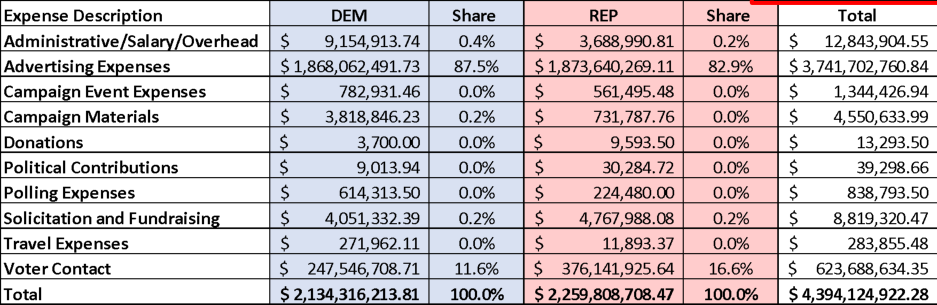
- The report evaluates the composition of campaign spending across various offices and the specific impact of allied independent expenditures.
- It examines the balance between traditional broadcast media and digital investment, emphasizing the need for innovation in storytelling.
- A critical assessment of data and technology infrastructure is provided to ensure security and resiliency for modern political campaigns.
- The methodology combines public data with qualitative insights from over 300 confidential interviews with organizations and individuals.
- The DNC and ASDC conducted a parallel assessment of the health of 57 state and territorial parties through 1,200 additional interviews.
- A formal disclaimer notes that the DNC cannot independently verify the report's claims as the underlying source data was not shared by the author.
“We the People” is not a new idea, but an enduring philosophy meant to include each generation and every available innovation in its design and operation.
A Ten-Year Strategic Vision
- The Democratic Party must move beyond immediate election cycles to implement a long-term, ten-year strategic plan for infrastructure and partnerships.
- A 'Win Anywhere' strategy is proposed to reconnect with voters in Middle America and the South who feel excluded from the current Democratic vision.
- Economic suffering and poor healthcare access in rural areas have led voters to reject the party because they do not see themselves reflected in its platform.
- The text cites the 1989 chairmanship of Ron Brown as a historical precedent for reclaiming the political center and focusing on 'the races we win.'
- Success requires a shift from 'pie-in-the-sky narratives' toward a practical 'politics of success' that prioritizes the economy and tangible results.
It was Ron Brown who understood every corner of America was hurting and proclaimed his tenure would be less about race and more about 'the races we win.'
Winning Anywhere Strategy
- The Democratic Party aims to replicate the unifying vision of Ron Brown which led to significant victories in the 1990s and paved the way for the Obama presidency.
- A new 'Winning Anywhere' mission focuses on deep collaboration with Labor and progressive partners to reassess messaging and maintain accountability.
- Restoring public trust requires elected officials to deliver on promises decisively to counter voter rage fueled by information silos.
- The party must reform its internal structures and practices to align financial investments with core values for year-round impact.
- Post-election analysis must avoid 'hot takes' and instead focus on the razor-thin margins, such as the few thousand votes that decided House control.
The rage of the voters, stoked daily by information silos, talking heads, and even politicians, has contributed to most Americans having a lack of confidence in both parties.
A Nation Divided
- Recent election cycles from 2016 to 2024 have been decided by razor-thin margins, reflecting a deeply polarized American electorate.
- Democratic leadership often defaults to a denialist mindset, blaming external factors rather than seeking fundamental party accountability.
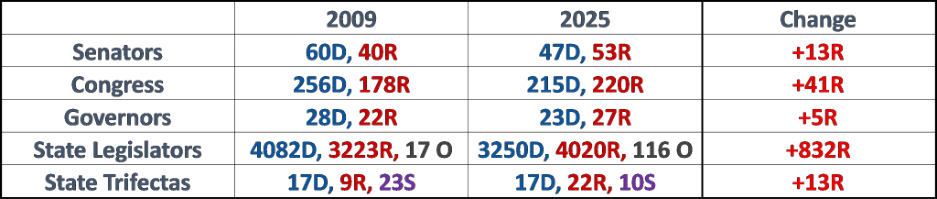
- Since the 2008 Obama landslide, the Democratic Party has experienced a period of stagnation and retrogression across all levels of government.
- Recent local and state victories in 2025 may provide a false sense of security, masking underlying weaknesses in voter engagement.
- The party failed to capitalize on the 2008 momentum by failing to cement a lasting relationship with working-class Americans.
This kind of thinking – denialist at its core – prevents the Party from seeking real accountability, and from making the changes we need to deliver on our promises to the American people.
The 2010 Midterm Shellacking
- The 2010 midterm elections resulted in massive Democratic losses across the House, Senate, and state legislatures due to economic stress and the rise of the Tea Party.
- Disinvestment in state Democratic parties during the early Obama years left the party vulnerable to Republican gains during a critical redistricting cycle.
- GOP control of state trifectas led to severe partisan gerrymandering, which effectively removed competitiveness from many electoral districts.
- A lack of Democratic presence in non-competitive regions has allowed Republicans to pass restrictive voting laws and gut essential public services.
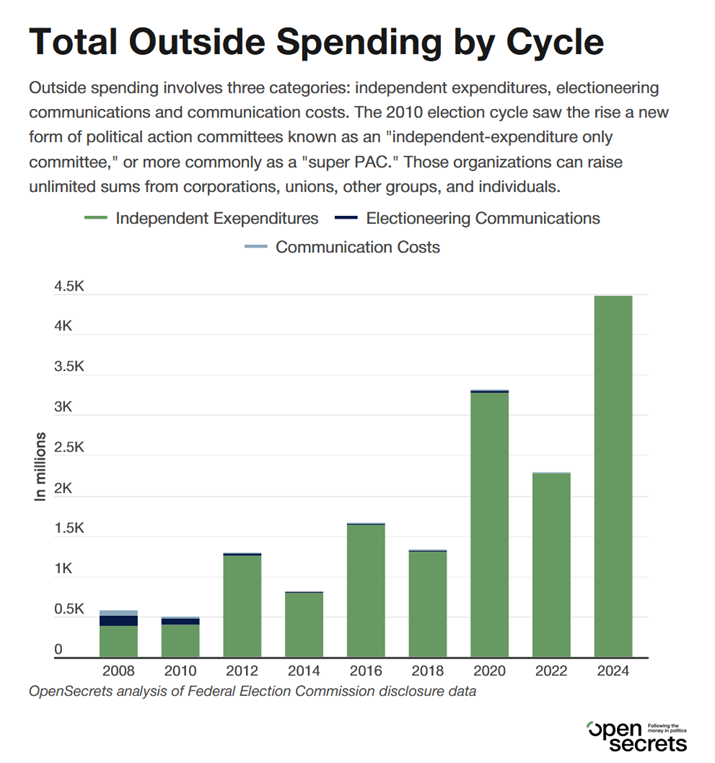
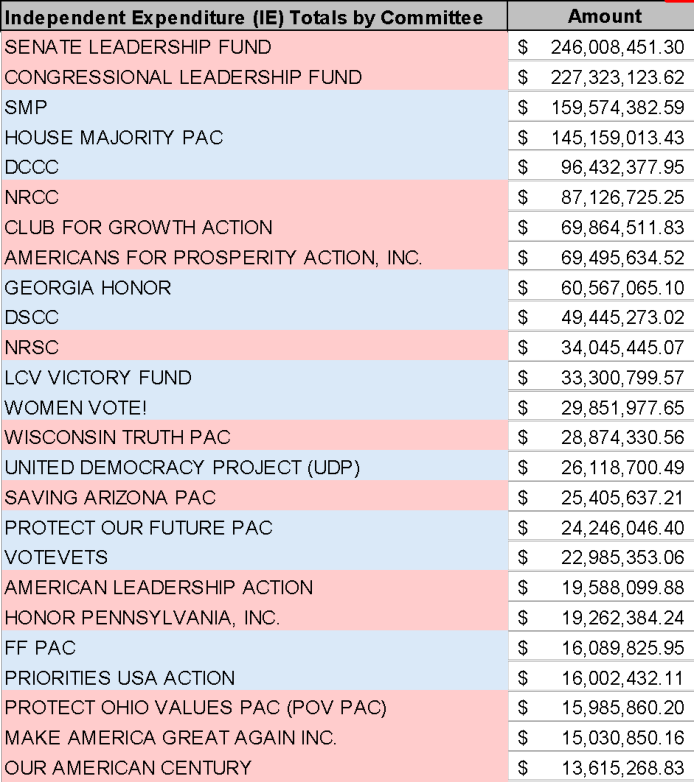
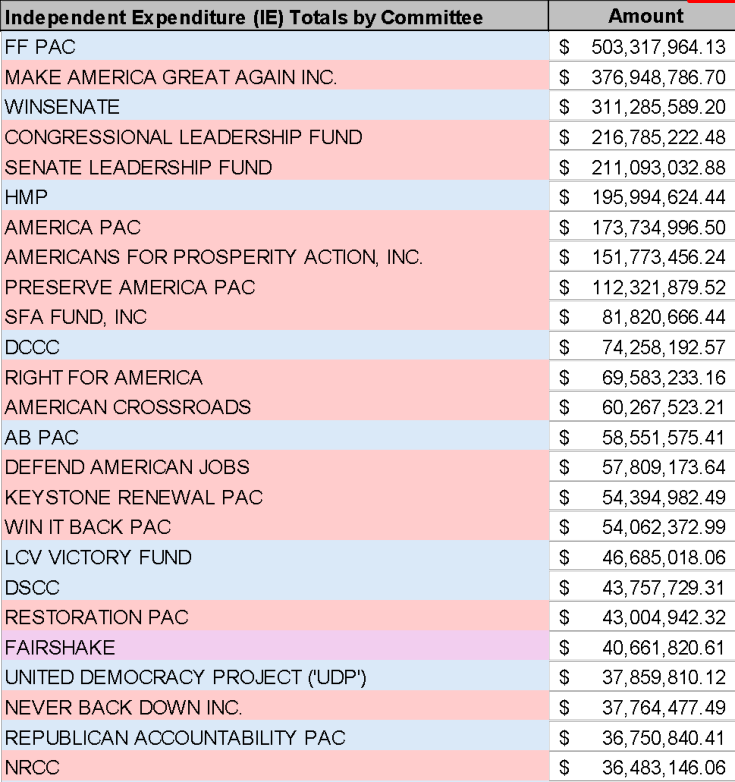
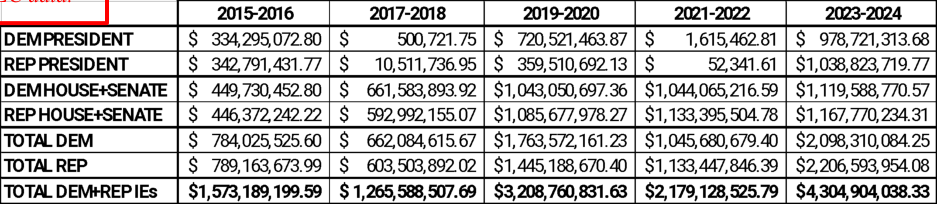
- The 2010 Citizens United era triggered a massive surge in dark money, with outside spending ballooning from $500 million to a projected $4.5 billion by 2024.
- Despite these structural disadvantages and financing shifts, President Obama secured a decisive re-election in 2012 with 332 electoral votes.
Subsequent federal court decisions have enabled and encouraged partisan gerrymandering, stripping even the idea of competitiveness out of the broader electoral and civic ecosystem.
Democratic Shifts and Electoral Volatility
- The 2014 midterm 'shellacking' resulted in the largest Republican House majority since 1928 and the loss of nine Democratic Senate seats.
- Internal Republican radicalization led to the defeat of Eric Cantor and the early resignation of Speaker John Boehner, signaling a shift toward Trumpism.
- The 2016 Democratic campaign suffered from state-level disinvestment, a lack of infrastructure, and a late-resolved primary that contributed to the collapse of the 'Blue Wall.'
- A 2018 'resistance' wave allowed Democrats to reclaim the House with a 40-seat gain while protecting incumbents in several Trump-won states.
- The 2020 election saw the highest voter participation in U.S. history, resulting in a Democratic trifecta and the reclamation of the Senate.
Republican primary losses – including House Majority Leader Eric Cantor to a Tea Party challenger – were symptoms of accelerating shifts towards radicalism within the Republican Party.
Election Cycles and Political Turmoil
- Joe Biden secured the 2020 presidency with 306 Electoral College votes and a popular vote lead of over 7 million.
- The January 6th insurrection resulted in five deaths and significant legal action, though most convictions were later nullified by presidential pardons in 2025.
- Republicans and legacy media predicted a massive 'red wave' in the 2022 midterms that ultimately failed to materialize.
- Democrats defied historical midterm precedents in 2022 by gaining a Senate seat and maintaining all state legislative chambers.
- Aggressive partisan gerrymandering in states like Florida and Texas allowed Republicans to narrowly reclaim the House of Representatives.
- The 2022 elections saw significant Democratic gains at the state level, including a historic governing trifecta in Michigan.
The ongoing disinformation and denialism orchestrated by Republicans about the events of January 6th is ongoing large-scale gaslighting designed to undermine our entire civic ecosystem.
Democratic Party Post-Election Analysis
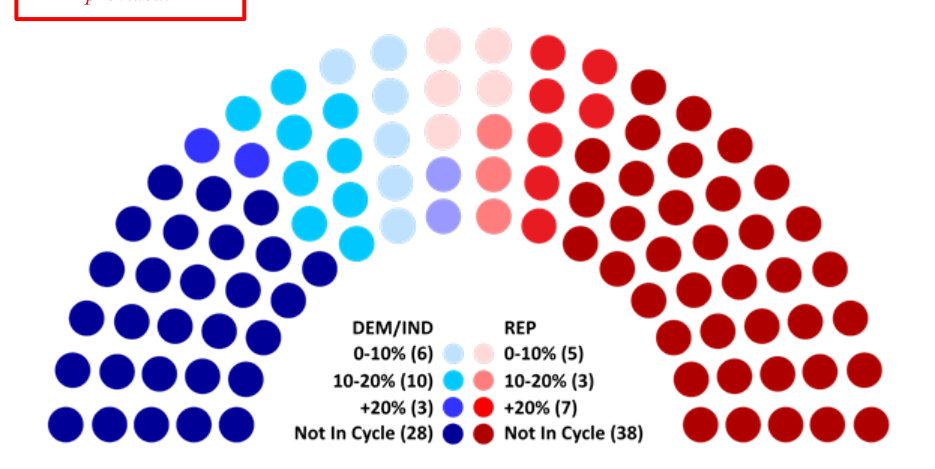
- Republicans secured significant victories across Presidential battlegrounds and flipped key Senate seats in Pennsylvania, Ohio, West Virginia, and Montana.
- Despite losing the national narrative, Democrats saw minor gains in the House and maintained control of several governorships.
- The report identifies a 16-year trend of increasing polarization and cumulative narrow losses that have ceded outsized power to the opposition.
- A disconnect exists between the popularity of Democratic policies, such as Medicaid expansion and wage increases, and the party's electoral performance.
- The author proposes a 10-year strategic plan to address inconsistent messaging and improper planning that have eroded voter trust.
- The DNC issued a disclaimer stating that several claims in this analysis are unsupported by data and contradict public reporting.
The sad truth is Democrats have lost ground at every level from inconsistent messaging and improper planning, even as the policies the Party advances continue to earn voter support at the ballot box.
The Crisis of Democratic Trust
- Voters are supporting progressive policies like family leave and reproductive freedom in red states while simultaneously rejecting Democratic candidates.
- Recent Democratic victories are often the result of 'negative partisanship' against flawed Republican opponents rather than affirmative support for the Democratic platform.
- The 2022 Georgia Senate race serves as a primary example of Republicans leveraging name recognition over candidate qualifications.
- Democrats cannot rely on the continued nomination of weak Republican opponents to secure future electoral victories.
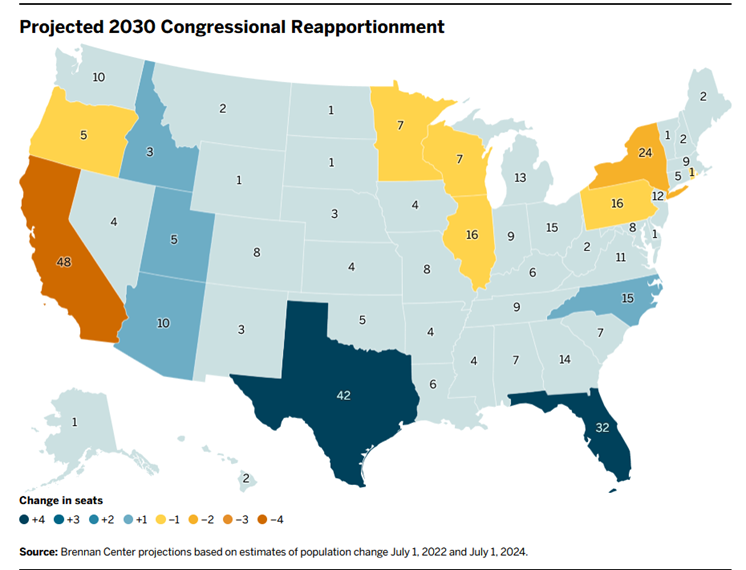
- A looming demographic shift threatens to move up to 12 Congressional seats and Electoral Votes away from traditionally Democratic strongholds.
- The party must develop a long-term strategy to rebuild genuine trust and project leadership to counter misinformation.
Walker’s inability to muster even a shred of credibility precluded him from winning the election in one of the most polarized states in the nation.
A New Majority Strategy
- Projected 2030 Census reapportionment indicates a significant shift of political power from Democratic strongholds like California and New York to Republican-leaning states like Texas and Florida.
- The author argues that Democrats cannot rely on national tides or historic trends to win, but must instead proactively adapt to changing electoral conditions.
- Reversing losses at the state level is identified as the critical foundation for rebuilding the party's bench and reclaiming national influence.
- The proposed 'Majority Party Strategy' emphasizes organizing everywhere to win anywhere, moving beyond 'tinkering around the margins' to achieve cohesive, large-scale engagement.
- The 2025 elections are framed as a pivotal moment for the party to refresh its leadership and align its vision to reflect the will of the people over the powerful.
With radical midterm redistricting efforts underway, the writing is on the wall, and the call is coming from inside the House.
Electoral Review and Battleground Shifts
- The 2024 election saw the collapse of the 'Blue Wall,' with Pennsylvania, Michigan, and Wisconsin flipping to Donald Trump.
- Donald Trump became the first Republican presidential candidate to win the popular vote since 2004.
- Despite the electoral shift, the margin of defeat for Kamala Harris was among the smallest in American history.
- The outcome was determined by a fraction of a percentage point, specifically .15 percent of the total votes cast across the country.
- Gubernatorial races showed high levels of incumbency or party retention, with no governor's office changing partisan hands across 11 states.
- The DNC issued a disclaimer stating they cannot independently verify many of the assertions or underlying data provided in this report.
On Election Night, the world watched the Blue Wall crumble to return Donald Trump to the White House.
Gubernatorial Election Strategies
- Republicans dominated the 2024 gubernatorial races, winning eight out of ten contested seats across various states.
- Democrats Josh Stein and Bob Ferguson secured victories in North Carolina and Washington by focusing on kitchen-table issues like housing and the economy.
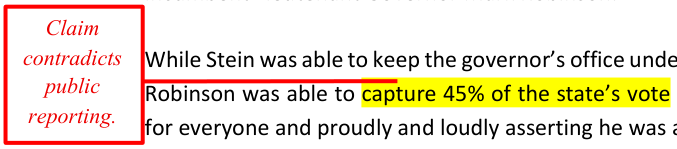
- The North Carolina race highlighted a concerning trend where an extremist candidate, Mark Robinson, still captured 45% of the vote despite significant scandals.
- The success of Stein and Ferguson suggests that moving away from identity politics toward pragmatic solutions is a winning blueprint for Democrats.
- Robinson's performance demonstrates the power of the conservative media ecosystem to sustain momentum for far-right candidates even without mainstream support.
Robinson’s performance must be a wake-up call to Democrats - even without the support of Trump and major organizations, extreme right-wing candidates can still leverage the conservative media ecosystem to engender support and momentum for their platforms.
North Carolina's Ticket-Splitting Divergence
- Josh Stein significantly outperformed Kamala Harris in North Carolina by winning 51% of male voters, an 11-point lead over Harris's performance with the same demographic.
- Stein's success was rooted in a 'nonpartisan' focus on his record as Attorney General, specifically highlighting his work on fentanyl and consumer protection.
- Approximately 6.8% of North Carolina voters engaged in ticket-splitting, casting ballots for both Donald Trump and Josh Stein, primarily among college-educated suburban women.
- While Mark Robinson's campaign imploded due to toxic rhetoric, Stein's victory was also driven by limiting losses in rural areas where Harris's support cratered.
- The data suggests Stein treated irregular and new voters as persuasion targets rather than just mobilization targets, outperforming Harris by 8 points in that category.
- In contrast to North Carolina, New Hampshire saw the opposite trend where the Democratic gubernatorial candidate ran over 6 points behind Harris.
Voters were willing to split their tickets for governor when faced with unacceptable choices, but voters returned to their partisan corners at the presidential level.
Gubernatorial Underperformance and Ticket Splitting
- New Hampshire saw a high ticket-splitting rate with 8.5% of voters supporting both Harris and Republican Kelly Ayotte.
- Democratic candidate Joyce Craig underperformed Harris across all geographic sectors, including urban, suburban, and rural areas.
- The Craig campaign failed to define a clear platform beyond being an alternative to Ayotte and Trump, mirroring national messaging struggles.
- Harris's victory in New Hampshire is characterized more as an anti-Trump sentiment than a proactive endorsement of her candidacy.
- In Washington, Bob Ferguson won the governorship but still ran nearly four points behind the top of the ticket.
- The DNC explicitly disclaims the report's findings, noting a lack of underlying data and contradictions with public reporting.
When you can't define yourself and can't generate enthusiasm, you lose even when your party's presidential candidate wins the state.
Down-Ballot Performance Disparities
- Bob Ferguson underperformed Kamala Harris in urban Democratic strongholds like Seattle and Tacoma by four to five points.
- Ferguson successfully leveraged his attorney general background to outperform Harris in rural areas, limiting losses in conservative districts.
- In North Carolina, Jeff Jackson outperformed Harris by 4.2 points but trailed Josh Stein's gubernatorial performance by 3.4 points.
- The data suggests that lower-profile races in blue states require affirmative candidate cases rather than relying solely on anti-Trump sentiment.
- Voter enthusiasm dropped significantly in environments where Donald Trump was not perceived as being in a competitive race.
- The DNC explicitly disclaimed the findings, noting that public reporting and data often contradict the author's underlying assumptions.
Even in safe blue states, lower-profile races need affirmative cases for candidates, not just opposition to Trump.
Jackson's Down-Ballot Performance Dynamics
- Jeff Jackson consistently outperformed the presidential ticket but trailed the gubernatorial candidate's exceptional margins.
- Lower visibility and a more conventional Republican opponent limited Jackson's ability to capitalize on ticket-splitting compared to the governor's race.
- Jackson's significant overperformance in urban and suburban metros was bolstered by his established congressional credibility and massive digital following.
- The 'Robinson effect' primarily benefited the top of the state ticket, showing that down-ballot races face unique resource and attention constraints.
- Jackson's success highlights that while strong candidates can outrun the top of the ticket, they still face structural limits in lower-visibility races.
The quality contrast that drove Trump-Stein voters wasn't as stark for AG.
Down Ballot Performance Gaps
- Josh Stein's gubernatorial success demonstrates that candidate quality and specific opponent weaknesses can overcome national partisan trends.
- A consistent 'Male Voter Problem' plagued the national ticket, with every down-ballot Democrat outperforming Harris among men by 4 to 11 points.
- Stein's ability to recover ground with young men of color suggests that the national campaign's losses in these demographics were not inevitable.
- Education polarization remains most severe among white voters, where Harris's focus on college-educated suburbs created insurmountable math problems.
- The data indicates that Democrats cannot win by losing non-college voters by massive margins when they constitute the majority of the electorate.
- The DNC officially distanced itself from this report, noting that many claims lack supporting data or contradict public reporting.
This is a math problem: Democrats can't lose non-college voters by massive margins and make it up elsewhere when non-college voters are a majority of the electorate.
Irregular Voters and Ticket Splitting
- The Harris campaign struggled with irregular voters, falling below 50% with first-time participants while down-ballot candidates like Josh Stein outperformed her.
- Irregular voters are disproportionately younger, non-college, male, and urban, representing a demographic shift that Democrats failed to capture.
- Ticket-splitting remains a small but decisive factor, with college-educated suburbanites in North Carolina choosing Trump and Stein simultaneously.
- The national campaign incorrectly assumed that persuadable voters would automatically reject Trump and default to the Democratic candidate.
- Josh Stein's success in North Carolina provides a winning formula by maintaining urban enthusiasm, winning swing suburbs, and limiting rural losses.
- The data suggests the election outcome was less about party brand or policy and more about the specific evaluation of Harris as a candidate.
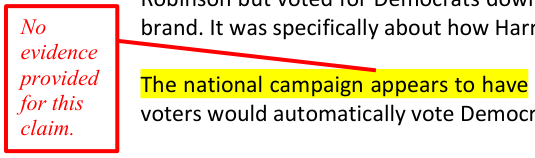
The national campaign appears to have assumed Trump was so unacceptable that persuadable voters would automatically vote Democratic.
Lessons from State Campaigns
- Josh Stein's success in North Carolina demonstrates that aggressive negative campaigning is effective when the candidate has already established a positive reputation.
- The 11-point gap between Stein and Harris among male voters suggests that the national campaign's focus on women alienated a solvable demographic.
- Stein's performance in rural areas highlights a strategic miscalculation by the Harris campaign, which assumed urban margins could offset massive rural losses.
- A clear professional definition, such as Stein's record as Attorney General, proved more effective than Harris's reactive 'prosecutor vs. felon' framing.
- Harris failed to capture irregular and new voters, winning less than 50% of that group compared to Stein's 56% in the same state.
- The DNC explicitly disclaims the report's findings, noting a lack of underlying data or evidence to verify the author's assertions.
The idea Trump’s negatives were “baked in” is a major failure of analysis and reality - given how his favorability has cratered less than a year into this term.
The Limits of Anti-Trumpism
- Massive media spending failed to translate into voter turnout due to a lack of robust on-the-ground organizing.
- The Harris campaign relied too heavily on Trump's unacceptability rather than building an affirmative case for her own candidacy.
- Democrats must engage male voters directly through economic issues rather than assuming identity politics will secure their support.
- A successful geographic formula requires a combination of strong urban turnout, competitive suburbs, and minimizing rural losses.
- The shift of Latino voters toward Republicans suggests that demographic trends are not fixed and depend heavily on candidate execution.
- Year-round engagement and clear policy definitions are more effective at reaching irregular voters than last-minute get-out-the-vote efforts.
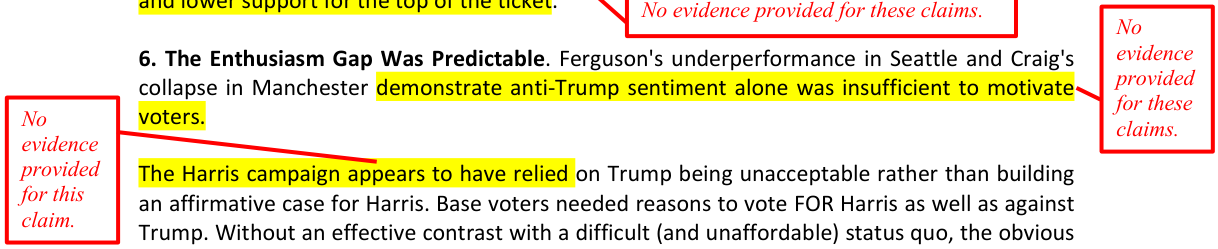
The Harris campaign appears to have relied on Trump being unacceptable rather than building an affirmative case for Harris.
Campaign Strategy and Voter Trends
- Voters demonstrate sophistication through ticket-splitting, with 8-10% of the electorate evaluating candidates individually rather than by party line.
- While demographics like young voters and men trended Republican, Josh Stein's success suggests these losses can be mitigated with the right strategy.
- Early investments in media by the DGA and DAGA allowed candidates to define themselves before their opponents could, providing a significant tactical advantage.
- The late transition to the Harris campaign limited messaging and organizing options, leading to underperformance compared to down-ballot Democrats.
- Candidate quality and execution remain decisive factors, proving that demographics are merely tendencies rather than political destiny.
- Effective campaigning requires introducing a candidate through a strong framework before attempting to define the opponent.
Demographics are tendencies, not destiny, and voter support is impacted - good and bad - through campaign choices.
The 2024 Senate Results
- Republicans flipped key seats in Ohio and Montana where Democratic incumbents outperformed Harris but could not overcome significant Trump margins.
- Pennsylvania saw the narrowest Senate race in the country, with David McCormick defeating Bob Casey by a mere 0.2 percentage points.
- Democratic candidates in Michigan, Nevada, and Arizona successfully held their seats by running significantly ahead of the top of the ticket.
- Voter behavior in Nevada showed a unique trend where a portion of Trump supporters chose to skip the Senate race entirely rather than vote for the Republican candidate.
- The results suggest that while personal brands and working-class credentials still matter, they are increasingly vulnerable to the 'gravity' of national partisan trends.
Brown outperformed Harris by 7.6 points and still lost. His decades of fighting for Ohio workers gave him credibility Harris couldn't match, but Brown could not overcome gravity.
Local Identity and Ground Games
- Sherrod Brown and Jon Tester leveraged decades of personal brand-building to significantly outperform the national Democratic ticket in red states.
- Despite running optimized campaigns and securing local infrastructure wins, both candidates were ultimately overwhelmed by Donald Trump's massive margins.
- Senator Jacky Rosen's success in Nevada is attributed to a year-round organizing model that prioritized authentic local voices over out-of-state canvassers.
- Effective community-based organizing relied on member-to-member outreach, such as hospitality workers discussing kitchen-table issues with their peers.
- Cultural competency and bilingual outreach were essential components in maintaining trust within diverse working-class and Latino neighborhoods.
A hospitality worker talking to another hospitality worker about kitchen-table issues carried more weight than any paid consultant.
Democratic Organizing Challenges 2024
- Strategic grassroots engagement in Nevada allowed Jacky Rosen to outperform the national ticket by connecting workplace concerns to political choices.
- A widening credibility gap exists between organizational leadership and rank-and-file voters, leading to significant ticket-splitting in states like Pennsylvania.
- Late mobilization and a focus on 'Bidenomics' macro-statistics failed to address the daily micro-economic anxieties of working-class voters.
- Messaging regarding the green energy transition created job-loss anxiety among workers in traditional industries, alienating key constituencies.
- Republicans successfully utilized economic populist messaging to make inroads with working-class men in manufacturing and construction sectors.
- The decline of organizational density in former industrial strongholds like Ohio has severely reduced the Democratic party's long-term organizing capacity.
The 'Bidenomics' framing emphasized macro statistics rather than the micro realities voters experienced daily and specifically tied President Biden - by name - to actual economic anxiety.
The Strategy of Losing Better
- Elissa Slotkin's Michigan victory relied on 'losing better' by cutting margins in Republican strongholds rather than just focusing on urban centers.
- Successful down-ballot Democrats localized their races to insulate themselves from flawed national party messaging and unpopular leadership.
- Sherrod Brown's performance in Ohio demonstrated that focusing on visceral, state-specific issues like manufacturing can significantly outperform the national ticket.
- The 'Trump but not Moreno' phenomenon revealed that Trump's personal appeal does not automatically transfer to other Republican candidates.
- Data suggests that while Trump's coalition is powerful, it is highly personality-driven and may be difficult for the GOP to replicate in future cycles.
- The presence of Kamala Harris on the ballot likely helped down-ballot Democrats maintain base support compared to a potential Biden candidacy.
Moreno's campaign identified 580,000 'Trump but not Moreno' voters in Ohio.
The Latino Voting Shift
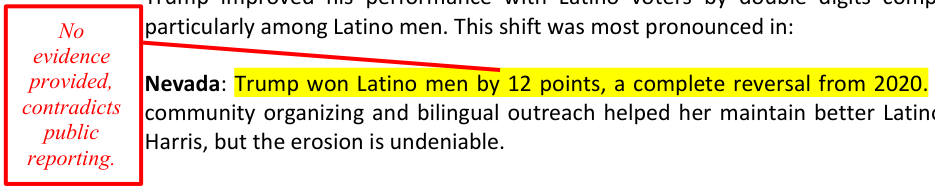
- Donald Trump achieved double-digit improvements with Latino voters in 2024, particularly among men in key swing states like Nevada and Arizona.
- Starr County, Texas, which is 97% Hispanic, flipped to the Republican party for the first time since 1892, signaling a historic realignment.
- Successful Democratic candidates like Ruben Gallego outperformed the national ticket by focusing on working-class backgrounds and year-round community presence.
- The report suggests Democrats must move beyond identity politics and late-cycle Spanish ads toward consistent economic messaging and labor partnerships.
- Economic decline in manufacturing hubs has created a political gravity that even established pro-labor Democrats like Sherrod Brown could no longer overcome.
Starr County, which is 97% Hispanic, flipped to Trump - voting Republican for president for the first time since 1892.
Abortion and Turnout Dynamics
- Democratic candidates Brown and Slotkin utilized multimillion-dollar ad campaigns to weaponize Republican opponents' abortion records.
- The abortion issue successfully attracted suburban women and moderate Republicans who typically vote for GOP candidates down-ballot.
- Historical data from 2018 and 2022 suggests that Donald Trump's absence from the ballot often leads to Republican underperformance.
- Union households maintain higher turnout rates during midterms, potentially granting organized labor decisive influence in 2026.
- The 'Trump effect' primarily benefits the former president himself rather than the broader Republican party infrastructure.
The historical pattern is clear: Trump drives turnout in ways that help him but don't always help other Republicans.
The Democratic Media Deficit
- The current media ecosystem is described as one where Republicans own the infrastructure while Democrats merely rent seasonal access.
- Democratic fundraising efforts effectively transfer billions of dollars from grassroots donors to media oligarchs and right-wing entities.
- Algorithmic platforms prioritize polarization and rage over policy, making it difficult for Democratic messaging to break through.
- Traditional paid media strategies can leverage reach but fail to achieve salience in a modern, shareable media environment.
- The shift from legacy media management to viral engagement has fundamentally changed how down-ballot campaigns gain visibility.
Democrats are essentially raising billions of dollars from retirees, activists, working Americans, and organized labor, and transferring most of it to the pockets of legacy and digital media oligarchs.
The Digital Campaign Shift
- Modern political campaigns are increasingly launching online to capture national grassroots attention and record-breaking small-dollar donations.
- Despite the rise of digital platforms, both major parties still invest billions in legacy media like broadcast and cable television.
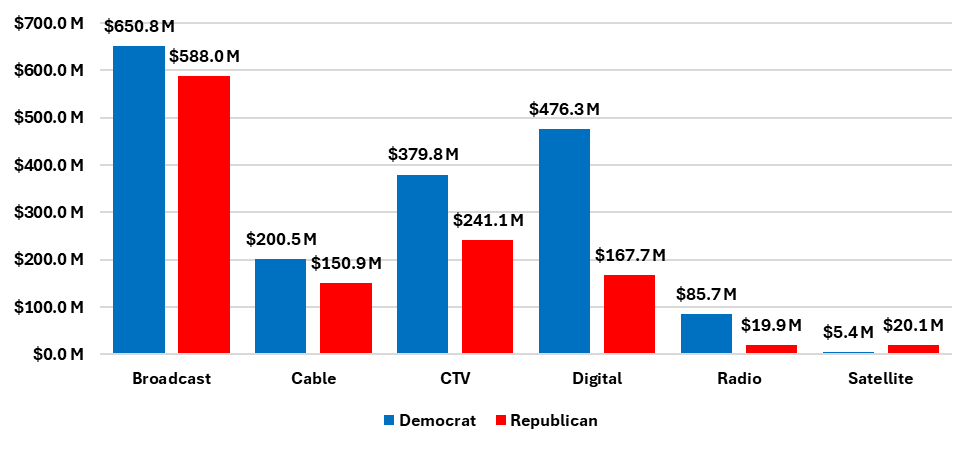
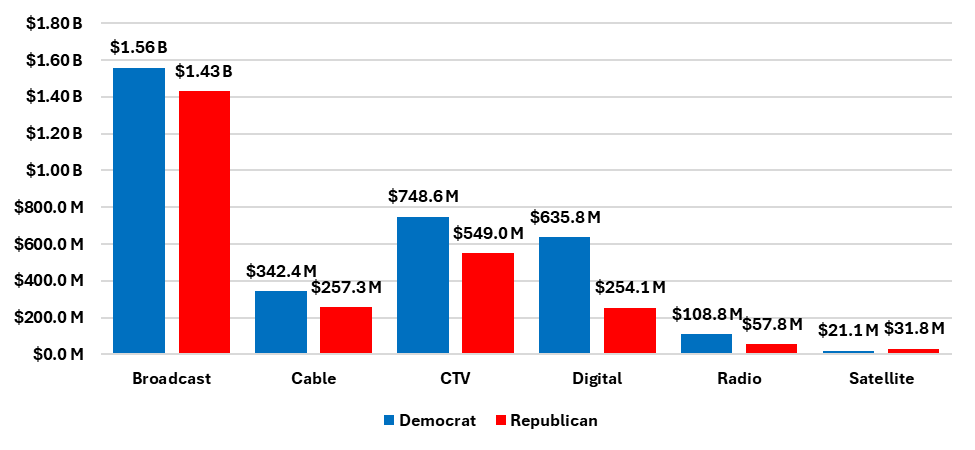
- The 2024 presidential election saw nearly $3 billion in ad spending, with Democrats significantly outspending Republicans in the digital and connected TV space.
- Corporate America has shifted 72% of its advertising budget to digital, yet political campaigns maintain a heavy bias toward traditional broadcast media for persuasion.
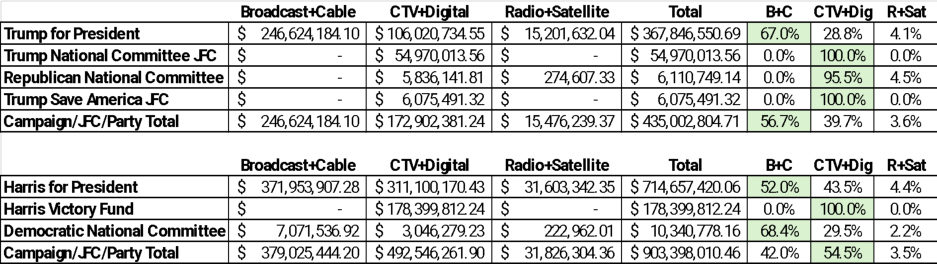
- Victory funds are legally restricted to fundraising-focused ads, which explains their exclusive reliance on digital platforms compared to the broader campaign's media mix.
It’s no longer enough for campaigns to push information out – they have to pull people in – and digital and social platforms are tools designed for this engagement.
2024 Political Media Spending Analysis
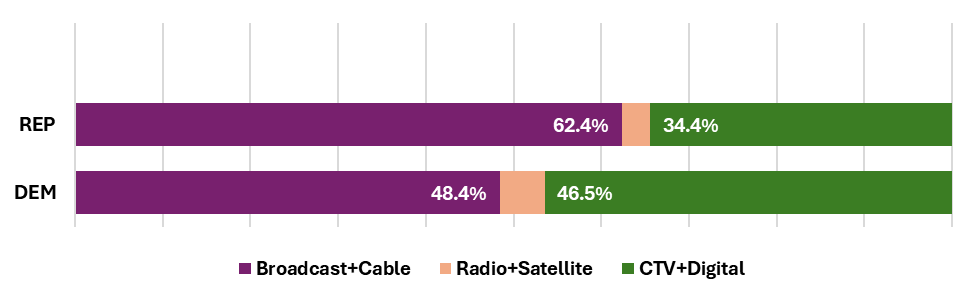
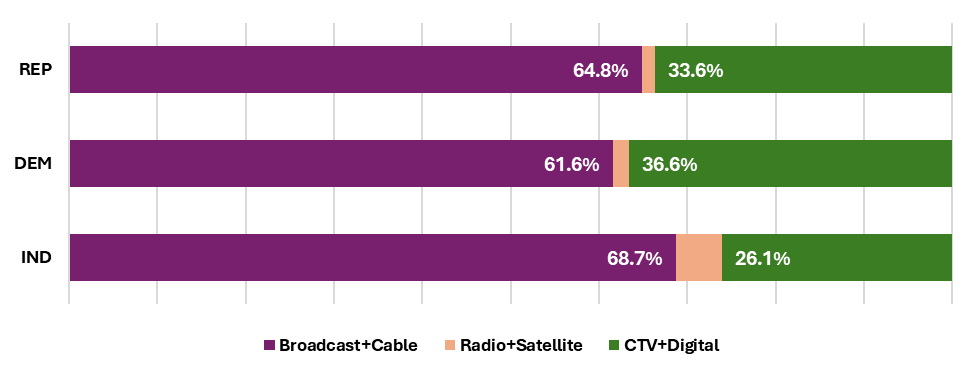
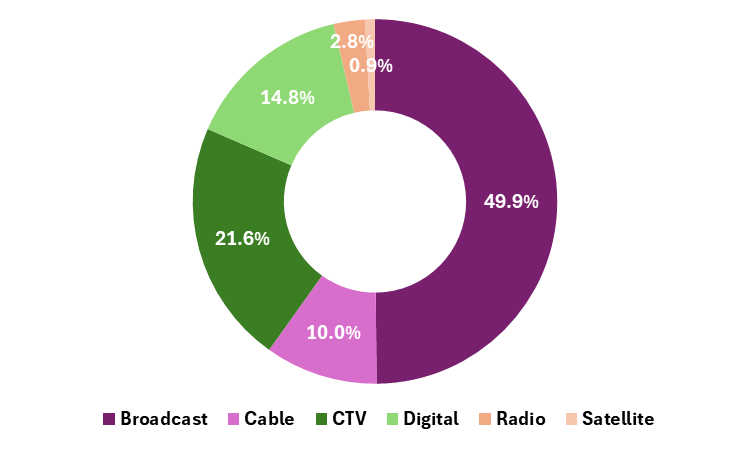
- The Harris campaign achieved a nearly even split between traditional broadcast/cable (48.4%) and digital/CTV (46.5%), while the Trump campaign remained heavily reliant on broadcast at 62.4%.
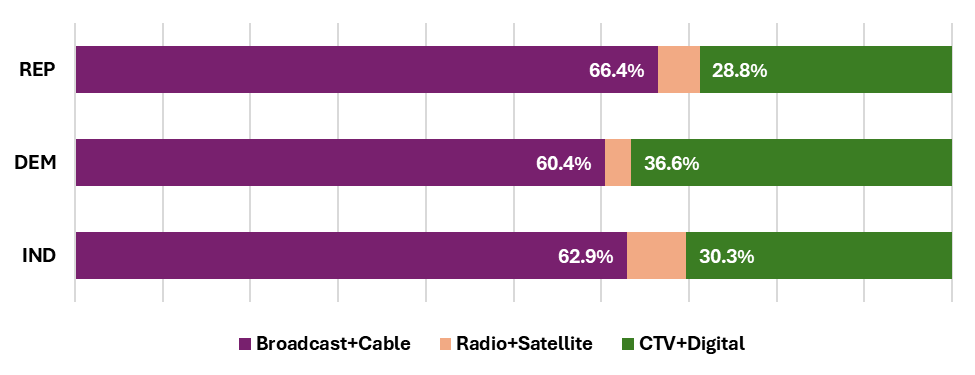
- In high-stakes Senate races totaling $1.93 billion, Democrats outpaced Republicans in digital and CTV investment by a margin of 7.8 percent.
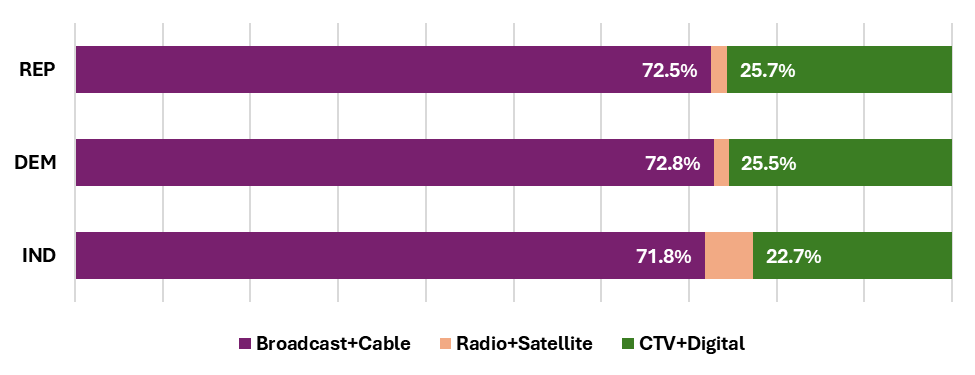
- House race spending patterns showed the most parity between parties, with both Democrats and Republicans allocating approximately 72% to traditional television and 25% to digital platforms.
- Despite a general spending advantage, the overall media mix for both parties still skews heavily toward traditional broadcast and cable television.
- The report suggests that the current media allocation disadvantages Democrats because their base includes more cord-cutting younger voters who do not engage with traditional TV.
- The DNC issued a disclaimer noting that the underlying sourcing and methodology for these spending assertions could not be independently verified.
While Democrats do spend more on digital than Republicans, the share of spend is still not fully reflective of where the marketplace is.
Digital Strategy and Voter Erosion
- Democrats spent more on digital and CTV than Republicans but still struggled to reach younger voters effectively.
- Media strategists claimed a lack of digital inventory forced them to pivot back to legacy broadcast and cable television.
- The failure to reach digital natives contributed to significant margin losses in traditionally blue states like New Jersey and Virginia.
- Voter slippage was particularly pronounced among younger Americans and non-White communities compared to 2020 performance.
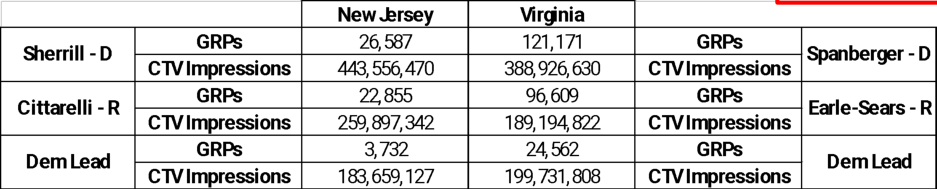
- The 2025 gubernatorial races in New Jersey and Virginia saw massive combined media spending of $196.3 million as both parties sensed opportunity.
- The author argues that Democrats must rethink their reliance on legacy media to re-engage voters who skipped the 2022 and 2024 cycles.
Investments in legacy media will miss these voters, and the 2024 strategies did not effectively reach them.
2025 Media Spending Strategies
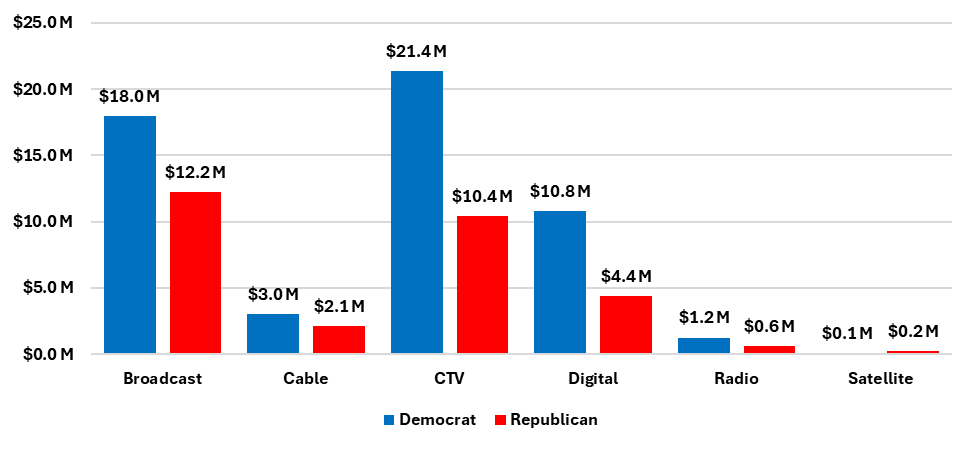
- Democrats significantly outspent Republicans in both the New Jersey and Virginia 2025 elections, totaling over $120 million across both states.
- Campaigns shifted toward more affordable digital channels to navigate the high costs of the New York, Philadelphia, and Washington D.C. media markets.
- Democratic strategists in Virginia prioritized CTV and digital platforms, allocating over 53 percent of their budget to these channels to reach younger voters.
- Republicans maintained a heavier reliance on traditional broadcast and cable television, likely targeting an older demographic.
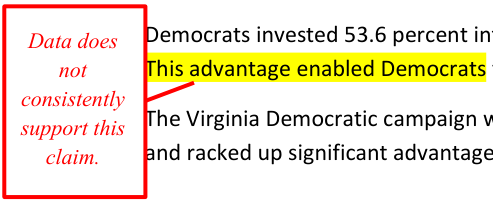
- The Virginia Democratic campaign sustained spending throughout the entire general election, outperforming Republicans in nearly every channel except satellite.
- The report suggests future Democratic candidates should emulate the Virginia model of investing more in CTV than in broadcast and cable combined.
The investment in connected television – $3.4 million more than broadcast, and more than broadcast and cable combined – is notable and an important example for Democratic incumbents and candidates to use.
New Jersey 2025 Media Strategy
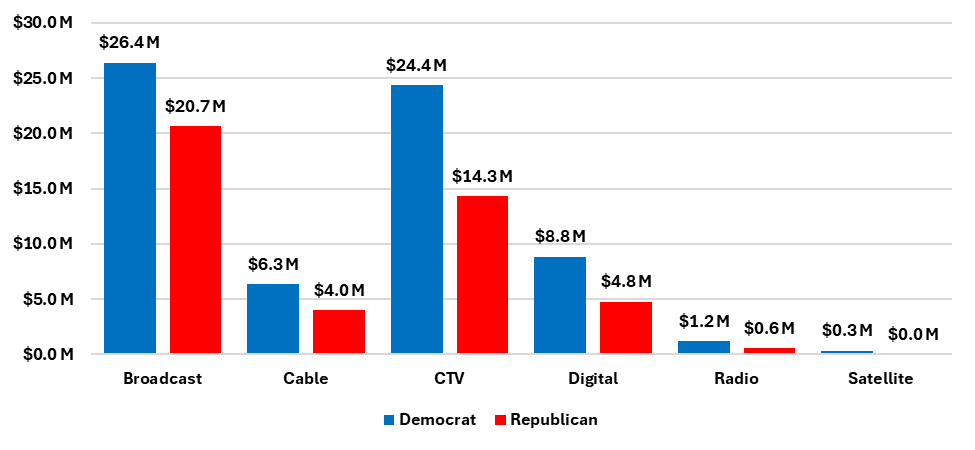
- The New Jersey gubernatorial race featured a capped candidate spending environment, necessitating heavy outside investment from the DGA.
- Democratic spending reached $39.6 million, significantly outpacing the Republican investment of $23.7 million.
- Democrats prioritized digital and CTV platforms, allocating 49.2 percent of their budget to these channels compared to 43.0 percent for Republicans.
- Early investments by the DGA were instrumental in defining the media landscape and establishing a gross ratings point advantage.
- National presidential campaigns utilize a 'match and mirror' strategy while navigating the pricing disparities between candidate and independent spending.
The national campaigns closely monitor ad spending, seeking to match and mirror their counterparts, and eke out advantages as the campaign progresses.
2024 Presidential Ad Spending
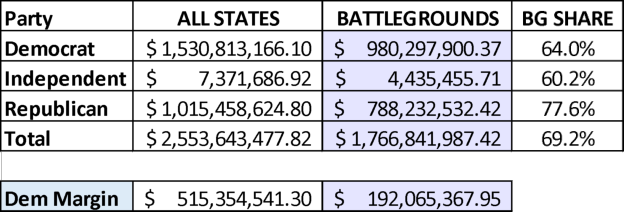
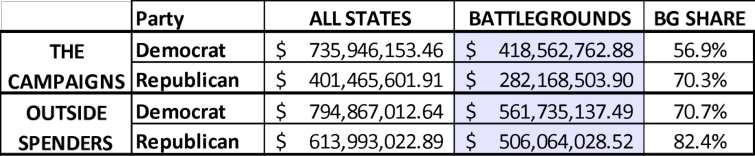
- Democrats maintained a significant overall spending advantage of $515.3 million, totaling $1.5 billion compared to the Republicans' $1.02 billion.
- Republicans demonstrated higher geographic focus, allocating 77.6 percent of their total ad budget to battleground states compared to 64 percent for Democrats.
- Outside spending groups played a critical role, with Democratic groups spending $794.9 million and Republican groups spending $614 million.
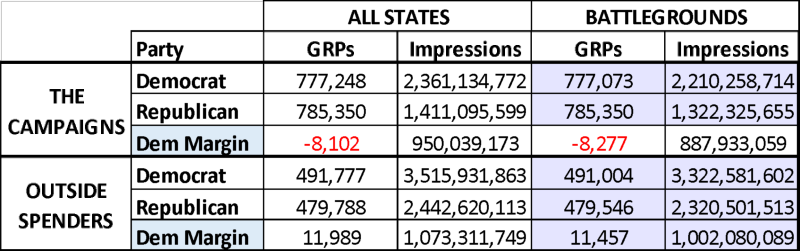
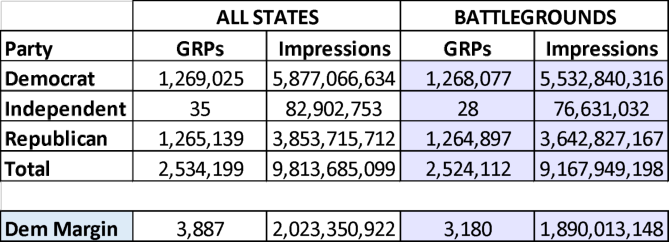
- Despite being outspent by 24.4 percent in battlegrounds, Republican spending efficiency allowed them to narrow the gap in actual ad delivery and impressions.
- Non-battleground spending was largely driven by digital and national buys, where Democrats outspent Republicans by a margin of $303.8 million to $122 million.
The Democratic presidential campaign invested where it should, but the Republican campaign was more focused and efficient in matching Democratic ad levels.
The Always-On Strategy
- Democratic campaigns often suffer from a 'seasonal' spending model that goes dark between election cycles, ceding the narrative to opponents.
- Right-wing organizations maintain an 'always on' presence, consistently framing partisan information flows long before Democrats begin their outreach.
- Waiting until the final months of a campaign to engage voters is increasingly ineffective in an era dominated by misinformation and disinformation.
- The 'messaging vacuum' created by Democratic absence allows Republicans and foreign actors to define and brand the party on their own terms.
- Early investments in North Carolina by the DGA and DAGA serve as successful counter-examples of defining candidates before the opposition can.
- Future strategies must align ad placements with modern media consumption behaviors and ensure coordination with outside entities to maximize impact.
In an age of misinformation and disinformation, the answer to the question of “when is the right time to engage actual and potential voters” must always be “now.”
The Always On Strategy
- Early and consistent investment in political messaging provides clarity for voters and allows candidates to focus on affirmative platforms.
- Seasonal funding cycles and legal restrictions on non-party organizations often dilute the effectiveness of Democratic outreach.
- State parties require permanent infrastructure to raise the electoral floor, especially in historically non-viable districts.
- The 2024 defeat of Sherrod Brown in Ohio serves as a case study for how national party drag can overcome even strong individual incumbents.
- A proposed permanent campaign model includes dedicated communications, research, and training through the DNC and state parties.
In a world (or state) where significant investment flows more frequently than once every six years, is Sherrod Brown still a Senator?
Strategic Funding and Messaging
- Democratic funders must demand accountability for past failures and prioritize filling organizational gaps in non-competitive regions.
- The 'always on' strategy of the right necessitates a consistent, year-round messaging infrastructure rather than late-cycle spending.
- Successful early investments in 2025 state elections serve as proof points for the necessity of defining the narrative well before 2026.
- Democrats must innovate within the attention ecosystem to match the scale of a national party and counter foreign-backed disinformation.
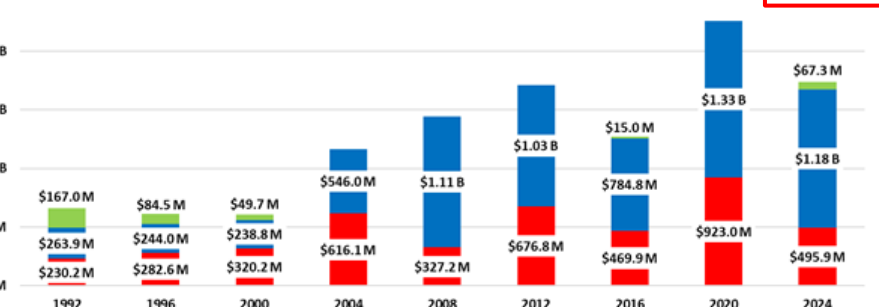
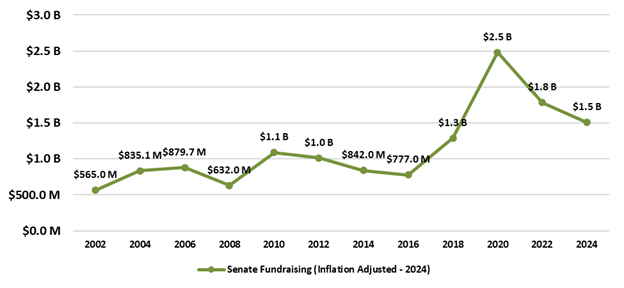
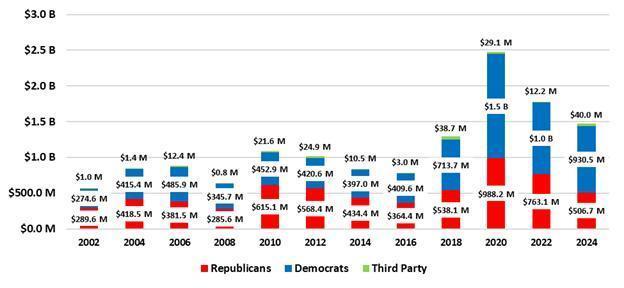
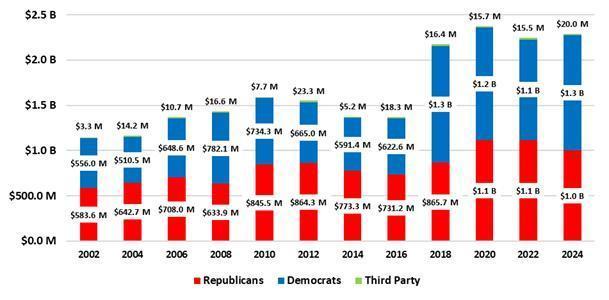
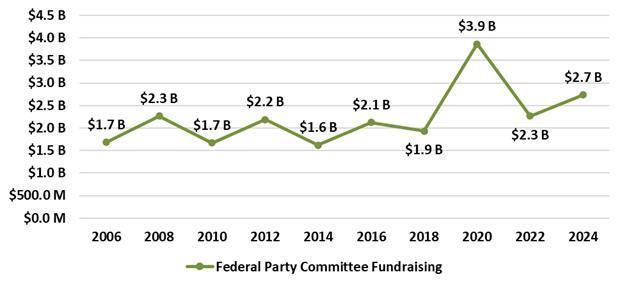
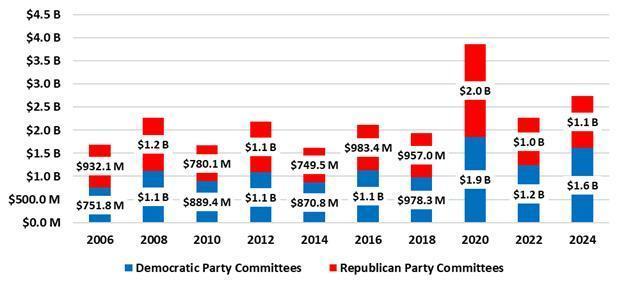
- With over $8 billion raised in 2024, the issue is not a lack of resources but the strategic timing and placement of those funds.
The right is “always on,” if Democrats do not match this strategy, it will be too late to make the case, much less close the deal.
Combating Global Political Misinformation
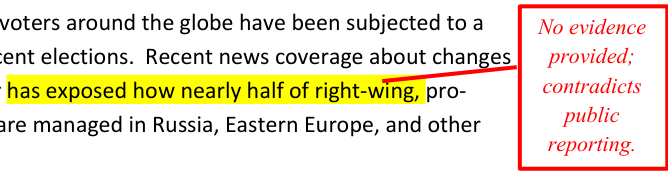
- Foreign actors, particularly from Russia and Eastern Europe, manage a significant portion of extremist social media accounts to influence American elections.
- Traditional fact-checking is often counterproductive because it can inadvertently amplify the original smear or fail against voters motivated by tribalism.
- Effective opposition to disinformation requires addressing the underlying motivations of voters, such as the desire to signal political identity or generate chaos.
- Right-wing interests utilize a long-term strategy of amplifying polarizing figures within the Democratic Party to 'other' and alienate the entire platform.
- Democratic organizations must prioritize rapid response operations and affirmative messaging to protect candidates from being painted as out of touch.
Fact-checking will not stop the spread of misinformation if the need to signal one’s politics, derogate the opposition, or generate chaos is a more powerful motivator than truth.
The Platform Specificity Mandate
- Modern media campaigns must recognize that every device and platform offers a unique user experience that requires tailored content.
- Democratic consultants are criticized for 'shoehorning' traditional 30-second TV spots into digital spaces rather than creating native content.
- Overproduced video content can create a sense of dissonance for voters when it appears on platforms where they expect authenticity.
- To remain relevant, candidates must commit to experimentation and inhabit the specific digital spaces where voters live and scroll.
- Reaching digital-native voters requires a shift from a one-size-fits-all broadcast mentality to a platform-first strategy.
Understanding the way in which an overproduced video creates dissonance with a voter based on where they are experiencing it in their media journey is an important step.
Strategic Messaging and Voter Engagement
- Democrats must develop better tools to map voter habits and prioritize active listening to build genuine support.
- The DNC is collaborating with tech leaders to modernize voter engagement and identify effective technical resources.
- A strategic shift toward aggressive negative messaging is necessary to frame the choice for voters effectively.
- The text argues that Democrats often rely on reason while the electorate is increasingly driven by rage.
- The failure to disqualify Donald Trump in the public eye is attributed to an insufficiently aggressive prosecution of his record.
- Despite low favorability ratings and primary struggles, Trump remained a threat because the opposition's messaging lacked a 'brutal' edge.
Democrats operate in an ecosystem defined by reason even in cycles when the electorate is defined by rage.
The Failure of Negative Advertising
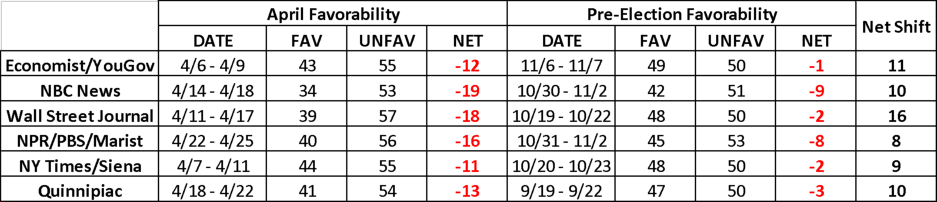
- Donald Trump's favorability improved significantly leading up to the 2024 election despite his felony convictions in New York.
- Democratic leadership opted against large-scale negative advertising, assuming Trump's flaws were already 'baked in' to public perception.
- The strategy prioritized introducing a new nominee over attacking Trump, leaving millions of first-time voters without a framed alternative.
- First-time voters broke heavily for Trump, suggesting a failure by Democrats to remind the electorate of his previous administration's failures.
- Post-election data shows Trump's favorability has returned to double-digit negatives as voters experience renewed chaos and economic uncertainty.
- The author argues that 'voter remorse' in 2025 is a direct result of the Democrats' lack of negative firepower during the campaign.
Buyers (voters) would not have “remorse” if Democrats had effectively made the case.
The Economic Messaging Failure
- The Democratic Super PAC Future Forward prioritized economic messaging over character-based attacks on Donald Trump.
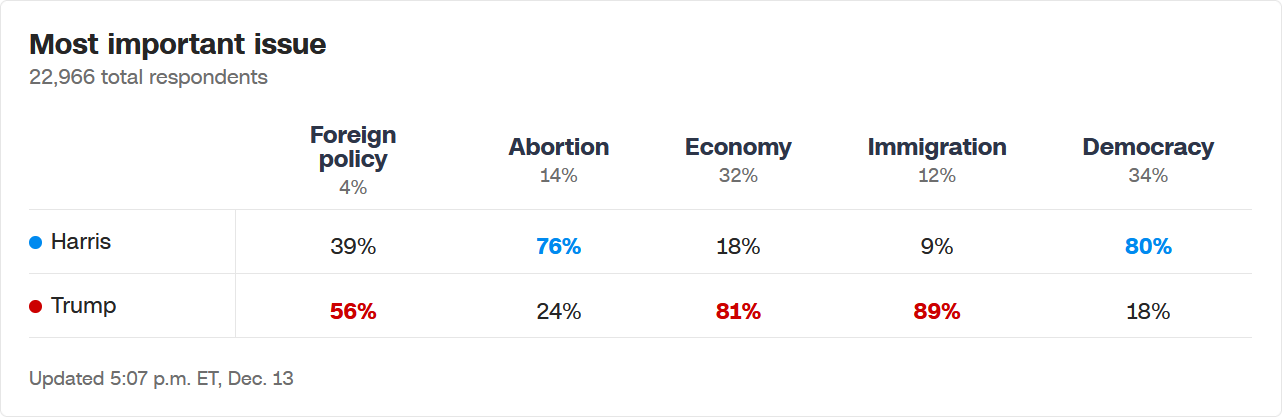
- National exit polling revealed a devastating loss for Harris among voters who prioritized the economy, trailing by a 63-point margin.
- Harris failed to capture the middle-income bracket, losing voters earning between $30,000 and $100,000 by six points.
- The campaign suffered from a strategic misalignment where the Super PAC failed to 'go low' or frame Trump negatively as per traditional political roles.
- Future presidential campaigns require better ecosystem alignment to ensure that messaging strategies across various entities do not conflict.
The national exit polling indicates Harris lost the 32 percent of voters who identified the economy as their most important issue by 18 to 81, a negative 63 percent margin.
Strategic Alignment and Voter Engagement
- Presidential campaigns must establish clear 'lanes' and maintain strategic dominance over Super PACs to ensure a coherent message.
- The campaign's direct access to the candidate and ground-level voter data makes it better equipped than external entities to drive strategy.
- Divergent messaging between a campaign and its Super PAC leads to duplicative efforts and voter confusion.
- The borderless nature of modern media requires Democrats to adapt to how algorithms and digital sharing influence content visibility.
- The party needs to shift from 'pushing' information at voters to 'pulling' them into active community participation.
- Donors and leadership should refuse to support Super PACs that are not strictly aligned with the nominee's strategic needs.
Democrats need to move on from messaging strategies consisting of pushing information and content out, rather than pulling people in.
The Art of Democratic Engagement
- Democrats must move beyond data-driven metrics to understand the emotional and cultural 'why' behind voter behavior.
- Effective organizing requires re-engaging in local and digital spaces where the party has been absent for too long.
- The party needs to prioritize listening to activists and allies to incorporate their needs into broader political strategies.
- Relying solely on pollsters and tech stacks creates a reductive view of the electorate that limits coalition building.
- Success depends on a three-step marketing funnel: winning voter attention first, support second, and the actual vote third.
The hard part is starting, the harder part is keeping it going, but the easiest part is having the humility to listen and learn.
The Evolution of Campaign Research
- Research must drive campaign design by determining messaging, delivery methods, and target audiences.
- Traditional phone banking has become ineffective due to caller ID and collapsing response rates.
- Market research faces significant response bias as participants are often atypical of the general electorate.
- Reaching younger and non-White voters is increasingly difficult due to mobile plan structures and frequent relocation.
- Pending changes to the digital and texting landscape will necessitate further innovation to maintain representative samples.
- Campaigns must evaluate if newer research methodologies are superior or merely complementary to traditional tools.
The challenge in reaching younger voters is further complicated by how many young Americans are still part of family plans, so their phone number may actually be associated with a parent or another relative.
The Limits of Voter Data
- Democratic strategy relies on demographic assumptions that are often undermined by incorrect or outdated voter list data.
- Maintaining accurate voter files is a significant financial burden, as refreshing phone numbers and addresses is a constant and expensive process.
- While data models are statistically accurate in the aggregate, they often misclassify individual voters based on race, gender, or age.
- A tension exists within the party between those who view analytics as absolute truth and those who prioritize anecdotal observation.
- Models act as lagging indicators because they are built on past behaviors rather than real-time shifts in voter sentiment.
- The author calls for a party-wide conversation on improving source data quality despite the high costs involved.
Analytics is truth, anecdote is flawed. Others argue sometimes we have to believe our eyes, no matter what the math says.
Modernizing Democratic Campaign Analytics
- The Democratic Party has utilized data analytics since the 1990s, but the 2016 election highlighted the dangers of over-reliance on these tools without cultural context.
- Declining response rates and the difficulty of reaching specific demographics have fundamentally challenged the accuracy of traditional polling methods.
- Surveys are limited by their design, as they can only provide answers to the specific questions asked, often missing organic cultural shifts.
- A more effective research model combines qualitative social listening with quantitative polling to identify and measure emerging voter trends.
- The Democratic National Committee aims to lead a transition toward a more comprehensive information ecosystem to guide candidate messaging and resource allocation.
There are many who argue polling is just fine in terms of what it is - measuring opinion and direction among who it is able to engage, yet surveys can miss things bubbling in culture because surveys can only give you the answers to the questions that you ask.
2024 Campaign Analytics Strategy
- The 2024 campaign utilized a research paradigm centered on active listening and large-scale panels to inform Democratic candidate strategy.
- Analytics teams transitioned from the DNC to the campaign in early 2023 to support fundraising, digital ads, and state operations.
- Resource allocation was driven by data modeling to determine the specific number of voters required to reach 270 electoral votes.
- The campaign identified 're-engagement targets' among younger and minority voters who supported previous Democratic tickets but lacked consistent turnout.
- Strategy focused on 'traditional swing voters' in the suburbs and a small segment of 'peel-away Trump voters' alienated by chaos or abortion issues.
- A disclaimer notes that the DNC has not independently verified the sourcing or data behind these strategic assertions.
The third and smallest target group was “peel-away Trump voters,” who had perhaps voted for Trump in 2016 or 2020, but may have been with Democrats on abortion or who were alienated with the chaos and corruption of the Trump era.
Campaign Analytics and Polling Friction
- The analytics team observed a stagnant race with little movement in voter support despite ongoing campaign efforts.
- A specialized polling team felt marginalized and underutilized, often seeing campaign advertisements only after they aired publicly.
- Campaign leadership adopted a minimalist research strategy, planning only three polling waves for the entire general election.
- Media team members reportedly dismissed polling data as non-essential for high-level strategic decision-making.
- The June 2024 debate performance triggered internal discussions about a potential candidate switch to the Vice President.
- Post-debate analytics showed no positive movement toward the campaign, confirming a failure to reach target audiences.
The pollsters described their work as underutilized during their initial engagement... they did not see ads until after they were airing, in some instances reading about the ads in the media.
Strategic Neglect of the Vice President
- The White House allowed the 'border czar' label to persist without correction, damaging the Vice President's public image.
- Extensive polling was conducted to optimize Dr. Jill Biden's role, yet no similar research was performed for Vice President Harris.
- The administration failed to identify effective messaging, issues, or target audiences to leverage the Vice President's potential to support the President's agenda.
- Upon becoming the nominee, the campaign lacked foundational self-research on Harris, forcing a frantic scramble to reconstruct her record and vision.
- The author argues that failing to prepare or utilize Harris earlier was a 'significant failure of imagination' that could have bolstered the administration's standing.
- The DNC issued a disclaimer noting that many of these assertions lack underlying sourcing or independent verification.
The idea that a prepared and supported Vice President could not have helped the President in the preceding three and a half years is a significant failure of imagination.
Polling Strategy and Stagnation
- Campaign pollsters increased data collection frequency following the candidate switch to Harris, yet results remained largely stagnant within the margin of error.
- A temporary polling bump occurred after the September 2024 debate but quickly receded to previous levels for the remainder of the election.
- Research indicated a desperate need for the Vice President to distance herself from the status quo to satisfy voter desire for change.
- Campaign leadership reportedly resisted pollsters' advice to create 'measured breaks' from the current administration's policies.
- Pollsters identified Republican attack ads regarding transgender issues as highly effective, noting the campaign felt 'boxed' by the candidate's own recorded statements.
- Attempts at policy differentiation, such as a single speech on immigration, were criticized by internal experts as being too late and poorly amplified.
They all recognized the attack as very effective, and felt the campaign was boxed – the ad was a video of her saying what she said, and it was framed as an attack on her economic priorities.
Strategic Failures and Shifting Margins
- The campaign struggled with an inability to lower Donald Trump's favorability or his high retrospective job approval ratings.
- Democrats lacked a consistent, defined theory for attacking Trump or maneuvering toward his disqualification compared to the Republican framework.
- A lack of polling in non-battleground states like New Hampshire led to a failure to recognize shrinking margins in traditionally safe Democratic territory.
- The campaign's rigid focus on the path to 270 electoral votes prevented them from addressing emergent risks in states like New Mexico and Minnesota.
- Post-2024 investments in New Jersey and Virginia suggest that the party must prioritize year-round organizing to reclaim ground lost during the presidential cycle.
The Republicans had a defined framework for attacking the Vice President, but the Democrats did not have a defined or consistent theory for attacking Trump or how to maneuver to disqualification.
Combating Partisan Polling Disinformation
- Democratic organizations must pool resources through coordinated campaigns to maximize financial impact and build long-term infrastructure.
- Partisan 'red wave' polls are identified as intentional disinformation efforts designed to distort media narratives and polling averages.
- Sophisticated polling tactics include showing early Democratic leads to manufacture a false sense of Republican 'momentum' later in the cycle.
- Democratic campaigns are urged to educate the press and voters to contextualize and dismiss data from non-reputable sources.
- A conflict exists between fundraising teams who use dire polling for urgency and communications teams trying to debunk misinformation.
- Candidates must establish strict guardrails to prevent their own campaigns from proactively spreading demobilizing disinformation.
These efforts are disingenuous and relatively sophisticated; some start by showing Democrats with an early lead so later polls then show Republican 'momentum.'
Reforming Democratic Organizing Models
- Democratic candidates and incumbents are calling for a more effective, year-round organizing model to replace the current seasonal approach.
- A long-standing debate persists over whether organizing should be led by official party structures or outside progressive organizations.
- Recent shifts in legal parameters regarding coordination with outside entities necessitate a reassessment of how campaigns engage with voters.
- The current 'offshoring' of organizing to independent actors prevents campaigns from fulfilling the core function of building direct, two-way relationships with voters.
- Internal resistance from media consultants and party traditionalists remains a significant barrier to shifting funding toward labor-intensive organizing efforts.
- While independent efforts likely saved key margins in recent elections, the lack of centralized coordination creates strategic vulnerabilities.
The media consultants may not like it, and organizing is one of the hardest things to do in politics, so there will be many within the party who will seek to preserve the current division of labor.
Reimagining Democratic Party Organizing
- The 2024 cycle suffered from misaligned independent approaches and delayed program implementation, threatening future Democratic leadership.
- While candidates focus on immediate wins, the Party must balance current battlegrounds with long-term investments in neglected jurisdictions.
- Democrats risk losing voters even in battleground states if they fail to rebuild 'organizing muscle' through consistent, year-round engagement.
- State parties should serve as the primary vehicles for coordinated campaigns, as individual campaigns often lack the scale to fund effective organizing.
- Effective organizing requires prioritizing direct, face-to-face voter contact over outdated methods like mass phone banking or excessive texting.
- The Party possesses the necessary revenue to fund these efforts, provided leadership commits to a structural shift in strategy.
Democrats will not grow in the places they do not sow, and even in current battleground states and districts, Democrats may fail to rebuild a real relationship with voters if candidates and incumbents do not push their campaigns and parties to regain and reclaim organizing muscle.
The Power of Personal Organizing
- Current Democratic strategies prioritize fiscal efficiency and incremental vote costs over genuine voter belief and engagement.
- Data-driven metrics often overlook the fundamental effectiveness of face-to-face contact in increasing voter turnout.
- Personal interaction humanizes politics, signaling the importance of participation through a volunteer's dedicated time.
- High-quality organizing relies on trained volunteers who can articulate a candidate's values as neighbors rather than strangers.
- Historical Democratic success was built on year-round coordination with labor, environmental, and faith-based community organizations.
- The shift toward reaching voters only in specific geographies during election cycles has weakened the party's deep-level engagement.
Face-to-face interaction makes politics come to life and helps voters to establish a personal connection with the electoral process.
Campaign Resource Allocation Dilemma
- Modern Democratic campaigns have transitioned from a mindset of scarcity to raising billions of dollars, yet spending habits remain rooted in old models.
- A significant imbalance exists between media spending, which exceeded $1 billion, and field organizing, which received only about $150 million.
- The current strategy relies on late-cycle voter contact, asking for support for candidates with whom voters have no personal connection or prior engagement.
- The author argues that campaigns should utilize their massive resources to fund year-round organizing, voter registration, and professional development.
- There is a critical need for candidates and incumbents to maintain a constant presence in communities rather than appearing only during election cycles.
- The text concludes with a disclaimer that the DNC cannot verify the specific financial claims or data points provided by the author.
With comparatively low spending, the campaign ended up running the same playbook of showing up at the end of a cycle and asking people to support a candidate they had never met, will never meet, and in some cases had never heard of.
The Power of Two-Way Organizing
- Democrats must shift from one-way media messaging to direct, face-to-face organizing that invites voters to be part of a movement.
- Effective organizing requires two-way engagement to gather human intelligence and adjust strategies based on real-time voter feedback.
- The party lacks a shared taxonomy for defining 'quality' organizing and traditional field tactics like canvassing and voter education.
- Current Democratic strategy relies on 'dropping in' seasonal talent rather than empowering local community members to organize year-round.
- Republican-aligned groups like Turning Point USA maintain an 'always on' presence that Democrats must match to build long-term power.
It’s time to again ask voters for their help, for their opinions, and to offer them the ability to be a part of something bigger than a single election.
Modernizing Democratic Organizing Strategy
- Republicans have successfully closed the ground-game gap by studying and emulating previous Democratic and Obama-era campaign innovations.
- Paid voter contact remains a vital supplement to organic organizing, particularly when deployed early to build long-term community relationships.
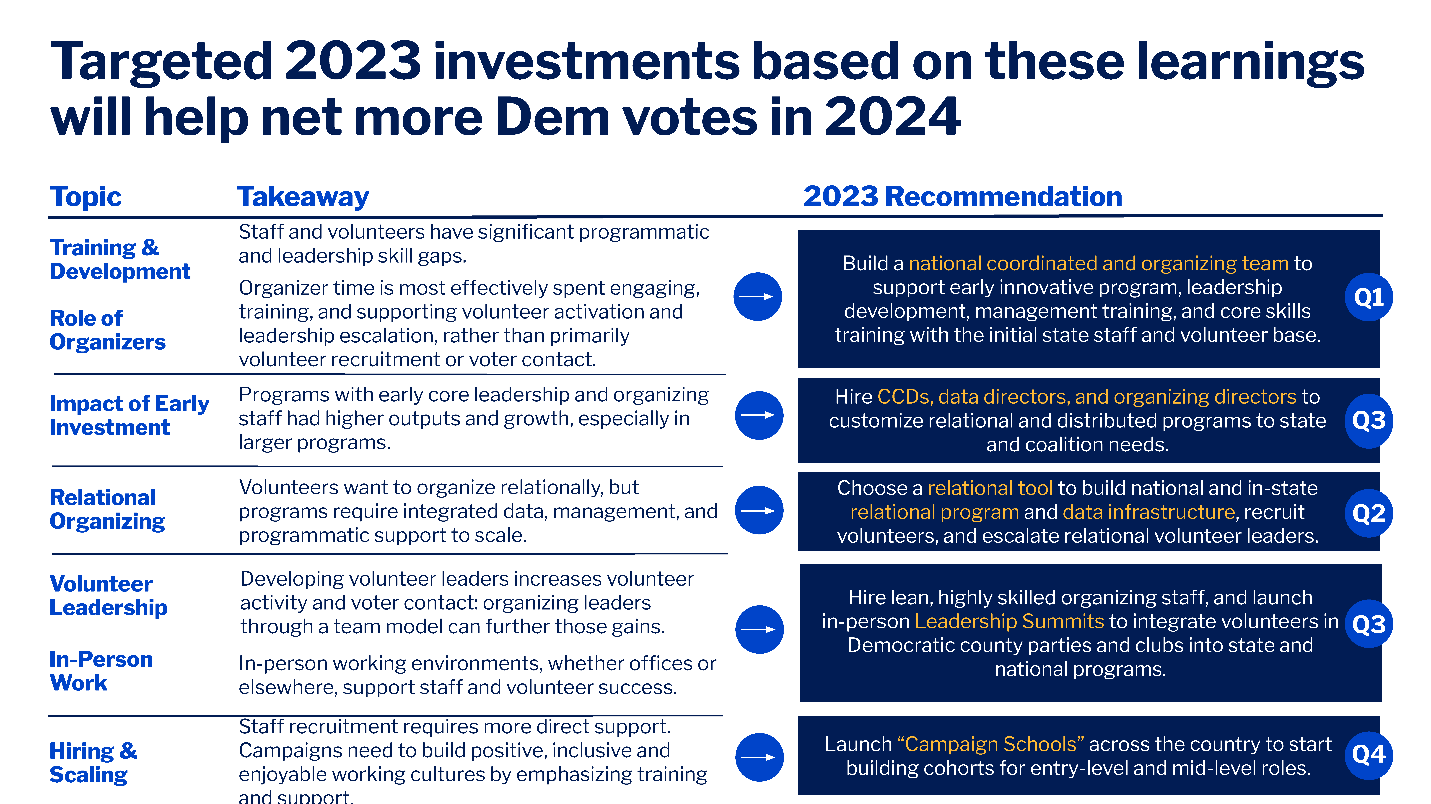
- A DNC internal review identified significant leadership and skill gaps that require standardized training and development for future cycles.
- Successful organizing outcomes are directly tied to positive workplace cultures, early investment, and the use of functional relational tools.
- The 2024 strategy focuses on building national coordinated teams and selecting unified relational data infrastructure by the second quarter of 2023.
The irony is many of these efforts were emulating what Democrats used to do.
Democratic Organizing and Funding Delays
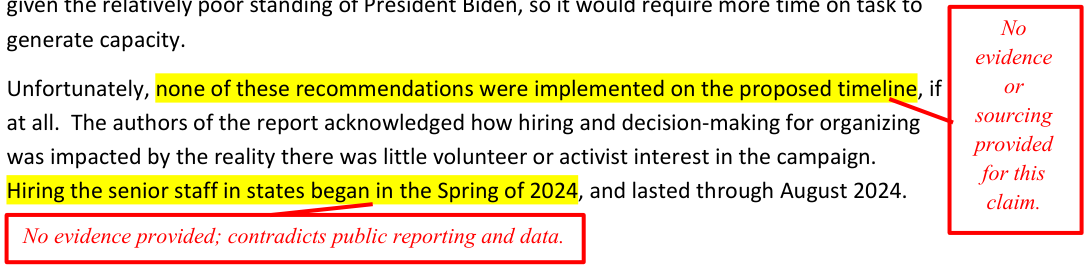
- The report highlights a failure to implement 2023 recommendations for hiring senior and mid-level organizing staff on the proposed timeline.
- A lack of volunteer and activist interest in the campaign reportedly hampered early hiring and decision-making efforts.
- Democratic staffing for the 2024 cycle was significantly delayed, with some final state hires occurring only weeks before the election.
- The document contrasts the Republican 'always on' investment strategy with the Democratic 'always late' spending pattern.
- Late fundraising and restricted money flows forced organizations to scramble for engagement at the very end of the campaign cycle.
- The DNC explicitly disclaims the report's assertions, noting a lack of underlying sourcing, interviews, or verifiable data for the claims.
The 2024 cycle shows the inefficiencies of the current ecosystem and contrasts with how Republicans raise and invest across the calendar while Democrats spend at the end (“always on” versus “always late”).
Funding Delays and Tactical Hurdles
- A massive surge in Democratic activity at the end of 2024 proved technical capacity but highlighted a failure in early-cycle engagement.
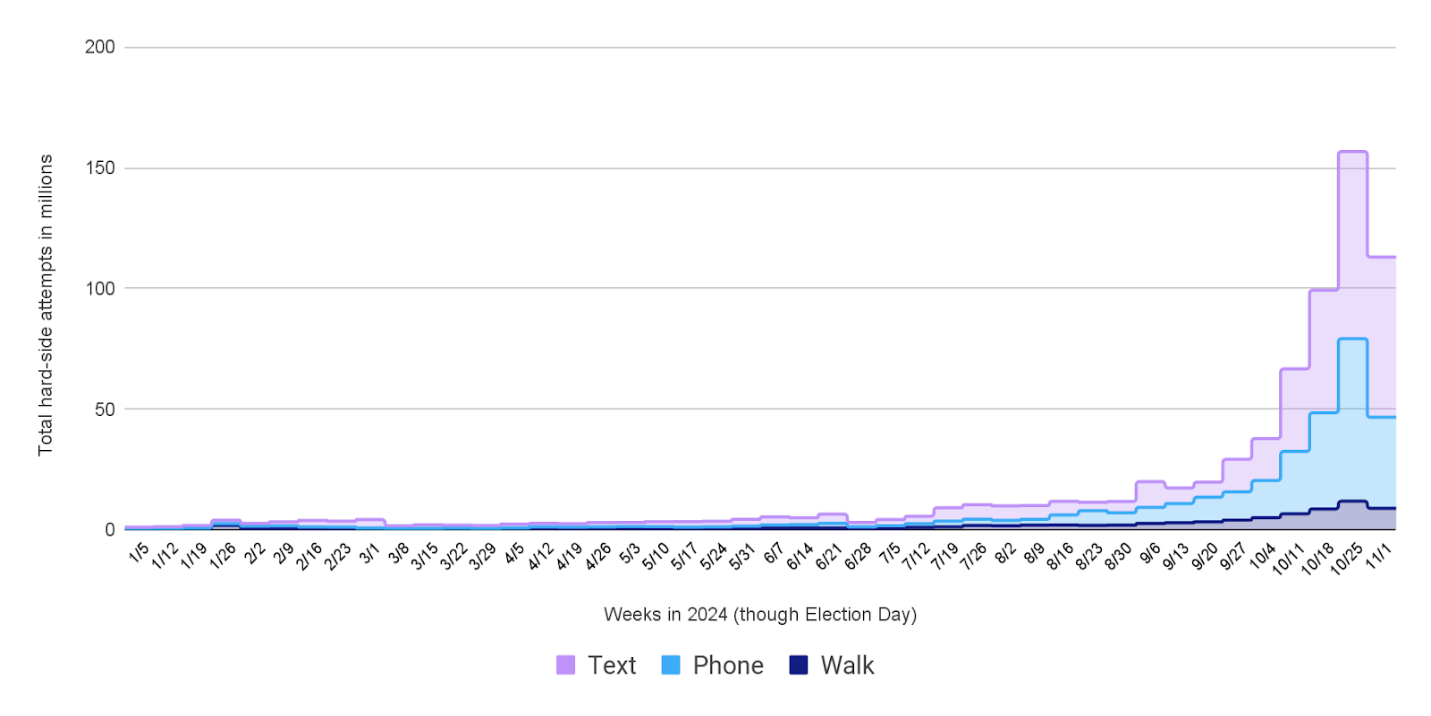
- Legal restrictions and a lack of specific 'flavors' of funding prevented allied organizations from starting voter persuasion until October.
- Labor-funded entities were more effective but still suffered from funding delays that hindered staff hiring and program scaling.
- The 'early money is like yeast' philosophy must be applied beyond candidates to the broader organizing and messaging ecosystem.
- Traditional voter contact methods like phone calls are facing cratering response rates and significant demographic response bias.
- Over-saturation of fundraising texts has created a suboptimal experience for voters, potentially damaging grassroots engagement.
Democrats have long known early money is like yeast – it helps the dough rise.
The Crisis of Voter Contact
- Over-reliance on bulk texting has led to voter frustration and a perception that the Democratic party primarily uses digital tools for fundraising rather than genuine engagement.
- Campaign strategists view texting as an effective tool for event logistics and fundraising but largely dismiss its utility for persuasion or deep organizing.
- Door-to-door canvassing has suffered a 'learning loss' due to the 2020 pandemic, which disrupted the development of new organizing talent and reduced overall program capacity.
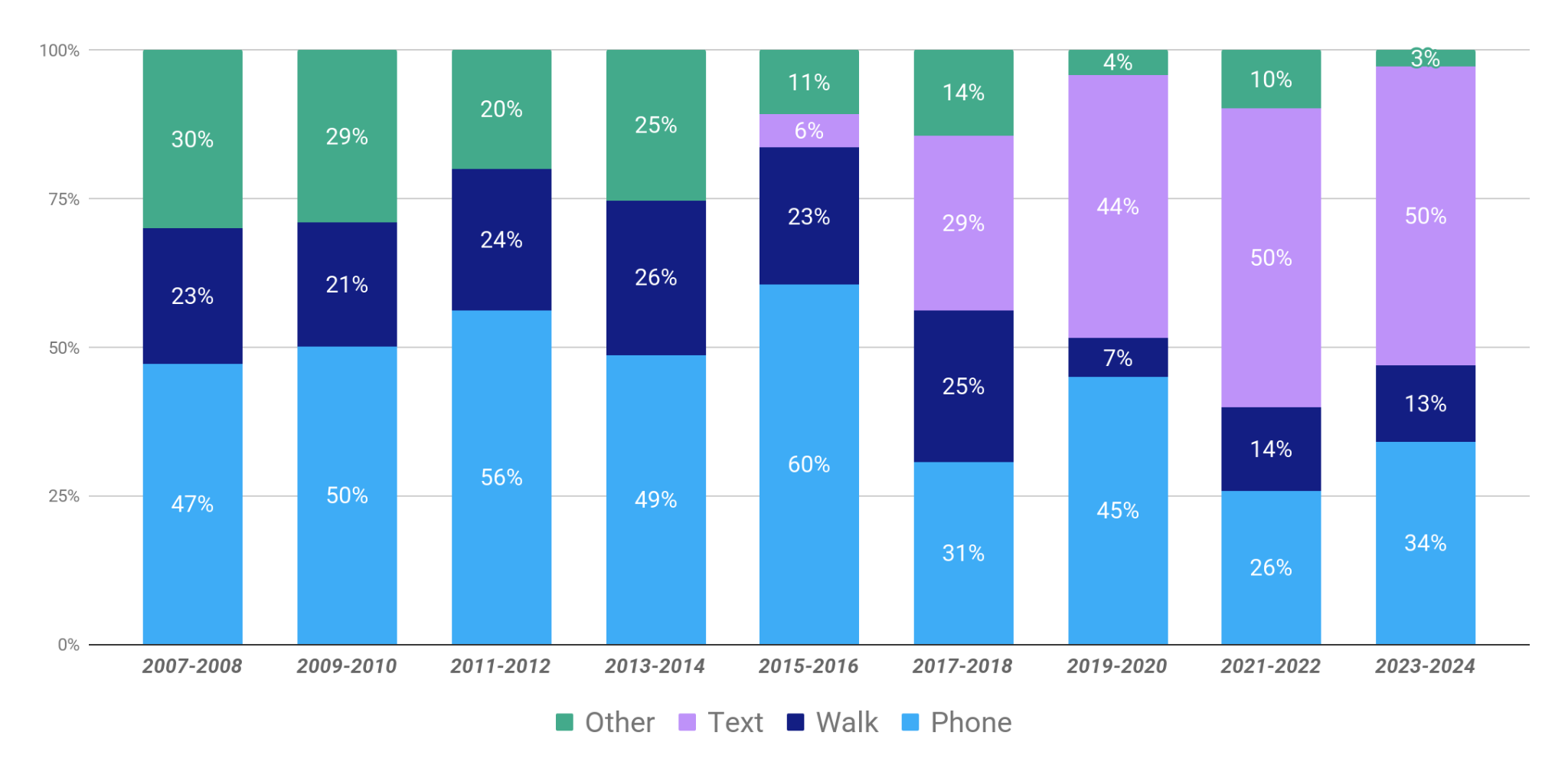
- Despite declining response rates, door-to-door interaction remains significantly more effective than phone banking, yet it has not returned to its pre-pandemic share of the tactical mix.
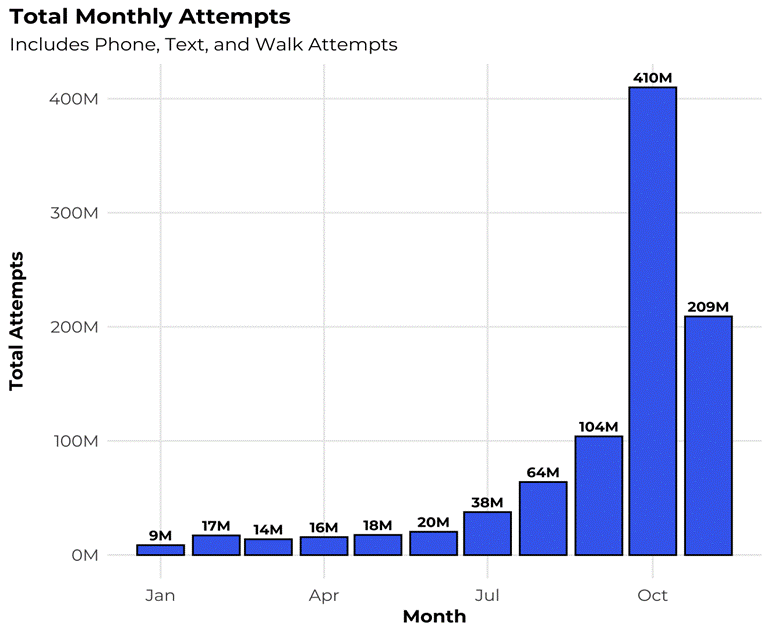
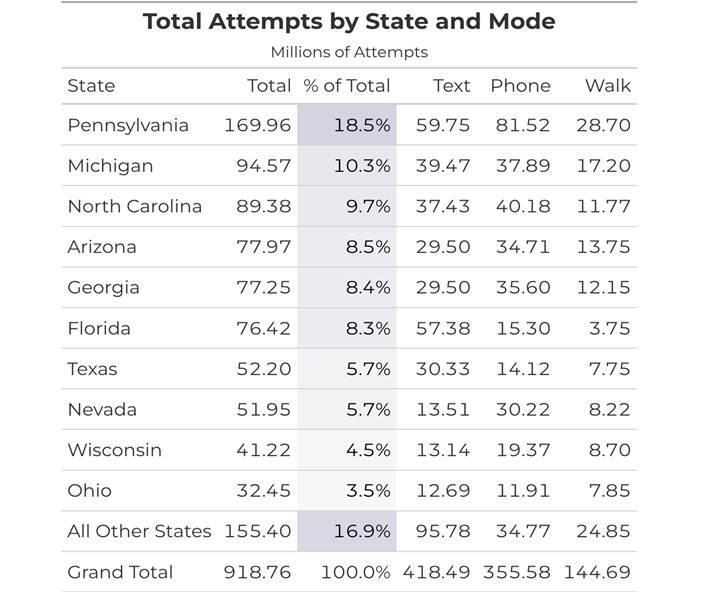
- The 2024 cycle saw over 370 million contact attempts, but the dominance of low-response tactics like phones and texting raises questions about the efficiency of the current strategy.
What can and should be a two-way conversation becomes one-way delivery and a “STOP” message.
Battleground Voter Contact Efficiency
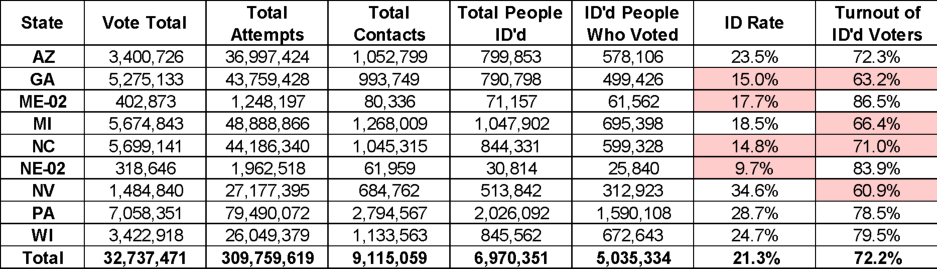
- Democrats identified support from 21.4 percent of the 32.5 million voters in battleground jurisdictions.
- Voters identified by the party showed a high engagement level with an average turnout rate of 72.2 percent.
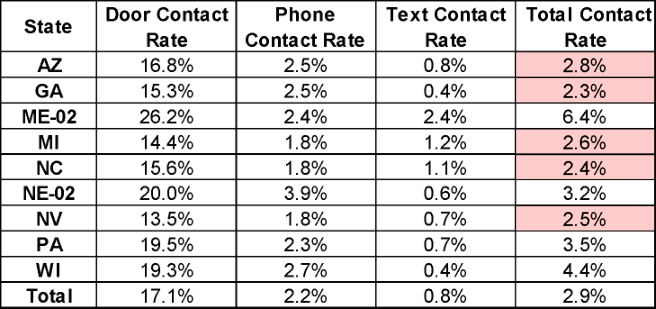
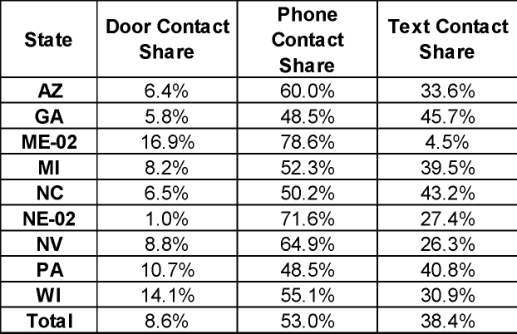
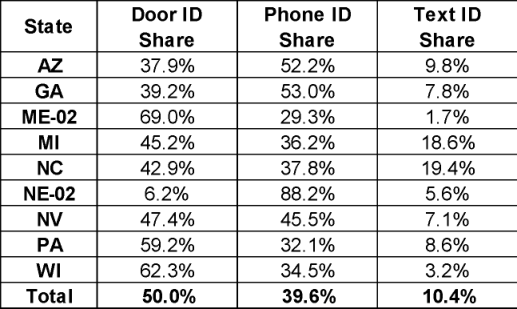
- While door-to-door canvassing made up only 8.6 percent of contact attempts, it accounted for a massive 50 percent of all successful voter IDs.
- Phone calls and text messages dominated the volume of attempts at over 91 percent combined, but yielded significantly lower contact rates.
- The campaign relied heavily on low-contact digital tactics toward the end of the cycle due to time constraints, despite their inefficiency compared to physical outreach.
- The DNC issued a disclaimer stating they could not independently verify the underlying data or sourcing for these specific voter contact claims.
Despite constituting only 8.6 percent of contact attempts, door-to-door canvassing represented 50.0 percent of voter IDs.
The Challenges of Ground Operations
- Staffing shortages and onboarding delays significantly hindered the early implementation of state-level campaign programming.
- Door-to-door canvassing requires a long lead time for recruitment and training, making it less flexible than digital or phone outreach.
- Data shows that 72 percent of voter IDs were collected in the final month, often after voting had already commenced in battleground states.
- Late-cycle engagement risks alienating voters who perceive the party as only showing up when they need a vote.
- The author argues for a shift toward neighbor-to-neighbor organizing to move beyond a tool-defined ecosystem to a voter-centered one.
- Starting field operations earlier allows for geographic reach and the ability to make data-driven course corrections before the final stretch.
If Democrats instead continue to rely on ineffective tactics instead of thinking through ways to effectively organize communities so neighbors are talking to neighbors it is acquiescing to an ecosystem defined by its tools, as opposed to designing an effective ecosystem centered on voters.
Building Early Campaign Infrastructure
- Direct engagement requires early investment in state-level teams to build high-performance cultures before the general election.
- Contested primaries often delay general election readiness due to the need for internal party healing and organizational transitions.
- The 2016 election serves as a warning, where a late nomination left the candidate with insufficient infrastructure just 104 days before the vote.
- The DNC aims to modernize coordinated campaigns so state parties can identify key voters regardless of when a nominee is finalized.
- Strategic staffing and sequence planning allow a nominee to layer onto an existing structure rather than building from scratch.
- The party faces a persistent failure in training and retaining human capital, which must be addressed to sustain long-term success.
This is exactly what occurred in 2016, when Secretary Clinton cinched the nomination in Philadelphia 104 days before the election and then discovered there was little infrastructure in place to help her win.
Revitalizing Democratic Organizing Infrastructure
- The 2020 pandemic caused significant 'learning loss' in political organizing due to the lack of in-person engagement and mentorship.
- Democratic leadership is proposing a National Training Institute to standardize professional development and career paths for political staff.
- Donors and strategists are urged to prioritize long-term investment in a skilled workforce rather than short-term cycle spending.
- Voter registration remains the foundational prerequisite for political power and determines the legitimacy of governance.
- The history of the American franchise is marked by a tension between constitutional expansion and violent suppression.
- The document emphasizes that 'people power' is the critical requirement for the strategy of organizing everywhere to win anywhere.
The expansion of access was not easy – and those who favored oppression and suppression resorted to violence, terror, and murder to prevent individuals and groups from being able to vote.
Voter Suppression and Shifting Demographics
- The text argues that voting access is a hard-won right currently under threat from systematic suppression efforts and partisan rigging.
- Democrats view voting as the foundational freedom, while Republicans are characterized as feeling threatened by increased voter participation.
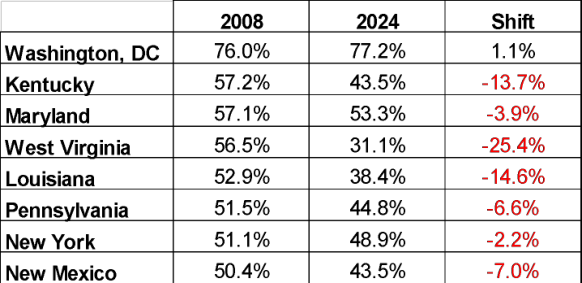
- Data shows a significant decline in Democratic enrollment share since 2008, particularly in Southern states like Kentucky and West Virginia.
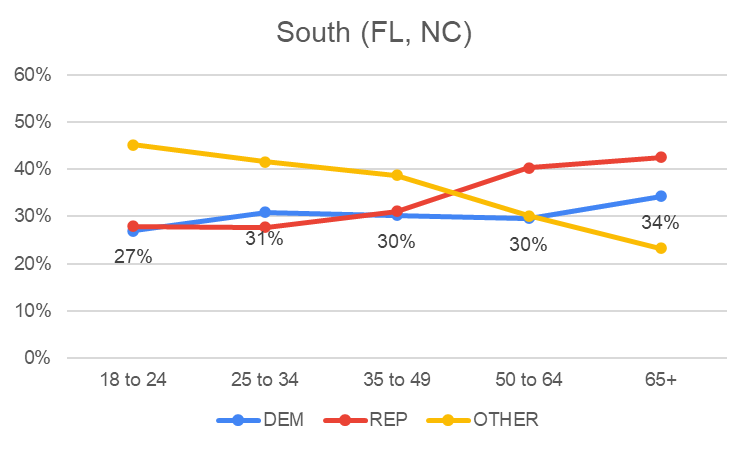
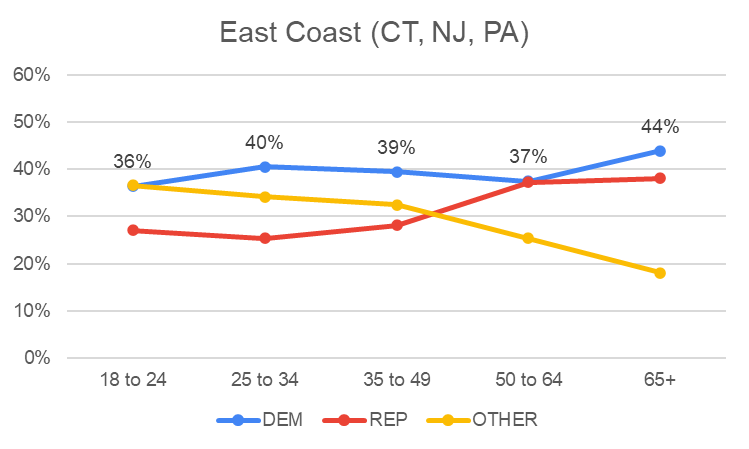
- A generational shift is occurring where younger voters are increasingly registering as unaffiliated or independent compared to older, more partisan cohorts.
- The author contends that Democrats must prioritize universal registration and education to counter barriers and maintain electoral competitiveness.
The MAGA-organized insurrection on January 6, 2021 was only the first act.
The Voter Registration Mandate
- The author argues against the belief that Democrats should abandon voter registration due to shrinking margins among young and non-White voters.
- The 'Rising American Electorate' is projected to eventually become the dominant electorate, making long-term registration efforts a strategic necessity.
- A lack of funding and prioritization from national campaigns has hindered the effectiveness of voter registration organizations in recent cycles.
- Republicans have made registration a priority, and the author insists Democrats must adopt an 'always on' approach to remain competitive.
- Historical successes in Nevada, Georgia, and Arizona are cited as proof that multi-year investments in registration can flip key states.
Failing to plan is planning to fail.
Modernizing Democratic Political Technology
- Technology serves as a critical building block for dictating terms of engagement in a real-time, always-on media environment.
- The party must navigate a fractured ecosystem of streaming, mobile, and social media to counter sophisticated conservative messaging.
- Traditional analog methods like phone calls are no longer sufficient for the micro-level analysis required for adaptive modern campaigns.
- Democrats face the challenge of centering the human element in politics while leveraging cutting-edge technological infrastructure.
- The 2012 Obama/Biden campaign set a high-water mark for data analytics that the party must now evolve beyond to remain competitive.
- Technological advancement is framed as a necessary defense against rising authoritarian politics and right-wing extremism.
In these digital times, however, analog methods fail to provide the micro-level analysis necessary to shape adaptive campaigns capable of winning anywhere.
The Rise of Vertica
- The DNC implemented Vertica to centralize 180 million voter files with donor and volunteer data into a single high-performance repository.
- Advanced algorithms allowed the Obama/Biden campaign to 'micro-listen' to voters and test message effectiveness across narrow demographic groups.
- Data-driven scoring models directed volunteers to specific doors with tailored scripts to maximize the probability of persuasion.
- The system created a feedback loop where every interaction refined the models to better identify and target potential Democratic voters.
- While the DNC modernized, the Republican data infrastructure remained fragmented and prone to catastrophic failure during critical election windows.
- Despite its initial success as a 'quantum leap' in microtargeting, the long-term sustainability of the Vertica-based system was later called into question.
With these new capabilities, the Obama/Biden campaign was able to “micro-listen” to what voters were saying/doing, and test the effectiveness of messages aimed at narrow demographic groups.
The Cost of Digital Stagnation
- Following the 2012 election, Republicans successfully reverse-engineered the Obama campaign's digital strategies to modernize their own infrastructure.
- Democrats failed to institutionalize their 2012 technological advantage, leading to decaying data assets and an outdated system by 2016.
- The Vertica data system became a liability, suffering from frequent crashes and an inability to handle the scale of modern campaign analytics.
- Technological failures prevented the Clinton campaign from identifying critical shifts in voting patterns among key demographic groups in blue regions.
- The lack of continuous investment in data infrastructure resulted in what Hillary Clinton described as mediocre or nonexistent data during her run.
Interviews with various campaign staffers detailed how the system was known for crashing upwards of 16 hours at a time.
Rebuilding the Democratic Data Machine
- The 2016 failure was attributed to an unwieldy data system that missed micro-dissents in key Blue Wall states.
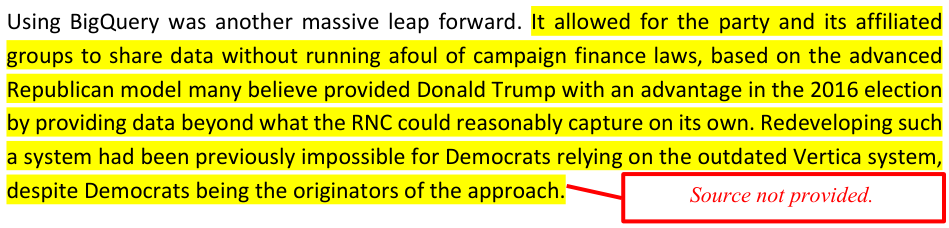
- The DNC transitioned from the outdated Vertica system to Google’s BigQuery to handle petabyte-scale analysis.
- New infrastructure allowed for legal data sharing between the party and affiliates, mirroring a successful Republican model.
- The Bloomberg-backed firm Hawkfish was established to counter GOP digital advantages and test strategies in local races.
- Technological shifts were credited with narrow Democratic victories in traditionally Republican strongholds like Kentucky.
- The document serves as an internal critique, noting that the DNC could not independently verify all claims made by the author.
It was essential to catch up to the times and ensure Democrats were on the train and not left at the station once again.
Data-Driven Political Innovation
- Michael Bloomberg founded Hawkfish to bridge the digital content and analytics gap between the Democratic party and the GOP.
- The success of modern campaigns relies on mastering the digital medium to target micro-communities with energized content.
- Hawkfish serves as a cautionary tale where innovation is often discarded if it does not produce immediate electoral victories.
- The GOP's 2024 success is attributed to leveraging data-driven strategies and social media amplification more effectively than their rivals.
- The DNC developed a best-in-class data warehouse named Phoenix to modernize technological toolkits for Democratic campaigns.
- The text highlights a growing tension where political decision-making is now inseparable from deep data analysis.
Hawkfish is a cautionary tale about innovation. Win and you’re in, lose and you’re out.
Modernizing Democratic Data Infrastructure
- The DNC overhauled its voter file processing to handle over 900 distinct updates, ensuring a precise view of the national electorate.
- A proprietary matching algorithm tracked 50 million records of voters moving between states, preserving historical data on demographics and support.
- New absentee and early vote (AV/EV) tools processed 10,000 data files in 2024, doubling the volume from 2020 to power ballot chase programs.
- Strategic investments in cell phone data tools expanded the DNC's targeting reach from 30% to 86% of all registered voters.
- The 'Phoenix' infrastructure allowed the Harris campaign to focus on high-level strategy rather than technical data management.
- Total voter contact attempts across the 2024 cycle reached nearly one billion individual data points, shifting from digital outreach to door-to-door canvassing.
It also includes a multi-million dollar investment in cell phone tools that took the DNC from being able to target 30% of registered voters to 86% by the end of the 2024 election cycle.
The Phoenix Data Infrastructure
- The Phoenix system processed nearly 1 billion outreach attempts, resulting in 53 million successful contacts during the 2024 cycle.
- Data infrastructure allowed for state-by-state analysis to determine which contact methods were most effective in shifting voter behavior.
- Sophisticated behavioral models were developed using the data, though the insights often arrived too late to alter the 2024 election outcome.
- The platform supported down-ballot successes and narrow Senate victories despite a global climate of anti-incumbent sentiment.
- Thousands of analysts and engineers across hundreds of committees utilized the centralized data to drive strategic decision-making.
By looking at the mix of types of attempts made versus polling data and the eventual outcomes in voting patterns in that state, analysts were able to develop increasingly sophisticated models of voter behavior, though much of this information arrived too late to change the 2024 outcome.
Data Insights and Cyber Defense
- The Phoenix data warehouse revealed that while text messaging had the highest volume of attempts, door-to-door canvassing remained the most effective method for voter contact.
- Technical data suggests that future elections will be decided on 'American welcome mats,' indicating that physical outreach offers the highest return on investment for donors.
- Despite massive online reach, the Democratic party struggled to connect with young voters and key demographics within their primary social ecosystems.
- The centralized nature of Phoenix makes it a high-value target for state-sponsored hackers, necessitating advanced cybersecurity measures to prevent a repeat of 2016.
- During the 2024 election week, the DNC successfully repelled over 6.1 billion malicious cyber requests, a massive spike compared to previous months.
The technical data supports the theory that future election cycles may just well be decided on American welcome mats, suggesting that continued use of donor dollars in this direction generates the highest return on investment.
The Fragility of Political Infrastructure
- The 2024 election cycle demonstrated that optimized tech infrastructure can successfully drive voter mobilization and persuasive messaging.
- A near-collapse of the NGP VAN database in 2024 threatened to revert modern campaigning to 1970s-era pen and paper methods.
- DNC engineers and donors were forced to implement an emergency workaround to prevent the loss of critical voter data and models.
- The crisis exposed the risks of overreliance on a single CRM system for the entire Democratic and progressive ecosystem.
- The DNC has issued a Request For Proposal to develop next-generation tools that prioritize user experience for ground-level organizers.
- Future political success depends on building a technological foundation that is flexible, adaptable, and capable of handling massive data loads.
If VAN had collapsed, the entire get-out-the-vote operation might have transitioned to one familiar with strategists in the 1970s and 80s, with canvassers working with pen and paper instead of smartphones and tablets.
Modernizing Democratic Campaign Infrastructure
- The DNC must integrate influencer engagement, relational organizing, and digital media into a single, cohesive executive strategy.
- Data sharing standards must be nationalized to prevent local campaign data from becoming stagnant between election cycles.
- Technology should prioritize authentic person-to-person communication and resonant messaging over technical novelty.
- The party must institutionalize technological advantages by constantly re-evaluating vendor relationships and system redundancies.
- Infrastructure requires continuous investment to prevent 'technological marvels' from becoming obsolete within a single four-year cycle.
If we have learned anything from the past few election cycles, it is that today’s technological marvel can become tomorrow’s antique faster than we can bat an eye.
Modernizing Political Technology Infrastructure
- The Democratic Party must ensure its technological tools facilitate voter engagement rather than imposing limitations on strategic growth.
- The failure of initiatives like Hawkfish highlights the inconsistent adoption and leveraging of political technology within the party.
- Late-cycle funding for technology prevents proper user training and discourages effective platform utilization when it is needed most.
- A 'ground up' approach is required, involving early investment and consistent training to replace fractured and contradictory efforts.
- The DNC Tech team emphasizes a commitment to providing best-in-class infrastructure for candidates at every level of the ballot.
- Innovation should be evaluated independently of immediate electoral results to ensure long-term structural improvements.
Not only is the money necessary for technology investment often allocated at late points in the political cycle, but campaigns frequently default to what they know best over what will work best.
The Evolution of Campaign Fundraising
- American democracy allows campaigns to win on ideas and organizing even when significantly outspent by opponents.
- Early fundraising provides a critical advantage for hiring staff, producing media, and building campaign infrastructure.
- Historically, Republicans held a fundraising advantage as the party of corporations and elites throughout the late 20th century.
- Democrats previously relied on lean operations and partnerships with Labor to overcome financial disadvantages.
- The financial landscape shifted in the 2000s, leading to a 2024 cycle where Democrats significantly outspent Republicans across all levels.
- The document notes a lack of specific sourcing or evidence for several claims regarding 2024 fundraising totals.
Money, along with big ideas, sweat, shoe leather, and elbow grease, combine into energetic campaigns to persuade and turn out the voters needed to win.
Fundraising Advantages and Self-Funders
- Democrats have established a significant fundraising advantage over Republicans across nearly every political level in the 2024 cycle.
- Despite financial superiority, Democrats underperformed in critical elections, suggesting that raising money is not an end unto itself.
- The party must revisit its fundraising principles and tactics to understand why more money did not translate into better electoral outcomes.
- Self-financing candidates, while wealthy and powerful, frequently fail because they are perceived as trying to buy public office.
- Historical data from the 1980s to the present shows a pattern of self-funders spending tens of millions of dollars only to lose statewide and national races.
- The document's claims regarding fundraising and candidate performance are noted as unverified by the DNC due to a lack of underlying sourcing.
Democrats can and should take lessons from 2024 – when we had much more money than Republicans and still underperformed in critical elections – to revisit the principles, tactics, and outcomes of our fundraising.
The Limits of Campaign Finance
- Michael Bloomberg and Tom Steyer spent over $1.4 billion in the 2020 Democratic primary but yielded almost no delegate success.
- Effective campaigns require a synergy of funding, a resonant message, and a robust ground organization rather than just capital.
- The Federal Election Campaign Act of 1971 and post-Nixon reforms established the FEC and a public financing system to restore public trust.
- Major party candidates have largely abandoned the public financing system because they can raise significantly more money independently.
- Opting into public funds requires candidates to adhere to strict spending limits and rigorous disclosure requirements that many now find too restrictive.
- Despite historical attempts at regulation, campaign money acts like water, constantly finding new ways to seep into the political system.
As a general matter, campaign money is like water - it seeks its own level, probing for cracks and seeping into the body politic.
The Collapse of Public Financing
- The federal public financing system was designed to level the presidential playing field through grants and spending caps.
- George W. Bush's 2000 campaign began the shift away from the system by 'busting the cap' during the primary season.
- Barack Obama became the first major party nominee to opt out of the general election grant in 2008, gaining a four-to-one spending advantage.
- The 2012 cycle marked the first time both major party candidates fully abandoned public funding for the general election.
- Since the system's collapse, presidential campaign spending has exploded, exceeding $2 billion in the 2020 cycle.
- Modern Democratic nominees, with one exception, have consistently raised over $1 billion for their principal campaign committees.
McCain was actually forced to borrow $17 million in August and September 2008 to float his campaign until the federal funding transfer was made.
The Billion-Dollar Campaign Ecosystem
- Political campaigns have evolved from a cottage industry into a double-digit billion-dollar ecosystem characterized by weak regulation.
- Aggregate Senate fundraising has more than doubled since 2016, jumping from an average of $829.3 million to $1.76 billion per cycle.
- Democratic Senate candidates have consistently outraised their Republican counterparts in every election cycle since 2014.
- The 2018 midterm 'resistance' against the Trump administration served as a primary catalyst for the explosion in Democratic fundraising totals.
- Despite a massive $370 million average fundraising advantage over the last three cycles, Democrats faced significant losses in the 2024 Senate map.
- Total political spending is significantly higher than candidate totals suggest, as non-campaign entities like PACs added over $1 billion in 2024.
Collectively, campaigns are now more than a cottage industry, they are a double-digit billion-dollar ecosystem with weak regulation and where sharper practices can make a significant difference in driving winning outcomes.
2024 Senate Fundraising Dynamics
- The 2024 Senate elections showed a heavy concentration of capital, with 68.2 percent of all funds flowing into the 11 most competitive races.
- Democratic candidates successfully outraised their Republican counterparts in 13 out of 14 highlighted contests.
- Spending in open safe seats occasionally exceeded general election spending due to intense primary competition.
- The 'raise per voter' metric is introduced as a more nuanced way to measure campaign intensity across states with varying populations.
- Data inconsistencies exist within the report regarding the total number of competitive races cited versus those analyzed in charts.
Two thirds of the funds were raised into the one-third of competitive seats.
Congressional Fundraising and Battleground Spending
- There is no discernible pattern between total spending and specific vote outcomes, despite massive financial outlays in battleground states.
- Fundraising for U.S. House candidates has more than doubled since 2016 when adjusted for inflation, exceeding $2.2 billion per cycle.
- Democrats currently hold an aggregate fundraising advantage in the House, with their general election nominees averaging higher totals than their Republican counterparts.
- Financial resources are heavily concentrated in competitive areas, with 37.6 percent of all House funds raised within the 69 districts decided by single digits.
- The Montana Senate race serves as a primary example of extreme spending, where Jon Tester outspent his opponent three to one and significantly outperformed the top of the ticket.
- Candidate fundraising is only one part of the financial ecosystem, which includes coordinated expenditures and independent efforts averaging over $100 million per battleground state.
As a general matter, there is no discernible pattern to the spend associated with a given vote total or outcome.
House Fundraising Disparities
- Democratic House candidates maintained a significant fundraising lead over Republicans, with top winners averaging nearly $1 million more than their GOP counterparts.
- Party leadership continues to drive the highest totals, with Hakeem Jeffries and Mike Johnson each raising approximately $20 million or more.
- Unsuccessful Democratic challengers significantly outpaced unsuccessful Republicans in fundraising, averaging over $7.3 million compared to the GOP's $4.2 million.
- The data suggests that Democratic losses in competitive districts were not due to a lack of funding, as they targeted 20 of 23 single-digit Republican-held seats.
- Federal party committee fundraising has shifted from a stable $1.7-$2.2 billion range to an 'exploded' level of growth starting in the 2020 cycle.
- The RNC set a record in 2020 with over $890 million in receipts, largely fueled by massive transfers from joint fundraising committees.
Democrats did not lose because of a lack of funding – though more would have certainly helped.
Democratic Fundraising and Transfer Dynamics
- The 2024 election cycle saw record-breaking party committee fundraising, reaching a combined total of $2.7 billion.
- Democrats maintained a significant financial lead, out-raising Republicans by nearly half a billion dollars in the 2024 cycle.
- National and state party committees utilize unlimited fund transfers to coordinate spending and optimize resources across different campaign levels.
- State committees leverage nonprofit mail permits to provide House and Senate candidates with significantly lower postage rates for direct mail.
- A substantial portion of total receipts—$446 million—is held in restricted accounts dedicated to conventions, legal proceedings, and headquarters buildings.
- While Democrats led in national and state-level fundraising, Republicans maintained a fundraising advantage specifically at the Senate committee level.
Senate and House candidates can take advantage of this lower rate by transferring funds to their state party to cover the production and postage for direct mail, and save themselves money in the process.
Joint Fundraising Committee Dynamics
- Joint Fundraising Committees (JFCs) allow candidates to pool contributions and accept large single checks based on aggregate limits.
- Democrats have established a strategic fundraising advantage over Republicans within this complex, regulated ecosystem.
- The 2023-2024 cycle saw 1,298 registered JFCs generating a massive total of $3.49 billion in receipts.
- A supermajority of JFC funds benefited presidential candidates, with Kamala Harris outraising Donald Trump in this category.
- While Republicans had more individual JFCs (715) than Democrats (556), the total revenue favored the Democratic side.
- The data suggests significant candidate leverage, as individuals can participate in multiple committees to maximize capacity.
Overall, party committee fundraising is a complex, tightly regulated ecosystem.
Joint Fundraising Committee Evolution
- Republicans significantly outpaced Democrats in non-Presidential joint fundraising committee (JFC) receipts, totaling $677.8 million compared to $300.2 million.
- The 2014 McCutcheon v. FEC ruling removed aggregate contribution limits, allowing wealthy donors to inject millions into the federal political ecosystem.
- Republicans pioneered a strategy of using JFC funds for 'fundraising ads' that functioned as campaign persuasion tools, bypassing traditional spending constraints.
- The FEC deadlocked 3-3 on a request for clarity regarding JFC advertising limits, effectively allowing parties to continue these practices without regulation.
- JFCs are increasingly retaining funds to engage in direct advocacy and secure the 'lowest unit charge' for broadcast media usually reserved for candidates.
- Accounting for JFC transfers is complex, as gross receipt reporting can lead to double-counting or inflated campaign finance statistics.
The ads were nearly identical to the standard campaign ads, but would briefly mention or make a fundraising request in a caption included in the ad.
Joint Fundraising and Independent Expenditures
- Republican non-Presidential joint fundraising committees (JFCs) retained a significantly higher percentage of receipts (35.5%) compared to Democrats (17.4%) to exploit FEC inaction.
- Over $1.1 billion was retained by JFCs across both parties, serving as a massive additive funding source beyond standard campaign and party committee limits.
- Independent expenditure (IE) committees raised a total of $5.5 billion, with Democratic-aligned groups leading at $3.14 billion versus $2.28 billion for Republicans.
- IE committees often utilize 'dark money' entities to mask the original identity of contributors before transferring funds into the reporting committees.
- Strategic IE spending includes 'hybrid' tactics, such as running counterproductive content to mislead voters or influencing the opposing party's primary elections.
- The analysis identifies 803 non-party IE organizations, with a vast majority (575) primarily supporting Democratic candidates during the 2023-2024 cycle.
The Republican non-Presidential JFCs had a more intentional strategy to push the envelope on spending regulations, and were positioned to leverage the deadlock and inaction of the FEC into more direct spending on behalf of their candidates.
Federal and Gubernatorial Fundraising Trends
- Total federal receipts for the 2023-2024 cycle reached nearly $14.9 billion across all parties and committees.
- Democrats maintained a significant financial lead at the federal level, raising $8.6 billion compared to the Republicans' $6.1 billion.
- The scale of Democratic fundraising is so vast that the physical bills would theoretically circle the earth more than 33 times.
- In 2024 gubernatorial races, Republicans outraised Democrats in eight out of eleven contests, though Democrats led in aggregate funding.
- Fundraising proved a decisive factor in gubernatorial outcomes, as the leading spender won in every single one of the eleven contests.
- State-level fundraising remains highly variable due to diverse regulations regarding contribution limits, matching funds, and disclosure rules.
In each contest, the leading spender won.
2024 Down-Ballot Campaign Finance
- Republicans outraised Democrats in six of the ten attorney general contests, with the top fundraiser winning every race.
- The North Carolina and Pennsylvania attorney general races were the most expensive, totaling over $47 million combined.
- The Democratic Legislative Campaign Committee (DLCC) utilized 'Spotlight Races' to target battlegrounds and long-term power-building seats.
- Democrats led in aggregate funding in 15 of the 24 states analyzed for state legislative districts.
- Fundraising dominance was more consistent in attorney general races than at the legislative level, where leading funders do not always win.
- The data is subject to a disclaimer noting that the DNC cannot independently verify the underlying sourcing or factual accuracy of the claims.
Jackson outraised Bishop nearly two-to-one, and Sunday outraised DePasquale by more than two-to one.
The Democratic Funding Paradox
- Democratic campaigns are transitioning from a historical mindset of financial scarcity to an era of unprecedented fundraising abundance.
- The volume of state legislative receipts can now exceed gubernatorial races, offering a strategic opportunity to reshape the political landscape.
- Despite record-breaking budgets, campaigns continue to follow outdated 'spend at the end' models rather than investing early in communities.
- A significant portion of grassroots funding is being funneled into media platforms owned by oligarchs rather than building permanent infrastructure.
- The party faces a strategic disadvantage by 'renting' engagement systems while Republicans focus on ownership and long-term efficiency.
We take their hard-earned cash, yet are spending enormous funds on legacy and social media platforms owned by oligarchs.
Modernizing Democratic Campaign Strategy
- The author argues that Democrats possess sufficient financial resources but must abandon outdated practices to ensure long-term political success.
- Fundraising data highlights the massive scale of the 2024 cycle, including combined Biden-Harris totals and significant Senate expenditures.
- The analysis incorporates diverse data points, including third-party fundraising trends from Ross Perot to Robert Kennedy Jr.
- Independent Senators King and Sanders are categorized with Democrats due to their caucus affiliation, despite their independent status.
- The text emphasizes the need for a 'Build to Win and Build to Last' philosophy to replace stale institutional habits.
- Data verification remains a point of contention, as the DNC has not independently verified the author's underlying sourcing or assertions.
Democrats must break with stale and counterproductive practices to Build to Win and Build to Last.
Campaign Spending Dynamics
- Campaign spending plans are highly flexible and reflect a candidate's specific values, strategy, and the unique realities of the political climate.
- Fundraising methods, such as focusing on small-dollar donors versus major contributors, directly dictate the subsequent spending strategy.
- Strategists analyze opponents' FEC filings to decode their internal strategies and adjust their own campaign tactics accordingly.
- Federal spending is divided into 'hard side' (candidate/party committees) and 'soft side' (independent expenditures), each with different operational focuses.
- The 2024 federal election cycle saw a combined expenditure exceeding $13.2 billion, with Democrats outspending Republicans by nearly $2 billion.
- Independent expenditure organizations typically maintain leaner staff structures to maximize the percentage of funds directed toward direct programming and advertising.
In competitive races, campaign strategists will pore over the campaign finance filings of their opponents, seeking to discern the strategies of the opposing campaigns, and will consider adjustments based on what they see.
Federal Campaign Spending Dynamics
- Democratic candidates maintained a significant spending lead over Republicans in federal races, totaling nearly $3.8 billion compared to $1.9 billion.
- The 2024 presidential campaigns reached a combined spending total of $3.57 billion, with Harris outspending Trump by nearly $1 billion.
- Candidate spending is considered the most effective form of expenditure because it is closest to the electoral strategy and benefits from preferential media rates.
- A complex ecosystem of party committees and PACs often surpasses direct candidate spending to shape the broader voter landscape.
- Campaigns utilize strategic transfers to state and national committees to leverage lower postal rates and maximize the utility of every dollar spent.
- Democratic spending advantages extended to non-federal races, particularly in gubernatorial and state legislative contests in North Carolina.
In federal campaigns, spending by other entities – party committees, PACs, and independent expenditures – surpass candidate spending – creating a vast ecosystem of billions of dollars spent to shape the landscape and define voter choice.
2024 Senate Campaign Spending
- Total spending for the 2024 Senate general election candidates reached $1.31 billion, with Democrats outspending Republicans by nearly two-to-one.
- A supermajority of campaign funds, totaling $895.7 million, was concentrated in just 11 states where contests were decided by single digits.
- Democrats outspent Republicans in every race except Nebraska, where an Independent candidate outspent the Republican incumbent.
- High spending volume did not guarantee victory, as the most expensive Democratic campaigns were largely unsuccessful in their respective races.
- The impact of campaign dollars varied wildly by market, with spending per voter ranging from $1.67 in Texas to over $110 in Montana.
The $18.8 million Allred spending advantage over Cruz measured against the 11.29 million votes cast in the state works out to a $1.67 per voter spending advantage for Allred – the lowest for any single-digit Senate election.
House Campaign Spending Disparities
- Total House candidate spending for the 2023-2024 cycle exceeded $2.1 billion, with Democrats maintaining a $279.8 million spending advantage over Republicans.
- Strategic 'over-investment' occurred in battleground districts, where 15.9 percent of House seats accounted for nearly a third of all candidate spending.
- In the 69 districts decided by single digits, Democrats outspent Republicans by $157.5 million, focusing heavily on Republican-held seats.
- Democratic leadership and battleground winners averaged $8.8 million in spending, slightly outpacing their Republican counterparts' $8.2 million average.
- Unsuccessful Democratic candidates significantly outspent unsuccessful Republicans, averaging $7.3 million compared to $4.2 million for the GOP.
- The data highlights a concentrated financial effort by Democrats to flip Republican-held single-digit districts, though results varied.
The 69 districts (15.9 percent of the 435 house districts) accounted for 31.4 percent of all House candidate spending for the cycle.
Non-Candidate Campaign Spending Dynamics
- Candidate committee spending represents only a portion of the total financial resources deployed in modern presidential elections.
- The FEC mandates disclosure from various entities, including joint fundraising committees, party committees, and independent expenditure groups.
- Incumbent presidents typically integrate their campaigns with national party committees to streamline fundraising and resource allocation.
- Joint fundraising committees allow for the transfer of unlimited funds for permissible activities between candidates and party organizations.
- In the 2024 cycle, the combined spending for Harris reached $2.28 billion compared to $1.29 billion for Trump before accounting for independent expenditures.
- When including independent expenditures, the total disclosed spending gap between the Democratic and Republican efforts expanded to over $1 billion.
Republican independent expenditures spent $859.5 million on behalf of Republicans or against the Democrats, and Democratic independent expenditures spent $905.4 million on behalf of the Democrat or against the opposition.
Senate and House Spending Analysis
- Senate non-candidate spending reached a massive $1.87 billion, bringing the total cost for all Senate races to over $3.4 billion.
- Republicans maintained a significant financial advantage in Senate joint fundraising and independent expenditures, totaling over $123 million in the latter category.
- The average cost per Senate campaign reached an unprecedented $100.5 million when accounting for all committee and candidate spending.
- In the House, Republicans dominated joint fundraising expenditures with $94.8 million compared to only $6.02 million for Democrats.
- Democratic House efforts were bolstered by the DCCC, which outspent its Republican counterpart by $112.9 million to maintain competitiveness.
- Independent expenditures in House races resulted in a virtual tie, with less than $100,000 separating the total spending for both parties.
The Republican advantages in non-candidate committee and independent expenditures narrowed the margin in Democratic and Republican spending to a $285.9 million Democratic advantage, and kept Republicans competitive as the campaigns came to a close.
2024 Non-Federal Campaign Spending
- Democratic candidates generally maintained an aggregate fundraising advantage in non-federal battleground and non-battleground races.
- In 2024 gubernatorial elections, the candidate who spent the most money won in every single one of the eleven contests.
- A massive $78.1 million spend by Josh Stein in North Carolina accounted for the majority of the total Democratic gubernatorial spending advantage.
- Republicans held a slight spending edge in Attorney General races, winning all six contests where they outspent their Democratic opponents.
- State legislative data shows Democrats led in aggregate spending in 13 out of 24 analyzed states and in the majority of spotlighted contests.
- The data highlights the impact of massive individual contributions, such as a $10 million in-kind expenditure that swung the Pennsylvania Attorney General race.
In each contest, the leading spender won.
State Legislative Spending Strategy
- Democratic legislative candidates outspent Republicans by over $30 million across 165 key non-federal races.
- The total investment in these races reached $175.1 million, highlighting the massive scale of state-level political financing.
- State legislative spending can often surpass that of gubernatorial races due to the high volume of individual contests.
- National committees and allied organizations invest hundreds of millions annually to build power through coordinated state campaigns.
- Winning state-level seats is framed as a critical component for long-term redistricting battles and national party strategy.
Given the volume of state legislative races, the combined legislative candidate spending sometimes exceed gubernatorial or other constitutional officer spending.
The Rise of Outside Spending
- Wealthy interests have historically sought ways to bypass campaign finance constraints established by the Federal Election Campaign Act.
- Federal court decisions have frequently undermined congressional efforts to maintain clean campaign finance and fair election standards.
- The Bipartisan Campaign Reform Act of 2002 attempted to close loopholes by eliminating nonfederal funds and limiting the influence of large contributors.
- Section 527 organizations emerged as a primary vehicle for unlimited spending because they were not subject to the same disclosure and contribution limits as traditional PACs.
- Both political parties utilized 527 organizations to run aggressive 'issue campaigns' that often functioned as thinly veiled attacks on opposing candidates.
Campaign finance lawyers took notice, and advised so long as 527 organizations did not coordinate with parties or candidates, they could raise and spend unlimited amounts of money.
The Evolution of 527 Groups
- The Bipartisan Campaign Reform Act (BCRA) banned soft money contributions to political parties, inadvertently driving donors toward 527 organizations.
- Democratic strategists pioneered large-scale external expenditures in 2004 through groups like America Coming Together and The Media Fund.
- These independent organizations successfully coordinated with each other to manage both media blitzes and ground-level voter mobilization.
- Republicans countered with their own 527s, including the controversial Swift Boat Veterans for Truth, which utilized aggressive attack ads.
- The FEC eventually fined many of these groups for illegal coordination and exceeding contribution limits, leading most to disband before 2008.
- The 2004 cycle served as a proof-of-concept for the massive, unregulated outside spending that would eventually dominate modern American elections.
In all, IRS filings indicated an estimated $100 million was spent by 527 groups in the 2020 cycle, a figure which now seems quaint.
Evolution of Modern Campaign Finance
- Following the 2004 loss, Democratic donors established the Democracy Alliance to build a long-term progressive infrastructure of think tanks and media.
- The 2008 Obama campaign uniquely discouraged outside spending, relying instead on massive direct fundraising and grassroots energy to defeat John McCain.
- The 2010 Citizens United and SpeechNow.org court rulings fundamentally deregulated campaign finance by allowing unlimited independent expenditures.
- Republicans immediately leveraged new legal frameworks through groups like American Crossroads to retake the House of Representatives in 2010.
- By the 2012 cycle, both parties fully embraced the Super PAC model, with hundreds of millions of dollars flowing through candidate-specific outside groups.
The 2010 Citizens United and SpeechNow.org cases enabled corporations, unions, and groups of individuals to make unlimited contributions to groups making independent expenditures.
The Rise of Super PACs
- The 2012 election cycle marked the first significant use of Super PACs by both parties, with over $600 million spent on federal elections.
- Republican-aligned Super PACs, catalyzed by the Koch brothers and Freedom Partners, initially outspent Democratic counterparts by a nearly 2:1 margin.
- By the 2016 cycle, Super PAC spending reached a massive $1.57 billion, with nearly every Republican presidential candidate supported by a dedicated fund.
- The 2016 election losses left the DNC in debt and created a vacuum that sparked a surge of new 'resistance' organizations focused on organizing and storytelling.
- In 2018, independent expenditures totaled $1.26 billion, with Democratic-aligned groups narrowly outspending Republicans to help reclaim seats.
In this vacuum, a surge of resistance energy led to the formation of many new organizations across the partisan and progressive ecosystem – dedicated to issues, story-telling, organizing, training, candidate recruitment, and candidate fundraising.
Independent Expenditure Trends 2020-2024
- Total independent expenditures saw a massive surge from $3.14 billion in 2020 to $4.42 billion in the 2024 cycle.
- Democrats held a significant spending advantage of over $318 million in 2020, but Republicans gained the upper hand in both 2022 and 2024.
- Super PACs played a critical role in the 2020 Democratic primary, with groups like Unite the Country and Persist PAC spending millions to bolster specific candidates.
- The 2024 cycle featured massive individual contributions from high-profile vehicles like Elon Musk's America PAC and the Koch-funded Americans for Prosperity Action.
- Future Forward emerged as the dominant spending force in 2024, directing over $500 million toward the Biden and Harris campaigns.
America PAC – the Elon Musk vehicle – spent $173.7 million, and Americans for Prosperity Action – the Koch fueled entity – spent $151.7 million.
Republican Independent Expenditure Surge
- Republican independent expenditures in the presidential race nearly tripled between 2020 and 2024, rising from $359.5 million to over $1 billion.
- Democratic spending in the same category grew by a more modest 35.8 percent, reaching $978.7 million in 2024.
- The GOP utilized high-net-worth individuals and 'oligarchs' like Elon Musk to compensate for a lack of grassroots fundraising from everyday Americans.
- Independent expenditures are used for diverse campaign needs including media, organizing, and polling, though full financial transparency is often obscured by fund transfers between vehicles.
- The surge in outside spending provided Republicans with a $108.2 million advantage that helped offset their deficits in direct candidate fundraising.
The Republicans were able to activate their oligarchs, and leverage multiple independent expenditures from Musk and others to make up for their lack of fundraising support from everyday Americans.
2024 Independent Expenditure Analysis
- Independent expenditures in 2024 were almost entirely dedicated to program costs like media and voter contact, accounting for over 99 percent of disclosed spending.
- The data reveals a strategic divide where Democratic groups held a $105 million advantage in advertising, while Republican groups led voter contact spending by $72.7 million.
- Independent expenditure committees appear more efficient than traditional campaigns because their parent organizations often absorb overhead and staffing costs.
- Democratic voter contact efforts suffered from late-cycle fundraising, which delayed hiring and limited the scale of their ground game compared to previous cycles.
- Reported figures may undercount the total progressive investment because nonpartisan organizing efforts are not reflected in independent expenditure disclosures.
- The scale of independent expenditures varies wildly, with 840 organizations reporting spending between one dollar and over half a billion dollars.
This is one of the key ways independent expenditures differ from campaigns and parties – with an overwhelming set of investments going to “program” rather than to overhead.
Strategic Reform and Spending Gaps
- The author argues that Democratic organizing programs often suffer from late deployment and a lack of long-term local capacity compared to Republican cultural engagement.
- Future success requires a shift from temporary 'vended' efforts that spin up each fall to directed investments in building permanent local infrastructure.
- There is an urgent need for the Democratic ecosystem to reform research, messaging, and accountability to counter massive right-wing investments projected for 2026-2028.
- Financial data from 2024 Senate races reveals a significant Republican advantage in independent expenditures, totaling over $123 million more in advertising.
- In critical single-digit Senate contests, Republican independent expenditures outpaced Democratic spending in seven out of eleven races.
- The text emphasizes that leaders must diversify investments across multiple agile organizations to meet evolving electoral needs and real-time messaging shifts.
It’s a lot easier for Republicans to close the deal when they have been engaging voters through culture around the calendar and Democrats show up at the end of each cycle, seeking to inform and persuade at the last moment.
Independent Expenditure Spending Analysis
- Republicans held a significant $97.9 million advantage in Senate advertising expenditures and a $12.9 million lead in voter contact.
- Democratic Senate independent expenditures were more highly concentrated in the most competitive 'single digit' contests compared to Republican spending.
- House Democrats reversed the Senate trend, maintaining an $86.3 million advantage in total independent expenditures over their Republican counterparts.
- In House races, Democrats outspent Republicans on advertising by $96.4 million, while Republicans maintained a lead in voter contact spending.
- The vast majority of financial resources in both chambers were funneled into districts and states decided by single-digit margins.
- The DNC issued a formal disclaimer noting that the data provided lacks underlying sourcing and contains potential mathematical errors.
House Democrats were on the positive side of the ledger for independent expenditures.
Independent Expenditures and Redistricting
- Nearly 80 percent of independent spending for both parties was concentrated in highly competitive single-digit contests.
- Democrats maintained a significant $73 million advantage in advertising expenditures, while Republicans led in voter contact spending.
- The author argues that Democratic investments successfully defended a large field despite top-of-the-ticket headwinds.
- Republicans are accused of aggressively redrawing congressional maps to counter unfavorable demographic and mathematical trends.
- Strategic recommendations include defining clear 'lanes' for negative messaging to protect candidate reputations.
- Future success depends on investing in partisan voter registration and organizing ahead of the 2030 Census redistricting.
They see the math and maps, and since they cannot change the math of the existing lines, they are trying to change the maps.
The Political Spending Ecosystem
- Billions of dollars in independent expenditures are controlled by a very narrow cohort of political professionals.
- A small group of 'blessed' organizations, such as the Senate Leadership Fund and House Majority PAC, dominate spending across multiple cycles.
- Presidential Super PACs like Future Forward and Priorities USA shift roles based on the specific nominee and leadership approval.
- The current system relies heavily on legacy tactics and established relationships rather than proven innovation.
- There is an urgent need to upskill organizing staff and invest earlier to identify and turn out supporters effectively.
- Stakeholders must question if massive resources are being properly invested as voter behavior and marketing technology evolve.
The organizations making independent expenditures are known to few, but those few matter.
Political Vendor Ecosystem Analysis
- Independent expenditures in House and Senate races are dominated by a small group of elite media and voter contact firms.
- A single firm, Waterfront Strategies, manages nearly half of all Democratic independent expenditures across both chambers.
- Republican spending shows a heavy reliance on direct mail services and firms like Blitz Canvassing and the Koch-owned In Pursuit Of LLC.
- The top ten vendors for each party control a supermajority of the total spend, reaching as high as 84.5 percent in Democratic Senate races.
- Analyzing these established patterns is essential for stakeholders to design more effective voter communication strategies for 2026 and 2028.
The largest on the Democratic side, Waterfront Strategies, accounted for 43 percent of all House Democratic independent expenditures, while the largest on the Republican side, Flexpoint Media LLC accounted for 44.4 percent.
Concentrated Political Spending Trends
- A small group of elite vendors dominates the independent expenditure (IE) market, with the top 30 payees capturing 74 percent of the total $3.74 billion spend.
- Waterfront Strategies emerged as the leading Democratic payee, securing $425.4 million or nearly half of all Democratic Presidential IE funds.
- Republican spending patterns show a significant investment in direct voter contact through firms like Blitz Canvassing and In Field Strategies.
- Del Rey Media led the Republican side with $319.4 million in expenditures, representing over a third of their total presidential IE spend.
- The data reveals a high rate of repeat business for specific media and strategy firms across Presidential, Senate, and House races.
The top 30 payees from both parties account for 74.0 percent of the total IE spend – or $2.77 billion of the overall $3.74 billion IE spend.
Democratic Congressional Spending Patterns
- House Democratic candidate committees outspent their Republican counterparts in 2024, totaling $891.7 million across 1,114 active committees.
- Spending for House Democrats was heavily concentrated in competitive districts, where nominees averaged $5.69 million per contest.
- Strategic shifts in competitive races saw candidates prioritize high-cost advertising over administrative overhead and direct voter contact.
- The 'zombie committees' of former officials remain active, contributing to the total number of committees even when candidates are not on the ballot.
- Senate Democratic spending reached nearly $1 billion, with 69.8 percent of funds in competitive states allocated specifically to advertising.
- A small group of elite media and fundraising firms dominate the financial landscape, with the top 25 Senate payees receiving over 80 percent of all spending.
This includes so-called zombie committees of former elected officials, who continue to spend money through their campaign accounts even if they have no immediate intention to run again for office.
Democratic Federal Campaign Spending
- The Democratic Senate ecosystem utilized over 3,600 payees, yet a narrow cohort of firms managed the vast majority of institutional spending.
- The Biden-Harris presidential campaign committee spent over $1.15 billion, with 71 percent of that total dedicated specifically to advertising.
- Presidential campaigns often offload staffing and fundraising costs to the DNC and state parties to keep the main committee's overhead low.
- A unique $100 million investment in event production companies distinguished this presidential campaign's spending from previous cycles.
- Across all federal candidate spending, over $2.86 billion was distributed among 29,000 payees, showing a massive scale of financial activity.
- Despite the high number of vendors, there remains a significant concentration of capital within a small number of elite media and consulting firms.
It’s a lot of people and a lot of money.
Democratic Spending and Sustainability
- The top 30 Democratic payees received $1.90 billion, accounting for over 66 percent of all federal campaign expenses.
- The vast majority of this spending is directed toward media, digital fundraising firms, and contribution processing.
- Heavy investment in paid media and voter contact through phones or texting leaves little infrastructure behind for future campaigns.
- The author argues that current spending habits prioritize immediate election cycles over long-term party building.
- The report suggests that the 2024 cycle proved there is sufficient funding to invest in both winning and lasting party infrastructure.
- The DNC explicitly distances itself from the report's findings, noting that underlying data and sourcing were not provided for verification.
When an ecosystem invests so heavily in paid media, in fundraising, and events; or in paid voter “contact” through phones and texting, what gets left behind for the next campaign other than lists to rent or sell?
Analyzing the 2024 Electoral Landscape
Understanding that “little d” democracy is the will of the people and “Big D” Democracy represents the systems and structures in place to advance or inhibit the will of the people, there must also be a review and analysis of the systemic and structural issues.
A Nation Divided
This kind of thinking – denialist at its core – prevents the Party from seeking real accountability, and from making the changes we need to deliver on our promises to the American people.
The 2010 Midterm Shellacking
Subsequent federal court decisions have enabled and encouraged partisan gerrymandering, stripping even the idea of competitiveness out of the broader electoral and civic ecosystem.
Election Cycles and Political Turmoil
The ongoing disinformation and denialism orchestrated by Republicans about the events of January 6th is ongoing large-scale gaslighting designed to undermine our entire civic ecosystem.
A New Majority Strategy
With radical midterm redistricting efforts underway, the writing is on the wall, and the call is coming from inside the House.
Electoral Review and Battleground Shifts
- Trump became the first Republican presidential candidate to win the popular vote since 2004.
- Harris’s defeat was among the narrowest in U.S. history, decided by about 0.15% of all votes cast nationwide.
On Election Night, the world watched the Blue Wall crumble to return Donald Trump to the White House.
Gubernatorial Election Strategies
Robinson’s performance must be a wake-up call to Democrats - even without the support of Trump and major organizations, extreme right-wing candidates can still leverage the conservative media ecosystem to engender support and momentum for their platforms.
North Carolina's Ticket-Splitting Divergence
- Josh Stein won 51% of male voters in North Carolina, running 11 points ahead of Harris with the same demographic.
- About 6.8% of North Carolina voters split their tickets for both Trump and Stein, especially college-educated suburban women.
Voters were willing to split their tickets for governor when faced with unacceptable choices, but voters returned to their partisan corners at the presidential level.
Gubernatorial Underperformance and Ticket Splitting
When you can't define yourself and can't generate enthusiasm, you lose even when your party's presidential candidate wins the state.
Irregular Voters and Ticket Splitting
The national campaign appears to have assumed Trump was so unacceptable that persuadable voters would automatically vote Democratic.
Local Identity and Ground Games
A hospitality worker talking to another hospitality worker about kitchen-table issues carried more weight than any paid consultant.
The Latino Voting Shift
- Trump made double-digit gains with Latino voters in 2024, especially men in Nevada and Arizona.
- Starr County, Texas—97% Hispanic—flipped Republican for the first time since 1892, signaling a historic realignment.
Starr County, which is 97% Hispanic, flipped to Trump - voting Republican for president for the first time since 1892.
The Democratic Media Deficit
- The report argues Republicans own the media infrastructure while Democrats rent seasonal access.
- Democratic fundraising effectively transfers billions from grassroots donors to media oligarchs and right-wing-owned platforms.
Democrats are essentially raising billions of dollars from retirees, activists, working Americans, and organized labor, and transferring most of it to the pockets of legacy and digital media oligarchs.
The Failure of Negative Advertising
- Democratic leaders avoided major negative advertising against Trump, assuming his flaws were already “baked in.”
- First-time voters broke heavily for Trump, suggesting Democrats failed to frame his record for new participants.
Buyers (voters) would not have “remorse” if Democrats had effectively made the case.
Strategic Neglect of the Vice President
- The White House let the “border czar” label stick to Harris, damaging her public image.
- The administration polled extensively on Dr. Jill Biden’s role but reportedly did no comparable research on Vice President Harris.
The idea that a prepared and supported Vice President could not have helped the President in the preceding three and a half years is a significant failure of imagination.
Campaign Resource Allocation Dilemma
- Democrats spent over $1 billion on media but only about $150 million on field organizing.
- Late-cycle voter contact asked people to support candidates with whom they had little prior relationship.
With comparatively low spending, the campaign ended up running the same playbook of showing up at the end of a cycle and asking people to support a candidate they had never met, will never meet, and in some cases had never heard of.
Battleground Voter Contact Efficiency
- Door-to-door canvassing was only 8.6% of contact attempts but produced 50% of successful voter IDs.
- Phones and texts made up over 91% of attempts but delivered far lower contact rates.
Despite constituting only 8.6 percent of contact attempts, door-to-door canvassing represented 50.0 percent of voter IDs.
The Fragility of Political Infrastructure
- A near-collapse of NGP VAN in 2024 threatened to push modern campaigns back toward pen-and-paper operations.
- The crisis exposed the danger of relying on a single CRM system across the Democratic and progressive ecosystem.
If VAN had collapsed, the entire get-out-the-vote operation might have transitioned to one familiar with strategists in the 1970s and 80s, with canvassers working with pen and paper instead of smartphones and tablets.
Joint Fundraising Committee Evolution
- Republicans pioneered JFC “fundraising ads” that also functioned as persuasion, exploiting unclear FEC rules.
- A 3-3 FEC deadlock effectively allowed parties to keep using JFC ads without clear regulation.
The ads were nearly identical to the standard campaign ads, but would briefly mention or make a fundraising request in a caption included in the ad.
Concentrated Political Spending Trends
- The top 30 independent-expenditure payees captured 74% of the $3.74 billion IE market.
- Waterfront Strategies received $425.4 million, nearly half of all Democratic presidential IE spending.
The top 30 payees from both parties account for 74.0 percent of the total IE spend – or $2.77 billion of the overall $3.74 billion IE spend.
Democratic Spending and Sustainability
- The top 30 Democratic payees received $1.90 billion, over 66% of all federal campaign expenses.
- Heavy spending on paid media, phones, and texting leaves little lasting infrastructure for future campaigns.
When an ecosystem invests so heavily in paid media, in fundraising, and events; or in paid voter “contact” through phones and texting, what gets left behind for the next campaign other than lists to rent or sell?