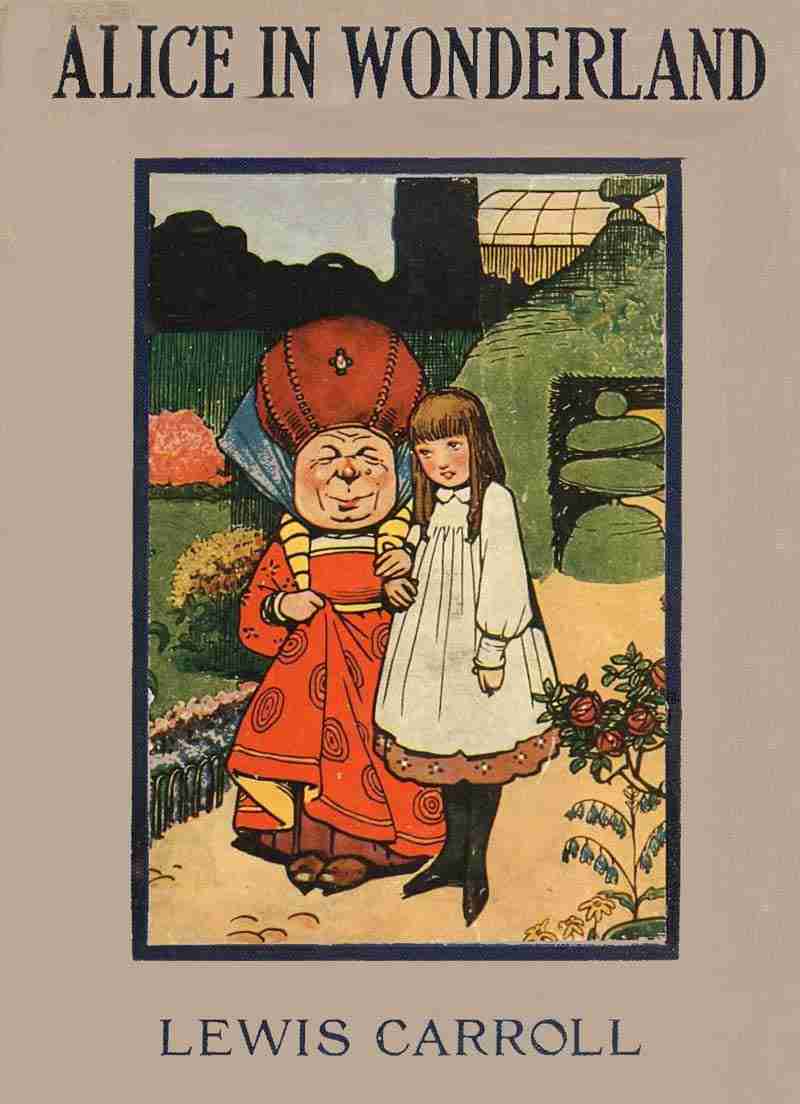
Alice's Adventures in Wonderland
Overview unavailable.
Down the Rabbit-Hole
- Alice, feeling bored and drowsy while sitting with her sister, questions the value of books that lack pictures or dialogue.
- A White Rabbit with a waistcoat and watch appears, sparking Alice's curiosity and prompting her to give chase.
- Alice impulsively follows the rabbit down a hole without considering how she might eventually return to the surface.
- The descent into the rabbit-hole transforms into a slow, surreal fall down a deep well lined with domestic objects like cupboards and maps.
- Despite the bizarre circumstances, Alice maintains a sense of etiquette and concern, carefully stowing an empty marmalade jar to avoid hitting anyone below.
Alice started to her feet, for it flashed across her mind that she had never before seen a rabbit with either a waistcoat-pocket, or a watch to take out of it, and burning with curiosity, she ran across the field after it.
"Cover"
Alice’s Adventures in Wonderland | Project Gutenberg
The Project Gutenberg eBook of
Alice's Adventures in Wonderland
This eBook is for the use of anyone anywhere in the United States and
most other parts of the world at no cost and with almost no restrictions
whatsoever. You may copy it, give it away or re-use it under the terms
of the Project Gutenberg License included with this eBook or online
at
www.gutenberg.org
. If you are not located in the United States,
you will have to check the laws of the country where you are located
before using this eBook.
Title
: Alice's Adventures in Wonderland
Author
: Lewis Carroll
Release date
: June 27, 2008 [eBook #11]
Most recently updated: June 26, 2025
Language
: English
Other information and formats
:
www.gutenberg.org/ebooks/11
Credits
: Arthur DiBianca and David Widger
*** START OF THE PROJECT GUTENBERG EBOOK ALICE'S ADVENTURES IN WONDERLAND ***
Alice’s Adventures in Wonderland
by Lewis Carroll
THE MILLENNIUM FULCRUM EDITION 3.0
Contents
CHAPTER I.
Down the Rabbit-Hole
CHAPTER II.
The Pool of Tears
CHAPTER III.
A Caucus-Race and a Long Tale
CHAPTER IV.
The Rabbit Sends in a Little Bill
CHAPTER V.
Advice from a Caterpillar
CHAPTER VI.
Pig and Pepper
CHAPTER VII.
A Mad Tea-Party
CHAPTER VIII.
The Queen’s Croquet-Ground
CHAPTER IX.
The Mock Turtle’s Story
CHAPTER X.
The Lobster Quadrille
CHAPTER XI.
Who Stole the Tarts?
CHAPTER XII.
Alice’s Evidence
Alice’s Adventures in Wonderland | Project Gutenberg
CHAPTER I.
Down the Rabbit-Hole
Alice was beginning to get very tired of sitting by her sister on the bank, and
of having nothing to do: once or twice she had peeped into the book her sister
was reading, but it had no pictures or conversations in it, “and what is the
use of a book,” thought Alice “without pictures or conversations?”
So she was considering in her own mind (as well as she could, for the hot day
made her feel very sleepy and stupid), whether the pleasure of making a
daisy-chain would be worth the trouble of getting up and picking the daisies,
when suddenly a White Rabbit with pink eyes ran close by her.
There was nothing so
very
remarkable in that; nor did Alice think it so
very
much out of the way to hear the Rabbit say to itself, “Oh dear! Oh
dear! I shall be late!” (when she thought it over afterwards, it occurred to
her that she ought to have wondered at this, but at the time it all seemed
quite natural); but when the Rabbit actually
took a watch out of its
waistcoat-pocket
, and looked at it, and then hurried on, Alice started to
her feet, for it flashed across her mind that she had never before seen a
rabbit with either a waistcoat-pocket, or a watch to take out of it, and
burning with curiosity, she ran across the field after it, and fortunately was
just in time to see it pop down a large rabbit-hole under the hedge.
In another moment down went Alice after it, never once considering how in the
world she was to get out again.
The rabbit-hole went straight on like a tunnel for some way, and then dipped
suddenly down, so suddenly that Alice had not a moment to think about stopping
herself before she found herself falling down a very deep well.
Either the well was very deep, or she fell very slowly, for she had plenty of
time as she went down to look about her and to wonder what was going to happen
next. First, she tried to look down and make out what she was coming to, but it
was too dark to see anything; then she looked at the sides of the well, and
noticed that they were filled with cupboards and book-shelves; here and there
she saw maps and pictures hung upon pegs. She took down a jar from one of the
shelves as she passed; it was labelled “ORANGE MARMALADE”, but to her great
disappointment it was empty: she did not like to drop the jar for fear of
killing somebody underneath, so managed to put it into one of the cupboards as
she fell past it.
The Endless Fall
- Alice experiences a prolonged descent down the rabbit hole, using the time to reflect on her school lessons and geographical knowledge.
- She contemplates the physical impossibility of falling through the earth to the 'Antipathies' and imagines the social etiquette of meeting people there.
- Her thoughts drift toward her cat, Dinah, leading to a sleepy, nonsensical internal monologue about whether cats eat bats.
- The fall ends abruptly and harmlessly on a pile of leaves, where Alice immediately resumes her pursuit of the White Rabbit.
- Alice finds herself in a locked hall, transitioning from the wonder of the fall to the frustration of being trapped.
“Please, Ma’am, is this New Zealand or Australia?” (and she tried to curtsey as she spoke—fancy curtseying as you’re falling through the air! Do you think you could manage it?)
“Well!” thought Alice to herself, “after such a fall as this, I shall think
nothing of tumbling down stairs! How brave they’ll all think me at home! Why, I
wouldn’t say anything about it, even if I fell off the top of the house!”
(Which was very likely true.)
Down, down, down. Would the fall
never
come to an end? “I wonder how
many miles I’ve fallen by this time?” she said aloud. “I must be getting
somewhere near the centre of the earth. Let me see: that would be four thousand
miles down, I think—” (for, you see, Alice had learnt several things of this
sort in her lessons in the schoolroom, and though this was not a
very
good opportunity for showing off her knowledge, as there was no one to listen
to her, still it was good practice to say it over) “—yes, that’s about the
right distance—but then I wonder what Latitude or Longitude I’ve got to?”
(Alice had no idea what Latitude was, or Longitude either, but thought they
were nice grand words to say.)
Presently she began again. “I wonder if I shall fall right
through
the
earth! How funny it’ll seem to come out among the people that walk with their
heads downward! The Antipathies, I think—” (she was rather glad there
was
no one listening, this time, as it didn’t sound at all the right
word) “—but I shall have to ask them what the name of the country is, you know.
Please, Ma’am, is this New Zealand or Australia?” (and she tried to curtsey as
she spoke—fancy
curtseying
as you’re falling through the air! Do you
think you could manage it?) “And what an ignorant little girl she’ll think me
for asking! No, it’ll never do to ask: perhaps I shall see it written up
somewhere.”
Down, down, down. There was nothing else to do, so Alice soon began talking
again. “Dinah’ll miss me very much to-night, I should think!” (Dinah was the
cat.) “I hope they’ll remember her saucer of milk at tea-time. Dinah my dear! I
wish you were down here with me! There are no mice in the air, I’m afraid, but
you might catch a bat, and that’s very like a mouse, you know. But do cats eat
bats, I wonder?” And here Alice began to get rather sleepy, and went on saying
to herself, in a dreamy sort of way, “Do cats eat bats? Do cats eat bats?” and
sometimes, “Do bats eat cats?” for, you see, as she couldn’t answer either
question, it didn’t much matter which way she put it. She felt that she was
dozing off, and had just begun to dream that she was walking hand in hand with
Dinah, and saying to her very earnestly, “Now, Dinah, tell me the truth: did
you ever eat a bat?” when suddenly, thump! thump! down she came upon a heap of
sticks and dry leaves, and the fall was over.
Alice was not a bit hurt, and she jumped up on to her feet in a moment: she
looked up, but it was all dark overhead; before her was another long passage,
and the White Rabbit was still in sight, hurrying down it. There was not a
moment to be lost: away went Alice like the wind, and was just in time to hear
it say, as it turned a corner, “Oh my ears and whiskers, how late it’s
getting!” She was close behind it when she turned the corner, but the Rabbit
was no longer to be seen: she found herself in a long, low hall, which was lit
up by a row of lamps hanging from the roof.
There were doors all round the hall, but they were all locked; and when Alice
had been all the way down one side and up the other, trying every door, she
walked sadly down the middle, wondering how she was ever to get out again.
The Golden Key and Bottle
- Alice discovers a tiny golden key on a glass table and eventually finds a hidden fifteen-inch door that it unlocks.
- The door reveals a beautiful garden, but Alice is far too large to fit through the passage to reach it.
- She finds a mysterious bottle labeled 'DRINK ME' and cautiously checks it for a poison label before consuming it.
- The liquid has a complex, pleasant flavor and causes Alice to shrink down to a height of only ten inches.
- Alice experiences anxiety about her rapid shrinking, fearing she might disappear entirely like a blown-out candle flame.
“What a curious feeling!” said Alice; “I must be shutting up like a telescope.”
Suddenly she came upon a little three-legged table, all made of solid glass;
there was nothing on it except a tiny golden key, and Alice’s first thought was
that it might belong to one of the doors of the hall; but, alas! either the
locks were too large, or the key was too small, but at any rate it would not
open any of them. However, on the second time round, she came upon a low
curtain she had not noticed before, and behind it was a little door about
fifteen inches high: she tried the little golden key in the lock, and to her
great delight it fitted!
Alice opened the door and found that it led into a small passage, not much
larger than a rat-hole: she knelt down and looked along the passage into the
loveliest garden you ever saw. How she longed to get out of that dark hall, and
wander about among those beds of bright flowers and those cool fountains, but
she could not even get her head through the doorway; “and even if my head would
go through,” thought poor Alice, “it would be of very little use without my
shoulders. Oh, how I wish I could shut up like a telescope! I think I could, if
I only knew how to begin.” For, you see, so many out-of-the-way things had
happened lately, that Alice had begun to think that very few things indeed were
really impossible.
There seemed to be no use in waiting by the little door, so she went back to
the table, half hoping she might find another key on it, or at any rate a book
of rules for shutting people up like telescopes: this time she found a little
bottle on it, (“which certainly was not here before,” said Alice,) and round
the neck of the bottle was a paper label, with the words “DRINK ME,”
beautifully printed on it in large letters.
It was all very well to say “Drink me,” but the wise little Alice was not going
to do
that
in a hurry. “No, I’ll look first,” she said, “and see whether
it’s marked ‘
poison
’ or not”; for she had read several nice little
histories about children who had got burnt, and eaten up by wild beasts and
other unpleasant things, all because they
would
not remember the simple
rules their friends had taught them: such as, that a red-hot poker will burn
you if you hold it too long; and that if you cut your finger
very
deeply
with a knife, it usually bleeds; and she had never forgotten that, if you drink
much from a bottle marked “poison,” it is almost certain to disagree with you,
sooner or later.
However, this bottle was
not
marked “poison,” so Alice ventured to taste
it, and finding it very nice, (it had, in fact, a sort of mixed flavour of
cherry-tart, custard, pine-apple, roast turkey, toffee, and hot buttered
toast,) she very soon finished it off.
* * * * * * *
* * * * * *
* * * * * * *
“What a curious feeling!” said Alice; “I must be shutting up like a telescope.”
And so it was indeed: she was now only ten inches high, and her face brightened
up at the thought that she was now the right size for going through the little
door into that lovely garden. First, however, she waited for a few minutes to
see if she was going to shrink any further: she felt a little nervous about
this; “for it might end, you know,” said Alice to herself, “in my going out
altogether, like a candle. I wonder what I should be like then?” And she tried
to fancy what the flame of a candle is like after the candle is blown out, for
she could not remember ever having seen such a thing.
The Golden Key and Growing Pains
- Alice finds herself trapped in a cycle of physical frustration, unable to reach the golden key after shrinking too small.
- The protagonist exhibits a complex internal life, frequently scolding herself and pretending to be two distinct people to cope with her isolation.
- Upon discovering a cake labeled 'EAT ME,' Alice consumes it with the pragmatic hope that any change in size will help her progress.
- The cake causes a dramatic growth spurt, leading Alice to feel physically and emotionally disconnected from her own feet.
- Despite reaching nine feet tall and finally securing the key, Alice remains unable to enter the garden, leading to a renewed sense of despair.
- Alice's experiences in Wonderland have altered her perspective so much that she now finds the 'common way' of life dull and stupid.
“Curiouser and curiouser!” cried Alice (she was so much surprised, that for the moment she quite forgot how to speak good English); “now I’m opening out like the largest telescope that ever was! Good-bye, feet!”
After a while, finding that nothing more happened, she decided on going into
the garden at once; but, alas for poor Alice! when she got to the door, she
found she had forgotten the little golden key, and when she went back to the
table for it, she found she could not possibly reach it: she could see it quite
plainly through the glass, and she tried her best to climb up one of the legs
of the table, but it was too slippery; and when she had tired herself out with
trying, the poor little thing sat down and cried.
“Come, there’s no use in crying like that!” said Alice to herself, rather
sharply; “I advise you to leave off this minute!” She generally gave herself
very good advice, (though she very seldom followed it), and sometimes she
scolded herself so severely as to bring tears into her eyes; and once she
remembered trying to box her own ears for having cheated herself in a game of
croquet she was playing against herself, for this curious child was very fond
of pretending to be two people. “But it’s no use now,” thought poor Alice, “to
pretend to be two people! Why, there’s hardly enough of me left to make
one
respectable person!”
Soon her eye fell on a little glass box that was lying under the table: she
opened it, and found in it a very small cake, on which the words “EAT ME” were
beautifully marked in currants. “Well, I’ll eat it,” said Alice, “and if it
makes me grow larger, I can reach the key; and if it makes me grow smaller, I
can creep under the door; so either way I’ll get into the garden, and I don’t
care which happens!”
She ate a little bit, and said anxiously to herself, “Which way? Which way?”,
holding her hand on the top of her head to feel which way it was growing, and
she was quite surprised to find that she remained the same size: to be sure,
this generally happens when one eats cake, but Alice had got so much into the
way of expecting nothing but out-of-the-way things to happen, that it seemed
quite dull and stupid for life to go on in the common way.
So she set to work, and very soon finished off the cake.
* * * * * * *
* * * * * *
* * * * * * *
Alice’s Adventures in Wonderland | Project Gutenberg
CHAPTER II.
The Pool of Tears
“Curiouser and curiouser!” cried Alice (she was so much surprised, that for the
moment she quite forgot how to speak good English); “now I’m opening out like
the largest telescope that ever was! Good-bye, feet!” (for when she looked down
at her feet, they seemed to be almost out of sight, they were getting so far
off). “Oh, my poor little feet, I wonder who will put on your shoes and
stockings for you now, dears? I’m sure
I
shan’t be able! I shall be a
great deal too far off to trouble myself about you: you must manage the best
way you can;—but I must be kind to them,” thought Alice, “or perhaps they won’t
walk the way I want to go! Let me see: I’ll give them a new pair of boots every
Christmas.”
And she went on planning to herself how she would manage it. “They must go by
the carrier,” she thought; “and how funny it’ll seem, sending presents to one’s
own feet! And how odd the directions will look!
Alice’s Right Foot, Esq.,
Hearthrug,
near the Fender,
(
with Alice’s love
).
Oh dear, what nonsense I’m talking!”
Just then her head struck against the roof of the hall: in fact she was now
more than nine feet high, and she at once took up the little golden key and
hurried off to the garden door.
Poor Alice! It was as much as she could do, lying down on one side, to look
through into the garden with one eye; but to get through was more hopeless than
ever: she sat down and began to cry again.
The Great Identity Puzzle
- Alice's excessive crying creates a massive pool of tears that floods the hallway.
- The White Rabbit reappears in a frantic state, dropping his fan and gloves when Alice attempts to speak to him.
- Confused by her shifting size and surroundings, Alice undergoes an existential crisis, questioning if she has been replaced by another child.
- She attempts to verify her identity through academic knowledge, but finds her multiplication, geography, and poetry have all become nonsensical.
- Distressed by the idea of being the 'ignorant' Mabel, Alice resolves to stay underground unless she can be certain of who she is.
- Alice discovers she is shrinking again after unconsciously putting on one of the Rabbit's tiny gloves.
“But if I’m not the same, the next question is, Who in the world am I? Ah, that’s the great puzzle!”
“You ought to be ashamed of yourself,” said Alice, “a great girl like you,”
(she might well say this), “to go on crying in this way! Stop this moment, I
tell you!” But she went on all the same, shedding gallons of tears, until there
was a large pool all round her, about four inches deep and reaching half down
the hall.
After a time she heard a little pattering of feet in the distance, and she
hastily dried her eyes to see what was coming. It was the White Rabbit
returning, splendidly dressed, with a pair of white kid gloves in one hand and
a large fan in the other: he came trotting along in a great hurry, muttering to
himself as he came, “Oh! the Duchess, the Duchess! Oh! won’t she be savage if
I’ve kept her waiting!” Alice felt so desperate that she was ready to ask help
of any one; so, when the Rabbit came near her, she began, in a low, timid
voice, “If you please, sir—” The Rabbit started violently, dropped the white
kid gloves and the fan, and skurried away into the darkness as hard as he could
go.
Alice took up the fan and gloves, and, as the hall was very hot, she kept
fanning herself all the time she went on talking: “Dear, dear! How queer
everything is to-day! And yesterday things went on just as usual. I wonder if
I’ve been changed in the night? Let me think: was I the same when I got up this
morning? I almost think I can remember feeling a little different. But if I’m
not the same, the next question is, Who in the world am I? Ah,
that’s
the great puzzle!” And she began thinking over all the children she knew that
were of the same age as herself, to see if she could have been changed for any
of them.
“I’m sure I’m not Ada,” she said, “for her hair goes in such long ringlets, and
mine doesn’t go in ringlets at all; and I’m sure I can’t be Mabel, for I know
all sorts of things, and she, oh! she knows such a very little! Besides,
she’s
she, and
I’m
I, and—oh dear, how puzzling it all is! I’ll
try if I know all the things I used to know. Let me see: four times five is
twelve, and four times six is thirteen, and four times seven is—oh dear! I
shall never get to twenty at that rate! However, the Multiplication Table
doesn’t signify: let’s try Geography. London is the capital of Paris, and Paris
is the capital of Rome, and Rome—no,
that’s
all wrong, I’m certain! I
must have been changed for Mabel! I’ll try and say ‘
How doth the
little
—’” and she crossed her hands on her lap as if she were saying
lessons, and began to repeat it, but her voice sounded hoarse and strange, and
the words did not come the same as they used to do:—
“How doth the little crocodile
Improve his shining tail,
And pour the waters of the Nile
On every golden scale!
“How cheerfully he seems to grin,
How neatly spread his claws,
And welcome little fishes in
With gently smiling jaws!”
“I’m sure those are not the right words,” said poor Alice, and her eyes filled
with tears again as she went on, “I must be Mabel after all, and I shall have
to go and live in that poky little house, and have next to no toys to play
with, and oh! ever so many lessons to learn! No, I’ve made up my mind about it;
if I’m Mabel, I’ll stay down here! It’ll be no use their putting their heads
down and saying ‘Come up again, dear!’ I shall only look up and say ‘Who am I
then? Tell me that first, and then, if I like being that person, I’ll come up:
if not, I’ll stay down here till I’m somebody else’—but, oh dear!” cried Alice,
with a sudden burst of tears, “I do wish they
would
put their heads
down! I am so
very
tired of being all alone here!”
As she said this she looked down at her hands, and was surprised to see that
she had put on one of the Rabbit’s little white kid gloves while she was
talking. “How
can
I have done that?” she thought. “I must be growing
The Pool of Tears
- Alice discovers that the fan she is holding causes her to shrink rapidly, nearly vanishing before she drops it.
- While attempting to reach the garden, Alice slips and falls into a deep pool of salt water created by her own previous weeping.
- She encounters a mouse swimming in the pool and attempts to communicate with it using formal Latin vocatives.
- Alice mistakenly offends the mouse by speaking French and mentioning her predatory pet cat, Dinah.
- The interaction highlights Alice's struggle to adapt her social etiquette and knowledge to the surreal logic of Wonderland.
“I shall be punished for it now, I suppose, by being drowned in my own tears! That will be a queer thing, to be sure! However, everything is queer to-day.”
small again.” She got up and went to the table to measure herself by it, and
found that, as nearly as she could guess, she was now about two feet high, and
was going on shrinking rapidly: she soon found out that the cause of this was
the fan she was holding, and she dropped it hastily, just in time to avoid
shrinking away altogether.
“That
was
a narrow escape!” said Alice, a good deal frightened at the
sudden change, but very glad to find herself still in existence; “and now for
the garden!” and she ran with all speed back to the little door: but, alas! the
little door was shut again, and the little golden key was lying on the glass
table as before, “and things are worse than ever,” thought the poor child, “for
I never was so small as this before, never! And I declare it’s too bad, that it
is!”
As she said these words her foot slipped, and in another moment, splash! she
was up to her chin in salt water. Her first idea was that she had somehow
fallen into the sea, “and in that case I can go back by railway,” she said to
herself. (Alice had been to the seaside once in her life, and had come to the
general conclusion, that wherever you go to on the English coast you find a
number of bathing machines in the sea, some children digging in the sand with
wooden spades, then a row of lodging houses, and behind them a railway
station.) However, she soon made out that she was in the pool of tears which
she had wept when she was nine feet high.
“I wish I hadn’t cried so much!” said Alice, as she swam about, trying to find
her way out. “I shall be punished for it now, I suppose, by being drowned in my
own tears! That
will
be a queer thing, to be sure! However, everything
is queer to-day.”
Just then she heard something splashing about in the pool a little way off, and
she swam nearer to make out what it was: at first she thought it must be a
walrus or hippopotamus, but then she remembered how small she was now, and she
soon made out that it was only a mouse that had slipped in like herself.
“Would it be of any use, now,” thought Alice, “to speak to this mouse?
Everything is so out-of-the-way down here, that I should think very likely it
can talk: at any rate, there’s no harm in trying.” So she began: “O Mouse, do
you know the way out of this pool? I am very tired of swimming about here, O
Mouse!” (Alice thought this must be the right way of speaking to a mouse: she
had never done such a thing before, but she remembered having seen in her
brother’s Latin Grammar, “A mouse—of a mouse—to a mouse—a mouse—O mouse!”) The
Mouse looked at her rather inquisitively, and seemed to her to wink with one of
its little eyes, but it said nothing.
“Perhaps it doesn’t understand English,” thought Alice; “I daresay it’s a
French mouse, come over with William the Conqueror.” (For, with all her
knowledge of history, Alice had no very clear notion how long ago anything had
happened.) So she began again: “Où est ma chatte?” which was the first sentence
in her French lesson-book. The Mouse gave a sudden leap out of the water, and
seemed to quiver all over with fright. “Oh, I beg your pardon!” cried Alice
hastily, afraid that she had hurt the poor animal’s feelings. “I quite forgot
you didn’t like cats.”
“Not like cats!” cried the Mouse, in a shrill, passionate voice. “Would
you
like cats if you were me?”
“Well, perhaps not,” said Alice in a soothing tone: “don’t be angry about it.
And yet I wish I could show you our cat Dinah: I think you’d take a fancy to
cats if you could only see her. She is such a dear quiet thing,” Alice went on,
half to herself, as she swam lazily about in the pool, “and she sits purring so
nicely by the fire, licking her paws and washing her face—and she is such a
nice soft thing to nurse—and she’s such a capital one for catching mice—oh, I
beg your pardon!” cried Alice again, for this time the Mouse was bristling all
over, and she felt certain it must be really offended. “We won’t talk about her
The Driest Tale Ever Told
- Alice repeatedly offends the Mouse by praising the hunting skills of cats and dogs, failing to consider the Mouse's perspective as prey.
- The pool of tears becomes crowded with a diverse group of animals, including a Dodo, a Lory, and an Eaglet, who all swim to shore together.
- Upon reaching the bank, the bedraggled group faces the immediate problem of how to dry their wet fur and feathers.
- The Mouse assumes a position of authority and attempts to dry the group by reciting a 'dry' and tedious historical account of William the Conqueror.
- The animals struggle with the abstract language of the history lesson, leading to a humorous linguistic misunderstanding regarding the word 'it'.
“I know what ‘it’ means well enough, when I find a thing,” said the Duck: “it’s generally a frog or a worm. The question is, what did the archbishop find?”
any more if you’d rather not.”
“We indeed!” cried the Mouse, who was trembling down to the end of his tail.
“As if
I
would talk on such a subject! Our family always
hated
cats: nasty, low, vulgar things! Don’t let me hear the name again!”
“I won’t indeed!” said Alice, in a great hurry to change the subject of
conversation. “Are you—are you fond—of—of dogs?” The Mouse did not answer, so
Alice went on eagerly: “There is such a nice little dog near our house I should
like to show you! A little bright-eyed terrier, you know, with oh, such long
curly brown hair! And it’ll fetch things when you throw them, and it’ll sit up
and beg for its dinner, and all sorts of things—I can’t remember half of
them—and it belongs to a farmer, you know, and he says it’s so useful, it’s
worth a hundred pounds! He says it kills all the rats and—oh dear!” cried Alice
in a sorrowful tone, “I’m afraid I’ve offended it again!” For the Mouse was
swimming away from her as hard as it could go, and making quite a commotion in
the pool as it went.
So she called softly after it, “Mouse dear! Do come back again, and we won’t
talk about cats or dogs either, if you don’t like them!” When the Mouse heard
this, it turned round and swam slowly back to her: its face was quite pale
(with passion, Alice thought), and it said in a low trembling voice, “Let us
get to the shore, and then I’ll tell you my history, and you’ll understand why
it is I hate cats and dogs.”
It was high time to go, for the pool was getting quite crowded with the birds
and animals that had fallen into it: there were a Duck and a Dodo, a Lory and
an Eaglet, and several other curious creatures. Alice led the way, and the
whole party swam to the shore.
Alice’s Adventures in Wonderland | Project Gutenberg
CHAPTER III.
A Caucus-Race and a Long Tale
They were indeed a queer-looking party that assembled on the bank—the birds
with draggled feathers, the animals with their fur clinging close to them, and
all dripping wet, cross, and uncomfortable.
The first question of course was, how to get dry again: they had a consultation
about this, and after a few minutes it seemed quite natural to Alice to find
herself talking familiarly with them, as if she had known them all her life.
Indeed, she had quite a long argument with the Lory, who at last turned sulky,
and would only say, “I am older than you, and must know better;” and this Alice
would not allow without knowing how old it was, and, as the Lory positively
refused to tell its age, there was no more to be said.
At last the Mouse, who seemed to be a person of authority among them, called
out, “Sit down, all of you, and listen to me!
I’ll
soon make you dry
enough!” They all sat down at once, in a large ring, with the Mouse in the
middle. Alice kept her eyes anxiously fixed on it, for she felt sure she would
catch a bad cold if she did not get dry very soon.
“Ahem!” said the Mouse with an important air, “are you all ready? This is the
driest thing I know. Silence all round, if you please! ‘William the Conqueror,
whose cause was favoured by the pope, was soon submitted to by the English, who
wanted leaders, and had been of late much accustomed to usurpation and
conquest. Edwin and Morcar, the earls of Mercia and Northumbria—’”
“Ugh!” said the Lory, with a shiver.
“I beg your pardon!” said the Mouse, frowning, but very politely: “Did you
speak?”
“Not I!” said the Lory hastily.
“I thought you did,” said the Mouse. “—I proceed. ‘Edwin and Morcar, the earls
of Mercia and Northumbria, declared for him: and even Stigand, the patriotic
archbishop of Canterbury, found it advisable—’”
“Found
what
?” said the Duck.
“Found
it
,” the Mouse replied rather crossly: “of course you know what
‘it’ means.”
“I know what ‘it’ means well enough, when
I
find a thing,” said the
Duck: “it’s generally a frog or a worm. The question is, what did the
archbishop find?”
The Dodo's Caucus-race
- The Mouse attempts to dry the wet animals by reciting a boring, 'dry' history of the Norman Conquest.
- Finding the history ineffective, the Dodo proposes a Caucus-race as a more energetic remedy for their dampness.
- The race is a chaotic, circular event with no clear start or finish, where participants run and stop whenever they please.
- The Dodo declares that everyone has won the race and insists that Alice must provide prizes for all participants.
- Alice distributes her comfits as prizes and is solemnly presented with her own thimble in a mock-serious ceremony.
- The group settles down to hear the Mouse's 'long and sad tale,' which Alice characteristically confuses with a physical 'tail.'
“What I was going to say,” said the Dodo in an offended tone, “was, that the best thing to get us dry would be a Caucus-race.”
The Mouse did not notice this question, but hurriedly went on, “‘—found it
advisable to go with Edgar Atheling to meet William and offer him the crown.
William’s conduct at first was moderate. But the insolence of his Normans—’ How
are you getting on now, my dear?” it continued, turning to Alice as it spoke.
“As wet as ever,” said Alice in a melancholy tone: “it doesn’t seem to dry me
at all.”
“In that case,” said the Dodo solemnly, rising to its feet, “I move that the
meeting adjourn, for the immediate adoption of more energetic remedies—”
“Speak English!” said the Eaglet. “I don’t know the meaning of half those long
words, and, what’s more, I don’t believe you do either!” And the Eaglet bent
down its head to hide a smile: some of the other birds tittered audibly.
“What I was going to say,” said the Dodo in an offended tone, “was, that the
best thing to get us dry would be a Caucus-race.”
“What
is
a Caucus-race?” said Alice; not that she wanted much to know,
but the Dodo had paused as if it thought that
somebody
ought to speak,
and no one else seemed inclined to say anything.
“Why,” said the Dodo, “the best way to explain it is to do it.” (And, as you
might like to try the thing yourself, some winter day, I will tell you how the
Dodo managed it.)
First it marked out a race-course, in a sort of circle, (“the exact shape
doesn’t matter,” it said,) and then all the party were placed along the course,
here and there. There was no “One, two, three, and away,” but they began
running when they liked, and left off when they liked, so that it was not easy
to know when the race was over. However, when they had been running half an
hour or so, and were quite dry again, the Dodo suddenly called out “The race is
over!” and they all crowded round it, panting, and asking, “But who has won?”
This question the Dodo could not answer without a great deal of thought, and it
sat for a long time with one finger pressed upon its forehead (the position in
which you usually see Shakespeare, in the pictures of him), while the rest
waited in silence. At last the Dodo said, “
Everybody
has won, and all
must have prizes.”
“But who is to give the prizes?” quite a chorus of voices asked.
“Why,
she
, of course,” said the Dodo, pointing to Alice with one finger;
and the whole party at once crowded round her, calling out in a confused way,
“Prizes! Prizes!”
Alice had no idea what to do, and in despair she put her hand in her pocket,
and pulled out a box of comfits, (luckily the salt water had not got into it),
and handed them round as prizes. There was exactly one a-piece, all round.
“But she must have a prize herself, you know,” said the Mouse.
“Of course,” the Dodo replied very gravely. “What else have you got in your
pocket?” he went on, turning to Alice.
“Only a thimble,” said Alice sadly.
“Hand it over here,” said the Dodo.
Then they all crowded round her once more, while the Dodo solemnly presented
the thimble, saying “We beg your acceptance of this elegant thimble;” and, when
it had finished this short speech, they all cheered.
Alice thought the whole thing very absurd, but they all looked so grave that
she did not dare to laugh; and, as she could not think of anything to say, she
simply bowed, and took the thimble, looking as solemn as she could.
The next thing was to eat the comfits: this caused some noise and confusion, as
the large birds complained that they could not taste theirs, and the small ones
choked and had to be patted on the back. However, it was over at last, and they
sat down again in a ring, and begged the Mouse to tell them something more.
“You promised to tell me your history, you know,” said Alice, “and why it is
you hate—C and D,” she added in a whisper, half afraid that it would be
offended again.
“Mine is a long and a sad tale!” said the Mouse, turning to Alice, and sighing.
“It
is
a long tail, certainly,” said Alice, looking down with wonder at
A Tale of Two Tails
- Alice visualizes the Mouse's 'tale' as a physical 'tail' in the shape of a concrete poem about a predatory dog named Fury.
- A series of linguistic misunderstandings regarding 'bends' and 'knots' leads the offended Mouse to abandon the group.
- Alice inadvertently frightens away the remaining birds and animals by praising her cat Dinah's hunting prowess.
- Left alone and melancholy, Alice encounters the White Rabbit, who is in a state of panic over his missing gloves and fan.
- The Rabbit expresses extreme fear of 'The Duchess,' suggesting a high-stakes environment of execution and punishment.
- Alice realizes the landscape has shifted again, as the hall and glass table from her initial arrival have vanished.
‘I’ll be judge, I’ll be jury,’ Said cunning old Fury: ‘I’ll try the whole cause, and condemn you to death.’
the Mouse’s tail; “but why do you call it sad?” And she kept on puzzling about
it while the Mouse was speaking, so that her idea of the tale was something
like this:—
“Fury said to a
mouse, That he
met in the
house,
‘Let us
both go to
law:
I
will
prosecute
you
.—Come,
I’ll take no
denial; We
must have a
trial: For
really this
morning I’ve
nothing
to do.’
Said the
mouse to the
cur, ‘Such
a trial,
dear sir,
With
no jury
or judge,
would be
wasting
our
breath.’
‘I’ll be
judge, I’ll
be jury,’
Said
cunning
old Fury:
‘I’ll
try the
whole
cause,
and
condemn
you
to
death.’”
“You are not attending!” said the Mouse to Alice severely. “What are you
thinking of?”
“I beg your pardon,” said Alice very humbly: “you had got to the fifth bend, I
think?”
“I had
not!
” cried the Mouse, sharply and very angrily.
“A knot!” said Alice, always ready to make herself useful, and looking
anxiously about her. “Oh, do let me help to undo it!”
“I shall do nothing of the sort,” said the Mouse, getting up and walking away.
“You insult me by talking such nonsense!”
“I didn’t mean it!” pleaded poor Alice. “But you’re so easily offended, you
know!”
The Mouse only growled in reply.
“Please come back and finish your story!” Alice called after it; and the others
all joined in chorus, “Yes, please do!” but the Mouse only shook its head
impatiently, and walked a little quicker.
“What a pity it wouldn’t stay!” sighed the Lory, as soon as it was quite out of
sight; and an old Crab took the opportunity of saying to her daughter “Ah, my
dear! Let this be a lesson to you never to lose
your
temper!” “Hold your
tongue, Ma!” said the young Crab, a little snappishly. “You’re enough to try
the patience of an oyster!”
“I wish I had our Dinah here, I know I do!” said Alice aloud, addressing nobody
in particular. “She’d soon fetch it back!”
“And who is Dinah, if I might venture to ask the question?” said the Lory.
Alice replied eagerly, for she was always ready to talk about her pet: “Dinah’s
our cat. And she’s such a capital one for catching mice you can’t think! And
oh, I wish you could see her after the birds! Why, she’ll eat a little bird as
soon as look at it!”
This speech caused a remarkable sensation among the party. Some of the birds
hurried off at once: one old Magpie began wrapping itself up very carefully,
remarking, “I really must be getting home; the night-air doesn’t suit my
throat!” and a Canary called out in a trembling voice to its children, “Come
away, my dears! It’s high time you were all in bed!” On various pretexts they
all moved off, and Alice was soon left alone.
“I wish I hadn’t mentioned Dinah!” she said to herself in a melancholy tone.
“Nobody seems to like her, down here, and I’m sure she’s the best cat in the
world! Oh, my dear Dinah! I wonder if I shall ever see you any more!” And here
poor Alice began to cry again, for she felt very lonely and low-spirited. In a
little while, however, she again heard a little pattering of footsteps in the
distance, and she looked up eagerly, half hoping that the Mouse had changed his
mind, and was coming back to finish his story.
Alice’s Adventures in Wonderland | Project Gutenberg
CHAPTER IV.
The Rabbit Sends in a Little Bill
It was the White Rabbit, trotting slowly back again, and looking anxiously
about as it went, as if it had lost something; and she heard it muttering to
itself “The Duchess! The Duchess! Oh my dear paws! Oh my fur and whiskers!
She’ll get me executed, as sure as ferrets are ferrets! Where
can
I have
dropped them, I wonder?” Alice guessed in a moment that it was looking for the
fan and the pair of white kid gloves, and she very good-naturedly began hunting
about for them, but they were nowhere to be seen—everything seemed to have
changed since her swim in the pool, and the great hall, with the glass table
and the little door, had vanished completely.
The Rabbit's Housemaid
- The White Rabbit mistakes Alice for his housemaid, Mary Ann, and demands she fetch his gloves and fan.
- Alice enters the Rabbit's house and reflects on the absurdity of being ordered about by animals.
- Driven by curiosity and a desire to return to her normal size, Alice drinks from an unlabeled bottle found in the house.
- The liquid causes Alice to grow so large that she becomes physically trapped within the room, forced to stick her limbs out of the windows and chimney.
- Alice contemplates the nature of her existence, realizing she is living inside a fairy tale and mourning the loss of her childhood and physical space.
- She faces a philosophical dilemma regarding the prospect of never growing older but being stuck with lessons forever.
When I used to read fairy-tales, I fancied that kind of thing never happened, and now here I am in the middle of one!
Very soon the Rabbit noticed Alice, as she went hunting about, and called out
to her in an angry tone, “Why, Mary Ann, what
are
you doing out here?
Run home this moment, and fetch me a pair of gloves and a fan! Quick, now!” And
Alice was so much frightened that she ran off at once in the direction it
pointed to, without trying to explain the mistake it had made.
“He took me for his housemaid,” she said to herself as she ran. “How surprised
he’ll be when he finds out who I am! But I’d better take him his fan and
gloves—that is, if I can find them.” As she said this, she came upon a neat
little house, on the door of which was a bright brass plate with the name “W.
RABBIT,” engraved upon it. She went in without knocking, and hurried upstairs,
in great fear lest she should meet the real Mary Ann, and be turned out of the
house before she had found the fan and gloves.
“How queer it seems,” Alice said to herself, “to be going messages for a
rabbit! I suppose Dinah’ll be sending me on messages next!” And she began
fancying the sort of thing that would happen: “‘Miss Alice! Come here directly,
and get ready for your walk!’ ‘Coming in a minute, nurse! But I’ve got to see
that the mouse doesn’t get out.’ Only I don’t think,” Alice went on, “that
they’d let Dinah stop in the house if it began ordering people about like
that!”
By this time she had found her way into a tidy little room with a table in the
window, and on it (as she had hoped) a fan and two or three pairs of tiny white
kid gloves: she took up the fan and a pair of the gloves, and was just going to
leave the room, when her eye fell upon a little bottle that stood near the
looking-glass. There was no label this time with the words “DRINK ME,” but
nevertheless she uncorked it and put it to her lips. “I know
something
interesting is sure to happen,” she said to herself, “whenever I eat or drink
anything; so I’ll just see what this bottle does. I do hope it’ll make me grow
large again, for really I’m quite tired of being such a tiny little thing!”
It did so indeed, and much sooner than she had expected: before she had drunk
half the bottle, she found her head pressing against the ceiling, and had to
stoop to save her neck from being broken. She hastily put down the bottle,
saying to herself “That’s quite enough—I hope I shan’t grow any more—As it is,
I can’t get out at the door—I do wish I hadn’t drunk quite so much!”
Alas! it was too late to wish that! She went on growing, and growing, and very
soon had to kneel down on the floor: in another minute there was not even room
for this, and she tried the effect of lying down with one elbow against the
door, and the other arm curled round her head. Still she went on growing, and,
as a last resource, she put one arm out of the window, and one foot up the
chimney, and said to herself “Now I can do no more, whatever happens. What
will
become of me?”
Luckily for Alice, the little magic bottle had now had its full effect, and she
grew no larger: still it was very uncomfortable, and, as there seemed to be no
sort of chance of her ever getting out of the room again, no wonder she felt
unhappy.
“It was much pleasanter at home,” thought poor Alice, “when one wasn’t always
growing larger and smaller, and being ordered about by mice and rabbits. I
almost wish I hadn’t gone down that rabbit-hole—and yet—and yet—it’s rather
curious, you know, this sort of life! I do wonder what
can
have happened
to me! When I used to read fairy-tales, I fancied that kind of thing never
happened, and now here I am in the middle of one! There ought to be a book
written about me, that there ought! And when I grow up, I’ll write one—but I’m
grown up now,” she added in a sorrowful tone; “at least there’s no room to grow
up any more
here
.”
“But then,” thought Alice, “shall I
never
get any older than I am now?
That’ll be a comfort, one way—never to be an old woman—but then—always to have
lessons to learn! Oh, I shouldn’t like
that!
”
The Giant in the House
- Alice finds herself trapped inside a house after growing to a massive size, leaving no room for movement or even her lesson-books.
- The White Rabbit returns and mistakes Alice for his housemaid, Mary Ann, demanding his gloves.
- Due to her immense size, Alice inadvertently blocks the Rabbit's entry and causes him to fall into a cucumber-frame when she swats at the window.
- The Rabbit enlists the help of Pat and Bill to remove the 'giant arm' that is obstructing the window of his home.
- The group of animals attempts to use ladders to reach the roof, eventually deciding to send a character named Bill down the chimney.
- Alice prepares to defend her position by positioning her foot in the narrow fireplace, ready to kick whoever tries to enter.
Alice knew it was the Rabbit coming to look for her, and she trembled till she shook the house, quite forgetting that she was now about a thousand times as large as the Rabbit, and had no reason to be afraid of it.
“Oh, you foolish Alice!” she answered herself. “How can you learn lessons in
here? Why, there’s hardly room for
you
, and no room at all for any
lesson-books!”
And so she went on, taking first one side and then the other, and making quite
a conversation of it altogether; but after a few minutes she heard a voice
outside, and stopped to listen.
“Mary Ann! Mary Ann!” said the voice. “Fetch me my gloves this moment!” Then
came a little pattering of feet on the stairs. Alice knew it was the Rabbit
coming to look for her, and she trembled till she shook the house, quite
forgetting that she was now about a thousand times as large as the Rabbit, and
had no reason to be afraid of it.
Presently the Rabbit came up to the door, and tried to open it; but, as the
door opened inwards, and Alice’s elbow was pressed hard against it, that
attempt proved a failure. Alice heard it say to itself “Then I’ll go round and
get in at the window.”
“
That
you won’t!” thought Alice, and, after waiting till she fancied she
heard the Rabbit just under the window, she suddenly spread out her hand, and
made a snatch in the air. She did not get hold of anything, but she heard a
little shriek and a fall, and a crash of broken glass, from which she concluded
that it was just possible it had fallen into a cucumber-frame, or something of
the sort.
Next came an angry voice—the Rabbit’s—“Pat! Pat! Where are you?” And then a
voice she had never heard before, “Sure then I’m here! Digging for apples, yer
honour!”
“Digging for apples, indeed!” said the Rabbit angrily. “Here! Come and help me
out of
this!
” (Sounds of more broken glass.)
“Now tell me, Pat, what’s that in the window?”
“Sure, it’s an arm, yer honour!” (He pronounced it “arrum.”)
“An arm, you goose! Who ever saw one that size? Why, it fills the whole
window!”
“Sure, it does, yer honour: but it’s an arm for all that.”
“Well, it’s got no business there, at any rate: go and take it away!”
There was a long silence after this, and Alice could only hear whispers now and
then; such as, “Sure, I don’t like it, yer honour, at all, at all!” “Do as I
tell you, you coward!” and at last she spread out her hand again, and made
another snatch in the air. This time there were
two
little shrieks, and
more sounds of broken glass. “What a number of cucumber-frames there must be!”
thought Alice. “I wonder what they’ll do next! As for pulling me out of the
window, I only wish they
could!
I’m sure
I
don’t want to stay in
here any longer!”
She waited for some time without hearing anything more: at last came a rumbling
of little cartwheels, and the sound of a good many voices all talking together:
she made out the words: “Where’s the other ladder?—Why, I hadn’t to bring but
one; Bill’s got the other—Bill! fetch it here, lad!—Here, put ’em up at this
corner—No, tie ’em together first—they don’t reach half high enough yet—Oh!
they’ll do well enough; don’t be particular—Here, Bill! catch hold of this
rope—Will the roof bear?—Mind that loose slate—Oh, it’s coming down! Heads
below!” (a loud crash)—“Now, who did that?—It was Bill, I fancy—Who’s to go
down the chimney?—Nay,
I
shan’t!
You
do it!—
That
I won’t,
then!—Bill’s to go down—Here, Bill! the master says you’re to go down the
chimney!”
“Oh! So Bill’s got to come down the chimney, has he?” said Alice to herself.
“Shy, they seem to put everything upon Bill! I wouldn’t be in Bill’s place for
a good deal: this fireplace is narrow, to be sure; but I
think
I can
kick a little!”
She drew her foot as far down the chimney as she could, and waited till she
heard a little animal (she couldn’t guess of what sort it was) scratching and
scrambling about in the chimney close above her: then, saying to herself “This
is Bill,” she gave one sharp kick, and waited to see what would happen next.
The first thing she heard was a general chorus of “There goes Bill!” then the
Shrinking Cakes and Giant Puppies
- The White Rabbit and his companions attempt to force Alice out of the house, first by threatening fire and then by throwing pebbles through the window.
- Alice discovers that the pebbles transform into small cakes, which she eats in hopes of altering her size to escape her confinement.
- The cake successfully causes Alice to shrink, allowing her to flee the house and avoid the crowd of animals gathered outside.
- Once safe in the woods, Alice establishes two goals: returning to her normal size and finding the beautiful garden she saw earlier.
- Alice encounters a puppy that appears enormous due to her shrunken stature, leading to a frantic and dangerous game of fetch.
- Despite the puppy's playful intent, Alice remains terrified of being trampled or eaten, highlighting the peril of her new scale.
Well, I hardly know—No more, thank ye; I’m better now—but I’m a deal too flustered to tell you—all I know is, something comes at me like a Jack-in-the-box, and up I goes like a sky-rocket!
Rabbit’s voice along—“Catch him, you by the hedge!” then silence, and then
another confusion of voices—“Hold up his head—Brandy now—Don’t choke him—How
was it, old fellow? What happened to you? Tell us all about it!”
Last came a little feeble, squeaking voice, (“That’s Bill,” thought Alice,)
“Well, I hardly know—No more, thank ye; I’m better now—but I’m a deal too
flustered to tell you—all I know is, something comes at me like a
Jack-in-the-box, and up I goes like a sky-rocket!”
“So you did, old fellow!” said the others.
“We must burn the house down!” said the Rabbit’s voice; and Alice called out as
loud as she could, “If you do, I’ll set Dinah at you!”
There was a dead silence instantly, and Alice thought to herself, “I wonder
what they
will
do next! If they had any sense, they’d take the roof
off.” After a minute or two, they began moving about again, and Alice heard the
Rabbit say, “A barrowful will do, to begin with.”
“A barrowful of
what?
” thought Alice; but she had not long to doubt, for
the next moment a shower of little pebbles came rattling in at the window, and
some of them hit her in the face. “I’ll put a stop to this,” she said to
herself, and shouted out, “You’d better not do that again!” which produced
another dead silence.
Alice noticed with some surprise that the pebbles were all turning into little
cakes as they lay on the floor, and a bright idea came into her head. “If I eat
one of these cakes,” she thought, “it’s sure to make
some
change in my
size; and as it can’t possibly make me larger, it must make me smaller, I
suppose.”
So she swallowed one of the cakes, and was delighted to find that she began
shrinking directly. As soon as she was small enough to get through the door,
she ran out of the house, and found quite a crowd of little animals and birds
waiting outside. The poor little Lizard, Bill, was in the middle, being held up
by two guinea-pigs, who were giving it something out of a bottle. They all made
a rush at Alice the moment she appeared; but she ran off as hard as she could,
and soon found herself safe in a thick wood.
“The first thing I’ve got to do,” said Alice to herself, as she wandered about
in the wood, “is to grow to my right size again; and the second thing is to
find my way into that lovely garden. I think that will be the best plan.”
It sounded an excellent plan, no doubt, and very neatly and simply arranged;
the only difficulty was, that she had not the smallest idea how to set about
it; and while she was peering about anxiously among the trees, a little sharp
bark just over her head made her look up in a great hurry.
An enormous puppy was looking down at her with large round eyes, and feebly
stretching out one paw, trying to touch her. “Poor little thing!” said Alice,
in a coaxing tone, and she tried hard to whistle to it; but she was terribly
frightened all the time at the thought that it might be hungry, in which case
it would be very likely to eat her up in spite of all her coaxing.
Hardly knowing what she did, she picked up a little bit of stick, and held it
out to the puppy; whereupon the puppy jumped into the air off all its feet at
once, with a yelp of delight, and rushed at the stick, and made believe to
worry it; then Alice dodged behind a great thistle, to keep herself from being
run over; and the moment she appeared on the other side, the puppy made another
rush at the stick, and tumbled head over heels in its hurry to get hold of it;
then Alice, thinking it was very like having a game of play with a cart-horse,
and expecting every moment to be trampled under its feet, ran round the thistle
again; then the puppy began a series of short charges at the stick, running a
very little way forwards each time and a long way back, and barking hoarsely
all the while, till at last it sat down a good way off, panting, with its
tongue hanging out of its mouth, and its great eyes half shut.
Advice from a Caterpillar
- Alice escapes the puppy and rests among giant flora, realizing she must find a way to return to her normal size.
- She discovers a large blue caterpillar sitting on a mushroom, quietly smoking a hookah and ignoring his surroundings.
- The Caterpillar initiates a cryptic conversation by questioning Alice's identity, which she finds difficult to define due to her frequent physical changes.
- Alice attempts to explain the psychological toll of shifting sizes, but the Caterpillar remains dismissive and unimpressed by her plight.
- The interaction becomes a circular argument about identity and manners, leading to Alice's frustration with the Caterpillar's short, contrarian responses.
- The Caterpillar lures Alice back with the promise of important information, only to advise her to keep her temper.
“I can’t explain myself, I’m afraid, sir,” said Alice, “because I’m not myself, you see.”
This seemed to Alice a good opportunity for making her escape; so she set off
at once, and ran till she was quite tired and out of breath, and till the
puppy’s bark sounded quite faint in the distance.
“And yet what a dear little puppy it was!” said Alice, as she leant against a
buttercup to rest herself, and fanned herself with one of the leaves: “I should
have liked teaching it tricks very much, if—if I’d only been the right size to
do it! Oh dear! I’d nearly forgotten that I’ve got to grow up again! Let me
see—how
is
it to be managed? I suppose I ought to eat or drink something
or other; but the great question is, what?”
The great question certainly was, what? Alice looked all round her at the
flowers and the blades of grass, but she did not see anything that looked like
the right thing to eat or drink under the circumstances. There was a large
mushroom growing near her, about the same height as herself; and when she had
looked under it, and on both sides of it, and behind it, it occurred to her
that she might as well look and see what was on the top of it.
She stretched herself up on tiptoe, and peeped over the edge of the mushroom,
and her eyes immediately met those of a large blue caterpillar, that was
sitting on the top with its arms folded, quietly smoking a long hookah, and
taking not the smallest notice of her or of anything else.
Alice’s Adventures in Wonderland | Project Gutenberg
CHAPTER V.
Advice from a Caterpillar
The Caterpillar and Alice looked at each other for some time in silence: at
last the Caterpillar took the hookah out of its mouth, and addressed her in a
languid, sleepy voice.
“Who are
you?
” said the Caterpillar.
This was not an encouraging opening for a conversation. Alice replied, rather
shyly, “I—I hardly know, sir, just at present—at least I know who I
was
when I got up this morning, but I think I must have been changed several times
since then.”
“What do you mean by that?” said the Caterpillar sternly. “Explain yourself!”
“I can’t explain
myself
, I’m afraid, sir,” said Alice, “because I’m not
myself, you see.”
“I don’t see,” said the Caterpillar.
“I’m afraid I can’t put it more clearly,” Alice replied very politely, “for I
can’t understand it myself to begin with; and being so many different sizes in
a day is very confusing.”
“It isn’t,” said the Caterpillar.
“Well, perhaps you haven’t found it so yet,” said Alice; “but when you have to
turn into a chrysalis—you will some day, you know—and then after that into a
butterfly, I should think you’ll feel it a little queer, won’t you?”
“Not a bit,” said the Caterpillar.
“Well, perhaps your feelings may be different,” said Alice; “all I know is, it
would feel very queer to
me
.”
“You!” said the Caterpillar contemptuously. “Who are
you?
”
Which brought them back again to the beginning of the conversation. Alice felt
a little irritated at the Caterpillar’s making such
very
short remarks,
and she drew herself up and said, very gravely, “I think, you ought to tell me
who
you
are, first.”
“Why?” said the Caterpillar.
Here was another puzzling question; and as Alice could not think of any good
reason, and as the Caterpillar seemed to be in a
very
unpleasant state
of mind, she turned away.
“Come back!” the Caterpillar called after her. “I’ve something important to
say!”
This sounded promising, certainly: Alice turned and came back again.
“Keep your temper,” said the Caterpillar.
“Is that all?” said Alice, swallowing down her anger as well as she could.
“No,” said the Caterpillar.
Alice thought she might as well wait, as she had nothing else to do, and
perhaps after all it might tell her something worth hearing. For some minutes
it puffed away without speaking, but at last it unfolded its arms, took the
hookah out of its mouth again, and said, “So you think you’re changed, do you?”
“I’m afraid I am, sir,” said Alice; “I can’t remember things as I used—and I
Father William and the Mushroom
- Alice expresses her distress over her constant physical fluctuations and her inability to remember simple nursery rhymes.
- At the Caterpillar's command, Alice recites a nonsensical poem about an eccentric old man named Father William who performs absurd physical feats.
- The Caterpillar dismisses Alice's recitation as entirely incorrect, highlighting the breakdown of logic and memory in Wonderland.
- A conflict arises over Alice's height when she calls three inches a 'wretched' size, offending the three-inch-tall Caterpillar.
- Before departing, the Caterpillar provides a cryptic solution to Alice's size problem by pointing to the mushroom.
- Alice is left to decipher the geometry of a round object to determine which 'sides' will cause her to grow or shrink.
“In my youth,” Father William replied to his son, “I feared it might injure the brain; but, now that I’m perfectly sure I have none, why, I do it again and again.”
don’t keep the same size for ten minutes together!”
“Can’t remember
what
things?” said the Caterpillar.
“Well, I’ve tried to say “How doth the little busy bee,” but it all came
different!” Alice replied in a very melancholy voice.
“Repeat, ‘
You are old, Father William
,’” said the Caterpillar.
Alice folded her hands, and began:—
“You are old, Father William,” the young man said,
“And your hair has become very white;
And yet you incessantly stand on your head—
Do you think, at your age, it is right?”
“In my youth,” Father William replied to his son,
“I feared it might injure the brain;
But, now that I’m perfectly sure I have none,
Why, I do it again and again.”
“You are old,” said the youth, “as I mentioned before,
And have grown most uncommonly fat;
Yet you turned a back-somersault in at the door—
Pray, what is the reason of that?”
“In my youth,” said the sage, as he shook his grey locks,
“I kept all my limbs very supple
By the use of this ointment—one shilling the box—
Allow me to sell you a couple?”
“You are old,” said the youth, “and your jaws are too weak
For anything tougher than suet;
Yet you finished the goose, with the bones and the beak—
Pray, how did you manage to do it?”
“In my youth,” said his father, “I took to the law,
And argued each case with my wife;
And the muscular strength, which it gave to my jaw,
Has lasted the rest of my life.”
“You are old,” said the youth, “one would hardly suppose
That your eye was as steady as ever;
Yet you balanced an eel on the end of your nose—
What made you so awfully clever?”
“I have answered three questions, and that is enough,”
Said his father; “don’t give yourself airs!
Do you think I can listen all day to such stuff?
Be off, or I’ll kick you down stairs!”
“That is not said right,” said the Caterpillar.
“Not
quite
right, I’m afraid,” said Alice, timidly; “some of the words
have got altered.”
“It is wrong from beginning to end,” said the Caterpillar decidedly, and there
was silence for some minutes.
The Caterpillar was the first to speak.
“What size do you want to be?” it asked.
“Oh, I’m not particular as to size,” Alice hastily replied; “only one doesn’t
like changing so often, you know.”
“I
don’t
know,” said the Caterpillar.
Alice said nothing: she had never been so much contradicted in her life before,
and she felt that she was losing her temper.
“Are you content now?” said the Caterpillar.
“Well, I should like to be a
little
larger, sir, if you wouldn’t mind,”
said Alice: “three inches is such a wretched height to be.”
“It is a very good height indeed!” said the Caterpillar angrily, rearing itself
upright as it spoke (it was exactly three inches high).
“But I’m not used to it!” pleaded poor Alice in a piteous tone. And she thought
of herself, “I wish the creatures wouldn’t be so easily offended!”
“You’ll get used to it in time,” said the Caterpillar; and it put the hookah
into its mouth and began smoking again.
This time Alice waited patiently until it chose to speak again. In a minute or
two the Caterpillar took the hookah out of its mouth and yawned once or twice,
and shook itself. Then it got down off the mushroom, and crawled away in the
grass, merely remarking as it went, “One side will make you grow taller, and
the other side will make you grow shorter.”
“One side of
what?
The other side of
what?
” thought Alice to
herself.
“Of the mushroom,” said the Caterpillar, just as if she had asked it aloud; and
in another moment it was out of sight.
Alice remained looking thoughtfully at the mushroom for a minute, trying to
make out which were the two sides of it; and as it was perfectly round, she
found this a very difficult question. However, at last she stretched her arms
round it as far as they would go, and broke off a bit of the edge with each
hand.
The Serpent and the Pigeon
- Alice experiments with the mushroom pieces, causing her body to shrink so rapidly that her chin strikes her feet.
- After consuming the opposite side, Alice's neck grows to an immense length, elevating her head far above the treetops.
- A distressed pigeon attacks Alice, mistaking her long, undulating neck for a predatory serpent.
- The pigeon laments its exhausted efforts to protect its eggs from constant threats in the roots, banks, and hedges.
- Alice struggles to define her identity as a 'little girl' given her current monstrous physical proportions.
- The pigeon concludes that if little girls eat eggs, they are effectively a species of serpent regardless of their name.
“I’ve seen a good many little girls in my time, but never one with such a neck as that! No, no! You’re a serpent; and there’s no use denying it.”
“And now which is which?” she said to herself, and nibbled a little of the
right-hand bit to try the effect: the next moment she felt a violent blow
underneath her chin: it had struck her foot!
She was a good deal frightened by this very sudden change, but she felt that
there was no time to be lost, as she was shrinking rapidly; so she set to work
at once to eat some of the other bit. Her chin was pressed so closely against
her foot, that there was hardly room to open her mouth; but she did it at last,
and managed to swallow a morsel of the lefthand bit.
* * * * * * *
* * * * * *
* * * * * * *
“Come, my head’s free at last!” said Alice in a tone of delight, which changed
into alarm in another moment, when she found that her shoulders were nowhere to
be found: all she could see, when she looked down, was an immense length of
neck, which seemed to rise like a stalk out of a sea of green leaves that lay
far below her.
“What
can
all that green stuff be?” said Alice. “And where
have
my shoulders got to? And oh, my poor hands, how is it I can’t see you?” She was
moving them about as she spoke, but no result seemed to follow, except a little
shaking among the distant green leaves.
As there seemed to be no chance of getting her hands up to her head, she tried
to get her head down to them, and was delighted to find that her neck would
bend about easily in any direction, like a serpent. She had just succeeded in
curving it down into a graceful zigzag, and was going to dive in among the
leaves, which she found to be nothing but the tops of the trees under which she
had been wandering, when a sharp hiss made her draw back in a hurry: a large
pigeon had flown into her face, and was beating her violently with its wings.
“Serpent!” screamed the Pigeon.
“I’m
not
a serpent!” said Alice indignantly. “Let me alone!”
“Serpent, I say again!” repeated the Pigeon, but in a more subdued tone, and
added with a kind of sob, “I’ve tried every way, and nothing seems to suit
them!”
“I haven’t the least idea what you’re talking about,” said Alice.
“I’ve tried the roots of trees, and I’ve tried banks, and I’ve tried hedges,”
the Pigeon went on, without attending to her; “but those serpents! There’s no
pleasing them!”
Alice was more and more puzzled, but she thought there was no use in saying
anything more till the Pigeon had finished.
“As if it wasn’t trouble enough hatching the eggs,” said the Pigeon; “but I
must be on the look-out for serpents night and day! Why, I haven’t had a wink
of sleep these three weeks!”
“I’m very sorry you’ve been annoyed,” said Alice, who was beginning to see its
meaning.
“And just as I’d taken the highest tree in the wood,” continued the Pigeon,
raising its voice to a shriek, “and just as I was thinking I should be free of
them at last, they must needs come wriggling down from the sky! Ugh, Serpent!”
“But I’m
not
a serpent, I tell you!” said Alice. “I’m a—I’m a—”
“Well!
What
are you?” said the Pigeon. “I can see you’re trying to
invent something!”
“I—I’m a little girl,” said Alice, rather doubtfully, as she remembered the
number of changes she had gone through that day.
“A likely story indeed!” said the Pigeon in a tone of the deepest contempt.
“I’ve seen a good many little girls in my time, but never
one
with such
a neck as that! No, no! You’re a serpent; and there’s no use denying it. I
suppose you’ll be telling me next that you never tasted an egg!”
“I
have
tasted eggs, certainly,” said Alice, who was a very truthful
child; “but little girls eat eggs quite as much as serpents do, you know.”
“I don’t believe it,” said the Pigeon; “but if they do, why then they’re a kind
of serpent, that’s all I can say.”
This was such a new idea to Alice, that she was quite silent for a minute or
two, which gave the Pigeon the opportunity of adding, “You’re looking for eggs,
I know
that
Size Changes and Strange Invitations
- Alice manages to return to her normal height by carefully nibbling on pieces of the mushroom.
- Upon discovering a small house, Alice intentionally shrinks herself to nine inches to avoid frightening the inhabitants.
- A Fish-Footman delivers a formal invitation from the Queen to a Frog-Footman for the Duchess to play croquet.
- The two footmen engage in a comical, overly formal exchange that results in their powdered wigs becoming entangled.
- Alice attempts to enter the house but is met with the Frog-Footman's circular and unhelpful logic.
- The house is filled with chaotic sounds, including constant howling, sneezing, and the crashing of breaking dishes.
Then they both bowed low, and their curls got entangled together.
well enough; and what does it matter to me whether you’re a
little girl or a serpent?”
“It matters a good deal to
me
,” said Alice hastily; “but I’m not looking
for eggs, as it happens; and if I was, I shouldn’t want
yours
: I don’t
like them raw.”
“Well, be off, then!” said the Pigeon in a sulky tone, as it settled down again
into its nest. Alice crouched down among the trees as well as she could, for
her neck kept getting entangled among the branches, and every now and then she
had to stop and untwist it. After a while she remembered that she still held
the pieces of mushroom in her hands, and she set to work very carefully,
nibbling first at one and then at the other, and growing sometimes taller and
sometimes shorter, until she had succeeded in bringing herself down to her
usual height.
It was so long since she had been anything near the right size, that it felt
quite strange at first; but she got used to it in a few minutes, and began
talking to herself, as usual. “Come, there’s half my plan done now! How
puzzling all these changes are! I’m never sure what I’m going to be, from one
minute to another! However, I’ve got back to my right size: the next thing is,
to get into that beautiful garden—how
is
that to be done, I wonder?” As
she said this, she came suddenly upon an open place, with a little house in it
about four feet high. “Whoever lives there,” thought Alice, “it’ll never do to
come upon them
this
size: why, I should frighten them out of their
wits!” So she began nibbling at the righthand bit again, and did not venture to
go near the house till she had brought herself down to nine inches high.
Alice’s Adventures in Wonderland | Project Gutenberg
CHAPTER VI.
Pig and Pepper
For a minute or two she stood looking at the house, and wondering what to do
next, when suddenly a footman in livery came running out of the wood—(she
considered him to be a footman because he was in livery: otherwise, judging by
his face only, she would have called him a fish)—and rapped loudly at the door
with his knuckles. It was opened by another footman in livery, with a round
face, and large eyes like a frog; and both footmen, Alice noticed, had powdered
hair that curled all over their heads. She felt very curious to know what it
was all about, and crept a little way out of the wood to listen.
The Fish-Footman began by producing from under his arm a great letter, nearly
as large as himself, and this he handed over to the other, saying, in a solemn
tone, “For the Duchess. An invitation from the Queen to play croquet.” The
Frog-Footman repeated, in the same solemn tone, only changing the order of the
words a little, “From the Queen. An invitation for the Duchess to play
croquet.”
Then they both bowed low, and their curls got entangled together.
Alice laughed so much at this, that she had to run back into the wood for fear
of their hearing her; and when she next peeped out the Fish-Footman was gone,
and the other was sitting on the ground near the door, staring stupidly up into
the sky.
Alice went timidly up to the door, and knocked.
“There’s no sort of use in knocking,” said the Footman, “and that for two
reasons. First, because I’m on the same side of the door as you are; secondly,
because they’re making such a noise inside, no one could possibly hear you.”
And certainly there
was
a most extraordinary noise going on within—a
constant howling and sneezing, and every now and then a great crash, as if a
dish or kettle had been broken to pieces.
“Please, then,” said Alice, “how am I to get in?”
“There might be some sense in your knocking,” the Footman went on without
attending to her, “if we had the door between us. For instance, if you were
inside
, you might knock, and I could let you out, you know.” He was
looking up into the sky all the time he was speaking, and this Alice thought
decidedly uncivil. “But perhaps he can’t help it,” she said to herself; “his
eyes are so
very
Chaos in the Duchess's Kitchen
- Alice encounters a stubborn Footman who ignores flying plates and questions the necessity of her entering the house at all.
- Upon entering, Alice finds a kitchen choked with pepper smoke, causing nearly everyone to sneeze and howl uncontrollably.
- The Duchess introduces the grinning Cheshire Cat and dismisses Alice's observations with blunt, insulting remarks about her lack of knowledge.
- A violent domestic scene erupts as the cook begins hurling kitchenware and fire-irons at the Duchess and her baby.
- The Duchess advocates for a world where everyone minds their own business, claiming it would make the earth rotate faster.
- The interaction turns dark when the Duchess interrupts Alice's scientific explanation by calling for her execution.
“Talking of axes,” said the Duchess, “chop off her head!”
nearly at the top of his head. But at any rate he might
answer questions.—How am I to get in?” she repeated, aloud.
“I shall sit here,” the Footman remarked, “till tomorrow—”
At this moment the door of the house opened, and a large plate came skimming
out, straight at the Footman’s head: it just grazed his nose, and broke to
pieces against one of the trees behind him.
“—or next day, maybe,” the Footman continued in the same tone, exactly as if
nothing had happened.
“How am I to get in?” asked Alice again, in a louder tone.
“
Are
you to get in at all?” said the Footman. “That’s the first
question, you know.”
It was, no doubt: only Alice did not like to be told so. “It’s really
dreadful,” she muttered to herself, “the way all the creatures argue. It’s
enough to drive one crazy!”
The Footman seemed to think this a good opportunity for repeating his remark,
with variations. “I shall sit here,” he said, “on and off, for days and days.”
“But what am
I
to do?” said Alice.
“Anything you like,” said the Footman, and began whistling.
“Oh, there’s no use in talking to him,” said Alice desperately: “he’s perfectly
idiotic!” And she opened the door and went in.
The door led right into a large kitchen, which was full of smoke from one end
to the other: the Duchess was sitting on a three-legged stool in the middle,
nursing a baby; the cook was leaning over the fire, stirring a large cauldron
which seemed to be full of soup.
“There’s certainly too much pepper in that soup!” Alice said to herself, as
well as she could for sneezing.
There was certainly too much of it in the air. Even the Duchess sneezed
occasionally; and as for the baby, it was sneezing and howling alternately
without a moment’s pause. The only things in the kitchen that did not sneeze,
were the cook, and a large cat which was sitting on the hearth and grinning
from ear to ear.
“Please would you tell me,” said Alice, a little timidly, for she was not quite
sure whether it was good manners for her to speak first, “why your cat grins
like that?”
“It’s a Cheshire cat,” said the Duchess, “and that’s why. Pig!”
She said the last word with such sudden violence that Alice quite jumped; but
she saw in another moment that it was addressed to the baby, and not to her, so
she took courage, and went on again:—
“I didn’t know that Cheshire cats always grinned; in fact, I didn’t know that
cats
could
grin.”
“They all can,” said the Duchess; “and most of ’em do.”
“I don’t know of any that do,” Alice said very politely, feeling quite pleased
to have got into a conversation.
“You don’t know much,” said the Duchess; “and that’s a fact.”
Alice did not at all like the tone of this remark, and thought it would be as
well to introduce some other subject of conversation. While she was trying to
fix on one, the cook took the cauldron of soup off the fire, and at once set to
work throwing everything within her reach at the Duchess and the baby—the
fire-irons came first; then followed a shower of saucepans, plates, and dishes.
The Duchess took no notice of them even when they hit her; and the baby was
howling so much already, that it was quite impossible to say whether the blows
hurt it or not.
“Oh,
please
mind what you’re doing!” cried Alice, jumping up and down in
an agony of terror. “Oh, there goes his
precious
nose!” as an unusually
large saucepan flew close by it, and very nearly carried it off.
“If everybody minded their own business,” the Duchess said in a hoarse growl,
“the world would go round a deal faster than it does.”
“Which would
not
be an advantage,” said Alice, who felt very glad to get
an opportunity of showing off a little of her knowledge. “Just think of what
work it would make with the day and night! You see the earth takes twenty-four
hours to turn round on its axis—”
“Talking of axes,” said the Duchess, “chop off her head!”
The Duchess and the Pig
- The Duchess treats her infant with violent disregard, singing a harsh lullaby while shaking and tossing the child.
- The Duchess abruptly flings the baby at Alice and departs to play croquet with the Queen, narrowly avoiding a frying pan thrown by the cook.
- Alice rescues the struggling, starfish-like creature, fearing it will be killed if left in the chaotic household.
- As Alice carries the baby away, it begins to transform, developing a snout-like nose and small eyes while grunting instead of crying.
- The infant fully transforms into a pig, and Alice, feeling relieved, sets it down to trot away into the woods.
- Alice reflects on how the creature makes a handsome pig but would have been an ugly child, just before encountering the Cheshire Cat.
“If you’re going to turn into a pig, my dear,” said Alice, seriously, “I’ll have nothing more to do with you. Mind now!”
Alice glanced rather anxiously at the cook, to see if she meant to take the
hint; but the cook was busily stirring the soup, and seemed not to be
listening, so she went on again: “Twenty-four hours, I
think
; or is it
twelve? I—”
“Oh, don’t bother
me
,” said the Duchess; “I never could abide figures!”
And with that she began nursing her child again, singing a sort of lullaby to
it as she did so, and giving it a violent shake at the end of every line:
“Speak roughly to your little boy,
And beat him when he sneezes:
He only does it to annoy,
Because he knows it teases.”
CHORUS.
(In which the cook and the baby joined):
“Wow! wow! wow!”
While the Duchess sang the second verse of the song, she kept tossing the baby
violently up and down, and the poor little thing howled so, that Alice could
hardly hear the words:—
“I speak severely to my boy,
I beat him when he sneezes;
For he can thoroughly enjoy
The pepper when he pleases!”
CHORUS.
“Wow! wow! wow!”
“Here! you may nurse it a bit, if you like!” the Duchess said to Alice,
flinging the baby at her as she spoke. “I must go and get ready to play croquet
with the Queen,” and she hurried out of the room. The cook threw a frying-pan
after her as she went out, but it just missed her.
Alice caught the baby with some difficulty, as it was a queer-shaped little
creature, and held out its arms and legs in all directions, “just like a
star-fish,” thought Alice. The poor little thing was snorting like a
steam-engine when she caught it, and kept doubling itself up and straightening
itself out again, so that altogether, for the first minute or two, it was as
much as she could do to hold it.
As soon as she had made out the proper way of nursing it, (which was to twist
it up into a sort of knot, and then keep tight hold of its right ear and left
foot, so as to prevent its undoing itself,) she carried it out into the open
air. “If I don’t take this child away with me,” thought Alice, “they’re sure to
kill it in a day or two: wouldn’t it be murder to leave it behind?” She said
the last words out loud, and the little thing grunted in reply (it had left off
sneezing by this time). “Don’t grunt,” said Alice; “that’s not at all a proper
way of expressing yourself.”
The baby grunted again, and Alice looked very anxiously into its face to see
what was the matter with it. There could be no doubt that it had a
very
turn-up nose, much more like a snout than a real nose; also its eyes were
getting extremely small for a baby: altogether Alice did not like the look of
the thing at all. “But perhaps it was only sobbing,” she thought, and looked
into its eyes again, to see if there were any tears.
No, there were no tears. “If you’re going to turn into a pig, my dear,” said
Alice, seriously, “I’ll have nothing more to do with you. Mind now!” The poor
little thing sobbed again (or grunted, it was impossible to say which), and
they went on for some while in silence.
Alice was just beginning to think to herself, “Now, what am I to do with this
creature when I get it home?” when it grunted again, so violently, that she
looked down into its face in some alarm. This time there could be
no
mistake about it: it was neither more nor less than a pig, and she felt that it
would be quite absurd for her to carry it further.
So she set the little creature down, and felt quite relieved to see it trot
away quietly into the wood. “If it had grown up,” she said to herself, “it
would have made a dreadfully ugly child: but it makes rather a handsome pig, I
think.” And she began thinking over other children she knew, who might do very
well as pigs, and was just saying to herself, “if one only knew the right way
to change them—” when she was a little startled by seeing the Cheshire Cat
sitting on a bough of a tree a few yards off.
The Cat only grinned when it saw Alice. It looked good-natured, she thought:
still it had
very
long claws and a great many teeth, so she felt that it
The Cheshire Cat's Logic
- Alice seeks directions from the Cheshire Cat, who explains that her destination is irrelevant if she has no specific goal in mind.
- The Cat asserts that everyone in Wonderland is mad, including Alice, simply by virtue of her presence there.
- The Cat provides a paradoxical proof of its own madness based on the inversion of a dog's emotional physical cues.
- Alice witnesses the Cat's unique ability to vanish slowly, leaving only its grin behind as a lingering presence.
- After learning the baby turned into a pig, Alice decides to visit the March Hare, hoping he might be less mad in May.
- Alice arrives at the March Hare's house, which features ear-shaped chimneys and a fur roof, to find a tea party in progress.
“Well! I’ve often seen a cat without a grin,” thought Alice; “but a grin without a cat! It’s the most curious thing I ever saw in my life!”
ought to be treated with respect.
“Cheshire Puss,” she began, rather timidly, as she did not at all know whether
it would like the name: however, it only grinned a little wider. “Come, it’s
pleased so far,” thought Alice, and she went on. “Would you tell me, please,
which way I ought to go from here?”
“That depends a good deal on where you want to get to,” said the Cat.
“I don’t much care where—” said Alice.
“Then it doesn’t matter which way you go,” said the Cat.
“—so long as I get
somewhere
,” Alice added as an explanation.
“Oh, you’re sure to do that,” said the Cat, “if you only walk long enough.”
Alice felt that this could not be denied, so she tried another question. “What
sort of people live about here?”
“In
that
direction,” the Cat said, waving its right paw round, “lives a
Hatter: and in
that
direction,” waving the other paw, “lives a March
Hare. Visit either you like: they’re both mad.”
“But I don’t want to go among mad people,” Alice remarked.
“Oh, you can’t help that,” said the Cat: “we’re all mad here. I’m mad. You’re
mad.”
“How do you know I’m mad?” said Alice.
“You must be,” said the Cat, “or you wouldn’t have come here.”
Alice didn’t think that proved it at all; however, she went on “And how do you
know that you’re mad?”
“To begin with,” said the Cat, “a dog’s not mad. You grant that?”
“I suppose so,” said Alice.
“Well, then,” the Cat went on, “you see, a dog growls when it’s angry, and wags
its tail when it’s pleased. Now
I
growl when I’m pleased, and wag my
tail when I’m angry. Therefore I’m mad.”
“
I
call it purring, not growling,” said Alice.
“Call it what you like,” said the Cat. “Do you play croquet with the Queen
to-day?”
“I should like it very much,” said Alice, “but I haven’t been invited yet.”
“You’ll see me there,” said the Cat, and vanished.
Alice was not much surprised at this, she was getting so used to queer things
happening. While she was looking at the place where it had been, it suddenly
appeared again.
“By-the-bye, what became of the baby?” said the Cat. “I’d nearly forgotten to
ask.”
“It turned into a pig,” Alice quietly said, just as if it had come back in a
natural way.
“I thought it would,” said the Cat, and vanished again.
Alice waited a little, half expecting to see it again, but it did not appear,
and after a minute or two she walked on in the direction in which the March
Hare was said to live. “I’ve seen hatters before,” she said to herself; “the
March Hare will be much the most interesting, and perhaps as this is May it
won’t be raving mad—at least not so mad as it was in March.” As she said this,
she looked up, and there was the Cat again, sitting on a branch of a tree.
“Did you say pig, or fig?” said the Cat.
“I said pig,” replied Alice; “and I wish you wouldn’t keep appearing and
vanishing so suddenly: you make one quite giddy.”
“All right,” said the Cat; and this time it vanished quite slowly, beginning
with the end of the tail, and ending with the grin, which remained some time
after the rest of it had gone.
“Well! I’ve often seen a cat without a grin,” thought Alice; “but a grin
without a cat! It’s the most curious thing I ever saw in my life!”
She had not gone much farther before she came in sight of the house of the
March Hare: she thought it must be the right house, because the chimneys were
shaped like ears and the roof was thatched with fur. It was so large a house,
that she did not like to go nearer till she had nibbled some more of the
lefthand bit of mushroom, and raised herself to about two feet high: even then
she walked up towards it rather timidly, saying to herself “Suppose it should
be raving mad after all! I almost wish I’d gone to see the Hatter instead!”
Alice’s Adventures in Wonderland | Project Gutenberg
CHAPTER VII.
A Mad Tea-Party
There was a table set out under a tree in front of the house, and the March
Hare and the Hatter were having tea at it: a Dormouse was sitting between them,
A Mad Tea-Party
- Alice joins the March Hare, the Hatter, and a sleeping Dormouse at a crowded tea table despite their protests.
- The hosts engage Alice in a series of nonsensical arguments regarding social civility and the precision of language.
- The Hatter poses a famous riddle about a raven and a writing-desk, though the conversation quickly shifts to the nature of meaning.
- The group debates the difference between saying what one means and meaning what one says through various absurd analogies.
- The Hatter reveals a watch that tracks days instead of hours and blames its malfunction on crumbs in the 'best butter' used for lubrication.
- Alice struggles to find logic in the Hatter's claims about time, finding his English grammatically correct but entirely devoid of meaning.
“Not the same thing a bit!” said the Hatter. “You might just as well say that ‘I see what I eat’ is the same thing as ‘I eat what I see’!”
fast asleep, and the other two were using it as a cushion, resting their elbows
on it, and talking over its head. “Very uncomfortable for the Dormouse,”
thought Alice; “only, as it’s asleep, I suppose it doesn’t mind.”
The table was a large one, but the three were all crowded together at one
corner of it: “No room! No room!” they cried out when they saw Alice coming.
“There’s
plenty
of room!” said Alice indignantly, and she sat down in a
large arm-chair at one end of the table.
“Have some wine,” the March Hare said in an encouraging tone.
Alice looked all round the table, but there was nothing on it but tea. “I don’t
see any wine,” she remarked.
“There isn’t any,” said the March Hare.
“Then it wasn’t very civil of you to offer it,” said Alice angrily.
“It wasn’t very civil of you to sit down without being invited,” said the March
Hare.
“I didn’t know it was
your
table,” said Alice; “it’s laid for a great
many more than three.”
“Your hair wants cutting,” said the Hatter. He had been looking at Alice for
some time with great curiosity, and this was his first speech.
“You should learn not to make personal remarks,” Alice said with some severity;
“it’s very rude.”
The Hatter opened his eyes very wide on hearing this; but all he
said
was, “Why is a raven like a writing-desk?”
“Come, we shall have some fun now!” thought Alice. “I’m glad they’ve begun
asking riddles.—I believe I can guess that,” she added aloud.
“Do you mean that you think you can find out the answer to it?” said the March
Hare.
“Exactly so,” said Alice.
“Then you should say what you mean,” the March Hare went on.
“I do,” Alice hastily replied; “at least—at least I mean what I say—that’s the
same thing, you know.”
“Not the same thing a bit!” said the Hatter. “You might just as well say that
‘I see what I eat’ is the same thing as ‘I eat what I see’!”
“You might just as well say,” added the March Hare, “that ‘I like what I get’
is the same thing as ‘I get what I like’!”
“You might just as well say,” added the Dormouse, who seemed to be talking in
his sleep, “that ‘I breathe when I sleep’ is the same thing as ‘I sleep when I
breathe’!”
“It
is
the same thing with you,” said the Hatter, and here the
conversation dropped, and the party sat silent for a minute, while Alice
thought over all she could remember about ravens and writing-desks, which
wasn’t much.
The Hatter was the first to break the silence. “What day of the month is it?”
he said, turning to Alice: he had taken his watch out of his pocket, and was
looking at it uneasily, shaking it every now and then, and holding it to his
ear.
Alice considered a little, and then said “The fourth.”
“Two days wrong!” sighed the Hatter. “I told you butter wouldn’t suit the
works!” he added looking angrily at the March Hare.
“It was the
best
butter,” the March Hare meekly replied.
“Yes, but some crumbs must have got in as well,” the Hatter grumbled: “you
shouldn’t have put it in with the bread-knife.”
The March Hare took the watch and looked at it gloomily: then he dipped it into
his cup of tea, and looked at it again: but he could think of nothing better to
say than his first remark, “It was the
best
butter, you know.”
Alice had been looking over his shoulder with some curiosity. “What a funny
watch!” she remarked. “It tells the day of the month, and doesn’t tell what
o’clock it is!”
“Why should it?” muttered the Hatter. “Does
your
watch tell you what
year it is?”
“Of course not,” Alice replied very readily: “but that’s because it stays the
same year for such a long time together.”
“Which is just the case with
mine
,” said the Hatter.
Alice felt dreadfully puzzled, The Hatter’s remark seemed to have no sort of
meaning in it, and yet it was certainly English. “I don’t quite understand
you,” she said, as politely as she could.
“The Dormouse is asleep again,” said the Hatter, and he poured a little hot tea
upon its nose.
The Personification of Time
- The Hatter reveals that Time is a person rather than a concept, and that he is currently on bad terms with 'him'.
- Alice learns that the Hatter's perpetual tea party is a punishment for 'murdering the time' during a singing performance for the Queen of Hearts.
- Because Time refuses to cooperate, it is always six o'clock at the table, forcing the group to move from seat to seat as dishes become dirty.
- The conversation shifts abruptly when the March Hare grows bored and demands a story from the sleepy Dormouse.
- The Dormouse begins a nonsensical tale about three sisters living at the bottom of a well, which immediately prompts Alice's practical curiosity.
“If you knew Time as well as I do,” said the Hatter, “you wouldn’t talk about wasting it. It’s him.”
The Dormouse shook its head impatiently, and said, without opening its eyes,
“Of course, of course; just what I was going to remark myself.”
“Have you guessed the riddle yet?” the Hatter said, turning to Alice again.
“No, I give it up,” Alice replied: “what’s the answer?”
“I haven’t the slightest idea,” said the Hatter.
“Nor I,” said the March Hare.
Alice sighed wearily. “I think you might do something better with the time,”
she said, “than waste it in asking riddles that have no answers.”
“If you knew Time as well as I do,” said the Hatter, “you wouldn’t talk about
wasting
it
. It’s
him
.”
“I don’t know what you mean,” said Alice.
“Of course you don’t!” the Hatter said, tossing his head contemptuously. “I
dare say you never even spoke to Time!”
“Perhaps not,” Alice cautiously replied: “but I know I have to beat time when I
learn music.”
“Ah! that accounts for it,” said the Hatter. “He won’t stand beating. Now, if
you only kept on good terms with him, he’d do almost anything you liked with
the clock. For instance, suppose it were nine o’clock in the morning, just time
to begin lessons: you’d only have to whisper a hint to Time, and round goes the
clock in a twinkling! Half-past one, time for dinner!”
(“I only wish it was,” the March Hare said to itself in a whisper.)
“That would be grand, certainly,” said Alice thoughtfully: “but then—I
shouldn’t be hungry for it, you know.”
“Not at first, perhaps,” said the Hatter: “but you could keep it to half-past
one as long as you liked.”
“Is that the way
you
manage?” Alice asked.
The Hatter shook his head mournfully. “Not I!” he replied. “We quarrelled last
March—just before
he
went mad, you know—” (pointing with his tea spoon
at the March Hare,) “—it was at the great concert given by the Queen of Hearts,
and I had to sing
‘Twinkle, twinkle, little bat!
How I wonder what you’re at!’
You know the song, perhaps?”
“I’ve heard something like it,” said Alice.
“It goes on, you know,” the Hatter continued, “in this way:—
‘Up above the world you fly,
Like a tea-tray in the sky.
Twinkle, twinkle—’”
Here the Dormouse shook itself, and began singing in its sleep “
Twinkle,
twinkle, twinkle, twinkle
—” and went on so long that they had to pinch it
to make it stop.
“Well, I’d hardly finished the first verse,” said the Hatter, “when the Queen
jumped up and bawled out, ‘He’s murdering the time! Off with his head!’”
“How dreadfully savage!” exclaimed Alice.
“And ever since that,” the Hatter went on in a mournful tone, “he won’t do a
thing I ask! It’s always six o’clock now.”
A bright idea came into Alice’s head. “Is that the reason so many tea-things
are put out here?” she asked.
“Yes, that’s it,” said the Hatter with a sigh: “it’s always tea-time, and we’ve
no time to wash the things between whiles.”
“Then you keep moving round, I suppose?” said Alice.
“Exactly so,” said the Hatter: “as the things get used up.”
“But what happens when you come to the beginning again?” Alice ventured to ask.
“Suppose we change the subject,” the March Hare interrupted, yawning. “I’m
getting tired of this. I vote the young lady tells us a story.”
“I’m afraid I don’t know one,” said Alice, rather alarmed at the proposal.
“Then the Dormouse shall!” they both cried. “Wake up, Dormouse!” And they
pinched it on both sides at once.
The Dormouse slowly opened his eyes. “I wasn’t asleep,” he said in a hoarse,
feeble voice: “I heard every word you fellows were saying.”
“Tell us a story!” said the March Hare.
“Yes, please do!” pleaded Alice.
“And be quick about it,” added the Hatter, “or you’ll be asleep again before
it’s done.”
“Once upon a time there were three little sisters,” the Dormouse began in a
great hurry; “and their names were Elsie, Lacie, and Tillie; and they lived at
the bottom of a well—”
“What did they live on?” said Alice, who always took a great interest in
questions of eating and drinking.
The Treacle Well Tale
- The Dormouse tells a nonsensical story about three sisters living at the bottom of a treacle-well.
- The Hatter uses linguistic wordplay to mock Alice's logic, specifically regarding the concepts of 'more' and 'nothing'.
- The tea-party guests rotate seats in a chaotic manner, leaving Alice in a messy and disadvantaged position.
- The Dormouse describes the sisters drawing things that begin with the letter M, including abstract concepts like 'muchness'.
- Alice finally reaches her limit with the Hatter's rudeness and the group's absurdity, choosing to abandon the party.
- As Alice departs, she observes the March Hare and the Hatter attempting to stuff the sleeping Dormouse into a teapot.
“Of course they were,” said the Dormouse; “—well in.”
“They lived on treacle,” said the Dormouse, after thinking a minute or two.
“They couldn’t have done that, you know,” Alice gently remarked; “they’d have
been ill.”
“So they were,” said the Dormouse; “
very
ill.”
Alice tried to fancy to herself what such an extraordinary way of living would
be like, but it puzzled her too much, so she went on: “But why did they live at
the bottom of a well?”
“Take some more tea,” the March Hare said to Alice, very earnestly.
“I’ve had nothing yet,” Alice replied in an offended tone, “so I can’t take
more.”
“You mean you can’t take
less
,” said the Hatter: “it’s very easy to take
more
than nothing.”
“Nobody asked
your
opinion,” said Alice.
“Who’s making personal remarks now?” the Hatter asked triumphantly.
Alice did not quite know what to say to this: so she helped herself to some tea
and bread-and-butter, and then turned to the Dormouse, and repeated her
question. “Why did they live at the bottom of a well?”
The Dormouse again took a minute or two to think about it, and then said, “It
was a treacle-well.”
“There’s no such thing!” Alice was beginning very angrily, but the Hatter and
the March Hare went “Sh! sh!” and the Dormouse sulkily remarked, “If you can’t
be civil, you’d better finish the story for yourself.”
“No, please go on!” Alice said very humbly; “I won’t interrupt again. I dare
say there may be
one
.”
“One, indeed!” said the Dormouse indignantly. However, he consented to go on.
“And so these three little sisters—they were learning to draw, you know—”
“What did they draw?” said Alice, quite forgetting her promise.
“Treacle,” said the Dormouse, without considering at all this time.
“I want a clean cup,” interrupted the Hatter: “let’s all move one place on.”
He moved on as he spoke, and the Dormouse followed him: the March Hare moved
into the Dormouse’s place, and Alice rather unwillingly took the place of the
March Hare. The Hatter was the only one who got any advantage from the change:
and Alice was a good deal worse off than before, as the March Hare had just
upset the milk-jug into his plate.
Alice did not wish to offend the Dormouse again, so she began very cautiously:
“But I don’t understand. Where did they draw the treacle from?”
“You can draw water out of a water-well,” said the Hatter; “so I should think
you could draw treacle out of a treacle-well—eh, stupid?”
“But they were
in
the well,” Alice said to the Dormouse, not choosing to
notice this last remark.
“Of course they were,” said the Dormouse; “—well in.”
This answer so confused poor Alice, that she let the Dormouse go on for some
time without interrupting it.
“They were learning to draw,” the Dormouse went on, yawning and rubbing its
eyes, for it was getting very sleepy; “and they drew all manner of
things—everything that begins with an M—”
“Why with an M?” said Alice.
“Why not?” said the March Hare.
Alice was silent.
The Dormouse had closed its eyes by this time, and was going off into a doze;
but, on being pinched by the Hatter, it woke up again with a little shriek, and
went on: “—that begins with an M, such as mouse-traps, and the moon, and
memory, and muchness—you know you say things are “much of a muchness”—did you
ever see such a thing as a drawing of a muchness?”
“Really, now you ask me,” said Alice, very much confused, “I don’t think—”
“Then you shouldn’t talk,” said the Hatter.
This piece of rudeness was more than Alice could bear: she got up in great
disgust, and walked off; the Dormouse fell asleep instantly, and neither of the
others took the least notice of her going, though she looked back once or
twice, half hoping that they would call after her: the last time she saw them,
they were trying to put the Dormouse into the teapot.
“At any rate I’ll never go
there
again!” said Alice as she picked her
way through the wood. “It’s the stupidest tea-party I ever was at in all my
life!”
The Queen's Croquet-Ground
- Alice successfully navigates back to the long hall and uses the golden key and mushroom to finally enter the beautiful garden.
- She encounters three gardeners, shaped like playing cards, who are frantically painting white roses red to cover up a mistake.
- The gardeners reveal a climate of extreme fear, explaining that the Queen orders executions for minor errors like planting the wrong tree.
- A grand royal procession arrives, consisting of soldiers, courtiers, and the royal family, all categorized by card suits.
- Alice observes the White Rabbit among the guests, noting his nervous and distracted behavior.
- Defying the local custom of lying face-down in the presence of royalty, Alice remains standing to observe the procession.
“Why the fact is, you see, Miss, this here ought to have been a red rose-tree, and we put a white one in by mistake; and if the Queen was to find it out, we should all have our heads cut off, you know.”
Just as she said this, she noticed that one of the trees had a door leading
right into it. “That’s very curious!” she thought. “But everything’s curious
today. I think I may as well go in at once.” And in she went.
Once more she found herself in the long hall, and close to the little glass
table. “Now, I’ll manage better this time,” she said to herself, and began by
taking the little golden key, and unlocking the door that led into the garden.
Then she went to work nibbling at the mushroom (she had kept a piece of it in
her pocket) till she was about a foot high: then she walked down the little
passage: and
then
—she found herself at last in the beautiful garden,
among the bright flower-beds and the cool fountains.
Alice’s Adventures in Wonderland | Project Gutenberg
CHAPTER VIII.
The Queen’s Croquet-Ground
A large rose-tree stood near the entrance of the garden: the roses growing on
it were white, but there were three gardeners at it, busily painting them red.
Alice thought this a very curious thing, and she went nearer to watch them, and
just as she came up to them she heard one of them say, “Look out now, Five!
Don’t go splashing paint over me like that!”
“I couldn’t help it,” said Five, in a sulky tone; “Seven jogged my elbow.”
On which Seven looked up and said, “That’s right, Five! Always lay the blame on
others!”
“
You’d
better not talk!” said Five. “I heard the Queen say only
yesterday you deserved to be beheaded!”
“What for?” said the one who had spoken first.
“That’s none of
your
business, Two!” said Seven.
“Yes, it
is
his business!” said Five, “and I’ll tell him—it was for
bringing the cook tulip-roots instead of onions.”
Seven flung down his brush, and had just begun “Well, of all the unjust
things—” when his eye chanced to fall upon Alice, as she stood watching them,
and he checked himself suddenly: the others looked round also, and all of them
bowed low.
“Would you tell me,” said Alice, a little timidly, “why you are painting those
roses?”
Five and Seven said nothing, but looked at Two. Two began in a low voice, “Why
the fact is, you see, Miss, this here ought to have been a
red
rose-tree, and we put a white one in by mistake; and if the Queen was to find
it out, we should all have our heads cut off, you know. So you see, Miss, we’re
doing our best, afore she comes, to—” At this moment Five, who had been
anxiously looking across the garden, called out “The Queen! The Queen!” and the
three gardeners instantly threw themselves flat upon their faces. There was a
sound of many footsteps, and Alice looked round, eager to see the Queen.
First came ten soldiers carrying clubs; these were all shaped like the three
gardeners, oblong and flat, with their hands and feet at the corners: next the
ten courtiers; these were ornamented all over with diamonds, and walked two and
two, as the soldiers did. After these came the royal children; there were ten
of them, and the little dears came jumping merrily along hand in hand, in
couples: they were all ornamented with hearts. Next came the guests, mostly
Kings and Queens, and among them Alice recognised the White Rabbit: it was
talking in a hurried nervous manner, smiling at everything that was said, and
went by without noticing her. Then followed the Knave of Hearts, carrying the
King’s crown on a crimson velvet cushion; and, last of all this grand
procession, came THE KING AND QUEEN OF HEARTS.
Alice was rather doubtful whether she ought not to lie down on her face like
the three gardeners, but she could not remember ever having heard of such a
rule at processions; “and besides, what would be the use of a procession,”
thought she, “if people had all to lie down upon their faces, so that they
couldn’t see it?” So she stood still where she was, and waited.
The Queen's Croquet Ground
- Alice meets the Queen of Hearts and realizes that the intimidating royal court is merely a pack of cards.
- The Queen displays a volatile and violent temperament, ordering executions for minor slights and perceived incompetence.
- Alice shows unexpected courage by standing up to the Queen's fury and saving three gardeners from being beheaded.
- The White Rabbit reappears in a state of extreme anxiety, revealing that the Duchess is under a sentence of execution for boxing the Queen's ears.
- The group begins a chaotic game of croquet using live hedgehogs as balls, flamingoes as mallets, and soldiers as arches.
- The scene establishes the nonsensical and perilous nature of Wonderland's social hierarchy and its arbitrary justice system.
The Queen turned crimson with fury, and, after glaring at her for a moment like a wild beast, screamed “Off with her head! Off—”
When the procession came opposite to Alice, they all stopped and looked at her,
and the Queen said severely “Who is this?” She said it to the Knave of Hearts,
who only bowed and smiled in reply.
“Idiot!” said the Queen, tossing her head impatiently; and, turning to Alice,
she went on, “What’s your name, child?”
“My name is Alice, so please your Majesty,” said Alice very politely; but she
added, to herself, “Why, they’re only a pack of cards, after all. I needn’t be
afraid of them!”
“And who are
these?
” said the Queen, pointing to the three gardeners who
were lying round the rose-tree; for, you see, as they were lying on their
faces, and the pattern on their backs was the same as the rest of the pack, she
could not tell whether they were gardeners, or soldiers, or courtiers, or three
of her own children.
“How should
I
know?” said Alice, surprised at her own courage. “It’s no
business of
mine
.”
The Queen turned crimson with fury, and, after glaring at her for a moment like
a wild beast, screamed “Off with her head! Off—”
“Nonsense!” said Alice, very loudly and decidedly, and the Queen was silent.
The King laid his hand upon her arm, and timidly said “Consider, my dear: she
is only a child!”
The Queen turned angrily away from him, and said to the Knave “Turn them over!”
The Knave did so, very carefully, with one foot.
“Get up!” said the Queen, in a shrill, loud voice, and the three gardeners
instantly jumped up, and began bowing to the King, the Queen, the royal
children, and everybody else.
“Leave off that!” screamed the Queen. “You make me giddy.” And then, turning to
the rose-tree, she went on, “What
have
you been doing here?”
“May it please your Majesty,” said Two, in a very humble tone, going down on
one knee as he spoke, “we were trying—”
“
I
see!” said the Queen, who had meanwhile been examining the roses.
“Off with their heads!” and the procession moved on, three of the soldiers
remaining behind to execute the unfortunate gardeners, who ran to Alice for
protection.
“You shan’t be beheaded!” said Alice, and she put them into a large flower-pot
that stood near. The three soldiers wandered about for a minute or two, looking
for them, and then quietly marched off after the others.
“Are their heads off?” shouted the Queen.
“Their heads are gone, if it please your Majesty!” the soldiers shouted in
reply.
“That’s right!” shouted the Queen. “Can you play croquet?”
The soldiers were silent, and looked at Alice, as the question was evidently
meant for her.
“Yes!” shouted Alice.
“Come on, then!” roared the Queen, and Alice joined the procession, wondering
very much what would happen next.
“It’s—it’s a very fine day!” said a timid voice at her side. She was walking by
the White Rabbit, who was peeping anxiously into her face.
“Very,” said Alice: “—where’s the Duchess?”
“Hush! Hush!” said the Rabbit in a low, hurried tone. He looked anxiously over
his shoulder as he spoke, and then raised himself upon tiptoe, put his mouth
close to her ear, and whispered “She’s under sentence of execution.”
“What for?” said Alice.
“Did you say ‘What a pity!’?” the Rabbit asked.
“No, I didn’t,” said Alice: “I don’t think it’s at all a pity. I said ‘What
for?’”
“She boxed the Queen’s ears—” the Rabbit began. Alice gave a little scream of
laughter. “Oh, hush!” the Rabbit whispered in a frightened tone. “The Queen
will hear you! You see, she came rather late, and the Queen said—”
“Get to your places!” shouted the Queen in a voice of thunder, and people began
running about in all directions, tumbling up against each other; however, they
got settled down in a minute or two, and the game began. Alice thought she had
never seen such a curious croquet-ground in her life; it was all ridges and
furrows; the balls were live hedgehogs, the mallets live flamingoes, and the
soldiers had to double themselves up and to stand on their hands and feet, to
make the arches.
A Very Difficult Game
- Alice struggles with the surreal mechanics of Wonderland croquet, where the equipment consists of uncooperative live flamingos and hedgehogs.
- The match is characterized by total chaos, a lack of enforced rules, and the Queen's constant, furious demands for executions.
- The Cheshire Cat begins to materialize in the air, providing Alice with a much-needed confidant to whom she can vent her frustrations.
- Alice narrowly avoids the Queen's wrath by cleverly pivoting her criticism into a compliment when she realizes she is being overheard.
- The King of Hearts takes offense at the Cat's presence and impertinent attitude, ultimately demanding that the creature be removed from the grounds.
The chief difficulty Alice found at first was in managing her flamingo: she succeeded in getting its body tucked away, comfortably enough, under her arm, with its legs hanging down, but generally, just as she had got its neck nicely straightened out, and was going to give the hedgehog a blow with its head, it would twist itself round and look up in her face, with such a puzzled expression that she could not help bursting out laughing.
The chief difficulty Alice found at first was in managing her flamingo: she
succeeded in getting its body tucked away, comfortably enough, under her arm,
with its legs hanging down, but generally, just as she had got its neck nicely
straightened out, and was going to give the hedgehog a blow with its head, it
would
twist itself round and look up in her face, with such a puzzled
expression that she could not help bursting out laughing: and when she had got
its head down, and was going to begin again, it was very provoking to find that
the hedgehog had unrolled itself, and was in the act of crawling away: besides
all this, there was generally a ridge or furrow in the way wherever she wanted
to send the hedgehog to, and, as the doubled-up soldiers were always getting up
and walking off to other parts of the ground, Alice soon came to the conclusion
that it was a very difficult game indeed.
The players all played at once without waiting for turns, quarrelling all the
while, and fighting for the hedgehogs; and in a very short time the Queen was
in a furious passion, and went stamping about, and shouting “Off with his
head!” or “Off with her head!” about once in a minute.
Alice began to feel very uneasy: to be sure, she had not as yet had any dispute
with the Queen, but she knew that it might happen any minute, “and then,”
thought she, “what would become of me? They’re dreadfully fond of beheading
people here; the great wonder is, that there’s any one left alive!”
She was looking about for some way of escape, and wondering whether she could
get away without being seen, when she noticed a curious appearance in the air:
it puzzled her very much at first, but, after watching it a minute or two, she
made it out to be a grin, and she said to herself “It’s the Cheshire Cat: now I
shall have somebody to talk to.”
“How are you getting on?” said the Cat, as soon as there was mouth enough for
it to speak with.
Alice waited till the eyes appeared, and then nodded. “It’s no use speaking to
it,” she thought, “till its ears have come, or at least one of them.” In
another minute the whole head appeared, and then Alice put down her flamingo,
and began an account of the game, feeling very glad she had someone to listen
to her. The Cat seemed to think that there was enough of it now in sight, and
no more of it appeared.
“I don’t think they play at all fairly,” Alice began, in rather a complaining
tone, “and they all quarrel so dreadfully one can’t hear oneself speak—and they
don’t seem to have any rules in particular; at least, if there are, nobody
attends to them—and you’ve no idea how confusing it is all the things being
alive; for instance, there’s the arch I’ve got to go through next walking about
at the other end of the ground—and I should have croqueted the Queen’s hedgehog
just now, only it ran away when it saw mine coming!”
“How do you like the Queen?” said the Cat in a low voice.
“Not at all,” said Alice: “she’s so extremely—” Just then she noticed that the
Queen was close behind her, listening: so she went on, “—likely to win, that
it’s hardly worth while finishing the game.”
The Queen smiled and passed on.
“Who
are
you talking to?” said the King, going up to Alice, and looking
at the Cat’s head with great curiosity.
“It’s a friend of mine—a Cheshire Cat,” said Alice: “allow me to introduce it.”
“I don’t like the look of it at all,” said the King: “however, it may kiss my
hand if it likes.”
“I’d rather not,” the Cat remarked.
“Don’t be impertinent,” said the King, “and don’t look at me like that!” He got
behind Alice as he spoke.
“A cat may look at a king,” said Alice. “I’ve read that in some book, but I
don’t remember where.”
“Well, it must be removed,” said the King very decidedly, and he called the
Queen, who was passing at the moment, “My dear! I wish you would have this cat
removed!”
The Beheading Debate
- The Queen of Hearts maintains order through constant, arbitrary death sentences for minor infractions.
- A logical dispute arises over whether the Cheshire Cat's disembodied head can be legally decapitated.
- The executioner argues that a body is required for a beheading, while the King insists that anything with a head is eligible.
- The Queen threatens a mass execution of the entire party if the matter is not resolved immediately.
- The Duchess reappears in a surprisingly affectionate mood, leading Alice to theorize that temperament is dictated by diet.
- The Cheshire Cat avoids its fate by completely vanishing, leaving the King and executioner in a frantic search.
The executioner’s argument was, that you couldn’t cut off a head unless there was a body to cut it off from: that he had never had to do such a thing before, and he wasn’t going to begin at his time of life.
The Queen had only one way of settling all difficulties, great or small. “Off
with his head!” she said, without even looking round.
“I’ll fetch the executioner myself,” said the King eagerly, and he hurried off.
Alice thought she might as well go back, and see how the game was going on, as
she heard the Queen’s voice in the distance, screaming with passion. She had
already heard her sentence three of the players to be executed for having
missed their turns, and she did not like the look of things at all, as the game
was in such confusion that she never knew whether it was her turn or not. So
she went in search of her hedgehog.
The hedgehog was engaged in a fight with another hedgehog, which seemed to
Alice an excellent opportunity for croqueting one of them with the other: the
only difficulty was, that her flamingo was gone across to the other side of the
garden, where Alice could see it trying in a helpless sort of way to fly up
into a tree.
By the time she had caught the flamingo and brought it back, the fight was
over, and both the hedgehogs were out of sight: “but it doesn’t matter much,”
thought Alice, “as all the arches are gone from this side of the ground.” So
she tucked it away under her arm, that it might not escape again, and went back
for a little more conversation with her friend.
When she got back to the Cheshire Cat, she was surprised to find quite a large
crowd collected round it: there was a dispute going on between the executioner,
the King, and the Queen, who were all talking at once, while all the rest were
quite silent, and looked very uncomfortable.
The moment Alice appeared, she was appealed to by all three to settle the
question, and they repeated their arguments to her, though, as they all spoke
at once, she found it very hard indeed to make out exactly what they said.
The executioner’s argument was, that you couldn’t cut off a head unless there
was a body to cut it off from: that he had never had to do such a thing before,
and he wasn’t going to begin at
his
time of life.
The King’s argument was, that anything that had a head could be beheaded, and
that you weren’t to talk nonsense.
The Queen’s argument was, that if something wasn’t done about it in less than
no time she’d have everybody executed, all round. (It was this last remark that
had made the whole party look so grave and anxious.)
Alice could think of nothing else to say but “It belongs to the Duchess: you’d
better ask
her
about it.”
“She’s in prison,” the Queen said to the executioner: “fetch her here.” And the
executioner went off like an arrow.
The Cat’s head began fading away the moment he was gone, and, by the time he
had come back with the Duchess, it had entirely disappeared; so the King and
the executioner ran wildly up and down looking for it, while the rest of the
party went back to the game.
Alice’s Adventures in Wonderland | Project Gutenberg
CHAPTER IX.
The Mock Turtle’s Story
“You can’t think how glad I am to see you again, you dear old thing!” said the
Duchess, as she tucked her arm affectionately into Alice’s, and they walked off
together.
Alice was very glad to find her in such a pleasant temper, and thought to
herself that perhaps it was only the pepper that had made her so savage when
they met in the kitchen.
“When
I’m
a Duchess,” she said to herself, (not in a very hopeful tone
though), “I won’t have any pepper in my kitchen
at all
. Soup does very
well without—Maybe it’s always pepper that makes people hot-tempered,” she went
on, very much pleased at having found out a new kind of rule, “and vinegar that
makes them sour—and camomile that makes them bitter—and—and barley-sugar and
such things that make children sweet-tempered. I only wish people knew
that
: then they wouldn’t be so stingy about it, you know—”
The Duchess and Her Morals
- The Duchess reappears and insists that every situation in life contains a moral lesson if one looks hard enough.
- Alice endures physical discomfort as the Duchess leans on her with an uncomfortably sharp chin while offering nonsensical advice.
- The Duchess attempts to find connections between unrelated items, such as claiming both flamingos and mustard 'bite'.
- The conversation devolves into linguistic absurdity as the Duchess provides an increasingly convoluted and incomprehensible maxim about identity.
- Alice asserts her right to think for herself, which the Duchess dismisses with a cynical comparison to pigs flying.
- The interaction is abruptly cut short by the terrifying arrival of the Queen of Hearts, causing the Duchess to tremble in fear.
“Never imagine yourself not to be otherwise than what it might appear to others that what you were or might have been was not otherwise than what you had been would have appeared to them to be otherwise.”
She had quite forgotten the Duchess by this time, and was a little startled
when she heard her voice close to her ear. “You’re thinking about something, my
dear, and that makes you forget to talk. I can’t tell you just now what the
moral of that is, but I shall remember it in a bit.”
“Perhaps it hasn’t one,” Alice ventured to remark.
“Tut, tut, child!” said the Duchess. “Everything’s got a moral, if only you can
find it.” And she squeezed herself up closer to Alice’s side as she spoke.
Alice did not much like keeping so close to her: first, because the Duchess was
very
ugly; and secondly, because she was exactly the right height to
rest her chin upon Alice’s shoulder, and it was an uncomfortably sharp chin.
However, she did not like to be rude, so she bore it as well as she could.
“The game’s going on rather better now,” she said, by way of keeping up the
conversation a little.
“’Tis so,” said the Duchess: “and the moral of that is—‘Oh, ’tis love, ’tis
love, that makes the world go round!’”
“Somebody said,” Alice whispered, “that it’s done by everybody minding their
own business!”
“Ah, well! It means much the same thing,” said the Duchess, digging her sharp
little chin into Alice’s shoulder as she added, “and the moral of
that
is—‘Take care of the sense, and the sounds will take care of themselves.’”
“How fond she is of finding morals in things!” Alice thought to herself.
“I dare say you’re wondering why I don’t put my arm round your waist,” the
Duchess said after a pause: “the reason is, that I’m doubtful about the temper
of your flamingo. Shall I try the experiment?”
“He might bite,” Alice cautiously replied, not feeling at all anxious to have
the experiment tried.
“Very true,” said the Duchess: “flamingoes and mustard both bite. And the moral
of that is—‘Birds of a feather flock together.’”
“Only mustard isn’t a bird,” Alice remarked.
“Right, as usual,” said the Duchess: “what a clear way you have of putting
things!”
“It’s a mineral, I
think
,” said Alice.
“Of course it is,” said the Duchess, who seemed ready to agree to everything
that Alice said; “there’s a large mustard-mine near here. And the moral of that
is—‘The more there is of mine, the less there is of yours.’”
“Oh, I know!” exclaimed Alice, who had not attended to this last remark, “it’s
a vegetable. It doesn’t look like one, but it is.”
“I quite agree with you,” said the Duchess; “and the moral of that is—‘Be what
you would seem to be’—or if you’d like it put more simply—‘Never imagine
yourself not to be otherwise than what it might appear to others that what you
were or might have been was not otherwise than what you had been would have
appeared to them to be otherwise.’”
“I think I should understand that better,” Alice said very politely, “if I had
it written down: but I can’t quite follow it as you say it.”
“That’s nothing to what I could say if I chose,” the Duchess replied, in a
pleased tone.
“Pray don’t trouble yourself to say it any longer than that,” said Alice.
“Oh, don’t talk about trouble!” said the Duchess. “I make you a present of
everything I’ve said as yet.”
“A cheap sort of present!” thought Alice. “I’m glad they don’t give birthday
presents like that!” But she did not venture to say it out loud.
“Thinking again?” the Duchess asked, with another dig of her sharp little chin.
“I’ve a right to think,” said Alice sharply, for she was beginning to feel a
little worried.
“Just about as much right,” said the Duchess, “as pigs have to fly; and the m—”
But here, to Alice’s great surprise, the Duchess’s voice died away, even in the
middle of her favourite word ‘moral,’ and the arm that was linked into hers
began to tremble. Alice looked up, and there stood the Queen in front of them,
with her arms folded, frowning like a thunderstorm.
“A fine day, your Majesty!” the Duchess began in a low, weak voice.
The Queen's Empty Threats
- The Queen of Hearts continues her chaotic croquet match, ordering executions for every minor delay or disagreement.
- By the end of the game, nearly all players are in custody, leaving only the King, the Queen, and Alice on the field.
- The King quietly pardons all those sentenced to death, revealing the Queen's authority is more performative than lethal.
- The Gryphon introduces Alice to the Mock Turtle, explaining that the Queen's executions and the Turtle's sorrows are merely 'fancy.'
- Alice encounters the Mock Turtle, a deeply melancholic creature who begins his life story with a claim of once being a 'real' turtle.
- The narrative highlights Alice's growing frustration with being constantly ordered around by the eccentric inhabitants of Wonderland.
“It’s all her fancy, that: they never executes nobody, you know.”
“Now, I give you fair warning,” shouted the Queen, stamping on the ground as
she spoke; “either you or your head must be off, and that in about half no
time! Take your choice!”
The Duchess took her choice, and was gone in a moment.
“Let’s go on with the game,” the Queen said to Alice; and Alice was too much
frightened to say a word, but slowly followed her back to the croquet-ground.
The other guests had taken advantage of the Queen’s absence, and were resting
in the shade: however, the moment they saw her, they hurried back to the game,
the Queen merely remarking that a moment’s delay would cost them their lives.
All the time they were playing the Queen never left off quarrelling with the
other players, and shouting “Off with his head!” or “Off with her head!” Those
whom she sentenced were taken into custody by the soldiers, who of course had
to leave off being arches to do this, so that by the end of half an hour or so
there were no arches left, and all the players, except the King, the Queen, and
Alice, were in custody and under sentence of execution.
Then the Queen left off, quite out of breath, and said to Alice, “Have you seen
the Mock Turtle yet?”
“No,” said Alice. “I don’t even know what a Mock Turtle is.”
“It’s the thing Mock Turtle Soup is made from,” said the Queen.
“I never saw one, or heard of one,” said Alice.
“Come on, then,” said the Queen, “and he shall tell you his history.”
As they walked off together, Alice heard the King say in a low voice, to the
company generally, “You are all pardoned.” “Come,
that’s
a good thing!”
she said to herself, for she had felt quite unhappy at the number of executions
the Queen had ordered.
They very soon came upon a Gryphon, lying fast asleep in the sun. (If you don’t
know what a Gryphon is, look at the picture.) “Up, lazy thing!” said the Queen,
“and take this young lady to see the Mock Turtle, and to hear his history. I
must go back and see after some executions I have ordered;” and she walked off,
leaving Alice alone with the Gryphon. Alice did not quite like the look of the
creature, but on the whole she thought it would be quite as safe to stay with
it as to go after that savage Queen: so she waited.
The Gryphon sat up and rubbed its eyes: then it watched the Queen till she was
out of sight: then it chuckled. “What fun!” said the Gryphon, half to itself,
half to Alice.
“What
is
the fun?” said Alice.
“Why,
she
,” said the Gryphon. “It’s all her fancy, that: they never
executes nobody, you know. Come on!”
“Everybody says ‘come on!’ here,” thought Alice, as she went slowly after it:
“I never was so ordered about in all my life, never!”
They had not gone far before they saw the Mock Turtle in the distance, sitting
sad and lonely on a little ledge of rock, and, as they came nearer, Alice could
hear him sighing as if his heart would break. She pitied him deeply. “What is
his sorrow?” she asked the Gryphon, and the Gryphon answered, very nearly in
the same words as before, “It’s all his fancy, that: he hasn’t got no sorrow,
you know. Come on!”
So they went up to the Mock Turtle, who looked at them with large eyes full of
tears, but said nothing.
“This here young lady,” said the Gryphon, “she wants for to know your history,
she do.”
“I’ll tell it her,” said the Mock Turtle in a deep, hollow tone: “sit down,
both of you, and don’t speak a word till I’ve finished.”
So they sat down, and nobody spoke for some minutes. Alice thought to herself,
“I don’t see how he can
ever
finish, if he doesn’t begin.” But she
waited patiently.
“Once,” said the Mock Turtle at last, with a deep sigh, “I was a real Turtle.”
These words were followed by a very long silence, broken only by an occasional
exclamation of “Hjckrrh!” from the Gryphon, and the constant heavy sobbing of
the Mock Turtle. Alice was very nearly getting up and saying, “Thank you, sir,
for your interesting story,” but she could not help thinking there
must
Lessons in the Sea
- The Mock Turtle and the Gryphon describe their underwater education, which includes pun-based subjects like Reeling and Writhing.
- Alice is mocked for her ignorance of 'Uglification' and for questioning why a teacher would be named Tortoise because he 'taught us.'
- The curriculum features distorted versions of standard subjects, such as Ambition, Distraction, and Seaography.
- The Mock Turtle distinguishes a 'really good school' by whether it includes 'washing' as an extra expense on the bill.
- The Gryphon explains that lessons are so named because they 'lessen' in duration by one hour each day.
- The conversation ends abruptly when Alice inquires about the logistics of the twelfth day, shifting the focus to games.
“We called him Tortoise because he taught us,” said the Mock Turtle angrily: “really you are very dull!”
be more to come, so she sat still and said nothing.
“When we were little,” the Mock Turtle went on at last, more calmly, though
still sobbing a little now and then, “we went to school in the sea. The master
was an old Turtle—we used to call him Tortoise—”
“Why did you call him Tortoise, if he wasn’t one?” Alice asked.
“We called him Tortoise because he taught us,” said the Mock Turtle angrily:
“really you are very dull!”
“You ought to be ashamed of yourself for asking such a simple question,” added
the Gryphon; and then they both sat silent and looked at poor Alice, who felt
ready to sink into the earth. At last the Gryphon said to the Mock Turtle,
“Drive on, old fellow! Don’t be all day about it!” and he went on in these
words:
“Yes, we went to school in the sea, though you mayn’t believe it—”
“I never said I didn’t!” interrupted Alice.
“You did,” said the Mock Turtle.
“Hold your tongue!” added the Gryphon, before Alice could speak again. The Mock
Turtle went on.
“We had the best of educations—in fact, we went to school every day—”
“
I’ve
been to a day-school, too,” said Alice; “you needn’t be so proud
as all that.”
“With extras?” asked the Mock Turtle a little anxiously.
“Yes,” said Alice, “we learned French and music.”
“And washing?” said the Mock Turtle.
“Certainly not!” said Alice indignantly.
“Ah! then yours wasn’t a really good school,” said the Mock Turtle in a tone of
great relief. “Now at
ours
they had at the end of the bill, ‘French,
music,
and washing
—extra.’”
“You couldn’t have wanted it much,” said Alice; “living at the bottom of the
sea.”
“I couldn’t afford to learn it.” said the Mock Turtle with a sigh. “I only took
the regular course.”
“What was that?” inquired Alice.
“Reeling and Writhing, of course, to begin with,” the Mock Turtle replied; “and
then the different branches of Arithmetic—Ambition, Distraction, Uglification,
and Derision.”
“I never heard of ‘Uglification,’” Alice ventured to say. “What is it?”
The Gryphon lifted up both its paws in surprise. “What! Never heard of
uglifying!” it exclaimed. “You know what to beautify is, I suppose?”
“Yes,” said Alice doubtfully: “it means—to—make—anything—prettier.”
“Well, then,” the Gryphon went on, “if you don’t know what to uglify is, you
are
a simpleton.”
Alice did not feel encouraged to ask any more questions about it, so she turned
to the Mock Turtle, and said “What else had you to learn?”
“Well, there was Mystery,” the Mock Turtle replied, counting off the subjects
on his flappers, “—Mystery, ancient and modern, with Seaography: then
Drawling—the Drawling-master was an old conger-eel, that used to come once a
week:
he
taught us Drawling, Stretching, and Fainting in Coils.”
“What was
that
like?” said Alice.
“Well, I can’t show it you myself,” the Mock Turtle said: “I’m too stiff. And
the Gryphon never learnt it.”
“Hadn’t time,” said the Gryphon: “I went to the Classics master, though. He was
an old crab,
he
was.”
“I never went to him,” the Mock Turtle said with a sigh: “he taught Laughing
and Grief, they used to say.”
“So he did, so he did,” said the Gryphon, sighing in his turn; and both
creatures hid their faces in their paws.
“And how many hours a day did you do lessons?” said Alice, in a hurry to change
the subject.
“Ten hours the first day,” said the Mock Turtle: “nine the next, and so on.”
“What a curious plan!” exclaimed Alice.
“That’s the reason they’re called lessons,” the Gryphon remarked: “because they
lessen from day to day.”
This was quite a new idea to Alice, and she thought it over a little before she
made her next remark. “Then the eleventh day must have been a holiday?”
“Of course it was,” said the Mock Turtle.
“And how did you manage on the twelfth?” Alice went on eagerly.
“That’s enough about lessons,” the Gryphon interrupted in a very decided tone:
“tell her something about the games now.”
Alice’s Adventures in Wonderland | Project Gutenberg
CHAPTER X.
The Lobster Quadrille
- The Mock Turtle and the Gryphon describe the intricate and chaotic steps of a traditional undersea dance called the Lobster Quadrille.
- The dance involves forming lines, clearing away jellyfish, partnering with lobsters, and eventually throwing the lobsters out to sea.
- Despite their initial excitement and wild capering, the two creatures frequently lapse into a state of deep, performative melancholy.
- The Mock Turtle performs a song about a whiting urging a reluctant snail to join the dance, emphasizing that there is always 'another shore.'
- Alice repeatedly finds herself nearly mentioning her experiences eating seafood, only to catch herself to avoid offending her hosts.
- The scene highlights the absurdity of Wonderland social customs, blending formal dance structures with violent or nonsensical actions.
“The lobsters!” shouted the Gryphon, with a bound into the air.
The Lobster Quadrille
The Mock Turtle sighed deeply, and drew the back of one flapper across his
eyes. He looked at Alice, and tried to speak, but for a minute or two sobs
choked his voice. “Same as if he had a bone in his throat,” said the Gryphon:
and it set to work shaking him and punching him in the back. At last the Mock
Turtle recovered his voice, and, with tears running down his cheeks, he went on
again:—
“You may not have lived much under the sea—” (“I haven’t,” said Alice)—“and
perhaps you were never even introduced to a lobster—” (Alice began to say “I
once tasted—” but checked herself hastily, and said “No, never”) “—so you can
have no idea what a delightful thing a Lobster Quadrille is!”
“No, indeed,” said Alice. “What sort of a dance is it?”
“Why,” said the Gryphon, “you first form into a line along the sea-shore—”
“Two lines!” cried the Mock Turtle. “Seals, turtles, salmon, and so on; then,
when you’ve cleared all the jelly-fish out of the way—”
“
That
generally takes some time,” interrupted the Gryphon.
“—you advance twice—”
“Each with a lobster as a partner!” cried the Gryphon.
“Of course,” the Mock Turtle said: “advance twice, set to partners—”
“—change lobsters, and retire in same order,” continued the Gryphon.
“Then, you know,” the Mock Turtle went on, “you throw the—”
“The lobsters!” shouted the Gryphon, with a bound into the air.
“—as far out to sea as you can—”
“Swim after them!” screamed the Gryphon.
“Turn a somersault in the sea!” cried the Mock Turtle, capering wildly about.
“Change lobsters again!” yelled the Gryphon at the top of its voice.
“Back to land again, and that’s all the first figure,” said the Mock Turtle,
suddenly dropping his voice; and the two creatures, who had been jumping about
like mad things all this time, sat down again very sadly and quietly, and
looked at Alice.
“It must be a very pretty dance,” said Alice timidly.
“Would you like to see a little of it?” said the Mock Turtle.
“Very much indeed,” said Alice.
“Come, let’s try the first figure!” said the Mock Turtle to the Gryphon. “We
can do without lobsters, you know. Which shall sing?”
“Oh,
you
sing,” said the Gryphon. “I’ve forgotten the words.”
So they began solemnly dancing round and round Alice, every now and then
treading on her toes when they passed too close, and waving their forepaws to
mark the time, while the Mock Turtle sang this, very slowly and sadly:—
“Will you walk a little faster?” said a whiting to a snail.
“There’s a porpoise close behind us, and he’s treading on my tail.
See how eagerly the lobsters and the turtles all advance!
They are waiting on the shingle—will you come and join the dance?
Will you, won’t you, will you, won’t you, will you join the dance?
Will you, won’t you, will you, won’t you, won’t you join the dance?
“You can really have no notion how delightful it will be
When they take us up and throw us, with the lobsters, out to sea!”
But the snail replied “Too far, too far!” and gave a look askance—
Said he thanked the whiting kindly, but he would not join the dance.
Would not, could not, would not, could not, would not join the dance.
Would not, could not, would not, could not, could not join the dance.
“What matters it how far we go?” his scaly friend replied.
“There is another shore, you know, upon the other side.
The further off from England the nearer is to France—
Then turn not pale, beloved snail, but come and join the dance.
Will you, won’t you, will you, won’t you, will you join the dance?
Will you, won’t you, will you, won’t you, won’t you join the dance?”
“Thank you, it’s a very interesting dance to watch,” said Alice, feeling very
glad that it was over at last: “and I do so like that curious song about the
whiting!”
“Oh, as to the whiting,” said the Mock Turtle, “they—you’ve seen them, of
course?”
“Yes,” said Alice, “I’ve often seen them at dinn—” she checked herself hastily.
Puns and Underwater Logic
- The Mock Turtle and Gryphon explain the physical appearance of whitings through a series of nonsensical, circular justifications.
- The dialogue relies heavily on aquatic puns, such as 'whiting' for shoe polish and 'soles and eels' for the components of footwear.
- A linguistic misunderstanding occurs over the word 'porpoise,' which the Mock Turtle insists is the proper term for a 'purpose' on a journey.
- Alice reflects on her personal transformation, stating she cannot explain her past because she was a different person yesterday.
- The creatures demand to hear Alice's adventures but dismiss the need for explanations, claiming they take too much time.
- Alice attempts to recite poetry but finds the words are corrupted by her recent experiences, much to the curiosity of her listeners.
“I could tell you my adventures—beginning from this morning,” said Alice a little timidly: “but it’s no use going back to yesterday, because I was a different person then.”
“I don’t know where Dinn may be,” said the Mock Turtle, “but if you’ve seen
them so often, of course you know what they’re like.”
“I believe so,” Alice replied thoughtfully. “They have their tails in their
mouths—and they’re all over crumbs.”
“You’re wrong about the crumbs,” said the Mock Turtle: “crumbs would all wash
off in the sea. But they
have
their tails in their mouths; and the
reason is—” here the Mock Turtle yawned and shut his eyes.—“Tell her about the
reason and all that,” he said to the Gryphon.
“The reason is,” said the Gryphon, “that they
would
go with the lobsters
to the dance. So they got thrown out to sea. So they had to fall a long way. So
they got their tails fast in their mouths. So they couldn’t get them out again.
That’s all.”
“Thank you,” said Alice, “it’s very interesting. I never knew so much about a
whiting before.”
“I can tell you more than that, if you like,” said the Gryphon. “Do you know
why it’s called a whiting?”
“I never thought about it,” said Alice. “Why?”
“
It does the boots and shoes
,” the Gryphon replied very solemnly.
Alice was thoroughly puzzled. “Does the boots and shoes!” she repeated in a
wondering tone.
“Why, what are
your
shoes done with?” said the Gryphon. “I mean, what
makes them so shiny?”
Alice looked down at them, and considered a little before she gave her answer.
“They’re done with blacking, I believe.”
“Boots and shoes under the sea,” the Gryphon went on in a deep voice, “are done
with a whiting. Now you know.”
“And what are they made of?” Alice asked in a tone of great curiosity.
“Soles and eels, of course,” the Gryphon replied rather impatiently: “any
shrimp could have told you that.”
“If I’d been the whiting,” said Alice, whose thoughts were still running on the
song, “I’d have said to the porpoise, ‘Keep back, please: we don’t want
you
with us!’”
“They were obliged to have him with them,” the Mock Turtle said: “no wise fish
would go anywhere without a porpoise.”
“Wouldn’t it really?” said Alice in a tone of great surprise.
“Of course not,” said the Mock Turtle: “why, if a fish came to
me
, and
told me he was going a journey, I should say ‘With what porpoise?’”
“Don’t you mean ‘purpose’?” said Alice.
“I mean what I say,” the Mock Turtle replied in an offended tone. And the
Gryphon added “Come, let’s hear some of
your
adventures.”
“I could tell you my adventures—beginning from this morning,” said Alice a
little timidly: “but it’s no use going back to yesterday, because I was a
different person then.”
“Explain all that,” said the Mock Turtle.
“No, no! The adventures first,” said the Gryphon in an impatient tone:
“explanations take such a dreadful time.”
So Alice began telling them her adventures from the time when she first saw the
White Rabbit. She was a little nervous about it just at first, the two
creatures got so close to her, one on each side, and opened their eyes and
mouths so
very
wide, but she gained courage as she went on. Her
listeners were perfectly quiet till she got to the part about her repeating
“
You are old, Father William
,” to the Caterpillar, and the words all
coming different, and then the Mock Turtle drew a long breath, and said “That’s
very curious.”
“It’s all about as curious as it can be,” said the Gryphon.
“It all came different!” the Mock Turtle repeated thoughtfully. “I should like
to hear her try and repeat something now. Tell her to begin.” He looked at the
Gryphon as if he thought it had some kind of authority over Alice.
“Stand up and repeat ‘’
Tis the voice of the sluggard
,’” said the
Gryphon.
“How the creatures order one about, and make one repeat lessons!” thought
Alice; “I might as well be at school at once.” However, she got up, and began
to repeat it, but her head was so full of the Lobster Quadrille, that she
hardly knew what she was saying, and the words came very queer indeed:—
“’Tis the voice of the Lobster; I heard him declare,
Nonsense Verse and Beautiful Soup
- Alice attempts to recite poetry for the Gryphon and the Mock Turtle, but the verses come out as nonsensical parables about vain lobsters and predatory owls.
- The Mock Turtle expresses deep frustration and confusion over the lack of logic in Alice's recitation, specifically questioning the physical mechanics of the poem.
- Alice experiences a moment of existential despair, burying her face in her hands and wondering if anything will ever be natural again.
- The Mock Turtle performs a mournful, sobbing rendition of 'Turtle Soup,' a song celebrating the very dish he is named after.
- The performance is abruptly interrupted by a distant cry announcing the start of a trial, prompting the Gryphon to whisk Alice away.
- The scene transitions from the melancholy atmosphere of the shore to the urgent mystery of the upcoming legal proceedings.
Alice said nothing; she had sat down with her face in her hands, wondering if anything would ever happen in a natural way again.
“You have baked me too brown, I must sugar my hair.”
As a duck with its eyelids, so he with his nose
Trims his belt and his buttons, and turns out his toes.”
[later editions continued as follows
When the sands are all dry, he is gay as a lark,
And will talk in contemptuous tones of the Shark,
But, when the tide rises and sharks are around,
His voice has a timid and tremulous sound.]
“That’s different from what
I
used to say when I was a child,” said the
Gryphon.
“Well, I never heard it before,” said the Mock Turtle; “but it sounds uncommon
nonsense.”
Alice said nothing; she had sat down with her face in her hands, wondering if
anything would
ever
happen in a natural way again.
“I should like to have it explained,” said the Mock Turtle.
“She can’t explain it,” said the Gryphon hastily. “Go on with the next verse.”
“But about his toes?” the Mock Turtle persisted. “How
could
he turn them
out with his nose, you know?”
“It’s the first position in dancing.” Alice said; but was dreadfully puzzled by
the whole thing, and longed to change the subject.
“Go on with the next verse,” the Gryphon repeated impatiently: “it begins ‘
I
passed by his garden
.’”
Alice did not dare to disobey, though she felt sure it would all come wrong,
and she went on in a trembling voice:—
“I passed by his garden, and marked, with one eye,
How the Owl and the Panther were sharing a pie—”
[later editions continued as follows
The Panther took pie-crust, and gravy, and meat,
While the Owl had the dish as its share of the treat.
When the pie was all finished, the Owl, as a boon,
Was kindly permitted to pocket the spoon:
While the Panther received knife and fork with a growl,
And concluded the banquet—]
“What
is
the use of repeating all that stuff,” the Mock Turtle
interrupted, “if you don’t explain it as you go on? It’s by far the most
confusing thing
I
ever heard!”
“Yes, I think you’d better leave off,” said the Gryphon: and Alice was only too
glad to do so.
“Shall we try another figure of the Lobster Quadrille?” the Gryphon went on.
“Or would you like the Mock Turtle to sing you a song?”
“Oh, a song, please, if the Mock Turtle would be so kind,” Alice replied, so
eagerly that the Gryphon said, in a rather offended tone, “Hm! No accounting
for tastes! Sing her ‘
Turtle Soup
,’ will you, old fellow?”
The Mock Turtle sighed deeply, and began, in a voice sometimes choked with
sobs, to sing this:—
“Beautiful Soup, so rich and green,
Waiting in a hot tureen!
Who for such dainties would not stoop?
Soup of the evening, beautiful Soup!
Beau—ootiful Soo—oop!
Soo—oop of the e—e—evening,
Beautiful, beautiful Soup!
“Beautiful Soup! Who cares for fish,
Game, or any other dish?
Who would not give all else for two p
ennyworth only of beautiful Soup?
Pennyworth only of beautiful Soup?
Beau—ootiful Soo—oop!
Soo—oop of the e—e—evening,
Beautiful, beauti—FUL SOUP!”
“Chorus again!” cried the Gryphon, and the Mock Turtle had just begun to repeat
it, when a cry of “The trial’s beginning!” was heard in the distance.
“Come on!” cried the Gryphon, and, taking Alice by the hand, it hurried off,
without waiting for the end of the song.
“What trial is it?” Alice panted as she ran; but the Gryphon only answered
“Come on!” and ran the faster, while more and more faintly came, carried on the
breeze that followed them, the melancholy words:—
“Soo—oop of the e—e—evening,
Beautiful, beautiful Soup!”
Alice’s Adventures in Wonderland | Project Gutenberg
CHAPTER XI.
Who Stole the Tarts?
The Trial of the Knave
- Alice arrives at a crowded court where the Knave of Hearts stands in chains, accused of stealing the Queen's tarts.
- The King acts as the judge, wearing his crown awkwardly over a large wig, while twelve animals and birds serve as the jury.
- The jurors are depicted as incompetent, busily writing down their own names on slates for fear of forgetting them.
- Alice interferes with the proceedings by snatching away a squeaky pencil from Bill the Lizard, forcing him to write with his finger.
- The White Rabbit reads the formal accusation in verse, and the King prematurely calls for a verdict before any evidence is presented.
- The Hatter is called as the first witness, arriving flustered and still holding his tea and bread-and-butter.
“They’re putting down their names,” the Gryphon whispered in reply, “for fear they should forget them before the end of the trial.”
The King and Queen of Hearts were seated on their throne when they arrived,
with a great crowd assembled about them—all sorts of little birds and beasts,
as well as the whole pack of cards: the Knave was standing before them, in
chains, with a soldier on each side to guard him; and near the King was the
White Rabbit, with a trumpet in one hand, and a scroll of parchment in the
other. In the very middle of the court was a table, with a large dish of tarts
upon it: they looked so good, that it made Alice quite hungry to look at
them—“I wish they’d get the trial done,” she thought, “and hand round the
refreshments!” But there seemed to be no chance of this, so she began looking
at everything about her, to pass away the time.
Alice had never been in a court of justice before, but she had read about them
in books, and she was quite pleased to find that she knew the name of nearly
everything there. “That’s the judge,” she said to herself, “because of his
great wig.”
The judge, by the way, was the King; and as he wore his crown over the wig,
(look at the frontispiece if you want to see how he did it,) he did not look at
all comfortable, and it was certainly not becoming.
“And that’s the jury-box,” thought Alice, “and those twelve creatures,” (she
was obliged to say “creatures,” you see, because some of them were animals, and
some were birds,) “I suppose they are the jurors.” She said this last word two
or three times over to herself, being rather proud of it: for she thought, and
rightly too, that very few little girls of her age knew the meaning of it at
all. However, “jury-men” would have done just as well.
The twelve jurors were all writing very busily on slates. “What are they
doing?” Alice whispered to the Gryphon. “They can’t have anything to put down
yet, before the trial’s begun.”
“They’re putting down their names,” the Gryphon whispered in reply, “for fear
they should forget them before the end of the trial.”
“Stupid things!” Alice began in a loud, indignant voice, but she stopped
hastily, for the White Rabbit cried out, “Silence in the court!” and the King
put on his spectacles and looked anxiously round, to make out who was talking.
Alice could see, as well as if she were looking over their shoulders, that all
the jurors were writing down “stupid things!” on their slates, and she could
even make out that one of them didn’t know how to spell “stupid,” and that he
had to ask his neighbour to tell him. “A nice muddle their slates’ll be in
before the trial’s over!” thought Alice.
One of the jurors had a pencil that squeaked. This of course, Alice could
not
stand, and she went round the court and got behind him, and very
soon found an opportunity of taking it away. She did it so quickly that the
poor little juror (it was Bill, the Lizard) could not make out at all what had
become of it; so, after hunting all about for it, he was obliged to write with
one finger for the rest of the day; and this was of very little use, as it left
no mark on the slate.
“Herald, read the accusation!” said the King.
On this the White Rabbit blew three blasts on the trumpet, and then unrolled
the parchment scroll, and read as follows:—
“The Queen of Hearts, she made some tarts,
All on a summer day:
The Knave of Hearts, he stole those tarts,
And took them quite away!”
“Consider your verdict,” the King said to the jury.
“Not yet, not yet!” the Rabbit hastily interrupted. “There’s a great deal to
come before that!”
“Call the first witness,” said the King; and the White Rabbit blew three blasts
on the trumpet, and called out, “First witness!”
The first witness was the Hatter. He came in with a teacup in one hand and a
piece of bread-and-butter in the other. “I beg pardon, your Majesty,” he began,
“for bringing these in: but I hadn’t quite finished my tea when I was sent
for.”
“You ought to have finished,” said the King. “When did you begin?”
The Hatter looked at the March Hare, who had followed him into the court,
The Hatter's Nervous Testimony
- The King and the jury engage in nonsensical legal procedures, such as converting dates into currency.
- The Hatter is called as a witness and is immediately threatened with execution if he remains nervous.
- Alice begins to grow physically larger in the courtroom, causing a conflict with the Dormouse over space.
- The Hatter's testimony is a fragmented, nonsensical account of a tea party involving 'twinkling' tea.
- The King uses wordplay to dismiss the Hatter's evidence, confusing the letter 'T' with the beverage.
- A guinea-pig is 'suppressed' by court officers for cheering, providing a literal interpretation of legal jargon.
In his confusion he bit a large piece out of his teacup instead of the bread-and-butter.
arm-in-arm with the Dormouse. “Fourteenth of March, I
think
it was,” he
said.
“Fifteenth,” said the March Hare.
“Sixteenth,” added the Dormouse.
“Write that down,” the King said to the jury, and the jury eagerly wrote down
all three dates on their slates, and then added them up, and reduced the answer
to shillings and pence.
“Take off your hat,” the King said to the Hatter.
“It isn’t mine,” said the Hatter.
“
Stolen!
” the King exclaimed, turning to the jury, who instantly made a
memorandum of the fact.
“I keep them to sell,” the Hatter added as an explanation; “I’ve none of my
own. I’m a hatter.”
Here the Queen put on her spectacles, and began staring at the Hatter, who
turned pale and fidgeted.
“Give your evidence,” said the King; “and don’t be nervous, or I’ll have you
executed on the spot.”
This did not seem to encourage the witness at all: he kept shifting from one
foot to the other, looking uneasily at the Queen, and in his confusion he bit a
large piece out of his teacup instead of the bread-and-butter.
Just at this moment Alice felt a very curious sensation, which puzzled her a
good deal until she made out what it was: she was beginning to grow larger
again, and she thought at first she would get up and leave the court; but on
second thoughts she decided to remain where she was as long as there was room
for her.
“I wish you wouldn’t squeeze so,” said the Dormouse, who was sitting next to
her. “I can hardly breathe.”
“I can’t help it,” said Alice very meekly: “I’m growing.”
“You’ve no right to grow
here
,” said the Dormouse.
“Don’t talk nonsense,” said Alice more boldly: “you know you’re growing too.”
“Yes, but
I
grow at a reasonable pace,” said the Dormouse: “not in that
ridiculous fashion.” And he got up very sulkily and crossed over to the other
side of the court.
All this time the Queen had never left off staring at the Hatter, and, just as
the Dormouse crossed the court, she said to one of the officers of the court,
“Bring me the list of the singers in the last concert!” on which the wretched
Hatter trembled so, that he shook both his shoes off.
“Give your evidence,” the King repeated angrily, “or I’ll have you executed,
whether you’re nervous or not.”
“I’m a poor man, your Majesty,” the Hatter began, in a trembling voice, “—and I
hadn’t begun my tea—not above a week or so—and what with the bread-and-butter
getting so thin—and the twinkling of the tea—”
“The twinkling of the
what?
” said the King.
“It
began
with the tea,” the Hatter replied.
“Of course twinkling begins with a T!” said the King sharply. “Do you take me
for a dunce? Go on!”
“I’m a poor man,” the Hatter went on, “and most things twinkled after that—only
the March Hare said—”
“I didn’t!” the March Hare interrupted in a great hurry.
“You did!” said the Hatter.
“I deny it!” said the March Hare.
“He denies it,” said the King: “leave out that part.”
“Well, at any rate, the Dormouse said—” the Hatter went on, looking anxiously
round to see if he would deny it too: but the Dormouse denied nothing, being
fast asleep.
“After that,” continued the Hatter, “I cut some more bread-and-butter—”
“But what did the Dormouse say?” one of the jury asked.
“That I can’t remember,” said the Hatter.
“You
must
remember,” remarked the King, “or I’ll have you executed.”
The miserable Hatter dropped his teacup and bread-and-butter, and went down on
one knee. “I’m a poor man, your Majesty,” he began.
“You’re a
very
poor
speaker
,” said the King.
Here one of the guinea-pigs cheered, and was immediately suppressed by the
officers of the court. (As that is rather a hard word, I will just explain to
you how it was done. They had a large canvas bag, which tied up at the mouth
with strings: into this they slipped the guinea-pig, head first, and then sat
upon it.)
“I’m glad I’ve seen that done,” thought Alice. “I’ve so often read in the
newspapers, at the end of trials, “There was some attempt at applause, which
Alice Called to Witness
- The Mad Hatter is dismissed from the stand and narrowly escapes the Queen's order for his execution.
- The Duchess's cook causes a courtroom disturbance with pepper and refuses to give evidence, leading to a chaotic search for the Dormouse.
- The King expresses exhaustion over the cross-examination process and asks the Queen to take over the next witness.
- Alice is shocked to hear her own name called as the next witness in the trial of the Knave of Hearts.
- In her excitement and newly increased size, Alice accidentally topples the jury-box, scattering the jurymen like goldfish.
- The King halts the proceedings, insisting that the trial cannot continue until every juryman is restored to his proper place.
Alice looked at the jury-box, and saw that, in her haste, she had put the Lizard in head downwards, and the poor little thing was waving its tail about in a melancholy way, being quite unable to move.
was immediately suppressed by the officers of the court,” and I never
understood what it meant till now.”
“If that’s all you know about it, you may stand down,” continued the King.
“I can’t go no lower,” said the Hatter: “I’m on the floor, as it is.”
“Then you may
sit
down,” the King replied.
Here the other guinea-pig cheered, and was suppressed.
“Come, that finished the guinea-pigs!” thought Alice. “Now we shall get on
better.”
“I’d rather finish my tea,” said the Hatter, with an anxious look at the Queen,
who was reading the list of singers.
“You may go,” said the King, and the Hatter hurriedly left the court, without
even waiting to put his shoes on.
“—and just take his head off outside,” the Queen added to one of the officers:
but the Hatter was out of sight before the officer could get to the door.
“Call the next witness!” said the King.
The next witness was the Duchess’s cook. She carried the pepper-box in her
hand, and Alice guessed who it was, even before she got into the court, by the
way the people near the door began sneezing all at once.
“Give your evidence,” said the King.
“Shan’t,” said the cook.
The King looked anxiously at the White Rabbit, who said in a low voice, “Your
Majesty must cross-examine
this
witness.”
“Well, if I must, I must,” the King said, with a melancholy air, and, after
folding his arms and frowning at the cook till his eyes were nearly out of
sight, he said in a deep voice, “What are tarts made of?”
“Pepper, mostly,” said the cook.
“Treacle,” said a sleepy voice behind her.
“Collar that Dormouse,” the Queen shrieked out. “Behead that Dormouse! Turn
that Dormouse out of court! Suppress him! Pinch him! Off with his whiskers!”
For some minutes the whole court was in confusion, getting the Dormouse turned
out, and, by the time they had settled down again, the cook had disappeared.
“Never mind!” said the King, with an air of great relief. “Call the next
witness.” And he added in an undertone to the Queen, “Really, my dear,
you
must cross-examine the next witness. It quite makes my forehead
ache!”
Alice watched the White Rabbit as he fumbled over the list, feeling very
curious to see what the next witness would be like, “—for they haven’t got much
evidence
yet
,” she said to herself. Imagine her surprise, when the White
Rabbit read out, at the top of his shrill little voice, the name “Alice!”
Alice’s Adventures in Wonderland | Project Gutenberg
CHAPTER XII.
Alice’s Evidence
“Here!” cried Alice, quite forgetting in the flurry of the moment how large she
had grown in the last few minutes, and she jumped up in such a hurry that she
tipped over the jury-box with the edge of her skirt, upsetting all the jurymen
on to the heads of the crowd below, and there they lay sprawling about,
reminding her very much of a globe of goldfish she had accidentally upset the
week before.
“Oh, I
beg
your pardon!” she exclaimed in a tone of great dismay, and
began picking them up again as quickly as she could, for the accident of the
goldfish kept running in her head, and she had a vague sort of idea that they
must be collected at once and put back into the jury-box, or they would die.
“The trial cannot proceed,” said the King in a very grave voice, “until all the
jurymen are back in their proper places—
all
,” he repeated with great
emphasis, looking hard at Alice as he said so.
Alice looked at the jury-box, and saw that, in her haste, she had put the
Lizard in head downwards, and the poor little thing was waving its tail about
in a melancholy way, being quite unable to move. She soon got it out again, and
put it right; “not that it signifies much,” she said to herself; “I should
think it would be
quite
as much use in the trial one way up as the
other.”
The King's Arbitrary Justice
- The King attempts to interpret Alice's lack of knowledge as 'important' evidence, highlighting the nonsensical nature of the court proceedings.
- A fabricated 'Rule Forty-two' is invoked to expel Alice from the court due to her height, which she challenges with logic.
- The White Rabbit introduces a mysterious set of verses as new evidence against the Knave of Hearts.
- The King uses the absence of a signature on the verses as definitive proof of the prisoner's guilt and malicious intent.
- Alice protests the lack of logic in the trial, but the King orders the verses to be read as formal evidence.
- The King provides the absurdly literal instruction to 'begin at the beginning' and 'stop' at the end.
“If you didn’t sign it,” said the King, “that only makes the matter worse. You must have meant some mischief, or else you’d have signed your name like an honest man.”
As soon as the jury had a little recovered from the shock of being upset, and
their slates and pencils had been found and handed back to them, they set to
work very diligently to write out a history of the accident, all except the
Lizard, who seemed too much overcome to do anything but sit with its mouth
open, gazing up into the roof of the court.
“What do you know about this business?” the King said to Alice.
“Nothing,” said Alice.
“Nothing
whatever?
” persisted the King.
“Nothing whatever,” said Alice.
“That’s very important,” the King said, turning to the jury. They were just
beginning to write this down on their slates, when the White Rabbit
interrupted: “
Un
important, your Majesty means, of course,” he said in a
very respectful tone, but frowning and making faces at him as he spoke.
“
Un
important, of course, I meant,” the King hastily said, and went on to
himself in an undertone,
“important—unimportant—unimportant—important—” as if he were trying which word
sounded best.
Some of the jury wrote it down “important,” and some “unimportant.” Alice could
see this, as she was near enough to look over their slates; “but it doesn’t
matter a bit,” she thought to herself.
At this moment the King, who had been for some time busily writing in his
note-book, cackled out “Silence!” and read out from his book, “Rule Forty-two.
All persons more than a mile high to leave the court
.”
Everybody looked at Alice.
“
I’m
not a mile high,” said Alice.
“You are,” said the King.
“Nearly two miles high,” added the Queen.
“Well, I shan’t go, at any rate,” said Alice: “besides, that’s not a regular
rule: you invented it just now.”
“It’s the oldest rule in the book,” said the King.
“Then it ought to be Number One,” said Alice.
The King turned pale, and shut his note-book hastily. “Consider your verdict,”
he said to the jury, in a low, trembling voice.
“There’s more evidence to come yet, please your Majesty,” said the White
Rabbit, jumping up in a great hurry; “this paper has just been picked up.”
“What’s in it?” said the Queen.
“I haven’t opened it yet,” said the White Rabbit, “but it seems to be a letter,
written by the prisoner to—to somebody.”
“It must have been that,” said the King, “unless it was written to nobody,
which isn’t usual, you know.”
“Who is it directed to?” said one of the jurymen.
“It isn’t directed at all,” said the White Rabbit; “in fact, there’s nothing
written on the
outside
.” He unfolded the paper as he spoke, and added
“It isn’t a letter, after all: it’s a set of verses.”
“Are they in the prisoner’s handwriting?” asked another of the jurymen.
“No, they’re not,” said the White Rabbit, “and that’s the queerest thing about
it.” (The jury all looked puzzled.)
“He must have imitated somebody else’s hand,” said the King. (The jury all
brightened up again.)
“Please your Majesty,” said the Knave, “I didn’t write it, and they can’t prove
I did: there’s no name signed at the end.”
“If you didn’t sign it,” said the King, “that only makes the matter worse. You
must
have meant some mischief, or else you’d have signed your name like
an honest man.”
There was a general clapping of hands at this: it was the first really clever
thing the King had said that day.
“That
proves
his guilt,” said the Queen.
“It proves nothing of the sort!” said Alice. “Why, you don’t even know what
they’re about!”
“Read them,” said the King.
The White Rabbit put on his spectacles. “Where shall I begin, please your
Majesty?” he asked.
“Begin at the beginning,” the King said gravely, “and go on till you come to
the end: then stop.”
These were the verses the White Rabbit read:—
“They told me you had been to her,
And mentioned me to him:
She gave me a good character,
But said I could not swim.
He sent them word I had not gone
(We know it to be true):
If she should push the matter on,
What would become of you?
I gave her one, they gave him two,
You gave us three or more;
The Verdict and the Awakening
- The King attempts to interpret a nonsensical poem as incriminating evidence against the Knave of Hearts.
- Alice, having returned to her full size, openly defies the court's illogical proceedings and the King's forced puns.
- The Queen of Hearts demands a sentence before a verdict, leading to a final confrontation with Alice.
- Alice dismisses the court as 'nothing but a pack of cards,' causing the dream world to collapse as the cards attack her.
- Alice wakes up on the riverbank to find that her adventures were a vivid dream triggered by falling leaves.
- The narrative concludes with Alice sharing her 'curious dream' with her sister before heading home for tea.
“Who cares for you?” said Alice, (she had grown to her full size by this time). “You’re nothing but a pack of cards!”
They all returned from him to you,
Though they were mine before.
If I or she should chance to be
Involved in this affair,
He trusts to you to set them free,
Exactly as we were.
My notion was that you had been
(Before she had this fit)
An obstacle that came between
Him, and ourselves, and it.
Don’t let him know she liked them best,
For this must ever be
A secret, kept from all the rest,
Between yourself and me.”
“That’s the most important piece of evidence we’ve heard yet,” said the King,
rubbing his hands; “so now let the jury—”
“If any one of them can explain it,” said Alice, (she had grown so large in the
last few minutes that she wasn’t a bit afraid of interrupting him), “I’ll give
him sixpence.
I
don’t believe there’s an atom of meaning in it.”
The jury all wrote down on their slates, “
She
doesn’t believe there’s an
atom of meaning in it,” but none of them attempted to explain the paper.
“If there’s no meaning in it,” said the King, “that saves a world of trouble,
you know, as we needn’t try to find any. And yet I don’t know,” he went on,
spreading out the verses on his knee, and looking at them with one eye; “I seem
to see some meaning in them, after all. “—
said I could not swim
—” you
can’t swim, can you?” he added, turning to the Knave.
The Knave shook his head sadly. “Do I look like it?” he said. (Which he
certainly did
not
, being made entirely of cardboard.)
“All right, so far,” said the King, and he went on muttering over the verses to
himself: “‘
We know it to be true
—’ that’s the jury, of course—‘
I gave
her one, they gave him two
—’ why, that must be what he did with the tarts,
you know—”
“But, it goes on ‘
they all returned from him to you
,’” said Alice.
“Why, there they are!” said the King triumphantly, pointing to the tarts on the
table. “Nothing can be clearer than
that
. Then again—‘
before she had
this fit
—’ you never had fits, my dear, I think?” he said to the Queen.
“Never!” said the Queen furiously, throwing an inkstand at the Lizard as she
spoke. (The unfortunate little Bill had left off writing on his slate with one
finger, as he found it made no mark; but he now hastily began again, using the
ink, that was trickling down his face, as long as it lasted.)
“Then the words don’t
fit
you,” said the King, looking round the court
with a smile. There was a dead silence.
“It’s a pun!” the King added in an offended tone, and everybody laughed, “Let
the jury consider their verdict.” the King said, for about the twentieth time
that day.
“No, no!” said the Queen. “Sentence first—verdict afterwards.”
“Stuff and nonsense!” said Alice loudly. “The idea of having the sentence
first!”
“Hold your tongue!” said the Queen, turning purple.
“I won’t!” said Alice.
“Off with her head!” the Queen shouted at the top of her voice. Nobody moved.
“Who cares for you?” said Alice, (she had grown to her full size by this time).
“You’re nothing but a pack of cards!”
At this the whole pack rose up into the air, and came flying down upon her: she
gave a little scream, half of fright and half of anger, and tried to beat them
off, and found herself lying on the bank, with her head in the lap of her
sister, who was gently brushing away some dead leaves that had fluttered down
from the trees upon her face.
“Wake up, Alice dear!” said her sister; “Why, what a long sleep you’ve had!”
“Oh, I’ve had such a curious dream!” said Alice, and she told her sister, as
well as she could remember them, all these strange Adventures of hers that you
have just been reading about; and when she had finished, her sister kissed her,
and said, “It
was
a curious dream, dear, certainly: but now run in to
your tea; it’s getting late.” So Alice got up and ran off, thinking while she
ran, as well she might, what a wonderful dream it had been.
The Sister's Twilight Dream
- Alice's sister lingers by the riverbank, reflecting on Alice's fantastical tales until she begins to experience a waking dream of Wonderland herself.
- The sister vividly reimagines the chaotic inhabitants of Wonderland, from the hurrying White Rabbit to the shrill Queen of Hearts and the sobbing Mock Turtle.
- The narrative contrasts the magical sounds of the dream with the 'dull reality' of the farm-yard, where sheep-bells and rustling reeds replace teacups and Gryphon shrieks.
- The sister envisions Alice's future as a grown woman who preserves her 'simple and loving heart' despite the passage of time.
- The story concludes with the hope that Alice will pass these wonderous tales down to her own children, keeping the spirit of childhood joy alive.
The long grass rustled at her feet as the White Rabbit hurried by—the frightened Mouse splashed his way through the neighbouring pool—she could hear the rattle of the teacups as the March Hare and his friends shared their never-ending meal.
But her sister sat still just as she left her, leaning her head on her hand,
watching the setting sun, and thinking of little Alice and all her wonderful
Adventures, till she too began dreaming after a fashion, and this was her
dream:—
First, she dreamed of little Alice herself, and once again the tiny hands were
clasped upon her knee, and the bright eager eyes were looking up into hers—she
could hear the very tones of her voice, and see that queer little toss of her
head to keep back the wandering hair that
would
always get into her
eyes—and still as she listened, or seemed to listen, the whole place around her
became alive with the strange creatures of her little sister’s dream.
The long grass rustled at her feet as the White Rabbit hurried by—the
frightened Mouse splashed his way through the neighbouring pool—she could hear
the rattle of the teacups as the March Hare and his friends shared their
never-ending meal, and the shrill voice of the Queen ordering off her
unfortunate guests to execution—once more the pig-baby was sneezing on the
Duchess’s knee, while plates and dishes crashed around it—once more the shriek
of the Gryphon, the squeaking of the Lizard’s slate-pencil, and the choking of
the suppressed guinea-pigs, filled the air, mixed up with the distant sobs of
the miserable Mock Turtle.
So she sat on, with closed eyes, and half believed herself in Wonderland,
though she knew she had but to open them again, and all would change to dull
reality—the grass would be only rustling in the wind, and the pool rippling to
the waving of the reeds—the rattling teacups would change to tinkling
sheep-bells, and the Queen’s shrill cries to the voice of the shepherd boy—and
the sneeze of the baby, the shriek of the Gryphon, and all the other queer
noises, would change (she knew) to the confused clamour of the busy
farm-yard—while the lowing of the cattle in the distance would take the place
of the Mock Turtle’s heavy sobs.
Lastly, she pictured to herself how this same little sister of hers would, in
the after-time, be herself a grown woman; and how she would keep, through all
her riper years, the simple and loving heart of her childhood: and how she
would gather about her other little children, and make
their
eyes bright
and eager with many a strange tale, perhaps even with the dream of Wonderland
of long ago: and how she would feel with all their simple sorrows, and find a
pleasure in all their simple joys, remembering her own child-life, and the
happy summer days.
THE END
*** END OF THE PROJECT GUTENBERG EBOOK ALICE'S ADVENTURES IN WONDERLAND ***
Updated editions will replace the previous one—the old editions will
be renamed.
Creating the works from print editions not protected by U.S. copyright
law means that no one owns a United States copyright in these works,
so the Foundation (and you!) can copy and distribute it in the United
States without permission and without paying copyright
royalties. Special rules, set forth in the General Terms of Use part
of this license, apply to copying and distributing Project
Gutenberg™ electronic works to protect the PROJECT GUTENBERG™
concept and trademark. Project Gutenberg is a registered trademark,
and may not be used if you charge for an eBook, except by following
the terms of the trademark license, including paying royalties for use
of the Project Gutenberg trademark. If you do not charge anything for
copies of this eBook, complying with the trademark license is very
easy. You may use this eBook for nearly any purpose such as creation
of derivative works, reports, performances and research. Project
Gutenberg eBooks may be modified and printed and given away—you may
do practically ANYTHING in the United States with eBooks not protected
by U.S. copyright law. Redistribution is subject to the trademark
license, especially commercial redistribution.
START: FULL LICENSE
THE FULL PROJECT GUTENBERG™ LICENSE
Project Gutenberg License Terms
- Users must agree to the full Project Gutenberg License terms to use or distribute works associated with the trademark.
- The Project Gutenberg name is a registered trademark and its use is strictly governed by the Foundation's legal agreement.
- While individual works are often public domain, the Foundation holds a compilation copyright over the entire collection.
- Works can be freely shared without the license only if all references to Project Gutenberg are completely removed.
- International users are responsible for checking their own country's copyright laws as they may differ from United States regulations.
- Specific formatting and link requirements must be met if the Project Gutenberg name remains attached to a distributed work.
If you do not agree to abide by all the terms of this agreement, you must cease using and return or destroy all copies of Project Gutenberg electronic works in your possession.
PLEASE READ THIS BEFORE YOU DISTRIBUTE OR USE THIS WORK
To protect the Project Gutenberg™ mission of promoting the free
distribution of electronic works, by using or distributing this work
(or any other work associated in any way with the phrase “Project
Gutenberg”), you agree to comply with all the terms of the Full
Project Gutenberg License available with this file or online at
www.gutenberg.org/license.
Section 1. General Terms of Use and Redistributing Project Gutenberg
electronic works
1.A. By reading or using any part of this Project Gutenberg
electronic work, you indicate that you have read, understand, agree to
and accept all the terms of this license and intellectual property
(trademark/copyright) agreement. If you do not agree to abide by all
the terms of this agreement, you must cease using and return or
destroy all copies of Project Gutenberg electronic works in your
possession. If you paid a fee for obtaining a copy of or access to a
Project Gutenberg electronic work and you do not agree to be bound
by the terms of this agreement, you may obtain a refund from the person
or entity to whom you paid the fee as set forth in paragraph 1.E.8.
1.B. “Project Gutenberg” is a registered trademark. It may only be
used on or associated in any way with an electronic work by people who
agree to be bound by the terms of this agreement. There are a few
things that you can do with most Project Gutenberg electronic works
even without complying with the full terms of this agreement. See
paragraph 1.C below. There are a lot of things you can do with Project
Gutenberg electronic works if you follow the terms of this
agreement and help preserve free future access to Project Gutenberg
electronic works. See paragraph 1.E below.
1.C. The Project Gutenberg Literary Archive Foundation (“the
Foundation” or PGLAF), owns a compilation copyright in the collection
of Project Gutenberg electronic works. Nearly all the individual
works in the collection are in the public domain in the United
States. If an individual work is unprotected by copyright law in the
United States and you are located in the United States, we do not
claim a right to prevent you from copying, distributing, performing,
displaying or creating derivative works based on the work as long as
all references to Project Gutenberg are removed. Of course, we hope
that you will support the Project Gutenberg mission of promoting
free access to electronic works by freely sharing Project Gutenberg
works in compliance with the terms of this agreement for keeping the
Project Gutenberg name associated with the work. You can easily
comply with the terms of this agreement by keeping this work in the
same format with its attached full Project Gutenberg License when
you share it without charge with others.
1.D. The copyright laws of the place where you are located also govern
what you can do with this work. Copyright laws in most countries are
in a constant state of change. If you are outside the United States,
check the laws of your country in addition to the terms of this
agreement before downloading, copying, displaying, performing,
distributing or creating derivative works based on this work or any
other Project Gutenberg work. The Foundation makes no
representations concerning the copyright status of any work in any
country other than the United States.
1.E. Unless you have removed all references to Project Gutenberg:
1.E.1. The following sentence, with active links to, or other
immediate access to, the full Project Gutenberg License must appear
prominently whenever any copy of a Project Gutenberg work (any work
on which the phrase “Project Gutenberg” appears, or with which the
phrase “Project Gutenberg” is associated) is accessed, displayed,
performed, viewed, copied or distributed:
Project Gutenberg License Terms
- The Project Gutenberg License allows for the free distribution and reuse of electronic works in the United States and most other countries.
- Users must comply with specific trademark and copyright requirements when redistributing works associated with the Project Gutenberg name.
- The license strictly prohibits the removal or detachment of the full license terms from the electronic work or its associated files.
- Works may be converted into various digital formats, but distributors must provide access to the original 'Plain Vanilla ASCII' version at no extra cost.
- Charging fees for access is permitted only if a 20% royalty of gross profits is paid to the Project Gutenberg Literary Archive Foundation.
- Distributors who charge for access must provide a full refund to any user who requests one in writing within 30 days of receipt.
Do not unlink or detach or remove the full Project Gutenberg License terms from this work, or any files containing a part of this work or any other work associated with Project Gutenberg.
This eBook is for the use of anyone anywhere in the United States and most
other parts of the world at no cost and with almost no restrictions
whatsoever. You may copy it, give it away or re-use it under the terms
of the Project Gutenberg™ License included with this eBook or online
at
www.gutenberg.org
. If you
are not located in the United States, you will have to check the laws
of the country where you are located before using this eBook.
1.E.2. If an individual Project Gutenberg electronic work is
derived from texts not protected by U.S. copyright law (does not
contain a notice indicating that it is posted with permission of the
copyright holder), the work can be copied and distributed to anyone in
the United States without paying any fees or charges. If you are
redistributing or providing access to a work with the phrase “Project
Gutenberg” associated with or appearing on the work, you must comply
either with the requirements of paragraphs 1.E.1 through 1.E.7 or
obtain permission for the use of the work and the Project Gutenberg
trademark as set forth in paragraphs 1.E.8 or 1.E.9.
1.E.3. If an individual Project Gutenberg electronic work is posted
with the permission of the copyright holder, your use and distribution
must comply with both paragraphs 1.E.1 through 1.E.7 and any
additional terms imposed by the copyright holder. Additional terms
will be linked to the Project Gutenberg License for all works
posted with the permission of the copyright holder found at the
beginning of this work.
1.E.4. Do not unlink or detach or remove the full Project Gutenberg
License terms from this work, or any files containing a part of this
work or any other work associated with Project Gutenberg.
1.E.5. Do not copy, display, perform, distribute or redistribute this
electronic work, or any part of this electronic work, without
prominently displaying the sentence set forth in paragraph 1.E.1 with
active links or immediate access to the full terms of the Project
Gutenberg License.
1.E.6. You may convert to and distribute this work in any binary,
compressed, marked up, nonproprietary or proprietary form, including
any word processing or hypertext form. However, if you provide access
to or distribute copies of a Project Gutenberg work in a format
other than “Plain Vanilla ASCII” or other format used in the official
version posted on the official Project Gutenberg website
(www.gutenberg.org), you must, at no additional cost, fee or expense
to the user, provide a copy, a means of exporting a copy, or a means
of obtaining a copy upon request, of the work in its original “Plain
Vanilla ASCII” or other form. Any alternate format must include the
full Project Gutenberg License as specified in paragraph 1.E.1.
1.E.7. Do not charge a fee for access to, viewing, displaying,
performing, copying or distributing any Project Gutenberg works
unless you comply with paragraph 1.E.8 or 1.E.9.
1.E.8. You may charge a reasonable fee for copies of or providing
access to or distributing Project Gutenberg electronic works
provided that:
• You pay a royalty fee of 20% of the gross profits you derive from
the use of Project Gutenberg works calculated using the method
you already use to calculate your applicable taxes. The fee is owed
to the owner of the Project Gutenberg trademark, but he has
agreed to donate royalties under this paragraph to the Project
Gutenberg Literary Archive Foundation. Royalty payments must be paid
within 60 days following each date on which you prepare (or are
legally required to prepare) your periodic tax returns. Royalty
payments should be clearly marked as such and sent to the Project
Gutenberg Literary Archive Foundation at the address specified in
Section 4, “Information about donations to the Project Gutenberg
Literary Archive Foundation.”
• You provide a full refund of any money paid by a user who notifies
you in writing (or by e-mail) within 30 days of receipt that s/he
Project Gutenberg Legal Terms
- Distributors must provide a full refund or replacement if a defect is reported within 90 days of receipt.
- Charging fees or altering license terms requires explicit written permission from the Project Gutenberg Literary Archive Foundation.
- The Foundation disclaims all liability for damages, including negligence and breach of contract, beyond the specific right of replacement or refund.
- Works are provided 'AS-IS' with no warranties of merchantability or fitness for a particular purpose.
- The agreement includes a severability clause, ensuring that if one part is found invalid by state law, the rest remains enforceable to the maximum extent permitted.
YOU AGREE THAT THE FOUNDATION, THE TRADEMARK OWNER, AND ANY DISTRIBUTOR UNDER THIS AGREEMENT WILL NOT BE LIABLE TO YOU FOR ACTUAL, DIRECT, INDIRECT, CONSEQUENTIAL, PUNITIVE OR INCIDENTAL DAMAGES EVEN IF YOU GIVE NOTICE OF THE POSSIBILITY OF SUCH DAMAGE.
does not agree to the terms of the full Project Gutenberg™
License. You must require such a user to return or destroy all
copies of the works possessed in a physical medium and discontinue
all use of and all access to other copies of Project Gutenberg™
works.
• You provide, in accordance with paragraph 1.F.3, a full refund of
any money paid for a work or a replacement copy, if a defect in the
electronic work is discovered and reported to you within 90 days of
receipt of the work.
• You comply with all other terms of this agreement for free
distribution of Project Gutenberg™ works.
1.E.9. If you wish to charge a fee or distribute a Project
Gutenberg™ electronic work or group of works on different terms than
are set forth in this agreement, you must obtain permission in writing
from the Project Gutenberg Literary Archive Foundation, the manager of
the Project Gutenberg™ trademark. Contact the Foundation as set
forth in Section 3 below.
1.F.
1.F.1. Project Gutenberg volunteers and employees expend considerable
effort to identify, do copyright research on, transcribe and proofread
works not protected by U.S. copyright law in creating the Project
Gutenberg™ collection. Despite these efforts, Project Gutenberg™
electronic works, and the medium on which they may be stored, may
contain “Defects,” such as, but not limited to, incomplete, inaccurate
or corrupt data, transcription errors, a copyright or other
intellectual property infringement, a defective or damaged disk or
other medium, a computer virus, or computer codes that damage or
cannot be read by your equipment.
1.F.2. LIMITED WARRANTY, DISCLAIMER OF DAMAGES - Except for the “Right
of Replacement or Refund” described in paragraph 1.F.3, the Project
Gutenberg Literary Archive Foundation, the owner of the Project
Gutenberg™ trademark, and any other party distributing a Project
Gutenberg™ electronic work under this agreement, disclaim all
liability to you for damages, costs and expenses, including legal
fees. YOU AGREE THAT YOU HAVE NO REMEDIES FOR NEGLIGENCE, STRICT
LIABILITY, BREACH OF WARRANTY OR BREACH OF CONTRACT EXCEPT THOSE
PROVIDED IN PARAGRAPH 1.F.3. YOU AGREE THAT THE FOUNDATION, THE
TRADEMARK OWNER, AND ANY DISTRIBUTOR UNDER THIS AGREEMENT WILL NOT BE
LIABLE TO YOU FOR ACTUAL, DIRECT, INDIRECT, CONSEQUENTIAL, PUNITIVE OR
INCIDENTAL DAMAGES EVEN IF YOU GIVE NOTICE OF THE POSSIBILITY OF SUCH
DAMAGE.
1.F.3. LIMITED RIGHT OF REPLACEMENT OR REFUND - If you discover a
defect in this electronic work within 90 days of receiving it, you can
receive a refund of the money (if any) you paid for it by sending a
written explanation to the person you received the work from. If you
received the work on a physical medium, you must return the medium
with your written explanation. The person or entity that provided you
with the defective work may elect to provide a replacement copy in
lieu of a refund. If you received the work electronically, the person
or entity providing it to you may choose to give you a second
opportunity to receive the work electronically in lieu of a refund. If
the second copy is also defective, you may demand a refund in writing
without further opportunities to fix the problem.
1.F.4. Except for the limited right of replacement or refund set forth
in paragraph 1.F.3, this work is provided to you ‘AS-IS’, WITH NO
OTHER WARRANTIES OF ANY KIND, EXPRESS OR IMPLIED, INCLUDING BUT NOT
LIMITED TO WARRANTIES OF MERCHANTABILITY OR FITNESS FOR ANY PURPOSE.
1.F.5. Some states do not allow disclaimers of certain implied
warranties or the exclusion or limitation of certain types of
damages. If any disclaimer or limitation set forth in this agreement
violates the law of the state applicable to this agreement, the
agreement shall be interpreted to make the maximum disclaimer or
limitation permitted by the applicable state law. The invalidity or
unenforceability of any provision of this agreement shall not void the
Project Gutenberg Foundation Mission
- The indemnity clause protects the Foundation and its volunteers from legal liability arising from user modifications or distribution of works.
- Project Gutenberg aims to provide free electronic works compatible with everything from obsolete to modern computer systems.
- The Project Gutenberg Literary Archive Foundation is a 501(c)(3) non-profit based in Mississippi that ensures the collection's permanent future.
- The organization relies heavily on small public donations to maintain its tax-exempt status and fund its operations.
- Complex and non-uniform state laws regarding charitable solicitation create significant administrative burdens for the small staff.
- Donations are only actively solicited in states where the Foundation has confirmed legal compliance, though unsolicited gifts are accepted.
Project Gutenberg is synonymous with the free distribution of electronic works in formats readable by the widest variety of computers including obsolete, old, middle-aged and new computers.
remaining provisions.
1.F.6. INDEMNITY - You agree to indemnify and hold the Foundation, the
trademark owner, any agent or employee of the Foundation, anyone
providing copies of Project Gutenberg™ electronic works in
accordance with this agreement, and any volunteers associated with the
production, promotion and distribution of Project Gutenberg™
electronic works, harmless from all liability, costs and expenses,
including legal fees, that arise directly or indirectly from any of
the following which you do or cause to occur: (a) distribution of this
or any Project Gutenberg work, (b) alteration, modification, or
additions or deletions to any Project Gutenberg work, and (c) any
Defect you cause.
Section 2. Information about the Mission of Project Gutenberg
Project Gutenberg is synonymous with the free distribution of
electronic works in formats readable by the widest variety of
computers including obsolete, old, middle-aged and new computers. It
exists because of the efforts of hundreds of volunteers and donations
from people in all walks of life.
Volunteers and financial support to provide volunteers with the
assistance they need are critical to reaching Project Gutenberg’s
goals and ensuring that the Project Gutenberg collection will
remain freely available for generations to come. In 2001, the Project
Gutenberg Literary Archive Foundation was created to provide a secure
and permanent future for Project Gutenberg and future
generations. To learn more about the Project Gutenberg Literary
Archive Foundation and how your efforts and donations can help, see
Sections 3 and 4 and the Foundation information page at www.gutenberg.org.
Section 3. Information about the Project Gutenberg Literary Archive Foundation
The Project Gutenberg Literary Archive Foundation is a non-profit
501(c)(3) educational corporation organized under the laws of the
state of Mississippi and granted tax exempt status by the Internal
Revenue Service. The Foundation’s EIN or federal tax identification
number is 64-6221541. Contributions to the Project Gutenberg Literary
Archive Foundation are tax deductible to the full extent permitted by
U.S. federal laws and your state’s laws.
The Foundation’s business office is located at 41 Watchung Plaza #516,
Montclair NJ 07042, USA, +1 (862) 621-9288. Email contact links and up
to date contact information can be found at the Foundation’s website
and official page at www.gutenberg.org/contact
Section 4. Information about Donations to the Project Gutenberg
Literary Archive Foundation
Project Gutenberg™ depends upon and cannot survive without widespread
public support and donations to carry out its mission of
increasing the number of public domain and licensed works that can be
freely distributed in machine-readable form accessible by the widest
array of equipment including outdated equipment. Many small donations
($1 to $5,000) are particularly important to maintaining tax exempt
status with the IRS.
The Foundation is committed to complying with the laws regulating
charities and charitable donations in all 50 states of the United
States. Compliance requirements are not uniform and it takes a
considerable effort, much paperwork and many fees to meet and keep up
with these requirements. We do not solicit donations in locations
where we have not received written confirmation of compliance. To SEND
DONATIONS or determine the status of compliance for any particular state
visit
www.gutenberg.org/donate
.
While we cannot and do not solicit contributions from states where we
have not met the solicitation requirements, we know of no prohibition
against accepting unsolicited donations from donors in such states who
approach us with offers to donate.
International donations are gratefully accepted, but we cannot make
any statements concerning tax treatment of donations received from
outside the United States. U.S. laws alone swamp our small staff.
Project Gutenberg Origins and Support
- The Project Gutenberg Literary Archive Foundation accepts donations through various channels including online payments and credit card transactions.
- Professor Michael S. Hart founded the project with the vision of a freely shared library of electronic works.
- For four decades, the project operated primarily through a loose network of dedicated volunteers.
- EBooks are compiled from multiple public domain printed editions rather than adhering to a single specific paper version.
- The official website serves as a hub for searching the collection, volunteering for production, and subscribing to updates.
Professor Michael S. Hart was the originator of the Project Gutenberg concept of a library of electronic works that could be freely shared with anyone.
Please check the Project Gutenberg web pages for current donation
methods and addresses. Donations are accepted in a number of other
ways including checks, online payments and credit card donations. To
donate, please visit: www.gutenberg.org/donate.
Section 5. General Information About Project Gutenberg electronic works
Professor Michael S. Hart was the originator of the Project
Gutenberg concept of a library of electronic works that could be
freely shared with anyone. For forty years, he produced and
distributed Project Gutenberg eBooks with only a loose network of
volunteer support.
Project Gutenberg eBooks are often created from several printed
editions, all of which are confirmed as not protected by copyright in
the U.S. unless a copyright notice is included. Thus, we do not
necessarily keep eBooks in compliance with any particular paper
edition.
Most people start at our website which has the main PG search
facility:
www.gutenberg.org
.
This website includes information about Project Gutenberg,
including how to make donations to the Project Gutenberg Literary
Archive Foundation, how to help produce our new eBooks, and how to
subscribe to our email newsletter to hear about new eBooks.
Down the Rabbit-Hole
- A White Rabbit with a waistcoat and watch appears, sparking Alice’s curiosity and sending her after him.
- Alice follows the rabbit down a hole into a slow, surreal fall through a deep well lined with cupboards and maps.
Alice started to her feet, for it flashed across her mind that she had never before seen a rabbit with either a waistcoat-pocket, or a watch to take out of it, and burning with curiosity, she ran across the field after it.
The Cheshire Cat's Logic
- The Cheshire Cat tells Alice that her destination hardly matters if she has no specific goal.
- The Cat slowly vanishes, leaving only its grin behind.
“Well! I’ve often seen a cat without a grin,” thought Alice; “but a grin without a cat! It’s the most curious thing I ever saw in my life!”
A Mad Tea-Party
- At the mad tea-party, Alice, the March Hare, the Hatter, and the Dormouse argue absurdly about civility and precise language.
- The group debates the difference between saying what one means and meaning what one says.
“Not the same thing a bit!” said the Hatter. “You might just as well say that ‘I see what I eat’ is the same thing as ‘I eat what I see’!”
The Verdict and the Awakening
- The Queen of Hearts demands a sentence before a verdict, provoking Alice’s final defiance of the court.
- Alice dismisses the court as “nothing but a pack of cards,” and the dream collapses as the cards attack her.
“Who cares for you?” said Alice, (she had grown to her full size by this time). “You’re nothing but a pack of cards!”