Corporate Finance
Overview unavailable.
The Vernimmen Finance Legacy
- The text serves as a collection of high-level endorsements for 'Corporate Finance: Theory and Practice', commonly known as 'The Vernimmen'.
- Industry leaders from organizations like the World Bank and Apax Partners highlight the book's long-standing relevance across decades of their careers.
- The manual is praised for its unique ability to merge rigorous theoretical frameworks with practical, real-world applications and common-sense reasoning.
- Academic and professional experts emphasize the book's comprehensive coverage, ranging from basic financial analysis to complex M&A transactions.
- The authors maintain the book's relevance through a monthly newsletter and regular updates that reflect evolving market developments.
- The text is positioned as an essential 'bible' for a diverse audience, including students, investment bankers, and industrial chairmen.
The Vernimmen is a true bible of corporate finance. With regular updates through their monthly newsletter and upgrades, the authors have made it applicable to any place, any time.
CORPORATE FINANCE
âI discovered finance with âThe Vernimmenâ about 30 years ago. Since then the different versions have accompanied me throughout my career and throughout the world. Not only was the alignment of the suc-cessive editions looking good in my different offices but I must confess I have opened and cherished each of them. Whether an investment banker, a CFO in a universal bank or more simply a world banker...âBertrand Badre, Managing Director and CFO of the World BankâI opened my first Vernimmen in 1982. After having spent just a few weekends reading it, I felt better equipped for my role in financial management at Paribas. Now at Apax, the Vernimmen remains my com-panion in my search for value creation (key in the private equity industry).âMonique Cohen, Associated Director, Apax PartnersâCorporate Finance is a very useful reference book for students and practitioners, it will help both to under-
stand the principles of the financial markets and their practical application in todayâs complex environment. The bookâs approach is both logical and sequential and presents some interesting cases that make study easier and more stimulating.âGabriele Galateri, Chairman of Telecom ItaliaâVernimmenâs Corporate Finance is an outstanding clear and complete manual, a wonderful merger of

practice and theory. Its coverage of the market aspects of corporate finance distinguishes its content, but its treatment of all the material makes it essential reading for the student, financier or industrialist.âHoward Jones, Senior Research Fellow in Finance at SaĂŻd Business School, University of Oxford âThe book itself covers all the important techniques that a financial manager must have in his repertoire of tools. The exposition is clear and concise and, most importantly, relies on commonsense reasoning through-out. This is not a book with obscure formulae, yet is still rigorous and at the same time a model of clarity.âRichard Roll, Joel Fried Professor of Applied Finance at UCLA AndersonâCorporate finance is a lively subject that changes from day to day and evolves regularly, depending on new market developments. The Vernimmen is a true bible of corporate finance. With regular updates through their monthly newsletter and upgrades, the authors have made it applicable to any place, any time. This is pretty unique in the field.âMehdi Sethom, Managing Director, Swicorp, Head of AdvisoryâWritten in a fluent and readable style and supplemented by numerous real-world examples, Corporate
Finance: Theory and Practice has served as an excellent aid to my studies of finance. The bookâs broad
content has been indispensable in acquiring a better understanding of all the core areas of finance, ranging from the basics of financial analysis through to the workings of complex M&A transactions and cutting edge financial products.âGeoffrey Coombs, Student at ESCP EuropeâWhat sets the Vernimmen apart from other textbooks is its integration of practice and current affairs in a rigorous theoretical framework. Recipes and pontification are replaced by a scientific approach. And, thanks to the Newsletter, this is done practically in real time!âChristophe Evers, Professor of Finance at the Solvay Brussels School, Executive Director of Texaf
Pierre Vernimmen
CORPORATE
FINANCE
THEORY AND PRACTICE
Fourth Edition
Pascal Quiry
Maurizio Dallocchio
Yann Le Fur
Antonio Salvi
Publication and Copyright Information
- This text represents the fourth edition of 'Corporate Finance: Theory and Practice' published in 2014 by John Wiley and Sons.
- The publisher asserts strict copyright protections under the UK Copyright, Designs and Patents Act 1988, prohibiting unauthorized reproduction.
- The book is available in multiple formats, including print, electronic, and print-on-demand, with some variations in supplemental media.
- A legal disclaimer clarifies that neither the publisher nor the authors provide professional services or warranties regarding the book's contents.
- The work is cataloged by both the Library of Congress and the British Library, identifying it as a comprehensive resource on business enterprise finance.
It is sold on the understanding that the publisher is not engaged in rendering professional services and neither the publisher nor the author shall be liable for damages arising herefrom.
This edition first published 2014Š 2014 John Wiley and Sons, Ltd First edition published 2005, second edition published 2009, third edition published 2011all by John Wiley & Sons, Ltd.Registered officeJohn Wiley & Sons Ltd, The Atrium, Southern Gate, Chichester, West Sussex, PO19 8SQ, United Kingdom For details of our global editorial offices, for customer services and for information about how to apply for permission to reuse the copyright material in this book please visit our website at www.wiley.com.All rights reserved. No part of this publication may be reproduced, stored in a retrieval system, or transmitted, in any form or by any means, electronic, mechanical, photocopying, recording or otherwise, except as permitted by the UK Copyright, Designs and Patents Act 1988, without the prior permission of the publisher.Wiley publishes in a variety of print and electronic formats and by print-on-demand. Some material included with standard print versions of this book may not be included in e-books or in print-on-demand. If this book refers to media such as a CD or DVD that is not included in the version you purchased, you may download this material at http://booksupport.wiley.com. For more information about Wiley products, visit www.wiley.com.Designations used by companies to distinguish their products are often claimed as trademarks. All brand names and product names used in this book are trade names, service marks, trademarks or registered trademarks of their respective owners. The publisher is not associated with any product or vendor mentioned in this book. Limit of Liability/Disclaimer of Warranty: While the publisher and author have used their best efforts in preparing this book, they make no representations or warranties with respect to the accuracy or completeness of the contents of this book and specifically disclaim any implied warranties of merchantability or fitness for a particular purpose. It is sold on the understanding that the publisher is not engaged in rendering professional services and neither the publisher nor the author shall be liable for damages arising herefrom. If professional advice or other expert assistance is required, the services of a competent professional should be sought. Library of Congress Cataloging-in-Publication DataVernimmen, Pierre.
Corporate finance: theory and practice/Pierre Vernimmen, Pascal Quiry, Maurizio Dallocchio, Yann Le Fur, Antonio Salvi. â Fourth edition.
pages cm Includes bibliographical references and index. 1. CorporationsâFinance. 2. Business enterprisesâFinance. I. Title. HG4026.V467 2014 658.15âdc23
2014022296
A catalogue record for this book is available from the British Library.ISBN 978-1-118-84933-0 (pbk) ISBN 978-1-118-84929-3 (ebk)ISBN 978-1-118-84932-3 (ebk)Cover Design: Wiley Cover Illustration: Š ISebyl/ShutterstockSet in 10/12 and Times LT Std by SPi Global India Pvt., Ltd.Printed in Great Britain by TJ International Ltd, Padstow, Cornwall, UK
fm.indd 04:42:10:PM 09/08/2014 Page v Trim Size: 189 X 246 mm
About the authors
Corporate Finance Foundations
- The text introduces a prestigious team of authors including Pascal Quiry, Maurizio Dallocchio, Yann Le Fur, and Antonio Salvi, all of whom bridge the gap between high-level academic finance and professional M&A practice.
- It honors the legacy of Pierre Vernimmen, a legendary dealmaker who advised on the creation of LVMH and authored the definitive French financial textbook that serves as the foundation for this work.
- The comprehensive table of contents outlines a structured journey from fundamental financial analysis and cash flow mechanics to complex market theories and investment rules.
- The curriculum covers the diverse landscape of financial securities, including bonds, shares, options, and hybrid products, emphasizing the calculation of risk and required rates of return.
- The final sections focus on strategic corporate policies such as capital structure, dividend practices, and advanced financial engineering including IPOs, LBOs, and mergers.
Pierre Vernimmen, who died in 1996, was both an M&A dealmaker (he advised Louis Vuitton on its merger with MoĂŤt Henessy to create LVMH, the world luxury goods leader) and a finance teacher at HEC Paris.
Pascal Quiry holds the BNP Paribas Chair in Finance at HEC Paris and he is a founder
of an investment fund which specialises in investing in start-ups and unlisted SMEs. He is a former managing director in the M&A division of BNP Paribas where he was in charge of deals execution.Maurizio Dallocchio is Bocconi University Professor of Corporate Finance and Past
Dean of SDA Bocconi School of Management. He is also a board member of international and Italian institutions and is one of the most distinguished Italian authorities in finance.Yann Le Fur is an Adjunct Professor at HEC Paris Business School and became Mergers
and Acquisitions Director for Alstom after working as an investment banker for a number of years, notably with Schroders, Citi and Mediobanca.Antonio Salvi is Full Professor of Corporate Finance at âJean Monnetâ University, Italy.

He also teaches corporate finance at EM Lyon Business School and SDA Bocconi School of Management.Pierre Vernimmen, who died in 1996, was both an M&A dealmaker (he advised Louis
Vuitton on its merger with MoĂŤt Henessy to create LVMH, the world luxury goods leader) and a finance teacher at HEC Paris. His book Finance dâEntreprise , was, and still
is, the top-selling financial textbook in French-speaking countries and is the forebear of Corporate Finance: Theory and Practice.
fm.indd 12:22:4:PM 09/10/2014 Page vi Trim Size: 189 X 246 mm
Summary
A detailed table of contents can be found on page 941
Preface viii
Frequently used symbols xii
1WHAT IS CORPORATE FINANCE ? 1
SECTION I
FINANCIAL ANALYSIS 15
PARTONE
FUNDAMENTAL CONCEPTS
IN FINANCIAL ANALYSIS 17
2CASH FLOW 19
3EARNINGS 29
4CAPITAL EMPLOYED AND INVESTED CAPITAL 44
5WALKING THROUGH FROM EARNINGS
TO CASH FLOW 57
6GETTING TO GRIPS WITH CONSOLIDATED ACCOUNTS 71
7HOW TO COPE WITH THE MOST COMPLEX
POINTS IN FINANCIAL ACCOUNTS 89
PARTTWO
FINANCIAL ANALYSIS
AND FORECASTING 115
8HOW TO PERFORM A FINANCIAL ANALYSIS 117
9MARGIN ANALYSIS : STRUCTURE 143
10MARGIN ANALYSIS : RISKS 16611WORKING CAPITAL AND CAPITAL EXPENDITURES 181
12FINANCING 202
13RETURN ON CAPITAL EMPLOYED
AND RETURN ON EQUITY 216
14CONCLUSION OF FINANCIAL ANALYSIS 236
SECTION II
INVESTORS AND MARKETS 243
PARTONE
INVESTMENT DECISION RULES 245
15THE FINANCIAL MARKETS 247
16THE TIME VALUE OF MONEY AND
NET PRESENT VALUE 268
17THE INTERNAL RATE OF RETURN 285
PARTTWO
THE RISK OF SECURITIES
AND THE REQUIRED RATEOF RETURN
299
18RISK AND RETURN 301
19THE REQUIRED RATE OF RETURN 329
PARTTHREE
FINANCIAL SECURITIES 347
20BONDS 349
viifm.indd 12:22:4:PM 09/10/2014 Page vii Trim Size: 189 X 246 mm
21OTHER DEBT PRODUCTS 371
22SHARES 386
23OPTIONS 406
24HYBRID SECURITIES 428
25SELLING SECURITIES 446
SECTION III
VALUE 471
26VALUE AND CORPORATE FINANCE 473
27MEASURING VALUE CREATION 492
28INVESTMENT CRITERIA 510
29THE COST OF CAPITAL 528
30RISK AND INVESTMENT ANALYSIS 545
31VALUATION TECHNIQUES 558
SECTION IV
CORPORATE FINANCIAL POLICIES 589
PARTONE
CAPITAL STRUCTURE POLICIES 591
32CAPITAL STRUCTURE AND THE THEORY
OF PERFECT CAPITAL MARKETS 593
33CAPITAL STRUCTURE , TAXES AND
ORGANISATION THEORIES 605
34DEBT, EQUITY AND OPTIONS THEORY 622
35WORKING OUT DETAILS : THE DESIGN OF
THE CAPITAL STRUCTURE 641
PARTTWO
EQUITY CAPITAL 659
36RETURNING CASH TO SHAREHOLDERS 661
37DISTRIBUTION IN PRACTICE :
DIVIDENDS AND SHARE BUY -BACKS 67738SHARE ISSUES 695
39IMPLEMENTING A DEBT POLICY 708
SECTION V
FINANCIAL MANAGEMENT 725
PARTONE
CORPORATE GOVERNANCE
AND FINANCIAL ENGINEERING 727
40SETTING UP A COMPANY OR FINANCING
START-UPS 729
41CHOICE OF CORPORATE STRUCTURE 748
42INITIAL PUBLIC OFFERINGS (IPO S) 770
43CORPORATE GOVERNANCE 783
44TAKING CONTROL OF A COMPANY 797
45MERGERS AND DEMERGERS 820
46LEVERAGED BUYOUTS (LBO S) 837
47BANKRUPTCY AND RESTRUCTURING 852
PARTTWO
MANAGING WORKING CAPITAL ,
CASH FLOWS AND FINANCIAL RISKS 867
48MANAGING WORKING CAPITAL 869
49MANAGING CASH FLOWS 881
The Philosophy of Corporate Finance
- The book integrates financial analysis with strategic and economic evaluation as a prerequisite for valuation.
- The authors bridge the gap between academic theory and professional practice based on their experience in M&A and investment.
- A primary focus is placed on enduring conceptual frameworks rather than transient technical methods.
- Corporate financiers are described as intermediaries who market financial securities to investors and bankers.
- The text emphasizes a value-oriented mindset over a traditional focus on costs or earnings.
A good financial manager listens to customers and sells them good products at high prices.
50MANAGING FINANCIAL RISKS 900
Epilogue âFinance and Strategy 925
Top 20 Largest Listed Companies 933
Contents 941
Index 951
fm.indd 04:42:10:PM 09/08/2014 Page viii Trim Size: 189 X 246 mm
Preface
This book aims to cover the full scope of corporate finance as it is practised today worldwide.A way of thinking about financeWe are very pleased with the success of the first three editions of the book. It has encouraged us to retain the approach in order to explain corporate finance to students and professionals. There are four key features that distinguish this book from the many other corporate finance textbooks available on the market today:tOur strong belief that financial analysis is part of corporate finance. Pierre Vernimmen, who was mentor and partner to some of us in the practice of corporate finance, understood very early on that a good financial manager must first be able to analyse a companyâs economic, financial and strategic situation, and then value it, while at the same time mastering the conceptual underpinnings of all financial decisions.
tCorporate Finance is neither a theoretical textbook nor a practical workbook. It is
a book in which theory and practice are constantly set off against each other, in the same way as in our daily practice as investors at Monestier capital, DGPA and as M&A director at Alstom, as board members of several listed and unlisted companies, and as teachers at HEC Paris and Bocconi business schools.
tEmphasis is placed on concepts intended to give you an understanding of situations, rather than on techniques, which tend to shift and change over time. We confess to believing that the former will still be valid in 20 yearsâ time, whereas the latter will, for the most part, be long forgotten!
tFinancial concepts are international, but they are much easier to grasp when they are set in a familiar context. We have tried to give examples and statistics from all around the world to illustrate the concepts.
The five sectionsThis book starts with an introductory chapter reiterating the idea that corporate financiers are the bridge between the economy and the realm of finance. Increasingly, they must play the role of marketing managers and negotiators. Their products are financial securities that represent rights to the firmâs cash flows. Their customers are bankers and investors. A good financial manager listens to customers and sells them good products at high prices. A good financial manager always thinks in terms of value rather than costs or earnings.
PREFACE ixfm.indd 04:42:10:PM 09/08/2014 Page ix Trim Size: 189 X 246 mm
Section I goes over the basics of financial analysis, i.e. understanding the company
The Return to Reason
- Financial analysis is re-emerging as the cornerstone of economic decision-making following periods of market euphoria.
- A firm's long-term survival depends strictly on its ability to remain solvent and create value for shareholders.
- The text outlines a rigorous framework for analysis including financial mechanics, accounting standards, and wealth generation.
- Section IV critiques the modern obsession with earnings per share and return on equity, which can distract from true value creation.
- The curriculum integrates theoretical concepts like agency theory and signal theory into practical corporate financial policies.
When share prices everywhere are rising, why stick to a rigorous approach? For one thing, to avoid being caught in the crash that inevitably follows.
based on a detailed analysis of its financial statements. We are amazed at the extent to which large numbers of investors neglected this approach during the latest stock market euphoria. When share prices everywhere are rising, why stick to a rigorous approach? For one thing, to avoid being caught in the crash that inevitably follows.
The return to reason has also returned financial analysis to its rightful place as a
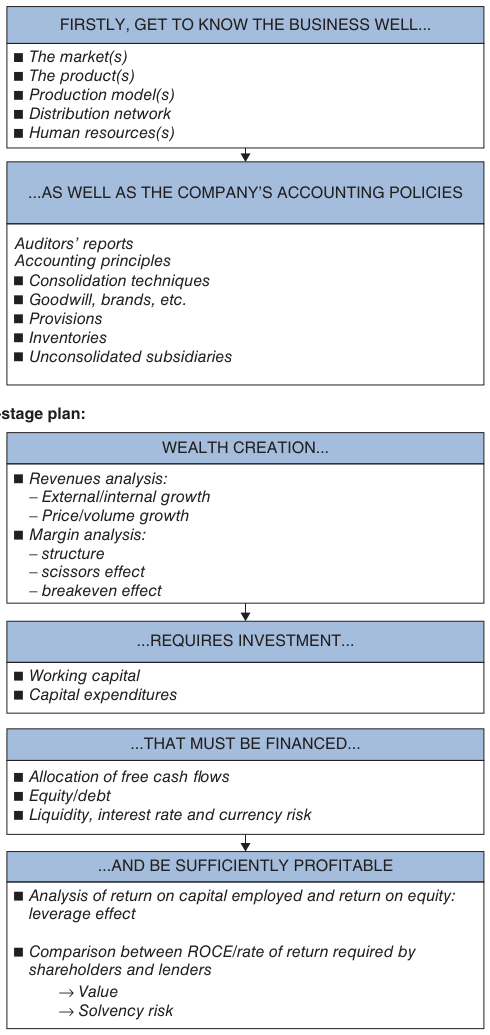
cornerstone of economic decision-making. To perform financial analysis, you must first understand the firmâs basic financial mechanics (Chapters 2â5). Next you must master the basic techniques of accounting, including accounting principles, consolidation techniques and certain complexities (Chapters 6â7), based on international (IFRS) standards now mandatory in over 80 countries, including the EU (for listed companies), Australia, South Africa and accepted by the SEC for US listing. In order to make things easier for the new-comer to finance, we have structured the presentation of financial analysis itself around its guiding principle: in the long run, a company can survive only if it is solvent and creates value for its shareholders. To do so, it must generate wealth (Chapters 9 and 10), invest (Chapter 11), finance its investments (Chapter 12) and generate a sufficient return (Chap-ter 13). The illustrative financial analysis of the Italian appliance manufacturer Indesit will guide you throughout this section of the book.
Section II reviews the basic theoretical knowledge you will need to make an
assessment of the value of the firm. Here again, the emphasis is on reasoning, which in many cases will become automatic (Chapters 15â19): efficient capital markets, the time value of money, the price of risk, volatility, arbitrage, return, portfolio theory, present value and future value, market risk, beta, etc. Then we review the major types of finan-cial securities: equity, debt and options, for the purposes of valuation, along with the techniques for issuing and placing them (Chapters 20â25).
Section III , is devoted to value, to its theoretical foundations and to its compu-
tation. Value is the focus of any financier, both its measure and the way it is shared. Over the medium term, creating value is, most of the time, the first aim of managers (Chapters 26â31).
InSection IV , âCorporate financial policiesâ, we analyse each financial decision in
terms of:tvalue in the context of the theory of efficient capital markets;
tbalance of power between owners and managers, shareholders and debtholders (agency theory);
tcommunication (signal theory).
Such decisions include choosing a capital structure, investment decisions, cost of capital, dividend policy, share repurchases, capital increases, hybrid security issues, etc.
In this section, we draw your attention to todayâs obsession with earnings per share,
return on equity and other measures whose underlying basis we have a tendency to forget and which may, in some cases, be only distantly related to value creation. We have devoted considerable space to the use of options (as a technique or a type of reasoning) in each financial decision (Chapters 32â39).
When you start reading Section V , âFinancial managementâ, you will be ready to
examine and take the remaining decisions: how to create and finance a start up, how to organise a companyâs equity capital and its governance, buying and selling companies,
PREFACEfm.indd 04:42:10:PM 09/08/2014 Page x Trim Size: 189 X 246 mm
x
Corporate Finance Learning Resources
- The book covers advanced corporate finance topics including mergers, LBOs, restructuring, and the intersection of finance and strategy.
- Pedagogical features include over 800 problems with solutions, a comprehensive index, and a one-page 'crib sheet' summarizing the entire 1000-page text.
- The companion website vernimmen.com offers free access to financial data for over 16,000 global companies and an Excel file with detailed problem solutions.
- Authors provide a direct communication channel via a letterbox, promising responses to reader questions within 72 hours.
- A free monthly newsletter supplements the text by analyzing topical financial problems, research papers, and current market statistics.
Weâve used the last page of the book to provide a crib sheet (the nearly 1000 pages of this book summarised on one page!).
mergers, demergers, LBOs, bankruptcy and restructuring (Chapters 40â47). Lastly, this section presents cash flow management, working capital management and the manage-ment of the firmâs financial risks (Chapters 48â50).
Last but not least, the epilogue addresses the question of the links between finance
and strategy.Suggestions for the readerTo make sure that you get the most out of your book, each chapter ends with a summary and a series of problems and questions (over 800 with the solutions provided). Weâve used the last page of the book to provide a crib sheet (the nearly 1000 pages of this book summarised on one page!). For those interested in exploring the topics in greater depth, there is an end-of-chapter bibliography and suggestions for further reading, covering fun-damental research papers, articles in the press, published books and websites. A large number of graphs and tables (over 100!) have been included in the body of the text and these can be used for comparative analyses. Finally, there is a fully comprehensive index.
The masculine pronoun has been used throughout this book simply for convenience
and brevity. This use is not intended to be discriminatory in any way.An Internet site with huge and diversified contentwww.vernimmen.com provides free access to tools (formulas, tables, statistics, lexicons,
glossaries); resources that supplement the book (articles, prospectuses of financial transactions, financial figures for over 16 000 European, North American and emerging countries, listed companies, thesis topics, thematic links, a list of must-have books for your bookshelf, an Excel file providing detailed solutions to all of the problems set in the book); plus problems, case studies and quizzes for testing and improving your knowledge. There is a letterbox for your questions to the authors (we reply within 72 hours, unless, of course, you manage to stump us!). There are questions and answers and much more. The site has its own internal search engine, and new services are added regularly. The Internet site is already visited by over 1000 unique visitors a day.
A teachersâ area provides teachers with free access to case studies, slides and an
Instructorâs Manual, which gives advice and ideas on how to teach all of the topics discussed in the book.A free monthly newsletter on corporate financeSince (unfortunately) we canât bring out a new edition of the this book every month, we have set up the Vernimmen.com Newsletter , which is sent out free of charge to subscribers
via the web. It contains:tA conceptual look at a topical corporate finance problems (e.g. accounting for operat-ing and capital leases, financially managing during a deflation phase).
tStatistics and tables that you are likely to find useful in the day-to-day practice of corporate finance (e.g. corporate income tax rates, debt ratios in LBOs).
PREFACEfm.indd 04:42:10:PM 09/08/2014 Page xi Trim Size: 189 X 246 mm
xi
tA critical review of a financial research paper with a concrete dimension (e.g. the
real effect of corporate cash, why donât US issuers demand European fees for their IPOs? ).
tA question left on the vernimmen.com site by a visitor plus a response (e.g. Why do
successful groups have such a low debt level? What is an assimilation clause? ).
Subscribe to www.vernimmen.com and become one of the many readers of the
Acknowledgements and Financial Symbols
- The authors express gratitude to a wide network of contributors, including academic peers, MBA students, and technical staff who refined the manuscript.
- A heartfelt dedication is made to the authors' families and friends for their patience during the long years of the book's production.
- The text transitions from personal acknowledgements to a comprehensive glossary of corporate finance abbreviations and symbols.
- The symbols list covers essential valuation metrics such as DCF, EBITDA, and NPV, alongside complex financial instruments like DECS and CVRs.
- The section establishes the book's dual purpose as both a foundational textbook for students and a reference guide for practicing professionals.
And last but not least to Françoise, Anne-ValÊrie, Enrica and Annalisa; our children Paul, Claire, Pierre, Philippe, Soazic, Solène and Aymeric and our many friends who have had to endure our endless absences over the last years.
Vernimmen.com Newsletter.Many thankstTo Damien Anzel, Patrice Carlean-Jones, Raquel Castillo, Geoffrey Coombs, Matthew Cush, Carlos Domingues, Pierre Foucry, Simon Gueguen, Daniel Hagge, Robert Killingsworth, Patrick Iweins, Bertrand Jacquillat, Pierre Laur, Franck Megel, François Meunier, John Olds, Laetitia Remy, Gita Roux, Mehdi Sethom, Steven Sklar, Sarah Taheri, Guillaume Veber, Marc Vermeulen, Georges Watkinson-Yull, and students of the HEC Paris and Bocconi MBA programmes for their help in improving the manuscript.
tTo Altimir Perrody, the vernimmen.com webmaster.
tTo Isabelle MariĂŠ-Sall for her help in transforming our scribblings into a proper manuscript.
tAnd last but not least to Françoise, Anne-ValÊrie, Enrica and Annalisa; our children Paul, Claire, Pierre, Philippe, Soazic, Solène and Aymeric and our many friends who have had to endure our endless absences over the last years, and of course Catherine Vernimmen and her children for their everlasting and kind support.
We hope that you will gain as much enjoyment from your copy of this book â whether you are a new student of corporate finance or are using it to revise and hone your financial skills â as we have had in editing this edition and in expanding the services and products that go with it.
We wish you well in your studies!
Paris, July 2014
Pascal Quiry Maurizio DallocchioYann Le Fur Antonio Salvi
fm.indd 04:42:10:PM 09/08/2014 Page xii Trim Size: 189 X 246 mm
Frequently used symbols
AKNAnnuity factor for N years and an interest rate of k
ABCP Asset Backed Commercial PaperADR American Depositary ReceiptAGM Annual General MeetingAPT Arbitrage Pricing TheoryAPV Adjusted Present ValueBIMBO Buy In Management Buy OutBV Book ValueBV/S Book Value per ShareCAGR Compound Annual Growth RateCapex Capital ExpendituresCAPM Capital Asset Pricing ModelCB Convertible BondCD Certificate of DepositCE Capital EmployedCFROI Cash Flow Return On InvestmentCOV CovarianceCVR Contingent Value RightD Debt, net financial and banking debtd Payout ratio
DCF Discounted Cash FlowsDDM Dividend Discount ModelDECS Debt Exchangeable for Common Stock; Dividend Enhanced Convertible
Securities
Div DividendDPS Dividend Per ShareEBIT Earnings Before Interest and TaxesEBITDA Earnings Before Interest, Taxes, Depreciation and AmortisationECP European Commercial PaperEGM Extraordinary General MeetingEMTN Euro Medium-Term NoteENPV Expanded Net Present ValueEONIA Euro OverNight Index AverageEPS Earnings Per ShareE(r) Expected return
ESOP Employee Stock Ownership ProgrammeEURIBOR Euro Interbank Offered RateEV Enterprise Value
FREQUENTLY USED SYMBOLS xiiifm.indd 04:42:10:PM 09/08/2014 Page xiii Trim Size: 189 X 246 mm
EV A Economic Value Addedf Forward rate
F Cash flowFA Fixed AssetsFASB Financial Accounting Standards BoardFC Fixed CostsFCF Free Cash FlowFCFE Free Cash Flow to EquityFCFF Free Cash Flow to FirmFE Financial ExpensesFIFO First In, First OutFRA Forward Rate Agreementg Growth rate
GAAP Generally Accepted Accounting PrinciplesGDR Global Depositary Receipti After-tax cost of debt
IAS International Accounting Standards IASB International Accounting Standards BoardIFRS International Financial Reporting StandardIPO Initial Public OfferingIRR Internal Rate of ReturnIRS Interest Rate SwapIT Income Taxesk Cost of capital, discount rate
k
D Cost of debt
kE Cost of equity
K Option strike price
LBO Leveraged BuyoutLBU Leveraged Build-UpL/C Letter of CreditLIBOR London Interbank Offered RateLIFO Last In, First OutLMBO Leveraged Management Buyoutln Naperian logarithmLOI Letter Of Intentm Contribution margin
MOU Memorandum Of UnderstandingMTN Medium-Term NotesMV A Market Value Addedn Years, periods
N Number of years
N(d) Cumulative standard normal distribution
NA Not availableNA V Net Asset ValueNM Not MeaningfulNOPAT Net Operating Profit After TaxNPV Net Present ValueOTC Over The CounterP Price
FREQUENTLY USED SYMBOLSfm.indd 04:42:10:PM 09/08/2014 Page xiv Trim Size: 189 X 246 mm
The Role of Corporate Finance
- The financial manager serves as a vital intermediary between the real economy of goods and services and the complex world of financial markets.
- Traditional views define the financial manager as a buyer of capital focused on minimizing costs from bankers and shareholders.
- A modern perspective frames the financial manager as a seller of financial securities who aims to maximize their market value.
- The text distinguishes between the business manager, who handles operations and physical assets, and the financial manager, who manages capital supply.
- Corporate finance operates within a capital market economy where money is treated as the primary commodity for transaction.
The financial manager is at the crossroads of the real economy, with its industries and services, and the world of finance, with its various financial markets and structures.
xiv
PBO Projected Benefit ObligationPBR Price-to-Book RatioPBT Profit Before TaxP/E ratio Price/Earnings ratioPEPs Personal Equity PlansPERCS Preferred Equity Redemption Cumulative StockPSR Price-to-Sales RatioP-to-P Public-to-PrivatePV Present ValuePVI Present Value IndexQIB Qualified Institutional Buyerr Rate of return, interest rate
r
F Risk-free rate
rM Expected return of the market
RNA V Restated Net Asset ValueROA Return On AssetsROCE Return On Capital EmployedROE Return On EquityROI Return On InvestmentRWA Risk-Weighted AssessmentS Sales
SEC Securities and Exchange CommissionSEO Seasoned Equity OfferingSPV Special Purpose VehicleSTEP Short-Term European Papert Interest rate, discount rate
T Time remaining until maturity
T
c Corporate tax rate
TSR Total Shareholder ReturnUCITS Undertakings for Collective Investment in Tranferable Securities V Value
V
D Value of Debt
VE Value of Equity
V(r) Variance of return
V AT Value Added TaxVC Variable CostWACC Weighted Average Cost of CapitalWC Working Capitaly Yield to maturity
YTM Yield to maturityZ Scoring function
ZBA Zero Balance Accountβ or β
E Beta coefficient for a share or an equity instrument
βA Beta coefficient for an asset or unlevered beta
βD Beta coefficient of a debt instrument
Ď(r) Standard deviation of return
Ď(A,B) Correlation coefficient of return between shares A and B
Chapter 1
WHAT IS CORPORATE FINANCE ?
To whet your appetite . . .
The primary role of the financial manager is to ensure that his company has a sufficient supply of capital.
The financial manager is at the crossroads of the real economy , with its industries
and services, and the world of finance , with its various financial markets and structures.
There are two ways of looking at the financial managerâs role:
ta buyer of capital who seeks to minimise its cost, i.e. the traditional view;
ta seller of financial securities who tries to maximise their value. This is the view we will develop throughout this book. It corresponds, to a greater or lesser extent, to the situation that exists in a capital market economy, as opposed to a credit-based economy.At the risk of oversimplifying, we will use the following terminology in this book:
tthefinancial manager or chief financial officer (CFO) is responsible for financing
the firm and acts as an intermediary between the financial systemâs institutions and markets, on the one hand, and the company, on the other;
tthebusiness manager invests in plants and equipment, undertakes research, hires
staff and sells the firmâs products, whether the firm is a manufacturer, a retailer or a service provider;
tthefinancial investor invests in financial securities. More generally, the financial
investor provides the firm with financial resources, and may be either an equity inves-tor or a lender.
Section 1.1
THE FINANCIAL MANAGER IS FIRST AND FOREMOST A SALESMAN . . .
1/THE FINANCIAL MANAGER âS JOB IS NOT ONLY TO âBUYâ FINANCIAL
RESOURCES . . .
The financial manager is traditionally perceived as a buyer of capital. He negotiates with a variety of investors â bankers, shareholders, bond investors â to obtain funds at the lowest possible cost.
CORPORATE FINANCE 2
Transactions that take place on the capital markets are made up of the following
elements:ta commodity: money,
The Financial Manager's Dual Role
- The traditional view defines the financial manager as a purchaser of capital whose primary goal is to minimize the cost of funds.
- This procurement role involves negotiating interest rates, value dates, and commissions with bankers and intermediaries.
- An alternative perspective frames the financial manager as a salesman who seeks to maximize the selling price of financial securities.
- In this 'salesman' model, the focus shifts from minimizing interest rates to maximizing the market value of the company's instruments.
- The capital market can be viewed symmetrically: the supply of securities equals the demand for capital, and vice versa.
- Ultimately, the equilibrium price in this market can be expressed either as the cost of funds or as the value of the security.
That said, letâs now take a look at the financial managerâs job from a different angle: he is not a buyer but a seller; his aim is not to reduce the cost of the raw material he buys but to maximise a selling price.
ta price: the interest rate in the case of debt; dividends and capital gains in the case of equities.
In the traditional view, the financial manager is responsible for the companyâs financial procurement. His job is to minimise the price of the commodity to be purchased, i.e. the
cost of the funds he raises.
We have no intention of contesting this view of the world. It is obvious and is con-
firmed every day, in particular in the following types of negotiations:tbetween corporate treasurers and bankers, regarding interest rates and value dates applied to bank balances (see Chapter 49);
tbetween chief financial officers and financial market intermediaries, where nego-tiation focuses on the commissions paid to arrangers of financial transactions (see Chapter 25).
2/ . . . BUT ALSO TO SELL FINANCIAL SECURITIES
That said, letâs now take a look at the financial managerâs job from a different angle:the is not a buyer but a seller ;
this aim is not to reduce the cost of the raw material he buys but to maximise a sell-
ing price ;
the practises his art not on the capital markets, but on the market for financial instru-ments, be they loans, bonds, shares, etc.
We are not changing the world here; we are merely looking at the same market from another point of view:tthesupply of financial securities corresponds to the demand for capital;
tthedemand for financial securities corresponds to the supply of capital;
ttheprice , the point at which the supply and demand for financial securities are in
equilibrium, is therefore the value of security . In contrast, the equilibrium price
in the traditional view is considered to be the interest rate, or the cost of funds.
We can summarise these two ways of looking at the same capital market in the following table:
Analysis/ApproachFinancial approach: ďŹnancial manager as salesmanTraditional approach: ďŹnancial manager as purchaser
Market Securities Capital
Supply Issuers InvestorsDemand Investors IssuersPrice Value of security Interest rate
Chapter 1 WHAT IS CORPORATE FINANCE ? 3
The Financial Manager as Salesman
- Interest rates and security values move in opposite directions, establishing a fundamental theorem that minimizing financing costs is synonymous with maximizing security value.
- Viewing the financial manager as a seller of securities shifts the focus toward understanding and satisfying the specific needs of capital suppliers.
- Financial markets are subject to trends and fashions, requiring managers to repackage financial products like convertible bonds or syndicated loans to meet current demand.
- Relying solely on the lowest cost of capital as a decision-making criterion is flawed because it ignores the varying risk levels faced by different investors.
- Short-sighted decisions, such as over-leveraging short-term debt or granting mortgages for minor rate decreases, can jeopardize a company's long-term survival.
- The phrase 'it doesn't cost anything' should be banished from corporate finance and replaced with an analysis of an action's impact on total value.
The most dangerous thing a financial manager can say is, âIt doesnât cost anything.â
Depending on your point of view, i.e. traditional or financial, supply and demand are reversed, as follows:twhen the cost of money â the interest rate, for example â rises , demand for funds is
greater than supply. In other words, the supply of financial securities is greater than the demand for financial securities, and the value of the securities falls ;
tconversely, when the cost of money falls , the supply of funds is greater than demand.
In other words, the demand for financial instruments is greater than their supply and the value of the securities rises .
The cost of capital and the value of the securities vary in opposite directions. We can summarise with the following theorem, fundamental to this entire book:Minimising ďŹnancing cost is synonymous with maximising the value of the underlying securities.For two practical reasons, one minor and one major, we prefer to present the financial manager as a seller of financial securities.
The minor reason is that viewing the financial manager as a salesman trying to sell
his products at the highest price casts his role in a different light. As the merchant does not want to sell low-quality products but products that respond to the needs of his custom-ers, so the financial manager must understand his capital suppliers and satisfy their needs without putting the company or its other capital suppliers at a disadvantage. He must sell
high-quality products at high prices . But he can also repackage his product to better
meet investor expectations. Indeed, financial markets are subject to fashion: in one period convertible bonds (see Chapter 2) can be easily placed; in another period it will be syndi-cated loans (see Chapter 21) that investors will welcome.
The more important reason is that when a financial manager applies the traditional
approach of minimising the cost of the companyâs financing too strictly, erroneous deci-sions may easily follow. The traditional approach can make the financial manager short-
sighted , tempting him to take decisions that emphasise the short term to the detriment of
the long term.
For instance, choosing between a capital increase, a bank loan and a bond issue with
lowest cost as the only criterion reflects flawed reasoning. Why? Because suppliers of cap-ital, i.e. the buyers of the corresponding instruments, do not all face the same level of risk.The investorâs risk must be taken into account in evaluating the cost of a source of ďŹnancing.The cost of two sources of financing can be compared only when the suppliers of the funds incur the same level of risk.
All too often we have seen managers or treasurers assume excessive risk when choos-
ing a source of financing because they have based their decision on a single criterion: the respective cost of the different sources of funds. For example:tincreasing short-term debt on the pretext that short-term interest rates are lower than long-term rates can be a serious mistake;
tgranting a mortgage in return for a slight decrease in the interest rate on a loan can be very harmful for the future;
tincreasing debt systematically on the sole pretext that debt costs less than equity capital jeopardises the companyâs prospects for long-term survival.
CORPORATE FINANCE 4
We will develop this theme further throughout the third part of this book, but we
would like to warn you now of the pitfalls of faulty financial reasoning. The most dan-
gerous thing a financial manager can say is, âIt doesnât cost anything.â This sentence should be banished and replaced with the following question: âWhat is the impact of this action on value?â
Section 1.2
. . . OF FINANCIAL SECURITIES . . .
Letâs now take a look at the overall concept of a financial security, the product created by the financial manager.
1/ISSUANCE OR CREATION OF SECURITIES
The Essence of Financial Instruments
- A financial instrument is fundamentally a contract defined as a schedule of future cash flows executed over time.
- Holding a security represents the right to receive cash flows, while issuing one represents a commitment to pay them.
- The transition from paper documents to intangible book entries highlights that the core of finance is the underlying information and contract.
- Time is the critical element that introduces risk, as various external factors can disrupt promised payments regardless of a borrower's intent.
- Financial logic transforms physical goods and services into cash flows, allowing real assets like sugar or property to be traded as fungible financial instruments.
- Markets facilitate the negotiation between issuers seeking funds and investors seeking rights to future obligations.
Time, or the term of the financial security, introduces the notion of risk.
There is a great variety of financial instruments, each of which has the following characteristics:tit is a contract . . .
t. . . executed over time, and . . .
tits value derives solely from the series of cash flows it represents.
Indeed, from a mathematical and more theoretical viewpoint, a financial instrument is defined as a schedule of future cash flows .
Holding a financial security is the same as holding the right to receive the cash flows,
as defined in the terms and conditions of the issue that gave rise to the financial instru-ment. Conversely, for the issuer, creating a financial instrument is the same as committing to paying out a series of cash flows. In return for this right to receive cash flows or for taking on this commitment, the company will issue a security at a certain price, enabling it to raise the funds needed to run its business.A ďŹnancial security is a contract . . . Youâve undoubtedly heard people say that the financial managerâs stock-in-trade is âpaperâ. Computerisation has now turned financial instruments from paper documents into intangible book entries, reducing them to the information they contain, i.e. the con-tract. The essence of finance is, and will always be, negotiation between an issuer seeking
new funds and the investors interested in buying the instruments that represent the under-lying obligations. And negotiation means markets, be they credit markets, bond markets, stock markets, etc.. . . executed over time . . . Time, or the term of the financial security, introduces the notion of risk. A debt instrument
that promises cash flows over time, for example, entails risk, even if the borrower is very creditworthy. This seems strange to many people who consider that âa deal is a dealâ or âa manâs word is his bondâ. Yet, experience has shown that a wide variety of risks can affect the payment of those cash flows, including political risk, strikes, natural disasters and other events.
Chapter 1 WHAT IS CORPORATE FINANCE ? 5
. . . and materialised by cash ďŹows.Further on in this book you will see that financial logic is used to analyse and choose among a firmâs investment options. The financial manager transforms flows of goods and services, deriving from the companyâs industrial and other business assets, into cash flows. You will soon understand that the world of finance is one of managing rights on
the one hand and commitments on the other, both expressed in terms of cash flows .
In a market for financial instruments, it is not the actual flows that are sold, but the
rights associated with them. The investor, i.e. the buyer of the security, acquires the rights granted by the instrument. The issuing company assumes contractual obligations deriving from the instrument, regardless of who the owner of the instrument is.
For example, commodity futures markets make it possible to perform purely finan-
cial transactions. You can buy sugar âforwardâ, via financial instruments called futures contracts, knowing full well that you will never take delivery of the sugar into your ware-house. Instead, you will close out the position prior to maturity. The financial manager thus trades on a market for real goods (sugar), using contracts that can be unwound prior to or at maturity.
A property investor acts similarly. After acquiring real property, the value of which
fluctuates, he can lease it or resell it. Viewed this way, real property is as fungible as any other property and is akin to a financial asset.
Clearly, these assets exhibit different degrees of âfinancialityâ. To take the argument
Defining Financial Instruments
- The distinction between a real asset and a financial asset often depends on the investor's motivation rather than the physical object.
- Financial securities are undifferentiated and can be held by many investors simultaneously, unlike unique physical assets like specific buildings.
- Mathematically, every financial instrument is defined as a series of future cash flows scheduled over a specific timeframe.
- Debt instruments represent a binding commitment from a borrower to repay a lender with interest.
- Loans transform into financial securities when they become negotiable and listed on secondary markets, such as bonds or commercial paper.
The distinction between a real asset and a financial asset is therefore subtle but fundamental.
one step further, you turn a painting into a financial instrument when you put it in your safe in the hope of realising a gain when you sell it.
The distinction between a real asset and a financial asset is therefore subtle but fun-
damental. It lies either in the nature of the contract or in the investorâs motivation, as in the example of the painting.
Lastly, the purchase of a financial security differs from the purchase of a durable
good in that the financial security is undifferentiated. A large number of investors can buy the same financial security. In contrast, acquiring a specific office building or building an industrial plant is a very specific, unique investment.In conclusion, every ďŹnancial instrument represents a series of cash ďŹows to be received according to a set timetable. Mathematically, it can be expressed as a series of future cash ďŹows F
1, F2, F3, F4 . . ., Fn over n periods.
2/TYPES OF FINANCIAL SECURITIES
(a)Debt instruments (Chapters 20 and 21)
The simplest financial instrument is undoubtedly the contract that ties a lender (investor) to a borrower (company). It represents a very strong commitment, not only to repay, but to repay with interest. Loans become financial securities when they are made negotiable on a secondary market (see page 7) and âlistedâ. Bonds and commercial paper fall into this category.
A bond is a negotiable debt security representing a fraction of a borrowing con-
tracted by a company, a financial institution or a sovereign state (gilts in the UK, Bunds in Germany, etc.).
CORPORATE FINANCE 6
Types of Financial Instruments
- Debt securities like commercial paper and treasury bills represent short-term loans where returns are contractually fixed or floating rather than profit-dependent.
- Equity securities represent capital contributions where investors bear industrial risk in exchange for profit shares and corporate voting rights.
- Limited liability structures protect shareholders by capping their potential losses at the amount of their initial investment.
- Hybrid securities created through financial engineering blur the lines between debt and equity to meet specific corporate and investor needs.
- Options represent a unique class of instruments that provide the holder with rights rather than obligations regarding future financial actions.
- Financial instruments exist on a broad spectrum ranging from strict commitments to flexible rights, all valued within the context of active markets.
Financial imagination knows no bounds. Keep in mind that these instruments are like the cherry on the top.
Commercial paper is a negotiable debt security representing a fraction of a short-
term borrowing (generally between one day and two years) contracted by a company. If the company is a bank, the security will be called a certificate of deposit . Short-term
sovereign debt instruments go by different names depending on the country; in Spain, for example, they are called Bonos del Estado , while they are called Treasury Bills in the US.
Strictly speaking, investors in these securities do not assume any industrial risk.
Their return is set contractually and may be fixed or floating (i.e. variable). If it is float-
ing, it will be indexed on an interest rate and not on the results of the company.
In Chapter 21 we will see that the lender nevertheless assumes certain risks, namely
the failure of the borrower to honour the debt contract.(b)Equity securities (Chapter 22)
Equity represents the capital injected into a company by an investor who bears the full
risk of the companyâs industrial undertakings in return for a share of the profits.
If the company is organised under a limited liability structure, the equity is divided
intoshares . The risk borne by the shareholders is limited to the amount they contribute to
the firm. Unless otherwise noted, we will be dealing in this book with finance as it relates to the various forms of âlimited companiesâ.
Shareholdersâ equity is a source of financing for the enterprise, but the related finan-
cial security, the share, guarantees the investor neither a fixed level of income nor repay-ment. The shareholder can realise his investment only by selling it to someone else. The investor obtains certain corporate rights, however: a claim on the companyâs earnings and â via his voting rights â management oversight.(c)Other securities (Chapter 24)
As you will discover in Chapter 24, financial engineering specialists have invented hybrid securities that combine the characteristics of the two categories discussed above. Some securities have the look and feel of equity from the point of view of the company, but the corresponding cash flows are fixed, at least partially. Others instruments have yields that are dependent on the performance of the company, but are considered loans, not equity capital. Financial imagination knows no bounds. Keep in mind that these instruments are like the cherry on the top. As such, we wonât tempt you with them until Chapter 24!
There is a specific type of financial instrument, however, the option, whose associ-
ated cash flows are actually less âimportantâ to the investor than the rights the option conveys. This instrument grants the right, but not the obligation, to do something.
In sum, financial instruments carry a wide spectrum of characteristics, which, from
the investorâs point of view, ranges from rights to commitments.
Section 1.3
. . . VALUED CONTINUOUSLY BY THE FINANCIAL MARKETS
Our view of finance can take shape only in the context of well-developed financial mar-kets. But before examining the technical characteristics of markets (Section II of this book), letâs spend a moment on definitions.
Chapter 1 WHAT IS CORPORATE FINANCE ? 7
1/FROM THE PRIMARY MARKET TO THE SECONDARY MARKET
Primary and Secondary Markets
- A financial security exists independently of its issuer once launched, serving as a vehicle for various investor strategies.
- The primary market is the venue for 'newly-minted' securities where entities like corporations and governments raise fresh capital.
- The secondary market facilitates the trading of 'used' securities, allowing assets to change hands without creating new financial instruments.
- Liquidity is the defining feature of the secondary market, allowing investors to convert assets into cash quickly without significant price disruption.
- The secondary market is essential for long-term investments like equity, as it provides the only exit strategy for shareholders.
- While conceptually distinct, the two markets are functionally integrated, together balancing financing needs with available capital.
Once launched by its issuer, a ďŹnancial security lives a life of its own.
Once launched by its issuer, a ďŹnancial security lives a life of its own. It is sold from one investor to another, and it serves as support for other transactions. The instrument itself evolves, but the terms of the contract under which it was issued do not.The life of a financial security is intimately connected with the fact that it can be bought or sold at any moment. For example, shares issued or created when a company is founded can later be floated on a stock exchange, just as long-term bonds may be used by specula-tors for short-term strategies.
The new issues market (i.e. creation of securities) is called the primary market.
Subsequent transactions involving these securities take place on the secondary market .
Both markets, like any market, are defined by two basic elements: the product (the security) and the price (its value).
From the point of view of the company, the distinction between the primary and sec-
ondary markets is fundamental. The primary market is the market for ânewâ financial
products , from equity issues to bond issues and everything in between. It is the market
for newly-minted financial securities where the company can raise fresh money.
Conversely, the secondary market is the market for âusedâ financial products.
Securities bought and sold on this market have already been created and are now simply changing hands, without any new securities being created.
The primary market enables companies, financial institutions, governments and local
authorities to obtain financial resources by issuing securities. These securities are then listed and traded on secondary markets. The job of the secondary market is to ensure that securities are properly priced and traded. This is the essence of liquidity : facilitating the
purchase or sale of a security.
The distinction between primary and secondary markets is conceptual only. The two
markets are not separated from each other. A given financial investor can buy either exist-ing shares or new shares issued during a capital increase, for example.
If there is often more emphasis placed on the primary market, it is because the func-
tion of the financial markets is, first and foremost, to ensure equilibrium between financ-ing needs and the sources of finance. Secondary markets, where securities can change hands, constitute a kind of financial âinnovationâ.
2/THE FUNCTION OF THE SECONDARY MARKET
Financial investors do not intend to remain invested in a particular asset indefinitely. From the moment they buy a security (or even before), they begin thinking about how they will exit. As a result, they are constantly evaluating whether they should buy or sell such and
such an asset.
Monetising is relatively easy when the security is a short-term one. All the investor
has to do is wait until maturity. The need for an exit strategy grows with the maturity of the investment and is greatest for equity investments, whose maturity is unlimited. The only way a shareholder can exit his investment is to sell his shares to someone else.
As an example, the successful business person who floats his company on the stock
exchange, thereby selling part of his shares to new shareholders, diversifies his own port-folio, which before flotation was essentially concentrated in one investment.
CORPORATE FINANCE 8
The secondary market makes the investorâs investments liquid.Liquidity refers to the ability to convert an instrument into cash quickly and without loss
of value. It affords the opportunity to trade a financial instrument at a âlistedâ price and in large quantities without disrupting the market. An investment is liquid when an investor can buy or sell it in large quantities without causing a change in its market price.
The secondary market is therefore a zero-sum game between investors, because
Secondary and Derivative Markets
- Secondary markets operate independently of issuers, allowing investors to trade existing securities without affecting the company's capital formation statistics.
- The quality and liquidity of a secondary market directly dictate the success and pricing of the primary market for new securities.
- Financial managers must monitor secondary markets because they price the company's 'raw material' and facilitate the trading of voting rights and corporate control.
- Derivative markets, including futures and options, allow managers to hedge financial risks or take leveraged speculative positions with limited initial capital.
- The financial manager ultimately sells the management's reputation as the core value proposition behind any security issued.
Think about it: who would want to buy a financial security on the primary market, knowing that it will be difficult to sell it on the secondary market?
what one investor buys, another investor sells. In principle, the secondary market operates completely independently from the issuer of the securities.
A company that issues a bond today knows that a certain amount of funds will
remain available in each future year. This knowledge is based on the bondâs amortisa-tion schedule. During that time, however, the investors holding the bonds will have changed.
Secondary market transactions do not show up in macroeconomic statistics on capi-
tal formation, earning them the scorn of some observers who claim that the second-ary market does nothing to further economic development, but only bails out the initial investors.
We believe this thinking is misguided and reflects great ignorance about the function
of secondary markets in the economy. Remember that a financial investor is constantly comparing the primary and secondary markets. He cares little whether he is buying a ânewâ or a âusedâ security, so long as they have the same characteristics.The secondary market plays the fundamental role of valuing securities.In fact, the quality of a primary market for a security depends greatly on the quality of its secondary market. Think about it: who would want to buy a financial security on the primary market, knowing that it will be difficult to sell it on the secondary market?
The secondary market determines the price at which the company can issue its secu-
rities on the primary market, because investors are constantly deciding between existing investments and proposed new investments.
We have seen that it would be a mistake to think that a financial manager takes no
interest in the secondary market for the securities issued by his company. On the contrary, it is on the secondary market that his companyâs financial âraw materialâ is priced every day. When the raw material is equities, there is another reason the company cannot afford to turn its back on the secondary market: this is where investors trade the voting rights in the companyâs affairs and, by extension, control of the company.
3/DERIVATIVE MARKETS : FUTURES AND OPTIONS
Derivative markets are where securities that derive their value from another asset (share, bond, commodity or even climate index) are traded. There are two main types of deriva-tive products: options (which we will develop in Chapter 23 as they have become a key matter in financial theory and practice) and futures (Chapter 50).Derivatives are instruments for taking positions on other instruments, or âcontracts on contractsâ. They let you take signiďŹcant short or long positions on other assets with a limited outlay of funds.
Chapter 1 WHAT IS CORPORATE FINANCE ? 9
Derivative instruments are tailored especially to the management of financial risk. By
using derivatives, the financial manager chooses a price â expressed as an interest rate, an exchange rate or the price of a raw material â that is independent of the companyâs financing or investment term. Derivatives are also highly liquid. The financial manager can change his mind at any time at a minimal cost.
Options and futures allow one to take important risks with a reduced initial outlay
due to their leverage effect (this is called speculation), or on the contrary to transfer risks to a third party (hedging).
Section 1.4
MOST IMPORTANTLY , HE IS A NEGOTIATOR . . .
Letâs return to our financial manager who has just created a financial security. Because the security is traded on a secondary market, he doesnât know who holds the securities. Nor does he know who has sold it, especially as, via the futures market, investors can sell the security without ever having bought it.
But what exactly is our financial manager selling? Or, put another way: how can the
value of the financial security be determined?
From a practical standpoint, the financial manager âsellsâ managementâs reputation
The Financial Manager's Mandate
- The financial manager's primary role is transforming industrial and commercial assets into financial instruments for diverse investor groups.
- A company's ability to distribute cash is strictly limited by its business operations; paying creditors or dividends without profit jeopardizes long-term health.
- Market perception acts as a real-time valuation of management quality, where poor performance leads to prohibitive yields and falling security prices.
- Investors are driven by expected rates of return rather than altruism, requiring the company to meet or exceed specific financial benchmarks.
- Value creation occurs only when investment returns exceed the cost of capital, while falling short leads to 'corporate purgatory' and value destruction.
- The financial manager must act as a strategic dealmaker, balancing the competing motivations and power dynamics of various capital providers.
If not, if the company is consistently falling short of this goal, it will destroy value, turning what was worth 100 into 90, or 80. This is corporate purgatory.
for integrity, its expertise, the quality of the companyâs assets, its overall financial health, its ability to generate a certain level of profitability over a given period and its commit-ment to more or less restrictive legal terms. Note that the quality of assets will be par-ticularly important in the case of a loan tied to and often secured by specific assets, while overall financial health will dominate when financing is not tied to specific assets.
Theoretically, the financial manager sells expected future cash flows that can derive
only from the companyâs business operations.
A company cannot distribute more cash flow to its providers of funds than its busi-
ness generates. A money-losing company pays its creditors only at the expense of its shareholders. When a company with sub-par profitability pays a dividend, it jeopardises its financial health.
The financial managerâs role is to transform the companyâs commercial and indus-
trial business assets and commitments into financial assets and commitments.
In so doing, he spreads the expected cash flows among many different investor
groups: banks, financial investors, family shareholders, individual investors, etc.
Financial investors then turn these flows into negotiable instruments traded on an
open market, which value the instruments in relation to other opportunities available on the market.
Underlying the securities is the marketâs evaluation of the company. A company
considered to be poorly managed will see investors vote with their feet. Yields on the companyâs securities will rise to prohibitive levels and prices on them will fall. Financial difficulties, if not already present, will soon follow. The financial manager must therefore keep the market convinced at all times of the quality of his company, because that is what backs up the securities it issues!
The different financial partners hold a portion of the value of the company. This
diversity gives rise to yet another job for the financial manager: he must adroitly steer
the company through the distribution of the overall value of the company.
CORPORATE FINANCE 10
Like any dealmaker, he has something to sell, but he must also:
tassess his companyâs overall financial situation;
tunderstand the motivations of the various participants;
tanalyse the relative powers of the parties involved.
Section 1.5
. . . WHO NEVER FORGETS TO DO AN OCCASIONAL REALITY CHECK !
The financial investors who buy the companyâs securities do so not out of altruism, but because they hope to realise a certain rate of return on their investment, in the form of interest, dividends or capital gains. In other words, in return for entrusting the company with their money via their purchase of the companyâs securities, they require a minimum return on their investment.
Consequently, the financial manager must make sure that over the medium term the
company makes investments with returns at least equal to the rate of return expected by the companyâs providers of capital. If so, all is well. If not, if the company is consistently fall-ing short of this goal, it will destroy value, turning what was worth 100 into 90, or 80. This is corporate purgatory. On the other hand, if the profitability of its investments consistently exceeds investor demands, transforming 100 into 120 or more, the company deserves the kudos it will get. But it should also remain humble. With technological progress and dereg-ulation advancing apace, repeat performances are becoming more and more challenging.
The financial manager must therefore analyse proposed investment projects and
The Strategic Financial Manager
- The financial manager acts as a 'party-pooper' by rejecting projects that fail to meet profitability thresholds.
- A core responsibility is ensuring the company's assets generate a rate of return equal to or greater than investor requirements.
- Financial managers must act as strategists, recommending the sale of underperforming units to reallocate capital to efficient divisions.
- Modern financial management requires mitigating external risks such as interest rate fluctuations and currency volatility.
- Global operations create a 'multi-headed dragon' of risk where commodity prices and exchange rates dictate performance.
Its performance depends not only on the price of copper but also on the exchange rate of the US dollar vs. the Swiss franc, because it uses the dollar to make purchases abroad and receives payment in dollars for international sales.
explain to his colleagues that some should not be undertaken because they are not prof-itable enough. In short, he sometimes has to be a âparty-pooperâ. He is indirectly the spokesman of the financial investment community.
The financial manager must ensure that the company creates value, that the assets it
has assembled will generate a rate of return into the medium term that is at least equal to the rate required by the investors whose capital has enabled the company to build those assets.
If not, he should discuss how to improve the situation with operational people. Some-
times he will become a strategist and suggest to the top management of his company that it should review its perimeter. Underperforming units where the company has been struggling to get a return commensurate with their risks should be sold to free up resources allowing it to expand, organically or through acquisitions, the most promising or efficient divisions.
Section 1.6
. . . HE IS ALSO NOW A RISK MANAGER
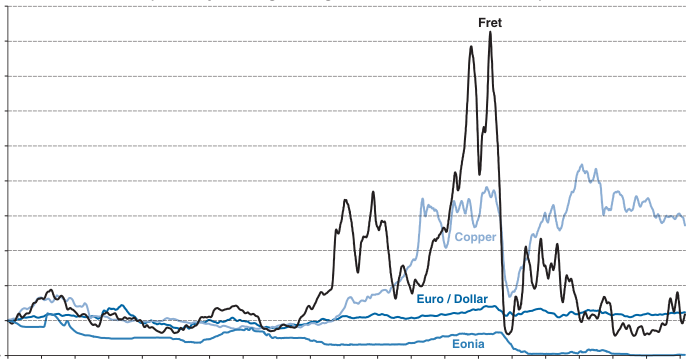
Fluctuations in interest rates, currencies and the prices of raw materials are so great that financial risks are as important as industrial risks. Consider a Swiss company that buys copper in the world market, then processes it and sells it in Switzerland and abroad.
Its performance depends not only on the price of copper but also on the exchange rate
of the US dollar vs. the Swiss franc, because it uses the dollar to make purchases abroad and receives payment in dollars for international sales. Lastly, interest rate fluctuations have an impact on the companyâs financial flows. A multi-headed dragon!
Chapter 1 WHAT IS CORPORATE FINANCE ? 11
The Evolving Role of CFOs
- Managing interest rate and exchange rate risks is essential as inaction can lead to severe financial consequences.
- Derivative markets allow treasurers to manage long-term risk efficiently without inflating the company balance sheet.
- The modern CFO has transitioned from a traditional accountant to a strategic leader skilled in marketing, negotiation, and risk management.
- Former CFOs are increasingly becoming top candidates for CEO positions at major global corporations like Siemens and Michelin.
- Effective financial management focuses on selling financial securities at high values rather than simply minimizing the cost of funds.
- A comprehensive understanding of corporate finance requires mastering financial analysis, market valuation, and value creation.
We are far from the CFOs of the sixties who were mainly top-of-the-class accountants!
The company must manage its specific interest rate and exchange rate risks because
doing nothing can also have serious consequences. As the bumper sticker says, âIf you think education is expensive, try ignorance!â
Take an example of an economy with no derivative markets. A corporate treasurer
anticipating a decline in long-term interest rates and whose company has long-term debt has no choice but to borrow short term, invest the proceeds long term, wait for interest rates to decline, pay off the short-term loans and borrow again. You will have no trouble understanding that this strategy has its limits. The balance sheet becomes inflated, inter-mediation costs rise, and so on. Derivative markets enable the treasurer to manage this long-term interest rate risk without touching his companyâs balance sheet.
Generally, the CFO is responsible for the identification, the assessment and the man-
agement of risks for the firm. This includes not only currency and interest rate risks but also liquidity and counterparty risk. Recent years have shown that a CFO with strong know-how in such matters is highly appreciated.
We are far from the CFOs of the sixties who were mainly top-of-the-class accoun-
tants! Nowadays they are required not only to perfectly master accounting and finance, but also to be gifted in marketing and negotiation, not to mention tax and legal issues and risk management. The best of them also have a strategic way of thinking, and their intimate knowledge of the company and its human resources allows them to be serious candidates for the top job. As an illustration, the current CEOs of Siemens, WPP, RTL, and Michelin are all former CFOs of their companies.
Howâs that appetite?Weâre going to leave you with these appetisers in the hope that you are now hungry
for more. But beware of taking the principles briefly presented here and skipping directly to Section III of the book. If you are looking for high finance and get-rich-quick schemes, this book is definitely not for you. The menu we propose is as follows:tFirst, an understanding of the firm, i.e. the source of all the cash flows that are the subject of our analysis ( Section I: Financial analysis ).
tThen an appreciation of markets, because it is they who are constantly valuing the firm ( Section II: Investors and markets ).
tThen an understanding of how value is created and how it is measured ( Section III: Value ).
tFollowed by the major financial decisions of the firm, viewed in the light of both market theory and organisational theory ( Section IV: Corporate financial policies ).
tFinally, if you persevere through the foregoing, you will get to taste the dessert, asSection V: Financial Management presents several practical, current topics in
financial management.
The summary of this chapter can be downloaded from www.vernimmen.com. The ďŹnancial manager has three main roles:tTo ensure the company has enough funds to ďŹnance its expansion and meet its obliga-tions. To do this, the company issues securities (equity and debt) and the ďŹnancial manager sells them to ďŹnancial investors at the highest possible price. In todayâs capital market economy, the role of the ďŹnancial manager is less a buyer of funds, with an objective to minimise cost, and more a seller of ďŹnancial securities. By emphasis-ing the ďŹnancial security, we focus on its value, which combines the notions of return and risk. We thereby de-emphasise the importance of minimising the cost of ďŹnancial SUMMARY
CORPORATE FINANCE 12
The Roles of Financial Management
- The financial manager acts as a salesman who must understand investor needs to successfully market the company's securities.
- Value creation depends entirely on generating a rate of return that meets or exceeds the rate required by investors.
- A critical role of the manager is acting as a 'party-pooper' by rejecting investment projects that do not meet the cost of funds.
- The manager must transform real assets into financial assets while ensuring operational performance is protected from financial volatility.
- Failure to create value leads to declining security prices, management turnover, or eventual bankruptcy.
He must be a âparty-pooperâ, a âMr Noâ who examines every proposed investment project under the microscope of expected returns and advises on whether to reject those that fall below the cost of funds available to the company.
resources, because this approach ignores the risk factor. Casting the ďŹnancial man-ager in the role of salesman also underlines the marketing aspect of his job, which is far from theoretical. He has customers (investors) that he must convince to buy the securities his company issues. The better he understands their needs, the more suc-cessful he will be.
tTo ensure that over the long run the company uses the resources investors put at its disposal to generate a rate of return at least equal to the rate of return the investors require. If it does, the company creates value. If it does not, it destroys value. If it continues to destroy value, investors will turn their backs on the company and the value of its securities will decline. Ultimately, the company will have to change its senior managers, or face bankruptcy.
tTo identify and manage the ďŹnancial risks the company is facing.
In his ďŹrst role, the ďŹnancial manager transforms the companyâs real assets into ďŹnancial assets. He must maximise the value of these ďŹnancial assets while selling them to the various categories of investors.His second role is a thankless one. He must be a âparty-pooperâ, a âMr Noâ who examines every proposed investment project under the microscope of expected returns and advises on whether to reject those that fall below the cost of funds available to the company. But it is also the job of a strategist who may go as far as to challenge the current perimeter of the companyâs activities.In his last role, the ďŹnancial manager guarantees that the operational performance of the company is not spoiled by ďŹnancial events.
1/Should the unexpected announcement of a rise in interest rates automatically result in a drop in the stock market i ndex?
2/Would your answer be the same if the announcement had been anticipated by the market? So what is the most important factor when valuing securities?
3/Other than the word âmarketâ, what is the key word in corporate finance?
4/How is it possible to sell something without actually having bought anything?
5/You are offered a loan at 7.5% over 10 years without guarantee, and a loan at 7% over 10 years with guarantee. You need the loan. How should you go about deciding which loan to take out?
6/Is a financial security a financial asset or a financial liability? Why?
7/Can you define a financial security?
8/Provide an example of something that was assumed to be a financial asset, but which proved on analysis to be a financial liability.QUESTIONS
Chapter 1 WHAT IS CORPORATE FINANCE ? 13
9/How important is it to think in terms of an offer of and a demand for securities, and not in terms of an offer of and a demand for capital, for:
âŚshares;
âŚbonds;
âŚmedium-term syndicated loans;
âŚbilateral bank loans.
Why?10/What other financial term should immediately spring to mind when you hear the word âreturnsâ?
11/In your view, are more securities issued on the primary market or exchanged on the secondary market?
12/What other financial term should immediately spring to mind when you hear the word âriskâ?
13/Which instrument carries the greater risk â a share or a bond? Why?
14/Explain how the poor performance of the secondary market can impact the primary market.
15/What are the two biggest flaws of a bad financial manager?
16/What are the two main types of securities issued by a firm?
17/Why do you believe management has to do some roadshows before issuing new shares or bonds?
18/Why would you finance a firmâs investments with a very short-term loan? What would the drawback be?More questions are waiting for you at www.vernimmen.com.
Questions
Foundations of Financial Analysis
- Financial securities are defined as tradable contracts representing a series of future cash flows to be received according to a specific timetable.
- The secondary market vastly outweighs the primary market in volume, with trillions in shares exchanged compared to billions in new issuances.
- Risk and return are inextricably linked, with shares carrying higher risk than debt because returns are not guaranteed and creditors have priority.
- Market anticipation is the most critical factor in valuing securities, often outweighing current automatic reactions to interest rate changes.
- Firms face a strategic trade-off between lower short-term interest rates and the significant liquidity risk of constant refinancing.
- Cash flow is established as the fundamental building block for both security valuation and corporate financial analysis.
In 2013, worldwide, listed companies issued $191bn worth of new shares, whereas the value of shares exchanged was $52 467bn.
1/As an automatic reaction, yes, as value moves in the opposite direction to interest rates.
2/The answer in this case would be no. The most important factor in valuing securities is anticipation.
3/Value.
4/On the futures market.
5/Is it worth providing a guarantee for a gain of 0.5%?
6/A financial asset if the present value of future flows is positive (which it is for the investor), and a liability if not (which is the case for the issuer).
7/A financial security is a tradable contract represented by a series of cash flows to be received according to a set timetable.
8/The inheritance of an estate, the debts of which exceed the value of the assets.
9/In order â 1 = very important; 2 = of moderate importance; 3 = unimportant: 1223,
because they are more easily traded.ANSWERS
CORPORATE FINANCE 14
10/Risk.
11/No, far fewer securities are issued on the primary market than exchanged on the secondary market. In 2013, worldwide, listed companies issued $191bn worth of new shares, whereas the value of shares exchanged was $52 467bn (source: World Federation of Exchanges).
12/Returns, the two are inextricably linked.
13/Shares, as returns are not guaranteed for the investor, and creditors are paid out before shareholders.
14/If the value of shares continues to decline long term, market pessimism descends, and investors become reluctant to subscribe shares on the primary market, as they are convinced that the value of such shares will fall once issued.
15/Shortsightedness and poor marketing skills.
16/Shares and debts (loans and bonds).
17/This is called marketing: they are trying to sell at best one product which is a financial instrument in order to lower their cost of funding.
18/To benefit from lower interest rates (as we will see in Chapter 19, short-term interest rates are generally lower than long-term interest rates). But in that case the firm will run a strong liquidity risk as it will constantly be subject to the availability of loans on the market. The firm would probably be better off taking a long-term financing.
S. Mian, On the choice and replacement of chief ďŹnancial ofďŹcers, Journal of Financial Economics ,60(1),
143â175, April 2001.
R. Norton, CFO Thought Leaders , Strategy Business Books, 2005.
M. Scott, Achieving Fair Value: How Companies Can Better Manage Their Relationships with Investors , John
Wiley & Sons Ltd, 2005.BIBLIOGRAPHY
c02.indd 11:57:54:AM 09/05/2014 Page 15 Trim Size: 189 X 246 mmSECTION 1
Section I
FINANCIAL ANALYSIS
c02.indd 11:57:54:AM 09/05/2014 Page 16 Trim Size: 189 X 246 mm
c02.indd 11:57:54:AM 09/05/2014 Page 17 Trim Size: 189 X 246 mmSECTION 1
PART ONE
FUNDAMENTAL CONCEPTS IN FINANCIAL ANALYSIS
The following six chapters provide a gradual introduction to the foundations of financial analysis. They examine the concepts of cash flow, earnings, capital employed and invested capital, and look at the ways in which these concepts are linked.
c02.indd 11:57:54:AM 09/05/2014 Page 18 Trim Size: 189 X 246 mm
c02.indd 11:57:54:AM 09/05/2014 Page 19 Trim Size: 189 X 246 mmSECTION 1Chapter 2
CASH FLOW
Letâs work from A to Z (unless it turns out to be Z to A!)
In the introduction, we emphasised the importance of cash flows as the basic building block of securities. Likewise, we need to start our study of corporate finance by analysing company cash flows.
Section 2.1
CLASSIFYING COMPANY CASH FLOWS
Cash Flow and Operating Cycles
- Financial managers reclassify cash flows into specific categories to analyze past trends and project future budgets.
- Company activities are divided into industrial/commercial processes (operating and investment) and financing activities (debt and equity).
- The operating cycle involves a time lag between the purchase of raw materials and the final sale of goods, which varies by industry.
- The length of the operating cycle can range from a single day in the newspaper business to seven years in the cognac industry.
- Credit terms from suppliers and to customers further complicate cash flow, as daily receipts rarely match daily sales.
A company processes raw materials as part of an operating cycle, the length of which varies tremendously, from a day in the newspaper sector to seven years in the cognac sector.
Letâs consider, for example, the monthly account statement that individual customers receive from their bank. It is presented as a series of lines showing the various inflows and outflows of money on precise dates and in some cases the type of transaction (deposit of cheques, for instance).
Our first step is to trace the rationale for each of the entries on the statement, which
could be everyday purchases, payment of a salary, automatic transfers, loan repayments or the receipt of bond coupons, to mention a few examples.
The corresponding task for a financial manager is to reclassify company cash flows
by category to draw up a cash flow document that can be used to:tanalyse past trends in cash flow (the document put together is generally known as a cash flow statement
1); or
tproject future trends in cash flow, over a shorter or longer period (the document needed is a cash flow budget or plan).
With this goal in mind, we will now demonstrate that cash flows can be classified into one of the following processes:tActivities that form part of the industrial and commercial life of a company:
âoperating cycle;
âinvestment cycle.
tFinancing activities to fund these cycles:
âthe debt cycle;
âthe equity cycle.1Or sometimes as a
statement of changes in financial position.
FUNDAMENTAL CONCEPTS IN FINANCIAL ANALYSIS 20SECTION 1c02.indd 11:57:54:AM 09/05/2014 Page 20 Trim Size: 189 X 246 mm
Section 2.2
OPERATING AND INVESTMENT CYCLES
1/THE IMPORTANCE OF THE OPERATING CYCLE
Letâs take the example of a greengrocer, who is âcashing upâ one evening. What does he find? Firstly, he sees how much he spent in cash at the wholesale market in the morning and then the cash proceeds from fruit and vegetable sales during the day. If we assume that the greengrocer sold all the produce he bought in the morning at a mark-up, the bal-ance of receipts and payments for the day will be a cash surplus.
Unfortunately, things are usually more complicated in practice. Itâs rare that all the
goods bought in the morning are sold by the evening, especially in the case of a manu-facturing business.
A company processes raw materials as part of an operating cycle, the length of which
varies tremendously, from a day in the newspaper sector to seven years in the cognac sector. There is, then, a time lag between purchases of raw materials and the sale of the corresponding finished goods.
This time lag is not the only complicating factor. It is unusual for companies to buy
and sell in cash. Usually, their suppliers grant them extended payment periods, and they in turn grant their customers extended payment periods. The money received during the day does not necessarily come from sales made on the same day.
As a result of customer credit
2, supplier credit3 and the time it takes to manufac-
Operating and Investment Cash Flows
- Operating cash flow represents the net balance of cash generated by a company's day-to-day activities within a specific period.
- The length of an operating cycle varies by industry, typically increasing in duration as the end product becomes more sophisticated.
- Operating cash flow is uniquely objective because it remains independent of accounting policies like depreciation or inventory valuation.
- Investment outflows are distinguished from operating outlays by their long-term perspective, higher risk, and role as prerequisites for new activities.
- While operating cycles involve recurring timing differences, investments are intended to span and support multiple future operating cycles.
The outlay on the chest freezer seems to be a prerequisite. It forms the basis for a new activity, the success of which is unknown.
ture and sell products or services, the operating cycle of each and every company spans a certain period, leading to timing differences between operating outflows and the
corresponding operating inflows.
Each business has its own operating cycle of a certain length that, from a cash flow
standpoint, may lead to positive or negative cash flows at different times. Operating out-flows and inflows from different cycles are analysed by period, e.g. by month or by year. The balance of these flows is called operating cash flow . Operating cash flow reflects the
cash flows generated by operations during a given period.
In concrete terms, operating cash flow represents the cash flow generated by the com-
panyâs day-to-day operations. Returning to our initial example of an individual looking at his bank statement, it represents the difference between the receipts and normal outgo-ings, such as food, electricity and car maintenance costs.
Naturally, unless there is a major timing difference caused by some unusual circum-
stances (start-up period of a business, very strong growth, very strong seasonal fluctua-tions), the balance of operating receipts and payments should be positive.
Readers with accounting knowledge will note that operating cash flow is independent
of any accounting policies, which makes sense since it relates only to cash flows. More specifically:tneither the companyâs depreciation and provisioning policy,
tnor its inventory valuation method,
tnor the techniques used to defer costs over several periods have any impact on the figure.
However, the concept is affected by decisions about how to classify payments between investment and operating outlays, as we will now examine more closely.2That is credit
granted by the company to its customers, allowing them to pay the bill several days, weeks or, in some countries, even several months after receiving the invoice.3That is credit
granted by suppliers to the company.
Chapter 2 CASH FLOW 21SECTION 1c02.indd 11:57:54:AM 09/05/2014 Page 21 Trim Size: 189 X 246 mm
2/INVESTMENT AND OPERATING OUTFLOWS
Letâs return to the example of our greengrocer, who now decides to add frozen food to his business.
The operating cycle will no longer be the same. The greengrocer may, for instance,
begin receiving deliveries once a week only and will therefore have to run much larger inventories. Admittedly, the impact of the longer operating cycle due to much larger inventories may be offset by larger credit from his suppliers. The key point here is to recognise that the operating cycle will change.
The operating cycle is different for each business and, generally speaking, the more
sophisticated the end product, the longer the operating cycle.
But most importantly, before he can start up this new activity, our greengrocer needs
to invest in a chest freezer.
What difference is there, from solely a cash flow standpoint, between this investment
and operating outlays?
The outlay on the chest freezer seems to be a prerequisite. It forms the basis for a
new activity, the success of which is unknown. It appears to carry higher risks and will be beneficial only if overall operating cash flow generated by the greengrocer increases. Lastly, investments are carried out from a long-term perspective and have a longer
life than that of the operating cycle . Indeed, they last for several operating cycles, even
if they do not last forever given the fast pace of technological progress.
This justifies the distinction, from a cash flow perspective, between operating and
investment outflows.
Normal outflows, from an individualâs perspective, differ from an investment out-
Investment and Free Cash Flow
- Investment is defined as the deliberate decision to forgo immediate gratification and consumption in exchange for greater future returns.
- The investment cycle is distinguished from the operating cycle by its significantly longer duration and its goal of enhancing future operating cash flows.
- Capital expenditures are financially justified only if the resulting inflows exceed the initial outlays by a margin that meets the investor's expected return.
- Free cash flow, the difference between operating cash flow and net capital expenditure, is a primary metric for valuation and determining funding needs.
- Financial resources, provided by shareholders and debtholders, exist to bridge the timing gaps between cash outflows and subsequent receipts.
Only the very puritanically minded would take more pleasure from buying a microwave than from spending the same amount of money at a restaurant!
flow in that they afford enjoyment, whereas investment represents abstinence. As we will see, this type of decision represents one of the vital underpinnings of finance. Only the very puritanically minded would take more pleasure from buying a microwave than from spending the same amount of money at a restaurant! Only one of these choices can be an investment and the other an ordinary outflow. So what purpose do investments serve? Investment is worthwhile only if the decision to forego normal spending, which gives instant pleasure, will subsequently lead to greater gratification.From a cash ďŹow standpoint, an investment is an outlay that is subsequently expected to increase operating cash ďŹow such that overall the individual will be happy to have forsaken instant gratiďŹcation.This is the definition of the return on investment (be it industrial or financial) from a
cash flow standpoint. We will use this definition throughout this book.
Like the operating cycle, the investment cycle is characterised by a series of inflows
and outflows. But the length of the investment cycle is far longer than the length of the operating cycle.The purpose of investment outlays (also frequently called capital expenditures) is to alter the operating cycle, e.g. to boost or enhance the cash ďŹows that it generates.The impact of investment outlays is spread over several operating cycles. Financially, capital expenditures are worthwhile only if inflows generated thanks to these expenditures exceed the outflows by an amount yielding at least the return on investment expected by the investor.
FUNDAMENTAL CONCEPTS IN FINANCIAL ANALYSIS 22SECTION 1c02.indd 11:57:54:AM 09/05/2014 Page 22 Trim Size: 189 X 246 mm
Note also that a company may sell some assets in which it has invested in the past.
For instance, our greengrocer may decide after several years to trade in his freezer for a larger model. The proceeds would also be part of the investment cycle.
3/ FREE CASH FLOW
Before-tax free cash flow is defined as the difference between operating cash flow and capital expenditure net of fixed asset disposals.
As we shall see in Sections II and III of this book, free cash flow can be calculated
before or after tax. It also forms the basis for the most important valuation technique. Operating cash flow is a concept that depends on how expenditure is classified between operating and investment outlays. Since this distinction is not always clear-cut, operating cash flow is not widely used in practice, with free cash flow being far more popular. If free cash flow turns negative, additional financial resources will have to be raised to cover the companyâs cash flow requirements.
Section 2.3
FINANCIAL RESOURCES
The operating and investment cycles give rise to a timing difference in cash flows. Employees and suppliers have to be paid before customers settle up. Likewise, invest-ments have to be completed before they generate any receipts. Naturally, this cash flow deficit needs to be filled. This is the role of financial resources.
The purpose of financial resources is simple: they must cover the shortfalls resulting
from these timing differences by providing the company with sufficient funds to balance its cash flow.
These financial resources are provided by investors: shareholders, debtholders,
The Dynamics of Financing Cycles
- Financial resources are provided with the expectation of rewards such as dividends, interest payments, or capital gains.
- Shareholders' equity serves as the cornerstone of the financial system, bearing the primary business risk in exchange for decision-making control.
- Debt capital involves firm commitments to repay principal and interest regardless of the company's operational success or failure.
- The financing cycle acts as the 'flip side' of investment and operating cycles, bridging the gap when free cash flow is negative.
- Lenders prioritize financial health and certainty of repayment, seeking to avoid direct exposure to the company's inherent business risks.
- Surplus cash flows are typically directed into short-term marketable securities to ensure liquidity and generate modest financial income.
The debt cycle is the following: the business arranges borrowings in return for a commitment to repay the capital and make interest payments regardless of trends in its operating and investment cycles.
lenders, etc. These financial resources are not provided âno strings attachedâ. In return for providing the funds, investors expect to be subsequently rewarded by receiving dividends or interest payments, registering capital gains, etc. This can happen only if the operating and investment cycles generate positive cash flows.
To the extent that the financial investors have made the investment and operating
activities possible, they expect to receive, in various different forms, their fair share of the surplus cash flows generated by these cycles.The ďŹnancing cycle is therefore the âďŹip sideâ of the investment and operating cycles.At its most basic, the principle would be to finance these shortfalls solely using capital that incurs the risk of the business. Such capital is known as shareholdersâ equity . This
type of financial resource forms the cornerstone of the entire financial system. Its impor-tance is such that shareholders providing it are granted decision-making powers and con-trol over the business in various different ways. From a cash flow standpoint, the equity cycle comprises inflows from capital increases and outflows in the form of dividend pay-ments to the shareholders.
Like individuals, a business may decide to ask lenders rather than shareholders to
help it cover a cash flow shortage. Bankers will lend funds only after they have carefully
Chapter 2 CASH FLOW 23SECTION 1c02.indd 11:57:54:AM 09/05/2014 Page 23 Trim Size: 189 X 246 mm
analysed the companyâs financial health. They want to be nearly certain of being repaid and do not want exposure to the companyâs business risk. These cash flow shortages may be short term or long term, but lenders do not want to take on business risk. The capital they provide represents the companyâs debt capital .
The debt cycle is the following: the business arranges borrowings in return for a com-
mitment to repay the capital and make interest payments regardless of trends in its operat-ing and investment cycles. These undertakings represent firm commitments, ensuring that the lender is certain of recovering its funds provided that the commitments are met. This definition applies to both:tfinancing for the investment cycle, with the increase in future net receipts set to cover capital repayments and interest payments on borrowings; and
tfinancing for the operating cycle, with credit making it possible to bring forward certain inflows or to defer certain outflows.
From a cash flow standpoint, the life of a business comprises an operating and an invest-ment cycle, leading to a positive or negative free cash flow. If free cash flow is negative, the financing cycle covers the funding shortfall. But free cash flow cannot be forever negative: sooner or later investors must get a return and/or get repaid.As the future is unknown, a distinction has to be drawn between:tequity, where the only commitment is to enable the shareholders to beneďŹt fully from the success of the venture;
tdebt capital, where the only commitment is to meet the capital repayments and interest payments regardless of the success or failure of the venture.
The risk incurred by the lender is that this commitment will not be met. Theoretically speaking, debt may be regarded as an advance on future cash flows generated by the investments made and guaranteed by the companyâs shareholdersâ equity.
Although a business needs to raise funds to finance investments, it may also find,
at a given point in time, that it has a cash surplus, i.e. the funds available exceed cash requirements.These surplus funds are then invested in short-term investments and marketable securities that generate revenue, called ďŹnancial income.
These investments are generally realised with a view to ensuring the possibility of a
very quick exit without any risk of losses.
Although at first sight short-term financial investments (marketable securities) may
Cash Flow and Debt Dynamics
- Short-term financial investments should be viewed as the opposite of debt rather than independent assets.
- Financial analysis is most effective when reasoning in terms of debt net of short-term investments and financial income.
- A simplified cash flow statement tracks the net decrease in debt by balancing operating, investment, and financing flows.
- Capital expenditures are strategic outlays designed to enhance the operating cycle and generate higher long-term profitability.
- Free cash flow is defined as the operating cash flow remaining after accounting for capital expenditure outlays.
- The operating cycle is defined by the inherent time lag between production costs and commercial receipts.
As a result, investors forego immediate use of their funds in return for higher cash flows over several operating cycles.
be regarded as investments since they generate a rate of return, we advise readers to con-sider them instead as the opposite of debt. As we will see, company treasurers often have to raise additional debt even if at the same time the company holds short-term investments without speculating in any way.
Debt and short-term financial investments or marketable securities should not be con-
sidered independently of each other, but as inextricably linked. We suggest that readersreason in terms of debt net of short-term financial investments and financial expense
net of financial income.
Putting all the individual pieces together, we arrive at the following simplified cash
flow statement, with the balance reflecting the net decrease in the companyâs debt during a given period:
FUNDAMENTAL CONCEPTS IN FINANCIAL ANALYSIS 24SECTION 1c02.indd 11:57:54:AM 09/05/2014 Page 24 Trim Size: 189 X 246 mm
SIMPLIFIED CASH FLOW STATEMENT
2014 2015 2016
Operating receiptsâOperating payments
=Operating cash ďŹow
âCapital expenditure
+Fixed asset disposals
=Free cash ďŹow before tax
âFinancial expense net of ďŹnancial income
âCorporate income tax
+Proceeds from share issue
âDividends paid
=Net decrease in debt
With:
Repayments of borrowingsâNew bank and other borrowings
+Change in marketable securities
+Change in cash and cash equivalents
=Net decrease in debt
The summary of this chapter can be downloaded from www.vernimmen.com.The cash ďŹows of a company can be divided into four categories, i.e. operating and invest-ment ďŹows, which are generated as part of its business activities, and debt and equity ďŹows, which ďŹnance these activities.The operating cycle is characterised by a time lag between the positive and negative cash ďŹows deriving from the length of the production process (which varies from business to busi-ness) and the commercial policy (customer and supplier credit).Operating cash ďŹow, the balance of funds generated by the various operating cycles in progress, comprises the cash ďŹows generated by a companyâs operations during a given period. It represents the (usually positive) difference between operating receipts and payments.From a cash ďŹow standpoint, capital expenditures must alter the operating cycle in such a way as to generate higher operating inďŹows going forward than would otherwise have been the case. Capital expenditures are intended to enhance the operating cycle by enabling it to achieve a higher level of proďŹtability in the long term. This proďŹtability can be measured only over several operating cycles, unlike operating payments, which belong to a single cycle. As a result, investors forego immediate use of their funds in return for higher cash ďŹows over several operating cycles.Free cash ďŹow can be deďŹned as operating cash ďŹow minus capital expenditure (investment outlays).SUMMARY
Chapter 2 CASH FLOW 25SECTION 1c02.indd 11:57:54:AM 09/05/2014 Page 25 Trim Size: 189 X 246 mm
Financing Cycles and Debt Dynamics
- Companies with negative free cash flow must bridge funding gaps by raising equity or debt capital through the financing cycle.
- Equity returns are inherently unpredictable and tied to business success, whereas debt requires fixed repayments regardless of performance.
- Debt is conceptualized as an advance on future operating receipts, fundamentally guaranteed by the company's existing shareholders' equity.
- Financial analysis should focus on net debt and net financial expense by accounting for cash and marketable securities.
- Operating cash flow is distinct from accounting profit and serves as the primary source for satisfying both lenders and shareholders.
Accordingly, debt represents an advance on the operating receipts generated by the investment that is guaranteed by the companyâs shareholdersâ equity.
When a companyâs free cash ďŹow is negative, it covers its funding shortfall through its ďŹnancing cycle by raising equity and debt capital.Since shareholdersâ equity is exposed to business risk, the returns paid on it are unpredict-able and depend on the success of the venture. Where a business rounds out its ďŹnancing with debt capital, it undertakes to make capital repayments and interest payments (ďŹnancial expense) to its lenders regardless of the success of the venture. Accordingly, debt represents an advance on the operating receipts generated by the investment that is guaranteed by the companyâs shareholdersâ equity.Short-term ďŹnancial investment, the rationale for which differs from capital expenditures, and cash should be considered in conjunction with debt. We will always reason in terms of net debt (i.e. net of cash and of marketable securities, which are short-term ďŹnancial invest-ments) and net ďŹnancial expense (i.e. net of ďŹnancial income).
1/What are the four basic cycles of a company?
2/Why do we say that financial flows are the flip side of investment and operating flows?
3/Define operating cash flow. Should the company be able to spend this surplus as it likes?
4/Is operating cash flow an accounting profit?
5/Why do we say that, as a general rule, operating cash flow should be positive? Provide a simple example that demonstrates that operating cash flow can be negative during peri-ods of strong growth, start-up periods and in the event of strong seasonal fluctuations.
6/When a cash flow b udget is drawn up for the purposes of assessing an investment, can
free cash flows be negative? If so, is it more likely that this will be the case at the begin-ning or at the end of the business plan period? Why?
7/Among the following different flows, which will be appropriated by both shareholders and lenders: operating receipts, operating cash flow, free cash flows? Who has priority, shareholders or lenders? Why?
8/A feature of a supermarket chain such as Tesco in the UK or the Dutch retailer Ahold is a very fast rotation of food stocks (six days), cash payments by customers, long supplier credit periods (60 days) and very low administrative costs. Will the operating cycle gener-ate cash requirements or a cash surplus?
9/Should the cash outflows of launching a new perfume be considered as an operating outlay or an investment outlay?
10/How is an investment decision analysed from a cash standpoint?
11/After reading this chapter, can you guess how to define bankruptcy?
12/Is debt capital risk free for the lender? Can you analyse what the risk is? Why do some borrowers default on loans?More questions are waiting for you at www.vernimmen.com.QUESTIONS
FUNDAMENTAL CONCEPTS IN FINANCIAL ANALYSIS 26SECTION 1c02.indd 11:57:54:AM 09/05/2014 Page 26 Trim Size: 189 X 246 mm
1/Boomwichers NV, a Dutch company financed by shareholdersâ equity only, decides, during the course of year n, to finance an investment project worth âŹ200m using shareholdersâ
equity (50%) and debt (50%). The loan it takes out (âŹ100m) will be paid off in full in n+5, and the company will pay 5% interest per year over the period. At the end of the
period, you are asked to complete the following simplified table (no further investments are to be made):
Period n n+1 n+2 n+3 n+4 n+5
Operating inďŹowsOperating outďŹows165165200175240180280185320180360190
Operating cash ďŹows
Investments â200
Free cash ďŹows
Flows . . .. . . to creditors
. . . to shareholders
What do you conclude from the above?
2/Ellingham plc opens a Spanish subsidiary, which starts operating on 2 January 2014. On 2 January 2014 it has to buy a machine costing âŹ30m, partly financed by a âŹ20m bank loan repayable in instalments of âŹ2m every 15 July and 15 January over 5 years. Financial expenses, payable on a half-yearly basis, are as follows:
2014 2015 2016 2017 2018
June
1Dec
0.9June
0.8Dec
0.7June
0.6Dec
0.5June
0.4Dec
0.3June
0.2Dec
0.1
Cash Flow and Wealth Creation
- The text outlines a practical exercise for calculating monthly and annual cash flow requirements for a subsidiary with specific inventory and payment cycles.
- It emphasizes that negative free cash flows from operations and investments must be bridged by resources from the financial cycle, such as debt or equity.
- Operating cash flow is identified as the company's 'raison d'ĂŞtre,' which must remain positive in the long term to ensure business survival.
- Free cash flow represents the surplus available to lenders and shareholders after all operating and investment outlays have been settled.
- The transition from cash flow analysis to the income statement marks a shift toward understanding how various business cycles create accounting wealth.
- A distinction is made between cash flow and accounting profit, noting that insolvency is the inability to meet financial obligations regardless of theoretical profit.
If it is not positive in the long term, the company will be in trouble.
ProďŹts are tax free. Sales will be âŹ12 m per month. A monthâs inventory of ďŹnished products will have to be built up. Customers pay at 90 days.The company is keen to have a monthâs worth of advance purchases and, accordingly, plans to buy two monthsâ worth of supplies in January 2011. Requirements in a normal month amount to âŹ4m.The supplier grants the company a 90-day payment period. Other costs are:
âŚpersonnel costs of âŹ4m per month;
âŚshipping, packaging and other costs amounting to âŹ2m per month and paid at 30 days. These costs are incurred from 1 January 2014.
Draw up a monthly and an annual cash ďŹow plan.How much cash will the subsidiary need at the end of each month over the ďŹrst year? And if operations are identical, how much will it need each month over 2015? What is the change in the cash position over 2015 (no additional investments are planned)?EXERCISES
Chapter 2 CASH FLOW 27SECTION 1c02.indd 11:57:54:AM 09/05/2014 Page 27 Trim Size: 189 X 246 mm
Questions
1/Operating, investment, debt and equity cycles.
2/Because negative free cash flows generated by operating and investment cycles must be compensated by resources from the financial cycle. When free cash flows are positive, they are entirely absorbed by the financial cycle (debts are repaid, dividends are paid, etc).
3/It is the balance of the operating cycle. No, as it has to repay bank debts when they are due, for example.
4/No, it is a cash flow, not an accounting profit.
5/It measures flows generated by the companyâs operations, i.e. its business or raison dâĂŞtre. If it is not positive in the long term, the company will be in trouble. Major shortfall due to operating cycle, large inventories, operating losses on startup, heavy swings in operating cycle.
6/Yes. At the beginning, an investment may need time to run at full speed.
7/Free cash flows since all operating or investment outlays have been paid. The lenders because of contractual agreement.
8/A cash surplus, as customer receipts come in before suppliers are paid.
9/Investment outlays, from which the company will benefit over several financial years as the product is being put onto the market.
10/Expenditure should generate inflows over several financial periods.
11/The inability to find additional resources to meet the companyâs financial obligations.
12/No. The risk is the borrowersâ failure to honour contracts either because of inability to repay due to poor business conditions or because of bad faith.ANSWERS
ExercisesA detailed Excel version of the solutions is available at www.vernimmen.com.
1/Boomwichers NV
Period n n+1n +2n +3n +4n +5
Operating inďŹowsOperating outďŹows165165200175240180280185320180360190
Operating cash ďŹows 0 25 60 95 140 170
Investments â200 0 0 0 0 0
Free cash ďŹows â200 25 60 95 140 170
Flows . . .. . . to creditors â100 5 5 5 5 105
. . . to shareholders â100 20 55 90 135 65
The investment makes it possible to repay creditors and leave cash for shareholders.
2/Ellingham plc exercise, see page 68.
FUNDAMENTAL CONCEPTS IN FINANCIAL ANALYSIS 28SECTION 1c02.indd 11:57:54:AM 09/05/2014 Page 28 Trim Size: 189 X 246 mm
To learn more about cash ďŹows:
G. Friedlob, R. Welton, Keys to Reading an Annual Report , 4th edn, Barrons Educational Series, 2008.
T. Ittelson, Financial Statements: A Step-by-Step Guide to Understanding and Creating Financial Reports,
2nd edn, Career Pr Inc, 2009.BIBLIOGRAPHY
c03.indd 07:8:0:PM 08/28/2014 Page 29 Trim Size: 189 X 246 mmSECTION 1Chapter 3
EARNINGS
Time to put our accounting hat on!
Following our analysis of company cash flows, it is time to consider the issue of how a company creates wealth. In this chapter, we are going to study the income statement to show how the various cycles of a company create wealth.
Section 3.1
ADDITIONS TO WEALTH AND DEDUCTIONS FROM WEALTH
Wealth Versus Cash Flow
- Wealth and cash are distinct financial concepts that students and professionals often confuse.
- Purchasing an asset at market price or taking out a loan does not change net worth, only the composition of assets and liabilities.
- The income statement measures additions to and deductions from wealth, whereas the cash flow statement tracks the movement of liquid funds.
- Earnings represent the net change in wealth over a specific period, resulting from the difference between revenues and costs.
- The operating cycle is the primary engine for wealth creation, involving the transformation of resources into market-recognized value.
- Some financial transactions impact cash without affecting wealth, while others destroy wealth without immediate cash consequences.
Spending money does not necessarily make you poorer. Likewise, receiving money does not necessarily make you richer.
What would your spontaneous answer be to the following questions?tDoes purchasing an apartment make you richer or poorer?
tWould your answer change if you were to buy the apartment on credit?
There can be no doubt as to the correct answer. Provided that you pay the market price for the apartment, your wealth is not affected whether or not you buy it on credit. Our experience as teachers has shown us that students often confuse cash and wealth.Cash and wealth are two of the fundamental concepts of corporate ďŹnance. It is vital to be able to juggle them around and thus be able to differentiate between them conďŹdently.Consequently, we advise readers to train their minds by analysing the impact of all trans-actions in terms of cash flows and wealth impacts.
For instance, when you buy an apartment, you become neither richer nor poorer, but
your cash decreases. Arranging a loan makes you no richer or poorer than you were before (you owe the money), but your cash has increased. If a fire destroys your house and it was not insured, you are worse off, but your cash position has not changed, since you have not spent any money.
Raising debt is tantamount to increasing your financial resources and commitments
at the same time. As a result, it has no impact on your net worth. Buying an apartment for cash results in a change in your assets (reduction in cash, increase in real estate assets), without any change in net worth. The possible examples are endless. Spending money
does not necessarily make you poorer. Likewise, receiving money does not necessarilymake you richer.
FUNDAMENTAL CONCEPTS IN FINANCIAL ANALYSIS 30SECTION 1c03.indd 07:8:0:PM 08/28/2014 Page 30 Trim Size: 189 X 246 mm
The job of listing all the items that positively or negatively affect a companyâs wealth
is performed by the income statement ,1 which shows all the additions to wealth ( rev-
enues ) and all the deductions from wealth (charges or expenses or costs) . The funda-
mental aim of all businesses is to increase wealth. Additions to wealth cannot be achieved without some deductions from wealth. In sum, earnings represent the difference between additions to and deductions from wealth.1Also called a
Profit and Loss statement or P&L account.
Revenues Gross additions to wealth
â Costs â gross deductions from wealth
= Earnings = net additions to wealth (deductions from)
Earnings represent the difference between revenues and costs, leading to a change in net worth during a given period. Earnings are positive when wealth is created and negative when wealth is destroyed.Since the rationale behind the income statement is not the same as for a cash flow state-ment, some cash flows do not appear on the income statement (those that neither generate nor destroy wealth). Likewise, some revenues and costs are not shown on the cash flow statement (because they have no impact on the companyâs cash position).
1/ EARNINGS AND THE OPERATING CYCLE
The operating cycle forms the basis of the companyâs wealth. It consists of both:tadditions to wealth (products and services sold, i.e. products and services whose worth is recognised in the market); and
tdeductions from wealth (consumption of raw materials or goods for resale, use of labour, use of external services such as transportation, taxes and other duties).The very essence of a business is to increase wealth by means of its operating cycle.
Additions to wealth Operating revenuesDeductions from wealth â Cash operating costs
= Earnings before interest, taxes, depreciation and amortisation (EBITDA)
Earnings and the Investing Cycle
- Gross operating profit, or EBITDA, represents the balance of revenues and cash costs before non-cash expenses like depreciation.
- Investing activities are distinct from the income statement because they represent a use of funds that retains value rather than destroying wealth.
- Fixed assets undergo depreciation and amortization to account for the loss of value through use, which are considered non-cash costs based on accounting assessments.
- Impairment losses recognize unforeseen diminutions in value for tangible and intangible assets that are not related to daily operations.
- The fundamental distinction between operating costs and fixed assets lies in whether a resource is consumed during production or used repeatedly without being destroyed.
- Practical accounting often struggles to categorize certain outlays, such as advertising, which could be viewed as either a periodic charge or the creation of a long-term brand asset.
Without wishing to philosophise, we note that the act of creation always entails some form of destruction.
Put another way, the result of the operating cycle is the balance of operating rev-enues and cash operating costs incurred to obtain these revenues. We will refer to it as gross operating proďŹt or EBITDA (earnings before interest, taxes, depreciation and amortisation).
It may be described as gross insofar as it covers just the operating cycle and is calcu-
lated before non-cash expenses such as depreciation and amortisation, and before interest and taxes.
Chapter 3 EARNINGS 31SECTION 1c03.indd 07:8:0:PM 08/28/2014 Page 31 Trim Size: 189 X 246 mm
2/ EARNINGS AND THE INVESTING CYCLE
(a)Principles
Investing activities do not appear directly on the income statement. In a wealth-oriented approach, an investment represents a use of funds that retains some value.To invest is to forego liquid funds: an asset is purchased but no wealth is destroyed. As a result, investments never appear directly on the income statement.That said, the value of investments may change during a financial year:tit may decrease if they suffer wear and tear or become obsolete;
tit may increase if the market value of certain assets rises. Most of the time, by virtue of the principle of prudence, increases in value are recorded only if realised through the disposal of the asset.
2
(b)Accounting for a decrease in the value of ďŹxed assets
The decrease in value of a fixed asset due to its use by the company is accounted for by means of depreciation and amortisation .
3
Impairment losses or write-downs on fixed assets recognise the loss in value of
an asset not related to its day-to-day use, i.e. the unforeseen diminution in the value of:tan intangible asset (goodwill, patents, etc.);
ta tangible asset (property, plant and equipment);
tan investment in a subsidiary.
Depreciation and amortisation on ďŹxed assets are so-called ânon-cashâ costs insofar as they merely reďŹect arbitrary accounting assessments of the loss in value.(which are included in operating costs) and provisions.
3/THE DISTINCTION BETWEEN OPERATING COSTS AND FIXED ASSETS
Although we are easily able to define investment from a cash flow perspective, we rec-ognise that our approach goes against the grain of the traditional presentation of these matters, especially as far as those familiar with accounting are concerned:tWhatever is consumed as part of the operating cycle to create something new belongs to the operating cycle. Without wishing to philosophise, we note that the act of cre-ation always entails some form of destruction.
tWhatever is used without being destroyed directly, thus retaining its value, belongs to the investment cycle. This represents an immutable asset or, in accounting terms, a fixed asset (a ânon-current assetâ in IFRS terminology).
For instance, to make bread, a baker uses flour, salt and water, all of which form part of the end product. The process also entails labour, which has a value only insofar as it transforms the raw material into the end product. At the same time, the baker also needs a 2But IFRS have
created some exceptions to this principle that we will see in Chap-ters 6 and 7.3Amortisation
is sometimes used instead of depreciation, particularly in the context of intangible assets.
FUNDAMENTAL CONCEPTS IN FINANCIAL ANALYSIS 32SECTION 1c03.indd 07:8:0:PM 08/28/2014 Page 32 Trim Size: 189 X 246 mm
bread oven, which is absolutely essential for the production process, but is not destroyed by it. Though this oven may experience wear and tear, it will be used many times over.
This is the major distinction that can be drawn between operating costs and fixed
assets. It may look deceptively straightforward, but in practice is no clearer than the dis-tinction between investment and operating outlays. For instance, does an advertising cam-paign represent a charge linked solely to one period with no impact on any other? Or does it represent the creation of an asset (e.g. a brand)?
4/THE COMPANY âS OPERATING PROFIT
Operating Income and Financing Cycles
- Operating profit or EBIT represents the wealth generated by a company's core industrial and commercial activities, excluding financial operations.
- A fundamental distinction is made between the 'real world' of operations and the 'realms of finance' when calculating earnings.
- Repayments of debt principal are not considered expenses on the income statement because they do not decrease the company's net wealth.
- Interest payments on debt are recorded as expenses because they represent a genuine outflow of wealth to creditors.
- Net earnings and financial interest are both methods of distributing the wealth created by the company to different stakeholders.
- Dividends and share buy-backs are treated as cash position choices for shareholders rather than costs that measure wealth creation.
Just as common sense tells us that securing a loan does not increase wealth, neither does repaying a borrowing represent a charge.
From EBITDA, which is linked to the operating cycle, we deduct non-cash costs, which comprise depreciation and amortisation and impairment losses or write-downs on fixed assets.
This gives us operating income or operating profit or EBIT (earnings before interest
and taxes), which reflects the increase in wealth generated by the companyâs industrial and commercial activities.Operating proďŹt or EBIT represents the earnings generated by investment and operating cycles for a given period.The term âoperatingâ contrasts with the term âfinancialâ, reflecting the distinction between the real world and the realms of finance. Indeed, operating income is the product of the companyâs industrial and commercial activities before its financing operations are taken into account. Operating profit or EBIT may also be called operating income, trading profit or operating result.
5/ EARNINGS AND THE FINANCING CYCLE
(a)Debt capital
Repayments of borrowings do not constitute costs but, as their name suggests, merely repayments.
Just as common sense tells us that securing a loan does not increase wealth, neither
does repaying a borrowing represent a charge.The income statement shows only costs related to borrowings. It never shows the repayments of borrowings, which are deducted from the debt recorded on the balance sheet.We emphasise this point because our experience tells us that many mistakes are made in this area.
Conversely, we should note that the interest payments made on borrowings lead to a
decrease in the wealth of the company and thus represent an expense for the company. As a result, they are shown on the income statement.
The difference between financial income and financial expense is called net financial
expense/(income) .
Chapter 3 EARNINGS 33SECTION 1c03.indd 07:8:0:PM 08/28/2014 Page 33 Trim Size: 189 X 246 mm
The difference between operating profit and net financial expense is called profit
before tax and non-recurring items .4
(b)Shareholdersâ equity
From a cash flow standpoint, shareholdersâ equity is formed through issuance of shares minus outflows in the form of dividends or share buy-backs. These cash inflows give rise to ownership rights over the company. The income statement measures the creation of wealth by the company; it therefore naturally ends with the net earnings (also called net profit). Whether the net earnings are paid in dividends or not is a simple choice of cash position made by the shareholder.
If we take a step back, we see that net earnings and financial interest are based on
the same principle of distributing the wealth created by the company. Likewise, income tax represents earnings paid to the State in spite of the fact that it does not contribute any funds to the company.
6/RECURRENT AND NON -RECURRENT ITEMS : EXTRAORDINARY AND EXCEPTIONAL ITEMS ,
DISCONTINUED OPERATIONS
Extraordinary Items and Income Formats
- Extraordinary items like natural disasters or government expropriations are categorized separately because they are infrequent and beyond management's control.
- Disinvestment is a strategic entrepreneurial activity that generates exceptional inflows and capital gains or losses, often complicating financial forecasting.
- Net income serves as a wealth indicator rather than a cash indicator, incorporating non-cash items like depreciation while ignoring unrealized value increases.
- Income statements are primarily formatted either 'by function' (e.g., cost of goods sold) or 'by nature' (e.g., personnel expenses and raw materials).
- While different countries favor specific formats, such as the US preferring 'by function,' the resulting operating profit remains identical regardless of the method used.
The best-laid plans may fail, while others may lead down a strategic impasse. Put another way, disinvesting is also a key part of an entrepreneurâs activities.
We have now considered all the operations of a business that may be allocated to the oper-ating, investing and financing cycles of a company. That said, it is not hard to imagine the difficulties involved in classifying the financial consequences of certain extraordinary
events, such as losses incurred as a result of earthquakes, other natural disasters or the expropriation of assets by a government.
They are not expected to occur frequently or regularly and are beyond the control of
a companyâs management â hence, the idea of creating a separate catch-all category for precisely such extraordinary items.
We will see in Chapter 9 that the distinction between non-recurring and recurring
items is not an easy one, all the more so as accounting regulatory bodies do little to help us.
Among the many different types of exceptional events, we will briefly focus on asset
disposals. Investing forms an integral part of the industrial and commercial activities of businesses. But it would be foolhardy to believe that investment is a one-way process. The best-laid plans may fail, while others may lead down a strategic impasse.
Put another way, disinvesting is also a key part of an entrepreneurâs activities. It gen-
erates exceptional âasset disposalâ inflows on the cash flow statement and capital gains and losses on the income statement, which may appear under exceptional items.
By definition, it is easier to analyse and forecast profit before tax and non-recurrent
items than net income or net profit , which is calculated after the impact of non-recurrent
items and tax.
7/NET INCOME
Net income measures the creation or destruction of wealth during the fiscal year. Net income is a wealth indicator, not a cash indicator. It incorporates wealth-destructive 4Or non-recur-
rent items.
FUNDAMENTAL CONCEPTS IN FINANCIAL ANALYSIS 34SECTION 1c03.indd 07:8:0:PM 08/28/2014 Page 34 Trim Size: 189 X 246 mm
items like depreciation, which are non-cash items, and most of the time it does not show increases in value, which are only recorded when they are realised through asset sales.
Section 3.2
DIFFERENT INCOME STATEMENT FORMATS
Two main formats of income statement are frequently used, which differ in the way they present revenues and expenses related to the operating and investment cycles. They may be presented either:tby function ,
5 i.e. according to the way revenues and costs are used in the operating
and investing cycle. This shows the cost of goods sold, selling and marketing costs, research and development costs and general and administrative costs; or
tby nature ,
6 i.e. by type of expenditure or revenue which shows the change in inven-
tories of finished goods and in work in progress (closing minus opening inven tory),
purchases of and changes in inventories of goods for resale and raw materials (clos-ing minus opening inventory), other external costs, personnel expenses, taxes and other duties, depreciation and amortisation.
Thankfully, operating proďŹt works out to be the same, irrespective of the format used!
The by-nature presentation predominates to a great extent in Italy, India, Spain and
Belgium. In the US, the by-function presentation is used almost to the exclusion of any other form.
7
Whereas in the past, France, Germany, Switzerland and the UK tended to use sys-
tematically the by-nature or by-function format, the current situation is less clear-cut. Moreover, a new presentation is making some headway; it is mainly a by-function for-mat but depreciation and amortisation are not included in the cost of goods sold, in selling and marketing costs, or research and development costs, but is isolated on a separate line.
The two different income statement formats can be summarised by the following
diagram:5Also called
by-destinationincomestatement.6Also called by-
category income statement.
7The US airline
companies are an exception as most of them use the by-nature income statement.
Presentation
Brazil
China
France
Income Statement Presentation Formats
- The 'by-function' income statement format allocates costs to specific corporate departments such as production, marketing, R&D, and administration.
- Global adoption of these formats varies significantly by country, with the UK and Morocco favoring 'by-nature' reporting while Germany and Japan lean toward 'by-function'.
- In a by-function model, personnel and depreciation expenses are fragmented across different categories based on the employee's role or the asset's use.
- A primary advantage of the by-function approach is that it clearly identifies the gross margin by subtracting the cost of sales from net sales.
- A significant drawback for analysts is that the by-function format obscures the distinction between operating and investment processes by hiding total depreciation.
On the other hand, it does not differentiate between the operating and investment processes since depreciation and amortisation is not shown directly on the income statement.
Germany
India
Italy
Japan
Morocco
Russia
Switzerland
UK
US
By nature 7% 29% 23% 23% 100% 70% 0% 100% 52% 40% 40% 0%
By function 77% 71% 70% 73% 0% 30% 77% 0% 33% 60% 50% 70%
Other 16% 0% 7% 4% 0% 0% 23% 0% 15% 0% 10% 30%
Source : 2013 annual reports from the top 30 listed non-ďŹnancial groups in each country
Chapter 3 EARNINGS 35SECTION 1c03.indd 07:8:0:PM 08/28/2014 Page 35 Trim Size: 189 X 246 mm
1/THE BY-FUNCTION INCOME STATEMENT FORMAT
This presentation is based on a management accounting approach, in which costs are allocated to the main corporate functions:
Function Corresponding costProduction Cost of salesCommercial Selling and marketing costsResearch and development Research and development costsAdministration General and administrative costs
As a result, personnel expense is allocated to each of these four categories (or three where selling, general and administrative costs are pooled into a single category) depending on Net sales Net salesBY FUNCTION BY NATURE
â Cost of sales
â Selling and marketing costs
â General and administrative
costsâ Research and development
costs
âFinancial expense net of
financial income=Profit before tax andnon-recurrent items
=Net income (net profit)
âDividends
= Retained earnings+/â Non-recurring items
(extraordinary items, result from discontinuing
operations, some
exceptional items)â Corporate income tax+ Changes in inventories of
finished goods and work in progress=Production Operatingcycle
InvestmentcycleDebt financing cycle
Non-recurring itemsand tax effectsâ Depreciation, amortisation
and impairment losses onfixed assets=EBITDA
=EBIT (Operating profit)â Purchase of raw materials
+ Change in inventories
of raw materialsâ Services (other operating
expenses)â Personnel expenses
â Taxes other than corporate
income taxesâ Write-downs and write-offs
on inventories and trade
receivables
FUNDAMENTAL CONCEPTS IN FINANCIAL ANALYSIS 36SECTION 1c03.indd 07:8:0:PM 08/28/2014 Page 36 Trim Size: 189 X 246 mm
whether an individual employee works in production, sales, research or administration. Likewise, depreciation expense for a tangible fixed asset is allocated to production if it relates to production machinery, to selling and marketing costs if it concerns a car used by the sales team, to research and development costs if it relates to laboratory equipment, or to general and administrative costs in the case of the accounting departmentâs computers, for example.
The underlying principle is very simple indeed. This format clearly shows that oper-
ating profit is the difference between sales and the cost of sales irrespective of their nature (i.e. production, sales, research and development, administration).
On the other hand, it does not differentiate between the operating and investment pro-
cesses since depreciation and amortisation is not shown directly on the income statement (it is split up between the four main corporate functions), obliging analysts to track down the information in the cash flow statement or in the notes to the accounts.
2/THE BY-NATURE INCOME STATEMENT FORMAT
The By-Nature Income Format
- The by-nature income statement format is traditional in continental Europe and categorizes costs as they are incurred rather than by their function.
- This format is simpler for small companies to implement because it requires no complex allocation of expenses across departments.
- To maintain the accrual principle, adjustments must be made for changes in inventory to ensure the statement compares like with like.
- The format focuses on total production for the period rather than just the cost of goods sold.
- A logical disadvantage is that inventory changes can be misinterpreted as independent revenue or expenses rather than mere cost adjustments.
The transfer of these purchases to inventory does not destroy any wealth. Instead, it represents the formation of an asset, albeit probably a temporary one, but one that has real value at a given point in time.
This is the traditional presentation of income statements in many continental European countries, although some groups are dropping it in favour of the by-function format in their consolidated accounts.
The by-nature format is simple to apply, even for small companies, because no allo-
cation of expenses is required. It offers a more detailed breakdown of costs.
Naturally, as in the previous approach, operating profit is still the difference between
sales and the cost of sales.
In this format, costs are recognised as they are incurred rather than when the cor-
responding items are used. Showing on the income statement all purchases made and all invoices sent to customers during the same period would not be comparing like with like.
A business may transfer to inventory some of the purchases made during a given
year. The transfer of these purchases to inventory does not destroy any wealth. Instead, it represents the formation of an asset, albeit probably a temporary one, but one that has real value at a given point in time. Secondly, some of the end products produced by the company may not be sold during the year and yet the corresponding costs appear on the income statement.
To compare like with like, it is necessary to:
teliminate changes in inventories of raw materials and goods for resale from purchases to get raw materials and goods for resale that were used rather than simply purchased;
tadd changes in the inventory of finished products and work in progress back to sales. As a result, the income statement shows production rather than just sales.
The by-nature format shows the amount spent on production for the period and not the total expenses under the accruals convention. It has the logical disadvantage that it seems to imply that changes in inventory are a revenue or an expense in their own right, which they are not. They are only an adjustment to purchases to obtain relevant costs.
Exercise 1 will help readers get to grips with the concept of changes in inventories of
finished goods and work in progress.
To sum up, there are two different income statement formats:
37SECTION 1c03.indd 07:8:0:PM 08/28/2014 Page 37 Trim Size: 189 X 246 mm
Chapter 3 EARNINGS
Accounting Formats and EBITDA
- The by-nature format records all costs incurred during a period and adjusts for inventory changes, while the by-function format focuses on the cost of goods sold.
- EBITDA serves as a measure of profit generated by the operating cycle, independent of fixed asset valuation or taxation systems.
- A fundamental distinction exists between cash flow and wealth creation; spending money on assets does not necessarily reduce net worth.
- Inventory valuation methods significantly impact EBITDA, making the by-nature format useful for highlighting the magnitude of inventory changes.
- EBIT represents the profit from both operating and investment cycles, which is then allocated to financial expenses, taxes, and net income.
Spending money does not necessarily make you poorer and neither does receiving money necessarily make you any richer.
tthe by-nature format which is focused on production in which all the costs incurred
during a given period are recorded. This amount then needs to be adjusted (for changes in inventories) so that it may be compared with products sold during the period;
tthe by-function format which is built directly in terms of the cost price of goods or
services sold.
Either way, it is worth noting that EBITDA depends heavily on the inventory valuation methods used by the business. This emphasises the appeal of the by-nature format, which shows inventory changes on a separate line of the income statement and thus clearly indi-cates their order of magnitude.
Like operating cash flow, EBITDA is not influenced by the valuation methods applied
to tangible and intangible fixed assets or the taxation system.
The summary of this chapter can be downloaded from www.vernimmen.com .
A distinction needs to be made between cash and wealth. Spending money does not neces-sarily make you poorer and neither does receiving money necessarily make you any richer. Additions to wealth or deductions from wealth by a company are measured on the income statement. They are the difference between revenues and costs that increase a companyâs net worth during a given period.From an accounting standpoint, operating costs reďŹect what is used up immediately in the operating cycle and somehow forms part of the end product. On the contrary, ďŹxed assets are not destroyed directly during the production process and retain some of their value.EBITDA (earnings before interest, taxes, depreciation and amortisation) shows the proďŹt generated by the operating cycle (operating revenues â operating costs).As part of the operating cycle, a business naturally builds up inventories, which are assets. These represent deferred costs, the impact of which needs to be eliminated in the calcula-tion of EBITDA. In the by-nature format, this adjustment is made to operating revenues (by adding back changes in ďŹnished goods inventories) and to operating costs (by subtracting changes in inventories of raw materials and goods for resale from purchases). The by-function income statement shows merely sales and the cost of goods sold requiring no adjustment.Capital expenditures never appear directly on the income statement, but they lead to an increase in the amount of ďŹxed assets held. That said, an accounting assessment of impair-ment in the value of these investments leads to non-cash expenses, which are shown on the income statement (depreciation, amortisation and impairment losses on ďŹxed assets).EBIT (Earnings Before Interest and Taxes) shows the proďŹt generated by the operating and investment cycles. In concrete terms, it represents the proďŹt generated by the industrial and commercial activities of a business. It is allocated to:tďŹnancial expense: only costs related to borrowings appear on the income statement, since capital repayments do not represent a destruction of wealth;
tcorporate income tax;
tnet income that is distributed to shareholders as dividends or transferred to the reserves (as retained earnings).SUMMARY
SUMMA
FUNDAMENTAL CONCEPTS IN FINANCIAL ANALYSIS 38SECTION 1c03.indd 07:8:0:PM 08/28/2014 Page 38 Trim Size: 189 X 246 mm
Accounting Principles and Wealth Creation
- The text explores the fundamental distinction between cash flow and wealth creation through complex R&D and acquisition scenarios.
- It challenges the assumption that EBITDA or net income directly translates to liquid cash or immediate shareholder enrichment.
- The section highlights the accounting treatment of inventories, depreciation, and non-cash expenses in different income statement formats.
- It examines the impact of asset sales and debt repayment on various levels of profitability, from operating profit to net income.
- The exercises require distinguishing between 'by-nature' and 'by-function' income statements to assess a company's financial health.
Analyse the similarities and the differences between cash and wealth, looking at, for example, investment in real estate and investment in research.
1/A company raises âŹ500m in shareholdersâ equity for an R&D project. Has it become richer or poorer? By how much? What is your answer if the company spends half of the funds in the first two years, and the project does not produce results? In the third year, the company uses the remaining funds to acquire a competitor that is overvalued by 25%. But thanks to synergies with this new subsidiary, it is able to improve its earnings by âŹ75m. Has it become richer or poorer? By how much?
2/What are the accounting items corresponding to additions to wealth for shareholders, lenders and the State?
3/In concrete terms, based on the diagram on page 35, by how much does a company create wealth over a given financial period? Why?
4/Comment on the following two statements: âThis year, weâre going to have to go into debt to cover our lossesâ and âWeâll be able to buy out our main competitor, thanks to the profits we made this yearâ.
5/In 2014, a companyâs free cash flow turns negative. Has the company created or destroyed wealth?
6/Does EBITDA always flow directly into a companyâs bank account?
7/Is it correct to say that a companyâs wealth is increased each year by the amount of EBITDA?
8/According to the terminology used in Chapter 2, is depreciation a cash outflow or a cost? What is the difference between these two concepts?
9/Analyse the similarities and the differences between cash and wealth, looking at, for example, investment in real estate and investment in research.
10/Will repayment of a loan always be recorded on the income statement? Will it always be recorded under a cash item?
11/Does the inflation-related increase in the nominal value of an asset appear on the income statement?
12/Why is the increase in inventories of raw materials deducted from purchases in the by-nature income statement format?
13/Why is change in finished goods inventories recorded under income in the by-nature income statement format?
14/Should the sale of a fixed asset be classified as part of the âordinary course of businessâ of a company? How is it recorded on the income statement? Why under this heading?
15/Provide several examples illustrating the difference between cash receipts and revenues, cash expenses and costs.
16/What is a non-cash expense? What is a deferred charge? Describe their similarities and the differences between them.
More questions are waiting for you at www.vernimmen.com.QUESTIONS
Chapter 3 EARNINGS 39SECTION 1c03.indd 07:8:0:PM 08/28/2014 Page 39 Trim Size: 189 X 246 mm
1/StarjĂś ABYou are asked by a Swedish company that assembles computers to draw up a by-nature and by-function income statement for year n. You are provided with the follow-
ing information:Retail price of a PC: âŹ1500.Cost of various components:
Over the ďŹnancial period, the company paid out âŹ60 000 in salaries and social security contributions of 50% of that amount. The company produced 240 PCs. Closing stock of ďŹnished products was 27 units and opening stock 14 units.At the end of the ďŹnancial period, the manager of the company sells the premises that he had bought for âŹ200 000 three years ago (which was depreciated over 40 years) for âŹ230 000, it now occupies old premises that are fully depreciated, and pays off a âŹ12 000 loan on which the company was paying interest at 5%. What impact do these transactions have on EBITDA, operating proďŹt and net income? Tax is levied at a rate of 35%.Over the course of the ďŹnancial period, by how much did the company/the lenders/the company manager (who owns 50% of the shares) get richer/poorer?
2/ Ellingham plc
Financial Analysis and Reporting Exercises
- The text presents practical accounting exercises involving the creation of income statements using both 'by-nature' and 'by-function' formats.
- A case study of an Indian barrel manufacturer illustrates how inventory changes and production costs impact the calculation of EBIT.
- A magazine startup scenario explores the divergence between accounting profit and cash flow statements during the initial years of operation.
- The material distinguishes between wealth creation (accounting profit) and cash liquidity, noting that borrowings do not constitute income.
- The exercises emphasize that depreciation is a non-cash charge that reduces taxable income without requiring an immediate cash outflow.
- The text highlights that different asset classes, such as real estate versus R&D, have vastly different implications for wealth versus cash flow.
Confusion between additions to and deductions from wealth (which is an accounting issue) and cash: in the former, new borrowings do not add wealth to cover the losses.
Draw up the income statement for 2014 in both the by-nature and by-function formats. Depreciation and amortisation come to âŹ6m.
3/Mumbai OaksConsider an Indian business that sells oak barrels to vineyards. At the start of the year, its inventory of ďŹnished products was zero. It sold 800 of the 900 barrels it had produced, leaving the closing inventory at 100 barrels. Each barrel sells for INR 10 000. To produce one barrel, the company spends INR 5000 on oak purchases and incurs INR 2000 in labour costs. In addition, the sales force generates costs of INR 450 000 per year and the fully outsourced administrative department incurs costs of INR 400 000 p.a. Annual depreciation expense related to the production facilities comes to INR 300 000. The opening inventory of raw materials was INR 400 000 and the closing inven-tory INR 500 000. In sum, the business spent INR 4 600 000 on raw materials.EXERCISES
Parts Price Opening inventory Closing inventoryCase 50 5 13Motherboard 200 8 2Processor 300 4 11Memory 100 6 4Graphic card 50 1 13Hard disk 150 5 10Screen 200 3 3DVD combo 50 7 19
FUNDAMENTAL CONCEPTS IN FINANCIAL ANALYSIS 40SECTION 1c03.indd 07:8:0:PM 08/28/2014 Page 40 Trim Size: 189 X 246 mm
Produce the by-nature income statement.Assuming that depreciation breaks down into INR 200 000 for the production machinery, INR 70 000 for the sales facilities and INR 30 000 for the administrative facilities, produce the by-function income statement. Are you surprised that both formats give the same EBIT? Why? What do you think about Mumbai Oaksâs EBIT margin?
4/Singapore Kite Surf MagazineYou want to launch the ďŹrst kitesurďŹng monthly magazine in Singapore. The economics are the following:
âŚfor each issue you need to pay some friends for the articles ($2000 paid each month including social insurance charges);
âŚthe magazine will be sold only by subscription, you know the universe of buyers and you believe you can sell 1500 subscriptions (no additional sales are expected in the short term);
âŚfabrication and delivery costs are $2 per magazine;
âŚyou believe you can sell the yearly subscription at $50;
âŚyou should beneďŹt from income tax exemption for the ďŹrst two years of operations.
You launch your project in September. You close your accounts in December. What will your income statement and cash ďŹow statement be for your ďŹrst two ďŹnancial years?How can you ďŹnance your project?
Questions
1/Neither. Zero, poorer by âŹ250m. Richer by âŹ25m: 75 â 250 Ă [25%/(1 + 25%)]
2/Net income, financial expenses, corporate income tax.
3/EBIT (Operating profit) + non-recurring items â corporate income tax. The wealth created is the wealth to be divided up between lenders (financial expenses), the State (corporate income tax) and shareholders (the balance).
4/Confusion between additions to and deductions from wealth (which is an accounting issue) and cash: in the former, new borrowings do not add wealth to cover the losses; in the lat-ter, profit is not the means used to finance an investment as it does not translate 100% in cash.
5/There is nothing that tells us whether wealth has been destroyed or created as we do not know what net income for 2014 is.
6/No, because income and costs may not necessarily correspond to immediate cash receipts or expenses.
7/No, because a company takes on costs that are deductible from EBITDA to form net income â depreciation, financial costs, etc.
8/It is a non-cash charge, not a cash expense, i.e. a cost that is recorded, but which does not have to be cashed out.
9/From a cash standpoint, an investment in real estate is a cash expense which will only generate income on the day it is sold. From a wealth standpoint, real estate is an attractive asset. For investments in R&D, returns must be quicker from a cash standpoint. In terms of wealth, however, the disposal value of R&D is nil.
10/No, only financial interest is recorded in the income statement. Yes, because debts are repaid in cash.
Earnings and Income Statement Analysis
- The text distinguishes between cash receipts and accounting revenues, highlighting that non-cash expenses like depreciation represent an accounting valuation of destroyed wealth.
- Inventory adjustments are used to counterbalance costs in the income statement, ensuring that unsold products do not unfairly impact the current year's net income.
- Capital gains from the sale of fixed assets are typically treated as exceptional or non-recurring items unless the company's primary business is the regular sale of such assets.
- Financial managers face a measurement dilemma regarding non-cash and deferred charges because these figures are based on subjective accounting decisions rather than direct cash flow.
- A comparison of 'by-nature' and 'by-function' income statements demonstrates that while presentation formats differ, the resulting EBIT remains identical.
- Small company margins can appear artificially high when owners opt for lower wages and higher dividends to take advantage of more favorable tax rates.
A non-cash expense is a charge which does not reflect a specific expense, but an accounting valuation of how much wealth has been destroyed.
11/No, because of the prudence principle.ANSWERS
Chapter 3 EARNINGS 41SECTION 1c03.indd 07:8:0:PM 08/28/2014 Page 41 Trim Size: 189 X 246 mm
12/In order to obtain a figure for purchases consumed in the business in the current year.
13/In order to counterbalance costs recorded in the income statement which should not affect this yearâs net income as they are related to unsold products.
14/No, except if the company is in the business of regularly selling fixed assets, like a car rental company, for example. Capital gains or losses on the sale of a fixed asset will be recorded as exceptional gains/losses (if this category exists in the accounting system).
15/Sales (revenues) and customer payments (cash receipts). Depreciation and amortisation (costs without cash expenses). Purchase of a machine (cash expense but not a charge).
16/A non-cash expense is a charge which does not reflect a specific expense, but an accounting valuation of how much wealth has been destroyed. A deferred charge is one that is carried over to the next financial period. Common point: both are based on an accounting decision, resulting in a dilemma for the financial manager: have they been measured properly?
Exercises
A detailed Excel version of the solutions is available at www.vernimmen.com.
1/StarjĂś AB
Sale of premises: capital gain of âŹ45 000 shown as a non-recurring item gain.Rental of premises: extra âŹ12 000 in operating costs (recorded under âOther purchases and external costsâ), and disappearance of depreciation and amortisation the following year.Repayment of the loan: disappearance of âŹ600 in interest expenses the following ďŹnancial year.Over the course of the ďŹnancial year, and after booking these transactions, the company became richer by âŹ29 299 (after tax), the creditors by âŹ600 and the company manager by âŹ14 649.Production sold 340 500 Sales 340 500
Change in ďŹnished goods and in-
progress inventory19 175
Purchases of raw materials and goods
for resale267 050
Change in raw materials and goods for
resale3050
Personnel costs, including payroll
taxes90 000
Other purchases and external costs,
including lease payments0
EBITDA 5675Depreciation and amortisation 5000 Cost of goods sold 339 825
EBIT 675
Net interest and other
ďŹnancial costs600
Non-recurring items 45 000
Tax 15 776
Net earnings 29 299
FUNDAMENTAL CONCEPTS IN FINANCIAL ANALYSIS 42SECTION 1c03.indd 07:8:0:PM 08/28/2014 Page 42 Trim Size: 189 X 246 mm
2/Ellingham plc: see Chapter 5.
3/Mumbai Oaks
By-nature income statement:
This corresponds exactly to the gross margin per unit of INR 3000 multiplied by the 800 units sold minus ďŹxed costs of INR 450 000 (sales force), INR 400 000 (administration) and INR 300 000 (depreciation).As by-nature and by-function formats differ only by presentation and not substance, it is quite logical that the different formats do not lead to a difference in reported EBIT!Achieving an EBIT of INR 1 250 000 out of a turnover of INR 8 000 000 is a very nice margin (15.6%). Most industrial groups do not achieve this kind of margin. This may be due to the fact that in most small companies, owners prefer to be paid a low wage and receive higher dividends which are generally taxed at a lower rate than ordinary salaries.Net sales 800 Ă INR 10 000 = 8 000 000
+ Closing inventory of ďŹnished products
â Opening inventory and work in progress100Ă (5000 + 7000) = 1 700 000
â 0+ Changes in inventories of ďŹnished goods and work in progress
=Production for the year 8 700 000
â Purchases of raw materials and goods for resale
â Opening inventory of raw materi-als and goods for resale
+ Closing inventory of raw materi-als and goods for resale â 4 600 000
â 400 000
+ 500 000 =Raw materials and goods for resale consumed
= Gross proďŹt on raw materials and goods for resale used 4 200 000
âPersonnel expenses
â Services (other operating expenses)
âDepreciation and amortisation 900Ă INR 2000 + INR 450 000 =â 2 250 000
â 400 000
Earnings and Balance Sheet Fundamentals
- The text illustrates the 'by-function' income statement, categorizing costs into sales, marketing, and administrative buckets to arrive at EBIT.
- A practical example of a magazine startup demonstrates how advance subscription payments can serve as a primary financing mechanism for a project.
- Financial analysis transitions from a dynamic view of inflows and outflows to a static 'snapshot' of balances at a specific point in time.
- The balance sheet is defined as the arithmetic sum of all historical inflows and outflows since the inception of the business.
- Assets are categorized into fixed or non-current assets, representing items required for the operating cycle that are not consumed immediately.
If you can convince your clients to pay their subscription before they get the ďŹrst issue, they will basically ďŹnance the project!
â 300 000
=EBIT (operating proďŹt) 1 250 000
By-function income statement:
Sales (products)Cost of sales Selling and marketing costsGeneral and administrative costs 800 units Ă 10 000 = INR 8 000 000
200 000 + 800 units Ă 7000 = INR 5 800 000
70 000 + 450 000 = INR 520 000
30 000 + 400 000 = INR 430 000
EBIT (operating proďŹt) INR 1 250 000
Chapter 3 EARNINGS 43SECTION 1c03.indd 07:8:0:PM 08/28/2014 Page 43 Trim Size: 189 X 246 mm
4/Singapore Kite Surf Magazine
Income statement
FY1 FY2
Sales 50 Ă 1500/3 = 25 000 50 Ă 1500 = 75 000
Personnel cost 4 Ă 2000 = 8000 12 Ă 2000 = 24 000
Fabrication and distribution 1500 Ă 2 Ă 4 = 12 000 1500 Ă 2 Ă 12 = 36 000
Net income 5000 15 000 Cash ďŹow statement
FY
1 FY2
Operating cash inďŹow 50Ă 1500 = 75 000 50 Ă 1500 = 75 000
Operating cash outďŹow 4Ă 2000 + 1500 Ă 2 Ă 4
= 20 000 12Ă 2000 + 1500 Ă 2 Ă 12
= 60 000
Cash ďŹow from operations 55 000 15 000 If you can convince your clients to pay their subscription before they get the ďŹrst issue, they will basically ďŹnance the project!
For the basics of income statements:
T. Ittelson, Financial Statements: A Step-by-Step Guide to Understanding and Creating Financial Reports,
2nd edn, Career Pr Inc, 2009.
For a thorough explanation of the structure of the income statement:
C.R. Baker, Y. Ding, H. Stolowy, The statement of intermediate balance: a tool for international ďŹnancial
statement analysis based on income statement âby natureâ, an application to the airline industry, Advances in International Accounting, 18, 2005.
H. Stolowy, M. Lebas, Y. Ding, Financial Accounting and Reporting: A Global Perspective, 4th edn, Cengage,
2013.
On the relevancy of accounting measures from the income statement:
L.D. Brown, K. Sivakumar, Comparing the value relevance of two operating income measures, Review of
Accounting Studies, 8(4), 561â572, December 2003.
J.-F. Casta, S. Lin, O. Ramond, Value relevance of summary accounting income measures , Working Paper,
Florida University and UniversitĂŠ Paris-Dauphine, February 2007.BIBLIOGRAPHY
c04.indd 06:34:16:PM 09/05/2014 Page 44 Trim Size: 189 X 246 mmSECTION 1Chapter 4
CAPITAL EMPLOYED AND INVESTED CAPITAL
The end-of-period snapshot
So far in our analysis, we have looked at inflows and outflows, or revenues and costs dur-ing a given period. We will now temporarily set aside this dynamic approach and place ourselves at the end of the period (rather than considering changes over a given period) and analyse the balances outstanding.
For instance, in addition to changes in net debt over a period, we also need to analyse
net debt at a given point in time. Likewise, we will study here the wealth that has been accumulated up to a given point in time, rather than that generated over a period.
The balance represents a snapshot of the cumulative inflows and outflows previously
generated by the business.
To summarise, we can make the following connections:
tan inflow or outflow represents a change in âstockâ, i.e. in the balance outstanding;
ta âstockâ is the arithmetic sum of inflows and outflows since a given date (when the business started up) through to a given point in time. For instance, at any moment, shareholdersâ equity is equal to the sum of capital increases by shareholders and annual net income for past years not distributed in the form of dividends plus the original share capital.
Section 4.1
THE BALANCE SHEET : DEFINITIONS AND CONCEPTS
The purpose of a balance sheet is to list all the assets of a business and all of its financial resources at a given point in time.
1/MAIN ITEMS ON A BALANCE SHEET
Assets on the balance sheet comprise:
tfixed assets ,1 i.e. everything required for the operating cycle that is not destroyed
as part of it. These items retain some value (any loss in their value is accounted for through depreciation, amortisation and impairment losses). A distinction is 1âNon-current
assetsâ in IFRS terminology.
Anatomy of the Balance Sheet
- The balance sheet is structured around the fundamental principle of double-entry accounting, where assets must always equal the sum of equity and liabilities.
- Assets are categorized into fixed assets (tangible and intangible) and current assets, which represent items that 'turn over' during the operating cycle like inventory and cash.
- Global accounting standards vary in presentation, with Europeans typically listing fixed assets first while North American and Japanese firms prioritize liquidity by starting with cash.
- A capital-employed perspective focuses on how a company uses and sources funds to drive its operating cycle and calculate rates of return.
- A solvency-and-liquidity perspective views the balance sheet as a list of everything owned versus everything owed to assess bankruptcy risk and net book value.
According to the algebra of accounting, assets and resources (equity and liabilities) always carry the opposite sign, so the equilibrium of the balance sheet is always maintained.
Chapter 4 CAPITAL EMPLOYED AND INVESTED CAPITAL 45SECTION 1c04.indd 06:34:16:PM 09/05/2014 Page 45 Trim Size: 189 X 246 mm
drawn between tangible fixed assets (land, buildings, machinery, etc.)2,intangible
fixed assets (brands, patents, goodwill, etc.) and investments . When a business
holds shares in another company (in the long term), they are accounted for under investments;
tinventories and trade receivables, i.e. temporary assets created as part of the operat-ing cycle;
tlastly, marketable securities and cash that belong to the company and are thus assets.
Inventories, receivables,
3 marketable securities and cash represent the current assets , a
term reflecting the fact that these assets tend to âturn overâ during the operating cycle.
Resources on the balance sheet comprise:
tcapital provided by shareholders, plus retained earnings, known as shareholdersâ
equity ;
tborrowings of any kind that the business may have arranged, e.g. bank loans, supplier credits, etc., known as liabilities .2Known as
property, plant and equipment in the US.
3Known as
debtors in the UK.
The balance sheet
FIXED ASSETSSHAREHOLDERSâ EQUITY
LIABILITIES
CURRENT ASSETS
By definition, a companyâs assets and resources must be exactly equal. This is the
fundamental principle of double-entry accounting. When an item is purchased, it is either capitalised or expensed. If it is capitalised, it will appear on the asset side of the balance sheet, and if expensed, it will lead to a reduction in earnings and thus shareholdersâ equity. The double-entry for this purchase is either a reduction in cash (i.e. a decrease in an asset) or a commitment (i.e. a liability) to the vendor (i.e. an increase in a liability). According to the algebra of accounting, assets and resources (equity and liabilities) always carry the opposite sign, so the equilibrium of the balance sheet is always maintained.
It is European practice to classify assets starting with fixed assets and to end with
cash,
4 whereas it is North American and Japanese practice to start with cash. The same
is true for the equity and liabilities side of the balance sheet: Europeans start with equity, whereas North Americans and Japanese end with it.
A âhorizontalâ format is common in continental Europe, with assets on the left and
resources on the right. In the United Kingdom, the more common format is a âverticalâ one, starting from fixed assets plus current assets and deducting liabilities to end up with equity. These are only choices of presentation. 4Required by
the European Fourth Directive.
FUNDAMENTAL CONCEPTS IN FINANCIAL ANALYSIS 46SECTION 1c04.indd 06:34:16:PM 09/05/2014 Page 46 Trim Size: 189 X 246 mm
2/TWO WAYS OF ANALYSING THE BALANCE SHEET
A balance sheet can be analysed either from a capital-employed perspective or from a solvency-and-liquidity perspective.
In the capital-employed analysis, the balance sheet shows all the uses of funds for the
companyâs operating cycle and analyses the origin of its sources of funds.
A capital-employed analysis of the balance sheet serves three main purposes:
tto illustrate how a company finances its operating assets (see Chapter 12);
tto compute the rate of return either on capital employed or on equity (see Chapter 13); and
tas a first step to valuing the equity of a company as a going concern (see Chapter 31).In a solvency-and-liquidity analysis, a business is regarded as a set of assets and
liabilities, the difference between them representing the book value of the equity provided by shareholders. From this perspective, the balance sheet lists everything that a company owns and everything that it owes.
A solvency-and-liquidity analysis of the balance sheet serves three purposes:
tto measure the solvency of a company (see Chapter 14);
tto measure the liquidity of a company (see Chapter 12); and
tas a first step to valuing its equity in a bankruptcy scenario.
Capital-employed analysis of the
Capital Employed Balance Sheet Analysis
- Capital-employed analysis focuses on the 'stocks' of capital within an operating cycle rather than just cash inflows and outflows.
- Fixed assets should be categorized into operating and non-operating assets to identify core business investments versus disposable resources.
- Working capital represents the net balance between operating costs incurred but not yet used (inventories/receivables) and charges not yet paid (payables).
- A positive working capital balance indicates a need for financing, while a negative balance represents a rare source of funds generated by operations.
- The text argues against defining working capital as current assets minus current liabilities, as this conflates operating and financing cycles.
If negative, it represents a source of funds generated by the operating cycle. This is a nice â but rare â situation!
balance sheetSolvency-and-liquidity analysis of the
balance sheet
All USES OF FUNDS
(CAPITAL EMPLOYED)Origin of SOURCES
OF FUNDS
(INVESTED
CAPITAL)List of all ASSETSSHAREHOLDERSâ
EQUITY
List of all
LIABILITIES
Section 4.2
ACAPITAL -EMPLOYED ANALYSIS OF THE BALANCE SHEET
To gain a firm understanding of the capital-employed analysis of the balance sheet,
we believe it is best approached in the same way as the analysis in the previous chapter, except that here we will be considering âstocksâ rather than inflows and outflows.The purpose of a capital-employed analysis of the balance sheet is to analyse the capital employed in the operating cycle and how this capital is ďŹnanced.
Chapter 4 CAPITAL EMPLOYED AND INVESTED CAPITAL 47SECTION 1c04.indd 06:34:16:PM 09/05/2014 Page 47 Trim Size: 189 X 246 mm
More specifically, in a capital-employed analysis, a balance sheet is divided into the
following main headings.
1/FIXED ASSETS
These represent all the investments carried out by the business, based on our financial and accounting definition.
It is helpful to distinguish wherever possible between operating assets and non-oper-
ating assets that have nothing to do with the companyâs business activities, e.g. land, buildings and subsidiaries active in significantly different or non-core businesses. Non-operating assets can thus be excluded from the companyâs capital employed. By isolating non-operating assets, we can assess the resources the company may be able to call upon in hard times (i.e. through the disposal of non-operating assets).
The difference between operating and non-operating assets can be subtle in certain
circumstances. For instance, how should a companyâs head office on Bond Street or on the Champs-ElysĂŠes be classified? Probably under operating assets for a fashion house or a car manufacturer, but under non-operating assets for an engineering or construction group which has no business reason to be on Bond Street (unlike Burberry).
2/WORKING CAPITAL
Uses of funds comprise all the operating costs incurred but not yet used or sold (i.e. inven-tories) and all sales that have not yet been paid for (trade receivables).
Sources of funds comprise all charges incurred but not yet paid for (trade payables,
social security and tax payables), as well as operating revenues from products that have not yet been delivered (advance payments on orders).
The net balance of operating uses and sources of funds is called the working capital .
If uses of funds exceed sources of funds, the balance is positive and working capital
needs to be financed. This is the most frequent case. If negative, it represents a source of funds generated by the operating cycle. This is a nice â but rare â situation!
It is described as âworking capitalâ because the figure reflects the cash required to
cover financing shortfalls arising from day-to-day operations.
Sometimes working capital is defined as current assets minus current liabilities. This
definition corresponds to our working capital definition + marketable securities and net cash â short-term financial and banking borrowings. We think that this is an improper definition of working capital as it mixes items from the operating cycle (inventories, receivables, payables) and items from the financing cycle (marketable securities, net cash and short-term bank and financial borrowings). You may also find in some documents expressions such as âworking capital needsâ or ârequirements in working capitalâ. These are synonyms for working capital.
Working capital can be divided between operating working capital and non-operating
working capital.
FUNDAMENTAL CONCEPTS IN FINANCIAL ANALYSIS 48SECTION 1c04.indd 06:34:16:PM 09/05/2014 Page 48 Trim Size: 189 X 246 mm
a) Operating working capitalOperating working capital comprises the following accounting entries:
Working Capital and Capital Employed
- Operating working capital is calculated by combining inventories and trade receivables, then subtracting trade payables.
- Financial analysis requires adjusting working capital to exclude abnormal or speculative inventory levels and unusually long supplier payment periods.
- Working capital is independent of fixed asset valuation but is heavily influenced by inventory methods and provisioning policies.
- Non-operating working capital acts as a catch-all category for non-recurring items like amounts due on fixed assets and extraordinary items.
- Capital employed represents the total net amounts devoted to both operating and investing cycles, financed by equity and net debt.
Where it is permanent, the abnormal portion should be treated as a source of cash, with the suppliers thus being considered as playing the role of the companyâs banker.
Inventories Raw materials, goods for resale, products and work in progress, ďŹnished products
+Trade receivables Amounts owed by customers, prepayments to suppliers and other trade receivables
âTrade payables Amounts owed to trade suppliers, social security and tax payables, prepayments by customers and other trade payables
=Operating working capital
Only the normal amount of operating sources of funds is included in calculations of
operating working capital. Unusually long payment periods granted by suppliers should not be included as a component of normal operating working capital.
Where it is permanent, the abnormal portion should be treated as a source of cash,
with the suppliers thus being considered as playing the role of the companyâs banker.
Inventories of raw materials and goods for resale should be included only at their
normal amount. Under no circumstances should an unusually large figure for inventories of raw materials and goods for resale be included in the calculation of operating working capital.
Where appropriate, the excess portion of inventories or the amount considered
as inventory held for speculative purposes can be treated as a high-risk short-term investment.
Working capital is totally independent of the methods used to value fixed assets,
depreciation, amortisation and impairment losses on fixed assets. However, it is influ-enced by:tinventory valuation methods;
tdeferred income and cost (over one or more years);
tthe companyâs provisioning policy for current assets and operating liabilities and costs.As we shall see in Chapter 5, working capital represents a key principle of financial
analysis.The amount of working capital depends on the accounting methods used to determine earnings, as well as the operating cycle.b) Non-operating working capitalAlthough we have considered the timing differences between inflows and outflows that arise during the operating cycle, we have, until now, always assumed that capital expen-ditures are paid for when purchased and that non-recurring costs are paid for when they are recognised in the income statement. Naturally, there may be timing differences here, giving rise to what is known as non-operating working capital .
Chapter 4 CAPITAL EMPLOYED AND INVESTED CAPITAL 49SECTION 1c04.indd 06:34:16:PM 09/05/2014 Page 49 Trim Size: 189 X 246 mm
Non-operating working capital, which is not a very robust concept from a theoretical
perspective, is hard to predict and to analyse because it depends on individual transactions,unlike operating working capital which is recurring.
In practice, non-operating working capital is a catch-all category for items that
cannot be classified anywhere else. It includes amounts due on fixed assets, extraordinary items, etc.
3/ CAPITAL EMPLOYED
Capital employed is the sum of a companyâs fixed assets and its working capital (i.e.
operating and non-operating working capital). It is therefore equal to the sum of the net amounts devoted by a business to both the operating and investing cycles. It is also known asoperating assets .
Capital employed is financed by two main types of funds: shareholdersâ equity and
net debt, sometimes grouped together under the heading of invested capital .
4/SHAREHOLDERS â EQUITY
Shareholdersâ equity comprises capital provided by shareholders when the company
is initially formed and at subsequent capital increases, as well as capital left at the com-panyâs disposal in the form of earnings transferred to the reserves.
5/NET DEBT
Debt and Capital Analysis
- Gross debt is defined as the sum of all medium-term, long-term, and short-term financial borrowings regardless of maturity.
- Net debt is calculated by subtracting cash, equivalents, and marketable securities from the total gross debt.
- A company with negative net debt is described as having 'net cash,' indicating its liquid assets exceed its total borrowings.
- Capital employed is the sum of fixed assets and working capital, which must equal the total invested capital (equity plus net debt).
- Solvency and liquidity analysis serves as a risk assessment tool for creditors and a valuation checklist for shareholders.
- In a liquidation scenario, shareholders' equity acts as the ultimate guarantee because creditors' claims are prioritized.
In a capitalist system, shareholdersâ equity is the ultimate guarantee in the event of liquidation since the claims of creditors are met before those of shareholders.
The companyâs gross debt comprises debt financing , irrespective of its maturity, i.e.
medium- and long-term (various borrowings due in more than one year that have not yet been repaid), and short-term bank or financial borrowings (portion of long-term borrowings due in less than one year, discounted notes, bank overdrafts, etc.). A com-panyâs net debt goes further by deducting cash and equivalents (e.g. petty cash and
bank accounts) and marketable securities which are the opposite of debt (the company lending money to banks or financial markets) that could be used to partially or totally reduce the gross debt.
All things considered, the equation is as follows:
Medium- and long-term bank and other borrowings (bond issues, commitment under ďŹnance lease, etc.)
+Short-term bank or ďŹnancial borrowings (discounted notes, ove rdrafts, revolving credit
facility, etc.)
âMarketable securities (marketable securities)
âCash and equivalents (petty cash and bank accounts)
=Net debt
FUNDAMENTAL CONCEPTS IN FINANCIAL ANALYSIS 50SECTION 1c04.indd 06:34:16:PM 09/05/2014 Page 50 Trim Size: 189 X 246 mm
A companyâs net debt can be either positive or negative. If it is negative, the company is said to have net cash.
In the previous paragraphs, we looked at the key accounting items, but some are
a bit more complex to allocate (pensions, accruals, etc.) and we will develop these in Chapter 7.
From a capital-employed standpoint, a company balance sheet can be analysed as
follows:
2014 2015 2016
Fixed assets ( A)
Inventories
+Accounts receivable
âAccounts payable
=Operating working capital
+Non-operating working capital
=Working capital ( B)
Capital employed (A + B)
Shareholdersâ equity ( C)
Short-, medium- and long-term bank and other borrowingsâMarketable securities
âCash and equivalents
=Net debt ( D)
Invested capital (C +D)=Capital employed (A +B)
Section 4.3
ASOLVENCY -AND-LIQUIDITY ANALYSIS OF THE BALANCE SHEET
The solvency-and-liquidity analysis of the balance sheet, which presents a statement of what is owned and what is owed by the company at the end of the year, can be used:tby shareholders to list everything that the company owns and owes, bearing in mind that these amounts may need to be revalued;
tby creditors looking to assess the risk associated with loans granted to the company. In a capitalist system, shareholdersâ equity is the ultimate guarantee in the event of liquidation since the claims of creditors are met before those of shareholders.
Hence the importance attached to a solvency-and-liquidity analysis of the balance sheet in traditional financial analysis. As we shall see in detail in Chapters 12 and 14, it may be analysed from either a liquidity or solvency perspective.
Chapter 4 CAPITAL EMPLOYED AND INVESTED CAPITAL 51SECTION 1c04.indd 06:34:16:PM 09/05/2014 Page 51 Trim Size: 189 X 246 mm
1/BALANCE SHEET LIQUIDITY
Liquidity and Solvency Fundamentals
- Balance sheet items must be reclassified by duration to assess liquidity, distinguishing between short-term and long-term obligations based on a one-year threshold.
- Liquidity is defined by the speed at which assets are monetized through the operating cycle compared to the contractual maturity of liabilities.
- A fundamental rule of finance dictates that current assets must exceed short-term liabilities to provide a margin of safety for creditors.
- There is a structural tension between the predictable, contractual maturity of liabilities and the unpredictable, risk-prone liquidity of assets.
- Solvency is the measure of a company's ability to honor commitments during liquidation, occurring when shareholders' equity remains positive.
- The book value of equity represents the net asset value, calculated as the sum of all assets minus all existing and potential liabilities.
Consequently, the clearly defined maturity structure of a companyâs liabilities contrasts with the unpredictable liquidity of its assets.
A classification of the balance sheet items needs to be carried out prior to the liquidity analysis. Liabilities are classified in the order in which they fall due for repayment. Since balance sheets are published annually, a distinction between the short term and long term turns on whether a liability is due in less than or more than one year. Accordingly, liabili-ties are classified into those due in the short term (less than one year), in the medium and long term (more than one year) and those that are not due for repayment.
Likewise, what the company owns can also be classified by duration as follows:
tassets that will have disappeared from the balance sheet by the following year, which comprise current assets in the vast majority of cases;
tassets that will still appear on the balance sheet the following year, which comprise fixed assets in the vast majority of cases.
From a liquidity perspective, we classify liabilities by their due date, investments by their maturity date and assets as follows:Assets are regarded as liquid where, as part of the normal operating cycle, they will be monetised in the same year.
Thus they comprise (unless the operating cycle is unusually long) inventories and
trade receivables.Assets that, regardless of their nature (head ofďŹce, plant, etc.), are not intended for sale during the normal course of business are regarded as ďŹxed (non-current) and not liquid.Balance sheet liquidity therefore derives from the fact that the turnover of assets (i.e. the speed at which they are monetised within the operating cycle) is faster than the turn-over of liabilities (i.e. when they fall due). The maturity schedule of liabilities is known in advance because it is defined contractually. However, the liquidity of current assets is unpredictable (risk of sales flops or inventory write-downs, etc.). Consequently, the
clearly defined maturity structure of a companyâs liabilities contrasts with the unpredictable liquidity of its assets .
Therefore, short-term creditors will take into account differences between a companyâs
asset liquidity and its liability structure. They will require the company to maintain cur-rent assets at a level exceeding that of short-term liabilities to provide a margin of safety. Hence the sacrosanct rule in finance that each and every company must have assets due to be monetised in less than one year at least equal to its liabilities falling due within one year.
2/SOLVENCY
Solvency reďŹects the ability of a company to honour its commitments in the event of liquidation, i.e. if its operations are wound up and are put up for sale.In accounting terms, a company may be regarded as insolvent once its shareholdersâ equity turns negative. This means that it owes more than it owns.
FUNDAMENTAL CONCEPTS IN FINANCIAL ANALYSIS 52SECTION 1c04.indd 06:34:16:PM 09/05/2014 Page 52 Trim Size: 189 X 246 mm
Sometimes, the word solvency is used in a broader sense, meaning the ability of a
company to repay its debts as they become due (see Chapter 12).
3/NET ASSET VALUE OR THE BOOK VALUE OF SHAREHOLDERS â EQUITY
This is a solvency-oriented concept that attempts to compute the funds invested by share-holders by valuing the company as a difference between its assets and its liabilities. Net asset value is an accounting and, in some instances, tax-related term, rather than a financial one.
The book value of shareholdersâ equity is equal to everything a company owns less
everything it already owes or may owe. Financiers often talk about net asset value, which leads to confusion among non-specialists, who can construe them as total assets net of depreciation, amortisation and impairment losses.
Book value of equity is thus equal to the sum of:
ďŹxed assets
+ current assets
â all liabilities of any kind
Capital Employed and Balance Sheets
- Acquirers often apply stricter valuation methods by including contingent liabilities and excluding intangible assets of zero value.
- The capital-employed balance sheet provides a snapshot of a company's cumulative inflows and outflows, categorized into assets and resources.
- Operating working capital is calculated by netting trade receivables and inventories against trade payables and social security liabilities.
- Invested capital is the sum of group equity and adjusted net debt, which must equal the total capital employed by the firm.
- Fixed assets represent the long-term investments made by a company, including tangible assets, goodwill, and equity in associated companies.
This very often applies to most intangible assets owing to the complexity of the way in which they are accounted for.
When a company is sold, the buyer will be keen to adopt an even stricter approach:
tby factoring in contingent liabilities (that do not appear on the balance sheet);
tby excluding worthless assets, i.e. of zero value. This very often applies to most intangible assets owing to the complexity of the way in which they are accounted for (see Chapter 7).
Section 4.4
ADETAILED EXAMPLE OF A CAPITAL -EMPLOYED BALANCE SHEET
Here we present the capital-employed balance sheet of the Italian group Indesit. This bal-ance sheet will be used in future chapters.
Items specific to consolidated accounts are highlighted in blue and will be described
in detail in Chapter 6.
BALANCE SHEET FOR INDESIT
in âŹm 2009 2010 2011 2012 2013Goodwill 223 230 237 242 240
+Other intangible ďŹxed assets 109 102 100 104 99
+Tangible ďŹxed assets 630 637 635 693 594
+Equity in associated companies 2 1 1 1 1
+Deferred tax asset 71 74 64 78 130
+Other non-current assets 1 3 0 0 5
=NON-CURRENT ASSETS (FIXED ASSETS) 1035 1046 1037 1118 1069Inventories of goods for resale 0 0 0 0 0
+Inventories of raw materials and semi-ďŹnished parts 92 111 121 132 106
+Finished goods inventories 189 215 202 200 196
Chapter 4 CAPITAL EMPLOYED AND INVESTED CAPITAL 53SECTION 1c04.indd 06:34:16:PM 09/05/2014 Page 53 Trim Size: 189 X 246 mm
in âŹm 2009 2010 2011 2012 2013
+Trade receivables 392 498 441 465 426
+Other operating receivables 87 87 81 96 77
âTrade payables 660 829 789 844 739
âTax and social security liabilities 147 143 135 127 122
âOther operating payables 94 44 0 0 52
=OPERATING WORKING CAPITAL (1) â141â105â79â78â108
Non-operating receivables 0 0 1 2 0
âNon-operating payables 19 10 6 2 57
=NON-OPERATING WORKING CAPITAL (2) â19â10â50â57
=WORKING CAPITAL (1 +2) â160â115â84â78â165
CAPITAL EMPLOYED =NON-CURRENT ASSETS
+ WORKING CAPITAL875 931 953 1040 904
Share capital 93 93 93 93 93
+Reserves and retained earnings 374 480 462 543 372
+Reserve-like provisions 40 36 38 50 31
=SHAREHOLDERSâ EQUITY GROUP SHARE 506 609 593 686 496
+Minority interests in consolidated subsidiaries 2 0 0 0 0
=TOTAL GROUP EQUITY 508 609 593 686 496Debt-like provisions 77 141 140 96 81Medium- and long-term borrowings and liabilities 337 175 246 232 369
+Bank ove rdrafts and short-term borrowings 170 246 229 198 307
âMarketable securities 26 17 21 29 18
âCash and equivalents 191 223 234 143 331
=NET DEBT 290 181 220 258 327ADJUSTED NET DEBT 367 322 360 354 408INVESTED CAPITAL = (GROUP EQUITY+ ADJUSTED
NET DEBT)875 931 953 1040 904
=CAPITAL EMPLOYED
The summary of this chapter can be downloaded from www.vernimmen.com.The balance sheet shows a snapshot of cumulative inďŹows and outďŹows from the company classiďŹed into assets and resources (liabilities and shareholdersâ equity).Assets comprise ďŹxed assets (intangible and tangible ďŹxed assets and long-term invest-ments) and current assets (inventories, accounts receivable, marketable securities and cash and equivalents). Resources comprise shareholdersâ equity and bank and ďŹnancial borrow-ings, plus trade payables.A capital-employed analysis of the balance sheet shows all the uses of funds by a company as part of the operating cycle and analyses the origin of the sources of a companyâs funds at a given point in time.On the asset side, the capital-employed balance sheet has the following main headings:SUMMARY
FUNDAMENTAL CONCEPTS IN FINANCIAL ANALYSIS 54SECTION 1c04.indd 06:34:16:PM 09/05/2014 Page 54 Trim Size: 189 X 246 mm
tďŹxed assets, i.e. investments made by the company;
Capital Employed and Liquidity
- Capital employed is defined as the sum of fixed assets and working capital, representing the total resources used by a business.
- Invested capital, consisting of shareholders' equity and net debt, serves as the financing counterpart to capital employed.
- Net debt is calculated by subtracting cash, equivalents, and marketable securities from total bank and financial borrowings.
- Solvency analysis evaluates a company's ability to honor commitments during liquidation, while liquidity focuses on meeting obligations through ordinary business operations.
- The text distinguishes between operating working capital, driven by the business cycle, and non-operating working capital.
- A series of practical exercises challenges the reader to classify financial items and differentiate between accounting 'stocks' and 'flows'.
Solvency measures the companyâs ability to honour its commitments in the event of liquidation, whereas liquidity measures its ability to meet its commitments up to a certain date by monetising assets in the ordinary course of business.
toperating working capital (inventories and trade receivables minus trade payables). The size of the operating working capital depends on the operating cycle and the accounting methods used to determine earnings;
tnon-operating working capital, a catch-all category for the rest.
The sum of ďŹxed assets and working capital is called capital employed.Capital employed is ďŹnanced by capital invested, i.e. shareholdersâ equity and net debt.Net debt is deďŹned as bank and ďŹnancial borrowings, be they short-, medium- or long-term, minus marketable securities (short-term investments) and cash and equivalents.A solvency-and-liquidity analysis lists everything the company owns and everything that it owes, the balance being the book value of shareholdersâ equity or net asset value. It can be analysed from either a solvency or liquidity perspective.Solvency measures the companyâs ability to honour its commitments in the event of liquidation, whereas liquidity measures its ability to meet its commitments up to a certain date by monetising assets in the ordinary course of business.
1/When do we use a capital-employed analysis of the balance sheet? And when do we use a solvency-and-liquidity analysis of the balance sheet?
2/Which approach to the balance sheet should you adopt:
âŚwhen giving a warranty on the balance sheet of a company being sold?
âŚwhen forecasting a companyâs working capital?
3/Do liabilities that arise during the operating cycle always have a maturity of less than one year?
4/Classify the following as âstocksâ, in/outflows, or change in in/outflows: sales, trade receivables, change in trade receivables, increase in dividends, financial expense, increase in sales, EBITDA.
5/A companyâs sales clearly represent a source of funds. However, they do not appear on the balance sheet. Why?
6/Classify the following balance sheet items under fixed assets, working capital, share-holdersâ equity or net debt: ove rdraft, retained earnings, brands, taxes payable, finished
goods inventories, bonds.
7/Is a company that is currently unable to pay its debts always insolvent?
8/Assess the liquidity of the following assets: plant, unlisted securities, listed securities, head office building located in the centre of a large city, ships and aircraft, commercial paper, raw materials inventories, work-in-progress inventories.
9/Give a synonym for net assets.
10/What is another way of describing a difference in âstocksâ?QUESTIONS
Chapter 4 CAPITAL EMPLOYED AND INVESTED CAPITAL 55SECTION 1c04.indd 06:34:16:PM 09/05/2014 Page 55 Trim Size: 189 X 246 mm
11/What is the difference between liabilities and sources of funds?
12/What is another way of describing a cumulative inflow or outflow?
13/Give examples of businesses with positive working capital.
14/Give examples of businesses with negative working capital.
15/The main manufacturers of telephony equipment (Ericsson, Nokia, etc.) provided tele-coms operators (Deutsche Telekom, Swisscom, etc.) with substantial supplier credit lines in order to assist them in financing the construction of their UMTS networks. State your views.
16/Does the company operating Singapore Kite Surf Magazine (see previous chapter) have a positive or negative working capital?
More questions are waiting for you at www.vernimmen.com.
1/Ellingham plc
Draw up the end balance sheet showing capital-employed and invested capital (1 January 2014, end 2014, 2015) assuming that the company has equity of âŹ40m.EXERCISES
Questions
Reconciling Earnings and Cash Flow
- The text distinguishes between capital-employed analysis for fund usage and solvency-and-liquidity analysis for asset listing.
- It highlights that while income statements and cash flow statements use different methodologies, they must eventually converge over time.
- Specific industry dynamics, such as movie rights or pay TV, significantly alter the timing between invoicing and actual cash inflow.
- The transition from earnings to net debt change is identified as a fundamental step in understanding a company's financial mechanics.
- Assets are categorized by liquidity, ranging from listed securities to specialized physical plant equipment.
But common sense tells us that a rich woman will sooner or later have cash in her pocket, while a poor woman is likely to be strapped for cash â unless she should make her fortune along the way.
1/Capital-employed analysis of the balance sheet: for understanding the companyâs use of funds and how they were financed. Solvency-and-liability analysis of the balance sheet: for listing all assets and liabilities.
2/The solvency-and-liquidity analysis, the capital-employed analysis.
3/No, in some industries, there is a long period between the invoice date and customer pay-ment (e.g. movie rights).
4/Inflow, âstocksâ, inflow, change in outflow, outflow, change in inflow, inflow.
5/The balance resulting from the activity is what appears on the balance sheet, i.e. the profit or loss, not the activity itself measured by sales.
6/In order of listing: net debt, shareholdersâ equity, fixed assets, working capital, working capital, net debt.
7/In theory, no, as the company may be facing a temporary credit crunch, but most of the time yes because it will have to dispose of assets quickly or stop its activities which will result in a big reduction in equity, and then it is in insolvency.
8/In order of decreasing liquidity: listed securities, commercial paper, raw materials inventories, head office, unlisted securities, ships and aircraft, work-in-progress inventories, plant.
9/Shareholdersâ equity.
10/An inflow or outflow.
11/Sources of funds include shareholdersâ equity (which does not have to be repaid and is consequently not a liability) and liabilities (which sooner or later have to be repaid).
12/A âstockâ.
13/Most businesses: publishers, appliance manufacturers, chemical industry, etc.ANSWERS
FUNDAMENTAL CONCEPTS IN FINANCIAL ANALYSIS 56SECTION 1c04.indd 06:34:16:PM 09/05/2014 Page 56 Trim Size: 189 X 246 mm
14/Movie theatres (no inventories, cash payment from clients), pay TV (subscriptions paid in advance), public works (advance payment from clients).
15/These are, in fact, merely financial loans and not operating loans, granted to enable the telecoms operator to buy the equipment made by the manufacturer. These loans should be treated as fixed assets on the manufacturerâs balance sheet and as financial debts on the telecom operatorâs balance sheet.
16/A negative working capital.
For a thorough explanation of the balance sheet:
T. Ittelson, Financial Statements: A Step-by-Step Guide to Understanding and Creating Financial Reports,
2nd edn, Career Pr Inc, 2009.
For more advanced topics on balance sheets:
H. Stolowy, M. Lebas, Y. Ding, Financial Accounting and Reporting: A Global Perspective , 4th edn,
Cengage, 2013.BIBLIOGRAPHYExerciseEllingham plc â see Chapter 5.
c05.indd 12:1:4:PM 09/05/2014 Page 57 Trim Size: 189 X 246 mmSECTION 1Chapter 5
WALKING THROUGH FROM EARNINGS
TO CASH FLOW
Or how to move mountains together!
Chapter 2 showed the structure of the cash flow statement, which brings together all the receipts and payments recorded during a given period and determines the change in net debt position.
Chapter 3 covered the structure of the income statement, which summarises all the
revenues and charges during a period.
It may appear that these two radically different approaches have nothing in common.
But common sense tells us that a rich woman will sooner or later have cash in her pocket, while a poor woman is likely to be strapped for cash â unless she should make her fortune along the way.
Although the complex workings of a business lead to differences between profits and
cash, they converge at some point or another.The aim of this chapter is to reconcile the cash ďŹow and earnings approaches.First of all, we will examine revenues and costs from a cash flow standpoint. Based on this analysis, we will establish a link between changes in wealth (earnings) and the change in net debt that bridges the two approaches.
We recommend that readers get to grips with this chapter, because understanding the
transition from earnings to the change in net debt represents a key step in comprehending the financial workings of a business.
Section 5.1
ANALYSIS OF EARNINGS FROM A CASH FLOW PERSPECTIVE
Earnings to Cash Flow
- Operating receipts differ from sales figures because of payment terms granted to customers and the timing of invoice settlements.
- Changes in inventories of finished goods are accounting entries that must be reversed in cash flow analysis because they have no immediate cash impact.
- Operating payments are derived from operating costs by adjusting for supplier credit terms and the difference between materials purchased versus materials used.
- The gap between accounting earnings and actual cash flow is primarily composed of timing differences related to deferred payments and deferred charges.
- The transition from EBITDA to operating cash flow is calculated by subtracting the change in operating working capital.
But this is merely an accounting entry to deduct from operating costs, those costs that do not correspond to products sold. It has no impact from a cash standpoint.
This section is included merely for explanatory and conceptual purposes. Even so, it is vital to understand the basic financial workings of a company.
FUNDAMENTAL CONCEPTS IN FINANCIAL ANALYSIS 58SECTION 1c05.indd 12:1:4:PM 09/05/2014 Page 58 Trim Size: 189 X 246 mm
1/OPERATING REVENUES
Operating receipts should correspond to sales for the same period, but they differ because:tcustomers may be granted a payment period; and/or
tpayments of invoices from the previous period may be received during the current period.
As a result, operating receipts are equal to sales only if sales are immediately paid in cash. Otherwise, they generate a change in trade receivables.
2/CHANGES IN INVENTORIES OF FINISHED GOODS AND WORK IN PROGRESS
As we have already seen in by-nature income statements, the difference between produc-
tion and sales is adjusted for through changes in inventories of finished goods and work in progress.
1 But this is merely an accounting entry to deduct from operating costs, those
costs that do not correspond to products sold. It has no impact from a cash standpoint.2 As
a result, changes in inventories need to be reversed in a cash flow analysis.
3/OPERATING COSTS
Operating costs differ from operating payments in the same way as operating revenues differ from operating receipts. Operating payments are the same as operating costs for a given period only when adjusted for:ttiming differences arising from the companyâs payment terms (credit granted by its suppliers, etc.);
tthe fact that some purchases are not used during the same period. The difference between purchases made and purchases used is adjusted for through change in inven-tories of raw materials.
These timing differences give rise to:tchanges in trade payables in the first case;
tdiscrepancies between raw materials used and purchases made, which are equal to change in inventories of raw materials and goods for resale.1 This adjust-
ment is not necessary in by-function income statements, as explained in Chapter 3.2 In accounting
parlance, this is known as a âclosing entryâ.Increase in trade receivablesâ
Operating receipts = or Sales for the period
Reduction in trade receivables +
Operating payments
=
operating costs except depreciation, amortisation and impairment losses+reduction in supplier credit
or
âincrease in supplier credit
+increase in inventories of raw materials and good for resale
or
â reduction in inventories of raw materials and good for resale}
Chapter 5 WALKING THROUGH FROM EARNINGS TO CASH FLOW 59SECTION 1c05.indd 12:1:4:PM 09/05/2014 Page 59 Trim Size: 189 X 246 mm
The only differences between operating revenues and receipts and between operating charges and payments are timing differences deriving from deferred payments (payment terms) and deferred charges (changes in inventories).The total amount of the timing differences between operating revenues and costs and between operating receipts and payments can thus be summarised as follows for by-nature and by-function income statements:
BY-NATURE INCOME STATEMENT DIFFERENCE CASH FLOW STATEMENTNet salesâChange in trade receivables (deferred payment)= Operating receipts
+Changes in inventories of ďŹnished goods and work in progressâChanges in inventories of ďŹnished goods and work in progress (deferred charges)
âOperating costs except depreciation, amortisation and impairment lossesâ Change in trade payables (deferred payments)= âOperating payments
â Change in inventories of raw materials and goods for resale (deferred charges)
=EBITDA â Change in operating working capital=Operating cash ďŹows
BY-FUNCTION INCOME STATEMENT DIFFERENCE CASH FLOW STATEMENTNet salesâ Change in trade receivables (deferred payment)
+ Change in trade payables (deferred payments)=Operating receipts
Earnings to Cash Flow
- The change in operating working capital represents the timing difference between wealth created (EBITDA) and actual operating cash flows.
- A positive change in working capital indicates a financing requirement, while a negative change acts as a source of funds.
- Capital expenditures impact the cash flow statement immediately upon purchase but are spread across the income statement via depreciation.
- The income statement and cash flow statement diverge significantly because accounting depreciation involves no actual cash outflow.
- Financing cycles involve inflows like new borrowings and outflows like dividends, which are treated differently in accounting versus cash analysis.
- Analyzing changes in working capital is considered a fundamental pillar of financial analysis due to the potential scale of timing differences.
As we shall see, it is important to remember that timing differences may not necessarily be small, of limited importance, short or negligible in any way.
âOperating costs except depreciation, amortisation and impairment lossesâ Change in inventories of ďŹnished goods, work in progress, raw materials and goods for resale (deferred changes)= âOperating payments
=EBITDA â Change in operating working capital=Operating cash ďŹows
Astute readers will have noticed that the items in the central column of the above table are the components of the change in operating working capital between two periods, as defined in Chapter 4.
Over a given period, the change in operating working capital represents a need for,
or a source of, financing that must be added to or subtracted from the other financing requirements or resources.
FUNDAMENTAL CONCEPTS IN FINANCIAL ANALYSIS 60SECTION 1c05.indd 12:1:4:PM 09/05/2014 Page 60 Trim Size: 189 X 246 mm
The change in operating working capital accounts for the difference between EBITDA and operating cash ďŹow.If positive, it represents a financing requirement, and we refer to an increase in oper-ating working capital. If negative, it represents a source of funds, and we refer to a reduction in operating working capital.
The change in working capital merely represents a straightforward timing difference
between the balance of operating cash flows (operating cash flow) and the wealth created by the operating cycle (EBITDA). As we shall see, it is important to remember that timing differences may not necessarily be small, of limited importance, short or negligible in any way.The analysis of changes in working capital is one of the pillars of ďŹnancial analysis.
4/CAPITAL EXPENDITURE
Capital expenditures3 lead to a change in what the company owns without any immedi-
ate increase or decrease in its wealth. Consequently, they are not shown directly on the income statement. Conversely, capital expenditures have a direct impact on the cash flow statement.From a capital expenditure perspective, there is a fundamental difference separating the income statement and the cash ďŹow statement. The income statement spreads the capital expenditure charge over the entire life of the asset (through depreciation), while the cash ďŹow statement records it only in the period in which it is purchased.A companyâs capital expenditure process leads to both cash outflows that do not dimin-ish its wealth at all and the accounting recognition of impairment in the purchased assets through depreciation and amortisation that does not reflect any cash outflows.
Accordingly, there is no direct link between cash flow and net income for the capital
expenditure process, as we knew already.
5/FINANCING
Financing is, by its very nature, a cycle that is specific to inflows and outflows. Sources of financing (new borrowings, capital increases, etc.) do not appear on the income state-ment, which shows only the remuneration paid on some of these resources, i.e. interest on borrowings but not dividends on equity.
4
Outflows representing a return on sources of financing may be analysed as either
costs (i.e. interest) or a distribution of wealth created by the company among its equity capital providers (i.e. dividends).The distinction between capital and interest payments is not of paramount importance in the cash ďŹow statement, but is essential in the income statement.3Or investments
in fixed assets.
4 Except in the
UK where com-panies deduct dividends from net income and end the income statement with âretained profitâ.
Chapter 5 WALKING THROUGH FROM EARNINGS TO CASH FLOW 61SECTION 1c05.indd 12:1:4:PM 09/05/2014 Page 61 Trim Size: 189 X 246 mm
From Earnings to Cash Flow
- Distinguishes between financial expenses that affect both earnings and cash versus capital movements that only impact cash.
- Explains that corporate income tax is a charge for state-provided infrastructure and services despite being a cash outflow.
- Provides a structural bridge between the income statement and the cash flow statement to calculate the decrease in net debt.
- Highlights the necessity of adding back non-cash charges like depreciation and amortization to net income to determine actual cash flow.
- Identifies the timing differences in the operating cycle, specifically working capital, as a key factor in cash availability.
- Notes that investing and financing cycles create fund movements that do not immediately impact net income.
Lastly, corporate income tax represents a charge that appears on the income statement and a cash payment to the State which, though it may not provide any financing to the company, provides it with a range of free services and entitlements, e.g. police, education, roads, etc.
To keep things simple, assuming that there are no timing differences between the
recognition of a cost and the corresponding cash outflow, a distinction needs to be drawn between:tinterest payments on debt financing (financial expense) and income tax which affect the companyâs cash position and its earnings;
tthe remuneration paid to equity capital providers (dividends) which affects the com-panyâs cash position and earnings transferred to reserves;
tnew borrowings and repayment of borrowings, capital increases and share buy-backs
5
which affect its cash position, but have no impact on earnings.
Lastly, corporate income tax represents a charge that appears on the income statement and a cash payment to the State which, though it may not provide any financing to the company, provides it with a range of free services and entitlements, e.g. police, education, roads, etc.
We can now finish off our table and walk through from earnings to decrease in net
debt:5When a
company buys back some of its shares from some of its sharehold-ers. For more see Chapter 37.
FROM THE INCOME STATEMENT . . . TO THE CASH FLOW STATEMENT
INCOME STATEMENT DIFFERENCE CASH FLOW STATEMENTEBITDA âChange in operating
working capital=â Operating cash ďŹow
âDepreciation, amortisation and impairment losses on ďŹxed assetsâ++Capital expenditureDisposalsDepreciation, amortisation and impairment losses on ďŹxed assets (non-cash charges)===â+Capital expenditureDisposals
=ââEBIT (Operating proďŹt)Financial expense net of ďŹnancial incomeCorporate income tax
+ââProceeds from share issuesShare buy-backsDividends paid=======ââ+ââFree cash ďŹow before taxFinancial expense net of ďŹnancial incomeCorporate income taxProceeds from share issuesShare buy-backsDividends paid
=Net income (net
earnings)+Column total =Decrease in net debt
Section 5.2
CASH FLOW STATEMENT
The same table enables us to move in the opposite direction and thus account for the decrease in net debt based on the income statement. To do so, we simply need to add back all the movements shown in the central column to net profit.
FUNDAMENTAL CONCEPTS IN FINANCIAL ANALYSIS 62SECTION 1c05.indd 12:1:4:PM 09/05/2014 Page 62 Trim Size: 189 X 246 mm
The following reasoning may help our attempt to classify the various line items that
enable us to make the transition from net income to decrease in net debt.
Net income should normally turn up in âcash at handâ. That said, we also need to
add back certain non-cash costs (depreciation, amortisation and impairment losses on fixed assets) that were deducted on the way down the income statement but have no cash impact, to arrive at what is known as cash flow .
Cash flow will appear in âcash at handâ only once the timing differences related to
the operating cycle as measured by change in operating working capital have been taken into account.
Lastly, the investing and financing cycles give rise to uses and sources of funds that
have no immediate impact on net income.
1/FROM NET INCOME TO CASH FLOW
Defining and Calculating Cash Flow
- Cash flow is calculated by adding non-cash charges like depreciation and amortization back to net income to show total internal financing.
- Traditional accountants distinguish between financial expenses and debt repayments, viewing the former as wealth reduction and the latter as liability management.
- To maintain relevance and avoid artificial volatility, cash flow should ideally exclude non-recurring items and capital gains or losses on asset disposals.
- The calculation of cash flow differs in consolidated accounts, where equity-accounted income is replaced by actual dividends received from associates.
- There is no universal definition of 'cash flow,' and the term is often used interchangeably with free cash flow or operating cash flow, requiring careful verification.
Lastly, readers should beware of cash flow as there are nearly as many definitions of cash flow as there are companies in the world!
As we have just seen, depreciation, amortisation, impairment losses on fixed assets and provisions are non-cash costs that have no impact on a companyâs cash position. From a cash flow standpoint, they are no different from net income.Consequently, they are added back to net income to show the total ďŹnancing generated internally by the company.These two items form the companyâs cash flow, which accountants allocate between net income on the one hand, and depreciation, amortisation and impairment losses on the other hand, according to the relevant accounting and tax legislation.Cash ďŹow can therefore be calculated by adding certain non-cash charges net of write-backs to net income.The simplicity of the cash flow statement shown in Chapter 2 was probably evident to our readers, but it would not fail to shock traditional accountants, who would find it hard to accept that financial expense should be placed on a par with repayments of borrow-ings. Raising debt to pay financial expense is not the same as replacing one debt with Net income
+ââ++ââ=Depreciation, amortisation and impairment losses on ďŹxed assetsChange in operating working capitalCapital expenditure net of asset disposalsDisposalsProceeds from share issueShare buy-backsDividends paidDecrease in net debt
Chapter 5 WALKING THROUGH FROM EARNINGS TO CASH FLOW 63SECTION 1c05.indd 12:1:4:PM 09/05/2014 Page 63 Trim Size: 189 X 246 mm
another. The former makes the company poorer, whereas the latter constitutes liability management.
As a result, traditionalists have managed to establish the concept of cash flow. We
need to point out that we would advise computing cash flow before any capital gains (or losses) on asset disposals and before non-recurring items, simply because they are non-recurrent items. Cash flow is only relevant in a cash flow statement if it is not made artificially volatile by inclusion of non-recurring items.
Cash flow is not as pure a concept as EBITDA. That said, a direct link may be estab-
lished between these two concepts by deriving cash flow from the income statement using the top-down method:
or the bottom-up method:
Cash flow is influenced by the same accounting policies as EBITDA. Likewise, it is not affected by the accounting policies applied to tangible and intangible fixed assets.
Note that the calculation method differs slightly for consolidated accounts
6 since the
contribution to consolidated net profit made by equity-accounted income is replaced by the dividend payment received. This is attributable to the fact that the parent company does not actually receive the earnings of an associate company
6, since it does not control
it, but merely receives a dividend.
Furthermore, cash flow is calculated at group level without taking into account minor-
ity interests. This seems logical since the parent company has control of and allocates the cash flows of its fully-consolidated subsidiaries even if they are not fully owned. In the cash flow statement, minority interests
6 in the controlled subsidiaries are reflected only
through the dividend payments that they receive.
Lastly, readers should beware of cash flow as there are nearly as many definitions of
cash flow as there are companies in the world!
The preceding definition is widely used, but frequently free cash flows, cash flow
from operating activities and operating cash flow are simply called âcash flowâ by some professionals. So it is safest to check which cash flow they are talking about.6For details
on consolidated accounts, see Chapter 6.EBITDA
ââ=Financial expense net of ďŹnancial incomeCorporate income taxCash ďŹow
Net income
++/â+/â=Depreciation, amortisation and impairment lossesCapital losses/gains on asset disposalOther non-cash itemsCash ďŹow
FUNDAMENTAL CONCEPTS IN FINANCIAL ANALYSIS 64SECTION 1c05.indd 12:1:4:PM 09/05/2014 Page 64 Trim Size: 189 X 246 mm
2/FROM CASH FLOW TO CASH FLOW FROM OPERATING ACTIVITIES
Analyzing Cash Flow Cycles
- Cash flow from operating activities is derived by adjusting raw cash flow for timing differences in the operating working capital cycle.
- The investment cycle tracks capital expenditures, asset disposals, and changes in long-term financial assets.
- The financing cycle encompasses capital increases, dividend payments, share buy-backs, and changes in net debt.
- Net debt is presented as a superior metric for assessing a company's true indebtedness compared to simple cash and equivalents.
- Most corporate cash flow statements utilize the indirect method, starting with net income and reconciling down to cash position changes.
- The Indesit case study illustrates how free cash flow is calculated by subtracting investing activities from operating activities.
Net debt reflects the level of indebtedness of a company much better than cash and cash equivalents or than cash and cash equivalents minus short-term borrowings, since the latter are only a portion of the debt position of a company.
In Chapter 2 we introduced the concept of cash flow from operating activities, which is not the same as cash flow.
To go from cash flow to cash flow from operating activities, we need to adjust for the
timing differences in cash flows linked to the operating cycle.
This gives us the following equation:
Cash ďŹow from operating activities = Cash ďŹow â Change in operating working capital.
Note that the term âoperating activitiesâ is used here in a fairly broad sense, since it
includes financial expense and corporate income tax.
3/OTHER MOVEMENTS IN CASH
We have now isolated the movements in cash deriving from the operating cycle, so we can proceed to allocate the other movements to the investment and financing cycles.
The investment cycle includes:
tcapital expenditures (acquisitions of tangible and intangible assets);
tdisposals of fixed assets, i.e. the price at which fixed assets are sold and not any capi-tal gains or losses (which do not represent cash flows);
tchanges in long-term investments (i.e. financial assets).
Where appropriate, we may also factor in the impact of timing differences in cash flows generated by this cycle, notably non-operating working capital (e.g. amount owed to a supplier of a fixed asset).
The financing cycle includes:
tcapital increases in cash, the payment of dividends (i.e. payment out of the previous yearâs net profit) and share buy-backs;
tchange in net debt resulting from the repayment of (short-, medium- and long-term) borrowings, new borrowings, changes in marketable securities (short-term invest-ments) and changes in cash and equivalents.
This brings us back to the cash flow statement in Chapter 2, but using the indirect method, which starts with net income and classifies cash flows by cycle (i.e. operating, investing or financing activities; see next page).
In practice, most companies publish a cash flow statement that starts with net income
and moves down to changes in âcash and equivalentsâ or change in âcashâ, a poorly defined concept since certain companies include marketable securities while others deduct bank overdrafts and short-term borrowings.
Net debt reflects the level of indebtedness of a company much better than cash and
cash equivalents or than cash and cash equivalents minus short-term borrowings, since the latter are only a portion of the debt position of a company. On the one hand, one can infer relevant conclusions from changes in the net debt position of a company. On the other hand, changes in cash and cash equivalents are rarely relevant as it is so easy to
Chapter 5 WALKING THROUGH FROM EARNINGS TO CASH FLOW 65SECTION 1c05.indd 12:1:4:PM 09/05/2014 Page 65 Trim Size: 189 X 246 mm
CASH FLOW STATEMENT FOR INDESIT ( âŹM)
2009 2010 2011 2012 2013
OPERATING ACTIVITIES
Net income 34 90 59 62 3
+Depreciation, amortisation and impairment losses on ďŹxed assets141 126 112 110 110
+ Other non-cash items (15) (36) (25) 7 (120)
= CASH FLOW 160 180 146 179 (7)
â Change in working capital (173) 44 31 6 (87)
= CASH FLOW FROM OPERATING ACTIVITIES (A) 333 135 115 173 80
INVESTING ACTIVITIES
Capital expenditure 83 77 136 158 109
â Disposal of ďŹxed assets 7 2 14 15 1
+/â Acquisition (disposal) of ďŹnancial assets 0 0 0 0 0
+/â Acquisition (disposal) of other LT assets 0 0 0 0 5
= CASH FLOW FROM INVESTING ACTIVITIES (B) 76 75 122 143 113
= FREE CASH FLOW AFTER FINANCIAL EXPENSE (A â B) 257 61 (7) 30 (33)
FINANCING ACTIVITIES
Proceeds from share issues (C) 0 0 0 0 0
Dividends paid (D) 0 16 31 24 21
Aâ B +Câ D = DECREASE/(INCREASE) IN NET DEBT 257 45 (38) 6 (54)
Decrease in net debt can be broken down as follows:Repayment of short-, medium- and long-term borrowings 272 22 194 89 14
â New short-, medium- and long-term borrowings 0 0 247 0 245
+ Change in marketable securities (short-term investments) (27) (9) 4 8 (11)
+ Change in cash and equivalents 13 32 11 (91) 188
= DECREASE/(INCREASE) IN NET DEBT 257 45 (38) 6 (54)
From Earnings to Cash Flow
- The transition from income statement to cash flow perspective requires recreating operating cash flows by adjusting for timing differences and inventory changes.
- Operating working capital accounts for the gap between the generation of wealth (EBITDA) and actual operating cash flow.
- Capital expenditures create a disconnect between cash and income because the former records immediate payment while the latter spreads costs over a useful life.
- The cash flow statement treats capital and remuneration for financing differently than the income statement, which only shows interest and taxes.
- Net debt must be managed globally because increasing cash through long-term debt does not improve a company's actual net financial position.
- Cash flow only translates into actual cash on hand once adjusted for operating working capital, investment cycles, and financing cycles.
Cash on the balance sheet has increased but net debt is still the same.
increase cash on the balance sheet at the closing date: simply get into long-term debt and put the proceeds in a bank account! Cash on the balance sheet has increased but net debt is still the same.
As we will see in Chapter 35, net debt is managed globally, and looking at only one
side (cash and cash equivalents and marketable securities) is therefore of little interest.
FUNDAMENTAL CONCEPTS IN FINANCIAL ANALYSIS 66SECTION 1c05.indd 12:1:4:PM 09/05/2014 Page 66 Trim Size: 189 X 246 mm
The summary of this chapter can be downloaded from www.vernimmen.com.The ďŹrst step in the process of moving from the income statement to a cash ďŹow perspec-tive is to recreate operating cash ďŹows. The only differences between operating receipts and operating revenues and between operating costs and operating payments are timing differ-ences related to payment terms (deferred payments) and changes in inventories (deferred charges).The change in operating working capital accounts for the difference between operating cash ďŹow and the generation of wealth within the operating cycle (EBITDA).For capital expenditures, there is no direct link between cash ďŹow and net income, since the former records capital expenditures as they are paid and the latter spreads the cost of capital expenditures over their whole useful life.From a ďŹnancing standpoint, the cash ďŹow statement does not distinguish between capital and remuneration related to sources of ďŹnancing, while the income statement shows only returns on debt ďŹnancing (interest expenses) and corporate income tax.Net income should normally appear in âcash at handâ, along with certain non-cash charges that together form cash ďŹow. Cash ďŹow may be translated into an inďŹow or outďŹow of cash only once adjusted for the change in operating working capital to arrive at cash ďŹow from operating activities in a broad sense of the term.Lastly, factoring in the investment cycle, which gives rise to outďŹows sometimes offset by ďŹxed asset disposals, and the equity ďŹnancing cycle, we arrive at the decrease in net debt.SUMMARY
1/Do inventory valuation methods influence:
âŚthe companyâs net income?
âŚthe companyâs cash position?
2/Are net income and cash position, respectively, influenced by:
(a)depreciation and amortisation
(b)corporate income tax
(c)equity issue through cash contribution
(d)cash purchase of ďŹxed assets
(e)recognition and payment of salaries
(f)disposal for cash of an asset at its book value
(g)sale of goods on credit
(h)payment for these goods
(i)repayment of medium-term loan
(j)ďŹnancial expenses.
3/What differences are there between cash flow from operating activities and operating cash flow?
4/What non-cash charges must be factored back into calculations of cash flow?
5/Is cash flow a measure of an increase in wealth? Or an increase in cash?
6/Why is the difference between EBITDA and operating cash flows equal to a change in working capital?QUESTIONS
Chapter 5 WALKING THROUGH FROM EARNINGS TO CASH FLOW 67SECTION 1c05.indd 12:1:4:PM 09/05/2014 Page 67 Trim Size: 189 X 246 mm
1/Ellingham plc
Draw up a cash ďŹow statement for Ellingham for 2014 and 2015. If you so wish, create a cash-earnings link at each level. What is your interpretation of these ďŹgures?EXERCISES
Questions
Cash Flow vs Accounting Profit
- The text distinguishes between accounting wealth (net income) and cash position, noting that non-cash expenses like depreciation reduce profit but not cash.
- Cash flow is not a direct measure of wealth creation because it ignores the 'wealth destruction' caused by the wear and tear of fixed assets.
- Operating cash flow differs from EBITDA primarily due to changes in working capital, such as unpaid invoices and inventory fluctuations.
- Net debt is identified as a more reliable metric than cash position because year-end cash balances are easily manipulated compared to total indebtedness.
- Pure accounting entries, such as capital increases via incorporation of reserves, have no impact on the cash flow statement.
- The provided financial forecast illustrates how a company can experience negative cumulative cash balances despite consistent sales and production.
No, cash flow is not a measure of increase in wealth because it does not take into account depreciation, which reflects the wear and tear of fixed assets and thus a source of wealth destruction.
1/Yes, the lower inventories are valued, the lower net income for the current year. No, except for corporate income tax.
2/(a) Yes, as depreciation and amortisation are expenses; no, except for corporate income tax, as depreciation and amortisation are non-cash expenses. (b) Yes and yes, as corporate income tax is a cash expense. (c) No, yes, as a source of financing is neither a revenue nor an expense. (d) No, yes, as the cash purchase of a fixed asset is not an expense but a cash payment. (e) Yes, yes, as salaries paid are cash expense. (f) No, yes, as no capital gain is registered. (g) Yes, no, as a revenue is registered but the cash receipt still has to be received (goods sold on credit). (h) No, yes, as the cash receipt is now received but the revenue has already been registered. (i) No, yes, as repayment of a loan does not modify the wealth of the company but its cash position. (j) Yes, yes, as financial expenses reduce the wealth of the company and its cash position.
3/Unlike operating cash flow, cash flow from operating activities encompasses not only opera-tions but also financial expense, tax and some exceptional items.
4/Depreciation, amortisation and impairment losses on fixed assets and provisions for liabili-ties and charges.
5/No, cash flow is not a measure of increase in wealth because it does not take into account depreciation, which reflects the wear and tear of fixed assets and thus a source of wealth destruction. No, because customers do not pay cash, because suppliers are not paid in cash.
6/The difference between EBITDA and operating cash flow is nothing but new invoices received or sent but not yet paid either by the company or its customers, or variation in inventories, i.e. increase in working capital.
7/Change in trade receivables.ANSWERS7/What difference is there between sales in a financial year and operating receipts over the same period?
8/What is the difference between cash flow and cash flow from operating activities?
9/Why is a decrease in net debt more relevant than change in cash position or marketable securities?
10/Make use of the cash flow statement to show how impairment losses on current assets have no impact on cash.
11/ Will a capital increase by way of incorporation of reserves appear on the cash flow statement?
More questions are waiting for you at www.vernimmen.com.
FUNDAMENTAL CONCEPTS IN FINANCIAL ANALYSIS 68SECTION 1c05.indd 12:1:4:PM 09/05/2014 Page 68 Trim Size: 189 X 246 mm
8/Changes in working capital.
9/Because it is easier to modify the cash position of a company at year end than the net debt position which reflects its true level of indebtedness.
10/Impairment losses reduce earnings, but also bring down working capital: they cancel each other out at the level of the cash flow from operating activities.
11/No, it will not impact on the companyâs cash flow as it is a pure accounting entry.
ExerciseA detailed Excel version of the solutions is available at www.vernimmen.com.Ellingham plc
(N.B. No sales in January 2014 in order to build up initial stock of ďŹnished goods.)
Cash forecast Jan Feb Mar Apr May June July Aug Sept Oct Nov Dec 2014 2015 2016
2014 2014 2014 2014 2014 2014 2014 2014 2014 2014 2014 2014
Operating
inďŹows
Sales 12 12 12 12 12 12 12 12 96 144 144
Operating
outďŹows
â Purchases 8 12 12 12 12 12 12 12 12 40 48 48
â Personnel costs 4 4 4 4 4 4 4 4 4 4 4 4 48 48 48
â Shipping 2 2 2 2 2 2 2 2 2 2 2 22 24 24
â Interest
expense 1 0.9 1.9 1.5 1.1
â Capital
expenditure30 30
+ New
borrowings20 20
â Repayment of
borrowings2 3 4 4 4
Change in cash â16 â6 â6 â1 42102222 1 . 1 â29.9 18.5 18.9
Cumulated
balanceâ16â22â28â42â40â39â39â37â35â33â33â29.9â29.9â11.4 7.5
Income statement (by nature) 2014 2015 2016Sales 132 144 144+ Change in ďŹnished goods and in progress in inventory
1 10 0 0
= Production for period 142 144 144
â Raw material used in the business 2 48 48 48
â Payroll costs 48 48 48
Earnings to Cash Flow
- The text provides a detailed walkthrough of financial statements for a Spanish subsidiary, illustrating the transition from net earnings to cash flow.
- Two different formats for the cash flow statement are presented, highlighting how EBITDA and net income serve as different starting points for analysis.
- The subsidiary demonstrates rapid financial recovery, with capital expenditures and working capital increases nearly repaid within three years.
- The balance sheet data tracks the evolution of capital employed and net debt, showing a shift from initial investment to a net cash position by 2016.
- The transition to Chapter 6 introduces the concept of consolidated accounts, which treat a group of companies as a single economic entity.
This outďŹt is proďŹtable the ďŹrst year, and capital expenditure and increase in working capital (30 + 36) are nearly entirely paid back at end-2016 after only three years of activity. It is almost too good to be true!
â Shipping 24 24 24
= EBITDA 22 24 24
â Depreciation and amortisation 66 6
= Operating income 16 18 18
â Interest expense 1.9 1.5 1.1
= Net earnings 14.1 16.5 16.9
Chapter 5 WALKING THROUGH FROM EARNINGS TO CASH FLOW 69SECTION 1c05.indd 12:1:4:PM 09/05/2014 Page 69 Trim Size: 189 X 246 mm
1Change in ďŹnished goods and in-progress inventory: âŹ4m in raw materials + âŹ4m in payroll
costs + âŹ2m in shipping costs = âŹ10m.
2Breakdown of raw materials used in the business in year 1: âŹ52m (purchases) â âŹ4m (increase
in raw materials inventories) = âŹ48m.
Income statement (by function) 2014 2015 2016
Sales 132 144 144
â Cost of sales 116 126 126
= Operating income 16 18 18
â Interest expense 1.9 1.5 1.1
= Net earnings 14.1 16.5 16.9
Cash ďŹows statement â Format 1 2014 2015 2016
EBITDA 22 24 24â Change in working capital 36 0 0
= Operating cash ďŹows â14 24 24
â Capital expenditure 30 0 0
â Interest expense 1.9 1.5 1.1
= Net decrease in debt â45.9 22.5 22.9
New borrowings 20 0 0â Debt repayments 4 4 4
â Change in cash and equivalents â29.9 18.5 18.9
Cash ďŹows statement â Format 2 2014 2015 2016
Net income 14.1 16.5 16.9+ Depreciation and amortisation 6 6 6
= Cash ďŹow 20.1 22.5 22.9
â Change in working capital 36 0 0
= Cash ďŹow from operating activities â15.9 22.5 22.9
â Capital expenditure 30 0 0
= Net decrease in debt â45.9 22.5 22.9
New borrowings 20 0 0â Debt repayments 4 4 4
â Change in cash and equivalents â29.9 18.5 18.9
FUNDAMENTAL CONCEPTS IN FINANCIAL ANALYSIS 70SECTION 1c05.indd 12:1:4:PM 09/05/2014 Page 70 Trim Size: 189 X 246 mm
The creation of their Spanish subsidiary is a clever move. This outďŹt is proďŹtable the ďŹrst year, and capital expenditure and increase in working capital (30 + 36) are nearly entirely paid back
at end-2016 after only three years of activity. It is almost too good to be true!Balance sheet 2014 2015 2016
Fixed assets, net (A) 0 24 18
Inventories 0 14 14
+ Trade receivables 03 63 6
â Trade payables and other debts 01 41 4
= Working capital (B) 03 63 6
= Capital employed (A + B) 06 05 4
Shareholdersâ equity (C) 40 54.1 70.6
Bank and ďŹnancial debts 0 16 12
â Marketable securities 000
â Cash and equivalents 40 10.1 28.6
= Net debt (D) â40 5.9 â16.6
= Invested capital (C + D) 06 05 4
For more on the topics covered in this chapter:
K. Checkley, Strategic Cash Flow Management , Capstone Express, 2002.
J. Kinnunen, M. Koskela, Do cash ďŹows reported by ďŹrms articulate with their income statements
and balance sheets? Descriptive evidence from Finland, The European Accounting Review ,8(4),
631â654, 1999.
H. Stolowy, M. Lebas, Y. Ding, Financial Accounting and Reporting: A Global Perspective , 4th edn, Cengage,
2013.
O. WhitďŹeld Broome, Statement of cash ďŹows: Time for change!, Financial Analysts Journal ,60(2),
16â22, MarchâApril 2004.BIBLIOGRAPHY
c06.indd 04:44:0:PM 09/04/2014 Page 71 Trim Size: 189 X 246 mmSECTION 1Chapter 6
GETTING TO GRIPS WITH CONSOLIDATED ACCOUNTS
A group-building exercise
The purpose of consolidated accounts is to present the financial situation of a group of companies as if they formed one single entity. This chapter deals with the basic aspects of consolidation that should be understood by anyone interested in corporate finance.
An analysis of the accounting documents of each individual company belonging to
Principles of Consolidated Accounts
- Consolidated accounts aim to present a group of companies as a single financial entity rather than a collection of separate book values.
- Any firm exercising exclusive control or significant influence over other companies is generally required to prepare and certify group-level reports.
- Since 2005, listed European companies and many global groups have been mandated to follow IFRS accounting principles for consolidation.
- The scope of consolidation is determined by the parent company's material influence, typically assumed at a threshold of 20% of voting rights.
- Consolidation replaces the historical cost of a parent's investment with the actual assets, liabilities, and equity of the subsidiary.
- Two primary methods exist for reporting: full consolidation for controlled subsidiaries and the equity method for associates with significant influence.
The basic principle behind consolidation consists of replacing the historical cost of the parentâs investment in the company being consolidated with its assets, liabilities and equity.
a group does not serve as a very accurate or useful guide to the economic health of the whole group. The accounts of a company reflect the other companies that it controls only through the book value of its shareholdings (revalued or written down, where appropriate) and the size of the dividends that it receives.The purpose of consolidated accounts is to present the ďŹnancial situation of a group of companies as if they formed one single entity.
The goal of this chapter is to familiarise readers with the problems arising from
consolidation. Consequently, we present an example-based guide to the main aspects of consolidation in order to facilitate analysis of consolidated accounts.
Section 6.1
CONSOLIDATION METHODS
Any firm that controls other companies exclusively or that exercises significant influence over them should prepare consolidated accounts and a management report for the group.
1
Consolidated accounts must be certified by the statutory auditors and, together with
the groupâs management report, made available to shareholders, debtholders and all other parties with a vested interest in the company.
Listed European companies have been required to use IFRS
2 accounting principles
for their consolidated financial statements since 2005 and groups from most other coun-tries have been required or allowed to use these accounting standards since then.1 Unless (i) the
parent is itself a wholly owned subsidiary or is virtually wholly owned and (ii) its securities are not listed or about to be and (iii) the immediate or ultimate parent issues consoli-dated accounts.2IFRS rules
are produced by the International AccountingStandards Board (IASB), a private organisation made up mainly of accountantsfrom various parts of the world.
FUNDAMENTAL CONCEPTS IN FINANCIAL ANALYSIS 72SECTION 1c06.indd 04:44:0:PM 09/04/2014 Page 72 Trim Size: 189 X 246 mm
The companies to be included in the preparation of consolidated accounts form what
is known as the scope of consolidation . The scope of consolidation comprises:
tthe parent company;
tthe companies in which the parent company has a material influence (which is assumed when the parent company holds at least 20% of the voting rights).However, a subsidiary should not be consolidated when its parent loses the power
to govern its financial and operating policies, for example when the subsidiary becomes subject to the control of a government, a court or an administration. Such subsidiaries should be accounted for at fair market value.The basic principle behind consolidation consists of replacing the historical cost of the parentâs investment in the company being consolidated with its assets, liabilities and equity.
For instance, let us consider a company with a subsidiary that appears on its balance
sheet with an amount of 20. Consolidation entails replacing the historical cost of 20 with all or some of the assets, liabilities and equity of the company being consolidated.
There are two methods of consolidation which are used depending on the strength of
the parent companyâs control or influence over its subsidiary:
Type of relationship Type of company Consolidation method
Control Subsidiary Full consolidation3
SigniďŹcant inďŹuence Associate Equity method3 Or simply
consolidation
We will now examine each of these two methods in terms of its impact on sales, net
profit and shareholdersâ equity.
1/ FULL CONSOLIDATION
Mechanics of Full Consolidation
- Full consolidation is triggered by control, defined as the power to direct strategic policies to access benefits, often through majority voting rights or board control.
- Under IFRS, exclusive control is the primary criterion, whereas US GAAP traditionally focuses on majority voting rights but can encompass minority-held entities.
- The process involves transferring all of a subsidiary's assets, liabilities, revenues, and costs directly onto the parent company's financial statements.
- Parent company investments in the subsidiary are eliminated and replaced by the subsidiary's actual accounts to avoid double counting.
- Minority interests represent the portion of equity and net income belonging to third-party shareholders and are reported separately from the parent's equity.
- While minority interests count as equity for solvency analysis, they are excluded from the group's valuation as they belong to external parties.
Nevertheless, the definition is broader and can encompass companies in which only a minority is held (or even no shares at all!).
The accounts of a subsidiary are fully consolidated if the latter is controlled by its parent. Control is defined as the ability to direct the strategic financing and operating policies of an entity so as to access benefits. It is presumed to exist when the parent company:tholds, directly or indirectly, over 50% of the voting rights in its subsidiary;
tholds, directly or indirectly, less than 50% of the voting rights but has power over more than 50% of the voting rights by virtue of an agreement with other investors;
thas power to govern the financial and operating policies of the subsidiary under a statute or an agreement;
thas power to cast the majority of votes at meetings of the board of directors; or
thas power to appoint or remove the majority of the members of the board.The criterion of exclusive control is the key factor under IFRS standards. Under US
GAAP, the determining factor is whether or not the parent company holds the majority
Chapter 6 GETTING TO GRIPS WITH CONSOLIDATED ACCOUNTS 73SECTION 1c06.indd 04:44:0:PM 09/04/2014 Page 73 Trim Size: 189 X 246 mm
of voting rights. Nevertheless, the definition is broader and can encompass companies in which only a minority is held (or even no shares at all!).
As its name suggests, full consolidation consists of transferring all the subsidiaryâs
assets, liabilities and equity to the parent companyâs balance sheet and all the revenues and costs to the parent companyâs income statement.
The assets, liabilities and equity thus replace the investments held by the parent com-
pany, which therefore disappear from its balance sheet.
That said, when the subsidiary is not controlled exclusively by the parent company,
the claims of the other âminorityâ shareholders on the subsidiaryâs equity and net income also need to be shown on the consolidated balance sheet and income statement of the group.
Assuming there is no difference between the book value of the parentâs investment in
the subsidiary and the share of the book value of the subsidiaryâs equity,
4 full consolida-
tion works as follows:tOn the balance sheet:
âthe subsidiaryâs assets and liabilities are added item by item to the parent com-
panyâs balance sheet;
âthe historical cost amount of the shares in the consolidated subsidiary held by the parent is eliminated from the parent companyâs balance sheet and the same amount is deducted from the parent companyâs reserves;
âthe subsidiaryâs equity (including net income) is added to the parent companyâs equity and then allocated between the interests of the parent company (added to its reserves) and those of minority investors in the subsidiary (if the parent company does not hold 100% of the capital), which is added to a special minority interests
line below the line item showing the parent companyâs shareholdersâ equity.
tOn the income statement, all the subsidiaryâs revenues and charges are added item by item to the parent companyâs income statement. The parent companyâs net income is then broken down into:
âthe portion attributable to the parent company, which is added to the parent com-panyâs net income on both the income statement and the balance sheet;
âthe portion attributable to third-party investors, which is shown on a separate line of the income statement under the heading âminority interestsâ.
Minority interests represent the share attributable to minority shareholders in the share-holdersâ equity and net income of fully consolidated subsidiaries.From a solvency standpoint, minority interests certainly represent shareholdersâ equity. But from a valuation standpoint, they add no value to the group since minority interests represent shareholdersâ equity and net profit attributable to third parties and not to share-holders of the parent company.
Right up until the penultimate line of the income statement, financial analysis
Consolidation and Equity Accounting
- Full consolidation assumes a parent company economically controls 100% of a subsidiary's assets and liabilities, regardless of the legal ownership percentage.
- Minority interests represent the specific portion of equity and net income belonging to outside shareholders in a partially-owned subsidiary.
- The equity method is required when a parent company exerts significant influence, typically defined as holding at least 20% of voting rights.
- Significant influence is evidenced by board participation, strategic decision-making, or technical dependence rather than just ownership stakes.
- The International Accounting Standards Board (IASB) views the equity method as a valuation tool rather than a true consolidation method.
- Under the equity method, the carrying amount of shares is replaced by the group's proportional share of the associate's equity and net income.
This is true from an economic, but not from a legal, perspective.
assumes that the parent company owns 100% of the subsidiaryâs assets and liabilities and implicitly that all the liabilities finance all the assets. This is true from an economic, but not from a legal, perspective.
To illustrate the full consolidation method, consider the following example assuming
that the parent company owns 75% of the subsidiary company.4Which means
âno goodwillâ, a topic to which we will return.
FUNDAMENTAL CONCEPTS IN FINANCIAL ANALYSIS 74SECTION 1c06.indd 04:44:0:PM 09/04/2014 Page 74 Trim Size: 189 X 246 mm
Group assets and liabilities thus correspond to the sum of the assets and liabilities of the parent company and those of its subsidiary. Group equity is equal to the equity of the parent company increased by the share of the subsidiaryâs net income not paid out as dividends since the parent company started consolidating this subsidiary. Minority inter-ests correspond to the share of minority shareholders in the equity and net income of the subsidiary.The original income statements are as follows:The original balance sheets are as follows:
Parent companyâs balance sheet Subsidiaryâs balance sheet
Investment in the subsidiary
515 Shareholdersâ
equity70 Assets 28 Shareholdersâequity20
Other assets 57 Liabilities 2 Liabilities 85Valued at
historical cost less depreciation if any.
In this scenario, the consolidated balance sheet would be as follows:
Consolidated balance sheet
Investment in the subsidiary (15â 15) 0 Shareholdersâ equity (70 +20â15)7 5
Assets (57 +28) 85 Liabilities (2 +8)1 0
Or, in an alternative form:
Consolidated balance sheet
Assets 85 Shareholdersâ equity group share (75 â5) 70
Minority interests (20 Ă25%) 5
Liabilities 10
Parent companyâs income statement Subsidiaryâs income statement
Costs 80 Net sales 100 Costs 30 Net sales 38
Net income 20 Net income 8
In this scenario, the consolidated income statement would be as follows:
Consolidated income statement
Costs (80 +30) 110 Net sales (100 +38) 138
Net income (20 +8)2 8
Chapter 6 GETTING TO GRIPS WITH CONSOLIDATED ACCOUNTS 75SECTION 1c06.indd 04:44:0:PM 09/04/2014 Page 75 Trim Size: 189 X 246 mm
Or, in a more detailed form:
Consolidated income statement
Costs 110 Net sales 138Net income:
Group share 26
Minority interest (8 Ă25%) 2
2/EQUITY METHOD OF ACCOUNTING
When the parent company exercises significant influence over the operating and financial policy of its associate, the latter is accounted for under the equity method. Significant influence over the operating and financial policy of a company is assumed when the par-ent holds, directly or indirectly, at least 20% of the voting rights. Significant influence may be reflected by participation on the executive and supervisory bodies, participation in strategic decisions, the existence of major intercompany links, exchanges of management personnel and a relationship of dependence from a technical standpoint.
Most companies that were consolidated under the proportionate method are
now consolidated under the equity method since the former method has been banned by IFRS.
Equity accounting consists of replacing the carrying amount of the shares held in an
associate (also known as an equity affiliate or associated undertaking ) with the corre-
sponding portion of the associateâs shareholdersâ equity (including net income).
This method is purely financial. Both the groupâs investments and aggregate profit
are thus reassessed on an annual basis. Accordingly, the IASB regards equity accounting as being more of a valuation method than a method of consolidation.
From a technical standpoint, equity accounting takes place as follows:
The Equity Method and Control
- The equity method replaces the historical cost of an investment with the parent company's share of the associate's equity and net income.
- Accounting for associates via the equity method is described as a reevaluation of participating interests rather than a full consolidation of assets and liabilities.
- A significant limitation of the equity method is that it fails to reflect the group's total risk exposure or liabilities regarding the associate.
- The scope of consolidation is determined by the level of control, which is primarily measured by the percentage of voting rights held.
- Control is generally assumed at a 50% voting threshold or through de facto control, distinguishing it from the simple level of ownership.
The equity method of accounting is more a method used to reevaluate certain participating interests than a genuine form of consolidation.
tthe historical cost amount of shares held in the associate is subtracted from the parent companyâs investments and replaced by the share attributable to the parent company in the associateâs shareholdersâ equity including net income for the year;
tthe carrying value of the associateâs shares is subtracted from the parent companyâs reserves, to which is added the share in the associateâs shareholdersâ equity, exclud-
ing the associateâs income attributable to the parent company;
tthe portion of the associateâs net income attributable to the parent company is added to its net income on the balance sheet and the income statement.
Investments in associates represent the share attributable to the parent company in associatesâ shareholdersâ equity.The equity method of accounting therefore leads to an increase each year in the carrying amount of the shareholding on the consolidated balance sheet, by an amount equal to its share of the net income transferred to reserves by the associate.
However, from a solvency standpoint, this method does not provide any clue to the
groupâs risk exposure and liabilities vis-Ă -vis its associate. The implication is that the groupâs risk exposure is restricted to the value of its shareholding.
FUNDAMENTAL CONCEPTS IN FINANCIAL ANALYSIS 76SECTION 1c06.indd 04:44:0:PM 09/04/2014 Page 76 Trim Size: 189 X 246 mm
Section 6.2
CONSOLIDATION -RELATED ISSUES
1/SCOPE OF CONSOLIDATION
The scope of consolidation, i.e. the companies to be consolidated, is determined using the rules we presented in Section 6.1. To determine the scope of consolidation, one needs to establish the level of control exercised by the parent company over each of the companies in which it owns shares.The equity method of accounting is more a method used to reevaluate certain participat-ing interests than a genuine form of consolidation.To illustrate the equity method of accounting, let us consider the following example based on the assumption that the parent company owns 20% of its associate:
The original balance sheets are as follows:Parent companyâs balance sheet Associateâs balance sheet
Investment in the associate5 Shareholdersâ
equity60 Assets 45Shareholdersâ equity35
Other assets 57 Liabilities 2 Liabilities 10
In this scenario, the consolidated balance sheet would be as follows:
Consolidated balance sheet
Investment in the associate (20% Ă35) 7 Shareholdersâ equity (60 +7â5) 62
Other assets 57 Liabilities 2
The original income statements are as follows:
Parent companyâs income statement Associateâs income statement
Costs 80 Net sales 100 Costs 30 Net sales 35
Net income 20 Net income 5
In this scenario, the consolidated income statement would be as follows:
Consolidated income swtatement
Costs 80 Net sales 100Net income (20 +5Ă20%) 21 Income from associates ( 5Ă20%) 1
Chapter 6 GETTING TO GRIPS WITH CONSOLIDATED ACCOUNTS 77SECTION 1c06.indd 04:44:0:PM 09/04/2014 Page 77 Trim Size: 189 X 246 mm
(a)Level of control and ownership level
The level of control6measures the strength of direct or indirect dependence that exists
between the parent company and its subsidiaries, joint ventures or associates. Although control is assessed in a broader way in IFRS (see page 71), the percentage of voting rights that the parent company controls (what we call here âlevel of controlâ) will be a key indication to determine whether the subsidiary is controlled or significantly influenced.
To calculate the level of control, we must look at the percentage of voting rights held
by all group companies in the subsidiary provided that the group companies are controlled directly or indirectly by the parent company.
Control is assumed when the percentage of voting rights held is 50% or higher or
when a situation of de facto control exists at each link in the chain.
It is important not to confuse the level of control with the level of ownership. Gener-
ally speaking, these two concepts are different. The ownership level
Ownership Levels and Consolidation Scope
- Ownership level is a financial concept representing the parent company's claim on capital, distinct from the power-related concept of control.
- The ownership level is calculated as the sum of the products of direct and indirect percentage stakes across a corporate hierarchy.
- Full consolidation uses ownership levels to allocate net income and reserves between the parent company and minority interests.
- Excluding subsidiaries from consolidation can be a tactic to hide losses or liabilities, often utilizing Special Purpose Vehicles (SPVs).
- Modern accounting standards like IFRS and US GAAP require consolidation of SPVs if the parent company bears the residual risks or enjoys the majority of benefits.
- Pro forma financial statements are essential for analysts to compare performance consistently when the scope of consolidation changes.
These techniques have been developed to make certain consolidated accounts look more attractive.
7is used to calculate
the parent companyâs claims on its subsidiaries, joint ventures or associates. It reflects the proportion of their capital held directly or indirectly by the parent company. It is a finan-cial concept, unlike the level of control which is a power-related concept.
The ownership level is the sum of the product of the direct and indirect percentage
stakes held by the parent company in a given company. The ownership level differs from the level of control which considers only the controlled subsidiaries.
Consider the following example:6Or percentage
control.
7Or percentage
interest.
Scope of consolidation
A
B
DEC
15%70%60% 20%
10%
A controls 60% of B, B controls 70% of D, so A controls 70% of D. D and B are therefore
considered as controlled and thus fully consolidated by A. But A does not own 70%, but
42% of D (i.e. 60% Ă 70%). The ownership level of A over D is then 42%: only 42% of
Dâs net income is attributable to A.
Since C owns just 10% of E, C will not consolidate E. Neither will D as it only owns
15% of E. But since A controls 20% of C, A will account for C under the equity method and will show 20% of Câs net income in its income statement.
FUNDAMENTAL CONCEPTS IN FINANCIAL ANALYSIS 78SECTION 1c06.indd 04:44:0:PM 09/04/2014 Page 78 Trim Size: 189 X 246 mm
The ownership level of A over E is 20% Ă 10% + 60% Ă 70% Ă 15% = 8.3%. The
percentage of control of A over E is 15%.
How the ownership level is used varies from one consolidation method to another:
twith full consolidation, the ownership level is used only to allocate the subsidiaryâs
reserves and net income between the parent company and minority interests in the subsidiary;
twith the equity method of accounting, the ownership level is used to determine the
portion of the subsidiaryâs shareholdersâ equity and net income attributable to the parent company.
(b) Changes in the scope of consolidation
It is important to analyse the scope of consolidation, especially with regard to what has changed and what is excluded. A decision not to consolidate a company means:tneither its losses nor its shareholdersâ equity will appear on the balance sheet
8 of the
group;
tits liabilities will not appear on the balance sheet of the group.
Certain techniques can be used to remove subsidiaries still controlled by the parent com-pany from the scope of consolidation. These techniques have been developed to make certain consolidated accounts look more attractive. These techniques frequently involve a special-purpose vehicle (SPV). The SPV is a separate legal entity created specially to handle a venture on behalf of a company. In many cases, from a legal standpoint the SPV belongs to banks or to investors rather than to the company. That said, the IASB has stipu-lated that the company should consolidate the SPV if:tit enjoys the majority of the benefits; or
tit incurs the residual risks arising from the SPV even if it does not own a single share of the SPV .These rules make it very difficult to use this type of scheme under IFRS or US GAAP.
Changes in the scope of consolidation require the preparation of pro forma financial
statements. Pro forma statements enable analysts to compare the companyâs performances on a consistent basis. In these pro forma statements, the company may either:trestate past accounts to make them comparable with the current scope of consolida-tion; or
tremove from the current scope of consolidation any item that was not present in the previous period to maintain its previous configuration. This latter option is, however, less interesting for financial analysts.
2/ GOODWILL
It is very unusual for one company to acquire another for exactly its book value.
Generally speaking, there is a difference between the acquisition price, which may
Understanding Goodwill and Acquisitions
- Acquisition prices often exceed a target company's book value due to unrecorded assets like patents, market share, or brand reputation.
- Buyers may pay a premium to capture potential synergies, such as cost reductions or revenue enhancements, or to block competitors from entering a market.
- The difference between the purchase price and equity is split into latent capital gains on specific assets and a residual amount known as goodwill.
- Under the purchase method, acquired assets and liabilities are revalued to fair market value and aligned with the parent company's accounting policies.
- Goodwill is not amortized but must undergo an annual impairment test to ensure its market value remains at least equal to its recorded book value.
The buyer may be ready to pay a high price for a target just to prevent a new player from buying it, entering the market, and putting the current level of the buyerâs profitability under pressure.
be paid in cash or in shares, and the portion of the target companyâs shareholdersâ equity attributable to the parent company. In most cases, this difference is positive as the price paid exceeds the targetâs book value.8Unless the
losses are such that the portion of the subsidiaryâs shareholdersâ equity attribut-able to the parent company is lower than the net book value of the shares in the subsidiary held by the parent. In which case, an impairment loss is recognised on the shareholding.
Chapter 6 GETTING TO GRIPS WITH CONSOLIDATED ACCOUNTS 79SECTION 1c06.indd 04:44:0:PM 09/04/2014 Page 79 Trim Size: 189 X 246 mm
(a)What does this difference represent?
In other words, why should a company agree to pay out more for another company than its book value? There are several possible explanations:tthe assets recorded on the acquired companyâs balance sheet are worth more than their carrying cost. This situation may result from the prudence principle, which means that unrealised capital losses have to be taken into account, but not unrealised capital gains;
tit is perfectly conceivable that assets such as patents, licences and market shares that the company has accumulated over the years without wishing to, or even being able to, account for them, may not appear on the balance sheet. This situation is especially true if the company is highly profitable;
tthe merger between the two companies may create synergies, either in the form of cost reductions and/or revenue enhancement. The buyer is likely to partly reflect them in the price offered to the seller;
tthe buyer may be ready to pay a high price for a target just to prevent a new player from buying it, entering the market, and putting the current level of the buyerâs profit-ability under pressure;
tfinally, the buyer may quite simply have overpaid for the deal.
(b)How is goodwill accounted for?
The difference between the acquisition price and the portion of the target companyâs shareholdersâ equity attributable to the parent company is accounted for in two parts.
One corresponds to the latent capital gains and losses on assets and liabilities consoli-
dated for the first time. They are added to the relevant assets and liabilities which appear in the consolidated balance sheet at their market value at the date of the acquisition. In this case, the intangible assets acquired, i.e. brands, patents, licences, landing slots, databases, etc., are recorded on the groupâs balance sheet even if they did not originally appear on the acquired companyâs balance sheet.
The other one, which is not related to any specific item on the balance sheet, is
the difference between the price paid and the fair value of the assets acquired following deduction of the liabilities assumed. It is called goodwill. Goodwill is shown under intan-gible fixed assets of the new groupâs balance sheet.This method is known as the purchase method and it gives rise to the purchase price
allocation (PPA for friends and family).
Assets and liabilities of the acquired companies are thus revalued when they are con-
solidated for the first time, and the accounts of the acquired company are adjusted to bring them into line with the accounting policies applied by its new parent company.
Goodwill is assessed each year to verify whether its value is at least equal to its net
book value as shown on the groupâs balance sheet. This assessment is called an impair-ment test. If the market value of goodwill is below its book value, goodwill is written down to its fair market value and a corresponding impairment loss is recorded in the income statement.
To illustrate the purchase method, letâs analyse now how LVMH accounted for the
acquisition of Bulgari in 2011.
FUNDAMENTAL CONCEPTS IN FINANCIAL ANALYSIS 80SECTION 1c06.indd 04:44:0:PM 09/04/2014 Page 80 Trim Size: 189 X 246 mm
Prior to the acquisition, LVMHâs balance sheet (in millions of âŹ) can be summarised
as follows:
Brands 8974 Shareholdersâ equity 20342
Goodwill and Acquisition Accounting
- The acquisition of Bulgari by LVMH illustrates how the purchase price is allocated between tangible assets, brand revaluation, and residual goodwill.
- LVMH paid a significant premium over Bulgari's equity, resulting in the creation of âŹ1,375m in new goodwill after adjusting for brand value and liabilities.
- Under IFRS, negative goodwill is treated as an immediate profit in the income statement, though it occurs only under specific circumstances.
- Financial analysts are advised to treat goodwill impairment as a non-recurring item and exclude it from earnings per share or return calculations.
- Goodwill is viewed as having a limited lifespan because market competition eventually erodes the high profitability initially gained through an acquisition.
- While impairment charges are non-cash items, they represent a genuine decrease in company wealth and shareholder equity value.
As we know, goodwill has a limited lifespan in view of the competition prevailing in the business world that will, sooner or later, erode too high a proďŹtability obtained after an acquisition.
Goodwill 5041 Provisions 8365
Other ďŹxed assets 12898 Net debt 1437
Working capital 3231
While Bulgariâs balance sheet was as follows:
LVMH acquired 66% of Bulgari for âŹ3019m paid for in cash. Therefore, LVMH paid
âŹ24109 more than Bulgari equity. This amount is not equal to goodwill as LVMH pro-
ceeded to a revaluation of assets and liabilities of Bulgari as follows:tBulgari brand +âŹ2100m
ttangible assets â âŹ55m
tworking capital +âŹ73m
tdeferred tax liability
10+âŹ681m
tnet debt (fair value) â âŹ132m
Total adjustments amount to +âŹ1569m (2100 â 55 + 73 â 681 + 132). Conse-
quently, the amount of goodwill created was âŹ2410m- 66% x âŹ1569m = âŹ1375m. The
simplified balance sheet of the combined entity was therefore as follows:9 3019 â 66%
Ă 922 = 2410
10See Chapter 7.Brands 82 Shareholdersâ equity 922
Other ďŹxed assets 351 Provisions 41
Working capital 689 Net debt 159
Brands 8974 + 82
+ 2100 = 11156Shareholdersâ equity 20342 + 34%
Ă (922+1569) = 21190
Goodwill 5041 + 1375 = 6416 Net debt 1437 + 159 â 132
+ 3019 = 4483
Other ďŹxed assets 1319411Provisions 8365 + 41 + 681
= 9087
Working capital 3994121112898 + 351
â 55 = 13194
Finally, transactions may give rise to negative goodwill under certain circumstances. Under IFRS, negative goodwill is immediately recognised as a profit in the income state-ment of the new groups. (c)How should ďŹnancial analysts treat goodwill?
From a financial standpoint, it is sensible to regard goodwill as an asset like any other, which may suffer sudden falls in value that need to be recognised by means of an impairment charge. We advise our reader to treat impairment charges as non-recurring items and to exclude them for the computation of returns (see Chapter 13) or earnings per share (see Chapter 22).123231 + 689
+73= 3993
Chapter 6 GETTING TO GRIPS WITH CONSOLIDATED ACCOUNTS 81SECTION 1c06.indd 04:44:0:PM 09/04/2014 Page 81 Trim Size: 189 X 246 mm
Testing each year whether the capital employed of each company segment is greater than its book value so as to determine whether the purchased goodwill needs to be writ-ten down is implicitly checking whether internally generated goodwill gradually replaces the purchased goodwill or not. As we know, goodwill has a limited lifespan in view of the competition prevailing in the business world that will, sooner or later, erode too high a proďŹtability obtained after an acquisition.Can it be argued that goodwill impairment losses do not reflect any decrease in the com-panyâs wealth because there is no outflow of cash? We do not think so.
Granted, goodwill impairment losses are a non-cash item, but it would be wrong to
say that only decisions giving rise to cash flows affect a companyâs value. For instance, setting a maximum limit on voting rights or attributing 10 voting rights to certain catego-ries of shares does not have any cash impact, but definitely reduces the value of sharehold-ersâ equity.
Recognising the impairment of goodwill related to a past acquisition is tantamount
Acquisitions and Consolidation Mechanics
- Overpaying for acquisitions with shares is just as detrimental as using cash, as it results in shareholder dilution without proportional growth.
- The 'cake and guests' analogy illustrates how wealth diminishes when asset growth fails to outpace the increase in the number of shares issued.
- Financial analysts use 'adjusted income' in specific sectors to neutralize the P&L impact of asset revaluations following a merger.
- Consolidation requires harmonizing accounting data across subsidiaries to eliminate discrepancies caused by local tax laws or varying valuation methods.
- The consolidation process is simplified by the fact that consolidated accounts are generally not used for calculating taxable income.
They accept this dilution because they take the view that the size of the cake will grow at a faster rate (e.g. by 30%) than the number of guests invited to the party (e.g. by over 25%).
to admitting that the price paid was too high. But what if the acquisition was paid for in shares? This makes no difference whatsoever, irrespective of whether the buyerâs shares were overvalued at the same time.
Had the company carried out a share issue rather than overpaying for an acquisi-
tion, it would have been able to capitalise on its lofty share price to the great benefit of existing shareholders. The cash raised through the share issue would have been used to make acquisitions at much more reasonable prices once the wave of euphoria had subsided.
It is essential to remember that shareholders in a company which pays for a deal in
shares suffer dilution in their interest. They accept this dilution because they take the view that the size of the cake will grow at a faster rate (e.g. by 30%) than the number of guests invited to the party (e.g. by over 25%). Should it transpire that the cake grows at merely 10% rather than the expected 30% because the purchased assets prove to be worth less than anticipated, the number of guests at the party will unfortunately stay the same. Accordingly, the size of each guestâs slice of the cake falls by 12% (110/125-1), so share-holdersâ wealth has certainly diminished.(d)How should ďŹnancial analysts treat âadjusted incomeâ?
In certain specific sectors (like the pharmaceutical sector), following an acquisition, the acquirer publishes an âadjusted incomeâ to neutralise the P&L impact of the revaluation of assets and liabilities of its newly acquired subsidiary. Naturally, a P&L account is drawn up under normal standards, but it carries an audited table showing the impact of the switch to adjusted income.
As a matter of fact, by virtue of the revaluation of the targetâs inventories to their
market value, the normal process of selling the inventories generates no profit. So how relevant will the P&L be in the first year after the merger? This issue becomes critical only when the production cycle is very long and therefore the revaluation of inventories (and potentially research and development capitalised) is material.
We believe that for those specific sectors, groups are right to show this adjusted
P&L.
FUNDAMENTAL CONCEPTS IN FINANCIAL ANALYSIS 82SECTION 1c06.indd 04:44:0:PM 09/04/2014 Page 82 Trim Size: 189 X 246 mm
Section 6.3
TECHNICAL ASPECTS OF CONSOLIDATION
1/HARMONISING ACCOUNTING DATA
Since consolidation consists of aggregating accounts give or take some adjustments, it is important to ensure that the accounting data used are consistent, i.e. based on the same principles.
Usually, the valuation methods used in individual company accounts are determined
by accounting or tax issues specific to each subsidiary, especially when some of them are located outside the groupâs home country. This is particularly true for provisions, depre-ciation and amortisation, fixed assets, inventories and work in progress, deferred charges and shareholdersâ equity.
These differences need to be eliminated upon consolidation. This process is facili-
tated by the fact that most of the time consolidated accounts are not prepared to calculate taxable income, so groups may disregard the prevailing tax regulations.
Prior to consolidation, the consolidating company needs to restate the accounts of
the to-be-consolidated companies. The consolidating company applies the same valua-tion principles and makes adjustments for the impact of the valuation differences that are justified on tax grounds, e.g. tax-regulated provisions, accelerated depreciation for tax purposes and so on.
2/ELIMINATING INTRA -GROUP TRANSACTIONS
Mechanics of Financial Consolidation
- Consolidation requires the elimination of intra-group transactions to prevent the reporting of fictitious gains or double-counting profits.
- Significant transactions affecting net income, such as intra-group inventory profits and dividends, must be reversed to maintain financial accuracy.
- Non-fundamental transactions, including parent-to-subsidiary loans, are eliminated through netting to reflect the group's true debt levels.
- Translating foreign subsidiary accounts is complicated by fluctuating exchange rates and varying inflation rates that can distort asset values.
- Fixed assets in soft-currency countries may maintain their value due to inflation offsetting devaluation, whereas liquid assets depreciate in tandem with the currency.
An entirely fictitious gain would show up in the groupâs accounts if the relevant products were merely held in stock by the subsidiaries rather than being sold on to third parties.
Consolidation entails more than the mere aggregation of accounts. Before the consolida-tion process as such can begin, intra-group transactions and their impact on net income have to be eliminated from the accounts of both the parent company and its consolidated companies.
Assume, for instance, that the parent company has sold to subsidiaries products at
cost plus a margin. An entirely fictitious gain would show up in the groupâs accounts if the relevant products were merely held in stock by the subsidiaries rather than being sold on to third parties. Naturally, this fictitious gain, which would be a distortion of reality, needs to be eliminated.
Intra-group transactions to be eliminated upon consolidation can be broken down
into two categories:tThose that are very significant because they affect consolidated net income. It is therefore vital for such transactions to be reversed. The goal is to avoid showing two profits or showing the same profit twice in two different years. The reversal of these transactions upon consolidation leads primarily to the elimination of:
âintra-group profits included in inventories;
âcapital gains arising on the transfer or contribution of investments;
âdividends received from consolidated companies;
âimpairment losses on intra-group loans or investments; and
âtax on intra-group profits.
Chapter 6 GETTING TO GRIPS WITH CONSOLIDATED ACCOUNTS 83SECTION 1c06.indd 04:44:0:PM 09/04/2014 Page 83 Trim Size: 189 X 246 mm
tThose that are not fundamental because they have no impact on consolidated net income or those affecting the assets or liabilities of the consolidated entities. These transactions are eliminated through netting, so as to show the real level of the groupâs debt. They include:
âparent-to-subsidiary loans (advances to the subsidiary) and vice versa;
âinterest paid by the parent company to the consolidated companies (financial income of the latter) and vice versa.
3/TRANSLATING THE ACCOUNTS OF FOREIGN SUBSIDIARIES
(a) The problem
The translation of the accounts of foreign companies is a tricky issue because of exchange rate fluctuations and the difference between inflation rates, which may distort the picture provided by company accounts.
For instance, a parent company located in the eurozone may own a subsidiary in a
country with a soft currency.
13
Using year-end exchange rates to convert the assets of its subsidiary into the parent
companyâs currency understates their value. From an economic standpoint, all the assets do not suffer depreciation proportional to that of the subsidiaryâs home currency.
On the one hand, fixed assets are protected to some extent. Inflation means that it
would cost more in the subsidiaryâs local currency to replace them after the devaluation in the currency than before. All in all, the inflation and devaluation phenomena may actu-ally offset each other, so the value of the subsidiaryâs fixed assets in the parent compa-nyâs currency is roughly stable. On the other hand, inventories, receivables and liabilities (irrespective of their maturity) denominated in the devalued currency all depreciate in tandem with the currency.
If the subsidiary is located in a country with a hard currency (i.e. a stronger one
than that of the parent company), the situation is similar, but the implications are reversed.
To present an accurate image of developments in the foreign subsidiaryâs situation, it
is necessary to take into account:tthe impact on the consolidated accounts of the translation of the subsidiaryâs cur-rency into the parent companyâs currency;
tthe adjustment that would stem from translation of the foreign subsidiaryâs fixed assets into the local currency.
(b)Methods
Foreign Subsidiary Consolidation Methods
- The closing rate method is the standard for economically independent subsidiaries, translating all assets and liabilities at the balance sheet date exchange rate.
- The temporal method is used for integrated subsidiaries, distinguishing between monetary items at closing rates and non-monetary items at historical rates.
- Currency translation differences are handled differently across methods, appearing either in shareholders' equity or directly on the income statement.
- Hyperinflationary environments require a specialized method involving restatements via a general price index to account for chronic currency devaluation.
- Consolidation is mandatory for groups where a parent company holds at least 20% of voting rights, aiming to present the group as a single financial entity.
A hyperinflationary country is one where inflation is both chronic and out of control.
Several methods may be used at the same time to translate different items in the balance sheet and income statement of foreign subsidiaries giving rise to currency translation differences.tIf the subsidiary is economically and financially independent of its parent company, which is the most common situation, the closing rate method is used.13 A soft or
weak currency is a currency that tends to fall in value because of political or economic uncertainty (high inflation rate).
FUNDAMENTAL CONCEPTS IN FINANCIAL ANALYSIS 84SECTION 1c06.indd 04:44:0:PM 09/04/2014 Page 84 Trim Size: 189 X 246 mm
tIf the subsidiary is not independent of its parent company, because its operations are an integral part of another company, the temporal method
14 is used.
tFinally, if the subsidiary is based in a country with high inflation, a special method is used.Under the closing rate method , all assets and liabilities are translated at the closing
rate which is the rate of exchange at the balance sheet date.
15 IFRS recommend using the
exchange rate prevailing on the transaction date to translate revenues and charges on the income statement or, failing this, the average exchange rate for the period, which is what most companies do. Currency translation differences are recorded under sharehold-ersâ equity, with a distinction being made between the groupâs share and that attributable to minority investors. This translation method is relatively comparable to the US standard.
Thetemporal method consists of translating:
tmonetary items (i.e. cash and sums receivable or payable denominated in the foreign companyâs currency and determined in advance) at the closing rate;
tnon-monetary items (fixed assets and the corresponding depreciation and amorti-sation,
16 inventories, prepayments, shareholdersâ equity, investments, etc.) at the
exchange rate at the date to which the historical cost or valuation pertains;
trevenues and charges on the income statement theoretically at the exchange rate pre-vailing on the transaction date. In practice, however, they are usually translated at an average exchange rate for the period.
Under the temporal method, the difference between the net income on the balance sheet and that on the income statement is recorded on the income statement under foreign exchange gains and losses.
The temporal method is prescribed in the US.
(c) Translating the accounts of subsidiaries located in hyperinďŹationary countries
A hyperinflationary country is one where inflation is both chronic and out of control. In such circumstances, the previous methods are not suitable for translating the effects of inflation into the accounts.
Hence the use of a specific method based on restatements made by applying a general
price index. Elements such as monetary items that are already stated at the measuring unit at the balance sheet date are not restated. Other elements are restated based on the change in the general price index between the date those items were acquired or incurred and the balance sheet consolidation. A gain or loss on the net monetary position is included in net income.14 Based on
the historical exchange rate method.15 This method
is also called thecurrent rate
method.
16 As an
exception to this rule, goodwill is translated at the closing rate.
The summary of this chapter can be downloaded from www.vernimmen.com.Consolidation aims at presenting the ďŹnancial position of a group of companies as if they formed one single entity. It is an obligation for companies that exclusively control other companies or exercise signiďŹcant inďŹuence over them. The scope of consolidation encom-passes the parent company and the companies in which the parent company holds at least 20% of the voting rights. The basic principle of consolidation is to replace the book value of investments on the parent companyâs balance sheet with the assets, liabilities and equity of the consolidated subsidiaries.SUMMARY
Mechanics of Consolidated Accounts
- Full consolidation replaces parent company investments with the subsidiary's total assets and liabilities when voting rights exceed 50%.
- The equity method is applied for associates where the parent holds significant influence, typically between 20% and 50% of voting rights.
- A critical distinction exists between the level of control (voting rights) and the ownership level (capital share) for accounting purposes.
- Goodwill is recorded as an intangible asset when a parent pays more than the book value for a company's equity.
- Consolidation requires the elimination of intra-group transactions, such as dividends and internal profits, to ensure data consistency.
- Foreign subsidiary accounts are translated using either the closing rate or temporal method, with special rules for hyperinflationary economies.
The level of control is used to determine which consolidation method is applied. The ownership level is used to separate the groupâs interests from minoritiesâ interests in equity and net income.
Chapter 6 GETTING TO GRIPS WITH CONSOLIDATED ACCOUNTS 85SECTION 1c06.indd 04:44:0:PM 09/04/2014 Page 85 Trim Size: 189 X 246 mm
Full consolidation, which is generally applied when the parent company holds more than 50% of voting rights in its subsidiary, consists of replacing the investments on the parent com-panyâs balance sheet with all the subsidiaryâs assets, liabilities and equity, as well as adding all the revenues and charges from its income statement. This method gives rise to minority interests in the subsidiaryâs net income and shareholdersâ equity.Where the parent company exercises signiďŹcant inďŹuence (usually by holding over 20% of the voting rights) over another company (hence called an associate), the equity method of accounting is used. The book value of investments is replaced by the parent companyâs share in the associateâs equity (including net income). This method is actually equivalent to an annual revaluation of these investments.From a ďŹnancial standpoint, the ownership level, which represents the percentage of the capital held directly or indirectly by the parent company, is not equal to the level of control, which reďŹects the proportion of voting rights held. The level of control is used to determine which consolidation method is applied. The ownership level is used to separate the groupâs interests from minoritiesâ interests in equity and net income.A group often acquires a company by paying more than the book value of the companyâs equity. The difference is recorded as goodwill under intangible assets, minus any unrealised capital gains or losses on the acquired companyâs assets and liabilities. This goodwill arising on consolidation is compared each year with its estimated value and written down to fair market value, where appropriate.When analysing a group, it is essential to ensure that the basic accounting data are con-sistent from one company to another. Likewise, intra-group transactions, especially those affecting consolidated net income (intra-group proďŹts, dividends received from subsidiaries, etc.), must be eliminated upon consolidation.Two methods are used to translate the accounts of foreign subsidiaries: the closing rate and the temporal method for currency exchange rate translations. In addition, speciďŹc currency translation methods are used for companies in hyperinďŹationary countries.
1/Describe the three methods used for consolidating accounts.
2/What criticism can be made of the equity method of accounting?
3/What is the difference between the proportion of voting rights held and the ownership level?
4/On the consolidated income statement, what is the âshare of earnings in companies accounted for under the equity methodâ similar to?
5/In what circumstances should the groupâs share be separated from that attributable to minority investors?
6/Will opening up the capital of a subsidiary to shareholders outside the group have an impact on the groupâs earnings? Is this a paradox? Explain.
7/Why do dividends paid by subsidiaries have to be restated when consolidated accounts are drawn up?
8/What is goodwill and how is it stated?QUESTIONS
FUNDAMENTAL CONCEPTS IN FINANCIAL ANALYSIS 86SECTION 1c06.indd 04:44:0:PM 09/04/2014 Page 86 Trim Size: 189 X 246 mm
9/What is the most frequently used method of consolidation? Why?
10/Why have some groups j udged it necessary to publish adjusted income?
More questions are waiting for you at www.vernimmen.com.
1/ The financial statements of company M and its subsidiary S are shown here (in âŹm).
Balance sheet
Assets M S Equity and liabilities M S
Tangible and intangible ďŹxed
assets100 30 Equity and share capital 40 10
Investment in subsidiary S 16 â Reserves 80 10
Other investments 5 â Net earnings 10 5Current assets 200 70 Debt 191 75Total 321 100 Total 321 100
Income statement
MS
Sales 200 90
â Purchases of raw materials 100 50
â Change in inventories â 2
â Other external services 25 20
â Personnel costs 40 8
Consolidation Methods and Complex Accounting
- The text provides a practical exercise comparing full consolidation (80% stake) with the equity method (20% stake) for a group's financial statements.
- Full consolidation results in the inclusion of minority interests, reflecting the portion of a subsidiary's equity and earnings not owned by the parent group.
- Goodwill is defined as the premium paid over the fair value of a subsidiary's net assets and must be tested annually for impairment.
- The equity method is described not as a consolidation of line items but as a method for revaluing the investment asset based on the associate's performance.
- A paradox exists where a group can register a profit or loss without receiving cash due to changes in their share of a subsidiary's equity.
This chapter is rather different from the others. It is not intended to be read from start to finish, but consulted from time to time, whenever readers experience problems interpreting, analysing or processing a particular accounting item.
â Interest and other ďŹnancial charges 10 1
+ Interest, dividends and other ďŹnancial income 3 â
â Exceptional costs 9 â
+ Exceptional income 2 â
â Corporate income tax 11 4
=Net income 10 5
Draw up the consolidated accounts for the group M+S in the following circumstances:
(a)M has an 80% stake in S(full consolidation).
(b)M has a 20% stake in S (equity method consolidation).
(N.B. It is assumed that there are no ďŹows between M and S.)EXERCISES
Chapter 6 GETTING TO GRIPS WITH CONSOLIDATED ACCOUNTS 87SECTION 1c06.indd 04:44:0:PM 09/04/2014 Page 87 Trim Size: 189 X 246 mm
Questions
1/See chapter.
2/It is not a consolidation method but a method for revaluing assets.
3/See chapter.
4/Financial income on long-term investments.
5/When valuing shares of the group because shareholders of the group have no claim whatso-ever on stakes owned by minority interests in subsidiaries.
6/Yes, it results in minority interests. This is a paradox since the group registers a profit or a loss without receiving cash. This is because of the increase or reduction in the groupâs share in shareholdersâ equity (see page 96).
7/Because they are internal flows.
8/Goodwill is the difference between the price paid for the subsidiary and the estimated value of its assets minus liabilities. Goodwill is an intangible asset, the value of which will be tested every year and impaired if need be.
9/Full consolidation because groups tend to prefer exclusive control over joint control or sig-nificant influence.
10/To provide more accurate financial information in some specific cases.ANSWERS
ExerciseA detailed Excel version of the solutions is available at www.vernimmen.com.
M+S balance sheet ( âŹm) 80% 20%
AssetsTangible and intangible ďŹxed assets 130 100
Equity in associated companies 5Current assets 270 200
Investments 5 5
Total 405 310
Equity and liabilitiesShare capital 40 40
Reserves 80
*68
Minority interests in equity 4Net earnings (group share) 14 11
Minority interests in net earnings 1Debt 266 191
Total 405 310
*group share
FUNDAMENTAL CONCEPTS IN FINANCIAL ANALYSIS 88SECTION 1c06.indd 04:44:0:PM 09/04/2014 Page 88 Trim Size: 189 X 246 mm
M+ S income statement (âŹm) 80% 20%
Sales 290 200â Purchase of raw materials 150 100
â Change in inventories 2
â Other external services 45 25
â Personnel costs 48 40
â Interest and other ďŹnance charges 11 10
+ Interest, dividends and other ďŹnancial income 3 3
â Exceptional costs 9 9
+ Exceptional income 2 2
â Corporate income tax 15 11
+ Income from associates 1
= Net earnings 15 11
â Minority interests 1
= Net earnings, group share 14
For more about consolidation techniques:
D. Alexander, C. Nobes, Financial Accounting: An International Introduction , 5th edn, Financial Times
Prentice Hall, 2013.
H. Stolowy, M. Lebas, Y. Ding, Financial Accounting and Reporting: A Global Perspective , 4th edn, Cengage,
2013.
To get the latest version of US and International GAAPs:
B. Epstein, E. Jermakowicz, Interpretation and Application of International Accounting Standards , John
Wiley & Sons, Inc., published every year.
www.fasb.org , the website of the US Accounting Standards Board.
www.ifrs.org , the website of the International Accounting Standards Board.
www.iasplus.com , Deloitteâs website about IAS rules.
To understand how ďŹnancial markets react to impairment losses in goodwill:
M. Hirschey, V. Richardson, Investor underreaction to goodwill write-offs, Financial Analysts Journal ,
59(6), 75â84, NovemberâDecember 2003.BIBLIOGRAPHY
c07.indd 04:46:16:PM 09/04/2014 Page 89 Trim Size: 189 X 246 mmSECTION 1Chapter 7
HOW TO COPE WITH THE MOST COMPLEX
POINTS IN FINANCIAL ACCOUNTS
Everything you always wanted to know but never dared to ask!
This chapter is rather different from the others. It is not intended to be read from start to finish, but consulted from time to time, whenever readers experience problems interpret-ing, analysing or processing a particular accounting item.
Navigating Complex Financial Accounts
- The text outlines a three-pronged methodology for analyzing complex financial issues: economic substance, accounting treatment, and financial resolution.
- A comprehensive list of complex line items is provided, ranging from accruals and deferred taxes to off-balance sheet commitments and stock options.
- Accruals are defined as mechanisms to transfer revenue or costs between the profit and loss statement and the balance sheet to ensure they match the correct period.
- Prepaid costs and deferred income are identified as key components of operating working capital rather than just static accounting entries.
- Cash assets are strictly defined as highly liquid, short-term investments with negligible risk of value change to qualify as cash equivalents.
- The methodology encourages readers to develop independent problem-solving skills for financial issues not explicitly covered in the text.
To accrue basically means to transfer revenue or costs from the P&L to the balance sheet.
Each of these complex points will be analysed from these angles:
tfrom an economic standpoint so that readers gain a thorough understanding of its
real substance;
tfrom an accounting standpoint to help readers understand the accounting treatment
applied and how this treatment affects the published accounts;
tfrom a financial standpoint to draw a conclusion as to how best to deal with this
problem.Our experience tells us that this is the best way of getting to grips with and solv-
ing problems. The key point to understand in this chapter is the method we use to deal with complex issues since we cannot look at every single point here. When faced with a different problem, readers will have to come up with their own solutions using our methodology â unless they contact us through the vernimmen.com website.
The following bullet list shows, in alphabetical order, the main line items and principal
problems that readers are likely to face.taccruals
tcash assets
tconstruction contracts
tconvertible bonds or loans
tcurrency translation adjustments
tdeferred tax assets and liabilities
tdilution profits or losses
tfinancial hedging instruments
timpairment losses
tintangible fixed assetstinventories
tleases
toff-balance sheet commitments
tpensions and other employee benefits
tpreference shares
tprovisions
tstock options
ttangible fixed assets
ttreasury shares
FUNDAMENTAL CONCEPTS IN FINANCIAL ANALYSIS 90SECTION 1c07.indd 04:46:16:PM 09/04/2014 Page 90 Trim Size: 189 X 246 mm
Section 7.1
ACCRUALS
1/WHAT ARE ACCRUALS ?
Accruals are used to recognise revenue and costs booked in one period but relating to another period. To accrue basically means to transfer revenue or costs from the P&L to the balance sheet.
2/ HOW ARE THEY ACCOUNTED FOR ?
The main categories of accruals are:tprepaid costs , i.e. costs relating to goods or services to be supplied later. For instance,
three-quarters of a rental charge payable in advance for a 12-month period on 1 Octo-ber each year will be recorded under prepaid costs on the asset side of the balance sheet at 31 December;
1
tdeferred income , i.e. income accounted for before the corresponding goods or ser-
vices have been delivered or carried out. For instance, a cable company records three-quarters of the annual subscription payments it receives on 1 October under deferred income on the liabilities side of its balance sheet at 31 December.
1
We should also mention accrued income and cost, which work in the same way as
deferred income and prepaid cost, only in reverse. For example, a company can accrue R&D costs, i.e. consider that it should not appear in the P&L but as an intangible asset that will be amortised or depreciated.
3/ HOW SHOULD FINANCIAL ANALYSTS TREAT THEM ?
Deferred income and prepaid cost form part of operating working capital.
Section 7.2
CASH ASSETS
1/WHAT ARE CASH ASSETS ?
Cash assets correspond to short-term investment of a companyâs cash surpluses (see Chapter 49).
2/ HOW ARE THEY ACCOUNTED FOR ?
From an accounting point of view, such investments can only be considered as cash equiv-alent if they are very liquid, short term, easily converted into cash for a known amount and exposed to a negligible risk of change in value.1If the com-
panyâs financial year starts as of 1 January
Chapter 7 HOW TO COPE WITH THE MOST COMPLEX POINTS IN FINANCIAL ACCOUNTS 91SECTION 1c07.indd 04:46:16:PM 09/04/2014 Page 91 Trim Size: 189 X 246 mm
In practice, a certain number of criteria are applied (especially for UCITS): bench-
mark index, frequency of liquidity value, penalties in the event of exit, volatility, coun-terparty risk, etc.
The tightening up of restrictions on classifying investments as cash equivalents is
Accounting for Complex Assets
- The 2007-2008 liquidity crisis revealed that many supposedly safe monetary investments were actually volatile and illiquid.
- Financial analysts must distinguish between assets contributing to operating earnings and those that are purely financial investments to properly calculate net debt.
- Construction contracts are typically accounted for using the percentage of completion method to spread profits across the duration of long-term projects.
- The completed contract method, used in some US contexts, is more conservative as it defers revenue recognition until project completion but provisions for all anticipated losses immediately.
- Analysts monitor changes in construction accounting methods because shifts can be used to artificially manipulate a company's reported net income.
- Convertible bonds are treated as compound financial instruments under IFRS, requiring allocation between debt and equity accounts upon issuance.
Analysts should be aware of changes in accounting methods for construction contracts as such changes may indicate an attempt to artificially improve the published net income for a given year.
a result of the failings which occurred following the liquidity crisis of 2007-2008 dur-ing which some investors discovered that so-called monetary investments were in reality risky investments (thus not liquid at the time of the crisis and highly volatile).
3/ HOW SHOULD FINANCIAL ANALYSTS TREAT THEM ?
The classification of cash assets or long-term investment assets is important when evalu-ating the liquidity of a company. From an economic point of view, the analyst will try to understand, first and foremost, whether the asset contributes to operating earnings (and should thus be integrated into capital employed), or if it is a financial investment (whether long or short term). It will then be deducted from net debt.
Section 7.3
CONSTRUCTION CONTRACTS
1/WHAT ARE CONSTRUCTION CONTRACTS ?
In some cases, it may take more than a year for a company to complete a project. For instance, a group that builds dams or ships may work for several years on a single project.
2/ HOW ARE THEY ACCOUNTED FOR ?
Construction contracts are accounted for using the percentage of completion method, which consists of recognising at the end of each financial year the sales and profit/loss anticipated on the project in proportion to the percentage of the work completed at that time. US accounting rules recognise both the percentage of completion method and the completed contract method where revenue recognition is deferred until completion of the contract.
2
3/ HOW SHOULD FINANCIAL ANALYSTS TREAT THEM ?
Construction projects in progress are part of the operating working capital. The percent-age of completion method results in less volatile profits as they are spread over several fiscal years even if the completed contract method may seem more prudent. Analysts should be aware of changes in accounting methods for construction contracts (which are not possible under IFRS) as such changes may indicate an attempt to artificially improve the published net income for a given year.2The completed
contract method consists of recog-nising the sales and earnings on a project only when the project has been com-pleted or the last batch delivered. Nonetheless, by virtue of the con-servatism prin-ciple, any losses anticipated are fully provisioned. This method is thus equivalent to recognising only unrealised losses while the project is under way. It may be used in the US where the recom-mended method is the percentage of completion method.
FUNDAMENTAL CONCEPTS IN FINANCIAL ANALYSIS 92SECTION 1c07.indd 04:46:16:PM 09/04/2014 Page 92 Trim Size: 189 X 246 mm
Section 7.4
CONVERTIBLE BONDS AND LOANS
1/WHAT ARE CONVERTIBLE BONDS AND LOANS ?
Convertible bonds are bonds that may be converted at the request of their holders into
shares in the issuing company. Conversion is thus initiated by the investor.3If they are not
converted, they are repaid in cash at maturity.
2/ HOW ARE THEY ACCOUNTED FOR ?
When they are issued, convertible bonds and loans are allocated between debt and equity
accounts4 since they are analysed under IFRS standards as compound financial instru-
Accounting for Convertible Bonds
- Convertible bonds are hybrid instruments composed of a straight bond component and a call option.
- Initial accounting splits the instrument into debt based on fair borrowing rates and equity for the remainder.
- Financial analysts should classify convertibles based on the likelihood of conversion rather than fixed labels.
- If the share price exceeds the conversion price, the bonds should be treated as equity and interest expenses reversed.
- When the share price is below the conversion price, the instruments are treated as standard borrowings.
- Deferred tax assets and liabilities arise from temporary differences between taxable and book values of assets.
For instance, if the share price already lies well above the conversion price, the bonds are very likely indeed to be converted, so they should be treated as equity.
ments made up of a straight bond and a call option (see Chapter 24). The present value of the coupons and reimbursement amount discounted at a fair borrowing rate of the firm is accounted for as debt. The remainder is accounted for as equity. In addition, each year the company will account for the interest as it would be paid for a standard bond (part of this amount corresponding to the actual amount paid, the rest being a notional amount).
3/ HOW SHOULD FINANCIAL ANALYSTS TREAT THEM ?
The approach we recommend is to examine the conditions governing conversion of the bonds and to make the equity/debt classification based on the results of this analysis. For instance, if the share price already lies well above the conversion price, the bonds are very likely indeed to be converted, so they should be treated as equity. For valuation purposes, the related interest expense net of tax should be reversed out of the income statement, leading to an increase in net income. The number of shares should also be increased by those to be issued through the conversion of the convertible bonds.
On the other hand, if the share price is below the conversion price, convertible bonds
should be treated as conventional bonds and stay classified as borrowings.
Section 7.5
CURRENCY TRANSLATION ADJUSTMENTS
See Chapter 6.
Section 7.6
DEFERRED TAX ASSETS AND LIABILITIES
1/WHAT ARE DEFERRED TAX ASSETS AND LIABILITIES ?
Deferred taxation giving rise to deferred tax assets or liabilities stems from differences between the taxable and book values of assets and liabilities.3See Chapter
24.
4This is
Managing Deferred Tax Accounting
- Accounting profit and taxable profit often diverge due to timing differences in when revenues and charges are recognized.
- Permanent differences occur when specific items, such as tax penalties or fines, are never considered for tax purposes and thus do not trigger deferred tax.
- Temporary differences between an asset's book value and its tax base create deferred tax liabilities or assets on the balance sheet.
- Deferred tax liabilities often arise from asset revaluations during consolidations or capitalized costs that are immediately tax-deductible.
- Deferred tax assets can be generated from tax-loss carryforwards or provisions that only become deductible when a liability actually materializes.
- Companies are required to recognize all deferred tax liabilities, but assets are only recognized if it is probable they will be used to reduce future payments.
Deferred tax assets arising from tax losses should be recognised when it is probable that the deferred tax asset can be used to reduce tax to be paid.
known as âsplit accountingâ.
Chapter 7 HOW TO COPE WITH THE MOST COMPLEX POINTS IN FINANCIAL ACCOUNTS 93SECTION 1c07.indd 04:46:16:PM 09/04/2014 Page 93 Trim Size: 189 X 246 mm
On the income statement , certain revenues and charges are recognised in different
periods for the purpose of calculating pre-tax accounting profit and taxable profit.
In some cases, the difference may be temporary due to the method used to derive tax-
able profit from pre-tax accounting profit. For instance, a cost has been recognised in the accounts, but is not yet deductible for tax purposes (e.g. employee profit-sharing in some countries), or vice versa. The same may apply to certain types of revenue. Such differ-ences are known as timing differences .
In other circumstances, the differences may be definitive or permanent, i.e. for rev-
enue or charges that will never be taken into account in the computation of taxable profit (e.g. tax penalties or fines that are not deductible for tax purposes). Consequently, there is no deferred tax recognition.
On the balance sheet , the historical cost of an asset or liability may not be the same
as its tax base, which creates a temporary difference . Depending on the situation, tem-
porary differences may give rise to a future tax charge and thus deferred tax liabilities, while others may lead to future tax deductions and thus deferred tax assets. For instance, deferred tax liabilities may arise from:tassets that give rise to tax deductions that are lower than their book value when sold or used. The most common example of this derives from the revaluation of assets upon the first-time consolidation of a subsidiary. Their value on the consolidated bal-ance sheet is higher than the tax base used to calculate depreciation and amortisation or capital gains and losses;
tcapitalised financial costs that are deductible immediately for tax purposes, but that are accounted for on the income statement over several years or deferred;
trevenues, the taxation of which is deferred, such as accrued financial income that becomes taxable only once it has been actually received.Deferred tax assets may arise in various situations including costs that are expensed
in the accounts but are deductible for tax purposes in later years only, such as:tprovisions that are deductible only when the stated risk or liability materialises (for retirement indemnities in certain countries);
tcertain tax losses that may be offset against tax expense in the future (i.e. tax-loss carryforwards, long-term capital losses).Finally, if the company were to take certain decisions, it would have to pay additional
tax. These taxes represent contingent tax liabilities , e.g. stemming from the distribution
of reserves on which tax has not been paid at the standard rate.
2/ HOW ARE THEY ACCOUNTED FOR ?
It is mandatory for companies to recognise all their deferred tax liabilities in consolidated accounts. Deferred tax assets arising from tax losses should be recognised when it is prob-able that the deferred tax asset can be used to reduce tax to be paid.
Deferred tax liabilities are not recognised on goodwill where goodwill depreciation
is not deductible for tax purposes, as is the case in the UK, Italy or France. Likewise, they are not recorded in respect of tax payable by the consolidating company on distributions (e.g. dividend withholding tax) since they are taken directly to shareholdersâ equity.
FUNDAMENTAL CONCEPTS IN FINANCIAL ANALYSIS 94SECTION 1c07.indd 04:46:16:PM 09/04/2014 Page 94 Trim Size: 189 X 246 mm
In some more unusual circumstances, the temporary difference relates to a transac-
Mechanics of Deferred Taxation
- IFRS standards strictly prohibit the discounting of deferred tax assets and liabilities to their net present value.
- Contingent taxation, such as taxes triggered by future asset sales or dividend distributions, is not recorded on the balance sheet.
- Deferred tax assets often lack economic underpinnings and do not represent actual cash flows or amounts currently due from tax authorities.
- Tax-loss carryforwards are recognized as assets only if there is a reasonable expectation of future profits to offset them.
- Financial analysts should treat deferred tax assets as fixed assets rather than working capital, as they cannot be sold for cash.
- Discrepancies between real cash flows and accounting entries often arise from provisions like retirement benefits that are not immediately tax-deductible.
It is important to recognise that deferred taxation does not represent an amount of tax currently due to or from the tax authorities, but consists of accounting entries with, most of the time, no economic underpinnings and with no corresponding cash flows.
tion that directly affects shareholdersâ equity (e.g. a change in accounting method), in which case the temporary difference will also be set off against the companyâs sharehold-ersâ equity.
IFRS do not permit the discounting of deferred tax assets and liabilities to net present
value.
Deferred tax is not the same as contingent taxation , which reflects the tax pay-
able by the company if it takes certain decisions. As examples one may think about tax charges payable if certain reserves are distributed (i.e. dividend withholding tax), or if assets are sold and a capital gain is registered, etc. The principle governing contingent taxation is straightforward: it is not recorded on the balance sheet and no charge appears on the income statement.
3/ HOW SHOULD FINANCIAL ANALYSTS TREAT THEM ?
It is important to recognise that deferred taxation does not represent an amount of tax currently due to or from the tax authorities, but consists of accounting entries with, most of the time, no economic underpinnings and with no corresponding cash ďŹows.(a) The simple case of losses
A group makes a pre-tax book and tax loss of 100. From a tax point of view, the tax due is
zero. From an accounting point of view, and if there is reason to believe that the company
is likely to make profits in the future that will enable it to use this tax-loss carryforward, the loss will be reduced by a tax credit of 34.
5 Accordingly, it will be booked at 66. In
order to balance the books, a tax credit carryforward of 34 will be recognised in the bal-ance sheet on the assets side.
The following year, if our group makes an accounting and taxable profit of 100, it
will not pay any tax, as the tax-loss carryforward created that year will be set off against the tax due. From an accounting point of view, weâll recognise a theoretical tax expense of 34 and reduce the deferred tax recognised previously in the balance sheet to 0.
This example clearly shows that the deferred tax credit was created by reducing the
amount of the net accounting loss and thus increasing equity by the same amount. From a financial point of view, it is only of value if future operations are able to generate enough profits. But under no circumstances can it be considered as an ordinary asset that could be sold for cash. And it is most certainly not an element of working capital as it does not result from the time lapse between the billing date and the payment date. Weâll consider it as a fixed asset. At worst, it could be reversed against shareholdersâ equity, if there are serious doubts about the companyâs future ability to make profits.(b) The case of provisions that are not immediately tax-deductible
In some countries, provisions for retirement benefits, restructuring and environmental risks are not tax-deductible when they are recognised. They are only tax-deductible when the related expense is paid. The accounting rule for consolidated accounts is different because allocations to these provisions are treated as tax-deductible when they are rec-ognised. This is what results in the gap between real flows and the accounting treatment.5At a corpora-
tion tax rate of 34%.
Chapter 7 HOW TO COPE WITH THE MOST COMPLEX POINTS IN FINANCIAL ACCOUNTS 95SECTION 1c07.indd 04:46:16:PM 09/04/2014 Page 95 Trim Size: 189 X 246 mm
Letâs consider a group that is making pre-tax profits of 100 per year. This year, it
must allocate 100 to a reserve to cover a risk that may materialise in three years. From atax point of view , the net result is 66
6 as the reserve is not tax-deductible and the tax
Accounting for Deferred Taxes
- Deferred tax assets and liabilities arise from timing differences between accounting recognition and actual tax payments.
- A deferred tax credit on a balance sheet represents tax already paid that is considered a future expense from an accounting perspective.
- Unlike physical inventories, deferred tax assets have no intrinsic monetary value and are often viewed as accounting constructs rather than liquid assets.
- Asset revaluation during consolidation creates deferred tax liabilities to account for the gap between book value and tax basis.
- The authors advocate for simplifying financial analysis by canceling deferred tax assets against provisions or deducting liabilities from goodwill.
Unlike inventories of raw materials which have been paid for and which are also a future expense, deferred tax has no monetary value.
recognised is 34. From an accounting point of view , as the reserve of 100 is a cost,
the net result is 0. The tax effectively paid (34) appears on the income statement but is neutralised by a deferred tax income of 34 which, in order to balance the books, is also recorded on the assets side of the balance sheet. Finally, the net tax recorded on the income statement is 0.
In three years, all other things being equal, the net tax result is 0 since the cost
is tax-deductible, and the tax effectively paid that year is thus 0. From an accounting
point of view , the written-back provision cancels out the expense, so the pre-tax result is
100â 100 (cost) + 100 (provision written back) = 100. The tax recognised by accoun-
tants is 34 which is split into 0 tax paid and 34 recognised through deduction from the deferred tax credit recognised in the balance sheet three years ago, which is thus used up.
The deferred tax credit carried on the balance sheet for three years has a cross-entry
under equity capital that is higher by 34. This is tax that has already been paid but from an accounting point of view is considered as a future expense. Unlike inventories of raw materials which have been paid for and which are also a future expense, deferred tax has no monetary value.
The financial treatment we advocate is simple: it is cancelled from assets and
deducted from the provision under liabilities (so that it appears after tax) or from equity to reverse the initial entry.(c)Revaluing assets
Revaluing an asset when it is first consolidated or subsequently (when tested for impair-ment)
7 has two consequences:
tThe taxable capital gains if the asset is sold will be different from the book value of the capital gains recorded in the consolidated financial statements.
tThe basis for depreciation will be different, and will thus generate deferred taxes.A group acquires a new subsidiary which has land recorded on its balance sheet at its
initial acquisition value of 100. This land is revalued in the consolidated financial state-ments at 150.
We will then book a deferred tax liability of (150 â 100) Ă 34% = 17 in the con-
solidated financial statements. What is this liability from an economic point of view? It is the difference that will be booked in the consolidated financial statements between the tax actually paid on the day when the land is sold at a price of P â (P â 100) Ă 34% and the
tax that will be recognised (P â 150) Ă 34%. The cross-entry on the balance sheet for this
deferred tax is a lesser reduction of goodwill, which is reduced not by 50 but by (50 â 17).
Is this a debt owed to the tax administration? Clearly not, since the land would have
to be sold for a tax liability to appear and then for an amount of (P â 100) Ă 34% and
probably not 17! How do we advise our readers to treat this deferred tax liability? Deduct it from goodwill.
So, what of the case of the asset that has been revalued but that is depreciable? There
is an initial recognition of the deferred tax liability being gradually reduced over the dura-tion of the residual life of the asset by deferred tax credits due to the difference between a tax depreciation calculated on the basis of 100 and book depreciation calculated on the basis of 150.6At a corpora-
tion tax rate of 34%.
7See Chapter 6.
FUNDAMENTAL CONCEPTS IN FINANCIAL ANALYSIS 96SECTION 1c07.indd 04:46:16:PM 09/04/2014 Page 96 Trim Size: 189 X 246 mm
Section 7.7
DILUTION PROFIT AND LOSSES
Dilution and Hedging Accounting
- Dilution profits occur when a subsidiary issues new capital at a valuation higher than its book value without the parent company participating.
- Accounting for dilution results in a non-recurrent gain on the parent's books, representing the implicit profit of a partial deemed sale.
- Financial analysts should disregard dilution gains as they do not involve cash flow and do not reflect a company's recurring earning power.
- Financial hedging instruments like swaps and options are used to mitigate risks from fluctuating exchange rates, interest rates, or commodity prices.
- Under IFRS, derivatives must generally be recorded at fair value on the balance sheet, with value changes impacting the income statement.
- Hedge accounting is a complex system that allows companies to offset these value changes, provided they can prove the hedge is perfectly adjusted to the risk.
They are, by their very nature, non-recurring. Otherwise, the group would soon not have any subsidiaries left.
1/WHAT ARE DILUTION PROFIT AND LOSSES ?
Where a parent company does not subscribe either at all or only partially to a capital increase by one of its subsidiaries that takes place above the subsidiaryâs book value, the parent company records a dilution profit .
Likewise, if the valuation of the subsidiary for the purpose of the capital increase is
less than its book value, the parent company records a dilution loss .
2/ HOW ARE THEY ACCOUNTED FOR ?
For instance, let us consider the case of a parent company that has paid 200 for a 50% shareholding in a subsidiary with shareholdersâ equity of 100. A capital increase of 80 then takes place, valuing the subsidiary at a total of 400. Since the parent company does not take up its allocation, its shareholding is diluted from 50% to 41.67%.
The parent companyâs share of the subsidiaryâs equity increases from 50% Ă 100 =
50 to 41.67% Ă (100 + 80) = 75, which generates a non-recurrent gain of 75 â 50 = 25.
This profit of 25 corresponds exactly to the profit that the parent company would have made by selling an interest of 50% â 41.67% = 8.33% based on a valuation of 400 and a
cost price of 100 for 100%, since 25 = 8.33% Ă (400 â 100).
3/ HOW SHOULD FINANCIAL ANALYSTS TREAT THEM ?
Dilution gains and losses generate an accounting profit, whereas the parent company has not received any cash payments. They are, by their very nature, non-recurring. Otherwise, the group would soon not have any subsidiaries left. Naturally, they do not form part of a companyâs normal earnings power and so they should be totally disregarded.
Section 7.8
FINANCIAL HEDGING INSTRUMENTS
1/WHAT ARE FINANCIAL HEDGING INSTRUMENTS ?
Their purpose is to hedge against a financial risk linked to a variation in exchange rates, interest rates, raw materials prices, etc. (see Chapter 50). This may arise out of a commer-cial operation (receivable in foreign currency for example or a financial operation (such as a debt at a variable rate)). They rely on derivatives such as options, futures, swaps, etc. (see Chapter 50).
2/ HOW ARE THEY ACCOUNTED FOR ?
Accounting for financial hedging instruments made up of derivatives (options, futures, swaps, etc.) is extremely complicated under IFRS.
Chapter 7 HOW TO COPE WITH THE MOST COMPLEX POINTS IN FINANCIAL ACCOUNTS 97SECTION 1c07.indd 04:46:16:PM 09/04/2014 Page 97 Trim Size: 189 X 246 mm
Oversimplifying it, the basic principle is that financial hedging instruments must be
booked on the balance sheet at their fair value (which is generally their market value) and changes in value must be booked as income or expense.
Nevertheless, if the financial products are acquired to hedge against a specific risk,
then a system known as hedge accounting can be put in place. However, in this case, the company must be able to prove (and to document) that the hedge is practically perfectly adjusted (amount, duration) to the underlying amount, otherwise the instrument in ques-tion will not qualify for hedge accounting and its variations in value will appear on the income statement.
IFRS distinguishes between two types of hedge:
tfair value hedge, and
Fair Value and Cash Flow Hedges
- Fair value hedges protect against changes in the value of existing assets or liabilities, such as fixed-rate debt.
- Cash flow hedges secure the value of future transactions, such as a chocolate producer fixing the price of cocoa.
- IFRS rules allow companies to offset gains and losses on the income statement to prevent accounting distortions.
- Financial analysts must distinguish between speculative transactions and genuine hedging operations.
- Operating hedges should be integrated into EBIT and capital employed, while financial hedges are attached to net debt.
The application of these principles could lead to an absurd situation.
tcash flow hedge.The difference between the two is not always that clear. For example, hedging
against a foreign exchange risk of a receivable in dollars could be considered to be a fair value hedge since it is used to secure the value of this receivable or as a cash flow hedge guaranteeing the counter value of the effective payment by the client. (a)Fair value hedges
On principle, receivables and debts are booked at their historic cost (amortised cost) while financial instruments are booked at their fair value. The application of these prin-ciples could lead to an absurd situation. Letâs take, for example, a company that hedges a fixed-rate debt with a swap. If the company closes its financial year before the debt matures, the change in the value of the debt has no impact on the income statement, while the change in the value of the swap does impact the income statement. This is so even though both can set each other off!
In order to remedy this problem, IFRS recommend booking the changes in value of
a receivable or a debt hedged by a financial instrument on the income statement. In this way, the gains or losses on the underlying asset are set off by the losses or gains on the hedging instrument. And there is no impact on the result.(b) Cash ďŹow hedges
Letâs take the example of a chocolate producer that hedges the future price of cocoa with a forward purchase. The company closes its financial year after putting the hedging in place but before the actual purchase of the cocoa. If the price of cocoa has fallen since the hedging was put in place, the principle of fair value applied to financial instruments holds that the company should book a loss in terms of the change in the value of the forward contract. This isnât logical as this loss only exists because the company wanted to be sure that the price at which it was to purchase its cocoa was fixed in advance so as to eliminate its risk.
The change in value of the financial hedging instrument is booked on the asset side
and under equity (under âother comprehensive incomeâ) without a loss or a gain being recorded on the income statement. Gains and losses on the hedging instrument only appear when underlying flows effectively take place, i.e. at the time of the effective purchase of the cocoa in our example. Our producer will then record a total expense (purchase price of cocoa lower than forecast and loss on the forward contract) which will reflect the price fixed in advance in its hedging contract.
FUNDAMENTAL CONCEPTS IN FINANCIAL ANALYSIS 98SECTION 1c07.indd 04:46:16:PM 09/04/2014 Page 98 Trim Size: 189 X 246 mm
3/ HOW SHOULD FINANCIAL ANALYSTS TREAT THEM ?
Before all else, the financial manager must try to check that the financial instruments are not linked to speculative transactions (and this independently of the accounting option that was possible). She should also try to divide hedging operations into commercial operations and financial operations.
Accordingly, it would be logical to integrate into EBIT the changes in the value of
financial instruments if these were contracted to hedge operating receivables or debts. The balance of assets â liabilities of financial instruments must then be included in capital employed (generally under working capital).
If the financial instruments are hedging placements or financial debts, they should
be attached to net debt (on the balance sheet) and the change in their value to the income statement.
Section 7.9
IMPAIRMENT LOSSES
Impairment and Intangible Assets
- Impairment losses are capital reserves set aside to cover anticipated decreases in the value of tangible and intangible assets.
- The recoverable value of a Cash Generating Unit (CGU) is determined by the higher of its value in use or its net selling price.
- Financial analysts typically treat impairment on tangible assets as non-recurring, while impairments on goodwill are viewed as non-operating items.
- Intangible assets like brands and customer lists cannot be recognized if they are internally generated; they must be expensed as incurred.
- Start-up costs, including incorporation and advertising, are expensed under IFRS and should be deducted from equity by analysts as they hold no intrinsic value.
Internally generated goodwill, brands, mastheads, publishing titles and customer lists should not be recognised as intangible assets.
1/WHAT ARE IMPAIRMENT LOSSES ?
Impairment losses are set aside to cover capital losses, or those that may be reasonably
anticipated, on assets. They can be incurred on goodwill, other intangible assets and tan-gible assets.
2/ HOW ARE THEY ACCOUNTED FOR ?
Impairment losses are computed based on the value of Cash Generating Units (CGUs).8
The firm needs to define a maximum number of largely independent CGUs and allocate assets for each one. Each year, the recoverable value of the CGU is computed if there is an indication that there might be a decrease in value or if it includes goodwill.
9 If the
recoverable value of the CGU is lower than the carrying amount, an impairment loss needs to be recognised. Impairment is first allocated to goodwill (if any) and then among the other assets.
The recoverable value is defined as the highest of:
tthe value in use, i.e. the present value of the cash flows expected to be realised from the asset;
tthe net selling price, i.e. the amount obtainable from the sale of an asset in an armâs length transaction
10 less the costs of disposal.
If the value of the CGU increases again, the impairment can be reversed on all assets
but goodwill.
3/ HOW SHOULD FINANCIAL ANALYSTS TREAT THEM ?
Impairment losses are netted off directly against assets, and provided that these losses are justified, there is no need for any restatements. Conversely, we regard impairment losses 8The CGU,
as defined by the IASB, is the smallest identifi-able group of assets that gener-ates cash inflows from continuing use, these cash inflows being largely indepen-dent of the cash inflows from other assets or groups of assets.
9An intangible
asset with indefi-nite useful life to be precise.
10A transac-
tion done âat armâs lengthâ designates a transaction where two enti-ties have acted as if they had no pre-existing relations of any kind.
Chapter 7 HOW TO COPE WITH THE MOST COMPLEX POINTS IN FINANCIAL ACCOUNTS 99SECTION 1c07.indd 04:46:16:PM 09/04/2014 Page 99 Trim Size: 189 X 246 mm
on tangible assets as non-recurring items. As discussed on page 80, we consider impair-ment losses on intangible fixed assets (including goodwill) as non-operating items to be excluded from EBITDA and EBIT.
11
Section 7.10
INTANGIBLE FIXED ASSETS
These primarily encompass start-up costs, capitalised development costs, patents, licences, concessions and similar rights, leasehold rights, brands, market share, software and goodwill arising on acquisitions (see Chapter 6).
This line item requires special attention since companies have some degree of lati-
tude in treating these items that now represent a significant portion of companiesâ balance sheets.
Under IFRS, a company is required to recognise an intangible asset (at cost) if and
only if:tit is probable that the future economic benefits that are attributable to the asset will flow to the company; and if
tthe cost of the asset can be reliably measured.Internally generated goodwill, brands, mastheads, publishing titles and customer lists
should not be recognised as intangible assets. Internally generated goodwill is expensed as incurred. Costs of starting up a business, of training, of advertising, of relocating or reorganising a company receive the same treatment.
1/START-UP COSTS
(a)What are start-up costs?
Start-up costs are costs incurred in relation to the creation and the development of a com-pany, such as incorporation, customer canvassing and advertising costs incurred when the business first starts operating, together with capital increases, merger and conversion fees.(b)How are they accounted for?
Start-up costs are to be expensed as incurred under IFRS. In the US, pre-operating costs may be included in âOther non-current assetsâ and are generally amortised over three to five years.(c)How should ďŹnancial analysts treat them?
It is easy to analyse such costs from a financial perspective. They have no value and should thus be deducted from the companyâs shareholdersâ equity.
Accounting for Intangible Assets
- Research costs are generally expensed immediately under IFRS due to their unpredictable nature, while development costs can be capitalized if specific feasibility and marketability criteria are met.
- US GAAP maintains a stricter stance than IFRS, generally prohibiting the capitalization of research and development costs except for specific web developments.
- Financial analysts are cautioned to monitor capitalized development costs closely, as they can sometimes be used to mask operational losses.
- Brands and market share are only recorded on balance sheets when acquired from third parties, creating a valuation gap for companies with internally grown brands.
- Major luxury groups like LVMH carry massive brand values on their balance sheets, often treating them as assets with indefinite lives that are tested for impairment rather than amortized.
- While some conservative analysts value brands at zero, the text argues that brands are essential components of a company's true economic value.
For instance, what value would a top fashion house or a consumer goods company have without its brands?
2/RESEARCH AND DEVELOPMENT COSTS
(a)What are research and development costs?
These costs are those incurred by a company on research and development for its own
benefit .11Earnings
Before Interest and Taxes.
FUNDAMENTAL CONCEPTS IN FINANCIAL ANALYSIS 100SECTION 1c07.indd 04:46:16:PM 09/04/2014 Page 100 Trim Size: 189 X 246 mm
(b)How are they accounted for?
Under IFRS, research costs are expensed as incurred in line with the conservatism prin-ciple governing the unpredictable nature of such activities.
Development costs should be capitalised on the balance sheet if the following condi-
tions are met:tthe project or product is clearly identifiable and its costs measurable;
tthe productâs feasibility can be demonstrated;
tthe company intends to produce, market or use the product or project;
tthe existence of a market for the project or product can be demonstrated;
tthe utility of the product for the company, where it is intended for internal use, can be demonstrated;
tthe company has or will have the resources to see the project through to completion and use or market the end product.Under US GAAP, research and development costs generally cannot be capitalised
(except specific web developments).(c)How should ďŹnancial analysts treat them?
We recommend leaving development costs in intangible fixed assets, while monitoring closely any increases in this category, since those could represent an attempt to hide losses.
3/BRANDS AND MARKET SHARE
(a)What are brands and market share?
These are brands or market share purchased from third parties and valued upon their first-time consolidation by their new parent company.(b)How are they accounted for?
Brands are not valued in the accounts unless they have been acquired. This gives rise to an accounting deficiency, which is especially critical in the mass consumer (e.g. food, textiles, automotive sectors) and luxury goods industries, particularly from a valuation standpoint. Brands have considerable value, so it makes no sense whatsoever not to take them into account in a company valuation. As we saw in Chapter 6, the allocation of goodwill on first-time consolidation to brands and market share leads to an accumulation of such assets on groupsâ balance sheets. For instance, LVMH carries brands for âŹ11.5 billion on its balance sheet, which thus account for one-quarter of its capital employed. Since the amortisation of brands is not tax-deductible in most countries, it has become common practice not to amortise such assets so that they have an indefinite life. Brands are, at most, written down where appropriate.
Under IFRS, market share cannot be carried on the balance sheet unless the company
has protection enabling it to protect or control its customer relationships (which is dif-ficult to get and demonstrate).
Intangible assets with finite lives are amortised over their useful life. Intangible assets
with indefinite lives undergo an impairment test each year to verify that their net book value is consistent with the recoverable value of the corresponding assets (see Section 7.9).
Chapter 7 HOW TO COPE WITH THE MOST COMPLEX POINTS IN FINANCIAL ACCOUNTS 101SECTION 1c07.indd 04:46:16:PM 09/04/2014 Page 101 Trim Size: 189 X 246 mm
US rules are very similar to the IASBâs.
(c)How should ďŹnancial analysts treat them?
Some analysts, especially those working for lending banks, regard brands as having nil value from a financial standpoint. Such a view leads to deducting these items perempto-rily from shareholdersâ equity. We beg to differ with this approach.
These items usually add considerably to a companyâs valuation, even though they
may be intangible. For instance, what value would a top fashion house or a consumer goods company have without its brands?
4/CONCLUSION
Intangibles and Inventory Valuation
- The book value of intangible assets often inversely correlates with their actual market value due to tax minimization strategies and accounting policies.
- Ailing companies may inflate intangible assets to artificially maintain positive net profit and shareholders' equity.
- Inventories are categorized into raw materials, work in progress, and finished goods, each with specific valuation rules based on acquisition or production costs.
- Production costs must be calculated based on normal activity levels to avoid deferring losses and artificially inflating current year profits.
- IFRS and US GAAP differ slightly on the inclusion of interim interest payments in inventory costs, though general administrative costs are typically excluded.
- The choice between weighted average cost, FIFO, and identified purchase cost methods significantly impacts a company's reported net income.
To sum up, our approach to intangible fixed items is as follows: the higher the book value of intangibles, the lower their market value is likely to be; and the lower their book value, the more valuable they are likely to be.
To sum up, our approach to intangible fixed items is as follows: the higher the book value of intangibles, the lower their market value is likely to be; and the lower their book value, the more valuable they are likely to be. This situation is attributable to the accounting and financial policy of a profitable company that seeks to minimise its tax expense as much as possible by expensing every possible cost. Conversely, an ailing company or one that has made a very large acquisition may seek to maximise its intangible assets in order to keep its net profit and shareholdersâ equity in positive territory.From a ďŹnancial standpoint, intangible ďŹxed assets form a key part of a companyâs value. That said, we believe that their book value in a companyâs balance sheet has little to do with ďŹnancial reality. Some are on the balance sheet because they were acquired, others are not because they were created by the company. Where is the logic?
Section 7.11
INVENTORIES
1/WHAT ARE INVENTORIES ?
Inventories include items used as part of the companyâs operating cycle. More specifi-cally, they are:tused up in the production process (inventories of raw materials);
tsold as they are (inventories of finished goods or goods for resale) or sold at the end of a transformation process that is either under way or will take place in the future (work in progress).
2/ HOW ARE THEY ACCOUNTED FOR ?
(a) Costs that should be included in inventories
The way inventories are valued varies according to their nature: supplies of raw materi-als and goods for resale or finished products and work in progress. Supplies are valued
FUNDAMENTAL CONCEPTS IN FINANCIAL ANALYSIS 102SECTION 1c07.indd 04:46:16:PM 09/04/2014 Page 102 Trim Size: 189 X 246 mm
at acquisition cost, including the purchase price before taxes, customs duties and costs related to the purchase and the delivery. Finished products and work in progress are val-ued at production cost, which includes the acquisition cost of raw materials used, direct and indirect production costs insofar as the latter may reasonably be allocated to the production of an item.
Costs must be calculated based on normal levels of activity, since allocating the costs
of below-par business levels would be equivalent to deferring losses to future periods and artificially inflating profit for the current year. In practice, this calculation is not always properly performed, so we would advise readers to closely follow the cost allocation.
Financial charges, research and development costs and general and administrative
costs are not usually included in the valuation of inventories unless specific operating conditions justify such a decision. IFRS require interim interest payments
12 to be included
in the cost of inventories; US GAAP allows interim interest payments to be included in inventories in certain cases.In all sectors of activity where inventories account for a signiďŹcant proportion of the assets, we would strongly urge readers to study closely the impact of inventory valuation methods on the companyâs net income.(b)Valuation methods
Under IFRS, there are three main methods for valuing inventories:tthe weighted average cost method;
tthe FIFO (first in, first out) method;
tthe identified purchase cost method.Weighted average cost consists of valuing items withdrawn from the inventory at
their weighted average cost, which is equal to the total purchase cost divided by quantities purchased.
TheFIFO (first in, first out) method values inventory withdrawals at the cost of the
item that has been held in inventory for the longest.
The identified purchase cost is used for non-interchangeable items and goods or
Inventory Valuation and Financial Analysis
- The IASB prohibits the LIFO method for interchangeable items, while US GAAP continues to permit it alongside FIFO and weighted average cost.
- During inflationary periods, the FIFO method results in higher reported net income compared to LIFO by valuing withdrawals at the oldest, lowest costs.
- Changes in inventory valuation methods must be disclosed as they can artificially inflate profits or mask losses, complicating period-to-period comparisons.
- Managers may be reluctant to scale down production during low demand because running down overvalued inventory leads to a decrease in net income.
- Analysts are advised to prioritize cash flow from operating activities over net income when inventory valuations are speculative or lack market benchmarks.
- Inventory valuation methods generally have no impact on a company's actual cash position, excluding tax-related effects.
Inventories are merely accruals (deferred costs), which are always slightly speculative and arbitrary in nature, even when accounting rules are applied bona ďŹde.
services produced and assigned to specific projects.
For items that are interchangeable, the IASB allows the weighted average cost and
FIFO methods but no longer accepts the LIFO method (last in, first out) that values inventory withdrawals at the cost of the most recent addition to the inventory. US GAAP permits all methods (including LIFO) but the identified purchase cost method.
During periods of inflation, the FIFO method enables a company to post a higher
profit than under the LIFO method. The FIFO method values items withdrawn from the inventory at the purchase cost of the items that were held for longest and thus at the lowest cost, hence giving a higher net income. The LIFO method produces a smaller net income as it values items withdrawn from the inventory at the most recent, and thus the highest, purchase cost. The net income figure generated by the weighted average cost method lies midway between these two figures.
Analysts need to be particularly careful when a company changes its inventory valu-
ation method. These changes, which must be disclosed and justified in the notes to the accounts, make it harder to carry out comparisons between periods and may artificially inflate net profit or help to curb a loss.12Interest on
capital bor-rowed to finance production.
Chapter 7 HOW TO COPE WITH THE MOST COMPLEX POINTS IN FINANCIAL ACCOUNTS 103SECTION 1c07.indd 04:46:16:PM 09/04/2014 Page 103 Trim Size: 189 X 246 mm
Finally, where the market value of an inventory item is less than its calculated car-
rying amount, the company is obliged to recognise an impairment loss for the difference (i.e. an impairment loss on current assets).
3/ HOW SHOULD FINANCIAL ANALYSTS TREAT THEM ?
Firstly, let us reiterate the importance of inventories from a financial standpoint. Inven-tories are assets booked by recognising deferred costs. Assuming quantities remain unchanged, the higher the carrying amount of inventories, the lower future profits will be. Put more precisely, assuming inventory volumes remain constant in real terms, valua-
tion methods do not affect net profit for a given period . But, depending on the method
used, inventory receives a higher or lower valuation, making shareholdersâ equity higher or lower accordingly.When inventories are being built up, the higher the carrying amount of inventories, the faster proďŹts will appear. The reverse is true when inventories are decreasing. Overvalued inventories that are being run down generate a fall in net income.
Hence the reluctance of certain managers to scale down their production even when
demand contracts. Finally, we note that, tax-related effects apart, inventory valuation methods have no impact on a companyâs cash position.
From a financial standpoint, it is true to say that the higher the level of inventories,
the greater the vulnerability and uncertainty affecting net income for the given period. We recommend adopting a cash-oriented approach if, in addition, there is no market serv-ing as a point of reference for valuing inventories, such as in the building and public infrastructure sectors, for instance. In such circumstances, cash generated by operating activities is a much more reliable indicator than net income, which is much too heavily influenced by the application of inventory valuation methods.Inventories are merely accruals (deferred costs), which are always slightly speculative and arbitrary in nature, even when accounting rules are applied bona ďŹde.
Consequently, during inflationary periods , inventories carry unrealised capital
Inventory Valuation and Leases
- The text advocates for replacement cost accounting to recognize inventory gains and losses immediately rather than waiting for sales.
- Delayed recognition of losses, as seen in the Japanese banking crisis, can exacerbate financial instability compared to immediate write-downs.
- Leases are categorized into operating leases and finance leases, with the latter transferring most ownership risks and rewards to the lessee.
- Finance leases are capitalized under IFRS, appearing as both fixed assets and financial debt on the balance sheet.
- Accounting for finance leases replaces rental costs with depreciation and financial expenses on the income statement.
The companies would have recognised losses in one year and then posted decent profits the next instead of resorting to all kinds of creative solutions to defer losses.
gains that are larger when inventories are moving more slowly. In the accounts, these gains will appear only as these inventories are being sold, even though these gains are there already. When prices are falling, inventories carry real losses that will appear only gradually in the accounts, unless the company writes down inventories.
The only financial approach that makes sense would be to work on a replacement cost
basis and thus to recognise gains and losses incurred on inventories each year. In some sectors of activity where inventories move very slowly, this approach seems particularly important. In the early 2000s Japanese banks carried loans on their books for amounts that were well above their value. We firmly believe that had loans been written down to their market value, the ensuing crisis in the sector would have been less severe. The companies would have recognised losses in one year and then posted decent profits the next instead of resorting to all kinds of creative solutions to defer losses. Banks with subprime credit portfolios did not make the same mistake in 2007â2008.
FUNDAMENTAL CONCEPTS IN FINANCIAL ANALYSIS 104SECTION 1c07.indd 04:46:16:PM 09/04/2014 Page 104 Trim Size: 189 X 246 mm
Section 7.12
LEASES
1/WHAT ARE LEASES ?
One must distinguish between operating leases allowing a company to use some of its operating fixed assets (i.e. buildings, plant and other fixed assets) under a rental system, and finance or capital leases allowing the company to purchase the asset at the end of the rental contract for a predetermined and usually very low amount (see page 378).
Leases raise two relatively complicated problems for external financial analysts:
tFirstly, leases are used by companies to finance the assets. Even if those items may not appear on the balance sheet, they may represent a considerable part of a com-panyâs assets.
tSecondly, they represent a commitment, the extent of which varies depending on the type of contract:
âequipment leasing may be treated as similar to debt depending on the length of the period during which the agreement may not be terminated;
âreal estate leasing for buildings may not be treated as actual debt in view of the termination clause contained in the contract. Nonetheless, the utility of the leased property usually leads the company to see out the initially determined length of the lease, and the termination of the lease may then be treated as the early repay-ment of a borrowing (financed by the sale of the relevant asset).
2/ HOW ARE THEY ACCOUNTED FOR ?
A lease is either a finance lease or an operating lease .
A finance lease13 according to IASB is âa lease that transfers substantially all the risk
and rewards incident to ownership of an asset. Title may or may not eventually be trans-ferred.â
14 Indications of the financial nature of a lease include:
tthe contract sets that the asset will be transferred at the end of the lease to the company;
tthe lessee has the option to purchase the asset at an âattractiveâ price;
tthe lease is for the major part of the economic life of the asset;
tthe present value of the rents are close to the fair value of the leased asset at the begin-ning of the contract;
tthe assets leased are so specific that only the company can use them without major changes being made.Although the idea is similar, US GAAP follows a more directive approach to
distinguish financial and operating leases: an operating lease is a lease that is not a finance lease.
Under IFRS, finance leases are capitalised, which means they are recorded under
fixed assets and a corresponding amount is booked under financial debt.
The lease payments to the lessor are treated partly as a repayment of financial debt
and partly as financial expense. The capitalised asset under a finance lease is depreciated over its useful life. Accordingly, no rental costs are recorded on the income statement, merely financial and depreciation costs.13Capital lease
in the United States.
Leases and Off-Balance-Sheet Commitments
- Operating leases are treated as rents rather than capitalized assets, which can obscure a company's true fixed-cost burden and breakeven point.
- Sale and leaseback transactions require specific accounting adjustments where capital gains are deferred for finance leases but recognized immediately for operating leases.
- Off-balance-sheet commitments represent unrealized transactions, such as contingent assets or liabilities, that are disclosed in notes rather than the main balance sheet.
- Financial analysts must scrutinize these commitments to assess 'accounting ingenuity' and identify impending financial obligations like purchase commitments or guarantees.
- Under IFRS rules since 2009, firms are required to account for all potential liabilities even if they are difficult to measure, increasing transparency for investors.
It is therefore very important to analyse off-balance-sheet items because they reflect: the degree of accounting ingenuity used by the company.
14IAS 17
changes in finan-cial position.
Chapter 7 HOW TO COPE WITH THE MOST COMPLEX POINTS IN FINANCIAL ACCOUNTS 105SECTION 1c07.indd 04:46:16:PM 09/04/2014 Page 105 Trim Size: 189 X 246 mm
Operating leases are not capitalised and are treated as rents.Sale and leaseback transactions, where an asset is sold only to be taken back imme-
diately under a lease, are restated as follows: any capital gain on the disposal is deferred and recognised in income over the duration of the lease for finance leases or immediately for operating leases.
For years the IASB and the FASB have considered that all leases are financial leases,
but they have yet to make up their minds.
3/ HOW SHOULD FINANCIAL ANALYSTS TREAT THEM ?
The reader should beware of a company with large operating leases. They add fixed costs to its income statement and raise its breakeven point.
Section 7.13
OFF-BALANCE -SHEET COMMITMENTS
1/WHAT ARE OFF -BALANCE -SHEET COMMITMENTS ?
The balance sheet shows all the items resulting from transactions that were realised. But it is hard to show in company accounts transactions that have not yet been realised (e.g. the remaining payments due under an operating lease, orders placed but not yet recorded or paid for because the goods have not yet been delivered). However, such items may have a significant impact on a companyâs financial position.
2/ HOW ARE THEY ACCOUNTED FOR ?
These commitments may have:
ta positive impact â they are not recorded on the balance sheet, but are stated in the notes to the accounts, hence the term âoff-balance-sheetâ. These are known as contingent assets ; oryes
yes
yesyes
yesno
nono
no
noTransfer of
property
Attractive call
option
Contract in the
last quarter of the
life of the assetContract lasting
more than 75%
of the life of the
asset Present value of
rents >90% of the
fair value of the
assetFinanciallease
OperatingleaseClassification of leases ClassiďŹcation of leases under US GAAP
FUNDAMENTAL CONCEPTS IN FINANCIAL ANALYSIS 106SECTION 1c07.indd 04:46:16:PM 09/04/2014 Page 106 Trim Size: 189 X 246 mm
ta negative impact â they cause a provision to be set aside if they are likely to be realised, or they give rise to a note to the accounts if they remain a possibility only. These are called contingent liabilities .
3/ HOW SHOULD FINANCIAL ANALYSTS TREAT THEM ?
Analysts should always be concerned that a company may show some items as off-balance-sheet entries while they should actually appear on the balance sheet. It is there-fore very important to analyse off-balance-sheet items because they reflect:tthe degree of accounting ingenuity used by the company; this judgement provides the basis for an opinion about the quality of the published accounts;
tthe impending arrival on the balance sheet of the effects of the commitments (e.g. purchases of fixed assets or purchase commitments that will have to be financed with debt, guarantees given to a failed third party that will lead to losses and payments with nothing received in return).The key points to watch are as follows:
=Item Comments
Financial commitmentsPledges and guarantees granted (including representations and warranties on disposal of an asset, product warranties).Commitments given as partners, whether unlimited or not; put options written on assets.Clawback commitments.Analyse the situation of the relevant entity to estimate the size of the commitment.
Liabilities Debts backed by tangible collateral. ReďŹects bankersâ
conďŹdence in the company.
Other Orders to suppliers of ďŹxed assets and other
purchase commitments. These will alter the balance sheet in the short term.
It should be noted that, since 2009, firms using IFRS have had to account for all
potential liabilities and are no longer allowed to put forward the fact that the liability is hardly measurable to avoid accounting. In addition, detailed information has to be pro-vided to justify the assessment of the amount.
Section 7.14
Accounting for Employee Benefits
- Employee benefits encompass a wide range of commitments including pensions, severance payments, healthcare benefits, and life insurance.
- Defined contribution plans are straightforward to account for as the employer's obligation is limited to making regular payments to an external organization.
- Defined benefit plans require complex accounting because the employer guarantees a specific level of future benefits based on salary and length of service.
- The liability for defined benefit plans is calculated using the projected unit credit method, which incorporates demographic assumptions like mortality and staff turnover.
- Annual net pension costs in the income statement consist of service costs, interest costs, and the theoretical return on plan assets.
- International and US accounting standards now require the inclusion of all employee liabilities, including post-retirement medical costs and severance payments.
The method used to assess the actuarial value is the projected unit credit method, which models the benefits vested with the entire workforce of the company at the assessment date.
PENSIONS AND OTHER EMPLOYEE BENEFITS
1/WHAT ARE PROVISIONS FOR EMPLOYEE BENEFITS AND PENSIONS ?
Pension and related commitments include severance payments, early retirement and related payments, special retirement plans, top-up plans providing guaranteed resources
Chapter 7 HOW TO COPE WITH THE MOST COMPLEX POINTS IN FINANCIAL ACCOUNTS 107SECTION 1c07.indd 04:46:16:PM 09/04/2014 Page 107 Trim Size: 189 X 246 mm
and healthcare benefits, and life insurance and similar entitlements that, in some cases, are granted under employment contracts and collective labour agreements.
A distinction is made between:
tdefined benefit plans where the employer commits to the amount or guarantees the
level of benefits defined by the agreement. This is a commitment to a certain level of performance, usually according to the final salary and length of service of the retiring employee. These plans may be managed internally or externally;
tdefined contribution plans where the employer commits to making regular pay-
ments to an external organisation. Those payments are paid back to employees when they retire in the form of pensions together with the corresponding investment rev-enue. The size of the pension payments depends on the investment performance of the external organisation managing the plan. The employer does not guarantee the level of the pension paid (a resource-related obligation). This applies to most national social security systems.
2/ HOW ARE THEY ACCOUNTED FOR ?
Defined contribution plans are fairly simple to account for as contributions to these plans are expensed each year as they are incurred.
Defined benefit plans require account holders to disclose detailed and specific infor-
mation. A defined benefit plan gives rise to a liability corresponding to the actuarial
present value of all the pension payments due at the balance sheet closing date(Defined benefit obligation or, in US GAAP, Projected Benefit Obligation â PBO).
In countries where independent pension funds handle the companyâs commitments to
its workforce, the market value of the pension fundâs assets is set off against the actuarial value of the liability. The method used to assess the actuarial value is the projected unit credit method, which models the benefits vested with the entire workforce of the com-pany at the assessment date. It is based on certain demographics, staff turnover and other assumptions (resignations, redundancies, mortality rates, etc.).
Consequently, the net pension costs in the income statement for a given year are
mainly composed of:ta service cost, which represents the present value of benefits earned by employees during the year;
tan interest cost, which represents the increase in the present value of the pensions payments due at the balance sheet closing date since the previous year due to the pas-sage of time; this is generally recognised in financial expense;
ta theoretical return on assets, computed using the discount rate used to compute the present value of pension payments due;
15
tother non-recurring items.In a move that has broadened the debate, the IASB has stipulated that all benefits
payable to employees, i.e. retirement savings, pensions, insurance and healthcare cover and severance payments, should be accounted for. These standards state in detail how the employee liabilities deriving from these benefits should be calculated. US accounting standards also provide for the inclusion of retirement benefits and commitments other than just pension obligations, i.e. mainly the reimbursement of medical costs by compa-nies during the active service life of employees.15The differ-
ence between the effective yield and the theoreti-cal one is part of other comprehen-sive items which do not transit through the profit and loss account.
FUNDAMENTAL CONCEPTS IN FINANCIAL ANALYSIS 108SECTION 1c07.indd 04:46:16:PM 09/04/2014 Page 108 Trim Size: 189 X 246 mm
Accounting for Pensions and Preference Shares
- Retirement benefit provisions should be treated as financial debt rather than simple operating liabilities, functioning similarly to zero-coupon bonds.
- Financial analysts should separate pension service costs from interest costs, classifying the latter as financial charges rather than operating expenses.
- Preference shares occupy a hybrid space between equity and debt, often offering fixed dividends and liquidation priority in exchange for no voting rights.
- Under IFRS, preference shares are classified based on 'substance over form,' becoming debt if they include mandatory redemption or fixed dividends.
- Provisions act as an anticipation of future costs, reducing net income in the year they are set aside to neutralize the impact when the actual charge occurs.
- The classification of preference shares as equity depends on whether returns are linked solely to earnings and if there is no repayment commitment.
Our view is that provisions for retirement benefit plans are very similar to a financial liability vis-Ă -vis employees.
3/ HOW SHOULD FINANCIAL ANALYSTS TREAT THEM ?
How, therefore, should we treat provisions for employeesâ benefits and pensions that may, in some cases, reach very high levels, as is often the case with German companies?
Our view is that provisions for retirement benefit plans are very similar to a financial
liability vis-Ă -vis employees. This liability is adjusted each year to reflect the actuarial (and automatic) increase in employeesâ accrued benefits, just like a zero-coupon bond,
16
where the company recognises an annual financial charge that is not paid until the bond is redeemed. Consequently, we suggest treating such provisions minus the market value of the pension fundâs assets as financial debt.
In the income statement, we regard only pension service costs as operating costs and
the balance of net pension costs (interest costs, theoretical return on pension assets) as financial charges. These must be deducted from EBITDA and EBIT and added to finan-cial charges unless the company has already applied this rule in its accounts, as sometimes happens.
Section 7.15
PREFERENCE SHARES17
1/WHAT ARE PREFERENCE SHARES ?
Preference shares combine characteristics of shares and bonds. They may have a fixed
dividend (bonds pay interest), a redemption price (bonds), and a redemption date (bonds). If the company were to be liquidated, the preference shareholders would be paid a given amount before the common shareholders would have a right to receive any of the pro-ceeds. Sometimes the holders of preference shares may participate in earnings beyond the ordinary dividend rate, or have a cumulative feature allowing their dividends in arrears, if any, to be paid in full before shareholders can get a dividend, and so on.
Most of the time, in exchange for these financial advantages, the preference shares
have no voting rights. They are known as actions de prĂŠfĂŠrence in France, Vorzugsaktien
in Germany, azioni risparmio in Italy, and preferred stock in the US.
18
2/ HOW ARE THEY ACCOUNTED FOR ?
Under IFRS, preference shares are accounted for either as equity or financial debt, depend-ing on the results of a âsubstance over formâ analysis. If the preference share:tprovides for mandatory redemption by the issuer at a fixed
19 date in the future; or
tif the holder has a put option allowing him to sell the preference share back to the issuer in the future; or
tif the preference share pays a fixed dividend regardless of the net income of the company,
it is financial debt.
Under US GAAP, preference shares are treated as equity.16See page.
291.
17 Also called
preferred shares.
18For more
details about preference shares, see Chapter 24.
19Or
determinable.
Chapter 7 HOW TO COPE WITH THE MOST COMPLEX POINTS IN FINANCIAL ACCOUNTS 109SECTION 1c07.indd 04:46:16:PM 09/04/2014 Page 109 Trim Size: 189 X 246 mm
3/ HOW SHOULD FINANCIAL ANALYSTS TREAT THEM ?
Letâs call a spade a spade: if the preference share meets all our criteria for consideration as equity:treturns linked solely to the companyâs earnings;
tno repayment commitment;
tclaims on the company ranking last in the event of liquidation,
then it is equity. If not, it is a financial debt.
Section 7.16
PROVISIONS
Provisions are set aside in anticipation of a future cost. Additions to provisions reduce net income in the year they are set aside and not in the year the corresponding cost will actu-ally be incurred. Provisions will actually be written back the year the corresponding charge will be incurred, thereby neutralising the impact of recognising the charges in the income statement. Additions to provisions are therefore equivalent to an anticipation of costs.
1/RESTRUCTURING PROVISIONS
(a)What are restructuring provisions?
Restructuring provisions consist of taking a heavy upfront charge against earnings in
Restructuring and Employee Incentives
- Restructuring provisions are used to cover costs like site closures and redundancies, often smoothing future earnings performance.
- Accounting standards require a formal decision and announcement to third parties before a restructuring liability can be recorded.
- Financial analysts debate whether restructuring charges should be classified as operating or non-operating items.
- The authors argue that in a rapidly changing world, restructuring is often structural and should be charged against operating profit.
- Provisions for decommissioning industrial sites, such as nuclear plants, are treated as net debt due to their long-term nature.
- Stock options are used to align the interests of senior executives with shareholders by providing financial gains based on company value.
The whole crux of the matter boils down to whether restructuring provisions should be recorded under operating or non-operating items: the former are recurrent in nature, unlike the latter.
a given year to cover a restructuring programme (site closures, redundancies, etc.). The future costs of this restructuring programme are eliminated through the gradual write-back of the provision, thereby smoothing future earnings performance.(b)How are they accounted for?
Restructuring costs represent a liability if they derive from an obligation for a company vis-Ă -vis third parties or members of its workforce. This liability must arise from a deci-sion by the relevant authority and be confirmed prior to the end of the accounting period by the announcement of this decision to third parties and the affected members of the workforce. The company must not anticipate anything more from those third parties or members of its workforce. Conversely, a relocation leading to profits further ahead in the future should not give rise to such a provision.(c)How should ďŹnancial analysts treat them?
The whole crux of the matter boils down to whether restructuring provisions should be recorded under operating or non-operating items: the former are recurrent in nature, unlike the latter. Some groups consider productivity-enhancing restructuring charges as operating items and business shutdowns as non-recurrent items. This may be acceptable when the external analyst is able to verify the breakdown between these two categories. Other companies tend to treat the entire restructuring charge as a non-recurrent item.
FUNDAMENTAL CONCEPTS IN FINANCIAL ANALYSIS 110SECTION 1c07.indd 04:46:16:PM 09/04/2014 Page 110 Trim Size: 189 X 246 mm
Our view is that in todayâs world of rapid technological change and endless restruc-
turing in one division or another, restructuring charges are usually structural in nature, which means they should be charged against operating profit. The situation may be dif-ferent for SMEs,
20 where those charges are more likely to be of a non-operating nature.
On the liability side of the balance sheet, we treat these restructuring provisions as
comparable to financial debt.
2/PROVISIONS FOR DECOMMISSIONING OR RESTORATION OF SITES
(a)What are provisions for decommissioning or restoration?
Some industrial groups may have commitments due to environmental constraints to decommission an industrial plant after use (nuclear plant, etc.) or restore the site after use (mine, polluted site, etc.).(b)How are they accounted for?
In such cases, as these commitments are generally over the very long term, provisions will be booked as the net present value of future commitments.(c)How should ďŹnancial analysts treat them?
These provisions should be treated as net debt.
Section 7.17
STOCK OPTIONS
1/WHAT ARE STOCK OPTIONS ?
Stock options are options to buy existing shares or to subscribe to new shares at a fixed price. Their maturity is generally between three and 10 years after their issuance. They are granted free of charge to company employees, usually senior executives. Their purpose is to motivate executives to manage the company as efficiently as possible, thereby increas-ing its value and delivering them a financial gain when they exercise the stock options. As we will see in Chapter 26, they represent one of the ways of aligning the interests of managers with those of shareholders.
2/ HOW ARE THEY ACCOUNTED FOR ?
Under IFRS, the issuance of fully vested stock options is presumed to relate to past ser-vice, requiring the full amount of the grant-date fair value to be expensed immediately. The issuance of stock options to employees with, say, a four-year vesting period
21 is 20Small- and
medium-sizedenterprises.
21Which means
Accounting for Stock Options
- Stock options are valued at grant date using standard pricing models and expensed over the vesting period as a service-related cost.
- While stock options dilute existing shareholders by issuing shares below market value, they do not technically make the company poorer as assets and debts remain unchanged.
- The text argues against booking stock options as an accounting charge, noting that they strengthen solvency rather than leading to potential bankruptcy.
- Financial analysts are advised to either deduct the value of options from capital employed or use the treasury method to calculate fully diluted equity.
- Tangible assets, including land and equipment, represent the physical backbone of a company alongside intangible assets.
How then can the granting of stock options or free shares be booked as a charge? For us, this just doesnât make sense.
that stock options cannot be exer-cised for at least four years.
Chapter 7 HOW TO COPE WITH THE MOST COMPLEX POINTS IN FINANCIAL ACCOUNTS 111SECTION 1c07.indd 04:46:16:PM 09/04/2014 Page 111 Trim Size: 189 X 246 mm
considered to relate to services over the vesting period. Therefore, the fair value of the share-based payment, determined at the grant date, should be expensed on the income statements over the vesting period. The corresponding entry is an increase in equity for the same amount.
Stock options are usually valued using standard option-pricing models
22 with some
alterations or discounts to take into account cancellations of stock options during the vesting period (some holders may resign), and conditions which may be attached to their exercise such as the share price reaching a minimum threshold or outperforming an index.
3/ HOW SHOULD FINANCIAL ANALYSTS TREAT THEM ?
Do stock options and free shares make pre-existing shareholders poorer? Yes, because the eventual exercise of stock options and the granting of free shares mean that shares are issued at a lower price than their value at the time. Of course, we could hope that granting them would lead to higher motivation and greater loyalty on the part of the companyâs staff, which would at least make up for the dilution. But as much as this may be true, it is very difficult to measure the positive effects, and they may go hand in hand with the perni-cious effects they can have on managers who get stock options e.g. retention of dividends and bias in favour of the riskiest investments and debt (and that doesnât even include accounting manipulation, which is another story).
Can we say that the company gets poorer by the amount of the stock options granted
freely? No, it is the shareholders who potentially get poorer while the recipients of these instruments benefit, not the company, whose assets and debts are still worth what they were.
Conceptually, an accounting charge is an item which increases the amount of a liabil-
ity due, which reduces the value of an asset or which sooner or later results in cash being paid out. But here, this is not the case. The granting of stock options/free shares does not lead to any flows for the company if they are not exercised, or to new equity if they are. In a nutshell, a charge may lead to bankruptcy since sooner or later it generates a reduction in assets or an increase in debts. Granting stock options, on the other hand, strengthens the solvency of the company (and the granting of free shares certainly does not weaken it). How then can the granting of stock options or free shares be booked as a charge? For us, this just doesnât make sense.
We recommend, in terms of valuation, to deduct the value of stock options from the
value of capital employed in order to obtain the value of equity, without modifying the number of shares issued.
Alternatively, we can reason in fully diluted terms, as if all of the options granted
that are in the money were exercised and that the funds collected were used to buy back existing shares at their current value (treasury method, described in Section 22.5), or to pay back a part of the debt or increase available cash (funds placement method, described in Section 22.5). The number of shares will obviously be adjusted as a consequence. Options that are out of the money must receive the same treatment after having multiplied their quantity by their delta, which measures the probability that they will end their lives in the money.22For more, see
Chapter 23.
FUNDAMENTAL CONCEPTS IN FINANCIAL ANALYSIS 112SECTION 1c07.indd 04:46:16:PM 09/04/2014 Page 112 Trim Size: 189 X 246 mm
Section 7.18
TANGIBLE ASSETS
1/WHAT ARE TANGIBLE ASSETS ?
Tangible assets (or property, plant and equipment)23 comprise land, buildings, technical
assets, industrial equipment and tools, other tangible assets, and tangible assets in process.
Together with intangible assets, tangible assets form the backbone of a company,
Tangible Assets and Treasury Shares
- Tangible assets are typically recorded at historical cost, which often fails to reflect their true market value for financial analysts.
- While IFRS allows for fair value revaluation of assets, most companies avoid this due to the complexity of annual measurements.
- Capitalizing expenses as assets boosts immediate net income but creates a long-term drag on earnings through increased depreciation charges.
- Analysts should focus on changes in fixed assets over time rather than static snapshots to better understand a company's financial health.
- Treasury shares are deducted from equity under IFRS, and any subsequent sale is treated as a capital increase rather than a profit or loss.
- Financial analysts should treat share repurchases as a capital reduction and subtract treasury shares from the total count when calculating earnings per share.
Though it may be an exaggeration, we can say that they have no more value than certain start-up costs.
namely its industrial and commercial base .
2/ HOW ARE THEY ACCOUNTED FOR ?
Tangible assets are booked at acquisition cost and depreciated over time (except for land).
IFRS allows them to be revalued at fair value. The fair value option then has to be taken for a whole category of assets (e.g. real estate). This option is not widely used by compa-nies (in particular because the annual measurement of fair values and booking of changes in fair value is complex)
24 except:
ton first implementation of IFRS;
tfollowing an acquisition where it is required for the tangible assets of the purchased company.
25
Some tangible assets may be very substantial; they may have increased in value (e.g.
a head office, a store, a plant located in an urban centre) and thus become much more valuable than their historical costs suggest. Conversely, some tangible assets have virtu-ally no value outside the companyâs operations. Though it may be an exaggeration, we can say that they have no more value than certain start-up costs.It is clear that showing assets at historical cost, in line with the historical cost principle, does not have any beneďŹts for the analyst from a ďŹnancial standpoint.
Note that certain companies also include interim financial expense into internally
or externally produced fixed assets (provided that this cost is clearly identified). IFRS provides for the possibility of including borrowing costs related to the acquisition cost or the production of fixed assets when it is likely that they will give rise to future economic benefits for the company and that their cost may be assessed reliably. Under US GAAP, these financial costs must be included in the cost of fixed assets.
3/ HOW SHOULD FINANCIAL ANALYSTS TREAT THEM ?
The accounting policies applied with respect to fixed assets may have a significant impact on various parameters, including the companyâs or groupâs net income and apparent sol-vency level.
For instance, a decision to capitalise a charge by recording it as an asset increases
net income in the corresponding year, but depresses earnings performance in subsequent periods because it leads to higher depreciation charges.23Known as
PPE.
24For tangible
assets (except investment prop-erty) an increase in the value of the asset will directly impact on equity (except if it reverses a previous loss) and a loss will be accounted through the income statement.25See page 79.
Chapter 7 HOW TO COPE WITH THE MOST COMPLEX POINTS IN FINANCIAL ACCOUNTS 113SECTION 1c07.indd 04:46:16:PM 09/04/2014 Page 113 Trim Size: 189 X 246 mm
Accordingly, financial analysts need to take a much closer look at changes in fixed
assets rather than fixed assets at a given point in time. The advantage of adjustments is that they are shown at their current value.
Section 7.19
TREASURY SHARES
1/WHAT ARE TREASURY SHARES ?
Treasury shares are shares that a company or its subsidiaries owns in the company itself. We will examine the potential reasons for such a situation in Chapter 37.
2/ HOW ARE THEY ACCOUNTED FOR ?
Under IFRS, treasury shares are systematically deducted from shareholdersâ equity. If they are sold by the company in the future, the disposal price will directly increase equity, and no capital gain or loss will be recognised in the income statement.
3/ HOW SHOULD FINANCIAL ANALYSTS TREAT THEM ?
Whatever their original purpose, we recommend deducting treasury shares from assets and from shareholdersâ equity if this has not yet been done by the accountants. From a financial standpoint, we believe that share repurchases are equivalent to a capital reduction, regardless of the legal treatment. Likewise, if the company sells the shares, we recommend that these sales be analysed as a capital increase.
Treasury shares must thus be subtracted from the number of shares outstanding when
calculating earnings per share or valuing the equity.
To better understand accounting rules:
Foundations of Financial Analysis
- Financial analysis serves as a critical tool for shareholders, lenders, and rating agencies to evaluate a company's economic health.
- A successful analysis must begin with a strategic and economic assessment of the sector, production model, and ownership structure.
- Analysts must critically examine accounting rules and auditors' reports to understand how economic reality is translated into figures.
- Relying solely on numerical data without context leads to sterile, descriptive reports that fail to provide predictive insights.
- The ultimate goal of financial analysis is to identify potential problems before they manifest in the numbers and cause financial loss.
Since the aim of financial analysis is to portray a companyâs economic reality by going beyond just the figures, it is vital to think about what this reality is and how well it is reflected by the figures before embarking on an analysis of the accounts.
B. Epstein, E. Jermakowicz, Interpretation and Application of International Accounting Standards , John
Wiley & Sons, Inc., published every year.
International Financial Reporting Standards , a yearly publication from the IASB.
www.fasb.org , the US accounting setter website.
www.ifrs.org , the IASB website.
www.iasplus.com , the Deloitte website dedicated to IFRS.
On ďŹnancial versus operating leases:
Z. Bodie, L. Jin, R. Merton, Do a ďŹrmâs equity returns reďŹect the risk of its pension plan? Journal of
Financial Economics, 81(1), 1â26, July 2006.
F. Franzoni, J. Marin, Pension plan funding and stock market efďŹciency, The Journal of Finance .62(2),
921â956, April 2006.BIBLIOGRAPHY
FUNDAMENTAL CONCEPTS IN FINANCIAL ANALYSIS 114SECTION 1c07.indd 04:46:16:PM 09/04/2014 Page 114 Trim Size: 189 X 246 mm
J.Hull, A.White, How to value employee stock options, Financial Analysts Journal ,60(1), 114â119
JanuaryâFebruary 2004.
Y. Le Fur, P. Quiry, Accounting for operating and capital leases â Errare humanum est sed perseverare
diabolicum!, The vernimmen.com newsletter, 77,1â5, October 2013.
Y. Le Fur, P. Quiry, A brief look at âOther comprehensive incomeâ, The vernimmen.com newsletter, 69,1â5,
September 2012.
F. Li, F. Wong, Employee stock options, equity valuation, and the valuation of options grants using a
warrant-pricing model, Journal of Accounting Research ,43(1), 97â130, March 2005.
c08.indd 11:16:44:AM 09/06/2014 Page 115 Trim Size: 189 X 246 mmSECTION 1
PARTTWO
FINANCIAL ANALYSIS AND FORECASTING
In this section, we will gradually introduce more aspects of financial analysis, including how to analyse wealth creation, investments either in working capital or capital expenditure and their profitability. But first we need to look at how to carry out an economic and strategic analysis of a company.
c08.indd 11:16:44:AM 09/06/2014 Page 116 Trim Size: 189 X 246 mm
c08.indd 11:16:44:AM 09/06/2014 Page 117 Trim Size: 189 X 246 mmSECTION 1Chapter 8
HOW TO PERFORM A FINANCIAL ANALYSIS
Opening up the toolbox
Before embarking on an examination of a companyâs accounts, readers should take the time to:rcarry out a strategic and economic assessment, paying particular attention to the char-acteristics of the sector in which the company operates, the quality of its positions and how well its production model, distribution network and ownership structure fit with its business strategy;
rcarefully read and critically analyse the auditorsâ report and the accounting rules and principles adopted by the company when preparing its accounts. These documents describe how the companyâs economic and financial situation is translated by means of a code (i.e. accounting) into tables of figures (accounts).Since the aim of financial analysis is to portray a companyâs economic reality by
going beyond just the figures, it is vital to think about what this reality is and how well it is reflected by the figures before embarking on an analysis of the accounts. Otherwise, the resulting analysis may be sterile, overly descriptive and contain very little insight. It would not identify problems until they have shown up in the numbers, i.e. after they have occurred and when it is too late for investors to sell their shares or reduce their credit exposure.
Once this preliminary task has been completed, readers can embark on the standard
course of financial analysis that we suggest and use more sophisticated tools, such as credit scoring and ratings.
But first and foremost, we need to deal with the issue of what financial analysis
actually is.
Section 8.1
WHAT IS FINANCIAL ANALYSIS ?
1/WHAT IS FINANCIAL ANALYSIS FOR ?
Financial analysis is a tool used by existing and potential shareholders of a company, as well as lenders or rating agencies. For shareholders, financial analysis assesses whether
FINANCIAL ANALYSIS AND FORECASTING 118SECTION 1c08.indd 11:16:44:AM 09/06/2014 Page 118 Trim Size: 189 X 246 mm
The Practice of Financial Analysis
- Financial analysis serves both shareholders and lenders by evaluating a company's value creation, solvency, and liquidity.
- Despite different end goals, both parties utilize identical techniques because long-term solvency is fundamentally tied to value creation.
- The discipline is more of a practical application than a rigid theory, often requiring common sense and sector knowledge over complex formulas.
- Analysts must frequently adjust published accounting figures to better reflect the underlying economic and financial reality of a business.
- The ultimate goal is a global assessment that matches a company's stated policies against its actual performance and cash flow.
- An analyst's true effectiveness is measured by their ability to detect concealed problems or artificial earnings rather than their technical sophistication.
Analystsâ effectiveness is not measured by their use of sophisticated techniques but by their ability to uncover evidence of the inaccuracy of the accounting data or of serious problems being concealed.
the company is able to create value. It usually involves an analysis of the value of the share and ends with the formulation of a buy or a sell recommendation on the share. For lenders, financial analysis assesses the solvency and liquidity of a company, i.e. its ability to honour its commitments and repay its debts on time.
We should emphasise, however, that there are not two different sets of processes de-
pending on whether an assessment is being carried out for shareholders or lenders. Even though the purposes are different, the techniques used are the same for the very simple reason that a value-creating company will be solvent and a value-destroying company will, sooner or later, face solvency problems. Both lenders and shareholders look very carefully at a companyâs cash flow statement because it shows the companyâs ability to re-pay debts to lenders and to generate free cash flows, the key value driver for shareholders.
2/FINANCIAL ANALYSIS IS MORE OF A PRACTICE THAN A THEORY
The purpose of financial analysis, which primarily involves dealing with economic and accounting data, is to provide insight into the reality of a companyâs situation on the basis of figures. Naturally, knowledge of an economic sector and a company and, more simply, some common sense may easily replace some financial analysis techniques. Very precise conclusions may be made without sophisticated analytical techniques.
Financial analysis should be regarded as a rigorous approach to the issues faced by a
business that helps rationalise the study of economic and accounting data.
The financial analyst is heavily dependent on accounting figures which do not sys-
tematically give an appropriate view of the economic and financial reality of a company. Consequently, from time to time, he has to adjust some elements of the published ac-counts to make them more relevant and easier to interpret.
3/IT REPRESENTS A RESOLUTELY GLOBAL VISION OF THE COMPANY
It is worth noting that although financial analysis carried out internally within a company and externally by an outside observer is based on different information, the logic behind it is the same in both cases. Financial analysis is intended to provide a global assessment of the companyâs current and future position.
Whether carrying out an internal or external analysis, an analyst should seek to study
the company primarily from the standpoint of an outsider looking to achieve a compre-
hensive assessment of abstract data, such as the companyâs strategy and its results .
Fundamentally, financial analysis is a method that helps to describe the company in broad terms on the basis of a few key points.
From a practical standpoint, the analyst has to match the policies adopted by the
company and its real situation. Therefore, analystsâ effectiveness is not measured by their use of sophisticated techniques but by their ability to uncover evidence of the inaccuracy of the accounting data or of serious problems being concealed. As an example, a com-panyâs earnings power may be maintained artificially through a revaluation or through
CHAPTER 8HOW TO PERFORM A FINANCIAL ANALYSIS 119SECTION 1c08.indd 11:16:44:AM 09/06/2014 Page 119 Trim Size: 189 X 246 mm
Economic Analysis of Companies
- Competent analysts must distinguish between temporary operational glitches and chronic weaknesses by evaluating a company's global economic model.
- Financial accounts often represent a compromise between different concerns, requiring analysts to look past non-recurrent profits to see true operating ratios.
- Economic analysis relies more on straightforward reasoning and common sense than on encyclopedic sector knowledge.
- A comprehensive analysis focuses on four pillars: market position, production models, distribution networks, and human motivation.
- A market should be defined by its specific competitive dynamics rather than by broad statistical or institutional sector definitions.
Naturally, it is impossible to appreciate the finer points of financial analysis without grasping the fact that a set of accounts represents a compromise between different concerns.
asset disposals, while the company is experiencing serious cash flow problems. In such circumstances, competent analysts will cast doubt on the companyâs earnings power and track down the root cause of the deterioration in profitability.
We frequently see that external analysts are able to piece together the global econom-
ic model of a company and place it in the context of its main competitors. By analysing a companyâs economic model over the medium term, analysts are able to detect chronic weaknesses and separate them from temporary glitches. For instance, an isolated incident may be attributable to a precise and non-recurring factor, whereas a string of incidents caused by different factors will prompt an external analyst to look for more fundamental problems likely to affect the company as a whole.
Naturally, it is impossible to appreciate the finer points of financial analysis with-
out grasping the fact that a set of accounts represents a compromise between different concerns. Letâs consider, for instance, a company that is highly profitable because it has a very efficient operating structure, but also posts a non-recurrent profit. We see a slight deterioration in its operating ratios. In our view, it is important not to make hasty judge-ments. The company probably attempted to adjust the size of the exceptional gain by being very strict in the way that it accounts for operating revenues and costs.
Section 8.2
ECONOMIC ANALYSIS OF COMPANIES
An economic analysis of a company does not require cutting-edge expertise in industrial economics or encyclopedic knowledge of economic sectors. Instead, it entails straightfor-ward reasoning and a good deal of common sense, with an emphasis on:ranalysing the companyâs market and its position within its market;
rstudying its production model;
ranalysing its distribution networks;
rand, lastly, identifying what motivates the companyâs key people.
1/ANALYSIS OF THE COMPANY âS MARKET
Understanding the companyâs market generally leads analysts to reach conclusions that are important for the analysis of the company as a whole.(a)What is a market?
First of all, a market is not an economic sector as statistics institutes, central banks or professional associations would define it. Markets and economic sectors are two completely separate concepts.
FINANCIAL ANALYSIS AND FORECASTING 120SECTION 1c08.indd 11:16:44:AM 09/06/2014 Page 120 Trim Size: 189 X 246 mm
Defining and Segmenting Markets
- A market is defined by consistent consumer behavior and needs rather than broad economic sectors.
- Pay-TV operators compete against cinema and live events for entertainment time rather than traditional ad-supported television.
- Effective market segmentation must account for geographical and logistical realities, such as the global nature of footwear versus the local constraints of cement.
- Companies strive to create unique niches, like the iPad, to gain temporary protection from rivals before inevitable competition arrives.
- In mature economies with low population growth, businesses must shift from organic volume growth to value growth through innovation and premium pricing.
- The transition to value growth, such as selling specialty breads, carries the risk of competitors undercutting prices on basic versions of the product.
Apple, with its iPad, has created a product that is neither a PDA nor a computer but a unique product.
What is the market for pay-TV operators such as BSkyB, Premier, TelepiĂš or Ca-
nal+? It is the entertainment market, not just the TV market. Competition comes from
cinema multiplexes, DVDs and live sporting events rather than from ITV , RTL TV , Rai Uno or TF1, which mainly sell advertising slots to advertisers seeking to target the leg-endary housewife below 50 years of age.
So what is a market? A market is defined by consistent behaviour, e.g. a product
satisfying similar needs, purchased through a similar distribution network by the same customers.A market is not the same as an economic sector. Rather, it is a niche or space in which a business has some industrial, commercial or service-oriented expertise. It is the arena in which it competes.
Once a market has been defined, it can then be segmented using geographical (i.e.
local, regional, national, worldwide) and sociological (luxury, mid-range, entry-level products) variables. This is also an obvious tactic adopted by companies seeking to gain protection from their rivals. If such a tactic succeeds, a company will create its own mar-ket in which it reigns supreme. Apple, with its iPad, has created a product that is neither a PDA nor a computer but a unique product. But before readers get carried away and rush off to create their very own markets arenas, it should be remembered that a market always comes under threat sooner or later, think about the BlackBerry and smartphones.
Segmenting markets is never a problem for analysts, but it is vital to get the segmen-
tation right! To say that a manufacturer of running shoes has a 30% share of the German running shoe market may be correct from a statistical standpoint but is totally irrelevant from an economic standpoint, because this is a worldwide market with global brands backed by marketing campaigns featuring international champions. Conversely, a 40% share of the northern Swiss cement market is a meaningful number, because cement is a heavy product with a low unit value that cannot be stored for long and is not usually transported more than 150â200 km from the cement plants.(b)Market growth
Once a financial analyst has studied and defined a market, his natural reflex is then to attempt to assess the growth opportunities and identify the risk factors. The simplest form of growth is organic volume growth, i.e. selling more and more products.
That said, it is worth noting that volume growth is not always as easy as it may sound
in developed countries given weak demographic growth (e.g. between â0.5% and +1%
p.a. in Europe). Booming markets do exist (flatscreen TV sets), but others are rapidly con-tracting (nuclear power stations, daily newspapers) or are cyclical (transportation, paper production).
At the end of the day, in mature countries, the most important type of growth is
value growth. Letâs imagine that we sell a product satisfying a basic need, such as bread. Demand does not grow much and, if anything, appears to be declining. So we attempt to move upmarket by means of either marketing or packaging, or by innovating. As a result, we decide to switch from selling bread to providing a whole range of speciality products, such as baguettes, rye bread and farmhouse loaves, and we start charging âŹ1.10 or even âŹ1.30, rather than âŹ0.90 per item. The risk of pursuing this strategy is that our rivals may
CHAPTER 8HOW TO PERFORM A FINANCIAL ANALYSIS 121SECTION 1c08.indd 11:16:44:AM 09/06/2014 Page 121 Trim Size: 189 X 246 mm
Analyzing Market Growth Dynamics
- Competitors often respond to premium offerings by focusing on unembellished, low-cost alternatives like pre-prepared dough.
- Predicting the duration of market growth is notoriously difficult, as evidenced by historical misjudgments regarding products like coffee.
- Growth in developed economies is driven by a complex interplay of technology, demographics, lifestyle shifts, and environmental factors.
- The product lifecycle dictates that markets transition from rapid, insensitive expansion to economic sensitivity during maturity.
- In the decline phase, price competition intensifies, yet remaining participants can achieve high margins with minimal investment.
The famous 17th century letter writer Mme de SĂŠvignĂŠ once forecast that coffee was just a fad and would not last for more than a week.
react by focusing on a narrow range of straightforward, unembellished products that sell for less than ours, e.g. a small shop that bakes pre-prepared dough in its ovens or the in-store bakeries at food superstores.
Once we have analysed the type of growth, we need to attempt to predict its dura-
tion, and this is no easy task. The famous 17th century letter writer Mme de SĂŠvignĂŠ once forecast that coffee was just a fad and would not last for more than a week. At the other end of the spectrum, it is not uncommon to hear entrepreneurs claiming that their products will revolutionise consumersâ lifestyles and even outlast the wheel!
To tackle the question of market growth, we need to look at the product lifecycle.
Growth drivers in a developed economy are often highly complex. They may include:
rtechnological advances, new products (e.g. TV on mobile phones);
rchanges in the economic situation (e.g. expansion of air travel with the rise in living standards);
rchanges in consumer lifestyles (e.g. eating out);
rchanging fashions (e.g. snowboards, catamarans);
rdemographic trends (e.g. popularity of cruises owing to the ageing of the population);
renvironmental considerations (e.g. electric cars);
rdelayed uptake of a product (e.g. mobile banking in Africa where the retail banking network was limited).In its early days, the market evolves rapidly, as products are still poorly geared to
consumersâ needs. During the growth phase, the technological risk has disappeared, the market has become established and expands rapidly, being fairly insensitive to fluctua-tions in the economy at large. As the market reaches maturity, sales become sensitive to ups and downs in general economic conditions. And as the market ages and goes into decline, price competition increases, and certain market participants fall by the wayside. Those that remain may be able to post very attractive margins, and no more investment is required.Launch Growth MaturityProduct life cycle
Decline
SALESPROFITS
Time
FINANCIAL ANALYSIS AND FORECASTING 122SECTION 1c08.indd 11:16:44:AM 09/06/2014 Page 122 Trim Size: 189 X 246 mm
Market Dynamics and Risk Factors
- High growth sectors like solar or video games often yield poor financial returns due to oversupply and overestimation of future demand.
- Mature or declining markets, such as tobacco, can paradoxically generate superior returns on capital for remaining dominant players.
- Replacement products are significantly more sensitive to economic cycles than original equipment, as consumers delay upgrades during recessions.
- The perceived safety of 'essential' sectors like food is often undermined by shifting consumer habits and preferences.
- Traditional barriers to entry are eroding globally due to deregulation, technological disruption, and internationalization.
- Digital distribution and piracy have dismantled the market dominance once held by major industry oligopolies like the record labels.
Conversely, tobacco, which is one of the most mature markets in existence, generates a very high level of return on capital employed for the last few remaining companies operating in the sector.
Lastly, readers should note that an expanding sector is not necessarily an attractive sec-tor from a financial standpoint. Where future growth has been over-estimated, supply exceeds demand, even when growth is strong, and all market participants lose money (e.g. the solar panel industry). For instance, after a false start in the 1980s (when the leading player Atari went bankrupt), the video games sector has experienced growth rates of well over 20%, but returns on capital employed of most companies in this sec-tor are, at best, poor. Conversely, tobacco, which is one of the most mature markets in existence, generates a very high level of return on capital employed for the last few remaining companies operating in the sector.(c)Market risk
Market risk varies according to whether the product in question is original equipment or a replacement item. A product sold as original equipment will seem more compelling in the eyes of consumers who do not already possess it. And it is the role of advertising to make sure this is how they feel. Conversely, should consumers already own a product, they will always be tempted to delay replacing it until their conditions improve and thus will spend their limited funds on another new product. Needs come first! Put another way, replace-ment products are much more sensitive to general economic conditions than original equip-ment. For instance, sales in the European truck industry beat all existing records in 2007 when the economy was in excellent shape, but sales slumped to new lows in 2009 when the recession kicked in. Sales picked up again in 2010â2011 only to fall again in 2012.
With this in mind, it is vital for an analyst to establish whether a companyâs products
are acquired as original equipment or as part of a replacement cycle because this directly affects the companyâs sensitivity to general economic conditions.
All too often we have heard analysts claim that a particular sector, such as the food
industry, does not carry any risk (because we will always need to eat!). These analysts either cannot see the risks or they disregard them. Granted, we will always need to eat and drink, but not necessarily in the same way. For instance, eating out is on the increase, soda consumption is declining and consumption of fresh fruit juice is growing fast.
Risk also depends on the nature of barriers to entry to the companyâs market and
whether or not alternative products exist. Nowadays barriers to entry tend to weaken constantly owing to:ra powerful worldwide trend towards deregulation (there are fewer and fewer monop-olies, e.g. in railways and postal services);
rtechnological advances (and in particular the Internet);
ra strong trend towards internationalisation.All these factors have increased the number of potential competitors and made the
barriers to entry erected by existing players far less sturdy.
For instance, the five record industry majors â Sony, Bertelsmann, Universal, Warner
and EMI â had achieved worldwide domination of their market, with a combined market share of 80%. Nevertheless, they have seen their grip loosened by the development of the Internet and artistsâ ability to sell their products directly to consumers through music downloads â not to mention the impact of piracy!
CHAPTER 8HOW TO PERFORM A FINANCIAL ANALYSIS 123SECTION 1c08.indd 11:16:44:AM 09/06/2014 Page 123 Trim Size: 189 X 246 mm
(d)Market share
The position held by a company in its market is reflected by its market share, which indicates the share of business in the market (in volume or value terms) achieved by the company.
A company with substantial market share has the advantage of:
Market Share and Competition
- High market share reduces business volatility by fostering customer loyalty and strengthening bargaining power with suppliers.
- Market share metrics are irrelevant in sectors like construction where bidding processes prevent long-term customer-supplier links.
- The value of market share is dependent on its ability to create value; growth achieved through unsustainable price-slashing is ultimately pointless.
- Dominating a small niche is often more profitable and strategically sound than maintaining a mediocre presence in a massive market.
- The motivations of competitors, such as cooperatives pursuing scale over profit, can make it nearly impossible for profit-driven firms to thrive.
- In mature markets, small rivals often trigger destructive price wars, whereas large rivals may ignore specialized niches to avoid low-gain risks.
For instance, a large share of a small market is far more valuable than middling sales in a vast market.
rsome degree of loyalty among its customers, who regularly make purchases from the company. As a result, the company reduces the volatility of its business;
ra strong bargaining position vis-Ă -vis its customers and suppliers. Mass retailers are a perfect example of this;
ran attractive position which means that any small producer wishing to put itself up for sale, any inventor of a new product or new technique or any talented new gradu-ate will usually come to see this market leader first, because a company with a large market share is a force to be reckoned with in its market.That said, just because market share is quantifiable does not mean that the numbers
are always relevant. For instance, market share is meaningless in the construction and public works market (and indeed is never calculated). Customers in this sector do not renew their purchases on a regular basis (town halls, swimming pools and roads have a long useful life). Even if they do, contracts are awarded through a bidding process, mean-ing that there is no special link between customers and suppliers. Likewise, building up market share by slashing prices without being able to hold onto the market share accu-mulated after prices are raised again is pointless. This inability demonstrates the second limit on the importance of market share: the acquisition of market share must create value, otherwise it serves no purpose.
Lastly, market share is not the same as size. For instance, a large share of a small
market is far more valuable than middling sales in a vast market.(e) The competition
If the market is expanding, it is better to have smaller rivals than several large ones with the financial and marketing clout to cream off all the marketâs expansion. Where possible, it is best not to try to compete against the likes of Google. Conversely, if the market has reached maturity, it is better for the few remaining companies which have specialised in particular niches to be faced with large rivals that will not take the risk of attacking them because the potential gains would be too small. Conversely, a stable market with a large number of small rivals frequently degenerates into a price war that drives some players out of business.
But since a company cannot choose its rivals, it is important to understand what
drives them. Some rivals may be pursuing power or scale-related targets (e.g. biggest turnover in the industry) that are frequently far from profitability targets. Consequently, it is very hard for groups pursuing profitability targets to grow in such conditions. So how can a company achieve profitability when its main rivals, e.g. farming cooperatives in the canned vegetables sector, are not profit-driven? It is very hard indeed because it will struggle to develop since it will generate weak profits and thus have few resources at its disposal.
FINANCIAL ANALYSIS AND FORECASTING 124SECTION 1c08.indd 11:16:44:AM 09/06/2014 Page 124 Trim Size: 189 X 246 mm
(f)How does competition work?
Roughly speaking, competition is driven either by prices or by products:
Competitive Drivers and Value Chains
- Price-driven competition focuses on cost control, automation, and economies of scale to maintain market share in commodity sectors.
- Product-driven competition relies on differentiation through quality, service, and brand image to foster customer loyalty.
- The value chain encompasses all stages from raw materials to distribution, increasingly involving 'grey matter' and services as primary inputs.
- Analyzing value chains helps identify structural weaknesses and participants who lack the maneuverability to survive economic crises.
- Production models, whether in-house or subcontracted, determine a company's financial flexibility during market fluctuations.
- Analysts must look beyond temporary good performance to identify where not to invest based on underlying industrial inconsistencies.
Increasingly in our service-oriented society, grey matter is the raw material, and processing is replaced by a series of services involving some degree of added value.
rWhere competition is price-driven, pricing is the main â if not the only â factor that clinches a purchase. Consequently, costs need to be kept under tight control so that products are manufactured as cheaply as possible, product lines need to be streamlined to maximise economies of scale and the production process needs to be automated as far as possible. Market share is a key success factor since higher sales volumes help keep down unit costs (see Boston Consulting Groupâs famous experi-ence curve which shows that unit costs fall by 20% when total production volumes double in size). This is where engineers and financial controllers are most at home! It applies to markets such as petrol, milk, phone calls, and so on.
rWhere competition is product-driven, customers make purchases based on after-sales service, quality, image, etc., which are not necessarily price-related. Therefore, com-panies attempt to set themselves apart from their rivals and pay close attention to their sales and customer loyalty techniques. This is where the marketing specialists are in demand! Think about Nespressoâs quality of product and service, Harrodsâs atmosphere or, of course, Apple.The real world is never quite as simple, and competition is rarely only price- or
product-driven but is usually dominated by one or the other or may even be a combi-nation of both, e.g. vitamin-enhanced milk, caller-display services for phone calls, bio wine.
2/ PRODUCTION
(a)Value chain
A value chain comprises all the companies involved in the manufacturing process, from the raw materials to the end product. Depending on the exact circumstances, a value chain may encompass the processing of raw materials, R&D, secondary processing, trading activities, a third or fourth processing process, further trading and lastly the end dis-tributor. Increasingly in our service-oriented society, grey matter is the raw material, and processing is replaced by a series of services involving some degree of added value, with distribution retaining its role.
The point of analysing a value chain is to understand the role played by the market
participants, as well as their respective strengths and weaknesses. Naturally, in times of crisis, all participants in the value chain come under pressure. But some of them will suffer more than others, and some may even disappear altogether because they are struc-turally in a weak position within the value chain. Analysts need to determine where the structural weaknesses lie. They must be able to look beyond good performance when times are good because it may conceal such weaknesses. Analystsâ ultimate goal is to identify where not to invest or not to lend within the value chain.When studying a value chain, analysts need to identify weaknesses where a particular category of player has no or very little room for manoeuvre (scope for developing new lines of business for selling operating assets with value independent of their current use, etc.).
CHAPTER 8HOW TO PERFORM A FINANCIAL ANALYSIS 125SECTION 1c08.indd 11:16:44:AM 09/06/2014 Page 125 Trim Size: 189 X 246 mm
(b)Production models
In a service-dominated economy, the production models used by an industrial company are rarely analysed, even though we believe this is a very worthwhile exercise.
The first step is to establish whether the company assumes responsibility for or sub-
contracts the production function, whether production takes place locally or whether it has been transferred to low-labour-cost countries and whether the labour force is made up of permanent or temporary staff, etc. This step allows the analyst to measure the flex-ibility of the income statement in the event of a recession or strong growth in the market.
In doing so, the analyst can detect any inconsistency between the product and the
industrial organisation adopted to produce it. As indicated in the following chart, there are four different types of industrial organisations:
Evolution of Industrial Production Models
- Industrial organizations evolve through four distinct stages: Project, Workshop, Mass Production, and Process-specific production.
- Mass production relies on high working capital and semi-finished inventories to maintain flexibility, making it susceptible to relocation in emerging markets.
- Process-specific production, emerging in the 1970s, utilizes just-in-time logistics to eliminate inventories but creates extreme vulnerability to supply chain disruptions.
- Innovation naturally shifts over time from the product's performance and features to the efficiency and cost-minimization of the production process itself.
- Strategic alignment is critical, as companies must match their production model to their specific volume requirements and business strategy.
A strike affecting a supplier or subcontractor may bring the entire group to a standstill.
Products:Uniquecustom-madedesigned for the userMultiple, differentiatednot standardisedproduced on demandDiversified but madeup of standardisedcomponents, highvolumesUniquecomplexvery high volumes
Pyramids in EgyptCathedralsHubble telescope
AerospaceCateringMachine tools
Consumer appliancesShoesTextiles
AutomotiveEnergySugar productionChemicalsProcesses:Project:Specific and temporaryorganisation comprisingexpertsWorkshop:Flexibility through overcapacity,not very specialised equipment,multi-skilled workforceMass production:Flexibility through semi-finishedinventories, not very qualified ormulti-skilled workforceProcess-specific:Total lack of flexibility but nosemi-finished inventories,advanced automatisation, smalland highly technical workforce
Source : Adapted from J.C. Tarondeau
Theproject -type organisation falls outside the scope of financial analysis. Although
it exists, its economic impact is very modest indeed.
Theworkshop model may be adopted by craftsmen, in the luxury goods sector or for
research purposes, but as soon as a product starts to develop, the workshop model should be discarded as soon as possible.
Mass production is suitable for products with a low unit cost, but gives rise to very
high working capital owing to the inventories of semi-finished goods that provide its flexibility. With this type of organisation, barriers to entry are low because as soon as a process designer develops an innovative method, it can be sold to all the market players. This type of production is frequently relocated to emerging markets.
Process-specific production is a type of industrial organisation that took shape
in the late 1970s and revolutionised production methods. It has led to a major decline in working capital because inventories of semi-finished goods have almost disappeared. It is a continuous production process from the raw material to the end product, which requires
FINANCIAL ANALYSIS AND FORECASTING 126SECTION 1c08.indd 11:16:44:AM 09/06/2014 Page 126 Trim Size: 189 X 246 mm
the suppliers, subcontractors and producers to be located close to each other and to work on a just-in-time basis. This type of production is hard to relocate to countries with low labour costs owing to its complexity (fine-tuning), and it does not provide any flexibility given the elimination of the inventories of semi-finished goods. A strike affecting a sup-plier or subcontractor may bring the entire group to a standstill.
Project
1900 1920 1980Workshop Mass production Process-oriented production
But readers should not allow themselves to get carried away with the details of these
industrial processes. Instead, they should examine the pros and cons of each process and consider how well the companyâs business strategy fits with its selected production model. Workshops will never be able to deliver the same volumes as mass production!(c) Capital expenditure
A company should not invest too early in the production process. When a new product is launched on the market, there is an initial phase during which the product must show that it is well suited to consumersâ needs. Then the product will evolve, more minor new features will be built in and its sales will increase.
From then on, the priority is to lower costs; all attention and attempts at innovation
will then gradually shift from the product to the production model.The natural tendency for all industries is to evolve gradually, mirroring trends in the motor industry during the 20th century.
Product innovation
Process innovation
Time
Minimisation of the
productâs costMaximisation of the productâs
performanceFrequency of major
innovations
Source : Utterback and Abernathy (1975)
CHAPTER 8HOW TO PERFORM A FINANCIAL ANALYSIS 127SECTION 1c08.indd 11:16:44:AM 09/06/2014 Page 127 Trim Size: 189 X 246 mm
Production Outsourcing and Distribution
- Investing in production facilities too early is risky; capital is better spent on innovation and marketing to anchor the product in the market.
- Modern value creation has shifted from manufacturing to research, design, and marketing, leading to the rise of specialized industrial giants like Foxconn.
- Distribution systems serve three critical roles: logistics, advice/service, and financing through inventory risk-taking.
- A producer's success is inextricably linked to the efficiency of its distribution network, despite common squabbles over price margins.
- Direct-to-consumer distribution models offer superior market data and faster response times but require significant capital and specialized human skills.
A producer will never be efficient if the distribution network is inefficient.
Investing too early in the production process is a mistake for two reasons. Firstly,
money should not be invested in production facilities that are not yet stable and might even have to be abandoned. Secondly, it is preferable to use the same funds to anchor the product more firmly in its market through technical innovation and marketing campaigns. Consequently, it may be wiser to outsource the production process and not incur production-related risks on top of the product risk. Conversely, once the produc-tion process has stabilised, it is in the companyâs best interests to invest in securing a tighter grip over the production process and unlocking productivity gains that will lead to lower costs.
More and more, companies are looking to outsource their manufacturing or service
operations, thereby reducing their core expertise to project design and management. Roughly speaking, companies in the past were geared mainly to production and had a vertical organisation structure because value was concentrated in the production function. Nowadays, in a large number of sectors (telecoms equipment, computer production, etc.), value lies primarily in the research, innovation and marketing functions.
Companies therefore have to be able to organise and coordinate production car-
ried out externally. This outsourcing trend has given rise to companies such as Foxconn, Solectron, and Flextronics, whose sole expertise is industrial manufacturing and who are able to secure low costs and prices by leveraging economies of scale because they pro-duce items on behalf of several competing groups.
3/DISTRIBUTION SYSTEMS
A distribution system usually plays three roles:rlogistics : displaying, delivering and storing products;
radvice and services : providing details about and promoting the product, providing
after-sales service and circulating information between the producer and consumers, and vice versa;
rfinancing : making firm purchases of the product, i.e. assuming the risk of poor sales.
These three roles are vital, and where the distribution system does not fulfil them
or does so only partially, the producer will find itself in a very difficult position and will struggle to expand.
Letâs consider the example of the retail furniture sector. It does not perform the fi-
nancing role because it does not carry any inventory aside from a few demonstration items. The logistics side merely entails displaying items, and advice is limited, to say the least. As a result, the role of furniture producers is merely that of piece-workers who are unable to build their own brand (a proof of their weakness), the only well-known brands being private-label brands such as IKEA.
It is easy to say that producers and distributors have diverging interests, but this is not
true. Their overriding goal is the same, i.e. that consumers buy the product. Inevitably, producers and distributors squabble over their respective share of the selling price, but that is a secondary issue. A producer will never be efficient if the distribution network is inefficient.
FINANCIAL ANALYSIS AND FORECASTING 128SECTION 1c08.indd 11:16:44:AM 09/06/2014 Page 128 Trim Size: 189 X 246 mm
The risk of a distribution network is whether it performs its role properly and whether it restricts the ďŹow of information between the producer and consumers.
So what type of distribution system should a company choose? Naturally, this is a
key decision for companies. The closer they can get to their end customers, possibly even handling the distribution role themselves, the faster and more accurately they will find out what their customers want (pricing, product ranges, innovation, etc.). And the earlier they become aware of fluctuations in trading conditions, the sooner they will be able to adjust their output. But such choice requires special human skills, investment in logistics and sales facilities and substantial working capital.
Distribution Strategy and Shareholder Dynamics
- Direct control over distribution is essential for brands driven by image and quality, as seen in Burberry's strategy to buy back franchises.
- Indirect distribution models minimize investment but create a dangerous 'inertia effect' that delays a producer's response to market shifts.
- In price-sensitive markets, producers should prioritize manufacturing efficiency over distribution, utilizing the Internet as a low-cost channel.
- A company's value must eventually transcend the charisma of its founder by establishing strategic positions and economic rents.
- Inside shareholders offer high commitment but risk making poor financial decisions due to emotional ties or personal obstinacy.
- The distinction between inside and outside shareholders determines whether a company pursues prestige and scale or purely financial returns.
If end customers slow down their purchases, it may take some time before the end retailer becomes aware of the trend and reduces its purchases from the wholesaler.
This approach makes more sense where the key factor motivating customer purchas-
es is not pricing but the productâs image, after-sales service and quality, which must be tightly controlled by the company itself rather than an external player. For instance, in recent years Burberry has initiated a strategy to buy back the franchises and licences on its trademark it had set up in certain countries.
Being far from end customers carries with it the opposite pros and cons. The requisite
investment is minimal, but the company is less aware of its customersâ preferences, and the risks associated with cyclical ups and downs are amplified. If end customers slow down their purchases, it may take some time before the end retailer becomes aware of the trend and reduces its purchases from the wholesaler. The wholesaler will, in turn, suffer from an inertia effect before scaling down its purchases from the producer, who will not therefore have been made aware of the slowdown until several weeks or even months after it started. And when conditions pick up again, it is not unusual for distributors to run out of stock even though the producer still has vast inventories.
Where price competition predominates, it is better for the producer to focus its in-
vestment on production facilities to lower its costs, rather than to spread it thinly across a distribution network that requires different expertise from the production side. In this regard, the Internet can be a cost-effective means of distribution.
4/THE COMPANY AND ITS PEOPLE
All too often, we have heard it said that a companyâs human resources are what really count. In certain cases, this is used to justify all kinds of strange decisions. There may be some truth to it in smaller companies, which do not have strategic positions and survive thanks to the personal qualities and charisma of their managers. Such a situation repre-sents a major source of uncertainty for lenders and shareholders. To say that the men and women employed by a company are important may well be true, but management will still have to establish strategic positions and build up economic rents
1 that give some value
to the company aside from its founder or manager.(a)Shareholders
From a purely financial standpoint, the most important men and women of a company are its shareholders. They appoint its executives and determine its strategy. It is important to know who they are and what their aims are, as we will see in Chapter 41. There are two types of shareholder, namely inside and outside shareholders.1i.e. earn a
rate of return higher than justi-fied by risk. See Chapter 26.
CHAPTER 8HOW TO PERFORM A FINANCIAL ANALYSIS 129SECTION 1c08.indd 11:16:44:AM 09/06/2014 Page 129 Trim Size: 189 X 246 mm
Inside shareholders are shareholders who also perform a role within the company,
usually with management responsibilities. This fosters strong attachment to the company and sometimes leads to the pursuit of scale-, power- and prestige-related objectives that may have very little to do with financial targets. Outside shareholders do not work with-
in the company and behave in a purely financial manner.
What sets inside shareholders apart is that they assume substantial personal risks
because both their assets and income are dependent on the same source, i.e. the company. Consequently, inside shareholders usually pay closer attention than a manager who is not a shareholder and whose wealth is only partly tied up in the company. Nonetheless, the danger is that inside shareholders may not take the right decisions, e.g. to shut down a unit, dispose of a business or discontinue an unsuccessful diversification venture, owing to emotional ties or out of obstinacy. The Kirch Group would probably have fared better during the early 2000s had the groupâs founder not clung on to his position as CEO well into retirement age and had groomed a successor.
Corporate Governance and Culture
- Outside shareholders provide financial discipline but may lack resolve during crises.
- Incentive systems like stock options align manager interests with shareholders but can lead to talent flight during downturns.
- Monolithic corporate cultures often struggle with diversification and acquisitions due to rigid methodologies.
- Accounting principles must be scrutinized as deviations often signal an attempt to hide a grim economic reality.
- Conflicts among founding family members or major shareholders can paralyze a company's operations.
It is an ideal system when everything is going well, but highly dangerous in the event of a crisis because it exacerbates the companyâs difficulties.
Outside shareholders have a natural advantage. Because their behaviour is guided
purely by financial criteria, they will serve as a very useful touchstone for the groupâs strategy and financial policy. That said, if the company runs into problems, they may act very passively and show a lack of resolve that will not help managers very much.
Analysts should watch out for conflicts among shareholders that may paralyse the
normal life of the company. As an example, disputes among the founding family members almost ruined Gucci.(b)Managers
It is important to understand the managersâ objectives and attitude vis-Ă -vis shareholders. The reader needs to bear in mind that the widespread development of share-option-based incentive systems in particular has aligned the managersâ financial interests with those of shareholders. We will examine this topic in greater depth in Chapter 26.
We would advise readers to be very cautious where incentive systems have been
extended to include the majority of a companyâs employees. Firstly, stock options can-not yet be used to buy food or pay rents and so salaries must remain the main source of income for unskilled employees. Secondly, should a companyâs position start to dete-riorate, its top talent will be fairly quick to jump ship after having exercised their stock options before they become worthless. Those that remain on board may fail to grasp what is happening until it is too late, thereby losing precious time. This is what happened to so-called new economy companies, which distributed stock options as a standard form of remuneration. It is an ideal system when everything is going well, but highly dangerous in the event of a crisis because it exacerbates the companyâs difficulties.(c) Corporate culture
Corporate culture is probably very difficult for an outside observer to assess. Nonethe-less, it represents a key factor, particularly when a company embarks on acquisitions or diversification ventures. A monolithic and highly centralised company with specific expertise in a limited number of products will struggle to diversify its businesses because it will probably seek to apply the same methods to its target, thereby disrupting the latterâs impetus.
FINANCIAL ANALYSIS AND FORECASTING 130SECTION 1c08.indd 11:16:44:AM 09/06/2014 Page 130 Trim Size: 189 X 246 mm
For instance, Daimler of Germany acquired US car producer Chrysler, but the deal
never really worked because Daimlerâs structured and hierarchical culture was far re-moved from the young and innovative culture prevailing in Chrysler at the time.
Section 8.3
AN ASSESSMENT OF A COMPANY âS ACCOUNTING POLICY
We cannot overemphasise the importance of analysing the auditorsâ report and consid-ering the accounting principles adopted before embarking on a financial analysis of a groupâs accounts based on the guide that we will present in Section 8.4.
If a companyâs accounting principles are in line with practices, readers will be able
to study the accounts with a fairly high level of assurance about their relevance, i.e. their ability to provide a decent reflection of the companyâs economic reality.
Conversely, if readers detect anomalies or accounting practices that depart from the
norm, there is little need to examine the accounts because they provide a distorted picture of the companyâs economic reality. In such circumstances, we can only advise the lender not to lend or to dispose of its loans as soon as possible and the shareholder not to buy shares or to sell any already held as soon as possible. A company that adopts accounting principles that deviate from the usual standards does not do so by chance. In all likelihood the company will be seeking to window-dress a fairly grim reality.
Section 8.4
STANDARD FINANCIAL ANALYSIS PLAN
The Financial Detective's Framework
- Novice analysts often struggle by producing descriptive comments without establishing causal links or internal consistency.
- Effective financial analysis functions like a detective investigation, seeking logical sequences and identifying disruptive factors that signal future problems.
- The core of all financial analysis is the principle that wealth creation requires investment which must be financed and provide sufficient return.
- The analytical process begins with the structure of earnings and sales trends, which set the backdrop for the company's growth stage.
- A complete analysis must integrate margins, capital employed, and financing policy to determine overall profitability and value creation.
- The ultimate goal is to verify if a company can honor its creditor commitments and create value for its shareholders.
Financial analysts are detectives, constantly on the lookout for clues, seeking to establish a logical sequence, as well as looking for any disruptive factor that may be a prelude to problems in the future.
Experience has taught us that novices are often disconcerted when faced with the task of carrying out their first financial analysis because they do not know where to start and what to aim for. They risk producing a collection of mainly descriptive comments with-out connecting them or verifying their internal consistency, i.e. without establishing any causal links.
A financial analysis is an investigation that must be carried out in a logical order. It
comprises parts that are interlinked and should not therefore be carried out in isolation. Financial analysts are detectives, constantly on the lookout for clues, seeking to establish a logical sequence, as well as looking for any disruptive factor that may be a prelude to problems in the future. The questions they most often need to ask are âIs this logical? Is this consistent with what I have already found? If so, why? If not, why not?â
We suggest that readers remember the following sentence, which can be used as the
basis for all types of financial analysis:Wealth creation requires investment that must be ďŹnanced and provide sufďŹcient return.
Let us analyse this sentence in more depth. A company will be able to remain viable
and ultimately survive only if it manages to find customers ready to buy its goods or services in the long term at a price that enables it to post a sufficient operating profit. This forms the base for everything else. Consequently, it is important to look first at the
CHAPTER 8HOW TO PERFORM A FINANCIAL ANALYSIS 131SECTION 1c08.indd 11:16:44:AM 09/06/2014 Page 131 Trim Size: 189 X 246 mm
structure of the companyâs earnings. But the company needs to make capital expenditures to start operations: acquiring equipment, buildings, patents, subsidiaries, etc. (which are fixed assets) and setting aside amounts to cover working capital. Fixed assets and working capital jointly form its capital employed. Naturally, these outlays will have to be financed either through equity or bank loans and other borrowings.
Once these three factors (margins, capital employed and financing) have been examined,
the companyâs profitability, i.e. its efficiency, can be calculated, in terms of either its return on capital employed (ROCE) or its return on equity (ROE). This marks the end of the analystâs task and provides the answers to the original questions, i.e. Is the company able to honour the commitments it has made to its creditors? Is it able to create value for its shareholders?
Consequently, we have to study the companyâs:
rwealth creation , by focusing on:
âtrends in the companyâs sales, including an analysis of both prices and volumes. This is a key variable that sets the backdrop for a financial analysis. An expanding company does not face the same problems as a company in decline, in a reces-sion, pursuing a recovery plan or experiencing exponential growth;
âthe impact of business trends, the strength of the cycle and its implications in terms of volumes and prices (gap vs. those seen at the top or bottom of the cycle);
âtrends in margins and particularly the EBITDA and EBIT margins;
âan examination of the scissors effect (see Chapter 9) and the operating leverage (see Chapter 10), without which the analysis is not very robust from a conceptual standpoint.
rcapital employed policy , i.e. capital expenditure and working capital (see
Chapter 11);
rfinancing policy : This involves examining how the company has financed capital
expenditure and working capital either by means of debt, equity or internally gener-ated cash flow. The best way of doing so is to look at the cash flow statement for a dynamic analysis and the balance sheet for a snapshot of the situation at the com-panyâs year end (see Chapter 12).
rprofitability by:
Foundations of Financial Analysis
- Financial analysis requires a deep understanding of a company's business model, including its products, production methods, and distribution networks.
- A comprehensive analysis must evaluate wealth creation by comparing return on capital employed (ROCE) against the required rates of return from shareholders.
- Trend analysis is essential for identifying warning signals and forecasting future performance, typically requiring at least three years of historical data.
- The effectiveness of trend analysis is limited by data comparability issues, such as changes in accounting rules or significant shifts in a company's business model.
- External analysts face a structural disadvantage due to the time lag between the end of a financial year and the public release of accounting data.
All too often we have seen lazy analysts look at the key profit indicators without bothering to take a step back and analyse trends.
âanalysing its return on capital employed (ROCE) and return on equity (ROE), leverage effect and associated risk (see Chapter 13);
âcomparing actual profitability with the required rate of return (on capital employed or by shareholders) to determine whether the company is creating value and whether the company is solvent (see Chapter 14).
In the following chapters we use the case of the Indesit group as an example of how
to carry out a financial analysis.
Indesit is one of the worldâs largest manufacturers of household appliances. It oper-
ates 18 facilities and sells washing machines, ovens, dishwashers, etc. under the brand names Indesit, Hotpoint and Scholtès. It employs 16 000 people.
Net sales in 2013 were âŹ2.7bn in four main lines of products: cooking, cooling, washing
and services. It generates 58% of its sales in Western Europe and 37% in Eastern Europe.
Annual reports of Indesit from 2004 to 2013 are available on the website www.
vernimmen.com.
FINANCIAL ANALYSIS AND FORECASTING 132SECTION 1c08.indd 11:16:44:AM 09/06/2014 Page 132 Trim Size: 189 X 246 mm
Letâs now see the various different techniques that can be used in financial
analysis.
Overview of a standard plan for a financial analysis
FIRSTLY, GET TO KNOW THE BUSINESS WELL...
...AS WELL AS THE COMPANYâS ACCOUNTING POLICIES
WEALTH CREATION...
...REQUIRES INVESTMENT...
...THAT MUST BE FINANCED...
...AND BE SUFFICIENTLY PROFITABLEFour-stage plan:Two preliminary tasks:
The market(s)
Auditorsâ reportsAccounting principlesThe product(s)
Production model(s)
Distribution network
Human resources(s)
Consolidation techniques
Goodwill, brands, etc.
Provisions
Inventories
Unconsolidated subsidiaries
Allocation of free cash flows
Equity/debt
Liquidity, interest rate and currency riskWorking capital
Capital expendituresRevenues analysis:
â External/internal growth
â Price/volume growth
Margin analysis:
â structure
â scissors effect
â breakeven effect
Analysis of return on capital employed and return on equity:leverage effect
Comparison between ROCE/rate of return required byshareholders and lenders
â Value
â Solvency risk
CHAPTER 8HOW TO PERFORM A FINANCIAL ANALYSIS 133SECTION 1c08.indd 11:16:44:AM 09/06/2014 Page 133 Trim Size: 189 X 246 mm
Section 8.5
THE VARIOUS TECHNIQUES OF FINANCIAL ANALYSIS
1/TREND ANALYSIS OR THE STUDY OF THE SAME COMPANY OVER SEVERAL PERIODS
Financial analysis always takes into account trends over several years because its role is to look at the past in order to assess the present situation and to forecast the future . It
may also be applied to projected financial statements prepared by the company. The only way of teasing out trends is to look at performance over several years (usually at least three where the information is available).
Analysts need to bring to light any possible deterioration so that they can seize on any
warning signals pointing to major problems facing the company. All too often we have seen lazy analysts look at the key profit indicators without bothering to take a step back and analyse trends. Nonetheless, this approach has two important drawbacks:rtrend analysis only makes sense when the data are roughly comparable from one year to the next. This is not the case if the companyâs business activities, business model (e.g. massive use of outsourcing) or scope of consolidation change partially or entirely, not to mention any changes in the accounting rules used to translate its economic reality;
raccounting information is always published with a delay. Broadly speaking, the accounts for a financial year are published between one and four months after the year end, and they may no longer bear any relation to the companyâs present situa-tion. In this respect, external analysts stand at a disadvantage to their internal counter-parts who are able to obtain data much more rapidly if the company has an efficient information system.
2/COMPARATIVE ANALYSIS OR COMPARING SIMILAR COMPANIES
Comparative and Normative Analysis
- Comparative analysis evaluates a company's performance relative to industry peers to determine relative viability rather than absolute health.
- Benchmarking relies on standardized data from central banks and rating agencies to establish sector-specific medians and averages.
- The method faces limitations due to the vague definition of industry sectors and the risk of 'mass delusion' where entire sectors become overvalued.
- Normative analysis applies specific rules of thumb, such as the bed-per-night cost in hotels or debt-to-EBITDA ratios for general solvency.
- Financial norms are often statistically derived and lack conceptual robustness, meaning highly profitable companies can often afford to ignore them.
- Credit ratings represent a specialized form of continuous solvency assessment conducted by major agencies like Moody's and Standard & Poor's.
After all, profitable companies can afford to do what they want, and some may indeed appear to be acting rather whimsically, but profitability is what really matters.
Comparative analysis consists of evaluating a companyâs key profit indicators and ratios so that they can be compared with the typical (median or average) indicators and ratios of companies operating in the same sector of activity. The basic idea is that one should not get up to any more nonsense than oneâs neighbours, particularly when it comes to a companyâs balance sheet. Why is that? Simply because during a recession most of the lame ducks will be eliminated and only healthy companies will be left standing. A
company is not viable or unviable in absolute terms. It is merely more or less viable than others.
The comparative method is often used by financial analysts to compare the finan-
cial performance of companies operating in the same sector, by certain companies to set customer payment periods, by banks to assess the abnormal nature of certain payment periods and of certain inventory turnover rates, and by those examining a companyâs financial structure. It may be used systematically by drawing on the research published by organisations (such as central banks, Datastream, Standard & Poorâs or Moodyâs, etc.)
FINANCIAL ANALYSIS AND FORECASTING 134SECTION 1c08.indd 11:16:44:AM 09/06/2014 Page 134 Trim Size: 189 X 246 mm
that compile the financial information supplied by a large number of companies. They pub-lish the main financial characteristics, in a standardised format, of companies operating in different sectors of activity, as well as the norm (median or average) for each indicator or ratio in each sector. This is the realm of benchmarking .
This approach has two drawbacks:
rThe concept of sector is a vague one and depends on the level of detail applied. This approach analyses a company based on rival firms, so to be of any value, the informa-tion compiled from the various companies in the sector must be consistent, and the sample must be sufficiently representative.
rThere may be cases of mass delusion, leading to all the stocks in a particular sec-tor being temporarily overvalued. Financial investors should then withdraw from the sector.
3/NORMATIVE ANALYSIS AND FINANCIAL RULES OF THUMB
Normative analysis represents an extension of comparative analysis. It is based on a com-parison of certain company ratios or indicators with rules or standards derived from a vast sample of companies.
For instance, there are norms specific to certain industries:
rin the hotel sector, the bed-per-night cost must be at least 1/1000 of the cost of build-ing the room, or the sales generated after three years should be at least one-third of the investment cost;
rthe level of work in progress relative to the companyâs shareholdersâ equity in the construction sector;
rthe level of sales generated per square metre in supermarkets, etc.There are also some financial rules of thumb applicable to all companies regardless
of the sector in which they operate and relating to their balance sheet structure:rfixed assets should be financed by stable sources of funds;
rnet debt should be no greater than around three times EBITDA;Readers should be careful not to set too much store by these norms, which are often
not very robust from a conceptual standpoint because they are determined from statisti-cal studies. These ratios are hard to interpret, except perhaps where capital structure is concerned. After all, profitable companies can afford to do what they want, and some may indeed appear to be acting rather whimsically, but profitability is what really matters. Likewise, we will illustrate in Section IV of this book that there is no such thing as an ideal capital structure.
Section 8.6
RATINGS
Credit ratings are the result of a continuous assessment of a borrowerâs solvency by a specialised agency (mainly Standard & Poorâs, Moodyâs and Fitch), by banks for
CHAPTER 8 HOW TO PERFORM A FINANCIAL ANALYSIS 135SECTION 1c08.indd 11:16:44:AM 09/06/2014 Page 135 Trim Size: 189 X 246 mm
Credit Scoring and Risk Assessment
- Financial risk is determined by a borrower's ability to pay and the specific legal characteristics or guarantees of the debt.
- Rating agencies perform deep strategic and financial analyses, focusing on operating margins, return on capital, and debt coverage ratios.
- Credit scoring serves as an automated, pre-emptive check-up tool to identify potential corporate failure two to three years in advance.
- The Z-score method, pioneered by Edward Altman, uses a weighted linear equation of financial ratios to produce a single risk metric.
- A Z-score below 1.1 indicates a high probability of failure, while a score above 2.6 suggests the company is likely to remain healthy.
The basic idea is to prepare ratios from companiesâ accounts that are leading indicators (i.e. two or three years ahead) of potential difficulties.
internal purposes to ensure that they meet prudential ratios, and by credit insurers (e.g. Euler Hermes, Atradius). As we shall see in Chapter 20, this assessment leads to the award of a rating reflecting an opinion about the risk of a borrowing. The financial risk derives both from:rthe borrowerâs ability to honour the stipulated payments; and
rthe specific characteristics of the borrowing, notably its guarantees and legal characteristics.The rating is awarded at the end of a fairly lengthy process. Rating agencies assess
the companyâs strategic risks by analysing its market position within the sector (mar-ket share, industrial efficiency, size, quality of management, etc.) and by conducting a financial analysis.
The main aspects considered include trends in the operating margin, trends and sus-
tainability of return on capital employed, analysis of capital structure (and notably cover-age of financial expense by operating profit and coverage of net debt by cash generated by operations or cash flow). We will deal with these ratios in more depth in Chapters 9 to 14.
Let us now deal with what may be described as âautomatedâ financial analysis tech-
niques, which we will not return to again.
Section 8.7
SCORING TECHNIQUES
1/ THE PRINCIPLES OF CREDIT SCORING
Credit scoring is an analytical technique intended to carry out a pre-emptive check-up of a company.
The basic idea is to prepare ratios from companiesâ accounts that are leading indi-
cators (i.e. two or three years ahead) of potential difficulties. Once the ratios have been established, they merely have to be calculated for a given company and cross-checked against the values obtained for companies that are known to have run into problems or have failed. Comparisons are not made ratio by ratio, but globally. The ratios are com-bined in a function known as the Z-score that yields a score for each company. The equa-tion for calculating Z-scores is as follows:
Za R
i
i1n
i =+ Ă
=âβ
where a is a constant, Ri the ratios, βi the relative weighting applied to ratio Ri and n the
number of ratios used.
Depending on whether a given companyâs Z-score is close to or a long way off nor-
mative values based on a set of companies that ran into trouble, the company in question is said to have a certain probability of experiencing trouble or remaining healthy over the
FINANCIAL ANALYSIS AND FORECASTING 136SECTION 1c08.indd 11:16:44:AM 09/06/2014 Page 136 Trim Size: 189 X 246 mm
following two- or three-year period. Originally developed in the US during the late 1960s by Edward Altman, the family of Z-scores has been highly popular, the latest version of the Z âł equation being:
Zâł= 6.6X
1+ 3.26X2+ 6.72X3+ 1.05X4
where X1 is working capital/total assets; X2 is retained earnings/total assets; X3 is operat-
ing profit/total assets; X4 is shareholdersâ equity/net debt.
If Zâł is less than 1.1, the probability of corporate failure is high, and if Z âł is higher than
2.6, the probability of corporate failure is low, the grey area being values of between 1.1 and 2.6. The Z âł-score has not yet been replaced by the Zeta score, which introduces into the
equation the criteria of earnings stability, debt servicing and balance sheet liquidity.
2/BENEFITS AND DRAWBACKS OF SCORING TECHNIQUES
Scoring Techniques and Expert Systems
- Scoring techniques improve upon traditional ratio analysis by weighting specific financial ratios based on their ability to distinguish failing companies from healthy ones.
- The effectiveness of these models is limited by their reliance on historical data, requiring frequent updates to remain relevant in changing economic environments.
- Scoring equations are typically specialized for small and medium-sized enterprises and lack accuracy when applied to large corporations or different business objectives.
- The use of these techniques can create a self-fulfilling prophecy where a negative score causes suppliers and banks to withdraw support, hastening a company's collapse.
- Expert systems represent the application of artificial intelligence to financial analysis, using rule-based knowledge to mimic human reasoning and provide recommendations.
Prior awareness of the risk of failure (which scoring techniques aim to provide) may lead some of the companiesâ business partners to adopt behaviour that hastens their demise.
Scoring techniques represent an enhancement of traditional ratio analysis, which is based on the isolated use of certain ratios. With scoring techniques, the problem of the relative importance to be attached to each ratio has been solved because each is weighted accord-ing to its ability to pick out the âbadâ companies from the âgoodâ ones.
That said, scoring techniques still have a number of drawbacks.Some weaknesses derive from the statistical underpinnings of the scoring equation.
The sample needs to be sufficiently large, the database accurate and consistent and the period considered sufficiently long to reveal trends in the behaviour of companies and to measure its impact.
The scoring equation has to be based on historical data from the fairly recent past
and thus needs to be updated over time. Can the same equation be used several years later when the economic and financial environment in which companies operate may have changed considerably? It is thus vital for scoring equations to be kept up to date .
The design of scoring equations is heavily influenced by their designersâ top priority,
i.e. to measure the risk of failure for small and medium-sized enterprises. They are not well suited for any other purpose (e.g. predicting in advance which companies will be highly profitable) or for measuring the risk of failure for large groups. Scoring equations should thus be used only for companies where the business activities and size are on a par with those in the original sample.
Scoring techniques, which are a straightforward and rapid way of synthesising fig-
ures, have considerable appeal. Their development may even have perverse self-fulfilling effects. Prior awareness of the risk of failure (which scoring techniques aim to provide) may lead some of the companiesâ business partners to adopt behaviour that hastens their demise. Suppliers may refuse to provide credit, banks may call in their loans, customers may be harder to come by because they are worried about not receiving delivery of the goods they buy or not being able to rely on after-sales service.
Section 8.8
EXPERT SYSTEMS
Expert systems are comprised of software developed to carry out financial analysis using a knowledge base consisting of rules of financial analysis, enriched with the result of each
CHAPTER 8HOW TO PERFORM A FINANCIAL ANALYSIS 137SECTION 1c08.indd 11:16:44:AM 09/06/2014 Page 137 Trim Size: 189 X 246 mm
analysis performed. The goal of expert systems is to develop lines of reasoning akin to those used by human analysts. This is the realm of artificial intelligence.
Expert systems are expected to analyse data and to produce recommendations with-
Foundations of Financial Analysis
- Financial analysis serves two primary purposes: assessing value creation for shareholders and determining solvency for lenders.
- The process requires a prerequisite examination of a company's market position and the integrity of its accounting principles.
- A standard analysis follows a four-stage cycle: wealth creation, capital investment, financing methods, and return on investment.
- Analysts utilize three main methodologies: trend analysis of past performance, comparative analysis against peers, and normative analysis based on financial rules of thumb.
- Advanced evaluation tools include credit ratings for large market-traded groups and automated scoring techniques for predicting failure in small to medium-sized companies.
Otherwise, there is no need to study the accounts, since they are not worth bothering with, and the company should be avoided like the plague as far as shareholders, lenders and employees are concerned.
out the input of any scoring equation.
The goal is to develop a tool providing early warnings of corporate failures, which
can be used by, for instance, financial institutions.
The summary of this chapter can be downloaded from www.vernimmen.com.The aim of ďŹnancial analysis is to explain how a company can create value in the medium term (shareholdersâ viewpoint) or to determine whether it is solvent (lendersâ standpoint). Either way, the techniques applied in ďŹnancial analysis are the same.First of all, ďŹnancial analysis involves a detailed examination of the companyâs economics, i.e. the market in which it operates, its position within this market and the suitability of its production, distribution and human resources management systems to its strategy. Next, it entails a detailed analysis of the companyâs accounting principles to ensure that they reďŹect rather than distort the companyâs economic reality. Otherwise, there is no need to study the accounts, since they are not worth bothering with, and the company should be avoided like the plague as far as shareholders, lenders and employees are concerned.A standard ďŹnancial analysis can be broken down into four stages:tWealth creation (sales trends, margin analysis) . . .
t. . . requires investments in capital employed (ďŹxed assets, working capital) . . .
t. . . that must be ďŹnanced (by internal ďŹnancing, shareholdersâ equity or bank loans and borrowings) . . .
t. . . and provide sufďŹcient returns (return on capital employed, return on equity, leverage effect).
Only then can the analyst come to a conclusion about the solvency of the company and its ability to create value.Analysts may use trend analysis, which uses past trends to assess the present and predict the future; comparative analysis, which uses comparisons with similar companies operating in the same sector as a point of reference; and normative analysis, which is based on ďŹnancial rules of thumb.Ratings represent an evaluation of a borrowerâs ability to repay its borrowings. Ratings are produced through a comprehensive ďŹnancial analysis of groups, part of whose debt is traded on a market.Scoring techniques are underpinned by a statistical analysis of the accounts of companies, which are compared with accounts of companies that have experienced problems, including bankruptcy in some cases. This automated process yields a probability of corporate failure. Scoring is primarily used for small and medium-sized companies.SUMMARY
FINANCIAL ANALYSIS AND FORECASTING 138SECTION 1c08.indd 11:16:44:AM 09/06/2014 Page 138 Trim Size: 189 X 246 mm
1/Do shareholders and lenders carry out financial analysis in the same way?
2/What are the two prerequisites for financial analysis?
3/Is a market an economic sector? Why?
4/Why is there less risk on an original equipment market than on a replacement products market?
5/When a new product is launched, should the company invest in the production process or in the product itself? Why?
6/What is a standard financial analysis plan?
7/What standard ratios are applicable to all companies?
8/When is it possible to compare the EBIT margin of two companies?
9/What criticism can be directed at scoring techniques?
10/Why does the financial expense/EBITDA ratio play such a fundamental role in scoring techniques?
11/What are the strengths of a trend analysis?
12/Why start a financial analysis with a study of wealth creation?
13/Is financial analysis always doomed to be too late to be useful?
14/What is your view of the Italian proverb traduttore, traditore (to translate is to betray)?
15/Why will vertical integration be dismissed as being of little value after an analysis of the value chain?
16/What assumptions are made in a comparative financial analysis, especially on an interna-tional scale?
17/At the end of the day, what is the objective of the financial analyst?
More questions are waiting for you at www.vernimmen.com.QUESTIONS
Financial Analysis and Value Chains
- The text outlines the complex value chain of the frozen chicken industry, from genetic research and hatcheries to high-speed slaughterhouses processing 20,000 birds per hour.
- It presents a case study of Guizzardi, an Italian raincoat manufacturer, to demonstrate how external economic shocks like labor cost hikes and currency fluctuations impact financial health.
- The exercises emphasize the importance of simulating crisis scenarios, such as rising raw material costs and oil prices, when evaluating a company's future stability.
- Financial data from the Norne group illustrates the discrepancy between recurring net income and total income when accounting for items that impact comparability.
- The material serves as a practical guide for performing financial analysis by linking operational value chain steps to quantitative fiscal performance.
20 000 chickens are anaesthetised, decapitated, processed and frozen per hour, then exported mainly to the Middle East.
1/Carry out an analysis of the frozen chicken value chain and decide which participants in the value chain are in a structurally weak position. The main participants in the chicken value chain are as follows:
âŚResearch: genetic selection of the best laying hens.
âŚBreeding of laying hens: a laying hen lays eggs for 18 months non-stop, after which it is sold to the pet food industry.
âŚHatcheries: the eggs are placed in incubators stacked in batteries for an 18-day incu-bation period followed by a three-day hatching period, and kept at the appropriate temperature and level of humidity.EXERCISES
CHAPTER 8HOW TO PERFORM A FINANCIAL ANALYSIS 139SECTION 1c08.indd 11:16:44:AM 09/06/2014 Page 139 Trim Size: 189 X 246 mm
âŚRearing: chickens are reared for around 40 days, until they reach a weight of 1.8kg. This function provides additional income for a couple who, thanks to com-puterised equipment, only need to spend two to three hours/day attending to the chickens.
âŚFeed: produced by animal feed groups, which develop subtle blends of wheat, maize and soya or rapeseed proteins.
âŚSlaughterhouses: 20 000 chickens are anaesthetised, decapitated, processed and fro-zen per hour, then exported mainly to the Middle East.
2/Guizzardi is one of the main Italian producers of synthetic raincoats. It sells two prod-uct ranges â the fashion and the classic raincoat â through supermarkets. Most of the Guizzardi workforce is paid the minimum wage.
Key ďŹgures (âŹm):
N N+1N+2
Sales 256 326 422Raw materials used 78 104 143Personnel cost 102 139 190Operating income 41 52 59Net income 23 27 30Shareholdersâ equity 119 129 152Net bank borrowings 42 125 150
(a) What is your view on the ďŹnancial health of Guizzardi?(b) Would you be of the same opinion if you had carried out an analysis beforehand of the companyâs value chain and simulated the impact of a crisis in N +3 (11% increase
in labour costs due to the introduction of a shorter working week with no reduction in wages, 40% rise in cost of raw materials due to the drop in the value of the euro against the dollar and the N +3 hike in the price of oil), with a 17% drop in the price of cotton
in N+3.
FINANCIAL ANALYSIS AND FORECASTING 140SECTION 1c08.indd 11:16:44:AM 09/06/2014 Page 140 Trim Size: 189 X 246 mm
3/The table below appears on page 2 of the annual report of the Norne group.
Key ďŹnancials (unaudited, in millions of $, excluding earnings per share and dividends):
1996 1997 1998 1999 2000
Sales13 289 20 273 31 260 40 112 100 789
Net income:Recurring net income 493 515 698 957 1266
Items impacting comparability91 â410 5 â64 â287
Total 584 105 703 893 979
Diluted earnings per share:Recurring net income 0.91 0.87 1.00 1.18 1.47
Items impacting comparability0.17 â0.71 0.01 â0.08 â0.35
Total 1.08 0.16 1.01 1.10 1.12
Dividend per share 0.43 0.46 0.48 0.50 0.50
Total assets 16 137 22 552 29 350 33 381 65 503
Cash from operating activities (excluding change in working capital)742 276 1873 2228 3010
Capital expenditure 1483 2092 3564 3085 3314
Share price at 31 Dec 22 21 29 44 83
State your views.
Questions
Financial Analysis and Economic Strategy
- Value creation for shareholders is the primary indicator of a company's solvency and long-term viability for lenders.
- Effective financial analysis requires a deep understanding of market dynamics, competitive positioning, and the specific accounting principles applied.
- Strategic positioning within a value chain is critical, as certain segments possess structural weaknesses that make outsourcing preferable to direct investment.
- Market sensitivity varies by product type; replacement markets are highly vulnerable to economic downturns as consumers can postpone purchases.
- Historical financial data should be used primarily as a tool to understand the present and forecast future performance.
- The case of Enron serves as a warning that non-audited figures and unconventional cash flow reporting are significant red flags for impending failure.
In a value chain, there are positions of structural weakness, where it is better to let others invest, even if it means handling them through supply contracts.
1/Yes, because a company that creates value (for shareholders) will be solvent (for lenders).
2/An understanding of the companyâs economics (market, competitive position, production and distribution system, staff ) and the accounting principles used.
3/No, a market is defined by consistent behaviour of customers who buy products in order to meet similar needs.
4/The replacement products market is far more sensitive to general economic conditions, because when consumers already own a product, they can postpone replacing it until the economy picks up.
5/When a product is launched, it is better to invest in the product and the marketing thereof than in the production facilities or a process that could change in the future.
6/Wealth creation requires investments that must be financed and be sufficiently profitable.
7/None.
8/When the companies operate in the same sector.
9/To be effective, the sample must be sufficiently large and scores need to be updated regularly. Priority is to measure the risk of failure, which may have perverse self-fulfilling effects.ANSWERS
CHAPTER 8HOW TO PERFORM A FINANCIAL ANALYSIS 141SECTION 1c08.indd 11:16:44:AM 09/06/2014 Page 141 Trim Size: 189 X 246 mm
10/Because it reveals both high levels of debt (substantial financial expense) and low returns (low EBITDA).
11/It helps in understanding the companyâs strategy.
12/Because this is the very reason why the company exists.
13/In theory, yes, if the analyst merely studies the companyâs financial statements. In practice, no, if the analyst has factored in the âeconomicsâ of the company.
14/This saying demonstrates why it is important to take a close look at the accounting principles used by the company.
15/Because in a value chain, there are positions of structural weakness, where it is better to let others invest, even if it means handling them through supply contracts.
16/Comparable accounting principles.
17/Analyse the past to understand the present and forecast the future.
ExercisesA detailed Excel version of the solutions is available at www.vernimmen.com.
1/Position of structural weakness:
(a)Breeding of laying hens: in times of crisis, all of the hens (which are unable to
stop laying) have to be slaughtered and sold at a knock-down price to pet food manufacturers. The breeder thus loses his asset and his source of income.
(b)The hatchery and chicken rearing: no special skills or technology required.
Position of strength:
(a)Research and animal feed: many opportunities outside the chicken segment.
(b)The slaughterhouse: control over the whole of the chain upstream, through supply
contracts and sales to the ďŹnished product.
2/(a) Very good financial health, with a 20% return on equity in N +2 and 12% ROCE with
sales growing briskly. (b) Guizzardi is in a position of structural weakness which is hidden by the good performance of the very volatile fashion range. It has no control over 92% of its costs (labour, oil, dollar). Its customers â supermarkets â would be reluctant to increase sales prices given that the competition (manufacturers of cotton raincoats) is not facing the same problems (drop in the price of cotton, rise in the price of oil). It is too small a business to expect any help from its suppliers (the big petrochemical groups).
3/Why have these figures not been audited? Are the negative items impacting comparability really non-recurring (three out of five years)? Should the presentation of the results not be improved? Why talk about cash flow from operating activities excluding changes in work-ing capital? Change in working capital is a natural constituent of cash flow from operating activities. The share is very highly valued (adjusted P/E of 56 (74 non-adjusted)). All of the above should set alarm bells ringing. These are, in fact, the financial statements for Enron, which went bankrupt with a big bang in 2001.
For more about the economic analysis of companies:
Bibliography and Margin Analysis
- The text provides a comprehensive bibliography of foundational business literature covering supply chain management, marketing, and competitive strategy.
- It lists essential resources for understanding industrial organization and the dynamics of product and process innovation.
- A specific focus is placed on financial reporting, highlighting texts that help detect 'creative accounting' and 'financial shenanigans.'
- The references include seminal works on automated financial analysis and the prediction of corporate bankruptcy using discriminant analysis.
- The section transitions from these academic and professional references into a new chapter focused on the structure of margin analysis.
The Financial Number Game: Detecting Creative Accounting Practices
S. Chopra, P. Meindl, Supply Chain Management, 5th edn, Pearson, 2012.
P. Kotler, P.K. Keller, Marketing Management, 14th edn, Prentice Hall, 2011.
P. Marsh, The New Industrial Revolution , Yale University Press, 2012.
B. Moingeon, G. Soenen, Corporate and Organisational Identities, Routledge, 2003.
M. Porter, Competitive Strategy: Techniques for Analyzing Industries and Competitors, Free Press, 1998.
W. Stevenson, Operations Management, 11th edn, McGraw-Hill/Irwin, 2011.BIBLIOGRAPHY
FINANCIAL ANALYSIS AND FORECASTING 142SECTION 1c08.indd 11:16:44:AM 09/06/2014 Page 142 Trim Size: 189 X 246 mm
J.C. Tarondeau, StratĂŠgie Industrielle, 2nd edn, Vuibert, 1998.J. Utterback, W.J. Abernathy, A dynamic model of process and product innovations, Omega, 3(6), 1975.
J. Woodward, Industrial Organization: Theory and Practice, 2nd edn, Oxford University Press, 1980.
For more about company accounting practices:
AIMR, Financial Reporting in the 1990s and Beyond, Association for Investment Management and
Research, 1993.
AIMR, Finding Reality in Reported Earnings, Association for Investment Management and Research, 1997.
AIMR, Closing the Gap between Financial Reporting and Reality, Association for Investment Management
and Research, 2003.
C. Mulford, E. Comiskey, The Financial Number Game: Detecting Creative Accounting Practices, John Wiley
& Sons Inc., 2005.
T. OâGlove, Quality of Earnings, Free Press, 1998.
H. Schilit, Financial Shenanigans: How to Detect Accounting Gimmicks and Fraud in Financial Reports, 3rd
edn, McGraw-Hill, 2010.
For more on automated ďŹnancial analysis:
E. Altman, Financial ratios, discriminant analysis and the prediction of corporate bankruptcy,Journal of Finance, 23(4), 589â609, 1968.
E. Altman, Bankruptcy, Credit Risk and High Yield Junk Bonds, Blackwell, 2002.
Standard and Poorâs, Corporate Ratings Criteria, <www.corporatecriteria.standardpoors.com>.
c09.indd 12:4:32:PM 09/05/2014 Page 143 Trim Size: 189 X 246 mmSECTION 1Chapter 9
MARGIN ANALYSIS : STRUCTURE
The Strategy of Margins
- Financial analysis is fundamentally driven by company strategy rather than just raw numbers.
- Operating profit (EBIT) is the primary focus for analysts because it reflects recurring performance better than net income.
- Companies may attempt to manipulate operating profit by shifting charges to non-recurring or financial categories.
- Trend analysis of revenues and costs is only valuable if it helps predict future performance based on historical data.
- A company's strategic power is the ultimate determinant of whether it can maintain superior margins over its competitors.
- Effective income statement analysis requires a qualitative approach to understand the 'why' behind the quantitative figures.
If ďŹnancial analysis were a puppet, company strategy would be pulling its strings
An analysis of a companyâs margins is the first step in any financial analysis. It is a key stage because a company that does not manage to sell its products or services for more than the corresponding production costs is clearly doomed to fail. But, as we shall see, positive margins are not sufficient on their own to create value or to escape bankruptcy.
Net income is what is left after all the revenues and charges shown on the income
statement have been taken into account. Readers will not therefore be very surprised to learn that we will not spend too much time on analysing net income as such. A companyâs performance depends primarily on its operating performance, which explains why recur-ring operating profit (or EBIT) is the focus of analystsâ attention. Financial and non-recurrent items are regarded as being almost âinevitableâ or âautomaticâ and are thus less interesting, particularly when it comes to forecasting a companyâs future prospects.
The first step in margin analysis is to examine the accounting practices used by the
company to draw up its income statement. We dealt with this subject in Chapter 8 and shall not restate it here, except to stress how important it is. Given the emphasis placed by analysts on studying operating profit, there is a big temptation for companies to present an attractive recurring operating profit by transferring operating charges to financial or non-recurring items.
The next stage involves a trend analysis based on an examination of the revenues and
charges that determined the companyâs operating performance. This is useful only insofar as it sheds light on the past to help predict the future. Therefore, it is based on histori-cal data and should cover several financial years. Naturally, this exercise is based on the assumption that the companyâs business activities have not altered significantly during the period under consideration.The main aim here is to calculate the rate of change in the main sources of revenue and the main costs, to examine their respective trends and thus to account for the relative change in the margins posted by the company over the period.The main potential pitfall in this exercise is adopting a purely descriptive approach, with-out much or any analytical input, e.g. statements such as âpersonnel cost increased by 10%, rising from 100 to 110 . . .â.
FINANCIAL ANALYSIS AND FORECASTING 144SECTION 1c09.indd 12:4:32:PM 09/05/2014 Page 144 Trim Size: 189 X 246 mm
Margin trends are a reflection of a companyâs:
tstrategic position, which may be stronger or weaker depending on the scissors effect; and
trisk profile, which may be stronger or weaker depending on the breakeven effect that we will examine in Chapter 10.
All too often the strategic aspects are neglected, with the lionâs share of the study being devoted to ratios and no assessment being made of what these ďŹgures tell us about a companyâs strategic position.As we saw in Chapter 8, analysing a companyâs operating profit involves assessing what these figures tell us about its strategic position, which directly influences the size of its margins and its profitability:ta company lacking any strategic power will, sooner or later, post a poor, if not nega-tive, operating performance;
ta company with strategic power will be more profitable than the other companies in its business sector.
In our income statement analysis, our approach therefore needs to be far more qualitative than quantitative.
Section 9.1
HOW OPERATING PROFIT IS FORMED
Sales Growth and Margin Analysis
- Continental European accounting formats provide more granular data on raw materials and personnel costs than Anglo-Saxon functional formats.
- Sales growth is the fundamental cornerstone of financial analysis, requiring a breakdown of volume, price, organic, and external growth factors.
- Analysts must separate external growth from organic growth to ensure a 'like-for-like' comparison of a company's actual performance.
- Rapidly growing companies face unique risks regarding operating cost management and increased cash requirements.
- Price trend analysis reveals strategic positioning, such as whether a company is moving toward high-value products or passing efficiency gains to customers.
- Currency fluctuations and changes in the product mix can significantly distort sales figures in consolidated accounts.
Sales growth forms the cornerstone for all ďŹnancial analysis.
By-nature format income statements (raw material purchases, personnel cost, etc.), which predominate in Continental Europe, provide a more in-depth analysis than the by-functionformat developed in the Anglo-Saxon tradition of accounting (cost of sales, selling and marketing costs, research and development costs, etc.). Granted, analysts only have to page through the notes to the accounts for the more detailed information they need to get to grips with. In most cases, they will be able to work back towards EBITDA
1 by using
the depreciation and amortisation data that must be included in the notes or in the cash flow statement.
1/SALES
Sales trends are an essential factor in all ďŹnancial analysis and company assessments. Companies for which business activities are expanding rapidly, stagnating, growing slowly, turning lower or depressed will encounter different problems. Sales growth forms the cornerstone for all ďŹnancial analysis. Sales growth needs to be analysed in terms of volume (quantities sold) and price trends, organic and external growth (i.e. acquisition driven).Before sales volumes can be analysed, external growth needs to be separated from the companyâs organic growth, so that like can be compared with like. This means analysing 1Earnings
before interest, taxes, depre-ciation and amortisation.
Chapter 9 MARGIN ANALYSIS : STRUCTURE 145SECTION 1c09.indd 12:4:32:PM 09/05/2014 Page 145 Trim Size: 189 X 246 mm
the companyâs performance (in terms of its volumes and prices) on a comparable-structurebasis and then assessing additions to and withdrawals from the scope of consolidation. In practice, most groups publish pro forma accounts in the notes to their accounts showing
the income statements for the relevant and previous periods based on the same scope of consolidation and using the same consolidation methods.
If a company is experiencing very brisk growth, analysts will need to look closely at
the growth in operating costs and the cash needs generated by this growth.
A company experiencing a period of stagnation will have to scale down its operat-
ing costs and financial requirements. As we shall see later in this chapter, production factors do not have the same flexibility profile when sales are growing as when sales are declining.
Where a company sells a single product, volume growth can easily be calculated as
the difference between the overall increase in sales and the selling price of its product. Where it sells a variety of different products or services, analysts face a trickier task. In such circumstances, they have the option of either working along the same lines by study-ing the companyâs main products or calculating an average price increase, based on which the average growth in volumes can be estimated.
An analysis of price increases provides valuable insight into the extent to which
overall growth in sales is attributable to inflation. The analysis can be carried out by com-paring trends in the companyâs prices with those in the general price index for its sector of activity. Account also needs to be taken of currency fluctuations and changes in the product mix, which may sometimes significantly affect sales, especially in consolidated accounts.
In turn, this process helps to shed light on the companyâs strategy, i.e.:
twhether its prices have increased through efforts to sell higher-value-added products;
twhether prices have been hiked owing to a lack of control on administrative over-heads, which will gradually erode sales performance;
twhether the company has lowered its prices in a bid to pass on efficiency gains to customers and thus to strengthen its market position;
tetc.
Key points and indicators:tThe rate of growth in sales is the key indicator that needs to be analysed.
Analyzing Production and Margins
- Sales analysis requires breaking down data into volume, price, product, and regional trends while adjusting for currency effects.
- Production is an accounting concept that combines sales at selling price with inventory changes and internal work valued at cost.
- A growth rate in production that exceeds sales growth can signal dangerous overproduction or the artificial overstatement of inventory values.
- Production for own use can be used by management to superficially boost book profits if the amounts are unusually high.
- Gross margin serves as a strategic indicator in industrial sectors, representing the difference between production and raw material costs.
- External analysts often struggle to separate price and volume effects in raw materials due to the lack of granular management data.
An unusually high amount may conceal problems and an effort by management to boost book profit superficially.
tIt should be broken down into volume and price trends, as well as into product and regional trends.
tThese different rates of growth should then be compared with those for the market at large and (general and sectoral) price indices. Currency effects should be taken into account.
tThe impact of changes in the scope of consolidation on sales needs to be studied.
2/PRODUCTION
Sales represent what the company has been able to sell to its customers. Production repre-sents what the company has produced during the year and is computed as follows:
FINANCIAL ANALYSIS AND FORECASTING 146SECTION 1c09.indd 12:4:32:PM 09/05/2014 Page 146 Trim Size: 189 X 246 mm
First and foremost, production provides a way of establishing a relationship between the materials used during a given period and the corresponding sales generated. As a result, it is particularly important where the company carries high levels of inventories or work in progress. Unfortunately, production is not entirely consistent insofar as it lumps together:tproduction sold (sales), shown at the selling price;
tchanges in inventories of finished goods and work in progress and production for own use, stated at cost price.
Consequently, production is primarily an accounting concept that depends on the methods used to value the companyâs inventories of finished goods and work in progress.
A faster rate of growth in production than in sales may be the result of serious
problems:toverproduction , which the company will have to absorb in the following year by
curbing its activities, bringing additional costs;
toverstatement of inventoriesâ value , which will gradually reduce the margins
posted by the company in future periods.
Production for own use does not constitute a problem unless its size seems relatively large. From a tax standpoint, it is good practice to maximise the amount of capital expen-diture that can be expensed, in which case production for own use is kept to a minimum. An unusually high amount may conceal problems and an effort by management to boost book profit superficially.Key points and indicators:tThe growth rate in production and the production/sales ratio are the two key indicators.
tThey naturally require an analysis of production volumes and inventory valuation methods.
3/GROSS MARGIN
Gross margin is the difference between production and the cost of raw materials used. Production sold, i.e. sales
+ Changes in inventories of ďŹnished goods and work in progress at cost price
+ Production for own use, reďŹecting the work performed by the company for itself and carried at cost
= Production
Chapter 9 MARGIN ANALYSIS : STRUCTURE 147SECTION 1c09.indd 12:4:32:PM 09/05/2014 Page 147 Trim Size: 189 X 246 mm
It is useful in industrial sectors where it is a crucial indicator and helps to shed light on a companyâs strategy.
This is another arena in which price and volume effects are at work, but it is almost
impossible to separate them out because of the variety of items involved. At this general level, it is very hard to calculate productivity ratios for raw materials. Consequently, ana-lysts may have to make do with a comparison between the growth rate in cost of sales and that in net sales (for by-function income statements), or the growth rate of raw materials and that in production (by-nature income statements). A sustained difference between these figures may be attributable to changes in the products manufactured by the company or improvements (deterioration) in the production process.
Conversely, internal analysts may be able to calculate productivity ratios based on
actual raw material costs used in the operating cycle since they have access to the com-panyâs management accounts.Key points and indicators:tHow changes in the gross margin are explained between price and volume effects
4/GROSS TRADING PROFIT
Gross trading profit is the difference between the selling price of goods for sale and their
purchase cost. Production
Value Added and Margin Analysis
- Gross trading profit serves as a vital strategic indicator specifically for the retail, wholesale, and trading sectors.
- Value added measures the wealth a company creates beyond the goods and services it purchases from third parties.
- The calculation of value added differs between by-nature and by-function income statements, incorporating elements like EBIT, personnel costs, and depreciation.
- Analysts use value added primarily to determine a company's degree of vertical integration within its specific industry sector.
- The concept of value added loses its analytical utility when companies maintain special contractual ties with suppliers rather than market-based relationships.
- Personnel costs are theoretically variable but function as fixed costs in the short term, requiring analysis of both volume and price effects.
In the food sector, food processing companies usually establish special relationships with the farming industry. As a result, a company with a workforce of 1000 may actually keep 10 000 farmers in work.
â Purchase of raw materials
+ Change in inventories of raw materials
= Gross margin
Sale of goods
â Purchase of goods for sale
+ Change in inventories of goods for sale
= Gross trading proďŹt
It is useful only in the retail, wholesale and trading sectors, where it is a crucial indicator and helps to shed light on a companyâs strategy. It is usually more stable than its compo-nents (i.e. sales and the cost of goods for sale sold).
FINANCIAL ANALYSIS AND FORECASTING 148SECTION 1c09.indd 12:4:32:PM 09/05/2014 Page 148 Trim Size: 189 X 246 mm
5/ VALUE ADDED
This represents the value added by the company to goods and services purchased from third parties through its activities. It is equivalent to the sum of gross trading profit and gross margin used minus other goods and services purchased from third parties.
It may thus be calculated as follows for by-nature income statements:
Gross trading proďŹt
+ Gross margin
â Other operating costs purchased from third parties
= Value added
Other operating costs comprise outsourcing costs, property or equipment rental charges, the cost of raw materials and supplies that cannot be held in inventory (i.e. water, energy, small items of equipment, maintenance-related items, administrative supplies, etc.), maintenance and repair work, insurance premiums, studies and research costs, fees pay-able to intermediaries and professional costs, advertising costs, transportation charges, travel costs, the cost of meetings and receptions, postal charges and bank charges (not interest on bank loans, which is booked under interest expense).
For by-function income statements, value added may be calculated as follows:
Operating proďŹt (EBIT)
+ Depreciation, amortisation and impairment losses on ďŹxed assets
+ Personnel costs
+ Tax other than corporate income tax
= Value added
At company level, value added is of interest only insofar as it provides valuable insight regarding the degree of a companyâs integration within its sector. It is not uncommon for an analyst to say that average value added in sector X stands at A, as opposed to B in sector Y .
Besides that, we do not regard the concept of value added as being very useful. In our
view, it is not very helpful to make a distinction between what a company adds to a prod-uct or service internally and what it buys in from the outside. This is because all decisions of a company are tailored to the various markets in which it operates, such as the markets for labour, raw materials, capital and capital goods, to cite but a few. Against this back-drop, a company formulates a specific value-creation strategy, i.e. a way of differentiating its offering from that of its rivals in order to generate a revenue stream.
Chapter 9 MARGIN ANALYSIS : STRUCTURE 149SECTION 1c09.indd 12:4:32:PM 09/05/2014 Page 149 Trim Size: 189 X 246 mm
This is what really matters â not the internal/external distinction.In addition, value added is only useful where a market-based relationship exists
between the company and its suppliers in the broad sense of the term, e.g. suppliers of raw materials, capital providers and suppliers of labour. In the food sector, food processing companies usually establish special relationships with the farming industry. As a result, a company with a workforce of 1000 may actually keep 10 000 farmers in work. This raises the issue of what such a companyâs real value added is.
Where a company has established special contractual ties with its supplier base, the
concept of value added loses its meaning.Value added is a useful concept only where a market-based relationship exists between a company and its suppliers.
6/ PERSONNEL COST
This is a very important item because it is often high in relative terms. Although personnel cost is theoretically a variable cost, it actually represents a genuinely fixed-cost item from a short-term perspective.
A financial analysis should focus both on volume and price effects (measured by the
Personnel Costs and EBITDA
- Employee productivity is measured through ratios comparing sales, production, or value added against the average headcount.
- External analysts must account for the inertia of personnel costs, as the full financial impact of hiring or layoffs often takes a full year to materialize.
- EBITDA serves as a critical microeconomic indicator, representing the core difference between operating revenues and cash operating charges.
- The EBITDA margin is a central metric for financial analysis because it remains unaffected by non-cash charges like depreciation and amortization.
- Calculating EBITDA requires adjusting for various operating costs, including impairment losses on current assets and provisions for litigation or retirement benefits.
If 100 additional staff members are hired throughout the year, this means that only 50% of their salary costs will appear in the first year, with the full amount showing up in the following period.
personnel expense
average headcount ratio) as well as the employee productivity ratio, which is measured
by the following ratios: sales
average headcount , production
average headcount or value added
average headcount .
Since external analysts are unable to make more accurate calculations, they have to make a rough approximation of the actual situation. In general, productivity gains are limited and are thinly spread across most income statement items, making them hard to isolate.
Analysts should not neglect the inertia of personnel cost, as regards either increases or
decreases in the headcount. If 100 additional staff members are hired throughout the year, this means that only 50% of their salary costs will appear in the first year, with the full amount showing up in the following period. The same applies if employees are laid off.Key points and indicators:Personnel cost should be analysed in terms of:
tproductivity â sales/average headcount, value added/average headcount and production/average headcount;
tcost control â personnel cost/average headcount;
tgrowth.
7/ EARNINGS BEFORE INTEREST , TAXES, DEPRECIATION AND AMORTISATION
As we saw in Chapter 3, EBITDA (earnings before interest, taxes, depreciation and amor-tisation) is a key concept in the analysis of income statements. The concepts we have just examined, i.e. value added and production, have more to do with macroeconomics, whereas EBITDA firmly belongs to the field of microeconomics.
FINANCIAL ANALYSIS AND FORECASTING 150SECTION 1c09.indd 12:4:32:PM 09/05/2014 Page 150 Trim Size: 189 X 246 mm
We cannot stress strongly enough the importance of EBITDA in income statement analysis.
EBITDA represents the difference between operating revenues and cash operating
charges. Consequently, it is computed as follows:
Operating proďŹt (EBIT)
+ Depreciation, amortisation and impairment losses on ďŹxed assets
= EBITDA
Alternatively, for by-nature income statements, EBITDA can be computed as follows:
Other operating costs comprise charges that are not used up as part of the production pro-cess and include items such as redundancy payments, recurring restructuring charges, pay-ments relating to patents, licences, concessions, representation agreements and directorsâ fees. Other operating revenues include payments received in respect of patents, licences, concessions, representation agreements, directorsâ fees, operating subsidies received.
Impairment losses on current assets include impairment losses related to receivables
(doubtful receivables), inventories, work in progress and various other receivables related to the current or previous periods. Additions to provisions primarily include provisions for retirement benefit costs, litigation, major repairs and deferred costs, statutory leave, redundancy or pre-redundancy payments, early retirement, future under-activity and relo-cation, provided that they relate to the companyâs normal business activities. In fact, these provisions represent losses for the company and should be deducted from its EBITDA.
Personnel expense and payroll charges also include employee incentive payments,
stock options and profit-sharing.
Since it is unaffected by non-cash charges â i.e. depreciation, amortisation, impair-
ment charges and provisions, which may leave analysts rather blindsided â trends in the EBITDA/sales ratio, commonly known as the EBITDA margin , form a central part of a
financial analysis. All the points we have dealt with so far in this section should enable a financial analyst to explain why a groupâs EBITDA margin expanded or contracted by xValue added
â Taxes other than on income
â Personnel cost and payroll charges
â Impairment losses on current assets and additions to provisions
+ Other operating revenues
+ Depreciation, amortisation and impairment losses on ďŹxed assets
â Other operating costs
= EBITDA
EBITDA and Operating Profit Analysis
- EBITDA margin fluctuations are driven by production costs, personnel expenses, and sales price effects.
- Competitive pressures are making it increasingly difficult for modern companies to maintain positive EBITDA margin trends.
- Sector-specific data reveals that industries requiring heavy investment, like mining, necessitate higher margins to achieve sufficient returns.
- Operating profit (EBIT) is derived by subtracting non-cash operating costs like depreciation and amortization from EBITDA.
- Financial analysts should exclude non-recurring impairment losses from EBIT to maintain a more accurate view of recurring performance.
- Companies often attempt to artificially boost operating profit by relegating negative charges to 'Other income and costs' lines.
The emphasis placed by analysts on operating performance has led many companies to attempt to boost their operating profit artificially by excluding charges that should logically be included.
Chapter 9 MARGIN ANALYSIS : STRUCTURE 151SECTION 1c09.indd 12:4:32:PM 09/05/2014 Page 151 Trim Size: 189 X 246 mm
points between one period and the next. The EBITDA margin change can be attributable to an overrun on production costs, to personnel cost, to the price effect on sales or to a combination of all these factors.
Our experience tells us that competitive pressures are making it increasingly hard for
companies to keep their EBITDA margin moving in the right direction!
The following table shows trends in the EBITDA margins posted by various sectors in
Europe over the 2000â2015 period (2014 and 2015 are brokersâ consensus estimates).
Sector 2000 2005 2010 2011 2012 2013 2014e 2015e
Aerospace & Defence 9% 10% 11% 10% 11% 12% 11% 9%
Automotive 9% 8% 10% 10% 11% 9% 6% 11%
Building Materials 17% 17% 16% 17% 17% 15% 14% 14%
Capital Goods 10% 9% 11% 11% 14% 13% 12% 14%
Consumer Goods 18% 14% 15% 14% 15% 14% 13% 14%
Food Retail 6% 6% 6% 6% 7% 6% 6% 7%
IT Services 9% 12% 9% 9% 9% 10% 9% 9%
Luxury Goods 15% 16% 19% 19% 20% 20% 20% 23%
Media 8% 16% 21% 22% 22% 22% 21% 22%
Mining 17% 29% 41% 42% 41% 39% 34% 44%
Oil & Gas 19% 19% 20% 18% 18% 18% 17%
Pharmaceuticals 21% 26% 30% 32% 32% 33% 35% 36%
Steel 11% 16% 17% 16% 16% 8% 10%
Telecom Operators 40% 32% 35% 34% 33% 33% 34% 33%
Utilities 48% 16% 23% 22% 22% 20% 22% 21%
Source : Exane BNP Paribas
It clearly shows, among other things, the tiny but stable EBITDA margin of food retail-
ers, and the very high EBITDA margin of telecom groups which was impacted by the Inter-net bubble blowout in 2000â2002. The highest margins are for the mining industry, which needs heavy investment, thus requiring high margins in order to get sufficient returns.
FINANCIAL ANALYSIS AND FORECASTING 152SECTION 1c09.indd 12:4:32:PM 09/05/2014 Page 152 Trim Size: 189 X 246 mm
8/OPERATING PROFIT OR EBIT
Now we come to the operating profit (EBIT), an indicator whose stock is still at the top. Analysts usually refer to the operating profit/sales ratio as the operating margin , trends
in which must also be explained.
Operating profit is EBITDA minus non-cash operating costs. It may thus be calcu-
lated as follows:
EBITDA
+ âDepreciation and amortisation
+ Write-backs of depreciation and amortisation
= Operating proďŹt or EBIT
Impairment losses on fixed assets relate to operating assets (brands, purchased goodwill, etc.) and are normally included with depreciation and amortisation by accountants. We beg to differ as impairment losses are normally non-recurring items and as such should be excluded by the analyst from the operating profit and relegated to the bottom of the income statement.
As we saw in Chapter 3, the by-function format directly reaches operating profit
without passing through EBITDA:
Sales
â Cost of sales
â Selling, general and administrative costs
â Research and development costs
+/âOther operating income and costs
= Operating proďŹt (or EBIT)
The emphasis placed by analysts on operating performance has led many companies to attempt to boost their operating profit artificially by excluding charges that should logi-cally be included. These charges are usually to be found on the separate âOther income and costsâ line, below operating profit, and are, of course, normally negative.
Other companies publish an operating profit figure and a separate EBIT figure, pre-
sented as being more significant than operating profit. Naturally, it is always higher, too.
For instance, we have seen foreign currency losses of a debt-free company,
2 recur-
Margin Analysis and Profit Allocation
- Operating profit (EBIT) definitions vary significantly between companies, requiring analysts to scrutinize exactly which non-recurring items or capital gains are included.
- Historical data from 2000â2015 reveals distinct margin behaviors across sectors, highlighting the extreme volatility of the steel industry compared to the stability of food retail.
- EBIT is fundamentally distributed among three primary stakeholders: lenders (interest), shareholders (net income), and the government (taxes).
- While most industrial firms report net financial expenses, some sectors like large-scale retail can generate net financial income due to substantial negative working capital.
- Financial income and expenses encompass a wide range of items beyond simple interest, including foreign exchange gains or losses on debt and disposals of marketable securities.
We believe it is vital for readers to avoid preconceptions and to analyse precisely what is included and what is not included in operating proďŹt.
ring provisions for length-of-service awards and environmental liabilities, costs related to under-activity and anticipated losses on contracts excluded from operating profit. In other cases, capital gains on asset disposals have been included in recurring EBIT.We believe it is vital for readers to avoid preconceptions and to analyse precisely what is included and what is not included in operating proďŹt. In our opinion, the broader the operating proďŹt deďŹnition, the better!2Which are
necessarilyrelated to the operating process and not the financing process as the company is debt-free.
Chapter 9 MARGIN ANALYSIS : STRUCTURE 153SECTION 1c09.indd 12:4:32:PM 09/05/2014 Page 153 Trim Size: 189 X 246 mm
The following table shows trends in the operating margin posted by various sectors
over the 2000â2015 period.
The reader may notice, for example, how cyclical the steel sector is in stark contrast
to the food retail sector.
Sector 2000 2005 2010 2011 2012 2013 2014e 2015e
Aerospace & Defence 4% 6% 7% 7% 7% 9% 7% 6%Automotive 3% 4% 4% 5% 6% 4% 1% 6%
Building Materials 11% 11% 11% 12% 12% 11% 8% 8%
Capital Goods 6% 6% 7% 8% 11% 10% 9% 10%
Consumer Goods 13% 11% 12% 11% 12% 11% 9% 10%
Food Retail 4% 4% 4% 4% 4% 4% 4% 4%
IT Services 6% 10% 6% 6% 7% 8% 7% 7%
Luxury Goods 13% 13% 15% 16% 17% 17% 16% 19%
Media 5% 11% 18% 18% 18% 17% 16% 17%
Mining 12% 21% 34% 35% 35% 32% 25% 37%
Oil & Gas 13% 15% 15% 14% 14% 11% 12%
Pharmaceuticals 16% 20% 25% 27% 28% 28% 30% 31%
Steel 6% 12% 13% 13% 12% 2% 6%
Telecom Operators 18% 15% 20% 18% 17% 17% 18% 17%
Utilities 31% 9% 15% 15% 15% 13% 14% 13%
Source : Exane BNP Paribas
Section 9.2
HOW OPERATING PROFIT IS ALLOCATED
EBIT is divided up among the companyâs providers of funds: financial earnings for the lenders, net income for the shareholders, and corporation tax for the government, which although it does not provide funds, creates and maintains infrastructure and a favourable environment; without forgetting non-recurrent items.
1/NET FINANCIAL EXPENSE /INCOME
It may seem strange to talk about net financial income for an industrial or service com-pany whose activities are not primarily geared towards generating financial income. Since finance is merely supposed to be a form of financing a companyâs operating assets, finan-cial items should normally show a negative balance, and this is generally the case. That
FINANCIAL ANALYSIS AND FORECASTING 154SECTION 1c09.indd 12:4:32:PM 09/05/2014 Page 154 Trim Size: 189 X 246 mm
said, some companies, particularly large groups generating substantial negative working capital (like big retailers, for instance), have financial aspirations and generate net finan-cial income, to which their financial income makes a significant contribution.
Net financial expense thus equals financial expense minus financial income. Where
financial income is greater than financial expense, we naturally refer to it as net financial income.
Financial income includes:
tincome from securities and from loans recorded as long-term investments (fixed assets). This covers all income received from investments other than participating interests, i.e. dividends and interest on loans;
tother interests and related income, i.e. income from commercial and other loans, income from marketable securities, other financial income;
twrite-backs of certain provisions and charges transferred, i.e. write-backs of provi-sions, of impairment losses on financial items and, lastly, write-backs of financial charges transferred;
tforeign exchange gains on debt;
tnet income on the disposal of marketable securities, i.e. capital gains.Financial expense includes:
tinterest and related charges;
tforeign exchange losses on debt;
tnet expense on the disposal of marketable securities, i.e. capital losses on the disposal of marketable securities;
tamortisation of bond redemption premiums;
Analyzing Financial Performance Components
- Net financial expense reflects a company's debt burden and interest rates rather than its operating cycle or price effects.
- The distinction between recurring and non-recurring items is critical for analysts, as some 'exceptional' items like restructuring may actually be recurrent in large groups.
- International accounting standards often blend extraordinary items into operating profit, forcing analysts to manually define recurring operating profit.
- Corporate income tax analysis requires monitoring the effective tax rate to identify aggressive tax optimization or the use of tax-loss carryforwards.
- The 'tax proof' table in financial notes is essential for reconciling the theoretical tax rate with the actual rate paid by the company.
- Goodwill impairment and income from associates require specific investigation into their origins and reasons for depreciation.
In large groups, closure of plants, provisions for restructuring, etc. tend to happen every year in different divisions or countries and should consequently be treated as recurring items.
tadditions to provisions for financial liabilities and charges and impairment losses on investments.
Where a company uses sophisticated ďŹnancial liabilities and treasury management tech-niques, we advise readers to analyse its net ďŹnancial income/expense carefully.
Net financial expense is not directly related to the operating cycle, but instead reflects
the size of the companyâs debt burden and the level of interest rates. There is no volume or price effect to be seen at this level. Chapter 12, which is devoted to the issue of how com-panies are financed, covers the analysis of net financial expense in much greater detail.
Profit before tax is the difference between operating profit and financial expense net
of financial income.
2/NON-RECURRING ITEMS
Depending on accounting principles, firms are allowed to include more or fewer items in the exceptional/extraordinary items line. The International Accounting Standards Board (IASB) has decided to include extraordinary and exceptional items within operating with-out identifying them as such. Nevertheless, the real need for such a distinction has led a large number of companies reporting in IFRS to present a ârecurring operating profitâ (or similar term) before the operating profit line.
Non-recurring items should be defined on a case-by-case basis by the analyst.
Chapter 9 MARGIN ANALYSIS : STRUCTURE 155SECTION 1c09.indd 12:4:32:PM 09/05/2014 Page 155 Trim Size: 189 X 246 mm
One of the main puzzles for the ďŹnancial analyst is to identify whether an extraordinary or exceptional item can be described as recurrent or non-recurrent. If it is recurrent, it will occur again and again in the future. If it is not recurrent, it is simply a one-off item.
Without any doubt, extraordinary items and results from discontinued operations are
non-recurrent items.
Exceptional items are much more tricky to analyse. In large groups, closure of plants,
provisions for restructuring, etc. tend to happen every year in different divisions or coun-tries and should consequently be treated as recurring items. In some sectors, exceptional items are an intrinsic part of the business. A car rental company renews its fleet of cars every nine months and regularly registers capital gains. Exceptional items should then be analysed as recurrent items and as such be included in the operating profit. For smaller companies, exceptional items tend to be one-off items and as such should be seen as non-recurrent items.
It makes no sense to assess the current level of non-recurring items from the perspec-
tive of the companyâs profitability or to predict their future trends. Analysts should limit themselves to understanding their origin and why, for example, the company needed to write down the goodwill.
3/INCOME TAX
The corporate income tax line can be difficult to analyse owing to the effects of deferred taxation, the impact of foreign subsidiaries and tax-loss carryforwards. Analysts usually calculate the groupâs effective tax rate (i.e. corporate income tax divided by profit before tax), which they monitor over time to assess how well the company has managed its tax affairs. A weak tax rate must be explained. It may be due to the use of tax losses car-ried forward or to aggressive tax optimization schemes which are not risk-free especially when countries are running high levels of debts and/or deficits.
In the notes to the accounts, there is a table that explains the reconciliation between
the theoretical tax rate on companies and the tax rate effectively paid by the company or the group (it is called âtax proofâ).
4/GOODWILL IMPAIRMENT , INCOME FROM ASSOCIATES , MINORITY INTERESTS
Regarding goodwill impairment, the main questions should be: Where does this goodwill come from and why was it depreciated?
Depending on its size, the share of net profits (losses) of associates
3 deserves special
Income Statements and Margin Analysis
- Equity-accounted associates require detailed separation into operating and financial items to accurately assess their contribution to net income.
- Analyzing minority interests is a strategic tool for identifying which specific subsidiaries are driving a group's overall profitability.
- Standard income statements are categorized into 'by-nature' formats for individual accounts and 'by-function' formats for consolidated accounts.
- The 'by-nature' format focuses on production, value added, and EBITDA, while the 'by-function' format highlights cost of sales and recurring operating profit.
- The 'scissors effect' describes a critical financial phenomenon where diverging trends between revenues and costs lead to a decline in earnings.
An analysis of minority interests often proves to be a useful way of working out which subsidiary(ies) generate(s) the groupâs profits.
attention. Where these profits or losses account for a significant part of net income, either they should be separated out into operating, financial and non-recurring items to provide greater insight into the contribution made by the equity-accounted associates, or a sepa-rate financial analysis should be carried out of the relevant associate.
Minority interests
4 are always an interesting subject and beg the following questions:
Where do they come from? Which subsidiaries do they relate to? Do the minority inves-tors finance losses or do they grab a large share of the profits? An analysis of minority interests often proves to be a useful way of working out which subsidiary(ies) generate(s) the groupâs profits.3For more on
associates, see page 75.4For more on
minority interest, see page 73.
FINANCIAL ANALYSIS AND FORECASTING 156SECTION 1c09.indd 12:4:32:PM 09/05/2014 Page 156 Trim Size: 189 X 246 mm
Section 9.3
STANDARD INCOME STATEMENTS
(INDIVIDUAL AND CONSOLIDATED ACCOUNTS )
The following tables show two model income statements. The first has been adapted to the needs of non-consolidated (individual) company accounts and is based on the by-nature format. The second is based on the by-function format as it is used in the Indesit groupâs consolidated accounts.
BY-NATURE INCOME STATEMENT â INDIVIDUAL COMPANY ACCOUNTS
Periods 2014 2015 2016NET SALES+Changes in inventories of ďŹnished goods and work in progress
+ Production for own use
= PRODUCTION
â Raw materials used
â Cost of goods for resale sold
= GROSS MARGIN or GROSS TRADING PROFIT
â Other purchases and external charges
= VALUE ADDED
â Personnel cost (incl. employee proďŹt-sharing and incentives)
â Taxes other than on net income
+ Operating subsidies
âChange in operating provisions
5
+ Other operating income and cost5Impairment
losses on current assets operating and provisions.
=EBITDA
â Depreciation and amortisation
=EBIT (OPERATING PROFIT) (A)
Financial expenseâ Financial income
âNet capital gains/(losses) on the disposal of marketable securities
+ Change in ďŹnancial provisions
=NET FINANCIAL EXPENSE (B)
(A)â(B)= PROFIT BEFORE TAX AND NON-RECURRING ITEMS
+/âNon-recurring items including impairment losses on ďŹxed assets
â Corporate income tax
=NET INCOME (net proďŹt)
Chapter 9 MARGIN ANALYSIS : STRUCTURE 157SECTION 1c09.indd 12:4:32:PM 09/05/2014 Page 157 Trim Size: 189 X 246 mm
BY-FUNCTION INCOME STATEMENT â CONSOLIDATED ACCOUNTS
2009 2010 2011 2012 2013
âŹm % âŹm % âŹm % âŹm % âŹm %
NET SALES 2613 â17% 2879 +10% 3155 +10% 2894â8%2671â8%
â Cost of sales 1939 2044 2378 2180 2050
= GROSS MARGIN 26.4% 674 835 29.0% 777 24.6% 714 24.8% 621
âSelling and marketing costs408 483 503 454 433
âGeneral and administrative costs97 124 114 105 104
ÂąOther operating income and expense00000
+Income from associates00000
=RECURRINGOPERATING PROFIT169 6.5% 228 7.9% 160 4.9% 155 5.4% 84 3.1%
Âą Non-recurring items (50) (44) (19) (19) (16)
=OPERATING PROFIT (EBIT)119 4.6% 184 6.4% 141 4.3% 136 4.7% 68 2.6%
â Financial expense 53 36 58 37 53
+ Financial income 22 1 332
= PROFIT BEFORE TAX 68 2.6% 150 5.2% 95 2.9% 102 3.5% 17 0.6%
â Income tax 33 60 39 40 14
â Minority interests 10100
=NET PROFIT ATTRIBUTABLE TO SHAREHOLDERS34 1.3% 90 3.1% 56 1.7% 62 2.1% 3 0.0%
Section 9.4
FINANCIAL ASSESSMENT
1/THE SCISSORS EFFECT
The scissors effect is, first and foremost, the product of a simple phenomenon.The scissors effect is what takes place when revenues and costs move in diverging direc-tions. It accounts for trends in proďŹts and margins.
If revenues are growing by 5% p.a. and certain costs are growing at a faster rate,
earnings naturally decrease. If this trend continues, earnings will decline further each
FINANCIAL ANALYSIS AND FORECASTING 158SECTION 1c09.indd 12:4:32:PM 09/05/2014 Page 158 Trim Size: 189 X 246 mm
The Scissors Effect Dynamics
- The scissors effect occurs when the divergence between revenue and cost trends leads a company into financial deficit.
- A company's strategic position determines its ability to mitigate this effect by passing cost increases to customers.
- Profit reduction is often driven by statutory price freezes, psychological reluctance to raise prices, or poor internal cost control.
- The scissors effect can also work positively when revenue growth outpaces costs or efficiency gains reduce expenses.
- The stability principle suggests that net income is an equilibrium that may resist external shocks if competitors face similar pressures.
- Analysts must evaluate the delayed impact of price adjustments based on a company's relative strength in the marketplace.
A companyâs accounts are littered with potential pitfalls, which must be sidestepped to avoid errors of interpretation during an analysis.
year and ultimately the company will sink into the red. This is what is known as the scissors effect.
Whether or not a scissors effect is identified matters little. What really counts is
establishing the causes of the phenomenon. A scissors effect may occur for all kinds of reasons (regulatory developments, intense competition, mismanagement in a sector, etc.) that reflect the higher or lower quality of the companyâs strategic position in its market . If it has a strong position, it will be able to pass on any increase in its costs to its
customers by raising its selling prices and thus gradually widening its margins.
Where it reduces profits, the scissors effect may be attributable to:
ta statutory freeze on selling prices, making it impossible to pass on the rising cost of production factors;
tpsychological reluctance to put up prices. During the 1970s, the impact of higher interest rates was very slow to be reflected in selling prices in certain debt-laden sectors;
tpoor cost control, e.g. where a company does not have a tight grip on its cost base and may not be able to pass rising costs on in full to its selling prices. As a result, the company no longer grows, but its cost base continues to expand.
The impact of trends in the cost of production factors is especially important because these factors represent a key component of the cost price of products. In such cases, analysts have to try to estimate the likely impact of a delayed adjustment in prices. This depends primarily on how the company and its rivals behave and on their relative strength within the marketplace.
But the scissors effect may also work to the companyâs benefit, as shown by the last
two charts in the following figure.
2/ Pitfalls
A companyâs accounts are littered with potential pitfalls, which must be sidestepped to avoid errors of interpretation during an analysis. The main types of potential traps are as follows.(a)The stability principle (which p revents any simplistic reasoning)
This principle holds that a companyâs earnings are much more stable than we would expect. Net income is frequently a modest amount that remains when charges are offset
against revenues . Net income represents an equilibrium that is not necessarily upset by
external factors. Letâs consider, for instance, a supermarket chain where the net income is roughly equal to the net financial income. It would be a mistake to say that if interest rates decline, the companyâs earnings will be wiped out. The key issue here is whether the company will be able to slightly raise its prices to offset the impact of lower interest rates, without eroding its competitiveness. It will probably be able to do so if all its rivals are in the same boat. But the company may be doomed to fail if more efficient distribution channels exist.
Chapter 9 MARGIN ANALYSIS : STRUCTURE 159SECTION 1c09.indd 12:4:32:PM 09/05/2014 Page 159 Trim Size: 189 X 246 mm
revenue
revenue
revenue
... to excellence
Revenues post strong growth
exceeding that in costs
(scale effect)Revenues post slow growth
while costs decline slightly owing
to efficiency gains, for instancerevenueRanging from carelessnessDifferent examples of the scissors effect
The company loses its grip on cost
The cost of a production factor increases
significantly while revenues are slower
to increase owing to inertiaRevenues fall slightly
while costs remain unchangedcosts
costs
costs
revenue
revenue costs
costscostsThe rate of revenue growth decreases
but the rate of growth in costs
remains unchangedamountScissors effect
costsrevenues
time
Profits Losses
FINANCIAL ANALYSIS AND FORECASTING 160SECTION 1c09.indd 12:4:32:PM 09/05/2014 Page 160 Trim Size: 189 X 246 mm
Dynamics of Margin Analysis
- Financial analysis must account for the complex relationship between production costs, competitor margins, and consumer price sensitivity.
- Regulatory changes and external factors, such as government mandates or new competitors, often disrupt a company's natural strategic direction.
- Pre-emptive action allows companies in less competitive markets to raise prices immediately in anticipation of future cost increases.
- Inertia effects occur when intense competition prevents companies from quickly passing increased production costs onto their customers.
- The champagne industry exemplifies pre-emptive pricing, where poor harvests trigger price hikes years before the product reaches the market.
Such action is taken even though it will be another two or three years before the champagne comes onto the marketplace.
The situation is very similar for champagne houses. A poor harvest drives up the cost
of grapes, and pushes up the selling price of champagne. Here the key issues are when prices should be increased in view of the competition from sparkling wines, the likely emergence of an alternative product at some point in the future and consumersâ ability to make do without champagne if it is too expensive.
It is important not to repeat the common mistake of establishing a direct link between
two parameters and explaining one by trends in the other.A companyâs margins also depend to a great extent on those of its rivals. The purpose of ďŹnancial analysis is to understand why they are above or below those of its rivals.
That said, there are limits to the stability principle.
(b)Regulatory changes
These are controls imposed on a company by an authority (usually the government) that generally restricts the ânaturalâ direction in which the company is moving. Examples include an aggressive devaluation, the introduction of a shorter working week or mea-sures to reduce the opening hours of shops.(c)External factors
Like regulatory changes, these are imposed on the company. That said, they are more common and are specific to the companyâs sector of activity, e.g. pressures in a market, arrival (or sudden reawakening) of a very powerful competitor or changes to a collective bargaining agreement.(d)Pre-emptive action
Pre-emptive action is where a company immediately reflects expectations of an increase in the cost of a production factor by charging higher selling prices. This occurs in the champagne sector where the build-up of pressure in the raw materials market following a poor grape harvest very soon leads to an increase in prices per bottle. Such action is taken even though it will be another two or three years before the champagne comes onto the marketplace.Pre-emptive action is particularly rapid where no alternative products exist in the short to medium term and competition in the sector is not very intense. It leads to gains or losses on inventories that can be established by valuing them only at their replacement cost.(e)Inertia effects
Inertia effects are much more common than those we have just described, and they work in the opposite direction. Owing to inertia, a company may struggle to pass on fluctua-tions in the cost of its production factors by upping its selling prices. For instance, in a sector that is as competitive and has such low barriers to entry as the road haulage business, there is usually a delay before an increase in diesel fuel prices is passed on to customers in the form of higher shipping charges.
Chapter 9 MARGIN ANALYSIS : STRUCTURE 161SECTION 1c09.indd 12:4:32:PM 09/05/2014 Page 161 Trim Size: 189 X 246 mm
(f)InďŹation effects
Inflation and Investment Distortions
- High inflation incentivizes companies to overinvest and overproduce early to lock in lower nominal costs.
- Excessive inventory accumulation becomes a common strategy to capture inflation gains that offset carrying costs.
- Cautious firms risk being 'steamrolled' by competitors who use artificial inflation gains to lower consumer prices.
- Major capital expenditures often depress short-term operating performance through increased R&D, labor, and financial costs.
- Underinvestment can be used to artificially inflate current margins at the expense of long-term value creation and future growth.
Any players opting for a more cautious approach during such periods of madness may find themselves steamrollered out of existence.
Inflation distorts company earnings because it acts as an incentive for overinvestment and overproduction, particularly when it is high (e.g. during the 1970s and the early 1980s). A company that plans to expand the capacity of a plant four years in the future should decide to build it immediately; it will then save 30â40% of its cost in nominal terms, giving it a competitive advantage in terms of accounting costs. Building up excess inventories is another temptation in high-inflation environments because time increases the value of inventories, thereby offsetting the financial expense involved in carrying them and giving rise to inflation gains in the accounts.
Inflation gives rise to a whole series of similar temptations for artificial gains, and
any players opting for a more cautious approach during such periods of madness may find themselves steamrollered out of existence. By refusing to build up their inventories to an excessively high level and missing out on inflation gains, they are unable to pass on a portion of them to consumers, as their competitors do. Consequently, during periods of inflation:tdepreciation and amortisation are in most cases insufficient to cover the replacement cost of an investment, the price of which has risen;
tinventories yield especially large nominal inflation gains where they are slow-moving.
Deflation leads to the opposite results.(g)Capital expenditure and restructuring
It is fairly common for major investments (e.g. the construction of a new plant) to depress operating performance and even lead to operating losses during the first few years after they enter service.
For instance, the construction of a new plant generally leads to:
tadditional general and administrative costs such as R&D and launch costs, profes-sional fees, etc;
tfinancial costs that are not matched by any corresponding operating revenue until the investment comes on stream (this is a common phenomenon in the hotel sector given the length of the payback periods on investments). In certain cases, they may be capitalised and added to the cost of fixed assets but this is even more dangerous;
tadditional personnel cost deriving from the early recruitment of line staff and manag-ers, who have to be in place by the time the new plant enters service;
tlower productivity owing both to the time it takes to get the new plant and equipment running and the inexperience of staff at the new production facilities.
As a result of these factors, some of the investment spending finds its way onto the income statement, which is thus weighed down considerably by the implications of the invest-ment programme.
Conversely, a company may deliberately decide to pursue a policy of underinvest-
ment to enhance its bottom line (so they can be sold at an inflated price) and to maximise the profitability of investments it carried out some time ago. But this type of strategy of maximising margins jeopardises its scope for value creation in the future (it will not create any new product, it will not train sufficient staff to prepare for changes in its business, etc.).
FINANCIAL ANALYSIS AND FORECASTING 162SECTION 1c09.indd 12:4:32:PM 09/05/2014 Page 162 Trim Size: 189 X 246 mm
Section 9.5
CASE STUDY : INDESIT
Margin Analysis and Market Volatility
- Indesit faced extreme sales volatility in Eastern Europe and Russia, including a 46% drop in 2009 followed by a brief catch-up period.
- The decline in profitability was driven by the strong euro, industry-wide deflation in white goods, and aggressive market share gains by LG and Samsung.
- Despite shifting production to low-cost countries like Poland, Indesit's operating margin halved in 2013 due to excess Western European manufacturing capacity.
- The significant labor cost disparityââŹ24 per hour in Western Europe versus âŹ5-6 in Poland or Turkeyâseverely impacted competitive margins.
- Financial analysis must prioritize operating profit as it reveals the strength of a company's strategic position relative to its competitors.
- Key factors in margin formation include sales volume, production levels, raw material costs, personnel productivity, and depreciation policies.
This is absolutely vital because a company that fails to sell its products or services to its customers above their cost is doomed.
In 2009 sales in Eastern European countries and Russia dropped by 46% (!) due in partic-ular to retailersâ financial difficulties and devaluations. In 2010, activity picked up, led by emerging countries and, in particular, Russia (catch-up effect). This was only a short-term phenomenon as sales dropped again by 8% in 2012 and again by 8% in 2013. There are three main explanations: the strength of the euro which depresses sales made in Eastern European currencies when translated into euros; deflation in the white goods industry (the price of a fridge went down by 31% in Italy between 2008 and 2013) and a loss in market share due to excellent performances from LG and Samsung accounting now for roughly 5% each against 2% five years ago.
Despite such volatility in sales, Indesit had succeeded in maintaining a decent oper-
ating margin until 2013 thanks to the transfer of part of the production to, and sourcing from, low-cost countries (e.g. Poland). But the operating margin was divided by two in 2013 as Indesit suffered from having too many production facilities in Western Europe where the hourly labour cost is around âŹ24 versus âŹ5â6 in Poland, Turkey or Russia where new entrants on the European market have set up their plants. Even if labour accounts for around 10% of sales and productivity is better in Western Europe, this has an impact on margins.
The summary of this chapter can be downloaded from www.vernimmen.com.The ďŹrst step in any ďŹnancial analysis is to analyse a companyâs margins. This is absolutely vital because a company that fails to sell its products or services to its customers above their cost is doomed.An analysis of margins and their level relative to those of a companyâs competitors reveals a good deal about the strength of a companyâs strategic position in its sector.Operating proďŹt, which reďŹects the proďŹts generated by the operating cycle, is a central ďŹgure in income statement analysis. First of all, we look at how the ďŹgure is formed based on the following factors:tsales, which are broken down to show the rate of growth in volumes and prices, with trends being compared with growth rates in the market or the sector;
tproduction, which leads to an examination of the level of unsold products and the accounting method used to value inventories, with overproduction possibly heralding a serious crisis;
traw materials used and other external charges, which need to be broken down into their main components (raw materials, transportation, distribution costs, advertising, etc.) and analysed in terms of their quantities and costs;
tpersonnel cost, which can be used to assess the workforceâs productivity (sales/average headcount, value-added/average headcount) and the companyâs grip on costs (personnel cost/average headcount);
tdepreciation and amortisation, which reďŹect the companyâs investment policy.SUMMARY
Chapter 9 MARGIN ANALYSIS : STRUCTURE 163SECTION 1c09.indd 12:4:32:PM 09/05/2014 Page 163 Trim Size: 189 X 246 mm
Income Statement Dynamics
- Operating profit allocation involves net financial expenses, non-recurring items, and corporate income taxes.
- The 'scissors effect' occurs when diverging trends in revenues and charges reveal the strength of a company's strategic position.
- Financial distress is often a symptom of profitability failing to cover risk rather than just high expenses.
- Analyzing non-recurring items and minority interests is essential for understanding the sustainability of net results.
- Sector-specific cost structures, such as personnel costs or R&D, define the operational profile of different industries.
Diverging trends in revenues and charges produce a scissors effect, which may be attributable to changes in the market in which the company operates.
Further down the income statement, operating proďŹt is allocated as follows:tnet ďŹnancial expense, which reďŹects the companyâs ďŹnancial policy. Heavy ďŹnancial expense is not sufďŹcient to account for a companyâs problems, it merely indicates that its proďŹtability is not sufďŹcient to cover the risks it has taken;
tnon-recurring items (extraordinary items, some exceptional items and results from discontinued operations) and the items speciďŹc to consolidated accounts (income or losses from associates, minority interests, impairment losses on ďŹxed assets).
tcorporate income tax.
Diverging trends in revenues and charges produce a scissors effect, which may be attribut-able to changes in the market in which the company operates, e.g. economic rents, monopo-lies, regulatory changes, pre-emptive action, inertia. Identifying the cause of the scissors effect provides valuable insight into the economic forces at work and the strength of the companyâs strategic position in its sector. We are able to understand why the company gener-ates a proďŹt, and get clues about its future prospects.
1/If you had to analyse the non-consolidated accounts of a holding company of several industrial participations, which profit level would you focus on? What are the important items on the income statement? Are the consolidated accounts of this holding company interesting?
2/The industrial group HEEMS shows a net result, 80% of which is from extraordinary income. State your views.
3/The industrial group VAN DAM shows a net result, 80% of which is from its financial income. State your views.
4/Why can a direct link not be drawn between an increase in production costs and the cor-responding drop in profits?
5/What steps can be taken to help offset the impact of a negative scissors effect?
6/Of the following companies, which would you define as making âa margin between the end market and an upstream marketâ?
âŚtemporary employment agency;
âŚstorage company (warehouse);
âŚslaughterhouse;
âŚfurniture manufacturer;
âŚsupermarket.
7/What does the stability of a companyâs net profits depend on?
8/Van Poucke NV has positive EBITDA and growth, but negative operating profit. State your views.
9/What is your view of a company which has seen a huge increase in sales due to a signifi-cant drop in prices and a strong volume effect?
10/Why analyse minority interests on the consolidated income statement?QUESTIONS
FINANCIAL ANALYSIS AND FORECASTING 164SECTION 1c09.indd 12:4:32:PM 09/05/2014 Page 164 Trim Size: 189 X 246 mm
11/Why break down contributions made by associate companies into operating, financial and non-recurring items?
12/In a growing company, would you expect margins to grow or to decrease?
More questions are waiting for you at www.vernimmen.com.
1/Identify the sector to which each of the following types of company belongs: electricity producer, supermarket, temporary employment agency, specialised retailer, construction and public infrastructure.
Company 1234 5
Sales 100 100 100 100 100
Production 100 100 104 99 0
Trading proďŹt 23.0 24.8 0 0 0
Raw materials used 0 0}46.623.6 0
Other external charges 7.8 7.0 46.9 14.1
Personnel cost 9.3 11.7 21.5 24.1 88.2
EBITDA 6.8 6.7 28.1 3.7 4.6
Depreciation and
amortisation2.6 0.9 14.4 1.2 0.7
Operating income 4.2 5.8 7.1 2.9 3.1
2/Identify the sector to which each of the following types of company belongs: cement, luxury products, travel agency, stationery, telecom equipment.
Company 1234 5
Sales 100 100 100 100 100Cost of sales 35.9 84.0 67.7 44.3 52.2Marketing and selling
costs37.0 4.4 14.0 23.1 21.8
Administrative costs 11.1 10.0 6.6 10.7 9.3R&D costs 0 0 20.1 6.6 2.1Operating income 16.0 1.6 â8.3 15.3 14.6EXERCISES
Questions
Margin Analysis and Operating Leverage
- Financial results must be scrutinized to distinguish between recurring operational income and extraordinary, non-recurring gains.
- The 'scale effect' suggests margins should increase with growth, but market share competition often forces price cuts that erode these gains.
- Operating leverage creates a link between sales volatility and profit fluctuations based on a company's specific cost structure.
- Breakeven analysis identifies the critical activity level where total revenue exactly offsets total costs, resulting in zero earnings.
- Past earnings growth of 30% or more should not be extrapolated into the future without accounting for structural and cyclical shifts.
Costs are not like problems, people do not like them to be ďŹxed
1/Focus on the financial result. Administrative costs, corporate income tax. No, as consoli-dated accounts will only reflect the cumulated financial situation of very diverse activities.
2/It is important to understand the nature of this extraordinary income as, by definition, it is not likely to be recurring.ANSWERS
Chapter 9 MARGIN ANALYSIS : STRUCTURE 165SECTION 1c09.indd 12:4:32:PM 09/05/2014 Page 165 Trim Size: 189 X 246 mm
3/It is important to understand the nature of this financial income: is it due to excess cash or to withdrawal of provisions?
4/Because of the very complex issues at work which will require further study.
5/Be flexible: outsource, bring in temporary staff.
6/Temporary employment agency: margin between the direct employment market and the tem-porary employment market. Warehouse: fixed costs although margins are linked to volumes of business. Slaughterhouses: margin between downstream and upstream. Manufacturer of furniture: margin between raw material, the wood and the sales price. Supermarkets: fixed costs although margins are linked to volumes of business.
7/On the cyclical nature of sales, the flexibility of the company (fixed/variable cost split), and the margin in absolute value.
8/Analyse the investments and amortisation policy, along with impairment losses on fixed assets.
9/What is the impact on EBITDA?
10/In order to find out which of the groupâs entities is making profits.
11/To obtain a clearer view of the entirety of the income statement, especially operating income.
12/Margins should increase in theory as the company should enjoy a scale effect. It is often the reverse as, in growing markets, gain of market share is made at the expense of margins by cutting prices.
Exercises
1/Electricity production: 3 (large amount booked under depreciation and amortisation); supermarkets: 1 (lowest trading profits, it is a low margins business); temporary employ-ment agency: 5 (high personnel cost); specialised retail: 2 (highest trading profits); build-ing and public infrastructure: 4 (high outsourcing costs).
2/Luxury products group: 1 (high operating income margin and high marketing costs); travel agency: 2 (very low operating income, very high cost of sales, no R&D); telecom equipment supplier: 3 (high R&D costs); stationery products group: 4 (high marketing costs but lower than for the luxury products group); cement group: 5 (the last one! Limited R&D).
c10.indd 01:23:32:PM 09/04/2014 Page 166 Trim Size: 189 X 246 mmSECTION 1Chapter 10
MARGIN ANALYSIS : RISKS
Costs are not like problems, people do not like them to be ďŹxed
In Chapter 9, we compared the respective growth rates of revenues and costs. In this chapter, we will compare all company costs and key profit indicators as a percentage of sales (or production for companies that experience major swings in their inventories of finished goods and work in progress).
The purpose of this analysis is to avoid extrapolating into the future the rate of earn-
ings growth recorded in the past. Just because profits grew by 30% p.a. for two years as a result of a number of factors, does not mean they will necessarily keep growing at the same pace going forward.
Earnings and sales may not grow at the same pace owing to the following factors:
tstructural changes in production;
tthe scissors effect (see Chapter 9);
tsimply a cyclical effect accentuated by the companyâs cost structure. This is what we will be examining in more detail in this chapter.
Section 10.1
HOW OPERATING LEVERAGE WORKS
Operating leverage links variation in activity (measured by sales) with changes in result (either operating profit or net income). Operating leverage depends on the level and nature of the breakeven point.
1/ DEFINITION
Breakeven is the level of activity at which total revenue covers total costs. With busi-
ness running at this level, earnings are thus zero.
Put another way:
Fundamentals of Breakeven Analysis
- The breakeven point is the specific sales level where total revenue exactly equals total costs, resulting in zero profit or loss.
- Cost classification into fixed and variable categories is not static; it depends heavily on the time horizon being analyzed.
- In the long term, all costs are considered variable, whereas in the very short term, almost all costs are fixed.
- The contribution margin, calculated as sales minus variable costs, is the critical metric used to cover fixed costs and generate profit.
- Operating leverage measures a company's sensitivity to sales fluctuations, showing how small changes in turnover can lead to disproportionate changes in operating profit.
- Breakeven points can be calculated at different levels, including operating breakeven and points that account for payments to providers of funds.
If a company is unable to adjust its cost base, it is not a viable company.
tif the company does not reach breakeven (i.e. insufficient sales), the company posts losses;
tif sales are exactly equal to the breakeven point, profits are zero;
tif the company exceeds its breakeven point, it generates a profit.
Chapter 10 MARGIN ANALYSIS : RISKS 167SECTION 1c10.indd 01:23:32:PM 09/04/2014 Page 167 Trim Size: 189 X 246 mm
A companyâs breakeven point depends on its cost structure.
2/ CALCULATING THE BREAKEVEN POINT
Before the breakeven point can be calculated, it is vital for costs to be divided up into fixed and variable costs. This classification depends on the period under consideration. For instance, it is legitimate to say that:tin the long term, all costs are variable, irrespective of their nature. If a company is unable to adjust its cost base, it is not a viable company;
tin the very short term (less than three months), almost all costs are fixed, with the exception of certain direct costs (i.e. certain raw materials);
tfrom a medium-term perspective, certain costs can be considered variable, e.g. indi-rect personnel cost.
The breakeven point cannot be deďŹned in absolute terms. It depends ďŹrst and foremost on the length of the period under consideration. It usually decreases as the period in question increases.Before starting to calculate a companyâs breakeven point, it is wise to define which type of breakeven point is needed. This obvious step is all too commonly forgotten.
For instance, we may want to assess:
tthe projected change in the companyâs earnings in the event of a partial recession with or without a reduction in the companyâs output;
tthe sensitivity of earnings to particularly strong business levels at the end of the year;
tthe breakeven point implied by a strategic plan, particularly that resulting from the launch of a new business venture.
The breakeven point can be presented graphically:
Total
expensesValue (âŹ)
Variable costs
Breakeven point Unit salesSales
Profit
LossOperational andfinancial fixedcosts
FINANCIAL ANALYSIS AND FORECASTING 168SECTION 1c10.indd 01:23:32:PM 09/04/2014 Page 168 Trim Size: 189 X 246 mm
The breakeven point is the level of sales at which fixed costs are equal to the contri-
bution margin, which is defined as the difference between sales and variable costs. At the breakeven point, the following equation therefore holds true:
Contribution margin Fixed costs
or Sales Fixed costs
i.e. Sale=
Ă=m
0
ssFixed costs
withSales Variable costs
Sales0==âm
m
where Sales
0 is the level of sales at the breakeven point and m is the contribution margin
expressed as a percentage of sales.Example A company has sales of âŹ150m, fixed costs of âŹ90m and variable costs
of âŹ50m.
Its contribution margin is thus 150 â 50 = 100, i.e. 100/150 = 66.67% when
expressed as a percentage of sales.
The breakeven point thus lies at: 90/0.6667 = âŹ135m. In this example, the company
is 11.1% above its breakeven point.
In 2014, Exane BNP Paribas estimated that the typical European listed group with
revenue of âŹ100 had âŹ28.6 of fixed costs, âŹ61.7 of variable costs and an operating profit
of âŹ9.7. Accordingly, a decrease of 1% in turnover results in a decrease of 3.9% in operat-
ing profit. The operating leverage measures the sensitivity of operating result to changes in sales. In this example it is 3.9%/1% = 3.9.
Operating l everageVariable costs=â
âSales Variable costs
Sales
ââ
=â
ââ=Fixed costs
Operating l everage1.7
28.63.9100 6
100 61.7
3/ THREE DIFFERENT BREAKEVEN POINTS
The breakeven point may be calculated before or after payments to the companyâs provid-ers of funds. As a result, three different breakeven points may be calculated:
toperating breakeven , which is a function of the companyâs fixed and variable
production costs that determine the stability of operating profit;
The Three Levels of Breakeven
- Operating breakeven is identified as a dangerous metric because it ignores the cost of capital and the necessity of generating returns for investors.
- Financial breakeven incorporates interest costs but still fails to account for the return on equity, which is the fundamental driver of value creation.
- Total breakeven is the recommended metric, adjusting the cost base to include the specific profit levels required to satisfy shareholder expectations.
- High debt levels increase earnings instability because interest charges act as fixed costs that amplify the volatility of operating profits.
- A company is considered to be in an unstable position if its sales are less than 10% above its financial breakeven point.
- The 2008â2009 crisis highlighted that even a 20% safety margin above breakeven can be rapidly eroded during severe economic downturns.
Operating breakeven is a dangerous concept because it disregards any return on capital invested in the company, while financial breakeven understates the actual breakeven point because it does not reflect any return on equity, which is the basis of all value creation.
tfinancial breakeven , which takes into account the interest costs incurred by the com-
pany that determine the stability of profit before tax and non-recurring items.
ttotal breakeven , which takes into account all the returns required by the companyâs
lenders and shareholders.
Operating breakeven is a dangerous concept because it disregards any return on capital invested in the company, while financial breakeven understates the actual breakeven point because it does not reflect any return on equity, which is the basis of all value creation.
Chapter 10 MARGIN ANALYSIS : RISKS 169SECTION 1c10.indd 01:23:32:PM 09/04/2014 Page 169 Trim Size: 189 X 246 mm
Consequently, we recommend that readers calculate the breakeven point at which the
company is able to generate not a zero net income but a positive net income high enough to provide shareholders with the return they require. To this end, we need to adjust the companyâs cost base by the profit before tax expected by shareholders. Below this break-even point, the company might generate a profit, but will not (totally) satisfy the profit-ability requirements of its shareholders.
Interest charges represent a fixed cost at a given level of sales (and thus capital
requirement). A company that experiences significant volatility in its operating profit may thus compensate partially for this instability through modest financial expense, i.e. by pursuing a strategy of limited debt. In any event, earnings instability is greater for a highly indebted company owing to its financial expense which represents a fixed cost.
To illustrate these concepts in concrete terms, we have prepared the following table
calculating the various breakeven points for Indesit:
11 We analyse the
table for Indesit in Section 10.4 of this chapter (see page 175). We have assumed that costs of sales and selling and marketing costs are all variable costs and that other operating costs are fixed. This is evidently a rough cut but nevertheless gives a reason-able estimate.
âŹm 2009 2010 2011 2012 2013
Sales 2613 2879 2825 2886 2671
Operating ďŹxed costs FC 505 607 581 593 537
Financial ďŹxed costs FiC 52 35 37 31 52
Variable costs VC 1939 2044 2103 2182 2050
Contribution margin as a % of sales mVC=â Sales
Sales26% 29% 26% 24% 23%
Operating breakeven Sales op=FC
m1957 2093 2273 2431 2310
Position of the company relative to operating breakeven as a % Sales
Salesopâ1+33% +38% +24% +19% +16%
Financial breakeven Sales f=+FC FiC
mâââââââ âââ2158 2212 2418 2558 2533
Position of the company relative to ďŹnancial breakeven
Sales
Salesfâ1+21% +30% +17% +13% +5%
Total brea keven2 Sales/(1)
t=++ Ăâ FC FiC kE book equity T
mc2749 2562 2998 3261 3067
Position of the company relative to total breakeven Sales
Salestâ1â5% +12% â6% â12% â13%
2 For Indesit, we have assumed a cost of equity (see Chapter 19) of 10% in 2010â2013 and 15% in 2009, and a tax rate of 50% for 2009 and 40%
from 2010 onwards.
FINANCIAL ANALYSIS AND FORECASTING 170SECTION 1c10.indd 01:23:32:PM 09/04/2014 Page 170 Trim Size: 189 X 246 mm
Based on these considerations, we see that the operating leverage depends on four key parameters:tthe three factors determining the stability of operating profit, i.e. the stability of sales, the structure of production costs and the companyâs position relative to its breakeven point;
tthe level of interest expense, which is itself a function of the debt policy pursued by the company.
From our experience we have seen that, in practice, a company is in an unstable position when its sales are less than 10% above its financial breakeven point. Sales 20% above the financial breakeven point reflect a relatively stable situation and sales more than 20% above the financial breakeven point for a given business structure indicate an exceptional and comfortable situation.
The 2008â2009 economic crisis has demonstrated that being 20% above the break-
Breakeven Analysis and Earnings Stability
- Breakeven analysis, or costâvolumeâprofit analysis, is a critical tool for assessing earnings stability, real power, and forecast accuracy.
- A company's proximity to its breakeven point determines its earnings instability; the closer it is, the more a small change in sales impacts net income.
- Operating leverage explains why profits can grow significantly faster than sales in companies with low margins or high fixed costs.
- High fixed costs increase the volatility of earnings, making certain sectors like steel or cars particularly vulnerable to sudden market collapses.
- Analysts must distinguish between genuine performance growth and the mathematical sensitivity caused by operating near the breakeven threshold.
The closer a company is to its breakeven point, the higher its earnings instability.
even point is not enough in some sectors where activity can suddenly collapse by 20%, 30% or 40% as in the cement, steel or car industries.
Section 10.2
AMORE REFINED ANALYSIS PROVIDES GREATER INSIGHT
1/ANALYSIS OF PAST SITUATIONS
Breakeven analysis (also known as costâvolumeâprofit analysis) may be used for three different purposes:tto analyse earnings stability taking into account the characteristics of the market and the structure of production costs;
tto assess a companyâs real earnings power;
tto analyse the difference between forecasts and actual performance.
(a)Analysis of earnings stability
Here the level of the breakeven point in absolute terms matters much less than the com-panyâs position relative to its breakeven point.The closer a company is to its breakeven point, the higher its earnings instability.
When a company is close to its breakeven point, a small change in sales triggers a
steep change in its net income, so a strong rate of earnings growth may simply reflect a companyâs proximity to its breakeven point.
Consider a company with the following manufacturing and sales characteristics:
Total ďŹxed costs = âŹ200 000
Variable costs per unit = âŹ50
Unit selling price = âŹ100
Its breakeven point stands at 4000 units. To make a profit, the company therefore has
to sell at least 4000 units.
Chapter 10 MARGIN ANALYSIS : RISKS 171SECTION 1c10.indd 01:23:32:PM 09/04/2014 Page 171 Trim Size: 189 X 246 mm
The following table shows a comparison of the relative increases (or reductions) in
sales and earnings at five different sales volumes:
Sales volumes Net income Sensitivity
Number of
units sold% increase compared
to previous level (A)Amount % increase compared
to previous level (B)(B)/(A)
4000 05000 25% 50 000 InďŹnite InďŹnite6000 20% 100 000 100% 57200 20% 160 000 60% 3
8640 20% 232 000 45% 2.25
This table clearly shows that the closer the breakeven point, the higher the sensitivity
of a companyâs earnings to changes in sales volumes. This phenomenon holds true both above and below the breakeven point.We should be wary when proďŹts are increasing much faster than sales for a com-pany with low margins, since this phenomenon may be attributable to the operating leverage.
Consequently, breakeven analysis helps put into perspective a very strong rate of earn-
ings growth during a good year. Rather than getting carried away with one good perfor-mance, analysts should attempt to assess the risks of subsequent downturns in reported profits.
For instance, France TĂŠlĂŠcom and Maroc TĂŠlĂŠcom posted similar sales trends but com-
pletely different earnings trends during 2012 because their proximity to breakeven point was very different. Question 8 on page 177 will ask for your comment on this table:
Sales Operating income
France TĂŠlĂŠcom$43.5bn
â4%âŹ7.3bn
â11%
Maroc TĂŠlĂŠcom MAD29.8bn
â3%MAD11.6bn
â6%
Likewise, the sensitivity of a companyâs earnings to changes in sales depends, to a great extent, on its cost structure. The higher a companyâs fixed costs, the greater the volatility of its earnings, as illustrated by the following example.
Sales Operating income
CompassÂŁ16.9bn
(+7%)ÂŁ1.1bn
(+8%)
RocheCHF45.5bn
(+7%)CHF17.2bn
(+13%)
Pirelli âŹ6.1bn
(+7%)âŹ0.82bn
(+34%)
FINANCIAL ANALYSIS AND FORECASTING 172SECTION 1c10.indd 01:23:32:PM 09/04/2014 Page 172 Trim Size: 189 X 246 mm
Operating Leverage and Profitability
- Operating leverage determines how sensitive a company's earnings are to changes in sales volume based on its fixed cost structure.
- Companies with high fixed costs, like Pirelli, experience much more volatile earnings swings compared to low-fixed-cost service groups like Compass.
- High profits during peak economic cycles may reflect temporary favorable conditions rather than long-term structural profitability.
- Assessing a company's true earnings power requires adjusting for cyclical trends and the specific impact of operating leverage.
- Variance analysis helps distinguish whether earnings declines are caused by sales volume drops, rising fixed costs, or shifting variable cost ratios.
- The 'cost structure effect' can often account for half of a company's earnings decline during a slump.
The operating leverage, which accelerates the pace of growth or contraction in a companyâs earnings triggered by changes in its sales performance, means that the significance of income statement-based margin analysis should be kept in perspective.
Compass, the UK food and support services group, has the lowest fixed costs of the
three and Pirelli the highest. A 7% increase in Pirelliâs turnover drives its earnings up by 34%, whereas a similar increase in sales leads to a similar increase in Compassâs operat-ing income (8%). The situation of Roche (pharmaceutical products) stands in between the two extremes of food and support services (very limited fixed costs) and tyre production (the largest proportion of fixed costs).
In case of a slump in activity, Pirelliâs results will decline faster than Compassâs due
to Pirelliâs much higher proportion of fixed costs. The operating leverage of Pirelli is high and that of Compass is low.(b)Assessment of normal earnings power
The operating leverage, which accelerates the pace of growth or contraction in a com-panyâs earnings triggered by changes in its sales performance, means that the significance of income statement-based margin analysis should be kept in perspective.
The reason for this is that an exceptionally high level of profits may be attributable
to exceptionally good conditions that will not last. In such conditions good performance does not necessarily indicate a high level of structural profitability. This held true for a large number of companies in 2000.
Consequently, an assessment of a companyâs earnings power deriving from its struc-
tural profitability drivers needs to take into account the operating leverage and cyclical trends, i.e. are we currently in an expansion phase of the cycle?(c)Variance analysis
Breakeven analysis helps analysts account for differences between the budgeted and actual performance of a company over a given period.
The following table helps illustrate this:
Value in absolute terms Structure
Budget Actual (A) Change %
DifferenceTheoretical
cost
structure
(B)Difference
(B)â (A)
Sales 240 180 â60 â25% â
Variable costs 200 156 â44 â22% 150 â6
Contribution margin40 24 â16 â40% 30 â6
Margin 16.7% 13.3%
Fixed costs 20 24 +4 +20% 20 +4
Earnings 20 0 +20 â100% 10 â10
This table shows the collapse in the companyâs earnings of 20 is attributable to:
tthe fall in sales ( â25%);
tthe surge in fixed costs ( +20%);
tthe surge in variable costs as a proportion of sales from 83.33% to 86.7%.
Chapter 10 MARGIN ANALYSIS : RISKS 173SECTION 1c10.indd 01:23:32:PM 09/04/2014 Page 173 Trim Size: 189 X 246 mm
The cost structure effect accounts for 50% of the earnings decline (4 in higher fixed
costs and 6 in lower contribution margin), with the impact of the sales contraction account-
ing for the remaining 50% of the decline (10 lost in contribution margin: 30 against 40).
2/STRATEGIC ANALYSIS
(a) Industrial strategy
Breakeven and Industrial Strategy
- Companies in cyclical sectors often mistakenly raise their breakeven points through heavy investment instead of seeking flexible cost structures.
- Outsourcing and lean cost structures are essential for surviving boom and bust cycles in industries like construction.
- Capital-intensive sectors should prioritize equity financing over debt to avoid compounding sales volatility with financial leverage.
- A company's breakeven point serves as the critical link between its financial decisions and its industrial strategy.
- When falling below the breakeven point, companies must restructure operations or boost margins rather than chasing unprofitable sales growth.
- Debt financing increases the financial breakeven point, whereas equity financing can attenuate the impact of market swings on the bottom line.
Only companies that have maintained a lean cost structure through a strategy of outsourcing have been able to survive the successive cycles of boom and bust in the sector.
A companyâs breakeven point is inďŹuenced by its industrial strategy.A large number of companies operating in cyclical sectors made a mistake by raising their breakeven point through heavy investment. In fact, they should have been seek-ing to achieve the lowest possible operating leverage and, above all, the most flexible possible cost structure to curb the effects of major swings in business levels on their profitability.
For instance, integration has often turned out to be a costly mistake in the construc-
tion sector. Only companies that have maintained a lean cost structure through a strategy of outsourcing have been able to survive the successive cycles of boom and bust in the sector.
In highly capital-intensive sectors and those with high fixed costs (pulp, metal tubing,
cement, etc.), it is in companiesâ interests to use equity financing. Such financing does not accentuate the impact of ups and downs in their sales on their bottom line through the leverage effect of debt, but in fact attenuates their impact on earnings.A breakeven analysis provides a link between ďŹnancial and industrial strategy.
When a company finds itself in a tight spot, its best financial strategy is to reduce its
financial breakeven point by raising fresh equity rather than debt capital, since the latter actually increases its breakeven point, as we have seen. As an example of this policy, Bar-rick Gold, Billabong and Peugeot raised equity from late 2013 to early 2014.
If the outlook for its market points to strong sales growth in the long term, a company
may decide to pick up the gauntlet and invest. In doing so, it raises its breakeven point, while retaining substantial room for manoeuvre. It may thus decide to take on additional debt.
As we shall see in Chapter 35, the only real difference in terms of cost between debt
and equity financing can be analysed in terms of a companyâs breakeven point.(b)Restructuring
When a company falls below its breakeven point, it sinks into the red. It can return to the black only by increasing its sales, lowering its breakeven point or boosting its margins.
Increasing its sales is only a possibility if the company has real strategic clout in
its marketplace. Otherwise, it is merely delaying the inevitable: sales will grow at the expense of the companyâs profitability, thereby creating an illusion of improvement for a while but inevitably precipitating cash problems.
Lowering the breakeven point entails restructuring industrial and commercial opera-
tions, e.g. modernisation, reductions in production capacity, cuts in overheads. The danger
FINANCIAL ANALYSIS AND FORECASTING 174SECTION 1c10.indd 01:23:32:PM 09/04/2014 Page 174 Trim Size: 189 X 246 mm
The Breakeven Point Trap
- Management risks entering a vicious circle where lowering the breakeven point inadvertently shrinks the business, necessitating further cuts.
- Breakeven analysis is a dynamic concept, and earnings often fall much further than mathematical formulas predict during market contractions.
- Cyclical downturns frequently trigger price wars that compress contribution margins while simultaneously increasing fixed costs like interest and inventory.
- In industries with inflexible supply, such as shipping or paper, a minor volume glut of 5% can cause disproportionate price collapses of 30% to 50%.
- Effective financial forecasting requires analyzing competitive structures rather than simply applying fixed growth rates to historical income statements.
In many cases, a vicious circle sets in, as the measures taken to lower breakeven trigger a major business contraction, compelling the company to lower its breakeven point further, thereby sparking another business contraction, and so on.
with this approach is that management may fall into the trap of believing that it is only reducing the companyâs breakeven point when actually it is shrinking its business. In many cases, a vicious circle sets in, as the measures taken to lower breakeven trigger
a major business contraction, compelling the company to lower its breakeven point further, thereby sparking another business contraction, and so on. (c)Analysis of cyclical risks
As we stated earlier, there is no such thing as an absolute breakeven point â there are as many breakeven points as there are periods of analysis. But first and foremost, the break-even point is a dynamic rather than static concept. If sales fall by 5%, the mathematical formulas will suggest that earnings may decline by 20%, 30% or more, depending on the exact circumstances. In fact, experience shows that earnings usually fall much further than breakeven analysis predicts.
A contraction in market volumes is often accompanied by a price war, leading to a
decline in the contribution margin. In this situation, fixed costs may increase as custom-ers are slower to pay; inventories build up leading to higher interest costs and higher operating provisions. All these factors may trigger a larger reduction in earnings than that implied by the mathematical formulae of breakeven analysis.During cyclical downturns, contribution margins tend to decline, while ďŹxed costs are often higher than expected.
Consequently, breakeven point increases while sales decline, as many recent exam-
ples show. Any serious forecasting thus requires modelling based on a thorough analysis of the situation.
During the Spanish property slump of 2008, a mere slowdown in growth halted the
speculators in their tracks. Crippled by their interest expense, they were compelled to lower prices, which led to speculation of a fall in the market (purchases were delayed in expectation of an additional fall in prices).
Businesses such as shipping and paper production, which require substantial pro-
duction capacity that takes time to set up, periodically experience production gluts or shortages. As readers are aware, if supply is inflexible, a volume glut (or shortage) of just 5% may be sufficient to trigger far larger price reductions (or hikes) (i.e. 30%, 50% and sometimes even more).
Here again, an analysis of competition (its strength, patterns and financial structure)
is a key factor when assessing the scale of a crisis.
Section 10.3
FROM ANALYSIS TO FORECASTING : THE CONCEPT OF NORMATIVE MARGIN
Nowadays, a great deal of the analysis of financial statements for past periods is car-ried out for the purpose of preparing financial projections. These forecasts are based on the companyâs past and the decisions taken by management. This section contains some advice about how best to go about this type of exercise.
Chapter 10 MARGIN ANALYSIS : RISKS 175SECTION 1c10.indd 01:23:32:PM 09/04/2014 Page 175 Trim Size: 189 X 246 mm
All too often, it is not sufficient to merely set up a spreadsheet, click on the main
income statement items determining EBITDA (or operating profit if depreciation and amortisation are also to be forecast) and then grow all of these items at a fixed rate. This may be reasonable in itself, but implies unreasonable assumptions when applied system-atically. Trees do not grow to the sky!
Instead, readers should:
Financial Analysis and Forecasting
- Financial analysts use normalized earnings to project a company's future profitability based on sector-specific risk and return profiles.
- Strategic margins are determined by qualitative factors such as barriers to entry, business maturity, and brand strength.
- A significant risk in forecasting is the tendency to prioritize theoretical future margins over a company's current actual performance.
- The Indesit case study illustrates how linear regression can be used to estimate fixed and variable costs when company data is incomplete.
- Indesit's financial health declined between 2010 and 2013 as its breakeven point rose by 10% while sales simultaneously dropped by 7%.
Its drawback lies in the fact that analysts may be tempted to overlook the companyâs actual margin and concentrate more on its future, theoretical margins.
tgain a full understanding of the company and especially its key drivers and margins;
tbuild growth scenarios, as well as possible reactions by the competition, the environ-ment, international economic conditions, etc.;
tdraw up projections and analyse the coherence of the companyâs economic and stra-tegic policy. For example, is its investment sufficient?To this end, financial analysts have developed the concept of normalised earnings,
i.e. a given company in a given sector should achieve an operating margin of x%.
This type of approach is entirely consistent with financial theory, which states that in
each sector profitability should be commensurate with the sectorâs risks and that, sooner or later, these margins will be achieved, even though adjustments may take considerable time (i.e. five years or even more, in any case much longer than they do in the financial markets).
What factors influence the size of these margins? This question can be answered only
in qualitative terms and by performing an analysis of the strategic strengths and weak-nesses of a company, which are all related to the concept of barriers to entry:tthe degree of maturity of the business;
tthe strength of competition and quality of other market players;
tthe importance of commercial factors, such as market share, brands, distribution net-works, etc.
tthe type of industrial process and incremental productivity gains.
This approach is helpful because it takes into consideration the economic underpinnings of margins. Its drawback lies in the fact that analysts may be tempted to overlook the companyâs actual margin and concentrate more on its future, theoretical margins.
We cannot overemphasise the importance of explicitly stating and verifying the sig-
nificance of all forecasts.
Section 10.4
CASE STUDY : INDESIT3
Most of the time the information provided by listed companies is not enough for an
external analyst to be able to compute the breakeven point precisely.
A rough estimate may be made using linear regression of each cost against net sales
to approximate the breakdown between fixed and variable costs. For Indesit, we have assumed that cost of sales were variable costs (which is probably a bit optimistic) whereas other operating costs were fixed (which seems a decent assumption looking at the evolu-tion over the period).3The breakeven
table for Indesit is on page 169.
FINANCIAL ANALYSIS AND FORECASTING 176SECTION 1c10.indd 01:23:32:PM 09/04/2014 Page 176 Trim Size: 189 X 246 mm
In 2009, we saw the vigorous reaction of Indesit to the crisis with a strong reduction
in fixed costs (â18%) which, together with the drop in raw material prices, allowed the group to remain way above its operating and financial breakeven. And 2010 saw a culmi-nation of this trend. Since then Indesit progressively lost control over its breakeven point: it increased by 10% in three years while sales fell by 7% over the same period. Instead of being 38% above its operating breakeven as in 2010, Indesit was only 16% above it in 2013.
The situation is even more alarming regarding total breakeven (which includes
Understanding Breakeven Points
- The breakeven point is the level of activity where total revenues cover total costs, resulting in zero profit.
- Breakeven is not a fixed value but depends on the time period and the classification of costs as fixed or variable.
- There are three distinct levels of analysis: operating breakeven, financial breakeven, and total breakeven which includes the cost of equity.
- A company's distance from its breakeven point determines the stability of its earnings and the significance of its performance trends.
- High fixed costs increase operating leverage, making a company more sensitive to economic fluctuations and increasing earnings volatility.
- Strategic choices between economies of scale and industrial flexibility directly impact the breakeven point and potential earnings power.
The further away a company lies from its breakeven point, the more stable its earnings and the more signiďŹcant its earnings trends are.
proper remuneration for its equity). From being 12% above in 2010, Indesit spent two years in a row (2012 and 2013) below its total breakeven point by more 10%. No surprise that its controlling shareholder decided to hire an advisor at the end of 2013 to study the possibility of merging Indesit with one of its competitors.
The summary of this chapter can be downloaded from www.vernimmen.com. The breakeven point is the level of business activity, measured in terms of sales, production or the quantity of goods sold, at which total revenues cover total costs. At this level of sales, a company makes zero proďŹt.The breakeven point is not an absolute level â it depends on the length of period being considered because the distinction between ďŹxed and variable costs can be justiďŹed only by a set of assumptions and, sooner or later, any ďŹxed cost can be made variable.Three different breakeven points may be calculated:toperating breakeven, which is a function of the companyâs ďŹxed and variable production costs. It determines the stability of operating activities, but may lead to ďŹnancing costs being overlooked;
tďŹnancial breakeven, which takes into account the interest expense incurred by the company, but not its cost of equity;
ttotal breakeven, which takes into account both interest expense and the net proďŹt required by shareholders. As a result, it takes into account all the returns required by all of the companyâs providers of funds.
Operating breakeven is calculated by dividing a companyâs ďŹxed costs by its contribution margin ((sales â variable costs)/sales). Financial breakeven is calculated by adding interest expense to the ďŹxed costs in the previous formula. Total breakeven is computed by adding the net income required to cover the cost of equity to ďŹxed operating costs and interest costs.The calculation and a static analysis of a companyâs breakeven point can be used to assess the stability of its earnings, its normal earnings power and the actual importance of the dif-ferences between b udgeted and actual performance. The further away a company lies from
its breakeven point, the more stable its earnings and the more signiďŹcant its earnings trends are. The higher its ďŹxed costs as a share of total costs, the higher the breakeven point and the greater the operating leverage and the volatility of its earnings are.An analysis of trends in the operating leverage over time reveals a good deal about the companyâs industrial strategy. An attempt to harness economies of scale will raise the break-even point and thus make a company more sensitive to economic trends. Efforts to make its industrial base more ďŹexible will lower its breakeven point, but may also reduce its potential earnings power.SUMMARY
Chapter 10 MARGIN ANALYSIS : RISKS 177SECTION 1c10.indd 01:23:32:PM 09/04/2014 Page 177 Trim Size: 189 X 246 mm
Financial Analysis and Risk Exercises
- The text presents a series of conceptual questions regarding the optimal capital structure for different industries, such as oil refineries versus Internet start-ups.
- It challenges students to evaluate the implications of debt levels for financial directors in capital-intensive industries like cement production.
- Practical exercises require the calculation of breakeven points before and after financial costs using comparative income statements of multiple companies.
- The material covers the classification of costs, asking students to distinguish between fixed and variable components of personnel costs and bonuses.
- Case studies, such as the Hoyos and Schmidheiny groups, provide raw data for analyzing operating leverage, capital expenditure programs, and the impact of debt financing.
A companyâs net income, which was 0.2% of sales in year 1, leaps by 40% in year 2. State your views.
1/A companyâs net income, which was 0.2% of sales in year 1, leaps by 40% in year 2. State your views.
2/Would it be better for an oil refinery to finance its needs using equity or debt?
3/Would it be better for an Internet start-up company to finance its needs using equity or debt?
4/You are appointed financial director of a cement group which has no debts. What should you be concerned about?
5/You are appointed financial director of a cement group which has a fairly substantial amount of debts. What should you be concerned about?
6/Is personnel cost a variable or a fixed cost?
7/A major investment bank announces the best half-year results it has ever achieved. State your views.
8/On page 171, which of France TĂŠlĂŠcom and Maroc TĂŠlĂŠcom is the closer to breakeven?
9/What is the operating leverage? What does it depend on? On page 171 (second table), which group has the lowest operating leverage?
10/Are bonuses a fixed or variable cost?More questions are waiting for you at www.vernimmen.com. QUESTIONS
1/Below are the income statements of four companies with the same level of sales, but with different production costs and financial structures.
AB C D
Sales 100 100 100 100Variable costs 65 55 36 30Fixed costs 25 29 50 55EBITDA 10 16 14 15Depreciation and amortisation 2 8 4 6EBIT 8 8 10 9Financial expense 2 6 1.5 6ProďŹt before tax and non-recurring items 6 2 8.5 3
For each company, calculate the breakeven point, before and after ďŹnancial costs, and the companyâs position relative to its breakeven point.
2/Below are the income statements for the Spanish Hoyos group. The company asks you to analyse these statements and answer the following questions:
(a)What is your opinion of the company?
(b)Is the company moving closer towards or further away from breakeven point?EXERCISES
FINANCIAL ANALYSIS AND FORECASTING 178SECTION 1c10.indd 01:23:32:PM 09/04/2014 Page 178 Trim Size: 189 X 246 mm
(c)In your view, is the company in a period of heavy capital expenditures?
(d)What choices are made with regard to cost control?
(e)Explain the rise in ďŹnancial expense.
Grupo Hoyos 1 2 3Sales 82 000 92 000 97 000Change in ďŹnished goods and in-progress inventory500 1400 2800
Production 82 500 93 400 99 800Purchases of raw materials and goods for resale 24 800 27 400 29 900Change in inventories â1700 â500 â1600
Other external charges 20 200 23 000 23 500Taxes 1200 1400 1500Personnel cost 29 000 33 000 37 000Depreciation and amortisation 5200 4900 4800Provisions 100 200 âOperating charges 78 800 89 400 95 100Operating income 3700 4000 4700Interest, dividends and other ďŹnancial income 300 400 300Interest and other ďŹnance charges 2300 2900 3900Financial income â2000 â2500 â3600
Exceptional income â100 â100 +100
Tax 800 700 600Net income 800 700 600
3/In January of year 0, the Swiss group Schmidheiny published the following projected figures:
0123
Production 70.2 106 132 161Raw materials used 29.4 35.4 44.3 53.8Personnel cost 22.2 29.4 36.7 41.1Taxes 0.5 0.7 0.7 0.8Other external services 13.7 19.8 24.6 30.5Outsourcing 2.5 8.9 11.2 11.3Depreciation and amortisation 1.4 2.7 3.6 5
(a)Calculate the breakeven point for each year. The cost structure is as follows:
âŚvariable costs: raw materials used, outsourcing, 50% of other external services;
âŚďŹxed costs: all other costs.
(b)Schmidheiny is planning a capital expenditure programme which should increase its production capacity threefold. This programme, which is spread over years 0 to 1, includes the construction of four factories and the launch of new products. The income statements for years 1, 2 and 3 factor in these investments. State your views.
(c)The company will need to raise around âŹ30m to ďŹnance this capital expenditure
programme. Financial expense before this capital expenditure programme amounts
Chapter 10 MARGIN ANALYSIS : RISKS 179SECTION 1c10.indd 01:23:32:PM 09/04/2014 Page 179 Trim Size: 189 X 246 mm
toâŹ1.6m, and Schmidheiny is planning to ďŹnance its new requirements using debt
Operating Leverage and Breakeven Analysis
- The text explores the relationship between fixed costs, variable costs, and a company's sensitivity to sales fluctuations, known as operating leverage.
- High fixed-cost structures necessitate financing through equity to mitigate the risk of cyclical business activity.
- Personnel costs are identified as a critical variable that can become 'out of control' if not managed relative to production levels and local labor laws.
- Financial leverage, specifically debt capital, significantly increases a company's breakeven point and overall financial risk.
- Structural improvements are distinguished from general economic upturns by analyzing if fixed costs rise at a slower pace than production capacity.
Variable costs, but they become a source of scandal when they become fixed costs.
exclusively (average interest rate: 10% before tax). What is your view of the debt policy the company intends to pursue?
Questions
1/Low profit levels mean that any improvement in the economic situation will very quickly lead to higher profits (company close to breakeven point).
2/A company with very cyclical activity: financing with equity.
3/Shareholdersâ equity as it has a high fixed-costs structure.
4/Turning a maximum of costs into variable costs, and bringing down fixed costs.
5/The same concerns as Question 4, and get rid of your debts!
6/It depends on whether the staff are permanent or temporary and on the breakdown of sala-ries between fixed salary and commissions/bonuses and on whether local rules allow you to fire people rapidly (as in the UK) or not (as in Germany or France).
7/How much of this improvement can be attributed to an improvement in the economy, and how much to structural improvements?
8/France TĂŠlĂŠcom, as it is the most sensitive to a change in sales.
9/Operating leverage indicates the sensitivity of profits to a change in sales. The more vari-able costs are, the lower the operating leverage will be. In the table, Compass has the low-est operating leverage.
10/Variable costs, but they become a source of scandal when they become fixed costs.ANSWERS
Exercises
1/A detailed Excel version of the solutions is available at www.vernimmen.com.
AB C D
Sales 100 100 100 100Contribution 35 45 64 70Contribution in % of sales 35% 45% 64% 7%Breakeven point before ďŹnancial expense
177 82 84 87
Sales/breakeven 129.6% 121.6% 118.5% 114.8%Breakeven point after ďŹnancial expense 83 96 87 96Sales/breakeven 120.7% 104.7% 115.3% 104.5%
1 Total ďŹxed costs = ďŹxed operating costs + depreciation and amortisation
2/(a) Personnel cost will increasingly eat into EBITDA. Given the steep rise in financial expense, profit before tax and non-recurring items decreases in both absolute and rela-tive value. The company is becoming less and less profitable, and accumulating more and more debts. One quarter of increased production is artificial, as it is tied up in inventories and finished products. The company is producing more but cannot shift its products.
(b) With stable margins on purchases and an increase in other costs, the company is clearly approaching its breakeven point.
(c) With depreciation and amortisation down in absolute value, we can conclude that the company is not overinvesting in fixed assets.
FINANCIAL ANALYSIS AND FORECASTING 180SECTION 1c10.indd 01:23:32:PM 09/04/2014 Page 180 Trim Size: 189 X 246 mm
(d) The management of Grupo Hoyos keeps tight control over raw materials, probably a reflection of a sound procurement policy. External charges are also well managed. Personnel cost, however, is out of control.
(e) The company is not investing and the explanation for the increase in financial expense probably lies in the rise in working capital (increase in inventories).
3/(a) Economic breakeven point
Schmidheiny 0123
Production 70.2 106 132 161Variable costs 38.75 54.2 67.8 80.35Contribution 31.45 51.8 64.2 80.65Contribution as a % of sales 44.80% 48.87% 48.64% 50.09%Fixed costs 30.95 42.7 53.3 62.15Breakeven 69.08 87.38 109.59 124.07
(b)A good investment: improvement in earnings with fixed costs rising at a slower pace than production. The company is moving further away from its breakeven point. Trebling production capacity only results in a doubling of fixed costs. Improvement in production or over-optimistic projections?
(c)Breakeven point after financial expense with the envisaged level of debt:
123
Breakeven point after ďŹnancial expense 96.8 119.0 133.3Debt capital signiďŹcantly increases breakeven point and, accordingly, the risk.
G. Buccino, K. McKinley, The importance of operating leverage in a turnaround, Secured Lender , 64â68,
SeptâOct, 1997.
Harvard Business School Press, Breakeven Analysis and Operating Leverage: Understanding Cash Flows,
2008.BIBLIOGRAPHY
Working Capital and Investment
- Value creation in finance necessitates investment in either fixed assets or working capital.
- Working capital represents the net amount of money 'frozen' within a company's operating cycle.
- The primary components of working capital are inventories, customer receivables, and accounts payable.
- Analysts typically measure working capital as a percentage of annual sales or turnover to gauge business efficiency.
- A high working capital ratio indicates that a significant portion of annual sales is tied up and requires external funding.
- Working capital can be expressed as a number of days of sales by multiplying the percentage ratio by 365.
In other words, if the working capital turnover ratio is 25% (which is high), this means that 25% of the companyâs annual sales volume is âfrozenâ in inventories and customer receivables not financed by supplier credit.
c11.indd 05:25:18:PM 09/08/2014 Page 181 Trim Size: 189 X 246 mmSECTION 1Chapter 11
WORKING CAPITAL AND CAPITAL EXPENDITURES
Building the future
As we saw in the standard financial analysis, all value creation requires investment. In finance, investment means creating either new fixed assets or working capital. The latter, often high in continental Europe, deserves some explanation.
Section 11.1
THE NATURE OF WORKING CAPITAL
Every analyst intuitively tries to establish a percentage relationship between a companyâs working capital and one or more of the measures of the volume of its business activities. In most cases, the chosen measure is annual turnover or sales.
The ratio:
Operating wo king c l
Annual salesr apita
reflects the fact that the operating cycle generates an operating working capital that includes:
tcapital âfrozenâ in the form of inventories, representing procurement and production costs that have not yet resulted in the sale of the companyâs products;
tfunds âfrozenâ in customer receivables, representing sales that customers have not yet paid for;
taccounts payable that the company owes to suppliers.
The balance of these three items represents the net amount of money tied up in the oper-ating cycle of the company. In other words, if the working capital turnover ratio is 25% (which is high), this means that 25% of the companyâs annual sales volume is âfrozenâ in inventories and customer receivables not financed by supplier credit. This also means that, at any moment, the company needs to have on hand funds equal to a quarter of its annual sales to pay suppliers and employee salaries for materials and work performed on products or services that have not yet been manufactured, sold or paid for by customers.
As we will see in Section 11.2, working capital is often expressed as a number of days
of sales. This figure is derived by multiplying a percentage ratio by 365. In our example, a ratio of 25% indicates that working capital totals around 90 days of the companyâs sales.
FINANCIAL ANALYSIS AND FORECASTING 182SECTION 1c11.indd 05:25:18:PM 09/08/2014 Page 182 Trim Size: 189 X 246 mm
1/STEADY BUSINESS , PERMANENT WORKING CAPITAL
The Duality of Working Capital
- Working capital represents the balance of accounts directly related to a company's operating cycle, traditionally viewed as highly liquid.
- While individual components like inventory and receivables are consumed or collected quickly, they are constantly replaced by new assets.
- This constant replacement creates a 'permanent requirement' for capital that is as essential to a going concern as fixed assets.
- In seasonal businesses, working capital fluctuates but rarely hits zero, maintaining a baseline level of permanent necessity.
- Managers often mistakenly focus on seasonal peaks while ignoring the significant portion of working capital that remains fixed year-round.
Working capital is two-sided. From the point of view of balance sheet value, it is liquid. From a going-concern point of view, it is permanent.
Calculated from the balance sheet, a companyâs working capital is the balance of the accounts directly related to the operating cycle. According to traditional financial theory, these amounts are very liquid; that is, they will either be collected or paid within a very short period of time. But in fact, although it is liquid, working capital also reflects a
permanent requirement.
No matter when the books are closed, the balance sheet always shows working capital,
although the amount changes depending on the statement date. The only exceptions are the rare companies whose operating cycle actually generates cash rather than absorbs it.There is an apparent contradiction between the essentially liquid nature of working capital on the one hand and its permanence on the other.Working capital is liquid in the sense that every element of it disappears in the ordinary course of business. Raw materials and inventories are consumed in the manufacturing process. Work in progress is gradually transformed into finished products. Finished prod-ucts are (usually) sold. Receivables are (ordinarily) collected and become cash, bank bal-ances, etc. Similarly, debts to suppliers become outflows of cash when they are paid.
As a result, if the production cycle is less than a year (which is usually the case) all of
the components of working capital at the statement date will disappear in the course of the following year. But at the next statement date, other operating assets will have taken their place. This is why we view working capital as a permanent requirement.
Even if each component of working capital has a relatively short lifetime, the operat-
ing cycles are such that the contents of each are replaced by new contents. As a result, if the level of business activity is held constant, the various working capital accounts remain at a constant level.
All in all, at any given point in time, a companyâs working capital is indeed liquid. It
represents the difference between certain current assets and certain current liabilities. But thinking in terms of âpermanent working capitalâ introduces a radically different concept. It suggests that if business is stable, current (liquid) operating assets and current operating liabilities will be renewed and new funds will be tied up, constituting a permanent capital requirement as surely as fixed assets are a permanent capital requirement.Working capital is two-sided. From the point of view of balance sheet value, it is liquid. From a going-concern point of view, it is permanent.
2/SEASONAL BUSINESS ACTIVITY , PARTLY SEASONAL REQUIREMENT
When a business is seasonal, purchases, production and sales do not take place evenly throughout the year. As a result, working capital also varies during the course of the year, expanding then contracting.
The working capital of a seasonal business never falls to zero. Whether the company
sells canned vegetables or raincoats, a minimum level of inventories is always needed to carry the company over to the next production cycle.
In our experience, companies in seasonal businesses often pay too much attention to
the seasonal aspect of their working capital and ignore the fact that a significant part of it is permanent. As some costs are fixed, so are some parts of the working capital.
Chapter 11 WORKING CAPITAL AND CAPITAL EXPENDITURES 183SECTION 1c11.indd 05:25:18:PM 09/08/2014 Page 183 Trim Size: 189 X 246 mm
We have observed that in some very seasonal businesses, such as toys, the peak work-
ing capital is only twice the minimum. This means that half of the working capital is permanent, the other half is seasonal.
3/CONCLUSION : PERMANENT WORKING CAPITAL AND THE COMPANY âS ONGOING NEEDS
Analyzing Working Capital Realities
- External analysts must distinguish between year-end balance sheet figures and a company's actual permanent working capital requirements.
- Companies often engage in 'window dressing' by choosing fiscal year-end dates when working capital requirements are at their lowest seasonal points.
- Distressed companies may artificially inflate trade credit, while others may over-pay suppliers to avoid appearing excessively cash-rich.
- Year-to-year comparisons of working capital are more informative than isolated snapshots as they eliminate seasonal impacts and reveal operational trends.
- Working capital turnover ratios, such as Days Sales Outstanding (DSO), serve as tools to uncover the hidden operational realities behind accounting balances.
- The complexity of varying payment terms and manufacturing processes makes calculating precise turnover ratios difficult but necessary for analysis.
Bordeaux vineyards close on 30 September, Caribbean car rental companies on 30 April. They choose these dates because that is when the working capital requirement shown on their balance sheets is lowest. This is pure window dressing.
An external analyst risks confusing the working capital on the balance sheet with the permanent working capital.Approximately 36% of all companies close their books at a date other than 31 December. Bordeaux vineyards close on 30 September, Caribbean car rental companies on 30 April. They choose these dates because that is when the working capital requirement shown on their balance sheets is lowest. This is pure window dressing.
A company in trouble uses trade credit to the maximum possible extent. In this case,
you must restate working capital by eliminating trade credit that is in excess of normal levels. Similarly, if inventory is unusually high at the end of the year because the company speculated that raw material prices would rise, then the excess over normal levels should be eliminated in the calculation of permanent working capital. Lastly, to avoid giving the impression that the company is too cash-rich, some companies make an extra effort to pay their suppliers before the end of the year. This is more akin to investing cash balances than to managing working capital.It may be rash to say that the working capital at ďŹscal year end is the companyâs per-manent working capital.Although the working capital on the balance sheet at year end can usually not be used as an indicator of the companyâs permanent requirement, its year-to-year change can still be informative. Calculated at the same date every year, there should be no seasonal impact. Analysing how the requirement has changed from year end to year end can shed light on whether the companyâs operations are improving or deteriorating.The year-end working capital is informative only if compared with the working capital at other year-end dates.
You are therefore faced with a choice:
tif the company publishes quarterly financial statements, you can take the permanent working capital to be the lowest of the quarterly balances and the average working capital to be the average of the figures for each of the four quarters;
tif the company publishes only year-end statements, you must reason in terms of year-to-year trends and comparisons with competitors.
1
Section 11.2
WORKING CAPITAL TURNOVER RATIOS
As financial analysis consists of uncovering hidden realities, letâs simulate reality to help us understand the analytical tools.1 Provided
competitors have the same balance sheet closing date.
FINANCIAL ANALYSIS AND FORECASTING 184SECTION 1c11.indd 05:25:18:PM 09/08/2014 Page 184 Trim Size: 189 X 246 mm
Working capital accounts are composed of uncollected sales, unsold production and
unpaid-for purchases, in other words, the business activities that took place during the days preceding the statement date. Specifically:
tif customers pay in 15 days, receivables represent the last 15 days of sales;
tif the company pays suppliers in 30 days, accounts payable represent the last 30 days of purchases;
tif the company stores raw materials for three weeks before consuming them in pro-duction, the inventory of raw materials represents the last three weeks of purchases.
These are the principles. Naturally, the reality is more complex, because:
tpayment periods can change;
tbusiness is often seasonal, so the year-end balance sheet may not be a real picture of the company;
tpayment terms are not the same for all suppliers or all customers;
tthe manufacturing process is not the same for all products.
Nevertheless, working capital turnover ratios calculated on the basis of accounting bal-ances represent an attempt to see the reality behind the figures.
1/ THE MENU OF RATIOS
(a) Daysâ sales outstanding (DSO)
The daysâ sales outstanding (or days/receivables) ratio measures the average payment terms the company grants its customers (or the average actual payment period). It is calcu-lated by dividing the receivables balance by the companyâs average daily sales, as follows:
Receivables
Annual sales (incl. VAT)365 Days sales outstandingĂ=
Calculating Working Capital Ratios
- Financial analysts must adjust sales and purchase figures for VAT to ensure consistency between balance sheet items and income statement data.
- The Days' Payables Outstanding (DPO) ratio measures the average time a company takes to pay its suppliers, calculated using accounts payable and total purchases.
- Inventory turnover ratios can be calculated globally to analyze trends or broken down into specific components like raw materials and finished goods.
- The Days' Inventory Outstanding (DIO) reflects the duration raw materials are held, the length of the production cycle, and the time taken to sell finished products.
- When detailed cost of goods sold data is unavailable, analysts must use approximations based on sales prices to estimate inventory turnover.
- Accurate working capital analysis requires careful reconciliation of dissimilar data points to reflect the true operational efficiency of a business.
If it is detailed enough, you can calculate true turnover ratios. If not, you will have to settle for approximations that compare dissimilar data.
As the receivables on the balance sheet are shown inclusive of V AT, for consistency, sales must be shown on the same basis. But the sales shown on the profit and loss statement are exclusive of V AT. You must therefore increase them by the applicable V AT rate for the products the company sells or by an average rate if it sells products taxed at different rates.
Receivables are calculated as follows:
Customer receivables and related accounts
+ Outstanding bills discounted (if not already included in receivables)
â Advances and deposits on orders being processed
= Total receivables
Chapter 11 WORKING CAPITAL AND CAPITAL EXPENDITURES 185SECTION 1c11.indd 05:25:18:PM 09/08/2014 Page 185 Trim Size: 189 X 246 mm
The amounts shown on the profit and loss statement must be increased by the appropriate V AT rate.
When the figure for annual purchases is not available (mainly when the income state-
ment is published in the by-function format), the daysâ payables ratio is approximated as:
Accounts payable
Sales (incl. VAT)365 Payables in number of days oĂ= ff sales
(c) Daysâ inventory outstanding (DIO)
The significance of the inventory turnover ratios depends on the quality of the available accounting information. If it is detailed enough, you can calculate true turnover ratios. If not, you will have to settle for approximations that compare dissimilar data.
You can start by calculating an overall turnover ratio, not meaningful in an absolute
sense, but useful in analysing trends:
Inventories and work in progress
Annual sales (excl. VAT)365 ApprĂ= ooximate of number of days of inventory(b) Daysâ payables outstanding (DPO)
The days/payables ratio measures the average payment terms granted to the company by its suppliers (or the average actual payment period). It is calculated by dividing accounts payable by average daily purchases, as follows:
Accounts payable
Annual purchases (incl. VAT)365 = Number of days oĂ ff payables
Accounts payable are calculated as follows:
Accounts payable and related accounts
+ Advances and deposits paid on orders
= Total accounts payable
Purchase of goods held for resale (incl. VAT)
+ Purchase of raw materials (incl. VAT)
+ Other external costs (incl. VAT)
= Total purchasesTo ensure consistency, purchases are valued inclusive of V AT. They are calculated as
follows:
FINANCIAL ANALYSIS AND FORECASTING 186SECTION 1c11.indd 05:25:18:PM 09/08/2014 Page 186 Trim Size: 189 X 246 mm
Depending on the available accounting information, you can also calculate the turnover of each component of inventory, in particular raw material and goods held for resale, and distil the following turnover ratios:
tDays of raw material , reflecting the number of days of purchases the inventory
represents or, viewed the other way round, the number of days necessary for raw material on the balance sheet to be consumed:
Inventory of raw material
Annual purchases of raw m aterial (excl. VA TT)365 Number of days of purchasesĂ=
tDays of goods held for resale , reflecting the period between the time the company
purchases goods and the time it resells them:
Inventory of goods held for resale
Annual purchases of goods held for rresale (excl. VAT)365Ă
= Number of days of goods held for resale
tDays of finished goods inventory , reflecting the time it takes the company to sell the
products it manufactures, and calculated with respect to cost of goods sold:
Inventory of finished goods
Annual cost of goods sold365 Number ofĂ= ddays of finished goods inventory
tIf cost of goods sold is unavailable, it is calculated with respect to the sales price:
Finished goods inventory
Annual sales (excl. VAT)365Ă
Days of work in progress , reflecting the time required for work in progress and semi-
finished goods to be completed â in other words, the length of the production cycle:
(Work in progress) (semi-finished products)
Annual cost of goods s+
oold365 Length of production cycleĂ=
Limits of Ratio Analysis
- Turnover ratios can be highly misleading for seasonal businesses, potentially producing extreme figures that do not reflect actual payment terms.
- Standard ratios lack granularity, failing to distinguish between different customer types like government agencies which often have unique payment behaviors.
- Analysts must choose between using average annual ratios for general insights or more precise, recent data for in-depth audits.
- Working capital evaluation is more critical in Continental Europe than in Anglo-Saxon countries due to differences in intercompany financing and payment cultures.
- In a stable business model, working capital requirements typically grow in direct proportion to increases in sales volume.
- Financial forecasting must explicitly account for the additional cash flow needs generated by business growth and its impact on working capital.
To take an extreme example, imagine a company that makes all its sales in a single month. If it grants payment terms of one month, its number of daysâ receivables at the end of that month will be 365.
For companies that present their profit and loss statement by nature, this last ratio can be calculated only from internal sources as cost of goods sold does not appear as such on the P&L. The calculation is therefore easier for companies that use the by-function presenta-tion for their profit and loss statement.
2/ THE LIMITS OF RATIO ANALYSIS
Remember that, in calculating the foregoing ratios, you must follow two rules:
tmake sure the basis of comparison is the same: sales price or production cost, inclu-sive or exclusive of V AT;
tcompare outstandings in the balance sheet with their corresponding cash flows.
Chapter 11 WORKING CAPITAL AND CAPITAL EXPENDITURES 187SECTION 1c11.indd 05:25:18:PM 09/08/2014 Page 187 Trim Size: 189 X 246 mm
Turnover ratios have their limitations:tthey can be completely misleading if the business of the company is seasonal. In this case, the calculated figures will be irrelevant. To take an extreme example, imagine a company that makes all its sales in a single month. If it grants payment terms of one month, its number of daysâ receivables at the end of that month will be 365;
tthey provide no breakdown â unless more detailed information is available â of the turnover of the components of each asset (or liability) item related to the operating cycle. For example, receivables might include receivables from private sector cus-tomers, international customers and government agencies. These three categories can have very different collection periods (government agencies, for instance, are known to pay late).
You must ask yourself what degree of precision you want to achieve in your analysis of the company. If a general idea is enough, you might be satisfied with average ratios, as calculated above, after verifying that:tthe business is not too seasonal;
tif it is seasonal, that the available data refer to the same point in time during the year. If this is the case, we advise you to express the ratios in terms of a percentage (receiv-ables/sales), which does not imply a direct link with actual payment conditions.
If you need a more detailed analysis, you will have to look at the actual business volumes in the period just prior to the statement date. In this case, the daily sales figure will not be the annual sales divided by 365, but the last quarterâs sales divided by 90, the last two months divided by 60, etc.
If you must perform an in-depth audit of outstandings in the balance sheet, averages
are not enough. You must compare outstandings with the transactions that gave rise to them.
Section 11.3
READING BETWEEN THE LINES OF WORKING CAPITAL
Evaluating working capital is an important part of an analystâs job in Continental Europe because intercompany financing plays a prominent role in the economy. In Anglo-Saxon countries, this analysis is less important because working capital is much lower, either because it is usual practice to offer a discount for prompt payments (USA) or because for decades companies have been used to paying promptly.
1/GROWTH OF THE COMPANY
In principle, the ratio of working capital to annual sales should remain stable.
If the permanent requirement equals 25% of annual sales and sales grow from âŹ100m
toâŹ140m, the working capital requirement should grow by âŹ10m ( âŹ40m Ă 25%).
Growth in business volume causes an increase in working capital. This increase
appears, either implicitly or explicitly, in the cash flow statement.Growth in the companyâs business tends to increase the amount of working capital. This increase represents an additional need that a business plan must take into account.
FINANCIAL ANALYSIS AND FORECASTING 188SECTION 1c11.indd 05:25:18:PM 09/08/2014 Page 188 Trim Size: 189 X 246 mm
Managing Working Capital Growth
- Working capital often grows faster than sales during expansion due to management's focus on strategy over operational rigor.
- Vertical integration and structural changes can cause working capital to increase disproportionately to business volume.
- Increases in working capital represent a real use of funds and should be analyzed with the same scrutiny as capital expenditures.
- Successful companies maintain independence by creating a corporate culture that actively strives to contain working capital growth.
- Modern efficiency techniques like just-in-time inventory and outsourcing have led to a shrinking working capital trend in many European sectors.
- Inflationary periods can force working capital to rise even when production quantities remain stagnant due to increased costs and receivables.
When a company is growing, the increase in working capital constitutes a real use of funds, just as surely as capital expenditures do.
We might be tempted to think that working capital does not grow as fast as sales because certain items, such as minimum inventory levels, are not necessarily proportional to the level of business volume. Experience shows, however, that growth very often causes a sharp, sometimes poorly controlled, increase in working capital at least proportional to the growth in the companyâs sales volume.
In fact, a growing company is often confronted with working capital that grows
faster than sales , for various reasons:
tmanagement sometimes neglects to manage working capital rigorously, concentrat-ing instead on strategy and on increasing sales;
tmanagement often tends to integrate vertically, both upstream and downstream. Con-sequently, structural changes to working capital are introduced as it starts growing much more rapidly than sales, as we will explain later on.
When a company is growing, the increase in working capital constitutes a real use of funds, just as surely as capital expenditures do. For this reason, increases in working capital must be analysed and projected with equal care.
Efficient companies are characterised by controlled growth in working capital.
Indeed, successful expansion often depends on the following two conditions:tensuring that the growth in working capital tracks the growth in sales rather than zooming ahead of it;
tcreating a corporate culture that strives to contain working capital. If working capital grows unchecked, sooner or later it will lead to serious financial difficulties and com-promise the companyâs independence.
Today, companies faced with slower growth in business manage working capital strictly through just-in-time inventory management, greater use of outsourcing, reorganization of internal payment circuits, financial incentives for salespeople linked to customersâ pay-ments, etc. (as we will see in Chapter 48).
Since the beginning of this century, the working capital of large listed European
groups has had a tendency to shrink as illustrated in the following table:
Sector 2000 2005 2010 2011 2012 2013 2014e 2015e
Aerospace & Defence â1% â16% â21% â21% â21% â18% â16% â15%
Automotive 4% 2% 1% â0% â1% â1% â1% â1%
Building Materials 13% 12% â6% â6% â6% â6% â6% â5%
Capital Goods 6% 6% 4% 6% 5% 8% 9% 9%
Consumer Goods 22% 15% 10% 11% 10% 12% 11% 11%
Food Retail â3% â5% â8% â7% â8% â7% â8% â7%
IT Services 19% â3% 2% 1% 0% 1% 2% 2%
Luxury Goods 22% 15% 17% 19% 22% 23% 23% 22%
Media â10% â18% â16% â16% â14% â10% â11% â11%
Mining 10% 11% 10% 9% 12% 12% 11% 11%
Oil & Gas 2% 2% 4% 4% 4% 5% 5% 5%
Pharmaceuticals 18% 11% 9% 11% 9% 7% 9% 10%
Steel 26% 10% 23% 19% 18% 18% 18% 18%
Telecom Operators â10% â12% â13% â11% â12% â5% â5% â4%
Utilities 4% â6% 2% 0% 1% 1% 1% 1%
Source : Exane BNP Paribas
Chapter 11 WORKING CAPITAL AND CAPITAL EXPENDITURES 189SECTION 1c11.indd 05:25:18:PM 09/08/2014 Page 189 Trim Size: 189 X 246 mm
Note that in inflationary periods, working capital increases even if the quantities
the company produces do not. This increase is primarily due to the rise in prices which, at constant payment terms, increases production costs and receivables.
2/RECESSION
Working Capital During Recession
- A sudden drop in sales triggers a three-phase reaction in a company's working capital management.
- Initially, working capital rises as production remains high while receivables stretch out due to customer financial distress.
- The second phase involves a paradoxical inflation of working capital as production cuts reduce accounts payable faster than inventories can be cleared.
- Full recovery to a proportional working capital level typically requires a year-long crisis and significant psychological adjustment by management.
- Vertical expansion through acquisitions increases value added but also permanently lengthens the production cycle and increases working capital requirements.
- Reducing working capital without fire-sale liquidations generally takes at least nine months to improve the bottom line.
During a recession, working capital has a paradoxical tendency to grow; then, despite restructuring measures, it still doesnât budge.
By analysing the working capital of a company facing a sudden drop in its sales, we can see that it reacts in stages.
Initially , the company does not adjust its production levels. Instead it tries other ways
to shore up sales. The recession also leads to difficulty in controlling accounts receivable, because customers start having financial difficulties and stretch out their payments over time. The companyâs cash situation deteriorates, and it has trouble honouring its commer-cial obligations, so it secures more favourable payment terms from its suppliers. At the end of this first phase, working capital â the balance between the various items affected by divergent forces â stabilises at a higher level. This situation was experienced in particular by car manufacturers in late 2008.
In the second phase , the company begins to adopt measures to adjust its operating
cycle to its new level of sales. It cuts back on production, trims raw material invento-ries and ratchets customer payment terms down to normal levels. By limiting purchases, accounts payable also decline. These measures, salutary in the short term, have the para-doxical effect of inflating working capital because certain items remain stubbornly high while accounts payable decline.
As a result, the company produces (and sells) below capacity, causing unit costs to
rise and the bottom line to deteriorate.
Finally , in the third phase, the company returns to a sound footing:
tsales surpass production;
tthe cap on purchases has stabilised raw material inventories. When purchases return to their normal level, the company again benefits from a ânormalâ level of supplier credit.
Against this background, working capital stabilises at a low level that is once again pro-portional to sales, but only after a crisis that might last as long as a year.
It is important to recognise that any contraction strategy, regardless of the method cho-
sen, requires a certain period of psychological adjustment. Management must be convinced that the company is moving from a period of expansion to a period of recession. This psy-chological change may take several weeks, but once it is accomplished, the company can:tdecrease purchases;
tadjust production to actual sales;
treduce supplier credit which the company had tried to maximise. Of course, this slows down the reduction in working capital.
We have seldom seen a company take less than nine months to significantly reduce its work-ing capital and improve the bottom line (unless it liquidates inventories at fire-sale prices).During a recession, working capital has a paradoxical tendency to grow; then, despite restructuring measures, it still doesnât b udge. It is only towards the end of the recession
that working capital subsides and the company gains breathing space.
FINANCIAL ANALYSIS AND FORECASTING 190SECTION 1c11.indd 05:25:18:PM 09/08/2014 Page 190 Trim Size: 189 X 246 mm
3/COMPANY STRATEGY AND ITS IMPACT ON WORKING CAPITAL
Companies that expand vertically by acquiring suppliers or distributors lengthen their production cycle. In so doing, they increase their value added. But this very process also increases their working capital because the increased value added is incorporated in the various line items that make up working capital, notably receivables and finished goods inventories. Conversely, accounts payable reflect purchases made further upstream and therefore contain less value added. So they become proportionately lower.
4/NEGATIVE WORKING CAPITAL
Dynamics of Negative Working Capital
- Negative working capital occurs when companies collect cash from customers before paying their suppliers, creating a favorable timing mismatch.
- This financial structure is common in industries like e-commerce, food retail, and subscription services where inventory turns faster than payment terms.
- Low or negative working capital allows companies to fund rapid expansion internally without needing to seek external capital or bank loans.
- Management can become trapped by 'cash blindness,' such as refusing to sell a loss-making division because its negative working capital is subsidizing other units.
- Unprofitable companies can survive temporarily through high sales growth, using the resulting cash inflows to mask operating deficits until growth slows.
- Cultural and legal differences, such as title-of-goods laws in Germanic countries, significantly impact the feasibility of aggressive payment terms.
The wake-up call is pretty tough when growth slows down and payment difficulties appear.
The operating cycles of companies with negative working capital are such that, thanks to a favourable timing mismatch, they collect funds prior to disbursing some payments. There are two basic scenarios:tsupplier credit is much greater than inventory turnover, while at the same time cus-tomers pay quickly, in some cases in cash: food retailing, e-commerce companies, motorways, companies with very short production cycles like newspaper or yoghurt companies, companies whose suppliers are in a position of such weakness â print-ers or hauliers that face stiff competition, for example â that they are forced to offer inordinately long payment terms to their customers;
tcustomers pay in advance. This is the case for companies that work on military con-tracts, collective catering companies, companies that sell subscriptions, etc. Never-theless, these companies are sometimes required to lock up their excess cash for as long as the customer has not yet âconsumedâ the corresponding service. In this case, negative working capital offers a way of earning significant investment income rather than presenting a source of funding that can be freely used by the firm to finance its operations.
A low or negative working capital is a boon to a company looking to expand without
recourse to external capital. Efficient companies, in particular in mass-market retailing, all benefit from low or negative working capital. Put another way, certain companies are adept at using intercompany credit to their best advantage.
The presence of negative working capital can, however, lead to management
errors. We once saw an industrial group that was loathe to sell a loss-making division because it had a negative working capital. Selling the division would have shored up the groupâs profitability but would also have created a serious cash management prob-lem, because the negative working capital of the unprofitable division was financing the working capital of the profitable divisions. Short-sightedness blinded the company to everything but the cash management problem it would have had immediately after the disposal.
We have seen companies with negative working capital, losing money at the operat-
ing level, that were able to survive because of a strong growth in sales. Consequently, inflows generated by increasingly negative working capital with growth in revenues allowed to pay for the operating deficit. The wake-up call is pretty tough when growth slows down and payment difficulties appear. Unsurprisingly, no banker is keen to lend money in this scenario.
Chapter 11 WORKING CAPITAL AND CAPITAL EXPENDITURES 191SECTION 1c11.indd 05:25:18:PM 09/08/2014 Page 191 Trim Size: 189 X 246 mm
Several factors can explain the disparity:tCultural differences: in Germanic countries, the law stipulates that the title does not pass to the buyer until the seller is paid. This makes generous payment terms much less attractive for the buyer, because as long as his supplier is not paid, he cannot process the raw material.
Dynamics of Intercompany Credit
- Historical credit restrictions in Mediterranean countries led companies to use payment terms as a workaround for bank limitations and price controls.
- In the USA, two-part trade credit with steep discounts for early payment results in lower accounts payable and serves as an early warning system for financial distress.
- Supplier credit functions as a financial shock absorber, where suppliers act as 'unwitting bankers' for customers who lack the collateral to secure traditional bank loans.
- Intercompany credit represents a significant risk factor, often acting as the primary catalyst for the domino effect in corporate bankruptcies.
- The scale of intercompany credit is a direct manifestation of the balance of power and strategic positioning between a company and its business partners.
- Negative working capital in half of the Euro Stoxx 50 industrial groups highlights the strategic advantage of leveraging supplier credit.
Suppliers know that they will not have complete control over payment terms. They have unwittingly become bankers.
tHistorical factors: in France, Italy and Spain, bank credit was restricted for a long time. Companies whose businesses were not subject to credit restrictions (building, exports, energy, etc.) used their bank borrowing capacity to support companies sub-ject to the restrictions by granting them generous payment terms. Tweaking payment terms was also a way of circumventing price controls in the Mediterranean countries.
tTechnical factors: in the USA, suppliers often offer two-part trade credit, where a substantial discount is offered for relatively early payment, such as a 2% discount for payment made within 10 days. Most buyers take this discount. This discount explains the low level of accounts payable in US groupsâ balance sheets. As a by-product, failure of a buyer to take this discount could serve as a very strong and early signal of financial distress.Furthermore, Delaunay and Dietsch (1999) have shown that supplier credit acts as a
financial shock absorber for companies in difficulty. For commercial reasons, suppliers 5/ WORKING CAPITAL AS AN EXPRESSION OF BALANCE OF POWER
Economists have tried to understand the theoretical justification for intercompany credit, as represented by working capital. To begin with, they have found that there are certain minimum technical turnaround times. For example, a customer must verify that the delivery corresponds to his order and that the invoice is correct. Some time is also necessary to actually effect the payment.
But this explains only a small portion of intercompany credit, which varies greatly
from one country to another:
020406080100120
2003 2004 2005 2006 2007 2008 2009 2010 2011 201 22 0 1 3Actual payment delays in Europe (in days)
ScandinaviaFrance
NetherlandsSwitzerland
GermanyBelgium
United KingdomSpainItaly
Europe
Source : Intrum Justitia
FINANCIAL ANALYSIS AND FORECASTING 192SECTION 1c11.indd 05:25:18:PM 09/08/2014 Page 192 Trim Size: 189 X 246 mm
feel compelled to support companies whose collateral or financial strength is insufficient (or has become insufficient) to borrow from banks. Suppliers know that they will not have complete control over payment terms. They have unwittingly become bankers and, like bankers, they attempt to limit payment terms on the basis of the back-up represented by the customerâs assets and capital.
That said, it is unhealthy for companies to offer overly generous payment terms to
their customers. By so doing, they run a credit risk. Even though the corporate credit manager function is more and more common, even in small companies, credit managers are not in the best position to appreciate and manage this risk. Moreover, intercompany credit is one of the causes of the domino effect in corporate bankruptcies.In conclusion, we reiterate the fact that intercompany credit is one of the most visible manifestations of the balance of power between customers and suppliers. The size of intercompany credit serves as an indication of the strength of the companyâs strategic position vis-Ă -vis its customers and suppliers.How else can we explain why 50% of industrial groups in the Euro Stoxx 50 (i.e. the largest listed European groups) enjoy negative working capital?
Section 11.4
ANALYSING CAPITAL EXPENDITURES (CAPEX)
The following three questions should guide your analysis of the companyâs investments:
tWhat is the state of the companyâs plant and equipment?
tWhat is the companyâs capital expenditure policy?
tWhat are the cash flows generated by these investments?
1/ ANALYSING THE COMPANY âS CURRENT PRODUCTION CAPACITY
The current state of the companyâs fixed assets is measured by the ratio2
Net fixed assets
Analyzing Capital Expenditure Strategies
- A low ratio of net to gross fixed assets suggests aging equipment that may temporarily boost margins through low depreciation but threatens long-term competitiveness.
- Comparing capital expenditure to annual depreciation reveals whether a company is expanding, maintaining, or liquidating its industrial base.
- Aggressive investment programs, such as those exceeding 50% of existing net fixed assets, carry significant risks regarding economic shifts and cost control.
- There is no direct immediate link between current capital expenditure and operating cash flow, as new assets must integrate with existing ones to produce value.
- Sustainable investment strategies must eventually result in increased operating cash flow to prove profitability and avoid financial distress.
- Management hubris can lead to overinvestment where capital spending outpaces cash flow growth, signaling a disregard for fundamental profitability.
Be on the lookout for companies that, for reasons of hubris, grossly overinvest, despite their cash flow from operating activities not growing at the same rate as their investments.
Gross fixed assets.
A very low ratio (less than 30%) indicates that the companyâs plant and equipment are prob-
ably worn out. In the near term, the company will be able to generate robust margins because depreciation charges will be minimal. But donât be fooled, this situation cannot last forever.
In all likelihood, the company will soon have trouble because its manufacturing costs will be higher than those of its competitors who have modernised their production facili-ties or innovated. Such a company will soon lose market share and its profitability will decline.
If the ratio is close to 100%, the companyâs fixed assets are relatively new, and it will
probably be able to reduce its capital expenditure in the next few years.2 Net fixed
assets are gross fixed assets minus cumulative depreciation.
Chapter 11 WORKING CAPITAL AND CAPITAL EXPENDITURES 193SECTION 1c11.indd 05:25:18:PM 09/08/2014 Page 193 Trim Size: 189 X 246 mm
2/ANALYSING THE COMPANY âS INVESTMENT POLICY
Through the production process, fixed assets are used up. The annual depreciation charge is supposed to reflect this wearing out. By comparing capital expenditure with depre-
ciation charges, you can determine whether the company is:
texpanding its industrial base by increasing production capacity. In this case, capital expenditure is higher than depreciation as the company invests more than simply to compensate for the annual wearing-out of fixed assets;
tmaintaining its industrial base, replacing production capacity as necessary. In this case, capital expenditure approximately equals depreciation as the company invests just to compensate for the annual wearing-out of fixed assets;
tunderinvesting or divesting (capital expenditure below depreciation). This situation can only be temporary or the companyâs future will be in danger, unless the objective is to liquidate the company.
Comparing capital expenditure with net fixed assets at the beginning of the period
gives you an idea of the size of the investment programme with respect to the compa-nyâs existing production facilities. A company that invests an amount equal to 50% of its existing net fixed assets is building new facilities worth half what it has at the beginning of the year. This strategy carries certain risks:trisk that economic conditions will take a turn for the worse;
trisk that production costs will be difficult to control (productivity deteriorates);
ttechnology risks, etc.
3/ANALYSING THE CASH FLOWS GENERATED BY INVESTMENTS
The theoretical relationship between capital expenditures on the one hand and the cash flow from operating activities on the other is not simple. New fixed assets are combined with those already on the balance sheet, and together they generate the cash flow of the period. Consequently, there is no direct link between operating cash flow and the capital expenditure of the period.
Comparing cash flow from operating activities with capital expenditure makes sense
only in the context of overall profitability and the dynamic equilibrium between sources and uses of funds.
The only reason to invest in fixed assets is to generate profits, i.e. positive cash flows.
Any other objective turns finance on its head. You must therefore be very careful when comparing the trends in capital expenditure, cash flow and cash flow from operating activ-ities. This analysis can be done by examining the cash flow statement.Any investment strategy must, sooner or later, result in an increase in cash ďŹow from operating activities. If it doesnât, then the investments are not proďŹtable enough and the company is heading for trouble or, more likely, is already in trouble.Be on the lookout for companies that, for reasons of hubris, grossly overinvest, despite their cash flow from operating activities not growing at the same rate as their investments. Management has lost sight of the all-important criterion that is profitability.
Analyzing Capital Expenditure Risks
- The relationship between capital expenditure and operating cash flow is the most critical metric in a cash flow statement.
- Companies with investment levels far below cash flow risk 'living off' existing assets while their production equipment becomes technologically obsolete.
- High capital expenditure indicates a value-creation project where future cash flows are highly uncertain and dependent on new investment profitability.
- A virtuous circle of growth is achieved when an investment policy grows cash flow at the same rate as capital expenditure.
- Divestments must be scrutinized to determine if they are strategic rejuvenations or desperate measures to cover cash flow shortages.
- External growth through acquisitions carries significant risks including integration failures, obscured financial analysis, and overpayment.
Naturally, the risk in this situation is that the company is resting on its laurels, and that its technology is falling behind that of its competitors.
FINANCIAL ANALYSIS AND FORECASTING 194SECTION 1c11.indd 05:25:18:PM 09/08/2014 Page 194 Trim Size: 189 X 246 mm
Graphs B, C and D illustrate other corporate situations. In D, investment is far below
the companyâs cash flow from operations. You must compare investment with deprecia-tion charges so as to answer the following questions:tIs the company living off the assets it has already acquired (profit generated by exist-ing fixed assets)?
tIs the companyâs production equipment ageing?
tAre the companyâs current capital expenditures appropriate, given the rate of techno-logical innovation in the sector?
Naturally, the risk in this situation is that the company is resting on its laurels, and that its technology is falling behind that of its competitors. This will eat into the companyâs prof-itability and, as a result, into its cash flow from operating activities at the very moment it will most need cash in order to make the investments necessary to close the gap vis-Ă -vis its rivals.The most important piece of information to be gleaned from a cash ďŹow statement is the relationship between capital expenditure and cash ďŹow from operating activities and their respective growth rates.
Generally speaking, you must understand that there are certain logical inferences that
can be made by looking at the companyâs investment policy. If its capital expenditure is very high, the company is embarking on a project to create significant new value rather than simply growing. Accordingly, future cash flow from operating activities will depend on the profitability of these new investments and is thus highly uncertain.All the above does not mean that capital expenditure should be financed by internal
sources only. Our point is simply that a good investment policy grows cash flow at the same rate as capital expenditure. This leads to a virtuous circle of growth, a necessary condition for the companyâs financial equilibrium, as shown in graph A in this figure:
Growing company
Large, profitable investment Ageing production facilitiesA B
C DOverly large investment
InvestmentInvestment
InvestmentInvestmentCash flow fromoperating activities
Cash flow fromoperating activitiesCash flow fromoperating activitiesCash flow fromoperating activities
Chapter 11 WORKING CAPITAL AND CAPITAL EXPENDITURES 195SECTION 1c11.indd 05:25:18:PM 09/08/2014 Page 195 Trim Size: 189 X 246 mm
Lastly, ask yourself the following questions about the companyâs divestments: do
they represent recurrent transactions, such as the gradual replacement of a rental car com-panyâs fleet of vehicles, or are they one-off disposals? In the latter case, is the companyâs insufficient cash flow forcing the company to divest? Or is the company selling old, out-dated assets in order to turn itself into a dynamic, strategically rejuvenated company?
4/ ANALYSING INVESTMENT CARRIED OUT THROUGH EXTERNAL GROWTH
Companies can grow their fixed asset base either through outright purchases (internal growth) or through acquisition of other companies owning fixed assets (external growth).
There are three main risks behind an external growth policy:
tThat of integrating assets and people which is always easier on paper than in real life. This is the first reason why so many mergers fail to deliver on promises (see Chapter 44).
tThat of regular changes in the group perimeter which complicates its analysis and can hide real difficulties.
tAnd that of having overpaid for acquired companies. By carrying out an analysis of prices paid (see Chapter 31), the external analyst can detect overpayments only if he is provided with enough information by the acquirer.
The frequency of acquisition of other companies gives clues about the concentration inside a sector. The higher the latter, the lower the former.
Section 11.5
CASE STUDY: INDESIT3
1/ WORKING CAPITAL ANALYSIS
Working Capital and Strategic Power
- Indesit maintains a negative working capital ratio, indicating strong bargaining power over suppliers and an efficient operating cycle.
- Working capital is described as both liquid and permanent, as individual accounts are settled but immediately replaced by new operating cycle components.
- During economic downturns, Indesit prioritized debt reduction over capital expenditure, cutting investment to half of depreciation levels in 2009-2010.
- Working capital often paradoxically increases during recessions because restrictive measures take time to manifest, only subsiding as the recession ends.
- The level of working capital serves as a strategic indicator, reflecting the balance of power between a company, its customers, and its suppliers.
Working capital is therefore both liquid and permanent.
The average V AT rate of Indesit is not disclosed, and as it is difficult to estimate it since the groupâs activities span several continents, working capital ratios have been computed without taking V AT into account:3 Financial
statements for Indesit are shown on pages 52, 65 and 157.
In days of net sales 2009 2010 2011 2012 2013
Operating working capital
Net sales365Ă
â20 â13 â10 â10 â15
Inventories and work in progress
Net sales365Ă 39 41 42 42 41
Receivables
Net sales365Ă 55 63 57 59 58
92 105 102 107 101Payables
Net sales365Ă
FINANCIAL ANALYSIS AND FORECASTING 196SECTION 1c11.indd 05:25:18:PM 09/08/2014 Page 196 Trim Size: 189 X 246 mm
First of all, we should stress that for such an industry, a working capital ratio close to
0 is a very good achievement (five days for Electrolux, 11 for Whirlpool). In particular, Indesit seems to have strong bargaining power vis-Ă -vis its suppliers.
Indesit had succeeded in significantly reducing its working capital in 2009 (by three
weeks) in order to generate cash. In 2010 and onwards, the group could not manage the same achievement and the working capital was a bit less negative, despite a growth in sales. In particular, Indesit had to reduce pressure on its clients. The management of working capital within the group remains extremely sound, i.e. still largely negative.
2/CAPITAL EXPENDITURE ANALYSIS
In 2009 and 2010, capex drops to âŹ75m, i.e. close to half of the depreciation level. It is
true that when demand drops sharply, one can do better than invest in production capacity; reduce net debt for example! This situation was not sustainable for very long and capex picked up in 2011 and 2012 to 120% of the yearly depreciation booked in the P&L even though sales were flat. But the difficulties encountered by Indesit in 2013 (sales down by 8%, and the collapse of EBIT) hardly created a favourable environment for capex, which is reduced to the same level as depreciation.
The summary of this chapter can be downloaded from www.vernimmen.com.A companyâs working capital is the balance of the accounts directly related to its operating cycle (essentially customer receivables, accounts payable and inventories). Calculated at the year-end closing date, it is not necessarily representative of the companyâs permanent requirement. Therefore, you must look at how it has evolved over time.All of the components of working capital at a given point in time disappear shortly thereaf-ter. Inventories are consumed, suppliers are paid, and receivables are collected. But even if these components are consumed, paid and collected, they are replaced by others. Working capital is therefore both liquid and permanent.Working capital turnover ratios measure the average proportion of funds tied up in the oper-ating cycle. The principal ratios are:tdaysâ sales outstanding: accounts receivable/sales (incl. VAT) Ă 365;
tdaysâ payables outstanding: accounts payable/purchases (incl. VAT) Ă 365;
tdaysâ inventory outstanding: inventories and work in progress/sales (excl. VAT) Ă 365;
tworking capital turnover: working capital/sales (excl. VAT) Ă 365.
When a company grows, its working capital has a tendency to grow because inventories and accounts receivable (via payment terms) increase faster than sales. Paradoxically, working capital continues to grow during periods of recession because restrictive measures do not immediately deliver their desired effect. It is only at the end of the recession that working capital subsides and cash ďŹow problems ease.A low or negative working capital is a boon to a company looking to expand.The level of working capital is an indication of the strength of the companyâs strategic posi-tion because it reďŹects the balance of power between the company and its customers and suppliers.SUMMARY
Chapter 11 WORKING CAPITAL AND CAPITAL EXPENDITURES 197SECTION 1c11.indd 05:25:18:PM 09/08/2014 Page 197 Trim Size: 189 X 246 mm
Evaluating Investment and Working Capital
- Investment policy is assessed by the age of fixed assets, the ratio of capital expenditure to depreciation, and the resulting impact on operational cash flow.
- A company's financial health depends on investments eventually translating into increased cash flows; failure to do so leads to financial distress.
- Working capital dynamics are explored through various scenarios, including the impact of inflation, recession, and aggressive customer credit policies.
- The text emphasizes that high sales or increased EBITDA do not necessarily equate to success if they are offset by bloated inventories or poor credit management.
- Practical financial analysis requires calculating working capital ratios and operating cash flows based on production cycles and payment terms.
Any investment policy should, sooner or later, translate into increasing cash ďŹows from operations. If not, the company will face ďŹnancial difďŹculties.
We evaluate a companyâs investment policy by looking at the following three criteria:tthe extent to which production facilities are worn out, as measured by the net ďŹxed assets/gross ďŹxed assets ratio;
tthe purpose of capital expenditure â build up ďŹxed assets, maintain them or let them run down â is determined by whether capital expenditure is greater than, equal to or less than depreciation;
tanalysis of the cash ďŹow generated by investments. Any investment policy should, sooner or later, translate into increasing cash ďŹows from operations. If not, the company will face ďŹnancial difďŹculties.
1/Can it be said that the working capital calculated on the balance sheet is representative of the companyâs permanent needs?
2/If income is recorded on a companyâs books on the day it is received (and not on the invoice date) and costs on the date of payment, would this generate working capital? If so, how would this working capital differ from the working capital as calculated today?
3/Is the permanent part of working capital liquid?
4/Explain why, during a recession, working capital will decline at a slower pace than sales.
5/How does working capital behave in an inflationary period?
6/The financial director of a company makes the following comments: âThe company per-formed remarkably well this year. You be the j udge â our depreciation policy enabled us
to generate 50% more EBITDA than last year. Our working capital has increased sharply, due to a more generous customer credit policy (three months instead of two) and to a significant increase in our inventories.â What is your response? What advice would you give?
7/The perfume division of Unilever has decided to launch a new perfume. During the first weeks following the launch, sales to retailers are high. Can the new perfume be consid-ered a success?
8/An aeronautics group has substantial inventories of unfinished goods. What conse-quences will this have? What measures would you suggest to improve this situation?
9/Is calculating the ratio of non-operating working capital/sales a worthwhile exercise?
10/Do you believe that Internet retail businesses carry high working capital?
11/Do investments always take the form of capex?
12/In what kind of sector is capex very low?
13/In what sector is the largest investment in change in working capital?
More questions are waiting for you at www.vernimmen.com.QUESTIONS
FINANCIAL ANALYSIS AND FORECASTING 198SECTION 1c11.indd 05:25:18:PM 09/08/2014 Page 198 Trim Size: 189 X 246 mm
1/The Belgian Vandeputte Group has the following operating structure: sales = 100, raw materials used in the business = 30, direct production costs = 40, administrative costs = 20. Operating cycle: raw materials inventories = 15 days, length of production cycle = one month, inventories of finished products = 15 days. Payment terms: suppliers two months, customers one month, other costs paid in cash.
Assuming zero VAT, calculate working capital in days of sales. The production cycle lasts
one month, which means that in-progress inventories represent one month of raw materi-als and 15 days of production costs.
2/The operating details for Spalton plc are as follows:
âŚpermanent working capital equal to 25% of sales;
âŚsales rise from 100 million in year 1 to 120 million in year 2;
âŚEBITDA rises to 15% of sales in year 2.
Calculate operating cash ďŹow (before ďŹnancial expense and tax) in year 2.
3/Calculation of working capital ratios.
Working capital for Moretti SpA over the last ďŹve years (at 31 December) was as follows:
(InâŹm) 2010 2011 2012 2013 2014
Inventories of ďŹnished goods 6.1 7.4 9.1 13 15.4
Trade and notes receivable 6.4 8.9 10.5 11.1 11.6
Trade and notes payable 2.1 3.5 3.5 3.8 3.4
The income statement includes the following data:
(InâŹm) 2010 2011 2012 2013 2014
Sales (excl. VAT) 32.8 44.7 49.4 48.9 50Sales (incl. VAT) 38.9 52.6 58.1 57.4 57.2Purchases (incl. VAT) 12.5 19.2 19.6 20.9 20.4
Calculate the different working capital ratios.
Working Capital and Financial Analysis
- The text provides practical exercises for calculating working capital requirements based on inventory rotation, supplier credit, and customer payment terms.
- It highlights the impact of operational variables such as VAT, payroll taxes, and salary percentages on a company's cash position.
- Financial performance is analyzed through the lens of EBITDA and operating cash flow, specifically during economic recessions.
- The data illustrates how business seasonality and accounting rules influence the calculation and interpretation of working capital.
- Case studies like Air Liquide and the cognac industry are used to demonstrate long-term investment policies and extreme inventory cycles.
Change your CFO or offer him a Vernimmen book!
4/ Below are the operating terms and conditions of a trading company:
âŚgoods held for resale rotate four times a year;
âŚcost of goods sold is equal to 60% of sales (excl. tax);
âŚcustomers pay at 45 days from month-end;
âŚsuppliers are paid at 30 days;
âŚsalaries, which amount to 10% of pre-tax sales, are paid at the end of every month;
âŚpayroll taxes, which amount to 50% of salaries, are paid on the 15th of the follow-ing month;
âŚoperating charges other than purchases of goods for resale and staff costs are paid in cash;
âŚVAT is payable at 20% on sales and purchases. VAT payable for month n equals the
difference between VAT collected on sales in month n and VAT recoverable on sales in
month n, and is paid at the latest on the 25th of the month ( n + 1).
Using the above data, calculate the working capital of the company in days of sales (excl. VAT).EXERCISES
Chapter 11 WORKING CAPITAL AND CAPITAL EXPENDITURES 199SECTION 1c11.indd 05:25:18:PM 09/08/2014 Page 199 Trim Size: 189 X 246 mm
5/Below are details of a distribution companyâs operating terms and conditions:
âŚdays of goods held for resale: 24 days;
âŚsupplier credit: 90 days;
âŚcustomer credit: 10 days;
âŚpurchases: 75% of sales;
âŚno VAT.
Calculate normal working capital as a percentage of sales.
6/Give your views of Air Liquideâs investment policy since 1990, as represented in the fol-lowing graph (data in âŹm):
05001,0001,5002,0002,5003,000
1991 1993 1995 1997 1999 2001 2003 2005 2007 2009 2011 2013Cash from operatingactivities (in âŹm)Capital expenditure(in âŹm)
Questions
1/No, because of the seasonality of most businesses.
2/Yes, it would, as working capital depends primarily on the time difference between payment to suppliers and payment from customers, which would not be substantially modified by a change in accounting rules; with an adjustment of working capital and shareholdersâ equity.
3/Yes, because each item of working capital is sold, paid by the company or its suppliers.
4/As a result of inertia.
5/It tends to increase even if the number of products sold stays constant.
6/Everything is mixed up. A depreciation charge does not affect EBITDA (as EBITDA is com-puted before depreciation charges). Working capital has increased considerably. Have a look at the change in net debt, which may be large and become a risk factor for the company. Change your CFO or offer him a Vernimmen book!
7/No, the retailers are taking in stock, but not necessarily selling any!
8/Very high working capital. Down payments by customers, prefinancing of production by state authorities, pass on to subcontractors, etc.
9/Not really, given that non-operating working capital is such a catch-all category.
10/No, as the client pays first and the product is delivered generally only a few weeks later.
11/They can also take the form of operating losses.
12/Sale of grey matter: advertising, consultancy, legal services.
13/Cognac (seven years in barrels).ANSWERS
FINANCIAL ANALYSIS AND FORECASTING 200SECTION 1c11.indd 05:25:18:PM 09/08/2014 Page 200 Trim Size: 189 X 246 mm
ExercisesA detailed Excel version of the solutions is available at www.vernimmen.com.
2/Operating cash flow (before taxes and financial expense) = EBITDA âÎ WC = 15% Ă 120
â 25% Ă (120â100) =âŹ13m.
The economy is in recession and the company has not yet adjusted production and is keeping sales up by offering customers better payment terms.Working capitalcomponent% of sales Time taken to
shift goods or
payment periodValue in
days of
sales
Raw materials 30% 15 days 4.5 days
+ Work in progress 30% Ă 30 days + 40% Ă 15 days 15 days
+ Inventories of ďŹnished products 90% 15 days 13.5 days
+ Trade receivables 100% 30 days 30 days
â Trade payables 30% 60 days -18 days
= Total 45 days1/
2010 2011 2012 2013 2014
Working capital (WC) 10.4 12.8 16.1 20.3 23.6
WC in days of sales
(excl. VAT)116 105 119 152 172
Outstanding
receivables in days of sales (incl. VAT)60 62 66 71 74
Days of inventories 68 60 67 97 112
Working Capital and Investment Cycles
- The text provides a detailed breakdown of working capital components, calculating the total value in days of sales for inventories, receivables, and payables.
- A historical analysis of Air Liquide illustrates a cyclical relationship between capital expenditure (capex) and cash flow generation.
- Air Liquide's strategy involves periods of heavy investment followed by 'reaping' phases where capex is reduced and operating cash flow remains high.
- The data shows that stagnant cash flows often trigger a new wave of doubled capital expenditure to stimulate future growth.
- The section concludes with an extensive bibliography on trade credit, working capital efficiency, and the impact of political uncertainty on investment cycles.
Tell me how youâre ďŹnanced and Iâll tell you who you are
Days of payables in
days of purchases (incl. tax)61 67 65 66 613/
4/
Working capitalcomponent% of sales Time taken to shift goods
or payment periodValue in days
of sales
Inventories of goods
for resale60% 90 days 54 days
+ Trade receivables 120% 30/2 + 45 = 60 days 72 days
â Accounts payable â 71.76% 30 days 21.5 days
â Personnel cost 10% 15 days 1.5 days
âSocial security contribution payable5% 30/2 + 15 = 30 days 1.5 days
â VAT payable (20% â 20 Ă
60% = 8%)30/2 + 25 = 40 days 3.2 days
= Total 98.3 days
Chapter 11 WORKING CAPITAL AND CAPITAL EXPENDITURES 201SECTION 1c11.indd 05:25:18:PM 09/08/2014 Page 201 Trim Size: 189 X 246 mm
6/ Until 1995, Air Liquide reaps the benefits of capital expenditure prior to 1990 and generates cash flow which is stagnant but much higher than its capital expenditure. Between 1996 and 1999, seeking to achieve the growth it had previously recorded, Air Liquide lays out large amounts on capital expenditure, resulting in an increase in cash flow. After making these capital expenditures, Air Liquide can reduce the amount of its capital expenditure for a few years (2000â2005) and reap large amounts of cash from operating activities. When cash from operating activities starts to stagnate (2002â2005), Air Liquide again increases its capital expenditure (capex more than doubled) in 2006-2007 and cash flows pick up once more. In 2007, Air Liquide significantly invests again, while cash flows from operations increase significantly. In 2008â2011, Air Liquide is again in a position to materially reduce its capex, before pushing it up again from 2012.Working capitalcomponent% of sales Time taken to shift goods
or payment periodValue in days
of sales
Inventories of
goods for resale75% 24.3 days 18.2 days
+ Trade
receivables 100% 10 days 10 days
â Accounts
payable75% 90 days 67.5 days
= Total â39.2 days5/
To get deeper into the analysis of working capital:
B. Biais, C. Grolier, Trade credit and credit rationing, The Review of Financial Studies, 10(4),
903â937, 1997.
V. Cunat, Inter-ďŹrm credit and industrial links, Mimeo, London School of Economics, 2000.A.-F. Delaunay, M. Dietsch, Le crĂŠdit interentreprises joue un rĂ´le dâamortisseur des tensions
conjoncturelles, Revue dâEconomie Financière , 54, 121â136, October 1999.
M. Deloof, Does working capital management affect proďŹtability of Belgian ďŹrms? Journal of Business
Finance & Accounting ,30(3â4), 573â585, April 2003.
KPMG, Etude comparĂŠe des dates de clĂ´ture en France et Ă lâinternational, 2010.C. Maxwell, L. Gitman, S. Smith, Working capital management and ďŹnancial service consumption prefer-
ences of US and foreign ďŹrms: A comparison of 1979 & 1996 preferences, Financial Management
Association, 46â52, AutumnâWinter 1998.
S. Mian, C. Smith, Accounts receivable management policy: Theory and evidence, Journal of Finance,
47(1), 169â200, March 1992.
C. Ng, J. Smith, R. Smith, Evidence on the determinants of credit terms used in interďŹrm trade, Journal
of Finance, 54(3), 1109â1129, June 1999.
H-H. Shin, L. Soenen, EfďŹciency of working capital management and corporate proďŹtability, Financial
Management Association ,8(2), 37â45, AutumnâWinter 1998.
And on capex:
B. Julio, Y.Youngsuk, Political uncertainty and corporate investment cycles, Journal of Finance, 67(1),
45-83, February 2012.
D. Steiners, W. Huhn, O. Legrand, T. Vahlenkamp, M. Hansen, CAPEX Excellence: Optimizing Fixed Asset
Investments, Wiley, 2009.
U.S. Census Bureau, Annual Capital Expenditures Survey, 2014.M. Warusawitharana, Corporate asset purchases and sales: theory and evidence, Journal of Financial
Economics ,87(2), 471â497, 2008.BIBLIOGRAPHY
c12.indd 12:8:40:PM 09/05/2014 Page 202 Trim Size: 189 X 246 mmSECTION 1Chapter 12
FINANCING
Tell me how youâre ďŹnanced and Iâll tell you who you are
Dynamic and Static Financing Analysis
- Financial evaluation requires both a dynamic analysis of cash flow cycles and a static analysis of current debt obligations.
- A virtuous financing circle occurs when operating cash flows are sufficient to cover interest, dividends, and debt repayment, allowing for sustainable growth.
- A vicious circle arises when low operating cash flows or constant reinvestment needs force a company to borrow perpetually just to survive.
- Static analysis focuses on the immediate risk of illiquidity by comparing asset financing to free cash flow and examining debt term structures.
- Operating cash flow is the most critical metric, determined by business growth rates, operating margins, and working capital requirements.
- High net income can be deceptive if it is driven by asset value increases rather than profitable trade activity, leading to hidden vulnerability.
If the circle is a virtuous one... the company will gradually be able to grow and, as it repays its debt, it will be able to borrow more (the origin of the illusion that companies never repay their loans).
When you evaluate how a company is financed, you must perform both dynamic and static analyses.tAs we saw in the previous chapter, when it is founded, a company makes two types
of investment. Firstly, it invests to acquire land, buildings, equipment, etc. Secondly, it makes operating investments, specifically start-up costs and building up working capital.To ďŹnance these investments, the company must raise either equity or debt ďŹnancing. The investments, which initially generate negative cash ďŹows, must generate positive cash ďŹows over time. After subtracting returns to the providers of the companyâs ďŹnanc-ing (interest and dividends), as well as taxes, these cash ďŹows must enable the company to repay its borrowings and eventually pay dividends.If the circle is a virtuous one, i.e. if the cash flows generated are enough to meet interest and dividend payments and repay debt, the company will gradually be able to grow and, as it repays its debt, it will be able to borrow more (the origin of the illusion that compa-nies never repay their loans).
Conversely, the circle becomes a vicious one if the companyâs resources are con-
stantly tied up in new investments or if cash flow from operating activities is chronically low. The company systematically needs to borrow to finance capital expenditure, and it may never be able to pay off its debt, not to mention pay dividends.
Evaluating these matters is the dynamic approach .
tIn parallel with the dynamic approach, you must look at the current state of the com-panyâs finances with two questions in mind:
âGiven the proportion of the companyâs assets financed by bank and other finan-cial debt and the free cash flow generated by the company, can the company repay its debt?
âGiven the term structure of the companyâs debt, is the company running a high risk of illiquidity?
This is the static approach .
Chapter 12 FINANCING 203SECTION 1c12.indd 12:8:40:PM 09/05/2014 Page 203 Trim Size: 189 X 246 mm
Section 12.1
ADYNAMIC ANALYSIS OF THE COMPANY âS FINANCING
To perform this analysis you will rely on the cash flow statement.
1/THE FUNDAMENTAL CONCEPT OF CASH FLOW FROM OPERATING ACTIVITIES
The cash flow statement (see Chapter 5) is designed to separate operating activities from investing and financing activities. Accordingly, it shows cash flows from operating and investing activities and investments on the one hand, and from financing activities on the other. This breakdown will be very useful to you when valuing the company and examining investment decisions.
The concept of cash flow from operating activities, as shown by the cash flow state-
ment, is of the utmost importance. It depends on three fundamental parameters:tthe rate of growth in the companyâs business;
tthe amount and nature of operating margins;
tthe amount and nature of working capital.
An analysis of the cash flow statement is therefore the logical extension of the analysis of the companyâs margins and the changes in working capital.
Analysing the cash flow statement means analysing the profitability of the company
from the point of view of its operating dynamics, rather than the value of its assets.
We once analysed a fast-growing company with high working capital. Its cash flow
from operating activities was insufficient, but its inventories increased in value every year. We found that the company was turning a handsome net income, but its return on capital employed was poor, as most of its profit was made on capital gains on the value of its inventories. Because of this, the company was very vulnerable to any recession in its sector.
In this case, we analysed the cash flow statement and were able to show that the
companyâs trade activity was not profitable and that the capital gains just barely covered its operating losses. It also became apparent that the companyâs growth process led to huge borrowings, making the company even more vulnerable in the event of a recession.
2/ FREE CASH FLOW AFTER INTEREST
Free Cash Flow and Financing
- Free cash flow after interest determines whether a firm must seek external funding or can return capital to stakeholders.
- Financial analysis focuses on three primary levers: equity capital issues, debt policy, and dividend policy.
- Debt fluctuations should be analyzed to determine if a firm is optimizing its financial structure or funding massive investment projects.
- The text rejects the 'common-sense' rule that capital expenditure should be strictly limited to operating cash flow.
- Modern financial theory suggests that every division should be self-financing based on its risk-adjusted profitability rather than relying on 'cash cows'.
- Investment decisions should be driven by marginal profitability relative to the required rate of return, not just available cash.
With the development of financial markets, every division whose profitability is commensurate with its risk must be able to finance itself.
Free cash flow after interest is equal to cash flows from operating activities minus cash flows from investments (capex net of disposal of fixed assets). It therefore includes the investment policy of the firm.
Free cash flow after interest measures, if negative, the financial resources that the
company will have to find externally (from its shareholders or lenders) to meet the needs for cash generated by its operating and investment activities. If positive, the firm will be able to reduce its debt, to pay dividends without having to raise debt or even to accumu-late cash for future needs. Free cash flow after interest will therefore set the tune for the financing policy.
FINANCIAL ANALYSIS AND FORECASTING 204SECTION 1c12.indd 12:8:40:PM 09/05/2014 Page 204 Trim Size: 189 X 246 mm
3/HOW IS THE COMPANY FINANCED ?
As an analyst, you must understand how the company finances its growth over the period in question. New equity capital? New debt? Reinvesting cash flow from operating activi-ties? Asset disposals can contribute additional financial resources.
You should focus on three items for this analysis: equity capital issues, debt policy
and dividend policy.tFinancing through new equity issuance: did the firm call for new equity from its shareholders during the period and, if yes, what was the use of it (to reduce debt, to finance a new capex programme)? You can also come across the opposite situation whereby the company buys back part of its shares; this is a way of returning cash to shareholders.
1 In this case, does the company want to alter its financial situation?
Does it no longer have any investment opportunities?
tFinancing through debt: analysing the net increase or decrease in the companyâs debt burden is a question of financial structure:
âIf the company is paying down debt, is it doing so in order to improve its financial structure? Has it run out of growth opportunities? Is it to pay back loans that were contracted when interest rates were high?
âIf the company is increasing its debt burden, is it taking advantage of unutilised debt capacity? Or is it financing a huge investment project or reducing its share-holdersâ equity and upsetting its financial equilibrium in the process?
tThe dividend policy: as we will see in Chapter 37, the companyâs dividend policy is also an important aspect of its financial policy. It is a valuable piece of information when evaluating the companyâs strategy during periods of growth or recession:
âIs the companyâs dividend policy consistent with its growth strategy?
âIs the companyâs cash flow reinvestment policy in line with its capital expenditure programme?
You must compare the amount of dividends with the investments and cash flows from operating activities of the period.
In Section III of this book, we will examine the more complex reasoning processes
that go into determining investment and financing strategies. For the moment, keep in mind that analysis of the financial statements alone can only result in elementary, com-mon-sense rules.
As you will see later, we stand firmly against the following âprinciplesâ:
tThe amount of capital expenditure must be limited to the cash flow from operating activities. No! After reading Section III you will understand that the company should
continue to invest in new projects until their marginal profitability is equal to the required rate of return. If it invests less, it is underinvesting; if it invests more, it is overinvesting, even if it has the cash to do so.
tThe company can achieve equilibrium by having the âcash cowâ divisions finance
the âglamourâ
2 divisions. No! With the development of financial markets, every divi-
sion whose profitability is commensurate with its risk must be able to finance itself. A âcash cowâ division should pay the cash flow it generates over to its providers of capital.1See Chapter 37.
2 A glamour
division is a fast-growing, high-margin division.
Analyzing Debt Repayment Capacity
- Financial theory suggests that a company's financing cycle must be balanced against its investment cycle to ensure long-term solvency.
- The most reliable method for assessing debt capacity is projecting future cash flow statements from a detailed business plan.
- A company's ability to raise emergency equity depends heavily on its shareholder structure, with core shareholders providing more stability than fragmented ownership.
- The net debt to EBITDA ratio serves as a primary 'quick-and-dirty' metric for lenders to evaluate a firm's leverage and repayment speed.
- A ratio of 2.5 times EBITDA is generally viewed as a critical threshold, beyond which a company's debt load is considered heavy and potentially risky.
A value of 2.5 is considered a critical level, below which the company should generally be able to meet its repayment obligations.
Chapter 12 FINANCING 205SECTION 1c12.indd 12:8:40:PM 09/05/2014 Page 205 Trim Size: 189 X 246 mm
Studying the equilibrium between the companyâs various cash flows in order to set rules is tantamount to considering the company a world unto itself. This approach is diametrically opposed to financial theory. It goes without saying, however, that you must determine the investment cycle that the companyâs financing cycle can support. In particular, debt repay-ment ability remains paramount. We have already warned you about that in Chapter 2!
Section 12.2
ASTATIC ANALYSIS OF THE COMPANY âS FINANCING
Focusing on a multi-year period, we have examined how the companyâs margins, working capital and capital expenditure programmes determine its various cash flows. We can now turn our attention to the companyâs absolute level of debt at a given point in time and to its capacity to meet its commitments while avoiding liquidity crises.
1/CAN THE COMPANY REPAY ITS DEBTS ?
The best way to answer this simple, fundamental question is to take the companyâs
business plan and project future cash flow statements. These statements will show you whether the company generates enough cash flow from operating activities such that after financing its capital expenditure, it has enough left over to meet its debt repayment obliga-tions without asking shareholders to reach into their pockets. If the company must indeed solicit additional equity capital, you must evaluate the marketâs appetite for such a capital increase. This will depend on who the current shareholders are. A company with a core shareholder will have an easier time than one whose shares are widely held, as this core shareholder, knowing the company well, may be in a position to underwrite the share issue. It will also depend on the value of equity capital (if it is near zero, maybe only a vulture fund
3 will be interested).
Naturally, this assumes that you have access to the companyâs business plan, or that
you can construct your own from scenarios of business growth, margins, changes in work-ing capital and likely levels of capital expenditure. We will take a closer look at this approach in Chapter 31.
Analysts and lending banks have, in the meantime, adopted a âquick-and-dirtyâ way
to appreciate the companyâs ability to repay its debt: the ratio of net debt to EBITDA. This is, in fact, the most often used financial covenant
4 in debt contracts! This highly empiri-
cal measure is nonetheless considered useful, because EBITDA is very close to cash flow from operating activities, give or take changes in working capital, interest and income tax. A value of 2.5 is considered a critical level, below which the company should generally be able to meet its repayment obligations.
If we were to oversimplify, we would say that a value of 2.5 signifies that the debt could
be repaid in 2.5 years provided the company halted all capital expenditure and didnât pay corporate income tax during that period. Of course, no one would ask the com-pany to pay off all its debt in the span of 2.5 years, but the idea is that it could if it had to.
Conversely, bank and other financial borrowings equal to more than 2.5 times EBITDA
are considered a heavy debt load, and give rise to serious doubts about the companyâs ability to meet its repayment commitments as scheduled. As we will see in Chapter 46, 3 An investment
fund that buys the debt of compa-nies in difficulty or subscribes to equity issues with the aim of taking control of the company at a very low price.
4 Clause in
debt contracts restricting the freedom of the borrower until debt is above a certain level. For more on debt covenants, see Chapter 39.
FINANCIAL ANALYSIS AND FORECASTING 206SECTION 1c12.indd 12:8:40:PM 09/05/2014 Page 206 Trim Size: 189 X 246 mm
Leverage Ratios and Sector Stability
- The net debt to EBITDA ratio serves as a primary indicator for credit risk, with ratios exceeding 5 or 6 typically classifying debt as high-yield or junk bonds.
- Lenders prioritize cash flow predictability over raw earnings, favoring sectors like utilities and food retail due to their stable revenue streams.
- The relevance of the net debt/EBITDA ratio diminishes in businesses where working capital fluctuations significantly impact actual cash availability.
- Historical data from 2000â2015 shows that capital-intensive sectors like utilities and telecom maintain consistently higher leverage than volatile sectors like IT or luxury goods.
- Asset tangibility plays a crucial role in borrowing capacity, as real estate in food retail provides collateral value independent of the primary business operations.
When the value of the ratio exceeds 5 or 6, the debt becomes âhigh-yieldâ, the politically correct term for âjunk bondsâ.
LBOs can engender this type of ratio. When the value of the ratio exceeds 5 or 6, the debt becomes âhigh-yieldâ, the politically correct term for âjunk bondsâ.
Naturally, these levels of ratios should be taken for what they are â indications and
not absolute references.
Bankers are more willing to lend money to sectors with stable and highly predict-
able cash flows (food retail, utilities, real estate), even on the basis of a high net debt to EBITDA ratio, than to others where cash flows are more volatile (media, capital goods, electronics). Additionally, the lender will be sensitive to the effective capacity for gen-erating cash flows. So, if past cash flow statements constantly show negative free cash flows after financial expense, the banks will be very reluctant to lend, even if EBITDA is comfortable.
Accordingly, when changes in working capital are not negligible compared with the
amount of EBITDA, the net debt/EBITDA ratio loses its relevance.
The following table shows trends in the net debt/EBITDA ratio posted by various
different sectors in Europe between 2000â2015e.
NET DEBT/EBITDA RATIO FOR LEADING LISTED EUROPEAN COMPANIESSector 2000 2005 2010 2011 2012 2013 2014e 2015e
Aerospace & Defence 1.2 0.8 0.2 0.6 0.2 0.4 0.4 0.2
Automotive 0.7 0.3 nm nm nm nm nm nm
Building Materials 1.9 2.2 2.6 2.6 2.4 2.4 2.2 1.8
Capital Goods 1.2 0.7 0.6 1.0 1.1 1.1 0.9 0.6
Consumer Goods 1.7 0.1 nm 0.1 nm 0.1 nm nm
Food Retail 3.2 2.9 1.9 2.1 2.0 1.9 1.9 1.7
IT Services nm nm 0.0 0.4 0.1 nm nm nm
Luxury Goods 2.9 1.1 0.3 0.3 0.2 0.2 nm nm
Media 2.3 1.0 1.3 1.3 1.4 1.5 0.6 0.3
Mining 1.3 0.4 0.4 0.7 1.4 1.4 1.1 0.8
Oil & Gas 0.6 0.4 0.8 0.8 0.6 0.8 0.8 0.8
Pharmaceuticals nm 0.1 0.6 0.7 0.6 0.5 0.3 0.1
Steel 1.7 0.9 2.1 2.1 3.4 2.9 2.2 1.8
Telecom Operators 3.4 1.9 2.2 2.2 2.2 2.3 2.3 2.3
Utilities 2.5 2.0 2.8 2.8 2.8 2.8 2.9 2.7
Source: Exane BNP Paribas
Food retail and utilities are among the most highly leveraged sectors. One explanation is their capital intensity, which is strong. Another is the willingness of lenders to lend money to these sectors as they own real estate assets with a value independent of the business (a food store can be redeveloped into a textile shop) or with high long-term visibility on cash flows (concession contracts).
Chapter 12 FINANCING 207SECTION 1c12.indd 12:8:40:PM 09/05/2014 Page 207 Trim Size: 189 X 246 mm
Solvency and Liquidity Ratios
- The Interest Coverage Ratio (ICR) measures a firm's ability to meet interest obligations, with a 3:1 ratio serving as the critical threshold for lender confidence.
- Modern rating agencies prioritize the ratio of cash flow to net debt over traditional accounting metrics to better reflect actual repayment capacity.
- The debt-to-equity ratio is criticized as an outdated measure of solvency because equity only serves to repay loans during bankruptcy, not in normal operations.
- A company's ability to carry debt is highly industry-dependent; high-margin utilities can support more leverage than thin-margin travel companies.
- Illiquidity occurs when the maturity of a company's assets exceeds the maturity of its liabilities, creating a mismatch between cash receipts and disbursements.
- Using the market value of equity rather than book value provides a more realistic, albeit volatile, perspective on a company's financial standing.
The debt-to-equity ratio is still computed by some analysts. It is an unfortunate illustration of inertia of concepts in finance.
Similarly, analysts look at the interest coverage ratio, ICR (or debt service coverage or debt service ratio), i.e. the ratio of EBIT to net interest expense. A ratio of 3:1 is consid-ered the critical level. Below this level, there are serious doubts as to the companyâs abil-ity to meet its obligations as scheduled, as was the case for the transport sector post 9/11. Above it, the companyâs lenders can sleep more easily at night!
Rating agencies generally prefer to consider the ratio cash flow to net debt (they
call our cash flow Funds From Operations or FFO). It is true that cash flow is closer than EBITDA to the actual capacity of the firm to repay its debt.
Until around 20 years ago, the companyâs ability to repay its loans was evaluated
on the basis of its debt-to-equity ratio, or gearing, with a 1:1 ratio considered the critical point.
Certain companies can support bank and other financial debt in excess of share-
holdersâ equity, specifically companies that generate high operating cash flow. EDF, the French electricity operator which generates robust cash flows from its nuclear plants, is an example. Conversely, other companies would be unable to support debt equivalent to more than 30% of their equity, because their margins are very thin. For example, the operating profit of Kuoni, the travel company, is, at best, only 3% of its sales revenue.We advise against using the debt-to-equity ratio as a measure of the companyâs repay-ment capacity: shareholdersâ equity capital serves to repay loans only in the event of bankruptcy, not in the ordinary course of business.The debt-to-equity ratio is still computed by some analysts. It is an unfortunate illustrationof inertia of concepts in finance.
If you insist on using equity to compute debt ratios, it is better to use the ratio of net
debt divided by the market value of equity. Equity is thus taken into account for what it is worth and not for a book amount which is, most of the time, far from economic reality. Nevertheless this ratio presents the drawback of being quite volatile.
2/IS THE COMPANY RUNNING A RISK OF ILLIQUIDITY ?
To understand the notion of liquidity, look at the company in the following manner: at a given point in time, the balance sheet shows the companyâs assets and commitments. This is what the company has done in the past. Without planning for liquidation, we nev-ertheless attempt to classify the assets and commitments based on how quickly they are transformed into cash. When will a particular commitment result in a cash disbursement? When will a particular asset translate into a cash receipt?A company is illiquid when it can no longer meet its scheduled commitments.To meet its commitments, either the company has assets it can monetise or it must con-tract new loans. Of course, new loans only postpone the day of reckoning until the new repayment date. By that time, the company will have to find new resources.
Illiquidity comes about when the maturity of the assets is greater than that of the
liabilities. Suppose you took out a loan, to be repaid in six months, to buy a machine with a useful life of three years. The useful life of the machine is out of step with the scheduled repayment of the loan and the interest expenses on it. Consequently, there is a
FINANCIAL ANALYSIS AND FORECASTING 208SECTION 1c12.indd 12:8:40:PM 09/05/2014 Page 208 Trim Size: 189 X 246 mm
Managing Liquidity and Maturity Mismatch
- Illiquidity occurs when asset maturity exceeds liability maturity, forcing companies to find new funding to bridge the gap.
- A liquid balance sheet ensures that for every maturity period, the cash generated from assets exceeds the liabilities coming due.
- Failure to maintain liquidity results in a loss of independence, as the company must 'borrow from Peter to pay Paul' to survive.
- The current ratio and quick ratio (acid test) are primary metrics used by banks to monitor a borrower's ability to meet short-term obligations.
- The quick ratio specifically excludes inventories, treating them as fixed assets that cannot be liquidated rapidly in an emergency.
- A quick ratio below 1 indicates a high risk of bankruptcy if short-term lenders withdraw payment facilities.
Analysing liquidity means analysing the risk the company will have to âborrow from Peter to pay Paulâ.
risk of illiquidity, particularly if there is no market to resell the machine at a decent price and if the activity is not profitable. Similarly, at the current asset level, if you borrow three-month funds to finance inventories that turn over in more than three months, you are running the same risk.The risk of illiquidity is the risk that assets will become liquid at a slower pace than the rate at which the liabilities will have to be paid, because the maturity of assets is longer. In a sense, liquidity measures the speed at which assets turn over compared with liabilities.An illiquid company is not necessarily required to declare bankruptcy, but it must find new resources to bridge the gap. In so doing, it forfeits some of its independence because it will be obliged to devote a portion of its new resources to past uses. In times of reces-sion, it may have trouble doing so, and indeed be forced into bankruptcy.
Analysing liquidity means analysing the risk the company will have to âborrow from
Peter to pay Paulâ. For each maturity, you must compare the companyâs cash needs with the resources it will have at its disposal.
We say that a balance sheet is liquid when, for each maturity, there are more assets
being converted into cash (inventories sold, receivables paid, etc.) than there are liabilities coming due.
This graph shows, for each maturity, the cumulative amount of assets and liabilities
coming due on or before that date.
Liquidity
Shareholders' equity
"Margin of safety"
Liabilities coming due
0
maturity 3 mos. 1 yr 2 yrs 5 yrs 10 yrs Cumulative amount with maturity smallerthan ....
If, for a given maturity, cumulative assets are less than cumulative liabilities, the company will be unable to meet its obligations unless it finds a new source of funds. The company shown in this graph is not in this situation.
What we are measuring is the companyâs maturity mismatch , similar to that of a
financial institution that borrows short-term funds to finance long-term assets.(a) Liquidity ratios
To measure liquidity, then, we must compare the maturity of the companyâs assets to
that of its liabilities. This rule gives rise to the following ratios, commonly used in loan covenants. They enable banks to monitor the risk of their borrowers.
tCurrent ratio:
Current assets (less than one year)
Current liabilities (du
ee in less than one year)
Chapter 12 FINANCING 209SECTION 1c12.indd 12:8:40:PM 09/05/2014 Page 209 Trim Size: 189 X 246 mm
This ratio measures whether the assets to be converted into cash in less than one year exceed the debts to be paid in less than one year.
tThe quick ratio is another measure of the companyâs liquidity. It is the same as the
current ratio, except that inventories are excluded from the calculation. Using the quick ratio is a way of recognising that a portion of inventories corresponds to the minimum the company requires for its ongoing activity. As such, they are tantamount to fixed assets. It also recognises that the company may not be able to liquidate the inventories it has on hand quickly enough in the event of an urgent cash need. Certain inventory items have value only to the extent they are used in the production process. The quick ratio (also called the acid test ratio) is calculated as follows:
Current assets (less than one year) excluding inventories
Cu
rrrent liabilities (due in less than one year)
A quick ratio below 1 means the company might have short-term liquidity problems as it owns less current assets than it owes to its short-term lenders. If the latter stop granting it payment facilities, it will need a cash injection from shareholders or long-term lenders or face bankruptcy.
tFinally, the cash ratio completes the set:
Cash and cash equivalents
Current liabilities (due in less
tthan one year)
The cash ratio is generally very low. Its fluctuations often do not lend themselves to easy interpretation.(b) More on the current ratio
The Current Ratio Evolution
- Traditional analysis mandates a current ratio above one to provide a buffer against business risks like inventory loss or bad debt.
- A current ratio below one indicates that fixed assets are being financed by short-term borrowings, creating a potential liquidity mismatch.
- Modern financial analysis has shifted focus from maturity dates to the choice between equity capital and financial debt.
- Financing permanent working capital with short-term resources leaves a company defenseless during a liquidity crisis.
- Companies with high working capital needs, such as champagne producers, often rely on equity markets for stable funding.
- While revolving credits are common, full and permanent reliance on them can exhaust borrowing capacity and inflate interest costs.
The company that does so will be defenceless in the event of a liquidity crisis, which could push it into bankruptcy.
Traditional financial analysis relies on the following rule:A company must maintain a buffer between sources and uses of funds maturing in less than one year to cover risks inherent in its business (loss of inventory value, custom-ers that fail to pay, decline in sales, business interruption costs that s uddenly reduce
shareholdersâ equity capital), because liabilities are not subject to such losses in value.By maintaining a current ratio above one (more current assets than current liabilities), the company protects its creditors from uncertainties in the âgradual liquidationâ of its cur-rent assets, namely in the sale of its inventories and the collection of its receivables. These uncertainties could otherwise prevent the company from honouring its obligations, such as paying its suppliers, servicing bank loans or paying taxes.
If we look at the long-term portion of the balance sheet, a current ratio above 1 means
that sources of funds due in more than one year, which are considered to be stable,
5 are
greater than fixed assets, i.e. uses of funds âmaturingâ in more than one year. If the current ratio is below 1, then fixed assets are being financed partially by short-term borrowings or by a negative working capital. This situation can be dangerous. These sources of funds are liabilities that will very shortly become due, whereas fixed assets âliquidateâ only gradually in the long term.5 Also called
âpermanent financingâ. This includes share-holdersâ equity, which is never due, and debts maturing after one year.
FINANCIAL ANALYSIS AND FORECASTING 210SECTION 1c12.indd 12:8:40:PM 09/05/2014 Page 210 Trim Size: 189 X 246 mm
The current ratio was the cornerstone of any financial analysis years ago. This was
clearly excessive. The current ratio reflects the choice between short-term and long-term financing. In our view, this was a problem typical of the credit-based economy, as it existed in the 1970s in Continental Europe. Today, the choice is more between sharehold-ersâ equity capital and banking or financial debt, whatever its maturity. That said, we still
think it is unhealthy to finance a permanent working capital with very short-term resources. The company that does so will be defenceless in the event of a liquidity crisis, which could push it into bankruptcy.(c) Financing working capital
To the extent that working capital represents a permanent need, logic dictates that perma-nent financing should finance it. Since it remains constant for a constant business volume, we are even tempted to say that it should be financed by shareholdersâ equity. Indeed, companies with high working capital are often largely funded by shareholdersâ equity. This is the case, for example, with big champagne companies, which often turn to the capital markets for equity funding.
Nevertheless, most companies would be in an unfavourable cash position if they
had to finance their working capital strictly with long-term debt or shareholdersâ equity. Instead, they use the mechanism of revolving credits, which we will discuss in Chapter 21. For that matter, the fact that the components of working capital are self-renewing encourages companies to use revolving credit facilities in which customer receivables and inventories often collateralise the borrowings.
By their nature, revolving credit facilities are always in effect, and their risk is often
tied directly to underlying transactions or collateralised by them (bill discounting, factor-ing, securitisation, etc.).
Full and permanent use of short-term revolving credit facilities can often be danger-
ous, because it:texhausts borrowing capacity;
tinflates interest expense unnecessarily;
Working Capital and Financial Risk
- Short-term borrowing to finance permanent working capital creates a dangerous trap where repayment requires liquidating the company's operations.
- Companies with high export volumes or construction projects often lack sufficient equity, relying on risky revolving credits that fail during downturns.
- Negative working capital is not necessarily a weakness; it can represent a more robust financial structure if fixed assets are primarily equity-financed.
- While companies with negative working capital react faster in crises, they remain vulnerable to sudden changes in supplier payment terms or legislative shifts.
- A contraction in business volume for negative working capital firms triggers a cash drain that can rapidly destabilize the entire financial structure.
A short-term loan that finances permanent working capital cannot be repaid by the operating cycle except by squeezing that cycle down, or in other words, by beginning to liquidate the company.
tincreases the volume of relatively inflexible commitments, which will restrict the companyâs ability to stabilise or restructure its activity.
Working capital is not only a question of financing. It can carry an operational risk as well. Short-term borrowing does not exempt the company from strategic analysis of how its operating needs will change over time. This is a prerequisite to any financing strategy.
Companies that export a high proportion of their sales or that participate in construc-
tion and public works projects are risky inasmuch as they often have insufficient share-holdersâ equity compared with their total working capital. The difference is often financed by revolving credits, until one day, when the going gets rough . . .
In sum, you must pay attention to the true nature of working capital, and understand
that a short-term loan that finances permanent working capital cannot be repaid by the operating cycle except by squeezing that cycle down, or in other words, by beginning to liquidate the company.(d) Companies with negative working capital
Companies with a negative working capital raise a fundamental question for the financial analyst. Should they be allowed to reduce their shareholdersâ equity on the strength of their robust, positive cash position?
Chapter 12 FINANCING 211SECTION 1c12.indd 12:8:40:PM 09/05/2014 Page 211 Trim Size: 189 X 246 mm
Can a company with a negative working capital maintain a financial structure with
relatively little shareholdersâ equity? This would seem to be an anomaly in financial the-ory. On the practical level, we can make two observations.
Firstly, under normal operating conditions, the companyâs overall financing structure
is more important and more telling than the absolute value of its negative working capital.
Letâs look at companies A and B, whose balance sheets are as follows:
Company A
800 Shareholdersâ equity 900 Fixed assets
1100 Net debt 1000 Working capital
Company B
100 Shareholdersâ equity 125 Fixed assets
130 Neg. working capital 105 Cash & cash equiv.
Most of company Aâs assets, in particular its working capital, are financed by debt. As a
result, the company is much more vulnerable than company B, where the working capital
is well into negative territory and the fixed assets are mostly financed by shareholdersâ equity.
Secondly, a company with a negative working capital reacts much more quickly in
times of crisis, such as recession. Inertia, which hinders positive working capital compa-nies, is not as great.
Nevertheless, a negative working capital company runs two risks:
tThe payment terms granted by its suppliers may suddenly change. This is a function of the balance of power between the company and its supplier, and unless there is an outside event, such as a change in the legislative environment, such risk is minimal. On the contrary, when a company with a negative working capital grows, its position vis-Ă -vis its suppliers tends to improve. Nevertheless, the tendency (including regula-tory) to reduce payment periods has a mechanically negative impact on firms with negative working capital.
tA contraction in the companyâs business volume can put a serious dent in its finan-cial structure. Already negative working capital becoming less and less negative will prompt a cash drain on a companyâs financial resources, pushing it into financial difficulties unless it is able to use its available cash, if any, or raise new debt.
Section 12.3
CASE STUDY : INDESIT6
Financial Analysis and Liquidity
- Indesit's 2009 overhaul initially boosted cash flow to historic highs, but subsequent years saw a decline that failed to fully cover dividends.
- A collapse in EBITDA during 2013 caused the debt-to-EBITDA ratio to double, rising from a moderate level to 2.3.
- Despite rising debt ratios, the group maintained strong short-term liquidity through cash reserves and 400 million euros in undrawn credit lines.
- Dynamic financial analysis relies on the cash flow statement to ensure operating activities cover investments, repayments, and dividends.
- Static analysis evaluates solvency using the net debt/EBITDA ratio, which generally should not exceed a value of 4 for healthy repayment capacity.
But in 2013 it collapsed to âŹ178m versus âŹ245m the previous year pushing the debt to EBITDA ratio to 2.3 in 2013.
The root-and-branch overhaul undertaken in 2009 brought cash flow from operations to a historic high (âŹ333m) whereas results were at a historic low. This allowed the debt level to stay at a moderate level of 1.1 Ă EBITDA. Ever since, cash flow from operations has
been on the wane (âŹ503m from 2010 to 2013) covering investments (âŹ450m) and only part of dividends paid (âŹ92m). The balance (âŹ92m â âŹ53m) was financed by an increase in debt whose level would not be a worry if EBITDA had stayed steady. But in 2013 it 6 The financial
statements for Indesit are on pages 52, 65 and 157.
FINANCIAL ANALYSIS AND FORECASTING 212SECTION 1c12.indd 12:8:40:PM 09/05/2014 Page 212 Trim Size: 189 X 246 mm
collapsed to âŹ178m versus âŹ245m the previous year pushing the debt to EBITDA ratio to 2.3 in 2013.
Analysing the balance sheet, the liquidity of the group in 2013 does not seem to be
a problem, as short-term financial debt (âŹ307m) is more than covered with the available cash and cash equivalents (âŹ331m). In addition, digging a little further, we find that in 2013 the group has âŹ400m in undrawn committed credit lines.
The summary of this chapter can be downloaded from www.vernimmen.com.Analysing how a company is ďŹnanced can be performed either by looking at several ďŹscal years, or on the basis of the latest available balance sheet.In the dynamic approach, your main analytical tool will be the cash ďŹow statement. Cash ďŹow from operating activities is the key metric.Cash ďŹow from operating activities depends on the growth rate of the business and on the size and nature of working capital. Cash ďŹow from operating activities must cover capital expenditure, loan repayment and dividends. Otherwise, the company will have to borrow more to pay for its past use of funds.The company uses shareholdersâ equity and bank or ďŹnancial debts to ďŹnance its invest-ments. These investments must gradually generate enough positive cash ďŹow to repay debt and provide a return to shareholders.In the static approach, analysis tries to answer the following two questions:tCan the company repay its debts as scheduled? To answer this question, you must build projected cash ďŹow statements, based on assumed rates of growth in sales, margins, working capital and capital expenditure. To perform a simpliďŹed analysis, you can cal-culate the net debt/EBITDA ratio. If the company is to have an acceptable capacity to meet its repayment commitments as scheduled, the ratio should not be in excess of 4. Similarly, the EBIT/debt service ratio should be at least equal to 3.
tIs the company running the risk of being illiquid? To answer this question, you must compare the dates at which the companyâs liabilities will come due and the dates at which its assets will be liquidated. Assets should mature before liabilities. If they do, the company will remain liquid.SUMMARY
1/Why is it imperative to analyse the cash flow statement?
2/Should capital expenditure levels depend on cash flow from operating activities?
3/Your marketing manager suggests that you launch a marketing drive, giving some custom-ers discounts and advantageous payment terms. State your views.
4/Is financial expense included in cash flow from operating activities?
5/On what conditions can a banker lend a company seven times its EBITDA?
6/Is a company with a current ratio below 1 illiquid?
7/In your view, should short-term debt be separated out from medium- to long-term debt on the cash flow statement? Why?QUESTIONS
Chapter 12 FINANCING 213SECTION 1c12.indd 12:8:40:PM 09/05/2014 Page 213 Trim Size: 189 X 246 mm
Financial Analysis and Cash Flow
- The text presents a series of practical exercises and case studies focused on interpreting cash flow statements and corporate debt structures.
- Comparative data for major corporations like Vodafone, Carrefour, and Peugeot illustrate how different industries manage capital expenditure and debt reduction.
- The material emphasizes that high debt-to-equity ratios, such as National Grid's 1.9, must be evaluated against the company's ability to generate consistent cash flow.
- Short-term financing risks are highlighted, specifically the danger of being unable to refinance low-interest loans upon their rapid maturity.
- Liquidity analysis is explored through the lens of asset-liability matching, questioning whether current assets can sufficiently cover maturing liabilities.
How would you pay off a loan in three months? You run the risk of not being able to raise new funds when your cheap loan matures.
8/Short-term interest rates are currently very low and you are offered a three-month loan. State your views.
9/The debt-to-equity ratio of National Grid (which owns the high-voltage electricity trans-mission network in the UK and in New England) was around 1.9 in 2014. State your views.
More questions are waiting for you at www.vernimmen.com.
1/Below are the key figures for the company Ivankovic over the last five years.
12 3 4 5
Fixed assets 100 110 120 130 140
Working capital 200 225 250 280 315
EBITDA 38 40 44 48 52
Depreciation and amortisation 10 10 11 12 13
Financial expense 14 15 17 19 22
Income tax expense 7 7.5 8 8 8.5
Dividends 5 5 5 6 6
Draw up the cash ďŹow statement for years two to ďŹve.State your views.
2/Analyse and compare the summary cash flow statements of Vodafone, Carrefour and Peugeot for 2012 and 2013.
In £ or ⏠million Vodafone Carrefour Peugeot
Cash ďŹow from
operating activities14824 13727 3213 2972 â391 983
Capital expenditure 6306 6042 1547 2159 2447 15521
Capital increase2â3533 â1568 0 0 1157 0
Dividends paid 6643 4806 252 209 37 48
Decrease in net debt 5433 â2533 2591 204 211 â1000
1 Depreciation being equal to âŹ1950m and âŹ1653m. 2 A negative capital increase correspond
to a share buy-back
3/What is your view of Ringkvist AB?
Ringkvist AB 1 2 3
Cash ďŹow from operating activities 400 700 1600
Capital expenditure 1000 1300 1400
Asset disposals 0 0 0
Capital increase 300 300 0
Dividends paid 0 100 200
Decrease in net debt â300 â400 0EXERCISES
FINANCIAL ANALYSIS AND FORECASTING 214SECTION 1c12.indd 12:8:40:PM 09/05/2014 Page 214 Trim Size: 189 X 246 mm
Questions
1/In order to emphasise the dynamic of returns on investments.
2/No, because financing can always be found for an investment that will bring returns, but sooner or later these returns must generate cash flows.
3/This will have a double impact on cash flow from operating activities (drop in margins and increase in working capital).
4/Yes, see Chapter 5.
5/Only if he has excellent visibility on future EBITDA, high interest margin, in the context of a credit bubble and with a strict debt contract limiting the flexibility of the borrower.
6/Potentially, as it has fewer current assets that will be transformed into cash within one year than liabilities maturing in less than one year.
7/No, net decrease in debt provides more information (see Chapter 5).
8/How would you pay off a loan in three months? You run the risk of not being able to raise new funds when your cheap loan matures.
9/This level of debt can only be evaluated in relation to National Grid capacity to generate substantial cash flow. Most transmission companies generate high cash flows as capital expenditures have already been incurred.ANSWERS4/What is your view of Moser srl?
Moser srl 1 2 3Cash ďŹow from operating activities 400 300 â200
Capital expenditure 1000 1100 300
Asset disposals 0 0 300
Capital increase 300 0 600
Dividends 0 0 0
Decrease in net debt â300 â800 400
5/What is your view of the liquidity of this company?
7-year ďŹxed assets 200 Shareholdersâ equity 1003-year ďŹxed assets 200 5-year debts 2003-month inventories 300 1-year debts 3002-month receivables 100 1-month debts 4001-day liquidities 200Total 1000 Total 1000
Chapter 12 FINANCING 215SECTION 1c12.indd 12:8:40:PM 09/05/2014 Page 215 Trim Size: 189 X 246 mm
Exercises
A detailed Excel version of the solutions is available at www.vernimmen.com.
1/Cash flow statement
2345
Corporate Profitability and Cash Flow
- The text contrasts various corporate financial states, ranging from high-growth companies with cash deficits to mature firms capable of debt reduction.
- Ivankovic and Moser srl exemplify the 'vicious circle' where poor working capital management or declining operations lead to heavy debt and potential bankruptcy.
- Ringkvist AB represents a 'virtuous circle' where investments generate sufficient operating cash to fund growth, dividends, and debt stabilization simultaneously.
- Corporate efficiency is defined by a company's ability to deliver returns that meet or exceed the requirements of both lenders and shareholders.
- Profitability analysis serves as the ultimate assessment of whether a company's wealth creation justifies its capital expenditure and financing structure.
The company is forced to call on its shareholders to bail it out.
Cash ďŹow 17.5 19 21 21.5Change in working capital 25 25 30 35Cash ďŹow from operating activities 7.5 â6 â9 â13.5
Capital expenditures 20 21 22 23Dividends paid 5 5 5 6Decrease in net debt â32.5 â32 â36 â42.5
The company Ivankovic is in a high-growth and high capital expenditure phase. Ivankovic
is unable to control working capital, hence a large cash deficit. This deficit is covered by debt, leading to a sharp rise in financial expense. The financial situation of Ivankovic is worsening and, if there is a slump in the economy, Ivankovic might face bankruptcy.
2/ Vodafone is a mature company. Its cash flows from operating activities cover its capital
expenditure and dividends and share buy-backs; the group can even reduce its net debt.
Carrefour is a mature company which is in the middle of a turn-around. Its cash flows from operating activities cover increasing capex; as dividends paid are small, it can nevertheless reduce its debt load.
Peugeot is a struggling company. Cash ďŹows from operating activities do not cover capex, even if capex is below depreciation. It must ďŹnd external sources of funds: either fresh equity or new debts.
3/Ringkvist AB is in a virtuous circle of growth. The company is investing, the investments are generating in-flows, cash from operating activities thus increases every year, and the company does not need to borrow much. In period 3, Ringkvist AB generates enough cash through operating activities to finance its capital expenditures, pay dividends and stabilise its debt level.
4/Moser srl is in a vicious circle. Cash flow from operating activities declines from year to year. Moser srl thus has to borrow heavily in year 2 to finance its capital expenditure. In year 3, the company experiences serious cash shortfalls, since cash generated by operating activities is negative. The company is forced to call on its shareholders to bail it out. It also launches a programme to refocus on its core business, which leads to asset disposals. Net capital expenditures are thus nil. Moser srl must reduce its debt.
5/There is no guarantee of liquidity in one month (shortfall of 400 â 200 = 200), nor in one
year (shortfall of 700 â 600 = 100), nor in five years (shortfall of 900 â 800 = 100). The
company will have to restructure its debt quickly in order to postpone payment of instal-ments due.
H. Almeida, M. Campello, Financial constraints, asset tangibility, and corporate investment, Review of
Financial Studies, 20(5), 1429â1460, September 2007.
R. Elsas, M. Flannery, J. GarďŹnkel, Major Investments, Firm Financing Decisions, and Long Term Performance ,
EFA 2004 Maastricht Meetings, Working Paper, May 2004.
A. Hackethal, R. Schmidt, Financing Patterns: Measurement Concepts and Empirical Results, University of
Frankfurt â Department of Finance, Working Paper no. 125, 2004.
E. Morellec, Asset liquidity, capital structure and secured debt, Journal of Financial Economics ,61(2),
173â206, August 2001.BIBLIOGRAPHY
c13.indd 12:14:36:PM 09/05/2014 Page 216 Trim Size: 189 X 246 mmSECTION 1Chapter 13
RETURN ON CAPITAL EMPLOYED
AND RETURN ON EQUITY
The leverage effect is much ado about nothing
So far we have analysed:
thow a company can create wealth (margin analysis);
twhat kind of investment is required to create wealth: capital expenditure and increases in working capital;
thow those investments are financed through debt or equity.
We now have everything we need to carry out an assessment of the companyâs efficiency, i.e. its profitability.
A company that delivers returns that are at least equal to those required by its share-
holders and lenders will not experience financing problems in the long term, since it will be able to repay its debts and create value for its shareholders.
Hence the importance of this chapter, in which we attempt to measure the book prof-
itability of companies.
Section 13.1
ANALYSIS OF CORPORATE PROFITABILITY
Measuring Capital Profitability
- Profitability is defined as the ratio of wealth created to the capital invested, distinct from margins which only measure earnings relative to sales volume.
- Return on Capital Employed (ROCE) is the primary metric for analysts, calculated as net operating profit after tax (NOPAT) divided by capital employed.
- ROCE is the product of two distinct drivers: the operating margin and the asset turnover rate.
- Different industries achieve similar ROCE through varying strategies, such as high-margin/low-turnover satellite operators versus low-margin/high-turnover retailers.
- Return on Equity (ROE) measures net income against shareholders' equity, often adjusted by analysts to exclude goodwill impairment and non-recurring items.
- Consistency in methodology, such as choosing between opening or closing capital figures, is more critical for long-term comparison than the specific method chosen.
Much ink has been spilled over the issue of whether opening or closing capital employed or an average of the two figures should be used.
We can measure profitability only by studying returns in relation to the invested capital. If no capital is invested, there is no profitability to speak of.
Book profitability is the ratio of the wealth created (i.e. earnings) to the capital
invested. Profitability should not be confused with margins. Margins represent the
ratio of earnings to business volumes (i.e. sales or production), while profitability is the ratio of profits to the capital that had to be invested to generate the profits.
Above all, analysts should focus on the profitability of capital employed by study-
ing the ratio of operating profit to capital employed, which is called return on capital employed (ROCE).
Return on capital employed(ROCE)=Operating profit corporat Ăâ(1
ee income tax rate
Capital employed)
Chapter 13 RETURN ON CAPITAL EMPLOYED AND RETURN ON EQUITY 217SECTION 1c13.indd 12:14:36:PM 09/05/2014 Page 217 Trim Size: 189 X 246 mm
Return on capital employed can also be considered as the return on equity if net
debt is zero .
Much ink has been spilled over the issue of whether opening or closing capital
employed1 or an average of the two figures should be used. We will leave it up to readers
to decide for themselves. That said, you should take care not to change the method you decide to use as you go along so that comparisons over longer periods are not skewed. The operating profit figure that should be used is the one we presented in Chapter 9, i.e. after employee profit-sharing, incentive payments and all the other revenues and charges that are assigned to the operating cycle.
These figures are calculated after tax, which means that we calculate return on capital
employed after tax using the normal rate and not by deducting the actual income tax as it takes into account the financial structure, the financial interest being deductible.Analysts will have to decide for themselves whether, as we suggest here, they work on an after-tax basis. If so, they will have to calculate operating proďŹt after theoretical tax (calculated based on the companyâs normalised tax rate), which is called NOPAT (net operating proďŹt after tax).Return on capital employed can be calculated by combining a margin and turnover rate as follows:
Operating profit after tax
Capital employed=Operating profi tt after tax
SalesSales
Capital employedĂ
The first ratio on the right-hand side â operating profit after tax/sales â corresponds
to the operating margin generated by the company, while the second â sales/capital employed â reflects asset turnover or capital turn (the inverse of capital intensity), which indicates the amount of capital (capital employed) required to generate a given level of sales. Consequently, a ânormalâ return on capital employed may result from weak mar-gins, but high asset turnover (and thus low capital intensity), e.g. in mass retailing. It may also stem from high margins, but low asset turnover (i.e. high capital intensity), e.g. satellite operator
The following figure shows the ROCE and its components achieved by some leading
groups during 2013.
Adecco (temporary staffing) and Eutelsat (satellite operator) generate a similar return
on capital employed, but their operating margins and asset turnover are entirely different. Eutelsat has a strong operating margin but a weak asset turnover (high level of fixed assets) while Adecco has a smaller operating margin but a higher asset turnover (no inventories).
We can also calculate the return on equity (ROE), which is the ratio of net income to
shareholdersâ equity.
Return on equity =Net income
Shareholdersâ equity
In practice, most financial analysts take goodwill impairment losses and non-recur-
ring items out of net income before calculating return on equity.1 Depending on
whether capital expenditure dur-ing the period is regarded as hav-ing contributed to wealth creation or not.
The Mechanics of Leverage
- The leverage effect explains the relationship between a company's return on equity (ROE) and its return on capital employed (ROCE).
- Wealth generation is driven by operating profit, which is then apportioned between interest payments for debtholders and net income for shareholders.
- Financial leverage allows a company to deliver an ROE that exceeds the return generated by its core industrial and commercial activities.
- The mechanism relies on a surplus where the ROCE is higher than the after-tax cost of debt, with that surplus accruing to shareholders.
- Leverage is a double-edged sword that can either amplify returns into a 'corporate nirvana' or depress them into a financial nightmare.
Readers should pause for a second to contemplate this corporate nirvana, which apparently consists in making more money than is actually generated by a companyâs industrial and commercial activities.
FINANCIAL ANALYSIS AND FORECASTING 218SECTION 1c13.indd 12:14:36:PM 09/05/2014 Page 218 Trim Size: 189 X 246 mm
Section 13.2
LEVERAGE EFFECT
1/THE PRINCIPLE
The leverage effect explains a companyâs return on equity in terms of its return on capital employed and cost of debt.
In our approach, we considered the total amount of capital employed, including
both equity and debt. This capital is invested in assets that form the companyâs capital employed and that are intended to generate earnings, as follows:Eutelsat
BHP BillitonMaroc TĂŠlĂŠcom
Sanofi Aventis
LVMHSwatch
DanoneL'OrĂŠalBurberry
M6UnileverMicrosoft
Infosys
IntelGoogle
Disney
10%15%20%25%30%35%Return On Capital Employed (ROCE) and its components
40%After tax EBIT / SalesHigh
margins
Holcim
Arcelor MittalE.ONPorsche
TotalTesco
FiatAdeccoToyota
Wal-Mart
0%5%
6.0 4.5 3.0 1. 5 0.0
Sales / Capital employed Low asset turnover High asset turnoverLow
marginsROCE of 55%
ROCE of 45%
ROCE of 35%
ROCE of 15%ROCE of 25%
ROCE of 5%
Source : Exane BNP Paribas, Annual reports
FinancingCapital employed
Net debtShareholders' equity
Interest expense
after tax
Net incomeOperating profit
after taxWealth generation
(return on capital
employed after tax )
AllocationReturns paid to
debtholders
(cost of debt
after tax )Returns paid to
Shareholders'
equity
(return on equity
after tax )How the wealth created is apportioned
Chapter 13 RETURN ON CAPITAL EMPLOYED AND RETURN ON EQUITY 219SECTION 1c13.indd 12:14:36:PM 09/05/2014 Page 219 Trim Size: 189 X 246 mm
All the capital provided by lenders and shareholders is used to finance all the uses
of funds, i.e. the companyâs capital employed . These uses of funds generate operating
profit, which itself is apportioned between net financial expense (returns paid to debthold-ers) and net income attributable to shareholders.
If we compare a companyâs return on equity with its return on capital employed (after
tax to remain consistent), we note that the difference is due only to its financial structure, apart from non-recurring items and items specific to consolidated accounts which we will deal with later on.By deďŹnition, the leverage effect is the difference between return on equity and return on capital employed.The leverage effect explains how it is possible for a company to deliver a return on equity exceeding the rate of return on all the capital invested in the business, i.e. its return on capital employed.
Readers should pause for a second to contemplate this corporate nirvana, which
apparently consists in making more money than is actually generated by a companyâs industrial and commercial activities.But before getting too carried away, readers should note that the leverage effect works both ways. Although it can lift a companyâs return on equity above return on capital employed, it can also depress it, turning the dream into a nightmare.The leverage effect works as follows. When a company raises debt and invests the funds it has borrowed in its industrial and commercial activities, it generates operating profit that normally exceeds the interest expense due on its borrowings. If this is not the case, it is not worth investing, as we shall see at the beginning of Section II of this book. So, the company generates a surplus consisting of the difference between the return on capi-tal employed and the cost of debt related to the borrowing. This surplus is attributable to shareholders and is added to shareholdersâ equity. The leverage effect of debt thus increases the return on equity. Hence its name.
Letâs consider a company with capital employed of 100, generating a return of 10%
after tax, which is financed entirely by equity. Its return on capital employed and return on equity both stand at 10%.
If the same company finances 30 of its capital employed with debt at an interest rate
of 4% after tax and the remainder with equity, its return on equity is:
Operating proďŹt after tax: 10% Ă 100 =10
The Leverage Effect Mechanics
- Financial leverage allows a company to increase its return on equity (ROE) by using debt to finance assets that generate returns higher than the cost of borrowing.
- The 'leverage effect' only functions positively when the return on capital employed (ROCE) exceeds the after-tax cost of debt.
- If ROCE falls below the cost of debt, the leverage effect reverses, creating a deficit that reduces the ROE below the level of the ROCE.
- Taxation must be factored into these calculations because interest expenses provide a tax shield, effectively reducing the net cost of borrowing.
- The relationship between debt and equity can be mathematically modeled to show how surplus or deficit from borrowed funds is attributed directly to shareholders.
When the return on capital employed falls below the cost of debt, the leverage effect of debt shifts into reverse and reduces the return on equity.
â Interest expense after tax: 4% Ă 30 =1.2
= Net income after tax: =8.8
When divided by shareholdersâ equity of 70 (100 â 30), this yields a return on equity after tax of 12.6% (8.8/70), while the after-tax return on capital employed stands at 10%.
The borrowing of 30 that is invested in capital employed generates operating profit
after tax of 3 which, after post-tax interest expense (1.2), is fully attributable for an amount
FINANCIAL ANALYSIS AND FORECASTING 220SECTION 1c13.indd 12:14:36:PM 09/05/2014 Page 220 Trim Size: 189 X 246 mm
of 1.8 to shareholders. This surplus amount (1.8) is added to operating profit generated by the equity-financed investments (70 Ă 10% = 7) to give net income of 7 + 1.8 = 8.8. The
companyâs return on equity now stands at 8.8/70 = 12.6%.
The leverage effect of debt thus increases the companyâs return on equity by 2.6%, or
the surplus generated (1.8) divided by shareholdersâ equity (1.8/70 = 2.6).Debt can thus be used to boost a companyâs return on equity without any change in return on capital employed.But readers will surely have noticed the prerequisite for the return on equity to increase when the company raises additional debt, i.e. its ROCE must be higher than its cost of
debt . Otherwise, the company borrows at a higher rate than the returns it generates by
investing the borrowed funds in its capital employed. This gives rise to a deficit, which reduces the rate of return generated by the companyâs equity. Its earnings decline, and the return on equity dips below its return on capital employed.
Letâs go back to our company and assume that its return on capital employed falls to
2% after tax. In this scenario, its return on equity is as follows:
When divided by shareholdersâ equity of 70, this yields a return on equity after tax of 1.1% (0.8/70).
Once invested in tangible assets or working capital, the borrowing of 30 generates an
operating profit after tax of 0.6 which, after deducting the 1.2 in interest charges, produces a deficit of 0.6 on the borrowed funds. This shortfall is thus deducted from net income, which will drop to 70 Ă 2% â 0.6 = 0.8.
The original return on capital employed of 2% is thus reduced by 0.6/70 = 0.9% to
give a return on equity of 1.1% after tax.When the return on capital employed falls below the cost of debt, the leverage effect of debt shifts into reverse and reduces the return on equity, which in turn falls below return on capital employed.
2/FORMULATING AN EQUATION
Before we go any further, we need to clarify the impact of tax on this line of reasoning.
Tax reduces earnings. All revenues give rise to taxation and all charges serve to
reduce the tax bite (provided that the company is profitable). Consequently, each line of the income statement can thus be regarded as giving rise to either tax expense or a theoretical tax credit, with the actual tax charge payable being the net amount of the tax expense and credits. We can thus calculate an operating profit figure net of tax, by simply multiplying the operating profit before tax by a factor of (1 â rate of corporate income tax). Operating proďŹt after tax: 100 Ă 2% =2
â Interest expense after tax: 30 Ă 4% =1.2
= Net income after tax: =0.8
Chapter 13 RETURN ON CAPITAL EMPLOYED AND RETURN ON EQUITY 221SECTION 1c13.indd 12:14:36:PM 09/05/2014 Page 221 Trim Size: 189 X 246 mm
As a result, we can ensure the consistency of our calculations. Throughout this chap-
ter, we have worked on an after-tax basis for all the key profit indicators, i.e. operating
profit, net financial expense and net income (note that our reasoning would have been identical had we worked on a pre-tax basis).
Letâs now formulate an equation encapsulating our conclusions. Net income is equal
The Mechanics of Financial Leverage
- Return on Equity (ROE) is defined as the sum of the Return on Capital Employed (ROCE) and the leverage effect.
- The leverage effect is determined by the spread between a company's ROCE and its after-tax cost of debt, multiplied by its gearing ratio.
- Financial leverage acts as a double-edged sword, magnifying returns when ROCE exceeds debt costs but reversing when ROCE falls or interest rates soar.
- Negative net debt, or surplus cash, can actually depress ROE if the return on short-term investments is lower than the return generated by the company's core operations.
- The Burberry case study illustrates how a highly profitable firm can see its ROE diluted by holding large amounts of cash yielding minimal interest.
- Historical data across European sectors shows that ROCE and ROE vary significantly by industry, with sectors like Pharmaceuticals and Media maintaining consistently high returns.
The leverage effect goes into reverse once return on capital employed falls below the cost of debt.
to the return on capital employed multiplied by shareholdersâ equity plus a surplus (or deficit) arising on net debt, which is equal to the net debt multiplied by the difference between the after-tax return on capital employed and the after-tax cost of debt.
Translating this formula into a profitability rather than an earnings-based equation,
we come up with the following:
Return on
equityReturn on
capital employed
(after tax)Retur
= +nn on
capital employed
(after tax)After tax
cost â
ââââââââââ oof
debtNet debt
Shareholersâ equityâ
â âââââââââĂ
or
ROE = ROCE ROCE )D
E+â Ă ( i
Readers should not let themselves get bogged down by this equation, which is based on an accounting tautology. The leverage effect is merely a straightforward factor that is used to account for return on equity, and nothing more.The ratio of net debt to shareholdersâ equity is called financial leverage or gearing.
The leverage effect can thus be expressed as follows:
Net debt
ShareholdersâequityReturn on capital employed After-Ăâ(t tax cost of debt)
Return on equity is thus equal to the return on capital employed plus the leverage effect.Note that:
tthe higher the companyâs return on capital employed relative to the cost of debt (e.g. if ROCE increases to 16% in our example, return on equity rises to 16% Ă 5.1% = 21.1%); or
tthe higher the companyâs debt burden; the higher the leverage effect.
Naturally, the leverage effect goes into reverse once:
treturn on capital employed falls below the cost of debt;
tthe cost of debt is poorly forecast or suddenly soars because the companyâs debt car-ries a variable rate and interest rates are on the rise.
The leverage effect applies even when a company has negative net debt, i.e. when its short-term financial investments exceed the value of its debt. In such cases, return on equity equates to the average of return on equity and return on short-term investments weighted by shareholdersâ equity and short-term investments. The leverage effect can
FINANCIAL ANALYSIS AND FORECASTING 222SECTION 1c13.indd 12:14:36:PM 09/05/2014 Page 222 Trim Size: 189 X 246 mm
thus be calculated in exactly the same way, with i corresponding instead to the after-tax
rate of return on short-term financial investments and showing a negative value because net debt is negative.
For instance, letâs consider the case of Burberry in 2014. Its shareholdersâ equity
stood at ÂŁ1195m and its net debt was a negative ÂŁ385m, while its short-term financial investments yielded 0.1% after tax. Its return on capital employed after applying an aver-age tax rate of 26% stood at 42% based on its operating profit of ÂŁ463m.
2 Return on equity
thus stands at:
ROE = (463+ 0.1% Ă 385) Ă (1 â 26% ) / 1195
= 42% â (42% â 0.1%) Ă â385 / 1195 = 28.5%
The reason for Burberryâs ROE being lower than its ROCE is clearly not that the
groupâs cost of debt is higher than its return on capital employed! To put things simply, Burberry is unable to secure returns on the financial markets for its surplus cash on a par with those generated by its manufacturing facilities. Consequently, it has to invest the funds at a rate below its return on capital employed, thus depressing its return on equity.
The following tables show trends in ROE and ROCE posted by various different sec-
tors in Europe over the 2000â2016 period.2463Ă
(1â26%)/(1195â385) = 42%
Sector 2000 2005 2010 2011 2012 2013 2014e 2015e
Aerospace & Defence 8% 13% 13% 10% 15% 17% 17% 18%
Automotive 9% 13% 12% 14% 11% 10% 12% 12%
Building Materials 20% 15% 14% 16% 16% 15% 15% 15%
Capital Goods 23% 11% 13% 15% 14% 14% 15% 15%
Consumer Goods 19% 17% 14% 14% 13% 12% 12% 13%
Food Retail 15% 13% 13% 13% 13% 12% 12% 12%
IT Services 14% 11% 11% 12% 12% 12% 14% 14%
Luxury Goods 13% 12% 14% 16% 18% 17% 16% 16%
Media 5% 18% 18% 20% 20% 19% 20% 21%
Mining 17% 29% 25% 21% 13% 13% 14% 15%
Oil & Gas 21% 25% 15% 15% 14% 11% 11% 11%
Pharmaceuticals 23% 22% 27% 27% 27% 24% 23% 23%
Analyzing ROCE and Leverage
- The text provides a comparative analysis of Return on Capital Employed (ROCE) and Return on Equity (ROE) across various European sectors from 2000 to 2015.
- A global improvement in ROCE was observed starting in 2000, followed by a significant downturn beginning with the 2008 financial crisis.
- Discrepancies between ROE and ROCE in sectors like telecoms are attributed to high debt levels required for capital-intensive operations.
- The leverage effect is calculated by comparing the after-tax ROCE against the after-tax cost of debt, multiplied by the company's gearing ratio.
- Specific financial data points from the income statement and balance sheet, such as EBIT and net debt, are essential for determining a firm's true return on equity.
The explanation lies in the level of debt, which is generally high for telecoms operators as it is a capital-intensive sector and lower in the automotive industry, which exhibits poorer visibility.
Steel 9% 21% 7% 4% â1% â1% 4% 6%
Telecom Operators 3% 13% 15% 15% 16% 11% 10% 11%
Utilities 11% 15% 12% 10% 11% 10% 9% 9%ROE FOR LISTED GROUPS (EUROPEAN GROUPS PER SECTOR)
Source : Exane BNP Paribas
The reader may notice among other things the global improvement in ROCE since
2000 before it dropped again from 2008. Automotive and telecom operators have simi-lar ROE at around 11% but very dissimilar ROCE (11% and 8% respectively). The
Chapter 13 RETURN ON CAPITAL EMPLOYED AND RETURN ON EQUITY 223SECTION 1c13.indd 12:14:36:PM 09/05/2014 Page 223 Trim Size: 189 X 246 mm
Sector 2000 2005 2010 2011 2012 2013 2014e 2015e
Aerospace & Defence 7% 10% 10% 9% 14% 10% 13% 15%
Automotive7% 8% 11% 12% 10% 9% 10% 11%
Building Materials11% 11% 10% 10% 11% 11% 11% 12%
Capital Goods8% 10% 11% 11% 11% 11% 12% 13%
Consumer Goods11% 17% 14% 14% 13% 12% 13% 15%
Food Retail7% 8% 10% 9% 9% 9% 9% 9%
IT Services12% 9% 11% 12% 13% 13% 15% 15%
Luxury Goods10% 10% 13% 15% 15% 15% 16% 17%
Media6% 12% 12% 12% 11% 11% 14% 16%
Mining12% 19% 19% 16% 9% 9% 9% 11%
Oil & Gas14% 18% 11% 10% 9% 7% 8% 8%
Pharmaceuticals16% 16% 20% 20% 20% 19% 19% 21%
Steel6% 12% 4% 5% 3% 3% 4% 6%
Telecom Operators4% 9% 9% 10% 9% 8% 8% 8%
Utilities5% 7% 6% 6% 6% 6% 5% 5%ROCE FOR LISTED GROUPS (EUROPEAN GROUPS PER SECTOR)
Source: Exane BNP Paribas
explanation lies in the level of debt, which is generally high for telecoms operators as it is a capital-intensive sector and lower in the automotive industry, which exhibits poorer visibility.
3/CALCULATING THE LEVERAGE EFFECT
(a) Presentation
To calculate the leverage effect and the return on equity, we recommend using the follow-ing table. The items needed for these calculations are listed below. We strongly recom-mend that readers use the data shown in the tables on page 234.tOn the income statement:
âsales ( S);
âprofit before tax and non-recurring items (PBT);
âfinancial expense net of financial income (FE);
âoperating profit (EBIT).
tOn the balance sheet:
âfixed assets (FA);
âworking capital (WC) comprising both operating and non-operating working capital;
FINANCIAL ANALYSIS AND FORECASTING 224SECTION 1c13.indd 12:14:36:PM 09/05/2014 Page 224 Trim Size: 189 X 246 mm
âcapital employed, i.e. the sum of the two previous lines, alternatively the sum of the two following lines, since capital employed is financed by shareholdersâ equity and debt (CE);
âshareholdersâ equity ( E);
ânet debt encompassing all short-, medium- and long-term bank borrowings and debt less marketable securities, cash and equivalents ( D).
Basic data âŹm 2009 2010 2011 2012 2013Sales ( S) 2613 2879 3155 2894 2671
ProďŹt before tax and non-recurring items (PBT)+ Financial expense net of ďŹnancial income (FE)
= Operating proďŹt (EBIT) 6 8 5 2 119 150 3 5 1841113 3 7 150 102 3 1 133 17 52 69
Fixed assets (FA)+ Working capital (WC)
= CAPITAL EMPLOYED (CE)1035
â160
8751046
â115
9311037 â84 9531118
â78
10401069
â165
904
Shareholdersâ equity ( E)
+ (restated) Net debt ( D)
= CAPITAL INVESTED = CAPITAL EMPLOYED (CE) 507 368 875 609 322 931 593 360 953 686 3541040 496 408 904
Corporate income tax ( T
c)1 50% 40% 48% 39% 82%LEVERAGE EFFECT (E.G. INDESIT)
1 In practice, the analyst may prefer to use the actual rate based on the average taxation for
the ďŹrm
CALCULATIONS
2009 2010 2011 2012 2013
After tax cost of debt =FEĂâ()1T
Dc7.0% 6.4% 5.4% 5.3% 2.2%
ROCE Return on capital employed (after tax)
=EBIT or NOPAT
CEĂâ()1Tc6.8% 11.9% 8.2% 7.8% 1.3%
ROCEâ iReturn on capital employed (after
tax) â after-tax cost of debtâ0.2% 5.4% 2.9% 2.5% â0.9%
Gearing 0.7 0.5 0.6 0.5 0.8
Leverage effect
=(ROCE âĂiD
E) â0.2% 2.9% 1.7% 1.3% â0.7%
ROE Return on equity =PBTĂâ()1t
Ec6.6% 14.8% 10.0% 9.1% 0.6%
Chapter 13 RETURN ON CAPITAL EMPLOYED AND RETURN ON EQUITY 225SECTION 1c13.indd 12:14:36:PM 09/05/2014 Page 225 Trim Size: 189 X 246 mm
RESULTS
2009 2010 2011 2012 2013
After tax operating margin (EBIT/S x (1âT
Analyzing Leverage and Equity Returns
- The text provides a quantitative breakdown of Return on Equity (ROE) by combining Return on Capital Employed (ROCE) with the leverage effect.
- Two fundamental accounting equations are emphasized to ensure consistency: Capital Employed equals equity plus net debt, and Operating Profit after tax equals net income plus net financial expense.
- Goodwill impairment can artificially inflate return figures by removing significant capital from the balance sheet, creating a 'deceptively high' nominal return.
- Analysts are advised to use gross goodwill figures and add back impairments to shareholders' equity to maintain a realistic view of capital requirements.
- The text suggests that losses carried forward should ideally be corrected in book equity calculations, though this is often difficult due to data accessibility.
- Consolidated financial statements introduce specific complexities regarding the treatment of associate companies and goodwill accounting.
Just because whole chunks of capital appear to have vanished into thin air from a balance sheet perspective does not mean that shareholders will give up their normal rate of return requirements on the capital that has done a perfectly legitimate disappearing act under accounting standards.
c))2.3% 3.8% 2.8% 2.8% 0.5%
Ă Capital employed turnover (S/CE) 3.0 3.1 3.0 2.8 3.0
= Return on capital employed (A) 6.8% 11.9% 8.2% 7.8% 1.3%
Return on capital employed â
after-tax cost of debt (ROCE âi)â0.2% 5.4% 2.9% 2.5% â0.9%
Ă Gearing ( D/E) 0.7 0.5 0.6 0.5 0.8
= Leverage effect (B) â0.2% 2.9% 1.7% 1.3% â0.7%
= Return On Equity (A + B) 6.6% 14.8% 10.0% 9.1% 0.6%
(b) Practical problems
We recommend that readers use the balance sheets and income statements prepared dur-ing Chapters 4 and 9 as a starting point when filling in the previous table.We cannot overemphasise the importance of the two following accounting equations:
Capital employed = shareholdersâ equity + net debt
Operating proďŹt after tax = net income + net ďŹnancial expense after tax.
Consequently, readers will arrive at the same return on equity figure whichever way they calculate it. It is worth remembering that using profit before tax and non-recurring items rather than net income eliminates the impact of non-recurring items.
Besides breaking down quasi-equity between debt and shareholdersâ equity, provi-
sions between working capital and debt, etc., which we dealt with in Chapter 7, only two concrete problems arise when we calculate the leverage effect in consolidated financial statements: how to treat goodwill and associate companies.
The way goodwill is treated (see Chapter 6) has a significant impact on the results
obtained. Setting off entire amounts of goodwill against shareholdersâ equity as a result of impairment tests causes a large chunk of capital employed and shareholdersâ equity to disappear from the balance sheet. As a result, the nominal returns on equity and on capital employed may look deceptively high when this type of merger accounting is used. Just because whole chunks of capital appear to have vanished into thin air from a balance sheet perspective does not mean that shareholders will give up their normal rate of return requirements on the capital that has done a perfectly legitimate disappearing act under accounting standards.
Consequently, we recommend that readers should, wherever possible, work with
gross goodwill figures and add back to shareholdersâ equity the difference between gross
and net goodwill to keep the balance sheet in equilibrium.
3 Likewise, we would advise
working on the basis of operating profit and net profit before goodwill amortisation or impairment losses.3In the previous
example involv-ing Indesit, this adjustment was made as there was no goodwill written down.
FINANCIAL ANALYSIS AND FORECASTING 226SECTION 1c13.indd 12:14:36:PM 09/05/2014 Page 226 Trim Size: 189 X 246 mm
The same reasoning could be applied to equity erased by losses carried forward. They
obviously do not correspond to a portion of equity recovered by shareholders even if it is no longer in the balance sheet. In an ideal world, the analyst should correct the book equity of losses carried forward in the past. This is rarely done as the information is not always easily accessible.
Consolidated accounts present another problem, which is how income from asso-
ciates
Accounting for Capital and Profitability
- Income from associates can be classified as either financial income or operating profit depending on whether the group is financial or industrial in nature.
- Companies in sectors like retail often operate with negative capital employed because their negative working capital exceeds their net fixed assets.
- For firms with negative capital employed, shareholders' equity serves primarily as a guarantee for lenders rather than a means of financing capital expenditure.
- Calculating ROCE for companies with high cash reserves requires including short-term financial investments to reflect how financial income influences product pricing.
- Book-based profitability indicators have limitations because balance sheet debt figures may not accurately reflect average debt levels or seasonal fluctuations.
- Internal analysts have a distinct advantage over external ones as they can use restated or average figures to correct anomalous leverage effect results.
Companies with negative capital employed usually have high negative working capital exceeding the size of their net fixed assets.
4 should be treated . Should income from associates be considered as financial
income or as a component of operating profit, bearing in mind that the latter approach implies adding an income after financial expense and tax to an operating profit (which is before tax)?
tThe rationale for considering income from associates as financial income is that it equals the dividend that the group would receive if the associate company paid out 100% of its earnings. This first approach seems to fit a financial group that may sell one or another investment to reduce its debt.
tThe rationale for considering income from associates as part of the operating profit is that income from associates derives from investments included in capital employed. This latter approach is geared more to an industrial group, for which such situations should be exceptional and temporary because the majority of industrial groups intend to control more than 50% of their subsidiaries.
4/ COMPANIES WITH NEGATIVE CAPITAL EMPLOYED
Companies with negative capital employed usually have high negative working capital exceeding the size of their net fixed assets. This phenomenon is prevalent in certain spe-cific sectors (contract catering, retailing, etc.) and this type of company typically posts a very high return on equity.Of the two roles played by shareholdersâ equity, i.e. ďŹnancing capital expenditure and acting as a guarantee for lenders, the former is not required by companies with negative capital employed. Only the latter role remains.Consequently, return on capital employed needs to be calculated taking into account income from short-term financial investments (included in earnings) and the size of these investments (included in capital employed):
ROCE =EBIT Financial income
Capital employed +Short-t() ( ) +Ă â 1T
c
eerm financial investments
As a matter of fact, companies in this situation factor their financial income into
the selling price of their products and services. Consequently, it would not make sense to calculate capital employed without taking short-term financial investments into account.4 For more on
income from associates, see page 75, In the Indesit case study, the problem was disregarded as associatesâ book value is close to 0 with marginal contribution to results.
Chapter 13 RETURN ON CAPITAL EMPLOYED AND RETURN ON EQUITY 227SECTION 1c13.indd 12:14:36:PM 09/05/2014 Page 227 Trim Size: 189 X 246 mm
Section 13.3
USES AND LIMITATIONS OF THE LEVERAGE EFFECT
1/LIMITATIONS OF BOOK PROFITABILITY INDICATORS
Book-based return on capital employed figures are naturally of great interest to financial analysts and managers alike. That said, they have much more limited appeal from a finan-cial standpoint. The leverage effect equation always stands up to analysis, although some-times some anomalous results are produced. For instance, the cost of debt calculated as the ratio of financial expense net of financial income to balance sheet debt may be plainly too high or too low. This simply means that the net debt shown on the balance sheet does not reflect average debt over the year, that the company is in reality much more (or less) indebted or that its debt is subject to seasonal fluctuations.
Attempts may be made to overcome this type of problem by using average or restated
figures, particularly for fixed assets and shareholdersâ equity. But this approach is really feasible only for internal analysts with sufficient data at their disposal.It is thus important not to set too much store by implicit interest rates or the corresponding leverage effect when they are clearly anomalous.
For managers of a business or a profit centre, return on capital employed is one of
the key performance and profitability indicators, particularly with the emergence of eco-nomic profit indicators, which compare the return on capital employed with the weighted average cost of capital (see Chapter 27).
Limits of Book Returns
- Book-based returns on capital and equity are insufficient financial metrics because they fail to account for risk.
- Managers may make unwise decisions if they rely solely on accounting returns as a primary objective.
- Return on equity can be artificially inflated through leverage, increasing company risk without appearing in accounting formulas.
- Market valuations naturally adjust for book profitability, creating a disconnect between book value and market value.
- Accounting indicators are useful for historical analysis and control but should not be used to project future required rates of return.
It is easy to boost book returns on equity by gearing up the balance sheet and harnessing the leverage effect.
From a financial standpoint, however, book-based returns on capital employed and
returns on equity hold very limited appeal. Since book returns are prepared from the accounts, they do not reflect risks. As such, book returns should not be used in isolation as an objective for the company because this will prompt managers to take extremely unwise decisions.
As we have seen, it is easy to boost book returns on equity by gearing up the balance
sheet and harnessing the leverage effect. The risk of the company is also increased with-out being reflected in the accounting-based formula.Return on capital employed and return on equity are accounting indicators used for historical analysis. In no circumstances whatsoever should they be used to project the future rates of return required by shareholders or all providers of funds.If a companyâs book profitability is very high, shareholders require a lot less and will already have adjusted their valuation of shareholdersâ equity, whose market value is thus much higher than its book value. If a companyâs book profitability is very low, sharehold-ers want much more and will already have marked down the market value of sharehold-ersâ equity to well below its book value.
5
It is therefore essential to note that the book return on equity, return on capital
employed and cost of debt do not reflect the rates of return required by shareholders, 5For more on
this point, see Chapter 26.
FINANCIAL ANALYSIS AND FORECASTING 228SECTION 1c13.indd 12:14:36:PM 09/05/2014 Page 228 Trim Size: 189 X 246 mm
providers of funds or creditors respectively. These returns cannot be considered as finan-cial performance indicators because they do not take into account the two key concepts of risk and valuation. Instead, they belong to the domains of financial analysis and control.
2/USES OF THE LEVERAGE EFFECT
The Leverage Effect Strategy
- The 'forging ahead regardless' strategy combines high capital expenditure with low margins to capture market share during growth periods.
- Companies using this strategy rely on debt to bridge the gap between low cash flows and high investment needs, artificially boosting ROE through leverage.
- While leverage can inflate returns, it is inherently unstable and can lead to collapse when market growth slows, as seen with Suntech in 2013.
- Long-term growth in return on equity is only sustainable when driven by increasing return on capital employed (ROCE) rather than financial engineering.
- The leverage effect creates real value only in specific scenarios, such as periods of high inflation or as a disciplinary mechanism in highly indebted firms.
- The case of Indesit illustrates how a decline in ROCE below investor expectations can force a company to seek external partners for survival.
This was the strategy of Suntech, the Chinese world leader in solar panels, which enabled it to take a lionâs share of its market, or as a consultant would put it, to move down its experience curve, but which was also the source of its collapse in 2013.
Characteristic of the 1960s, or present-day China, a strategy of âforging ahead regardlessâ is particularly well-suited to periods of strong growth. This is a two-pronged strategy â high levels of capital expenditure in order to increase the size of industrial facilities, and low margins in order to win market share and ensure that industrial facilities are fully utilized. Obviously, return on capital employed is low (low margins and high capex), but the inevitable use of debt (the low margins lead to cash flows insufficient to finance the high capex) makes it possible to swell the return on equity through the leverage effect. Moreover, the real cost of debt is low or negative because of inflation. However, return on equity is very unstable and it may decline suddenly when the growth rate of the activity slows down. This was the strategy of Suntech, the Chinese world leader in solar panels, which enabled it to take a lionâs share of its market, or as a consultant would put it, to move down its experience curve, but which was also the source of its collapse in 2013.
The leverage effect sheds light on the origins of return on equity, i.e. whether it flows
from operating performance (i.e. a good return on capital employed) or from a favourable financing structure harnessing the leverage effect. Our experience tells us that, in the long
term, only an increasing return on capital employed guarantees a steady rise in a companyâs return on equity.The main point of the leverage effect is to show how return on equity breaks down between the proďŹtability of a companyâs industrial and commercial operations and its capital structure (i.e. the leverage effect).As we shall see in Section IV , the leverage effect is not very useful in finance because it does not create any value except in two very special cases:tin times of rising inflation, real interest rates (i.e. after inflation) are negative, thereby eroding the wealth of a companyâs creditors who are repaid in a lenderâs depreciating currency to the great benefit of the shareholders;
twhen companies have a very heavy debt burden (e.g. following an LBO, see Chapter 46), which obliges management to ensure that they perform well so that the cash flows generated are sufficient to cover the heavy debt servicing costs. In this type of situation, the leverage effect gives management a very strong incentive to do well, because the price of failure would be very high.
Section 13.4
CASE STUDY : INDESIT
Over the period, Indesit generates an average ROE of 10%, which is decent, with a tenth of this rate being due to the leverage effect.
Chapter 13 RETURN ON CAPITAL EMPLOYED AND RETURN ON EQUITY 229SECTION 1c13.indd 12:14:36:PM 09/05/2014 Page 229 Trim Size: 189 X 246 mm
ROCE bounces back in 2010 after a tough 2009 year when it was below the expecta-
tions of providers of funds, not a surprise if you remember what 2009 looked like! Ever since, ROCE has been below 10% and the drop of 2013 to 1.3% put it far below what investors are looking for. Hence the search launched by the major shareholder to find a partner which could help Indesit to improve its lot.
The summary of this chapter can be downloaded from www.vernimmen.com.Return on capital employed (ROCE) is the book return generated by a companyâs
operations. It is calculated as operating proďŹt after normalised tax divided by capital employed or as the NOPAT margin (net operating proďŹt after tax/sales) multiplied by asset turnover (sales/capital employed). Return on equity (ROE) is the ratio of net proďŹt to share-holdersâ equity.The leverage effect of debt is the difference between return on equity and return on capital employed. It derives from the difference between return on capital employed and the after-tax cost of debt and is inďŹuenced by the relative size of debt and equity on the balance sheet. From a mathematical standpoint, the leverage effect leads to the following accounting tautology:
ROE ROCE (ROCE )=+ Ă âiD
E
The Mechanics of Leverage
- Financial leverage acts as a double-edged sword, boosting return on equity (ROE) only when the return on capital employed (ROCE) exceeds the cost of debt.
- Book returns like ROCE and ROE are historical accounting measures that fail to account for risk or current market valuations.
- The leverage effect does not create intrinsic value because any increase in potential profit is offset by a proportional increase in financial risk.
- Long-term sustainable return on equity is fundamentally dependent on a healthy return on capital employed rather than capital structure manipulation.
- The primary utility of the leverage effect is identifying whether equity returns stem from operational efficiency or aggressive debt levels.
Although it may boost return on equity, it leads to an increase in risk that is proportional to the additional proďŹt.
The leverage effect works both ways. Although it may boost return on equity to above the level of return on capital employed, it may also dilute it to a weaker level when the return on capital employed falls below the cost of debt.Book return on capital employed, return on equity and cost of debt do not reďŹect the returns required by shareholders, providers of funds and creditors. These ďŹgures cannot be regarded as ďŹnancial indicators because they do not take into account risk or valuation, two key parameters in ďŹnance. Instead, they reďŹect the historical book returns achieved and belong to the realms of ďŹnancial analysis and control.The leverage effect helps to identify the source of a good return on equity, which may come from either a healthy return on capital employed or merely from a companyâs
capital structure, i.e. the leverage effect. This is its only real point.In the long run, only a healthy return on capital employed will ensure a decent return
on equity. As we shall see, the leverage effect does not create any value. Although it
may boost return on equity, it leads to an increase in risk that is proportional to the
additional proďŹt.SUMMARY
1/ Why is capital employed equal to invested capital?
2/ What is the leverage effect?
3/ How is the leverage effect calculated?QUESTIONS
FINANCIAL ANALYSIS AND FORECASTING 230SECTION 1c13.indd 12:14:36:PM 09/05/2014 Page 230 Trim Size: 189 X 246 mm
4/Why is the leverage effect equation an accounting tautology?
5/According to the leverage effect equation, for the same after-tax ROCE of 10%, an increase in debt (costing 4% after tax) could improve the return on equity. State your views.
6/Why is goodwill a problem when calculating ROCE?
7/What is the basic purpose of the leverage effect?
8/Your financial director suggests that you increase debt to increase ROE. State your views.
9/What is the main problem with accounting profitability indicators such as ROE and ROCE?
10/Over a given period, interest rates are low, corporation tax rates are high and the economy is doing well. What consequences will this have on the financial structure of companies?
11/How would you view a sector with high margins and low capital intensity?
12/How would you view a sector with low margins and high capital intensity?
More questions are waiting for you at www.vernimmen.com.
1/A businessman is hoping to get a 20% return on equity after tax. The business generates a 3% sales margin (after tax). Provide two possible combinations of financial structure, profitability and capital employed that could lead to the generation of a 20% return on equity (the cost of borrowing is 5% before tax, the tax rate is 40% and the companyâs capital employed is 1000).
2/Calculate the leverage effect for each year. What are your conclusions?
Millions of ⏠1 2 3 4 5Shareholdersâ equity Long- and medium-term debt Financial expense before tax Net income 100123
1114115180
18.5
16320540
29
(20)300640
63
(60)240680
83
(40)
Tax rate 35% 35% 35% 35% 35%
3/Calculate the ROCE and the ROE of LâOrĂŠal and Carlsberg. You should include retirement benefits in the net debt and other long-term liabilities in working capital. There has been no amortisation or impairment of goodwill. The income tax rate is 32% for LâOrĂŠal and 24% for Carlsberg.EXERCISES
Chapter 13 RETURN ON CAPITAL EMPLOYED AND RETURN ON EQUITY 231SECTION 1c13.indd 12:14:36:PM 09/05/2014 Page 231 Trim Size: 189 X 246 mm
2012 LâOrĂŠal (in âŹbn) Carlsberg (in DKR bn)NET SALES 22.5 67.2â Cost of sales 6.6 33.8
= GROSS MARGIN 15.9 33.4
â Selling and marketing costs 6.8 19.6
â General and administrative costs 4.6 4.2
â R&D costs 0.8
Âą Other operating income and expense â0.1 0.1
+ Income from associates 0.3 0.1
= RECURRING OPERATING PROFIT 3.9 9.8
Âą Non-recurring items 0 0.1
= OPERATING PROFIT 3.9 9.9
â Financial expense 0.0 2.7
+ Financial income 0.0 0.9
= PROFIT BEFORE TAX 3.9 8.1
â Income tax 1.0 1.9
â Minority interests 0.0 0.6
Financial Performance and Leverage Analysis
- The text provides a comparative financial analysis of major corporations like LâOrĂŠal and Carlsberg, focusing on asset structures and working capital.
- It explores the relationship between Return on Capital Employed (ROCE) and Return on Equity (ROE) through the lens of the leverage effect equation.
- The data highlights how debt can amplify returns for shareholders but simultaneously increases the financial risk profile of the company.
- A 'nirvana' state in business is described as achieving high margins with low capital expenditure, though this typically invites aggressive competition.
- The analysis suggests using gross figures rather than net figures for goodwill to avoid artificially inflating book returns through impairment losses.
Itâs like nirvana, high margins and low capex will generate high returns.
NET PROFIT ATTRIBUTABLE TO SHAREHOLDERS 2.9 5.6
LâOrĂŠal Carlsberg
Goodwill 6.5 54.0Other intangible ďŹxed assets 2.6 37.2Tangible ďŹxed assets 3.0 32.0Equity in associated companies 8.5 6.2Other non-current assets 0.7 3.4NON-CURRENT ASSETS (FIXED ASSETS) 21.3 132.8Inventories 2.0 4.5Trade receivables 3.2 7.8Other operating receivables 1.0 2.9Trade payables 3.3 11.9Other operating payables 2.9 12.3OPERATING WORKING CAPITAL (1) 0.0 â9.0NON-OPERATING WORKING CAPITAL (2) 0.0 0.0WORKING CAPITAL (1 +2) 0.0 â9.0
SHAREHOLDERSâ EQUITY GROUP SHARE 20.9 70.3Minority interests in consolidated subsidiaries 0.0 3.4SHAREHOLDERSâ EQUITY 20.9 73.7
Retirement beneďŹts 1.2 4.0Deferred tax 0.7 9.7Other long-term liabilities 0.1 2.4LONG-TERM LIABILITIES (ex FIN. DEBT) 2.0 16.1Medium- and long-term borrowings and
liabilities 0.0 36.7
Bank overdrafts and short-term borrowings 0.2 3.4
Cash and equivalents 1.8 5.8
NET DEBT â1.6 34.3
4/ What do you think of A, B and C group performances?
FINANCIAL ANALYSIS AND FORECASTING 232SECTION 1c13.indd 12:14:36:PM 09/05/2014 Page 232 Trim Size: 189 X 246 mm
RETURN ON EQUITY (%)
2011 2012 2013 2014
Group AGroup BGroup C151540161540181540201540
RETURN ON CAPITAL EMPLOYED (AFTER TAX) (%)
2011 2012 2013 2014
Group AGroup BGroup C1015108
1510 71510 71510
5/ Prove the leverage effect equation.
Questions 1/ Because accounts are balanced!
2/ The difference between return on equity and ROCE after tax.
3/ Leverage effect =
(ROCE i)D
EâĂ .
4/ As it is based on total assets being exactly equal to total liabilities and equity.
5/ That is true but it also increases the risk to the shareholder.
6/ Because if it had been impaired, reducing capital employed (see Chapter 6), it would have
artificially increased book returns. Our advice is to look at the gross rather than the net figures (before impairment losses on this goodwill).
7/ It helps to identify the source of a good return on equity.
8/ Is ROCE higher than the cost of debt? What is the risk for shareholders?
9/ They do not factor in risk.
10/ An increase in the leverage effect. However, see Section III of this book.
11/ Itâs like nirvana, high margins and low capex will generate high returns. New entrants will try to enter this sector and this will most likely reduce margins in the medium term.
12/ The sector needs to be restructured as it is not viable as such.ANSWERS
ExercisesA detailed Excel version of the solutions is available at www.vernimmen.com. 1/ Using the leverage effect equation the following can be determined:
Solution 1 Solution 2
Capital employed 1000 1000Net borrowings 750 0Shareholdersâ equity 250 1000Sales 1666.7 6666.7Operating proďŹt 120.8 333Financial expense 37.5 0Corporate income tax 33.3 133Net income 50 200
Chapter 13 RETURN ON CAPITAL EMPLOYED AND RETURN ON EQUITY 233SECTION 1c13.indd 12:14:36:PM 09/05/2014 Page 233 Trim Size: 189 X 246 mm
2/
12 3 4 5
ROCE after tax 9.5% 9.5% 0.7% 0.2% 3.0%Leverage 1.23 1.57 1.69 2.13 2.83
Net cost of debt* 5.8% 6.7% 4.8% 9.7% 10.0%
Leverage effect 4.5% 4.4% â6.9% â20.2% â19.7%
ROE14% 13.9% â6.2% â20% â16.7%
* Tax savings have only had a partial impact in the last three years.
Analyzing ROCE and Leverage
- The relationship between Return on Capital Employed (ROCE) and the cost of debt determines whether financial leverage boosts or depresses Return on Equity (ROE).
- Consistency in calculation is vital, particularly regarding the inclusion of income from associates and the choice between marginal or actual tax rates.
- A high ROE can be a deceptive indicator of performance if it is driven by 'unbridled' leverage rather than strong underlying operating profitability.
- The case of LâOrĂŠal demonstrates how large, low-yield investments can significantly drag down an otherwise high ROCE.
- Financial risk increases dramatically when a company's ROCE declines while it simultaneously increases debt to maintain a 'mirage' of high equity returns.
Group Aâs improvement is merely a mirage because it is attributable entirely to a stronger and stronger leverage effect while its return on capital employed is steadily declining.
When ROCE is above the after-tax cost of debt, debt boosts ROE. It depresses it when ROCE is lower than the after-tax cost of debt. This company is on the verge of bankruptcy.
3/There is no one right answer. However, it is important to be consistent when calculating. Special attention should be paid:When calculating ROCE:
âŚOur advice is to take operating income before non-recurring items.
âŚIf capital employed includes long-term investments and investments in associ-ates, operating income should be restated to include income on these assets. Here, operating proďŹt includes income from associates, therefore to be consistent capital employed should include equity in associated companies. In any case, in our exam-ple, and given the small amounts, the difference between the ways of calculating would not be material.
âŚWhether to use recurring operating proďŹt or total operating proďŹt is another ques-tion. But if we use recurring operating proďŹt, then the net result should also be restated for the calculation of ROE.
âŚWhat tax rate to use? Marginal tax rate or actual tax rate? We tend to use actual tax rate, in particular for international groups which pay tax in different jurisdictions. But here again the key is to be consistent.
When calculating ROE:
âŚROE (group share) can be calculated by dividing net proďŹts (group share) by share-holdersâ equity (group share). However, if the numerator includes minoritiesâ shares, it will have to be divided by total shareholdersâ equity (including minority interests).
LâOrĂŠal Carlsberg
Capital employed 21.3 + 0 â 0.1 = 21.2 132.8 â 9 â 2.4 = 121.4
Operating income 3.9 9.8Tax at 26% and 23% respectively 1.0 2.3Return on capital employed after tax (3.9 â 1)/21.2 = 13.6% (9.8 â 2.3)/121.4 = 6.2%
Shareholdersâ equity, group share 20.9 + 0.7 = 21.6 70.3 + 3.4 + 9.7 = 83.4
Net earnings, group share 2.9 5.6 â 0.1 = 5.5
Return on equity, group share 2.9/21.6 = 13.4% 5.5/83.4 = 6.6%
FINANCIAL ANALYSIS AND FORECASTING 234SECTION 1c13.indd 12:14:36:PM 09/05/2014 Page 234 Trim Size: 189 X 246 mm
Carlsberg has a modest ROCE (6.2% is probably close to cost of capital) and a similar ROE (6.6%) because although the company relies on debt (leverage of 0.5), its after-tax cost of debt is similar to its ROCE.LâOrĂŠal has a ROCE of 13.6% which is pushed down by its stake in SanoďŹ Aventis (âŹ8.5bn generating only âŹ0.3bn of income). Without it, ROCE would be 21%. The leverage effect is nil given a debt level close to 0.
4/ A superficial analysis may suggest that group C is a star performer owing to its stunningly high return on equity (40%), that group A is improving and that group B is rather disap-pointing by comparison.
But this analysis does not even scratch the surface of the reality! Group C generates
its very high returns through the unbridled use of the leverage effect that weakens the whole company, while its return on capital employed is average. Group B has no debt and carries the least risk, while its return on capital employed is the highest. Group Aâs improvement is merely a mirage because it is attributable entirely to a stronger and stronger leverage effect while its return on capital employed is steadily declining, so group A is actually exposed to the greatest risks.
5/ Where:
NI
EBIT
T
i
c====Net income
Operatingp rofit
Taxrate
After-taxcostof fd e b t
ROENI
EEBIT T i D
EEBIT T
EiD
E
EBIT T Ecc
c== = â
=+Ă(1â )â Ă Ă(1â ) Ă
Ă(1â )Ă (DD
EEDiD
E
EBIT T
EDEBIT T
EDD
EiD
Ecc)
Ă (+)Ă
Ă(1â )
+Ă(1â )
+ĂĂâ
=+ â
where aas and soROCEEBIT T
EDROE ROCE ROCE iD
Ec== + âĂ(1â )
+Ă ()
Solvency and Value Creation
- Financial analysis must ultimately determine if a company can remain solvent and generate returns higher than the cost of capital.
- Solvency is defined as the ability to honor all commitments by liquidating assets if operations cease.
- Equity acts as a financial life raft, absorbing capital losses to protect the company from immediate insolvency during liquidation.
- The true value of assets in a liquidation scenario depends heavily on their independence from company operations and the existence of a secondary market.
- There is a fundamental link between value creation and solvency, as persistent failure to create value typically leads to insolvency.
Since, by definition, a company does not undertake to repay its shareholders, its equity represents a kind of life raft that will help keep it above water in the event of liquidation.
T. Andersson, C. Haslam, E. Lee, Financialized account: Restructuring and return on capital employed in
the S&P 500, Accounting Forum , 30, 21â41, June 2006.
G. Blazenko, Corporate leverage and the distribution of equity returns, Journal of Business & Accounting ,
23(8), 1097â1120, October 1996.
M. Campello, Z. Fluck, Market Share, Financial Leverage and the Macroeconomy: Theory and Empirical
Evidence , University of Illinois, Working Paper, 3 February 2004.
A. Damodaran, Return on Capital (ROC), Return on Invested Capital (ROIC) and Return on Equity (ROE):
Measurement and Implications , NYU working paper, 2007.BIBLIOGRAPHY
Chapter 13 RETURN ON CAPITAL EMPLOYED AND RETURN ON EQUITY 235SECTION 1c13.indd 12:14:36:PM 09/05/2014 Page 235 Trim Size: 189 X 246 mm
M. Dugan, D. Minyard, K. Shriver, A re-examination of the operating leverage â ďŹnancial leverage trad-
eoff, Quarterly Review of Economics & Finance ,34(3), 327â334, Fall 1994.
L. Lang, E. Ofek, R. Stulz, Leverage, investment and ďŹrm growth, Journal of Financial Economics ,40(1),
3â29, January 1996.
D. Nissim, S. Penman, Financial statement analysis of leverage and how it informs about proďŹtability and
price-to-book ratios, Review of Accounting Studies ,8(4), 531â560, 2003.
F. Reilly, The impact of inďŹation on ROE, growth and stock prices, Financial Services Review, 6(1),
1â17, 1997.
c14.indd 11:39:24:AM 09/06/2014 Page 236 Trim Size: 189 X 246 mmSECTION 1Chapter 14
CONCLUSION OF FINANCIAL ANALYSIS
As one journey ends, another probably starts
By the time you complete a financial analysis, you must be able to answer the two following questions that served as the starting point for your investigations:tWill the company be solvent? That is, will it be able to repay any loans it raised?
tWill it generate a higher rate of return than that required by those that have provided it with funds? That is, will it be able to create value?
Value creation and solvency are obviously not without links. A firm that creates value will most often be solvent and a company will most likely be insolvent because it has not succeeded in creating value.
Section 14.1
SOLVENCY
Here we return to the concept that we first introduced in Chapter 4.A company is solvent when it is able to honour all its commitments by liquidating all of its assets, i.e. if it ceases its operations and puts all its assets up for sale.
Since, by definition, a company does not undertake to repay its shareholders, its
equity represents a kind of life raft that will help keep it above water in the event of liqui-dation by absorbing any capital losses on assets and extraordinary losses.
Solvency thus depends on:
tthe break-up value of a companyâs assets;
tthe size of its debts.
Do assets have a value that is independent of a companyâs operations? The answer is prob-ably âyesâ for the showroom of a carmaker on 5th Avenue in New York and probably ânoâ as far as the tools and equipment at a heavy engineering plant are concerned.
Is there a secondary market for such assets? Here, the answer is affirmative for the
fleet of cars owned by a car rental company, but probably negative for the technical instal-lations of a foundry. To put things another way, will a companyâs assets fetch their book
Chapter 14 CONCLUSION OF FINANCIAL ANALYSIS 237SECTION 1c14.indd 11:39:24:AM 09/06/2014 Page 237 Trim Size: 189 X 246 mm
The Spiral of Debt
- Company solvency is fundamentally tied to the level of shareholders' equity relative to business risks and total commitments.
- Loss-making firms lose the benefit of the tax shield on debt, forcing them to bear the full cost of financial expenses and deepening their deficit.
- A common but dangerous response to declining equity is raising additional debt, which increases interest costs and creates a cumulative negative effect.
- In a crisis, the market value of equity collapses much faster than the book value, often leading to a situation where debt exceeds the total value of the firm.
- The 'gearing' or debt-to-equity ratio can soar rapidly during a downturn, frequently necessitating restructuring or leading to bankruptcy.
This scenario shows how debt can spiral in the event of a crisis!
value or less? The second of these situations is the most common. It implies capital losses on top of liquidation costs (redundancy costs, etc.) that will eat into shareholdersâ equity and frequently push it into negative territory. In this case, lenders will be able to lay their hands on only a portion of what they are owed. As a result, they suffer a capital loss.
The solvency of a company thus depends on the level of shareholdersâ equity restated
from a liquidation standpoint relative to the companyâs commitments and the nature of its business risks.If a company posts a loss, its solvency deteriorates signiďŹcantly owing to the resulting reduction in shareholdersâ equity and cumulative effects.
A loss-making company no longer benefits from the tax shield provided by debt.
1 As a
result, it has to bear the full brunt of financial expense, which thus makes losses even deeper. Very frequently, companies raise additional debt to offset the decrease in their equity. Additional debt then increases financial expense and exacerbates losses, giving rise to the cumulative effects we referred to above.
If we measure solvency using the debt/equity ratio, we note that a companyâs sol-
vency deteriorates very rapidly in the event of a crisis.
Letâs consider a company with debt equal to its shareholdersâ equity. The market
value of its debt and shareholdersâ equity is equal to their book value because its return on capital employed is the same as its cost of capital of 10%.
As a result of a crisis, the return on capital employed declines, leading to the follow-
ing situation:1We disregard
the impact of car-rybacks here, i.e. tax benefits which make it possible to reduce cur-rent tax liability against the losses of past periods.
Year 0 1 2 3 4 5Book value of capital employed= Book value of equity
+ Net debt (costing 6%)100
=50
+50100
=50
+50100
=47
+53100
=34
+66100
=25
+75100
=25
+75
Return on capital employed 10% 0% â10% â5% 5% 10%
Operating proďŹt after taxâAfter-tax interest expense
(tax rate of 35%)
= Net income
210
â2
=80
â3
=â3â10
â3
=â13â5
â4
=â95
â5
=010
â5
=5
Market value of capital employed3
= Market value of equity
+ Market value of net debt100
=50
+5085
=38
+4755
=15
+4068
=18
+5085
=25
+60100
=30
+702In year 0, since
the company is profitable, finan-cial expense is only 2 given the income tax rate of 35% (rounded figures). In addition, to keep things simple, it is assumed that the entire amount of net income is paid out as a dividend.
3Market value
is observed rather than calculated.The companyâs evolution does not come as a surprise. The market value of capital
employed falls by 45% at its lowest point because the previously normal return on capital employed turns negative. The market value of debt declines (from 100% to 75% of its nominal value) since the risk of non-repayment increases with the decline in return on capital employed and the growing size of its debt. Lastly, the market value of shareholdersâequity collapses (by 70%).
Each year, the company has to increase its debt to cover the loss recorded in the
previous year to keep its capital employed at the same level. From 1 at the start of our model, gearing soars to 3 by the end of year 5. In this scenario, its equity gets smaller and smaller, and its lenders will be very lucky to get their hands on the original amounts
FINANCIAL ANALYSIS AND FORECASTING 238SECTION 1c14.indd 11:39:24:AM 09/06/2014 Page 238 Trim Size: 189 X 246 mm
that they invested. This scenario shows how debt can spiral in the event of a crisis! Some restructuring of equity and liabilities or, worse still, bankruptcy is bound to ensue with the additional losses caused by the disruption.
Had the same company been debt-free when the crisis began, its financial perfor-
mance would have been entirely different, as shown by the following table:
Year 0 1 2 3 4 5
Book value of capital employed= Book value of equity
+ Net debt100
=100
+0100
=100
Value Creation and Net Assets
- The fundamental principle of value creation is that return on capital employed must exceed the total cost of capital.
- Net assets represent the difference between total assets and liabilities, serving as a primary indicator of shareholders' equity.
- Calculating net assets is complex due to variables like goodwill, intangible assets, and unrealized capital gains.
- Consolidated accounts present unique challenges for net asset calculation because of minority interests and group structures.
- A company's survival as an independent entity often depends on its ability to secure financing during economic crises.
- The text recommends using individual accounts and the proportional method for more accurate consolidated net asset figures.
A company will be able to create value during a given period if the return on capital employed (after tax) that it generates exceeds the cost of the capital (i.e. equity and net debt) that it has raised to finance capital employed.
+0100
=100
+0100
=90
+10100
=84
+16100
=84
+16
Return on capital employed 10% 0% â10% â5% 5% 10%
Operating proďŹt after taxâ After tax interest expense
(tax rate of 35%)
= Net income
410
â0
=100
â0
=0â10
â0
=â10â5
â1
=â65
â1
=410
â1
=9
Market value of capital employed5
= Market value of equity
+ Market value of net debt100
=100
+085
=85
+055
=55
+068
=58
+1084
=68
+16100
=84
+164 To keep things
simple, it is assumed that the entire amount of net income is paid out as a dividend.
5Market value
is observed rather than calculated.At the end of year 4, the company returns to profit and its shareholdersâ equity has been dented only moderately by the crisis.
Consequently, the first company, which is comparable to the second in all respects
from an economic perspective, will not be able to secure financing and is thus probably doomed to failure as an independent economic entity.
For a long time, net assets , i.e. the difference between assets and total liabilities
or assets net of debt, was the focal point for financial analysis. Net assets are thus an indicator that corresponds to shareholdersâ equity and are analysed in comparison to the companyâs total commitments.
Some financial analysts calculate net assets by subtracting goodwill (or even all intan-
gible fixed assets), adding back unrealised capital gains (which may not be accounted for owing to the conservatism principle), with inventories possibly being valued at their replacement cost.
Broadly speaking, calculating net assets is an even trickier task with consolidated
accounts owing to minority interests (which group assets do they own?) and goodwill (what assets does it relate to and what value, if any, does it have?). Consequently, we recommend that readers should work using the individual accounts of the various enti-ties forming the group and then consolidate the net asset figures using the proportional method.
Section 14.2
VALUE CREATION
A company will be able to create value during a given period if the return on capital employed (after tax) that it generates exceeds the cost of the capital (i.e. equity and net debt) that it has raised to finance capital employed.
Chapter 14 CONCLUSION OF FINANCIAL ANALYSIS 239SECTION 1c14.indd 11:39:24:AM 09/06/2014 Page 239 Trim Size: 189 X 246 mm
Readers will have to remain patient for a little while yet because we still have to
explain how the rate of return required by shareholders and lenders can be measured. This subject is dealt with in Section III of this book. Chapter 26 covers the concept of value creation in greater depth, while Chapter 27 illustrates how it can be measured.
Section 14.3
FINANCIAL ANALYSIS WITHOUT THE RELEVANT ACCOUNTING
DOCUMENTS
Reverse Cash Flow Analysis
- Delayed accounting documents are a primary indicator of severe business distress and potential failure.
- Analysts use reverse cash flow statements to estimate earnings by working backward from changes in net debt.
- Struggling companies often have deficient information systems that produce obsolete data by the time it is published.
- Net debt and working capital components can be estimated rapidly even when formal accounting systems are subpar.
- A decline in cash not linked to investment or financing activities serves as an undeniable signal of operating losses.
- In specific sectors like construction or defense, cash flow is often a more reliable profitability indicator than reported earnings.
It may perhaps surprise some readers to see that we have often used cash flow statements in reverse, i.e. to gauge the level of earnings by working back from the net decrease in debt.
When a companyâs accounting documents are not available in due time (less than three months after year end), it is a sign that the business is in trouble. In many cases, the role of an analyst will then be to assess the scale of a companyâs losses to see whether it can be turned around or whether their size will doom it to failure.
In this case, the analysts will attempt to establish what proportion of the companyâs
loans the lenders can hope to recover. We saw in Chapter 5 that cash flow statements establish a vital link between net income and the net decrease in debt.
It may perhaps surprise some readers to see that we have often used cash flow state-
ments in reverse, i.e. to gauge the level of earnings by working back from the net decrease in debt.
It is essential to bear in mind the long period of time that may elapse before account-
ing information becomes available for companies in difficulty. In addition to the usual time lag, the information systems of struggling companies may be deficient and take even longer to produce accounting statements, which are obsolete by the time they are pub-lished because the companyâs difficulties have worsened in the meantime.
Consequently, the cash flow statement is a particularly useful tool for making rapid
and timely assessments about the scale of a companyâs losses, which is the crux of the matter.
It is very easy to calculate the companyâs net debt. The components of working capi-
tal are easily determined (receivables and payables can be estimated from the balances of customer and supplier accounts, and inventories can be estimated based on a stock count). Capital expenditure, increases in cash and asset disposals can also be established very rapidly, even in a sub-par accounting system. We can thus prepare the cash flow statement in reverse to give an estimate of earnings.
A reverse cash flow statement can be used to provide a very rough estimate of a com-
panyâs earnings, even before they have been reported.In certain sectors,
6 cash is probably a better proďŹtability indicator than earnings.
When cash starts declining and the fall is not attributable to either heavy capital expendi-ture that is not financed by debt capital or a capital increase, to the repayment of borrow-ings, to an exceptional dividend distribution or to a change in the business environment, the company is operating at a loss, whether or not this is concealed by overstating inven-tories, reducing customer payment periods, etc.If the decrease in cash cannot be accounted for by investing or ďŹnancing activities, it can only come from deterioration in the companyâs proďŹtability.6 Like construc-
tion, defence.
FINANCIAL ANALYSIS AND FORECASTING 240SECTION 1c14.indd 11:39:24:AM 09/06/2014 Page 240 Trim Size: 189 X 246 mm
Section 14.4
CASE STUDY : INDESIT
Solvency and Value Creation
- Indesit's 2013 performance demonstrates a paradox where a company remains solvent despite significant value destruction for shareholders.
- A company is technically solvent if its net assetsâthe difference between total assets and total liabilitiesâremain positive upon liquidation.
- Value creation is only achieved when the after-tax return on capital employed exceeds the weighted cost of the capital used to finance it.
- Market capitalization can remain high despite poor returns if investors anticipate a strategic merger or acquisition at a premium.
- For distressed companies with unavailable accounts, a 'reverse cash flow statement' starting from debt reduction can reveal the scale of survival-threatening losses.
This value destruction for the year 2013 is not reflected in the market capitalisation (âŹ1034m) being significantly above the book value of equity.
Is Indesit solvent at the close of 2013? Yes, as it has equity of âŹ465m and intangible assets and goodwill of âŹ340m. In addition, although the value of intangibles is always questionable, in the case of Indesit, the image of the groupâs brands leads us to think that there is clearly value in the intangibles.
Is Indesit creating value? Certainly not with an after-tax return on capital employed
of 1.3%, Indesit provides investors with less than they require. Return on equity (0.6%) is also materially below the cost of equity (c.10%).
This value destruction for the year 2013 is not reflected in the market capitalisation
(âŹ1034m) being significantly above the book value of equity. The reason is the announce-ment by the controlling shareholder of its search for a partner, meaning that Indesit could be bought by a third party at a premium and/or a merger helping it to improve its lot. This destruction of value for 2013 is thus seen as temporary.
The summary of this chapter can be downloaded from www.vernimmen.com.By the end of a ďŹnancial analysis, readers must be able to answer the two following questions that served as the starting point for their investigations:tIs the company solvent? Will it be able to repay all its creditors in full?
tIs the company creating any value for its shareholders?
A company is solvent when it is able to honour all its commitments by liquidating all of its assets, i.e. if it ceases its operations and puts all its assets up for sale. Net assets, i.e. the difference between assets and total liabilities, are the traditional measure of a companyâs solvency.A company creates value if the return on capital employed (after tax) that it generates exceeds the cost of the capital (i.e. equity and net debt) that served to ďŹnance capital employed.Lastly, we recommend that readers who need to carry out a rapid assessment of an ailing company where the accounts are not yet available build a cash ďŹow statement in reverse. This reverse approach starts with reduction in net debt and works back towards net income, thus gauging the scale of losses that put the companyâs solvency and very survival in jeopardy.SUMMARY
1/What risks do lenders run? How can lenders protect themselves against these risks?
2/What is the ultimate guarantee that the lenders will be repaid?
3/What is solvency?
4/Is an insolvent company necessarily required to declare itself bankrupt?
5/A company goes into debt with a one-day maturity in order to buy fixed-rate bonds. Is it running a liquidity risk? And a solvency risk? In what way does the risk manifest itself? What move in interest rates does this company expect?QUESTIONS
Chapter 14 CONCLUSION OF FINANCIAL ANALYSIS 241SECTION 1c14.indd 11:39:24:AM 09/06/2014 Page 241 Trim Size: 189 X 246 mm
6/Is a company with negative net assets illiquid? Insolvent?
7/It has been said that a solid financial structure is a guarantee of freedom and indepen-dence for a company. Is this true?
8/Why is it difficult to determine the exact value of net assets in consolidated financial statements?
9/Why is the concept of net book value useful?
10/Do you assess solvency by analysing statutory or consolidated accounts?
11/Do you assess liquidity by analysing statutory or consolidated accounts?
More questions are waiting for you at www.vernimmen.com.What is your view of the solvency of the following companies?
Groups Y N P
Intangibles 2549 2549 5700
Tangibles 151 151 12438
Working capital â254 â254 â4603
Shareholdersâ equity 1530 1530 12697
Net bank and other borrowings 4404 4404 3218
Sales 1739 1739 55546
EBITDA 475 475 4668
Operating proďŹt 415 415 â1430EXERCISES
Questions
Financial Analysis and Markets
- The text contrasts the financial health of three major corporations in 2012: Yell (near bankruptcy), NestlĂŠ (excellent stability), and Peugeot (weak value destruction).
- Key financial metrics such as the debt-to-EBITDA ratio and Return on Capital Employed (ROCE) are used to determine solvency and equity value.
- Consolidated accounts are highlighted as essential for identifying risks in heavily geared affiliates and parent companies with insufficient dividend flow.
- The primary role of the financial system is defined as bridging the gap between economic agents with surplus resources and those with financial deficits.
- Investors in capital markets seek two distinct types of returns: the risk-free interest rate for the time value of money and a premium for taking on risk.
This company is on the verge of bankruptcy. This is Yell, the UK phone book company, in 2012 just before its restructuring.
1/The risk of default on payment. Request guarantees or ensure a high level of solvency.
2/The value of shareholdersâ equity.
3/The ability to repay its debts in full, even in the event of bankruptcy.
4/Sooner or later it will probably have to do so.
5/Yes; yes; inability to obtain further loans, capital losses; decline in interest rates.
6/Possibly; yes.
7/Yes, except when the share price is undervalued, in which case there is a risk of takeover (see Chapter 44).
8/Because of minority interests.
9/Because it shows the book value of all assets and liabilities.
10/Analysing consolidated accounts as they will include all assets and debts of the group. Special attention should be given to heavily geared affiliates.
11/Both in order to avoid the case of the parent company that bears a lot of debt with subsid-iaries that do not have the capacity to pay sufficient dividends in the short term. In such cases, the parent company may have to sell some of its assets (on unfavourable terms).ANSWERS
FINANCIAL ANALYSIS AND FORECASTING 242SECTION 1c14.indd 11:39:24:AM 09/06/2014 Page 242 Trim Size: 189 X 246 mm
Exercise
Y: disastrous. Debt is too heavy compared to EBITDA with a debt/EBIDTA ratio of 9.3. There
is value in Y thanks to an operating income of ÂŁ415m, but the value of operating assets is way below the amount of debts; consequently equity is worthless. This company is on the verge of bankruptcy. This is Yell, the UK phone book company, in 2012 just before its restructuring.N: excellent situation. Financial leverage is low (1.0 x EBITDA). ROCE is good (18% before
tax), the group is creating value. Even after deduction of all intangibles, equity remains positive. This is NestlĂŠ in 2012 (it enjoys an AA rating, one of the best for a corporate).P: weak situation. ROCE is negative, the group is destroying value. Book equity will be
reduced by losses carried forward. This is Peugeot in 2012.
c15.indd 05:52:48:PM 09/04/2014 Page 243 Trim Size: 189 X 246 mmSECTION 2
Section II
INVESTORS AND MARKETS
c15.indd 05:52:48:PM 09/04/2014 Page 244 Trim Size: 189 X 246 mm
c15.indd 05:52:48:PM 09/04/2014 Page 245 Trim Size: 189 X 246 mmSECTION 2
PARTONE
INVESTMENT DECISION RULES
c15.indd 05:52:48:PM 09/04/2014 Page 246 Trim Size: 189 X 246 mm
c15.indd 05:52:48:PM 09/04/2014 Page 247 Trim Size: 189 X 246 mmSECTION 2Chapter 15
THE FINANCIAL MARKETS
Now letâs talk ďŹnance
The introduction to this book discussed the role of financial securities in a market econ-omy. This section will analyse the behaviour of the investor who buys those instruments that the financial manager is trying to sell. An investor is free to buy a security or not and, if he decides to buy it, he is then free to hold it or resell it in the secondary market.
The financial investor seeks two types of returns: the risk-free interest rate (which
we call the time value of money) and a reward for risk-taking. This section looks at these two types of returns in detail but, first, here are some general observations about capital markets.
Section 15.1
THE RISE OF CAPITAL MARKETS
The primary role of a financial system is to bring together economic agents with surplus financial resources, such as households, and those with net financial needs, such as com-panies and governments. This relationship is illustrated below:
Surplus of
resourcesFinancial systemDeficit of
resources
Direct and Indirect Finance
- Direct finance involves the financial system acting as a broker to match suppliers of funds directly with those in need.
- Indirect finance, or intermediation, occurs when institutions like banks collect deposits to issue loans, acting as a gatekeeper.
- In direct finance, transactions do not appear on the broker's balance sheet, whereas intermediaries record all funds as assets and liabilities.
- Intermediaries earn profit through the 'spread,' which is the difference between the interest earned on loans and the interest paid to depositors.
- Modern economies are undergoing disintermediation, where companies and individuals bypass banks to interact directly with capital markets.
- The development of capital markets allows companies to move beyond simple debt financing toward more diverse funding options.
The intermediaryâs balance sheet and income statement thus function as holding tanks for both parties â those who have surplus capital and those who need it.
To use the terminology of John Gurley and Edward Shaw (1960), the parties can be brought together directly or indirectly .
In the first case, known as direct finance , the parties with excess financial resources
directly finance those with financial needs. The financial system serves as a broker ,
matching the supply of funds with the corresponding demand. This is what happens when an individual shareholder subscribes to a listed companyâs share issue or when a bank places a corporate bond issue with individual investors.
In the second case, or indirect finance , financial intermediaries, such as banks, buy
âsecuritiesâ â i.e. loans â âissuedâ by companies. The banks in turn collect funds, in the form of demand or savings deposits, or issue their own securities that they place with investors. In this model, the financial system serves as a gatekeeper between suppliers and users of capital and performs the function of intermediation .
INVESTMENT DECISION RULES 248SECTION 2c15.indd 05:52:48:PM 09/04/2014 Page 248 Trim Size: 189 X 246 mm
When you deposit money in a bank, the bank uses your money to make loans to
companies. Similarly, when you buy bonds issued by a financial institution, you enable the institution to finance the needs of other industrial and commercial enterprises through loans. Lastly, when you buy an insurance policy, you and other investors pay premiums that the insurance company uses to invest in the bond market, the property market, etc.
This activity is called intermediation , and is very different from the role of a mere
broker in the direct finance model.
With direct finance, the amounts that pass through the brokerâs hands do not appear
on its balance sheet, because all the broker does is to put the investor and issuer in direct contact with each other. Only brokerage fees and commissions appear on a brokerage firmâs profit and loss, or income , statement.
In intermediation, the situation is very different. The intermediary shows all resources
on the liabilities side of its balance sheet, regardless of their nature: from deposits to bonds to shareholdersâ equity. Capital serves as the creditorsâ ultimate guarantee. On the assets side, the intermediary shows all uses of funds, regardless of their nature: loans, investments, etc. The intermediary earns a return on the funds it employs and pays interest on the resources. These cash flows appear in its income statement in the form of revenues and expenses. The difference, or spread, between the two constitutes the intermediaryâs earnings.
The intermediaryâs balance sheet and income statement thus function as holding
tanks for both parties â those who have surplus capital and those who need it:
Bank balance sheet and income statement
Balance sheet
Uses
RevenuesExpenses
ProfitInvestors with
financing needsInvestors with
surplus fundsSources
Profit & loss statement
Todayâs economy is experiencing disintermediation , characterised by the following
phenomena:tmore companies are obtaining financing directly from capital markets; and
tmore companies and individuals are investing directly in capital markets.When capital markets (primary and secondary) are underdeveloped, an economy
functions primarily on debt financing. Conversely, when capital markets are sufficiently well developed, companies are no longer restricted to debt, and they can then choose to
Chapter 15 THE FINANCIAL MARKETS 249SECTION 2c15.indd 05:52:48:PM 09/04/2014 Page 249 Trim Size: 189 X 246 mm
Bank-Based vs Market-Based Economies
- Bank-based economies rely on central bank refinancing and government-influenced interest rates rather than market equilibrium.
- The bank-based model is inextricably linked to high inflation, which encourages corporate debt by offering zero or negative real interest rates.
- In credit-based systems, savings rates are low and capital flows toward tangible assets like real estate rather than corporate securities.
- Market-based economies prioritize the direct issuance of shares and bonds to investors, reducing the role of traditional bank intermediation.
- In a market-driven model, banks pivot their business toward brokerage services and lending to households or small businesses without market access.
It is difficult to be wise when everybody else is behaving like a fool.
increase their equity financing. Taking a page from the economist John Hicks, it is pos-sible to speak of bank-based economies and market-based economies .
In a bank-based economy , the capital market is underdeveloped and only a small
portion of corporate financing needs are met through the issuance of securities. Therefore, bank financing predominates. Companies borrow heavily from banks, whose refinancing needs are mainly covered by the central bank.
The central bank tends to have a strong influence on the level of investment, and con-
sequently on overall economic growth. In this scenario, interest rates represent the level desired by the government for reasons of economic policy, rather than an equilibrium point between supply and demand for loans.
A bank-based economy is viable only in an inflationary environment. When inflation
is high, companies readily take on debt because they will repay their loans with devalued currency. In the meantime, after adjustments are made for inflation, companies pay real interest rates that are zero or negative. A company takes on considerable risk when it relies exclusively on debt, although inflation mitigates this risk. Inflation makes it possible to run this risk and, indeed, it encourages companies to take on more debt. The bank-based (or credit-based) economy and inflation are inextricably linked, but the system is flawed because the real return to investors is zero or negative. Their savings are insufficiently rewarded, particularly if they have invested in fixed-income vehicles.
The savings rate in a credit-based economy is usually low. The savings that do exist
typically flow into tangible assets and real property (purchase of houses, land, etc.) that are reputed to offer protection against inflation. In this context, savings do not flow towards corporate needs. Lacking sufficient supply, the capital markets therefore remain embryonic. As a result, companies can finance their needs only by borrowing from banks, which in turn refinance themselves at the central bank. This process supports the inflation necessary to maintain a credit-based economy.
In such a context it would be unreasonable for a corporate not to take on some debt.
It is difficult to be wise when everybody else is behaving like a fool.
The lenderâs risk is that the corporate borrower will not generate enough cash flow
to service the debt and repay the principal , or amount of the loan. Even if the borrowerâs
financial condition is weak, the bank will not be required to book a provision against the loan so long as payments are made without incident.In an economy with no secondary market, the investorâs ďŹnancial risk lies with the cash ďŹows generated by his assets and their liquidity.In a market-based economy , companies cover most of their financing needs by issuing
financial securities (shares, bonds, commercial paper, etc.) directly to investors. A capi-tal market economy is characterised by direct solicitation of investorsâ funds. Economic agents with surplus resources invest a large portion of their funds directly in the capital markets by buying companiesâ shares, bonds, commercial paper or other short-term nego-tiable debt. They do this either directly or through mutual funds. Intermediation gives way to the brokerage function, and the business model of financial institutions evolves towards the placement of companiesâ securities directly with investors.
In this economic model, bank loans are extended primarily to households in the form
of consumer credit, mortgage loans, etc., as well as to small- and medium-sized enter-prises that do not have access to the capital markets.
INVESTMENT DECISION RULES 250SECTION 2c15.indd 05:52:48:PM 09/04/2014 Page 250 Trim Size: 189 X 246 mm
The Rise of Capital Markets
- Financial disintermediation is forcing banks to align their lending and deposit rates with volatile market forces.
- The shift from credit-based to capital market economies has changed the nature of financial risk from cash flow reliability to security valuation.
- European economies have transitioned into capital market systems where financial managers act primarily as sellers of securities.
- Positive real interest rates and the financing of budget deficits through bonds have accelerated the growth of global capital markets.
- The core functions of a financial system extend beyond supply and demand to include risk management, information dissemination, and conflict resolution.
During a stock market crash, for example, a companyâs share price might sink even though its published earnings exceed projections.
The growing disintermediation has forced banks and other financial intermediaries to align their rates (which are the rates that they offer on deposits or charge on loans) with market rates. Slowly but surely, market forces tend to pervade all types of financial instruments.
For example, with the rise of the commercial paper market, banks regularly index
short-term loans on money-market rates. Medium- and long-term lending have seen simi-lar trends. Meanwhile, on the liabilities side, banks have seen some of their traditional, fixed-rate resources dry up. Consequently, the banks have had to step up their use of more expensive, market-rate sources of funds, such as certificates of deposit.
1
Since the beginning of the 1980s, two trends have led to the rapid development of
capital markets. First, real interest rates in the bond markets have turned positive. Sec-ond, budget deficits have been financed through the bond market, rather than through the money market.
In Chapter 1, the financial manager was described as a seller of financial securities.
This is the result of European economies becoming capital market economies.
The risks encountered in a capital market economy are very different from those in
a credit-based economy. These risks are tied to the value of the security , rather than to
whether cash flows are received as planned. During a stock market crash, for example, a companyâs share price might sink even though its published earnings exceed projections.
The following graphs provide the best illustration of the rising importance of capital
markets.1Time deposits
represented by a dematerialisednegotiable debt security in the form of a bearer certificate.45% 44%
33% 30% 33%18%16%
14% 19%21%14% 20%
21%25%24%23% 20%
32%26%22%
1980 1990 2000 2010 2012
Bank financingPrivate Debt Equity
Government DebtCapital financing marketBank and capital market financing
Source : McKinsey & Company 2013
Chapter 15 THE FINANCIAL MARKETS 251SECTION 2c15.indd 05:52:48:PM 09/04/2014 Page 251 Trim Size: 189 X 246 mm
Top 10 stock exchanges by number of listed companies in 2002 and 2013
01,0002,0003,0004,0005,0006,0007 ,000
Malaysia Euronext Korea Australia UK Japan Canada China USA IndiaSource : World Federation of Exchanges members
Top 10 stock exchanges by market capitalisation of listed companies in 2002 and 2013
(in US$ bn)
02,0004,0006,0008,00010,00012,00014,000
National
Stock
Exchange
IndiaBombay
SEToronto Shanghai
SEEuronext London Hong Kong Tokyo
SE
GroupNASDAQ NYSESource : World Federation of Exchanges members. . . be it in terms of the number of listed companies . . .
. . . or market capitalisation
INVESTMENT DECISION RULES 252SECTION 2c15.indd 05:52:48:PM 09/04/2014 Page 252 Trim Size: 189 X 246 mm
Section 15.2
THE FUNCTIONS OF A FINANCIAL SYSTEM
The job of a financial system is to efficiently create financial liquidity for those investment projects that promise the highest profitability and that maximise collective utility.
However, unlike other types of markets, a financial system does more than just
achieve equilibrium between supply and demand. A financial system allows investors to convert current revenues into future consumption. It also provides current resources for borrowers, at the cost of reduced future spending.
Robert Merton and Zvi Bodie have isolated six essential functions of a financial
system:
1. means of payment;2. financing;3. saving and borrowing;4. risk management;5. information;6. reducing or resolving conflict.
Functions of Financial Systems
- Financial systems provide diverse means of payment, such as credit cards and electronic transfers, to facilitate transactions beyond physical currency.
- The system enables the pooling of funds for massive projects and allows companies to subdivide capital so investors can diversify their holdings.
- Capital is distributed across time and space, allowing individuals to borrow for homes or save for retirement while shifting surpluses between global economies.
- Risk management tools like mutual funds and insurance allow individuals to pool risks and avoid the catastrophic loss of single-asset exposure.
- Financial institutions lower the cost of information by providing price signals and expert analysis that would be too expensive for individuals to conduct alone.
- The system creates liquidity, allowing investors to convert assets like shares into cash more easily than physical investments like a neighbor's factory.
Imagine if every-thing could only be paid for with bills and coins!
1.A financial system provides means of payment to facilitate transactions .
Cheques, debit and credit cards, electronic transfers, etc. are all means of payment that individuals can use to facilitate the acquisition of goods and services. Imagine if every-thing could only be paid for with bills and coins!
2.A financial system provides a means of pooling funds for financing large, indi-
visible projects. A financial system is also a mechanism for subdividing the capital of a company so that investors can diversify their investments . If factory owners had to
rely on just their own savings, they would very soon run out of investible funds. Indeed, without a financial systemâs support, NestlĂŠ and British Telecom would not exist. The system enables the entrepreneur to gain access to the savings of millions of individuals, Shares Bonds
020,00040,00060,00080,000100,000120,000
1990 1991 1992 1993 1994 1995 1996 1997 1998 1999 2000 2001 2002 2003 2004 2005 2006 2007 2008 2009 2010 2011 2012 2013Volume of trades on stock exchanges in the world (in US$ bn)
Source : World Federation of Exchange memberstransaction volumes are linked to the economic environment, even if the long-term trend shows a clear increase.
Chapter 15 THE FINANCIAL MARKETS 253SECTION 2c15.indd 05:52:48:PM 09/04/2014 Page 253 Trim Size: 189 X 246 mm
thereby diversifying and expanding his sources of financing. In return, the entrepreneur is expected to achieve a certain level of performance. Returning to our example of a factory, if you were to invest in your neighbourâs steel plant, you might have trouble getting your money back if you should suddenly need it. A financial system enables investors to hold their assets in a much more liquid form: shares, bank accounts, etc.
3.A financial system distributes financial resources across time and space, as
well as between different sectors of the economy . The financial system allows capital to
be allocated in a myriad of ways. For example, young married couples can borrow to buy a house or people approaching retirement can save to offset future decreases in income. Even a developing nation can obtain resources to finance further development. And when an industrialised country generates more savings than it can absorb, it invests those sur-pluses through financial systems. In this way, âold economiesâ use their excess resources to finance ânew economiesâ.
4.A financial system provides tools for managing risk . It is particularly risky
for an individual to invest all of his funds in a single company because, if the company goes bankrupt, he loses everything. By creating collective savings vehicles, such as mutual funds, brokers and other intermediaries enable individuals to reduce their risk by diversifying their exposure. Similarly, an insurance company pools the risk of millionsof people and insures them against risks they would otherwise be unable to assume individually.
5.A financial system provides price information at very low cost. This facilitates
decentralised decision-making . Asset prices and interest rates constitute information
used by individuals in their decisions about how to consume, save or divide their funds among different assets. But research and analysis of the available information on the financial condition of the borrower is time-consuming, costly and typically beyond the scope of the layperson. Yet when a financial institution does this work on behalf of thou-sands of investors, the cost is greatly reduced.
6.A financial system provides the means for reducing conflict between the
Evolution of Modern Banking
- Contractual relationships in finance often suffer from information asymmetry and monitoring difficulties between investors and managers.
- The historical distinction between commercial and investment banks has blurred due to mega-mergers and the repeal of the Glass-Steagall Act.
- Large financial conglomerates now pursue a 'universal bank' or 'one-stop shopping' model to gain competitive advantages through scale.
- Post-crisis regulations in the US and France have attempted to re-separate retail deposits from speculative market activities.
- Retail banking operates on thin margins using industrial-scale organization, while Corporate and Investment Banking (CIB) focuses on sophisticated services for large entities.
If the fund manager does not uphold his end of the bargain, the market will lose confidence in him.
parties to a contract . Contracting parties often have difficulty monitoring each otherâs
behaviour. Sometimes conflicts arise because each party has different amounts of infor-mation and divergent contractual ties. For example, an investor gives money to a fund manager in the hope that he will manage the funds in the investorâs best interests (and not his own!). If the fund manager does not uphold his end of the bargain, the market will lose confidence in him. Typically, the consequence of such behaviour is that he will be replaced by a more conscientious manager.
Section 15.3
THE RELATIONSHIP BETWEEN BANKS AND COMPANIES
Not so long ago, banks could be classified as:tCommercial banks that schematically collected funds from individuals and lent to
corporates.
tInvestment banks that provided advisory services (mergers and acquisitions, wealth
management) and played the role of a broker (placement of shares, of bonds) but without âusing their balance sheetâ.
INVESTMENT DECISION RULES 254SECTION 2c15.indd 05:52:48:PM 09/04/2014 Page 254 Trim Size: 189 X 246 mm
In the last fifteen years, large financial conglomerates have emerged both in the USA
and Europe. This resulted from mega-mergers between commercial banks and investment banks: BNP/Paribas, Citicorp/Travelers Group, Chase Manhattan/JP Morgan and, more recently, Merrill Lynch/Bank of America.
This trend, eased by changes in regulation (in particular in the US with the reform
of the GlassâSteagall Act in 1999), shows a willingness of large banking groups to adopt the business model of a universal bank (also called âone-stop shoppingâ) in a context of increasing internationalisation and complexity. This is particularly true for certain busi-ness lines like corporate finance or fund management, in which size constitutes a real competitive advantage.
Following the financial crisis, there emerged a certain political willingness to split
up large banking groups again, specifically in order to separate deposits from market-related activities. This idea (not only guided by the protection of householdsâ deposits) has materialised in laws (US, France) aimed mainly at confining speculative operations and avoiding market activities that impact negatively on deposits.
Large banking groups now generally include the following business lines:
tRetail banking : for individuals and small- and medium-sized corporates. Retail
banks serve as intermediaries between those who have surplus funds and those who require financing. The banks collect resources from the former and lend capital to the latter. They have millions of clients and therefore adopt an industrial organisa-tion. The larger the bankâs portfolio, the lower the risk â thanks once again to the law of large numbers. Retail banking is an extremely competitive activity. After taking into account the cost of risk, profit margins are very thin. Bank loans are some-what standard products, so it is relatively easy for customers to play one bank off against another to obtain more favourable terms. Retail banks have developed ancil-lary services to add value to the products that they offer to their corporate customers. Accordingly, they offer a variety of means of payment to help companies move funds efficiently from one place to another. They also help clients to manage their cash flows (see Chapter 49) or their short-term investments. A retail banking division also generally includes some specific financial services for individuals (e.g. consumer credit) or for corporates (factoring, leasing, etc.) as such services are used mostly by small- and medium-sized firms.
tCorporate and investment banking (CIB) : provides large corporates with sophisti-
cated services. Such banks have, at most, a few thousand clients and offer primarily the following services:
âAccess to equity markets (Equity Capital Markets, ECM) : investment banks
Banking Roles and Market Efficiency
- Investment banks serve as essential intermediaries, facilitating IPOs, capital increases, and the issuance of complex instruments like convertible bonds.
- The 'matchmaker' role of banks is most evident in trading rooms, where they connect corporate issuers with investors in debt and equity markets.
- Beyond financing, banks provide risk hedging for commodities and foreign exchange, while also engaging in proprietary speculation.
- The 2008 financial crisis highlighted that no specific banking model is immune to failure; success depends more on management quality than institutional structure.
- The Efficient Market Hypothesis suggests that security prices instantaneously reflect all available information, making future price movements inherently unpredictable.
- Eugene Fama's framework for market efficiency relies on three primary tests: price predictability, event response, and the impact of insider information.
The investment bankâs trading room is where its role as âmatchmakerâ between the investor and the issuer takes on its full meaning.
help companies prepare and carry out initial public offerings on the stock market. Later on, investment banks can continue to help these companies by raising addi-tional funds through capital increases. They also advise companies on the issu-ance of instruments that may one day become shares of stock, such as warrants and convertible bonds (see Chapter 24).
âAccess to bond markets (Debt Capital Markets, DCM) : similarly, investment
banks help large- and medium-sized companies raise funds directly from inves-tors through the issuance of bonds. The techniques of placing securities, and in particular the role of the investment bank in this type of transaction, will be dis-cussed in Chapter 25. The investment bankâs trading room is where its role as âmatchmakerâ between the investor and the issuer takes on its full meaning.
Chapter 15 THE FINANCIAL MARKETS 255SECTION 2c15.indd 05:52:48:PM 09/04/2014 Page 255 Trim Size: 189 X 246 mm
âBank financing : syndicated loans, bilateral lines, structured financing; we will
study these in Chapter 21.
âMerger and acquisition (M&A) advisory services : these investment bank-
ing services are not directly linked to corporate financing or the capital markets, although a public issue of bonds or shares often accompanies an acquisition.
âAccess to foreign exchange, interest rate and commodities markets : for the
hedging of risk. The bank also uses these desks for speculating for its own account.
tAsset management banking : has its own clients â institutional investors and high
net worth individuals â but also serves some of the retail banking clients through mutual funds. The asset management arm may sometimes use some of the products tailored by the investment banking division (hedging, order execution).
Besides these global banking groups operating across all banking activities, some players have focused on certain targeted services like mergers and acquisitions and asset manage-ment (Lazard and Rothschild, for example) or specific geographical areas (Mediobanca and Lloyds Bank, for example).
The 2008 crisis demonstrated the central role played by banks in the economy.
They are suppliers of liquidity; they are also an indicator of investor risk aversion. The basic duty of a bank is to assess risk and repackage it while eliminating the diversifiable risk. Whatever their business model, the worst-managed players have been hit: Northern Rock, Fortis, Wachovia for retail banks; Bear Stearns, Lehman Brothers for investment banks; Citi for universal banks. There does not seem to be a better business model â some players are just better managed than others.
Section 15.4
THEORETICAL FRAMEWORK : EFFICIENT MARKETS
An efďŹcient market is one in which the prices of ďŹnancial securities at any time rapidly reďŹect all available relevant information. The terms âperfect marketâ or âmarket in equilibriumâ are synonymous with âefďŹcient marketâ.In an efficient market, prices instantly reflect the consequences of past events and all expectations about future events. As all known factors are already integrated into current prices, it is therefore impossible to predict future variations in the price of a financial instrument. Only new information will change the value of the security. Future informa-tion is, by definition, unpredictable, so changes in the price of a security are random. This is the origin of the random walk character of returns in the securities markets.
Competition between financial investors is so fierce that prices adjust to new infor-
mation almost instantaneously. At every moment, a financial instrument trades at a price determined by its return and its risk.
Eugene Fama (1970) has developed the following three tests to determine whether a
market is efficient:tAbility to predict prices
tMarket response to specific events
tImpact of insider information on the market
INVESTMENT DECISION RULES 256SECTION 2c15.indd 05:52:48:PM 09/04/2014 Page 256 Trim Size: 189 X 246 mm
The Efficient Market Hypothesis
- Weak-form efficiency posits that past price and volume data cannot predict future returns, rendering technical analysis and trend-based models worthless.
- Semi-strong efficiency suggests that market prices instantly reflect all publicly available information, including financial reports and corporate announcements.
- The Ubisoft case study demonstrates semi-strong efficiency, where a game delay announcement caused an immediate 24% price collapse.
- Strong-form efficiency implies that even insider information cannot provide an edge, though this requires rigorous regulatory enforcement to be true in practice.
- In an efficient market, professional managers typically underperform the market average by an amount roughly equal to their management fees.
- Market efficiency is maximized when information access is cheap, transaction costs are low, and liquidity is high.
In fact, in an efficient market, the expertsâ performance is slightly below the market average, in a proportion directly related to the management fees they charge!
In a weak-form efficient market, it is impossible to predict future returns. Existing prices
already reflect all the information that can be gleaned from studying past prices and
trading volumes .The efficient market hypothesis says that technical analysis has no
practical value, nor do martingales (martingales in the ordinary, not mathematical, sense).
For example, the notion that âif a stock rises three consecutive times, buy it; if it declines two consecutive times, sell itâ is irrelevant. Similarly, the efficient market hypothesis says that models relating future returns to interest rates, dividend yields, the spread between short- and long-term interest rates or other parameters are equally worthless.
Asemi-strong efficient market reflects all publicly available information, as found
in annual reports, newspaper and magazine articles, prospectuses, announcements of new contracts, of a merger, of an increase in the dividend, etc. This hypothesis can be empirically tested by studying the reaction of market prices to company events ( event
studies ). In fact, the price of a stock reacts immediately to any announcement of rel-
evant new information regarding a company. In an efficient market, no impact should be observable prior to the announcement, nor during the days following the announce-ment. In other words, prices should adjust rapidly only at the time any new information is announced.
01,0002,0003,0004,0005,0006,0007 ,0008,0009,000
024681012
12 13 14 15 16 17 20 21 22 23 24 25 28Ubisoft share price variations in October 2013
Volumes traded Ubisoft share price Rescaled share market index (SBF 120)Share price (âŹ)Volumes ('000 shares) 16-Oct-2013:Ubisoft announced that theWatchdog's release has beendelayed until 2014
Source : DatastreamOn October 16th 2013, before market opening, Ubisoft announced it had postponed by several months the release of the new version of its blockbuster video game Watchdog .
Ubisoftâs share price immediately collapsed by 24% with a very high level of shares traded.
In order to prevent investors with prior access to information from using it to their
advantage (and therefore to the detriment of other investors), most stock market regula-tors suspend trading prior to a mid-session announcement of information that is highly likely to have a significant impact on the share price. Trading resumes a few hours later or the following day so as to ensure that all interested parties receive the information. Then, when trading resumes, no investor has been short-changed.
In a strongly efficient financial market, investors with privileged or insider informa-
tion or with a monopoly on certain information are unable to influence securities prices. This holds true only when financial market regulators have the power to prohibit and pun-ish the use of insider information.
Chapter 15 THE FINANCIAL MARKETS 257SECTION 2c15.indd 05:52:48:PM 09/04/2014 Page 257 Trim Size: 189 X 246 mm
In theory, professional investment managers have expert knowledge that is supposed
to enable them to post better performances than the market average. However, without using any inside information, the efficient market hypothesis says that market experts have no edge over the layman. In fact, in an efficient market, the expertsâ performance is slightly below the market average, in a proportion directly related to the management fees they charge!
Actual markets approach the theory of an efficient market when:
tparticipants have low-cost access to all information;
ttransaction costs are low;
tthe market is liquid; and
Drivers of Market Efficiency
- Market efficiency relies on the immediate discounting of future expected gains into today's stock prices.
- Transaction costs, including brokerage and underwriting fees, act as friction that slows the market's reach toward equilibrium.
- High liquidity is essential for efficiency as it allows new information to be integrated into share prices rapidly through frequent trading.
- Illiquid securities carry a risk premium, effectively rewarding investors for the difficulty of trading in inefficient conditions.
- Investor rationality is a prerequisite for efficiency, requiring that market participants act consistently with the information they receive.
The premium is tantamount to a reward for putting up with illiquidity, i.e. when the market is not functioning efficiently.
tinvestors are rational.
Take the example of a stock whose price is expected to rise 10% tomorrow. In an efficient market, its price will rise today to a level consistent with the expected gain. âTomor-rowâsâ price will be discounted to today. Todayâs price becomes an estimate of the value of tomorrowâs price.
In general, if we try to explain why financial markets have different degrees of
efficiency, we could say that:tThe lower transaction costs are, the more efficient a market is . An efficient market
must quickly allow equilibrium between supply and demand to be established. Trans-action costs are a key factor in enabling supply and demand for securities and capital to adjust.
Brokerage fees have an impact on how quickly a market reaches equilibrium. In
an efficient market, transactions have no costs associated with them, neither under-writing costs (when securities are issued) nor trading costs (when securities are bought and sold).
When other transaction-related factors are introduced, such as the time required
for approving and publishing information, they can slow down the achievement of market equilibrium.
tThe more liquid a market is, the more efficient it is . The more frequently a security
is traded, the more quickly new information can be integrated into the share price. Conversely, illiquid securities are relatively slow in reflecting available information. Investors cannot benefit from the delays in information assimilation because the trad-ing and transaction volumes are low.
Research into the significance of this phenomenon has demonstrated that there
is a statistical relationship between liquidity and the required rate of return. This indicates the existence of a risk premium that varies inversely with the liquidity of the security. The premium is tantamount to a reward for putting up with illiquidity, i.e. when the market is not functioning efficiently. We will measure the size of this premium in Chapter 19.
tThe more rational investors are, the more efficient a market is . Individuals
are said to be rational when their actions are consistent with the information they receive. When good and unexpected news is announced, rational investors must buy a stock â not sell it. And for any given level of risk, rational investors must also try to maximise their potential gain.
INVESTMENT DECISION RULES 258SECTION 2c15.indd 05:52:48:PM 09/04/2014 Page 258 Trim Size: 189 X 246 mm
Section 15.5
ANOTHER THEORETICAL FRAMEWORK UNDER CONSTRUCTION :
BEHAVIOURAL FINANCE
Market Efficiency and Behavioral Anomalies
- Research since the 1960s has identified numerous anomalies that challenge the Efficient Market Hypothesis, including excess volatility and price noise.
- Dual listings and closed-end funds demonstrate that identical dividend streams can trade at different prices for extended periods, complicating arbitrage.
- Calendar and meteorological anomalies suggest that factors like the day of the week or even the weather can statistically influence stock performance.
- Eugene Fama defends market efficiency by questioning the methodologies used to identify these anomalies, particularly regarding market overreaction.
- Behavioral finance emerges as a counter-theory, suggesting that investor irrationality and psychological factors drive market movements.
- Interdisciplinary research involving neuroscientists and psychologists aims to understand how environment and circumstances influence economic choices.
There is consistent observation that stock prices perform better when the sun shines than when it rains.
Since the end of the 1960s, a large number of research papers have focused on testing the efficiency of markets. It is probably the most tested assumption of finance! A number of âanomaliesâ that go against the efficiency of markets have been highlighted:tExcess volatility . The first issue with efficient market theory seems very intuitive:
how can markets be so volatile? Information on Alcatel-Lucent is not published every second. Nevertheless, the share price does move at each instant. There seems to be some kind of noise around fundamental value. As described by Benoit Mandelbrot, who first used fractals in economics, prices evolve in a discrete way rather than in a continuous manner.
tDual listing and closed-end funds . Dual listings are shares of twin companies listed
on two different markets. Their stream of dividends is, by definition, identical but we can observe that their price can differ over a long period of time. Similarly the price of a closed-end fund (made up of shares of listed companies) can differ from the sum of the value of its components. Conglomerate discount (see Chapter 41) cannot explain the magnitude of the discount for certain funds and certainly not the premium for some others. It is interesting to see that these discounts can prevail over a long period of time, therefore making any arbitrage (although easy to conceptualise) hard to put in place.
tCalendar anomalies . Stocks seem to perform less well on Mondays than on other
days of the week and provide higher returns in the month of January compared to other months of the year (in particular for small- and medium-sized enterprises). Nevertheless, these calendar anomalies are not material enough to allow for sys-tematic and profitable arbitrage given transaction costs. For each of these observa-tions, some justifications consistent with rationality of investor behaviour can be put forward.
tMeteorological anomalies . There is consistent observation that stock prices perform
better when the sun shines than when it rains. There again, although statistically sig-nificant, these anomalies are not material enough to generate arbitrage opportunities.
There seem to be some grounds to think that the efficient market theory is not valid. Nev-ertheless, Eugene Fama, one of the founders of this theory, defends it strongly. He calls into question the methodologies used to find anomalies (in particular for the overreaction of markets).
Behavioural finance rejects the founding assumption of market efficiency: what if
investors were not rational? It tries to build on other fields of social science to derive new conclusions. For example, economists will work with neuroscientists to understand indi-vidual economic choices. Finance researchers will be helped by psychologists to under-stand the actual behaviour of investors when they make an investment choice. This allows us to suppose that decisions are influenced by circumstances and the environment.
One of the first tests for understanding peopleâs reasoning to make a choice is based
on lotteries (gains with certain probabilities). The following attitudes can be observed:
Chapter 15 THE FINANCIAL MARKETS 259SECTION 2c15.indd 05:52:48:PM 09/04/2014 Page 259 Trim Size: 189 X 246 mm
Behavioral Finance and Market Mimicry
- Investors exhibit loss aversion, taking higher risks to avoid certain losses while preferring guaranteed smaller gains over risky larger ones.
- The lack of investor rationality creates long-term market anomalies that arbitrage fails to correct efficiently.
- AndrĂŠ OrlĂŠan identifies informational and self-mimicry as drivers of market behavior, where collective belief creates self-fulfilling prophecies independent of economic reality.
- Program trading and automated liquidation thresholds can exacerbate mimetic behavior, leading to extreme volatility like the 2010 'flash crash'.
- While behavioral finance highlights the flaws in efficient market theory, it currently lacks the comprehensive modeling required to fully replace neoclassical frameworks.
- Market participants are categorized into three primary roles: hedgers seeking risk protection, speculators, and arbitrageurs.
This could drive an asset manager mad!
tGains and losses are not treated equally by investors: they will take risks when the probability of losing is high (they prefer a 50% chance of losing 100 to losing 50 for sure) whereas they will prefer a small gain if the probability is high (getting 50 for sure rather than a 50% chance of 100).
tIf the difference (delta) in probability is narrow, the investor will choose the lottery with the highest return possible, but if the delta in probability is high, the investor will think in terms of weighted average return. This may generate some paradoxes: pre-ferring BNP Paribas to UBS, UBS to Mediobanca but Mediobanca to BNP Paribas! This could drive an asset manager mad!
The lack of rationality of some investors would not be a problem if arbitrage made it pos-sible to correct anomalies and if efficiency could be brought back rapidly. Unfortunately, anomalies can be observed over the long term.
The theory of mimicry is an illustration of behavioural finance. The economist AndrĂŠ
OrlĂŠan has distinguished three types of mimicry:tNormative mimicry â which could also be called âconformismâ. Its impact on
finance is limited and is beyond the scope of this text.
tInformational mimicry â which consists of imitating others because they supposedly
know more. It constitutes a rational response to a problem of dissemination of infor-mation, provided the proportion of imitators in the group is not too high. Otherwise, even if it is not in line with objective economic data, imitation reinforces the most popular choice, which can then interfere with efficient dissemination of information.
tSelf-mimicry â which attempts to predict the behaviour of the majority in order
to imitate it. The ârightâ decision then depends on the collective behaviour of all other market participants and can become a self-fulfilling prophecy, i.e. an equilib-rium that exists because everyone thinks it will exist. This behaviour departs from traditional economic analysis, which holds that financial value results from real economic value.
Mimicry can explain speculative bubbles.Mimetic phenomena can be accentuated by program trading , which involves the com-
puter programs used by some traders that rely on pre-programmed buy or sell decisions. These programs can schedule liquidating a position (i.e. selling an investment) if the loss exceeds a certain level. A practical issue with such programs was illustrated on 6 May 2010 by the flash crash of the Dow Jones which lost 9% in five minutes before recovering this loss 20 minutes later.
It is easy to criticise but harder to conclude. If some want to destroy efficient market
theory (which implies no more CAPM or method to value financial products, etc.) they will have to propose a viable alternative. As of today, the models proposed by âbehav-iouralistsâ cannot be used (especially in corporate finance), they merely model the behav-iour of investors towards investment decisions and products.We can anticipate that in the future the theoretical framework of ďŹnance will mix the rigorous approach of neoclassical theories (including the efďŹcient market theory) with the more realistic understanding of the decision process of investors that behavioural ďŹnance will provide.
INVESTMENT DECISION RULES 260SECTION 2c15.indd 05:52:48:PM 09/04/2014 Page 260 Trim Size: 189 X 246 mm
Section 15.6
INVESTORS â BEHAVIOUR
At any given point in time, each investor is either:
1. a hedger;2. a speculator; or3. an arbitrageur.
1/HEDGING
When an investor attempts to protect himself from risks he does not wish to assume he is said to be hedging . The term âto hedgeâ describes a general concept that underlies
certain investment decisions, for example, the decision to match a long-term investment with long-term financing, to finance a risky industrial investment with equity rather than debt, etc.
This is simple, natural and healthy behaviour for non-financial managers. Hedging
Hedging Versus Speculation
- Hedging protects a company's profit margins by isolating business value from capital market fluctuations.
- Speculation is the deliberate assumption of risk based on predictions of future asset values.
- Professional traders act as speculators by buying low and selling high to profit from market movements.
- Most investors are speculators by nature because any prediction of future cash flow involves an element of betting on the future.
- Speculators provide a vital economic service by assuming the risks that hedgers and other market participants wish to avoid.
- The distinction between hedging and speculation lies in whether risk is being transferred away or actively sought out.
Not surprisingly their motto is â Buy low, sell high, play golf! â
protects a manufacturing companyâs margin, i.e. the difference between revenue and expenses, from uncertainties in areas relating to technical expertise, human resources, sales and marketing, etc. Hedging allows the economic value of a project or line of busi-ness to be managed independently of fluctuations in the capital markets.
Accordingly, a European company that exports products to the United States may
sell dollars forward against euros, guaranteeing itself a fixed exchange rate for its future dollar-denominated revenues. The company is then said to have hedged its exposure to fluctuations in currency exchange rates.An investor hedges when he does not wish to assume a calculated risk.
2/SPECULATION
In contrast to hedging, which eliminates risk by transferring it to a party willing to assume it, speculation is the assumption of risk. A speculator takes a position when he makes a bet on the future value of an asset. If he thinks its price will rise, he buys it. If it rises, he wins the bet; if not, he loses. If he is to receive dollars in a monthâs time, he may take no action now because he thinks the dollar will rise in value between now and then. If he has long-term investments to make, he may finance them with short-term funds because he thinks that interest rates will decline in the meantime and he will be able to refinance at lower cost later. This behaviour is diametrically opposed to that of the hedger.tTraders are professional speculators. They spend their time buying currencies, bonds, shares or options that they think will appreciate in value and they sell them when they think they are about to decline. Not surprisingly their motto is â Buy low, sell high,
play golf! â
tBut the investor is also a speculator most of the time . When an investor predicts
cash flows, he is speculating about the future. This is a very important point, and you must be careful not to interpret âspeculationâ negatively. Every investor speculates when he invests, but his speculation is not necessarily reckless. It is founded on a
Chapter 15 THE FINANCIAL MARKETS 261SECTION 2c15.indd 05:52:48:PM 09/04/2014 Page 261 Trim Size: 189 X 246 mm
conviction, a set of skills and an analysis of the risks involved. The only difference is that some investors speculate more heavily than others by assuming more risk.
People often criticise the financial markets for allowing speculation. Yet speculators play a fundamental role in the market, an economically healthy role, by assuming the risks that other participants do not want to accept. In this way, speculators minimise the risk borne by others.
Accordingly, a European manufacturing company with outstanding dollar-denomi-
Speculation and Arbitrage Dynamics
- Speculators provide essential market utility by assuming exchange rate and intermediation risks that companies seek to avoid.
- Speculative bubbles occur when market forces become divorced from economic reality, driven by self-sustaining cycles of buying.
- The collapse of a bubble is often accelerated by speculators liquidating positions to repay loans used for initial purchases.
- Arbitrageurs profit from price discrepancies across different markets without assuming the directional risk inherent in speculation.
- The actions of arbitrageurs drive markets toward equilibrium by equalizing prices for the same security across different exchanges.
- While theoretically risk-free, practical arbitrage requires high liquidity and often exists on the frontier of speculative behavior.
Once a sufficient number of speculators think that a stock will rise, their purchases alone are enough to make the stock price rise.
nated debt that wants to protect itself against exchange rate risk (i.e. a rise in the value of the dollar vs. the euro) can transfer this risk by buying dollars forward from a specu-lator willing to take that risk. By buying dollars forward today, the company knows the exact dollar/euro exchange rate at which it will repay its loan. It has thus eliminated its exchange rate risk. Conversely, the speculator runs the risk of a fluctuation in the value of the dollar between the time he sells the dollars forward to the company and the time he delivers them, i.e. when the companyâs loan comes due.
Likewise, if a marketâs long-term financing needs are not satisfied, but there is a
surplus of short-term savings, sooner or later a speculator will (fortunately) come along and assume the risk of borrowing short term in order to lend long term. In so doing, the speculator assumes intermediation risk.Speculative bubbles are isolated events that should not put into question the utility and normal operation of the ďŹnancial markets.What, then, do people mean by a âspeculative marketâ? A speculative market is a mar-ket in which all the participants are speculators. Market forces, divorced from economic reality, become self-sustaining because everyone is under the influence of the same phenomenon. Once a sufficient number of speculators think that a stock will rise, their purchases alone are enough to make the stock price rise. Their example prompts other speculators to follow suit, the price rises further, and so on. But at the first hint of a down-ward revision in expectations, the mechanism goes into reverse and the share price falls dramatically. When this happens, many speculators will try to liquidate positions in order to pay off loans contracted to buy shares in the first place, thereby further accentuating the downfall.
3/ARBITRAGE
In contrast to the speculator, the arbitrageur is not in the business of assuming risk. Instead, he tries to earn a profit by exploiting tiny discrepancies which may appear on different markets that are not in equilibrium.
An arbitrageur will notice that Solvay shares are trading slightly lower in London
than in Brussels. He will buy Solvay shares in London and sell them simultaneously (or nearly so) at a higher price in Brussels. By buying in London, the arbitrageur bids the price up in London; by selling them in Brussels, he drives the price down there. He or other arbitrageurs then repeat the process until the prices in the two markets are perfectly in line, or in equilibrium.With no overall outlay of funds or assumption of risk, arbitrage consists of combining several transactions that ultimately yield a proďŹt.
INVESTMENT DECISION RULES 262SECTION 2c15.indd 05:52:48:PM 09/04/2014 Page 262 Trim Size: 189 X 246 mm
In principle, the arbitrageur assumes no risk, even though each separate transaction involves a certain degree of risk. In practice, arbitrageurs often take on a certain amount of risk as their behaviour is on the frontier between speculation and arbitrage. For arbitrage to be successful, the underlying securities must be liquid enough for the transactions to be executed simultaneously.
Arbitrage is of paramount importance in a market. By destroying opportunities as
The Mechanics of Arbitrage
- Arbitrageurs eliminate market imperfections by buying and selling until disequilibrium is reduced to zero.
- The constant activity of arbitrage ensures that all prices for a given asset remain equal at any specific point in time.
- Market efficiency and liquidity are dependent on the simultaneous presence of hedgers, speculators, and arbitrageurs.
- Individual investors often blur the lines between roles, such as a speculator performing partial hedges or a hedger speculating on remaining positions.
- The financial system serves to bridge the gap between agents with surplus funds and those with funding needs through direct or indirect finance.
- The term 'hedge fund' is often a misnomer, as these entities typically engage in high-stakes speculation rather than risk mitigation.
Throughout this book, you will see that financial miracles are impossible because arbitrage levels the playing field between assets exhibiting the same level of risk.
it uncovers them , arbitrage participates in the development of new markets by creating
liquidity. It also eliminates the temporary imperfections that can appear from time to time. As soon as disequilibrium appears, arbitrageurs buy and sell assets and increase market liquidity. It is through their very actions that the disequilibrium is reduced to zero. Once equilibrium is reached, arbitrageurs stop trading and wait for the next opportunity.Thanks to arbitrage, all prices for a given asset are equal at a given point in time. Arbitrage ensures ďŹuidity between markets and contributes to their liquidity. It is the basic behaviour that guarantees market efďŹciency.Throughout this book, you will see that financial miracles are impossible because arbi-trage levels the playing field between assets exhibiting the same level of risk.
You should also be aware that the three types of behaviour described here do not cor-
respond to three mutually exclusive categories of investors. A market participant who is primarily a speculator might carry out arbitrage activities or partially hedge his position. A hedger might decide to hedge only part of his position and speculate on the remaining portion, etc.
Moreover, these three types of behaviour exist simultaneously in every market.
A market cannot function only with hedgers, because there will be no one to assume the risks they donât want to take. As we saw above, a market composed wholly of speculators is not viable either. Finally, a market consisting only of arbitrageurs would be even more difficult to imagine.A market is ďŹuid, liquid and displays the âright pricesâ when its participants include hedgers, speculators and arbitrageurs.
The reader will not be fooled by the colloquial use of some words. âHedge fundsâ
do not operate hedging transactions but are most often involved in speculating. Otherwise what explanation is there for the fact that they can earn or lose millions of dollars in a few days?
The summary of this chapter can be downloaded from www.vernimmen.com.The job of a ďŹnancial system is to bring together those economic agents with surplus funds and those with funding needs:teither through the indirect ďŹnance model, wherein banks and other ďŹnancial institutions perform the function of intermediation; or
tthrough the direct ďŹnance model, wherein the role of ďŹnancial institutions is limited to that of a broker.
But a ďŹnancial system also provides a variety of payment means, and it facilitates transactions because:SUMMARY
Chapter 15 THE FINANCIAL MARKETS 263SECTION 2c15.indd 05:52:48:PM 09/04/2014 Page 263 Trim Size: 189 X 246 mm
Dynamics of Modern Financial Markets
- The global economy has transitioned from a credit-based system reliant on bank loans to a capital market economy focused on shares and bonds.
- Financial systems serve critical functions by pooling investor funds for large projects and allowing for portfolio diversification through subdivided equity.
- Market efficiency is driven by liquidity and information availability, but is frequently hindered by irrational human behavior and mimicry.
- A healthy market requires the interaction of three distinct players: hedgers who avoid risk, speculators who assume it, and arbitrageurs who correct price discrepancies.
- Banks have evolved from traditional lenders into advisors that facilitate corporate access to complex equity and bond markets.
The last of these factors probably constitutes the biggest hindrance to market efficiency because human beings cannot be reduced to a series of equations.
1/JĂŠrĂ´me Kerviel was trying to use the discrepancy between the value of funds and their underlying components in duplicating the funds. This led to a âŹ4.9bn loss. Was this speculation, hedging or arbitrage?
2/What is the economic function of speculation?
3/Can you explain why a narrow-minded financial manager and a narrow-minded business-man will be unable to understand each other?
4/How can the ordinary saver reduce the risk he faces?
5/ What feature of a financial instrument makes the interpenetration between the ânew
marketâ (primary issues) and the âaftermarketâ (secondary market) possible? tthe funds of many investors are pooled to ďŹnance large projects; and
tthe equity capital of companies is subdivided into small units, enabling investors to diversify their portfolios.
A ďŹnancial system also distributes ďŹnancial resources across time and space, and between different sectors. It provides tools for managing risk, disseminates information at low cost, facilitates decentralised decision-making, and offers mechanisms for reducing conďŹict between the parties to a contract.Financial markets are becoming more important every day, a phenomenon that goes hand-in-hand with their globalisation. The modern economy is no longer a credit-based economy, where bank loans are the predominant form of ďŹnance. Today it is rather a capital market economy, wherein companies solicit funding directly from investors via the issuance of shares and bonds.Alongside their traditional lending function, banks have adapted to the new system by developing advisory services to facilitate corporate access to the ďŹnancial markets, be they equity markets or bond markets.Conceptually, markets are efďŹcient when security prices always reďŹect all relevant available information. It has been demonstrated that the more liquid a market is, the more readily available information is, the lower transaction costs are and the more indiv iduals act ratio-
nally, the more efďŹcient the market is. The last of these factors probably constitutes the biggest hi ndrance to market efďŹciency because human beings cannot be reduced to a series
of equations. Irrational human behaviour gives rise to mimicry and other anomalies, leading to speculative excesses that specialists in behavioural ďŹnance are still trying to comprehend and explain.A ďŹnancial market brings together three types of players:thedgers, who refuse to assume risk and instead wish to protect themselves from it;
tspeculators, who assume varying degrees of risk; and
tarbitrageurs, who exploit market disequilibria and, in so doing, eliminate these discrepancies and therefore ensure market liquidity and efďŹciency.
The existence of these three types of players is necessary in a market to ensure that the corporates will be in a position to ďŹnd ďŹnancing and hedging products that they need at normal prices.
QUESTIONS
INVESTMENT DECISION RULES 264SECTION 2c15.indd 05:52:48:PM 09/04/2014 Page 264 Trim Size: 189 X 246 mm
6/ What conditions are necessary for arbitrage to work?
7/What is the economic function of arbitrage?
8/Can a market in which speculators are the only traders last indefinitely?
9/Would you be speculating if you bought so-called risk-free government bonds? What type of risk is not present in ârisk-freeâ bonds?
10/Is it true that investors who bought Spanish real estate investment trusts at the peak of the bubble will not have lost anything as long as they hold onto their shares? State your views.
11/What is a speculative market?
12/What sort of regulatory mechanisms are in place to prevent speculative bubbles on:
âŚderivatives markets;
âŚsecondary markets for debt securities;
âŚequity markets?
13/Throughout the world, financial intermediaries can be split into two groups:
Market Intermediaries and Efficiency
- Brokers act as connectors between buyers and sellers for a commission, while market makers profit from the spread between buy and sell prices.
- Market efficiency is tested by examining if public information, such as accounting indicators or anticipated losses, is already priced into securities.
- Inefficiencies are identified when specific groups, like company managers, can consistently achieve higher-than-average profits through insider knowledge.
- Behavioral finance is introduced as a field that accounts for the non-rational psychological factors influencing investor decision-making.
- Market inefficiency poses a greater risk to small companies because low liquidity can cause their share prices to deviate from stable values for extended periods.
Small companies, since the limited number of investors interested in their shares means that their liquidity is low and that their share prices could shift away from a stable value for long periods.
âŚbrokers: they connect buyers with sellers. Trades can only be completed if the brokers ďŹnd a buyer for each seller, and vice versa. Brokers work on commission.
âŚmarket makers: when securities are sold to an investor, market makers buy them at a given price and try simultaneously or subsequently to sell them at a higher price. Their earnings are thus the difference between the sell price and the buy price.
In your view, is the price difference earned by market makers logically equal to, higher than or lower than the commissions earned by brokers?14/Yes or no?
Yes No
Provided that investorsâ demands are met, companies have access to unlimited funds.The announcement of anticipated losses has an impact on the share price.Manipulating accounting indicators has no impact on value.
15/Which of the following statements in your view describe the inefficiency of a market? Which test demonstrates this?
(a)Tax-free US municipal bonds with a lower rate of return for the investor than gov-
ernment bonds which are taxed.
(b)Managers make higher-than-average proďŹts by buying and selling shares in the
company they work for.
(c)There is some correlation between the market rate of return during a given quarter
and a companyâs expected change in proďŹts the following quarter.
(d)Market watchers have observed that shares that have shot up in the recent past will
go up again in the future.
Chapter 15 THE FINANCIAL MARKETS 265SECTION 2c15.indd 05:52:48:PM 09/04/2014 Page 265 Trim Size: 189 X 246 mm
(e)The market value of a company will tend to go up before the announcement of a
takeover bid.
(f)Earnings on shares in a company whose proďŹts have recently risen sharply will be
high in the coming months.
(g)On average, earnings on shares that carry a risk are higher than earnings on shares
that are relatively risk-free.
16/What is the purpose of behavioural finance?
17/If financial markets are only occasionally efficient, is this of greater concern to small or large companies? Why?
More questions are waiting for you at www.vernimmen.com.
Questions
1/In theory, as far as his superiors were concerned, he was executing arbitrage transactions. In reality, he was speculating without his superiors being aware of his actions.
2/To take risks which intermediaries do not wish to take.
3/The financial manager diversifies his risk. The businessman often cannot afford to do so.
4/He can diversify his portfolio by buying shares in mutual funds or unit trusts.
5/Trading costs must be low, all players must have access to all markets and there must be freedom of investment.
6/ They are fungible assets: a new share is identical to an old share (provides the same rights
and obligations)
7/To ensure market equilibrium and liquidity.
8/No, because it is removed from economic reality.
9/Yes, on changes in interest rates. The risk of the issuer going bankrupt.
10/No, because assets have a market value at any point in time.
11/A market controlled solely by speculators (it is removed from economic reality).
12/Delivery of the underlying security on maturity, which forces equality of the trade price and the price of the underlying security. Repayment, which means that on maturity, the value of the debt security will be equal to the repayment amount. Economic value of the company.
13/Higher, because the risk is higher.
14/Yes, in theory, as investors are keen to invest in companies able to satisfy their requests for return. No, since it has been anticipated, the share had plenty of time to adjust itself before the official confirmation of the loss. Yes, as accounting window dressing does not, per se, affect cash flows which are the foundations of value.
15/b, c, d, e, f: Inefficiency.
16/It factors in the non-rational side of investorsâ behaviour.
17/Small companies, since the limited number of investors interested in their shares means that their liquidity is low and that their share prices could shift away from a stable value for long periods.ANSWERS
Financial Markets Bibliography
- The text provides a comprehensive list of academic and professional resources focused on macroeconomic topics and global credit bubbles.
- It highlights foundational theories of market efficiency, including seminal works by Eugene Fama and Burton Malkiel.
- A significant portion of the bibliography is dedicated to empirical evidence of market anomalies, such as the 'size effect' and 'day of the week' returns.
- The references bridge the gap between classical rational market theories and modern critiques involving financial risk and systemic crises.
- The list includes practical data sources, such as the World Federation of Exchanges, for accessing global stock market statistics.
J. Fuller, M. Jensen, Just say no to Wall Street: Putting a stop to the earnings game, Journal of Applied Corporate Finance, 14(4), 27â40, Winter 2002.
INVESTMENT DECISION RULES 266SECTION 2c15.indd 05:52:48:PM 09/04/2014 Page 266 Trim Size: 189 X 246 mm
For more on the macro-economic topics covered in this chapter:
J. Gurley, E. Shaw, Money in a Theory of Finance, The Brookings Institution, 1960.J.R. Hicks, Value and Capital, 2nd edn, Oxford University Press, 1975.McKinsey, Debt and deleveraging: The global credit bubble and its economic consequences, McKinsey Global
Institute, January 2010.
McKinsey, Financial globalization: Retreat or reset, McKinsey Global Institute, March 2013.R Merton, Z. Bodie et al., The Global Financial System: A Functional Perspective, Harvard Business School
Press, Boston, 1995.
R. Rajan, L. Zingales, Banks and markets: the changing character of European ďŹnance, Working Paper,
International Monetary Fund (IMF) and University of Chicago, 2008.
G. Soros, The new paradigm for ďŹnancial markets: the credit crisis of 2008 and what it means, Public
Affairs, 2008.
R. Stulz, The limits of ďŹnancial globalization, Journal of Finance, 60(4), 1529â1638, August 2005.
www.world-exchanges.org Website of International Federation of Stock Exchanges. Free download of
monthly, quarterly and annual statistics regarding stock markets.
For more about efďŹcient markets :
U. Bhattacharya, H. Daouk, The world price of insider trading, Journal of Finance, 57(1), 75â108, February
2002.
C. Botosan, Evidence that greater disclosure lowers the cost of equity capital, Journal of Applied Corporate
Finance, 12(4), 60â69, Winter 2000.
E. Dimson, M. Mussavian, A brief history of market efďŹciency, European Financial Management, 4(1),
91â103, March 1998.
E. Dimson, M. Mussavian, Foundations of Finance, Darmouth Publishing Company, 2000.E. Fama, EfďŹcient capital markets: A review of theory and empirical work, Journal of Finance, 25(2),
383â417, May 1970.
E. Fama, EfďŹcient capital markets II, Journal of Finance, 46(5), 1575â1617, December 1991.
E. Fama, Market efďŹciency, long-term returns and behavioral ďŹnance, Journal of Financial Economics,
49(3), 283â306, September 1998.
J. Fuller, M. Jensen, Just say no to Wall Street: Putting a stop to the earnings game, Journal of Applied
Corporate Finance, 14(4), 27â40, Winter 2002.
B. Malkiel, A Random Walk Down Wall Street, 10th edn, W.W. Norton & Company, New York, 2011.M. Rubinstein, Rational markets: yes or no? The afďŹrmative case, Financial Analysts Journal, 57(3), 15â29,
MayâJune 2001.
About empirical evidence and anomalies of efďŹcient ďŹnancial markets:
R. Banz, The relationship between return and market value of common stock, Journal of Financial
Economics, 9(1), 3â18, March 1981.
J. Fox, The Myth of the Rational Market, Harper Business, 2009.M. Gibbons, H. Patrick, Day of the week effects and asset returns, Journal of Business, 54(4), 579â596,
October 1981.
D. Keim, Size-related anomalies and stock return seasonality: Further empirical evidence, Journal of
Financial Economics, 12(1), 13â32, June 1983.
T. Loughran, J. Ritter, The new issue puzzle, Journal of Finance, 50(1), 23â51, March 1995.
T. Loughran, Book-to-market across ďŹrm size, exchange, and seasonality: Is there an effect? Journal of
Financial and Quantitative Analysis, 32(3), 249â268, September 1997.
R. Raghuram, Has Financial Development Made the World Riskier? NHBER Working Paper, 2005.J. Ritter, The long-run performance of IPOs, Journal of Finance, 46(1), 3â27, March 1991.
N.S. Taleb, The Black Swan, 2nd edn, Random House, 2010.BIBLIOGRAPHY
Chapter 15 THE FINANCIAL MARKETS 267SECTION 2c15.indd 05:52:48:PM 09/04/2014 Page 267 Trim Size: 189 X 246 mm
For those wanting to know more about behavioural ďŹnance:
Time Value and Capitalisation
- The time value of money is a fundamental economic concept essential for progress, even in risk-free environments.
- Financial techniques like discounting and net present value are described as essential reflexes that must be mastered by practitioners.
- Simple total return calculations can be misleading when evaluating long-term investments without accounting for annual compounding.
- The concept of capitalisation assumes that annual revenue flows are reinvested to produce additional interest over time.
- A 1700% total return over ten years does not equate to a 170% annual return due to the mechanics of compound interest.
These are more than just tools, but actual reďŹexes that must be studied and acquired.
M. Baker, R. Ruback, J. Wurgler, Behavioral corporate ďŹnance: A survey, in Handbook of Corporate Finance,
Empirical Corporate Finance, E. Eckbo (Ed.), Elsevier/North Holland, 2007.
A. Barnea, H. Cronqvist, S. Siegel, Nature or nurture: What determines investor behaviour?, Journal of
Financial Economics, 98(3), 583â604, December 2010.
W. DeBondt, R. Thaler, Does the stock market overreact? Journal of Finance, 40(3), 793â805, July 1985.
R. Fairchild, Behavioural corporate ďŹnance: Existing research and future directions, International Journal
of Behavioral Accounting and Finance, 1(4), 277â293, April 2010.
J. Graham, C. Harvey, M. Puri, Managerial attitudes and corporate actions, Duke University working paper,
2009.
L. Pastor, R. Stambaugh, Mutual fund performance and seemingly unrelated assets, Journal of Financial
Economics, 63(3), 315â349, March 2002.
H. Shefrin, Beyond Greed and Fear: Understanding Behavioral Finance and the Psychology of Investing,
Harvard Business School Press, 2000.
H. Shefrin, Behavioralizing ďŹnance, Foundations and Trends in Finance, 4(1-2), 1â184, 2009.
R. Shiller, A. Banerjee, A simple model of herd behavior, Quarterly Journal of Economics, 107(3), 797â817,
August 1992.
R. Shiller, Conversation, information and herd behavior, American Economic Review, 85(2), 181â185, May
1995.
R. Shiller, Irrational Exuberance, Princeton University Press, 2000.V. Singal, Beyond the Random Walk : A Guide to Stock Market Anomalies and Low Risk Investing, Oxford
University Press, 2006.
L. Von Mises, Human Action, Liberty Fund, Indianapolis, 2007.
c16.indd 05:55:14:PM 09/04/2014 Page 268 Trim Size: 189 X 246 mmSECTION 2Chapter 16
THE TIME VALUE OF MONEY AND
NET PRESENT VALUE
A bird in the hand is worth two in the bush
For economic progress to be possible, there must be a universally applicable time value of money, even in a risk-free environment. This fundamental concept gives rise to the tech-niques of capitalisation, discounting and net present value, described below.These are more than just tools, but actual reďŹexes that must be studied and acquired.
Section 16.1
CAPITALISATION
Consider an example of a businessman who invests âŹ100 000 in his business at the end of 2004 and then sells it 10 years later for âŹ1 800 000. In the meantime, he receives no income from his business, nor does he invest any additional funds into it. Here is a simple problem: given an initial outlay of âŹ100 000 that becomes âŹ1 800 000 in 10 years, and without any outside funds being invested in the business, what is the return on the busi-nessmanâs investment?
His profit after 10 years was âŹ1 700 000 (âŹ1 800 000 â âŹ100 000) on an initial out-
lay of âŹ100 000. Hence, his return was (1 700 000/100 000) or 1700% over a period of 10 years.
Is this a good result or not?Actually, the return is not quite as impressive as it first looks. To find the annual
return, our first thought might be to divide the total return (1700%) by number of years (10) and say that the average return is 170% per year.
While this may look like a reasonable approach, it is in fact far from accurate. The
value 170% has nothing to do with an annual return, which compares the funds invested and the funds recovered after one year. In the case above, there is no income for 10 years. Usually, calculating interest assumes a flow of revenue each year, which can then be rein-vested, and which in turn begins producing additional interest.
The Power of Compound Interest
- Calculating long-term returns requires more than simply dividing the total gain by the number of years.
- Capitalizing income involves reinvesting returns so they become part of the principal capital for future periods.
- Compound interest occurs when previously earned interest begins to generate its own interest in subsequent years.
- The mathematical relationship for growth over time is expressed by the capitalization formula: Vn = Vo * (1 + r)^n.
- Foregoing the immediate receipt of income is the necessary trade-off for achieving exponential capital growth.
Capitalising income means foregoing receipt of it. It then becomes capital and itself begins to produce interest during the following periods.
Chapter 16 THE TIME VALUE OF MONEY AND NET PRESENT VALUE 269c16.indd 05:55:14:PM 09/04/2014 Page 269 Trim Size: 189 X 246 mmSECTION 2To calculate returns over a period greater than one year, we cannot simply compare the end return to the initial outlay and divide by the number of years. This is incorrect reasoning.There is only one sensible way to calculate the return on the above investment. First, it is necessary to seek the rate of return on a hypothetical investment that would generate income at the end of each year. After 10 years, the rate of return on the initial investment will have to have transformed âŹ100 000 into âŹ1 800 000. Further, the income generated must not be paid out, but rather it has to be reinvested (in which case the income is said to be capitalised) .
Capitalising income means foregoing receipt of it. It then becomes capital and itself begins to produce interest during the following periods.Therefore, we are now trying to calculate the annual return on an investment that grows from âŹ100 000 into âŹ1 800 000 after 10 years, with all annual income to be reinvested each year.
An initial attempt to solve this problem can be made using a rate of return equal to
10%. If, at the end of 2004, âŹ100 000 is invested at that rate, it will produce 10% Ă âŹ100 000, or âŹ10 000 in interest in 2005.
This âŹ10 000 will then be added to the initial capital outlay and begin, in turn, to pro-
duce interest. (Hence the term âto capitalise,â which means to add to capital.) The capital thus becomes âŹ110 000 and produces 10% Ă âŹ110 000 in interest in 2004, i.e. âŹ10 000 on the initial outlay plus âŹ1000 on the interest from 10 000 (10% Ă âŹ10 000). As the interest is reinvested, the capital becomes âŹ110 000 + âŹ11 000, or âŹ121 000, which will produce âŹ12 100 in interest in 2007, and so on.
If we keep doing this until 2014, we obtain a final sum of âŹ259 374, as shown in the
table.
Year Capital at the beginning
of the period (âŹ) (1)Income (âŹ)
(2) = 10% Ă (1)Capital at the end of the
period (âŹ) = (1) + (2)
2005 100 000 10 000 110 0002006 110 000 11 000 121 0002007 121 000 12 100 133 1002008 133 100 13 310 146 4102009 146 410 14 641 161 0512010 161 051 16 105 177 1562011 177 156 17 716 194 8722012 194 872 19 487 214 3592013 214 359 21 436 235 7952014 235 795 23 579 259 374
Each year, interest is capitalised and itself produces interest. This is called compound
interest . This is easy to express in a formula:
V2005 = V2004 + 10% Ă V2004 = V2004 Ă (1 + 10%)
INVESTMENT DECISION RULES 270SECTION 2c16.indd 05:55:14:PM 09/04/2014 Page 270 Trim Size: 189 X 246 mm
Which can be generalised into the following:
Vn = Vnâ1 Ă (1 + r)
where V is a sum and r the rate of return.
Hence, V2005 = V2004 Ă (1 + 10%), but the same principle can also yield:
V2006 = V2005 Ă (1 + 10%)
V2007 = V2006 Ă (1 + 10%)
V2008 = V2007 Ă (1 + 10%)
All these equations can be consolidated into the following:
V2014 = V2004 Ă (1 + 10%)10
Or, more generally:
Capitalisation formula
Vn= Vo Ă (1 + r)n
The Power of Capitalisation
- Terminal capital is defined as a function of the initial investment value, the rate of return, and the duration of the investment.
- The absence of intermediate income during an investment's lifespan must be offset by a significantly higher terminal valuation to maintain a competitive rate of return.
- Small changes in the timing of cash flows or the capitalisation rate lead to exponential differences in terminal value over long periods.
- A sum capitalised at 15% over 20 years results in a terminal value six times higher than the same sum capitalised at 5%.
- The logic of capitalisation applies equally to equity valuations and industrial projects where early-stage income is often non-existent.
After 20 years, a sum capitalised at 15% is six times higher than a sum capitalised at one-third the rate (i.e. 5%).
where V0 is the initial value of the investment, r is the rate of return and n is the duration
of the investment in years.
This is a simple equation that gets us from the initial capital to the terminal capital.
Terminal capital is a function of the rate, r, and the duration, n.
Now it is possible to determine the annual return. In the example, the annual rate of
return is not 170%, but 33.5%1 (which is not bad, all the same!). Therefore, 33.5% is the
rate on an investment that transforms âŹ100 000 into âŹ1 800 000 in 10 years, with annual income assumed to be reinvested every year at the same rate.
To calculate the return on an investment that does not distribute income, it is pos-
sible to reason by analogy. This is done using an investment that, over the same dura-tion, transforms the same initial capital into the same terminal capital and produces annual income reinvested at the same rate of return. At 33.5%, annual income of âŹ33 500 for 10 years (plus the initial investment of âŹ100 000 paid back after the tenth year) is exactly the same as not receiving any income for 10 years and then receiving âŹ1 800 000 in the tenth year.33 51 800 000
100 0001
10.%,,
,=ââââââââ ââââ11
Chapter 16 THE TIME VALUE OF MONEY AND NET PRESENT VALUE 271c16.indd 05:55:14:PM 09/04/2014 Page 271 Trim Size: 189 X 246 mmSECTION 220
05 1 0
Years15 20Present value1 euroCapitalisation
DiscountingFuture value16.4 euros
4Euros
681012141618Discounting and capitalisation at 15%
20
05 1 0
Years15 20at 15%
at 10%
at 5%
4Euros
681012141618Value of 1 euro capitalised at various ratesOver a long period of time, the impact of a change in the capitalisation rate on the
terminal value looks as follows:
After 20 years, a sum capitalised at 15% is six times higher than a sum capitalised at one-third the rate (i.e. 5%).
This increase in terminal value is especially important in equity valuations. The example we gave earlier of the businessman selling his company after 10 years is typical. The lower the income he has received on his investment, the more he would expect to receive when selling it. Only a high valuation would give him a return that makes economic sense.
The lack of intermediate income must be offset by a high terminal valuation. The
same line of reasoning applies to an industrial investment that does not produce any income during the first few years. The longer it takes it to produce its first income, the greater that income must be in order to produce a satisfactory return.When no income is paid out, the terminal value rises considerably, quadrupling, for example, over 10 years at 15%, but rising 16.4-fold over 20 years at the same rate, as illustrated in this graph.
INVESTMENT DECISION RULES 272SECTION 2c16.indd 05:55:14:PM 09/04/2014 Page 272 Trim Size: 189 X 246 mm
Tripling oneâs capital in 16 years, doubling it in 10 years or simply asking for a
7.177% annual return all amount to the same thing, since the rate of return is the same.
No distinction has been made in this chapter between income, reimbursement and
actual cash flow. Regardless of whether income is paid out or reinvested, it has been shown that the slightest change in the timing of income modifies the rate of return.
To simplify, consider an investment of 100, which must be paid off at the end of year
1, with an interest accrued of 10. Suppose, however, that the borrower is negligent and the lender absent-minded, and the borrower repays the principal and the interest one year later than he should. The return on a well-managed investment that is equivalent to the so-called 10% on our absent-minded investorâs loan can be expressed as:
VVr
r
r=+
=Ă +
=02
21
110 100 1
48 8Ă()
()
.%or
hence
The Mechanics of Discounting
- Discounting is the process of calculating the present value of future cash flows to account for the depreciation of value over time.
- Financial precision requires tracking actual cash flows at the exact moment of receipt rather than when they are legally due.
- The discounting factor, a multiplier below 1, is used to mathematically express that future money is worth less than money held today.
- Investors use discounting to determine the maximum price they are willing to pay for an asset based on their required rate of return.
- Discounting and capitalization are inverse operations of the same phenomenon: the time value of money.
- A sum received in the future is always worth less than the same sum received today because it cannot be immediately spent or reinvested.
To discount is to âdepreciateâ the future. It is to be more rigorous with future cash flows than present cash flows, because future cash flows cannot be spent or invested immediately.
This return is less than half of the initially expected return!It is not accounting and legal appearances that matter, but rather actual cash flows.
Any precise ďŹnancial calculation must account for cash ďŹow exactly at the moment when it is received and not just when it is due.
Section 16.2
DISCOUNTING
1/ WHAT DOES IT MEAN TO DISCOUNT A SUM?
To discount means to calculate the present value of a future cash ďŹow.Discounting into todayâs euros helps us compare a sum that will not be produced until later. Technically speaking, what is discounting?
To discount is to âdepreciateâ the future. It is to be more rigorous with future
cash flows than present cash flows, because future cash flows cannot be spent or invested immediately. First, take tomorrowâs cash flow and then apply to it a multiplier
coefficient below 1, which is called a discounting factor. The discounting factor is used to express a future value as a present value, thus reflecting the depreciation brought on by time.
Consider an offer whereby someone will give you âŹ1000 in five years. As you will
not receive this sum for another five years, you can apply a discounting factor to it, for example, 0.6. The present, or todayâs, value of this future sum is then 600. Having dis-counted the future value to a present value, we can then compare it to other values. For
Chapter 16 THE TIME VALUE OF MONEY AND NET PRESENT VALUE 273c16.indd 05:55:14:PM 09/04/2014 Page 273 Trim Size: 189 X 246 mmSECTION 2example, it is preferable to receive 650 today rather than 1000 in five years, as the present value of 1000 five years out is 600, and that is below 650.Discounting makes it possible to compare sums received or paid out at different dates.Discounting is based on the time value of money. After all, âtime is moneyâ. Any sum received later is worth less than the same sum received today.
Remember that investors discount because they demand a certain rate of return .
If a security pays you 110 in one year and you wish to see a return of 10% on yourinvestment, the most you would pay today for the security (i.e. its present value) is 100. At this price (100) and for the amount you know you will receive in one year (110), you will get a return of 10% on your investment of 100. However, if a return of 11% is required on the investment, then the price you are willing to pay changes. In this case, you would be willing to pay no more than 99.1 for the security because the gain would have been 10.9 (or 11% of 99.1), which will still give you a final payment of 110.Discounting is calculated with the required return of the investor. If the investment does not meet or exceed the investorâs expectations, he will forego it and seek a better opportunity elsewhere.Discounting converts a future value into a present value. This is the opposite result of capitalisation.
Discounting converts future values into present values, while capitalisation converts
present values into future ones. Hence, to return to the example above, âŹ1 800 000 in 10 years discounted at 33.5% is today worth âŹ100 000. âŹ100 000 today will be worth âŹ1 800 000 when capitalised at 33.5%. over 10 years.
Capitalisation
DiscountingTimex (1+t)n
(1+t)n1xVn V0Discounting and capitalisation Discounting and capitalisation are thus two ways of expressing the same phenomenon: the time value of money.
2/DISCOUNTING AND CAPITALISATION FACTORS
To discount a sum, the same mathematical formulas are used as those for capitalising a sum. Discounting calculates the sum in the opposite direction to capitalising.
INVESTMENT DECISION RULES 274SECTION 2c16.indd 05:55:14:PM 09/04/2014 Page 274 Trim Size: 189 X 246 mm
Valuation and Net Present Value
- Discounting is the inverse of capitalization, used to convert future cash flows into their present value equivalents.
- The present value of a financial security is defined as the sum of all its future cash flows discounted by a specific rate.
- Net Present Value (NPV) represents the difference between a security's calculated present value and its current market price.
- In efficient markets, investor activity pushes NPV toward zero, meaning the market price eventually aligns with the security's fair value.
- The NPV concept applies beyond securities to any capital investment, such as factory construction or product launches, representing the wealth created by the outlay.
In efďŹcient, fairly valued markets, net present values are zero, i.e. market value is equal to present value.
To get from âŹ100 000 today to âŹ1 800 000 in 10 years, we multiply 100 000 by
(1 + 0.335)10, or 18. The number 18 is the capitalisation factor .
To get from âŹ1 800 000 in 10 years to its present value today, we would have to mul-
tiply âŹ1 800 000 by (1/+0.335)10, or 0.056. 0.056 is the discounting factor , which is the
inverse of the coefficient of capitalisation. The present value of âŹ1 800 000 in 10 years at a 33.5% rate is âŹ100 000.
More generally:
Discounting formula
VV
r0n
n=+(1 )
Which is the exact opposite of the capitalisation formula.
1/(1+ r)n is the discounting factor , which depreciates Vn and converts it into a present
value V0. It remains below 1 as discounting rates are always positive.
Section 16.3
PRESENT VALUE AND NET PRESENT VALUE OF A FINANCIAL SECURITY
In the introductory chapter of this book, it was explained that a financial security is no more than a stream of future cash flows, to which we can then apply the notion of dis-counting. So, without being aware of it, you already knew how to calculate the value of a security!
1/ FROM THE PRESENT VALUE OF A SECURITY . . .
The present value ( PV) of a security is the sum of its discounted cash flows ; i.e.:
PVF
rn
n
nN
=+=â()11
where Fn are the cash flows generated by the security, r is the applied discounting rate and
n is the number of years for which the security is discounted.
All securities also have a market value , particularly on the secondary market. Mar-
ket value is the price at which a security can be bought or sold.
Net present value (NPV) is the difference between present value and market
value (V0):
NPVF
rVn
n
nN
=+â
=â()10
1
Chapter 16 THE TIME VALUE OF MONEY AND NET PRESENT VALUE 275c16.indd 05:55:14:PM 09/04/2014 Page 275 Trim Size: 189 X 246 mmSECTION 2If the net present value of a security is greater than its market value, then it will be worth more in the future than the market has presently valued it. Therefore you will probably want to invest in it, i.e. to invest in the upside potential of its value.
If, however, the securityâs present value is below its market value, you should sell it
at once, for its market value is sure to diminish.
2/ . . . TO ITS FAIR VALUE
If an imbalance occurs between a securityâs market value and its present value, efficient markets will seek to re-establish balance and reduce net present value to zero. Investors acting on efficient markets seek out investments offering positive net present value, in order to realise that value. When they do so, they push net present value towards zero, ultimately arriving at the fair value of the security.In efďŹcient, fairly valued markets, net present values are zero, i.e. market value is equal to present value.
3/APPLYING THE CONCEPT OF NET PRESENT VALUE TO OTHER INVESTMENTS
Up to this point, the discussion has been limited to financial securities. However, the con-cepts of present value and net present value can easily be applied to any investment, such as the construction of a new factory, the launch of a new product, the takeover of a com-peting company or any other asset that will generate positive and/or negative cash flows.
The concept of net present value can be interpreted in three different ways:
1. the value created by an investment â for example, if the investment requires an
outlay of âŹ100 and the present value of its future cash flow is âŹ110, then the investor has become âŹ10 wealthier;
2. the maximum additional amount that the investor is willing to pay to make the
investment â if the investor pays up to âŹ10 more, he has not necessarily made a bad
deal, as he is paying up to âŹ110 for an asset that is worth âŹ110;
3. the difference between the present value of the investment ( âŹ110) and its market
value ( âŹ100).
Section 16.4
WHAT DOES NET PRESENT
VALUE DEPEND ON ?
While net present value is obviously based on the amount and timing of cash flows, it is worth examining how it varies with the discounting rate.
Discounting and Present Value Rules
- Net present value (NPV) and the discounting rate share an inverse relationship, where higher required returns lead to lower asset valuations.
- The discounting factor for each year represents the depreciation of future cash flows based on the investor's demand for a greater return over time.
- Annuity formulas allow for the simplification of present value calculations for constant cash flows over a fixed number of years.
- Perpetuities represent infinite constant cash flow streams, where the present value is calculated simply as the cash flow divided by the discount rate.
- Growth formulas can be applied to both finite annuities and infinite perpetuities to account for cash flows that increase annually at a fixed rate.
The higher the discounting rate, the more future cash flow is depreciated and, therefore, the lower is the present value.
INVESTMENT DECISION RULES 276SECTION 2c16.indd 05:55:14:PM 09/04/2014 Page 276 Trim Size: 189 X 246 mm
The higher the discounting rate, the more future cash flow is depreciated and, there-
fore, the lower is the present value. Net present value declines in inverse proportion
to the discounting rate , thus reflecting investor demand for a greater return (i.e. greater
value attributed to time).
Take the following example of an asset (e.g. a financial security or a capital invest-
ment) with a market value of 2 and with cash flows as follows:
Y e a r 1234 5
Cash ďŹow 0.8 0.8 0.8 0.8 0.8
A 20% discounting rate would produce the following discounting factors:
Year 1 2 3 4 5
Discounting factor 0.833 0.694 0.579 0.482 0.402
Present value of cash ďŹow 0.67 0.56 0.46 0.39 0.32
As a result, the present value of this investment is about 2.4. As its market value is 2,
its net present value is approximately 0.4.
If the discounting rate changes, the following values are obtained:
Discounting rate 0% 10% 20% 25% 30% 35%
Present value of the
investment4 3.03 2.39 2.15 1.95 1.78
Market value 2 2 2 2 2 2
Net present value 2 1.03 0.39 0.15 â0.05 â0.22
Which would then look like this graphically:
0.5
0
â0.55% 10% 15% 20% 25% 30%
Discount rateNPV in âŹ
11.522.5Net present value and the discount rate
0% 35%The higher the discounting rate (i.e. the higher the return demanded), the lower the net present value.
Chapter 16 THE TIME VALUE OF MONEY AND NET PRESENT VALUE 277c16.indd 05:55:14:PM 09/04/2014 Page 277 Trim Size: 189 X 246 mmSECTION 2The present value and net present value of an asset vary in inverse proportion to the discounting rate.
Section 16.5
SOME EXAMPLES OF SIMPLIFICATION OF PRESENT
VALUE CALCULATIONS
For those occasions when you are without your favourite spreadsheet program, you may find the following formulas handy in calculating present value.
1/ THE VALUE OF AN ANNUITY F OVER n YEARS, BEGINNING IN YEAR 1
PVF
rF
rF
rn=++++++ () () () 11 12âŚ
or:
PV Frr rn=++++++âĄâŁâ˘â˘â¤âŚâĽâĽ1
11
11
1
2() () ()âŚ
For the two formulas above, the sum of the geometric series can be expressed more sim-ply as:
PVF
rrn=Ă â+âĄâŁâ˘â˘â¤âŚâĽâĽ11
1()
So, if F = 0.8, r = 20% and n = 5, then the present value is indeed 2.4.
Further
111
1 rrnĂâ+âĄâŁâ˘â˘â¤âŚâĽâĽ () is equal to the sum of the first n discounting factors.
2/ THE VALUE OF A PERPETUITY
A perpetuity is a constant stream of cash flows without end. By adding this feature to the
previous case, the formula then looks like this:
PVF
rF
rF
rn=++++++++() () ()11 12âŚâŚ âŚ
As n approaches infinity, this can be shortened to the following:
PVF
r=
INVESTMENT DECISION RULES 278SECTION 2c16.indd 05:55:14:PM 09/04/2014 Page 278 Trim Size: 189 X 246 mm
The present value of a âŹ100 perpetuity discounted back at 10% per year is thus:
PV = 100/0.10 = âŹ1000
A âŹ100 perpetuity discounted at 10% is worth âŹ1000 in todayâs euros. If the investor
demands a 20% return, the same perpetuity is worth âŹ500.
3/ THE VALUE OF AN ANNUITY THAT GROWS AT RATE G FOR n YEARS
In this case, the F0 cash flow rises annually by g for n years.
Thus:
PVFg
rFg
rn
n=Ă+()
+++Ă+
+âĄâŁâ˘â˘â¤âŚâĽâĽ
0 01
11
1âŚ()
()
or:
PVFg
rgg
rn
n=Ă+()
âĂâ+
+âĄâŁâ˘â˘â¤âŚâĽâĽ
0111
1()
()
Note: the first cash flow actually paid out is F0 Ă (1+ g)
Thus, a security that has just paid out 0.8, and with this 0.8 growing by 10%
each year for the four following years has â at a discounting rate of 20% â a present value of:
PV = (0.8 Ă (1 + 10%)/(20% â 10%)) Ă (1 â (1.10/1.20)
4) = 2.59
4/ THE VALUE OF A PERPETUITY THAT GROWS AT RATE G
(GROWING PERPETUITY )
As n approaches infinity, the previous formula can be expressed as follows:
PVFg
rgF
rg=Ă+()
â=â0 11
Time Value of Money
- Capitalisation determines the future value of a sum by applying compound interest over a specific duration.
- Discounting is the inverse of capitalisation, calculating the present value of future cash flows based on required rates of return.
- Net Present Value (NPV) measures value creation or destruction by finding the difference between present value and purchase price.
- Present value and NPV share an inverse relationship with discount rates; as rates rise, values fall.
- Financial calculations must prioritize the actual timing of cash receipts and payments over their due dates.
- In equilibrium markets, net present values typically gravitate toward zero.
The higher the discount rate, the lower the present value and net present value, and vice versa.
As long as r > g.
The present value is thus equal to the next yearâs cash flow divided by the difference
between the discounting rate and the annual growth rate.
For example, a security with an annual return of 0.8, growing by 10% annually to
infinity has, at a rate of 20%, a PV = 0.8 / (0.2 â 0.1) = 8.0.
Chapter 16 THE TIME VALUE OF MONEY AND NET PRESENT VALUE 279c16.indd 05:55:14:PM 09/04/2014 Page 279 Trim Size: 189 X 246 mmSECTION 2The summary of this chapter can be downloaded from www.vernimmen.com.Capitalisation involves foregoing immediate spending of a given sum of money. By using the interest rate at which the money will be invested, the future amounts can be calcu-lated. Thus, the future value of a sum of money can be determined by way of capitalisation.Discounting involves calculating todayâs value of a future cash ďŹow, what is known as the present value , on the basis of rates of return required by investors. By calculating the present
value of a future sum, discounting can be used for comparing future cash ďŹows that will not be received on the same date.Discounting and capitalisation are two ways of expressing the same phenomenon: the time value of money.Capitalisation is based on compound interest. V
n = V0 Ă (1 + r)n
where V0 is the initial value of the investment, ris the rate of return, n is the duration of the
investment in years, (1+ r)n is the capitalisation factor and Vn is the terminal value.
Discounting is the inverse of capitalisation. It is important to note that any precise ďŹnancial calculation must account for cash ďŹows at the moment when they are received or paid, and not when they are due.Net present value (NPV) is the difference between present value and the value at which the security or share can be bought. Net present value measures the creation or destruction of value that could result from the purchase of a security or making an investment. When mar-kets are in equilibrium, net present values are usually nil.Changes in present value and net present value move in the opposite direction from changes in discount rates. The higher the discount rate, the lower the present value and net present value, and vice versa.In many cases, calculating present value and net present value can be made a lot simpler through ad hoc formulas.SUMMARY
1/ Why should we discount?
2/ What is the discount factor equal to?
3/ On what should you base a choice between two equal discounted values?
4/ What is the simple link between the discount factor and the capitalisation factor?
5/ Why are capitalisation factors always greater than 1?
6/ Why are discount factors always less than 1?
7/ Should you discount even if there is no inflation and no risk? Why?
8/ Why does the graph on capitalisation show curves and not lines?
9/ Belgacom pays out big dividends. Should its share price rise faster or slower than the
share price of Google which doesnât pay out any dividends? Why? Would it be better to have Belgacom stock options or Google stock options? Why?
10/ What is net present value equal to?QUESTIONS
INVESTMENT DECISION RULES 280SECTION 2c16.indd 05:55:14:PM 09/04/2014 Page 280 Trim Size: 189 X 246 mm
Financial Valuation and Time Value
- The text presents a series of conceptual questions and practical exercises focused on Net Present Value (NPV) and the mechanics of discounting cash flows.
- It explores the inverse relationship between interest rates and present value, challenging the reader to identify market equilibrium conditions.
- Practical scenarios include comparing immediate payment discounts versus installments for services like pilot licensing and evaluating luxury assets like Francis Bacon paintings.
- The exercises highlight the power of compounding over long durations, using historical hypotheticals such as investments dating back to 33 AD.
- The distinction between financial and industrial markets is raised to prompt discussion on where positive NPV opportunities are more likely to be found.
If instead of throwing his 30 pieces of silver away in 33 AD, Judas had invested them at 3% per annum, how much would his descendants get in 2014?
11/ The higher the rates of return, the larger present values will be. True or false?
12/ What mechanism pushes market value towards present value?
13/ Can net present value be negative? What does this mean?
14/ What does the discount rate correspond to in formulas for calculating present value and net present value?
15/ Are initial flows on an investment more often positive or negative? What about for final cash flows?
16/ A market is in equilibrium when present values are nil and net present values are posi-tive. True or false?
17/ For the investment in Section 16.2, what is the maximum discount rate above which it would not be worthwhile for the investor?
18/ Can the growth rate to infinity of a cash flow be higher than the discount rate? Why?
19/ Could an investment made at a negative net present value result in the creation of value?
20/ Would you be more likely to find investments with positive net present value on financial markets or on industrial markets? Why?
21/ Which of the formulas in Section 16.6 is more appropriate for valuing a rented building, the Belgacom share price, a bond?
More questions are waiting for you at www.vernimmen.com.
1/What is the present value of âŹ100 received in 3 years at 5%, 10% and 20%?
2/What is the present value at 10% of âŹ100 received in three years, five years and 10 years? What are the discount factors?
3/How much would âŹ1000 be worth in five years, invested at 5%, 10% and 20%? Why is the sum invested at 20% not double that invested at 10%?
4/How much would âŹ1000 be worth in five years, 10 years and 20 years if invested at 8%? Why is the sum invested for 20 years not double that invested for 10 years?
5/You are keen to obtain a helicopter pilotâs licence. A club offers you lessons over two years, with a choice between the following payment terms:
you can either pay the full fees (âŹ10 000) immediately with a 5% discount; or
you can make two equal annual payments, the ďŹrst one due immediately.
At what interest rate would these two options work out at the same cost?EXERCISES
Chapter 16 THE TIME VALUE OF MONEY AND NET PRESENT VALUE 281c16.indd 05:55:14:PM 09/04/2014 Page 281 Trim Size: 189 X 246 mmSECTION 26/What is the present value at 8% of âŹ100 to be received in three years, five months and 17 days?
7/How much would you have to invest today to have 100 in eight years if the interest rate was 5%? What is the capitalisation factor?
8/At 7%, would you rather have âŹ100 today or âŹ131.1 in four yearsâ time? Why?
9/Show that in order to double your money in one year, the interest rate would have to be around 75%/year.
10/Show that in order to treble your money in N years, the interest rate would have to be
around 125%/ N.
11/You are only prepared to forego immediate spending if you get a 9% return on your investment. What would be the top price you would be prepared to pay for a security today that would pay you 121 in two years? If other investors were asking for 8%, what would happen?
12/If instead of throwing his 30 pieces of silver away in 33 AD, Judas had invested them at 3% per annum, how much would his descendants get in 2014? And at 1%? Explain your views.
13/You have the choice between buying a Francis Bacon painting for âŹ100 000 which will be worth âŹ125 000 in four years, and investing in government bonds at 6%. What would your choice be? Why?
14/Given the level of risk, you require an 12% return on shares in Google. No dividends will be paid out for five years. What is the lowest price you could sell them at in four yearsâ time, if you bought them for $635 a share today?
15/Assume that a share in Le Furibard has a market value of 897, with the following cash flow schedule:
Y e a r 1234 5
Cash ďŹow 300 300 300 300 300
Investment Decision Exercises
- The text presents a series of practical exercises focused on calculating Net Present Value (NPV) and internal rates of return.
- Scenarios include valuing perpetual incomes, growing annuities, and comparing the costs of leasing versus purchasing assets like parking spaces and real estate.
- Financial problems explore the long-term impact of discount rates on the valuation of securities and the diminishing difference between 40-year and perpetual cash flows.
- The exercises apply capital budgeting principles to personal career decisions, such as the net present value of pursuing an MBA versus continued employment.
- Retirement planning and pension fund growth are addressed through calculations of compound interest and required annual savings targets.
You have found your dream house and you have the choice between renting it with a lease in perpetuity for âŹ12 000 or buying it.
Calculate the NPV of the share at 5%, 10%, 20% and 25%. Plot your answers on a graph.16/What is the present value at 10% of a perpetual income of 100? And a perpetual income of 100 rising by 3% every year from the following year?
17/What is the present value at 10% of âŹ100 paid annually for three years? Same question for a perpetual income.
18/An investment promises four annual payments of âŹ52 over the next four years. You require an 8% return. How much would you be prepared to pay for this asset? The share is currently trading at âŹ165. Would you be prepared to buy or to sell? Why? If you buy at that price, how much will you have gained? Will the rate of return on your investment be greater or less than 8%? Why? If you buy at âŹ172, what will your return on this invest-ment be? Why?
INVESTMENT DECISION RULES 282SECTION 2c16.indd 05:55:14:PM 09/04/2014 Page 282 Trim Size: 189 X 246 mm
19/Show that at 8% there is little difference between the value of a perpetual income and that of a security that offers a constant annual income equal to that of the perpetual income for only 40 years. Show that this will be even more correct if the rate of return is 15%.
20/You have the opportunity to buy the right to park in a given parking place for 75 years, at a price of âŹ300 000. You could also rent a parking place for âŹ2000 a year, revised upwards by 2% every year. If the opportunity cost is 5%, which would you choose?
21/You are the proud owner of the TV screening rights for the film Singing in the Rain . You
sell the rights to screen the film on TV once every two years for âŹ0.8m. What is the value of your asset? The film has just been screened. You make the assumption that screenings will be possible for 30 years or in perpetuity. The discount rate is 6%.
22/You have found your dream house and you have the choice between renting it with a lease in perpetuity for âŹ12 000 or buying it. At what purchase price would you be better off renting, if the loan you needed to buy the house costs you 7%, and the rent increases by 3% per year?
23/Your current after-tax annual income is âŹ50 000, which should increase by 4% per year until you retire. You believe that if you interrupt your professional career for two years to do an MBA, you could earn âŹ65 000 after tax per year, with an annual increase of 5% until you retire. What is your present value if you retire in 40 yearsâ time, and the discount rate is 4%? If the total cost of the MBA is âŹ50 000 payable immediately, what is the net present value of this investment? Is it worth doing an MBA?
24/Every year you invest âŹ1 200 for your pension. You started at age 25. How much will you own at 65 if your investment has yielded 4% p.a? If you wanted to have âŹ200 000, how much would you need to save each year?
25/ At what price should you sell Mondass shares in 10 yearsâ if the share pays a âŹ1 dividend each year and you require a 6.67% return, knowing that Mondassâ current share price is âŹ15? The solution can be found without any calculation.
Questions
Time Value of Money Answers
- The text provides solutions to exercises regarding Net Present Value (NPV), discounting, and the mechanics of compound interest.
- Discounting is defined as a method to account for the interest rate that remunerates the foregoing of immediate spending, independent of inflation or risk.
- Compound interest is highlighted as a powerful force where interest is earned on previously accumulated interest, leading to exponential growth over time.
- The text notes that arbitrage opportunities and market disequilibria are more frequent in industrial markets than financial markets due to the time required for physical execution.
- Financial decisions are occasionally framed against non-monetary value, such as the aesthetic pleasure of owning art versus the mathematical return on capital.
Over a very long period a small change in return creates huge differences.
1/So as to be able to compare a future value and a present value of a future inflow.
2/1/(1 + t)n.
3/If the present values are equal, it makes no difference.
4/One is the reverse of the other.
5/Because interest rates are positive.
6/Because interest rates are positive.
7/Yes, because discounting is used to factor in an interest rate which remunerates the forego-ing of immediate spending. Discounting is thus unrelated to inflation or risk.
8/Because of capitalisation, which every year adds interest earned over the past year to the principal, and interest is earned on this interest in the future. This is called compound interest.
9/The Google share price will have to rise more than that of Belgacom in order to make up for the lack of dividends. As stock options are options to buy shares at a fixed exercise price, their value will increase if the share price rises. So it would be better to have Googleâs stock options.
10/To the difference between the present value and the market value of an asset.
11/False, the opposite is true as the future is more depreciated.ANSWERS
Chapter 16 THE TIME VALUE OF MONEY AND NET PRESENT VALUE 283c16.indd 05:55:14:PM 09/04/2014 Page 283 Trim Size: 189 X 246 mmSECTION 212/Arbitrage.
13/Yes. The asset has been overvalued.
14/To the required return on this asset.
15/Negative, as we first invest to get positive cash flows in the future; positive.
16/False, the opposite is true. NPV = 0 and PV > 0.
17/Around 28%.
18/No, because growth is not a process that can continue endlessly!
19/No, unless youâve made an error in your calculations of the cash flows or underestimated them.
20/In industrial markets because arbitrage operations take longer to execute than in financial markets (building a factory takes longer than buying a share) and, therefore, disequilibrium is more frequent.
21/The perpetuity for the rented building, the growing perpetuity for Belgacom, the value of an annuity for N years for the coupons of the bond.
ExercisesA detailed Excel version of the solutions is available at www.vernimmen.com.
1/100/1.05
3 = âŹ86.4; 100/1.13 = âŹ75.1; 100/1.23 = âŹ57.9.
2/âŹ75.1; âŹ62.1; âŹ38.6; 0.751; 0.621; 0.386.
3/âŹ1276, âŹ1611, âŹ2488. Because the principal (âŹ1000) remains the same and interest more than doubles as a result of the process of compound interest.
4/âŹ1469, âŹ2159 and âŹ4661. Because the principal (âŹ1000) remains the same and interest more than doubles as a result of the process of compound interest.
5/11.1% per year.
6/âŹ76.6 as three years, five months and 17 days equals 3.463 years and 100/1.08
3.463 =76.6.
7/âŹ67.7; âŹ1.48.
8/It makes absolutely no difference, because âŹ100 capitalised at 7% a year would be worth
âŹ131.1 in four years.
9/This is a good estimate. Over five years, a sum doubles at 14.87%, and 75%/5 = 15%.
10/This is a good estimate. Over five years, a sum trebles at 24.57%, and 125%/5 = 25%.
11/At 101.8 other investors are prepared to pay 103.7 and you cannot buy this security.
12/8.08 Ă 1026 pieces of silver (808 million billion billion pieces of silver!). Although math-
ematically possible, Judasâs descendants would be unlikely to get anything at all, given the wars, revolutions, periods of inflation, state bankruptcies, etc. that have occurred since 33 AD! It would be âonlyâ at 10.9 billion at a 1% interest rate. Over a very long period a small change in return creates huge differences.
13/âŹ100 000 at 6% will be worth âŹ126 248 in four years, which is more than âŹ125 000, but if youâre an art lover, it might be worth foregoing âŹ1248 for the pleasure of admiring a Francis Bacon in the comfort of your own home for four years. Thereâs more to life than money!
14/635
The Internal Rate of Return
- The Internal Rate of Return (IRR) is defined as the specific discounting rate that results in a Net Present Value (NPV) of zero.
- While the term 'yield to maturity' is typically used for financial securities, 'IRR' is the standard terminology applied to capital expenditure projects.
- Calculating IRR involves solving for the discount rate where the market value of an investment equals the present value of its future cash flows.
- Beyond a 40-year horizon, additional income has a diminishing impact on present value calculations, often becoming negligible.
- Investors use IRR as a primary decision-making tool to compare expected returns against their required rate of return for a specific risk level.
If net present value (NPV) is inversely proportional to the discounting rate, then there must exist a discounting rate that makes NPV equal to zero.
Ă 1.124 = âŹ999.
15/402; 240; 109; 0; â90.
16/1000; 1429.
17/âŹ248.7; âŹ1000.
18/âŹ172. Buy, because its present value is higher than its market value. âŹ7. Greater than 8%, because at 8% it is worth âŹ172, so if I buy at âŹ165, Iâll earn more. 8%.
19/With income of 100, you get: 1250 and 1192, a difference of 5%. At 15%: 666.7 and 664.2, a difference of 0.4%. Barring other factors, income over a period exceeding 40 years no longer has a significant impact on present value.
20/âŹ2000 over 75 years growing at 2% would be worth âŹ59 086, so it would be better to buy.
INVESTMENT DECISION RULES 284SECTION 2c16.indd 05:55:14:PM 09/04/2014 Page 284 Trim Size: 189 X 246 mm
21/âŹ5.34m, âŹ6.47m.
22/âŹ300 000.
23/âŹ1 923 077, âŹ662 470, yes.
24/âŹ119 791, 6.04%, âŹ2003 p.a.
25/ âŹ15 (the current price) as a âŹ1 dividend per year provides the required rate of return of 6.67% (1/15). To get the return no need for capital gain.
The pioneering works on the net present value rule are:
I. Fisher, The Theory of Interest, Augustus M. Kelley Publishers, 1965. Reprinted from the 1930 edition.
J. Hirshleifer, On the theory of optimal investment decision, Journal of Political Economy, 66(4), 329â
352, August 1958.
F. Lutz, V. Lutz, The Theory of the Investment of the Firm, Princeton University Press, 1951.
J. Tobin, Liquidity preference as behaviour towards risk, Review of Economic Studies, 25(1), 65â86,
February 1958.
There are a number of ďŹnancial calculation workbooks available which will help you get to grips with discounting calculations. For example W. Makgwale, Financial Mathematics Made Easy, TNL Publishers, 2012You could also consult:
E. Fama, M. Miller, The Theory of Finance, Holt, Rinehart and Winston, 1972.BIBLIOGRAPHY
c17.indd 10:43:6:AM 08/29/2014 Page 285 Trim Size: 189 X 246 mmSECTION 2Chapter 17
THE INTERNAL RATE OF RETURN
A whimsical ânuggetâ
If net present value (NPV) is inversely proportional to the discounting rate, then there must exist a discounting rate that makes NPV equal to zero.The discounting rate that makes net present value equal to zero is called the internal rate of return (IRR) or yield to maturity.To apply this concept to capital expenditure, simply replace âyield to maturityâ by âIRRâ, as the two terms mean the same thing. It is just that one is applied to financial securities (yield to maturity) and the other to capital expenditure (IRR).
Section 17.1
HOW IS INTERNAL RATE OF RETURN DETERMINED ?
To calculate IRR, make r the unknown and simply use the NPV formula again. The rate
r is determined as follows:
NPVF
rVn
n
nN
=+â
ââ()10
1
To use the same example from the previous chapter:
0.8
(1 )0.8
(1 )0.8
(1 )=225++++++ rr râŚ
In other words, an investmentâs internal rate of return is the rate at which its market value is equal to the present value of the investmentâs future cash flows.
It is possible to use trial-and-error to determine IRR. This will result in an interest
rate that gives a negative net present value and another that gives a positive net present value. These negative and positive values constitute a range of values which can be nar-rowed until the yield to maturity is found; in this case it is about 28.6%.
Obviously, this type of calculation is time-consuming. It is much easier to just use
a calculator or spreadsheet program with a function to determine the yield to maturity.
INVESTMENT DECISION RULES 286SECTION 2c17.indd 10:43:6:AM 08/29/2014 Page 286 Trim Size: 189 X 246 mm
Section 17.2
INTERNAL RATE OF RETURN AS AN INVESTMENT CRITERION
The internal rate of return is frequently used in financial markets because it immediately tells the investor the return to be expected for a given level of risk. The investor can then compare this expected return to his required return rate, thereby simplifying the investment decision.
The decision-making rule is very simple: if an investmentâs internal rate of return is
IRR vs NPV Decision Making
- An investment is considered viable only when its internal rate of return (IRR) exceeds the investor's required rate of return.
- At fair market value, the internal rate of return is identical to the market return, resulting in a net present value (NPV) of zero.
- While IRR and NPV yield identical 'buy or sell' conclusions for single projects, they can provide conflicting signals when comparing multiple investments.
- The conflict between IRR and NPV often arises from differences in investment duration and the scale of value creation over time.
- Investment A shows a higher IRR (27.8%) over a short term, while Investment B shows a higher NPV (2.40) over a longer seven-year period.
- In cases of contradiction, NPV is generally preferred as it measures the total absolute value created rather than just a percentage rate.
If the cash flow schedule is the same, then calculating the NPV by choosing the discounting rate and calculating the internal rate of return (and comparing it with the discounting rate) are two sides of the same mathematical coin.
higher than the investorâs required return, he will make the investment or buy the security. Otherwise, he will abandon the investment or sell the security.
In our example, since the internal rate of return (28.6%) is higher than the return demanded
by the investor (20%), he should make the investment. If the market value of the same invest-ment were 3 (and not 2), the internal rate of return would be 10.4%, and he should not invest.An investment is worth making when its internal rate of return is equal to or greater than the investorâs required return. An investment is not worth making when its internal rate of return is below the investorâs required return.Hence, at fair value, the internal rate of return is identical to the market return. In other words, net present value is nil.
Section 17.3
THE LIMITS OF THE INTERNAL RATE OF RETURN
With this new investment-decision-making criterion, it is now necessary to consider how IRR can be used vis-Ă -vis net present value. It is also important to investigate whether or not these two criteria could somehow produce contradictory conclusions.
If it is a simple matter of whether or not to buy into a given investment, or whether or not
to invest in a project, the two criteria produce exactly the same result, as shown in the example.
If the cash flow schedule is the same, then calculating the NPV by choosing the
discounting rate and calculating the internal rate of return (and comparing it with the discounting rate) are two sides of the same mathematical coin.
The issue is, however, a bit more complex when it comes to choosing between several
securities or projects, which is usually the case. Comparing several streams of cash flows (securities) should make it possible to choose between them.
1/ THE REINVESTMENT RATE AND THE MODIFIED IRR (MIRR)
Consider two investments A and B, with the following cash flows:
Y e a r 1234567
Investment A 6 0.5
Investment B 2300 2 . 1 0 5 . 1
Chapter 17 THE INTERNAL RATE OF RETURN 287SECTION 2c17.indd 10:43:6:AM 08/29/2014 Page 287 Trim Size: 189 X 246 mm
At a 5% discount rate, the present value of investment A is 6.17 and that of investment
B 9.90. If investment Aâs market value is 5, its net present value is 1.17. If investment Bâs
market value is 7.5, its net present value is 2.40.
Now calculate the IRR. It is 27.8% for investment A and 12.7% for investment B. Or,
to sum up:
NPV at 5% IRR%
Investment A 1.17 27.8
Investment B 2.40 12.7
Investment A delivers a rate of return that is much higher than the required return
(27.8% vs. 5%) during a short period of time. Investment Bâs rate of return is much
lower (12.7% vs. 27.8%), but is still higher than the 5% required return demanded and is delivered over a far longer period (seven years vs. two). Our NPV and internal rate of return models are telling us two different things. So should we buy investment A or
investment B?
At first glance, investment B would appear to be the more attractive of the two. Its
NPV is higher and it creates the most value: 2.40 vs. 1.17.
Reinvestment Rates and MIRR
- The standard Internal Rate of Return (IRR) assumes that interim cash flows are reinvested at the project's own IRR, which is often an unrealistically high and non-recurrent rate.
- Market competition and arbitrage tend to drive net present values toward zero, meaning exceptional returns eventually converge toward the required rate of return.
- The Modified Internal Rate of Return (MIRR) solves the reinvestment problem by compounding cash flows at the required rate of return to find a project's terminal value.
- Using MIRR reconciles discrepancies between NPV and IRR, providing a more realistic comparison between projects with different cash flow timings or initial outlays.
- Standard IRR calculations can fail when projects exhibit multiple internal rates of return, making the NPV rule a more reliable decision-making tool in complex scenarios.
While that is theoretically possible, it is the strong (and optimistic) form of the theory because competition among investors and the mechanisms of arbitrage tend to move net present values towards zero.
However, some might say that investment A is more attractive, as cash flows are
received earlier than with investment B and therefore can be reinvested sooner in high-
return projects. While that is theoretically possible, it is the strong (and optimistic) form of the theory because competition among investors and the mechanisms of arbitrage tend to move net present values towards zero. Net present values moving towards zero means that exceptional rates of return converge toward the required rate of return, thereby elimi-nating the possibility of long-lasting high-return projects.
Given the convergence of the exceptional rates toward required rates of return, it
is more reasonable to suppose that cash flows from investment A will be reinvested
at the required rate of return of 5%. The exceptional rate of 27.8% is unlikely to be recurrent.
And this is exactly what happens if we adopt the NPV decision rule. The NPV in fact
assumes that the reinvestment of interim cash flows is made at the required rate of return. If we apply the same equation to the IRR, we observe that the reinvestment rate is simply the IRR again. However, in equilibrium, it is unreasonable to think that the company can continue to invest at the same rate of the (sometimes) exceptional IRR of a specific proj-ect. Instead it is much more reasonable to assume that, at best, the company can invest at the required rate of return.
However, a solution to the reinvestment rate problem of IRR is the Modified IRR
(MIRR) .
MIRR is the rate of return that yields an NPV of zero when the initial outlay is compared with the terminal value of the projectâs net cash ďŹows reinvested at the required rate of return.Determining the MIRR requires two stages:
INVESTMENT DECISION RULES 288SECTION 2c17.indd 10:43:6:AM 08/29/2014 Page 288 Trim Size: 189 X 246 mm
1. Calculate forward until the end of the project to determine the terminal value of
the project by compounding all intermediate cash flows at the required rate of return.
2. Find the internal rate of return that equates the terminal value with the initial outlay.
So, by capitalising cash flow from investments A and B at the required rate of return (5%)
up to period 7, we obtain from investment A in period 7: 6 Ă 1.005
6 + 0.5 Ă 1.055, or 8.68.
From investment B we obtain 2 Ă 1.056 + 3 Ă 1.055 + 2.1 Ă 1.052 + 5.1, or 13.9. The inter-
nal rate of return is 8.20% for investment A and 9.24% for investment B.
We have thus reconciled the NPV and internal rate of return models.Some might say that it is not consistent to expect investment A to create more value
than investment B, as only 5 has been invested in A vs. 7.5 for B. Even if we could buy an
additional âhalf-shareâ of A, in order to equalise the purchase price, the NPV of our new
investment in A would only be 1.17 Ă 1.5 = 1.76, which would still be less than investment
Bâs NPV of 2.40. For the reasons discussed above, we are unlikely to find another invest-
ment with a return identical to that of investment A.
Instead, we should assume that the 2.5 in additional investment would produce the
required rate of return (5%) for seven years. In this case, NPV would remain, by defini-tion, at 1.17, whereas the internal rate of return of this investment would fall to 11%. NPV and the internal rate of return would once again lead us to conclude that investment B is
the more attractive investment.
2/MULTIPLE OR NO IRR
Consider the following investments:
Year 0 1 2Project A 4 â74
Project B â1 7.2 â7.2
â1 .5â1 .0â0.500.51. 01. 52.02.53.03.5
100% 200% 300% 400% 500% 600% 700%NPV in âŹ
Discount rateProject A
Project B
0%There are two annual rates of return! Which one should we choose? At 10%, the NPV of this investment is 0.40. So it is not worth pursuing, even though its internal rate of return is higher than the required rate of return.
Chapter 17 THE INTERNAL RATE OF RETURN 289SECTION 2c17.indd 10:43:6:AM 08/29/2014 Page 289 Trim Size: 189 X 246 mm
IRR Limitations and Loan Amortization
- The Internal Rate of Return (IRR) can fail as a decision tool when projects have no IRR or multiple IRRs due to unconventional cash flows.
- Net Present Value (NPV) is the superior metric for ranking investment opportunities and should be used whenever IRR results are ambiguous.
- Nominal interest rates serve as the basis for calculating debt service, which is the sum of interest and principal repayments over time.
- Bullet repayment structures involve paying only interest during the loan term with the entire principal due at maturity.
- Constant amortization and equal installment methods provide alternative ways to structure debt, with the latter resulting in a constant annuity.
- A loan's nominal interest rate is equivalent to its internal rate of return when the NPV of the loan's cash flows is zero.
Investments with âunconventionalâ cash flow sequences are rare, but they can happen.
Project A has no IRR. Thus, we have no benchmark for deciding if it is a good invest-ment or not. Although the NPV remains positive for all the discount rates, it remains only slightly positive and the company may decide not to do it.
Project B has two IRRs, and we do not know which is the right one. There is no good
reason to use one over the other. Investments with âunconventionalâ cash flow sequences are rare, but they can happen. Consider a firm that is cutting timber in a forest. The timber is cut, sold and the firm gets an immediate profit. But, when harvesting is complete, the firm may be forced to replant the forest at considerable expense.
In conclusion, it is not because an investment project has a higher IRR than another
that it should be preferred.
The IRR criteria does not allow for the ranking of different investment opportunities.
It only allows us to determine whether one project yields at least the return required by investors. When the IRR does not allow us to judge whether an investment project should be undertaken or not (e.g. no IRR or several IRRs), then the NPV should be analysed.
Section 17.4
SOME MORE FINANCIAL MATHEMATICS :
INTEREST RATE AND YIELD TO MATURITY
1/NOMINAL RATE OF RETURN AND YIELD TO MATURITY
Having considered the yield to maturity, it is now important to examine interest rates; for example, on a loan that you wish to take out. Where does the interest rate fit in this discussion?
Consider someone who wants to lend you âŹ1000 today at 10% for five years. This
10% means 10 per cent per year and constitutes the nominal rate of return of your loan.
This rate will be the basis for calculating interest, proportional to the time elapsed and the amount borrowed. Assume that you will pay interest annually.
The first problem is how and when will you pay off the loan?Repayment terms constitute the method of amortisation of the loan. Take the
following example:(a)Bullet repayment
The entire loan is paid back at maturity.The cash flow table would look like this:
Period Principal still due Interest Amortisation of principal Annuity
1 1000 100 0 100
2 1000 100 0 100
3 1000 100 0 100
4 1000 100 0 100
5 1000 100 1000 1100
Total debt service is the annual sum of interest and principal to be paid back. This is also
called debt servicing at each due date.
INVESTMENT DECISION RULES 290SECTION 2c17.indd 10:43:6:AM 08/29/2014 Page 290 Trim Size: 189 X 246 mm
(b) Constant amortisation
Each year, the borrower pays off a constant proportion of the principal, corresponding to 1/n, where n is the initial maturity of the loan.The cash flow table would look like this:
Period Principal still due Interest Amortisation of principal Annuity1 1000 100 200 3002 800 80 200 2803 600 60 200 2604 400 40 200 2405 200 20 200 220
(c) Equal instalments
In the above cases, the borrower paid off either a constant sum in interest or a declining sum in interest. The principal was paid off in equal instalments.
Based on the discounting method described previously, consider a constant annuity
A, such that the sum of the five discounted annuities is equal to the present value of the
principal, or âŹ1000:
1000 =1.10 (1.10) (1.10)25A++ +AAâŚ
This means that the NPV of the 10% loan is nil; in other words, the 10% nominal
rate of interest is also the internal rate of return of the loan.
Using the formula from Chapter 16, the previous formula can be expressed as
follows:
1000 =0.1011
1.105AĂâ
()âââââââââ ââââââ
A = âŹ263.80. Hence, the following repayment schedule:
Internal Rate and Loan Structures
- The internal rate of return (IRR) and nominal interest rate are identical when calculations are annual and principal repayment coincides with interest payments.
- Standard amortized loans involve a constant annuity where the interest portion decreases as the principal is gradually paid down.
- Zero-coupon loans differ by deferring all interest and principal payments until maturity, resulting in a single large future value payment.
- The timing of interest payments significantly alters the effective cost of a loan, even if the nominal interest amount remains the same.
- Paying interest semi-annually rather than annually represents an opportunity cost for the borrower, as funds cannot be reinvested during the interim.
In the first case you pay âŹ5, instead of investing it for six months as you could have done in the second.
Period Principal still due Interest Amortisation of principal Annuity1 1000 100 163.80 263.802 836.20 83.62 180.18 263.803 656.02 65.60 198.20 263.804 457.82 45.78 218.02 263.805 239.80 23.98 239.80 263.80
In this case, the interest for each period is indeed equivalent to 10% of the remaining prin-cipal (i.e. the nominal rate of return) and the loan is fully paid off in the fifth year. Internal rate of return and nominal rate of interest are identical, as calculation is on an annual basis and the repayment of principal coincides with the payment of interest.
Chapter 17 THE INTERNAL RATE OF RETURN 291SECTION 2c17.indd 10:43:6:AM 08/29/2014 Page 291 Trim Size: 189 X 246 mm
Regardless of which side of the loan you are on, both work the same way. We start
with invested (or borrowed) capital, which produces income (or incurs interest costs) at the end of each period. Eventually, the loan is then either paid back (leading to a decline in future revenues or in interest to be paid) or held on to, thus producing a constant flow of income (or a constant cost of interest).(d) Interest and principal both paid when the loan matures
In this case, the borrower pays nothing until the loan matures. The sum that the borrower will have to pay at maturity is none other than the future value of the sum borrowed, capi-talised at the interest rate of the loan.
V V = 1000 1 10% = 1610.55Ă+() or
This is how the repayment schedule would look:
Period Principal and
interest still dueAmortisation
of principalInterest payments Annuity
1 1100 0 0 02 1210 0 0 03 1331 0 0 04 1464.1 0 0 05 1610.51 1000 610.51 1610.51
This is a zero-coupon loan.
2/ EFFECTIVE ANNUAL RATE, NOMINAL RATES AND PROPORTIONAL RATES
This section will demonstrate that discounting has a much wider scope than might have appeared to be the case in the simple financial mathematics presented previously.(a) The concept of effective annual rate
What happens when interest is paid not once but several times per year?
Suppose that somebody lends you money at 10% but says (somewhere in the fine
print at the bottom of the page) that interest will have to be paid on a half-yearly basis. For example, suppose you borrowed âŹ100 on 1 January and then had to pay âŹ5 in interest on 1 July and âŹ5 on 1 January of the following year, as well as the âŹ100 in principal at the same date.
This is not the same as borrowing âŹ100 and repaying âŹ110 one year later. The nomi-
nal amount of interest may be the same (5+ 5 = 10), but the repayment schedule is not. In the first case, you will have to pay âŹ5 on 1 July (just before leaving on summer holiday), which you could have kept until the following 1 January if using the second case. In the first case you pay âŹ5, instead of investing it for six months as you could have done in the second.
INVESTMENT DECISION RULES 292SECTION 2c17.indd 10:43:6:AM 08/29/2014 Page 292 Trim Size: 189 X 246 mm
Nominal vs Effective Rates
- Nominal interest rates can be misleading because they do not account for the frequency of interest payments within a year.
- The effective annual rate provides a standardized benchmark by calculating the 'interest on interest' generated through compounding.
- Financial officers must prioritize the timing of disbursements, as the time value of money dictates that a euro today is worth more than a euro tomorrow.
- Two rates are considered equivalent only if they result in the same future value for the same principal over the same duration.
- Increasing the frequency of compoundingâfrom annually to daily or even continuouslyâprogressively raises the effective cost for the borrower and the return for the lender.
To avoid comparing apples and oranges, a financial officer must take into account the effective date of disbursement.
As a result, the loan in the first case costs more than a loan at 10% with interest due
annually. Its effective rate is not 10%, since interest is not being paid on the benchmark annual terms.
To avoid comparing apples and oranges, a financial officer must take into account the
effective date of disbursement. We know that one euro today is not the same as one euro tomorrow. Obviously, the financial officer wants to postpone expenditure and accelerate receipts, thereby having the money work for him. So, naturally the repayment schedule matters when calculating the rate.
Which is the best approach to take? If the interest rate is 10%, with interest payable
every six months, then the interest rate is 5% for six months . We then have to calculate
an effective annual rate (and not for six months), which is our point of reference and our
constant concern.
Two rates referring to two different maturities are said to be equivalent if
the future value of the same amount at the same date is the same with the two rates.
In our example, the lender receives âŹ5 on 1 July which, compounded over six months,
becomes 5 + (10% Ă 5) / 2 = âŹ5.25 on the following 1 January, the date on which he receives the second âŹ5 interest payment. So over one year, he will have received âŹ10.25 in interest on a âŹ100 investment.
Therefore, the effective annual rate is 10.25%. This is the real cost of the loan,
since the return for the lender is equal to the cost for the borrower.
(1 ) (1 / )++tr nan=
Formula for converting nominal rate into effective annual rate.
If the nominal rate ( ra) is to be paid n times per year, then the effective annual rate ( t)
is obtained by compounding this nominal rate n times:
where n is the number of interest payments in the year and ra/n the proportional rate dur-
ing one period, or t = (1 + ra / n)n â1.
In our example:
t==(1 10% / 2) 1 10.25%.2+â
The effective interest rate is thus 10.25%, while the nominal rate is 10%.
It should be common sense that an investment at 10% paying interest every six
months produces a higher return at year end than an investment paying interest annu-ally. In the first case, interest is compounded after six months and thus produces interest on interest for the next six months. Obviously a loan on which interest is due every six months will cost more than one on which interest is charged annually.It is essential to ďŹrst calculate the effective annual rate before comparing investments (or loans) with different cash ďŹow streams. The effective annual rate measures returns on the common basis of a year, thus making meaningful comparisons possible. This is not possible with nominal rates.
Chapter 17 THE INTERNAL RATE OF RETURN 293SECTION 2c17.indd 10:43:6:AM 08/29/2014 Page 293 Trim Size: 189 X 246 mm
The table below gives the returns produced by an investment (a loan) at 10% with varying instalment frequencies:
Interest compounding periodInitial sum Sum after one year Effective annual
rate (%)
Annual 100 110.000 10.000Half-year 100 110.250 10.250Quarterly 100 110.381 10.381Monthly 100 110.471 10.471Bimonthly 100 110.494 10.494Weekly 100 110.506 10.506Daily 100 110.516 10.516Continuous
1100 110.517 10.517 1 The formula
for continuously compoundedinterest is: t= e
Effective vs Proportional Rates
- Continuous interest rates can be calculated using the mathematical constant e to determine annual equivalent rates.
- Proportional rates are defined by a direct ratio to time periods, such as 5% for six months being proportional to 10% per year.
- Effective annual rates and proportional rates are distinct concepts that should never be confused when evaluating financial costs.
- Proportional rates often hide the true cost of a loan, as they fail to account for the compounding effects captured by the effective annual rate.
- In short-term money markets, the proportional rate is typically lower than the effective annual rate, potentially misleading borrowers.
- Standard financial practice assumes the use of effective annual rates to ensure comparability across different investment and bond market instruments.
Proportional rates serve only to simplify calculations, but they hide the true cost of a loan.
kâ 1.
where e stands for 2.71828 and k is an interest rate, 10% in our example.The effective annual rate can be calculated on any timescale. For example, a financial officer might wish to use continuous rates. This might mean, for example, a 10% rate producing âŹ100, paid out evenly throughout the year on principal of âŹ1000. The financial officer will use the annual equivalent rate as his reference rate for this investment.(b) The concept of proportional rate
In our example of a loan at 10%, we would say that the 5% rate over six months is pro-
portional to the 10% rate over one year. More generally, two rates are proportional if they
are in the same proportion to each other as the periods to which they apply.
10% per year is proportional to 5% per half-year or 2.5% per quarter, but 5% half-
yearly is not equivalent to 10% annually. Effective annual rate and proportional rates
are therefore two completely different concepts that should not be confused.
Proportional rates are of interest only when calculating the interest actually paid. In
no way can they be evaluated with other proportional rates, as they are not comparable.
Proportional rates serve only to simplify calculations, but they hide the true cost of a
loan. Only the effective annual rate (10.25%/year) gives the true cost, unlike the propor-tional rate (10%/year).
When the time span between two interest payment dates is less than one year, the
proportional rate is lower than the effective annual rate (10% is less than 10.25%). When maturity is more than a year, the proportional rate overestimates the effective annual rate. This is rare, whereas the first case is quite frequent on money markets where money is lent or borrowed for short period of time.To avoid error, use the effective annual rate.As we will see, the bond markets can be misleading since they reason in terms of nominal rate of return: paper is sold above or below par value, the number of days used in cal-culating interest can vary, there could be original issue discounts, and so on. And, most importantly, on the secondary market, a bondâs present value depends on fluctuations in market interest rates.
In the rest of this book, unless otherwise specified, an interest rate or rate of
return is assumed to be an effective annual rate.
INVESTMENT DECISION RULES 294SECTION 2c17.indd 10:43:6:AM 08/29/2014 Page 294 Trim Size: 189 X 246 mm
Foundations of Interest Rates
- Interest rates serve as the theoretical foundation for discounting cash flows to account for the passage of time.
- Net Present Value (NPV) represents the difference between an investment's present value and its market value, typically equaling zero in an equilibrium market.
- The internal rate of return (IRR) is the discount rate that results in a zero NPV, but it assumes cash flows are reinvested at that same rate.
- While IRR is useful for evaluating single assets, NPV is the superior metric for choosing between multiple competing financial or industrial investments.
- Nominal interest rates differ from yield to maturity when interest is paid on a non-annual basis, requiring careful mathematical conversion.
- Proportional rates are merely tools for calculating specific interest payments and do not reflect the true economic value of different maturities.
The internal rate of return should be handled with care, as it is based on the implicit assumption that cash flows will be reinvested at the same rate.
The summary of this chapter can be downloaded from www.vernimmen.com.In this chapter we learned about the theoretical foundations of interest rates, which force ďŹnancial managers to discount cash ďŹows, i.e. to depreciate the ďŹows in order to factor in the passage of time.This led us to a deďŹnition of present value, the basic tool for valuing a ďŹnancial investment, which must be compared to its market value. The difference between present value and the market value of an investment is net present value.In a market in equilibrium, the net present value of a ďŹnancial investment is nil because it is equal to its present value.As the value of an investment and the discount rate are fundamentally linked, we also looked at the concept of yield to maturity (which cancels out NPV). Making an investment is only worth it when the yield to maturity is equal to or greater than the investorâs required return. At fair value, internal rate of return is identical to the required return rate. In other words, net present value is nil.The internal rate of return should be handled with care, as it is based on the implicit assump-tion that cash ďŹows will be reinvested at the same rate. It should only be relied on for an investment decision concerning a single asset and not for choosing from among several assets, whether they are ďŹnancial (e.g. an investment) or industrial (e.g. a mine, a machine). NPV should be used for such decisions.Finally, some ďŹnancial mathematics helped us look at the link between the nominal interest rate and the yield to maturity of an operation. The nominal (annual) rate of a loan is the rate used to calculate interest in proportion to the period of the loan and the capital borrowed. However, one must use the yield to maturity, which may differ from the apparent nominal rate, when interest is not paid on an annual basis.Two rates referring to two different time periods are equivalent if the future value of the same sum is the same at a same date. Finally, two rates are proportional if they are in the same proportion as the maturity to which they refer to. Proportional rates are just a means to compute the interest that is actually to be paid. They have no other use.SUMMARY
1/Why canât the internal rate of return be used for choosing between two investments?
2/ Does the interest rate depend on the terms of repayment of a loan or an investment?
3/ Does the interest rate depend on when cash flows occur?
4/ What are proportional rates?
5/ What is the internal rate of return?
6/ What are proportional rates used for? And the internal rate of return?
7/ On the same loan, is the total amount of interest payable more if the loan is repaid in
fixed annual instalments, by constant amortisation or on maturity?QUESTIONS
Chapter 17 THE INTERNAL RATE OF RETURN 295SECTION 2c17.indd 10:43:6:AM 08/29/2014 Page 295 Trim Size: 189 X 246 mm
Investment Decision Rule Exercises
- The text presents a series of quantitative problems focused on calculating yield to maturity (YTM) across various timeframes and compounding frequencies.
- It challenges the reader to compare different investment structures, such as small returns on large sums versus large returns on small sums.
- Practical scenarios involve bank offers with different compounding periods, requiring an understanding of how quarterly versus half-yearly rates affect terminal value.
- The exercises cover loan repayment schedules, specifically contrasting fixed annual installments with constant amortization methods.
- Bond valuation concepts are explored through the relationship between issue price, nominal value, and the resulting yield to maturity.
Is it better to make a small percentage on a very large amount or a large percentage on a small amount?
8/ If you believe that interest rates are going to rise, would you be better off choosing loans
that are repayable on maturity or in fixed annual instalments?
9/ If the purchase price of an investment is positive and all subsequent cash flows are posi-
tive, show how there can only be a single yield to maturity.
10/ Is it better to make a small percentage on a very large amount or a large percentage on a small amount? Does this bring to mind one of the rules explained in this chapter?
11/ A very high yield to maturity over a very short period is preferable to a yield to maturity that is 2% higher than the required rate of return over 10 years. True or false?
More questions are waiting for you at www.vernimmen.com.
1/ What interest rate on an investment would turn 120 into 172.8 over two years? What is
the yield to maturity? What is the proportional rate over three months?
2/ What is the terminal value on an initial investment of 100 if the investor is seeking a 14%
yield to maturity after seven years?
3/ For how many years will 100 have to be invested to get 174.9 and a yield to maturity
of 15%?
4/ You invest âŹ1000 today at 6% with interest paid on a half-yearly basis for four years.
What is the yield to maturity of this investment? How much will you have at the end of the four-year period?
5/ Investment A can be bought for 4 and will earn 1 per year over six years. What is the yield
to maturity? Investment B costs 6 and earns 2 over two years, then 1.5 over three years. What is the yield to maturity? Which investment would you rather have? Why? Do you need to know what the minimum required rate of return is in order to make a decision?
6/ A company treasurer invests 100 for 18 months. The first bank he approaches offers
to reinvest the funds at 0.8% per quarter, and the second bank at 1.6% per half-year. Without actually doing the calculation, show how the first bankâs offer would be the best option. What are the two yields to maturity?
7/ A company treasurer invests âŹ10 000 000 on the money market for 24 days. He gets back
âŹ10 019 745. What is the rate of return over 24 days? What is the yield to maturity?
8/ Draw up a repayment schedule for a loan of 100, with a yield to maturity of 7% over four
years, showing repayment in fixed annual instalments and constant amortisation.
9/ Draw up a repayment schedule for a loan of 400, with a yield to maturity of 6.5% over
seven years with repayment deferred for two years, showing repayment in fixed annual instalments and constant amortisation.
10/ A bond issued at 98% of the nominal value is repaid at maturity at 108% after 10 years.
Annual interest paid to subscribers is 7% of the nominal value. What is the yield to matu-rity of this bond? And what if it had been issued at 101%? So what is the rule?EXERCISES
INVESTMENT DECISION RULES 296SECTION 2c17.indd 10:43:6:AM 08/29/2014 Page 296 Trim Size: 189 X 246 mm
Internal Rate of Return Fundamentals
- The text clarifies that yield to maturity (YTM) does not measure absolute value creation, making Net Present Value (NPV) a superior metric for decision-making.
- It distinguishes between proportional rates, which relate linearly to time periods, and equivalent rates, which produce identical sums over the same duration.
- The relationship between discount rates and present value is inverse; a single yield to maturity exists where the present value of future cash flows equals the investment price.
- Investment duration is a critical factor, as a lower yield over a long period can create more value than a high yield over a negligible timeframe.
- Complex financial scenarios, such as specific cash flow patterns, can result in multiple internal rates of return for a single investment.
- Practical exercises demonstrate the impact of commissions, management fees, and capitalization frequency on the actual cost and yield of financial instruments.
If the discount rate increases, present value will drop and will never again be equal to the market price of the investment.
Questions1/ Because it does not measure the value created.
2/ No, as it is applied at any moment to the remaining capital due.
3/ Yes, if cash flows are postponed in time, interest rate decreases.
4/ Rates that have a proportional relationship with the periods to which they relate.
5/ Rate that applies to different periods, but which transforms the same sum in an identical
manner over the same period.
6/ For calculating the interest that is paid out/earned. For calculating the yield to maturity.
7/ On maturity, because the principal is lent in full over the whole period.
8/ On maturity, so that you can take advantage for as long as possible of a low interest rate
on the maximum amount of principal outstanding.
9/ At a discount rate equal to the yield to maturity, the present value of future cash flows
is equal to the purchase price of the investment. If the discount rate increases, present value will drop and will never again be equal to the market price of the investment. If the discount rate decreases, present value will rise and will never again be equal to the market price of the investment. Accordingly, there is only a single yield to maturity.
10/ A small percentage on a very large amount. NPV is preferable to yield to maturity.
11/ False, because an investment with an acceptable yield to maturity over a long period cre-ates more value than an investment with a very high yield to maturity but which is of little significance given the short period of the investment.ANSWERS
ExercisesA detailed Excel version of the solutions is available at www.vernimmen.com.1/ 44% over two years. 20%. 5% over three months.
2/ 250.
3/ Four years.
4/ 6.09%, âŹ1266.7
5/ 13%, 13.8%, a choice between these two securities cannot be based on yield to maturity.
Only NPV can be relied on. Yes, you have to know what the required rate of return is.
6/ As the rates are proportional (0.8% over three months and 1.6% over six months), the first
offer is better, since interest is capitalised after three months and not six months. 3.24% and 3.23%.11/ What is the discounted cost for the issuer of the bond described in Question 10 if we fac-
tor in a 0.35% placement commission, an annual management fee of 2.5% of the coupon, a closing fee of 0.6% of the amount paid and an issue price of 98%?
12/ You sell your flat, valued at âŹ300 000 for a down payment of âŹ100 000 and 20 monthly
payments of âŹ11 000. What is the monthly interest rate for this transaction? What is the yield to maturity?
13/ Calculate the yield to maturity of the following investment, which can be purchased
today for 1000:
Y e a r 12345
Cash ďŹow 232 2088 232 -232 -927
Chapter 17 THE INTERNAL RATE OF RETURN 297SECTION 2c17.indd 10:43:6:AM 08/29/2014 Page 297 Trim Size: 189 X 246 mm
7/ 0.1975% over 24 days, 3.05%.
8/ Fixed annual instalments of 29.52, constant amortisation of 25/year and interest of 7,
5.25, 3.5 and 1.75.
9/ Fixed annual instalments of 109.2, constant amortisation of 90.74/year and interest of
29.5, 23.6, 17.7, 11.8 and 5.9.
10/ 7.85% (donât forget interest for year 10), 7.42%, value and rates vary in opposite directions.
11/ 8.12%.
12/ 0.925%, 11.7%.
13/ There are 2: -15.1% and 48.3%
W. Makgwale, Financial Mathematics Made Easy , TNL Publisher, 2012
If you wish to learn more about internal rate of return and ďŹnancial mathematics, you can consult:
Harvard Business School, Net Present Value and Internal Rate of Return: Accounting for Time , Harvard
Business School Press, 2009.
E. Pilotte, Evaluating mutually exclusive projects of unequal lives and differing risks, Financial Practice
and Education, 10(2), 101â105, Fall/Winter 2000.
On capital rationing:
T. Mukherjee, H. Kent Baker, R. DâMello, Capital rationing decisions of âFortune 500â ďŹrms â Part II,
Financial Practice and Education, 10(2), 69â77, Fall/Winter 2000.
H.M. Weingartner, Capital rationing: n authors in search of a plot, Journal of Finance, 32(5),
1403â1432, December 1977.BIBLIOGRAPHY
Risk and Return Fundamentals
- Risk is defined as the uncertainty regarding future asset values and cash flows, serving as the essential 'spice' of finance.
- While numerous factors can impact an asset's value, financial practice aims to consolidate these diverse risks into a single measurable figure.
- Industrial and commercial risks, such as technological breakthroughs or labor strikes, directly lower cash flow expectations and stock value.
- Financial risks include liquidity, solvency, and interest rate fluctuations, which can cause capital or opportunity losses even if an issuer meets its commitments.
- Macro-level threats like systemic risk, political instability, and inflation can lead to the collapse of the financial system or the depreciation of recovered capital.
- Regulatory changes and ethical failures, such as fraud or insider trading, represent significant external and internal threats to investor returns.
For better or for worse, without risk, finance would be quite boring!
c18.indd 12:18:46:PM 09/05/2014 Page 299 Trim Size: 189 X 246 mmSECTION 2
PARTTWO
THE RISK OF SECURITIES AND THE
REQUIRED RATE OF RETURN
After having covered the basics of finance (discounting, capitalisation, value and interest rates), it is time to delve deeper into another fundamental concept: risk. Risk is the uncertainty over future asset values and future returns. For better or for worse, without risk, finance would be quite boring!Risk means uncertainty today over the cash flows and value of an asset tomorrow. Of course, it is possible to review all the factors that could have a negative or positive impact on an asset, quantify each one and measure the total impact on the assetâs value. In reality, it is infinitely more practical to boil all the risks down to a single figure.
c18.indd 12:18:46:PM 09/05/2014 Page 300 Trim Size: 189 X 246 mm
c18.indd 12:18:46:PM 09/05/2014 Page 301 Trim Size: 189 X 246 mmSECTION 2Chapter 18
RISK AND RETURN
The spice of ďŹnance
Investors who buy financial securities face risks because they do not know with certainty the future selling price of their securities, nor the cash flows they will receive in the meantime. This chapter will try to explain and measure this risk, and also examine its repercussions.
Section 18.1
SOURCES OF RISK
There are various risks involved in financial securities, including:tIndustrial, commercial and labour risks, etc.
There are so many types of risk in this category that we cannot list them all here.
They include lack of competitiveness, emergence of new competitors, technological breakthroughs, an inadequate sales network, strikes and so on. These risks tend to lower cash flow expectations and thus have an immediate impact on the value of the stock.
tLiquidity risk
This is the risk of not being able to sell a security at its fair value as a result of
either a liquidity discount or the complete absence of a market or buyers.
tSolvency risk
This is the risk that a creditor will lose his entire investment if a debtor cannot
repay him in full, even if the debtorâs assets are liquidated. Traders call this coun-
terparty risk .
tForeign exchange (Fx) risk
Fluctuations in exchange rates can lead to a loss of value of assets denominated
in foreign currencies. Similarly, higher exchange rates can increase the value of debt denominated in foreign currencies when translated into the companyâs reporting cur-rency base.
tInterest rate risk
The holder of financial securities is exposed to the risk of interest rate fluctua-
tions. Even if the issuer fulfils his commitments entirely, there is still the risk of a capital loss or, at the very least, an opportunity loss.
THE RISK OF SECURITIES AND THE REQUIRED RATE OF RETURN 302SECTION 2c18.indd 12:18:46:PM 09/05/2014 Page 302 Trim Size: 189 X 246 mm
tSystemic risk
This is the risk of collapse of the overall financial system through the bankruptcy
chain and the domino effect linked to the interdependency of market players.
tPolitical risk
This includes risks created by a particular political situation or decisions by
political authorities, such as nationalisation without sufficient compensation, revolu-tion, exclusion from certain markets, discriminatory tax policies, inability to repatri-ate capital, etc.
tRegulatory risk
A change in the law or in regulations can directly affect the return expected in
a particular sector. Pharmaceuticals, banks and insurance companies, among others, tend to be on the front lines here.
tInflation risk
This is the risk that the investor will recover his investment with a depreciated
currency, i.e. that he will receive a return below the inflation rate. A flagrant historical example is the hyperinflation in Germany in the 1920s.
tThe risk of a fraud
This is the risk that some parties (internal or external) will lie or cheat. The most
common example is insider trading.
tNatural disaster risks
The Nature of Financial Risk
- Risk is categorized into economic risks stemming from the real economy and financial risks arising from external market events.
- The concept of a 'risk-free rate' is a linguistic convenience, as risk is an omnipresent factor that can never be truly eliminated.
- Investor perception of uncertainty reduces security value even before a specific risk event materializes.
- Modern finance treats the risk of asset revaluation and devaluation as fundamentally the same, focusing on the existence of volatility itself.
- Fluctuations in value are driven by changes in expected cash flows or the discount rates applied to those flows, as demonstrated by interest rate sensitivity.
The so-called risk-free rate, to be discussed later, is simply a manner of speaking.
These include storms, earthquakes, volcanic eruptions, cyclones, tidal waves,
etc. which destroy assets.
tEconomic risk
This type of risk is characterised by bull or bear markets, anticipation of an
acceleration or a slowdown in business activity or changes in labour productivity.
The list is nearly endless; however, at this point it is important to highlight two points:tmost financial analysis mentioned and developed in this book tends to generalise the concept of risk rather than analysing it in depth. So, given the extent to which markets are efficient and evaluate risk correctly, it is not necessary to redo what others have already done; and
trisk is always present. The so-called risk-free rate, to be discussed later, is simply a manner of speaking. Risk is always present, and to say that risk can be eliminated
is either to be excessively confident or to be unable to think about the future â both very serious faults for an investor.
Obviously, any serious investment study should begin with a precise analysis of the risks involved.
The knowledge gleaned from analysts with extensive experience in the business,
mixed with common sense, allows us to classify risks into two categories:teconomic risks (political, natural, inflation, fraud and other risks), which threaten cash flows from investments and which come from the âreal economyâ; and
tfinancial risks (liquidity, currency, interest rate and other risks), which do not directly affect cash flow, but nonetheless do come into the financial sphere. These risks are due to external financial events, and not to the nature of the issuer.
Chapter 18 RISK AND RETURN 303SECTION 2c18.indd 12:18:46:PM 09/05/2014 Page 303 Trim Size: 189 X 246 mm
Section 18.2
RISK AND FLUCTUATION IN THE VALUE OF A SECURITY
All of the aforementioned risks can penalise the financial performance of companies and their future cash flows. Obviously, if a risk materialises that seriously hurts company cash flows, investors will seek to sell their securities. Consequently the value of the security falls.
Moreover, if a company is exposed to significant risk, some investors will be reluctant
to buy its securities. Even before risk materialises, investorsâ perceptions that a companyâs future cash flows are uncertain or volatile will serve to reduce the value of its securities.
Most modern finance is based on the premise that investors seek to reduce the uncer-
tainty of their future cash flows. By its very nature, risk increases the uncertainty of an assetâs future cash flow, and it therefore follows that such uncertainty will be priced into the market value of a security.
Investors consider risk only to the extent that it affects the value of the security. Risks
can affect value by changing anticipations of cash flows or the rate at which these cash flows are discounted.
To begin with, it is important to realise that in corporate finance no fundamental
distinction is made between the risk of asset revaluation and the risk of asset devaluation. That is to say, whether investors expect the value of an asset to rise or decrease is immate-rial. It is the fact that risk exists in the first place that is of significance and affects how investors behave.All risks, regardless of their nature, lead to ďŹuctuations in the value of a ďŹnancial security.Consider, for example, a security with the following cash flows expected for years 1 to 4:
Y e a r 1234
Cash ďŹow (in âŹ) 100 120 150 190
Imagine the value of this security is estimated to be âŹ2000 in five years. Assuming a 9%
discounting rate, its value today would be:
100
1.09120
1.09150
1.09190
1.092000
1.092345++++=
âŹ1743
If a sudden sharp rise in interest rates raises the discounting rate to 13%, the value of the security becomes:
100
1.13120
1.13150
1.13190
1.132000
1.132345++++= âŹ1488
Security Valuation and Risk Volatility
- Security values fluctuate based on company-specific factors like cash flow projections and market-wide factors like interest rate changes.
- Currency exchange rate shifts can create a paradox where a domestic investor loses money while a foreign investor gains on the same asset.
- Financial risk is formally defined and measured by the volatility of a security's price or rate of return using variance and standard deviation.
- While equities are highly volatile in the short term, historical data suggests that risk tends to dissipate over long-term investment horizons.
- Successful long-term investing requires the emotional fortitude to withstand massive market collapses, such as the 57% loss seen in UK stocks in 1974.
It sometimes requires strong nerves not to give in to the temptation to sell when prices collapse, as happened with stock markets in 1929, 1974, September 2001 and OctoberâNovember 2008.
The securityâs value has fallen by 15% whereas cash flows have not changed.
However, if the company comes out with a new product that raises projected cash flow
by 20%, with no further change in the discounting rate, the securityâs value then becomes:
100 1.20
1.13120 1.20
1.13150 1.20
1.13190 1.20
1.13200
234Ă+Ă+Ă+Ă+00 1.20
1.135Ă= âŹ1786
THE RISK OF SECURITIES AND THE REQUIRED RATE OF RETURN 304SECTION 2c18.indd 12:18:46:PM 09/05/2014 Page 304 Trim Size: 189 X 246 mm
The securityâs value increases for reasons specific to the company, not because of a fall of interest rates in the market.
Now, suppose that there is an improvement in the overall economic outlook that low-
ers the discounting rate to 10%. If there is no change in expected cash flows, the stockâs value would be:
120
1.10144
1.10180
1.10228
1.102400
1.102345++++= âŹ2009
Again, there has been no change in the stockâs intrinsic characteristics and yet its value has risen by 12%.
If there is stiff price competition, then previous cash flow projections will have to
be adjusted downward by 10%. If all cash flows fall by the same percentage and the dis-counting rate remains constant, the value of the company becomes:
2009 (1 10%) Ăâ = âŹ1808
Once again, the securityâs value decreases for reasons specific to the company, not because of a fall in the market.
In the previous example, a European investor would have lost 10% of his investment
(from âŹ2009 to âŹ1808). If, in the interim, the euro had risen from $1.30 to $1.55, a US
investor would have gained 7% (from $2612 to $2802).
A closer analysis shows that some securities are more volatile than others, i.e. their
price fluctuates more widely. We say that these stocks are âriskierâ. The riskier a stock
is, the more volatile its price, and vice versa. Conversely, the less risky a security is, the
less volatile its price, and vice versa.In a market economy, a securityâs risk is measured in terms of the volatility of its price (or of its rate of return). The greater the volatility, the greater the risk, and vice versa.
V olatility can be measured mathematically by variance and standard deviation .
Typically, it is safe to assume that risk dissipates over the long term. The erratic fluc-
tuations in the short term give way to the clear outperformance of equities over bonds, and bonds over money-market investments. The chart below tends to back up this point of view. It presents data on the path of wealth (POW) for the three asset classes. The POW
measures the growth of âŹ1 invested in any given asset, assuming that all proceeds are
reinvested in the same asset.
As is easily seen from the following chart, risk does dissipate, but only over the long
term. In other words, an investor must be able to invest his funds and then do without them during this long-term timeframe. It sometimes requires strong nerves not to give in to the temptation to sell when prices collapse, as happened with stock markets in 1929, 1974, September 2001 and OctoberâNovember 2008.
Since 1900, UK stocks have delivered an average annual return after inflation of
5.3%. Yet, during 38 of those years the returns were negative, in particular in 1974, when investors lost 57% on a representative portfolio of UK stocks.
Chapter 18 RISK AND RETURN 305SECTION 2c18.indd 12:18:46:PM 09/05/2014 Page 305 Trim Size: 189 X 246 mm
101001000
2000 2001 2002 2003 2004 2005 2006 2007 2008 2009 2010 2011 2012 2013 2014Return of some financial assets since 2000 (logarithmic scale)
Euro Euribor 3 months: 42%
European shares: -33%German governmentbonds: +51% Chinese shares: +48%
30London stock exchange performance since 1900
2013
2007 2012
25 2004 20101988 20061987 20051981 2003
2011 1978 1998
20 2000 1965 1997
1994 1962 1996
1979 1961 1992
1970 1956 1991
1966 1955 1985
15 1964 1950 1980
1960 1945 1972
1952 1944 1963 20091951 1926 1946 19991948 1923 1943 1995
10 2001 1947 1918 1942 1993
1990 1938 1917 1941 1989
Measuring Financial Risk and Return
- The text critiques the 'normal' Gaussian distribution model, noting that extreme market variations occur more frequently than theory suggests.
- Historical 'worst-case scenarios' such as the total disappearance of Russian and German markets highlight the catastrophic potential of tail risks.
- While investment risk tends to diminish over long timeframes, human investors are constrained by short-term needs and psychological stamina.
- The rate of return is defined as the sum of income and capital gains or losses relative to the initial investment value.
- Expected return is calculated as a probability-weighted average of all possible outcomes in an uncertain environment.
- Standard deviation, derived from the square root of variance, remains the primary statistical tool for quantifying investment risk.
In worst-case scenarios, it must not be overlooked that some financial markets vanished entirely.
1976 1930 1913 1936 1986
1969 1929 1912 1935 1984
1957 1916 1910 1934 1983
501949 1911 1909 1928 1982 1977
1940 1907 1908 1927 1971 1967
2008 2002 1939 1903 1906 1925 1953 1958 1968
1973 1931 1937 1901 1905 1924 1933 1932 1954
1974 1920 1915 1914 1900 1902 1904 1919 1921 1922 1959 1975
â60 â50 â40 â30 â20 â10 0 10 20 30 40 50 60 // >90 en %If you are statistically inclined, you will recognize the âGaussianâ or ânormalâ distribution in this chart, showing the random walk of share prices underlying the theory of efďŹcient markets. Nevertheless, extreme variations are more frequent than in a normal distribution law, which questions the relevancy of this theory.Source: DatastreamPrice trends of some ďŹnancial assets since 2000 showing very different levels of volatility!
THE RISK OF SECURITIES AND THE REQUIRED RATE OF RETURN 306SECTION 2c18.indd 12:18:46:PM 09/05/2014 Page 306 Trim Size: 189 X 246 mm
And in worst-case scenarios, it must not be overlooked that some financial markets
vanished entirely, including the Russian equity market after the First World War and 1917 revolution, the German bond market with the hyperinflation of 1921â23, and the Japanese and German equity markets in 1945. Over the stretch of one century, these may be excep-tional events, but they have enormous repercussions when they do occur.The degree of risk depends on the investment timeframe and tends to diminish over the long term. Yet rarely do investors have the means and stamina to think only of the long term and ignore short- to medium-term needs. Investors are only human, and there is deďŹnitely risk in the short and medium terms!
Section 18.3
TOOLS FOR MEASURING RETURN AND RISK
1/ EXPECTED RETURN
To begin, it must be realised that a securityâs rate of return and the value of a financial security are actually two sides of the same coin. The rate of return will be considered first.
The holding-period return is calculated from the sum total of cash flows for a given
investment, i.e. income, in the form of interest or dividends earned on the funds invested and the resulting capital gain or loss when the security is sold.
If just one period is examined, the return on a financial security can be expressed as
follows:
FV V V V10 1 0 0/( ) /+â = + Income Capital gai n or loss
Here F1 is the income received by the investor during the period, V0 is the value of the
security at the beginning of the period and V1 is the value of the security at the end of the
period.
In an uncertain world, investors cannot calculate their returns in advance, as the value
of the security is unknown at the end of the period. In some cases, the same is true for the income to be received during the period.
Therefore, investors use the concept of expected return , which is the average of
possible returns weighted by their likelihood of occurring. Familiarity with the science of statistics should aid in understanding the notion of expected outcome.
Given security A with 12 chances out of 100 of showing a return of â22%, 74 chances
out of 100 of showing a return of 6% and 14 chances out of 100 of showing a return of 16%, its expected return would then be:
âĂ+ Ă+Ă2212
100674
1001614
1004 %% % , % or about
More generally, expected return or expected outcome is equal to:
Expected return formula Er r p r
tn
tt ()=Ă =
=â
1
where rt is a possible return and pt the probability of it occurring.
Chapter 18 RISK AND RETURN 307SECTION 2c18.indd 12:18:46:PM 09/05/2014 Page 307 Trim Size: 189 X 246 mm
Standard deviation in returns is the most often used measure to evaluate the risk of an investment. Standard deviation is expressed as the square root of the variance:
Ď() ()rV r=
The variance of investment A above is therefore:
12
10022 474
1006414
10016 422 2Ăâ â() +Ăâ () +Ă â () %% %% %%
where V(r) = 1%, which corresponds to a standard deviation of 10%.
In sum, to formalise the concepts of risk and return:
Measuring Market and Specific Risk
- Financial risk is mathematically defined by the variance and standard deviation of returns around an expected outcome.
- Overall risk is composed of two distinct elements: market (systematic) risk and specific (idiosyncratic) risk.
- Market risk stems from macroeconomic factors like interest rates and inflation that affect all securities to varying degrees.
- Specific risk is unique to an individual company, resulting from internal events like factory fires, mismanagement, or product obsolescence.
- Because market and specific risks are independent, they can be calculated using a Pythagorean relationship where the square of overall risk equals the sum of the squares of its components.
While the holder of a government bond is sure to receive his coupons (unless the government goes bankrupt!), this is far from true for the shareholder of an offshore oil drilling company.
texpected outcome E(r), is a measure of expected return; and
tstandard deviation Ď(r) measures the average dispersion of returns around expected
outcome; in other words, risk.
Section 18.4
MARKET AND SPECIFIC RISK
Risk in finance is materialised by fluctuation of value which is equivalent to fluctuation of returns. Hence, one figure summarises all of the different risks, the knowledge of which does not really matter. Only the impact on value is important.
Fluctuations in the value of a security can be due to:
tfluctuations in the entire market. The market could rise as a whole after an unex-pected cut in interest rates, stronger-than-expected economic growth figures, etc. All stocks will then rise, although some will move more than others. The same thing can occur when the entire market moves downward; or2/ VARIANCE , A RISK-ANALYSIS TOOL
Intuitively, the greater the risk on an investment, the wider the variations in its return, and the more uncertain that return is. While the holder of a government bond is sure to receive his coupons (unless the government goes bankrupt!), this is far from true for the shareholder of an offshore oil drilling company. He could lose everything, show a decent return or hit the jackpot.
Therefore, the risk carried by a security can be looked at in terms of the dispersion of
its possible returns around an average return. Consequently, risk can be measured math-ematically by the variance of its return, i.e. by the sum of the squares of the deviation of each return from expected outcome, weighted by the likelihood of each of the possible returns occurring, or:
Risk formula Vrp r r
tn
tt () ( )=Ă â
=â
12
THE RISK OF SECURITIES AND THE REQUIRED RATE OF RETURN 308SECTION 2c18.indd 12:18:46:PM 09/05/2014 Page 308 Trim Size: 189 X 246 mm
tfactors specific to the company that do not affect the market as a whole, such as a major order, the bankruptcy of a competitor, a new regulation affecting the com-panyâs products, etc.
These two sources of fluctuation produce two types of risk: market risk and specific risk.
tMarket, systematic or undiversifiable risk is due to trends in the entire economy,
tax policy, interest rates, inflation, etc. Remember, this is the risk of the security
correlated to market risk . To varying degrees, market risk affects all securities. For
example, if a nation switches to a 35-hour working week with no cut in wages, all companies will be affected. However, in such a case, it stands to reason that textile makers will be affected more than cement companies.
tSpecific, intrinsic or idiosyncratic risk is independent of market-wide phenomena
and is due to factors affecting just the one company, such as mismanagement, a fac-tory fire, an invention that renders a companyâs main product line obsolete, etc. (In the next chapter, it will be shown how this risk can be eliminated by diversification.)
Market volatility can be economic or financial in origin, but it can also result from antici-pation of flows (dividends, capital gains, etc.) or a variation in the cost of equity. For exam-ple, an overheating of the economy could raise the cost of equity (i.e. after an increase in the central bank rate) and reduce anticipated cash flows due to weaker demand. Together, these two factors could exert a double downward pressure on financial securities.
Since market risk and specific risk are independent, they can be measured indepen-
dently and we can apply Pythagorasâs theorem (in more mathematical terms, the two risk vectors are orthogonal) to the overall risk of a single security:
(Overall risk)2 = (Market risk)2 + (SpeciďŹc risk)2
The systematic risk presented by a financial security is frequently expressed in terms
of its sensitivity to market fluctuations. This is done via a linear regression between peri-odic market returns (
rMt) and the periodic returns of each security J: (rJt). This yields the
regression line expressed in the following equation:
Understanding the Beta Coefficient
- The beta coefficient measures a security's sensitivity to market fluctuations, acting as a key indicator of market-linked volatility.
- A security's total risk is mathematically decomposed into market risk, which is proportional to beta, and specific risk, which is independent of market variations.
- Beta is calculated as the slope of a regression line comparing security returns against market returns, often referred to as the characteristic line.
- A beta greater than 1 indicates the security is more volatile than the market, while a beta below 1 suggests it is less affected by market swings.
- Empirical data shows that beta values are dynamic; for example, Orange's beta dropped from 1.83 to below 1 as the telecom industry matured.
- While most equities fall between 0.5 and 1.5, extreme cases like Bank of America (2.7) or McDonald's (0.4) illustrate the wide range of sensitivity across sectors.
The higher the beta, the greater the market risk borne by the security.
r rJtJJtJt=ιβ ξ+à +M
βJ is a parameter specific to each investment J and it expresses the relationship between
fluctuations in the value of J and the market. It is thus a coefficient of volatility or of sen-
sitivity. We call it the beta or the beta coefficient.
A securityâs total risk is reflected in the standard deviation of its return, Ď(rJ).
A securityâs market risk is therefore equal to βJ Ă Ď(rM), where Ď(rM) is the standard
deviation of the market return. Therefore it is also proportional to the beta, i.e. the secu-rityâs market-linked volatility. The higher the beta, the greater the market risk borne by the security. If β >1, the securityâs returns move at a ratio of greater than 1:1 with respect
to the market. Conversely, securities whose beta is below 1 are less affected by market fluctuations.
The specific risk of security J is equal to the standard deviation of the different
residuals
âJt of the regression line, expressed as Ď(ÎľJ), i.e. the variations in the stock that
are not tied to market variations.
Chapter 18 RISK AND RETURN 309SECTION 2c18.indd 12:18:46:PM 09/05/2014 Page 309 Trim Size: 189 X 246 mm
This can be expressed mathematically as follows:
Ďβ ĎĎ Îľ22 2 2() ( )rrJJ M J=Ă + ()
Section 18.5
THE BETA COEFFICIENT
1/ CALCULATING BETA
β measures a securityâs sensitivity to market risk. For security J, it is mathematically
obtained by performing a regression analysis of security returns vs. market returns.
Hence:
βJJM
Mrr
Vr=Cov( , )
()
Here Cov( rJ,rM) is the covariance of the return of security J with that of the market, and
V(rM) is the variance of the market return. This can be represented as:
βJin
kn
ik JiJMkM
in
iMiMpr r rr
pr r=Ăâ Ăâ
Ăâ==
=ââ
â11
12,() ( )
()
More intuitively, β corresponds to the slope of the regression of the securityâs return vs.
that of the market. The line we obtain is defined as the characteristic line of a security.
As an example, we have calculated the β for Orange and it stands at 0.86.01,0002,0003,0004,0005,0006,0007,0008,0009,000
May-03
Sept-03
Jan-04
May-04
Sept-04
Jan-05
May-05
Sept-05
Jan-06
May-06
Sept-06
Jan-07
May-07
Sept-07
Jan-08
May-08
Sept-08
Jan-09
May-09
Sept-09
Jan-10
May-10
Sept-10
Jan-11
May-11
Sept-11
Jan-12
May-12
Sept-12
Jan-13
May-13
Sept-13
Jan-14
May-14CAC 40
Air Liquide
RenaultCompared evolution of Air Liquide, Renault and CAC 40
Source : DatastreamThis chart shows that the β of
Renault is higher than the one of Air Liquide.
THE RISK OF SECURITIES AND THE REQUIRED RATE OF RETURN 310SECTION 2c18.indd 12:18:46:PM 09/05/2014 Page 310 Trim Size: 189 X 246 mm
Theβ of Orange used to be higher than at the end of the 1990s (1.83), the stock was more
volatile than the market, the risk was high. With the mobile telecom and Internet market maturing, the industry became less risky and the βof Orange is now below 1.
2/ PARAMETERS BEHIND BETA
By definition, the market β is equal to 1. β of fixed-income securities ranges from about
0 to 0.5. The β of equities is usually higher than 0.5, and normally between 0.5 and 1.5.
Very few companies have negative β, and a β greater than 2 is quite exceptional.
To illustrate, the table below presents betas, as of 2014, of the members of the Dow
Jones Industrial Average index:
BETA OF THE COMPONENTS OF THE DOW JONES INDEX
GROUP BETA GROUP BETA GROUP BETAMCDONALDS 0.4 IBM #NA JP MORGAN CHASE 1.4
PROCTER & GAMBLE 0.4 3M 1.0 BOEING 1.4
COCA COLA 0.5 MICROSOFT 1.0 HEWLETT-PACKARD 1.6
VERIZON COMMUNICATIONS 0.5 HOME DEPOT 1.1 AMERICAN EXPRESS 1.6
JOHNSON & JOHNSON 0.5 CHEVRON 1.1 DU PONT DE NEMOURS 1.7
AT&T 0.5 EXXON MOBIL 1.1 CATERPILLAR 1.9
WAL MART STORES 0.5 WALT DISNEY 1.2 GENERAL ELECTRIC 2.0
PFIZER 0.6 CISCO 1.2 ALCOA 2.2
MERCK & COMPANY 0.7 INTEL 1.2 BANK OF AMERICA 2.7
TRAVELERS COS. 0.9 UNITED TECHNOLOGIES 1.3
Source: Datastreamy = 0.87x - 0.00
â2%2%6%10%14%18%22%
Determinants of Beta and Risk
- A security's beta is driven by its sector's sensitivity to the economy, with cyclical industries like temporary work or automotive showing higher volatility.
- Operational and financial leverage, specifically high fixed costs and high debt levels, increase a company's breakeven point and elevate its beta.
- Information transparency and management quality influence risk, as poor visibility leads the market to factor higher uncertainty into the share price.
- Higher forecast earnings growth typically results in a higher beta because future cash flows are more sensitive to changes in valuation assumptions.
- Portfolio diversification allows investors to balance risk and return by combining assets with different characteristics, such as Heineken and Ericsson.
- The risk of a combined portfolio is not just a weighted average of individual risks but is determined by the covariance between the securities.
There is an old saying in North America, âAs General Motors goes, so goes the economyâ.
â18% â14% â10% â6% â2% 2% 6% 10% 14% 18%Beta of Orange (computed between 2011 and 2014)
â22%â18%â14%â10%â6%
Source : Datastream
Chapter 18 RISK AND RETURN 311SECTION 2c18.indd 12:18:46:PM 09/05/2014 Page 311 Trim Size: 189 X 246 mm
For a given security, the following parameters explain the value of beta:(a)Sensitivity of the stockâs sector to the state of the economy
The greater the effect of the state of the economy on a business sector, the higher its β
is â temporary work is one such highly exposed sector. Another example is automakers, which tend to have a β close to 1. There is an old saying in North America, âAs General
Motors goes, so goes the economyâ. This serves to highlight how GMâs financial health is to some extent a reflection of the health of the entire economy. Thus, beta analysis can show how GM will be directly affected by macroeconomic shifts.(b) Cost structure
The greater the proportion of fixed costs to total costs, the higher the breakeven point, and the more volatile the cash flows. Companies that have a high ratio of fixed costs (such as cement makers) have a high β, while those with a low ratio of fixed costs (like mass-
market service retailers) have a low β.
(c) Financial structure
The greater a companyâs debt, the greater its financing costs. Financing costs are fixed costs which increase a companyâs breakeven point and, hence, its earnings volatility. The heavier a companyâs debt or the more heavily leveraged the company is, the higher the β
is of its shares.(d)Visibility on company performance
The quality of management and the clarity and quantity of information the market has about a company will all have a direct influence on its beta. All other factors being equal, if a company gives out little or low quality information, the β of its stock will be higher as
the market will factor the lack of visibility into the share price.(e) Earnings growth
The higher the forecast rate of earnings growth, the higher the β. Most of a companyâs value
in cash flows is far down the road and thus highly sensitive to any change in assumptions.
Section 18.6
PORTFOLIO RISK
1/THE FORMULA APPROACH
Consider the following two stocks, Heineken and Ericsson, which have the following characteristics:
Heineken % Ericsson %
Expected return: E(r)6 1 3
Risk: Ď(r)1 0 1 7
THE RISK OF SECURITIES AND THE REQUIRED RATE OF RETURN 312SECTION 2c18.indd 12:18:46:PM 09/05/2014 Page 312 Trim Size: 189 X 246 mm
As is clear from this table, Ericsson offers a higher expected return while presenting a greater risk than Heineken. Inversely, Heineken offers a lower expected return but also presents less risk.
These two investments are not directly comparable . Investing in Ericsson means
accepting more risk in exchange for a higher return, whereas investing in Heineken means playing it safe.
Therefore, there is no clear-cut basis by which to choose between Ericsson and
Heineken. However, the problem can be looked at in another way: would buying a com-
bination of Ericsson and Heineken shares be preferable to buying just one or the other?
It is likely that the investor will seek to diversify and create a portfolio made up of
Ericsson shares (in a proportion of X
E) and Heineken shares (in a proportion of XH). This
way, he will expect a return equal to the weighted average return of each of these two stocks, or:
Er X Er X Er() ( ) ( )E,H E E H H=Ă +Ă
where XE + XH = 1.
Depending on the proportion of Ericsson shares in the portfolio ( XE), the portfolio
would look like this:
XE (%) 0 25 33.3 50 66.7 75 100
E(rE,H ) (%) 6 7.8 8.3 9.5 10.7 11.3 13
The portfolioâs variance is determined as follows:
Ď ĎĎ22 2 22 ( ) ( ) ( ) cov( , )rXr X r X X r rE,H E E H2
HE H E H =Ă +Ă + ĂĂ
Cov( rE,rH) is the covariance. It measures the degree to which Ericsson and Heineken fluc-
tuate together. It is equal to:
CovEH E E H H
E(, ) =
=
=1 =1,rr Er E r r E r
pr
in
jm
ijâ() () Ăâ () ()âĄâŁâ˘â¤âŚâĽ
Ăâ
âârrr r
rrEH H
Risk Reduction via Diversification
- The correlation coefficient measures the degree to which two asset returns move together, ranging from -1 to 1.
- Portfolio risk is generally lower than the weighted average of individual asset risks because most stocks are not perfectly correlated.
- Diversification allows investors to either reduce risk for a specific return level or improve returns for a specific risk level.
- Globalisation has increased the correlation between Western markets, making emerging markets and sector-based diversification more critical for risk management.
- Data from 2009-2014 shows significant negative correlations between certain markets, such as the United States and Morocco, offering unique hedging opportunities.
Only a correlation coefficient of 1 creates a portfolio risk that is equal to the average of its component risks.
EH E H() Ăâ()
Ă()Ă() =,ĎĎ Ď
pi,j is the probability of joint occurrence and ĎE,H is the correlation coefficient of returns
offered by Ericsson and Heineken. The correlation coefficient is a number between -1 (returns 100% inversely proportional to each other) and 1 (returns 100% proportional to each other). Correlation coefficients are usually positive, as most stocks rise together in a bullish market and fall together in a bearish market.
By plugging the variables back into our variance equation above, we obtain:
Ď ĎĎ Ď Ď Ď2
,22 22
, () = ( ) ( ) 2 ( ) ( ) rXr X r X X rrEH E E H H E H EH E H Ă+ Ă+ Ă Ă Ă Ă
Chapter 18 RISK AND RETURN 313SECTION 2c18.indd 12:18:46:PM 09/05/2014 Page 313 Trim Size: 189 X 246 mm
Given that:
â⤠â¤11,ĎEH
it is therefore possible to say:
Ď ĎĎ Ď Ď22 2 22 ( ) () () () ()rX r X r X X r rE,H E2
EH H E H E H â¤Ă +Ă + Ă Ă Ă
or:
ĎĎ Ď22() ( ) ( )rX r X rE,H E E H Hâ¤Ă + Ă()
As the above calculations show, the overall risk of a portfolio consisting of Ericsson and Heineken shares is less than the weighted average of the risks of the two stocks.
Assuming that Ď
E,H is equal to 0.5 (from the figures in the above example), we obtain
the following:
X (%) 0 25 33.3 50 66.7 75 100
Ď(rE,H) (%) 10.0 10.3 10.7 11.8 13.3 14.2 17.0
Hence, a portfolio consisting of 50% Ericsson and 50% Heineken has a standard devia-tion of 11.8% or less than the average of Ericsson and Heineken, which is (50% Ă 17%)
+ (50% Ă 10%) = 13.5%.
On a chart, it looks like this:
Reduction of risk via diversification
0%10%
10% 20%RiskExpected return
Reduction of risk
via diversificationEricsson
Heinekein9.5%
11.8% 13.5%
Although ďŹuctuations in Ericsson and Heineken stocks are positively correlated with each other, having both together in a portfolio creates a less risky proďŹle than investing in them individually.Only a correlation coefficient of 1 creates a portfolio risk that is equal to the average of its component risks.
THE RISK OF SECURITIES AND THE REQUIRED RATE OF RETURN 314SECTION 2c18.indd 12:18:46:PM 09/05/2014 Page 314 Trim Size: 189 X 246 mm
DiversiďŹcation can:treduce risk for a given level of return; and/or
timprove return for a given level of risk.
Section 18.7
CHOOSING AMONG SEVERAL RISKY ASSETS AND THE EFFICIENT FRONTIER
This section will address the following questions: why is it correct to say that the beta of an asset should be measured in relation to the market portfolio? Above all, what is the market portfolio?Globalisation has increased correlation among Western markets.Emerging markets still bring diversification and are more correlated among them-
selves than with developed countries.
However, sector diversification is still highly efficient thanks to the low correlation
coefficients among different industries:To tackle the question of market growth, we need to look at the product lifecycle.CORRELATION BETWEEN DIFFERENT STOCK MARKETS (2009-2014)
Brazil China France Germany Morocco Switzerland UK United States
Brazil 1.00 0.59 0.13 â0.29 0.64 â0.26 â0.11 â0.40
China 0.59 1.00 0.06 â0.57 0.58 â0.40 â0.50 â0.67
France 0.13 0.06 1.00 0.71 â0.19 0.80 0.69 0.57
Germany â0.29 â0.57 0.71 1.00 â0.58 0.90 0.95 0.96
Morocco 0.64 0.58 â0.19 â0.58 1.00 â0.66 â0.52 â0.69
Switzerland â0.26 â0.40 0.80 0.90 â0.66 1.00 0.87 0.87
UK â0.11 â0.50 0.69 0.95 â0.52 0.87 1.00 0.94
United States â0.40 â0.67 0.57 0.96 â0.69 0.87 0.94 1.00
Source : Datastream - March 2014
CORRELATION BETWEEN DIFFERENT SECTORS
Sector Automotive Bank Construction Defence Food Retail Iron & Steel Oil & Gas Pharmacy Travel &
TourismUtilities Web
Automotive 1.00 0.59 0.45 0.81 0.92 â0.33 0.61 0.90 0.91 â0.26 0.89
Correlation and Portfolio Diversification
- The correlation coefficient between assets is the primary driver of the effectiveness of portfolio diversification.
- Perfect positive correlation offers no risk reduction, while perfect inverse correlation could theoretically eliminate risk entirely.
- In real-world markets, assets like Ericsson and Heineken are typically positively but imperfectly correlated due to shared economic conditions.
- Efficient portfolios are defined as those providing the maximum possible return for a specific level of risk.
- The 'efficient frontier' represents the optimal set of asset combinations that an investor should choose to maximize the risk-return ratio.
As long as the correlation coefďŹcient is below 1, diversiďŹcation will be efďŹcient.
Bank 0.59 1.00 0.86 0.61 0.65 0.40 0.56 0.45 0.47 0.51 0.51Construction 0.45 0.86 1.00 0.48 0.44 0.61 0.63 0.22 0.21 0.70 0.34Defence 0.81 0.61 0.48 1.00 0.70 â0.27 0.38 0.83 0.82 â0.12 0.93
Food Retail 0.92 0.65 0.44 0.70 1.00 â0.23 0.65 0.88 0.89 â0.19 0.82
Iron & Steel â0.33 0.40 0.61 â0.27 â0.23 1.00 0.17 â0.55 â0.55 0.93 â0.45
Oil & Gas 0.61 0.56 0.63 0.38 0.65 0.17 1.00 0.48 0.44 0.12 0.43Pharmacy 0.90 0.45 0.22 0.83 0.88 â0.55 0.48 1.00 0.98 â0.46 0.95
Travel & Tourism 0.91 0.47 0.21 0.82 0.89 â0.55 0.44 0.98 1.00 â0.45 0.94
Utilities â0.26 0.51 0.70 â0.12 â0.19 0.93 0.12 â0.46 â0.45 1.00 â0.34
Web 0.89 0.51 0.34 0.93 0.82 â0.45 0.43 0.95 0.94 â0.34 1.00
Source : Datastream - April 2014
Chapter 18 RISK AND RETURN 315SECTION 2c18.indd 12:18:46:PM 09/05/2014 Page 315 Trim Size: 189 X 246 mm
To begin, it is useful to study the impact of the correlation coefficient on diversifica-
tion. Again, the same two securities will be analysed: Ericsson (E) and Heineken (H). By varying Ď
E,H, between â1 and +1, we obtain:
Note the following caveats:tIf Ericsson and Heineken were perfectly correlated (i.e. the correlation coefficient was 1), diversification would have no effect. All possible portfolios would lie on a line linking the risk/return point of Ericsson with that of Heineken. Risk would increase in direct proportion to Ericssonâs stock added.
tIf the two stocks were perfectly inversely correlated (correlation coefficient -1), diversification would be total. However, there is little chance of this occurring, as both companies are exposed to the same economic conditions.
tGenerally speaking, Ericsson and Heineken are positively, but imperfectly, correlated and diversification is based on the desired amount of risk.
With a fixed correlation coefficient of 0.3, there are portfolios that offer different returns at the same level of risk. Thus, a portfolio consisting of two-thirds Heineken and one-third Ericsson shows the same risk (10%) as a portfolio consisting of just Heineken, but returns 8.3% vs. only 6% for Heineken.Proportion of E shares in portfolio (X
E) (%) 0 25 33.3 50 66.7 75 100
Return on the portfolio: E(rE,H) (%) 6.0 7.8 8.3 9.5 10.7 11.3 13.0
Portfolio risk Ď(rE,H) (%) ĎE,H= â1 10.0 3.3 1.0 3.5 8.0 10.3 17.0
ĎE,H= â0.5 10.0 6.5 6.2 7.4 10.1 11.7 17.0
ĎE,H= 0 10.0 8.6 8.7 9.9 11.8 13.0 17.0
ĎE,H= 0.3 10.0 9.7 10.0 11.1 12.7 13.7 17.0
ĎE,H= 0.5 10.0 10.3 10.7 11.8 13.3 14.2 17.0
ĎE,H= 1 10.0 11.8 12.3 13.5 14.7 15.3 17.0
0% 10%
Risk Ď(r) (%)Ď=0Ď=1
Ď= â0.5Ď= â1
20%100% Heineken100% Ericsson
0%Expected return E(r) (%)Impact of the correlation coefficient on risk and return
10%
Ď= 0.3As long as the correlation coefďŹcient is below 1, diversiďŹcation will be efďŹcient.
There is no reason for an investor to choose a given combination if another offers a
better (efficient) return at the same level of risk.
Efficient portfolios (such as a combination of Ericsson and Heineken shares)
offer investors the best riskâreturn ratio (i.e. minimal risk for a given return).
THE RISK OF SECURITIES AND THE REQUIRED RATE OF RETURN 316SECTION 2c18.indd 12:18:46:PM 09/05/2014 Page 316 Trim Size: 189 X 246 mm
Efficient frontier
0% 10%
Risk Ď(r) (%)20%HeinekenEricsson
0%Expected return E( r) (%)
10%0% 10%
Risk Ď(r) (%)20%Efficient frontier
Ericsson
Z
0%Expected return E( r) (%)
The Efficient Frontier and Risk-Free Assets
- The efficient frontier represents the set of portfolios that provide the maximum possible return for a given level of risk.
- Investors must choose portfolios based on their personal risk appetite, as there is no single universally optimum portfolio.
- Increasing the number of stocks in a portfolio allows an investor to improve the efficient frontier through diversification.
- Risk-free assets, typically represented by short-term government bills, have a standard deviation of zero and a certain return.
- Combining a risky asset with a risk-free asset creates a linear relationship between the portfolio's expected return and its risk.
- Investors can leverage their positions by borrowing at the risk-free rate to buy more risky assets, though this increases total portfolio risk.
Traditionally, this is illustrated with government bonds, even if assuming that the government cannot go bankrupt is becoming harder and harder.
10%EfďŹcient portfolios fall between Z and Ericsson. The por-tion of the curve between Z and Ericsson is called the efďŹcient frontier.
For any portfolio that does not lie on the efficient frontier , another can be found
that, given the level of risk, offers a greater return or that, at the same return, entails less risk.All subjective elements aside, it is impossible to choose between portfolios that have different levels of risk. There is no universally optimum portfolio and therefore it is up to the investor to decide, based upon his appetite for risk. However, given the same level of risk, some portfolios are better than others. These are the efďŹcient portfolios.With a larger number of stocks, i.e. more than just two, the investor can improve his effi-cient frontier, as shown in the following chart.
Chapter 18 RISK AND RETURN 317SECTION 2c18.indd 12:18:46:PM 09/05/2014 Page 317 Trim Size: 189 X 246 mm
Section 18.8
CHOOSING BETWEEN SEVERAL RISKY ASSETS AND
A RISK-FREE ASSET: THE CAPITAL MARKET LINE
1/ RISK-FREE ASSETS
By definition, risk-free assets are those whose returns , the risk-free rate ( rF), are cer-
tain. The standard deviation of their return is thus zero. Traditionally, this is illustrated
with government bonds, even if assuming that the government cannot go bankrupt is becoming harder and harder. This has now led us to view the 1-month Treasury bill as risk-free (e.g. the German bill for the eurozone, the US Treasury bill for the US).
If a portfolio has a risk-free asset F in proportion (1 â X
H) and the portfolio consists
exclusively of Heineken shares, then the portfolioâs expected return E(rH,F) will be equal to:
ErX r X E r r E r r X() ( ) ( ) ( ( ) )H,F H F H H F H F H=â Ă + Ă = + â Ă1
The portfolioâs expected return is equal to the return of the risk-free asset, plus a risk premium, multiplied by the proportion of Heineken shares in the portfolio. The risk pre-mium is the difference between the expected return on Heineken and the return on the risk-free asset.
How much risk does the portfolio carry? Its risk will simply be the risk of the
Heineken stock, commensurate with its proportion in the portfolio, expressed as follows:
Ď Ď rXrH,F H H() =Ă ()
If the investor wants to increase his expected return, he will increase XH. He could even
borrow money at the risk-free rate and use the funds to buy Heineken stock, but the risk carried by his portfolio would rise commensurately.
By combining the previous two equations, we can eliminate X
H, thus deriving the
following equation:
Er rrEr r ()()
()[( ) ]H,F FH,F
HFr=+ ĂâĎ
Ď
This portfolioâs expected return is equal to the risk-free rate, plus the difference between the expected return on Heineken and the risk-free rate. This difference is weighted by the ratio of the portfolioâs standard deviation to Heinekenâs standard deviation.Continuing with the Heineken example, and assuming that r
F is 3%, with 50% of the
portfolio consisting of a risk-free asset, the following is obtained:
Er
r() % ( % % ). . %
() . % %H,F
H,F=+ â Ă=
=Ă=36 3 0 5 4 5
05 0 1 0 5 Ď
Hence:
Er( ) % ( % / %) ( % %) . %H,F=+ Ăâ =35 1 06 34 5
For a portfolio that includes a risk-free asset, there is a linear relationship between expected return and risk. To lower a portfolioâs risk, simply liquidate some of the portfolioâs stock
THE RISK OF SECURITIES AND THE REQUIRED RATE OF RETURN 318SECTION 2c18.indd 12:18:46:PM 09/05/2014 Page 318 Trim Size: 189 X 246 mm
The Market Portfolio and Efficiency
- The optimal investment strategy involves holding the market portfolio (M) and adjusting risk through risk-free assets.
- The market portfolio must contain all existing shares weighted by market capitalization to maintain market equilibrium.
- The Capital Market Line (CML) represents the most efficient portfolios, connecting the risk-free rate to the market portfolio.
- Under the assumption of homogeneous expectations, all rational investors will hold the same efficient frontier and market portfolio.
- The separation theorem suggests investors should focus on the market as a whole rather than individual stocks, adjusting risk via leverage or risk-free holdings.
To understand why, suppose that stock i was not in portfolio M. In that case, nobody would want to buy it, since all investors hold portfolio M.
Investorsâ taste for risk can vary, yet the above graph demonstrates that the shrewd inves-tor should be invested in portfolio M. It is then a matter of adjusting the risk exposure by adding or subtracting risk-free assets.
If all investors acquire the same portfolio, this portfolio must contain all existing
shares. To understand why, suppose that stock i was not in portfolio M. In that case,
nobody would want to buy it, since all investors hold portfolio M. Consequently, there would be no market for it and it would cease to exist.The âmarket portfolioâ includes all stocks at their market value. The market portfolio is thus weighted proportionally to the market capitalisation of a particular market.
The weighting of stock i in a market portfolio will necessarily be the value of the
single security divided by the sum of all the assets. As we are assuming fair value, this will be the fair value of i.and put the proceeds into a risk-free asset. To increase risk, it is only necessary to borrow at the risk-free rate and invest in a stock with risk.
2/RISK-FREE ASSETS AND THE EFFICIENT FRONTIER
The riskâreturn profile can be chosen by combining risk-free assets and a stock portfolio (the alpha portfolio on the chart below). This new portfolio will be on a line that connects the risk-free rate to the portfolio Alpha that has been chosen. But as we can observe on the following chart, this portfolio is not the best portfolio. Portfolio P provides a better return for the same risk. Portfolio P is situated on the line tangential to the efficient fron-tier. There is no other portfolio than P that offers a better return for the same amount of risk-taking. What is portfolio P made up of? Itâs made up of a combination of portfolio M (located on the efficient frontier at the tangential point with the line originating from the risk-free rate) and of the risk free asset.
Risk-freerate r
FPortfolio AlphaIncreasing utility
Portfolio MExpectedreturn E(
r)
Risk Ď(r)Portfolio P
Chapter 18 RISK AND RETURN 319SECTION 2c18.indd 12:18:46:PM 09/05/2014 Page 319 Trim Size: 189 X 246 mm
3/ CAPITAL MARKET LINE
The expected return of a portfolio consisting of the market portfolio and the risk-free asset can be expressed by the following equation:
Er r Er r() ( )PFP
MMF =+ Ă â âĄâŁâ¤âŚĎ
Ď
where E(rp) is the portfolioâs expected return; rF, the risk-free rate; E(rM), the return on the
market portfolio; ĎP, the portfolioâs risk; and ĎM, the risk of the market portfolio.
This is the equation of the capital market line .
The most efficient portfolios in terms of return and risk will always be on the capital
market line. The tangent point at M constitutes the optimal combination for all investors.
If we introduce the assumption that all investors have homogeneous expectations , i.e.
that they have the same opinions on expected returns and risk of financial assets, then the efficient frontier of risky assets will be the same for all of them. The capital market line is the same for all investors and thus each of them would hold a combination of the portfolio M and the risk-free asset.
It is reasonable to say that the portfolio M includes all the assets weighted for their
market capitalisation. This is defined as the market portfolio .
1 The market portfolio is the
portfolio that all investors hold a fraction of, proportional to the marketâs capitalisation.The capital market line links the market portfolio M to the risk-free asset. For a given
level of risk, no portfolio is better than those located on this line.A rational investor will not take a position on indiv idual stocks in the hope of obtaining
a big return, but rather on the market as a whole. He will then choose his risk level by adjusting his debt level or by investing in risk-free assets. This is the separation theorem. 1 In practice,
investors use wide-capitali-sation market indexes as a proxy for the market portfolio.
Capital market line
Risk-freerate r
FrM
Portfolio Management and Investment Strategies
- Financial theory suggests that optimal portfolios must lie on the Capital Market Line, combining the market portfolio with risk-free assets.
- The global asset management industry is a massive economic force, overseeing approximately âŹ24 trillion in assets as of 2013.
- Index tracking and ETFs represent the investment strategy most aligned with market efficiency and modern portfolio theory.
- Top-down investment strategies prioritize asset classes and international markets over the selection of individual securities.
- Bottom-up stock-picking focuses on fundamental analysis to identify undervalued 'rare pearls' where intrinsic value exceeds market price.
The goal of the bottom-up approach is to find that rare pearl, i.e. the stock that is undervalued by the market.
PortfolioAlphaPortfolio MExpectedreturn E( r)
Risk Ď(r)
Portfolio consisting of. . .
. . . investments in themarket portfolio andrisk-free bonds. . . investments in the marketportfolio partially financed bydebt at the risk-free rateĎMCapital market line
I
I'Only portfolios located on a line passing through M and on a tangent to the efďŹcient frontier are optimal. The others, such as Portfolio Alpha, are suboptimal.
THE RISK OF SECURITIES AND THE REQUIRED RATE OF RETURN 320SECTION 2c18.indd 12:18:46:PM 09/05/2014 Page 320 Trim Size: 189 X 246 mm
Section 18.9
HOW PORTFOLIO MANAGEMENT WORKS
The financial theory described so far seems to give a clear suggestion: invest only in highly diversified mutual funds and in government bonds.
The asset management industry is one of the most important industries in the modern
economy, managing âŹ24 000bn worldwide (40% of this amount being invested in stock
markets). Managers are employees of banks, insurance companies or independent.
12,75013,050
10,70011,12011,87015,06016,57017 ,760
14,32016,94019,940 19,97022,17023,790
â2,0004,0006,0008,00010,00012,00014,00016,00018,00020,00022,00024,000
2000 2001 2002 2003 2004 2005 2006 2007 2008 2009 2010 2011 2012 2013Worldwide investment fund assets (in âŹbn)
Source: Efama
However, as our reader knows, not all investors subscribe to this theory. Some take other approaches, described below. Sometimes investors combine different approaches.
The strategy that is closest to financial theory is index tracking. It consists of trying to
follow the performance of a market index. Index trackers are ideal tools for the investor
who believes strongly in market efficiency. The development of this strategy has run in parallel to the diffusion of portfolio theory. Index trackers can be listed on a market and are then called Exchange Traded Funds, or ETFs. Most stock markets now have a specific market segment for the listing of trackers. Over 4700 trackers are listed for a total amount of over $1800bn.
In terms of portfolio management we shall consider the difference between a top-
down and a bottom-up approach. In a top-down approach, investors focus on the asset
class (shares, bonds, money-market funds) and the international markets in which they wish to invest (i.e. the individual securities chosen are of little importance). In a bottom-up approach (commonly known as stock-picking), investors choose stocks on the basis of their specific characteristics, not the sector in which they belong. The goal of the bottom-up approach is to find that rare pearl, i.e. the stock that is undervalued by the market.
Chapter 18 RISK AND RETURN 321SECTION 2c18.indd 12:18:46:PM 09/05/2014 Page 321 Trim Size: 189 X 246 mm
There are two types of stock-pickers:tInvestors who focus on fundamental analysis and seek to determine the intrinsic value of a stock. They believe that, sooner or later, market value will approach intrinsic value . These investors believe that all other price changes are temporary
Investment Strategies and Market Psychology
- Fundamental investors seek intrinsic value, categorizing stocks into growth, value, or yield based on industry maturity and dividend potential.
- Technical analysts, or chartists, ignore intrinsic value to focus on short-term price trends and transaction volumes.
- Chartists rely on behavioral psychology rather than mathematical theory, assuming investor reactions to market patterns are predictable.
- Key technical tools include moving averages and the identification of support and resistance levels to predict price breakouts.
- Fundamentalists view markets as long-term predictable, chartists see short-term predictability, and efficient market theorists deny any predictability.
- Alternative management and hedge funds utilize derivatives and market volatility to seek high returns regardless of price direction.
Technical analysis is not based directly on any theory. It is based more on psychology than mathematics.
phenomena. Intrinsic value is what financial analysts seek to measure. A fundamental investor seeks to invest over the medium or long term and, like Warren Buffet, who is the most famous of them all, wait patiently for the market value to converge towards the intrinsic value, i.e. for the market to agree with them.
We can then split these investors between those who are looking for growth stocks, i.e. companies who are operating in a fast-growing industry, and those who prefer value stocks, i.e. firms operating in more mature sectors but which offer long-term performance. At the opposite end you will find yield stocks whose return comes almost exclusively from the dividend paid, and their market price is then very stable. Asset managers have developed specific funds for each type of investor: growth funds, value funds, but also mixed funds, which blend the two types of stocks.tInvestors who focus on technical analysis, the so-called chartists, who do not seek to determine the value of a stock. Instead, these investors conduct detailed
studies of trends in a stockâs market value and transaction volumes in the hope of spotting short-term trends.
Chartists prefer to analyse how the market perceives intrinsic value rather than looking at the stockâs actual intrinsic value. Chartists believe the market is predictable in the very short term, and this is often the attitude of traders and banks who take positions for very short periods, from a few hours to a few days.
Technical analysis is not based directly on any theory. It is based more on psychology
than mathematics. Chartists believe that while investors are not perfectly rational, they are at least fixed in their way of reasoning, with predictable reactions to certain situations. Chartists look for these patterns of behaviour in price trends.
One method consists in calculating a moving average of prices over a certain number
of days (generally 20). Chartists look for a price to break through its moving average, either upward or downward.
Another method is based on comparing a stockâs prices with its highs and lows over
a given period. This is used in identifying support and resistance levels:ta support is a level that the price has very little chance of falling below; and
ta resistance is a level that the price has very little chance of rising above.
The fundamental investor believes that markets are predictable in the medium or long term, but certainly not in the short term. Chartists believe they are predictable in the short term, but not in the medium or long term. Believers in efďŹcient markets think that markets are never predictable!
Another type of fund management has arisen since the mid-1990s, so-called alterna-
tive management , which offers large flexibility on the products traded (stocks, bonds,
Fx), and is based on market declines, volatility, liquidity, time value and abnormal valu-ations, rather than on rising prices. An example of alternative management is the hedge
fund , which is a speculative fund seeking high returns and relying heavily on derivatives,
THE RISK OF SECURITIES AND THE REQUIRED RATE OF RETURN 322SECTION 2c18.indd 12:18:46:PM 09/05/2014 Page 322 Trim Size: 189 X 246 mm
Hedge Funds and Risk Dynamics
- Hedge funds utilize leverage and short-selling strategies to provide diversification that is theoretically decoupled from traditional equity and bond markets.
- Institutional interest in hedge funds has surged, with assets under management reaching approximately $2400bn by the end of 2013.
- Total financial risk is categorized into systematic market risk and intrinsic diversifiable risk, which are mathematically independent of one another.
- The beta coefficient measures a security's sensitivity to market fluctuations and is influenced by operating costs, debt levels, and information transparency.
- Funds of funds serve as intermediaries that package elite hedge fund management for a broader range of investors who may face entry barriers.
Short-seller funds, for example, bet that a stock will fall by borrowing shares at interest and sell-ing them, then buying them back after their price falls and returning them to the borrower.
and options in particular. Hedge funds use leverage and commit capital in excess of their equity. Hedge funds offer additional diversification to âconventionalâ portfolios, as their results are in theory not linked to the performances of equity and bond markets. Short-seller funds, for example, bet that a stock will fall by borrowing shares at interest and sell-ing them, then buying them back after their price falls and returning them to the borrower.
Institutional investors are taking a growing interest in hedge funds. As of the end of
2013, hedge funds had about $2400bn under management.
In recent years, hedge fundsâ risk-adjusted performance has been above that of tradi-
tional management, this even in bearish markets, with a relatively low correlation with other investment opportunities.
Hedge funds may present some restrictions on investing (size, duration, etc.). Funds
of funds allow a larger number of investors to invest in hedge funds. The funds of funds
pick up the best hedge fund managers and package their products to be offered to a wide number of investors.
Last but not least are private equity funds that invest mainly in non-listed firms at
different stages of maturity.
The summary of this chapter can be downloaded from www.vernimmen.com.There are various risks involved in ďŹnancial securities. There are economic risks (political, inďŹation, etc.) which threaten cash ďŹows from ďŹnancial securities and which come from the âreal economyâ, and there are ďŹnancial risks (liquidity, currency, interest rate and other risks) which do not directly affect cash ďŹow and come under the ďŹnancial sphere.All risks, regardless of their nature, lead to ďŹuctuations in the value of a ďŹnancial security.In a market economy, a securityâs risk is measured in terms of the volatility of its price (or of its rate of return). The greater the volatility, the greater the risk, and vice versa.We can break down the total risk of a ďŹnancial security into the market-related risk (market or systematic risk) and a speciďŹc risk that is independent of the market (intrinsic or diversiďŹ-able risk). These two risks are totally independent.The market risk of a security is dependent on its β coefďŹcient, which measures the correla-
tion between the return on the security and the market return. Mathematically, this is the regression line of the securityâs return vs. that of the market.The β coefďŹcient depends on:
tthe sensitivity of the companyâs business sector to the wider market;
tthe economic situation;
tthe companyâs operating cost structure (the higher the ďŹxed costs, the higherthe β );
tthe ďŹnancial structure (the greater the groupâs debts, the higher the β );
tthe quality and quantity of information provided to the market (the greater visibility there is over future results, the lower the β ); and
tearnings growth rates (the higher the growth rate, the higher the β ).SUMMARY
Chapter 18 RISK AND RETURN 323SECTION 2c18.indd 12:18:46:PM 09/05/2014 Page 323 Trim Size: 189 X 246 mm
Portfolio Theory and Efficient Frontiers
- Portfolio risk is lower than the average risk of individual shares because share returns are rarely perfectly correlated.
- The efficient frontier represents the set of portfolios that provide the highest possible return for a specific level of risk.
- Choosing an optimal portfolio on the efficient frontier is a subjective decision based on an individual's specific risk appetite.
- The capital market line is formed by combining risk-free assets with the market portfolio to create superior efficiency.
- Investors can adjust their risk levels by either investing in risk-free government bonds or by taking on debt to increase market exposure.
- Despite the theoretical ideal of market portfolios, many investment strategies still favor specific securities over broad diversification.
The choice then becomes an individual one, and every investor chooses the portfolio according to his personal appetite for (or aversion to) risk.
Although the return on a portfolio of shares is equal to the average return on the shares within the portfolio, the risk of a portfolio is lower than the average risk of the shares mak-ing up that portfolio. This happens because returns on shares do not all vary to exactly the same degree, since correlation coefďŹcients are rarely equal to 1.As a result, some portfolios will deliver better returns than others. Those portfolios that are located on the portion of the curve known as the efďŹcient frontier will deliver better returns than those portfolios which are not. However, given portfolios located on the efďŹcient fron-tier curve, it is impossible to choose an optimal portfolio objectively from among them. The choice then becomes an indiv idual one, and every investor chooses the portfolio according
to his personal appetite for (or aversion to) risk.By including risk-free assets, i.e. assets on which the return is guaranteed such as govern-ment bonds, it is possible to obtain portfolios that are even more efďŹcient.The inclusion of a risk-free asset in a portfolio leads to the creation of a new efďŹcient frontier which is the line linking the risk-free asset to the market portfolio in the risk/returns space. This new line is called the capital market line. Investors are well advised to own shares in this market portfolio and to choose the level of risk that suits them by investing in risk-free assets or by going into debt. On this line, no portfolio could perform better, i.e. no portfolio could offer a better return for a given level of risk, or a lower risk for a given return.Portfolio theory is generally applied in varying degrees, as demonstrated by the existence of investment strategies that favour certain securities rather than market portfolios.
1/How is risk measured in a market economy?
2/What does the β coefficient measure?
3/In the graph on page 305, which is the most volatile asset? What motivates investors to enter this market?
4/The β coefficient measures the specific risk of a security. True or false?
5/Is the Air Liquide share more or less risky than the whole of the market? Why?
6/Upon what is the β coefficient dependent?
7/Why are market risk and specific risk totally independent?
8/Will an increase in a companyâs debt reduce or increase the volatility of its share price?
9/As a result of a change in the nature of its business, there is a relative rise in the proportion of fixed costs in a groupâs total costs. Will this affect the risk attached to its share price? If so, how?
10/Explain why it is unhealthy for a company to invest its cash in shares.
11/Is the β of a diversified conglomerate close to 1? Why?
12/Internet companies have low fixed costs and low debt levels, yet their β coefficients are
high. Why?QUESTIONS
THE RISK OF SECURITIES AND THE REQUIRED RATE OF RETURN 324SECTION 2c18.indd 12:18:46:PM 09/05/2014 Page 324 Trim Size: 189 X 246 mm
Financial Risk and Return Exercises
- The text presents a series of conceptual questions regarding the stability of beta coefficients and the statistical laws governing long-term risk.
- It explores the mechanics of diversification, specifically questioning the diminishing marginal benefits of adding securities to a portfolio.
- A case study on European equity correlation coefficients (1970-2009) highlights the increasing integration of global markets and its impact on geographic diversification.
- Practical investment scenarios are used to distinguish between specific risk and market risk, including the role of the market portfolio and the efficient frontier.
- The exercises require calculating returns and beta coefficients using historical data from the ENI share and the Italian market index.
Are you surprised by the table above? Does it prove that there is nothing to gain by geographic diversiďŹcation?
13/Is the β coefficient of a group necessarily stable over time? Why?
14/You buy a lottery ticket for âŹ100 on which you could win âŹ1 000 000, with a probability rate of 0.008%. Is this a risky investment? Could it be even riskier? How could you reduce the risk? Would this be a good investment?
15/Why is standard deviation preferable to variance?
16/What law of statistics explains that in the long term, risk disappears? State your views.
17/You receive âŹ100 000 which you decide to save for your old age. You are now 20. What sort of investment should you go for? Perform the same analysis as if it happened when you are 55 and 80.
18/Do shares in Internet companies carry a greater or smaller risk than shares in large retail groups? Why?
19/There are some sceptics who claim that financial analysis serves no purpose. Why? State your views.
20/Why are negative β coefficients unusual?
21/What can you say about a share for which the standard deviation of the return is high, and the β is low?
22/Must the values of financial assets fluctuate in opposite directions in order to reduce risk? Why?
23/What other concept does the capital market line bring to mind?
24/Why does the market portfolio include all risky assets?
25/Security A carries little risk and security B has great risk. Which would you choose if you wanted to take the least risk possible?
26/The correlation coefficient between French equities and European equities developed as follows:
Years 1970â1979 1980â1989 1990â1999 2000â2009CoefďŹcient 0.43 0.42 0.73 0.996
Are you surprised by the table above? Does it prove that there is nothing to gain by geographic diversiďŹcation? Does it reduce the importance of geographic diversiďŹcation?
27/Use the table on page 314 to determine which industrial sector makes the greatest con-tribution to reducing the risk of a portfolio.
28/What is the only asset that can be used to precisely measure the levels of risk of a portfolio?
29/What conditions are necessary for a risk-free asset to be free of risk? Provide an example. Is it really risk-free?
30/Show that the market portfolio must be on the capital market line and on the portion of the curve called the efficient frontier (see Section 18.7).
Chapter 18 RISK AND RETURN 325SECTION 2c18 copy.indd 04:22:45:PM 09/24/2014 Page 325 Trim Size: 189 X 246 mm
31/ Why does this chapter provide an explanation of the development of mutual funds?
32/ Can the risk of a portfolio be greater than the indiv idual risk of each of the securities it
contains? Under what circumstances?
33/ Under what circumstances can the risk of a portfolio be less than the indiv idual risk of
each of the securities it contains?
34/ The greater the number of shares in a portfolio, the less the marginal contribution to diversification of an additional security will be. True or false?
35/ Will very wide diversification eliminate specific risk? And market risk?
More questions are waiting for you at www.vernimmen.com.
1/ Calculate the return on the ENI share and on the Italian i ndex over 13 months until 1
January 2011. To help you, you have a record of the share price and of the general i ndex.
What is the total risk of the ENI share? What is the β coefficient of ENI? What portion of
the total risk of the ENI share is explained by market risk?EXERCISES
Period Jan
10Feb 10Mar 10Apr 10May 10Jun 10Jul 10Aug 10Sep 10Oct 10Nov 10Dec 10Jan 11
ENI 16.93 16.57 17.37 16.86 15.2 15.19 15.69 15.67 15.83 16.19 15.50 16.34 17.30
Portfolio Risk and Return Exercises
- The text presents quantitative problems focused on adjusting portfolio standard deviation to meet specific risk targets.
- Calculations involve determining the proportions of specific stocks, such as Heineken and Ericsson, within a given portfolio.
- Exercises require computing expected returns and standard deviations for various asset weightings between two companies.
- The problems emphasize the impact of correlation between securities on the overall risk profile of a portfolio.
- Students are tasked with plotting results graphically to visualize the relationship between risk and return.
The correlation between the return on these two shares is 25%.
Italian index21896 21068 22847 21562 19544 19311 21021 19734 20505 21450 19105 20173 22050
2/ A portfolio gives a 10% return with a standard deviation of 18%. You would like the
standard deviation to drop to 14%. What should you do? What should you do if you want the standard deviation to rise to 23%.
3/ Calculate the risk and returns of portfolio Z in Section 18.7. What is the proportion of Heineken shares and Ericsson shares in this portfolio?
4/ A portfolio gives a 10% return for a standard deviation of 18%. The shares in companies C and D have the following returns and standard deviations:
CD
Expected return (%) 10 20Standard deviation (%) 15 30
The correlation between the return on these two shares is 25%.
(a) Calculate the expected return and the standard deviation for each of the following portfolios:
ι βδ : 100% ; : 75% 25% ; : 50% 50% ; : 25% 75% ;
: 100%CC DC D C D
D +++ Ď
Îľ
(b) Plot your results on a graph. What are your conclusions?
THE RISK OF SECURITIES AND THE REQUIRED RATE OF RETURN 326SECTION 2c18.indd 12:18:46:PM 09/05/2014 Page 326 Trim Size: 189 X 246 mm
Questions
Risk and Return Fundamentals
- Volatility is primarily measured by the standard deviation of an asset's rate of return, while market risk is defined by the correlation between a security and the broader market.
- A security's risk profile is influenced by its operating cost structure, financial leverage, and the growth rate of its earnings.
- Specific risk can be mitigated through diversification, but the law of large numbers dictates that risk is never completely eliminated from a portfolio.
- Financial analysis is described as a paradox: it is necessary for market rationality and equilibrium, yet its immediate impact on prices can effectively 'kill' its own long-term value.
- The risk-free asset is theoretically defined as a zero-coupon government bond indexed to inflation, though price fluctuations before maturity remain a persistent risk.
Financial analysis contributes very little, as it must be acted upon immediately and the results seen in the share price â financial analysis kills financial analysis.
1/The volatility of the value of the asset is measured by the standard deviation of its rate of return.
2/The correlation between the return on the security and the market return, the market risk of the security, the line of the regression of the securityâs return vs. that of the market.
3/The Chinese shares carry the most risk, but they will also bring the highest returns.
4/False, it measures the market risk of a security.
5/It is difficult to give a very accurate answer, without knowing what the shareâs specific risk is. If you ignore it, it is less risky as it fluctuates less widely than the market index.
6/On the companyâs operating cost structure, its financial structure, its information policy and the growth rate of its earnings.
7/One has an impact on all securities, the other on a given security.
8/It will increase volatility due to the leverage effect, see Chapter 13.
9/Yes, it will increase volatility due to the effect of the breakeven point, see Chapter 10.
10/Because cash, by definition, should be available at all times, and share prices are very volatile.
11/Usually yes, because conglomerates are highly diversified and are a bit like âmini marketsâ in their own right.
12/Because of the very poor visibility we currently have over what is going to happen to Internet stocks.
13/No, as the groupâs business and financial structure can change over the course of time, which will have a knock-on effect on the β.
14/Yes, very risky, because you have a 99.992% chance of losing your âŹ100. Yes it could, if you used debt to finance the âŹ100. If you bought all of the lottery tickets you would be sure of winning the âŹ1 000 000, but that would cost you âŹ100/0.008% = âŹ1 250 000, which wouldnât be a very good investment.
15/Because the degree of variance is two, contrary to return and standard deviation which share the same degree (one).
16/The law of large numbers. The risk is never completely eliminated.
17/Equities, bonds, money-market investments.
18/A greater risk as the outlook is very uncertain, whereas the visibility over the earnings of
large retail groups is very good.
19/Financial analysis contributes very little, as it must be acted upon immediately and the results seen in the share price â financial analysis kills financial analysis. Financial analysis is necessary for market equilibrium (rationality).
20/Because if they werenât, when markets went up, the price of most securities making up these markets would fall, which would be absurd.
21/That it carries a specific risk which is very high.
22/Of course not. The correlation must just not be equal to 1.
23/The leverage effect.
24/By definition.
25/A combination of A and B, and not only security A, at least if Ďâ 1.
26/No, because it reflects advances in European integration and globalisation, which both increase the synchronisation of economies. No, as long as correlation coefficients remain lower than 1, although they are now very close. Yes.
27/Steel because correlation coefficients with the other sectors are lower.
28/A risk-free asset.
29/There must be no doubts about the solvency of the issuer, no risk vis-Ă -vis the rate at which the coupons can be reinvested, and protection against inflation. A zero-coupon government bond indexed to inflation. No, because there will always be a risk that the price will fluctu-ate before maturity.
30/By construction, on the capital market line because this line is constructed from two points â itself and the risk-free asset. It is on the efficient frontier in Section 18.7 because, given its high level of diversity, risk is reduced to a minimum.ANSWERS
Chapter 18 RISK AND RETURN 327SECTION 2c18.indd 12:18:46:PM 09/05/2014 Page 327 Trim Size: 189 X 246 mm
Risk Premium and Portfolio Theory
- The text provides practical solutions for calculating stock returns, market indices, and beta coefficients to measure relative risk.
- It emphasizes that mutual funds serve as accessible models for market portfolios that would be difficult for individuals to replicate alone.
- Investors can adjust their risk exposure by either adding risk-free assets or using debt to finance larger positions in a diversified portfolio.
- The required rate of return is determined by adding a specific risk premium to the risk-free rate based on the security's volatility relative to the market.
- A fundamental assumption of this valuation approach is that the investor already maintains a perfectly diversified portfolio.
A ship in a harbour is safe but that is not what ships are built for
31/Because a mutual fund is a reduced model of the market portfolio, which would be difficult to compile at an individual level.
32/Yes, it is financed by debt.
33/If it includes a large percentage of risk-free assets.
34/True, because the portfolio is already very diversified.
35/Yes, by definition. No, this would be impossible.
ExercisesA detailed Excel version of the solutions is available at www.vernimmen.com.
1/Returns on the ENI share: 17.30/16.93 â1= 2.2%
Returns on the Italian index: 22 050/21 896 = 0.7%
ENI risk Ď= 4.59%
Index risk Ď= 7.35%; β= 0.56; 89.6% = (0.56 Ă 7.35%)/4.59%.
2/Add more risk-free assets until they account for 4/18 of the portfolio. Use debt to finance an increase in the size of this portfolio by 5/18.
3/83% of Heineken shares and 17% of Ericsson shares. E(r) = 7.19% and Ď= 9.57%.
4/
Expected return (%) Standard deviation (%)
Îą 10.00 15.00
β 12.50 15.00
Ď 15.00 18.37
δ 17.50 23.72
Îľ 20.00 30.00
To learn more about the history of risk analysis:P. Bernstein, Against the Gods: The Remarkable Story of Risk, John Wiley & Sons, Inc., 1998.
E. Dimson, P. Marsh, M. Staunton, The Triumph of the Optimist: 101 Years of Global Investment Returns ,
Princeton University Press, 2002.
E. Dimson, P. Marsh, M. Staunton, Credit Suisse Global Investment Returns Yearbook 2013 , Credit Suisse
Research Institute, 2014.
M. Kritzman, What practitioners need to know . . . about time diversiďŹcation, Financial Analysts Journal ,
50(1), 14â18, JanuaryâFebruary 1994.
L. Pastor, R. Stambaught, Are stocks really less volatile in the long run? Journal of Finance ,67(2), 431-
478, April 2012
To learn more about the theoretical analysis of risk:
N. Barberis, Investing for the long run when returns are predictable, Journal of Finance ,55(1), 225â264,
February 2000.BIBLIOGRAPHY
THE RISK OF SECURITIES AND THE REQUIRED RATE OF RETURN 328SECTION 2c18.indd 12:18:46:PM 09/05/2014 Page 328 Trim Size: 189 X 246 mm
E. Fama, M. Miller, Theory of Finance , Holt, Rinehart & Winston, 1971.
D. Hirshleifer, Investor psychology and asset pricing, Journal of Finance ,56(4), 1533â1597, August
2001.
For more about asset management and investment strategies:
A. Damodaran, Style Investing , John Wiley & Sons, Inc., 2003.
B. Malkiel, A. Saha, Hedge funds: Risk and return, Financial Analysts Journal ,61(6), 80â88, Novemberâ
December 2005.
R. Wilson, The Hedge Funds Handbook , John Wiley & Sons, Inc., 2010.
www.hedgeworld.com
c19.indd 10:1:50:AM 09/05/2014 Page 329 Trim Size: 189 X 246 mmSECTION 2Chapter 19
THE REQUIRED RATE OF RETURN
A ship in a harbour is safe but that is not what ships are built for
The previous chapter described the important concepts of risk, return and the market portfolio. It also highlighted the notion of risk premium (i.e. the difference between the risk-free rate and the return on the market portfolio); this chapter continues to explore the risk premium in greater depth.By seeking systematically to estimate the risk premium, i.e. in a fairly valued market, the question arises: what risk premium must be added to the risk-free rate to determine the required rate of return?
Investors must look at the big picture, first by investing in the market portfolio, then
by borrowing or by investing in risk-free instruments commensurate with the level of risk they wish to assume. This approach allows them to assess an investment by merely deter-mining the additional return and risk it adds to the market portfolio.Investment risk is often broken down into its component parts, not necessarily in eco-nomic and ďŹnancial terms, but rather into the volatility of the security itself and the volatility of the market as a whole.
We now want to know how to get from r (the discounting rate used in calculating
company value) to k (the return required by investors on a specific security).
Remember that this approach applies only if the investor owns a perfectly diversified
portfolio.
Risk Diversification and CAPM
- Risk premium is only relevant when an investor manages a diversified portfolio rather than a single investment.
- The primary distinction between an entrepreneur and a financial investor is that the former faces a 'life or death' scenario with a single asset.
- The Capital Asset Pricing Model (CAPM) posits that rational investors seek to maximize returns while minimizing specific risk through diversification.
- In a fairly valued market, investors are only compensated for market risk (non-diversifiable risk) rather than total risk.
- The required rate of return is calculated as the risk-free rate plus a market risk premium adjusted by the security's beta.
As his assets are not diversified, it is a matter of âlife or deathâ for the firm that the investment succeeds.
Here is why: the greater the risk assumed by the financial investor, the higher his
required rate of return. However, if he makes just one investment and that turns out to be a failure, his required rate of return will matter little, as he will have lost everything.
With this in mind, it is easier to understand that risk premium is relevant only if
the financial investor manages not just a single investment, but a diversified portfolio of investments. In this case, the failure of one investment should be offset by the return achieved by other investments, which should thereby produce a suitable return for the portfolio as a whole.The concept of risk premium only makes sense when risk is spread over many investments. The ideas of portfolio management and of diversiďŹcation are at the heart of ďŹnance. They are key to understanding how a commercial bank or an insurance company works.This is the main difference between an industrial investment and a financial investment.
THE RISK OF SECURITIES AND THE REQUIRED RATE OF RETURN 330SECTION 2c19.indd 10:1:50:AM 09/05/2014 Page 330 Trim Size: 189 X 246 mm
An entrepreneur who sets up his own company does not act like a financial investor,
as he owns just one investment. As his assets are not diversified, it is a matter of âlife or deathâ for the firm that the investment succeeds. The law of averages in risk diversifica-tion does not apply to him.
1
The financial investor, on the other hand, needs portfolio management tools to esti-
mate the riskâreturn on each of his investments. Portfolio theory is not the main objective here, but it is useful to introduce some basic notions with which financial managers must be familiar.
Section 19.1
RETURN REQUIRED BY INVESTORS : THE CAPM
The CAPM (Capital Asset Pricing Model) was developed in the late 1950s and 1960s. Based on the work of Harry Markowitz, William Sharpe, John Lintner and Jack Treynor, it is now universally applied.
The CAPM is based on the assumption that investors act rationally and have at
their disposal all relevant information on financial securities (see âefficient marketsâ in Chapter 15). Like the investor in Chapter 18, they seek to maximise their return, at a given level of risk.
The capital market line that we described in the previous chapter set the relation
for the return of a portfolio. CAPM aims at defining the same relation but for a specific security (and not for a portfolio) in order to determine the return required for this security depending on its risk.
Remember that in order to minimise total risk, investors seek to reduce that compo-
nent which can be reduced, i.e. the specific risk. They do so by diversifying their portfolios.
As a result, when stocks are fairly valued, investors will receive a return only on the
portion of risk that they cannot eliminate â the market risk, or the non-diversifiable risk. Indeed, in a market in which arbitrage is theoretically possible, they will not be amply remunerated for a risk that they could otherwise eliminate themselves by simply diversi-fying their portfolios.Portfolio theoryâs essential contribution is to show that an investorâs required rate of return is not linked to total risk, but solely to market risk. Conversely, in a fairly valued market, intrinsic, or diversiďŹable, risk is not remunerated.This means that the required rate of return ( k) is equal to the risk-free rate r
F,2 plus the risk
premium for the non-diversifiable risk, i.e. the market risk.
This can be expressed as follows:1 However, the
very fact that he does not diversify his portfolio means that he must achieve strong performances in managing the company, as he has everything to lose. So heâs likely to take steps to reduce risk.
2 For the risk-
free rate, kF is
equal to rF. The
required rate of return is equal to the return that is actually received, as the asset has no risk.
Required rate of return = risk-free rate market risk premi +Ăβ uum, or:
( kr k r=+ Ă âFM Fβ )
The Equity Risk Premium
- The equity risk premium represents the difference between the expected market return and the risk-free rate, typically averaging 3â6% in developed economies.
- Historical risk premiums vary significantly by country over the long term, ranging from 1.8% in Italy to 6.3% in the USA.
- The Capital Asset Pricing Model (CAPM) utilizes the expected risk premium, which is derived by discounting future cash flows rather than relying solely on historical data.
- A stock's beta coefficient measures its non-diversifiable risk, meaning a highly volatile stock can have a low beta if it is loosely correlated with the broader market.
- Market risk premiums are dynamic and sensitive to economic stability, having spiked to 10% during the 2008 financial crisis before receding.
So it is possible to have a stock that is, on the whole, highly risky but with a low β if it is only loosely correlated with the market.
Where kM is the required rate of return for the market and β the sensitivity coefficient
described previously.
Chapter 19 THE REQUIRED RATE OF RETURN 331SECTION 2c19.indd 10:1:50:AM 09/05/2014 Page 331 Trim Size: 189 X 246 mm
Over the very long term (113 years!), the historical risk premium has been as follows:
Belgium 2.5% Spain 3.4%France 3.0% Switzerland 4.2%Germany 3.1% USA 6.3%Italy 1.8% UK 5.2%Japan 5.0% Europe 4.2%South Africa 5.3% World 5.0%
Source : CrĂŠdit Suisse Global Investment Returns Yearbook 2013
The equity risk premium can be historical or expected (or anticipated). The historical risk premium is equal to the annual performance of equity markets (including dividends) minus the risk-free rate. The expected risk premium is not directly observable. However, it can be calculated by estimating the future cash flows of all the companies, and then finding the discount rate that equates those cash flows with current share prices from which we deduct the risk-free interest rate. This expected risk premium is the one used in the CAPM.
To determine the risk premium for each stock, simply multiply the market risk pre-
mium by the stockâs beta coefficient.â2%4%6%
19861987198819891990199119921993199419951996199719981999
2000
2001
20022003200420052006200720082009
2010
2011
2012201320148%10%12%Market risk premium in Europe and in the USA
Market risk in Europe
Market risk in the USA
Source : AssociÊs en Finance (Europe), BNP Paribas Arbitrage (USA)Note that the coefficient β measures the non-diversifiable risk of an asset and not its
total risk. So it is possible to have a stock that is, on the whole, highly risky but with a low β if it is only loosely correlated with the market.
The difference between the return expected on the market as a whole and the risk-free
rate is called the equity risk premium . This averages 3â6% in developed economies, but
is higher in emerging markets. At the peak of the financial crisis that began in 2008, the equity market risk premium increased to as much as 10% and has slowly decreased since then to reach close to 6% in 2014.
THE RISK OF SECURITIES AND THE REQUIRED RATE OF RETURN 332SECTION 2c19.indd 10:1:50:AM 09/05/2014 Page 332 Trim Size: 189 X 246 mm
Hence, if the risk-free rate is 3.15% and the expected risk premium is 6.25%, a share-
holder in the German airline Lufthansa will expect a return of 3.15% + 1.31 Ă 6.25% =
11.34%, if Lufthansaâs β is 1.31, while a shareholder in the British retail chain Tesco will
expect: 3.15% + 0.83 Ă 6.25% = 8.34%, as Tescoâs β is 0.83.
Section 19.2
PROPERTIES OF THE CAPM
1/ THE SECURITY MARKET LINE
The research house AssociĂŠs en Finance publishes the securities market line3 for the entire
eurozone. It is calculated on the basis of the expected return on the y-axis and the beta
coefficient of each stock on the x-axis.3It differs from
the capital mar-ket line, which has the total risks of the security on the x-axis, not the β coefficient.
TelefonicaDanone
HermèsExxon Mobil Bouygues
Coca ColaCarrefour Renault
BSkyBMetro
PradaShell
Puma
SiemensDaimlerTechnip BoeingAllianz
Valeo MediobancaBayerArcelor MittalFiat
JC DecauxPernod RicardLVMHAudikaRoularta
Lufthansa
National Grid
0%1%2%3%4%5%6%7%8%9%10%11%12%13%14%15%
0.0 0.1 0.2 0.3 0.4 0.5 0.6 0.7 0.8 0.9 1 .0 1 .1 1 .2 1 .3 1 .4 1 .5 1 .6 1 .7 1 .8 1 .9 2.0βExpected return Security market line in March 2014
Source : AssociĂŠs en Finance, 2014Example from March 2014
The Securities Market Line
- The securities market line (SML) determines the required rate of return based solely on market risk, which is the only risk remunerated.
- Shifts in the SML illustrate market changes: parallel shifts indicate interest rate fluctuations, while pivoting shifts reflect changes in the risk premium.
- The position of a stock relative to the SML serves as a valuation tool, where stocks above the line are undervalued and those below are overvalued.
- The Capital Asset Pricing Model (CAPM) faces modern challenges, as the number of stocks required for effective diversification has risen from 20 to 50 since the 1970s.
- The practical application of CAPM is hindered by the difficulty of defining a truly risk-free rate, as even long-term government bonds are subject to interest rate and inflation risks.
A study by Campbell et al. (2001) shows that diversification is increasingly complex and that, whereas in the 1970s a portfolio of 20 stocks reduced risk significantly, today at least 50 are required to achieve the same result.
The securities market line is quite instructive. It helps determine the required rate of
return on a security on the basis of the only risk that is remunerated, i.e. the market risk.
Shifts in the securities market line itself characterise the nature of changes in the
markets and make it easier to understand them:ta parallel shift, with no variation in slope (i.e. risk premium) reflects a change in the market brought on by a change in interest rates. For example, a cut in interest rates normally leads to a downward shift and thus a general appreciation of all stocks;
ta non-parallel shift (or pivoting) reflects a change in the risk premium and thus in the remuneration of risk. In this case, the riskiest stocks will move the most, whereas the least risky stocks may not be significantly affected.
Chapter 19 THE REQUIRED RATE OF RETURN 333SECTION 2c19.indd 10:1:50:AM 09/05/2014 Page 333 Trim Size: 189 X 246 mm
In addition, the position of points vis-Ă -vis the market line serves as a deci-
sion-making tool. The above chart tells us that Prada offers too high an expected return for its risk. Investors will realise this and buy it, thus raising its price and lowering expected return. A stock that is âaboveâ the securities market line is thus undervalued, while a stock that is âbelowâ the securities market line (like Boeing) is overvalued.
But do not rush to place an order. Since this chart was printed, prices have had plenty
of time to adjust.
Section 19.3
THE LIMITS OF THE CAPM
The CAPM assumes that markets are efficient and it is without a doubt the most widely used model in modern finance. But financial analysts are always quick to criticise and thus this section appeases the critics by summarising how the CAPM presents some problems in practice.
1/ THE LIMITS OF DIVERSIFICATION
The CAPM is a development of portfolio theory and is based on the assumption that diversification helps to reduce risk (to the non-diversifiable risk). A study by Campbell et al. (2001) shows that diversification is increasingly complex and that, whereas in the
1970s a portfolio of 20 stocks reduced risk significantly, today at least 50 are required to achieve the same result.
This is due, among other things, to the greater volatility of individual stocks, although
markets as a whole are no more volatile. Other reasons for this phenomenon are the arrival on the market of riskier companies, such as biotechnology, Internet and younger compa-nies, and the dwindling prominence of conglomerates which, by nature, provided some diversification in and of themselves.
Meanwhile, the correlation between market return and return on individual stocks is
falling. This may undermine the relevancy of the CAPM. Statistically, beta is becoming less and less relevant.
2/DIFFICULTIES IN PRACTICAL APPLICATION OF THE CAPM
The first difficulty one encounters when using the CAPM is determining the risk-free rate which, all things considered, is just a theoretical concept.
Practitioners usually use as a risk-free rate the yield of long-term government bonds.
They put forward the similar weighted average duration of the cash flows of the assets to be valued and of long-term bonds. The issue is that long-term government bonds are not without risk: their value can fluctuate in time depending on changes in interest rates (which is inevitable given the long period of time since their issue). Even investors that plan to keep government bonds until their maturity suffer from these interest rate fluctua-tions for the reinvestment of coupons. In addition, unanticipated changes in inflation can impact what could have appeared as a risk-free investment. Finally, there remains the
THE RISK OF SECURITIES AND THE REQUIRED RATE OF RETURN 334SECTION 2c19.indd 10:1:50:AM 09/05/2014 Page 334 Trim Size: 189 X 246 mm
CAPM and Market Risk
- Short-term interest rates are increasingly viewed as a more rational risk-free rate than long-term rates due to lower solvency and reinvestment risks.
- A true market portfolio is theoretically impossible to construct as it must include all acquirable assets, not just financial ones.
- While diversification allows a large portfolio to approximate the market, recent studies suggest an increasing number of assets are required to achieve this limit.
- The Capital Asset Pricing Model (CAPM) relies on anticipated data that is not directly observable, forcing a reliance on historical and macroeconomic forecasts.
- The primary weakness of the beta coefficient is its instability over time, as it attempts to condense vast amounts of information into a single figure.
- The assumption that markets are always at fair value is challenged by the prominence of technical analysis and the widening gap between high and low beta stocks during crises.
The main criticism of beta is its instability over time. It boils down a large amount of information into a single figure, and this strength becomes its weakness.
solvency risk of the issuer. The increasing levels of debt of most western countries mean that this risk is not just theoretical, as demonstrated in recent years.
Therefore it appears more rational to use as a risk-free rate the short-term interest
rate. Short-term bills are virtually not impacted by changes in interest, coupon reinvest-ment risk does not exist and bankruptcy risk is minor.
The three key global providers of equity market risk premium data (Ibbotson,
Dimson-Marsh-Staunton and AssociĂŠs en Finance) propose a computation of the market risk premium based on long-term interest rates or short-term interest rates. The most important factor is not to add a short-term interest rate to a market premium computed on the basis of long-term rates or the reverse.
Roll (1997) has pointed out that determining a market portfolio is not as easy as one
would like to think. In theory, the market portfolio is not solely made up of stocks nor even just financial assets, but of all the assets that can be acquired. It is therefore impos-sible, in practice, to come up with a true market portfolio, especially when looking at it from an international point of view.
However, this is not an insurmountable obstacle. Indeed, in a portfolio already con-
taining a large number of assets, the marginal contribution to return of a new asset is low. Portfolio diversification makes return and risk approach a limit â the return offered by a theoretically ideal market portfolio. So the market portfolio can be approximated with a portfolio containing âonlyâ a large number of assets. Unfortunately, recent studies have shown that more and more assets must be included in a portfolio for it to be considered highly diversified.
However, we still have to determine the return expected from the market portfolio. As
the CAPM is used for making forecasts, it can also be used to calculate the return expected from a security based upon the return expected from the market portfolio, as well as the securityâs anticipated risk (its β). However, âanticipatedâ data cannot be observed directly
in the market, and so forecasts must be made on the basis of historical data and macroeco-nomic data. For some countries, such as emerging nations, this is not easy!
3/ THE FORECAST β
The main criticism of beta is its instability over time. It boils down a large amount of information into a single figure, and this strength becomes its weakness.
The CAPM is used to make forecasts. It can be used to calculate expected return on
the basis of anticipated risk. Therefore, it would be better to use a forecast β rather than a
historical value, especially when the coefficient is not stable over time.
For this reason, calculations must often be adjusted to reflect the regularity of earn-
ings and dividends, and visibility on the sector. Blume (1975) has sought to demonstrate a convergence of β towards 1. This seems counter-intuitive to us as some sectors will
always have a beta greater than 1. In addition, the recent crisis has demonstrated that, in difficult times, the gap between high β and low β increases.
4/ THE THEORETICAL LIMITS OF CAPM AND MARKETS AT FAIR VALUE
The CAPM assumes markets are fairly valued. But markets are not necessarily always at fair value. The fact that technical analysis has become so prominent on trading
Chapter 19 THE REQUIRED RATE OF RETURN 335SECTION 2c19.indd 10:1:50:AM 09/05/2014 Page 335 Trim Size: 189 X 246 mm
Beyond the CAPM Model
- The Capital Asset Pricing Model (CAPM) is increasingly viewed as just one theoretical explanation rather than a universally accepted truth.
- The Arbitrage Pricing Theory (APT) expands on CAPM by replacing the single market factor with multiple macroeconomic variables like inflation and manufacturing output.
- The Fama-French model utilizes company-specific factors such as price-to-book value and market capitalization to explain historical returns.
- Empirical evidence suggests that liquidity, size, and even past performance significantly influence required rates of return, often contradicting efficient market theory.
- Despite their criticisms of CAPM, alternative models often lack its conceptual simplicity and have yet to provide a superior theoretical replacement.
Other factors can be added to this list, including P/E, market capitalisation, yield and even past performance (which is a direct contradiction of efficient market theory).
floors shows that market operators themselves have doubts about market efficiency (see Chapter 18).
Moreover, the theory of efficient markets in general, and the CAPM in particular, is
based on the premise that market operators have rational expectations. To be applicable, the model must be accepted by everyone as being universally correct. The development of parallel theories shows that this is not necessarily the case.
The bias mentioned above has led the CAPM to be considered as just one theo-
retical explanation for the functioning of the financial markets. Other theories and methods have been developed, but they have not (yet?) achieved the attractiveness of the CAPM, due to the simplicity of its concepts. We should not lose hope: a study by Ferguson and Shockley (2003) posits that all weaknesses of the CAPM could be attrib-utable to a mis-estimation of the market portfolio and that they would disappear if not only stocks, but also bonds (and other investment opportunities), were included as the theory suggests.
Section 19.4
MULTIFACTOR MODELS
1/ THE ARBITRAGE PRICING THEORY (APT)
In some ways, the APT (Arbitrage Pricing Theory) model is an extended version of the CAPM. The CAPM assumes that the return on a security is a function of its market risk and therefore depends on a single factor: market prices. The APT model, as proposed by Stephen Ross, assumes that the risk premium is a function of several variables, not just one, i.e. macroeconomic variables ( V
1,V2, . . . , Vn), as well as company ânoiseâ.
So, for security J:
r rb r b rVV n V n Ja b Company- specific Variable =+ à + à + ⌠+ à +12 12
The model does not stipulate which V factors are to be used. Rossâs original article uses
the following factors, which are based on quantitative analyses: inflation, manufacturing output, risk premium, and yield curve.
Comparing the APT model to the market portfolio, we can see that APT has replaced
the notion (hard to measure in practice) of return expected by the market with a series of variables which, unfortunately, must still be determined. This is why APT is a portfolio management tool and not a tool for valuing stocks.
2/ THE FAMAâFRENCH MODEL
There are offshoots from the APT that have sought to explain historical returns by com-pany-specific factors rather than the general macroeconomic factors in the APT.
For example, Eugene Fama and Kenneth French (1995) have isolated three factors:
market return (as in the CAPM), price/book value (see Chapter 31), and the gap in returns between large caps and small caps (which lends credence to the notion of a liquidity effect).
Other factors can be added to this list, including P/E, market capitalisation, yield
and even past performance (which is a direct contradiction of efficient market theory).
THE RISK OF SECURITIES AND THE REQUIRED RATE OF RETURN 336SECTION 2c19.indd 10:1:50:AM 09/05/2014 Page 336 Trim Size: 189 X 246 mm
However, these are based on purely empirical approaches, not theoretical ones. While they criticise the CAPM, they offer no better alternative model.
3/ LIQUIDITY PREMIUM , SIZE PREMIUM AND INVESTOR PROTECTION
Among factors used in determining risk, the criteria by which liquidity can be measured (size, free float, transaction volumes, bidâask spread) are often statistically significant. In other words, the required return on a security often appears to be a function of liquidity.
Hamon and Jacquillat (1999) have demonstrated the existence of a liquidity premium
Liquidity Premiums and Market Equilibrium
- The 'market plane' model incorporates a liquidity premium alongside the standard market premium to calculate expected returns, particularly for small-cap stocks.
- Classical financial theory assumes markets are in constant equilibrium and that price movements follow a random path based on the arbitrage principle.
- Alternative theories suggest that extreme market events, such as crashes, occur more frequently than predicted by the random walk hypothesis.
- Mandelbrotâs fractal theory challenges efficient market theory by suggesting that prices have 'memory' and are not independent of past performance.
- The CAPM is limited by its single-period nature, failing to distinguish between short-term and long-term interest rates or the complexities of the yield curve.
This assumption does not fit with the efficient market theory, not only because the statistical rule for modelling prices is different but more importantly because Mandelbrotâs assumptions imply that prices have memory.
in Europe, which is nil for large caps and significant for small caps. The liquidity pre-mium should be added to the return derived from the CAPM to arrive at the total return expected by the shareholder. Hamon and Jacquillat use the term âmarket planeâ (instead of securities market line). Under their model, expected return on a security is a linear equation with two parameters: the market premium and the liquidity premium. Let us report the definition from the original article:
krr=+Ă (â + ĂFM F Liquidity premium βΝk )
k=Ă Ă02 9 77 8 20 9.% .% .% ++βΝIn February 2014, AssociĂŠs en Finance estimated the market plane parameters for Euro-zone stocks at:
The liquidity premium, which is expected in addition to the required rate of return,
finds its opposite number in the notion of âliquidity discountâ.
(1 .0%)(0.5%)19861987198819891990199119921993199419951996199719981999200020012002200320042005200620072008200920102011201220132014â0.5%1 .0%1 .5%2.0%2.5%3.0%Liquidity premium in Europe
Source : AssociĂŠs en FinanceThe liquidity premium was examined in a study on the returns of several hu ndred
European stocks.
Chapter 19 THE REQUIRED RATE OF RETURN 337SECTION 2c19.indd 10:1:50:AM 09/05/2014 Page 337 Trim Size: 189 X 246 mm
Section 19.5
FRACTALS AND OTHER LEADS
The theory of a market in equilibrium is based on the assumption that prices have reached an equilibrium. It therefore assumes that there is an equilibrium between offer and demand and that it is reached at every moment on financial markets (thanks to the arbitrage principle). From this equilibrium, no one can predict how prices will move: they follow a random path.
Some research proposes that market prices do not follow random paths as the market
in equilibrium theory predicts. In particular, extreme events (strong price growth or large drops) occur much more frequently than would be predicted by classical theory.
Several theories have been developed to model the evolution of prices and allow for
possible massive price movements (in particular, crashes).
Some have tried to use chaotic functions to model prices. Chaotic here does not mean
illogical or random. The term is used for perfectly predictable series of data that appear to be illogical. These models are used in a number of sciences including economics.
Mandelbrot has put forward that fractals (or to be more precise multi-fractals) could
provide accurate representations of market price movements. This assumption does not fit with the efficient market theory, not only because the statistical rule for modelling prices is different but more importantly because Mandelbrotâs assumptions imply that prices have memory, i.e. that they are not independent from past prices.
Section 19.6
TERM STRUCTURE OF INTEREST RATES
Conventional financial theory, portfolio theory and the CAPM, are concerned with the notion of interest rates and reducing them to the level of a factor that is exogenous to their models, namely the risk-free rate. But the risk-free rate is by no means a given variable, and there is no financial instrument in existence which allows investors to completely escape risk.
Moreover, because it is a single-period model, the CAPM draws no distinction
between short-term and long-term interest rates. As has been discussed, a money-market fund does not offer the same annual rate of return as a 10-year bond. An entire body of financial research is devoted to understanding movements in interest rates and, in particu-lar, how different maturities are linked. This is the study of how the yield curve is formed.
1/THE VARIOUS YIELD CURVES
By charting the interest rate for the same categories of risk at all maturities, the investor obtains the yield curve that reflects the anticipation of all financial market operators.
The concept of premium helps explain why the interest rate of any financial asset is
generally proportional to its maturity.
Dynamics of the Yield Curve
- The yield curve reflects market expectations regarding long-term inflation, central bank monetary policy, and national debt management.
- A 'normal' upward-sloping curve typically indicates economic recovery, driven by low short-term rates and expectations of future growth.
- Inverted yield curves, where short-term rates exceed long-term rates, often signal an impending recession or a lack of market liquidity.
- The theory of market segmentation, which suggests short-term and long-term markets are disconnected, has largely been replaced by integrated interest rate models.
- Investors influence the curve's shape by balancing capital gain expectations from falling long-term rates against the costs of short-term financing.
In contrast, when a recession follows a period of growth, the yield curve tends to reverse itself (with long-term rates falling below short-term rates).
Generally speaking, the yield curve reflects the marketâs anticipation regarding:
tlong-term inflation;
tthe central bankâs monetary policy; and
tthe issuing countryâs debt management policy.
THE RISK OF SECURITIES AND THE REQUIRED RATE OF RETURN 338SECTION 2c19.indd 10:1:50:AM 09/05/2014 Page 338 Trim Size: 189 X 246 mm
Hence, during a period of economic recovery, the yield curve tends to be ânormalâ (i.e. long yields are higher than short yields). The steepness of the slope depends on:1%2%3%4%5%6%7%
- 5 10 15 20 25 30Yield (%)June 2008Some yield curves
YenSwiss FrancÂŁâŹ$
1%2%3%4%5%6%7%
-5 1 0 15 20 25 30Yield (%)June 2014
Ye n
Swiss FrancÂŁâŹ$The so-called yield curve should have a conďŹguration like those on the chart for June 2014.
Source : Datastream, Bloomberg
Chapter 19 THE REQUIRED RATE OF RETURN 339SECTION 2c19.indd 10:1:50:AM 09/05/2014 Page 339 Trim Size: 189 X 246 mm
thow strong an expected recovery is;
twhat expectations the market has about the risk of inflation; and
tthe extent to which the market expects a rapid tightening in central banksâ interven-tion rates (to calm inflationary risks).
The curveâs upward slope in 2014 is due to the extremely low levels reached by short-term rates, following central banks interventions to avoid a major economic downturn and to support the economy.
In contrast, when a recession follows a period of growth, the yield curve tends to
reverse itself (with long-term rates falling below short-term rates). The steepness of the negative slope depends on:thow strong expectations of recovery are;
thow credible the central bankâs policy is (i.e. how firm the central banks are in fight-ing inflation); and
tthe extent to which inflationary trends appear to be diminishing (despite the reces-sion, if inflationary trends are very strong then long-term rates will tend to remain stable, and the curve could actually be flat for some time).
This is what could be observed in June 2008 when, due to the lack of liquidity, short-term euro and British pound interest rates were above long-term interest rates.
Lastly, when rates are low, the curve cannot remain flat for any length of time because
investors will buy fixed-rate bonds. As long as investors expect that their capital gain, which is tied to falling long-term rates, is more than the cost of short-term financing, then they will continue to purchase the fixed-rate bonds. However, when long-term rates seem to have reached a lower limit, these expectations will disappear because investors will demand a dif-ferential between long-term and short-term ratesâ yield on their investment. This results in:teither a rebound in long-term rates; or
tstable long-term rates if short-term rates fall because of central bank policies; and
ta steepening in the curve, the degree of which will depend on the currency.
We saw such a movement back to the upward slope at the end of 2008 for the Swiss franc.
2/RELATIONSHIP BETWEEN INTEREST RATES AND MATURITIES
By no means are short-term and long-term rates completely disconnected. In fact, there is a fundamental and direct link between them.
About 20 years ago, this relationship was less apparent and common consensus
favoured the theory of segmentation , which said that supply and demand balanced out
across markets, with no connection among them, i.e. the long-term bond market and the short-term bond market.
As seen above, this theory is generally no longer valid, even though each inves-
tor will tend to focus on his own timeframe. It is worthwhile reviewing the basic mechanisms. For example, an investor who wishes to invest on a two-year time basis has two options:the invests for two years at todayâs fixed rate, which is the interest rate for any two-year investment; or
the invests the funds for one year, is paid the one-year interest rate at the end of the year, and then repeats the operation.
Interest Rates and Liquidity Premiums
- Long-term interest rates are mathematically derived as the geometric average of current and anticipated future short-term rates.
- The shape of the yield curve serves as a market signal; an upward slope typically indicates that investors anticipate a future rise in interest rates.
- The preferred habitat theory suggests that investors have specific timeframe preferences and require premiums to move into less desirable maturities.
- Liquidity preference theory posits that investors naturally favor the short term and must be compensated with a premium to commit to long-term investments.
- The Capital Asset Pricing Model (CAPM) defines the required rate of return based on market risk rather than total or diversifiable risk.
Even if investors anticipate fixed short-term rates, the yield curve will slope upward due to the liquidity premiums.
THE RISK OF SECURITIES AND THE REQUIRED RATE OF RETURN 340SECTION 2c19.indd 10:1:50:AM 09/05/2014 Page 340 Trim Size: 189 X 246 mm
In a risk-free environment , these two investments would produce the same return, as
the investor would already know the return that he would be offered on the market in one year for a one-year bond. As he also knows the current one-year rate, he can determine the return on a two-year zero-coupon bond.
() () )11
022
01 11 += + Ă ( 1 +rr r
where 0r2 is the current two-year rate, 1r1 the one-year rate in one year and 0r1 the current
one-year rate.
Hence:
() () ( )11 102 01 1 1+= + Ă +rr r
If today the one-year interest rate is 3% and the two-year interest rate is 4%, it means
that the market expects the one-year interest rate to reach 5% in one year, as
1 04 1 03 110 4
10 311 112
.. ( ).
.=Ă + =â 1 = 5 % rrtherefore
An increase in short-term rates is then anticipated by the market.
Long-term rates are the geometrical average of short-term rates anticipated in the future.
In such a world, the shape of the yield curve provides some valuable information.
For example if long-term rates are higher than short-term rates, it necessarily implies that investors are anticipating an increase in interest rates.
This theory assumes that investors are not sensitive to risk and therefore that there
is no preference for a short-term or a long-term investment. This does not deal with the attention that investors pay to liquidity, as demonstrated by recent events on financial markets.
3/ TAKING LIQUIDITY INTO CONSIDERATION
The first theories to highlight the existence of a premium to reflect the relative lack of liquidity of long-term investments were the preferred habitat theory and the liquidity
preference theory .
In the mid-1960s, Modigliani and Sutch advanced the theory of preferred habitat,
which says that investors prefer certain investment timeframes. Companies that wish to issue securities whose timeframe is considered undesirable will thus have to pay a pre-mium to attract investors.
The theory of liquidity preference is based on the same assumption, but goes further
in assuming that the preferred habitat of all investors is the short term. Investors preferring liquidity will require a liquidity premium if they are to invest for the long term. Hence, long-term rates will be the geometric average of anticipated short-term rates increased by a liquidity premium normally increasing with maturity. Even if investors anticipate fixed short-term rates, the yield curve will slope upward due to the liquidity premiums.
Chapter 19 THE REQUIRED RATE OF RETURN 341SECTION 2c19.indd 10:1:50:AM 09/05/2014 Page 341 Trim Size: 189 X 246 mm
The summary of this chapter can be downloaded from www.vernimmen.com.This chapter has shown how to work out the cost of equity, i.e. the rate of return required on equity capital. The investorâs required rate of return is not linked to total risk, but solely to market risk. Conversely, in a market in equilibrium, intrinsic â or diversiďŹable â risk is not remunerated.The CAPM (Capital Asset Pricing Model) is used to determine the rate of return required by an investor.Risk-free rate + β Ă market risk premium, or:
kr=FM F+Ă (âβkr )
Asset Pricing and Yield Curves
- The Capital Asset Pricing Model (CAPM) faces criticism for its reliance on market equilibrium and the practical difficulty of determining beta coefficients.
- The Arbitrage Pricing Theory (APT) offers an alternative by incorporating multiple variables like inflation and economic growth rather than a single market rate.
- Yield curves represent the relationship between interest rates and bond maturity, typically rising due to liquidity premiums but potentially inverting during recessions.
- Rigorous valuation of fixed-income securities requires discounting each individual cash flow by the specific rate corresponding to its maturity on the yield curve.
- Yield to maturity serves as a simplified average of various interest rates rather than a precise measure for each specific payment period.
In order to be more rigorous, it is necessary to discount each flow with the interest rate of the yield curve corresponding to its maturity.
Although the CAPM is used universally, it does have drawbacks that are either practical (for reliable determination of beta coefďŹcients) or fundamental in nature (since it supposes that markets are in equilibrium). This criticism has led to the development of new models, such as the Arbitrage Pricing Theory (APT), and has highlighted the importance of the liquidity premium for groups with small free ďŹoats. Like the CAPM, the APT assumes that the required rate of return no longer depends on a single market rate; however, it considers a number of other variables too, such as the difference between government bonds and Treasury bills, unanticipated changes in the growth rate of the economy or the rate of inďŹation, etc.Rates of return on bonds with different maturity dates can be plotted on a graph known as the yield curve. In order to avoid distortions linked to coupon rates of bonds, it is better to analyse zero-coupon curves that can be reconstituted on the basis of the yield curve.The shape of the yield curve depends on changes in expectations about short-term rates and the liquidity premium that investors will require for making a long-term investment. In a risk-free environment, the long-term rate at n years is a geometric average of short-term rates anticipated for future periods. Generally, there is a positive link between the interest rate of a ďŹnancial asset and its duration, which is where the rising yield curves come from. However, the yield curve can also slope the other way, especially during a recession.SUMMARY4/ YIELD CURVES AND VALUATION OF SECURITIES
After having studied the yield curve, it is easier to understand that the discounting of all the cash flows from a fixed-income security at a single rate, regardless of the period when they are paid, is an oversimplification, although this is the method that will be used throughout this text for stocks and capital expenditure. It would be wrong to use it for fixed-income securities.
In order to be more rigorous, it is necessary to discount each flow with the interest
rate of the yield curve corresponding to its maturity: the one-year rate for next yearâs income stream, the three-year rate for flows paid in three years, etc. Ultimately, yield to maturity is similar to an average of these different rates.
1/ Explain in a few lines why diversifiable risk cannot be remunerated on markets in
equilibrium.
2/ Given that diversifiable risk is not remunerated, would it be worthwhile to diversify an
investment?QUESTIONS
THE RISK OF SECURITIES AND THE REQUIRED RATE OF RETURN 342SECTION 2c19.indd 10:1:50:AM 09/05/2014 Page 342 Trim Size: 189 X 246 mm
Financial Risk and Return Exercises
- The text presents a series of review questions and exercises focused on the Capital Asset Pricing Model (CAPM) and the Arbitrage Pricing Theory (APT).
- It explores the relationship between beta coefficients, risk premiums, and the required rate of return for various global stocks.
- Specific scenarios challenge the reader to distinguish between total risk (standard deviation) and systematic risk (beta) in different market contexts.
- The exercises cover advanced valuation concepts including liquidity premiums, zero-coupon curves, and reinvestment risks.
- Practical problems require calculating whether specific shares like Walmart or Volkswagen are undervalued based on their beta and market risk premiums.
An experiment was recently carried out where a child, an astrologer and a financial analyst were each given âŹ10 000 to invest for eight years. Who do you think achieved the best results?
3/What is the rate of return required by the shareholder equal to?
4/What is the drawback of the β coefficient?
5/A shareholder requires a rate of return that is twice as high on a share with a β coef-
ficient that is twice as high as that of another share. True or false?
6/What does a low risk premium indicate?
7/On the graph on page 332, does the Daimler share seem under- or overvalued to you? What about the Bayer share?
8/What is the strong point of the APT compared with the CAPM? And the weak point?
9/Will liquidity premiums tend to rise or fall during a crash? Why?
10/What does a reduced liquidity premium indicate?
11/The standard deviation of the earnings on State Bank of India shares is 40%, while for Siemens it is only 28%. However, State Bank of India has a β of 1.13 and Siemens of 1.7.
Explain how this is possible.
12/Explain why an investor would be prepared to require a return lower than the risk-free rate for a share with a negative β.
13/How do you explain the fact that rates of return required by investors may be identical for two groups of totally different activities (oil and IT services, for example) as long as they have the same β?
14/An experiment was recently carried out where a child, an astrologer and a financial ana-lyst were each given âŹ10 000 to invest for eight years. Who do you think achieved the
best results?
15/Mid-2013 we could see that large food processing groups (Danone, NestlĂŠ, Unilever) were valued at 13.9 times their expected results. For smaller groups in the same sector (LDC, Bonduelle, Ebro) the ratio was only 10.8. State your views.
16/What is the difference between the zero-coupon curve and the yield curve?
17/Why is a yield curve showing higher long-term interest rates than short-term rates (rising curve) called a normal curve?
18/What risk are we talking about when we say that government bonds are risk-free?
19/What is the âreinvestment riskâ?
20/On a market where no zero-coupon bond is traded can you determine the two-year interest rate if you know the interest rate at one year and the price of a two-year bond? And then the rate for a three-year maturity?
21/And if you do not know the interest rate at one year?
More questions are waiting for you at www.vernimmen.com.
Chapter 19 THE REQUIRED RATE OF RETURN 343SECTION 2c19.indd 10:1:50:AM 09/05/2014 Page 343 Trim Size: 189 X 246 mm
1/What rate of return should be required on the Bharti Airtel share, which has a β of 0.7,
if the Rio Tinto share, which has a β of 1.1, returns 10% and is correctly valued, and the
rate of a risk-free asset is 5%?
2/Are the following shares undervalued, correctly valued or overvalued? The rate for a risk-free asset is 5.5% and the market risk premium is 4%.
Share Imperial
TobaccoWalmart Volkswagen ING UBS
β 0.34 0.77 0.93 1.47 2.1
Rate of return 9% 8.2% 8% 10% 18%
3/You think that the Lapparent.com share will be worth âŹ40 in one year. What price would
you be prepared to pay today if the no-risk cash rate is 5%, the market rate of return is 9% and the β is 2.7?
4/Your portfolio has a β of 1.2, the no-risk cash rate is 5.6% and the risk premium is 3%.
In this chapter you learned about the APT and were told that the two V factors are growth of GDP and unanticipated inflation. The equation for the model is: r
j= 5.6% +
bj1Ă 2% + bj2Ă 5%. Suppose that the sensitivity of your portfolio to GDP growth is
â0.4, what is your portfolioâs sensitivity to unanticipated inflation? You believe that a
recession is looming and you wish to eliminate your portfolioâs sensitivity to GDP growth but you still want to get the returns you expected. What happens to your portfolioâs sensitivity to unanticipated inflation?EXERCISES
Questions
Risk and Required Returns
- The Capital Asset Pricing Model (CAPM) emphasizes that specific risk is not remunerated because it can be diversified away, leaving only market risk as the basis for required returns.
- A low risk premium relative to actual risk levels suggests a market may be overvalued and prone to a steep correction.
- Liquidity plays a critical role in valuation, as investors demand higher returns for illiquid assets, leading to lower earnings multiples for smaller companies.
- Negative beta securities are exceptionally rare and valuable because they act as a hedge, increasing in value when the broader market declines.
- Bond valuation involves distinguishing between standard yield curves and zero-coupon curves to account for reinvestment risk and inflation.
These types of shares are very rare and very valuable, because they go up when the market falls!
1/Because if it were remunerated, this would be an âunwarrantedâ gain.
2/Yes, in order to eliminate it, given that it is not remunerated.
3/Risk-free rate + market risk premium.
4/Its instability.
5/No, because this would be forgetting the constant (the risk-free cash rate) in the equation for the required rate of return.
6/That the market may be about to take a steep dive because risk is not being adequately rewarded.
7/Overvalued, because the required rate of return, given the risk, is too low. It will thus rise, causing the share price to fall. Bayer is on the âsecurities market lineâ and is therefore correctly valued.
8/Analysis of the market return in different components. The degree of precision required, because risk premiums by factor and the associated betas are difficult to estimate.
9/To rise, because investors will only wish to invest in very liquid shares that they can sell immediately.
10/Itâs a good thing for small companies, generally growing rapidly, which are in fashion at the time.
11/The standard deviation is explained both by the market risk and the specific risk of the share, while the β only reflects the market risk of the share. State Bank of India thus has
a very high specific risk.
12/These types of shares are very rare and very valuable, because they go up when the market falls! Their marginal contribution to the reduction of a portfolioâs risk is thus strong.ANSWERS
THE RISK OF SECURITIES AND THE REQUIRED RATE OF RETURN 344SECTION 2c19.indd 10:1:50:AM 09/05/2014 Page 344 Trim Size: 189 X 246 mm
13/Because what is important in the CAPM is not the specific risk but the market risk of each security.
14/The child. If markets are really efficient, the answer is completely random.
15/It is due to the liquidity premium as the required rate of return will be higher on smaller companies and their multiple of future earnings will be lower.
16/The yield curve is drawn directly, taking into account the maturity but without adjusting the coupon of each bond. The zero-coupon curve is recalculated and can be used directly for valuing a security.
17/The preference for liquidity means that in normal circumstances (i.e. when anticipated changes in the inflation rate do not interfere), long-term rates are higher than short-term rates.
18/There is no economic risk of the issuer going bankrupt.
19/The risk of reinvesting coupons and changes in the rate of inflation (risk of losing purchas-ing power).
20/Knowing the interest rate at one year and the price of a bond with a two-year maturity, you can draw an equation with only the two-year interest rate unknown. Once you know the two-year interest rate, you can use a bond with a three-year maturity and the same methodology to derive the three-year interest rate.
21/You will need to use the price of two different bonds with the same two-year maturity and have two equations with two unknown elements: the one-year and two-year interest rates.
To read articles by the economists who developed the CAPM:
J. Lintner, The valuation of risk assets and the selection of risky investments in stock portfolios and
capital b udgets, Review of Economics and Statistics ,47(1), 13â37, February 1965.
H. Markowitz, Portfolio selection, Journal of Finance ,7(1), 77â91, March 1952.
W. Sharpe, Capital asset prices: A theory of market equilibrium under conditions of risk, Journal of
Finance ,19(3), 425â442, September 1964.
For an overview of the CAPM:
E. Fama, M. Miller, The Theory of Finance , Holt, Rinehart Winston, 1972.
A. Perold, The capital asset pricing model, Journal of Economic Perspectives ,18(3), 3â24, Summer 2004.
For criticism on the limitations of the CAPM:
The Required Rate of Return
- The text provides a comprehensive bibliography of foundational financial literature covering the Capital Asset Pricing Model (CAPM) and its historical evolution.
- It includes practical exercises and solutions for calculating risk premiums and determining if specific stocks are overvalued or undervalued.
- Key academic debates are highlighted, including the Arbitrage Pricing Theory (APT) and the Fama-French three-factor model.
- The section addresses the 'liquidity premium,' exploring how market illiquidity and bid-ask spreads impact the cost of capital.
- Resources are provided for accessing empirical data, such as the Fama-French model parameters available through Dartmouth's data library.
Undervalued: Imperial Tobacco, UBS. Correctly valued: Walmart. Overvalued: Volkswagen, ING.
M. Blume, Betas and their regression tendencies, Journal of Finance ,30(3), 785â795, June 1975.
J. Campbell, M. Lettau, B. Malkiel, Y. Xu, Have indiv idual stocks become more volatile? An empirical
exploration of idiosyncratic risk, Journal of Finance ,56(1), 1â43, February 2001.BIBLIOGRAPHYExercisesA detailed Excel version of the solutions is available at www.vernimmen.com.
1/Risk premium: (10% â 5%) /1.1= 4.54%. k = 5% + 0.7 Ă 4.54% = 8.2%.
2/Undervalued: Imperial Tobacco, UBS. Correctly valued: Walmart. Overvalued: Volkswagen, ING.
3/âŹ40/(5% + 2.7 Ă (9% â 5%) + 1) =âŹ34.54.
4/r= 5.6% + 1.2 Ă 3% = 9.2% . (9.2% â 5.6% + 2% Ă 0.4) /5%= 0.88 (9.2% â 5.6%) /5%
= 0.72.
Chapter 19 THE REQUIRED RATE OF RETURN 345SECTION 2c19.indd 10:1:50:AM 09/05/2014 Page 345 Trim Size: 189 X 246 mm
E. Fama, K. French, Size and book-to-market factors in earnings and returns, Journal of Finance ,50(1),
131â155, March 1995.
N. Groenewold, P. Fraser, Forecasting beta: How does the âďŹve-year rule of thumbâ do?, Journal of
Business & Accounting ,27(7&8), 953â982, September/October 2000.
H. Markowitz, Market efďŹciency: A theoretical distinction and so what?, Financial Analysts Journal ,
61(5), 17â30, SeptemberâOctober 2005.
R. Roll, A critique of the asset pricing theoryâs tests Part I: On past and potential testability of the
theory, Journal of Financial Economics ,4(2), 129â179, March 1997.
For a rehabilitation of the CAPM:
M. Ferguson, R. Shockley, Equilibrium âanomaliesâ, Journal of Finance ,58(6), 2549â2580, December 2003.
For a historical approach to CAPM theory:
J. Burton, Revisiting the Capital Asset Pricing Model, Dow Jones Asset Manager , 20â28, MayâJune 1998.
For an overview of the APT:
M. Brennan, T. Chordia, A. Subrahmanyam, Alternative factor speciďŹcations, security characteristics,
and the cross section of expected stock returns, Journal of Financial Economics ,49(3), 345â373,
September 1998.
E. Fama, K. French, The cross section of expected stock returns, Journal of Finance ,47(2), 427â465,
June 1992.
R. Petkova, Do the FamaâFrench factors proxy for innovations in predictive variables? Journal of Finance ,
61(2), 581â612, April 2006.
R. Roll, S. Ross, An empirical investigation of the Arbitrage Pricing Theory, Journal of Finance ,35(5),
1073â1103, December 1980.
R. Roll, S. Ross, The Arbitrage Pricing Theory approach to strategic portfolio planning, Financial Analysts
Journal ,40(3), 14â26, MayâJune 1984.
S. Ross, The arbitrage theory of capital asset pricing, Journal of Economic Theory ,13(3), 341â360,
December 1976.
http://mba.tuck.dartmouth.edu/pages/faculty/ken.french/data_library.html is the website where it is
possible to download the parameters of the FamaâFrench model.
On the liquidity premium:
E. Dimson, B. Hanke, The expected illiquidity premium: Evidence from equity i ndex-linked bonds, Review
of Finance ,8(1), 19â47, January 2004.
J. Hamon, B. Jacquillat, Is there value-added information in liquidity and risk premiums? European
Financial Management , 5(3), 369â393, 1999.
J. Idier, C. Jardet, G. Le Fol, How liquid are markets? An application to stock markets, Bankers , Markets
and Investors ,103, 50â58, NovemberâDecember 2009.
H. Mendelson, Y. Ami hud, A sset pricing and the bidâask spread, Journal of Financial Economics ,17(2),
223â249, December 1986.
H. Mendelson, Y. Ami hud, The liquidity route to a lower cost of capital, Journal of Applied Corporate
Finance ,12(4), 8â25, Winter 2000.
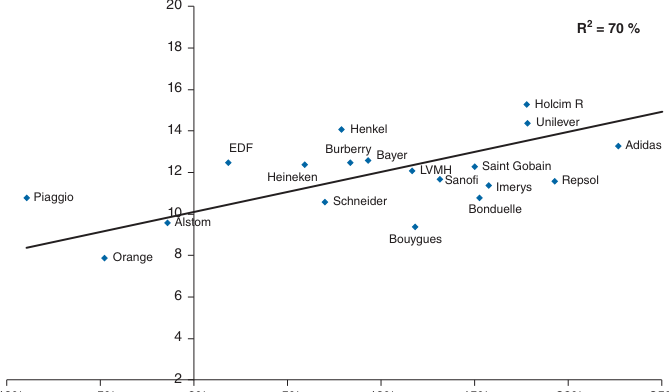
For a comprehensive review of risk premiums:
W. Goetzmann, R. Ibbotson, The Equity Risk Premium: Essays and Explorations , Oxford University Press,
2006.
R. Mehra, Handbook of the Equity Risk Premium , Elsevier Sciences, 2007.
J. Siegel, Stock for the Long Run , 4th edn, McGraw Hill, 2007.
THE RISK OF SECURITIES AND THE REQUIRED RATE OF RETURN 346SECTION 2c19.indd 10:1:50:AM 09/05/2014 Page 346 Trim Size: 189 X 246 mm
On risk premiums:
Bonds and Financial Securities
- Financial managers secure company funding by selling various securities including debt, equity, options, and hybrids to investors.
- A bond is defined as a debt security with a maturity exceeding one year, representing a formal obligation to repay funds with interest.
- Debt securities differ from bank loans primarily because they can be traded on secondary markets like stock exchanges and money markets.
- The growth of bond markets has been fueled by disintermediation and the increasing difficulty of obtaining traditional bank loans.
- In 2013, corporate issuers represented only a small fraction (6%) of the euro-denominated bond market compared to state and financial institutions.
Or ârendering what is ďŹxed, volatile, and what is volatile, ďŹxedâ
R. Arnott, P. Bernstein, What risk premium is ânormalâ? Financial Analysts Journal ,58(2), 64â85, March/
April 2002.
S. Brown, W. Goetzmann, S. Ross, Survivorship bias, Journal of Finance ,50(3), 853â873, July 1995.
J. Claus, J. Thomas, Equity premia as low as three percent? Evidence from analystsâ earnings forecasts
for domestic and international stock markets, Journal of Finance ,56(5), 1629â1666, October 2001.
A. Damodoran, Estimating risk-free rate, www.damodoran.com.
A. Damodoran, Estimating risk premiums, www.damodoran.com.
E. Dimson, P. Marsh, M. Staunton, The Triumph of the Optimists: 101 Years of Investment Returns ,
Princeton University Press, 2002.
F. Fama, K. French, The equity premium, Journal of Finance ,57(2), 637â659, April 2002.
P. Fernandez, The equity premium in 150 textbooks , working paper IESE Business School, September
2009.
P. Fernandez, J. Del Campo, Market risk premium used in 2010 by Professors: a survey with 1 ,500 answers ,
working paper IESE Business School, May 2010.
W. Goetzmann, P. Jorion, Global stock markets in the twentieth century, Journal of Finance ,54(3),
953â980, June 1999.
R. Ibbotson, P. Chen, Long-run stock returns: Participating in the real economy, Financial Analysts
Journal ,59(1), 88â98, JanuaryâFebruary 2003.
M. Kritzman, Puzzles of Finance: Six Practical Problems and their Remarkable Solutions , John Wiley &
Sons, Inc., 2002.
R. La Porta, F. Lopez de Silanes, A. Shleifer, R. Vishny, Law and ďŹnance, Journal of Political Economy ,
106(6), 1113â1155, December 1998.
R. Mehra, The equity premium: Why is it a puzzle? Financial Analysts Journal ,59(1), 54â69, January/
February 2003.
On chaos theory:
E. Peters, Chaos and Order in Capital Markets , 2nd edn, John Wiley & Sons, Inc., 1996.
c20.indd 05:0:28:PM 09/08/2014 Page 347 Trim Size: 189 X 246 mmSECTION 2
PARTTHREE
FINANCIAL SECURITIES
In Chapter 1 we wrote that a financial manager helps secure a companyâs financing needs by selling securities to his investor clients. In the following chapters, you will learn more about such securities â debt, equity, options and hybrids â as well as how they are valued and sold to investors.
c20.indd 05:0:28:PM 09/08/2014 Page 348 Trim Size: 189 X 246 mm
c20.indd 05:0:28:PM 09/08/2014 Page 349 Trim Size: 189 X 246 mmSECTION 2Chapter 20
BONDS
Or ârendering what is ďŹxed, volatile, and what is volatile, ďŹxedâ
A debt security is a financial instrument representing the borrowerâs obligation to the lender from whom he has received funds. If the maturity of the security is over one year it will be called a bond.
This obligation provides for a schedule of cash flows defining the terms of repayment
of the funds and the lenderâs remuneration in the interval. The remuneration may be fixed during the life of the debt or floating if it is linked to a benchmark or index.
Unlike conventional bank loans, debt securities can be traded on secondary mar-
kets (stock exchanges, money markets, mortgage markets and interbank markets), but their logic is the same and all the reasoning presented in this chapter also apply for bank loans. Debt securities are bonds, commercial paper, Treasury bills and notes, certificates of deposit and mortgage-backed bonds or mortgage bonds. Furthermore, the current trend is to securitise loans to make them negotiable.
Disintermediation was not the only factor fuelling the growth of bond markets. The
increasing difficulty of obtaining bank loans was another, as banks realised that the inter-est margin on such loans did not offer sufficient return on equity. This pushed companies to turn to bond markets to raise the funds banks had become reluctant to advance.
Financial
Institutions
45%
Corporates
6%State and Local
Authorities
49%Split of issuers of euro-denominated bonds in 2013
Source : European Central Bank (2013)Companies accounted for 6% of euro-denominated bonds outstanding in 2013.
Fundamentals of Corporate Bonds
- Corporate bonds offer higher yields than government bonds to compensate investors for increased risk.
- The India Motors bond case study illustrates key features such as a 4.25% annual coupon and a seven-year maturity period.
- Nominal or face value serves as the basis for interest calculations and typically represents the amount repaid at maturity.
- Bonds can be issued at par, at a premium, or at a discount relative to their face value depending on market conditions.
- Redemption structures vary widely, including bullet repayments, constant amortization, or even selection by lottery.
- Provisions like call and put options allow for early redemption by the issuer or the bondholder, respectively.
Other methods exist, such as determining which bonds are redeemed by lottery⌠there is no end to financial creativity!
FINANCIAL SECURITIES 350SECTION 2c20.indd 05:0:28:PM 09/08/2014 Page 350 Trim Size: 189 X 246 mm
Investors have welcomed the emergence of corporate bonds offering higher yields
than government bonds. Of course, these higher returns come at the cost of higher risks.
Many of the explanations and examples offered in this chapter deal with bonds, but
they can easily be applied to all kinds of debt instruments. We shall take the example of the India Motors February 2014 bond issue with the following features.
INDIA MOTORS â 4.25% FEBRUARY 2014âFEBRUARY 2021 BOND ISSUEAmount: âŹ300 000 000
Denomination: âŹ50 000
Issue price: 99.532% or âŹ49 766 per bond, payable in one instalment on the
settlement date.
Date of issue: 24 February 2014.Settlement date: 24 February 2014.Maturity: 7 years.Annual coupon: 4.25%, i.e. âŹ2125 per bond payable in one instalment on 24
February of each year, with the ďŹrst payment on 24 February 2015.
Yield to maturity for the subscriber:4.33% on the settlement date.
Average life: 7 years.Normal redemption date:The bonds will be redeemed in full on 24 February 2021 at par value.
Guarantee: No guarantee.Further issues (fungibility):The issuer may, without prior permission from the bondholders, create and issue new bonds with the same features as the present bonds with the exception of the issue price and the ďŹrst coupon payment date. The present bonds could thus be exchanged for the new bonds.
Rating: BBB (Standard & Poorâs) for this issueListing: Luxembourg.
Section 20.1
BASIC CONCEPTS
1/THE PRINCIPAL
(a) Nominal or face value
Loans that can be publicly traded are divided into a certain number of units giving the same rights for the same fraction of the debt. This is the nominal, face or par value, which, for bonds, is generally âŹ1000 but is âŹ50 000 in the India Motors case.
The nominal value is used to calculate the interest payments. In the simplest cases,
it equals the amount of money the issuer received for each bond and that the issuer will repay upon redemption.
Chapter 20 BONDS 351SECTION 2c20.indd 05:0:28:PM 09/08/2014 Page 351 Trim Size: 189 X 246 mm
(b) Issue price
The issue price is the price at which the bonds are issued; that is, the price investors pay for each bond. The India Motors bond was issued on 24 February 2014 at a price of âŹ49
766, i.e. 99.532% of its face value.
Depending on the characteristics of the issue, the issue price may be higher than the
face value (issued at a premium), lower than the face value (issued at a discount) or equal to the face value (at par).(c) Redemption
When a loan is amortised, it is said to be redeemed. In Chapter 17 we looked at the various ways a loan can be repaid:
tredemption at maturity, or on a bullet repayment basis. This is the case in the India
Motors issue ;
tredemption in equal slices (or series), or constant amortisation;
tredemption in fixed instalments.Other methods exist, such as determining which bonds are redeemed by lotteryâŚ
there is no end to financial creativity!
A deferred redemption period is a grace period, generally at the beginning of the
bondâs life, during which the issuer does not have to repay the principal.
The terms of the issue may also include provisions for early redemption (call
options) or retraction (put options). A call option gives the issuer the right to buy back all or part of the issue prior to the maturity date, while a put option allows the bondholder to demand early repayment.
No such options are included in the India Motors issue.A redemption premium or discount arises where the redemption value is higher or
lower than the nominal value.(d) Maturity of the bond
The life of a bond extends from its issue date to its final redemption date. Where the bond is redeemed in several instalments, the average maturity of the bond corresponds to the
average of each of the repayment periods.
Average maturityt
==Ă
Average lifeNumber of bonds redeemed during y
eear
Bond Mechanics and Yield
- Bond repayment can be secured by guarantees or collateral, though corporate bonds like the India Motors example are often unsecured.
- The nominal interest rate or coupon is applied to the par value of the bond to determine periodic payments.
- Bonds sold at a discount, where the issue price is lower than the par value, provide investors with additional remuneration upon redemption.
- Coupon payment frequency varies from monthly to annually, while zero-coupon bonds defer all interest until the bond matures.
- The yield to maturity is a more accurate measure of return than the nominal rate because it accounts for issue discounts and payment timing.
- For the India Motors bond, a 4.25% nominal rate results in a 4.33% yield to maturity due to the initial purchase discount.
As a result, the nominal rate is not very meaningful.
Total number of bonds to be redeemedt
tN
ââ
1
where t is the variable for the year and N the total number of periods.
The India Motors bonds have a maturity of seven years.
(e) Guarantees
Repayment of the principal (and interest) on a bond borrowing can be guaranteed by the issuer, the parent company and less often for corporates by collateral (i.e. mortgages),
FINANCIAL SECURITIES 352SECTION 2c20.indd 05:0:28:PM 09/08/2014 Page 352 Trim Size: 189 X 246 mm
pledges or warranties. Bonds are rarely secured, while commercial paper and certificates of deposit can, in theory, be secured but in fact never are.
The bonds issued by India Motors are not guaranteed.
2/INCOME
(a) Issue date
The issue date is the date on which interest begins to accrue. It may or may not coincide with the settlement date , when investors actually pay for the bonds purchased.
Interest on the India Motors bond begins to accrue on the settlement date.
(b) Interest rate
The coupon or nominal rate is used to calculate the interest (or coupon in the case of a bond) payable to the lenders. Interest is calculated by multiplying the nominal rate by the nominal or par value of the bond.
On the India Motors issue, the coupon rate is 4.25% and the coupon payment âŹ2125.
In addition to coupon payments, investors may also gain additional remuneration if
the issue price is lower than the par value. On the India Motors issue, investors paid âŹ49
766 for each bond, whereas interest was based on a par value of âŹ50 000 and the bond
will be redeemed at âŹ50 000 .In this case, the bond sold at a discount .
(c)Periodicity of coupon payments
Coupon payments can be made every year, half-year, quarter, month or even more fre-quently. On certain borrowings, the interval is longer, since the total compounded interest earned is paid only upon redemption. Such bonds are called zero-coupon bonds .
In some cases, the interest is prepaid ; that is, the company pays the interest at the
beginning of the period to which it relates. In general, however, the accrued interest is
paid at the end of the period to which it relates.
The India Motors issue pays accrued interest on an annual basis.
Section 20.2
THE YIELD TO MATURITY
The actual return on an investment (or the cost of a loan for the borrower) depends on a number of factors: the difference between the settlement date and the issue date, the issue premium/discount, the redemption premium/discount, the deferred redemption period and the coupon payment interval. As a result, the nominal rate is not very meaningful.
We have seen that the yield to maturity (see Chapter 17) cancels out the bondâs pres-
ent net value; that is, the difference between the issue price and the present value of future flows on the bond. Note that for bonds, the yield to maturity ( y) and the internal rate
of return are identical. This yield is calculated on the settlement date when investors
pay for their bonds, and is always indicated in the prospectus for bond issues. The yield to maturity takes into account any timing differences between the right to receive income and the actual cash payment.
Chapter 20 BONDS 353SECTION 2c20.indd 05:0:28:PM 09/08/2014 Page 353 Trim Size: 189 X 246 mm
In the case of the India Motors bond issue:
99.532 %4.25%
(1+ )100 %
(1+ )0 i.e.
=17
i7â+ =ÎŁ
iyyyâââââââââ âââââ==4.33%
The yield to maturity, before taxation and intermediariesâ fees, represents:
Bond Yields and Market Spreads
- Yield to maturity serves as a rate of return for investors and an actuarial cost for issuers, though it relies on the strong assumption of reinvested interest.
- The actual cost of borrowing for an issuer is influenced by intermediation fees, paying agent commissions, and corporate tax deductions on coupon payments.
- Spreads represent the risk premium an issuer pays over a benchmark rate, such as the Interest Rate Swap (IRS) or government bond yields.
- Credit quality and market risk appetite are the primary drivers of spread width, which tends to expand significantly during financial crises.
- Once a bond enters the secondary market, its price and yield fluctuate independently of the historical cost recorded in the borrower's accounts.
- Secondary market yields represent an opportunity cost for the borrower, indicating the current 'real' cost of issuing new debt.
The situation of European countries during the euro crisis has generated some peculiar cases whereby, for example, the German government could borrow at negative interest rates.
tfor investors , the rate of return they would receive by holding the bonds until matu-
rity, assuming that the interest payments are reinvested at the same yield to maturity, which is a very strong assumption;
tfor the issuer , the pre-tax actuarial cost of the loan.
From the point of view of the investor, the bond schedule must take into account
intermediation costs and the tax status of the income earned. For the issuer, the gross cost to maturity is higher because of the commissions paid to intermediaries. This increases the actuarial cost of the borrowing. In addition, the issuer pays the intermediaries ( paying
agents ) in charge of paying the interest and reimbursing the principal. Lastly, the issuer
can deduct the coupon payments from its corporate income tax, thus reducing the actual cost of the loan.
1/ SPREADS
The spread is the difference between the rate of return on a bond and that on a benchmark used by the market. In the euro area, the benchmark for long-term debt is most often the Interest Rate Swap (IRS) rate; sometimes the spread to government bond yields is also mentioned. For floating-rate bonds and bank loans (which are most often with floating rates), the spread is measured to a short-term rate, the three- or six-month Euribor in the eurozone.
The India Motors bond was issued with a spread of 135 basis points (1.35%) to mid
swap rate, meaning that India Motors had to pay 1.35% more than banks per year to raise funds.
The spread is a key parameter for valuing bonds, particularly at the time of issue. It
depends on the perceived credit quality of the issuer and the maturity of the issue, which are reflected in the credit rating and the guarantees given. Spreads are, of course, a relative concept, depending on the bonds being compared. The stronger the creditworthiness of the issuer and the marketâs appetite for risk, the lower the margin will be.
1
2/ THE SECONDARY MARKET
Once the subscription period is over, the price at which the bonds were sold (their issue price) becomes a thing of the past. The value of the instrument begins to fluctuate on the secondary market. Consequently, the yield to maturity published in the prospectus applies only at the time of issue; after that, it fluctuates in step with the value of the bond.
Theoretically, changes in the bondâs yield to maturity on the secondary market do
not directly concern the borrower, since the cost of the debt was fixed when it was contracted.1 An interesting
study on yield spreads in major financial areas is periodically published by the International Monetary Fund and can be freely obtained at www.imf.org.
FINANCIAL SECURITIES 354SECTION 2c20.indd 05:0:28:PM 09/08/2014 Page 354 Trim Size: 189 X 246 mm
â1%0%1%2%3%4%5%6%7%
1999 2000 2001 2002 2003 2004 2005 2006 2007 2008 2009 2009 2010 2011 2012 2013Spreads in Europe
BBB
AAAAAA
Source : Datastream
0%5%10%15%20%
1999 2000 2001 2002 2003 2004 2005 2006 2007 2008 2009 2010 2011 2012 2013 2014Spreads in the USA
BBBBBBAAAAAA
Source : DatastreamSpreads tend to widen markedly during a crisis (like in 2008-2010), both in absolute terms and relative to each other.The situation of European countries during the euro crisis has generated some peculiar cases whereby, for example, the German government could borrow at negative interest rates.
For the borrower, the yield on the secondary market is merely an opportunity cost ;
that is, the cost of refunding for issuing new bonds. It represents the ârealâ cost of debt,
but is not shown in the company accounts where the debt is recorded at its historical cost, regardless of any fluctuations in its value on the secondary market.
Chapter 20 BONDS 355SECTION 2c20.indd 05:0:28:PM 09/08/2014 Page 355 Trim Size: 189 X 246 mm
3/LISTING TECHNIQUES
Bond Pricing and Assimilation
- Bond prices are quoted as a percentage of nominal value rather than absolute currency to facilitate easier comparison across different denominations.
- Market prices are quoted 'net of accrued interest' to prevent artificial price fluctuations caused by proximity to coupon payment dates.
- Yield to maturity serves as the primary metric for evaluating bond value, as nominal price percentages do not reflect the actual cost or risk-adjusted return.
- Companies use 'assimilation' to issue new bonds with identical features to existing ones, increasing liquidity and reducing administrative costs.
- While assimilation benefits marketability, it creates a financial risk for the issuer by concentrating debt maturity on a single date.
- The market is transitioning from fixed-income securities to floating-rate bonds, where cash flows follow preset rules rather than fixed schedules.
Otherwise, the price of a bond with a 15% coupon would be 115 just before its coupon payment date and 100 just after.
The price of bonds listed on stock markets is expressed as a percentage of the nominal value. In fact, they are treated as though the nominal value of each bond were âŹ100. Thus,
a bond with a nominal value of âŹ50 000 will not be listed at âŹ49 500 but at 99% (49
500/50 000 Ă 100). Similarly, a bond with a nominal value of âŹ10 000 will be listed at
99%, rather than âŹ9900. This makes it easier to compare bond prices.
For the comparison to be relevant, the prices must not include the fraction of annual
interest already accrued. Otherwise, the price of a bond with a 15% coupon would be 115 just before its coupon payment date and 100 just after. This is why bonds are quoted net
of accrued interest . Bond tables thus show both the price expressed as a percentage of
the nominal value and the fraction of accrued interest, which is also given as a percentage of the nominal value.
The table below indicates that on April 2014, the India Motors bond traded at 100.7%
with an accrued interest of 0.42%. This means that at that date the bond cost âŹ50 600,
i.e.: âŹ50 000 Ă(100.7% +0.42%).
Price Bond ticker Gross
YTMMaturity Maturity
dateModiďŹed
durationDuration Accrued
interestNext coupon
payment
100.7% IN0010859686 4.13 % 6.90 years 24/02/21 5.86 6.10 0.42% 24/02/15
Certain debt securities, mainly fixed-rate Treasury notes with annual interest payments, are quoted at their yield to maturity. The two listing methods are rigorously equivalent and only require a simple calculation to switch from one to the other.
By now, you have probably realised that the price of a bond does not reflect its actual
cost. A bond trading at 105% may be more or less expensive than a bond trading at 96%.The yield to maturity is the most important criterion, allowing investors to evaluate various investment opportunities according to the degree of risk they are willing to accept and the length of their investment. However, it merely offers a temporary
estimate of the promised return; this may be different from the expected return which
incorporates the probability of default of the bond.
4/ FURTHER ISSUES AND ASSIMILATION
Having made one bond issue, the same company can later issue other bonds with the same features (time to maturity, coupon rate, coupon payment schedule, redemption price and guarantees, etc.) so that they are interchangeable. This enables the various issues to be grouped as one, for a larger total amount. Assimilation makes it possible to reduce admin-istrative expenses and enhance liquidity on the secondary market.
Nevertheless, the drawback for the issuer is that it concentrates maturity on one date
which is not in line with sound financial policy.
Bonds assimilated are issued with the same features as the bonds with which they
are interchangeable. The only difference is in the issue price,
2 which is shaped by market
conditions that are very likely to have changed since the original issue.
The India Motors bond provides for further (future fungible) issues.2In some cases
the first coupon payment is different while the issue price is identical: the bonds only become fungible after the first coupon payment.
FINANCIAL SECURITIES 356SECTION 2c20.indd 05:0:28:PM 09/08/2014 Page 356 Trim Size: 189 X 246 mm
Section 20.3
FLOATING -RATE BONDS
So far we have looked only at fixed-income debt securities. The cash flow schedule for these securities is laid down clearly when they are issued, whereas the securities that we will be describing in this section give rise to cash flows that are not totally fixed from the very outset, but follow preset rules.
Fixed Rate
83%Floating Rate
17%Split of eu ro-de nominated bond is sues in 2013
Source : Dealogic
1/ THE MECHANICS OF THE COUPON
Floating-Rate and Index-Linked Bonds
- Floating-rate bonds use coupons indexed to market rates plus a spread, effectively canceling out interest rate risk for both issuers and investors.
- The price of a variable-rate bond typically stays close to par value because the discount rate and the coupon rate reset in tandem.
- The primary driver of price volatility for floating-rate securities is a change in the issuer's solvency or credit risk rather than market interest rate fluctuations.
- Spreads are fixed at issuance based on creditworthiness, but the market's perception of that risk can cause the bond's value to fluctuate over time.
- Index-linked securities can be tied to various benchmarks, such as inflation, oil prices, or share prices, to protect investors against specific economic risks.
This cancels out the interest rate risk since the issuer of the security is certain of paying interest at exactly the market rate at all times.
The coupon of a floating-rate bond is not fixed, but is indexed to an observable market rate, generally a short-term rate, such as a six-month Euribor. In other words, the coupon rate is periodically reset based on some reference rate plus a spread. When each coupon is presented for payment, its value is calculated as a function of the market rate, based on the formula:
Coupon Market rate Spread Par value
tt=() +Ă
This cancels out the interest rate risk since the issuer of the security is certain of paying interest at exactly the market rate at all times. Likewise, the investor is assured at all times of receiving a return in line with the market rate. Consequently, there is no reason for the price of a variable-rate bond to move very far from its par value unless the issuerâs solvency becomes a concern.
Letâs take the simple example of a fixed-rate bond indexed to the one-year rate that
pays interest annually. On the day following payment of the coupon and in the year prior
Chapter 20 BONDS 357SECTION 2c20.indd 05:0:28:PM 09/08/2014 Page 357 Trim Size: 189 X 246 mm
to its maturity date, the price of the bond can be calculated as follows (as a percentage of par value):
Vr
r=+
+=100 100
11001
1Ă
where r1 is the one-year rate.
Here the price of the bond is 100% since the discount rate is the same as the rate
used to calculate the coupon. Likewise, we could demonstrate that the price of the bond is 100% on each coupon payment date. The price of the bond will fluctuate in the same way as a short-term instrument in between coupon payment dates.
If the reference rate covers a period which is not the same as the interval between two
coupon payments, the situation becomes slightly more complex. That said, since there is rarely a big difference between short-term rates, the price of the bond will clearly not fluctuate much over time.
The main factor that can push the price of a variable-rate bond well below its par
value is a deterioration in the solvency of the issuer.Consequently, ďŹoating-rate bonds are not highly volatile securities, even though their value is not always exactly 100%.
2/ THE SPREAD
Like those issuing fixed-rate securities, companies issuing floating-rate securities need to pay investors a return that covers the counterparty (credit) risk. Consequently, a fixed margin (spread) is added to the variable percentage when the coupon is calculated. For
instance, a company may issue a bond at three-month Euribor + 0.45% (or 45 basis points).
The size of this margin basically depends on the companyâs financial creditworthiness.
The spread is set once and for all when the bond is issued, but of course the com-
panyâs risk profile may vary over time. This factor, which does not depend on interest rate trends, slightly increases the volatility of variable-debt securities.
The issue of credit risk is the same for a fixed-rate security as for a variable-income
security.
3/ INDEX-LINKED SECURITIES
Floating rates, as described in the first paragraph of this section, are indexed to a market interest rate. Broadly speaking, however, a bondâs coupons may be indexed to any index or price provided that it is clearly defined from a contractual standpoint. Such securities are known as index-linked securities .
For instance, most European countries have issued bonds indexed to inflation. The
coupon paid each year, as well as the redemption price, is reset to take into account the rise in the price index since the bond was launched. As a result, the investor benefits from complete protection against inflation. With the advent of the euro, for example, the UK government issued a bond indexed to the rate of inflation in the United Kingdom. Like-wise, Mexican companies have brought to market bonds linked to oil prices, while other companies have issued bonds indexed to their own share price.
FINANCIAL SECURITIES 358SECTION 2c20.indd 05:0:28:PM 09/08/2014 Page 358 Trim Size: 189 X 246 mm
Debt Securities and Interest Rates
- European reference rates like EONIA, EURIBOR, and LIBOR serve as the foundational benchmarks for valuing money-market transactions and debt instruments.
- Debt security holders face three primary risks: interest rate risk, coupon reinvestment risk, and credit risk.
- The value of a fixed-rate bond is inversely related to market interest rates, meaning prices fall when rates rise and vice versa.
- Modified duration is a critical metric that quantifies the sensitivity of a bond's price to a specific change in interest rates.
- Interest Rate Swaps (IRS) function by equating the present value of fixed-rate payments with floating-rate payments, typically using Euribor as the floating leg.
The value of a ďŹxed-rate debt instrument is not ďŹxed. It varies inversely with market rates: if interest rates rise, its value declines; if interest rates fall, its value appreciates.
To value this type of security, projections need to be made about the future value of
the underlying index, which is never an easy task.
The following table shows the main reference rates in Europe.
REFERENCE RATES IN EUROPE
Reference rate DeďŹnition As at June
2014
EONIA (Euro
Overnight Index Average)European money-market rate. This is an average rate
weighted by overnight transactions reported by a representative sample of European banks. Computed by the European Central Bank and published by Reuters.0.023%
EURIBOR
(European Interbank Offered Rate)European money-market rate corresponding to the
arithmetic mean of offered rates on the European banking market for a given maturity (between 1 week and 12 months). Sponsored by the European Banking Federation and published by Reuters, it is based on daily quotes provided by 64 European banks.0.206%
(3 months)
LIBOR (London
Interbank Offered Rate)Money-market rate observed in London corresponding to the
arithmetic mean of offered rates on the London banking market for a given maturity (between 1 and 12 months) and a given currency (euro, sterling, dollar, etc.).0.175%
(euro 3
months)
Interest Rate
Swap (IRS)The Interest Rate Swap (IRS) rate indicates the ďŹxed
interest rate that will equate the present value of the ďŹxed-rate payments with the present value of the ďŹoating-rate payments in an interest-rate swap contract. The convention in the market is for the swap market makers to set the ďŹoating leg â normally at Euribor â and then quote the ďŹxed rate that is payable for that maturity.
Section 20.4
THE VOLATILITY OF DEBT SECURITIES
The holder of a debt security may have regarded himself as protected having chosen this type of security, but he actually faces three types of risk:tinterest rate risk andcoupon reinvestment risk , which affect almost solely fixed-
rate securities;
tcredit risk , which affects fixed-rate and variable-rate securities alike. We will con-
sider this at greater length in the following section.
1/CHANGES IN THE PRICE OF A FIXED -RATE BOND CAUSED BY INTEREST -RATE
FLUCTUATIONS
(a) DeďŹnition
What would happen if, at the end of the subscription period for the India Motors 4.25% bond, the market interest rate rose to 5.25% (scenario 1) or fell to 3.25% (scenario 2)?
Chapter 20 BONDS 359SECTION 2c20.indd 05:0:28:PM 09/08/2014 Page 359 Trim Size: 189 X 246 mm
(b) Measures: modiďŹed duration and convexity
The modified duration of a bond measures the percentage change in its price for a given change in interest rates. The price of a bond with a modified duration of 4 will increase by 4% when interest rates fall from 7% to 6%, while the price of another bond with a modi-fied duration of 3 will increase by just 3%.In the first scenario, the bondholder would obviously attempt to sell the India Motors bond to buy securities yielding 5.25%. The price of the bond would fall such that the bond offered its buyer a yield to maturity of 5.25%. Conversely, if the market rate fell to 3.25%, holders of the India Motors bond would hold onto their bonds. Other investors would attempt to buy them, and the price of the bond would rise to a level at which the bond offered its buyer a yield to maturity of 3.25%.
An upward (or downward) change in interest rates therefore leads to a fall (or rise)
in the present value of a fixed-rate bond, irrespective of the issuerâs financial condition.The value of a ďŹxed-rate debt instrument is not ďŹxed. It varies inversely with market rates: if interest rates rise, its value declines; if interest rates fall, its value appreciates.
As we have seen, if the yield on our India Motors bond is 4.33%, its price is 99.532.But if its yield to maturity rises to 4.83% (a 0.5 point increase), its price will change to:
V
i=
++
+=4.25%
(1 4.83 % )100%
(1 4.83% )96.62%, i.e. a decrei
17
7
=âaase of 2.73%
Bond Sensitivity and Modified Duration
- Modified duration measures the percentage change in a bond's price relative to fluctuations in market interest rates.
- The risk to a bondholder's capital is not merely theoretical, as historical data shows significant volatility in both long-term and short-term rates.
- Mathematically, modified duration represents the slope of the tangent to the price/yield curve, which is hyperbolic rather than linear.
- The sensitivity of a bond to interest rate changes increases significantly as the maturity date extends further into the future.
- Secondary factors influencing duration include the coupon rate and the current market rate level, with lower rates generally increasing sensitivity.
Since this forms part of a hyperbolic curve, the slope of the tangent is not constant and moves in line with interest rates.
This shows that holders of bonds face a risk to their capital, and this risk is by no means merely theoretical given the fluctuations in interest rates over the medium term.
0%5%10%15%20%25%30%
80 81 82 83 84 85 86 87 88 89 90 91 92 93 94 95 96 97 98 99 00 01 02 03 04 05 06 07 08 09 10 11 12 13 14Long-term interest rates (10Y government bonds)
Short-term interest rates (Interbank overnight rates)Long-term and short-term interest rates in the UK since 1980
Source : Datastream
FINANCIAL SECURITIES 360SECTION 2c20.indd 05:0:28:PM 09/08/2014 Page 360 Trim Size: 189 X 246 mm
From a mathematical standpoint, modified duration can be defined as the absolute value
of the first derivative of a bondâs price with respect to interest rates, divided by the price:
Modified duration =ĂĂ
+1
11
1VtF
rt
t
tN
()+
=â
where r is the market rate and Ft the cash flows generated by the bond.
Turning back to the example of the India Motors bond at its issuance date, we arrive
at a modified duration of 5.94.
Modified duration is therefore a way of calculating the percentage change in the price
of a bond for a given change in interest rates. It simply involves multiplying the change in interest rates by the bondâs modified duration. A rise in interest rates from 4.33% to 4.83% therefore leads to a price decrease of 0.5% Ă 5.94 = 2.97%, i.e. from 99.532% to
99.532 Ă (1 â 2.97%) = 96.58%.
We note a discrepancy of 0.04% with the price calculated previously (96.62%). Mod-
ified duration is valid solely at the point where it is calculated (i.e. 4.33% here). The fur-ther we move away from this point, the more skewed it becomes. For instance, at a yield of 4.83% it is 5.73 rather than 5.94. This will skew calculation of the new price of the bond, but the distortion will be small if the fluctuation in interest rates is also limited in size. From a geometrical standpoint, the modified duration is the first derivative of price with respect to interest rates and it reflects the slope of the tangent to the price/yield curve. Since this forms part of a hyperbolic curve, the slope of the tangent is not constant and moves in line with interest rates.(c) Parameters inďŹuencing modiďŹed duration
Letâs consider the following three bonds:
Bond A B C
Coupon 5% 5% 0%
Price 100 100 100
Yield to maturity 5% 5% 5%
Redemption price 100 100 432.2
Residual life 5 years 15 years 30 years
How much are these bonds worth in the event of interest rate fluctuations?
Market interest rates (%) A B C1 119.4 155.5 320.75 100 100 10010 81.0 62.0 24.815 66.5 41.5 6.5
Note that the longer the maturity of a bond, the greater its sensitivity to a change
in interest rates .
Chapter 20 BONDS 361SECTION 2c20.indd 05:0:28:PM 09/08/2014 Page 361 Trim Size: 189 X 246 mm
Modified duration is primarily a function of the maturity date. The closer a bond
gets to its maturity date, the closer its price moves towards its redemption value and the more its sensitivity to interest rates decreases. Conversely, the longer it is until the
bond matures, the greater its sensitivity to interest rate fluctuations.
Modified duration also depends on two other parameters, which are nonetheless of
secondary importance to the time-to-maturity factor:tthe bondâs coupon rate : the lower the coupon rate, the higher its modified duration;
tmarket rates : the lower the level of market rates, the higher a bondâs modified
duration.Modified duration represents an investment tool used systematically by fixed-income
Bond Duration and Immunization
- Portfolio managers adjust modified duration to maximize capital gains or minimize losses based on interest rate forecasts.
- Convexity measures the speed of a bond's price appreciation or depreciation relative to interest rate fluctuations.
- Coupon reinvestment risk acts as a mirror image to capital risk, where rising rates cause capital losses but higher reinvestment yields.
- Immunization occurs when the gain from reinvested coupons offsets the capital loss from price changes, or vice versa.
- Duration is defined as the discounted average life of all cash flows and represents the time horizon needed to protect a portfolio from interest rate risk.
- Zero-coupon bonds are unique because their duration is equal to their remaining life and they eliminate reinvestment risk entirely.
Convexity expresses the speed of appreciation or the sluggishness of depreciation in the price of the bond if interest rates decline or rise.
portfolio managers. If they anticipate a decline in interest rates, they opt for bonds with a higher modified duration, i.e. a longer time to maturity and a very low coupon rate, or even zero-coupon bonds, to maximise their capital gains.
Conversely, if portfolio managers expect a rise in interest rates, they focus on bonds
with a low modified duration (i.e. due to mature shortly and carrying a high coupon) in order to minimise their capital losses.
Convexity is the second derivative of price with respect to interest rates. It measures
the relative change in a bondâs modified duration for a small fluctuation in interest rates. Convexity expresses the speed of appreciation or the sluggishness of depreciation
in the price of the bond if interest rates decline or rise.
2/COUPON REINVESTMENT RISK
As we have seen, the holder of a bond does not know at what rate its coupons will be rein-vested throughout the bondâs lifetime. Only zero-coupon bonds afford protection against this risk, simply because they do not carry any coupons!
First of all, note that this risk factor is the mirror image of the previous one. If interest
rates rise, the investor suffers a capital loss, but is able to reinvest coupon payments at a higher rate than the initial yield to maturity. Conversely, a fall in interest rates leads to a loss on the reinvestment of coupons and to a capital gain.
Intuitively, it seems clear that for any fixed-income debt portfolio or security, there
is a period over which:tthe loss on the reinvestment of coupons will be offset by the capital gain on the sale of the bond if interest rates decline;
tthe gain on the reinvestment of coupons will be offset by the capital loss on the sale of the bond if interest rates rise.All in all, once this period ends, the overall value of the portfolio (i.e. bonds plus rein-
vested coupons) is the same, and the investors will have achieved a return on investment identical to the yield to maturity indicated when the bond was issued.
In such circumstances, the portfolio is said to be immunised , i.e. it is protected
against the risk of fluctuations in interest rates (capital risk and coupon reinvestment risk). This time period is known as the duration of a bond. It may be calculated at any time,
either at issue or throughout the whole life of the bond.
FINANCIAL SECURITIES 362SECTION 2c20.indd 05:0:28:PM 09/08/2014 Page 362 Trim Size: 189 X 246 mm
For instance, an investor who wants to be assured of achieving a certain return on
investment over a period of three years will choose a portfolio of debt securities with a duration of three years.
Note that the duration of a zero-coupon bond is equal to its remaining life.In mathematical terms, duration is calculated as follows:
Duration =Ă
++tF
r
F
rt
t
tN
t
t
tN111
1()() =
=ââ
Duration can be regarded as being akin to the discounted average life of all the cash
flows of a bond (i.e. interest and capital). The numerator comprises the discounted cash flows weighted by the number of years to maturity, while the denominator reflects the present value of the debt.
The India Motors bond has a duration of 6.2 years at issue.
Duration is linked to modiďŹed duration by a very simple equation, since: Duration = (1 + r) Ă ModiďŹed duration
We can see that 5.94 Ă (1 + 4.33%) = 6.2 years.
Turning our attention back to modified duration, we can say that it is explained by the
duration of a bond, which brings together in a single concept the various determinants of modified duration, i.e. time to maturity, coupon rate and market rates.
Section 20.5
DEFAULT RISK AND THE ROLE OF RATING
Bond Ratings and Default Risk
- Default risk is assessed through traditional financial analysis, credit scoring, and ratings issued by dominant agencies like Standard & Poorâs, Moodyâs, and Fitch.
- Agencies provide both short-term and long-term ratings for various entities, including sovereign states, municipalities, banks, and private corporations.
- Ratings are categorized into 'investment grade' (AAA to BBB-) and 'speculative grade' (BB and below), with the latter indicating higher uncertainty and default probability.
- The rating system includes outlooks (stable, positive, or negative) and watchlists to alert investors of potential changes due to corporate events like mergers or acquisitions.
- Historical data shows a stark correlation between ratings and failure rates, with only 0.8% of AAA issuers defaulting over 15 years compared to 31% of B-rated issuers.
From the sample of international issuers rated by Standard & Poorâs over 15 years, 0.8% of issuers rated AAA failed to pay an instalment on a loan, while 31% of issuers rated B defaulted.
Default risk can be measured on the basis of a traditional financial analysis of the bor-rowerâs situation or by using credit scoring, as we saw in Chapter 8. Specialised agencies, which analyse the risk of default, issue ratings which reflect the quality of the borrowerâs signature. There are three agencies that dominate the market â Standard & Poorâs ( www.
standardandpoors.com ), Moodyâs ( www.moodys.com ) and Fitch ( www.fitch.com ).
Rating agencies provide ratings for companies, banks, sovereign states and munici-
palities. They can decide to rate a specific issue or to give an absolute rating for the issuer (rating given to first-ranking debt). Rating agencies also distinguish between short- and long-term prospects.
Some examples of short-term debt ratings:
Moodyâs Standard & Poorâs
and FitchDeďŹnition Examples (March 2014)
Prime 1 Aâ1 Superior ability to meet
obligationsAir Liquide, Shell, Oracle
Prime 2 Aâ2 Strong ability to repay
obligationsTelefĂłnica, Holcim,
Gazprom
Chapter 20 BONDS 363SECTION 2c20.indd 05:0:28:PM 09/08/2014 Page 363 Trim Size: 189 X 246 mm
Moodyâs Standard & Poorâs
and FitchDeďŹnition Examples (March 2014)
Prime 3 Aâ3 Acceptable ability to
repay obligationsSony, Morocco, KPN
Not Prime B Speculative Fiat, Attijariwafa Bank,
Lafarge
C VulnerableD Insolvent Lehman Brothers
Some examples of long-term debt ratings:
Moodyâs Standard & Poorâs
and FitchDeďŹnition Examples (March 2014)
Aaa AAA Best quality, lowest risk Germany, Microsoft, Aa AA High quality. Very strong
ability to meet payment obligationsTotal, NestlĂŠ General
Electric, Belgium
A A Upper-medium grade
obligations. Issuer has strong capacity to meet its obligationsBASF, Wipro, Poland, BNP
Paribas,
Vale, ICBC
Baa BBB Medium grade. Issuer has
satisfactory capacity to meet its obligationsAkzoNobel, Petrobras,
Eutelsat
Ba BB Speculative. Uncertainty
of issuerâs capacity to meet its obligationsTata Motors, Piaggio,
Delta Air Lines, Attijariwafa Bank
B B Issuer has poor capacity
to meet its obligationsTechnicolor, Kodak,
Greece, Peugeot
Caa CCC Poor standing. Danger
with respect to payment of interest and return of principal JCPenney, Ukraine
Ca CC Highly speculative. Often
in default
C C Close to insolvency
D or SD Insolvent! City of Detroit
Rating services also add an outlook to the rating they give â stable, positive or nega-
tive â which indicates the likely trend of the rating over the two to three years ahead.
Short- and medium-term ratings may be modified by a + or â or a numerical modi-
fier, which indicates the position of the company within its generic rating category. The watchlist alerts investors that an event such as an acquisition, disposal, or merger, once
it has been weighed into the analysis, is likely to lead to a change in the rating. A com-pany on the watchlist is likely to be upgraded when the expected outcome is positive, downgraded when the expected outcome is negative and, when the agency is unable to determine the outcome, it indicates an unknown change.
FINANCIAL SECURITIES 364SECTION 2c20.indd 05:0:28:PM 09/08/2014 Page 364 Trim Size: 189 X 246 mm
Short-term ratings are not independent of long-term ratings, as seen in the following diagram.
Aâ1+AAALong-term rating / Short-term ratingCorrelation between ratings
AA+
AA
AAâ
A+
AâA
BBB +
BBB
BB+
BBBBB âAâ1
Aâ2
Aâ3
B
Source : Standard & Poorâs
-10%20%30%40%50%60%
0123456789 1 0 1 1 1 2 1 3 1 4 1 5Cumulative average default rate Default rate (%)
Y earsC
BBBBBBAAAAAA
Source : Standard & Poorâs 2014From the sample of international issuers rated by Standard & Poorâs over 15 years, 0.8% of issuers rated AAA failed to pay an instalment on a loan, while 31% of issuers rated B defaulted.Ratings between AAA and BBB- are referred to as investment grade , and those
Bond Ratings and Valuation
- The credit market maintains a strict divide between investment grade and speculative grade bonds, which dictates institutional investment eligibility.
- Rating agencies in Europe typically work with management to access privileged information, though they occasionally issue unsolicited ratings based on public data.
- Companies can choose to keep their credit assessments confidential as 'shadow ratings' if they are dissatisfied with the result or do not need public disclosure.
- The rating process is a qualitative and quantitative endeavor that evaluates sector positioning, financial data, and future financing strategies.
- Yield to maturity serves as the primary criterion for investors to evaluate opportunities and represents the opportunity cost of refunding for issuers.
- Obtaining and maintaining a credit rating involves significant financial costs, ranging from initial fees to substantial annual maintenance charges.
If the company does not require a public rating immediately (or if it does not like the rating allocated!), it may request that it be kept confidential, and it is then referred to as a shadow rating.
between BB + and D as speculative grade (ornon-investment grade ). The distinction
between these two types of risk is important to investors, especially institutional investors, who often are not permitted to buy the risky speculative grade bonds!
Chapter 20 BONDS 365SECTION 2c20.indd 05:0:28:PM 09/08/2014 Page 365 Trim Size: 189 X 246 mm
In Europe, rating agencies generally rate companies at their request, which enables
them to access privileged information (medium-term plans, contacts with management). Rating agencies very rarely rate companies without management cooperation. When they do, the accuracy of the rating depends on the quality of the information about the com-pany available on the market. If the company does not require a public rating immediately (or if it does not like the rating allocated!), it may request that it be kept confidential , and
it is then referred to as a shadow rating . The cost for a firm to get a first rating is between
âŹ50 000 and âŹ100 000 (but there is also an annual cost of âŹ50 000 to âŹ150 000).
Decision to
get a rating
Meeting with the
agency: presentation,
Q&ARating process
Preparation by issuers
(support documentation,
presentation)Follow-up of theratingAnalysis by the rating agency40 days 90 daysRating committee
The issuer decides
whether the rating
should be public or
not
The rating process differs from the scoring process as it is not only a quantitative
analysis. The agency will also take into account:tthe positioning of the company in its sector;
tthe analysis of the financial data;
tthe current capital structure but also the financing strategy (which is perceived mainly through meetings with management).
The summary of this chapter can be downloaded from www.vernimmen.com.A debt security is a ďŹnancial instrument representing the borrowerâs obligation to the lender from whom he has received funds. This obligation provides for a schedule of ďŹnancial ďŹows deďŹning the terms of repayment of the funds and the lenderâs remuneration in the interval.The price of a bond does not reďŹect its actual cost. The yield to maturity (which cancels out the bondâs NPV â that is the difference between the issue price and the present value of future ďŹows) is the only criterion allowing investors to evaluate the various investment opportunities (according to risk and length of investment). On the secondary market, the yield to maturity is merely an opportunity cost for the issuer, i.e. the cost of re-funding today.The basic parameters for bonds are as follows:tNominal or face value.
tIssue price, with a possible premium on the nominal value.SUMMARY
FINANCIAL SECURITIES 366SECTION 2c20.indd 05:0:28:PM 09/08/2014 Page 366 Trim Size: 189 X 246 mm
Bond Mechanics and Risk Metrics
- Bonds are defined by diverse parameters including redemption methods, nominal rates, and coupon frequencies which cause yield to maturity to deviate from coupon rates.
- Fixed-rate securities are subject to interest rate risk, where bond values move inversely to market rate fluctuations.
- Price sensitivity is measured through modified duration and convexity, which track the percentage change and speed of price movements respectively.
- Immunization strategies use bond duration to protect portfolios against the dual threats of capital risk and coupon reinvestment risk.
- Floating-rate securities offer lower volatility by indexing coupons to market rates, though they still carry some price variation.
- All debt securities face default risk, quantified by credit ratings and expressed as a 'spread' over risk-free rates based on issuer solvency.
Convexity, the second derivative of price with respect to interest rates, expresses the speed of appreciation or the sluggishness of depreciation in the price of the bond if interest rates decline or rise.
tRedemption: redemption at maturity (known as a bullet repayment), constant amortisation or ďŹxed instalments. The terms of the issue may also include provisions for early redemption (call options) or retraction (put options).
tAverage life of bond: where the bond is redeemed in several instalments, the average life of the bond corresponds to the average of each of the repayment periods.
tNominal rate: also known as the coupon rate and used to calculate interest payable.
tIssue/redemption premium/discount: the difference between the issue premium/ discount and the nominal value and the difference between the redemption premium/discount and the nominal value.
tPeriodic coupon payments: frequency at which coupon payments are made. We talk of zero-coupon bonds when total compounded interest earned is paid only upon redemption.
The diversity of these parameters explains why the yield to maturity may differ from the coupon rate.Fixed-rate debt securities are exposed to the risk of interest rate ďŹuctuations: the value of a ďŹxed-rate debt security increases when interest rates fall, and vice versa. This ďŹuctuation is measured by:tthe modiďŹed duration, which measures the percentage change in the price of a bond for a small change in interest rates. ModiďŹed duration is a function of the maturity date, the nominal rate and the market rate;
tconvexity, the second derivative of price with respect to interest rates, which expresses the speed of appreciation or the sluggishness of depreciation in the price of the bond if interest rates decline or rise;
tcoupon reinvestment risk. There is a time period over which the portfolio is said to be immunised, i.e. it is protected against the risk of ďŹuctuations in interest rates (capital risk and coupon reinvestment risk). This period is known as the duration of the bond, and is equal to the ratio of the discounted cash ďŹows weighted by the number of years to maturity and the present value of the debt.
Floating-rate securities have a coupon that is not ďŹxed but i ndexed to an observable market
rate (with a ďŹxed margin that is added to the variable rate when the coupon is calculated). Variable-rate bonds are not very volatile securities, even though their value is not always exactly 100% of the nominal.All debt securities are exposed to default risk which is assessed by rating agencies on the basis of ratings (AAA, AA, A, BBB, etc.) which depend on the volatility of the economic assets and the ďŹnancial structure of the issuer. The result is a spread which is the difference
between the bondâs yield to maturity and that of a no-risk loan over an identical period. Obviously, the better the perceived solvency of the issuer, the lower the spread.
1/What is face value? What is it used for?
2/What is the difference between the average life and the duration of a bond? For what type of bond are the two equal?
3/What is the yield to maturity of a bond? How is it computed?
4/Is a bond more volatile on the day of issue or on the day of redemption?QUESTIONS
Chapter 20 BONDS 367SECTION 2c20.indd 05:0:28:PM 09/08/2014 Page 367 Trim Size: 189 X 246 mm
1/Butchery Withoutbones issued the following bond: Amount: âŹ125m
Issue price: 99.731%Date of issue: 20 February 2014Settlement date: 20 February 2014Maturity: 7 years EXERCISES5/Is the value of a floating-rate bond always equal to 100%? Why?
6/You are an investor anticipating a decrease in interest rates. Classify, by decreasing order of preference, these bonds:
(a)ďŹoating-rate bond to be redeemed (bullet) in 10 years;
(b)ďŹoating-rate bond to be redeemed (bullet) in seven years;
(c)perpetuity with ďŹxed rate
(d)ďŹxed-rate bond to be redeemed (bullet) in ďŹve years;
(e)ďŹoating-rate bond with constant instalments with ďŹve-year maturity;
(f)ďŹoating-rate bond with constant amortisation with ďŹve-year maturity.
7/Why was the yield to maturity of India Motorsâs bond higher than the nominal rate at issue?
8/True or false:
Bond Valuation and Yield Exercises
- The text presents a series of technical exercises focused on the inverse relationship between interest rates and bond prices.
- It explores the determinants of an investor's required rate of return, including inflation, asset risk, and government bond rates.
- Specific problems address the calculation of yield to maturity, duration, and modified duration for fixed-rate and zero-coupon bonds.
- The material introduces complex bond structures, such as two-tranche offerings with inverse interest rate behaviors based on market yield fluctuations.
- Practical applications involve calculating credit spreads and valuing corporate debt relative to government benchmarks.
If you thought that interest rates were going to rise, which tranche would you choose?
(a)if interest rates increase, the price of ďŹxed-rate bonds will fall;
(b)if the nominal rate is higher than the yield to maturity, the bond will trade at less
than 100% of face value;
(c)a bond with a high coupon will be worth more than a bond with a low coupon;
(d)the higher the duration, the higher the value of a bond.
9/Does the investorâs required rate of return for a bond increase with
(a)inďŹation;
(b)the proportion of debt in the ďŹnancial structure of the corporate;
(c)the maturity;
(d)government bond rates;
(e)the risk of the assets.
10/The spread between a corporate bond yield to maturity and the government bond rate to maturity corresponds to an option. What are its features?
11/True or false:
(a)the higher the duration, the lower the modiďŹed duration;
(b)the longer the maturity, the higher the modiďŹed duration;
(c)the higher the coupon, the higher the duration.
12/In what situation can a floating-rate bond trade at much less than 100%?
More questions are waiting for you at www.vernimmen.com.
FINANCIAL SECURITIES 368SECTION 2c20.indd 05:0:28:PM 09/08/2014 Page 368 Trim Size: 189 X 246 mm
Annual coupon: 5.5%, i.e. in one instalment on 20 February of each year, with the ďŹrst payment on 20 February 2015.Normal redemption date: The bonds will be redeemed in full on 20 February 2021 at par value.
(a)Calculate the yield to maturity of the bond on issue, its modiďŹed duration and its duration.
(b)On 21 February 2015, the yield to maturity on bonds comparable to the Butchery Withoutbones bond is 5%. Calculate the value, the modiďŹed duration and the dura-tion on this date of the Butchery Withoutbones bond. What are your comments compared to previous results.
2/In August 2014, Mineral Waters from Syldavia launched a two-tranche bond of the same size:
Tranche A Tranche B
Redemption at maturity in 10 years at maturity in 10 yearsInterest rate 8% + 1.5 Ă (ABY â 8.3%) 8% â 1.5 Ă (ABY â 8.3%)
Interest rate ďŹoor/ceiling 0%â 16% 0% â 16%
ABY = average bond yield on Syldavian market
On the launch date of the bond, the ABY was 8.3%.
(a)Analyse the behaviour of these two bonds for different ABYs.
(b)If you thought that interest rates were going to rise, which tranche would you choose?
(c)Did Mineral Waters from Syldavia borrow at a ďŹxed or variable rate? What were they expecting interest rates to do?
(d)What advantages did this bond have for Mineral Waters from Syldavia?
3/On 21 February 2014, you see the following figures in Les ĂŠchos de Moulinsart for Belgian Government zero-coupon bonds (which only pay a single coupon with the principal on maturity of a total amount of 100):
Maturity Price20 February 2015 96.2520 February 2016 91.9220 February 2017 87.3820 February 2018 82.9020 February 2019 78.3520 February 2020 74.2020 February 2021 70.13
(a)Calculate the yield to maturity for each zero-coupon bond.
(b)You estimate that the Butchery Withoutbones risk requires a spread of 58 basis points (0.58%) compared with government bonds. Calculate the value of the Butchery Withoutbones bond from Exercise 1.
Chapter 20 BONDS 369SECTION 2c20.indd 05:0:28:PM 09/08/2014 Page 369 Trim Size: 189 X 246 mm
Questions
Bond Valuation and Debt Analysis
- The text defines fundamental bond mechanics, including nominal value for coupon calculation and yield to maturity as the rate equating present value to price.
- Duration is characterized as a discounted average life of a bond, influenced more significantly by the remaining life of the instrument than by market rate fluctuations.
- Shareholder equity is conceptualized as a put option, allowing owners to transfer assets to lenders if the firm's value falls below its debt obligations.
- The document provides specific exercise solutions regarding tranche pricing, where certain bond classes may rise in value alongside interest rates while others fall.
- A comprehensive bibliography lists key academic and professional resources covering credit ratings, yield spreads, and fixed-income risk management.
It is the value of a put allowing the shareholders to sell the assets of the firm to the lenders if at maturity the value of assets is below the redemption price of the debts.
1/It is the nominal value, it is used to compute the coupon and the amount that will be repaid.
2/Duration is kind of a discounted average life (including coupons). Zero coupon?
3/The rate that will make the net present value of future cash flows (coupons, repayment) equal to the present price of the bond.
4/On the day of issue. On the day of redemption it will invariably be worth its redemption price.
5/No, between two instalments it will trade as a short-term fixed-rate bond.
6/(c), (d), (e), (f), (a) and (b) being equal.
7/As the issue price is below the face value.
8/True (a); False (b), (c), (d).
9/Yes (a), (b), (c) (generally), (d), (e).
10/It is the value of a put allowing the shareholders to sell the assets of the firm to the lenders if at maturity the value of assets is below the redemption price of the debts.
11/True (b); False (a), (c).
12/If the solvency of the issuer has deteriorated.ANSWERS
ExercisesA detailed Excel version of the solutions is available at www.vernimmen.com.1/(a)Yield to maturity =5.547%; modified duration: 5.68; duration: 6.0 years.
(b)The modiďŹed duration and the duration are reduced since the life of the bond is shorter, even though the market rate has dropped, which shows that the life factor impacts more on modiďŹed duration than the market rate factor. Value =102.6, modiďŹed dura-
tion=5.3, duration =5.28 years.
2/(a) The tranche A bond prices rise when the interest rate rises. The opposite happens for tranche B.
(b)Tranche A.
(c)A ďŹxed rate of 8%, rise.
(d)To be able to issue at a lower rate than the market rate (8% vs. 8.3%).
3/(a)3.90%; 4.30%; 4.60%; 4.80%; 5%; 5.10%; 5.20%.
(b)V= 98.79.
G. Athanassakos, P. Carayannopoulos, An empirical analysis of the relationship of bond yield spreads and
macro-economic factors, Applied Financial Economics ,11(2), 197â207, April 2001.
G. Bierwag, I. Fooladi, Duration analysis: An historical perspective, Journal of Applied Finance ,16(2),
144â160, February 2006.
L. Chen, D. Lesmond, J. Wei, Corporate yield spreads and bond liquidity, Journal of Finance ,62(1),
119â149, February 2007.
M. Choudry, The Bond and Money Markets: Strategy, Trading and Analysis , Butterworth-Heinemann, 2003.
A. Claes, M. De Ceuster, R. PolďŹiet, Anatomy of the Eurobond market: 1980â2000, European Financial
Management, 8(3), 373â386, 2002.
O. de la Grandville, Bond Pricing and Portfolio Analysis: Protecting Investors in the Long Run , The MIT
Press, 2003.BIBLIOGRAPHY
FINANCIAL SECURITIES 370SECTION 2c20.indd 05:0:28:PM 09/08/2014 Page 370 Trim Size: 189 X 246 mm
A. Diaz, E. Navarro, Yield spread and term to maturity: Default vs. liquidity, European Financial
Management ,8(4), 449â478, December 2002.
E. Elton, M. Gruber, D. Agrawal, C. Mann, Explaining the rate spread on corporate bonds, Journal of
Finance ,56(1), 247â278, February 2001.
F. Fabozzi, The Handbook of European Fixed Income Securities , 8th edn, McGraw-Hill, 2007.
J. Finnerty, D. Emery, Debt Management: A Practitionerâs Guide , Oxford University Press, 2001.
J. Hand, R. Holthausen, R.W. Leftwich, The effect of bond rating agency announcements on bond and
stock prices, Journal of Finance ,47(2), 733â752, June 1992.
G. Kitter, Investment Mathematics for Finance and Treasury Professionals: A Practical Approach , John
Wiley & Sons, Inc., 1999.
B. Kopprasch, Duration: A practitionerâs view, Journal of Applied Finance ,16(2), 138â149, February
2006.
H. Langohr, P. Langohr, The Rating Agencies and Their Credit Ratings: What They Are, How They Work, and
Why They are Relevant , John Wiley & Sons Ltd, 2009.
F. Longstaff, S. Mithal, E. Neis, Corporate yield spreads: Default risk or liquidity? New evidence from the
credit default swap market, Journal of Finance ,60(5), 2213â2247, October 2005.
P. Veronesi, Fixed Income Securities: Valuation, Risk, and Risk Management , John Wiley & Sons, Inc.,
2010.
And also:
www.ďŹtchratings.comwww.moodys.comwww.standardandpoors.com
Short-Term Marketable Debt
- Commercial paper serves as a short-term negotiable debt security with maturities typically ranging from one day to one year.
- These instruments allow companies to bypass the banking system and borrow directly from investors at rates close to the money market.
- The European market is split between the unregulated London-based ECP market and the regulated French TCN market, though the STEP label has helped homogenize documentation.
- While credit ratings are technically optional, they are practically essential for market access and often require backup credit lines from banks.
- The 2008 financial crisis highlighted the volatility of these markets, as commercial paper markets virtually closed following the Lehman Brothers bankruptcy.
These backup lines came into their own at the end of 2008 when the commercial paper market virtually closed for several weeks following the bankruptcy of Lehman Brothers.
c21.indd 12:32:44:PM 09/05/2014 Page 371 Trim Size: 189 X 246 mmSECTION 2Chapter 21
OTHER DEBT PRODUCTS
What a choice!
In the previous chapter, we first presented the bond as a debt product and we illustrated the key features of a debt product through this simple security. The reader will now dis-cover that there are actually a very large number of products that follow the same logic as that of a bond: remuneration independent from the financial performance of the firm and a commitment to reimburse.
Section 21.1
MARKETABLE DEBT SECURITIES
1/SHORT-TERM MARKETABLE SECURITIES
The term bond (see previous chapter) is used to refer to marketable securities with matu-rity of over one year, but firms can also issue shorter-term instruments. Commercial
paper refers to negotiable debt securities issued on the money market by companies for
periods ranging from one day to one year. In practice, the average maturity of commercial paper is very short, between one and three months. Issuers can also launch paper denomi-nated in foreign currency. Two markets of similar size are active on the European level:tThe ECP (European Commercial Paper) market is based in London and is not regulated.
tThe French TCN ( Titres de CrĂŠances NĂŠgociables ) on which French but also other
European corporates issue. This market is regulated and under the supervision of French market authorities, and offers better secured and more flexible transactions (spot and overnight delivery).Short-Term European Paper (STEP) is a label adopted in 2006 that has homogenised
the documentation for the issue of short-term paper.Commercial paper enables companies to borrow directly from investors or other compa-nies without going through the banking system and at rates very close to those of the money market.
FINANCIAL SECURITIES 372SECTION 2c21.indd 12:32:44:PM 09/05/2014 Page 372 Trim Size: 189 X 246 mm
Obtaining at least a short-term credit rating for a commercial paper issue is optional
but implicitly recommended, since companies are required to indicate whether they have called on a specialised rating agency and, if so, must disclose the rating given. Moreover, any issuer can ask a bank for a commitment to provide financing should the market situ-ation make it impossible to renew the note. These backup lines came into their own at the end of 2008 when the commercial paper market virtually closed for several weeks following the bankruptcy of Lehman Brothers. Companies have to have such lines if they want their commercial paper issues to get an investment grade rating. Certain credit rating agencies, for example, will only keep their short-term rating of outstanding commercial paper at A1 + if 70% of the paper is covered by a backup line.
In addition to lower issue costs, commercial paper gives the company some auton-
omy vis-Ă -vis its bankers. It is very flexible in terms of maturity and rates, but less so in terms of issue amounts.
Regardless of their country of origin, companies can issue American commercial
paper. Such issues are governed by Regulation 144A defining the terms and conditions of securities issues by foreign companies in the US (see Chapter 26).
â20
1989 1990 1991 1992 1993 1994 1995 1996 1997 1998 1999 2000 2001 2002 2003 2004 2005 2006 2007 2008 2009 2010 2011 2012 2013406080100120Outstanding commercial paper in France and the Eurozone (in âŹbn)
FranceEurozone
2/LONG-TERM MARKETABLE SECURITIES
Private Placements and Bank Debt
- Private placements serve as a hybrid financing tool between traditional bank loans and standard bond issues, targeted at qualified institutional investors.
- These instruments allow mid-size and large corporations to access long-term capital without the necessity of a formal credit rating.
- The rise of 'shadow banking' and private placements is driven by increased bank solvency constraints which have limited traditional loan offerings.
- Bank debt products like bilateral or syndicated loans remain essential for tailored financing and as backup mechanisms for corporate cash flow.
- While bank loans offer flexibility, private placements often involve stringent covenants and less room for renegotiation compared to traditional banking relationships.
- Short-term options such as overdrafts and commercial loans provide immediate liquidity but carry higher interest costs and collateral requirements for smaller firms.
The documentation usually includes some stringent covenants and investors in such products may show much less flexibility than banks when it comes to renegotiation.
Obviously the key type of long-term marketable debt securities are bonds which we described in the previous chapter.
We should also mention private placements. They usually take the form of bonds but are
a very specific product halfway between a loan product and a standard bond issue. Private placements are issued to a limited number of institutional investors (âqualified investorsâ).
There is a market for such products in the US where there is a specific regulation for
such issues, but also in Germany ( Schuldschein ), in Belgium (mostly to individual inves-
tors) as well as for a few years in France. Regulations are evolving in Europe as tradition-ally it is not too friendly to this type of instrument.Source : Banque de France
Chapter 21 OTHER DEBT PRODUCTS 373SECTION 2c21.indd 12:32:44:PM 09/05/2014 Page 373 Trim Size: 189 X 246 mm
Private placements have become a real alternative for the financing of large (BASF,
Rolls-Royce) or mid-size groups (Essilor, Copenhagen Airport). The transaction usually consists in an immediate financing in dollars or euros with a fixed rate. As there is no liquidity constraint, the issues (or each tranche within an issue) can be of reduced size (compared to a standard bond issue). These financings generally have a long maturity (seven to 15 years with the bulk of the issue with a six- to seven-year maturity).
They are appealing for groups that are willing to diversify their financing sources
and have access to long-term financing without the need for a rating. The documentation usually includes some stringent covenants and investors in such products may show much less flexibility than banks when it comes to renegotiation.
The increasing constraints on bank solvency have led to reduced loan offerings, in
particular outside of the domestic market. Financings outside the banking circuit have therefore developed (shadow banking), and the increasing success of private placements is just an illustration thereof.
Section 21.2
BANK DEBT PRODUCTS
Banks have developed a number of credit products that, contrary to market financing, are tailored to meet the specific needs of their clients.
Business loans (i.e. loans not linked to a specific asset) have two key characteristics:
they are based on interest rates and take into account the overall risk to the company.
The credit line will either be negotiated with a single bank, in which case the term
bilateral loan is used, or with a number of banks (usually for larger amounts) and the firm
will then put in place a club deal or a syndicated loan .
For companies, these loans are often a backup mechanism to meet any kind of cash
payment.
Business loans are based on interest rates â in other words, cost, and the cheapest
loan on offer usually wins the companyâs business. They rarely come with ancillary ser-vices such as debt recovery, and are determined according to the maturity schedule and margin on the market rate.
These loans take into account corporate risk . The bank lending the funds agrees to
take on the companyâs overall risk as reflected in its financial health. A profitable company will always obtain financing as long as it adopts a sufficiently prudent capital structure. In fact, the financial loan is guaranteed by the corporate managerâs explicit compliance with a certain number of criteria, such as ratios, etc.
1/TYPES OF BUSINESS LOANS
Overdrafts on current accounts are the corporate treasurerâs means of adjusting to tem-
porary cash shortages but, given their high interest charges, they should not be used too frequently or for too long. Small enterprises can only obtain overdrafts against collateral, making the overdraft more of a secured loan.
Commercial loans are short-term loans that are easy to set up and therefore very
popular.
FINANCIAL SECURITIES 374SECTION 2c21.indd 12:32:44:PM 09/05/2014 Page 374 Trim Size: 189 X 246 mm
Commercial and Syndicated Loan Structures
- Commercial loans are priced based on the bank's refinancing rate plus a margin of 0.10% to 1.50% depending on borrower creditworthiness.
- Revolving credit facilities (RCF) provide flexible, off-balance-sheet liquidity where firms pay an engagement fee only on undrawn amounts.
- Bridge loans offer high-cost, short-term financing for quick investments or acquisitions, often repaid once long-term funding is secured.
- Syndicated loans allow multiple banks to share the risk of large facilities exceeding âŹ50m, managed by a mandated lead arranger.
- Club deals and master credit agreements provide streamlined financing through a firm's primary 'house banks' without broader market syndication.
- Firm underwriting by a single bank can ensure transaction confidentiality, which is vital during sensitive operations like acquiring listed companies.
This type of loan is costly as it presents a significant risk for the lender. Its development is highly dependent on the activity of the mergers and acquisitions market.
The bank provides the funds for the period specified by the two parties. The interest
rate is the bankâs refinancing rate plus a margin negotiated between the two parties. It gen-erally ranges from 0.10% to 1.50% per year depending on the borrowerâs creditworthiness since there are no other guarantees.
Commercial loans can be made in foreign currencies either because the company
needs foreign currencies or because the lending rates are more attractive.
Alternatively, the firm can put in place a revolving credit facility (RCF) which is a
confirmed short-term or mid-term credit line. When the line is put in place, the firm will not have debt on its balance sheet, but it will have the capacity to draw on the credit line when it needs it. On the undrawn amount, the corporate will only pay an engagement fee (between 0.1% and 1% of the amount depending on the credit quality of the firm and the maturity of the line).
If the firm has to finance a specific investment, it will put in place a term loan that
will be less flexible than the RCF. Usually the borrower has the capacity to reimburse by anticipation but will not be allowed to re-borrow any of the repaid amounts.
Abridge loan is put in place to finance an investment quickly. A bridge loan can be
reimbursed in the short term after a long-term financing has been put in place (long-term loan, equity issue, disposal of a subsidiary, etc.). This type of loan is costly as it presents a significant risk for the lender. Its development is highly dependent on the activity of the mergers and acquisitions market.
Syndicated loans are typically set up for facilities exceeding âŹ50m which a single
bank does not want to take on alone. The lead bank (or banks depending on the amounts involved), known as the mandated lead arranger , will arrange the line and commit to
undertake the full amount of the credit. It will then syndicate part of the loan to some five to 20 banks which will each lend part of the amount. The mandated lead arranger will receive an arrangement and underwriting fee and the other banks a lower participation fee. If the line remains undrawn, banks will receive a fee for the commitment to make the funds available if the firm needs them (commitment fee).
Firm underwriting by one firm will allow the company to maintain maximum confi-
dentiality with regard to the transaction which could be crucial, for example in the case of the acquisition of a listed company. This can be achieved by having only one arranging bank that will bear the whole credit risk until the transaction become public (it can then syndicate the loan).
05001,0001,5002,0002,5003,000
2000 2001 2002 2003 2004 2005 2006 2007 2008 2009 2010 2011 2012 2013Americas Asia Pacific & Other Europe, Middle East & AfricaSyndicated loans worldwide (in US$bn)
Source : Dealogic
Chapter 21 OTHER DEBT PRODUCTS 375SECTION 2c21.indd 12:32:44:PM 09/05/2014 Page 375 Trim Size: 189 X 246 mm
When the loan is put in place with the house banks of the firm with no further
syndication of the loan, we use the term club deal .
Extending this concept leads us to the master credit agreement , which is a con-
firmed credit line between several banks offering a group (and by extension its subsidiar-ies) a raft of credit facilities ranging from overdrafts, commercial credit lines, backup lines, foreign currency advances or guarantees for commercial paper issues (see above). These master agreements take the form of a contract and give rise to an engagement commission on all credits authorised, in addition to the contractual remuneration of each line drawn down. Large groups use such master agreements as multi-currency and multi-company backup lines and umbrella lines, and secure financing from their usual banks according to market conditions. Smaller companies sometimes obtain similar financing from their banks. Engagement commissions are usually paid on these credit lines.
Master Agreements and Loan Documentation
- Master agreements centralize credit facilities for global subsidiaries, allowing them to access funding under the same conditions as the parent company.
- Centralization provides structural economies by pooling cash, harmonizing financing costs, and reducing administrative overhead.
- Loan documentation explicitly defines the mechanics of the credit, including interest rates, amortization schedules, and specific use of funds.
- Covenants serve as protective measures for banks, ranging from affirmative financial ratios to negative restrictions on dividends and asset pledges.
- Specific legal clauses like 'cross default' and 'material adverse change' allow lenders to demand repayment if the borrower's overall financial health deteriorates.
- The loan market exhibits cyclicality, with documentation and spreads tightening significantly during periods of low liquidity like the 2008 financial crisis.
Cross default clauses specify that if the company defaults on another loan, the loan which has a cross default clause will become payable even if there is no breach of covenant or default of payment on this loan.
Master agreements take into account the borrowerâs organisation chart by organis-
ing and regulating its subsidiariesâ access to the credit lines. At the local level, the busi-ness relationship between the companyâs representatives and the bankâs branches may be based on the credit conditions set up at group level. Subsidiaries in other countries can draw on the same lines at the same conditions. Centralising credit facilities in this manner offers a number of advantages by:tpooling cash between subsidiaries in different countries to minimise cash balance differentials;
tharmonising the financing costs of subsidiaries or divisions;
tcentralising administrative and negotiating costs to achieve real economies of structure.
Master agreements are based on a network of underlying guarantees between the subsid-iaries party to the agreement and the parent company. In particular, the parent company must provide a letter of credit for each subsidiary.
2/ FEATURES OF THE LOAN DOCUMENTATION
The loan documentation sets out:tthe amount, maturity and purpose of the loan (i.e. the use of funds);
tthe way the amount will be cashed in by the firm (one single payment, upon request by the firm, etc.);
tthe interest rate, fixed or floating, periodicity of interest payments, rules for the com-putation of interest, fees to be paid;
tthe reimbursement or amortisation features;
tthe potential early repayment options;
tthe potential guarantees, pledges;
tthe covenants.
Banks include a certain number of covenants in the loan agreements, chiefly regarding accounting ratios, financial decisions and share ownership. These covenants fall into four main categories:tPositive or affirmative covenants are agreements to comply with certain
capital structure or earnings ratios, to adopt a given legal structure or even to restructure.
FINANCIAL SECURITIES 376SECTION 2c21.indd 12:32:44:PM 09/05/2014 Page 376 Trim Size: 189 X 246 mm
tNegative covenants can limit the dividend payout, prevent the company from pledg-
ing certain assets to third parties (negative pledges) or from taking out new loans or engaging in certain equity transactions, such as share buy-backs.
tPari passu clauses are covenants whereby the borrower agrees that the lender will
benefit from any additional guarantees it may give on future credits.
tCross default clauses specify that if the company defaults on another loan, the loan
which has a cross default clause will become payable even if there is no breach of covenant or default of payment on this loan.
The agreement can also include a clause allowing banks to cancel the contract in the event of a material adverse change (MAC). The execution of such clauses (as well as âmarket disruptionâ clauses) is very complex from a legal point of view but also from a commer-cial point of view.
Standardised legal documentation for syndicated loans has developed in Europe, led
by the Loan Market Association (LMA) in London.
There is clear cyclicality on the loan market. After a period of high liquidity
(2004-2007) marked by very favourable borrowing terms (both in terms of legal documentation and spreads), banks drastically tightened the terms and conditions of their loans after 2008 due to the weakening of their loan portfolios and the reduced market liquidity. Since 2010, the market has returned to normal.
Section 21.3
FINANCING LINKED TO AN ASSET OF THE FIRM
1/DISCOUNTING
There are several short-term financing techniques that bridge the cash-flow gap between invoicing and collection and are backed by the corresponding trade receivable. They are the counterpart to trade credit (inter-company credit), which is widely used in some coun-tries (Continental Europe).
Discounting is a financing transaction whereby a company remits an unexpired com-
Discounting and Factoring Mechanics
- Discounting allows a company to receive immediate cash by selling commercial bills of exchange to a bank at a discount.
- Traditional discounting with recourse requires the company to assume the bankruptcy risk of its customers if the bill remains unpaid.
- Non-recourse discounting functions as a straight sale of receivables, allowing companies to remove debt from their balance sheets.
- Factoring expands on discounting by providing additional services such as receivables recovery and insurance against unpaid bills.
- Accounting standards like IFRS and US GAAP typically require discounted bills with recourse to be reported as debt rather than sales.
Factoring is like discounting with additional services!
mercial bill of exchange to the bank in return for an advance of the amount of the bill, less interest and fees.
The discounting bank becomes the owner of the bill and, ordinarily, is repaid when
it presents the bill to its customerâs customer for payment. If, at maturity, the bill remains unpaid, the bank turns to the company, which assumes the bankruptcy risk of its customer (such discounting is called discounting with recourse).
In principle, a company uses discounting to obtain financing based on the credit it
extends to its own customers, which may be better known to the banking system than the company is. In this way, the company may be able to obtain better financing rates.
In discounting, the bank does not finance the company itself, but only certain receiv-
ables in its portfolio, i.e. the bills of exchange. For the bank, the risk is bound by a double guarantee: the credit quality of its customer backed by that of the issuer of the bill of exchange.
Under most accounting principles (including IFRS and US GAAP), discounted bills
are reintegrated into accounts receivable and the bank advances are reported as debt.
Chapter 21 OTHER DEBT PRODUCTS 377SECTION 2c21.indd 12:32:44:PM 09/05/2014 Page 377 Trim Size: 189 X 246 mm
For this reason, banks now also offer non-recourse discounting, which is a straight
sale of customer receivables, under which the bank has no recourse to its customer if the bill remains unpaid at maturity. This technique allows the company to remove the receivables from its balance sheet and from its off-balance-sheet commitments and contingencies.
2/ FACTORING
Factoring is a credit transaction whereby a company holding an outstanding trade bill
transfers it to its bank or a specialised financial institution in exchange for the payment of the bill, less interest and commissions. Factoring companies or factors specialise in
buying a given portion of a companyâs trade receivables at a discount to the face value. The factoring company then collects the invoice payment directly from the debtors.
Factoring actually may include one or several of the following services to the firm:
ta financing with an attractive interest rate;
tthe externalisation of receivables recovery;
tan insurance against unpaid bills;
tan off-balance-sheet financing.
Factoring is like discounting with additional services!
Banks increasingly offer non-recourse discounting services, which consist of an out-
right purchase of the trade receivables without recourse in the event of default. This tech-nique removes contingent liabilities from the bankâs on- and off-balance-sheet accounts.
3/LEASES
Mechanics of Asset Leasing
- Lease contracts involve fixed payments from a lessee to a lessor for asset usage rights, with tax-deductibility varying by accounting classification.
- Operating leases are short-term agreements where the lessor retains obsolescence risk and the lessee can typically cancel the contract.
- Financial or capital leases cover the asset's entire economic life, are non-cancellable, and transfer most risks and rewards to the lessee.
- IFRS principles require finance leases to be capitalized on the balance sheet, while operating lease payments are generally expensed.
- Firms utilize leasing to bypass borrowing limits, avoid restrictive bond covenants, or engage in sale-and-lease-back transactions to free up capital.
- While operating leases offer off-balance-sheet financing, they do not truly reduce a firm's financial risk as lenders monitor the associated cash-flow obligations.
Thus, the lessee bears little or no risk if the asset becomes obsolete.
In a lease contract the firm (lessee) commits itself to making fixed payments (usually monthly or semi-annually) to the owner of the asset (lessor) for the right to use the asset. These payments are either fully or partially tax-deductible, depending on how the lease is categorised for accounting purposes. The lessor is either the assetâs manufacturer or an independent leasing company.
If the firm fails to make fixed payments it normally results in the loss of the asset
and even bankruptcy, although the claim of the lessor is normally subordinated to other lenders.
The lease contract may take a number of different forms, but is normally categorised
as either an operating or a financial lease.
For operating leases , the term of the lease contract is shorter than the economic life
of the asset. Consequently, the present value of lease payments is normally lower than the market value of the asset. At the end of the contract the asset reverts back to the lessor, who can either offer to sell it to the lessee or lease it again to somebody else. In an operat-ing lease, the lessee generally has the right to cancel the lease and return the asset to the lessor. Thus, the lessee bears little or no risk if the asset becomes obsolete.
Afinancial (or capital) lease normally lasts for the entire economic life of the asset.
The present value of fixed payments tends to cover the market value of the asset. At the end of the contract, the lease can be renewed at a reduced rate or the lessee can buy the asset at a favourable price. This contract cannot be cancelled by the lessee.
FINANCIAL SECURITIES 378SECTION 2c21.indd 12:32:44:PM 09/05/2014 Page 378 Trim Size: 189 X 246 mm
From an accounting point of view, leasing an asset rather than buying it substitutes
lease payments as a tax deduction for the payments that the firm would have claimed if it had owned the asset â depreciation and interest expenses on debt (Chapter 7).
According to IFRS principles:
tFinance leases are those that transfer substantially all risks and rewards to the lessee.
tLessees should capitalise a finance lease at the lower of the fair value and the present value of the minimum lease payments.
tRental payments should be split into (i) a reduction of liability, and (ii) a finance charge designed to decrease in line with the liability.
tLessees should calculate depreciation on leased assets using useful life, unless there is no reasonable certainty of eventual ownership. In the latter case, the shorter of use-ful life and lease term should be used.
tLessees should expense operating lease payments.
There are different reasons a firm can prefer leasing.
1. The firm may not have the borrowing capacity to purchase an asset.2. Operating leases provide a source of off-balance-sheet financing for heavily lever-
aged firms. However, this opportunity does not reduce the firmâs financial risk. Lenders are, in fact, careful in considering the cash-flow effects of lease payments.
3. The firm may want to avoid bond covenants.
4/SALE AND LEASE BACK
Sale and lease back is a procedure by which a company that owns a factory, an office block, a machine, etc., sells it to a leasing company or a real estate company, which immediately places it at the companyâs disposal through an ordinary rental agreement or an equipment or real estate leasing agreement, depending on the nature of the asset sold.
In consolidated financial statements, assets rented through leasing appear on the asset
Sale-Leasebacks and Export Credits
- Sale and lease back operations allow companies to transfer assets off the balance sheet to reduce debt or free up cash for new developments.
- Major global corporations in retail, hospitality, and healthcare frequently use these operations to monetize their real estate holdings.
- Restructuring via sale-leasebacks requires careful analysis of tax impacts, capital gains, and the shift from depreciation to rent expenses.
- Export credit provides a financial mechanism where banks pay suppliers directly, insulating the supplier from payment default and currency risk.
- Buyer's credit agreements are strictly financial, requiring repayment regardless of any commercial disputes between the importer and exporter.
- Securitization serves as a method for financial institutions to convert illiquid customer loans into negotiable securities.
The credit agreement also specifies that the transaction is purely financial, since the borrower must repay the funds notwithstanding any disputes that may arise in the course of its business with the exporter.
side of the balance sheet while the corresponding financing appears on the liabilities side. On the other hand, if the sale makes it possible to transfer the risk from the owner to the buyer, the assets and the debt no longer appear on the balance sheet
1.
There are several aims behind sale and lease back operations. Such operations that
result in the putting in place of a financial lease often aim at extending the duration of debt and possibly a reduction in the cost of debt. When the sale is followed by an operating lease agreement, the aim is generally to reduce debt on the balance sheet and to free up cash in order to finance new developments.
Sale and lease back operations generally involve real estate assets: the operational
real estate assets or the headquarters of industrial or services companies are sold and leased back by the company. In this way, most of the major retailers (Carrefour, Tesco), hotel chains (Marriott, Accor), restaurant chains (Taco Mac, Buffalo Grill) or clinic oper-ators (Spire Healthcare, GĂŠnĂŠrale de SantĂŠ) have sold part of their real estate.
Companies carrying out a sale and lease back with the aim of restructuring their bal-
ance sheets or extending the maturity of their debts should first analyse the tax impact of the operation (stamp duty, capital gains tax), the accounting impact (any capital losses or 1See page 104
for accounting and financial treatment.
Chapter 21 OTHER DEBT PRODUCTS 379SECTION 2c21.indd 12:32:44:PM 09/05/2014 Page 379 Trim Size: 189 X 246 mm
gains) and its repercussions on profitability and the capacity to generate future cash flows (transformation of depreciation and amortisation into rent).
5/EXPORT CREDIT
Buyerâs credit or export credit is used to finance export contracts of goods and/or
services between an exporter and the buyer importing the goods/services. The banks granting the buyerâs credit undertake to provide the borrower with the funds needed to pay the supplier directly according to the terms specified by the contract.
The borrower, in turn, gives the bank an irrevocable mandate to pay the funds only
to the supplier. The agreement stipulates the interest rates, duration and repayment conditions of the loan, and any bank fees or penalties that may arise if the borrower fails to meet its obligations.
The credit agreement also specifies that the transaction is purely financial, since the
borrower must repay the funds notwithstanding any disputes that may arise in the course of its business with the exporter. The advantages to the supplier are:tinsurance against payment default;
tthe cost of the credit is not deducted from the contract while the risk level remains acceptable to the bank;
tthe portion of the contract that must be paid upon maturity is not on the balance sheet.
Moreover, in most cases the first payments can be made before completion of the contract. There is thus less need to resort to cash or pre-financing loans. And lastly, if the sale is denominated in a foreign currency there is no need to worry about hedging the foreign exchange risk while the borrower makes his repayments.
Certain types of buyerâs credit can also be used to finance major projects and thus
resemble project financing, which we will discuss shortly.
6/SECURITISATION
Securitisation was initially used by credit institutions looking to refinance part of their assets; in other words, to convert customer loans into negotiable securities.
Securitisation works as follows: a bank first selects mortgages or consumer loans, or
Mechanics of Asset Securitisation
- Securitisation involves pooling various loans or receivables into a Special Purpose Vehicle (SPV) to diversify risk through the law of large numbers.
- The SPV issues a range of securities, from equity to senior debt, allowing investors to choose risk-return profiles that match their specific requirements.
- Credit enhancement techniques, such as over-collateralisation, insurance policies, or credit lines, are used to boost the credit ratings of the issued securities.
- Industrial companies use securitisation to liquefy their balance sheets by isolating high-quality assets like inventories or receivables to obtain preferential financing rates.
- While the subprime crisis severely damaged the bank asset securitisation market, industrial securitisation remains viable for transparent, high-quality assets.
In short, the whole balance sheet can be made liquid.
unsecured loans such as credit card receivables, based on the quality of the collateral they offer or their level of risk. To reduce risk, the loans are then grouped into an SPV (special purpose vehicle) so as to pool risks and take advantage of the law of large numbers. The SPV buys the loans and finances itself by issuing securities to outside investors: equity, mezzanine debt, subordinated debt, senior debt, commercial paper, etc., so as to offer dif-ferent riskâreturn profiles to investors. Usually the vehicle is kept alive and ârefilledâ pro-gressively by banks with new loans when old loans mature. A new entity, such as a debt securitisation fund, receives the flow of interest and principal payments emanating from the loans it bought from the banks (or non-bank companies). The fund uses the proceeds to cover its obligations on the securities it has issued.
FINANCIAL SECURITIES 380SECTION 2c21.indd 12:32:44:PM 09/05/2014 Page 380 Trim Size: 189 X 246 mm
To boost the rating of the securities, the SPV buys more loans than the volume of
securities to be issued, the excess serving as enhancement. Alternatively, the SPV can take out an insurance policy with an insurance company. The SPV might also obtain a short-term line of credit to ensure the payment of interest in the event of a temporary interrup-tion in the flow of interest and principal payments.
Most of the time, the securitisation vehicle subcontracts administration of the fund
and recovery to one service provider and cash management to another. More complicated structures, often based on swaps (see Chapter 49), can also be used when the SPV does not need to reproduce the exact cash flows of the original loans. Instead, cash flows can be reorganised to satisfy the requirements of the various investors involved: no income stream, steady income stream, increasing income stream, etc.
With the help of securitisation specialists, some industrial companies regularly se-
curitise accounts receivable, inventories, buildings or other assets. In short, the whole bal-ance sheet can be made liquid. Once isolated, certain assets are of higher quality than the balance sheet as a whole, thus allowing the company to finance them at preferential rates. That said, the cost of these arrangements is higher than that of straight debt, especially for a high-quality borrower with an attractive cost of debt.
For example, ArcelorMittal securitises its account receivables and Avis its rental
fleet, while Glencore does the same thing with its lead, nickel, zinc, copper and alu-minium inventories.Securitisation
EquityEquity
Mezzanine debt
Subordinated debt
Senior debtSPV
Assets
securitised
EquityDebt
DebtOther assetsOther assetsAssets to
be securitisedCompany balance sheet before securitisationCash used to pay down debtInvestors
Company balance sheet after securitisationSold
Source : www.europeansecuritisation.com
Chapter 21 OTHER DEBT PRODUCTS 381SECTION 2c21.indd 12:32:44:PM 09/05/2014 Page 381 Trim Size: 189 X 246 mm
The subprime crisis has badly hurt securitisation of banksâ assets due to a fear of
finding subprime loans or debts of highly leveraged LBOs among the securitised assets. For industrial groups, the securitisation market is still open provided the SPV structure is crystal clear and its assets are of undisputed quality.
Source : www.europeansecuritisation.comEuropean securitisation issuance (in âŹbn)
0100200300400500600700800900
1997 1998 1999 2000 2001217244327478594819
424
377 372
251
181
47 3773 78153 158
2002 2003 2004 2005 2006 2007 2008 2009 2010 2011 2012 2013
7/PROJECT FINANCING
The Mechanics of Project Finance
- Project financing relies on the specific cash flows and assets of a large-scale venture rather than the general creditworthiness of the borrower.
- Originating in the 1930s oil industry, this technique allows for massive investments in infrastructure, mining, and energy by isolating risk in separate entities.
- Lenders face significantly higher risks than conventional loans, potentially becoming the involuntary owners of complex assets like oil tankers or amusement parks.
- Success depends heavily on the contractor's reputation and ability to manage complex construction timelines and cost overruns.
- The structure is unsuitable for new technologies with uncertain cash flows and requires a stable political environment to ensure repayment.
- International organizations and export agencies often play a critical role by providing guarantees or direct funding for projects in developing regions.
But it is all too easy to become intoxicated by the sophistication and magnitude of such financial structures and their potential returns.
Bankersâ imaginations know no bounds when creating specialised bank financing pack-ages that combine funding with accounting, tax, legal or financial advantages. Sometimes lenders take the global risk of the group in the form of subordinated debts (see Chapter 24). In other cases they may only be taking the risk of one project of the group which, most of the time, is isolated into a separate entity.(a)Principle and techniques
Project financing is used to raise funds for large-scale projects with costs running into the hundreds of millions of euros, such as oil extraction, mining, oil refineries, the purchase of methane tankers, the construction of power plants or works of art.
Lenders base their decision to extend such financing on an assessment of the project
itself rather than the borrower, and on the projected cash flows generated by the project that will repay the credit. They rely on the projectâs assets as collateral for the debt.
This type of financing was first used in the early 1930s by American banks to extend
financing to oil prospectors who could not offer the guarantees required for standard loans. The banks drew up loan contracts in which a fraction of the oil still in the ground was given as collateral and part of the future sales were set aside to repay the loan.
With this financial innovation, bankers moved beyond their traditional sphere of
financing to become more involved, albeit with a number of precautions, in the actual risk arising from the project.
But it is all too easy to become intoxicated by the sophistication and magnitude of
such financial structures and their potential returns. Remember that the bank is taking on far more risk than with a conventional loan, and could well find itself at the head of a fleet
FINANCIAL SECURITIES 382SECTION 2c21.indd 12:32:44:PM 09/05/2014 Page 382 Trim Size: 189 X 246 mm
of super oil tankers or the owner of an amusement park of uncertain market value. Lastly, the parent company cannot completely wash its hands of the financial risk inherent in the project, and banks will try to get the parent companyâs financial guarantee, just in case.
When considering project financing, it is essential to look closely at the professional
expertise and reputation of the contractor. The projectâs returns, and thus its ability to repay the loan, often depend on the contractorâs ability to control a frequently long and complex construction process in which cost overruns and missed deadlines are far from rare. Project financing is not just a matter of applying a standard technique. Each indi-vidual project must be analysed in detail to determine the optimal financing structure so that the project can be completed under the best possible financial conditions.
The financiers, the future manager of the project and the contractor(s) are grouped in
a pool taking the form of a company set up specifically for the project. This company is the vehicle for the bank financing.
Clearly, project financing cannot be applied to new technologies which have uncertain
operating cash flows, since the loan repayment depends on these cash flows. Similarly, the operator must have acknowledged expertise in operating the project, and the projectâs political environment must be stable to ensure that operations proceed smoothly. Only thus can investors and banks be assured that the loan will be repaid as planned.
In addition to investors and banks, two other players can take on an important role in
project finance:tinternational financial organisations such as the World Bank and regional devel-opment banks like the EBRD,
2 especially if the project is located in a developing
country. These institutions may lend funds directly or guarantee the loans extended by the other banks;
texport facilitating organisations like Coface in France or EBRD in the UK or SACE in Italy, which underwrite both the financial and the commercial risks arising on the project.
(b)Risks and how they are hedged
Project Risk Lifecycle
- Project risks are categorized into three distinct phases: setup, construction, and operations.
- The planning stage involves significant financial risk due to the high cost of feasibility studies and the uncertainty of project materialization.
- Construction represents the period of highest risk because capital is being spent without any immediate revenue generation.
- Cost overruns and delays are considered standard occurrences in large-scale, complex projects.
- Financial risks during construction can be mitigated through specialized insurance or contractual obligations where contractors cover excess costs.
But, of course, the greatest risk occurs during construction, since any loss can only be recouped once the facilities are up and running!
The risks on large projects arise during three quite distinct stages:
twhen the project is being set up;
tduring construction;
tduring operations.
Contrary to appearances, risks arise as soon as the project is in the planning stage. Analys-ing a major project can take up to several years and requires considerable expertise and numerous technical and financial feasibility studies. All this can be quite costly. At this stage, no one is sure that the project will actually materialise. Moreover, when there is a call for tenders, the potential investors are not even sure that their bid will be retained.
But, of course, the greatest risk occurs during construction, since any loss can only
be recouped once the facilities are up and running!
Some of the main risks incurred during the construction phase are:
tCost overruns or delays. These are par for the course on large projects that are com-plex and lengthy. Such risks can be covered by specific insurance that can make up for the lack of income subject to the payment of additional premiums. Any claims benefits are paid directly to the lenders of the funds, or to both borrowers and lend-ers. Another method is for the contractor to undertake to cover all or part of any cost 2European
Bank for Recon-struction and Development
Chapter 21 OTHER DEBT PRODUCTS 383SECTION 2c21.indd 12:32:44:PM 09/05/2014 Page 383 Trim Size: 189 X 246 mm
Project Financing Risk Management
- Project risk exposure peaks at the transition from construction to operations, when all funds are disbursed but revenue generation remains uncertain.
- Contractual mechanisms like performance bonds and independent arbitrators are used to mitigate risks of non-completion or client refusal of installations.
- Operating risks are hedged through 'take or pay' contracts, which require payment regardless of delivery, or less restrictive 'take and pay' agreements.
- Market and foreign exchange risks are managed through rigorous market research, specific contract revision clauses, and currency matching or swaps.
- Abandonment risk occurs when industrial managers and bankers disagree on project viability, requiring clear contractual rules for decision-making.
- Political and sovereign risks, such as arbitrary regulatory changes or cash shortages, remain significant threats that may require state-backed underwriting.
Risk exposure culminates between the end of construction and the start of operations.
overruns and to pay an indemnity in the event of delayed delivery. In exchange, the contractor may be paid a premium for early completion.
tNon-completion of work, which is covered by performance bonds and contract guarantees, which unconditionally guarantee that the industrial unit will be built on schedule and with the required output capacity and production quality.
tâEconomic upheavalsâ imposed by the government (e.g. car factories in Indonesia, dams in Nigeria, with initial strong support by local governments which was with-drawn later on because of cash shortages or a change of government) and arbitrary acts of government, such as changes in regulations.
tNatural catastrophes that are not normally covered by conventional insurance policies.
As a result, the financing is released according to expert assessments of the progress made on the project.
Risk exposure culminates between the end of construction and the start of operations.
At this point, all funds have been released but the activity that will generate the flows to repay them has not yet begun and its future is still uncertain. Moreover, a new risk emerges when the installations are delivered to the client, since they must be shown to comply with the contract and the clientâs specifications. Because of the risk that the client may refuse to accept the installations, the contract usually provides for an independent arbitrator, generally a specialised international firm, to verify that the work delivered is in conformity with the contract.
Once the plant has come on stream, anticipated returns may be affected by:
tOperating risks per se : faulty design of the facilities, rising operating or procure-
ment costs. When this occurs, the profit and loss account diverges from the business plan presented to creditors to convince them to extend financing. Lenders can hedge against this risk by requiring long-term sales contracts, such as:
âtake or pay: these contracts link the owner of the facilities (typically for the extraction and/or transformation of energy products) and the future users whose need for it is more or less urgent. The users agree to pay a certain amount that will cover both interest and principal payments, irrespective of whether the product is delivered and of any cases of force majeure ;
âtake and pay: this clause is far less restrictive than take or pay, since clients sim-ply agree to take delivery of the products or to use the installations if they have been delivered and are in perfect operating condition.
tMarket risks. These risks may arise when the market proves smaller than expected, the product becomes obsolete or the conditions in which it is marketed change. They can be contained, although never completely eliminated, by careful study of the sales contracts, in particular the revision and cancellation clauses which are the linchpin of project financing, as well as detailed market research.
tForeign exchange risks are usually eliminated by denominating the loan in the same currency as the flows arising on the project or through swap contracts (see above).
tAbandonment risk arises when the interests of the industrial manager and the bankers diverge. For example, the former may want to bail out as soon as the return on capital employed appears insufficient, while the latter will only reach this con-clusion when cash flow turns negative. Here again, the project financing contract must lay down clear rules on how decisions affecting the future of the project are to be taken.
tPolitical risks, for which no guarantees exist but which can be partly underwritten by state agencies.
FINANCIAL SECURITIES 384SECTION 2c21.indd 12:32:44:PM 09/05/2014 Page 384 Trim Size: 189 X 246 mm
The summary of this chapter can be downloaded from www.vernimmen.com.The main debt products aretbonds (long-term market products);
tcommercial paper (short-term market products);
Debt Products and Share Fundamentals
- Firms utilize diverse financing methods beyond traditional loans, including asset-based options like factoring, securitization, and leasing.
- Commercial paper programs require bank backup lines to mitigate liquidity risks if short-term markets become inaccessible.
- Small companies face restricted debt choices because limited issuance amounts lead to illiquidity in market-based products.
- Factoring distinguishes itself from simple discounting by offering additional services such as debt collection and insurance against bad debt.
- Shares represent a unique security class characterized by non-redemption and uncertain revenue flows, compensated by voting rights.
- The stock market functions as a mechanism for shareholders to realize their investment through disposal rather than repayment by the firm.
A share or a stock is a security that is not redeemed â the investment can only be realised through a disposal â and whose revenue flows are uncertain.
tshort-, medium- or long-term borrowings including RCFs and term loans.
There are also other methods of ďŹnancing based on assets of the ďŹrm:tdiscounting and factoring;
tsecuritisation;
tleasing and sale and lease back;
tproject ďŹnance.
Export credit is not per se a debt product as it will not generate a cash-in for the ďŹrm but is a way of securing commercial relationships.SUMMARY
1/ Do banks take a risk when a firm issues commercial paper?
2/ What other financial product can export credit be associated with?
3/ What is the risk linked to discounting?
4/ Why are small companies restricted in the choice of a debt product?
5/ How do banks finance the loans they grant to corporates?
6/ What is the interest of an RCF for a firm?
7/ How can banks propose cheaper credit than bonds to corporates?
8/ What is the difference between discounting and factoring?
9/ Which services can be proposed by a factor?
10/ In a securitisation transaction, is the firm that has sold assets to the SPV at risk if the value of the assets is not enough compared to the debt commitment?
11/ Why do rating agencies request a backup line to grant a decent rating to a commercial paper issuance programme?
More questions are waiting for you at www.vernimmen.com.QUESTIONS
Chapter 21 OTHER DEBT PRODUCTS 385SECTION 2c21.indd 12:32:44:PM 09/05/2014 Page 385 Trim Size: 189 X 246 mm
Questions
1/Yes, as they grant backup lines.
2/An insurance contract.
3/Default of the client to pay.
4/Limited amounts do not allow the issue of market products (as they would be too illiquid).
5/Deposits, interbank market, bonds, equity.
6/Secure access to funds.
7/Better guarantees through covenants, additional expected services sold.
8/Factoring is discounting with additional services.
9/Financing, collection of bills, insurance against bad debt, deconsolidation
10/Normally not as the SPV usually uses insurance or overcollateralization to protect itself.
11/As commercial paper is short term, it is usually repaid thanks to a new issue of commercial paper. If for any reason the market disappears, the backup line allows to insure repayment without jeopardising the liquidity of the firm.ANSWERS
J. Carter, R. Watson, Asset Securitisation and Synthetic Structures: Innovations in the European Credit
Markets , Euromoney, 2006.
R. Contino, The Complete Equipment-Leasing Handbook , Amacom, 2006.
J. Finnerty, D. Emery, Debt Management: A Practitionerâs Guide , Oxford University Press, 2001.
S. Gatti, Project ďŹnance in theory and practice , 2nd edn, Academic Press, 2012.
T. Lea, W. Trollope, A Guide to Factoring and Invoice Discounting: The New Bankers , Chapman & Hall, 2006.
I. Santos, Is the secondary loan market valuable for borrowers?, The Quarterly Review of Economics and
Finance ,49(4), 1410â1428, November 2009.
A. Taylor, A. Sansone, The Handbook of Loan Syndications and Trading , McGraw-Hill, 2006.
www.afme.eu , European securitisation site.
www.loanradar.co.uk , site on syndicated loans in Europe.BIBLIOGRAPHY
c22.indd 12:34:56:PM 09/05/2014 Page 386 Trim Size: 189 X 246 mmSECTION 2Chapter 22
SHARES
One of a kind, or one of many?
A share or a stock is a security that is not redeemed â the investment can only be realised through a disposal â and whose revenue flows are uncertain. It is in compensation for these two disadvantages that shareholders have a say in managing the company via the voting rights attached to their shares.
The purpose of this chapter is to present the key parameters used in analysing stocks
and show how the stock market operates. For a discussion of stock as a claim option on operating assets, refer to Chapter 34, and to find out more about stock as a claim on assets and commitments, see Chapter 31 on company valuation.
Section 22.1
BASIC CONCEPTS
Basics of Stock Analysis
- Shares typically carry voting rights as compensation for risk, though companies may issue non-voting preference shares or multi-class shares to concentrate control.
- Earnings Per Share (EPS) measures theoretical value creation by dividing net attributable profit by the total number of shares.
- Financial analysts often calculate 'fully diluted EPS' to account for equity-linked securities like convertible bonds and stock options.
- Dividend Per Share (DPS) represents the portion of earnings distributed to shareholders, which can be paid from current or retained profits.
- The dividend yield is a market-based ratio of the last dividend to the current share price, averaging around 3% in Western markets.
- Historical data across European sectors shows significant yield volatility, with industries like Telecom and Utilities often providing higher returns than Biotechnologies.
For our purposes, this is more of a compensation for the risk assumed by the shareholder than a basic characteristic of stock.
This section presents the basic concepts for analysing the value of stocks, whether or not they are listed. Remember that past or future financial transactions could artificially skew the market value of a stock with no change in total equity value. When this happens, tech-nical adjustments are necessary, as explained in Section 22.5 of this chapter. We will then assume that they have been done.
1/ VOTING RIGHTS
Shares are normally issued with one voting right each. For our purposes, this is more of a compensation for the risk assumed by the shareholder than a basic characteristic of stock.
A company can issue shares with either limited or no voting rights. These are known
under different names, such as preference shares, savings shares or simply non-voting shares.
At the other extreme, companies in some countries, such as the United States
and Sweden, issue several types of shares (âAâ shares, âBâ shares, etc.) having differ-ent numbers of voting rights. Some shareholders use this to strengthen their hold on a company, as we will see in Chapter 41.
Chapter 22 SHARES 387SECTION 2c22.indd 12:34:56:PM 09/05/2014 Page 387 Trim Size: 189 X 246 mm
2/ EARNINGS PER SHARE (EPS)
EPS is equal to net attributable profit divided by the total number of shares issued. EPS reflects the theoretical value creation during a given year, as net profit belongs to shareholders.
There is no absolute rule for presenting EPS. However, financial analysts generally
base it on restated earnings, as shown below:
Net attributable proďŹt
â Exceptional (after-tax) proďŹt
â Other non-recurring items not included in exceptional proďŹt
+ Goodwill amortisation or impairment
Indesitâs 2014 EPS was estimated in March 2014 to be âŹ0.43 (it was âŹ0.03 in 2013).
Some companies have outstanding equity-linked securities, such as convertible
bonds, warrants and stock options. In this case, in addition to standard EPS, analysts calculate fully diluted EPS . We will show how they do this in Section 22.4.
3/ DIVIDEND PER SHARE (DPS)
Dividends are generally paid out from the net earnings for a given year but can be paid out of earnings that have been retained from previous years. Companies sometimes pay out a quarterly or half-year dividend.
In 2014 Indesit paid a âŹ0.01 dividend per share on 2013 earnings ( âŹ0.20 was paid
in 2013 on 2012 earnings).
Some shares â like preference shares â pay out higher dividends than other shares or
have priority in dividend payments over those other shares. They are generally non-voting shares.
4/ DIVIDEND YIELD
Dividend yield per share is the ratio of the last dividend paid out to the current share price:
Dividend yieldDividend Per share
Share price==DPS
P0
0
The dividend yield on Indesit is 0.0%.
Yield is based on market value and never on book value.
FINANCIAL SECURITIES 388SECTION 2c22.indd 12:34:56:PM 09/05/2014 Page 388 Trim Size: 189 X 246 mm
The average yield on stocks listed on Western stock markets is currently about 3%.
DIVIDEND YIELD - PAN-EUROPEAN SECTORS (AS OF JANUARY 1ST)
Years
Automotive
Biotechnologies
Chemistry
Defence
Financial
Institutions
Food
Oil & Gas
Real Estate
Telecom
Utilities
1990 2.4% 1.1% 4.0% 6.6% 2.7% 3.1% 4.6% 3.3% 4.4% 4.7%
1995 0.8% 0.4% 3.1% 0.3% 3.1% 3.5% 4.0% 4.7% 4.1% 4.3%
2000 2.4% 0.1% 2.6% 2.7% 2.1% 2.7% 2.5% 2.8% 1.0% 2.8%
2005 2.9% 0.1% 2.7% 3.0% 3.0% 2.7% 3.2% 3.1% 2.3% 3.6%
2006 2.5% 0.1% 2.2% 2.3% 2.8% 2.5% 3.0% 2.6% 3.8% 2.8%
2007 2.1% 0.2% 2.2% 2.2% 2.7% 2.3% 3.4% 1.7% 4.8% 2.9%
2008 2.0% 0.3% 2.0% 2.2% 3.6% 2.3% 3.3% 3.2% 4.4% 2.6%
2009 4.0% 0.6% 4.5% 3.4% 8.0% 3.8% 5.2% 6.9% 6.5% 4.7%
2010 2.2% 0.8% 3.2% 3.6% 2.9% 2.9% 4.9% 4.5% 6.1% 5.2%
2011 1.2% 0.6% 2.2% 3.9% 2.8% 2.7% 3.4% 3.5% 6.9% 5.2%
2012 2.9% 0.4% 3.0% 5.3% 4.1% 3.0% 3.8% 4.4% 10.0% 6.1%
2013 2.8% 0.5% 2.6% 4.1% 3.4% 2.8% 4.3% 4.1% 6.3% 6.5%
2014 2.5% 0.8% 2.4% 3.1% 2.9% 2.7% 4.3% 3.7% 3.7% 5.5%
Source : Datastream
5/ PAYOUT RATIO
Metrics of Shareholder Value
- The payout ratio measures the percentage of earnings distributed as dividends, reflecting a trade-off between immediate income and future growth potential.
- Companies transition from growth stocks to income stocks as they mature, often increasing their payout ratios as reinvestment opportunities diminish.
- Equity book value represents the historical accounting estimate of shareholder investment, distinct from current market valuation.
- Total Shareholder Return (TSR) combines dividend yield and capital gains to reflect the internal rate of return over a specific period.
- Market liquidity, determined by free float and trading volume, is essential for ensuring that a share price remains a relevant and reliable metric.
- The cost of equity is derived from the risk-free rate plus a market risk premium, serving as the expected rate of return for investors.
Loyalty is (unfortunately) not a financial concept and a skyrocketing share price
The payout ratio is the percentage of earnings from a given year that is distributed to shareholders in the form of dividends. It is calculated by dividing dividends by earnings for the given year:
PayoutCash Dividend
Net incomeratio d ==
When the payout ratio is above 100%, a company is distributing more than its earnings; it is tapping its reserves. Conversely, a payout close to 0% indicates that the company is reinvesting almost all its earnings into the business. In 2011, European companies paid out an average of about 43% of their earnings.
It will be clear that the higher the payout ratio, the weaker future earnings growth
will be. The reason for this is that the company will then have less funds to invest. As a result, fast-growing companies such as SolarWorld and Google pay out little or none of their earnings, while a mature company would pay out a higher percentage of its earnings. Mature companies are said to have moved from the status of a growth stock to that of an
income stock (also called a yield stock), i.e. a company that pays out in dividends a large part of its net income, such as a utility .
The dividend is legally drawn on parent company profits. However, it should be
assessed on the basis of consolidated net attributable profit â the only meaningful figure, as in most cases the parent company is merely a holding company.
Indesitâs payout ratio is 33% for 2013 but not significant as EPS is minimal (it was
33% for financial year 2012).
Chapter 22 SHARES 389SECTION 2c22.indd 12:34:56:PM 09/05/2014 Page 389 Trim Size: 189 X 246 mm
6/ EQUITY VALUE (BOOK VALUE OR NET ASSET VALUE) PER SHARE
Equity value (book value or net asset value) per share is the accounting estimate of the value of a share. While book value may appear to be directly comparable to equity value, it is determined on an entirely different basis â it is the result of strategies undertaken up to the date of the analysis and corresponds to the amount invested by the shareholders in the company (i.e. new shares issued and retained earnings).
Book value may or may not be restated. This is generally done only for financial
institutions and holding companies.
7/ COST OF EQUITY (EXPECTED RATE OF RETURN )
According to the CAPM (see Chapter 19), the cost of equity is equal to the risk-free rate plus a risk premium that reflects the stockâs market (or systematic) risk.
k rr rEf f=+ Ă (â ) βM
8/ SHAREHOLDER RETURN (HISTORICAL RATE OF RETURN )
In a given year, shareholders receive a return in the form of dividends (dividend yield) and the increase in price or market value (capital gain):
Div PP
PP10
001 â+
Total shareholder return (TSR) is calculated in the same way, but over a longer period. It reflects the IRR of the investment in the stock.
9/ LIQUIDITY
A security is said to be liquid when it is possible to buy or sell a large number of shares on the market without it having too great an influence on the price. Liquidity is a typical measure of the relevance of a share price. It would not make much sense to analyse the price of a stock that is traded only once a week, for example.A share price is relevant only if the stock is sufďŹciently liquid.A shareâs liquidity is measured mainly in terms of free float, trade volumes and analyst coverage (number of analysts following the stock, quality and frequency of brokersâ notes).(a) Free ďŹoat
The free float is the proportion of shares available to purely financial investors, to buy when the price looks low and sell when it looks high. Free float does not include shares
FINANCIAL SECURITIES 390SECTION 2c22.indd 12:34:56:PM 09/05/2014 Page 390 Trim Size: 189 X 246 mm
that are kept for other reasons, i.e. control, sentimental attachment or âbuy and holdâ strategies.
Loyalty is (unfortunately) not a financial concept and a skyrocketing share price
Market Capitalisation and Multiples
- Liquidity is determined by both free float and daily trading volumes, which dictate how quickly institutional investors can enter or exit positions.
- Market capitalisation represents the total market value of equity, though acquiring a controlling interest usually requires paying a premium above this price.
- Investors use multiples to compare stock prices against financial metrics, facilitating arbitrage based on perceived company quality versus market price.
- The EBIT multiple estimates enterprise value by relating operating profit to the total value of the firm's capital employed.
- Enterprise value is calculated as the sum of equity market value and net debt, providing a capital-structure-neutral view of a company's worth.
- Multiples can be interpreted as the number of years required to recover an investment if profits remain constant, or the price paid for each euro of profit.
Most often, a premium must be paid.
could make sellers out of loyal shareholders, thus widening the free float.
Free float can be measured either in millions of euros or in percentage of
total shares. (b) Volumes
Liquidity is also measured in terms of volumes traded daily. Here again, absolute value is the measure of liquidity, as a major institutional investor will first try to determine how long it will take to buy (or sell) the amount it has targeted. But volumes must also be expressed in terms of percentage of the total number of shares and even as a percentage of free float.
10/ MARKET CAPITALISATION
Market capitalisation is the market value of company equity. It is obtained by multiply-ing the total number of shares outstanding by the share price. However, rarely can the majority of the shares be bought at this price at the same time, for example, in an attempt to take control and appoint new management. Most often, a premium must be paid (see Chapters 31 and 44).
All too often, only the shares in free float are counted in determining market capitali-
sation. All shares must be included, as market cap is the market value of company equity and not of the free float.
On 2 May 2014, Indesit had a market cap of âŹ1170m.
Section 22.2
MULTIPLES
In order to understand the level of stock prices, investors must make some comparisons with comparable investments (similar stocks). By doing so, they can arbitrage between stocks taking into account their belief about the companiesâ qualities and the level of their prices. To achieve this objective, investors normally relate the stock price to a financial item.
There are two basic categories of multiples:
tthose which allow for a direct estimate of the market capitalisation. In this section, we will refer specifically to the price to earnings ratio (P/E);
tthose which donât consider the capital structure of the company. These multiples allow for the estimate of the value of the entire firm (firm or enterprise value) or, similarly, the market value of the capital employed. The EBIT multiple will be pre-sented in this section. Since capital employed is financed by equity and net debt,
Chapter 22 SHARES 391SECTION 2c22.indd 12:34:56:PM 09/05/2014 Page 391 Trim Size: 189 X 246 mm
Enterprise value Value of t debt Value of equit y
and
Value=+ ne
of equity Enterprise value Value of net debt =â
1/ EBIT MULTIPLE
(a) The principle
Investors interested in estimating the market value of a companyâs capital employed fre-quently find that the stock market believes that a fair value for similar companies could be, for example, eight times their EBIT (or operating profit). With a pinch of salt, the investor can then decide to apply the same multiple to the EBIT of the company he is considering.
Investors name this ratio the EBIT multiple :
EBIT multipleEnterprise value
Operating profit=
Enterprise value is normally estimated by summing the market value of equity and the book value of net debt, assuming that the difference between the book value of debt and the corresponding market value is rarely enormous.
Where the comparison is made using companies with different fiscal positions
(because they belong to different countries, for example), it is more appropriate to con-sider an operating profit net of taxes (net operating profit after tax or NOPAT). This result can be easily obtained by multiplying the operating profit by (1 â the corporate tax rate of the specific country).
A company whose value is 100 with an operating profit is 12.5 will be traded for
8Ă its operating profit. If the operating profit remains unchanged, and disregarding the
terminal value, these figures imply that investors must wait eight years before they can recover their investment. Conversely, if the operating profit increases, they will not have to wait so long.
The following interpretation is consequently allowed: the EBIT multiple corresponds
to the purchase price of âŹ1 of the operating profit.
Drivers of EBIT Multiples
- Financial analysts primarily use current or future operating profit to determine enterprise value through EBIT multiples.
- The growth rate of operating profit is a primary driver, as investors pay a premium today for anticipated future earnings expansion.
- Risk profiles act as a counterweight to growth; high-risk companies often trade at lower multiples despite high growth expectations.
- Interest rates maintain a strong inverse correlation with multiples, as higher rates increase required returns and depress asset values.
- The EBIT multiple serves as a benchmark for comparing a specific company's valuation against the broader market.
- While EBIT multiples are popular for enterprise valuation, the Price to Earnings (P/E) ratio remains a simpler alternative for share price estimation.
Analysts and investors in fact do not take the expected growth rate for granted. Thus, they tend to counterweight the effects of the growth rate with the robustness of these estimates.
In practice, when applying the multiple, financial analysts prefer using the operating
profit of the current period or of the next period.(b) The multiple drivers
Although the EBIT multiple is a ratio that summarises a lot of information, its value is basically determined by three factors: the growth rate of the operating profit, the risk of capital employed and the level of interest rates. 1. The growth rate of the operating profit . There is a certain degree of correlation
between the multiple and the expected growth of the operating profit. This is no surprise. Investors will be more willing to pay a higher price if the operating profit the enterprise value must then be allocated between creditors (first) and shareholders. The following formula shows how to derive the value of equity from the enterprise value:
FINANCIAL SECURITIES 392SECTION 2c22.indd 12:34:56:PM 09/05/2014 Page 392 Trim Size: 189 X 246 mm
is expected to grow at a high rate. They are now buying with a high EBIT multiple based on current operating profit but with a more reasonable EBIT multiple based on future operating profit that is expected to be much higher.
The reverse is also true: investors will not be ready to pay a high EBIT multiple
for a company the operating profit of which is expected to remain stable or increase slowly. Hence the low multiples for companies with low growth prospects.
The reader should also not forget that behind the growth of the operating profit
is the growth of both revenues and operating margins.
All other things held equal, strong operating proďŹt growth prospects lead to a high EBIT multiple, low operating proďŹt growth prospects lead to a low EBIT multiple.
The following graph shows the relation between the medium-term growth rate
of the operating profit of some European companies and their multiples.
AlstomBayer
Bonduelle
BouyguesBurberry EDFHolcim R
Adidas
Imerys
OrangeLVMH
PiaggioRepsolSaint Gobain
Sanofi
SchneiderHeinekenHenkelUnileverR2 = 70 %
2468101214161820
â10% â5% 0% 5% 10% 15% 20% 25% EBIT multiple
EBIT growthEBIT multiple versus growth
2. The risk of the capital employed . The link between growth rate and multiples is
not always verified in the market. Sometimes some companies show a low multiple and a high growth rate, and vice versa.
This apparent anomaly can often be explained by considering the risk profile of the
company. Analysts and investors in fact do not take the expected growth rate for granted. Thus, they tend to counterweight the effects of the growth rate with the robustness of these estimates.All other things held equal, the higher the risk of the company, the lower the operating proďŹt multiple; the lower the risk, the higher the multiple.Source : Exane BNP Paribas
Chapter 22 SHARES 393SECTION 2c22.indd 12:34:56:PM 09/05/2014 Page 393 Trim Size: 189 X 246 mm
3. The level of interest rates . There is a strong inverse correlation between the level
of interest rates and the EBIT multiple. This link is rather intuitive: our reader is, in fact, perfectly aware that high interest rates increase the returns expected by inves-tors (think, for example, about the CAPM equation!), thus reducing the value of any asset.
All other things held equal, the higher the level of interest rates, the lower the operating proďŹt multiple; the lower the interest rates, the higher the multiple.Generally speaking, we can say that the level of the multiple can be frequently explained â at a specific moment â by the current level of interest rates in the economy.
The EBIT multiple allows us to assess the company valuation compared to the overall
market.
2/ PRICE TO EARNINGS (P/E)
(a) The principle
Even if the EBIT multiple has become very popular in the investor and analyst com-munity, a ratio simpler to compute has been used for a while to determine share prices. The P/E (Price/earnings ratio) which when multiplied by the earnings per share (EPS) provides an estimate for the value of the share.
Understanding the P/E Ratio
- The Price/Earnings (P/E) ratio represents the market value of a company relative to its net income or earnings per share.
- Conceptually, the P/E ratio expresses the number of years of earnings an investor is buying to recover their initial investment.
- Forward-looking earnings (N+1 or N+2) are often used for fast-growing or loss-making companies to provide a more representative valuation.
- P/E ratios are influenced by market efficiency, where higher growth prospects lead to higher multiples, while higher interest rates and perceived risk lead to lower multiples.
- Unlike the EBIT multiple, the P/E ratio accounts for financial structure risk in addition to operating asset risk.
- Historical data shows extreme volatility in P/E ratios during market bubbles, such as the TMT sector in 2000 where biotechnology reached a multiple of 180.5.
This means that if EPS remains constant, the investor will have to wait eight years to recover his investment, while ignoring the residual value of the investment after eight years, omitting the discount and assuming that he receives all of the EPS.
P/E is equal to:
P/EPrice per share
EPS=
Another way to put this is to consider the aggregate values:
P/EMarket capitalisation
Net income=
EPS reflects theoretical value creation over a period of one year. Unlike a dividend,
EPS is not a revenue stream.
As an illustration, the following table shows the P/E ratios of the main markets since
1990. We can see the impact of the 2000 bubble on P/Es for TMT groups but also the impact of the 2009/2010 crisis with a fall due to the reversal of growth prospects, fol-lowed by a jump in 2010 due to poor earnings.
While there is no obligation to do so, P/E is based on estimated earnings for the cur-
rent year. However, forward earnings are also considered; for example, N +1 expresses
the current market value of the stock vs. estimated earnings for the following year. For fast-growing companies or companies that are currently losing money, P/E
N+1 or P/EN+2
are sometimes used, either to give a more representative figure (and thus avoid scaring the investor!) or because, in the case of loss-making companies, it is impossible to calculate P/E for year N.
The widespread use of P/E (which is implicitly assumed to be constant over time) to
determine equity value has given rise to the myth of EPS as a financial criterion to assess a companyâs financial strategy. Such a decision might or might not be taken on the basis
FINANCIAL SECURITIES 394SECTION 2c22.indd 12:34:56:PM 09/05/2014 Page 394 Trim Size: 189 X 246 mm
of its positive or negative impact on EPS. This is why P/E is so important, but it also has its limits, as we will demonstrate in Chapters 26, 27 and in Section IV .
P/E is conceptually similar to the EBIT multiple, and even moreso to the NOPAT
multiple. The latter is a division of enterprise value by after-tax operating profit, while P/E is a division of market value by net profit.
Hence, many of the things we have said about the EBIT multiple also apply to P/E:
tAnother way of understanding P/E is to note that it expresses market value on the basis of the number of years of earnings that are being bought. Thus, an equity value of 100 and earnings of 12.5 means the P/E is 8. This means that if EPS remains constant, the investor will have to wait eight years to recover his investment, while ignoring the residual value of the investment after eight years, omitting the discount and assuming that he receives all of the EPS. If the EPS rises (falls), the investor will have to wait less (more) than eight years.
tIn an efficient market, the greater the EPS growth, the higher the P/E, and vice versa.
tP/E is inversely proportional to interest rates: all other factors being equal, the higher the interest rates, the lower the P/Es and vice versa, again assuming efficient markets.
tThe greater the perceived risk, the lower the P/E, and vice versa.
P/E is used in the same way as the EBIT multiple. To value a company, it is useful to set it alongside other companies that are as comparable as possible in terms of activity, growth prospects and risk, and then apply their P/E to it.
P/E reflects a risk that the EBIT multiple does not â financial structure â which comes
on top of the risk presented by the operating assets.P/E can only be used for valuation purposes if the comparable companies have the same EPS growth and the same risks on both the operating and ďŹnancial levels.HISTORICAL P/E RATIOS - PAN-EUROPEAN SECTORS (AS OF JANUARY 1ST)
Year
Automotive
Biotechnologies
Chemistry
Defence
Financial
Institutions
Food
Oil & Gas
Real Estate
Telecom
Utilities
1990 6.7 21.7 8.3 6.9 16.1 14.1 11.2 24.8 12.8 11.1
1995 13.4 30.4 13.5 14.3 14.1 12.9 17.3 20.4 12.7 13.4
2000 13.2 180.5 18.4 19.0 19.3 17.1 38.5 21.2 51.7 17.3
2005 10.1 66.3 15.7 15.9 13.5 15.1 13.1 22.8 15.4 14.6
2006 10.7 321.8 14.5 15.9 14.7 17.7 12.3 24.4 16.1 17.2
2007 14.0 40.7 13.4 15.0 13.9 17.3 10.4 20.4 15.2 20.7
2008 12.7 68.6 15.5 15.4 9.5 19.5 11.9 6.7 19.0 18.5
The Inverse P/E Fallacy
- The inverse P/E ratio, or earnings yield, is frequently but incorrectly used as a proxy for an investor's required rate of return.
- This approximation is only valid in rare scenarios where a company has zero growth and a 100% dividend payout ratio.
- For growing companies, the earnings yield typically underestimates the required return, potentially leading to significant valuation errors.
- In mature or declining companies, the inverse P/E may overestimate the required return, reflecting expectations of negative growth.
- A very low earnings yield indicates that shareholders are pricing in strong future earnings-per-share growth to justify their investment.
Using the inverse P/E to approximate required rate of return would seriously underestimate the latter â a big mistake.
2009 6.5 36.7 9.9 10.5 5.8 8.4 6.4 9.8 9.8 10.4
2010 52.5 37.4 32.1 11.7 16.0 16.0 19.3 43.8 12.9 12.4
2011 17.5 43.3 19.3 10.8 11.8 16.0 15.8 19.5 7.5 10.8
2012 3.9 44.1 12.0 11.7 8.4 16.0 8.9 8.1 11.8 11.4
2013 4.9 37.2 17.6 9.2 13.0 16.7 9.3 21.0 9.3 11.3
2014 9.3 42.3 18.6 14.2 12.9 18.9 10.0 16.3 18.8 15.1
Source : Datastream
Chapter 22 SHARES 395SECTION 2c22.indd 12:34:56:PM 09/05/2014 Page 395 Trim Size: 189 X 246 mm
(b) P/E and investorsâ required rate of return
Inverse P/E, also called earnings yield, is often mistakenly used in approximating inves-torsâ required rate of return. This should only be done in those very rare cases where earnings growth is nil and the company pays out 100% of its earnings. Here is our reasoning:
PDPS
kEPS
k==
EE
Then:
P
EE==P
EPS k1
and, thus,
1
P
EE=k
In most cases, companies are growing and the inverse P/E is below the required rate of return. Using the inverse P/E to approximate required rate of return would seriously underestimate the latter â a big mistake.The P/E of a company with EPS of 12 that is trading at 240 would then be:
240
1220=
The inverse P/E is just 5%, whereas the required return nowadays is probably about 10%.For a mature company, the inverse P/E is above the shareholdersâ required rate of return. Using the inverse P/E to approximate required rate of return would overestimate the rate of return â another big mistake.All in all, the inverse P/E reflects only an immediate accounting return for a new share-holder who has bought the share for V and who has a claim on EPS:
Accounting rate of returnP/E==EPS
V1
tA very low return means that shareholders expect EPS growth to be strong enough to ultimately obtain a return commensurate with their required rate of return.
tA very high rate means that immediate return is uncertain and shareholders expect negative EPS growth to ultimately bring accounting return closer to their required rate of return.
tA normal rate, i.e. in line with the required rate of return, means that EPS growth is expected to be nil, and the investment is considered a perpetual annuity.
FINANCIAL SECURITIES 396SECTION 2c22.indd 12:34:56:PM 09/05/2014 Page 396 Trim Size: 189 X 246 mm
3/ OTHER MULTIPLES
Alternative Valuation Multiples
- Sales multiples are often used for small businesses or pre-profit startups but are criticized for ignoring actual profitability and assuming normative returns.
- EBITDA multiples are preferred in capital-intensive sectors like telecoms to bypass subjective depreciation methods, though they risk overvaluing low-margin firms.
- Free cash flow multiples are theoretically sound as they represent distributable funds, but their high volatility due to capital expenditure cycles limits their use to mature industries.
- The Price to Book Ratio (PBR) links market value to equity, where a ratio above one typically indicates that the Return on Equity exceeds the shareholders' required rate of return.
- Volume-based metrics such as 'number of clicks' or 'subscribers' are viewed skeptically as they assume uniform revenue and margins per unit across different companies.
They have often been used in the past, in times of bull markets, to value Internet or biotech companies, for example, as such companies did not show a positive EBIT!
Apart from the EBIT multiple and the P/E, investors and analysts sometimes use the fol-lowing multiples.(a) Sales multiple
Sometimes, the value of the firm is assessed in proportion to its sales, and the ratio enter-prise value/sales is then computed. This ratio is often used to derive the value of shops or very small companies.
Using such multiples implies that the compared firms have the same type of profit-
ability. It implies somehow a normative return over sales for firms in a certain sector.
We believe that sales multiples should not be used for mid-size or large companies as
they completely disregard profitability. They have often been used in the past, in times of bull markets, to value Internet or biotech companies, for example, as such companies did not show a positive EBIT!
The same type of criticism can be levelled against multiples of numbers of subscrib-
ers, numbers of clicks⌠or other multiples of volume of activity. These multiples not only assume a comparable return over sales but also the same revenue per unit.(b) EBITDA multiple
In some sectors such as the telecoms sector, depreciation can be a very high proportion of costs (18% of V odafoneâs costs), and as depreciation periods and methods can be largely subjective (even for companies applying the same accounting principles), the profile of EBIT can be impacted and may not be comparable from one company to another. In addi-tion, accounting principles can set different rules for depreciation and amortisation. In such cases, analysts and investors tend to compute EBITDA multiples instead of EBIT multiples.
Although we understand the logic of it, we do not recommend generalising this
approach to all sectors. The use of the EBITDA multiple will lead to overvaluing low-margin companies and undervaluing high-margin companies.(c) Free cash ďŹow multiple
The free cash flow multiple is computed as enterprise value/free cash flow to the firm (i.e. EBITDA â theoretical tax on EBIT â change in working capital â capex). Free cash flow is, in fact, the sum that can be redistributed to the providers of the firmâs funds, therefore theoretically this multiple is highly relevant. It nevertheless suffers from its high volatil-ity, in particular because the capex policy of the firm may show some huge differences from one year to another.
This ratio is therefore relevant mainly for mature sectors where capex is mainly
maintenance capex. The reverse of this multiple is called free cash flow yield.(d) Price to book ratio (PBR)
The PBR (price to book ratio) measures the ratio between market value and book
value:
PBRPrice per share
Book value per shareMarket capitalisation
Boo==kk value of equity (Net worth)
Chapter 22 SHARES 397SECTION 2c22.indd 12:34:56:PM 09/05/2014 Page 397 Trim Size: 189 X 246 mm
The PBR can be calculated either on a per share basis or for an entire company. Either way, the result is the same.
It may seem surprising to compare book value to market value which, as we have
seen, results from a companyâs future cash flow. Even in the event of liquidation, equity value can be below book value (due, for example, to restructuring costs, accounting issues, etc.).There is no direct link between book value and market value.However, there is an economic link between book value and market value, as long as book value correctly reflects the market value of assets and liabilities.
It is not hard to show that a stockâs PBR will be above 1 if its market value is above
book value, when return on equity (ROE) is above the required rate of return ( k
E). The
reason for this is that if a company consistently achieves 15% ROE, and the shareholders require only 10%, a book value of 100 would mean an equity value of 150, and the share-holders will have achieved their required rate of return:
15 100
15010 , 1.5%% and PBRĂ==
Market Equilibrium and PBR Dynamics
- The Price-to-Book Ratio (PBR) is fundamentally driven by the relationship between a company's Return on Equity (ROE) and its required rate of return.
- Efficient markets prevent PBR from staying below 1.0 indefinitely through sector consolidation, while high PBRs are eventually tempered by new market entrants.
- Historical data across pan-European sectors shows significant volatility in PBR, with sectors like Biotechnologies and Real Estate often maintaining higher ratios than Utilities or Financials.
- The case of Indesit demonstrates that a high PBR and P/E ratio can be justified by anticipated earnings recovery even when current ROE is significantly below the required return.
- Stock market analysis requires aligning share price consistency with the firm's financial performance and historical market data.
A sector cannot show equity value below book value for long as sector consolidation will soon intervene and re-establish balance, assuming that markets are efficient.
However, the PBR will be below 1 if ROE is below the required rate of return ( kE).
A sector cannot show equity value below book value for long as sector consolidation
will soon intervene and re-establish balance, assuming that markets are efficient. Nor can a sector have equity value higher than book value for long as new entrants will be attracted to the sector and bring down the abnormally high returns. Market equilibrium will thus have been re-established.
As an illustration, here are the PBRs seen on the main world markets since 1990.
PBR - PAN-EUROPEAN SECTORS (AS OF JANUARY 1ST)
Year
Automotive
Biotechnologies
Chemistry
Defence
Financial
Institutions
Food
Oil & Gas
Real Estate
Telecom
Utilities
1990 1.3 NA 1.5 0.9 1.5 2.8 1.0 1.1 1.5 1.3
1995 1.2 NA 1.5 1.3 1.1 2.3 1.3 1.0 1.7 1.5
2000 1.8 5.2 2.2 2.2 2.0 3.5 2.6 0.8 4.3 2.2
2005 0.9 3.4 1.7 2.2 1.4 2.9 2.0 1.1 2.8 1.8
2006 1.0 3.8 1.9 2.4 1.5 2.8 3.0 1.0 2.8 2.2
2007 1.2 4.1 1.8 2.2 1.6 2.7 2.8 1.3 2.8 2.7
2008 1.6 4.3 2.4 2.3 1.7 3.1 2.6 1.1 3.2 3.1
2009 1.1 3.0 1.4 1.8 0.7 2.0 1.7 0.8 2.2 1.7
2010 0.8 2.8 1.7 1.7 0.9 2.2 2.2 1.0 2.2 1.5
2011 1.1 2.7 2.0 1.8 0.9 2.4 1.7 1.0 2.2 1.4
2012 0.7 2.7 1.8 1.5 0.7 2.5 1.6 0.7 2.1 1.2
2013 0.9 3.6 2.3 1.8 0.8 3.1 1.5 0.8 1.7 1.1
2014 1.2 4.7 2.6 2.4 1.1 3.5 1.6 0.6 2.1 1.2
Source : Datastream
FINANCIAL SECURITIES 398SECTION 2c22.indd 12:34:56:PM 09/05/2014 Page 398 Trim Size: 189 X 246 mm
Section 22.3
KEY MARKET DATA
We are now able to fill in the blanks of the chart below, but it will only make sense if you have first assessed the companyâs strategy and finances.
We have filled in the data for Indesit, whose ROE (0.6%) is very inferior to the rate
of return required by its shareholders (about 10% early 2014). But as ROE is expected to recover promptly (7% in 2014 and 12% in 2015), equity value ( âŹ1,034m) is greater than
book value ( âŹ645m), and PBR is greater than one.
A strong anticipated recovery in earnings explains why Indesitâs P/E is very high. At
around a third, its payout is lower than average, but as is often the case with family-owned firms their dividend distribution policy is quite conservative.
Although Indesitâs free float is low (30%), the market for the stock is liquid (0.5% of
total equity exchanged every day on average, 13 analysts covering the stock) so the above comments apply here.
11See Section 22.4.
KEY MARKET DATA ON INDESITIn Euros Past
20122013 Current
2014Future
2015
Adjusted share price
High 5.55 8.46 10.10Low 2.63 4.44 8.17Average or last 3.85 6.01 10.04
Absolute data
Number of fully diluted shares (m) 103 103 103Market capitalisation (m) 397 619 1034Equity, group share (m) 686 496 645 695Value of net debt (m) 353 426 366 316Enterprise value (m) 750 1045 1400
Multiples
Fully diluted EPS 0.60 0.03 0.43 0.73EPS growth â5% â95% 1333% 70%
P/E 6.4 200 23.3After-tax operating proďŹt (m) 67.5 40.8 60 88EBIT multiple 11.1 25.6 23.3Price/book ratio (PBV) 0.58 1.2 1.6
Dividend
Dividend per share (DPS) 0.20 0.01 0.12 0.20DPS growth â13% â95% 1100% 67%
Net yield 5.2% 0.0% 3.6%Payout 33% 33% 28% 27%
Return
Beta ( β) 1.10 1.13 1.10 1.0
Risk premium: r
M â rF 6.1% 5.5% 5.8%
Chapter 22 SHARES 399SECTION 2c22.indd 12:34:56:PM 09/05/2014 Page 399 Trim Size: 189 X 246 mm
Section 22.4
HOW TO PERFORM A STOCK MARKET ANALYSIS
In order to perform a stock market analysis, we advise our reader to follow the following battle plan tailored by Marc Vermeulen.In Euros Past
20122013 Current
2014Future
2015
Risk-free rate: rF 5.5% 4.5% 3.5%
Required rate of return: kE 12.2% 10.7% 9.9%
Return on equity: rE 9.1% 0.6% 6.9%
Actual return (capital gains and
dividends)â31% 59%
Free ďŹoat 30% 30% 30%
A SHARE PRICE THAT IS CONSISTENT WITH FAIR VALUATION ...How to carry out a stock market analysis
... SHOULD MAKE IT POSSIBLE TO TRACE A STOCK MARKET HISTORY ...
... THAT IS IN LINE WITH THE FINANCIAL PERFORMANCE OF THE FIRM ...
Adjusting Share Data for Technical Factors
- Financial analysis requires qualifying a share's profile by examining volatility, dividend policy, and its classification as a growth, cyclical, or defensive stock.
- Historical share price data must be adjusted for technical changes to ensure comparability, avoiding the mistake of 'mixing apples with oranges.'
- Free share awards increase the number of shares without changing the company's equity value, necessitating an adjustment coefficient to normalize past prices.
- Rights issues with exercise prices below the current market value trigger a detachment of rights that requires a specific mathematical adjustment of historical data.
- The adjustment coefficient for free shares is calculated by dividing the original number of shares by the total number of shares post-issuance.
- Accurate valuation relies on aligning market multiples with internal financial metrics like Return on Equity (ROE) and expected market returns.
âLetâs not mix apples with oranges.â This old saying applies to the adjustment of per-share data after the detachment of rights and for free share awards and rights issues which, from a technical point of view, can modify the value of a stock.
... AND ITS DIVIDEND POLICY ...Shareholding base / Free float
Share price performance or change in market capitalisation:
Over a relevant period
Change in EPS and other relevant aggregates (EBITDA, EBIT , etc.)
Change in:Change in corresponding multiples:Consistency between market evolution / market multiples and financial analysis(profitability / capital structure)- P/E ratio
DPSPayout ratioYield- EV / EBITDA, EV / EBIT , PBRIn absolute terms (volatility: possible cycles)In relative terms (compared with indices and / or comparable stocks)Liquidity / VolumesChange in capital (shares issued / outstanding)
FINANCIAL SECURITIES 400SECTION 2c22.indd 12:34:56:PM 09/05/2014 Page 400 Trim Size: 189 X 246 mm
... MAKING IT POSSIBLE TO âQUALIFYâ THE SHARE PROFILE ...
Volatility (Beta): correlation to indicesPossible profile of the share:
- Growth stock?
Forecasts for EPS, EBITDA, EBIT (for example, based on analysts consensus)Positioning / signification of current multiples completed with these forecastsRelationship between return expected by the market (k
cp) and return on equity
(ROE): impact on current PBRPossibly, more comprehensive valuation (DCF , comparables, ...)- Cyclical stock?- High yield / defensive stock?
... AND TO WORK OUT ITS CURRENT VALUE ON THE BASIS OF THE FIRMâS
FUTURE PROSPECTS
Section 22.5
ADJUSTING PER SHARE DATA FOR TECHNICAL FACTORS
1/ REWRITE HISTORY , IF NECESSARY
âLetâs not mix apples with oranges.â This old saying applies to the adjustment of per-share data after the detachment of rights and for free share awards and rights issues which, from a technical point of view , can modify the value of a stock.
Studying past share prices only makes sense if they are comparable; that is, if they have been adjusted for variations that are due solely to technical factors. Prices prior to the detachment of a right are adjusted by multiplying them by what is called the âadjust-ment coefďŹcientâ.(a) Free share awards
Suppose a company decides to double its equity by incorporating its reserves, and issues one new share for each existing share. Each shareholder is then the owner of twice as many shares without having paid in additional funds and with no change to the companyâs financial structure. The unit value of the shares has simply been divided into two.
Naturally, the companyâs equity value will not change, as two shares will be equal to
one previously existing share. However, the share price before and after the operation will have to be adjusted to obtain a comparable series.
In this case, simply divide the shares existing after the free share award by two. The
adjustment coefficient is 1/2.
More generally, if NⲠnew shares are issued for N already existing shares, the adjust-
ment coefficient is as follows:
N
NN+â˛
Chapter 22 SHARES 401SECTION 2c22.indd 12:34:56:PM 09/05/2014 Page 401 Trim Size: 189 X 246 mm
(b) A rights issue with an exercise price below the current share price
This is the second reason we might have to adjust past per-share data. We will go further into detail in Chapter 25, which deals with share offerings.
To subscribe to the new shares, investors must first buy one or more rights detached
from previously existing shares, whose price is theoretically such that it doesnât matter whether they buy previous existing shares or use the rights to buy new ones. The detach-ment of the right from the existing shares makes an adjustment necessary.
For a rights issue, the adjustment coefficient is:
Share price after detachment
Share price before detachmentShare p=rrice after d etachment Rights
Share price before detachmentâ
If P is the price of the already existing share, E the issue price of the new shares, Nâ˛
the number of new shares and N the number of already existing shares, the adjustment
coefficient will be equal to:
NP N E
NN PĂĂ
Ăâ˛
â˛+
+
()
Adjusting for Dilution and Rights
- Stock performance data must be retroactively adjusted using a coefficient when rights are detached to ensure historical prices are comparable to current values.
- Financial managers must account for potential dilution from equity-linked securities like convertible bonds and warrants when calculating per-share metrics.
- The 'treasury method' for warrants assumes the company uses exercise proceeds to buy back its own shares, partially offsetting the dilutive impact.
- An alternative 'investment of funds method' assumes exercise proceeds are reinvested at a specific rate of return to calculate fully diluted earnings per share.
- Only 'in-the-money' securities are factored into dilution calculations, as out-of-the-money options are unlikely to be exercised.
As you have seen, the adjustment consists in rewriting past stock performance to make it comparable to today and tomorrow, and not the reverse.
More generally, the adjustment coefďŹcient is equal to the price after detachment of the right (either the right to receive a free share or the right to buy a new one) divided by the price before detachment of the right. Henceforth, we will assume all prices to have been adjusted.To make the adjustment, simply multiply all the share data (e.g. price, EPS, DPS, BV/S) before the detachment by this coefficient.
As you have seen, the adjustment consists in rewriting past stock performance to
make it comparable to today and tomorrow, and not the reverse.
2/ THE IMPACT OF FUTURE TRANSACTIONS
When equity-linked securities (convertible bonds, mandatory convertibles, bonds with warrants attached, stock options, etc.) have been issued, financial managers must factor these potential new shares into their per-share data. Here again, we must adjust in order to obtain an average number of outstanding shares.
As there is at least potential dilution, we have to assume full conversion in calculat-
ing the per-share data (EPS, BV/S, etc.) on a fully diluted basis. This is easy to do for convertible bonds (CBs). Simply assume that the CBs have been converted. This increases the number of shares but lowers financing costs, as interest is no longer paid on the CBs.
For warrants (or stock options), two methods can be used. The first method, called
the treasury method , is commonly used: it assumes investors will exercise their in-
the-money warrants and the company will buy back its own shares with the proceeds. The company thus offsets some of the dilution caused by the exercise of the warrants. This is the method recommended by the IASB.
FINANCIAL SECURITIES 402SECTION 2c22.indd 12:34:56:PM 09/05/2014 Page 402 Trim Size: 189 X 246 mm
The following example will illustrate the method: on 1 September 2011, Loch
Lomond Corporation decided to issue 100 000 equity warrants exercisable from 1 January
2012 to 1 January 2016 at one share at âŹ240 per warrant.
In 2014, EPS is âŹ10m (net income 2014) divided by 1 000 000 (number of shares),
i.e. âŹ10.
As of 31 December 2014, Loch Lomondâs share price is âŹ300, all the warrants are in
the money and thus are assumed exercised: 100 000 new shares are issued. The exercise of the warrants raises the following sum for the company: 100 000 Ă âŹ240 = âŹ24 000 000.
The company could use this money to buy back 80 000 of its own shares trading at
âŹ300. Fully diluted EPS can be computed as follows:
2014 EPS = 10 000 000/(1 000 000 + 100 000 â 80 000) = âŹ9.80
Note that only in-the-money diluting securities are restated; out-the-money securities
are not taken into account.
The second method, called the investment of funds method , assumes that all inves-
tors will exercise their warrants and that the company will place the proceeds in a finan-cial investment. Letâs go back to that last example and use this method.
In this method, we assume all warrants are exercised by investors and the proceeds
are invested at 3% after taxes
2 pending use in the companyâs industrial projects. Fully
diluted EPS would be as follows:
EPS =ĂĂ+
+=100 000 240 3% 10 000 000
1 000 000 100 000 âŹ9.75
Stock Market Analysis and Multiples
- The treasury method for warrant exercise assumes a company's best investment is buying back its own shares, though alternative rates like WACC can be used.
- Comprehensive stock analysis requires evaluating liquidity and shareholder base before comparing stock performance to financial metrics like P/E and dividends.
- The Price to Earnings (P/E) ratio is driven by future earnings growth and moves inversely to interest rates and perceived risk.
- Inverse P/E only equals the shareholders' required rate of return under specific equilibrium conditions where all profits are paid out.
- Valuation multiples like EBIT and PBR must be adjusted for past transactions like stock splits and future events like bond conversions to remain accurate.
- Dividend analysis focuses on the payout ratio and yield, reflecting the balance between reinvested earnings and shareholder returns.
However, the treasury method assumes that the best investment for a company is to buy back its own shares.
As can be seen, the two methods produce different results as a direct consequence of the different uses of the cash proceeding from the exercise of warrants.
The treasury method can be considered to be the closest to the financial markets,
as the main figure it uses is the companyâs share price. However, the treasury method assumes that the best investment for a company is to buy back its own shares.2 Depending on
the case, we can assume either the companyâs average rate on short-term investment or the weighted average cost of capital.
The summary of this chapter can be downloaded from www.vernimmen.com.A stock market analysis of a ďŹrm should be performed after having checked the liquidity of the stock and understood the shareholder base. It is centered on stock market performance which should be compared to the ďŹnancial performance of the ďŹrm, multiples (especially P/E), dividends and returns, compared with required returns.Dividends are analysed by looking at returns (dividend on the share price) and the payout ratio (dividend on net proďŹt).The P/E (price to earnings ratio) is the ratio of the value of the share to EPS (earnings per share). Changes in P/E follow future EPS growth and move in the opposite direction from interest rates and risk (ďŹnancial and operational).It is only when the company pays out all of its proďŹts and when ďŹnancial and industrial mar-kets are in equilibrium that inverse P/E (also called earnings yield) is equal to shareholdersâ required rate of return. Generally, the inverse P/E criterion results in an underestimation of shareholdersâ required rate of return.SUMMARY
Chapter 22 SHARES 403SECTION 2c22.indd 12:34:56:PM 09/05/2014 Page 403 Trim Size: 189 X 246 mm
The EBIT multiple is another valuation multiple, which is computed as enterprise value (i.e. value of debt and equity) divided by EBIT.It should be noted that a stock market analysis should be performed only after the market price has been adjusted for certain past transactions, (stock split, rights issue); certain future events (conversion of convertible bonds, exercise of warrants or stock options) can also be taken into account.
1/Why is adjustment necessary?
2/Define growth stock and income stock.
3/What are the growth prospects for a company that pays out all of its profits?
4/Does a âhighâ P/E necessarily mean that the company is experiencing high growth?
5/What assumptions must be made for inverse P/E to provide an approximate estimate of required rate of return?
6/Will a change in required rate of return have a greater impact on a company that pays out 75% of its profits than on a company that has a payout ratio of 5%, but which should increase to 75% in 25 years?
7/Will a share with a higher than average required rate of return for the same risk be under-valued or overvalued?
8/If dividend growth is higher per share than for the total amount of dividends paid out, what is this a sign of? If dividend growth is higher for the total amount of dividends paid out than the payout per share, what is this a sign of? What are your conclusions?
9/What does a PBR that is much higher than 1 mean?
10/What are the three drivers of the level of EBIT multiple?
11/The higher the interest rates, the higher the EBIT multiple. True or False?
More questions are waiting for you at www.vernimmen.com.QUESTIONS
1/You buy a stock which has the following features:
âŚprice: âŹ500
âŚEPS:âŹ33.3
âŚpayout ratio: 25%
âŚprojected EPS growth 15%
What will EPS have to be equal to in year 3 for you to get a 12% return on your invest-ment? What will the share be worth then?EXERCISES
FINANCIAL SECURITIES 404SECTION 2c22.indd 12:34:56:PM 09/05/2014 Page 404 Trim Size: 189 X 246 mm
2/What is your view of the following companies?
Company Share
priceEPS
(âŹ)EPS CAGR
(2012 -
2014)Beta Payout Yield BV/S P/E
2014
2012 2013 2014
ArcelorMittal 11.5 â0.2â0.95 0.33 NM 1.32 42% 1.3% 20.2 34.9
Belgacom 21.9 2.28 1.94 1.72 â13% 0.90 87% 6.9% 9.5 12.7
Valuation and Share Analysis
- The text provides a comparative analysis of different share types, distinguishing between growth stocks with high capital gain expectations and income stocks with high dividend payouts.
- Specific company profiles like ArcelorMittal, Belgacom, and Hermès are used to illustrate how P/E ratios reflect growth expectations, risk levels, and value creation.
- Financial metrics such as ROE, PBR, and payout ratios are analyzed to determine if a company is meeting shareholder requirements or destroying value.
- The relationship between leverage and returns is highlighted, noting that exceptional ROE can sometimes be explained by high debt levels rather than organic performance.
- The section concludes with practical exercises and solutions for calculating missing financial indicators based on market risk premiums and risk-free rates.
Hermès is a fast-growing company, this is reďŹected in its high P/E and its low dividend policy.
Hermès 233 7.0 7.6 8.3 9% 0.79 37% 1.3% 32 28.1
The risk-free rate is 0.3%. The market risk premium is 8.2%.3/For each of the following shares, provide an approximation of the missing figure (?) and then give your view of each share.
Share A Share B Share C Share D
P/E 10 25 7 50Payout ratio d 95% 20% 20% ?
Annual EPS growth after 5 years: g ? 30% 5% 30%
Long-term debt/Shareholdersâ equity 0.15 0.20 0.25 8ROE 10% 30% ? 90%PBR 1 ? 0.4 45
Questions
1/Because a share is no longer the same after a right has been detached.
2/Growth stock: a stock which does not pay out much but is likely to in the future (high expectations of capital gains). Income stock: stock that pays out a high dividend given the lack of investment opportunities (low expectations of capital gains).
3/Zero, unless there is an improvement in productivity or an upturn in the economy.
4/Generally, yes, but not if the company is experiencing problems (drop in profits, anticipated restructuring).
5/That the company will pay out all of its profits in dividends, that profits will be constant and that the markets will be in equilibrium.
6/No, on the contrary, the latter will be more sensitive as a result of the long period that will elapse before any inflows are received.
7/Undervalued.
8/Capital reductions. Capital increases.
9/That the rate of return on shareholdersâ equity is much higher than that required by shareholders.
10/EBIT growth rate, risk, interest rates.
11/False, it is the other way round.ANSWERS
Chapter 22 SHARES 405SECTION 2c22.indd 12:34:56:PM 09/05/2014 Page 405 Trim Size: 189 X 246 mm
ExercisesA detailed Excel version of the solutions is available at www.vernimmen.com.
1/P/E= 13.1 V=âŹ665.
2/ArcelorMittal is a cyclical group, the earnings of which have decreased significantly since 2008 but were anticipated to recover in 2014. The group destroys value (PBR below 1), and its risk level is high (beta of 1.3). Strong expectations of a recovery in earnings explain the very high P/E ratio (34.9). ArcelorMittal paid a low dividend but, as earnings were also very low, the payout ratio appears to be average (42%).Belgacom is a mature company with fairly stable results. Its market risk is marginally below the market average (beta of 0.9). Its P/E reďŹects low growth compensated by low risk; it is therefore close to the market average. Belgacom paid a high proportion of its earnings as dividends as it does not need funds to invest for growth.Hermès is a fast-growing company, this is reďŹected in its high P/E and its low dividend policy. It is not a high-risk company and therefore, thanks to its high growth, P/E is high.
3/The g of A is very low at around 0%. PBR of B = P/E Ă ROE = 7.5. ROE of C =PBR/P/
E=5.7%. The d of D: probably very low, given the amount of debt and the very high growth
rate. A is very close to returning a profit, without growing. B is growing briskly with excel-lent returns. The returns achieved by C will not meet the requirements of its shareholders and it will have to pay out much more. Dâs returns on shareholdersâ equity are exceptional, which is explained by a very high leverage effect.
For institutional aspects regarding stock markets, see www.world-exchanges.org, where the reader can ďŹnd links to the 52 regulated stock exchanges belonging to the World Federation of Stock Exchanges.BIBLIOGRAPHY
c23.indd 12:37:44:PM 09/05/2014 Page 406 Trim Size: 189 X 246 mmSECTION 2Chapter 23
OPTIONS
The Foundations of Options
- Options represent a sophisticated method of remunerating risk beyond simple net present value calculations.
- Many complex financial instruments, such as convertible bonds and credit facilities, are actually combinations of options and safer assets.
- Options theory serves as a versatile strategic tool for corporate decision-making, limited only by a manager's imagination.
- A call option provides the right to buy an underlying asset, while a put option provides the right to sell it.
- The core value of an option lies in the right, but not the obligation, to trade at a predetermined price within a specific timeframe.
The haunted house, or how to pay for being frightened!
In the previous chapters, we saw that when calculating net present value, the required rate of return includes a risk premium that is added to the time value of money. The study of options is useful from a purely financial point of view, as it highlights the notion of remuneration of risk.
True, options are more complex than shares or bonds. Moreover, in their daily use
they have more to do with financial management than finance. However, we will see that many financial assets (warrants, stock options) can be analysed as options or as the com-bination of an option and a less risky asset. Have some fun by discovering the options hidden in any financial product!
A convertible bond can be seen as a combination of a conventional bond and an
option. An undrawn revolving credit facility can be analysed as an option on a loan.
We will also examine how options theory can be applied to major financial strategy
decisions within a company.Options are an effective tool of analysis whose applications are limited only by ďŹnancial managersâ imaginations.
The purpose of this chapter is not to make you a wizard in manipulating options or to
teach you the techniques of speculation or hedging with options, but merely to show you how they work in practice.
Section 23.1
DEFINITION AND THEORETICAL FOUNDATION OF OPTIONS
An option gives you the right to buy or sell an asset at a predetermined price during a predetermined period.
1/SOME BASIC DEFINITIONS
There are call(buy) options andput(sell) options . The asset that can thereby be bought
or sold is called the underlying asset . This can be either a financial asset (stock, bond,
Chapter 23 OPTIONS 407SECTION 2c23.indd 12:37:44:PM 09/05/2014 Page 407 Trim Size: 189 X 246 mm
Mechanics of Financial Options
- Options are financial contracts granting the right, but not the obligation, to buy (call) or sell (put) an underlying asset at a fixed strike price.
- A fundamental distinction exists between US-style options, exercisable at any time during a period, and European-style options, exercisable only on a specific date.
- The contract is inherently asymmetric: the buyer holds the rights while the seller assumes all obligations if the buyer chooses to exercise.
- The premium is the price paid by the buyer to the seller as compensation for the seller's lopsided risk and lack of rights.
- Rational exercise of an option only occurs when the market price is favorable relative to the strike price, such as a call option when the market price exceeds the strike.
The buyer of any option has the right but not the obligation, whereas the seller of any option is obliged to follow through if the buyer requests.
Treasury bond, forward contract, currency, stock index, etc.) or a physical one (a raw material or mining asset, for example).
The price at which the underlying asset can be bought or sold is called the strike
price . The holder of an option may exercise it (i.e. buy the underlying asset if he holds
a call option or sell it if he holds a put option) either at a given date ( exercise date )
or at any time during a period called the exercise period, depending on the type of
option held.
A distinction is made between US-style options (the holder can exercise his right at
any moment during the exercise period) and European-style options (the holder can only
exercise his right on the exercise date). Most listed options are US-style options, and they are found on both sides of the Atlantic, whereas most over-the-counter (OTC) options are European-style.Legally speaking, call options are a promise to sell made by the seller of the call option to the buyer of the call option.Here are two examples:
Letâs say Peter sells Helmut a call option on the insurance company Allianz
having an âŹ85 strike price and maturing in nine months. For nine months (US-style
option) or after nine months (European-style option), Helmut will have the right to buy one Allianz share at a price of âŹ85, regardless of Allianzâs share price at that moment.
Helmut is not required to buy a share of Allianz from Peter, but if Helmut wants to, Peter must sell him one for âŹ85.
Obviously, Helmut will exercise his option only if Allianzâs share price is above âŹ85.
Otherwise, if he wants to buy an Allianz share, he will simply buy it on the market for less than âŹ85.
Now letâs say that Paul buys from Clara put options on $1m in currency at an exchange
rate of âŹ1.1/$, exercisable six months from now. Paul may, in six monthsâ time (if itâs a
European-style option) sell $1m to Clara at âŹ1.1/$, regardless of the dollarâs exchange
rate at that moment. Paul is not required to sell dollars to Clara but, if he wants to, Clara must buy them from him at the agreed price.
Obviously, Paul will only exercise his option if the dollar is trading below âŹ1.1.
Legally speaking, put options are a promise to buy made by the seller of the put option to the buyer of the put option.
The above examples highlight the fundamentally asymmetric character of an option.
An option contract does not grant the same rights or obligations to each side. The buyer
of any option has the right but not the obligation, whereas the seller of any option is obliged to follow through if the buyer requests.
The value at which an option is bought or sold is sometimes called the premium . It is
obviously paid by the buyer to the seller, who thereby obtains some financial compensa-tion for a situation in which he has all the obligations and no rights.
Hence, a more precise definition of an option would be:
An option is a contract between two sides, under which one side gives the other side the right (but not the obligation) to buy from him (a call option) or to sell to him (a put option) an asset, in exchange for the payment of a premium.
FINANCIAL SECURITIES 408SECTION 2c23.indd 12:37:44:PM 09/05/2014 Page 408 Trim Size: 189 X 246 mm
This asset will be bought (or sold) at a predetermined price called the strike price,
during a period of time (the exercise period for US-style options), or at a precise date (the exercise date for European-style options).When the option matures, we can show the payouts for the buyer and the seller of the call option in the following way:
GainCall option
Buyer
SellerPrice of theunderlyingat maturityPremium
Strike price
At maturity, if Allianz is trading at âŹ90, Helmut will exercise his option and buy his
Allianz share at âŹ85. He can then sell it again if he wishes, and make âŹ5 in profit (minus
the premium he paid for the option).
Similarly, for the put option:
Gain
LossBuyerSellerPut option
Price of theunderlyingat maturityPremium
Strike price
The Theoretical Basis of Options
- Options are fundamentally defined by an asymmetry of risk where buyers have limited loss potential but sellers face unlimited risk.
- The existence of options is entirely dependent on uncertainty; in a risk-free environment with a known future, options would serve no purpose.
- Options can be viewed as pure financial products because their sole function is the remuneration of risk.
- The concept of put-call parity demonstrates that combining a long call and a short put is equivalent to a forward purchase of the underlying asset.
- Market pricing ensures that all risk premiums, including those in options, are essentially a form of insurance against an uncertain future.
Options would not exist if the future were known with certainty. In a risky environment, options remunerate the risk of an uncertain future.
This diagram highlights the asymmetry of risk involved: the buyer of the option risks
only the premium, while his potential profit is almost unlimited, while the sellerâs gain is limited, but his loss is potentially unlimited.
Chapter 23 OPTIONS 409SECTION 2c23.indd 12:37:44:PM 09/05/2014 Page 409 Trim Size: 189 X 246 mm
2/THE THEORETICAL BASIS OF OPTIONS
In a risk-free environment, if we knew today with certainty what would happen tomorrow, options would not exist as they would be completely unnecessary.
If the future were known with certainty there would be no risk and all financial assets
would bring in the same return, i.e. the risk-free rate. What purpose would an option have, i.e. the right to buy or sell, if we already knew what the price would be at maturity? What purpose would a call option on Siemens serve, at a strike price of âŹ170, if we already
knew that Siemensâs share price would be below âŹ160 at maturity and that the option
would therefore not be exercised? And if we knew that, at maturity, Siemensâs share price would be âŹ250, the price of the option would be such that it would offer the risk-free rate,
just like Siemensâs shares, since the future would be known with certainty.Options would not exist if the future were known with certainty. In a risky environment, options remunerate the risk of an uncertain future. The basis of an option is therefore the remuneration of risk.Options might therefore be called pure financial products, as they are merely remunera-tion of risk. There is no other basis to the value of an option.More generally, all risk premiums are a sort of option.
Section 23.2
MECHANISMS USED IN PRICING OPTIONS
Letâs suppose that Felipe buys a call option on Solvay at a âŹ50 strike price, maturing in
nine months, and simultaneously sells a put option on the same stock at a âŹ50 strike
maturing in nine months. Assuming the funds paid for the call option are largely offset by the funds received for the sale of the put option, what will happen at maturity?
If Solvay is trading at above âŹ50, Felipe will exercise his call option and pay âŹ50. The put
option will not be exercised, as his counterparty will prefer to sell Solvay at the market price.
If Solvay is trading below âŹ50, Felipe will not exercise his call option, but the put
option that he sold will be exercised and Felipe will have to buy Solvay at âŹ50.
Hence, regardless of the price of the underlying asset, buying a call option and sell-
ing a put option on the same underlying asset, at the same maturity and at the same strike price is the same thing as a forward purchase of the underlying asset at maturity at the strike price.
In other words:
Buying a call option and selling a put option is a forward purchase of the underlying asset; we say there is putâcall parity.Assuming fairly valued markets, we can thus deduce that at the maturity of the exercise period:Value at maturity of a call option â Value at maturity of a put option = Value at maturity
of the underlying asset â strike price
FINANCIAL SECURITIES 410SECTION 2c23.indd 12:37:44:PM 09/05/2014 Page 410 Trim Size: 189 X 246 mm
It looks like this on a chart:
Gain
LossBuying a call option
Price ofunderlyingStrike priceGain+ Selling a put optionBuying, selling, forward
LossPrice ofunderlyingStrike priceGain= Forward purchase
LossPrice ofunderlyingStrike price
Put-Call Parity and Intrinsic Value
- Combining a long call and a short put with the same strike and maturity creates a synthetic position equivalent to buying the underlying asset with borrowed funds.
- The principle of put-call parity allows investors to manufacture synthetic options by combining the underlying asset, risk-free borrowing, and a complementary option.
- There are eight equivalent ways to express the relationship between calls, puts, underlying assets, and risk-free debt.
- Intrinsic value represents the immediate gain possible if an option were exercised, defined as the positive difference between the asset price and the strike price.
- Options are categorized as 'in the money', 'at the money', or 'out of the money' based on whether their intrinsic value is positive or zero.
When we have three investment opportunities on an underlying asset, we can always recreate the fourth, as long as we can borrow and invest in the risk-free asset!
We can see that the profit (or loss) of this combination is indeed equal to the difference between the price of the underlying asset at maturity and the strike price.
Letâs now consider the following transaction: Evgueni wants to buy Solvay stock, but
does not have the funds necessary at his immediate disposal. However, he will be receiv-ing âŹ50 in nine months, enough to make the purchase. He can thus borrow the present
value of âŹ50, nine months out, and buy Solvay.
At maturity, the profit (or loss) on this transaction will thus be equal to the difference
between the value of the Solvay shares and the repayment of the âŹ50 loan.
So we are back to the previous case and can thus affirm that in value terms:
Buying a call option and selling a put option on the same underlying asset, at the same strike price, and at the same maturity, is like buying the underlying asset by borrow-ing the present value of the strike price, as long as the two options are European-style options and as long as there is no dividend payout in the interim.We have used a stock for the underlying asset, but the above statement applies to any underlying asset (currencies, bonds, raw materials, etc.).
This can be expressed in eight different ways, which are all equivalent:
1. Buying a call option and selling a put option is like buying the underlying asset and
borrowing at the risk-free rate.
2. Buying a call option and selling the underlying asset is like buying a put option and
borrowing at the risk-free rate.
3. Buying a call option and investing in a risk-free asset is like buying the underlying
asset and buying the put option.
4. Buying a put option and selling a call option is like investing in a risk-free asset and
selling the underlying asset.
5. Buying a put option and buying the underlying asset is like buying a call option and
investing in a risk-free asset, and we are back to point 3 above.
6. Buying a put option and borrowing at the risk-free rate is like buying a call option
and selling the underlying asset, and we are back to point 2 above.
Chapter 23 OPTIONS 411SECTION 2c23.indd 12:37:44:PM 09/05/2014 Page 411 Trim Size: 189 X 246 mm
Also:
7. Buying a put option is like buying a call option and selling the underlying asset and
investing in a risk-free asset.
8. Buying a call option is like buying a put option and buying the underlying asset and
borrowing at the risk-free rate.
Points 7 and 8 show that we can âmanufactureâ a synthetic call option based on a put option and vice versa.
When we have three investment opportunities on an underlying asset, we can always
recreate the fourth, as long as we can borrow and invest in the risk-free asset!
Section 23.3
ANALYSING OPTIONS
1/INTRINSIC VALUE
Intrinsic value is the difference (if it is positive) between the price of the underlying asset
and the optionâs strike price. For a put option, itâs the opposite. In the rest of this chapter, unless otherwise mentioned, we will use call options as examples.
By definition, intrinsic value is never negative.Letâs take a call option on sterling, with a strike price of âŹ1.5/ÂŁ and maturing at end-
December. Letâs say that it is now June and that the pound is trading at âŹ1.6.
What is the optionâs value? The holder of the option may buy a pound for âŹ1.5, while
the pound is currently at âŹ1.6.
This immediate possible gain is none other than the optionâs intrinsic value, which
will be billed by the seller of the option to the buyer. The option will be worth at least âŹ0.1.
Technically, a call option is said to be:
tout of the money when the price of the underlying asset is below the strike price
(zero intrinsic value);
tat the money when the price of the underlying asset is equal to the strike price (zero
intrinsic value);
tin the money when the price of the underlying asset is above the strike price (positive
intrinsic value).
Option Valuation and Time Value
- Options are categorized as out of the money, at the money, or in the money based on the relationship between the underlying asset price and the strike price.
- The total value of an option is the sum of its intrinsic value and its time value.
- Time value represents the probability that the asset price will move favorably before the option matures, effectively capturing 'everything that could happen' over time.
- As an option approaches its maturity date, its time value progressively diminishes until it reaches zero at expiration.
- The value of a call option is bounded: it must be at least equal to its intrinsic value but can never exceed the value of the underlying asset itself.
- Six primary factors determine an option's value: underlying asset price, strike price, volatility, maturity, risk-free rate, and dividends.
In more concrete terms, time value represents âeverything that could happenâ from now until the option matures.
The reader will have understood that a put option is said to be:tout of the money when the price of the underlying asset is above the strike price
(zero intrinsic value);
tat the money when the price of the underlying asset is equal to the strike price (zero
intrinsic value);
tin the money when the price of the underlying asset is below the strike price (posi-
tive intrinsic value).
FINANCIAL SECURITIES 412SECTION 2c23.indd 12:37:44:PM 09/05/2014 Page 412 Trim Size: 189 X 246 mm
2/ TIME VALUE
Now letâs imagine that sterling is trading at âŹ1.4 in October. The option would be out of
the money ( âŹ1.4 is less than the âŹ1.5 strike price) and the holder would not exercise it.
Does this mean that the option is worthless? No, because there is still a chance, however slight, that sterling will move over âŹ1.5 by the end of December. This would make the
option worth exercising. So the option has some value, even though it is not worth exercis-ing right now. This is called time value .
For an in-the-money option, i.e. whose strike price ( âŹ1.5) is below the value of the
underlying asset (letâs now assume that ÂŁ1 = âŹ1.7), intrinsic value is âŹ0.2. But this intrin-
sic value is not all of the optionâs value. Indeed, we have to add time value, which ulti-mately is just the anticipation that intrinsic value will be higher than it is currently. For there is always a probability that the price of the underlying asset will rise, thus making it more worthwhile to wait to exercise the option.The anticipation of an even greater intrinsic value is called the time value of an option.In more concrete terms, time value represents âeverything that could happenâ from now until the option matures.
Hence:
An optionâs value = intrinsic value + time value.
Value ofthe option
Value of the underlying assetTime valueValue of a call option
Intrinsic value
Strike price
Value ofthe option
Underlying asset valueTime valueValue of a put option
Intrinsic value
Exercise price
Chapter 23 OPTIONS 413SECTION 2c23.indd 12:37:44:PM 09/05/2014 Page 413 Trim Size: 189 X 246 mm
Time value diminishes with the passage of time, as the closer we get to the maturity date, the less likely it is that the price of the underlying asset will exceed the strike price by that date. Time value vanishes on the date the option expires.
This means that an option is worth at least its intrinsic value, but is there an upper
limit on the optionâs value?
In our example, the value at maturity of the call option on sterling is as follows:
tIf sterling is trading above âŹ1.5, the option is worth the current price of sterling less
âŹ1.5, i.e. its intrinsic value, which is below the value of the underlying asset.
tIf sterling is below or equal to âŹ1.5, the option will be worthless (i.e. no intrinsic
value) and therefore even further below the price of the underlying asset.
This means that if the optionâs value is equal to the price of the underlying asset, all operators will sell the option to buy the underlying asset, as their gain will be greater in any case.The value of a call option is always above its intrinsic value, as it possesses time value, but it is always below the value of the underlying asset.
Section 23.4
PARAMETERS TO VALUE OPTIONS
There are six criteria for determining the value of an option. We have already discussed one of them, the price of the underlying asset. The other five are:tthe strike price;
tthe volatility of the underlying asset;
tthe optionâs maturity;
tthe risk-free rate;
tthe dividend or coupon, if the underlying asset pays one out.
1/PRICE OF THE UNDERLYING ASSET
As we saw earlier, all other criteria being equal, the value of a call option will be higher with a higher price of the underlying asset.
Symmetrically, the value of a put option will be lower with a higher price of the
underlying asset.
2/STRIKE PRICE
Assuming the same value of the underlying asset, the higher the strike price, the lower the value of a call option.
Determinants of Option Value
- The value of call and put options is fundamentally tied to the strike price, with calls losing value and puts gaining value as the strike price increases.
- Volatility is a primary driver of option pricing; higher volatility increases the potential for sharp price swings, thereby raising the value of both calls and puts.
- Time to maturity acts as a value multiplier, as longer durations provide more opportunities for the underlying asset's price to fluctuate favorably.
- The risk-free rate creates a cash advantage for call buyers by allowing them to defer payment of the strike price, effectively acting as a purchase on credit.
- Dividends and coupons negatively impact call options because they reduce the underlying asset's price upon payment, often prompting early exercise of American-style options.
- While interest rates influence pricing, they generally have a significantly smaller impact on an option's market value compared to volatility or asset price.
As an option is nothing more than pure remuneration of risk, the greater that risk is, the greater the remuneration must be, and thus the optionâs value.
FINANCIAL SECURITIES 414SECTION 2c23.indd 12:37:44:PM 09/05/2014 Page 414 Trim Size: 189 X 246 mm
Hence, and again assuming the same value for the underlying asset, the higher the strike price, the greater the value of a put option.This is just common sense: the higher a call optionâs strike price, the less chance the price of the underlying asset will exceed it. It is thus normal that the value of this call option is lower. However, the price of the put option will rise as the underlying asset can be sold at a higher price.
Option value
Value of the underlyingassetK
1 K2C2(V0)C1(V0)C1 C2
V0Value of the underlying asset
Option value
Exercise price Value of the underlying
assetOption on an asset with a
volatility of 15%
Option on an asset with a
volatility of 10%Time value rises with the volatility3/ VOLATILITY IN THE VALUE OF THE UNDERLYING ASSET
The value of both a call and a put option rises with the volatility in the value of the underlying asset.Here again, this is easy to understand: the more volatile the underlying asset, the more likely it is to rise and fall sharply. In the first case, the return will be greater for the holder of a call option; in the second, it will be greater for the holder of a put option. As an option is nothing more than pure remuneration of risk, the greater that risk is, the greater the remuneration must be, and thus the optionâs value.
Time value rises with the volatility of assetsThe value of a call option ( call)
is inversely proportional to the strike price.
Chapter 23 OPTIONS 415SECTION 2c23.indd 12:37:44:PM 09/05/2014 Page 415 Trim Size: 189 X 246 mm
4/ THE TIME TO MATURITY
The further away maturity is, the greater the value of both a call and a put option.You can easily see that the further away maturity is, the greater the likelihood of fluctua-tions in the price of the underlying asset. This raises the optionâs value.
Option value
Exercise price Value of the underlying
assetMaturity 6 monthsThe further away maturity
Maturity 3 months
5/ THE RISK-FREE RATE
We have seen that the passage of time has a cost: the risk-free rate. The further away the maturity date on an option, the further away the payment of that cost. The holder of a call (put) option will thus have a cash advantage (disadvantage) that depends on the level of the risk-free rate.The value of a call option increases with the risk-free rate, while the value of a put option is an inverse function of the risk-free rate.The buyer of the call option pays the premium, but pays the strike price only when exer-cising the option. Everything happens as if he was buying on credit until âdeliveryâ. The amount borrowed is, in fact, the present value of the strike price discounted at the risk-free rate, as we have seen previously.
Interest rates have much less influence on the value of an option than the other five
factors.
6/ DIVIDENDS OR COUPONS
When the underlying asset is a stock or bond, the payment of a dividend or coupon lowers the value of the underlying asset. It thus lowers the value of a call option and raises the value of a put option. This is why some investors prefer to exercise their calls (on US-style options) before the payment of the dividend or coupon.The further away maturity is, the greater time value is.
FINANCIAL SECURITIES 416SECTION 2c23.indd 12:37:44:PM 09/05/2014 Page 416 Trim Size: 189 X 246 mm
We can summarise the change in price of the option depending on the change in
criterion in the following table:
Criterion Call Put
Price of the underlying asset
Strike price
Volatility of the underlying asset
Optionâs maturity
The risk-free rate
Dividend or coupon
Section 23.5
METHODS FOR PRICING OPTIONS
1/ REASONING IN TERMS OF ARBITRAGE (BINOMIAL METHOD )
Arbitrage Logic in Option Valuation
- Traditional cash flow discounting fails for options because risk levels fluctuate constantly based on how far the option is 'in the money.'
- The binomial model uses arbitrage logic to value options by creating a replicating portfolio of the underlying asset and debt.
- A replicating portfolio must yield the same terminal cash flows as the option to ensure their current market values are identical.
- Delta represents the specific ratio of shares required to duplicate an option's profit profile, serving as a hedge ratio.
- While the two-state model is an oversimplification, it can be expanded into infinite sub-periods to reflect realistic market volatility.
Since the two combinations produce the same cash flows, regardless of what happens to the share price, their values are identical.
To model the value of an option, we cannot use traditional discounting of future cash flow at the required rate of return as we have for other financial securities, because of the risk involved. Cash flow depends on whether or not the option will be exercised and the risk varies constantly. Hence, the further the option is into the money, the higher its intrinsic value and the less risky it is.
Cox et al. (1979) thus had the idea of using arbitrage logic in comparing the profit
generated with options, with a direct position on the underlying asset.
Letâs take the example of a call option with a âŹ105 strike price on a given stock (cur-
rently trading at âŹ100) and for a given maturity.
Letâs also assume that there are only two possibilities at the end of this period: either
the stock is at âŹ90 or it is at âŹ110. At maturity, our option will be worth its intrinsic value,
i.e. either âŹ0 or âŹ5, or âŹ0 or âŹ20 if we held four options instead of just one.
We can try to obtain the same result ( âŹ0 or âŹ20) in the same conditions using another
combination of securities (a so-called replicating portfolio ). If we achieve this result,
the four call options and this other combination of securities should have the same value. If we can determine the value of this other combination of securities, we will have suc-ceeded in valuing the call option.
To do so, letâs say you borrow (at 5%, for example) a sum whose value (principal and
interest) will be âŹ90 at the end of the period concerned, and then buy a share for âŹ100 today.
At the end of the period:
teither the share is worth âŹ110, in which case the combination of buying the share and
borrowing money is worth âŹ110 â âŹ90 = âŹ20; or
tthe share is worth âŹ90, in which case the replicating portfolio is worth 90 â 90 = 0.
Chapter 23 OPTIONS 417SECTION 2c23.indd 12:37:44:PM 09/05/2014 Page 417 Trim Size: 189 X 246 mm
Since the two combinations â the purchase of four call options on the one hand, and
borrowing funds and buying the share directly â produce the same cash flows, regardless of what happens to the share price, their values are identical. Otherwise, arbitrage traders would quickly intervene to re-establish the balance. So what is the original value of this combination? Letâs look at it this way: âŹ14.3 corresponds also to the value of the four
call options. We thus deduce that the call option at a âŹ105 strike is worth âŹ3.58. We have
valued the option using arbitrage theory.
Purchase of a share: âŹ100
âborrowing of a sum that at maturity would be worth âŹ90, hence, at 5%, 90/1.05
= âŹ85.7
=Value: âŹ14.3
âDeltaâ is the number of shares that must be bought to duplicate an option. In our
example, four calls produce a profit equivalent to the purchase of one share. The optionâs delta is therefore 1 /4, or 0.25.
More generally, delta is deďŹned as the ratio between the variation in the optionâs value, and the variation in the price of the underlying asset.Hence:
δ=â
â=50
110 90025.
We can therefore conclude that:Value of a call option = δ Ă (Price of the underlying asset â PV of capital borrowed)
Our example above obviously oversimplifies in assuming that the underlying asset can only have two values at the end of the period. However, now that we have understood the mechanism, we can go ahead and reproduce the model in backing up two peri-ods (and not just one) before the option matures. This is called the binomial method, because there are two possible states at each step. By multiplying the number of peri-ods or subdividing each period into subperiods, we can obtain a very large number of very small subperiods until we have a very large number of values for the stock at the optionâs maturity date, which is more realistic than the simplified schema that we developed above.
FINANCIAL SECURITIES 418SECTION 2c23.indd 12:37:44:PM 09/05/2014 Page 418 Trim Size: 189 X 246 mm
Value of underlying asset
130
25
δ = 1
δ = 0.82
δ = 0.25
δ = 0.18
δ = 0δ = 0.6512020
110
15.53
100
The BlackâScholes Option Model
- The BlackâScholes model provides a mathematical framework for pricing European-style options by creating a risk-neutral portfolio of assets and options.
- It functions as a continuous-time version of the binomial model, assuming that underlying asset prices follow a log-normal distribution.
- The formula calculates call option value based on the current asset price, the strike price's present value, volatility, and time to maturity.
- Key variables influencing the model include the asset's delta, the risk-free interest rate, and the instantaneous standard deviation of returns.
- The model relies on specific theoretical assumptions such as no dividends, constant volatility, and perfectly rational market participants.
- While revolutionary, the original model has been adapted by others like Merton and Garman-Kohlhagen to account for dividends and currency fluctuations.
It is based on the construction of a portfolio composed of the underlying asset and a certain number of options such that the portfolio is insensitive to fluctuations in the price of the underlying asset.
3.58
80
0
70
0100
11.68110
5
90
090
2.47
Value of the underlying asset
Option value
2/ THE BLACKâSCHOLES MODEL
In a now famous article, Fisher Black and Myron Scholes (1972) presented a model for pricing European-style options that is now very widely used. It is based on the construc-tion of a portfolio composed of the underlying asset and a certain number of options such that the portfolio is insensitive to fluctuations in the price of the underlying asset. It can therefore return only the risk-free rate.
The BlackâScholes model is the continuous-time (the period approaches 0) version
of the discrete-time binomial model. The model calculates the possible prices for the underlying asset at maturity, as well as their respective probabilities of occurrence, based on the fundamental assumption that this is a random variable with a log-normal distribution.
For a call option, the BlackâScholes formula is as follows:
Value of the call option ( ) ( ) =Ă âĂ Ă
ĂNd V Nd K eTrF12â
with
dV
KrT
Tdd T12
212=âââââââ ââââ++âââââââ ââââĂ
Ă=â Ăln
F
andĎ
ĎĎHere is what it looks like graphically:
Chapter 23 OPTIONS 419SECTION 2c23.indd 12:37:44:PM 09/05/2014 Page 419 Trim Size: 189 X 246 mm
where V is the current price of the underlying asset, N(d) is a cumulative standard normal
distribution (average = 0, standard deviation = 1), K is the optionâs strike price, e is the
exponential function, rF is the continual annual risk-free rate, Ď the instantaneous standard
deviation of the return on the underlying asset, T the time remaining until maturity (in
years), and ln the Naperian logarithm.
In practice, the instantaneous return is equal to the difference between the logarithm
of the share price today and of yesterdayâs share price.
r VVo =âln ln1
To cite an example: the value of a European-style nine-month call, with a strike price
of âŹ100, share price today of âŹ90, a 3.2% risk-free rate and a 20% standard deviation of
instantaneous return, is âŹ3.3.
Comparing the model equation formula from page 417, you will see that N(d1) is the
optionâs delta, while KeTĂ
~rF represents the present value of the strike price.
Hence:
Call optionâ s value Present value of the strike =Ă â ĂVN dδ ()2 pprice.
The model confirms that the value of a call option:
trises with the current price of the underlying asset ( V);
tfalls with the strike priceâs net present value, which depends on the risk-free rate ( rF)
and the time remaining till maturity T;
trises with the volatility Ď, multiplied by the amount of time remaining till maturity.
The BlackâScholes model was initially designed for European-style stock options. The developers of the model used the following assumptions:
tno dividend payout throughout the optionâs life;
tconstant volatility in the underlying asset over the life of the option, as well as the interest rate;
tliquidity of the underlying asset so that it can be bought and sold continuously, with no intermediation costs;
tthat market participants behave rationally!
More complex models have been derived from Black and Scholes to surmount these prac-tical constraints. The main ones are those of Garman and Kohlhagen (1983) for currency options and Merton (1976), which reflects the impact of the payment of a coupon during the life of a European-style option.
US-style options are more difficult to analyse and depend on whether or not the
underlying share pays out a dividend:
Option Valuation and Volatility
- American-style call options on non-dividend-paying stocks are identical in value to European-style calls because early exercise sacrifices time value.
- The Black-Scholes model can be adapted for dividend-paying shares by subtracting the discounted dividend from the current share price.
- Volatility is the only unknown variable in the Black-Scholes formula, as all other criteria like strike price and maturity are fixed.
- Market operators use the Black-Scholes model 'backwards' to calculate implied volatility from market prices, treating volatility itself as a tradable asset.
- Managing option portfolios requires understanding sensitivity parameters, such as Delta and Gamma, to measure risk against underlying asset fluctuations.
This practice is so entrenched that options market traders trade anticipation of volatility directly.
tIf the share pays no dividend, the holder of the option has no reason to exercise it before it matures. He will sell his option rather than exercise it, as exercising it will make it lose its time value. In this case, the value of the US-style call option is thus identical to the value of a European-style call option.
tIf the share does pay a dividend, the holder of the call may find it worthwhile to exercise his option the day before the dividend is paid. To determine the precise value of such an option, we have to use an iterative method requiring some calculations developed by Roll (1977). However, we can simplify for a European-style call option
FINANCIAL SECURITIES 420SECTION 2c23.indd 12:37:44:PM 09/05/2014 Page 420 Trim Size: 189 X 246 mm
on an underlying share that pays a dividend: the BlackâScholes model is applied to the share price minus the discounted dividend.
The formula for valuing the put option is as follows:
Value of the put option =âĂ Ă â Ă
âNd Ke N d VTrF () ( )21Ă
Of the six criteria of an optionâs value, five are âgivenâ (price of the underlying asset, strike price, maturity date, risk-free rate and, where applicable, the dividend); only one is unknown: volatility.
From a theoretical point of view, volatility would have to be constant for the Blackâ
Scholes model to be applied with no risk of error, i.e. historical volatility (which is observed) and anticipated volatility would have to be equal. In practice, this is rarely the case: market operators adjust upward and downward the historical volatility that they calculated (over 20 days, one month, six months, etc.) to reflect their anticipation of the future stability or instability of the underlying asset. However, several classes of options (same underlying, but different maturity or strike price) can be listed for the same under-lying asset. This allows us to observe the implied volatility of their quoted prices and thus value the options of another class.
This is how anticipated volatility is obtained and is used to value options. This prac-
tice is so entrenched that options market traders trade anticipation of volatility directly.
Anticipated volatility is then applied to models to calculate the value of the premium.The BlackâScholes model can thus be used âbackwardsâ, i.e. by taking the optionâs
market price as a given and calculating implied volatility. The operator can then price options by tweaking the price on the basis of his own anticipation. He buys options whose volatility looks too low and sells those whose implied volatility looks too high.
It is interesting to note that, despite these simplifying assumptions, the BlackâScho-
les model has been de facto adopted by market operators, each of them adapting it to the
underlying asset concerned.
Section 23.6
TOOLS FOR MANAGING AN OPTIONS POSITION
Managing a portfolio of options (which can also be composed of underlying assets or the risk-free asset) requires some knowledge of four parameters of sensitivity that help us measure precisely the risks assumed and develop speculative, hedging and arbitrage strategies.
1/ THE IMPACT OF FLUCTUATIONS IN THE UNDERLYING ASSET: DELTA AND GAMMA
We have already discussed the delta, which measures the sensitivity of an optionâs value to fluctuations in the value of the underlying asset. For calls and puts that are significantly out of the money, the value of the option may not change much when the underlying asset moves up or down. As the price of the underlying asset moves to a level substantially above the strike for calls or below the strike for puts, the option becomes more valuable and more sensitive to changes in the underlying asset.
Chapter 23 OPTIONS 421SECTION 2c23.indd 12:37:44:PM 09/05/2014 Page 421 Trim Size: 189 X 246 mm
Mathematically, the delta is derived from the optionâs theoretical value vis-Ă -vis the
Option Greeks and Sensitivity
- Delta measures the sensitivity of an option's value to changes in the price of the underlying asset, ranging from 0 to 1 for calls and -1 to 0 for puts.
- The delta of an option serves as an 'underlying equivalent,' allowing managers to hedge positions by equating a specific number of options to a share of stock.
- Gamma represents the 'delta of the delta,' measuring how the delta itself fluctuates in response to movements in the underlying asset's price.
- Theta quantifies the impact of time decay, representing the loss in an option's value as it approaches expiration, regardless of price movement.
- Delta can be interpreted as a rough probability of an option expiring in-the-money, particularly for options near maturity with low volatility.
Options are like people: they run down with time.
price of the underlying asset and is thus always between 0 and 1, either positive or nega-tive. Whether it is positive or negative depends on the type of option.The delta of a call option is positive, since an increase in the price of the underlying asset increases the optionâs value.The delta of a put option is negative, since an increase in the price of the underlying asset lowers the optionâs value.We have seen that, when using the BlackâScholes formula, the delta of a call option is equal to N(d
1). The delta of a put option is equal to N(d1)â 1. This relationship is prized
by managers of options portfolios, as it links the optionâs value and the value of the underlying asset directly. Indeed, we have seen that the delta is, above all, an underlying equivalent: a delta of 0.25 tells us that a share is equivalent to 4 options. But above all, managers use the delta as an indicator of sensitivity: how much does the optionâs value vary in euros when the underlying asset varies by one euro?
The delta of a call option far in-the-money is very close to 1, as any variation in the
underlying asset will show up directly in the optionâs value, which is essentially made up of intrinsic value.
Similarly, a call option that is far out-of-the-money is composed solely of its time
value and a variation in the underlying asset has little influence on its value. Its delta is thus close to 0.
The delta of an at-the-money call option is close to 0.5, indicating that the option has
as much chance as not of being exercised.
This is expressed in the following table:
Out-of-the-money At-the-money In-the-money
Call option 0 < delta < 0.5 delta = 0.5 0.5 < delta < 1
Put option â0.5< delta < 0 delta =â0.5 â1< delta <â0.5
The delta can also express probability of expiration in-the-money for options close to maturity and whose underlying asset is not too volatile: a delta of 0.80 means that there is an 80% probability that the option will expire in-the-money.
Unfortunately, the delta itself varies with fluctuations in the underlying asset and with
the passing of time.
Changes in the delta of an option create either a risk or an opportunity for investors and
traders. Hence, the idea of measuring the sensitivity of delta to variations in the value of the underlying asset: this is what gamma does. Mathematically, it is none other than a deriva-tive of the delta vis-Ă -vis the underlying asset, and is often called the delta of the delta!
The gamma of an option is largest near the strike price. A zero-gamma options posi-
tion is completely immune to fluctuations in the value of the underlying asset.
2/THE IMPACT OF TIME : THETA
Options are like people: they run down with time. Even if there is no change in the underly-ing asset price, the passage of time alone shows up in gains or losses for the optionâs holder.
FINANCIAL SECURITIES 422SECTION 2c23.indd 12:37:44:PM 09/05/2014 Page 422 Trim Size: 189 X 246 mm
Mathematically speaking, the theta is equal to the opposite of the derivative of the
theoretical value of the option with respect to time. Theta measures how much an option loses in value if no other factors change.
3/ THE IMPACT OF VOLATILITY : VEGA
Vega, Volatility, and Model Risk
- Vega measures the sensitivity of an option's value to changes in implied volatility, with at-the-money options being the most sensitive.
- The VIX index serves as a benchmark for market volatility, though historical data shows that market returns frequently defy Gaussian distribution assumptions.
- The Black-Scholes model is criticized for using log-normal distributions that significantly underestimate the probability of extreme market crashes.
- Model risk has emerged as a critical concern for financial institutions that rely on biased mathematical frameworks for pricing and hedging.
- The 'volatility smile' phenomenon reveals a market anomaly where implied volatility varies by strike price, contradicting the Black-Scholes assumption of a single volatility figure.
In practice, it is impossible to create a position that is neutral on all criteria at once. No return is possible when taking no risk. No pain, no gain!
The vega can be defined as the rate of change in the derivative of the theoretical value of the option vis-Ă -vis implied volatility. Vega is always positive for a call option, as for
a put option, as we have seen that the time value of an option is an increasing function of volatility.
All other factors being equal, the closer an option is to being in the money (with
maximum time value), the greater the impact of an increase in volatility.
While each of the tools presented here is highly useful in and of itself, combining
them tells us even more. In practice, it is impossible to create a position that is neutral on all criteria at once. No return is possible when taking no risk. No pain, no gain! Hence, a delta-neutral position and a gamma-negative position must necessarily have a positive theta in order to be profitable.
4/ IMPLICIT VOLATILITY
From 1990, the CBOE (Chicago Board Options Exchange) has calculated the VIX, an index of the implicit volatility of the Standard & Poorâs 100, using at-the-money options with a maturity shorter than one month. The options on the S&P 100 are sufficiently liquid to consider this index representative of the implicit volatility on the market.
The following graph shows the evolution of VIX from its initial launch.
5060708090Volatility on US stocks (VIX on S&P 500) %
0
199019911992199319941995199619971998199920002001200220032004200520062007200820092010201120122013201410203040
Source : Datastream (CBOE volatility I ndex on S&P 100 until 31/2/2006, on S&P 500 since)If returns actually followed a Gaussian distribution, the Dow Jones would change daily by more than 7% only once in 300 000 years. In the 20th century, there were 48 such changes, and there have been two since 2000. Recent studies have shown that the distribution of return has a conďŹguration something like this.
Chapter 23 OPTIONS 423SECTION 2c23.indd 12:37:44:PM 09/05/2014 Page 423 Trim Size: 189 X 246 mm
5/ MODEL RISK
Options markets, whether organised (listed) or not (over-the-counter), have developed considerably since the mid-1970s, as a result of the need for hedging (of currency risks, interest rates, share prices, etc.), an appetite for speculation (an option allows its holder to take a position without having to advance big sums), and the increase in arbitrage trading.
In these conditions, a new type of approach to risk has developed on trading floors:
model risk. The notion of model risk arose when some researchers noticed that the BlackâScholes model was biased, since (like many other models) it models share prices on the basis of a log-normal distribution. We have seen empirically that this type of distribution significantly minimises the impact of extreme price swings.
Gaussian distributionReal distribution versus Gaussian
Probability
Real distribution?
Returns
To simplify, we can say that the BlackâScholes model does not reďŹect the risk of a market crash.
This has given rise to the notion of model risk, as almost all banks use the Blackâ
Scholes model (or a model derived from it). Financial research has uncovered risks that had hitherto been ignored.
An anomaly in the options market highlights the problems of the BlackâScholes
model. When we determine the implied volatility of an underlying asset (the only fac-tor not likely to be observed directly) based on the price of various options having the same underlying asset, we can see that we do not find a single figure. Hence, the implied volatility on options far out-of-the-money or far in-the-money is higher than the implied volatility recalculated on the basis of at-the-money options. This phenomenon is called the volatility smile (because when we draw volatility on a chart as a function of strike price, it looks like a smile).
We will see in the following chapters the many applications of options in corporate
finance:
tto raise financing (see Chapter 25);
The Fundamentals of Options
- Options are versatile financial instruments used for hedging risks, valuing equity, and resolving conflicts between management and ownership.
- A call option provides the right to buy an asset, while a put option provides the right to sell, both at a predetermined strike price.
- The value of an option is comprised of its intrinsic value and a time value that remunerates the passing of time.
- Six key variables determine option pricing: underlying asset price, strike price, volatility, maturity, risk-free rate, and dividends.
- Standard valuation frameworks like the Black-Scholes and binomial models are used to calculate the premium for the risk being transferred.
The basis of an option is the remuneration of risk. The option cannot exist in a risk-free environment and it thrives on risk.
tto resolve conflicts between management and ownership or between ownership and lenders (see Chapter 34);
FINANCIAL SECURITIES 424SECTION 2c23.indd 12:37:44:PM 09/05/2014 Page 424 Trim Size: 189 X 246 mm
tto hedge risks and invest (see Chapter 50);
tto choose investments (see Chapter 30);
tto value assets (see Chapter 31);
tto value the equity of a company (see Chapter 34);
tto take over a company (see Chapter 44).
This gives you an idea of the importance of options.
The summary of this chapter can be downloaded from www.vernimmen.com.Options are very useful ďŹnancial products to analyse complex corporate ďŹnance problems. You will soon see that the number of ways in which they can be used continues to grow! This is why this chapter is so important.An option is a contract between two sides, under which one side gives the other the right (but not the obligation) to buy from him (a call option) or sell to him (a put option) an asset, in exchange for the payment of a premium. This asset will be bought (or sold) at a predetermined price called the strike price, during a period of time (the exercise period for US-style options), or at a precise date (the exercise date for European-style options). The basis of an option is the remuneration of risk. The option cannot exist in a risk-free environ-ment and it thrives on risk.The value of an option (call or put) can be broken down into an intrinsic value and a time value. The intrinsic value is the difference between the price of the underlying asset and the optionâs strike price. It can only be zero or positive. The time value is the premium on the intrinsic value, which remunerates passing time.There are six criteria for determining the value of an option:tthe price of the underlying asset;
tthe strike price;
tthe volatility of the underlying asset;
tthe optionâs maturity;
tthe risk-free rate; and, if applicable,
tthe dividend or the coupon if the underlying asset is a share or a bond that pays one or the other during the life of the option.
Models have been developed for valuing options, the main ones being the BlackâScholes and binomial models. They have been adapted over time to make them less restrictive and capable of factoring in speciďŹc features.Lastly we looked at tools for managing an options position.SUMMARY
1/Define a call or put option.
2/What are the six criteria for determining the value of an option?
3/What does the delta of an option indicate?QUESTIONS
Chapter 23 OPTIONS 425SECTION 2c23.indd 12:37:44:PM 09/05/2014 Page 425 Trim Size: 189 X 246 mm
4/What impact will a rise in volatility have on the value of a call option? And a drop in interest rates? And payment of a dividend? And the extension of the maturity of an option? And an upward revision of the strike price? And on the value of a put option?
5/Can you set the sale of a call option off against the purchase of a put option on the same underlying asset at the same maturity?
6/How would this investor find counterparties?
7/Show how, in the end, the investor always pays too much for the option. Why is this statement absurd?
8/Of the following four transactions, which carries the most risk?
âŚpurchase of a call option;
âŚsale of a call option;
âŚpurchase of a put option;
Option Theory and Applications
- The text explores the theoretical foundations of option pricing, specifically questioning why time value cannot be negative despite potential drops in intrinsic value.
- It examines the practical utility of options in arbitrage and speculation, highlighting their unique role in financial risk management.
- A scenario is presented regarding the impact of corporate dividend policies on the value of employee stock options.
- The Black-Scholes model is identified as a central pillar of modern financial valuation and theoretical contribution.
- A real-world analogy is provided through the 'Nacheinlasskarten' ticket system in Berlin, which functions as a complex, high-risk financial derivative.
If the legitimate ticket holder for the seat arrives before the concert starts, the holder of the Nacheinlasskart must give up his/her seat and leave the hall.
âŚsale of a put option.
Why?
9/Time value is the anticipation of intrinsic value being stronger than it is now. However, intrinsic value can drop. Why, then, can time value not be negative?
10/In concrete terms, what does the difficulty in valuing an option boil down to?
11/Why are options particularly well suited to arbitrage strategies? And speculation?
12/Show how the purchase of an option and the sale of another option can protect you against the risk of a drop in the value of the underlying share, without costing you anything if you give up the profit on a possible rise in the value of the underlying asset over a given threshold.
13/If you hold stock options on the shares in your company, would you be pleased to see the company paying out large dividends? Why?
14/In your view, what is the main contribution of the BlackâScholes model?
More questions are waiting for you at www.vernimmen.com.
1/The Konzerthaus in Berlin sells tickets known as Nacheinlasskarten , thirty minutes before
the start of every concert that has been sold out.Buyers of these tickets wait at the doors giving access to the various categories of seats in the concert hall. Thirty seconds before the concert starts, they are allowed in and can occupy any free seat. If there are no free seats they have to leave the hall and are not allowed to try again for a different category of seat (in any event, the co nductor has
already raised his baton). If the legitimate ticket holder for the seat arrives before the con-cert starts, the holder of the Nacheinlasskart must give up his/her seat and leave the hall.What is your view of this type of ticket? Be as speciďŹc as possible. Careful! This is a lot more complicated than you probably think it is.EXERCISES
FINANCIAL SECURITIES 426SECTION 2c23.indd 12:37:44:PM 09/05/2014 Page 426 Trim Size: 189 X 246 mm
Questions
Option Valuation and Mechanics
- Options function as promises to buy or sell assets, with values derived from strike price, volatility, interest rates, and maturity.
- Selling call options carries unlimited risk because the potential value of the underlying asset can rise indefinitely.
- The leverage effect in options is significant; a 17% rise in a share price can result in a 133% increase in the option's value.
- Arbitrage occurs if an option's market value falls below its intrinsic value, allowing for immediate profit through exercise and sale.
- The 'industrialisation' of options was made possible by mathematical methods for calculating the value of conditional assets.
- Hedging strategies, such as collars, allow investors to protect against price drops by sacrificing potential gains above a certain threshold.
Because a 17% rise in the value of Googleâs share will lead to a 133% rise in the value of the option, and a 25% drop in the value of the share will lead to a 92% fall in the value of the option.
1/An option is a promise to buy for a call and to sell for a put.
2/The strike price, the value of the underlying share, volatility, the interest rate, the maturity of the option and any dividend or coupon.
3/The hedge ratio and the probability that the option will expire in the money.
4/Rise, fall, fall, rise, fall. Rise, rise, rise, rise, rise.
5/No. The position obtained in this way would correspond to the sale, on maturity of the option, of the underlying asset.
6/By going onto the futures market.
7/See Section 23.1.
8/Sale of a call option (unlimited losses as the potential value of the asset is unlimited). The sale of a put option is also very risky (but the loss is limited to the value of the underlying share minus the strike price).
9/Because, in this case, the value of the option would be lower than the intrinsic value, result-ing automatically in arbitrage (purchase of the option, exercise of the option, sale of the underlying share obtained).
10/Determining the volatility to be used.
11/Because, by combining them, you can reconstitute an underlying asset; as a result of their strong leverage effect.
12/Sale of a call option with a strike price of 120, and using the price obtained on this option to purchase a put option at, say, 100. You will then be protected against a drop below 100, but will not benefit from a rise above 120.
13/No, not at all, as this would reduce the value of the stock options.
14/The method for calculating the value of conditional assets, which enabled the âindustriali-sationâ of options.ANSWERS
ExercisesA detailed Excel version of the solutions is available at www.vernimmen.com.
1/This is a call option at a zero strike price combined with a put option at a zero strike price, the value of which depends on how many people arrive in time for the concert.
2/29%, $53.2 .
3/$124.0, $4.5, the risk! Because a 17% rise in the value of Googleâs share will lead to a 133% rise in the value of the option, and a 25% drop in the value of the share will lead to a 92% fall in the value of the option.2/You wish to value a call option on Google shares (which do not pay dividends) with a strike price of $600 and a six-month duration. You do not know what volatility to factor in. Fortunately, four-month options are listed at $30 for a strike price of $630. What is the implicit volatility of these options? The interest rate is 3% and Google shares are trading at $600. What is the value of this first option?
3/Redo the exercise above, assuming in the first case that Google shares rise to $700 or fall to $450. What is the impact on the value of the option? What basic feature of the option have you highlighted?
Chapter 23 OPTIONS 427SECTION 2c23.indd 12:37:44:PM 09/05/2014 Page 427 Trim Size: 189 X 246 mm
Read the articles written by the founders of option valuation:
F. Black, M. Scholes, The valuation of option contracts and a test of market efďŹciency, Journal of Finance ,
27, 399â417, May 1972.
F. Black, M. Scholes, The pricing of options and corporate liabilities, Journal of Political Economy ,18,
637â654, MayâJune 1973.
J. Cox, S. Ross, M. Rubinstein, Option pricing: A simpliďŹed approach, Journal of Financial Economics ,7,
229â263, September 1979.
M. Garman, S. Kohlhagen, Foreign currency option values, Journal of International Money and Finance ,
December 1983.
R. Merton, Options pricing when underlying stock returns are discontinuous, Journal of Financial
Economics ,3, 125â144, JanuaryâMarch 1973.
R. Merton, Theory of rational option pricing, Bell Journal of Economics and Management Services ,4,
637â654, Summer 1976.
R. Roll, An analytic valuation formula for unprotected American call options on stocks with known divi-
dends, Journal of Financial Economics , 251â258, November 1977.
To ďŹnd out more about options:
J. Hull, Options, Futures and Other Derivatives , 9th edn, Prentice Hall, 2014.
J. Hull, Fundamentals of Futures and Options Markets , 8th edn, Prentice Hall, 2013.
The Mechanics of Hybrid Securities
- Hybrid securities often appear to lower financing costs through lower interest rates, but this is a misconception when adjusted for risk.
- Sophisticated hybrid products can signal to the market that a company is struggling to attract traditional investors.
- The appeal of these complex instruments is often explained by agency theory, signaling theory, and the fundamental asymmetry of information.
- Financial markets are subject to trends where investors seek novelty to feel they are participating in 'high finance'.
- A warrant is a specific hybrid security that grants the holder the right to subscribe to new securities at a fixed price and time.
- Warrants are frequently used as 'equity kickers' to sweeten a deal before being detached and traded as independent securities.
Investors have a great appetite for novelty, especially if it gives them the feeling of doing high finance!
To learn more about the mechanics of option trading:
S. Bossu, P. Henrotte, An introduction to equity derivatives, 2nd edn, Wiley, 2012.
L. McMillan, Options as a Strategic Investment , 5th edn, Prentice Hall, 2012.
L. McMillan, McMillan on Options , 2nd edn, John Wiley & Sons, Inc., 2004.
To learn more about volatility:
L. Calvet, A. Fisher, Multifractal Volatility, Theory, Forecasting, and Pricing , Academic Press, 2008.
S. Gerlach, S. Ramaswamy, M. Scatigna, 150 years of ďŹnancial markets volatility, BIS Quarterly Review ,
77â91, September 2006.
J. Gatheral, The Volatility Surface , John Wiley & Sons, Inc., 2006.
For valuing stock options:
J. Hull, A. White, How to value employee stock options? Financial Analysts Journal ,1(60), 114â119,
JanuaryâFebruary 2004.BIBLIOGRAPHY
c24.indd 03:13:18:PM 09/05/2014 Page 428 Trim Size: 189 X 246 mmSECTION 2Chapter 24
HYBRID SECURITIES
Itâs a kind of magic
Before we begin the study of these different products, we caution the reader to bear in mind the following points:tSome types of securities offer a lower interest rate in exchange for other advantages to the holder, and therefore give the impression of lowering the cost of financing to the company. It is an error to think this way. In markets in equilibrium, all sources
of financing have the same cost if one adjusts for the risk borne by the investor.
tTo know whether a source of financing is cheap or dear, one must look past the apparent cost to the overall valuation of the financing. Only if securities have been
issued at prices higher than market value can one say that the cost of financing is indeed lower.
tWith the exception of products that exactly match a particular market demand, sophisticated hybrid securities are costly to issue and sell. As such, they are a signal to investors that the company, or its majority shareholder, is having trouble attracting investors, perhaps because it is experiencing other difficulties.
tBy emphasising the fundamental asymmetry of information between issuer and investor, agency theory and signalling theory are both very useful for explaining the appeal of products of this kind.
tLastly, it must not be forgotten that corporate finance is not immune to fashion. Inves-tors have a great appetite for novelty, especially if it gives them the feeling of doing high finance!
Section 24.1
WARRANTS
1/DEFINITION
Awarrant is a security that allows the holder to subscribe to another newly issued secu-
rity (share, bond, or even another warrant) during a given period, in a proportion and at a price fixed in advance.
Subscription warrants may be attached to an issue of shares or bonds, in which case the
issue is said to be one of âshares cum warrantsâ or âbonds cum warrantsâ. Attached warrants
Chapter 24 HYBRID SECURITIES 429SECTION 2c24.indd 03:13:18:PM 09/05/2014 Page 429 Trim Size: 189 X 246 mm
to buy shares may be called an âequity sweetenerâ or âequity kickerâ. Warrants can also be issued and distributed to existing shareholders at no charge. Once securities with attached warrants have been issued, the whole is split into its two component parts: the shares or bonds become traditional securities, and the warrants take on a life of their own. The war-
rants are traded separately after issue.
As an illustration, the advertising group Publicis issued equity subscription warrants
Warrants and Financial Securities
- Warrants are financial instruments that allow holders to subscribe to shares at a fixed price within a specific timeframe.
- Financial institutions now issue covered warrants on existing securities, which are backed by the institution's own holdings rather than the original company.
- Unlike standard call options, warrants often have long lifespans of two to three years, complicating traditional valuation models like Black-Scholes.
- The value of equity warrants is sensitive to dividend payments, which lower the underlying share price and consequently the warrant's value.
- Subscription warrants cause dilution because their exercise creates new shares and generates cash inflows for the issuing firm.
- Advanced traders use modified binomial and Black-Scholes models to account for the specific volatility and dilution effects of warrants.
There being no limits to the imagination, some players have not hesitated in creating warrants on baskets of existing securities (such as indices).
in September 2002. One warrant in that issue allowed the holder to subscribe to one Pub-licis share at âŹ30.5 from 24 September 2013 until 24 September 2022. In March 2014 the
Publicis warrants were trading at âŹ37, whereas Publicis shares were trading at âŹ67. They
were deeply in the money.
As liquidity in the stock and bond markets has increased, financial institutions have
taken the opportunity to issue warrants on existing securities independently of the com-pany that issued the underlying shares. These securities are also called covered warrants
because the issuing institution covers itself by buying the underlying securities on the market.
Warrants ordinarily involve a transaction between one investor and another and there-
fore play no direct role in financing a business. There being no limits to the imagination, some players have not hesitated in creating warrants on baskets of existing securities (such as indices). Thus, a warrant on a basket of different shares gives one the right to acquire during a given period of time, a lot consisting of those shares, in proportions and at an overall price fixed in advance.
2/ VALUE
Conceptually, a warrant is similar to a call option sold by a company on shares in issue or to be issued. The exercise price of this option is the price at which the holder of the warrant can acquire the underlying security; the expiry date of the option is the same as the expiry date of the warrant.
A warrant, however, has a few particular characteristics that must be taken into
account in its valuation:tIt normally has a long life (typically two to three years), which increases its time value and makes it more difficult to accept the assumption of constancy in interest rates and volatility used in the BlackâScholes model.
tThe underlying asset is more likely to pay a periodic return during the time the war-rant is held:
âFor an equity warrant, the payment of dividends on the underlying share lowers the value of that share and thereby reduces the value of the warrant. More gener-ally, any transaction that changes the value of the share affects the value of the warrant.
âFor a debt warrant, the price of the underlying bond varies over time and, as we saw in Chapter 20, the closer a bond comes to maturity, the more its market price tends towards its redemption price. Its volatility gradually declines, making the BlackâScholes model, which assumes constant volatility, inapplicable as stated.
tLastly, in the case of subscription warrants, the dilution associated with exercise of the warrants entails a gradual change in the value of the underlying security. When
FINANCIAL SECURITIES 430SECTION 2c24.indd 03:13:18:PM 09/05/2014 Page 430 Trim Size: 189 X 246 mm
investors exercise warrants, the number of outstanding shares increases, and the issuing firm receives the strike price as a cash inflow. When investors exercise call options, no change in outstanding shares occurs as call options are options on shares that already exist and not on new shares to be issued; hence, the firm receives no cash.
To get round these difficulties, traders use models derived from the binomial and BlackâScholes models, taking into account the fact that the exercise of warrants can create more shares and thus affect the stock price.
3/THEORETICAL ANALYSIS
Dynamics of Hybrid Securities
- Agency theory views hybrid securities, like bonds with equity warrants, as tools to resolve conflicts between managers, creditors, and shareholders.
- Managers gain financial flexibility by setting specific exercise prices and subscription periods to control the timing and volume of capital increases.
- While warrants offer potential gains, they carry a significant opportunity cost if share prices soar far above the fixed exercise price.
- Investors can split these instruments, allowing risk-averse parties to hold the bonds while speculators trade the volatile warrants.
- Existing shareholders can use warrants to maintain company control with less capital, though this strategy significantly increases their risk profile.
- Market volatility remains a critical factor, as speculative bubbles can leave high-priced warrants entirely unexercised and worthless.
In a context of rising interest rates and falling share prices, however, holders of bonds cum warrants suffer the downside risks of both debt and equity securities instead of combining their advantages.
Agency theory offers an almost âpsychologicalâ approach to these hybrid securities. They are seen as a preferred means of resolving conflicts between shareholders, creditors and managers.
Take a bond with attached equity warrant as an example. A hybrid security of this
kind may seem unnatural since it combines a low-risk asset (bond) with a high-risk asset (share).
However, there is something in it for each of the parties.The companyâs managers benefit from the flexibility that warrants provide, since the
company can set bounds on the date of the capital increase (by setting the subscription period of the warrant) and the amount of funds that will be raised (by setting the exercise price and the number of warrants per bond at appropriate levels). The amount of funds raised in the form of bonds can be completely different from the amount potentially raised later in the form of shares. Furthermore, the company may be able to use the funds from both sources for several years since the warrants may be exercised before the bonds are paid off.
A company that wants to accomplish the capital increase part of the issue quickly
will set an exercise price barely above, or even below, the current value of the share. If it chooses, it can also move up the beginning of the subscription period. If it prefers to bring in a greater amount of funds, it will increase the number of warrants per bond (which must then have a lower yield to maturity if equilibrium is to be maintained) and/or raise the exercise price of the warrants.
Because it entails selling an option, though, the opportunity cost of a warrant can be
substantial. Take the case of a company that has sold for âŹ10 the right to buy one share
atâŹ100. Suppose that at the time this warrant becomes exercisable, the shares are trad-
ing at âŹ210. A straight capital increase without a rights issue at a very slight discount to
the share price would bring in, say, âŹ205 per share, whereas exercise of the warrants will
bring in âŹ110 per share all told. The opportunity cost is âŹ95 per share.
Stock market history has shown that exercise of warrants can never be taken for
granted. In the euphoria of the speculative bubble, many Internet companies issued war-rants with high exercise prices that were never exercised.
The holders of bonds with attached equity warrants, if they keep both securities, are
both creditors and potential shareholders. As creditors, they benefit from a small but rela-tively certain yield; as potential shareholders, they have hope of realising a capital gain.
In a context of rising interest rates and falling share prices, however, holders of bonds
cum warrants suffer the downside risks of both debt and equity securities instead of com-bining their advantages.
Chapter 24 HYBRID SECURITIES 431SECTION 2c24.indd 03:13:18:PM 09/05/2014 Page 431 Trim Size: 189 X 246 mm
On the other hand, the holders of the bonds may be different from the holders of the
warrants. The bonds may end up with investors preferring a fixed-rate security, while the warrants go to investors seeking a more volatile security.
In appearance only, existing shareholders retain their proportionate equity stake in
the company. The warrant mechanism makes for gradual dilution over time. An issue of bonds with equity warrants allows existing shareholders to maintain their control over the company with a smaller outlay of funds, since they can buy the warrants and resell the bonds. If they do this, the securities they will end up holding will be much riskier overall because the bonds will no longer be there to cushion fluctuations in the value of the warrants.
The dilution problem is postponed, but when the warrants are exercised, they may
have risen in value to such an extent that existing shareholders can pay for virtually all of their proportionate share of the capital increase by selling their warrants.
4/ PRACTICAL USES
Warrants and Convertible Bonds
- Warrants serve as versatile financial tools used to facilitate capital increases, debt cancellations, and management incentivization.
- In debt restructuring, equity warrants can reconcile the divergent interests of creditors and shareholders by offering potential upside in exchange for cancelled debt.
- Redeemable warrants allow issuers to force exercise once share prices hit a specific threshold, effectively acting as a 'soft call' clause.
- Convertible bonds combine traditional debt with the option to exchange the bond for company shares during a predetermined period.
- While warrants and convertibles offer flexibility, they carry the risk of future equity dilution for existing shareholders.
- The popularity of hybrid securities often peaks during depressed financial markets due to their inherent flexibility for both issuers and investors.
The reader must nevertheless be wary of throwing in âfreeâ equity warrants as a miracle remedy to ensure the success of a deal.
Warrants are increasingly widely used in corporate finance:tA company in difficulty that wants to raise fresh capital. Before going ahead with
a capital increase, the company decides to make a bonus distribution of warrants to existing shareholders. In practice, the shareholders are giving themselves these war-rants. They can then speculate more readily on the companyâs turnaround.
tWhen creditors are cancelling debts due to them , shareholders may give them
equity warrants in return. The value of these warrants is virtually nil at the start, but if the company regains its footing, the warrants will rise in value and make up for some or all of the loss on the cancelled debts. A deal of this kind is the way to reconcile the normally divergent interests of creditors and shareholders. In modern finance, this technique replaces the âreturn to better fortuneâ clause in loan agreements.
tIn a tender offer for shares of company A in exchange for shares of company B,
shareholders of A may be offered not only shares of B but also warrants for shares of B.
tIn a leveraged buyout (LBO, see Chapter 46), warrants may be used to offer an
additional reward to holders of mezzanine debt or even to management (another instance of an âequity kickerâ).
tAs a management-incentivisation tool, warrants can be used as an alternative to
stock options. The key difference lies in the fact that warrants have to be acquired by management (whereas stock options are distributed free of charge).
The reader must nevertheless be wary of throwing in âfreeâ equity warrants as a miracle remedy to ensure the success of a deal. It must not be forgotten that warrants entail poten-tial dilution â and that in finance nothing is ever free!
5/REEDEMABLE WARRANTS
Reedemable warrants are warrants that can be reedemed by the issuer. The company can redeem at nominal price the warrants in case the share price exceeds a certain threshold. In practice that means that the company can force the exercise of the warrants after a
FINANCIAL SECURITIES 432SECTION 2c24.indd 03:13:18:PM 09/05/2014 Page 432 Trim Size: 189 X 246 mm
certain time if conversion conditions are met, as the reedemable warrant holder will prefer exercising rather than being redeemed at nominal price.
This is equivalent to a âsoft callâ clause in a convertible bond contract (see below).This product is usually tied to a bond and issued by mid-size companies to refinance
bank loans. This allows these groups to access the bond market.
Section 24.2
CONVERTIBLE BONDS
1/ DEFINITION
A convertible bond is like a traditional bond except that it also gives the holder the right
to exchange it for one or more shares of the issuing company during a conversion period set in advance.
As an example, in March 2014 Tesla Motors Inc (a US producer of electric cars) issued a convertible bond with the following characteristics:
TESLA MOTORS MARCH 2014 CONVERTIBLE BOND ISSUE ($800m)
Issue price: $252.5Face value: $252.5Issue date: 9 April 201410.07.318.032.1 31.6
21.837.750.258.881.3111.3190.7
112.3153.3
94.4
72.4118.5151.2
98.2
85.5 84.3
54.350.084.1
020406080100120140160180200
1990 1991 1992 1993 1994 19951996 1997 1998 1999 2000 2001 2002 2003 2004 2005 2006 2007 2008 2009 2010 2011 2012 2013World convertible issue since 1990âŹbn
Source : DealogicThe ďŹexibility of convertible bonds explains their great success, particularly when ďŹnancial markets are depressed such as in 2001â2003.
Chapter 24 HYBRID SECURITIES 433SECTION 2c24.indd 03:13:18:PM 09/05/2014 Page 433 Trim Size: 189 X 246 mm
Theconversion period is specified in the bond indenture or issue contract. It may begin
on the issue date or later. It may run to the maturity date, or a decision may be forced if the company calls the bonds before maturity, in which case investors must choose between converting or redeeming them.
The bond may be convertible into one or more shares (one share for each bond in
Mechanics of Convertible Bonds
- The conversion ratio determines how many shares a bondholder receives and is adjusted for corporate actions like mergers or buy-backs to protect investor rights.
- A conversion premium represents the percentage a stock price must rise above its current market value for conversion to be more attractive than cash redemption.
- Issuers often include call provisions, such as 'hard' or 'soft' calls, allowing them to force redemption or conversion under specific time or price conditions.
- To prevent shareholder dilution, some issuers reserve the right to provide the cash equivalent of shares upon conversion rather than issuing new equity.
- The total value of a convertible bond is derived from three components: its investment value as straight debt, its immediate conversion value, and its time-sensitive option value.
- At low firm values, the security behaves like straight debt, while at high firm values, its price is primarily driven by the underlying share performance.
The option to take advantage of whichever is greater in the future â the straight bond value or the conversion value â raises the value of the convertible over both the straight bond and the conversion value.
our example). This ratio, called the conversion ratio ,
1 is set at the time of issue. The
conversion ratio is adjusted for any equity issues or buy-backs, mergers, asset distribu-tions or distributions of bonus shares in order to preserve the rights of holders of the convertibles as if they were shareholders at the time of issue.
Theconversion premium is the amount by which the conversion price exceeds the
current market price of the share. A conversion premium is typical. In our Tesla Motors example, the conversion premium is 42.5%.
2 Since Tesla Motors offered no redemption
premium, its shares must rise 42.5% by the maturity date of the bonds for investors to be willing to convert their bonds into shares rather than redeem them for cash. The calcula-tion is slightly different when a redemption premium is involved.
Some convertible bonds are issued with a call provision that allows the issuer to buy
them back at a predetermined price. Holders must then choose between redeeming for cash or converting into shares. The indenture may provide for a minimum period of time during which the call provision may not be exercised (âhard non-callâ period, usually at least one year) and/or set a condition for exercising the call provision, such as that the share price exceeds the conversion price by more than 25% or 30% (âsoft callâ provision).
In some cases, the issuer may, at conversion, provide either newly issued shares or
existing shares held in portfolio â for example, following a share buy-back. In other cases, the issuer has the right to provide the counter value in cash of the shares that were to be given for repayment. This makes it possible to limit the dilution of current shareholders.
Convertible bonds must not be confused with the similar-sounding exchangeable
bonds , which are pure debt securities from the point of view of investors. We are going
to study them in Section 24.4.
2/ VALUE
The value of a convertible bond during its life is the sum of three components.3
1. the value of the straight bond alone is called the investment value (or just the bond
value ) of the convertible bond. It is calculated by discounting the future cash flows
on the bond at the market interest rate, assuming no conversion;1Bond traders
also speak of the conversion price of a convertible bond, which is calculated as the ratio of the face value of the bond to the conversion ratio.2359.87/252.5 â1
= 42.5%
3One complica-
tion in determin-ing the value of a convertible bond is the call feature, typical of nearly all convertibles.Maturity: 1 March 2019Interest rate: 0.25% ($ coupon)Redemption price: $359.87Conversion ratio: 1 share for 1 bondConversion period: From 20 June 2014 to 2nd working day prior
to the redemption date
Tesla Motors share price at the time of issue: $ 252.5
FINANCIAL SECURITIES 434SECTION 2c24.indd 03:13:18:PM 09/05/2014 Page 434 Trim Size: 189 X 246 mm
2. the conversion value , which is what the bonds would be worth if they were imme-
diately converted into the stock at current market price;
3. the option value . The value of a convertible generally exceeds both the straight
bond and the conversion value because holders of convertibles have the option to wait and convert later on (time value of the option). The option to take advantage of whichever is greater in the future â the straight bond value or the conversion value â raises the value of the convertible over both the straight bond and the con-version value.
Value of a convertible bond
= The greater of a Straight bond + Option value
When the value of the firm is low, the value of the convertible tends to be mostly influ-enced by the value of the straight debt. The opposite happens when the value of the firm is very high: the value is mostly influenced by the conversion value. Graphically, we have:
Option valueValue of the convertible bondValue of a convertible bond
Conversion value
Bond value
Exercise price Value of the share
The Mechanics of Convertible Bonds
- Convertible bonds transition through three primary behavior zonesâshare, bond, and hybridâdepending on the underlying stock price.
- A 'high-risk zone' exists where a sharp drop in share price causes the bond to trade based on default risk rather than its investment floor.
- Investors value convertibles for their 'defensive' quality, as the bond component provides a price floor against equity market volatility.
- Issuers benefit from lower interest rates and the potential to issue equity at a premium, though this often leads to future shareholder dilution.
- Despite being marketed as a 'miracle product,' the benefits of convertibles are balanced by the cost of issuing future shares below market value.
No, there are no miracles in finance. At best, one can find mirages, and this is one.
Whenever the share price is well above the redemption value of the convertible
bond, as in the âshareâ zone of the following chart, the convertible bond behaves more and more like the share because the probability that it will be converted into shares is very high.
In the âbondâ zone, the convertible bond behaves essentially like a bond because,
given the level and trend of the share price, the probability of conversion is low. The price of the convertible bond is close to its investment value.
In the âhybridâ zone, the value of the convertible reflects the simultaneous influence
of both the level of interest rates and the price of the underlying security.
There can also be a high-risk zone for the convertible bond if the share price has
fallen sharply. Heavy doubts appear as to the companyâs ability to repay its debts. The price of the convertible bond adjusts downwards accordingly, until it offers a yield to maturity consistent with the risk of default by the issuer.
Chapter 24 HYBRID SECURITIES 435SECTION 2c24.indd 03:13:18:PM 09/05/2014 Page 435 Trim Size: 189 X 246 mm
The attractiveness of convertible bonds to some investors is given by their âdefensiveâ
quality, since the bond value provides a floor to the price of the security while giving the
opportunity for price appreciation if the underlying stock rises. The bond value thus rep-resents a minimum value: the convertible will never be worth less than this floor value, even if the share price falls significantly. It also cushions the impact of a falling share price on the price of the convertible. Bear in mind, though, that investment value is not a fixed number but one that varies as a function of changes in interest rates.
3/ THEORETICAL ANALYSIS
Unlike a bond with attached equity warrants, a convertible bond is an indivisible product. The straight bond cannot be sold separately from the call option.
For the investor, the convertible bond is often presented as a miracle product, with
downside protection by virtue of its debt component and upside potential by virtue of its equity component.
In much the same fashion, the convertible bond is pitched to issuers as the panacea of
corporate finance. Initially, it enables the company to issue debt at an interest rate lower than the normal market rate; at a later point, it may enable the company to issue fresh equity at a price higher than the current share price.
No, there are no miracles in finance. At best, one can find mirages, and this is one. If
the company is able to issue bonds at an interest rate below its normal cost of debt, it is because it has agreed to issue shares in the future at a price ($252.2 in our Tesla Motors example) below the share value at that time â necessarily below, or conversion would
not take place. Current shareholders will therefore be diluted on poor terms for them . The convertible issued by Air France KLM in April 2005 behaved like a bond when ďŹrst issued, but from October 2006 until October 2007 it had become virtually indistinguishable from the share. It now behaves like a ârisky bondâ.
2530354045Hybrid Share Bond HybridExample de l'obligation convertible Air France KLM -2.75% -2020 (en âŹ)
05101520
2005 2014 2006 2007 2008 2009 2010 2011 2012 2013Bond Price Par of the Convertible Bond Share Price
Source : Bloomberg
FINANCIAL SECURITIES 436SECTION 2c24.indd 03:13:18:PM 09/05/2014 Page 436 Trim Size: 189 X 246 mm
The Mechanics of Convertible Bonds
- IFRS accounting standards now require companies to record interest expenses based on market rates for ordinary bonds, diminishing the perceived accounting advantage of lower coupon rates.
- The low interest rate of a convertible bond is essentially a trade-off where the issuer sells call options to investors in exchange for cheaper debt financing.
- Agency theory suggests convertibles resolve conflicts between creditors and shareholders by protecting creditors from risky management decisions through the option of equity conversion.
- The matching hypothesis explains that young, high-growth firms like Tesla use convertibles to align debt obligations with their initially volatile cash flows.
- Signaling theory posits that companies prefer convertibles over direct equity issues to avoid the negative market perception that their shares are currently overvalued.
The apparent cost of the convertible bond is low only because its true cost is partly hidden.
In addition, the argument of a lower rate is no longer 100% true for companies publish-ing accounts in IFRS, as under IFRS the current interest rate at which they could issue an ordinary bond must be applied when recording associated interest expenses in the P&L, even if they actually pay a lower interest rate on their convertible bonds.
Similarly, if the investor is getting a call option on the share, it is because in return
he accepts a lower rate of return on the bond than the issuer-specific risk would justify.
The apparent cost of the convertible bond is low only because its true cost is partly
hidden. The company is selling investors call options, which they pay for by accepting a lower interest rate on the bonds than the company could normally obtain given its risk.
The cost of a convertible bond may be calculated in intuitive fashion as a weighted
average of the cost of equity and the cost of debt. The weighting corresponds to the prob-ability that the convertible will actually be converted. This probability is not hard to esti-mate if one assumes that returns on the share are normally distributed (then the expected yearly increase in share price is equal to the cost of equity less the dividend yield).
Equilibrium market theory is not of much help in explaining why convertible bonds,
which are no more than a combination of two existing products, should themselves exist. Unsurprisingly, agency theory and signalling theory â together with the âmatching hypothesisâ â are far more useful in understanding the usefulness of convertibles.tAccording to agency theory , a convertible bond is a mode of resolving conflicts
between shareholders and creditors . The temptation of managers of leveraged
companies is to undertake risky investments that increase shareholder wealth at the creditorsâ expense. With this fear in mind, creditors refuse to finance the company except via convertible bonds. Creditors will then have some protection, since the con-vertible gives them the option of becoming shareholders if there are transfers of value working against them as creditors. A heavily indebted company may have to pass up highly profitable investment projects if it cannot obtain bank financing that would not put too great a strain on its cash flow at the start. With its low apparent interest cost, the convertible bond is an attractive alternative. A convertible bond also helps in resolving conflicts between shareholder-managers and outside shareholders .A
shareholder-manager of a company with convertible bonds outstanding will hesitate to divert company resources to private use at the expense of other shareholders, since he knows that would increase the probability of having to redeem the convertibles in cash. If the company is already carrying a sufficiently high debt load, redemption could put it in difficulty and threaten the managerâs position, so he is deterred from taking such action.
tThe matching hypothesis provides another contribution to the explanation of why
convertible bonds exist. A young, fast-growing company or one with limited financial resources will avoid taking on too much debt, as its cash flow is likely to be highly variable and its cost of debt, given its short history, likewise high. In these cases, it makes sense to issue securities whose cash flows match those of the firm, as was the
case for Tesla Motors.
tA fast-growing company will have little inclination to issue more shares, either because it believes its shares are undervalued or because it fears sending out a nega-
tive signal (see Chapter 38). That leaves only convertible bonds. Investors, relieved
that the signal associated with a capital increase has not been sent, will welcome an issue of convertibles. This is what the signalling theory assumes.
Chapter 24 HYBRID SECURITIES 437SECTION 2c24.indd 03:13:18:PM 09/05/2014 Page 437 Trim Size: 189 X 246 mm
Taken together, these three explanations provide good reasons for issues of convert-
Convertibles and Preference Shares
- Convertible bonds serve as 'backdoor equity' for young, growing firms that face high distress costs from debt but want to avoid immediate stock dilution.
- Large corporations use convertible bonds to diversify their investor base and access specialized capital markets more efficiently.
- Preference shares offer economic advantages, such as priority dividend claims and cumulative payouts, in exchange for limited voting rights.
- Issuing preference shares can improve a company's credit rating because analysts and agencies generally categorize them as equity rather than debt.
- The term 'preferreds' is broad and can encompass various instruments, requiring investors to scrutinize specific security characteristics.
- Convertible debt can mitigate the 'overinvestment problem' by allowing capital to be converted to equity only when real investment options prove valuable.
Convertible bonds cause expensive dilution, but it occurs when the firm can afford it!
ible bonds by smaller companies that are growing rapidly, are already heavily indebted or have assets that are quite risky. We could also add another explanation, which is commonly known as the âbackdoor equityâ hypothesis. Young, growing firms cannot
usually issue debt because of the high financial distress costs. At the same time, they may be unwilling to issue equity if current stock prices are too low. Thus, convertible bonds could offer a good compromise solution. Convertible bonds cause expensive dilution, but it occurs when the firm can afford it!
4
The market for convertibles is also supplied by large groups (e.g. Air France KLM,
ArcelorMittal), which use it to raise funds from specialised investors that invest only in convertible bonds. For these large groups, convertibles offer a way of diversifying
the investor base and raising money in large quantities more easily. Lastly, groups in
financial difficulty will resort to issuing convertibles when the equity market is closed to them.
Section 24.3
PREFERENCE SHARES
The securities called preference shares (a term prevailing in the United Kingdom) or
preferred shares (a term prevailing in the United States) enjoy economic advantages
over ordinary shares, typically in return for a total or partial absence of voting rights.
1/DEFINITION
Preference shares are created on the occasion of a capital increase by the decision of the shareholders at an (extraordinary where applicable) general meeting.
The advantages conferred on preference shares may include:
ta claim to a higher proportion of earnings than is paid out on other shares;
tpriority in dividend distributions, meaning the dividend on preference shares must be paid before any ordinary dividend is paid on other shares;
ta cumulative dividend, so that if earnings are insufficient to pay the preference divi-dend in full, the amount not distributed becomes payable from future earnings;
ta firm cannot go into default if it misses paying some dividends;
trating agencies and financial analysts consider preference shares a part of equity (thus improving the rating of the company).
At the same time, there are two important disadvantages in issuing preference shares.tfor the issuer â because the dividends may not be tax-deductible;
5
tfor the investors â because they may have limited voting rights.
We should note here that the term âpreferred securitiesâ (often shortened to just âpre-ferredsâ), is much broader in scope and may encompass convertible bonds and subordinated debt securities as well as preference shares without voting rights. The reader is advised to look closely at the detailed characteristics of any security called a âpreferredâ and not to assume that it is necessarily a preference share.4A similar ratio-
nale is offered by Mayers (1998). If a company has many real options it needs the capital in two stages: the first stage is used to prove that the real investment options may be worth pursuing; the second, to exploit the option effectively. Corporations may prefer to use convertible debt because it can be designed in such a way that investors can allow the firm to exercise (in pro-viding equity) the real options only if they turn out to be valuable, or abandon the conversion option if the real option disappears (thus avoiding the overinvestment problem of com-panies with high liquidity and no good investment opportunities).5This is not
always true. In the United States, for example, companies do not have to pay taxes on 70% of the preferred dividends they receive on preference shares investments they have made in other firms. This tax saving might then be shared with the issuing company, enabling the company to bring the preferred dividend rate down.
FINANCIAL SECURITIES 438SECTION 2c24.indd 03:13:18:PM 09/05/2014 Page 438 Trim Size: 189 X 246 mm
Dynamics of Preference Shares
- Preference shares can be customized with adjustable rates, participation in earnings, or tax-deductible trust structures.
- The valuation of preference shares involves adjusting ordinary share prices for specific advantages, liquidity discounts, and the absence of voting rights.
- Banks frequently issue preference shares to bolster regulatory capital while maintaining the financial characteristics of debt.
- Despite their utility, preference shares often trade at a significant discount due to low liquidity and complex issuance requirements.
- Financial analysts typically reclassify preference shares as debt, even if central banks and rating agencies treat them as equity.
Firms issuing this security get the tax shield of debt and keep leverage low (because preference shares are treated like equity by analysts and rating agencies).
Special features can be added to preference shares to make them more attractive to
investors or less risky to issuers:tadjustable-rate preference share : the dividend rate is pegged to an index rate, such
as a Treasury bill or Treasury bond;
tparticipating preference share : the dividend is divided into a fixed and a variable
component. The latter is generally set as a function of earnings;
ttrust preference share : the dividend on these stocks is tax-deductible like interest
expenses. Firms issuing this security get the tax shield of debt and keep leverage low (because preference shares are treated like equity by analysts and rating agencies).
2/ VALUE
It is complex to generalise the valuation formula of preference shares as the term covers products that can have very different features.
Preference shares will normally be valued just like ordinary shares (taking into
account the potential higher dividend stream). The value of the preference share will be equal to the value of the ordinary share to which you need to:tadd the value of the advantages granted;
tdeduct a liquidity discount (as the preference share will generally have low liquidity). This discount is almost always observed in trading prices;
tpotentially deduct the value of the voting right.
As each of these elements is difficult to assess, the value of the preference share will be quite uncertain.
3/THEORETICAL ANALYSIS
(a)For the company
Preference shares can enable a company which is in difficulty but has a good chance of recovering to attract investors by granting them special advantages.
Banks are often issuers of preference shares because these securities are classified by
central banks as part of the bankâs own funds for the purpose of determining its net capi-tal. This is so even though the preference share pays a constant annual dividend expressed as a percentage of par value, which gives it a strong resemblance to a debt security. Ana-lysts are not fooled; for their purpose, preference shares are reclassified as debt.
Against these advantages, preference shares also present several drawbacks:
1. They cost more than a traditional capital increase: the preference dividend is higher
than the ordinary dividend, whereas the preference share itself is usually worth less than the ordinary share because of its lesser liquidity.
2. Their issuance entails complications that are avoided with an ordinary capital
increase, such as calling a special shareholdersâ meeting.
3. Furthermore, understanding such issues can be quite difficult. Preference shares
frequently trade at a steep discount to theoretical value because holders demand a big premium over market value before they will sell or exchange them.
Chapter 24 HYBRID SECURITIES 439SECTION 2c24.indd 03:13:18:PM 09/05/2014 Page 439 Trim Size: 189 X 246 mm
(b)For current shareholders
Preference Shares and Hybrid Securities
- Preference shares allow companies to raise capital without diluting the voting control of existing family or majority shareholders.
- The market for preference shares has declined in public exchanges as investors increasingly favor a single, high-volume share class.
- Hybrid securities have blurred the lines between debt and equity, often functioning as 'equity in drag' to gain tax advantages.
- Deeply subordinated debt acts as a perpetual instrument with no fixed repayment date, ranking just above common equity in liquidation.
- Issuers of subordinated debt can often cancel interest payments without triggering default, provided certain solvency conditions are met.
Much of this innovation represents 'equity in drag' (Bulow et al. , 1990).
For current shareholders, issuing preference shares makes sense only if those shares have no voting rights. When this is true, a capital increase can be accomplished without diluting their control of the company. A company with family shareholders may issue preference shares in order to attract outside financial investors without putting the familyâs power over the company in jeopardy.
But this advantage brings with it an additional cost for current shareholders and so
appears to us quite illusory over the long term. It is just as if the companyâs cost of equity had been raised.
Today this product has virtually disappeared from stock markets, which prefer to see
a single quoted share class for each company traded in substantial volume. These securi-ties cease to exist either when the issuing company is taken over by another or when it offers to exchange the priority dividend shares for ordinary shares.
On the other hand, preference shares remain useful as a vehicle for financial invest-
ments in unlisted companies (particularly in LBOs) or in cross-border business com-binations as a means of equalising dividend flows between different shareholders in dual-listed companies, as in the case of BHP Billiton, for example.
Section 24.4
OTHER HYBRID SECURITIES
Financial innovation has reduced the difference between the investment characteristics of debt and equity. Firms are able to issue securities that function very much like equity but which are frequently treated as debt for tax purposes. Much of this innovation represents âequity in dragâ (Bulow et al. , 1990). Innovation has, in fact, eroded each of the tradi-
tional tests used for distinguishing debt and equity.
1/DEEPLY SUBORDINATED DEBT
These instruments have no duration because there is no contractual undertaking for repayment, which may take place when the issuer so wishes. Note that if the issuer is
liquidated, holders rank for repayment after other creditors (as they are subordi-
nated loans) but before shareholders.
These financial instruments present the following four features:
1. Permanency : the instrument must be perpetual, and early redemption features
must be under the sole control of the issuer.
2. Ranking : in case of liquidation, the securities must rank senior only to share
capital.
3. Conditional payment of interest : under certain conditions, such as non-payment
of dividends to shareholders, payment of the coupon/dividend to investors must be left at the issuerâs entire discretion. Such non-payment must not be consid-ered as a default event, but as a cancellation of the remuneration, with no deferred remuneration (non-cumulative coupon). Moreover, should the payment endanger
FINANCIAL SECURITIES 440SECTION 2c24.indd 03:13:18:PM 09/05/2014 Page 440 Trim Size: 189 X 246 mm
the solvency soundness of the undertaking, the non-payment must be compulsory. Step-up remuneration clauses, allowing an increase in the interest rate to be paid if the financial situation of the issuer deteriorates, are forbidden.
4. Loss absorption mechanism : the securities must give the issuer the ability, in
Hybrid Securities and Mandatory Convertibles
- Subordinated debt securities can absorb losses through nominal value reduction and non-payment of interest, often blurring the line between debt and equity.
- Rating agencies use hybrid treatment for these securities, assigning an 'equity content' percentage based on specific terms and conditions.
- Mandatory convertibles differ from standard convertible bonds because they must be redeemed in shares rather than cash, offering less downside protection.
- These instruments are frequently used as opportunistic tools for companies to deleverage balance sheets when direct equity issuance is unattractive.
- The valuation of share-redeemable bonds is a calculation of the present value of interest payments plus the present value of the shares received at redemption.
- Investors, particularly hedge funds, are attracted to mandatory convertibles for their high yield and the ability to offset stock exposure.
Mandatory convertibles are hybrid securities, which automatically convert into a predetermined number of shares dependent on the stock price at the time of conversion.
addition to the non-payment of interest, to absorb potential losses by a reduction of the nominal value of the securities, in order to pursue its activity.
Conceptually, these are nothing other than very long-term debt securities, whose extremely subordinated nature could lead to them being assimilated, from an accounting point of view, to equity, which in our view is wrong. Most of them include a step-up clause push-ing up the amount of the coupon five to 10 years after the issue which is an incentive for the issuer to call this instrument.
Rating agencies adopt a hybrid treatment by restating these issues in one part debt
and one part equity (the equity content). So, for example, Moodyâs carries out a precise analysis of the terms and conditions of the issue (in accordance with a pre-established table) and classifies the issue in a basket (B, C or D) to which is attached an equity content (25%, 50% or 75%).
2/MANDATORY CONVERTIBLES
Unlike convertible bonds, for which there is always some risk of non-conversion, mandatory
convertibles arenecessarily transformed into equity capital (unless the issuing company
goes bankrupt in the meantime) since the issuer redeems them by delivering shares; no cash changes hands at redemption.
Mandatory convertibles are hybrid securities, which automatically convert into a
predetermined number of shares dependent on the stock price at the time of conversion. They are closer to equity than debt because they redeem in shares instead of cash, and provide little downside protection (just the coupon payments). In addition, mandatory convertibles are often treated as equity on the balance sheet and regarded as equity by the rating agencies.
Mandatory convertibles are more established in the US than in Europe. They have
emerged primarily as an opportunistic response to uninviting market conditions for direct equity issuance and have helped companies deleverage their balance sheets.
Mandatory convertibles appeal to investors looking for high yield and capital appre-
ciation, although they have less downside protection than standard convertible bonds. As a result, we see interest from equity funds and outright investors but the main investors are hedge funds because they are able to significantly offset stock exposure.
In view of the ongoing pressure on corporatesâ balance sheets and the need to refi-
nance upcoming redemptions, it is reasonable to expect further interest in mandatory convertible securities.
The value of a bond redeemable in shares is the present value of the interest payments
on it plus the present value of the shares received upon redemption. In pure theory, this is equal to the value of the share increased by the present value of the interest and decreased by the present value of the dividends that will be paid before redemption. The discount rate for the interest is the required rate of return on a risky debt security, while the dis-count rate for the dividends is the companyâs cost of equity.
Chapter 24 HYBRID SECURITIES 441SECTION 2c24.indd 03:13:18:PM 09/05/2014 Page 441 Trim Size: 189 X 246 mm
For tax purposes, bonds redeemable in shares are treated as bonds until they are
redeemed, and subsequently as shares.
In recent years there has been a revival of mandatory convertibles, and new features
have been added to make this product more attractive for investors, such as PERCS (Pre-ferred Equity Redemption Cumulative Stock) or DECS (Debt Exchangeable for Com-mon Stock, or Dividend Enhanced Convertible Securities), which automatically convert to common stock on a prespecified date.
They have been issued by a number of companies, large and small, to raise capital,
including Texas Instruments, General Motors, Citicorp, Lafarge, AXA and Sears.
3/EXCHANGEABLE BONDS
Exchangeable Bonds and Hybrids
- Exchangeable bonds allow holders to redeem debt for shares in a company other than the issuer.
- At maturity, the issuer either loses the asset and the liability or retains the shares while paying out cash.
- The primary difference between exchangeable and convertible bonds is the specific entity's default risk.
- Issuers like Solidium use these instruments to raise capital at low apparent interest rates, though they risk selling assets below future market value.
- Hybrid securities often mask the true cost of financing and may signal that a company is struggling to issue standard debt or equity.
- In equilibrium markets, all financing sources have the same risk-adjusted cost regardless of their complex structure.
Many of these hybrids give the impression of lowering the companyâs cost of ďŹnancing. Do not believe it!
Anexchangeable bond is a bond issued by one company that is redeemable in the shares
of a second company in which the first company holds an equity interest. Thus, while a convertible bond can be exchanged for specified amounts of common stock in the issuing firm, an exchangeable bond is an issue that can be exchanged for the common stock of a company other than the issuer of the bond.
At maturity, two cases are possible. If the price of the underlying shares has risen suf-
ficiently, holders will exchange their bonds for the shares; the liability associated with the bonds will disappear from the first companyâs balance sheet, as will the asset associated with the shares. If the price has not risen enough, holders will redeem their bonds for cash, and the first company will still have the underlying shares. In neither case will there be any contribution of equity capital. An exchangeable bond is therefore like a collateralised loan with a call option for the holder on securities held in the companyâs portfolio.
For the investor, a bond issued by company Xthat is exchangeable for shares of com-
pany Yis very close to a convertible bond issued by Y. The only thing separating these two
financial instruments is the default risk of Xversus that of Y.
By way of example, in February 2014 Solidium (a Finnish holding company) issued
a bond exchangeable for shares in Sampo (for a total of 1.3% of Sampo) in which Solid-ium held a stake of about 11.9%. Bonds are exchangeable with shares with a premium of 35% for 4.5 years. This issue raised âŹ350m for the group at an apparent interest rate
of 0%. The quid pro quo is obviously twofold: for one thing, Solidium cannot be sure of having unloaded a part of its holding in Sampo; for another, if it does succeed in disposing of that stake, it will have let it go at a price below its market value.
The summary of this chapter can be downloaded from www.vernimmen.com.Hybrid securities often seem to be equity, but that is not always the case. A convertible bond that is not converted remains a debt; a bond with attached warrants is, likewise, still a debt.Many of these hybrids give the impression of lowering the companyâs cost of ďŹnancing. Do not believe it! In markets in equilibrium, all sources of ďŹnancing have the same cost when adjusted for the risk taken by the investor. It is not enough to look only at the apparent cost; the full cost of any source of ďŹnancing must be understood and taken into account. Similarly, these securities give the impression of belonging to the world of high ďŹnance. More often than not, though, their use is a sign that the issuer is in trouble or is having difďŹculty placing ordinary equity or debt securities with investors.SUMMARY
FINANCIAL SECURITIES 442SECTION 2c24.indd 03:13:18:PM 09/05/2014 Page 442 Trim Size: 189 X 246 mm
Mechanics of Hybrid Securities
- Agency and signalling theories explain why companies issue hybrid securities to resolve conflicts or signal value.
- A convertible bond is valued as the sum of a traditional fixed-rate bond and a call option on the company's shares.
- Lower coupon rates on convertibles are not a free lunch but rather compensation for the embedded call option granted to investors.
- Subscription warrants allow for gradual equity dilution and can be issued alone or attached to other securities.
- Hybrid securities like preference shares and mandatory convertibles offer flexible alternatives to traditional debt and equity.
- The choice of hybrid product depends on a company's specific needs regarding control, share volatility, and perceived risk.
A convertible bond is like a traditional bond, generally one bearing a ďŹxed rate, except that it also gives the holder the right to exchange it for one or more shares.
Agency theory explains the existence of these products by showing their usefulness in resolv-ing potential conďŹicts between shareholders and creditors or between shareholder-managers and outside shareholders. Signalling theory sees in them the mark of an undervalued, heavily indebted company that is unwilling to ďŹnance itself through a traditional capital increase.A convertible bond is like a traditional bond, generally one bearing a ďŹxed rate, except that it also gives the holder the right to exchange it for one or more shares (depending on the conversion ratio) of the issuing company during a conversion period set in advance. Its value is analysed as the sum of the value of the traditional bond and the value of a call option on the shares with an exercise price equal to the conversion price.Convertible bonds are issued at lower coupon rates than traditional bonds. This is not an advantage for the issuing company but merely the compensation for the call option it has granted the investor âat no chargeâ.A subscription warrant is a security that allows the holder to subscribe during a given period, in a proportion and at a price ďŹxed in advance, to another security. A subscription warrant may be attached to an issue of shares or bonds or distributed by itself âat no chargeâ. Conceptually, a warrant is a form of call option sold by the company on shares to be issued. Issuing warrants enables a company to accomplish a capital increase by a process of gradual dilution.Preference shares, mandatory convertibles, deeply subordinated debt and exchangeable bonds are other categories of hybrid securities.
1/Can any financial product normally make it possible to obtain resources at below market cost?
2/Define: convertible bond, bond with equity warrants, preference share, investment cer-tificate and bond redeemable in shares.
3/The bond market yield is 7%. A company issues a bond with equity warrants at a gross yield to maturity of 3% assuming the warrants are not exercised. What is the cost of this product? What is the breakdown of that cost?
4/Is a convertible bond more costly to the issuing company than a bond with equity warrants?
5/Which is (are) the most appropriate financial product(s) for the following companies:
âŚa company that wants to raise fresh equity capital immediately but does not want to risk losing control;
âŚa company that wants to raise fresh equity capital immediately in which the state is the majority shareholder;
âŚa company with a very volatile share price that wants to gradually broaden its shareholder base;
âŚa company emerging from a period of difďŹculties whose future is still perceived by investors to be risky.
6/Rank convertible bonds, investment certificates, bonds with equity warrants, preference shares and new ordinary shares in terms of:
âŚactual or potential dilution;
âŚachieved rate of return;
âŚpotential capital gain;
âŚcost to the issuing company.QUESTIONS
Chapter 24 HYBRID SECURITIES 443SECTION 2c24.indd 03:13:18:PM 09/05/2014 Page 443 Trim Size: 189 X 246 mm
7/Which product would appear to be a case of âtails I win, heads you loseâ?
8/Show that if managers think their companyâs shares are undervalued, there is a better product to issue than a convertible bond.
9/Show that if managers think their companyâs shares are overvalued, there is a better product to issue than a convertible bond.
10/Given your answers to Questions 8 and 9, how do you explain the existence of convertible bonds?
11/True or false:
Convertible Bonds and Dilution Analysis
- The text explores the mechanics of convertible bonds, highlighting that they offer downside protection in exchange for limited upside participation compared to direct share ownership.
- Volatility in the underlying share price is positively correlated with the conversion premium of the bond.
- Financial exercises demonstrate how to calculate fully diluted earnings per share (EPS) under different scenarios, such as bond conversion or the exercise of warrants.
- The cost of hybrid securities is complex, often described as a minimum interest rate plus the value of an embedded option.
- Preference shares may trade at a discount to ordinary shares due to significantly lower liquidity, despite their preferential rights.
- The impact of warrants on EPS can be calculated using different methodologies, including the short-term investment of proceeds or the share buy-back method.
A convertible bond does not offer the same percentage of upside participation in the share price as the share itself, but in return it offers downside protection.
(a)The higher the conversion premium, the higher the yield on a convertible bond.
(b)The higher the volatility of the underlying share, the higher the conversion premium.
(c)A rise in the payout ratio on the underlying share increases the probability of con-
version before a convertible bond matures.
(d)A convertible bond does not offer the same percentage of upside participation in
the share price as the share itself, but in return it offers downside protection.
12/Why isnât a bond redeemable in shares attractive to financial investors?
13/Why is there a good chance that preference shares will be worth less than the same issuerâs ordinary shares, despite the preferences accorded to them?
More questions are waiting for you at www.vernimmen.com.
1/Company X has capital of 2 million shares that are currently trading at âŹ2000 per share.
On its balance sheet it has a liability for an issue of convertible bonds with the following characteristics:
âŚnominal value: âŹ500m (500 000 convertible bonds of face value âŹ1000 each);
âŚinterest rate: 5%;
âŚconversion ratio: 1 for 1;
Company X expects to have a net proďŹt of âŹ300m next year.
(a)Calculate Xâs fully diluted earnings per share. The corporate income tax rate is 36.7% .
(b) Redo the same exercise, replacing the convertible bond with a bond with attached warrants to subscribe to one share of X at âŹ2100. Assume the pre-tax rate of return on
short-term investments is 8%. Use two different methods to make your calculations.
(c)What would be the result of the calculation in (b) above if Xissued the bond with
warrants to pay off another borrowing at a pre-tax interest rate of 8%? Assume that the expected net proďŹt is after interest expense on the previous borrowing.EXERCISES
Questions
1/Normally, no.
2/See definitions in this chapter.
3/One cannot say what the cost of this product is; the most one can say is that the cost consists of a minimum rate plus an option.ANSWERS
FINANCIAL SECURITIES 444SECTION 2c24.indd 03:13:18:PM 09/05/2014 Page 444 Trim Size: 189 X 246 mm
4/There is no basis for affirming that either one is more costly than the other.
5/Preference shares (but no one is fooled); investment certificates; convertible bonds; con-vertible bonds.
6/In descending order of dilution: preference shares, investment certificates, ordinary shares, convertible bonds, bonds with equity warrants. In descending order of return: convertible bonds, bonds with equity warrants, preference shares, investment certificates, ordinary shares. In descending order of potential capital gain: ordinary shares, preference shares, investment certificates, bonds with equity warrants, convertible bonds. The cost to the company depends on the pricing!
7/Convertible bond.
8/Traditional bond that will be paid off by a capital increase once the share price has risen.
9/Ordinary shares that will never have to be redeemed.
10/By agency theory and signalling theory.
11/True: (b) and (d); false: (a) and (c).
12/Because it is simply a forward purchase of shares, payable immediately.
13/Because of their lower liquidity; there are many fewer of them than there are of the ordinary shares.
ExerciseA detailed Excel version of the solutions is available at www.vernimmen.com.(a)Saving on interest costs (after tax at 36.7%): âŹ15.83m. Fully diluted EPS = âŹ126.3.
(b)Invest proceeds in short term: fully diluted EPS = âŹ141.3. Use proceeds to buy back
shares: fully diluted EPS = âŹ151.9.
(c)Gain on interest expense: (8% â 5%) Ă 0.6333 Ă 500 = âŹ9.50m; by the short-term
investment method: fully diluted EPS = âŹ145.1; by the share buy-back method: fully
diluted EPS = âŹ156.7.
On convertible bonds:
Hybrid Securities and Market Entry
- The bibliography highlights extensive research into convertible bonds, exploring their potential underpricing and the motivations behind their issuance in European and global markets.
- Theoretical frameworks suggest convertible debt serves as a 'backdoor' to equity financing or a tool to manage asymmetric information between firms and investors.
- Hybrid securities like tracking stocks and exchangeable bonds are categorized as complex instruments that blur the traditional lines between debt and equity.
- The transition from bank-based financing to direct market financing requires firms to actively market their securities to a broad, anonymous investor base.
- Foundational financial theories, including the Black-Scholes model and agency cost theory, provide the underlying logic for how these hybrid instruments are priced and structured.
Bank finance was beautiful in its simplicity â whenever a company needed funds, it turned to its bank.
M. Ammann, A. Kind, C. Wilde, Are convertible bonds underpriced? An analysis of the French market,
Journal of Banking & Finance ,27(4), 635â653, April 2003.
E. Arzac, PERCS, DECS and other mandatory convertibles, in D. Chew (Ed.), The New Corporate Finance:
Where Theory Meets Practice , 3rd edn, McGraw-Hill, 2000.
F. Bancel, U. Mittoo, Why do European ďŹrms issue convertible debt?, European Financial Management
Journal ,10(2), 339â374, June 2004.
T. Chemmanur, What drives the issuance of putable convertibles: risk-shifting, asymmetric information,
or taxes?, Financial Management, 39(3), 1027â1067, Autumn 2010.
T. Chemmanur, D. Nandy, A. Yan, Why issue mandatory convertibles? Theory and empirical evidence .
Downloadable from www.ssrn.com, 2004.
T. Ganshaw, D. Dillon, Convertible securities: A toolbox of ďŹexible ďŹnancial instruments for corporate
issuers, Journal of Applied Corporate Finance ,13(1), 22â30, Spring 2000.
C. Lewis, R. Rogalski, J. Seward, Understanding the design of convertible debt, Journal of Applied
Corporate Finance ,11(1), 45â53, Summer 1998.
D. Mayers, Why ďŹrms issue convertible bonds: The matching of ďŹnancial and real investment options,
Journal of Financial Economics ,47(1), 83â102, January 1998.
A. Rai, Changes in risk characteristics of ďŹrms issuing hybrid securities: case of convertible bonds,
Accounting and Finance ,45(4), 635â651, December 2005.
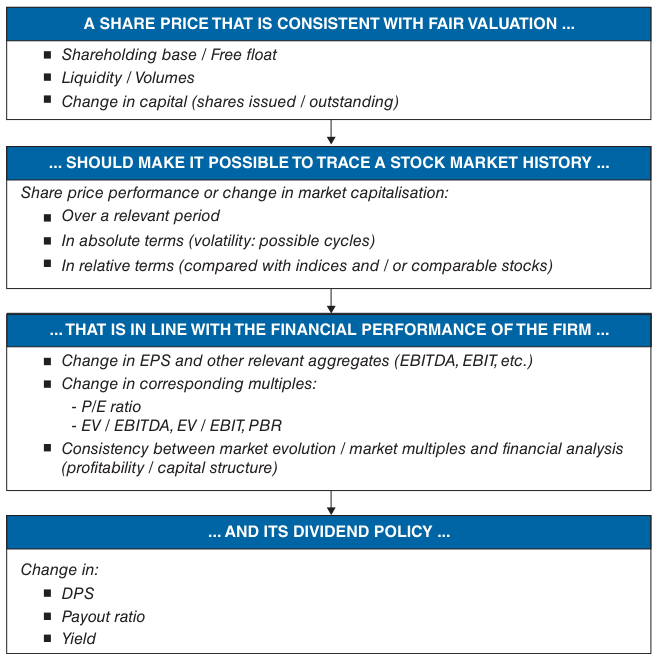
W. Schoutens, J. de Spiegeleer, C. Van Hulle, The Handbook of Hybrid Securities: Convertible Bonds ,CoCo
Bonds and Bail-in , John Wiley & Sons Ltd, 2014.
J. Stein, Convertible bonds as backdoor equity ďŹnancing, Journal of Financial Economics ,32(1), 3â21,
August 1992.BIBLIOGRAPHY
Chapter 24 HYBRID SECURITIES 445SECTION 2c24.indd 03:13:18:PM 09/05/2014 Page 445 Trim Size: 189 X 246 mm
On tracking stocks:
M. Clayton, Y. Qian, Wealth gains from tracking stocks: Long-run performance and ex-date returns,
Financial Management ,33(3), 83â106, Autumn 2003.
D. Tompkins, Are tracking stocks on track? Business Horizons , 73â78, NovemberâDecember 2000.
On exchangeable bonds:
F. Fabozzi, The Handbook of Fixed Income Securities , 8th edn, McGraw-Hill, 2011.
On hybrid securities and equity âin dragâ:
F. Black, M. Scholes, The pricing of options and corporate liabilities, Journal of Political Economy ,81(3),
637â654, MayâJune 1973.
J. Bulow, L.H. Summers, V.P. Summers, Distinguishing debt from equity in the junk bond era, in J.
Shoven, J. Waldfogel (eds), Taxes and Corporate Restructurings , Brooking Institution, 1990.
M. Fridson, Do high-yield bonds have an equity component? Financial Management , 82â84, Summer
1994.
M. Jensen, W. Meckling, The theory of the ďŹrm: Managerial behavior, agency costs, and capital structure,
Journal of Financial Economics ,3(4), 305â360, October 1976.
S. Myers, N. Majluf, Corporate ďŹnancing and investment decisions when ďŹrms have information that
investors do not have, Journal of Financial Economics ,13(2),187â221, June 1984.
c25.indd 12:41:34:PM 09/05/2014 Page 446 Trim Size: 189 X 246 mmSECTION 2Chapter 25
SELLING SECURITIES
Get âem while theyâre hot!
Now that we have studied the properties of the various financial securities, letâs see how companies sell them to investors. Bank finance was beautiful in its simplicity â whenever a company needed funds, it turned to its bank. Now that direct financing has become more common, companies can raise funds from a great many investors whom it does not neces-sarily know. That means they have to market their financing!
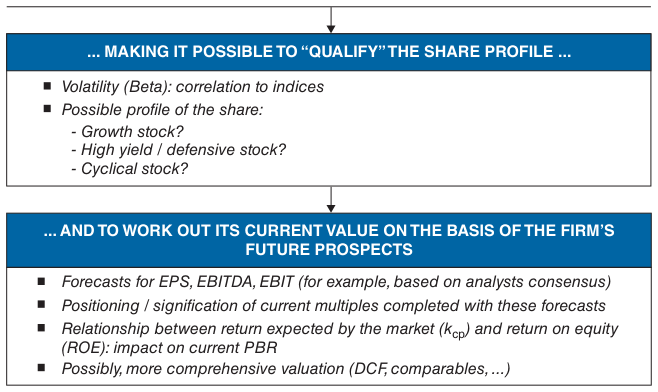
Section 25.1
GENERAL PRINCIPLES IN THE SALE OF SECURITIES
1/THE PURPOSE OF OFFERINGS
The Mechanics of Selling Securities
- Companies aim to maximize security prices while ensuring investors receive a return to maintain future market access.
- Market efficiency relies on pricing in all public information, whereas asymmetric information prevents assets from reaching fair value.
- Issuers and banks must bridge information gaps through legal prospectuses, management presentations, and analyst valuations.
- Underwriting banks face a conflict of interest, balancing their mandate from the issuer with their long-term relationship with investor clients.
- The complexity of an offering is determined by the company's existing market profile, the risk level of the security, and the target investor demographic.
- Banks serve four primary roles in an offering, starting with deal arrangement and the strategic circulation of information.
In any offering the bankâs exact positioning is always ambiguous.
The companyâs main goal in selling its securities to investors is to obtain the highest possible price.For the sale to be successful, the company must offer investors a return or a potential capital gain. Otherwise, it will be harder to gain access to the market in the future.The offering must be in line with this objective. The price of a security is equal to its pres-ent value, as long as all publicly available information has been priced in. This is the very basis of market efficiency. Conversely, asymmetric information is the main factor that can keep a company from selling an asset at its fair value.
Investors must therefore be given the information they need to make an investment
decision. The company issuing securities and the bank(s) handling the offerings must provide investors with information. Depending on the type of offering, this can be in the form of:ta mandatory legal written document called a prospectus;
tpresentations by management via meetings/conference calls with investors or electronic roadshows;
tvaluations and comments by financial professionals on the deal and the issuer via notes by financial analysts and presentations to the bankâs sales teams, for example.
Chapter 25 SELLING SECURITIES 447SECTION 2c25.indd 12:41:34:PM 09/05/2014 Page 447 Trim Size: 189 X 246 mm
A firm underwriting commitment by the bank(s) handling the transaction can provide additional reassurance to investors, because if the bank is willing to arrange and under-write the offering, it must believe that the offering will succeed and that the price is âfairâ. After all, investors are also clients to whom the bank regularly offers shares.In any offering the bankâs exact positioning is always ambiguous. In theory it is man-dated by the company that is issuing the securities and must therefore defend that companyâs interests to the fullest. But to do so, it must persuade the investors, who are its regular customers, to subscribe. It cannot afford to lead its clients astray. Ultimately, it defends the interests of both sides, not to mention its own!Investor information needs and the complexity of the deal depend on the following:tThe amount of information that is already available on the issuing company itself. Clearly, an initial public offering of shares in a company unknown to the mar-
ket will require a big effort to educate investors on the companyâs strategy, business, financial profile and perhaps even the sector in which it operates. This information is already contained in the share price of a publicly traded company, as that price reflects investor anticipation. This is why it is generally easier to offer shares in a company that is already listed.
tInvestor risk. Investors need more information for shares than for bonds, which are
less risky.
tThe type and number of investors targeted. In addition to regulatory restrictions, it
is generally more difficult for a European company to sell its securities in the US than in Europe, especially if the company and its industry are not known outside its home country (sometimes the opposite can occur, as in the oil services sector, for example). Meanwhile, a private placement with a few investors is simpler than a public offering.
2/THE ROLE OF BANKS
The bank(s) in charge of an offering have four roles, the complexity of which depends on the type of offering:
1. Arranging the deal , i.e. choosing the type of offering on the basis of the goal
sought: volume of securities to offer and in what form and timetable, choosing the market for the offering, contacts with market authorities, preparation of legal docu-ments in liaison with specialised attorneys.
2. Circulation of information : an offering is often an opportunity for an issuer to
The Securities Issuance Process
- Banks conduct due diligence and research to verify a company's financial health and strategy before a public offering.
- The distribution phase involves sales teams marketing securities to investors and establishing an equilibrium price in the after-market.
- Underwriting serves as a financial guarantee where the bank assumes market risk by ensuring securities find buyers at an agreed price.
- Large offerings typically require a syndicate of multiple banks with specialized roles ranging from global coordinators to co-managers.
- The global coordinator or lead manager oversees the entire deal structure, including the selection of the syndicate and the allocation of securities.
The bank thus assumes a certain market risk. The magnitude of this risk will depend on the type of guarantee and on the timing of the commitment.
report on its recent activity, prospects and strategy. The consistency of this infor-mation is checked by the bank and the lawyers in charge of the deal during a phase called âdue diligenceâ, which consists of interviews with the companyâs manage-ment. Information is also gathered by the brokerage arm of the bank and then put out in research notes written by the bankâs financial analysts. The bank also organ-ises meetings between the issuer and investors in one or more markets (roadshows or one-to-one meetings).
3. Distribution of the paper : the bankâs sales teams approach their regular clients,
the investors, to market the securities and take orders. The issue price is then set by
FINANCIAL SECURITIES 448SECTION 2c25.indd 12:41:34:PM 09/05/2014 Page 448 Trim Size: 189 X 246 mm
the bank in liaison with the issuer or seller, and the securities are allocated to inves-tors. An equilibrium price is established in the âafter-marketâ phase. In the days after that, the bank may intervene in the market in order to facilitate exchanges of blocks among investors.
4. Underwriting : in some cases the bank provides the issuer (or seller) with a guaran-
tee that the securities will find buyers at the agreed price. The bank thus assumes a certain market risk. The magnitude of this risk will depend on the type of guarantee and on the timing of the commitment.
Most offerings, especially public offerings,
1 require a syndicate made up of several banks.
Depending on how involved it is in the deal, and in particular the degree of guarantee, any one bank may play the role of:tglobal coordinator , who coordinates all aspects of an offering; the global coordi-
nator is also lead manager and usually serve as lead and book-runner as well. For fixed-income issues, the global coordinator is called the arranger ;
tthe lead manager is responsible for preparing and executing the deal. The lead helps
choose the syndicate. One (or more) leads also serve as book-runners. The lead also takes part in allocating the securities to investors;
tjoint-leads play an important role, but do not usually serve as book-runners;
tco-leads underwrite a significant portion of the securities but have no role in structur-
ing the deal;
tco-managers play a more limited role in the transaction, normally just underwriting
Securities Underwriting and Book-Building
- A bought deal represents the highest level of commitment where banks purchase securities directly from the issuer to resell them.
- Firm underwriting agreements act as a secondary safety net, requiring banks to buy securities only if investor interest is insufficient.
- The book-building process serves as a risk-mitigation tool by gauging investor demand and pricing before banks commit to a deal.
- Best efforts agreements are rare in formal markets because the lack of a guarantee can undermine investor confidence.
- Book-building allows for discretionary allocation of securities and helps determine the optimal price for the seller.
- Smaller companies or distressed firms often rely on best efforts deals because banks are unwilling to take on the full risk of the offering.
Book-building allows the banks running the transaction to limit their risk, by assuring them that investors are willing to buy the securities.
a small portion of securities.
For some transactions (a block trade of already existing shares or a bond issue), the banks may buy the securities from the seller (or issuer) and then sell them to investors. This is called a bought deal . Unsold securities go onto the bankâs balance sheet.
Afirm underwriting agreement carries less of a commitment than a bought deal. A
firm underwriting is a commitment by the bank to buy the securities only if the offering fails to attract sufficient investor interest. In some cases, the bank may be released from its commitment in the event of force majeure .
Before agreeing to underwrite more complex deals, banks may wish to have some
idea of investorsâ intentions. They do so via a process called book-building , which occurs
at the same time that information is sent out and the securities are marketed. V olumes and prices from potential investors are listed in the book. This helps determine if the transac-tion is feasible and, if so, at what price. Only after the book-building process do banks choose whether or not to underwrite the deal. Book-building allows the banks running the transaction to limit their risk, by assuring them that investors are willing to buy the securities.Book-building helps to determine, at a given moment, the best price for the seller and/or company and to allocate the securities on a more or less discretionary basis.In simpler transactions such as the placement of blocks or the issue of convertible bonds, the bank will almost always get feedback from a limited number of investors on their interest in the transaction and on the pricing.
In some cases, the bank does not pledge that the transaction will go through suc-
cessfully, only that it will make its best efforts to ensure that this happens. This is rare in 1 That is, for
a flotation on a regulated market or a public retail offer.
Chapter 25 SELLING SECURITIES 449SECTION 2c25.indd 12:41:34:PM 09/05/2014 Page 449 Trim Size: 189 X 246 mm
a formal documented offer, as investor confidence could be sapped if there is no formal pledge that the deal will go through. As a result, best efforts is the rule only in offerings by smaller companies or in very special cases (companies in financial distress, for example).
In some transactions, the bankâs commitment is halfway between an initial bought
Equity Offering Adjustment Mechanisms
- Underwriters use extension clauses to increase the number of shares sold by up to 25% if market demand proves stronger than anticipated.
- The 'greenshoe' option allows banks to stabilize post-offering prices by over-allocating shares and then buying them back or exercising warrants.
- Clawback clauses provide flexibility to reallocate share tranches between different investor groups, such as moving unsold retail shares to institutional buyers.
- Lock-up agreements prevent major shareholders from selling additional stock for a set period, ensuring market stability after a new placement.
- Private placements allow companies to bypass rigorous public disclosure rules and market authority supervision by targeting a limited group of investors.
This is called a greenshoe (named after the first company to use it).
deal and a post-book-building bought deal. When a block of existing shares is being sold, a bank may make a âback-stopâ or floor underwriting commitment, i.e. go through the book-building process but guarantee the seller a minimum price.
There are three techniques for adjusting the offering to anticipation of investor behav-
iour, as well as to their actual behaviour: extension clause , greenshoe and clawback .
The extension clause allows shareholders wanting to sell shares or the company issu-
ing new shares to sell more shares than initially planned if demand turns out to be strong. The option is disclosed in the prospectus and can be exercised at the time of the allocation. The size of the transaction can be increased by 15% in the case of a share issue and 25% in the case of a secondary placement.
To stabilise the price after the transaction, the issuer or seller may give the bank the
option of buying a number of shares over and above the shares offered to investors (as many as 15% more in a capital increase and 25% more for block trades of existing shares). This is called a greenshoe (named after the first company to use it). The bank allocates all the securities to investors, including the greenshoe shares, i.e. more than the official offering. These additional shares are borrowed by the bank:tIf the price falls after the offering, the bank buys shares on the market up to the limit of the greenshoe. This supports the price. It then has 30 days to resell these shares if the price moves back up. If the price doesnât rise, the bank repays the loan using the shares it bought to support the price. In this case the greenshoe is not exercised.
tIf the price moves up, the bank can resell the shares or, if the price rises immediately after the transaction, the bank no longer has the shares so it will pay back the loan by exercising the greenshoe. The company will thus have sold more shares than origi-nally planned.
Greenshoes are used for secondary offerings (i.e. sale of existing shares), new share issues (the lead bank receives, free of charge, warrants that it may or may not exercise) or con-vertible bond issues (when it takes the form of a simple extension of the issue, decided two or three days after its launch).
An offering targeted at several categories of investors (institutional, retail, employ-
ees, etc.) will be split into several tranches reserved for each of them. The clawback
clause gives the company some flexibility in the size of each tranche. Hence, if institu-tional demand is very heavy and retail demand very light, the clawback allows the shares initially allocated to retail investors to be reallocated to institutional investors.
If a large shareholder sells part of his shares through the transaction, the placement
will be eased if this shareholder commits not to sell additional shares over a certain period of time (unless the bank coordinating the transaction gives the green light). This is called alock up and lasts between a few months and a year.
To simplify the transaction, the bank may advise the company to target a limited
number of investors, thus avoiding the rules governing a public offering, including super-vision by market authorities, obligation to present information, etc. This is called a pri-
vate placement and is possible on all types of products. Private placements are often used
in offerings to US investors (generally under rule 144A), as the offering would otherwise be subject to extremely strict restrictions.
FINANCIAL SECURITIES 450SECTION 2c25.indd 12:41:34:PM 09/05/2014 Page 450 Trim Size: 189 X 246 mm
3/ISSUE DISCOUNTS
The Mechanics of IPO Discounts
- New stock issues typically rise 10-15% above their initial price, while secondary offerings are usually discounted by 2-5%.
- Pricing discounts serve as a mechanism to overcome information asymmetry between sellers who know the company and investors who know the market.
- The 'winner's curse' phenomenon requires discounts to protect uninformed investors who might otherwise only receive full allocations of poor-quality deals.
- Underwriting banks utilize discounts to reduce their own risk and ensure institutional client demand is met during the marketing phase.
- The magnitude of the discount is directly proportional to the level of information asymmetry and the illiquidity of the security being offered.
- Modern IPOs generally combine underwritten deals for institutional investors with specific offerings for retail investors and employees.
Uninformed investors cannot distinguish which issues are really attractive and thus are exposed to the winnerâs curse.
Studies show that when a company is floated, its stock normally rises by an average of about 10â15% over its issue price, depending on the country, the timing and how the rise is calculated. Meanwhile, shares in a company that is already listed are usually offered at a discount ranging from 2â5% although the range varies profoundly according to differ-ent countries.
This discount is theoretically due to the asymmetry of information between the seller
and the investors or intermediaries. One side knows more about the companyâs prospects, while the other side knows more about market demand. The transaction is therefore pos-sible. Itâs all a matter of price! Selling securities generally sends out a negative signal, so the seller has to price his securities slightly below their true value to ensure the deal goes through and that investors are satisfied.
The IPO discount could be due to the fact that there are both informed and unin-
formed investors. Uninformed investors cannot distinguish which issues are really attrac-tive and thus are exposed to the winnerâs curse. This is why an average discount is offered, to guarantee an appropriate return for uninformed investors who will be receiving many shares of a âbad dealâ and few shares of a âgood dealâ. Others suggest that the discount is a way of remunerating the banks underwriting the deal. The discount makes the issue easier to market, reduces their risk and allows them to meet institutional client demand.
The issue discount is another way to persuade investors to invest in a transaction
that appears to carry some risk.The greater the asymmetry in information between an issuer and investors, and the lower the liquidity of the security, the greater is the issue discount. The issue discount will thus be high for an initial public offering, less for the sale of shares in an already listed company, low or non-existent for convertible bonds and totally absent for bonds.So much for the major principles. Letâs now look at how the main types of securities are offered. As you will see, the methods converge towards two main techniques: bought deals and book-building.
Section 25.2
INITIAL PUBLIC OFFERINGS
The purpose of this section is not to analyse the motivations, strategic or otherwise, of an initial public offering (IPO) but simply to describe how it works.
1/HOW AN IPO WORKS
IPOs are surely the most complex of transactions. They involve selling securities, about which prior information is extremely limited, to a large number of investors, including institutional and retail investors and employees.
An IPO can include a primary tranche (i.e. shares newly issued by the company) and/
or a secondary tranche (i.e. existing shares). The techniques are the same for both tranches
Chapter 25 SELLING SECURITIES 451SECTION 2c25.indd 12:41:34:PM 09/05/2014 Page 451 Trim Size: 189 X 246 mm
and, in fact, existing shares and new shares are bundled up in the same lot of shares to be offered.
However, the techniques vary depending on whether the shares are being offered to
institutional investors, retail investors or employees.
2/HOWIPO S ARE MADE
A number of techniques exist for floating a company. However, in the past few years, IPOs on regulated markets have almost all been in the same form: that of an underwritten deal
with institutional investors and a retail public offering with retail investors.
(a)Book-building
The Book-Building Process
- Book-building is the primary mechanism for institutional tranches in IPOs and dictates the final price for retail offerings.
- The initial phase involves banks structuring the deal, conducting due diligence, and designing the marketing campaign.
- A pre-marketing execution phase uses analyst research and 'warm-up' meetings to gauge investor sentiment before the official launch.
- During the formal marketing period, management conducts roadshows and one-on-one meetings within a 15% price range.
- Investor intentions are recorded in an order book, which determines the final sale price based on demand and price sensitivity.
The notes are presented to investors during âwarm-upâ meetings, which help test investor sentiment.
Offerings of securities to institutional investors are most often implemented through a book-building. This is the main tranche in almost all IPOs. Under this system, one or more banks organise the marketing and sale of securities to investors via a phase of book-building. The price set after book-building will serve as a basis for setting the price of the retail public offering. Other techniques are used for the other tranches (employees and retail investors, in particular).
The initial review phase is handled by the banks. This consists of assessing
and preparing the legal and regulatory framework of the deal (choice of market for listing, whether to offer shares in the US, etc.); structuring the deal; supervising documen-tation (due diligence, prospectus) and underwriting and execution agreements; preparing financial analysis reports; designing a marketing campaign (i.e. the type and content of management presentations, programme of meetings between management and investors).
Then comes the execution phase , with the publishing of financial analysis
notes by syndicate banks. This is a pre-marketing period lasting one to two weeks
prior to the effective launch of the operation. The notes are presented to investors dur-ing âwarm-upâ meetings, which help test investor sentiment. Analystsâ research notes cannot be published during the blackout period that precedes the launch. The terms of the transaction, particularly the price range, are set on the basis of conclusions from this pre-marketing exercise.
The marketing campaign itself then begins, and the offering is under way. During
this period, full information is distributed via draft prospectuses (certified by market authorities), which may be national or international in scope. The prospectus includes all information on the company and the transaction. The offering is marketed within a price range of about 15%. Company managers are mobilised during this period for numerous meetings with investors (roadshows) or for one-on-one meetings. The information given to investors is mainly on company results, markets and strategy.
In the meantime, investor intentions to subscribe in terms of volumes and prices are
recorded in an order book , on the basis of the preliminary price range.
After this period, which can last five to 15 days, the sale price of the existing shares
and/or newly issued shares is set. The price reflects market conditions, overall demand as reflected in the order book and the price sensitivity that investors may have expressed.
FINANCIAL SECURITIES 452SECTION 2c25.indd 12:41:34:PM 09/05/2014 Page 452 Trim Size: 189 X 246 mm
The Mechanics of Book-Building
- Banks minimize risk by delaying firm underwriting agreements until shares are immediately allocated to investors.
- The bank's commitment acts as a market signal that mitigates information asymmetry between the company and potential buyers.
- Discretionary allocation allows issuers to select a shareholder base that balances different investment timelines to ensure aftermarket stability.
- Academic theories suggest that IPO discounts and allocations are often used as rewards for information disclosure or to favor high-profit institutional clients.
- The book-building process provides flexibility by allowing price adjustments during the marketing phase based on real-time demand.
The bank derives high profits from its large institutional clients (in particular thanks to trading revenues). They will, therefore, favour them in the primary transactions in granting large allocations and driving the pricing down.
Not until after this phase might banks enter into a firm underwriting agreement. The
shares are then immediately allocated, thus limiting the bankâs risk. After allocation, investors are theoretically committed. However, up to the actual settlement and delivery of the shares (three days after the transaction), banks still face counterparty risk. There is also business risk in the form of an institutional investor who decides he does not wish to take delivery of the shares after all. In sum, the only risks the syndicate takes is that of a market crash between the moment the price is set and the moment when the shares are allocated, and that of stabilising the price for around a month after the transaction by buying shares on the market.
The guarantee given by the bank to the company is also implicitly a guarantee for
the market. The bank determines a value after review of internal information. This partly resolves the problem of asymmetry of information. The signal is no longer negative, because a bank with access to internal information is taking the risk of buying the shares at a set price if the market does not.
The final prospectus (with the issue price) is sent out after the price is set and the sub-
scription period is closed. The lead bank knows the quantity and quality of demand. The book-runner allocates the new shares to investors in concert with the issuer and/or seller, who can thus âchooseâ his shareholders to a certain extent.
The shares are allocated on the basis of certain criteria determined in advance.
Allocation is discretionary but not arbitrary. The goal may be to favour US, European or local investors. Generally, the main goal in allocation is to have a balance between investors with different investment timing in order to ensure a stable aftermarket. The banks may steer the issuer to what it believes are quality investors, thus lim-iting excessive flowback , i.e. the massive sale of securities immediately after
the offering.
In academic research, discretionary allocation and pricing have been interpreted in
the following ways:tBenveniste and Spindt (1989) claim that the most knowledgeable investors reveal the information they have (through their order in the order book) in exchange for a good allocation and good pricing (IPO discount).
tIn a second interpretation, the bank tries to favour long-term investors in order not to drive down the share price in the short term. In addition, the IPOed firm may wish to create a long-term shareholder base.
tIn a third interpretation, the bank will use its power in the transaction to maximise its profits (which is sometimes against the interest of the firm being IPOed). The bank derives high profits from its large institutional clients (in particular thanks to trading revenues). They will, therefore, favour them in the primary transactions in granting large allocations and driving the pricing down. Such behaviour has sometimes been sanctioned by law.
Book-building offers several advantages, including greater flexibility. For one thing, the price can be adjusted as necessary during the marketing phase, which can sometimes last several weeks. Moreover, shareholders can still be chosen via discretionary allocation of shares.
Chapter 25 SELLING SECURITIES 453SECTION 2c25.indd 12:41:34:PM 09/05/2014 Page 453 Trim Size: 189 X 246 mm
Investor
demand
PRE-MARKETING MARKETING
Roadshowswith institutionalinvestors
Official book-buildingbeginsWarm-uppresentations
Researchnotessent outOfferingobjectivesare setPreliminaryprospectusOfferingprice issetFinalprospectusUnderwritingcontractis signedAllocationsSettlement/deliveryTimeAmount tobe offeredon the market[oversubscription]Book-building
First tradingStabilisation
(b) How shares are offered to retail investors
Retail Public Offering Mechanisms
- Retail public offerings involve setting a price range before the sale, with the final price determined by market demand and approved by authorities.
- Allocation of shares to retail investors is often based on supply-demand ratios, sometimes including discounts or fee exemptions to encourage participation.
- Fixed-price offerings set a specific price independent of market conditions, often leading to sharp price increases if the initial price is set too low.
- Minimum-price offerings require buyers to specify a floor price, with the exchange centralizing orders and potentially eliminating extreme price outliers.
- Ordinary full listings allow shares to trade under normal market conditions with a set minimum price and specific limits on price appreciation during initial trading.
In a minimum-price offering, some orders may be shut out entirely, and orders at very high prices are paradoxically eliminated.
In an underwritten deal, shares are allocated at the discretion of the lead, based on the order book, as well as on criteria announced in advance. However, when shares are being sold to retail investors, the issue is centralised by the market itself.
tThe retail public offering
In a retail public offering, a price range is set before the offering, but the exact price is set after the offering. The final price reflects market demand. French market authori-ties, for example, require a marketing period lasting at least three days, after which a draft prospectus is issued with the characteristics of the deal. Based on a price range, financial intermediaries collect orders from investors. The issue price is set jointly by the issuer and the syndicate lead and is generally equal to the underwriting price.
2
The final prospectus is then approved by the market authorities.With the agreement of the market authorities, the banks can adjust the price if they have previously reserved the right to do so but, in general, they must begin the pro-cess anew if the new price is outside of the initial range. Shares are allocated on the basis of orders if supply is equivalent to demand and can be reduced on the basis of predetermined criteria. Allocation of shares to the various categories of buyers is done on the same basis as the fixed-price offer.2 Retail
investors are generally offered a discount or are exempt from certain fees.
FINANCIAL SECURITIES 454SECTION 2c25.indd 12:41:34:PM 09/05/2014 Page 454 Trim Size: 189 X 246 mm
Orders are filled on the basis of a percentage resulting from the comparison of supply and demand. Normally, at least 1% of the order is filled, but there may be provision for a minimum number of shares per order, so that broker fees do not end up swal-lowing any potential gain. Similarly, there are sometimes several categories of orders with different allocation priorities.
tFixed-price offering
Under a fixed-price offering, a certain number of shares are offered to the public at a preset price, which is generally identical to the price offered to institutional investors. The price is set after the book-building phase and is independent of market condi-tions. It is applied regardless of the number of shares requested. If it is far below what the market is willing to pay, the price will rise sharply in the days after the IPO and primary market buyers will have a capital gain to show for their initiative.The only difference between a fixed-price offering and a retail public offering is how the price is set.
tMinimum-price offering
Under this technique, a number of shares are offered to the public at a certain price, under which they will not be sold. The local stock exchange centralises orders, in which buyers must specify a floor price, and tries to find a sufficiently wide price range at which orders can be allocated in a certain proportion (about 6%) if there is sufficient demand.In a minimum-price offering, some orders may be shut out entirely, and orders at very high prices are paradoxically eliminated. This explains why the first quoted price is above the pre-set minimum price. If demand is too strong to quote the shares, trading is declared âlimit upâ and resumes at a higher price, or another technique is used for the initial quotation.
tAn ordinary full listing
The principle of an ordinary full listing is simple: the shares are offered on the basis of the marketâs normal trading and quoting conditions. A minimum sale price is set, but buy orders are not centralised by the local stock exchange. Quotation is possible at a price normally no higher than 110% of the minimum price; at least 6% of the buy orders are filled (4% in exceptional cases). As in a minimum-price offering, trading may be suspended âlimit upâ and resumed at a higher price. In addition, orders may have to be covered by sufficient funds (the goal being to discourage speculation).
3/US LISTINGS FOR NON -US COMPANIES
Foreign Listings in US Markets
- Companies seek foreign listings, primarily in the US, to expand their shareholder base and access a wider pool of capital.
- Private placements under Rule 144A allow companies to sell shares to Qualified Institutional Buyers (QIBs) without SEC registration.
- American Depositary Receipts (ADRs) serve as negotiable instruments issued by US banks that represent shares in foreign companies.
- ADR levels range from Level 1 (OTC trading only) to Level 3, which allows for public fund-raising but requires full SEC registration.
- A full listing of ordinary shares provides the most direct access to US institutional investors who may be restricted from buying foreign-listed stocks.
This decision is not so unusual â over 3000 foreign companies are listed in the US!
Companies normally list their shares on their domestic stock market, where they are bet-ter known. However, they may wish to tap foreign investors to widen their shareholder base and could thus seek a foreign listing.
This decision is not so unusual â over 3000 foreign companies are listed in the US!Since the American markets (NYSE and Nasdaq) are traditionally the preferred alter-
native for companies wanting to list, we focus our attention on US listing.A company can list its shares on the US market via (1) a private placement, (2) American Depositary Receipts or (3) a full listing.
Chapter 25 SELLING SECURITIES 455SECTION 2c25.indd 12:41:34:PM 09/05/2014 Page 455 Trim Size: 189 X 246 mm
(a)Private placements
Under rule 144A, companies may opt for private placement of their shares, but they may only do so with US Qualified Institutional Buyers (QIBs). QIBs are then prohibited
from selling their shares on the open market for two years, but can trade with other QIBs via the PORTAL system. Private placements are simply a means of gaining access to US investors, but do not allow a company to register its shares with the Securities Exchange Commission (SEC) or to quote them in the US.
This is the least restrictive way to raise capital on US markets, as private placements
are not registered with the SEC and come under the 12g3-2(b) waiver. All the issuing company has to do is translate the information that it has provided to its domestic market.(b) Indirect listing via American Depositary Receipt (ADR)
ADRs, also known as DRs or GDRs,
3 are negotiable instruments issued by a US bank
and representing the shares that it has acquired in a foreign company listed on a non-US market â something like tracking stocks, except they are not issued by the company itself. ADRs are traded on a regulated market or an over-the-counter (OTC) market.
The ADR shares can be established either for existing shares already trading in the
secondary market of the home country, or as part of a global offering of new shares.
There are several types of ADR:
tLevel 1 ADRs are not traded on an organised market but only over the counter. They do not allow companies to raise funds on the US market, but nor do they require any particular information to be put out.
tLevel 2 ADRs are listed on an organised market. This attracts some US pension funds, but requires the companies to publish a 20-F report every year. The 20-F is a more extensive document than a typical European annual report (it includes, for example, a table for converting from the companyâs accounting principles to US GAAP
4). Companies are not allowed to raise funds with Level 2 ADRs.
tLevel 3 ADRs provide the company with a listing (via its ADR) on an organised market, and also allow it to raise funds via a public offering. Level 3 accordingly requires full registration with the SEC (F-1). Moreover, the company is subject to strict obligations on information (based on the 20-F and 6-K). Among other things, the published documents must list plans for acquisitions or reorganisation, as well as a partial reconciliation of company accounts to US GAAP. Companies usually go this route when they have significant commercial interests in North America.
More than 3000 ADRs are listed from 50 different countries, including Alcatel-Lucent,TelefĂłnica, Korea Electric Power, Nokia, BP and many others.(c)Full listing
Companies can also list their ordinary shares in both their home countries and directly in the US. This gives them access to institutional investors whose by-laws do not allow them to buy shares outside the US.
The main difference between ordinary registered shares and ADRs is that
Depositary Receipts and Capital Increases
- Depositary Receipts (DRs) vary by market, including ADRs for US public markets, Rule 144A for institutional buyers, and GDRs for international markets.
- Ordinary registered shares generally offer higher liquidity and lower transaction costs compared to depositary structures by avoiding arbitrage and depositary fees.
- Capital increases for listed companies are primarily driven by whether the firm intends to reward current shareholders or attract a new investor base.
- Rights issues utilize pre-emptive subscription rights and significant price discounts to ensure transaction success despite potential market volatility.
- Unlisted companies determine issue prices based on shareholder cash needs or private placements rather than market price fluctuations.
- Legal constraints prevent shares from being issued below par value, necessitating accounting adjustments like par value reduction if market prices are too low.
The price is set at a significant discount to the market price, so that the transaction will go through even if the share price drops in the run up to the listing of new shares.
ordinary registered shares carry lower transaction costs as there is no depositary. They are also more liquid and are less subject to arbitrage trading between domestic shares and ADRs.3 American
DepositaryReceipts may be also called â generically â Depositary Receipts (DRs), or Rule 144A DepositaryReceipts or Global Deposi-tary Receipts (GDRs), which are the âprivate placementâ dis-cussed in the text. However, differ-ent names typi-cally identify the market in which the Depositary Receipts are available: ADRs
are publicly available to US investors on a national stock exchange or in the over-the-counter market; Rule 144A ADRsare privately placed and resold only to Qualified Institutional Buy-ers (QIBs) in the US QIB PORTAL market; and GDRs are gener-
ally available in one or more markets outside the foreign companyâs home country, although these may also be known as ADRs.4 Companies
following the IFRS norms will no longer be obliged to abide by this rule after 2009.
FINANCIAL SECURITIES 456SECTION 2c25.indd 12:41:34:PM 09/05/2014 Page 456 Trim Size: 189 X 246 mm
Full listing is a relatively long and complex process suitable only for very large com-
panies (UBS, Deutsche Telekom, Repsol YPF, etc.).
Section 25.3
CAPITAL INCREASES
A financial approach to capital increases is developed in Chapter 38.
1/THE DIFFERENT METHODS
The method chosen for a capital increase depends:
1. on whether or not the company is listed;2. on how eager current shareholders are to subscribe.
(a)Listed companies
When the large majority of current shareholders are expected to subscribe to the capital increase and it is not necessary or desirable to bring in new shareholders, the transac-tion comes with pre-emptive subscription rights (the transaction is then called a rights issue). The issue price of the new shares is set and announced in advance and the offer-ing then unfolds over several days. The price is set at a significant discount to the market price, so that the transaction will go through even if the share price drops in the run up to the listing of new shares. To avoid penalising existing shareholders, the issue comes with pre-emptive subscription rights, which are negotiable throughout the transaction period.
However, when current shareholders are not expected to subscribe or when the com-
pany wants to widen its shareholder base, no pre-emptive subscription rights are issued. The issue price is then not set until a marketing and pre-placement period has been com-pleted, with a very slight discount to the share price at the end of this period. There are no pre-emptive subscription rights, but there may be a period during which current share-holders are given priority in subscribing.(b)Unlisted companies
In this case, the issue priceâs discount will not be dictated by the fear that the share price will fluctuate during the operation (as the company is not listed), but rather by the wish of current shareholders to raise cash by selling the subscription rights they may have received.
If current shareholders do not wish to raise cash, the company will issue pre-emptive
subscription rights at a price about equal to the share price, or may issue shares to iden-tified investors that have been found via a private placement.
5 Shares cannot be issued
below par value (this is also the case for listed companies). If the share price is below par value, the par value could be reduced by offsetting it against past losses.5 In the rare
case of a capital increase with no subscription rights and not reserved for iden-tified investors, the price is based on an expert appraisal or is set at book value.
Chapter 25 SELLING SECURITIES 457SECTION 2c25.indd 12:41:34:PM 09/05/2014 Page 457 Trim Size: 189 X 246 mm
2/RIGHTS ISSUE
A fixed-price rights issue with pre-emptive subscription rights (also called privileged sub-
Mechanics of Rights Issues
- Rights issues are the preferred method for small investors as they acknowledge loyalty and provide an option to raise cash by selling subscription rights.
- Geographical preferences vary significantly, with rights issues being rare in the US and Japan but mandatory in much of Continental Europe.
- Banks typically underwrite these issues at a 15â30% discount to the market price to mitigate the risk of price drops during the 10-day subscription period.
- Pre-emptive rights protect existing shareholders from dilution by allowing them to maintain their proportional ownership regardless of the discount offered.
- The total value of the new shares plus the subscription rights remains equivalent to the stock's market value, neutralizing the impact of the discounted offer price.
- Capital increase strategies differ between listed and unlisted companies depending on whether the goal is to accommodate current or new shareholders.
No bank will guarantee a price near the current market price because, the longer the subscription period, the greater the risk of a drop in price.
scription or rights issues ) is the traditional issue preferred by small investors (or their
representatives). Such issues acknowledge their loyalty or, conversely, allow them to raise a little cash by selling their subscription rights.
In some countries, such as the United States and Japan, rights issues are quite rare,
while in Continental Europe they generally have to be sold by rights.
Such issues remain open for at least 10 trading days. Banks underwrite them at a
price well below the current share price, generally at a discount of 15â30%. No bank will guarantee a price near the current market price because, the longer the subscription period, the greater the risk of a drop in price. It is at this price that the banks will buy up any shares that have not found takers.
A steep discount would be a considerable injustice to existing shareholders, as the
new shareholders could buy shares at 20% below the current market price. Rights issues resolve this problem by allowing existing shareholders to buy a number of shares propor-tional to the number they already have. If existing shareholders use all their pre-emptive rights, i.e. buy the same proportion of new shares as they possess of existing shares, they should not care what price the new shares are offered at.The price of the new shares plus the value of the pre-emptive subscription rights is equivalent to the stockâs current market value (i.e. its share price if it is listed), even if the price of the new shares is below the current share price.WHICH METHOD SHOULD BE USED FOR A CAPITAL INCREASE?Rights issue subscribedmainly by:Listed company Unlisted company
Current shareholders Pre-emptive
subscription rights
Steep discount to the market
pricePre-emptive subscription
rights with a steep discount if current shareholders wish to raise cash
Pre-emptive subscription rights
with no discount or no pre-emptive rights if current shareholders do not want to raise cash
New shareholders Offer without pre-emptive
subscription rights (at a slight discount to the current share price)
In some cases, a reserved
rights issuePre-emptive subscription rights
with a steep discount if shareholders want to raise cash
Reserved rights issue if
shareholders do not want cash
FINANCIAL SECURITIES 458SECTION 2c25.indd 12:41:34:PM 09/05/2014 Page 458 Trim Size: 189 X 246 mm
Pre-emptive Subscription Rights
- Subscription rights allow existing shareholders to maintain their proportional stake in a company during a new share issue.
- These rights function similarly to short-term call options, where the strike price is the issue price of the new shares.
- Shareholders are protected from dilution because the rights can be sold on the market if the holder chooses not to subscribe.
- The theoretical value of a right is determined by the spread between the pre-deal share price and the issue price, adjusted by the ratio of new to old shares.
- The 'Theoretical Ex-Right Price' (TERP) represents the share value after the rights have been detached from the original shares.
The subscription right is similar to a call option whose underlying is the share, whose strike price is the issue price of the new shares and whose exercise period is that of the capital increase.
Even when existing shareholders do not wish to subscribe, the pre-emptive subscription rights keep them from being penalised, as they can sell the right on the first day it is detached.(a) DeďŹnition
The subscription right is a right attached to each existing share allowing its holder to subscribe to the new share issue.The subscription right offers the existing shareholder:
tthe certainty of being able to take part in the capital increase in proportion with his current stake;
tthe option of selling the right (which is listed separately for listed companies) throughout the operation. This negotiable right adjusts the issue price to the current share price.
The subscription right is similar to a call option whose underlying is the share, whose strike price is the issue price of the new shares and whose exercise period is that of the capital increase. Hence, its theoretical value is similar to that of a call option whose time value is very low, given its short maturity.
If the issue price and the current share price are the same, the subscription rightâs
market value will be zero and its only value will be the priority it grants.
If the share price falls below the issue price, the rights issue will fail, as nobody will
buy a share at more than its market price. The right then loses all value. Fortunately, the reverse occurs more frequently.(b) Calculating the theoretical value of the subscription right
Letâs take a company that has 1 000 000 shares outstanding, trading at âŹ50 each. The
company issues 100 000 new shares at âŹ40 each, or one new share for each 10 existing
ones. Each existing share will have one subscription right, and to buy a new share for âŹ40,
10 subscription rights and âŹ40 will be required.
After the new shares have been issued, an existing shareholder who holds one share
and has sold his pre-emptive subscription rights must be in the same situation as an inves-tor who has bought 10 pre-emptive subscription rights and one new share. So the share price after the deal should be equal to:
Pre-deal price 1 pre-emptive right â
but also
Issue price 10 pre-emptive subscription rights +
In our example:
âŹ50 â 1 subscription right = âŹ40 + 10 subscription rights
Hence
The value of the right = âŹ0.91
Chapter 25 SELLING SECURITIES 459SECTION 2c25.indd 12:41:34:PM 09/05/2014 Page 459 Trim Size: 189 X 246 mm
The post-deal share price should be equal to:
âŹ50 â âŹ0.91 = âŹ40 + 10 x âŹ0.91 = âŹ49.09
It is easy to calculate the theoretical value of the subscription right:
()VEN
NNâĂ+â˛
â˛
where V is the pre-issue share price, E the issue price of the new shares, NⲠthe number of
new shares issued and N the number of existing shares.
We can see that this formula can be used to find the previous result.The detachment of subscription rights is conceptually similar to a bonus share
award. Hence, the existing shareholder may, if he wishes, sell some pre-emptive rights
and use the cash and remaining rights to subscribe to new shares, without laying out new cash (see the exercise at the end of this chapter).
The theoretical value of the share, once the rights have been distributed, is equal to
the price pre transaction less the value of the right. It is called the theoretical ex-right
price or TERP .
(c) Advantages and drawbacks of pre-emptive rights
Mechanics of Share Issuance
- Subscription rights require a significant discount to the current share price to ensure deal completion despite market volatility during the 10-day window.
- Issues without pre-emptive rights rely heavily on banking syndicates to market shares to new investors and often include greenshoe options for over-allotment.
- Regulatory frameworks often limit the maximum discount allowed on non-pre-emptive issues to protect existing shareholders from excessive dilution.
- Priority periods offer existing shareholders a first look at new shares when pre-emptive rights are absent, though these periods cannot be traded on the market.
- Equity lines allow companies to issue warrants to banks that are exercised on demand, providing a flexible way for younger firms to raise capital over time.
This is a double-edged sword as, once the deal is launched and the rights issued, nothing can delay the capital increase, even if the share price drops significantly during the deal.
The subscription right is valid for at least 10 days â a relatively lengthy amount of time. The issue price therefore has to be well below the share price, so that if the share price does fall during the period, the deal can still go through. The value of the right (i.e. the difference between the share price and the issue price) will fall but will remain positive, as long as the share price, ex-rights, is above the issue price.
This is a double-edged sword as, once the deal is launched and the rights issued,
nothing can delay the capital increase, even if the share price drops significantly during the deal. This is why the initial discount is so significant.
Complicating the transaction further is the fact that shareholders who do not possess
a number of shares divisible by the subscription parity must sell or buy rights on the mar-ket so that they do. This can be difficult to do on international markets.
Another potential complication is the large proportion of US investors among current
shareholders who are sometimes unable to exercise their pre-emptive subscription rights.
3/ ISSUE OF SHARES WITHOUT PRE-EMPTIVE SUBSCRIPTION RIGHTS
In issues of shares without subscription rights, the company also turns to a bank or a banking syndicate for the issue. But their role is more important in this case, as they must market the new shares to new investors. They generally underwrite the issue, as described above for IPOs. A retail public offering can be undertaken simultaneously. Alternatively, the bank can simply launch the transaction and centralise the orders without having gone through a book-building phase. The company may issue 10â15% more shares than expected, via a greenshoe, under which warrants are issued to the banks (see above).
Local regulations tend to limit the flexibility to issue shares without subscription
rights so that the shareholder will not be diluted at an absurd price. Therefore, in most
FINANCIAL SECURITIES 460SECTION 2c25.indd 12:41:34:PM 09/05/2014 Page 460 Trim Size: 189 X 246 mm
countries regulation fixes a maximum discount to the last price or a minimum issue price as a reference to a price average.
When new shares are issued with no pre-set price, current shareholders can be given
first priority without necessarily receiving pre-emptive rights. Indeed, such a priority period is the rule when pre-emptive rights are not issued. However, unlike pre-emptive rights, the priority period cannot be bought or sold. However, priority periods have the disadvantage of lengthening the total transaction period, as they generally last a few trad-ing days (this is the minimum amount of time to allow individual shareholders the time to subscribe).
Legally speaking, a public issue of new shares, with or without pre-emptive rights,
is considered to have been completed when the banks have signed a contract on a firm underwriting of the transaction, regardless of whether or not the shares end up being fully subscribed.
Such issues of shares can be implemented in the form of a private placement to quali-
fied investors (usually for a minor portion of capital).
4/EQUITY LINES
The way an equity line works is that a company issues warrants to a bank which exercises them at the request of the company when it needs to raise equity. Equity lines smooth the impact of a capital increase over time. The shares issued when the warrants are exercised are immediately resold by the bank.
Equity lines are suitable for young businesses where the stock performance history
does not allow conventional rights issues. However, it opens the way to many uncertain-ties, particularly on the terms imposed on the banks in exercising warrants and reselling the shares.
Section 25.4
BLOCK TRADES OF SHARES
Mechanics of Block Trades
- Block trades involve selling large quantities of shares that exceed normal daily trading volumes without crashing the market price.
- Unlike rights issues, block trades do not raise new capital for the company but represent a transfer of existing ownership.
- Accelerated book-building allows these transactions to be completed in a matter of hours with minimal involvement from top management.
- Public retail offerings for block trades are restricted by specific volume thresholds to ensure market stability.
- In a 'bought deal,' a bank assumes the risk by purchasing the entire block at a discount before reselling it to investors.
The bank is then taking a significant risk and will only buy the shares at a discount to the market price.
A block is a large number of shares that a shareholder wishes to sell on the market. Nor-mally, only a small fraction of a companyâs shares are traded during the course of a nor-mal day. Hence, a shareholder who wants to sell, for example, 5% of a companyâs shares cannot do so directly on the market. If he did, he could only do so over a long period and with the risk of driving down the share price. Blocks are sold via book-building and/or bought deals, which were described above.
1/BOOK-BUILDING AND ACCELERATED BOOK -BUILDING
Like a rights issue, a block trade is done via book-building. However, while rights issues allow companies to raise significant funds for investment, a block trade does not raise any new capital or have any direct impact on the companyâs business.
Moreover, fewer shares are usually involved in a block trade than in a capital increase.
Block trades are thus âsimplerâ deals than capital increases and require less marketing.
Chapter 25 SELLING SECURITIES 461SECTION 2c25.indd 12:41:34:PM 09/05/2014 Page 461 Trim Size: 189 X 246 mm
Book-building is faster, top management is less involved or not involved at all, and the deal can sometimes be done within a few hours.
Bigger transactions involving a strategic shift (exit by a controlling shareholder, etc.)
may require an intense marketing campaign, and the deal will be managed as if it were a rights issue.
Book-building can come with a public offer of sale when the company wants to allow
retail investors to acquire shares, but only for the larger issues. Barring a waiver from Euronext, a retail offering is possible only if it involves at least 10% of the total outstand-ing shares or at least 20 times the average daily volumes during the previous six months.
Block trades use methods similar to those of IPOs, particularly in price-setting. For
example, prices can be set in advance or on the basis of terms set when the offering begins. However, in the latter case, no price range is required (but the price-setting mecha-nism and the maximum price must be spelled out). In the requisite filings with Euronext, the initiator can reserve the right to withdraw the offer if take-up is insufficient or increase the number of shares on offer by as much as 25% if demand is greater than expected.
2/BOUGHT DEALS AND BACK -STOPS
When the seller initiates book-building or accelerated book-building, he has no guarantee that the transaction will go through. Nor does he know at what price the deal will be done. To solve this problem, he can ask the bank to buy the shares itself. The bank will then sell them to investors. This is called a âbought dealâ.
The bank is then taking a significant risk and will only buy the shares at a discount to
the market price. In recent bought deals involving liquid stocks, this discount has ranged from 2% to 5%.
The way it works is this: the seller contacts a few banks one evening after the mar-
Bought Deals and Bond Markets
- Bought deals allow sellers to offload shares instantly at a fixed price, shifting the risk of resale to investment banks overnight.
- While bought deals offer certainty, they often come at a steeper discount and can lead to poor share performance if banks dump stock quickly.
- Investment banks sometimes take aggressive losses on large transactions just to improve their standing in industry league tables.
- Credit ratings have become essential benchmarks in the bond market, creating a sharp divide between investment-grade and high-yield issuers.
- The transition to the euro has facilitated a pan-European bond market, enabling massive corporate issues that frequently exceed one billion euros.
- Bond placement techniques have evolved from competitive bidding toward book-building to avoid the risk of aggressive pricing that alienates future investors.
A number of large transactions (in particular when governments are sellers) have led to heavy losses for investment banks in charge.
kets close. He may have mentioned to some banks a few days or weeks beforehand that he might be selling shares, thus ensuring better-quality replies. The seller asks each bank the price it is willing to offer for the shares. Bids must be submitted within a few hours. The seller chooses the bank solely on the basis of price, and the shares are sold that very night. The bank must then organise its sales teams to resell the shares during the night in North America or Asia, taking advantage of the time difference, and then the following morning in Europe.
For the seller, bought deals offer the advantage of being certain that the deal will go
through and at the price stated at the moment when it decides whether to sell. There are some disadvantages, however: tthe deal will generally be at a greater discount than in accelerated book-building;
tshare performance can suffer, as the bank that has acquired the shares will want to sell them as quickly as possible, even if that means making the price fall;
In a very hot market, the seller may have the best of both worlds in transactions with a back-stop.tThe bank sets up an order book so that the firm can benefit from an increase in share price.
tThe bank guarantees a minimum price. If all or part of the placement cannot be made at that price, the bank will buy the shares at the back-stop price.
FINANCIAL SECURITIES 462SECTION 2c25.indd 12:41:34:PM 09/05/2014 Page 462 Trim Size: 189 X 246 mm
Banks can be very aggressive when seeking to gain the right to execute such transac-
tions in order to build credentials and comfort their ranking in league tables. A number of large transactions (in particular when governments are sellers) have led to heavy losses for investment banks in charge.
Section 25.5
BONDS
As the bond market develops and becomes more international, investors need benchmarks to measure the risk of default by issuers they do not always know very well. Ratings have thus become crucial in bond offerings. Companies that do not have a rating from at least one agency are finding it increasingly difficult to issue bonds.
As we mentioned in Chapter 20, the corporate bond market can be separated between
companies having a rating of at least BBB (investment grade) and companies rated BB or lower (below investment grade). When they want to issue bonds, the latter must offer higher interest rates. Such bonds are called âhigh-yieldâ. The investment grade and high yield markets are separate, not just for the issuers, but also for investors and for the invest-ment banks handling the offering.
1/INVESTMENT GRADE BONDS
The euro switchover has naturally given rise to a pan-European bond market, and has allowed much larger issues than were previously possible on national markets. âŹ1bn
issues are no longer rare, and only issues of âŹ10bn or more are exceptional.
Corporate bonds are generally placed via book-building.Bond-offering techniques have thus evolved towards those used for shares, and mar-ket regulations have followed suit. For example, competitive bidding has gradually
given way to book-building. Competitive bidding consists of a tender from banks. The issuer chooses the establishment that will head up the offering on the basis of the terms offered (mainly price). It thus takes the risk of giving the lead mandate to a bank that is overly aggressive on price. The reason this is risky is that prices of bonds on the second-ary market may fall after the operation begins as the bonds were issued at too high a price (hence at an excessively low rate). Buyers will not like this and will demand a higher interest rate the next time the issuer comes to the primary market. Competitive bidding is similar to a bought deal and is often used by state-owned companies, as well as companies that have already tapped the bond markets.
Other placement techniques exist (but they are usually used by sovereign issuers):
The Mechanics of Book-Building
- Book-building allows lead banks to determine market-driven pricing by sounding out investor interest before the issue price is finalized.
- The 'grey market' period allows for the trading of shares before they technically exist, with the lead bank intervening to maintain price stability.
- Bond issuance timelines vary significantly based on the issuer's frequency in the market and whether they are targeting international investors.
- Companies can use 'umbrella prospectuses' under Euro Medium-Term Notes (EMTNs) to tap into capital markets rapidly when conditions are favorable.
- High-yield bond markets in Europe are a relatively recent development, emerging in the late 1990s as an alternative to bank loans for risky firms.
Shares are traded on the grey market without, technically, even existing.
Dutch Auctions (âreverse auctionsâ) are one example.
Book-building helps avoid price weakness after launch, as the issue price (or spread)
is not pre-set. The lead bank suggests a price range and sounds out investors to see what price they are willing to pay. Presentations to investors, one-on-one meetings and electronic roadshows over the Internet or Bloomberg allow management to present its strategy.
Chapter 25 SELLING SECURITIES 463SECTION 2c25.indd 12:41:34:PM 09/05/2014 Page 463 Trim Size: 189 X 246 mm
The lead then builds a book of volumes and prices (either rate or spread) offered by
each investor interested in the issue. There is little risk of miscalculation, as the issue price is set by the market. The period between when the price is set and the effective delivery of the shares is called the grey market (this is also the case for IPOs and rights issues).
Shares are traded on the grey market without, technically, even existing. Transactions on the grey market are unwound after settlement and delivery and the first official quotations. The lead intervenes on the grey market to maintain the spread at which the issue has been priced.
This is especially useful when an issue requires, or would benefit from, intense mar-
keting. Companies wishing to market investors aggressively (notably to return to the mar-ket when they wish), will use book-building.
So there are some similarities between share and bond offerings. However, the pro-
cess is much shorter for bonds and can be extremely short, especially if a company is a frequent issuer, and if the issue is on its local market. The process is longer for a first issue
or if the company is targeting a large proportion of international investors.
A sample timetable for an issuer who has issued bonds in the past is shown in the
diagram below:
Choice
of leads
Negotiation
of mandateTimetable for a bond issue
1st week 2nd weekPricing
Book-building(last daysof marketing) Roadshows,
one-on-ones Distributionof draftprospectus Preparation ofmarketingcampaign Preparation ofdocumentation+ 2/3 weeks
The role of the lead is not just to market the paper, but to advise the client, where applicable, in the obtaining of a rating. It determines the spread possible through com-parisons with issuers having a similar profile and chooses the members of the syndicate to help sell the bonds to the largest number possible of investors.
When the company plans several issues in the medium term, it can put out an umbrella
prospectus to cover all of them, under an issue of EMTNs (euro medium-term notes ).
This allows the company to tap the markets very rapidly when it needs to or when the market is attractive.
Bond issues are usually reserved for qualified investors as issues to individual inves-
tors are much more cumbersome in terms of documentation.
Bond issues can also be limited to a very limited number of investors and will then be
called a private placement (see Chapter 20).
2/ HIGH-YIELD BONDS
The high-yield bond market has developed in Europe only since the late 1990s. Until then, the financing needs of risky companies were covered exclusively by equity or bank loans.
FINANCIAL SECURITIES 464SECTION 2c25.indd 12:41:34:PM 09/05/2014 Page 464 Trim Size: 189 X 246 mm
3/ PRIVATE PLACEMENT
As explained previously, private placements are an alternative to regular bond issues and allow issues of smaller amounts.
Placement techniques for private placements are much closer to placements of syndi-
Specialized Bond Placement Strategies
- Private placements are tailored to specific investor appetites, primarily targeting insurance companies and pension funds seeking long-term, low-liquidity assets.
- The private placement market is accessible to non-rated firms and requires a prospectus that is not widely distributed to the public.
- Convertible bonds function as debt instruments with an embedded equity option, allowing investors to redeem the bond for shares if the stock price rises sufficiently.
- High-yield or non-investment grade bonds require a lengthy eight-to-nine-week issuance process involving intensive due diligence and aggressive marketing.
- Information asymmetry is minimized in convertible bond issues because the equity component protects the investor and the market price provides clear valuation data.
Holders of convertible bonds are entitled to all information put out by the issuer to its shareholders, while the share price tells them precisely how much the CBâs option component is worth.
cated loans (see last section of this chapter) than to a standard bond issues. Investors are generally contacted in anticipation of the transaction to gauge their appetite for the trans-action and the type of issuer that they could consider. The transaction is then proposed to firms that meet the criteria defined by the investors. Investors are typically insurance companies or pension funds looking for long-term investment and not caring much about the liquidity of their investment.
The placement requires the drafting of a prospectus (as in a standard transaction) but
it will not be widely distributed. This market is accessible to non-rated firms.
Obviously each local market (US, European, Schuldschein in Germany) has its
specificities.
Section 25.6
CONVERTIBLE AND EXCHANGEABLE BONDS
Convertible and exchangeable bonds are issued via accelerated book-building or bought deals.Convertible bonds (CBs) (examined in Chapter 24) are a very specific product. They are first of all bonds paying interest and redeemed in cash at maturity. They are called con-vertibles, as the investor has the right to ask that the bond be redeemed not in cash but in shares, based on a parity set at issue, if the share price has risen enough by then. Holders of convertible bonds are entitled to all information put out by the issuer to its sharehold-ers, while the share price tells them precisely how much the CBâs option component is worth.
From a placement point of view, the investor of a convertible bond will benefit from
all the information given by the firm to the equity market. In addition, the share price allows the investor to value precisely the option part of the instrument that he will buy.By definition, high-yield, or non-investment grade, bonds are risky products. High-
yield issues take longer and require more aggressive marketing than a standard issue as there are fewer potential buyers.
Timetable for a high-yield bond
Week 1 Week 2 Week 3 Week 4 Week 5 Week 6 Week 7 Week 8 Week 9
Due DiligencePreparation of the presentation to rating agenciesPresentation to rating agenciesDrafting of the prospectusDistribution of the prospectus (preliminary and final)Preparation of roadshowsPre-marketingLaunch of the offerConstitution of the order bookFixing of priceClosing
Chapter 25 SELLING SECURITIES 465SECTION 2c25.indd 12:41:34:PM 09/05/2014 Page 465 Trim Size: 189 X 246 mm
There is little problem of asymmetry of information between the investor and issuer in the case of a convertible bond, as the bondâs convertible component protects the investor.The only factor that could make an investor hesitate to invest in a convertible bond is the productâs complexity. However, CBs are now well known to professional investors, and are sold mainly to specialised investors or hedge funds .
Section 25.7
SYNDICATED LOANS
Syndicated Loan Mechanics
- Syndicated loans are collective bank loans that function similarly to bond issues but are not classified as securities.
- The process is led by Mandated Lead Arrangers (MLAs) who handle advisory, placement, and sometimes the initial 'bought deal' of the loan.
- A typical transaction takes approximately two months to complete, moving from term sheet negotiation to final fund delivery.
- Banks often participate in syndicates with low profit margins primarily to maintain strategic relationships with corporate clients.
- Participation is frequently leveraged as a 'pledge' to secure future lucrative roles in M&A advisory or market transactions.
- Equity offerings differ from loans by focusing on bridging the information gap between issuers and investors to achieve the highest share price.
Membership of a syndicate sometimes even comes with the stipulation that it will be remunerated through an implicit or explicit pledge from the company to choose the bank as the lead on its next market transaction or as an advisor on its next M&A deal.
Syndicated loans are not securities in their own right, but merely loans made to companies by several banks.
A syndicated loan offering is nonetheless similar to a bond issue. The company first
receives a proposal from different banks to put in place or (refinance) a syndicated loan. On the basis of these proposals, the firm will retain one (or several) bank(s) that will arrange the transaction (the Mandated Lead Arrangers or MLAs). This bank may do a bought deal of the entire loan and then syndicate it afterwards. The arranger is paid specifically for its advisory and placement role. When a large number of MLAs are retained, some will have a specific role to coordinate the transaction, and they will act as book-runners.
The main terms are negotiated between the arranger and the company and are put
into a term sheet . Meanwhile, the bank and company choose a syndication strategy along
with the banks (or financial institutions) that will be members of the syndicate.
After meetings with the company and a memorandum of information is drawn up, the
banks contacted will decide whether or not to take part in the syndicated loan. Once the syndicate is formed, the legal documentation is finalised. The entire process can take two months between the choice of arranger and the delivery of funds.
Syndicated loans are closely dependent on the quality of the companyâs relationship
with its banks. Syndicated loans do not often make much money for the banks when they are not the arranger, and they take part only as they wish to develop or maintain good rela-tions with a client, to whom they can later market more lucrative transactions. Member-ship of a syndicate sometimes even comes with the stipulation that it will be remunerated through an implicit or explicit pledge from the company to choose the bank as the lead on its next market transaction or as an advisor on its next M&A deal.
The summary of this chapter can be downloaded from www.vernimmen.com.The aim of all types of equity offerings is to sell the shares to investors at the highest price at any given time.To achieve this, the large gap in the quantity and quality of information available to the issuer compared with that available to the investor must be reduced. One of the roles of banks in equity offerings is to inform investors by passing on information obtained from the issuer. The bank has three other roles: it must structure the deal, distribute the securities and generally provide the issuer with a guarantee at a given level.There are two main types of equity placements:SUMMARY
FINANCIAL SECURITIES 466SECTION 2c25.indd 12:41:34:PM 09/05/2014 Page 466 Trim Size: 189 X 246 mm
tbook-building;
Mechanisms of Selling Securities
- Investment banks manage risk through book-building, where they only commit to a deal after recording investor appetite in an order book.
- Bought deals represent a higher risk for banks as they purchase securities directly from the issuer before placing them with investors.
- Initial Public Offerings (IPOs) often combine institutional underwritten deals with retail offerings that use either price ranges or fixed prices.
- Capital increases for listed companies utilize pre-emptive subscription rights to protect existing shareholders from dilution, functioning similarly to call options.
- The speed and method of bond issuance are primarily determined by the company's credit rating, with investment-grade firms having more flexibility.
- Convertible bonds and syndicated loans follow specialized placement procedures that leverage existing banking relationships and investor guarantees.
A pre-emptive subscription right is akin to a call option.
tbought deals.
Book-building means that the bank or the banking syndicate will only commit itself to the deal if it knows that there is investor appetite for the shares. Following a phase of dissemi-nation of information to investors, investor intentions to subscribe are recorded in an order book. It is only at this stage that the banks will sign a ďŹrm underwriting agreement, thus limiting the risk taken. For a bought deal, the banks will buy the securities from the issuer, and it is up to the banks to place the securities with investors as quickly as possible in order to limit the risk.Initial public offerings are very complex transactions and involve the dissemination of appro-priate information to a variety of investors. Two types of offering exist side by side. There is the underwritten deal, when the banking syndicate places the securities with institutional investors on the basis of the orders recorded in the order book. Generally, a retail public offering is made to retail investors at the same time: in a retail public offering, a price range is set before the offering, but the exact price is set after the offering. The ďŹnal price reďŹects market demand. When the offer to retail investors is a ďŹxed-price offer, the issue price is pre-set. Generally identical to the price offered to institutional investors, it is totally independent of the market. Minimum price offerings and full listings using standard market procedures are rarely used these days.There are two techniques for carrying out equity issues of companies that are already listed, depending on how eager existing shareholders are to subscribe to new shares. There is the ďŹxed-price capital increase with pre-emptive subscription rights, or a capital increase without pre-emptive subscription rights but possibly with a period during which existing shareholders are given priority to subscribe.For the former, the issue price is set at a signiďŹcant discount to the market price. In addition, in order to avoid penalising existing shareholders, the issue comes with pre-emptive sub-scription rights, which are negotiable. Accordingly, the price of the new shares is equivalent to the stockâs current market value even if the price of the new shares is below the current share price. A pre-emptive subscription right is akin to a call option.A capital increase without a pre-emptive subscription right, for which shareholder approval is required, is an underwritten deal. The issue price is close to the market price. For unlisted companies, capital increases are carried out with or without pre-emptive subscription rights, with deďŹned investors who have been identiďŹed following a private placement.Block trades and issues of convertible bonds are carried out via book-building (or accelerated book-building which takes only a few hours) or via a bought deal.The procedure a company uses to issue bonds depends ďŹrst and foremost on the companyâs rating (whether the stock is investment grade â i.e. rated BBB or higher â or non-investment grade â i.e. lower than BBB). A company whose stock is rated as investment grade can invite banks to bid for the opportunity to carry out a bought deal, or opt for book-building. Whatever procedure is chosen, the deal is completed within a shortened time frame.For non-investment grade companies, the placement procedure is closer to the capital increase procedure via book-building.Convertible bonds, despite their apparent complexity, are products that are relatively easy to place as they offer substantial guarantees. They can be sold to investors within a relatively short period.The procedure for placing a syndicated loan is similar to that for placing a bond issue with a limited number of investors. The banks involved are generally keen to develop a business relationship with the borrower.
Chapter 25 SELLING SECURITIES 467SECTION 2c25.indd 12:41:34:PM 09/05/2014 Page 467 Trim Size: 189 X 246 mm
Equity and Debt Issuance Mechanics
- The text explores the technical differences between share and bond issues, noting that equity requires more extensive disclosure due to higher investor risk.
- A 'bought deal' is identified as the most risky placement procedure for banks because they assume the full market risk of the securities before resale.
- The 'greenshoe' mechanism in financial underwriting is functionally equivalent to a call option granted by the company to the banks.
- Shareholders participating in capital increases via pre-emptive rights are protected from wealth loss despite price drops because they acquire new shares at a discount.
- Convertible bonds are highlighted for their rapid placement speed, offering the downside protection of debt combined with the upside potential of equity.
Which placement procedure carries the most risk for a bank? A bought deal, as a risk is taken that the market will change before the shares can be sold.
1/What is a prospectus used for?
2/Why does it take longer to set up a share issue than a bond issue?
3/What financial product can a greenshoe be compared to?
4/Why is the timetable for a first issue for a company issuing a high-yield bond much longer than for the issue of a standard bond?
5/Which placement procedure carries the most risk for a bank? Why?
6/Describe two different methods used for calculating the value of a subscription right.
7/Will a shareholder who subscribes to a capital increase with a pre-emptive subscription right become poorer if the share price drops after the operation? Why?
8/Which party is the bank that places the shares working for â the issuer or the investor subscribing to the shares?
9/Which is more costly for an issuer â an underwritten deal or a bought deal? Why?
10/Why can convertible bonds be placed so quickly?
11/Immediately after bonds are placed on the market, the price rises. What is the good news for the issuer? And the bad news? Which is the most important?
More questions are waiting for you at www.vernimmen.com.QUESTIONS
1/In February 2014, Billabong carried out an issue of shares with subscription rights. Two new shares were to be issued at a price of A$0.28 for nine existing shares. Before the capital increase, the share was trading at A$0.73.
(a) Calculate the theoretical value of the pre-emptive subscription right.(b) Calculate the theoretical ex-right price.(c) If you own 9000 Billabong shares, what should you do before and after the capital increase so that your portfolio remains more or less as it is?EXERCISES
Questions
1/For providing investors with a description of the company and the deal which will assist them in making a decision as to whether to invest or not.
2/Because investors are taking a greater risk by investing in shares than in bonds. Further and better information is needed because of this risk.
3/A call option held by the banks and sold by the company.
4/Because a bond issued by a below-investment-grade company carries much more risk than a standard bond. The investor thus needs a lot more information on which to base an invest-ment decision.
5/A bought deal, as a risk is taken that the market will change before the shares can be sold.ANSWERS
FINANCIAL SECURITIES 468SECTION 2c25.indd 12:41:34:PM 09/05/2014 Page 468 Trim Size: 189 X 246 mm
6/Equation described in the chapter and application of the BlackâScholes equation, which we study in Chapter 23.
7/No, because the shareholder was able to acquire shares at a discount to the share price.
8/For the issuer, but the bank must also ensure that investors are satisfied with the deal or it may lose its clients!
9/Usually a bought deal, because it transfers the risk of the deal failing to the bank, and this has a cost.
10/Because a convertible bond provides the same guarantees as a bond along with the possibil-ity of making the same gains as a share. Investors buying them are thus taking a limited risk.
11/Investors will be happy. A lower interest rate could have been paid. If the rise remains reasonable, the former, because it will be possible to retain an open financial market.
ExerciseA detailed Excel version of the solutions is available at www.vernimmen.com.
(a)(0.73 â0.28) Ă2/11 =A$0.0818.
(b)0.73â0.0818 = A$0.6482.
(c)Sell 3888 rights for A$318, buy 1136 new shares with the 5112 remaining rights plus
A$318.08. You would then own 9000 + 1136 =10136 shares worth A$0.6482 each
(or A$657), compared with A$657 for 9000 shares before the capital increase.
On book-building and IPOs:
IPO Research and Bibliography
- The text provides a comprehensive bibliography of academic research focused on the mechanics of Initial Public Offerings (IPOs).
- Key research themes include the comparison between bookbuilding, fixed-price strategies, and auction-based IPO methods.
- A significant portion of the literature addresses the 'new equity puzzle' and the persistent phenomenon of IPO underpricing.
- The sources explore the strategic behavior of investment bankers in determining offer prices and the allocation of new shares.
- Studies examine the role of institutional investors and the efficiency of the pricing process during different market cycles.
- The bibliography highlights the dominance of bookbuilding over auctions in modern financial markets.
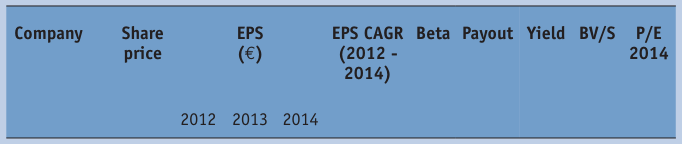
Why donât issuers get upset about leaving money on the table in IPOs?
L. Benveniste, W. Busaba, Bookbuilding versus ďŹxed price: An analysis of competing strategies for mar-
keting IPOs, Journal of Financial and Quantitative Analysis ,32, 383â403, December 1997.
F. Cornelli, D. Goldreich, Bookbuilding and strategic allocation, Journal of Finance ,56(6), 2337â2370,
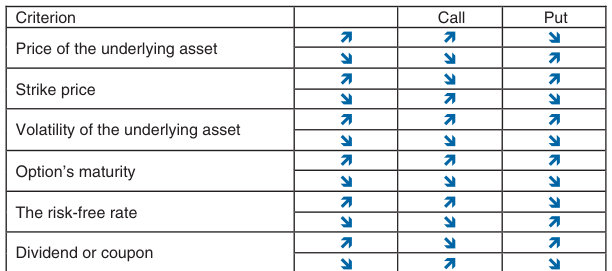
December 2001.
F. Cornelli, D. Goldreich, Bookbuilding: How informative is the order book?, Journal of Finance ,58(4),
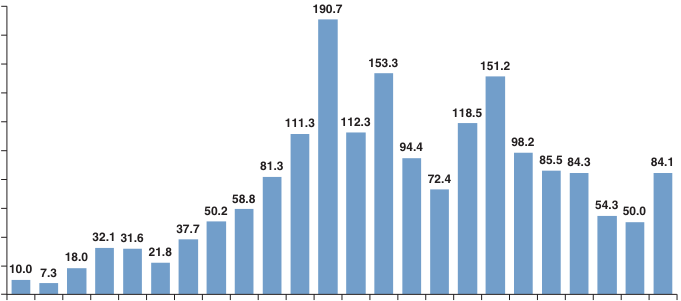
1415â1443, August 2003.
F. Degeorges, F. Derrien, K. Womack, Auctioned IPOs: The US evidence, Journal of Financial Economics ,
98(2), 177â194, November 2010.
F. Derrien, K. Womack, Auction vs. book-building and the control of underpricing in hot IPO markets,
Review of Financial Studies ,16(1), 31â61, Spring 2003.
On IPO underpricing:
P. Dechow, A. Hutton, R. Sloan, Solving the new equity puzzle, in G. Bickerstaffe (Ed.), Mastering
Finance , FT/Pitman Publishing, 175â183, 1998.
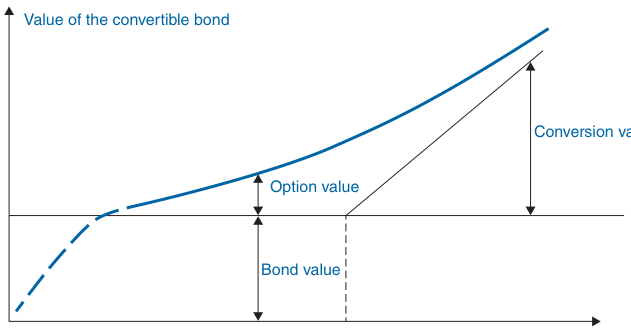
T. Loughran, J. Ritter, Why donât issuers get upset about leaving money on the table in IPOs?, Review of
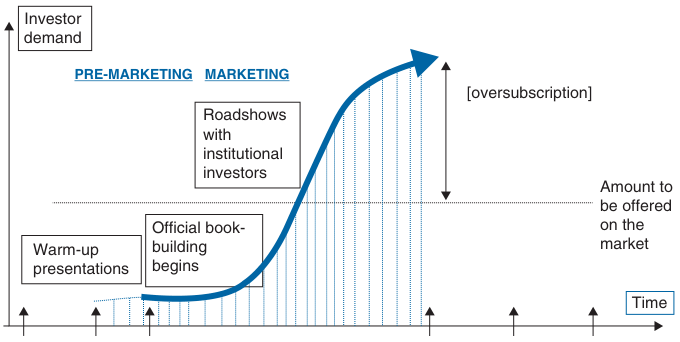
Financial Studies ,15(2), 413â444, July 2002.
M. Lowry, M. OfďŹcer, G. W. Schwert, The variability of IPO initial returns, Journal of Finance ,65(2),
425â465, April 2000.
J. Ritter, I. Welch, A review of IPO activity, pricing, and allocations, Journal of Finance ,57(4),
1795â1828, August 2002.
K. Rock, Why new issues are underpriced, Journal of Financial Economics ,15(1-2), 187â212,
JanuaryâFebruary 1986.
On share issues and IPOs:
R. Aggarwal, Stabilization activities by underwriters after initial public offerings, Journal of Finance ,
55(3), 1075â1103, June 2000.BIBLIOGRAPHY
Chapter 25 SELLING SECURITIES 469SECTION 2c25.indd 12:41:34:PM 09/05/2014 Page 469 Trim Size: 189 X 246 mm
L. Benveniste, P. Spindt, How investment bankers determine the offer price and allocation of new issues,
Journal of Financial Economics ,24(2), 343â361, October 1989.
J. Brau, S. Fawcett, Initial Public Offerings: An analysis of theory and practice, Journal of Finance ,1(6),
399â436, February 2006.
P. Chollet, E. Ginglinger, The pricing of French unit seasoned equity offerings, European Financial
Management ,7(1), 23â38, March 2001.
F. Degeorge, F. Derrien, K. Womack, Quid pro quo in IPOs: Why book-building is dominating auctions ,
working paper, May 2004.
B. Eckbo, R. Masulis, O. Norli, Seasoned public offerings: Resolution of the ânew issues puzzleâ, Journal
of Financial Economics ,56(2), 251â291, May 2000.
C. Gondat-Larralde, K. James, IPO Pricing and share allocation: The importance of being ignorant,
Journal of Finance ,63(1), 449â478, January 2008.
T. Jenkinson, H. Jones, Bids and allocations in European IPO bookbuilding, Journal of Finance ,59(5),
2309â2338, October 2004.
T. Jenkinson, H. Jones, IPO pricing and allocation: A survey of the view of institutional investors, Review
of Financial Studies ,22(4), 1477â1504, April 2009.
T. Jenkinson, H. Jones, Competitive IPOs, European Financial Management ,15(4), 733â756, September
2009.
D. Kim, D. Palia, A. Saunders, Are initial returns and underwriting spreads in equity issues complements
or substitutes? Financial Management ,39(4), 1403â1423, Winter 2010.
M. Lowry, W. Schwert, IPO market cycles: Bubbles or sequential learning?, Journal of Finance ,67(3),
1171â1198, June 2002.
M. Lowry, W. Schwert, Is the IPO pricing process efďŹcient? Journal of Financial Economics ,71(1), 3â26,
January 2004.
J. Ritter, T. Loughran, The new issues puzzle, Journal of Finance, 50(1), 23â51, March 1995.
www.hoovers.com/global/ipoc/index.xhtml, for information on IPOs
On ADRs:
Value and Corporate Finance
- This section provides a comprehensive bibliography of academic research on international equity sourcing, specifically focusing on Depositary Receipts and global shares.
- The text lists critical studies on the costs of raising capital through bonds, examining economies of scale in underwriting fees and external financing costs.
- It highlights the regulatory and market impacts of Rule 144A debt offerings and the role of private placements in corporate finance.
- The transition to Section III marks a shift from financial instruments to the core concepts and theories of value creation within a firm.
- The central premise of the upcoming chapters is that maximizing corporate value is fundamentally achieved by minimizing costs.
- The text introduces investment decision processes as the primary mechanism for influencing a company's overall market worth.
No, Sire, itâs a revolution!
A. Karolyi, Sourcing equity internationally with Depositary Receipt Offerings: Two exceptions that prove
the rule, Journal of Applied Corporate Finance ,10(4), 90â101, Winter 1998.
A. Karolyi, DaimlerChrysler AG, The truly global share, Journal of Corporate Finance ,9(4), 409â430,
September 2003.
D. Miller, The market reaction to international cross-listings: Evidence from Depositary Receipts, Journal
of Financial Economics ,51(1), 103â123, January 1999.
www.adrbnymellon.com, for information on ADRs
On bonds:
O. Altinkilic, R.S. Hansen, Are there economies of scale in underwriting fees? Evidence of rising external
ďŹnancing costs, Review of Financial Studies ,13, 191â218, 2000.
I. Lee, S. Lochhead, J. Ritter, Q. Zhao, The cost of raising capital, Journal of Financial Research ,19,
59â74, 1996.
On Rule 144A:
G. Johnson, Yankee bonds and crossâborder private placements: An update, Journal of Applied Corporate
Finance ,13(3), 80â91, Fall 2000.
M. Livingston, L. Zhou, The impact of Rule 144A debt offerings upon bond yields and underwriter fees,
Financial Management ,31(4), 5â27, Winter 2002.
FINANCIAL SECURITIES 470SECTION 2c25.indd 12:41:34:PM 09/05/2014 Page 470 Trim Size: 189 X 246 mm
On debt issues:
S. Datta, M. Datta, A. Patel, The market pricing of debt IPOs, Journal of Applied Corporate Finance ,12(1),
Spring 1999.
B. Emerick, W. White, The case for private placements: How sophisticated investors add value to corpo-
rate debt issuers, in D. Chew (Ed.), The New Corporate Finance: Where Theory Meets Practice , 2nd
edn, McGraw-Hill, 1999.
C. Godlewski, How to get a syndicated loan fast: The role of syndicate composition and organization,
Revue de lâassociation française de ďŹnance ,31(2), 51â92, DĂŠcembre 2010.
J. Helwege, P. Kleiman, The pricing of high-yield debt IPOs, Journal of Fixed Income ,8(2), 61â68,
September 1998.
T. Rhodes, Syndicated Lending: Practice and Documentation , 5th edn, Euromoney Books, 2009.
R. Taggart, The growing role of junk bonds in corporate ďŹnance, in D. Chew (Ed.), The New Corporate
Finance: Where Theory Meets Practice , 3rd edn, McGraw-Hill, 2000.
c26.indd 12:2:30:PM 09/06/2014 Page 471 Trim Size: 189 X 246 mmSECTION 3Section III
VALUE
c26.indd 12:2:30:PM 09/06/2014 Page 472 Trim Size: 189 X 246 mm
c26.indd 12:2:30:PM 09/06/2014 Page 473 Trim Size: 189 X 246 mmSECTION 3Chapter 26
VALUE AND CORPORATE FINANCE
No, Sire, itâs a revolution!
This section presents the concepts and theories that underpin all important financial deci-sions. In particular, we will examine their impact on value, keeping in mind that basically to maximise a value, we must minimise a cost. The chapters in this section will introduce you to the investment decision processes within a firm and their impact on the overall value of the company.
Section 26.1
THE PURPOSE OF FINANCE IS TO CREATE VALUE
1/INVESTMENT AND VALUE
Investment Returns and Capital Value
- A profitable investment is defined as one that increases the market value of capital employed rather than just maintaining asset levels.
- Enterprise value, or the value of capital employed, is distinct from equity value as it does not subtract net debt.
- Value creation occurs instantly when the expected return on an investment exceeds the rate of return required by investors.
- If an investment's return matches the market's required rate, the net present value is zero and no economic value is created or lost.
- Investments yielding less than the cost of capital result in an immediate loss of enterprise value, regardless of the initial cash outlay.
- Empirical data from European telecom companies confirms a correlation between the ROCE/WACC ratio and the enterprise value relative to book value.
An investment of 100 that always yields 15% in a market requiring a 10% return is worth 150 (100 Ă 15%/10%).
The accounting rules we looked at in Chapter 4 showed us that an investment is a use of funds, but not a reduction in the value of assets. We will now go one step further and adopt the viewpoint of the financial manager for whom a profitable investment is one
that increases the value of capital employed.
We shall see that a key element in the theory of markets in equilibrium is the market
value of capital employed. This theory underscores the direct link between the return on a companyâs investments and that required by investors buying the financial securities issued by the company.
The true measure of an investment policy is the effect it has on the value of capital
employed. This concept is sometimes called âenterprise valueâ, a term our reader should not confuse with the value of equity (capital employed less net debt). The two are far from the same!
Hence the importance of every investment decision, as it can lead to three different
outcomes:tWhere the expected return on an investment is higher than that required by investors, the value of capital employed rises instantly. An investment of 100 that always yields 15% in a market requiring a 10% return is worth 150 (100 Ă 15%/10%). The value
of capital employed thus immediately rises by 50.
VALUE 474SECTION 3c26.indd 12:2:30:PM 09/06/2014 Page 474 Trim Size: 189 X 246 mm
tWhere the expected return on the investment is equal to that required by investors, there is neither gain nor loss. The investors put in 100, the investment is worth 100 and no value has been created.
tWhere the expected return on an investment is lower than that required by investors, they have incurred a loss. If, for example, they invested 100 in a project yielding 6%, the value of the project is only 60 (100 Ă 6%/10%), giving an immediate loss
in value of 40.
tValue remains constant if the expected rate of return is equal to that required by the market.
tAn immediate loss in value results if the return on the investment is lower than that required by the market.
tValue is effectively created if the expected rate of return is higher than that required by the market.
The resulting gain or loss is simply the positive or negative net present value that must be calculated when valuing any investment. All this means, in fact, is that if the investment was fairly priced, nothing changes for the investor. If it was âtoo expensiveâ, investors take a loss, but if it was a good deal, they earn a profit.
The graph below shows that value is created (the value of capital employed exceeds
its book value) when return on capital employed exceeds the weighted average cost of capital, i.e. the rate of return required by all suppliers of funds to the company.
OrangeVodafone GroupDeutsche Telekom
Telecom ItaliaTeliasonera
KPNBelgacomTelenor
Swisscom
Portugal TelecomTele2B
Telefonica C&W Communications
Bouygues
Telekom AustriaEutelsat
0.40.81.21.62.02.42.83.2
0.4 0.6 0.8 1.0 1.2 1.4 1.6 1.8 2.0Entreprise value / Book value of assets
ROCE / WACCValue creation for main European telecom companies (2014)
r2 = 57%
Source : Exane BNP Paribas
Chapter 26 VALUE AND CORPORATE FINANCE 475SECTION 3c26.indd 12:2:30:PM 09/06/2014 Page 475 Trim Size: 189 X 246 mm
2/THE RELATIONSHIP BETWEEN COMPANIES AND THE FINANCIAL WORLD
The Issuer's Perspective
- A company's liabilities are a financial representation of its industrial and operating assets.
- The rate of return required by investors constitutes a direct financial cost to the issuing company.
- Investors exert power by refusing to finance companies that fail to offer acceptable risk/reward trade-offs.
- Financial markets impose immediate sanctions through the continuous revaluation of existing securities.
- A lower valuation of capital employed can lead to severe financing difficulties and eventual bankruptcy.
- The financial manager's primary role is to ensure transparency between the company's assets and its market representation.
In doing so, he is merely giving tit for tat: an unhappy investor will sell off his securities, thus lowering prices.
In the preceding chapters we examined the various financial securities that make up the debt issued by a company from the point of view of the investor. We shall now cross over to the other side to look at them from the issuing companyâs point of view.tEach amount contributed by investors represents a resource for the company.
tThe financial securities held by investors as assets are recorded as liabilities in the companyâs balance sheet.
tAnd, most importantly, the rate of return required by investors represents a financial
cost to the company.At the financial level, a company is a portfolio of assets financed by the securities
issued on financial markets. Its liabilities, i.e. the securities issued and placed with inves-tors, are merely a financial representation of the industrial or operating assets. The finan-cial managerâs job is to ensure that this representation is as transparent as possible.
What is the role of the investor?Investors play an active role when securities are issued, because they can simply
refuse to finance the company by not buying the securities. In other words, if the finan-cial manager cannot come up with a product offering a risk/reward trade-off accept-able to the financial market, the lack of funding will eventually push the company into bankruptcy.
We shall see that when this happens, it is often too late. However, the financial system
can impose a sanction that is far more immediate and effective: the valuation of the securi-ties issued by the company.The investor has the power not just to provide funds, but also to value the companyâs capital employed through the securities already in issue.Financial markets continuously value the securities in issue. In the case of debt instru-ments, rating agencies assign a credit rating to the company, thus determining the value of its existing debt and the terms of future loans. Similarly, by valuing the shares issued the market is, in fact, valuing the companyâs equity.
So how does this mechanism work?If a company cannot satisfy investorsâ risk/reward requirements, it is penalised by a
lower valuation of its capital employed and, accordingly, its equity. Suppose a company offers the market an investment of 100 that is expected to yield 10 every year over a period long enough to be considered to perpetuity.
1However, the actual yield is only 5. The
disappointed investors who were expecting a 10% return will try to get rid of their invest-ment. The equilibrium price will be 50, because at this price investors receive a return of 10% (5/50) and it is no longer in their interests to sell. But by now it is too late.
Investors who are unhappy with the offered risk/reward trade-off sell their securities,
thus depressing the value of the securities issued and of capital employed, since the com-panyâs investments are not profitable enough with regard to their risk. True, the investor takes a hit, but it is sometimes wiser to cut oneâs losses.
In doing so, he is merely giving tit for tat: an unhappy investor will sell off his securi-
ties, thus lowering prices. Ultimately, this can lead to financing difficulties for the company.1This strong
assumptionsimplifies the calculation but it does not modify the reasoning.
VALUE 476SECTION 3c26.indd 12:2:30:PM 09/06/2014 Page 476 Trim Size: 189 X 246 mm
Value Creation and Financial Policy
- The valuation of equity is the primary driver of a company's worth during normal operations, while creditors only take control during financial distress.
- Financial decisions should be judged solely by their impact on the value of capital employed rather than accounting metrics like earnings or costs.
- A 'financial sanction' occurs when company decisions negatively impact the market valuation of its shares and debt securities.
- Value creation is distinct from accounting profit; an investment can increase earnings but still destroy value if it fails to meet the investor's required rate of return.
- Corporate financial policy aims to maximize value for fund providers, incorporating a risk premium into the required rate of return.
- The text questions whether financial managers can create value through financing choices alone, independent of the company's industrial and commercial assets.
Financial shortsightedness consists of failing to distinguish between cost and reduction in value, or between income and increase in value.
The âfinancial sanctionâ affects first and foremost the valuation of the company via
the valuation of its shares and debt securities.
As long as the company is operating normally, its various creditors are fairly well
protected.2 Most of the fluctuation in the value of its debt stems from changes in interest
rates, so changes in the value of capital employed derive mainly from changes in the value of equity. We see why the valuation of equity is so important for any normally develop-ing company. This does not apply just to listed companies: unlisted companies are also affected whenever they envisage divestments, alliances, transfers or capital increases.
The role of creditors looms large only when the company is in difficulty. The com-
pany then âbelongsâ to the creditors, and changes in the value of capital employed derive from changes in the value of the debt, by then generally lower than its nominal value. This is where the creditors come into play.The valuation of capital employed, and therefore the valuation of equity, are the key variables of any ďŹnancial policy, regardless of whether or not the company is listed.
3/IMPLICATIONS
Since we consider that creating value is the overriding financial objective of a company, it follows that:tA financial decision harms the company if it reduces the value of capital employed.
tA decision is beneficial to the company if it increases the value of capital employed.A word of caution, however! Contrary to appearances, this does not mean that every
good financial decision increases earnings or reduces costs.Financial shortsightedness consists of failing to distinguish between cost and reduction in value, or between income and increase in value.Remember, we are not in the realm of accounting, but in that of finance â in other words, value. An investment financed by cash from operations may increase earnings, but could still be insufficient with regard to the return expected by the investor who, as a result, has lost value.
Certain legal decisions, such as restricting a shareholderâs voting rights, have no
immediate impact on the companyâs cash, yet may reduce the value of the corresponding financial security and thus prove costly to the holder of the security.
We cannot emphasise this aspect enough and insist that you adopt this approach
before immersing yourselves further in the raptures of financial theory.
Section 26.2
VALUE CREATION AND MARKETS IN EQUILIBRIUM
Corporate ďŹnancial policy consists ďŹrst and foremost of a set of principles necessary for taking decisions designed to maximise value for the providers of funds, in particular shareholders.2Since there is
always a risk, their required rate of return comprises a risk premium.
Chapter 26 VALUE AND CORPORATE FINANCE 477SECTION 3c26.indd 12:2:30:PM 09/06/2014 Page 477 Trim Size: 189 X 246 mm
1/ACLEAR THEORETICAL FOUNDATION
We have just said that a company is a portfolio of assets and liabilities, and that the con-cepts of cost and revenue should be seen within the overall framework of value. Financial management consists of assessing the value created for the companyâs fund providers.
Can the overall value of the company be determined by an optimal choice of assets
and liabilities? If so, how can you be sure of making the right decisions to create value?
You may already have raised the following questions:
tCan the choice of financing alone increase the value of the firm? Is capital employed financed half by debt and half by equity worth more than if it were financed wholly through equity?
tCan the entrepreneur increase the value of capital employed â that is, influence the marketâs valuation of it â by either combining independent industrial and commercial investments or implementing a shrewd financing policy?If your answer to all these questions is yes, you attribute considerable powers to
financial managers. You consider them capable of creating value independently of their industrial and commercial assets.
The Value Additivity Rule
- The equilibrium theory of markets suggests that financial engineering does not inherently increase a company's valuation.
- The value additivity rule dictates that the market value of a diversified company is equal to the sum of its individual parts.
- Arbitrage ensures that if a company's price deviates from the sum of its components, investors will exploit the gap until equilibrium is restored.
- This principle applies to debt as well; the total value of a company remains the same whether it is financed by debt or equity.
- Investors can replicate diversification or leverage in their own portfolios, meaning they will not pay a premium for a company to do it for them.
- Financial value is only created through industrial and commercial synergies, not through mere portfolio diversification at the corporate level.
So why should they pay for an operation they can carry out themselves at no cost?
And yet, the equilibrium theory of markets is very clear:
When looking at valuations, ďŹnancial investors are not interested in the underlying ďŹnancial engineering, because they could duplicate such operations themselves. This is called the value additivity rule.We now provide a more formal explanation of the above rule, which is based on arbitrage.
To this end, let us simplify things by imagining that there are just two options for the
future: either the company does well or it does not. We shall assign an equal probability to each of these outcomes.
We shall see how the free cash flow of three companies varies in our two states of
the world:
FREE CASH FLOW
State of the world: bad State of the world: good
A 200 1000
B 400 500
G 600 1500
Note that the sum of the free cash flows of companies AandBis equal to that of company
G. We shall demonstrate that the share price of company Gis equal to the sum of the prices
of shares BandA.3 To do so, let us assume that this is not the case, and that VA+VB > VG
(where VA,VB and VGare the respective share prices of A,BandG).
You will see that no speculation is necessary here to earn money. Taking no risk, you
sell short one share of Aand one share of Band buy one share of G. You immediately
receive VA+VBâVG > 0; yet, regardless of the companyâs fortunes, the future negative
flows of shares AandB(sold) and positive flows of share G(bought) will cancel each
other out. You have realised a gain through arbitrage.3 We are
assuming that companies A, B and G have the same number of shares.
VALUE 478SECTION 3c26.indd 12:2:30:PM 09/06/2014 Page 478 Trim Size: 189 X 246 mm
The same method can be used to demonstrate that VA+VB < VG is not possible in a
market that is in equilibrium. We therefore deduce that VA+VB=VG. It is thus clear that
a diversified company, in our case G, is not worth more than the sum of its two divisions
AandB.
Let us now look at the following three securities:
FREE CASH FLOW
Company State of the world: bad State of the world: good
C 100 1000
D 500 500
E 600 1500
According to the rule demonstrated above, VC+VD=VE. Note that security Dcould be
a debt security and Cshare capital. Ewould then be the capital employed. The value of
capital employed of an indebted company ( V(C+D)) can be neither higher nor lower than
that of the same company if it had no debt ( VE).
The additivity rule is borne out in terms of risk: if the company takes on debt, finan-
cial investors can stabilise their portfolios by adding less risky securities. Conversely, they can go into debt themselves in order to buy less risky securities. So why should they pay for an operation they can carry out themselves at no cost?
This reasoning applies to diversification as well. If its only goal is to create financial
value without generating industrial and commercial synergies, there is no reason why investors should entrust the company with the diversification of their portfolio.
2/ILLUSTRATION
The Value of Diversification
- The text explores whether combining assets creates value beyond their individual worth, often referred to as the '2 + 2 = 5' synergy.
- Managers often make acquisition decisions, such as LVMH's purchase of Bulgari, that imply a lower required rate of return for subsidiaries than for independent firms.
- A fundamental question is raised regarding whether corporate diversification reduces financing costs and provides a permanent competitive advantage.
- Financial theory suggests that markets only remunerate systematic or market risks that cannot be eliminated through diversification.
- Because investors can diversify their own portfolios, the reduction of unsystematic risk at the corporate level does not necessarily lower the required rate of return.
We must not be misled into believing that a lower degree of risk must be always matched by a lower required rate of return.
Are some asset combinations worth more than the value of their individual components, regardless of any industrial synergies arising when some operations are common to sev-eral investment projects? In other words, is the whole worth more than the sum of its parts (2+ 2 = 5)?
Or again, is the required rate of return lower simply because two investments are
made at the same time?
Company managers are fuzzy on this issue. They generally answer in the negative,
although their actual investment decisions tend to imply the opposite. Take Bulgari (aleading jewellery group), for example, which was bought by LVMH in 2011. If financial synergies exist, one would have to conclude that the required rate of return in the jewel-lery segment differs depending on whether the company is independent or part of a group. Bulgari would therefore appear to be worth more as part of the LVMH group than on a standalone basis.
The question is not as specious at it seems. In fact, it raises a fundamental issue. If
the required return on Bulgari has fallen since it became part of LVMH, its financing costs will have declined as well, giving it a substantial, permanent and possibly decisive advantage over its competitors.
Diversifying corporate activities reduces risk, but does it also reduce the rate of return
required by investors?
Chapter 26 VALUE AND CORPORATE FINANCE 479SECTION 3c26.indd 12:2:30:PM 09/06/2014 Page 479 Trim Size: 189 X 246 mm
Suppose the required rate of return on a company producing a single product is 10%.
The company decides to diversify by acquiring a company of the same size on which the required rate of return is 8%. Will the required rate of return on the new group be lower than (10% + 8%) / 2 = 9% because it carries less risk than the initial single-product company?
We must not be misled into believing that a lower degree of risk must be always
matched by a lower required rate of return. On the contrary: markets only remunerate
systematic or market risks, i.e. those that cannot be eliminated by diversification . We
have seen that unsystematic or specific risks, which investors can eliminate by diversify-ing their portfolios, are not remunerated. Only non-diversifiable risks related to market fluctuations are remunerated. This point was discussed in Chapter 18.
Since diversifiable risks are not remunerated, a companyâs value remains the
The Myth of Financial Synergy
- Corporate value remains unchanged by ownership structure unless management improves the return on capital employed.
- Purely financial diversification creates no value because investors can diversify their own portfolios at no cost.
- Value creation is the result of industrial synergies where the sum of cash flows increases, often described as the 2 + 2 = 5 effect.
- Financial engineering and earnings per share manipulations do not inherently increase a company's underlying value.
- The market values a company based on the perceived risk and profitability of its industrial and commercial operations.
- The rule of value additivity dictates that value cannot be created simply by adding or subtracting assets already in equilibrium.
The financial investor does not want to pay a premium in the form of lower returns for something he can do himself at no cost by diversifying his portfolio.
same whether it is independent or part of a group . Bulgari is not worth more now
that it has become a division of LVMH. All else being equal, the required rate of return in the jewellery sector is the same whether the company is independent or belongs to a group.
On the other hand, Bulgariâs value will increase if, and only if, LVMHâs management
allows it to improve its return on capital employed.Purely ďŹnancial diversiďŹcation creates no value.Value is created only when the sum of cash flows from the two investments is higher because they are both managed by the same group. This is the result of industrial syner-
gies(2+ 2 = 5), and not financial synergies , which do not exist.
The large groups that indulged in a spate of financial diversifications in the 1960s
have since realised that these operations were unproductive and frequently loss-making. Diversification is a delicate art that can only succeed if the diversifying company already has expertise in the new business. Combining investments per se does not maximise value, unless industrial synergies exist. Otherwise, an investment is either âgoodâ or âbadâ depending on how it stacks up against the required rate of return.
In other words, managers must act on cash flows; they cannot influence the dis-
count rate applied to them unless they reduce their risk exposure.
There is no connection between the required return on any investment and the portfolio in which the investment is held.Unless it can draw on industrial synergies, the value of a company remains the same whether it is independent or part of a large group. The ďŹnancial investor does not want to pay a premium in the form of lower returns for something he can do himself at no cost by diversifying his portfolio.
3/AFIRST CONCLUSION
The value of the securities issued by a company is not connected to the underlying finan-cial engineering. Instead, it simply reflects the marketâs reaction to the perceived profit-ability and risk of the industrial and commercial operations.
The equilibrium theory of markets leads us to a very simple and obvious rule,
that of the additivity of value, which in practice is frequently neglected. Regardless of
VALUE 480SECTION 3c26.indd 12:2:30:PM 09/06/2014 Page 480 Trim Size: 189 X 246 mm
developments in financial criteria, in particular earnings per share, value cannot be cre-ated simply by adding (diversifying) or reducing value that is already in equilibrium.To ensure a ďŹow of ďŹnancing, ďŹnancial managers have to transform their industrial and commercial assets into ďŹnancial assets. This means that they have to sell the very sub-stance of the company (future risk and returns) in a ďŹnancial form.Financial investors evaluate the securities offered or already issued according to their required rate of return. By valuing the companyâs share, they are, in fact, directly valuing the companyâs operating assets.The valuation of the different securities has nothing to do with ďŹnancial engineering; it is based on a valuation of the companyâs industrial and commercial assets.We emphasise that this rule applies to listed and unlisted companies alike, a fact that the latter are forced to face at some point. Capital employed always has an equilibrium value, and the entrepreneur must ultimately recognise it.
This approach should be incorporated into the methodology of financial decision-
Value and Organization Theories
- The equilibrium theory of markets serves as an ideal framework but often fails to account for individual interests and real-world complexities.
- Financial decisions become a zero-sum struggle between different stakeholders, such as shareholders and creditors, when total capital value remains static.
- Riskier investments can redistribute value from creditors to shareholders even if the investment is priced at equilibrium.
- The financial manager's primary role shifts from simple analysis to that of a negotiator balancing these competing internal interests.
- Information asymmetry challenges neoclassical assumptions, as managers typically possess more internal data than outside investors.
- Signalling theory emerges as a necessary tool to address the gap between management knowledge and market perception.
In a way, it is the paradise that all ďŹnancial managers strive for, while secretly hoping never to reach such a perfect state of boredom.
making. Some strategies are based on maximising other types of value, for example the capability to cause harm to competitors. They are particularly risky and are outside the conceptual framework of corporate finance. The ďŹrst reďŹex when faced with any kind of ďŹnancial decision is to analyse whether it will create or destroy value. If values are in equilibrium, ďŹnancial decisions will be immaterial.Does this mean that, ultimately, financing or diversification policies have no impact on value?On the contrary, the equilibrium theory of markets represents a kind of ideal that is very useful for the ďŹnancial professional but, like all ideals, tends to remain out of reach. In a way, it is the paradise that all ďŹnancial managers strive for, while secretly hoping never to reach such a perfect state of boredom. Our aim is not to encourage nihilism, merely a degree of humility.
Section 26.3
VALUE AND ORGANISATION THEORIES
1/LIMITS OF THE EQUILIBRIUM THEORY OF MARKETS
The equilibrium theory of markets offers an overall framework, but it completely disre-gards the immediate interests of the various parties involved, even if their interests tend to converge in the medium term.Paradoxically, the neoclassical theory emphasises the general interest while completely overlooking that of the indiv idual parties.
We cannot rely on the equilibrium theory alone to explain corporate ďŹnance.
Chapter 26 VALUE AND CORPORATE FINANCE 481SECTION 3c26.indd 12:2:30:PM 09/06/2014 Page 481 Trim Size: 189 X 246 mm
Since the equilibrium theory demonstrates that finance cannot change the size of the capi-tal employed, but only how it is divided up, it follows that many financial problems stem from the struggle between the various players in the financial realm.
First and foremost we have the various parties providing funding to the company.
To simplify matters, they can be divided into two categories: shareholders and creditors. But we shall soon see that, in fact, each type of security issued gives rise to its own interest group: shareholders, preferred creditors, ordinary creditors, investors in hybrid products, etc. Further on in this chapter, we shall see that interests may even diverge within the same funding category.
One example should suffice. According to the equilibrium theory of markets, invest-
ing at the required rate of return does not change the value of capital employed. But if the investment is very risky and, therefore, potentially very profitable, creditors, who earn a fixed rate, will only see the increased risk without a corresponding increase in their return. The value of their claims thus decreases to the benefit of shareholders whose shares increase by the same amount, the value of capital employed remaining the same. And yet, this investment was made at its equilibrium price.
This is where the financial manager comes into play! His role is to distribute value
between the various parties involved. In fact, the financial manager must be a negotia-
tor at heart .
But letâs not forget that the managers of the company are stakeholders as well. Since
portfolio theory presupposes good diversification, there is a distinction between inves-tors and managers, who have divergent interests with different levels of information (internal and external). This last point calls into question one of the basic tenets of the equilibrium theory, which is that all parties have access to the same information (see Chapter 15).
2/SIGNALLING THEORY AND ASYMMETRIC INFORMATION
Signalling theory is based on two basic ideas:tthe same information is not available to all parties: the managers of a company may have more information than investors;
The Power of Financial Signaling
- Asymmetric information is the standard in financial markets, often leading to the undervaluation of companies by misinformed investors.
- Financial expertise alone is insufficient for managers; they must actively shape market sentiment through strategic communication.
- A true financial signal is not a verbal statement but a concrete financial decision that carries potential negative consequences for the decision-maker.
- Investors evaluate signals based on whether the issuer's interests align with their own, favoring actions like management reinvestment.
- Market credibility is maintained by supervisory authorities who penalize misleading information to ensure fair financing costs.
- Markets quickly identify and punish dishonest signaling, making the reputation of management a secondary factor to the substance of their actions.
It is a real financial decision, taken freely and which may have negative financial consequences for the decision-maker if it turns out to be wrong.
teven if the same information were available to all, it would not be perceived in the same way, a fact frequently observed in everyday life.Thus, it is unrealistic to assume that information is fairly distributed to all parties at
all times, i.e. that it is symmetrical as in the case of efficient markets. On the contrary, asymmetric information is the rule.
In short, perfect and equally shared information is at best an objective, and most often an illusion.This can clearly raise problems. Asymmetric information may lead investors to under-value a company. As a result, its managers might hesitate to increase its capital because they consider the share price to be too low. This may mean that profitable investment opportunities are lost for lack of financing, or that the existing shareholders find their stake adversely diluted because the company has launched a capital increase anyway.
VALUE 482SECTION 3c26.indd 12:2:30:PM 09/06/2014 Page 482 Trim Size: 189 X 246 mm
This is where the communication policy comes into its own. Basing financial deci-
sions on financial criteria alone is not enough: managers also have to convince the mar-kets that these decisions are wise.As a result, pure ďŹnancial expertise does not sufďŹce if it is not matched by an ability to communicate and to shape market sentiment.The cornerstone of the financial communications policy is the signal the managers of a
company send to investors.
Contrary to what many financial managers and CEOs believe, the signal is neither an
official statement nor a confidential tip. It is a real financial decision, taken freely and
which may have negative financial consequences for the decision-maker if it turns out to be wrong.
After all, investors are far from naive and they take each signal with the requisite
pinch of salt. Three points merit attention:tInvestorsâ first reaction is to ask themselves why the signal is being sent, since nothing comes for free in the financial world. The signal will be perceived nega-
tively if the issuerâs interests are contrary to those of investors. For example, the sale of a company by its majority shareholder would, in theory, be a negative signal for the companyâs growth prospects. Managers must therefore persuade the buyer of the contrary or provide a convincing explanation for the disposal.
Similarly, owner-managers cannot fool investors by praising the merits of a cap-
ital increase without subscribing to it!
However, the market will consider the signal to be credible if it deems that it is
in the issuerâs interest that the signal be correct. This would be the case, for example, if the managers reinvest their own assets in the company.
tThe reputation of management and its communications policy certainly play a
role, but we must not overestimate their importance or lasting impact.
tThe market supervisory authorities stand ready to impose penalties on the dis-
semination of misleading information or insider trading. If investors, particularly international investors, believe that supervision is effective, they will factor this into their decisions. That said, some managers may be tempted to send incorrect sig-nals in order to obtain unwarranted advantages. For example, they could give overly optimistic guidance on their companyâs prospects in order to push up share prices. However, markets catch on to such misrepresentations quickly and react to incorrect signals by piling out of the stock.In such a context, the âwatchdogâ role played by the market authorities is crucial and the
recent past has shown that the authorities intend to assume it in full. Such rigour is essential if we are to have the best possible financial markets and the lowest possible financing costs.
Financial managers must therefore always consider how investors will react to their
Signalling and Agency Theories
- Signalling theory posits that corporate financial decisions serve as communicative signals from managers to investors regarding a company's health.
- Information asymmetry can result in undervalued shares, leading to suboptimal investment levels and a preference for debt financing.
- Agency theory views the corporation not as a single entity, but as a complex web of contractual relationships between parties with conflicting interests.
- The principal-agent relationship creates risks where managers may prioritize personal security or company size over shareholder wealth maximization.
- Mechanisms such as stock options and debt obligations are used to align managerial incentives with the interests of shareholders.
- Debt acts as a disciplinary tool, forcing managers to maximize cash flows to avoid bankruptcy and subsequent job loss.
Debt plays a role as well since it has a constraining effect on managers and encourages them to maximise cash flows so that the company can meet its interest and principal payments.
financial decisions. They cannot content themselves with wishful thinking, but must make a rational and detailed analysis of the situation to ensure that their communication is convincing.
Signalling theory says that corporate financial decisions (e.g. financing, dividend
payout) are signals sent by the companyâs managers to investors. It examines the incen-tives that encourage good managers to issue the right signals and discourage managers of ailing companies from using these same signals to give a misleading picture of their companyâs financial health.
Chapter 26 VALUE AND CORPORATE FINANCE 483SECTION 3c26.indd 12:2:30:PM 09/06/2014 Page 483 Trim Size: 189 X 246 mm
In sum, information asymmetry may lead to a share being priced at less than its objec-tive value, with two consequences:tinvestments are not maximised because the cost of ďŹnancing is too high;
tthe choice of ďŹnancing is skewed in favour of sources (such as debt) where there is less information asymmetry.
Stephen Ross initiated the main studies in this field in 1977.
3/AGENCY THEORY
Agency theory says that a company is not a single, unified entity. It considers a company to be a legal arrangement that is the culmination of a complex process in which the con-flicting objectives of individuals, some of whom may represent other organisations, are resolved by means of a set of contractual relationships.
On this basis, a companyâs behaviour can be compared to that of a market, insofar
as it is the result of a complex balancing process. Taken individually, the various stake-holders in the company have their own objectives and interests that may not necessarily be spontaneously reconcilable. As a result, conflicts may arise between them, especially since our modern corporate system requires that the suppliers of funds entrust the manag-ers with the actual administration of the company.
Agency theory analyses the consequences of certain financial decisions in terms of
risk, profitability and, more generally, the interests of the various parties. It shows that some decisions may go against the simple criteria of maximising the wealth of all parties to the benefit of just one of the suppliers of funds.
To simplify, we consider that an agency relationship exists between two parties when
one of them, the agent, carries out an activity on behalf of the other, the principal. The agent has been given a mandate to act or take decisions on behalf of the principal. This is the essence of the agency relationship.
This very broad definition allows us to include a variety of domains, such as the
resolution of conflicts between:texecutive shareholders/non-executive shareholders;
tnon-shareholder executives/shareholders;
tcreditors/shareholders.Shareholders give the company executives a mandate to manage to the best of their
ability the funds that have been entrusted to them. However, their concern is that the executives could pursue objectives other than maximising the value of the equity, such as increasing the companyâs size at the cost of profitability, minimising the risk to capital employed by rejecting certain investments that would create value but could put the com-pany in difficulty if they fail, etc.
One way of resolving such conflicts of interest is to use stock options, thus linking
management compensation to share performance (see Chapter 43).
Debt plays a role as well since it has a constraining effect on managers and encour-
ages them to maximise cash flows so that the company can meet its interest and principal payments. Failing this, the company risks bankruptcy and the managers lose their jobs.
VALUE 484SECTION 3c26.indd 12:2:30:PM 09/06/2014 Page 484 Trim Size: 189 X 246 mm
Agency Costs and Free Riders
- Debt can act as a disciplinary tool that aligns the interests of management and shareholders by forcing a focus on cash flow maximization.
- Agency costs arise from the divergence of interests between principals and agents, including monitoring expenses, bonding costs, and residual losses.
- Research indicates that firms managed by non-shareholding CEOs often suffer from lower margins and asset turnover rates compared to owner-managed firms.
- The concept of corporate governance is intellectually rooted in the comparison between financial theory and organizational theory.
- Free rider behavior occurs when an individual investor benefits from the sacrifices or transactions of others without participating themselves.
- Strategic dilemmas, such as responding to takeover bids or restructuring bank debt, are often complicated by the conflicting interests of individual versus collective stakeholders.
Maybe debt is the modern whip! This is sometimes referred to as âthe discipline of debtâ.
Maximising cash flows is in the interests of shareholders as well, since it raises the value of shareholdersâ equity. Thus, the interests of management and shareholders converge. Maybe debt is the modern whip! This is sometimes referred to as âthe discipline of debtâ.
The diverging interests of the various parties generate a number of costs called
âagency costsâ. These comprise:tthe cost of monitoring managersâ efforts (control procedures, audit systems, perfor-mance-based compensation) to ensure that they correspond to the principalâs objec-tives. Stock options represent an agency cost since they are exercised at less than the going market price for the stock;
tthe costs incurred by the agents to vindicate themselves and reassure the principals that their management is effective, such as the publication of annual reports;
tresidual costs.Ang et al. (2000) have shown that the margins and asset turnover rates of small- and
medium-sized American firms tend to be lower in companies managed by non-sharehold-ing CEOs, and in which managers have little stake in the capital and many non-executive shareholders.
The main references in this field are Jensen and Meckling (1976), Grossman
and Hart (1980) and Fama (1980). Their research aims to provide a scientific explana-tion of the relationship between managers and shareholders and its impact on corporate value.Their main contribution is to try and compare ďŹnancial theory and organisational theory.This research forms the intellectual foundation on which the concept of corporate gover-
nance was built (see Chapter 43).
4/FREE RIDERS
We saw above that the interests of the different types of providers of funds may diverge, but so may those of members of the same category.The term âfree riderâ is used to describe the behaviour of an investor who beneďŹts from transactions carried out by other investors in the same category without participating in these transactions himself.This means, first, that there must be several â usually a large number â of investors in the same type of security and, second, that a specific operation is undertaken implying some sort of sacrifice, at least in terms of opportunity cost, on the part of the investors in these securities.
As a result, when considering a financial decision, one must examine whether free
riders exist and what their interests might be.
Below are two examples:
tResponding to a takeover bid: if the offer is motivated by synergies between the bidding company and its target, the business combination will create value. This means that it is in the general interest of all parties for the bid to succeed and for the shareholders to tender their shares. However, it would be in the individual interest of these same share-holders to hold on to their shares in order to benefit fully from the future synergies.
Chapter 26 VALUE AND CORPORATE FINANCE 485SECTION 3c26.indd 12:2:30:PM 09/06/2014 Page 485 Trim Size: 189 X 246 mm
tBank A holds a small claim on a cash-strapped company that owes money to many other banks. It would be in the interests of the banks as a whole to grant additional loans to tide the company over until it can pay them back, but the interest of our individual bank would be to let the other banks, which have much larger exposure, advance the funds themselves. Bank A would thus hold a better-valued existing claim without incurring a discount on the new credits granted.
Section 26.4
The Pursuit of Economic Rent
- Extraordinary returns are only possible when a company possesses a strategic advantage that creates market imperfections.
- In a state of perfect competition, the net present value of a project should theoretically be zero.
- Corporate strategy focuses on building barriers to entry to secure economic rents, which are returns exceeding the required rate for a given risk.
- Economic rents are inherently temporary as they attract competitors, technological disruption, or antitrust intervention.
- Share prices adjust immediately to strategic shifts, reflecting the present value of future returns rather than waiting for them to accrue.
- Tax optimization serves as a secondary lever for value creation, provided it does not introduce disproportionate risk.
There are no impregnable fortresses, only those for which the right angle of attack has not yet been found.
HOW CAN WE CREATE VALUE?
Before we begin simulating different rates of return, we would like to emphasise once again that a project, investment or company can only realise extraordinary returns if it enjoys a strategic advantage. The equilibrium theory of markets tells us that under perfect competition, the net present value of a project should be nil. If a financial man-ager wants to advise on investment choices, he will no doubt have to make a number of calculations to estimate the future return of the investment. But he will also have to look at it from a strategic point of view, incorporating the various economic theories he has learned.
A projectâs real profitability can only be explained in terms of economic rent â that
is, a position in which the return obtained on investments is higher than the required
rate of return given the degree of risk . The essence of all corporate strategies is to
obtain economic rents â that is, to generate imperfections in the product market and/or in factors of production, thus creating barriers to entry that the corporate managers strive to exploit and defend.
Source : Compilation donnĂŠes Exane BNP ParibasROCE
WACC 300400500
8%10%12%14%ROCE, WACC for large listed European groups (left-hand scale) and stock
market prices (right-hand scale)
Eurostoxx 600-100200
-2%4%6%
(*) As of Q1 2014ROCE minus WACC
19951996199719981999200020012002200320042005200620072008200920102011201220132014e
VALUE 486SECTION 3c26.indd 12:2:30:PM 09/06/2014 Page 486 Trim Size: 189 X 246 mm
The purpose of a ďŹnancial strategy is to try to âskewâ market mechanisms in order to secure an economic rent.But donât fool yourself, economic rents do not last forever. Returns that are higher than the required rate, taking into account the risk exposure, inevitably attract the attention of competitors or of the antitrust authorities, as in the case of Google. Sooner or later, deregulation and technological advances put an end to them. There are no impregnable fortresses, only those for which the right angle of attack has not yet been found.
A strategic analysis of the company is thus essential to put the figures in their eco-
nomic and industrial context, as we explained in Chapter 8.
We insist on the consequences of a good strategy. When based on accurate forecasts,
it immediately boosts the value of capital employed and, accordingly, the share price. This explains the difference between the book value of capital employed and its market value, which may vary by a factor of 1â10, and sometimes even more.
Rather than rising gradually as the returns on the investment accrue, the share price
adjusts immediately so that the investor receives the exact required return, no more, no less. And if everything proceeds smoothly thereafter, the investment will generate the required return until expectations prove too optimistic or too pessimistic.
Section 26.5
VALUE AND TAXATION
Depending on the companyâs situation, certain types of securities may carry tax benefits. You are certainly aware that tax planning can generate savings, thereby creating value or at least preventing the loss of value. Reducing taxes is a form of value creation for inves-tors and shareholders. All else being equal, an asset with tax-free flows is worth more than the same asset subject to taxation.
Better to have a liability with cash outflows that can be deducted from taxes than the
same liability with outflows that are not deductible.
This goes without saying, and any CFO worthy of his title will do his best to reduce
tax payments.However, tax optimisation should not merely endeavour to reduce costs if this leads to higher risks. Financial managers must think in terms of value.They must carefully examine the impact each financial decision will have on taxes. The main issues we shall be addressing in the subsequent chapters are:ttaxation of debt vs. equity;
ttaxation of accelerated depreciation and one-off write-downs;
Taxation and Financial Decisions
- The text identifies key tax variables including capital gains versus ordinary income and the treatment of financial expenses.
- It highlights the importance of tax groups and the strategic use of tax-loss carryforwards in corporate finance.
- A core principle is established that financial decisions should rarely be made based solely on tax considerations.
- Delaying an asset sale for a better tax rate risks a market value decline that may exceed any potential tax savings.
- The section emphasizes the trade-off between tax optimization and market exposure risk.
Our experience tells us that taking a financial decision solely on the basis of tax considerations is rarely the right thing to do.
ttaxation of capital gains vs. ordinary income (dividends or coupons);
ttaxation of financial income and expenses;
ttax groups;
tusable or unusable tax-loss carryforwards.Our experience tells us that taking a financial decision solely on the basis of tax con-
siderations is rarely the right thing to do. Waiting a few months to sell in order to benefit from a more favorable tax rate exposes the group to a drop in the value of the asset to be sold (that could well be much higher than the tax savings).
Chapter 26 VALUE AND CORPORATE FINANCE 487SECTION 3c26.indd 12:2:30:PM 09/06/2014 Page 487 Trim Size: 189 X 246 mm
The Foundations of Value Creation
- Value is created only when the rate of return on an investment exceeds the required rate of return relative to its risk.
- The theory of markets in equilibrium suggests that competition and deregulation naturally erode economic rents and entry barriers over time.
- Financial synergies, diversification, and debt do not create value for investors because individuals can replicate these actions at no cost.
- Signal theory addresses information asymmetry, where specific financial decisions act as signals to correct market valuations.
- Agency theory explores the conflicting interests of shareholders, managers, and creditors, forming the basis for modern corporate governance.
Financial synergies do not exist.
The summary of this chapter can be downloaded from www.vernimmen.com.From a ďŹnancial point of view, a companyâs aim is to create value, i.e. it should be able to make investments on which the rate of return is higher than the required rate of return, given the risk involved. If this condition is met, the share price or the value of the share will rise. If not, it will fall. The theory of markets in equilibrium teaches us that it is very difďŹcult to create lasting value. Rates of return actually achieved tend, over the medium term, to meet required rates of return, given technological progress and deregulation, which reduce entry barriers and economic rents that all managers must strive to create and defend, even if sooner or later they will be eliminated. Similarly, diversiďŹcation or debt cannot create value for the investor who can, at no cost on an indiv idual level, diversify his portfolio or go into
debt. Finally, there is no connection between the required return on any investment and
the portfolio in which the investment is held â value can only be created by industrial
synergies. Financial synergies do not exist .
It is important to understand that the creation of value is not just the outcome of a calcula-tion of returns. It has an economic basis which is a sort of economic rent that comes out of a strategy, the purpose of which is to âskewâ market mechanisms. Accordingly, the conceptual framework of the theory of markets in equilibrium alone fails to explain corporate ďŹnance.Signal and agency theory were developed to make up for the shortcomings of the theory of markets in equilibrium.Signal theory is based on the assumption that information is not equally available to all parties at the same time, and that information asymmetry is the rule. This can have disas-trous consequences and result in very low valuations or a suboptimal investment policy. Accordingly, certain ďŹnancial decisions, known as signals, are taken to shake up this informa-tion asymmetry. These signals can, however, have a negative ďŹnancial impact on the party who initiates them if they turn out to be unfounded.Agency theory calls into question the claim that all of the stakeholders in the company (shareholders, managers, creditors) have a single goal â to create value. Agency theory shows how, on the contrary, their interests may differ and some decisions (related to borrow-ing, for example) or products (stock options) come out of attempts at achieving convergence between the interests of managers and shareholders or at protecting creditors. Agency theory forms the intellectual basis of corporate governance.SUMMARY
1/Take the example on page 477 and give a probability of 50% to the two states of the world. Calculate the value of A,Band G. Calculate the value of C,Dand E. What are your
conclusions?
2/You offer investors the opportunity to invest 100, financed solely with equity. Assuming that no taxes are payable, projected constant annual profits to perpetuity are 25 (we assume that necessary capital expenditure is equal to depreciation, that change in work-ing capital is nil and that all profits are paid out).
(a)What is the rate of return required by the market on this investment?
(b)The return on this investment only comes to 10 per year. If the required rate of
return is not modiďŹed, what will the value of this share be on the secondary market?
(c)Same question if the return on the investment is 50 per year? And if proďŹts are nil?
(d)What impact will all of the above scenarios have on the company?
(e)Is it possible to deďŹne a simple rule on the creation and destruction of value?
3/What does it mean when a source of financing is cheap?QUESTIONS
VALUE 488SECTION 3c26.indd 12:2:30:PM 09/06/2014 Page 488 Trim Size: 189 X 246 mm
Value Creation and Corporate Signaling
- Distinguishes between the genuine creation of value through innovation and productivity versus the mere transfer of value through tax reduction or oligopolies.
- Explores how financial decisions, such as dividend changes or shareholder equity subscriptions, serve as market signals regarding a company's health.
- Examines the 'conglomerate discount' and how diversified business structures can inadvertently increase the cost of equity.
- Analyzes the relationship between a company's rate of return and the required market rate to determine if an investment truly generates wealth.
- Discusses the agency theory behind requiring managers to invest significant personal wealth into their own company's shares to align interests.
Can a signal be sent if there is no cash flow?
4/When is value created?
âŚin the choice of investment?
âŚin the choice of ďŹnancing?
5/You are required to analyse a number of decisions and establish whether or not they will create value. You then have to decide whether value was, in fact, created or transferred on a general level, and, if so, who were the winners and who were the losers?
Creation of value Transfer of value
Set up an oligopolyInnovateSecure loans at a lower rate than
the market rate
Improve productivityReduce income tax
6/Analyse the following financial decisions. Do they send out positive, negative or neutral signals?
Signal +â=
Sale of company by managing shareholderSale of company by non-managing shareholderFailure of a managing shareholder who has invested most of his
wealth in the company to subscribe to an equity issue
Failure of a capital investor to subscribe to an equity issueIncrease in the dividend per share (DPS)A family-run company running up excessive debtsGiving out free shares in order to maintain the dividend per shareGiving subscription rights to all shareholders at a strike price that
is twice the price at which the share is currently trading
7/What is synergy?
8/Can we talk about financial synergy?
9/What is a conglomerate discount? How can it be avoided?
10/Show how the share price of a very profitable company which invests at a rate of return that is higher than the required rate of return can still drop.
11/Reread Chapter 22 with your new insight into investment policy, especially the link between P/E and PBR, and the rate of return on the investment.
12/Should an investment have a higher expected rate of return than required rate of return? Generally will value always be created?
13/Show how the conglomerate discount leads to an increase in the cost of equity.
14/Can a signal be sent if there is no cash flow?
15/What is an economic rent? What is it based on?
Chapter 26 VALUE AND CORPORATE FINANCE 489SECTION 3c26.indd 12:2:30:PM 09/06/2014 Page 489 Trim Size: 189 X 246 mm
16/A company that is close to insolvency carries out a capital increase. Is this a signal? Why? What criteria can you identify as being necessary for a decision to be described as a signal?
17/An increasing number of large groups now ask their top managers to invest a large amount of their personal wealth (often more than 40%) in company shares. What is the theory behind this type of behaviour? Why?
18/Can you explain why the behaviour described in Question 17 could have the secondary effect of encouraging managers to diversify their groupsâ activities?
More questions are waiting for you at www.vernimmen.com.
1/Rawhajpoutalah Intl., an Indian tobacco company, has two divisions, A and B, for which the figures are as follows:
Division A Division B
Capital employed 1000 1000Expected return 15% 15%
Net operating income 50 300
(a)What are the values for divisions A and B if you assume, for calculation purposes, that operating income is constant to perpetuity?
(b)The company pays out 50 and so ďŹnances its investments for 300. The company invests everything in division B at the same return on capital employed (30%). How much value is created?
(c)Same question if the 300 is invested in division A at the average rate of return of A (5%).
(d)Same question if the 300 is divided equally between A and B.
(e)What are your conclusions?EXERCISES
Questions
1/1/VA= 600, VB= 450, VG= 1050; VC= 550, VD= 500, VE= 1050; VA+ VB= VG, VEâ VD
= VC
2/(a) 25%.
(b) 40.(c) 200; 0.
(d) None.(e) Value is created when the return is higher than the required rate of return; and vice versa.
3/That the risk is underestimated by providers of funds.ANSWERS
VALUE 490SECTION 3c26.indd 12:2:30:PM 09/06/2014 Page 490 Trim Size: 189 X 246 mm
Value Creation and Corporate Strategy
- Value is created when investment returns exceed the required rate of return or when financing is secured below market rates.
- Synergy occurs when the value of a combined entity exceeds the sum of its individual parts through cost reduction or product improvement.
- Conglomerates often suffer from a 'conglomerate discount,' where the whole is worth less than its parts due to inefficient capital allocation.
- Economic rent allows for returns above the required rate based on temporary market imbalances or specific strategic advantages.
- A financial decision only serves as a true signal if it is made freely and carries negative consequences for management if proven wrong.
- Agency theory addresses the conflict between managers' personal diversification interests and the financial criteria of shareholders.
A decision can only be qualified as a signal if it is taken freely and if there is a viable alternative.
4/In the choice of investment: when an investment is made with a return that is higher than the required rate of return. In the choice of financing: when a company can finance its operations at a lower rate of return than usually required by the market for the same risk.
5/Transfer of client value to shareholders. Creation of value. Transfer of creditorsâ value to shareholders. Creation of value. Creation of value.
6/Signal: Negative. Neutral. Neutral. Negative. Positive. Positive. Positive. Neutral.
7/Synergy results from a reduction in charges or an improvement in products that leads to the value of the whole being greater than the sum of the values of the parts.
8/No, thereâs no such thing.
9/The fact that a conglomerate is worth less than the parts of which it is made up. By dis-mantling conglomerates.
10/This is possible because of an error in anticipation (which was too high at the outset).
12/This is the strength of a good corporate strategy, but obviously, if industrial markets are efficient, it is impossible. Macroeconomically, this could be a simple transfer of value between the customers and the shareholders.
13/If a conglomerate raises funds of 100 to invest in various assets, and if a discount of 25% is applicable, the 100 will only be worth 75 and it is at this price that new shares will be issued and not 100. This is where the higher cost of equity comes from.
14/No, because a decision based on financial policy is only a signal if it has negative financial consequences for the management which took the decision if the signal turns out to be wrong.
15/An economic rent is a situation in which it is possible to obtain a higher return on capital employed than the required rate of return given the risk, on the basis of a special strategic advantage. It is based on a (temporary) lack of equilibrium in the market.
16/This cannot be interpreted as a signal because the company has no other choice than to carry out a capital increase if it wishes to avoid bankruptcy. A decision can only be qualified as a signal if it is taken freely and if there is a viable alternative.
17/Agency theory, in order to reconcile managementâs financial criteria with those of the share-holders who have appointed them as managers.
18/Because this severely limits the diversification of the personal portfolios of managers, who may wish to make up for this by diversifying the activities in which their groups are involved.
Exercise
A detailed Excel version of the solutions is available at www.vernimmen.com.
(a)VA = 50/0.15 = 333.3; VB = 300/0.15 = 2000.
(b)VA unchanged; VB = 390/0.15 = 2600; for 300 reinvested, creation of value = 300.
(c)VB unchanged; VA = 65/0.15 = 433.33; for 300 reinvested, destruction of value = 200.
(d)VA = 57.5/0.15 = 383.33; VB = 345/0.15 = 2300; for 300 reinvested, creation of value = 50.
(e)Tendency within conglomerates to spread the investment budget. This does not make for optimal returns.
For more on signal and agency theories:
A. Alchian, H. Demsetz, Production, information costs and economic organization, American Economic
Review ,62(5), 777â795, December 1972.
J. Ang, R. Cole, J. Wuhkin, Agency costs and ownership structure, Journal of Finance ,55(1), 81â106,
February 2000.BIBLIOGRAPHY
Chapter 26 VALUE AND CORPORATE FINANCE 491SECTION 3c26.indd 12:2:30:PM 09/06/2014 Page 491 Trim Size: 189 X 246 mm
Evolution of Value Creation Indicators
- The financial industry has developed a confusing array of acronyms and indicators to measure value creation, ranging from traditional accounting metrics to modern stock market criteria.
- Companies often exploit the lack of standardized guidelines by selecting indicators that best serve their immediate interests, sometimes changing them routinely.
- Indicators are categorized by their ease of manipulation, sensitivity to financial markets, and their fundamental nature (accounting, economic, or hybrid).
- There is a historical trend moving from easily manipulated accounting figures like Net Profit toward more robust measures like EVA, MVA, and TSR.
- As investors gain experience and financial markets exert more influence, the ability of companies to manipulate performance data significantly diminishes.
However, in practice some companies use the lack of clear guidelines and standards to choose indicators that best serve their interests at a given time, even if this involves the laborious task of changing indicators on a routine basis.
J. Coles, N. Daniel, L. Naveen, Managerial incentives and risk-taking, Journal of Financial Economics ,
79(2), 431â468, 2006.
E. Fama, Agency problems and the theory of the ďŹrm , Journal of Political Economy ,88(2), 288â307,
April 1980.
S. Grossman, O. Hart, Takeover bids, the free-rider problem and the theory of the corporation, Bell
Journal of Economics ,11(1), 42â64, Spring 1980.
M. Jensen, W. Meckling, Theory of the ďŹrm: Managerial behavior, agency costs and ownership structure,
Journal of Financial Economics ,3(4), 305â360, October 1976.
M. Jensen, Value maximization, stakeholder theory, and the corporate objective function, Journal of
Applied Corporate Finance ,14(3), 8â21, Autumn 2001.
S. Ross, The determination of capital structure: Incentive signalling approach, The Bell Journal of
Economics ,8(1), 23â40, Summer 1977.
S. Ross, Some notes on ďŹnancial incentive signalling models, activity choice and risk preferences,
Journal of Finance ,33(3), 777â792, June 1978.
For more on corporate governance:
Chapter 43 of this book!www.ecgn.org , the website of European Corporate Governance, an institution which monitors the corpo-
rate governance practices around the world.
Stock options and, more generally, other forms of variable compensation:
C. Armstrong, R. Vashishta, Executive stock options, differential risk-taking incentives and ďŹrm value,
Journal of Financial Economics, 104(1), 70-88, April 2012
L. Bebchuk, J. Fried, Paying for long-term performance , Harvard Law and Economics discussion paper
no. 658.
A. Morgan, A. Poulser, Linking pay to performance-compensation proposal in the S&P 500, Journal of
Financial Economics ,62(3), 489â523, December 2001.
c27.indd 01:4:8:PM 09/05/2014 Page 492 Trim Size: 189 X 246 mmSECTION 3Chapter 27
MEASURING VALUE CREATION
Separating the wheat from the chaff
Creating value has become such an important issue in finance that a host of indicators have been developed to measure it. They come under a confusing array of acronyms â TSR, MV A, EV A, CFROI, ROCE, WACC â but most of these will probably be winnowed out in the years to come. Ultimately, they should be reduced to those few that best mirror and address the recent developments in cash flow statements.
The current profusion of indicators has its advantages, as normally we expect only
the most reliable to survive. However, in practice some companies use the lack of clear guidelines and standards to choose indicators that best serve their interests at a given time, even if this involves the laborious task of changing indicators on a routine basis.
The chart below should help you find your way through the maze of indicators. It
plots the chronological appearance of value measures according to three criteria: ease of manipulation, sensitivity to financial markets and category (accounting, economic or stock market indicators).
Evolution of financial indicators
Net profit EPS growth
ProfitEPS
Operating
profit/loss
(EBIT)
OperatingCash flow
ProfitabilityReturn on equity
(ROE)
Return on capital
employed
(ROCE)
ValueROCEâWACC
NPV,EVA or Economic profit
MVA, TSRStrong potentialfor manipulation
Weak
Cash flow return
on investment
(CFROI)
Strong financialmarket influenceGross
operating
profit/loss
(EBITDA)Accounting, ďŹnancial, hybrid and stock market criteria
Chapter 27 MEASURING VALUE CREATION 493SECTION 3c27.indd 01:4:8:PM 09/05/2014 Page 493 Trim Size: 189 X 246 mm
Section 27.1
OVERVIEW OF THE DIFFERENT CRITERIA
Predictably, the indicators cluster around a diagonal running from the upper left-hand cor-ner down to the lower right-hand: this reflects companiesâ diminished ability to manipu-late the indicators over time. Gradually, investors become more experienced and financial markets become more influential, and therefore are less prone to misinterpreting company data.
Value creation indicators fall into four categories:
tAccounting indicators. Until the mid-1980s, companies mainly communicated their
Evolution of Financial Indicators
- Traditional earnings per share (EPS) are easily manipulated through 'window dressing' and accounting adjustments.
- Return on Equity (ROE) can be artificially inflated by increasing debt levels, which masks higher risk without creating real value.
- Return on Capital Employed (ROCE) has become the primary measure of economic performance because it avoids the leverage bias of ROE.
- Cash flow metrics for a single year are often meaningless and easy to manipulate, requiring a focus on long-term drivers like ROCE.
- True value creation is only confirmed when the return on capital employed exceeds the weighted average cost of capital (WACC).
- Financial indicators must account for risk and the cost of financing to provide an accurate picture of a company's health.
Even though ROE might look more attractive, no ârealâ value has been created since the increased profitability is cancelled out by higher risk not reflected in accounting data.
net profit/loss or earnings per share (EPS) . Regrettably, this is a key accounting
parameter that is also very easy to manipulate. This practice of massaging EPS is called âwindow dressingâ, or improving the presentation of the accounts by adjust-ing exceptional items, provisions, etc. The growing emphasis on operating profit or EBITDA represents an improvement because it considerably reduces the impact of exceptional items and non-cash expenses.
The second-generation accounting indicators appeared as investors began to
reason in terms of profitability , i.e. efficiency , by comparing return with the equity
used. One such ratio is called return on equity , or ROE . However, it is possible to
leverage this value as well, since a company can boost its ROE by skilfully raising its debt level. Even though ROE might look more attractive, no ârealâ value has been created since the increased profitability is cancelled out by higher risk not reflected in accounting data.
Since the return on capital employed (ROCE ) indicator avoids this bias, it has
tended to become the main measure of economic performance. Only in a few sectors of activity is it meaningless to use ROCE (such as in banking or insurance, where fixed assets and working capital are only a fraction of the assets). In those industries, return on equity (ROE) is widely used.
While NPV and other economic indicators represent valuable tools for strate-
gic analysis and a good basis for estimating the market value of companies, they are based on projections that are frequently difficult to assess. Unfortunately, the cash flow for one single year is easy to manipulate and meaningless. Indeed, it is not intuitively interpretable. At the same time, we know that the major drivers of cash flows are the growth of earnings and revenues of the company and ROCE. By
focusing attention on ROCE, there is a better intuitive grasp of how the company is performing. It is then easier to assess the firmâs growth both over time and relative to its industry.
tAccounting/financial indicators emerged with the realisation that profitability per
se cannot fully measure value because it does not factor in risks. To measure value, returns must also be compared with the cost of capital employed. Using the cost of financing a company, called the weighted average cost of capital, or WACC,
1 it is
possible to assess whether value has been created (i.e. when return on capital employed is higher than the cost of capital employed) or destroyed (i.e. when return on capital employed is lower than the cost of capital employed).
But companies can also go one step further by applying the calculation to cap-
ital employed at the beginning of the year in order to measure the value created1See Chapter 29.
VALUE 494SECTION 3c27.indd 01:4:8:PM 09/05/2014 Page 494 Trim Size: 189 X 246 mm
Measuring Corporate Value Creation
- Economic Value Added (EVA) or economic profit measures value creation in currency units rather than percentages.
- Net Present Value (NPV) is the most precise indicator of value creation, though it is difficult for external analysts to calculate accurately.
- Market indicators like Total Shareholder Return (TSR) and Market Value Added (MVA) are highly sensitive to stock market volatility and investor expectations.
- A company can show strong economic performance, such as a high ROCE, while its stock market indicators remain flat or decline.
- Stock market measures reflect future anticipations, whereas economic indicators focus on past performance, making them complementary tools.
- The fundamental rule of financial management is to allocate resources only when the Net Present Value is positive.
In a bull market, a company with mediocre economic performance may have flattering TSR and MVA.
over the period . The difference can then be expressed in currency units rather than
as a percentage. This popular measure of value creation has been most notably devel-oped in the EV A , or economic value added , model. It is also known as economic
profit .
tFinancial indicators. Yet the best of all indicators is undoubtedly net present value
(see NPV , Chapter 16), which provides the exact measure of value created. It has
been repeatedly demonstrated that intrinsic value creation is the principal driver of companiesâ market value . But NPV has one drawback because it must be computed
over several periods. For the external analyst who does not have access to all the necessary information, the NPV criterion becomes difficult to handle. The quick and easy solution is to use the above-mentioned ratios. It is important to remember that while the other ratios are simpler to use, they are also less precise and may prove misleading when not used with care.
tMarket indicators :market value added (MV A ) and total shareholder return (TSR )
are highly sensitive to the stock market. MV A represents the difference between the value of equity and net debt and the book value of capital employed. It is expressed in currency units. TSR is expressed as a percentage and corresponds to the addition of the return on the share (dividends/value of the share) and the capital gains rate (capi-tal gains during the period divided by the initial share value). It is the return earned by a shareholder who bought the share at the beginning of a period, earned dividends and then sold the share at the end of the period.
A major weakness with these two measures is that they may show destruction
in value because of declining investor expectations about future profits, even though the companyâs return on capital employed is higher than its cost of capital. This hap-pened to LâOrĂŠal, which saw its share price remain flat from 2000 to 2012. However, during this time, its ROCE was between 12 and 19% per year whereas its cost of capital was only about 8%. Conversely, in a bull market, a company with mediocreeconomic performance may have flattering TSR and MV A. In the long term, these highs and lows are smoothed out and TSR and MV A would eventually reflect the companyâs modest performance. Yet in the meantime, there may be some major divergences between these indicators and company performance.
These considerations prompted some stock exchange authorities to recommend
making a clear distinction between economic indicators and measures of stock mar-ket value creation (TSR and MV A). The former measure the past yearâs performance, while the latter tend to reflect anticipation of future value creation. The measures of stock market value creation take into account the share price, which reflects this anticipation. Yet the different measures of economic performance and stock market value are complementary, rather than contradictory.
Section 27.2
NPV, THE ONLY RELIABLE CRITERION
It should now be clear that the concept of value corresponds perfectly to the measure of net present value (NPV). Financial management consists of constantly measuring the net
present value of an investment, project, company or source of financing. Obviously, one should only allocate resources if the net present value is positive; in other words, if the
Chapter 27 MEASURING VALUE CREATION 495SECTION 3c27.indd 01:4:8:PM 09/05/2014 Page 495 Trim Size: 189 X 246 mm
Value Creation and Economic Profit
- Value creation is defined as the difference between the enterprise value and the book value of capital employed, reflecting investor expectations of future rents.
- The shift from accounting costs to financial costs requires evaluating securities based on the required rate of return rather than explicit book values.
- Net Present Value (NPV) remains the most reliable financial criterion, especially when analyzing complex hybrid securities where simple cost concepts fail.
- Economic Value Added (EVA) measures annual wealth creation by deducting the cost of both debt and equity from operating profits.
- A company only creates value when its Return on Capital Employed (ROCE) exceeds its Weighted Average Cost of Capital (WACC).
- NPV is mathematically linked to EVA, representing the sum of all future economic profits discounted at the weighted average cost of capital.
The innovative aspect of EVA is that it identifies the income level at which value is created.
market value is lower than the present value. Net present value reflects how allocation
of the companyâs resources has led to the creation or destruction of value. On the one
hand, there is a constant search for anticipated financial flows â while keeping in mind the uncertainty of these forecasts. On the other hand, it is necessary to consider the rate of return ( k) required by the investors and shareholders providing the funds.
The value created is thus equal to the difference between the capital employed and
its book value. Book value is the amount of funds invested in the companyâs operations.Creation of value = enterprise value â book value of capital employed.
The creation of value reflects investorsâ expectations. Typically, this means that, over
a certain period, the company will enjoy a rent with a present value allowing its capital employed to be worth more than its book value!
The same principle applies to choosing a source of financing for allocating resources.
To do so, one must disregard the book value and determine instead the value of the finan-cial security issued and deduct the required rate of return. This approach represents a shift from the explicit or accounting cost to the financial cost, which is the return required
on this category of security . By minimising the cost of a source of financing, one is actu-
ally minimising the overall financial cost.
On its own, the concept of cost may be insufficient when analysing certain very
complex products. In such cases, one must resort to the concept of present value. This is particularly true of hybrid securities.
A source of financing is considered cheap only if its net present value is negative.
Once again, the only reliable ďŹnancial criterion is net present value.
Section 27.3
FINANCIAL /ACCOUNTING CRITERIA
1/ECONOMIC PROFIT OR ECONOMIC VALUE ADDED (EVA)
Economic profit is less ambitious than net present value. It only seeks to measure the wealth created by the company in each financial year. EV A factors in not just the cost of debt, such as in calculating net profit, but it also accounts for the cost of equity.The innovative aspect of EVA is that it identiďŹes the income level at which value is created. This is because EVA is calculated after deducting the capital charge, i.e. the remuneration of the funds contributed by creditors and shareholders.
Economic profit or EV A first measures the excess of ROCE over the weighted aver-
age cost of capital. Then, to determine the value created during the period, the ratio is multiplied by the book value of the capital employed at the start of the reporting
period . Thus, a company that had an opening book value of capital employed of 100
and an after-tax return on capital employed of 12% with a WACC of only 10% will have earned 2% more than the required rate. It will have created a value of 2 on funds of 100 during the period.
VALUE 496SECTION 3c27.indd 01:4:8:PM 09/05/2014 Page 496 Trim Size: 189 X 246 mm
EVA Capital employed (ROCE WACC)EVA = NOPAT WACC Capital e= Ăâ
âĂ mmployed
Economic profit is related to net present value, because NPV is the sum of the eco-
nomic profits discounted at the weighted average cost of capital.
NPVEconomic profit
weighted average cos t of capital=
1=
=0iiâ
â+()i
iii
i
=01â
â+()EVA
WACC
The table shows EV A for some European firms.
Company 2013 MVA (âŹm) Company 2013 MVA (âŹm)
SanoďŹ 44,531 Club MĂŠditerranĂŠe 57
ABB 22,885 Bonduelle 40
Telefonica 22,276 Heidelberg Cement (1,413)
Deutsche Telekom 19,180 Orange (2,381)
Total 15,425 Fiat (3,517)
Ericsson 12,986 Peugeot (3,646)
ENI 12,108 Renault (7,750)
Adidas 11,368 Porsche (10,632)
Nokia 5,975 Vodafone (16,524)Michelin 4,079 ArcelorMittal (17,747)Cap Gemini 1,978 CrĂŠdit Agricole (18,197)Saint Gobain 865 Royal Bank of Scotland (18,746)
Source : Exane BNP Paribas, Datastream
Metrics for Value Creation
- Calculating Economic Value Added (EVA) requires shifting from accounting to economic perspectives by restating capital items like goodwill, exceptional losses, and deferred taxes.
- EVA serves as a decentralized management tool but carries the risk of encouraging short-termism and underinvestment at the expense of future value.
- Cash Flow Return on Investment (CFROI) measures the internal rate of return on existing projects and indicates value creation when it exceeds the weighted average cost of capital.
- Market Value Added (MVA) represents the difference between a company's market capitalization and its book value of equity, serving as a market-based performance metric.
- The complexity and numerous accounting adjustments required for these tools often serve as a barrier to entry and a justification for specialized consultancy services.
Such accounting expertise typically represents a barrier to entry for others seeking to perform the same analyses.
To calculate EV A, it is necessary to switch from an accounting to an economic reading of the company. This is done by restating certain items of capital employed as follows:
tThe exceptional losses of previous years must be restated and added to capital employed insofar as they artificially reduce the companyâs capital.
tThe goodwill recorded in the balance sheet must be taken as gross, i.e. corrected for cumulative amortisation or impairment, the badwill must be deducted from assets.
tOther major restatements are for deferred tax liabilities and for depreciation (so as to be consistent with capital employed obtained through previously mentioned restatements)
Of course, the profit and loss account (operating profit/loss and taxes) must be restated to ensure consistency with the capital employed calculated previously.
The firms that develop economic profit tools for companies generally have a long list
of accounting adjustments that attest to their expertise. Such accounting expertise typi-cally represents a barrier to entry for others seeking to perform the same analyses.
Chapter 27 MEASURING VALUE CREATION 497SECTION 3c27.indd 01:4:8:PM 09/05/2014 Page 497 Trim Size: 189 X 246 mm
EV Aâs novelty also lies in its scope of application, since it enables a company to mea-
sure performance at all levels by applying an individual required rate of return to various units. It is a decentralised financial management tool.
A firm may be tempted to maximise short-term EV A which may be detrimental to
future EV As (underinvestment, artificial reduction of working capital). In general, it is very complex to pick annual criteria that will make it possible to measure value creation for a firm properly. Only the NPV of future cash flows allows us to take into account the long-term capacity to create value.
2/ CASH FLOW RETURN ON INVESTMENT (CFROI)
The original version of cash flow return on investment (CFROI) corresponds to the aver-
age of the internal rates of return on the companyâs existing investments. It measures the IRR earned by a firmâs existing projects.
CFROI is the internal rate of return that equals the companyâs gross capital employed
(GCE), i.e. before depreciation and adjusted for inflation and the series of after-tax EBITDA computed over the lifetime of existing fixed assets (estimated by dividing the gross value of fixed assets by the depreciation). CFROI is then compared with the weighted average cost of capital. If CFROI is higher than WACC, the company is creating value; if it is lower, then the firm is destroying value.
As with EV A, computing CFROI requires a number of restatements which seem to
exist mainly to convince their users to hire the founder of the concept (Holt) to implement it. It is sometimes used in a very simplified manner which makes it very close to a mere accounting criteria (see Section 27.5).
Section 27.4
MARKET CRITERIA
1/ CREATING STOCK MARKET VALUE (MARKET VALUE ADDED)
For listed companies, market value added (MVA) is equal to:
MVA market capitalisation net debt book value of capital employe=+ â dd
In most cases, if no other information is available, we assume that net debt corresponds to its book value. Thus, the equation becomes simpler:
Value created Market capitalisation Book value of net debt
(Book=+
â vvalue of equity Book value of debt)
Market capitalisation Book v+
=â aalue of equity
VALUE 498SECTION 3c27.indd 01:4:8:PM 09/05/2014 Page 498 Trim Size: 189 X 246 mm
So, market value added is frequently considered to be the difference between market capi-talisation and the book value of equity. This is the equivalent of the price-to-book ratio (PBR) discussed in Chapter 22.
2
The table shows MV A for some large listed European companies as of May 2014.
Company 2013 EVA ( âŹm) Company 2013 EVA ( âŹm)
Measuring Market Value Creation
- Market Value Added (MVA) measures value creation by comparing market value to the actual capital invested, offering a more relevant metric than share price alone.
- MVA is mathematically linked to economic profit, which is calculated as capital employed multiplied by the spread between ROCE and WACC.
- Total Shareholder Return (TSR) combines share price appreciation and dividends to show the actual return realized by an investor over a specific period.
- Calculating TSR over long durations (5 to 10 years) is essential to smooth out market volatility and bubbles, such as the 2000 tech crash.
- While accounting criteria like EPS and net profit are commonly used by boards, they are flawed because they ignore the opportunity cost of capital and are subject to manipulation.
- Market efficiency debates suggest that MVA can be volatile and outside management control, yet this volatility is an inherent reality of financial markets.
However, those who do not believe in market efficiency contend that MVA is flawed because it is based on market values that are often volatile and out of the managementâs control.
Roche 8,500 NRJ (21)NestlĂŠ 4,872 Bonduelle (55)AstraZeneca 3,798 Carrefour (140)LâOrĂŠal 1,794 Carlsberg (157)BASF 1,730 Italcementi (629)Telefonica 1,099 Heidelberg Cement (755)E.ON 525 Lafarge (959)Adidas 409 Deutsche Telekom (1,510)Belgacom 337 ENI (1,607)Heineken 310 Peugeot (1,618)Michelin 155 Shell (2,974)BIC 133 ArcelorMittal (3,686)
Source : Exane BNP Paribas, Datastream
MV A, and particularly any change in MV A, constitutes a more relevant measure of value than just developments in share price. MV A assesses the increase in value with regard to the capital invested.
Inversely, MV A can raise measurement problems due to the use of accounting data.It is easy to demonstrate the relationship between market value added and intrinsic
value creation in equilibrium markets, since:
Market value addedEconomic profit
WACC=
1=0tt
tâ
â+()
Economic profit being equal to capital employed Ă (ROCE â WACC). This is also equiv-
alent to:
Enterprise value = Book value of assetsEconomic profit
WA+
+â
â
tt
=0 1 CCC ()t
However, those who do not believe in market efficiency contend that MV A is flawed because it is based on market values that are often volatile and out of the managementâs control. Yet this volatility is an inescapable fact for all, as that is how the markets function.
2/ TOTAL SHAREHOLDER RETURN (TSR)
TSR is the return received by the shareholder who bought the share at the beginning of a period, earned dividends (which are generally assumed to have been reinvested in new shares) and values his portfolio with the last share price at the end of the period. 2 The market-
to-capital ratio is a variation of MVA expressed as a ratio rather than a unit amount, because it is obtained by dividing the market capi-talisation of debt and equity by the amount of capital invested.
Chapter 27 MEASURING VALUE CREATION 499SECTION 3c27.indd 01:4:8:PM 09/05/2014 Page 499 Trim Size: 189 X 246 mm
In other words, TSR equals (share appreciation + dividends)/price at the beginning of
the period.
In order for it to be meaningful, the TSR ratio is calculated on a yearly basis over
a fairly long period of, say, five to 10 years. This smoothes out the impact of erratic market movements, e.g. the tech, media and telecom stock bubble of 2000 or the 2007â2010 crisis.
As an example, this is how the TSR of Investor AB, the Swedish industrial holding
company controlled by the Wallenberg family, is explained by dividends paid and share price appreciation over different time periods.
+ 4.3%+ 20.3%+ 126.0%+ 771.0%
+ 33.2%+ 70.8%+ 232.0%+ 528.0%
+ 37.6%+ 91.1%+ 358.0%+ 1299.0%
+ 0%+ 200%+ 400%+ 600%+ 800%+ 1000%+ 1200%+ 1400%
Last 12 months Last 3 years Last 10 years Last 20 yearsBreakdown of TSR between dividends and
share price evolution for Investor AB
Dividend Share Price Total Return
Source : Investor AB
Since markets are not always in equilibrium, there may be times when the creation of both intrinsic value and market value are not automatically correlated. This is particu-larly true during bust (or boom) periods, when a company may earn more than the cost of its capital and yet still see the market value of its capital employed collapse.
Section 27.5
ACCOUNTING CRITERIA
Certain accounting indicators, like net profit, shareholdersâ equity and cash flow from operations, are more representative of a firmâs financial strength. However, they are flawed and not appropriate for the purposes of financial analysis, mainly because account-ing items can be manipulated and they may not consider the time value of money and the opportunity cost of capital.
The same could be said of the criteria presented next in this section â earnings
per share (EPS ), the accounting rate of return and equity per share. However, they
are systematically used as analytical criteria for all financial decisions, even at the
board level.
VALUE 500SECTION 3c27.indd 01:4:8:PM 09/05/2014 Page 500 Trim Size: 189 X 246 mm
The Earnings Per Share Fallacy
- Accounting metrics like EPS and equity per share are often used despite ignoring risk and the true cost of equity.
- Artificially boosting accounting ratios does not automatically create shareholder value or guarantee a higher share price.
- The popularity of EPS stems from misconceptions that accounting data directly dictates company value regardless of method changes.
- A financial decision that increases EPS may simultaneously lower the P/E ratio if it increases the company's risk profile.
- Acquisitions financed by debt can mathematically increase net profit while failing to create actual economic value or synergy.
In order to maximise value, it is simply not enough to maximise these ratios, even if they are linked by a coefficient to value or the required rate of return.
Even so, are they really of any practical use?Although EPS, the accounting rate of return and equity per share are primarily of an
accounting nature and generally tend to ignore risks, they do have some merit and can impart useful information.
However it is inappropriate to believe that by artificially boosting them you have cre-
ated value. Nor is it correct to assume that there is a constant and automatic link between improving these criteria and creating value. In order to maximise value, it is simply not enough to maximise these ratios, even if they are linked by a coefficient to value or the required rate of return.
1/EARNINGS PER SHARE
Notwithstanding the comments just made about earnings per share, many financial man-agers continue to favour using it. Despite its limitations, it is still the most widespread multiple because it is directly connected to the share price via the priceâearnings ratio. EPSâs popularity is rooted in three misconceptions:tthe belief that earnings per share factors in the cost of equity and, therefore, the cost of risk;
tthe belief that accounting data influence the value of the company. Changing a count-ing methods (for inventories, depreciation, goodwill, etc.) will not modify the com-panyâs value, even if it does change earnings per share; and
tthe belief that any financial decision that lifts EPS will change value as well. This would imply that the P/E ratio
3remains the same before and after the financial deci-
sion, which is frequently not the case. Thus, value is not a direct multiple of earnings per share, because the decision may affect investorsâ assessment of the companyâs risks and growth potential.Consider Company A which, based upon its risks and growth and profitability pros-
pects, has a P/E ratio of 20. Its net profit is 50. Company B has equity of 450 with net profit of 30, giving it a P/E of 15. Company A decides to acquire a controlling interest in Company B, paying a premium of 33% on Bâs value, i.e. a total of 600. Company A finances the acquisition entirely by taking on debt at an after-tax cost of 3%. Both Companies A and B are fairly valued with regards to their risk exposure. There are no industrial or commercial synergies that could increase the new groupâs earnings, and no goodwill.
Company Aâs net profit is thus:3The P/E
ratio is equal to price/earn-ings per share. It measures the relative expense of a share.
Former net proďŹt of A: 50+ net proďŹt of B: 30
â cost of ďŹnancing: 18 = 600 Ă 3%
= New net proďŹt of A: 62, or + 24%
Chapter 27 MEASURING VALUE CREATION 501SECTION 3c27.indd 01:4:8:PM 09/05/2014 Page 501 Trim Size: 189 X 246 mm
The Fallacy of EPS Growth
- Earnings per share (EPS) can increase significantly through debt-financed acquisitions even when the transaction destroys shareholder value.
- Value destruction occurs when the premium paid for an acquisition exceeds the present value of the synergies created, regardless of the accounting impact on EPS.
- The 'mechanical effect' of merging companies with different P/E ratios can cause EPS dilution even when strong industrial synergies are creating real value.
- EPS is an accounting metric rather than a measure of value, and its growth only reflects value creation under specific conditions of constant risk, growth, and financial structure.
- A higher P/E ratio in the market can compensate for diluted EPS if the acquisition improves the company's overall growth prospects and industrial synergies.
At the risk of being repetitious, a word of warning about the widespread fallacy that EPS growth equals value creation.
Since A financed its acquisition of B entirely through debt, it still has the same
number of shares. The increase in earnings per share is therefore equal to that in net profit; that is, 24%. This certainly seems like an extraordinary result! But has A really created value by buying B? The answer is no, since there are no synergies to speak of between A and B. Keep in mind that A paid 33% more than Bâs equilibrium price. In fact, Company A has destroyed value in proportion to this premium, i.e. 150, because it cannot be offset by synergies.
In fact, the explanation for the â apparent â paradox of a 24% rise in earnings per
share matched by a destruction of value is that the buyerâs EPS has increased, because
the P/E of the company bought by means of debt is higher than the after-tax cost of the debt . Here, B has a P/E of 20 given the 33% premium paid by A on the acquisition.
The inverse of 20 (5%) is much higher than the 3% after-tax cost of the debt for A.At present low interest rates (3% net of taxes), an acquisition paid in cash must be based on a P/E ratio of more than 33 to have a negative impact on the EPS
4 of the buyer.
Such a situation leaves plenty of margin to manoeuvre.Consider now Company C, which has equity of 1400 with net profit of 140, i.e. a P/E of 10. It merges with Company D, which has the same risk exposure, equity of 990 and a P/E of 18 (net profit of 55), with no control premium. Thanks to very strong industrial syner-gies, C is able to boost Dâs net profit by 50%. Without doubt, value has been created. And yet, it is not difficult to prove (see Exercise 1) that Câs EPS dropped 7% after the merger. This is a mechanical effect due simply to the fact that Dâs P/E of 18 is higher than Câs P/E of 10, because D has better earnings prospects than C.At the risk of being repetitious, a word of warning about the widespread fallacy that EPS growth equals value creation. This has led to the misconception that, accordingly, EPS dilution means that value has been destroyed. This is a myth. EPS is an accounting metric, not a measure of value.So what was the net result of Company Câs acquisition of Company D? The question is
not whether Company Câs EPS has been enhanced or diluted, but whether it paid too much for D. In fact, it did not, since there was no control premium paid and indus-
trial synergies were created. After the operation, Câs share will trade at a higher P/E, as it should enjoy greater earnings growth thanks to the contribution from Dâs higher-growth businesses. In the end, the higher P/E ratio should more than compensate for the diluted EPS, lifting the share price. This is only logical considering that the industrial synergies created value.In fact, EPS can be a reliable indicator of value creation under three conditions only:tthe risk on capital employed remains the same from one period to the next, or before and after operations such as mergers, capital increases or share buy-backs, investments, etc.;
tearnings growth remains the same before and after any given operation; and
tthe companyâs ďŹnancial structure remains the same from one period to the next, or before and after a given operation.
If these three conditions are met, we can assume that EPS growth reflects the creation of value, and EPS dilution the destruction of value.4Before good-
will accounting.
VALUE 502SECTION 3c27.indd 01:4:8:PM 09/05/2014 Page 502 Trim Size: 189 X 246 mm
The Fallacy of Accounting Returns
- Earnings Per Share (EPS) is an unreliable metric for value creation because it fails to account for changes in risk profiles and growth rates following acquisitions.
- Accounting rates of return, including ROE, ROCE, and CFROI, are limited by their reliance on historical accounting data rather than market-based requirements.
- A company may mistakenly reject profitable diversification if it uses its current high return on capital as a hurdle rate instead of the investors' required rate of return.
- Value is created whenever an investment's return exceeds the cost of capital, even if that investment lowers the company's overall average return on capital employed.
- Conversely, an investment can increase a company's average return while still destroying value if the return remains below the rate required by investors.
And yet the return on capital employed fell by 20% to 17.5%, demonstrating that this criterion is not relevant.
If just one of these conditions is lacking, there is no way to effectively evaluate EPS.
It is not possible to infer that any increase in EPS reflects the creation of value, nor that a decrease is a destruction of value. In our example of a combination between A and B financed by debt, although Aâs EPS rose 24%, its risk increased sharply. Its position is no longer directly comparable with that before the acquisition of B.
Similarly, Câs post-merger EPS cannot be compared with its EPS prior to the merger.
While the merger did not change its financial structure, Câs growth rate after the merger with D is different from what it was beforehand.
2/ ACCOUNTING RATES OF RETURN
Accounting rates of return comprise:
treturn on equity ( ROE) ;
treturn on capital employed ( ROCE), which was described in Chapter 13; and
tcash flow return on investment ( CFROI ), the simplified version of which compares
EBITDA with gross capital employed, i.e. before amortisation and depreciation of fixed assets.
CFROIEBITDA
Capital employed=
This ratio is used particularly in business sectors wherein charges to deprecia-
tion do not necessarily reflect the normal deterioration of fixed assets, e.g. in the hotel business.
The main drawback of accounting rates of return on equity or capital employed is
precisely that they are accounting measures. As shall be demonstrated below, these have their dangers.
Consider
5 Company X, which produces a single product and generates a return of
20% on capital employed amounting to 100. X operates in a highly profitable sector and is considering diversifying. Should it expect the present 20% rate of return to be generated on other possible projects? If it does, X will never diversify because it is unlikely that any other investments will meet these criteria.
How can this problem be rationally approached? The company generates an account-
ing return of 20%. Suppose its shareholders and investors require a 10% return. Its market value is thus 20/10%, or 200.
The proposed investment amounts to 100 and generates a return of 15% on identical
risks. The required rate of return is constant at 10%. We see that:5 To simplify the
discount calcula-tion, we assume that the planned investments will generate a return to infinity.
Present operating proďŹt 20% Ă 100 = 20
+ Operating proďŹt on new investment 15% Ă 100 = 15
= Total 35
Chapter 27 MEASURING VALUE CREATION 503SECTION 3c27.indd 01:4:8:PM 09/05/2014 Page 503 Trim Size: 189 X 246 mm
This yields an enterprise value of 35/10% = 350 ( +150), with a return on capital
employed of 35/200 = 17.5%.
The value of the capital employed has increased by more than the amount invested
(150 versus 100) because the profitability of Company Xâs investment is higher than the rate required by its shareholders and investors. Value has been created, and X was right to invest. And yet the return on capital employed fell by 20% to 17.5%, demonstrating that this criterion is not relevant.In general, if the investment yields more than the required rate of return, the increase in the value of the company will exceed that of the sums invested.
The inverse example is Company Y , which has a return of 5% on capital employed of
100. Assuming the shareholders and investors require a 10% return as well, the value of Yâs capital employed is 5/10% = 50.
The proposed investment amounts to 25 and yields a return of 8%. Since we have the
same 10% required return, we get:
Present operating proďŹt 5%Ă 100 = 5
+ Operating proďŹt of new investment 8% Ă 25 = 2
= Total 7
This results in capital employed being valued at 7/10% = 70 (+20), with a return of
7/125 = 5.6%
Accounting Ratios vs Value Creation
- Accounting measures like ROE and ROCE can deceptively show improvement even when an investment destroys economic value by failing to meet the required rate of return.
- Financial managers often operate in a 'closed system' of book returns, ignoring the external minimum criteria set by the financial system.
- There is a persistent disconnect between corporate decision-making based on flattering accounting metrics and the actual creation of shareholder value.
- The concept of value creation is often unfairly blamed for layoffs and cost-cutting, whereas sustainable value actually stems from innovation and growth.
- Managers have a fiduciary duty to prioritize the financial interests of shareholders, as pursuing vague alternative objectives often leads to failure across all goals.
Financial managers typically choose those measures that will demonstrate the creation, rather than the destruction, of value.
The value of Yâs capital employed has indeed increased by 20, but this is still less
than the increase of 25 in capital invested. Value has been destroyed. The return on the investment is just 8%, whereas the required rate is 10%. The company has lost money and should not have made the investment. And yet the return on capital employed rose from 5% to 5.6%.
Similarly, one could demonstrate that ROE increases after an acquisition funded by a
share issue, when the target companyâs reverse 1/(P/E) is higher than the buyerâs current ROE.Financial managers should approach book rates of return with caution. These ratios are accounting measures, but not external measures. They assume that the company is operating in a closed system! The minimum criterion should be the return required by the ďŹnancial system.
Setting aside all these accounting concepts, what are the implications for the financial
concept ( k)?
Unfortunately, investors and corporate managers continue to view decision-making
in terms of the impact on accounting measures, even though it has just been demonstrated
VALUE 504SECTION 3c27.indd 01:4:8:PM 09/05/2014 Page 504 Trim Size: 189 X 246 mm
that these criteria have little to say about the creation of value. True, accounting systems are a companyâs main source of information. However, financial managers need to focus first and foremost on how financial decisions affect value.
Section 27.6
PUTTING THINGS INTO PERSPECTIVE
1/STRENGTHS AND WEAKNESSES OF FINANCIAL INDICATORS
As long as performance measures and their implementation remain so diversified, it is vital to have a good understanding of their respective flaws. By choosing one or another measure, companies can present their results in a more or less flattering light. Financial managers typically choose those measures that will demonstrate the creation, rather than the destruction, of value.
2/CREATING VALUE OR VALUES ?
Over the past 20 years, the concept of value creation has spread rapidly, to the point where no corporate communication can afford to disregard it. Increasingly, value is assessed not just as it pertains to shareholders, but to all the stakeholders in the company: shareholders, employees and clients alike.
Managers now talk of stakeholder value, customer capital and human capital just as
they do of financial capital.
While these concepts are certainly very appealing, we believe they are rooted in two
misconceptions:
1. The creation of value is sometimes rather hastily accused of leading to layoffs,
plant closures, drastic cost reductions or disregard for environmental protection, labour law and human dignity. In fact, the opposite is true! A look at groups that have created sustainable value for their shareholders, frequently over long periods, shows that these same companies are at the forefront of innovation, constantly cre-ating new markets, meeting new needs, hiring and training employees and inspiring loyalty and strong customer relationships. Just a few examples are LâOrĂŠal, John-son & Johnson, Singapore Airlines, Apple and BMW. Cost-cutting strategies can only be temporary and they cannot durably create shareholder value. Cost-cutting only works in the short term and only if it gives rise to a strategy of profitable growth.
2. Shareholders entrust their money to managers whose task is to multiply it. Finan-
cial directors must operate within the framework of a given corporate mission and with the shareholdersâ best interests in mind. When managers pursue other objec-tives, they betray the basic tenet upon which this pact is founded. More impor-tantly, they are sure to fall short of all their objectives.
Chapter 27 MEASURING VALUE CREATION 505SECTION 3c27.indd 01:4:8:PM 09/05/2014 Page 505 Trim Size: 189 X 246 mm
Financial
criteriaFinancial/accounting criteria Accounting criteria Market criteria
Ratio Net present
valueEconomic proďŹt Cash ďŹow return
Measuring Corporate Value Creation
- Net Present Value (NPV) is identified as the only true financial tool for measuring value creation, though it is difficult for external analysts to calculate.
- Financial tools like Economic Value Added (EVA) measure wealth increases above standard remuneration but are susceptible to short-term manipulation.
- Market-based tools such as Market Value Added (MVA) and Total Shareholder Return (TSR) reflect long-term value but are often distorted by market volatility.
- Accounting indicators like EPS and ROE are popular due to their simplicity but fail to account for risk or the cost of equity.
- Sustainable value creation is presented as the essential prerequisite for a company to meet social, environmental, and growth-related goals.
- The lack of a universal standard allows companies to selectively use metrics that present their performance in the most favorable light.
Fortunately, there is more to life than ďŹnance. Yet in ďŹnance, there is just one overrid-ing objective â creating value â and only by meeting this objective can one achieve all the others.
on investmentEarnings per shareAccounting rates of returnMarket value addedTotalshareholder return
Acronym NPV EVA CFROI EPS ROE, ROCE MVA TSR
Strengths The best
criterion.Simple indicator leading to the concept of weighted average cost of capital.Not restricted to just one year.Historical data. Simple.Simple concepts. Astoundingly
simple. ReďŹects the total rather than annual value created.Represents shareholder return in the medium to long term.
Weaknesses DifďŹcult to
calculate for an external analyst.Restricted to one year. DifďŹcult to evaluate changes over a period of time.Complex calculations.Does not factor in risks. Easily manipulated. Does not factor in the cost of equity.Accounting measures, thus do not factor in risks. Restricted to one year. To be signiďŹcant, must be compared with the required rate of return.Subject to market volatility. DifďŹcult to apply to unlisted companies.Calculated over too short a period. Subject to market volatility.
VALUE 506SECTION 3c27.indd 01:4:8:PM 09/05/2014 Page 506 Trim Size: 189 X 246 mm
Only by creating sustainable value can a company ensure that it has the means to
finance growth, train and pay its employees properly, produce quality goods or services and respect the environment.Fortunately, there is more to life than ďŹnance. Yet in ďŹnance, there is just one overrid-ing objective â creating value â and only by meeting this objective can one achieve all the others.
The summary of this chapter can be downloaded from www.vernimmen.com.The tools used for measuring creation of value can be classiďŹed under four headings:tNet present value is the only true ďŹnancial tool for measuring value creation.
tFinancial/accounting tools , which factor in returns required by investors (the
weighted average cost of capital) and do not depend directly on the sometimes erratic price movements of markets. EVA, the popular term for economic proďŹt, measures how much the shareholder has increased his wealth over and above standard remuneration. However, EVA has the drawback of being restricted to the ďŹnancial period in question; EVA can thus be manipulated to yield maximum results in one period at the expense of subsequent periods.
tMarket tools , which measure MVA (market value added), or the difference between the
companyâs enterprise value and its book value, and TSR (total shareholder returns). TSR is the rate of shareholder returns given the increase in the value of the share and the dividends paid out. These market tools are only useful over the medium term, because to be meaningful they should avoid the market ďŹuctuations that can distort economic reality.
tAccounting indicators, which have the main drawback of being designed for accounting
purposes, i.e. they do not factor in risk or return on equity. They include earnings per share (EPS) linked to the value of the share by the priceâearnings ratio (P/E), shareholdersâ equity linked to the value of the share by the priceâbook ratio (PBR), accounting proďŹtability indicators (shareholdersâ equity, return on equity (ROE), return on capital employed (ROCE)) to be compared with the cost of equity (or the weighted average cost of capital, WACC).
A thorough understanding of the weaknesses of all of these tools is vital. Given the lack of a generally accepted standard measure for value creation, companies quite naturally rely on those criteria that show them off in the best light.SUMMARY
1/What is the main drawback of accounting profitability indicators?
2/Why do EVA adversaries describe it as a great marketing stunt?
3/What is a TSR calculated over one year?
4/Will a company that is making losses record positive economic profits or EVA?
5/Can a company with a positive net profit show a negative economic profit?QUESTIONS
Chapter 27 MEASURING VALUE CREATION 507SECTION 3c27.indd 01:4:8:PM 09/05/2014 Page 507 Trim Size: 189 X 246 mm
Value Creation Assessment Exercises
- The text presents a series of critical questions regarding the relationship between Economic Value Added (EVA) and market performance.
- It challenges the assumption that Earnings Per Share (EPS) fluctuations are direct indicators of value creation or destruction during mergers.
- The exercises explore the limitations of profitability metrics like ROCE and the necessity of restating balance sheets for accurate financial analysis.
- The material addresses the paradox of negative EVA coinciding with rising market equity values, highlighting the role of investor expectations.
- It questions the ethical and economic implications of value creation through cost-cutting measures such as layoffs versus product development.
If you were stranded on a desert island with only one criterion for measuring value creation, which would you want to use?
6/What is the sum of future EVA discounted to the cost of capital equal to?
7/Subject to what conditions is it possible to compare EPS before and after a deal?
8/What is your view of this quotation: âA series of positive EVA can only be a sign of two things: either of a monopoly that is more or less temporary (for example a high tech development) or a poor estimation of the cost of capitalâ?
9/Is a drop in return on equity synonymous with value destruction? Why?
10/Is a drop in return on capital employed (ROCE) synonymous with value destruction? Why?
11/Can a company create value and have a negative TSR over one year? And over 10 years?
12/What does TSR correspond to in terms of investment choice?
13/If you were stranded on a desert island with only one criterion for measuring value cre-ation, which would you want to use? Why?
14/If EPS drops after a deal, does this necessarily imply value destruction?
15/If EPS rises after a deal, does this necessarily imply value creation?
16/Why does an accurate calculation of EVA or profitability mean that the balance sheet will have to be restated?
17/What is the drawback of company rankings based on EVA?
18/Do layoffs systematically lead to value creation?
19/Can value be created by developing new products and new markets or by reducing costs?
20/The hotel chain CIGA provides information to the market on value creation, measured by a ROCE calculated as the ratio between EBITDA and the historic value (i.e. gross before depreciation and amortisation) of capital employed. State your views.
More questions are waiting for you at www.vernimmen.com.
1/Show that in the example on page 501, Câs EPS drops by 7% after the company merges with D.
2/Use the figures provided in Section 1 (Chapters 4 and 9) and calculate the EVA and the MVA of Indesit in 2013. The weighted average cost of capital of Indesit is 8.7% and it has a market capitalisation of âŹ1034m. Suppose the tax rate is 40%. Why then, as the EVA of Indesit was negative, is its market value of equity up in 2013?EXERCISES
VALUE 508SECTION 3c27.indd 01:4:8:PM 09/05/2014 Page 508 Trim Size: 189 X 246 mm
Answers
Measuring Economic Value Creation
- The text critiques Economic Value Added (EVA) as a rebranded concept that often fails to account for long-term investment cycles.
- Total Shareholder Return (TSR) is dismissed as intellectual trickery unless measured over a minimum five-year period to smooth market volatility.
- Value creation is theoretically infinite through new product development, whereas cost-cutting has a finite ceiling.
- The relationship between earnings per share (EPS) and value creation is not absolute; EPS can drop even when a deal potentially improves growth or risk profiles.
- Market Value Added (MVA) can remain positive even when current EVA is negative, reflecting investor hope for future mergers or turnarounds.
Take a concept that has existed for years, give it a new trendy name and the full media treatment and youâve got EVA.
1/The very fact that they are accounting indicators and not part of the realm of value, since they do not factor in risk or the cost of equity.
2/Take a concept that has existed for years, give it a new trendy name and the full media treatment and youâve got EVA.
3/Intellectual trickery! TSR only means something if it is calculated over at least five years in order to eliminate extreme market movements.
4/No, because since it is making losses, it does not cover the cost of equity.
5/Yes, if net profits do not cover the cost of equity.
6/To NPV.
7/Subject to the risk of capital employed, the capital structure and the growth rate remaining the same before and after the operation.
8/It is quite true given the pressure from the competition.
9/Not necessarily if there is a simultaneous drop in risk (capital employed, capital structure) and an improvement in growth prospects. If not, then yes.
10/Same answer as for question 9 above.
11/Over one year, yes. Much less likely over 10 years, since sudden fluctuations in prices that are not linked to the companyâs economic performance are set off against each other.
12/The internal rate of return (IRR).
13/Net present value, which is the best criterion.
14/Not necessarily, if the growth rate after the deal is higher than before or if the risk related to capital structure and capital employed is reduced. If not, then yes.
15/Not necessarily, if the growth rate after the deal is lower than before or if the risk related to capital structure and capital employed is increased. If not, then yes.
16/In order to get away from the formal constraints of accounting which are heavily influenced by the principle of conservatism and to think more in terms of economic value.
17/It focuses on an annual indicator and does not factor in an investment policy which could take over a year to yield results.
18/No, on the contrary, the creation of value is built on the development of new products and new markets, which leads to an increase in headcount.
19/In theory, by creating new products and markets, because the sky is the limit! Reducing costs is less effective as all possible cost-cutting options are soon exhausted.
20/ROCE is usually calculated on the basis of operating profit/capital employed (in net book value, i.e. after depreciation and amortisation). CIGA calculates the numerator and the denominator after depreciation and amortisation, which is explained by the highly asset-based nature of its activity â a hotel is not written down economically even if it has been fully amortised.ANSWERS
Exercises
A detailed Excel version of the solutions is available at www.vernimmen.com.
1/Profits rise from 140 to 140 + 55 + 27.5 = 222.5, or a multiplication by 222.5/140 =
1.59. The number of Câs shares increases by 990/1400 = 70.7%, since D is paid in Câs
shares, or a multiplication by 1.707. EPS is multiplied by 1.59/1.707 = 93%, or a drop of
7%.
2/EVA 2013 = 2013 operating profit Ă (1 - tax rate) - capital employed Ă 8.7% = 68
Ă (1 - 40%) - 904 Ă 8.7% = âŹâ38m. MVA 2013 = 1034 â 904 = âŹ130m
In 2013, Indesit destroyed value as evidenced by its negative EVA. But investors have not lost hope (MVA is positive) as they expect a sale or a merger of the group to improve its capacity to generate better returns in the future.
Chapter 27 MEASURING VALUE CREATION 509SECTION 3c27.indd 01:4:8:PM 09/05/2014 Page 509 Trim Size: 189 X 246 mm
For a general overview of value creation indicators:
Boston Consulting Group, Shareholder Value Metrics, Shareholder Value Management , Boston Consulting
Investment Criteria and Financial Analysis
- The text establishes that the mathematical principles of present value and internal rate of return (IRR) apply equally to industrial investments and financial securities.
- Net Present Value (NPV) is identified as the superior criterion for measuring value creation and selecting or rejecting investment opportunities.
- While NPV and IRR yield identical results for simple 'yes or no' decisions, NPV is the more reliable metric when choosing between mutually exclusive projects.
- The analysis emphasizes the use of incremental cash flows as the primary data point for making sound financial decisions.
- Alternative investment criteria are acknowledged as existing within accounting contexts but are dismissed as less relevant for modern financial management.
When it is simply a matter of deciding whether or not to make an investment, NPV and IRR produce the same outcome.
Group, 1996.
T. Copeland, What do practitioners want? Journal of Applied Finance ,12(1), 5â11, Spring/Summer 2002.
T. Copeland, T. Koller, J. Murrin, Valuation, 3rd edn, John Wiley & Sons, Inc., 2000.
A. Damodaran, Value creation and enhancement: Back to the future, Contemporary Finance Digest ,2,
5â51, Winter 1998.
A. Damodaran, Corporate Finance: Theory and Practice , 2nd edn, John Wiley & Sons, Inc., 2001.
R. Dobbs, T. Koller, Measuring long-term performance, The McKinsey Quarterly , special edition Value and
performance , 17â27, 2005.
P. Fernandez, J. Aguirreamalloa, L. Corres, Shareholder value creators in the S&P 500: 1991-2010 , working
paper IESE, February 2011.
M. Friedman, The social responsibility of business is to increase its proďŹts, New York Times Magazine ,
September 13, 1970.
B. Madden, CFROI: A Total System Approach to Valuing a Firm , Butterworth-Heinemann, 1998.
For more on EVA and economic proďŹt:
R. Bernstein, An empirical analysis of EVA as a proxy for market value added, Financial Practice and
Education ,7, 41â49, 1997.
G. Stewart, The Quest for Value , Harper Business, 1991.
The reader can also consult an interesting monographic issue on âEVA and incentive compensationâ in
the Journal of Applied Corporate Finance ,12(2), Summer 1999.
On TSR:
B. Deelder, M. Goedhart, A. Agrawal, A better way to understand TSR, The McKinsey Quarterly ,28, 26â30,
Summer 2008.
A history of return on investment and the cost of capital in the USA:
E. Fama, K. French, The corporate cost of capital and the return on corporate investment, Journal of
Finance ,54, 1939â1967, December 1999.
The impact of EPS accretion and dilution on stock prices:
G. Andrade, Do Appearances Matter? The Impact of EPS Accretion and Dilution on Stock Prices. Harvard
Business School Working Paper, 00â07.BIBLIOGRAPHY
c28.indd 01:6:36:PM 09/05/2014 Page 510 Trim Size: 189 X 246 mmSECTION 3Chapter 28
INVESTMENT CRITERIA
Back to ďŹows and ďŹnancial analysis
The âmathematicsâ we studied in Chapters 16 and 17, dealing with present value and internal rate of return, can also be applied to investment decisions and financial securi-ties. These theories will not be covered again in detail, since the only real novelty is of a semantic nature. In the sections on financial securities, we calculated the yield to maturity. The same approach holds for analysing industrial investments, whereby we calculate a rate that takes the present value to zero. This is called the internal rate of return (IRR). Internal rate of return and yield to maturity are thus the same.
Net present value (NPV) measures the value created by the investment and is the
best criterion for selecting or rejecting an investment, whether it is industrial or financial. When it is simply a matter of deciding whether or not to make an investment, NPV and IRR produce the same outcome. However, if the choice is between two mutually exclu-sive investments, net present value is more reliable than the internal rate of return.
This chapter will discuss:
tthe cash flows to be factored into investment decisions, which are called incremental
cash flows ; and
tother investment criteria which are less relevant than NPV and IRR and have
proven disappointing in the past. As future financial managers, you should never-theless be aware of them, even if they are more pertinent to accounting work than financial management.
Section 28.1
THE PREDOMINANCE OF NPV AND THE IMPORTANCE OF IRR
Investment Criteria and Value Creation
- Net Present Value (NPV) serves as the primary metric for determining if an investment creates or destroys value based on risk-adjusted cash flows.
- While negative NPV projects are occasionally pursued for strategic positioning, they must eventually be offset by value-creating projects to avoid corporate ruin.
- The Internal Rate of Return (IRR) is a popular secondary metric, though it is conceptually inferior to NPV because it assumes unrealistic reinvestment rates.
- Usage of financial tools varies by demographics, with MBA graduates and large firms favoring NPV, while smaller firms and older managers often rely on intuition or the payback ratio.
- A common error in financial management is discounting project cash flows at the group's cost of capital rather than a rate specific to the project's unique risk profile.
- Sound investment decisions should prioritize incremental cash flows over accounting data to ensure accurate valuation.
All other things being equal, decisions about projects with an NPV of zero are akin to tossing a coin in order to decide whether or not to go ahead.
Each investment has a net present value (NPV), which is equal to the amount of value
created . Remember that the net present value of an investment is the value of the posi-
tive and negative cash flows arising from an investment, discounted at the rate of return required by the market. The rate of return is based upon the investmentâs risk.
From a financial standpoint, and if forecasts are correct, an investment with positive
NPV is worth making since it will create value. Conversely, an investment with negative NPV should be avoided as it is expected to destroy value. Sometimes investments with negative NPV are made for strategic reasons, such as to protect a position in the industry sector or to open up new markets with strong, yet hard-to-quantify, growth potential.
Chapter 28 INVESTMENT CRITERIA 511SECTION 3c28.indd 01:6:36:PM 09/05/2014 Page 511 Trim Size: 189 X 246 mm
It must be kept in mind that if the NPV is really negative, it will certainly lead to the
destruction of value. Sooner or later, projects with negative NPV have to be offset by other investments with positive NPV that create value. Without doing so, the company will be headed for ruin.An investment with an NPV of zero will not create value, but it will not destroy value either. All other things being equal, decisions about projects with an NPV of zero are akin to tossing a coin in order to decide whether or not to go ahead.
The internal rate of return (IRR) is simply the rate of return on an investment. Given
an investmentâs degree of risk, it is financially worthwhile if the IRR is higher than the required return. However, if the IRR is lower than the risk-based required rate of return, the investment will serve no financial purpose.
Graham and Harvey (2001) conducted a broad survey of corporate and financial man-
agers to determine which tools and criteria they use when making financial decisions. They asked them to indicate how frequently they used several capital budgeting methods. The findings showed that net present value and internal rate of return carry the greatest weight, and justifiably so. Some 75% of financial managers systematically value invest-ments according to these two criteria.
Interestingly, large firms apply these criteria more often than small- and medium-
sized companies, and MBA graduates use them systematically while older managers tend to rely on the payback ratio.
Conclusions are slightly different for small and medium companies for which
(according to a study by Danielson and Scott) intuition comes first (26%), then payback ratio (19%), ROCE (14%) and NPV (12%).
Nevertheless, the popularity of NPV is widespread globally, as shown by other stud-
ies: Dallocchio and Salvi (2000), Hall (2000) and Lumby (1991).
From a conceptual and methodological point of view, NPV is a better criterion as it
takes into account risk (payback ratio does not), the whole stream of cash flows (idem) and assumes that intermediate cash flows are reinvested at the cost of capital, which is more realistic than IRR (which assumes reinvestment at the IRR which may be above the cost of capital).
Actual computation of NPV is not always well applied. Often, managers discount
cash flows using the cost of capital of the group and not at a rate that reflects the risk of the specific project. It should be kept in mind that a very risky project will increase
the overall risk of the firm and thus should be discounted at a higher rate (and vice
versa). We will insist on this point in the next chapter.
Section 28.2
THE MAIN LINES OF REASONING
Any well-advised investment decision must respect the following six principles:
1. consider cash flows rather than accounting data;2. reason in terms of incremental cash flows, considering only those associated with
the project;
VALUE 512SECTION 3c28.indd 01:6:36:PM 09/05/2014 Page 512 Trim Size: 189 X 246 mm
Principles of Investment Analysis
- Investment returns must be assessed using actual cash flows rather than accounting income or expenses.
- Accounting measures like depreciation are irrelevant because they do not represent actual cash movements.
- Only incremental flowsâthe specific changes in cash position caused by the projectâshould be considered.
- Sunk costs already incurred must be ignored as they do not affect the future value creation of a new decision.
- Potential cannibalization of existing product sales must be factored into the investment's return calculation.
- Focusing solely on marginal contributions can occasionally lead to overcapacity and price wars in specific sectors.
It would be absurd to carry out an investment simply because the preparations were costly and one hopes to recoup funds that, in any case, have already been spent.
3. reason in terms of opportunity;4. disregard the type of financing;5. consider taxation; and6. above all, be consistent .
1/REASON IN TERMS OF CASH FLOWS
We have already seen that the return on an investment is assessed in terms of the resulting cash flows. One must therefore analyse the negative and positive cash flows, and not the accounting income and expenses. These accounting measures are irrelevant because they do not take into account working capital generated by the investment and include depre-ciation which is a non-cash item.As a result, only cash ďŹows are relevant in the ďŹnancial analysis of investments.
We stress the fact that in finance, negative cash flows will only imply a cost from the
time they are paid and positive cash flows will only provide benefits from the time they are actually cashed-in, and this regardless of the accounting treatment.
2/REASON IN TERMS OF INCREMENTAL FLOWS
When considering an investment, one must take into account all the flows it gener-ates, and nothing else but these flows. It is crucial to assess all the consequences of an
investment upon a companyâs cash position. Some of these are self-evident and easy to measure, and others are less so.
A movie theatre group plans to launch a new complex, and substantial costs have
already been incurred in its design. Should these be included in the investment pro-grammeâs cash flows? The answer is no, since the costs have already been incurred regard-less of whether or not the complex is actually built. These are sunk costs . Therefore, they
should not be considered part of the investment expenditure.
It would be absurd to carry out an investment simply because the preparations were
costly and one hopes to recoup funds that, in any case, have already been spent. The only valid reason for pursuing an investment is that it is likely to create value.
Now, if the personnel department has to administer an additional 20 employees hired
for the new complex (e.g. 5% of its total workforce), should 5% of the departmentâs costs be allocated to the new project? Again, the answer is no. With or without the new complex, the personnel department is part of overhead costs. Its operating expenses would only be affected if the planned investment generates additional costs â for example, recruitment expenses.
However, design and overheads will be priced into the ticket charged for entry to the
new complex.
A perfume company is about to launch a new product line that may cut sales of its
older perfumes by half. Should this decline be factored into the calculation of the invest-mentâs return? Yes, because the new product line will prompt a shift in consumer behav-iour: the decline in cash flow from the older perfume stems directly from the introduction of this new product.
Chapter 28 INVESTMENT CRITERIA 513SECTION 3c28.indd 01:6:36:PM 09/05/2014 Page 513 Trim Size: 189 X 246 mm
When estimating cash ďŹows on an incremental basis, one only considers the future cash ďŹows arising from the investment. Our objective is to calculate the investmentâs mar-ginal contribution to the companyâs proďŹtability.Nevertheless, we can mention that in certain very specific sectors with very low marginal costs, this reasoning may lead to overinvestment creating overcapacity and therefore price wars.
3/REASON IN TERMS OF OPPORTUNITY
The Opportunity Principle
- Financial managers prioritize market value over historical book value, treating assets as commodities to be bought or sold based on current worth.
- The opportunity principle dictates that holding an asset is functionally equivalent to choosing to buy it at its current market price.
- CFOs must act as 'asset dealers,' maintaining a detached perspective that views no business activity as inherently essential or permanent.
- Investment decisions should be evaluated solely on operating and investment flows, strictly excluding financing costs to avoid double-counting.
- Separating financing from investment flows ensures that the Net Present Value (NPV) and Internal Rate of Return (IRR) are not artificially skewed.
Theoretically, a financial manager does not view any activity as essential, regardless of whether it is one of the companyâs core businesses or a potential new venture.
For financial managers, an assetâs value is its market value, which is the price at which it can be bought (investment decision) or sold (divestment decision). From this standpoint, its book or historic value is of no interest whatsoever, except for tax purposes (taxes pay-able on book capital gains, tax credit on capital losses, etc.).
For example, if a project is carried out on company land that was previously unused,
the landâs after-tax resale value must be considered when valuing the investment. After all, in principle, the company can choose between selling the land and booking the after-tax sales price, or using the land for the new project. Note that the book value of the land does not enter into this line of reasoning.
The opportunity principle boils down to some very simple rules:
tif a company decides to hold on to a business, this implies that it should be prepared to buy that business (if it did not already own it) in identical operating circumstances; and
tif a company decides to hold on to a financial security that is trading at a given price, this security is identical to one that it should be prepared to buy (if it did not already own it) at the same price.
Financial managers are, in effect, âasset dealersâ. They must introduce this approach
within their company, even if it means standing up to other managers who view their respective business operations as essential and viable. Only by systematically confront-ing these two viewpoints can a company balance its decision-making and management processes.
Theoretically, a financial manager does not view any activity as essential, regardless
of whether it is one of the companyâs core businesses or a potential new venture. The CFO must constantly be prepared to question each activity and reason in terms of:tbuying and selling assets; and
tentering or withdrawing from an economic sector of activity.
If we push our reasoning to the extreme, we could say that for ďŹnancial managers an investment is never a necessity, but simply a âgood or badâ opportunity.The concept of necessity should be interpreted as regards the strategy of the firm, the investment is then a tool for achieving this strategy, a necessary tool, hence highly profitable.
VALUE 514SECTION 3c28.indd 01:6:36:PM 09/05/2014 Page 514 Trim Size: 189 X 246 mm
4/DISREGARD THE TYPE OF FINANCING
When comparing an investmentâs return with its cost of financing (what we will call weighted average cost of capital in Chapter 29), the two items must be considered separately.
In practice, since the discount rate is the cost of financing the investment (weighted
average cost of capital), interest expense, repayments or dividends should not be included in the flows. Only operating and investment flows are taken into account, but never financ-
ing flows. This is the same distinction that was made in Chapter 2. Failure to do so would
skew the projectâs net present value. This would also overstate its IRR, since the impact of financing would be included twice:tfirst, within the weighted average cost of capital for this investment which is its cost of financing; and
tsecond at the cash flow level.
Consider, for example, an investment with the following flows:
Y e a r 0123
Investment ďŹows â100 15 15 115
The NPV of this investment is 7.2 (if cash flows are discounted at 12%) and its IRR is 15%.Now, assume that 20% of the investment was financed by debt at an annual after-tax cost of 6%. Then it is possible to deduct the debt flows from the investment flows and calculate its NPV and IRR:
Y e a r 0123
Investment ďŹows â100 15.0 15.0 115.0
Debt ďŹnancing ďŹows 20 â1.2 â1.2 â21.2
Net ďŹows to equity â80 13.8 13.8 93.8
Investment Criteria and Financial Leverage
- Using debt to finance investments can artificially inflate NPV and IRR, creating a misleading sense of profitability.
- As debt levels rise, the required return on equity must also increase to compensate shareholders for the heightened financial risk.
- It is a fallacy to compare a project's IRR directly to the cost of debt, as debt availability depends on equity acting as collateral.
- Investment valuations should typically be performed on an after-tax basis to account for depreciation, tax shields, and subsidies.
- Consistency is vital in financial modeling: discount rates must match the currency, inflation expectations, and tax status of the cash flows.
- Comprehensive investment assessment requires planning the amount and timing of operating, investment, and extraordinary cash flows.
We recommend using after-tax valuations because a world without taxes only exists in textbooks!
With a rate of 12%, the NPV is 10.1 and the IRR is 17.2%. Now, if 50% of the investment were financed by debt, the NPV would rise to 14.4 and the IRR to 24%. At 80% debt-financing, NPV works out to 18.7 and the IRR to 51%.
This demonstrates that by taking on various degrees of debt, it is possible to manipu-
late the NPV and IRR. This is the same as using the financial leverage that was discussed in Chapter 12. However, this is a slippery slope. It can lead unwary companies to invest in projects whose low industrial profitability is offset by high debt, which in fact increases the risk considerably.All that matters is the investmentâs return per se .
When debt increases, so does the required return on equity as the risk increases for share-holders, as we have seen in Chapter 12. It is not correct to continue valuing NPV at a con-stant discount rate of 12%. The discount rate has to be raised in conjunction with the level of debt. This corrects our reasoning and NPV remains constant. The IRR is now higher, but the minimum required return has risen as well to reflect the greater degree of risk of an investment financed by borrowings.
Chapter 28 INVESTMENT CRITERIA 515SECTION 3c28.indd 01:6:36:PM 09/05/2014 Page 515 Trim Size: 189 X 246 mm
It would be absurd to believe that one can undertake an investment because it gener-
ates an IRR of 10% whereas the corresponding debt can be financed at a rate of 7%. In fact, the debt is only available because the company has equity that acts as collateral for creditors. Equity has to be remunerated, and this is not reflected in the 7% interest on the debt. No company can be fully financed by debt, and it is therefore impossible to establish a direct comparison between the cost of debt and the projectâs return.
5/CONSIDER TAXATION
Clearly taxation is an issue because corporate executives endeavour to maximise their after-tax flows. Consider that:
tadditional depreciation generates tax savings that must be factored into the equation;
tthe cash flows generated by the investment give rise to taxes, which must be included as well; and
tcertain tax shields offer tax credits, rebates, subsidies, allowances and other advan-tages for carrying out investment projects.
In practice, it is better to value a project using after-tax cash flows and an after-tax dis-count rate in order to factor in the various tax benefits from an investment. Therefore, the return required by investors and creditors is calculated after tax.
In cases where cash flows are discounted before tax, it is important to ascertain that
all flows and components of weighted average cost of capital are considered before taxes as well.When considering an investment, it is also necessary to look at the tax implications.
6/ BE CONSISTENT !
Finally, the best advice is to always be consistent. If the base of valuation is on constant euro values â that is, excluding inflation â be sure that the discount rate excludes infla tion
as well. We recommend using current euro values, because the discount rate already includes the marketâs inflation expectations.
If it is a pre-tax valuation, make sure the discount rate reflects the pre-tax required
rate of return. We recommend using after-tax valuations because a world without taxes only exists in textbooks!
And if flows are denominated in a given currency, the discount rate must correspond
to the interest rate in that currency as well.
Section 28.3
WHICH CASH FLOWS ARE IMPORTANT ?
In practice, three types of cash flow must be considered when assessing an investment: operating flows, investment flows and extraordinary flows . Financial managers try to
plan both the amount of a cash flow and its timing. In other words, they draw up projec-tions of the cash flows on the investment.
VALUE 516SECTION 3c28.indd 01:6:36:PM 09/05/2014 Page 516 Trim Size: 189 X 246 mm
Forecasting Investment Cash Flows
- Financial managers must account for residual value beyond the explicit forecast horizon, as economic value often persists after accounting depreciation reaches zero.
- Operating flows are calculated by adjusting EBITDA for corporate taxes, focusing specifically on the incremental income and expenses generated by the investment.
- Working capital requirements must be deducted from cash flows because, although the capital is eventually retrieved, the time lag creates a significant discounting cost.
- Investment flows include tangible, intangible, and financial assets and must be recorded based on actual payment dates rather than accounting accruals.
- Extraordinary flows, such as anticipated litigation or tax audits, should be included on an after-tax basis, typically within the first two years of a forecast.
A euro capitalised today in working capital can be retrieved in 10 yearsâ time, but it will not be worth the same.
Where the investment has a limited life, it is possible to anticipate its cash flows over
the entire period. But, in general, the duration of an investment is not predetermined, and one assumes that at some point in the future it will be either wound up or sold. This means that the financial manager has to forecast all cash flows over a given period with an explicit forecast period, and reason in terms of residual (or salvage) value beyond that
horizon. Although the discounted residual value is frequently very low since it is very far off in time, it should not be neglected. Its book value is generally zero, but its economic value may be quite significant since accounting depreciation may differ from economic depreciation. The residual value reflects the flows extending beyond the explicit invest-ment horizon, and on into infinity. If some of the assets may be sold off, one must also factor in any taxes on capital gains.
1/ OPERATING FLOWS
The investmentâs contribution to total earnings before interest, taxes, depreciation and amortisation (EBITDA) must be calculated. It represents the difference between the additional income and expenses arising from the investment, excluding depreciation and amortisation.
Then from EBITDA, the theoretical tax on the additional operating profit must be
deducted. The actual tax is then calculated by multiplying the effective tax rate with the differential on the operating profit, taking into account any tax-loss carryforwards.
In other words:
1
Operating flows EBITDA EBITC =â Ă T
where Tc is the corporate tax rate.
2/ INVESTMENT FLOWS
The definition of investment is quite inclusive, ranging from investments in working capi-tal to investments in fixed assets.
It is essential to deduct changes in working capital from EBITDA. Unfortunately,
many people tend to forget this. In most cases, working capital is just a matter of a time lag. It builds up gradually, grows with the company and is retrieved when the business is discontinued. A euro capitalised today in working capital can be retrieved in 10 yearsâ time, but it will not be worth the same. Money invested in working capital is not lost. It is simply capitalised until the investment is discontinued. However, this capitalisation car-ries a cost, which is reflected in the discounted amount.
Investment in fixed assets comprises investment in production capacity and growth,
whether in the form of tangible assets (machinery, land, buildings, etc.) or intangible assets (research and development, patents and licences, etc.) or financial assets (shares in subsidiaries) for external growth.
The calculation must be made for each period, as the investment is not necessar-
ily restricted to just one year, nor spread evenly over the period. Once again, remember that our approach is based on cash and not accounting data. The investment flows must 1 The same
result can be obtained with the following formula: Operating ďŹows =
EBITĂ (1 â TC)
+ Depreciation
and Amortisation
Chapter 28 INVESTMENT CRITERIA 517SECTION 3c28.indd 01:6:36:PM 09/05/2014 Page 517 Trim Size: 189 X 246 mm
be recognised when they are paid, not when the decisions to make them were incurred. And finally, do not forget to reason in terms of net investment; that is, after any disposals, investment subsidies and other tax credits.
3/ EXTRAORDINARY FLOWS
It may seem surprising to mention extraordinary items when projecting estimated cash flows. However, financial managers frequently know in advance that certain expenses that have not been booked under EBITDA (litigation, tax audits, etc.) will be disbursed in the
near future. These expenses must all be included on an after-tax basis in the calculation of estimated free cash flow.
Extraordinary flows can usually be anticipated at the beginning of the period since
they reflect known items. Beyond a two-year horizon, it is generally assumed that they will be zero.
This gives us the following cash flow table:
The Payback Period Criterion
- The payback period measures the time required to recover an initial investment outlay through cumulative cash flows.
- Financial managers often use an arbitrary cut-off date to reject projects that do not return capital quickly enough, especially in high-risk scenarios.
- A major flaw of the payback rule is that it prioritizes liquidity over value, potentially leading to the rejection of projects with positive Net Present Value (NPV).
- The standard payback calculation ignores the time value of money, though this can be mitigated by using a discounted payback period.
- While useful for simple productivity improvements and encouraging employee suggestions, the method fails to account for cash flows occurring after the payback threshold.
- Return on Capital Employed (ROCE) is introduced as an alternative metric, measuring wealth created against the fixed assets and working capital used.
Clearly, when the perceived risk on the investment is high, the company will look for a very short payback period in order to get its money back before it is too late!
Periods 0 1 . . . n
Incremental EBITDA ++ +
- Incremental tax on operating proďŹt âââ
- Change in incremental working capital â â â ++
- Investments â â â â â
+ Divestments after tax ++ + + +
- Extraordinary expenses â
= Cash ďŹow to be discounted â â + + ++
Section 28.4
OTHER INVESTMENT CRITERIA
1/ THE PAYBACK PERIOD
The payback period is the time necessary to recover the initial outlay on an investment. Where annual cash flows are identical, the payback period is equal to:
Investment
Annual cash flow
For the following investment:
Period 012345
Cash ďŹows - 2.1 0.8 0.8 0.8 0.8 0.8
the payback period is 2.1 / 0.8 = 2.6 years.
Where the annual flows are not identical, the cumulative cash flows are compared
with the amount invested, as below:
VALUE 518SECTION 3c28.indd 01:6:36:PM 09/05/2014 Page 518 Trim Size: 189 X 246 mm
Period 012345
Cash ďŹows â1 0.3 0.4 0.4 0.5 0.2
Cumulative cash ďŹows 0.3 0.7 1.1 1.6 1.8
The cumulative flow is 0.7 for period 2 and 1.1 for period 3. The payback period is thus 2â3 years. A linear interpolation gives us a payback period of 2.75 years.
Once the payback period has been calculated, it is compared with an arbitrary cut-off
date determined by the financial manager. If the payback period is longer than the cut-off period, the investment should be rejected. Clearly, when the perceived risk on the invest-ment is high, the company will look for a very short payback period in order to get its money back before it is too late!
The payback ratio is used as an indicator of an investmentâs risk and profitability.
However, it can lead to the wrong decision, as shown in the example below of investments A and B.
Flows in
period 0Flows in
period 1Flows in
period 2Flows in
period 3Recovery
within20%
NPV
Investment A â1000 500 400 600 2 years and
2 months42
Investment B â1000 500 500 100 2 years â178
The payback rule would prompt us to choose investment B, even though investment A
has positive NPV , but B does not. The payback rule can be misleading because it does not take all flows into account. It emphasises the liquidity of an investment rather than its value.
Moreover, because it considers that a euro today is worth the same as a euro tomor-
row, the payback rule does not factor in the time value of money. To remedy this, one sometimes calculates a discounted payback period representing the time needed for the project to have positive NPV . Returning to the example, it then becomes:
Y e a r 012345
Cumulative present values â2.1 â1.43 â0.88 â0.41 â0.03 0.29
The discounted payback period is now 4 years compared with 2.6 years before dis-
counting. Discounted or not, the payback period is a risk indicator, since the shorter it is, the lower the risk of the investment. That said, it ignores the most fundamental aspect
of risk: the uncertainty of estimating liquidity flows. Therefore, it is just an approxi-
mate indicator since it only measures liquidity.
However, the payback ratio is fully suited to productive investments that affect neither
the companyâs level of activity nor its strategy. Its very simplicity encourages employees to suggest productivity improvements that can be seen to be profitable without having to perform lengthy calculations. It only requires common sense. However, calculating flows in innovative sectors can be something of a shot in the dark. Also, the payback rule tends to favour investments with a high turnover rate. As a result, it has come under quite a bit of criticism because it can only compare investments that are similar.
Chapter 28 INVESTMENT CRITERIA 519SECTION 3c28.indd 01:6:36:PM 09/05/2014 Page 519 Trim Size: 189 X 246 mm
2/ RETURN ON CAPITAL EMPLOYED
The return on capital employed (ROCE) represents wealth created over the year divided by capital employed. Wealth created is equal to after-tax operating profit, while the capital employed is the sum of fixed assets and the working capital generated by the investment.
ROCE Versus Internal Rate of Return
- Return on Capital Employed (ROCE) is heavily influenced by accounting biases, specifically the book value of assets and chosen depreciation methods.
- A project's intrinsic profitability remains unchanged regardless of accounting choices, yet ROCE can fluctuate significantly based on straight-line versus declining balance depreciation.
- Unlike Internal Rate of Return (IRR), accounting rates of return fail to account for the timing of cash flows and often overstate actual returns.
- While ROCE is flawed as a primary investment criterion, it serves as a vital financial control tool to verify if anticipated returns are manifesting in the books.
- Discrepancies between IRR and ROCE should be scrutinized to understand the distribution of income flows and the impact of terminal value.
- When capital is rationed, the Present Value Index (PVI) is the preferred metric to rank projects that exceed the firm's budget constraints.
Do you really believe that just changing an accounting method can influence the intrinsic profitability of a project? Of course not, and this example clearly illustrates the flaw inherent in the criteria.
ROCEOperating income after tax
Net average fixed assets Net avera=+
gge working capital
This ratio has a strong accounting bias, and is frequently just a comparison between the projectâs operating profit and the average book value of fixed assets and working capital. The average accounting return can then be calculated, which is the annual ROCE over the life of the investment. The computation of ROCE takes into account the after-tax operating profit and capital employed (working capital plus the residual investment after depreciation).
Depreciation plays a detrimental role, as shown in the example below of an initial
investment of 500 generating annual EBITDA of 433 for five years. With stable working capital of 500 and a 40% tax rate, the free cash flow projection is as follows:
31/12/ y y + 1 y + 2 y + 3 y + 4y + 5
EBITDA 433 433 433 433 433Tax â133 â133 â133 â133 â133Changes in working capital â500 0 0 0 0 +500
Investment â500Free cash ďŹow â1000 +300 +300 +300 +300 +800
The investmentâs IRR works out at 23.75%. What is its return on capital employed?Assuming the asset is depreciated on a straight-line basis over five years, it then
gives:
y + 1 y + 2 y + 3 y + 4 y + 5
After-tax operating proďŹt 200 200 200 200 200Average net asset value (NAV)
of investment450 350 250 150 50
Average working capital 500 500 500 500 500ROCE 21 % 24 % 27 % 31 % 36 %
If the declining balance method of depreciation is used (40%, 30%, 20%, 5% and
5%), this yields:
y + 1 y + 2 y + 3 y + 4 y + 5
After-tax operating proďŹt 140 170 200 245 245
Average NAV of investment 400 225 100 37.5 12.5
Average working capital 500 500 500 500 500
ROCE 16% 23% 33% 46% 48%
VALUE 520SECTION 3c28.indd 01:6:36:PM 09/05/2014 Page 520 Trim Size: 189 X 246 mm
So, what is the return on capital employed? In the first case it averages 29.8% and in the second case it is 35%. Do you really believe that just changing an accounting method can influence the intrinsic profitability of a project? Of course not, and this example clearly illustrates the flaw inherent in the criteria.
Although the highest returns are usually obtained on projects with the longest dura-
tions, accounting rates of return do not take into account the dates of the flows. Hence, they generally tend to overstate returns. Another drawback with accounting rates of return is that they maximise rates without considering the corresponding risk.
On the surface, it may seem that there is no connection between return on capital
employed and the internal rate of return. The first discounts flows, while the second cal-culates book wealth. And yet, taken over a year, their outcomes are identical. An amount of 100 that increases to 110 a year later has an IRR of 100 = 110 / (1 + r), so r = 10%,
and an ROCE of 10/100, or 10%.
ROCE and IRR are equal over a given period of time. ROCE is therefore calculated
by period, while IRR and NPV are computed for the entire life of the investment.
Although accounting rates of return should not be used as investment or financ-
ing criteria, they can be useful financial control tools.
Sooner or later, a discounted return has to be translated into an accounting rate of
return. If not, the investment has not generated the anticipated ex-post return and has not achieved its purpose. We strongly advise you to question any differences between IRR and ROCE, i.e. are income flows distributed or retained, do profits arise unevenly over the period (starting out slowly or not at all and then gathering momentum), what is the terminal value, etc.?
3/ CAPITAL RATIONING AND THE PRESENT VALUE INDEX
Sometimes there is a strict capital constraint imposed on the firm, and it is faced with more NPV positive projects than it can afford. In order to determine which project to pursue, the best formula to use is the present value index (PVI ). This is the present value
of cash inflows divided by the present value of cash outflow:
PVIPresent value of inflows
Investment Criteria and Capital Allocation
- The Profitability Value Index (PVI) allows financial managers to rank projects by their Net Present Value relative to initial outflows, ensuring optimal capital allocation when funds are limited.
- Net Present Value (NPV) remains the primary criterion for investment decisions because it directly measures the value creation of a project.
- Secondary metrics like Internal Rate of Return (IRR), payback ratio, and return on capital employed provide additional perspectives on yield, liquidity, and financial control.
- Accurate investment analysis requires focusing exclusively on incremental free cash flows rather than accounting revenues or book values.
- Financial managers must disregard financing methods, such as loans or dividends, to maintain a consistent focus on the project's marginal contribution to the company.
- The gap between financial theory and business practice is narrowing as NPV and IRR become the standard tools for corporate decision-making.
This involves calculating the investmentâs marginal contribution to the companyâs cash flows; reason in terms of opportunity â i.e. in financial values and not in book values.
Present value of outflows=
By using the PVI, financial managers can rank the different projects and then select the investment with the highest PVI â that is, the project with the highest NPV relative to the present value of outflows. After making this selection, if the total amount of capital avail-able has not been fully exhausted, the managers should then invest in the project with the second-highest PVI, and so on until no more capital remains to invest.
More generally, the objective is to compare all combinations of x projects that meet
the budget and find the one that maximises the weighted average PVI:
PVIPV outflows Project
Total funds availablePVIPV outfl=Ă () +âŚ+A
Aoows Project
Total funds availablePVIX
X Ă()
Chapter 28 INVESTMENT CRITERIA 521SECTION 3c28.indd 01:6:36:PM 09/05/2014 Page 521 Trim Size: 189 X 246 mm
The summary of this chapter can be downloaded from www.vernimmen.com.The criteria on which investment decisions are based include:tďŹrst and foremost, net present value (NPV), which is the best criterion because it mea-sures the value creation of the investment;
tthe internal rate of return (IRR), which measures the yield to maturity of the investment; and
tif necessary and to simplify calculations, the payback ratio, which measures the amount of time needed to pay back the investment, and the return on capital employed (operating proďŹt after tax for the period divided by capital employed for the period), which is more of a ďŹnancial control tool.
The ďŹows that are used for calculating NPV and IRR are free cash ďŹows:tEBITDA on the investment;
tcorporate income tax calculated on the operating income of the investment;
tchange in working capital created by the investment;
tcapital expenditure (including any divestments).
To avoid making errors, it is necessary to:treason only in terms of cash ďŹow, not charges and revenues;
treason in terms of incremental ďŹows â i.e. consider the cash ďŹows arising on the investment, all the cash ďŹows arising on the investment and only the cash ďŹows arising on the investment. This involves calculating the investmentâs marginal contribution to the companyâs cash ďŹows;
treason in terms of opportunity â i.e. in ďŹnancial values and not in book values;
tdisregard the way in which the investment was ďŹnanced â ďŹows used in the calculations never include ďŹnancial income and expenditure, new loans and repayment of loans, capital increases and capital reductions or dividends;
tconsider ordinary taxation (on operating proďŹts) or exceptional taxes (on capital gains, subsidies, etc.); and
tďŹnally, the best advice is to be consistent!
In the business world, the differences between practice and theory in investment decisions are diminishing. Financial managers now look increasingly at NPV and IRR when making investment decisions.SUMMARY
1/When making an investment decision, should you reason:
âŚin terms of cash ďŹow?
âŚmarginally?
âŚwithout regard to the type of ďŹnancing?
âŚwith consideration for taxation?QUESTIONS
VALUE 522SECTION 3c28.indd 01:6:36:PM 09/05/2014 Page 522 Trim Size: 189 X 246 mm
2/Define the payback ratio.
3/What are the drawbacks of the payback ratio?
4/Define return on capital employed.
5/Can an investment decision be based on return on capital employed?
6/What purpose does the return on capital employed serve?
7/What roles do depreciation and amortisation play in the calculation of cash flows to be discounted?
8/What is the optimal depreciation method for a company that is not taxed? What about for a company that pays tax at the standard rate?
9/A company is planning to build a new plant to replace an older one that is to be demol-ished. What are the most important flows to consider?
(a)market value of the land and the older plant;
(b)demolition costs;
(c)costs of building an access road the previous year;
(d)production losses while an old plant is demolished and a new one is being built;
(e)depreciation of the plant;
(f)tax credits on the investment;
Investment Criteria and Exercises
- The text presents a series of theoretical questions regarding the nuances of investment evaluation, including the treatment of working capital, inflation, and negative operating cash flows.
- Practical exercises require the calculation of Net Present Value (NPV) and Internal Rate of Return (IRR) for industrial plant extensions and equipment replacements.
- Specific scenarios explore the financial impact of tax rates, depreciation methods, and the sale of existing assets on the overall value of a new investment.
- Case studies examine complex decision-making processes such as government-subsidized transport contracts and 'make vs. buy' decisions for industrial components.
- The material highlights potential mathematical anomalies in investment metrics, such as problems encountered when calculating payback ratios with fluctuating cash flows.
What problem do you come up against when calculating the payback ratio?
(g)part of the salary of the managing director;
(h)constitution of working capital?
10/When can investment in working capital be neglected?
11/Provide examples of investments where res idual value must under no circumstances be
neglected.
12/In an inflationary environment, how should you reason in evaluating an investment?
13/When operating cash flow is negative, should IRR and NPV be calculated including the interest expense on loans used to finance it?
14/Should an investment subsidy be included in investment flows or by reducing the dis-count rate?
More questions are waiting for you at www.vernimmen.com.
1/The following investment project is submitted to you:
âŚProject: extension of an industrial plant;
âŚpurchase of equipment âŹ20m;
âŚset-up costs âŹ1.5m;
âŚuseful life eight years;
âŚresidual value 0;
âŚincrease in working capital âŹ2.5m.EXERCISES
Chapter 28 INVESTMENT CRITERIA 523SECTION 3c28.indd 01:6:36:PM 09/05/2014 Page 523 Trim Size: 189 X 246 mm
The project will result in an increase in EBITDA of âŹ3m per year, over the eight years
during which the new asset is used. The equipment is depreciated over ďŹve years. The corporate income tax rate is 40%.
(a)Draw up the cash ďŹow schedule for the project, on the basis of straight-line depreciation.
(b)Calculate each of the two cases:
âŚnet present value at 10%;
âŚthe internal rate of return of the project.
2/A company is planning to replace a machine with a new, better-performing one. The figures for the investment are as follows:
âŚPurchase of new machine:
âŚcostâŹ2m;
âŚuseful life ďŹve years, res idual value nil;
âŚlinear depreciation over ďŹve years;
âŚsavings on charges âŹ0.8m per year.
âŚSale of second-hand machine:
âŚpurchase cost âŹ1.5m (machine bought the previous year);
âŚlinear depreciation over ďŹve years (res idual value is nil);
âŚnet book value today âŹ1.2m;
âŚpotential sale price âŹ1.0m.
If the tax rate on proďŹts and capital gains/losses is 40%, what is the âvalueâ for the company of the new machine the company is planning to buy (this companyâs required rate of return is 12%)?Calculate the net present value and the internal rate of return of the planned investment.
3/Take the following project:
Period 0 1 2 3 4 5
Cash ďŹow â100 110 â30 25 50 100
What problem do you come up against when calculating the payback ratio? What is the NPV of this project at 10%? What is the internal rate of return?
4/The Catalunia region is prepared to pay âŹ2m to a private company to run a bus service three times a day between Lerida and Tarragona, for a period of 10 years. The initial outlay for the project is estimated at âŹ0.8m, but annual operating losses (excluding depreciation) will amount to âŹ0.2m. What is the NPV for this investment? If the private companyâs required rate of return is 10%, will it take up the contract? And if it is 15%?
5/Industrial Electric plc estimates its needs for a component used in its products at 7000 units per year for the next 10 years. A subcontractor offers to supply the parts at âŹ5 per unit.
Industrial Electric can make the part in its own workshops for âŹ3 per unit, if it buys a new machine. A new machine would cost âŹ78 000, have a useful life of 10 years and a res idual
value of nil. The company generally gets a 10% return (after tax) on its capital expendi-ture. It depreciates machinery on a straight-line basis and tax is levied at a rate of 35%.Should the company accept the subcontractorâs offer?
VALUE 524SECTION 3c28.indd 01:6:36:PM 09/05/2014 Page 524 Trim Size: 189 X 246 mm
Investment Criteria and Financial Analysis
- A Frankfurt parking and petrol station project requires evaluating accounting returns versus internal rate of return (IRR) over a 30-year concession.
- The discrepancy between average annual returns and IRR highlights the impact of time value of money on capital budgeting.
- A manufacturing replacement analysis for Robin plc compares the sunk costs of existing machinery against the efficiency gains of new technology.
- The Robin plc case demonstrates how tax credits on capital losses and reduced per-unit labor and material costs influence cash flow schedules.
- Pincer plc's credit policy evaluation weighs the benefits of increased sales volume against the rising costs of capital and bad debt risks.
- The exercises emphasize that optimal financial decisions require balancing incremental revenue with the cost of extended payment periods.
Why is the IRR not equal to the average of the annual returns on the project?
6/A large oil company has been invited to get involved in a project to build a parking facil-ity in the centre of Frankfurt. The project includes a 450-car public parking lot, a 200-car garage and a petrol station covering 1000 sq.m. It will take one year to build, and a 30-year concession to run the facility will be granted by the municipality (after construc-tion has been completed). Total capital expenditure will be âŹ8 400 000 and working capital will be nil. The annual income statement for the project after the construction looks like this:
Costs Revenues
Operating costs 670 000 Parking places 1 680 000
Depreciation and amortisation 280 000 Garage 770 000
Income tax expense 1 000 000 Petrol station 800 000
Net proďŹts 1 300 000
3 250 000 3 250 000
Calculate the average of the accounting returns on the project, the discounted payback ratio, the net present value at 10% and the internal rate of return. Why is the IRR not equal to the average of the annual returns on the project?
7/A year ago, Robin plc invested in a machine to improve the manufacturing of one of its products. It has just discovered that a new machine has come onto the market which would improve performance more than the one it bought. The first machine cost âŹ8000 a year ago, and is depreciated on a straight-line basis over eight years (the same period as its useful life, after which it will be scrapped). If it were sold now, the company would get around âŹ5000 (tax credit on the capital loss would be 40%).The new machine costs âŹ11 000 and would be depreciated for âŹ10 500 on a straight-line basis over its useful life, estimated at seven years. It could be sold at the end of its use-ful life for âŹ500, which is what its book value would be.The company is hoping to produce 100 000 units of its product annually for the next seven years. With the equipment currently in use, the companyâs per unit cost price breaks down as follows: âŹ0.14 per unit in direct labour costs, âŹ0.10 for raw materials and âŹ0.14 in general costs. The new machine will enable the company to cut direct labour costs to âŹ0.12 per unit produced. The cost of raw materials will drop to âŹ0.09 per unit thanks to a reduction in waste. General costs will remain at âŹ0.14 per unit. All other factors will remain unchanged, in particular supplies, energy consumed and maintenance costs. ProďŹts are taxed at 40%.
(a)Draw up the cash ďŹow schedule for the contemplated investment.
(b)Calculate the discounted payback ratio on this investment.
8/Pincer plc is hoping to increase sales by granting its customers longer payment periods. Its annual sales currently stand at âŹ1m and it gives its customers an average of 30 days to pay.The company made the following assumptions when deďŹning its customer credit policy.
Extension of payment period Increase in sales15 days âŹ40 00030 days âŹ60 00045 days âŹ70 00060 days âŹ75 000
Chapter 28 INVESTMENT CRITERIA 525SECTION 3c28.indd 01:6:36:PM 09/05/2014 Page 525 Trim Size: 189 X 246 mm
The sales price of a manufactured unit is âŹ4 and the cost price is âŹ3.2, including âŹ1 in ďŹxed costs. What policy should the company introduce if it requires a 20% return (before tax) on its capital invested (its inventories are ďŹnanced through supplier credit)?Pincer has also made the following forecasts for bad debts:
Extension of payment period Bad debts (Sales)15 days 2%30 days 2.5%45 days 3%60 days 4%
Bad debts currently only account for 1.2% of debts. Which policy should the company introduce?
Questions
Investment Criteria and Exercise Solutions
- The text provides detailed numerical solutions for capital budgeting exercises, focusing on Net Present Value (NPV) and Internal Rate of Return (IRR).
- It demonstrates the calculation of cash flows by accounting for EBITDA changes, working capital shifts, and tax implications over multi-year periods.
- Specific scenarios address the financial impact of replacing old machinery, including tax credits on capital losses and incremental depreciation savings.
- The solutions highlight the limitations of certain metrics, such as the average accounting return being skewed by heavily depreciated assets in later years.
- Negative cash flows are explicitly defined as part of capital expenditure, treated similarly to the purchase of fixed assets in financial modeling.
- A comprehensive bibliography lists academic resources and surveys on the practical application of capital budgeting techniques in corporate finance.
No, never, negative flows are part of capital expenditure in finance just as the purchase of a fixed asset is.
1/; 2/; 3/; 4/; 5/ and 6/ see chapter.
7/In calculating tax.
8/It makes no difference. Depreciation is quicker.
9/(a) yes; (b) yes; (c) no; (d) yes; (e) tax point of view; (f) yes; (g) no; (h) yes.
10/When it is negligible!
11/Investment in real estate.
12/In current euro values.
13/No, never, negative flows are part of capital expenditure in finance just as the purchase of a fixed asset is.
14/In investment flows, because it is deducted from the flows to be invested and not from the risk, which remains the same.ANSWERS
ExercisesA detailed Excel version of the solutions is available at www.vernimmen.com.
1/
Y e a r 012345 6 7 8âinvestment ďŹows â21.5
+Î EBITDA 3 3333 3 33
âÎ working capital 2.5 â2.5
âÎ taxes â0.4 â0.4 â0.4 â0.4 â0.4 1.2 1.2 1.2
=cash ďŹows â21.5 0.9 3.4 3.4 3.4 3.4 1.8 1.8 4.3
NPV = â6.9. IRR = 0.9%
VALUE 526SECTION 3c28.indd 01:6:36:PM 09/05/2014 Page 526 Trim Size: 189 X 246 mm
2/
Year 0 1 2 3 4 5
â purchase of new machine â2
+ sale of old machine 1
+ tax credit on capital loss â0.2Ă40%
+ cost savings after tax 0.8 Ă 60% 0.48 0.48 0.48 0.48
+ tax savings on incremental
depreciation and amortisation0.1Ă 40% 0.04 0.04 0.04 0.04
= cash ďŹows to be discounted â0.92 0.52 0.52 0.52 0.52 0.64
NPV = 1. IRR = 50%
3/Difficult to calculate payback period as investment is made in two phases. NPV = 90.23. IRR = 42.64%
4/At 10% no, at 15% yes.
5/Yes, because the NPV on the investment is ââŹ5310.
6/60%, seven years and nine months. NPV at 10% = âŹ6.5m. IRR = 18.7%. As the average
accounting return is heavily influenced by the rate of the last year which is very high (464%) because the asset is practically fully depreciated.
7/Figures for year 0: 5000 (sale of old machine) â 11 000 (purchase of new machine) + 800
(tax credit at 40% of capital loss on sale of old machine) =â5200. Years 1 to 7: (100 000
Ă 0.03 + (8000/8 â 10 500/7)) Ă 60% â (8000/8 â 10 500/7) = 2000. Year: 500.
Payback ratio: around 3 years.
8/(a) Extend the period to 30 because NPV would then be the highest at âŹ9300 for one year.
(b) The 60-day period extension is the only one for which NPV is negative.
For more on techniques used for making investment decisions:
H. Bierman, S. Smidt, The Capital Budgeting Decision , 9th edn, Routledge, 2006.
H. Bierman, S. Smidt, Advanced Capital Budgeting, Routledge, 2014.
H. Hansen, W. Huhn , O. Legrand, D. Steiners, T. Vahlenkamp, CAPEX Excellence: Optimizing Fixed Asset
Investments, Wiley, 2009.
Surveys regarding the popularity of capital budgeting techniques:
D. Brounen, A. de Jong, K. Koedijk, Corporate ďŹnance in Europe: confronting theory with practice,
Financial Management ,33(4), 71â101, Winter 2004.
C. Carr, K. Kolehmainen, F. Mitchell, Strategic investment decision making practices: A contextual
approach, Management Accounting Research ,21(3), 167â184, September 2000.BIBLIOGRAPHY
Chapter 28 INVESTMENT CRITERIA 527SECTION 3c28.indd 01:6:36:PM 09/05/2014 Page 527 Trim Size: 189 X 246 mm
M. Danielson, A.Scott, The capital b udgeting decisions of small businesses, Journal of Applied Finance,
16(2),45â56, AutumnâWinter 2006.
J. Graham, C. Harvey, The theory and practice of corporate ďŹnance: Evidence from the ďŹeld, Journal of
Financial Economics ,60, 187â243, May 2001.
J.H. Hall, An empirical investigation of the capital budgeting process , Working Paper, University of
Pretoria, 2000.
T. Mukherjee, H. Baker, R. DâMello, Capital rationing decisions of Fortune 500 ďŹrms â Part II, Financial
Practice and Education ,9(1), 7â15, AutumnâWinter 2000.
E. Pilotte, Evaluating mutually exclusive projects of unequal lives and differing risks, Financial Practice
and Education ,10(2), 101â105, AutumnâWinter 2000.
H.M. Weingartner, Capital rationing: n authors in search of a plot, Journal of Finance, 32(5),1403â1432,
December 1977.
c29.indd 01:7:48:PM 09/05/2014 Page 528 Trim Size: 189 X 246 mmSECTION 3Chapter 29
THE COST OF CAPITAL
Fundamentals of Capital Cost
- The cost of capital (WACC) is a fundamental finance metric used to discount cash flows for NPV and determine enterprise value.
- A critical distinction exists between the cost of equity and the overall cost of capital, which includes both debt and equity components.
- In an equilibrium market, the cost of capital is determined solely by the systematic risk of the company's assets-in-place.
- Economic characteristics such as fixed-to-variable cost ratios and sensitivity to the economic climate directly dictate a sector's cost of capital.
- Predictability of cash flows and future growth rates significantly influence the rate of return required by investors.
The cost of capital depends solely on the risk of the assets-in-place, speciďŹcally its systematic risk, since unsystematic or speciďŹc risks are not remunerated.
Mirror, mirror on the wall . . .
Determining the cost of capital, or weighted average cost of capital (WACC), is not a sim-ple task, but it is one of the fundamentals of finance. The cost of capital has to be factored into investment decisions because it is the rate that is used for discounting cash flows for NPV or comparing with the IRR. Cost of capital is also used to determine enterprise value (see Chapter 31). Truly, its importance can hardly be understated.
But before reading on, it is imperative to understand the distinction between cost of
capital, which is the weighted average cost of the capital contributed to the firm, and the cost of equity, which is just one component of the weighted average of the cost of capital.
Section 29.1
THE COST OF CAPITAL AND THE RISK OF ASSETS
The cost of capital is the minimum rate of return on the companyâs investments that can satisfy both shareholders (the cost of equity) and debtholders (the cost of debt). The cost of capital is thus the companyâs total cost of ďŹnancing.
When markets are in equilibrium, any investor with a perfectly diversified portfolio
holds a fraction of both the companyâs equity and its debt. This is known as the CAPM, as was discussed in Chapter 19. In other words, each investor holds a share of the companyâs operating assets, since this is equal to the sum of equity and net debt. Accordingly, each investor has some exposure to the risk arising from the company.
The rate of return required by investors thus depends on just one factor: the risk
arising from the assets-in-place . This means that the cost of the companyâs financial
resources â its cost of capital â is none other than the rate of return required by investors, which is a function of the risk on capital employed.The cost of capital depends solely on the risk of the assets-in-place, speciďŹcally its systematic risk, since unsystematic or speciďŹc risks are not remunerated.The cost of capital is thus shaped by the economic characteristics of each sector of activity:tThe cost structure (fixed vs. variable costs): the higher the fixed costs (in the cement, or sea freight sectors for example), the more sensitive the firm is to the economic environment and the higher its cost of capital.
Chapter 29 THE COST OF CAPITAL 529SECTION 3c29.indd 01:7:48:PM 09/05/2014 Page 529 Trim Size: 189 X 246 mm
tThe sensitivity to the economic environment: certain sectors structurally leverage changes in the economic climate. This is the case for transportation or civil works (high economic risk and hence cost of capital). Other sectors absorb downturns; this is the case for the basic food industry.
tThe predictability of the activity: between a real estate operator benefiting from long-term rents and a combat aircraft manufacturer, there is quite some differ-ence in terms of predictability of revenues and cash flows. Their cost of capi-tal will significantly differ: low for the real estate operator, high for the aircraft manufacturer.
tThe results growth rates: the higher the growth of future results, the higher the cost of capital. In such cases, the bulk of the enterprise value is due to cash flows which are distant in time and therefore quite sensitive to market fluctuations.Modigliani and Miller (1958) and Miller (1977)
1 were the first to state that the com-
Capital Structure and Asset Beta
- A company's cost of capital is fundamentally determined by the risk of its operating assets rather than its specific mix of debt and equity financing.
- In a perfect market, changing capital structure through debt-financed share buy-backs is neutral for diversified investors and does not alter the overall cost of capital.
- The cost of equity and debt are dependent variables derived from the asset risk, the overall cost of capital, and their respective weightings.
- The direct method for calculating the cost of capital utilizes the Capital Asset Pricing Model (CAPM) with an 'unlevered beta' or asset beta.
- Asset betas are generally lower than equity betas because they exclude the additional financial risk introduced by net debt.
- Different industries exhibit varying asset betas, ranging from low-risk utilities and spirits to high-risk sectors like construction and life insurance.
Since a companyâs liabilities merely provide a âscreenâ between the asset side of the company and the financial market, the rate of return required to satisfy investors is equal to the risk-free rate plus a risk premium related to the companyâs activity.
panyâs cost of capital is not a function of its capital structure.
If the risk on capital employed is such that it requires a 12% rate of return, and if it is
fully equity-financed, shareholders will expect a minimum 12% return. On the other hand, if it is fully debt-financed, creditors will again require a 12% rate of return since they incur the same risk with the operating assets as the shareholders in the previous example. Lastly, suppose financing is equally divided between debt and equity. If the cost of debt is
10%, then shareholders will require a 14% return on equity to achieve a weighted average of 12%, i.e. the remuneration justified by the 12% risk for capital employed or the cost of capital.
Assume that, in a perfect market, the company changes its capital structure â for
example, by buying back some of its equity via the issue of new debt. In this case, an investor with a perfectly diversified portfolio who holds 1% of the companyâs equity and 1% of its debt and thus 1% of its capital employed will continue to hold 1% of capital employed, though now with a lower amount of equity because of the share buy-back and a higher percentage of net debt. The transaction is thus totally neutral for the investor. It will not affect the cost of capital, even if it is now divided between the cost of debt and the cost of equity, because the risk on capital employed remains unchanged.
As we have already discussed, the cost of capital is equal to the weighted average
costs of net debt and of net equity. This will be examined in greater detail in the next section.The cost of capital is not the weighted average of two separate costs. The overall riski-ness of the company is represented by the cost of capital, whose two key components are debt and equity. The costs of equity and debt are a function of the risk of the assets, the cost of overall capital, and the respective weighting of each.For purely practical reasons, however, the cost of capital is calculated by taking the costs of debt and equity together.
Section 29.2
ALTERNATIVE METHODS FOR ESTIMATING THE COST OF CAPITAL
The cost of capital can be calculated in three ways: directly, indirectly or via enterprise value.1 See Chapters
32 and 33.
VALUE 530SECTION 3c29.indd 01:7:48:PM 09/05/2014 Page 530 Trim Size: 189 X 246 mm
1/ DIRECT CALCULATION VIA THE β OF ASSETS
Since a companyâs liabilities merely provide a âscreenâ between the asset side of the company and the financial market, the rate of return required to satisfy investors is equal to the risk-free rate plus a risk premium related to the companyâs activity.
Applying the CAPM gives us:
kr r r=+ Ă â
() FA M Fβ
where k is the weighted average cost of capital, rF the risk-free rate, rM the market rate of
return and βA the beta of assets or unlevered beta; that is, the β of a debt-free company.
Just as the beta of a security measures the deviation between its returns and those of
the market, so too does the beta of an asset measure the deviation between its future cash flows and those of the market. Yet these two betas are not independent. A firm that invests in projects with a high β
A â in other words, projects that are risky â will have a high βE on
its shares because its profitability will fluctuate widely.
On average, asset β are below 1 as it is equity β that are on average by construction
equal to 1. Excluding the burden of net debt (which is on average positive for firms), asset
β are lower that equity β.
Asset beta Asset beta
Wine & Spirits 0.45 IT Services 0.73Utilities 0.47 Iron & Steel 0.85Highways 0.51 Hotels 0.90Casino & Gaming 0.52 Tyre Manufacturers 0.96Beer 0.52 Auto Parts 1.15Telecom 0.64 Autotomtive Manufacturers 1.15Advertising & Media 0.64 Banks 1.21Tourism 0.65 Airlines 1.27Software 0.70 Life Insurance 1.41Pharmaceutics 0.70 Construction 1.45All Sectors
20.70
Source : BNP Paribas Corporate Finance, Business Valuation Team, May 20142 This figure
Calculating Asset Beta and WACC
- Asset beta represents the risk of a company's underlying assets, excluding the impact of financial leverage.
- While analysts often assume debt beta is zero for low-leverage firms, high leverage causes debt to behave more like equity.
- The common formula incorporating tax shields relies on Modigliani-Miller assumptions that often fail in real-world scenarios.
- Practical limitations include the fact that even top-rated companies like Microsoft must pay a credit spread over the risk-free rate.
- The Weighted Average Cost of Capital (WACC) serves as the market-based rate of return required by all providers of funds.
In these cases, debt then begins to behave more like equity in terms of beta characteristics.
is lower than 1 since it is not the β of all shares on
the market that average 1, but the β excluding
the impact of net debt.
The βA can be easily computed knowing that it is equal to the weighted average of the β
of equity and the β of debt:
ββ βAsset EquityE
EDDebtD
ED=Ă++Ă+V
VVV
VV
βA can also be expressed as follows:
βββ
AssetEquity DebtD
E
D
E=+Ă
+V
V
V
V1
Chapter 29 THE COST OF CAPITAL 531SECTION 3c29.indd 01:7:48:PM 09/05/2014 Page 531 Trim Size: 189 X 246 mm
βDebt corresponds to the beta of the net debt and it should be computed exactly the same
way as the beta of equity, which is by regressing the returns on listed debt against market returns. However, it is reasonable to assume that β
Debt is equal to zero for weakly lever-
aged companies. Thus, the previous equation can be simplified as follows:
ββ
AssetEquity
D
E=
+1V
V
We believe that it is not reasonable to simplify the analysis by assuming that βDebt = 0
if the leverage of a company is not negligible. In fact, the higher the leverage the less the
financial debt depends on the level of interest rates and the more will be linked to the specific characteristics of the company (fixed costs/variable costs) and its industry (cyclicality). In these cases, debt then begins to behave more like equity in terms of beta characteristics.
Often, our readers will read that financial analysts prefer using the following formula:
ββ
AssetEquity
CD
E=
+â ĂâĄ
âŁâ˘â˘â¤
âŚâĽâĽ1( 1 ) TV
V
This way of computing βAsset assumes two strong assumptions, following Modigliani and
Millerâs (1963) propositions: 1. the company can borrow at the risk-free rate, whatever its capital structure is; 2. the value of the firm is equal to the unlevered value plus the value of the tax shield
of debt, computed as the product of the net debt multiplied by the corporate tax rate.
Although these two assumptions are useful for simplifying the analysis, they are fre-quently unrealistic.
The first, because even the borrowing rate of companies with the best possible rating
(AAA) includes a credit spread (0.7% for Microsoft, for example). VW which is rated A- borrows at 1% above the risk-free rate and Nokia (rated BB-) over 5% above the risk-free rate.
The second, because the financial distress costs are not considered in the analy-
sis, even if their magnitude is close to the value of the tax shield for highly levered companies.
2/ INDIRECT CALCULATION
In practice, to determine the rate of return required by all of the companyâs providers of funds, it is necessary to calculate the cost of capital by valuing the various securities
issued by the company .
VALUE 532SECTION 3c29.indd 01:7:48:PM 09/05/2014 Page 532 Trim Size: 189 X 246 mm
The cost of capital is related to the value of the securities and represents the amount the company would have to pay to refund all its liabilities, regardless of the cost of its current resources. As such, it symbolises the application of financial market logic to the corporation.
To calculate a companyâs cost of capital, we determine the rate of return required of
each type of security and weight each rate according to its relative share in financing. This is none other than the WACC formula:
kkV
VVkTV
VV=Ă++Ă â () Ă+EE
EDDCD
ED1
The Cost of Capital Pitfalls
- The Weighted Average Cost of Capital (WACC) is the most common method for determining capital costs but is frequently misapplied in financial simulations.
- Increasing debt levels appears to lower the cost of capital on paper because debt is cheaper than equity, but this ignores the resulting rise in risk premiums.
- Financial reality dictates that as leverage increases, the cost of both equity and debt must rise to compensate for higher financial risk.
- Cost of capital is a forward-looking financial concept based on expected returns, not an accounting concept based on historical or effective returns.
- Calculations must be based on current market data and the Capital Asset Pricing Model (CAPM) rather than accounting figures like Book Value or ROE.
While the arithmetic may be correct, this is totally wrong financially.
Thus, a company with equity financing of 100 at a rate of 10%, and debt financing of 50 at a pre-tax cost of 5%, has a cost of capital of 7.75% (with a 35% tax rate, T
c).
This is the most frequently used method to calculate the cost of capital. Nevertheless,
beware of relying too much on spreadsheets to calculate the cost of capital, instead of get-ting your hands dirty by working on some examples yourself.
When performing simulations, it is all too tempting to change the companyâs capital
structure while forgetting that the cost of equity and the cost of debt are not constant: they are a function of the companyâs structure. It is all too easy to reduce the cost of capital on paper by increasing the relative share of net debt, because debt is always cheaper than equity!
In the preceding example, if the share of debt is increased to 80% without changing
either the cost of debt or equity, then the cost of capital works out to be 4.6%. While the
arithmetic may be correct, this is totally wrong financially.
Do not forget that higher debt translates into a higher cost of both equity and net debt,
as shown in the graph for food companies.The weighted average cost of capital
Debt
VD
kD
Weighted average cost of capital (k):Sources of
funds
Uses of
fundsEquity
VE
kE
k = kE Ă + kD Ă (1 â TC) ĂVE
VE + VDVD
VE + VD
Chapter 29 THE COST OF CAPITAL 533SECTION 3c29.indd 01:7:48:PM 09/05/2014 Page 533 Trim Size: 189 X 246 mm
3/ THE IMPLICIT CALCULATION BASED ON ENTERPRISE VALUE
The cost of capital can be estimated based on enterprise value and a projection of antici-pated future free cash flows, since:
VVV
ktt
t=+=
+()â
âEDFCF
=01
It is then necessary to solve the equation with k as the unknown factor. However, this
calculation is rarely used because it is difficult to determine the market consensus for free cash flows.
4/ THE PITFALLS OF THE INDIRECT COST-OF-CAPITAL CALCULATION
(a) Expected rate of return or effective rate of return?
The cost of capital is a financial concept reflecting the expected rate of return required or
expected by investors at a given point in time. It is not an accounting concept and should
not be confused with the ex post return on capital employed, which is the effective rate
of return.BMWDaimler
VolkswagenFord
General Motors
Toyota Nissan
Honda
PorscheFiat
R2 = 75%
0.91.01.11.21.41.31.51.6
(50%) (25%) - 25% 50% 75% 100% 125% 150% 175%Equity beta
Debt Value
Market
CapitalisationEquity beta and market leverage
Source: Exane, Datastream, Companies Information
VALUE 534SECTION 3c29.indd 01:7:48:PM 09/05/2014 Page 534 Trim Size: 189 X 246 mm
Since it is not an accounting concept, the calculation of the cost of capital should be based on market rather than accounting data.The cost of capital is neither an inverted P/E, nor the return on equity (ROE) nor the rate of return. Instead, it is the rate of return currently required by shareholders as measured by the CAPM:
kr rr
EF EM F=+Ă â ()β
Market Values in Capital Cost
- The cost of debt is defined by current refinancing rates based on present economic standing rather than historical contract rates.
- Required rates of return for both shareholders and debtholders must be calculated using market values instead of book values.
- Using book values for liabilities and equity can be highly misleading as they often deviate significantly from actual market prices.
- Yield to maturity for bonds is derived from closing market prices rather than the face value of the instrument.
- For unlisted companies, the cost of capital is estimated by benchmarking against publicly traded peers of comparable size and risk profile.
The NestlĂŠ shareholder does not require a 16% return on book equity of CHF 62.6bn, but a 6.3% return on market capitalisation of CHF 212bn!
The cost of debt is not the cost of debt contracted 10 years, one year or three months ago. Nor is it the companyâs average cost of debt or the ratio of financial expenses to average debt for the year, as studied in Chapter 12, which covered the nominal cost of debt.The cost of net debt is the rate at which the company could reďŹnance its existing debt given its present economic position. It cannot be lower than the risk-free rate.(b) Accounting or market values of equity and debt?
Shareholders base their required rate of return on the market value of equity; that is, the amount at which equity can be bought or sold, rather than using book values. The same reasoning applies to debtholders.The choice of weighting is based on market values rather than book values.This is consistent with the idea of selecting the required rate of return rather than the book rate of return. Using the book value of liabilities can be very misleading because it may significantly differ from the market value of equity and debt.
The yield to maturity shown in bond quotations in the financial press is based on the
closing market price of a bond, not on its face value. Similarly, the implied cost of equity for a companyâs cost should be based on the market price per share at which it trades.
For example, the NestlĂŠ shareholder does not require a 16%
3 return on book equity
of CHF 62.6bn, but a 6.3% return on market capitalisation of CHF 212bn! Similarly, an investor buying Deutsche Telekom bonds with a nominal yield of 9.25% at a price of 155% of the nominal amount does not require a 9.25% return. Instead, he is looking for 4.88%.
4
Section 29.3
SOME PRACTICAL APPLICATIONS
1/ FOR THE INVESTMENT DECISION
When making an investment decision, and even if using the indirect method, it is not par-ticularly difficult to calculate the cost of capital. If the company is publicly listed, the cal-culation is based on readily available market data. Average prices are often used to smooth out any erratic market swings. If the company is not listed, the calculation is based on the cost of capital of companies of comparable size and risk operating in the same sector of activity. If the peer sample has been well chosen, the resulting cost of capital will be the same as that of the unlisted company.4 Discounted
rate of return on a bond listed at 155%.3 Book return
on 2013 equity.
Chapter 29 THE COST OF CAPITAL 535SECTION 3c29.indd 01:7:48:PM 09/05/2014 Page 535 Trim Size: 189 X 246 mm
Project Risk and Capital Cost
- Distinguishing between the firm's overall cost of capital and the specific cost of capital for a project is essential for accurate valuation.
- Greenfield projects or investments in new geographies require a risk premium, often around 2%, added to the standard cost of capital.
- The cost of capital should reflect the project's specific industry and geographic risks rather than the specific source of financing used.
- Using the cost of debt or equity directly to evaluate a project leads to erroneous investment choices, potentially favoring lower-return projects over higher ones.
- Valuation dilemmas involving circular logic between equity value and capital cost can be solved through target structures, iterative Excel calculations, or direct methods.
- A project's risk profile and its corresponding WACC may evolve over time, requiring adjustments based on the investment's maturity.
As a result, this reasoning has led the company to undertake the investment yielding the lower return (6% vs. 8%) for the same level of risk.
The trick is elsewhere; one should not mix up the cost of capital of the firm and the
cost of capital of the project. The two are the same only if the risk level of the project is the same as that of the firm.
If the company is engaging in a greenfield project (e.g. a new oil field for an oil com-
pany), it should add to its cost of capital a premium of c.2%.
The level or risk of a project can also evolve in time. Usually the average WACC over
the duration of the project will be retained. But it may be more accurate to use a different WACC for each period depending on the maturity and therefore the risk of the investment.
If the company invests in a new sector or a new geography, it will not be able to use
the cost of capital of the firm to assess the project. The risk of the project will have to be taken into account to determine the cost of capital to be used. The cost of capital will therefore reflect the industry and geographic risk of the project.
The cost of the funds that will be used to finance the project should never be treated
as the cost of capital.
If the project is financed by debt, the cost of capital to be used will be higher, as the
cost of debt takes into account that the firm has equity to secure the repayment of the debt.
Alternatively, if the project is financed by new equity, the cost of capital to be used
is likely to be lower as the higher overall equity will make it possible to reduce the risk borne by debt (and equity) holders.One should not mix up the cost of ďŹnancing of a project with its cost of capital. The cost of ďŹnancing will most likely depend on the overall ďŹnancial health of the ďŹrm whereas the cost of capital will only depend on the risk of the project.Retaining the cost of the financing source directly instead of the cost of capital will lead to erroneous investment choices as illustrated by the following example:
Letâs take a first investment with an IRR of 8% to be financed with equity that yields
a cost of 10%. As the return of the investment does not cover its cost of financing, it is rejected.
A second investment with a similar risk has an IRR of 6%, it is to be financed with
debt costing 4%. This investment will then be undertaken as its return is above the cost of financing.
As a result, this reasoning has led the company to undertake the investment yielding
the lower return (6% vs. 8%) for the same level of risk. This clearly shows that the reason-ing is incorrect.
2/FOR VALUATION
The indirect method is less adapted to valuations, because to determine the value of equity one needs the cost of capital (see Chapter 31), and to calculate the cost of capital one needs the cost of equity! However, there are three ways to solve this dilemma:tuse the parameters associated with a target capital structure , while being careful
to use the costs of equity and net debt that correspond to the target capital structure, and not the present costs;
tstate the equation of the value of equity (knowing that you need the value of
equity to derive the discount rate) and find, by successive approximation, the discount
VALUE 536SECTION 3c29.indd 01:7:48:PM 09/05/2014 Page 536 Trim Size: 189 X 246 mm
rate that fits. Excel does iterative calculations that will solve this issue. Some other practitioners first use a very rough estimate of the value of equity (derived by the comparables method, for example) and then refine their calculation depending on the results.
tuse the direct method. The advantage of this alternative is that one avoids the fre-
quent mistake of using costs of equity and debt that do not correspond to the capital structure in question.
3/DIVERSIFIED COMPANIES
Calculating Capital Costs Globally
- Diversification does not inherently reduce the cost of capital because it only eliminates unsystematic risk, which the market does not reward.
- Multinational companies must use discount rates that reflect the systematic risks of the specific country where a project is located, rather than their home country.
- Emerging markets present practical challenges for valuation due to the lack of reliable local risk-free rates and significant financial market data.
- The Bancel and Perrotin system calculates emerging market capital costs by adding a sovereign spread to a developed market's risk-free rate.
- Industry-specific beta coefficients should be derived from developed markets as they reflect sector sensitivity rather than country-specific factors.
- Financial analysts must ensure that the currency used for cash flow projections matches the currency denomination of the discount rate to avoid valuation errors.
A British company investing in Russia, for example, should not use a discount rate based on British data just because its suppliers of funds are British.
The ov erall cost of capital of a diversified company can be calculated similarly to a com-
pany with a single business. Conversely, the analyst should be cautious if the divisions do not show the same risk profile. In these cases, each division should be analysed sepa-rately according to its cost of capital; the weighted average costs of capital of different divisions would then represent the overall cost of capital for the company. As shown in Chapter 31, diversification does not reduce the cost of capital because it only considers systematic risk. As unsystematic risk can be eliminated by diversification; it does not affect the required rate of return.
4/MULTINATIONAL COMPANIES
A similar logic applies to companies operating in different countries.
A British company investing in Russia, for example, should not use a discount rate
based on British data just because its suppliers of funds are British.
After all, the projectâs flows are affected by the Russian systematic risks (inflation,
taxation, exchange rates, etc.) rather than the British systematic risk. Therefore, the com-pany should correctly apply a beta reflecting the projectâs sensitivity to Russian systematic risk.
After the West-based company has invested in Russia, its cost of capital will probably
be higher. The difference would be made up of two costs, a lower one for Western Europe and a higher one for Russia, reflecting the different levels of systemic risk (political and macroeconomic) in the two regions.
This approach avoids the frequent error of discounting flows denominated in one cur-
rency using discount rates denominated in another currency.
5/EMERGING MARKETS
In developing countries, calculating the cost of capital of an investment raises some practical problems. The risk-free rate of local government bonds is often just wishful thinking, since these countries have little solvency. The local risk-free rate and betas of local peer groups are rarely measured, let alone significant, given the limited size of finan-cial markets in these countries.
Chapter 29 THE COST OF CAPITAL 537SECTION 3c29.indd 01:7:48:PM 09/05/2014 Page 537 Trim Size: 189 X 246 mm
We suggest Bancel and Perrotinâs (1999) system for calculating the cost of capital in
such cases:
Government bond rate of the euro zone
+ Sovereign spread
+ βA à European risk premium
= Cost of capital in an emerging market
The sovereign spread represents the difference between bond yields issued on interna-
tional markets (in euros or dollars) by the country in question vs. those offered by euro- or dollar-zone bonds. This yield represents the political risk in the emerging country. When the developing nation has not made any international issues, it is possible to use a bond issue by another state with the same credit rating as a benchmark.
When the sovereign spread reflects the fact that the state cannot be considered a risk-
free borrower (like Ukraine in mid-2014), we advise using the spread of the best-rated borrower.
β
A is the beta coefficient of the sector of activity calculated in developed financial
markets. This parameter measures the sensitivity of an industryâs flows to the overall eco-nomic environment. It is shaped by the sector of activity, not the country.
Obviously, this rate must be applied to flows that have been converted from their
local currencies into euros. If the flows are denominated in dollars, then remember to apply a USD rather than a euro benchmark.
For example, it is possible to calculate the cost of capital of a South African invest-
ment project based on the following assumptions: β
A = 0.82, rF in the US = 2.1%, a South
African government bond rate of 3.9% (bonds denominated in USD), a US risk premium of 6.9%:If the projectâs flows are denominated in South African Rands, the cost of capital is con-verted from dollars into rands as follows:
2.1%
+ 3.9% â 2.1%
+ 0.82 Ă 6.9%
= 9.6% on ďŹows denominated in dollars
Capital Cost and Financial Structure
- The cost of capital for companies with structural net cash should be calculated by treating cash as negative debt, resulting in a cost of capital higher than the cost of equity.
- A company's cost of equity is a weighted average of the required return on operating assets and the lower return generated by cash reserves.
- Practitioners often mistakenly equate the cost of capital with the cost of equity for cash-rich firms, ignoring the risk-mitigating effect of cash.
- Financial distress does not inherently increase a company's cost of capital because bankruptcy risk is considered a specific rather than a systematic risk.
- While distressed firms face extremely high costs of equity due to high leverage, the low weight of equity in their capital structure keeps the overall cost of capital stable.
- Maintaining a consistent cost of capital across a sector allows distressed firms the theoretical possibility of recovery through new investments.
Bankruptcy risk is a specific risk and not a systematic risk, and it should therefore not be taken into account by the cost of capital.
cost of capital in randscost of capital in dollars
inf=+
+1
1 llation rate in dollars
inflation rate in rands11
+â
This assumes that the rand devaluates against the dollar regularly in line with the inflation rate differential (purchase power ratio).
VALUE 538SECTION 3c29.indd 01:7:48:PM 09/05/2014 Page 538 Trim Size: 189 X 246 mm
6/ COMPANIES WITH NEGATIVE NET FINANCIAL DEBT
For the purposes of this discussion, disregard negative net debt situations that occur when a company has sold a major asset in order to use the proceeds for another investment â such as the buy-back of shares â since such a situation is temporary.
Consider a group that, for structural reasons, has net cash of 2 with no banking or
financial debt, and equity of 9.
Assume that the shareholders buying these shares understand that they are buying
both operating assets with a given risk level and have a cash situation with virtually no risk. In other words, the risk on the share is lower than the risk on the company given the
structurally positive net cash balance.
The cost of capital of this company can be estimated using the indirect method apply-
ing a negative value for V
D. So, in this example, if the cost of equity is 7% and net cash
generates 2% after taxes:
k=Ăâ+Ăâ
â= 7%9
922%2
928.4%
To offer the 7% return required by shareholders, the company would have to invest in projects yielding at least 8.4%. The 7% cost of equity is the weighted average of the required 8.4% return on capital employed and the 2% on net cash.
The companyâs cost of capital is thus 8.4%.
The cost of capital for a company with a structurally positive cash balance does not differ from that of a company with the same capital employed but no cash. The cost of equity changes, but the cost of capital remains the same.Practitioners often use a cost of capital equal to the cost of equity when the firm holds net cash. This is a mistake unless you consider that shareholders do not take into account the security brought by the net cash.
7/ COMPANIES IN FINANCIAL DISTRESS
It is generally assumed that companies under financial distress have a very high cost of capital. This is not correct! Bankruptcy risk is a specific risk and not a systematic risk, and it should therefore not be taken into account by the cost of capital. If things were not so, the firm in financial distress could never undertake an investment as it would require a higher return than other firms in the sector. It could then never recover.The cost of capital for a company in ďŹnancial distress is identical to that for a company in the same sector that has no difďŹculties.On the other hand its cost of equity will be very high (equity β as high as 10 can be
observed) as the value of equity has become negligible compared to the value of debt. But
Chapter 29 THE COST OF CAPITAL 539SECTION 3c29.indd 01:7:48:PM 09/05/2014 Page 539 Trim Size: 189 X 246 mm
as equity weighs very little in the capital structure, the influence of cost of equity on cost of capital is minimal.
Section 29.4
CAN CORPORATE MANAGERS INFLUENCE
The Cost of Capital Illusion
- Using debt to lower capital costs is often offset by shareholders raising their required rate of return due to increased risk.
- Highly efficient global companies like Google and Toyota often avoid leverage despite having low bankruptcy risk.
- Risk-reducing measures like outsourcing or long-term contracts often result in lower margins, neutralizing the benefit to the cost of capital.
- Diversification fails to lower the cost of capital because it only reduces specific risk rather than market risk.
- True value creation comes from improving return on capital employed rather than attempting to manipulate the cost of capital.
- The cost of capital is dynamic and reflects a company's business profile, as seen in Bouygues' shift from construction to telecoms.
In short, in a perfect world in which investors had diversified portfolios, one manâs gain would be another manâs loss.
THE COST OF CAPITAL ?
Chapters 32 and 33 demonstrate why there is little point in using debt and its tax advan-tages to lower the cost of capital. While net debt costs less than equity, it tends to increase the risk to shareholders, who retaliate by raising the required rate of return and conse-quently the cost of equity. Debt works to the advantage of the company, because the inter-est on the net debt can be deducted from its tax base (which it cannot do for dividends). The opposite tends to apply to investors.
In short, in a perfect world in which investors had diversified portfolios, one manâs
gain would be another manâs loss.
Moreover, if debt really did reduce the cost of capital, one would have to wonder why
highly efficient companies, such as Rolls-Royce, Swatch Group, Toyota, Google and SAP are not levered, given that they have no reason to fear bankruptcy.
Since the cost of capital depends on the risk to the company, the only way it can be
lowered is through risk-reducing measures, such as: tLowering the breakeven point by shifting from fixed to variable costs, i.e. sub-contracting, outsourcing, etc. Unfortunately, the margins will probably decline accordingly.
tImproving the businessâs visibility and smoothing its cyclical nature, i.e. win-ning medium-term supply contracts with important clients. Here too, however, margins may be affected since, in exchange, the clients will demand price concessions.
tDiversifying the business does not help as it does not reduce market risk, but rather specific risk, which is the only one to be remunerated.
tShifting from a risky activity (e.g. a biotech startup) in a high-risk country like Pakistan to a safer business in a more stable country (cheese production in Swit-zerland), will no doubt cut the cost of capital, but it will also lower profitability. In addition, it would have no impact on value, since it is simply a lateral move in the market.
In conclusion, managers have virtually no means of lowering the cost of capital while simultaneously creating value. Their only viable strategy is to improve the return on capital employed by increasing ďŹows and reducing the amount of capital employed.Similarly, increasing the risk for capital employed increases the cost of capital, but value will not be destroyed if profitability improves at the same time.
The cost of capital of Bouygues increased as it launched media and telecom activities
(riskier than its traditional construction operations) and then decreased as these operations matured.
VALUE 540SECTION 3c29.indd 01:7:48:PM 09/05/2014 Page 540 Trim Size: 189 X 246 mm
1.001.201.401.60Impact of business profile evolution of Bouygues on its β
-0.200.400.600.80
1994 1995 1996 1997 1998 1999 2000 2001 2002 2003 2004 2005 2006 2007 2008 2009 2010 2011 2012 2013 2014
Source: Datastream
The Cost of Capital
- The cost of capital, or WACC, is a fundamental corporate finance concept used for investment decisions and business valuation.
- It is determined by the risk of capital employed and exists independently of the final capital structure.
- Calculation methods include direct analysis of asset beta, weighted averages of equity and debt, or direct observation of capital value.
- Diversified companies and those operating in multiple countries must account for multiple costs of capital based on sector and regional risks.
- Managers have limited ability to create value by manipulating the cost of capital, as lower risk typically correlates with lower returns.
The only hope that they have is of providing better information to the market.
The summary of this chapter can be downloaded from www.vernimmen.com.The cost of capital or the weighted average cost of capital (WACC) is a fundamental concept in corporate ďŹnance. It is relied on for making investment decisions and for the valuation of businesses.The cost of capital is not just the risk of capital employed. It exists before the capital struc-ture is even fully assembled or ďŹnalised. In fact, creditors and shareholders will determine the rate of return they require on debt and equity on the basis of the capital structure and of the risk of capital employed.Only for calculation purposes is the cost of capital often calculated as the weighted average cost of equity and debt.The cost of capital can be calculated by:
tusing a direct method on the basis of the β of the capital employed; or
tusing an indirect method where it is equal to the weighted average of the values of the cost of equity and the cost of net debt; or
tobserving the value of capital employed, when this ďŹgure is available.
For a diversiďŹed company, there are as many costs of capital as there are sectors in which it operates. Similarly, every country or economic area has its own speciďŹc cost of capital, which is dependent upon the political landscape and macroeconomic risks.For emerging countries, the methodology must be adapted to factor in both the lack of cer-tain data (risk-free interest rate) and international parameters (the industryâs β).SUMMARY
Chapter 29 THE COST OF CAPITAL 541SECTION 3c29.indd 01:7:48:PM 09/05/2014 Page 541 Trim Size: 189 X 246 mm
A companyâs negative net debt structure brings down the cost of its equity, but has no impact on the cost of capital which is the same as if the company had no cash.Managers have very little margin for manoeuvre to create value by reducing their cost of capital, as if they lower the cost of capital they will most likely also lower their returns. The only hope that they have is of providing better information to the market.
1/When is the cost of capital equal to the cost of equity? Can the cost of capital be equal to the cost of debt?
2/Why does the cost of capital constitute a direct link between return on capital expendi-ture and the returns required by capital investors?
3/Why is the cost of capital not an accounting concept?
4/What is the cost of capital equal to?
5/Is the cost of equity equal to the dividend yield?
6/How many costs of capital are there in a company that has diversified into different (business) sectors but not geographic areas? What about if it has done so within each of the companyâs divisions?
7/Can a company that invests in projects on which the returns are lower than its cost of capital continue to obtain resources through cash flow? Through debt? Through capital increases?
8/A listed company launches a takeover bid on another company at a price that is far too high. According to the cost of capital theory, what should the sanction be?
9/Can diversification reduce the cost of capital?
10/Does a firm have a low cost of capital because it is leveraged or did it become leveraged because it has a low cost of capital?
More questions are waiting for you at www.vernimmen.com.QUESTIONS
1/What is the cost of equity of a company whose shares are trading at 30.2 and which pays a dividend of 5 over five years and 6 after five years?
2/What is the cost of debt for a company whose debt at 11% has a nominal value of 1000, is trading at 1037.9 and has a life of five years (redemption at maturity)?
3/Use the answers to questions 1 and 2 and calculate the cost of capital of this company. The company has issued 1000 shares, the corporate tax rate is 34%.EXERCISES
VALUE 542SECTION 3c29.indd 01:7:48:PM 09/05/2014 Page 542 Trim Size: 189 X 246 mm
4/Calculate the cost of capital of a company for which the key figures are as follows:
Equity Debt
Book value 10 000 1000Value 12 000 1000Perpetual remuneration 1800 100
Cost of Capital Case Studies
- The text provides practical exercises for calculating the net present value (NPV) of investments both before and after tax considerations.
- A detailed case study of the Cyclone group examines three distinct sectors: equipment sales, maritime shipping, and shipyard operations.
- Financial analysis reveals that while the shipyard division is currently unprofitable, the group remains economically cohesive and carries very little debt.
- The cost of capital is calculated individually for each division, showing how risk profiles (beta) and capital structures influence required returns.
- The group's overall cost of capital is determined to be 8.60%, reflecting a weighted average of its diverse maritime business segments.
There is the possibility that the current capital allocation may not be optimal, given the co-existence of profitable divisions and a non-profitable division.
5/What is the net present value of the following perpetual investment before and after tax?Cost: 100Cash ďŹow before tax: 26Tax rate: 50%Capital structure:
Percentage
(%)Cost before tax
(%)Cost after tax
(%)
Equity 60 24 24Debt 40 16 8
6/Cyclone case studyThe Cyclone group operates in three sectors: the sale of commercial shipping equipment, shipping of goods by sea between mainland India and Sri Lanka (the group owns two container ships), and a small shipyard which oversees the careenage of most of the boats in Sri Lanka.The three divisions are listed on the Mumbai Stock Exchange.
Equipment
sales divisionMaritime
shipping divisionShipyard
Market capitalization 2160 18 520 632
Shareholdersâ equity 1580 10 512 824
Net debt (estimated value) 812 212 â1356
Sales 22 210 23 724 701
EBIT 405 1625 82
Net income 226 1057 â24
βE observed 0.8 0.5 1.2
βD estimated 0.1 0 0.3
Tax rate 35% 35% 35%
(a)What is your view of the financial health of this group (very simple financial analysis)?
(b)The required return for a risk-free investment is around 6.5% (before tax) and the aver-
age required return for the market portfolio is 11% (before tax). Calculate the overall cost of capital for this group.
Chapter 29 THE COST OF CAPITAL 543SECTION 3c29.indd 01:7:48:PM 09/05/2014 Page 543 Trim Size: 189 X 246 mm
Questions
1/When debt is zero. Yes, but only if the company is carrying very heavy debts.
2/By definition.
3/Because it is the cost at which the company could reconstitute its liabilities today.
4/To the required return on the capital employed.
5/No, it is generally much higher.
6/As many as there are divisions. Only one.
7/Yes, unfortunately using cash flow. Yes, using debt if its debts are still low. With difficulty through a capital increase.
8/Its value drops.
9/No, as only the market risk is remunerated.
10/It has a low cost of equity because its assets are not risky, it can therefore be financed largely by debt. ANSWERS
ExercisesA detailed Excel version of the solutions is available at www.vernimmen.com.
1/18.00%.
2/10.00%.
3/17.62%.
4/14.62%.
5/Before tax: k = 20.8%; NPV = 25. After tax: k = 17.6%; NPV =â26.
Cyclone case study
(a)The group is economically cohesive (it is not a conglomerate). The shipping and equipment sales divisions are profitable, although the shipyard is not; however, it is a small division compared with the others. Overall, the group is profitable and carries very little debt. There is the possibility that the current capital allocation may not be optimal, given the co-existence of profitable divisions and a non-profitable division.
(b)
Equipment sales
division (%)Maritime shipping
division (%)Shipyard (%) Group (%)
kE 10.10 8.75 11.90 8.98
kD after tax 4.52 4.23 5.10 4.89
K 8.57 8.75 7.26 8.60
Y. Amihud, H. Mend elson, The liquidity route to a lower cost of capital, Journal of Applied Corporate
Finance, 12(4), 8â25, Winter 2000.
M. Atias, F. Bancel, The cost of capital of greenďŹeld projects, The Vernimmen.com Newsletter ,43, 1â2,
September 2009.
F. Bancel, T. Perrotin, Le coĂťt du capital dans les pays ĂŠmergents, Analyse Financière, 119, 76â88, June
1999.
S. Benninga, Corporate Finance: A Valuation Approach, McGraw-Hill, 1997.BIBLIOGRAPHY
VALUE 544SECTION 3c29.indd 01:7:48:PM 09/05/2014 Page 544 Trim Size: 189 X 246 mm
Risk and Investment Analysis
- Traditional valuation methods like DCF and WACC provide useful parameters but fail to fully capture an investor's exposure to risk.
- Mathematical criteria alone are insufficient for predicting the future of complex industrial investments.
- Investors utilize various risk analysis techniques to look beyond the basic information provided by Net Present Value (NPV).
- A significant shortcoming of traditional risk analysis is the failure to account for the value of managerial flexibility.
- Options theory is emerging as a crucial tool for assessing modern concepts in investment analysis and valuing strategic flexibility.
Attempting to predict the future is too complicated (if not impossible!) to be done using mathematical criteria alone.
A. Bernardo, B. Chowdhry, A. Goyal, Growth options, betas and the cost of capital, Financial Management,
36(2), 5â17, Summer 2007.
C. Botosan, Evidence that greater disclosure lowers the cost of equity capital, Journal of Applied
Corporate Finance, 12(4), 60â69, Winter 2000.
C. Botosan, Disclosure and the cost of capital: What do we know? Accounting and Business Research,
International Accounting Policy Forum, 31â40, 2006.
D. Brounen, A. de Jong, K. Koedijk, Corporate ďŹnance in Europe: Confronting theory with practice,
Financial Management, 33, 71â101, Winter 2004.
D. Easley, M. OâHara, Information and the cost of capital, Journal of Finance, 59(4), 1553â1583, August
2004.
E. Fama, K. French, The corporate cost of capital and the return on corporate investment, Journal of
Finance, 54(6), 1939â1967, December 1999.
P. Fernandez, Levered and unlevered beta, Journal of Applied Finance, 2005.
K. Garbade, Fixed Income Analytics, MIT Press, 2002.
L. Jui, R. Merton, Z. Bodie, Does a ďŹrmâs equity returns reďŹect the risk of its pension plan? Journal of
Financial Economics, 81(1), 1â16, July 2006.
Y. Le Fur, P. Quiry, The equity risk premium, The Vernimmen.com Newsletter ,26, 1â4, July 2007.
E. de MĂŠzerac, Cost of Capital in Investment Decisions: From Theory to Practice , VDM Verlag, 2009.
M. Miller, Debt and taxes, Journal of Finance ,32(2), 261â276, May 1977.
F. Modigliani, M. Miller, The cost of capital, corporation ďŹnance and the theory of investment, American
Economic Review, 53, 261â297, June 1958.
F. Modigliani, M. Miller, Corporate income taxes and the cost of capital: A correction, American Economic
Review, 53(3), 433â443, June 1963.
S. Myers, Interactions of corporate ďŹnancing and investment decisions â implications for capital b udget-
ing, Journal of Finance, 29(1), 1â25, March 1974.
S. Pratt, R. Grabowski, Cost of Capital: Applications and examples, 4th edn, John Wiley & Sons, Inc.,
2010.
R. Schramm, H. Wang, Measuring the cost of capital in an international CAPM framework, Journal of
Applied Corporate Finance, 12(3), 63â72, Autumn 1999.
R. Stulz, Globalisation, corporate ďŹnance and the cost of capital, Journal of Applied Corporate Finance,
12(3), 8â25, Autumn 1999.
For more on the evidence coming from the practice:
R. Bruner, K. Eades, R. Harris, R. Higgins, Best practices in estimating the cost of capital: Survey and
synthesis, Financial Practice and Education, 13â29, Spring/Summer 1998.
L. Gitman, P. Vandenberg, Cost of capital techniques used by major US ďŹrms: 1997 vs. 1980, Financial
Practice and Education, 54â68, Fall/Winter 2000.
J. Graham, C. Harvey, The theory and practice of corporate ďŹnance: Evidence from the ďŹeld, Journal of
Financial Economics, 60, 187â243, May 2001.
The following websites provide information on the cost of capital:
Europe: www.associes-ďŹnance.fr
USA: www.ibbotson.com, www.damodaran.com
c30.indd 01:10:16:PM 09/05/2014 Page 545 Trim Size: 189 X 246 mmSECTION 3Chapter 30
RISK AND INVESTMENT ANALYSIS
When uncertainty creates value . . .
Valuing an investment by discounting future free cash flows at the weighted average cost of capital can provide some useful parameters for making investment decisions, but it does not adequately reflect the investorsâ exposure to risk. On its own, this technique does not take into account the many factors of uncertainty arising from industrial investments. Attempting to predict the future is too complicated (if not impossible!) to be done using mathematical criteria alone.
Accordingly, investors have developed a number of risk analysis techniques whose
common objective is to know more about a project than just the information provided by
the NPV . Nonetheless, these traditional approaches to risk analysis suffer from an impor-tant shortcoming: they donât consider the value of flexibility . Recently, options theory
vis-Ă -vis investment decisions has begun to allow investors to assess some new concepts that are crucial to investment analysis.
Assessing Investment Risk
- The business plan serves as the primary tool for modeling a firm's future and identifying parameters that significantly impact project value.
- Risk is categorized by an investor's level of control, distinguishing between endogenous factors like costs and exogenous factors like exchange rates.
- Sensitivity analysis tests project viability by isolating variables such as volume or discount rates to see their specific impact on Net Present Value.
- Firms typically utilize three-scenario modelingâpessimistic, realistic, and optimisticâto prepare for various macroeconomic shifts.
- A 'crash test' or worst-case scenario is used to determine the risk of bankruptcy and the maximum debt capacity a project can safely sustain.
- Monte Carlo simulations provide a sophisticated mathematical approach by assigning probability distributions to key variables to forecast outcomes.
The investor, in particular if he is not familiar with the sector (which is usually the case of financial investors) may be tempted to build a very pessimistic scenario (worst-case scenario or crash test).
Section 30.1
ASSESSING RISK THROUGH THE BUSINESS PLAN
1/BUILDING A BUSINESS PLAN
The reader must realise that the business plan is the first stage in assessing the risks related to an investment. The purpose of the business plan is to model the firmâs most probable future and it helps to identify the parameters that could significantly impact on a projectâs value. For example, in certain industries where sales prices are not very important, the model will be based on gross margins, which are more stable than turnover.
Establishing a business plan helps to determine the projectâs dependence upon factors
over which investors have some influence, such as costs and/or sales price. It also outlines those factors that are beyond investorsâ control, such as raw material prices, exchange rates, etc. Obviously, the more the business plan depends upon exogenous factors, the riskier it becomes.
VALUE 546SECTION 3c30.indd 01:10:16:PM 09/05/2014 Page 546 Trim Size: 189 X 246 mm
2/SENSITIVITY ANALYSIS
One important risk analysis consists of determining how sensitive the investment is to different economic assumptions. This is done by holding all other assumptions fixed and
then applying the present value to each different economic assumption. It is a technique that highlights the consequences of changes in prices ,volumes ,rising costs or additional
investments on the value of projects.
A recent study shows that generally firms build three scenarios (pessimistic, realistic
and optimistic). In certain sectors highly dependent on raw materials or other exogenous factors (such as the price of electricity), investment scenarios are deducted from predeter-mined macroeconomic scenarios.
The sensitivity analysis requires a good understanding of the sector of activity and
its specific constraints. The industrial analysis must be rounded off with a more financial analysis of the investmentâs sensitivity to the modelâs technical parameters, such as the discount rate or terminal value (growth rate to infinity, see Chapter 31).
Practitioners usually build a sensitivity matrix, which offers an overview of the
sensitivity of the investmentâs NPV to the various assumptions.
Other companies prefer to focus on only one scenario that is analysed in depth in
order to keep managers of the project committed.
3/ASSESSMENT OF THE MAXIMUM RISK
The investor, in particular if he is not familiar with the sector (which is usually the case of financial investors) may be tempted to build a very pessimistic scenario (worst-case scenario or crash test). Nevertheless, this scenario needs to remain realistic and cannot be a cumulative sensitivity analysis.
This exercise does not aim to determine a value but rather to assess the risk of failure
(and potentially bankruptcy) of the project or to assess the additional investments that would then be needed. This scenario can also be useful to fix the maximum level of debt that the project can take.
Section 30.2
ASSESSING RISK THROUGH A MATHEMATICAL APPROACH
1/MONTE CARLO SIMULATION
An even more elaborate variation of scenario analysis is the Monte Carlo simulation ,
which is based on more sophisticated mathematical tools and software. It consists of isolating a number of the projectâs key variables or value drivers, such as turnover or margins, and allocating a probability distribution to each. The analyst enters all the assumptions about distributions of possible outcomes into a spreadsheet. The model then randomly samples from a table of predetermined probability distributions in order to identify the probability of each result.
Assigning probabilities to the investmentâs key variables is done in two stages. First,
influential factors are identified for each key variable. For example, with turnover, the
Chapter 30 RISK AND INVESTMENT ANALYSIS 547SECTION 3c30.indd 01:10:16:PM 09/05/2014 Page 547 Trim Size: 189 X 246 mm
Risk Analysis and Real Options
- Monte Carlo simulations generate a Net Present Value (NPV) risk profile by sampling probability distributions of key variables like market share and fixed costs.
- The certainty equivalent method discounts risky future cash flows by converting them into guaranteed amounts and applying a risk-free rate.
- Conventional risk analysis techniques are fundamentally limited by the assumption that investment decisions are irreversible.
- Managers possess inherent flexibility to abandon, postpone, or extend projects as new information becomes available during implementation.
- Standard NPV and discount rates fail to account for the strategic value of managerial flexibility in response to random events.
Assuming that an investment is irreversible disregards the fact that corporate managers, once they get new information, generally have a number of options.
analyst would also want to evaluate sales prices, market size, market share, etc. It is then important to look at available information (long-run trends, statistical analysis, etc.) to determine the uncertainty profile of each key variable using the values given by the influ-ential factors.
Generally, there are several types of key variables, such as simple variables (e.g. fixed
costs), compound variables (e.g. turnover = market Ă market share) or variables resulting
from more complex, econometric relationships.
The investmentâs net present value is shown as an uncertainty profile resulting from
the probability distribution of the key variables, the random sampling of groups of vari-ables, and the calculation of net present value in this scenario.
Repeating the process many times gives us a clear representation of the NPV risk
profile.
Once the uncertainty profile has been created, the question is whether to accept
or reject the project. The results of the Monte Carlo method are not as clear cut as present value, and a lot depends upon the risk/reward tradeoff that the investor is will-ing to accept. One important limitation of the method is the analysis of interdependence of the key variables; for example, how developments in costs are related to those in turnover.
2/ THE CERTAINTY EQUIVALENT
The certainty equivalent of a future cash flow is the certain amount that the investor
would be ready to accept in exchange of an expected future risky cash flow. For exam-ple, if the investor is expecting a project to provide a 1,000 cash flow in one year; given the risk he may consider trading this cash flow for the certainty of getting 600 in one year.
The certainty equivalent method leads to discounting using the risk-free rate and
the certainty equivalent cash flows. The net present value of an investment can then be written as:
NPV CFeC F
rii
Fi
in
=+Ă+
=â 0
11()
Where ei is the certainty equivalent factor of cash flow CFi and rF the risk-free rate.
This method remains rarely used in practice.
Section 30.3
THE CONTRIBUTION OF REAL OPTIONS
1/ THE LIMITS OF CONVENTIONAL ANALYSIS
Do not be confused by the variety of risk analysis techniques presented in the preceding section. In fact, all of these different techniques are based on the same principle. In the final analysis, simulations, the Monte Carlo or the certainty equivalent methods are just complex variations on the NPV criteria presented in Chapter 16.
VALUE 548SECTION 3c30.indd 01:10:16:PM 09/05/2014 Page 548 Trim Size: 189 X 246 mm
Like NPV , conventional investment risk analyses are based on two fundamental
assumptions:tthe choice of the anticipated future flow scenario; and
tthe irreversible nature of the investment decision.
The second assumption brings up the limits of this type of analysis. Assuming that an investment is irreversible disregards the fact that corporate managers, once they get new information, generally have a number of options. They can abandon the invest-ment halfway through if the project does not work out, they can postpone part of it or extend it if it has good development prospects, or they can use new technologies. The teams managing or implementing the projects constantly receive new information and can adapt to changing circumstances. In other words, the conventional approach to
investment decisions ignores a key feature of many investment projects, namely flexibility .
It might be argued that the uncertainty of future flows has already been factored in
via the mathematical hope criterion
1 and the discount rate, and therefore this should be
enough to assess any opportunities to transform a project. However, it can be demon-strated that this is not necessarily so.The discount rate and concept of mathematical hope quantify the direct consequences of random events. However, they do not take into account the managerâs ability to change strategies in response to these events.
2/ REAL OPTIONS
The Value of Real Options
- Industrial managers possess the ability to adjust investments based on evolving market conditions and prospective returns.
- The flexibility to increase, reduce, or postpone an investment project mirrors the strategic position of a financial manager holding an option.
- Conventional financial analysis often fails to account for the intrinsic value provided by investment flexibility.
- Real options represent the right, but not the legal obligation, to modify industrial projects as new information emerges.
- These opportunities are frequently referred to as hidden options because investors may not recognize or admit to having a margin for maneuver.
Industrial managers who have some leeway in managing an investment project are in the same position as financial managers holding an option.
Industrial managers are not just passively exposed to risks. In many cases, they are
able to react to ongoing events . They can increase, reduce or postpone their invest-
ment, and they exercise this right according to ongoing developments in prospective returns.
In fact, the industrial manager is in the same situation as the financial manager who
can increase or decrease his position in a security given predetermined conditions.
Industrial managers who have some leeway in managing an investment project are in
the same position as financial managers holding an option.
2
The flexibility of an investment thus has a value that is not reflected in conventional
analysis. This value is simply that of the attached option. Obviously, this option
does not take the form of the financial security with which you have already become familiar. It has no legal existence. Instead, it relates to industrial assets and is called a real option .
Real options relate to industrial investments. They represent the right, but not the obligation, to change an investment project, particularly when new information on its
prospective returns becomes available.The potential flexibility of an investment, and therefore of the attached real options, is not always easy to identify. Industrial investors frequently do not realise or do not want to admit (especially when using a traditional investment criterion) that they do have some margin for manoeuvre. This is why it is often called a hidden option .1The mathemat-
ical hope is the expected value, i.e. the sum of the products of the value of each event and the probability of each event.
2If you are not
familiar with options, we advise you to read Chapter 23 before reading the rest of this chapter.
Chapter 30 RISK AND INVESTMENT ANALYSIS 549SECTION 3c30.indd 01:10:16:PM 09/05/2014 Page 549 Trim Size: 189 X 246 mm
3/ REAL OPTIONS CATEGORIES
The Value of Real Options
- Real options theory provides a framework for analyzing investment uncertainties as potential sources of value rather than just risks.
- For a real option to exist, a project must possess high underlying volatility and the potential for investors to acquire precise, actionable information over time.
- A critical requirement for option value is the ability to significantly and irrevocably modify a project based on new information.
- Industries like publishing and pharmaceuticals derive significant value from 'out of the money' innovations that may become profitable as markets evolve.
- Operational flexibility, such as building a modular factory that can be expanded, creates tangible value by allowing managers to react to demand shifts.
- The initial investment in a new business often acts as a call option, where the strike price is the start-up cost for future opportunities.
If the industrial manager cannot use the additional information to modify the project, he does not really have an option but is simply taking a chance.
The theory of real options is complex but, like any conceptual universe, it helps us to discuss and analyse problems.Given the potential value of hidden options, it is tempting to consider all investment uncertainties as a potential source of value. But the specific features of option contracts must not be overlooked. The following three factors are necessary to ensure that an invest-ment project actually offers real options:tThe project must have a degree of uncertainty . The higher the underlying volatility,
the greater the value of an option. If the standard deviation of the flows on a project is low, the value of the options will be negligible.
tInvestors must be able to get more information during the course of the project, and
this information must be sufficiently precise to be useful.
tOnce the new information has been obtained, it must be possible to change the projectsignificantly and irrevocably . If the industrial manager cannot use the additional
information to modify the project, he does not really have an option but is simply taking a chance. In addition, the initial investment decision must also have a certain degree of irreversibility. If it can be changed at no cost, then the option has no value. And lastly, since the value of a real option stems from the investorâs ability to take action, any increase in investment flexibility generates value , since it can give rise
to new options or increase the value of existing options.
Real options apply primarily to decisions to invest or divest, but they can appear at any stage of a companyâs development. As a result, the review in this text of options theory is a broad outline, and the list of the various categories of real options is far from exhaustive.
The option to launch a new project corresponds to a call option on a new busi-
ness. Its strike price is the start-up investment, a component that is very important in the valuation for many companies. In these cases, they are not valued on their own merits, but according to their ability to generate new investment opportunities, even though the nature and returns are still uncertain.
A good example of this principle is publishers who own digital rights. Since the
business model of ebooks is still uncertain and the corresponding development costs are high, the value to a publisher is partly based on anticipated changes within the new digital market in which the publisher operates. But the value also includes an option to develop in the new digital market, which still remains to be defined.
Similarly, R&D departments can be considered to be generators of real options
embedded within the company. Any innovation represents the option to launch a new project or product. This is particularly true in the pharmaceutical industry. If the project is not profitable, this does not mean that the discovery has no value. It simply means that the discovery is out of the money. Yet this situation could change with further developments.
The option to develop or extend the business is comparable to the launch of a new
project. However, during the initial investment phase decisions have to be made, such as whether to build a large factory to meet potentially strong demand or just a small plant to first test the waters.
A real options solution would be to build a small factory with an option to extend it
if necessary. Flexibility is just as important in current operations as it is when deciding
VALUE 550SECTION 3c30.indd 01:10:16:PM 09/05/2014 Page 550 Trim Size: 189 X 246 mm
Evaluating Real Options
- Real options allow investments to be judged by their ability to offer recurring flexibility throughout their lifecycle, such as power plants that can switch fuel sources.
- The option to contract or reduce business acts as a put option, allowing investors to cut variable costs or cancel unrealized portions of a project if market demand is low.
- Postponing a project provides time value by allowing for better information gathering, though this is only viable if the investor has secured exclusive rights to prevent competitor entry.
- Staged investments provide a series of options where progress can be halted at every new call for financing if the project's viability becomes doubtful.
- The option to abandon is an asymmetrical right that allows a manager to exit a project permanently, similar to a shareholder's right to default in a levered company.
- Real options theory provides a framework for determining the optimal start date and the value of maintaining future ownership of land, patents, or licenses.
Thus, hanging on to it today means keeping open the option to abandon at a later date.
on the overall strategy of a project. Investments should be judged by their ability to offer recurring options throughout their lifecycle. Certain power stations, for example, can eas-ily be adapted to run on coal or oil. This flexibility enhances their value, because they can be easily switched to a cheaper source of energy if prices fluctuate. Similarly, some auto plants need only a few adjustments in order to start producing different models.
The option to reduce or contract business is the opposite of the previous exam-
ple. If the market proves smaller than expected, the investor can decide to cut back on production, thus reducing the corresponding variable costs. Indeed, he can also decide not to carry out part of the initial project, such as building a second plant. The implied sales price of the unrealised portion of the project consists of the savings on additional invest-ments. This option can be described as a put option on a fraction of the project, even if the investment never actually materialises.
The option to postpone a project. The initial investment in the rights of an oil field
is minimal in comparison with prospecting and extraction costs. It can thus be quite useful to defer the start of the project, for example until the business environment becomes more propitious (oil prices, operating costs, etc.). To a certain extent, this is similar to holding a well-known but not fully exploited brand.There is a certain time value in delaying the realisation of a project, since in the mean-time better information about the projectâs income and expenses may become available. This enables a better assessment of the potential for value creation.Nonetheless, the option to defer the projectâs start is valid only if the investor is able to secure ownership of the project from the outset. If not, his competitors may take on the project. In other words, the advantage of deferring the investment could be cancelled out by the risk of new market entrants.
Looking beyond the investment decision itself, option models can be used to deter-
mine the optimal date for starting up a project . In this case, the waiting period is simi-
lar to holding an American option on the project. The optionâs value corresponds to the price of ensuring future ownership of the project (land, patents, licence, etc.).
The option to defer progress on the project is a continuation of the previous
example. Some projects consist of a series of investments rather than just one initial investment. Should investors receive information casting doubt on a project that has already been launched, they may decide to put subsequent investments on hold, thus effectively halting further development. In fact, investors hold an option on the projectâs further development at every call for more financing.
The option to abandon means that the industrial manager can decide to abandon
the project at any time. Thus, hanging on to it today means keeping open the option to abandon at a later date. However, the reverse is not possible. This asymmetry is reflected in options theory, which assumes that a manager can sell his project at any time (but might not be able to buy it back once it is sold).
Such situations are analogous to the options theory of equity valuations that we will
examine in Chapter 34. If the project is set up as a levered company, the option to abandon corresponds to shareholdersâ right to default. The value of this option is equal to that of equity, and it is exercised when the amount of outstanding debt is greater than the value of the project.
In the example below, the project includes an option to defer its launch (wait and see),
an option to expand if it proves successful and an option to abandon it completely.
Chapter 30 RISK AND INVESTMENT ANALYSIS 551SECTION 3c30.indd 01:10:16:PM 09/05/2014 Page 551 Trim Size: 189 X 246 mm
4/ EVALUATING REAL OPTIONS
The Value of Real Options
- Option theory suggests that uncertainty combined with flexibility increases the overall value of an industrial project.
- Higher underlying volatility leads to greater option value, which contrasts with traditional net present value calculations.
- The time value of an option diminishes as the exercise date approaches because information accumulation reduces environmental uncertainty.
- Uncertainty is eventually replaced by intrinsic value as discounted cash flows are adjusted based on emerging market realities.
- Strategic choices such as deferring, expanding, or abandoning a project allow firms to manage risk dynamically over time.
It tells us that the higher the underlying volatility, and thus the risk, the greater the value of an option.
Option theory sheds light on the valuation of real options by stating that uncertainty com-bined with flexibility adds value to an industrial project. How appealing! It tells us that the higher the underlying volatility, and thus the risk, the greater the value of an option. This appears counterintuitive compared with the net present value approach, but remember that this value is very unstable. The time value of an option decreases as it reaches its exercise date, since the uncertainty declines with the accumulation of information on the environment.The uncertainty inherent in the ďŹexibility of an industrial project creates value, because the unknown represents risk that has a time value. As time passes, this uncertainty declines as the discounted cash ďŹows are adjusted with new information. The uncer-tainty is replaced with an intrinsic value that progressively incorporates the ever-chang-ing expectations.Consider the case of a software publisher who is offered the opportunity to buy a licence to market cell phone software for ÂŁ5m. If the publisher does not accept the deal right away, the licence will be offered to a rival. The software can be produced on the spot at a cost of ÂŁ50m.
If the software is produced immediately, the company should be able to generate ÂŁ2m
in cash flows over the next year. The situation the following year, however, is far more uncertain, since one of the main telephone carriers is due to choose a new technological standard. If the standard chosen corresponds to that of the licence offered to our company, it can hope to generate a cash flow of ÂŁ9m per year. If another standard is chosen, the cash Wait
WaitLaunchExpandExpandExpand
Expand
Launch / ContinueOption to defer - option to expand - option to abandon
Abandon AbandonWait / ContinueWait / Continue Wait / Continue
time
VALUE 552SECTION 3c30.indd 01:10:16:PM 09/05/2014 Page 552 Trim Size: 189 X 246 mm
The Value of Real Options
- Traditional Net Present Value (NPV) analysis can lead to incorrect investment decisions by assuming projects must be launched immediately.
- The 'real option' approach allows a company to postpone investment to gain critical market information, such as which technical standard will prevail.
- Postponing a project may sacrifice immediate revenue but provides the valuable flexibility to abandon the project if conditions are unfavorable.
- By treating a license as a call option, a project that appears to destroy value under NPV can actually represent a significant gain.
- The binomial method is used to quantify the value of this flexibility, factoring in risk-free rates and potential future outcomes.
- Ignoring real options in competitive bidding or strategic planning can lead to massive undervaluation of assets and missed opportunities.
According to the NPV criteria, the project destroys ÂŁ3m in value and the company should reject the licensing offer. This would be a serious mistake!
flows will plunge to ÂŁ1m per year. The management of our company estimates there is a 50% chance that the ârightâ standard will be chosen. As of the second year, the flows are expected to be constant to infinity.
The present value of the immediate launch of the product can easily be estimated
with a discount rate of 10%. The anticipated flows are 0.5 x 9 + 0.5 x 1 = ÂŁ5m from the second year on to infinity. Assuming that the first yearâs flows are disbursed (or received) immediately, the present value is 5/0.1 + 2 = ÂŁ52m for a total cost of 50 + 5 = ÂŁ55m. According to the NPV criteria, the project destroys ÂŁ3m in value and the company should reject the licensing offer.
This would be a serious mistake!If it buys the licence, the company can decide to produce the software whenever it
wants to and can easily wait a year before investing in production. While this means giving
up revenues of ÂŁ2m in the first year, the company will have the advantage of knowing which standard the telephone operator will have chosen. It can thus decide to produce only if the standard is suited to its product. If it is not, the company abandons the project and saves on development costs. The licence offered to the company thus includes a real option: the company is entitled to earn the flows on the project in exchange for investing in production.
The NPV approach assumes that the project will be launched immediately. That corre-
sponds to the immediate exercise of the call option on the underlying instrument. This exercise destroys the time value. To assess the real value of the licence, we have to work out the value
of the corresponding real option, i.e. the option of postponing development of the software.When a company has a real option, using NPV or any other traditional investment criteria implies that it will exercise its option immediately. It is important to keep in mind that this is not necessarily the best solution or the only reality that the company/investor faces.The value of an option can be determined by the binomial method, which we described in greater detail in Chapter 23.
Imagine that the company has bought the licence and put off producing the software
for a year. It now knows what standard the carrier has chosen. If the standard suits its pur-poses, it can immediately start up production at an NPV of 9 Ă (1 + 1/0.1) â 50 = ÂŁ49m
at that date. If the wrong standard is chosen, the NPV of developing the software falls to
1 Ă (1 + 1/0.1) â 50 = âÂŁ39m, and the company drops the project (this investment is
irreversible and has no hidden options). The value of the real option attached to the licence is thus ÂŁ49m for a favourable outcome and 0 for an unfavourable outcome. Using a risk-free discount rate of 5%, the calculation for the initial value of the option is ÂŁ20.7m, since:
Calculation for the initial value of the option
Current value of the option = 0.56 Ă 47.6 â = 20.711
1 + 5%
= 1 Ă 1 + = 11 1
10%9 Ă 1 + = 991
10%δ = = 0.5649 â 0
99 â 11
Max (0; 11 â 50) = 0Max (0; 99 â 50) = 49
= 47.650
1 + 5%
Option valueValue of the underlying asset
Chapter 30 RISK AND INVESTMENT ANALYSIS 553SECTION 3c30.indd 01:10:16:PM 09/05/2014 Page 553 Trim Size: 189 X 246 mm
Here is another look at the licensing offer. The licence costs ÂŁ5m and the value of the real option is ÂŁ20.7m assuming development is postponed for one year. With this proviso, the company has been offered the equivalent of an immediate gain of 20.7 â 5 = ÂŁ15.7m.
In this example, the difference between the two approaches is considerable. Leg-
end has it that when an oil concession was once being auctioned off, one of the bidding companies offered a price that was less than a tenth of that of its competitor, quite simply because he had âforgottenâ to factor in the real options!
This example assumed just one binomial alternative but, when attempting to quantify
Real Options and Expanded NPV
- Real options analysis utilizes sophisticated binomial models and replicating portfolios to value investment flexibility.
- The Expanded Net Present Value (ENPV) combines traditional passive NPV with the value of real options to assess complex projects.
- Quantifying real options is most critical when the initial NPV is negative, as flexibility can potentially turn a project viable.
- Interdependency between options, such as abandonment versus reduction, means their values cannot simply be summed together.
- Despite its theoretical appeal, the methodology faces practical hurdles including complex mathematical communication and difficulty in estimating volatility.
The traditional net present value approach assumes that there is only one possible outcome.
the value of real options in an investment, one is faced by a myriad of alternatives. More generally, the binomial model uses the replicating portfolio approach that requires the use of quite sophisticated mathematical tools. Estimating volatility is always a problematic issue with respect to the concrete application of this methodology. In addition, the method requires defining a convenience yield that represents the interest in holding an asset at a certain point in time given its expected return.
In practice, the information derived from the quantification of real options is
frequently not very significant when compared with a highly positive NPV in the initial scenario. However, when NPV is negative at the outset, one always has to consider the flexibility of the project by resorting to real options.
5/THE EXPANDED NET PRESENT VALUE
Since options allow us to analyse the various risks and opportunities arising from an investment, the project can be assessed as a whole. This is done by taking into account its two components â anticipated flows and real options. Some authors call this the expanded
net present value (ENPV) , which is the opposite of the âpassiveâ NPV of a project with
no options. ENPV is equal to the NPV grossed up with the value or real options of the investment.
When a project is very complex with several real options, the various options cannot
be valued separately since they are often conditional and interdependent. If the option to abandon the project is exercised, the option to reduce business obviously no longer exists and its value is nil. As a result, there is no additional value on options that are interdependent.
6/CONCLUSION
The predominant appeal of real options theory is its factoring of the value of flexibility that the traditional approaches ignore. The traditional net present value approach assumes that there is only one possible outcome. It does not take into account possible adaptive actions that could be taken by corporate managers. Real options fill this gap.
But do not get carried away; applying this method can be quite difficult because:
tnot everyone knows how to use the mathematical models. This can create problems in communicating findings; and
testimating some of the required parameters, such as volatility, opportunity costs, etc. can be complicated.
VALUE 554SECTION 3c30.indd 01:10:16:PM 09/05/2014 Page 554 Trim Size: 189 X 246 mm
Risk and Investment Analysis
- Traditional risk analysis methods like breakeven and sensitivity analysis assume investment decisions are irreversible and lack flexibility.
- Real options provide a framework for valuing project flexibility, allowing managers to adjust course based on new information.
- The three prerequisites for real options are project uncertainty, the arrival of new information over time, and the ability to make significant changes.
- While powerful, real options can be misused to justify inflated valuations, such as during the 2000 Internet bubble.
- Practitioner usage of these tools is inversely correlated to their complexity, with scenarios used frequently and real options used very rarely.
In turn, these can be used to justify the unjustiďŹable, e.g. stock prices during the Internet bubble in 2000 or 3G licences in 2001.
If not properly applied, real options can give very high values. In turn, these can be used to justify the unjustiďŹable, e.g. stock prices during the Internet bubble in 2000 or 3G licences in 2001. Their main advantage is that they force users to reason âoutside of the boxâ and come up with new ideas.We trust that the reader will not mind being told that the use of these tools by practitioners is inversely correlated to the place devoted to them in this chapter: virtually systematic for scenarios, less often for the Monte Carlo method and very rarely for real options.
The summary of this chapter can be downloaded from www.vernimmen.com.Traditional risk analysis methods are all based on the principle of net present value. They are applicable when all investment decisions are irreversible and projects have no ďŹexibility.With breakeven analysis, the manager or the analyst tries to understand the level of output and revenues that must be reached in order to break even. It is an important tool for a man-ager because it can set very clear targets. It is convenient to use this method by considering all ďŹxed costs, including ďŹnancial expenses.Sensitivity analysis allows the manager to understand how sensitive the NPV is to changes in assumptions on key value drivers, while holding everything else constant.Scenario analysis changes multiple assumptions simultaneously. In this manner, the analyst must make some effort in estimating which variables move together as well as the intensity of their relationship. Using the Monte Carlo method, a better idea of the prospects of ďŹows can be obtained by allocating a probability distribution to each of them. Although powerful, the method is not so easy to interpret and can be misused.The limitations of all these methods become evident when project managers are able to use new information to modify a project that is already underway, i.e. when there is a certain amount of ďŹexibility. In such cases, the industrial manager is in the same situation as the ďŹnancial manager who can increase or decrease his position in a security given predeter-mined conditions. An industrial manager can also be compared to a ďŹnancial manager who holds an option. The ďŹexibility of an investment has a value â the value of the option attached to it. This concrete property of a ďŹexible investment is a real option.Three factors are necessary to ensure that an investment project actually offers real options:tthere is some uncertainty surrounding the project;
tthere is additional information arriving over the course of time; and
tit must be possible to make signiďŹcant changes to the project on the basis of this information.
A number of different types of real options can be present in investment projects:tthe option to launch a new project;
tthe option to expand, reduce or abandon the project; or
tthe possibility to defer the project or delay the progress of work.SUMMARY
Chapter 30 RISK AND INVESTMENT ANALYSIS 555SECTION 3c30.indd 01:10:16:PM 09/05/2014 Page 555 Trim Size: 189 X 246 mm
Real Options and Expanded NPV
- Expanded net present value is calculated by adding the value of real options to the traditional net present value of a project.
- The inherent uncertainty in industrial projects creates value through flexibility, though this uncertainty diminishes over time as it is replaced by intrinsic value from discounted flows.
- Real options theory provides a framework for valuing investment flexibility that traditional NPV, scenario construction, and Monte Carlo methods may fail to capture fully.
- The practical application of real options is particularly attractive to operations managers because it accounts for the value of managerial adaptability.
- Investment risk can be mitigated through structured arrangements, such as partial capital guarantees or buy-back clauses in the event of project failure.
The uncertainty inherent in the ďŹexibility of an industrial project creates value, but this uncertainty declines as time goes by.
The study of investments on the basis of their net present value can be expanded thanks to the concept of the real option. The result we obtain by including real options in the analysis is known as expanded net present value. This is the sum of the net present value of the project and the real options attached to the project. The uncertainty inherent in the ďŹex-ibility of an industrial project creates value, but this uncertainty declines as time goes by. The uncertainty is replaced by the intrinsic value arising from the discounted ďŹows adjusted for the new information.
1/How does using different scenarios differ from simple cash flow discounting?
2/In a simplified form, can the Monte Carlo method be implemented without a computer?
3/What is interesting in the certainty equivalent method?
4/What does the theory of options contribute to the valuing of an investment?
5/Is the theory of options opposed to the theory of efficient markets?
6/Can a project that contains significant real options be valued properly by the NPV criterion? By the construction of scenarios? By the Monte Carlo method? By the certainty equivalent method?
7/Provide an example of a project where there is an option to abandon.
8/Provide an example of a project where there is an option to expand.
9/In practice, what is the most serious problem raised by real options?
10/What makes the contribution of real options attractive for operations managers?
11/How do you interpret the acquisition by EDF of plots of land adjacent to British Energy nuclear plants a few months before the UK privatised this company (knowing that this land was necessary for the modernisation of the plants)?
More questions are waiting for you at www.vernimmen.com.QUESTIONS
1/An Internet portal aimed at pet owners has just developed a nuclear sewing machine and
offers you the opportunity to invest in the industrialisation of this product. The project will last five years, and for four years you will not be paid a dividend. But if the company is floated on the stock exchange after five years (which is the plan) you will get âŹ5m. The founders of the portal estimate that your initial investment will be about âŹ2.5m.EXERCISES
VALUE 556SECTION 3c30.indd 01:10:16:PM 09/05/2014 Page 556 Trim Size: 189 X 246 mm
What return will this project bring you?Given the projectâs risk, you decide that you require a return of more than 20%. What invest-ment do you offer?The founders, keen to obtain the âŹ2.5m in question and believing ďŹrmly in the success of their project, offer you the following arrangement: you give them âŹ2.5m and, if all goes well, youâll get âŹ5m after ďŹve years. If the project fails, then theyâll give you âŹ1m after ďŹve years out of the âŹ2.5m you invested. They believe that this reduces your risk considerably. How would you go about tackling this problem (without doing any calculations)?
Questions
Real Options and Risk Analysis
- The text explores the application of real options to investment decisions, emphasizing management's margin for maneuver in uncertain environments.
- Real options are presented as tools that highlight flexibility and the ability to adapt to new market conditions or competitive landscapes.
- Strategic land acquisition is cited as a real option that provides gains even if a primary bid fails, by creating leverage in negotiations with competitors.
- Financial modeling of these options involves calculating Internal Rate of Return (IRR) and evaluating project volatility to price 'put' options that limit potential losses.
- The section concludes with an extensive bibliography of academic and practical resources for Monte Carlo simulations and stochastic forecasting.
The whole problem lies in the valuation of this option (the volatility of the value of the project must be evaluated).
1/The assumptions are obvious.
2/No.
3/Certainty equivalent factors can vary according to each cash flow (this would be equivalent to a variable discount rate in the standard NPV method).
4/The valuation of managementâs margin for manoeuvre.
5/No.
6/No, no, no, no.
7/Definitive closure of a mine.
8/Buy a plot of land that is too big for the plant to be constructed, in order to be able to cater for a growing market.
9/Valuing the alternatives.
10/They highlight flexibility and the ability to adapt to a new environment.
11/Itâs a real option that provides a certain gain: even though EDF did not win the auction, it would have been able to favourably negotiate the disposal of the land to the new owner of British Energy. It therefore increased the cost of British Energy for other bidders in the auction.ANSWERS
ExerciseA detailed Excel version of this solution is available at www.vernimmen.com.
1/IRR= 14.87%. Around âŹ2m. The foundersâ offer could be compared to a put option on the
project with a strike price of âŹ1m. The whole problem lies in the valuation of this option (the
volatility of the value of the project must be evaluated). The founders value it at âŹ0.5m.
The option that theyâre âofferingâ you does, in fact, reduce your risk, since your loss is now limited to âŹ1.5m compared with âŹ2.5m previously .
Chapter 30 RISK AND INVESTMENT ANALYSIS 557SECTION 3c30.indd 01:10:16:PM 09/05/2014 Page 557 Trim Size: 189 X 246 mm
For more about sensitivity and simulations:
S. Benninga, Financial Modeling , 3rd edn, MIT Press, 2008.
J. Tjia, Building ďŹnancial models , 2nd edn, McGraw-Hill, 2009.
For more about the Monte Carlo method:
J. Mun, Modeling Risk: Applying Monte Carlo Simulation, Strategic Real Options, Stochastic Forecasting,
and Portfolio Optimization , 2nd edn, Wiley, 2010.
For more about real options:
M. Amra, N. Kulatilaka, Real Options , Harvard Business School Press, 1998.
T. Copeland, T. Koller, D. Wessels, Valuation , 5th edn, John Wiley & Sons, Inc., 2010.
J. Cox, M. Rubinstein, S. Ross, Option pricing: A simpliďŹed approach, Journal of Financial Economics ,
7(3), 229â263, September 1979.
A. Dixit, R. Pindyck, Investment Under Uncertainty , University Press, 1994.
A. Dixit, R. Pindyck, The option approach to capital investment, Harvard Business Review , MayâJune
1995.
M. Franc, G. Paepegaey, Factoring risk into the capital expenditure decision-making process, The
Vernimmen.com Newsletter ,47, 1â5, January 2010.
G. Guthrie, Real Options in Theory and Practice, Oxford University Press, 2009.
C. Krychowski, B. Quelin, Real options and strategic decisions: Can they be of use to scholars?, Academy
of Management Perspectives, 24(2), 65â78, May 2010.
S. Myers, S. Turnbull, Capital b udgeting and the capital asset pricing model: Good news and bad news,
Journal of Finance ,32(2), 321â333, May 1997.
L. Trigeorgis, A conceptual options framework for capital b udgeting, Advances in Futures and Options
Research ,3, 145â167, 1998.
L. Trigeorgis, E. Schwartz, Real Options and Investment under Uncertainty: Classical Readings and Recent
Contributions , MIT Press, September 2004.
www.puc-rio.br/marco.ind , real options in the oil & gas sector.BIBLIOGRAPHY
c31.indd 06:5:8:PM 09/08/2014 Page 558 Trim Size: 189 X 246 mmSECTION 3Chapter 31
VALUATION TECHNIQUES
Core Valuation Techniques
- Valuation is not merely a mathematical exercise but requires deep accounting skills and a thorough understanding of a firm's business model.
- The direct method values equity capital directly, while the indirect method calculates enterprise value first and then subtracts net debt.
- The fundamental approach focuses on intrinsic value by discounting future streams of dividends or free cash flows to their present value.
- The pragmatic approach relies on market efficiency, using peer comparisons and multiples to infer value by analogy with similar assets.
- While options theory was once popular for valuing 'new economy' stocks, it has largely fallen out of favor in practical equity valuation.
- The ultimate goal of valuation is to understand why market values and discounted present values differ and to predict their eventual convergence.
Nevertheless, we want to stress that valuation is not a simple use of mathematical formula, it requires the valuator to have good accounting and tax skills.
Just how rosy is the future?
Perhaps without knowing it, you already have the knowledge of all the tools that you will need to value a company. You discovered what discounting was about in Chapter 16 and learnt all about the right discount rate to use in Chapters 19 and 29. Finally, the comparable method was explained in Chapter 22. This chapter contains an in-depth look at the different valuation techniques and presents the problems (and solutions!) you will probably encounter when using them. Nevertheless, we want to stress that valuation is not a simple use of mathematical formula, it requires the valuator to have good accounting and tax skills. You will also need to fully understand the business model of the firm to be valued in order to assess the reliability of the business plan supporting the valuation. Reading this chapter will only be a first step towards becoming a good valuator and, in addition, a great deal of practice and application will be needed.
Section 31.1
OVERVIEW OF THE DIFFERENT METHODS
Generally, we want to value a company in order to determine the value of its shares or of its equity capital.
Broadly speaking, there are two methods used to value equity: the direct method and
the indirect method. In the direct method, obviously, we value equity directly. In the indi-rect method, we first value the firm as a whole (what we call âenterpriseâ or âfirmâ value), then subtract the value of net debt to get the equity value.
Indirect and direct methods
EVIndirect methods
(EBIT multiple, DCF ...)Direct methods
(P/E, DDM. . .)
VD
â=
VE
Chapter 31 VALUATION TECHNIQUES 559SECTION 3c31.indd 06:5:8:PM 09/08/2014 Page 559 Trim Size: 189 X 246 mm
In addition, there are two approaches used in both the direct and indirect methods:tThe fundamental approach based on valuing either:
âa stream of dividends, which is the dividend discount model (DDM) ; or
âa stream of free cash flows, which is the discounted cash flow (DCF) method .
This approach attempts to determine the companyâs intrinsic value, in accordance with financial theory, by discounting cash flows to their present value using the required rate of return.tThe pragmatic approach of valuing the company by analogy with other assets or companies of the same type for which a value reference is available. This is the peer comparison method (often called the comparables method). Assuming markets are efficient, we should be able to infer the value of a company from the value of others.
Indirect approach Direct approach
Intrinsic value method
(discounted present value of ďŹnancial ďŹows)Present value of free cash ďŹows
discounted at the weighted average cost of capital (k)â value of net debtPresent value of dividends at
the cost of equity: k
E
Peer comparison method
(multiples of comparable companies)EBIT multiple Ă EBIT â value
of net debtP/EĂ net income
Thesum-of-the-parts method consists of valuing the company as the sum of its assets
less its net debt. However, this is more a combination of the techniques used in the direct and indirect methods rather than a method in its own right.
Lastly, we mention options theory, whose applications we will see in Chapter 34. In
practice, nearly no one values equity capital by analogy to a call option on the assets of the company. The concept of real options, however, had its practical heyday in 1999 and 2000 to explain the market values of ânew economyâ stocks. Needless to say, this method has since fallen out of favour.
If you remember the efficient market hypothesis, you are probably asking yourself
why market value and discounted present value would ever differ. In this chapter we will take a look at the origin of the difference, and try to understand the reason for it and how long we think it will last. Ultimately, market values and discounted present values should converge.
Section 31.2
VALUATION BY DISCOUNTED CASH FLOW
Thediscounted cash flow method (DCF) consists of applying the investment decision
Fundamental Enterprise Valuation
- Enterprise value is determined by calculating the present value of future after-tax cash flows discounted at the weighted average cost of capital.
- The valuation process involves an explicit forecast period followed by a terminal value calculation for the years beyond.
- Free cash flow is derived by adjusting EBITDA for normalized taxes, changes in working capital, and capital expenditures.
- Valuation is inherently subjective and influenced by whether the party is a buyer or a seller, making DCF analysis a vital negotiation tool.
- Forecast horizons must balance visibility and relevance, typically ranging from a few years for tech firms to decades for utilities.
It is all right for a business plan to be optimistic â our bet is that you have never seen a pessimistic one â the important thing is how it stands up to scrutiny.
techniques (see Chapter 16) to the firm value calculation. We will focus on the present
value of the cash flows from the investment. This is the fundamental valuation method .
Its aim is to value the company as a whole (i.e. to determine the value of the capital employed, what we call enterprise value). After deducting the value of net debt, the remainder is the value of the companyâs shareholdersâ equity.
VALUE 560SECTION 3c31.indd 06:5:8:PM 09/08/2014 Page 560 Trim Size: 189 X 246 mm
As we have seen, the cash flows to be valued are the after-tax amounts produced by
the firm. They should be discounted out to perpetuity at the companyâs weighted average cost of capital (see Chapter 29).
EVFCFF=+=â
ât
t
tk()10
In practice, we project specific cash flows over a certain number of years. This period is called the explicit forecast period . The length of this period varies depending on the
sector. It can be as short as two to three years for a high-tech company, five to seven years for a consumer goods company and as long as 20 to 30 years for a utility. For the years beyond the explicit forecast period, we establish a terminal value .
The value of the ďŹrm is the sum of the present value of after-tax cash ďŹows over the explicit forecast period and the terminal value at the end of the explicit forecast period.
1/ SCHEDULE OF FREE CASH FLOWS
Free cash flows measure the cash-producing capacity of the company. Free cash flows are estimated as follows:
Gross operating income (EBITDA) Reasoning at the operating levelâ Normalised tax on operating income Equal to operating income Ă average corporate
income tax rate
â Change in working capital Going from accounting to cash ďŹows
â Capital expenditure The ďŹrm is developing
= Free cash ďŹow to ďŹrm
You buy a company for its future, not its past, no matter how successful it has been. Consequently, future cash flows are based on projections. As they will vary depending on growth assumptions, the most cautious approach is to set up several scenarios. But for starters, are you the buyer or the seller? The answer will influence your valuation. The objective of negotiation is to reconcile the buyerâs and sellerâs points of view. We have found in our experience that discounted cash flow analysis is a very useful discussion tool: the seller gets accustomed to the idea of selling his company and the buyer gets a better understanding of the company for sale.
It is all right for a business plan to be optimistic â our bet is that you have never seen a
pessimistic one â the important thing is how it stands up to scrutiny. It should be assumed that competition will ultimately eat into margins and that increases in profitability will not be sustained indefinitely without additional investment or additional hiring. Quantifying these crucial future developments means entering the inner sanctum of the companyâs strategy.
Chapter 31 VALUATION TECHNIQUES 561SECTION 3c31.indd 06:5:8:PM 09/08/2014 Page 561 Trim Size: 189 X 246 mm
(a)Business plan horizon
The length of the explicit forecast period will depend on the companyâs âvisibilityâ â i.e. the period of time over which is it reasonable to establish projections. This period is necessarily limited. In 10 yearsâ time, for example, probably only a small portion of the companyâs profits will be derived from the production facilities it currently owns or from its current product portfolio. The company will have become a heterogeneous mix of the assets it has today and those it will have acquired over the next 10 years.
The forecast period should therefore correspond to the time during which the com-
pany will live off its current configuration. If it is too short, the terminal value will be too large and the valuation problem will only be shifted in time. Unfortunately, this happens all too often. If it is too long (more than 10 years), the explicit forecast is reduced to an uninteresting theoretical extrapolation.
Indesit Financial Projections and Valuation
- The text examines financial projections for Indesit produced by Kepler Chevreux, forecasting a slow recovery of operating margins to pre-crisis levels.
- Return on Capital Employed (ROCE) is projected to reach 12.6% by 2018, a target the author notes as potentially aggressive compared to historical performance.
- A discounted cash flow analysis using a weighted average cost of capital (WACC) of 8.7% yields a present value of âŹ359m for the explicit forecast period.
- The text details the technical challenges of calculating terminal value, which represents the company's worth once specific business projections lose their meaning.
- The GordonâShapiro formula is introduced as the standard method for determining terminal value based on normalized cash flow and perpetual growth.
- The author cautions that normalized free cash flow must remain consistent with long-term investment strategies and working capital growth rather than just the final year's performance.
Concerning the growth rate to perpetuity, do not get carried away:
Letâs look at Indesitâs financial projections produced by the broker Kepler Chevreux:
11It is not the
business plan for the company but only projec-tions made by a third party in early 2014. The financial analysis of the company was done in the first section of this book.
in ⏠m 2013 2014e 2015e 2016e 2017e 2018eProďŹt and loss statementTurnover 2671 2705 2809 2912 3000 3090EBITDA
2 178 259 306 333 340 348
â Depreciation and amortisation 110 109 109 109 110 111
= EBIT 68 150 197 224 230 237
Balance sheetFixed assets 955 997 988 980 972 966+ Working capital 43 121 134 147 156 166
= Capital employed 998 1118 1122 1127 1128 1132
Operating margin after 40% tax 41 90 118.2 134.4 138 142ROCE
3 after 40% tax 4.1% 8.1% 10.5% 11.9% 12.2% 12.6%2Earnings
before interest, taxes, depreci-ation and amortisation.3Return on
capital employed.
These projections are quite reasonable with operating margin only slowly recovering its pre-crisis level. Over the period, the ROCE is projected to rise to 12.6% in 2018 which may seem quite aggressive given past performance.
Projected after-tax free cash flows are as follows:
in ⏠m 2013 2014e 2015e 2016e 2017e 2018e
EBIT 68 150 197 224 230 237
â Corporate income tax at 40% 27 60 79 90 92 95
+Depreciation and amortisation110 109 109 109 110 111
â Capital expenditure 45 151 100 101 102 105
â Changes in working capital 12 78 13 13 9 10
= Free cash ďŹow 94 â30 114 129 137 138
Using a weighted average cost of capital of 8.7%, the end-2013 present value of the free cash flows generated during the explicit forecast period is âŹ359m.
Some practitioners discount cash flows over half years, the formulae then becomes:
VALUE 562SECTION 3c31.indd 06:5:8:PM 09/08/2014 Page 562 Trim Size: 189 X 246 mm
VFCFF
ki
i
i=+â
=â
â().105
1
This assumes that cash flows are cashed-in âon averageâ at half-year and that the valua-tion is performed at the beginning or end of the year.(b) Terminal value
It is very difficult to estimate a terminal value because it represents the value at the date when existing business development projections will no longer have any meaning. Often analysts assume that the company enters a phase of maturity after the end of the explicit forecast period. In this case, the terminal value can be based either on the capital
employed or on the free cash flow in the last year of the explicit forecast period.
The most commonly used terminal value formula is the GordonâShapiro formula. It
consists of a normalised cash flow, or annuity, that grows at a rate ( g) out to perpetuity:
Value of the company at the end of the explicit forecast period
=âNormalised free cash flow
kg
However, the key challenge is in choosing the normalised free cash flow value and the perpetual growth rate. The normalised free cash flow must be consistent with the
assumptions of the business plan. It depends on long-term growth, the companyâs invest-ment strategy and the growth in the companyâs working capital. Lastly, normalised free cash flows may be different from the free cash flow in the last year of the explicit forecast period, because normalised cash flow is what the company will generate after the end of the explicit forecast period and will continue to generate to perpetuity.
Concerning the growth rate to perpetuity, do not get carried away:
Calculating Terminal Value and Growth
- Perpetual growth rates must be grounded in reality and cannot significantly exceed the long-term growth rate of the overall economy.
- Projecting a growth rate higher than the sum of inflation and GDP growth implies a company will eventually dominate the entire global economy.
- Terminal value can be calculated using a growth rate to perpetuity or an exit multiple, though the latter is discouraged for mixing intrinsic and comparative values.
- A terminal value exceeding book value assumes a company can maintain a return on capital employed (ROCE) above its cost of capital indefinitely.
- In specific sectors like mining, terminal value is often equated to book or liquidation value, assuming economic profit drops to zero after the forecast period.
For example, if the anticipated long-term inflation rate is 2% and real GDP growth is expected to be 2%, then if you choose a growth rate g that is greater than 4%, you are implying that the company will not only outperform all of its rivals but also will eventually take control of the economy of the entire country or indeed of the entire world (trees do not grow to the sky)!
tApart from the normalised cash flowâs growth rate to perpetuity, you must take a cold, hard look at your projected long-term growth in return on capital employed. How long can the economic profit it represents be sustained? How long will market growth last?
tMost importantly, the companyâs rate of growth to perpetuity cannot be significantly greater than the long-term growth rate of the economy as a whole. For example, if the anticipated long-term inflation rate is 2% and real GDP growth is expected to be 2%, then if you choose a growth rate g that is greater than 4%, you are implying that
the company will not only outperform all of its rivals but also will eventually take control of the economy of the entire country or indeed of the entire world (trees do not grow to the sky)!
4
In the case of Indesit, the normalised cash flow must be calculated for the year 2019, because we are looking for the present value at the end of 2018 of the cash flows expected in 2018 and every subsequent year to perpetuity. Given the necessity to invest if growth is to be maintained, you could use the following assumptions to determine the normalised cash flow:4 All the more
so as in mature sectors inflation is lower than in the economy in general.
Chapter 31 VALUATION TECHNIQUES 563SECTION 3c31.indd 06:5:8:PM 09/08/2014 Page 563 Trim Size: 189 X 246 mm
Using a rate of growth to perpetuity of 1.5%, we calculate a terminal value of âŹ1964m.
Discounted over five years, this gives us âŹ1294m at the end of 2013. The enterprise
value of Indesit is therefore âŹ1294m +âŹ359m or âŹ1653m. Note that the terminal value
ofâŹ1964m at end-2018 corresponds to a multiple of 8.3 times 2018 EBIT. This means
that choosing a multiple of 8.3 is theoretically equivalent to applying a growth rate to perpetuity of 1.5% to the normalised cash flow and discounting it at the required rate of return of 8.7%.
Given a net debt of âŹ426m, the equity value of Indesit works out, with this method,
atâŹ1227m.
Sometimes the terminal value is estimated based on a multiple of a measure of oper-
ating performance. This measure can be, among other things, turnover, EBITDA or EBIT. Generally, this âhorizon multipleâ is lower than an equivalent, currently observable, mul-tiple. This is because it assumes that, all other things being equal, prospects for growth decrease with time, commanding a lower multiple. Nevertheless, since using this method to assess the terminal value implies mixing intrinsic values with comparative values, we strongly advise against it.
Computing the terminal value with a multiple prevents you from pondering over the
level of ROCE that the company can maintain in the future.
Remember that if you compute a terminal value greater than book value, you are
implying that the company will be able to maintain forever a return on capital employed in excess of its weighted average cost of capital. If you choose a lower value, you are implying that the company will enter a phase of decline after the explicit forecast period and that you think it will not be able to earn its cost of capital in the future. Lastly, if you assume that terminal value is equal to book value, you are implying that the companyâs economic profit
5falls immediately to zero. This is the method of choice in the mining
industry, for example, where we estimate a liquidation value by summing the scrap value of the various assets â land, buildings, equipment â less the costs of restoring the site.
In the case of Indesit, the capital employed end-2018 is âŹ1132m, discounted
Terminal Value and Cash Flow Fade
- Economic profit is rarely sustainable indefinitely as return on capital employed (ROCE) tends to converge toward the weighted average cost of capital (WACC).
- The 'cash flow fade' methodology models the gradual decline of a company's margins or asset turnover until ROCE equals the cost of capital.
- At the conclusion of the fade period, a company's enterprise value is theoretically equal to the book value of its capital employed.
- While strategic strength might suggest a permanent premium over the cost of capital, economic theory generally rejects the idea of perpetual excess returns.
- The model is also applicable to value-destroying companies, though users must first determine if the firm will survive long enough to undergo restructuring.
- Accurate valuation requires subtracting net debt from the calculated enterprise value to determine the final equity value for shareholders.
Our experience tells us that no economic profit can be sustained forever.
over five years at 8.7% results in âŹ746m. With this method, the enterprise value as at
end-2013 becomes 746 + 359 =âŹ1105m. That this value is below that computed previ-
ously ( âŹ1964m) reflects the fact that the business plan assumes that in 2018 Indesit would
yield a ROCE (12.6%) higher than its WACC.
Our experience tells us that no economic profit can be sustained forever. The com-
panyâs expected return on capital employed must gradually converge towards its cost of capital. This is the case with Coca-Cola, Michelin or British Airways. Regardless of the calculation method, the terminal value must reflect this. To model this phenomenon, we recommend using a âcash flow fadeâ methodology. In this approach, you define a time 5NOPAT
(EBIT after tax) â WACC Ă Capital
employed.Normalised cash ďŹowNormalised 2019 EBIT 244â Corporate income tax at 40% 98
+ Depreciation and amortisation 112
â Capital expenditure 112
â Change in working capital 5
= Normalised 2019 free cash ďŹow 141
VALUE 564SECTION 3c31.indd 06:5:8:PM 09/08/2014 Page 564 Trim Size: 189 X 246 mm
period during which the companyâs return on capital employed diminishes, either because its margins shrink or because asset turnover declines. Ultimately, the ROCE falls down to the weighted average cost of capital. At the end of this time period, the enterprise value is equal to the book value of capital employed.
0%5%10%15%20%25%30%
01,0002,0003,0004,0005,0006,0007,0008,0009,000
2014 2015 2016 2017 2018 2019 2020 2021 2022 2023 2024 2025 2026 2027 2028 2029 2030 2031 2032 2033Free cash flow ROCE Cost of capitalBusiness plan period Cash flow fade period Period covered by the
terminal value
Readers will have to make choices: length of the cash flow fade period, speed of the convergence towards the cost of capital (form of the ROCE curve: convex, concave or a straight line as in our graph). They might also think that the company will be in a position to earn 1% or 2% more than its cost of capital due to the strength of its strategic position in its markets. Economic theory would not approve that!
This model can also be used for value-destroying companies. Sooner or later, there
will be restructurings and bankruptcies triggering improvements in ROCE, but before applying the cash flow fade method the other way around, our readers would be well advised to ask themselves whether or not their company will be among the survivors!
2/ CHOOSING A DISCOUNT RATE
As we value cash flow to the firm, the discount rate is the weighted average cost of
capital (WACC) or simply, the cost of capital. Calculating an accurate cost of capital
is one of the key drivers of any valuation exercise based on the discounted cash flow approach. Certain industrial companies use normative discount rates; beware of such rates that do not yield market values. The weighted average cost of capital is the minimum rate of return required by the companyâs fund providers, i.e. shareholders and lenders to finance the company.
The difficulty is in estimating the weighted average cost of capital in real-world con-
ditions. You may want to turn back to Chapter 29 for a more detailed look at this topic.
Chapter 31 VALUATION TECHNIQUES 565SECTION 3c31.indd 06:5:8:PM 09/08/2014 Page 565 Trim Size: 189 X 246 mm
3/THE VALUE OF NET DEBT
Once you obtain the enterprise value using the above methodology, you must remove the value of net debt to derive equity value. Net debt is composed of financial debt net of cash, i.e. of all bank borrowings, bonds, debentures and other financial instruments
6(short-,
Calculating Net Debt Value
- Net debt is theoretically the present value of future cash outflows, including interest and principal, discounted at the market cost of borrowing.
- While book value is a common approximation, market value should be used when interest rates have shifted or the company's solvency has changed significantly.
- Seasonal business cycles and 'window-dressing' can distort year-end debt figures, requiring the use of monthly averages to find true funding needs.
- Off-balance sheet items like factoring and securitization must be added back to the debt total to reflect the real level of leverage.
- Provisions for future charges like restructuring must be deducted from the company value if they are not already accounted for in the business plan's cash flows.
Some companies also perform year-end âwindow-dressingâ in order to show a very low level of net debt.
medium- or long-term), net of cash, cash equivalents and marketable securities.
Theoretically, the value of net debt is equal to the value of the future cash outflows
(interest and principal payments) it represents, discounted at the market cost of similar borrowings. When all or part of the debt is listed or traded over the counter (listed bonds, syndicated loans), you can use the market value of the debt. You then subtract the market value of cash, cash equivalents and marketable securities.
The book value of net debt is often used as a first approximation of its present value.
Nevertheless, in some cases, the value of debt can differ materially from its book value: tWhen the firm has borrowed at fixed rates (directly after having swapped floating-rate debt) and rates have evolved since then;
tWhen the companyâs solvency situation has significantly changed (for the better or the worse) since it has contracted debt and there has been no spread adjustment to recognise this change;
tWhen the interest rate has been artificially reduced thanks to the issue of debt with warrants, or other products (note that this would nevertheless be restated in IFRS or US GAAP accounts)Hence, we strongly advise retaining the market value of debt rather than its book
value when the net debt is high and the difference between book and market value is material.
For example, as at 31 March 2012, the book value of the Yell Groupâs (now renamed
Hibu) financial debt was ÂŁ2749m, its fair value was only ÂŁ2098m, a difference of ÂŁ651m!
When the companyâs business is seasonal, year-end working capital may not reflect
average requirements, and debt on the balance sheet at the end of the year may not rep-resent real funding needs over the course of the year (see Chapter 11). Some companies also perform year-end âwindow-dressingâ in order to show a very low level of net debt. In these cases, if you notice that interest expense does not correspond to debt balances,
7
you should restate the amount of debt by using a monthly average of outstanding net debt, for example.
Some other items may add complexity in the assessment of the real level of debt.
For example, if assets have been removed from the balance sheet thanks to factoring or securitization, they need to be added back in. In other cases, sellers may try to âdressâ the balance sheet to show a very low level of debt.
4/OTHER VALUATION ELEMENTS
(a)Provisions
Provisions must only be included if cash flows exclude them. If the business planâs EBIT does not reflect future charges for which provisions have been set aside â such as for restructuring, site closures, etc. â then the present value of the corresponding provisions on the balance sheet must be deducted from the value of the company.6Including the
value of hedging instruments, if any.
7The interest
rate calculated as interest in the income state-ment/net debt in the closing balance sheet does not reflect the actual inter-est rates paid on the ongoing debt during the year.
VALUE 566SECTION 3c31.indd 06:5:8:PM 09/08/2014 Page 566 Trim Size: 189 X 246 mm
Adjusting Enterprise Value
- Pension liabilities should generally be treated as debt, with the net present value of future outflows subtracted from enterprise value.
- Unconsolidated investments not reflected in cash flows must be added back using market value or separate valuation methods.
- Tax-loss carryforwards represent a distinct asset that should be valued by discounting future tax savings at the cost of equity.
- Minority interests must be deducted from enterprise value, ideally through separate subsidiary valuation or by applying group multiples.
- Deferred tax liabilities are typically excluded from debt equivalents because they are rarely paid out in practice.
We advise discounting savings at the cost of equity capital as they are directly linked to the earnings of the company and are as volatile (if not more so).
Pension liabilities are a sticky problem (this is further developed in Chapter 7). How
to handle them depends on how they were booked and, potentially, on the age pyramid of the companyâs workforce. You will have to examine the business plan to see whether it takes future pension payments into account and whether or not a large group of employ-ees is to retire just after the end of the explicit forecast period. Normally, pension liabilities should be treated as debt. The present value of future out-ďŹows for pensions, net of pension assets, should be subtracted from the enterprise value.With rare exceptions, deferred tax liabilities generally remain relatively stable. In practice, they are rarely paid out. Consequently, they are usually not considered debt equivalents.(b)Unconsolidated or equity-accounted investments
If unconsolidated or equity-accounted financial investments are not reflected in the projected cash flows (via dividends received), you should add their value to the value of discounted cash flows. In this case, use the market value of these assets including, if relevant, tax on capital gains and losses.
For listed securities, use listed market value. Conversely, for minor, unlisted hold-
ings, the book value is often used as a shortcut. However, if the company holds a signifi-cant stake in the associated company â this is sometimes the case for holdings booked using the equity method â you will have to value the affiliate separately. This may be a simple exercise, applying, for example, a sector-average P/E to the companyâs pro rata share of the net income of the affiliate. It can also be more detailed, by valuing the affiliate with a multi-criteria approach if the information is available.(c) Tax-loss carryforwards
If tax-loss carryforwards are not yet included in the business plan,
8you will have to value
any tax-loss carryforward separately, discounting tax savings until deficits are exhausted. We advise discounting savings at the cost of equity capital as they are directly linked to the earnings of the company and are as volatile (if not more so).(d)Minority interests
Future free cash flows calculated on the basis of consolidated financial information will belong partly to the shareholders of the parent company and partly to minority sharehold-ers in subsidiary companies, if any.
If minority interests are significant, you will have to deduct them from the enterprise
value. If material they should be valued separately and this can be done by performing a separate valuation of the subsidiaries in which some minority shareholders hold a stake. Naturally, this assumes you have access to detailed information about the subsidiaries.
You can also use a multiple approach. Simplifying to the extreme, you could apply
the groupâs implied P/E multiple to the minority shareholdersâ portion of net profit to get a first-blush estimate of the value of minority interests. Alternatively, you could apply the groupâs price-to-book ratio to the minority interests appearing on the balance sheet.
In either case, we would not recommend using book value to value minority interests
unless amounts are low.8Through a
temporary lower corporate income tax.
Chapter 31 VALUATION TECHNIQUES 567SECTION 3c31.indd 06:5:8:PM 09/08/2014 Page 567 Trim Size: 189 X 246 mm
(e)Dilution
Discounted Cash Flow Analysis
- Equity value can be derived by subtracting the market value of dilutive instruments like warrants and options from the enterprise value.
- The DCF method provides a rational anchor during market euphoria by focusing on a company's real economic performance rather than multiples.
- Minority discounts are generally inconsistent with DCF unless the majority shareholder is actively mismanaging the company or diverting cash flows.
- The method is highly sensitive to assumptions and future predictions, which can lead to significant volatility in the resulting valuation.
- A major drawback is the heavy reliance on terminal value, which often accounts for more than half of the total company valuation.
It also makes it easier to keep your feet closer to the ground during periods of market euphoria, excessively high valuations and astronomical multiples.
You might be wondering what to do with instruments that give future access to company equity, such as convertible bonds, warrants and stock options. If these instruments have a market value, your best bet will be to subtract that value from the enterprise value of the company to derive the value of equity capital, just as you would for net debt. The number of shares to use in determining the value per share will then be the number of shares cur-rently in circulation.
Alternatively, you could adjust the number of shares used to calculate value per share.
This is the treasury stock method (see page 401). Its drawback lies in ignoring the value of out-of-the money dilutive instruments.
5/ PROS AND CONS OF THE CASH FLOW APPROACH
The advantage of the discounted cash flow approach is that it quantifies the often implicit assumptions and projections of buyers and sellers. It also makes it easier to keep your feet closer to the ground during periods of market euphoria, excessively high valuations and astronomical multiples. It forces the valuation to be based on the companyâs real economic performance.
You might be tempted to think this method works only to estimate the value of the
majority shareholderâs stake and not for estimating the discounted value of a flow of divi-dends. You might even be tempted to go a step further and apply a minority discount to
the present value of future cash flows for valuing a minority holding.
This is wrong. Applying a minority discount to the discounted cash flow method
implies that you think the majority shareholder is not managing the company fairly .
A discount is justified only if there are âlosses in transmissionâ between free cash flow and dividends. This can be the case if the companyâs strategy regarding dividends, bor-rowing and new investment is unsatisfactory or oriented towards increasing the value of some other assets owned by the majority shareholder.
Minority discounts are inconsistent with the discounted cash flow method. Similarly,
increasing the cash-flow based value can be justified only if the investor believes he can unlock synergies that will increase free cash flows.
Nevertheless, as satisfying as this method is in theory, it presents three major
drawbacks:
1. It is very sensitive to assumptions and, consequently, the results it generates are
very volatile. It is a rational method, but the difficulty in predicting the future brings significant uncertainty.
2. It sometimes depends too much on the terminal value, in which case the problem
is only shifted to a later period. Often the terminal value accounts for more than 50% of the value of the company, compromising the methodâs validity. However, it is sometimes the only applicable method, such as in the case of a loss-making company for which multiples are inapplicable;
3. Lastly, it is not always easy to produce a business plan over a sufficiently long
period of time. External analysts often find they lack critical information.
VALUE 568SECTION 3c31.indd 06:5:8:PM 09/08/2014 Page 568 Trim Size: 189 X 246 mm
6/DISCOUNTING CASH FLOW AND DISCOUNTING DIVIDENDS
Valuation Methods and Multiples
- The Dividend Discount Model (DDM) has largely fallen out of favor due to the arbitrary nature of dividend growth rate projections.
- DDM remains relevant for mature sectors with high visibility and stable payouts, such as utilities and real estate.
- Discounting free cash flow to equity is a preferred method for valuing banks because their financial structures are strictly regulated and stable.
- The peer-group comparison approach assumes market efficiency and values a company based on its profit-generating capacity relative to similar firms.
- Multiples such as P/E, EBITDA, and EBIT are influenced by macroeconomic factors including interest rates, risk, and expected growth.
- Transaction multiples reflect actual historical sale prices, whereas trading multiples are derived from the current market values of listed peers.
This method is not an easy one to carry out if there is regular change in the financial structure which prompts regular change in the cost of equity.
Before people grew accustomed to using the discounted free cash flow to firm method,9
thedividend discount model (DDM) was very popular: the value of a share is equal to
the present value of all the cash flows that its owner is entitled to receive, namely the dividends, discounted at the cost of equity ( k
E).
This method is rarely used today because it is extremely complicated. The critical
variable is the rate of growth in dividends. It is quite an arbitrary figure as, in the compu-tation, this rate is not a function of any of the factors that give rise to it: marginal rate of return, payout ratio, gearing, etc.
This method is still used in very specific cases â for example, for companies in mature
sectors with very good visibility and high payout ratios, such as utilities, concessions and real estate companies.
Using the same logic, one can compute the value of equity by discounting free cash
flow to equity (and no longer to firm) at the cost of equity. Free cash flow to equity is money available for shareholders, i.e. free cash flow to the firm minus after-tax interest payments and plus changes in net debt.
This method is not an easy one to carry out if there is regular change in the financial
structure which prompts regular change in the cost of equity. But it is widely used to value banks, whose financial structures do not change much over time due to regulatory constraints.
10
Section 31.3
MULTIPLE APPROACH OR PEER -GROUP
COMPARISONS
1/ PRESENTATION
The peer comparison or multiples approach (or comparables, âcompsâ method) is based on three fundamental principles:tthe company is to be valued in its entirety;
tthe company is valued at a multiple of its profit-generating capacity. The most com-monly used are the P/E ratio, EBITDA and EBIT multiples;
tmarkets are efficient and comparisons are therefore justified.
The approach is global , because it is based not on the value of operating assets and
liabilities per se, but on the overall returns they are expected to generate. The value of the company is derived by applying a certain multiplier to the companyâs profitability parameters. As we saw in Chapter 22, multiples depend on expected growth, risk and interest rates.High expected growth, low risk in the companyâs sector and low interest rates will all push multiples higher.9That is, before
1995 in Europe and the USA.
10Basel III.
Chapter 31 VALUATION TECHNIQUES 569SECTION 3c31.indd 06:5:8:PM 09/08/2014 Page 569 Trim Size: 189 X 246 mm
The approach is comparative . At a given point in time and in a given country, compa-
nies are bought and sold at a specific price level, represented, for example, by an EBIT multiple. These prices are based on internal parameters and by the overall stock market context. Prices paid for companies acquired in Europe in 2010, for example, when EBIT multiples were relatively low (7/8 times on average) were not the same as for those acquired in 1980 when multiples hovered around four times EBIT, nor for those bought in 2000, when multiples were very high (c.12 to 15 times).
Multiples can derive from a sample of comparable, listed companies or a sample of
companies that have recently been sold. The latter sample has the virtue of representing actual transaction prices for the equity value of a company. These multiples are respec-tively called market multiples or trading multiples andtransaction multiples , and we
will look at them in turn. As these multiples result from comparing a market value with accounting figures, keep in mind that the two must be consistent. The enterprise value must be compared with operating data, such as turnover, EBITDA or EBIT. The value of equity capital must be compared with a figure after interest expense, such as net profit or cash flow.
2/BUILDING A SAMPLE OF COMPARABLE COMPANIES
Market Multiples and Valuation
- Peer group selection requires matching companies not just by sector, but by operating characteristics like ROCE and growth rates.
- Multiples are categorized into two groups: those based on enterprise value (capital employed) and those based on equity value.
- Enterprise value multiples typically use NOPAT, EBIT, or EBITDA as denominators to reflect profit-generating capacity before interest.
- Equity multiples, such as the P/E ratio, focus on net income or cash flow after interest expenses have been deducted.
- When calculating multiples across different fiscal years, the current market value of capital employed remains constant as it already reflects future expectations.
- Accurate EBIT multiples often require restating operating income to exclude non-recurring items and normalize profitability.
Note that we use the same value of capital employed in all three cases, as current market values should reflect anticipated changes in future operating results.
For market multiples, a peer group comparison consists of setting up a sample of comparable listed companies that have not only similar sector characteristics, but also similar operating characteristics, such as ROCE and expected growth rates. Given that the multiple is usually calculated on short-term projections, you should choose companies whose shares are liquid and are covered by a sufficient number of financial analysts.
3/THE MENU OF MULTIPLES
There are two major groups of multiples: those based on the enterprise value (i.e. the value of capital employed) and those based on the value of equity.
Multiples based on the value of capital employed are multiples of operating balances
before subtracting interest expense. We believe NOPAT is the best denominator, i.e. EBIT less corporate income taxes on EBIT. But many practitioners use EBIT, which is not a major problem provided corporate income tax rates are roughly the same for all the com-panies in the sample. The EBITDA multiple is also widely used.
Multiples based on the value of equity are multiples of operating balances after
interest expense, principally net income (P/E multiple), as well as multiples of cash flow and multiples of underlying income â i.e. before non-recurring items.(a)Multiples based on enterprise value
Whatever multiple you choose, you will have to value the capital employed for each listed company in the sample. This value is the sum of the companyâs market capitalisation (or transaction value of equity for transaction multiples) and the value of its net debt at the valuation date and other adjustments presented.
VALUE 570SECTION 3c31.indd 06:5:8:PM 09/08/2014 Page 570 Trim Size: 189 X 246 mm
In any case you need to be clear: the value of a minority stake will be added to the
enterprise value if no dividend has been included in the company parameter (EBIT or EBITDA, which is normally the case), but not if it is included (net income). If pension assets minus pension liabilities have been added to enterprise value, then the part of pension cost corresponding to the interest cost shall not be included in the EBIT or EBITDA
11, etc.
You will then calculate the multiple for the comparable companies over three fiscal
years: the current year, last year and next year. Note that we use the same value of capital employed in all three cases, as current market values should reflect anticipated changes in future operating results.
12
EBIT multipleThe EBIT multiple is the ratio of the value of capital employed to EBIT (operating income). It enables us to compare the genuine profit-generating capacity of the sample companies.A companyâs genuine proďŹt-generating capacity is the normalised operating proďŹtability it can generate year after year, excluding exceptional gains and losses and other non-recurring items.You may have to perform a series of restatements in order to derive this operating income (see Chapter 3 for a more detailed discussion).
Consider the following sample of listed companies comparable to Indesit, the char-
acteristics of which in 2014 were as follows:11Which could
be the case under IFRS.12For more
on this, see the Vernimmen.com Newsletter no. 24, May 2007.
âŹm Electrolux Whirlpool SEB De LonghiMarket capitalisation (value of equity) 56.193 11.311 2.922 2.243+ Value of debt 13.664 1.193 412 81
= Value of capital employed ( A) 69.857 12.504 3.334 2.324
2014e Operating income (EBIT) ( B) 4.990 1.575 356 208
2014e EBIT multiple ( A/B) 11.3 7.9 9.4 11.2
Valuation Multiples and Their Pitfalls
- The EBIT multiple is used to value enterprise and equity value by applying industry averages to a company's operating income.
- EBITDA multiples are popular in capital-intensive industries because they neutralize differences in depreciation methods across companies.
- A significant risk of EBITDA multiples is the potential to overvalue low-margin companies that may actually have zero or negative EBIT.
- Industry-specific multiples like page views or turnover are often used for non-profitable firms but can lead to inflated valuations, as seen during the Internet bubble.
- Equity-based multiples, such as the P/E ratio, focus on net profit but can be distorted by a company's specific financial structure and debt levels.
But if the cost structure of Group B remains the same in the future, its EBIT will never be positive; if that is the case, why should an investor pay a single cent for such a company?
The 2014 average pre-tax operating income (EBIT) multiple is 9.9 times. Applied to Indesitâs 2014e operating income of âŹ150m, comparable multiples would value Indesitâs
enterprise value at âŹ1485m and equity at âŹ1059m, taking into account âŹ426m of debts.
EBITDA multipleThe EBITDA multiple follows the same logic as the EBIT multiple. It has the merit of eliminating the sometimes significant differences in depreciation methods and periods. It is very frequently used by stock market analysts for companies in capital-intensive industries.
Be careful when using the EBITDA multiple, however, especially when the sample
and the company to be valued have widely disparate levels of margins. In these cases, the EBITDA multiple tends to overvalue companies with low margins and undervalue com-panies with high margins, independently of depreciation policy. Letâs take the following example:
Chapter 31 VALUATION TECHNIQUES 571SECTION 3c31.indd 06:5:8:PM 09/08/2014 Page 571 Trim Size: 189 X 246 mm
Group A is valued at three times its EBITDA. If we use this same multiple to value Group B, we derive an enterprise value for Group B of 30 (10 Ă 3). But if the cost structure of Group
B remains the same in the future, its EBIT will never be positive; if that is the case, why should an investor pay a single cent for such a company? The value of such a firm should be nil. This is the result we find if we prefer the EBIT multiple to the EBITDA multiple.Other multiplesOperating multiples can also be calculated on the basis of other measures, such as turnover. Some industries have even more specific multiples, such as multiples of the number of subscribers, number of visitors or page views for Internet companies, tonnes of cement produced, etc. These multiples are particularly interesting when the return on capital employed of the companies in the sample is standard. Otherwise, results will be too widely dispersed. They are only meaningful for small businesses such as shops where there are a lot of transactions and where, in many countries, turnover gives a better view of the profitability than the official profit figure.
These multiples are generally used to value companies that are not yet profitable:
they were widely used during the Internet bubble, for instance. They tend to ascribe far too much value to the company to be valued and we recommend that you avoid them.(b)Multiples based on equity value
You may also decide to choose multiples based on operating balances after interest expense. These multiples include the P/E ratio, the cash flow multiple and the price-to-book ratio. All these multiples use market capitalisation at the valuation date (or price paid for the equity for transaction multiples) as their numerator. The denominators are net profit, cash flow and book equity, respectively. The net profit used by analysts is the com-panyâs bottom line, i.e. the net profit attributable to the group (after deduction of minority interests) restated to exclude non-recurring items and the depreciation of goodwill, so as to put the emphasis on recurrent profit-generating capacity.
Using the same sample of comparable comparisons for Indesit presented before, we
notice that, in mid-2014, their average 2014e P/E ratio is 15.9:Group A Group B
Sales 100 100EBITDA 20 10Depreciation 10 10EBIT 10 0Enterprise value 60 ?
Local currency Electrolux Whirlpool SEB De Longhi
Market capitalisation ( A) 56,193 11,311 2,922 2,243
2014 Net income ( B) 2821 981 201 128
P/E ratio ( A) / (B) 19.9 11.5 14.5 17.5
VALUE 572SECTION 3c31.indd 06:5:8:PM 09/08/2014 Page 572 Trim Size: 189 X 246 mm
Applied to Indesitâs 2014e net income of âŹ36m, comparable multiples would value
Indesitâs equity at âŹ572m.
These multiples indirectly value the companyâs financial structure, thus creating
distortions depending on whether or not the companies in the sample are indebted.
Consider the following two similarly-sized companies, Ann and Valeria, operating in the
Pitfalls of P/E Multiples
- Applying a Price/Earnings (P/E) ratio directly to companies with different debt levels leads to significant valuation errors.
- The P/E ratio is flawed for cross-company comparison because it fails to account for the specific cost and volume of a firm's debt.
- Financial analysts prefer multiples of EBIT or EBITDA to remove the bias introduced by varying capital structures.
- Enterprise value should be calculated using NOPAT multiples before subtracting debt to find the true value of equity.
- Transaction multiples differ from market multiples by including a 'control premium,' typically around 25%, reflecting anticipated synergies.
- While transaction multiples offer a 'majority value,' they are often difficult to apply due to a lack of public data on private deals.
Although it looks logical, this reasoning is flawed. Applying a P/E ratio of 25 to Valeriaâs net income is tantamount to applying a P/E of 25 to Valeriaâs NOPAT less a P/E of 25 applied to its after-tax interest expense.
same sector and enjoying the same outlook for the future, with the following characteristics:Annâs P/E ratio is 25 (1800/72). As the two companies are comparable, we might be tempted to apply Annâs P/E ratio to Valeriaâs bottom line to obtain Valeriaâs market capi-talisation â i.e. the market value of its shares, or 25 Ă 34 = 850.
Company Ann ValeriaOperating income 150 177
âInterest expense 30 120
âCorporate income tax (40%) 48 23
=Net proďŹt 72 34Market capitalization 1800 ?Value of debt (at 10% p.a.) 300 1200
Although it looks logical, this reasoning is flawed. Applying a P/E ratio of 25 to
Valeriaâs net income is tantamount to applying a P/E of 25 to Valeriaâs NOPAT (177 Ă
(1 â 40%) = 106) less a P/E of 25 applied to its after-tax interest expense (120 Ă (1 â
40%) = 72). After all, net income is equal to net operating profit after tax less interest
expense after tax.
The first term (25 Ă NOPAT) should represent the enterprise value of Valeria, i.e.
25Ă 106 = 2650.
The second term (25 Ă after-tax interest expense) should represent the value of debt to
be subtracted from enterprise value to give the value of equity capital that we are seeking. However, 25 Ă interest expense after tax is 1800, whereas the value of the debt is only 1200.
In this case, this type of reasoning would result in overstating the value of the debt (at
1800 instead of 1200) and then understating the value of the companyâs equity.
The proper reasoning is as follows: we first use the multiple of Annâs NOPAT to get
Valeriaâs enterprise value. If Annâs market capitalisation is 1800 and its debt is worth 300, then its enterprise value is 1800 + 300, or 2100. As Annâs NOPAT is 150 Ă (1 â 40%) =
90, the multiple of Annâs NOPAT is 2100 /90= 23.3. Valeriaâs enterprise value is therefore
equal to 23.3 times its NOPAT, or 23.3 Ă 106 = 2470. We now subtract the value of the
debt (1200) to obtain the value of equity capital, or 1270. This is not the same as 850!
These distortions are the reason why financial analysts use multiples of operating
income (EBIT) or of operating income before depreciation and amortisation (EBITDA). This approach removes the bias introduced by different financial structures.
4/TRANSACTION MULTIPLES
The approach is slightly different, but the method of calculation is the same. The sample is composed of information available on recent transactions in the same sector, such as the sale of a controlling block of shares, a merger, etc.
Chapter 31 VALUATION TECHNIQUES 573SECTION 3c31.indd 06:5:8:PM 09/08/2014 Page 573 Trim Size: 189 X 246 mm
If we use the price paid by the acquirer, our multiple will contain the control
premium the acquirer paid to obtain control of the target company. As such, the price
includes the value of anticipated synergies. Using the listed share prices leads to a so-called minority value, which we now know is nothing other than the standalone value. In contrast, transaction multiples reflect majority value â i.e. the value including any control premium for synergies. For listed companies it has been empirically observed that control premiums are around 25% of pre-bid market prices (i.e. prices prior to the announcement of the tender offer).
You will find that it is often difficult to apply this method, because good informa-
tion on truly comparable transactions is often lacking or incomplete (price paid not made public, unknown aggregates when the company is private, etc.).
5/ MEDIANS , MEANS AND REGRESSIONS
Advanced Valuation and SOTP Methods
- Relying on simple means or medians for valuation multiples is discouraged as it masks significant disparities and extreme outliers within a sample.
- Analysts should use linear regressions to link multiples to specific drivers like growth or margins, allowing for more precise positioning within a peer group.
- The R-squared value serves as a critical guide for determining which financial criteria are most relevant to a specific industry's valuation.
- The Sum-of-the-Parts (SOTP) method is essential for valuing conglomerates where consolidated accounts provide an overly generalized view of the business.
- SOTP involves revaluing individual assets and liabilities to their market reality rather than relying on historical book values.
- When valuing diversified groups, central costs and parent company debt must be deducted from the aggregate value of the individual subsidiaries.
Try to understand why the differences exist in the first place rather than to bury them in a mean or median value that has little real significance.
People often ask if they should value a company by multiplying its profit-generating capacity by the mean or the median of the multiples of the sample of comparable com-panies. Our advice is to be wary of both means and medians, as they can mask wide disparities within the sample, and sometimes may contain extreme situations that should be excluded altogether. Try to understand why the differences exist in the first place rather than to bury them in a mean or median value that has little real significance. For exam-ple, look at the multiples of the companies in the sample as a function of their expected growth. Sometimes this can be a very useful tool in positioning the company to be valued in the context of the sample.
Some analysts perform linear regressions to find a relationship between, for example,
the EBIT multiple and expected growth in EBIT, the multiple of turnover and the operat-ing margin, and the price-to-book ratio and the return on equity (to value banks).
This method allows us to position the company to be valued within the sample. The
issue remaining, then, is to find the most relevant criterion. R
2 indicates the significance
of the regression line, and will be our guide in determining which criteria are the most relevant in the industry in question. Sometimes it allows you to choose a multiple outside the range of comparablesâ multiples simply because the company you are valuing has higher or lower expected growth than others you are comparing it with.7.8x9.1x
8.4x
6.2x6.6x7.7x
6.3x6.67.5x
0 50 100 150 200 250 300 350 400 450 500
5.0x5.5x6.0x6.5x7.0x7.5x8.0x8.5x9.0x9.5x10.0x
Dec-04 Dec-05 Dec-06 Dec-07 Dec-08 Dec-09 Dec-10 Dec-11 Dec-12 Dec-13
Entreprise value/EBITDA STOXXÂŽ Europe Mid 200Entreprise value/EBITDA ratios for change of control of companies worth
between âŹ15m and âŹ150m and stock market index for mid-cap listed companies
Source : Argos Soditic and STOXX
VALUE 574SECTION 3c31.indd 06:5:8:PM 09/08/2014 Page 574 Trim Size: 189 X 246 mm
Companies comparable to Indesit display an annual growth rate of earnings between
10% and 46% to be compared with 42% for Indesit. It should therefore be consistent to apply the 2014 P/E of Electrolux, which has a similar growth profile to Indesit. Equity value would then be 19.9 Ă 36 =âŹ717m (to be compared with âŹ572m, which we had
found by applying the average P/E).
Section 31.4
THE SUM -OF-THE-PARTS METHOD (SOTP) OR NET
ASSET VALUE (NAV)
The sum-of-the-parts method consists in valuing and summing up the companyâs differ-ent assets, divisions or subsidiaries and deducting liabilities. It is a method well suited for diversiďŹed groups or conglomerates for which consolidated accounts projections give too global a view.The sum-of-the-parts method is simple. It consists in systematically studying the value of each asset and each liability on the companyâs balance sheet. For a variety of reasons â accounting, tax, historical â book values are often far from reality. They must therefore be restated and revalued before they can be assumed to reflect a true net asset value. The sum-of-the-parts method is an additive method . Revalued assets are summed, and the
total of revalued liabilities is subtracted.
For diversified groups, the SOTP or NA V method implies valuing subsidiaries or
activities pro rata the ownership level using either the DCF or the multiples of comparable companies method. Then, debt of the mother company
13is deducted as well as the present
value of central costs.
For example, Exane BNP Paribas issued the following valuation in early 2014 for the
French construction and concession group Vinci:13Not that of
subsidiaries, as it has already been taken into account when valuing the subsidiaries.
Value Valuation method
Sum-of-the-Parts Valuation Methods
- The sum-of-the-parts method requires valuing each individual asset and liability using consistent estimates across different methodologies.
- Valuation types range from market value and value in use to liquidation value, which represents a fire-sale price minus a discount.
- This approach is most effective when assets have independent market values, such as real estate or aircraft, rather than specialized industrial equipment.
- When valuing tangible assets, it is more practical to value functional groups of assets that can operate on a standalone basis rather than decomposing them into tiny units.
- Inventory valuation typically follows book value unless items are obsolete, though companies with long production cycles may see significant revaluation gains.
It makes no sense to value the land on which a warehouse has been built; it makes more sense to value the combination of the land and the buildings on it.
Vinci construction 5,557 Listed peers, M&A, DCFVinci Eurovia (roads) 2,386 Listed peersVinci Energies 4,126 Listed peers, M&AVinci Real Estate 494 Listed peersASF/Escota (concession) 21,133 DCF, DDMCoďŹroute (concession) 8,182 DCF, DDMA19 749 DCF, DDMAirports 5,164 Listed peers, DDMOther consolidated concessions 197 BV multiple, M&AEquity consolidated concessions 243 BV multipleHolding â341
Total enterprise value 47,890Adjusted net debt â10,760
Minorities â261
Equity value 36,869
Chapter 31 VALUATION TECHNIQUES 575SECTION 3c31.indd 06:5:8:PM 09/08/2014 Page 575 Trim Size: 189 X 246 mm
To apply this method properly, therefore, we must value each asset and each liability.
Estimates must be consistent, even though the methods applied might be different.
Several basic types of value are used in the sum-of-the-parts method:
tmarket value: this is the value we could obtain by selling the asset. This value might
seem indisputable from a theoretical point of view, but it virtually assumes that the buyerâs goal is liquidation. This is rarely the case. Acquisitions are usually motivated by the promise of industrial or commercial synergies;
tvalue in use: this is the value of an asset that is used in the companyâs operations. It
is a kind of market value at replacement cost;
tliquidation value: this is the value of an asset during a fire sale to get cash as soon as
possible to avoid bankruptcy. It is market value minus a discount.
The sum-of-the-parts method is the easiest to use and the values it generates are the least questionable when the assets have a value on a market that is independent of the com-
panyâs operations , such as the property market, the market for aeroplanes, etc. It is hard
to put a figure on a new factory in a new industrial estate. The value of the inventories and vineyards of a wine company is easy to determine and relatively undisputed.
A wide variety of values is available when we apply the sum-of-the-parts method.
Possible approaches are numerous. We can assume discontinuation of the business â either sudden or gradual â or that it will continue as a going concern, for example. The important thing is to be consistent and stick to the same approach throughout the valuation process.
1/TANGIBLE ASSETS
Production assets can be evaluated on the basis of replacement value, liquidation value, going-concern value or yet other values.
We do not intend to go into great detail here. Our main point is that in the sum-of-the-
parts method it is important to determine an overall value for productive and commercial assets. Rather than trying to decompose assets into small units, you should reason on a general basis and consider sufficiently large groups of assets that have a standalone value (i.e. for which a market exists or that can operate on a standalone basis).
For example, it makes no sense to value the land on which a warehouse has been built. It
makes more sense to value the combination of the land and the buildings on it. An appraiser will value the combination based on its potential productive capacity, not on the basis of its individ-ual components. Of course, this is not the case if the objective is to reuse the land for something else, in which case you will want to deduct the cost of knocking down the warehouse.
2/INVENTORIES
For industrial companies, valuing inventories usually does not pose a major problem, unless they contain products that are obsolete or in poor condition. In this case, we have to apply a discount to their book value, based on a routine inventory of the products.
In some situations, you will have to revalue the inventories of companies with long
production cycles; the revaluation can lead to gains on inventories. This is often the case
VALUE 576SECTION 3c31.indd 06:5:8:PM 09/08/2014 Page 576 Trim Size: 189 X 246 mm
Valuing Intangible Assets and Taxes
- The revaluation of inventories like spirits and champagne impacts future income taxes by decreasing future profits.
- Intangible assets such as brand names and lease rights are now considered essential components of a company's total value.
- There are three primary methods for valuing brands: replacement cost, royalty payment discounting, and the 'excess profit' utility method.
- The 'excess profit' method is intellectually appealing but difficult to apply due to the lack of generic control products for benchmarking.
- Tax implications of a sum-of-the-parts valuation vary significantly depending on whether the acquirer intends to liquidate the company or maintain it as a going concern.
- Buying shares instead of assets prevents asset revaluation, leading to lower depreciation expenses and higher tax burdens for the acquirer.
We will not hide the fact that this approach, while intellectually appealing, is very difficult to apply in practice, because often there is no generic âcontrolâ product to use as a benchmark.
with champagne, cognac, whisky and spirits in general. Here again, revaluation will have an impact on income taxes. Remember that when you revalue inventories, you are decreasing future profits .
3/INTANGIBLE ASSETS
It might seem paradoxical to value intangible assets, since their liquidation value has, for a long time, been considered to be low. It is now widely acknowledged, however, that the value of a company is partly determined by the real value of its intangible assets, be they brand names, a geographical location or other advantages.The sum-of-the-parts approach makes no sense unless it takes into account the companyâs intangible assets.Some noteworthy examples:tlease rights: the present value of the difference between market rental rates and the
rent paid by the company;
tbrands: particularly hard to value but the importance of brands in valuation is
growing.
In general, there are three methods for valuing brands:Method 1 The first method asks how much would have to be spent in advertising
expense, after tax, to rebuild the brand. This method leads to undervaluation of new and successful brands and overvaluation of older and failing brands.Method 2 The second method calculates the present value of all royalty payments that
will or could be received from the use of the brand by a third party. It is very sensitive to the chosen royalty rate.Method 3 The third method consists in analysing the brandâs fundamental utility. After
all, the brandâs raison dâĂŞtre is to enable the company to sell more and at higher prices
than would otherwise be possible without the brand name. Discounting this âexcess profitâ over a certain period of time should, after subtracting the related higher costs, yield an estimate of the value of the brand. Users of this method discount the incremental future operating income expected from the use of the brand and subtract the additional operating expense, working capital and investments, thereby isolating the value of the brand. We will not hide the fact that this approach, while intellectually appealing, is very difficult to apply in practice, because often there is no generic âcontrolâ product to use as a benchmark.tpatents and technical know-how: they are valued as brands, but with the same
difficulties.
4/TAX IMPLICATIONS
The acquirerâs objectives will influence the way taxes are included (or not) in the sum-of-the-parts approach.
Chapter 31 VALUATION TECHNIQUES 577SECTION 3c31.indd 06:5:8:PM 09/08/2014 Page 577 Trim Size: 189 X 246 mm
tIf the objective is to liquidate or break up the target company into component parts, the acquirer will buy the assets directly, giving rise to capital gains or losses. The taxes (or tax credits) theoretically generated will then decrease (increase) the ultimate value of the asset.
tIf the objective is to acquire some assets (and liabilities), and to run them as a going concern, then the assets will be revalued through the transaction. Increased deprecia-tion will then lower income tax compared to liquidation or the breakup case above.
14
tIf the objective is to acquire a company and maintain it as a going concern (i.e. not discontinue its activities) and as a separate entity, the acquiring company buys the shares of the target company rather than the underlying assets. It cannot revalue the assets on its books and will depreciate them from a lower base than if it had acquired the assets directly. As a result, depreciation expense will be lower and taxes higher.
5/USEFULNESS OF SUM -OF-THE-PARTS VALUES
Deceptive Asset Valuations
- Sum-of-the-parts values are often mistakenly viewed as safe, but they can actually indicate high speculation regarding resale prices.
- A high net asset value relative to cash flow implies that a company's worth is heavily weighted toward its terminal value rather than immediate returns.
- Asset-based valuation is most appropriate for small companies or those with liquid assets like aircraft or cinemas.
- Discrepancies between valuation methods should be analyzed for underlying causes rather than simply averaged together.
- When sum-of-the-parts value exceeds DCF value, it suggests a company is valued more for its past than its future, signaling a need for divestment.
In fact, when we say that a company has a high net asset value, it means that from a free cash flow point of view, the companyâs terminal value is high compared with the value of intermediate cash flows.
Sum-of-the-parts values can be deceptive as many people think they imply safe or reliable values. In fact, when we say that a company has a high net asset value, it means that from a free cash flow point of view, the companyâs terminal value is high compared with the value of intermediate cash flows. Consequently, the more ânet asset valueâ a company has and the fewer cash flows it has, the more speculative and volatile its value is. Granted, its industrial risk may be lower, but most of the value derives from speculation about resale prices.
For this reason, the sum-of-the-parts method is useful for valuing small companies
with no particular strategic value, or companies whose assets can be sold readily on a secondary market (aeroplanes, cinemas, etc.).
Section 31.5
COMPARISON OF VALUATION METHODS
1/RECONCILING THE DIFFERENT METHODS OF VALUATION
If markets are efficient, all of the valuation methods discussed so far should lead to the same valuation. In reality, however, there are often differences among the sum-of-the-parts value, the DCF-based value and the peer-comparison value. You must analyse the source of these differences and resist the temptation to average them !
(a)Analysing the difference between sum-of-the-parts value and discounted cash
ďŹow valueIf the sum-of-the-parts value is higher than the DCF value or the value derived from a comparison of multiples, then the company is being valued more for its past, its revalued equity capital, than for its outlook for future profitability. In this case, the company should not invest but divest, liquidating its assets to boost profitability and improve the allocation of its resources.14Acquisition of
assets will most often gener-ate deductible depreciation whereas acquisi-tion of shares of a company will generate goodwill, which in most European countries does not give rise to tax-deductibleamortisation.
VALUE 578SECTION 3c31.indd 06:5:8:PM 09/08/2014 Page 578 Trim Size: 189 X 246 mm
Valuation Methods and Strategic Arbitrage
- Asset stripping and piecemeal sales in the 1980s and late 2000s demonstrated that a company's individual parts can sometimes be worth more than the whole.
- The 'super-profit' method calculates goodwill by discounting the difference between actual operating profit and normative operating profit based on capital costs.
- Discrepancies between peer-comparison values and DCF values signal whether a company should pursue an IPO or remain private.
- Higher transaction multiples compared to market multiples suggest a trade sale via competitive bidding is the most lucrative exit strategy.
- Sellers typically favor DCF models due to optimistic business plans, while buyers use peer comparisons to negotiate lower entry prices.
A seller usually favours the DCF method as it is based upon a business plan which is rarely built on pessimistic assumptions!
This strategy had its heyday in the 1980s and was back in fashion in 2007â2008.15
Companies were bought up on the open market, and then sold off piecemeal. The buyer realised a gain because the parts were worth more than the company as a whole. Far from a return to unbridled, 19th-century capitalism, these purely financial transactions repre-sented a better allocation of resources as well as punishment for bad management.
If the sum-of-the-parts value is lower than the DCF value or the value derived from
multiples, which is the usual case in an economy where companies have a lot of intan-gibles, then the company is very profitable and invests in projects with expected profit-ability greater than their cost of capital. The company has real expertise, strong strategic positioning and enjoys high barriers to entry. But the chances are that it will not escape competitive pressure forever.
Goodwill value has long been used to correct the restated net asset value to take into
account the anticipated return on capital employed of the firm compared to its cost of capital and hence to value its âintangible capitalâ.
The starting point of all these mixed methods was to determine the capital employed
restated for potential capital gains or losses. Then a normative operating profit was com-puted by applying the cost of capital to the capital employed. The difference between the actual operating profit and the normative operating profit was called super-profit (leading to goodwill if positive and badwill if negative). The super-profit is to be discounted over a certain period to derive the value of goodwill. This is conceptually close to the EV A.(b) Comparison values versus DCF values
If the value obtained via peer comparison is greater than the DCF-based value (and if all the calculations are correct!), then the companyâs managers should be thinking about floating the company on the stock exchange, because financial investors have a more posi-tive view of the companyâs risk profile and profitability outlook than its management or current shareholders. Conversely, if the value obtained by comparison is lower than the DCF value and if the business plan is reliable, it would be wiser to wait until more of the long-term growth potential in the companyâs business plan feeds through to its financial statements before launching an IPO; and perhaps do a public-to-private
16if the company
is already listed.
If transaction multiples generate a significantly higher value than market multiples
or the DCF model, then it would be better to organise a trade sale by soliciting bids from several industry participants. In short, look before you leap!(c) Is there one valuation method for selling a company and another for buying it?
There is no technical reason why a seller should not use one valuation method and the buyer another:tA seller usually favours the DCF method as it is based upon a business plan which is rarely built on pessimistic assumptions! Most business plans are fathered by the management under instruction from selling shareholders. But in the back of his mind, a seller will not forget results obtained with a peer-comparison method as he will be very reluctant to sell at a lower multiple than the one obtained by a competitor a few months ago or the one he could get through an IPO.15Breakup of
ABN AMRO, Scottish & Newcastle, Hagemayer.
16See page 842.
Chapter 31 VALUATION TECHNIQUES 579SECTION 3c31.indd 06:5:8:PM 09/08/2014 Page 579 Trim Size: 189 X 246 mm
tA buyer will use the peer-comparison method to justify a lower price than that result-ing from the DCF. He will claim that other buyers have paid 100 and there is no rea-son why he should pay 120 or 130. Nevertheless, at the back of his mind the buyer is thinking about his own business plan including synergies and new developments. He will soon be able to compute his own DCF to check whether the price he will pay is expected to create value for his own shareholders.
The Lifecycle Theory of Value
- A company's net asset value and cash flow value diverge and converge predictably throughout its lifecycle from founding to decline.
- During the growth phase, cash flow value typically exceeds net asset value as the market anticipates future profitability and intangible expertise.
- At maturity, these two values tend to align as profit trends normalize and payout ratios increase.
- In the decline phase, cash flow value drops below net asset value, signaling that the company's assets are no longer generating sufficient returns.
- Valuation is inherently speculative and involves extrapolating past results into an uncertain future, making ranges more useful than precise figures.
- The ultimate goal of valuation is not mathematical precision but providing a basis for negotiation to arrive at an agreed price.
Precision is the domain of negotiation, the goal of which is to arrive at an agreed price.
2/ THE LIFECYCLE THEORY OF COMPANY VALUE
Companies that have achieved a certain level of success will see their sum-of-the-parts and cash flow values differ throughout their lifecycle. Lifecycle is an important factor in determining the value of companies, as it was in determining the optimal capital structure and financing policies.
When the company is founded, its net asset value and cash flow value are identical;
the company has not yet made any investments. After the first year or two of operations, net asset value may dip because of start-up losses. Meanwhile, cash flow value is greater because it anticipates hopefully positive future profitability.
During the growth phase, net asset value will rise as all or part of the companyâs
profits are reinvested and the company builds a customer base (the value of which does not appear in the accounts, however). Cash flow value also continues to rise and remains above the net asset value. The companyâs expertise has not yet become a tangible asset. It is still associated with the people who developed it.
At maturity, cash flow value will start growing more slowly or stop growing alto-
gether, reflecting a normal profit trend. Nonetheless, the net asset value continues to grow, but more slowly because the company increases its payout ratio. Broadly speaking, net asset value and cash flow value are very close.
If the company then enters a phase of decline, its profits decline and the cash
flow value slips below net asset value. The latter continues to grow but only very slowly, until the company starts posting losses. The net asset value falls. As for cash flow value, it is already very low. The net asset value then becomes particularly
speculative .Value
Founding Launch Growth Maturity Decline DeathTimeRestated net asset valueThe life cycle of value
Cash flow value
Net asset value and cash ďŹow value evolve differently throughout the life of the company.At any given point in time, it is very important to understand the reasons for the differ-ence between the net asset value and the cash flow value, because this understanding gives important clues as to the situation and future prospects of the company.
VALUE 580SECTION 3c31.indd 06:5:8:PM 09/08/2014 Page 580 Trim Size: 189 X 246 mm
You might now be thinking that our kaleidoscope of methods leads to as many values
as there are images of the company:tsum-of-the-parts, or net asset value;
tpeer-comparison value;
tintrinsic value (i.e. DCF), etc.
We advise against calculating a wide variety of valuations, unless it is to show that you can prove anything when it comes to valuation. But you must not throw up your hands in despair either. Instead, try to understand each type of value, which corporate circum-stances it applies to and what its implicit assumptions are. It is more important to deter-mine ranges than to come up with precise values. Precision is the domain of negotiation, the goal of which is to arrive at an agreed price .
Lastly, remember that valuing a company means:
ttaking a speculative stance not only on the future of the company, but also on its market conditions. The cash flow and comparison methods demonstrate this;
timplicitly extrapolating past results or expected near-term results far into the future, opening the door to exaggeration;
tsometimes forgetting that net asset value is not a good reference if the profitability of the company differs significantly from its investorsâ required return.
Shareholdersâ decisions to sell all or part of a company are based on the price they believe they can obtain compared to their set of calculated valuations.
Section 31.6
PREMIUMS AND DISCOUNTS
Corporate Control and Strategic Premiums
- The market for corporate control is an extension of the broader financial market, sharing the same valuation principles and price correlations.
- Modern financial regulations have established the 'sacrosanct principle' of equality, ensuring minority shareholders receive the same premiums as majority owners.
- Entrepreneurs often resist this equality, viewing minority shareholders as passive beneficiaries of the founder's personal energy and risk.
- A control premium is only justifiable in an efficient market if the new owner can extract more value than the previous one through synergies or improved management.
- Strategic valueâderived from economies of scale, tax benefits, or pooled resourcesâis the true driver behind the 20% to 30% premiums paid during acquisitions.
It is difficult to convince entrepreneurs that the roles of management and shareholders can be separated and that they must be compensated differently â and especially that the risk assumed by all types of shareholders must be rewarded.
A newcomer to finance might think that the market for the purchase and sale of companies is a separate market with its own rules, its own equilibria, its own valuation methods and its own participants.
This is absolutely wrong. Indeed the market for corporate control is simply a segment
of the financial market. The valuation methods used in this segment are based on the same principles as those used to measure the value of a financial instrument. Experience has proven that the higher the stock market, the higher the price of unlisted companies.
Participants in the market for corporate control think the same way as investors in the
financial market. Of course, the smaller the company is, the more tenuous is the link. The value of a butcherâs shop or a bakery is largely intangible and hard to measure, and thus has little in common with financial market values. But in reality, only appearances make the market for corporate control seem fundamentally different.
1/STRATEGIC VALUE AND CONTROL PREMIUM
There is no real control value other than strategic value . We will develop this concept
later. For a long time, the control premium was a widely accepted notion that was virtually
a pardon for dispossessing minority shareholders. When a company was valued at 100 and
Chapter 31 VALUATION TECHNIQUES 581SECTION 3c31.indd 06:5:8:PM 09/08/2014 Page 581 Trim Size: 189 X 246 mm
another company was willing to pay a premium of 20 to the controlling shareholder (holding 50.01% for example), minority shareholders were excluded from this advantageous offer.
The development of financial markets and financial market regulations has changed
this: equality among shareholders is a sacrosanct principle in most countries. Shareholder agreements are a common method for expressing this principle in unlisted companies.When control of a listed company changes hands, minority shareholders receive the same premium as that paid to the majority shareholder.Nevertheless, entrepreneurs often have a diametrically opposed view. For them, minority shareholders are passive beneficiaries of the fruits of all the personal energy the manag-ers/majority shareholders have invested in the company. It is difficult to convince entre-preneurs that the roles of management and shareholders can be separated and that they must be compensated differently â and especially that the risk assumed by all types of shareholders must be rewarded.
What then is the basis for this premium which, in the case of listed companies, can
often lift a purchase price to 20% or 30% more than current market price? The premium is still called a âcontrol premiumâ even though it is now paid to minority shareholders as well as to the majority shareholder.
If we assume that markets are efficient, the existence of such a premium can be justi-
fied only if the new owners of the company obtain more value from it than its previous owners did. A control premium derives from the industrial, commercial, administrative
or tax synergies the new majority shareholders hope to unlock. They hope to improve the
acquired companyâs results by managing it better, pooling resources, combining businesses or taking advantage of economies of scale. These value-creating actions are reflected in the buyerâs valuation. The trade buyer (i.e. an acquirer who already has industrial operations) wants to acquire the company so as to change the way it is run and, in doing so, create value.
0100200300400500600
0%5%10%15%20%25%30%Average control premium paid (righthand scale, %) Eurostoxx 600 (lefthand scale)Average control premium paid in Europe and stock market prices
Source : Exane BNP Paribas, Datastream
VALUE 582SECTION 3c31.indd 06:5:8:PM 09/08/2014 Page 582 Trim Size: 189 X 246 mm
Strategic Value and Control Premiums
- Strategic value represents the maximum price a trade buyer will pay, combining standalone value with potential synergies and operational improvements.
- Trade buyers often outbid financial buyers because they can extract unique synergies that a standalone investment fund cannot.
- The difference in valuation between buyers stems from differing cash flow projections rather than the discount rate, which remains constant for the asset.
- Overestimating strategic value or overpaying for geographic presence can lead to 'rude awakenings' if synergies fail to materialize or are already priced in.
- The concept of a 'minority discount' is often unjustified as minority shareholders have a proportional claim on cash flows, though they may lack liquidity.
- Majority shareholders often pay a premium to buy out minorities to gain the total control necessary to fully implement strategic synergies.
But some industrial groups go overboard, buying companies at twice their standalone value on the pretext that their strategic value is high or that establishing a presence in such-and-such geographic location is crucial.
The company is therefore worth more to a trade buyer than it is to a financial buyer
(i.e. usually a venture capitalist fund which has no operations in the industry), who values the company on a standalone basis, as one investment opportunity among others, inde-
pendently of these synergies .
The peculiarity of the market for corporate control arises from the existence of synergies that give rise to strategic value.In this light, we now understand that the trade buyerâs expectations are not the same as those of the financial investor. This difference can lead to a different valuation of the company. We call this strategic value .
Strategic value is the maximum value a trade buyer is prepared to pay for a company.
It includes the value of projected free cash flows of the target on a standalone basis, plus the value of synergies from combining the companyâs businesses with those of the trade buyer. It also includes the value of expected improvement in the companyâs profitability compared to the business plan provided, if any.
We previously demonstrated that the value of a financial security is independent of
the portfolio to which it belongs, but now we are confronted with an exception. Depending on whether a company belongs to one group of companies or another, it does not have the same value. Make sure you understand why this is the case. The difference in value derives from different cash flow projections, not from a difference in the discount rate applied to them, which is a characteristic of the company and identical for all investors. The princi-
ples of value are the same for everyone, but strategic value is different for each trade buyer, because each of them places a different value on the synergies it believes it can unlock and on its ability to manage the business better than current management .
For this reason, a companyâs strategic value is often higher than its standalone value.As the seller will also hope to benefit from the synergies, negotiation will focus on how the additional profitability the synergies are expected to generate will be shared between the buyer and the seller.
But some industrial groups go overboard, buying companies at twice their standalone
value on the pretext that their strategic value is high or that establishing a presence in such-and-such geographic location is crucial. They are in for a rude awakening. Some-times the market has already put a high price tag on the target company. Specifically, when the market anticipates merger synergies, speculation can drive the share price far above the companyâs strategic value, even if all synergies are realised. In other cases, a well-managed company may benefit little or even be hurt by teaming up with another company in the same industry, meaning either that there are no synergies to begin with or, worse, that they are negative.
2/MINORITY DISCOUNTS AND PREMIUMS
We have often seen minority holdings valued with a discount, and you will quickly under-stand why we believe this is unjustified. A âminority discountâ would imply that minority shareholders have proportionally less of a claim on the cash flows generated by the com-pany than the majority shareholder. This is not true.
Chapter 31 VALUATION TECHNIQUES 583SECTION 3c31.indd 06:5:8:PM 09/08/2014 Page 583 Trim Size: 189 X 246 mm
Whereas a control premium can (and must) be justiďŹed by subsequent synergies, there is no basis for a minority discount.In fact, a shareholder who already has the majority of a companyâs shares may be forced to pay a premium to buy the shares held by minority shareholders. On average in Europe, the premium paid to buy out minorities is in the region of 20%, only marginally less than that paid to obtain control. Indeed, majority shareholders may be willing to pay such a premium if they need full control over the acquired company to implement certain synergies.
Having said that, the lack of liquidity associated with certain minority holdings,
Liquidity and Minority Discounts
- Minority stake discounts often stem from a lack of liquidity rather than the size of the stake itself.
- Illiquidity increases share price volatility, leading investors to apply higher discount rates to compensate for risk.
- Liquidity discounts can exceed 50% in cases where exit options are restricted, yet may vanish if a small stake shifts the balance of power.
- Listed companies with small free floats can enter a 'vicious circle' where low liquidity leads to a lack of analyst coverage and further undervaluation.
- The Discounted Cash Flow (DCF) method values a firm by discounting future free cash flows at the weighted average cost of capital (WACC).
- Enterprise value is determined by the sum of discounted cash flows during a forecast period and a terminal value calculated to perpetuity.
Some listed firms can suffer from an undervaluation due to reduced liquidity of the share, so analysts do not publish research and it then becomes a vicious circle.
either because the company is not listed or because trading volumes are low compared with the size of the minority stake, can justify a discount. In this case, the discount does not really derive from the minority stake per se, but from its lack of liquidity.
Lack of liquidity may increase the volatility of the share price. Therefore investors
will discount an illiquid investment at a higher rate than a liquid one. The difference in values results in a liquidity discount.
We have encountered some cases where it exceeded 50% for a minority shareholder
that wanted to sell its shares which the majority shareholder only offered to buy after three years. But we have also seen the lack of discount when the disposal of a small stake could change the balance of power in a company.
The minority shareholder may have to wait for the majority shareholder to sell his
stake to realise the full value of his investment. This is similar to the situation of a listed company with a reduced free float where the minority shareholder is then in the hand of the majority shareholder who controls the market communication of the firm. Some listed firms can suffer from an undervaluation due to reduced liquidity of the share, so analysts do not publish research and it then becomes a vicious circle.
In a listed company of sufficient size with widely spread capital, the situation is dif-
ferent as the minority shareholder will be protected by the relevant share price and the protection afforded by market authorities.The only reliable assessment of liquidity discount is provided by the IPO discount that the seller may have to suffer in the case of listing of a company. But the urgency of the disposal and the bargaining power between seller and buyer may alter this level signiďŹcantly.
The summary of this chapter can be downloaded from www.vernimmen.com.Discounted cash ďŹow, or DCF, is based on the notion that the value of the company is equal to the amount of free cash ďŹows expected to be generated by the company in the future and discounted at a rate commensurate with its risk proďŹle. The discount rate applied is the weighted average cost of capital (WACC). DCF calculation is performed as follows:tfuture free cash ďŹows are discounted over the explicit forecast period, i.e. the period over which there is visibility on the companyâs operations;
ta discounted terminal value is calculated on the basis of an estimated growth rate carried to perpetuity;
tthe value of equity is the difference between the enterprise value obtained above and the value of the companyâs net debt.SUMMARY
VALUE 584SECTION 3c31.indd 06:5:8:PM 09/08/2014 Page 584 Trim Size: 189 X 246 mm
Comparative and Asset Valuation
- The peer group method estimates enterprise value using EBIT or EBITDA multiples from comparable market or transaction data.
- Sum-of-the-parts valuation aggregates individual assets and subsidiaries while accounting for complex tax implications and intangible assets.
- Discrepancies between different valuation methods provide critical insights for financial engineering and corporate decision-making.
- Strategic value typically exceeds standalone financial value due to industrial synergies, which become the primary focus of price negotiations.
- Control value is redefined as the strategic value derived specifically from synergies within the broader capital market.
The essence of negotiation lies in determining how the strategic value pie will be divided between the buyer and the seller, with both parties trying, unsurprisingly, to obtain the largest possible share.
The peer group or multiples method is a comparative approach that sets off the company to be valued against other companies in the same sector. In this approach, the enterprise value of the company is estimated via a multiple of its proďŹt-generating capacity before interest expense. EBIT and EBITDA multiples are among those commonly used. The multiple used in the comparison can be either a market multiple or a transaction multiple. The value of net debt is deducted from this enterprise value to get the value of equity. Equity can also be directly valued through a multiple of net income, cash ďŹow or book equity.The sum-of-the-parts method of valuation consists in valuing and summing up each of the companyâs assets, subsidiaries or divisions and subtracting liabilities. There are sev-eral types of net asset value, from liquidation value to going-concern value, and there are important tax considerations. Either capital gains or losses will be subject to tax or depreciable assets will be undervalued and yearly taxes higher. Calculating net asset value makes sense only if it includes the companyâs intangible assets, which can be particularly difďŹcult to value.No company valuation is complete without an analysis of the reasons for the differences in the results obtained by the various valuation methods. These differences give rise to deci-sions of ďŹnancial engineering and evolve throughout the life of the company. To the ďŹnancial manager, the market for corporate control is nothing but a segment of the broader capital market. From this principle it follows that there is no such thing as control value other than the strategic value deriving from synergies.Industrial synergies generally make a companyâs strategic value higher than its ďŹnancial or standalone value. The essence of negotiation lies in determining how the strategic value pie will be divided between the buyer and the seller, with both parties trying, unsurprisingly, to obtain the largest possible share.
1/What is the most relevant cash flow when valuing a company using the discounted cash flow method?
2/What sort of a discount can a minority shareholder get compared with financial value? Show how the situation differs between a listed company and an unlisted company.
3/What is a synergy?
4/Logically, should a foreign investor with little knowledge of the country pay more or less for a company? Explain why foreign investors often offer the highest price. What is the role of the investment bank?
5/Can you multiply a P/E ratio by the EBIT to get the equity value?
6/Describe the type of company that has a financial value higher than its strategic value.
7/Which method in your view would be best suited for valuing: a property management company; a holding company; mutual fund; a company in the aeronautics sector; a bicy-cle factory; a portfolio of movies?
8/Can an asset have several values? Why?
9/Is a valuation of a cinema theatre or a chemist shop in terms of a number of weeksâ sales a result of the sum-of-the-parts or the cash flow method?QUESTIONS
Chapter 31 VALUATION TECHNIQUES 585SECTION 3c31.indd 06:5:8:PM 09/08/2014 Page 585 Trim Size: 189 X 246 mm
Corporate Valuation Exercises
- The text presents a series of conceptual questions regarding the valuation of diverse entities, ranging from wine estates to companies in decline.
- It explores the nuances of Discounted Cash Flow (DCF) analysis, including the impact of working capital changes and the validity of control premiums.
- Practical exercises require calculating equity value using net profit forecasts, discount rates, and terminal value multiples.
- The material contrasts different valuation methodologies, such as peer-comparable multiples (EV/EBITDA and P/E) versus cash flow based models.
- Specific case studies involve complex financial scenarios, such as high-tech recapitalization and the valuation of conglomerates with significant minority holdings.
Why can we say that the mean or the median figure is the choice of an indecisive person?
10/What are the two determining factors when valuing a wine estate?
11/Which method should be used for estimating the value of a company in decline?
12/When a company is bought, is there a control premium?
13/Name the types of companies for which cash flow value is much higher than net asset value.
14/Can the purchase of a company by venture capitalists create value? And by trade buyers?
15/Has a reduction in working capital of 1% the same impact on a DCF as a 1% improvement in the EBIT margin?
16/Why can we say that the mean or the median figure is the choice of an indecisive person?
17/What is the popular saying on which the cash flow fade method is founded?
18/Should the buyerâs costs be separated from the target companyâs costs in the cost savings that come out of a merger of two companies?
19/ Which lesson can you derive from the graph in this chapter showing EV/EBITDA of acqui-sitions and market prices?
More questions are waiting for you at www.vernimmen.com.
1/Megabyte plc is a high-tech company experiencing transitional problems. To get through this difficult period, management has decided on a âŹ120m recapitalisation. In five yearsâ time, the company should make net profits of âŹ21m, and be valued at 30 times its profits. Assume that the discount rate is 25% and that there will be no cash flows generated for five years.
âŚWhat is the present value of shareholdersâ equity?
âŚWhat is the present value of shareholdersâ equity if proďŹts of only âŹ14m are expected
in ďŹve years?
âŚWhat do you conclude from the above?
2/The table below shows the forecasts for Management plc (in millions of âŹ):
Year 1 2 3 4 5Sales 3960 4080 4200 4326 4458Cost of goods sold 1782 1794 1806 1860 1917Marketing costs 870 897 924 996 1026Administrative costs 396 408 420 432 447Depreciation and amortisation 330 315 300 300 300EBIT (Operating income) 582 666 750 738 768EXERCISES
VALUE 586SECTION 3c31.indd 06:5:8:PM 09/08/2014 Page 586 Trim Size: 189 X 246 mm
The company is expecting annual capital expenditure of âŹ300m per year over the next ďŹve
years; working capital will increase by âŹ50m in years 1 and 2, and stabilise thereafter. The
following information is also available:
âŚthe company has net debts today of âŹ2250m;
âŚthe companyâs cost of equity is estimated at 10%, and the cost of debt at 6% (before tax);
âŚďŹnancing is split 2/3 equity and 1/3 debt;
âŚthe tax rate is 37%;
âŚan increase in inďŹows of 2% to perpetuity can be expected from year 6.
Work out the value of Management plc using the DCF method.
3/The mean multiple for the 2014 operating profits of comparable peers is 10, and the mean 2011 P/E is 15. Calculate the equity value of Pixi Spa. Key figures for the company are set out below.
Millions of âŹ
Net debt at 31 December 2013 1002011e operating proďŹts 602011e net proďŹts 32
4/You have to value NestlĂŠ, the Swiss food group, using a peer-comparable method. In 2013, NestlĂŠ earned an operating income of CHF 14bn and had, as of 31/12/2013, a net financial debt of CHF 14.7bn. NestlĂŠ owned 30.5% of LâOrĂŠal, consolidated using the equity method and whose market cap as of 31/12/13 was CHF 93bn. If the 2013 EBIT multiple of food groups was 14, what is your estimation of the equity value of NestlĂŠ?
Questions
Valuation Techniques and Market Realities
- Minority shareholders in private companies face significant liquidity discounts because their stakes are difficult to sell compared to publicly traded stocks.
- Information asymmetry often forces buyers to pay less for an asset, though strategic goals like market entry can justify higher premiums.
- The volatility of a company's value is highlighted by the fact that a one-third drop in profits can lead to a disproportionate 80% reduction in total value.
- Valuation methods like DCF and sum-of-the-parts are essential, but terminal value calculations must respect the rule that returns on capital cannot exceed the cost of capital indefinitely.
- Synergy gains and improved management efficiency are primary drivers for value creation in mergers, acquisitions, and leveraged buyouts.
- The timing of a sale is critical, as the most advantageous period to sell a company is during a stock market peak.
Trees do not grow until they reach the sky â ROCE cannot be higher than WACC forever.
1/Free cash flows.
2/A liquidity discount only. For a private company, the liquidity issue for a minority share-holder will be much more important as probably no one will want to buy this minority stake (apart maybe from the majority shareholder!). Stock market for a minority shareholder provides some (if not perfect) liquidity.
3/See page 581.
4/He should pay less because information asymmetry works against him. There is a price to be paid for strategic reasons (e.g. to enter a market). This is where the advisory banks come in â their role is to reduce information asymmetry.
5/No, as the P/E ratio can only be used with net income.
6/A company with a large market share, that is very well run and in a high-growth non-strategic market segment.
7/DCF value, sum-of-the parts value, sum-of-the parts value, sum-of-the parts value, DCF value, DCF value.
8/Yes, because an asset can have a value for an investor or a trade buyer that differs from its value within the company of which it is currently part.
9/It looks like the sum-of-the-parts method but it is actually the normalised cash flow method.
10/Inventories, quality of the estateâs land.
11/Sum-of-the-parts value.ANSWERS
Chapter 31 VALUATION TECHNIQUES 587SECTION 3c31.indd 06:5:8:PM 09/08/2014 Page 587 Trim Size: 189 X 246 mm
12/Yes, due to expected synergy gains.
13/Advertising and Internet companies, Louis Vuitton and Gucci.
14/Yes, for an LBO. Yes, improved management, more efficient allocation of resources and better sharing of information.
15/Yes, if the improvement in margin is a one-off event that will last for only one year, as the reduction in working capital generates a change in cash flow for only one year. And no if the increase in margin is here to stay resulting in a permanent improvement in cash flows.
16/Because you have to choose where to position the company to be valued among its peers and mean or median is the answer for those who do not know how to make a choice.
17/Trees do not grow until they reach the sky â ROCE cannot be higher than WACC forever.
18/No. At the end of the day it will be value-creative for the new group. Who gets it (the acquirer or the targetâs shareholders) is a question of negotiation between them.
19/ That the best time to sell a company is when stock markets are high.
Exercises
A detailed Excel version of the solutions is available at www.vernimmen.com.
1/Present value with profits of 21: âŹ86.4m. Present value with profits of 14: âŹ17.6m. A one-
third drop in profits reduces the value by more than 80% â very high volatility of value.
2/Cost of capital 7.9%. Enterprise value =âŹ7387m. Equity value âŹ5137m.
Y e a r s 12345 T erminal
value
EBITDA 912 981 1050 1038 1068
â Corporate income tax 216 246 279 273 285
â Change in working capital 50 5 0000
â Capital expenditure 300 300 300 300 300
= Free cash ďŹows 346 385 471 465 483 8307
3/Equity value =âŹ480m = 15 ĂâŹ32m or 10 ĂâŹ60m ââŹ100m =âŹ500m.
4/NestlĂŠ value of equity = 14 Ă 14 + 30.5% Ă 93 â 14.7 = CHF 209.7bn.
VALUE 588SECTION 3c31.indd 06:5:8:PM 09/08/2014 Page 588 Trim Size: 189 X 246 mm
A. Cheng, R. McNamara, The valuation accuracy of the price-earnings and price-book benchmark valu-
ation methods, Review of Quantitative Finance and Accounting ,15(4), 349â370, December 2000.
A. Damodaran, Damodaran on Valuation: Security Analysis for Investment and Corporate Finance , 2nd edn,
John Wiley & Sons, Inc., 2006.
A. Damodaran, The Dark Side of Valuation , 2nd edn, Financial Times/Prentice Hall, 2009.
A. Damodaran, Volatility rules: Valuing emerging market companies , Working Paper, Stern School of
Business, September 2009.
P. Fernandez, Company valuation methods: The most common errors in valuation, Investment Management
and Financial Innovations Journal ,2(2), 128â141, July 2005.
T. Koller, M. Goedhart, D. Wessel, Valuation: Measuring and Managing the Value of Companies , 5th edn,
McKinsey & Company, 2010
Capital Structure and Market Theory
- The text introduces the fundamental debate regarding whether an optimal capital structure exists to maximize enterprise value.
- It distinguishes between accounting-based leverage effects and the financial reality of capital costs.
- The author suggests a provocative conclusion that the leverage effect may be 'useless' within the framework of financial theory.
- Weighted Average Cost of Capital (WACC) is defined as the minimum return a company must generate to avoid ruin.
- The WACC formula is presented as a weighted balance of the required returns from both debt lenders and equity shareholders.
Jumping directly to the conclusion, this part of the book could be renamed âthe uselessness of the leverage effect in financeâ!
L. Kruschwitz, A. LĂśfďŹer, Discounted Cash Flow: A Theory of the Valuation of Firms , John Wiley & Sons
Ltd., 2005.
Y. Le Fur, P. Quiry, What are EV/FCF multiples? The Vernimmen.com Newsletter ,6, 6 May 2005.
Y. Le Fur, P. Quiry, When valuing shareholdersâ equity, should debt be taken at fair value?, The Vernimmen.
com Newsletter ,7, 1â3, June 2005.
E. Lie, H. Lie, Multiples used to estimate corporate value, Financial Analysts Journal ,58(2), 44â54,
March 2002.
B.J. Madden, CFROI Valuation , Butterworth-Heinemann Finance, 1999.
J. Madura, T. Ngo, A. Viale, Why do merger premiums vary across industries and over time?, The Quarterly
Review of Economics and Finance, 52(1), 49â62, February 2012.
E. Ofek, M. Richardson, Dotcom mania: The rise and fall of internet stock prices, Journal of Finance ,
58(3), 1113â1137, June 2003.
G.B. Stewart, J. Stern, The Quest for Value , Harpers, 1991.
R. Thomas, B. Gup, The Valuation Handbook: Valuation Techniques from Todayâs Top Practitioners, John
Wiley & Sons ,Inc., 2009.BIBLIOGRAPHY
c32.indd 01:18:42:PM 09/05/2014 Page 589 Trim Size: 189 X 246 mmSECTION 4Section IV
CORPORATE FINANCIAL POLICIES
c32.indd 01:18:42:PM 09/05/2014 Page 590 Trim Size: 189 X 246 mm
c32.indd 01:18:42:PM 09/05/2014 Page 591 Trim Size: 189 X 246 mmSECTION 4PARTONE
CAPITAL STRUCTURE POLICIES
c32.indd 01:18:42:PM 09/05/2014 Page 592 Trim Size: 189 X 246 mm
c32.indd 01:18:42:PM 09/05/2014 Page 593 Trim Size: 189 X 246 mmSECTION 4Chapter 32
CAPITAL STRUCTURE AND THE THEORY
OF PERFECT CAPITAL MARKETS
Does paradise exist in the world of ďŹnance?
The central question of this chapter (and of the following one) is: is there an optimal capital structure? That is to say, is there a ârightâ combination of equity and debt that allows us to reduce the weighted average cost of capital and therefore to maximise the value of capital employed (enterprise value)?
The reader may be surprised by this question when Chapter 13 showed clearly how
return on equity could benefit from the leverage effect. But again we recall that we have now left the world of accounting in order to enter the universe of finance.
Jumping directly to the conclusion, this part of the book could be renamed âthe use-
lessness of the leverage effect in financeâ!
Note that we consider the weighted average cost of capital (or cost of capital),
denoted k, to be the rate of return required by all the companyâs investors either to buy or
to hold its securities. It is the companyâs cost of financing and the minimum return
its investments must generate in the medium term. If not, the company is heading for ruin.
k
D is the rate of return required by lenders of a given company, kE is the cost of equity
required by the companyâs shareholders, and k is the weighted average rate of the two
types of financing, equity and net debt (from now on often referred to simply as debt). The weighting reflects the breakdown of equity and debt in enterprise value.
With V
D, the market value of net debt, and VE the market value of equity, we get:
kkV
VVkV
VV=Ă â Ă+ââââââââ ââââ+Ă+ââââââââ ââââ
DD
DEEE
DE()1Tc
or, since the enterprise value is equal to that of net debt plus equity ( EV = V = VE + VD):
kkV
VkV
V=Ă â Ăâââââââ ââââ+Ăâââââââ ââââ
DcD
EET()1
If, for example, the rate of return required by the companyâs creditors is 5% and that required by shareholders 10% and the value of debt is equal to that of equity, the return required by all of the companyâs sources of funding will be 7.5%. Its weighted average cost of capital is thus 7.5%.
CAPITAL STRUCTURE POLICIES 594c32.indd 01:18:42:PM 09/05/2014 Page 594 Trim Size: 189 X 246 mmSECTION 4To simplify our calculations and demonstrations in this chapter, we shall assume
The Financial Value of Capital
- Finance shifts the focus from historical accounting costs to future projections of risk and return.
- Enterprise value is defined as the sum of the market value of equity and the market value of net debt.
- The model assumes infinite durations for debt and investments to simplify calculations using perpetual bond analytics.
- Accounting metrics like ROCE and ROE are replaced by forward-looking required rates of return such as WACC.
- Debt and equity are distinguished by their priority in liquidation and the independence of debt returns from company performance.
In finance, everything is about the future â return, risk and value.
infinite durations for all debt and investments. This enables us to apply perpetual bond analytics and, more importantly, to assume that the companyâs capital structure remains unchanged during the life of the project; income being distributed in full. The assumption of an infinite horizon is just a convention designed to simplify our calculations and dem-onstrations, but they remain accurate within a limited time horizon (say, for simplicity, 15â20 years).
Section 32.1
THE VALUE OF CAPITAL EMPLOYED
While accounting looks at a company by examining its past and focusing on its costs, finance is mainly a projection of the company into the future. Finance reflects not only risk but also â and above all â the value that results from the perception of risk and future returns.In ďŹnance, everything is about the future â return, risk and value.From now on, we will speak constantly of value . As we saw previously, by value we mean
the present value of future cash flows discounted at the rate of return required by investors :
tequity ( E) will be replaced by the value of equity (V
E);
tnet debt ( D) will be replaced by the value of net debt ( VD);
tcapital employed ( CE) will be replaced by enterprise value ( EV), or firm value.
We will speak in terms of a financial assessment of the company (rather than the account-ing assessment provided by the balance sheet). Our financial assessment will include only the market values of assets and liabilities:
ENTERPRISE VALUE or FIRM VALUE
(EV)VALUE OF NET DEBT
(VD)
EQUITY VALUE
(VE)
As operating assets are financed by equity and net debt (which are accounting con-
cepts), logically, a companyâs enterprise value will consist of the market value of net debt and the market value of equity (which are financial concepts). This chapter therefore reasons in terms of:Enterprise value = Value of net debt + Equity value
Important: Enterprise value is sometimes confused with equity value. Equity value is the enterprise value remaining for shareholders after creditors have been paid. To avoid confusion, remember that enterprise value is the sum of equity value and net
debt value.
Chapter 32 CAPITAL STRUCTURE AND THE THEORY OF PERFECT CAPITAL MARKETS 595c32.indd 01:18:42:PM 09/05/2014 Page 595 Trim Size: 189 X 246 mmSECTION 4In this book we refer to the market value of operating assets (industrial and commercial) as âenterprise valueâ, which is the sum of the market value of equity (i.e. the companyâs market capitalisation if it is publicly traded) and the market value of net debt. Enterprise value and ďŹrm value are synonymous.Similarly, we will reason not in terms of return on equity, but rather required rate of return, which was discussed in depth in Chapter 19. In other words, the accounting notions of ROCE (return on capital employed), ROE (return on equity) and i(cost of debt) ,
which are based on past observations, will give way to WACC or k(required rate of
return on capital employed) ,k
E(required rate of return on equity) and kD (required
rate of return of net debt) , which are the returns required by those investors who are
financing the company.
Section 32.2
DEBT AND EQUITY
The fundamental differences between debt and equity should now be crystal clear:tDebt:
âprovide a return for the investor that is independent from the performance of the firm. Except in extreme cases (default, bankruptcy), the lender will earn the interest due (no more, no less) regardless of whether the earnings of the company are excellent, average or bad;
âalways have a term, even if remote in time, that is defined contractually. We will not consider for the time being the rare cases of perpetual debts (which are usu-ally only named so, when you analyse them more carefully);
âare repaid in priority to equity in case of liquidation of the company: the proceeds of the sale of assets will primarily go to lenders, and only if and when lenders have been fully repaid will shareholders receive cash.
tEquity:
Equity Risk and Capital Structure
- Equity holders bear the primary risk of a firm because they are only entitled to residual cash flows after all debt obligations are met.
- Unlike debt, equity lacks a repayment commitment and is often wiped out entirely during corporate bankruptcy or liquidation.
- Voting rights are a logical consequence of risk-bearing, ensuring those with the most to lose have the power to oversee management.
- Leverage creates a scenario where small fluctuations in total enterprise value result in significant volatility for equity value.
- Conventional wisdom suggests an optimal capital structure exists by balancing cheaper debt with the increasing risk-premium demanded by shareholders.
- In a theoretical tax-free environment, the goal of capital structure is to minimize the weighted average cost of capital to maximize firm value.
Voting rights are not a fourth difference between equity and debt and are only a logical consequence of the first three differences.
âyields returns depending on the profitability of the company. Dividends and capi-tal gains will be nil if the results are not good;
âdoes not benefit from a repayment commitment. The only exit for equity can be found by selling to a new shareholder which will take over the role from the previous one;
âin case of bankruptcy is repaid only after all creditors have been fully repaid. Our readers probably know that in most cases, the proceeds from liquidation are not sufficient to repay 100% of creditors. Shareholders are then left with nothing as the company is insolvent.
Shareholders fully run the risk of the firm as the cash flows generated by the capital
employed (free cash flows to the firm) will first be allocated to lenders; only when they have collected what is due will shareholders be entitled to the remainder.
Given these elements, it becomes natural that the voting rights and therefore the
right to choose management lies in the hand of shareholders. Shareholders have a vested interest that capital employed be managed in an optimal manner by management so that it generates high cash flows after the service of debt (interest and capital repayments).
CAPITAL STRUCTURE POLICIES 596c32.indd 01:18:42:PM 09/05/2014 Page 596 Trim Size: 189 X 246 mmSECTION 4V oting rights are not a fourth difference between equity and debt and are only a logi-
cal consequence of the first three differences. It is only because shareholders are second to lenders in the collection of cash flows generated by the capital employed, hence running the risk of the firm, that they benefit from voting rights.
The higher the enterprise value, the higher also the equity value. As debt does not run
the risk of the firm (except in case of financial distress), its value will largely be indepen-dent from the changes in enterprise value. We find here again the concept of leverage as a small change in enterprise value can have a large impact on equity value.
Cash flows fromCapital employed
Share belonging to lendersShare belonging to shareholders
Value
Equity value
Value of debtEnterprise value
It should be noted that these two graphs are not on the same scale (the first one on annual cash flows, the second one on values).For an investor equity is naturally more risky than debt
Section 32.3
WHAT OUR GRANDPARENTS THOUGHT
We shall start by assuming a tax-free environment, both for the company and the investor, in which neither income nor capital gains are taxed. In other words, heaven! Concretely, the optimal capital structure is one that minimises k, i.e. that maximises the enterprise
value ( V). Remember that the enterprise value results from discounting free cash flow at
ratek. However, free cash flow is not related to the type of financing. The demonstrations
below endeavour to measure and explain changes in kaccording to the companyâs capital
structure.
Chapter 32 CAPITAL STRUCTURE AND THE THEORY OF PERFECT CAPITAL MARKETS 597c32.indd 01:18:42:PM 09/05/2014 Page 597 Trim Size: 189 X 246 mmSECTION 4According to conventional wisdom, there is an optimal capital structure that maximises enterprise value by the judicious use of debt and the leverage it offers. This enables the company to minimise its weighted average cost of capital â that is, the cost of ďŹnancing.We know that ex ante debt is always cheaper than equity ( k
D < kE) because it is less risky.
Consequently, a moderate increase in debt will help reduce k, since a more expensive
resource â equity â is being replaced by a cheaper one â debt. This is the practical applica-tion of the preceding formula and the use of leverage.
However, any increase in debt also increases the risk for the shareholder. Markets
then demand a higher k
Theories of Optimal Capital Structure
- Traditional theory suggests an optimal capital structure exists where the weighted average cost of capital (WACC) is minimized through a specific balance of debt and equity.
- As debt increases, the expected return on equity rises to compensate shareholders for bankruptcy risk, eventually offsetting the benefits of cheaper debt financing.
- Beyond a certain leverage threshold, both the cost of equity and the cost of debt increase, leading to a decline in total enterprise value.
- The Modigliani-Miller (MM) theorem challenges this by arguing that in a perfect market without taxes or friction, capital structure does not affect a firm's value.
- MM's theory relies on the principle of arbitrage, suggesting that investors can replicate corporate leverage themselves, making the firm's specific debt policy irrelevant.
In a perfect market, they have no reason to pay companies to do something they can handle themselves at no cost.
E the more debt we add in the capital structure. The increase in
the expected rate of return on equity cancels out part (or all, if the firm becomes highly leveraged!) of the decrease in cost arising on the recourse to debt. More specifically, the traditional theory claims that a certain level of debt gives rise to a very real risk of bank-ruptcy. Rather than remaining constant, shareholdersâ perception of risk evolves in stages.
The risk accruing to shareholders increases in step with that of debt, prompting the
market to demand a higher return on equity. This process continues until it has cancelled out the positive impact of the debt financing.
At this level of financial leverage, the company has achieved the optimal capital
structure ensuring the lowest weighted average cost of capital and thus the highest enter-prise value. Should the company continue to take on debt, the resulting gains would no longer offset the higher return required by the market.
Moreover, the cost of debt increases after a certain level because it becomes more
risky. At this point, not only has the companyâs cost of equity increased, but also of that of its debt.
In short, the evidence from the âreal worldâ shows that an optimal capital structure
can be achieved with some â but not too much â leverage.
In this example, the debt-to-equity ratio that minimises kis 0.4. The optimal capital
structure is thus achieved with 40% debt financing and 60% equity financing.
According to the traditional approach, an optimal capital structure can be achieved where the weighted average cost of capital is minimal.
005%10%Expected returnsConventional approach to optimal capital structure
15%20%
0.2 0.4
Optimal capital structure0.6 0.8VD/VkDkE
k
CAPITAL STRUCTURE POLICIES 598c32.indd 01:18:42:PM 09/05/2014 Page 598 Trim Size: 189 X 246 mmSECTION 4Section 32.4
THE CAPITAL STRUCTURE POLICY IN PERFECT FINANCIAL MARKETS
The perfect markets theory of capital structure contradicts the âreal worldâ approach. It states that, barring any distortions, there is no one optimal capital structure.
We shall demonstrate this proposition by means of an example given by Franco Modi-gliani and Merton Miller (MM), who showed that, in a perfect market and without taxes, the traditional approach is incorrect. If there is no optimal capital structure,
the overall cost of equity (k or WACC) remains the same regardless of the firmâs
debt policy.
The main assumptions behind the theorem are:
1. companies can issue only two types of securities: risk-free debt and equity;2. financial markets are frictionless;3. there is no corporate and personal taxation;4. there are no transaction costs;5. firms cannot go bankrupt;6. insiders and outsiders have the same set of information.
According to MM, investors can take on debt just like companies. So, in a perfect market, they have no reason to pay companies to do something they can handle themselves at no cost.
Imagine two companies that are completely identical except for their capital struc-
ture. The value of their respective debt and equity differs, but the sum of both, i.e. the enterprise value of each company, is the same. If the reverse were true, equilibrium would be restored by arbitrage.
We shall demonstrate this using the examples of companies X and Y, which are iden-
tical except that X is unlevered and Y carries debt of 80 000 at 5%. If the traditional
approach were correct, Yâs weighted average cost of capital would be lower than that of X
and its enterprise value higher:
Company X Company Y
Operating proďŹt: EBIT 20 000 20 000
Interest expense (at 5%): IE 0 4000
Net proďŹt: NP 20 000 16 000
Dividend: DIV=NP120 000 16 000
Cost of equity: kE 10% 12%
Equity: VE=DIV/kE2200 000 133 333
Debt: VD=IE/kD20 80 000
Enterprise value: V=VE+VD 200 000 213 333
Weighted average cost of capital: k=EBIT/V210% 9.4%
Gearing : VD/VE 0% 60%1To simplify
calculations, the payout ratio is 100%.2To simplify
The Modigliani-Miller Arbitrage Principle
- The enterprise value of a company remains independent of its financing policy in a perfect capital market.
- Shareholders in a levered firm face higher equity costs because they bear both operating risk and capital structure risk.
- Investors can replicate a firm's leverage through personal borrowing to achieve higher returns at the same risk level, a process known as arbitrage.
- Market arbitrage forces the values of identical firms with different capital structures to align as investors sell overvalued shares to buy undervalued ones.
- As leverage increases, the cost of equity rises to counterbalance the cheaper cost of debt, maintaining a constant weighted average cost of capital.
- Even when accounting for bankruptcy risk, the theory holds because debtholders begin to share the risk, slowing the rate of increase for equity costs.
This arbitrage will cease as soon as the enterprise values of the two companies come into line again.
calculations, we adopt an infinite horizon.
Yâs cost of equity is higher than that of X since Yâs shareholders bear both the operating
risk and that of the capital structure (debt), whereas Xâs shareholders incur only the same
operating risk. As a matter of fact, the operating risk of X is the same as that of Y, as X and
Y are identical but for their capital structures.
Chapter 32 CAPITAL STRUCTURE AND THE THEORY OF PERFECT CAPITAL MARKETS 599c32.indd 01:18:42:PM 09/05/2014 Page 599 Trim Size: 189 X 246 mmSECTION 4Modigliani and Miller demonstrated that Yâs shareholders can achieve a higher return
on their investment by buying shares of X, at no greater risk.
Thus, if a shareholder holding 1% of Y shares (equal to 1333) wants to obtain a better
return on investment, he must:
tsell his Y shares . . .
t. . . replicate Yâs debt/equity structure in proportion to his 1% stake; that is, borrow
1333 Ă 60% = 800 at 5%. . .
t. . . invest all this (800 + 1333 = 2133) in X shares.
The shareholderâs risk exposure is the same as before the operation: he is still exposed to operating risk, which is the same on X and Y, as well as to financial risk, since his expo-
sure to Yâs debt has been transferred to his personal borrowing. However, the personal
wealth invested by our shareholder is still the same (1333).
Formerly, the investor received annual dividends of 160 from company Y (12% Ă
1333 or 1% of 16 000). Now, his net income on the same investment will be:
Dividends (company X)
â Interest expense
= Net income2133 10 213
800 5 40
173Ă=
Ă=
=%
%
He is now earning 173 every year instead of the former 160, on the same personal amount invested and with the same level of risk.
Yâs shareholders will thus sell their Y shares to invest in X shares, reducing the value
of Yâs equity and increasing that of X. This arbitrage will cease as soon as the enterprise
values of the two companies come into line again.Thus, barring any distortions, the enterprise value of a company must be independent of its ďŹnancing policy.
0.0 0.2 0.4 0.6 0.80%5%10%15%20%Required rate of return25%30%
VD/VkDkE
k
CAPITAL STRUCTURE POLICIES 600c32.indd 01:18:42:PM 09/05/2014 Page 600 Trim Size: 189 X 246 mmSECTION 4In their article, Modigliani and Miller assumed that the cost of debt would remain constant as bankruptcy was not an option. In this context, how is it possible to obtain a constant k ifk
D is constant too and thus if we increase the leverage we would expect a continuously
decreasing k? The answer is simple: as leverage increases, risk for shareholders increases too and they require a higher cost of equity. The increased leverage is counterbalanced by the increase in cost of equity.
We can easily erase the assumption of no distress cost. In this case, Modigliani and
Millerâs proposition still stands: enterprise value does not depend on capital structure.
In this context, cost of debt ( k
D) actually increases with leverage, as debtholders
suffer an increasing risk of bankruptcy. Cost of equity obviously still increases with a higher level of debt but not as fast as in Modigliani and Millerâs proposition, as sharehold-ers are passing on part of the risk to debtholders.
0.005%10%Required rate of return15%20%
0.2 0.4Modern theory of capital structure
0.6 0.8
VD/VkDkE
k
Capital Structure and Value
- The total value of an asset remains constant regardless of whether it is financed through debt, equity, or a combination of both.
- Modigliani and Miller's 1958 theory posits that in a tax-free universe, there is no such thing as an optimal capital structure that enhances asset value.
- The weighted average cost of capital (WACC) is determined by the nature of the company's assets rather than its specific method of financing.
- While leverage increases expected returns for shareholders, it also increases risk, meaning value cannot be created simply by changing the financial structure.
- In a theoretical perfect market, any perceived advantages of a specific capital structure would be neutralized by arbitrage.
- The absence of taxes is a key assumption in this model, as real-world 'distortions' like tax benefits often change the calculation of optimal debt.
As Merton Miller explained when receiving the Nobel Prize for Economics, 'it is the size of the pizza that matters, not how many slices it is cut up into.'
Investing in a leveraged company is neither more expensive nor cheaper than in a com-pany without debt; in other words, the investor should not pay twice, once when buy-ing shares at enterprise value and again to reimburse the debt. The value of the debt is deducted from the price paid for the equity.
While obvious, this principle is frequently forgotten. And yet it should be easy to
remember: the value of an asset, be it a factory, a painting, a subsidiary or a house, is the same regardless of whether it was financed by debt, equity or a combination of the two. As Merton Miller explained when receiving the Nobel Prize for Economics, âit is the size of the pizza that matters, not how many slices it is cut up into.â Or, to restate this: the weighted average cost of capital does not depend on the sources of financing. True, it is the weighted average of the rates of return required by the various providers of funds, but this average is independent of its different components, which adjust to any changes in the financial structure.
Chapter 32 CAPITAL STRUCTURE AND THE THEORY OF PERFECT CAPITAL MARKETS 601c32.indd 01:18:42:PM 09/05/2014 Page 601 Trim Size: 189 X 246 mmSECTION 4The summary of this chapter can be downloaded from www.vernimmen.com.Is there such a thing as an optimal capital structure, i.e. a way of splitting the ďŹnancing of operating assets between debt and equity which would enhance the value of the operating assets and minimise the companyâs cost of capital? This is the central question that this chapter attempts to answer.The real-world camp says yes, but without being able to prove it, or to set an ideal level of net debt and equity.Modigliani and Miller said no in 1958, and showed how, if it were so, there would be arbi-trages that re-established the balance.For an investor with a perfectly diversiďŹed portfolio, and in a tax-free universe, there is no optimal capital structure. The following rules can be formed on the basis of the above:tfor any given investment policy and if no taxes are levied, value cannot be instantly created by the choice of a âgoodâ capital structure;
twhether a given company is sold and the deal is paid in shares only, or whether the deal is paid in a whole range of different securities (shares, debt, hybrid shares), this will not change the value of its operating assets (excluding tax);
tin a world without taxes, the expected leverage effect is an illusion. The cost of capital (excluding tax) is linked to the companyâs assets and is independent from the method of ďŹnancing.
But a world without taxes is a utopia, which is why the next chapter brings tax and other âdistortionsâ into the equation.SUMMARY
1/Why is the cost of equity for a company with no debt equal to the average weighted cost of capital?
2/What is the cost of capital equal to?
3/What are the two risks for a shareholder of an indebted company?
4/Of the following decisions, which is the most important: An investment decision? A financing decision? Why?
5/Explain what impact an increase in debt will have on the β of shares.
6/What are Modigliani and Millerâs theories based on?
7/The fact that shareholdersâ expected returns rise with the level of debt does not run con-trary to the approach taken by Modigliani and Miller. Why?
8/Is the cost of capital an accounting or financial concept?
9/Why can it be dangerous to use a spreadsheet to create simulations of the cost of capital?
10/Can a company create value by going into debt?QUESTIONS
CAPITAL STRUCTURE POLICIES 602c32.indd 01:18:42:PM 09/05/2014 Page 602 Trim Size: 189 X 246 mmSECTION 411/What is the cost of net debt of a company that has no more shareholdersâ equity equal to? And the cost of capital?
Capital Structure and Market Theory
- The text explores the relationship between financial leverage and the weighted average cost of capital (WACC) in perfect markets.
- It challenges the assumption that increasing debt necessarily lowers the overall cost of capital by highlighting the rising cost of equity.
- Mathematical exercises demonstrate how to calculate WACC and equity costs under different debt-to-equity ratios.
- The concept of arbitrage is introduced as a mechanism that stabilizes company valuations regardless of their capital structure.
- The text provides formulas for calculating the beta of shares and debt to measure risk adjustments following capital reductions or debt increases.
Show how you can increase this amount without altering the amount of your investment or increasing the level of risk.
12/What are we forgetting when we say that by increasing return on equity, the leverage effect of debt cannot increase value?
13/True or false? âBy reducing financial leverage, we reduce the cost of debt and the cost of equity and, accordingly, the weighted average cost of capital?â Why?
14/True or false? âThe more debt we incur, the higher the interest rate we are charged. Our shareholders also require a higher return. Additionally, if we want a low cost of capital, we have to have a low level of debt.â Why?
More questions are waiting for you at www.vernimmen.com.
1/Sixty per cent of company Aâs needs are equity-financed at a cost of 9%, and 40% are
debt-financed at 5%. Excluding tax, what is the weighted average cost of capital of this company?
2/In a tax-free world, companies B and C are similar in every respect, except their capital
structures. B has no debts while C has debts of 24 000 at 5%. The companies have
been valued as follows:
Company B Company C
Operating income 10 000 10 000
Financial expense 0 1200
Net income 10 000 8800
kE 8% 11%
VE 125 000 80 000
VD 0 24 000
V 125 000 104 000
k 8% 9.62%
VD/(VE+VD) 0% 23%
Payout 100% 100%
You own 1% of company Bâs shares. How much will you receive every year? Show how you can increase this amount without altering the amount of your investment or increasing the level of risk.When will arbitrage cease? What will the P/E be for companies B and C?
3/A company with no debts has a weighted average cost of capital of 8%.
(a)What is the cost of equity for this company?
(b)It decides to borrow 33.5% of the value of its operating assets at a rate of 5% in order to ďŹnance a capital reduction of 33.5%. What is the cost of equity now?
(c)If the market risk premium is 4% and the β of the companyâs shares before it went
into debt was 1.2, what is the new β of shares after the capital reduction?EXERCISES
Chapter 32 CAPITAL STRUCTURE AND THE THEORY OF PERFECT CAPITAL MARKETS 603c32.indd 01:18:42:PM 09/05/2014 Page 603 Trim Size: 189 X 246 mmSECTION 4 (d) What is the β of the debt, if the β of the capital employed is equal to the average
β of the capital employed and the debt weighted by the relative share of debt and
equity in ďŹnancing the capital employed?
ββ β = EE
EDDD
DEV
VVV
VV +++âââââââ
â ââââ
Capital Structure and Cost of Equity
- The cost of equity is directly influenced by the risk of capital employed and the specific risk of the capital structure.
- Shareholders' required returns increase as debt increases because equity alone bears the residual risk of the capital employed.
- The weighted average cost of capital (WACC) remains constant in a tax-free world because the benefits of 'cheap' debt are offset by the rising cost of equity.
- Arbitrage opportunities exist when companies with identical assets have different market values due to their financing structures.
- Financial risk is determined by market values and rates rather than accounting book values.
- Modigliani and Miller's seminal theories suggest that there is no such thing as 'good financing' to create value compared to good investment.
No, this would be too good to be true and all companies would have huge debts.
4/ Deutsche Telekom and France Telecom have a similar economic risk. The beta of France Telecom shares is 1.4, and is 1.1 for Deutsche Telekom. If the no-risk cash rate is 3.5% and the risk premium is 6%, what are the shareholdersâ required returns? If the net debt/shareholdersâ equity ratio is 1.5 in value for France Telecom, what is it for Deutsche Telekom which has debts of 4% compared with 4.5% for France Telecom (imagine that this is a tax-free world)?
Questions 1/ Because shareholdersâ equity alone bears the risk of capital employed.
2/ To the average weighted by the values of the cost of equity and the cost of net debt.
3/ The risk of capital employed and the risk of capital structure.
4/ Investment, because it is easier to create value by making a good investment, and we learnt
in this chapter that there is no such thing as good financing.
5/ Debt capital, increasing the risk of shares, increases the β.
6/ Arbitrage.
7/ Because the risk also increases.
8/ Financial, because only market values (rates and values) come into the calculation of the
cost of capital.
9/ Because by modifying the relative weights of debt/shareholdersâ equity, we often forget
that the cost of shareholdersâ equity and debt depends on this relative weight, and that they are not constant, no matter what the capital structure.
10/ No, this would be too good to be true and all companies would have huge debts.
11/ To the cost of shareholdersâ equity of a debt-free company in the same sector. Ditto.
12/ The risk of shareholdersâ equity increases and accordingly the returns required by sharehold-ers increases at the same time.
13/ False, by reducing leverage, an âexpensiveâ resource (shareholdersâ equity, the cost of which is reduced) replaces a âcheapâ resource (debt, the cost of which is reduced). In sum, the weighted average cost of capital remains constant.
14/ False, the company is replacing an âexpensiveâ resource (shareholdersâ equity) with a âcheapâ resource (debt) even though the cost will rise. In sum, the weighted average cost of capital remains constant.ANSWERS
ExercisesA detailed Excel version of the solutions is available at www.vernimmen.com. 1/ k = 7.4%.
2/ A shareholder of 1% of company B will receive the following sum every year: 1% Ă 125 000
Ă 8% = 100. He sells his shares in company B and buys shares in company C. However,
because the company is indebted, as a shareholder he carries a higher risk than before. If he wants to keep the same level of risk, he must put an equivalent amount into the debt
CAPITAL STRUCTURE POLICIES 604c32.indd 01:18:42:PM 09/05/2014 Page 604 Trim Size: 189 X 246 mmSECTION 4underlying the shares he has bought in company C. Accordingly, if n is the percentage of 1250 paid for the shares in company C, n Ă 23.1% = 1 â n. The solution to this equation
is n = 1/(1 + 23.1%) = 81%. Or, for assets totalling 1250: 19% is lent at 5% and 81% is
invested in company C shares. Which is an income of 19% Ă 1250 Ă 5% + 81% Ă 1250
Ă 11% = 123, more than the initial income of 100. Arbitrage will cease when the value of
the capital employed of companies B and C is equal, for example 111 400, which gives an equity value for company C of 114 000 â 24 000 = 90 000 and a P/E of 10.2 for company
C and 11.4 for company B .
3/(a) k
E= 8%. (b) kE= 9.5%. (c) β= 1.57. (d) βD= 0.45.
4/DT : kE= 10.1%; FT: kE= 11.9%; VD /VE= 0.76.
A classic example of a conventional point of view:
B. Graham, L. Dodd, Security Analysis , 3th edn, McGraw-Hill, 1951.
To read the seminal article by Modigliani and Miller:
F. Modigliani, M. Miller, The cost of capital, corporation ďŹnance and the theory of investment, American
Economic Review ,47, 261â297, June 1958.
For a general overview on capital structure that is still interesting to read:
J. Stiglitz, On the irrelevance of corporate ďŹnancial policy, American Economic Review ,47, 851â866,
December 1974.BIBLIOGRAPHY
c33.indd 01:21:36:PM 09/05/2014 Page 605 Trim Size: 189 X 246 mmSECTION 4Chapter 33
Capital Structure and Tradeoff Models
- The theoretical enterprise value remains constant regardless of debt levels, yet real-world financial managers must navigate complex biases to optimize financing.
- The 'tradeoff model' suggests that capital structure is primarily determined by balancing the benefits of tax shields against the potential costs of financial distress.
- Beyond taxes, capital structure is influenced by information asymmetries, agency costs, and the disciplining role that debt plays for management.
- Financing choices often serve as a mechanism to reduce conflicts of interest between shareholders, managers, and lenders.
- While corporate income tax makes debt attractive due to the deductibility of interest, over-reliance on tax optimization can lead to poor industrial outcomes.
Rather than being simply a search for value, the choice of ďŹnancing is far more an endeavour to reduce conďŹicts of interest between shareholders and managers or share-holders and lenders.
CAPITAL STRUCTURE , TAXES AND
ORGANISATION THEORIES
Thereâs no gain without pain
In the previous chapter we saw that the value of a firm is the same whether or not it has taken on debt. True, shareholders will pay less for the shares of a levered company, but they will have to pay back the debt (or buy it back, which amounts to the same thing) before obtaining access to the enterprise value. In the end, they will have paid, directly or indirectly, the same amount (value of equity plus repayment of net debt
1); that is, the
enterprise value.
Now, what about the financial manager who must issue securities to finance the
creation of enterprise value? It does not matter whether he issues only shares or a combina-tion of bonds and shares, since again the proceeds will be the same â the enterprise value.
Enterprise value depends on future flows and how the related, non-diversifiable risks
are perceived by the market.
But if that is the case, why diversify sources of financing? The preceding theory is
certainly elegant, but it cannot fully explain how things actually work in real life.
In this chapter we look at two basic explanations of real-life happenings . First of
all, within the same market logic, biases occur which may explain why companies borrow funds, and why they stop at a certain level. The fundamental factors from which these biases spring are taxes and financial distress costs . Their joint analysis will give birth
to the âtradeoff modelâ.
There are features of debt that can modify the optimal capital structure. Tradeoff
models generally limit their attention to the pros and cons of tax shields and financial distress costs. We believe that the elements of the balance are more numerous than just these factors. Other factors may also be added:tinformation asymmetries;
tdisciplining role of debt;
tfinancial flexibility;
tagency costs;
tsignalling aspects.
Maybe the main reasons for the interference between capital structure and investment are the divergent interests of the various financial partners regarding value creation and their differing levels of access to information. This lies at the core of the manager/shareholder 1Again, we use
net debt and debt synonymously.
CAPITAL STRUCTURE POLICIES 606SECTION 4c33.indd 01:21:36:PM 09/05/2014 Page 606 Trim Size: 189 X 246 mm
relationship we shall examine in this chapter. A full chapter (Chapter 34) is devoted to an analysis of the capital structure resulting from a compromise between creditors and shareholders.Rather than being simply a search for value, the choice of ďŹnancing is far more an endeavour to reduce conďŹicts of interest between shareholders and managers or share-holders and lenders, as well as the information asymmetry between management and investors.
Section 33.1
THE BENEFITS OF DEBT OR THE TRADEOFF MODEL
1/ CORPORATE INCOME TAXES
Up to now, our reasoning was based on a tax-free world, which of course does not exist. The investorâs net return can be two to five times (or more) lower than the pre-tax cash flows of an industrial investment.
It would therefore be foolhardy to ignore taxation, which forces financial managers
to devote a considerable amount of their time to tax optimisation.
For financial managers, this chapter will cover familiar ground and our insistence on
the importance of tax aspects in every financial decision will seem obvious.
But we ought not go to the other extreme and concentrate solely on tax variables.
All too many decisions based entirely on tax considerations lead to ridiculous outcomes, such as insufficient earnings capacity. Tax deficits alone are no reason to buy a company!
In 1963, Modigliani and Miller pushed their initial demonstration further, but this
time they factored in corporate income tax ( but no other taxes ) in an economy in which
companiesâ financial expenses are tax-deductible, but not dividends. This is pretty much the case in most countries.
The Debt Tax Shield
- Corporate income tax creates a significant financial incentive for companies to use debt financing over equity.
- Interest expenses are tax-deductible, allowing creditors to be paid from pre-tax income, whereas dividends are paid from post-tax profits.
- The enterprise value of a levered company is equal to its unlevered value plus the present value of the tax savings generated by debt.
- To benefit from this 'tax shield,' a company must generate sufficient operating profit to cover its interest expenses.
- There is ongoing debate regarding whether tax savings should be discounted at the cost of debt or the cost of equity to determine their present value.
- The value of the tax shield increases in proportion to the maturity of the debt and the total amount of leverage used.
Allowing interest expenses to be deducted from companiesâ tax base is a kind of subsidy the state grants to companies with debt.
The conclusion was unmistakable: once you factor in corporate income tax, there is
more incentive to use debt rather than equity financing.
Interest expenses can be deducted from the companyâs tax base, so that creditors
receive their coupon payments before they have been taxed. Dividends, on the other hand, are not deductible and are paid to shareholders after taxation.
Thus, a debt-free company with equity financing of 100 on which shareholders
require a 10% return will have to generate profit of at least 15.4 in order to provide the required return of 10 after a 35% tax.
If, however, its financing is equally divided between debt at 5% interest and equity,
a profit of 13.6 will be enough to satisfy shareholders despite the premium for the greater risk to shares created by the debt (i.e. 14.4%).
Operating proďŹt 13.6âInterest expense 2.5
=Pre-tax proďŹt 11.1
â35% tax 3.9
=Net proďŹt 7.2 or 14.4% of 50
Chapter 33 CAPITAL STRUCTURE , TAXES AND ORGANISATION THEORIES 607SECTION 4c33.indd 01:21:36:PM 09/05/2014 Page 607 Trim Size: 189 X 246 mm
Allowing interest expenses to be deducted from companiesâ tax base is a kind of subsidy the state grants to companies with debt. But to benefit from this tax shield, the com-
pany must generate a profit.
A company that continually resorts to debt will benefit from tax savings that must be
factored into its enterprise value.When corporate income taxes are levied, the enterprise value of the levered company is equal to that of an unlevered company plus the present value of the tax savings arising on the debt.Take, for example, a company with an enterprise value of 100, of which 50 is financed by equity and 50 by perpetual debt at 5%. Interest expenses will be 2.5 each year. Assuming a 35% tax rate and an operating profit of more than 2.5 regardless of the year under review (an amount sufficient to benefit from the tax savings), the tax savings will be 35% Ă 2.5
or 0.88 for each year. The present value of this perpetual bond increases shareholdersâ wealth by 0.88/14.4% = 6.1 if 14.4% is the cost of equity. Taking the tax savings into
account increases the value of equity by 12% to 56.1 (50 + 6.1).
TAX SAVINGS AS A PERCENTAGE OF EQUITY
VD /V kE Maturity of debt
5 years 10 years Perpetuity
0% 10.0%20% 0% 0%
25% 11.5% 2% 3% 4%
33% 12.2% 3% 5% 5%
50% 14.4% 6% 9% 12%
66% 18.8% 10% 15% 18%
The value of a levered company is equal to what it would be without the debt, plus the amount of savings generated by the tax shield.
3
The question now is what discount rate should be applied to the tax savings generated
by the deductibility of interest expense? Should we use the cost of debt, as Modigliani and Miller did in their article in 1963, the weighted average cost of capital or the cost of equity?
Using the cost of debt is justified if we are certain that the tax savings are permanent.
In addition, this allows us to use a particularly simple formula:
Value of the tax savings = CDD
DCDTkV
kTVĂĂ=Ă
Nevertheless, there are good reasons to prefer to discount the savings at the cost of equity, since it would be difficult to assume that the company will continually carry the same debt, generate profits and be taxed at the same rate. Moreover, the tax savings accrue to the shareholders, so it should be reasonable to discount them at the rate of return required by those shareholders.
Bear in mind that these tax savings only apply if the company has sufficient
earnings power and does not benefit from any other tax exemptions, such as tax-loss carryforwards.The longer the maturity of the debt and the larger the amount, the greater the present value of the tax savings.2 Based on a
β of 1.1, a 4%
risk premium and a risk-free rate of 5.6%. The other costs of equity are deducted from the formula on page 530.
3 This is the
basis of the APV method (adjusted present value).
CAPITAL STRUCTURE POLICIES 608SECTION 4c33.indd 01:21:36:PM 09/05/2014 Page 608 Trim Size: 189 X 246 mm
The Costs of Financial Distress
- Bankruptcy serves as a market mechanism to reallocate assets from inefficient firms to more profitable ventures.
- While theoretically neutral for diversified investors, bankruptcy incurs significant direct costs such as legal fees and redundancy payments.
- Indirect costs of distress include lost trade credit, reduced productivity, and the inability to fund profitable new projects.
- The trade-off model suggests firm value is maximized by balancing tax shields against the present value of bankruptcy costs.
- Excessive leverage eventually eliminates tax advantages once a company ceases to generate sufficient taxable profit.
- The optimal capital structure follows the conventional wisdom that some debt is beneficial, but too much is destructive.
One personâs loss is another personâs gain!
2/ COSTS OF FINANCIAL DISTRESS
We have seen that the more debt a firm carries, the greater the risk that it will not be able to meet its commitments. If the worst comes to the worst, the company files for bankruptcy, which in the final analysis simply means that assets are reallocated to more profitable ventures.
In fact, the bankruptcy of an unprofitable company strengthens the sector and
improves the profitability of the remaining firms and therefore their value. Bankruptcy is a useful mechanism which helps the market stay healthier by eliminating the least efficient companies.
The public authorities would do well to apply this reasoning. Better to let a troubled
sector rid itself of its lame ducks than to keep them artificially afloat, which in turn creates difficulties for the healthy, efficient firms to the point where they, too, may become financially distressed.
For investors with a well-diversified portfolio, the cost of the bankruptcy will be
nil, since when a company is discontinued, its assets (market share, customers, factories, etc.) are taken over by others who will manage them better. One personâs loss is another personâs gain! If the investor has a diversified portfolio, the capital losses will be offset by other capital gains.
In practice, however, markets are not perfect and we all know that even if
bankruptcies are a means of reallocating resources, they carry a very real cost to those involved. These include:
tDirect costs: redundancy payments, legal fees, administrative costs, shareholdersâ efforts to receive a liquidation dividend.
tIndirect costs: order cancellations (for fear they will not be honoured), less trade credit (because it may not be repaid), reduced productivity (strikes, underutilisation of production capacity), no more access to financing (even for profitable projects); as well as incalculable human costs.
One could say bankruptcy occurs when shareholders refuse to inject more funds once they have concluded that their initial investment is lost. In essence, they are handing the company over to its creditors, who then become the new shareholders. The creditors bear all the costs of the malfunctioning company, thus further reducing their chances of getting repaid.
Even without going to the extremes of bankruptcy, a highly levered company in
financial distress faces certain costs that reduce its value. It may have to cut back on R&D expenditure, maintenance, training or marketing expenses in order to meet its debt payments and will find it increasingly difficult to raise new funding, even for profitable investment projects.
After factoring all these costs into the equation, we can say that:
Value
of levered
firmValue of
unlevered
firmPresent value of
=+ tthe tax shield
arising on debtPresent value of
bankruptcy â ccosts and
malfunction costs
Chapter 33 CAPITAL STRUCTURE , TAXES AND ORGANISATION THEORIES 609SECTION 4c33.indd 01:21:36:PM 09/05/2014 Page 609 Trim Size: 189 X 246 mm
or, as illustrated by the following figure:
The trade-off model
Value of unlevered firm Present value of the tax shield
arising on debt+
Present value of the bankruptcy costs and
malfunction costsValue of levered firm
Optimal VD/V= â0 VD/VVD/V
VD/VVD/VValue
0Value
0Value
0Value
Because of the tax deduction, debt can, in fact, create value. A levered company may be worth more than if it had only equity financing. However, there are two good reasons why this advantage should not be overstated. Firstly, when a company with excessive debt is in financial distress, its tax advantage disappears, since it no longer generates sufficient profits. Secondly, the high debt level may lead to restructuring costs and lost investment opportunities if financing is no longer available. As a result, debt should not exceed a certain level.
Paradoxically, this long detour brings us back to our starting point â the conventional
approach which says âSome debt is fine, but not too much.â
4
Taxes and Capital Structure
- The optimal debt ratio is theoretically reached when tax savings from borrowing are perfectly offset by the costs of potential financial distress and bankruptcy.
- Empirical studies suggest that the net tax advantage of debt is significantly reduced, from nearly 10% to roughly 4.3%, when personal taxation is factored into the equation.
- Miller's 1977 research argues that personal taxes paid by investors can effectively cancel out corporate tax benefits, potentially rendering capital structure irrelevant once more.
- The 'complete' tax shield formula incorporates corporate tax rates alongside personal tax rates on both interest income and equity returns to determine true value.
- Focusing exclusively on tax reduction can lead corporate managers to make suboptimal strategic decisions that ignore broader economic complexities.
Corporate managers who focus too narrowly on reducing tax charges may end up making the wrong decisions.
The theoretical optimal debt ratio appears to be when the present value of the tax sav-ings arising on additional borrowing is offset by the increase in the present value of ďŹnancial distress and bankruptcy costs.In 2000, Graham found that the value of the tax advantage of interest expenses is around 9.7%, and it goes down to 4.3% if personal taxation of investors is also considered. Almeida and Philippon (2007) have, on the other hand, estimated the bankruptcy costs; they believe the right percentage is around 4.5% â in brief, it seems that one effect âper-fectlyâ compensates the other. In 2010, Van Binsbergen, Graham and Yang, and Korteweg found similar results.4See
Chapter 33.
CAPITAL STRUCTURE POLICIES 610SECTION 4c33.indd 01:21:36:PM 09/05/2014 Page 610 Trim Size: 189 X 246 mm
What all this amounts to is that, while taxation is certainly a key parameter in absolute terms, it is unlikely to be the determinant of capital structure.In fact, Modigliani and Millerâs theory states the obvious: all economic players want to reduce their tax charge! A word of caution, however. Corporate managers who focus too narrowly on reducing tax charges may end up making the wrong decisions.
3/ INTRODUCING PERSONAL TAXES, A MAJOR IMPROVEMENT
TO THE PREVIOUS REASONING
In 1977, Miller released a new study in which he revisited the observation made with Modigliani in 1958 that there is no one optimal capital structure. This time, however, he factored in both corporate and personal taxes .
Miller claimed that the taxes paid by investors can cancel out those paid by compa-
nies. This would mean that the value of the firm would remain the same regardless of the type of financing used. Again, there should be no optimal capital structure.
Miller based his argument on the assumption that equity income is not taxed, and that
the tax rate on interest income is marginally equal to the corporate tax rate.
But these assumptions are shaky, since in reality investors are not all taxed at the
same marginal rate and both equity returns and the capital gains on disposal of shares are taxed as well. In fact, Millerâs objective was to demonstrate that real life is far more com-plicated than the simplified assumptions applied in the theories and models. The value of the tax shield is not so big as the 1963 article would have us believe. Suppose that, in addition to the corporate income tax ( T
C) that there are also two other tax rates:
TD = personal tax rate on interest income;
TE = personal tax rate on dividends.
If we: 1. consider the cash flows net of all taxes that shareholders and creditors must pay to
tax authorities;
2. sum them; and 3. rearrange terms,the âcompleteâ tax shield ( G) is:
GTT
TV =ââĂ â
ââĄâŁâ˘â˘â¤âŚâĽâĽĂ 111
1() ()
()
CE
DD
The reader will immediately notice that if TE = TD the tax shield turns back to the âorigi-
nalâ TC â VD.
In our last example, if TE is zero, TD = 30% and TC = 35%, G is still positive but
much lower because it equals only 0.0714 (or 7.14%).
Chapter 33 CAPITAL STRUCTURE , TAXES AND ORGANISATION THEORIES 611SECTION 4c33.indd 01:21:36:PM 09/05/2014 Page 611 Trim Size: 189 X 246 mm
If we include TE in the analysis, two alternatives may be possible:
tifTE>TD the tax shield is bigger than the basic case (i.e. the case with only corporate
taxes);
Personal Taxes and Debt Shields
- The primary objective of a firm shifts from minimizing corporate tax to minimizing the present value of all taxes paid by both bondholders and shareholders.
- When personal income taxes on interest are higher than those on dividends or capital gains, the traditional corporate tax advantage of debt is significantly eroded.
- Empirical data suggests that tax savings on debt only become substantial when leverage is exceptionally high, often exceeding market averages.
- In specific jurisdictions like the UK or the Netherlands, the tax burden on personal interest income can entirely offset the corporate tax savings of debt.
- Governments are increasingly implementing 'notional interest' deductions on equity or limiting interest deductibility to rebalance the tax treatment of different capital structures.
The value created by debt must thus be measured in terms of the increase in net income for investors (shareholders and creditors).
tifTE<TD the tax shield tends to be smaller than the basic case.
When personal taxes are introduced into the analysis, the firmâs objective is no longer to minimise the corporate tax bill; the firm should minimise the present value of all taxes
paid on corporate income (those paid by bondholders and shareholders).
Once we factor in the tax credit granted before shareholders are taxed, the tax ben-
efits on debt disappear although, since not all earnings are distributed, not all give rise to tax credits. Say a company has an enterprise value of 1000. Regardless of its type of financing, investors require a 6% return after corporate and personal income taxes. Bear
in mind that this rate is not comparable with that determined by the CAPM ( r
F+βĂ
(rMâ rF)), which is calculated before personal taxation.
Letâs take a country where (realistically) the main tax rates are:
tcorporate tax: 34.43%;
ttax on dividends: 12%;
tcapital gains tax: 12%;
ttax on interest income: 30%.
Now let us assume that the company has an operating profit of 103. This corresponds to a cost of equity of 6% if it is entirely equity-financed.
Enterprise value 1000 1000 1000 1000Equity 1000 750 500 250
Debt 0 250 500 750
Interest rate â 4.5% 5.5% 8%Operating proďŹt 103 103 103 103â Interest expense 0 11 28 60
= Pre-tax proďŹt 103 92 75 43
â Corporate income tax at 34.4% 35 32 26 15
= Net proďŹt 68 60 49 28
Personal income tax:On dividends/capital gains (12%) 8 7 6 3
On interest (30%) 0 3 8 18Shareholdersâ net income 60 53 43 25
Shareholdersâ net return 6 % 7.1% 8.6% 10%
Creditorsâ net income 0 8 20 42Creditorsâ net return â 3.2% 4.0% 5.6%
Net income for investors 60 61 63 67
Total taxes 43 42 40 36
The net return of the investor, who is both shareholder and creditor of the firm, can be calculated depending on whether net debt represents 0%, 33.3%, 100% or three times the amount of equity.
The value created by debt must thus be measured in terms of the increase in net
income for investors (shareholders and creditors). Our example shows that flows increase
CAPITAL STRUCTURE POLICIES 612SECTION 4c33.indd 01:21:36:PM 09/05/2014 Page 612 Trim Size: 189 X 246 mm
significantly only when the debt level is particularly high, well above the market average (around 33% of the enterprise value).
Millerâs reasoning now becomes clearer. The table below shows that in certain coun-
tries, such as the UK or the Netherlands, the tax savings on corporate debt are more than offset by the personal taxes levied.
TAX RATES IN VARIOUS COUNTRIES (%)
Country On dividends On capital gains On interest On corporate earningsFrance 31.3% 31.3% 31.3% 34.4%Germany 26.4%â28.0% 26.4%â28.0% 26.4%â28.0% 29.58%India 0% 0% or 10% 0% to 30% 33.99%Italy 20.0% 20.0% 12.5%â27.0% 31.4%Morocco 10.0% 15.0% 20.0% 30.0%Netherlands 30.0% 30.0% 30.0% 25.5%Spain 21.0% 21.0% 21.0% 30.0%Switzerland 22.0%â41.0% 0.0% 22.0â41.0% 11.5%â24.4%
Tunisia 0.0% 0.0% 0%â35.0% 30.0%United Ki ngdom 42.5% 28.0% 50.0% 21.0%
United States 15.0% 20.0% 39.6% 40.0%
Bear in mind, too, that companies do not always use the tax advantages of debt since there are other options, such as accelerated depreciation, provisions, etc.
4/LIMITS TO THE DEDUCTIBILITY OF INTEREST AND
NOTIONAL INTEREST , THE THIRD LIMIT
In a certain number of jurisdictions, governments have introduced mechanisms to rebal-ance taxation of revenues from capital gains and debt.
These measures can take the form of a limitation of the deductibility of interest. For
example, in Germany, Spain and Italy, interest is deductible only up to 30% of EBITDA, in France only 75% of interest is deductible.
In other countries, to make equity financing more attractive, firms can deduct notional
interest computed on equity from taxable income. This is the case in Belgium and Brazil.
Section 33.2
DEBT TO CONTROL MANAGEMENT
1/DEBT AS A MEANS OF CONTROLLING CORPORATE MANAGERS
Debt as Management Control
- Non-shareholder executives naturally prefer cash accumulation over debt to avoid the operational constraints and risks associated with repayment obligations.
- Shareholders utilize debt as a disciplinary tool, forcing managers to generate liquidity and avoid wasteful spending to prevent bankruptcy and job loss.
- Leveraged companies demonstrate greater flexibility and responsiveness during crises, reacting faster to financial distress than unleveraged counterparts.
- The 'too big to fail' phenomenon represents a moral hazard where excessive debt encourages reckless expansion rather than management discipline.
- LBOs maximize this incentive structure by combining high debt levels with management equity stakes, creating a 'carrot and stick' environment for performance.
The explicit cost of debt is a simple yet highly effective means of controlling a firmâs management team.
Now let us examine the interests of non-shareholder executives. They may be tempted to shun debt in order to avoid the corresponding constraints, such as a higher breakeven threshold, interest payments and principal repayments. Corporate managers are highly risk averse and their natural inclination is to accumulate cash rather than resort to debt to
Chapter 33 CAPITAL STRUCTURE , TAXES AND ORGANISATION THEORIES 613SECTION 4c33.indd 01:21:36:PM 09/05/2014 Page 613 Trim Size: 189 X 246 mm
finance investments. Debt financing avoids this trap, since the debt repayment prevents surplus cash from accumulating. Shareholders encourage debt as well because it stimu-lates performance. The more debt a company has, the higher its risk. In the event of finan-cial difficulties, corporate executives may lose their jobs and the attendant compensation package and remuneration in kind. This threat is considered to be sufficiently dissuasive to encourage sound management, generating optimal liquidity to service the debt and engage in profitable investments.The explicit cost of debt is a simple yet highly effective means of controlling a ďŹrmâs management team. Large groups are well aware of the leverage this gives them and require the executives of their main subsidiaries to carry a level of âincentive debtâ which is charged to the subsidiary.Given that the parameters of debt are reflected in a companyâs cash situation while equity financing translates into capital gains or losses at shareholder level, management will be particularly intent on the success of its debt-financed investment projects. This is another, indirect, limitation of the perfect markets theory: since the various forms of financing
do not offer the same incentives to corporate executives, financing does indeed influ-ence the choice of investment.
This would indicate that a levered company is more flexible and responsive than an
unlevered company. This hypothesis was tested and proven by Ofek, who show that the more debt they carry, the faster listed US companies react to a crisis, by filing for bank-ruptcy, curtailing dividend payouts or reducing the payroll.
Debt is thus an internal means of controlling management preferred by shareholders.
In Chapter 44 we shall see that another is the threat of a takeover bid.
However, the use of debt has its limits. When a groupâs corporate structure becomes
totally unbalanced, debt no longer acts as an incentive for management. On the contrary, the corporate manager will be tempted to continue expanding via debt until his group has become too big to fail, like RBS, Fortis, AIG, Citi, etc. until the concept of too big to fail is tested (Lehman). This risk is called âmoral hazardâ.
2/LBO S, THIS LOGIC âS PUSHED TO THE LIMITS
Some sectors are being restructured through LBO transactions which we will look at in further detail in Chapter 46. An LBO is the acquisition, generally by management (MBO), of all of a companyâs shares using borrowed funds. It becomes a leveraged buildup if
it then uses debt to buy other companies in order to increase its standing in the sector. It is generally thought that the purpose of the funds devoted to LBOs is to use account-ing leverage to obtain better returns. In fact, the success of LBOs cannot be attributed to accounting leverage, since we have already seen that this alone does not create value.
The real reason for the success of LBOs is that, when it has a stake in the company,
management is far more committed to making the company a success. With management most often holding a share of the equity, resource allocation will be designed to benefit shareholders. Executives have a two-fold incentive: to enhance their existing or future (in the case of stock options) stake in the capital and to safeguard their jobs and reputation by ensuring that the company does not go broke. It thus becomes a classic case of the carrot and the stick!
Signalling and Debt Policy
- Mature, profitable companies with limited investment opportunities are primary candidates for Leveraged Buyouts (LBOs) to prevent value-destroying diversification.
- Debt serves as a disciplinary mechanism that forces management to prioritize enterprise value over wasteful spending of free cash flow.
- Signalling theory posits that managers use debt to communicate private, optimistic information about future cash flows to less-informed investors.
- For financial signals to be credible, there must be a significant penalty for misleading the market, such as the risk of bankruptcy or executive dismissal.
- An increase in gearing acts as a public declaration of confidence in the firm's ability to meet higher financial obligations even in adverse conditions.
The only value created by debt is the fact that it forces managers to improve enterprise value.
CAPITAL STRUCTURE POLICIES 614SECTION 4c33.indd 01:21:36:PM 09/05/2014 Page 614 Trim Size: 189 X 246 mm
Mature, highly profitable companies with few investments to make are the most
likely candidates for an LBO. Jensen (1986) demonstrated that, in the absence of heavy debt, the executives of such companies will be strongly tempted to use the substantial free cash flow to grow to the detriment of profits by overinvesting or diversifying into other businesses, two strategies that destroy value.The only value created by debt is the fact that it forces managers to improve enterprise value.
Section 33.3
SIGNALLING AND DEBT POLICY
Signalling theory is based on the strong assumption that corporate managers are better informed about their companies than the suppliers of funding. This means that they are in a better position to foresee the companyâs future flows and know what state their company is in. Consequently, any signal they send indicating that flows will be better than expected or that risks will be lower may enable the investor to create value. Investors are therefore constantly on the watch for such signals. But for the signals to be credible there must be a penalty for the wrong signals in order to dissuade companies from deliberately mislead-ing the market.
In the context of information asymmetry, markets would not understand why a corpo-
rate manager would borrow to undertake a very risky and unprofitable venture. After all, if the venture fails, he risks losing his job or worse, if the venture causes the company to fail. So debt is a strong signal for profitability, but even more for risk. It is unlikely that a CEO would resort to debt financing if he knew that in a worst-case scenario he would not be able to repay the debt.
Ross (1977) has demonstrated that any change in financing policy changes investorsâ
perception of the company and is therefore a market signal.
It is thus obvious that an increase in debt increases the risk on equity. The managers
of a company that has raised its gearing rate are, in effect, signalling to the markets that they are aware of the state of nature, that it is favourable and that they are confident that the companyâs performance will allow them to pay the additional financial expenses and pay back the new debt.
This signal carries its own penalty if it is wrong. If the signal is false, i.e. if the com-
panyâs actual prospects are not good at all, the extra debt will create financial difficulties that will ultimately lead, in one form or another, to the dismissal of its executives.
5 In this
scheme, managers have a strong incentive to send the correct signal by ensuring that the firmâs debt corresponds to their understanding of its repayment capacity.
Ross has shown that, assuming managers have privileged information about their own
Signalling and Pecking Order
- Capital structure changes serve as signals to the market because managers possess inside information about a firm's future prospects.
- Announcements of capital increases typically cause share prices to drop by 3% as investors assume managers believe the stock is currently overvalued.
- Debt issuance is viewed more favorably than equity because it implies managers are willing to risk liquidation sanctions to back their forecasts.
- The 'Pecking Order Theory' ranks internal financing as the most preferred method, followed by low-risk debt, with capital increases as the last resort.
- Managerial actions, such as selling personal stakes, act as highly negative signals regarding the company's future cash flows.
- Regulatory requirements for directors to disclose shareholdings exist to mitigate the information asymmetry between insiders and the public.
They put their money where their mouths are.
company, they will send the correct signal on the condition that the marginal gain derived from an incorrect signal is lower than the sanction suffered if the company is liquidated.
âThey put their money where their mouths are .â This explains why debt policies vary
from one company to the other: they simply reflect the variable prospects of the individual companies.The actual capital structure of a ďŹrm is not necessarily a signal, but any change in it certainly is.5Note that a
bad manager whose forecast of future flows was unintentionallywrong will be sanctioned just as much as one who deliberately sent the wrong signal.
Chapter 33 CAPITAL STRUCTURE , TAXES AND ORGANISATION THEORIES 615SECTION 4c33.indd 01:21:36:PM 09/05/2014 Page 615 Trim Size: 189 X 246 mm
When a company announces a capital increase, research has shown that its share price generally drops by an average of 3%. The market reasons that corporate managers would not increase capital if, based on the inside information available to them, they thought it was undervalued, since this would dilute the existing shareholdings in unfavourable conditions. If there is no pressing reason for the capital increase, investors will infer that, based on their inside information, the managers consider the share price to be too high and that this is why the existing shareholders have accepted the capital increase. On the other hand, research has shown too, that the announcement of a bond issue has no material impact on share prices.
It follows that the sale of a managerâs stake in the company is a very negative signal.
It reveals that he has internal information indicating that the value of future flows, taking risk into account, is lower than the proceeds he expects from the sale of his investment. Conversely, any increase in the stake, especially if financed by debt, constitutes a very positive signal for the market.
This explains why financial investors prefer to subscribe to capital increases rather
than buy from existing shareholders. It is also the reason why every year in the US, the UK, France and many other countries, top managers and all directors must disclose the number of shares they hold or control in the companies they work for or of which they are board members.
Section 33.4
INFORMATION ASYMMETRIES AND THE PECKING ORDER THEORY
Having established that information asymmetry carries a cost, our next task is to deter-mine what type of financing carries the lowest cost in this respect.
The uncontested champion is, of course, internal financing, which requires no special
procedures. Its advantage is simplicity.
Debt comes next, but only low-risk debt with plenty of guarantees (pledges) and
covenants restricting the risk to creditors and thus making it more palatable to them. This is followed by riskier forms of debt and hybrid securities.
Capital increases come last, because they are automatically interpreted as a negative
The Pecking Order Theory
- Information asymmetry between managers and investors must be mitigated through active communication like road shows and prospectuses.
- The pecking order theory suggests that companies follow a specific hierarchy when choosing sources of financing.
- Managers prioritize internal financing because it requires the least effort and avoids the high intermediation costs of share issues.
- Corporate managers view different financing types with equal lack of enthusiasm as costs remain relative to their specific risks.
- Capital structure design is not arbitrary but is driven by the desire to limit external friction and transaction costs.
The pecking order is determined by the law of least effort.
signal. To counter this, the information asymmetry must be reduced by means of road shows, one-to-one meetings, prospectuses and advertising campaigns. Investors have to be persuaded that the issue offers good value for money!
In an article published in 1984, Myers elaborates on a theory initially put forward
by Donaldson in 1961, stating that, according to this pecking order theory , companies
prioritise their sources of financing.
As can be seen, although the corporate manager does not choose the type of financing
arbitrarily, he does so without great enthusiasm, since they all carry the same cost relative to their risk.
The pecking order is determined by the law of least effort. Managers do not have to
âraiseâ internal financing, and they will always endeavour to limit intermediation costs, which are the highest on share issues.
In Chapter 35, we shall focus on these issues to illustrate how to reach an appropriate
design of the capital structure of a company. After having explored the bulk of the theory,
the time will come to examine details. But be patient and take a look now at what options tell us before making wise capital structure choices.
CAPITAL STRUCTURE POLICIES 616SECTION 4c33.indd 01:21:36:PM 09/05/2014 Page 616 Trim Size: 189 X 246 mm
Capital Structure and Market Imperfections
- Modigliani and Miller's model suggests debt is attractive because tax-deductible interest creates a valuable tax shield for corporations.
- The benefits of high debt are countered by the rising probability of bankruptcy costs and the personal tax disadvantages for individual investors.
- Information asymmetry leads managers to prefer debt over equity as a signal of confidence and to avoid issuing undervalued shares.
- The pecking order theory posits that firms prioritize internal cash flow, then debt, and only use equity as a last resort to minimize costs.
- Agency theory views debt as a disciplinary tool that forces managers to focus on efficiency and prevents wasteful spending on risky projects.
- Leveraged Buyouts (LBOs) create value by motivating managers through the intense pressure of debt repayment and lucrative profit-sharing incentives.
LBOs create value, not on the basis of the accounting illusion of the leverage effect, but thanks to the high motivation of managers who are under pressure to repay debts.
The summary of this chapter can be downloaded from www.vernimmen.com.In this chapter we went beyond the simpliďŹed structure of perfect markets, and looked at a number of different factors (tax, bankruptcy costs, information asymmetry, conďŹicts of inter-est) which make analysis more complex, but also more relevant.Modigliani and Miller demonstrated how, when corporate tax is included in the equation (ďŹnancial expenses are tax-deductible whereas dividends are not), debt ďŹnancing becomes an attractive option. The optimal capital structure is thus one which includes a maximum amount of debt, and the value of a levered company is equal to what it would be without the debt, plus the amount of savings generated by the tax shield.There are, however, two major drawbacks to this approach. Firstly, the higher a companyâs debts, the greater the probability of bankruptcy costs, whether direct or indirect (proďŹtable investments that are not made). Secondly, if the personal tax situation of the investor is taken into account, this offsets the tax shield that debt enjoys at a corporate level. For individual taxpayers, the tax breaks on income on equity are better than they are for debt.Problems stemming from information asymmetry between shareholders and investors have an obvious impact on the choice of capital structure. Managers believing that their companies are undervalued would prefer to increase debt levels rather than to issue new shares at a low price, and possibly carry out a capital increase once the share price has gone up. Similarly, a decision to use debt ďŹnance for a project is a sign of managementâs conďŹdence in its ability to meet payments on the debt and an indirect sign that the project is likely to be proďŹtable.Pushing the information asymmetry problem to the limit brings us to the pecking order theory, which holds that managers choose sources of ďŹnancing on the basis of the amount of intermediation costs and agency costs: cash ďŹow, debt and only then a capital increase. Finally, according to agency theory, debt is analysed as an internal means of controlling management, which has to work hard to ensure that debt repayments are met. For a mature company making healthy proďŹts but without major growth prospects, incurring large debts is a way of discouraging managers from spending cash on risky diversiďŹcation projects or rash expansion projects, which both destroy value. The LBO, an innovation of the 1980s, is what has come out of this theory. LBOs create value, not on the basis of the accounting illusion of the leverage effect, but thanks to the high motivation of managers who are under pressure to repay debts, and who have a ďŹnancial incentive to work harder as a result of the potentially very lucrative proďŹt-sharing schemes that have been set up. This takes us a long way from the simplistic assumptions made in the ďŹrst models designed by Modigliani and Miller!SUMMARY
1/According to the approach by Modigliani and Miller (1963), how does the value of a levered company differ from the value of an unlevered company?
2/What are the two drawbacks to Modigliani and Millerâs 1963 theory?
3/What is Modigliani and Millerâs 1977 theory based on and what conclusions do they draw?
4/Describe the tax breaks for debt financing and for equity financing.
5/What are the latest tax trends with regard to sources of financing?
6/What is the value of a levered company when there is a strong likelihood that it will file for bankruptcy?
7/What is your view of the following statement: â X went bankrupt because its financial
expenses amounted to 13% of its salesâ?QUESTIONS
617SECTION 4c33.indd 01:21:36:PM 09/05/2014 Page 617 Trim Size: 189 X 246 mm
Chapter 33 CAPITAL STRUCTURE , TAXES AND ORGANISATION THEORIES
Capital Structure and Debt
- The text presents a series of theoretical questions regarding why managers are often wary of debt despite potential tax advantages.
- It explores the practical application of Modigliani and Miller's 1963 theory versus observed market behaviors like the pecking order theory.
- The exercises challenge the stability of optimal debt-to-equity ratios and how they should be calculated using book versus market values.
- Signal theory is introduced as a framework for understanding how debt levels can communicate a company's perceived value to the market.
- Quantitative problems require calculating the weighted average cost of capital (WACC) and enterprise value under varying tax rates and leverage scenarios.
- The section questions whether capital structure theories can ever achieve the mathematical certainty of option pricing models like put/call parity.
In your view, can the theories of capital structure described in this chapter be proven with as much certainty as, say, the put/call parity described in Chapter 23 that deals with options?
8/Why do managers tend to be wary of debt?
9/Why is it a good thing for a highly profitable company that has reached maturity to carry a lot of debt?
10/During the 1990s, interest rates in Europe were generally revised downwards. If Modigliani and Millerâs 1963 theory was right, should debt levels of companies have increased or decreased? Debt levels actually fell. State your views.
11/According to signal theory, should undervalued companies carry more or less debt than other companies? Why?
12/If Modigliani and Millerâs 1963 theory had been right, how much corporate income tax would the state have collected every year?
13/In your view, after a failed takeover bid, will the debt-to-equity ratio of the target tend to rise or fall? Why?
14/In your view, can the theories of capital structure described in this chapter be proven with as much certainty as, say, the put/call parity described in Chapter 23 that deals with options? Why?
15/Is it better to calculate a leverage ratio on the basis of book values or market values of debt and equity to assess the level of risk taken by a company? Why?
16/Does the pecking order theory imply that the company has an optimal capital structure? What are the criteria for determining capital structure according to this approach?
17/If there was an optimal debt-to-equity ratio, should it be stable over time? Why?
18/An LBO fund is prepared to pay 3000 for operating assets if the financing is split equally between debt and equity, and 35 000 if the split is 75% debt and 25% equity. State your views.
More questions are waiting for you at www.vernimmen.com
1/70% of company Aâs needs are equity-financed at a cost of 10% and 30% debt-financed
at 6%. What is the weighted average cost of capital of this company if the tax rate is 20%, 50% and 80%?
2/A company is totally financed by equity capital for a market value of 200m. The only tax it has to pay is corporate income tax at a rate of 40%. Calculate the value of this com-pany if it borrows 50m at 6% to perpetuity, to be used to repay a part of shareholdersâ equity. Shareholders would then require an 11% return.
3/Company C is financed by equity with a market value of 40 and by debt with a market
value of 30. This debt is perpetual and its interest rate is 6%. The corporate income tax rate is 40%.
(a)How much of Câs enterprise value is due to debt? The shareholdersâ required rate of
return is 11%.EXERCISES
CAPITAL STRUCTURE POLICIES 618SECTION 4c33.indd 01:21:36:PM 09/05/2014 Page 618 Trim Size: 189 X 246 mm
Questions
Capital Structure and Tax Theories
- The primary advantage of debt in capital structure is the present value of tax savings generated by tax-deductible financial expenses.
- Bankruptcy is fundamentally caused by inadequate profits relative to risk, rather than simply carrying excessive debt levels.
- The trade-off theory suggests enterprise value is the sum of unlevered value and tax savings minus the present value of bankruptcy costs.
- Managers may resist high debt levels to protect their job security, as increased financial risk correlates with a higher likelihood of job loss.
- Market value is preferred over book value for assessing debt capacity because it reflects the company's actual ability to meet repayments.
- Optimal capital structure is dynamic and non-mathematical, shifting with changes in interest rates, tax laws, and market volatility.
A company goes bankrupt because its present and expected profits are inadequate compared with its risk, and not because it is carrying too much debt.
1/Difference: present value of tax savings due to the fact that financial expenses are tax-deductible.
2/The cost of bankruptcy and individual income tax.
3/The individual tax payable by the investor cancels out the impact of the corporate tax pay-able. Conclusion: no optimal capital structure.
4/Financial expenses are tax-deductible. Tax credit.
5/More favourable treatment for equity due to the drop in the corporate income tax rate, and heavier taxes on debt income for creditors.
6/Value of unlevered company + present value of tax saving â present value of cost of filing
for bankruptcy.
7/This line of reasoning is false. A company goes bankrupt because its present and expected profits are inadequate compared with its risk, and not because it is carrying too much debt. If it is carrying too much debt, this is because its profits are too low, and not the other way round.
8/Because by increasing the risk to which their companies are exposed, they increase their chances of losing their jobs.
9/Because it can avoid using its free cash flows, it will not destroy value by diversifying or making unprofitable investments.
10/Debt levels should have risen to set off the drop in interest rates so that tax-deductible financial expenses at least remained constant. Conclusion: either this theory does not stand up or there are other factors which explain the situation.
11/More debt, because they are not keen to issue new equity while the value of their sharehold-ersâ equity is undervalued.
12/Close to zero, since all companies would incur sufficient debts to reduce their tax bills to zero.
13/Rise, as shareholders will increase pressure so that the company achieves better financial performance.
14/No, because we are not dealing with mathematical certainties but with behaviour.
15/Market value, because if the company is very profitable, its equity capital will be worth much more than its book value. A more accurate assessment of the companyâs ability to meet its debt repayments will then be possible.
16/No, because financial resources are used in a given order in line with requirements. The difference between operating inflows and investment outflows.
17/No, because interest rates, tax rates, risk aversion, volatility of operating assets, the matu-rity of a sector, etc. change over time.
18/A difference of this amount cannot simply be due to the tax break on debt. It is also dif-ficult to believe that management would be more motivated by the higher level of debt (50/50 is already a high level). This can only be some sort of trap.ANSWERS(b)By how much will the enterprise value increase if the company borrows 5 on the
same terms as previously (assume a required rate of return of 11% to simplify calculations)?
(c)By how much will the enterprise value fall if there is a change in the tax laws and
in four yearsâ time ďŹnancial expenses will no longer be tax-deductible?
4/Redo the table on page 612 for the Netherlands and Tunisia assuming two situations: no debt and 500 of debt at 7%. Assume the Tunisian tax rate on interest is 35%, corporate income tax is 30% and there is no tax on dividends or capital gains for investors. State your views.
619SECTION 4c33.indd 01:21:36:PM 09/05/2014 Page 619 Trim Size: 189 X 246 mm
Chapter 33 CAPITAL STRUCTURE , TAXES AND ORGANISATION THEORIES
Modigliani and Millerâs main work on capital structure:
Capital Structure and Taxation
- The text provides a comprehensive bibliography of foundational and modern research on the Modigliani-Miller propositions and capital structure.
- A comparative exercise illustrates how different national tax regimes, such as those in the Netherlands and Tunisia, create varying incentives for debt versus equity.
- Quantitative problems demonstrate the calculation of firm value adjustments based on interest expenses, tax shields, and cost of capital.
- The literature review covers the evolution of financial theory from corporate tax corrections to the personal tax advantages of equity.
- Specific focus is given to the 'disciplining role of debt' and its impact on agency costs, financial distress, and stakeholder theory.
In The Netherlands, debt receives more favourable tax treatment, while in Tunisia, equity enjoys better tax breaks.
B. Grundy, Merton H. Miller: His contribution to ďŹnancial economics, Journal of Finance ,56(4),
1183â1206, August 2001.
M. Miller, Debt and taxes, Journal of Finance ,32(2), 261â276, May 1977.
M. Miller, The M&M proposition 40 years later, European Financial Management ,4(2), 113â120, July
1998.
F. Modigliani, M. Miller, Corporate income taxes and the cost of capital: A correction, American Economic
Review ,53(3), 433â443, June 1963.
Following on from the above work, on the problems of capital structure and taxes:
J. van Binsbergen, J. Graham, J. Yang, The cost of debt, Journal of Finance ,65(6), 2089â2136, December
2010.
S. Byonn, How and when do ďŹrms adjust their capital structures toward targets?, Journal of Finance ,
63(6), 3069â3096, December 2008.BIBLIOGRAPHYExercises
1/8.44%; 7.9%; 7.36%.
2/200+ 50 Ă 40% Ă 6%/11% = 210.9.
3/(a) (30 Ă 6% Ă 40%)/11% = 6.5.
(b) The value increases by 1.1.
(c) Reduction of the value by 5.
4/
The Netherlands Tunisia
D=0D =500 at 7% D =0D =500 at 7%
Operating income 200 200 200 200â Interest expense 0 35 0 35
= Pre-tax proďŹt 200 165 200 165
â Income tax expense 60 50 60 50
= Net earnings 140 116 140 116
Dividend paid 140 116 140 116
Income tax:on dividends 42 35 0 0
on interest 0 11 0 12Shareholdersâ revenue 98 81 140 116
Shareholdersâ rate of return 9.8% 16.2% 14% 23.1%Debtholdersâ revenue 0 25 0 23Debtholdersâ revenue 0% 4.9% 0% 4.6
Investorsâ revenue 98 105 140 138Total taxes 102 95 60 62
In The Nethelands, debt receives more favourable tax treatment, while in Tunisia, equity enjoys better tax breaks.
CAPITAL STRUCTURE POLICIES 620SECTION 4c33.indd 01:21:36:PM 09/05/2014 Page 620 Trim Size: 189 X 246 mm
H. DeAngelo, R. Masulis, Optimal capital structure under corporate and personal taxation, Journal of
Financial Economics ,8(1), 3â29, March 1980.
E. Fama, K. French, Taxes, ďŹnancing decisions and ďŹrm value, Journal of Finance ,53(3), 819â843, June
1998.
M. Flannery, L. Lin, Do personal taxes affect capital structure? Evidence from the 2003 cut, Journal of
Financial Economics , 109(2), 549-565, August 2013
J. Graham, How big are the tax beneďŹts of debt? Journal of Finance ,55(5), 1901â1941, October 2000.
J. Graham, Taxes and corporate ďŹnance: A review, Review of Financial Studies ,16(4), 1075â1129, Winter
2003.
R. Green, B. HolliďŹeld, The personal tax advantages of equity, Journal of Financial Economics ,2(67),
175â216, February 2003.
C. Hennessy, T. Whited, Debt dynamics, Journal of Finance ,3(60), 1129â1165, June 2005.
H. Huizinga, L. Laeven, G. Nicodème, Capital structure and international debt shifting, Journal of
Financial Economics ,88(1), 80â108, April 2008.
A. Korteweg, The net beneďŹts to leverage, Journal of Finance ,65(6), 2137â2170, December 2010.
On the disciplining role of debt:
H. Almeida, T. Philippon, The risk-adjusted cost of ďŹnancial distress, Journal of Finance ,6(62), 2557â
2586, December 2007.
K.-H. Bae, J.-K Koo, J. Wang, Employee treatment and ďŹrm leverage: A test of the stakeholder theory of
capital structure, Journal of Financial Economics ,100(1), 130â153, April 2011.
J. Berk, R. Stanton, J. Zechner, Human capital, bankruptcy, and capital structure, Journal of Finance ,
65(3), 891â926, June 2010.
H. Cronqvist, A. Makhija, S. Yonker, Behavioral consistency in corporate ďŹnance: CEO personal and
corporate leverage, Journal of Financial Economics ,103(1), 20-40, January 2012
M. Jensen, Agency costs of free cash ďŹows, corporate ďŹnance and takeovers, American Economic Review ,
76(2), 323â329, May 1976.
S. Kaplan, The effects of management buy-outs on operating performance and value, Journal of Financial
Economics ,24(2), 217â254, October 1989.
C. Molina, Are ďŹrms underleveraged? An examination of the effect of leverage on default probabilities,
Journal of Finance ,60(3), 1427â1459, June 2005.
K. Palepu, Consequences of leveraged buyouts, Journal of Financial Economics ,27(1), 247â262,
Foundations of Capital Structure
- The text provides a comprehensive bibliography of seminal academic works focusing on corporate ownership and management buyouts.
- It highlights key literature regarding financial asymmetries and the 'pecking order theory' of corporate finance.
- A significant portion of the references explores the application of signaling theory to how firms determine their capital structure.
- The bibliography addresses the tangible and indirect costs of financial distress, including empirical evidence from the automotive industry.
- It catalogs essential research on agency theory, specifically examining the conflicts between managerial behavior and ownership structure.
- The section serves as a bridge between Chapter 33's organizational theories and Chapter 34's focus on debt, equity, and options.
Corporate ďŹnancing and investment decisions when ďŹrms have information investors do not have
September 1990.
C. Smith, Corporate ownership structure and performance: The case of management buyouts, Journal of
Financial Economics ,27(1), 143â164, September 1990.
On ďŹnancial asymmetries and pecking order theory:
D. Brounen, A. De Jong, K. Koedijk, Corporate ďŹnance in Europe: Confronting theory with practice,
Financial Management ,33(4), 71â101, Winter 2004.
G. Donaldson, Corporate Debt Capacity: A Study of Corporate Debt Policy and the Determination of
Corporate Debt Capacity , Harvard University Division of Research, 1961.
C. James, D.C. Smith, Are banks still special? New evidence on their role in the corporate capital-raising
process, in The Revolution in Corporate Finance , J. Stern and D. Chew (eds), Blackwell Publishing,
278â290, 2003.
S. Myers, Determinants of corporate borrowing, Journal of Financial Economics ,5(2), 147â175, November
1977.
S. Myers, The capital structure puzzle, Journal of Finance ,39(3), 575â592, July 1984.
S. Ross, The determination of ďŹnancial structure: The incentive signaling approach, Bell Journal of
Economics ,8(1), 23â40, Summer 1977.
621SECTION 4c33.indd 01:21:36:PM 09/05/2014 Page 621 Trim Size: 189 X 246 mm
Chapter 33 CAPITAL STRUCTURE , TAXES AND ORGANISATION THEORIES
On the application of the theory of signals to capital structure:
H. Leland, Agency costs, risk management and capital structure, Journal of Finance ,53(4),
1213â1243, August 1998.
S. Myers, The capital structure puzzle, Journal of Finance ,39(3), 575â592, July 1984.
S. Myers, N. Majluf, Corporate ďŹnancing and investment decisions when ďŹrms have information investors
do not have, Journal of Financial Economics ,13, 187â222, June 1984.
S. Ross, The determination of capital structure: The incentive signaling approach, Bell Journal of
Economics ,8(1), 23â40, Spring 1977.
On the costs of ďŹnancial distress:
E. Altman, A further empirical investigation of the bankruptcy costs question, Journal of Finance ,39(4),
589â609, September 1984.
E. Altman, Default and Returns on High Yield Bonds through 1999 and Default Outlook for
2000â2002 , Working Paper, New York University/Salomon Center 2000.
G. Andrade, S. K aplan, How costly is ďŹnancial (not economic) distress? Evidence from highly leveraged
transactions that became distressed, Journal of Finance ,53(5), 1443â1493, October 1998.
A. Hortaçsu, G. Matvos, C. Syverson, S. Venkataraman, Indirect costs of ďŹnancial distress in durable
goods industries: the case of auto manufacurers, Review of Financial Studies ,26(5), 1248â1290,
May 2013
On the application of agency theory to problems relating to capital structure:
M. Jensen, The agency costs of free cash ďŹow, corporate ďŹnance, and takeovers, American Economic
Review ,76(2), 323â329, May 1986.
M. Jensen, W. Meckling, Theory of the ďŹrm: Managerial behavior agency costs and ownership structure,
Journal of Financial Economics ,3(4), 305â360, October 1976.
H. Leland, Agency costs, risk management and capital structure, Journal of Finance ,53(4), 1213â1243,
August 1998.
C. Mao, Interaction of debt agency problems and optimal capital structure: Theory and evidence, Journal
of Financial and Quantitative Analysis ,2(38), 399â423, June 2003.
E. Ofek, Capital structure and ďŹrm response to poor performance: An empirical investigation, Journal of
Financial Economics ,34(1), 3â30, August 1993.
c34.indd 01:23:54:PM 09/05/2014 Page 622 Trim Size: 189 X 246 mmSECTION 4Chapter 34
DEBT, EQUITY AND OPTIONS THEORY
Light too bright to see by
Shareholders Versus Creditors
- The primary distinction between debt and equity lies in the probability distribution of their expected returns.
- Shareholders face a return range from zero to infinity, while creditors are capped at the contracted rate of return.
- Limited liability is the defining innovation of the 19th-century corporation, protecting shareholders from losses exceeding their investment.
- In default scenarios, shareholders can effectively 'hand over' the company and its liabilities to the lenders.
- Corporate structure can be analyzed through the lens of options theory by viewing equity and debt as distinct financial instruments.
- The relationship between these two groups is defined by the legal restriction of shareholder liability in modern capitalism.
When a company defaults, shareholders hold a âtrump cardâ that allows them to hand the company, including its liabilities, over to the lenders.
The theories of corporate finance examined so far may have given the impression that the only difference between debt and equity is the required rate of return. However, there is
a big difference between the 10% return required by creditors and that required by shareholders .
Shareholders simply hope to achieve this rate, which forms an average of rates that
can be either positive or negative. The actual return can range from 0% to infinity, with the entire range of variations in between!
Creditors are assured of receiving the required rate, but never more. They can only
hope to earn the 10% return but, with a few exceptions, this hope is almost always fulfilled. So here we have the first distinction between creditors and shareholders: the probability distribution of their remuneration is completely different.
That said, although the creditorâs risk is very low, it is not nil. Capitalism is built on
the concept of corporation, which legally restricts shareholdersâ liability with respect
to creditors . When a company defaults, shareholders hold a âtrump cardâ that allows
them to hand the company, including its liabilities, over to the lenders.The main ďŹnancial innovation of the 19th century is the corporation.In the rest of this chapter, we will concentrate on the valuation of companies in which
shareholdersâ responsibility is limited to the amount they have invested . This applies to
the vast majority of all companies in modern capitalism, be they corporations, limited liability companies or sole proprietorship with limited liability.
This is the fundamental difference between shareholders and creditors: the former
can lose their entire investment, but also hope for unlimited gains, while the latter will at best earn the flows programmed at the beginning of the contract.
Keep this in mind as we use options to analyse corporate structure and, more impor-
tantly, the relationship between shareholders and creditors.
Section 34.1
ANALYSING THE FIRM IN LIGHT OF OPTIONS THEORY
To keep our presentation simple, we shall take the example of a joint stock company in which enterprise value EV is divided between debt ( V
D) and equity ( VE).
Chapter 34 DEBT, EQUITY AND OPTIONS THEORY 623SECTION 4c34.indd 01:23:54:PM 09/05/2014 Page 623 Trim Size: 189 X 246 mm
We shall also assume that the company has issued only one type of debt â zero-cou-
pon bonds â redeemable upon maturity at full face value (principal and interest) for 100.
1/EQUITY AND DEBT IN TERMS OF OPTIONS
Equity as a Call Option
- Shareholders in a levered company effectively hold a call option on the firm's assets with an exercise price equal to the debt amount.
- If the enterprise value exceeds the debt at maturity, shareholders exercise their option by repaying lenders and keeping the residual value.
- If the enterprise value is lower than the debt, shareholders invoke limited liability and abandon the option, leaving the company to the lenders.
- Lenders are viewed as having sold a put option to shareholders, assuming the risk of becoming 'unwilling owners' if the firm defaults.
- The value of this put option represents the credit risk premium, which is the difference between the risk-free rate and the actual cost of debt.
- This framework defines the value of equity as the value of a European call option on the capital employed.
In other words, they have âboughtâ the company in exchange for the outstanding amount of debt.
Depending on the enterprise value when the debt matures, two outcomes are possible.tThe enterprise value is higher than the amount of debt to be redeemed (e.g. EV= 120). In this case, the shareholders let the company repay the lenders and take
the residual value of 20.
tThe enterprise value is lower than the amount of debt to be redeemed (e.g. EV= 70).
The shareholders may then invoke their limited liability clause, forfeiting only their investment, and transfer the company to the lenders who will bear the difference between the enterprise value and their claim.
Now let us analyse this situation in terms of options. From an economic standpoint, share-holders have a call option (known as a European call if it can only be exercised at the end of its life) on the firmâs assets. Its features are:tUnderlying asset = capital employed.
tExercise price = amount of debt to be reimbursed (100).
tVolatility = volatility of the underlying assets, i.e. the capital employed.
tMaturity = expiration date.
tInterest rate = risk-free rate corresponding to the maturity of the option.
At the expiration date, shareholders exercise their call option and repay the lenders, or they abandon it. The value of the option is none other than the value of equity ( V
E).
From the shareholderâs point of view, when a company borrows funds, it is selling its âenterprise valueâ to its creditors, but with an option to buy it back (at the exercise price) when the debt matures. The shares of a levered company thus represent call options on the capital employed.
The lender, on the other hand, who has invested in the firm at no risk, has sold the
shareholders a put option on the capital employed . We have just seen that in the event of
default, the creditors may find themselves the unwilling owners of the company. Rather than recouping the amount they lent, they get only the value of the company back. In other words, they have âboughtâ the company in exchange for the outstanding amount of debt.
The sale of this (European-style) put option results in additional remuneration for the
debtholder which, together with the risk-free rate, constitutes the total return. This is only fair, since the debtholder runs the risk that the shareholders will exercise their put option; in other words, that the company will not pay back the debt.
The features of the put option are:
tUnderlying asset = capital employed.
tExercise price = amount of debt redeemable upon maturity (100).
tVolatility = volatility of the underlying asset, i.e. the capital employed.
tMaturity = maturity of the debt.
tInterest rate = risk-free rate corresponding to the maturity of the option.
CAPITAL STRUCTURE POLICIES 624SECTION 4c34.indd 01:23:54:PM 09/05/2014 Page 624 Trim Size: 189 X 246 mm
The value of this option is equal to the difference between the value of the loan com-
puted by discounting its cash flows at the risk-free rate and its market value (discounted at a rate that takes into account the default risk, i.e. the cost of debt k
D). This is the risk
Debt, Equity and Options Theory
- Corporate debt can be viewed as a risk-free loan combined with a short put option sold by the lender to the shareholders.
- The credit risk premium represents the price of a put option on the company's capital employed.
- Shareholders exercise their put option to discharge debt by transferring ownership of assets to creditors if the asset value falls below the debt level.
- Equity is functionally equivalent to a call option on the company's capital employed with a strike price equal to the debt's face value.
- The relationship between equity, debt, and enterprise value aligns with the fundamental put-call parity of financial options.
- Enterprise value is mathematically defined as the value of the call option plus the risk-free value of debt minus the value of the put option.
The lender sells the shareholders a put option at an exercise price that is equal to the debt to be repaid.
premium that arises between any loan and its risk-free equivalent.
All this means is that the debtholder has lent the company 103 at an interest rate equal
to the risk-free rate. The company should have received 103, but the value of the loan is only 100 after discounting the flows at the normal rate of return required in view of the companyâs risk, rather than the risk-free rate.
The company uses the balance of 3, which represents the price of the credit risk, to
buy a put option on the capital employed. In short, the company receives 100 while the bank pays 100 for a risky claim since it has sold a put option for capital employed that the company, and therefore the shareholders, will exercise if its value is lower than that of the outstanding date at maturity. By exercising the option, the company, and thus its shareholders, discharges its debt by transferring ownership of the capital employed to the creditors.Lending to a company is a means of investing in its assets at no risk. The lender sells the shareholders a put option at an exercise price that is equal to the debt to be repaid.
In conclusion, we see that, depending on the situation at the redemption date, one of
the following two will apply:tifV
D ,<V the value of the call option is higher than 0, the value of the put option is
zero and equity is positive,
tifVD>V the value of the call option is zero, the value of the put option is higher than
0 and the equity is worthless.
2/AN OPTIONS APPROACH TO FINANCIAL SECURITIES
We have already seen that the additivity rule for equity and debt applies and that there is no connection between enterprise value and the type of financing:
Enterprise value = value of equity + value of debt
Based on the preceding developments, we deduce that:
Value of equity = value of the call option on capital employed
Value of debt = present value of debt at the risk-free rate
â value of the put option
Enterprise value = value of the call option
+ present value of debt at the risk-free rate
â value of the put option
Chapter 34 DEBT, EQUITY AND OPTIONS THEORY 625SECTION 4c34.indd 01:23:54:PM 09/05/2014 Page 625 Trim Size: 189 X 246 mm
This brings us back to the fundamental equality between put and call options we exam-ined in Chapter 23:
Buying a call option + selling a put option
= Buying the underlying asset + borrowing at the risk-free rate
This underscores the relationship between the value of a call on capital employed and the value of a put on the same capital employed:
Value of equity = EV + present value of debt at the risk-free rate
â value of the put on capital employed
Section 34.2
CONTRIBUTION OF OPTIONS THEORY TO THE VALUATION OF EQUITY
Equity as a Call Option
- Equity can be modeled as a call option on a firm's capital employed, where the debt repayment amount serves as the exercise price.
- The value of equity consists of intrinsic value and time value, the latter representing the hope that enterprise value will exceed debt by maturity.
- In cases of financial distress where enterprise value is lower than debt, equity may have zero intrinsic value but retains positive time value.
- Higher volatility in a company's industrial or economic risk actually increases the time value of its equity from an options perspective.
- The options method is particularly relevant for valuing high-risk projects like the Channel Tunnel or biotech start-ups where traditional valuation fails.
- As enterprise value increases far beyond debt levels, the risk of default vanishes and the cost of debt approaches the risk-free rate.
The present value of equity (8) can only be explained by the time value, which represents the hope that, when the debt matures two years hence, enterprise value will have risen enough to exceed the amount of debt to be repaid.
We have demonstrated that the value of a firmâs equity is comparable to the value of a call option on its capital employed. The optionâs exercise price is the amount of debt to be repaid at maturity, the life of the option is that of the debt, and its underlying asset is the firmâs capital employed.
This means that, at the valuation date, the value of equity is made up of an intrinsic
value and a time value. The intrinsic value of the call option is the difference between the present value of capital employed and the debt to be repaid upon maturity. The time value corresponds to the difference between the total value of equity and the intrinsic value.The main contribution of options theory to corporate ďŹnance is the concept of a time value for equity.Take, for example, a company where the return on capital employed is lower than that required by investors in view of the related risk. The market value is thus lower than the book value.
If the debt were to mature today, the shareholders would exercise their put option
since the capital employed is worth only 70 while the outstanding debt is 80. The com-pany would have to file for bankruptcy. Fortunately, the debt is not redeemable today but only in, say, two yearsâ time. By then, the enterprise value may have risen to over 80. In that case, equity will have an intrinsic value equal to the difference between the enterprise value at the redemption date and the amount to be redeemed (in our case, 80).
Today, however, the intrinsic value is zero and the present value of equity (8) can only
be explained by the time value, which represents the hope that, when the debt matures two years hence, enterprise value will have risen enough to exceed the amount of debt to be repaid, giving the equity an intrinsic value.
CAPITAL STRUCTURE POLICIES 626SECTION 4c34.indd 01:23:54:PM 09/05/2014 Page 626 Trim Size: 189 X 246 mm
As seen in the following graphs, a companyâs financial position can be considered
from either the shareholdersâ or the creditorsâ standpoint.
By now you must be eager to apply your newfound knowledge of options to corpo-
rate finance!tThe time value of an option increases with the volatility of the underlying asset
The more economic or industrial risk on a company, the higher the volatility of its capital employed and the higher the time value of its equity.
The options method is thus used to value large, risky projects financed by debt, such
as the Channel Tunnel, leisure parks, etc., or those with inherent volatility, such as biotech start-ups.tThe time value of an option depends on the position of the strike price relative to the market value of the underlying asset
When the call option is out-of-the-money (enterprise value lower than outstanding debt), the companyâs equity has only time value. Shareholders hope for an improvement in the company, whose equity has no intrinsic value.
When the call option is at-the-money (enterprise value equal to debt at maturity), the
time value of equity is at its highest and anything can happen. Using the options method to value equity is now particularly relevant, since it can quantify shareholdersâ anticipation.
When the call option is in-the-money (enterprise value higher than outstanding debt
at maturity), the intrinsic value of equity quickly outweighs the time value. The risk on the debt held by the lenders decreases and becomes nearly non-existent when the enterprise value tends towards infinity. This brings us back to the traditional idea that the higher the enterprise value, the less risk creditors have of a default, and the more the cost of debt approaches the risk-free rate.Using options theory to analyse liabilities is particularly helpful when a company is in ďŹnancial distress.Book values Market values
Equity
20
Debt
80Capital employed
100Equity
8
Debt
62Capital employed
70
Chapter 34 DEBT, EQUITY AND OPTIONS THEORY 627SECTION 4c34.indd 01:23:54:PM 09/05/2014 Page 627 Trim Size: 189 X 246 mm
Underlying
Equity as a Call Option
- The options method is particularly useful for valuing companies with high debt levels or significant operational risk.
- Equity value can be decomposed into intrinsic value and time value, where time value represents the potential for future asset appreciation.
- Debt value is calculated as the risk-free value of the debt minus the value of a put option on the company's assets.
- Rescheduling debt to longer maturities increases the time value of equity, which is a critical strategy for companies in financial distress.
- As a company's risk profile increases, the time value of equity and the value of the put option (risk premium) account for a larger portion of the total value.
This is why it is so important for companies in distress to reschedule debt payments, preferably at very long maturities.
asset valueEquity valueDecomposition of the underlying asset value
Debt value Debt valueDebt value discountedat risk free rate Face value of debtValue of put option onassetsIntrinsic value of equity Intrinsic value of equity
Time value of equity
SHAREHOLDERSâ POSITION
ValueShareholders' position
Value of theunderlying asset
Time value of equityIntrinsic value ofequity
Value of theunderlying assetFace value of debtDebt valueDecomposition of the value of the underlying asset.
Shareholdersâ position.
CAPITAL STRUCTURE POLICIES 628SECTION 4c34.indd 01:23:54:PM 09/05/2014 Page 628 Trim Size: 189 X 246 mm
The options method is therefore applied to companies that carry heavy debt or are very risky.tThe time value of an option increases with its maturity
This is why it is so important for companies in distress to reschedule debt payments, preferably at very long maturities.
The example below illustrates the use of options to value equity.Take a company that has both debt and equity financing and let us assume its debt is
100, redeemable in one year. If, based on its degree of risk, the debt carries 6% interest, the amount to be repaid to creditors one year later is 106.
Traditional theory tells us that if the firmâs value is 150 at the time of calculation,
the value of equity â defined as the difference between enterprise value and the value of debt â will be 150 â 100 = 50.
What happens if we apply options theory to this value?We shall assume the risk-free rate is 5%. The discounted value of the debt + interest
payment at the risk-free rate is 106/1.05, or 100.95.
The value of debt can be expressed as:Value of debt = Value of debt at the risk-free rate â value of a put
i.e. value of the put = 100.95 â 100 = 0.95.
We know that the value of equity breaks down into its intrinsic and time value:
Value of equity 50â Intrinsic value = 150 â 106 44
= Time value 6
You can see that, for this company with limited risk, the time value measuring the actual risk is far lower than the intrinsic value. Similarly, the value of the put, which acts as a risk premium, is very low as well.Value
Time value of equityIntrinsic value ofequity
Value of theunderlying assetValue of theunderlying asset
Face value of debtValue of the underlying asset
Face value of debt
Debt valueDebtholdersâ position
Chapter 34 DEBT, EQUITY AND OPTIONS THEORY 629SECTION 4c34.indd 01:23:54:PM 09/05/2014 Page 629 Trim Size: 189 X 246 mm
Now, letâs increase the risk to the capital employed and assume that the interest rate
required by the creditors is 15% rather than 6%, corresponding to a 10% risk premium. The amount to be repaid in one year is thus 115.
The value of the debt discounted at the risk-free rate is 115/1.05, or 109.52. The value
of the put is thus 109.52 â 100 = 9.52.
Note that the risk premium for this company is much higher than in the preceding
example, reflecting the increasing probability that the company will default on its debt.
The value of equity, which is still 50, breaks down into intrinsic value of 35
(150 â 115) and a time value of 15 (50 â 35). Since there is more risk than in our previous
example, the time value accounts for a higher portion of the equity value.
Section 34.3
USING OPTIONS THEORY TO ANALYSE A COMPANY âS
FINANCIAL DECISIONS
Options Theory and Capital Structure
- Options theory provides a framework for understanding how corporate financial decisions create value transfers between shareholders and creditors.
- Equity in a levered firm can be modeled as a call option on the company's assets, where the exercise price is the face value of the debt.
- Increasing a company's debt to fund shareholder dividends can significantly increase equity value while simultaneously devaluing existing bonds.
- Creditors suffer losses when capital structure changes occur that they did not anticipate or protect against through covenants.
- The implicit yield on debt rises as leverage increases, reflecting the higher risk profile of the capital employed relative to the debt obligations.
- Financial decisions in equilibrium assume assets are traded at fair value, yet structural shifts can still result in a zero-sum transfer of wealth.
The existing creditors have lost out because they were not able to anticipate the change in corporate structure and have been harmed by the dividend distribution.
Options theory helps us understand how major corporate financial decisions (choice of capital structure, dividend payout, investment decisions, etc.) affect shareholders and creditors differently, and how they can result in a transfer of value between the two.Example
Take the example of a holding company, Holding plc, which owns 100 ordinary shares
of Daughter plc, listed at ÂŁ2230. We shall assume that the liabilities of Holding plc comprise 100 shares and 300 bonds. Each of the latter is a zero-coupon bond with a redemption value of ÂŁ1000 in three yearsâ time. The creditors do not expect any coupon payments or changes in the capital structure before the debt redemption date.
The table below lists the closing prices for a call option on a Daughter plc share at
various exercise prices:
Exercise price (ÂŁ) Value of a 3-year call option on Daughter plc (ÂŁ)2600 1302800 803000 453200 31
The enterprise value of Holding plc is equal to the number of Daughter plc shares multi-plied by their closing price, i.e. ÂŁ223 000.
Consider each of the 100 shares booked under liabilities at Holding plc as being an
option on its capital employed (the shares of Daughter plc), i.e. ÂŁ223 000, with an exercise price that is equal to the amount of Holding plc debt outstanding, giving 300 bonds Ă
ÂŁ1000 = ÂŁ300 000.
Each Holding plc share can thus be considered to be a call option with an exercise
price of ÂŁ300 000/100 shares = ÂŁ3000, and a maturity of three years.
According to the table above, Holding plcâs equity value is thus ÂŁ45 Ă 100 shares =
ÂŁ4500.
One bond is therefore worth ÂŁ728.3 (ÂŁ218 500/300), corresponding to an implied
yield of 11.1% (in fact: 728.3 = 1000 /(1 + 0.111)
3).
CAPITAL STRUCTURE POLICIES 630SECTION 4c34.indd 01:23:54:PM 09/05/2014 Page 630 Trim Size: 189 X 246 mm
We will now discuss a few major financing or investment decisions in a context of
equilibrium â that is, where the debt, shares and assets held are bought or sold at their
fair value, without the market having anticipated the decision .
1/INCREASING DEBT
Suppose the shareholders of Holding plc decide to issue 20 additional bonds and use the proceeds to reduce the companyâs equity by distributing an exceptional dividend. The overall exercise price corresponding to the redemption value of the debt at maturity is:
320 bonds Ă ÂŁ1000 = ÂŁ320 000 or ÂŁ3200 per share
A look at the listed prices of the options shows us that at an exercise price of ÂŁ3200, Hold-ing plcâs equity is valued as ÂŁ31 Ă100 shares = ÂŁ3100, indicating that the value of its debt
at the same date is ÂŁ219 900 (223 000 â 3100).
The new bondholders will thus pay ÂŁ13 744 (20 bonds Ă ÂŁ219 900/320 bonds),
which will go to reduce the equity of Holding plc.
The shareholders consequently have ÂŁ13 744 in cash and ÂŁ3100 in shares, i.e. a total
of ÂŁ16 844 compared with the previous ÂŁ4500. They have gained ÂŁ12 344 to the detriment of the former creditors, who have seen the value of their claim fall from ÂŁ218 500 to 300 bonds Ă ÂŁ687.19 bonds, or ÂŁ206 156.
Their loss (218 500 â 206 156 = ÂŁ12 344) exactly mirrors the shareholdersâ gain.
The implicit yield to maturity has risen to 13.3%, reflecting the fact that the borrowing has become riskier since it now finances a larger share of the same amount of capital employed.
Increasing the risk to creditors has enhanced the value of the shares, thereby
reducing that of the bonds. The existing creditors have lost out because they were not
able to anticipate the change in corporate structure and have been harmed by the dividend distribution.Assets
ÂŁ223 000100 shares of Daughter
plc at ÂŁ2230Market value balance sheet of Holding plc
300 zero-coupon bonds at
ÂŁ728.3DebtÂŁ218 500100 shares of Holding plc
atÂŁ45Equity valueÂŁ4500The value of debt is equal to the difference between the enterprise value (ÂŁ223 000) and that of equity (ÂŁ4500), i.e. ÂŁ218 500.
Chapter 34 DEBT, EQUITY AND OPTIONS THEORY 631SECTION 4c34.indd 01:23:54:PM 09/05/2014 Page 631 Trim Size: 189 X 246 mm
Options Theory and Debt Dynamics
- Options theory explains why equity value remains positive even when debt levels appear to exceed total asset value on an accounting basis.
- Increasing corporate debt can result in a direct transfer of value from existing creditors to shareholders by increasing the risk profile of the debt.
- Exchanging low-risk assets for high-volatility assets redistributes wealth to shareholders because their equity acts as a call option on the company's assets.
- Extending the maturity of debt increases the time value of the equity 'option,' effectively costing creditors even if the nominal debt amount remains unchanged.
- These value transfers are often predicated on creditors underestimating the strategic power shareholders wield over investment and capital decisions.
The old debt, which has become less risky, has, in fact, âconfiscatedâ some of the value to the benefit of creditors and the detriment of shareholders.
Common (accounting) sense seems to indicate that distributing ÂŁ13 744 in cash to
shareholders should translate into an equivalent decrease in the value of their Holding plc shares. According to this reasoning, after the buy-back the Holding plc shares should have been revalued at âÂŁ9244 (ÂŁ4500 â ÂŁ13 744), but that cannot be!
Options theory solves this apparent paradox. It shows that when new debt is issued
to reduce equity, the time value of the shares decreases less than the amount received by shareholders and remains positive. True, the likelihood that the value of Daughter plc shares will be higher than that of the redeemable debt upon maturity has lessened (since debt has increased), but it is still not nil, giving a time value that, while lower, is still positive.
Of course, this example is exaggerated. Such a decision would have catastrophic
consequences for shareholders who would be taken to court by the creditors and lose all credibility in the eyes of the market. But it effectively illustrates the contribution of options theory to equity valuations.
Increasing debt increases the value of shareholdersâ investment to the detriment of the
claims held by existing creditors. Thus, value is transferred from creditors to shareholders.
Conversely, when debt is reduced by a capital increase, the overall value of shares
does not increase by the value of the shares issued. The old debt, which has become less risky, has, in fact, âconfiscatedâ some of the value to the benefit of creditors and the detri-ment of shareholders.
2/THE INVESTMENT DECISION
Now let us return to our initial scenario and assume that Holding plc manages to exchange the 100 shares of Daughter plc for 100 shares of a company with a higher risk profile called Risk plc, for ÂŁ223 000 (100 Ă ÂŁ2230).
Each share of Holding plc is equal to a call option on a Risk plc share with an exercise
price of ÂŁ3000 (300 Ă 1000 /100).
Suppose the value of a call option on a Risk plc share is ÂŁ140 with an exercise price
of ÂŁ3000 and an exercise date in three yearsâ time.
The Holding plc shares are consequently worth ÂŁ14 000.Exchanging a low-risk asset (Daughter plc) for a highly volatile asset (Risk plc) has
redistributed value to the benefit of shareholders, whose gain is ÂŁ9500 (14 000 â 4500).
Their gain is offset by an equivalent loss to creditors, since the value of the debt has
fallen from 218 500 to 223 000 â 14 000 = ÂŁ209 000, i.e. a ÂŁ9500 decline.
The higher risk led to an increase in the implicit yield to maturity of the bonds from
11.1% to 12.8%.
As in our previous examples, the transfer of value was only possible because creditors
underestimated the power shareholders have over the companyâs investment decisions.
3/RENEGOTIATING THE TERMS OF DEBT
What if we now return to our initial situation and imagine that the company is able to reschedule its debt? This happens when creditors prefer to let a company in financial distress attempt a turnaround rather than precipitate its demise.
CAPITAL STRUCTURE POLICIES 632SECTION 4c34.indd 01:23:54:PM 09/05/2014 Page 632 Trim Size: 189 X 246 mm
So letâs assume the debt is due in four years, rather than the initial three years. A look
at our options price list for Daughter plc shares with a four-year maturity shows us that they carry a higher premium.
Exercise price (ÂŁ) Value of put on Daughter plc shares in 4 years (ÂŁ)2600 140 (versus 130)2800 89 (versus 80)3000 53 (versus 45)3200 40 (versus 31)
This, of course, comes as no surprise to our attentive readers who remember learning in Chapter 23 that the value of an option increases with the length of its life.
The value of equity is thus ÂŁ53 Ă 100 shares = ÂŁ5300. A bond is therefore worth
ÂŁ725.7 (ÂŁ217 700/300). Without having abandoned any flows, creditorsâ generosity will have cost them ÂŁ800.
4/OTHER PRACTICAL APPLICATIONS
Managing Shareholder and Creditor Conflicts
- Option pricing models like Black-Scholes are used by firms like KMV to assess default risk and satisfy Basel III banking requirements.
- Hedge funds utilize capital structure arbitrage and credit default swaps to exploit price discrepancies between a firm's debt and equity.
- Hybrid financial securities like convertible bonds serve as a mechanism to neutralize the call options shareholders hold over creditors.
- Restrictive covenants act as a deterrent, forcing immediate debt repayment if violated to prevent shareholders from taking excessive risks.
- Liquidity risk arises because the duration of a firm's free cash flows is typically much longer than the maturity of its debt obligations.
Covenants act like an atomic bomb that aim at convincing shareholders not to spoil lenders.
As our readers may have understood, shareholdersâ equity is effectively only valued using the option models for distressed companies.
These theoretical developments have been the basis for the creation of models to
assess the default risk of the firm. In particular, the consulting company KMV has devel-oped well-known models from the work of Merton, Black and Scholes. Such models are used in particular by banks in the context of Basel III requirements.
Hedge funds have developed arbitrage strategies between debt and equity markets
(capital structure arbitrage) based on this approach. These techniques use mainly credit default swaps (CDS). Lastly, some borrowers hedge their credit risk by selling shares of the firm short. In doing so, they earn on one side what they may lose on the drop of value of their loan.
Section 34.4
RESOLVING CONFLICTS BETWEEN SHAREHOLDERS AND CREDITORS
Creditors have a number of means at their disposal to protect themselves and overcome the asymmetry from which they suffer. They can be grouped under two main headings:thybrid financial securities;
trestrictive covenants.
1/HYBRID FINANCIAL SECURITIES
Hybrid financial securities, combining features of both debt and equity â such as con-vertible bonds, bonds with equity warrants, participating loan stock, etc. â would not
Chapter 34 DEBT, EQUITY AND OPTIONS THEORY 633SECTION 4c34.indd 01:23:54:PM 09/05/2014 Page 633 Trim Size: 189 X 246 mm
be necessary in a perfect market. By issuing such hybrid securities, shareholders are, in effect, giving creditors a call option on equity which neutralises the call option on equity creditors have granted shareholders.
In fact, should shareholders make investment or financing decisions that are
detrimental to creditors, the latter can exercise their warrants or convert their bonds into shares, thus becoming shareholders themselves and, if all goes well, recouping in equity what they have lost in debt!
Jensen and Meckling (1976) have demonstrated that the issue of convertible bonds
reduces the risk of the firmâs assets being replaced by more risky assets that increase volatility and thus the value of the shares. The same reasoning is applied when âfreeâ war-rants are granted to creditors who agree to waive some of their claims during a corporate restructuring plan (see Chapter 24).
2/RESTRICTIVE COVENANTS
Covenants are commitments to do or not do. If the ďŹrm does not meet these covenants, debt becomes due immediately.
Covenants act like an atomic bomb that aim at convincing shareholders not to spoil
lenders. Like an atomic bomb it will not be triggered but pushes parties to negotiate. Covenants are analysed in more detail in Chapter 39.
Section 34.5
ANALYSING THE FIRM âS LIQUIDITY
Until now, we have assumed that if, on maturity of its debt, the value of the firmâs capital employed is higher than the debt, shareholders will undertake a capital increase in order to enable it to pay off the debt.
In practice, and more frequently, the company pays off part of its debt with its free
cash flows and refinances the balance of its debt by taking out a new loan. Most of the time, the sum of free cash flows is higher than the amount of debt to be repaid, but the flows generally are further off in time than the due date for the debt, and so are insufficient in the short term. The duration (see Chapter 20) of cash flows is generally longer than the duration of debt flows, which rarely exceed six to seven years.
The firm is then exposed to a double risk:
The Asset Liability Refinancing Gap
- Firms face significant interest rate and liquidity risks when refinancing debt, particularly during major market crises.
- The Asset Liability Refinancing Gap (ALRG) arises when the duration of a firm's free cash flows exceeds the duration of its debt.
- In stable economic conditions, the ALRG has negligible value, but it becomes a massive liability during liquidity crises for firms with imminent deadlines.
- The value of equity is calculated by subtracting both net debt and the ALRG from the total value of capital employed.
- Successful refinancing or share issues can paradoxically increase share prices by eliminating the high cost of the ALRG, even if the debt itself is discounted.
And the phenomenon can pick up speed if the current lenders try and hedge their risks by selling short the firmâs shares, hoping to gain on this short-selling what they will lose as a result of the decline in the value of their debt.
tthe risk of the interest rate at which it will refinance part of its current debt in the future;
ta liquidity risk since, at the time the firm has to take out a new loan, market condi-tions may not allow it to if there is a major liquidity crisis underway (as was the case in late 2008/early 2009).
It is possible to hedge against these two risks, as we shall see in Chapter 50. Frequently however, the liquidity risk is unhedged, either because it is not always possible to hedge against it, or because the cost of hedging is seen as prohibitive, or possibly because severe liquidity crises are so rare that it is not deemed necessary to hedge against this risk.
CAPITAL STRUCTURE POLICIES 634SECTION 4c34.indd 01:23:54:PM 09/05/2014 Page 634 Trim Size: 189 X 246 mm
The difference between the duration of a firmâs free cash flows and the duration
of its debt (often a shorter period) constitutes an asset liability refinancing gap (ALRG). AĂŻt-Mokhtar (2008) has shown that it is the same as a liability for a firm, as if it had put itself in the position of selling a borrower FRA (see Chapter 50). On maturity of its debt, the firm will only be able to make the repayment if it is able to find lenders that are pre-pared to lend to it, since its free cash flows will be insufficient to pay off the whole of the debt. So what it has done is undertaken to take out future debt at an unknown interest rate in order to continue its activity. In normal times, this liability is worth a negligible amount as it is reasonable to expect that a healthy firm will have no problems in refinancing in the future. But in the event of a liquidity crisis and for firms with imminent debt repayment deadlines (a few months or quarters), this ALRG has a very high value. It is equal to the existing uncertainty as to the possibility of the company being able to find the necessary financing.
So we can say:
Value of capital employed
â Value of net debt
â Value of ALRG
= Value of equity capital
which corresponds to:
Value and liquidity
Enterprise value
Value of the
refinancing gapFace value of
net debt
Market Value
of debtValue of the put
option embedded
in debtTime value
of equityIntrinsic value
of equity
Equity value
When investors start to worry about the ability of the company to refinance in the near future, the value of the ALRG increases, pushing down the value of equity. And the phe-nomenon can pick up speed if the current lenders try and hedge their risks by selling short the firmâs shares, hoping to gain on this short-selling what they will lose as a result of the decline in the value of their debt.
When the firm is able to find refinancing for its debt, for example through a share
issue, we see in some cases (Lafarge in 2009) an increase in the share price, which contra-dicts what we have seen up to now. On the one hand, the value of the share is negatively impacted by the transfer of value to the creditors, but on the other, it benefits fully from the disappearance of the ALRG. And if the latter were worth more than the discount on the debt, the net impact would be positive and the value of the share would rise.
635SECTION 4c34.indd 01:23:54:PM 09/05/2014 Page 635 Trim Size: 189 X 246 mm
Chapter 34 DEBT, EQUITY AND OPTIONS THEORY
Section 34.6
CONCLUSION
Equity as a Call Option
- Applying option theory to corporate finance reveals that equity acts as a call option on a company's operating assets with the debt value as the strike price.
- The 'expropriation effect' occurs when value is transferred from creditors to shareholders through increased risk, debt rescheduling, or asset substitution without cash flow changes.
- Leveraging a company to distribute dividends or invest increases creditor risk, often causing share value to diminish less than the actual payout.
- Unlike the simple book leverage effect, the relationship between shareholders and lenders is defined by diverging interests and risk profiles.
- If operating assets exceed debt value at maturity, shareholders exercise their option; if not, they default and creditors seize the assets.
- Financial decisions must be assessed not just in terms of return, but through the lens of risk transfers between different stakeholders.
This is called the expropriation effect, where some of the value of the claims is conďŹscated without any exchange of ďŹows.
The concept of time value for equity is the main added value of the application of option theory to corporate finance.Keep in mind that:tLeveraging a company either to distribute dividends, reduce capital or to invest tends to increase the risk to creditors, transferring value from them to sharehold-ers. The value of the shares diminishes less than the dividend payout and increases when the debt is used for investment purposes.
tSimilarly, replacing non-risky assets with risky assets does not change enterprise value, but it does transfer value from creditors to shareholders.
tLastly, rescheduling debt transfers value from creditors to shareholders, even if the interest rate remains the same.
This is called the expropriation effect, where some of the value of the claims is conďŹs-cated without any exchange of ďŹows.
We are now quite far away from the simple book leverage effect that seemed to prove
that shareholders could create value by investing funds at a higher rate than the inter-est rate. The relationship between shareholders and lenders is in practice quite different. Their interest can actually diverge significantly due to a change in the risk profile of the firm even if there are no cash flow exchanges between them and the enterprise value remains constant.
We hope that our readers will have understood the importance of reasoning in value
terms and now have the reflex of assessing any financial decision is terms of return, but also risk. The use of options may have been overwhelming. We hope so as readers will now always remember to assess risk transfers in financial decisions.
The summary of this chapter can be downloaded from www.vernimmen.com.It seems like stating the obvious when we say that the status of the creditor differs radically from that of the shareholder. The shareholder stands to gain a potentially unlimited amount and his risk is limited to his investment, while the creditor, who can also lose his invest-ment, can only expect a ďŹxed return.This asymmetry brings options to mind. This chapter showed that there is more than onesimilarity.The shareholdersâ equity of a levered company can be seen as a call option granted by creditors to shareholders on the companyâs operating assets. The strike price is the value
of the debt and the maturity is the date on which the debt is payable. When the debt falls due, if the value of the operating assets is higher than the amount of the debt to be repaid, the shareholders exercise their call option on the operating assets, and pay the creditors the amount of the debt outstanding. If, however, the value of the operating assets is lower than the amount of the debt to be repaid, the shareholders decline to pay off the debt, and the creditors appropriate the operating assets.SUMMARY
CAPITAL STRUCTURE POLICIES 636SECTION 4c34.indd 01:23:54:PM 09/05/2014 Page 636 Trim Size: 189 X 246 mm
Debt Equity and Options Theory
- Lending to a company can be modeled as investing in assets at no risk while selling a put option to shareholders.
- Equity value is divisible into intrinsic value and time value, where time value represents the hope that enterprise value will exceed debt at maturity.
- High-risk projects can transfer value from creditors to shareholders even if the project's net present value is zero.
- Dividend payouts financed by asset sales increase creditor risk and simultaneously boost shareholder equity value.
- Financial decisions must be evaluated not just for overall value creation but for how they redistribute value between stakeholders.
Time value is the hope that when the debt matures, enterprise value will have risen to exceed the amount of the debt to be repaid.
Similarly, we can show that lending to a company is a means of investing in its assets at no risk. The lender sells the shareholders a put option at a strike price that is equal to the debt to be repaid.Using this options-based approach we can break down the value of equity into intrinsic value and time value. Intrinsic value is the difference between the present value of capital employed and the debt to be repaid upon maturity. Time value is the hope that when the debt matures, enterprise value will have risen to exceed the amount of the debt to be repaid.This leads to a better understanding of the impact of certain decisions on the ďŹnancial situ-ation of creditors and shareholders:ta dividend payout ďŹnanced by the sale of assets will increase creditorsâ risk, reduce the value of the debt owed to them, and at the same time increase the value of shareholdersâ equity;
tinvesting in high-risk projects (but for which the net value at the required rate of return is nil) does not result in an immediate change in enterprise value, but increases creditorsâ risk, reduces the value of debt and increases the value of shareholdersâ equity by the same amount;
tby ďŹnancing its own investments (or carrying out a capital increase), the company increases enterprise value by this amount (if the return on the investment is equal to the required rate of return). Part of this additional value will go to the creditors, whose risk is reduced, to the detriment of shareholders, as the overall value of their shares will not rise by the amount of the funds invested or the capital increase.
All ďŹnancial decisions must be examined from an overall point of view, but also in terms of the creation or destruction of value for the various stakeholders. A given ďŹnancial decision could be neutral in terms of overall value, but could enhance the value of some ďŹnancial securities at the expense of others.
1/When making a comparison with options, what does shareholdersâ equity correspond to?
2/When making a comparison with options, what does a credit risk correspond to?
3/For what type of company can we apply the options theory for the valuation of shareholdersâ equity?
4/According to this theory, can the value of a companyâs equity be nil?
5/Why is the application of this theory more efficient for companies in difficulty?
6/Is this view of the company opposed to the theory of markets in equilibrium?
7/Give an example of a decision where creditors are âexpropriatedâ by shareholders, without the debt agreement being renegotiated. Explain.
8/Is the effect of expropriation a result of market inefficiency?QUESTIONS
637SECTION 4c34.indd 01:23:54:PM 09/05/2014 Page 637 Trim Size: 189 X 246 mm
Chapter 34 DEBT, EQUITY AND OPTIONS THEORY
9/A company is in trouble as a result of low profits and excessive debts.
(a)Do you think that the creditors and the shareholders have the same concerns?
More speciďŹcally, in the event of the following:
âŚmassive new investments carrying a very high risk but that will possibly lead
to high returns which will enable the company to get back on its feet with a low level of proďŹts;
âŚan increase in debt;
âŚan increase in shareholdersâ equity.
(b)Would your answer be different if the company were proďŹtable and carrying very
little debt?
(c)What ďŹnancial product do these examples of creditorâshareholder relationships
Debt, Equity and Options Theory
- The text presents financial exercises that apply option pricing theory to corporate capital structures, treating equity as a call option on a firm's assets.
- Case studies explore how changes in enterprise value and volatility impact the valuation of debt and equity for both stable and high-risk companies.
- The exercises highlight the potential conflict of interest between shareholders and creditors during capital increases or dividend payouts.
- A paradox is examined where a capital increase might create value for the firm but not necessarily serve the immediate interests of existing shareholders.
- The answers section clarifies that equity in distressed firms is primarily composed of 'time value,' representing the hope that asset values will rise before debt maturity.
Can you give an example of a kind of company where shareholdersâ equity is made up of pure time value?
bring to mind?
10/ Can you give an example of a kind of company where shareholdersâ equity is made up of pure time value?
11/If lenders are seeking to hedge their loan, should the impact be positive or negative on the share price of the borrower?
More questions are waiting for you at www.vernimmen.com .
1/The investment firm Verfinance owns 5000 shares in Uninet, a group involved in the maintenance products sector, worth 10 million. This asset is financed by a five-year zero-coupon bond (issued today) whose redemption value is 6 million, and by equity for the balance.The following table relating to the Uninet share appears in the ďŹnancial press in the sec-tion on European call options:
Strike price 5-year option 7-year option1200 1010 10851600 731 8322000 510 6272400 348 468
(a)Does the above table seem consistent to you?
(b)Can you value the shareholdersâ equity and the debt of VerďŹnance with the data you have?
(c)What could you do to increase the value of the companyâs shareholdersâ equity? Make several suggestions. Which would seem to be the most realistic to you? Why? Would you be creating value? Why? All in all, have you created value or transferred value?EXERCISES
CAPITAL STRUCTURE POLICIES 638SECTION 4c34.indd 01:23:54:PM 09/05/2014 Page 638 Trim Size: 189 X 246 mm
2/Companies A and B each have to pay 100 to their creditors in one year. The risk-free rate
is 5% per year. Below are the key figures for companies A and B, before and after a capital
increase of 50 that they are planning for the purpose of financing new investments:
A B
Before After Before After
Enterprise value 100 150 100 150
Volatility of capital employed 10% 10% 40% 40%
Equity value 7 ? 18 ?
Value of debt 93 95.1 82 92.1Implicit interest rate on debt 7.5% 5.2% 22% 8.6%
What is the equity value of A and B after the capital increase? Show that it is not in the
interests of the shareholders of A or B to carry out a capital increase to ďŹnance invest-
ments. Does the capital increase create value? Show that, nevertheless, shareholdersâ wealth is increased. Do you think that the creditors would agree to ďŹnance new invest-ments? Why? How do you explain this paradox?
3/Take the figures for Holding plc (page 629) and assume that the shareholders in the company decide to pay out a cash dividend of ÂŁ13 380 totally financed by the sale of 63 shares in Daughter plc (ÂŁ13 380/ ÂŁ2230).
(a)What is the new value of Holding plcâs equity according to the options theory?
(b)What is the value of Holding plcâs debt according to the options theory? What is the yield to maturity?
(c)What is the result of the operation?
Questions
1/To a call option on the operating assets, the strike price of which is the amount of debt to be repaid.
2/To the risk-free assets minus a put option, the strike price of which is the amount of debt to be repaid.
3/Companies in difficulty and high-risk companies.
4/No, because there is always some hope, no matter how little, that the enterprise value will rise before the debt must be repaid, to above the amount to be repaid.
5/Because the time value of their equity is higher.
6/No, it is not incompatible.
7/Investing at a fair price, but in a much more risky venture.
8/No, only the lack of anticipation.
9/(a) No, better for the shareholder, better for the shareholder, better for the shareholder.(b) Fundamentally no, but the problem is considerably reduced.(c) Options.
10/Companies in distressed situations close to bankruptcy.
11/Negative as this leads them to short sell the stock.ANSWERS
639SECTION 4c34.indd 01:23:54:PM 09/05/2014 Page 639 Trim Size: 189 X 246 mm
Chapter 34 DEBT, EQUITY AND OPTIONS THEORY
Exercises
Options Theory in Capital Structure
- Equity is modeled as a call option on a firm's assets, where the strike price represents the face value of the debt.
- Capital increases can paradoxically destroy shareholder value by transferring wealth to creditors through reduced default risk.
- Corporate actions like capital reductions or dividend payouts can shift value from creditors to shareholders without creating net firm value.
- The volatility of underlying assets directly impacts the valuation of shares and the risk profile of corporate debt.
- The Black-Scholes and Merton models provide the foundational framework for analyzing corporate liabilities as contingent claims.
The capital increase creates value for the creditors (2.1 for A and 10.1 for B), but destroys the same amount of shareholder value.
A detailed Excel version of the solutions is available at www.vernimmen.com.
1/(a) The table is consistent. The higher the strike, the lower the value of the option, the longer the maturity, the higher the price of the option.
(b) The shares can be compared to options on the assets (i.e. the Uninet shares). Strike price = 6m/5000 = 1200, maturity = same as debt = 5 years. Value of these options
= 1010. Value of Verfinanceâs shareholdersâ equity = 1010 Ă 5000 = 5.05m. Value of
debt = 4.95m.
(c) Capital reduction. âExchangeâ Uninet shares for much more volatile shares. There would also be a transfer of value from creditors to shareholders, but no creation of net value.
2/54.9; 57.9. The capital increase of 50 will only increase the value of shareholdersâ equity by 47.9 for A and 39.9 for B. The capital increase creates value for the creditors (2.1 for A and 10.1 for B), but destroys the same amount of shareholder value. Accordingly, this is not a simple transfer of value. No, because unlike the capital increase, an increase in debt level will reduce the value of the debt.
3/(a) Shareholders have a call option on 94 Daughter plc shares (100 â 6) with a strike
price of 300 000 (300 bonds Ă 1000). This option is equal to 94% of an option of an
asset made up of 100 Daughter plc shares (94/94%) and the strike price is equal to 319 149 (300 000/94%). The new value of shareholdersâ equity is thus 94% Ă 31.6 Ă
100 shares = 2970. The value of the option (31.6) is calculated by linear interpolation
on the basis of the table provided.
(b) The value of the debt will then be 94 Ă 2230 Ă 2970 = 206 650, a decrease of
11 850. The yield to maturity on the debt rises to 13.2%, which means an increase in the risk on Holding plcâs debts.
(c) The shareholders will have 2970 worth of Holding plc shares and 13 380 in cash (dividends paid), a total of 16 350 compared with 4500 initially. Their gain of 11 850 (16 350 â 4500) is made at the expense of the creditors, who lose 218 500 â 206 650
= 11 850.
Black, Scholes and Merton were the ďŹrst to analyse the value of shares and debts using options as a reference:
F. Black, M. Scholes, The pricing of options and corporate liabilities, Journal of Political Economy ,81,
637â654, May/June 1973.
R. Merton, On the pricing of corporate debt: The risk structure of interest rates, Journal of Finance ,
29(2), 449â470, May 1974.
For an overall view of options theory applied to capital structure, see:
M. Chesney, R. Gibson-Asner, The investment policy and the pricing of equity in a levered ďŹrm:
A re-examination of the contingent claims âvaluation approachâ, European Journal of Finance ,5,
95â107, June 1999.
D. Galai, R. Masulis, The option pricing model and the risk factor of stock, Journal of Financial Economics ,
33, 53â81, 1976.
K. Garbade, Pricing Corporate Securities as Contingent Claims , Stern School of Business, Unpublished
manuscript, 1999.
R. Geske, H. Johnson, The valuation of corporate liabilities as compound options: A correction, Journal
of Financial and Quantitative Analysis ,7, 6â81, March 1979.
C. Hsia, Coherence of the modern theories of ďŹnance, Financial Review , Winter 1999.BIBLIOGRAPHY
CAPITAL STRUCTURE POLICIES 640SECTION 4c34.indd 01:23:54:PM 09/05/2014 Page 640 Trim Size: 189 X 246 mm
Investment Priority and Capital Structure
- The primary driver of value creation is the selection of profitable investments rather than the specific design of a capital structure.
- Financial markets are highly liquid and efficient, meaning arbitrage quickly eliminates opportunities to create value through security pricing.
- Industrial markets are 'viscous' due to regulatory and technological barriers, making competitive arbitrage slower and more difficult than in finance.
- A company with profitable assets can always resolve financing issues by restructuring its liabilities or finding new funding sources.
- No amount of clever financing or favorable terms can compensate for a fundamentally poor investment decision.
- The speed at which a failing company's position deteriorates is directly linked to the size and nature of its debt obligations.
Good ďŹnancing can never make up for a bad investment.
J. Kalotay, Valuation of corporate securities: Applications of contingent claim analysis, in E. Altman and
M. Subrahmanyam (eds), Recent Advances in Corporate Finance , Richard Irwin, 1985.
S. Mason, R. Merton, The role of contingent claims analysis in corporate ďŹnance, in E. Altman and
M. Subrahmanyam (eds), Recent Advances in Corporate Finance , Richard Irwin, 1985.
J. Ogden, Determinants of the ratings and yields on corporate bonds: Tests of the contingent claim
model, Journal of Financial Research ,10, 329â340, 1986.
S.Y. Park, M. Subrahmanyam, Option features of corporate securities, in S. Figlewski, W. Silber,
M. Subrahmanyam (eds), Financial Options. From Theory to Practice , Richard Irwin, 1990.
For a deeper insight:
Y. AĂŻt-Mokhtar, Cap Arb, H idden value and investment opportunities, Exane BNP Paribas Quantitative
Research ,63, 1â4, March 2008.
K. Bhanot, A. Mello, Should corporate debt include a rating trigger?, Journal of Financial Economics ,79,
68â69, 2006.
J. Campbell, G. Taksler, Equity volatility and corporate bond yields, Journal of Finance ,6(58), 2321â2349,
December 2003.
M. Jensen, W. Meckling, The theory of the ďŹrm: Managerial behavior, agency costs and capital structure,
Journal of Financial Economics ,3(4), 305â360, October 1976.
H. Leland, Corporate debt value, bond covenants and optimal capital structure, Journal of Finance ,
4(49), 1213â1252, September 1994.
E. Marellec, B. Nikolov, N. SchĂźrhoff, Corporate governance and capital structure dynamics, Journal of
Finance ,67(3), 803â848, June 2012.
J. Turc, CDS vs. stock â the quest for the optimum hedge ratio, Banques & MarchĂŠs ,80, 29â39,
JanuaryâFebruary 2006.
F. Yu, How proďŹtable is capital structure arbitrage? Financial Analysts Journal ,5(62), 47â62,
SeptemberâOctober 2006.
c35.indd 01:28:22:PM 09/05/2014 Page 641 Trim Size: 189 X 246 mmSECTION 4Chapter 35
WORKING OUT DETAILS : THE DESIGN OF THE
CAPITAL STRUCTURE
Steering a course between Scylla and Charybdis
By way of conclusion to the part on capital structure policy, we would like to reflect once again on the thread that runs throughout this set of chapters: the choice of a source of financing.
We begin by restating for the reader an obvious truth that is too often forgotten: If
the objective is value creation, the choice of investments is much more important than the choice of capital structure. Because financial markets are liquid, situations of
disequilibrium do not last. Arbitrage inevitably takes place to erase them. For this reason, it is very difficult to create value by issuing securities at a price higher than their value. In contrast, industrial markets are much more viscous. Regulatory, technological and other barriers make arbitrage â building a new plant, launching a rival product, and so on â far slower and harder to implement than on a financial market, where all it takes is a tele-phone call or an online order.
In other words, a company that has made investments at least as profitable as its pro-
viders of funds require will never have insurmountable financing problems. If need be, it can always restructure the liability side of its balance sheet and find new sources of funds. Inversely, a company whose assets are not sufficiently profitable will, sooner or later, have financing problems, even if it initially obtained financing on very favourable terms. How fast its financial position deteriorates will depend simply on the size of its debt.Good ďŹnancing can never make up for a bad investment.
Section 35.1
THE MAJOR CONCEPTS
1/COST OF A SOURCE OF FINANCING
Several simple ideas can be stated in this context.
CAPITAL STRUCTURE POLICIES 642SECTION 4c35.indd 01:28:22:PM 09/05/2014 Page 642 Trim Size: 189 X 246 mm
True Cost of Financing
- The required rate of return is determined solely by the risk profile of the investment, regardless of the investor's nationality or the financing method used.
- Financial theory suggests it is impossible to link specific financing to an investment to lower costs, as only systematic risk is rewarded by the market.
- Managers often mistakenly conflate accounting costs, such as low dividend yields or coupon rates, with the true financial cost of capital.
- Internal financing and hybrid securities are frequently mispriced by observers because their apparent cash flow cost is zero or deceptively low.
- While debt has a visible accounting cost, its true impact lies in its potential to either accelerate growth or force a company into insolvency during downturns.
- A financing source is only a 'bargain' if it brings in more than its market value, such as an undervalued option embedded in a convertible bond.
Debt can plunge the company into the ditch if its runs into difficulties; on the other hand, it can turn out to be a turbo-charger that enables the company to take off at high speed if it is successful.
1.The cost of all sources of ďŹnancing is given by the risk proďŹle and the required
return of the investment. Thus, a cement plant in Russia might require a 25% rate of
return, and this will be the case whether it is ďŹnanced by equity or debt and whether the investor is Russian, Swiss or Indonesian.The required rate of return is basically independent of the method of financing and the nationality of the investor. It depends solely on the risk of the investment itself.
This presents the following consequences:
tIt is generally not possible to link the financing to the investment.
tNo âportfolio effectâ can reduce this cost.
tOnly the bearing of systematic risk will be rewarded.
It is therefore shortsighted to choose a source of financing based on what it appears to cost. To do so is to forget that all sources of financing will cost the same, given the risk .
2. For the purpose of managing the liability side of the companyâs balance sheet, it is
a great mistake to take the apparent cost of a source of ďŹnancing as its true cost.We have too often heard it said that the cost of a capital increase was low, because the dividend yield on the shares was low, that internal financing costs nothing, that convert-ible bonds can lower a companyâs cost of financing, and so on. Statements of this kind confuse the accounting cost with the true financial cost.
A source of financing is a bargain only if, for whatever reason, it brings in more
than its market value. A convertible bond can be a good deal for the issuer not because
it carries a low coupon rate, but only if the option embedded in it can fetch more than its market value.
Let us dwell briefly on the error one commits by confusing apparent cost and true
financial cost.tThe difference is minor for debt. It may arise from changes in market interest rates or, more rarely, from changes in default risk. In matters of financial organisation, debt has the merit that its accounting cost is close to its true cost; furthermore, that cost is visible on the books, since interest payments are an accounting expense.
tThe error is greater for equity, inasmuch as the dividend yield on the share needs to be augmented for prospective growth.
tThe error is extreme for internal financing, where, as we have seen, the apparent cost of reinvested cash flow is nil.
tThe error is hard to evaluate for all forms of hybrid securities â and this is often the explanation for their success. But let the reader beware: the fact that such securities carry low yields does not mean their financial cost is low. As we have shown in the foregoing chapters, an analysis of the hybrid security using both present value and option valuation techniques is needed to identify the true cost of this financing source.
3. When it comes to a companyâs ďŹnancing policy, the immediate direct consequences of its sources of ďŹnancing cannot be neglected.Debt, by virtue of the liability that it represents for timely payments of interest and princi-pal, has a direct consequence on the companyâs cash flow. Debt can plunge the company into the ditch if its runs into difficulties; on the other hand, it can turn out to be a turbo-charger that enables the company to take off at high speed if it is successful.
Chapter 35 WORKING OUT DETAILS : THE DESIGN OF THE CAPITAL STRUCTURE 643SECTION 4c35.indd 01:28:22:PM 09/05/2014 Page 643 Trim Size: 189 X 246 mm
Source Instrument Theoretical
cost to be used in investment valuationCost according to ďŹnancial theoryApparent or explicit cost (accountability, cash ďŹow)Difference Determinants of
the difference
(A) (B) (A) â(B)
Debt
The same for all products, it is a function of the systematic (non-diversiďŹable) risk of the investment Market rate at which the company can reďŹnance Contractual rate Small Evolution of
market interest rates; evolution of default risk
Equity Share issue Expected return
Evolution of Capital Structure
- The cost of equity is counter-intuitively linked to company performance, appearing high when a firm is successful and nearly nil during financial distress.
- There is no universal optimal capital structure; instead, it is a firm-specific policy that must evolve over time.
- Historical shifts in capital structure trends are often driven by macroeconomic factors like interest rates and market volatility.
- The late 1990s saw a return to debt-heavy financing due to record-low nominal interest rates, contrasting with the debt-averse early 1990s.
- Modern corporate strategy emphasizes maintaining low gearing to preserve financial flexibility during periods of economic uncertainty.
- Data from 1994 to 2013 shows a long-term trend of companies paying down debt to build borrowing capacity for future crises.
If a company is successful, the cost of a share issue will appear to be much higher, as shareholders will receive much higher dividends than they initially expected.
required by the market on shares with the same risk proďŹleNil in income statement; apparent cost measured by the returnSigniďŹcant Expected
dividend growth rate
Self-ďŹnancing Nil in the income
statement; no apparent costVery signiďŹcantTotal absence of apparent cost
Hybrid productsConvertiblebondsYield to maturity +value of the
conversion optionLow yield to maturity (restated according to IFRS)Medium Value of
conversion option
Preference sharesReturn should be slightly lower than the ordinary sharesHigher than ordinary shares and ďŹxed throughout the life of the instrumentSmall They are shares
for which a part of the value is guaranteed (present value of ďŹxed dividends)
Subordinated bondsRate higher than the cost of debtMostly linked to the periodical incomeVariable according to results Variability of results
If a company is successful, the cost of a share issue will appear to be much higher, as shareholders will receive much higher dividends than they initially expected. They will notice, looking backwards, that the price of the share was cheap. On the contrary, if the firm is in financial distress, the cost of the share issue will be close to nil, as the company will not be able to pay the expected dividends. The same is rarely true for debt, as it only occurs if the firmâs financial distress leads debtholders to forgive part of their loans.
2/IS THERE A âONCE-AND-FOR-ALLâ OPTIMAL CAPITAL STRUCTURE ?
The answer is clear: no, the optimal capital structure is a firm-specific policy and changes across time.
At the same time, there are a few loose ideas on the subject that the reader will have
absorbed. Otherwise, how could one explain why the notion of what constitutes a âgoodâ or âbalancedâ capital structure should have âchangedâ so much, and so often, over the course of time?
CAPITAL STRUCTURE POLICIES 644SECTION 4c35.indd 01:28:22:PM 09/05/2014 Page 644 Trim Size: 189 X 246 mm
tIn the 1980s, a good capital structure needed to reflect a rebalancing of the structure of the business, characterised by gradual diminution of debt, improved profitability and heightened reliance on internal financing.
tIn the early 1990s, in an environment of low investment and high real interest rates, there was no longer a choice: being in debt was not an option. Share buy-backs appear in Europe.
tIn the late 1990s, though, debt was back in favour if used either to finance acquisi-tions or to reduce equity. The reason: nominal interest rates were at their lowest level in 30 years.
tThe 2000s started with a financial crisis (the burst of the Internet bubble) followed by an economic crisis that led to a closure of financial markets. This prevented firms from rebalancing their financial structure towards more equity. The lesson was learnt, as when the second economic crisis of the decade arrived in 2007â2008, corporates were lowly geared, except for groups involved in leveraged buyouts who suffered first. In all sectors, firms are trying to lower their debt level (by lowering capex and reducing working capital) to maintain flexibility as the timing of the upturn remains uncertain.
-5%10%15%20%25%30%35%40%45%50%Net debt / market value of equity (median ratio)
USAEurope1994 1995 1996 1997 1998 1999 2000 2001 2002 2003 2004 2005 2006 2007 2008 2009 2010 2011 2012 2013-10%20%30%40%50%60%70%80%Net debt / book equity (median ratio)
USAEurope19941995 1996 19971998 1999 2000 20012002 2003 2004 2005 2006 2007 2008 200920102011 20122013The great majority of companies had been paying down their debt for more than 10 years, thereby giving them considerable borrowing capacity they could use to get them through a difďŹcult period.
Chapter 35 WORKING OUT DETAILS : THE DESIGN OF THE CAPITAL STRUCTURE 645SECTION 4c35.indd 01:28:22:PM 09/05/2014 Page 645 Trim Size: 189 X 246 mm
-0.5x1.0x1.5x2.0x2.5x3.0xNet debt / EBITDA (median ratio)
USAEurope1994 1995 1996 1997 1998 1999 2000 2001 2002 2003 2004 2005 2006 2007 2008 2009 2010 2011 2012 2013
Capital Structure and Economic Cycles
- Inflation and negative real interest rates often trigger a period of overinvestment and excessive corporate borrowing.
- During inflationary periods, shareholders may benefit from low financing costs even if the underlying return on investment is poor.
- Disinflationary environments typically force companies to deleverage due to high real interest rates and sluggish economic growth.
- Equity capital serves a dual purpose: financing investments and acting as a safety net or guarantee for creditors.
- High equity levels provide a 'time buffer' during crises, allowing firms to restructure and survive while leveraged competitors fail.
- While equity provides stability, it can also lead to management complacency, allowing non-performing firms to persist longer than they should.
Like insurance, equity financing always costs too much until the crisis happens, in which case one is happy to have a lot of it.
Source : Datastream, Exane - Eurostoxx 50 and S&P 100
3/ CAPITAL STRUCTURE , INFLATION AND GROWTH
Because inflation is always a disequilibrium phenomenon, it is quite difficult to analyse from a financial standpoint. We can observe, however, that during a period of inflation and negative real interest rates, overinvestment and excessive borrowing lead to a gen-eral degradation of capital structures. Companies that invest reap the benefit of inflated profits: adjusted for inflation, the cost of financing is low. Shareholders can benefit from this phenomenon as well: a low rate of return on investment will be offset by the low cost of financing.
(4%)(2%)-2%4%6%8%10%12%14%
1971 1974 1977 1980 1983 1986 1989 1992 1995 1998 2001 2004 2007 2010 2013Inflation rate, real interest rate and real growth rate in France
Inflation Real interest rates GDP growth
Source: INSEE, DatastreamCompaniesâ inclination to take on debt depends a great deal on the real interest rate and the real growth rate of the economy.
CAPITAL STRUCTURE POLICIES 646SECTION 4c35.indd 01:28:22:PM 09/05/2014 Page 646 Trim Size: 189 X 246 mm
When inďŹation is accompanied by low real interest rates, companies are tempted to overinvest and pay for it by borrowing, thereby unbalancing their capital structure.DisinďŹation leads to exactly the opposite behaviour: high real interest rates encourage companies to get rid of debt, all the more so given high rates are usually accompanied by anaemic economic activity and a business climate not co nducive to borrowing.
4/ WHAT IS EQUITY FOR ?
Equity capital thus plays two roles. Its first function is of course to finance part of the investment in the business. The more important purpose, though, is to serve as a guarantee to the companyâs creditors who finance the other part of the investment. For this reason, the cost of equity includes a risk premium.
Whence the insurance aspect of equity capital (cf. discussion in Chapter 34 of equity
as an option): like insurance, equity financing always costs too much until the crisis hap-pens, in which case one is happy to have a lot of it. As we will see later, when a crisis does come, having considerable equity on the balance sheet gives a company time â time to survive and restructure when earnings are depressed, to introduce new products, to seize opportunities for external growth, and so on.
By comparison, a company with considerable debt suffers greatly because it has fixed
expenses (interest payments) and fixed maturities (principal repayment) that will drag it down further.
The amount of equity capital in a business is also an indicator of the level of risk
shareholders are willing to run. In a crisis, the companies with the most leverage are the first to disappear.
It is true also that financing geared towards equity does not lead management to react
quickly when a crisis happensâŚand can sometimes mean that non-performing firms sur-vive for a long time.
Section 35.2
HOW TO CHOOSE A CAPITAL STRUCTURE
Capital Structure Decision Criteria
- Surveys of top executives reveal that credit rating preservation is a higher priority than tax savings or bankruptcy costs when choosing capital structure.
- Over half of finance directors prioritize financial flexibility to ensure they have capacity for future investment opportunities or potential crises.
- Despite theoretical criticism from academics, earnings per share (EPS) dilution remains the primary concern for practitioners considering capital increases.
- Capital structure is not determined by a single formula but by a complex compromise of market constraints, competitor behavior, and management character.
- The lifecycle of a company and its specific economic sector play significant roles in shaping its long-term financing strategy.
This criterion seems to us a bit outmoded, but we will address it nonetheless in a following section.
Graham and Harvey (2001) surveyed top executives and finance directors to determine what criteria they use in taking a financing decision. According to their study, the tax sav-ing on debt was not an essential criterion in the choice of capital structure, nor was fear of substantial bankruptcy costs. Rather, concern about downgrading of the companyâs credit rating came top of the list. It is reassuring to see that the conclusions of the second Modi-glianiâMiller article (1963) are not prompting companies to focus on tax considerations in deciding whether or not to take on debt.
Even if companies say they have a fairly precise target for the level of their debt, more
than half of all finance directors base their choice of financing on preserving flexibility .
Although some theoreticians and some finance professors emphasise the limitations of EPS dilution as a criterion â it is not automatically synonymous with destruction of value â among practitioners it remains the most important factor in deciding whether or not to undertake a capital increase. This criterion seems to us a bit outmoded, but we will address it nonetheless in a following section.
Chapter 35 WORKING OUT DETAILS : THE DESIGN OF THE CAPITAL STRUCTURE 647SECTION 4c35.indd 01:28:22:PM 09/05/2014 Page 647 Trim Size: 189 X 246 mm
The reader will by now have grasped that capital structure is the result of complex
compromises also determined by the:tneed to keep flexibility, i.e. keeping some financing capacity in case positive events
(investment opportunities) or negative events (crises) happen;
tneed to preserve an adequate rating;
tlifecycle of the company and the economic characteristics of the companyâs sector;
trisk aversion of shareholders and their wish not to be diluted;
texistence of opportunities or constraints on financial markets;
tthe capital structure of competitors;
tand finally the character of management.
1/FINANCIAL FLEXIBILITY
The Quest for Financial Flexibility
- Finance directors prioritize flexibility because current financing choices directly constrain or enable future strategic options.
- Exhausting borrowing capacity today forces a reliance on equity markets, which may be closed or prohibitively expensive during economic crises.
- Issuing equity is strategically advantageous as it preserves and even increases future borrowing capacity for unexpected opportunities.
- Maintaining financial flexibility is viewed as a real option, allowing companies to act on unforeseen investments without capital constraints.
- Effective CFOs manage flexibility by securing undrawn credit lines and maintaining active communication with diverse capital markets.
- Diversifying funding sources across bonds, loans, and securitized receivables ensures a company can pivot quickly when one market is distressed.
The desire to retain flexibility prompts the company to carry less debt than the maximum level it deems bearable, so that it will at all times be in a position to take advantage of unexpected investment opportunities.
Having and retaining flexibility is of strong concern to finance directors. They know that the choice of financing is a problem to be evaluated over time, not just at a given moment; a choice today can reduce the spectrum of possibilities for another choice to be made tomorrow.
Thus, taking on debt now will reduce borrowing capacity in the future, when a major
investment â perhaps foreseeable, perhaps not â may be needed. If borrowing capacity is used up, the company will have no choice but to raise fresh equity. From time to time, though, the primary market in equities is closed because of depressed share prices (or can be accessed at such high price conditions, as was the case at the end of 2008, that most issuers are discouraged from tapping this market). If this should be the case when the company needs funds, it may have to forego the investment.The equity capital market may not be open for new business during a crisis, when inves-tors prefer to stick with safer debt securities. Debt markets are much less closed for business than is the equity capital market during a crisis.True, the markets for high-yield debt securities react as the equity markets do and may at times be closed to new issues or, equally, require such high interest rates that they are de facto closed.
Raising money today with a share issue, however, does not preclude another capital
increase at a later time. Moreover, an equity financing today will increase the borrowing capacity that can be mobilised tomorrow.A sharp increase in debt reduces a companyâs ďŹnancial ďŹexibility, whereas a share issue increases its borrowing capacity.The desire to retain flexibility prompts the company to carry less debt than the maximum level it deems bearable, so that it will at all times be in a position to take advantage of unexpected investment opportunities. Here again, we find the option concept applied to corporate finance.
In addition, the CFO will have taken pains to negotiate undrawn lines of credit with
the companyâs bank; to have in hand all the shareholder authorisations needed to issue new debt or equity securities; and to have effective corporate communication on financial matters with rating agencies, financial analysts and investors.
CAPITAL STRUCTURE POLICIES 648SECTION 4c35.indd 01:28:22:PM 09/05/2014 Page 648 Trim Size: 189 X 246 mm
Going beyond the debtâequity dichotomy, the quest for financial flexibility will
require the CFO to open up different capital markets to the company. A company that has already issued securities on the bond market and keeps a dialogue going with bond investors can come back to this market very quickly if an investment opportunity appears.
The proliferation of financing sources â bilateral or syndicated bank loans, securi-
tised receivables, bonds, convertibles, shares, and so on â allows the company to enhance its financial flexibility even further.
2/THE RATING OF THE COMPANY
The Power of Debt Ratings
- Financial markets are replacing banking intermediaries as the primary economic driver, elevating the influence of ratings agencies.
- CFOs are increasingly prioritizing rating targets over share price targets to maintain financial stability.
- Protecting bondholder value through high ratings serves as a defensive mechanism to prevent traumatic share price drops.
- Step-up coupons create direct financial penalties for downgrades, forcing management to monitor credit health closely.
- High credit ratings ensure financial flexibility, allowing companies to access bond markets even during volatile periods.
- Start-ups are effectively barred from debt markets due to a lack of credit history and negative cash flows, necessitating equity financing.
A downgrade is traumatic and messy and almost always leads to a fall in the share price.
Ratings agencies have clearly gained in importance â especially in Europe â due mostly to the transition from an economy based mostly on banking intermediaries to one where the financial markets are becoming predominant.
Ratings are becoming one of the main concerns of CFOs. Financial decisions are thus
frequently taken based partly on their rating impact; or, more precisely, decisions having a negative rating impact will be adjusted accordingly. Some companies even set rating targets (Pepsi, Diageo and Vivendi, for example). This can seem paradoxical in two ways:talthough all financial communication is based on creating shareholder value, compa-nies are much less likely to set share price targets than rating targets;
tin setting rating targets, companies have a new objective: that of preserving value for bondholders! This is praiseworthy and, in a financial market context, understandable, but has never been part of the bargain with shareholders.
We see several possible explanations for this paradox. First of all, a debt rating downgrade is clearly a major event for a group and goes well beyond bondholder information. A downgrade is traumatic and messy and almost always leads to a fall in the share price. So, in seeking to preserve a financial rating, it is also shareholder value that management is protecting, at least in the short term.
A downgrade can also have an immediate cost if the company has issued a bond with
a step-up in the coupon, i.e. a clause stating that the coupon will be increased in the event of a rating downgrade. Step-ups are meant to protect lenders against a downgrade and obviously make managers pay more attention to their debt rating.
A good debt rating guarantees a higher degree of financial flexibility. The higher the
rating, the easier it is to tap the bond markets, as transactions are less dependent on market fluctuations. An investment grade company, for example, can almost always issue bonds, whereas market windows close regularly for companies that are below investment grade.
3/LIFECYCLE OF THE COMPANY AND THE ECONOMIC CHARACTERISTICS
OF THE COMPANY âS SECTOR
A start-up will have a hard time getting any debt financing. It has no past and thus no credit history, and it probably has no tangible assets to pledge as security. The technologi-cal environment around it is probably quite unsettled, and its free cash flow is going to be negative for some time. For a lender, the level of specific risk is very high. The start-up consequently has no choice but to seek equity financing.
Chapter 35 WORKING OUT DETAILS : THE DESIGN OF THE CAPITAL STRUCTURE 649SECTION 4c35.indd 01:28:22:PM 09/05/2014 Page 649 Trim Size: 189 X 246 mm
The Lifecycle of Capital Structure
- Mature companies with predictable cash flows and tangible assets possess the qualities creditors crave, while equity investors often find them unappealing due to low growth.
- Industrial ventures typically begin with equity financing and transition toward debt as they become institutionalized and risk diminishes.
- Companies with high fixed operating costs, such as steel or energy, prefer equity to avoid the compounding risk of fixed interest payments during cyclical downturns.
- The specificity of an asset dictates its collateral value; highly specialized equipment is difficult to finance with debt because it lacks resale value.
- Shareholder preferences significantly influence financing, as some owners block equity issues to avoid dilution while others avoid debt to minimize personal risk.
- Research indicates that firm size is a primary driver of debt levels, with larger companies generally carrying higher proportions of debt.
In short, it has everything a creditor craves. In contrast, an equity investor will find little to be enthusiastic about: not much growth, not much risk, thus not much profitability.
At the other extreme, an established company in a market that has been around for
years and is reaching maturity will have no difficulty attracting lenders. Its credit history is there, its assets are real and it is generating free cash flows (predictable with low fore-cast error) which are all the greater if the major investments have already been made. In short, it has everything a creditor craves. In contrast, an equity investor will find little to be enthusiastic about: not much growth, not much risk, thus not much profitability.Here we see the lifecycle of ďŹnancing sources. An industrial venture is initially ďŹnanced
with equity. As the company becomes institutionalised and its risk diminishes, debt ďŹnancing takes over, freeing up equity capital to be invested in emerging new sectors.Similarly, in an industry with high fixed costs, a company will seek to finance itself mostly with equity, so as not to pile the fixed costs of debt (interest payments) on top of its fixed operating costs and to reduce its sensitivity to cyclical downswings. But sectors with high fixed costs â steel, cement, paper, energy, telecoms, etc. â are generally highly capital-intensive and thus require large investments, inevitably implying borrowing as well.
An industry such as retailing with high variable costs, on the other hand, can make
the bet that debt entails, as the fixed costs of borrowing come on top of low fixed operat-ing costs.
Lastly, the nature of the asset can influence the availability of financing to acquire it. A
highly specific asset â that is, one with little value outside of a given production process â
will be hard to finance with debt. Lenders will fear that if the company goes under, the assetâs market value will not be sufficient to pay off their claims.
In their study Frank and Goyal (2009) put forward six factors that have an impact on
the debt level of a firm. The first factor is the business sector. The others are the proportion of fixed assets, the level of earnings, the size, the Price-to-Book and inflation. They show that the bigger the company, the higher the debt level.
Debt level
Bank
debt
Venture capital
Private investorsInitialPublicOffering
Financial risk (of the financial structure)Business risk (of the operating activity)Bond issueSyndicatedloansEquity issueThe lifecycle of a company and its capital structure
Large dividendsShare buy-backExtraordinary dividendsLBO
CAPITAL STRUCTURE POLICIES 650SECTION 4c35.indd 01:28:22:PM 09/05/2014 Page 650 Trim Size: 189 X 246 mm
4/SHAREHOLDER PREFERENCES
If the companyâs shareholder base is made up of influential shareholders, majority or minority, their viewpoints will certainly have an impact on financing choices.
Some holders will block share issues that would dilute their stake because they are
unable to take up their share of the rights. A company in this situation must then go deeply into debt. Others may have a marked aversion to debt because they have no desire to increase the level of risk they are bearing.The choice of capital structure is also the choice of a level of risk that shareholders are willing to incur.The most ambitious shareholders will accept both dilution of their control and risk linked to a high level of debt. Their control and the survival of the firm will only be possible thanks to the success of the strategy (Pernod Ricard, for example).
5/OPPORTUNITIES AND CONSTRAINTS
Designing Capital Structure
- Market inefficiencies create fleeting opportunities for cheap financing, but relying on them is risky and can damage investor relations.
- A company's capital structure is relative to its industry, and carrying higher debt than competitors increases vulnerability during cyclical downturns.
- Business leaders generally prefer taking industrial or commercial risks over financial risks to avoid imperiling their long-term strategies.
- The choice of leverage is often subjective and influenced by a manager's personal history and risk tolerance, such as those shaped by the Great Depression.
- Financial success through high debt is statistically rare, as the 'nightmare' of financial distress often outweighs the dream of wealth multiplication.
The investor will bear in mind that, statistically, his dream of multiplying his wealth through judicious use of debt will be the nightmare of the company in financial distress.
Since markets are not systematically in equilibrium, opportunities can arise at a given moment. A steep run-up in share prices will enable a company to undergo a capital increase on the cheap (by selling shares at a very high price). The folly of a bank that says yes to every loan application and the sudden infatuation of investors for a particular kind of stock (renewable energy companies in 2005â2008, Hong Kong listings in 2010â2011) are other examples.Let the reader not be intoxicated by opportunities. It is hard to base a ďŹnancing policy on a succession of opportunities, which are, by deďŹnition, unpredictable. They can happen only on margin.Furthermore, if the company at some point in time is enjoying exceptionally low-cost financing, investors, for their part, will have made a bad mistake. In their fury, they risk tarnishing the companyâs image, and it will be a long time before they can be counted on to put up new money. The start-up that went public at the peak of the ânew economyâ boom on the stock market will surely have raised money at low cost, but how will it raise more capital a year later, after its share price has fallen by 70%?
6/CAPITAL STRUCTURE OF COMPETITORS
To have higher net debt than oneâs rivals is to bet heavily on the companyâs future prof-itability â that is, on the economy, the strategy, and so forth. It is therefore to be more vulnerable to a cyclical downturn, one that could lead to a shake-out in the sector and extinction of the weakest.
Experience shows that business leaders are loath to imperil an industrial strategy
by adopting a financing policy substantially different from their competitorsâ. If they have to take risks, they want them to be industrial or commercial risks, not financial risks.
Chapter 35 WORKING OUT DETAILS : THE DESIGN OF THE CAPITAL STRUCTURE 651SECTION 4c35.indd 01:28:22:PM 09/05/2014 Page 651 Trim Size: 189 X 246 mm
The choice of capital structure is not absolute but relative : the real question is how to
ďŹnance the business compared with the industry average â that is, compared with the companyâs competitors.With the analyses in hand, the person or body taking the financing decision will be able to do so with full knowledge of the facts. The investor will bear in mind that, statistically (and thus, for his diversified portfolio), his dream of multiplying his wealth through judi-cious use of debt will be the nightmare of the company in financial distress.
The financial success of a few tends to make one forget the failure of companies
that did not survive because they were too much in debt.
7/MANAGERS â CHARACTER
The character of managers will materially influence the capital structure of the firm. Managers adverse to risk choose a capital structure with low leverage whereas those with high self-confidence adopt a highly geared financial structure. Malmendier, Tate and Yan (2011) have shown that managers who experienced the Great Depreciation favour self-financing and are very prudent towards raising debt.
This may seem obvious but it reminds us that choices in corporate finance can be
highly subjective, behavioural finance is not to be underestimated.
Section 35.3
EFFECTS OF THE FINANCING CHOICE ON ACCOUNTING
AND FINANCIAL CRITERIA
With this description of the key ideas in mind, the time has come for the reader to imple-ment a choice of capital structure as part of a financing plan. To this end, we suggest that the following documents be at hand:
1. past financial statements: income statements, balance sheets, cash flow statements;2. forecast financial statements and financing plan, constructed in the same form as
Analyzing Debt and Liquidity
- Simulation models using spreadsheet software are preferred over mean forecasts for establishing a company's future capital structure and profitability.
- Liquidity risk is defined as the inability to meet financial obligations or secure new financing, often occurring when investor confidence evaporates during a crisis.
- Analysts use free cash flow simulations to test whether a company can repay borrowings under various debt levels and repayment terms without rescheduling.
- Debt increases a company's breakeven point because interest payments act as a fixed cost that must be covered regardless of sales volume.
- In high-debt scenarios, analysts must focus on the volatility of free cash flows and 'worst-case' scenarios to identify when a liquidity situation becomes critical.
In a truly serious financial crisis, companies can no longer obtain the financing they need, no matter how good they are.
past cash flow statements. These can either be mean forecasts or simulations based on several assumptions; the latter strikes us as the better solution. A simulation model will be very useful for establishing the probable future course of the com-panyâs capital structure, profitability, business conditions, and so on, given a set of assumptions. This kind of exercise is facilitated by using spreadsheet software and simulation assumptions that allow for a dynamic analysis;
3. to be fully prepared, the analyst will also want to have sector average ratios, which
can be obtained from various industry studies.
1/IMPACT ON LIQUIDITY
The liquidity of the company is its ability to meet its financial obligations on time in the ordinary course of business, obtain new sources of financing and thereby ensure balance at all times between its income and expenditure.
CAPITAL STRUCTURE POLICIES 652SECTION 4c35.indd 01:28:22:PM 09/05/2014 Page 652 Trim Size: 189 X 246 mm
In a truly serious financial crisis, companies can no longer obtain the financing they
need, no matter how good they are. This is the case in a crash brought on by a panic. It is not possible to protect oneself against this risk, which fortunately is altogether excep-tional. The more common liquidity risk occurs when a company is in trouble and can no longer issue securities that financial markets or banks will accept; investors have no con-fidence in the company at all, regardless of the merit of its investment projects.
Liquidity is therefore related to the term structure of financial resources. It is analysed
both at the short-term level and at the level of repayment capacity for medium- and long-term debt. This leads to the use of traditional concepts and ratios that we have already seen: working capital, equity, debt, current assets/current liabilities, and so on.
For analysing the impact on liquidity, the simulation must bear on free cash flows.
The analyst will need to simulate different levels of debt and repayment terms and test whether free cash flows are sufficient to pay off the borrowings without having to resched-ule them. This is also a method used by rating agencies to determine their rating and by bankers to assess whether they want to lend to a firm or not.
If the company bears a high level of debt, the analyst will consider worst-case
scenarios to assess when the liquidity situation will become critical. The analyst will then be focused on the volatility of free cash flows compared to the central scenario.
2/IMPACT ON SOLVENCY
Debt increases the companyâs risk of becoming insolvent. We refer the reader to the development of this topic in Chapter 14.
3/IMPACT ON EARNINGS
Other things being equal, debt raises the companyâs breakeven point.This is obvious inasmuch as interest payments constitute a fixed cost that cannot be reduced except by renegotiating the terms of the loan or filing for bankruptcy. Take, as an example, a company with fixed costs of 40 and variable costs of 0.5 per unit sold. If the selling price is 1, the breakeven point is 80 units. If the company finances an invest-ment of 50 with debt at 6%, the breakeven point rises to 86 units because fixed costs have increased by 3 (interest expense on the borrowing). If the investment is financed with equity, the breakeven point stays at 80.
The problem is trickier when the interest rate is indexed to market rates but the inter-
est payments are still a fixed cost in the sense of being independent of the level of activity. Typically, interest rates rise when general economic activity is weakening. In such a case, it is important to test the sensitivity of the companyâs earnings to changes in interest rates.
4/IMPACT ON RETURN ON EQUITY
For a company with no debt, the return on equity is equal to the rate of return on capital employed. For a company with debt, one must add to the former a supplement (sometimes
Leverage and Earnings Per Share
- Return on equity must be analyzed by distinguishing between economic return on capital and the effects of financial leverage.
- Debt financing only increases net profit and earnings per share (EPS) if the after-tax return on investment exceeds the after-tax cost of debt.
- While debt can prevent the share dilution associated with equity financing, it introduces higher financial risk for the shareholder.
- A comparative simulation shows that debt-financed investments may yield higher EPS in the long run despite initial interest expenses.
- The acceleration of EPS growth through debt is a purely arithmetic result and does not inherently signify superior value creation.
The faster growth of EPS with debt financing is a purely arithmetic result; it does not indicate greater value creation.
Chapter 35 WORKING OUT DETAILS : THE DESIGN OF THE CAPITAL STRUCTURE 653SECTION 4c35.indd 01:28:22:PM 09/05/2014 Page 653 Trim Size: 189 X 246 mm
negative) for the effect of financial leverage (the difference between ROCE and cost of debt, multiplied by the debtâequity ratio; see Chapter 13).
The analysis of the return on equity must therefore distinguish the part due to the eco-
nomic return on capital employed from the part due to leverage. However, a static analysis is not sufficient. What is needed is to determine the sensitivity of return on equity to any change in financial leverage, cost of debt or return on capital employed.
5/IMPACT ON EARNINGS PER SHARE
An investment financed by debt increases the companyâs net profit, and thus earnings per share, only if the after-tax return generated by its investments is greater than the after-tax cost of debt. If this is not the case, the company should not make the investment. If an investment is particularly sizeable and long-term, it may happen that its rate of return is less than the cost of debt for a period of time, but this must be a temporary situation.
To study these phenomena, companies are accustomed to analysing changes in earn-
ings per share relative to operating profit (EBIT).Example Consider the example of a company which makes an investment of 200 in
period 0 that will become fully operational in period 2. This investment is financed by a call to shareholders (case A) or by borrowing (case B). A simulation of the main param-eters of profitability gives the results shown in the table below.
Period 0 Period 1 Period 2
Case A Case B Case A Case B
Operating proďŹt (EBIT) 300 300 300 370 370
â Interest expense at 6% 0 0 12 0 12
= Pre-tax proďŹt 300 300 288 370 358
â Income tax at 35% 105 105 101 130 125
= Net proďŹt 195 195 187 242 233
Number of shares 100 120 100 120 100
Earnings per share 1.95 1.62 1.87 1.85 2.33
In period 2, earnings per share will be greater if the investment is financed by debt. In case B, the interest expense reduces EPS, but by less than the dilution due to the capital increase in case A.
This conclusion cannot be generalised, however. The following chart simulates vari-
ous levels of EPS as a function of operating profit in period 2.
In short: beware! The faster growth of EPS with debt financing is a purely arithme-
tic result; it does not indicate greater value creation. It is due simply to the leverage effect, the counterpart of which is a higher level of risk to the shareholder.An investment ďŹnanced by debt increases EPS in year N if the companyâs marginal return
on capital employed in year N is greater than the after-tax cost of debt.
An investment ďŹnanced by equity in year N increases EPS in year N+ 1 if the companyâs
marginal return on capital employed in year N+ 1 is greater than the reciprocal of P/E
in year N.
CAPITAL STRUCTURE POLICIES 654SECTION 4c35.indd 01:28:22:PM 09/05/2014 Page 654 Trim Size: 189 X 246 mm
EPSFinancing alternatives and their impact on EPS
2.52.42.32.22.12.01.9
0
275 300 325
Operating income of period 2350 370 400
Capital Structure and Financing Costs
- Financial markets are typically in equilibrium, meaning all sources of financing have the same risk-adjusted economic cost regardless of their apparent cost.
- The choice between debt and equity is not driven by cost but by macroeconomic conditions, such as inflation-adjusted interest rates and growth prospects.
- Financial flexibility is a key strategic driver, as equity financing preserves future borrowing capacity while excessive debt limits future options.
- Industry maturity dictates structure, where high-risk startups rely on equity and stable, cash-rich companies leverage debt.
- Simulations of financial leverage reveal trade-offs including accelerated earnings per share growth at the expense of degraded solvency and a higher breakeven point.
Companies in the same business sector often mimic each other (what matters is to be no more foolish than the next guy!).
â0.1EquityDebtThe reader will be able to verify that if operating proďŹt is less than 340, the preceding assertion is reversed. However, a steep decline in earnings is required to produce this result.
The summary of this chapter can be downloaded from www.vernimmen.com.Whereas frequent disequilibria in industrial markets engender the hope of creating value through judicious investment, the same cannot be said of choosing a source of ďŹnancing. Financial markets are typically close to equilibrium, and all sources of ďŹnancing have the same cost to the company given their risk.The cost of ďŹnancing to buy an asset is equal to the rate of return required on that asset, regardless of whether the ďŹnancing is debt or equity and regardless of the nationality of the investor.It follows that the choice of source of ďŹnancing is not made on the basis of its cost (since all sources have the same risk-adjusted cost!). Apparent cost must not be confused with ďŹnan-cial cost (the true economic cost of a source of ďŹnancing). The difference between apparent cost and ďŹnancial cost is low for debt; it is attributable to the possibility of changes in the debt ratio and default risk. The difference is greater for equity owing to growth prospects; greater still for internal ďŹnancing, where the explicit cost is nil; and difďŹcult to evaluate for all hybrid securities. Lastly, a source of ďŹnancing is cheap only if, for whatever reason, it has brought in more than its market value.Because there is no optimal capital structure, the choice between debt and equity will depend on a number of considerations:
tMacroeconomic conditions. High real (inďŹation-adjusted) interest rates and low activity growth will prompt companies to deleverage. Inversely, rapid growth and/or low real interest rates will favour borrowing.
tThe desire to retain a degree of ďŹnancial ďŹexibility so that any investment opportunities can be quickly seized. To this end, equity ďŹnancing is preferred because it creates additional borrowing capacity and does not compromise future choices. Inversely, if current borrowing capacity is used up, the only source of ďŹnancing left is equity; its availability depends on share prices holding up, which is never assured.SUMMARY
Chapter 35 WORKING OUT DETAILS : THE DESIGN OF THE CAPITAL STRUCTURE 655SECTION 4c35.indd 01:28:22:PM 09/05/2014 Page 655 Trim Size: 189 X 246 mm
tThe maturity of the industry and the capital structure of competitors. A start-up will get no ďŹnancing but equity because of its high speciďŹc risk, whereas an established company with sizeable free cash ďŹows but little prospect of growth will be able to ďŹnance itself largely by borrowing. Companies in the same business sector often mimic each other (what matters is to be no more foolish than the next guy!).
tShareholder preferences. Some will favour borrowing so as not to be diluted by a capital increase in which they cannot afford to participate. Others will favour equity so as not to increase their risk. It is all a question of risk aversion.
tFinancing opportunities. These are, by deďŹnition, unpredictable, and it is hard to construct a rigorous ďŹnancing policy around them. When they occur, they make it possible to raise funds at less than the normal cost â but at the expense of the investors who have deluded themselves.
The reader who performs simulations of the principal ďŹnancial parameters, differentiating according to whether the company is using debt or equity ďŹnancing, should be fully aware that such simulations mainly show the consequences of ďŹnancial leverage:traising the breakeven point;
taccelerating EPS growth;
tincreasing the rate of return on book equity;
tdegrading solvency;
Capital Structure and Financing Design
- The text explores the fundamental tension between financial cost and apparent cost in capital structure decisions.
- It challenges the notion that borrowing can create intrinsic value, contrasting it with the practical necessity of leverage for growth.
- Specific scenarios examine the unique financing constraints of start-ups, including the necessity of staged financing rounds versus a single large injection.
- The material addresses the strategic trade-off between maintaining financial flexibility and utilizing full borrowing capacity.
- Quantitative exercises compare equity and debt financing models by tracking Earnings Per Share (EPS) growth and return on equity over time.
How do you reconcile these two statements: 'You canât make money without borrowing money' and 'Borrowing canât create value.'
taffecting liquidity in a way that varies with the term of the debt.
1/Can a good financing plan make up for a mediocre investment?
2/What disorder afflicts the investor who mistakes the coupon rate on a convertible bond for its financial cost?
3/A 17% rate of return is required on a certain asset. The acquisition of that asset is financed entirely by equity. What rate of return do shareholders require on it? If the asset were financed entirely by debt, what rate of return would lenders require on it?
4/What is the source of financing for which the difference between financial cost and apparent cost is greatest?
5/Would you advise a start-up to seek debt financing? If yes, could it get it?
6/Is there an optimal capital structure?
7/Equity capital has two roles in a financing plan. What are they?
8/In the final analysis, isnât the cheapest financial resource short-term borrowing?
9/How do you reconcile these two statements:
âŚâYou canât make money without borrowing money.â
âŚâBorrowing canât create value.âQUESTIONS
CAPITAL STRUCTURE POLICIES 656SECTION 4c35.indd 01:28:22:PM 09/05/2014 Page 656 Trim Size: 189 X 246 mm
10/Will a company with ample growth opportunities tend to issue short-term, medium-term or long-term debt? Why?
11/Give two examples of inflation profits. Under what conditions can they occur?
12/If you believe a finance directorâs main concern is financial flexibility, would you expect a company ever to use up its borrowing capacity?
13/Is a company destined always to be financed with equity capital?
14/Why do start-ups go through several rounds of financing before they reach maturity? Couldnât they do it with a single big round?
15/Can an entrepreneur with an industrial strategy be opportunistic in his financing choices over time?
16/Why did European companies rid themselves of so much debt in 1980â1998? Why did they stop doing it in 1998â2002?
More questions are waiting for you at www.vernimmen.com.
1/A company is considering the following:
Year 0 1 2 3 4 5Cash ďŹow â100 â10 0 0 10 150
which can be ďŹnanced with equity:
Year 0 1 2 3 4 5Debt/Equity 30% 22% 22% 22% 22% 22%
EPS 10 8.25 9.1 10.3 11.8 13.6EPS growth rate â17.5% +10% +13% +15% +15%
Rate of return on equity 15% 11% 11% 11.4% 11.6% 12%
or with debt:
Year 0 1 2 3 4 5Debt/Equity 30% 67% 67% 67% 67% 67%EPS 10 9.3 10.4 12 14.1 16.5EPS growth rate â7% +12% +15% +17% +17%
Rate of return on equity 15% 14% 17% 18% 21% 22%
If the cost of capital is 10%, the shareholder-required rate of return is 12% and the cost of debt is 5%, do you think this investment should be ďŹnanced with equity or with debt? Isnât there another question that should be asked ďŹrst?EXERCISES
Chapter 35 WORKING OUT DETAILS : THE DESIGN OF THE CAPITAL STRUCTURE 657SECTION 4c35.indd 01:28:22:PM 09/05/2014 Page 657 Trim Size: 189 X 246 mm
Questions
Capital Structure and Financing Logic
- The text emphasizes that creating value through financing plans is difficult because investment returns must exceed the cost of capital before financing becomes relevant.
- It challenges common financial myths, noting that borrowing does not create value for perfectly diversified portfolios and that liquidity risk is often overlooked.
- Strategic financial flexibility is prioritized, as finance directors prefer to retain 'room to manoeuvre' rather than exhausting debt capacity.
- The relationship between risk and debt is clarified: as a business becomes less risky, its capacity to be financed with debt actually increases.
- Start-ups are cautioned against debt financing due to the dangerous mismatch between certain cash outflows and uncertain cash inflows.
No, because it would be far too risky for a start-up, requiring certain outflows from uncertain inflows.
1/No, because it is very difficult to create value at the level of the financing plan.
2/Myopia, because he is not noticing that holders of convertible bonds expect the share price to rise so that they can convert them.
3/17%, 17%.
4/Internal financing.
5/No, because it would be far too risky for a start-up, requiring certain outflows from uncertain inflows. Probably not.
6/No!
7/Providing part of the financing and providing security to lenders.
8/No, no and no! You forget to take into account the risk (here liquidity risk).
9/âYou canât make money without borrowing moneyâ applies to an investor with a poorly diversified portfolio; itâs all or nothing if he goes into debt to leverage it. âBorrowing canât create valueâ applies to a perfectly diversified portfolio.
10/Short-term, so as to be able to refinance on better terms as growth opportunities become profitable investments.
11/Inventory profits and opportunity profits on investment realised sooner than expected. Provided the inflation rate is higher than the interest rate.
12/No, because the finance director will always want to retain some room to manoeuvre, just in case.
13/No, the less risky it becomes, the more readily it can be financed with debt.
14/In order to profit from a valuation that rises between each round. No, because between each round, investors want to be sure that the business plan is panning out.
15/No, because an industrial strategy canât wait for opportunities to arrive.
16/High real interest rates and low investment. Because virtually all their debt had already been paid off, they could not go on deleveraging.ANSWERS
ExerciseA detailed Excel version of the solution is available at www.vernimmen.com.The IRR on the investment is 8%, less than the cost of capital. The investment should not be made; the question of how to ďŹnance it is academic.
M. Baker, J. Wurgler, Market timing and capital structure, Journal of Finance ,57(1), 1â32, February
2002.
F. Bancel, U. Mittoo, The determinants of capital structure choice: A survey of European ďŹrms, Financial
Management ,33(4), 103â133, Winter 2004.
F. Bancel, Focus on ďŹnancial ďŹexibility, Bankers Markets and Investors, 121, 60â65, November-December
2012.
M. Barclay, C. Smith, The capital structure puzzle: Another look at the evidence, Journal of Applied
Corporate Finance ,12(1), 8â20, Summer 1999.
A. Berger et al.,Loan sales and the cost of corporate borrowing , IMF working paper, 05/201, 2005.
D. Brounen, A. de Jong, K. Koedijk, Capital structure policies in Europe: Some evidence, Journal of
Banking and Finance ,30(5), 1409â1422, May 2006.
M. Campello, Capital structure and product market interactions: Evidence from business cycles, Journal
of Financial Economics ,68(3), 353â378, June 2003.
S. Chava, M. Roberts, How does ďŹnancing impact investment? The role of debt covenants, Journal of
Finance ,63(5), 2085â2121, October 2008.
D. Chew et al., Stern Stewart roundtable on capital structure and stock repurchase, in J. Stern and D.
Chew (eds), The Revolution in Corporate Finance , 4th edn, Blackwell Publishing, 2003.BIBLIOGRAPHY
CAPITAL STRUCTURE POLICIES 658SECTION 4c35.indd 01:28:22:PM 09/05/2014 Page 658 Trim Size: 189 X 246 mm
Equity Capital and Shareholder Returns
- The text provides an extensive bibliography of academic research focusing on corporate capital structure, debt maturity, and financial flexibility.
- Key research themes include the impact of credit ratings, managerial traits like overconfidence, and industry-specific effects on financial decisions.
- A transition is made from theoretical references to the practical application of equity capital policy, specifically regarding dividends and share buy-backs.
- The section emphasizes that equity capital policy is a fundamental pillar of corporate finance that requires in-depth analysis of both debt and liquidity.
- The introduction to Chapter 36 signals a shift toward the mechanics of returning cash to shareholders as a core financial strategy.
Itâs all grist to the mill
D. Denis, S. McKeon, Debt ďŹnancing and ďŹnancial ďŹexibility: Evidence from pro-active leverage increases,
Review of Financial Studies, 25(6), 1897â1929, June 2012.
D. Diamond, Debt maturity structure and liquidity risk, Quarterly Journal of Economics ,106(3),
709â737, August 1991.
E. Dudley, Capital structure and large investment projects, Journal of Corporate Finance ,18(5),
1168â1192, December 2012.
European Central Bank, Corporate ďŹnance in the euro area, Occasional Paper Series ,63, June 2007.
E. Fama, K. French, Financing decision: Who issues stock?, Journal of Financial Economics ,76(3),
549â582, June 2005.
M.J. Flannery, Debt maturity and the deadweight cost of leverage: Optimally ďŹnancing banking
ďŹrms, American Economic Review, 84(1), 320â331, March 1994.
M. Frank, V. Goyal, Capital structure decisions: Which factors are reliably important?, Financial
Management, 38(1), 1â37, Spring 2009.
A. Gamba, A. Triantis, The value of ďŹnancial ďŹexibility, Journal of Finance ,63(5), 2263â2296, October
2008.
V. Gatchev, T. Pulvino, V.Tarhan, The interdependent and intertemporal nature of ďŹnancial decisions : An
application to cash ďŹow sensitivities, Journal of Finance, 65(2), 725â763, April 2010.
J. Graham, C. Harvey, The theory and practice of corporate ďŹnance: Evidence from the ďŹeld, Journal of
Financial Economics ,63(2â3), 187â243, May 2001.
J. Graham, M. Leary, A review of empirical capital structure research and directions for the future, Annual
Review of Financial Economics , 3, 309â345, December 2011.
G. Hall, P. Hutchinson, N. Michaelas, Determinants of the capital structure of European SMEs, Journal of
Business Finance & Accounting ,31(5â6), 711â728, June 2004.
A. Kayhan, S. Titman, Firmsâ histories and their capital structures, Journal of Financial Economics ,83(1),
1â32, January 2007.
D. Kisgen, The inďŹuence of credit ratings on corporate capital structure decisions, Journal of Applied
Corporate Finance ,19(3), Summer 2007.
A. Kolosinski, Subsidiary debt, capital structure and internal capital markets, Journal of Financial
Economics , 94(3), 327-343, November 2009.
M. Leary, M. Roberts, Do ďŹrms rebalance their capital structures?, Journal of Finance ,60(6), 2575â2619,
December 2005.
P. MacKay, G. Phillips, How does industry affect ďŹrm ďŹnancial structure?, Review of Financial Studies ,
18(4), 1433â1466, August 2005.
U. Malmendier, G. Tate, J. Yan , OverconďŹdence and early-life experiences: The effect of managerial traits
on corporate ďŹnancial policies, Journal of Finance , 66(5), 1687â1733, October 2011.
S. Myers, Still searching for optimal capital structure, Journal of Applied Corporate Finance ,6(1), 4â14,
Spring 1993.
S. Myers, Capital structure, Journal of Economic Perspectives ,15(2), 81â102, Spring 2001.
J. Tierny, C. Smithson, Implementing economic capital in an industrial company: The case of Michelin,
Journal of Applied Corporate Finance ,15(4), 8â22, Summer 2003.
L. Zingales, In search of new foundations, Journal of Finance ,55(4), 1623â1653, August 2000.
L. Zingales, R. Rajan, Debt, folklore and cross-country differences in ďŹnancial structure, Journal of
Applied Corporate Finance ,10(4), 102â107, Winter 1998.
c36.indd 01:38:30:PM 09/05/2014 Page 659 Trim Size: 189 X 246 mmSECTION 4PARTTWO
EQUITY CAPITAL
Equity capital policy is of such importance in corporate finance that it must be addressed in depth. The chapters in this part deal, in turn, with dividend policy, share buy-backs and share issues. They also address debt policy: features of debt and the liquidity that is to be kept on the balance sheet.
c36.indd 01:38:30:PM 09/05/2014 Page 660 Trim Size: 189 X 246 mm
c36.indd 01:38:30:PM 09/05/2014 Page 661 Trim Size: 189 X 246 mmSECTION 4Chapter 36
RETURNING CASH TO SHAREHOLDERS
Itâs all grist to the mill
Capital Allocation and Risk
- Net income must either be reinvested into the business or returned to shareholders via dividends and buy-backs.
- Funds should only be reinvested if the expected yield meets or exceeds the risk-adjusted cost of capital.
- Retaining excess cash that only earns short-term interest rates can lead to value destruction for shareholders.
- Business risk should primarily be financed through equity to avoid liquidity crises during economic downturns.
- Mature companies with stable cash flows can safely increase gearing and replace equity with debt financing.
- Dividend policy serves as a primary tool for adjusting a firm's capital structure as it reaches economic maturity.
In this context, it is very likely that shareholders will value it at less than a cent given the low return provided.
Net income has only two possible destinations: either it is reinvested in the business in the form of internal financing or it is redistributed to shareholders in dividends or share buy-backs.In pure ďŹnancial logic, all funds that cannot be reinvested yielding at least the appropri-ate cost of capital (i.e. the cost of capital that reďŹects the risk of the project) should be returned, in one form or another, to shareholders.In fact, when the capital structure of the firm already corresponds to the target fixed by shareholders and management, every cent left in the company in the form of cash will only yield the short-term interest rate, i.e. much less than the cost of equity. In this con-text, it is very likely that shareholders will value it at less than a cent given the low return provided. After all, shareholders do not need the firm to place cash at the bank. All in all, failure to comply with this rule will most likely lead to value destruction.
Additionally, the business risk should be financed through equity; otherwise, the firm
is likely to face strong liquidity issues at the first downturn. Conversely, a company that has reached economic maturity with a strong strategic position may reduce its equity financing and select a higher gearing. The business cash flows have become sufficiently sound to support the cash requirements of debt.Equity exists to support the business risk; therefore it is normal that once this risk is managed, debt takes over in the ďŹnancing of the ďŹrm. The dividend policy is one of the main tools for achieving this objective but it can have other effects, as we will see.
Section 36.1
REINVESTED CASH FLOW AND THE VALUE OF EQUITY
1/ PRINCIPLES
An often-heard precept in finance says that a company ought to fund its development solely through internal financing â that is, by reinvesting its cash flow in the business. This
EQUITY CAPITAL 662SECTION 4c36.indd 01:38:30:PM 09/05/2014 Page 662 Trim Size: 189 X 246 mm
The Trap of Internal Financing
- Internal financing aligns the immediate interests of managers, creditors, and shareholders by avoiding external oversight and reducing tax burdens.
- Relying solely on internal cash flow creates an artificial internal market that risks misallocating resources into unprofitable sectors.
- A lack of external financial reckoning can lead to lower rates of return compared to the broader capital markets.
- The ideal financial principle involves distributing all earnings and requesting new funding for projects, though tax and transaction costs make this difficult.
- While internal financing appears to have a nil cost in the short term, it acts as a long-term 'time bomb' due to lack of shareholder control.
- True shareholder value is only created when equity value increases by more than the total amount of reinvested earnings.
The result is that a policy of reinvesting cash ďŹow can prove to be a time bomb for the company.
position seemingly corresponds to the interests of both its managers and its creditors, and indirectly to the interests of its shareholders:tFor shareholders, reinvesting cash flow in the business ought to translate into an increase in the value of their shares and thus into capital gains on those shares. In virtually all of the worldâs tax systems, capital gains are taxed less heavily than divi-dends. Other things being equal, shareholders will prefer to receive their returns in the form of capital gains. They will therefore look favourably on retention rather than distribution of periodic cash flows.
tBy funding its development exclusively from internal sources, the company has no need to go to the capital markets â that is, to investors in shares or corporate bonds â or to banks. For this reason, its managers will have greater freedom of action. They, too, will look favourably on internal financing.
tLastly, as we have seen, the companyâs creditors will prefer that it rely on internal financing because this will reduce the risk and increase the value of their claims on the company.
This precept is not wrong, but here we must emphasise the dangers of taking it to excess. A policy of always oronly reinvesting internally generated cash flow postpones the finan-
cial reckoning that is indispensable to any policy. It is not good for a company to be cut off from the capital markets or for capital mobility to be artificially reduced, allowing investments to be made in unprofitable sectors. The company that follows such a policy in effect creates its own internal capital market independent of the outside financial markets.
On that artificial market, rates of return may well be lower, and resources may accord-ingly be misallocated.
The sounder principle of finance is probably the one that calls for distributing all
periodic earnings to shareholders and then going back to them to request funding for major projects. In the real world, however, this rule runs up against practical consider-ations â substantial tax and transaction costs and shareholder control issues â that make it difficult to apply.In short, internal ďŹnancing enjoys an extraordinarily positive image among those who own, manage or lend to the company. However, although internally generated cash ďŹow belongs fundamentally to the shareholders, they have very little control over it. The result is that a policy of reinvesting cash ďŹow can prove to be a time bomb for the company.
2/INTERNAL FINANCING AND VALUE CREATION
We begin by revisiting a few truisms.tThe reader should fully appreciate that, given unchanged market conditions, the value of the company must increase by the amount of profit that it reinvests. This much occurs almost automatically, one might say. The performance of a strategy that seeks to create âshareholder valueâ is measured by the extent to which it increases the
value of shareholdersâ equity by more than the amount of reinvested earnings .
tThe apparent cost of internal financing is nil. This is certainly true in the short
term, but what a trap it is in the long term to think this way! Does the reader know
Chapter 36 RETURNING CASH TO SHAREHOLDERS 663SECTION 4c36.indd 01:38:30:PM 09/05/2014 Page 663 Trim Size: 189 X 246 mm
The Cost of Retained Earnings
- Internal financing is not free; it carries an opportunity cost equivalent to the cost of equity capital.
- Retaining earnings is financially identical to paying out dividends and simultaneously raising new equity capital.
- All investments, regardless of their specific funding source, must earn at least the weighted average cost of capital to create value.
- Reinvesting in projects with returns lower than the cost of capital results in a 'market sanction' where company value increases by less than the amount invested.
- A company can appear to satisfy shareholders with steady returns while actually destroying half the value of every euro reinvested.
For each âŹ1 the shareholders reinvested in the company, they can hope to get back only âŹ0.50. Of what they put in, fully half was lost â a steep cost in terms of foregone earnings.
of any good thing that is free, except for things available in unlimited quantity, which is clearly not the case with money? Reinvested cash flow indeed has a cost and, as we have learned from the theory of markets in equilibrium, that cost has a direct impact on the value of the company. It is an opportunity cost. Such
a cost is, by nature, not directly observable â unlike the cost of debt, which is manifested in an immediate cash outflow. As we explained previously, retaining earnings rather than distributing them as dividends is financially equivalent to paying out all earnings and simultaneously raising new equity capital. The cost
of internal financing is therefore the same as the cost of a capital increase: to wit, the cost of equity.
tDoes this mean the company ought to require a rate of return equal to the cost of equity on the investments that it finances internally? No. As we saw in Chapter 29, it is a mistake to link the cost of any source of financing to the required rate of return on the investment that is being financed. Whatever the source or method of financ-ing, the investment must earn at least the cost of capital.
1By reinvesting earnings
rather than borrowing, the company can reduce the proportion of debt in its capital structure and thereby lower its cost of debt. In equilibrium, this cost saving is added on top of the return yielded by the investment, to produce the return required by shareholders. Similarly, an investment financed by new debt needs to earn not the cost of debt, but the cost of capital, which is greater than the cost of debt. The excess goes to increase the return to the shareholders, who bear additional risk attributable to the new debt.
tRetained earnings add to the companyâs financial resources, but they increase
shareholder wealth only if the rate of return on new investments is greater than the weighted average cost of capital. If the rate of return is lower, each euro invested in the business will increase the value of the company by less than one euro, and share-holders will be worse off than if all the earnings had been distributed to them. This is the marketâs sanction for poor use of internal financing.
Consider the following company. The market value of its equity is 135, and its sharehold-ers require a rate of return of 7.5%.
Year Book value
of equityNet proďŹt Dividend (Div) Market value
of equity (V)
P/E= 9Gain in
market
value (ÎV)Rate of return
(ÎV+ Div)
/V
1 300.0 15.0 4.5 135.02 310.5 15.6 4.7 140.4 5.4 7.2%
3 321.4 16.2 4.9 145.8 5.4 7.1%
4 332.7 16.8 6.7 151.2 5.4 8.0%
Annual returns on equity are close to 7.5%. Seemingly, shareholders are getting what they want. But are they?
To measure the harm done by ill-advised reinvestment of earnings, one need only
compare the change in the book value of equity over four years ( +32.7) with the change
in market value ( +16.2). For each âŹ1 the shareholders reinvested in the company, they
can hope to get back only âŹ0.50. Of what they put in, fully half was lost â a steep cost in terms of foregone earnings.1At the same
level of business risk as for the companyâs exist-ing operating assets.
EQUITY CAPITAL 664SECTION 4c36.indd 01:38:30:PM 09/05/2014 Page 664 Trim Size: 189 X 246 mm
The Mechanics of Internal Financing
- Reinvesting cash flow acts as a machine transforming money into value, but it destroys wealth if the return on investment is lower than the cost of capital.
- Growth in the book value of equity through reinvestment does not guarantee a symmetrical increase in market value or shareholder wealth.
- Owner-managers often face a 'wake-up call' when they realize their business is worth less than its book value due to years of unprofitable reinvestment.
- While reinvestment was historically favored for tax advantages over dividends, shifting tax policies and shareholder activism have reduced this preference.
- Internal financing functions as a forced capital increase that reduces creditor risk, effectively transferring value from shareholders to lenders.
Beware of âcathedrals built of steel and concreteâ â companies that have reinvested to an extent not warranted by their profitability!
Think of reinvesting cash ďŹow (internal ďŹnancing) as a machine to transform energy (money) into work (value). When the return on reinvested cash ďŹow is equal to the cost of capital, this machine has an energy yield of 1. Its energy yield falls below 1 whenever the return on incremental investment is below the required return. When that happens, there is a loss of energy; in other words, value is destroyed, not created.Beware of âcathedrals built of steel and concreteâ â companies that have reinvested to an extent not warranted by their profitability!
Reinvesting earnings automatically causes the book value of equity to grow. It does
not cause symmetrical growth in the market value of the company unless the investments it finances are sufficiently profitable â that is, unless those investments earn more than the required rate of return given their risk. If they earn less, shareholdersâ equity will increase but shareholdersâ wealth will increase less than the amount of the reinvested funds. Shareholders would be better off if the funds that were reinvested had instead been distributed to them.
In our example, the market value of equity (151) is only about 45% of its book value
(333). True, the rate of return on equity (5%) is, in this case, far below the cost of equity (7.5%).
More than a few unlisted mid-sized companies have engaged in excessive reinvest-
ment of earnings in unprofitable endeavours, with no immediate visible consequence on the valuation of the business.
The owner-managers of such companies get a painful wake-up call when they find
they can sell the business, which they may have spent their entire working lives building, only for less than the book value (restated or not) of the companyâs assets. The sanction imposed by the market is severe.Only investment at least at the cost of capital can maintain the value of reinvested cash ďŹow. This assumes that investments undertaken (assuming similar level of risk) yield at least the cost of capital of the ďŹrm.
3/INTERNAL FINANCING AND TAXATION
From a tax standpoint, reinvestment of earnings has long been considered a panacea for shareholders. It ought to translate into an increase in the value of their shares and thus into capital gains when they liquidate their holdings. Generally, capital gains are taxed less heavily than dividends.
Other things being equal, then, shareholders will prefer to receive their income in the
form of capital gains and will favour reinvestment of earnings. Since the 1990s, however, as shareholders have become more of a force and taxes on dividends have been reduced in most European countries, this form of remuneration has become less attractive.
4/INTERNAL FINANCING , SHAREHOLDERS AND LENDERS
We have seen (cf. the discussion of options theory in Chapter 34) that whenever a com-pany becomes more risky, there is a transfer of value from creditors to shareholders. Symmetrically, whenever a company pays down debt and moves into a lower risk class, shareholders lose and creditors gain.
Chapter 36 RETURNING CASH TO SHAREHOLDERS 665SECTION 4c36.indd 01:38:30:PM 09/05/2014 Page 665 Trim Size: 189 X 246 mm
Reinvestment of earnings can be thought of as a capital increase in which all share-
holders are forced to participate. This capital increase tends to diminish the risk borne by creditors and thus, in theory, makes them better off by increasing the value of their claims on the company.
The same reasoning applies in reverse to dividend distribution. The more a company
pays out in dividends, the greater the transfer of value from creditors to shareholders. This is to be expected, since a high dividend policy is the inverse of a high earnings retention policy.
5/ INTERNAL FINANCING , SHAREHOLDERS AND MANAGERS
Mechanics of Internal Financing
- Internal financing acts as a 'blank cheque' for managers, often creating significant agency conflicts with shareholders due to a lack of external oversight.
- The growth rate of a firm's equity is mathematically determined by the product of its Return on Equity (ROE) and its earnings retention ratio.
- At a constant capital structure, the growth in book equity dictates the potential growth in debt and total capital employed.
- The internal growth model links operational metrics like revenue and EBITDA growth directly to the reinvestment of earnings.
- Financial leverage can amplify the internal growth rate by adjusting the Return on Capital Employed (ROCE) based on the cost of debt.
Internal financing represents a blank cheque for managers without any control by shareholders.
As we will see in Section 36.3 under the agency theory approach, internal financing rep-resents a major issue in the relationship between shareholders and managers. Internal financing represents a blank cheque for managers without any control by shareholders. Internal financing is therefore one of the main sources of conflict between managers and shareholders.
Section 36.2
INTERNAL FINANCING AND FINANCIAL CRITERIA
1/ INTERNAL FINANCING AND ORGANIC GROWTH
Growth of the equity of a firm that does not issue shares depends on its return on equity and its payout ratio.
Year Book value of equity
at beginning of yearNet proďŹt (15%
of equity)Retained
earningsBook value of equity
at end of year
1 100.0 15.0 10.0 110.02 110.0 16.5 11.0 121.03 121.0 18.2 12.1 133.14 133.1 20.0 13.3 146.4
The book value of a company that raises no new money from its shareholders depends on its rate of return on equity and its dividend payout ratio.
The growth rate of book value is equal to the product of the rate of return on equity
and the earnings retention ratio, which is the complement of the payout ratio.
We have:
gd=Ă âROE 1
()
where g is the rate of growth of shareholdersâ equity,2 ROE (return on equity) is the rate
of return on the book value of equity and d is the dividend payout ratio.
This is merely to state the obvious, as the reader should be well aware.In other words, given the companyâs rate of return on equity, its reinvestment
policy determines the growth rate of the book value of its equity.2 Note that in
this section, since no new shares are issued, the growth rate of book value per share is always equal to the growth rate of book value.A company with book value of equity of 100 and return on equity of 15% will make a proďŹt of 15. If its payout ratio is 33.3%, it will retain two-thirds of its earnings â that is, 10. Book value of equity will increase from 100 to 110, an increase of 10%, in Year 1. If these rates are maintained, the results will be as shown in the table.
EQUITY CAPITAL 666SECTION 4c36.indd 01:38:30:PM 09/05/2014 Page 666 Trim Size: 189 X 246 mm
2/ MODELS OF INTERNAL GROWTH
If capital structure is held constant, growth in equity allows parallel growth in debt and thus in all long-term funds required for operations. We should make it clear that here we are talking about book values, not market values. In effect, the model assumes that there is a direct and systematic relation between the accounting value of shareholdersâ equity and the market value thereof; that is, the price-to-book ratio is constant.At a constant capital structure, the growth in book equity determines the growth in capital employed.The preceding model can be generalised to companies with debt as well as equity capital. To do so, we need only recall that the rate of return on book value of equity is equal to the rate of return on capital employed adjusted for the positive or negative effect of financial leverage (gearing) due to the presence of debt.
ROE ROCE ROCE =+ â Ă / () iD E
or:
giD
Ed = ()âĄâŁâ˘â˘â¤âŚâĽâĽ
() ROCE ROCE +â Ă Ă â 1
where g is the growth rate of the companyâs capital employed at constant capital structure
and constant rate of return on capital employed (ROCE).
This is the internal growth model .
It is clear that the rates of growth of revenue, production, EBITDA and so on will be
equal to the rate of growth of book equity if the following ratios stay constant:
Re,Pr,venue
Capital employedoduction
Capital employedEBITDA
Capiital employed
Through the internal growth model, we establish a direct link between the rate of growth of the business and the rate of growth of capital employed.To illustrate this important principle, we consider a company whose assets are financed 50% by equity and 50% by debt, the latter at an after-tax cost of 5%. Its after-tax return on capital employed is 15%, and 80% of earnings are reinvested. Accordingly, we have:
Period Book equity
at beginning
of periodNet
debtCapital
Dynamics of Corporate Growth Potential
- The growth rate of a company's capital is fundamentally determined by the rate of return on capital, the cost of debt, capital structure, and the dividend payout ratio.
- In an equilibrium state, equity, debt, net profit, and earnings per share all grow at a synchronized pace known as the company's growth potential.
- Internal growth models often rely on the strong assumption that returns on reinvested organic growth match the returns on initial assets.
- If a company reinvests earnings into projects with zero return, the book equity growth slows and the return on equity (ROE) inevitably declines.
- The growth rate of earnings per share is specifically linked to the marginal rate of return on new investments rather than the average historical return.
- Earnings growth is mathematically defined as the product of the marginal rate of return on equity and the earnings retention ratio.
The rate of growth of net profit (and earnings per share) is linked to the marginal rate of return, not the average.
employedOperating
proďŹt
after taxInterest
expenses
after taxNet
proďŹtDividends Retained
earningsBook equity
at end of
period
1 100 100 200 30 5 25 5 20 120
2 120 120 240 36 6 30 6 24 144
3 144 144 288 43.2 7.2 36 7.2 28.8 172.8
Chapter 36 RETURNING CASH TO SHAREHOLDERS 667SECTION 4c36.indd 01:38:30:PM 09/05/2014 Page 667 Trim Size: 189 X 246 mm
This gives us an average annual growth rate of book equity of:
g= ()âĄâŁâ˘â¤âŚâĽ15 15%%+â Ă Ă = 5% 1 80% 20%
The reader can verify that, if the company distributes half its earnings in dividends, the growth rate of the book value of equity falls to:
g=
()âĄâŁâ˘â¤âŚâĽ15 15%%+â Ă Ă = 5% 1 50% 12.5%
The growth rate of capital employed thus depends on the:
trate of return on capital employed: the higher it is, the higher the growth rate of
financial resources;
tcost of debt: the lower it is, the greater the leverage effect, and thus the higher the
growth rate of capital employed;
tcapital structure;
tpayout ratio.
In a situation of equilibrium, then, shareholdersâ equity, debt, capital employed, net profit, book value per share, earnings per share and dividend per share all grow at the same pace, as illustrated in the example above. This equilibrium growth rate is commonly called the companyâs growth potential.
3/ ADDITIONAL ANALYSIS
The first of the models above â the internal growth model â assumes all the variables are growing at the same pace and also that returns on funds reinvested by organic growth are equal to returns on the initial assets. These are very strong assumptions.
Suppose a company reinvests two-thirds of its earnings in projects that yield no return
at all. We would observe the following situation:
Period Book equity
at beginning
of periodNet proďŹt Return on
equityDividends Retained
earningsBook equity
at end of
period
1 100 15 15.0% 5 10 110
(+10.0%)
2 110 15 ( +0%) 13.6% 5 ( +0%) 10 120
(+9.1%)
3 120 15 ( +0%) 12.5% 5 ( +0%) 10 130
(+8.3%)
We see that if net profit and earnings per share do not increase, growth of shareholdersâ equity slows, and return on equity declines because the incremental return (on the rein-vested funds) is zero.
If, on the other hand, the company reinvests two-thirds of its earnings in projects that
yield 30%, or double the initial rate of return on equity, all the variables will rise.
EQUITY CAPITAL 668SECTION 4c36.indd 01:38:30:PM 09/05/2014 Page 668 Trim Size: 189 X 246 mm
Period Equity at
beginning
of periodNet proďŹt Rate of
return on
equityDividends Retained
earningsEquity at
end of
period
1 100 15 15.0% 5 10 110
(+10.0%)
2 110 18 ( +20%) 16.4% 6 ( +20%) 12 122
(+10.9%)
3 122 21.6 ( +20%) 17.7% 7.2 ( +20%) 14.4 136.4
(+11.8%)
Although the rate of growth of book equity increases only slightly, the earnings growth rate immediately jumps to 20%. The rate of growth of net profit (and earnings per share) is linked to the marginal rate of return, not the average .
Here we see that there are multiplier effects on these parameters, as revealed by the
following relation:
Change in net profit
Net profitChange in net profit
Change =iin book equityChange in book equity
Net profitĂ
This means that, barring a capital increase, the rate of growth of earnings (or earn-ings per share) is equal to the marginal rate of return on equity multiplied by the earnings retention ratio (1 â dividend payout ratio).
Section 36.3
WHY RETURN CASH TO SHAREHOLDERS ?
Funds returned to shareholders do not generally match the funds that could not be invested at at least the cost of capital. Beyond this simple theory, other factors need to be taken into account.
1/ DIVIDENDS AND EQUILIBRIUM MARKETS
The Dividend Irrelevance Theory
- In a market equilibrium, shareholders are indifferent between receiving a dividend or an equivalent capital gain.
- Reinvesting earnings at the cost of equity increases the company's value by the exact amount of the retained profit.
- Dividend policy does not create lasting value; it merely adjusts the composition of a shareholder's wealth between cash and equity.
- The payment of a dividend causes an immediate and equivalent drop in the share price, as demonstrated by the Lagardère case study.
- Comparing dividends to employee salaries is a fallacy because dividends do not increase total wealth, whereas salaries do.
- Successful firms like Berkshire Hathaway prove that shareholder remuneration can be achieved entirely through capital appreciation without dividends.
Dividends do not enrich shareholders. They simply modify their wealth composition, like a transfer from the left to the right pocket.
In markets in equilibrium, payment of a dividend has no impact on the shareholderâs wealth, and the shareholder is indifferent about receiving a dividend of one euro or a capital gain of one euro.
At equilibrium, by definition, the company is earning its cost of equity. Consider
a company, Equilibrium plc, with share capital of âŹ100 on which shareholders require a 10% return. Since we are in equilibrium, the company is making a net profit of âŹ10. Either these earnings are paid out to shareholders in the form of dividends, or they are reinvested in the business at Equilibrium plcâs 10% rate of return. Since that rate is exactly the rate that shareholders require, âŹ10 of earnings reinvested will increase the value of Equilibrium plc by âŹ10 â neither more nor less. Thus, either the shareholders collectively will have received âŹ10 in cash, or the aggregate value of their shares will have increased by the same amount.
Chapter 36 RETURNING CASH TO SHAREHOLDERS 669SECTION 4c36.indd 01:38:30:PM 09/05/2014 Page 669 Trim Size: 189 X 246 mm
In markets in equilibrium, there are no good or bad dividend policies.If the company pays out a high proportion of its earnings, its shares will be worth less but its shareholders will receive more cash. If it distributes less, its shares will be worth more (provided that it reinvests in projects that are sufficiently profitable) and its shareholders will receive less cash â but the shareholder, if he wishes, can make up the difference by selling some of his shares.
The chart below plots the share price of Lagardère, which in May 2013 paid a special
dividend of âŹ9 in cash. The price of the shares adjusted immediately.
151719212325272931
8-Mar 15-Mar 22-Mar 29-Mar 5-Apr 12-Apr 19-Apr 26-Apr 3-May 10-May 17-May 24-May 31-May 7-JunLagardère share price (âŹ)a âŹ9 extraordinarydividend is paid
Source : Datastream
In a universe of markets in equilibrium, paying out more or less in dividends will have no effect on shareholder wealth.Companies should thus not be concerned about dividend policy and should treat divi-dends as an adjustment to cash flow. This harks back to the ModiglianiâMiller approach to financial policy: there is no way to create lasting value with merely a financing decision.
In any case, itâs a fallacy to present dividend distribution as remuneration for
shareholders, similar to salaries for the companyâs employees. The wealth of the employee increases with the salary. Conversely, the wealth of shareholders is not modified by the dividends they receive: while they are certainly happy about getting this periodical remu-neration, on the other hand, they must consider that the value of their shares will fall by an equivalent amount.Dividends do not enrich shareholders. They simply modify their wealth composition, like a transfer from the left to the right pocket.What about firms that have never paid a dividend like UC RUSAL (the Russian aluminium group) or Berkshire Hathaway (Warren Buffetâs firm)? Have they never remunerated their shareholders? Of course they have and those firms have been very good investments for their shareholders. The return for shareholders comes from the increase in value of their
EQUITY CAPITAL 670SECTION 4c36.indd 01:38:30:PM 09/05/2014 Page 670 Trim Size: 189 X 246 mm
portfolios (including dividends, if any). The dividend is taken into account not because it represents a return for the shareholder but solely to compensate the drop in value of the share following the dividend payment.
2/DIVIDENDS AS SIGNALS
The Signaling Power of Dividends
- Equilibrium market theory struggles to explain why dividends exist, leading to the development of signaling theory as a primary justification.
- Dividends serve as a credible communication tool because they require actual cash, making them difficult for struggling companies to fake or imitate.
- Maintaining dividend levels during temporary earnings dips signals management's confidence that growth will resume shortly.
- A reduction in dividends is not always negative; it can signal that a company has identified new, high-value investment opportunities.
- Agency theory suggests managers may prefer retaining earnings to avoid disclosure requirements or to fund low-risk, ego-driven projects.
- Research indicates that companies with excess internal cash often make less profitable investments, suggesting that 'money burns a hole in managers' pockets.'
Paying dividends is one such policy because it requires the company to have cash. A company that is struggling is not able to imitate a company that is prospering.
Equilibrium market theory has a hard time finding any good reason for dividends to be paid at all. Since they do exist in the real world, new explanations must be sought for the earnings distribution problem.
A justification for the existence of dividends is proposed by the theory of signalling,
around which an entire literature has developed, mainly during the 1980s.The dividend is a means of communication between the company and the market.The financial information that investors get from companies may be biased by selective disclosure or even manipulative accounting. Managers are naturally inclined to present the company in the best possible light, even if the image they convey does not represent the exact truth. Companies that really are profitable will therefore seek to distinguish themselves from those that are not through policies that the latter cannot imitate because they lack the resources to do so. Paying dividends is one such policy because it requires the company to have cash. A company that is struggling is not able to imitate a company that is prospering.
For this reason, dividend policy is a means of signalling that cannot be faked, and man-
agers use it to convince the market that the picture of the company they present is the true one.
Dividend policy is also a way for the companyâs managers to show the market that
they have a plan for the future and are anticipating certain results. If a company maintains its dividend when its earnings have decreased, that signals to the market that the decline is only temporary and earnings growth will resume.
Dividends are paid a few months after the close of the year, therefore the level of the
dividend depends on earnings during both the past and the current period. That level thus provides information â a signal â about expected earnings during the current period.A dividend reduction, though, is not necessarily bad news for future earnings. It might also indicate that the company has a new opportunity and needs to invest.
3/DIVIDENDS AND AGENCY THEORY
Creditors and managers are seen as having a common interest in favouring reinvestment of earnings. When profits are not distributed, âthe money stays in the businessâ, whereas shareholders âalways want moreâ.
If the manager directs free cash flow into unprofitable investments, his ego may be
gratified by the size of the investment budget, or his position may become more secure if those investments carry low risk.
In addition, retained earnings are one source of financing about which not much dis-
closure is necessary. The cost of any informational asymmetry having to do with internal financing is therefore very low. It is not surprising that, as predicted by Jensen (1986) and observed in a study conducted by Harford (1999), companies that have cash available make less profitable investments than other companies. Money seems to burn a hole in managersâ pockets.
Chapter 36 RETURNING CASH TO SHAREHOLDERS 671SECTION 4c36.indd 01:38:30:PM 09/05/2014 Page 671 Trim Size: 189 X 246 mm
Dividends as Managerial Discipline
- Poor management performance leads to share price declines, exposing companies to the threat of hostile takeovers or tender offers.
- Michael Jensenâs agency theory posits that free cash flow represents the potential for managerial waste, which outside firms can capture through acquisitions.
- Generous dividend policies act as a disciplinary tool by reducing the cash reserves available for managers to invest without external oversight.
- By paying out earnings, companies become dependent on capital markets for new financing, forcing managers to justify projects to skeptical investors.
- While high dividends reduce information asymmetry, they are balanced against the high administrative costs of frequent capital increases and creditor opposition.
- Shareholder preference for dividends fluctuates over time, driven by psychological factors and the desire for tangible returns despite the theoretical neutrality of payouts.
A good example of this attitude was provided by John Rockefeller in the 1920s: âDo you know the only thing that I like? To cash in my dividends!â
There is a sanction, however, for taking reinvestment to excess: the takeover bid or
tender offer in cash or shares.
If a management team performs poorly, the marketâs sanction will, sooner or later,
take the form of a decline in the share price. If it lasts, the decline will expose the com-pany to the risk of a takeover. Assuming the managers themselves do not hold enough of the companyâs shares to ensure that the tender offer succeeds or fails, a change of man-agement may enable the company to get back on track by once again making investments that earn more than the cost of capital, and thereby lead to a rise in the share price.
A formalisation of agency theory as applied to tender offers has been made by
Michael Jensen (1986). The key to Jensenâs approach is the notion of free cash flow .
Jensen defines the difference between the acquisition price and the new market value
of the company as the value of the supervision provided by outside firms.
However, since Jensenâs work was published, managers have been apparently much
more careful when using their cash reserves. They now seem to be aware of the take-over threat which has stricken several ill-managed companies since 1980 (ITT and ABN AMRO, for example). Developing corporate governance principles
3and share buy-back
policies4 are probably linked to this threat.
By requiring managers to pay out a fraction of the companyâs earnings to shareholders,
dividend policy is a means of imposing âdisciplineâ on those managers and forcing them to include in their reckoning the interest of the companyâs owners. A generous dividend policy will increase the companyâs dependence on either shareholders or lenders to finance the business.
In either case, those putting up the money have the power to say no. In the extreme,
shareholders could demand that all earnings be paid out in dividends in order to reduce managersâ latitude to act in ways that are not in the shareholdersâ interest. The com-pany would then have to have regular rights issues, to which shareholders would decide whether to subscribe based on the profitability of the projects proposed to them by the managers. This is the virtuous cycle of finance.
Although attractive intellectually because it greatly reduces the problem of asym-
metric information, this solution runs up against the high costs of carrying out a capital increase â not just the direct costs, but the cost in terms of management time as well.
Bear in mind also that creditors watch out for their interests and tend to oppose overly
generous dividends that could increase their risk, as we saw in Chapter 34.Even though the dividend is often quite small in relation to the value of equity capital (a few percent at most), it plays an important role. It is a signal from the company to the ďŹnancial markets. It is an instrument for control of managers by the market, in that it deprives the company of some of the cash the managers would have been able to invest as they saw ďŹt. If the managers still wish to invest that much cash, they will have to borrow; and because debt imposes a discipline of its own (repayment), this pushes them to be more efďŹcient.
4/BECAUSE SHAREHOLDERS WISH IT
Baker and Wurgler (2004) have demonstrated that in some periods shareholders demand dividends and are thus ready to pay higher prices for more generous shares. Since 2002 we have been exactly in this situation. Whilst our readers know that dividends do not enrich shareholders (since the value of the shares falls correspondingly), shareholders 3See
Chapter 43.4See
Chapter 37.
EQUITY CAPITAL 672SECTION 4c36.indd 01:38:30:PM 09/05/2014 Page 672 Trim Size: 189 X 246 mm
may nonetheless be happy about receiving more dividends. A good example of this atti-tude was provided by John Rockefeller in the 1920s: âDo you know the only thing that I like? To cash in my dividends!â
Conversely, there are some periods when investors prefer companies that retain most
Returning Cash to Shareholders
- Market reactions to dividend policies are often driven by fads, where optimism favors reinvestment and pessimism favors immediate distribution.
- Private and family-owned firms frequently use dividends to provide shareholders with liquidity for personal expenses and tax obligations without diluting ownership.
- Share buy-backs can be used strategically to modify a company's shareholder base and consolidate control for those who choose not to sell.
- Internal financing is often perceived as 'free,' but its true opportunity cost can lead to value destruction if reinvested at rates lower than the cost of capital.
- Returning cash to shareholders serves a macroeconomic function by reallocating capital from mature industries to high-growth start-ups.
- Dividend payments act as a signaling mechanism to the market, indicating stable cash flows and disciplining management against wasteful spending.
The trap for the unwitting is that internal ďŹnancing has no explicit cost, whereas its true cost â which is an opportunity cost â is quite real.
of their earnings. In these cases, the stock market penalises generous shares, as happened in the second half of the 1990s: at the end of 1998, TelefĂłnica announced the suppression of its dividend for financing its expansion in Latin America. At the announcement, the stock increased by 9%.
The reader may wonder why a series of opposite phases are often observed. We
believe that there is no better answer than the existence of fads, even in finance. Waves of optimism lead to the reinvestment of earnings; conversely, pessimism pushes companies to distribute a higher portion of earnings.
5/TO PROVIDE SHAREHOLDERS WITH CASH
This is particularly true for private companies, but can also apply to small listed compa-nies with low liquidity on the market. Shareholders are human beings after all; they have needs and may need cash for day-to-day life.
Family-owned companies may need to pay a regular dividend to allow their share-
holders to pay their annual taxes without having to sell part of their holding.
6/TO MODIFY THE FIRM âS SHAREHOLDER BASE
In most cases, giving back cash to shareholders means giving back the same amount on each share. If this is not the case (i.e. through share buy-backs), the shareholder base of the company will be modified. As we will see in the next chapter, the control of the firm can be reinforced by key shareholders not participating in share buy-backs. Shareholders receiving cash will then be diluted.
The summary of this chapter can be downloaded from www.vernimmen.com.Internal ďŹnancing by reinvestment of cash ďŹow enjoys an excellent image: it reduces risk for the creditor and results in capital gains rather than more heavily taxed dividends for the shareholder. For managers, it is a resource they can mobilise without having to go to third parties; as such, it reduces the companyâs risk and increases the value of their stock options.For the same reason, though, systematic reinvestment of cash ďŹow can be dangerous. It is not appealing from a ďŹnancial standpoint if it allows the company to ďŹnance investments that bring in less than the rate of return required given their risk. To do so is to destroy value. If the penalty for value destruction is delayed, as it often is because companies that reinvest excessively are cut off from the capital markets, the eventual sanction is all the harsher.The trap for the unwitting is that internal ďŹnancing has no explicit cost, whereas its true cost â which is an opportunity cost â is quite real.Reinvesting cash ďŹow makes organic growth possible at a rate equal to the rate of return on equity multiplied by the earnings retention ratio (1 minus the payout ratio). With constant SUMMARY
Chapter 36 RETURNING CASH TO SHAREHOLDERS 673SECTION 4c36.indd 01:38:30:PM 09/05/2014 Page 673 Trim Size: 189 X 246 mm
ďŹnancial leverage and a constant rate of return on capital employed, the organic growth rate is the same as the growth rate of book equity and capital employed. Lastly, the rate of growth of earnings per share is equal to the marginal rate of return on book equity multiplied by the earnings retention ratio.Dividends as well as share buy-backs aim at giving back to shareholders funds that cannot be invested by the ďŹrm at the appropriate cost of capital. This then allows the ďŹrm to avoid value destruction. In macroeconomic terms, it makes it possible to reallocate funds from mature companies to start-ups and developing companies that require equity to ďŹnance their business risk.Dividend payments can serve secondary goals:tsignalling that the ďŹrm has sufďŹcient stable cash ďŹow to support a high level of debt;
treducing the ďŹexibility of the management, who may otherwise invest in value-destroying projects;
tanswering the wish of shareholders, who, depending on the environment, might be willing to pay more for high-payout ďŹrms or, on the contrary, low-dividend ďŹrms;
tgranting shareholders cash, as they may need it;
Internal Financing and Equity
- The text explores the strategic implications of internal financing on a company's shareholder base and power dynamics.
- It questions the common positive perception of internal financing versus the risks of over-reliance on it.
- The relationship between reinvested earnings and the weighted average cost of capital is highlighted as a critical growth metric.
- Specific financial scenarios are examined, such as the impact of reinvestment on call option holders and family-owned businesses.
- The text addresses the market's potential sanctions for companies that fail to balance internal resources with external capital market discipline.
What is the marketâs sanction for over-reliance on internal financing?
tmodifying gradually the shareholder base, reinforcing the power of certain shareholders compared to others.
1/Why does internal financing enjoy such a positive image?
2/Why is a policy of sticking strictly to internal financing unsound?
3/What determines the rate of growth of capital employed?
4/What should a company do if its rate of return on reinvested earnings is below the weighted average cost of capital?
5/By what criterion should a policy of reinvesting cash flow be j udged?
6/In your opinion, which theory best explains the interest of internal financing from an overall standpoint?
7/Show with an example why reinvestment of earnings by the company has no cost for a holder of call options on the companyâs shares.
8/What is the marketâs sanction for over-reliance on internal financing?
9/What kind of companies rely heavily on internal financing? What kind do not?
10/Can internal financing lower the cost of capital?
11/What are the advantages and drawbacks of 100% internal financing for family shareholders?
12/Why is internal financing the financial resource with the lowest implementation cost?
13/Under what condition is the dividend growth rate at least equal to the growth rate of free cash flow?QUESTIONS
EQUITY CAPITAL 674SECTION 4c36.indd 01:38:30:PM 09/05/2014 Page 674 Trim Size: 189 X 246 mm
Questions
Dynamics of Dividend Policy
- Retaining earnings serves to isolate companies from capital markets and reduces risk for creditors while benefiting holders of stock options.
- Dividend payments result in a direct drop in share price equal to the payout amount, theoretically leaving shareholder wealth unchanged to prevent arbitrage.
- The decision to pay dividends is influenced by the Return on Capital Employed (ROCE) relative to the cost of capital and the company's growth stage.
- Agency theory suggests that dividend payments can reduce management flexibility and mitigate potential conflicts by returning excess cash to shareholders.
- Specific industries, such as tobacco, maintain high payout ratios due to low growth opportunities and a need to satisfy investor demand for yield.
Do you think tobacco companies have high or low payout ratios? Why? ... (but also in order to drug shareholders like they drug their customers!)
1/Because it reduces risk to creditors, results in capital gains rather than more heavily taxed dividends and increases the value of managersâ stock options.
2/It isolates the company from the capital markets.
3/The rate of return on capital employed, the capital structure and the interest rate on debt.
4/Pay out all its earnings.
5/The marginal rate of return on investment.
6/Agency theory.
7/Holders of call options get no benefit from earnings paid out as dividends, but retained earnings increase the value of the shares and therefore the value of their options.
8/A takeover bid.
9/Growth companies with high rates of return. Mature companies that generate cash.
10/No. Unless it changes the risk on capital employed, it has no impact on the cost of capital.
11/Capital increases that could dilute the familyâs shareholding are avoided, but potential dividends are reduced.
12/Because nobody elseâs agreement need be sought before going ahead with it.
13/When the company has positive net debt.
14/No, as the share price is lower but the shareholder has received in cash (the dividend) the same amount as compensation. Otherwise, there would be arbitrage.
15/If its ROCE is above the cost of capital.
16/No difference â reduction in agency costs as manager will have less flexibility â growth is slowing down.
17/High, as growth opportunities are low (but also in order to drug shareholders like they drug their customers!).ANSWERS14/On the day of the dividend payment, the value of the share drops by the amount of the dividend. Has the shareholder become poorer?
15/Under what condition can you accept that a firm does not pay a dividend?
16/A firm that used to pay no dividends announces its first dividend payment. How would you interpret this according to efficient market theory, signalling theory, agency theory?
17/Do you think tobacco companies have high or low payout ratios? Why?
More questions are waiting for you at www.vernimmen.com.
1/An entrepreneur is determined to retain control of his company and refuses to accept any
outside investors. The companyâs return on capital employed is 10% after tax. He wishes to achieve growth of 25% a year. The cost of debt is 7% before tax, and the tax rate is 40%.
(a)If he has no earnings distribution policy, what capital structure is he choosing implicitly?
(b)If instead he has to pay out one-third of the companyâs earnings, what capital structure is he choosing?
(c)If he chooses ďŹnancial leverage (debt/equity) equal to 1, what is the implied normal growth rate of the company?
(d)Which other parameters can he play with?
2/Choose an example of âdeath spiralâ deterioration of capital structure, with an initial positive leverage effect and then a negative leverage effect. Construct tables like those presented in this chapter.EXERCISES
Chapter 36 RETURNING CASH TO SHAREHOLDERS 675SECTION 4c36.indd 01:38:30:PM 09/05/2014 Page 675 Trim Size: 189 X 246 mm
Overview of the dividend policy problem:
K. Baker, Dividends and Dividend Policy , John Wiley & Sons, Inc., 2009.
B. Becker, M. Jacob, M. Jacob, Payout taxes and the allocation of investment, Journal of Financial
Economics ,107(1), 1â24, January 2013.
F. Black, The dividend puzzle, Journal of Portfolio Management ,2, 634â639, Summer 1976.
L. Brav, J. Graham, C. Harvey, R. Michaely, Payout policy in the 21st century, Journal of Financial
Economics ,77(3), 483â527, September 2005.
D. Denis, I. Osobov, Why do ďŹrms pay dividends? International evidence on the determinants of dividend
policy, Journal of Financial Economics ,89(1), 62â82, July 2008.
Equilibrium markets:
E. Fama, K. French, Testing trade-off and pecking order prediction about dividends and debt, The Review
of Financial Studies ,15(1), 1â33, Spring 2002.
M. Miller, F. Modigliani, Dividend policy, growth, and the valuation of shares, Journal of Business ,34(4),
411â433, January 1961.
M. Miller, M. Scholes, Dividends and taxes, Journal of Financial Economics ,6(4), 332â364, December 1978.
Dividend Policy and Leverage Risks
- The text provides mathematical formulas for calculating debt-to-equity ratios based on growth rates, dividend payout ratios, and cost of capital.
- A case study of Dubai illustrates the 'death spiral' effect, where high leverage used to finance fast growth leads to bankruptcy during economic crises.
- A financial model demonstrates how the leverage effect can turn negative when interest expenses begin to exceed operating earnings.
- The bibliography lists foundational empirical studies on dividend catering, where firms adjust payouts to meet investor demand.
- Signalling theory is highlighted through research exploring whether dividend changes reflect past performance or future expectations.
- Agency theory is referenced to explain dividends as a mechanism to mitigate conflicts of interest between managers and shareholders.
Dubai is a good example of a death spiral with a high leverage effect.
Empirical studies:
P. Asquith, D. Mullins, The impact of initiating dividend payments on shareholdersâ wealth, Journal of
Business ,56(1), 77â96, January 1983.
M. Baker, J. Wurgler, A catering theory of dividends, Journal of Finance ,59(3), 1125â1165, June 2004.
M. Baker, J. Wurgler, Appearing and dividends: The link to catering incentives, Journal of Financial
Economics ,73(2), 271â288, August 2004.BIBLIOGRAPHYExercisesA detailed Excel version of the solutions is available at www.vernimmen.com.
1/(a) D /E= [(g/(1â d) ) â r
ce]/(rceâ i(1 â 40%)) = 2.6;
(b) D /E= 4.7;
(c) g = 15.8% if he pays no dividend, g = 10.5% if he pays out one-third of earnings;
(d) He can try to improve his rate of return on capital employed.
2/Dubai is a good example of a death spiral with a high leverage effect. This Emirate financed fast growth mainly with debt. When the crisis arrived in 2008, its difficulties accelerated. It had to be saved from bankruptcy by Abu Dhabi.
Consider the following example of a company for which the leverage effect changes sign in year 4.
Equity Debt Capital
employedOperating
earnings
after taxInterest
expenses
after taxNet
proďŹtDividends Reinvested
earningsEquity
at
end of
period
1 100 100 200 20 8 12 2 10 110
2 110 140 250 25 12 13 1 12 122
3 122 190 312 28 17 11 0 11 133
4 133 258 391 31 26 5 0 5 138
5 138 350 488 34 35 â10 â1 137
6 137 474 611 43 47 â4 0 â4 133
EQUITY CAPITAL 676SECTION 4c36.indd 01:38:30:PM 09/05/2014 Page 676 Trim Size: 189 X 246 mm
F. Black, M. Scholes, The effect of dividend yield and dividend policy on common stock prices and
returns, Journal of Financial Economics ,1(1), 1â22, May 1974.
H. DeAngelo, L. DeAngelo, D. Skinner, Are dividends disappearing? Dividend concentration and the con-
solidation of earnings, Journal of Financial Economics ,72(3), 425â456, December 2004.
H. DeAngelo, L. DeAngelo, The irrelevance of the MM dividend irrelevance theorem, Journal of Financial
Economics ,79(2), 293â315, 2006.
M. Desai, L. Jin, Institutional tax clienteles and payout policy, Journal of Financial Economics , forthcoming.
E. Fama, K. French, Disappearing dividends: Changing ďŹrm characteristics or lower propensity to pay?
Journal of Financial Economics ,60(1), 3â43, April 2001.
J. Graham, A. Kumar, Do dividend clienteles exist? Evidence on dividend preferences of retail investors,
Journal of Financial Economics ,61(3), 1305â1336, June 2006.
Y. Grinstein, R. Michaeli, Institutional holdings and payout policy, Journal of Finance ,60(3), 1389â
1426, June 2005.
W. Li, E. Lie, Dividend changes and catering incentives, Journal of Financial Economics ,80(2), 293â308, 2006.
J. Lintner, Distribution of incomes of corporations among dividends, retained earnings and taxes,
American Economic Review , 46(2), 97â116, May 1956.
Signalling theory:
J. Baskin, Dividend policy and the volatility of common stocks, Journal of Portfolio Management ,15(3),
19â25, Summer 1989.
S. Benartzi, R. Michaely, R. Thaler, Do changes in dividends signal the future or the past? Journal of
Finance ,52(3), 1007â1034, July 1997.
A. Koch, A. Sun, Dividend changes and the persistence of part earnings changes, Journal of Finance ,
49(5), 2093â2118, October 2004.
M. Miller, The information content of dividends, in J. Bossons, R. Dornbush and S. Fisher (eds),
Macroeconomics: Essays in Honor of Franco Modigliani , MIT Press, 1987.
A. Ofer, D. Siegel, Corporate ďŹnancial policy, information and market expectations: An empirical investi-
gation of dividends, Journal of Finance ,42(4), 889â911, September 1987.
Agency theory:
S. Bhattacharya, Imperfect information, dividend policy and the bird in the hand fallacy, Bell Journal of
Economics ,10(1), 259â270, Summer 1979.
F. Easterbrook, Two agency-cost explanations of dividends, American Economic Review ,74(4), 650â659,
Dividends and Share Buy-backs
- The distribution of cash to shareholders can occur through ordinary dividends, exceptional dividends, share buy-backs, or capital reductions.
- The two primary metrics for evaluating dividend payments are the rate of growth of dividends per share and the payout ratio.
- A company's payout ratio is calculated by dividing the dividend by the net profit, with European averages sitting around 45% in 2013.
- Setting a dividend yield objective is often futile because the market, not the company, determines the share price and thus the resulting yield.
- Investors systematically re-evaluate a company's value immediately upon the public announcement of dividend amounts.
- Payout policies vary significantly across European industries, ranging from 0% in companies like Nokia and Peugeot to over 80% in firms like Deutsche Telekom.
It is the shareholder who, when evaluating the company, determines the desired yield, not the other way round.
September 1984.
J. Harford, Corporate cash reserves and acquisitions, Journal of Finance ,54(6), 1969â1997, December 1999.
P. Healy, K. Palepu, Earnings information conveyed by dividend initiations and omissions, Journal of
Financial Economics ,21(2), 149â176, September 1988.
M. Jensen, Agency costs of free cash ďŹow, corporate ďŹnance and takeovers, American Economic Review ,
76(2), 323â329, May 1986.
M. Jensen, W. Meckling, A theory of the ďŹrm: Managerial behavior, agency cost and ownership
structure, Journal of Financial Economics ,3(4), 305â360, October 1976.
R. Lambert, W. Lanen, D. Larcker, Executive stock option plans and corporate dividend policy, Journal of
Financial and Quantitative Analysis ,24(4), 406â425, December 1989.
R. La Porta, F. Lopez-de-Silanes, A. Shleifer, Agency problems and dividend policies around the world,
Journal of Finance ,55(1), 1â33, February 2000.
S. Myers, Outside equity, Journal of Finance ,55(3), 1005â1037, June 2000.
Clientele effect:
B. Becker, Z. Ivkovic, S. Weisbenner, Local dividend clienteles, Journal of Finance ,66(2), 655-683, April 2011.
M. Desai, L. Jin, Institutional tax clienteles and payout policy, Journal of Financial Economics ,100(1),
68â84, April 2011.
J. Graham, A. Kumar, Do dividend clienteles exist? Evidence on dividend preferences of retail investors,
Journal of Financial Economics, 61(3), 1305â1336, June 2006.
Y. Grinstein, R. Michaeli, Institutional holdings and payout policy, Journal of Finance ,60(3),
1389â1426, June 2005.
c37.indd 01:40:8:PM 09/05/2014 Page 677 Trim Size: 189 X 246 mmSECTION 4Chapter 37
DISTRIBUTION IN PRACTICE :
DIVIDENDS AND SHARE BUY-BACKS
Now, give the money back
The topics addressed in this chapter are the logical complement of the preceding chapter. Distribution of cash can take the form of ordinary dividend payments, but also of excep-tional dividends, share buy-backs or capital reductions.
Section 37.1
DIVIDENDS
The dividend is fixed by the ordinary general meeting of shareholders who decide the allocation of earnings based upon the proposal from the board of directors (or the super-visory board). It is then paid to shareholders in the following days or months.
1/ PAYOUT RATIO AND DIVIDEND GROWTH RATE
In practice, when dividends are paid, the two key criteria are:
tthe rate of growth of dividends per share;
tthe payout ratio (d), represented by
d=Dividend
Net profit
All other criteria are irrelevant, frequently inaccurate and possibly misleading. For exam-ple, it is absurd to take the ratio of the dividend to the par value of the share, since par value often has little to do with equity value.Hence the difďŹculty for a company of meeting a dividend yield objective. It is the share-holder who, when evaluating the company, determines the desired yield, not the other way round.
In this regard, numerous tests have been performed to show that investors systemati-
cally re-evaluate a company when the amount of the dividend is made public.
In Europe, a payout ratio lower than 20% is considered to be a low dividend policy,
whereas one greater than 60% is deemed high. The average in 2013 was about 45%.
EQUITY CAPITAL 678SECTION 4c37.indd 01:40:8:PM 09/05/2014 Page 678 Trim Size: 189 X 246 mm
PAYOUT RATIO FOR LARGE LISTED EUROPEAN COMPANIES IN 2013
0%<d< 20% 20% <d< 30% 30% <d< 40% 40% <d< 50% 60% <d
ThyssenKrupp 0% Heidelberg Cement 21% Essilor 32% Burberry 41% Ahold 61%Thomas Cook 0% Carlsberg 21% Arkema 32% LVMH 44% Swisscom 63%Telecom Italia 0% Richemont 22% Heineken 32% Carrefour 46% Telefonica 65%Sacyr-Vallehermoso 0% Bonduelle 24% Renault 32% Schneider 46% Vodafone 65%Porsche 0% Swatch 24% Airbus Group 33% Air Liquide 49% Energias de Portugal 70%Peugeot 0% Kering 24% Henkel 33% Siemens 49% Teliasonera 71%Nokia 0% Zodiac 26% Pernod-Ricard 34% Total 50% Bouygues 73%Metro 0% Norbert
Dentressangle26% Thales 36% E.ON 51% Deutsche Telekom 80%
Dividend Policy and Market Credibility
- Managers often use the payout ratio as a buffer, allowing it to rise during poor earnings years to maintain a steady dividend per share.
- A consistent dividend profile is essential for cyclical companies to signal stability and management's long-term strategic coherence.
- Frequent fluctuations in dividend payments are viewed negatively by investors and can damage a company's share price performance.
- Long-term dividend sustainability is more important than short-term smoothing; the payout must eventually align with actual earnings profiles.
- High payout ratios tend to reduce stock price volatility, causing the equity to behave more like a fixed-income bond.
The share price of a company that pays out all its earnings in dividends will behave much like the price of a bond.
Areva 0% RWE 27% Bayer 36% Vinci 52% Endesa 83%Alcatel-Lucent 0% Dassault Systèmes 27% CrÊdit Agricole 37% Danone 52% Lagardère 98%Puma 7% BiomÊrieux 28% Hermès 37% Tesco 52% Suez Environnement 106%
Volkswagen 20% Beiersdorf 30% Adidas 37% Saint-Gobain 56% Belgacom 113%
BG Group 20% Havas 30% Axa 40% Casino 57% TF1 132%
Source : Exane BNP Paribas
Chapter 37 DISTRIBUTION IN PRACTICE : DIVIDENDS AND SHARE BUY-BACKS 679SECTION 4c37.indd 01:40:8:PM 09/05/2014 Page 679 Trim Size: 189 X 246 mm
In 2014, only 55 out of the 600 largest listed companies in Europe had paid no
dividend (20% more than the previous year).
The payout ratio can, from time to time, vary to allow a smooth evolution of divi-
dends compared to more volatile changes in earnings.
In 2010, payout ratios in Europe and the United States were quite high (over 50%),
but the explanation has more to do with poor earnings than with any change in dividend policy. To avoid a cut in dividend per share, managers allowed the payout ratio to rise tem-porarily. Conversely, in 2005â2007, years of very good profits, payout ratios were low.
Some degree of regularity is desirable, either in earnings growth or in dividends paid out, so the company must necessarily choose an objective for the profile of dividends over time. Dividend profiles typically fit one of the following three descriptions:
tIf earnings growth is regular, dividend policy is of lesser importance and the com-pany can cut its payout ratio without risk.
tIf earnings are cyclical owing to the nature of the business sector, it is important for the dividend to be kept steady. The company needs to retain enough room to manoeuvre to ensure that phases of steady dividends are followed by phases of rising dividends.
tLastly, a dividend that varies frequently conveys no useful information to the inves-tor and may even suggest that the companyâs management has no coherent strategy for doing business in its sector. A profile of this kind can hardly have any beneficial effect on the share price.
A dividend policy must be credible â that is, consistent with the earnings that the com-pany achieves. In the long term, no dividend proďŹle, regardless of how smooth it is, can have favourable effects unless it appears sustainable. In other words, it must not be inconsistent or incompatible with the earnings proďŹle.
20%25%30%35%40%45%50%55%60%
1975 1977 1979 1981 1983 1985 1987 1989 1991 1993 1995 1997 1999 2001 2003 2005 2007 2009 2011 2013Payout ratio in Europe and in the USA
Payout ratio in Europe Payout ratio in the USA
Source : Datastream, Exane BNP Paribas
EQUITY CAPITAL 680SECTION 4c37.indd 01:40:8:PM 09/05/2014 Page 680 Trim Size: 189 X 246 mm
Compare, for example, the dividend and earnings profiles of two industrial groups
since 1980: NestlĂŠ (a growth company) and Ford (a cyclical one):
On the stock market, a high payout ratio implies low price volatility, other things
being equal. The share price of a company that pays out all its earnings in dividends will behave much like the price of a bond.0
1980198119821983198419851986198719881989199019911992199319941995199619971998199920002001200220032004200520062007200820092010201120122013123456NestlĂŠ, EPS and DPS in CHF
EPS DPS
(10)(5)-5101520
1980 1982 1984 1986 1988 1990 1992 1994 1996 1998 2000 2002 2004 2006 2008 2010 2012Ford, EPS and DPS in US$
EPS DPS
Chapter 37 DISTRIBUTION IN PRACTICE : DIVIDENDS AND SHARE BUY -BACKS 681SECTION 4c37.indd 01:40:8:PM 09/05/2014 Page 681 Trim Size: 189 X 246 mm
Dividend Policies and Payment Methods
- The concept of duration links high payout ratios to lower share price volatility, as immediate cash returns reduce long-term risk.
- Low-dividend policies force shareholders to sell shares to realize gains, which can weaken family control in private firms.
- Interim dividends allow boards to smooth cash flows by paying fractions of the annual dividend in advance without AGM approval.
- Stock dividends allow companies to retain cash while satisfying shareholders, though they create tax liabilities without providing liquidity.
- The practice of paying dividends in shares saw a resurgence during the 2008 financial crisis as banks sought to preserve cash and meet Basel III regulations.
- Shareholders may exploit stock dividends by selling discounted shares immediately, a practice that can negatively impact the market price.
If selling the companyâs shares is a âcrimeâ â and some managers come close to regarding it as one â then a low-dividend policy is an inducement to crime.
Here we re-encounter the concept of duration . The security with the highest duration
will also have the highest volatility. A high payout ratio tends to reduce duration and thereby makes the share price less volatile.Of course, the payout ratio is not the only determinant of a shareâs volatility. For a com-pany, paying out little or none of its earnings translates into growth in book value, an increase in market value and thus eventually into capital gains. To realise those gains, though, the shareholder has to sell. If selling the companyâs shares is a âcrimeâ â and some managers come close to regarding it as one â then a low-dividend policy is an inducement to crime. A family-owned company that pays low dividends risks weakening its control.
A high-dividend policy, on the other hand, is certainly one way of retaining the loy-
alty of shareholders that have got used to the income and have forgotten about the value. This tends to be particularly true of family shareholders without management roles in the company.
2/HOW DIVIDENDS ARE PAID
(a) Interim dividend
This practice consists in paying a fraction of the forthcoming dividend in advance. The decision is taken by the board of directors or the executive board and need not be approved by the AGM. A dividend offers a way of smoothing cash inflows to shareholders and cash outflows from the company. The interim dividend is typically paid in December or Janu-ary (midway between two annual dividend dates) and represents between a quarter and a half of the annual dividend. In the United States, Canada and the United Kingdom, quar-terly or semi-annual dividends are common.(b)Dividend paid in shares
Companies may offer shareholders a choice of receiving dividends in cash or in shares of the company.
1 The decision is taken by shareholders at the ordinary general meeting
at which the accounts of the year are approved. However, the companyâs by-laws must specifically allow such a choice.
Paying the dividend in shares allows the company to make a distribution of earnings
while retaining the corresponding cash funds.
There is generally no tax advantage for shares issued in payment of dividends. The
value of the shares received is taxed as if it were paid in cash. A shareholder who chooses to be paid in the form of shares must therefore pay tax on the dividend without having received any cash, which may present a problem.
Offering to pay dividends in shares may lead to some limited redistribution of owner-
ship among the shareholders, since some will accept and others will decline.
A share dividend represents no special financial advantage for shareholders other
than the ability to reinvest dividends at no charge and generally at a slight discount to the market price (at most 10%). Some investors have no compunctions about taking payment of their dividends in shares and immediately selling those shares in order to pocket the discount. Manipulation of this kind drives down the price. For this reason, the practice, although quite popular in the early 1990s, had practically disappeared.
2 It returned in
2008 with the economic crisis as firms tried to lower their cash out and strengthen their equity while avoiding cutting dividends.1If its by-laws
allow, a company may distribute shares that it holds in its port-folio in place of a cash dividend. This is not the same as paying the dividend in its own shares.
2The prac-
tice made a comeback in 2008 as several banks wanted to preserve their cash reserves amid the sub-prime crisis and thereafter wanted to increase their solvency given new banking regulations (Basel III).
EQUITY CAPITAL 682SECTION 4c37.indd 01:40:8:PM 09/05/2014 Page 682 Trim Size: 189 X 246 mm
(c)Preferential dividend
Dividends and Share Buy-Backs
- Companies may offer preferential dividends to reward loyal shareholders who hold stock for extended periods, typically over two years.
- Special or exceptional dividends are one-time payments of high value triggered by specific events like subsidiary disposals or legal settlements.
- Share buy-backs allow listed firms to repurchase their own stock, which can then be cancelled to reduce capital or held as treasury stock.
- Treasury shares are unique in that they lose their voting rights and dividend eligibility while being held by the issuing company.
- From a financial perspective, a proportional share buy-back followed by cancellation is functionally identical to a dividend payment.
- Buy-backs are often used strategically to facilitate the exit of large minority shareholders or to manage stock option programs.
Treasury shares lose their voting right and their right to a dividend.
To reward loyal shareholders that have held their shares for over a certain period (e.g. more than two years), some companies (for example, Air Liquide) have instituted the practice of paying a preferential dividend. A preferential dividend can be established only by decision of an extraordinary general meeting when authorised by local laws.
Lastly, we should mention once again preference shares, which have a higher divi-
dend than ordinary shares.
Section 37.2
EXCEPTIONAL DIVIDENDS , SHARE BUY -BACKS
AND CAPITAL REDUCTION
A company may, in certain circumstances, buy back its own shares and either keep them on the balance sheet or cancel them, in which case there is said to be a capital decrease
orcapital reduction . Even when shares are repurchased but not cancelled, analysts will
(in their own calculations) reduce the number of shares in circulation by the quantity of shares bought back.
Neglecting taxes, if one supposes that the company buys back shares from all share-
holders in proportion to their holdings and then cancels those shares, the resulting share buy-back is strictly identical to the payment of a dividend. Cash is transferred from the company to the shareholders with no change in the structure of ownership. As we shall see below, however, an actual capital reduction most often does not even involve all shareholders.
1/SPECIAL DIVIDEND
The special dividend (or exceptional dividend) is a dividend of an exceptionally high amount compared to the ordinary dividend. It is obviously not paid on a regular basis and usually corresponds to an exceptional event within the business life of the company (disposal of a large subsidiary, end of a lawsuit, etc.). The âŹ9 dividend from Lagardère that we mentioned in the previous chapter was an exceptional dividend.
2/SHARE BUY -BACKS
Only listed firms can buy their own shares back on the market. Depending on the country, the buy-backs have to be authorised by shareholders and may be limited in volume (for example, a maximum of 10% of the shares every year or 18 months) and in price (a maxi-mum share buy-back price is set). Generally, the shares bought back will be cancelled but they can also be kept by the company (as treasury stocks) to be handed over in the case of an acquisition, for the exercise of stock options or for the conversion of convertible bonds. Treasury shares lose their voting right and their right to a dividend. They can also be used to enhance liquidity through a liquidity program implemented by a broker.
Furthermore, share buy-backs can be used to ease the exit of a large minority share-
holder. In this way, Airbus Group allocated part of its share buy-back program in 2013 to Lagardère.
Chapter 37 DISTRIBUTION IN PRACTICE : DIVIDENDS AND SHARE BUY -BACKS 683SECTION 4c37.indd 01:40:8:PM 09/05/2014 Page 683 Trim Size: 189 X 246 mm
Under US GAAP and IFRS, treasury stocks are deducted from the amount of share-
holdersâ equity.
3/CAPITAL REDUCTION
A capital reduction corresponding to a distribution of cash can be accomplished:
Mechanisms of Share Buy-backs
- Companies can reduce authorized capital by lowering share par values or initiating tender offers to shareholders.
- Dutch auctions allow shareholders to specify a selling price within a range, with the company selecting the lowest price to meet its repurchase target.
- Share buy-backs can also be executed through the issuance of put warrants, granting shareholders the right to sell shares at a fixed price.
- Capital decreases increase creditor risk, prompting legal protections that allow creditors to demand guarantees or early loan repayment.
- The financial impact of a buy-back on earnings per share (EPS) and book value depends heavily on the market price relative to the cost of debt.
If he chooses a high selling price, he will increase his proceeds provided that the shares are accepted by the company, but he reduces the probability that shares will be accepted for repurchase.
tBy reducing the par value of all shares, thereby automatically reducing authorised capital.
tBytender offer . In practice, the board of directors, using an authorisation that must
have been granted to it at an extraordinary general meeting, makes an offer to all shareholders to buy all or part of their shares at a certain price during a certain period (usually about one month). If too many shares are tendered under the offer, the com-pany scales back all the surrender requests in proportion. If too few are tendered, it cancels the shares that are tendered. If management decides on a tender offer, it has the option of considering the traditional fixed-price offering or the Dutch auc-
tion method . In Dutch auctions, the firm no longer offers to repurchase shares at a
single price, but rather announces a range of prices. Each shareholder thus must
specify an acceptable selling price within the prescribed range set by the company. If he chooses a high selling price, he will increase his proceeds provided that the shares are accepted by the company, but he reduces the probability that shares will be accepted for repurchase. At the end of the offer period, the firm tabulates the received offers, and determines the lowest price that allows repurchasing the desired number of shares.
tIn some countries, a share buy-back can be accomplished by issuing put warrants
to each shareholder, each warrant giving the holder the right to sell one share to the company at a specified price. Such a warrant is a put option issued by the company.
A capital decrease changes the capital structure and thereby increases the risk borne by creditors. To protect the latter, the law generally allows creditors to require additional guarantees or call their loans early, although they cannot block the operation outright.
4/THE IMPACT ON THE COMPANY AND ITS RATIOS
Consider a company with book value of equity of âŹ400m, one million shares outstanding and earnings of âŹ20m. Suppose that it reduces its share capital by 20% by buying back its own shares at their market value, in one case at âŹ200 per share and in another case at âŹ800 per share. It pays for the buy-back by borrowing at 3% after tax (or by liquidating short-term investments earning 3%, which amounts to the same thing).
BEFORE
Price per shareBook value of equityMarket value of equityEarnings Book value
per shareEPS P/E
âŹ200 âŹ400m âŹ200m âŹ20m âŹ400 âŹ20 10
âŹ800 âŹ400m âŹ800m âŹ20m âŹ400 âŹ20 40
EQUITY CAPITAL 684SECTION 4c37.indd 01:40:8:PM 09/05/2014 Page 684 Trim Size: 189 X 246 mm
AFTER
Price per shareBook value of equityMarket value of equityEarnings Book value
per shareEPS P/E
âŹ200 âŹ360m âŹ160m âŹ18.8m âŹ450 +12.5% âŹ23.5 +17.5% 8.5
âŹ800 âŹ240m âŹ640m âŹ15.2m âŹ300 â25% âŹ19 â5% 42.1
The Mechanics of Share Buy-backs
- Share repurchases impact earnings per share (EPS) based on the relationship between the earnings yield (E/P) and the after-tax cost of debt.
- Accretion occurs when the reciprocal of the P/E ratio is higher than the interest rate paid on the debt used to fund the buy-back.
- Mechanical increases in EPS do not inherently indicate value creation; true value depends on buying shares below their intrinsic worth.
- The text refutes the idea that replacing equity with debt lowers the weighted average cost of capital, citing Modigliani and Miller's theories.
- Buy-backs serve as a vital tool for reallocating capital from mature, cash-rich businesses to faster-growing sectors of the economy.
- Historical data shows that share buy-back volumes are highly cyclical, fluctuating significantly with economic conditions and market stability.
The reader who has absorbed the lessons of Modigliani and Miller and understands that cost of capital is independent from capital structure (remember âthe size of a pizza is the same no matter how you slice itâ?) may be indulgent.
After the transaction, the book value of equity has decreased by the amount of funds spent on the repurchase â âŹ40m in one case, âŹ160m in the other â and so has the market value. Going forward, earnings are reduced by the additional interest charges. The relevant anal-ysis, however, is at the per-share level. The repurchase is made at the current share price (or at current value, if the company is not quoted), possibly increased by a premium of 5% or 10% to induce holders to tender their shares under the offer.
With repurchase at âŹ200, earnings per share increase by 17.5% and decrease by 5%
with repurchase at âŹ800.More generally, repurchase of shares by the company results in an increase in earnings per share (accretion) whenever the reciprocal of P/E is greater than the after-tax rate of interest paid on incremental debt (or earned on short-term debt securities). If E/P is less than the rate of interest, there is a decrease in earnings per share (dilution).The transaction is thus the inverse of a share issue, which should come as no surprise to the reader.
Bear in mind that, although the calculation of the change in earnings per share
is of interest, it is not an indicator of value creation. The real issue is not whether a capital decrease will mechanically dilute earnings per share, but whether:tthe price at which the shares are repurchased is less than their estimated value;
tthe increase in the debt burden will translate into better performance by man-agement; and
tthe marginal rate of return on the funds returned to shareholders by the buy-back was less than the cost of capital.
These are the three sources of value creation in a capital decrease.
We frequently see it argued that a capital decrease, by replacing a more costly form of
financing (equity) with a less costly one (debt), lowers the weighted average cost of capi-tal. The reader who has absorbed the lessons of Modigliani and Miller and understands that cost of capital is independent from capital structure (remember âthe size of a pizza is the same no matter how you slice itâ?) may be indulgent. To err is human; only to persist in error is diabolical!A capital decrease, by itself, does not reduce a companyâs cost of capital and thus can-not create value. At best, it can avoid value destruction by preventing the company from investing cash at less than the cost of equity.Only if the company manages to buy back its shares at less than they are worth could it hope to create value. The theory of markets in equilibrium leaves little hope of being able to do this.Share buy-backs are becoming a normal way of reallocating cash from mature businesses to newer sectors or faster-growing companies.
Chapter 37 DISTRIBUTION IN PRACTICE : DIVIDENDS AND SHARE BUY-BACKS 685SECTION 4c37.indd 01:40:8:PM 09/05/2014 Page 685 Trim Size: 189 X 246 mm
As an illustration, here are the top 20 share buy-backs in 2013 in Europe:
Group âŹm Group âŹm
1 BP 5,024 11 Barclays 1,281
2 Royal Dutch Shell 4,178 12 Deutsche Bank 1,154
3 BBVA 3,614 13 BSkyB 812
4 Novartis 2,126 14 Danone 793
5 Airbus 1,915 15 Ahold 768
6 Novo Nordisk 1,866 16 Philips 751
7 Vodafone 1,854 17 Wm Morrison 672
8 Glaxosmithkline 1,808 18 L'Oreal 661
9 SanoďŹ 1,641 19 Imperial Tobacco 598
10 Siemens 1,349 20 Compass 534
Source: Company Information.
Section 37.3
THE CHOICE BETWEEN DIVIDENDS , SHARE
BUY-BACKS AND CAPITAL REDUCTION
Dividends, share buy-backs and capital reductions are all ways to return cash to share-holders, but as they have different impacts on a companyâs parameters, one cannot be used instead of another. For instance, in Europe share buy-backs amounted to almost nothing in the mid-1990s, while they reached about âŹ100bn in 2007 and then dropped sharply in 2008 and 2009 before coming back to average levels in 2011â2013:
Source: Datastream-50100150200250300350400
Techniques for Distributing Excess Cash
- Ordinary dividends are rigid financial commitments that signal management's confidence in the long-term sustainability of future earnings.
- Share buy-backs and extraordinary dividends offer greater flexibility for distributing temporary cash surpluses without creating expectations of regularity.
- The choice of distribution method serves as a market signal; buy-backs often suggest management believes the stock is undervalued.
- Extraordinary dividends are considered the most neutral distribution method as they are non-recurring and benefit all investors equally.
- Cyclical companies tend to prefer share buy-backs over dividends because they do not require a long-term commitment to maintain payout levels.
- Historical data shows a significant rise in share buy-backs among large European companies until the 2008 financial crisis, followed by a sharp decline.
Any change in the dividend policy raises concerns about the future evolution of the business model and creates expectations regarding the medium-term sustainability of the new level of dividends.
1993 1994 1995 1996 1997 1998 1999 2000 2001 2002 2003 2004 2005 2006 2007 2008 2009 2010 2011 2012 2013Dividends and share buy-backs of the 600 largest listed European companies from 1990 to 2010 (in âŹbn)
Dividends Share Buy-backs
Five criteria can be used to understand the choice of the best technique for distribut-
ing the excess cash, given the desired objective.
1/ FLEXIBILITY
It is difficult to radically and rapidly modify the dividend level. Any change in the divi-dend policy raises concerns about the future evolution of the business model and creates
EQUITY CAPITAL 686SECTION 4c37.indd 01:40:8:PM 09/05/2014 Page 686 Trim Size: 189 X 246 mm
-5001,0001,5002,000
1999 2000 2001 2002 2003 2004 2005 2006 2007 2008 2009 2010 2011 2012 2013Extraordinary
dividend Share buy-backs
Ordinary dividendReturning cash to shareholders-Bouygues (in âŹm)
Tender offer
Source: Annual Reportsexpectations regarding the medium-term sustainability of the new level of dividends. This is the major reason for which changes in the dividend policy generally occur very slowly and produce effects on the capital structure only after some periods.
Conversely, capital reductions and extraordinary dividends are specific una tantum
decisions, and investors do not expect any regularity regarding them. They can perfectly fit situations where the company wants to distribute the cash generated by an important asset or intends to modify the capital structure rapidly.
Share buy-back programmes are as flexible and are appropriate for returning tem-
porary excess cash flows to shareholders pending an increase in payout, a drop in earn-ings, or an increase of the companyâs investment needs. Groups used such programmes frequently until 2007 before they were phased out in 2008â2009.
Besides the regular annual ordinary dividend, Bouygues returns excess cash flows
in the form of share buy-backs. In 2005 when it sold its water distribution arm, given the lack of material investment opportunities, Bouygues distributed an extraordinary dividend of âŹ1.6bn. In September 2011, the Bouygues family took the opportunity of a drop in share price to increase their stake in the capital, without investing cash, through a âŹ1.25m reduction of capital (12% of capital) in which they did not participate.
2/ SIGNALLING
All financial decisions send signals to investors, and thus the company must ponder the expected perception investors may have following the adoption of a specific financial decision.
Chapter 37 DISTRIBUTION IN PRACTICE : DIVIDENDS AND SHARE BUY -BACKS 687SECTION 4c37.indd 01:40:8:PM 09/05/2014 Page 687 Trim Size: 189 X 246 mm
Applying this principle to dividends, we can reasonably say that the most neutral
solution is represented by the extraordinary dividend: it is non-recurring and it does not imply any judgement on the value of the stock. Moreover, it benefits all investors.
Changes in ordinary dividends and capital reductions, however, are clearly perceived
as signals sent to the market: in the former case, regarding the level of future earnings; in the latter case, regarding the stock price because a company would not buy a portion of its shares if the management believed that the shares were overvalued.
Jagannathan et al. (2000) have demonstrated that share buy-backs give little informa-
tion about future results compared to dividends. While companies that increase dividends show an improvement of results, a similar conclusion cannot be reached with share buy-backs. The distribution of dividends contains a commitment from the management to maintaining the same level of dividend (or increasing them) for a certain number of peri-ods; share buy-backs do not imply an analogous commitment. Thus, cyclical companies are more inclined to use share buy-backs than non-cyclical companies.
3/IMPACT ON SHAREHOLDER STRUCTURE
Dividends vs Share Buy-backs
- Dividends do not alter shareholding structures, whereas buy-backs can increase the control percentage of remaining shareholders.
- Share buy-backs are often preferred by management because they do not typically require the downward adjustment of stock option exercise prices.
- The distribution of dividends mechanically reduces stock prices, which can negatively impact the potential capital gains for stock option holders.
- Historical data shows a sharp decline in dividend-paying US companies from 1978 to 1999, likely driven by the rise of executive stock options.
- Buy-backs may create a psychological effect, leading unsophisticated investors to believe the stock price will naturally increase.
It also leaves unsophisticated investors believing that the stock price will go up.
Ordinary and extraordinary dividends do not affect the shareholding structure because they do not modify the number of outstanding shares. On the contrary, capital reductions and share buy-backs affect shareholder composition because some shareholders may sim-ply decide not to participate in the capital reduction or to sell their shares in the case of a share buy-back. Their percentage of control increases.
As an example, the buy-back offer of Havas on 12% of its capital allowed BollorĂŠ to
increase its stake from 33% to 37% in 2012. An increase in dividend would probably have been complex in such a cyclical sector as advertising; a special dividend would not have allowed for an impact on shareholding.
4/IMPACT ON STOCK OPTIONS
According to the current legislation of some countries, the capital reduction realised by buying back shares at a high price requires an adjustment of the exercise price of the stock options with a neutral effect on stock option holders.
However, some legal systems do not regulate similar adjustments in the case of ordi-
nary or extraordinary dividends. Since an extraordinary dividend can strongly reduce the stock price, the absence of any adjustment of the exercise price of the stock options explains why this instrument is not favoured by the management.
The strong decrease in the number of companies distributing a dividend (66% in
1978 vs. 21% in 1999) in America until early this century can also be at least partially explained by the increasing popularity of share buy-backs, probably pushed up by the managers holding stock options.
In fact, the distribution of a dividend mechanically reduces the stock price, thus
decreasing the probability of a high capital gain for stock option holders. The share buy-back does not generate this negative effect on the value of the stock options. It also leaves unsophisticated investors believing that the stock price will go up.
EQUITY CAPITAL 688SECTION 4c37.indd 01:40:8:PM 09/05/2014 Page 688 Trim Size: 189 X 246 mm
5/TAX ISSUES
Dividends and Share Buy-Backs
- Taxation levels significantly influence whether shareholders prefer traditional dividends or share repurchases, with capital gains often taxed more favorably.
- Under equilibrium market theory, dividend policy is theoretically neutral as shareholder wealth remains the same whether cash is distributed or reinvested.
- Signaling theory suggests that dividend changes act as a communication tool, where increases signal future prosperity and cuts warn of potential trouble.
- Agency theory views dividends as a control mechanism that reduces the free cash flow available for managers to spend without shareholder oversight.
- The ultimate decision to distribute cash should depend on whether the company's marginal rate of return exceeds its weighted average cost of capital.
- Capital decreases and share buy-backs can be used to return funds when investment projects are scarce or to signal that a company's stock is undervalued.
A rise in the dividend signals good news; a cut signals bad news.
Tax is naturally an important element that requires close attention. For individual inves-tors belonging to the top classes of personal income, generally speaking taxation is lower on capital gains than ordinary dividends. This pushes shareholders to consider share repurchases more favourably.
In the United States, taxation on dividends for individual investors has been consider-
ably sweetened since 2003, and now stands at 15%. This has restored the attractiveness of periodical dividends and penalised capital gains, which, in fact, are now the dominant way of distributing cash in the United States.
The summary of this chapter can be downloaded from www.vernimmen.com.Within the framework of equilibrium market theory, dividend policy has little importance. The shareholder is indifferent about receiving a dividend and letting the company reinvest the cash in assets that will earn the rate of return he requires. His wealth is the same in either case.Signalling theory interprets dividends as information communicated by managers to inves-tors about future earnings. A rise in the dividend signals good news; a cut signals bad news.Agency theory interprets dividends as a means of mitigating conďŹicts between owners and managers. Paying a dividend reduces the amount of cash that managers are able to invest without much control on the part of shareholders. On the other hand, paying a dividend aggravates conďŹicts between owners and lenders when the amount of that dividend is signiďŹcant.All things considered, dividend policy should be j udged on the basis of the companyâs mar-
ginal rate of return on capital employed. If that rate is above the weighted average cost of capital, the dividend can be low or nil because the company is creating value when it reinvests its earnings. If the marginal rate of return is below the cost of capital, shareholders are better off if the company distributes all its earnings to them.As long as the company has opportunities to invest at a satisfactory return, managers set a target dividend payout ratio that will be higher or lower depending on whether the company has reached maturity or is still growing. Fluctuations in net earnings can be smoothed over in the per-share dividend so that it does not move erratically and send the wrong signal to investors.The reader should not forget that, to some extent, dividend policy determines the composi-tion of the shareholder body: paying no dividends leads to low loyalty on the part of share-holders, who must regularly sell shares to meet their needs for cash.A capital decrease can take the form of either a reduction in the par value of all shares via distribution to shareholders of the corresponding amount of cash, or by a buy-back of shares in which shareholders are free to participate or not, as they see ďŹt.A capital decrease may be undertaken for several different purposes: to return funds to share-holders when managers are unable to ďŹnd investment projects meeting the shareholdersâ return requirements; to signal an undervalued share price; as an indirect means of increasing the percentage of control held by shareholders that do not take part in the buy-back; or to distribute cash to shareholders at a lower tax cost than by paying a dividend.SUMMARY
Chapter 37 DISTRIBUTION IN PRACTICE : DIVIDENDS AND SHARE BUY -BACKS 689SECTION 4c37.indd 01:40:8:PM 09/05/2014 Page 689 Trim Size: 189 X 246 mm
Mechanics of Capital Reduction
- Reducing equity capital through debt can artificially inflate earnings per share (EPS) without necessarily creating real economic value.
- Debt-financed capital decreases are sound when they reallocate funds from mature, cash-rich companies to high-growth ventures.
- Capital reductions serve as a strategic tool to prevent corporate over-investment and inefficient diversification.
- Value creation from buy-backs only occurs if shares are undervalued, debt forces operational discipline, or internal reinvestment returns are below the cost of capital.
- The text provides a series of technical questions to evaluate dividend policies, signaling theory, and the impact of capital structure on shareholder wealth.
But make no mistake, this has only a remote association with value creation.
The reduction in equity capital produces an increase in earnings per share if the reciprocal of the shareâs P/E ratio is higher than the after-tax interest rate paid on incremental debt (or foregone on short-term investments). But make no mistake, this has only a remote associa-tion with value creation.Debt-ďŹnanced capital decreases are economically sound when they allow equity capital to be reallocated away from companies that have reached maturity and achieved predictable cash ďŹows towards newer companies that are still growing. They are a means of preventing over-investment and haphazard diversiďŹcation. However, they lead to value creation only if one or more of the following hold: the added debt burden forces managers to achieve better perfor-mance; the shares are bought back at a price below their true value; or the funds returned to shareholders would have earned less than the cost of capital if kept in the company.
1/What are the two criteria by which a dividend policy should be j udged?
2/Does an increase in the dividend result in an increase in the value of the share?
3/Given tax neutrality, would you prefer to receive dividends or realise capital gains?
4/According to signalling theory, what is indicated by maintaining the per-share dividend following a capital increase by incorporation of reserves?
5/Is there a cost to the company of issuing bonus shares? Does such an issue change shareholder wealth? What purpose does it serve?
6/Does a high dividend provide assurance of a stable share price? Why?
7/Can a company have a target dividend yield for its shareholders? Why or why not?
8/What is the natural temptation of a company that is required to pay out 100% of its earnings, in terms of how much earnings it records?
9/Is a manager who holds stock options in favour of a high-dividend policy? Why or why not?
10/What signal is sent by paying a dividend in shares?
11/Explain why a sharp increase in dividend often results in a decrease in the value of the companyâs borrowings.
12/What is the impact of a debt-heavy capital structure on the payout ratio?
13/In what circumstances does a company have a good reason to undertake a capital decrease?
14/Forgetting tax considerations, can a capital decrease enhance the value of the companyâs operating assets? The value of its shares?
15/What difference do you see between payment of dividends and capital reduction?
16/What is the necessary condition for a share buy-back to increase earnings per share? To increase the book value of equity capital per share?QUESTIONS
EQUITY CAPITAL 690SECTION 4c37.indd 01:40:8:PM 09/05/2014 Page 690 Trim Size: 189 X 246 mm
1/On 18 March 2014, you observe the following data on Yahoo! Finance:
âŚVodafone share price: ÂŁ225
âŚNet dividend per share: ÂŁ11
âŚEarnings per share: ÂŁ19.59
Calculate Vodafoneâs payout ratio and the gross yield and net yield on the companyâs shares. What do you think?
2/What do you think of the dividend policies of the following companies?
2008 2009 2010 2011 2012 2013 2014
A EPS 100 115 131 150 160 165 167
DPS 20 23 26 30 35 41 60
B EPS 350 402 458 524 559 577 584
DPS 70 80 92 105 112 115 117
C EPS 100 50 0 â50 â50 0 50
D P S 5555556
D EPS 500 520 550 600 500 400 300
DPS 100 80 70 100 120 150 200
3/Gassoumi plc has the following characteristics:
âŚNet earnings: ÂŁ100m
âŚNumber of shares: 1 000 000
âŚMarket price per share: ÂŁ1000
âŚBook value of equity: ÂŁ1200m
âŚEPS: ÂŁ100
âŚBook value per share: ÂŁ1200
Dividends and Share Buy-Backs
- The text explores the financial mechanics and strategic implications of share buy-back programs versus dividend distributions.
- Case studies analyze how the price of a buy-back relative to book value affects earnings per share (EPS) and overall shareholder wealth.
- The material addresses agency theory, suggesting that managers with stock options often prefer buy-backs over dividends because dividends can lower share prices.
- Creditors may view share buy-backs negatively as they represent a transfer of value from debt holders to shareholders by increasing financial risk.
- Market signaling is discussed, where bonus shares or dividend maintenance can serve as indicators of a company's future profitability and stability.
No, because high dividends hold down the price of the shares on which the manager holds stock options.
The company decides to take advantage of a s udden stock market slump by buying back a
quarter of its shares at a price of ÂŁ500 per share. Its after-tax cost of debt is 5%.Calculate EPS and book value per share. Same question if the buy-back price is ÂŁ1500 per share. What do you conclude?EXERCISES17/What does a share buy-back programme mean for the companyâs creditors?
18/Under what conditions might a fast-growing company with opportunities to invest at a rate of return higher than its cost of capital undertake a capital decrease?
19/Does a manager who holds stock options in the company prefer buy-backs or dividends? Why?
More questions are waiting for you at www.vernimmen.com.
Chapter 37 DISTRIBUTION IN PRACTICE : DIVIDENDS AND SHARE BUY -BACKS 691SECTION 4c37.indd 01:40:8:PM 09/05/2014 Page 691 Trim Size: 189 X 246 mm
4/Rowak plc is a Syldavian industrial company listed on the Klow stock exchange. The num-ber of shares in issue has been constant over the period at one million. The corporate income tax rate is 33%.
(a)Calculate Rowakâs after-tax ROCE and ROE in each year. What do you think?
(b)What do you think of the fact that Rowak has never paid a dividend?
(c)In early September 2012, the companyâs market capitalisation is 200 million, and
its managers believe the shares are worth 150 each. Rowakâs chairman proposes to the board of directors that 50 million be devoted to buying back (and cancelling) outstanding shares. The programme is to be ďŹnanced by borrowing at 10% before tax. The board of directors refuses. Why, in your opinion?
(d)In December 2014, the companyâs market capitalisation has fallen to 90 million
(still with the same number of shares in issue) and the estimated value of the share is 120. Rowakâs chairman puts forward his proposal again. What do you think now?
(ďŹgures in millions)Revenue Net
proďŹtPre-tax interest
expensesBook value
of equityNet
debtMarket
capitalisation
2009 170 8 9 50 60 552010 130 10 10 60 70 902011 170 11 10 71 75 1522012 220 13 9 84 76 1952013 230 13 7 97 70 2102014 240 13 6 110 65 200
Questions
1/Dividend growth rate and payout ratio.
2/Not according to equilibrium market theory, but it could be a positive signal.
3/According to equilibrium market theory, you should not care; according to agency theory, you should prefer dividends.
4/The company expects to maintain its profitability.
5/The company does not gain or lose. An issue of bonus shares does not increase shareholder wealth. It can improve liquidity by increasing the number of shares in circulation. It can be a positive signal if the dividend per share is maintained.
6/A high dividend helps to ensure stability of the share price but in no way guarantees it.
7/No, because the shareholder determines what yield he chooses to receive.
8/Conceal earnings to avoid having to pay them out in dividends and thereby maximise inter-nal financing.
9/No, because high dividends hold down the price of the shares on which the manager holds stock options.
10/The company does not have the cash to pay a cash dividend!
11/Because there is a transfer of value from creditors, whose claims on the company become riskier, to shareholders.ANSWERS
EQUITY CAPITAL 692SECTION 4c37.indd 01:40:8:PM 09/05/2014 Page 692 Trim Size: 189 X 246 mm
Dividends and Share Buy-Backs
- Debt obligations naturally reduce dividend payout ratios as interest and principal payments take priority over shareholder distributions.
- Management should return capital to shareholders whenever the marginal rate of return on internal investments falls below the cost of capital.
- Share buy-backs are often preferred by executives because, unlike dividends, they do not mechanically reduce the share price and the subsequent value of stock options.
- Earnings Per Share (EPS) increases during a buy-back only if the reciprocal of the P/E ratio exceeds the after-tax cost of debt used to fund the purchase.
- Maintaining a zero-dividend policy is only justifiable as long as the company generates adequate returns on reinvested earnings; otherwise, shareholders become relatively poorer.
Why would you want to pay 200 for shares that you believe are worth 150?
12/Reduces the payout ratio because there are periodic interest and principal payments to be made.
13/Whenever the marginal rate of return on its investments is less than the rate of return required by its shareholders.
14/It will increase pressure on management (more debts), and can therefore increase value.
15/Fundamentally, the two are the same, but the dividend goes to all shareholders whereas the capital reduction may be reserved for only some of them. The tax treatment may also be different.
16/EPS increases whenever the reciprocal of P/E is higher than the after-tax interest rate on debt (or short-term investments). Depends on the ratio of price to book value (PBR).
17/An increase in risk borne by them.
18/If its shares are particularly undervalued.
19/He prefers buy-backs because paying a dividend reduces the value of the shares and there-fore the value of his stock options.
ExercisesA detailed Excel version of the solutions is available at www.vernimmen.com.
1/d= 11/19.59 = 56%, dividend yield: 11/225 = 4.9%. Relatively high distribution policy of
a group at maturity with some debt still to service.
2/A fast growth has been slowing, payout ratio increasing. This is fairly logical.
B same growth pattern, but payout ratio is constant. This is surprising because the marginal
rate of return has become very low (1.5% in 2014) and is surely below the cost of capital.
C cyclical company that keeps its dividend per share steady. Payout ratio is very low at the
top of the cycle (5%) and very high at the bottom ( >100%).
D No coherent dividend policy at all.
3/At a cost of ÂŁ500 per share â repurchase amount: ÂŁ125m. Associated interest costs =
ÂŁ6.25m. EPS after the repurchase = ÂŁ125. Book value per share = ÂŁ1433.
At a cost of ÂŁ1500 per share: EPS = ÂŁ108.3; book value per share = ÂŁ1100
4/(a)
2009 2010 2011 2012 2013 2014
ROCE 12.7 12.8 12.1 11.9 10.6 9.7ROE 16.0 16.7 15.5 15.5 13.4 11.8
Returns on equity and capital employed have declined, reducing the leverage effect and the companyâs ďŹnancial risk.
(b)
2010 2011 2012 2013 2014
Î Earnings/Î Equity 20% 9.1% 15.4% 0 0
The dividend policy Rowak has been following (no dividend) was consistent with its situ-ation until 2012 since it was getting adequate returns on reinvested earnings. This is no longer the case. Earnings are not growing, and shareholders are becoming relatively poorer.
(c)Why would you want to pay 200 for shares that you believe are worth 150?
(d)The proposal makes sense now because a gross disequilibrium in the market means the shares can be bought back at a price below their estimated value.
Chapter 37 DISTRIBUTION IN PRACTICE : DIVIDENDS AND SHARE BUY -BACKS 693SECTION 4c37.indd 01:40:8:PM 09/05/2014 Page 693 Trim Size: 189 X 246 mm
Empirical studies:
Corporate Payout Policy Bibliography
- The text provides a comprehensive list of academic literature focusing on dividend policies and share buybacks from 1956 to 2012.
- Key research themes include the 'disappearing dividends' phenomenon and the subsequent debate over their reappearance in global markets.
- Several studies explore the 'catering theory,' suggesting that firms adjust payout methods based on prevailing investor sentiment and preferences.
- The bibliography highlights the evolving relationship between traditional dividends and the increasing use of stock repurchases as a substitution method.
- Research also examines the impact of payout decisions on different stakeholders, specifically comparing wealth effects for stockholders versus bondholders.
The irrelevance of the MM dividend irrelevance theorem.
P. Asquith, D. Mullins, The impact of initiating dividend payments on shareholdersâ wealth, Journal of
Business ,56, 77â96, January 1983.
M. Baker, J. Wurgler, A catering theory of dividends, Journal of Finance ,59, 1125â1165, June 2004.
M. Baker, J. Wurgler, Appearing and dividends: The link to catering incentives, Journal of Financial
Economics ,73, 271â288, August 2004.
F. Black, M. Scholes, The effect of dividend yield and dividend policy on common stock prices and
returns, Journal of Financial Economics ,1(1), 1â22, May 1974.
J.B. Chay, J. Suh, Payout policy and cash ďŹow uncertainty, Journal of Financial Economics ,93(1),
88â107, July 2009.
H. DeAngelo, L. DeAngelo, D. Skinner, Are dividends disappearing? Dividend concentration and the con-
solidation of earnings, Journal of Financial Economics ,72, 425â456, December 2004.
H. DeAngelo, L. DeAngelo, The irrelevance of the MM dividend irrelevance theorem, Journal of Financial
Economics ,79(2), 293â315, 2006.
M. Desai, C. Fritz Foley, Dividend policy inside the multinational ďŹrm, Financial Management ,36(1),
5â26, Spring 2007.
Economist , The dividend puzzle, 9 January 2003.
E. Fama, K. French, Disappearing dividends: Changing ďŹrm characteristics or lower propensity to pay?,
Journal of Financial Economics ,60, 3â43, April 2001.
A. Fatemi, R. Bildik, Yes, dividends are disappearing: Worldwide evidence, Journal of Banking and
Finance ,36(3), 662â677, March 2012.
J. Graham, A. Kumar, Do dividend clienteles exist? Evidence on dividend preferences of retail investors,
Journal of Financial Economics ,61(3), 1305â1336, June 2006.
Y. Grinstein, R. Michaeli, Institutional holdings and payout policy, Journal of Finance ,60(3), 1389â
1426, June 2005.
B. Julio, D. Ikenberry, Reappearing dividends, Journal of Applied Corporate Finance ,16(4), 89â100, Fall
2004.
W. Li, E. Lie, Dividend changes and catering incentives, Journal of Financial Economics ,80(2), 293â308,
2006.
J. Lintner, Distribution of incomes of corporations among dividends, retained earnings and taxes,
American Economic Review ,46(2), 97â116, May 1956.
D. Skinner, The evolving relation between earnings, dividends, and stock repurchases, Journal of Financial
Economics, 87(3), 582â609, March 2008.
H. Von Eije, W. Megginson, Dividends and share repurchases in the European Union, Journal of Financial
Economics, 89(2), 347â374, August 2008.
Share buybacks:
L. Dann, Common stock repurchases: An analysis of returns to bondholders and stockholders, Journal of
Financial Economics ,9, 113â138, June 1981.
A. Dittmar, Why do ďŹrms repurchase stocks? Journal of Business ,73(3), 331â355, July 2000.
E. Ginglinger, J. Hamon, Actual share repurchase, timing and liquidity, Journal of Banking and Finance ,
31(3), 915â938, March 2007.
G. Grullon, D. Ikenberry, What do we know about stock repurchases? Journal of Applied Corporate Finance ,
13(1), 31â51, Spring 2000.
G. Grullon, R. Michaely, Dividends, share repurchases and the substitution hypothesis, Journal of Finance ,
57, 1649â1684, August 2002.
G. Grullon, R. Michaely, The information content of share repurchase programs, Journal of Finance ,
59(2), 651â680, April 2004.
B. Hausch, D. Logue, J. Seward, Dutch auction share repurchases: Theory and evidence, in D. Chew (Ed.),
The New Corporate Finance: Where Theory Meets Practice , 2nd edn, McGraw-Hill, 1999.BIBLIOGRAPHY
EQUITY CAPITAL 694SECTION 4c37.indd 01:40:8:PM 09/05/2014 Page 694 Trim Size: 189 X 246 mm
M. Jagannathan, C. Stephens, M. Weisbach, Financial ďŹexibility and the choice between dividends and
stock repurchases, Journal of Financial Economics ,57, 355â384, September 2000.
R. Masulis, Stock repurchase by tender offer: An analysis of the cause of common stock price changes,
Journal of Finance ,35(2), 305â319, May 1980.
W. Maxwell, C. Stephens, The wealth effects of repurchases on bondholders, Journal of Finance ,58,
895â919, April 2003.
The Mechanics of Share Issues
- A share issue is fundamentally a sale of shares by current shareholders, even though they do not receive the cash proceeds directly.
- To maintain their current ownership percentage and avoid dilution, existing shareholders must subscribe to the new issue in proportion to their current holdings.
- A capital increase forces the company to confront market value as an internal management factor rather than just an external performance metric.
- The proceeds of a share issue benefit the company's treasury, potentially increasing earnings for shareholders and reducing risk for creditors.
- The process creates a complex dynamic of value sharing between pre-existing shareholders and new investors.
A share issue, which conceptually is a sale of shares at market value, has the effect of reintroducing this value-sanction via the companyâs treasury, i.e. its cash balance.
W. McNally, Open market stock repurchase signaling, Financial Management ,28(2), 55â67, Summer
1999.
B. Soter, E. Brigham, P. Evanson, The dividend cut âheard âround the worldâ: The case of FPL, in D. Chew
(ed.), The New Corporate Finance: Where Theory Meets Practice , 2nd edn, McGraw-Hill, 1999.
T. Vermaelen, Repurchases tender offers, signaling, and managerial incentives, Journal of Financial and
Quantitative Analysis ,19(2), 163â181, June 1984.
Other articles:
T. Koller, S. Foushee, Much ado about dividends, McKinsey Quarterly ,2, 157â159, 2003.
c38.indd 12:11:10:PM 09/06/2014 Page 695 Trim Size: 189 X 246 mmSECTION 4Chapter 38
SHARE ISSUES
There are no victories at bargain prices
The previous chapters have already begun our study of equity financing. This chapter analyses the consequences for the shareholder of a share issue (or capital increase). Capi-tal increases resulting from mergers and acquisitions will be dealt with in Chapter 45.
Section 38.1
ADEFINITION OF A SHARE ISSUE
1/ASHARE ISSUE IS A SALE OF SHARES . . .
A share issue is, first of all, a sale of shares . But who is the seller? The current share-
holder . The paradox is that the seller receives no money. As we shall see in this chapter, to
avoid diluting his stake in the company at the time of a share issue, the shareholder must subscribe to the same proportion of the new issue that he holds of the pre-existing shares . Only if he subscribes to more than that is he (from the standpoint of his
own portfolio) buying additional control; if less, he is selling control.
Up to now, we have presented market value as a sanction on the companyâs man-
agement, an external judgment that the company can ignore so long as its shareholders are not selling out and it is not asking them to stump up more money. A share issue, which conceptually is a sale of shares at market value, has the effect of reintroducing this value-sanction via the companyâs treasury, i.e. its cash balance. For the first time,
market value, previously an external datum, interferes in the management of the company.
2/ . . . THE PROCEEDS OF WHICH GO TO THE COMPANY , AND THUS INDIRECTLY TO
ALL OF ITS INVESTORS . . .
This may seem paradoxical, but it is not. The proceeds of the capital increase indeed go to the company. Shareholders will benefit to the extent that the additional funds enable the company to develop its business and thereby increase its earnings. Creditors will see their claims on the company made less risky and therefore more valuable.
EQUITY CAPITAL 696SECTION 4c38.indd 12:11:10:PM 09/06/2014 Page 696 Trim Size: 189 X 246 mm
3/ . . . WHICH IMPLIES SHARING BETWEEN OLD AND NEW SHAREHOLDERS
Debt, Equity, and Dilution
- Debt financing allows a company to raise capital while maintaining full autonomy, provided contractual interest and principal obligations are met.
- Issuing new shares involves selling rights to future earnings and corporate control, effectively enlarging the company's equity 'cake' while redistributing its slices.
- When new shares are issued to outside parties, existing shareholders experience dilution, which is a decrease in their percentage ownership of the company.
- The cost for a new shareholder to acquire a specific percentage of a company is higher during a capital increase than a secondary sale because the total value of the company rises by the amount of the new investment.
- Dilution can be avoided if existing shareholders participate in a capital increase in exact proportion to their current holdings, effectively selling new shares to themselves.
A capital increase is simply a sale of shares. It implies sharing the parameters of the company.
When a company issues bonds or takes out a loan from a bank, it is selling a âfinancial productâ. It is contracting to pay interest at a fixed or indexed rate and repay what it has borrowed on a specified schedule. As long as it meets its contractual obligations, the com-pany does not lose its autonomy .
In contrast, when a company issues new shares, the old shareholders are agreeing to
share their rights to the companyâs equity capital (which is increased by the proceeds of the issue), their rights to its future earnings and their control over the company itself with the new shareholders.A capital increase is simply a sale of shares. It implies sharing the parameters of the company. The magnitude of this sharing depends on the market value of the equity capi-tal, but it applies to a cake made larger by the proceeds of the capital increase.To illustrate, consider company E with equity capital worth $1000m split between two
shareholders, F (80%) and G (20%).
IfG sells his entire shareholding ($200m) to H, neither the value nor the proportion
ofFâs equity in the company is changed. If, on the other hand, H is a new shareholder
brought in by means of an issue of new shares, he will have to put in $250m to obtain a 20% interest, rather than $200m as previously, since the value of equity after a capital increase of $250m is $1250m (1000 + 250). The new shareholderâs interest is indeed 20%
of the larger amount. Percentage interests should always be reckoned on the value
including the newly issued shares.
After this share issue has been added to the $1000m base, the value of Fâs share-
holding in the company is the same as it was ($800m) but his ownership percentage has decreased from 80% to 64% (800/1250), while Gâs has decreased from 20% to 16%.
We see that if a shareholder does not participate in a capital increase, his percentage
interest declines. This effect is called dilution .
In contrast, if the share issue is reserved entirely for F, his percentage interest in
the company rises from 80% to 84% (1050/1250), and the equity interest of all other shareholder(s) is necessarily diluted.
Lastly, if F and G each take part in the share issue in exact proportion to their current
shareholding, the market value of equity no longer matters in this one particular case.
Their ownership percentages remain the same, and each puts up the same amount of funds for new shares regardless of the market value. This is illustrated in the table below
1 for
equity values of $500m, $1000m and $2000m. In effect, F and G are selling new shares
to themselves.1The figures in
parentheses indi-cate cash flows: positive means an inflow; nega-tive an outflow.
($ million) Value of
equity in EValue of
shares held
by FValue of
shares held
by GValue of
shares held
by H
Before share issue 1000 800 or 80% 200 or 20%
G sells 20% of the shares to H
for 2001000 800 or 80% 0 or 0%
(+200)200 or 20% (â200)
H subscribes to a cash share
issue of 2501250 800 or 64% 200 or 16% 250 or 20%
(â250)
Chapter 38 SHARE ISSUES 697SECTION 4c38.indd 12:11:10:PM 09/06/2014 Page 697 Trim Size: 189 X 246 mm
Section 38.2
SHARE ISSUES AND FINANCE THEORY
1/ SHARE ISSUES AND MARKETS IN EQUILIBRIUM
Dynamics of Share Issuance
- A share issue creates value only if the issuance price deviates from the true value of the stock, potentially benefiting the company at the expense of new investors.
- The true cost of equity is not the immediate dividend but the rate of return required by the market to maintain the share price.
- In distressed companies, new equity often transfers value to creditors by reducing the risk of their claims, making debt more valuable.
- Capital increases serve as a transparency mechanism, forcing disclosures that reduce information asymmetry between managers and shareholders.
- The process of raising capital often masks an underlying conflict of interest between existing and new shareholders despite the rhetoric of partnership.
What is new here is the conflict between old and new shareholders, under the cover of the oft-repeated hypocrisy that âwe are all partnersâ in the same company.
A share issue is analysed first and foremost as a sale of new shares at a certain price. If that price is equal to the true value of the share, there is no creation of value, nor is any current shareholder made worse off. This is an obvious point that is easily lost sight of in the analysis of financial criteria that we will get to later on.
If the new shares are sold at a high price (more than their value), the company will
have benefited from a low-cost source of financing to the detriment of its most recent shareholders. The renewable energy companies that were able to raise money on very advantageous terms in 2007â2008 or social networks in 2011 can be cited as an example.Recall that the cost entailed by a share issue is neither the immediate return on the stock nor the accounting rate of return on equity. It is the rate of return required by shareholders given the market valuation of the stock (see Chapter 19 for the determina-tion of cost of equity).As we have seen, however, this cost is eminently variable. The sanction for not meeting it is that, other things being equal, the value of the share will decline. The company will be worth less, but in the short term there will be no impact on its treasury.
2/ SHAREHOLDERS AND CREDITORS
For a company in financial distress, a share issue results in a transfer of value from share-holders to creditors, since the new money put in by the former enhances the value of the claims held by the latter. According to the contingent claims model, the creditors of a âriskyâ business are able to appropriate most of the increase in the companyâs value due to an injection of additional funds by shareholders. The value of the put option sold by ($ million) Value of
equity in EValue of
shares held
by FValue of
shares held
by GValue of
shares held
by H
G sells 20% of the shares to F
for 2001000 1000 or 100%
(â200)0 or 0% (+200)
F subscribes to a cash share
issue of 2501250 1050 or 84%
(â250)200 or 16%
F and G subscribe to a
share issue increase of 250 in proportion to their ownership percentage at different initial values of equity (1000, 2000 and 500, respectively)1250 1000 or 80%
(â200)250 or 20% (â50)
2250 1800 or 80%
(â200)450 or 20% (â50)
750 600 or 80%
(â200)150 or 20% (â50)
EQUITY CAPITAL 698SECTION 4c38.indd 12:11:10:PM 09/06/2014 Page 698 Trim Size: 189 X 246 mm
creditors to shareholders has a lower value. This is the reason why recovery plans for troubled companies always link any new equity financing to prior or concomitant conces-sions on the part of lenders.
Recapitalisation increases the intrinsic value of the equity and thereby reduces the
riskiness of the company, thus increasing the value of its debt as well. Creditors run less risk by holding that debt. This effect is perceptible, though, only if the value of debt is close to the value of operating assets â that is, only if the debt is fairly high-risk.
3/ SHAREHOLDERS AND MANAGERS
A capital increase is generally a highly salutary thing to do because it helps to reduce the asymmetry of information between shareholders and managers. A call on the market for fresh capital is accompanied by a series of disclosures on the financial health of the com-pany and the profitability of the investments that will be financed by the issue of new shares. This practice effectively clears management of suspicion and reduces the agency costs of divergence between their interest and the interest of outside shareholders. A share issue thus encourages managers to manage in a way that maximises the shareholdersâ interest.
The reader will already have applied the line of reasoning above, so familiar has it
become by now. What is new here is the conflict between old and new shareholders, under the cover of the oft-repeated hypocrisy that âwe are all partnersâ in the same company.
4/ SHARE ISSUE AS A SIGNAL
The Signaling of Share Issues
- Issuing new shares often signals to the market that management believes the current share price is overvalued.
- A capital increase typically results in a 3-5% downward adjustment in share price as investors react to negative signals or market dilution.
- New equity injections decrease financial leverage, which can inadvertently transfer value from shareholders to creditors by reducing company risk.
- Dilution of control occurs when existing shareholders do not subscribe to new issues in proportion to their current holdings.
- Pre-emptive subscription rights are often used to protect current shareholders, allowing them to maintain their equity percentage or trade the rights for value.
If one believes in asymmetry of information, a share issue ought to be a signal that the share price is overvalued.
If one assumes that managers look out for the interests of current shareholders, it is hard to see how they could propose an issue of new shares when the share price is undervalued.
If one believes in asymmetry of information, a share issue ought to be a signal that
the share price is overvalued. A share issue may be a sign that managers believe the com-panyâs future cash flows will be less than what is reflected in the current share price. The management team takes advantage of the overvaluation by issuing new shares. The funds provided by this issue will then serve not to finance new investments but to make up for the cash shortfall due to lower-than-expected operating cash flows.
Furthermore, as we have already noted, a share issue implies a change in capital struc-
ture. Following the injection of new funds, financial leverage is appreciably decreased. The companyâs risk diminishes, and there is a transfer of value from shareholders to credi-tors; the value of the companyâs shares does not increase by the full value of the funds that are raised.
In practice, the announcement of a capital increase produces a downward adjustment
of 3â5% in the share price. Only the old shareholders suffer this diminution of value. Some claim that this effect is due to the negative consequences of the share issue on the companyâs accounting ratios (see Section 38.4). We do not think so. Others explain it by invoking a market mechanism: a product sells for a bit less when there is a larger quantity of it; âyou catch more flies with honey than with vinegarâ. Lastly, still others explain it as being due to the negative signal that a share issue sends. The reader who wants to raise fresh capital for his company should take this effect into account and be able to respond in advance to the criticisms.
Chapter 38 SHARE ISSUES 699SECTION 4c38.indd 12:11:10:PM 09/06/2014 Page 699 Trim Size: 189 X 246 mm
The strong increase in share issues in 2008 and 2009 is mainly explained by the strength-ening of financial institutionsâ balance sheets, which had suffered from the crisis (UBS, Citi, RBS, etc.), by the financing of external growth (Carlsberg, Inbev, etc.) or refinanc-ing of external growth initially implemented with debt (Lafarge, Pernod-Ricard, etc.), or finally by capital raising in anticipation of future transactions (CRH).
Section 38.3
OLD AND NEW SHAREHOLDERS
1/ DILUTION OF CONTROL
Returning to the examples given above, we see that there is dilution of control â that is, reduction in the percentage equity interest of certain shareholders, whenever those shareholders do not subscribe to an issue of new shares in proportion to their current shareholding.
The dilution is greatest for any shareholder who does not participate at all in the
capital increase. It is nil for any shareholder who subscribes in proportion to his holding. By convention, we will say that:Dilution of control is the reduction of rights in the company sustained by a shareholder for which the share issue entails neither an outďŹow nor an inďŹow of funds.Recall that if new shares are issued at a price significantly below their value, current shareholders will usually have pre-emptive subscription rights that enable them to buy 020406080100120140160180200
1999 2000 2001 2002 2003 2004 2005 2006 2007 2008 2009 2010 2011 2012 2013âŹbnEquity issues of listed companies in Europe, Asia and the USA (in âŹbn)
Europe Asia USA
Source: Dealogic
EQUITY CAPITAL 700SECTION 4c38.indd 12:11:10:PM 09/06/2014 Page 700 Trim Size: 189 X 246 mm
the new shares at that price. This right of first refusal is itself tradeable and can be acquired by investors who would like to become shareholders on the occasion of the capital increase.
In the absence of subscription rights, the calculation of dilution of control by a share
issue is straightforward:
Number of new shares
Number of old shares + Number of new shares
Dilution and Anticipation Mechanisms
- Standard dilution calculations often overestimate the impact on shareholders when pre-emptive subscription rights are involved.
- Real dilution is best calculated on an aggregate basis by comparing the proceeds of the capital increase to the total post-transaction equity value.
- The anticipation mechanism ensures that value creation from new investments is captured by existing shareholders rather than new ones.
- Market prices often reflect future growth opportunities and capital increases before they occur, leading to high P/E ratios.
- New shareholders typically receive only their required rate of return, as the 'added value' of new projects is priced in upon announcement.
The anticipation mechanism operates in such a way that new shareholders will not receive an excess rate of return.
When the issue of shares is made with an issue of pre-emptive subscription rights, this calculation no longer holds. Rights allow the shareholder to partially participate in the issue of shares without spending any money as he can sell part of his rights and partici-pate with these funds and the remaining rights to the rights issue. This transaction does not imply any cash-in or cash-out. Hence, the dilution that he suffers is overestimated by the previous calculation. It is therefore necessary to compute the dilution due only to the share issue regardless of the method used (rights issue).
The simplest way to calculate real dilution is to reckon on an aggregate basis rather
than per share. Real dilution is then calculated as follows:
Real dilutionProceeds of capital increase
Value of equity before c=
aapital increase + Proceeds of capital increase
Alternatively, to calculate real dilution eliminating the bias due to subscription rights, one need only assume that the issue price is equal to the market value of the shares. The theoretical number n' of shares that would have been issued under these conditions is the
proceeds of the issue of shares divided by the share price pre-transaction.
This dilution reflects the dilution of the power of the shareholder in the company and
has nothing to do with the dilution of EPS, which we will analyse in Section 38.4.
2/ ANTICIPATION MECHANISM
Take the example of a highly profitable company, entirely equity-financed, that now has investments of 100. With these investments, the company is on track to be worth 400 in four years, which corresponds to an annual rate of return on equity of 41.4%. Suppose that this company can invest an additional 100 at a rate of return similar to that on its current investments. To finance this additional capital requirement, it must sell new shares. Sup-pose also that the shareholder-required rate of return is 10%.
Before the company announces the share issue and before the market anticipates it,
the value of its equity capital four years hence is going to be 400, which, discounted at 10%, is 273 today.
If, upon the announcement of the capital increase, management succeeds in convincing
the market that the company will indeed be worth 800 in four years, which is 546 today, the value accruing to current shareholders is 546 â 100 = 446. There is thus instantaneous
value creation of 173 (446 â 273) for the old shareholders.
The anticipation mechanism operates in such a way that new shareholders will not
receive an excess rate of return. They will get only the return they require, which is 10%.
Chapter 38 SHARE ISSUES 701SECTION 4c38.indd 12:11:10:PM 09/06/2014 Page 701 Trim Size: 189 X 246 mm
If the intended use of funds is clearly indicated when the capital increase is announced, the share price before the capital increase will reflect the investment opportunities, and
only the old shareholders will benefit from the value creation arising from them.
Some share prices that show very high P/E ratios are merely reflecting anticipation of
exceptional investment opportunities. The 400 of added value in this example is already priced in. The reader will himself be able to observe companies whose share prices are at times so high that they cannot correspond to growth opportunities financed in the tradi-tional way by operating cash flow and borrowing. The shareholders of these companies have placed a bet on the internal and external growth opportunities the company may be able to seize, as it may have done in the past, financed in part by issuing new shares.
Section 38.4
SHARE ISSUES AND FINANCIAL CRITERIA
In this section, we reckon only in terms of adjusted figures. The reader is referred to Chap-ter 22 for the calculation of the share price adjusted for a rights issue. The example we use is the capital increase by Billabong in February 2014.
Capital Increases and EPS Dilution
- A capital increase causes an instantaneous change in earnings per share (EPS), resulting in either dilution or accretion.
- EPS changes are mechanical and do not necessarily indicate the creation or destruction of shareholder value.
- Dilution occurs whenever the reciprocal of the P/E ratio is greater than the rate of return on the new investments.
- Companies with high P/E ratios can easily enhance EPS through share issues even if the underlying investment is not exceptionally profitable.
- The 'earnings-enhancing' label is often used by companies to make capital increases sound more attractive to the market.
This demonstrates once again that earnings per share are not a reliable indicator of value creation or destruction.
BILLABONG RIGHTS ISSUEPre-increase dataNumber of shares: 479mShare price: A$0.73Market capitalisation: A$350mBook value of equity: A$267mPost-increase dataNumber of new shares issued: 106mIssue price: A$0.28Proceeds of the issue: A$30mPre-emptive subscription right: two for every nine share held
Accountants and lawyers are accustomed to apportioning the proceeds of a capital
increase between the increase in authorised capital (the number of new shares issued multiplied by the par value of the share) and the increase in the share premium account (the remainder). We are confident they will know how to distinguish between the two meanings of âcapital increaseâ.
1/ SHARE ISSUE AND EARNINGS PER SHARE
A capital increase will change earnings per share instantaneously. If EPS decreases, there is said to be dilution of earnings; if it increases, there is said to be accretion (or the
operation is said to be âearnings-enhancingâ, which may sound better). This dilution has nothing in common with the dilution of Section 38.1 but the name, and is calculated dif-ferently. The one has to do with a shareholderâs percentage of ownership, the other with earnings per share.
EQUITY CAPITAL 702SECTION 4c38.indd 12:11:10:PM 09/06/2014 Page 702 Trim Size: 189 X 246 mm
Consider Company B, the shares of which carry a low P/E (5) justified by the com-
panyâs high risk and low growth prospects, and Company A, where high prospects for
EPS growth justify a high P/E (20). For both companies, shareholders require an after-tax rate of return on equity of 10%, and we will assume that both Company B and Company A invest the funds raised by a capital increase at 10%; there is neither creation nor destruc-
tion of value on this occasion. For both, the value of equity capital therefore increases by the amount of the capital increase.
Company A and Company B each increase the number of shares by 50% which,
invested at 10%, will increase their net earnings. The impact of the capital increase will be as shown in the table below.
Before capital increase After capital increase
Market
value of
equityP/E Earnings N umber
of
sharesEPS Market
value of
equityEarnings Number
of sharesEPS
Company A âŹ3000m 20 âŹ150m 10m âŹ15 âŹ4500m âŹ300m 15mâŹ20 (+33%)
Company BâŹ3000m 5 âŹ600m 200m âŹ3 âŹ4500m âŹ750m 300m âŹ2.5
(â17%)
Company Bâs EPS decreases by 17% whereas the transaction does not destroy value. Similarly, Company Aâs EPS increases by 33% but the transaction does not create value.
This demonstrates once again that earnings per share are not a reliable indicator of
value creation or destruction. These changes are merely mechanical and depend funda-mentally on:
tthe companyâs P/E ratio; and
tthe rate of return on the investments made with the proceeds of the share issue.
More generally, the rule the reader will want to retain is that any capital increase will:
tdilute EPS whenever the reciprocal of P/E is greater than the rate of return on the
investments financed by the share issue;
tbe neutral whenever the reciprocal of P/E is equal to this incremental return; and
tincrease or âenhanceâ EPS whenever the reciprocal of P/E is less than incremental
return.
It can easily be demonstrated that the earnings dilution occasioned by a capital increase at the market price is equal to:
Change in EPSCapital raised
Market capitalisation a fter capi=ĂPE/
ttal increase
Ăââ
ââââââ
â ââââAfter-tax rate of return1
P/E
For Company A, any investment that generates a return per year greater than 5% (the
reciprocal of P/E of 20) will increase earnings per share, whereas for Company B the bar
is set higher at 20% (reciprocal of 5). Hence the appeal of issuing new shares when P/Es are high, even though no value is created.
Chapter 38 SHARE ISSUES 703SECTION 4c38.indd 12:11:10:PM 09/06/2014 Page 703 Trim Size: 189 X 246 mm
Capital Increases and EPS Dilution
- Short-term EPS dilution often occurs after a capital increase because funds are not yet earning their required rate of return.
- Financial analysts typically distinguish between three types of dilution: instantaneous, risk-free reinvestment, and full reinvestment forecasting.
- Long-term value creation depends on whether the investment's rate of return eventually offsets the initial dilution of earnings per share.
- High price-to-earnings (P/E) ratios present a strategic opportunity where issuing new shares is highly advantageous for a company.
- A capital increase significantly boosts financial power when a company's market value exceeds its book value, allowing for parallel debt increases.
- The relationship between market capitalization and book value determines the actual growth in value per share following a capital injection.
With the wisdom that derives from experience, and notwithstanding what any theory might indicate, we could almost say that whenever P/Es are high, it is a crime for a company not to issue new shares!
In the short term, it is rare for funds raised by a capital increase to earn the required
rate of return immediately, either because they are sitting in the bank waiting for the investments to be made or because some period of time must elapse before the achieved rate of return reaches the required level. Consequently, it is not rare for EPS to decrease following a capital increase â but this does not necessarily mean that value is being destroyed.
Three measures of EPS dilution might be distinguished here: instantaneous dilution,
with no reinvestment of the funds raised, which is seldom calculated because it holds no interest; dilution, assuming investment of the funds at the risk-free rate of interest, which is the measure that financial analysts generally calculate; and dilution with reinvestment of the funds, which is obviously the measure of most interest, but it is difficult to get hold of because it requires forecasting the rate of return on future investments.
In the long term, EPS dilution should normally be offset by the earnings generated
by the investment financed by the capital increase. It is therefore necessary to study the expected rate of return on that investment, for it will determine the future course of the companyâs value.With the wisdom that derives from experience, and notwithstanding what any theory might indicate, we could almost say that whenever P/Es are high, it is a crime for a company not to issue new shares!
2/ SHARE ISSUE AND VALUE OF EQUITY CAPITAL
To say that the book value of a companyâs equity increases after a capital increase is to state the obvious, since the proceeds of the share issue are included in that book value.
It is of more interest to compare the percentage increase in book value with the ratio
of the proceeds of the capital increase to the market value of equity and to calculate the growth in value per share.
Let us go back to the example of Billabong and make several different assumptions
about market value (only the last of which is true). In all cases, we set the proceeds of the capital increase at the actual percentage level, which is 9% of the groupâs market capitali-sation before the transaction.
(in AU$m) Case 1 Case 2 Case 3 (real)Book value of equity 267 267 267Market value of equity 100 267 350Capital increase 9 24 30Dilution 8%
28% 8%
Increase in book value +3% +9% +11%
At a constant capital structure, the increase in equity allows a parallel increase in debt and thus in the companyâs overall financial resources. This phenomenon is all the more important when the company is profitable and its market value is greater than its book value. Here we link up again to the PBR (price-to-book ratio) notion that we examined in Chapter 22.230 / (30 + 350).
EQUITY CAPITAL 704SECTION 4c38.indd 12:11:10:PM 09/06/2014 Page 704 Trim Size: 189 X 246 mm
A capital increase may increase a companyâs financial power considerably, with
Mechanics of Share Issues
- The impact of a share issue on control depends heavily on the relationship between the market value and the book value of the equity.
- In equilibrium market theory, the cost of a capital increase is a forward-looking cost of equity rather than a simple dividend or earnings yield.
- Value is created for existing shareholders only if the capital increase successfully captures value from the newly deployed funds.
- Capital increases often send a negative signal to the market suggesting shares are overvalued, requiring management to counter this perception.
- Real dilution occurs when a shareholder's equity rights are reduced, which must be distinguished from short-term changes in financial parameters like EPS.
- A capital increase can shift value from shareholders to lenders by reducing the company's overall risk profile and improving debt ratings.
The a priori negative signal that any capital increase sends â namely, that the shares are overvalued â has to be countered.
relatively little dilution of control.tIf market value of equity coincides with book value, the dilution of control will be accompanied by a similar increase in the companyâs overall financial resources.
tIf market value is greater than book value, the dilution of control will be countered by a greater increase in financial resources.
tIf market value is less than book value, the dilution of control will be accompanied by a lesser increase in financial resources.
For shareholders of a highly profitable company, i.e. of which the market value of equity is much higher than the book value, the share issue will have a very positive impact in the short term.
In the mid-term all depends on the use of the proceeds of the share issue and obvi-
ously on the return of the investment undertaken compared to its cost of capital.
The summary of this chapter can be downloaded from www.vernimmen.com.A share issue is a sale of shares, the proceeds of which go to the company and thus indirectly to all shareholders who will therefore share future cash ďŹows.In the theory of markets in equilibrium, the cost of a capital increase is equal to the cost of equity given the valuation of the shares. This is neither the dividend yield nor, except very rarely, the earnings yield (reciprocal of P/E). It is a forward-looking cost and one to which there is no ďŹrm commitment on the companyâs part. ( Ex post , it may be quite different:
exorbitantly high or actually negative.) Value is created for old shareholders if the capital increase captures the value creation stemming from the new funds.Other theoretical approaches provide a wealth of insights. A capital increase tends to beneďŹt lenders to the detriment of shareholders insofar as the market re-rates the companyâs debt to reďŹect the reduced risk of its share issue. A capital increase tends to favour old sharehold-ers over new, via a transfer of value, if the rate of return on new investments is correctly anticipated. The a priori negative signal that any capital increase sends â namely, that the shares are overvalued â has to be countered (signalling theory). A capital increase can cause acrimonious discussions between managers and shareholders. It entails a temporary reduc-tion in informational asymmetry (agency theory).The reduction in equity rights of a shareholder that neither puts in nor takes out funds on the occasion of a capital increase is called real dilution. In the case of a rights issue, real dilution is different from apparent or overall dilution.This dilution of power and control is to be distinguished from the dilution (or its opposite) in the companyâs ďŹnancial parameters in the short term. Any share issue increases EPS when the reciprocal of P/E is less than the after-tax rate of return on reinvested funds. Book value per share is diluted for old shareholders if the companyâs market capitalisation is less than its book value.SUMMARY
1/What is important in a capital increase where each shareholder takes his proportionate share of the issue?
2/What is dilution of control?
3/When are there three different measures of dilution of control? What are they? QUESTIONS
Chapter 38 SHARE ISSUES 705SECTION 4c38.indd 12:11:10:PM 09/06/2014 Page 705 Trim Size: 189 X 246 mm
Capital Increases and Shareholder Equity
- The text explores the theoretical value and strategic purpose of subscription rights in corporate capital increases.
- It examines the impact of new share issues on Earnings Per Share (EPS) and book value in both the short and long term.
- The material addresses the complexities of share issues for family-owned companies and the signaling effects of overvaluation.
- Mathematical exercises demonstrate how to calculate technical dilution, adjustment coefficients, and subscription ratios.
- A case study of Saint-Gobain's 2009 share issue provides a real-world application of pre-emptive subscription rights and market capitalization analysis.
- The text investigates the role of investment banks and how underwriting commissions can be analyzed through the lens of options theory.
Show that if all shareholders subscribe to the capital increase, the issue price does not matter.
4/What is the purpose of subscription rights? What is their theoretical value?
5/At what price is a capital increase effected when made with an issue of subscription rights? When made without?
6/How can a company be sold by means of a capital increase?
7/What is the consequence of a capital increase on EPS in the short term? In the long term?
8/Should there be an issue of new shares whenever the share price is overvalued?
9/Why are the most profitable companies the ones that gain the most by issuing new shares?
10/When an investment bank underwrites an issue of new shares, it charges the issuing company a commission. How is this commission analysed using options theory?
11/Does a capital increase with pre-emptive subscription rights signal overvaluation of the shares more strongly than one without?
12/What can happen if rights trade significantly below their theoretical price? What is the limit?
13/Why are share issues a complex decision to take for family-owned companies?
1/(a) A company has a market value of âŹ100m divided into 1 million shares. It proposes to raise funds equivalent to 25% of its value by issuing new shares at âŹ75. Calculate the value of the subscription right, the apparent, technical and real dilutions, the adjustment coefďŹcient and the subscription ratio.
(b)A shareholder holds 90 shares of the company above. Show the bonus share aspect inherent in a capital increase of this kind.
(c)If the shareholder does not subscribe to the new issue, what is his new ownership percentage? Calculate it in two different ways.
(d)Show that if all shareholders subscribe to the capital increase, the issue price does not matter.
(e)What is EPS after the capital increase if previously it was âŹ10?
(f)If the book value of equity was âŹ80m before the capital increase, what is the percent-age increase in it? What is the book value per share before the operation? What is it after the operation?
(g)Answer questions (a) through (f) again assuming that, after a sharp run-up in share prices, the market value of the company has doubled. The amount of the capital increase is still âŹ25m, but the issue price rises to âŹ150. What conclusions do you draw?
2/Case study: Saint-Gobain share issue in June 2009.Issue of 109.3m new shares, or 2 new for every 7 old, with pre-emptive subscription rights
Number of shares before the capital increase: 382.6mIssue price: âŹ14Eligibility date of new shares: 1 January 2009Latest price: âŹ27.75Issue proceeds (gross): âŹ1.5bn.EXERCISES
EQUITY CAPITAL 706SECTION 4c38.indd 12:11:10:PM 09/06/2014 Page 706 Trim Size: 189 X 246 mm
(a)Compare consolidated shareholdersâ equity (âŹ14.3bn) with the amount of the capital increase, the amount of the latter to market capitalisation before the operation. What do you conclude?
(b)Calculate the real dilution entailed by the capital increase.
(c)Calculate the share that new shareholders will hold in the capital and the sharehold-ersâ equity of Saint-Gobain.
(d)What is your conclusion?
Questions
Mechanics of Share Issues
- Capital increases involve different types of dilution including apparent, real, and technical dilution.
- Pre-emptive subscription rights protect existing shareholders by allowing them to maintain their proportional ownership.
- Underwriting commissions function as a put option where the company buys the right to sell shares to a bank at a guaranteed price.
- Large discounts in share issues act as a cushion against market volatility and reduce risk for underwriting banks.
- Arbitrage occurs when investors buy rights and short sell shares, often limited by the low liquidity of the rights market.
- The financial impact of a share issue on Earnings Per Share (EPS) and book value depends on the returns of the projects financed.
The commission represents the price of the put option that the company buys from the bank.
1/Not much.
2/Reduction in the equity rights of shareholders that do not subscribe to the capital increase in proportion to their current shareholding.
3/When there is a capital increase along with an issue of pre-emptive subscription rights. Apparent dilution (ignoring the value of the rights), real dilution (the one that matters) and technical dilution (solely attributable to the rights).
4/Subscription rights ensure that the old shareholders can take part in the share issue if they wish. Their theoretical value is presented on page 459.
5/At market value. At the price guaranteed by the bank underwriting the share issue.
6/By having a very large capital increase with a very small issue premium.
7/Generally, dilution. It depends on the returns generated by the projects that are financed.
8/In theory, yes. In practice, this is quite difficult to do.
9/Because this is the virtuous circle of the share issue.
10/The commission represents the price of the put option that the company buys from the bank. In effect, the company is buying the right to sell the newly issued shares to the bank at the guaranteed price.
11/Yes, because the substantial discount provides a cushion against a sharp drop in the market price and because the banks were unwilling to get caught up in a process that would have led to them guaranteeing a price close to the market price.
12/Arbitrage will take place: some investors will buy rights and short sell shares. This short sell will be repaid with the shares subscribed by the use of the rights. The lack of market efficiency is usually explained by the low liquidity of rights.
13/Because it leads to a dilution of control.ANSWERS
Exercises
A detailed Excel version of the solutions is available at www.vernimmen.com.
1/(a)Subscription right = âŹ6.25, apparent dilution = 25%, real dilution = 20%, technical
dilution = 5%, adjustment coefďŹcient = 0.9375, subscription ratio = 1 new for 3 old.
(b)The shareholder has 90 subscription rights. If he sells 72 of them and keeps 18, he will be able to buy 6 new shares without expending any cash. This is equivalent to receiving 6 bonus shares.
(c)(90+ 6)/(1 000 000 + 333 333) = 0.0072 = (90/1 000 000) Ă (1 â 20%).
(d)Since the control percentages are unchanged and the amount of increase is ďŹxed, the price has no effect.
(e)Before the funds raised are invested, EPS falls to 7.5.
(f)Book value of equity increases by 31.25%. Book value per share drops from âŹ80 before to âŹ78.75 after.
(g)Subscription right = âŹ7.14, apparent dilution = 14.3%, real dilution = 11.1%, adjustment
coefďŹcient = 0.9643, subscription ratio = 1 new for 6 old. Book value per share after: âŹ90.
Chapter 38 SHARE ISSUES 707SECTION 4c38.indd 12:11:10:PM 09/06/2014 Page 707 Trim Size: 189 X 246 mm
Implementing a Debt Policy
- Debt policy implementation involves structuring gross debt and determining optimal cash reserves on the balance sheet.
- Effective strategy requires managing long-term relationships with various debt providers beyond simple product selection.
- Key structural parameters include choosing between bond or bank markets, currency types, and interest rate formats.
- Lenders prioritize repayment security, often requiring a choice between asset-backed collateral or cash-flow-based lending.
- Collateralizing assets can lower financing costs but imposes significant operational restrictions, such as the inability to sell those assets.
Implementing a debt policy goes beyond the simple choice of the parameters of the debt products issued or contracted, and includes the strategy of relationships over time between the firm and its various debt providers.
2/Saint-Gobain case study.
(a)The share issue increases the market cap by 14% and the book value of shareholdersâ equity by 10%.
(b)Apparent dilution is 109.3/(109.3 + 382.6) = 22% but real dilution is 1.5/(1.5 +
10.6) = 12%.
(c)109.3/(109.3 + 382.6) = 22% of capital and 1.5/(1.5 + 14.3) = 9% of equity.
(d)As Saint-Gobainâs prospects have been signiďŹcantly hit by the crisis, the new sharehold-ers enter the capital at a discount compared to book equity.
P. Asquith, D. Mullins, Equity issues and offering dilution, Journal of Financial Economics ,15(1), 61â89,
JanuaryâFebruary 1986.
H. DeAngelo, L. DeAngelo, R. Stulz, Seasoned equity offerings, market timing and the corporate life-
cycle?, Journal of Financial Economics ,95(3), 275â295, MarchâFebruary 2010.
A. Dittmar, A. Thakor, Why do ďŹrms issue equity?, Journal of Finance ,62(1), 1â54, February 2007.
A. Kalay, A. Shimrat, Firm value and seasoned equity issues: Price pressure, wealth redistribution, or
negative information, Journal of Financial Economics ,19(1), 109â126, September 1987.
B. Larrain, F. UrzĂşa, Controlling shareholders and market timing in share issuance, Journal of Financial
Economics, 109(3), 661â681, September 2013.
T. Loughran, J. Ritter, The new issues puzzle, Journal of Finance ,50(1), 23â51, March 1995.
R. Masulis, A. Korwar, Seasoned equity offerings: An empirical investigation, Journal of Financial
Economics ,15(1), 91â118, JanuaryâFebruary 1986.
S. Myers, N. Majluf, Corporate ďŹnancing and investment decisions when ďŹrms have information that
investors do not have, Journal of Financial Economics ,13(2), 187â221, June 1984.BIBLIOGRAPHY
c39.indd 01:44:44:PM 09/05/2014 Page 708 Trim Size: 189 X 246 mmSECTION 4Chapter 39
IMPLEMENTING A DEBT POLICY
Just the right mix
Once a certain level of debt has been chosen, the financial director should think about the structuring of the firmâs gross debt and the amount of cash that he wants to keep, on average, on the asset side of the balance sheet. But as weâll see with the SEB example, implementing a debt policy goes beyond the simple choice of the parameters of the debt products issued or contracted, and includes the strategy of relationships over time between the firm and its various debt providers.
Section 39.1
DEBT STRUCTURE
Structuring a debt means defining its main parameters and negotiating them with lenders. The most important points are:tlendersâ strategic choices and guarantees:
âshould loans be backed up by assets or not;
âshould financing be sought on the bond market or on the bank market;
âdiversifying risk among lenders (nature and number of lenders);
tchoice of a structure:
âchoosing a maturity date;
âchoosing a currency;
âchoosing a type of interest rate;
trelated terms and conditions:
âdefining a hierarchy (seniority) for repayment;
âdefining appropriate legal agreements and in particular, the covenants to be accepted.
1/SHOULD LOANS BE BACKED UP BY ASSETS OR NOT ?
The main aim of lenders is to ensure that the firm will pay the interest and reimburse the loan. One of the most secure ways of guaranteeing reimbursement is to use one of the
Chapter 39 IMPLEMENTING A DEBT POLICY 709SECTION 4c39.indd 01:44:44:PM 09/05/2014 Page 709 Trim Size: 189 X 246 mm
companyâs assets as a form of collateral. This results in heavy restrictions on the company (impossible to sell the asset), but could enable it to bring down its cost of financing and to find more financing than in the overall financing of the firm. Accordingly, we distinguish between:tLoans to companies , guaranteed solely by the borrowing companyâs ability to gen-
erate future free cash flows and by is current financial solidity;
Asset-Backed and Market Financing
- Asset-backed loans, such as pawning, use specific material assets as both the basis and collateral for the loan amount.
- Critics argue that asset-backed financing contradicts financial logic, which suggests financing should support overall cash flows rather than specific transactions.
- Isolating guarantees through asset-backing may lower specific loan costs but risks increasing the cost of other, non-guaranteed financing.
- Project finance represents the extreme of this logic, isolating economic risks to cater to specific investor preferences and potentially lower total costs.
- While small companies are often limited to bank loans, medium and large eurozone companies are increasingly shifting toward market-based debt like private placements.
- Market financing allows companies to bypass the 'screen' of financial institutions' balance sheets to reach investors directly.
In a world in equilibrium, if backing a loan with an asset makes it possible to reduce the cost of financing, there is a risk that the corollary could be an increase in the cost of other financings which do not have this guarantee.
tAsset-backed loans which are loans backed by a specific asset, the material exis-
tence of which constitutes both the basis and the collateral. Pawning is probably the most important and the oldest example of asset-backed loans. Generally, the maximum amount of the loan is equal to the value of the collateral provided by the borrower.
The principle of asset-backed loans is sometimes criticised as it runs contrary to financial logic which holds that financing should feed cash flows, the result of all of the firmâs operating and investment decisions, without being linked to a specific transaction. This means that the difference between loans to companies and asset-backed loans is some-times unclear. A loan to a company may be backed by a pledge on an asset which only guarantees a small portion of the loan. An old asset that generates cash flows with little risk can be used as collateral to finance a new development.
The financial manager will highlight the guarantees provided, in order to isolate them
and obtain cheaper financing. But letâs not deceive ourselves. In a world in equilibrium, if backing a loan with an asset makes it possible to reduce the cost of financing, there is a risk that the corollary could be an increase in the cost of other financings which do not have this guarantee, and will, accordingly, be more risky.
Pushing the logic of asset-backed financing to the extreme, we get project finance
(see Chapter 21). This is financing that is backed by a whole project. This technique makes it possible to isolate the different economic risks. As these risks are perceived differently by investors depending on their respective resources and preferences, the sum of the components of the financing may be less expensive than the financing of the whole.
2/OBTAINING FINANCING FROM BANKS OR ON THE FINANCIAL MARKET
This is a theoretical choice for the small company which, in general, only has access to
bank or similar financing, most often guaranteed (leasing, discounting, factoring). Never-theless, given Basel III and changing banking regulations, the share of market financing in the debt of medium- and large-sized eurozone companies is tending to increase and is getting a bit closer to the situation in the USA. Additionally, medium-sized companies are seeing the development of the securitisation of receivables and especially private debt placements: private placements in the US (see Chapter 21), Schuldschein (see Chapter 21),
and now euro private placements.
Bank loans (or more generally private loans) follow a negotiation and intermedia-
tion logic which runs contrary to the market logic of bond financing or financing using
commercial paper
1. Bond loans and commercial paper enable the company to seek financ-
ing from financial investors directly, without going through the âscreenâ that is created by the balance sheet of a financial institution.1We note that
financing using commercial paper is rather hybrid by nature, since even though this is a market financing, it requires de facto confirmed bank credit lines for an equivalent amount (see Chapter 21).
EQUITY CAPITAL 710SECTION 4c39.indd 01:44:44:PM 09/05/2014 Page 710 Trim Size: 189 X 246 mm
Bank Loans vs Bond Markets
- Bank loan interest rates often fail to reflect the true cost of financing because banks use low rates as loss leaders to sell other financial products.
- Bond market financing provides the real cost of capital as investors price the debt based on a direct assessment of counterparty risk.
- Issuing bonds requires higher transparency and ongoing costs, including credit ratings and continuous investor communication.
- Bank loans offer superior flexibility for companies, allowing them to draw down funds exactly when needed rather than in a single lump sum.
- While bond financing is growing in the Eurozone, bank debt remains the dominant source of capital at 81%, a sharp contrast to the US market.
The interest rate at which the market is prepared to buy the companyâs bonds, given its appreciation of the risk, is the real cost of financing the company.
The main differences between these two major categories of financing are cost, vol-
umes, term and management flexibility.
tThe costs relating to bank loans and to bonds are by nature very different. Read-
ers may believe that the bankâs intermediation cost is the only difference. In reality, the interest rate on a bank loan does not generally correspond to the real cost of financing the company. Under pressure from competitors, banks may introduce com-mercial strategies in order to get close to certain clients, offering loans on very attrac-tive terms that are not linked to the counterparty risk. Their hope is that they will make money by selling the company other products (cash flow management, foreign exchange transactions, etc.).Tapping the bond market, on the other hand, involves issue costs which are propor-
tionate to the amount of financing raised. It also means that investors have to be continu-ally informed of the companyâs results and prospects and generally (though not always) requires that the company or issue in question be rated (see Chapters 20 and 25), which means additional costs. The interest rate at which the market is prepared to buy the com-panyâs bonds, given its appreciation of the risk, is the real cost of financing the company.
In both cases an intermediation fee or flat fee must be added to the cost of interest
rates. Such fees may reach several hundreds of basis points and are paid on signature of the loan agreement.
tThe amount of loans offered by banks is perfectly adapted to a companyâs require-ments, as long as they can be drawn as and when the company needs them. On the (600)(400)(200)-200400600Eurozone Companies Financing Cumulative Changes since 2009 (âŹbn)
Bonds
Bank DebtJan-09 May-09 Sep-09 Jan-10 May-10 Sep-10 Jan-11 May-11 Sep-11 Jan-12 May-12 Sep-12 Jan-13 Jan-14 May-13 Sep-13
Source : European Central Bank
Although since 2009, bonds account for an increasingly large share of company ďŹnancing in the eurozone, bank ďŹnancing remains predominant with a share of 81%, unlike in the USA, where the proportions are more or less reversed (77% for bonds and 23% for bank loans).
Chapter 39 IMPLEMENTING A DEBT POLICY 711SECTION 4c39.indd 01:44:44:PM 09/05/2014 Page 711 Trim Size: 189 X 246 mm
Bonds Versus Bank Loans
- Financial markets impose high liquidity requirements, often requiring a minimum of âŹ5m, which effectively restricts small and medium-sized enterprises from issuing listed debt.
- Bond markets offer significantly longer maturities and bullet repayments compared to the shorter, installment-based structures typical of bank loans.
- The process of tapping debt markets is lengthy and uncertain, making it unsuitable for companies undergoing major strategic upheavals or facing market volatility.
- Bank loans provide superior flexibility for renegotiation and fund drawdown, whereas bond terms are difficult to change due to the need for collective investor approval.
- Despite higher costs, some treasurers prefer bond markets to maintain independence from banks and avoid restrictive covenants.
- Maturity selection is driven by liquidity forecasts, often favoring deferred repayment or bullet bonds when immediate cash flow is negative.
The treasurer of a group may choose to tap the bond market, even if the cost is higher, so as to avoid falling into the hands of banks and to retain flexibility.
other hand, the financial markets impose heavy restrictions on borrowers in terms of volumes. A debt security is hard to list unless it has sufficient liquidity for inves-
tors, who want to be able to buy it and then sell it easily if necessary. The necessary minimum is often âŹ5m. This means that SMEs cannot really issue âsmallâ amounts of debt
2, which is a serious restriction that considerably limits their access to the market
for listed debt securities. The liquidity of a âŹ5m bond will be poor on the secondary market, preventing large funds and institutional investors from financing SMEs. Private investors and some specialised funds will be the main holders of such bonds.
tThe bond market generally offers financings over a longer period than those offered by the bank market . Bank loans rarely have a maturity of over five to seven
years, while it is possible for companies to issue bonds over 10 years, or even longer, especially in dollars or in pounds sterling. Additionally, bonds have a longer duration because they are practically all reimbursed at the end of the loan term (bullet repay-ment) and not in instalments like most bank loans.
tWhile bank loans can normally be obtained relatively quickly, preparations to tap the debt market can take weeks, and there is no guarantee of success . The
need to provide investors with information explains the length and difficulty of the process. So itâs not a good idea to launch a bond issue during a major strategic opera-tion (take-over, restructuring, etc.) because there is the risk of not being able to place the bonds on a market that has become wary as a result of the upheaval taking place at the company. Moreover, the unpredictable nature of the market sometimes results in major uncertainty in terms of the success of the debt issue. Itâs also ill-advised to issue debt during periods of tension on the financial markets.The principle of bilateral banking arrangements naturally offers a greater availability
of funds. Similarly, for commercial reasons, banking terms can be renegotiated if the companyâs situation deteriorates. This is extremely complicated and costly for listed debt securities which are held by a multitude of investors who will all have to be invited to a general meeting where they will have to approve these changes, by a given majority.
Additionally, bank loans are generally more restrictive in terms of restrictions
on the borrower. In particular, they impose compliance with covenants (Section 39.2),
while documentation relating to bond loans is substantially less complex and standardised.
On the other hand, a bank loan offers additional flexibility by allowing borrowers to
defer drawing down funds, i.e. to defer the moment when the funds are made available and when interest starts to accrue. Borrowers then pay a commitment fee. This is not pos-sible for a bond loan as the funds are paid to the issuer immediately after the close of the issue. Private debt placements offer a certain amount of flexibility in this regard.
The treasurer of a group may choose to tap the bond market, even if the cost is higher,
so as to avoid falling into the hands of banks and to retain flexibility.
3/CHOOSING A MATURITY
The choice of a maturity depends on how liquid the company is (see Chapter 12).
Naturally, the treasurer will base decisions on the forecast cash flow budgets. Let us
assume that he is certain he will have to invest âŹ10m during the year underway and that the companyâs cash flows will only be positive from the third year. In this case, it would be worth looking for financing where no capital has to be reimbursed during the first two years; for example, a bank loan with deferred repayment or a five-year bullet bond.2Unless this
is done in the form of a private placement with a very limited num-ber of investors. We are moving away from a market logic.
EQUITY CAPITAL 712SECTION 4c39.indd 01:44:44:PM 09/05/2014 Page 712 Trim Size: 189 X 246 mm
Implementing a Debt Policy
- Treasurers categorize financial resources into long, medium, and short-term maturities to align with specific forecasting periods.
- Financing strategies involve prioritizing the least expensive resources for predictable needs while using flexible credit lines for unforeseen requirements.
- Borrowing in foreign currencies solely for lower interest rates is a dangerous speculative mistake that exposes the company to significant exchange rate risk.
- The choice between fixed and floating rates is independent of loan maturity, as long-term debt can be indexed to short-term rates or modified via swaps.
- While floating rates have historically been cheaper over the last 30 years, fixed rates are often preferred for the certainty they provide to the income statement.
Itâs taking a very big foreign exchange risk for a very small interest rate saving, itâs playing against economic theory and it is certainly not this type of activity that shareholders signed up to finance.
The distinction between long-, medium- and short-term ďŹnancial resources corresponds to the major periods of the treasurerâs forecasts, and accordingly to the categories of information that he has.
The treasurer will look at these issues separately by drawing up a financing plan with
different maturities. Once this has been done, he can carry out arbitrages between short-, medium- and long-term financing, taking advantage of specific opportunities on one of the types of loans.
The treasurer will first rely on the least expensive resources for the most foresee-
able portion of his financing requirements. He will then adapt the level of credit on the basis of loans obtained the most quickly (credit line, revolving loan, overdraft), as new information comes in. When major funds have to be allocated without being anticipated in advance, the treasurer will rely on immediately available resources, then gradually replace them with less expensive or more structured resources (maturity, guarantees, etc.).
4/CHOOSING A CURRENCY FOR DEBT
As weâll see in Chapter 50, taking out debt in a foreign currency can turn out to be a good way for the company to reduce its exposure to the foreign exchange risk. Accordingly, the treasurer of a group operating on an international scale should add the foreign currency dimension to his financing plans. But taking out debt in a foreign currency when most of the companyâs business is in the eurozone on the pretext that interest rates are lower than in the eurozone is a serious mistake! It is speculating that the difference in interest rates will not be set off, or even worse, by a depreciation of the euro against this foreign cur-rency between now and the loanâs maturity. Itâs taking a very big foreign exchange risk for a very small interest rate saving, itâs playing against economic theory and it is certainly not this type of activity that shareholders signed up to finance when they invested in the company.
5/CHOOSING BETWEEN A FIXED RATE AND A FLOATING RATE
The choice between a fixed and a floating rate is a lot more complex than it seems.
Firstly, you should remember that it is quite different from the choice of a maturity.
Medium- and long-term loans can be taken out at a floating rate. This is generally the case of bank loans indexed to a short rate like the 1.3 or 6-month Euribor, regardless of their maturity. Additionally, through swaps (see Chapter 50), the financial markets offer a simple way of moving from fixed to floating rates and the other way around.
In order to make the best choice, the financial director has to focus on other criteria
â minimising costs, reducing risk, optimising value, and following the sirenâs call of his expectations.
Studies show that for the past 30 years, companies that took out debt on the basis of
short rates (so at floating rates) were winners in terms of costs. Nevertheless, generally, taking out debt at a fixed rate is seen as playing it safe, as the company knows today what its expense on the income statement will be for the years to come. But this is forgetting that when interest rates fall (generally during periods of crisis) the value of the debt at a
Chapter 39 IMPLEMENTING A DEBT POLICY 713SECTION 4c39.indd 01:44:44:PM 09/05/2014 Page 713 Trim Size: 189 X 246 mm
Debt Structure and Risk Management
- Financial directors often act as speculators by choosing between fixed and floating rates based on interest rate forecasts.
- Heavily indebted or cyclical companies frequently use fixed rates as a form of insurance against rising costs.
- Debt seniority is categorized into senior, chirographic, and subordinated debt, creating a hierarchy of repayment priority.
- Subordinated debt improves a company's solvency for other creditors but requires higher interest rates to compensate for increased risk.
- Covenants act as 'rendez-vous' clauses that can trigger immediate debt repayment if financial ratios or performance thresholds are breached.
Under the cover of good management, he becomes a speculator, taking out debt at a floating rate when he thinks that interest rates are going to fall and at a fixed rate when he finds that current interest rates are very low.
fixed rate will increase, thus reducing the value of equity, even if effectively there is no impact on the income statement. In this case, accounting that does not record the opportu-nity costs on the income statement does not shine any light on the decision made.
It is, however, difficult for a heavily indebted company, or a company operating in a
cyclical sector, to take the risk of interest rates rising, which would increase its costs. For such companies, a fixed rate is a form of insurance policy.
In the end, the financial directorâs expectations of rising or falling interest rates will
obviously have a major influence on his choice. Under the cover of good management, he becomes a speculator, taking out debt at a floating rate when he thinks that interest rates are going to fall and at a fixed rate when he finds that current interest rates are very low. This is speculation, because if heâs wrong, the company will suffer the consequences which include a rise in the future cost of financing and an opportunity loss on the cost of its present debt.
Bank loan agreements contain covenants which set out the obligation to hedge part
of the interest rate risk when the company takes out debt at a floating rate. In this case, the cost of hedging must be added to the real cost of the loan. In addition, the interest rate risk must be clearly described in the notes to the accounts of the company, and its hedging policy must also be set out.
The result of these considerations is often an arbitrary proportion (50-50, 2/3-1/3) of
fixed and floating rates.
6/DEFINING THE SENIORITY OF REPAYMENTS
A creditor that has rights either in terms of access to the collateral on the debt or priority in terms of repayment of the principal and of interest has debt which is frequently calledsenior debt . A creditor that has no guarantee is called a chirographic creditor . It is also
possible to introduce, legally or contractually, âless advantagedâ creditors than chiro-graphic creditors. Such creditors are known as subordinated creditors . If the company
is liquidated, they will be reimbursed after the senior creditors and also after the chiro-graphic creditors, but before the shareholders.The existence of subordinated creditors constitutes a guarantee for the other creditors. They have provided funds which have increased the companyâs assets, and thus its cash ďŹows, but theyâll only be reimbursed after the other creditors. Accordingly, they help to improve the companyâs solvency.
Of course, in exchange for accepting additional risk, subordinated creditors will
demand a higher interest rate than the other creditors, which run less of a risk, and
especially the holders of senior debt. Subordinated creditors make it possible to share out risks and remuneration in terms of debt, with each creditor choosing the level of risk that it wants to run.
In an LBO (see Chapter 46), subordination is the central thread and the debt is struc-
tured like a multi-layered wedding cake.
Within the same debt category (subordinated debt, chirographic debt), it is important
that the legal features are similar (the notion of pari passu ).
EQUITY CAPITAL 714SECTION 4c39.indd 01:44:44:PM 09/05/2014 Page 714 Trim Size: 189 X 246 mm
When these ratios exceed the predefined threshold, the debt immediately falls due.
It can also become payable when the ratios exceed these thresholds because of dete-
riorating corporate results rather than new borrowings.
In practice, these are chiefly rendez-vous clauses that force the company to arrange a
restructuring plan with its creditors to contain the risk to the latter, which increases with Section 39.2
COVENANTS
Covenants are undertakings to do or not to do something. Any breach of a covenant results in a debt becoming immediately due, or even directly the default of the company on this debt, which often leads to default on other debts.
We distinguish mainly, but not exclusively, four types of clauses that can be included
Loan Agreement Covenants
- Investment and production covenants prevent asset substitution and protect debtholders from the firm adopting riskier business profiles.
- Debt-related clauses limit subsequent borrowing through specific financial ratios to ensure existing claims are not diluted in value.
- Dividend payment restrictions prevent shareholders from draining company cash through massive distributions or share buy-backs at the expense of lenders.
- Change of control clauses allow lenders to demand immediate repayment or renegotiate terms if the borrower's ownership changes.
- Covenants act as a 'bugbear' for financial directors by reducing operational flexibility and creating potential for public humiliation if breached.
- Lenders may grant waivers for covenant breaches in exchange for higher interest rates or specific fees, reflecting the increased risk profile.
Covenants are often the bugbear of the financial director as they are sources for reducing room for future manoeuvre.
in loan agreements:
tthose concerning corporate investment, divestments and production policies;
tthose concerning net debt and subsequent debt issues;
tthose concerning the dividend payment policy;
tthose concerning a change in control over the borrower.
1/ CLAUSES OVER CORPORATE INVESTMENT AND PRODUCTION POLICIES
The purpose of such covenants is chiefly to protect debtholders against the possibility that the firm will substitute more risky assets for the existing ones. Any investment in other companies, mergers, absorption or asset disposals are either restricted or subject to approval by the debtholders.
In some cases, the securities of certain subsidiaries or the equipment the issue served
to finance are given as collateral (pledge). This restricts the possibility of asset substitu-tion. Some covenants restrict the granting of certain assets as collateral for future debt (negative pledge).
The company may also be obliged to invest in certain projects, to continue holding
certain assets, or to maintain its working capital or raise it above a certain threshold.
2/ CLAUSES OVER NET DEBT AND SUBSEQUENT DEBT ISSUES
Any unforeseen, subsequent issue of equal or higher-ranking debt reduces value for exist-ing debtholders; yet it would not be in the interests of either the current bondholders or the shareholders to rule out any further debt issues. To protect themselves against a reduction in the value of their claims, debtholders can impose limits on the amount of net debt and the nature of the new debt issued based on certain ratios:
Net financial debt
Equity, Operating income
Interest expens ees
Net financial debt
EBITDAReceivables
Payables, etc. ,
Chapter 39 IMPLEMENTING A DEBT POLICY 715SECTION 4c39.indd 01:44:44:PM 09/05/2014 Page 715 Trim Size: 189 X 246 mm
the financial distress of the company. In addition, waivers (i.e. the fact that banks may allow the borrower not to respect covenants) may be granted against a specific increase in rates or a waiver fee, thereby increasing the remuneration of the lender (as the borrower has become more risky).
Alternatively, or jointly, the spread on the loan can be moved up or down to reflect the
variation in risk borne by lenders.
3/CLAUSES OVER DIVIDEND PAYMENTS
These covenants are designed to avoid the massive dividend distributions financed by increases in debt or asset disposals that make the lenders poorer and which we discussed in Chapter 34. For example, they can link dividend distribution to a minimum level of equity during the life of the debt. Similarly, they frequently restrict or rule out the distribu-tion of reserves or share buy-backs.
As it is difficult to impose this clause on large groups, it often takes the form of a
covenant limiting the debt level, which produces the same result.
4/CLAUSES CONCERNING CONTROL OVER THE BORROWER
In the event of a change of control at the borrower, the lenders may reserve the right to request that the amounts owed to them be repaid. Their goal is to be in a position to nego-tiate should this change in shareholders result in an increase in the risk on their loans, so that they can re-evaluate the terms, or, if necessary, pull out completely.
Covenants are often the bugbear of the financial director as they are sources for
reducing room for future manoeuvre. There are some very solid groups that, on principle, refuse to agree to covenants. Others do not have this luxury and they negotiate them reluc-tantly with lenders, hoping they will never have the humiliation of having to announce that they have been unable to comply with them.
Section 39.3
RENEGOTIATING DEBT
Debt Renegotiation and Cash Reserves
- Companies frequently renegotiate loan terms to align with changing cash flows, take advantage of better interest rates, or remove restrictive covenants.
- Statistical data shows that loan renegotiation is nearly universal for long-term debt, with a 98% probability for loans exceeding five years.
- Renegotiating bond debt is significantly more complex than bank loans due to the high number of dispersed investors and lack of direct negotiation power.
- Bond restructuring methods include market buybacks, exchange offers for new securities, or formal bondholder meetings to vote on contract modifications.
- Global corporate balance sheets have shown a steady increase in cash holdings since the early 2000s across the USA, Europe, and Japan.
- A significant portion of corporate cash is often restricted by foreign exchange controls, tax implications, or operational requirements like customer advance payments.
Roberts and Sufi (2009) have shown that in the USA, the probability that a loan will be renegotiated before the end of its term is 27% for loans of less than one year, and 72% for loans of between one and three years, 94% for those between three and five years and close to 100% (98%) for those of over five years.
First of all, weâll eliminate cases of extreme financial difficulties (see Chapter 47).
During the ordinary course of business, it may be in the companyâs best interests to
renegotiate the terms of its loans, either to extend or reduce the term as a result of changes in its free cash flows (change in the economic situation, disposal or acquisition of major assets). It could also be seeking to take advantage of better market conditions (term, interest rates), for example in 2010 compared with 2009; or it may want to get rid of its covenants, if its financial situation has improved.
The company can, finally, be forced to negotiate in order to prevent the lenders from
calling in the loan in advance if the covenants are not complied with, which most often involves the payment of ad hoc fees, an increase in the interest rate and/or the provision of new guarantees.
Roberts and Sufi (2009) have shown that in the USA, the probability that a loan will
be renegotiated before the end of its term is 27% for loans of less than one year, and 72%
EQUITY CAPITAL 716SECTION 4c39.indd 01:44:44:PM 09/05/2014 Page 716 Trim Size: 189 X 246 mm
for loans of between one and three years, 94% for those between three and five years and close to 100% (98%) for those of over five years.
For bonds, negotiations are more complicated. Usually, the bond loan is held by a larger
number of investors than there are banks involved in a bank loan, and over which the com-pany has no power of negotiation, which for a bank is called side business (see Section 39.5).
There are more or less three ways in which a bond debt can be renegotiated:
tbuy up the bond on the market or through a public offer, which means paying a bit more (around 1%) than its market price and provides no assurance of being able to buy up all of the bonds issued, although this is not really a major problem;
toffer to exchange existing bonds for new bonds to be issued for a longer term or with a lower interest rate. But the reader should not be misled. If interest rates have fallen since the issue of the initial bond, the exchange for bonds issued at a lower interest rate will not make it possible to pay a lower yield to maturity over the residual term of the initial bonds, as these will have to be bought at above the nominal. The Saint-Gobain exercise at the end of this chapter is an illustration of this;
tinvite the bondholders to attend a meeting at which they will vote on the plan to modify the initial bond contract. They are paid a fee in order to encourage them to vote. Once a given percentage is reached, which depends on the legal regime under which the bond is placed, the new provisions apply to all of the bondholders, even those who abstained or who voted against.
Section 39.4
WHY KEEP CASH ON THE BALANCE SHEET?
Since the early 2000s, the share of cash and cash equivalents on companiesâ balance sheets has continued to grow:
6%8%10%
USA
EuropeJapanRoWCash & cash equivalents as a % of total asset
-2%4%
2002 2003 2004 2005 2006 2007 2008 2009 2010 2011 2012 2013Source : Datstream
Chapter 39 IMPLEMENTING A DEBT POLICY 717SECTION 4c39.indd 01:44:44:PM 09/05/2014 Page 717 Trim Size: 189 X 246 mm
Part of this cash is not the result of a choice but of a constraint and it is not really
available. Some funds are blocked in countries that have strict foreign exchange control rules, other funds involve the payment of additional taxes (withholding taxes) before they can be transferred to the parent company, and other funds are serving as deposits, guar-antees, advance payments, etc., which in some countries have to be blocked in special accounts.
And even if funds are not blocked, advance payments by customers will be used to
make the products or services orders and to pay suppliers. Accordingly, they cannot be used to repay debts, especially in sectors where activity fluctuates, like aeronautics for example.
Alongside these restrictions, conscious choices have to be made:
Strategic Value of Cash
- Cash reserves serve operational needs such as covering store requirements and seasonal working capital fluctuations.
- The 2008 liquidity crisis prompted financial directors to maintain precautionary cash buffers to avoid sudden insolvency.
- Holding significant cash allows firms to gain market share over less liquid competitors and seize unexpected investment opportunities.
- Large cash balances act as a signaling mechanism to reassure clients and shareholders of a firm's long-term stability.
- For R&D-heavy industries, cash acts as a hedge against volatile cash flows and reduces overall investment risk.
- Strategic timing often results in a lag between divesting assets and reinvesting the proceeds into new acquisitions.
The liquidity crisis in the autumn of 2008 showed that cash can disappear as quickly as water in sand.
tfirstly for operational reasons: to cover the cash requirements of the different sites (stores, outlets, etc.) or to cover seasonality in working capital;
tthe liquidity crisis in the autumn of 2008 showed that cash can disappear as quickly as water in sand. A lot of financial directors who spent sleepless nights worrying about their companiesâ cash shortages have vowed that this will never happen to them again and have set up precautionary cash reserves. It is also clear that the more dif-ficult it is for a firm to tap the financial markets in normal times, the more it will tend to accumulate cash on its balance sheet;
tpaying back debts early by using surplus cash can trigger the payment of dissuasive penalties and it sometimes happens that a debt contracted in the past at a fixed rate costs less than what the cash can earn, which will not encourage the financial director to use one to pay off the other;
tFrĂŠsard (2010) has shown that companies that keep a lot of cash on the asset side of their balance sheet tend, in the following years, to win market share from their âpoorerâ competitors;
thaving cash on the balance sheet ensures that the firm will always be in a position to seize investment opportunities which may arise unexpectedly;
tclients can only but be impressed by large amounts of cash, in particular when they are signing up for a long-term relationship with the company (public works, defence, etc.). This is why Alcatel-Lucent keeps around âŹ6.4bn in cash on its balance sheet representing 29% of its assets, so as to reassure third parties of its liquidity, while its debt is rated non-investment grade;
tfor companies with a lot of R&D or intangible assets (pharmaceuticals, technology), having cash on the balance sheet partly counterbalances the fluctuations in cash flow and reduces the risk of investment for the shareholder;
tinvestment does not necessarily follow divestment as quickly as it did at Danone, when the sale of the biscuit division and the acquisition of a baby food division were announced within eight days of each other! There is also the example of Solvay, which announced the sale of its pharmaceutical business in September 2009, and it was only in the summer of 2011 that the funds were reinvested in the acquisition of Rhodia;
twithout forgetting the old trick of the financial director who always makes sure that thereâs a nice fat sum of cash on the balance sheet, just to reassure shareholders when they take a glance at it.As it is unlikely that the world is getting any less volatile than it is today, cash on the
balance sheet will still be a popular choice for many years to come. However, this should
EQUITY CAPITAL 718SECTION 4c39.indd 01:44:44:PM 09/05/2014 Page 718 Trim Size: 189 X 246 mm
not justify excesses such as keeping large sums on the balance sheet in a permanent way that could be better used in the rest of the economy (see Chapter 35).
Section 39.5
THE LEVERS OF A GOOD DEBT POLICY
Optimizing Banking Relationships
- Concentrating banking business with a limited number of institutions fosters long-term trust and deeper institutional knowledge.
- Providing banks with 'side business' like foreign exchange and M&A mandates increases their earnings without requiring additional equity commitments.
- Limiting the number of banking partners ensures that the available side business is substantial enough to keep each bank motivated and attentive.
- Diversifying debt sources across bonds, commercial paper, and private placements protects against liquidity crunches in the banking sector.
- Maintaining significant cash reserves is essential for navigating economic volatility and seizing sudden acquisition opportunities.
In this area, the financial director should take good heed of the advice given by Saint Matthew: âWatch ye, therefore, for ye know not the day nor the hourâ.
We canât end this chapter without giving readers some advice drawn from our experience, from observation, but also from common sense. All of this advice is stamped with the seal of flexibility. We use the example of SEB as an illustration.tIt is preferable to concentrate most of a firmâs banking business on a limited number of banks with which long-term and trusting relationships can be built, rather than dispersing this business among a myriad of banks.In addition to the loans that they grant, banks appreciate it when the firm gives them
other business, which increases the earnings the banks can get out of the relationship, without necessarily requiring additional costly commitments in equity. We talk about side business to refer to the management of a companyâs cash flows, its foreign exchange operations, mandates for bond issues, M&A, management of employee savings, etc. Given that side business is not unlimited, sharing it out among too many banks will make none of them happy. Concentrating on three to 10 banks (depending on the size of the group) will, on the other hand, provide these banks with additional, welcome earnings and help to strengthen the relationship. They will then be motivated to spend more time analysing and will better understand the company, and this in turn will help them to feel at ease. The more they understand its day-to-day operations, its management, its strategy and its development, the more they will be inclined to lend to the company.
In this way, SEB reduced the number of banks involved in its syndicated loan from 40
to nine in 2004, and then to seven in 2006 and 2011, and at the same time, the amount of the loan was increased from âŹ300m to âŹ560m.tIt is prudent to diversify a companyâs sources of debt financing among bank debt, bonds, commercial paper, private placements, etc. as the new and restrictive liquidity regulations to which banks are subject limit their capacity to lend, particularly over the medium and long term. Additionally, one market may close while others remain open as long as the borrower is already known to the active investors on these markets.In this way, SEB complemented its existing sources of financing with banks and the
commercial paper market (âŹ90m in 2012) by tapping the listed bond market (âŹ300m over five years placed in 2011) and the private bond market (issue in 2008 and 2012 of âŹ381m Schuldschein bonds, maturing between 2013 and 2019, subscribed by German investors).
tIt is a good idea to maintain cash reserves that can be drawn on in order to be able to cope with the unexpected, whether the result of changes in the economic situation or acquisition opportunities. In this area, the financial director should take good heed of the advice given by Saint Matthew: âWatch ye, therefore, for ye know not the day nor the hourâ.
Chapter 39 IMPLEMENTING A DEBT POLICY 719SECTION 4c39.indd 01:44:44:PM 09/05/2014 Page 719 Trim Size: 189 X 246 mm
Strategic Financial Flexibility
- Maintaining financial flexibility through undrawn credit lines and cash reserves acts as an insurance policy with inherent costs.
- Extending debt maturity to align with free cash flow profiles helps companies avoid liquidity crises during economic shocks.
- Active management of commercial paper markets ensures ongoing investor relationships and prevents the appearance of desperation.
- Successful financial policy involves renegotiating or eliminating restrictive covenants to maintain operational room for maneuver.
- Asset-backed financing and sophisticated financial products often carry hidden downsides despite their lower apparent costs.
- Diversifying financing sources is essential but requires a balance between liquidity access and the complexity of managing multiple instruments.
But, like any insurance policy, flexibility has a financial cost.
Which also means that the company bears a cost for this flexibility since the medium-
term resources drawn down and not used to finance capital employed, and thus booked as cash, do not earn the same interest rate as they cost. Similarly, commitment fees have to be paid on credit lines that have been confirmed but not drawn down. But, like any insur-ance policy, flexibility has a financial cost.
Although SEB had bank and financial net debt of âŹ416m at the end of 2013, it also
has confirmed medium-term credit lines of around âŹ600m that have not been drawn down, as well as âŹ426m in cash. Thatâs enough for it to go shopping or to cope with any shocks it may encounter.tIt is advisable to adapt the maturity of debts to the likely profile of free cash flows in order to avoid feeling too much pain during cash crises, even if that means paying more for a loan because long-term borrowing is generally more expensive than short-term borrowing (see Section 19.6).For SEB, extending the maturity of financing mainly meant heavily reducing the share
of commercial paper (see Section 21.1), resources which are by definition short term. Reducing them does not mean cutting them out altogether. The âŹ600m programme was never stopped, so that investors on this market would not get the unpleasant impression that SEB only called on them when it needed them and was unable to secure resources elsewhere. tIt is advisable to renegotiate with zeal the covenants that lenders require so that the company is able to maintain room for manoeuvre.SEBâs main challenge was to get rid of its covenants, which it managed to do in 2006.
This was more because of the principle of the issue than anything else. The low level of risk of its activities and its low level of debt explain this situation. tIt is wise to use asset-backed financing with moderation, as the lower cost of financ-ing such loans is often apparent and the real cost is the difficulty of obtaining standard financings. Similarly, sophisticated products, which admittedly create the flattering impression of being involved in high finance, are rarely without a downside, whether they are convertible bonds, deeply subordinated securities, etc. Obviously, having an intelligent financial policy is a lot easier when the company is
performing well operationally and its debt level is low. Limiting the number of banks and concentrating debt on long-term loans with uncomplicated bank documents becomes a lot less easy for groups that are heavily indebted. Having said that, it is when business is ticking over nicely that it is important to be rigorous and demanding, because when the situation deteriorates, itâs often too late to do things properly.
Similarly, diversification of sources of financing is more complicated for smaller
groups given a lack of access to the bond market or even to commercial paper. But other sources of financing remain available (factoring, leasing, private placements).The diversiďŹcation of sources of ďŹnancing is not without cost. Management of the various sources can be complex and there may even be a liquidity discount if market products are issued in volumes that are too low. It is thus important to strike a balance.
EQUITY CAPITAL 720SECTION 4c39.indd 01:44:44:PM 09/05/2014 Page 720 Trim Size: 189 X 246 mm
Implementing a Debt Policy
- The treasurer's primary objective is to minimize debt costs while maintaining maximum financial flexibility.
- Small and medium-sized enterprises (SMEs) are often restricted to bank financing due to the high barriers of entry for financial markets.
- Collateral and senior debt structures are used to isolate economic risks and lower interest rates for lenders.
- Subordinated debt serves as a middle ground between senior debt and equity, offering higher returns for increased risk.
- Effective debt management requires maintaining cash reserves to handle unexpected events and seize investment opportunities.
- Financial directors should cultivate relationships with multiple banks to diversify funding sources and carefully manage debt maturity.
A good debt policy is a policy that leaves cash on the balance sheet in order to be able to deal with the unexpected and to reduce risk, to reassure the companyâs partners and to enable it to seize investment opportunities.
Once a ďŹnancial structure has been chosen, the task of the treasurer is to reduce the cost of debt, while retaining as much ďŹexibility as possible. To manage the companyâs net debt and raise funds in line with the main items on his cash ďŹow budget, the treasurer can: tuse the assets on the balance sheet or not;
tnegotiate OTC products with banks or tap the ďŹnancial markets.
Bank ďŹnancing is a question of negotiation and intermediation whereas primary market ďŹnancing is governed by market forces. The choice for SMEs between bank ďŹnancing and tapping the markets is a theoretical one, given that bank ďŹnancing is in a much stronger position and due to the virtual impossibility of SMEs being able to use market products, given their size. Using collateral deďŹnitely reduces the cost of a loan and may sometimes allow a company to obtain ďŹnancing that it could not get based only on its intrinsic qualities. Using collateral makes it possible to isolate the various economic risks.The debt held by creditors with either a security claim or a priority claim on repayment of the principal and the interest is generally called senior debt. Legal or contractual provisions may rank certain creditors behind chirographic creditors, thus making them âsubordinated creditorsâ. This means that if the company is wound up, they are paid after the preferred creditors but before the shareholders. In exchange for taking on a greater risk, subordinated creditors demand a higher interest rate than the holders of less risky debt, in particular the senior creditors.Other important debt parameters include the type of interest rate, ďŹxed or ďŹoating, the choice of which depends, often wrongly, on the ďŹnancial directorâs expectations of what interest rates are going to do.Once a bank debt has been contracted, it is quite often renegotiated. This is because either the company, having improved its ďŹnancial situation, wishes to reduce the cost of its debt or to modify the duration, or because it is forced to do so because it has failed to comply with the covenants. A good debt policy is a policy that leaves cash on the balance sheet in order to be able to deal with the unexpected and to reduce risk, to reassure the companyâs partners and to enable it to seize investment opportunities.Finally, the ďŹnancial director would be advised to have close relationships with a limited number of banks to diversify the companyâs sources of ďŹnancing among the different provid-ers of debt, to adapt the maturity of debts to the likely proďŹle of cash ďŹows, and to agree to covenants and asset-backed ďŹnancings very cautiously, in order to retain as much room for manoeuvre as possible.SUMMARY
1/What is the point of backing a loan with an asset?
2/What are the main restrictions on issuing bonds on the market?
3/Why could it be a good thing for a group to issue bonds?
4/What is the point of using subordination when raising financing?
5/When should a treasurer be more inclined to use market products?QUESTIONS
Chapter 39 IMPLEMENTING A DEBT POLICY 721SECTION 4c39.indd 01:44:44:PM 09/05/2014 Page 721 Trim Size: 189 X 246 mm
Corporate Debt and Financing Exercises
- The text outlines fundamental theoretical questions regarding debt covenants, asset-backed financing, and the strategic role of cash on balance sheets.
- It explores the tactical decision-making process between fixed and floating interest rates based on market expectations and income statement impacts.
- A detailed case study of Saint-Gobain's 2009 bond issuance and 2010 exchange offer illustrates the practical complexities of debt refinancing.
- The exercises challenge the reader to distinguish between the nominal cost of debt and the actual economic value when bonds are traded or exchanged at different market rates.
- The section addresses the logistical and financial trade-offs involved in diversifying debt sources and renegotiating with creditors.
What is the treasurer who takes out debt over five years at a fixed rate betting on?
6/What is a covenant? Provide a theoretical example of the usefulness of covenants.
7/Is a covenant more of an obstacle to doing or a clause that encourages discussion among the creditors?
8/What is the negative side effect of backing up a financing with an asset?
9/Are there more covenants in a bond loan than in a bank loan? Why?
10/Why do companies keep cash on their balance sheets?
11/ If a treasurer has to invest cash, but over a period of two years, should he opt for a fixed or a floating rate? Why?
12/What is the treasurer who takes out debt over five years at a fixed rate betting on? Why?
13/How are reasoning in terms of value and reasoning in terms of cost on the income state-ment in opposition to each other with regard to the choice of a fixed or floating rate for debt?
14/What is the limit on the amount of cash that should be kept on the balance sheet?
15/Is it a bad thing to renegotiate debt?
16/ Is it more complicated to renegotiate bond debt than to renegotiate bank debts? Why?
17/Does diversifying sources of financing by debt come without cost for the company? Should it be avoided? Why?
1/In January 2009, Saint-Gobain issued âŹ700m in bonds, maturing in July 2014, with a
coupon of 8.25% and repayment at par. In October 2010, Saint-Gobain offered to exchange these bonds issued in 2009 for new bonds, at the market rate of the time for this level of risk, i.e. 4%, maturing in October 2018.
a)In October 2010, was the Saint-Gobain bond January 2009â8.25% listed above, below or at a par? Why?
b)Conceptually, what is the difference between the price of the January 2009â8.25% bond in October 2010 and its face value, given the interest rates applicable at that time for a borrower like Saint-Gobain over a res idual period of nearly four years?
c)On what condition could the bearers of the January 2009â8.25% bond agree to exchange them for the October 2010â4% bonds?
d)If Saint-Gobain succeeds in exchanging 100% of its January 2009â8.25% bonds for October 2010â4% bonds, can you say that from October 2010 to July 2014 (i.e. the residual life of the January 2009â8.25% bond) Saint-Gobain got an interest rate of 4% on this initial debt of âŹ700m? Why?
e)On what condition could you say that Saint-Gobain would enjoy, all in all, a cost of debt reduced to 4% from October 2010 to July 2014 on the âŹ700m borrowed? Does this seem realistic to you? Why?
f)What is the cost for Saint-Gobain of the October 2010â4% bonds from July 2014 to October 2018, i.e. beyond the life of the January 2009â8.25% bonds?
g)What are the two main advantages that explain why, in 2010, a large number of groups such as Saint-Gobain offered to exchange their bonds issued in 2009?EXERCISES
EQUITY CAPITAL 722SECTION 4c39.indd 01:44:44:PM 09/05/2014 Page 722 Trim Size: 189 X 246 mm
Questions
Implementing a Debt Policy
- Companies utilize diverse financing structures to lower lender risk and secure more favorable interest rates than their internal constraints would otherwise allow.
- The shift from bank loans to bond markets is driven by Basel III restrictions and the desire to diversify creditor bases for long-term financing.
- Covenants act as a protective mechanism for lenders, forcing management to renegotiate terms if they attempt to increase the company's risk profile.
- Managing debt involves a trade-off between interest rate stability and debt value stability, with accounting standards often hiding fluctuations in the latter.
- Maintaining a market presence, such as through credit ratings or commercial paper, is a necessary cost for preserving future financial maneuverability.
- Renegotiating bond debt is significantly more complex than bank debt due to the high number of individual investors involved compared to a small pool of banks.
Accordingly you have to choose your source of instability, knowing that in accounting, fluctuations in the value of debt are only recognised, at best, in the notes to the account.
1/To obtain financing that the constrained financial structure of the company does not enable it to obtain at a favourable rate, because the risk for the lender is lowered.
2/Minimum size of the bond loan, bullet repayment which could amount to a large sum when the time comes, often mandatory with a rating.
3/Diversify creditors, obtain long-term financing that the restrictions of Basel III make it more difficult for banks to provide.
4/Share the risk in line with creditorsâ appetite and get tighter financing costs by having customised the loans.
5/To take advantage of a window of opportunity on the markets when prices are temporarily irregular.
6/A restriction that the lenders place on shareholders so that they cannot increase their risk.
7/Covenants force management/shareholders to approach lenders to renegotiate loan agree-ments if they wish to exceed the limits set in these covenants.
8/A rise in the cost of the companyâs other financings because the other lenders do not have access to the collateral that this asset represents.
9/More in bank loans which are held by a limited number of banks which have the material means to monitor them and possibly renegotiate them, than in bonds which are often held by tens or hundreds of bondholders.
10/As a precautionary measure; because there is friction with cash being sent to the head of the group in large international groups; to reassure the companyâs partners.
11/At a floating rate so that the asset, in the event of a fluctuation of market interest rates, does not lose any value at the time when the treasurer has to sell it.
12/On a rise in interest rates, because if he were betting on a drop, he would take out debt at a floating rate.
13/The value of a debt at a floating rate is stable at the cost of variability in the interest rate which is on the income statement. The annual interest of a debt at a fixed rate is stable at the cost of variability in the value of the debt at a fixed rate. Accordingly you have to choose your source of instability, knowing that in accounting, fluctuations in the value of debt are only recognised, at best, in the notes to the account.
14/The pressure of shareholders who say that enough is enough and that the surplus cash should be returned to them (see Chapter 35).
15/No, it is also good management when the company takes the initiative following an improvement in its financial situation.
16/Yes, because there may be a lot more investors holding a portion of the companyâs bond debt than there are bankers holding bank debt, which will complicate the renegotiation process.
17/No, for example, obtaining a rating, or continuing to issue commercial paper when the company temporarily no longer needs these funds. But this is the price to pay for keeping room for manoeuvre.ANSWERS
ExercisesDetailed suggested solutions to the exercises in Excel ďŹles are available on www.vernimmen.com
a)The 8.25% bond is listed above face value because the rates in October 2010 for a bor-rower like Saint-Gobain had fallen to 4%.
b)Conceptually, the difference between the price and the face value corresponds to the current value over the remainder of the bond of the difference between the coupon rate of 8.25% and the market rate of 4% applied to the face value of the bond, all of which discounted at the current market rate, i.e. 4%.
c)On condition that they are offered a premium on the bond price on the secondary market. In not, there is no point in going ahead with an exchange.
Chapter 39 IMPLEMENTING A DEBT POLICY 723SECTION 4c39.indd 01:44:44:PM 09/05/2014 Page 723 Trim Size: 189 X 246 mm
Saint-Gobain's Debt Exchange Strategy
- Saint-Gobain utilized public exchange offers to extend debt maturity and improve the company's cash position without issuing unnecessary new debt.
- The exchange process requires the company to buy back bonds at market value plus a premium rather than at par value.
- The company aimed to lock in lower interest rates available in 2010 for a longer period compared to their previous debt.
- Psychological factors influenced the decision, as management wanted to 'clean up' the high-interest debt issued during the 2008-2009 financial crisis.
- Financially, a company remains burdened by the high interest rates of an initial issue until its original maturity, regardless of subsequent exchange offers.
Public exchange offers are also a way for them to clean up the past, even though from a strictly ďŹnancial point of view, once a company has issued a bond at a rate of 8.25% over a ďŹve-year period, regardless of what it does next, even if it exchanges it like a bond at a lower interest rate, it will continue to bear the con-sequences.
d)No, because Saint-Gobain will not buy the bonds at a price of 100% (the âparâ) for an amount of âŹ700m but at a higher price, i.e. the market value plus a premium.
e)This will only be possible if Saint-Gobain can exchange its debt on the basis of the ini-tial nominal amount of âŹ700m. This is totally unrealistic, since this would suppose that the bondholders would agree to an exchange below the market value of their bonds.
f)Beyond the life of the initially January 2009 bond, the cost for Saint-Gobain for the 2010 bonds is 4% per year.
g)Extending the debt period to improve the companyâs cash position, and rather than issue new debt which they may not need, they chose to carry out public exchange offers.
Taking advantage of what seemed to them to be lower interest rates in 2010 in order to block low interest rates over a relatively long period.
Psychologically, some of them were not happy about being forced to issue debt in late 2008/early 2009 with very high interest rates. Public exchange offers are also a way for them to clean up the past, even though from a strictly ďŹnancial point of view, once a company has issued a bond at a rate of 8.25% over a ďŹve-year period, regardless of what it does next, even if it exchanges it like a bond at a lower interest rate, it will continue to bear the con-sequences in terms of the initial issue interest rate until the maturity of the initial debt.
For more on companyâs debt policy:
K. Bae, V. Goyal, Creditor right, enforcement and bank loans, Journal of Finance ,64(2), 823â860, April
2009.
A. Berger, M. Espinosa-Vega, W. Scott Frame, N. Miller, Debt maturity, risk and asymmetric information,
Journal of Finance, 60(6), 2895â2923, December 2005.
P. Brockman, E. Unlu, Dividend policy, creditor right and the agency cost of debt, Journal of Financial,
Economics ,92(2), 276â299, May 2009.
S. Chava, A. Purnanandam, Determinant of the ďŹoating-to-ďŹxed rate debt structure of ďŹrms, Journal of
Financial Economics ,85(3), 755â786, September 2007.
D. Denis, V. Mihov, The choice among bank debt, non-bank private debt and public debt: Evidence form
new corporate borrowings, Journal of Financial Economics ,1(70), 3â28, January 2003.
E. Detragiache, P. Garella, L. Guiso, Multiple versus single banking relationships: Theory and evidence,
Journal of Finance ,55(3), 1133â1161, June 2000.
V. Ionnidou, S. Ongena, Time for a change: Loan conditions and bank behavior when ďŹrms switch banks,
Journal of Finance ,65(5), 1847â1877, October 2010.
Y. Le Fur, P. Quiry, Should one borrow at a ďŹxed or ďŹoating rate?, The Vernimmen.com Newsletter, 48,
1â5, February 2010.
C. Lin, Y. Ma, P. Malatesta, Y. Xuan, Corporate ownership structure and the choice between bank debt and
public debt, Journal of Financial Economics ,109(2), 517â534, August 2013.
M. Roberts, A. SuďŹ, Renegotiation of ďŹnancial contracts: Evidence from private credit agreements,
Journal of Financial Economics ,93(2), 159â184, August 2009.
J. Santos, A. Winton, Bank loans, bonds, and information monopolies across the business cycle, Journal
of Finance ,63(2), 1315â1360, June 2008.
A. Saretto, H. Tookes, Corporate leverage, debt maturity, and credit supply: The role of default swaps,
Review of Financial Studies ,26(5)1190â1247, May 2013.
E. SĂŠverin, The choice of debt maturity, Bankers, Markets & Investors , 101, 49â58, JulyâAugust 2009.
W. Voodeckers, T. Steijvers, Business collateral and personal commitments in SME lending, Journal of
Banking and Finance ,30(11) 3067â3086, November 2006.
X. Zheng, S. El Ghoul, O. Guedhami, C. Kwok, National culture and corporate debt maturity, Journal of
Banking & Finance ,26(2), 468â488, February 2012.BIBLIOGRAPHY
EQUITY CAPITAL 724SECTION 4c39.indd 01:44:44:PM 09/05/2014 Page 724 Trim Size: 189 X 246 mm
For research into cash on the balance sheet:
Financial Engineering and Start-ups
- The text provides an extensive bibliography of academic research focusing on corporate cash holdings, debt covenants, and creditor control rights.
- It introduces the section on Financial Management, specifically focusing on corporate governance and the strategic decisions handled by investment bankers.
- Key investment banking activities discussed include IPOs, asset sales, mergers, demergers, and corporate restructuring.
- The author highlights the 'really big adventure' of starting a company, noting that while most fail, success requires talent, luck, and vision.
- A primary financial characteristic of a new company is the extreme volatility of capital employed, which translates to very high risk for the entrepreneur.
We do hope that our readers will not spend whole nights on these topics, unlike investment bankers!
T. Bates, K. Kahle, R. Stulz, Why do US ďŹrms hold so much more cash than they used to do?, Journal of
Finance ,64(5), 1985â2021, October 2009.
W. J. Baumol, The transactions demand for cash: An inventory theoretic approach, Quarterly Journal of
Economics ,66(4), 545â566, November 1952.
M. Faulkender, R. Wang, Corporate ďŹnancial policy and the value of cash, Journal of Finance ,61(4),
1957â1990, August 2006.
L. Fresard, Financial strength and product market behaviour: The real effect of corporate cash holdings,
Journal of Finance ,65(3), 1097â1122, June 2010.
J. Itzkowitz, Customers and cash: How relationships affect suppliersâ cash holdings, Journal of Corporate
Finance ,19(1), 159â180, February 2013.
W. Mikkelson, M. Partch, Do persistent large cash reserves hinder performance?, Journal of Financial and
Quantitative Analysis ,38(2), 275â294, June 2003.
T. Opler, L. Pinkowitz, R. Stulz, R. Williamson, The determinants and implications of corporate cash
holding, Journal of Financial Economics ,52(1), 3â46, April 1999.
B. Palazzo, Cash holdings, risk and expected returns, Journal of Financial Economics ,104(1), 162â185,
April 2012.
On covenants:
K. Bhanot, A. Mello, Should corporate debt include a rating trigger?, Journal of Financial Economics ,
79(1), 69â98, January 2006.
S. Chava, M. Roberts, How does ďŹnancing impact investment? The role of debt covenants, The Journal of
Finance ,63(5), 2085â2121, October 2008.
G. Nini, D. Smith, A. SuďŹ, Creditor control rights, corporate governance and ďŹrm value, Review of
Financial Studies ,25(6), 1713â1761, June 2012.
C. Smith, J. Warner, On ďŹnancial contracting: Analysis of bond covenants, Journal of Financial Economics ,
7(2), 117â161, June 1979.
c40.indd 02:28:8:PM 09/05/2014 Page 725 Trim Size: 189 X 246 mmSECTION 5Section V
FINANCIAL MANAGEMENT
c40.indd 02:28:8:PM 09/05/2014 Page 726 Trim Size: 189 X 246 mm
c40.indd 02:28:8:PM 09/05/2014 Page 727 Trim Size: 189 X 246 mmSECTION 5PART ONE
CORPORATE GOVERNANCE AND FINANCIAL
ENGINEERING
In this part, we will examine the issues an investment banker deals with on a daily basis when assisting a company in its strategic decisions which include:organising a group;tlaunching an IPO;
1
tselling assets, a subsidiary or the company;
tmerging or demerging;
trestructuring and more.
We do hope that our readers will not spend whole nights on these topics, unlike invest-ment bankers!
The latter will also find in this part some ideas on the financing of start-ups. Perhaps
not their cup of tea unless they have to reinvent themselves!
As you will soon realise, financial engineering raises and solves many questions of
corporate governance.1Initial public
offering.
c40.indd 02:28:8:PM 09/05/2014 Page 728 Trim Size: 189 X 246 mm
c40.indd 02:28:8:PM 09/05/2014 Page 729 Trim Size: 189 X 246 mmSECTION 5Chapter 40
SETTING UP A COMPANY OR FINANCING START -UPS
A really big adventure!
All groups were once upon a time start-ups , and some were even set up in such improba-
ble places as a maidâs room (NRJ), a garage (HP), a cellar (1855.com) or a university dor-mitory (Facebook). The most talented of entrepreneurs, the luckiest, the hardest-working, with the ability to learn from failures and with vision, will succeed in creating a group that survives, but the vast majority will fail. Fortunately, this fact does not prevent new entrepreneurs, every year, from embarking on this adventure. Weâve written this chapter for them so that they can avoid making bad financial choices that could put their entre-preneurial adventure in danger. As for anyone else who reads it, we hope that weâll have sown a tiny seed which perhaps one day will grow into something bigger.
Section 40.1
FINANCIAL PARTICULARITIES OF THE COMPANY BEING SET UP
In our view, there are five:
1/THE EXTREME VOLATILITY OF CAPITAL EMPLOYED , WHICH MEANS
VERY HIGH RISK
The Risk of Start-ups
- Many entrepreneurs launch with a product or service before establishing a viable economic model for profitability.
- The success of Google illustrates that a sustainable revenue model, such as search-based advertising, often emerges years after the initial innovation.
- High failure rates are universal across sectors, with only 29% of US companies surviving their first decade due to the non-linear nature of development.
- Start-up growth is a series of critical hurdles, where a 'no' at any stage requires a pivot or a return to the drawing board.
- The founder is the essential catalyst who provides the vision and charisma necessary to convince investors and employees to face extreme uncertainty.
- Entrepreneurs represent the financial opposite of diversified investors, concentrating all their risk into a single, often volatile, asset.
Setting up a company is the riskiest segment of the economy, but also the most necessary for ensuring the renewal of economic life.
Many entrepreneurs2 who launch businesses have an idea or a product or a service but do not
yet have an economic model that would enable them to cover their costs and get a reasonable return on their capital invested. When Larry Page and Sergey Brin developed their algorithms that were to give rise to Google, their aim was to come up with a more efficient search engine than those already in existence. They were not sure that they would succeed and they had no idea of how they could make this tool pay. It was only some years later that the idea of associ-ating advertising with searches was born, resulting in a particularly efficient economic model.
This fundamental uncertainty about the relevance of a concept and the ability to find
a money-earning demand for it is not specific to the Internet sector. The same situation can be found in the fields of biotechnology, industrial innovation and new services, as well as in commerce.
This is the reason why only 29% of companies created in the United States survive
10 years after their inception and 16% in France.2In this chapter
we use the terms founder, creator or manager of a start-up as synonyms for entrepreneurs.
CORPORATE GOVERNANCE AND FINANCIAL ENGINEERING 730SECTION 5c40.indd 02:28:8:PM 09/05/2014 Page 730 Trim Size: 189 X 246 mm
Setting up a company is the riskiest segment of the economy, but also the most neces-sary for ensuring the renewal of economic life. Far from being linear, the development of a start-up
3 goes through successive stages,
which are all possible occasions for failure and/or a change in direction. An entrepreneur has an idea. Will he be able to raise the funds necessary for creating the prototype? If so, will it be possible to create functions that will give the product a competitive advantage? If so, will the entrepreneur find customers prepared to acquire the product at a price that more than covers costs? If so, will it be possible to shift to a mass production phase with-out losing the quality of the prototype? If so, etc.
A ânoâ does not necessarily mean the end of the story, but perhaps a departure in a
new direction after specific corrections have been made, or possibly having to go back to the drawing board. So new entrepreneurs have to be psychologically strong and have solid finances!
2/ THE CRUCIAL ROLE OF THE FOUNDER
An enterprise is often set up by one person (Marcel Dassault, Steve Jobs, Richard
Branson) or a small group of individuals who personally take a very high level of risk, giving up a situation in which they are well established or renouncing the possibility of such a situation, for what for many of them will in the end turn out to be nothing more than a pipe dream. But they bring a project, a vision and charisma which is indispens-able for facing the unknown, adversity and challenges, and indispensable for convincing others (employees, investors) to follow them. Without the founder, the company would simply not exist.
From a financial point of view, a person starting up a company is the polar opposite
of the ideal investor described by the CAPM in Chapter 19. He focuses on a single asset 25%36%44%50%55%60%63%66%69%71%
0%10%20%30%40%50%60%70%80%Cumulative start-up failure rate in the USA
Year 1 Year 2 Year 3 Year 4 Year 5 Year 6 Year 7 Year 8 Year 9 Year 103 Synonym in
this chapter for young company.Source : Entrepreneur Weekly, Small Business Development Center, Bradley Univ, University of Tennessee
Research, January 2014
Chapter 40 SETTING UP A COMPANY OR FINANCING START -UPS 731SECTION 5c40.indd 02:28:8:PM 09/05/2014 Page 731 Trim Size: 189 X 246 mm
The Entrepreneurial Financing Landscape
- Entrepreneurs operate on passion and human drive rather than the cold, probabilistic risk-management logic of financial managers.
- Start-ups face an immediate and critical need for external financing because they often endure years of negative cash flow before reaching profitability.
- Venture investors rely on a 'power law' model where one massive success out of ten investments must compensate for numerous total losses.
- Investors take an active, hands-on role to mitigate high risks, providing the lonely entrepreneur with essential networking, experience, and strategic distance.
- The valuation of early-stage companies is characterized by extreme volatility and speculation, as seen in the dramatic price fluctuations of biotech start-ups.
The entrepreneur does not reason in terms of probability like the financial manager. His aim is not financial. It is, above all, human.
and takes all of the risks. The concept of diversification is something about which he has no idea. For him, it is all or nothing. He has a tiny chance of taking home the big prize and a huge risk of losing everything. But the entrepreneur does not reason in terms of prob-ability like the financial manager. His aim is not financial. It is, above all, human. This is a completely different world.
He generally feels very passionate about his company â itâs his creation â which is a
far cry from the cold detachment of the financial manager for whom everything is just a question of risk and return. As we will see, this character trait of the entrepreneur is not without danger when his desire to control pushes him to take on too much debt or to put the brakes on the companyâs growth.
3/THE NEED FOR EXTERNAL FINANCING
Very few start-ups immediately generate positive cash flow. Most often, they initially make losses and some have to wait several years before they are able to record their first euro of sales.
Since their cash flow is negative, it is imperative that they find external financing, as
generally, the entrepreneur does not have sufficient assets to finance his entrepreneurial adventure on his own.
4/AMORE ACTIVE ROLE FOR INVESTORS
Investors hope that they have invested in the next Facebook or Dailymotion, while remain-ing aware that out of 10 investments that they make, seven to eight will yield nothing, one or two will earn a reasonable return and the tenth will earn 10 or 100 times the investment, saving all of the rest. Given that they are taking very high risks, they will monitor their investments very closely, providing the entrepreneur with advice and contacts in order to help him to steer the company in the right direction. The entrepreneur, for his part, is very much in favour of a high level of involvement of investors as they bring what he lacks â experience, contacts, distance, advice on taking difficult decisions and... capital. The loneliness of the entrepreneur is not a myth.
Since the company will raise funds several times before it succeeds in generating
positive cash flows, investors have every interest in ensuring that the company follows its road map so as to be able to form an opinion before it takes any decision to reinvest. Their close involvement alongside the manager is thus not disinterested. It is made a lot easier by the fact that, generally, there are not very many of them.
5/AHIGHLY SPECULATIVE VALUATION WHICH IS THUS VOLATILE
Unsurprisingly, the extreme volatility of capital employed can be seen in the share price, even without the leverage effect, with very sharp share price variations. These variations are the sign of high risk that is specific to this stage of the companyâs development. This is illustrated by the share price performances of NĂŠovacs, a biotechnology start-up, and
CORPORATE GOVERNANCE AND FINANCIAL ENGINEERING 732SECTION 5c40.indd 02:28:8:PM 09/05/2014 Page 732 Trim Size: 189 X 246 mm
Sanofi, one of the world leaders in the pharmaceutical sector. NĂŠovacs really took off in 2007 and has since then raised around âŹ45m through six capital increases. In June 2014, its market capitalisation stood at âŹ56m, compared with âŹ102bn for Sanofi. NĂŠovacs is not expecting to record substantial sales figures before 2016.
-1.002.003.004.005.006.007.008.00
April-10 October-10 April-11 October-11 April-12 April-14 October-12 April-13 October-13Share price of NĂŠovacs (in euros) and Sanofi (rebased on NĂŠovacs) since April 2010
NĂŠovacsSanofi (rebased)(âŹ)
Source : NYSE Euronext
Section 40.2
SOME BASIC PRINCIPLES FOR FINANCING A START-UP
1/ EQUITY CAPITAL , MORE EQUITY CAPITAL AND EVEN MORE EQUITY CAPITAL
Equity Versus Debt Financing
- Companies without established economic models or tangible assets should prioritize equity capital over debt.
- Debt is unsuitable for startups because fixed interest and principal repayments conflict with unpredictable cash flows.
- Entrepreneurs require significant flexibility to pivot, adapt, or discard products based on early customer feedback.
- The pressure of debt can distract founders from their core mission by imposing rigid financial timeframes.
- Over-reliance on debt, including convertible bonds, is a common mistake made by founders trying to avoid equity dilution.
Entrepreneurs are completely wrapped up in their adventures and canât allow themselves to be distracted or have their timeframes dictated by debt, ticking away like a time bomb.
When the economic model of the company is not clearly established and its exploitation does not require assets to be held which have a value that is independent of the activity (real estate, commercial lease), the only reasonable way for a company to finance itself is with equity capital.
Debt, because of the regular payment of interest and the repayment of capital, is quite
unsuitable when cash flow is unpredictable and negative over an undetermined period. Entrepreneurs need time to test their products or services, correct errors, make adapta-tions in line with feedback from the first customers, drop 80% of whatâs been done if necessary and head off in another direction. Entrepreneurs are completely wrapped up in their adventures and canât allow themselves to be distracted or have their timeframes dictated by debt, ticking away like a time bomb.
We have seen too many talented entrepreneurs seeking to avoid being diluted in the
capital of their companies by issuing too much debt too early. This often takes the form of convertible bonds, as the entrepreneur thinks that they will naturally be converted. At this
Chapter 40 SETTING UP A COMPANY OR FINANCING START -UPS 733SECTION 5c40.indd 02:28:8:PM 09/05/2014 Page 733 Trim Size: 189 X 246 mm
Financing Strategies for Start-ups
- The primary goal for early-stage companies is proving viability rather than minimizing equity dilution.
- Risk-heavy ventures should be financed exclusively with equity capital until an economic model is proven.
- Debt is only appropriate for start-ups with tangible assets like vehicles or equipment that hold secondary market value.
- Staged financing rounds prevent entrepreneurs from receiving a 'blank cheque' and ensure capital is tied to specific milestones.
- Multiple funding rounds act as a governance mechanism to resolve agency conflicts and reallocate capital from failing projects to promising ones.
Better to have a small stake in a company that has had the time it needs to prove that it is viable, than a large stake in a company that is heading for bankruptcy.
stage of the companyâs development, the challenge is not to avoid dilution or to minimise it, but to demonstrate that the company is viable. Better to have a small stake in a company that has had the time it needs to prove that it is viable, than a large stake in a company that is heading for bankruptcy or whose liabilities have to be restructured, as in this case the dilution will be massive.
We cannot stress this point enough.
Risk should be ďŹnanced using equity capital and nothing else.Once the economic model has been found and its viability has been more or less assured, the company can then take out debt.
It is only if the start-up uses assets whose value is independent from its activity such
as vehicles or equipment with a secondary market that it can finance them partially using debt. This is the case in sectors like retail, transport and restaurants. The initial investment is often higher than in the Internet or personal services sectors. Debt then makes it pos-sible to get sufficient financing together which would be difficult using only equity. If this is the case, it should be as long-term as possible, ideally through a leasing agreement so as to avoid putting pressure on the entrepreneur.
2/ ONE OR SEVERAL ROUNDS OF FINANCING ?
Between 2007 and 2013, NĂŠovacs, the biotechnology start-up mentioned above, raised âŹ45m in equity from venture capital funds or the public (it has been listed since 2010) in six capital increases. Nearly one per year. Wouldnât it have been simpler to carry out a single capital increase of âŹ45m in 2007, thus giving the company peace of mind with regard to its financing?
No. This would not have been in the interests of either the investors or the entrepreneur. The former because they are reluctant to give the entrepreneur a blank cheque and
will only give him the financial resources necessary for getting to the next step of the entrepreneurial adventure: development of a prototype, opening and operation for a few months of the first store, reaching 100 000 members for a social network, etc. If the step is successfully reached, a new round of financing will be organised with the same investors and/or new ones, giving the company the financial resources necessary for reaching the next step. Here again, investors will most often only consider committing to a new round of financing if this new step is reached.
If the next step is not reached, investors will step in and decide whether any corrective
measures introduced by the entrepreneur look like they are sufficiently solid to warrant continuing the adventure in this new direction and participating in a new (last?) round of financing. If not, the adventure will probably stop there.
This system using several rounds of financing enables investors to control the entre-
preneur, to resolve potential conflicts of interest and to allocate their funds to the most promising projects. The interest for entrepreneurs, after an initial failure, is to persevere, come what may, as long as the funds that are being used are not being provided by them. The fear for investors would be that entrepreneurs get themselves into more and more difficulties, wasting funds that could be better used on other projects run by other teams. Here we can see the mechanisms of agency theory, discussed in Chapter 26.
CORPORATE GOVERNANCE AND FINANCIAL ENGINEERING 734SECTION 5c40.indd 02:28:8:PM 09/05/2014 Page 734 Trim Size: 189 X 246 mm
For the entrepreneur, massive fundraising for forecasted financing requirements over
Start-up Financing and Goodwill Risks
- Successive financing rounds allow entrepreneurs to negotiate higher share prices at each stage, effectively limiting dilution as the company proves its value.
- Goodwill represents the gap between equity value and actual investment, often resulting in investors paying significantly higher share prices than founders.
- Extreme valuation gaps, sometimes reaching 100 times the founder's price, create high-risk scenarios for companies that have yet to prove their concept.
- Failure to meet initial roadmap targets can lead to a 'poisonous atmosphere' between investors facing capital losses and founders holding capital gains.
- Initial investors may refuse to participate in subsequent funding rounds to avoid admitting previous valuation errors to their investment committees.
Weâve seen investors pay 100 times more for their shares than the entrepreneurs, which is a considerable amount of goodwill for a company that has yet to prove itself!
several years of activities is not a panacea either. As the company has not yet proved anything â or very little â the issue price of shares is likely to be very low. On the other hand, in a succession of financing rounds, since each one marks the success of a step, the entrepreneur and the investors in the previous rounds will be in a good position to negoti-ate a higher share price at each round, thus limiting the dilution of the shareholders and also the entrepreneur. Entrepreneurs and investors thus have a joint interest in organising successive rounds of ďŹnancing each of which are a real option on the next step of development of the start-up.
3/GOODWILL AT THE START OR AT THE EXIT ?
Goodwill is the difference between the value of equity and the amount of equity invested. Its conceptual basis is the ability of the firm to generate, over a certain period, returns that are higher than those required by investors, given the risk (see Chapter 31).
The entrepreneur often considers that he is contributing funds, the idea and the abil-
ity to implement the idea. Investors, for their part, only contribute funds. Accordingly, it will only seem logical to the entrepreneur to receive better treatment than the investors when shares and voting rights are being allocated, enabling him to retain a majority of voting rights in his project. This is why often, during the first round of financing, there is a higher issue price for shares for investors than for the founders. The difference is often considerable, especially if there is a lot of buzz around the concept of this new company. Weâve seen investors pay 100 times more for their shares than the entrepreneurs, which is a considerable amount of goodwill for a company that has yet to prove itself!
This practice is not without danger. As soon as the emerging company, after a few
quarters of activity, is unable to stick to its roadmap and fails to meet its first targets, the question of a second round of financing is raised very quickly, while the funds raised in the first round are in the process of being totally depleted.
The relationship between the entrepreneur and the investors could deteriorate rapidly.
The value of the share will then be between the price paid by the entrepreneur for his shares, and that paid by the investors for theirs. In other words, the investors have made a capital loss because of the entrepreneur who has not delivered what was promised in the business plan, while the entrepreneur has made a capital gain thanks to the goodwill paid by the investors, who discover that there was no real foundation underlying the idea. Although all of the shareholders will have to get together to study how to get things back on track, and to correct or call into question all or part of the strategy implemented until now, there is the risk that any such meeting will be marred by a poisonous atmosphere. This can result in a deadlock at a time when it is vital that things keep moving.
The initial investors, unhappy with the situation, will then find it very difficult to
agree to participate in a second round of financing, even though the subscription of new shares will enable them to lower the average cost price of their shares. They often prefer to accept their losses and dilution and move on to other opportunities, rather than go back to their investment committees to explain that they were wrong the previous time about the
Chapter 40 SETTING UP A COMPANY OR FINANCING START -UPS 735SECTION 5c40.indd 02:28:8:PM 09/05/2014 Page 735 Trim Size: 189 X 246 mm
The Perils of High Goodwill
- Initial high valuations create a 'ratchet mechanism' that massively dilutes entrepreneurs if the company fails to meet early expectations.
- Failure to secure follow-on funding from original investors sends a toxic signal to the market, often leading to liquidation.
- A proposed alternative involves issuing all shares at the same price initially, with entrepreneurs earning 'goodwill' through performance-based options.
- Aligning the entry price for all shareholders ensures that investors and founders share the same interests when navigating inevitable setbacks.
- The psychological challenge of this model is that passionate entrepreneurs may feel like mere employees if they do not hold significant early equity.
- Behavioral finance plays a critical role, as the entrepreneur's 'possessed' mindset is essential for the company's survival.
He should always be thinking about his project, night and day, like a soul possessed!
relevance of the concept and the price paid, but that this time, theyâre right, even though the entrepreneur has just acknowledged a first failure. We are now no longer in the realm of pure rationality but have moved into the realm of behavioural finance!
Since our entrepreneur probably doesnât have the resources to finance the new direc-
tion of the company, he will have to find new investors. The task of convincing them will be particularly arduous, as the signal sent by the failure of the initial investors to partici-pate in this new round of financing is extremely negative. There is a high probability of this search for financing ending in failure. If the search for funds is fruitful, the shares in the second round of financing will be issued at a lower price and the initial shareholders, relying on the ratchet mechanism that we will look at in Section 40.4, will ask for addi-tional shares, as if they had subscribed their shares at the same price as the investors in the second round. The entrepreneur will then be massively diluted.
This is the lesser of two evils, because if the search for new investors yields no
results, the entrepreneur will be forced to sell the company in very bad conditions, or to liquidate it, which is what happens most frequently. Since the development of an emerging company, particularly in new sectors, is rarely lin-ear, getting investors to pay high goodwill in the ďŹrst rounds of ďŹnancing is a high-risk strategy for the survival of the company. We could consider, in order to avoid such situations, not asking investors to pay goodwill at the start during the first rounds of financing, but get them to pay it when they exit, on the basis of the results achieved. Concretely, the shares would be issued when the company is set up, at the same price for all shareholders. Entrepreneurs will get investors to give them call options on a part of their new shareholding at a symbolic exercise price, or stock options, or warrants which will enhance the value of their shares in the future.
But there will be conditions to this enhancement â achieving a target financial per-
formance (sales, earnings), development goals (technical or commercial developments), and most often, a given level of investor returns (IRR achieved in the event of sale or a new round of financing). Goodwill will then be paid by investors in the form of dilution of their rate of return, only if it is effectively delivered.
In the very likely event of something going wrong along the way, the situation can be
looked at coolly and calmly by the initial shareholders who, since they have all paid the same price for their shares, will have the same interests at heart.
However, we wonât hide the fact that this will be difficult to accept for a passionate
entrepreneur, who sees himself as a new Louis Vuitton or Mark Zuckerberg (Facebook) and who hasnât necessarily given the subject much thought.
More fundamentally, it raises the issue of the motivation and the incentive of the
entrepreneur whose role in âhisâ company risks being symbolic, while the accretive instruments are not exercised, which will only happen in a few years. The risk is that he may consider himself more as an employee than as an entrepreneur, and that would mean certain death for the emerging company! An entrepreneur should never behave like an employee. He should always be thinking about his project, night and day, like a soul pos-sessed! It is true that he could be given a majority of voting rights, either in the articles of association or contractually, but that may not be enough for some. Yes, weâre still in the realm of behavioural finance!
CORPORATE GOVERNANCE AND FINANCIAL ENGINEERING 736SECTION 5c40.indd 02:28:8:PM 09/05/2014 Page 736 Trim Size: 189 X 246 mm
Financing the Start-up Journey
- Excessive initial goodwill and overly optimistic business plans can create 'hand grenade' scenarios for entrepreneurs, leading to future deadlocks or punishing ratchet clauses.
- Early-stage equity typically begins with 'love money' from friends and family, often motivated by personal loyalty rather than purely financial returns.
- Crowdfunding and business angels provide critical bridge financing, offering not just capital but also concept validation and professional networking.
- Venture capital and corporate venture funds enter for high-potential projects, with the latter serving as a strategic watch for established industrial groups.
- Debt financing is largely unavailable and ill-advised for start-ups until a business model is proven, unless backed by independent assets or state guarantees.
- The progression of investorsâfrom incubators to stock market listingsâreflects the increasing scale and decreasing risk of the maturing company.
In the end, an overly optimistic business plan is not in the interests of the entrepreneur, who could find himself sitting on a hand grenade from which he himself has pulled the pin!
Goodwill at the start is probably the price to be paid by investors so that the entrepre-neur feels that he is the master of his own house and so that he gives his project all heâs got. But this is not without adding a ďŹnancial risk, as we have seen, to the intrinsic risk of a start-up. The best entrepreneurs are likely to do better, but the vast majority will not perform as well. The whole question can be summed up as follows: âGoodwill, yes, but not too muchâ, so as to retain potential for enhancement of the share, capital increase after capital increase, and to avoid deadlocks or the implementation of ratchet clauses with disastrous effects for the entrepreneur. In the end, an overly optimistic business plan is not in the interests of the entrepreneur, who could find himself sitting on a hand grenade from which he himself has pulled the pin!
Section 40.3
INVESTORS IN START -UPS
1/INVESTORS IN EQUITY CAPITAL
The first among them is the entrepreneur himself, with his life savings, sometimes topped by a bank loan that is secured by his home. He can spend the first months of his adventure with an incubator which will provide him with premises and services remunerated by a few percentage points of capital. The idea then becomes a project.
Friends & family are often among the initial investors, probably less motivated by
the idea of making money, but more by loyalty! This type of investment is referred to as love money which usually raises a few tens of thousands of euros.
Crowdfunding can be used by the entrepreneur to raise funds through specialised
Internet platforms (kickstarter.com, wiseed.com, etc.) from a very large number of private investors, the most motivated of whom will invest a few hundred or a few thousand euros each. This will enable him to test his concept on a large scale. However, he will be lucky to raise a few hundred thousand euros in this way.
Business angels are often former company managers and shareholders. They invest
a few tens or hundreds of thousands of euros per project. They also provide advice to the entrepreneur and give them access to their networks. When it started out, Twitter was financed by (very lucky) business angels.
Venture capital funds can provide the entrepreneur with larger amounts of financ-
ing, from âŹ0.5m to several tens of millions of euros, if the project has very high develop-ment potential.
Some industrial groups have created internal investment funds (or joint funds for
several groups in the same industry sector) with the dual aim of financing innovation and keeping a strategic watch on developments in their sector, such as Novartis, Intel, Orange or Schneider. In such cases, we refer to corporate venture .
Raising funds on the stock market by listing a company is a real possibility for com-
panies, especially in the high-tech, biotech and medtech sectors.
Each type of investor plays a role at the different stages of the development of the
young company:
Chapter 40 SETTING UP A COMPANY OR FINANCING START-UPS 737SECTION 5c40.indd 02:28:8:PM 09/05/2014 Page 737 Trim Size: 189 X 246 mm
2/ INVESTORS IN DEBT
There are practically no investors in debt prepared to finance start-ups and, as we saw in Section 40.2, it is not in the interest of the entrepreneur to take out debt until he has dem-onstrated the validity of his business model.
It is only if the start-up uses or generates assets that have a value that is indepen-
dent of its operations (vehicles, real estate, business, receivables) that it can make use of leasing (see Chapter 21). If it generates sales, it can finance its working capital using discounting or factoring (Chapter 21). An unallocated bank loan (i.e. financing the com-pany in general rather than specific assets) will only be found if the entrepreneur provides guarantees with a value that is independent of his project. In some countries, state bodies can guarantee loans granted by commercial banks to start-ups.
Financing and Shareholder Dynamics
- Supplementary financing sources for start-ups include subsidies, repayable advances, honor loans, and research tax credits.
- The relationship between entrepreneurs and investors is formalised through a shareholdersâ agreement signed during the funding process.
- The balance of power in negotiations fluctuates based on market conditions, shifting from entrepreneurs in the late 1990s to investors today.
- Investors prioritize the quality of the founding team, often requiring long-term commitment through lock-up and vesting clauses.
- Incentive structures like stock options and warrants are used to maintain founder motivation even after significant equity dilution.
In 2000, before the Internet bubble burst, entrepreneurs were in a strong position, but positions have been reversed and now it is investors who hold most of the cards.
3/ OTHER SOURCES OF FINANCING
These are more marginal and are often a form of supplementary financing, like subsidies, repayable advances in the event of success, honour loans granted by associations or foun-dations, competitions for start-ups organised by local authorities or foundations, grants by local authorities, research tax credits for companies carrying out R&D, etc.
Section 40.4
THE ORGANISATION OF RELATIONSHIPS BETWEEN THE ENTREPRENEUR AND
THE FINANCIAL INVESTORS
The relationship over time between the investors and the entrepreneur(s) is set out in the shareholdersâ agreement signed at the time when the funds are handed over. See Operating cash flows
0
Creation ofa prototype
Conceptvalidation
First sales
Investors Venture capital Private equity,
IPO, sale tradeFirst positiveoperating cashflowsFirst positivefree cashflowsThe stages of financing of a successful start-up
Time
Friends and family,business angels
CORPORATE GOVERNANCE AND FINANCIAL ENGINEERING 738SECTION 5c40.indd 02:28:8:PM 09/05/2014 Page 738 Trim Size: 189 X 246 mm
Chapter 41 for standard clauses of a shareholdersâ agreement which are not used in the case of a start-up. The larger the difference between the amount paid by the investors and that paid by the founders for their shares, the more elaborate the shareholdersâ agreement of the start-up will be. A shareholdersâ agreement is the result of a negotiation and sets out the balance between demand for and supply of venture capital at the time that it is signed. In 2000, before the Internet bubble burst, entrepreneurs were in a strong position, but positions have been reversed and now it is investors who hold most of the cards. This also reflects the power of attraction of a given start-up project or of a given entrepreneur.
1/CLAUSES BINDING THE FOUNDER -MANAGERS
Any investor in a start-up will tell you that the main motivation behind his investment is the quality of the founding team. Accordingly, it is not surprising that investors set, as a condition for investing, the condition that the managers commit themselves fully and over the long term to this adventure. We also find clauses preventing the founders from hold-ing other positions in other companies or from selling their shares during a certain period (lock-up); clauses that make provision for the loss of their shares and other incentives if they leave the company before a certain period (vesting), along with agreements not to compete; and clauses that give the company the intellectual property rights created by the founders.
Over and above the shareholdersâ agreement, we also see arrangements that create
incentives for the founding managers, in such a way that even if they are heavily diluted by several capital increases, they remain as motivated as they were on day one â stock options, call options, subscription warrants, etc.
2/CLAUSES THAT ARE THE CONSEQUENCE OF GOODWILL BEING PAID AT THE START
Protecting Venture Capital Investments
- Investors use liquidation preferences to ensure they recover their initial capital before founders profit from an early sale.
- Ratchet clauses protect early investors from dilution if subsequent funding rounds occur at a lower valuation.
- The inclusion of protective clauses is often a direct response to high 'goodwill' valuations demanded by entrepreneurs at the start.
- Full implementation of a ratchet clause can lead to severe dilution of founders, potentially damaging their long-term motivation.
- Pay-to-play provisions may be used to restrict ratchet benefits only to those investors who continue to support the company in new rounds.
This is only the flip side of the greediness of the entrepreneur, who may have insisted on the investors paying goodwill before the relevance of the concept and the viability of the business model had been proved.
If goodwill was paid at the start, the investors will want to prevent the founders from sell-ing the young company too soon, on the basis of a valuation that enables them to recover only a part of their investment while the founders could make a comfortable capital gain (see Exercise 2 for an illustration). In order to avoid this situation, provision can be made that the income from the sale of the company goes first to the investors, in the amount of their investment, and is then shared out between investors and founders whose interests are then aligned.
Similarly the investors will insist on a ratchet clause, intended to protect them in the
event that, during subsequent financing rounds, new shares are issued at a lower price than the price that they paid. You may find it surprising that venture capitalists seek to avoid or limit a loss, when they invest on the riskiest segment of companies. This is only the flip side of the greediness of the entrepreneur, who may have insisted on the investors paying goodwill before the relevance of the concept and the viability of the business model had been proved.
Chapter 40 SETTING UP A COMPANY OR FINANCING START -UPS 739SECTION 5c40.indd 02:28:8:PM 09/05/2014 Page 739 Trim Size: 189 X 246 mm
It is difficult for an entrepreneur, who has succeeded in getting goodwill out of the
investors, to reject such a clause, which will only be applied if the valuation that he has defended turns out to be excessive. The investor will rightly query his confidence in his valuation.
If the ratchet mechanism is implemented, the company will issue additional new
shares to the investors at a symbolic price, so that they hold as many shares as if they had subscribed to the previous capital increase at the price of the capital increase underway. If it is fully applied (it can come with conditions that soften the application), it often results in the founders being heavily diluted, which then raises the issue of their motivation. This is why a new investor may require that this clause only be partially exercised by the inves-tors from the previous round. An example is provided in Exercise 4.
Apay-to-play clause may limit the exercise of the ratchet clause to investors sub-
scribing the new round of fundraising.
3/CLAUSES RELATED TO THE LIQUIDITY OF THE INVESTMENT
Investor Exit and Control Clauses
- Investment funds utilize specific clauses to ensure they can liquidate their stakes and distribute income within a set timeframe.
- Drag-along and tag-along clauses protect majority and minority shareholders respectively during potential company sales or changes in control.
- Investors often demand veto rights over critical decisions like hiring key staff or strategy shifts through qualified majority requirements.
- The financial management of a start-up is defined by the 'burn rate,' which measures the months of survival remaining based on cash reserves.
- Implementing forced sale clauses is practically difficult if the original entrepreneur is unwilling to cooperate with potential buyers.
- Effective start-up management requires constant monitoring of cash positions and meticulous planning for subsequent fundraising rounds.
Having said that, implementing this clause is very difficult because if the entrepreneur doesnât want to sell, he will not be very convincing when trying to get a buyer to make an offer.
There are different clauses that seek to ensure that investors are able to sell their stakes in such a way as to reap the benefits of their investment. This is, moreover, one of the stated aims of an investment fund, which itself is required, after a given period of time, to dis-tribute the income from its investments.
Accordingly, investors can get the founders to agree to the sale of all of their shares
in the company after a certain period, if the majority shareholders have not provided them with sufficient liquidity for their investment. A sale of the majority of the shares will enable them to get a better price than if they had only offered a (generally) minority stake for sale (see Chapter 31). Having said that, implementing this clause is very difficult because if the entrepreneur doesnât want to sell, he will not be very convincing when try-ing to get a buyer to make an offer.
Very often, the investors want to be able to sell all or part of their shares before the
founders sell theirs, in the case of an IPO or a planned sale by the founders. If they are not given this priority, they may ask for the option to sell the same percentage of their stakes as the founders in the event of a sale (tag along clause) or if there is a change in control over the company. A drag along clause is often introduced to provide a group of majority shareholders representing a given percentage of the capital, with the option of forcing the other shareholders to sell their shares on the same terms as those that may be offered to them by a buyer. Such a buyer may condition its offer on obtaining all of the capital and in this case, the majority shareholders will not want to have to cope with being blackmailed by a minority shareholder.
4/CLAUSES RELATED TO CONTROL BY INVESTORS OVER COMPANY DECISIONS
Demonstrating that they are keen to be more closely associated with the running of the young company and the risks that they are prepared to take, investors often require a level of information that is accurate, wide, frequent and adapted to the situation and the activity of the company.
CORPORATE GOVERNANCE AND FINANCIAL ENGINEERING 740SECTION 5c40.indd 02:28:8:PM 09/05/2014 Page 740 Trim Size: 189 X 246 mm
Additionally, provision can be made that certain important decisions (such as modi-
fication of the articles of association, hiring of key staff, modification of the companyâs strategy, acquisitions or disposals, etc.) can only be taken by a qualified majority, giving investors a de facto veto right.
Section 40.5
THE FINANCIAL MANAGEMENT OF A START -UP
There are two principles that underlie the financial management of a start-up: keep a very close watch on the cash position and plan the next round of fundraising very well.
Cash on the assets side of the balance sheet, when there is no monthly cash income,
measures the number of months of survival of the company before it is obliged to carry out another round of fundraising. This is called the burn rate. How much time does the company have to reach its next step or to shift from plan A, which has failed, to plan B, which has to be invented and implemented?
Unless the existing shareholders have the financial resources necessary to cover the
Start-up Financing and Valuation
- Managers must initiate new funding rounds six to nine months before cash depletion to avoid operational collapse.
- Fundraising timing is a tactical dilemma between proving development milestones and maintaining negotiation leverage.
- Traditional valuation methods like DCF and multiples are often impractical due to negative earnings and volatile business plans.
- The real option method is rarely used because requiring entrepreneurs to model bankruptcy scenarios is psychologically demoralizing.
- Venture capital professionals rely on pragmatic, specialized methods rather than standard academic financial models.
Drawing up a business plan that makes sense and that is also optimistic is complicated, but asking an entrepreneur to draft different versions, including one which leads to bankruptcy, is counter-productive.
financing of the next round and agree to do so, the manager of the start-up would be well advised to launch the process of looking for new investors six to nine months at the latest before his cash runs out. Since a round of financing most often covers requirements for the next 12 to 24 months, it comes around quickly. The search for new investors and the conviction needed are very time-consuming, especially for a manager who doesnât have a financial director to help him.
Launching a new round of financing early, is often too early: the company has not yet
shown that it has reached a new step in its development since the last round of fundraising. Waiting until later means taking the risk of running out of cash during the final phase of negotiations with investors, at the risk of having to admit defeat. The head of the company must also be an excellent tactician!
Section 40.6
THE PARTICULARITIES OF VALUING YOUNG COMPANIES
It is obviously very difficult to value a company that has not yet proved the relevance of its business model, which has a high probability of disappearing in the short term, and for which projections are so uncertain that sometimes one might ask whether theyâre worth the paper theyâre printed on.
One might thus think that the real option method seen in Chapter 30 is particularly
well suited to valuing the young company because the way it works in stages is very simi-lar to the successive stages of development that the young company must go through. In practice, this is not the case at all and it is practically never used in this field. Drawing up a business plan that makes sense and that is also optimistic is complicated, but asking an entrepreneur to draft different versions, including one which leads to bankruptcy, is coun-ter-productive. Do we really want to demoralise and discourage the entrepreneur at a time when he needs to be boosted in order to meet the challenges he is facing? Of course not!
Chapter 40 SETTING UP A COMPANY OR FINANCING START -UPS 741SECTION 5c40.indd 02:28:8:PM 09/05/2014 Page 741 Trim Size: 189 X 246 mm
Valuation by discounting free cash flows (see Chapter 31) is not very widespread,
even though the basic raw material for this method, the business plan, is often available. In order to avoid using this method, investors raise the pretext of the extreme volatility of business plans for start-ups, given that there is very little chance of new companies stick-ing to them and the fact that they reflect the best of possible outcomes, rather than the most likely. Conceptually, though, there is nothing that prevents this method from being used by looking at the probabilities of several projections.
As for the multiples method (see Chapter 31), given that its use is conditional on the
existence of comparable listed companies, it is de facto unusable for valuing very young companies, which are all different from each other and very rarely listed on the stock exchange. Additionally, the fact that most of them have negative earnings would render the operation impossible.
Venture capital professionals have developed a method that is rather pragmatic and
The Venture Capital Method
- The venture capital method is a hybrid valuation approach combining multiples and discounted cash flows to value young companies.
- Valuation begins by estimating a future exit value, typically four to seven years out, based on P/E ratios of mature industry peers.
- Future equity value is discounted to the present using exceptionally high rates, ranging from 20% for pre-IPO firms to 60% for start-ups.
- These high discount rates are not standard costs of capital; they account for the high probability of bankruptcy and the tendency for business plans to be overly optimistic.
- The required return also compensates the investor for the illiquidity of the shares and the value of non-financial contributions like managerial advice and networking.
- The model can be adjusted for multiple rounds of fundraising, recalculating post-money valuations as the company matures and the risk profile decreases.
If they appear to be high, it is because they integrate the risk of the start-up going bankrupt.
efficient, if a bit simplistic, which they use for valuing young companies, known as the venture capital method. As you will see, it is a hybrid of the multiples and discounted free cash flows methods.
We start by estimating the probable value of the companyâs equity in four to seven
years, when it will have reached a level of maturity to allow it either to be listed or to be sold to a third party, most frequently an industrial player. This timeframe corresponds to the exit of the venture capitalist and to the fact that the company is no longer a start-up (hopefully) but a developing company. This future value is calculated by applying the P/E ratio today, observed for companies in this stage of development, to net earnings forecast in the business plan at this period (for more on the P/E ratio see Chapter 22); for example, 15 times net earnings of âŹ8m, i.e. âŹ120m.
Secondly, and in order to determine the present value, this future value of equity is
discounted to a value of today, using a high discount rate since the company is at an early stage of its development.
4 The rates most frequently observed are as follows:
Phase Discount rate Equivalent to multiply
the investment byOver ⌠years
Start-up 60 % 11.2 7
First round 50 % 7.6 5
Second round 40 % 3.8 4
Third round 30 % 2.2 3
Before IPO 20 % 1.4 2
So, for a pure start-up, with a business plan period of seven years, the value today of the equity is âŹ120m/(1 + 60%)
7 = âŹ4.5m. This result is post-money as it assumes that the
company has found the financing necessary for developing its activities. If today it needs âŹ1.5m, the value of its equity is 4.5 â 1.5 = âŹ3m. The investor who contributes these funds gets 33% (1.5/4.5) of the companyâs equity. If the companyâs capital is made up of a mil-lion shares, he will have to be issued with 500,000 new shares at a unit price of âŹ3.
The reader will not be surprised at how high these rates are and he or she will have
difficulty reconciling them with those provided by the CAPM in Chapter 19 or with the average IRR obtained by venture capital funds (between 15% and 30%), and rightly so, as they are of another order. 4For more on
discounting see Chapter 16.
CORPORATE GOVERNANCE AND FINANCIAL ENGINEERING 742SECTION 5c40.indd 02:28:8:PM 09/05/2014 Page 742 Trim Size: 189 X 246 mm
If they appear to be high, it is because they integrate the risk of the start-up going
bankrupt. They are applied to a level of earnings that does not correspond to the average of different scenarios, but to a business plan that reflects, by construction, the success of the company. However, over a five-year period, one out of two companies will have disap-peared and out of those that are left, a large number will not have lived up to expectations. Accordingly, the high discount rate takes into consideration the risk that the projections will turn out to have been too optimistic, which is most often the case.
The rate of return required by the investor also takes into account the illiquidity of the
investment (see Chapter 19) and also remunerates the non-financial contributions by the investor (operational or managerial advice, network access, etc.).
Our rather simplistic model assumes that a single round of fundraising was necessary
before reaching a stage where the company could be sold or listed. Letâs assume that there is a second round of fundraising of âŹ5m in year three. At the time of this fundraising, the post-money valuation of the company made by the second investor, who would require a rate of return of 40%, would be: âŹ120m/(1 + 40%)
4 = âŹ31.2m. Which results in a percent-
Venture Capital Dilution Mechanics
- Initial investors must secure a larger initial equity stake to offset the dilutive effects of subsequent funding rounds.
- The issuance of more shares to compensate for future dilution effectively lowers the entry share price for the first investor.
- Target rates of return, such as 60% for early-stage and 40% for later-stage investors, dictate the necessary equity percentages.
- The venture capital method can be used in reverse to determine the implicit internal rate of return (IRR) of a proposed share price.
- Success of these mathematical models relies entirely on the company meeting its projected terminal value and business plan milestones.
All of these correct arithmetical calculations assume, for these rates of return to be achieved, that reality will correspond to the projections. Now thatâs another story!
age for this second investor of 5/31.2 = 16%.
The terminal value remains âŹ120m since it assumes, if it is to be achieved, a second
round of fundraising. Our first investor will be diluted by this second capital increase. Accordingly, he thus needs to hold a larger part of the capital after his contribution of funds, to set off the dilutive effect of the second capital increase and to obtain his rate of return of 60%. This stake is calculated as follows: 33 %/(1 â 16%) = 39.3 %. Instead of 500 000 new shares issued in the first round of financing, which would give 33% of the share capital to our first investor, 647 000 new shares
5 should be issued. Since the latter
is still bringing âŹ0.5m to the table, this means that the shares are issued at a unit price of âŹ1.5m/0.647m = âŹ2.32, and no longer âŹ3, when there is no subsequent dilution.
If in seven yearsâ time the value of the companyâs equity capital is indeed âŹ120m,
our first investor, who took a 39.3% stake in the capital when the company was started up, which was then diluted three years later to 33%, can sell his stake for âŹ40m. For an invest-ment of âŹ1.5m made seven years earlier, he has, in fact, obtained his rate of return of 60% per year. As for the second investor who invested âŹ5m the third year and who got 16% of the capital, the sale of these shares in year seven for 16% x âŹ120m = âŹ19.2m, gives him his required rate of return of 40% per year. All of these correct arithmetical calculations assume, for these rates of return to be achieved, that reality will correspond to the projections. Now thatâs another story! The reader should be well aware of this. The venture capital method is also used backwards. A purchase price of shares is offered to you and you want to find the implicit rate of return of this investment if the business plan is met and given your estimation of the final value of the company. You then com-pare it with the minimum rate of return that you estimate is justified, given the risk of the investment, in order to take your investment decision. Here we find the IRR of Chapter 17.
Section 40.7
EXAMPLE INSPIRED BY A REAL CASE : EXAMPLE .COM
The simplified joint stock company Example SAS was set up five years ago by two friends with the aim of developing a new-generation social network around the website 5647 000 /
(1 000 000 + 647
000) = 39.3 %.
Chapter 40 SETTING UP A COMPANY OR FINANCING START -UPS 743SECTION 5c40.indd 02:28:8:PM 09/05/2014 Page 743 Trim Size: 189 X 246 mm
Startup Financing and Growth
- Example.com secured initial funding with low dilution by leveraging pre-developed algorithms and founder sacrifices, such as forgoing salaries.
- The company strategically raised capital even when cash was available to ensure operational stability and facilitate high-quality recruitment.
- Successive funding rounds were timed to coincide with technical milestones like alpha and beta launches, which significantly boosted share prices.
- A high-risk fourth round was delayed until only three months of cash remained, successfully maximizing valuation through user growth metrics.
- The freemium model and global expansion resulted in the founders retaining 41% ownership despite contributing only 1% of the total capital.
- The startup phase is characterized by extreme volatility, the 'demigod' status of founders, and the necessity of hands-on investor involvement.
For example, it is easier to recruit a good IT developer when your cash can cover 24 months of cash burn rather than three!
Example.com, which offers a very powerful yet simple tool based on complex algorithms which had required years of development.
The first round of financing brought together friends and business angels, who con-
tributed âŹ0.6m. Dilution of capital was only 17% thanks to a high level of goodwill, since the managers only contributed âŹ0.1m. This situation is explained by the following: in addition to the quality of the entrepreneurs, algorithms had been pre-developed giving a clear idea of development potential, a worldwide market was being targeted and ambi-tions were high, and finally the entrepreneurs had declined to be paid a salary during the first two years.
On the basis of the launch of the alpha version of the site Example.com one year
later, which demonstrated that the algorithms were correct, Example SAS carried out a second capital increase of âŹ1m, which was followed by the original investors, at a share price that was 50% higher. Because Example SAS was keen to speed up its development, which would involve increasing its losses and its working capital requirements, it made the choice of carrying out this capital increase relatively quickly, even though its cash position would have enabled it to defer it for a year. Sometimes it is better to stand fast than to run and to avoid financial stress that could have operational consequences. For example, it is easier to recruit a good IT developer when your cash can cover 24 months of cash burn rather than three!
A third capital increase was carried out three years ago which raised âŹ1.9m. Five new
investors (mainly business angels) participated in this capital increase alongside some of the original investors. The launch of the beta version of the site and the development of the community, which was growing at 30% per month, played a determining role in the success of this operation.
Example preferred to wait until the last moment to carry out its fourth capital increase,
which at âŹ6m was a large one, nearly double the equity raised previously. When it was finalised 18 months ago, Example SAS only had three months of cash left! The iPad ver-sion had just been launched with success and the community had reached 460 000 mem-bers, which works out at a monthly growth rate of 18%. The share price could thus be maximised: +40% compared with the capital increase carried out 18 months previously, resulting in dilution of only 30%, but growth in book equity of 1,250%. This should be the last capital increase before profits start rolling in.
Today, there are 2.1 million Example users worldwide, with 50% in the USA, 25% in
France, and the rest of the world accounting for the last quarter. The iPhone and Android versions were launched along with a fee-paying private area five years after the launch, in order to collect income on the basis of the freemium model. The two founders, who had brought 1% of the funds raised, hold 41% of the shares, and the investors, who brought 99% of the funds, hold 59% of the shares.
The start-up phase is the most risky phase in the economic life of a company, with ďŹnancial aspects that are strongly inďŹuenced by the particularities of this phase: extreme volatility of capital employed as most often the economic model still has to be built, which results in a highly speculative and unstable value; need for external ďŹnancing because cash ďŹow is rarely positive before several years; crucial role of the founder, who is a virtual demigod, and whose behaviour is the antithesis of that put forward by the CAPM; investors who are more closely involved than they are in an investment in a listed company in order to be able to help the investor by giving advice and connecting him with their networks. SUMMARY
CORPORATE GOVERNANCE AND FINANCIAL ENGINEERING 744SECTION 5c40.indd 02:28:8:PM 09/05/2014 Page 744 Trim Size: 189 X 246 mm
Financing the Startup Venture
- Equity capital is the essential financing mechanism for startups because it provides the necessary time to validate unproven business models.
- Financing typically occurs in sequential rounds triggered by development milestones to manage risk and optimize valuation for founders.
- Debt is generally inappropriate for startups unless they possess significant independent assets, as they lack stable operating cash flows.
- Financial management in early-stage companies focuses primarily on 'cash runway'âthe number of months remaining before the next funding round.
- Traditional valuation methods are often replaced by hybrid models combining multiples and discounted cash flows due to the unreliability of long-term forecasts.
- High initial goodwill payments can lead to founder deadlock or devastating dilution if business plan targets are not met.
If goodwill is paid at the start by investors, the founders will be less diluted but they will be taking a major risk of deadlock if the business plan is not met, which is the rule rather than the exception when it comes to start-ups.
Faced with the very high risk of starting up a company, the virtually exclusive means of ďŹnancing must be equity capital, because this is the only type of ďŹnancing that will give the entrepreneur the time needed to validate his concept and ďŹnd his economic model, which rarely happens on the ďŹrst try. Most frequently, ďŹnancing using equity capital is provided in several rounds of ďŹnancing, on condition that the company passes a new stage of develop-ment. This allows the entrepreneur and the investors from the ďŹrst rounds of ďŹnancing to hope for dilution with the best price conditions. If goodwill is paid at the start by investors, the founders will be less diluted but they will be taking a major risk of deadlock if the busi-ness plan is not met, which is the rule rather than the exception when it comes to start-ups, or if a ratchet clause is triggered, with potentially devastating effects. Depending on the stage of development reached by the young company, its investors will be, other than the founders, their family members, business angels, venture capitalists or industrial players, and in the event of success, the stock exchange. Unless the company uses assets which have a value that is independent from its operating, debt has no place in the ďŹnancing of start-ups. Shareholdersâ agreements of the young company mainly include clauses relating to the found-ers, to the consequence of any goodwill paid at the start, to the liquidity of the investment and to access to information. In terms of ďŹnancial management, the emphasis is placed on the amount of cash on the balance sheet, in order to be able to measure the number of months before a next round of ďŹnancing, the timing of which is crucial â neither too soon nor too late. Finally, in terms of valuation, because it is practically impossible to come up with reliable forecasts, the usual valuation methods are not used and a hybrid method made up of the multiples and the discounted cash ďŹows method has been developed for valuing start-ups.
1/ How should an Internet start-up be financed? And a pizza chain?
2/ What is an optimistic entrepreneur? What are the conclusions to be drawn?
3/ What is the counterpart of goodwill paid at the outset for a start-up?
4/ What are the advantages of the venture capital method for valuing a company that is in
the process of starting up?
5/ What are the drawbacks of the venture capital method for valuing a company that is in
the process of starting up?
6/ Why are discount rates required by investors in start-ups so high?
7/ Why are discount rates required by investors in start-ups rarely reached?
8/ Why do entrepreneurs accept very high rates of return required by investors?
9/ What is a business plan that eventually corresponds to reality?
10/ How many months can a company that only has âŹ450,000 in cash left survive if its monthly consumption is âŹ90,000? Is it time to launch the next round of financing?QUESTIONS
Chapter 40 SETTING UP A COMPANY OR FINANCING START -UPS 745SECTION 5c40.indd 02:28:8:PM 09/05/2014 Page 745 Trim Size: 189 X 246 mm
Venture Capital Valuation Exercises
- The text presents complex financial scenarios involving pre-money and post-money valuations for start-ups.
- It explores the impact of liquidation preferences and shareholders' agreements on the distribution of exit proceeds.
- The exercises analyze the effects of full ratchet clauses on equity dilution during subsequent funding rounds.
- Performance-based incentives are examined through call options linked to the Internal Rate of Return (IRR) achieved by investors.
- The commentary highlights the 'congenital optimism' of entrepreneurs, noting that business plans often represent best-case rather than likely outcomes.
- High discount rates in venture capital are framed as a tool to offset the inherent risk and the high probability of start-up failure.
Pessimists do not start up companies. The business plan does not represent the most likely outcome or the average outcome, but the best possible outcome.
1/ An investor proposes to contribute âŹ1m to a start-up and to obtain 20% of its capital.
What is the pre-money and post-money valuation of this company?
2/ A start-up is financed using âŹ1m. The entrepreneur provides âŹ0.2m and obtains 75%
of the shares, and business angels provide the rest of the equity and hold 25% of the capital. Eight months later, the entrepreneur is in a position to sell the company for âŹ2m. By how much has he multiplied his investment? And the business angels? Redo your calculations, assuming that the shareholdersâ agreement in this case states that proceeds from the sale must first be allocated to the business angels until repayment of their investment before being shared among all of the shareholders, pro rata to the number of their shares. State your views.
3/ Using the data from the previous exercise, what is the amount of goodwill that is gener-
ated by the capital increase?
4/ A company issues 1 000 000 shares at âŹ1 to the founders, and 800 000 shares at âŹ10 to
investors. Eighteen months later, it carries out a second capital increase in favour of an investment fund, which invests âŹ5m, ending up with 36% of the capital. What is the breakdown of capital before and after the second capital increase, according to whether a full ratchet clause applies or not? State your views.
5/ A company issues 1 000 000 shares at âŹ1 of which 200 000 are for the founders and
800 000 are for the investors. The investors grant the founders call options with an exer-cise price of âŹ1 on a third of their stake, if the IRR obtained when they sell their shares is between 25% and 30%, on half of their stake if the IRR is between 30% and 35% and on two-thirds if it is higher than 35%. After five years, the investors have the opportunity to sell their shares for âŹ3.7. What is the IRR before and after the founders exercise their options? And if the sale price were âŹ3.73? State your views. How can this be remedied? EXERCISES
Questions
1/Using equity capital given its risk. A bit of medium-term debt is possible as the company has assets with a value that is independent from its operation â equipment, commercial lease.
2/A pleonasm. Pessimists do not start up companies. The business plan does not represent the most likely outcome or the average outcome, but the best possible outcome. Accordingly, it is difficult to rely on it when valuing the company.
3/A higher level of financial risk for the entrepreneur who will have very little room for error, since he has promised such a lot. Ratchet clauses in the shareholdersâ agreement.
4/It is easy to understand and widely used. Based on the use of very high discount rates, it is well-adapted to the congenital optimism of entrepreneurs and avoids discussion on the business plan which risks leading nowhere.
5/It is simple and factors in the optimism of the business plan without criticising.
6/Because they are not used to value a company on the basis of an average or likely busi-ness plan but solely on the basis of a glowing version which does not take into account the strong probability of failure. Which is the same as saying that they represent a strong probability of failure. ANSWERS
CORPORATE GOVERNANCE AND FINANCIAL ENGINEERING 746SECTION 5c40.indd 02:28:8:PM 09/05/2014 Page 746 Trim Size: 189 X 246 mm
Venture Capital Mechanics and Dilution
- Business plans used for valuations rarely align with eventual reality, leading to complex contractual adjustments.
- Shareholder agreements are designed to prevent entrepreneurs from selling too quickly by redistributing gains to business angels.
- The 'full ratchet' clause can lead to the drastic dilution of founders, potentially reducing their equity to negligible levels.
- Milestone-based IRR targets and linear interpolations are preferred over fixed intervals to better align investor returns with company performance.
- Founders whose equity is severely diluted through ratchet clauses often require new incentives to maintain their motivation.
- Venture capital financing relies on sequential investments and specific legal frameworks to manage the high risks of start-ups.
The ratchet clause has resulted in the drastic dilution of the founders, whose motivation will have to be rekindled, one way or another.
7/Because it is very rare for the business plan used to calculate the value of the company to correspond eventually to reality.
8/Because they know very well that their business plan has very little chance of being realised.
9/A miracle!
10/Five months. There is not a moment to lose!
ExercisesDetailed suggested solutions to the exercises in excel ďŹles are available on www.vernimmen.com1/âŹ1m = 20% of post-money equity; equity is thus âŹ5m post-transaction. So, pre-money
equity amounts to 5 â 1 = âŹ4m.
2/The entrepreneur multiplies his investment by 7.5 (75% Ă 2/0.2) and the business angels
by 0.6 (25% Ă 2/0.8), so the latter have lost out. After application of the shareholdersâ
agreement, the entrepreneur multiplies his investment by 4.5 (75% Ă (2 â 0.8)/0.2) and
the business angels by 1.4: (0.8 + 25% Ă (2 â 0.8))/0.8. The gain for the entrepreneur
falls from âŹ1.3m to âŹ0.7m, which should dissuade him from selling too quickly.
3/âŹ2.2m = 0.8m/25% â 0.8m â 0.2m.
4/Situation at the outset: founders = 56%, investors = 44%.
Without full ratchet: founders = 36%, investors = 26%, fund = 36%.
With full ratchet: founders = 28%, investors = 44%, fund = 28%.
But since the fund is asking for 36% and not 28% in exchange for its contribution of âŹ5m, the final breakdown is founders = 6%, investors = 58%, fund = 36%. The ratchet
clause has resulted in the drastic dilution of the founders, whose motivation will have to be rekindled, one way or another.
5/29.9%; 22.9%; 30.1%; 18.6%. Although the companyâs performance is marginally better, the return for the investor is, in the end, not as good. Rather than making provision for intervals, it is better to have milestones (at 25% of IRR, exercise of 0% of options; at 30% one-third is exercised; at 35% half, etc.) and then make provision for linear interpolations between these points (at 26%, 6.66% of options are exercised, at 27%, 13.32%, etc.).
Chapter 40 SETTING UP A COMPANY OR FINANCING START -UPS 747SECTION 5c40.indd 02:28:8:PM 09/05/2014 Page 747 Trim Size: 189 X 246 mm
S. Ante, Creative Capital: Georges Doriot and the Birth of Venture Capital , Harvard Business Press, 2008.
D. Bakery, Raising Venture Capital for the Serious Entrepreneur , McGraw-Hill, 2008.
D. Bergemann, U. Hege, L. Peng, Venture capital and sequential investments, Cowles Foundation
Discussion Paper no 1682, March 2011.
M. Da Rin, T. Hellmann, M. Puri, A survey of venture capital research, TILEC discussion paper no
2011â044, 2011.
M. Da Rin, U. Hege, G. Llobet, U. Walz, The law and ďŹnance of venture capital ďŹnancing in Europe:
Findings from the RICAFE research project, European Business Organization Law Review ,7(2),
The Importance of Shareholder Structure
- Shareholder structure is often overlooked in academic finance but is a primary focus for investment bankers in practice.
- The distribution of ownership and voting rights determines the balance of power between shareholders and managers, highlighting key agency theory concerns.
- Shareholder objectives vary significantly, ranging from wealth and power to serving as a functional tool for suppliers or customers, as seen in cooperatives.
- Internal conflicts and disagreements among shareholders have the potential to completely paralyze a company's operations, especially in family-owned firms.
- Ownership and voting rights are distinct concepts that can be decoupled through mechanisms like multiple voting rights or holding company cascades.
What a cast of characters!
525â547, June 2006.
A. Damodaran, Valuing young, start-up and growth companies: Estimation issues and valuation chal-
lenges, working paper 2009, www.ssrn.com.
P. Gompers, A. Kovner, J. Lerner, D. Scharfstein, Performance persistence in entrepreneurship, Journal of
Financial Economics ,96(1), 18â32, April 2010.
U. Hege, S. Michenaud, The valuation and ďŹnancing of internet start-ups, in E. Brousseau, N. Curien,
(eds.) Economics of the Internet, Cambr idge U niversity Press, 142â169, 2007.
D. Hsu, What do entrepreneurs pay for venture capital afďŹliation?, Journal of Finance ,59(4),
1805â1844, August 2004.
S. Kaplan, P. StrĂśmberg, Financial contracting theory meets the real world: An empirical analysis of
venture capital contracts, Review of Economic Studies ,70(2), 281â315, April 2003.
F. Kerins, J. Kiholm Smith, R. Smith, Opportunity cost of capital for venture capital investors and entre-
preneurs, Journal of Financial and Quantitative Analysis ,39(2), 385â405, June 2004.
R. Rajan, Presidential a ddress: The corporation in ďŹnance, The Journal of Finance ,4(67),1173â1217,
August 2012.
A. Robb, D. Robinson, The capital structure decisions of new ďŹrms, Review of Financial Studies, 27(1),
153-17, 2014.
A. Schwienbacher, Venture capital investment practices in Europe and the United States , Financial
Markets Portfolio Management ,22(2), 195â217, July 2008.
www.evca.eu (the website of the European Venture Capital Association)BIBLIOGRAPHY
c41.indd 01:22:18:PM 09/10/2014 Page 748 Trim Size: 189 X 246 mmSECTION 5Chapter 41
CHOICE OF CORPORATE STRUCTURE
What a cast of characters!
Section 41.1
SHAREHOLDER STRUCTURE
Our objective in this section is to demonstrate the importance of a companyâs shareholder structure. While the study of finance generally includes a clear description of why it is important to value a company and its equity, analysis of who owns its shares and how shareholders are organised is often neglected. Yet in practice this is where investment bankers often look first.
There are several reasons for looking closely at the shareholder base of a company.
Firstly, the shareholders theoretically determine the companyâs strategy, but we must understand who really has power in the company, the shareholders or the managers. You will undoubtedly recognise the mark of âagency theoryâ. This theory provides a theoreti-cal explanation of shareholderâmanager problems.
Secondly, we must know the objectives of the shareholders when they are also the
managers. Wealth? Power? Fame? In some cases, the shareholder is also a customer or supplier of the company. In an agricultural cooperative, for example, the shareholders are upstream in the production process. The cooperative company becomes a tool serving the needs of the producers, rather than a profit centre in its own right. This is probably why many agricultural cooperatives are not very profitable.
Lastly, disagreement between shareholders can paralyse a company, particularly a
family-owned company.
As a last word, do not forget, as seen in Chapter 26, that in the financial world every-
thing has a price, or better, everything can create or destroy value.
1/DEFINITION OF SHAREHOLDER STRUCTURE
The shareholder structure (or shareholder base) is the percentage ownership and the per-centage of voting rights held by different shareholders. When a company issues shares with multiple voting rights or non-voting preference shares or represents a cascade of holding companies, these two concepts are separate and distinct. A shareholder with 33% of the shares with double-voting rights will have more control over a company where the remaining shares are widely held than will a shareholder with 45% of the shares
Chapter 41 CHOICE OF CORPORATE STRUCTURE 749SECTION 5c41.indd 01:22:18:PM 09/10/2014 Page 749 Trim Size: 189 X 246 mm
Shareholder Structure and Governance
- Shareholder structure analysis examines the distribution of power and the distinction between economic rights and voting control.
- The transparency of shareholder agreements varies significantly between listed and unlisted companies, affecting the accuracy of external analysis.
- Nominee agreements allow for shareholder anonymity but carry significant legal risks and are often difficult to enforce during financial distress.
- The Annual General Meeting serves as the primary forum for shareholders to exercise decision-making power over board appointments and capital changes.
- Corporate governance distinguishes between Ordinary General Meetings for routine business and Extraordinary General Meetings for structural changes.
- Global legal frameworks define specific supermajority thresholds, such as two-thirds or three-quarters, for major corporate transformations.
If the issuer runs into trouble during the life of the nominee agreement, the original shareholder will be loath to buy back the shares at a price that no longer reflects reality.
with single voting rights if two other shareholders hold 25% and 30%. A shareholder who holds 20% of a companyâs shares directly and 40% of the shares of a company that holds the other 80%, will have rights to 52% of the companyâs earnings but will be in the minority for decision-taking. In the case of companies that issue equity-linked instru-ments (convertible bonds, warrants, stock options) attention must be paid to the number of shares currently outstanding vs. the fully diluted number of potential shares.Shareholder structure is the study of how power is distributed among the different share-holders and potential shareholders.
Studying the shareholder structure depends very much on the company being listed
or not. In unlisted companies, the equilibrium between the different shareholders depends heavily on shareholdersâ agreements that are not public and difficult to gain access to for the external analyst, impacting the relevancy of his analysis.
Lastly, without placing much importance on them, we should mention nominee
(warehousing) agreements . Under a nominee agreement, the ârealâ shareholders sell
their shares to a ânomineeâ and make a commitment to repurchase them at a specific price, usually in an effort to remain anonymous. A shareholder may enter into a nominee agreement for one of several reasons: transaction confidentiality, group restructuring or deconsolidation, etc. Conceptually, the nominee extends credit to the shareholder and bears counterparty and market risk. If the issuer runs into trouble during the life of the nominee agreement, the original shareholder will be loath to buy back the shares at a price that no longer reflects reality. As a result, nominee agreements are difficult to enforce. Moreover, they can be invalidated if they create an inequality among shareholders. We do not recommend the use of nominee agreements.
2/LEGAL FRAMEWORK
Theoretically, in all jurisdictions, the ultimate decision-making power lies with the
shareholders of a company. They exercise it through the assembly of a shareholdersâ Annual General Meeting (AGM). Nevertheless, the types of decisions can differ from one country to another. Generally, shareholders decide on:tappointment of board members;
tappointment of auditors;
tapproval of annual accounts;
tdistribution of dividends;
tchanges in articles of association (i.e. the constitution of a company);
tmergers;
tcapital increases and share buy-backs;
tdissolution (i.e. the end of the company).In most countries â depending on the type of decision â there are two types of share-
holder vote: ordinary and extraordinary.
At an Ordinary General Meeting (OGM) of shareholders, shareholders vote on mat-
ters requiring a simple majority of voting shares. These include decisions regarding the ordinary course of the companyâs business such as approving the financial statements, payment of dividends and appointment and removal of members of the board of directors.
CORPORATE GOVERNANCE AND FINANCIAL ENGINEERING 750SECTION 5c41.indd 01:22:18:PM 09/10/2014 Page 750 Trim Size: 189 X 246 mm
At an Extraordinary General Meeting (EGM) of shareholders, shareholders vote on
matters that require a change in the companyâs operating and financial policies: changes in the articles of association, share issues, mergers, asset contributions, demergers, share buy-backs, etc. These decisions require a qualified majority. Depending on the country and on the legal form of the company this qualified majority is generally two-thirds or three-quarters of outstanding voting rights.
The main levels of control of a company in various countries are as follows:
Supermajority Type of decision
Brazil 1/2 Changes in the objective of the company
Merger, demergerDissolutionChanges in preferred share characteristics
China 2/3 Increase or reduction of the registered capital
Merger, split-upDissolution of the companyChange of the company form
France 2/3 Changes in the articles of association
Minority Rights and Corporate Control
- Corporate governance laws across major economies typically require a supermajority (often 3/4 or 2/3) for fundamental structural changes like mergers or capital adjustments.
- Minority shareholders holding a 'blocking minority' possess significant veto power over changes to company articles, objectives, and capital structures.
- The influence of a blocking minority is most potent during periods of financial distress or rapid growth when restructuring and new capital are essential.
- Small shareholders without a blocking minority are often limited to being 'naysayers' or 'thorns' in management's side, though shareholder activism is rising as a defense tool.
- Global ownership patterns vary significantly, with family-owned models dominating in Europe (e.g., Italy and Spain) while widely spread ownership prevails in the USA and UK.
In other words, a small shareholder can be a thorn in managementâs side, but no more.
Merger, demergerCapital increase and decreaseDissolution
Germany 3/4 Changes in the articles of association
Reduction and increase of capitalMajor structural decisionsMerger or transformation of the company
India 3/4 Merger
Italy â DeďŹned in the articles of association
Netherlands 2/3 Restrictions in pre-emption rights
Capital reduction
Russia 3/4 Changes in the articles of association
Reorganisation of the companyLiquidationReduction and increase in capitalPurchase of own sharesApproval of a deal representing more than 50% of the
companyâs assets
Spain â DeďŹned in the articles of association
Switzerland 2/3 Changes in purpose
Issue of shares with increased voting powersLimitations of pre-emption rightsChange of locationDissolution
UK 3/4 Altering the articles of association
Disapplying membersâ statutory pre-emption rights on
issues of further shares for cash
Capital decreaseApproving the giving of ďŹnancial assistance/purchase
of own shares by a private company or, off market, by a public company
Procuring the winding up of a company by the courtVoluntarily winding up a company
USA â DeďŹned on a state level and frequently in the
articles of association
Chapter 41 CHOICE OF CORPORATE STRUCTURE 751SECTION 5c41.indd 01:22:18:PM 09/10/2014 Page 751 Trim Size: 189 X 246 mm
Shareholders holding less than the blocking minority (if this concept exists in the country) of a company that has another large shareholder have a limited number of options open to them. They cannot change the company objectives or the way it is managed. At best, they can force compliance with disclosure rules, or call for an audit or an EGM.
Their power is most often limited to being that of a naysayer. In other words, a small
shareholder can be a thorn in managementâs side, but no more. Nevertheless, the voice of the minority shareholder has become a lot louder and a number of them have formed associations to defend their interests. Shareholder activism has become a defence tool where the law had failed to provide one.
It should be noted that in some countries (Sweden, Norway, Portugal) minority share-
holders can force the payment of a minimum dividend.
A shareholder who holds a blocking minority (one-quarter or third of the shares plus
one share depending on the country and the legal form of the company) can veto any deci-sion taken in an extraordinary shareholdersâ meeting that would change the companyâs articles of association, company objects or called-up share capital.
A blocking minority is in a particularly strong position when the company is in trou-
ble, because it is then that the need for operational and financial restructuring is the most pressing. The power of blocking minority shareholders can also be decisive in periods of rapid growth, when the company needs additional capital.
The notion of a blocking minority is closely linked to exerting control over changes
in the companyâs articles of association. Consequently, the more specific and inflexible the articles of association are, the more power the holder of a blocking minority wields.A blocking minority does not give its holder control over decisions taken at ordinary shareholdersâ meetings (dividend payout, etc.). It gives veto power, not direct power.
3/THE DIFFERENT TYPES OF SHAREHOLDERS
(a) The family-owned company
By âfamily-ownedâ we mean that the shareholders have been made up of members of the same family for several generations and, often through a holding company, exert signifi-cant influence over management. This is still the dominant model in Europe. The follow-ing table shows the shareholder base of the 50 largest companies by market capitalisation in several countries (2013).
Shareholding Germany Spain USA France Italy UK
Widely spread 38% 26% 84% 36% 20% 74%
Family (and non-listed) 22% 40% 14% 28% 42% 12%
State and local authorities 12% 2% 2% 18% 12% 4%
Other listed ďŹrm 18% 22% 0% 4% 18% 8%
Financial institution 8% 10% 0% 14% 6% 2%
Evolution of Corporate Ownership
- Family-owned structures are declining in capital-intensive sectors like telecoms and energy where massive investment requirements exceed private family resources.
- Modern financial markets favor diversification over concentrated family risk, leading to the dilution of traditional family control.
- Research suggests family-owned firms often outperform others because concentrated wealth provides a stronger incentive for rigorous management monitoring.
- Private equity funds serve as critical intermediaries, specializing in venture capital, development capital, or leveraged buyouts (LBOs) based on company maturity.
- LBO funds frequently seek full control to restructure companies away from the scrutiny of minority shareholders and public market pressures.
- Private equity investments are typically time-bound, with professional managers seeking exits through resales or IPOs within a ten-year window.
Having most of your wealth in one single company or group is a strong incentive to properly monitor its managers or to act responsibly as its manager.
Other 2% 0% 0% 0% 2% 0%
Source: Company data, Thomson One Banker
CORPORATE GOVERNANCE AND FINANCIAL ENGINEERING 752SECTION 5c41.indd 01:22:18:PM 09/10/2014 Page 752 Trim Size: 189 X 246 mm
However, this type of shareholder structure is on the decline for several reasons:tsome new or capital-intensive industries, such as telecoms, media and energy/utili-ties, require so much capital that a family-owned structure is not viable over the long term. Indeed, family ownership is more suited to consumer goods, retailing, services, processing, etc.;
tfinancial markets have matured and financial savings are now properly rewarded, so that, with rare exceptions, diversification is a better investment strategy than concen-tration on a specific risk (see Section II of this book);
tincreasingly, family-owned companies are being managed on the basis of financial criteria, prompting the family group either to exit the capital or to dilute the familyâs interests in a larger pool of investors that it no longer controls.
Some research has demonstrated that family-owned companies register on average bet-ter performance than non-family-owned companies. Having most of your wealth in one single company or group is a strong incentive to properly monitor its managers or to act responsibly as its manager.(b)Business angels
See Chapter 40.(c)Private equity funds
Private equity funds, financed by insurance companies, pension funds or wealthy inves-tors, play a major role. In most cases these funds specialise in a certain type of investment: venture capital, development capital or LBOs (see Chapter 46), which correspond to a companyâs different stages of maturity.
Venture capital funds focus on bringing seed capital, i.e. equity, to start-ups to finance
their early developments, or to struggling companies, buying their debts to take them over and restructure them.
Development capital funds give an acquisitive company in a consolidating market the
financial resources it needs to achieve its goals.
LBO funds invest in companies put up for sale by a group looking to refocus on
its core business or by a family-held group faced with succession problems, or help a company whose shares are depressed (in the opinion of the management) to delist itself in a public to private (P-to-P) transaction. LBO funds are keen to get full control over
a company in order to reap all of the rewards and also to make it possible to restructure the company as they think best, without having to worry about the interests of minority shareholders. Therefore, they usually prefer the target companies not to be listed (or to be delisted if the target was public) but the fund itself can be listed.
Managed by teams of investment professionals whose compensation is linked to per-
formance, these funds have a limited lifespan (no more than 10 years). Before the fund is closed, the companies that the fund has acquired are resold, floated on the stock exchange or the fundâs investments are taken over by another fund.
Some private equity funds take a minority stake in listed companies, a PIPE (private
investment in public equity), helping the management to revitalise the company so as to make a capital gain. Thus, at the end of 2013, Sycamore Partners bought an 8% stake in the teen retailer AĂŠropostale for $54m.
Chapter 41 CHOICE OF CORPORATE STRUCTURE 753SECTION 5c41.indd 01:22:18:PM 09/10/2014 Page 753 Trim Size: 189 X 246 mm
Dynamics of Corporate Ownership
- Private equity funds act as professional shareholders that align management incentives with value creation through debt pressure and reporting.
- Institutional investors like pension funds and banks influence market prices and increasingly use voting power to challenge corporate governance issues.
- Activist funds represent a more aggressive subset of institutional investors that publicly pressure management for specific financial changes.
- The decline of traditional European financial holding companies has shifted the landscape toward emerging market conglomerates and more fragmented ownership.
- Employee-shareholders provide a loyal, non-volatile capital base that typically strengthens the position of existing management and majority owners.
- Incentive schemes such as ESOPs and direct ownership are used to minimize agency costs by turning employees into stakeholders.
They are professional shareholders who have only one aim â to create value â and they do not hesitate to align the management of companies they invest in with that objective.
Private equity funds play an important role in the economy and are a real alternative
to a listing on the stock exchange. They solve agency problems by putting in place strict reporting from the management which is incentivised through management packages and the pressure of debt
1 (LBO funds).
They also bring a cash culture to optimise working capital management and limit
capital expenditure to reasonably value-creating investments. Private equity funds are ready to bring additional equity to finance acquisitions with an industrial logic. They also bring to management a capacity to listen, to advise and to exchange, which is far greater than that provided by most institutional investors. They are professional shareholders who have only one aim â to create value â and they do not hesitate to align the management of companies they invest in with that objective.(d) Institutional investors
Institutional investors are banks, insurance companies, pension funds and unit trusts that manage money on behalf of private individuals. Most of the time they individually own minor stakes (less than 10%) but they play a much bigger role as they define the stock market price of companies in which they collectively represent the major part of their floating capital.
Because of new regulations on corporate governance (see Chapter 43), they vote at
annual general meetings more frequently, especially to defeat resolutions they do not like (share issues without pre-emption rights, voting limits, stock option plans that are too generous, excessive compensation, etc.).
Some of them have started to play a far more active role and are called activist funds .
They publicly put pressure on underperforming management teams, suggesting corrective measures to improve value creation. In 2013, one of them, Greenlight Capital, pushed Apple to massively increase dividends paid to shareholders and share buy-backs.(e)Financial holding companies
Large European financial holding companies such as Deutsche Bank, Paribas, Medio-banca, SociĂŠtĂŠ GĂŠnĂŠrale de Belgique, etc. played a major role in creating and financing large groups. In a sense, they played the role of (then-deficient) capital markets. Their gradual disappearance or mutation has led to the breakup of core shareholder groups and cross-shareholdings. Today, in emerging countries (Korea, India, Colombia), large industrial and financial conglomerates play their role (Samsung, Tata, V otorantim, etc.).(f) Employee-shareholders
Many companies have invited their employees to become shareholders. In most of these cases, employees hold a small proportion of the shares, although in a few cases the major-ity of the shares. This shareholder group, loyal and non-volatile, lends a degree of stability to the capital and, in general, strengthens the position of the majority shareholder, if any, and of the management.
The main schemes to incentivise employees are:
tDirect ownership. Employees and management can invest directly in the shares of
the company. In LBOs, private equity sponsors bring the management into the share-holding structure to minimise agency costs.1See Chapter
46 devoted to LBOs.
CORPORATE GOVERNANCE AND FINANCIAL ENGINEERING 754SECTION 5c41.indd 01:22:18:PM 09/10/2014 Page 754 Trim Size: 189 X 246 mm
tEmployee stock ownership programmes (ESOPs). ESOPs consist in granting
Employee Ownership and State Influence
- Companies use free shares and stock options to incentivize employees, particularly in service and fast-growing sectors where human capital is the primary asset.
- Employee shareholding programs often include lock-up clauses and vesting periods to ensure long-term alignment and limit immediate market flowback.
- Concentrated employee ownership carries significant risk, as it compounds an individual's financial exposure to their employer's stability.
- In crisis situations, employee-shareholders may prioritize job security over necessary corporate restructuring, potentially hindering a firm's recovery.
- While direct government ownership in major industries is declining, sovereign wealth funds are emerging as powerful, though often opaque, global financial actors.
Prudent investment principles dictate that the employee should not invest too heavily in the shares of the company that pays their salaries, because in so doing they, in fact, compound the âeveryday lifeâ risks they are running.
shares to employees as a form of compensation. Alternatively, the shares are acquired by shareholders but the firm will offer free shares so as to encourage employees to invest in the shares of the company. The shares will be held by a trust (or employee savings plan) for the employees. Such programmes can include lock-up clauses to maintain the incentive aspect and limit flowback (see Chapter 25). In this way, the shares allocated to each employee will vest (i.e. become available) gradually over time.
tStock options. Stock options are a right to subscribe to new shares or new shares
held by the company as treasury stocks at a certain point in time.
For service companies and fast-growing companies, it is key to incentivise employees and management with shares or stock options, as the key assets of such companies are their people. For other companies, offering stock to employees can be part of a broader effort to improve employee relations (all types of companies) and promote the companyâs image internally. The success of such a policy largely depends on the overall corporate mood. In large companies, employees can hold up to 10% (Orange 4.6%). Lehman, the US invest-ment bank, was one of the listed companies with the largest employee shareholdings (c.25%) when it went into meltdown in 2008.
Regardless of the type of company and its motivation for making employees share-
holders, you should keep in mind that the special relationship between the company and the employee-shareholder cannot last forever. Prudent investment principles dictate that the employee should not invest too heavily in the shares of the company that pays their salaries, because in so doing they, in fact, compound the âeveryday lifeâ risks they are running.
2
Basically, the company should be particularly fast-growing and safe before the
employee agrees to a long-term participation in the fruits of its expansion. Most often, this condition is not met. Moreover, just because employees hold stock options does not mean they will be loyal or long-term shareholders. The LBO models we will study in Chapter 46 become dangerous when they make a majority of the employees shareholders. In a crisis, the employees may be keener to protect their jobs than to vote for a painful restructuring. When limited to a small number of employees, however, LBOs create a stable, internal group of shareholders.(g)Governments
In Europe and the USA, governmentsâ role as the major shareholders of listed groups is fading, even if they are still majority shareholders of large industry players (Deutsche Bahn, EDF, Enel) or playing a key role in some groups like Deutsche Telekom, Airbus, or Eni. State ownership had a period of revival thanks to the economic crisis, as some groups were taken over to avoid collapses (General Motors, RBS), or funds were injected through equity issues to reinforce financial institutions (Citi, ING, etc.).
At the same time, sovereign wealth funds , mostly created by emerging countries
and financed thanks to reserves from staples, are gaining importance as long-term share-holders. They are normally very financially minded, but their opacity, their size (often above âŹ50bn or âŹ100bn) and their strong connections with mostly undemocratic states are worrying to some. As of December 2013, they had c.$6100bn under management. 2Enronâs
and Lehmanâs employees can confirm this!
Chapter 41 CHOICE OF CORPORATE STRUCTURE 755SECTION 5c41.indd 01:22:18:PM 09/10/2014 Page 755 Trim Size: 189 X 246 mm
Shareholder Agreements and Joint Ventures
- Sovereign wealth funds from nations like Norway, China, and Singapore manage trillions in assets and hold significant stakes in global firms.
- Shareholders' agreements serve as confidential legal documents that define governance and future relationships beyond standard articles of association.
- Governance clauses in these agreements dictate board composition, dividend policies, and major capital expenditure decisions.
- Exit clauses such as tag-along and drag-along rights protect minority and majority interests during the sale of shares.
- Joint ventures often face 'boardroom paralysis' due to 50/50 ownership structures, especially when business performance fluctuates.
- Mechanisms like the 'shotgun clause' or 'Dutch clause' are used to resolve deadlocks by forcing one partner to buy out the other at a set price.
These often-ephemeral companies can easily fall victim to boardroom paralysis.
The most well known include the Government Pension Fund of Norway ($838bn), Abu Dhabi Investment Authority (ADIA, $773bn), Saudi Arabian Monetary Agency (SAMA, $676bn), China Investment Company (CIC, $575bn), SAFE Investment Com-pany ($570bn) from China, Government of Singapore Investment Corporation (GIC) and Temasek in Singapore ($458bn), Kuwait Investment Authority (KIA, $410bn), the Qatar Investment Authority ($170bn), etc. They are majority shareholders of a number of firms (Travelodge, Tussauds, Aston Martin, P&O, etc.) and minority shareholders in some listed firms such as the London Stock Exchange, KKR, Carlyle, Daimler, etc.
4/ SHAREHOLDERS â AGREEMENT
Minority shareholders can protect their interests by crafting a shareholdersâ agreement with other shareholders.
A shareholdersâ agreement is a legal document signed by several shareholders to
define their future relationships and complement the companyâs articles of association. Most of the time, the shareholdersâ agreement is confidential except for listed companies in countries which require its publication in order for it to be valid.
They mainly contain two sets of clauses:
tclauses that organise corporate governance such as the breakdown of directorsâ seats, the nomination of the chairman, of the CEO, of the auditors; how major decisions are taken, including capex; financing, dividend policy, acquisitions, share issues; how to vote during annual general meetings; what kind of information is disclosed to share-holders, etc;
tclauses that organise the sale or purchase of shares in the future: lock-up, right of first refusal if one shareholder wants to exit, tag-along (to force the disposal of 100% of the capital if one of the majority shareholders wishes to exit) or drag-along (to allow minority shareholders to benefit from the same transaction conditions if the majority shareholder is selling), caps and floors, etc.
tFor shareholdersâ agreement on start-ups, please see Chapter 40.
As we will see below, the stock exchange probably offers minority shareholders the best protection.
5/JOINT VENTURES
Most technological or industrial alliances take place through joint ventures , often held
50/50, or through joint partnerships that perform services at cost for the benefit of their shareholders. In some countries (China, India) and in some sectors, association with a local partner is the only way to enter a market.
These often-ephemeral companies can easily fall victim to boardroom paralysis.
When business is booming, one or both of the partners may want to take it over entirely. Conversely, when the joint ventureâs fortunes are fading, both partners may be looking for the exit.
CORPORATE GOVERNANCE AND FINANCIAL ENGINEERING 756SECTION 5c41.indd 01:22:18:PM 09/10/2014 Page 756 Trim Size: 189 X 246 mm
Preparing the potential future exit of one partner is key when creating a JV . Joint venture
agreements often have exit clauses intended to resolve conflicts. Some examples are:
ta buy-sell provision, also called a Dutch clause or a shotgun clause . For example,
shareholder A offers to sell his shares at price X to shareholder B. Either B agrees to
buy the shares at price X or, if he refuses, he must offer his stake to A at the same price
X. Another form calls for a simple auction among shareholders;
tan appraisal clause, which states that the price of a transaction between shareholders shall be determined by independent appraisal.
In summary, the joint venture company â like any company â must have a coherent strategy and set of objectives. A 50/50 sharing arrangement injects numerous difficult-to-resolve problems into the management equation.
Section 41.2
HOW TO STRENGTHEN CONTROL OVER A COMPANY
Costs of Corporate Defense
- Defensive measures against takeovers incur significant financial costs and can lead to a higher cost of capital for the company.
- Regulatory frameworks for takeover defenses vary by country, with the UK and France being more stringent than Germany or the USA.
- Concentrated ownership structures often correlate with more flexible regulations and higher levels of management protection.
- Defensive strategies are categorized into four types: separating management from financial control, controlling shareholder changes, strengthening loyal shareholders, and exploiting legal protections.
- The principle of 'one share, one vote' is increasingly favored by shareholders, making dual-class share structures more controversial.
From a purely financial point of view, this is perfectly normal: there are no free lunches!
Defensive measures for maintaining control of a company always carry a cost. From a purely financial point of view, this is perfectly normal: there are no free lunches!Measures to preserve control are not only costly to put in place but also effectively pre-clude the company from accessing certain ďŹnancial instruments. These costs are borne by current shareholders and ultimately by the company itself in the form of a higher cost of capital.With this in mind, let us now take a look at the various takeover defences. We will see that they vary greatly depending on the country, on the existence or absence of a regulatory framework and on the powers granted to companies and their executives. Certain countries, such as the UK and, to a lesser extent, France and Italy, regulate anti-takeover measures strictly, while others, such as Germany and the USA, allow companies much more leeway.
Broadly speaking, countries where financial markets play a significant role in evalu-
ating management performance, because companies are more widely held, have more stringent regulations. This is the case in the UK and France.
Conversely, countries where capital is concentrated in relatively few hands have
either more flexible regulation or no regulation at all. This goes hand in hand with the articles of association of the companies, which ensure existing management a high level of protection. In Germany, half of the seats on the board of directors are reserved for employees, and board members can be replaced only by a 75% majority vote.
Paradoxically, when the marketâs power to inflict punishment on companies is
unchecked, companies and their executives may feel such insecurity that they agree to protect themselves via the articles of association. Sometimes this contractual protection is to the detriment of the companyâs welfare and of free market principles. This practice is common in the US.
Defensive measures fall into four categories:
tSeparate management control from financial control:
âdifferent classes of shares: shares with multiple voting rights and non-voting shares;
Chapter 41 CHOICE OF CORPORATE STRUCTURE 757SECTION 5c41.indd 01:22:18:PM 09/10/2014 Page 757 Trim Size: 189 X 246 mm
âholding companies;
âlimited partnerships.
tControl shareholder changes:
âright of approval;
âpre-emption rights.
tStrengthen the position of loyal shareholders:
âreserved capital increases;
âshare buy-backs and cancellations;
âmergers and other tie-ups;
âemployee shareholdings;
âwarrants.
tExploit legal and regulatory protection:
âregulations;
âvoting caps;
âstrategic assets;
âchange-of-control provisions.
In order to defend itself, a company must know who its shareholders are. This is rela-tively easy for unlisted companies for which shares must be nominative, but a lot more complicated for listed companies, where most of the shares are bearer shares (the iden-tity of the shareholder is unknown to the company). In this way, the company will be able to make provision for the notification obligation, set out in the articles of asso-ciation, when a minimum threshold (0.5% for example) of the share capital has been breached, which is in addition to statutory obligations starting at 5% in most countries (see Section 44.3).
1/ SEPARATING MANAGEMENT CONTROL FROM FINANCIAL CONTROL
Shareholders are more and more reluctant to vote for schemes that go against the prin-ciple one share, one vote or that make a change in control more complex.
(a)Different classes of shares: shares with multiple voting rights and non-voting
sharesAs an exception to the general rule, under which the number of votes attributed to each share must be directly proportional to the percentage of the capital it represents (principle of one share, one vote), companies in some countries have the right to issue multiple-voting shares or non-voting shares.
In the Netherlands, the USA and the Scandinavian countries, dual classes of
Corporate Control and Holding Structures
- Dual-class shares allow for a separation of financial rights and voting power, enabling founders to maintain control with minimal capital.
- French law utilizes double-voting rights based on holding duration rather than permanent share classes.
- Cascading holding companies allow investors to control industrial assets with a small fraction of total capital through multi-tiered ownership.
- Holding structures provide tax advantages by allowing dividends to be reinvested with a lower tax burden than personal income tax.
- Limited share partnerships (LSP) create a total separation between the management of a firm and its financial ownership.
- Complex shareholding structures often lead to conflicts between controlling groups and 'trapped' minority shareholders.
Although he holds only 13% of the capital of this industrial company, the investor uses a cascade of holding companies to maintain control of the industrial company.
shares are not infrequent. The company issues two (or more) types of shares (gener-ally named A shares and B shares) with the same financial rights but with different voting rights.
French corporate law provides for the possibility of double-voting shares but, con-
trary to dual-class shares, all shareholders can benefit from the double-voting rights if they hold the shares for a certain time.
CORPORATE GOVERNANCE AND FINANCIAL ENGINEERING 758SECTION 5c41.indd 01:22:18:PM 09/10/2014 Page 758 Trim Size: 189 X 246 mm
Multiple-voting shares can be particularly powerful; for example, the Ford family
has 40% of voting rights while it holds only 4% of the shares. Google and Facebook have also put in place this type of capital structure. These dual-class shares can appear as unfair and contrary to the principle that the person who provides the capital gets the power in a company. Some countries (Italy, Spain, Belgium and Germany) have outlawed dual-class shares.(b)Holding companies
Holding companies can be useful but their intensive use leads to complex, multi-tiered shareholding structures. As you might imagine, they present both advantages and disadvantages.
Suppose an investor holds 51% of a holding company, which in turn holds 51% of a
second holding company, which in turn holds 51% of an industrial company. Although he holds only 13% of the capital of this industrial company, the investor uses a cascade of holding companies to maintain control of the industrial company.
A holding company allows a shareholder to maintain control over a company, because
a structure with a holding disperses the minority shareholders. Even if the industrial com-pany were floated on the stock exchange, the minority shareholders in the different hold-ing companies would not be able to sell their stakes.
Maximum marginal personal income tax is generally higher than income taxes on
dividends from a subsidiary. Therefore, a holding company structure allows the control-ling shareholder to draw off dividends with a minimum tax bite and use them to buy more shares in the industrial company.
Technically, a holding company can âtrapâ minority shareholders; in practice, this
situation often leads to an ongoing conflict between shareholders. For this reason, holding companies are usually based on a group of core shareholders intimately involved in the management of the company.
A two-tiered holding company structure often exists, where:
ta holding company controls the operating company;
ta top holding company holds the controlling holding company. The shareholders of the top holding company are the core group. This top holding companyâs main pur-pose is to buy back the shares of minority shareholders seeking to sell some of their shares.
Often, a holding company is formed to represent the family shareholders prior to an IPO. For example, Portman Baela SL is a holding company formed to hold the del Pino fam-ilyâs stakes in Ferrovial.(c)Limited share partnerships (LSP)
A limited share partnership introduces a complete separation between management and ďŹnancial ownership of the company.A limited share partnership is a company where the share capital is divided into shares, but with two types of partners:
Chapter 41 CHOICE OF CORPORATE STRUCTURE 759SECTION 5c41.indd 01:22:18:PM 09/10/2014 Page 759 Trim Size: 189 X 246 mm
Corporate Governance and Control Mechanisms
- Limited share partnerships (LSPs) decouple management control from financial ownership, allowing executives to hold power through by-laws rather than share volume.
- General partners in an LSP face unlimited liability but possess extensive powers, while limited partners act as shareholders with liability restricted to their investment.
- Non-voting shares offer investors a trade-off, providing preferential dividends or fixed returns in exchange for relinquishing voting rights.
- The 'right of approval' clause allows companies to vet potential new shareholders, serving as a defensive mechanism to maintain a specific balance of power.
- If a company rejects a share sale under an approval clause, it or a designated third party must typically buy back those shares at an agreed or appraised price.
- While common in private or family-owned firms, right of approval clauses are generally prohibited in listed companies to ensure market liquidity.
Theoretically, the chief executive of a limited share partnership can enjoy absolute and irrevocable power to manage the company without owning a single share.
tseveral limited partners with the status of shareholders, whose liability is limited to the amount of their investment in the company. A limited share partnership is akin to a public limited company in this respect;
tone or more general partners, who are jointly liable, to an unlimited extent, for the debts of the company. Senior executives of the company are usually general partners, with limited partners being barred from the executive suite.
The companyâs articles of association determine how present and future executives are to be chosen. These top managers have the most extensive powers to act on behalf of the company in all circumstances. They can be fired only under the terms specified in the articles of association. In some countries, the general partners can limit their financial liability by setting up a (limited liability) family holding company. In addi-tion, the LSP structure allows a change in management control of the operating com-pany to take place within the holding company. For example, a father can hand over the reins to his son, while the holding company continues to perform its management functions.
Thus, theoretically, the chief executive of a limited share partnership can enjoy abso-
lute and irrevocable power to manage the company without owning a single share. Man-agement control does not derive from financial control as in a public limited company, but from the stipulations of the by-laws, in accordance with applicable law. Several large listed companies have adopted limited share partnership form, including Merck KGaA, Henkel, Michelin and Hermès.(d) Non-voting shares
Issuing non-voting shares is similar to issuing dual-class shares because some of the shareholders will bring capital without getting voting power. Nevertheless, issuing non-voting shares is a more widely spread practice than issuing dual-class shares. Actually, in compensation for giving up their voting rights, holders of non-voting shares usually get preferential treatment regarding dividends (fixed dividend, increased dividend compared to ordinary shareholders, etc.). Accordingly, non-voting (preference) shares are not perceived as unfair but as a different arbitrage for the investor between return, risk and power in the company. For more, see Chapter 24.
2/CONTROLLING SHAREHOLDER CHANGES
(a)Right of app roval
The right of approval, written into a companyâs articles of association, enables a company to avoid âundesirableâ shareholders. This clause is frequently found in family-owned companies or in companies with a delicate balance between shareholders. The right of approval governs the relationship between partners or shareholders of the company; be careful not to confuse it with the type of approval required to purchase certain companies (see below).
Technically, the right of approval clause requires all partners to obtain the approval
of the company prior to selling any of their shares. The company must render its
CORPORATE GOVERNANCE AND FINANCIAL ENGINEERING 760SECTION 5c41.indd 01:22:18:PM 09/10/2014 Page 760 Trim Size: 189 X 246 mm
decision within a specified time period. If no decision is rendered, the approval is deemed granted.
If it refuses, the company, its board of directors, executive committee, senior execu-
tives or a third party must buy back the shares within a specified period of time, or the shareholder can consummate the initially planned sale.
The purchase price is set by agreement between the parties, or in the event that no
agreement is reached, by independent appraisal.
Right of approval clauses might not be applied when shares are sold between share-
holders or between a shareholder, his spouse or his immediate family and descendants.
Most of the time, right of approval clauses for listed companies are prohibited as they
run contrary to the fluidity implied in being a public company.(b)Pre-emption rights
Controlling Shareholder Structure
- Pre-emption clauses grant existing shareholders priority rights to acquire shares before they are offered to external parties.
- These rights typically exclude transfers involving inheritance, marital property liquidation, or sales to immediate family members.
- While approval and pre-emption clauses control ownership structure, they cannot indefinitely block a sale if existing shareholders refuse to buy.
- Companies may issue reserved shares to friendly third parties or sovereign wealth funds to dilute the influence of hostile challengers.
- Strategic mergers and asset contributions from family holdings serve as mechanisms to consolidate and strengthen corporate control.
For example, to fend off a challenge from Spanish-owned ACS, the German construction group Hochtief issued 9% of its share capital to the sovereign wealth fund Qatar Holding in December 2010.
Equivalent to the right of approval, the pre-emption clause gives a category of sharehold-ers or all shareholders a priority right to acquire any shares offered for sale. Companies whose existing shareholders want to increase their stake or control changes in the capital use this clause. The board of directors, the chief executive or any other authorised person can decide how shares are divided amongst the shareholders.
Technically, pre-emption rights procedures are similar to those governing the right
of approval.
Most of the time, pre-emption rights do not apply in the case of inherited shares,
liquidation of a married coupleâs community property, or if a shareholder sells shares to his spouse, immediate family or descendants.
Right of approval and pre-emption right clauses constitute a means of controlling
changes in the shareholder structure of a company. If the clause is written into the articles of association and applies to all shareholders, it can prevent any undesirable third party from obtaining control of the company. These clauses cannot block a sale of shares indefi-nitely, however. The existing shareholders must always find a solution that allows a sale to take place if they do not wish to buy.
3/ STRENGTHENING THE POSITION OF LOYAL SHAREHOLDERS
(a)Reserved share issues
In some countries, a company can issue new shares on terms that are highly dilutive for the existing shareholders. For example, to fend off a challenge from Spanish-owned ACS, the German construction group Hochtief issued 9% of its share capital to the sovereign wealth fund Qatar Holding in December 2010.
The new shares can be purchased either for cash or for contributed assets. For
example, a family holding company can contribute assets to the operating company to strengthen its control over this company.(b)Mergers
Mergers are, first and foremost, a method for achieving strategic and industrial goals. As far as controlling the capital of a company is concerned, a merger can have the same effect
Chapter 41 CHOICE OF CORPORATE STRUCTURE 761SECTION 5c41.indd 01:22:18:PM 09/10/2014 Page 761 Trim Size: 189 X 246 mm
Defensive Corporate Governance Strategies
- Companies use reserved capital increases to dilute hostile stakes or introduce friendly shareholders, though this risks a gradual loss of control to the new allies.
- Share buy-backs and cancellations increase the ownership percentage of non-selling shareholders, effectively consolidating control for large stakeholders.
- Employee shareholdings often serve as a defensive buffer, as employees typically support existing management to maintain stability during hostile bids.
- Warrants can be issued that only become exercisable during a takeover attempt, diluting the acquirer's stake and making the bid more expensive.
- Legal protections such as 'golden shares' allow governments to veto ownership changes in sensitive sectors like defense, media, and finance.
- Voting caps can be implemented to limit any single shareholder's influence, regardless of the actual number of shares they own.
The strike price of the warrant is usually very attractive but the warrants can only be exercised if a takeover bid is launched on the company.
as a reserved capital increase, by diluting the stake of a hostile shareholder or bringing in a new friendly shareholder. We will look at the technical aspects in Chapter 45.
The risk, of course, is that the new shareholders, initially brought in to support exist-
ing management, will gradually take over control of the company.(c)Share buy-backs and cancellations
This technique, which we studied in Chapter 37 as a financial technique, can also be used to strengthen control over the capital of a company. The company offers to repur-chase a portion of outstanding shares with the intention of cancelling them. As a result, the percentage ownership of the shareholders who do not subscribe to the repurchase offer increases. In fact, a company can regularly repurchase shares. For example, Norilsk Nickel has used this method several times in order to strengthen the control of large shareholders.(d) Employee shareholdings
Employee-shareholders generally have a tendency to defend a companyâs indepen-dence when there is a threat of a change in control. A company that has taken advan-tage of the legislation favouring different employee share-ownership schemes can generally count on a few percentage points of support in its effort to maintain the existing equilibrium in its capital. In 2007, for example, the employee-shareholders of the construction group Eiffage rallied behind management in its effort to see off Sacyrâs rampant bid.(e)Warrants
The company issues warrants to certain investors. If a change in control threatens the company, investors exercise their warrants and become shareholders. This issue of new shares will make a takeover more difficult, because the new shares dilute the ownership stake of all other shareholders. The strike price of the warrant is usually very attractive but the warrants can only be exercised if a takeover bid is launched on the company.
This type of provision is common in the Netherlands (ING or Philips), France (Per-
nod Ricard, Saint-Gobain) and in the US.
4/ LEGAL AND REGULATORY PROTECTION
(a)Regulations
Certain investments or takeovers require approval from a government agency or other body with vetoing power. In most countries, sectors where there are needs for specific approval are:tmedia;
tfinancial institutions;
tactivities related to defence (for national security reasons).
CORPORATE GOVERNANCE AND FINANCIAL ENGINEERING 762SECTION 5c41.indd 01:22:18:PM 09/10/2014 Page 762 Trim Size: 189 X 246 mm
Golden shares are special shares that enable governments to prevent another shareholder
from increasing its stake above a certain threshold, or the company from selling certain of its assets (Total, Telecom Italia, Eni and Cameroon Airlines are some examples).(b)Voting caps
In principle, the very idea of limiting the right to vote that accompanies a share of stock contradicts the principle of âone share, one voteâ. Nevertheless, in most countries, com-panies can limit the vote of any shareholder to a specific percentage of the capital. In some cases, the limit falls away once the shareholder reaches a very large portion of the capital (e.g. 50% or 2/3).
For example, Danoneâs articles of association stipulate that no shareholder may cast
Corporate Defences and Group Structures
- Voting caps serve as a potent defence mechanism by limiting the voting power of large shareholders unless they acquire a supermajority of shares.
- Strategic assets and poison pills, such as patents or licensing agreements, are used to deter takeovers but are often legally contested and difficult to implement.
- Change-of-control provisions in vital contracts or golden parachutes can make acquisitions significantly more expensive and complex for outsiders.
- Listing subsidiaries through carve-outs allows a parent company to access equity financing and provide better management incentives without altering the group's core structure.
- Regulatory requirements in specific sectors, such as media, often mandate minority ownership or public listings for subsidiaries.
- Excessive decentralization and listing of subsidiaries can transform a parent company into a mere financial holding company.
If he truly wants to take control, he has to âup the anteâ and bid for all of the shares.
more than 6% of all single voting rights and no more than 12% of all double-voting rights at a shareholdersâ meeting, unless he owns more than two-thirds of the shares. V oting caps are commonly used in Europe, specifically in Switzerland (12 firms out of the 50 largest use them), France, Belgium, the Netherlands and Spain. NestlĂŠ, Total, Alcatel-Lucent and Novartis all use voting caps.
This is a very effective defence. It prevents an outsider from taking control of a
company with only 20% or 30% of the capital. If he truly wants to take control, he has to âup the anteâ and bid for all of the shares. We can see that this technique is particularly useful for companies of a certain size. It makes sense only for companies that do not have a strong core shareholder.(c)Strategic assets (poison pills)
Strategic assets can be patents, brand names or subsidiaries comprising most of the busi-ness or generating most of the profits of a group. In some cases the company does not actually own the assets but simply uses them under licence. In other cases these assets are located in a subsidiary with a partner who automatically gains control should control of the parent company change hands. Often contested as misuse of corporate property, poison pill arrangements are very difficult to implement, and in practice are generally ineffective.(d) Change-of-control provisions
Some contracts may include a clause whereby the contract becomes void if one of the control provisions over one of the principles of the contract changes. The existence of such clauses in vital contracts for the company (distribution contract, bank debt contract, commercial contract) will render its takeover much more complex.
Some âgolden parachuteâ clauses in employment contracts allow some employees
to leave the company with a significant amount of money in the event of a change of control.
Section 41.3
ORGANISING A DIVERSIFIED GROUP
Imagine you were suddenly at the helm of a diversified industrial group. What sort of organisation should you choose? Should you set up a separate company for each major
Chapter 41 CHOICE OF CORPORATE STRUCTURE 763SECTION 5c41.indd 01:22:18:PM 09/10/2014 Page 763 Trim Size: 189 X 246 mm
business unit with a holding company overseeing them, or a single legal entity with sev-eral divisions?
1/ LISTING SUBSIDIARIES
Listing certain subsidiaries brings in minority shareholders and increases the capi-
tal available to the group while offering investors a slice of the assets that interest them the most. The same reasoning holds for bringing financial investors into the capital of the subsidiaries.
The company gains access to equity financing without fundamentally changing the
capital structure of the group.
It is easier to incentivise subsidiariesâ managers on the basis of the results of the com-
pany they are managing rather than the groupâs results where their influence is necessarily weaker. In the same way, it will be easier to make investors understand an outstanding subsidiary if it is listed, rather than invisible, among one of the divisions of the group.
We note, however, that in certain sectors of the economy, legislation requires the
presence of a financial partner or a public listing. In Luxembourg, for example, a share-holder may not hold more than 25% of the capital of a radio station; in France, no one may own more than 49% of a free-to-air TV channel. Researchers have shown that the share price performance of the subsidiary improves when the parent companyâs stake falls below 50%! A company that creates a new subsidiary and sells a stake on the stock exchange is said to perform a carve-out .
Carried too far, however, the parent company becomes a financial holding company
Cascade Structures and Subsidiary Listing
- Listing subsidiaries allows parent companies to exploit high market multiples and use 'paper' rather than cash for acquisitions.
- Partial ownership of subsidiaries can lead to tax inefficiencies and the loss of tax consolidation benefits if ownership falls below specific thresholds.
- The 'Matryoshka doll' or cascade structure allows a controlling family to dominate large industrial groups with minimal direct financial interest.
- A major risk of cascade structures is the 'holding company discount,' where the market values the chain at less than the sum of its parts.
- Financial health in a cascade depends on cash flow reaching the top; if profits are trapped at the bottom, shareholders feel their capital is 'working for free.'
- Leverage in intermediate holding companies is dangerous because they lack direct operating assets and rely entirely on dividend flows.
As a newly minted CEO, you may be tempted to structure your group as a Russian Matryoshka doll, like Groupe Arnault and LVMH.
with the problem of the holding company discount (see next section). In addition, tax consolidation (offsetting the positive results of some subsidiaries with the negative results of others to lower the global amount of corporate income tax to pay) may no longer be possible as a minimum threshold is required (75% in the UK, 95% in the Netherlands and in France). Lastly the group must set up strict corporate governance rules to protect minority interests which are cumbersome and costly.
Depending on market conditions, valuations and strategies, sometimes it will be
advantageous to list subsidiaries and bring in minority shareholders and sometimes it will be better to do the opposite and delist a subsidiary. Many companies â Enel and Iberdrola, to name just two â listed their wind power or similar subsidiaries in 2007. This was to take advantage of the high multiples the market was ascribing to the sector in the hope of paying for future acquisitions with the shares of their newly listed subsid-iaries rather than with cash. This strategy works well when valuations are high because when acquisitions are paid in paper, the question of price becomes one of parity. At the same time, many more mature companies â Generali, Allianz and Lafarge stand out as examples â bought out minority shareholders in their listed subsidiaries. Moral: nothing is irreversible.
2/CASCADE STRUCTURE
As a newly minted CEO, you may be tempted to structure your group as a Russian Matryoshka doll, like Groupe Arnault and LVMH or like the current Albert Frère group:
CORPORATE GOVERNANCE AND FINANCIAL ENGINEERING 764SECTION 5c41.indd 01:22:18:PM 09/10/2014 Page 764 Trim Size: 189 X 246 mm
Source: Annual reportsAlthough the group controls 21% of Lafarge, the Frère familyâs ďŹnancial interest in the cement group is only 3%.
Frère-Bourgeois GroupSimplified organigram of the Frère group
Stichting A.K. Frère-Bourgeois
92,8%
100% 7,2%
67,59%ERBE100%
1,5% Total,
80% Transcor,
40% Cheval Blanc,
19% Banca Leonardo,
100 % Distripar,
26% Affichage Holding,
24% Groupe Flo,
7,2% M6
41% TrasysAgesca NederlandCNP
10,5%89,5%31,1%
Parjoint CoGroupe Power
(famille Desmarais)50%
50%
55,6%
BNP Paribas Pargesa11,2%
50%
GBL 3.9%
56,2% 3,6% 21,0% 2,4% 7,5% 7,2% 15,0%
Non-listed holding company Industrial participantsLafarge Total Imerys GDF SuezPernod
RicardSuez Env. SGS
Listed holding company Financial investorsFILUX
At each level, it makes sense to create a new company only if it will house different
businesses. The most profitable activities must be as close as possible to the controlling holding company. Otherwise, if it is the company at the bottom of the âcascadeâ, cash flow will have trouble reaching the controlling holding company, and shareholders will have the impression their money is working for free!
What are the advantages and disadvantages of such a cascade structure?The multiplier effect is maximised. With capital of 100, you can control a set of
businesses with a capital of 2500! Even more leverage can be obtained if intermediate
structures borrow, but we strongly recommend against this practice. As they do not hold the operating assets directly and depend solely on dividends for their livelihood,
Chapter 41 CHOICE OF CORPORATE STRUCTURE 765SECTION 5c41.indd 01:22:18:PM 09/10/2014 Page 765 Trim Size: 189 X 246 mm
borrowing would make the intermediate structures even more fragile. Remember that a chain is only as strong as its weakest link.
These cascade companies generally trade at a deep discount (between 20% and
The Holding Company Discount
- Holding companies often trade at a market capitalization lower than the sum of their underlying assets, a phenomenon known as the holding company discount.
- This discount significantly increases the cost of capital for parent companies, sometimes doubling it compared to their operating subsidiaries.
- Key drivers of the discount include tax inefficiencies, administrative overhead, and reduced liquidity for the holding company's shares.
- Market conditions influence the discount size, with bull markets narrowing the gap and bear markets widening it to over 30%.
- Discounts exceeding 25% often signal a power struggle where investors prefer to finance operating assets directly rather than through a holding structure.
In effect, the cost of capital for a parent holding company which has stock that trades at a 50% discount is twice the cost of capital of the operating subsidiary.
50%). If a parent company wants to participate in its subsidiaryâs capital increase in order to maintain control over it, it must, in turn, carry out a capital increase. But because of the holding company discount, the new shares of the holding company will be issued at a heavy discount, increasing its cost of capital. In effect, the cost of capital for a parent holding company which has stock that trades at a 50% discount is twice the cost of capital of the operating subsidiary.These structures have fallen a bit out of fashion. Investors are afraid of being caught on the least liquid and most fragile part of the ladder and suffering an accumulation of discounts. When countries move from a bank-based economy to market-based economy, groups buy back their subsidiariesâ minority shareholders.
Section 41.4
FINANCIAL SECURITIES â DISCOUNTS
When a financial security trades at a discount â i.e. when the market value of the security is less than the value as we have defined it throughout this book â the market is inefficient; for example, if you cannot sell a bond for more than 80 when its discounted present value is 100.
Some of the features or structures that we have seen through this chapter can generate
discounts.
1/ HOLDING COMPANY DISCOUNTS
A holding company owns minority or majority investments in listed or unlisted compa-nies either for purely financial reasons or for the purpose of control.
A holding company trades at a discount when its market capitalisation is less than the
sum of the investments it holds. This is usually the case. For example, the holding com-pany holds assets worth 100, but the stock market values the holding company at only 80. Consequently, the investor who buys the holding companyâs stock will think he is buying something âat a discountâ, because he is paying 80 for something that is worth 100. The market value of the holding company will never reach 100 unless something happens to eliminate the discount, such as a merger between the holding company and its operating subsidiary.
The size of the discount varies with prevailing stock market conditions. In bull mar-
kets, holding company discounts tend to contract, while in bear markets they can widen to more than 30%.
Here are four reasons for this phenomenon:
tthe portfolio of assets of the holding company is imposed on investors who cannot choose it;
tthe free float of the holding company is usually smaller than that of the companies in which it is invested, making the holdingâs shares less liquid;
CORPORATE GOVERNANCE AND FINANCIAL ENGINEERING 766SECTION 5c41.indd 01:22:18:PM 09/10/2014 Page 766 Trim Size: 189 X 246 mm
ttax inefficiencies. Capital gains on the shares held by the holding company may be taxed twice: first at the holding company level, then at the level of the shareholders. Moreover, it takes time for the flow of dividends to come from the operating com-pany up to the ultimate holding company;
tadministrative inefficiencies: the holding company has its own administrative costs which, discounted over a long period, constitute a liability to be subtracted from the value of the investments it holds. Imagine a holding company valued at âŹ2bn with administrative costs of âŹ10m p.a. If those costs are projected to infinity and dis-counted at 8% p.a., their present value is âŹ125m before tax, or 6.25% of the value of the holding company.
These factors can generally explain a statistical discount up to the 15â25% range. Beyond that, the discount is probably more indicative of a power struggle between investors and holding companies. The former want to get rid of the latter and finance the operating assets directly.
2/CONGLOMERATE DISCOUNTS
Corporate Structure and Shareholder Dynamics
- Conglomerates often suffer from a 'conglomerate discount' where the market value is less than the sum of individual assets due to fears of poor resource allocation.
- Modern investors prefer 'pure play' stocks over conglomerates to maintain control over their own portfolio diversification and avoid head office costs.
- Persistent valuation discounts in conglomerates frequently trigger spin-offs or hostile takeover bids unless management is proven to be exceptionally efficient.
- The landscape of shareholder categories is shifting from traditional family-owned models toward institutional investors, private equity, and sovereign wealth funds.
- Employee-shareholders provide a stabilizing, non-volatile presence in a company's capital structure compared to more active institutional investors.
- Defensive measures used to maintain control, such as double-voting shares, often carry a cost by preventing investors from realizing takeover premiums.
The difference, the conglomerate discount, generally reflects investorsâ fears that resources will be poorly allocated.
A conglomerate is a group active in several, diverse businesses. Whether the group com-bines water and telephones or missiles and magazines, the market value of the conglom-erate is usually less than the sum of the values of the assets the conglomerate holds. The difference, the conglomerate discount , generally reflects investorsâ fears that resources
will be poorly allocated. In other words, the group might reduce emphasis on profitable investments in order to support ailing divisions in which the profitability is mediocre or below their cost of capital.
Moreover, investors now want âpure playâ stocks and prefer to diversify their hold-
ings themselves. In a conglomerate, investors cannot select the companyâs portfolio of assets; they are, in fact, stuck with the holding companyâs choice. As in the case of hold-ing companies, head office costs absorb some of the value of the conglomerate.
A persistent conglomerate discount usually leads to a spin-off
3 or a hostile
takeover bid.4
Some conglomerates are valued without a discount (General Electric, Berkshire
Hathaway) because investors are convinced that they are efficiently managed.3See Chapter 45.
4See Chapter 44.
The summary of this chapter can be downloaded from www.vernimmen.com.Shareholder structure explains how power is distributed among a companyâs different share-holders or groups of shareholders. Major shareholder categories are as follows:tfamily shareholders. This model is in decline. New industries require too much capital for a family-owned structure to be viable. Funding requirements make capital markets become increasingly important;
tbusiness angels who invest at the most risky stage of a company: its creation or shortly afterwards;
tinvestment funds (private equity) whether they are venture funds, LBO funds, capital development funds, etc;SUMMARY
Chapter 41 CHOICE OF CORPORATE STRUCTURE 767SECTION 5c41.indd 01:22:18:PM 09/10/2014 Page 767 Trim Size: 189 X 246 mm
tinstitutional shareholders (insurance companies, pension funds, unit trusts, etc.) who are becoming less passive;
temployee-shareholders. Normally these shareholders are loyal and non-volatile, lending a degree of stability to the capital;
tgovernments, the importance of which is rising due to sovereign wealth funds mainly originating from emerging markets.
Defensive measures for maintaining control of a companyâs capital carry a cost, because they prevent investors from taking advantage of the potential opportunities a takeover might create.These measures include:tseparating management control from ďŹnancial control through double-voting shares, holding companies, limited share partnerships, investment certiďŹcates and non-voting shares;
tcontrolling shareholder changes through right of approval clauses or pre-emption rights;
Corporate Governance and Control
- Companies employ various financial engineering techniques, such as reserved capital increases and poison pills, to strengthen the position of loyal shareholders and prevent hostile takeovers.
- The most effective defense against a change of control is maintaining high operating performance and a strong share price to ensure shareholder loyalty.
- Listing subsidiaries through carve-outs provides access to equity capital but risks turning the parent company into a financial holding company with potential valuation discounts.
- Market discounts often apply to shares with low liquidity, holding companies, or shares without voting rights, which ultimately increases the cost of capital.
- Family-run businesses face long-term instability due to portfolio diversification needs and tax burdens, often leading to eventual sales or the need for tax breaks.
- Management compensation in stock can reduce agency costs but contradicts financial theory because employees' risks become overly concentrated and undiversified.
The best protection against a change of control is a good operating performance and a high share price which make shareholders happy and loyal.
tstrengthening the position of loyal shareholders by carrying out reserved capital increases, buying back shares, merging, encouraging employees to become shareholders and issuing warrants;
texploiting legal and regulatory opportunities: speciďŹc regulations, voting right limitations and poison pills.
The best protection against a change of control is a good operating performance and a high share price which make shareholders happy and loyal.Tax considerations aside, whether a group is made up of subsidiaries or divisions depends on control and organisational factors. Listing certain subsidiaries gives the group access to additional equity capital without changing the shareholder structure of the group. But such carve-outs risk transforming the parent company into a ďŹnancial holding company.Lastly, remember that shares with low market liquidity, shares of a holding company or con-glomerate or shares without voting rights often trade at discounted values. These discounts increase the cost of capital.
1/What techniques can be used for choosing shareholders?
2/What sort of general meeting must be held to approve capital transactions?
3/What power does a shareholder with a blocking minority have?
4/What purpose does a âDutch clauseâ serve?
5/Why can management compensation in the form of stock create value?
6/How would compensating employees in stock run contrary to financial theory?
7/What advantages are there in buying 100% of the capital of a limited share partnership?
8/Why do some conglomerates continue to survive, despite the loss of value they generate? Can this situation last?QUESTIONS
CORPORATE GOVERNANCE AND FINANCIAL ENGINEERING 768SECTION 5c41.indd 01:22:18:PM 09/10/2014 Page 768 Trim Size: 189 X 246 mm
9/What is the advantage of cascade structures for the majority shareholder? And for other shareholders?
10/What is the difference between a holding company discount and a conglomerate discount?
11/A company manager has a 55% stake in his unlisted company, in which a competitor also has a 32% stake. The former is keen to dilute the shareholding of the latter, without diluting his own stake at the same time. What should he do?
12/Why is the shareholding of a family-run business unstable in the long term? What is the likely future of such a business? How can this process be slowed down?
13/Two managers have a 25% and 75% stake respectively in a company. They are keen to bring in a capital investor with the minimum dilution to their shareholdings. How should they go about solving this problem?
More questions are waiting for you at www.vernimmen.com.
1/Provide a description of the shareholdings and management in the following situations:
âŚCompany 1: capital split between investors each holding the blocking minority;
âŚCompany 2: large group holding absolute majority, rest widely held;
âŚCompany 3: no shareholder has more than 5% of shareholdersâ equity;
âŚCompany 4: trade buyer with blocking minority, ďŹnancial investor with shareholding signiďŹcant but below blocking minority, rest widely held;
âŚCompany 5: trade buyer just below simple majority, rest widely held.EXERCISES
Questions
1/Approval, pre-emption, A and B shares, etc.
2/Extraordinary General Meeting (where applicable).
3/Blocking decisions at EGMs.
4/Limiting strategic divergence among shareholders.
5/Because it permits reduction of agency costs.
6/Their risks are not diversified.
7/None (see chapter).
8/It is in the interest of management â power, prestige. No, because sooner or later there will be pressure from shareholders.
9/Secure control with limited resources. None.
10/See chapter.
11/Reserved capital increase if some minority shareholders vote with him so as to get the EGMâs approval, contribution of assets, etc.
12/The principle of portfolio diversification renders the principle of a family shareholding struc-ture unstable. It will be sold to pay taxes (wealth and inheritance taxes). Provide them with tax breaks.
Corporate Structure and Ownership
- The text distinguishes between stable and unstable shareholding structures and their impact on managerial control.
- Managers in stable structures face lower risks of takeover bids compared to those in widely held or unstable firms.
- The relationship with financial investors is a critical variable in determining whether a firm remains protected from hostile acquisitions.
- A comprehensive bibliography highlights the 'agency costs' associated with controlling minority shareholders and family business groups.
- Academic research explores the 'parent company puzzle' where a holding company may be valued at less than the sum of its individual parts.
The parent company puzzle: When is the whole worth less than one of the parts?
13/By creating a holding company or issuing convertible bonds.ANSWERS
Chapter 41 CHOICE OF CORPORATE STRUCTURE 769SECTION 5c41.indd 01:22:18:PM 09/10/2014 Page 769 Trim Size: 189 X 246 mm
Exercise
1/Stable shareholding structure â Companies 2 and 5.
Unstable shareholding structure â Companies 1,4 and 3.
Managers: 1 â highly controlled. 2 â stable. 3 â only risk is risk of a takeover bid. 4 â stable (but risk of takeover bid could exist, depending on relationship with the financial investor. 5 â stable (risk of takeover bid not excluded).
On group structure:
R. Aggarwal, A. Samwick, Why do managers diversify their ďŹrms? Agency reconsidered, Journal of
Finance ,58(1), 71â118, February 2003.
A. Boone, D. Haushalter, W. Mikkelson, An investigation of the gains from specialized equity claims,
Financial Management ,32(3), 67â83, Autumn 2003.
A. Boot, R. Gopalan, A. Thakor, The entrepreneurâs choice between private and public ownership, Journal
of Finance ,61(2), 803â836, April 2006.
B. Cornell, Q. Liu, The parent company puzzle: When is the whole worth less than one of the parts?
Journal of Corporate Finance ,7(4), 341â366, December 2001.
H. Cronqvist, M. Nilsson, Agency costs of controlling minority shareholders, Journal of Financial
Quantitative Analysis ,38(4), 695â719, December 2003.
P. Dussauge, B. Garrette, Cooperative Strategy: Competing Successfully through Strategic Alliances , John
Wiley & Sons, Inc., 1999.
S. Myers, Financial architecture, European Financial Management , 5, 133â144, July 1999.
J. Rauh, Own company stock in deďŹned contribution pension plans: A takeover defense?, Journal of
Financial Economics ,81(2), 379â410, August 2006.
Shearman & Sterling, ISS, ECGI, Report on the Proportionality Principle in the European Union , 2007.
On shareholding structure:
H. Almeida, D. Wolfenzon, A theory of pyramidal ownership and family business groups, Journal of
Finance ,61(6), 2637â2680, December 2006.
A. Brav, J. Wei, F. Partnoy, R. Thomas, Hedge fund activism, corporate governance and ďŹrm performance,
Journal of Finance ,63(4), 1729â1775, August 2008.
J.Franks, C.Mayer, P.Volpin, H.Wagner, The life cycle of family ownership: International evidence, Review
of Financial Studies ,25(6),1675-1712, June 2012.
M. Goktan, R.Kieschnick, A targetâs perspective on the effects of anti-takeover provisions in takeovers
after recognizing its choice in the process, Journal of Corporate Finance ,18(5), 1088â1103,
December 2012.
J. Hellwege, Ch. Pirinski, R. Stulz, Why do ďŹrms become widely held? An analysis of the dynamics of
corporate ownership, Journal of Finance ,62(3), 995â1028, June 2007.
M. Jensen, Eclipse of the public corporation, Harvard Business Review , 67, 61â74, September 1989.
R. Masulis, C. Wang, F. Xie F, Agency problems at dual class companies, Journal of Finance ,64(4),
1697â1728, August 2009.
B. Maury, Family ownership and ďŹrm performance: Empirical evidence from Western European corpora-
tions, Journal of Corporate Finance ,12(12), 321â341, January 2006.
R. Morck et al., History of Corporate Ownership :The Rise and Fall of a Great Business Family , NBER, 2004.
S. Myers, Outside equity, Journal of Finance ,55(3), 1005â1037, June 2000.
B. Villalonga, R. Amit, How do family ownership, control and management affect ďŹrm value? Journal of
Financial Economics ,80(2), 385â417, May 2006.
B. Villalonga, R. Amit, Family control of ďŹrms and industries, Financial Management ,39(3), 863â904,
Autumn 2010.BIBLIOGRAPHY
c42.indd 02:54:10:PM 09/05/2014 Page 770 Trim Size: 189 X 246 mmSECTION 5Chapter 42
INITIAL PUBLIC OFFERINGS (IPO S)
The World of Listed Companies
- Public listing provides immediate market feedback on financial management through real-time share price fluctuations.
- Stock exchanges offer superior efficiency and speed for capital access compared to the complex negotiations of private financing.
- Listing serves as a disciplinary mechanism where poor management is punished by low share prices or hostile takeover offers.
- While IPOs provide liquidity for minority shareholders, small-cap stocks may still suffer from low daily trading volumes unless they capture market interest.
- Public status forces majority shareholders to prioritize financial metrics like EPS and dividends over purely personal strategic preferences.
Poor management is punished by poor share price performance or worse â from managementâs point of view â by a takeover offer.
Welcome to the wonderful world of listed companies!
Theoretically, the principles of financial management that we have developed through-out this book find their full expression in the share price of the company. They apply to unlisted companies as well, but for a listed company, market approval or disapproval, expressed through the share price, is immediate. Today, a stock exchange listing offers distinct benefits for large groups: it enables financial managers to access capital markets and have a direct understanding of the market value of their companies.
When you see that several billion euros can change hands on financial markets in the
course of a few hours (when the financial markets are not in crisis!), you understand that markets constitute a very efficient way of exchanging shares compared to the complex negotiations necessary to obtain private financing.
âPaperâ, i.e. financial securities, can be placed on financial markets so quickly
because:
tfinancial analysts periodically publish studies reviewing company fundamentals, reinforcing the marketâs efficiency;
tlisting on an organised market enables financial managers to âsellâ the company in the form of securities that are bought and sold solely as a function of profitability and risk. Poor management is punished by poor share price performance or worse â from managementâs point of view â by a takeover offer;
25426436 3352 51 4878 6748 44 5178 70 6490
33 2657 49 6079593146 49 4183 97
3738 588895
35 37 1337 4743
2437 43293448
22
27 324857112115
44 72180
84
5554264179
29
16
1129
-50
19901991199219931994199519961997199819992000200120022003200420052006200720082009201020112012 2013100150200250300350400IPOs worldwide (US$bn)
Rest of the world Asia Europe USA and Canada
Source: Thomson One Banker
Chapter 42 INITIAL PUBLIC OFFERINGS (IPO S) 771SECTION 5c42.indd 02:54:10:PM 09/05/2014 Page 771 Trim Size: 189 X 246 mm
tlisted companies must publish up-to-date financial information and file an annual report (or equivalent) with the market authority.
Section 42.1
TO BE OR NOT TO BE LISTED ?
Whether or not to float a company on the stock exchange is a question that concerns, first and foremost, the shareholders rather than the company. But technically, it is the com-
pany that requests a listing on the stock exchange.An initial public offering (IPO) is always to the advantage of the minority shareholders.
When a company is listed, its shareholdersâ investments become more liquid , but
the difference for shareholders between a listed company and a non-listed company is not always that significant. Companies listed on the market gain liquidity at the time of the listing, since a significant part of the equity is floated. But thereafter, for small- or medium-sized companies, only a few shares are usually traded every day, unless the mar-ket âfalls in loveâ with the company and a long-term relationship begins.
In addition to real or potential liquidity, a stock market listing gives the minority
shareholder a level of protection that no shareholdersâ agreement can provide. The com-pany must publish certain information; the market also expects a consistent dividend policy. If the majority shareholders sell their stake, the rights of minority shareholders are protected (see Chapter 44).
Conversely, a listing complicates life for the majority shareholder. It is true that
liquidity gives him the opportunity to sell some of his shares in the market without losing control of the company. Listing can also allow the majority shareholder to get rid of a bothersome or restless minority shareholder by providing a forum for the minority share-holders to sell their shares in an orderly manner. But in return, a majority shareholder will no longer be able to ignore financial parameters such as P/E multiples, EPS, dividends per share, etc. (see Chapter 22) when determining strategy.
Once a majority shareholder has taken the company public, investors will judge
Dynamics of Public Listings
- Public listing imposes significant transparency and communication restrictions on management compared to private ownership.
- A stock market presence serves as a powerful form of international advertising and enhances brand recognition among stakeholders.
- Listed companies gain the flexibility to use their shares as currency for acquisitions and access additional capital markets.
- Parent companies can unlock value through carve-outs, listing subsidiaries to boost the parent company's overall market valuation.
- Low market capitalization or trading volume can deter institutional investors and lead to high share price volatility.
- The preparation for an Initial Public Offering (IPO) typically requires a minimum of six months for management to restructure and prepare.
If the company communicates well, the listing constitutes a superb form of âfreeâ advertising, on an international scale;
the company on its ability to create value and communicate financial information prop-erly. Delisting a company to take it private again is a long, drawn-out process. So, for management, being listed results in a lot more restrictions in terms of transparency and communication.
For the company, a stock market listing presents several advantages:
tthe company becomes widely known to other stakeholders (customers, suppliers, etc.). If the company communicates well, the listing constitutes a superb form of âfreeâ advertising, on an international scale;
tthe company can tap the financial markets for additional funding and acquire other companies, using its shares as currency. This constitutes invaluable flexibility for the company;
tin a group, a parent company can obtain a market value for a subsidiary by listing it (we will then speak of a carve-out) in the hope that the value will be high enough to have a positive impact on the value of the parent companyâs shares;
CORPORATE GOVERNANCE AND FINANCIAL ENGINEERING 772SECTION 5c42.indd 02:54:10:PM 09/05/2014 Page 772 Trim Size: 189 X 246 mm
tthe company finds it easier to involve employees in the success of the company, incentivising them through stock options, stock-based bonuses, etc.Now for the warning flags: a stock market listing does not guarantee happy share-
holders. If only a small percentage of the shares are traded, or if total market capitalisation is low, i.e. less than âŹ500m, large institutional investors will not be interested, especially if the company is not included in a benchmark index. V olatility on the shares will be relatively high because the presence of just a few buyers (or sellers) will easily drive up (down) the share price significantly. In countries like France and the United Kingdom, the authorities have created tax or regulatory incentives (for insurance companies) to encour-age investment in such small- and mid-cap companies.
Section 42.2
PREPARATION OF AN IPO
It usually takes at least six months between the time the shareholders decide to list a com-pany and the first trading in its shares.
This six-month period provides an opportunity for management to revisit some finan-
Preparing for Public Listing
- Companies must transition from private or family-run accounting standards to rigorous reporting procedures required for listed entities.
- Legal and operating structures must be overhauled to ensure full ownership of vital assets and independence from parent groups or non-operational family members.
- Corporate governance must be modernized through the introduction of independent directors, board committees, and sustainable dividend policies.
- Financial restructuring is often necessary, particularly for companies under leveraged buyouts (LBOs) that need to deleverage before going public.
- A clear 'equity story' must be developed to communicate the company's strategy simply and effectively to potential market investors.
- While most companies list in their home country for better valuation, some global brands choose international exchanges like Hong Kong for strategic reasons.
The company will also have to retain the services of a law firm, an accounting firm and possibly a PR agency.
cial decisions made in the past that were appropriate for an unlisted, family-owned com-pany or for a wholly owned subsidiary of a group, but which would not be suitable for a listed company with minority shareholders, such as:tpreparing accounts in line with accounting standards required for listed companies which may be different from the ones used by private companies, and introduce reporting procedures that cover the whole of the entity to be listed;
treviewing the groupâs legal structure in order to ensure that vital assets (brands, pat-ents, customer portfolios, etc.) are fully owned by the group and that the groupâs legal form and articles of association are compatible with listing (no simplified joint-stock companies and no pre-emptive rights or special agreements in the articles);
treviewing the groupâs operating structure ensuring that it is an independent group with its own means of functioning and that it does not retain the structure of a division of a group or a family-run business (terminate employment contracts with non-operational family members, take out necessary insurance policies, draw up management agreements, etc.);
tdrawing up a shareholdersâ agreement if there is no such existing agreement (see Chapter 41);
tintroducing corporate governance appropriate for a listed company (independent directors, control procedures, board of director committees, etc. â see Chapter 43);
treviewing the companyâs financial structure in order to ensure that it is similar to that of other listed companies in the same sector. This applies particularly to companies under LBO which will have to partially deleverage, at the latest at the time of listing;
tadopting a well-thought-out dividends policy that is sustainable over the long term and that will not compromise the groupâs development (see Chapter 36);
tintroducing a scheme for providing employees with access to the companyâs shares through the allocation of free shares and/or stock options, etc. (see Chapter 41);
Chapter 42 INITIAL PUBLIC OFFERINGS (IPO S) 773SECTION 5c42.indd 02:54:10:PM 09/05/2014 Page 773 Trim Size: 189 X 246 mm
tdefining the company strategy in a form that is simple and easy to communicate, which will become the equity story to be told to the market at the time of listing.From the start of this phase, the company should seek the assistance of an invest-
ment bank, which will act as a link between the company and the market. The company will also have to retain the services of a law firm, an accounting firm and possibly a PR agency.
10 LARGEST IPOS WORLDWIDE IN 2013
Rank Company Stock exchange Sector Proceeds
(in$m)
1 BB Seguridade
Participacoes SASao Paulo (BM&F
BOVESPA)Financials 5677
2 Suntory Beverage &
Food LtdTokyo (TSE) Consumer staples 3964
3 Royal Mail plc London (LSE) Consumer products
and services3170
4 Plains GP Holdings
LPNew York (NYSE) Energy 2912
5 Zoetis Inc New York (NYSE) Health care 25746 China Cinda Asset
Management Co LtdHong Kong (HKEx) Financials 2256
7 Hilton Worldwide
Holdings IncNew York (NYSE) Media and
entertainment2200
8 BTS Rail Mass
Transit Growth Infrastructure FundThailand (SET) Industrials 2127
9 Twitter Inc New York (NYSE) Technology 2093
10 Antero Ressources
CorpNew York (NYSE) Energy 1807
Source : Dealogic
Section 42.3
EXECUTION OF THE IPO
1/CHOOSING A MARKET
With rare exceptions, the natural market for the listing is the companyâs home country. This is where the company is best known to local investors, who are the most likely to give it the highest value. There are obviously a few exceptions, such as LâOccitane and Prada which elected for a Hong Kong listing (given that both companiesâ activity is highly
CORPORATE GOVERNANCE AND FINANCIAL ENGINEERING 774SECTION 5c42.indd 02:54:10:PM 09/05/2014 Page 774 Trim Size: 189 X 246 mm
Listing Strategies and IPO Sizing
- Foreign listings impose significant financial reporting constraints and costs without guaranteeing increased liquidity or valuation.
- Emerging market companies benefit most from secondary listings in global hubs like London or New York to compensate for underdeveloped local markets.
- The size and structure of an IPO must balance the cash-out needs of existing shareholders with the company's capital requirements for growth.
- A pure secondary offer where existing shareholders sell all stakes is avoided as it sends a highly negative signal to potential investors.
- Lock-up clauses and capital increases are used as strategic tools to reassure the market and temper negative perceptions during the listing process.
For example, the sale of all of the existing shares on the market by existing shareholders is rarely considered, as this would send a very negative signal to the market.
developed in Asia). But only a very small number of companies from major European countries are not listed in their home country.
Having said that, some stock exchanges acts as magnets for some sectors, such as
New York for technology companies or London for mining groups.
The next question is whether there should be a second listing on a foreign market.
Listing on a foreign market generally constitutes a constraint on a company, because it requires additional financial reporting. Accordingly, with a listing on a foreign market come direct and indirect costs without any guarantee of greater liquidity or a higher valu-ation of the company.
Only groups from emerging countries, when their local market is underdeveloped
(Russia, Latin America, etc.), have a clear advantage to get from a secondary listing in New York, London, Paris or Hong Kong. The Russian aluminium group RUSAL is a good example, with its parallel listing in Paris and Hong Kong.
2/SIZING THE IPO
Over and above the choice of a stock market (or several) for listing, a certain number of parameters will have to be fixed, including the size of the IPO and the choice between a primary offer (share issue), a secondary offer (sale of shares by existing shareholders) or a mix of the two.
These decisions will be made based on the following:
twhether existing shareholders want to convert all or part of their stakes into cash;
twhether the company needs funds to finance its growth or to deleverage;
tthe need to put a sufficient number of shares on the market so that the share can offer a certain amount of liquidity;
tthe need to limit the negative signal of the transaction.These constraints can sometimes turn out to be contradictory. For example, the sale
of all of the existing shares on the market by existing shareholders is rarely considered, as this would send a very negative signal to the market. So, when the IPO includes the sale by one or more major shareholders of some of their shares, they will generally be asked to undertake to hold onto the shares that have not been sold for a given period (six to 12 months) so as to avoid any heavy impact on the market if they were to sell large vol-umes of shares immediately after the IPO. This undertaking, or lock-up clause, acts as a reassurance to the market and tempers the negative signal of the operation.
It may also be a good idea to combine the sale of shares by existing shareholders with
a capital increase, even if the company has no immediate need of funds. The message sent by an IPO through a capital increase is, by definition, more positive. The newly listed company will be able to speed up its development and to tap a new source of funding, which is why most IPOs are partly primary, whether to a larger or smaller degree.
3/IPO TECHNIQUES
The different techniques for carrying out an IPO, whether aimed at institutional or retail investors, are discussed in Chapter 25.
Chapter 42 INITIAL PUBLIC OFFERINGS (IPO S) 775SECTION 5c42.indd 02:54:10:PM 09/05/2014 Page 775 Trim Size: 189 X 246 mm
Section 42.4
UNDERPRICING OF IPO S
The Mechanics of IPO Underpricing
- Initial Public Offerings typically see share price increases of 9% to 16% shortly after flotation, indicating a consistent market discount.
- Information asymmetry between sellers and investors necessitates underpricing to ensure a smooth transaction and satisfy market demand.
- Signal theory suggests that because selling shares can be perceived negatively, sellers must 'leave money on the table' to attract buyers.
- Underpricing protects less-informed retail investors from the 'winner's curse,' ensuring they remain in the market to provide necessary liquidity.
- A successful IPO requires intrinsic company quality, including clear growth prospects and management experience, relative to listed peers.
- The high rate of cancelled or postponed IPOs demonstrates that flotation is a high-risk process where success is never guaranteed.
In seeking to retain these investors, who provide valuable and necessary liquidity to the market, IPOs are carried out at a discount.
If statistics are to be believed, the share price of a newly floated company generally rises by around 9% (UK) and 15 to 16% (USA or France) on the IPO price in the days fol-lowing flotation (see Chapter 25). It would also appear that this discount at which shares are sold or issued at the time of an IPO is volatile over time, compared with a balanced value â high in the 1960s, lower in the 1970s to 1980s, and then high again in the 2000s. Following research, many different explanations for this discount have been put forward. The main ones are:tThis underpricing is theoretically due to the asymmetry of information between the seller and the investors or intermediaries. The former has more information on the companyâs prospects while the latter have a good idea of market demand. A deal is therefore possible, but price is paramount.
tIn this asymmetrical situation, signal theory says that the sale of shares by the shareholders is a negative signal, so the seller has to âleave some money on the tableâ in return for ensuring that the IPO goes off smoothly and to investorsâ satisfaction.
tSome explanations are more complex and are based on the degree of information that the various investors have on the true value of the company. Institutional investors will generally have better information and a more in-depth understanding of companies that are about to arrive on the market. Such âinformedâ investors will only be inter-ested in good deals and will not be tempted by overvalued IPOs. Less well-informed investors, who will thus be involved in all financings, will find that they are bet-ter served in unattractive operations. They will not be as present on more attractive deals. If the average IPO were not underpriced, less well-informed investors would be excluded and would end up abandoning the market. In seeking to retain these investors, who provide valuable and necessary liquidity to the market, IPOs are car-ried out at a discount.
tThere are some who argue (not very convincingly) that underpricing can limit the risk of legal disputes with investors who would feel as if they had been swindled because theyâd made a bad investment.
Section 42.5
HOW TO CARRY OUT A SUCCESSFUL IPO
The fact that a number of IPOs are cancelled or postponed (Diamond S Shipping, Evonik, Canal+) shows that this is a tricky process and that success is not always guaranteed.
A successful IPO is the combination of a number of factors:
tthe intrinsic quality of the company: market share, growth and clarity of the activity, management experience, capital structure, should not be unusual, etc. These factors are assessed on the basis of comparable companies that are already listed, since the listing of the company is offering a new choice to investors within the same invest-ment universe;
CORPORATE GOVERNANCE AND FINANCIAL ENGINEERING 776SECTION 5c42.indd 02:54:10:PM 09/05/2014 Page 776 Trim Size: 189 X 246 mm
The Art of the IPO
- Signalling theory suggests that issuing new shares for investment is viewed more favorably by markets than existing owners selling their stakes.
- Successful IPOs require strategic marketing tactics like 'pilot fishing' and securing anchor investors to build market confidence.
- Behavioral finance techniques, such as managing price expectations and intentional undervaluation, are used to ensure a positive post-listing price bounce.
- The first days of trading are psychologically critical; a price drop immediately after an IPO creates a lasting negative impression on investors.
- Post-IPO life imposes strict constraints on management, including the pressure of daily valuation and the need for constant earnings management.
- Public listing can impact employee morale and risk hostile takeovers if the market value deviates significantly from the company's actual performance.
On the other hand, slightly undervaluing the share when it is listed means that the price will rise by a few percentage points during its first days of listing. This puts everybody in a good mood!
ta clear and convincing explanation of the sellersâ motivations, as the market will always fear that they are selling their shares because their best results have already been achieved. This is why a flotation through a share issue for financing investments is preferable to the sale of shares (signalling theory);
tagreement on the price, which is much easier to achieve when the stock markets are performing well, and very difficult to achieve when they are performing badly.From a tactical point of view, and when the stock markets are performing badly, as
was the case in 2011 and 2012, marketing is crucial. Readers, who have been aware since Chapter 1 that a good financial director is first and foremost a good marketing manager, will not be surprised! Marketing involves: tfamiliarising investors with the stock market candidate a few months before the road-shows themselves begin, through informal meetings (pilot fishing);
tentry into the companyâs capital by investors seen as cornerstone or anchor investors a few weeks before the IPO when the regulations allow this, which will encourage other investors to follow suit. For example, Ferragamo sold an 8% stake in their company to the business man Peter Woo, three months before their IPO;
ttight management over communication over the envisaged price. For example, Glencore let it be known that it was considering a flotation of over $60bn and when a lower price was announced, this was perceived as good news. This is called behav-ioural finance! It is true that the difficulty of valuing this complex group made this manoeuvre much easier;
ta price seen as lower than the equilibrium value enabling investors to hope for capital gains after a few months. For example, Ferragamo fixed its IPO price in the middle of the indicative bracket. Five days after listing, the share price stabilised at 14% above the IPO price. Sometimes, the market is a buyersâ market, and these buyers do not hesitate to twist
the arm of investors seeking liquidity. Itâs just as well to be aware of this and not try to play another game if you want to list a company on the stock exchange.
The first days of listing are crucial, because starting a stock market career with a
share price that is lower than the IPO price does not make a very good impression on investors. On the other hand, slightly undervaluing the share when it is listed means that the price will rise by a few percentage points during its first days of listing. This puts everybody in a good mood!
Finally, in the long term the company and its managers will have to learn to live with
daily constraints on their behaviour imposed by the periodical distribution of financial information, by managing earnings so as not to disappoint investors and thereby risk lower levels of investment than an unlisted company might face, and because they will be taking fewer risks in general. Furthermore, all shareholders must be treated equally, and managers are going to have to get used to the value of the company being published every day; sometimes this value will be low even though results are good. This can have an impact on the morale of employees and on shareholdersâ assets, and it could lead to a change of control in the event of major changes in the capital structure.
Thatâs just life on the stock exchange!
Chapter 42 INITIAL PUBLIC OFFERINGS (IPO S) 777SECTION 5c42.indd 02:54:10:PM 09/05/2014 Page 777 Trim Size: 189 X 246 mm
Section 42.6
PUBLIC TO PRIVATE
The Public to Private Transition
- Companies consider delisting when the administrative and indirect costs of being public outweigh the benefits of market visibility and capital access.
- A lack of stock liquidity, particularly for smaller firms, often renders a public listing theoretical rather than functional for institutional investors.
- Major shareholders may initiate a delist if they believe the market price significantly undervalues the company's intrinsic worth.
- The transition requires a public tender offer and often involves a 'squeeze-out' of minority shareholders once a high ownership threshold is met.
- Despite no change in control, delisting offers typically include a premium similar to takeover bids to satisfy minority shareholders and regulators.
- Going private is not a permanent state, as companies can cycle between public and private status depending on their strategic needs.
Because this is a form of property expropriation, the price of the operation is analysed very closely by the market regulator.
A company (or the shareholders) will first start considering a public to private move when the reasons why it decided to list its shares in the first place, for the most part, become irrelevant. It has to weigh the cost of listing â direct costs: stock exchange fees, publica-tion of annual reports, meetings with analysts, employment of investor relations staff; and indirect costs: requirement to disclose more information to the public and to competitors, market influence on strategy, managementâs time spent talking to the market, etc. against the benefits of listing when deciding whether the company should remain listed or not. This is especially the case if:tthe company no longer needs large amounts of outside equity and shareholders them-selves are able to meet any equity requirements it may have. The company no longer has any ambition to raise capital on the market or to pay for acquisitions in shares;
tthe stock exchange no longer provides minority shareholders with sufficient liquid-ity (which is often rapidly the case for smaller companies which only really benefit from liquidity at the time of their IPO). Listing then becomes a theoretical issue and institutional investors lose interest in the share;
tthe company no longer needs the stock exchange in order to increase awareness of its products or services.The second type of reason why companies delist is financial. Large shareholders,
whether majority shareholders or not, may consider that the share price does not reflect the intrinsic value of the company. Turning a problem into an opportunity, such share-holders could offer minority shareholders an exit, thus giving them a larger share of the creation of future value.
A public tender offer must be launched in order to delist a company. Delisting is
possible if the majority shareholder exceeds a threshold, often 90% or 95%, as it is then obliged to acquire the rest of the shares. This is known as a squeeze-out. In practice, this amounts to forcing minority shareholders to sell any outstanding shares. Because this is a form of property expropriation, the price of the operation is analysed very closely by the market regulator. In most countries, a fairness opinion has to be drawn up by an indepen-dent, qualified financial expert.
But letâs not delude ourselves â no matter how the companyâs share has performed,
minority shareholders will insist that the price theyâre offered reflects the intrinsic value of their shares. If it doesnât, they wonât tender their shares in the offer. Accordingly, it is not surprising to note that, even though there is no change in control, tender offers launched for the purpose of delisting a company are made at a premium that is equivalent to the premium paid for takeovers.
If investors are below the squeeze-out threshold, they first have to launch an offer on
the companyâs shares, hoping to go above the squeeze-out threshold so as to be able to take the company private. This is a P-to-P, public-to-private, deal.Being listed is never a dead end, as a company can become private again and come back on to the stock exchange years later.
CORPORATE GOVERNANCE AND FINANCIAL ENGINEERING 778SECTION 5c42.indd 02:54:10:PM 09/05/2014 Page 778 Trim Size: 189 X 246 mm
The Dynamics of IPOs
- A stock market listing provides liquidity for shareholders, though this benefit is often restricted to large corporations or the initial offering period for smaller firms.
- The IPO process is a rigorous six-month undertaking requiring structural legal reviews, governance adaptations, and the creation of a compelling 'equity story'.
- Shares are typically sold at a 10 to 20% discount relative to the first listed price, a phenomenon often attributed to information asymmetry between the company and the market.
- The decision to list involves balancing the company's capital requirements with existing shareholders' desires and prevailing market constraints.
- Delisting becomes a viable strategic option when a company no longer needs public funding or when trading liquidity drops to an inefficient level.
At the time of the IPO, shares are generally sold on the market at a discount of between 10 to 20% compared with the ďŹrst listed price.
The summary of this chapter can be downloaded from www.vernimmen.com.A stock market listing provides shareholders with access to a certain liquidity for their investment in the company. However, this is only real for large corporates, or only at the time of the IPO for smaller companies. Listing enables the company to access new sources of funding, to raise its corporate proďŹle and to incentivise managers and employees. Company strategy must, however, be linked to ďŹnancial parameters.An IPO is a complex process that generally takes around six months to complete. During the preparation phase, the whole of the companyâs legal, operational and ďŹnancial structure has to be reviewed, its corporate governance needs to be adapted, ďŹnancial statements may have to be drawn up in line with the relevant accounting principles and a strategy has to be deďŹned in the form of an equity story for the market.A company is generally listed in its country of origin. The choice of the market segment on which the company will be listed will be determined by the size of the company and by any constraints weighing on it.The number of shares offered on the market will depend on the sizing of the IPO, which will also determine whether the shares will be shares sold by existing shareholders and/or new shares in the companyâs capital that are issued at the time. This will depend on the com-panyâs requirements, on what the shareholders want and on market constraints.At the time of the IPO, shares are generally sold on the market at a discount of between 10 to 20% compared with the ďŹrst listed price. Different theoretical explanations, based mainly on information asymmetry, have been put forward to explain this.IPOing a company is a complex process and success cannot be taken for granted. Even at the last minute, a forced postponement or a cancellation may be necessary.Delisting may be a good option when the company no longer requires funds or when liquidity has become too low. Delisting can also be a complex process and an independent expert has to be brought in to draw up a fairness opinion on the squeeze-out price.SUMMARY
1/Give reasons why a company would want to list on the stock exchange.
2/Why might shareholders prefer to sell their stakes in a company through an IPO rather than a straight sale to an investor?
3/Why would a company with an 85% stake in a subsidiary launch a takeover bid for the remaining shares?
4/Why do companies that list their shares on the stock market have, more often than not, to change their corporate governance?
5/Why is it difficult for a sole shareholder to sell 100% of his shares when the company undertakes an IPO?
6/In response to a question about his expectations of Hermèsâs new financial strategy at the time of its IPO, Jean-Louis Dumas, Hermèsâs CEO, replied that he hoped that his grandchildren would be proud of him. Comment.QUESTIONS
Chapter 42 INITIAL PUBLIC OFFERINGS (IPO S) 779SECTION 5c42.indd 02:54:10:PM 09/05/2014 Page 779 Trim Size: 189 X 246 mm
7/What are the risks run by a company that carries out an IPO just because IPOs are fashionable?
8/What are the risks of an IPO?
9/What will a company with a large number of shareholders that does not want to get a listing on the stock exchange have to do sooner or later?
More questions are waiting for you at www.vernimmen.com.
1/A subsidiary of PPR, CFAO is a leading specialised distributor of automobile and pharma-ceutical products in Africa. CFAO operates in 34 countries, including 31 African countries, and has over 10 000 employees.
Description of the initial public offering of CFAO on Euronext Paris:Price range: between âŹ24.80 and âŹ29.00 per share.Size of the offer: 35 650 000 existing shares (57.94% of share capital) sold by the PPR Group.Value of the offer between âŹ768.8m and âŹ899.0m on the basis of the price bracket.Greenshoe option on a maximum of 4 650 000 existing shares.Close of offering scheduled for December 1, 2009.
IPO Dynamics and Financial Analysis
- The text provides a detailed multi-year income statement and balance sheet for a company, showing a dip in net earnings and sales projected for 2009 followed by a recovery in 2010.
- A dividend policy analysis reveals a significant payout ratio spike to 170% in 2007, suggesting a major capital distribution prior to the IPO process.
- The case study explores the strategic motivations for an IPO, including gaining access to new funding sources and increasing visibility with suppliers and employees.
- The text highlights the trade-offs of going public, such as the loss of privacy and the risk of a culture shift versus the benefit of providing liquidity to existing shareholders.
- It addresses the conflict between the financial focus of minority shareholders and the long-term strategic approach of managing shareholders, citing Hermès as a successful reconciliation of both.
This highlights the conflict between the very financial approach of minority shareholders and a wider approach of managing shareholders.
Income statement (millions of euros)2006 2007 2008 2009(e) 2010(e)
Sales 2219 2535 2864 2571 2700
â Operating costs (2016) (2278) (2557) (2323) (2414)
= EBITDA 204 257 307 248 286
â Depreciation (27) (31) (37) (40) (42)
= Operating income 177 226 270 208 244
+ Financial income (19) (20) (21) (22) (23)
+ Non-recurring items 10 9 9 (4) 0
= Pre-tax proďŹt 168 215 257 182 221
â Income tax (57) (76) (90) (62) (76)
Share of income from ďŹrms
accounted for under the equity method334 4 5
= Net proďŹt 114 142 171 124 150
â Minority interests (31) (36) (43) (28) (32)
= Net earnings, group share 83 106 129 96 118EXERCISES
CORPORATE GOVERNANCE AND FINANCIAL ENGINEERING 780SECTION 5c42.indd 02:54:10:PM 09/05/2014 Page 780 Trim Size: 189 X 246 mm
Cash ďŹow statement 2006 2007 2008Cash ďŹow from operating activities (1) 116 151 63Cash ďŹow from investing activities (2) (58) (66) (71)â Dividends (93) (71) (209)
= Decrease (increase) in net debt (36) 14 (217)
Balance sheet 2006 2007 2008
Fixed assets (1) 374 430 464
Working capital (2) 318 315 451
Capital employed = (1) + (2) 692 745 915
Shareholdersâ equity (3) 550 617 570
Net debt (4) 142 128 345
Invested capital = (3) + (4) 692 745 915
Dividend policy 2006 2007 2008 2009(e) 2010(e)Net earnings, group share (âŹm) 83 106 129 96 118Earnings per share (EPS in âŹ) 1.4 1.7 2.1 1.6 1.9
Dividend per share (âŹ) 0.8 2.9 1.3 0.8 1.0
Payout ratio 61% 170% 60% 50% 50%
What are your views on the companyâs dividend policy before and after the IPO?What impact will the IPO have on CFAOâs balance sheet and on its income statement?What beneďŹts could this transaction have for CFAO?Why did PPR decide to IPO CFAO through the sale of a large portion of its shares?
Questions
1/Gain access to new sources of funding. Increase its visibility vis-Ă -vis its customers, sup-pliers and employees. Make it easier to incentivise employees and management. Provide shareholders with liquidity (especially if there are minority shareholders).
2/There might not be a buyer prepared to pay a control premium. This enables the shareholder to sell only a minority stake, thus holding on to majority control, while cashing in part of his shares.
3/In order to get rid of minority shareholders and to implement group synergies.
4/Because there are now outside shareholders and an obligation to follow the rules applies to listed companies.
5/Because of the very negative signal that this would send out.
6/This highlights the conflict between the very financial approach of minority shareholders and a wider approach of managing shareholders. The two are not irreconcilable, as Hermès shares have been an excellent investment since they were listed on the stock exchange.ANSWERS
Chapter 42 INITIAL PUBLIC OFFERINGS (IPO S) 781SECTION 5c42.indd 02:54:10:PM 09/05/2014 Page 781 Trim Size: 189 X 246 mm
7/The risk of severe disappointment as there will be no advantage for the company compared with all of the restrictions involved in listing.
8/In the short term, failure during the course of the process as stock markets fall and the pos-sible price of the placement could seem very low to existing shareholders. Over the longer term, a change in the groupâs culture, and a change in control (takeover bid).
9/Sooner or later, the company will have to be sold in order to provide shareholders with liquidity or an internal stock exchange will have to be organised among shareholders so that those wishing to sell their shares can do so without having to sell to third parties.
Exercise
The Strategic Logic of IPOs
- The transition to a public company often forces a shift from arbitrary dividend policies to more transparent, standardized payout ratios.
- IPOs conducted solely through the sale of existing shares by a parent company do not alter the subsidiary's balance sheet or income statement.
- Listing on a public exchange serves as a strategic tool for enhancing corporate visibility and securing diverse future funding sources.
- Parent companies may use partial IPOs to liquidate stakes for debt repayment or to pivot capital toward high-growth luxury divisions.
- The decision to go public is frequently influenced by the inability to find a single private buyer for a majority stake.
- Academic research suggests that IPO timing and pricing are heavily influenced by market liquidity and competitive product market dynamics.
Perhaps PPR was unable to ďŹnd a buyer for a majority stake in CFAO or perhaps it wanted to retain exposure to CFAOâs value creation while at the same time cashing in part of its stake.
1/Before the IPO, the dividend policy was not very cohesive and depended largely on the needs of the single shareholder. After the IPO, it seems as though the company has sought to adopt a clearer and more easily readable policy, paying out 50% of its profits.
As the IPO was carried out solely through the sale of shares by PPR, it will have no impact on CFAOâs balance sheet or income statement.The beneďŹts of listing for CFAO would be the enhancement of its visibility vis-Ă -vis its cus-tomers and access to new means of funding.Perhaps PPR was unable to ďŹnd a buyer for a majority stake in CFAO or perhaps it wanted to retain exposure to CFAOâs value creation while at the same time cashing in part of its stake, either to pay off debt and/or to reinvest in its luxury division.
For more about taking companies public:
F. Bancel, U. Mittoo, Why do European ďŹrms go public?, European Financial Management ,15(4),
844â884, September 2009.
S. Benninga, M. Helmantel, O. Sarig, The timing of initial public offerings, Journal of Financial Economics ,
75(1), 115â132, January 2005.
A. Boot, R. Gopalan, A. Thakor, The entrepreneurâs choice between private and public ownership, Journal
of Finance ,61(2), 803â836, April 2006.
J. Brau, S. Fawcett, Initial public offerings: An analysis of theory and practice, Journal of Finance ,61(1),
399â436, February 2006.
T. Chemenamu, J. He, IPO waves, product market competition, and the going public decision: Theory and
evidence, Journal of Financial Economic ,101(2), 382â412, August 2011.
J. Chod, E. Lyandres, Str ategic IPOs and product market competition, Journal of Financial Economics ,
100(1), 45â67, April 2011.
A. Hovakimian, I. Hutton, Merger-motivated IPOs, Financial Management ,39(4), 1547â1573, Winter
2010.
H. Hsu, A. Reed, J. Rocholl, The new game in town: Competitive effects of IPOs, Journal of Finance ,
65(2), 495â528, April 2010.
M. Lowry, Why does IPO volume ďŹuctuate so much? Journal of Financial Economics ,67(1), 3â40, January
2003.
M. Pagano, A. Roell, J. Zechner, The geography of equity listings: Why do companies list abroad?, Journal
of Finance ,57(6), 2651â2694, December 2002.
L. Pastor, P. Veronesi, Rational IPO waves, Journal of Finance, 60(4), 1713â1757, August 2005.BIBLIOGRAPHY
CORPORATE GOVERNANCE AND FINANCIAL ENGINEERING 782SECTION 5c42.indd 02:54:10:PM 09/05/2014 Page 782 Trim Size: 189 X 246 mm
A. Poulsen, M. Stegemoller, Moving from private to public ownership: Selling out to public ďŹrms versus
initial public offerings, Financial Management, 37(1), 81â101 , Spring 2008.
A. Subrahmanyam, S. Titman, The going-public decision and the development of ďŹnancial markets,
Journal of Finance ,54(3), 1045â1082, June 1999.
On discounts on IPOs:
D. Chambers, E. Dimson, IPO underpricing over the very long run, Journal of Finance ,64(3), 1407â1444,
June 2009.
F. Derrien, IPO pricing in âhotâ market conditions: Who leaves money on the table?, Journal of Finance ,
60(1), 487â521, February 2005.
A. Ellul, M. Pagaro, IPO underpricing and after-market liquidity, Review of Financial Studies ,2(19),
381â421, Summer 2006.
J. Ritter, I. Welch, A review of IPO activity, pricing, and allocations, Journal of Finance ,57(4), 1795â
1828, August 2002.
K. Rock, Why new issues are underpriced, Journal of Financial Economics ,15(1â2), 187â212, Januaryâ
February 1986.
P. Roosenboom, Valuing and pricing IPOs, Journal of Banking and Finance, 36(6), 1653â1664, June 2012.
On public to private
W. Bessle, F. Kaen, P. Kurmann, J. Zimmermann, The listing and delisting of German ďŹrms on NYSE and
Nasdaq: Were there any beneďŹts?, Journal of International Financial Markets, Institutions & Money ,
22(4), 1024â1053, October 2012.
A. Boot, R. Gopalan, A. Thakor, Market liquidities, investor participation, and managerial autonomy: Why
do ďŹrms go private?, Journal of Finance ,63(4), 2013â2059, August 2008.
c43.indd 03:3:30:PM 09/05/2014 Page 783 Trim Size: 189 X 246 mmSECTION 5Chapter 43
CORPORATE GOVERNANCE
Value-Based Corporate Governance
- Corporate governance is examined through the lens of value creation rather than just legal compliance.
- The concept gained prominence following major financial scandals like Enron and WorldCom in the early 2000s.
- A shift from family-owned to widely held shareholding structures has increased the need for shareholder control over management.
- Governance encompasses the legal framework, management appointments, internal controls, and the rights of various stakeholders.
- The effectiveness of a governance system is measured by its ability to inspire investor confidence through efficiency, transparency, and ethics.
- Governance is not a one-size-fits-all model; it varies significantly based on a firm's nationality and specific shareholding structure.
There is only corporate governance that in practice inspires investorsâ conďŹdence (or not) in the way in which decisions are taken within the ďŹrm, based on whether the following ďŹve principles are respected: efďŹciency, responsibility, transpar-ency, fairness and ethics.
Or on being politically correct
You may be surprised to find a chapter on corporate governance in a corporate finance textbook. Corporate governance is not, strictly speaking, a financial issue and is based on the legal considerations underlying the framework within which a company is run. However, as you may by now have come to expect, we approach the subject mainly from the angle of value. In other words, we attempt to find answers to the question âWill good corporate governance foster the creation of value and will poor corporate governance necessarily destroy value?â
The idea of corporate governance first arose in the 1990s and has been given a boost
by the eruption of several major financial scandals in 2001â2003 (Enron, WorldCom, Par-malat). More fundamentally, corporate governance is a natural by-product of the chang-ing economy. For example, a change in the shareholding structure of firms (with a shift away from family-owned firms to a more widely held shareholding structure made up of institutional and retail investors) leaves management with greater freedom. The issue of shareholder control over management has thus become more pressing. Corporate gover-nance was first introduced at listed companies in the UK and the USA (where firms are generally more widely held) before spreading to countries where the frequent cohabi-tation of family shareholders and minority shareholders also raises issues of corporate governance.
Section 43.1
WHAT DOES CORPORATE GOVERNANCE MEAN ?
1/DEFINITION
Broadly speaking, corporate governance is the organisation of the control over, and
management of, a firm. It covers:tthe definition of the legal framework of the firm: specifically, the organisation, the functioning, the rights and responsibilities of shareholdersâ attending meetings and the corporate bodies responsible for oversight (board of directors or executive board and supervisory board);
tthe rules for appointing managers and directors;
CORPORATE GOVERNANCE AND FINANCIAL ENGINEERING 784SECTION 5c43.indd 03:3:30:PM 09/05/2014 Page 784 Trim Size: 189 X 246 mm
tmanagement rules and any conflicts of interest;
tthe organisation of control over the management and the running of the company: internal controls, regulatory controls, auditing;
tthe rights and responsibilities of other stakeholders (lenders, customers, suppliers, employees);
tthe disclosure of financial information on the firm and the role and responsibility of external analysts: financial analysts, rating agencies and legal and financial advisors.
In a more narrow definition, the term âcorporate governanceâ is used to describe the link that exists between shareholders and management. From this point of view, developments in corporate governance mainly involve the role and functioning of boards of directors or supervisory boards.
We would suggest
1 that corporate governance covers all of the mechanisms and pro-
cedures surrounding decisions relating to the creation and sharing of value. They concern four main areas: shareholdersâ rights, transparency of information, organs of management and control and the alignment of compensation.At this stage, weâd like to emphasise that corporate governance is a system that neces-sarily differs from one ďŹrm to the next, depending on its shareholding structure and its nationality. Strictly speaking, it is a bit of a misnomer to refer to âgoodâ or âbadâ corpo-rate governance. There is only corporate governance that in practice inspires investorsâ conďŹdence (or not) in the way in which decisions are taken within the ďŹrm, based on whether the following ďŹve principles are respected: efďŹciency, responsibility, transpar-ency, fairness and ethics.
2/RECOMMENDATIONS AND GUIDELINES
Foundations of Corporate Governance
- Company law defines the field of possibilities for corporate governance, with major legislation like the Sarbanes-Oxley Act reshaping management responsibility.
- Best practice codes and guidelines supplement legal frameworks, though they are often non-binding recommendations rather than strict laws.
- Governance priorities vary significantly by country, ranging from employee rights in Germany to the role of banks in Japan and cross-shareholdings in Italy.
- Transparency has increased dramatically over the last two decades, particularly regarding board operations and the previously taboo subject of executive compensation.
- The 'say on pay' mechanism allows shareholders to vote on management compensation, serving as either a consultative or binding check on corporate leadership.
- Financial incentives such as stock options are used to align the interests of managers with shareholders by linking personal gain to company share price.
Transparency surrounding the compensation of managers and directors is also recommended. For a long time, this was a taboo subject.
It should always be remembered that the organisation of corporate governance is deter-mined, first and foremost, by company law, which defines the field of possibilities. The legal framework is constantly being updated and refined in line with the evolution of corporate governance. For example, in the USA, the SarbanesâOxley Act has reinforced the responsibility of management and has also led to a root-and-branch overhaul of how accountants are overseen.
Over the years, a number of recommendations and guidelines have been added to the
purely regulatory and legislative framework, in the form of reports and best practice codes (commissioned and/or drafted by employer bodies, investor associations, governments and government agencies, stock exchanges, etc. in various countries). It is important to note that these codes remain recommendations and guidelines only
2 and are not legally
binding laws or regulations.
The main recommendations and guidelines in terms of corporate governance all
focus on key issues: transparency in the way that the board and management operate, the role, composition and functioning of the board and the exercise of shareholder power at general meetings.
However, each country has its own category when it comes to companies and their
shareholders:temployee rights in Germany (and also in Denmark, Austria and Sweden);
tthe role of banks in Japan;1Based on the
OECD approach.
2In some coun-
tries, such as the UK and France, listed companies are required to disclose whether or not they imple-ment codes of corporate gov-ernance, which is clearly a very strong incentive for them to do so!
Chapter 43 CORPORATE GOVERNANCE 785SECTION 5c43.indd 03:3:30:PM 09/05/2014 Page 785 Trim Size: 189 X 246 mm
tcross-shareholdings in Italy;
tvery widely-held shareholdings in the UK or USA;
tetc.
(a) Transparency
The first recommendation is for transparency in the way the companyâs management and supervisory bodies operate.There has been a huge increase in transparency in the way the boards of listed groups operate over the last 20 years.For example, this is the way transparency evolved in France.
TRANSPARENCY FOR THE TOP 40 LISTED GROUPS IN FRANCE
1995 2004 2010 2013
Firms disclosing the number of board meetings per year 40 40 40
Average number of board meetings 7 8.8 8.2
Number of boards with internal regulations 40 40 40
Number of boards with a board of directorsâ charter n/a 10 37 40
Number of boards that carry out assessments of their
performance 21 40 40
Source: Korn/Ferry International and AMF
Transparency surrounding the compensation of managers and directors is also recom-mended. For a long time, this was a taboo subject, and most listed companies have only recently started disclosing clear figures on the compensation paid to their managers and directors. As we saw in Chapter 26, the way in which firms compensate management plays a key role in reducing conflict between shareholders and managers.
In some countries, shareholders vote on management compensation (say on pay).
It is either a consultative vote (USA, UK, Spain, France, Switzerland) or a binding one (Germany, Sweden, Netherlands).
With the granting of variable compensation or stock options, managers have a finan-
cial interest that coincides with that of shareholders, to whom they are accountable. Since stock options are options to buy or subscribe to shares at a fixed price, managers have a direct financial stake in the financial performance of the company, i.e. the higher the share price, the larger their capital gains will be. Accordingly, there is a major incentive to make decisions that will create value.
3
Management Compensation and Board Independence
- Stock options can inadvertently encourage short-termism and financial fraud, leading to the rise of alternative equity-based compensation.
- A significant portion of executive pay in Europe, ranging from one-third to three-quarters, is now directly linked to economic performance.
- Public disclosure of management share transactions is essential because these trades serve as critical signals to the market.
- The controversy surrounding 'golden parachutes' has led to recommendations that severance be capped and tied to forced departures or strategic shifts.
- Corporate governance codes increasingly mandate that boards maintain independence from management to define strategy effectively.
- The definition of an 'independent director' remains a point of contention, focusing on the absence of links that could compromise free will.
Stock options are not, however, a cure-all, as the short-term vision they encourage may sometimes tempt management to conceal certain facts when disclosing financial information and, in extreme cases, they may even consider committing fraud.
Stock options are not, however, a cure-all, as the short-term vision they encourage
may sometimes tempt management to conceal certain facts when disclosing financial information and, in extreme cases, they may even consider committing fraud. This has resulted in the development of alternative products, such as the granting of free shares, the payment of part of their compensation in shares, etc.Between 1/3 (in Scandinavia) and 3/4 (in Germany) of management compensation of large ďŹrms is linked to economic performance and share price.3For an
explanation of the accounting treatment of stock options, see Chapter 7.
CORPORATE GOVERNANCE AND FINANCIAL ENGINEERING 786SECTION 5c43.indd 03:3:30:PM 09/05/2014 Page 786 Trim Size: 189 X 246 mm
Source: Towers Watson, board pay in the Eurotop 100, September 20132.1
SwitzerlandSpain
GermanyUKItaly
BeneluxFrance Nordics2.6
1.5 1.6 1.71.51.2 1.32.33.4
2.8
1.3 1.0
0.51.4
0.23.21.2
2.0
2.9
1.4
1.91.2
0.47.6
7.2
6.3
5.7
4.14.03.8
1.92012 Eurotop100 CEOs median compensation (âŹm)
Long-Term Incentive
Bonus
Base Salary
The principle of transparency also applies to transactions carried out by management in the shares of the company. These have to be made public due to the signals that they may give out.
Finally, in reaction to the payments made to managers who had failed (Alcatel,
Thomson, UBS, etc.), which were, and rightly so, shocking in terms of both the amount and the principle, it is often recommended that these âgolden parachutesâ only be paid in the event of forced departure and linked to a change in control or strategy and for an amount that does not, in general, exceed one or two yearsâ salary. Sometimes this com-pensation is subordinate to performance conditions.(b) The role of an independent board
Corporate governance codes all recommend that a firmâs corporate strategy be defined by a body (board of directors or supervisory board) which enjoys a certain degree of inde-pendence from management.
Independence is achieved by limiting the number of managers who sit on the board,
and by setting a minimum number of independent directors.
For example, in the United Kingdom the latest recommendation is that at least half
of the directors of listed companies should be independent. There are very few companies with no or hardly any independent directors on the board. One such example is Ubisoft, the video games company, with the founding family controlling 13% of the capital and occupying five out of six seats on the board.
The definition of the term âindependent directorâ is the subject of much controversy.
The Bouton report defines an independent director as follows: âDirectors are independent when they have no link of any nature whatsoever with the company, the group or manage-ment, which could compromise them in the exercise of their free will.â Even though this definition makes it clear that a member of management or a shareholder representative
Chapter 43 CORPORATE GOVERNANCE 787SECTION 5c43.indd 03:3:30:PM 09/05/2014 Page 787 Trim Size: 189 X 246 mm
Evolving Board Dynamics and Governance
- The focus on director independence often overshadows more critical traits like competence, availability, and the courage to challenge management.
- Modern boards have shifted from an unrealistic mandate of 'running the company' to a more realistic role of strategic oversight and direction.
- The rise of specialized committeesâsuch as audit, compensation, and riskâallows boards to produce higher quality oversight through focused reporting.
- Shareholder power is frequently undermined by dual-class share structures, such as those used by Google and Facebook, which decouple capital from voting rights.
- Governance can be improved by removing administrative barriers to voting and mandating participation from institutional shareholders.
The importance given to the need for independent directors on the board tends to overshadow the importance of other more vital matters, such as their competence, their availability and their courage when it comes to standing up to management.
would not be considered independent, it allows for a great deal of leeway, which means that deciding whether or not a director is indeed independent is not as easy as it might appear.
The importance given to the need for independent directors on the board tends to
overshadow the importance of other more vital matters, such as their competence, their availability and their courage when it comes to standing up to management. These quali-ties are indispensable throughout the financial year, whereas their independence only becomes an issue in situations of conflict of interest, which fortunately are the exception rather than the rule.
Lawyers will surely forgive us for pointing out that the development of corporate
governance has brought an end to the idea of the board of directors as an entity invested with the widest of powers, authorised to act in all circumstances in the name of the com-pany. This gives the impression that the board was responsible for running the company, which was quite simply never the case. This erroneous idea put management in a position where it was able to call all of the shots. These days, boards are designed to determine the direction the company will take and to oversee the implementation of corporate strategy. This is a much more modest mandate, but also a lot more realistic. The board is asked to come up with fewer but better goods.(c) The functioning of the board and the creation of directorsâ committees
Corporate governance codes insist on the creation of special committees which are instructed by the board to draw up reports. These committees generally include:tan audit committee (inspects the accounts, monitors the internal audit, selects the external auditors);
ta compensation committee (managers, sometimes directors);
ta selections or appointments committee (paves the way for the succession of the man-aging director and/or CEO, puts forward proposals for new directors);
ta strategic and/or financial committee (large capex plans, mergers and acquisitions, financing issues).
ta risk committee,
tan ethics and/or governance committee.
(d) The exercise of shareholder power during general meetings
It is clear that anything that stands in the way of the exercise of shareholder power will be an obstacle to good corporate governance. Such obstacles can come in various forms:tthe existence of shares with multiple voting rights that may enable minority share-holders with only a tiny stake in the capital to impose their views by wielding their extra voting rights. One such example is Google where Larry Page and Sergei Brin control 56% of the voting rights with only 14% of the share capital, thanks to the existence of B shares (with 10 voting rights attached to each share) and A shares (with
only one voting right attached). Companies such as Facebook and LinkedIn also have dual-class shares with A and B shares representing 10 voting rights each.
tthe existence of preferred shares with no voting rights attached.
4 The control held by
the Hoffmann family over the Swiss pharmaceutical group Roche group is greatly facil-itated by the existence of non-voting shares accounting for 81.5% of the share capital;4See Chapter 24.
CORPORATE GOVERNANCE AND FINANCIAL ENGINEERING 788SECTION 5c43.indd 03:3:30:PM 09/05/2014 Page 788 Trim Size: 189 X 246 mm
tthe restriction of voting rights in meetings by introducing caps on the number of votes cast during general meetings. For example, at Danone, a single investor cannot represent more than 6% or 12%
5of the voting rights;6
tadministrative or material restrictions on exercising voting rights by proxy or by postal vote.
On the other side, making it compulsory for institutional shareholders to vote in general meetings of shareholders, or allowing shareholders to vote without having to freeze their shares a few weeks before the meeting, can clearly improve voting habits and enhance shareholder democracy.
3/AONE-TIER OR A TWO -TIER BOARD : AN UNRESOLVED ISSUE
Corporate Governance and Board Structures
- Corporate boards generally follow three organizational models: a one-tier structure with a combined CEO/Chairman, a dual structure with separate roles, or a two-tier supervisory and executive board system.
- While separating management and oversight roles is theoretically more effective for shareholder control, real-world success depends more on individual integrity and competence than structural design.
- Global practices vary significantly by country, with the USA and UK favoring one-tier structures while Germany and the Netherlands mandate two-tier systems with employee representation.
- The transition of a former CEO to the role of Chairman is a contentious issue; it is discouraged in the UK to protect the new CEO's autonomy but valued in France and Germany for institutional knowledge.
- Ultimately, the text argues that an outstanding manager with concentrated power is preferable to a poor manager who is strictly controlled by a separate board chair.
Even if extremely well controlled by the chairman of the board, a poor manager will remain a poor manager!
The way in which power within the board is organised is, in itself, a much debated topic. The need for a body that is independent from the management of the company remains an open question. We can observe three main types of organisation:tboard of directors with a chief executive officer acting also as chairman of the board. This means that a great deal of power is concentrated in the hands of one person who is head of the board and who also manages the company. This is known as a one-tier structure and is in place at groups such as ExxonMobil, Roche and TelefĂłnica;
tboard of directors with an executive or a non-executive chairman and a separate chief executive officer. This sort of dual structure has been adopted by Infosys, Sony and V odafone;
tsupervisory board and executive board: this two-tier structure is in place at Peugeot and Philips.
Country Main type of board Separation of
management and
boardEmployee
representation
on board
Belgium One-tier7Optional No
France One-tier7Optional Can be provided for in
articles of association8
Germany Two-tier Yes YesItaly One-tier
9Optional No
Japan One-tier Optional NoNetherlands Two-tier
7Yes Consultative
Portugal One-tier7Optional No
Spain One-tier Optional NoSweden One-tier Yes YesSwitzerland One-tier Optional NoUK One-tier Optional NoUSA One-tier
7Optional No
Source : International comparison of selected corporate governance guidelines and codes of best practice,
Weil, Gotshal and Manges, September 20085Depending
on whether the shares the inves-tor holds carry double-votingrights or not.6This restriction
will no longer apply if, follow-ing a takeover, a third party is in possession of more than 66.7% of the shares.
8Compulsory
if the listed company has more than 3% employee shareholding.
9Board of
auditors also necessary.7Other
structures also possible but less common.
Chapter 43 CORPORATE GOVERNANCE 789SECTION 5c43.indd 03:3:30:PM 09/05/2014 Page 789 Trim Size: 189 X 246 mm
A board on which the control and management roles are exercised by two different people should, in theory, be more effective in controlling management on behalf of the share-holders. Is this always the case in practice? The answer is no, because it all depends on the quality and the probity of the men and women involved. Enron had a chairman and chief executive officer, and Google has a chief executive officer also acting as chairman of the board. The former went bankrupt in a very spectacular way as a result of fraud and the latter is seen as a model for creating value for its shareholders.
So itâs much better to have an outstanding manager, and possibly even compromise
a bit when it comes to corporate governance, by giving the manager the job of both run-ning the company and chairing the board, rather than to have a poor manager. Even if extremely well controlled by the chairman of the board, a poor manager will remain a poor manager!
An additional question arises when it comes to the choice of the chairman of the board:
can he be the former CEO? Certainly not in the UK. If this were the case, the margin for manoeuvre of the new CEO would be restricted as the chairman will be tempted to keep some kind of management role. In France or Germany, for example, this is often the case, on the basis of the fact that the new chairmanâs experience and knowledge of the company will be highly valuable. The split between the two functions often comes at the time of succession, so that the new CEO can prove his skills. Sooner or later, the two functions are generally brought back together.
0% 10% 20% 30% 40% 50% 60% 70% 80% 90% 100%SpainFranceGermanyPortugalSwitzerlandEuropean average 2011SwedenBelgiumFinlandDenmarkItalyUnited KingdomNetherlandsAustria 5% 95%
92%
88%
83%
79%
75%75%
74%
66%
60%
50%
40%
28%
18%4% 4%
10% 2%
10% 7%
10% 15%
19% 15%
30% 10%
25% 25%
30% 42%
11% 71%60%21%
25%
26%
Foundations of Corporate Governance
- The debate over combining management and control functions remains open, requiring case-by-case assessment of shareholder structure and leadership personality.
- Corporate governance has evolved through the simplification of group structures, such as unwinding cross-holdings and listing only parent companies to protect minority shareholders.
- Agency theory serves as the primary intellectual foundation for governance, addressing the inherent power struggle between shareholders and managers.
- Governance systems aim to prevent managers from misappropriating revenues at the expense of creditors, employees, and society.
- Effective governance acts as a preventative measure against information asymmetry by ensuring transparency and structured financial communication.
The classic theory is of little or no help in understanding corporate governance. What it does is reduce the company to a black box, and draws no distinction between the interests of the different parties involved in the company.
Chairman who is the former CEO Chairman who is not the former CEO The chairman is also the CEOIs the chairman of the board of directors the former CEO in Europe?
Source: Challeging Board Performance European Corporate Governance Report 2011, Heidricks & Struggle
There is no straight answer to the question of whether it is best to combine the func-tions of management and control. Each case has to be assessed on its merits, taking into account the shareholder structure and the personality of the managers. Nothing is set in stone.
It cannot be denied that great strides forward have been taken in the area of corporate gov-
ernance, even if there is still progress to be made in some emerging countries with less expe-rience in dealing with listed companies and minority shareholders. Associations of minority shareholders, or minority shareholder defence firms, which also provide shareholders with advice on how to vote in general meetings, have often acted as a major stimulus in this regard.
CORPORATE GOVERNANCE AND FINANCIAL ENGINEERING 790SECTION 5c43.indd 03:3:30:PM 09/05/2014 Page 790 Trim Size: 189 X 246 mm
The fact that, in developed countries, many groups have simplified their structures
has made this a lot easier:tthese days, it is usually only the parent company that is listed, which eliminates the possibility of conflicts of interest between the parent company and minority share-holders of its subsidiaries.
10
tcross-holdings between groups which used to swap directors have been unwound;11
tassets used by the group but which belong to the founders have been apportioned to the group;
Itâs now up to researchers to determine whether this simplification was the cause or the consequence of the spread of corporate governance.
Section 43.2
CORPORATE GOVERNANCE AND FINANCIAL THEORIES
1/THEORY OF MARKETS IN EQUILIBRIUM
The classic theory is of little or no help in understanding corporate governance. What it does is reduce the company to a black box, and draws no distinction between the interests of the different parties involved in the company.
2/AGENCY THEORY
Agency theory is the main intellectual foundation of corporate governance. The need to set up a system of corporate governance arises from the relationship of agency that binds shareholders and managers. Corporate governance is the main means of controlling man-agement available to shareholders. What corporate governance aims to do is to structure the decision-making powers of management so that individual managers are not able to allocate revenues to themselves at the expense of the companyâs shareholders, its credi-tors and employees and, more generally, society as a whole.
Given the information asymmetry that exists between management and shareholders,
corporate governance also covers financial communication in the very broadest sense of the term, including information provided to shareholders, work done by auditors, etc.
A good system of corporate governance, i.e. a good set of rules, should make it pos-
sible to:tlimit existing or potential conflicts of interest between shareholders and management;
tlimit information asymmetry by ensuring transparency of management with regard to shareholders.
Corporate governance can help to resolve potential conďŹicts between shareholders and management in the same way as stock options, restrictions arising from a large debt
12 or
a hostile takeover bid13 do. The difference is that corporate governance is a preventative
measure.10Take the
example of Allianz and Generali which have bought out the minority shareholders of most of their listed subsidiar-ies, making them wholly owned subsidiaries.11For example,
Deutsche Bank is no longer a large shareholder in large German groups.
12See Chapter
33.
13See Chapter
44.
Chapter 43 CORPORATE GOVERNANCE 791SECTION 5c43.indd 03:3:30:PM 09/05/2014 Page 791 Trim Size: 189 X 246 mm
Entrenchment and Governance Value
- Agency theory issues are minimal in small firms where management and ownership are unified, reducing information asymmetry.
- Entrenchment theory posits that managers may intentionally make themselves difficult and expensive to replace to secure their positions.
- Managerial entrenchment acts as a defensive reaction to strict corporate governance, often leading to increased discretionary authority.
- Institutional investors are willing to pay a significant premium for companies with strong governance, especially in emerging markets.
- Empirical studies indicate that high governance ratings correlate with superior stock performance on indices like the FTSE 300.
- Effective governance systems create the most value in legal environments where local laws provide weak investor protections.
Managerial entrenchment and corporate governance do not make good bedfellows.
Unsurprisingly, agency theory shows that in firms where there are few potential con-
flicts of interest between shareholders and management and where information asym-metry is low, i.e. in small- and medium-sized companies where, more often than not, the manager and shareholder is one and the same person, corporate governance is not an issue.
3/ENTRENCHMENT THEORY
Agency theory suggests mechanisms for controlling and increasing the efficiency of
management. Entrenchment theory14 is based on the premise, somewhat fallacious but
sometimes very real, that mechanisms are not always enough to force management to run the company in line with the interests of shareholders. Some managersâ decisions are influenced by their desire to hold onto their jobs and to eliminate any competition.
15
Their (main) aim is to make it very expensive for the company to replace them, which enables them to increase their powers and their discretionary authority. This is where the word âentrenchmentâ comes from. Managerial entrenchment and corporate governance do not make good bedfellows. But we live in a world that is less than perfect, and perhaps entrenchment is just a natural reaction on the part of management when corporate gover-nance starts to play a major role in the firm.
Section 43.3
VALUE AND CORPORATE GOVERNANCE
An initial response to the question âDoes good corporate governance lead to value cre-
ation?â is provided by a survey of institutional investors carried out by McKinsey.16 The
investors surveyed stated that they would be prepared to pay more for shares in a company with a good system of corporate governance in place. The premium investors are prepared to pay in countries where the legal environment already provides substantial investor pro-tection is modest (12â14% in Europe and North America), but it is very high in emerging countries (30% in Eastern Europe and Africa).
The very large number of studies on the subject focus on the problem of coming up
with a definition of good corporate governance. Existing studies merely rely on ratings provided by specialised agencies to back up their conclusions, which in our view provides no new insight into the subject.
Their results
17 show that good corporate governance does lead to the creation of
shareholder value. Bauer, Guenster and Otten have shown that the shares of groups listed on the FTSE 300 that were given a good rating for their corporate governance (by the agency Deminor) performed significantly better than groups with âweakâ corporate gov-ernance. These results tie in with results for US companies put forward by Gompers.
The results are all the more revealing when one considers that local law does not
guarantee satisfactory corporate governance. For example, it would appear that a Russian group that adopts (and communicates) an efficient system of corporate governance will create value.
18
More generally, Anderson and Reeb in the USA and Harbula in France have shown
that the financial performance of companies with one main shareholder (for example, a 14Initially
developed by A. Shleifer and R. Vishny.15 When Alcatel
and Lucent merged, Serge Tchuruk and Patricia Russo, respectively chairman and CEO of Alcatel-Lucent, negoti-ated a clause in their contracts that excluded their dismissal by the board of directors unless it was approved by 10 out of 12 directors (themselves not included). They were nevertheless pushed to resign given their poor performance.
16McKinsey
Investor Opinion Survey, 2002.
17See
bibliography.
18See the work
done by Black (2001).
CORPORATE GOVERNANCE AND FINANCIAL ENGINEERING 792SECTION 5c43.indd 03:3:30:PM 09/05/2014 Page 792 Trim Size: 189 X 246 mm
The Power of Dominant Shareholders
- Companies with a major shareholder holding 30% to 50% of capital often outperform those with widely held shares.
- Dominant shareholders are highly motivated to succeed because the firm represents their primary professional tool and personal fortune.
- Family-owned firms like Bouygues demonstrated superior risk management by avoiding overpriced UMTS licenses during the Internet boom.
- Strong management motivation is a more reliable guarantee of shareholder value than a perfect system of corporate governance.
- While corporate governance reduces agency costs, there is little proven correlation between strict compliance and long-term financial performance.
- Corporate governance serves as a framework of common-sense rules to prevent inequitable treatment of minority shareholders.
The minority shareholders of France TĂŠlĂŠcom and Vivendi Universal probably wish that their managers had been a little less gung-ho!
family) are better than average. But the best-performing companies are those with one major shareholder and also a fairly large free float. Ideally, the main shareholder should hold a stake of between 30 and 50% in the companyâs share capital. This may seem counter-intuitive in as far as family-owned companies are generally less transparent and comply less willingly with the rules of corporate governance.
On the other hand, majority or dominant shareholders are very motivated to ensure
that their firms are successful, given that such firms often represent both the tools of their trade and their entire fortune! This is the reason why the only French company that declined to bid in the auction for UMTS licences at the height of the Internet boom was a family-owned company (Bouygues), reticence that clearly paid off as far as its minority shareholders were concerned. The minority shareholders of France TĂŠlĂŠcom (a state-con-trolled company at that time) and Vivendi Universal (a widely held company) probably wish that their managers had been a little less gung-ho!
We can thus see that there are limits to the systemisation of corporate governance,
even though compliance with a certain number of basically simple, common-sense rules
19
will help prevent disreputable behaviour on the part of managers and the inequitable treat-ment of minority shareholders.Research has shown that the best guarantee for the creation of shareholder value is the strong motivation of the management team, rather than a perfect system of corporate governance. If a company manages to achieve both at the same time, so much the bet-ter, but letâs get our priorities straight!To conclude, we shouldnât lose sight of the fact that it is too soon to say whether the intro-duction of recent innovations in terms of corporate governance have really made a dif-ference. Research focuses mostly on the correlation between good corporate governance and high valuations. Very few studies have been able to demonstrate any real correlation between corporate governance and the long-term financial performance of the company. But then nobody has shown that corporate governance has a negative impact on financial performance either!19Relevant doc-
uments should be submitted to the board in good time to enable them to study them, the members of the audit committee should have an understanding of finance and accounting, directors with a conflict of inter-est on a given issue should not be involved in decisions relating to this issue, etc.
The summary of this chapter can be downloaded from www.vernimmen.com.Broadly speaking, corporate governance is the organisation of the control over, and man-agement of, a ďŹrm. A narrower deďŹnition of corporate governance covers the relationship between the ďŹrmâs shareholders and management, mainly involving the functioning of the board of directors or the supervisory board.Corporate governance is determined, ďŹrst and foremost, by company law, but there are also a number of reports and best practice codes that complement the recommendations and guidelines contained in the strictly legal framework.These recommendations and guidelines, most of which are contained in all of the reports, deal with subjects such as transparency in the functioning of the board of directors, the choice of directors, the role and independence of the board, and the setting up of specialised committees to help the board in its work.Corporate governance is one of the main means of reducing agency costs arising out of the potentially damaging relationship between shareholders and management.SUMMARY
Chapter 43 CORPORATE GOVERNANCE 793SECTION 5c43.indd 03:3:30:PM 09/05/2014 Page 793 Trim Size: 189 X 246 mm
Corporate Governance and Value
- Research indicates that robust corporate governance frameworks generally enhance firm value, particularly in large organizations.
- The impact of governance is most significant in countries with weak legal frameworks where internal oversight compensates for external regulatory gaps.
- Small firms often find the costs of sophisticated governance systems prohibitive and unnecessary due to the alignment of manager and shareholder roles.
- The text poses critical questions regarding the effectiveness of independent directors versus competent and courageous ones in preventing financial failure.
- The relationship between governance structures and the cost of capital remains a central inquiry in financial engineering.
- Case studies of major firms like Suez and NestlĂŠ highlight the ongoing debate over one-tier versus two-tier board structures and CEO-chairman separation.
For small ďŹrms, the cost of introducing a sophisticated system of corporate governance can be prohibitive.
Studies on corporate governance and value tend to demonstrate that good corporate gover-nance will create value. This is even more the case for large ďŹrms based in countries where the legal framework is very loose. For small ďŹrms, the cost of introducing a sophisticated system of corporate governance can be prohibitive. Generally, there is less need for such a system in smaller ďŹrms where the managers are often the main shareholders (which prevents conďŹicts of interest) and there are very rarely minority shareholders.
1/Which financial theory best explains the development of corporate governance?
2/Why has corporate governance mainly developed at listed companies?
3/How do stock options help in aligning the interests of managers with those of sharehold-ers? What are their limitations?
4/Name a firm where practically all of the directors were independent, which did not pre-vent it from experiencing severe financial difficulties in 2001, the result of a lack of control over managers.
5/What is the danger when a board has specialised committees?
6/What should an overworked director who has only been able to attend every other board meeting do?
7/What is the most important â an independent director, a hard-working director, a compe-tent and courageous director? What is the ideal?
8/In which countries is it more important for a firm to have a system of corporate gover-nance in place?
9/What is the link between corporate governance and the cost of capital?
10/Does the regular rotation of a firmâs statutory auditors improve corporate governance?
11/Is corporate governance relevant at companies over which the state exercises full control?
12/What are your views on a firm that replaces its one-tier board with a two-tier board and then, a few years later, reverts to a one-tier board, like Suez did, or which asks its chief executive officer to be chairman of the board as well before reverting to the previous system a few years later, like NestlĂŠ did?
13/Is it a good idea, with a view to providing directors with better information, for the audi-tor to be a director of the company as well?
14/What are the pros and cons of separating the position of chairman of the board from that of CEO?
More questions are waiting for you at www.vernimmen.com.QUESTIONS
CORPORATE GOVERNANCE AND FINANCIAL ENGINEERING 794SECTION 5c43.indd 03:3:30:PM 09/05/2014 Page 794 Trim Size: 189 X 246 mm
Questions
Principles of Corporate Governance
- Agency theory suggests that unlisted companies often face lower agency costs because shareholders are more closely aligned with management.
- Stock options can incentivize value creation but may also lead to risky behavior and a neglect of dividends if managers focus solely on option value.
- Effective corporate governance reduces the cost of capital by mitigating risks associated with poor management and fraud.
- The separation of control and management roles can lead to personal conflicts and increased administrative complexity.
- Board committees risk becoming isolated decision-making bodies rather than preparing the full board for informed collective action.
- Corporate governance is equally applicable to state-run companies to manage inherent conflicts of interest between the state and managers.
The position of director is not a just a fancy title, itâs a job like any other.
1/Agency theory.
2/Agency costs are lower at unlisted companies (less widely held capital, shareholders closer to management). It could be too expensive for small firms to introduce sophisticated cor-porate governance systems.
3/They provide an incentive to managers to create value for shareholders of which they will capture a part through their stock options. Drawbacks are focusing managementâs attention on the value of their stock options and not on the value of the share: no dividend, high risk taken, especially since they were given for free to managers and not acquired.
4/Enron.
5/The other directors may not always assume their full responsibility and the committee may turn into a decision-making body instead of a body that prepares all of the directors for making decisions.
6/Resign. The position of director is not a just a fancy title, itâs a job like any other.
7/A competent and courageous director. If possible, all three!
8/In countries where ownership rights are less secure, i.e. emerging countries.
9/Good corporate governance should reduce the cost of capital, because it eliminates the risk of poor management and/or fraud, which would penalise minority shareholders.
10/On paper, yes, because it means that a new set of eyes will be looking at recurrent problems. But this has not been borne out by academic research.
11/Yes, there is no reason why not, since conflicts of interest can also exist between the state and the managers of state-run companies.
12/Itâs an intelligent move, demonstrating the ability to adapt to change. Sometimes a change in structure is needed when thereâs a new manager at the head of a group.
13/No, as a matter of fact, itâs not allowed. Nobody can be a judge and a party to the project.
14/Separating the role of control and management, of long-term decisions and day-to-day management, doubles the number of corporate officers. Personal conflicts may arise which make it unmanageable.ANSWERS
On corporate governance:
R. Aggarwal, I. Erel, M. Ferreira, P. Matos, Does governance travel around the world? Evidence from
institutional investors, Journal of Financial Economics ,100(1), 154â181, April 2011
H. Baker, R. Anderson, Corporate Governance: A Synthesis of Theory, Research, and Practice , (Robert W.
Kolb Series), John Wiley & Sons, Inc., 2010
R. Chara, Boards that Deliver , Jossey-Bass, 2005.
T. Clarke, International Corporate Governance: A Comparative Approach , 2nd edn, Routledge, 2011.
H. Demsetz, The structure of ownership and the theory of the ďŹrm, The Journal of Law & Economics ,
26(2), 375â390, June 1983.
S. Gillian, Recent developments in corporate governance: An overview, Journal of Corporate Finance ,
12(3), 381â402, June 2006.
B. Hermalin, M. Weisbach, Information disclosure and corporate governance, Journal of Finance, 67(11),
195â233, February 2012.BIBLIOGRAPHY
Chapter 43 CORPORATE GOVERNANCE 795SECTION 5c43.indd 03:3:30:PM 09/05/2014 Page 795 Trim Size: 189 X 246 mm
M. Jensen, W. Meckling, Theory of the ďŹrm: Managerial behavior, agency costs and ownership structure,
Journal of Financial Economics ,3(4), 305â360, October 1976.
R. La Porta, F. Lopez de Silanes, A. Shleifer, R. Vishny, Law and ďŹnance, Journal of Political Economy ,
106(6), 1133â1155, December 1998.
F. Lipman, L. Lipman, Corporate Governance: Best Practices , John Wiley & Sons, Inc., 2006.
R. Monks, N. Minow, Corporate Governance , 5th edn, John Wiley & Sons, Inc., 2011.
R. Mork, A History of Corporate Governance around the World: Family Business Groups to Professional
Managers , University of Chicago Press, 2007.
Weil, Gotshal, Manges, International comparisons of selected corporate governance guidelines and codes
of best practice , February 2013.
www.ecgi.org , the website of the European Corporate Governance Institute.
www.icgn.org , the website of the International Corporate Governance Network.
www.oecd.org , the website of the OECD which devotes a large section to corporate governance issues.
Corporate Governance Research Bibliography
- The text provides an extensive bibliography of academic research focusing on the mechanics of corporate governance and financial engineering.
- Key research areas include the relationship between managerial compensation, such as stock options, and firm performance within the S&P 500.
- Studies examine the composition of boards, specifically the roles of CEOs versus CFOs and the impact of 'independent' versus 'inside' directors.
- A significant portion of the literature explores how investor protection and legal environments influence corporate valuation across different countries.
- The section concludes by transitioning into the practical application of these theories in 'Taking Control of a Company' from an investment banking perspective.
Does the Rolodex Matter? Corporate Eliteâs Small World and the Effectiveness of Boards of Directors
On stock options and variable remuneration:
M. Goergen, L. Renneboog, Managerial Compensation, Journal of Corporate Finance ,17(4), 1068â1077,
September 2011.
A. Morgan, A. Poulser, Linking pay to performance-compensation proposal in the S&P 500, Journal of
Financial Economics, 62(3), 489â523, December 2001.
On directors and managers:
R. Fahlenbrach, A. Low, R. Stulz, Why do ďŹrms appoint CEOs as outside directors? Journal of Financial
Economics ,97(1), 12â32, July 2010.
J.-B. Kim, Y. Li, L. Zhang, CFOs versus CEOs: Equity incentives and crashes, Journal of Financial Economics ,
101(3), 713â730, September 2011.
R. Masulis, S. Mobbs, Are all inside directors the same? Evidence from the external directorship market,
Journal of Finance ,66(3), 823â872, June 2011.
B.D. Nguyen, Does the Rolodex Matter? Corporate Eliteâs Small World and the Effectiveness of Boards of
Directors , working paper, 2011.
B.D. Nguyen, K.M. Nielsen, The value of independent directors: Evidence from s udden death, Journal of
Financial Economics ,98(3), 550â567, December 2010.
A. Shleifer, R.W. Vishny, Management entrenchment: The case of manager-speciďŹc investments, Journal
of Financial Economics ,25(1), 123â139, 1989.
www.boardmember.com, an information resource for senior ofďŹcers and directors of publicly traded
corporations.
On value and corporate governance:
R.C. Anderson, D.M. Reeb, Founding-family ownership and ďŹrm performance: Evidence from the S&P 500,
The Journal of Finance ,58(3), 1301â1328, June 2003.
L. Bebchuk, A. Cohen, A. Ferrell, What matters in corporate governance, Review of Financial Studies ,
22(2), 783â827, February 2009.
S. Bhagat, B. Bolton, Corporate governance and ďŹrm performance, Journal of Corporate Finance, 14(3),
257â273, June 2008.
B. Black, The corporate governance behavior and market value of Russian ďŹrms, Emerging Markets Review ,
2(2), 89â108, 2001.
J. Core, W. Guay, T. Rusticus, Does weak corporate governance cause stock returns? An examination of
ďŹrm operating performance and analystsâ expectations, Journal of Finance ,61(2), 655â687, April
2006.
CORPORATE GOVERNANCE AND FINANCIAL ENGINEERING 796SECTION 5c43.indd 03:3:30:PM 09/05/2014 Page 796 Trim Size: 189 X 246 mm
V. CuĂąat, M. Gine, M. Guadalupe, The vote is cast: The effect of corporate governance on shareholder
value, Journal of Finance ,67(5), 1943â1977, October 2012.
C. Doidge, G. Kar olyi, R. Stulz, Why do countries matter so much for corporate governance? Journal of
Financial Economics ,86(1), 1â39, October 2007.
A. Durnev, E. Han Kim, To steal or not to steal: Firm attributes, legal environment and valuation, Journal
of Finance ,60(3), 1461â1493, June 2005.
P. Gompers, J. Ishii, A. Metrick, Corporate governance and equity prices, The Quarterly Journal of
Economics ,118(1), 107â155, February 2003.
P. Harbula, The ownership structure, governance and performance of French companies, Journal of
Applied Corporate Finance ,19(1), 88â101, Winter 2007.
M. Jensen, W. Meckling, Theory of the ďŹrm: Managerial behavior, agency costs and ownership structure,
Journal of Financial Economics ,3(4),305â360, October 1976.
R. La Porta, F. Lopez de Silanes, A. Shleifer, R. Vishny, Investor protection and corporate valuation,
Journal of Finance ,57(3), 1147â1170, June 2002.
c44.indd 03:6:38:PM 09/05/2014 Page 797 Trim Size: 189 X 246 mmSECTION 5Chapter 44
TAKING CONTROL OF A COMPANY
A peek behind the scenes of investment banking
The Dynamics of M&A Waves
- Company valuations are subjective and depend on the specific expectations of synergies held by both the buyer and the seller.
- Successful negotiation involves finding an equilibrium where the seller receives a premium over standalone value and the buyer retains a portion of the anticipated synergy value.
- Mergers and acquisitions historically occur in waves, shifting from the conglomerate-building of the 1960s to the sector consolidation seen in the 1990s and 2010s.
- The method of paymentâcash versus sharesâoften correlates with market valuations, with share-based deals predominating when corporate valuations are high.
- Market mispricing drives M&A activity, as overvalued companies use their stock as currency to acquire undervalued targets before market corrections occur.
Itâs usually only in hindsight that we say we made a killing and that the party on the other side of the transaction was totally wrong!
At any given time, a company can have several valuations, depending on the point of view of the buyer and the seller and their expectations of future profits and synergies. This variety sets the stage for negotiation but, needless to say, a transaction will take place only if common ground can be found â i.e. if the sellerâs minimum price does not exceed the buyerâs maximum price.
The art of negotiation consists of allocating the value of the anticipated synergies
between the buyer and the seller, and in finding an equilibrium between their respective positions, so that both come away with a good deal. The seller receives more than the value for the company on a standalone basis because he pockets part of the value of the synergies the buyer hopes to unlock. Similarly, the buyer pays out part of the value of the synergies, but has still not paid more than the company is worth to him.
Transactions can also result from erroneous valuations. A seller might think his com-
pany has reached a peak, for example, and the buyer that it still has growth potential. But generally, out-and-out deception is rarer than you might think. Itâs usually only in hind-sight that we say we made a killing and that the party on the other side of the transaction was totally wrong!
In this chapter we will focus on the acquisition of one company by another. We will
not consider industrial alliances, i.e. commercial or technology agreements negotiated directly between two companies which do not involve a transaction of the equity of either of them. Before examining the various negotiation tactics and the purchase of a listed company, let us first take a look at the merger and acquisition phenomenon and the eco-nomic justification behind a merger.
Section 44.1
THE RISE OF MERGERS AND ACQUISITIONS
1/MERGER AND ACQUISITION WAVES
Acquisitions can be paid for either in cash or in shares. Generally speaking, share trans-actions predominate when corporate valuations are high, as they were in 1999â2000, because absolute values do not have to be determined.
CORPORATE GOVERNANCE AND FINANCIAL ENGINEERING 798SECTION 5c44.indd 03:6:38:PM 09/05/2014 Page 798 Trim Size: 189 X 246 mm
As shown in the above graph, mergers and acquisitions tend to come in waves:
tIn the 1960s conglomerates were all the rage. ITT, Gulf and Western, Fiat, Schneider and many others rose to prominence during this period. The parent company was supposedly able to manage the acquired subsidiaries better, plus meet their capital needs. Most transactions were paid for with shares.
tIn the 1980s, most acquisitions were paid for in cash. Many of the big conglomerates formed in the 1960s were broken up. They had become less efficient, poorly managed and valued at less than the sum of the values of their subsidiaries.
tIn the 1990s and 2000s, companies within the same sector joined forces, gener-ally in share transactions: Procter & Gamble/Gillette, Pfizer/Wyeth, Arcelor/Mittal, Cadbury/Kraft, etc.
tIn the 2010s, the logic is the same, and payments are mostly in cash: Kraft/Cadbury, Solvay/Rhodia, LVMH/Bulgari, NestlĂŠ/Pfizer Nutrition, etc.
Shleifer and Vishny (2003) explain this phenomenon by saying that, in a given market at a given time, there are overvalued and undervalued companies. In this instance, the former bids to acquire the latter. The bid depresses the acquirerâs valuation but also keeps this overvalued firm from falling too far or too fast when investors realise that the com-pany is overvalued. AOLâs acquisition of Time Warner was a case in point. The merger wave ends when there are no more undervalued firms left, because they have all been bought up (end of the 1980s) or because there are no more overvalued firms (2001, 2003).-5001,0001,5002,0002,5003,0003,500
1980 1990 1991 1992 1993 1994 1995 1996 1997 1998 1999 2000 2001 2002 2003 2004 2005 2006 2007 2008 2009 2010 2011 2012 2013Worldwide merger activity (âŹbn)
Share transactions Cash transactions
Drivers of Corporate Consolidation
- Market conditions dictate payment methods, with cash being preferred during bearish periods to avoid share dilution and value loss.
- Technological innovation cycles typically lead to merger waves as start-ups seek the financial stability and scale of established groups.
- The shift from national to global market scopes forces companies to merge to achieve the critical mass necessary for international competition.
- Deregulation and privatization initiatives, particularly in Europe and the US, have catalyzed restructuring across the energy, transport, and telecom sectors.
- The transition from credit-based to market-based financial systems has empowered shareholders to demand higher returns, often triggering takeovers when performance lags.
- Stagnant organic growth in mature economies drives managers to seek mergers as a primary vehicle for finding new growth drivers.
The seller receives cold, hard cash which will not lose value as shares might, while the buyer is reluctant to issue new shares at prices he considers to be a discount to their intrinsic value.
Source: Thomson One BankerConversely, when the market is bearish, cash payments are more attractive to both parties. The seller receives cold, hard cash which will not lose value as shares might, while the buyer is reluctant to issue new shares at prices he considers to be a discount to their intrinsic value.
Chapter 44 TAKING CONTROL OF A COMPANY 799SECTION 5c44.indd 03:6:38:PM 09/05/2014 Page 799 Trim Size: 189 X 246 mm
Putting the purely financial elements aside, the determinants of mergers and acquisi-
tions can be macroeconomic, microeconomic or human factors, as we will now see.
2/MACROECONOMIC FACTORS
Periods of innovation and technological change are often followed by merger waves. During the innovation period (computers in the 1970s, renewable energies today), many new companies are founded. Inevitably, however, the outlook for the growth and survival of these start-ups fades, leading to a period of consolidation (Facebook buying WhatsApp). Moreover, start-upsâ heavy financing needs may prompt them to seek the support of a major group that, in turn, can take advantage of the growth in the start-upsâ business (Yahoo! tried to buy Dailymotion). Many companies are undergoing a change in market scope. Thirty years ago, their market was national; now they find they must operate in a regional (European) or more often worldwide context (ArcelorMittal is an example). Adapting to this change requires massive investment in both physical and human capital, leading to much higher financing needs (pharmaceuticals). Lastly, as competition increases, companies that have not yet merged must grow rapidly in order to keep up with their now larger rivals. Critical mass becomes important (e.g. Fiat/Chrysler).
Legislative changes have fostered restructuring in many industries. A broad trend
towards deregulation began in the 1980s in the US and the UK, profoundly changing many sectors of the economy, from air transport to financial services to telecommunica-tions. In Europe, a single market is being implemented in conjunction with a policy of deregulation in banking, energy and telecommunications. European governments further scale back their presence in the economy by privatising many publicly held companies. In many cases, these companies then became active participants in mergers and acquisitions (Eni, EDF, Deutsche Telekom).
The increasing importance of financial markets has played a fundamental role in cor-
porate restructuring. In the space of 30 years, European economies have evolved from primarily credit-based systems, where banks were the main suppliers of funds, to finan-cial market systems, characterised by disintermediation (see Chapter 15). Not surprisingly, this change happened in conjunction with a shift in power from banks and other financial companies (Paribas, Mediobanca, Deutsche Bank, etc.) to investors. Accordingly, share-holders are exerting pressure on corporate managers to produce returns in line with their expectations:tin the event of disappointing performance, shareholders can sell their shares and, in doing this, they depress the share price. Ultimately, this can lead to a restructuring (DaimlerChrysler) or a takeover (ABN AMRO, Telecom Italia);
tconversely, companies must convince the market that their acquisitions (EDF/British Energy) are economically justified.
In conclusion, the financial and regulatory environment is a determining factor in eco-nomic consolidation. Industrial and technological changes naturally prompt companies to merge with each other. The decline in real growth in Europe has made it more difficult
CORPORATE GOVERNANCE AND FINANCIAL ENGINEERING 800SECTION 5c44.indd 03:6:38:PM 09/05/2014 Page 800 Trim Size: 189 X 246 mm
for firms to grow organically. In response, managers in search of new growth drivers try to combine with another company.
3/MICROECONOMIC FACTORS
The Mechanics of M&A
- Companies utilize acquisitions to achieve immediate economies of scale, reducing unit costs through increased production volume and R&D consolidation.
- Mergers facilitate rapid market expansion by leveraging geographic or product complementarity, such as combining regional presences or service palettes.
- Acquisitions serve as a strategic shortcut to bypass barriers to entry and secure first-mover advantages in fast-growing or maturing sectors.
- Increased corporate stature through merging allows firms to absorb the high financial and human risks inherent in global competition and intensive research.
- Human factors, including succession issues in family-owned businesses, frequently necessitate the sale of companies to ensure their survival.
- Despite potential benefits, roughly half of all mergers fail because synergies are overestimated while implementation costs and timelines are underestimated.
Approximately one out of two fail because the promised synergies never materialise.
By increasing their size and production volumes, companies reduce their unit costs. Long ago, BCG found that when cumulative production volume for manufacturing companies doubles, the unit price declines by around 20%. On this basis, an acquisition constitutes a shortcut to economies of scale, in particular in R&D, administrative or distribution costs (Pernod Ricard/Absolut V odka). Moreover, higher volume puts a company in a better position to negotiate lower costs with its suppliers or higher prices with its customers (Albertsons/Safeway).
Mergers can increase a companyâs market share and boost its revenues dramatically.
To the extent the companies address complementary markets, merging will enable them to broaden their overall scope. Complementarity comes in two forms:tgeographic (LAN Airlines/TAM). The two groups benefit from their respective pres-ence in different regions (LATAM in this example);
tproduct (V olvo/Zhejiang Geely). The group can offer a full palette of services to its customers.
Although riskier than organic growth, mergers and acquisitions allow a company to save valuable time. In growing sectors of the economy, speed â the first-mover advantage â is often a critical success factor. Once the sector matures, it becomes more difficult and more expensive to chip away at competitorsâ market share, so acquisitions become a mat-ter of choice (Comcast/Time Warner Cable). When a company is expanding internation-ally or entering a new business, acquiring an existing company is a way to circumvent barriers to entry, both in terms of market recognition (LâOrĂŠal/The Body Shop) and exper-tise (Google/DoubleClick).
By gaining additional stature, a company can more easily take new risks in a world-
wide environment. The transition from a domestic market focus to worldwide competi-tion requires that companies invest much more. The financial and human risks become too great for a medium-sized company (oil and gas exploration, pharmaceutical research). An acquisition instantly boosts the companyâs financial resources and reduces risk, facilitat-ing decisions about the companyâs future.
The need for cash, either because groups are in difficulty (Hertz sold by Ford) or
because they regularly need to make capital gains (LBO funds), is another reason why M&A deals happen.
4/HUMAN FACTORS
In addition to the economic criteria prompting companies to merge, there is also the human factor. Many companies founded between 1945 and 1970, which were often con-trolled by a single shareholder-manager, are now encountering, not surprisingly, problems of succession. In some cases, another family member takes over (Swatch, Fiat). In other cases, the company must be sold if it is to survive (Lacoste).
Chapter 44 TAKING CONTROL OF A COMPANY 801SECTION 5c44.indd 03:6:38:PM 09/05/2014 Page 801 Trim Size: 189 X 246 mm
5/THE LARGER CONTEXT
Mergers are no panacea, however. Approximately one out of two fail because the prom-ised synergies never materialise.Synergies are often overestimated; their cost and time to implement underestimated. For example, making information systems compatible or restructuring staff can be notori-ously difficult.
Numerous research works have measured the value created by M&A deals and
how this value is shared between shareholders of the buyer and of the target. They demonstrate that value is created for the targetâs shareholders because of the control premium paid. For the buyerâs shareholders, the results are more mixed, even if they tend to show a recent improvement compared to the end of the 1990s where it was widely assumed that two-thirds of mergers were failing. Excluding some resounding failures (acquisition of Chrysler by Daimler
1 or the AOL/Time Warner merger) which
Negotiating Corporate Acquisitions
- M&A success is heavily influenced by the quality and speed of the integration process rather than just the initial deal structure.
- Negotiation strategies must balance price objectives with non-financial goals such as employee safety, management control, and limited guarantees.
- The choice between private negotiations and auctions is context-dependent, as academic research suggests neither strategy is inherently superior.
- Private negotiations prioritize extreme confidentiality and psychological leverage, often managed by investment bankers to maintain secrecy.
- The Memorandum of Understanding (MOU) serves as a moral commitment that allows management to seek board approval before a legal contract is finalized.
- Despite various complex clauses and conditions, price remains the most critical parameter in the final stages of any negotiation.
The only absolute rule about negotiating strategies is that the negotiator must have a strategy.
heavily bias the results, M&A deals would appear value-creative because of some largely successful deals such as Santander/Abbey National, Air France/KLM, NBC/Universal. Quality and speediness of the integration process are the key factors for successful M&A deals.
Section 44.2
CHOOSING A NEGOTIATING STRATEGY
A negotiating strategy aims at achieving a price objective set in accordance with the financial value derived from our valuation work presented in Chapter 31. But price is not everything. The seller might also want to limit the guarantees he grants, retain managerial control, ensure that his employeesâ future is safe, etc.1The share
price of Daimler was divided by three between the acquisition of Chrysler and its sale in 2007.Mergers and acquisitions, although tricky to manage, are part of the lifecycle of a company and are a useful growth tool.
Organic growth Growth by acquisitionCash Flows+
âStart-up
0IPO
Venture capitalEquity
issuesSharebuy-backsLBOChange ofbusiness
Bankruptcy
Time
Restructuring ConsolidationThe life cycle of the firm
Launch
CORPORATE GOVERNANCE AND FINANCIAL ENGINEERING 802SECTION 5c44.indd 03:6:38:PM 09/05/2014 Page 802 Trim Size: 189 X 246 mm
Depending on the number of potential acquirers, the necessary degree of confiden-
tiality, the timing and the sellerâs demands, there is a wide range of possible negotiating strategies. We present below the two extremes: private negotiation and auction. Academic researchers
2 have established that none of these strategies is better than another. Our per-
sonal experience tells us the same thing: the context dictates the choice of a strategy.
1/PRIVATE NEGOTIATION
The seller or his advisor contacts a small number of potential acquirers to gauge their interest. After signing a confidentiality agreement (or non-disclosure agreement, âNDAâ), the potential acquirers might receive an information memorandum describing the com-panyâs industrial, financial and human resource elements. Discussions then begin. It is important that each potential acquirer believes he is not alone, even if in reality he is. In principle, this technique requires extreme confidentiality. Psychological rather than prac-tical barriers to the transaction necessitate the high degree of confidentiality.
To preserve confidentiality, the seller often prefers to hire a specialist, most often an
investment banker, to find potential acquirers and keep all discussions under wraps. Such specialists are usually paid a success fee that can be proportional to the size of the trans-action. Strictly speaking, there are no typical negotiating procedures. Every transaction is different. The only absolute rule about negotiating strategies is that the negotiator must have a strategy.The advantage of private negotiation is a high level of conďŹdentiality. In many cases, there is no paper trail at all. The discussion focuses on:thow much control the seller will give up (and the status of any remaining minority shareholders);
tthe price;
tthe payment terms;
tany conditions precedent;
trepresentations and warranties; and
tany contractual relationship that might remain between the seller and the target com-pany after the transaction.
As you might expect, price remains the essential question in the negotiating process. Everything that might have been said during the course of the negotiations falls away, leaving one all-important parameter: price. We now take a look at the various agreements and clauses that play a role in private negotiation.(a)Memorandum of understanding (MOU) or letter of intent (LOI)
When a framework for the negotiations has been defined, a memorandum of understand-ing is often signed to open the way to a transaction. A memorandum of understanding is a moral, not a legal, commitment. Often, once the MOU is signed, the management of the acquiring company presents it to its board of directors to obtain permission to pursue the negotiations.2See Boone and
Mulherin (2007).
Negotiating Company Acquisitions
- Memorandums of understanding can actually hinder progress if both parties are already firmly committed to the negotiation.
- Agreements in principle establish irrevocable commitments and specific terms, pending regulatory approvals.
- Financial sweeteners are often psychological tools used to bridge valuation gaps without changing the underlying value of the company.
- Techniques like earnout clauses and deferred payments allow buyers to manage risk while meeting the seller's symbolic price demands.
- Earnout provisions are particularly vital in service-based industries where retaining key personnel is essential for post-acquisition success.
Recognise that we are out of the realm of finance here and into the confines of psychology, and that this arrangement fools only those who want to be fooled.
Chapter 44 TAKING CONTROL OF A COMPANY 803SECTION 5c44.indd 03:6:38:PM 09/05/2014 Page 803 Trim Size: 189 X 246 mm
The memorandum of understanding is not useful when each party has made a firm
commitment to negotiate. In this case, the negotiation of a memorandum of understanding slows down the process rather than accelerating it.(b)Agreement in principle
The next step might be an agreement in principle, spelling out the terms and conditions of the sale. The commitments of each party are irrevocable, unless there are conditions precedent such as approval of the regulatory authorities. The agreement in principle can take many forms.(c)Financial sweeteners
In many cases, specific financial arrangements are needed to get over psychological, tax, legal or financial barriers. These arrangements do not change the value of the company.These arrangements cannot transform a bad transaction into a good one. They serve only to bring the parties to the transaction closer together.Sometimes, for psychological reasons, the seller refuses to go below some purely sym-bolic value. If he draws a line in the sand at 200, for example, whereas the buyer does not want to pay more than 190, a schedule spreading out payments over time sometimes does the trick. The seller will receive 100 this year and 100 next year. This is 190.9 if discounted at 10%, but it is still 200 to his way of thinking. Recognise that we are out of the realm of finance here and into the confines of psychology, and that this arrangement fools only those who want to be fooled.
This type of financial arrangement is window-dressing to hide the real price. Often
companies build elaborate structures in the early stages of negotiation, only to simplify them little by little as they get used to the idea of buying or selling the company. Far from being a magical solution, such sweeteners give each party time to gravitate towards the other. In these cases it is only a stage, albeit a necessary one.
The following techniques are part of the investment bankerâs stock in trade:
tset up a special-purpose holding company to buy the company, lever up the company with debt, then have the seller reinvest part of the funds in the hope of obtaining a second gain (this is an LBO
3 see Chapter 46);
thave the buyer pay for part of the purchase price in shares, which can then be sold in the market if the buyerâs shares are listed;
tpay for part of the purchase price with IOUs;
tlink part of the purchase price to the sale price of a non-strategic asset the buyer does not wish to keep;
tan earnout clause, which links part of the transaction price to the acquired companyâs future financial performance. The clause can take one of two forms:
âeither the buyer takes full control of the target company at a minimum price, which can only be revised upwards; or
âhe buys a portion of the company at a fixed price and the rest at a future date, with the price dependent on the companyâs future profits. The index can be a multiple of EBIT, EBITDA or pre-tax profit.3Leveraged
buyout.
CORPORATE GOVERNANCE AND FINANCIAL ENGINEERING 804SECTION 5c44.indd 03:6:38:PM 09/05/2014 Page 804 Trim Size: 189 X 246 mm
Earnout provisions are very common in transactions involving service companies
(advertising agencies, investment banks), where people are key assets. Deferral of part of the price will entice them to stay and facilitate the integration process.
2/AUCTION
The Corporate Auction Process
- Auctions utilize a structured, multi-phase schedule to foster competition among potential buyers and maximize the final sale price.
- The process begins with a 'teaser' and non-disclosure agreement, followed by an information memorandum and non-binding offers in Phase I.
- Phase II involves a short list of candidates who gain access to a restricted data room and management meetings before submitting binding offers.
- Sellers may grant exclusivity to a single bidder based on a pre-emptive offer, forcing a final decision within a set timeframe.
- The final selection depends not only on the financial bid but also on the buyer's specific markups to the Share Purchase Agreement.
- Auctions provide sellers with a faster timeline and a defensible paper trail to prove they obtained the highest possible market value.
Competition sometimes generates a price that is well in excess of expectations.
In an auction, the company is offered for sale under a predetermined schedule to several potential buyers who are competing with each other. The objective is to choose the one offering the highest price. An auction is often private, but it can also be announced in the press or by a court decision.
Private auctions are run by an investment bank in the following manner. Once the
decision is taken to sell the company, the seller often asks an audit firm to produce a Vendor Due Diligence (VDD, also called a Long Form Report) to provide a clear view of the weak points of the asset from legal, tax, accounting, and regulatory points of view. The VDD will be communicated to buyers later on in the process. For the moment, a brief summary of the company is prepared (a âteaserâ). It is sent, together with a non-disclosure agreement, to a large number of potentially interested companies and financial investors.
In the next stage (often called âPhase Iâ), once the potential buyers sign the non-
disclosure agreement,
4 they receive additional information, gathered in an information
memorandum (âinfo memoâ). Then they submit a non-binding offer indicating the price, its financing, any conditions precedent and eventually their intentions regarding the future strategy for the target company.
At that point of time (âPhase IIâ) a âshort listâ of up to half a dozen candidates at
most is drawn up. They receive still more information and possibly a schedule of visits to the companyâs industrial sites and meetings with management. Often a data room is set
up,
5 where all economic, financial and legal information concerning the target company
is available for perusal. Access to the data room is very restricted; for example, no copies can be made. At the end of this stage, potential investors submit binding offers.
At any time, the seller can decide to enter into exclusive negotiations for a few days
or a few weeks. For a given period of time, the potential buyer is the only candidate. At the end of the exclusive period, the buyer must submit a binding offer (in excess of a certain figure) or withdraw from the negotiations. Exclusivity is usually granted on the basis of a pre-emptive offer, i.e. a financially attractive proposal.
Together with the binding offers, the seller will ask the bidder(s) to propose a markup
(comments) to the disposal agreement (called the Share Purchase Agreement, SPA
6) pre-
viously provided by the seller. The ultimate selection of the buyer depends, naturally, on the binding offer, but also on the buyerâs comments on the share purchase.
The seller selecting an auction process to dispose of his company may believe that it
will lead to a high price because buyers are in competition with each other. In addition, it makes it easier for the sellerâs representatives to prove that they did everything in their power to obtain the highest possible price for the company, be it:tthe executive who wants to sell a subsidiary;
ta majority shareholder whose actions might be challenged by minority shareholders; or
tthe investment banker in charge of the transaction.4Implying they
will use the infor-mation disclosed during the selling process only to make an offer and will not tell a third party they are studying this acquisition.5Nowadays
mostly on the Internet: it is then an elec-tronic data room.
6Or Sale
and Purchase Agreement.
Chapter 44 TAKING CONTROL OF A COMPANY 805SECTION 5c44.indd 03:6:38:PM 09/05/2014 Page 805 Trim Size: 189 X 246 mm
Moreover, an auction is faster, because the seller, not the buyer, sets the pace. Com-
petition sometimes generates a price that is well in excess of expectations.
However, the auction creates confidentiality problems. Many people have access to
The M&A Auction Process
- The auction process for selling a company is highly sensitive to timing and requires sound financial health to prevent credibility loss if the deal fails.
- A typical M&A timeline spans three to five months, involving information memorandums, non-disclosure agreements, and due diligence phases.
- Sellers often find themselves in a position of weakness during final negotiations when only one buyer remains, making it difficult to walk away.
- Representations and warranties serve as a mechanism to secure the existence of assets and the absence of hidden liabilities rather than guaranteeing valuation.
- The first part of a 'reps & warranties' clause involves the seller certifying the legal registration and physical substance of the company's assets.
Should the negotiations fall apart at this stage, it could spell trouble for the seller because he would have to go back to the other potential buyers, hat in hand.
the basic data, and denying rumours of a transaction becomes difficult, so the process must move quickly. Also, as the technique is based on price only, it is exposed to some risks, such as several potential buyers teaming up with the intention of splitting the assets among them. Lastly, should the process fail, the companyâs credibility will suffer. The company must have an uncontested strategic value and be in sound financial condition. The worst result is the one of an auction process which turns sour because financial results are not up to the estimations produced a few weeks before, leaving only one buyer who knows he is now the only buyer.
Steps of an M&A process
Preparation of an information memorandum,VDD, list of potential buyers123456789 1 0 1 1 1 2 1 3 1 4 1 5 1 6 1 7 . . .
Contact with potential buyers, with a blindmemo + signature of a non-disclosure agreement
Potential buyers examine the informationmemorandumPreparation of the final sale and purchaseagreement and of the data roomReception of non-binding offers, drawing up of
short listAccess to additional information (data room, sale
and purchase agreement, management presentation)
Binding offers receivedSignature of contractFinal due diligencePerformance of the agreement (closing of the deal)STEPS / WEEKS
A well-processed auction can take three to five months between intention to sell and the closing. It is sometimes shorter when an investment fund sells on to another fund.
3/THE OUTCOME OF NEGOTIATIONS
In the end, whatever negotiating method was used, the seller is left with a single potential buyer who can then impose certain conditions. Should the negotiations fall apart at this stage, it could spell trouble for the seller because he would have to go back to the other potential buyers, hat in hand. So the seller is in a position of weakness when it comes to finalising the negotiations. The principal remaining element is the representations and warranties provisions that are part of the share purchase agreement.
Representations and warranties (âreps & warrantiesâ) are particularly important
because they give confidence to the buyer that the profitability of the company has not
CORPORATE GOVERNANCE AND FINANCIAL ENGINEERING 806SECTION 5c44.indd 03:6:38:PM 09/05/2014 Page 806 Trim Size: 189 X 246 mm
been misrepresented. It is a way of securing the value of assets and liabilities of the target company as the contract does not provide a detailed valuation.
Representations and warranties are not intended to protect the buyer against an over-
valuation of the company. They are intended to certify that all of the means of produc-
tion are indeed under the companyâs control and that there are no hidden liabilities .
Well-worded representations and warranties clauses should guarantee to the buyer:
tthe substance of fixed assets (and not their value);
tthe real nature and the value of inventories (assuming that the buyer and the seller have agreed on a valuation method);
tthe real nature of other elements of working capital;
tthe amount and nature of all of the companyâs other commitments, whether they are on the balance sheet (such as debts) or not.
The representations and warranties clause is generally divided into two parts.
In the first part (representations), the seller makes commitments related to the sub-
stance of the company that is to be sold.
The seller generally states that the target company and its subsidiaries are properly
registered, that all the fixed assets on the balance sheet, including brands and patents, or used by the company in the ordinary course of business, actually exist. As such, repre-sentations and warranties do not guarantee the book value of the fixed assets, but their existence.
The seller declares that inventories have been booked in accordance with industry
standards and the demands of the tax authorities, that depreciation and provisions have been calculated according to GAAP.
Warranties and Sale Finalization
- The seller provides representations and warranties regarding the company's financial health, tax status, and prudent management during the transitional period.
- Equity capital guarantees protect the buyer against pre-sale value decreases, often secured by holdbacks in escrow accounts or bank guarantees.
- Additional clauses may address executive roles, shareholder agreements, and the timing of audits to prevent deal-poisoning before an agreement is reached.
- Consummation of the deal is frequently delayed by regulatory hurdles, including competition commission approvals in Europe and the USA.
- A dual-track process allows a seller to simultaneously pursue a private sale and an IPO to maximize the final transaction price.
An audit often detects problems in the company, poisoning the atmosphere, and can serve as a pretext to abandoning the transaction.
7 The seller declares that the company is up to date in
tax payments, salaries and other accruals and that there are no prejudicial contracts with suppliers, customers or employees. All elements already communicated to the buyer, in particular exceptional items such as special contracts, guarantees, etc., are annexed to the clause and excluded from it because the buyer is already aware of them.
Lastly, the seller guarantees that during the transitional period â i.e. between the last
statement date and the sale date â the company was managed in a prudent manner. In particular, he certifies that no dividends were distributed or assets sold, except for those agreed with the buyer during the period, that no investments in excess of a certain amount were undertaken, nor contracts altered, etc.
In the second part of the clause (warranties), the seller guarantees the amount of
the companyâs equity capital as of the most recent statement date (statements annexed to the agreement). The seller agrees to indemnify the buyer against any decrease caused by events that took place prior to the sale date. The guarantee remains in effect for a given period of time and is capped at a specified amount. This clause is often accompa-nied by a holdback (part of the purchase price is put in an escrow account
8) or a bank
guarantee.
The representations and warranties clauses are the main addition to the sale agree-
ment but, depending on the agreement, there may be many other additions, so long as they are legally valid â i.e. not contrary to company law, tax law or stock market regulations requiring equal treatment of all shareholders. A non-exhaustive list would include:tmeans of payment;
tstatus and future role of managers and executives;7Generally
AcceptedAccountingPrinciples.
8A special bank
account for the deposit of funds, to which the ben-eficiaryâs access is subject to the fulfilment of cer-tain conditions.
Chapter 44 TAKING CONTROL OF A COMPANY 807SECTION 5c44.indd 03:6:38:PM 09/05/2014 Page 807 Trim Size: 189 X 246 mm
tagreements with remaining shareholders;
taudit of the companyâs books. On this score, we recommend against realising an audit before the two parties have reached an agreement. An audit often detects prob-lems in the company, poisoning the atmosphere, and can serve as a pretext to aban-doning the transaction.
Of course, the parties to the contracts should also call upon legal experts to ensure that each clause is legally enforceable.
The final step is the actual consummation of the deal. It often takes place at a later
date, because certain conditions must be met first: accounting, legal or tax audit, restruc-turing, approval of domestic or foreign competition commissioners, etc.
Sometimes a link-up is not allowed for competition reasons (UPS/TNT Express
merger). Accordingly, such concerns must be expressed very early on in the merger pro-cess and the parties must be assisted by specialised lawyers.
In Europe, the thresholds are âŹ5bn for the combined sales of the parties and âŹ250m
for sales made on a combined basis in Europe by at least two parties.
Finally, in the USA, the Hart-Scott-Rodino law allows for notification to be waived
if the value of the target is less than $75.9m. Many types of transactions are, nonetheless, exempted; for example, deals worth less than $303.4m between companies with sales of less than $151.7m, targetâs sales of less than $15.2m, etc.
4/THE DUAL -TRACK PROCESS
In order to improve its negotiation position or because the likely outcome of the sale process is unclear, the seller may decide to pursue a dual-track process: it will launch a sale process and the preparation of an IPO in parallel. At the latest possible moment,
9 it will choose to sell to the one offering the best price, be it the stock market
or a buyer.
Section 44.3
TAKING OVER A LISTED COMPANY
Acquiring Listed Companies
- Negotiations for public companies must prioritize the transparent and equal treatment of minority shareholders to ensure market integrity.
- Acquirers often begin by 'stake-building' through open market purchases or financial derivatives like total return swaps to gain an initial foothold.
- Regulatory bodies enforce mandatory disclosure thresholds, often starting as low as 3%, to prevent investors from gaining control of a company in secret.
- Failure to disclose crossing a capital threshold typically results in the immediate loss of voting rights for the acquirer.
- Because open market accumulation is inefficient for full control, buyers eventually launch public takeover bids to all shareholders.
- Public offers are categorized by payment method (cash vs. shares), intent (hostile vs. recommended), and legal status (voluntary vs. mandatory).
Regulatory disclosure requirements allow minority shareholders to monitor stake-building and prevent an acquirer from getting control of a company little by little.
For a public company, the negotiation cannot take place between two parties in the same way as for a private company. The transaction has to take into account the treatment of minority shareholders.
Local regulations aim to protect minority shareholders in order to develop financial
markets. The main target of these regulations is to guarantee transparent and equal treat-ment for all shareholders.
In order to acquire a listed company, the buyer needs to secure shares from a large
number of shareholders. It would be too difficult and time-consuming to acquire shares on the open market; therefore, at one stage or another the buyer usually makes a public offer (takeover bid) to all shareholders to buy their shares.
Each country has regulations governing takeovers of companies listed on domestic
stock exchanges. The degree of constraint varies from one country to another.9Even the day
before the IPO takes place, as EurazĂŠo did when it sold Frai-kin to CVC.
CORPORATE GOVERNANCE AND FINANCIAL ENGINEERING 808SECTION 5c44.indd 03:6:38:PM 09/05/2014 Page 808 Trim Size: 189 X 246 mm
1/STAKE-BUILDING
To succeed in acquiring a listed company the first step can be to start building a block in the company. This can be done on the open market by buying shares or through an equity swap or total return swap, which is a performance swap contract (dividends, capi-tal gains and losses) between a bank (which pays the performance to the investor) and the investor who wishes to be exposed to the performance of a share but without owning it (and who pays interest to the bank). To hedge its risk, the bank buys the shares on the market. When the swap falls due, the investor will buy the shares from the bank at the price at which the bank bought them. This is how Lactalis acquired 29% of Parmalat in 2011.
In order to prevent the acquirer from taking control of a company in that way, most
market regulations require investors in a listed company to publicly declare when they pass certain thresholds in the capital of a company. If the acquirer fails to declare these shares, voting rights are lost.
The first threshold is most often 3% (UK, Switzerland, Spain, Germany, etc.).Regulatory disclosure requirements allow minority shareholders to monitor stake-
building and prevent an acquirer from getting control of a company little by little. These requirements are also helpful for the management to monitor the shareholder structure of the company. By-laws can set additional thresholds to be declared (generally lower thresholds than required by law).
Regulatory threshold disclosure requirements are the following:
China 5% and multiples of 5% aboveFrance 5%, 10%, 20%, 25%, 30%, 33.3%, 50%, 66.6%, 90% and 95% Germany 3%, 5%, 10%, 15%, 20%, 25%, 30%, 50%, 75%India 5%, then 2% till 25%, and then any share above 25%Italy 2%, 5%, and multiples of 5% above up to 30%, then 50%, 66.6%, 90% and
95%
Netherlands 3%, 5%, 10%, 15%, 20%, 25%, 30%, 40%, 50%, 60%, 75% and 95%Spain 3%, 5% and multiples of 5% thereafter then 50%, 60%, 75%, 80% and 90% Switzerland 3%, 5%, 10%, 15%, 20%, 25%, 33.3%, 50%, 66.6%UK 3% and multiples of 1% aboveUS 5% and multiples of 1% above
2/TYPE OF OFFER
It is very unusual for an acquirer to gain control of a public company without launching a public offer on the target. Such offers are made to all shareholders over a certain period of time (two to 10 weeks depending on the country). Public offers can be split between:tshare offers or cash offers;
tvoluntary or mandatory offers;
thostile or recommended offers.
(a) Cash or share offers
The table below summarises the criteria relevant for assessing whether a bidder wants to propose shares or cash in a public offer:
Chapter 44 TAKING CONTROL OF A COMPANY 809SECTION 5c44.indd 03:6:38:PM 09/05/2014 Page 809 Trim Size: 189 X 246 mm
Payment in cash Payment in shares Comments
Signal from buyerâs
point of viewPositive: buyerâs stock
Financing and Dynamics of Takeovers
- The choice between cash and share-based financing signals whether a purchaser believes their own stock is currently undervalued or overvalued.
- Cash offers provide immediate psychological credibility and increase gearing, while share exchanges allow target shareholders to participate in future synergies.
- Accounting impacts like Earnings Per Share (EPS) growth depend on the relative P/E ratios of the companies and the after-tax cost of debt.
- Hostile takeovers often begin as unsolicited offers that only become 'recommended' after the bidder improves the terms or price.
- Approximately 15% of major corporate mergers, including those forming giants like Pfizer and BNP Paribas, originated from hostile bids.
If the board rejects the offer, it becomes hostile. This does not mean that the offer will not succeed but just that the bidder will have to fight management and the current board of directors during the offer period to convince shareholders.
is undervalued. Debt ďŹnancing: positive signalNegative: buyerâs stock
is overvaluedIf the size of the
target only makes possible a share-for-share deal, no signal
Signal from sellerâs
point of viewNone Positive: the seller is
taking some of the risk of the deal
Allocation of
synergiesTarget companyâs
shareholders beneďŹt from synergies only via the premium they receiveTarget companyâs
shareholders participate fully in future synergiesIn a friendly share
exchange offer, the premium might be minimal if the expected synergies are high
Psychological effects Cash lends credibility to
the bid and increases its psychological valuePayment in shares has
a âfriendlyâ character
Purchaserâs ďŹnancial
structure Increases gearing Decreases gearing The size of the deal
sometimes requires payment in shares
Impact on purchaserâs
share price After the impact of the
announcement, no direct link between the purchaserâs and targetâs share price Immediate link
between purchaserâs and targetâs share price, maintained throughout the bid periodA share exchange offer
gains credibility when the two companiesâ share prices align with the announced exchange ratio.
Shareholder structure No impact unless the
deal is subsequently reďŹnanced through a share issueShareholders of
the target become shareholders of the enlarged groupSometimes,
shareholders of the target get control of the new group in a share-for-share offer
Accounting effects Increases EPS and its
growth rate if the inverse of the targetâs P/E including any premium is greater than the after-tax cost of debt of the acquirerIncreases EPS if the
purchaserâs P/E is higher than the targetâs, premium includedEPS is not a real
indicator of value creation, see Chapter 27
Purchaserâs tax
situationInterest expense
deductibleNo impact, except
capital gain if treasury shares are usedTaxation is not a
determining factor
Sellerâs tax situation Taxable gain Gain on sale can be
carried forward
Index weighting No change Higher weighting in
index (gr eater market
capitalisation)In the case of a share
exchange, possible re-rating owing to size effect
In practice, the choice is not so black and white. The purchaser can offer a combination of cash and shares (mixed offers), cash as an alternative to shares, or launch a âmix and matchâ offer, as we will see. The purchaserâs investment banker plays a key role in helping to choose the type of bid, the premium offered, how the bid is communicated to investors, etc.
CORPORATE GOVERNANCE AND FINANCIAL ENGINEERING 810SECTION 5c44.indd 03:6:38:PM 09/05/2014 Page 810 Trim Size: 189 X 246 mm
(b)Hostile or recommended offers
The success or failure of an offer can depend largely on the attitude of the targetâs man-agement and the board of directors towards the offer.
To maximise the chances of success, the terms of an offer are generally negotiated
with the management prior to the announcement, and then recommended by the board of the company. The offer is then qualified as friendly or recommended.
In some cases, the management of the target is not aware of the launch of an offer; it is then
called an unsolicited offer. Facing this sudden event the board has to convene and to decide whether the offer is acceptable or not. If the board rejects the offer, it becomes hostile. This does not mean that the offer will not succeed but just that the bidder will have to fight manage-ment and the current board of directors during the offer period to convince shareholders.
Most unsolicited offers end up as recommended offers, but only after the bidder has
sweetened the offer in one way or another (generally by offering a higher price).
Around 15% of offers are deemed hostile and large groups such as Pfizer, BNP Pari-
bas, Diageo, Enel, etc. were created through unsolicited offers.(c)Voluntary or mandatory offers
Mandatory Offers and Market Certainty
- Mandatory offer rules require buyers crossing specific ownership thresholds to offer to buy out all remaining shareholders, though this is notably absent in US regulations.
- Mandatory offers generally face tighter constraints than voluntary ones, often requiring cash payments and limited conditional terms.
- Market regulations mandate that offers must be fully funded at launch, often backed by a bank guarantee, to prevent market disruption from failed financing.
- Offers are typically required to be unconditional, preventing bidders from using internal approvals as a way to withdraw from the deal.
- Market authorities act as gatekeepers to ensure transparency, equal treatment of shareholders, and the accuracy of offer documentation.
- While Material Adverse Change (MAC) clauses exist in some jurisdictions, they are rarely triggered and require extreme circumstances to be valid.
It should be noted that in the US, there is no mandatory offer and an acquirer can theoretically buy a majority of the capital of a listed company without having to launch an offer to the minority shareholders.
The concept of the mandatory offer does not exist in every country. Nevertheless, in most countries, when a buyer passes a certain threshold or acquires the control of the target, he is required by stock exchange regulation to offer to buy back all the shareholdersâ shares. It is one of the founding rules of stock exchange regulations. It should be noted that in the US, there is no mandatory offer and an acquirer can theoretically buy a majority of the capital of a listed company without having to launch an offer to the minority shareholders.
Generally, the constraints for a mandatory offer are tighter than for a voluntary offer.
For example, in the UK the mandatory offer will be in cash, or at least a cash alternative will be provided. Obviously the conditions of the offer that the acquirer is allowed to set in a mandatory offer are limited because they are defined by the regulations.
3/CERTAINTY OF THE OFFER
It would be very disruptive for the market if an acquirer were to launch an offer and with-draw it a few days later. All market regulations try to ensure that when a public offer is launched, shareholders are actually given the opportunity to tender their shares.
Therefore, market regulation requires that the offer is funded when it is launched.
Full funding ensures that the market does not run the risk of a buyer falling short of financing when the offer is a success! This funding usually takes the form of a guarantee by a bank (generally the bank presenting the offer commits that if the acquirer does not have the funds the bank will pay for the shares).
Another principle is that offers should be unconditional. In particular, the bidder can-
not set conditions to the execution of the offer that remains in his hands (as an example, an offer cannot be conditional upon board approval of the acquirer). Nevertheless, in most countries, the offer can be subject to a minimum acceptance (which generally cannot be too high) and regulatory approval (including antitrust). In a few countries (the UK, the Netherlands, the US), the offer can be subject to a material adverse change (MAC) clause which can only be invoked in extreme cases.
1010In a UK
takeover bid situ-ation, 9/11 was not deemed to be such a case.
Chapter 44 TAKING CONTROL OF A COMPANY 811SECTION 5c44.indd 03:6:38:PM 09/05/2014 Page 811 Trim Size: 189 X 246 mm
4/DOCUMENTATION AND MARKET AUTHORITY ROLE
The main role of market authorities is to guarantee the equal treatment of all share-
holders and the transparency of the process.
In that regard, market authorities will have a key role in public offers:
tThey set (and often control) the standard content of the offer document. This docu-ment must contain all relevant information allowing the targetâs shareholders to take a proper decision.
tThey supervise the process timetable.
tIn most countries their green light is necessary for the launch of the offer (they there-fore control the price offered).
5/DEFENSIVE MEASURES
Defensive Strategies in Takeovers
- Companies facing secret market share accumulation generally have more defensive flexibility than those facing formal takeover bids.
- Secrecy in market purchases allows targets to invoke shareholder control mechanisms and recruit 'friendly' investors to inflate share prices.
- Formal takeover bids are strictly regulated, often requiring shareholder ratification for defensive measures in countries like the UK and Netherlands.
- Regulatory frameworks often suspend board proxies during offer periods to ensure shareholder equality and prevent market upheaval.
- Active defense options include finding a 'white knight' bidder, launching a counter-bid on the predator, or executing strategic capital increases.
- Information campaigns are a primary non-transactional defense, aiming to convince shareholders that future value exceeds the offered premium.
The reason behind this disparity is the secrecy surrounding shares bought up on the market compared with rules of equality and transparency applied to takeover bids.
In theory, a company whose shares are being secretly bought up on the stock market generally has a greater variety and number of defensive measures available to it than a company that is the target of a takeover bid. The reason behind this disparity is the secrecy surrounding shares bought up on the market compared with rules of equality and transpar-ency applied to takeover bids.
If a company becomes aware that its shares are being bought up on the market, it is
entitled to invoke all of the means of shareholder control described in Chapter 41. It can also get âfriendlyâ investors to buy up its shares in order to increase the percentage of shares held by âfriendsâ and push up its share price, thus making it more expensive for the hostile party to buy as many shares as it needs. Of course the company will also need to have the time required to carry out all of these transactions, which generally involve waiting periods.
In the case of a takeover bid, there are fewer defensive measures available and they
also depend on regulations in force in each country. In some countries (the UK and the Netherlands), all defensive measures taken during a takeover period (excluding attempts to identify other bidders) must be ratified by an EGM held during the offer period. Proxies granted by the general meeting of shareholders to the board prior to the offer period may be suspended. In some countries, any decision taken by the corporate and management bodies before the offer period that has not been fully or partially implemented, which does not fall within the normal course of business and which is likely to cause the offer to fail, must be approved or confirmed by the general meeting of the targetâs shareholders.
Furthermore, in some countries, as soon as the takeover bid has been launched, the
parties involved are required to ensure that the interests of the targetâs employees are taken into account, to ensure that all shareholders are treated equally and that no upheaval on the stock markets is caused, to act in good faith and to comply with all regulations governing takeover bids.Generally, a company has limited means for defending itself against takeover bids.The target company can either defend itself by embarking on an information campaign, explaining to shareholders and to the media how it will be able to create greater value in the future than the premium being offered by the predator, or it can use more active defensive measures, such as:
CORPORATE GOVERNANCE AND FINANCIAL ENGINEERING 812SECTION 5c44.indd 03:6:38:PM 09/05/2014 Page 812 Trim Size: 189 X 246 mm
tfinding a third party ready to launch a competing takeover bid;
tlaunching its own takeover bid on the hostile bidder;
tgetting âfriendsâ to buy up its shares;
tcarrying out a capital increase or buying or selling businesses;
twarrants;
Hostile Takeover Defense Strategies
- Defensive measures often require shareholder approval at an EGM, which can be difficult if hedge funds or investors seeking a takeover premium vote against them.
- The 'white knight' strategy involves finding a friendly bidder, though these rescuers can sometimes turn 'grey or black' once they successfully acquire the target.
- A Pac-Man defense, where the target attempts to buy the hostile bidder, triggers a communications war over which management team is better suited for the merged entity.
- Poison pill warrants serve as a powerful negotiation tool, often traded away by management in exchange for a higher offer price for shareholders.
- Legal action is frequently used as a tactical delay mechanism, buying management time while courts review claims of market regulation violations or insider trading.
Likewise, the â white knight â can sometimes turn grey or black when the rescue offer actually succeeds.
tlegal action.
If the hostile bidder attempts to neutralise some of these defensive measures during the offer period, the company will have to hold an EGM to authorise them. This can be a dif-ficult process. Some shareholders may have already sold their shares to hedge funds that are betting on the success of the takeover bid, and will thus vote against the defensive measures. Others may fear that the defensive measures will be too effective and will wipe out the takeover premium.
A competing takeover bid must be filed a few days before the close of the initial
bid. The price offered should be at least a few percentage points higher than the initial bid. Thereâs always the possibility that the initial bidder will make a higher bid, so thereâs no guarantee that the competing offer will succeed. Likewise, the â white knight â can
sometimes turn grey or black when the rescue offer actually succeeds. We saw this when the German group E.ON came to the ârescueâ of Endesa which was âunder attackâ by the Spanish group Gas Natural
11 and when Alcan fell into the arms of Rio Tinto.
A share purchase or exchange offer by the target on the hostile bidder, known as
a Pac-Man defence, is only possible if the hostile bidder itself is listed and if its shares
are widely held. In such cases, industrial projects are not that different given that an offer byX on Y results in the same economic whole as an offer by Y on X. This marks the start
of a communications war (advertisements, press releases, meetings with investors), with each camp explaining why it would be better placed to manage the new whole than the other.
The buying up of shares by âfriendsâ is often highly regulated and generally has
to be declared to the market authority which monitors any acting in concert or which may force the âfriendâ to file a counter-offer!
A capital increase or the issue of marketable securities is often only possible if
this has been authorised by the general meeting of shareholders prior to the takeover bid, because generally there wonât be enough time to convene an EGM to fit in with the offer timetable. In any event, a reserved issue is often not allowed.
Warrants , described in Chapter 41, are a strong dissuasive element. The negative
consequences of warrants being issued for the company launching a hostile takeover bid mean that it is generally prepared to negotiate with the target â neutralisation of the war-rants in exchange for a higher offer price.
US experience has shown that âpoison pillâ warrants strengthen the negotiating posi-
tion of the targetâs management, although they donât ensure its independence. If warrants are, in fact, issued, the matter of director responsibility will be raised, since the directors will effectively have caused shareholders to lose out on an opportunity to get a higher price for their shares.
Legal action could be taken to ensure that market regulations are complied with
or on the basis of misleading information if the prospectus issued by the hostile bidder appears to criticise the targetâs management. There is also the possibility of reporting the hostile bidder for abuse of a dominant position or insider trading if unusual trades are made before the offer is launched, for failing to comply with the principle of equality of 11Before it was
pipped to the post by Enel and Acciona.
Chapter 44 TAKING CONTROL OF A COMPANY 813SECTION 5c44.indd 03:6:38:PM 09/05/2014 Page 813 Trim Size: 189 X 246 mm
shareholders or for failing to protect the interests of employees if the target has made risky acquisitions during the offer period. The real aim of any legal proceedings is to gain time for the targetâs management given that, in general, it takes a few months for the courts to issue rulings on the facts of a case.
6/THE LARGER CONTEXT
Takeover Defences and Global Regulations
- Anti-takeover measures typically result in higher offer prices rather than the total abandonment of a bid.
- Hostile bids often evolve into friendly mergers or lead to a loss of independence through 'white knight' interventions.
- The most effective corporate defence is maintaining a loyal shareholder base through strong financial performance and transparent communication.
- National regulations vary significantly regarding the threshold for mandatory bids, ranging from 15% in India to 33.3% in Switzerland.
- Most jurisdictions, including France, Germany, and the UK, allow for a 'squeeze-out' of minority shareholders once a buyer reaches a 90-95% ownership threshold.
- The United States is unique among the listed countries for having no specific regulatory threshold that triggers a mandatory bid for all remaining shares.
In our view, loyal shareholders can be the best defence.
The various anti-takeover measures generally force the bidder to sweeten his offer, but rarely to abandon it. What can happen is that an initially hostile bid can turn into a friendly merger (Imperial Tobacco/Altadis, RBS-Santander-Fortis/ABN AMRO). Whether a hos-tile offer is successful or a white knight comes to the rescue, events invariably lead to the loss of the target companyâs independence.
Which, then, are the most effective defensive measures? In recent bids involving
large companies, those that have taken the initiative far upstream have been at a clear advantage. A good defence involves ensuring that the company is always in a position to seize opportunities, to anticipate danger and to operate from a position of strength so as to be able to counterattack if need be.In our view, loyal shareholders can be the best defence. What makes them loyal? Good ďŹnancial performance, candid ďŹnancial communication, a share price that reďŹects the companyâs value and skilled managers who respect the principles of shareholder value and corporate governance.
7/SUMMARY OF SOME NATIONAL REGULATIONS
The table below summarises the principal rules applicable to takeover bids in some
countries:
Country Regulator Threshold for
mandatory bidMinimumpercentage mandatorybid must encompassBidconditionsallowed?Bidvalidity afterapprovalSqueeze-out
12
possible?
China China Securities
RegulatoryCommission www.
csrc.gov.cn30% 5% 30 days No. Minority
shareholders have the right to sell to the buyer after an offer giving him at least 75% of shares, at the offer price
12 That is, possibility for the majority shareholder to force the buy-back of minority shareholders and delist the company if
minority shareholders represent only a small part of the capital.
CORPORATE GOVERNANCE AND FINANCIAL ENGINEERING 814SECTION 5c44.indd 03:6:38:PM 09/05/2014 Page 814 Trim Size: 189 X 246 mm
Country Regulator Threshold for
mandatory bidMinimumpercentage mandatorybid must encompassBidconditionsallowed?Bidvalidity afterapprovalSqueeze-out
12
possible?
France AMF, AutoritĂŠ
des MarchĂŠs Financiers www.
amf-france.org30% of shares
or voting rights, 1% p.a. between 30% and 50% of shares or voting rights 100% of
shares and equity-linked securitiesUsual
suspects
13.
None if bid mandatory25â35
trading daysYes, if > 95%
of voting rights and shares
Germany BAFin,
Bundesanstalt fĂźr Finanzdien-stle-istungsauf-sicht www.baďŹn.de30% of voting
rights 100% Usual
supects
13
None if mandatory bid4â10
weeksYes, if > 95%
of shares
India Securities and
Exchange Board of India
www.sebi.gov.in15% of shares
or voting rights 20% at least Minimum
acceptance 20 days No
Italy CONSOB,
Commissione Nazionale per le SocietĂ e la Borsa www.consob.it30% of shares,
5% p.a. beyond 30% up to 50%100% of
voting sharesUsual
suspects
1315â40
trading daysYes, if > 95%
of voting rights and shares
Netherlands AFM, Autoriteit
Financiele Markten www.
afm.nl30% of voting
rights100% of
shares and equity-linked securitiesMinimum
acceptance> 8
trading weeksand < 10Yes, if > 95%
of shares
Spain CNMV, ComisiĂłn
Nacional del Mercado de Valores www.
cnmv.es30% and 50%
or less if right to nominate more than half of the directors or any increase of 5% between 30% and 50%100% Usual
suspects
132â10
weeksYes, if > 90%
of the voting rights
Switzerland COPA, Commission
des Offres Publiques dâAchat www.takeover.ch33.3% of voting
rights
14100% of
sharesUsual
suspects1320â40
trading daysYes, if > 98%
of voting rights
UK Takeover Panel
www.thetakeoverpanel.org.uk30% of voting
rights and any increase between 30% and 50%100% of
shares and all instruments convertibleorexchangeable into sharesUsual
suspects
13
and MAC clause that must be approved byregulator21â60
trading daysYes, if > 90%
of the shares
USA SEC, Securities
and Exchange Commission www.sec.govNone None Usual
suspects
13
and MAC clause> 20
trading daysYes with
normal or super-majority
European Directive on Public Offers
- The EU directive establishes core principles for cross-border takeovers, including equal treatment of shareholders and the requirement for secured financing before a bid announcement.
- Management of target companies is legally obligated to act in the company's interest and allow shareholders to make independent decisions regarding the bid.
- A mandatory takeover bid is triggered when a shareholder gains effective control, requiring them to offer to buy all remaining equity-linked securities.
- The floor price for mandatory bids is strictly regulated as the highest price paid by the acquirer in the 6 to 12 months preceding the offer.
- Anti-takeover defense regulations remain controversial and flexible, allowing member states to decide whether to ban 'poison pills' or suspend voting right restrictions during a bid.
- Post-takeover, multiple voting rights and restrictions typically vanish at the first general meeting if the bidder achieves a qualified majority.
Some countries feared that by limiting anti-takeover defences, Europe would be at a disadvantage to the US, which does allow such practices.
13Minimum acceptance, antitrust authorisations, authorisation of shareholders to issue shares.
14No threshold (opt-out) or a threshold up to 49% if the by-laws of the target company permit
Chapter 44 TAKING CONTROL OF A COMPANY 815SECTION 5c44.indd 03:6:38:PM 09/05/2014 Page 815 Trim Size: 189 X 246 mm
8/EUROPEAN DIRECTIVE ON PUBLIC OFFERS
The popularity of cross-border takeovers led the EU to issue a directive on public offers which was translated into national legislation and sets forth some basic principles:tShareholders in the same category must be treated equally;
tShareholders must have enough time and information to decide whether the takeover bid is well founded;
tManagement of the target company must act in the interest of the company and allow shareholders the opportunity to make up their own minds on the takeover bid;
tManipulation of share prices is naturally banned;
tA bid must have secured financing before being announced;
tThe bid must not keep the target company from operating properly.In addition to basic principles, the directive sets precise rules in certain areas. Here
are the main ones:tthe principle of a mandatory takeover bid;
tanti-takeover defences;
tthe principle of mandatory buyout and mandatory squeeze-out;
tavailable information;
ttakeover law.
(a)Mandatory takeover bids
The directive lays down the principle that a shareholder who has assumed effective con-trol over a company must bid for all equity-linked securities. It is up to individual coun-tries to set a threshold of voting rights that constitutes effective control.
The directive states very specifically the floor price of a mandatory bid: the highest
price paid by the new controlling shareholder in the six to 12 months prior to the bid (the exact period is set by national regulations).
A mandatory bid can be in either cash or shares (if the shares are listed and are
liquid).(b)Anti-takeover defences
The issue of limiting anti-takeover defences, poison pills and the like has been more con-troversial. Some countries feared that by limiting anti-takeover defences, Europe would be at a disadvantage to the US, which does allow such practices. Consequently, the Euro-pean directive left European states free to:tban or not to ban the boards of target companies from taking anti-takeover defensive measures during the bid, such as poison pills, massive issuing of shares, etc., without approval from an extraordinary general meeting;
tsuspend or not to suspend during an offer shareholdersâ agreements or articles of association limiting voting rights, transfers of shares, shares with multiple voting rights, rights of approval or of first refusal;
tauthorise targets to put in place anti-takeover measures without the approval of their shareholders if the buyer does not need similar approval from its own shareholders to put in place similar measures at its own level.
CORPORATE GOVERNANCE AND FINANCIAL ENGINEERING 816SECTION 5c44.indd 03:6:38:PM 09/05/2014 Page 816 Trim Size: 189 X 246 mm
Multiple voting rights and/or restrictions on voting rights disappear as of the first general shareholdersâ meeting after a bid that has given a bidder a qualified majority of the company. This does not apply to golden shares that have been deemed compatible with European law.
15
(c)Squeeze-outs and mandatory buyouts
Mechanics of Corporate Control
- European directives establish 'squeeze-out' rights allowing majority shareholders to force the sale of minority stakes once a 90-95% threshold is reached.
- M&A activity is driven by a combination of macroeconomic shifts like globalization and microeconomic needs for scale and market entry.
- Negotiation strategies involve a trade-off between the confidentiality of private deals and the competitive pricing of private auctions.
- Standard deal components include memorandums of understanding, representations and warranties, and earnout clauses to mitigate buyer risk.
- Public takeovers of listed companies are governed by stock market watchdogs to ensure transparency and equal treatment of all shareholders.
The art of negotiation consists of allocating the value of the synergies expected from a merger or acquisition between the buyer and the seller.
The directive lays down the principle of the right to make a squeeze-out offer by share-holders (up to national legislation to decide):thaving obtained at least 90% of a companyâs shares (individual countries have the option of raising the threshold to 95%); or
thaving obtained at least 90% of the shares in the course of a bid for all the shares.
The price of a squeeze-out can be the same as that of the mandatory bid or of a voluntary bid that has obtained more than 90% of the shares. In parallel, a minority of shareholders can ask for a buyout (in the same cases that allow a squeeze-out).15European
law strictly limits national govern-ment leeway on golden shares. Golden shares are nonetheless still possible in some sectors and special cases, such as the defence industry.
The summary of this chapter can be downloaded from www.vernimmen.com.M&A deals tend to come in waves. Their determinants are macroeconomic (globalisation, deregulation, technological evolution), microeconomic (search for size, for new markets, gains of time) or human (succession issues).The art of negotiation consists of allocating the value of the synergies expected from a merger or acquisition between the buyer and the seller. There are two basic methods of conducting the negotiations:tprivate negotiation, which preserves a high level of conďŹdentiality, while excluding offers that might have been received had the process been wider;
ta private auction, which heightens the competition between buyers, but is more restrictive for the seller.
Regardless of the chosen procedure, certain elements are common to every deal:tmemorandums of understanding and agreements in principle serve to describe the general agreement found between the parties and are a milestone along the path to full commitment of the parties to the deal;
trepresentations and warranties guarantee to the buyer that all of the means of production belong to the company and that there are no h idden liabilities; the seller
certiďŹes substantive aspects of the company and the amount of equity capital;
tin some cases, earnout clauses link a portion of the purchase price to the companyâs future proďŹts;
tthe ďŹnal outcome of negotiations is the signing of a share purchase agreement.
Stake-building can be the ďŹrst step to acquiring control over a listed company. But it can be slow and faces the requirement of declaring the crossing of thresholds.A public offer is the usual way to acquire a listed company. It is based on two fundamental principles: transparency and equal treatment of shareholders. It can be in cash or in shares, hostile or friendly, voluntary or mandatory.In each country, the acquisition of listed companies is co nducted under the supervision of
a stock market watchdog.SUMMARY
Chapter 44 TAKING CONTROL OF A COMPANY 817SECTION 5c44.indd 03:6:38:PM 09/05/2014 Page 817 Trim Size: 189 X 246 mm
M&A Mechanics and Strategy
- Private negotiations offer confidentiality but risk excluding potential candidates, whereas auctions create a competitive market at the cost of privacy.
- Minority shareholders benefit from public offers by gaining the right to sell shares at the same price as majority holders.
- Post-acquisition integration is identified as the critical factor for determining the long-term success of a merger or acquisition.
- Earnout clauses are essential in the service sector to mitigate risks associated with unpredictable human resource impacts following a deal.
- Representations and warranties protect against hidden liabilities but cannot guarantee the fairness of the purchase price.
- Investment banks primarily serve to manage information asymmetry between buyers and sellers during complex financial transactions.
The deal itself can have an unpredictable impact on human resources â the companyâs main assets.
1/What are the advantages and drawbacks of private negotiation?
2/What are the advantages and drawbacks of a private sale by auction?
3/What is the advantage of a public purchase or share exchange offer for a minority shareholder?
4/What advantages does a public offer have for the acquirer over an acquisition on the market? What are the drawbacks?
5/Can a company launch an offer to buy another company that is for sale without having any real intention of closing the deal? Why? What protection is there for the seller?
6/What will be key to making an M&A deal a successful event in a companyâs history?
7/Why are earnout clauses so popular with companies in the service sector?
8/All things being equal, what is the downside of a deal being kept highly confidential?
9/When is it a good idea to go for a private auction?
10/How can a buyer be protected against any h idden liabilities and debts that the target may
have?
11/What is the purpose of representations and warranties? What are the limits of such clauses?
12/What is the logical result of a successful hostile stake-building on the market?
13/What concern of market authorities is a ddressed by a suspension of trading after notice
of an offer has been filed?
14/Why are defence mechanisms against hostile takeover bids very strictly regulated?
15/On the basis of financial theory, how can the role of an investment bank in a deal be summarised?
More questions are waiting for you at www.vernimmen.com.QUESTIONS
Questions
1/Advantage: negotiations are kept confidential. Drawback: potential candidates may be left out.
2/Advantage: organisation of a market. Drawback: lack of confidentiality.
3/The minority shareholder is protected as he will be able to sell his shares at the same price as the majority shareholder.
4/The acquirer does not cause the share price to rise. The drawback is that if a stock market battle unfolds, he will not be in such a good position.
5/Yes. To obtain information. Memorandums of understanding and of agreement, confidenti-ality agreements.ANSWERS
CORPORATE GOVERNANCE AND FINANCIAL ENGINEERING 818SECTION 5c44.indd 03:6:38:PM 09/05/2014 Page 818 Trim Size: 189 X 246 mm
6/The integration process post acquisition.
7/The deal itself can have an unpredictable impact on human resources â the companyâs main assets.
8/The sale price might be lower.
9/When the business for sale is very profitable, and attractive to both trade buyers and finan-cial investors.
10/General warranties.
11/They provide a guarantee for the assets and liabilities of the company. Under no circum-stances can such clauses guarantee the fairness of the price paid for the business.
12/A takeover bid.
13/The fair and equal dissemination of information.
14/Anti-takeover measures can deprive shareholders of the capital gains that come out of the free process of auctions.
15/Management of information asymmetry.
To know more about M&A deals:
A. Boone, J.H. Mulherin, How are ďŹrms sold? Journal of Finance ,62/2, 847â875, April 2007.
D. Davis, M&A integration, Wiley, 2012.J. Rosenbaum, J. Peral, Investment Banking: Valuation, Leveraged Buyouts, and Mergers & Acquisitions,
Wiley, 2013.
M. Sirower, The Synergy Trap , Free Press, 1997.
www.iclg.co.uk , main aspects of antitrust and takeover rules for 50 countries.
For research works on M&A deals:
Corporate Control Bibliography
- This text provides a comprehensive bibliography of academic research focused on the mechanics and outcomes of corporate takeovers and mergers.
- Key themes include the 'hubris hypothesis' and the role of investor misvaluation in driving market-wide merger waves.
- Several citations explore the 'eat or be eaten' theory, suggesting firm size and survival are primary motivators for acquisition activity.
- The research addresses the 'post-merger performance puzzle,' questioning whether acquisitions actually create long-term value for shareholders.
- The list highlights the technical determinants of payment methods, such as the strategic choice between using stock or cash in cross-border deals.
Eat or be eaten: A theory of mergers and ďŹrm size, Journal of Finance , 64(3), 1291â1344, June 2009.
N. Aktas, E. de Bodt, R. Roll, Negotiations under threat of an auction, Journal of Financial Economics,
98(2), 241â255, November 2010.
A. Chevalier, E. Redor, The determinants of payment method choice in cross-border acquisitions, Bankers,
Markets and Investors, 106, 4â14, MayâJune 2010.
M. Danielson, J. Karpoff, Do pills poison operating performance? Journal of Corporate Finance ,12(3),
536â559, June 2006.
M. Dong, D. Hirshleifer, S. Richardson, S.H. Teoh, Does investorsâ misvaluation drive the takeover
market? Journal of Finance ,61(2), 725â762, April 2006.
R. Duchin, B. Schmidt, Riding the merger wave: Uncertainty, reduced monitoring and bad acquisitions,
Journal of Financial Economics ,107(1), 69â88, January 2013.
I. Erel, R. Liao, M. Weisbach, Determinants of cross-border mergers and acquisitions, Journal of Finance ,
67(3), 1045-1082, June 2012.
M. Faccio, R. Masulis, The choice of payment method in European mergers & acquisitions, Journal of
Finance ,60(3), 1345â1388, June 2005.
G. Gorton, M. Kahl, R.Rosen, Eat or be eaten: A theory of mergers and ďŹrm size, Journal of Finance ,
64(3), 1291â1344, June 2009.
S. Grossman, O. Hart, Takeover bids, the free rider problem, and the theory of the corporation, Bell
Journal of Economics ,11(1), 42â64, Spring 1980.
M. Jensen, Agency costs of free cash ďŹow, corporate ďŹnance, and takeovers, American Economic Review ,
76(2), 323â329, May 1986.
M. Jensen, R.S. Ruback, The market for corporate control: The scientiďŹc evidence, Journal of Financial
Economics ,11(1), 5â50, April 1983.
D. Kisgen, J.Qian, W.Song, Are fairness opinions fair?, Journal of Financial Economics ,91(2), 179-207,
February 2009.BIBLIOGRAPHY
Chapter 44 TAKING CONTROL OF A COMPANY 819SECTION 5c44.indd 03:6:38:PM 09/05/2014 Page 819 Trim Size: 189 X 246 mm
V. Maksimovic, G. Phillips, N.R. Prabhala, Post-merger restructuring and the boundaries of the ďŹrm,
Journal of Financial Economics ,102(2), 317â343, November 2011.
R. Rau, T. Vermaelen, Glamour, value and the post-acquisition performance of acquiring ďŹrms, Journal of
Financial Economics ,49(2), 223â254, August 1998.
M. Rhodes-Kropf, S. Viswanathan, Market valuation and merger waves, Journal of Finance ,59(6), 2685â
2718, December 2004.
R. Roll, The hubris hypothesis of corporate takeovers, Journal of Business ,59(2), 197â216, April 1986.
S. Rossi, P. Volpin, Cross-country determinants of mergers and acquisitions, Journal of Financial
Economics ,74(2), 277â304, November 2004.
G. Schwert, Hostility in takeovers: In the eyes of the beholder? Journal of Finance ,55(6), 2599â2640,
December 2000.
A. Shleifer, R. Vishny, Stock market driven acquisition, Journal of Financial Economics ,70(3), 295â311,
December 2003.
M. Sirower, A. Rappaport, Stock or cash: The trade-offs for buyers and sellers in mergers and acquisitions,
Harvard Business Review ,77, 147â158, NovemberâDecember 1999.
M. Straska, G. Waller, Do antitakeover provisions harm shareholders? Journal of Corporate Finance ,16(4),
487â497, September 2010.
To measure the relevancy of M&A deals:
A. Agrawal, J. Jaffe, The post-merger performance puzzle, Advances in Mergers and Acquisitions ,
1, 7â41, 2000.
G. Alexandridis, D. Petmezas, N.G. Travlos, Gains from mergers and acquisitions around the world: New
evidence, Financial Management, 39(4), 1671â1695, Winter 2010.
S. Bhagat, M. Dong, D. Hirshleifer, R. Noah, Do tender offers create value? New methods and evidence,
Journal of Financial Economics ,76(1), 3â60, April 2005.
I. Loughran, A. Vijh, Do long-term shareholders beneďŹt from corporate acquisitions?, Journal of Finance ,
52(5), 1765â1790, December 1997.
M. Martynova, S. Oosting, L. Renneboog, The long-term operating performance of European mergers and
acquisitions, in International Mergers and Acquisitions Activity since 1990: Recent Research and
Mergers and Demergers
- The primary distinction in this chapter's analysis of mergers is the use of 100% share consideration rather than cash payments.
- A legal merger involves the absorption of one company by another, resulting in the acquired company ceasing to exist as a separate entity.
- Share contributions allow companies to remain separate legal entities while one becomes a subsidiary of the other through an exchange of stock.
- Modern market preferences for 'pure-play' companies have led to a resurgence in the popularity of demergers.
- The financial success of these deals hinges on resolving complex questions of valuation and power-sharing among the new entity's shareholders.
When the ďŹnancial manager celebrates a wedding (or a divorce!)
Quantitative Analysis , 79â116, Elsevier, 2007.
S. Moellers, F. Schlingemann, R. Stulz, Wealth destruction on a massive scale? A study of acquiring-ďŹrm
returns in the recent merger wave, Journal of Finance ,60(2), 757â782, April 2005.
S. Moellers, F. Schlingemann, R. Stulz, Firm size and the gains from acquisitions, Journal of Financial
Economics ,73(2), 201â228, August 2004.
P. Savor, Q. Lu, Do stock mergers create value for acquirers?, Journal of Finance ,64(3), 1061â1098,
June 2009.
To get information on M&A deals: www.reuters.com/ďŹnance/deals
c45.indd 03:33:56:PM 09/05/2014 Page 820 Trim Size: 189 X 246 mmSECTION 5Chapter 45
MERGERS AND DEMERGERS
When the ďŹnancial manager celebrates a wedding (or a divorce!)
At first glance, this chapter might seem to repeat the previous ones in that selling a com-pany almost always leads to linking it up with another. In everyday language we often talk of the merger of two companies, when in reality one company typically takes control of the other, using the methods described in Chapter 44. In fact, all that we have previ-ously said about synergies and company valuations will be used in this chapter. The only
fundamental difference we introduce here is that 100% of the sellerâs consideration will be in shares of the acquiring company and not in cash.
In addition, because markets nowadays prefer âpure-playâ companies, demergers
have come back into fashion. We will take a look at them in Section 45.3.
Section 45.1
ALL-SHARE DEALS
In this section, we will examine the general case of two separate companies that decide to pool their operations and redistribute roles. Before the business combination can be con-summated, questions of valuation and power-sharing among the shareholders of the new entity must be resolved. Financially, the essential distinguishing feature among mergers and acquisitions is the nature of the consideration paid: 100% cash, a combination of cash and shares or 100% shares. Our discussion will focus on the last of these forms. Finally, we will not address the case of a company that merges with an already wholly owned subsidiary, which raises only accounting, tax and legal issues and no financial issues.
1/ THE DIFFERENT TECHNIQUES
(a)Legal merger
A legal merger is a transaction by which two or more companies combine to form a single legal entity. In most cases, one company absorbs the other. The shareholders of
Chapter 45 MERGERS AND DEMERGERS 821SECTION 5c45.indd 03:33:56:PM 09/05/2014 Page 821 Trim Size: 189 X 246 mm
the acquired company become shareholders of the acquiring company and the acquired company ceases to exist as a separate legal entity.A legal merger is a combination of the assets and liabilities of two or more companies into a single legal entity.
From legal and tax points of view, this type of business combination is treated as a
contribution of assets and liabilities, paid in new shares issued to the ex-shareholders of the acquired company. (b) Contribution of shares
Consider the shareholders of companies A and B. Shareholders of company B, be they
individuals or legal entities, can enter into a deal with company A wherein they exchange
their shares of B for shares of A. In this case, companies A and B continue to exist, with
B becoming a subsidiary of A and the shareholders of B becoming shareholders of A.
Financially and economically, the transaction is very close to the sale of all or part
of company B funded by an equivalent issue of new company A shares, reserved for the
shareholders of company B.
For listed companies, the most common approach for achieving this result is a share
exchange offer, as described in Chapter 44.(c)Asset contribution
Asset Transfers vs. Legal Mergers
- A transfer of assets involves Company B contributing its assets and liabilities to Company A in exchange for shares, rather than a direct merger of entities.
- The primary legal distinction lies in share ownership: in a merger, B's shareholders receive shares in A directly, whereas in an asset transfer, Company B itself becomes the shareholder of A.
- If Company B contributes all its assets, it transforms into a holding company that may exert control over Company A depending on the equity stake received.
- Despite these legal and structural differences, the economic outcome remains identical as the combined enterprise value and operating income do not change.
- Corporate restructurings frequently use asset transfers to move specific activities into subsidiaries or to facilitate strategic partnerships like the 2008 Vivendi/Activision deal.
The position of company B shareholders is therefore radically different, depending on whether the transaction is a legal merger or a simple transfer of assets.
In a contribution (or transfer) of assets , company B contributes a portion (or some-
times all) of its assets (and liabilities) to company A in return for shares issued by com-
pany A.
In a legal merger, the shareholders of company B receive shares of company A. In a
transfer of assets, however, company B, not the shareholders thereof, receives the shares
of company A. The position of company B shareholders is therefore radically different,
depending on whether the transaction is a legal merger or a simple transfer of assets. In the transfer of assets, company B remains and becomes a shareholder of company A.
Shareholders of B do not become direct shareholders of company A. In the legal merger,
shareholders of B become direct shareholders of company A.
If company B contributes all of its assets to A,B becomes a holding company
and, depending on the amount of the assets it has contributed, can take control of A.
This procedure is often used in corporate restructurings to transfer certain activities to subsidiaries.
Economically, there is no difference between these transactions. The group created
by bringing together A and B is economically identical regardless of how the business
combination is effected.
As an example of asset contribution, you can have a look at the Vivendi Games/
Activision transaction in 2008. Vivendi contributed its video game assets (mostly the online game World of Warcraft ) to Activision in exchange for 54% of the new
Activision.
CORPORATE GOVERNANCE AND FINANCIAL ENGINEERING 822SECTION 5c45.indd 03:33:56:PM 09/05/2014 Page 822 Trim Size: 189 X 246 mm
2/ANALYSIS OF THE DIFFERENT TECHNIQUES
For simplicityâs sake, we will assume that the shares of both companies are fairly priced and that the merger does not create any industrial or commercial synergies. Consequently, there is no value creation as a result of the merger.(a)From the point of view of the company
Companies A and B have the following characteristics:
(inâŹm) Enterprise value Value of shareholdersâ
equity agreed in the
merger
Company A 900 450
Company B 500 375Prior to transaction
A acquires B for cash A issues new shares in exchange for B sharesShareholders A
Shareholders AShareholders B
Shareholders B
Shareholders BShareholders A Shareholders B
Shareholders A Shareholders A
B ceases to exist. Aâs equity rises by an amountequal to the value of Bâs equityAâs equity rises by an amount equal to thevalue of Bâs equity, but B continues to exist
A issues new shares in exchange for B
shares and B dissolves
B transfers its assets and liablities to A. Aâs equity rises by an
amount equal to the value of Bâs equity.The shareholders of B
remain shareholders of B, which is now a holding companyA issues new shares in exchange for
assets and liabilities of BA buys B, Aâs equity remains unchanged
Shareholders B
Holding Co.BCashCompany A
Company A100%
100%X%
X% X%1âX%
1âX%100%100%
100%Company A
Company A Company A +BCompany BCompany B
Company B
1âX%100%Structures for business combinations
Chapter 45 MERGERS AND DEMERGERS 823SECTION 5c45.indd 03:33:56:PM 09/05/2014 Page 823 Trim Size: 189 X 246 mm
Depending on the method used, the post-transaction situation is as follows:
(in âŹm) A acquires
B shares for cash
1A merges with B A issues new shares
in exchange for B shares and B becomes a 100% subsidiary of AA issues new shares in exchange for assets and liabilities of B
Value of Aâs
new capital employed(now A+B)1400 1400 1400 1400
Value of Aâs
shareholdersâ equity450 825 825 825
Percentage of
A held by A
shareholders100% 54.5% 54.5% 54.5%
Percentage of
A held by B
shareholdersâ 45.5% 45.5% 45.5%
2
Enterprise value and consolidated operating income are the same in each scenario.
Economically, each transaction represents the same business combination of companies A and B.
Financially, however, the situation is very different, even putting aside accounting
Mechanics of Business Combinations
- The choice between cash and share-based acquisitions is arithmetically distinct but economically neutral unless synergies or market inefficiencies exist.
- Cash acquisitions do not increase a group's financial clout, whereas share exchanges create a combined entity with the pooled investment capacity of both firms.
- In a cash deal, selling shareholders exit with immediate value and zero risk, leaving the acquiring shareholders to bear all execution and synergy risks.
- All-share transactions distribute the risks and rewards of value creation or destruction between both sets of shareholders based on negotiated ownership percentages.
- The legal direction of a mergerâwho absorbs whomâis often less significant than the final percentage ownership held by the respective shareholder groups.
In a cash acquisition, selling shareholders pocket a portion of the value of synergies immediately; they do not bear any risk of implementation.
issues. If A pays for the acquisition in shares, the shareholdersâ equity of A is increased
by the shareholdersâ equity of B. If A purchases B for cash, the value of Aâs shareholdersâ
equity does not increase.
It can be noted that when the target is a listed company, a 100% successful share
exchange offer is financially equivalent to a legal merger.
We reiterate that our reasoning here is strictly arithmetic and we are not taking into
account any impact the transaction may have on the value of the two companies. If the two companies were already correctly priced before the transaction and there are no synergies, their value will remain the same. If not, there will be a change in value. The financial
mechanics (sale, share exchange, etc.) have no impact on the economics of a business combination.
That said, there is one important financial difference: an acquisition paid for in cash
does not increase a groupâs financial clout (i.e. future investment capacity), but an all-share transaction creates a group with financial means which tend to be the sum of that of the two constituent companies.From the point of view of the acquiring company, the only difference between a share exchange and a cash acquisition is in the ďŹnancial clout of the new group.
In terms of value creation, our rules still hold, unless there are synergies or market
inefficiencies.1The acquisi-
tion of B is financed by debt, not a capital increase.
2In fact,
company B, not its shareholders, holds 45.5% of A.
CORPORATE GOVERNANCE AND FINANCIAL ENGINEERING 824SECTION 5c45.indd 03:33:56:PM 09/05/2014 Page 824 Trim Size: 189 X 246 mm
(b)From the point of view of shareholders
A cash acquisition changes the portfolio of the acquired companyâs shareholders, because
they now hold cash in place of the shares they previously held.
Conversely, it does not change the portfolio of the acquiring companyâs shareholders,
nor their stake in the company.
Anall-share transaction is symmetrical for the shareholders of A and B. No one
receives any cash. When the dust settles, they all hold claims on a new company born out of the two previous companies. Note that their claims on the merged company would have been exactly the same if B had absorbed A. In fact, who absorbs whom is not so important;
it is the percentage ownership the shareholders end up with that is important. Moreover, it is common for one company to take control of another by letting itself be âabsorbedâ by its âtargetâ.
Merger synergies are not shared in the same way. In a cash acquisition, selling share-
holders pocket a portion of the value of synergies immediately (depending on the out-come of the negotiation). The selling shareholders do not bear any risk of implementation of the synergies. In an all-share transaction, however, the value creation (or destruction) of combining the two businesses will be shared according to the relative values negotiated by the two sets of shareholders.In a cash acquisition, shareholders of the acquiring company alone assume the execu-tion risks of the combination. In an all-share transaction, the risks are shared by the two groups of shareholders.For the shareholders of company B,a contribution of shares , with B remaining a sub-
sidiary of A, has the same effect as a legal merger of the two companies. An asset con-
tribution of company B to company A is also very similar to a legal merger. The only
difference is that, in an asset contribution, the claim of company Bâs ex-shareholders on
company A is via company B, which becomes a holding company of company A.
3/PROS AND CONS OF PAYING IN SHARES
Mechanics of All-Share Transactions
- All-share acquisitions avoid cash outflows and are often structured to be tax-free since shareholders receive no liquid cash to pay capital gains taxes.
- Paying in shares allows companies to bypass financing constraints and merge with entities of equal or greater size.
- Management may use share-based deals strategically to dilute unwelcome shareholders or consolidate power through increased company size.
- The exchange ratio is determined by comparing per-share metrics like earnings, dividends, and share prices, or through full valuations for dissimilar companies.
- The relative value ratio is the ultimate determinant of the post-merger ownership structure and the distribution of power between the two sets of shareholders.
Some critics say that companies paying in shares are paying for their acquisitions with âfunny moneyâ; we think that depends on post-merger ownership structure and share liquidity.
In contrast to a cash acquisition, there is no cash outflow in an all-share deal, be it an exchange of shares, an asset contribution in return for shares or a demerger with a distri-bution of shares in a new company. The transaction does not generate any cash that can be used by shareholders of the acquired company to pay capital gains taxes. For this reason, it is important for these transactions to be treated as âtax-freeâ.
What is the advantage of paying in shares? Sometimes company managers want to
change the ownership structure of the company so as to dilute an unwelcome sharehold-erâs stake, constitute a group of core shareholders or increase their power by increasing the companyâs size or prestige. More importantly, paying in shares enables the company to skirt the question of financing and merge even with very large companies. Some crit-ics say that companies paying in shares are paying for their acquisitions with âfunny moneyâ; we think that depends on post-merger ownership structure and share liquidity. Most importantly, it depends on the ability of the merged company to harness anticipated synergies and create value. In Chapter 44, we provide a table setting out the pros and cons of payment in shares vs. cash.
Chapter 45 MERGERS AND DEMERGERS 825SECTION 5c45.indd 03:33:56:PM 09/05/2014 Page 825 Trim Size: 189 X 246 mm
Section 45.2
THE MECHANICS OF ALL -SHARE TRANSACTIONS
1/EXCHANGE RATIO AND RELATIVE VALUE RATIO
To carry out a merger, you need to determine the exchange ratio , i.e. the ratio of the num-
ber of shares of one company to be issued for each share of the other company received.
When both companies have similar activities, the ratios of their earnings per share,
cash flow per share, dividend per share, book equity per share, shares prices (when they are listed) are computed. Some even compute ratios of sales per share, EBITDA per share, EBIT per share. This is relevant only if the capital structures of both companies are similar.
When companies have dissimilar activities, like a diversified group and a one-product
group or a holding company and an industrial group, then a full valuation of the two companies to be merged is generally performed according to the methods described in Chapter 31. Such a valuation is usually done on a standalone basis, with synergies valued separately. As far as possible, the same valuation methods should be used to value each company.
Let us take another look at companies A and B, with the following key figures:
Earning per share Share price Dividend per share
A (acquirer) âŹ3.33 âŹ100 âŹ1
B (acquiree) âŹ9.33 âŹ176 âŹ2.3
Exchange ratio 2.80 1.76 2.30
The final exchange ratio agreed upon may be 2.
Letâs now move from the per-share level, which has allowed us to compute the
exchange ratio, to the level of shareholdersâ equity value agreed in the merger. The ratio of shareholdersâ equity value of company A to shareholdersâ equity value of company
B is called the relative value. A relative value of 0.8333, Bâs value being equal to 0.833,
Aâs value gives to the current B shareholders a stake of 0.833/(0.833 + 1) = 45.5% in
the merged entity. A shareholders will get a stake of 1/(0.8333 +1)= 54.5%. 0.833 cor-
responds to the ratio of the values of shareholdersâ equity agreed in the merger, âŹ450m
andâŹ375m respectively.
If the relative value ratio agreed in the merger had been 0.9, A shareholders would
have obtained a stake of 52.6% in the merger entity and B shareholders a stake of
47.4%.The relative value agreed between the two companies determines who will own how much of the new company. As a result, this ratio will deďŹne the power each shareholder will wield after the transaction.
CORPORATE GOVERNANCE AND FINANCIAL ENGINEERING 826SECTION 5c45.indd 03:33:56:PM 09/05/2014 Page 826 Trim Size: 189 X 246 mm
Once relative values are determined, calculating the exchange ratio is a simple matter:
Exchange ratio Relative value ratioPre-merger number of sha=ĂA rres
Mechanics of Merger Dilution
- The exchange of shares in a merger is determined by a relative value ratio, which dictates how many new shares the acquiring company must issue to remunerate the target's shareholders.
- Post-merger financial metrics like sales, net income, and book equity are theoretically the sum of the two individual entities, though market value fluctuates based on investor sentiment.
- Dilution or accretion occurs when the agreed relative value ratio differs from the ratio of specific financial metrics such as book value or net income.
- Target shareholders may accept a dilution in book equity or net income in exchange for an accretion in market capitalization, often serving as a premium for loss of control.
- Earnings per share (EPS) and Price-to-Earnings (P/E) ratios are critical benchmarks for determining whether a share exchange is financially advantageous for the original shareholders.
It is likely to be a compensation for the loss of control of B shareholders who are now in a minority position in the new group.
Pre-merger number of shares B
xA B x shares for is worth
one (
BBA share times
2 =Ă 0.833 4 500 000 /1 875 000
The 1 875 000 B shares will be exchanged for 1 875 000 Ă 2 = 3 750 000 new A
shares issued by A to remunerate B shareholders. After the merger the outstanding share
capital of A will be made up of 4 500 000 + 3 750 000 = 8 250 000 shares.
2/ DILUTION OR ACCRETION CRITERIA
To help refine our analysis, let us suppose companies A and B have the following key
financial elements:
(in âŹm) Sales Net income Book equity Value of shareholdersâ equity3
A 1500 15 250 450
B 2500 17.5 225 330
Putting aside for one moment potential industrial and commercial synergies, the financial elements of the new company A + B resulting from the merger with B are as follows:
(in âŹm) Sales Net income Book equity Value of shareholdersâ equityGroup A + B 4000 32.5 475 780
In theory, the value of the new entityâs shareholdersâ equity should be the sum of the value of the shareholdersâ equity of A and B. In practice, it is higher or lower than this amount,
depending on how advantageous investors believe the merger is.
Using the agreed relative value ratio of 0.833 ( B value is 0.833 the value of A), our
performance measures for the new group are as follows:
(in âŹm) Group
net incomeGroup
book equityTheoretical
value of group
shareholdersâ equity
The ex-shareholders of A have a claim on:
vs. before the transaction: 17.7 15259250425450
The ex-shareholders of B have a claim on:
vs. before the transaction: 14.817.5216225355330
TOTAL Before transaction
After transaction 32.532.54754757807803 Market
capitalisation if the companies are listed.
Chapter 45 MERGERS AND DEMERGERS 827SECTION 5c45.indd 03:33:56:PM 09/05/2014 Page 827 Trim Size: 189 X 246 mm
As a result of the agreed relative value ratio, the ex-shareholders of B suffer a dilu-
tion (reduction) in book equity, as their portion declines from âŹ225m to âŹ216m, and in
their share of the net income of the new entity. At the same time, they enjoy an accretion
in their share of the new groupâs theoretical market capitalisation from âŹ330m to âŹ355m.
This is because A has accepted as a value for B equity ( âŹ375m) a value above B market
value of equity of âŹ330m. It is likely to be a compensation for the loss of control of B
shareholders who are now in a minority position in the new group. Naturally, the situation is the opposite for the ex-shareholders of A.
When A absorbs B via a share exchange, if the relative value of ( A/B) is more than the
relative ratio calculated for a given reference metric (value of shareholdersâ equity, book value, net income, etc.), the ex-shareholders of A enjoy an accretion in value for that
metric.On the other hand, when the agreed relative value of ( A/B) is less than the reference
metric, Aâs shareholders will suffer dilution for that metric.
Turning our attention now to the earnings per share of companies A and B, we observe
the following:
Value of
shareholdersâ
equity (âŹm)Net income
(in âŹm)P/E 4Number
of shares
(million)Earnings per
share (in âŹ)
Company A 450 15 30 4.5 3.33
Company B 330 17.5 18.9 1.875 9.33
Mechanics of Merger Synergies
- Earnings per share (EPS) automatically increase when an acquiring company with a high P/E ratio purchases a target with a lower P/E ratio.
- The valuation of synergies is a critical unknown, with potential multiples ranging from the acquirer's P/E to much lower market-adjusted figures.
- Investors typically value synergies at a lower multiple than either company because of the high managerial risk and historical failure rates of mergers.
- Market competition often forces merged entities to pass synergy-driven cost savings back to consumers, eroding long-term financial gains.
- Value creation in a merger is fundamentally derived from operational improvements like cost savings rather than purely financial engineering.
- The distribution of the 'synergy pie' between the two sets of shareholders is a primary subject of negotiation during the merger process.
Experience has shown that more than half of all mergers fail on this score; actual synergies are slower in coming; the amount of synergies is lower than originally announced.
On the basis of the relative value ratio agreed in the merger 0.833 (375/450), the earnings per share of the new group A now stand at (15 + 17.5)/(4.5 + 3.75) or âŹ3.94 per share.
EPS has risen from 3.33 to 3.94, representing an increase of slightly less than 20%. The reason is that the portion of earnings deriving from ex-company B is purchased with
shares valued at Aâs P/E multiple of 30 (450/15), whereas B is valued at a P/E multiple of
21 (375/17.5). Company A has issued a number of shares that is relatively low compared
with the additional net income that B has contributed to Aâs initial net income.
Earnings per share (before acquisition accounting) automatically increase when the P/E of the acquiring company is greater than the P/E of the acquired company (and vice versa).
The reasoning is similar for other performance metrics, such as cash flow per share.
3/SYNERGIES
As an all-share merger consists conceptually of a purchase followed by a reserved capital increase, the sharing of synergies is a subject of negotiation just as it is in the case of a cash purchase.
In our example, let us suppose that synergies between A and B will increase the after-
tax income of the merged group by âŹ10m from the first year onwards.4Price/earnings
ratio.
CORPORATE GOVERNANCE AND FINANCIAL ENGINEERING 828SECTION 5c45.indd 03:33:56:PM 09/05/2014 Page 828 Trim Size: 189 X 246 mm
The big unknown is the credit and the value investors will ascribe to these synergies:
tâŹ300m â i.e. a valuation based on Aâs P/E multiple of 30;
tâŹ189m â i.e. a valuation based on Bâs P/E multiple of 18.9;
tâŹ240m â i.e. a valuation based on a P/E multiple of 24, the average of the P/Es of A
andB (780/32.5) ;
tsome other value.
Two factors lead us to believe that investors will attribute a value that is lower than these estimates:tThe amount of synergies announced at the time of the merger is only an estimate and the announcers have an interest in maximising it to induce shareholders to approve the transaction. In practice, making a merger or an acquisition work is a managerial challenge. You have to motivate employees who may previously have been competi-tors to work together, create a new corporate culture, avoid losing customers who want to maintain a wide variety of suppliers, etc. Experience has shown that:
âmore than half of all mergers fail on this score;
âactual synergies are slower in coming;
âthe amount of synergies is lower than originally announced.
tSooner or later, the company will not be the only one in the industry to merge. Because mergers and acquisitions tend to come in waves, rival companies will be tempted to merge for the same reasons: to unlock synergies and remain competitive. As competition also consolidates, all market participants will be able to lower prices or refrain from raising them, to the joy of the consumer. As a result, the group that first benefited from merger synergies will be forced to give back some of its gains to its customers, employees and suppliers.A study of the worldâs largest mergers and acquisitions shows that the P/E multiple
at which the market values synergies when they are announced is well below that of both the acquiring company and the target.
Based on this information, letâs assume that the investors in our example value the
âŹ10m p.a. in synergies at a P/E of 12, or âŹ120m.
The value of shareholdersâ equity of the new group is therefore:
450+ 330 + 120 =âŹ900m
Value is created in the amount of 900 â 780 =âŹ120m. This is not financial value cre-
ation, but the result of the merger itself, which leads to cost savings or revenue enhance-ments. The âŹ120m synergy pie will be shared between the shareholders of A and B.
At the extreme, the shareholders of A might value B at âŹ450m. In other words, they
might attribute the full present value of the synergies to the shareholders of B. The rela-
tive value ratio would then be at its maximum, 1.
5 Note that in setting the relative value
The Bootstrap Game Dynamics
- The relative value ratio in a merger defines the negotiable range for synergy distribution between the two sets of shareholders.
- A successful merger premium must be high enough to win target shareholder approval but low enough to preserve value for the acquirer.
- The 'Bootstrap Game' occurs when a high P/E company acquires a lower P/E company, potentially causing a market rerating that increases the value for both parties.
- Acquirers with high share prices can use their 'highly valued paper' to fund acquisitions at a lower relative cost while boosting earnings per share.
- Long-term value creation depends on actual economic performance rather than the immediate accounting or P/E benefits of the transaction.
This model works only if company A keeps growing through acquisition, âkissingâ larger and larger âsleeping beautiesâ and bringing them back to life.
ratio at 0.833, they had already offered the ex-shareholders of B 66%6 of the value of the
synergies!
The relative value ratios of 0.579 (330/(450 +120)) and 1 constitute the upper and
lower boundaries of the negotiable range. If they agree on 0.579, the shareholders of A
will have kept all of the value of the synergies for themselves. Conversely, at 1, all of the synergies accrue to the shareholders of B.5(330 +
120)/450.6(45.5% Ă
900â330)/120.
Chapter 45 MERGERS AND DEMERGERS 829SECTION 5c45.indd 03:33:56:PM 09/05/2014 Page 829 Trim Size: 189 X 246 mm
The relative value choice determines the relative ownership stake of the two groups
of shareholders, Aâs and Bâs, in the post-merger group, which ranges from 36.7%/63.3%
to 50%/50%, and consequently the value of their respective stakes.
Determining the value of potential synergies is a crucial negotiating stage. It deter-
mines the maximum merger premium that company A will be willing to pay to the share-
holders of B:
tlarge enough to encourage shareholders of B to approve the merger;
tsmall enough to still be value-creating for Aâs shareholders.
4/ THE âBOOTSTRAP GAME â
Until now, we have assumed that the market capitalisation of the new group will remain equal to the sum of the two initial market capitalisations. In practice, a merger often causes an adjustment in the P/E, called a rerating (or a derating!). As a result, significant
transfers of value occur to and between the groups of shareholders. These value transfers often offset a sacrifice with respect to the post-merger ownership stake or a post-merger performance metric.
If we assume that the new group A continues to enjoy a P/E ratio of 30 (ignoring
synergies), as did the pre-merger company A, its market capitalisation will be âŹ975m. The
ex-shareholders of A, who appeared to give up some relative value with regard to the post-
merger market cap metric, see the value of their share of the new group rise to âŹ531m,
7
whereas they previously owned 100% of a company that was worth only âŹ450m. As for
the ex-shareholders of B, they now hold 45.5% of the new group, a stake worth âŹ444m,
vs. 100% of a company previously valued at only âŹ330m.
Whereas it seemed Aâs shareholders came out losing, in fact itâs a winâwin situation.
The transaction is a money machine! The limits of this model are clear, however. Aâs pre-
merger P/E of 30 was the P/E ratio of a growth company. Group A will maintain its level
of growth after the merger only if it can light a fire under B and convince investors that the
new group also merits a P/E ratio of 30.
This model works only if company A keeps growing through acquisition, âkissingâ
larger and larger âsleeping beautiesâ and bringing them back to life. If not, the P/E ratio of the new group will simply correspond to the weighted average of the P/E ratios of the merged companies.
You have probably noticed by now that it is advantageous to have a high share price,
and hence a high P/E ratio. They allow you to issue highly valued paper to carry out acquisitions at relatively low cost, all the while posting automatic increases in earnings per share. You undoubtedly also know how to recognise an accelerating treadmill when you see one.The higher a companyâs P/E ratio is, the more attractive it is for the company to make acquisitions.The potential immediate rerating after the merger does not guarantee creation of share-holder value. In the long run, only the new groupâs economic performance will enable it to maintain its high P/E multiple.754.5% x 975.
CORPORATE GOVERNANCE AND FINANCIAL ENGINEERING 830SECTION 5c45.indd 03:33:56:PM 09/05/2014 Page 830 Trim Size: 189 X 246 mm
Merger Direction and Demergers
- The direction of a merger is often dictated by administrative simplicity, such as a listed company absorbing an unlisted one to avoid complex share exchanges.
- Legal and psychological factors, including change-of-control clauses and the sentimental value of legacy brand names, influence which entity becomes the acquirer.
- Managerial power dynamics and the desire for EPS accretion frequently drive the decision of which company should technically lead the merger.
- Tax-loss carryforwards are a critical financial consideration, as the acquired company may lose these benefits depending on local jurisdiction and regulations.
- Demergers allow a group to split into distinct companies, distributing new shares to existing shareholders to provide them with greater investment flexibility.
There are others who wish to make a symbolic statement about where the power lies.
5/ WHICH WAY SHOULD THE MERGER GO ?
IsA going to absorb B or the reverse? Several factors have to be taken into account.
Whether the company is listed or not is a factor, since in a merger between a listed
and unlisted company, it is likely that the listed company will take over the unlisted one in order to simplify administrative procedures and to avoid an exchange of shares for the hundreds, thousands or even hundreds of thousands of shareholders of the listed company.
There are, of course, legal considerations when agreements signed by the acquired
company contain a change-of-control clause, for example in the concessions sector or for loan agreements, with some loans falling due immediately.
There are also psychological reasons why sometimes it makes more sense to continue
trading under the name or structure of an entity which has been in existence for a very long time and which has great sentimental value for management and shareholders. In such cases, it is the oldest structure that becomes the acquiring company.
There are also some managers who believe that they will be in a better position within
the new structure if their company is the acquiring company rather than the acquired com-pany. There are others who wish to make a symbolic statement about where the power lies.
Then there are those who are obsessed with EPS who are keen for the acquiring com-
pany to be the one with the highest P/E ratio so the merger will be accretive in terms of EPS. Our readers know how cautious we are when it comes to EPS.
8
In some countries, the tax issue is the main factor in deciding which way the merger
should go. The acquired company loses all of its tax-loss carryforwards, while the acquir-ing company is allowed to hold onto its own. Elsewhere, it is possible for the company resulting from the merger of two companies to hold onto the tax-loss carryforwards of the company that is acquired, provided that the merger is not being carried out solely for tax reasons. This reduces the importance of the tax issue in deciding who should take over whom.
Section 45.3
DEMERGERS AND SPLIT -OFFS
Demergers are not uncommon in countries where their tax treatment is not punitive.
1/PRINCIPLES
The principle of a demerger is simple. A group with several divisions, in most cases two, decides to separate them into distinct companies. The shares of the newly created com-panies are distributed to the shareholders in exchange for shares of the parent group. The shareholders, who are the same as the shareholders of the original group, now own shares in two or more companies and can buy or sell them as they see fit.
There are two basic types of transactions, depending on whether, once approved, the
transaction applies to all shareholders or gives shareholders the option of participating.tAdemerger is a separation of the activities of a group: the original shareholders
become the shareholders of the separated companies. The transaction can be carried 8See
Chapter 27.
Chapter 45 MERGERS AND DEMERGERS 831SECTION 5c45.indd 03:33:56:PM 09/05/2014 Page 831 Trim Size: 189 X 246 mm
The Mechanics of Demergers
- Demergers occur through spin-offs, split-ups, or split-offs, often resulting in independent companies with initially identical shareholder bases.
- Market data suggests that demerged entities frequently outperform the market by eliminating the 'conglomerate discount' associated with diverse parent companies.
- Separating businesses reduces information asymmetry and allows specialized financial analysts to value 'pure-play' companies more accurately.
- Demergers increase corporate agility and motivation by removing suboptimal internal capital allocation and unnecessary conglomerate operating costs.
- The process makes smaller entities more attractive for takeovers, as acquirers no longer have to manage the risk of buying and then selling unwanted divisions.
- Lenders often view demergers as a risk due to increased cash flow volatility, leading to strict bond indentures that require debt renegotiation.
The market has trouble understanding conglomerates, a problem made worse by the fact that virtually all financial analysts are specialised by industry.
out by distributing the shares of a subsidiary in the form of a dividend (a spin-off), or by dissolving the parent company and distributing the shares of the ex-subsidiaries to the shareholders (a split-up). Immediately after the transaction, the shareholders of the demerged companies are the same, but ownership evolves very quickly thereafter.
tIn a split-off , shareholders have the option to exchange their shares in the parent com-
pany for shares in a subsidiary. To avoid unnecessary holdings of treasury shares, the shares tendered are cancelled. A split-off is a share repurchase paid for with shares in a subsidiary rather than in cash. If all shareholders tender their shares, the split-off is identical to a demerger. If the offer is relatively unsuccessful, the parent company remains a shareholder of the subsidiary.
2/ WHY DEMERGE ?
Broadly speaking, studies on demergers have shown that the shares of the separated com-panies outperform the market, both in the short and long term.
In the context of the efficient markets hypothesis and agency theory, demergers are
an answer to conglomerate discounts (see Chapter 41). In this sense, a demerger creates value, because it solves the following problems:tAllocation of capital within a conglomerate is suboptimal, benefiting divisions in dif-ficulty and penalising healthy ones, making it harder for the latter to grow.
tThe market values primary businesses correctly but undervalues secondary businesses.
tThe market has trouble understanding conglomerates, a problem made worse by the fact that virtually all financial analysts are specialised by industry. With the num-ber of listed companies constantly growing and investment possibilities therefore expanding, investors prefer simplicity. In addition, large conglomerates communi-cate less about smaller divisions, thus increasing the information asymmetry.
tLack of motivation of managers of non-core divisions.
tSmall base of investors interested by all the businesses of the group.
tThe conglomerate has operating costs that add to the costs of the operating units without creating value.Demergers expose the newly created companies to potential takeovers. Prior to
the demerger, the company might have been too big or too diverse. Potential acquirers might not have been interested in all of its businesses, and the process of acquiring the entire company and then selling off the unwanted businesses is cumbersome and risky. A demerger creates smaller, pure-play companies, which are more attractive in the takeover market. Empirically, it has been shown that demerged subsidiaries do not always outper-form. This is the case when the parent company has completely divested its interest in the new company or has itself become subject to a takeover bid.
Lastly, lenders are not great fans of demergers. By reducing the diversity of activities
and consequently potentially increasing the volatility of cash flows, they increase the risk for lenders. At one extreme, the value of their debt decreases if the transaction is struc-tured in such a way that one of the new companies carries all the debt, while the other is financed by equity capital only.
In practice, however, debtholders are rarely spoiled that way. Loan agreements and
bond indentures generally stipulate that, in the event of a demerger, the loan or the bonds become immediately due and payable.
CORPORATE GOVERNANCE AND FINANCIAL ENGINEERING 832SECTION 5c45.indd 03:33:56:PM 09/05/2014 Page 832 Trim Size: 189 X 246 mm
Consequently they are in a position to negotiate demerger terms that are not unfavour-
able to them. This explains why empirical studies have shown that, on average, demergers lead to no transfer of value from creditors to shareholders.The sharing of the group debt between the different companies emerging from a demerger is a major issue that can jeopardise a demerger.
Because of their complexity and the detailed preparation they require, demergers are
Mechanics of Mergers and Demergers
- Demergers and split-offs allow companies to separate unrelated business units, as seen in major examples like Cadbury and Dr Pepper.
- While demergers can unlock value, they risk liquidity discounts if the resulting entities are too small to attract sufficient investor interest.
- In emerging markets, large diversified conglomerates remain the dominant and successful model, contrasting with the Western trend of specialization.
- Modern financial theory suggests that groups containing unrelated businesses will eventually face pressure to split if they do not create synergistic value.
- Business combinations are primarily distinguished by their payment methods, involving either cash, shares, or a combination of both.
- All-share deals, including legal mergers and asset contributions, allow shareholders from both entities to share the ongoing risks and rewards of the new group.
If we wanted to be cynical, we might say that demergers represent the triumph of sloth (investors and analysts do not take time to understand complex groups) and selfishness (managers want to finance only the high-performance businesses).
less frequent than mergers. Examples of demergers include Cadbury (confectionery) and Dr Pepper (drinks), Bayer (pharmaceuticals) and Lanxess (chemicals), Accor (hotels) and Edenred (prepaid corporate services), Electrolux (appliances) and Husqvarna (outdoor power products), Julius Baer (wealth management) and GAM Holding (asset manage-ment) and for split-offs, General Motors and Delphi, Procter & Gamble and Folger (cof-fee), Sequana (paper) and SGS (certification).
Demerging is not a panacea. If one of the demerged businesses is too small, its shares
will suffer a deep liquidity discount. In emerging countries where access to financial markets is tougher than in mature economies, the diversification of groups seems to be a success factor (Tata or Reliance in India, Argos in Columbia, Fosun in China, etc.). There, the word demerger is unknown⌠for the moment.
If we wanted to be cynical, we might say that demergers represent the triumph of
sloth (investors and analysts do not take time to understand complex groups) and selfish-ness (managers want to finance only the high-performance businesses).But they are also the triumph of modern ďŹnancial theory, which says that enterprises that bring together unrelated businesses without creating value will not stay as a group indeďŹnitely.
The summary of this chapter can be downloaded from www.vernimmen.com.Business combinations, commonly referred to as mergers and acquisitions, can take many forms. The most important distinction among them is the method of payment: (i) cash or cash and shares or (ii) 100% in shares.All-share deals can take several forms:tlegal merger: two or more companies are combined to form a single company. In general, one company is dissolved and absorbed into the other;
tcontribution of shares: the shareholders of company B exchange their shares for shares
of company A;
tasset contribution: company B transfers a portion of its assets to company A in exchange
for shares issued by company A.
The economics of the business combination are independent of the ďŹnancial arrangements. That said, in an all-share deal the resources of the two entities are added together, increas-ing the merged companyâs ďŹnancial capacity, compared with what it would have been after the conclusion of a cash deal. Also, in an all-share deal, all the shareholders of the resulting group share the risks of the merger. When the deal is negotiated, the companies are valued and the relative value ratio and exchange ratio are set. The exchange ratio is the number of shares of the acquiring company that will be exchanged for the tendered shares of the SUMMARY
Chapter 45 MERGERS AND DEMERGERS 833SECTION 5c45.indd 03:33:56:PM 09/05/2014 Page 833 Trim Size: 189 X 246 mm
1/What is the fundamental difference between a merger and a sale:
Mechanics of Mergers and Demergers
- Mergers involve the mathematical addition of shareholders' equity, where the exchange ratio determines the relative power of each shareholder group in the new entity.
- A high P/E ratio allows an acquirer to increase its earnings per share (EPS) through share issuance, though this is often a mathematical artifact rather than immediate value creation.
- The 'magic kiss' effect occurs when a merged entity retains the high P/E ratio of the acquirer, implying the market believes the 'sleeping beauty' target has been revitalized.
- Value in a merger is primarily created through synergies, the distribution of which determines the premium paid to the target company's shareholders.
- Demergers serve as a strategic tool to eliminate the 'conglomerate discount' by spinning off far-flung divisions into independent, more focused companies.
- While demergers can increase managerial motivation and unlock trapped value, they also leave the newly independent companies more vulnerable to hostile takeovers.
We call this the âmagic kissâ effect, because it implies that the company has only to âwake upâ the âsleeping beautyâ it has acquired.
tfor the shareholder of the acquired company?
tfor the acquiring company?
tfor the shareholder of the acquiring company?
tfor the acquired company?
2/Unlike what happens when a company is sold, when companies merge their shareholdersâ equity is added together. Why?
3/In your view, what are the possible reasons behind a merger? And a demerger?
4/Ignoring tax issues, would a shareholder with a 51% controlling interest in a company be better off buying another company or merging with it?
5/Is the dilution of EPS that follows all mergers generally greater or less than that which follows a standard share issue?
6/Why is the determination of the exchange ratio important?
7/What is the difference between the relative value ratio and the exchange ratio?
8/When negotiating, is agreement first reached on the relative value or on the calculation method?QUESTIONSacquired company. The relative value ratio determines the position of each group of share-holders in the newly merged group.The higher a companyâs P/E ratio is, the more tempted it will be to carry out acquisitions by issuing shares, because its earnings per share will automatically increase. But be careful! No value is automatically created. The increase in EPS is only a mathematical result deriving from the difference between the P/E ratios of the acquirer and the acquiree. At the same time, the P/E ratio of the new entity declines, because the market capitalisations of the new group should theoretically correspond to the sum of the market capitalisation of the two companies prior to the merger. Sometimes the new companyâs P/E ratio stays the same as the acquiring companyâs P/E ratio. We call this the âmagic kissâ effect, because it implies that the company has only to âwake upâ the âsleeping beautyâ it has acquired. In each case, the value of the merger synergies is added to the value of the new company. How they are shared by the two groups of shareholders determines the premium the acquiring company will pay to the targetâs shareholders to persuade them to participate in the deal.A demerger is a simple concept. A diversiďŹed group decides to separate several business divisions into distinct companies and to distribute the shares of the new companies to share-holders in return for shares of the parent group. It is often an answer to too low a valuation for a group with too far-ďŹung activities.The value created by a demerger can be analysed as follows:tunlocking the value trapped in the conglomerate discount (efďŹcient markets hypothesis);
tincreasing the motivation of the managers of the newly independent company (agency theory).
A demerger results in companies being more exposed to takeover bids.
CORPORATE GOVERNANCE AND FINANCIAL ENGINEERING 834SECTION 5c45.indd 03:33:56:PM 09/05/2014 Page 834 Trim Size: 189 X 246 mm
9/Why do shareholders in an acquired company agree to the dilution of their shareholdings after completion of the merger?
10/Where does the creation of value lie in a merger?
11/Why are the legal procedures related to mergers so onerous?
12/In what circumstances can a demerger lead to creation of shareholder value? And value for creditors?
13/Can the success of a merger be j udged by comparing the market performance of the new
entity with that of the reference i ndex?
14/Can the success of a merger be j udged by looking at the change in share price of the
companies when the merger is announced?
More questions are waiting for you at www.vernimmen.com.
1/Alpha AG is wholly owned by Mr Alpha and Beta AG is wholly owned by Mr Beta. The key figures for the two companies are as follows:
Net proďŹt Equity value Book equity
Alpha 60 750 800Beta 30 1500 400
Alpha acquires Beta. Calculate the shareholdings (as a percentage) of Mr Alpha and Mr Beta using net proďŹts, equity value and book equity. What are your conclusions?
2/Below are the key figures for Gamma plc and Delta plc:
Net proďŹt Book equity P/E Number of shares
Gamma 20 60 50 2000
Delta 40 300 8 1000
Merger Mechanics and Value Creation
- The financial outcome of a merger is heavily dependent on the Price-to-Earnings (P/E) ratio of the acquiring company.
- A higher P/E ratio allows an acquirer to maintain greater control and achieve higher Earnings Per Share (EPS) post-merger.
- Value creation in mergers is primarily driven by operational synergies and the potential revaluation of the acquired entity's earnings.
- The exchange ratio and relative value are the critical levers for determining how power and wealth are distributed between the two sets of shareholders.
- Dilution of EPS is often a secondary concern compared to the fundamental question of whether the merger creates long-term value.
The higher a companyâs P/E, the more it will get out of a merger.
(a)Gamma acquires Delta. The criterion selected for calculation purposes is equity
value. Calculate the old and new EPS, equity per share and the percentage of the shareholdings of the former shareholders of Gamma in the new entity.
(b)Redo the calculations with a P/E for Gamma of only 15, and then 6.
(c)What are the minimum and maximum relative values if the synergies that come out
of the merger increase the proďŹts of the new group by 10, and if the new group is valued on the basis of a P/E of 21? What would the ratios be then?
(d)What is the value of Epsilon, the new name for the merged Gamma and Delta (still
with synergies of 10) if it is valued on the basis of a P/E of 50?
(e)What is the value created and what does it represent?EXERCISES
Chapter 45 MERGERS AND DEMERGERS 835SECTION 5c45.indd 03:33:56:PM 09/05/2014 Page 835 Trim Size: 189 X 246 mm
Questions
1/The shareholder of the acquired company receives shares instead of cash. The acquiring company issues shares instead of reducing cash (or incurring debt), its shareholding struc-ture is modified. The shareholder of the acquiring company loses some control, but the risk is shared. The acquired company no longer exists as a separate legal entity.
2/By definition, since assets and liabilities are pooled together.
3/Synergies, defence against an unwelcome attack. Reduction of the conglomerate discount, focus on core business, defence against an unwelcome attack.
4/Having the company buy the target, so as not to lose its controlling interest in it.
5/This isnât where the problem lies. Whatâs important is to know whether the merger will cre-ate value and not whether EPS will be diluted.
6/Because it is the basis for sharing the creation of value and sharing power inside the new group.
7/Relative value is the value of one of the companies compared with the other. Exchange ratio is the number of shares in the acquiring company that are exchanged for one share in the acquired company.
8/On relative value and then on the calculation methods which would lead to the determina-tion of the agreed relative value. On the surface, it looks like the opposite is true.
9/Because they form part of a larger whole that is likely to generate synergies and because the merger could result in the P/E of the new entity being revalued.
10/In the synergies created.
11/In order to ensure the equal treatment of shareholders â the rights of all shareholders should be respected.
12/When there is a conglomerate discount that will disappear. Rarely for creditors.
13/Not in isolation. The initial business plans drawn up by companies should be taken into account.
14/Yes, thanks to the efficiency of markets.ANSWERS
ExercisesA detailed Excel version of the solutions is available at www.vernimmen.com.
1/
Net proďŹts Value Shareholdersâ equity
Mr Alphaâs share 2/3 1/3 2/3Mr Betaâs share 1/3 2/3 1/3
The criteria selected are crucial.
2/(a) and (b)
Old (for
Gamma)New
(P/E = 50)New
(P/E = 15)New
(P/E = 6)
EPS 0.01 0.0227 0.0145 0.0082Equity per share 0.03 0.136 0.087 0.049% of control held by
Gamma shareholders100% of
Gamma75.8% 48.4% 27.3%
CORPORATE GOVERNANCE AND FINANCIAL ENGINEERING 836SECTION 5c45.indd 03:33:56:PM 09/05/2014 Page 836 Trim Size: 189 X 246 mm
The higher a companyâs P/E, the more it will get out of a merger.
(c) If Gamma shareholders get all of the synergies: relative value of 3.59 and exchange ratio of 0.557 Gamma shares for 1 Delta share. If Gamma shareholders sell all of the syner-gies: relative value of 2.13 and exchange ratio of 0.940 Gamma shares for 1 Delta share.(d) Value of the whole = 50 Ă (40 + 20 + 10) = 3500.
(e) Wealth created = 2180. The wealth created is a result of synergies (500) and the revaluation of Delta (1680).
On mergers:
Leveraged Buyouts and Corporate Restructuring
- Leveraged buyouts (LBOs) involve private equity funds acquiring companies primarily through debt financing.
- LBOs often drive operational improvements by aligning management incentives with high potential capital gains.
- The high debt burden creates significant pressure on management to optimize performance and pay down liabilities quickly.
- LBO success is frequently attributed to a unique corporate governance model that may outperform listed or family-owned structures.
- Academic research explores the nuances of corporate demergers, spin-offs, and the signaling effects of payment methods in M&A.
- The text questions whether financial investors create genuine value or if LBO success is sometimes a result of financial engineering.
Leverage on management! A leveraged buyout (LBO) is the acquisition of a company by one or several private equity funds who finance their purchase mainly by debt.
K. Barraclough, D. Robinson, T. Smith, R. Whaley, Using option prices to infer overpayments and syner-
gies in M&A transactions, Review of Financial Studies, 26(3), 695â722, March 2013.
M. Bradley, A. Desai, E. Kim, Synergetic gains from corporate acquisitions and their division between
the stockholders of target and acquiring ďŹrms, Journal of Financial Economics ,21(1), 3â40,
February 1988.
U. Hege, S. Lovo, M. Slovin, Equity and cash in intercorporate asset sales: Theory and evidence, Review
of Financial Studies, 22(2), 681â714, 2009.
U. Hege, E. Sushka, Equity or cash? The signal sent by the way you pay, Harvard Business Review ,87(5),
22, May 2009.
On demergers:
P. Anslinger, S. Klepper, S. Subramaniam, Breaking up is good to do, McKinsey Quarterly ,1, 16â27, 1999.
T. Chemmanur, A. Yan, A theory of corporate spin-offs, Journal of Financial Economics ,72(2), 259â290,
May 2004.
P. Cusatis, J. Miles, J. Woolr idge, Restructuring through spin-offs, Journal of Financial Economics, 33(3),
293â311, June 1993.
H. Desai, P. Jain, Firm performance and focus: Long-run stock market performance following spin-offs,
Journal of Financial Economics ,54(1), 75â101, October 1999.
S. Krishnaswami, V. Subramaniam, Information asymmetry, valuation, and the corporate spin-off deci-
sion, Journal of Financial Economics ,53(1), 73â112, July 1999.
H. Leland, Financial synergies and the optimal scope of the ďŹrm: Implication for mergers, spin-offs, and
structured ďŹnance, Journal of Finance ,62(2), 765â807, April 2007.
W. Maxwell, R. Rao, Do spin-offs expropriate wealth from bondholders?, The Journal of Finance ,58(5),
2087â2108, October 2003.
V. Mehrotra, W. Mikkelson, M. Partch, The design of ďŹnancial policies in corporate spin-offs, The Review
of Financial Studies ,16(4), 1359â1388, Winter 2003.
R. Parrino, Spin-offs and wealth transfers: The Marriott case, Journal of Financial Economics ,43(2),
241â274, February 1997.
J.D. Rosenfeld, Additional evidence on the relation between divestiture announcements and shareholder
wealth, Journal of Finance ,39(5), 1437â1448, December 1984.
C. Veld, Y. Veld-Merkoulova, Do spin-offs create value? The European case, Journal of Banking & Finance ,
28(5), 1111â1135, May 2004.BIBLIOGRAPHY
c46.indd 03:45:28:PM 09/05/2014 Page 837 Trim Size: 189 X 246 mmSECTION 5Chapter 46
LEVERAGED BUYOUTS (LBO S)
Leverage on management!
A leveraged buyout (LBO) is the acquisition of a company by one or several private equity funds who finance their purchase mainly by debt. Most of the time, LBOs bring improvements in operating performance as the management is highly motivated (high potential for capital gains) and under pressure to rapidly pay down the debt incurred.
Why are financial investors willing to pay more for a company than a trade buyer?
Are they miracle workers? Watch out for smoke and mirrors. Value is not always created where you think it will be. Agency theory will be very useful, as the main innovation of LBOs is new corporate governance, which, in certain cases, is more efficient than that of listed or family companies.
Section 46.1
LBO STRUCTURES
1/PRINCIPLE
Mechanics of Leveraged Buyouts
- A Leveraged Buyout (LBO) involves creating a holding company to acquire a target company using significant debt and minimal equity.
- The debt incurred by the holding company is serviced and repaid using the cash flows generated by the target company's operations.
- LBOs result in a massive reduction of consolidated shareholders' equity, often replacing it with high-yield bonds and preference shares.
- The transaction structure allows for financial gearing and tax benefits, as dividends from the target to the holding company are often tax-free.
- LBOs are categorized by management involvement, including Management Buyouts (MBO), Management Buy-ins (MBI), and the hybrid BIMBO.
- Leveraged Build-ups (LBU) use the initial LBO as a platform to acquire further companies in the same sector to create industrial synergies.
Note that consolidated shareholdersâ equity, on a revalued basis, is now 68% lower than it was prior to the LBO. An LBO leads to a massive destruction of equity.
The basic principle is to create a holding company, the sole purpose of which is to hold financial securities. The holding company borrows money to buy another company, often called the âtargetâ. The holding company will pay interest on its debt and pay back the principal from the cash flows generated by the target. In LBO jargon, the holding com-pany is often called NewCo or HoldCo .
Operating assets are the same after the transaction as they were before it. Only the
financial structure of the group changes. Equity capital is sharply reduced and the previ-ous shareholders sell part or all of their holding.
From a strictly accounting point of view, this setup makes it possible to benefit from
the effect of financial gearing (see Chapter 13).
Now let us take a look at the example of SMCP, an international fashion group with
three brands: Sandro, Maje and Claudie Pierlot, sold in April 2013 by the investment funds L Capital and Florac to KKR for an enterprise value of âŹ650m. SMCP generated
2012 sales of
âŹ370m and an EBITDA of âŹ72m. The acquiring holding company was set
up with âŹ211m of equity and âŹ439m of debt.11We have based
this example on publicly avail-able information, and for some of the figures have either simplified the reality or made some esti-mates. It should be considered as illustrative and does not reflect the reality or the exact state of the company.
CORPORATE GOVERNANCE AND FINANCIAL ENGINEERING 838SECTION 5c46.indd 03:45:28:PM 09/05/2014 Page 838 Trim Size: 189 X 246 mm
Holdco debt is made up of a high-yield bond for âŹ290m and of âŹ204m of preference shares that are in fact debts.The balance sheets are as follows:
Revalued balance sheet Holdcoâs unconsolidated
balance sheetGroupâs consolidated balance
sheet
Operating
assets
âŹ650mShareholdersâ
equity
âŹ650mShare of SMCP
âŹ650mShareholdersâ
equity âŹ211mOperating
assets
âŹ650mShareholdersâ
equity âŹ211m
Cash âŹ55m Debt âŹ494m Debt âŹ439m
Note that consolidated shareholdersâ equity, on a revalued basis, is now 68% lower than it was prior to the LBO.An LBO leads to a massive destruction of equity.
The profit and loss statement, meanwhile, is as follows:
(in âŹm) SMCP Holdco Consolidated
Earnings before interest and tax 62 412 62
â Interest expense 0 23 23
â Income tax at 34% 21 0 133
= Net income 41 18 26
Holdco does not pay corporate income tax as dividends paid by SMCP are tax-free com-ing from income already taxed at the SMCP level.2 Assuming
100% payout and interest rates on debt at 9%.3 Assuming tax
consolidation treatment.Holdco
VE = 211
VD = 439
SMCP
EV = 650100%64%LBO funds managed
by KKRLBO structure - SMCP
Management 36%
Chapter 46 LEVERAGED BUYOUTS (LBO S) 839SECTION 5c46.indd 03:45:28:PM 09/05/2014 Page 839 Trim Size: 189 X 246 mm
2/TYPES OF LBO TRANSACTIONS
Leveraged buyout or LBO is the term for a variety of transactions in which an external
financial investor uses leverage to purchase a company. Depending on how management is included in the takeover arrangements, LBOs fall into the following categories:ta(leveraged) management buyout or (L)MBO is a transaction undertaken by the
existing management together with some or all of the companyâs employees;
tif new management is put in place it will be called a management buy-in or MBI ;
twhen outside managers are brought in to reinforce the existing management, the transaction is called a BIMBO , i.e. a combination of a buy-in and a management
buyout . This is the most common type of LBO in the UK;
tthe term leveraged build-up (LBU) is used to describe an LBO in which the new
group continues to acquire companies in its sector so as to create industrial synergies. These acquisitions are financed primarily with debt;
tanowner buyout (OBO) is a transaction undertaken by the largest shareholder to
gain full control over the company.
3/TAX ISSUES
LBO Structures and Exit Strategies
- Tax consolidation is a primary driver of LBO structures, allowing holding company debt costs to offset target company profits.
- When tax consolidation is restricted, firms may use a 'debt push down' via extraordinary dividends or share buy-backs to shift debt to the target.
- Financial investors typically maintain LBO investments for a short duration, usually between two and five years.
- Exit strategies include sales to trade buyers, initial public offerings (IPOs), or secondary LBOs involving other financial investors.
- Leveraged recapitalization serves as an alternative exit, where the target takes on new debt to pay dividends after initial debt reduction.
In other countries this is not the case, as the local tax administration argues it is contrary to the targetâs interest to bear such a debt load.
Obtaining tax consolidation between the holding company and the target is one of the drivers of the overall structure, as it allows financial costs paid by the holding company to be offset against pre-tax profits of the target company, reducing the overall corporate income tax paid.
In some countries, it is possible to merge the holding company and the target com-
pany soon after the completion of the LBO. In other countries this is not the case, as the local tax administration argues it is contrary to the targetâs interest to bear such a debt load. Provided tax consolidation is possible between the target and Holdco, this has no material consequence. If tax consolidation is not possible because, for example, the Holdco stake in the target company has not reached the required minimum threshold, then adebt push down may be necessary.
In order to perform a debt push down, the target company pays an extraordinary
dividend to Holdco or carries out a share buy-back financed by debt, allowing Holdco to transfer part of its debt to the target company where financial expenses can be offset against taxable profits. If the target company is still listed, an independent financial expert is likely to be asked to deliver a solvency opinion testifying that the target debt load does
not prevent it from properly operating in the foreseeable future.
4/EXIT STRATEGIES
The average LBO lifetime is short. Financial investors generally keep the investment for two to five years. There are several exit strategies:tSale to a trade buyer. Our general comment here is that in most cases financial inves-tors bought the company because it had not attracted trade buyers at the right price. When the time has arrived for the exit of the financial buyer, either the market or the
CORPORATE GOVERNANCE AND FINANCIAL ENGINEERING 840SECTION 5c46.indd 03:45:28:PM 09/05/2014 Page 840 Trim Size: 189 X 246 mm
company will have had to have changed for a trade buyer to be interested. The private equity firm Warburg Pincus exited its investment in Bausch & Lomb in 2013 through a sale to trade buyer Valeant.
tInitial Public Offering. This strategy must be implemented in stages, and it does not allow the sellers to obtain a control premium; most of the time they suffer from an IPO discount. It is more attractive for senior management than a trade sale. In 2013, Intelsat was IPOed by BC Partners and Silver Lake.
tSale to another financial investor, who, in turn, sets up another LBO. These âsec-ondaryâ LBOs are becoming more and more common. SMCP is a secondary LBO.
tA leveraged recapitalisation. After a few years of debt reduction thanks to cash flow generation, the target takes on additional debt with the purpose of either paying a large dividend or repurchasing shares. The result is a far more financially leveraged company.
18%20%
12%18%
12%7%2%6%1%4% 4%11%7% 6%3%0% 1%5%1%14%10%9%
13%15%
16%
16%
16%12%
14%23% 25%27%
26% 29%31%
21%
10%21%35%34%31%37%27%31%22%
23%30%
33% 34%47%44%44% 26%
23%22%26%
45% 64%41%28%
22%9%36%
43% 44% 45%49%47% 49% 47%37%29% 28%
36%
44% 43%40%35%24%
33%35%
45% 46%
0%10%20%30%40%50%60%70%80%90%100%
1993 1994 1995 1996 1997 1998 1999 2000 2001 2002 2003 2004 2005 2006 2007 2008 2009 2010 2011 2012 2013Strategic Buyer Bancrupcy Secondary Buyout IPO221 212 149 275 258 272 245 296 270 276 252 337 374 348 423 332 245 269 LBO exits in the UK since 1993
153 134 211
Source: CMBOR/EVCA
LBO Dynamics and Target Selection
- LBO restructuring often involves debt-to-equity swaps or bankruptcy when cash flows fail to meet projections and shareholders refuse further investment.
- Successful exits for financial investors are facilitated by internal growth, cost-cutting, or strategic bolt-on acquisitions that increase company size.
- Ideal LBO targets are 'cash cows' with stable, predictable cash flows and low capital expenditure requirements to ensure debt serviceability.
- Sectors such as food, retail, and real estate are preferred due to their resilience against business cycle volatility and high barriers to entry.
- While some investors venture into high-growth or turnaround situations, market crises typically force a return to conservative, cash-flow-heavy targets.
The groupâs LBO financing already packs a hefty financial risk, so the industrial risks had better be limited.
tA debt to equity swap allowing debtholders to gain control of the company when its debt load becomes too heavy to be repaid by the companyâs cash flows which, most of the time, have slumped compared to projections. Existing shareholders have refused to put in more equity to pay back part of the debt but they have agreed to allow a share issue to take place and to be diluted.
tA bankruptcy when cash flows generated by the operating company are insufficient to allow for enough dividends to be paid to Holdco and when debtholders and share-holders cannot reach an agreement on a capital restructuring (new equity, lower inter-est rates, longer repayment schedule, etc.)
If the company has grown or become more profitable on the financial investorsâ watch, it will be easier for them to exit. Improvement may take the form of an internal growth strategy by geographical or product extension, a successful redundancy or cost-cutting plan or a series
Chapter 46 LEVERAGED BUYOUTS (LBO S) 841SECTION 5c46.indd 03:45:28:PM 09/05/2014 Page 841 Trim Size: 189 X 246 mm
of bolt-on acquisitions in the sector. Size is important if flotation is the goal, because small companies are often undervalued on the stock market, if they manage to get listed at all.
Section 46.2
THE PLAYERS
1/POTENTIAL TARGETS
The transactions we have just examined are feasible only with certain types of target companies. Companies for which income streams are volatile by nature, such as trading companies, do not have access to LBO financing. The same is true for companies requir-ing heavy capital expenditure, such as certain high-tech companies.
The target company must generate profits and cash flows that are sufficiently large
and stable over time to meet the holding companyâs interest and debt payments. The tar-get must not have burdensome investment needs. Mature companies that are relatively shielded from variations in the business cycle make the best candidates: food, retail, water, building materials, real estate, cinema theatres and business listings providers are all prime candidates.
THE WORLDâS 10 LARGEST LBOS
Target Date Sector Equity sponsor Value ($bn)
TXU February 2007 Energy KKR/TPG 45Equity OfďŹce November 2006 Real Estate Blackstone 36HCA July 2006 Health Bain/KKR 33RJR Nabisco October 1988 Food KKR 30Heinz February 2013 Food Berkshire Hathaway/
3G Capital28
Kinder Morgan August 2006 Energy Carlyle 27Harrahâs
EntertainmentDecember 2006 Casino Apollo/TPG 27
First Data September 2007 Technology KKR 27Clear Channel November 2006 Media Bain/Thomas Lee 27Freescale September 2006 Technology TPG/Blackstone/
Permira17
Source : Thomson Financial
The groupâs LBO financing already packs a hefty financial risk, so the industrial risks had better be limited. Targets are usually drawn from sectors with high barriers to entry and minimal substitution risk. Targets are often positioned on niche markets and control a significant portion of them.
Traditionally, LBO targets were âcash cowsâ but, more recently, there has been a
movement towards companies exhibiting higher growth (like SMCP) or operating in sec-tors with opportunities for consolidation. As the risk aversion of investors decreases, some private equity funds have carried out LBOs in more difficult sectors or have specialised in heavy turnaround situations (Chrysler).
CORPORATE GOVERNANCE AND FINANCIAL ENGINEERING 842SECTION 5c46.indd 03:45:28:PM 09/05/2014 Page 842 Trim Size: 189 X 246 mm
The mid-2007 crisis and the sudden disappearance of LBOs after the Lehman demise
have prompted a return to the basics: targets with high, stable and predictable cash flows able to pay down their debt with a reasonable degree of confidence.
2/THE SELLERS
The Mechanics of LBOs
- Leveraged buyouts (LBOs) frequently serve as a succession solution for family-owned businesses reluctant to sell to competitors.
- Corporate divestitures and antitrust restrictions on trade buyers drive a significant portion of LBO activity in concentrated sectors.
- Secondary buyouts, where one private equity firm sells to another, now account for approximately 30% of all transactions.
- Public-to-private (P-to-P) deals allow undervalued listed companies to delist, though they carry high execution risks.
- Private equity sponsors demand high annual returns of 20-25% to compensate for the extreme risks associated with high gearing.
- LBO funds are structured to return capital to institutional investors upon liquidation, with partners earning 'carried interest' on gains.
Some sectors are so concentrated that only LBO funds can buy a target as the antitrust authorities would never allow a competitor to buy it.
Around half of all LBOs are carried out on family-owned companies. An LBO solves the
succession problem as the majority shareholders may be reluctant to sell to a competitor, may prefer to sell to their faithful and dedicated management team and/or as the stock exchange exit may be closed at that time (Thomson Learning). In 20% of cases,
4 a large
group wishing to refocus on a core business sells a subsidiary or a division via an LBO. Some sectors are so concentrated that only LBO funds can buy a target as the antitrust authorities would never allow a competitor to buy it or would impose severe disposals making such an acquisition unpalatable to many trade buyers (ProSiebenSat.1, German TV). The larger transactions fall into the latter category (Hertz sold by Ford).
But more and more frequently (30% of cases), targets are companies already under
an LBO, sold by one private equity investor to another one, for the second, third or more times, such as SMCP.
Finally, some listed companies that are undervalued (often because of liquidity issues
or because of lack of attention from the investment community because of their size) some-times opt for â public-to-privateâ (P-to-P) LBOs. In the process, the company is delisted
from the stock exchange. Despite the fact that these transactions are complex to structure and generate high execution risk, they are becoming more and more common thanks to the drop in market values. The LBO on Alliance Boots was the largest worldwide P-to-P in 2007.
3/LBO FUNDS ARE THE EQUITY INVESTORS
Setting up an LBO requires specific expertise, and certain investment funds specialise in them. These are called private equity sponsors , because they invest in the equity capital
of unlisted companies.
LBOs are particularly risky because of their high gearing. Investors will therefore
undoubtedly require high returns. Indeed, required returns are often in the region of 20%-25% p.a. In addition, in order to eliminate diversifiable risk, these specialised investment funds often invest in several LBOs.
In Europe alone, there are over 100 LBO funds in operation. The US and UK LBO
markets are more mature than those of Continental Europe. The Asian market is nascent. For this reason, Anglo-Saxon funds such as BC Partners, Blackstone, Carlyle, Cinven, CVC, TPG and KKR dominate the market, particularly when it comes to large transac-tions. In the meantime, the purely European funds, such as Eurazeo, Industri Kapital and PAI are holding their own, generally specialising in certain sectors or geographic areas.
To reduce their risk, LBO funds also invest alongside another LBO fund (they form a
consortium) or an industrial company (sometimes the seller) with a minority stake. In this case, the industrial company contributes its knowledge of the business and the LBO fund its expertise in financial engineering, the legal framework and taxation.4In number, but
a larger percent-age in amount.
Chapter 46 LEVERAGED BUYOUTS (LBO S) 843SECTION 5c46.indd 03:45:28:PM 09/05/2014 Page 843 Trim Size: 189 X 246 mm
Most of the private equity sponsors contribute equity for between 40% and 50% of
the total financing. Not so long ago, their contribution was between 30% and 40% and sometimes as low as 20%! Materially, LBO funds are organised in the form of a manage-ment company that is held by partners who manage funds raised from institutional inves-tors
5 or high net worth individuals.
When a fund has invested nearly all of the equity it has raised, another fund is
launched. Each fund is required to return to investors all of the proceeds of divestments as these are made, and the ultimate aim is for the fund to be liquidated after a given number of years.
The management company, in other words the partners of the LBO funds, is paid on
the basis of a percentage of the funds invested ( c.2% of invested funds) and a percentage
of the capital gains made (often close to 20% of the capital gain),
6 known as carried
LBO Debt Structures
- Small LBO transactions typically rely on a single bank lender, whereas larger deals involve complex pools of bankers and staple financing.
- The financial gearing of an LBO creates a four-tier hierarchy of repayment: senior debt, junior debt, mezzanine debt, and finally shareholders' equity.
- Senior debt is the primary layer of financing, usually totaling three to five times the target company's EBITDA.
- Senior debt is further divided into tranches A, B, and C, which vary in risk, interest rates, and repayment timelines ranging from six to nine years.
- Alternative financing methods like vendor loans and asset securitization are often employed to bridge the gap between debt and equity.
- The complexity of LBO financing reached its peak between 2005 and 2007 before many exotic financial products disappeared during the market downturn.
The high degree of financial gearing requires not only traditional bank financing, but also subordinated lending and mezzanine debt, which lie between traditional financing and shareholdersâ equity.
interest .
Some funds decide to list their shares on the stock market, like Blackstone did in June
2007,7 while others such as 3i and Wendel are listed for historical reasons.
4/THE LENDERS
For smaller transactions (less than âŹ10m), there is a single bank lender, often the target
companyâs main bank.
For larger transactions, debt financing is more complex. The LBO fund negotiates the
debt structure and conditions with a pool of bankers. Most of the time, bankers propose a financing to all candidates (even the one advising the seller). This is staple financing .
The high degree of financial gearing requires not only traditional bank financing, but
also subordinated lending and mezzanine debt , which lie between traditional financing
and shareholdersâ equity. This results in a four-tier structure: traditional, secured loans called senior debt , to be repaid first; subordinated or junior debt to be repaid after the
senior debt; mezzanine financing, the repayment of which is subordinated to the repay-ment of the junior and senior debt; and, last in line, shareholdersâ equity.
Sometimes, shareholders of the target grant a vendor loan to the LBO fund (part of
the price of which payment is deferred) to help finance the transaction. Assets of the tar-get can also be securitised
8 to raise more financing. Lastly, in the halcyon days of LBOs
(2005 till mid-2007) other products were created but they have since disappeared (equity bridge, interim facility agreement, etc.).(a)Senior debt
Senior debt generally totals three to five times the targetâs EBITDA.
9 It is composed of
several tranches, from least to most risky:ttranche A is repaid in equal instalments over six to seven years;
ttranches B and C are repaid over a longer period (seven to eight years for the B tranche and eight to nine years for the C tranche) after the A tranche has been amor-tised. Tranche C has a tendency to disappear.
Each tranche has a specific interest rate, depending on its characteristics (tranches B and C will be more expensive than tranche A because they are repaid after and are therefore 5Pension funds,
insurance com-panies, banks, sovereign wealth funds.6Sometimes
above a minimum return rate, called hurdle rate.7Just before
the LBO market ground to a sud-den halt.
8For more, see
Chapter 21.9Earnings
Before Interest, Taxes, Depre-ciation and Amor tisation. For more, see Chapter 3.
CORPORATE GOVERNANCE AND FINANCIAL ENGINEERING 844SECTION 5c46.indd 03:45:28:PM 09/05/2014 Page 844 Trim Size: 189 X 246 mm
LBO Debt Structures
- Senior debt serves as the primary LBO financing layer, typically priced at 400 to 600 basis points over short-term interest rates.
- The role of institutional investors and CDO funds in senior debt markets peaked in 2007 before significantly declining.
- High-yield bonds provide a liquid alternative for large-scale LBOs, offering bullet repayments and maturities up to ten years.
- Mezzanine debt acts as a hybrid instrument, combining cash interest, payment-in-kind (PIK) interest, and equity warrants.
- Mezzanine investors, or 'mezzaniners,' demand high returns near 15% and often require a seat on the board of directors.
- Subordinated debt layers allow companies to increase gearing beyond traditional bank limits and provide flexible cash flow upstreaming.
Given the associated risk, investors in mezzanine debt â âmezzaninersâ â demand not only a high return, but also a say in management.
more risky). Since 2008, the cost of senior LBO financing has been 400 to 600 basis points
10 over short-term interest rates (Euribor).
When the debt amount is high, the loan will be syndicated to several banks (see
Chapter 25). Until mid-2007, collateralised debt obligation (CDO) funds were created, which subscribed or bought tranches of LBO debt whose shareholders were mainly insurance companies, hedge funds and pension funds. When the LBO market reached its climax mid-2007, 80% of the senior debt in the USA was subscribed by institutional investors directly or through CDO funds, and 55% in Europe. Since then, these figures have slumped.(b)Junior or subordinated debt
High-yield bond issues are sometimes used to finance LBOs, but this technique is
reserved for the largest transactions so as to ensure sufficient liquidity. In practice the lower limit is around
âŹ200m. An advantage of this type of financing is that it carries a
bullet repayment and a maturity of seven to ten years. In accordance with the principle of subordination, the bonds are repaid only after the senior debt is repaid.
Given the associated risk, high-yield LBO debt, as the name suggests, offers inves-
tors high interest rates, as much as 800 basis points over government bond yields. More and more LBOs are financed with a high-yield bond, such as that of SMCP with a seven-year maturity and an interest rate of 8.875%.
Mezzanine debt also comes under the heading of (deeply) subordinated debt, but is
unlisted and provided by specialised funds. As we saw in Chapter 24, certain instruments accommodate this financing need admirably. These âhybridâ securities include convert-ible bonds, mandatory convertibles, warrants, bonds with warrants attached, etc.
Given the associated risk, investors in mezzanine debt â âmezzaninersâ â demand
not only a high return, but also a say in management. Accordingly, they are sometimes represented on the board of directors.
Returns on mezzanine debt take three forms: a relatively low interest rate (5â6%)
paid in cash; a deferred interest or payment in kind (PIK) for 5â8%; and a share in any capital gain when the LBO fund sells its stake.
Most of the time, mezzanine debt is made of bullet bonds
11 with warrants attached.
Mezzanine financing is a true mixture of debt and shareholdersâ equity. Indeed mez-zaniners demand returns more akin to the realm of equity investors, often approaching 15% p.a.
Subordinated and mezzanine debt offer the following advantages:
tthey allow the company to lift gearing beyond the level acceptable for bank lending;
tthey are longer term than traditional loans and a portion of the higher interest rate is paid through a potential dilution. The holders of mezzanine debt often benefit from call options or warrants on the shares of the holding company;
tthey make upstreaming of cash flow from the target company to the holding company more flexible. Mezzanine debt has its own specific terms for repayment, and often for interest payments as well. Payments to holders of mezzanine debt are subordinated to the payments on senior and junior debt;
tthey make possible a financing structure that would be impossible by using only equity capital and senior debt.10100 basis
points = 1%.
11 See page
351.
Chapter 46 LEVERAGED BUYOUTS (LBO S) 845SECTION 5c46.indd 03:45:28:PM 09/05/2014 Page 845 Trim Size: 189 X 246 mm
⏠Future cash flowsLBO financing
SeniordebtB and CtranchesBase-case Scenario
Worst-case ScenarioâEnd of the WorldâScenario
Maturities 10 years 8/9 years 5/7 yearsBest-case Scenario
SubordinateddebtMezzanine
Senior debt tranche ALBO ďŹnancing spreads the risk of the project among several types of instruments, from the least risky (senior debt) to the most risky (common shares). The risk proďŹle of each instrument corresponds to the preferences of a different type of investor.
(c) Securitisation
Evolution of LBO Financing Structures
- LBO financing has evolved to include complex securitization of entire operating cycles and receivables to fund buyouts.
- Small- and medium-sized deals often utilize unitranche debt, a hybrid instrument that simplifies the capital structure by sitting between senior and junior debt costs.
- Banks have developed highly inventive debt layers, including second lien debt and interim facility agreements, to bridge the gap between senior and mezzanine tranches.
- The 'equity bridge' represents a peak in financial risk-taking, where banks guarantee equity portions before syndicating them to other funds.
- Historical data shows a dramatic shift in leverage, with equity requirements dropping to 20% in 2007 before rebounding to 40-60% by 2014.
- The role of banks shifted from traditional lending to structuring and distributing debt through vehicles like CDOs and CLOs.
One would be hard pressed to find a more efficient way of increasing the risk of lenders!
Increasingly, LBOs are partly financed by securitisation (see Chapter 21). Securitised assets include receivables and/or inventories, when there is a secondary market for them. The securitisation buyout is similar to the standard securitisation of receivables, but aims to securitise the cash flows from the entire operating cycle.(d) Other ďŹnancing
For small- and medium-size LBOs, senior and junior debt can be replaced by a uni-
tranch debt . This is a bullet debt subscribed by an investment fund specialised in debt,
whose cost is around 11â13%, i.e. between the cost of a senior debt and that of a junior debt.
Financing at the level of the operating company generally tops up the financing of Holdco:
teither through a revolving credit facility (RCF) which can help the company deal
with any seasonal fluctuation in its working capital requirements;
tan acquisition facility , which is a line of credit granted by the bank for small future
acquisitions;
ta capex facility to finance capital expenditures.
Banks that finance LBOs are extremely inventive: the most complex structures can include, or did up to the summer of 2007, up to 10 different types of debt. This has led to the development of a tranche of bank debt that falls in between senior debt and mezzanine debt â second lien debt , which is first-ranking but long-term debt, and interim facility
agreements which enable the LBO to go ahead even before the legal paperwork (often
running to hundreds of pages) has been finalised and fully negotiated. Interim facility agreements are very short-term debts that are refinanced using LBO loans.
The pinnacle of inventiveness was reached with the equity bridge . Here, the lend-
ing banks behind the LBO guarantee a part of the equity used in structuring the buyout, pending a syndication of these shares with other LBO funds. One would be hard pressed to find a more efficient way of increasing the risk of lenders!
CORPORATE GOVERNANCE AND FINANCIAL ENGINEERING 846SECTION 5c46.indd 03:45:28:PM 09/05/2014 Page 846 Trim Size: 189 X 246 mm
(e) The larger context
Up until the summer of 2007, investorsâ increasing appetite for risk meant that they were prepared not only to increase their investments in LBO funds, some of which had funds under management of over $15bn, but also to take out more and more LBO debt, which banks ceded back to them, either directly or indirectly, via CDOs or CLOs.
12 The role of
LBO banks had more or less turned into a role of structuring and distributing funds.This is how a typical LBO structure changed:
Late 1990s Early 2007 2014
Equity: 35% Equity: 20% Equity: 40%â60%Mezzanine debt: 10% PIK or mezzanine debt: 5% Mezzanine debt: 0â10%
High-yield bond: 15%Second lien: 5%
Senior debt: 55% Senior debt: 55% Senior debt: 40%â50%t5SBODIF"
ZFBST
amortisable t5SBODIF"
ZFBST
amortisable
t5SBODIF#
ZFBST t5SBODIF#
ZFBST
t5SBODIF$
ZFBST
Revolving credit Revolving credit or
securitisation, Capex lineRevolving credit
Capex line
Up until 2007, the prices of the target companies acquired under LBOs rose in compari-son to their EBITDA:12 Debt securi-
ties issued by a special purpose vehicle, which buys and holds bonds issued by corporations or banks (collat-eralised bond obligations) or bank loans (collateralised loan obligations). CDOs and CLOs provided liquidity for securities that werenât automati-cally liquid. It was used by banks to refi-nance themselves with investors wanting to take a risk on a debt portfolio.
5.1 4.94.5 4.4 4.3 4.24.65.35.66.3
5.2
4.14.4 4.5 4.34.72.92.8
2.7 2.7 2.72.52.82.93.13.3
4.4
4.84.84.25.03.88.2x
7.7x
7.3x 7.1x 7.0x 6.8x 7.6x 8.3x 8.8x 9.7x 9.7x
8.9x 9.2x
8.8x 9.3x
8.7x
-1x2x3x4x5x6x7x8x9x10x
LBO Management and Financing
- LBO financing ratios in Europe have fluctuated significantly, with debt-to-EBITDA ratios reaching over 6 times in specific high-profile acquisitions.
- Managers in an LBO are tasked with executing a business plan focused heavily on cash generation to service the acquisition debt.
- LBO funds require managers to invest significant personal capital, often through loans, to align their interests with the fund's success.
- The 'management package' offers a secondary leverage effect that can multiply personal investments five- to ten-fold if targets are met.
- While successful managers can eventually gain control of a company, failure of the business plan results in the total loss of their personal investment.
On the other hand, if the business plan fails, they will lose everything.
1998 1999 2000 2001 2002 2003 2004 2005 2006 2007 2008 2009 2010 2011 2012 2013Other/EBITDA Equity/EBITDALBO financing ratios to EBITDA in Europe
Debt/EBITDAAs an example, SMCP was bought in 2013 at 9.0 its EBITDA and the LBO was ďŹnanced with debt representing 6.1 times the EBITDA and 4 times without taking into account preference shares.
Source : Standard & Poorâs
Chapter 46 LEVERAGED BUYOUTS (LBO S) 847SECTION 5c46.indd 03:45:28:PM 09/05/2014 Page 847 Trim Size: 189 X 246 mm
253265 267285295293297
290
277270334462491
476526
443
E+200E+250E+300E+350E+400E+450E+500E+550
1998 1999 2000 2001 2002 2003 2004 2005 2006 2007 2008 2009 2010 2011 2012 2013Weighted-average spread on senior LBO debt â tranche B and C in Europe (basis points)
Source : Standard & Poorâs E. Euribor
5/ THE MANAGERS OF A COMPANY UNDER AN LBO
The managers of a company under an LBO may be the historical managers of the com-pany or new managers appointed by the LBO fund. Regardless of their background, they are responsible for implementing a clearly defined business plan that was drawn up with the LBO fund when it took over the target. The business plan makes provision for opera-tional improvements, investment plans and/or disposals, with a focus on cash generation because, as the reader is no doubt aware, cash is what is needed for paying back debts!
LBO funds tend to ask managers to invest large amounts of their own cash in the
company, and even to take out loans to be able to do so, in order to ensure that manage-mentâs interests are closely aligned with those of the fund. Investments could be in the form of warrants, convertible bonds or shares, providing managers with a second lever-age effect, which, if the business plan bears fruit, will result in a five- to 10-fold or even greater increase in their investment. On the other hand, if the business plan fails, they will lose everything. So, only in the event of success will the management team get a partial share of the capital gains and a higher IRR on its investment than that of the LBO funds. This arrangement is known as the management package .
In some cases, following several successful LBOs, the management team can, as
a result of this highly motivating remuneration scheme, take control of the company,
13
having seen its initial stake multiplied several times.
Section 46.3
LBO S AND FINANCIAL THEORY
LBOs have gained considerable popularity since the mid-1980s, even though the market is cyclical and experienced a dry spell in the early 1990s and a big slump in 2007.13 Of small or
medium size.
CORPORATE GOVERNANCE AND FINANCIAL ENGINEERING 848SECTION 5c46.indd 03:45:28:PM 09/05/2014 Page 848 Trim Size: 189 X 246 mm
The Value Creation of LBOs
- Leveraged Buyouts (LBOs) often command higher purchase prices than trade buyers, despite trade buyers having potential industrial synergies.
- Tax savings from increased leverage are insufficient to explain LBO success when balanced against potential bankruptcy costs.
- Agency theory suggests that high debt levels act as a disciplinary tool, forcing management to maximize cash flow to meet debt obligations.
- The 'carrot-and-stick' approach combines the pressure of debt with equity incentives for managers to align their interests with shareholders.
- Empirical evidence shows LBOs often outperform peer companies in cash flow generation and return on capital employed.
- LBOs improve market fluidity by facilitating corporate restructuring and providing a more efficient governance model than many listed or family firms.
Management, motivated by a potentially big payoff and put under pressure by a heavy debt burden, will manage the company in the most efďŹcient manner possible, increasing cash ďŹows and hence the value of the company. Itâs the carrot-and-stick approach!
Experience has shown that LBOs are often done at the same price or at an even higher price than what a trade buyer would be willing to pay. Yet the trade buyer, assuming he plans to unlock industrial and commercial synergies, should be able to pay more. How can we explain the widespread success of LBOs? Do they create value? How can we explain the difference between the pre-LBO value and the LBO purchase price?
At first, we might be tempted to think that there is value created because increased
leverage reduces tax payments. But the efficient markets hypothesis casts serious doubts on this explanation, even though financial markets are not, in reality, always perfect. To begin with, the present value of the tax savings generated by the new debt service must be reduced by the present value of bankruptcy costs. Secondly, the arguments in Chapter 33 have led us to believe that the savings might not be so great after all. Hence, the attractions of leverage are not enough to explain the success of the LBO.
We might also think that a new, more dynamic management team will not hesitate to
restructure the company to achieve productivity gains and that this would justify the pre-mium. But this would not be consistent with the fact that the LBOs that keep the existing management team create as much value as the others.
Agency theory provides a relevant explanation. The high debt level prompts share-
holders to keep a close eye on management. Shareholders will closely monitor operating performance and require in-depth monthly reporting. Management is put under pressure by the threat of bankruptcy if the company does not generate enough cash flow to rap-idly pay down debt. At the same time, managers systematically become â either directly or potentially â shareholders themselves via their management package, so they have a strong incentive to manage the company to the best of their abilities.Management, motivated by a potentially big payoff and put under pressure by a heavy debt burden, will manage the company in the most efďŹcient manner possible, increasing cash ďŹows and hence the value of the company. Itâs the carrot-and-stick approach!Kaplan has demonstrated through the study of many LBOs that their operating perfor-mance, compared with that of peer companies, is much better (cash flow generation, return on capital employed) and that they are able to outgrow the average company and create jobs.
15 This is one example where there is a clear interference of financial structure
with operating performance.15 See interview
with Philippe Santini, âManag-ing a company under LBOâ, The Vernimmen.com Newsletter, June 2007.-20406080100120140160180200
-2004006008001,0001,2001,4001,6001,80019821983198419851986198719881989199019911992199319941995199619971998199920002001200220032004200520062007200820092010201120122013
Number (left-hand scale) Value in âŹbn (right-hand scale)LBOs in Europe since 1982âŹbn
Source : CMBOR1414 Centre for
Management Buy Out Research
Chapter 46 LEVERAGED BUYOUTS (LBO S) 849SECTION 5c46.indd 03:45:28:PM 09/05/2014 Page 849 Trim Size: 189 X 246 mm
LBO transactions greatly reduce agency problems and in so doing create value. Their
corporate governance policies are different from those of listed groups and family com-panies, and in many cases are more efficient.
LBOs give fluidity to markets, helping industrial groups to restructure their portfolio
Mechanics of Leveraged Buyouts
- A leveraged buyout (LBO) involves purchasing a company primarily through borrowed funds, using a holding company to funnel cash flow for debt repayment.
- LBOs serve as strategic solutions for family successions, corporate divestitures, or delisting undervalued public companies.
- The financial structure relies on tiered debt layersâsenior, junior, and mezzanineâwhere lower priority correlates with higher risk and expected returns.
- Value creation in LBOs is driven less by tax shields and more by agency theory, where heavy debt burdens motivate management to optimize performance.
- LBO funds implement specialized governance policies that prioritize cash flow generation and value creation over traditional corporate or family management styles.
Instead, it appears that the heavier debt burden motivates management to do a better job managing the company, of which they are often destined to become shareholders themselves.
of assets. They play a bigger role than IPOs which are not always possible (equity markets are regularly shut down) or realistic (small- and medium-sized companies in some coun-tries are, in fact, practically banned from the stock exchange).
The summary of this chapter can be downloaded from www.vernimmen.com.A leveraged buyout is a transaction whereby the purchase of a company is ďŹnanced primarily with borrowed funds. A holding company contracts the debt and purchases the target com-pany. The companyâs cash ďŹow is regularly funnelled upstream to the holding company via dividends to enable the latter to pay interest and reimburse the loans.An LBO is often a solution in a family succession situation or when a large group wants to sell off a division. It can also be a way for a company to delist itself when it is undervalued in the market.The target company in an LBO may keep the current management in place or hire a new man-agement team. Equity capital is provided by specialised funds, the LBO funds. The structure depends on several layers of debt â senior, junior, mezzanine â with different repayment priorities. As priority declines, risk and expected returns increase.Increased gearing and the deductibility of interest expense do not satisfactorily explain why value is created in an LBO. Instead, it appears that the heavier debt burden motivates management to do a better job managing the company, of which they are often destined to become shareholders themselves. This is agency theory in action. LBO funds bring different and, most of the time, more efďŹcient corporate governance policies than those of family companies or listed groups: they focus management teams on cash ďŹow generation and value creation. This is why a company can remain under a LBO for years, with one LBO fund selling it to another.SUMMARY
1/ Explain why an LBO is a type of capital reduction.
2/ What risks are involved in an LBO?
3/ Can mezzanine financing in the context of an LBO be compared with equity or debt?
4/ In the context of an LBO, does the holder of senior debt take more or less risk than the
holder of junior debt?
5/ Can an LBO be carried out on a start-up company?
6/ In a secondary LBO, can an LBO fund accept that the management team does not reinvest
part of the capital gains achieved on the first LBO in the new LBO? Why?
7/What are the different possible exit routes after an LBO?
8/How does corporate governance of an LBO differ from that of a listed company with no
major shareholder?QUESTIONS
CORPORATE GOVERNANCE AND FINANCIAL ENGINEERING 850SECTION 5c46.indd 03:45:28:PM 09/05/2014 Page 850 Trim Size: 189 X 246 mm
9/How does corporate governance of an LBO differ from that of most unlisted family
companies?
10/What are the pros and cons of being a shareholder of a listed LBO fund compared to
being a shareholder of a private one?
11/ What are the three types of risks that the shareholder of an LBO fund runs?
12/Can an LBO work without debt?
13/Can someone remain an LBO manager for more than 10 years?
More questions are waiting for you at www.vernimmen.com.
Questions
LBO Mechanics and Value Creation
- Leveraged Buyouts (LBOs) replace shareholders' equity with debt, creating a high-geared financial structure that increases both potential returns and financial risk.
- The success of an LBO relies on strong financial incentives for managers, the discipline of paying down debt, and regular strategic oversight from fund representatives.
- LBOs are unsuitable for start-ups due to volatile cash flows, and they typically operate under a meritocratic system rather than family-based governance.
- Exit strategies for LBO funds include Initial Public Offerings (IPOs), sales to trade buyers, secondary buyouts, or recapitalizations.
- The primary risks associated with LBOs involve business volatility, the high debt burden, and the inherent lack of liquidity in the investment.
- Academic research and bibliography suggest that LBO value creation is driven by improved operating performance and corporate governance shifts.
Meritocracy is the rule of the game, not being a member of the founding family.
1/Because shareholdersâ equity is mostly replaced by debt.
2/The risk that debts will outweigh cash flows generated.
3/With debt, because sooner or later it has to be repaid.
4/Less risk because the holder of senior debt is repaid before the holder of junior debt.
5/No, because a start-up companyâs cash flows are much too volatile to allow it to carry debt.
6/No, an LBO fund requires around 50% of the capital gains to be reinvested to keep manage-mentâs motivation high.
7/IPO, sale to a trade buyer, a secondary buyout, bankruptcy, a recapitalisation.
8/Strong financial incentives for managers, constraint of the debt to be paid down, regular business discussions with shareholders (LBO fund representatives).
9/Meritocracy is the rule of the game, not being a member of the founding family.
10/The share of the LBO fund can be sold on the market; but it trades at a significant discount to the restated net asset value.
11/Business risk, financial risk linked to the highly geared structure, risk linked to the lack of liquidity of the investment.
12/No, as there is neither the pressure linked to the debt burden nor the hope for very high returns thanks to the leverage.
13/No, as it would mean very high pressure for a very long time, and lack of motivation as he would have already become very rich.ANSWERS
To go into more detail:
B. Burrough, J. Helyar, Barbarians at the Gate , Harper Business Essentials, 2003.
R. Elitzur, P. Halpern, R. Kieschnick, W. Rotenberg, Management incentives and the structure of manage-
ment buy-outs, Journal of Economic Behaviour and Organization ,35(3), 347â367, August 1998.
EVCA, Private Equity Fund Structures in Europe , European Private Equity and Venture Capital Association,
2006.
M. Jensen, Eclipse of the public corporation, Harvard Business Review , 67, 61â74, September 1989.
S. Kaplan, The staying power of leveraged buyouts, Journal of Financial Economics ,29(2), 287â313,
October 1991.
Y. Le Fur, P. Quiry, Challenge ahead for LBOs, The Vernimmen.com Newsletter , 13 and 14, February and
March 2006.
Y. Le Fur, P. Quiry, What is debt push down?, 29, December 2007.BIBLIOGRAPHY
Chapter 46 LEVERAGED BUYOUTS (LBO S) 851SECTION 5c46.indd 03:45:28:PM 09/05/2014 Page 851 Trim Size: 189 X 246 mm
P. Povel, R. Singh, Stapled Finance, Journal of Finance ,65(3), 927â953, June 2010.
P. Santini, Managing a company under LBO, The Vernimmen.com Newsletter , 25, 1â4, June 2007.
www.equistonepe.com/cmbor, The Centre for Management Buy-out Researchâs website.
www.evca.eu , site of the European Private Equity and Venture Capital Association.
To study the value creation of LBOs:
V. Acharya, O. Gottschalg, M. Hahn, C. Kehoe, Corporate governance and value creation: Evidence from
private equity, Review of Financial Studies ,26(2), 368â402, February 2013.
A.K. Achleitner, Value creation in private equity, Centre for Entrepreneurial and Financial Studies â Capital
Dynamics , 2009.
BCG-IESE, The advantage of persistence: How the best private-equity ďŹrms âbeat the fadeâ, 2008.Q. Boucly, D. Sraer, D. Thesmar, Growth LBOs, Journal of Financial Economics ,102(2), 432â453,
November 2011.
O. Gottschalg, L. Phalippou, The performance of private equity funds, Review of Financial Studies, 22(4),
1747â1776, March 2009.
S. Guo, E. Hotchkiss, W. Song, Do buyouts (still) create value? Journal of Finance ,66(2), 479â517, April
2011.
S. Kaplan, The effects of management buy-outs on operating performance and value, Journal of Financial
Economics ,24(2), 217â254, October 1989.
Y. Le Fur, P. Quiry, Creating and sharing values in LBOs, The Vernimmen.com Newsletter , 51, 1â4, June
2010.
D. Pindur, Value Creation in Successful LBOs , Deutscher Universitäts-Verlag, 2007.
T. TykvovĂĄ, M. Borell, Do private equity owners increase risk of ďŹnancial distress and bankruptcy?,
Journal of Corporate Finance ,18(1), 138â150, February 2012.
c47.indd 12:17:22:PM 09/06/2014 Page 852 Trim Size: 189 X 246 mmSECTION 5Chapter 47
BANKRUPTCY AND RESTRUCTURING
Mechanisms of Corporate Bankruptcy
- Bankruptcy serves as a vital economic mechanism for reallocating production resources from inefficient firms to efficient ones.
- The root cause of financial distress is typically a lack of profitability due to poor strategy or high costs, rather than debt alone.
- Debt acts as an accelerator of financial failure, whereas a low-debt company might survive longer despite poor performance.
- Profitable companies can still face bankruptcy if they encounter liquidity crises or are unable to roll over short-term debt.
- Financial institutions use credit scoring and rating agencies to predict and avoid lending to companies at risk of liquidation.
A heavy debt burden does no more than accelerate ďŹnancial difďŹculties.
Women and children ďŹrst!
Every economic system needs mechanisms to ensure the optimal use of resources. Bank-ruptcy is the primary instrument for reallocating means of production from inefficient to efficient firms.Theoretically, bankruptcy shakes out the bad apples from sectors in difďŹculty and allows proďŹtable groups to prosper. Without efďŹcient bankruptcy procedures, ďŹnancial crises are longer and deeper.A bankruptcy process can allow a company to reorganise, often requiring asset sales, a change in ownership and partial debt forgiveness on the part of creditors. In other cases, bankruptcy leads to liquidation â the death of the company.
Generally speaking, bankruptcy is triggered when a company can no longer meet its
short-term commitments and thus faces a liquidity crisis. Nevertheless, the exact defini-tion of the financial distress leading the company to file for bankruptcy may differ from one jurisdiction to another.
Bankruptcy is a critical juncture in the life of the firm. Not only does the bankruptcy
require that each of the companyâs stakeholders make specific choices, but the very pos-sibility of bankruptcy has an impact on the investment and financing strategies of healthy companies.
Section 47.1
CAUSES OF BANKRUPTCY
Companies do not encounter ďŹnancial difďŹculties because they have too much debt, but because they are not proďŹtable enough. A heavy debt burden does no more than accelerate ďŹnancial difďŹculties.The problems generally stem from an ill-conceived strategy, or because that strategy is not implemented properly for its sector (costs are too high, for example). As a result, profitability falls short of creditor expectations. If the company does not have a heavy debt burden, it can limp along for a certain period of time. Otherwise, financial difficulties rapidly start appearing.
Generally speaking, financial difficulties result either from a market problem, a cost
problem or a combination of the two. The company may have been caught unawares by
Chapter 47 BANKRUPTCY AND RESTRUCTURING 853SECTION 5c47.indd 12:17:22:PM 09/06/2014 Page 853 Trim Size: 189 X 246 mm
market changes and its products might not suit market demands (e.g. Virgin Megastore, a book and disk retailer, Silicon Graphics). Alternatively, the market may be too small for the number of companies competing in it (e.g., online book sales, satellite TV platforms in various countries). Ballooning costs compared with those of rivals can also lead to bank-ruptcy. General Motors, for example, was uncompetitive against other carmakers. Eurotun-nel, meanwhile, spent twice the budgeted amount on digging the tunnel between France and the UK.
Nevertheless, a profitable company can encounter financial difficulties, too. For
example, if a companyâs debt is primarily short term, it may have trouble rolling it over if liquidity is lacking on the financial markets. In this case, the most rational solution is to restructure the companyâs debt.
One of the fundamental goals of financial analysis as it is practised in commercial
banks, whose main business is making loans to companies, is to identify the companies most likely to go belly up in the near or medium term and not lend to them. Numerous standardised tools have been developed to help banks identify bankruptcy risks as early as possible. This is the goal of credit scoring, which we analysed in Chapter 8.
Rating agencies also estimate the probability that a company will go bankrupt in the
short or long term (bankruptcies as a function of rating were presented in Chapter 20).
-1%2%3%4%5%6%7%8%9%
1920 1926 1932 1938 1944 1950 1956 1962 1968 1974 1980 1986 1992 1998 2004 2010Bankruptcy rate of companies rated by Moody's
Source : Moodyâs, 2013
Section 47.2
THE DIFFERENT BANKRUPTCY PROCEDURES
Global Bankruptcy Systems
- Bankruptcy laws are among the least standardized legal mechanisms globally, with systems evolving rapidly and varying significantly by country.
- Procedures are generally categorized as either 'creditor-friendly,' focusing on liquidation and debt seniority, or 'debtor-friendly,' focusing on restructuring.
- Creditor-oriented systems, like that of the United Kingdom, aim to prevent financial distress by encouraging corporate self-discipline and increasing lender confidence.
- Debtor-oriented systems, such as Chapter 11 in the USA or French law, often allow management to remain in place to attempt a company turnaround.
- Key criteria for defining these procedures include whether management stays in place, if secured debts are excluded, and the level of voting power granted to creditors.
In such countries, firms exercise a kind of self-discipline and tend to keep their level of debt reasonable in order to avoid financial distress.
The bankruptcy process is one of the legal mechanisms that is the least standardised and homogenised around the world. Virtually all countries have different systems. In addition, legislation is generally recent and evolves rapidly.
Nevertheless, among the different procedures, some patterns can be found. In a nut-
shell, there are two different types of bankruptcy procedure. The process will be either
CORPORATE GOVERNANCE AND FINANCIAL ENGINEERING 854SECTION 5c47.indd 12:17:22:PM 09/06/2014 Page 854 Trim Size: 189 X 246 mm
âcreditor (lender) friendlyâ or âdebtor (company) friendlyâ. But all processes have the same ultimate goals, although they may rank differently:tpaying down the liabilities of the firm;
tminimising the disruptive impact on the industry;
tminimising the social impact.
1/CREDITOR FRIENDLY AND DEBTOR FRIENDLY PROCESSES
A creditor-oriented process clearly sets the reimbursement of creditors as the main target of the bankruptcy process. In addition, the seniority of debt is of high importance and is therefore recognised in the procedure. In this type of procedure, creditors gain control, or at least retain substantial powers in the process. This type of process generally results in the liquidation of the firm. Bankruptcy procedure in the United Kingdom clearly falls into this category.
Such a regulation may seem unfair and too tough but it aims at preventing financial
distress rather than solving it in the least disruptive way for the whole economy. In such countries, firms exercise a kind of self-discipline and tend to keep their level of debt rea-sonable in order to avoid financial distress. As a counterpart, creditors are more confident when granting loans, and money is more readily available to companies. For those sup-porting this type of process, the smaller number of bankruptcies in countries with stringent regulations (and an efficient judicial system) is evidence that this self-regulation works.
At the other end of the spectrum, some jurisdictions will give the maximum chance
to the company to restructure. These procedures will generally allow management to stay in place and give sufficient time to come up with a restructuring plan. Countries with this approach include the USA (Chapter 11) and France.
To summarise, the following criteria help define a bankruptcy procedure:
tDoes the procedure allow restructuring or does it systematically lead to liquidation (most jurisdictions design two distinct procedures)?
tDoes management stay in place or not?
tDoes the procedure include secured debts? In some countries, secured debts (i.e. debts that are guaranteed by specific assets) and related assets are excluded from the process and treated separately, allowing greater certainty in the repayment. In such countries, securing a debt by a pledge on an asset gives strong guarantees.
tDo creditors take the lead, or at least have a say in the outcome of the process? In most jurisdictions, creditors vote on the plan that is proposed to them as the outcome of the bankruptcy process. They sometimes have even greater power and are allowed to name a trustee who will liquidate the assets to pay down debt. But in some coun-tries (e.g. France) they are generally not even consulted.
France Germany India Italy UK USA
Type Debtor
(borrower) friendlyCreditor (lender) friendlyCreditor (lender) friendlyDebtor(borrower) friendlyCreditor (lender) friendlyDebtor(borrower) friendly
Possible restructuringYes Yes (rare) Yes Yes Rare after opening
of a proceedingYes
Chapter 47 BANKRUPTCY AND RESTRUCTURING 855SECTION 5c47.indd 12:17:22:PM 09/06/2014 Page 855 Trim Size: 189 X 246 mm
France Germany India Italy UK USA
Management can stay in placeYes* Yes* No *** No Yes
Lenders vote on restructuring/ liquidation planNo Yes Yes Yes** Yes Yes
Priority rule Salaries; tax,
Bankruptcy Efficiency and Creditor Rights
- Research indicates that creditor-oriented bankruptcy processes are more efficient than debtor-friendly systems regarding recovery rates and costs.
- Lenders in the UK recover approximately 20% more on their claims compared to those in France due to more favorable legal frameworks.
- Mature financial markets experience higher bankruptcy rates because complex debt structures with multiple creditors make private restructuring difficult.
- The presence of Credit Default Swaps (CDS) can disincentivize lenders from restructuring, as they may recover more through a formal bankruptcy filing.
- Bank-based economies like Germany and France favor private restructuring over formal bankruptcy due to strong bilateral relationships between firms and banks.
This is especially true when a lender has already hedged itself though a credit default swap and will earn more from bankruptcy than in a reorganisation.
other social liabilities; part of secured debts; proceeding charges; other secured debts; other debtsProceeding charges; secured debts; other debtsSecured debts and employeeproceeding charges; tax and social liabilities; unsecured debtsProceeding charges; preferential creditors (inc. tax and social) and secured creditors; unsecured creditorsProceeding charges; secured debts on speciďŹc assets; tax and social security; other secured debts; other debtsSecured debts granted after ďŹling; employeebeneďŹt and tax claims; unsecured debts
*Assisted by court-designated trustee.**Yes in the case of restructuring (pre-emptive arrangement) but only consultative committee in case of liquidation.***No in the case of liquidation.
Recasens (2001) has demonstrated that a creditor-orientated process is the most efficient. He reaches this conclusion after having compared the US system (debtor friendly) and the Canadian one (creditor friendly) on the basis of:tthe length and cost of the liquidation;
tthe recovery rate according to seniority ranking;
tthe risk of allowing a non-viable company to restructure and the risk of liquidating an efficient company.
He has noticed that creditor-orientated processes increase the debt offer. As a matter of fact it is logical that the offering of debt will be less abundant in countries where lenders are badly treated in case of difficulties experienced by their borrowers. Davydenko and Franks (2008) have demonstrated that British lenders recover 20% more on their claims than their French counterparts.
Claessens and Klapper (2002) have shown that the number of bankruptcies is greater
in countries with mature financial markets. The proposed explanation is that, in those coun-tries, companies are more likely to have public or syndicated debt and therefore a large num-ber of creditors. In addition, with sophisticated markets, firms are more likely to have several types of debt: secured loans, senior debt, convertibles, subordinated, etc. In this context it may appear to be very difficult to restructure the firm privately (i.e. to find an agreement with a large number of parties with often conflicting interests such as hedge funds, vulture funds, trade suppliers, commercial banks, etc.), hence a bankruptcy process is the favoured route.
This is especially true when a lender has already hedged itself though a credit default
swap
1 and will earn more from bankruptcy (recover 100% of its claims thanks to the CDS)
than in a reorganisation (will get less than 100%).
In bank-financing-based countries, firms have strong relationships with banks. In the
case of financial distress, banks are likely to organise the restructuring privately. This is often the case in Germany or in France where bilateral relationships between banks and corporates are stronger than in the Anglo-Saxon world.1For more, see
Chapter 50.
CORPORATE GOVERNANCE AND FINANCIAL ENGINEERING 856SECTION 5c47.indd 12:17:22:PM 09/06/2014 Page 856 Trim Size: 189 X 246 mm
2/AN ILLUSTRATIVE EXAMPLE OF A BANKRUPTCY
The Fall of Virgin Megastore
- Virgin Megastore France transitioned from a successful cultural flagship on the Champs-ĂlysĂŠes to a struggling entity under private equity ownership.
- The company's decline was driven by the rise of Amazon and the shift from physical media to digital formats.
- Despite attempts at restructuring and multiple takeover offers, the Commercial Court of Paris eventually ordered a total liquidation in 2013.
- Financial theory often views bankruptcy as a simple reallocation of assets, but real-world costs typically reach 4.5% of a company's value.
- The threat of bankruptcy serves as a crucial mechanism in signaling theory, making aggressive borrowing a credible sign of managerial confidence.
The incredible efficiency of Amazon, the ongoing development of digital music, books and videos at the expense of hardcopy formats and Virginâs slow development on the digital market explain a situation that just could not be turned around.
tIn 1988, Virgin Megastore France opened a flagship store on the Champs-ĂlysĂŠes in Paris which was immediately a huge success. Other smaller stores were opened in the French provinces, based on the same concept of a cultural department store selling books, music, videos, concert tickets, etc.
tThe company left the fold of the Virgin group, joining Lagardère in 2001, which sold it in 2007 to the private equity firm Butler Capital, who specialise in companies in difficulty that need to be turned around.
tThe glory days were in fact over. Sales fell from âŹ381m in 2008 to âŹ286m in 2011
and the company continued to post losses. The incredible efficiency of Amazon, the ongoing development of digital music, books and videos at the expense of hardcopy formats and Virginâs slow development on the digital market explain a situation that just could not be turned around. Between 2011 and 2012, nine stores were closed and 200 employees lost their jobs.
tOn 4 January 2013, Virgin Megastore announced that it was unable to meet its pay-ments and filed for bankruptcy on 9 January. On 14 January, the Commercial Court of Paris opened an administration procedure with a four-month observation period. Offers to take over the company were made by Rougier et PlĂŠ, Vivarte and Cultura. These offers only covered some of the stores, at most 11 out of 26, and a third of the 960 remaining employees.
tOn 23 May, the Commercial Court held that the offers were inadequate and gave the parties more time to improve or finalise their offers. On 10 June, the Court rejected the two offers that had not been withdrawn.
tOn 12 June, the stores were closed to the public. On 17 June, the administration procedure was converted into liquidation proceedings and the company no longer existed. The premises it occupied were taken over by other businesses. Sic transit
gloria mundi .
Section 47.3
BANKRUPTCY AND FINANCIAL THEORY
1/THE EFFICIENT MARKETS HYPOTHESIS
In the efficient markets hypothesis, bankruptcy is nothing more than a reallocation of assets and liabilities to more efficient companies. It should not have an impact on investor wealth, because investors all hold perfectly diversified portfolios. Bankruptcy, therefore, is simply a reallocation of the portfolio.
The reality of bankruptcy is, however, much more complicated than a simple redis-
tribution. Bankruptcy costs amount to a significant percentage of the total value of the company. By bankruptcy costs, we mean not only the direct costs, such as the cost of court proceedings, but also the indirect costs. These include loss of credibility vis-Ă -vis custom-ers and suppliers, loss of certain business opportunities, etc. Almeida and Philippon have estimated that bankruptcy costs range at 4.5% of the enterprise value of the company (see Chapter 33).
Chapter 47 BANKRUPTCY AND RESTRUCTURING 857SECTION 5c47.indd 12:17:22:PM 09/06/2014 Page 857 Trim Size: 189 X 246 mm
2/SIGNAL THEORY AND AGENCY THEORY
The possibility of bankruptcy is a key element of signalling theory. An aggressive borrow-ing strategy sends a positive signal to the market, because company managers are showing their belief that future cash flows will be sufficient to meet the companyâs commitments. But this signal is credible only because there is also the threat of sanctions: if managers are wrong, the company goes bankrupt and incurs the related costs.
Moreover, conflicts between shareholders and creditors, as predicted by agency
Shareholder and Creditor Conflicts
- Creditors remain indifferent to shareholder decisions until a company approaches a financial precipice.
- Shareholders are incentivized to pursue high-risk projects near bankruptcy because they capture the upside while creditors bear the downside.
- Financial decisions in distressed firms often result in a zero-sum transfer of value between equity holders and debt holders.
- Reducing company risk through capital increases can paradoxically harm shareholders by transferring value to creditors.
- The free rider problem complicates debt restructuring when small lenders refuse to renegotiate terms alongside larger banks.
When the company is in good health, creditors are indifferent to shareholder decisions. But any decision that makes bankruptcy more likely, even if this decision is highly likely to create value overall for the company, will be perceived negatively by the creditors.
theory, appear only when the company is close to the financial precipice. When the com-pany is in good health, creditors are indifferent to shareholder decisions. But any decision that makes bankruptcy more likely, even if this decision is highly likely to create value overall for the company, will be perceived negatively by the creditors.
Letâs look at an example. Rainbow Ltd manufactures umbrellas and is expected to
generate just one cash flow. To avoid having to calculate present values, we assume the company will receive the cash flow tomorrow. Tomorrowâs cash flow will be one of two values, depending on the weather. Rainbow has borrowings and will have to pay 50 to its creditors tomorrow (principal and interest).
Weather Rain Shine
Cash ďŹow 100 50Payment of principal and interest â50 â50
Shareholdersâ portion of cash ďŹow (equity) 50 0
Rainbow now has an investment opportunity requiring an outlay of 40 and returning cash flow of 100 in case of rainy weather and â10 in case of sunny weather. The investment
project appears to have a positive net present value. Letâs see what happens if the invest-ment is financed with additional borrowings.
Weather Rain ShineCash ďŹow 200 40Payment of principal and interest â90 â40
(whereas 90 was due)
Shareholdersâ portion of cash ďŹow (equity) 110 0
Even though the investment project has a positive net present value, Rainbowâs creditors will oppose the project because it endangers the repayment of part of their loans. Share-holders will, of course, try to undertake risky projects as it will more than double the value of the equity.
It can be demonstrated that when a company is close to bankruptcy, all financial
decisions constitute a potential transfer of value between shareholders and creditors. Any decision that increases the companyâs overall risk profile (risky investment project, increase in debt coupled with a share buy-back) will transfer value from creditors to shareholders. Decisions that lower the risk of the company (e.g. capital increase) will transfer value from shareholders to creditors. As we showed in Chapter 34, these value transfers can be modelled using options theory.
CORPORATE GOVERNANCE AND FINANCIAL ENGINEERING 858SECTION 5c47.indd 12:17:22:PM 09/06/2014 Page 858 Trim Size: 189 X 246 mm
Lastly, a company in financial difficulties gives rise to the free rider problem (see Chapter 26).
For example, a small bank participating in a large syndicated loan may prefer to see the other banks renegotiate their loans, while keeping the terms of its loan unchanged.
3/ THE LIMITS OF LIMITED LIABILITY
Dynamics of Corporate Restructuring
- Modern economies rely on limited liability, but gross negligence can force manager-shareholders to cover company debts with personal assets.
- Bankruptcy creates a fundamental conflict of timing: creditors favor rapid liquidation to preserve asset value, while managers and shareholders seek to delay it to maintain hope for a turnaround.
- Recovery rates in bankruptcy vary drastically by debt seniority, with senior creditors averaging 60% recovery compared to less than 25% for junior lenders.
- Restructuring is reserved for viable companies that require operational changes and a debt reduction to align with their actual cash flow capacity.
- Private workouts and Independent Business Reviews are critical tools for negotiating with diverse stakeholders to avoid the high costs of formal liquidation.
On the one hand, creditors want to accelerate the procedure and liquidate assets quickly, because the value of assets rapidly decreases when the company is âin the tankâ.
Modern economies are based largely on the concept of limited liability, under which a shareholderâs commitment can never exceed the amount invested in the company. It is this rule that gives rise to the conflicts between creditors and shareholders and all other theoretical ramifications on this theme (agency theory).
In bankruptcy, managers can be required to cover liabilities in the event of gross
negligence. In such cases, they can be forced to pay back creditors out of their own pock-ets, once the value of the companyâs assets is exhausted. So when majority shareholders are also the managers of the company, their responsibility is no longer limited to their investment. Such cases are outside the framework of the pure financial decision situations we have studied here.Conflicts between shareholders and creditors and between senior and junior creditors
also influence the decisions taken when the company is already in bankruptcy. On the one hand, creditors want to accelerate the procedure and liquidate assets quickly, because the value of assets rapidly decreases when the company is âin the tankâ. On the other hand, shareholders and managers want to avoid liquidation for as long as possible because it signifies the end of all hope of turning the company around, without any financial reward. For managers, it means they will lose their jobs and their reputations will suffer. At the same time, managers, shareholders and creditors would all like to avoid the inefficien-cies linked with liquidation. This common objective can make their disparate interests converge.
The table below shows the average hope for repayment in the case of bankruptcy,
depending on the ranking of the debt.
0%10%
1982 1985 1988 1991 1994 1997 2000 2003 2006 2009 201220%30%40%50%60%70%80%90%100%Bank loans
Senior bonds
Subordinated bondsAverage recovery rate on bank loans
and bonds of default American companies
Source : Moodyâs Global Credit Policy, February 2014Whereas senior creditors get, on average, 60% of their money back, most junior creditors will receive less than 25% of their initial lending.
Chapter 47 BANKRUPTCY AND RESTRUCTURING 859SECTION 5c47.indd 12:17:22:PM 09/06/2014 Page 859 Trim Size: 189 X 246 mm
Section 47.4
RESTRUCTURING PLANS
Restructurings concern companies which are considered to be viable, subject to certain conditions, often requiring operational changes in management, strategy, scope, produc-tion or marketing methods, etc.
Additionally, their capital structure must be adapted to a new environment because these
companies, although they may be viable, do not and will not generate sufficient cash flows over a foreseeable period in order to cope with their current debts. Accordingly, these debts must be reduced one way or another, leading to sacrifices for both lenders and shareholders.
1/THE PRINCIPLES
When a company is simply in breach of a covenant (see page 714), it will negotiate a waiver with its banks in exchange for a commission of 0.5% to 1% of the total debt and a rise in the margins on the loans, the risk of which has increased (from 0.5% to 2% more than the initial margin, depending on the case).
If the company realises that it is not going to be able to meet the next repayment on its
loan, it is strongly advised, with the help of an advisor, to commence private negotiations, known as private workouts, with its creditors. The more numerous the companyâs sources of funding â common shareholders, preferred shareholders, convertible bond holders, creditors, etc. â the more complex the negotiations.
The business plan submitted by the company in financial distress is a key element
in estimating its ability to generate the cash flows needed to pay off creditors, partly or totally according to the seniority of their claims. It is usually validated through an Inde-pendent Business Review (IBR), carried out by a specialist firm.
A restructuring plan requires sacrifices from all of the companyâs stakeholders. It
Dynamics of Financial Restructuring
- Restructuring involves a complex recapitalisation process where existing or new shareholders provide funds to renegotiate and reschedule company debt.
- Shareholders and creditors face diverging interests, with shareholders seeking to minimize new equity injections while creditors weigh the risks of converting debt to equity.
- Legal systems often prioritize job preservation and company survival over creditor rights, complicating the power balance during negotiations.
- Clawback provisions and share warrants are frequently used as incentives to align the interests of creditors with the company's future profitability.
- Operational restructuring, including headcount reduction and asset sales, is essential for recovery but can trigger a 'vicious circle' if profitable assets are sold at fire-sale prices.
- The high-stakes nature of these negotiations often leads to dramatic, all-night sessions that only conclude when a hard deadline is reached.
This whole context explains that most restructuring negotiations finish in the early morning, after several all-night negotiating sessions, break-offs and unexpected dramatic turns in events.
generally includes a recapitalisation, often funded primarily by the companyâs existing shareholders or by new shareholders who can thus take control over the company, and a renegotiation of the companyâs debt. Creditors are often asked to give up some of their claims, accept a moratorium on interest payments and/or reschedule principal payments or accept a swap of part of their debts into equity of the borrower.
The parties naturally have diverging interests, with each one seeking to minimise the
reductions in value that it will have to agree to in order to enable the company to achieve a capital structure in line with economic conditions which have deteriorated.
The shareholders, who have already lost a lot of money, only want to put in a minimum
amount of new equity, as long as an overall agreement can be reached and as long as they are confident in the companyâs ability to turn itself around. Sometimes, they are unable to put in any money as they have no resources (for example LBO funds at the end of their lives).
Lenders are, in theory, in a strong position thanks to the guarantees that they may
have insisted on or their ability to take control of the company by converting part of their debts into shares in the case of an insolvency plan or court-ordered administration. In practice, they are not always keen or able to become shareholders, since this often involves providing new funds to finance the operational restructuring, which is a particu-larly risky investment. But under a debtor friendly system, it is not always clear who has
CORPORATE GOVERNANCE AND FINANCIAL ENGINEERING 860SECTION 5c47.indd 12:17:22:PM 09/06/2014 Page 860 Trim Size: 189 X 246 mm
the upper hand, since the aim of the lawmakers is first and foremost the preservation of the company and its jobs, not the preservation of the creditors.
Creditors and shareholders are naturally at odds with each other in a restructuring. To
bring them all on board, the renegotiated debt agreements sometimes include clawback provisions, whereby the principal initially foregone will be repaid if the companyâs future profits exceed a certain level. Alternatively, creditors might be granted share warrants. If the restructuring is successful, warrants enable the creditors to reap part of the benefits.
This whole context explains that most restructuring negotiations finish in the early
morning, after several all-night negotiating sessions, break-offs and unexpected dramatic turns in events. They end because there is a deadline which forces the parties to reach an agreement! To succeed, financial restructuring must be accompanied by operational restructuring allowing the return to a normal level of return on capital employed. Need-less to say, it is the most important one! Working capital will have to be reduced as well as headcount, certain businesses might be sold or discontinued. Note that restructuring a company in difficulty can sometimes be a vicious circle. Faced with a liquidity crisis, the company must sell off its most profitable operations. But as it must do so quickly, it sells them for less than their fair value. The profitability of the remaining assets is therefore impaired, paving the way to new financial difficulties.
2/AN ILLUSTRATIVE EXAMPLE
Restructuring the Eurotunnel Debt
- Eurotunnel faced financial distress due to construction costs exceeding estimates by 80% and a debt-to-equity ratio of nearly 5 to 1.
- A new CEO appointed in 2005 utilized French bankruptcy law to protect the company while negotiating a massive reduction in debt obligations.
- The restructuring strategy involved playing senior and junior creditors against each other while ensuring shareholders didn't veto the deal.
- The final agreement converted âŹ5.4bn of junior debt into equity and warrants, effectively making bondholders the new owners of the group.
- Senior debt was refinanced into a long-term âŹ4.2bn loan with lower interest rates and a repayment schedule deferred until 2013.
- Post-restructuring, the market capitalization of the company nearly doubled and the value of the remaining debt stabilized near its face value.
The CEO stated repeatedly that he would not hesitate to declare Eurotunnel bankrupt, highlighting the fact that creditors, generally the most junior, would lose their entire investment in the process.
We have chosen to illustrate the process of financial restructuring using, as an example, Eurotunnel, the company that owns and operates the Channel tunnel between France and the UK, and the financial distress it experienced in 2006 and 2007. The case and figures have been intentionally simplified and could therefore appear to have been altered.
Back in 1986, Eurotunnel decided to take on debt rather than equity: it raised 4.7
times more debt ( âŹ7.6bn) than equity ( âŹ1.6bn) to finance the construction of the tunnel.
The construction cost 80% more than expected ( âŹ16.7bn) and opened one year behind
schedule. As a consequence, even after several equity issues, Eurotunnel had to bear a monumental debt (around âŹ10bn) resulting in an unbearable amount of interest, which
always exceeded its free cash flows.
A new CEO, appointed in 2005, started to improve the operating structure, reducing
the number of employees, optimising the tunnelâs capacity and changing the marketing strategy. He then started negotiations with creditors knowing that Eurotunnel would be unable to meet its financial commitments by early 2007.
The CEO stated repeatedly that he would not hesitate to declare Eurotunnel bankrupt,
highlighting the fact that creditors, generally the most junior, would lose their entire invest-ment in the process. Very basically, creditors were either senior ( âŹ3.7bn of debt) or junior
(âŹ5.4bn, such as bondholders). The CEO first had to convince creditors that, given the cash
flow projections, a reasonable amount of debt could not exceed âŹ4bn. His next task was to
persuade the creditors to share the effort that had to be made by playing one category off against the other, always bearing in mind that shareholders, whose approval was compulsory, could veto a deal that would be too harsh on them, pushing the company into liquidation. He was helped by French bankruptcy law which does not allow creditors to automatically seize assets in the event of bankruptcy. After having spent the whole of 2006 in negotiations, an agreement was reached and approved by shareholders and creditors alike. But to reach this
Chapter 47 BANKRUPTCY AND RESTRUCTURING 861SECTION 5c47.indd 12:17:22:PM 09/06/2014 Page 861 Trim Size: 189 X 246 mm
deal, the CEO had to seek the protection of the Paris Court, allowing Eurotunnel to suspend the payment of debts during the negotiation phase, and a receiver was appointed to help him.
The restructuring involved:
tthe issue of a long-term loan of âŹ4.2bn, of which âŹ3.7bn was used to reimburse the
senior debt. This new loan was at a lower interest rate and over a longer period of time than the old senior debt and it was compatible with the cash flow projections of Eurotunnel. The first debt repayment was postponed from 2007 to 2013 with the main repayments between 2018 and 2043;
tthe transformation of the junior debt in mandatory convertible bonds into Eurotunnel shares. In addition, junior debtholders received some cash ( âŹ0.4bn) and warrants to
subscribe in the future to new Eurotunnel shares at a price of âŹ0.01 per share;
tof the âŹ4.2bn loan, âŹ0.1bn was left as a financial reserve;
tthe issue of free warrants to shareholders parallel to those distributed to junior debtholders (55% for the former and 45% for the latter).
Eurotunnel shareholders were to receive 28% of the equity of the restructured group after conversion of the mandatory convertible bonds into new shares and the exercising of the warrants.
Basically, bondholders and other junior debtholders gave up all their claims to
become owners of the group and received some cash. Prior to the plan, the debt (senior and junior) was trading at c. 44% of face value. The new loan is trading close to 100% of face value. Before restructuring, the market capitalisation of Eurotunnel was âŹ0.7bn; after
restructuring it increased by the exercise of warrants to c.âŹ1.3bn.
For the shareholders and creditors the financial impact of the plan was as follows:
Bankruptcy and Financial Restructuring
- Bankruptcy is primarily triggered by a lack of profitability and liquidity rather than the absolute volume of debt, which only serves to accelerate financial distress.
- The Eurotunnel restructuring case demonstrates how senior creditors and shareholders can maintain or gain value while junior creditors often face significant losses due to weak negotiating positions.
- Global bankruptcy procedures vary significantly between 'creditor-friendly' and 'debtor-friendly' systems, yet all aim to balance liability repayment with social and industrial stability.
- Financial distress creates inherent agency conflicts between shareholders and creditors, as well as free-rider problems among different classes of creditors.
- The process incurs both direct legal costs and indirect costs, such as loss of credibility with suppliers and customers, which influence a firm's optimal capital structure.
This situation does not arise because the company has too much debt, but because it is not proďŹtable enough.
Before restructuring (December 2005)After restructuring (June 2007)
Senior creditors Nominal value: âŹ3.7bn
Market value: below nominalâŹ3.7bn
Junior creditors Nominal value: âŹ5.4bn
Market value: below 40% (i.e. âŹ2.2bn)âŹ2.6bn, of which mandatory convertible
bonds for âŹ1.7bn, warrants for âŹ0.5bn
and cash for âŹ0.4bn
Shareholders âŹ0.7bn âŹ1.3bn, of which value of the shares for
âŹ0.7bn + value of warrants ( âŹ0.6bn)
The CEO should be complimented on the good job he did for his shareholders. Junior creditors were in a weak negotiating position, as, in the event of liquidation, senior credi-tors would be allocated most of the assets because the face value of their claims was close to the value of the assets. However, we should not forget that, before restructuring, Euro-tunnel shares were trading at 97% below the IPO price!
The summary of this chapter can be downloaded from www.vernimmen.com.Bankruptcy is triggered when a company can no longer meet its short-term commitments and thus faces a liquidity crisis. This situation does not arise because the company has too much debt, but because it is not proďŹtable enough. A heavy debt burden does no more than hasten the onset of ďŹnancial difďŹculties.SUMMARY
CORPORATE GOVERNANCE AND FINANCIAL ENGINEERING 862SECTION 5c47.indd 12:17:22:PM 09/06/2014 Page 862 Trim Size: 189 X 246 mm
1/Why do companies go bankrupt?
2/What risks do you take if you buy a subsidiary of a group that you know is in financial distress?
3/Do the same types of conflict arise in the event of the bankruptcy of a partnership and that of a limited company? Why?
4/How, in some countries, can bankruptcy play a role in the survival of the company?
5/How do bankruptcy costs impact on the tax breaks available on debt?
6/Why are companies that are emerging from bankruptcy proceedings often strong competitors?
7/Why are companies in France that are emerging from bankruptcy proceedings rarely strong competitors?
8/Can a company with no debts go bankrupt? Can it destroy value?
9/Why is a company able to get back on its feet financially during the bankruptcy period?
10/Why do creditors agree to grant loans to companies during the bankruptcy period?
11/What are the pros of a creditor friendly bankruptcy procedure for shareholders?
12/Name countries which have debtor friendly bankruptcy procedures.
More questions are waiting for you at www.vernimmen.com.QUESTIONSThe bankruptcy process is one of the legal mechanisms that is the least standardised and homogenised around the world. Virtually all countries have a different system. Depending on the country, the process will be either âcreditor (lender) friendlyâ or âdebtor (company) friendlyâ. But all processes have the same goals, although they might rank differently:tpaying down the liabilities of the ďŹrm;
tminimising the disruptive impact on the industry;
tminimising the social impact.
The bankruptcy process can generate two types of inefďŹciencies:tallowing restructuring of an inefďŹcient ďŹrm that destroys value;
tinitiating the liquidation of efďŹcient companies.
Prior to court proceedings, a company experiencing ďŹnancial difďŹculties can try to implement a restructuring plan. The plan generally includes a recapitalisation and renegotiation of the companyâs debt.Bankruptcy generates both direct (court proceedings, lawyers, fees, etc.) and indirect costs (loss of credibility vis-Ă -vis customers and suppliers, loss of certain business opportunities, etc.). These costs have an impact on a companyâs choice of ďŹnancial structure.Financial distress will generate conďŹict between shareholders and creditors (agency theory) and conďŹict among creditors (free rider issues).
Chapter 47 BANKRUPTCY AND RESTRUCTURING 863SECTION 5c47.indd 12:17:22:PM 09/06/2014 Page 863 Trim Size: 189 X 246 mm
Corporate Distress and Financial Engineering
- The Landmark car park case illustrates how economic volatility affects the distribution of cash flows between debt holders and shareholders.
- Investment decisions in distressed firms are complicated by the conflicting interests of creditors and equity holders regarding risk and financing.
- Alok Malpani and Sons represents a high-tech group in severe financial distress, characterized by negative net income and negative shareholders' equity.
- The proposed rescue plan for Alok Malpani involves a complex mix of capital increases, debt-to-equity conversions, and debt waivers.
- Financial engineering tools like warrants are utilized to incentivize senior creditors to accept losses in exchange for potential future upside.
- The exercises highlight that the ultimate beneficiaries of a restructuring plan depend on the valuation of new securities versus the face value of old debt.
Are conďŹicts that arise between shareholders and creditors a result of the way in which the company ďŹnances investments?
1/The Landmark car park will be shutting down tomorrow after having generated a final cash flow. It has debts of 500 used to finance its activities. Depending on whether the economic situation is good or bad (there is an equal probability of either), the flows are as follows:
Economic situation â+
Operating cash ďŹow 500 1000Payment of debt â500 â500
Shareholdersâ portion of cash ďŹow 0 500
The company is offered an investment yielding 0 if things go badly ( â) and 300 if things
go well ( +).
(a)What is the initial value of the debt? And of shareholdersâ equity?
(b)What is the objective value of the investment project? At what price would investors be
prepared to invest? Does your answer depend on the way this investment is ďŹnanced?
(c)What conditions would new creditors set for ďŹnancing this new investment?
(d)Are conďŹicts that arise between shareholders and creditors a result of the way in
which the company ďŹnances investments?
2/Alok Malpani and Sons is a high-tech group in financial distress. Its key financials are as follows:
(inâŹm) 2012 2013 2014
Sales 8026 5208 3018Operating income 130 (168) (100)Financial expense (330) (144) (62)Restructuring costs (1020) (314)Net income (1220) (626) (162)Fixed assets 122 72Working capital 614 330Shareholdersâ equity (620) (784)Subordinated debt 616 616Senior debt 740 570
The Alok Malpani and Sons shares are trading at âŹ24. The companyâs share capital is divided
into 8 910 000 shares. The value of the senior debt can be estimated at half of its face value and the value of the subordinated debt at 21% of its face value.The following rescue plan has been submitted to all of the investors in the company:
âŚShareholder subscription to a capital increase of 15 500 000 new shares at a price of âŹ20 per share, totalling âŹ310m.
âŚPartial repayment and conversion of the subordinated debt into capital: issue of 3 850 000 new shares and repayment of âŹ36.96m.
âŚWaiver of âŹ160m of debts by senior creditors. In exchange, 1 250 000 warrants enti-
tling holders to subscribe after three years to 1 share per warrant at a price of âŹ25
per share. The value of these warrants is estimated at âŹ4 per warrant. The proceeds
of the capital increase that are left over after partial repayment of the subordinated debt will be used to repay the senior creditors.EXERCISES
CORPORATE GOVERNANCE AND FINANCIAL ENGINEERING 864SECTION 5c47.indd 12:17:22:PM 09/06/2014 Page 864 Trim Size: 189 X 246 mm
(a)What is your view of the ďŹnancial health of this company?
(b)Calculate the value of the different securities used to ďŹnance the capital
employed.
(c)Calculate how much the various lenders will have before and after the rescue plan.
Assume the negotiated amount of the face value of the senior debt will be 80% after the plan.
(d)Who are the key beneďŹciaries of this plan?
Questions
Bankruptcy and Restructuring Mechanics
- Bankruptcy costs directly reduce enterprise value, with higher debt levels increasing the present value of these costs.
- Legal frameworks in countries like France prioritize job preservation over long-term company viability during recovery plans.
- Companies in bankruptcy often experience temporary cash flow improvements because old debt repayments are frozen while customer payments continue.
- New lenders during restructuring require 'seniority' or higher ranking to ensure they are reimbursed before existing creditors.
- Managers typically exhibit a behavioral bias to postpone bankruptcy filings for as long as possible, often to the detriment of the firm's value.
- Asset disposals intended to meet immediate cash needs can inadvertently accelerate a company's plunge into bankruptcy if the most attractive assets are sold.
The disposal of the most attractive assets that became necessary to meet cash needs merely served to accelerate the groupâs plunge into bankruptcy.
1/Because their return on capital employed is too low and they do not generate enough free cash flow.
2/The risk that the sale may be declared invalid, as it took place during the period immedi-ately preceding the bankruptcy.
3/No, because in partnerships, partnersâ liability is not limited to their contributions.
4/It puts the counter back to zero for all contracts.
5/The present value of the cost of bankruptcy is deducted from the enterprise value. The more debts a company has, the higher the bankruptcy costs.
6/Because a portion of their charges may have been renegotiated and revised downwards (rent, personnel expenses, miscellaneous charges).
7/Because in France, public policy is weighted heavily in favour of job preservation, and the recovery plan that saves the largest number of jobs is likely to be the one selected by the bankruptcy courts, even if, in the long term, it leads to the demise of the company.
8/No, since it doesnât owe anything (or practically nothing). Yes, if it invests at a rate of return below that required by shareholders.
9/Because in most jurisdictions, repayments on old debts are frozen, and customers continue to pay their debts.
10/Because their new debts will be paid off before the old debts if the company is liquidated.
11/Managers will try to postpone bankruptcy for as long as possible.
12/USA, France.
ExercisesA detailed Excel version of the solutions is available at www.vernimmen.com.
1/(a) V
d= 500, Ve= 250.
(b) 150; nearly 300 if it is debt ďŹnanced; 150 if it is equity ďŹnanced.(c) They would want to be certain that they will be reimbursed ďŹrst (i.e. their credit is
ranked higher than that of existing creditors).
(d) Yes, but only because the company was close to bankruptcy at the outset.
2/(a) The group is in very poor shape financially, and its returns are far too low. The disposal
of the most attractive assets that became necessary to meet cash needs merely served to accelerate the groupâs plunge into bankruptcy. The business is shrinking away.
(b) Value of shareholdersâ equity =âŹ213.84m.
Value of subordinated debt =âŹ129.36m.
Value of senior debt =âŹ285m.
Value of capital employed =âŹ628.2m.
(c) Value of senior creditorsâ assets = (310 â 36.94) + (570 â 160 â 310 + 36.94) Ă
80% + 1.25 Ă4=âŹ387.61m.
Value of shareholdersâ equity = 628.2 â (570 â 160 â 310 + 36.94) Ă 80% â 1.25 Ă 4
= 513.65.ANSWERS
Chapter 47 BANKRUPTCY AND RESTRUCTURING 865SECTION 5c47.indd 12:17:22:PM 09/06/2014 Page 865 Trim Size: 189 X 246 mm
Value of a share = 513.65 /(8.91 + 15.5 + 3.85) =âŹ18.2
Shareholdersâ wealth without capital increase =âŹ162.2m (compared with âŹ213.83m
Managing Capital and Financial Risk
- The text transitions from a quantitative analysis of creditor and shareholder wealth post-restructuring to a comprehensive bibliography on corporate distress.
- A curated list of academic literature explores the costs of bankruptcy, comparing Chapter 7 liquidation with Chapter 11 reorganization.
- Research highlights how bankruptcy codes and debt enforcement vary significantly across different economic systems and international borders.
- The focus shifts to Section 5, which emphasizes that managing working capital and cash flows is a strategic necessity rather than a mundane task.
- Effective flow management serves as an early warning system for operational problems and is vital for a firm's survival in volatile markets.
Is it supply management or is it strategy? Itâs ďŹnance, General!
before plan).Subordinated creditorsâ assets = 36.94 + 3.85 Ă 18.2 =âŹ107m (compared with
âŹ129.36m before).
Wealth of shareholders who subscribed to the capital increase = 15.5 Ă 18.2 =âŹ282.1m
(for âŹ310m invested).
(d) The creditors.
E. Altman, E. Hotchkiss, Corporate Financial Distress and Bankruptcy: Predict and Avoid Bankruptcy ,
Analyze and Invest in Distressed Debt, 3rd edn, John Wiley & Sons, Inc., 2005.
G. Andrade, S. K aplan, How costly is ďŹnancial (not economic) distress? Evidence from highly leveraged
transactions that became distressed, Journal of Finance ,53(5), 1443â1493, October 1998.
E. Berkovitch, R. Israel, Optimal bankruptcy laws across different economic systems, Review of Financial
Studies ,12(2), 347â377, Summer 1999.
A. Bris, I. Welch, N. Zhu, The costs of bankruptcy: Chapter 7 liquidation versus Chapter 11 reorganization,
Journal of Finance ,61(3), 1253â1306, June 2006.
J. Campbell, J. Hilscher, J. Szilagyi, In search of distress risk, Journal of Finance ,63(6), 2899â2939,
December 2008.
S. Claessens, L. Klapper, Bankruptcy Around the World â Explanation of its Relative Use , World Bank
Development Research Group, July 2002.
S. Davydenko, J. Franks, Do bankruptcy codes matter? A study of defaults in France, Germany, and the
UK,Journal of Finance ,63(2), 565â608, April 2008.
S. Djankov, O. Hart, C. McLiesh, A. Shleifer, Debt enforcement around the world, Journal of Political
Economy ,116(6), 1105â1149, December 2008.
I. Hashi, The economics of bankruptcy, reorganization, and liquidation: Lessons for East European tran-
sition economies, Russian and East European Finance and Trade ,33(4), 6â34, July/August 1999.
U. Hege, Workouts, court-supervised reorganization and the choice between private and public debt,
Journal of Corporate Finance ,9(2), 233â269, March 2003.
J. McConnell, D. Denis, Corporate Restructuring , Edward Elgar Publishing, 2005.
C. Molina, L. Preve, Trade receivables policy of distressed ďŹrms and its effect on the costs of ďŹnancial
distress, Financial Management ,38(3), 663â686, Autumn 2009.
G. Recasens, AlĂŠa moral, ďŹnancement par dette bancaire et clĂŠmence de la loi sur les dĂŠfaillances
dâentreprises, Revue Finance ,22(1),65â86, June 2001.
D.T. Stanley, M. Girth, Bankruptcy: Problem, Process, Reform , Brookings Institution, Washington, 1971.
J. Warner, Bankruptcy costs: Some evidence, Journal of Finance ,32(2), 337â347, May 1977.
L. Weiss, Bankruptcy resolution, direct costs and violation of priority of claims, Journal of Financial
Economics ,27(2), 285â314, October 1990.
M. White, The corporate bankruptcy decision, Journal of Economic Perspective ,3(2), 129â151, October
1989.
G. Zhang, Emerging from Chapter 11 bankruptcy: Is it good news or bad news for industry competitors?
Financial Management ,39(4), 1719â1742, Winter 2010.BIBLIOGRAPHY
c48.indd 04:22:20:PM 09/05/2014 Page 867 Trim Size: 189 X 246 mmSECTION 5PARTTWO
MANAGING WORKING CAPITAL , CASH FLOWS
AND FINANCIAL RISKS
In this section, readers will understand that what may at first glance appear to be of little interest is in fact crucial for the sound financial management of a firm. The management of flows is one of the elements that optimise working capital and the reduction of capital employed by the firm. It makes it possible to âtrack cashâ which is an advance indicator of results and of potential operational problems. Management of financial risks is indispensable in a complex and volatile world in order to prevent such risks impacting on the firm, or threatening its development or even its survival.
c48.indd 04:22:20:PM 09/05/2014 Page 868 Trim Size: 189 X 246 mm
c48.indd 04:22:20:PM 09/05/2014 Page 869 Trim Size: 189 X 246 mmSECTION 5Chapter 48
MANAGING WORKING CAPITAL
Is it supply management or is it strategy? Itâs ďŹnance, General!
On aggregate in Continental Europe, working capital represents large amounts ( c.15%
The Dynamics of Working Capital
- Working capital functions as a commercial investment that facilitates business growth and customer acquisition.
- Customer and supplier credits represent a massive volume of commercial lending, exceeding short-term corporate bank loans threefold.
- Net debt and working capital often fluctuate in tandem, as evidenced by the global financial shifts of 2008 and 2009.
- Management of working capital varies significantly by sector, with industry and services facing distinct operational challenges.
- Reducing working capital is not always the optimal strategy, as high stock levels can prevent lost sales and maintain market equilibrium.
- Payment terms are culturally and geographically dependent, making rigid financial policies difficult to implement in certain markets like Italy.
Working capital is an investment, like any other, even if on occasion there is less choice involved (for example, when a customer âforgetsâ to pay by the due date and turns the supplier into its unwilling banker).
on capital employed). Customer credits (and symmetrically, supplier credits), which are commercial loans between companies, amount to more than three times the amount of short-term loans granted to corporates.
The similarity between the amount of working capital and that of net debt is not
completely coincidental, as often these two items behave in concert. An increase in work-ing capital means an increase in net debt, as a large number of companies can testify following their experiences in late 2008. A drop in working capital often means a drop in net debt, as a large number of companies can testify following their experiences in 2009.Having said that, working capital management does not involve reducing it at all costs in a simplistic fashion, as it also contributes to the overall equilibrium of the company. This is an often overlooked fact.Finally, the problems and the amounts of working capital are not identical for all sectors. There is a world of difference between industry (management of work-in-progress, credit limits for major customers, etc.) and the services sector.
Section 48.1
ABIT OF COMMON SENSE
Working capital is an investment, like any other, even if on occasion there is less choice involved (for example, when a customer âforgetsâ to pay by the due date and turns the supplier into its unwilling banker). As an investment, it should be managed lucidly and properly. Reducing it in order to reduce the companyâs need for funds and to improve its earnings is a possibility, but it is not the only possibility.
1/THE NUMEROUS ASPECTS OF WORKING CAPITAL
From the companyâs point of view, what is working capital?tfirst and foremost, itâs part of commercial conquest. We all know that payment periods form part of the terms of a commercial contract. Try to set up a business
in Italy, where contractual payment periods are 65 days with average periods often
MANAGING WORKING CAPITAL , CASH FLOWS AND FINANCIAL RISKS 870SECTION 5c48.indd 04:22:20:PM 09/05/2014 Page 870 Trim Size: 189 X 246 mm
stretching to 94 days, by asking to be paid at 25 days like in Scandinavia! Similarly, keeping stock levels high reduces the risk of losing an order because supplies are not available. Consumers will remember the sense of annoyance and frustration felt in the spring of 2009 at the empty shelves of a number of retailers;
tnext, itâs a source of financing when it reduces and a source of financing require-ment when it increases. One might be tempted to assume that the stakes are not the same when the very short-term interest rates stand at 0.3% per year, as they did in the spring of 2014, or at 10% per year, as they did between 1990 and 1993.
1 This is
Dynamics of Working Capital
- Managing working capital is a timeless challenge centered on liquidity availability rather than just the cost of money.
- The risk of customer bankruptcy can trigger domino-like failures, leading to regulatory interventions like European payment period limits.
- Strategic support of suppliers during liquidity crises, such as the 2008 automotive bailouts, ensures supply chain continuity.
- Working capital levels are often a byproduct of strategic decisions like vertical integration or outsourcing to emerging markets.
- Financial arbitrage allows companies to trade higher working capital for better margins, such as paying cash for discounts.
This wasnât a question of altruism, it was in Peugeot and Renaultâs best interest, in order to avoid the bankruptcy of their suppliers, which would have threatened the continuity of their supplies.
a false assumption. The problem is not so much the cost of money as it is making money available by reducing working capital in order to invest, to repay debt or to constitute a war chest. The problem is also not having money when the company needs it. In other words, managing working capital is a timeless problem, even if some situations are better than others for highlighting the issue;
tfinally, it is a source of risk: the risk that customers will pay late or will only pay partially or not at all because they have gone bankrupt, which could in turn create problems for the company and create a series of domino-like bankruptcies. It is to alleviate this risk that the European authorities have introduced statutory provisions to reduce payment periods to 45 days end of month or 60 days after the invoice is issued. There is also the risk of the loss of value for obsolescence of certain goods (news journals, cut flowers, yoghurt, etc.).
From a more economic point of view, working capital can be:ta tool for helping customers or suppliers who are already experiencing problems as a result of a liquidity crisis. For example, in late 2008/early 2009, Peugeot and Renault, who had received cash support from the government, in turn helped their main subcontractors, who were experiencing a liquidity crisis, by reducing their pay-ment periods. This wasnât a question of altruism, it was in Peugeot and Renaultâs best interest, in order to avoid the bankruptcy of their suppliers, which would have threatened the continuity of their supplies;
ta source of value creation in periods of negative real interest rates, for sectors with high levels of inventories, through inflation gains.
2 In other words, good management
of working capital in this case means not managing it!
ta source of speculation (and hence of risk) when the company overstocks raw materi-als, the price of which it is expecting will rise substantially over the coming months.
Working capital results from the companyâs strategy. For example, when a company decides to get involved upstream in order to secure its supplies (ArcelorMittal owns iron-ore mines that provide it with 45% of its consumption), or downstream in order to fill the gaps in a retail network that is patchy or not yet established (SEB runs over 1500 shops in 41 emerging countries such as China and Turkey), then working capital is necessarily increased. Similarly, when the company decides, like Indesit did, to outsource part of its production to Eastern Europe, South East Asia or China, then margins rise (or donât fall), but working capital increases, since these subcontractors just donât have the financial structure necessary to grant Greek-style payment periods!
3
The level of working capital is also the result of a financial arbitrage between margins
and costs. We know of a magazine group that pays cash for its paper supplies. It is able to purchase its paper at a knock-down price, as it is in a very good position to negoti-ate discounts at a higher rate than that at which it could invest its cash, from suppliers 1See page 359.
2See page 645.
3Without taking
into account the fact that purchases are made by whole container or that more is bought in order to avoid stock outs (more than one monthâs delay).
Chapter 48 MANAGING WORKING CAPITAL 871SECTION 5c48.indd 04:22:20:PM 09/05/2014 Page 871 Trim Size: 189 X 246 mm
whose need for cash is constant given the extent of their investments. Our magazine pub-lisherâs working capital is mediocre (practically no supplier credit), but its margins are outstanding!
Another example is the public works sector, which is structured around customer
Managing Working Capital Dynamics
- Companies can effectively 'buy cash' by offering discounts for early payment, though this strategy inevitably reduces profit margins.
- The priority of working capital management shifts based on the economic climate, with cash being 'king' during crises and growth taking precedence in good times.
- Structural improvements to working capital require organizational changes, such as linking sales commissions to actual payments rather than just orders.
- Operational efficiency measures, like eliminating slow-moving stock and preventing early supplier payments, offer easy ways to improve cash flow.
- Financial techniques like factoring or securitization can create a 'Potemkin village' effect, making working capital appear lower on balance sheets without truly reducing it.
- Working capital management is deeply influenced by corporate and regional culture, often shaped by past financial hardships or shareholder expectations.
But letâs not fool ourselves, working capital has not really been reduced, it has only been partly financed, and this part disappears from view in the same way that poverty is invisible in Potemkin villages.
advances that more or less cover the cost of the works, and more for the best of them. Working capital is low, but then so are margins. You canât expect your customer to give you everything!In other words, you can buy cash.The company grants discounts so that customers will pay quickly, which means that work-ing capital is good and that cash is quite plentiful but also that margins will decline. This is why in the USA it is standard to offer customers the option of paying at 30 days or of paying at 10 days and getting a 2% discount. As the yield to maturity of this commercial offer is 44.6%, very few buyers are able to resist the temptation! (And those who do send out a signal of a pitiful financial situation which may alarm suppliers). Sales, when they are exceptional, are also a way of buying cash.The slide rule will often depend on the situation. In periods of crisis, cash will be king and, accordingly, working capital will be managed very tightly. When times are good, the focus will be on growing sales and margins, at the expense of working capital.
2/ MANAGING WORKING CAPITAL
There are four ways of approaching working capital management:ttighten control over waste: stop the payments department from paying suppliers early, sell off stocks with low turnover rates and consider phasing out the production of such items. These measures are relatively easy to put in place and will not require a major overhaul of the company;
ttake a close look at more structural elements that will require a change in behaviour or organisation. This could mean indexing the variable compensation of sales reps, not to orders taken but to actual payments or margins made, reorganising produc-tion chains in order to reduce buffer stocks, shifting from a mass procedure to a process procedure,
4 or introducing other structural changes. These changes are a lot
more complex to put into place and will require the active cooperation of a number of departments, which more often than not will mean the involvement of general management;
tcarry out an arbitrage between margins and working capital in order to buy or sell cash;
tcreate a false appearance, by reducing working capital on the balance sheet using factoring, securitisation, discounting, etc. But letâs not fool ourselves, working capitalhas not really been reduced, it has only been partly financed, and this part disappears from view in the same way that poverty is invisible in Potemkin villages. These are financing techniques that are discussed in Chapter 21.
Only the first two of the above ways of approaching working capital management will lead to the generation of cash without weighing heavily on the cost structure.4Which often
means rebal-ancing part of the companyâs stocks, like the carmakers did in the 1980s. See Chapter 8.
MANAGING WORKING CAPITAL , CASH FLOWS AND FINANCIAL RISKS 872SECTION 5c48.indd 04:22:20:PM 09/05/2014 Page 872 Trim Size: 189 X 246 mm
Working capital management is also a cultural issue. We saw in Chapter 11 that
payment periods in Europe differ widely from one country to the next.
Some companies have a more developed cash culture than others, either because of
the financial difficulties they have had to face in the past (carmakers in the 1980s), the influence of their shareholders (LBO funds make cash an essential lever of their culture
5)
Cultivating a Cash Culture
- Establishing a cash culture requires significant time, diplomacy, and the full support of general management to overhaul established practices.
- Engineering and R&D firms often struggle with cash sensitivity compared to firms led by managers with financial backgrounds.
- Setting too many competing objectives for division managers, such as growth and innovation alongside working capital reduction, can lead to total failure.
- A firm can be a market leader with high margins and returns while still maintaining poor working capital management.
- Managing receivables effectively involves negotiating terms, speeding up collections, and securing payments to avoid bad debts.
- The risk of payment default increases in direct proportion to the length of the payment period across different geographic regions.
If we set division managers multiple targets... and then we also ask them to reduce their working capital over and above the obvious waste that needs to be avoided, we are perhaps asking too much of them.
or the approach of a manager (former financial director), which have made them sensitive to cash from a very early stage. Other firms have less of a cash culture because financial conditions make cash less of a pressing problem or because their culture is far removed from such preoccupations (engineering firms, firms involved primarily in research and development, etc.).
In other words, if a cash culture is to take hold within a company, as an add-on to other
cultures rather than a replacement, it will require a long learning period, patience, diplo-macy, and above all, the support of general management, as it often leads to a root-and-branch overhaul of established practices with which staff are familiar and comfortable.
Finally, even though all employees can be expected to try to enhance their perfor-
mance and improve their weak points, we canât help being a bit sceptical. Division man-agers are rarely superhuman. If we set division managers multiple targets of growing the market shares of their products, increasing margins, ensuring good relationships between labour and management and seeing to it that their divisions comply with corporate culture, not forgetting to innovate along the way, and then we also ask them to reduce their working capital over and above the obvious waste that needs to be avoided, we are perhaps asking too much of them. These multiple objectives could hamper managers in the performance of their tasks with the risk that they are unable to perform properly and fail to achieve any of their goals.
We know of a multinational firm that has become a leader in its field as a result of
innovation and highly effective marketing. Its margins are enviable and its after-tax return on capital employed is just under 20%, yet its working capital can hardly be described as good. Is it possible to be good at everything all of the time?
This rather existential question has, unfortunately, to give way to the more mundane.
The following sections look at the operational ways of reducing working capital. This may seem to be a bit dull, but it is the nuts and bolts of the field. Stay with us and be patient. There is more excitement and financial fireworks in store in the final chapter!
Section 48.2
MANAGING RECEIVABLES
Managing receivables involves:tnegotiating better payment terms (general terms and conditions);
tspeeding up the payment of receivables while respecting contractual terms and conditions;
tsecuring the payment of receivables in order to avoid bad debts.
The last two points are intertwined as the risk of default increases in direct proportion to the length of the payment period. Payment periods for groups in Eastern Europe are 50% longer than in Scandinavia, and the rate of default on payment is three times higher. Payment periods for Spanish and Greek groups are three times longer than in Scandinavia, and, here, the default rate is twice as high.5See Chapter 46.
Chapter 48 MANAGING WORKING CAPITAL 873SECTION 5c48.indd 04:22:20:PM 09/05/2014 Page 873 Trim Size: 189 X 246 mm
1/SPEEDING UP THE PAYMENT OF TRADE RECEIVABLES
It is estimated that around 10% of invoices remain unpaid on their due date. What can be done to reduce this figure to 5%, which is considered to be a healthy situation?
Payment periods are often described as the result of four factors:
Payment periods
Accepted payment periods
General terms
and
conditionsExceptional
terms and
conditionsDelays resulting
from customer
behaviourDelays resulting from
poor internal
administrative
practicesImposed payment periods
Managing Payment Terms and Delinquency
- Standard payment periods are dictated by company strategy, industry norms, and local customs.
- Exceptional payment terms offered by sales representatives must be balanced by higher prices or volumes to protect financial health.
- The EU Directive allows for significant late payment interest and penalties, though suppliers often hesitate to enforce them for fear of damaging relationships.
- Proactive communication, such as calling customers 15 to 30 days before a deadline, is the most effective way to ensure timely payment.
- Corrective measures for invoice errors should be handled immediately to remove any excuses for payment delays.
- Approximately 30% of large corporations with revenues over âŹ300m fail to implement systematic payment reminder processes.
If this is not the case, then sales reps will have to go back on their word, which is never easy with a customer who has been allowed to slide into bad habits!
The general terms and conditions of sale make provision for payment periods that are set by the company and are in line with its strategy, standard industry practice and local customs.
When sales reps offer exceptional terms and conditions of payment, this means that the
financial manager has made sure that the customer is paying a higher price or purchasing a larger volume. If this is not the case, then sales reps will have to go back on their word, which is never easy with a customer who has been allowed to slide into bad habits! This is why it is best not to let sales reps make decisions on exceptional terms and conditions.
When customers fail to meet payment in full and on time, they are bending the
rules and stretching the terms and conditions of sale which they signed up to. The EU Directive on the reduction of payment periods makes provisions for penalties for such infringements: late payment interest calculated at the Central European Bank rate plus 10 points (10.15% in June 2014). In certain countries, the law also makes provision for civil and criminal penalties (fines). Even though suppliers are under an obligation to apply them, they may think twice before doing so, given the potential negative consequences of such action.
In order to avoid ending up in this situation, it is in the companyâs best interests to:
tcontact customers 15 to 30 days before invoices are due in order to remind them that payment is due and to check that there are no problems with the invoice.
If there are any problems, corrective measures should be taken immediately (for
example, a new invoice with the correct invoice number should be issued). Such reminders should preferably be made by telephone if they are to be more effective. They must be adapted to the type of customer (large companies vs. small businesses) and should target the largest outstanding amounts. Payment reminders also provide an opportunity to check that all invoices sent to a particular client are up to date. It is estimated that c.30% of groups with sales exceeding âŹ300m do not carry out such
reminders;
Managing Trade Receivables and Risk
- Effective working capital management requires identifying customers who use stalling tactics or have complex internal approval systems to delay payments.
- Establishing a rapid dispute settlement process is critical, as unpaid invoices often block new orders and 35% of groups lack a formal eradication process.
- Internal administrative efficiency, such as ensuring invoice accuracy and prompt issuance, is the most direct way to reduce payment delays.
- Companies should implement tiered credit limits to trigger solvency investigations or halt orders before a customer default causes bankruptcy.
- Proactive solvency checks on potential leads during sales prospecting can prevent future payment issues and identify higher-quality long-term customers.
As a defaulting customer can cause a company to go bankrupt, it is in the companyâs best interests to protect its receivables from any risk in this regard.
tidentify customers that are systematically late payers or that regularly come up with stalling tactics in order to delay payment;
MANAGING WORKING CAPITAL , CASH FLOWS AND FINANCIAL RISKS 874SECTION 5c48.indd 04:22:20:PM 09/05/2014 Page 874 Trim Size: 189 X 246 mm
tidentify customers who have long and complicated internal invoice payment approval systems, for example a customer with multiple delivery sites for payments that are centralised and paid by batch (invoices approved for payment received after the 20th of the month are paid on the 10th of the following month, etc.);
tset up a procedure for identifying swift and efficient dispute settlement. Customers that dispute invoices donât pay them. It is estimated that it takes, on average, 30 min-utes to settle a dispute and that two-thirds of disputes are settled as soon as the first action is taken. Dispute settlement is all the more necessary since an unpaid invoice will often be an obstacle to new orders from the same customer, even if nothing is being done to understand and resolve the cause of the dispute. It is estimated that c.35% of groups do not have a process for eradicating disputes;
tsend out written reminders at the latest 15 days after the invoice is due, followed by a second reminder 15 days after that, and a final reminder 15 days after the second reminder, before taking legal action or handing over the debt to a debt collection agency.
Delays resulting from the internal malfunctioning of the company are, in theory, the easiest to remedy, even though this often involves overhauling the companyâs administra-tive processes, while always keeping in mind the play-off between costs and efficiency. Itâs also a good idea to look at the time it takes for invoices to be issued because the pay-ment period starts as of the date of the invoice, even if the product or service has already been provided. Checks should be carried out to ensure that the invoice bears the correct address and that the quantity invoiced is identical to the quantity ordered.
2/SECURING THE PAYMENT OF TRADE RECEIVABLES
As a defaulting customer can cause a company to go bankrupt, it is in the companyâs best interests to protect its receivables from any risk in this regard.
There are several simple measures that can be put in place:
tsetting of a maximum credit limit for each major customer. In practice, two credit lim-its are often put in place, with the lower one triggering an alarm when it is breached, leading to an investigation into the customerâs solvency. If the second credit limit is breached, then orders will no longer be taken from this customer, unless it agrees to pay on delivery or agrees to reservation of ownership clauses
6 for as long as it has
not paid its commercial debt. It is estimated that 55% of groups with sales exceeding âŹ300m have not set credit limits for each customer;
tspot checks on the solvency of customers because a customer that is solvent today may not be solvent tomorrow. Such checks can be carried out by analysing the cus-tomerâs accounts and checking its rating with professionals involved in commercial information (Coface, Altares, Dun & Bradstreet, Creditsafe, etc.);
tpreparation of sales repsâ prospecting campaigns by carrying out advance checks on the solvency of targets. This is good practice in order to avoid payment problems in the short term, but also from a long-term point of view as the most solvent companies often turn out to be the best customers with the best payment practices;
tuse of the most secure payment methods such as confirmed export letters of credit
7 or
requirement of a down payment on ordering.6Enabling the
company that has not yet been paid to automatically recover its asset if the customer goes bankrupt, without having to join the queue of creditors.
7See Chapter 21.
Chapter 48 MANAGING WORKING CAPITAL 875SECTION 5c48.indd 04:22:20:PM 09/05/2014 Page 875 Trim Size: 189 X 246 mm
Managing Credit and Receivables
- The credit manager balances customer risk assessment with sales optimization to manage trade receivables.
- Companies utilize collection firms or credit insurance to mitigate the impact of unpaid debts and insolvency.
- Credit insurance typically covers the entire customer portfolio to prevent adverse selection but requires an insurance excess of 10% to 30%.
- Alternative protection tools include bank guarantees, irrevocable documentary credits, and non-recourse factoring.
- Neglecting trade payables can lead to a company being blacklisted as a 'bad payer' by credit insurers, damaging its market reputation.
If a company pays after the contractual payment period and the supplier declares a default on payment to the insurance company, the company will be identified as a bad payer by the insurance company and this news will spread very quickly on the market.
This is the province of the credit manager , generally attached to the finance department,
who is responsible for trade receivables, customer risks and collection and is also required to optimise performance, working alongside the sales departments.
At a later stage, the credit manager may have to make use of the services of collection
firms (Intrum Justitia, Coface, Pouey, etc.) which handle the recovery of unpaid debts on behalf of companies, either amicably or through the courts.
In order to avoid such situations, the company can take out credit insurance. This is
an insurance policy which guarantees the reimbursement of the unpaid debt by the credit insurer (Coface, Atradius, Euler Hermes, Zurich, SACE) in exchange for an insurance premium of between 0.10% and 2% of sales covered.
8 It is rare that full compensation is
paid out as the company will still have to pay the insurance excess, which will be between 10 and 30% of the amount of the debt. The insurance payout is made either when the purchaser of the companyâs goods is declared insolvent or at the end of the waiting period before payment. In order to avoid carrying only the risks that the company knows are bad risks (adverse selection), insurance companies often insist on covering the whole of the companyâs customer portfolio.
Credit insurers provide three services:
tthe prevention of receivables risk through solvency analyses and the provision of centralised commercial information which they update on an ongoing basis;
trecovery of unpaid invoices;
tcompensation on guaranteed debts it has not been possible to recover.
Credit managers also have other tools at their disposal to protect the company against defaulting customers:tbank guarantees : the banks of certain problem customers are sometimes prepared to
provide a bank guarantee that they will meet their payments;
ttechniques used in international trade such as the irrevocable and confirmed docu-
mentary credit (very popular in high-risk countries);
tnon-recourse factoring,
9 allowing a company to sell trade receivables.
Section 48.3
MANAGING TRADE PAYABLES
This item is often neglected as company buyers are often more keen to negotiate good prices than to negotiate advantageous payment periods.
But this is a pressing need with the development of credit insurance. If a companyâs
supplier has taken out credit insurance to cover its receivables, and if the company pays after the contractual payment period and the supplier declares a default on payment to the insurance company, the company will be identified as a bad payer by the insurance company and this news will spread very quickly on the market.
Management of trade payables will mainly involve:
Optimizing Working Capital Management
- Companies should centralize and align supplier payment periods to match the longest existing contractual terms.
- Discrepancies between contractual dates and actual payment practices often stem from administrative incompetence or early invoicing.
- Inefficient delivery validation procedures can trigger unnecessary new orders by making stock levels appear artificially low.
- Effective inventory management relies on accurate activity forecasting and the rapid transformation of raw materials into finished goods.
- Inventory is categorized into safety stocks for mitigating uncertainty and structural stocks linked to manufacturing cycles.
- The ultimate goal of payment management is to pay exactly on time, avoiding both late penalties and the loss of liquidity from early payments.
In the worst of cases, new orders will be triggered as the stocks in the system could appear to be abnormally low!
ta review of payment periods negotiated with each supplier. The company will often discover that it has a wide range of payment periods as a result of decentralisation. Even at companies where purchasing negotiations are centralised, payment periods are not dealt with as the focus is often only on prices fixed for the whole of the group. 8Excluding
very risky export regions and excluding very long periods for major export works.
9See Chapter 21.
MANAGING WORKING CAPITAL , CASH FLOWS AND FINANCIAL RISKS 876SECTION 5c48.indd 04:22:20:PM 09/05/2014 Page 876 Trim Size: 189 X 246 mm
In such cases, the company should negotiate with its biggest suppliers and try to align all payment periods with the longest periods that are already in place. The company can try and force smaller suppliers to accept such longer payment periods;
ta comparison of theory (contractual payment periods) and practice (the actual period after which the company pays) will highlight situations in which the company pays earlier than it should. Often, if lack of discipline and incompetence are eliminated as causes, the reason for this is that different dates appear in the terms of payment in the contract, on the order and even on the invoice. Sometimes companies pay on the 15th of the month amounts that are due between the 15th and the 30th, and on the 30th of the month amounts that are due between the 1st and the 15th of the following month. There are other times when the supplier delivers the goods or service earlier than planned, and sends off the invoice immediately;
ta review of the procedure for validating the receipt of deliveries will help to prevent late validation of deliveries which, in the best of cases, generates delays in invoice accounting and hence payment delays, which could result in heavy penalties. In the worst of cases, new orders will be triggered as the stocks in the system could appear to be abnormally low!
tfinally, disputes should be dealt with quickly as they will not result in any extension of the contractual payment period.
Suppliers should not be paid late or in advance (except to get a discount), they should be paid on time.
Section 48.4
INVENTORY MANAGEMENT
According to Walbert and Cabello, the ability of a company to manage its inventories well is dependent on several parameters and on how well the company manages these:tits ability to correctly forecast the level of activity in advance, which is highly depen-dent on the sector;
tits ability to carry out cross analyses between product families and customer families in order to be able to work out suitable supplies and storage policies;
tits ability to reduce its supply periods;
tits ability to transform its stocks rapidly from raw materials into finished products, and then to sell them (called optimisation of the production process);
tits ability to monitor stock levels;
tits ability to obtain a service rate
10high enough to avoid stockouts.
At any given moment, the company will have several types of inventories:tsafety stocks:
âbuffer stocks set up in order to mitigate the uncertainty linked to demand or to supply;
âanticipation inventories set up in anticipation of future demand;
tstructural stocks:
âcyclical stocks linked to the size of manufacturing batches;
âpending stocks, pending the next transformation operation;10Calculated
as the number of error-free orders delivered on time/number of orders.
Chapter 48 MANAGING WORKING CAPITAL 877SECTION 5c48.indd 04:22:20:PM 09/05/2014 Page 877 Trim Size: 189 X 246 mm
âin-process stocks, in the process of being transformed;
Strategic Inventory Management
- Companies like SEB and Carrefour have demonstrated that aggressive inventory reduction can cut stock levels by nearly 50% through logistics and IT improvements.
- Inventory management is a strategic trade-off between the financial cost of tied-up capital and the operational flexibility required to meet demand.
- Tactical waste reduction involves using the Wilson formula to balance ordering costs against storage risks and selling off dormant stock.
- Structural improvements include shifting production modes, optimizing factory locations, and simplifying product ranges to reduce unit stock variety.
- Effective working capital management requires cross-departmental collaboration between financial managers and operational leaders in sales, logistics, and production.
- Only 20% of companies currently link the variable remuneration of stock managers to performance-based inventory targets.
Inventories remain an investment which results from a play-off of financial cost versus the flexibility gained.
âand stocks in transit between two entities.
Experience has shown that when a company takes a serious look at its inventory levels, it can achieve impressive results. In 2009, SEB reduced its inventories by 23%, cutting them from 70 to 54 days of sales. Carrefour has set itself the target of reducing inventories from 22 to 11 days! Progress in logistics and IT management have played a large role in these improvements. However, it would be fallacious to believe that it is always best to keep inventories low. Inventories remain an investment which results from a play-off of financial cost versus the flexibility gained.
As for the management of receivables, managing inventories involves action to com-
bat waste and more structural action.
Action to combat waste includes:
tselling off dormant inventories for which orders have not been placed for more than a year;
tsystematically using the Wilson formula for determining the optimal quantity to
order. The Wilson formula
11 consists in playing off the cost of placing the order
(administrative cost, discount in line with size of order) against the cost of storage (financial cost of tying up capital, storage and risk);
treducing uncertainty over supplies by analysing delivery periods and the reliability of the various suppliers or even setting up partnerships with some suppliers (as is the case in the automotive industry);
tintegrating sales forecasts into the stock management tool;
tdetermining the inventories policy on the basis of service rates to be provided to customers.
Structural measures include:tshifting from a mass production mode to a process mode,
12 which is not without cost
as the firm will lose flexibility and run the risk of breaks in production; or shifting from a workshop production mode to a mass production mode;
tincluding performance-based targets in the calculation of the variable remuneration of stock managers (only 20% of groups have such systems in place);
toptimising the location of stock and of picking processes at factories, in order to reduce in-transit inventory;
tworking on sales forecasts so as to reduce buffer stocks and anticipation inventories, which may involve working more closely with the firmâs main customers or working out precise statistics in order to be in a better position to determine the seasonality or the cyclical nature of sales;
tsimplifying the range of products offered by reducing varieties which increase the number of unit stocks.
Section 48.5
CONCLUSION
Financial managers will not be able to put in place measures for managing working capitalwithout the close collaboration of operational managers responsible for purchasing, 11Which you
can download from www.vernimmen.com.
12See Chapter 8.
MANAGING WORKING CAPITAL , CASH FLOWS AND FINANCIAL RISKS 878SECTION 5c48.indd 04:22:20:PM 09/05/2014 Page 878 Trim Size: 189 X 246 mm
stocks, logistics, production, sales and human resources, over whom financial manag-ers have no authority. Over and above the fight against waste, managing working capital often quickly leads to strategic decisions involving the firmâs commercial, production and logistics policies.
Financial managers will, this time internally, have an opportunity to demonstrate
Managing Working Capital Dynamics
- Working capital is a strategic investment that requires a calculated trade-off between liquidity and profit margins.
- Reducing working capital often comes at the expense of EBIT or requires significant investment to modify the firm's economic model.
- During economic crises, firms prioritize cash generation through working capital reduction, whereas growth periods favor sales and margins.
- Effective management requires cross-departmental collaboration between financial managers and operational heads of logistics, production, and sales.
- Financial managers must utilize negotiation and teaching skills to influence operational policies over which they lack direct authority.
Working capital is the result of a play-off between liquidity and margins.
their teaching skills and negotiating talents.
The summary of this chapter can be downloaded from www.vernimmen.com.Working capital is an investment, like any other, and accordingly, it has to be managed. Management of working capital does not necessarily mean reducing it at all costs. Working capital is the result of a play-off between liquidity and margins.Over and above waste, which is relatively simple to eliminate but which requires determina-tion and an ongoing effort, working capital can only be reduced at the expense of EBIT or at the cost of investing in modifying the ďŹrmâs economic model.In crisis periods, the ďŹrm will focus on reducing working capital in order to generate cash which is useful for paying down debt or self-ďŹnancing projects. The impact on margins is less of an issue. During economically good times, the ďŹrm will focus more on sales and margins than on working capital.All of the techniques and tools for managing working capital are described in this chapter.Financial managers will not be able to put in place measures for managing working capital without the close collaboration of operational managers responsible for purchasing, stocks, logistics, production, sales and human resources, over whom ďŹnancial managers have no authority. Over and above the ďŹght against waste, managing working capital often quickly leads to strategic decisions involving the ďŹrmâs commercial, production and logistics policies.Financial managers will, this time internally, have an opportunity to demonstrate their teaching skills and negotiating talents.SUMMARY
1/For how long can factories be shut down while surplus stocks are absorbed?
2/Why does managing working capital involve both supply management and strategy?
3/Why do LBO funds set so much store by the management of working capital?
4/In what conditions is excessive working capital not the sign of poor management?
5/A customer s uddenly increases his orders from you. What is your reaction?
6/You are late in paying an invoice. You have not received a reminder. What do you conclude?
7/What are the three documents that prove the existence of a debt and which are indis-pensable for sending out an effective reminder?
8/Is the securitisation of trade receivables or inventories a way of managing working capital?
9/What are the services provided by credit insurance?
10/Why would a company, knowing that its suppliers had taken out credit insurance for part of the trade payables it owes, be well advised to pay by the due date?QUESTIONS
Chapter 48 MANAGING WORKING CAPITAL 879SECTION 5c48.indd 04:22:20:PM 09/05/2014 Page 879 Trim Size: 189 X 246 mm
Working Capital and Financial Risk
- The choice between early payment discounts and extended credit terms serves as a critical signal of a client's liquidity and financial health.
- There is a direct correlation between the length of payment periods and the statistical probability of customer default.
- Working capital management is a cross-functional responsibility that extends beyond the duties of the financial manager.
- Companies facing debt covenant breaches may be tempted to manipulate financial reporting or operations at year-end to avoid restructuring.
- Vertical integration, whether upstream or downstream, typically results in an increase in a firm's working capital requirements.
- Mathematical modeling of sales, VAT, and collection times can quantify the specific cash flow impact of reducing payment periods.
What could a group be tempted to do if it fears that at the close of its financial year it will be unable to meet its debt covenants, resulting in the restructuring or possibly even the calling-in of this debt?
11/A client has the choice of paying at 10 days with a 2% discount or at 60 days, and it chooses the latter option. What does this signal?
12/Why is there a correlation between payment period and rate of customer default?
13/Is managing working capital only the business of the financial manager? Why?
14/What could a group be tempted to do if it fears that at the close of its financial year it will be unable to meet its debt covenants, resulting in the restructuring or possibly even the calling-in of this debt?
More questions are waiting for you at www.vernimmen.com.
1/Provide a simple example to illustrate that upstream integration increases working capital.
2/Provide a simple example to illustrate that downstream integration increases working capital.
3/Show how the figure 44.6% (mentioned on page 871) is calculated.
4/A company makes annual sales of âŹ10m (excl. VAT) and is subject to VAT at a rate of 20%.
Its actual collection time is 75 days. What is the average outstanding amount receiv-able? The payment period has to be reduced to 60 days for legal reasons. How much extra cash will this mean for the company? What is the impact on the income statement if the company is currently borrowing at 4%?
5/A company posts monthly sales of âŹ100 000 with a customer for which its gross margin is
25%. How long after the start of the relationship with this customer can the customer go bankrupt without the company making any net losses, given the gross margin made and the total loss of trade payables that remain unpaid? The payment period is two months.EXERCISES
Questions
Managing Working Capital Dynamics
- Working capital management is a strategic endeavor involving trade-offs between commercial margins, production volume, and cash liquidity.
- Tightening working capital allows a firm to generate cash for debt reimbursement, which can significantly improve the internal rate of return for LBO funds.
- Late payments from customers are critical red flags that often signal underlying liquidity problems and a high risk of impending bankruptcy.
- Market reputation is highly sensitive to payment behavior, as credit insurers quickly disseminate information about 'bad payers' to other market participants.
- Effective cash flow management is not solely the responsibility of the finance department but requires coordination across marketing, logistics, and general management.
It takes a lot longer to start up a blast furnace than it does to start up a sewing machine!
1/Some factories take a long time to shut down or start up again. It takes a lot longer to start up a blast furnace than it does to start up a sewing machine!
2/It involves strategy, because it depends on the commercial, production and financial strat-egy of the firm â arbitrage, margin and volume vs. cash. It involves supply management, as this is the continuation of small actions and decisions to be implemented.
3/Because by tightening up its working capital, the firm generates cash which will enable it to reimburse part of its debt and improve the IRR of the LBO fund.
4/If this situation is desired and the result of a conscious decision, and not something the company has to reluctantly bear. If, in exchange, the company receives more orders and records higher margins.
5/Has this customer failed to pay a competitor, which is now refusing to make more deliveries? This may be why the customer has increased orders from you.
6/Your supplier is badly organised and/or rich!
7/The order slip and the delivery slip signed by the customer, the invoice.
8/No, merely a way of financing working capital.
9/The analysis of the solvency of customers/prospects, the recovery of bad debts, compensa-tion for receivables that are not recovered.
10/Because the market will find out very quickly if the firm is a bad payer via the credit insurer, which will pass on this information to its other clients.ANSWERS
MANAGING WORKING CAPITAL , CASH FLOWS AND FINANCIAL RISKS 880SECTION 5c48.indd 04:22:20:PM 09/05/2014 Page 880 Trim Size: 189 X 246 mm
11/Either that it has no cash or that its marginal cost of debt is higher than 15.6%, which is not a good sign of its future prospects! 15.6% = (1 + 2%)
365/50â 1.
12/Because a customer who pays late does not necessarily do so on purpose, but also does so because of liquidity problems, which indicates a high risk of bankruptcy.
13/No, because it also involves the commercial, marketing, production/logistics managers, and even the general manager, who have to make choices and decisions, playing various factors off against others.
14/It can buy cash by temporarily reducing its working capital in order to reduce its net debt.
J.-N. Barrot, Financial strength and trade credit provision: evidence from trucking ďŹrms, Working Paper,
HEC Paris, 2013.
Ernst & Young, All tied up , Working management report, 2014.
M. Hill, G. Kelly, M. HighďŹeld, Net operating working capital behavior: A ďŹrst look, Financial Management ,
39(2), 783â805, Summer 2010.
Intrum Justitia, European payment index 2013 , May 2014.
C. Molina, L. Preve, Trade receivables policy of distressed ďŹrms and its effect on the costs of ďŹnancial
distress, Financial Management ,68(3), 663â686, Autumn 2009.
R. Smid, Unlocking value from your sheet through working capital management, Journal of Payment
Strategy & Systems ,2(2), 127â137, January 2008.
J. Tennent, Working capital management, in Guide to Financial Management , Economist Intelligence
Unit, 2008, Chapter 14.
C. Walbert, M-A. Cabelli, Comment augmenter les liquiditĂŠs: de la thĂŠorie Ă la pratique, Option Finance,
916â917, 30â34 and 39â43, 22â29 January 2007.BIBLIOGRAPHYExercisesA detailed Excel version of the solutions is available at www.vernimmen.com.
1/A factory pays all of its suppliers 900 on day 1, and receives 980 from its retailer customer on day 60. The retailer pays its supplier (the factory) 980 and 100 to other suppliers on day 60, and receives 1100 from its customers on day 90.For 60 days, the factory has a cash deďŹcit of 900, which is its working capital, and makes a margin of 80. For 30 days, the retailer has a cash deďŹcit of 1080, which is its working capital, and makes a margin of 1100 â 980 â 100 = 20.
If the factory buys the retailer, it carries working capital of 900 over 90 days and of 100 over 30 days, or an average of 933 over 90 days compared with 900 over 60 days.Its working capital has thus increased.
2/Letâs take the above example again.
Managing Cash Flows and Value Dates
- Cash flow management is the core treasury function, balancing inflows, outflows, and intra-group transfers.
- Modern treasury functions are largely automated, shifting the treasurer's role toward system design and supervision.
- A critical distinction exists between accounting balances, bank statements, and the treasurer's actual available cash.
- Value dating determines the specific point when funds begin or cease to accrue interest, which often differs from the transaction date.
- Effective cash management focuses on the periods when funds are truly available to maximize investment or minimize interest expense.
- The timing of customer bankruptcies often occurs just before payment, significantly increasing a company's financial risk exposure.
A 2-month payment period means 3 months of invoices, as customers generally go bankrupt just before a payment is due and not just after they have paid.
This time, letâs say that the retailer buys the factory. It carries 1080 over 30 days. Now it has to carry 900 over 90 days and 100 over 30 days, or an average of 933 over 90 days. Its working capital has thus increased.
3/98= 100/(1+ r)
20/365so r = 44.6%.
4/âŹ10Ă 1.2 Ă 75/365 =âŹ2.5m. Cash gain: 2.5 ââŹ10 Ă 1.2 Ă 60/365 =âŹ0.5m. Savings
interms of financial expense: âŹ0.5m Ă 4%=âŹ20 000.
5/Monthly margin: 100 000 Ă 25% =âŹ25 000. Companyâs financial risk: 100 000 Ă (1â
25%) Ă 3 months =âŹ225 000. 225 /25= 9 months of margins collected. Period of
9+ 3 months of margins not collected = 1 year. A 2-month payment period means
3 months of invoices, as customers generally go bankrupt just before a payment is due and not just after they have paid.
c49.indd 10:9:58:AM 09/09/2014 Page 881 Trim Size: 189 X 246 mmSECTION 5Chapter 49
MANAGING CASH FLOWS
A balancing act . . .
Cash flow management is the traditional role of the treasury function. It handles cash inflows and outflows, as well as intra-group fund transfers. With the development of information systems, this function is usually automated. As a result, the treasurer merely designs or chooses a model, and then supervises the day-to-day operations. Nonetheless, we need to take a closer look at the basic mechanics of the treasury function to understand the relevance and the impact of the different options.
Sections 49.1 and 49.2 explain the basic concepts of cash flow management, as well
as its main tools. These factors are common to both small companies and multinational groups. Conversely, the cash pooling units described in Section 49.3 remain the sole preserve of groups.
Section 49.1
THE BASICS
1/ VALUE DATING
From the treasurerâs standpoint, the balance of cash flows is not the same as that recorded in the companyâs accounts or that shown on a bank statement. An example can illustrate these differences.Example A, a company headquartered in Amsterdam, issues a cheque for âŹ1000 on 15
April to its supplier R in Rotterdam. Three different people will record the same amount, but not necessarily on the same date:tAâs accountant, for whom the issue of the cheque theoretically makes the sum of
âŹ1000 unavailable as soon as the cheque has been issued;
tAâs banker, who records the âŹ1000 cheque when it is presented for payment by Râs
bank. He then debits the amount from the companyâs account based on this date;
tAâs treasurer, for whom the âŹ1000 remains available until the cheque has been deb-
ited from the relevant bank account. The date of debit depends on when the cheque is cashed in by the supplier and how long the payment process takes.
MANAGING WORKING CAPITAL , CASH FLOWS AND FINANCIAL RISKS 882SECTION 5c49.indd 10:9:58:AM 09/09/2014 Page 882 Trim Size: 189 X 246 mm
There may be a difference of several days between these three dates, which determines movements in the three separate balances.
Cash management based on value dates
1 is built on an analysis from the treasurerâs
standpoint. The company is interested only in the periods during which funds are actually available. Positive balances can then be invested or used, while negative balances generate real interest expense.
The date from which a bank makes incoming funds available to its customers does not
correspond exactly to the payment date. As a result, a value date can be defined as follows:
tfor an interest-bearing account , it represents the date from which an amount cred-
ited to the account bears interest following a collection of funds; and the date from which an amount debited from the account stops bearing interest following a dis-bursement of funds;
tfor a demand deposit account ,
2 it represents the date from which an amount cred-
Value Dates and Account Balancing
- Value dates create a discrepancy between accounting balances and actual interest-bearing balances, often resulting in hidden costs for companies.
- Banks use value dates as a mechanism to charge for services by delaying credit availability and accelerating debit obligations.
- Standard bank current accounts are inefficient for long-term management due to high overdraft costs and negligible interest on credit balances.
- The treasury function's primary goal is to eliminate the simultaneous existence of debit and credit balances across multiple accounts.
- Modern cash management involves pooling surpluses into concentration accounts to automatically offset debits and optimize liquidity.
The company will therefore incur interest expense, even though its financial statements show a credit balance.
ited to the account may be withdrawn without the account holder having to pay over-draft interest charges (in the event that the withdrawal would make the account show a debit balance) following a collection; and the date from which an amount debited from the account becomes unavailable following a disbursement.
Under this system, it is therefore obvious that:ta credit amount is given a value date after the credit date for accounting purposes;
ta debit amount is given a value date prior to the debit date for accounting purposes.
Let us consider, for example, the deposit of the âŹ1000 cheque received by R when the sum
is paid into an account. We will assume that the cash in process is assigned a value date three calendar days later and that on the day following the deposit R makes a withdrawal
of âŹ300 in cash, with a value date of one day.1Note that
the concept of value date is not universal.
2Also called
transactional account, current account, check-ing account.
Value dates
Account balance 700 1000âŹ300 in cash
withdrawnâŹ1000
cheque
paid in Value date
D+1 D D+3
Balance on a value
data basisâ300 700
Although the account balance always remains in credit from an accounting standpoint, the balance from a value date standpoint shows a debit of âŹ300 until D + 3. The company
will therefore incur interest expense, even though its financial statements show a credit balance.
Consequently, a payment transaction generally leads to a debit for the company on a
value date basis several days prior to the date of the transaction for accounting purposes. Value dates are thus a way of charging for banking services and covering the corre-
sponding administrative costs. Nonetheless, value dates penalise large debits, the cost of which is no higher from an administrative standpoint than that of debit transactions for smaller amounts.Although the initial account balance is zero, Râs account is in
debit on a value date basis and in credit from an accounting standpoint.
Chapter 49 MANAGING CASH FLOWS 883SECTION 5c49.indd 10:9:58:AM 09/09/2014 Page 883 Trim Size: 189 X 246 mm
2/ACCOUNT BALANCING
Company bank current accounts are intended simply to cover day-to-day cash manage-ment. They offer borrowing and investment conditions that are far from satisfactory:tthe cost of an overdraft is much higher than that of any other type of borrowing;
tthe interest rate paid on credit balances is low or zero and is well below the level that can be obtained on the financial markets.
It is therefore easy to understand why it makes little sense for the company to run a permanent credit or debit balance on a bank account. A company generally has several
accounts with various different banks. An international group may have several hun-
dred accounts in numerous different currencies, although the current trend is towards a reduction in the number of accounts operated by businesses.
One of the treasurerâs primary tasks is to avoid financial expense (or reduced financial
income) deriving from the fact that some accounts are in credit while others show a debit balance. The practice of account balancing is based on the following two principles:
tavoiding the simultaneous existence of debit and credit balances by transferring funds from accounts in credit to those in debit;
tchannelling cash outflows and cash inflows so as to arrive at a balanced overall cash position.
In the account balancing process, cash surpluses are pooled daily into a concentration account through interbank transfers and are used to ďŹnance accounts in debit.Although the savings achieved in this way have been a decisive factor in the emergence of the treasury function over the past few decades, only small companies still have to face this type of problem. Banks offer account balancing services, whereby they automatically make the requisite transfers to optimise the balance of company accounts.
3/BANK CHARGES
Banking Dynamics and Cash Budgeting
- Banks analyze customer return on equity by balancing unprofitable services against high-margin transactions.
- The industry is shifting toward fee-based models for administrative costs while linking interest rates to market benchmarks.
- The European Central Bank is challenging traditional 'value dates' to modernize and computerize transfers across the eurozone.
- Cash budgeting serves as a forward-looking tool to identify future liquidity surpluses and deficits.
- Effective cash forecasting allows treasurers to negotiate better loan rates and optimize investment returns by planning months in advance.
- Strategic liquidity management enables companies to leverage competition between banks and financial market investors.
It is easy to see that a better rate loan can be negotiated if the need is forecast several months in advance.
The return on equity3 generated by a bank from a customer needs to be analysed by con-
sidering all the services, loans and other products the bank offers, including some:tnot charged for and thus representing unprofitable activities for the bank (e.g. cheques deposited by retail customers);
tcharged for over and above their actual cost, notably using charging systems that do not reflect the nature of the transaction processed.
The banking industry is continuously reorganising its system of bank charges. The current trend is for it to cover its administrative processing costs by charging fees and to establish the cost of money (i.e. the cost of the capital lent to customers) by linking interest rates to the financial markets. Given the integration between banking activities (loans, payment services and investment products), banks generally apply flat-rate charges .
In the eurozone, transfers between financial institutions are largely facilitated and
computerised under the supervision of the European Central Bank. The use of value dates is therefore challenged at the European level, in particular due to the payment service directive. 3 When a bank
lends some money, it âuses part of the bank equityâ because it has to consti-tute a minimum solvency ratio (equity/weightedassets).
MANAGING WORKING CAPITAL , CASH FLOWS AND FINANCIAL RISKS 884SECTION 5c49.indd 10:9:58:AM 09/09/2014 Page 884 Trim Size: 189 X 246 mm
It nevertheless remains the cornerstone of banking services pricing in a number of conti-nental European countries, in particular France, Belgium, Italy, Spain and Portugal.
Section 49.2
CASH MANAGEMENT
1/CASH BUDGETING
The cash budget shows not only the cash flows that have already taken place, but also all the receipts and disbursements that the company plans to make. These cash inflows and outflows may be related to the companyâs investment, operating or financing cycles.
The cash budget, showing the amount and duration of expected cash surpluses and
deficits, serves two purposes:tto ensure that the credit lines in place are sufficient to cover any funding requirements;
tto define the likely uses of loans by major categories (e.g. the need to discount based on the companyâs portfolio of trade bills and drafts).
Planning cash requirements and resources is a way of adapting borrowing and invest-ment facilities to actual needs and, first and foremost, of managing a companyâs interest expense. It is easy to see that a better rate loan can be negotiated if the need is forecast several months in advance. Likewise, a treasury investment will be more profitable over a predetermined period, during which the company can commit not to use the funds.
The cash budget is a forward-looking management chart showing supply and
demand for liquidity within the company. It allows the treasurer to manage interest
expense as efficiently as possible by harnessing competition not only among different banks, but also with investors on the financial markets.
2/FORECASTING HORIZONS
Different budgets cover different forecasting horizons for the company. Budgets can be used to distinguish between the degree of accuracy users are entitled to expect from the treasurerâs projections.
Companies forecast cash flows by major categories over long-term periods and
Stages of Cash Forecasting
- Annual cash budgets translate expected profit and loss accounts into material cash flow categories at the start of the year.
- Rolling cash budgets refine annual projections over one-to-six-month periods using actual inflow and outflow data.
- Day-to-day forecasting is the most precise stage, requiring analysis of individual bank accounts on a value date basis.
- Treasurers utilize differences in payment methods and value dates to manage liquidity and assess operational effectiveness.
- Modern IT and ERP systems have streamlined forecasting by processing business-wide information into instantaneous disbursement data.
- Uncertainties in forecasting often stem from the timing of receipts, such as delays between cheque collection and bank processing.
This is the basic task of all treasurers and the basis on which their effectiveness is assessed.
refine their projections as cash flows draw closer in time. Thanks to the various services offered by banks, budgets do not need to be 100% accurate, but can focus on achieving the relevant degree of precision for the period they cover.
An annual cash budget is generally drawn up at the start of the year based on the
expected profit and loss account which has to be translated into cash flows. The top pri-ority at this point is for cash flow figures to be consistent and material in relation to the companyâs business activities. At this stage, cash flows are classified by category rather than by type of payment.
These projections are then refined over periods ranging from one to six months to
yield rolling cash budgets, usually for monthly periods. These documents are used to update the annual budgets based on the real level of cash inflows and outflows, rather than using expected profit and loss accounts.
Chapter 49 MANAGING CASH FLOWS 885SECTION 5c49.indd 10:9:58:AM 09/09/2014 Page 885 Trim Size: 189 X 246 mm
Day-to-day forecasting represents the final stage in the process. This is the basic task
of all treasurers and the basis on which their effectiveness is assessed. Because of the precision required, day-to-day forecasting gives rise to complex problems:tit covers all the movements affecting the companyâs cash position;
teach bank account needs to be analysed;
tit is carried out on a value date basis;
tit exploits the differences between the payment methods used;
tas far as possible, it distinguishes between cash flows on a category-by-category basis.
The following table summarises these various aspects.
BANK No. 1
Account value dates
Monday Tuesday Wednesday Thursday Friday
Bills presented for payment Cheques issued Transfers issued Standing orders paid Cash withdrawals Overdraft interest charges paid Sundry transactions(1) TOTAL DISBURSEMENTSCustomer bills presented for
collection
Cheques paid in Standing orders received Transfers received Interest on treasury placements Sundry transactions(2) TOTAL RECEIPTS(2)â(1)=DAILY BALANCE
ON A VALUE DATE BASIS
Day-to-day forecasting has been made much easier by IT systems. Thanks to the ERP4
and other IT systems used by most companies, the information received by the various parts of the business is processed directly and can be used to forecast future disbursements instantaneously. As a result, cash budgeting is linked to the availability of information
and thus of the characteristics of the payment methods used.
3/ THE IMPACT OF PAYMENT METHODS
The various payment methods available raise complex problems and may give rise to uncertainties that are inherent in day-to-day cash forecasting. There are two main types of uncertainty:tIs the forecast timing of receipts correct? A cheque may have been collected by a
sales agent without having immediately been paid into the relevant account. It may 4Enterprise
Resources Planning
Optimizing Cash Flow Management
- Forecasting cash disbursements is difficult because the timing of creditor collections is often outside the debtor's control.
- Payment methods are most effective for cash budgeting when one party holds the initiative for both setting up and triggering the transfer.
- Cheques present the greatest challenge to treasurers due to unpredictable postal delays and varying creditor processing times.
- Large companies mitigate uncertainty by negotiating specific value dates with banks and monitoring the collection habits of major creditors.
- Inefficient collection of bills and notes can force debtors to freeze funds in non-interest-bearing accounts, creating an opportunity cost.
- Electronic payment methods generally offer higher utility for cash budgeting compared to paper-based instruments like cheques or promissory notes.
From this standpoint, establishing the actual date on which cheques will be paid represents the major problem facing treasurers.
MANAGING WORKING CAPITAL , CASH FLOWS AND FINANCIAL RISKS 886SECTION 5c49.indd 10:9:58:AM 09/09/2014 Page 886 Trim Size: 189 X 246 mm
not be possible to forecast exactly when a client will pay down its debt by bank transfer.
tWhen will expenditure give rise to actual cash disbursements? It is impossible to
say exactly when the creditor will collect the payment that has been handed over (e.g. cheque, bill of exchange or promissory note).
From a cash budgeting standpoint, payment methods are more attractive where one of the two participants in the transaction possesses the initiative both in terms of setting up the
payment and triggering the transfer of funds . Where a company has this initiative, it
hasmuch greater certainty regarding the value dates for the transfer.
The following table shows an analysis of the various payment methods used by com-
panies from this standpoint. It does not take into account the risk of non-payment by a debtor (e.g. not enough funds in the account, insufficient account details, refusal to pay). This risk is self-evident and applies to all payment methods.5Written docu-
ment in which the supplier asks the customer to pay the amount due to its bank, a third party or himself, on the due date.
Initiative for setting up transferInitiative for completing the fund transferUtility for cash budgeting
Cheque Debtor Creditor None Paper bill of exchange
5Creditor Creditor Helpful to both parties
insofar as the deadlines are met by the creditors
Electronic bill of exchange
6Creditor Creditor
Paper promissory note7Debtor Creditor
Electronic promissory note8Debtor Creditor
Transfer9Debtor Debtor Debtor
Debit10Creditor Creditor Creditor6Electronic bill
of exchange on a magnetic strip.7Written docu-
ment, in which the customer acknowledges its debt and under-takes to pay the supplier on the due date.8Promissory
note on a mag-netic strip.9Order given by
the customer to its bank to debit a sum from its account and to credit another account.10Payment
method whereby a debtor asks its creditor to issue standing orders and its bank to pay the standing orders.
From this standpoint, establishing the actual date on which cheques will be paid repre-sents the major problem facing treasurers. Postal delays and the time taken by the creditor to record the cheque in its accounts and to hand it over to its bank affect the debit date. Consequently, treasurers endeavour to:tprocess cheques for small amounts globally, to arrive at a statistical rule for collec-tion dates, if possible by periods (10th, 20th, end-of-month);
tmonitor large cheques individually to get to know the collection habits of the main creditors, e.g. public authorities (social security, tax, customs, etc.), large suppliers and contractors.
Large companies negotiate with their banks so that they are debited with a value date of D+ 1 for their cheques, where D is the day on which the cheques arrive at the clearing-
house. As a result, they know in the morning which cheques will be debited with that dayâs value date.
Although their due date is generally known, domiciled bills
11 and notes can also
cause problems. If the creditor is slow to collect the relevant amounts, the debtor, which sets aside sufficient funds in its account to cover payment on the relevant date, is obliged to freeze the funds in an account that does not pay any interest. Once again, it is in the 11An invoice
that must be paid at a particular place.
Chapter 49 MANAGING CASH FLOWS 887SECTION 5c49.indd 10:9:58:AM 09/09/2014 Page 887 Trim Size: 189 X 246 mm
Optimising Cash Management Strategies
- Treasurers must develop statistical rules to predict the collection habits of suppliers and the payment behaviors of customers.
- Different payment methods offer varying levels of flexibility regarding which bank accounts can be credited or debited.
- The lack of flexibility in standing orders and transfers complicates the process of balancing corporate accounts.
- Treasurers must meticulously manage account balances based on specific value dates associated with different payment tools.
- The implementation of the Single Euro Payment Area (SEPA) has harmonized cross-border transfers and debits within the eurozone.
- Despite SEPA, European countries maintain distinct historical preferences for specific payment tools like cheques or cards.
Each country has its own history and payment habits in Europe; these are far from being uniďŹed.
interests of the debtor company to work out a statistical rule for the collection of domi-ciled bills and notes and to get to know the collection habits of its main suppliers.The treasurerâs experience is invaluable, especially when it comes to forecasting the behaviour of customers (payment dates) and of creditors (collection dates for the pay-ment methods issued).Aside from the problems caused by forecasting uncertainties, payment methods do not all have the same flexibility in terms of domiciliation, i.e. the choice of account to credit or debit. The customer cheques received by a company may be paid into an account chosen by the treasurer. The same does not apply to standing orders and transfers, where the account details must usually be agreed in advance and for a certain period of time. This lack of flexibility makes it harder to balance accounts. Lastly, the various payment methods have different value dates. The treasurer needs to take the different value dates into account very carefully in order to manage his account balances on a value date basis.
0%20%40%60%80%100%
Belgium European
UnionFrance Germany Italy Poland Spain UKOthersBreakdown of payment tools in 2012 in Europe
(volumes, excluding cash)
Cheques
Cards
Debits
Transfers
Source: European Central Bank, 2013Each country has its own history and payment habits in Europe; these are far from being uniďŹed.
Harmonisation of payment methods in the eurozone (Single Euro Payment Area or SEPA) has allowed companies or individuals to transfer money and debits as easily and as quickly and at the same cost as if the transfer were between two towns in the same country. As of mid-2014, national transfers and debits have disappeared in the eurozone and have been replaced by SEPA transfers and debits.
4/ OPTIMISING CASH MANAGEMENT
Optimizing Cash Management Techniques
- The concept of 'zero cash' represents the ideal state for corporate treasurers to minimize interest expenses, though it is never fully achievable due to unpredictable movements.
- Behavioral analysis of payment habits allows companies to calculate statistical averages for collection times and manage account balances with a strategic delay.
- Intercompany agreements and early payment discounts can reduce short-term borrowing costs, though enforcing penalties for non-compliance remains a commercial challenge.
- Lockbox systems accelerate the clearing process by having banks collect payments directly from PO boxes, bypassing the creditor's internal accounting delays.
- Systematic verification of complex bank charges and value dates is a critical treasurer responsibility to ensure financial accuracy and minimize transaction costs.
Our survey of account balancing naturally leads us to the concept of zero cash, the nirvana of corporate treasurers, which keeps interest expense down to a minimum.
Our survey of account balancing naturally leads us to the concept of zero cash , the nirvana
of corporate treasurers, which keeps interest expense down to a minimum.
Even so, this aim can never be completely achieved. A treasurer always has to deal
with some unpredictable movements, be they disbursements or collections. The greater the number or volume of unpredictable movements, the more imprecise cash budgeting
MANAGING WORKING CAPITAL , CASH FLOWS AND FINANCIAL RISKS 888SECTION 5c49.indd 10:9:58:AM 09/09/2014 Page 888 Trim Size: 189 X 246 mm
will be and the harder it is to optimise. That said, several techniques may be used to improve cash management significantly.(a)Behavioural analysis
The same type of analysis as performed for payment methods can also yield direct ben-efits for cash management. The company establishes collection times based on the habits of its suppliers. A statistical average for collection times is then calculated. Any devia-tions from the normal pattern are usually offset where an account sees a large number of transactions. This enables the company to manage the cash balance on each account
to âcover âpayments forecast with a certain delay of up to four or five days for value
date purposes .
Optimising forecasts using behavioural studies directly leads to the optimisation of cash ďŹow management.In any case, payments will always be covered by the overdraft facilities agreed with the bank, the only risk for the company being that it will run an overdraft for some limited period and thus pay higher interest expense.(b) Intercompany agreements
Since efficient treasury management can unlock tangible savings, it is normal for compa-nies that have commercial relationships to get together to maximise these gains. Various types of contract have been developed to facilitate and increase the reliability of payments between companies. Some companies have attempted to demonstrate to their customers the mutual benefits of harmonisation of their cash management procedures and negotiated special agreements. In a bid to minimise interest expense attributable to the use of short-term borrowings, others offer discounts to their customers for swift payment. Nonethe-less, this approach has drawbacks because, for obvious commercial reasons, it is hard to apply the stipulated penalties when contracts are not respected.(c)Lockbox systems
Under the lockbox system, the creditor asks its debtors to send their payments directly to a PO box that is emptied regularly by its bank. The funds are immediately paid into the banking system, without first being processed by the creditorâs accounting department.
When the creditorâs and debtorâs banks are located in the same place, cheques can
easily be cleared on the spot. Such clearing represents another substantial time saving.(d) Checking bank terms
The complexity of bank charges and the various different items on which they are based makes them hard to check. This task is thus an integral part of a treasurerâs job.
Companies implement systematic procedures to verify all the aspects of bank
charges. In particular, treasurers are keen to get their banks to ensure that all payments are credited or debited with a value date of D + 1, with any gains or losses being set
off against the corresponding cash volumes on a monthly or quarterly basis. The condi-tions used to calculate interest payments and transaction charges may be verified by
Chapter 49 MANAGING CASH FLOWS 889SECTION 5c49.indd 10:9:58:AM 09/09/2014 Page 889 Trim Size: 189 X 246 mm
Group Cash Pooling Strategies
- Reconciling bank documents with internal systems is essential to catch errors where standard terms are applied instead of negotiated ones.
- Group cash management functions as an additional layer of data processing that mirrors the principles used for individual SMEs.
- Centralized cash management, or cash pooling, creates an internal money market that offsets the liquidity needs of various subsidiaries.
- Pooling allows a group to capture the borrowing-lending margin that would otherwise be paid to financial institutions as profit.
- Centralization provides smaller subsidiaries with access to superior financing and investment terms typically reserved for large-scale market players.
The group will thus save on all the additional costs deriving from the inefficiencies of the financial markets (bank charges, brokerage fees, differences between lending and borrowing rates, etc.).
reconciling the documents issued by the bank (particularly interest-rate scales and over-draft interest charges) with internal cash monitoring systems. Flat-rate charges may be checked on a test basis. The most common bank errors occur when standard terms and conditions are applied rather than the specific terms negotiated. In addition, failure to meet the counter opening times (which determine the day on which a transaction is deemed to have been executed) and mistakes in credit and debit interest are also the source of potential bank errors.
Section 49.3
CASH MANAGEMENT WITHIN A GROUP
Managing the cash positions of the subsidiaries of a group is akin to managing the indi-vidual bank accounts held by each subsidiary. Prior to any balancing between subsidiaries at group level, each subsidiary balances its own accounts. Consequently, managing the cash position of a group adds an additional layer of data processing and decision-making based on principles that are exactly the same as those explained in Sections 49.1 and 49.2 for individual companies (i.e. group subsidiaries or SMEs
12).
1/CENTRALISED CASH MANAGEMENT
The methods explained in the previous sections show the scale of the task facing a treasury department. It therefore seems natural to centralise cash management on a group-wide basis, a technique known as cash pooling, since it allows a group to take responsibility for all the liquidity requirements of its subsidiaries.
The cash positions of the subsidiaries (lenders or borrowers) can thus be pooled in the
same way as the various accounts of a single company, thereby creating a genuine inter-nal money market. The group will thus save on all the additional costs deriving from the inefficiencies of the financial markets (bank charges, brokerage fees, differences between lending and borrowing rates, etc.). In particular, cash pooling enables a group to hold on to the borrowing/lending margin that banks are normally able to charge.Cash pooling balances the accounts of a groupâs subsidiaries, thereby saving on the interest expense.This is not the only benefit of pooling. It gives a relatively big group comprising a large number of small companies the option of tapping financial markets. Information-related costs and brokerage fees on an organised market may prevent a large number of subsidiariesfrom receiving the same financing or investment conditions as the group as a whole. With the introduction of cash pooling, the corporate treasurer can address the financing needs of the entire group by going to market. The treasurer then organises an internal refinanc-ing of each subsidiary on the same financing terms that the group receives.
Cash pooling has numerous advantages. The managerâs workload is not proportional
Economics of Cash Pooling
- Cash pooling generates genuine 'industrial' economies of scale by reducing redundant administrative costs and pooling hardware and software investments.
- Financial economies of scale are often illusory, as financing costs in a market economy are determined by risk levels rather than the sheer size of the entity.
- Centralization requires a robust real-time information system between the parent company and subsidiaries to ensure efficient fund movements.
- High levels of centralization can demotivate local managers and lead to missed opportunities for competitive local borrowing or specialized behavioral analysis.
- The most common form of pooling involves the centralization of balances and liquidity to manage group-wide cash from a single point.
Cash pooling may create a mass effect, leading certain banks concerned solely with their market share to overlook the link between risk and profitability!
to the number of transactions or the size of the funds under management. Consequently, there is no need to double the size of a department handling the cash needs of twice the number of companies. The skills of existing teams will nevertheless need to be enhanced. Likewise, investment in systems (hardware, software, communication systems, etc.) 12Small- and
medium-sizedenterprises.
MANAGING WORKING CAPITAL , CASH FLOWS AND FINANCIAL RISKS 890SECTION 5c49.indd 10:9:58:AM 09/09/2014 Page 890 Trim Size: 189 X 246 mm
can be reduced when they are pooled within a single central department. Information gathering costs can yield the same type of saving. Consequently, cash pooling offers scope for genuine âindustrialâ economies of scale.
The compelling logic of having such a unit sometimes masks its raison d âĂŞtre because,
although the creation of a cash pooling unit may be justified for very good reasons, it may also lead to an unwise financial strategy and possibly even management errors. Notably, cash pooling will give rise to an internal debt market totally disconnected from the assets being financed. Certain corporate financiers may still be heard to claim that they have secured better financing or investment terms by leveraging the groupâs size or the size of the funds under management. But such claims do not stand up to analysis because the level of risk associated with investments alone determines their financing cost in a market economy. If the integration of a company within a larger group enables it to secure better financing terms, this improvement will be to the detriment of the overall entityâs borrow-ing costs. We recommend that any readers still tempted to believe in financial economies of scale take another look at the analysis in Chapter 26.In theory, once a company has achieved the critical mass needed to give it access to the ďŹnancial markets, any economies of scale generated by cash pooling are âindustrialâ rather than ďŹnancial.That said, rating agencies estimate that diversification of activities is good for lenders. You might cry foul at seeing the remuneration of a diversifiable risk! Thatâs the way it is. Cash pooling may create a mass effect, leading certain banks concerned solely with their market share to overlook the link between risk and profitability!
A prerequisite for cash pooling is the existence of an efficient system transmitting
information between the parent company and its subsidiaries (or between the head office and decentralised units). The system requires the subsidiaries to send their forecasts to the head office in real time. The rapidity of fund movements â i.e. the unitâs efficiency â depends on the quality of these forecasts, as well as on that of the corporate information system.
Lastly, a high degree of centralisation reduces the subsidiariesâ ability to take initia-
tives. The limited responsibilities granted to local cash managers may encourage them not to optimise their own management when it comes to either conducting behavioural analysis of payments or controlling internal parameters. Local borrowing opportunities at competitive rates may therefore go begging. To avoid demotivating the subsidiariesâ treasurers, they may be given greater responsibility for local cash management.
2/ THE DIFFERENT TYPES AND DEGREES OF CENTRALISATION
Looking beyond its unifying nature in theory, there are many different ways of pooling a groupâs cash resources in practice, ranging from the outright elimination of the subsidiar-iesâ cash management departments to highly decentralised management. There are two major types of organisation, which reflect two opposite approaches:tMost common is the centralisation of balances and liquidity, which involves the group-wide pooling of cash from the subsidiariesâ bank accounts. The group balances the accounts of its subsidiaries just as the subsidiaries balance their bank accounts. There are a number of different variations on this system.
Centralized Cash Management Strategies
- Hypercentralization occurs when a group's central department manages all incoming payments and disbursements, reducing subsidiaries to forecasting roles.
- Notional pooling allows groups to calculate interest based on a fictitious consolidated balance without physically transferring funds between accounts.
- Zero Balance Accounts (ZBA) involve daily automated balancing of subsidiary positions into a central concentration account.
- The choice between pooling methods is driven by managerial culture, local tax regulations, and the specific costs of banking services.
- While notional pooling offers flexibility and subsidiary independence, it creates complex legal networks and reciprocal guarantees that are difficult to manage.
This type of organisation may be described as hypercentralised.
Chapter 49 MANAGING CASH FLOWS 891SECTION 5c49.indd 10:9:58:AM 09/09/2014 Page 891 Trim Size: 189 X 246 mm
tSignificantly rarer is the centralisation of cash flows, under which the groupâs cash management department not only receives all incoming payments, but may also even make all the disbursements. The department deals with issues such as due dates for customer payments and customer payment risks, reducing the role of any subsidiary to providing information and forecasting. This type of organisation may be described as hypercentralised.
The centralisation of cash balances can be dictated from above or carried out upon request of the subsidiary. In the latter case, each subsidiary decides to use the groupâs cash or external resources in line with the rates charged, thereby creating competition between the banks, the market and internal funds. This flexibility can help alleviate any demotiva-tion caused by the centralisation of cash management.
In addition, coherent cash management requires the definition of uniform banking
terms and conditions within a group. In particular, fund transfers between subsidiaries should not be subject to value dating.
Notional pooling provides a relatively flexible way of exploiting the benefits of
cash pooling. With notional pooling, subsidiariesâ account balances are never actually balanced, but the groupâs bank recalculates credit or debit interest based on the fictitious balance of the overall entity. This method yields exactly the same result as if the accounts had been perfectly balanced, but the fund transfers are never carried out in prac-
tice. As a result, this method leaves subsidiaries some room for manoeuvre and does not
impact on their independence.
A high-risk subsidiary thus receives financing on exactly the same terms as the group
as a whole, while the group can benefit from limited liability from a legal standpoint by declaring its subsidiary bankrupt. Notional pooling prevents a bank from adjusting its charges, thus introducing additional restrictions and setting reciprocal guarantees between each of the companies participating in the pooling arrangements. This network of contracts may prove to be extremely complex to manage.
Notional pooling and the risk of bankruptcy
Subsidiariesâ earnings Group earnings
Risk of bankruptcy
Consequently, cash balances are more commonly pooled by means of the daily balancingof the subsidiariesâ positions. The zero balance account (ZBA) concept requires sub-
sidiaries to balance their position (i.e. the balance of their bank accounts) each day by using the concentration accounts managed at group or subgroup level. The banks offer automated balancing systems and can perform all these tasks on behalf of companies.
MANAGING WORKING CAPITAL , CASH FLOWS AND FINANCIAL RISKS 892SECTION 5c49.indd 10:9:58:AM 09/09/2014 Page 892 Trim Size: 189 X 246 mm
The use of ZBA requires a set of legal agreements between the parent company and each subsidiary (cash management agreements) which must be negotiated at armâs length so as not to raise any legal or tax issues.
In summary, the degree of centralisation of cash management and the method used
by a group do not depend on financial criteria only. The three key factors are as follows:tthe groupâs managerial culture, e.g. notional pooling is more suited to highly decen-tralised organisations than daily position balancing;
tregulations and tax systems in the relevant countries;
tthe cost of banking services. While position balancing is carried out by the group, notional pooling is the task of the bank.
3/INTERNATIONAL CASH MANAGEMENT
The problems arising with cash pooling are particularly acute in an international environ-ment. That said, international cash management techniques are exactly the same as those used at national level, i.e. pooling on demand, notional pooling, account balancing.
Regulatory differences make the direct pooling of account balances of foreign sub-
Global Cash Management Strategies
- Multinational groups often utilize a two-tier pooling system involving local concentration banks and international overlay banks to navigate regulatory hurdles.
- The eurozone's interconnected payment systems allow for real-time, low-cost fund transfers, simplifying cross-border cash pooling.
- Payment factories are increasingly used to centralize supplier payments, reducing the total number of transactions for subsidiaries with shared vendors.
- Treasurers of financially distressed groups prioritize securing financing and liquidity over the optimization of financial expenses.
- Distressed firms may intentionally maximize short-term debt to ensure access to funds before credit lines are potentially cut off by banks.
- Maintaining excess cash through short-term investments acts as a form of insurance against liquidity risk for companies in difficulty.
When the going gets tough, the group will be able to draw on all of its credit lines, as long as it is still meeting its financial covenants, and place the funds in short-term investments.
sidiaries a tricky task. Indeed, many groups find that they cannot do without the services of local banks, which are able to collect payments throughout a given zone. Consequently, multinational groups tend to apply a two-tier pooling system. A local concentration bank performs the initial pooling process within each country, and an international banking group, called an overlay bank, then handles the international pooling process.
Overlay bankInternational cash pooling
Border
Local subsidiary of
the overlay bank
Local concentration
bank
Local
bankLocal
bankLocal
bankLocal
bank
The international bank sends the funds across the border,13 as shown in the chart above,
which helps to dispense with a large number of regulatory problems.13For
currencies that are freely convertible.
Chapter 49 MANAGING CASH FLOWS 893SECTION 5c49.indd 10:9:58:AM 09/09/2014 Page 893 Trim Size: 189 X 246 mm
At the local level, centralisation can be tailored to the specific regulatory require-
ments in each country, while at a higher level the international bank can carry out both notional pooling and daily account balancing. Lastly, it can manage the subsidiariesâ interest and exchange rate risks (see Chapter 50) by offering exchange rate and interest rate guarantees. The structure set up can be used to manage all the groupâs financial issues rather than just the cash management aspects.
Within the eurozone, the interconnection of payment systems under the aegis of the
European Central Bank has made it possible to carry out fund transfers in real time, more cheaply and without having to face the issue of value dating. In the eurozone, cash pool-ing may thus be carried out with the assistance of a single concentration bank in each country with cross-border transfers not presenting any problems.
More and more groups have created a payment factory which pays off all the groupâs
suppliers on behalf of all the subsidiaries, which reduces the number of transfers when subsidiaries have common suppliers.
4/CASH MANAGEMENT OF A GROUP EXPERIENCING FINANCIAL DIFFICULTIES
We ought to mention that all of the techniques and products discussed in this chapter work best for a group in good financial health and which accordingly has easy access to the debt market.
The treasurer of a group whose finances are stretched also has to manage its cash
with as much, if not more, care and attention, although the goals of such a treasurer will obviously be a lot different from those of the treasurer of a more financially sound group. Instead of seeking to optimise financial expenses, the treasurer will want to secure the groupâs financing.
Accordingly, he will maximise the amount of loans granted, even if this means taking
out more short-term debt than is actually needed to meet short-term requirements.
When the going gets tough, the group will be able to draw on all of its credit lines,
as long as it is still meeting its financial covenants,
14 and place the funds in short-term
investments. So, if the situation gets worse, the group will not run the risk of having its credit lines cut off by the banks. The banks will be forced to work with the company in order to turn it around financially.
Looking after a companyâs cash turns out to be more of an operational monitoring job
than an optimisation one. In fact, and paradoxically, the treasurer succeeds in managing the companyâs cash only thanks to its short-term investments.
This situation could raise the cost of debt for the company, but this additional cost is
no more than a form of insurance against a liquidity risk!
Section 49.4
INVESTING CASH BALANCES
Corporate Cash Management Strategies
- Companies often retain cash rather than paying down debt to avoid early repayment penalties and to maintain flexibility for future investments.
- The corporate treasurer's primary objective is not to maximize profit through risky speculation but to manage liquidity and security.
- Liquidity is the most critical factor in corporate investment, as treasurers must be able to convert assets back to cash quickly to meet unforeseen needs.
- Security of principal and interest is closely linked to liquidity, as exiting an investment early can lead to capital losses or prohibitive costs.
- Investment choices involve a trade-off between return, tax implications, and the ability to exit the position before maturity.
- Basic investment vehicles like interest-bearing current accounts and time deposits offer simplicity but often yield lower returns than the money market.
The corporate treasurerâs role in investing the companyâs cash is nevertheless somewhat specific because the purpose of the company is not to make profits by engaging in risky financial investments.
Financial novices may wonder why debt-burdened companies do not use their cash to reduce debt. There are two good reasons for this:tPaying back debt in advance can be costly because of early repayment penalties, or unwise if the debt was contracted at a rate that is lower than rates prevailing today.14See
Chapter 39.
MANAGING WORKING CAPITAL , CASH FLOWS AND FINANCIAL RISKS 894SECTION 5c49.indd 10:9:58:AM 09/09/2014 Page 894 Trim Size: 189 X 246 mm
tKeeping cash on hand enables the company to seize investment opportunities quickly and without constraints or to withstand changes in the economic environment. Some research papers
15 have demonstrated that companies with strong growth or volatile
cash flows tend to have more available cash than average. Conversely, companies that have access to financial markets or excellent credit ratings have less cash than average.
Obviously, all financing products used by companies have a mirror image as investment products, since the two operations are symmetrical. The corporate treasurerâs role in investing the companyâs cash is nevertheless somewhat specific because the purpose of the company is not to make profits by engaging in risky financial investments. This is why specific products have been created to meet this criterion.
Remember that all investment policies are based on anticipated developments in the
bank balances of each account managed by the company or, if it is a group, on consoli-dated, multicurrency forecasts. The treasurer cannot decide to make an investment with-out first estimating its amount and the duration. Any mistake, and the treasurer is forced to choose between two alternatives:teither having to resort to new loans to meet the financial shortage created if too much cash was invested, thus generating a loss (negative margin) on the difference between lending and borrowing rates (i.e. the interest rate spread); or
thaving to retrieve the amounts invested and incur the attendant penalties, lost interest or, in certain cases such as bond investments, risk of a capital loss.
Since corporate treasurers rarely know exactly how much cash they will have available for a given period, their main concern when choosing an investment is its liquidity â that is, how fast it can be converted back into cash. For an investment to be cashed in imme-
diately, it must have an active secondary market or a redemption clause that can be activated at any time.The corporate treasurerâs ďŹrst concern in investing cash is liquidity. Of course, if an investment can be terminated at any time, its rate of return is uncertain since the exit price is uncertain. A 91-day Treasury bill at a nominal rate of 4% can be sold at will, but its actual rate of return will depend on whether the bill was sold for more or less than its nominal value. However, if the rate of return is set in advance, it is virtually impossible to exit the investment before its maturity since there is no secondary market or redemption clause, or if there is, only at a prohibitive cost.The treasurerâs second concern â security â is thus closely linked to the ďŹrst. Security is measured in terms of the risk on the interest and principal.When making this trade-off between liquidity and security, the treasurer will, of course, try to obtain the best return taking into consideration tax issues , since various investment
products may be subject to different tax regimes.
1/INVESTMENT PRODUCTS WITH NO SECONDARY MARKET
Interest-bearing current accounts are the simplest way to earn interest on cash. Never-
theless, interest paid by banks on such accounts is usually significantly lower than what the money market offers.15Opler et al.
(1999).
Chapter 49 MANAGING CASH FLOWS 895SECTION 5c49.indd 10:9:58:AM 09/09/2014 Page 895 Trim Size: 189 X 246 mm
Time deposits are fixed-term deposits on an interest-bearing bank account that are
Short-Term Investment Instruments
- Repurchase agreements (repos) allow entities to exchange securities for cash with a guaranteed buy-back, serving as a flexible alternative to time deposits.
- While repos were traditionally reserved for transactions exceeding âŹ2m, money market mutual funds have lowered this threshold for smaller companies.
- Securities lending enables firms to improve yields by lending instruments to institutional investors for a fee without an initial exchange of cash.
- Treasury bills and notes offer the highest level of security and liquidity, though they are often less flexible than private market instruments.
- Certificates of deposit (CDs) provide a negotiable alternative to time deposits, allowing for secondary market trading to avoid early withdrawal penalties.
The only risk is that the borrower of the cash (the repo seller) will default.
governed by a letter signed by the account holder. The interest on deposits with maturity of at least one month is negotiated between the bank and the client. It can be at a fixed rate or indexed to the money market. No interest is paid if the client withdraws the funds before the agreed maturity date.
Cash certificates are time deposits that take the physical form of a bearer or regis-
tered certificate.
Repos (repurchase agreements) are agreements whereby institutional investors or
companies can exchange cash for securities for a fixed period of time (a securities for cash agreement is called a âreverse repoâ). At the end of the contract, which can take various legal forms, the securities are returned to their original owner. All title and rights to the securities are transferred to the buyer of the securities for the duration of the contract.
The remuneration of the buyer of the securities can be determined at the outset
according to how the contract will be unwound. The agreement can be adapted to various requirements. The only risk is that the borrower of the cash (the repo seller) will default.
Repo sellers hold equity or bond portfolios, while repo buyers are looking for cash
revenues. From the buyerâs point of view, a repo is basically an alternative solution when a time deposit is not feasible, for example for periods of less than one month. A repo allows the seller to obtain cash immediately by pledging securities with the assurance that it can buy them back.
Since the procedure is fairly unwieldy, it is only used for large amounts, well above
âŹ2m. This means that it competes with negotiable debt securities, such as commercial paper. However, the development of money market mutual funds investing in repos has lowered the âŹ2m threshold and opened up the market to a larger number of companies.
The principle of securities lending is similar to that of repurchase agreements. It
enables a company with a large cash surplus or listed investments to improve the yield on its financial instruments by entrusting them to institutional investors. These investors use them in the course of forward transactions while paying to the original owner (the com-pany) the income arising on the securities and a borrowing fee. No cash changes hands in the course of the transaction. The incremental return thus stems from the remuneration of default risk on the part of the institutional investors borrowing the securities.
2/INVESTMENT PRODUCTS WITH A SECONDARY MARKET
Treasury bills and notes are issued by governments at monthly or weekly auctions for
periods ranging from two weeks to five years. They are the safest of all investments given the creditworthiness of the issuer (governments), but their other features make them less flexible and competitive. However, the substantial amount of outstanding negotiable Trea-sury bills and notes ensures sufficient liquidity, even for large volumes. These instruments can be a fairly good vehicle for short-term investments.
Certificates of deposit (CDs) are quite simply time deposits represented by a dema-
terialised negotiable debt security in the form of a bearer certificate or order issued by an authorised financial institution. Certificates of deposit are issued in minimum amounts for periods ranging from one day to one year with fixed maturity dates. In fact, they are a form of short-term investment. CDs are issued by banks, for which they are a frequent means of refinancing, on a continuous basis depending on demand. Before the financial crisis of 2008, their yield was very close to that of the money market, and their main
MANAGING WORKING CAPITAL , CASH FLOWS AND FINANCIAL RISKS 896SECTION 5c49.indd 10:9:58:AM 09/09/2014 Page 896 Trim Size: 189 X 246 mm
advantage is that they can be traded on the secondary market, thus avoiding the heavy penalties of cashing in time deposits before their maturity date. The flip side is that they carry an interest-rate risk.
Cash Management and Investment Vehicles
- Money-market mutual funds offer returns similar to the money market through daily appreciation in net asset value.
- The 2007 subprime crisis highlighted that 'dynamic' money-market funds seeking higher returns often carry significant hidden risks.
- Direct bond and equity investments require high technical expertise and constant monitoring due to significant capital risk and market volatility.
- Technological advancements are driving the centralization of corporate cash management, including trade payables and receivables.
- Treasurers must balance the trade-off between steady, regular progression in asset value and the pursuit of higher profitability.
The subprime crisis was a healthy (but costly!) reminder for some treasurers that an increase in return cannot be obtained without an increase in risk.
We described the main characteristics of commercial paper and medium-term nego-
tiable notes in Chapter 21.
Money-market or cash mutual funds are funds that issue or buy back their shares
at the request of investors at prices that must be published daily. The return on a money-market capitalisation mutual fund arises from the daily appreciation in net asset value (NA V). This return is similar to that of the money market. Depending on the mutual fundâs stated objective, the increase in net asset value is more or less steady. A very regular pro-gression can only be obtained at the cost of profitability.
In order to meet its objectives, each cash mutual fund invests in a selection of Trea-
sury bills, certificates of deposit, commercial paper, repos, and variable- or fixed-rate bonds with a short residual maturity. Its investment policy is backed by quite sophisti-cated interest-rate risk management.
The subprime crisis was a healthy (but costly!) reminder for some treasurers that an
increase in return cannot be obtained without an increase in risk. Some money-market funds, nicknamed âturboâ or âdynamicâ, had invested part of their portfolio in subprime securities to boost their returns. During the summer of 2007 and thereafter, their perfor-mances suffered severely and the majority of them lost most of their customers. Securi-
tisation vehicles are special-purpose vehicles created to take over the claims sold by a
credit institution or company engaging in a securitisation transaction (see Chapter 21). In exchange, these vehicles issue units that the institution sells to investors.
In theory, bond investments should yield higher returns than money market or
money-market-indexed investments. However, interest-rate fluctuations generate capital risks on bond portfolios that must be hedged, unless the treasurer has opted for variable-rate bonds. Investing in bonds therefore calls for a certain degree of technical know-how and constant monitoring of the market. Only a limited number of treasurers have the resources to invest directly in bonds.
The high yields arising from investing surplus cash in the equity market over long
periods become far more uncertain on shorter horizons, when the capital risk exposure is very high, well above that of a bond investment. Treasurers must keep a constant eye on the secondary market, and sharp market swings have rendered the few treasurers still investing in the equity market extremely cautious. However, treasurers may be charged with monitoring portfolios of equity interests.
Section 49.5
THE CHANGING ROLE OF THE TREASURER
Technological developments have resulted in greater integration and automation in the management of a companyâs cash, and have also facilitated the centralisation of the process.
Large groups appear to be centralising cash management as much as they possibly
can (which has no impact outside the group). However, this was just a start, and many groups have now also started centralising trade payables. In the near future, we could see the centralisation of both payables and receivables. This would be rather more difficult to set up as it requires the cooperation of customers who will have to send their payment,
Chapter 49 MANAGING CASH FLOWS 897SECTION 5c49.indd 10:9:58:AM 09/09/2014 Page 897 Trim Size: 189 X 246 mm
Modern Cash Management Strategies
- Companies are increasingly divided between viewing cash management as a strategic asset or a complex administrative risk.
- There is a growing trend toward centralizing cash management functions within large corporate groups.
- Outsourcing cash management to banks or specialized consulting firms has become a viable alternative for many organizations.
- The internet has democratized efficient international cash management systems for small and medium-sized enterprises.
- The core responsibilities of a treasurer include forecasting balances, minimizing dormant funds, and optimizing excess cash investment.
Some groups view cash management as a strategic function. Others see it as a complex administrative function that generates additional risks.
not to the company that has supplied it with the goods or services it has ordered, but to another company.
Some groups view cash management as a strategic function. Others see it as a com-
plex administrative function that generates additional risks. Some large groups have, quite simply, outsourced the cash management function, either to banks or to consulting firms offering off-the-shelf solutions for outsourced cash management. However, since the early 2000s, there has also been an increase in the number of groups centralising their cash management.
With the development and greater security of the Internet, SMEs that do a lot of busi-
ness on the international market have been able to set up efficient systems at a lower cost.
The summary of this chapter can be downloaded from www.vernimmen.com.A treasurerâs job is to perform the following tasks:tforecast trends in the credit and debit balances of the companyâs accounts;
tkeep dormant funds to a minimum;
tinvest excess cash as efďŹciently as possible;
Corporate Cash Management Essentials
- Treasurers prioritize liquidity and security over yield when managing cash surpluses to ensure funds are available for borrowing requirements.
- Effective cash budgeting requires accounting for value dating, which is the specific date funds begin accruing interest or become available.
- Account balancing and cash pooling centralize subsidiary balances to minimize the spread between borrowing and investment rates.
- International cash pooling faces regulatory hurdles, often requiring a two-tier structure involving local banks and international banking groups.
- Investment options for excess cash are categorized by their liquidity in secondary markets, such as Treasury bills versus time deposits.
- Optimized management involves accelerating collections while extending supplier payment deadlines to maximize internal liquidity.
The value date is the date from which a credited amount accrues interest when paid into an interest-bearing account or becomes available when paid into a demand account.
tďŹnance borrowing requirements as cheaply as possible.
Cash balances for treasury purposes are not the same as the balances shown in a companyâs accounts or the accounting balance of its assets held by the bank. In particular, treasurers must take account of value dating. The value date is the date from which a credited amount accrues interest when paid into an interest-bearing account or becomes available when paid into a demand account.The aim of the cash b udget is to determine the amount and duration of cash requirements
and surpluses. The cash b udget shows all the receipts and all the disbursements that the
business expects to collect or make. Day-to-day forecasting, which takes into account value dating, requires paying considerable attention to the payment methods used. Forecasts are more reliable when the treasurer has the initiative both for setting up a payment and for carrying out the fund transfer.Account balancing is the ďŹnal stage in the liquidity management process. It eliminates the additional costs deriving from differences between borrowing and investment rates. Lastly, optimised cash management entails the acceleration of the collection process and the exten-sion of suppliersâ payment deadlines.Cash pooling â the centralisation of subsidiariesâ account balances within a group â is com-parable to the process of balancing all of a subsidiaryâs accounts. Pooling is generally backed up by an integrated information system and a group-wide agreement concerning banking terms and conditions. At the international level, regulatory difďŹculties concerning cross-border transfers prevent the direct balancing of subsidiariesâ accounts. Instead, the initial pooling process is carried out by a local bank in each country, and then the resulting bal-ances are pooled by an international banking group.The corporate treasurerâs ďŹrst concern when investing cash is liquidity. The treasurerâs second concern â security â is thus closely linked to the ďŹrst. Security is measured in terms of the risk on the interest and principal. Products that can be used can be split between products with a secondary market (Treasury bills, money market funds, etc.) or without (time deposit, repos, etc.).SUMMARY
MANAGING WORKING CAPITAL , CASH FLOWS AND FINANCIAL RISKS 898SECTION 5c49.indd 10:9:58:AM 09/09/2014 Page 898 Trim Size: 189 X 246 mm
1/What are the three key objectives of a corporate treasurer?
2/What are the three cash positions for a company?
3/What is a value date?
4/What is a concentration account?
5/What is the main difference between national group pooling and international group pooling?
6/Does perfect daily balancing of accounts cost more or less than perfect notionalpooling?
7/Is the risk of bankruptcy of a subsidiary an obstacle to cash pooling for a group which balances its accounts daily?
8/What is the main argument against full cash pooling for a group?
9/What sort of cash organisation is generally in place for highly decentralised groups?
10/What common practice is the principal of value dates based on?
11/Is an investment that can be quickly sold on a vast market without risk?
12/Can an investment yield more than a debt? What is then the consequence?
13/Why do treasurers avoid investing their cash in shares?
14/In 2006, ABN AMRO created a new financial product, the Constant Proportion Debt Obligation, rated AAA by Standard & Poorâs and yielding 1% to 2% more than a AAA-rated bond. What do you think?
15/In an environment with very low interest rates, what might the treasurer be tempted to do?
More questions are waiting for you at www.vernimmen.com.QUESTIONS
Questions
Managing Cash and Financial Risks
- Corporate cash management focuses on reducing dormant funds and optimizing the costs of financing, investing, and risk management.
- Cash pooling and value dating are essential tools for balancing positions, though they can lead to lower accountability for subsidiaries.
- The 2008 financial crisis highlighted the dangers of underestimated risk in complex investments like CPDOs, which saw values plummet to 40%â75% of face value.
- Firms are cautioned against chasing higher returns by investing in lower-quality counterparts or longer-maturity securities that mask underlying liquidity risks.
- Increasing market volatility in exchange rates, interest rates, and raw materials has necessitated stricter regulatory frameworks and risk audit committees.
- Modern financial governance emphasizes transparency and the reinforcement of directorial power to manage systemic risks effectively.
It was either a fabulous arbitrage opportunity or an investment with a higher risk than apparent.
1/To reduce dormant funds to a minimum, to optimise the cost of financing and investing, to optimise the cost of risk management.
2/Value dating accounts, financial statements, companyâs bank accounts.
3/The date from which a credit amount starts to bear interest and a debit amount ceases to bear interest.
4/An account used for balancing cash positions.
5/The level of pooling.
6/In both cases: no financial expenses.
7/No.
8/Lower levels of accountability for subsidiaries.
9/Cash pools that can be used upon request.
10/Clearing cheques.ANSWERS
Chapter 49 MANAGING CASH FLOWS 899SECTION 5c49.indd 10:9:58:AM 09/09/2014 Page 899 Trim Size: 189 X 246 mm
11/No, as the liquidity risk does not erase all the other risks which may result in a change in value.
12/Yes, but its risk is higher.
13/High short- and medium-term risk.
14/It was either a fabulous arbitrage opportunity or an investment with a higher risk than apparent. In early 2008, CPDOs were valued at 40%â75% of face value. Their risk, counter-party of their return, had been severely underestimated.
15/To take more risks in investing in securities with longer maturity which may then be reclas-sified as financial fixed assets or towards counterparts of lesser quality. Both should be avoided.
T. Bates, K. Kahle, R. Stulz, Why do US ďŹrms hold so much more cash than they used to do?, Journal of
Finance, 64(5), 1985â2021, October 2009.
W. J. Baumol, The transactions demand for cash: An inventory theoretic approach, Quarterly Journal of
Economics , 66, 545â566, November 1952.
S. Bragg, Treasury Management: The Practitionerâs Guide , John Wiley and Sons, Inc., 2010.
E. Detragiache, P. Garella, L. Guiso, Multiple versus single banking relationships: Theory and evidence,
Journal of Finance ,55(3), 1133â1161, June 2000.
European Central Bank, Statistics on payments â Data for 2013 , 2014.
M. Faulkender, R. Wang, Corporate ďŹnancial policy and the value of cash, Journal of Finance ,61(4),
1957â1990, August 2006.
J. Graham, C. Harvey, The theory and practice of corporate ďŹnance: Evidence from the ďŹeld, Journal of
Financial Economics ,60(2â3), 179â185, MayâJune 2001.
J. Jansen, International Cash Pooling: Cross-border Cash Management Systems and Intra-group Financing ,
Selier European Law Publishers, 2011.
T. Opler, L. Pinkowitz, R. Stulz, R. Williamson, The determinants and implications of corporate cash hold-
ings, Journal of Financial Economics ,52(1), 3â46, April 1999.
W. Van Alphen, C.R.W. de Meijer, S.Everett, International Cash Management , 3rd edn, Riskmatrix, 2012.
www.treasurers.org: website of the Association of Corporate TreasurersBIBLIOGRAPHY
c50.indd 10:11:26:AM 09/09/2014 Page 900 Trim Size: 189 X 246 mmSECTION 5Chapter 50
MANAGING FINANCIAL RISKS
Forbidden, but useful, tools . . .
The graph below illustrates the high volatility of some parameters of importance for the profit and loss account of companies: exchange rate (dollar/euro), interest rate (Eonia), raw materials (copper), and services (freight rates).
Accordingly, investors, supervisory authorities and managers pay more and more atten-tion to risk management. This has led to:
ta regulatory framework imposing communication on procedures to identify and assess risks for the firm and on strategy for management of those risks and its efficiency;
tincreasing pressure from capital markets to show more transparency. Guidance to better governance hints at reinforcing the power of directors in the management of risks through the implementation of risk audit committees;
3004005006007008009001,000Fret
CopperExample of volatility: copper, fret, Euro-Dollar FX and EONIA price evolution
(monthly moving average-rebased as of 1-Feb-1994)
-100200
199419951996199719981999200020012002200320042005200620072008200920102011201220132014Euro / Dollar
Eonia
Source: Datastream - copper spot price in $ per MT: London Metal Exchange - Fret price: Baltic Dry I ndex
Foundations of Risk Management
- Risk is defined by two primary features: the intensity of potential loss and the frequency or probability of its occurrence.
- Financial risks are categorized into four types: market changes, recurrent statistical costs, volatility risks from exceptional events, and rare but catastrophic disaster risks.
- The risk management process begins with identification and mapping to determine the specific intensity and probability of various threats.
- Internal controls and prevention strategies act as a primary filter to mitigate risks at a low cost before seeking external insurance.
- Residual risk is the remaining exposure after internal controls are applied, which then dictates the final management and hedging strategy.
A disaster risk materialises once a century (for example, the explosion at the BP oil refinery in the Gulf of Mexico) but it can have a very high level of intensity.
Chapter 50 MANAGING FINANCIAL RISKS 901SECTION 5c50.indd 10:11:26:AM 09/09/2014 Page 901 Trim Size: 189 X 246 mm
tawareness of management teams of the importance of risk monitoring that leads to the setting up or the reinforcement of departments dedicated to risk management (internal audit, risk managers).
The evolution of risk management in recent years has consisted in increasingly segment-ing risks and developing products that offer more accurate and flexible hedging for risk that in the past had not always been well assessed.
Section 50.1
INTRODUCTION TO RISK MANAGEMENT
1/DEFINITION OF RISK
The key features of risk are:tintensity of the possible loss on the amount of the exposure;
tfrequency, which is the likelihood of this loss occurring (insurers talk about loss probability).
Risk can be classified into four major categories:tRisk fundamentally linked to market changes (interest and exchange rates, raw material prices). The likelihood of occurrence of fundamental risk, i.e. the probabil-ity that the market will move against the interests of the company, is mechanically close to 50%. The intensity of the loss will depend on the volatility of the market in question.
tLoss probability refers to the likelihood of the loss occurring on a recurrent basis (such as losses on bad debts, the unknown losses suffered by mass market retailers on marked-down products, damage caused to vehicles by car rental companies, etc.). This is more of a statistical cost than a risk. The real risk is the possibility that a prob-able loss will occur more suddenly than usual, hence its name.
tV olatility risk is a risk that materialises during an exceptional year (fire in a hyper-market). This sort of risk should always be covered.
tA disaster risk materialises once a century (for example, the explosion at the BP oil
refinery in the Gulf of Mexico) but it can have a very high level of intensity. It is difficult to cover
1 and it is not unusual for the risk of a disaster occurring to be only
partially covered, or not covered at all, given the fact that it is very unlikely to occur.
2/RISK MANAGEMENT STEPS
The different steps involved in risk management are as follows:tIdentification: the map-making work involved in risks. Once the intensity and prob-
ability of the risk has been identified and determined, it can be classified.
tDetermination of existing internal controls which will help to mitigate the risk.
This step involves assessing and testing existing internal controls (adequacy and efficiency). Controls should, in fact, lead to the substantial reduction (and generally 1Excluding
market products such as cat bonds, where the coupon or redemption price is drastically cut in the event of an occurrence of a disaster suffered by the issuer.
MANAGING WORKING CAPITAL , CASH FLOWS AND FINANCIAL RISKS 902SECTION 5c50.indd 10:11:26:AM 09/09/2014 Page 902 Trim Size: 189 X 246 mm
at a low cost) of most risks, acting as a sort of filter. So it would be counterproduc-tive for a company to insure its losses on receivables if it hadnât put in place basic controls to ensure their recovery (monitoring of outstanding payables, sending out reminders, etc.).
Prevention is often the best form of internal control. There is the very telling example of the manager of a transport firm who sent all of his drivers off for driving lessons in order to reduce the firmâs accident rate.tDetermination of a residual risk and assessment : internal control generally man-
ages and eliminates a large part of the risk that is easy to master. This leaves the com-pany in a position where it can determine the residual risk. It then only has to assess the potential impact which will be a determining factor in the final phase.
tDefinition of a management strategy: this involves finding the answers to two key
questions:
The Strategy of Risk Management
- Managers must weigh the internal costs of managing risk against the market costs of hedging tools, often finding that a combination of options is the most effective solution.
- Corporate image and accounting standards, such as IAS 39, can influence hedging decisions by prioritizing public perception or income statement stability over pure economic logic.
- While efficient market theory suggests hedging diversified risks does not create value for investors, agency theory argues it protects managers and enables long-term strategic planning.
- Empirical evidence indicates that hedging reduces the cost of debt and prevents the erosion of enterprise value caused by cash flow volatility.
- Financial risks are categorized into four primary types: market risk, counterparty or credit risk, liquidity risk, and operating risks.
Even if the hedging decision does not create value, a company that is less exposed to the ups and downs of the market is, from a managerâs point of view, in a more comfortable position.
âAm I in a position to manage this risk internally? If so, what is the cost?
âAre there any tools that can be used to hedge against this risk? If so, what is the cost?
Managers will rely on an assessment of the relationship between the level of hedging and the cost of each strategy to help them come to a decision. However, the choice of whether to cover a risk or not is not a simple yes or no decision, as it may first appear. Often, the best solution turns out to be an intelligent combination of a number of options.
However, issues relating to corporate image and communication may interfere with
this purely economic reasoning. For example, a company may have to opt for more expen-sive hedging if this ties in with its image as a good corporate citizen. There are also some financial directors who may question whether the company should take out insurance against certain risks that will need to be booked at fair value (as required under IAS 39) and which would be likely to introduce high levels of volatility onto the income statement!
Insuring against risks helps to limit the volatility of earnings and cash flows. Never-
theless, the reader, who will by now have developed the reasoning of a skilled theoreti-cian, could quite rightly point out that, as the risks covered are by nature diversified risks, eliminating them through insurance is not remunerated by the investor in the form of a lower required rate of return.
2 In other words, the coverage does not create value. This is
true from a purely logical point of view of efficient markets.
Looking at the issue in terms of agency theory, it is clear that managers should reduce
the volatility of cash flows. Even if the hedging decision does not create value, a company that is less exposed to the ups and downs of the market is, from a managerâs point of view, in a more comfortable position. Comprehensive insurance will enable management to implement a long-term strategy by reducing the likelihood of bankruptcy and reducing the personal risk of managers.
Campello, Lin, Ma and Zou (2011) have demonstrated that a company that hedges
its financial risks benefits from a lower cost of debt and from less restrictive covenants. Lenders do not like specific risks.
Finally, Rountree, Weston and Allayannis (2008) have shown that an increase by 1%
of the volatility of cash flows results in a decrease of enterprise value by 0.15%. Share-holders do not like the lack of hedging either and it is rare that a company does not hedge, at least partially, the financial risks that it can hedge.2See Chapter 18.
Chapter 50 MANAGING FINANCIAL RISKS 903SECTION 5c50.indd 10:11:26:AM 09/09/2014 Page 903 Trim Size: 189 X 246 mm
3/THE DIFFERENT TYPES OF RISK
Risks run by companies can be split into five categories:tMarket risk is exposure to unfavourable trends in product prices, interest rates,
exchange rates, raw material prices or stock prices. Market risk occurs at various levels:
âa position (a debt, for example, or an expected receipt of revenue in foreign cur-rencies, etc.);
âa business activity (e.g. purchases paid in a currency other than that in which the products are sold); or
âa portfolio (short- and long-term financial holdings).
tCounterparty or credit risk. This is the risk of loss on an outstanding receivable
or, more generally, on a debt that is not paid on time. It naturally depends on three parameters: the amount of the debt, the likelihood of default and the portion of the debt that will be collected in the event of a default.
tLiquidity risk is the impossibility at a given moment of meeting a debt payment,
because:
âthe company no longer has assets that can rapidly be turned into cash;
âa financial crisis (a market crash, for example) has made it very difficult to liqui-date assets, except at a very great loss in value; or
âit is impossible to find investors willing to offer new funding.
tOperating risks: these are risks of losses caused by errors on the part of employees,
Operational and Financial Risk Management
- Operational risks encompass industrial accidents, technological obsolescence, and environmental or climate-related disruptions.
- Political and regulatory risks can fundamentally alter a company's competitive landscape or entire business model.
- Financial risk measurement varies in sophistication, with market risk tools like Value at Risk (VaR) being the most advanced.
- Market risk is defined by an operator's 'position,' where being 'long' risks a price drop and being 'short' risks a price increase.
- Unlike banks that actively trade positions, industrial companies often inherit market positions naturally through their commercial and financial activities.
At a given moment, a trader could even have a position that runs counter to his expectations.
systems and processes, or by external events. They include:
ârisk of deterioration of industrial facilities (accident, fire, explosion, etc.) that may also cover the risk of a temporary halt in business;
âtechnological risk: am I in a position to identify/anticipate the arrival of new technology which will make my own technology redundant?
âclimate risks that may be of vital importance in some sectors, such as agriculture (how can cereal growers protect their harvests from the vagaries of the weather?) or the leisure sector (what sort of insurance should producers of outdoor concerts take out?);
âenvironmental risks: how can I ensure that Iâm in a position to protect the envi-ronment from the potentially harmful impact of my activity? Am I in a position to certify that I comply with all environmental statutes and regulations in force?
tPolitical, regulatory and legal risks: these are risks that impact on the immediate
environment of the company and that could substantially modify its competitive situ-ation and even the business model itself.
Section 50.2
MEASURING FINANCIAL RISKS
We will now focus on financial risks.
Different financial risks are measured in very different ways. Measurement is
quite sophisticated for market risks, for example, with the notion of position and value
MANAGING WORKING CAPITAL , CASH FLOWS AND FINANCIAL RISKS 904SECTION 5c50.indd 10:11:26:AM 09/09/2014 Page 904 Trim Size: 189 X 246 mm
at risk (VaR), and for liquidity risks, less sophisticated for counterparty risks and quite unsatisfactory for other risks. Most risk measurement tools were initially developed by
banks â whose activities make them highly exposed to financial risks â before being gradually adopted by other companies.
1/POSITION AND MEASUREMENT OF MARKET RISKS
Market risk is exposure to fluctuations in value of an asset called the underlying asset.
An operatorâs position is the residual market exposure on his balance sheet at any given
moment.
When an operator has bought more in an underlying asset than he has sold, he is long
(for interest or exchange rate a long position is when the underlying asset is worth more than the corresponding liability). It is possible, for example, to be long in euros, long in bonds or long three months out (i.e. having lent more than borrowed three months out). The market risk on a long position is the risk of a fall in market value of the underlying asset (or an increase in interest rates).
On the other hand, when an operator has sold more in the underlying asset than he has
bought, he is said to be short . The market risk on a short position is the risk of an increase
in market value of the underlying asset (or a fall in interest rates).
The notion of position is very important for banks operating on the fixed-income and
currency markets. Generally speaking, traders are allowed to keep a given amount in an open position, depending on their expectations. However, clients buy and sell products constantly, each time modifying tradersâ positions. At a given moment, a trader could even have a position that runs counter to his expectations. Whenever this is the case, he can close out his position (by realising a transaction that cancels out his position) in the interbank market.
2/COMPANIES â MARKET POSITIONS
Like banks, at any given moment an industrial company can have positions vis-Ă -vis the various categories of risk (the most common being currency and interest rate risk). Such positions do not generally arise from the companyâs choice or a purchase of deriva-tives, but are rather a natural consequence of its business activities, financing and the geographical location of its subsidiaries. A companyâs aggregate position results from the following three items:tits commercial position;
tits financial position;
Managing Corporate Financial Risks
- Currency risk is categorized into commercial, financial, and accounting positions based on business operations and asset holdings.
- Commercial currency risk involves the mismatch between revenue and cost currencies, which can create structural vulnerabilities against competitors.
- Financial currency risk arises from holding liabilities or assets, such as loans and investments, denominated in foreign currencies.
- Accounting currency risk stems from consolidating foreign subsidiaries and affects equity and translation differentials rather than net income.
- Interest rate risk varies between floating-rate exposure to rising benchmarks and fixed-rate exposure to opportunity costs during rate cuts.
- Beyond currencies and rates, companies must manage market-related risks for raw materials like oil, coffee, and semiconductors.
The group cannot hedge against possible losses several years in advance on sales that it has not yet made!
tits accounting position.
Let us first consider currency risk. Exposure to currency risk arises first of all from the purchases and sales of currencies that a company makes in the course of carrying out its business activities. Let us say, for example, that a eurozone company is due to receive $10m in six months, and has no dollar payables at the same date. That company is said to be long in six-month dollars. Depending on the companyâs business cycle, the actual timeframe can range from a few days to several years (if the order backlog is equivalent
Chapter 50 MANAGING FINANCIAL RISKS 905SECTION 5c50.indd 10:11:26:AM 09/09/2014 Page 905 Trim Size: 189 X 246 mm
to several years of revenues). The company must therefore quantify its total currency risk exposure by setting receipts against expenditure, currency by currency, at the level of existing billings and forecast billings. By doing so, it obtains its commercial currency
position .
However, the companyâs commercial exchange position goes well beyond the one-
off transaction described above. Take, for example, a company such as Airbus, which gets its revenues in dollars but pays its costs in euros. Even if it hedges against foreign exchange losses on its orders, it will still be exposed over the long term to fluctuating exchange rates. The group cannot hedge against possible losses several years in advance on sales that it has not yet made! Its commercial position is thus structural and it is obvi-ous that this position is even more precarious when the companyâs competitors are not in the same position. Boeing, for example, earns its revenues and pays its costs in dollars.Hedging of commercial cash ďŹows that are not contractual rarely covers over a few quarters, as this would be taking too high a risk if exchange rates were to move in the wrong direction. It allows the ďŹrm time to take corrective actions: increase sales prices, delocalise production, reduce costs, bill clients in a different currency, etc.
There is also a risk in holding financial assets and liabilities denominated in foreign
currencies. If our eurozone company has raised funds in dollars, it is now short in dollars, as some of its liabilities are denominated in dollars with nothing to offset them on the asset side. The main sources of this risk are: (1) loans, borrowings and current accounts denominated in foreign currencies, with their related interest charges; and (2) investments in foreign currencies. Taken as a whole, these risks express companiesâ financial cur-
rency position .
The third component of currency risk is accounting currency risk , which arises
from the consolidation of foreign subsidiaries. Equity denominated in foreign currencies, dividend flows, financial investments denominated in foreign currencies and currency translation differences
3 give rise to accounting currency risk. Note, however, that this is
reflected in the currency translation differential in the consolidated accounts and therefore has no impact on net income.
The same thing can apply to the interest rate risk. The commercial interest rate
risk depends on the level of inflation of the currencies in which the goods are bought and
sold, while the financial interest rate is obviously tied directly to the terms a company
has obtained for its borrowings and investments. Floating-rate borrowings, for example, expose companies to an increase in the benchmark rate, while fixed-rate borrowings expose them to opportunity cost if they cannot take advantage of a possible cut in rates.
In addition to currencies and interest rates, other market-related risks require compa-
nies to take positions. In many sectors, for example, raw material prices are a key factor. A company can have a strategically important position in oil, coffee, semiconductors or electricity markets, for example.
3/ VALUE AT RISK (VAR) AND CORPORATE VALUE AT RISK
Measuring and Managing Financial Risks
- Value at Risk (VaR) quantifies the maximum potential loss of a portfolio within a specific timeframe and confidence interval based on historical data.
- A significant limitation of VaR is its reliance on normal distribution laws, which often underestimates the frequency of extreme market events.
- To address VaR's blind spots regarding catastrophic losses, firms utilize stress tests and expected shortfall calculations to model worst-case scenarios.
- Liquidity risk is assessed by comparing debt maturities against cash flow, with a warning that covenant breaches can accelerate repayment timelines.
- Financial risk management strategies generally fall into four categories: self-hedging, locking in prices, purchasing insurance, or immediate asset disposal.
VaR tells us absolutely nothing about the potential loss that could occur when stepping outside the confidence interval.
VaR (value at risk ) is a finer measure of market risk. It represents an investorâs maximum
potential loss on the value of an asset or a portfolio of financial assets and liabilities, based on the investment timeframe and a confidence interval. This potential loss is calculated on the basis of historical data or deduced from normal statistical laws.3 That is, the
use of an aver-age exchange rate for the P&L and the closing rate for the balance sheet.
MANAGING WORKING CAPITAL , CASH FLOWS AND FINANCIAL RISKS 906SECTION 5c50.indd 10:11:26:AM 09/09/2014 Page 906 Trim Size: 189 X 246 mm
Hence, a portfolio worth âŹ100m with a VaR of âŹ2.5m at 95% (calculated on a
monthly basis) has just a 5% chance of shrinking more than âŹ2.5m in one month.
VaR is often used by financial establishments as a tool in managing risk. VaR is
beginning to be used by major industrial groups. Tele Danmark, for example, includes it in its annual reports. However, VaR has two drawbacks:tit assumes that the markets follow normal distribution laws, an assumption that underestimates the frequency of extreme values;
tit tells us absolutely nothing about the potential loss that could occur when stepping outside the confidence interval. Based on the above example, how much can be lost in those 5% of cases: âŹ3m,
âŹ10m or âŹ100m? VaR tells us nothing on this point, but stress scenarios can then be
implemented. Stress tests computations (sensitivity, worst-case scenarios) can complete the information from the VaR. The average loss beyond the confidence interval (expected shortfall) measures the average loss over a certain period in x% of worst cases. The
expected shortfall of âŹ10m over one month and 5% means that over one month, the port-
folio has a probability of 5% of suffering an average loss of âŹ10m.
In the same way, some firms compute earnings at risk, cash flows at risk and corpo-
rate value at risk to measure the impact of adverse effects on earnings, cash flows and value over a longer period than for banks: from several months up to a year.
4/ MEASURING OTHER FINANCIAL RISKS
Liquidity risk is measured by comparing contractual debt maturities with estimated future cash flow, via either a cash flow statement or curves such as those presented on page 208. Contracts carrying clauses on the companyâs financial ratios or ratings must not be included under debt maturing in more than one year because a worsening in the com-panyâs ratios or a downgrade could trigger early repayment of outstanding loans.
In addition to conventional financial analysis techniques and credit scoring, credit and
counterparty risk is measured mainly via tests that break down risks. Such tests include the proportion of the companyâs top 10 clients in total receivables, number of clients with credit lines above a certain level, etc.
The measure of political risk is still in its infancy.
Section 50.3
PRINCIPLES OF FINANCIAL RISK MANAGEMENT
Financial risk management comes in four forms:tself-hedging, a seemingly passive stance that is taken only by a few, very large, com-panies and only on some of their risks;
tlocking in prices or rates for a future transaction, which has the drawback of prevent-ing the company from benefiting from a favourable shift in prices or rates;
tinsurance, which consists in paying a premium in some form to a third party, which will then assume the risk, if it materialises; this approach allows the company to ben-efit from a favourable shift in prices or rates;
timmediate disposal of a risky asset or liability.
Chapter 50 MANAGING FINANCIAL RISKS 907SECTION 5c50.indd 10:11:26:AM 09/09/2014 Page 907 Trim Size: 189 X 246 mm
1/SELF-HEDGING
The Mechanics of Self-Hedging
- Self-hedging involves a company deliberately choosing to retain risk rather than transferring it to a third party, effectively treating risk as a predictable cost.
- This strategy is primarily viable for large corporations that can rely on the law of averages to manage regular negative events like devaluations or bankruptcies.
- Natural hedges, such as matching the currency of production costs and debt to the currency of sales, can diminish but not entirely eliminate risk.
- Captive insurance companies allow firms to act as their own insurers, collecting premiums and accessing the reinsurance market directly.
- Captive schemes offer advantages including tailor-made policies, tax optimization, and independence from the cyclical nature of the traditional insurance market.
- The approach addresses shortcomings in traditional insurance, such as limited coverage for specific risks like asbestos or gradual pollution.
Self-hedging is a strategy adopted by either irresponsible companies or a limited number of very large companies who serve as their own insurance company!
Self-hedging is only a strategy for hedging against risk when it is deliberately chosen by the company or when there is no other alternative (uninsurable risks). It can be structured to a greater or lesser extent. At one extreme, we get risk taking (no hedging after the risk has been analysed) and at the other, the setting up of a captive insurance scheme.
Self-hedging consists, in fact, in not hedging a risk. This is a reasonable strategy but
only for very large groups. Such groups assume that the law of averages applies to them and that they are therefore certain to experience some negative events on a regular basis, such as devaluations, customer bankruptcy, etc. Risk thus becomes a certainty and, hence, a cost. Self-hedging is based on the principle that a company has no interest in passing on the risk (and the profit) to a third party. Rather than paying what amounts to an insurance premium, the company provisions a sum each year to meet claims that will inevitably occur, thus becoming its own insurer.
The risk can be diminished, but not eliminated, by natural hedges. A European com-
pany, for example, that sells in the US will also produce there, so that its costs can be in dollars rather than euros. It will take on debt in the US rather than in Europe, to set dollar-denominated liabilities against dollar-denominated assets.Self-hedging is a strategy adopted by either irresponsible companies or a limited number of very large companies who serve as their own insurance company!One sophisticated procedure consists in setting up a captive insurance company , which
will invest the premiums thus saved to build up reserves in order to meet future claims. In the meantime, some of the risk can be sold on the reinsurance market.
4
Setting up a captive insurance scheme is a complex operation, which takes the
company into the realms of insurance. A captive insurance company is an insurance or reinsurance company that belongs to an industrial or commercial company, whose core business is not insurance. The purpose of the companyâs existence is to insure the risks of the group to which it belongs. This sort of setup sometimes becomes necessary because of the shortcomings of traditional insurance:tsome groups may be tempted to reduce risk prevention measures when they know that the insurance company will pay out if anything goes wrong;
tcoverage capacities are limited and some risks are no longer insurable, for example gradual pollution or asbestos-related damage;
tgood risks end up making up for bad risks.
The scheme works as follows: the captive insurance company collects premiums from the industrial or commercial company and its subsidiaries, and covers their insurance losses.
Like all insurance companies, it reinsures part of its risks with international reinsurance companies. A captive insurance setup has the following advantages:tmuch greater efficiency (involvement in its own loss profile, exclusion of credit risk, reduction of overinsurance, tailor-made policies);
taccess to the reinsurance market;
tgreater independence from insurance companies (having them compete against each other);
treduction in vulnerability to cycles on the insurance market;
tpossibility of tax optimisation;
tspreading the impact of losses over several financial years.4 The reinsur-
Risk Transfer and Forward Transactions
- Reinsurance allows primary insurers to transfer risk to secondary companies, while alternative risk financing products have been largely curtailed by IFRS standards.
- Forward transactions eliminate financial risk by locking in future prices or rates today, preventing both losses and potential gains from market shifts.
- These transactions allow entities to sell assets they do not yet possess or buy products before they are available, grounded in economic reality rather than abstraction.
- A forward transaction can be mathematically decomposed into spot selling or purchasing, borrowing, and lending operations.
- The forward exchange rate is determined by the spot price and the interest rate differential between two currencies, often resulting in 'swap points'.
- In currency markets, if the interest rate of the foreign currency is higher than the benchmark, the forward rate will be lower than the spot rate.
Forward transactions sometimes defy conventional logic, as they allow one to âsellâ what one does not yet possess or to âbuyâ a product before it is available.
ance market allows insurers to transfer part of their risks to other insurance companies,called reinsur-ance companies, which act as insurers for insurers.
MANAGING WORKING CAPITAL , CASH FLOWS AND FINANCIAL RISKS 908SECTION 5c50.indd 10:11:26:AM 09/09/2014 Page 908 Trim Size: 189 X 246 mm
There is also the option of alternative risk financing. Well known for their fertile imagina-tions, insurers have come up with products that make it possible to spread the impact of insurance losses on the income statement. The insured pays an annual premium and, if a loss occurs, the premium is adjusted, if necessary, to cover the cost of the loss. IFRS has killed off these products, which did not transfer risk but merely allowed the consequences of a loss to be spread over several financial years.
2/ LOCKING IN FUTURE PRICES OR RATES THROUGH FORWARD TRANSACTIONS
Forward transactions can fully eliminate risk by locking in now the price or rate at which a transaction will be made in the future. This costs the company nothing but does prevent it from benefiting from a favourable shift in price or rates.
Forward transactions sometimes defy conventional logic, as they allow one to âsellâ
what one does not yet possess or to âbuyâ a product before it is available. However, they are not abstractions divorced from economic reality. As we will show, forward transac-tions can be broken down into the simple, familiar operations of spot purchasing or sell-ing, borrowing and lending.(a) Forward currency transactions
Let us take the example of a US company that is to receive âŹ100m in euros in three
months. Letâs say the euro is currently trading at $1.5198. Unless the company treasurer is speculating on a rise in the euro, he wants to lock in today the exchange rate at which he will be able to sell these euros. So he offers to sell euros now that he will not receive for another three months. This is the essence of the forward transaction. Although forward transactions are common practice, it is worth looking at how they are calculated.The transaction is tantamount to borrowing today the present value in euros of the sum that will be received in three months, exchanging it at the current rate and investing the corresponding amount in dollars for the same maturity.Assume A is the amount in euros received by the company; N, the number of days between
today and the date of receipt; R
âŹ, the euro borrowing rate; and R$, the dollar interest rate.
The amount borrowed today in euros is simply the value A, discounted at rate RâŹ:
PV = A / (1 + (R⏠à N / 360))
This amount is then exchanged at the RS spot rate and invested in dollars at rate R$. Future
value is thus expressed as:
FV = RS Ă PV Ă (1 + (R$ Ă N / 360))
Thus:
âŹFV=Ă Ă+Ă
+ĂARRN
RNS1360
1360$
Chapter 50 MANAGING FINANCIAL RISKS 909SECTION 5c50.indd 10:11:26:AM 09/09/2014 Page 909 Trim Size: 189 X 246 mm
The forward rate (FR) is that which equalises the future value in euros and the
amount A.
Thus:
âŹFRRN
RNRS=Ă+Ă
+Ă1360
1360$
If RS = $1.5198, N =90 days, R$ = 3.03% and R⏠= 4.38%, we obtain a forward selling
price of $1.5147.
A forward purchase of euros, in which the company treasurer pledges to buy euros in
the future, is tantamount to the treasurerâs buying the euros today while borrowing their corresponding value in dollars for the same period. The euros that have been bought are also invested during this time at the euro interest rate.The forward exchange rate of a currency is based on the spot price and the interest rate differential between the foreign currency and the benchmark currency during the period covered by the transaction.In our example, as interest rates are higher in euros than in dollars, the forward euro-into-dollar exchange rate is lower than the spot rate. The difference is called swap points .
In our example, swap points come to 51.
5 Swap points can be seen as compensation
Currency Forwards and Interest Hedging
- Currency discounts and premiums are determined by the interest rate differentials between two currencies over a specific period.
- A forward contract locks in a specific exchange rate, providing certainty but creating an opportunity cost if market rates move favorably later.
- Treasurers can hedge future borrowing needs by calculating forward-forward rates based on the current yield curve.
- Hedging through simultaneous borrowing and reinvesting allows a firm to lock in future rates but incurs intermediation costs.
- The forward-forward rate represents the implied interest rate for a future period, such as a six-month loan starting in three months.
For example, if a treasurer sold his âŹ100m forward at $1.5147, and the euro is trading at $1.5500 dollars at maturity, he will have to keep his word and bear an opportunity cost.
demanded by the treasurer in the forward transaction for borrowing in a high-yielding currency (the euro in our example), and investing in a low-yielding currency (the dollar in our example) up to the moment when the transaction is unwound. More generally, if the benchmark currency offers a lower interest rate than the foreign currency, the forward rate will be below the spot rate. Currency A is said to be at discount vis-Ă -vis currency B if A
offers higher interest rates than B during the period concerned.
Similarly, currency A is said to be at premium vis-Ă -vis currency B if interest rates on
A are below interest rates on B during the period concerned.
As in any forward transaction, treasurers know at what price they will be able to buy
or sell their currencies, but will be unable to take advantage of any later opportunities. For example, if a treasurer sold his âŹ100m forward at $1.5147, and the euro is trading at
$1.5500 dollars at maturity, he will have to keep his word (unless he wants to break the futures contract, in which case he will have to pay a penalty) and bear an opportunity cost equal to $0.0353 per euro sold.(b) Forward-forward rate and FRAs
Let us say our company treasurer learns that his company plans to install a new IT system, which will require a considerable outlay in equipment and software in three months. His cash flow projections show that, in three months, he will have to borrow âŹ20m for six
months.
On the euro money market, spot interest rates are as follows:
3 months 1.35% â 1.55%6 months 1.63% â 1.83%9 months 1.81% â 2.05%5 51 = 5198 â 5147.
MANAGING WORKING CAPITAL , CASH FLOWS AND FINANCIAL RISKS 910SECTION 5c50.indd 10:11:26:AM 09/09/2014 Page 910 Trim Size: 189 X 246 mm
How can the treasurer hedge against a rise in short-term rates over the next three months? Armed with his knowledge of the yield curve, he can use the procedures discussed below to lock in the six-month rate as it will be in three months.
He decides to borrow âŹ20m today for nine months and to reinvest it for the first three
months. Assuming that he works directly at money market conditions, in nine months he will have to pay back:
20Ă (1 + 2.05% Ă 9/12) =âŹ20.3075m
But his three-month investment turns âŹ20m into:
20Ă (1 + 1.35% Ă 3/12) =âŹ20.0675m
The implied rate obtained is called the forward-forward rate and is expressed as follows:
T(3.6) = ((20.3075 â 20.0675)/20.0675) Ă (12/6) = 2.39%
Our treasurer was thus able to hedge his exchange rate risk but has borrowed âŹ20m from
his bank, âŹ20m that he will not be using for three months. Hence, he must bear the
corresponding intermediation costs. His companyâs balance sheet and income state-
Forward Rate Agreements and Swaps
- A Forward Rate Agreement (FRA) allows a treasurer to lock in a future interest rate without actually borrowing or lending the principal amount.
- The 'notional amount' serves as a theoretical benchmark for calculating interest differentials and is never physically exchanged between parties.
- FRAs effectively hedge against rate fluctuations by ensuring the company pays or receives the difference between the market rate and a guaranteed rate.
- While FRAs are technically free of charge, banks profit through a margin between the buying and selling rates offered to companies.
- Interest rate swaps (IRS) function as a broader exchange of financial flows, allowing companies to convert fixed-rate debt into floating-rate debt or vice versa.
- These financial instruments enable companies to manage risk and alter their debt profiles without their original lenders seeing any change in the underlying debt.
The notional amount is the theoretical amount to which the difference between the guaranteed rate and the floating rate is applied.
ment will be affected by this transaction.
Now letâs imagine that the bank finds out about our treasurerâs concerns and offers
him the following product:tin three monthsâ time, if the six-month (floating benchmark) rate is above 2.39% (the guaranteed rate), the bank pledges to pay him the difference between the market rate and 2.39% on a predetermined principal.
tin three monthsâ time, if the six-month (floating benchmark) rate is below 2.39% (the guaranteed rate), the company will have to pay the bank the difference between 2.39% and the market rate on the same predetermined principal.
This is called a forward rate agreement , or FRA . An FRA allows the treasurer to
hedge against fluctuations in rates, without the amount of the transaction being actually borrowed or lent.
If, in three monthsâ time, the six-month rate is 2.5%, our treasurer will borrow âŹ20m at
this high rate but will receive, on the same amount, the pro-rated difference between 2.5% and 2.39%. The actual cost of the loan will therefore be 2.39%. Similarly, if the six-month rate is 1.5%, the treasurer will have borrowed on favourable terms, but will have to pay the pro-rated difference between 2.39% and 1.5%.
The same reasoning applies if the treasurer wishes to invest any surplus funds. Such
a transaction would involve FRA lending, as opposed to the FRA borrowing described above.Forward rate agreements are used to lock in an interest rate for a future transaction.The notional amount is the theoretical amount to which the difference between the
guaranteed rate and the floating rate is applied. The notional amount is never exchanged between the buyer and seller of an FRA. The interest rate differential is not paid at the maturity of the underlying loan but is discounted and paid at the maturity of the FRA.
Chapter 50 MANAGING FINANCIAL RISKS 911SECTION 5c50.indd 10:11:26:AM 09/09/2014 Page 911 Trim Size: 189 X 246 mm
That is:
Fixed rate â Fixed rate â Floating rate = âFloating rate, tantamount to our com-
panyâs borrowing the notional at a floating rate for the duration of the swap without its lenders seeing any change in their debts. After the first year, if the variable benchmark rate (Libor,
6 Euribor,7 etc.) is 6%, the company will have paid its creditors an interest rate
of 7%, but will receive 1% of the swapâs notional amount. Its effective rate will be 6%.6 London Inter-
bank Offered Rate.
7 Euro Interbank
Offered Rate.An FRA is free of charge but, of course, the âpurchaseâ of an FRA and the âsaleâ
of an FRA are not made at the same interest rate. As in all financial products, a margin separates the rate charged on a six-month loan in three monthsâ time and the rate at which that money can be invested over the same period of time.
Banks are key operators on the FRA market and offer companies the opportunity to
buy or sell FRAs with maturities generally shorter than one year.(c) Swaps
In its broadest sense, a swap is an exchange of financial assets or flows between two entities during a certain period of time. Both operators must, of course, believe the transaction to be to their advantage.
âSwapâ in everyday parlance means an exchange of financial flows (calculated on the
basis of a theoretical benchmark called a notional) between two entities during a given period of time. Such financial flows can be:
tcurrency swaps without principal;
tinterest rate swaps (IRS);
Mechanics of Financial Swaps
- Financial flows are traded over the counter without impacting the balance sheet, allowing parties to modify interest or exchange rate terms.
- Interest rate swaps function as long-term portfolios of Forward Rate Agreements, typically ranging from one to 15 years without an exchange of principal.
- Currency swaps differ from standard interest rate swaps because they generally involve an exchange of principal at both the beginning and maturity of the contract.
- The flexibility of swaps allows corporate treasurers to customize duration, benchmark rates, and notional amounts to manage long-term exposure.
- Asset and debt swaps emerged as a solution for managing sovereign risk, preventing excessive debt concentration on a single debtor through credit ratings.
- Total return swaps expand the concept by allowing players to exchange the revenues and value changes of diverse assets like share indices or bond portfolios.
Unlike ďŹnancial assets, ďŹnancial ďŹows are traded over the counter with no impact on the balance sheet, and allow the parties to modify the exchange or interest rate terms.
tcurrency swaps with principal.
Unlike ďŹnancial assets, ďŹnancial ďŹows are traded over the counter with no impact on the balance sheet, and allow the parties to modify the exchange or interest rate terms (or both simultaneously) on current or future assets or liabilities.Interest rate swaps are a long-term portfolio of FRAs (from one to 15 years).
As with FRAs, the principle is to compare a floating rate and a guaranteed rate and to
make up the difference without an exchange of principal. Interest rate swaps are especially
suited for managing a companyâs long-term currency exposure.
For a company with long-term debt at 7% (at ďŹxed rates) and wishing to beneďŹt from the fall in interest rates that it expects, the simplest solution is to receive the ďŹxed rate (7%) on a notional amount and to pay the ďŹoating rate on the same amount.
Fixed rate
LendersCompany Bank
Fixed rateFloating rateInterest rate swap
MANAGING WORKING CAPITAL , CASH FLOWS AND FINANCIAL RISKS 912SECTION 5c50.indd 10:11:26:AM 09/09/2014 Page 912 Trim Size: 189 X 246 mm
The transaction described is a swap of fixed for floating rates, and all sorts of com-
binations are possible:tswapping a fixed rate for a fixed rate (in the same currency);
tswapping floating rate 1 for floating rate 2 (called benchmark switching);
tswapping a fixed rate in currency 1 for a fixed rate in currency 2;
tswapping a fixed rate in currency 1 for a floating rate in currency 2;
tswapping a floating rate in currency 1 for a floating rate in currency 2.
These last three swaps come with an exchange of principal, as the two parties use different currencies. This exchange is generally done at the beginning and at the maturity of the swap at the same exchange rate. More sophisticated swaps make it possible to separate the benchmark rates from the currencies concerned.
The swaps market has experienced a considerable boom, and banks are key players.
Company treasurers appreciate the flexibility of swaps, which allow them to choose the dura-tion, the floating benchmark rate and the notional amount. Note, finally, that a swap between a bank and a company can be liquidated at any moment by calculating the present value of future cash flows at the market rate and comparing it to the initial notional amount. Swaps are also frequently used to manage interest rate risk on floating- or fixed-rate assets.
The difficulties that some emerging countries had in paying off their debt led to a boom
in asset (and debt) swaps. They were meant to prevent too many risks from being heaped on the shoulders of a single debtor. The swaps work by allowing creditors to exchange one debt for another of the same type. Each country is rated in terms of percentage of the nomi-nal of the debt. Ratings can range from almost 0 (default) to 100% for the safest borrowers.
The concept of the swap has been enlarged with total return swaps . Two players
swap the revenues and change in value of two different assets they own during a certain period of time. One of the assets is generally a short-term loan, the other one can be a share price index, a block of shares, a portfolio of bonds, etc.
3/INSURANCE
Insurance and Currency Options
- Insurance functions conceptually as an option where the premium paid represents the cost of transferring risk to a third party.
- Options provide company treasurers with a guaranteed price floor or ceiling while allowing them to benefit from favorable market movements.
- The cost of option premiums can be prohibitive, especially for businesses operating with low profit margins.
- Currency options allow firms to lock in exchange rates while retaining the right to use spot market rates if they are more advantageous.
- Over-the-counter options are often preferred over standardized contracts because they offer greater flexibility in amounts, dates, and strike prices.
- High premium costs have led to the development of complex and risky derivative products like lookback and barrier options.
But, as our reader has learned, there are no miracles in finance and the option premium is the price of this freedom.
Insurance allows companies to pay a premium to a third party, which assumes the risk if that risk materialises. If it doesnât, companies can benefit from a favourable trend in the parameter hedged (exchange rate, interest rates, solvency of a debtor, etc.).Conceptually, insurance is based on the technique of options; the insurance premium paid corresponds to the value of the option purchased.As we saw in Chapter 23, an option gives its holder the right to buy or sell an underlying asset at a specified price on a specified date, or to forego this right if the market offers better opportunities. See Chapter 23 for background, valuation and conditions in which options are used.
Options are an ideal management tool for company treasurers, as they help guarantee
a price while still leaving some leeway. But, as our reader has learned, there are no mira-cles in finance and the option premium is the price of this freedom . Its cost can be pro-
hibitive, particularly in the case of companies operating businesses with low sales margins.
Major international banks are market makers on all sorts of markets. Below we
present the most commonly used options.
Chapter 50 MANAGING FINANCIAL RISKS 913SECTION 5c50.indd 10:11:26:AM 09/09/2014 Page 913 Trim Size: 189 X 246 mm
(a) Currency options
Currency options allow their holders to lock in an exchange rate in a particular currency while retaining the choice of realising a transaction at the spot market rate if it is more favourable. Of course, the strike price has to be compared with the forward rate and not the spot rate. Banks can theoretically list all types of options, although European-style options are the main ones traded.
While standardised contracts are listed, treasurers generally prefer the over-the-
counter variety, as they are more flexible for choosing an amount (which can correspond exactly to the amount of the flow for companies), dates and strike prices. Options can be used in many ways. Some companies buy only options that are far out of the money and thus carry low premiums; in doing do, they seek to hedge against extreme events such as devaluations. Other companies set the strike price in line with their commercial needs or perhaps their expectations.
Given the often high cost of the premium, several imaginative (and risky) products
have been developed, including average strike options, lookback options, options on options and barrier options.
Average strike options
Exotic Currency Options
- Asian options use average exchange rates to lower premiums and reduce risk for both parties.
- Lookback options eliminate opportunity costs by fixing the strike price at the asset's historical peak or trough.
- Options on options provide a low-cost hedging mechanism for companies bidding on foreign projects with uncertain outcomes.
- Barrier options activate or deactivate based on price limits, offering cheaper premiums but requiring active management.
- Complex financial products with 'staircase' profiles are often constructed by combining multiple barrier options.
- Treasurers using barrier options face significant operational risks if they fail to rehedge after a knock-out event.
If the company is not chosen for the bid, it simply gives up its option on the option.
8 can be used to buy or sell currencies on the basis of the aver-
age exchange rate during the life of the option. The premium is thus lower, as less risk is taken by the seller and the buyer has a lower return potential.
Lookback options are options where the strike price is fixed at the lowest price reached
by the underlying asset during the life of the call option, and at its highest price for a put option. This kind of option cancels all opportunity cost, consequently its premium is high.
Options on options are quite useful for companies bidding on a foreign project.
The bid is made on the basis of a certain exchange rate, but letâs say the rate has moved the wrong way by the time the company wins the contract. Options on options allow the company to hedge its currency exposure as soon as it submits its bid, by giving it the right to buy a currency option with a strike price close to the benchmark rate. If the company is not chosen for the bid, it simply gives up its option on the option. As the value of an option is below the value of the underlying asset, the value of an option on an option will be low.
Barrier options are surely the most frequently traded exotic products on the market. A
barrier is a limit price which, when exceeded, knocks in or knocks out the option (i.e. creates or cancels the option). This reduces the risk to the seller and thus the premium to the buyer. For example, if the euro is trading at $1.5, US company treasurers who know they will have to buy euros in the future can ensure that theyâll get a certain exchange rate by buying a euro call at $1.46, for example; and then, to reduce the premium, placing the knock-out barrier at $1.35. If the euro falls below $1.35 at any time during the life of the option, treasurers will find themselves without a hedge (but the market will have moved in their direction and at that moment the futures price will be far below the level at which they bought their options).
Itâs easy to imagine various combinations of barrier options (e.g. knock-out barrier
above the current price or knock-in barrier below; options at various strike prices: one acti-vated at the level where the other is deactivated, etc.). When a bank offers a new currency product with a strange earnings profile (a staircase profile, for example), it is generally the combination of one (or several) barrier option(s) with other standard market products.
Barrier options are attractive but require careful management as treasurers must
constantly keep up with exchange rates in order to maintain their hedging situation (and to rehedge, if the option is knocked out). Moreover, their own risk-management tools would not necessarily tell them the exact consequences of these products or their implied specifications.8 Also called
Asian options.
MANAGING WORKING CAPITAL , CASH FLOWS AND FINANCIAL RISKS 914SECTION 5c50.indd 10:11:26:AM 09/09/2014 Page 914 Trim Size: 189 X 246 mm
(b) Interest rate options
Interest Rate Option Structures
- Interest rate options like caps and floors function as ceilings and floors for borrowing and lending rates, respectively.
- A collar or rate tunnel combines a cap and a floor to create a fluctuation zone, effectively reducing hedging costs through the sale of an option.
- Swaptions provide the right to enter into a swap agreement, with premiums often embedded into the swap rate rather than paid upfront.
- Barrier interest rate options offer lower premiums by only activating or deactivating if a specific benchmark rate is reached.
- Financial instruments like confirmed credit lines and credit insurance act as implicit options against liquidity and default risks.
Do not be too impressed by the lack of cost. This product is none other than a swap combined with an option to sell a swap.
The rules that apply to options in general obviously apply to interest rate options. For the financial market, the exact nature of the underlying asset is irrelevant to either the design or valuation of the option. As a result, many products are built around identical concepts and their degree of popularity is often a simple matter of fashion.
Acap allows borrowers to set a ceiling interest rate above which they no longer wish
to borrow and they will receive the difference between the market rate and cap rate.
Afloor allows lenders to set a minimum interest rate below which they do not wish
to lend and they will receive the difference between the floor rate and the market rate.
Acollar or rate tunnel involves both the purchase of a cap and the sale of a floor.
This sets a zone of fluctuation in interest rates below which operators must pay the differ-ence in rates between the market rate and the floor rate and above which the counterparty pays the differential. This combination reduces the cost of hedging, as the premium of the cap is paid partly or totally by the sale of the floor.
Do not be intimidated by these products, as the cap is none other than a call option on
an FRA borrower. Similarly, the floor is just a call option on an FRA lender. In a sense, these products are long options on interest rates that give the implicit right to buy or sell bonds at a certain price. As we have seen, these products allow operators to set a borrow-ing or lending rate vis-Ă -vis the counterparty. These options are frequently used by opera-tors to take positions on the long part of the yield curve.
Swaptions are options on swaps, and can be used to buy or sell the right to con-
clude a swap over a certain duration. The underlying swap is stated at the outset and is defined by its notional amount, maturity and the fixed and floating rate that are used as benchmarks.
Some banks have combined swaps with swaptions to produce what they call swaps
that can be cancelled at no cost. Do not be too impressed by the lack of cost. This product is none other than a swap combined with an option to sell a swap. The premium of the option is not paid in cash but factored into the calculation of the swap rate.
Barrier interest rate options are similar to barrier currency options:
teither the option exists only if the benchmark rate reaches the barrier rate; or
tthe option is knocked in only if the benchmark rate exceeds a set limit.
The presence of barriers reduces the optionâs premium. Company treasurers can com-bine these options with other products into a custom-made hedge. Like barrier currency options, barrier interest rate options often require careful management.(c) ConďŹrmed credit lines
In exchange for a commitment fee, a company can obtain short- and medium-term con-firmed credit lines from banks, on which it can draw at any time for its cash needs. A confirmed credit line is like an option to take out a loan.(d) Credit insurance
Insurance companies specialising in appraising default risk (Euler Hermes, Atradius, Coface, etc.) guarantee companiesâ payment of a debt in exchange for a premium equiva-lent to about 0.3% of the nominal.
Chapter 50 MANAGING FINANCIAL RISKS 915SECTION 5c50.indd 10:11:26:AM 09/09/2014 Page 915 Trim Size: 189 X 246 mm
(e) Credit derivatives
Credit Derivatives and Market Structures
- Credit derivatives allow entities to decouple credit risk management from the actual ownership of assets or liabilities.
- Credit Default Swaps (CDS) function as insurance-like contracts where protection buyers pay premiums to transfer default risk to third parties.
- Beyond insurance, forward-type derivatives allow companies to lock in bond spreads for future issuances, hedging against margin volatility.
- While financial institutions dominate the market, industrial groups use these tools to manage client concentration and political risks.
- The transition from over-the-counter (OTC) transactions to organized markets addresses issues of counterparty risk and low liquidity through standardization.
We thus end up with an insurance product called an option on future spreads!
Credit derivatives, which emerged in 1995, are used to unlink the management of a credit risk on an asset or liability from the ownership of that asset or liability.
Developed and used first of all by financial institutions, credit derivatives are begin-
ning to be used by major industrial and commercial groups. The purpose of these products is mainly to reduce the credit risk on some clients, which may account for an excessive portion of the credit portfolio. They can also be used to protect against a negative trend in margins on a future loan. Companies are marginal players on this market (less than 10% of volume, this share does not seem to be increasing).
Credit derivatives work very much like interest rate or currency options. Only the
nature of the risk covered is different â the risk of default or rating downgrade instead of interest rate or currency risk.
The most conventional form of credit derivative is the credit default swap (or CDS).
In these agreements one side buys protection against the default of its counterparty by paying a third party regularly and receiving from it the predetermined amount in the event of default. The credit risk is thus transferred from the buyer of protection (a company, an investor, a bank) to a third party (an investor, an insurance company, etc.) in exchange for some compensation.Credit derivatives are traded over the counter and play the same economic role as an insurance contract.Meanwhile, a second category of derivatives has developed which is not an âinsuranceâ type product but a âforwardâ type of product. Using these, companies can, from the start, set the spread of a bond to be issued in the future. The spread of an issue is thus bought and sold at a preset level. And, of course, wherever forward purchasing or selling exists, financial intermediaries will come up with the corresponding options. We thus end up with an insurance product called an option on future spreads!
010 00020 00030 00040 00050 00060 00070 000
2000 2001 2002 2003 2004 2005 2006 2007 2008 2009 2010 2011 2012 2013Credit default swaps outstanding (in US$bn)
Source: Bank for International Settlements (BIS)Exponential development until collapse in 2008; credit derivatives cover an existing risk or can be used to speculate.
MANAGING WORKING CAPITAL , CASH FLOWS AND FINANCIAL RISKS 916SECTION 5c50.indd 10:11:26:AM 09/09/2014 Page 916 Trim Size: 189 X 246 mm
(f)Political risk insurance
Political risk insurance is offered by specialised companies, such as Unistrat-Coface, Hermes and SACE, which can cover 90â95% of the value of an investment for as long as 15 years in most parts of the world. Risks normally covered include expropriation, nation-alisation, confiscation and changes in legislation covering foreign investments. Initially the domain of public or quasi-public organisations, political risk insurance is increasingly being offered by the private sector.
Section 50.4
ORGANISED MARKETS â OTC MARKETS
1/STANDARDISATION OF CONTRACTS
In the forward transactions we looked at in Section 50.3, two operators concluded a contract, each exposing himself to counterparty risk if the other was in default at the delivery of the currency, for example, or before the maturity of the swap. Moreover, other operators were ignorant of the terms of these over-the-counter transactions, and the productâs liquidity was unreliable. Liquidity is closely tied to the productâs spec-ificity, and usually dependent on the willingness of the counterparty to unwind the transaction.
It is because of these drawbacks that investors turn to standardised products that can
be bought and sold on an organised market, such as a stock on the stock exchange. The futures and options markets have responded to this demand by offering:ta fully liquid, listed product;
twith a clearing house; and
Futures Markets and Liquidity
- Specialized traders act as intermediaries to ensure the proper functioning and efficiency of futures markets.
- High standardization of futures contracts ensures fungibility and provides greater liquidity than the underlying assets.
- Major global exchanges like Eurex and CME dominate the trading of interest rate and commodity price contracts.
- Standardized options have emerged alongside liquid futures, allowing firms to hedge against price volatility.
- Currency risk management markets remain underdeveloped due to the historical dominance of banks in forward transactions.
Liquidity is often greater on futures than on the underlying asset, as, unlike the underlying assets, futures volumes are not limited by the amount actually in issue.
tspecialised traders who act as intermediaries and ensure that the market functions properly.
Letâs take the example of a three-month Euribor traded on Euronext-LIFFE, which has a âŹ1m notional value. The contract matures on the twentieth day of March, June, Septem-
ber and December. It is listed in the form of 100 minus three-month Euribor and can thus be compared immediately with bond prices. The initial deposit is âŹ500 per contract and
the minimum fluctuation is 0.001%.
The high degree of standardisation in futures ensures fungibility of contracts and
market liquidity. Liquidity is often greater on futures than on the underlying asset, as, unlike the underlying assets, futures volumes are not limited by the amount actually in issue.
Eurex, NYSE-LIFFE and the Chicago Mercantile Exchange are the main market
places offering contracts for managing interest rates and commodity prices.
As listed contracts have become more liquid, standardised options have emerged
on these contracts, which allow financial institutions and companies to take positions on the volatility of contract prices. Organised currency risk management markets are still in their infancy, as the dominance of banks in forward currency transactions constitutes an obstacle to the development of contracts of this type.
Chapter 50 MANAGING FINANCIAL RISKS 917SECTION 5c50.indd 10:11:26:AM 09/09/2014 Page 917 Trim Size: 189 X 246 mm
2/UNWINDING OF CONTRACTS
Futures Delivery and Arbitrage
- The mechanism of physical delivery ensures that futures contract prices remain tethered to the actual value of the underlying asset at maturity.
- Arbitrage trading forces the convergence of spot and futures prices, as investors would exploit any price discrepancies for immediate profit.
- In practice, over 95% of futures contracts are unwound through offsetting trades rather than physical delivery to avoid logistical costs.
- The theoretical possibility of delivery acts as a self-regulating market force even when physical exchange rarely occurs.
- Counterparty risk remains a critical concern, where one party may default on their commitment due to financial distress or extreme losses.
In reality, in more than 95% of cases, no underlying asset is delivered, as this would be costly and administratively complicated.
In theory, when a contract matures, the buyer buys the agreed quantity of the underlying asset and pays the agreed price. Meanwhile, the seller of the contract receives the agreed price and delivers the agreed quantity of the underlying asset. This is the mechanism of delivery. For futures markets to be viable and to function properly, there must be at least the theoretical possibility of delivery. Possibility of physical delivery prevents the contract prices from being fully disconnected from price trends in the underlying asset. In other words, the value of the contract at maturity is equal to the value of the underlying asset at that time.
Letâs take the example of an investor who, on 21 March, buys cocoa contracts matur-
ing in July. Assume that the contract price is ÂŁ2487 per tonne vs. a spot market price of ÂŁ2500. Assume that, at the end of July, cocoa is quoted at ÂŁ2600. By using futures con-tracts, our investor has bought the tonne of cocoa in July at ÂŁ2487, whereas it is trading at ÂŁ2600 on the market. Arbitrage trading makes the futures and spot prices converge at maturity. Letâs assume that futures contracts were priced below the spot price. Investors would then snatch up these contracts at less than ÂŁ2600 to instantly obtain (as the contract has now matured) cocoa that they can resell immediately for ÂŁ2600. On the other hand, if the futures contracts were priced above ÂŁ2600, no investor in his right mind would buy any (after all, who would buy cocoa for more than ÂŁ2600 via futures contracts when they can buy at ÂŁ2600 on the spot market?).The value of a future at maturity is equal to the value of the underlying asset. The theo-retical possibility of delivery prevents the contract price from coming unlinked from the price of the underlying asset at maturity.However, prior to maturity, the difference between the spot price and future price, called the âbaseâ, varies and is only rarely reduced to zero.
So much for the theory. In reality, in more than 95% of cases, no underlying asset
is delivered, as this would be costly and administratively complicated. Letâs look again at the example of the investor who bought contracts on cocoa at ÂŁ2487 on 21 March and sells them at the end of July instead of taking delivery of the cocoa, since for him the result is the same. Indeed, what price would these futures be priced at except the cocoa spot price of ÂŁ2600, which is also the futures price, since we are at maturity? Once the transaction is unwound, he will buy the cocoa on the spot market at ÂŁ2600. This will cost him a total of ÂŁ2487 (purchase of the contracts) + ÂŁ2600 (reselling of the contracts) â ÂŁ2600 (purchase of the cocoa), i.e. ÂŁ2487 per tonne.
The mechanism of delivery exists only to allow arbitrage trading if, by chance, the
price of contracts at maturity moves away from the price of the underlying asset. This is rather rare, as the markets regulate themselves. At maturity, buyers of contracts sell them to the sellers at a price that is equivalent to the price of the underlying asset at the time.
The purchase of a futures contract is normally unwound by selling it. The sale of a
futures contract is normally unwound by buying it back.
3/ELIMINATING COUNTERPARTY RISKS
Derivatives markets offer considerable possibilities to investors, as long as everyone meets their commitments. The possibility of them not doing so is called counterparty risk.
MANAGING WORKING CAPITAL , CASH FLOWS AND FINANCIAL RISKS 918SECTION 5c50.indd 10:11:26:AM 09/09/2014 Page 918 Trim Size: 189 X 246 mm
And such a risk, while small, does exist. For example, a contract could be so unfavourable for an operator that he might decide not to deliver the securities or funds promised, pre-ferring to expose himself to a long legal process rather than suffer immediate losses. And even when everyone is operating in good faith, could not the bankruptcy of one operator create a domino effect, jeopardising several other commitments and considerable sums?
Clearing Houses and Leverage
- Counterparty risk is the primary market risk, but it is mitigated by clearing houses that act as the sole counterparty for all buyers and sellers.
- Clearing houses utilize initial deposits and daily margin calls to ensure all market operators can honor their financial obligations.
- The mechanism of daily debits and credits ensures that an operator's account remains positive, covering potential losses in real-time.
- Low initial deposits create a powerful leverage effect, allowing for returns that far exceed the percentage movement of the underlying asset.
- While leverage can lead to massive gains, it also creates systemic risks where losses can escalate beyond an operator's immediate liquidity.
- Despite the extreme volatility of financial crises, clearing houses have historically remained resilient and are being expanded to over-the-counter products.
The buyer is not buying from the seller, but from the clearing house. The seller is not selling to the buyer, but to the clearing house.
Unless specific measures are in place, counterparty risk should certainly be consid-
ered the main market risk. But, in fact, markets are organised to address this concern.
Derivatives market authorities may, at any time, demand that all buyers and sellers
prove they are financially able to assume the risks they have taken on (i.e. they can bear the losses already incurred and even those that are possible the next day). They do so through the mechanism of the clearing, deposits and margin calls . The clearing house
is, in fact, the sole counterparty of all market operators.
The buyer is not buying from the seller, but from the clearing house. The seller is not
selling to the buyer, but to the clearing house. All operators are dealing with an organisa-tion whose financial weight, reputation and functioning rules guarantee that all contracts will be honoured.
Clearing authorities watch over positions and demand a deposit on the day that a
contract is concluded. This deposit normally covers two days of maximum loss.
Daily price movements create potential losses and gains relative to the transaction
price. Each day, the clearing house credits or debits the account of each operator for this potential gain or loss.
When it is a loss, the clearing house makes a margin call â i.e. it demands an addi-
tional payment from the operator. Hence, the operatorâs account is always in the black at least by the amount of the initial deposit. If the operator does not meet a margin call, the clearing house closes out his position and uses the deposit to cover the loss.
For potential gains, the clearing house pays out a margin. When the contract has exceeded the clearing houseâs maximum regulatory amount,
price quotation is stopped and the clearing house makes further margin calls before quota-tion resumes.
4/IMPORTANT LEVERAGE EFFECT
Margin calls are an integral component of derivatives markets. By limiting the amount of the initial deposit, margins provide considerable leverage to investors. Letâs take the example of the cocoa contract above and try to work out the transactionâs profitability. Our investor
used futures contracts to buy July cocoa for ÂŁ2487/tonne. At maturity it quotes at ÂŁ2600
on the spot market, hence a ÂŁ113 gain for a very limited outlay (just the deposit of ÂŁ75). The return is considerable: 113/75 = 151%, whereas cocoa has gone up just (2600 â
2487)/2487 = 4.54%. Here is an example of the steep leverage of futures, but leverage
can also work in reverse.
Such steep leverage explains why counterparty risk is never totally eliminated,
despite precautions that are normally quite effective. Margin calls limit the extent of potential defaults to the losses that are incurred in one day, while the initial deposit is meant to cover unexpected events. However, the amounts at stake can, in a few hours, reach sums so high that all operators are shaken. Even if this happens only once in a while no clearing house has ever gone bust, even in the 2008 financial crisis. On the contrary, new clearing houses are expected to be created for OTC-traded products, like
Chapter 50 MANAGING FINANCIAL RISKS 919SECTION 5c50.indd 10:11:26:AM 09/09/2014 Page 919 Trim Size: 189 X 246 mm
5/ A ZERO-SUM GAME
The Mechanics of Derivatives
- Futures markets operate as a zero-sum game where one operator's profit is exactly offset by another's loss.
- The primary purpose of derivatives is not wealth creation but the distribution of risk and enhancement of market liquidity.
- Leverage is an inherent characteristic of derivative products rather than a specific feature of organized exchanges.
- Clearing houses act as vital safeguards by ensuring market players can meet their financial obligations, preventing systemic chain reactions.
- Regulatory authorities are pushing for more derivatives to be handled by clearing houses to mitigate counterparty risk following the 2008 financial crisis.
- Over-the-counter markets remain significantly larger than organized exchanges, largely due to the prevalence of interest rate swaps.
A zero-sum game, not a senseless game. This is not only a zero-sum game but also a worthwhile game.
Futures are a zero-sum game, as what one operator earns, another loses. The aggregate of market operators gets neither richer nor poorer (when excluding intermediation fees).
Letâs take the above example of a tonne of cocoa quoted at ÂŁ2600 at the end of July.
We saw that the investor who bought contracts on 21 March has earned ÂŁ113 per tonne. On the other side, the operator who sold those contracts on 21 March must deliver cocoa at the end of July for ÂŁ2487, even though it is priced at ÂŁ2600. He will thus lose ÂŁ113, the exact amount that his counterparty has earned.A zero-sum game, not a senseless game.This is not only a zero-sum game but also a worthwhile game. Derivatives markets are there not to create wealth, but to spread risk and to improve the liquidity of the financial markets. On the whole, there is no wealth creation.credit derivative swaps, so as to avoid the trouble caused on markets by the collapses of Lehman and AIG.
This leverage effect is not typical of organized derivative markets, it is typical of
derivative products. The mechanics of a clearing house do not make it possible to elimi-nate this leverage but they ensure that at any point in time, each market player can meet the consequence of its positions. This theoretically avoids a chain reaction in case of bankruptcy. Market authorities are therefore seeking to increase the proportion of deriva-tives handled by clearing houses that offer a better protection against counterparty risk. This is now the case for a major part of interest rate swaps. There is still a long way to go, as demonstrated by the graph below:
-100
199019911992199319941995199619971998199920002001200220032004200520062007200820092010201120122013200300400500600700800
Over-the-counter Organised exchangesGlobal market for derivatives (all contract types, US$'000bn)
Source: Bank for International Settlements (BIS)OTC markets are much larger than organised markets due to interest swaps but this may change as a consequence of the 2008 ďŹnancial crisis.
Managing Corporate Financial Risks
- Risk management has become a priority due to stricter regulations and investor demands for transparency.
- The five primary risks identified are market, counterparty, liquidity, operating, and political risks.
- Market risk is measured through position and Value at Risk (VaR), while liquidity is assessed by comparing debt repayments to cash receipts.
- Companies can respond to risk by self-hedging, locking in prices via forwardation, purchasing insurance/options, or disposing of risky assets.
- Hedging occurs on OTC markets for customization or stock exchanges for reduced counterparty risk.
- Techniques for measuring operating and political risks are still in their infancy compared to market risk metrics.
Risk management requires identiďŹcation of risks, setting up controls, measuring the residual risk and lastly choosing a hedging strategy.
MANAGING WORKING CAPITAL , CASH FLOWS AND FINANCIAL RISKS 920SECTION 5c50.indd 10:11:26:AM 09/09/2014 Page 920 Trim Size: 189 X 246 mm
The summary of this chapter can be downloaded from www.vernimmen.com.Managing risk inside a company has become a hot issue: regulations are much stricter, inves-tors ask for more transparency and top management spends more time on it.Risk management requires identiďŹcation of risks, setting up controls, measuring the res idual
risk and lastly choosing a hedging strategy.Risk is characterised by frequency and intensity.We can identify ďŹve major risks:tmarket risk â i.e. exposure of the company to unfavourable changes in interest and exchange rates or prices of raw materials or shares;
tcounterparty risk â i.e. the loss of repayments of a debt in the event of default of the creditor;
tliquidity risk â i.e. the inability of a company to make its payments by their due date;
toperating risk â i.e. the losses caused by errors on the part of employees, systems and processes;
tpolitical risk - i.e. the impacts on importers, exporters and companies that invest abroad.
Market risks are accurately measured with the notion of position and value at risk (VaR). Liquidity is measured by comparing debt repayment and expected cash receipts. Techniques for measuring other risks are still in their infancy.When confronted with risk, a company can:tdecide to do nothing and take its own hedging measures. This will only apply to small risks or some very large corporates;
tlock in prices or rates for a future transaction by means of forwardation;
tinsure against the risk by paying a premium to a third party which will then assume the risk if it materialises. This is the same idea that underlies options;
timmediately dispose of the risky asset or liability (securitisation, defeasance, factoring, etc.).
The same types of product (forward buying, put options, swaps, etc.) have been developed to cover the ďŹve different risks and are traded either on the OTC markets or on stock exchanges. On the OTC market, the company can ďŹnd products that are perfectly suited to its needs, but there is the counterparty risk of the third party that provides the hedging. This problem is eliminated on the futures and options markets, although the price paid is reduced ďŹexibility in tailoring products to companiesâ needs.SUMMARY
1/What are the five financial risks that companies are exposed to?
2/Describe four ways for a company to deal with risk.
3/Use arbitrage to calculate forward selling of yen against euros at three months. What information do you need to do the calculation?
4/What is an FRA?QUESTIONS
921SECTION 5c50.indd 10:11:26:AM 09/09/2014 Page 921 Trim Size: 189 X 246 mm
Chapter 50 MANAGING FINANCIAL RISKS
Financial Risk and Derivatives Exercises
- The text presents a series of technical questions and answers regarding international trade hedging, currency options, and futures contracts.
- It distinguishes between the roles of corporate treasurers and market traders, specifically regarding the appropriateness of arbitrage.
- Key financial concepts such as clearing houses, counterparty risk, and the liquidity of over-the-counter (OTC) products are explored.
- Practical calculation exercises involve determining future buy/sell prices and interest rates using spot prices and interest rate differentials.
- The distinction between hedging and speculation is highlighted, noting that over-hedging a position constitutes a speculative act.
No, there is no such thing as a perfect arbitrage, and there is always an element of speculation.
5/A Portuguese company imports maize from Mexico, which it in turn exports to Canada. The company pays and is paid at three months (the maize is, in fact, shipped direct from Mexico to Canada). Should it buy or sell a peso call option or a put option against the Canadian dollar?
6/What is a future?
7/What are the differences between OTC forward transactions and futures?
8/What role does a clearing house play?
9/Can credit derivatives be based on options?
10/Does a derivative product have to be sufficiently liquid to be attractive?
11/Can you provide examples of hedging products used by indiv iduals?
12/What category of derivative products would personal injury insurance fit into?
13/Should corporate treasurers take advantage of any arbitrages that they detect on the markets?
14/Should traders take advantage of any arbitrages that they detect on the markets?
15/Excluding any costs, can a company hedge against all of its risks, taking the risk of opportunity into account? And the trader?
16/A company is hedging more than its actual position. In doing so what is it actually doing?
More questions are waiting for you at www.vernimmen.com.
1/Calculate the future buy and sell price at three months (dollar against euro) using the following information:
âŚthe three-month euro rate is equal to 4 6/8 â 4 7/8%;
âŚthe three-month dollar rate is equal to 3 7/8 â 4%;
âŚthe euro is currently trading at $1.0210/20.
2/Calculate the six-month interest rate of the dollar on the basis of the following information:
âŚthe six-month euro rate is equal to 4 4/8 â 4 5/8%;
âŚthe euro is currently trading at $1.0210/20;
âŚthe euro is trading at six months at $1.0150/60.
3/A market trader is offering a $500m loan agreement in three months, for a period of three months, on the following terms: 3 3/4% â 3 7/8%. Using the information provided in Questions 1 and 2, can you identify an arbitrage opportunity? What is the potential gain for the arbitrageur?
4/Is an arbitrage of this sort really without risk?
5/If a corporate treasurer finds himself in the situation described above, should he execute the arbitrage?EXERCISES
MANAGING WORKING CAPITAL , CASH FLOWS AND FINANCIAL RISKS 922SECTION 5c50.indd 10:11:26:AM 09/09/2014 Page 922 Trim Size: 189 X 246 mm
Questions
1/ Market, liquidity, political, operational and counterparty risk.
2/Self-hedging, locking in prices or interest rates now, taking out insurance, disposing of the risky asset or liability.
3/See chapter. Three-month yen borrowing rate. Three-month euro investment rate. Yen/euro spot price.
4/See chapter.
5/Purchase of a call option.
6/A forward buy or sell contract.
7/Futures market = organised market.
8/Eliminating counterparty risk.
9/Yes.
10/No â it is an OTC product.
11/All insurance policies.
12/A floor.
13/No, there is no such thing as a perfect arbitrage, and there is always an element of specula-tion. Accordingly, it does not fall within the remit of a corporate treasurer.
14/Yes, of course â thatâs what traders do.
15/No, because it cannot wind up its business. Yes, because he can wind up his commitments.
16/It is speculating.ANSWERS
On the theory behind the purpose and practice of hedging:
Managing Financial Risks and Strategy
- The text provides a comprehensive bibliography of academic research on corporate hedging, foreign exchange risk, and interest rate exposure.
- Practical exercises demonstrate the mechanics of arbitrage gains and the calculation of forward exchange rates and interest rate spreads.
- A critical distinction is made between risk management and financial speculation, emphasizing that treasurers should avoid unmeasurable counterparty risks.
- The bibliography extends into specialized fields including credit derivatives, catastrophe risk, and Value-at-Risk (VaR) modeling.
- The epilogue cautions against the 'finance-first' mentality, suggesting that finance should not be viewed as the most important function of a company.
We sincerely hope that after reading the 50 chapters of this book, you have not come away with the impression that finance is the most important function of the company!
T. Adam, C. Fernando, Hedging, speculation and shareholder value, Journal of Financial Economics ,
81(2), 283â309, August 2006.
K. Ben Khediri, D. Folus, Hedging and ďŹnancing decisions, Bankers, Markets & Investors, 98, 28â38,
JanuaryâFebruary 2009.
G. Brown, Managing foreign exchange risk with derivatives, Journal of Financial Economics ,60(2â3),
401â448, May 2001.
G. Brown, K. Bjerre Toft, How ďŹrms should hedge, The Review of Financial Studies ,15(4), 1283â1324,
Autumn 2002.
M. Campello, Ch. Lui, Y. Ma, H. Zou, The real and ďŹnancial implications of corporate hedging, Journal of
Finance ,66(5), 1615â1647, October 2011.
M. Faulkender, Hedging or market timing? Selecting the interest rate exposure of corporate debt, Journal
of Finance ,60(2), 187â243, May 2001.BIBLIOGRAPHYExercisesA detailed Excel version of the solutions is available at www.vernimmen.com.
1/Three-month forward euro exchange rate: $1.0185 â $1.0201.
2/Six-month dollar interest rate: 3.099% â 3.623%.
3/You should borrow $495.2m at six months at 3.623%, invest it at 3 7/8% in dollars for three months (you will then have $500m in three months) and buy the tradersâ contract. The value of the arbitrage gain is $514 380 to be cashed in with no risk at maturity of the contract.
4/No, there is always the counterparty risk of the trader offering the contract.
5/No, because there is no way of measuring counterparty risk or any of the other market inef-ficiencies. For the corporate treasurer, this transaction would amount to financial specula-tion and, accordingly, would not form part of the ordinary course of the companyâs business.
923SECTION 5c50.indd 10:11:26:AM 09/09/2014 Page 923 Trim Size: 189 X 246 mm
Chapter 50 MANAGING FINANCIAL RISKS
G. Gay, C.-M. Lin, S. Smith, Corporate derivatives use and the cost of equity, Journal of Banking and
Finance ,35(2011), 1491â1506, 2011.
J. Graham, C. Harvey, The theory and practice of corporate ďŹnance: Evidence from the ďŹeld, Journal of
Financial Economics ,60(2â3), 187â243, May 2001.
P. Mackay, S. Moeller, The value of corporate risk management, Journal of Finance ,62(3), 1379â1419,
June 2007.
B. Rountree, J. Weston, G. Allayannis, Do investors value smooth performance?, Journal of Financial
Economics ,90(3), 237â251, December 2008.
J. Vickery, How and why do small ďŹrms manage interest rate risk? Journal of Financial Economics ,87(2),
446â470, 2008.
And for more about credit derivatives:
G. Chacko, A. SjĂśman, H. Motahashi, V. Dessain, Credit Derivatives: A Primer on Credit Risk, Modeling and
Instruments , Wharton School Publishing, 2006.
R. Douglas, Credit Derivatives Strategies: New Thinking on Managing Risk and Return , Bloomberg Press,
2007.
A. Lipton, A. Rennie, The Oxford Handbook of Credit Derivatives , Oxford University Press, 2011.
http://www.credit-deriv.com
On the transfer of alternative risks:
K. Froot, The market for catastrophe risk: A clinical examination, Journal of Financial Economics ,60(2â
3), 529â571, May 2001.
On value at risk:
C. Alexander, Value-at-Risk Models , John Wiley & Sons Ltd, 2009.
P. Jorion, Value at Risk, 3rd edn, McGraw-Hill, 2006.
M. Leippold, Donât rely on VaR, Euromoney , 36â49, November 2004.
www.gloriamundi.org
On political risk:
M. Bouchet, E. Clark, B. Groslambert, Country Risk Assessment: A Guide to Global Investment Strategy ,
John Wiley & Sons, Inc., 2003.
For a global view on risk:
www.riskcenter.com
bepil.indd 11:45:4:AM 09/04/2014 Page 925 Trim Size: 189 X 246 mm
Epilogue â Finance and Strategy
Itâs only au revoir!
We sincerely hope that after reading the 50 chapters of this book, you have not come away with the impression that finance is the most important function of the company!
Experience has shown that groups managed exclusively and excessively on the basis
Finance and Corporate Strategy
- The 'dictatorship of EPS' and excessive focus on short-term financial metrics can lead to the collapse of major media and industrial groups like Havas.
- Industrial strategies fail without healthy financial foundations, as evidenced by the debt-fueled acquisition of ABN AMRO by RBS during a downturn.
- A successful corporate environment requires financial policy to play 'second fiddle' to overarching strategy while still meeting return-on-investment criteria.
- Former CFOs can become successful CEOs only if they transition from a purely financial mindset to a strategic leadership approach.
- Corporate strategy is a dynamic function of shareholder goals, macroeconomic contexts, and the choice between internal or external growth.
So, we have a healthy situation when the companyâs ďŹnancial policy plays second ďŹddle to its strategy.
of finance cannot survive. For example, Havas, the leading European media group in the early 1990s (television, radio, advertising hoarding, publishing, professional press, etc.) disappeared in less than eight years, condemned to immobility by the dictatorship of EPS, by regular capital dilutions of subsidiaries aimed at generating exceptional profits that were supposedly recurrent, and by financial shareholders that were too preoccupied with neutralising each other to see that, in a changing world, Havas alone had remained static. Hanson in the UK and ITT in the USA experienced the same fate and for the same reasons.
On the other hand, an industrial strategy without healthy finances is also doomed
to failure. This is what happened to RBS after its acquisition of ABN AMRO that was mainly financed by debt. Pooling together two second-tier investment banks with some complementary strengths (LBO financing, emerging markets, etc.) to try to create a top-tier one was not a bad idea in itself â but it was in the autumn of 2007! The financing resulted in too low a solvency position for the combined group, which was only sustain-able in a very good economic environment.
This does not mean that a CFO should never become the CEO of a group. Many of
the skills that CFOs have to display prepare them well for the position of CEO. However, it is important that former CFOs shed their old skins and adopt a new approach for this new position. The former CFO of Saatchi & Saatchi created WPP, becoming its CEO, and WPP went on to become the second-largest advertising group in the world within the space of 20 years.So, we have a healthy situation when the companyâs ďŹnancial policy plays second ďŹddle to its strategy. Strategy is, of course, guided by ďŹnancial criteria (generate returns on investments higher than the cost of capital), but it remains of pre-eminent importance compared to ďŹnancial policy.
As corporate strategy is determined by the companyâs shareholders, and as it depends,
even though few will admit it, on the macroeconomic context, financial policy is a function of corporate strategy, of shareholders and also of the macroeconomic environment.
EPILOGUE â F INANCE AND STRATEGY 926bepil.indd 11:45:4:AM 09/04/2014 Page 926 Trim Size: 189 X 246 mm
Section 1
CORPORATE STRATEGIES
Corporate strategy can take a number of different forms (diversification, refocusing on a business line, upstream or downstream integration, winning market share, internationali-sation, etc.) and leverages internal or external growth. It is one of the visible sides of the invisible hand.
1/AFINANCIAL READING OF STRATEGY
Industrial Strategy and Risk Returns
- Financial managers view industrial strategy as a tool to create barriers to entry that protect superior earnings from competitors.
- The 'Sisyphus' nature of entrepreneurship means high returns inevitably attract new entrants who eventually erode profit margins.
- Market equilibrium is driven by risk-return ratios: high returns attract competition while low returns lead to consolidation or exit.
- Industrial markets adjust to risk-return balance much slower than financial markets due to lower liquidity and higher exit barriers.
- Internal growth strategies focus on innovation and cost-cutting to maintain a competitive edge without external acquisitions.
- The Boston Consulting Group (BCG) identified a statistical link between accumulated production volume and the reduction of unit costs.
But, like Sisyphus, the entrepreneur must continually redo today what was done yesterday.
For a financial manager, these strategies, whatever they are, have a single goal â to enable the company to set itself apart on a competitive market in order to generate income, enabling it to generate higher earnings than its competitors, which in fact are no longer able to compete at the same level. Brands, patents, industrial barriers to entry (minimum size of factories, large advertising budgets, etc.) and legal barriers to entry (concessions, authorisations, etc.) are merely the instruments used to achieve this goal. For a financial manager, the most important role of an industrial manager is to analyse the economic, industrial, commercial, technological and competitive environment of the company, in order to develop a policy that will lead to higher earnings.
But, like Sisyphus, the entrepreneur must continually redo today what was done yes-
terday. High returns will always attract new players to the sector. These new entrants will seek to get around or demolish the barriers to entry that protect the high earnings. Sooner or later theyâll succeed, which will lead to the reduction of margins following the result-ing intensification of competition.
When risk is remunerated at too high a rate (for example, the luxury sector), new
competitors will enter the sector, which will bring down earnings. When risk is remuner-ated at too low a rate, companies will abandon the sector, some firms will go bankrupt, the sector will consolidate or integrate (car parts makers, airline companies), which over time will reduce competition and increase earnings. We find here the same line of reasoning we saw for financial securities on which returns are too high or too low, given their risks.
On industrial markets, as on financial markets, a necessary relationship arises between
risk and return. On financial markets, which, by definition, are a lot more liquid than industrial markets, the balance between risk and return is established a lot earlier than on industrial markets. Entering an industrial market involves a lot more than merely buying a share, as on financial markets, and exiting is a lot more complicated than selling a share.
Accordingly, there are some sectors where earnings generated may, over the long
term, be higher than normal earnings, given the risk. However, letâs not delude ourselves â even if adjustments often take a long time, sooner or later they take place, and abnormally high returns will disappear, regardless of the strategy pursued by the company (see, for example, Coca-Cola).
2/ STRATEGIES BASED ON INTERNAL GROWTH
The aim of an internal growth policy is to develop the activity and the profits of a com-pany by leveraging its resources and capacities, without carrying out acquisitions of
EPILOGUE â F INANCE AND STRATEGY 927bepil.indd 11:45:4:AM 09/04/2014 Page 927 Trim Size: 189 X 246 mm
third-party companies. The company either plays the innovation card, in order to set itself apart from is competitors, or the cost-cutting card. These two strategies can be com-bined. Initially, a new market is created thanks to new products or new functionalities (for example, Apple with the iPod, iPad and iPhone), then the cost price is reduced (low-cost air travel, laptops).
Achieving the lowest possible cost prices enables the company to fight against the
competition, even to eliminate it or to prevent it from entering its sector. Accordingly, the main aim of the industrial policy must be to minimise the cost price of stock keeping units of manufactured products.
In this context, corporate strategy consulting firms in the 1960s, and in particular
BCG, demonstrated on the basis of sector studies that a statistical relationship exists between the accumulated volume of production and the unit cost. The greater the accu-mulated volume of production, the lower the unit cost will be.
The rather simplistic nature of the relationship has elicited some criticism. Nev-
Internal Growth and Financial Strategy
- The experience curve demonstrates that companies with higher market share achieve lower industrial costs, creating significant barriers to entry for new competitors.
- Strategic activity fields follow a phased lifecycleâlaunch, growth, maturity, and declineâeach requiring distinct financial approaches such as equity for launches and debt for maturity.
- Internal growth is constrained by a sustainable growth rate, which is the product of return on equity (ROE) and the retention ratio.
- Financial managers must balance aggressive R&D and marketing expenditures with rigorous control of working capital and inventory to support expansion.
- Effective financial policy utilizes the leverage effect to maintain high ROE even when heavy investments temporarily depress return on capital employed (ROCE).
New competitors are obliged to align their retail prices more or less with those of the company already on the market, while their cost prices will obviously be much higher.
ertheless, in the majority of cases, all sectors can be characterised at a given time by an experience curve on which companies are found at a more or less low level. This type of relationship highlights the importance of the companyâs growth rate, compared to that of its competitors, and, more generally, compared to its sector. The more a company grows compared to its sector (i.e. the more it increases its market share), the lower its industrial costs will be, and the better it will be able to with-stand competition, and thus to survive. What it does is set up a barrier to entry to new competitors in the form of low earnings prospects. New competitors are obliged to align their retail prices more or less with those of the company already on the market, while their cost prices will obviously be much higher. This results in low, or even negative, margins! Thanks to the size of its market share, the company suc-ceeds in dissuading new competitors from entering the market (e.g. Internet access providers). This model holds especially true for sectors that are undergoing rapid development.
Over and above the experience curve, researchers have also observed that an inno-
vation or a new strategic activity field will result in phased growth. The growth rate is initially low, then becomes very sharp before falling to a lower level again in the maturity phase, and becomes negative in the phase of decline. There are specific financial strate-gies that correspond to each phase of this lifecycle. For example, during the launch phase, the company will require a lot of financing and will have to make use of equity capital. On the other hand, during the maturity phase, the aim is to milk the rent, and debt is very useful at this stage.
The role of the financial manager here is to provide the company with the financial
resources it needs for this internal growth policy. In order to implement this strategy, the company sets a target growth rate for the activity, which, to be achieved, requires spending on R&D (innovation), marketing (aggressive sales policy) and on tangible and operating elements (cost price), which is why financing is needed. These financing requirements can be partially, fully or excessively covered by resources that the com-pany generates (its earnings). From a financial point of view, an internal growth strategy will necessarily involve an analysis of the relationship between the growth rate of the operations (measured by the change in sales) and the companyâs profitability, as we saw in Chapter 36.
We showed that the internal growth rate that the company can bear, without calling
on its shareholders or modifying its financial structure, is equal to the return on equity (ROE) multiplied by (1 â payout ratio).
EPILOGUE â F INANCE AND STRATEGY 928bepil.indd 11:45:4:AM 09/04/2014 Page 928 Trim Size: 189 X 246 mm
Accordingly, the role of financial policy is to:
tbetter manage the companyâs need for funds, by ensuring that their growth rate does not exceed that of the activity, through very tight inventory control, customer moni-toring, best practice in the use of supplier credit and avoiding investments that are not directly productive;
tensure that ROE is high, notwithstanding a possibly low ROCE (due to heavy invest-ments), by using the leverage effect;
treduce the cost of credit through rigorous debt management;
tpossibly open up the capital (entry of new shareholders) on the basis of a high valuation.
Although, for the purposes of internal growth, industrial policy involves upstream spend-ing in order to reduce production unit costs or bringing out innovation after innovation; financial policy however, requires rigour and continuity.
3/ STRATEGIES BASED ON EXTERNAL GROWTH
Industrial Growth and Breakeven Strategy
- External growth industrial policy relies on the rapid mobilization of financial resources to acquire companies as opportunities arise.
- A company's financial stability is directly linked to its distance from the breakeven point, which determines sensitivity to sales fluctuations.
- Strategies that raise the breakeven point faster than activity levels increase the company's industrial risk.
- In cyclical sectors, minimizing fixed costs is essential to withstand downturns, making upstream integration a potential strategic error.
- While industrialization can be beneficial in growing sectors, it requires an accurate assessment of the growth period's duration.
- Shareholders, as legal owners, dictate strategy and financial policy, though their interests vary depending on their level of diversification.
In some sectors, upstream integration (control over suppliers) is a mistake, as it considerably raises the level of the companyâs breakeven point and, accordingly, of its industrial risk.
On the other hand, an external growth industrial policy is based mainly on opportunities that arise â the opportunity that a given company is for sale and can be bought, which will require the mobilisation of substantial financial resources within a short timeframe. In these cases, the aim of a financial policy behind an industrial strategy of external growth is to provide the company with access to large reserves of cash, either existing (share issues, bank loans, bonds, etc.) or potential (confirmed but undrawn credit lines, high share prices that will facilitate possible share issues or share exchanges if a merger takes place, etc.). There is the example of NestlĂŠ in March 2014, which had around âŹ6bn in cash, and was
able to sell its LâOrĂŠal shares which brought in around âŹ22bn, and had been authorised
by its shareholders to carry out capital increases up to a maximum amount of âŹ6.4bn,
without counting its undrawn credit lines for âŹ16bn.
4/THE IMPACT OF STRATEGY ON BREAKEVEN POINT
As we saw in Chapter 10, the notion of a breakeven point is very important because it links profit sensitivity to a variation in activity. The closer a company gets to its break-even point, the more sensitive it is to a drop in sales. On the other hand, the further off the company is from breakeven, the less sensitive it is to a change in its activity. It is thus more financially stable.
Accordingly, any strategy, whatever it may be, should be appreciated on the basis of
its implications for the companyâs breakeven point.
If the strategy results in raising it faster than the level of activity increases, the company
runs a heightened industrial risk. If, on the other hand, the strategy lowers the breakeven point, the companyâs industrial risk decreases, unless there is a more rapid fall off in activity.
This strategy cannot be considered independently from the sector in which the com-
pany operates. If the sector is cyclical, the company must minimise its fixed costs in order to remain as far from its breakeven point as possible, and to be able to withstand the unavoidable downturns in the cycle. In some sectors, upstream integration (control
EPILOGUE â F INANCE AND STRATEGY 929bepil.indd 11:45:4:AM 09/04/2014 Page 929 Trim Size: 189 X 246 mm
over suppliers) is a mistake, as it considerably raises the level of the companyâs breakeven point and, accordingly, of its industrial risk. On the other hand, in a growing sector, indus-trialisation is not a bad idea, as generally the activity will grow faster than the increase in the level of breakeven. But care should be taken not to make mistakes when assessing the duration of the period of growth.
We are not certain that steelmakers that acquired iron ore and coal mines, such as
ArcelorMittal, made the best decision. They focused on controlling a portion of the raw materials they required in order to reduce their sensitivity to price when the economic situation was good, as if this would remain the case over the long term. In doing so, they were forgetting the key factor underlying the steel industry â its permanently cyclical nature, with its highs and its lows. During downturns, raw materials are abundant and cheap, although fixed costs still have to be met.
Section 2
SHAREHOLDERS
Legally, the shareholders are the owners of the company and take the decisions relating to strategy and financial policy. Accordingly, shareholders are another pillar of financial policy.
Theory has shown us (see Chapter 19) that, for a given level of risk, the maximum
return is achieved when the investor is fully diversified and owns a fraction of each exist-ing financial asset. In such circumstances, the shareholder will be indifferent to the com-panyâs strategy and financial policy.Practice differs somewhat from theory, as investors are rarely fully diversiďŹed. In fact, diverse situations may arise.tthere is a majority shareholder who is frequently the manager;
tthere is a minority shareholder who is the manager;
The Family-Run Company Dilemma
- Family-run businesses often struggle with the overlap between personal assets and company assets, leading to financial policies that serve shareholder aims over theoretical best practices.
- Shareholders frequently choose to diversify the business itself rather than their personal portfolios to maintain control while mitigating risk.
- Growth-oriented family firms face a difficult choice between taking on dangerous levels of debt or diluting family control through equity issuance.
- Successful entrepreneurs like the Pernod and Ricard families demonstrate that diluting control to a minority stake can lead to massive value creation and global leadership.
- While financial engineering can temporarily disconnect voting rights from capital to delay dilution, these methods often result in a higher cost of capital and long-term inefficiency.
- The most sustainable long-term strategy often involves returning to the 'one share, one voting right' principle after a period of expansion.
A company that wishes to grow â but whose shareholders wish to avoid being diluted by capital increases to which they are unable to subscribe â is condemned to borrowing and will be fragile in times of crisis.
tnone of the minority shareholders can, or wish to, become the manager, so sharehold-ers are forced to hand over the management of the company to an external manager.
1/THE FAMILY -RUN COMPANY
Along with the confusion between the status of the manager and that of the main share-holder, there is also the overlap between the personal assets of the manager and the assets of the company, even though these can be legally separated through a limited liability company. In these circumstances, the companyâs financial policy is merely a tool for achieving the aims of the shareholder whose undiversified portfolio does nothing to put into practice the teachings of theory! Convinced that their activity is the best area for investment, such shareholders also do very little to diversify their family businesses (Gerdau, AB InBev, etc.).
On the other hand, why have groups such as LVMH, Reliance and Italmobiliare
diversified? They were unable to diversify their wealth (which was mainly concentrated in the family business), as this would have meant selling the business; so the family share-holders diversified their businesses and thereby retained control over them.
EPILOGUE â F INANCE AND STRATEGY 930bepil.indd 11:45:4:AM 09/04/2014 Page 930 Trim Size: 189 X 246 mm
For the family-run business, the dilemma is often between growth, control and risk.
A company that wishes to grow â but whose shareholders wish to avoid being diluted by capital increases to which they are unable to subscribe â is condemned to borrowing and will be fragile in times of crisis (HeidelbergCement, Porsche, etc.). Alternatively, it will not grow or may be marginalised on its market and go bankrupt or be bought out.
Audacious but wise entrepreneurs will convince their families of the necessity of
diluting control in order to give the company the equity capital it needs to enable it to implement its strategy. And if the strategy is well managed, they will be able to retain control which no one will dispute, notwithstanding their small (10% to 20%), but well-valued, stake. This is the wager won by the Pernod and Ricard families, who, in the space of 35 years, turned the French pastis leader (with a stock market value of âŹ280m and
controlled by the Pernod and Ricard families) into the second-largest spirits group in the world, with a stock market value of âŹ21bn, and in which they now hold only 14.3% of
the shares.
There are, of course, companies with margins so high that they are able to finance
their own growth without taking out too much debt or without issuing shares that will dilute the founding shareholders too much (Google, JCDecaux, etc.), but these are the exception rather than the rule.
The fifth section of this book may have convinced readers that the resources of finan-
cial engineering can always be used to put off the fatal moment by disconnecting the share capital from voting rights, or by bringing minority shareholders into the subsidiaries or the controlling holding company. But letâs not fool ourselves. Although these financial arrangements help to save time and to relaunch the development of a group, they always come at a cost, which takes the form of a discount on the share or, amounting to the same thing, a higher cost of capital. They lead away from the basic principle of one share, one voting right. In the long run, they could end up blocking the way forward. Our experi-ence has shown that in such cases they should be scrapped. Pernod Ricard no longer has treasury shares held by one of its controlled subsidiaries, LâOrĂŠal no longer has shares without voting rights or with double-voting rights, and AXA no longer has a controlling holding company that owns its brand.
2/THE COMPANY WITH A MINORITY MANAGING SHAREHOLDER
Managerial Incentives and Macroeconomic Forces
- Minority managers often manipulate financial policy, such as paying high dividends or avoiding capital increases, to maintain control and shareholder loyalty.
- Managers with little to no equity stake may prioritize personal power, media popularity, and job security over shareholder value.
- Non-shareholder managers may avoid debt to minimize bankruptcy risk and job loss, even if borrowing would benefit the company's growth.
- The macroeconomic environment, defined by growth rates, interest rates, and inflation, dictates the fundamental constraints of corporate strategy.
- Historical shifts from high-inflation environments to high real interest rates have exposed the fragility of companies built on 'inflation profits' and excessive debt.
- Current global trends of weak growth and massive deleveraging across all sectors create an uncertain future for corporate financial structures.
In some extreme cases, the goals of the manager could run contrary to those of the shareholders.
Financial theory is no more applicable when the manager is a minority shareholder. The situation can be relatively complex. The aim of minority managers is to retain control over their companies and also to retain control over their status as managers. They often use financial policy in order to secure the loyalty of their shareholders, by paying out generous dividends, preferring debt to capital increases which would reduce their control over the company, as they generally do not have the financial resources to subscribe to them, etc.
3/THE COMPANY WITHOUT A MANAGER SHAREHOLDER
The problem is quite different when the manager is not a shareholder or only holds a tiny stake in the capital. Such managers could pursue goals that are different from those of the
EPILOGUE â F INANCE AND STRATEGY 931bepil.indd 11:45:4:AM 09/04/2014 Page 931 Trim Size: 189 X 246 mm
shareholders who have given them a mandate to manage the company, involving power, material advantages, popularity in the media, etc. In some extreme cases, the goals of the manager could run contrary to those of the shareholders. In terms of financial policy, such managers could:tbe tempted to pay out high dividends in order to hypnotise shareholders and get them to forget the value of their shares (which will have little chance of increasing);
tbe reticent to take out debt, knowing that debt will increase the risk of the company going bankrupt which will result in the loss of their jobs;
tbe reluctant to carry out share issues that would bring in new shareholders who may challenge their mandates.
The Board of Directors, if it is doing its job properly, should prevent such practices, even if this means getting rid of the manager (Bank of America, SAP).
Section 3
THE MACROECONOMIC ENVIRONMENT
There are three parameters that have a fundamental influence on the companyâs strategy and on its financial policy:tthe growth rate in volume of the economy which serves as a backdrop against which the company performs its activity;
tthe risk-free interest rate which is used as a basis for determining the cost of equity and the cost of debt;
tthe rate of inflation which reduces the growth and interest rate for the firm, the real required rate for firms, which can pass inflation on to their customers.
The interaction of these three parameters is more important than their individual impact.
This means that we could have a context of high growth in volumes, rising inflation
and negative interest rates, like in Europe during the 1960s or China in the middle of the 2000s. Companies would then be pushed towards borrowing, overproduction and overin-vestment which results in inflation profits.
1
Groups could be set up such that on the basis of their size and their profts they appear
to be powerful, but which in reality are fragile due to their financial structure, especially if they have become accustomed to the drug of inflation, which doesnât last. It disappeared suddenly in the late 1970s in Europe and the USA, when governments raised real interest rates to levels above 5%, at the cost of a severe economic crisis.
Currently, weak (in the best of cases in developed countries!) economic growth and
the fall in inflation is pushing companies to deleverage.
The return of inflation in a few years is being predicted, the result of the massive
amounts of cash that have recently been injected into the economy. Perhaps, but because the deleveraging is massive (banks, households, companies, hedge funds and now govern-ments), nothing is certain.
Weâll see in good time, and, as we said at the beginning of this epilogue, âItâs only
au revoir !â1See page 645.
both01.indd 11:45:38:AM 09/04/2014 Page 933 Trim Size: 189 X 246 mm
Benelux (in âŹbn)Group Market
CapitalisationBeta Price to book
ratio(PBR) 2013P/E ratio
2014Revenues or Net
Banking Income 2013Net income
2013Headcount
2013
Global Corporate Market Leaders 2014
- The data provides a snapshot of the top 20 largest listed companies in Brazil, China, France, and a Benelux-heavy European list as of April 2014.
- China's market leaders are heavily dominated by state-owned banks and energy giants, with Petrochina and ICBC leading in market capitalization.
- The French market shows a diverse mix of energy, pharmaceuticals, and luxury goods, with Total and Sanofi holding the top positions.
- Brazil's corporate landscape features a strong presence of financial institutions and natural resource companies like Petrobras and Vale.
- Financial metrics such as Price-to-Book ratios and P/E ratios vary significantly across regions, reflecting different investor expectations and sector compositions.
China's market leaders are heavily dominated by state-owned banks and energy giants, with Petrochina and ICBC leading in market capitalization.
1 AB Inbev 126 0.93 3.4 20.3 31.2 5.7 154 587 2 Unilever 87 0.67 6.0 18.8 49.8 4.6 174 000 3 ING Group 39 1.76 0.8 9.7 15.3 3.3 83 690 4 Heineken 29 0.66 2.5 16.9 19.2 1.6 80 933 5 ASML 27 0.80 3.8 21.6 5.2 1.0 10 360 6 Reed 23 0.78 6.1 14.4 7.1 1.4 nm7 Philips 22 1.06 1.9 15.0 23.3 1.3 114 689 8 Arcelor Mittal 20 1.47 0.6 20.0 57.4 â0.8 232 000 9 Unibail-Rodamco 19 0.97 1.2 17.7 1.6 1.0 1 538
10 KBC 18 1.83 1.5 10.9 7.2 1.0 nm11 Aegon 14 1.45 0.8 9.2 20.4 1.5 23 474 12 Robeco 13 0.56 12.0 n.s. 0.0 0.0 nm13 Ahold 13 0.94 1.9 13.0 32.6 0.9 123 000 14 Akzo Nobel 13 1.31 2.2 17.1 14.6 0.6 49 561 15 RTL 13 0.45 3.5 16.8 5.9 0.7 9 807 16 GBL 12 0.69 0.9 17.5 3.9 0.6 nm17 UCB 12 0.85 2.3 29.4 3.4 0.4 8 732 18 SES 11 0.55 4.7 18.0 1.9 0.6 nm19 KPN 11 1.08 2.0 31.2 8.5 0.3 23 451
20 Solvay 10 1.16 1.4 16.4 10.4 0.4 29 389
Source : Datastream, Exane BNP Paribas, April 2014Top 20 Largest Listed Companies
Brazil (in âŹbn)Group Market
CapitalisationBeta Price to book
ratio(PBR) 2013P/E ratio
2014Revenues or Net
Banking Income 2013Net income
2013Headcount
2013
1 Ambev 87 0.18 2.0 20.6 11.3 3.7 51 299 2 Petrobas 65 1.14 0.6 7.3 98.6 7.6 86 108 3 Itau Unibanco 58 0.98 2.3 10.2 22.6 5.1 100 000 4 Vale 51 0.80 1.0 5.0 34.7 8.9 80 000 5 Bradesco 46 1.01 2.0 9.8 20.4 3.9 103 385 6 Banco do Brasil 22 1.06 0.9 6.4 23.6 3.3 114 182 7 Cielo 20 0.22 18.2 19.9 2.2 0.9 113 400 8 Itausa 18 0.97 1.6 8.4 1.8 2.0 110 000 9 BBSeguridade 17 0.50 7.6 17.9 1.1 0.7 53 992
10 Santander Brasil 16 0.52 0.2 n.s. 0.0 0.0 120 000 11 Telef Brasil 16 0.55 1.4 13.5 11.2 1.2 20 000 12 BRF 14 0.46 2.9 22.5 9.9 0.3 7 000 13 Souza 11 0.31 13.5 17.6 2.0 0.5 11 992 14 Ultrapar 10 0.34 4.6 22.1 19.7 0.4 9 000 15 CCR Rodovias 10 0.25 9.0 19.4 1.9 0.4 9 000 16 Tata Consultancy 9 0.66 2.0 17.5 6.4 0.5 1 442 17 BTG Pactual 9 0.77 1.8 7.6 1.9 0.9 151 000 18 Companhia Brasil 8 0.46 2.9 18.9 18.7 0.6 1 125 19 JBS 7 0.97 1.0 10.8 30.0 0.4 na 20 Gerdau 7 0.54 0.6 8.9 12.9 0.5 8 667 Source : Datastream, Exane BNP Paribas, April 2014
both01.indd 11:45:38:AM 09/04/2014 Page 934 Trim Size: 189 X 246 mm
China (in âŹbn)Group Market
CapitalisationBeta Price to book
ratio (PBR) 2013P/E ratio
2014Revenues or
Net Banking
Income 2013Net income
2013Headcount
2013
1 Petrochina 158 0.58 1.2 9.9 261.0 15.0 548 355 2 ICBC 143 0.50 1.0 4.3 68.1 30.4 427 356 3 China Construction Bank 123 0.76 0.9 4.3 58.8 24.8 348 955 4 Agricultural Bank of China 91 0.72 0.9 4.3 53.5 19.2 461 100 5 Bank of China 85 0.58 0.8 4.3 47.1 18.1 305 675 6 China Petroleum and Chemical 70 0.73 1.0 7.8 332.9 7.8 376 201 7 China Life Insurance 47 1.20 1.8 12.1 49.0 2.9 100 310 8 Ping An Insurance 39 1.36 0.2 9.2 27.8 3.3 190 284 9 China Shenhua Energy 33 0.99 1.0 6.6 32.8 5.3 91 487
10 Bank of Communications 33 0.93 0.7 4.1 19.0 7.2 96 259 11 China Merchant Bank 30 1.07 0.1 4.4 15.3 6.0 1 725
12 China CITIC Bank 25 1.41 0.1 5.4 12.1 4.5 41 365 13 China Minsheng Banking 25 1.31 0.1 4.7 13.4 4.9 49 227 14 Industrial & Bank 23 1.43 1.0 4.1 12.6 4.8 42 561 15 Shangai Pudong 21 1.47 0.9 4.0 11.6 4.7 35 784 16 Kweichow Moutai 20 0.66 4.0 10.6 3.6 1.7 13 717 17 China PaciďŹc Insurance 18 1.48 1.5 12.7 22.3 1.1 85 137 18 SAIC Motor 18 1.31 1.1 5.9 65.1 2.9 6 146
19 Citic Securities 14 1.93 1.4 18.7 1.9 0.6 10 452
20 China Everbright Bank 13 0.89 0.8 3.8 7.5 3.1 36 420
Source : Datastream, Exane BNP Paribas, April 2014
France (in âŹbn)Group Market
CapitalisationBeta Price to book
ratio(PBR) 2013P/E ratio
2014Revenues or
Net Banking
Income 2013Net income
2013Headcount
2013
1 Total 118 0.93 1.6 10.3 189.5 10.7 98 799
2 SanoďŹ 101 0.89 1.8 14.7 33.0 6.7 112 128
3 LâOrĂŠal 73 0.55 3.2 22.6 23.0 3.1 77 452
4 LVMH 72 1.04 2.7 18.7 29.1 3.6 114 635
5 BNP Paribas 69 1.55 0.8 10.8 38.8 6.0 188 551
6 EDF 53 0.99 1.4 14.0 75.6 4.1 158 467
7 GDF Suez 46 1.02 0.8 13.9 89.3 0.0 224 000
8 Axa 45 1.63 0.9 9.0 91.2 5.2 93 146
9 Airbus 39 0.80 3.6 16.1 59.3 2.4 144 061
Global Corporate Financial Metrics 2014
- The data provides a detailed snapshot of the top 20 companies by market capitalization in France, Germany, India, and Italy as of April 2014.
- German industry leaders like Volkswagen and Siemens show massive headcounts and revenues, reflecting a strong manufacturing and engineering base.
- The Indian market exhibits high Price-to-Book ratios in sectors like technology (TCS) and consumer goods (ITC), suggesting high growth expectations or brand value.
- Financial institutions across Europe, such as SociĂŠtĂŠ GĂŠnĂŠrale and Unicredit, generally show lower Price-to-Book ratios compared to industrial or luxury sectors.
- The luxury sector, represented by companies like Hermes and Christian Dior, maintains high valuation multiples despite smaller workforces compared to industrial giants.
1 Volkswagen 89 0.99 1.0 8.5 197.0 9.1 549 763
10 Schneider Electric 39 1.50 2.1 16.6 23.6 2.0 163 033
11 SociĂŠtĂŠ GĂŠnĂŠrale 35 1.92 0.8 9.9 22.8 3.9 148 324
12 Danone 33 0.32 2.9 18.8 21.3 1.6 104 642
13 Vinci 32 1.13 2.1 14.5 40.3 2.0 190 704
14 Air Liquide 32 0.77 3.0 18.5 15.2 1.6 18 308
15 Orange 29 1.00 1.2 11.6 41.0 2.7 165 488
16 Credit Agricole 28 1.71 0.6 10.0 16.0 2.4 75 529
17 Christian Dior 27 1.05 2.4 15.3 29.9 3.9 108 546
18 Hermes 27 0.55 9.2 30.4 3.8 0.8 11 037
19 Vivendi 26 0.71 1.5 18.8 22.1 1.5 29 378
20 Saint Gobain 24 1.38 1.3 17.5 42.0 1.0 185 364
Source : Datastream, Exane BNP Paribas, April 2014
both01.indd 11:45:38:AM 09/04/2014 Page 935 Trim Size: 189 X 246 mm
Germany (in âŹbn)Group Market
CapitalisationBeta Price to book
ratio(PBR) 2013P/E ratio
2014Revenues or
Net Banking
Income 2013Net income
2013Headcount
2013
1 Volkswagen 89 0.99 1.0 8.5 197.0 9.1 549 763
2 Siemens 85 0.88 2.9 14.3 75.9 4.2 366 700
3 Bayer 79 0.97 3.8 15.7 40.2 4.6 110 500
4 BASF 75 1.07 2.8 6.4 74.0 4.9 113 262
5 Daimler 71 1.19 1.7 11.2 118.0 8.7 275 087
6 SAP 69 0.88 4.2 16.6 16.9 4.0 64 422
7 BMW 58 1.21 1.7 10.3 76.1 5.3 105 876
8 Allianz 55 1.09 1.1 8.9 110.8 6.0 144 094
9 Deutsche Telekom 51 0.62 2.1 18.0 60.1 2.8 229 686
10 Continental 34 1.20 3.8 13.5 33.3 2.4 169 639
11 Henkel 33 0.77 3.2 17.5 16.4 1.8 46 610
12 Deutsche Post 32 0.87 3.3 15.7 55.1 2.1 473 626
13 Deutsche Bank 32 1.24 0.6 9.1 31.9 4.0 98 219
14 Muenchener Ruck 30 0.77 1.1 15.2 51.1 3.3 45 437
15 E ON 27 0.89 0.8 14.6 122.5 2.2 72 083
16 Audi 27 0.24 1.5 n.s. 0.0 0.0 64 626
17 Linde 27 0.64 2.1 17.5 16.7 1.5 61 965
18 Merck KGAA 26 0.59 2.3 13.0 10.7 1.9 38 847
19 Porsche 24 1.03 0.8 7.6 13.9 2.4 17 502
20 Fresenius 19 0.36 2.4 17.2 20.3 1.1 169 324
Source : Datastream, Exane BNP Paribas, April 2014
India (in âŹbn)Group Market
CapitalisationBeta Price to book
ratio(PBR) 2013P/E ratio
2014Revenues or
Net Banking
Income 2013Net income
2013Headcount
2013
1 Tata Consultancy 51 0.19 7.1 19.8 9.7 2.3 276 196
2 Oil & Natural Gas Corp. 37 1.10 1.8 11.5 51.8 2.7 23 519
3 Reliance Industries 33 1.34 1.3 10.4 19.2 2.9 32 923
4 ITC 33 0.71 11.0 31.5 3.5 0.9 25 900
5 Coal India 23 0.86 3.7 11.9 8.1 2.1 357 926
6 HDFC Bank 22 0.39 4.2 15.2 6.0 1.3 156 688
7 Infosys Technologies 21 1.12 3.6 16.7 3.1 1.0 69 065
8 State Bank of India 19 1.65 1.0 13.5 7.2 1.7 228 296
9 Icici Bank 17 1.73 1.7 13.5 2.0 1.2 81 250
10 Housing Development Finance 17 1.00 4.0 25.4 0.9 0.6 1 833
11 Bharti Airtel 16 0.93 1.7 42.2 9.6 0.3 15 563
12 Sun Pharmaceutical Industries 15 0.36 1.4 24.3 1.3 0.4 14 000
13 Wipro 15 0.10 2.1 14.3 5.2 0.9 135 920
14 Tata Motors 15 1.22 7.2 9.3 22.4 1.3 62 716
15 Hindustan Unilever 15 0.40 3.0 34.4 3.1 0.4 16 500
16 Larsen & Toubro 15 1.71 2.4 25.6 8.9 0.6 54 092
17 HCL Technologies 12 0.18 2.2 16.6 3.0 0.5 85 505
18 NTPC 12 0.83 1.8 9.3 8.1 1.3 25 484
19 Axis Bank 9 1.77 2.8 10.6 1.4 0.7 37 901
20 Mahindra & M ahindra 8 0.79 1.1 17.7 4.8 0.4 19 434
Source : Datastream, Exane BNP Paribas, April 2014
both01.indd 11:45:38:AM 09/04/2014 Page 936 Trim Size: 189 X 246 mm
Italy (in âŹbn)Group Market
CapitalisationBeta Price to book
ratio(PBR) 2013P/E ratio
2014Revenues or
Net Banking
Income 2013Net income
2013Headcount
2013
1 Eni 67 0.81 1.1 13.7 115.0 4.4 77 838
2 Intesa Sanpaolo 39 1.53 0.9 18.6 16.3 1.2 96 170
3 Enel 38 1.11 1.1 12.8 80.5 3.1 73 702
4 Unicredit 37 1.77 0.7 19.2 24.0 â4.3 162 864
5 Generali 26 1.16 1.3 11.7 66.1 2.5 77 185
6 Luxottica 19 0.28 4.6 27.4 7.3 0.6 70 307
7 Tenaris 19 0.64 2.1 15.0 7.7 1.1 26 825
8 Telecom Italia 16 1.18 1.0 11.4 27.2 1.5 59 507
9 Atlantia 15 0.73 2.7 18.7 4.2 0.6 14 220
10 Snam 14 0.52 2.4 14.5 3.5 0.9 6 034
11 CNH Industrial 11 1.11 2.8 10.0 25.8 0.9 70 034
12 Fiat 11 1.15 1.2 13.0 86.8 0.1 225 587
13 Enel Green Power 10 1.03 1.4 19.1 2.8 0.5 3 512
14 Saipex 9 1.13 1.9 24.1 12.0 â0.4 42 554
15 Exor 8 0.75 0.1 14.0 0.0 2.1 287 343
Global Corporate Financial Rankings 2014
- The data provides a detailed snapshot of market capitalization, price-to-book ratios, and price-to-earnings ratios for top companies in Japan, Russia, and the MENA region as of April 2014.
- Toyota Motor dominates the Japanese market with a capitalization of âŹ134 billion, significantly outpacing other major players like Softbank and Mitsubishi UFJ.
- The Russian market is heavily concentrated in the energy sector, with Gazprom and Rosneft leading in both market value and net income.
- Financial institutions and telecommunications firms represent the largest market caps in the Morocco, Lebanon, and Tunisia grouping, though at a much smaller scale than Japan or Russia.
- Russian companies like Gazprom show remarkably low P/E ratios (2.4), suggesting a significant valuation discount compared to Japanese firms like Fast Retailing (37.0).
Gazprom 60 1.15 0.3 2.4 110.9 27.5 417 000
16 Terna Rete Elettrica 8 0.43 2.6 15.3 1.9 0.5 3 433
17 Unipolsan 7 0.24 1.0 10.6 9.7 0.3 7 476
18 Mediobanca 7 1.48 1.0 13.4 1.6 0.2 3 505
19 Unione Di Banche Italian 6 1.67 0.5 23.3 3.4 0.3 18 360
20 Pirelli 6 0.75 2.5 13.4 6.1 0.3 35 359
Source : Datastream, Exane BNP Paribas, April 2014
Japan (in âŹbn)Group Market
CapitalisationBeta Price to book
ratio (PBR) 2013P/E ratio
2014Revenues or
Net Banking
Income 2013Net income
2013Headcount
2013
1 Toyota Motor 134 1.14 1.4 9.3 156.3 6.8 333 498
2 Softbank 66 0.96 5.9 18.1 23.9 2.1 24 598
3 Mitsubishi UFJ 55 1.27 0.7 8.3 33.7 6.0 85 854
4 NTT Docomo 49 0.63 1.2 12.8 31.7 3.5 23 890
5 Japan Tobacco 48 0.69 0.0 15.7 14.6 2.4 49 507
6 Honda Motor 45 1.12 1.2 10.6 70.0 2.6 190 338
7 Nippong Telg 44 0.68 0.8 10.6 75.8 3.7 227 168
8 Sumimoto Mitsui 40 1.25 0.9 6.9 30.6 5.6 64 635
9 KDDI 34 0.84 1.8 13.4 25.9 1.7 20 238
10 Mizuho Financial 34 1.02 0.9 7.5 20.6 4.0 55 492
11 Fanuc 31 0.93 3.0 26.3 3.2 0.8 5 261
12 Canon 30 0.95 1.3 14.8 26.4 1.6 194 151
13 Denso 30 1.15 1.4 12.9 29.0 2.0 132 276
14 Nissan 28 0.95 1.0 10.0 68.2 2.4 160 530
15 Fast Retailing 26 1.24 6.0 37.0 8.1 0.6 23 982
16 Hitachi 26 1.21 1.7 14.6 64.0 1.2 326 240
17 Takeda Pharmaceutical 25 0.55 1.7 31.9 11.0 0.9 30 481
18 Seven & I 25 0.86 1.7 18.3 39.9 1.2 55 011
19 Mitsubishi Estate 22 1.29 2.5 52.0 6.6 0.3 8 001
20 Mitsubishi 22 0.81 0.7 7.1 143.1 2.6 65 975
Source : Datastream, Exane BNP Paribas, April 2014
both01.indd 11:45:38:AM 09/04/2014 Page 937 Trim Size: 189 X 246 mm
Morocco-Lebanon-Tunisia (in âŹbn)Group Market
CapitalisationBeta Price to book
ratio(PBR) 2013P/E ratio
2014Revenues or
Net Banking
Income 2013Net income
2013Headcount
2013
1 Maroc Telecom 8 1.45 4.5 14.0 2.5 0.6 11 912 2 Attijariwafa Bank 6 1.14 1.6 13.3 1.6 0.5 14 686 3 BMCE Bank 3 ns 2.0 n.s. 0.9 0.2 10 000
4 Bank BCP 3 0.01 1.0 15.2 1.2 0.3 10 660 5 Bank Audi 2 0.85 0.5 21.0 0.4 0.1 9726 Lafarge ciments 2 0.24 1.0 7.4 0.8 0.2 4 839 7 Solidere 2 ns ns 10.6 0.8 0.2 n.s.
8 Blom Bank 2 1.16 ns 5.4 0.6 0.3 500
9 Groupe Addoha 2 0.09 0.2 23.1 0.2 0.1 2 482
10 Centrale Laitière 1 0.75 0.9 35.5 0.6 0.0 4 044 11 Managem 1 0.84 0.2 14.2 0.3 0.1 n.s. 12 Compagnie GÊnÊral
Immobilière1 ns 0.3 24.8 0.3 0.0 1 080
13 BMCI 1 0.72 3.2 27.4 0.3 0.0 2 890 14 Wafa Assurances 1 0.89 0.3 13.8 0.6 0.1 45115 Ciment du Maroc 1 ns ns 7.0 0.3 0.1 2 600
16 Byblos Bank 1 ns ns 13.3 0.4 0.1 2 179
17 Cosumar 1 0.76 ns n.s. 0.5 0.1 2 684
18 Holcim Maroc 1 ns ns 16.3 0.3 0.0 10 857
19 Banque de Tunisie 1 ns ns 12.5 0.2 0.0 n.s.
20 Brasseries du Maroc 1 ns 1.1 19.4 0.1 0.0 866 Source : Datastream, Exane BNP Paribas, April 2014
Russia (in âŹbn)Group Market
CapitalisationBeta Price to book
ratio (PBR) 2013P/E ratio
2014Revenues or
Net Banking
Income 2013Net income
2013Headcount
2013
1 Gazprom 60 1.15 0.3 2.4 110.9 27.5 417 000 2 OC Rosneft 48 0.60 0.7 6.5 106.5 12.4 166 100 3 Sberbank 31 1.34 1.2 4.2 19.5 7.3 306 123 4 Lukoil 31 0.74 0.6 3.8 102.2 5.7 150 000 5 Surgutneftegas 21 0.94 0.4 4.0 19.8 4.2 117 000 6 Norilsk Nickel 21 0.58 3.0 11.7 8.3 0.5 96 000 7 RN Holding 20 0.21 1.8 3.7 40.1 6.1 42 000 8 Novatek 20 1.08 2.3 9.8 6.8 1.6 5 400 9 Magnit 13 0.94 6.5 15.7 13.2 0.8 220 000
10 Gazprom Neft 13 0.59 2.2 3.2 34.1 4.0 57 500 11 Megafon 11 0.77 0.6 9.7 6.0 1.0 33 000 12 Transneft 11 0.82 4.4 3.3 15.0 3.1 106 000 13 Mobile Telesystems 10 0.72 0.6 7.3 8.0 1.5 62 000 14 VTB Bank 10 1.14 4.1 3.7 8.4 2.0 80 860 15 Tafneft 9 1.21 0.3 5.6 10.3 1.6 77 000 16 Bashneft 9 0.56 0.9 5.8 12.8 1.0 28 000 17 Uralkali 9 0.54 1.4 13.8 2.4 0.5 21 200 18 Sistema 7 1.12 0.9 4.8 23.0 1.4 90 000 19 Moscow Mun. Bk. 5 0.12 0.8 n.s. 0.0 0.0 12 926 20 Alrosa 5 0.71 0.7 6.1 3.8 0.7 30 287
Source : Datastream, Exane BNP Paribas, April 2014
both01.indd 11:45:38:AM 09/04/2014 Page 938 Trim Size: 189 X 246 mm
Spain (in âŹbn)Group Market
CapitalisationBeta Price to book
ratio (PBR) 2013P/E ratio
2014Revenues or
Net Banking
Global Corporate Financial Rankings 2013
- The data provides a comparative snapshot of the top 20 companies in Spain, Switzerland, and the United States based on 2013 market capitalization and financial performance.
- U.S. tech giants like Apple, Google, and Microsoft lead in market valuation, significantly outperforming the top firms in Spain and Switzerland in total scale.
- The Swiss market is dominated by pharmaceutical and consumer goods leaders such as Roche, Nestle, and Novartis, which show high price-to-book ratios.
- Spanish corporate leaders are primarily concentrated in the banking and energy sectors, with Santander and Inditex holding the top positions.
- Employment figures vary wildly across sectors, highlighted by Walmart's massive workforce of 2.2 million compared to high-value, low-headcount tech and finance firms.
Wal Mart 183 0.54 3.1 14.8 344.2 0.0 2 200 000
Income 2013Net income
2013Headcount
2013
1 Santander 82 1.22 1.0 14.5 39.8 4.4 182 958
2 Inditex 67 0.64 7.2 25.2 16.7 2.4 120 314
3 Telefonica 54 1.03 2.5 12.8 57.1 0.0 126 730
4 BBVA 52 1.28 1.1 15.3 21.4 3.2 109 305
5 Iberdrola 31 1.05 0.9 14.2 32.8 2.6 30 678
6 Endesa 28 0.74 1.4 16.5 31.2 1.9 22 995
7 Repsol 25 1.10 0.9 13.4 59.7 1.6 30 296
8 Caixabank 24 1.19 0.9 23.9 6.6 0.5 32 625
9 Gas Natural 20 0.86 1.4 14.9 25.0 1.4 15 173
10 Bankia 17 3.08 1.5 19.9 3.8 0.6 15 560
11 Abertis 14 0.78 2.1 19.4 4.7 0.6 17 123
12 Amadeus 13 0.37 7.2 20.0 3.1 0.6 9 163
13 Grifols 12 0.34 6.2 23.4 2.7 0.5 12 615
14 Ferrovial 12 0.69 1.9 30.6 8.2 0.7 66 098
15 Banco Popular 11 1.53 0.9 26.3 3.7 0.6 16 501
16 Banco Sabadell 10 1.24 0.9 29.3 4.0 0.2 18 077
17 ACS 9 1.08 2.9 12.8 38.4 0.7 161 865
18 Mapfre 9 1.15 1.2 10.1 25.9 0.8 34 942
19 Red Electrica 8 0.60 4.0 14.5 1.8 0.5 1 745
20 Enagas 5 0.50 2.5 13.4 1.3 0.4 1 178
Source : Datastream, Exane BNP Paribas, April 2014
Switzerland (in âŹbn)Group Market
CapitalisationBeta Price to book
ratio(PBR) 2013P/E ratio
2014Revenues or
Net Banking
Income 2013Net income
2013Headcount
2013
1 Roche 180 1.05 11.2 16.9 38.4 10.1 86 858 2 Nestle 177 0.72 3.4 19.2 75.6 8.2 333 000 3 Novartis 165 0.92 2.8 16.0 41.9 9.0 135 696 4 UBS 56 1.37 1.4 14.8 22.7 3.3 60 205 5 ABB 44 1.40 2.6 16.8 30.2 2.4 147 700 6 Richemont 38 1.35 3.9 19.1 10.2 2.0 27 666 7 Credit Suisse 36 1.43 1.0 11.1 21.3 3.4 46 000 8 Zurich Insurance Group 31 0.96 1.1 10.3 37.6 2.9 55 102 9 Syngenta 26 0.83 3.8 17.9 10.6 1.3 29 000
10 Swatch 25 1.21 3.2 16.7 6.9 1.6 31 114 11 Swiss Reinsurance 23 0.82 1.0 9.9 26.7 3.2 11 574 12 Swisscom 22 0.59 4.5 16.1 9.4 1.4 20 108 13 Holcim 21 1.30 1.6 18.1 16.2 1.0 70 857 14 SGS Surveillance 14 0.70 7.4 23.4 4.8 0.5 80 510 15 Schindler 13 0.70 6.3 22.1 7.2 0.4 48 169 16 Kuehne & Nagel 12 0.70 5.6 21.8 17.2 0.5 72 399 17 Adecco 11 1.37 2.4 15.6 19.5 0.6 31 000 18 Givaudan 11 0.69 3.8 21.4 3.6 0.4 9 331 19 Lindt & Spruengli 9 0.52 4.5 35.5 2.4 0.2 8 949
20 Geberit 9 0.91 6.4 22.5 1.9 0.4 6 226
Source : Datastream, Exane BNP Paribas, April 2014
both01.indd 11:45:38:AM 09/04/2014 Page 939 Trim Size: 189 X 246 mm
United States (in âŹbn)Group Market
CapitalisationBeta Price to book
ratio(PBR) 2013P/E ratio
2014Revenues or
Net Banking
Income 2013Net income
2013Headcount
2013
1 Apple 356 0.87 4.2 13.0 123.5 26.8 80 3002 Exxon Mobil 313 0.89 2.5 13.3 316.7 23.5 75 0003 Google 253 0.97 4.0 19.6 43.2 10.7 47 756 4 Microsoft 238 0.85 4.2 14.8 56.3 16.3 99 000 5 Berkshire Hathaway 227 0.75 1.4 19.5 131.6 10.9 302 000 6 Johnson & Johnson 204 0.68 2.7 17.0 51.5 11.5 128 1007 General Electric 193 1.09 2.0 15.7 105.5 12.2 307 0008 Wells Fargo & Co 187 1.07 1.7 12.0 60.5 15.1 264 9009 Wal Mart 183 0.54 3.1 14.8 344.2 0.0 2 200 000
10 Chevron 171 0.98 1.6 11.4 165.4 15.5 64 60011 Procter & Gamble 159 0.53 3.2 19.3 60.8 0.0 121 00012 JP Morgan Chase 152 1.42 1.0 10.0 72.1 12.0 251 19613 International Bus Mchs 143 0.85 9.0 10.6 72.1 13.0 431 21214 PďŹzer 142 0.73 1.9 13.8 37.2 11.0 77 70015 Verizon Communications 137 0.66 3.4 12.9 87.1 0.0 176 80016 Coca Cola 130 0.77 5.4 19.6 33.9 6.8 130 600 17 AT&T 129 0.63 2.0 12.8 93.0 0.0 243 00018 Oracle 127 1.22 4.1 13.6 26.9 9.4 110 00019 Bank of America 122 1.62 0.8 16.8 64.3 7.3 251 000
20 Merck 122 0.46 nm 16.6 31.8 7.5 95 000
Source : Datastream, Exane BNP Paribas, April 2014United Kingdom (in âŹbn)Group Market
CapitalisationBeta Price to book
ratio (PBR) 2013P/E ratio
2014Revenues or
Net Banking
Income 2013Net income
2013Headcount
2013
Corporate Finance Fundamentals and Rankings
- The text opens with a 2014 ranking of top global corporations like Shell, HSBC, and BHP Billiton, detailing their market value, turnover, and employee counts.
- It defines the financial manager's role as a multifaceted professional acting as a salesman of securities, a negotiator, and a risk manager.
- The curriculum outlines the transition from earnings to cash flow, emphasizing the importance of understanding operating and investment cycles.
- A significant portion of the material is dedicated to navigating complex accounting issues such as deferred tax, impairment losses, and off-balance-sheet commitments.
- The framework for financial analysis includes economic assessment, accounting policy reviews, and the use of expert systems and scoring techniques.
The financial manager is first and foremost a salesman of financial securities valued continuously by the financial markets.
1 Shell 179 0.89 1.3 10.8 326.1 14.1 92 000 2 HSBC 138 1.23 1.1 11.0 43.8 11.3 254 066 3 BHP Billiton 132 1.43 2.4 12.1 47.7 8.5 49 496 4 BP 111 0.89 1.2 10.3 274.0 9.7 83 900 5 Glaxosmithkline 98 0.66 11.3 15.2 32.2 6.6 99 817 6 Unilever 87 0.79 6.2 19.8 51.4 4.8 174 000 7 British American Tobacco 78 0.80 10.5 15.9 18.5 5.0 87 485 8 Rio Tinto 75 1.63 1.7 10.0 37.0 7.4 66 331 9 Vodafone 70 0.90 0.9 16.2 54.0 9.4 91 272
10 Lloyds 65 1.33 1.7 10.9 22.8 6.0 88 977 11 Astrazeneca 63 0.60 3.7 16.0 18.6 4.6 51 700 12 Sabmiller 61 1.01 3.3 21.8 16.8 2.7 70 486 13 Diageo 55 0.71 7.1 18.1 13.9 3.2 28 410 14 Glencore Xstrata 51 1.37 1.4 14.3 168.2 2.6 110 378 15 Barclays 50 1.75 0.8 9.2 34.2 2.9 139 600 16 BG Group 47 1.33 2.2 17.3 13.9 3.2 5 713 17 Reckitt Benckiser 43 0.64 5.6 18.9 12.2 2.4 35 900 18 Prudential 42 1.49 3.6 14.0 36.3 1.6 22 308 19 RBS 42 1.62 0.6 15.1 23.6 â3.7 119 200 20 Standard Chartered 38 1.17 1.2 10.5 13.6 3.6 86 640
Source : Datastream, Exane BNP Paribas, April 2014
both01.indd 11:45:38:AM 09/04/2014 Page 940 Trim Size: 189 X 246 mm
btoc.indd 12:24:54:PM 09/10/2014 Page 941 Trim Size: 189 X 246 mm
Contents
1 W HAT IS CORPORATE FINANCE ?1
1.1 T HE FINANCIAL MANAGER IS FIRST AND FOREMOST A SALESMAN . . . 1
1.2 . . . OF FINANCIAL SECURITIES . . . 4
1.3 . . . VALUED CONTINUOUSLY BY THE FINANCIAL MARKETS 6
1.4 M OST IMPORTANTLY , HE IS A NEGOTIATOR . . . 9
1.5 . . . WHO NEVER FORGETS TO DO AN OCCASIONAL REALITY CHECK !1 0
1.6 . . . HE IS ALSO NOW A RISK MANAGER 10
Section I Financial analysis 15
Part One Fundamental concepts in financial analysis 17
2 C ASH FLOW 19
2.1 C LASSIFYING COMPANY CASH FLOWS 19
2.2 O PERATING AND INVESTMENT CYCLES 20
2.3 F INANCIAL RESOURCES 22
3 E ARNINGS 29
3.1 A DDITIONS TO WEALTH AND DEDUCTIONS FROM WEALTH 29
3.2 D IFFERENT INCOME STATEMENT FORMATS 34
4 C APITAL EMPLOYED AND INVESTED CAPITAL 44
4.1 T HE BALANCE SHEET : DEFINITIONS AND CONCEPTS 44
4.2 A CAPITAL -EMPLOYED ANALYSIS OF THE BALANCE SHEET 46
4.3 A SOLVENCY -AND-LIQUIDITY ANALYSIS OF THE BALANCE SHEET 50
4.4 A DETAILED EXAMPLE OF A CAPITAL -EMPLOYED BALANCE SHEET 52
5 W ALKING THROUGH FROM EARNINGS TO CASH FLOW 57
5.1 A NALYSIS OF EARNINGS FROM A CASH FLOW PERSPECTIVE 57
5.2 C ASH FLOW STATEMENT 61
6 G ETTING TO GRIPS WITH CONSOLIDATED ACCOUNTS 71
6.1 C ONSOLIDATION METHODS 71
6.2 C ONSOLIDATION -RELATED ISSUES 76
6.3 T ECHNICAL ASPECTS OF CONSOLIDATION 82
CONTENTS 942btoc.indd 12:24:54:PM 09/10/2014 Page 942 Trim Size: 189 X 246 mm
7 H OW TO COPE WITH THE MOST COMPLEX POINTS IN FINANCIAL ACCOUNTS 89
7.1 A CCRUALS 90
7.2 C ASH ASSETS 90
7.3 C ONSTRUCTION CONTRACTS 91
7.4 C ONVERTIBLE BONDS AND LOANS 92
7.5 C URRENCY TRANSLATION ADJUSTMENTS 92
7.6 D EFERRED TAX ASSETS AND LIABILITIES 92
7.7 D ILUTION PROFIT AND LOSSES 96
7.8 F INANCIAL HEDGING INSTRUMENTS 96
7.9 I MPAIRMENT LOSSES 98
7.10 I NTANGIBLE FIXED ASSETS 99
7.11 I NVENTORIES 101
7.12 L EASES 104
7.13 O FF-BALANCE -SHEET COMMITMENTS 105
7.14 P ENSIONS AND OTHER EMPLOYEE BENEFITS 106
7.15 P REFERENCE SHARES 108
7.16 P ROVISIONS 109
7.17 S TOCK OPTIONS 110
7.18 T ANGIBLE ASSETS 112
7.19 T REASURY SHARES 113
Part Two Financial analysis and forecasting 115
8 H OW TO PERFORM A FINANCIAL ANALYSIS 117
8.1 W HAT IS FINANCIAL ANALYSIS ? 117
8.2 E CONOMIC ANALYSIS OF COMPANIES 119
8.3 A N ASSESSMENT OF A COMPANY âS ACCOUNTING POLICY 130
8.4 S TANDARD FINANCIAL ANALYSIS PLAN 130
8.5 T HE VARIOUS TECHNIQUES OF FINANCIAL ANALYSIS 133
8.6 R ATINGS 134
8.7 S CORING TECHNIQUES 135
8.8 E XPERT SYSTEMS 136
9 M ARGIN ANALYSIS : STRUCTURE 143
9.1 H OW OPERATING PROFIT IS FORMED 144
9.2 H OW OPERATING PROFIT IS ALLOCATED 153
9.3 STANDARD INCOME STATEMENTS (INDIVIDUAL AND CONSOLIDATED ACCOUNTS ) 156
9.4 F INANCIAL ASSESSMENT 157
9.5 C ASE STUDY : INDESIT 162
10 M ARGIN ANALYSIS : RISKS 166
10.1 H OW OPERATING LEVERAGE WORKS 166
10.2 A MORE REFINED ANALYSIS PROVIDES GREATER INSIGHT 170
Corporate Finance and Market Dynamics
- The text outlines the transition from internal financial analysis, such as working capital and CAPEX, to external market forecasting.
- It details the mechanics of investment decision rules, specifically focusing on Net Present Value (NPV) and Internal Rate of Return (IRR).
- A significant portion is dedicated to the relationship between risk and return, introducing the Capital Asset Pricing Model (CAPM) and the concept of the efficient frontier.
- The structure explores various financial instruments including bonds, shares, options, and hybrid securities like convertible bonds.
- It highlights the evolving theoretical landscape of finance, contrasting efficient market hypotheses with the emerging field of behavioural finance.
Another theoretical framework under construction: behavioural finance.
10.3 F ROM ANALYSIS TO FORECASTING : THE CONCEPT OF NORMATIVE MARGIN 174
10.4 C ASE STUDY : INDESIT 175
11 W ORKING CAPITAL AND CAPITAL EXPENDITURES 181
11.1 T HE NATURE OF WORKING CAPITAL 181
CONTENTS 943btoc.indd 12:24:54:PM 09/10/2014 Page 943 Trim Size: 189 X 246 mm
11.2 W ORKING CAPITAL TURNOVER RATIOS 183
11.3 R EADING BETWEEN THE LINES OF WORKING CAPITAL 187
11.4 A NALYSING CAPITAL EXPENDITURES (CAPEX) 192
11.5 C ASE STUDY : INDESIT 195
12 F INANCING 202
12.1 A DYNAMIC ANALYSIS OF THE COMPANY âS FINANCING 203
12.2 A STATIC ANALYSIS OF THE COMPANY âS FINANCING 205
12.3 C ASE STUDY : INDESIT 211
13 R ETURN ON CAPITAL EMPLOYED AND RETURN ON EQUITY 216
13.1 A NALYSIS OF CORPORATE PROFITABILITY 216
13.2 L EVERAGE EFFECT 218
13.3 U SES AND LIMITATIONS OF THE LEVERAGE EFFECT 227
13.4 C ASE STUDY : INDESIT 228
14 C ONCLUSION OF FINANCIAL ANALYSIS 236
14.1 S OLVENCY 236
14.2 V ALUE CREATION 238
14.3 FINANCIAL ANALYSIS WITHOUT THE RELEVANT ACCOUNTING DOCUMENTS 239
14.4 C ASE STUDY : INDESIT 240
Section II Investors and markets 243
Part One Investment decision rules 245
15 T HE FINANCIAL MARKETS 247
15.1 T HE RISE OF CAPITAL MARKETS 247
15.2 T HE FUNCTIONS OF A FINANCIAL SYSTEM 252
15.3 T HE RELATIONSHIP BETWEEN BANKS AND COMPANIES 253
15.4 T HEORETICAL FRAMEWORK : EFFICIENT MARKETS 255
15.5 ANOTHER THEORETICAL FRAMEWORK UNDER CONSTRUCTION : BEHAVIOURAL FINANCE 258
15.6 I NVESTORS â BEHAVIOUR 260
16 T HE TIME VALUE OF MONEY AND NET PRESENT VALUE 268
16.1 C APITALISATION 268
16.2 D ISCOUNTING 272
16.3 P RESENT VALUE AND NET PRESENT VALUE OF A FINANCIAL SECURITY 274
16.4 W HAT DOES NET PRESENT VALUE DEPEND ON ? 275
16.5 S OME EXAMPLES OF SIMPLIFICATION OF PRESENT VALUE CALCULATIONS 277
17 T HE INTERNAL RATE OF RETURN 285
17.1 H OW IS INTERNAL RATE OF RETURN DETERMINED ? 285
17.2 I NTERNAL RATE OF RETURN AS AN INVESTMENT CRITERION 286
17.3 T HE LIMITS OF THE INTERNAL RATE OF RETURN 286
17.4 SOME MORE FINANCIAL MATHEMATICS : INTEREST RATE AND YIELD TO MATURITY 289
CONTENTS 944btoc.indd 12:24:54:PM 09/10/2014 Page 944 Trim Size: 189 X 246 mm
Part Two The risk of securities and the required rate of return 299
18 R ISK AND RETURN 301
18.1 S OURCES OF RISK 301
18.2 R ISK AND FLUCTUATION IN THE VALUE OF A SECURITY 303
18.3 T OOLS FOR MEASURING RETURN AND RISK 306
18.4 M ARKET AND SPECIFIC RISK 307
18.5 T HE BETA COEFFICIENT 309
18.6 P ORTFOLIO RISK 311
18.7 CHOOSING AMONG SEVERAL RISKY ASSETS AND THE EFFICIENT FRONTIER 314
18.8 CHOOSING BETWEEN SEVERAL RISKY ASSETS AND A RISK -FREE ASSET : THE CAPITAL
MARKET LINE 317
18.9 H OW PORTFOLIO MANAGEMENT WORKS 320
19 T HE REQUIRED RATE OF RETURN 329
19.1 R ETURN REQUIRED BY INVESTORS : THECAPM 330
19.2 P ROPERTIES OF THE CAPM 332
19.3 T HE LIMITS OF THE CAPM 333
19.4 M ULTIFACTOR MODELS 335
19.5 F RACTALS AND OTHER LEADS 337
19.6 T ERM STRUCTURE OF INTEREST RATES 337
Part Three Financial securities 347
20 B ONDS 349
20.1 B ASIC CONCEPTS 350
20.2 T HE YIELD TO MATURITY 352
20.3 F LOATING -RATE BONDS 356
20.4 T HE VOLATILITY OF DEBT SECURITIES 358
20.5 D EFAULT RISK AND THE ROLE OF RATING 362
21 O THER DEBT PRODUCTS 371
21.1 M ARKETABLE DEBT SECURITIES 371
21.2 B ANK DEBT PRODUCTS 373
21.3 F INANCING LINKED TO AN ASSET OF THE FIRM 376
22 S HARES 386
22.1 B ASIC CONCEPTS 386
22.2 M ULTIPLES 390
22.3 K EY MARKET DATA 398
22.4 H OW TO PERFORM A STOCK MARKET ANALYSIS 399
22.5 A DJUSTING PER SHARE DATA FOR TECHNICAL FACTORS 400
23 O PTIONS 406
23.1 D EFINITION AND THEORETICAL FOUNDATION OF OPTIONS 406
23.2 M ECHANISMS USED IN PRICING OPTIONS 409
CONTENTS 945btoc.indd 12:24:54:PM 09/10/2014 Page 945 Trim Size: 189 X 246 mm
23.3 A NALYSING OPTIONS 411
23.4 P ARAMETERS TO VALUE OPTIONS 413
23.5 M ETHODS FOR PRICING OPTIONS 416
23.6 T OOLS FOR MANAGING AN OPTIONS POSITION 420
24 H YBRID SECURITIES 428
24.1 W ARRANTS 428
24.2 C ONVERTIBLE BONDS 432
24.3 P REFERENCE SHARES 437
Corporate Finance and Value Creation
- The text outlines the fundamental mechanisms for selling securities, ranging from initial public offerings and block trades to syndicated loans and convertible bonds.
- A central theme is that the primary purpose of finance is the creation of value, explored through market equilibrium, organizational theories, and taxation.
- Net Present Value (NPV) is identified as the only truly reliable criterion for measuring value creation, despite the common use of accounting and market-based metrics.
- The cost of capital is analyzed as a reflection of asset risk, with a focus on whether corporate managers possess the agency to influence this cost.
- Capital structure theories are examined through various lenses, including perfect market assumptions, tax trade-offs, signaling, and information asymmetry.
- The final sections detail the practicalities of returning cash to shareholders via dividends and buy-backs, alongside the implementation of debt policies and covenants.
NPV, the only reliable criterion.
24.4 O THER HYBRID SECURITIES 439
25 S ELLING SECURITIES 446
25.1 G ENERAL PRINCIPLES IN THE SALE OF SECURITIES 446
25.2 I NITIAL PUBLIC OFFERINGS 450
25.3 C APITAL INCREASES 456
25.4 B LOCK TRADES OF SHARES 460
25.5 B ONDS 462
25.6 C ONVERTIBLE AND EXCHANGEABLE BONDS 464
25.7 S YNDICATED LOANS 465
Section III Value 471
26 V ALUE AND CORPORATE FINANCE 473
26.1 T HE PURPOSE OF FINANCE IS TO CREATE VALUE 473
26.2 V ALUE CREATION AND MARKETS IN EQUILIBRIUM 476
26.3 V ALUE AND ORGANISATION THEORIES 480
26.4 H OW CAN WE CREATE VALUE ? 485
26.5 V ALUE AND TAXATION 486
27 M EASURING VALUE CREATION 492
27.1 O VERVIEW OF THE DIFFERENT CRITERIA 493
27.2 NPV, THE ONLY RELIABLE CRITERION 494
27.3 F INANCIAL /ACCOUNTING CRITERIA 495
27.4 M ARKET CRITERIA 497
27.5 A CCOUNTING CRITERIA 499
27.6 P UTTING THINGS INTO PERSPECTIVE 504
28 I NVESTMENT CRITERIA 510
28.1 T HE PREDOMINANCE OF NPV AND THE IMPORTANCE OF IRR 510
28.2 T HE MAIN LINES OF REASONING 511
28.3 W HICH CASH FLOWS ARE IMPORTANT ? 515
28.4 O THER INVESTMENT CRITERIA 517
29 T HE COST OF CAPITAL 528
29.1 T HE COST OF CAPITAL AND THE RISK OF ASSETS 528
29.2 A LTERNATIVE METHODS FOR ESTIMATING THE COST OF CAPITAL 529
CONTENTS 946btoc.indd 12:24:54:PM 09/10/2014 Page 946 Trim Size: 189 X 246 mm
29.3 S OME PRACTICAL APPLICATIONS 534
29.4 CAN CORPORATE MANAGERS INFLUENCE THE COST OF CAPITAL ? 539
30 R ISK AND INVESTMENT ANALYSIS 545
30.1 A SSESSING RISK THROUGH THE BUSINESS PLAN 545
30.2 A SSESSING RISK THROUGH A MATHEMATICAL APPROACH 546
30.3 T HE CONTRIBUTION OF REAL OPTIONS 547
31 V ALUATION TECHNIQUES 558
31.1 O VERVIEW OF THE DIFFERENT METHODS 558
31.2 V ALUATION BY DISCOUNTED CASH FLOW 559
31.3 M ULTIPLE APPROACH OR PEER -GROUP COMPARISONS 568
31.4 T HE SUM -OF-THE-PARTS METHOD (SOTP) OR NET ASSET VALUE (NAV) 574
31.5 C OMPARISON OF VALUATION METHODS 577
31.6 P REMIUMS AND DISCOUNTS 580
Section IV Corporate financial policies 589
Part One Capital structure policies 591
32 C APITAL STRUCTURE AND THE THEORY OF PERFECT CAPITAL MARKETS 593
32.1 T HE VALUE OF CAPITAL EMPLOYED 594
32.2 D EBT AND EQUITY 595
32.3 W HAT OUR GRANDPARENTS THOUGHT 596
32.4 T HE CAPITAL STRUCTURE POLICY IN PERFECT FINANCIAL MARKETS 598
33 C APITAL STRUCTURE , TAXES AND ORGANISATION THEORIES 605
33.1 T HE BENEFITS OF DEBT OR THE TRADEOFF MODEL 606
33.2 D EBT TO CONTROL MANAGEMENT 612
33.3 S IGNALLING AND DEBT POLICY 614
33.4 I NFORMATION ASYMMETRIES AND THE PECKING ORDER THEORY 615
34 D EBT, EQUITY AND OPTIONS THEORY 622
34.1 A NALYSING THE FIRM IN LIGHT OF OPTIONS THEORY 622
34.2 C ONTRIBUTION OF OPTIONS THEORY TO THE VALUATION OF EQUITY 625
34.3 USING OPTIONS THEORY TO ANALYSE A COMPANY âS FINANCIAL DECISIONS 629
34.4 R ESOLVING CONFLICTS BETWEEN SHAREHOLDERS AND CREDITORS 632
34.5 A NALYSING THE FIRM âS LIQUIDITY 633
34.6 C ONCLUSION 635
35 W ORKING OUT DETAILS : THE DESIGN OF THE CAPITAL STRUCTURE 641
35.1 T HE MAJOR CONCEPTS 641
35.2 H OW TO CHOOSE A CAPITAL STRUCTURE 646
35.3 EFFECTS OF THE FINANCING CHOICE ON ACCOUNTING
AND FINANCIAL CRITERIA 651
CONTENTS 947btoc.indd 12:24:54:PM 09/10/2014 Page 947 Trim Size: 189 X 246 mm
Part Two Equity capital 659
36 R ETURNING CASH TO SHAREHOLDERS 661
36.1 R EINVESTED CASH FLOW AND THE VALUE OF EQUITY 661
36.2 I NTERNAL FINANCING AND FINANCIAL CRITERIA 665
36.3 W HY RETURN CASH TO SHAREHOLDERS ? 668
37 D ISTRIBUTION IN PRACTICE : DIVIDENDS AND SHARE BUY -BACKS 677
37.1 D IVIDENDS 677
37.2 E XCEPTIONAL DIVIDENDS , SHARE BUY -BACKS AND CAPITAL REDUCTION 682
37.3 T HE CHOICE BETWEEN DIVIDENDS , SHARE BUY -BACKS AND CAPITAL REDUCTION 685
38 S HARE ISSUES 695
38.1 A DEFINITION OF A SHARE ISSUE 695
38.2 S HARE ISSUES AND FINANCE THEORY 697
38.3 O LD AND NEW SHAREHOLDERS 699
38.4 S HARE ISSUES AND FINANCIAL CRITERIA 701
39 I MPLEMENTING A DEBT POLICY 708
39.1 D EBT STRUCTURE 708
39.2 C OVENANTS 714
39.3 R ENEGOTIATING DEBT 715
Corporate Governance and Financial Management
- The text outlines the lifecycle of a firm from start-up financing and initial public offerings to potential bankruptcy and restructuring.
- It details the mechanics of corporate control, including shareholder structures, mergers and acquisitions, and leveraged buyouts.
- A significant focus is placed on financial engineering, specifically how to value young companies and manage the relationship between entrepreneurs and investors.
- Operational financial management is addressed through the lens of working capital, cash flow optimization, and risk management strategies.
- The section connects financial theory to practical applications like underpricing in IPOs and the strategic use of all-share transactions.
To be or not to be listed?
39.4 W HY KEEP CASH ON THE BALANCE SHEET ? 716
39.5 T HE LEVERS OF A GOOD DEBT POLICY 718
Section V Financial management 725
Part One Corporate governance and financial engineering 727
40 S ETTING UP A COMPANY OR FINANCING START -UPS 729
40.1 F INANCIAL PARTICULARITIES OF THE COMPANY BEING SET UP 729
40.2 S OME BASIC PRINCIPLES FOR FINANCING A START -UP 732
40.3 I NVESTORS IN START -UPS 736
40.4 THE ORGANISATION OF RELATIONSHIPS BETWEEN THE ENTREPRENEUR AND THE
FINANCIAL INVESTORS 737
40.5 T HE FINANCIAL MANAGEMENT OF A START -UP 740
40.6 T HE PARTICULARITIES OF VALUING YOUNG COMPANIES 740
40.7 E XAMPLE INSPIRED BY A REAL CASE : EXAMPLE .COM 742
41 C HOICE OF CORPORATE STRUCTURE 748
41.1 S HAREHOLDER STRUCTURE 748
41.2 H OW TO STRENGTHEN CONTROL OVER A COMPANY 756
41.3 O RGANISING A DIVERSIFIED GROUP 762
41.4 F INANCIAL SECURITIES â DISCOUNTS 765
42 I NITIAL PUBLIC OFFERINGS (IPO S) 770
42.1 T O BE OR NOT TO BE LISTED ? 771
CONTENTS 948btoc.indd 12:24:54:PM 09/10/2014 Page 948 Trim Size: 189 X 246 mm
42.2 P REPARATION OF AN IPO 772
42.3 E XECUTION OF THE IPO 773
42.4 U NDERPRICING OF IPO S 775
42.5 H OW TO CARRY OUT A SUCCESSFUL IPO 775
42.6 P UBLIC TO PRIVATE 777
43 C ORPORATE GOVERNANCE 783
43.1 W HAT DOES CORPORATE GOVERNANCE MEAN ? 783
43.2 C ORPORATE GOVERNANCE AND FINANCIAL THEORIES 790
43.3 V ALUE AND CORPORATE GOVERNANCE 791
44 T AKING CONTROL OF A COMPANY 797
44.1 T HE RISE OF MERGERS AND ACQUISITIONS 797
44.2 C HOOSING A NEGOTIATING STRATEGY 801
44.3 T AKING OVER A LISTED COMPANY 807
45 M ERGERS AND DEMERGERS 820
45.1 A LL-SHARE DEALS 820
45.2 T HE MECHANICS OF ALL -SHARE TRANSACTIONS 825
45.3 D EMERGERS AND SPLIT -OFFS 830
46 L EVERAGED BUYOUTS (LBO S) 837
46.1 LBO STRUCTURES 837
46.2 T HE PLAYERS 841
46.3 LBO S AND FINANCIAL THEORY 847
47 B ANKRUPTCY AND RESTRUCTURING 852
47.1 C AUSES OF BANKRUPTCY 852
47.2 T HE DIFFERENT BANKRUPTCY PROCEDURES 853
47.3 B ANKRUPTCY AND FINANCIAL THEORY 856
47.4 R ESTRUCTURING PLANS 859
Part Two Managing working capital,
cash flows and financial risks 867
48 M ANAGING WORKING CAPITAL 869
48.1 A BIT OF COMMON SENSE 869
48.2 M ANAGING RECEIVABLES 872
48.3 M ANAGING TRADE PAYABLES 875
48.4 I NVENTORY MANAGEMENT 876
48.5 C ONCLUSION 877
49 M ANAGING CASH FLOWS 881
49.1 T HE BASICS 881
49.2 C ASH MANAGEMENT 884
49.3 C ASH MANAGEMENT WITHIN A GROUP 889
49.4 I NVESTING CASH BALANCES 893
49.5 T HE CHANGING ROLE OF THE TREASURER 896
CONTENTS 949btoc.indd 12:24:54:PM 09/10/2014 Page 949 Trim Size: 189 X 246 mm
50 M ANAGING FINANCIAL RISKS 900
50.1 I NTRODUCTION TO RISK MANAGEMENT 901
50.2 M EASURING FINANCIAL RISKS 903
50.3 P RINCIPLES OF FINANCIAL RISK MANAGEMENT 906
50.4 O RGANISED MARKETS â OTC MARKETS 916
Epilogue â Finance and Strategy 925Top 20 Largest Listed Companies 933Contents 941Index 951
index.indd 05:26:52:PM 09/05/2014 Page 951 Trim Size: 189 X 246 mm
Index
abandonment risk 383abandon option 550, 551accelerated book-building 460â1, 464account balancing 883accounting charges 111accounting criteria 499â504
accounting rates of return 502â4earnings per share 500â2effects of financing choice on 651â4
accounting currency risk, foreign subsidiaries 905accounting data, harmonisation of prior to
consolidation 82
accounting/financial indicators 493â4
cash flow return on investment (CFROI) 497,
502, 505
economic value added (EV A) 495â7, 505
accounting indicators 493
see also return on capital employed (ROCE)
accounting policy, assessment of 130accounting rates of return 502â4
cash flow return on investment (CFROI) 497,
502, 505
as financial control tools 520see also return on capital employed (ROCE);
return on equity (ROE)
accounts payable calculation 185accretion
âearnings-enhancementâ 684, 701following a merger 826â7
accruals (deferred costs) 90
inventories as 103
Financial Index and Corporate Concepts
- The text serves as a comprehensive index for a finance textbook, covering topics from asset-backed loans to bankruptcy procedures.
- It highlights key theoretical frameworks such as Agency Theory, Arbitrage Pricing Theory (APT), and the Capital Asset Pricing Model (CAPM).
- Corporate governance and shareholder relations are addressed through entries on activist funds, annual general meetings, and anti-takeover defenses.
- The index details various banking and credit mechanisms, including syndicated loans, bilateral loans, and asset-liability refinancing gaps.
- Specific financial instruments and accounting treatments are listed, such as American Depository Receipts (ADRs), preference shares, and EBITDA adjustments.
Agency theory: and bankruptcy 857, 858; and corporate governance 790â1; and dividends 670â1; and LBOs 848.
accrued interest, bond prices 352, 355acquisition facility, bank credit line 845acquisitions see mergers & acquisitions (M&As)
actions de prĂŠfĂŠrence (preference shares) 108
activist funds 753additions to provisions, EBITDA 150additivity rule, value creation 477â8, 479â80adjustable rate preference share 438âadjusted incomeâ 81adjustment coefficient, shares 400â1ADRs (American Depository Receipts) 455advance dividend 681advice and services, role of distribution system 127affirmative covenants 375after-tax basis
cash flows, maximisation of 515interest rate on incremental debt 684ROCE/ROE 217, 218â22, 224â5, 666, 702
âagency costsâ 484agency theory 430, 436, 483â4
and bankruptcy 857, 858and corporate governance 790â1and dividends 670â1and LBOs 848
AGM (annual general meeting) 681, 749, 753, 755Air France KLM, CBs 435Ait-Mokhtar 634all-share deals, mergers 820â30Almeida, H 609alternative management 321â2American Depositary Receipts (ADRs) 455amortisation 31, 351
loan repayment schedules 289â91
Anderson, R.C 791â2Ang, R 484annual general meetings (AGMs) 749, 753, 755annuities, present value calculations 277, 278anomalies, market efficiency 258â9anticipated interest rates 340anticipated risk 331, 334anticipated volatility 420anticipation mechanism, share issues 700â1anti-takeover defences 815â16apparent vs. true cost, financing sources 642, 643approval rights 759â60APT (arbitrage pricing theory) 335arbitrage 261â2, 477
between margins and costs 870â1capital structure 598, 599, 632, 641reasoning, option pricing 416â18
arbitrage pricing theory (APT) 335armâs length transaction 98arranger, bank coordinating an offering 448assessment of a companyâs accounting policy prior
to financial analysis 130
INDEX 952index.indd 05:26:52:PM 09/05/2014 Page 952 Trim Size: 189 X 246 mm
asset-backed loans 708â9, 719asset contribution, mergers 821asset disposals 33asset liability refinancing gap (ALRG) 634asset management banking 255asset management industry 320asset pricing see capital asset pricing model
(CAPM)
asset revaluation, equity method of accounting 75â6assets
on the balance sheet 44â5liquidity of 51revaluing 95
assets-in-place risk 528asset turnover (sales/capital employed) 217, 218assimilation, bonds 355associates
equity accounting 75â6income from 155
AssociĂŠs en Finance 332, 336asymmetric information 446, 450asymmetric information see information
asymmetries
asymmetry of option contracts 407asymmetry of risk 408âat the moneyâ, options 411, 421auctions, sale of a company 804â5automated financial analysis
credit scoring techniques 135â6expert systems software 136â7
average life of a bond 351average maturity, bonds 351average strike options 913azioni risparmio (preference shares) 108
âbackdoor equityâ hypothesis 437âback-stopâ transactions 449, 461â2Baker, M 671â2balance sheets 44â56
analysis 46â52
capital-employed 46â50solvency-and-liquidity 50â2
deferred tax assets/liabilities 93definitions and concepts 44â5intermediaryâs 248keeping cash on, reasons 716â18liquidity 51
Bancel, F 537bank accounts 883
escrow account 806interest-bearing current accounts 894
bank-based economies 249bank charges 883â4
checking 888â9
bank crisis (2008) 255bank errors 889bank financing 249, 250, 255, 373bilateral loans 373, 711business loans 373â5covenants in loan agreements 375â6syndicated loans 374, 376, 465vs. financial market financing 709â11
bankruptcy 852â62
causes of 852â3costs 608, 609example 856and financial theory 856â8notional pooling risk 891procedures 853â6risk 538, 595, 597, 600
banks
and companies 253â5issuers of preference shares 438sale of securities 446â9
bank terms, checking 888â9bank transfer, payment method 886barrier interest rate options 914barrier options 913barriers to entry
LBO targets 841â2and normative margins 175weakening of 122
behavioural finance 258â9, 651, 888benchmarking 134benchmarks
bonds 349, 353interest rates 358
Corporate Finance and Market Instruments
- The index covers foundational valuation models including the Black-Scholes model and the Capital Asset Pricing Model (CAPM) for determining risk and return.
- Extensive detail is provided on debt instruments, specifically the mechanics of bonds, convertible securities, and the differences between bank loans and bond markets.
- Corporate governance and structural oversight are addressed through entries on board independence, committee structures, and the role of the chairman.
- Equity and capital management strategies are explored, including share buy-backs, initial public offerings (IPOs), and the 'bootstrap game' in all-share deals.
- Accounting methodologies are contrasted, specifically the differences between by-function and by-nature income statements and their impact on EBITDA and operating profit.
âbootstrap gameâ, all-share deals 829
benefits paid to employees 106â8Benveniste, L 452Berkshire Hathaway-Lubrizol announcement 256beta of assets 530beta coefficient
forecast vs. historical value 334market risk 308, 309â11required rate of return, CAPM 330â1risk premium calculation 331â2securities market line 332
bilateral loans 373, 711BIMBO (buy-in and management buyout) 839binomial method
initial value of option 552, 553options pricing 416â18
Black, Fischer 418Black-Scholes model 418â20
problems of 423and warrants 429â30
blocking minority 751block trades of shares 460â2Blume, M 334board of directors 786â7
choice of chairman 789independence of 786â7special committees 787structure of 788â90
INDEX 953index.indd 05:26:52:PM 09/05/2014 Page 953 Trim Size: 189 X 246 mm
Bodie, Zvi 252bond markets 250, 254, 293, 349, 462, 710â11bonds 5, 349â50
basic concepts 350â3convertible 92, 432â7, 464â5default risk and role of rating 362â5definition 5exchangeable 441fixed-rate 339floating-rate 356â8government 317, 333â4, 359, 536â7high-yield LBO financing 844issue/sale of 462
convertible and exchangeable 464â5high-yield 463â4investment grade 462â3private placements 464
loans vs. bank loans 709â11
renegotiations 716
mandatory convertible 440â1, 861redeemable in shares 440â1risk-free rate 333â4tables 355volatility of fixed-rate 358â62warrants attached to 428â9yield to maturity 353â5
book-building 448â9
block share trades 460â1corporate bonds 462â3IPOs 451â3
book profitability 216
limitations of 227â8
book-runners 448, 452book value (BV) 389
of debt, and enterprise value 391and economic value added (EV A) 495intangible fixed assets 101and market value added (MV A) 497â8of net debt 565and net present value (NPV) 495paying more than, goodwill 78â81price to book ratio (PBR) 396â7restated using SOTP method 574and terminal value 563see also market value
book value of equity 52
share buy-backs 683â4share issue and market value 703â4see also shareholdersâ equity
book value per share 396â7, 683â4âbootstrap gameâ, all-share deals 829borrowing and saving 253bottom-up approach 320bought deal 448, 449Bouygues
business mix and cost of capital 539â40returning cash to shareholders 686brands and market share 100â1brand valuation 576breakeven analysis 170â4
past situations 170â3strategic analysis 173â4
breakeven point 166
calculation 167â8debt raising 652dynamic nature of 174three different types 168â70
bridge loans 374brokerage fees 257broker, direct financial system 247Bulgari, LVMH acquisition of 79â80, 478â9bullet repayment 289, 351business angels 736business loans 373â5business manager 1business plans
business plan horizon 561â2risk assessment 545â6
buyerâs credit 379by-function/destination income statements 34â7,
144
consolidated accounts 157operating profit calculation 152
by-nature/category income statements 34â7, 144
computation of EBITDA 150individual company accounts 156value added calculation 148
Cabello, M-A 876calendar anomalies 258call options 406â7, 408
Black-Scholes model 418â19buying 409â11delta of 421options theory 623â5pricing 416â19value 411â16vega 422see also options theory
call provision, convertible bonds 433Campbell, J 333capex see capital expenditure
cap, interest rate options 914capital gains
offsetting capital losses 608personal tax rates 610, 611, 612taxation 662, 664, 688
capital asset pricing model (CAPM)
and cost of capital 534difficulties in applying 333â4limits of diversification 333security market line 332â3theoretical limits, markets at fair value 334â5
capital decrease/reduction 682, 683
INDEX 954index.indd 05:26:52:PM 09/05/2014 Page 954 Trim Size: 189 X 246 mm
flexibility 686impact on company 683â4perceived as signals 687and shareholdersâ composition 687and value creation, three sources 684
capital employed (CE) 49, 131, 218â19, 225
balance sheets
analysis of 46â50detailed example 52â3
Corporate Finance Index and Concepts
- The text outlines the fundamental components of capital structure, including the trade-offs between taxation, signaling, and financial flexibility.
- It details the mechanics of cash flow management, emphasizing the importance of forecasting horizons, account balancing, and centralized pooling within groups.
- Capital expenditure (capex) is identified as a primary driver of operating performance and a critical factor in determining free cash flow.
- The index highlights various valuation methodologies, specifically focusing on the DCF method, CFROI, and multiples based on capital employed.
- Strategic financial decisions such as capital increases and share issues are linked to their direct impacts on earnings per share and real dilution.
Financial flexibility is the ability of a company to react to unexpected events and to seize opportunities as they arise.
call and put options 623â5and economic profit 495â6, 498equation 225gross capital employed (GCE) 497multiples based on 569â70opening or closing 217profitability of 216return on 217risk and EBIT multiple 392and terminal value 562, 563and time value of equity 625â6value of 594â5
DCF method 559â68
and value creation 495see also enterprise value (EV)
capital expenditure (capex) 21, 192â5
capex facility, financing 845and cash flow from operating activities 204cash flows generated by investment 193â5company policy regarding 193current state of companyâs fixed assets 192effect on operating performance 161and free cash flow 22impact on cash flow statement 60production process 126â7
capital increase 456â60, 615, 633, 642, 647, 650,
653
cost of 663, 671effect on share price 698increasing power of company 704internal financing 665methods 456â7share issue 695â6
and earnings per share 701â2and real dilution 700and value of equity capital 703â4
capital intensity 217capitalisation 268â72
capitalisation formula 270
capitalisation factor 274capital leases 377capital market line 319capital markets 2, 247â52capital rationing, present value index (PVI) 520capital risk, bonds 359, 361capital structure 591â652
choice of 646â7
character of managers 651company lifecycle 648â9competitorsâ capital structure 650â1financial flexibility 647â8impact on accounting and financial
criteria 651â4
opportunities 650rating of company 648shareholder preferences 650
cost of financing source 641â3inflation, interest and growth 645â6optimal 596â600, 643â5options theory 622â35in perfect financial markets 598â600role of equity capital 646signalling and debt policy 614â15and taxation 606â12traditional approach 596â7
CAPM see capital asset pricing model
captive insurance companies/schemes 907carried interest 843carve-outs 763cascade structure for companies 763â5case study see Indesit case study
cash assets 90â1cash on the balance sheet 716â18cash budgeting 884cash certificates 895âcash cowâ divisions 204cash flow and earnings approaches, reconciliation
of 57â66
cash flow statements 61â5earnings analysis from cash flow
perspective 57â61
cash flow fade method 563â4cash flow hedges 97cash flow management 881â99
account balancing 883bank charges 883â4cash budgeting 884forecasting horizons 884â5investment of cash balances 893â6optimisation 887â9outsourcing of 897payment methods, impact of 885â7technology allowing centralisation 896â7value dates 881â2within a group 889â93
cash flow reinvestment see internal financing
cash flow return on investment (CFROI) 497, 502
strengths & weaknesses 505
cash flows 5, 19â27, 62
calculating 62â3certainty equivalent of future 547financial resources 22â3generated by investment 193â5investment criteria 511â12, 515â16
extraordinary flows 517
INDEX 955index.indd 05:26:52:PM 09/05/2014 Page 955 Trim Size: 189 X 246 mm
incremental cash flows 512â13investment flows 516â17operating flows 516
major drivers of 493from operating activities 64, 203operating and investment cycles 20â2
cash flow statement 61â5
and dynamic analysis of companyâs
financing 203â5
simplified 24
cash flow value 579Cash Generating Units (CGUs) 98âcash at handâ 62cash movements 64â5cash mutual funds 896cash offers 808â9cash pooling 889â93cash ratio, liquidity measure 209cash surplus 20, 23cash vs. wealth 29CBOE (Chicago Board Options Exchange), VIX
index 422
CBs see convertible bonds (CBs)
CE see capital employed
central bank 249centralised cash management 889â93certainty equivalent 547certainty of returns, risk-free assets 317certificates of deposit (CDs) 250, 895â6CFOs see chief financial officers
CFROI (cash flow return on investment) 497, 502,
505
change of control provisions 762changes in inventories of finished goods and work in
progress 58, 59
characteristic line of a security 309, 310chartists 321cheque payments 886chief financial officers (CFOs) 1
financial flexibility 647â8as risk managers 10â11
Index of Corporate Finance Concepts
- The text provides a comprehensive index of financial terminology, ranging from accounting methods like consolidation and equity valuation to complex debt instruments.
- It highlights the structural aspects of corporate governance, including the role of boards of directors, transparency, and the exercise of shareholder power.
- Key valuation concepts are listed, such as the cost of capital, discounted cash flow (DCF) methods, and the impact of control premiums on strategic value.
- The index covers various forms of corporate financing and risk management, including commercial paper, syndicated loans, and the use of debt as a management control tool.
- Legal and regulatory frameworks are addressed through entries on shareholders' agreements, non-disclosure agreements, and conflict resolution via agency theory.
debt as means of 612â14control over a company, strengthening of 756â62 legal and regulatory protection 761â2loyal shareholders 760â1separating management from financial 757â9
chirographic creditors 713clauses
joint venture agreement 756shareholdersâ agreement 737â40, 755
clauses, covenants 714â15clawback clauses 449clearing house 918closed-end funds 258closing rate method, currency translation 83â4club deal (syndicated loan) 374collateral 709, 714commercial banks 253commercial base of company 112commercial currency position 905commercial interest rate risk 905commercial loans 373commercial paper 6, 371â2, 709, 718, 719
market rise 250
commercial risk 301commercial synergies, control premium 581commodity 2communication policy, signalling theory 482companies
accounting policy, assessment of 130economic analysis 119â30factoring 377financial equilibrium 194, 204preference shares 438relationship with financial world 475â6valuation 558â84
comparables method, equity valuation 559, 568â74comparative analysis 133â4compensation of managers 785â6competition 123â4competitive bidding 462competitors, capital structure of 650â1completed contract method, construction
contracts 91
compound interest 269â70confidentiality
business loans 374credit ratings 365non-disclosure agreement (NDA), private
negotiation 802
problems created by auctions 805
confirmed credit lines, insurance 914conflict resolution
agency theory 430, 436, 483â4financial system function 253shareholders and creditors 632â3
conglomerate discount 258, 766consistency in valuation 515consolidated accounts 63, 71
by-function income statement 157goodwill 78â81methods 71â6scope 76â8technical aspects 82â4
consolidation methods 71â2
equity method of accounting 75â6full consolidation 72â5and ownership level 78
consolidation scope 72, 76â8consolidation techniques
eliminating intra-group transactions 82â3harmonising accounting data 82translating accounts of foreign subsidiaries 83â4
constant amortisation 290construction contracts 91contingent assets 105contingent liabilities 106contingent taxation 94contingent tax liabilities 93
INDEX 956index.indd 05:26:52:PM 09/05/2014 Page 956 Trim Size: 189 X 246 mm
continuously compounded interest, formula for 293contract, financial security as 4contract leases 104â5contribution margins, effect of recessions 174control of management, debt as means of 612â14control over a company, strengthening of 756â62
legal and regulatory protection 761â2loyal shareholders 760â1separating management from financial 757â9shareholder changes 759â60
control premium 573
and strategic value 580â2
conversion premium 433conversion ratio/price 433conversion value 434convertible bonds (CBs) 92, 401, 406, 432â7
cost of 643definition 432â3issue of 464â5mandatory 440â1theoretical analysis 435â7value 433â5
convexity, bond prices 361corporate bonds 462â3corporate culture 129â30corporate governance 484, 783â93
board of directors control structure 788â90clauses in shareholdersâ agreement 755definition 783â4and financial theories 790â1guidelines/recommendations 784â5
exercise of shareholder power 787â8independent board of directors 786â7special board committees 787transparency 785â6
and value creation 791â2
corporate income tax 61, 155
tradeoff model 606â7see also taxation
corporate and investment banking (CIB) 254â5corporate profitability 216â18corporate risk 373corporate strategy
importance for value creation 485â7working capital 870
corporate structure choice 748â69
control over a company, maintaining 756â62discounts, financial securities 765â6diversified industrial group 762â5shareholder structure 748â56
corporate venture funds 736corporations, capitalism 622cost of capital 493, 514, 528â40, 593, 595
alternative methods for estimating 529â34corporate managers influence on 539â40discounted cash flow (DCF) valuation 560â4and economic value added (EV A) 495â6independent of debt policy 598â600optimal capital structure minimising 596â7practical applications 534â9and risk of assets 528â9
cost of equity 528, 529, 532, 534, 538â9, 593
Financial Index: Debt and Credit
- The index details the relationship between debt, bankruptcy risk, and optimal capital structure within financial markets.
- It highlights the role of covenants and restrictive clauses in loan agreements as tools for protecting debtholders and managing negotiations.
- Various debt instruments and financing sources are categorized, including commercial paper, bank loans, and bond markets.
- The text addresses credit risk management through credit ratings, credit default swaps (CDSs), and scoring systems.
- Structural decisions in debt policy are outlined, such as choosing between fixed or floating rates, maturity lengths, and currency types.
- The conflict between shareholders and creditors is explored through the lens of options theory and value transfer.
creditors: financial decisions, options theory 629â32; repayment of equity to 595; risk 622, 630, 697â8; and shareholders: conflict resolution 632â3; difference between 622; share issue 697â8; value transfer 664â5
increasing with cost of debt 597, 600in perfect financial markets 598â600shares 389see also required rate of return
cost of financing see cost of capital
cost of goods sold, calculation of 186cost of money and value of securities 3cost of net debt 534cost overruns, large projects 382â3costs included in inventories 101â2cost structure effect 173cost-volume-profit analysis see breakeven analysis
counterparty risk 301, 903
eliminating 917â18
coupon payment periodicity 352coupon rate, bonds 352
floating-rate bonds 356â7and modified duration 361
coupon reinvestment risk 358, 361â2covariance 309, 312covenants 714â15
clauses 714â15in loan agreements 375â6negotiations 719restrictive 633
Cox, S 416credit agreements 379credit-based economies 249credit default swaps (CDSs) 915credit derivatives, insurance 915credit insurance 875, 914credit manager 875creditors 476, 481
financial decisions, options theory 629â32repayment of equity to 595risk 622, 630, 697â8and shareholders
conflict resolution 632â3difference between 622share issue 697â8value transfer 664â5
credit ratings 134â5
and capital structure choice 646, 648for commercial paper issue 372and default risk 362â5
credit risk 358, 624, 903, 915credit scoring 135â6cross default clause, loan covenant 376crowdfunding 736currency
choice of, debt structuring 712forward transactions 908â9
INDEX 957index.indd 05:26:52:PM 09/05/2014 Page 957 Trim Size: 189 X 246 mm
options, insurance 913risk 904â5translation difficulties 83â4, 905see also exchange rates
current assets 45current production capacity 192current rate method 84current ratio, liquidity measure 208â9
financial analysis 209â10
current shareholders 695customer credit 20cyclical downturns, breakeven analysis 174cyclicality of loan market 376data room, auctions 804day-to-day forecasting 885daysâ inventory outstanding (DIO) 185â6daysâ payables outstanding (DPO) 185daysâ sales outstanding (DSO) 184DCF see discounted cash flow (DCF) valuation
method
DDM (dividend discount model) 559, 568debit payment 886debt
and bankruptcy risk 595, 597, 600benefits of, tradeoff model 606â12and breakeven point 652cost of 595, 597, 600, 624, 626decision to increase, options theory 630â1and optimal capital structure 593â600refinancing 633, 634renegotiation 631â2, 715â18repayment ability 205â7structure 708â14value of 593, 594, 596, 600, 630vs. equity 595â6
debt capital 22â3, 32â3debt capital market (DCM) 254debt cycle 23debt-to-equity ratio 207, 597, 609debt financing 49â50
bank vs. bond loans 709â11company lifecycle 649and EPS growth 653â4interest expenses 61leveraged buyouts 843â5as means of management control 612â14optimal capital structure 597sources of, diversification 718see also debt policy
debtholders
covenants protecting 714position on underlying asset value 628put option, sale of 623â4risk of bankruptcy 600
debt instruments 5â6
commercial paper 250, 371â2, 709, 718, 719see also bonds
debt issues
covenant clause over subsequent 714â15and market unpredictability 711
debt policy 204
implementation 708â20
covenants 714â15debt renegotiation 715â16debt structure 708â14reasons for keeping cash on balance
sheet 716â18
SEB example of good debt policy 718â19
signalling theory 614â15
debt push down 839debt ratings 362â3, 648debt structure 708â14
asset-backed loans 708â9bank or market financing 709â11choice of currency 712choice of maturity 711â12fixed or floating rate 712â13seniority of repayments 713
debt warrants 429decision making see financial decisions; investment
decisions
decommissioning provisions 110deeply subordinated debt 439â40default risk
Financial Index and Valuation Concepts
- The text provides a comprehensive index of financial terminology ranging from convertible bonds and credit ratings to complex valuation models.
- It details various components of Discounted Cash Flow (DCF) valuation, including terminal value, business plan horizons, and the Weighted Average Cost of Capital (WACC).
- Key concepts regarding shareholder equity are explored, specifically dilution of control, dividend discount models, and the signaling theory of dividends.
- Risk management and investment strategies are addressed through entries on diversification, beta impact, and the role of derivatives like futures and credit swaps.
- The index highlights the structural aspects of corporate finance, such as demergers, holding company discounts, and the disciplining role of debt in agency theory.
disciplining role of debt 484, 612â14
convertible bonds 434credit ratings 362â5, 462cross default clauses 376and working capital 870see also options theory
defer option 550, 551deferred charges (changes in inventories) 59deferred income, accruals 90deferred payments (payment terms) 59deferred redemption period 351deferred tax assets and liabilities 92â5defined benefit plans 107defined contribution plans 107Delaunay, A.-F 191â2delisting, public to private 777delta 417, 419, 420â1demand 2demergers 830â2Depositary Receipts (DRs) 455depreciation 31, 60, 62
charges, comparing capex with 193declining balance method and ROCE 519â20and discounting 272â4of revalued asset, deferred tax liability 95
derivatives 8â9
credit derivatives 915futures contracts 916â17, 918â19see also options
Dietsch, M 191â2
INDEX 958index.indd 05:26:52:PM 09/05/2014 Page 958 Trim Size: 189 X 246 mm
dilution 567
of control, shareholders 696, 699â700, 704in earnings per share (EPS) 701â3following a merger 826â7profits and losses 96shares 401â2
DIO (daysâ inventory outstanding) 185â6direct cost-of-capital calculation 530â1direct costs of bankruptcy 608direct finance 247, 248direct methods
cost of capital 536equity valuation 558â9
directors see board of directors
direct ownership 753disaster risk 901disciplining role of debt 484, 612â14discounted cash flow (DCF) valuation
method 559â68
DCF values
vs. peer comparison values 578vs. SOTP values 577â8
discount rate, WACC 564dividend discount model (DDM) 568other valuation elements 565â7pros and cons of 567schedule of free cash flows 560â4
business plan horizon 561â2terminal value 562â4
value of net debt 565
discounted cash flows and present value of a
security 274
discounting 272â4, 376â7discounting cash flow 568discounting dividends 568discounting factor 273â4discounting formula 274discounting rate 285
see also internal rate of return (IRR)
discount rate
choice of WACC 564and mathematical hope criterion 548and net present value 275â7
discounts
conglomerate 766financial securities 765â6holding company 765â6minority 582â3
disinflation 646disintermediation 248, 250âdisinvestingâ 33distribution systems and networks 127â8diversification 313â14
convertibles 437emerging markets 314financing sources 718, 719hedge funds providing 322impact of beta on 315, 316limits of, CAPM 333, 334reduction of risk via 313and risk premium 329â30and value creation 478â9, 480
diversified companies, cost of capital 536diversified groups, structuring 762â5dividend discount model (DDM) 559, 568dividend per share (DPS) 387, 679, 680, 825dividend policy 204dividends
agency theory 670â1bond/share options 415discounting 568and equilibrium markets 668â70Europe 685exceptional/extraordinary 682, 686, 687flexibility 686modifying shareholder base 672non-payment 439â40payment clause, covenants 715payment methods 681â2payout 599, 643payout ratio and growth rate 677â81personal tax on 610, 611, 612preference shares 108and shareholder wishes 671â2and signalling theory 670, 687taxation 688
dividend yield 387â8, 389documentation
loans 375â6market authority role 811
domiciled bills 886â7Donaldson, G 615double-entry accounting 45Dow Jones Index
beta of components 310flash crash (2010) 259
downgrading of credit rating 646, 648, 915DPO (daysâ payables outstanding) 185DPS (dividend per share) 387, 679, 680, 825DRs (Depositary Receipts) 455DSO (daysâ sales outstanding) 184dual listings 258duration
bonds 361â2
modified duration 359â61, 362
and capitalisation 270free cash flows minus debt 634and share price volatility 681
Dutch auctions 683Dutch clause 756dynamic approach to financing 202
analysis 203â5
early redemption provision, call options 351earnings 29â37
additions to/deductions from wealth 29â34
INDEX 959index.indd 05:26:52:PM 09/05/2014 Page 959 Trim Size: 189 X 246 mm
Corporate Finance Index: E-Section
- The index covers foundational earnings metrics including EBITDA, EBIT, and EPS, linking them to valuation multiples and capital structure choices.
- Economic analysis sections detail company market positioning, production systems, and the assessment of economic value added (EVA).
- Market theories are explored through the efficient market hypothesis, behavioral finance anomalies, and the concept of the efficient frontier in risk-return ratios.
- Enterprise Value (EV) is highlighted as a central metric for DCF methods, pension liability adjustments, and its independence from financing policy.
- Equity capital policy discussions span from start-up financing and shareholder agreements to debt policy implementation and cash distribution.
- Specific financial instruments and markets mentioned include European Commercial Paper (ECP), Euro Medium-Term Notes (EMTNs), and Exchange Traded Funds (ETFs).
Enterprise value (EV) independent of financing policy 598â600 link to equity value 596 multiples based on 569â70 and optimal capital structure 596â7 options theory analysis 622â8.
analysis from cash flow perspective 57â61definition 30and financing choice 652growth and beta 311income statement formats 34â7power, assessment of normal 172rate of growth of 668stability, breakeven analysis 170â2
earnings before interest, taxes, depreciation and
amortisation (EBITDA) 30, 37
and CFROI 502LBO financing ratios in comparison to 846margin analysis 149â51multiple 396, 569, 570â1, 573and operating flows 516and operating profit (EBIT) 152ratio of net debt to 205â7, 211â12, 645
earnings before interest and taxes (EBIT) 32, 152â3
allocation of 153â5EBIT/debt service ratio 207formation of, margin analysis 144â53margin analysis 152â3multiple 391â3, 394, 570ROCE calculation 224, 226
earnings per share (EPS) 387, 394, 395
and agency theory 670â1and choice of capital structure 653â4dilution 701â3and financing choice 653â4fully diluted EPS 387, 401, 402internal growth model 667â8and P/E ratio 827, 829share issues 701â3share repurchases 684strengths & weaknesses 505value creation measure 493, 500â2
earnout clauses/provisions 803â4EBIT see earnings before interest and taxes (EBIT)
EBITDA see earnings before interest, taxes, depre-
ciation and amortisation (EBITDA)
economic analysis of companies 119
analysis of companyâs market 119â24company and its people 128â30distribution systems 127â8production 124â7
economic cycle risks 174economic growth
and capital structure 645â6and terminal value 562
economic profit, EV A 494, 495â7, 505economic recovery, yield curve 338â9economic rents 485â6economic risk 302economic sectors vs. markets 119â20economic state, sensitivity of stockâs sector to 311economic value added (EV A) 495â7
strengths & weaknesses 505
ECP (European Commercial Paper) market 371effective annual rate 291â3effective rate of return 533â4effective tax rate 155efficient frontier
and capital market line 319risk-free assets 318and risk-return ratio 315â16
efficient market hypothesis 256â7
and bankruptcy 856issues with 258â9
efficient markets 255â7
anomalies 258behavioural finance 258â9
EFTs (exchange traded funds) 320EGMs (extraordinary general meetings) 682, 683,
750, 811, 812
electronic bill of exchange 886electronic promisory note 886emerging markets, cost of capital 536â7employee benefits 106â8employee-shareholders 753â4, 761employee stock ownership programmes
(ESOPs) 754
EMTNs (euro medium-term notes) 463enterprise value (EV) 391, 473, 495, 498, 558,
593â5
and cost of capital calculation 533DCF method 559â60, 562â3, 564independent of financing policy 598â600link to equity value 596multiples based on 569â70and optimal capital structure 596â7options theory analysis 622â8pension liabilities 566selling of, levered companies 607
entrenchment theory 791entrepreneurs
crucial role of 730â1shareholder agreements 737â40see also start-up companies
EONIA (Euro Overnight Index Average)
358, 900
EPS see earnings per share (EPS)
equal instalments 290â1equilibrium context, financial decisions 630equilibrium growth rate 667equilibrium theory of markets 337, 473
and corporate governance 790and cost of internal financing 663and dividends 668â70limitations of 480â1and value creation 476â80
equity 23
and enterprise value 593, 594intrinsic value 625â9and optimal capital structure 593â600time value 625â9, 631, 635valuation of, options theory 625â9
INDEX 960index.indd 05:26:52:PM 09/05/2014 Page 960 Trim Size: 189 X 246 mm
value of 594, 596, 634vs. debt 595â6
equity-accounted investments, valuation 566equity beta and market leverage 533equity bridge, LBOs 845equity capital
investors in start-ups 736â7issuance of 204start-up companies 732â3two roles in financing plan 646
equity capital market (ECM) 254, 647equity capital policy 659â720
debt policy implementation 708â20
advice for a good debt policy 718â19covenants 714â15debt renegotiation 715â18debt structure 708â14reasons for keeping cash on balance
sheet 716â18
distribution of cash 677â89
Corporate Finance Index Excerpts
- The text outlines mechanisms for returning cash to shareholders, including capital reduction, share buy-backs, and exceptional dividends.
- It details the complexities of share issues, focusing on the anticipation mechanism, dilution of control, and the impact on earnings per share (EPS).
- A significant portion is dedicated to valuation and return metrics, such as the Capital Asset Pricing Model (CAPM), Economic Value Added (EVA), and the Black-Scholes model for options.
- The index covers risk management and market volatility, specifically addressing the 2008 financial crisis, exchange rate fluctuations, and liquidity premiums.
- It highlights various financing instruments and structures, ranging from LBO funds and equity kickers to Euro medium-term notes and securitisation.
financial crises in the 2000s 644 brought on by a panic 652
capital reduction 683choice of methods, criteria 685â8dividends 677â82exceptional dividends 682share buy-backs 682â3
returning cash to shareholders 661â73
internal financing and return criteria 665â8reasons for 668â72reinvested cash flow and equity value 661â5
share issues 695â704
anticipation mechanism 700â1definition 695â7dilution of control 699â700and finance theory 697â9and financial criteria 701â4
equity cycle see financing cycle
equity investors, LBO funds 842â3âequity kicker/sweetenerâ 429equity lines 460equity (market) risk premium 331equity method of accounting, consolidation 75â6equity securities 6
see also shares
equity value 389, 558, 563, 565
multiples based on 571â2see also book value; net asset value (NA V)
equity value per share 389equity vs. debt financing 173equity warrants 429, 431Ericsson 309, 310, 311â13, 315â16ESOPs (employee stock ownership
programmes) 754
EURIBOR (European Interbank Offered Rate) 358euro medium-term notes (EMTNs) 463Euro Overnight Index Average (EONIA) 358, 900European Bank for Reconstruction and
Development (EBRD) 382European Commercial Paper (ECP) market 371European directive on public offers 815â16European money-market rates 358European securitisation issuance 381European spreads 354European stocks, liquidity premium 336European-style options 407
Black-Scholes model 418â20
EuroStoxx 50 309, 310Eurotunnel 853, 860â1event studies 256
profit and loss statement 248
exceptional events 33exceptional items 153â4excess volatility 258exchangeable bonds 441, 464â5exchange rates
commercial position 904â5fluctuations/volatility 301, 900and foreign company acquisition 83, 84see also currency
exchange ratio 825â6Exchange Traded Funds (ETFs) 320exclusive negotiations, auctions 804exercise date/exercise period, options 407exercise price, options 623â5, 629, 630, 631, 632exit clauses 756exit strategies, LBOs 839â41expanded net present value (ENPV) 553expected outcome see expected return
expected rate of return 389, 533â4
see also cost of equity
expected return 306, 355
formula 306liquidity premium model 336risk-free assets 317security market line 332, 333
expected risk premium 331â2expert knowledge 257expert systems software 136â7explicit forecast period 560, 561, 562, 566export credit 379expropriation effect 635extension clause 449extraordinary cash flows 517extraordinary dividends 682, 686, 687extraordinary events 33extraordinary general meetings (EGMs) 682, 683,
750, 811, 812
extraordinary items 154â5face value, bonds 350factoring 377fairly valued market
return required by investors 330theoretical limits of CAPM 334â5
fair value 275
INDEX 961index.indd 05:26:52:PM 09/05/2014 Page 961 Trim Size: 189 X 246 mm
fair value hedges 97Fama, E 484Fama, Eugene 255â6, 258, 335Fama-French model 335â6family-owned companies, shareholder
structure 751â2
Ferguson, M 335FIFO (first in, first out), inventory valuation
method 102
financial/accounting criteria 495â7
cash flow return on investment (CFROI) 497,
502, 505
economic value added (EV A) 495â7, 505
financial analysis 117â37
company accounting policy, assessment of 130economic analysis of companies 119â30expert systems 136â7ratings 134â5representing global vision of company 118â19scoring techniques 135â6standard financial analysis plan 130â2techniques of 133â4
financial assessment 157â61
pitfalls 158â61scissors effect 157â8
financial breakeven point 168, 169financial cost
minimising 495vs. apparent cost 642
financial crises
in the 2000s 644brought on by a panic 652
financial crisis (2008-)
banking sector 255equity market risk premium 331spreads 354
financial criteria and share issues 701â4
earnings per share (EPS) 701â3value of equity capital 703â4
financial currency position 905financial decisions
Financial Management Index Overview
- The text provides a comprehensive index of financial management topics, ranging from agency theory and signalling to complex financial engineering.
- It categorizes various debt products including bank debt, bonds, commercial paper, and asset-based financing like securitisation.
- Key areas of financial strategy are highlighted, specifically focusing on capital structure choice, financial distress, and the lifecycle of financing.
- The index outlines the mechanisms of financial risk management, including forward transactions, insurance, and self-hedging strategies.
- Corporate restructuring and control are detailed through entries on leveraged buyouts (LBOs), mergers, demergers, and IPOs.
financial engineering: bankruptcy and restructuring 852â65; corporate structure choice 748â69; initial public offerings (IPOs) 770â81; LBO funds 752, 753; leveraged buyouts (LBOs) 837â50
agency theory 483communication policy 482free rider existence 484â5implications of 476options theory 629â32, 635outcomes of 473â4rating impact of 648signalling theory 686â7taxation impact 486taxation issues 606â7and value creation 477, 478â9, 480
financial distress
and cost of capital 538â9costs of 605, 608â10options theory contribution 626rescheduling of debt 628, 631â2share issue costs 643
financial engineering
bankruptcy and restructuring 852â65corporate structure choice 748â69initial public offerings (IPOs) 770â81LBO funds 752, 753leveraged buyouts (LBOs) 837â50mergers and demergers 820â36start-up financing/setting up a company 729â46taking control of a company 797â818
financial expenses 154financial flexibility, capital structure choice 647â8financial hedging instruments 96â8financial holding companies, shareholders 753financial income 154
and income from associates 226
financial instrument, definition 4financial interest rate 905financial investors see investors
financial leases 104â5, 377financial management 725â923
bankruptcy and restructuring 852â65cash flows 881â99corporate governance 783â93corporate structure choice 748â67financial risks 900â20initial public offerings (IPOs) 770â81leveraged buyouts (LBOs) 837â49mergers and demergers 820â33, 836start-ups 729â44takeovers 797â816working capital 869â78
financial managers 1â4, 477
agency costs 484âasset dealersâ 513influencing cost of capital 539as negotiators 481reality checking 10and shareholders 484signalling theory 481â2
financial markets 6â9, 247â67
functions of a financial system 252â3investorsâ behaviour 260â2relationship between banks and companies 253â5rise of capital markets 247â52theoretical frameworks
behavioural finance 258â9efficient analysis 255â7
financial performance indicators 492â506financial resources 22â3
distribution of 253
financial risk management 900â20
forward transactions (locking in future
prices) 908â12
insurance 912â16measurement of financial risks 903â6OTC markets 916â19
INDEX 962index.indd 05:26:52:PM 09/05/2014 Page 962 Trim Size: 189 X 246 mm
self-hedging 907â8
financial rules of thumb 134financial securities 4â6, 347â466
debt products
bank debt 373â6bonds 349â69commercial paper 371â2financing based on assets 376â83marketable debt 371â3
hybrid 428â44from issuing companyâs viewpoint 475â6options 406â24sale of 2â4, 446â65shares 386â402
financial strategy, purpose of 486financial system, functions of 252â3financial theory
and bankruptcy 856â8corporate governance 790â1leveraged buyouts (LBOs) 847â9and share issues 697â9
financing 60â1, 202â12, 252â3
dynamic analysis 203â5static analysis 205â11
financing based on assets of firm 376â83
discounting 376â7export credit 379factoring 377leases 377â8project financing 381â3sale and lease back 378â9securitisation 379â81
financing choices/sources 646â51
cost of 3â4, 428, 641â3effect on accounting & financial criteria 651â4lifecycle of 649pecking order theory 615shareholder impact 650see also capital structure
financing cost see cost of capital
financing cycle 22â3
cash movements 64and earnings 32â3
financing decisions see financing choices/sources
financing policy 131
changes in, market signal 614of competitors 650â1direct consequences of sources 642â3enterprise value independent of 598â600and opportunities 650traditional approach 596â7see also capital structure
financing role of distribution system 127finished goods inventory turnover ratio 186firm underwriting 374, 448firm value see enterprise value (EV)
Fitch rating agency 362â3fixed assets 44â5
accounting for decrease in value of 31current state 192operating and non-operating 47vs. operating costs 31â2
fixed costs, higher during cyclical downturns 174fixed-price offering 454fixed-rate bonds
interest rate risk 358â61modified duration 359â61
fixed vs. floating interest rates
for debt 712â13swaps 911â12
flexibility
in choice of financing 647â8of an investment, value creation 548, 549â50,
551, 553
Financial Index and Corporate Concepts
- The text provides a detailed index of financial terms ranging from share buy-back programmes to high-yield 'junk' bonds.
- Key valuation concepts are highlighted, including Free Cash Flow (FCF), Discounted Cash Flow (DCF) methods, and the Gordon-Shapiro formula.
- Risk management strategies are categorized through forward transactions, swaps, and various hedging tools for foreign exchange and interest rate fluctuations.
- Corporate governance and structural elements such as 'golden parachutes,' 'golden shares,' and the organization of group subsidiaries are indexed.
- The document references specific corporate examples like Ford, General Motors, and Heineken to illustrate dividend profiles and market risks.
'junk bonds' 206 LBO finance 844
of share buy-back programmes 686
floating of companies see listing of companies
floating-rate bonds 356â8
coupon 356â7spreads 353, 354
floating vs. fixed rate of interest for debt 712â13floor, interest rate options 914floor underwriting commitment 449flowback 452fluctuations in interest rates
and floating-rate debt securities 358â61protection against, immunised portfolio 361see also interest rate risk
fluctuations in value of financial securities 303â6
market and specific risk 307â9
Ford, dividend and earnings profiles 680forecast beta 334forecasting
business plan horizon 561â2day-to-day 885horizons, cash flow 515â16, 884â5normative margin concept 174â5
foreign exchange (Fx) risk 301, 383foreign subsidiaries, currency translation
differences 83â4, 905
forward currency transaction 908â9forward purchase 409, 410â11forward rate agreements (FRAs) 910â11forward transactions 908â12
forward currency transactions 908â9forward-forward rate 909â10forward rate agreements (FRAs) 910â11swaps 911â12
fractals 337Frank, M 649fraud risk 302free cash flow after interest 203free cash flow (FCF) 22, 671
DCF valuation method 560â4duration 634
INDEX 963index.indd 05:26:52:PM 09/05/2014 Page 963 Trim Size: 189 X 246 mm
to equity 568liquidity analysis 652value additivity rule 477â8
free float, share liquidity 389â90free rider problem 484â5, 858free shares 111, 400, 754freight rates, volatility 900French, Kenneth 335Frère group, organisation chart 764friendly vs. hostile offers 810full consolidation method 72â5full listing of shares 455â6fully diluted EPS (earnings per share) 387, 401,
402
funds of funds 322future cash flows, based on projections 560, 561â2future depreciation (discounting) 272â4futures contracts 916â17, 918â19gamma of an option 421Garman, M 419Gaussian distribution 305, 423gearing (debt-to-equity ratio) 207
see also leverage effect
General Motors (GM) 311, 853global coordinator, bank in charge of an
offering 448
Global Depositary Receipts (GDRs) 455âgolden parachutesâ 762, 786golden shares 762, 816goods held for resale, inventory turnover ratio 186goodwill 99
arising from consolidation 78â81deferred tax liability 93, 95economic value added (EV A) calculation 496impairment losses 81, 98â9, 155, 217and leverage effect 225and start-up financing 734â6, 738â9valuation of 578
GordonâShapiro formula 562governance see corporate governance
government bonds 317
cost of capital 536â7and long term interest rates 359long-term, and risk 333â4
governments as shareholders 754â5Goyal , V 649Graham, J 511, 609, 646greenshoes 449, 459grey market transactions 463gross capital employed (GCE) 497Grossman, S 484gross margin 146â7gross operating income/profit 30
see also earnings before interest, taxes, deprecia-
tion and amortisation (EBITDA)
gross trading profit 147group of companies, organisation of 762â5group subsidiaries, cash management 889â93growth
company, and working capital 187â9dividend growth rate and payout ratio 677â81earnings 166, 170, 171â2, 311, 668earnings per share (EPS) 394, 395, 501, 653external 195, 699, 701internal (organic) growth 665â8market growth 120â2operating profit and EBIT multiple 391â2potential (equilibrium growth rate) 667production 146rate of book value 665real GDP growth and capital structure 645â6revenues and costs, scissors effect 159sales 144â5
growth rate to perpetuity 562â3growth stocks 321, 388guarantees, bonds 351â2Gurley, John 247Hamon, J 336Harbula, P 791â2harmonising accounting data 82Hart, O 484Harvey, C 511, 646hedge funds 262, 321â2, 632
capital structure arbitrage 632
hedges/hedging 96â8, 260
accounting treatment 96â7barrier options 913cash flow hedges 97commercial cash flows 905exchange rate risk 910fair value hedges 97against financial risk, tools for 902financial treatment 98large project risks 382â3and liquidity risk 633self-hedging 907â8
Heineken 309, 311â13, 315â16, 317Hicks, John 249hidden options 548, 549high-yield bond issues 463â4
âjunk bondsâ 206LBO finance 844
Financial Index and Corporate Concepts
- The text provides a comprehensive index of financial terminology, covering valuation models like the Fama-French model and options theory.
- It details various hybrid securities including convertible bonds, mandatory convertibles, and warrants as tools for resolving shareholder-creditor conflicts.
- Corporate governance and management topics are addressed through incentive systems, director independence, and the impact of insider information.
- The index highlights the mechanics of Initial Public Offerings (IPOs), including execution, underpricing, and the transition from public to private status.
- Risk management concepts are categorized into idiosyncratic, illiquidity, industrial, and inflation risks, alongside hedging strategies.
Hybrid securities: resolving shareholder-creditor conflicts.
historical cost, tangible assets 112historical rate of return, shares 389historical risk premium 331historical values, Fama-French model 335â6holding companies 758
discounts 765â6options theory example 629â32see also leveraged buyouts (LBOs)
holding-period return 306homogeneous expectations 319
INDEX 964index.indd 05:26:52:PM 09/05/2014 Page 964 Trim Size: 189 X 246 mm
âhorizon multipleâ 563hostile bidders/offers 810, 812human resources, key people in a company 128â30hybrid securities 428â42
convertible bonds 432â7cost of 642, 643deeply subordinated debt 439â40exchangeable bonds 441mandatory convertibles 440â1preference shares 437â9resolving shareholder-creditor conflicts 632â3warrants 428â32
hyperinflationary countries, translation of accounts
of subsidiaries in 84
IASB see International Accounting Standards Board
ICR (interest coverage ratio) 207identified purchase cost, inventory valuation
method 102
idiosyncratic risk 308IFRS see International Financial Reporting
Standards
illiquidity risk 207â11immunised portfolio 361impairment losses 98â9
on current assets 150on fixed assets 31goodwill 81â2
impairment test, intangibles 79, 101â2, 225implicit cost-of-capital calculation 533implicit/implied volatility, options 422, 423âincentive debtâ 613â14incentive systems for managers 129income
âadjustedâ 81from associates 155, 226bonds 352deferred 90financial 154
income statements 30, 248
to cash flow statement 61deferred tax assets/liabilities 93formats 34â5
by-function format 35â6by-nature format 36â7
standard (individual & consolidated
accounts) 156â7
timing differences 59
income stocks 388income tax
corporate income tax 61, 155, 606â7personal 610â12, 758see also taxation
indebtedness
and beta 311and earnings instability 169net debt reflecting 64â5, 227see also debt
independence of directors 786â7Indesit case study 131
breakeven analysis 175â6capital-employed balance sheet 52â3capital expenditure analysis 196cash flow statement 65financial analysis 211â12financial projections 561key market data 398â9margin analysis 162ROE and ROCE 228â9valuation 562â3, 570, 572, 574working capital analysis 195â6
index-linked securities, bonds 357â8index trackers/ tracking 320India Motors 350â3, 355, 358â60, 362indirect cost-of-capital calculation 531â3
pitfalls of 533â4
indirect costs of bankruptcy 608indirect finance 247â8indirect listing of shares, ADRs 455indirect methods, equity valuation 558â9individual company accounts, by-nature income
statement 156
industrial base of company 112industrial investments, real options 548â54industrial organisations 125industrial risk 301industrial strategy 173industrial synergies 575, 581â2
value creation 479
inertia effects 160infinite horizon assumption 594inflation
bonds indexed to 357and capital structure 645â6and credit-based economy 249effects 161risk 302working capital increase 189
information
gathering, financial system function 253insider information 256â7, 614â15misinformation penalties 482needs of the investor 447real options 549
informational mimicry 259information asymmetries 446, 450
between managers and investors 614â15capital increase reducing 698reduction of 615share issue reducing 698signalling theory 481â3
initial public offerings (IPOs) 450â6, 770â80
delisting, public to private 777execution 773â4
INDEX 965index.indd 05:26:52:PM 09/05/2014 Page 965 Trim Size: 189 X 246 mm
information available 447issue discount 450, 583, 840preparation 772â3stock market listing, pros and cons 771â2success of 775â6underpricing of 775
in the money
full dilution, treasury method 111, 401â2options 411, 421, 422, 423, 626
insider information 256â7, 614â15insider trading 302, 482, 812â13inside shareholders 129institutional investors 753
security offerings to 451â3
insurance 902, 912â16
self-hedging 907
intangible fixed assets 31, 45, 99â101
valuation of 576, 578see also goodwill
Financial Index: Interest and Investment
- The index details the mechanics of interest rates, including their relationship to bond coupon rates, government policy, and debt structuring.
- Internal financing is explored through the lenses of information asymmetry, shareholder-manager relationships, and its impact on value creation.
- The Internal Rate of Return (IRR) is categorized by its application in bond valuation, investment criteria, and its inherent limits such as multiple or non-existent rates.
- Investment criteria are expanded beyond NPV and IRR to include payback periods, present value index (PVI), and return on capital employed (ROCE).
- The text references international accounting standards (IASB and IFRS) regarding the treatment of leases, inventories, and currency translation.
- Investor behavior is analyzed through the dichotomy of rationality versus irrationality and the specific information requirements of institutional versus industrial investors.
investment choice more important than choice of capital structure
intercompany agreements 888intercompany credit 191â2interest-bearing current accounts 894interest coverage ratio (ICR) 207interest expenses
effect on breakeven point 169, 170, 174and reduced EPS 653tax deductibility 606, 607, 609
interest payments, fixed cost of debt 649, 652interest rate options 914interest rate risk 301, 358, 633
certificates of deposit (CDs) 895â6commercial 905convexity 361fixed-rate bonds 358â61hedging, bank loans 713protection against, immunised portfolio 361
interest rates 289â93
and bond coupon rate 352conditional payment 439â40debt structuring 712â13and EBIT multiple 393and government policy 249and maturities 339â40real, and capital structure 645â6volatility 900yield curves 337â9
interest rate swaps (IRSs) 353, 358, 911â12interim facility agreements 845interim interest payments, inventories 102intermediation 247â8internal controls, risk management 901â2internal financing 615, 642, 644, 661â2
information asymmetry 670â1and return criteria 665â8shareholder/creditor value transfer 664â5shareholder/manager relationship 665and taxation 664and value creation 662â4
internal growth model 666â7internal rate of return (IRR) 285â94
bonds 352â5, 359, 360â1, 434cash flow return on investment (CFROI) 497,
502, 505
interest rates and 289â93
effective annual rate 291â3nominal rate of return 289â91, 292proportional rate 293
investment criteria 286, 510â11, 514â15limits of 286â9multiple or no IRR 288â9and return on capital employed 519â20
International Accounting Standards Board
(IASB) 75, 78, 154
employee benefits 107impairment losses 98inventories 102leases 104, 105non-recurring items 154treasury method 401
international cash management 892â3International Financial Reporting Standards
(IFRS) 71, 91â113
banning of proportionate method 75control under full consolidation 72â3currency translation differences 84discounting 376â7leases 378negative goodwill 80
intra-group transactions 82â3intrinsic risk 308intrinsic value
of equity 625â9, 698options 411, 412â13, 416, 421of stocks 321
intrinsic value creation 494, 498, 499intrinsic value method 559inventories 101â3
changes
cash flow analysis 58income statement 34â5, 36â7and operating costs 58â9
costs included in 101â2financial analysis 103inflation effects 161management 876â7operating working capital 48and production 146turnover ratios 185â6valuation 102â3, 575â6
overstatement of value 146revaluation 81
inverse P/E, shares 395invested capital 49investment banking 254â5
INDEX 966index.indd 05:26:52:PM 09/05/2014 Page 966 Trim Size: 189 X 246 mm
investment banks 253investment carried out through external growth 195investment of cash balances 893â6investment choice
financing policy influencing 613more important than choice of capital
structure 641
investment criteria 510â21
cash flows 515â17main lines of reasoning 511â15NPV and IRR 510â11payback period 517â18present value index (PVI) 520return on capital employed (ROCE) 519â20
investment cycle 21â2
cash movements 64and earnings 31financing for 23
investment decisions
cost of capital 534â5options theory 631real options theory 548â54and value creation 473â4
investment flexibility, real options theory 548,
549â50, 553
investment flows 514, 516â17investment of funds method, warrants 402investment grade bonds, issue of 462â3Investment Grade ratings 364investment policy/strategy 193investments 45
cash flows generated by 193â5rate of return on 268â72
investments in fixed assets see capital expenditure
investment spending 161investment value, convertible bonds 433, 434investment vs. operating outflows 21investors 1
behaviour 258â9, 260â2convertible bonds 435, 436, 437, 438free riders 484â5industrial 548information requirements 447institutional 753irrationality 258â9rationality 319
and efficient markets 257
required rate of return 395, 473â4, 475risk 3â4, 447
increased appetite, LBO debt 846â7
Corporate Finance Index: L-M
- The index covers the mechanics of Leveraged Buyouts (LBOs), including exit strategies, private equity sponsors, and the specific roles of lenders and sellers.
- It details the leverage effect, providing formulas for calculation and exploring its impact on enterprise value and capital structure.
- Legal and structural aspects of corporate finance are highlighted, such as EU directives, hostile bidder actions, and the preparation required for Initial Public Offerings (IPOs).
- Liquidity is addressed through various lenses, including liquidity ratios, risk management, and the 'liquidity discount' applied during company valuations.
- Debt instruments and management are categorized, ranging from junk bonds and syndicated loans to the complexities of LIBOR and interest rate swaps.
limited liability and bankruptcy 858; liquidity discount 336, 583, 719, 832; 'junk bonds' 206
role of 475signals sent to 482start-up companies 731, 736â7two types of stock-pickers 321see also creditors; shareholders
IPOs see initial public offerings
IRR see internal rate of return (IRR)IRSs (interest rate swaps) 353, 358, 911â12issue price, bonds 351Jacquillat, B 336Jagannathan, M 687Jensen, M 484, 614, 633, 670â1joint ventures 755â6junior (subordinated) debt 843, 844, 845âjunk bondsâ 206Kaplan, S 848key people of a company 128â30Kohlhagen, S 419labour risk 301large projects, risks 382â3launch option 549, 551law of least effort 615lead manager 448leases/leasing 104â5, 377â8
lease rights 576sale and lease back 378â9
legal issues
corporate structure 761â2EU directive on public offers 815â16legal action against hostile bidders 812â13legal mergers 820â1payment periods 873and restructuring 799shareholder structure 749â51see also regulation
letter of intent (LOI) 802â3level of control, parent and subsidiary company 77leveraged build-up (LBU) 613, 839leveraged buyouts (LBOs) 837â49
basic principle 837â8exit strategies 839â41financial theory 847â9funds 752, 753funds, private equity sponsors 842â3the lenders 843â7potential targets of 841â2reason for success of 613â14the sellers 842tax issues 839transaction types 839use of warrants 431
(leveraged) management buyouts, (L)MBOs 839leverage effect 218â20, 593, 596, 653
calculation of 223â6companies with negative capital employed 226definition 219formulation of equation 220â3limitations 227â8practical problems 225steep leverage of futures 918â19uses of 228
INDEX 967index.indd 05:26:52:PM 09/05/2014 Page 967 Trim Size: 189 X 246 mm
levered companies
cost of investing in 600enterprise value 607flexibility of 613and optimal company structure 597value of, reduced by costs 608â9
liability/liabilities 45, 622
asset liability refinancing gap 634balance sheet, true financing cost 642classification by due dates 51limited liability and bankruptcy 858
LIBOR (London Interbank Offered Rate) 358lifecycle of a product 121lifecycle of the firm
and capital structure 648â9mergers & acquisitions 801and theory of company value 579â80
LIFO (last in, first out) inventory valuation
method 102
limited liability and bankruptcy 858limited share partnerships (LSPs) 758â9Lintner, John 330liquidation
debt and equity repayments 595value 575, 576see also bankruptcy
liquidity 7, 8
analysis of firmâs 633â4of assets 51clauses 739crises, avoiding 870and financing choice 651â2liquidity ratios 208â10and required rate of return 257risk of illiquidity 207â8and security 894shares 389â90
liquidity discount 336, 583, 719, 832liquidity preference theory 340liquidity premium 336, 340liquidity risk 301, 633, 652, 903, 906liquid nature of working capital 182liquid securities and market efficiency 257listed companies
capital increases 456â7control premium 580â2dual listings 258issue discounts 450market value added (MV A) 497â8peer group comparison 569â73takeover of 807â16see also share buy-backs
listing of companies 770â1
choice of market 773â4decision to list 771â2delisting 777preparation of IPOs 772â3sizing the IPO 774subsidiaries 763successful IPOs 775â6US listings for non-US companies 454â6
Loan Market Association (LMA) 376loan repayment methods/terms 289â91, 351loans 92
asset-backed 708â9bank 709â11bridge 374business 373â5convertible 92documentation 375â6renegotiation 715â16syndicated 374, 376, 465
lockbox systems 888lock-up clauses 449, 738, 754, 774logistics role of distribution system 127LOI (letter of intent) 802â3London Interbank Offered Rate (LIBOR) 358London Stock Exchange performance 305long positions 904long-term debt ratings 363long-term government bonds 333â4long-term interest rates 334, 359
link with short-term rates 339â40yield curves 337â9
long-term investments, lack of liquidity 340long-term marketable debt
private placements 372â3see also bonds
lookback options 913loss absorption mechanism, deeply subordinated
debt 440
Corporate Finance Index Excerpts
- The text provides a detailed index of corporate finance topics, ranging from market efficiency and behavioral finance to complex merger and acquisition strategies.
- It highlights the tension between managers and shareholders, specifically regarding internal financing, dividend policies, and the use of warrants for incentivization.
- Market risk is categorized through various lenses, including the Capital Asset Pricing Model (CAPM), beta coefficients, and Value at Risk (VaR) measurements.
- The index covers structural financial maneuvers such as leveraged buyouts (LBOs), management buy-ins (MBIs), and the mechanics of all-share merger deals.
- Valuation methodologies are extensively listed, including Market Value Added (MVA), Price to Book Ratios (PBR), and Sum of the Parts (SOTP) methods.
discipline imposed by dividend policy 670â1 inside information held by 614â15 of LBO company 847 risk manager, CFO as 10â11 and shareholders
loss probability 901lotteries, investor irrationality 258â9love money, start-up funds 736loyal shareholders 813
preferential dividends 682strengthening position of 760â1
LSPs (limited share partnerships) 758â9Lubrizol-Berkshire Hathaway announcement 256LVMH acquisition of Bulgari 79â80, 478, 479majority shareholders 567, 581
governments as 754â5IPOs 771, 777and liquidity clauses 739and minority discounts 582â3
majority value 573management see financial management
management buy-in (MBI) 839management buyouts (MBOs), leveraged 839management incentivisation, warrants 431management package, LBOs 847management strategy 902managers 129
INDEX 968index.indd 05:26:52:PM 09/05/2014 Page 968 Trim Size: 189 X 246 mm
benefit from warrants 430character, effect on choice of capital
structure 651
compensation 785â6control and debt financing 612â14discipline imposed by dividend policy 670â1inside information held by 614â15of LBO company 847risk manager, CFO as 10â11and shareholders
internal financing 665right to choose 595â6share issue 698
see also financial managers
mandated lead arrangers (MLAs), syndicated
loans 374, 465
mandatory buy-outs 816mandatory convertibles 440â1mandatory offers/takeover bids 810, 815Mandelbrot, Benoit 258, 337manufacturing
outsourcing of 127production models 125â6value chain 124
margin analysis
risks 166â76structure 143â65
margin calls 918margins and costs, arbitrage between 870â1margins vs. profitability 216margin trends 143â4marketable debt securities
long-term, private placements 372â3short-term, commercial paper 371â2
market analysis 119â24market authorities, watchdog role 482market-based economies 250â1market capitalisation, shares 390market for corporate control 580â2market efficiency 255â7
behavioural finance 258â9
market growth 120â2market indicators 494
market value added (MV A) 494, 497â8, 505total shareholder return (TSR) 498â9
market (interest) rates
coupon value indexed to 356and modified duration 361and value of fixed-rate bonds 358â61see also interest rates
market multiples 569âmarket planeâ 336market portfolio
and capital market line 319definition 319difficulty determining 334expected return 319, 334weighting of 318
market risk 122, 308, 383, 479, 903
beta coefficient 309â11CAPM 330, 335and companiesâ market positions 904â5measurement of, VaR (value at risk) 905â6
market risk premium 330â2
providers of 334
markets 2, 119â20market sanctions 663, 664, 671market segmentation 120markets in equilibrium 255, 428
and dividends 668â70market value added (MV A) and intrinsic value
creation 498
share issues 697see also efficient markets; equilibrium theory of
markets
market share 123
and brands 100â1mergers 800
market value 274â5, 575
dividend yield based on 387and enterprise value 391of equity and debt 534interfering in management of company 695and IRR 285, 286, 287market capitalisation 390of net debt 565and P/E 394price to book ratio (PBR) 396â7share buy-backs 683â4share issue 696â7
and book value 703â4
SOTP method 575
market value added (MV A) 494, 497â8
strengths & weaknesses 505
market volatility 307â8Markowitz, Harry 330M&As see mergers & acquisitions (M&As)
mass production 125master credit agreements 375
maturity/maturities
interest rates 339â40
âmatching hypothesisâ 436material adverse change (MAC) 376mathematical hope criterion 548maturity
date, and modified duration 361interest rates 339â40mismatch of company 208
maturity of bonds 351
yield to maturity 352â5
maturity of debts
bank loans and bonds 711maturity date choice 711â12
maturity of options
INDEX 969index.indd 05:26:52:PM 09/05/2014 Page 969 Trim Size: 189 X 246 mm
time to maturity 415time value increasing with 628value at maturity 409â10, 413
maximum risk, assessment of 546Meckling, W 484, 633mega mergers, banks 254memorandum of understanding (MOU) 802â3mergers 760â1, 820â30
all-share deals 820â4
pros and cons of paying in shares 824techniques and analysis of 820â4
Corporate Finance and Valuation Index
- The text outlines the mechanics of mergers and acquisitions, including the 'bootstrap game', dilution criteria, and the strategic use of exchange ratios.
- It details various valuation methodologies such as Net Asset Value (NAV), Net Present Value (NPV), and multiple-based valuations using EBITDA and EBIT.
- The role of minority shareholders is examined through the lens of corporate governance, takeover protection, and standalone minority value.
- Key financial concepts like the Modigliani-Miller theorem, leverage effects, and the distinction between net debt and equity value are indexed.
- Strategic negotiation processes in M&As are categorized into auctions, dual-track processes, and private negotiations.
âbootstrap gameâ 829dilution or accretion criteria 826â7direction of merger 830exchange ratio & relative value ratio 825â6synergies 827â9
banks, mega mergers 254mechanics of all-share transactions
âbootstrap gameâ 829dilution or accretion criteria 826â7direction of merger 830exchange ratio & relative value ratio 825â6synergies 827â9
mergers & acquisitions (M&As) 798â801
advisory services 255bond markets 254goodwill 78â81human factors 800macroeconomic factors 799â800microeconomic factors 800part of companyâs lifecycle 801and value creation 801waves of 797â8
Merton, R 419Merton, Robert 252meteorological anomalies 258mezzanine debt 843, 844, 845, 846Miller 529Miller, Merton 531, 598â600, 606, 607, 610, 612mimetic phenomena/mimicry 259minimum price offering 454minority discount 567, 582â3minority interests 73, 74, 155, 566minority shareholders 566, 580â1, 583
advantage of IPOs 771corporate governance 787, 789â90and delistings 777and listing of subsidiaries 763power of 751protection through shareholdersâ agreement 755takeover protection 807, 808
minority value (standalone value) 573MIRR (modified IRR) 286â8model risk, options 423modified duration, bonds 359â61modified IRR (MIRR) 286â8Modigliani, Franco 340, 529, 598â600, 606,
607, 610
money-market funds 896Monte Carlo simulation 546â7Moodyâs rating agency 362â3, 440, 853MOU (memorandum of understanding) 802â3multinational companies, cost of capital 536multiple IRR 288â9multiples 390â1, 568â74
based on enterprise value 569â71based on equity value 571â2EBIT 391â3, 394EBITDA 396free cash flow 396means, medians and regressions 573â4price to book ratio (PBR) 396â7sales multiple 396transaction 572â3
multiplier effect 764music industry 122Myers, S 615natural disaster risk 302, 383NAV see net asset value
negative capital employed 226negative covenants 376negative goodwill 80negative net financial debt 538negative working capital 190, 210â11negotiation 797
bank loans 715â16bonds 716covenants 715, 719role of financial manager 9â10
negotiation strategies, M&As 801â2
auctions 804â5dual-track process 807outcome of 805â7private negotiation 802â4
NĂŠovacs, share price volatility 731â2Nestle, dividend and earnings profiles 680net asset value (NA V) 52, 389, 574â7
and cash flow value 579â80and company lifecycle 579and goodwill 578intangible assets 576inventories 575â6mutual funds 896tangible assets 575tax implications 576â7
net debt 593â5, 644â5
balance sheet item 49â50cash flow statement 61â2, 64â5cost of 534covenant clause 714â15face value 634and leverage effect 221net debt/EBITDA ratio 205â6, 645valuation 565see also debt
net financial expense/income 32, 153â4, 225net fixed assets 192, 193net income (net earnings) 33â4, 143
INDEX 970index.indd 05:26:52:PM 09/05/2014 Page 970 Trim Size: 189 X 246 mm
to cash flow 62â3consolidated accounts 73, 74â6, 77â8to decrease in net debt 61â2foreign subsidiaries accounts 84intra-group transactions 82â3inventory valuation 102â3leverage effect 218â21and operating profit 153â4, 225payout ratio 388and stability principle 158and tangible assets 112
net operating profit after tax (NOPAT) 217, 563,
569, 572
net present value (NPV) 274â5, 494â5
of a financial security 274and call option value 419certainty equivalent method, risk assessment 547concept interpretation 275and economic profit 496expanded NPV (ENVP) 553and internal rate of return 285, 286â8loan repayment in equal instalments 290manipulation of 514popularity of 510â11real options valuation 552, 553strengths & weaknesses 505variation with discounting rate 275â7
new equity issuance, financing through 204new project launch, real options 549nominal rate see coupon rate
nominal rate of interest 290, 291
converting to effective annual rate 292see also internal rate of return (IRR)
nominal rate of return 289, 290
bond markets 293
nominal value, bonds 350, 355nominee (warehousing) agreements 749ânon-cashâ costs 31, 62non-consolidated company accounts see individual
company accounts
non-current assets see fixed assets
Financial Index: Operations and Options
- The index outlines the distinction between operating and non-operating assets, emphasizing the role of working capital in the investment cycle.
- It details the mechanics of operating leverage and its impact on earnings before interest and taxes (EBIT) and net operating profit after tax (NOPAT).
- A significant portion of the text focuses on option theory, covering valuation criteria such as the Black-Scholes model, volatility, and time value.
- The document categorizes various capital structure theories, including optimal capital structure and the perfect markets theory approach.
- It provides a framework for understanding market instruments like over-the-counter (OTC) derivatives, credit derivatives, and their associated leverage effects.
impact of time, theta 421â2 impact of volatility, vega 422 implicit volatility 422 model risk 423
non-disclosure agreement (NDA) 802, 804non-diversifiable risk 330, 331Non Investment Grade ratings 364non-operating assets 47non-operating working capital 48â9, 53non-recurring items 33, 154â5non-voting shares 386, 387, 757, 759NOPAT (net operating profit after tax) 217, 563,
569, 572
normal earnings power, assessment of 172normalised earnings 175normalised (free) cash flow 562â3normative analysis 134normative margin 174â5normative mimicry 259notional amount 910, 911, 912, 914notional pooling 891NPV see net present value
off-balance-sheet commitments 105â6offerings, purpose of 446â7operating activities
cash flow from 64, 65, 193â4, 203see also investment cycle; operating cycle
operating assets
LBO structure 837, 838vs. non-operating assets 47see also capital employed; enterprise value
operating breakeven 168, 169operating cash flow 20, 514
and free cash flow 22
operating costs
and operating payments, timing
differences 58â60
vs. fixed assets 31â2
operating cost structure, and beta 311operating cycle 20
cash movements 64and earnings 30financing for 23
operating flows 516operating income see earnings before interest and
taxes (EBIT)
operating inflows and outflows, timing
differences 20
operating leases 104â5, 377operating leverage 166â70operating margin 152, 153, 217, 561operating outflows
and inflows, timing differences 20s. investment outflows 21
operating profit 32
after tax, NOPAT 217, 219â20, 225, 391, 572and earnings per share 653â4and leverage effect 218â20and super-profit 578see also earnings before interest and taxes
(EBIT); profitability
operating revenues 30, 58
and cash operating charges, EBITDA 150and receipts, timing differences 58â9
operating risks 383, 598â9, 903operating working capital 48, 181, 195
change in between two periods 59â60construction projects 91deferred income and prepaid costs 90operating cash flows and EBITDA 59â60, 61,
62, 64
opportunities, financing policy 650opportunity cost
bonds 354warrants 430
opportunity principle 513
INDEX 971index.indd 05:26:52:PM 09/05/2014 Page 971 Trim Size: 189 X 246 mm
optimal capital structure 643â5
conventional approach 596â7, 609features of debt that modify 605â6perfect markets theory approach 598â600
optimisation of cash management 887â9option premium, insurance 912options 6, 406â24
analysis 411â13
intrinsic value 411time value 412â13
applications of 423â4definitions 406â8equity and debt in terms of 623â4insurance based on 912â14portfolio management 420â4
impact of fluctuations in underlying
assets 420â1
impact of time, theta 421â2impact of volatility, vega 422implicit volatility 422model risk 423
pricing mechanisms 409â11pricing methods 416â20
binomial method, arbitrage reasoning 416â18Black-Scholes model 418â20
real options 547â54stock options 110â11theoretical basis 409valuation criteria 413â16
dividends or coupons 415risk-free rate 415strike price 413â14time to maturity 415underlying asset price 413underlying asset volatility 414
options on options 913options theory
analysis of firm 622â5financial decisions 629â32and valuation of equity 625â9
option value, convertible bonds 434order book 451ordinary dividends see dividends
ordinary full listing 454ordinary general meetings (OGMs) 749organic growth
internal financing 665vs. external growth 144â5
organic volume growth 120OrlĂŠan, AndrĂŠ 259outflows, investment and operating 21â2outlook, ratings 363out of the money, options 411, 421outside shareholders 129outsourcing 127over the counter (OTC) markets
credit derivatives 915eliminating counterparty risks 917â18important leverage effect 918â19standardisation of contracts 916unwinding of contracts 917zero-sum game, futures 919see also options
overdrafts 373overproduction 146overstatement of inventoriesâ value 146owner buyout (OBO) 839ownership level, parent and subsidiary
company 77â8
Financial Index: P to Profitability
- The index covers a broad spectrum of corporate finance mechanisms, ranging from defensive strategies like Pac-Man defenses and poison pills to structural elements like preference shares and partnerships.
- It details various valuation methodologies including Price to Earnings (P/E) ratios, Price to Book (PBR) ratios, and peer comparison techniques.
- The text highlights the technicalities of debt and equity, such as pari passu clauses, pre-emptive subscription rights, and the pecking order theory of capital structure.
- Risk management and portfolio theory are addressed through entries on the Capital Asset Pricing Model (CAPM), diversification, and political risk insurance.
- Operational finance concepts are indexed, including working capital management, payment terms, and the impact of production cycles on company liquidity.
Pac-Man defence 812... poison pills (strategic assets) 762 poison pill warrants 812
Pac-Man defence 812pan-European bond market 462paper bill of exchange 886paper promissory note 886pari passu clauses, loan covenants 376participating preference share 438partnerships
joint ventures 755â6limited share partnerships 758â9
par value, bonds 350, 352, 356â7past situations, analysis of 170â3patents, valuation of 576path of wealth (POW) 304payback period 517â18payback ratio 511, 518paying agents (intermediaries), bonds 353payment date, coupons 355, 356â7payment delays 191, 873â4, 876payment methods 885â7payment periods 869â70, 873
reduction of 873â4
payment terms 191â2
timing differences from deferred payments 58,
59
payout ratio 388, 677â81
and earnings retention ratio 668and growth rate of book equity 665, 667
pay-to-play clause 739PBR (price to book ratio) 396â7, 498pecking order theory 615peer comparison valuation method 559, 568â74penalties
early debt repayment 717, 893â4misleading information 482
pensions 106â8, 566P/E ratio see price to earnings (P/E) ratio
percentage of completion method, construction
contracts 91
percentage control (level of control) 77percentage interest (ownership level) 77â8percentage interest, share issues 696perfect markets 255
and cost of capital 529theory of capital structure 598â600, 613
INDEX 972index.indd 05:26:52:PM 09/05/2014 Page 972 Trim Size: 189 X 246 mm
see also efficient markets; equilibrium theory of
markets
performance 791â2
indicators 492â506visibility and beta 311
periodicity of coupon payments 352permanent financing 209â10permanent working capital 182
and companyâs ongoing needs 183and seasonal business activity 182â3
perpetuities, present value calculations 277â8Perrotin, Th 537personal taxes 610â12personnel costs 149Philippon, Th 609PIPE (private investment in public equity) 753pitfalls of financial assessment 158â61pledges 709, 714P&L (profit and loss) statements see income
statements
poison pills (strategic assets) 762poison pill warrants 812political risks 302, 383
insurance 916
pooling of funds 252â3portfolio efficiency 315â17portfolio management 320â2
arbitrage pricing theory (APT) 335Fama-French model 335â6
portfolio risk 311â14
diversification 329â30, 333, 334
portfolio theory
CAPM developed from 333required rate of return and market risk 330
position
long and short 904market position of companies 904â5
positive covenants 375postpone option 550, 551power balance between customers and
suppliers 191â2
POW (path of wealth) 304PPA (purchase price allocation) 79pre-emptive action 160pre-emptive subscription rights, shares 456â60,
699â700, 760
preference shares 108â9, 437â9
theoretical analysis 438â9value 438
preferential dividend 682preferred habitat theory 340preferred securities (âpreferredsâ) 437preferred stock/shares see preference shares
premiums 407
control 573, 580â3liquidity 336, 340option 912risk 257, 329, 330â2
prepaid costs, accruals 90prepaid interest, bonds 352present value index (PVI) 520present value (PV)
ad hoc formulas for calculating 277â8of a financial security 274â5of cash flows, DCF method 559â60discounting 272â3and internal rate of return 285
price 2price of bonds 355price to book ratio (PBR) 396â7, 498price-driven competition 124price to earnings (P/E) ratio 393â5
and earnings per share 500, 501high, and new share issue 701â3and investorsâ required rate of return 395rerating of following a merger 829
price information 253price trends, sales 144â5pricing mechanisms, options 409â11primary market 7principal 249
amortisation 289â91bonds 350â2
private equity funds 752â3private equity sponsors 842â3private negotiation, M&A deals 802â4private placements 372â3, 449, 455, 464privileged subscription see rights issue
process innovation 126â7process-oriented production 125â6product-driven competition 124production 124â7
computation of 145â6models 125â6
production capacity of a company 192production cycle length, calculation of 186product lifecycle 121profitability 131
Financial Index and Corporate Valuation
- The text provides a comprehensive index of financial concepts ranging from profitability indicators like ROCE and ROE to complex derivative instruments.
- It details various valuation methodologies including real options, put-call parity, and the Capital Asset Pricing Model (CAPM).
- Corporate governance and regulatory frameworks are highlighted, specifically regarding takeover bids, disclosure requirements, and bankruptcy procedures.
- Debt management is explored through credit ratings, repayment structures, and the role of revolving credit facilities in corporate finance.
- Market dynamics such as investor rationality, random walk theory, and the impact of inflation on real interest rates are indexed for reference.
The Capital Asset Pricing Model (CAPM) properties and limits are explored alongside the arbitrage pricing theory (APT).
analysis, ROCE and ROE 216â18indicators of 492, 493objective of investment policy 193â4
profit before tax 154profit before tax and non-recurring items 33, 223,
224, 225
profit-generating capacity 568, 570, 573profit and loss (P&L) statement see income
statements
pro forma accounts 145pro forma financial statements 78program trading 259project decisions, real options 549â51project financing 381â3, 709projections
future cash flows based on 560, 561
INDEX 973index.indd 05:26:52:PM 09/05/2014 Page 973 Trim Size: 189 X 246 mm
see also forecasting
project-type organisations 125promised return 355proportional rate 293provisions
change of control 762decommissioning or site restoration 110restructuring 109â10, 860share purchase agreements 805â7that represent losses 150valuation 565â6
prudence principle 79public offerings 447â9
initial public offerings 450â6retail public offerings 453â4
public-to-private (P-to-P)
leveraged buyouts (LBOs) 842transactions 752, 777
purchase method, consolidated accounts 79â80purchase price allocation (PPA) 79put-call parity 409put options 406â7, 408
delta 421formula for valuing 420intrinsic value 411options theory 623â5selling 409â11time value 412valuation criteria 413â16vega 422
put warrants, share buy-backs 683PVI (present value index) 520Pythagorasâs theorem 308Qualified Institutional Buyers (QIBs) 455quick ratio, liquidity measure 209random walk 255ranking 439ratchet clause 738â9rates of return, accounting rates 502â4rate tunnel 914rating agencies 134â5, 362â3, 365, 372, 648, 853
cash flow to net debt ratio 207commercial paper 372deeply subordinated debt 440
ratings 134â5
and bond issues 462confidential 365correlation between 364cost of 365default rate 364and default risk 362long-term 363rating vs. scoring process 365short-term 362â3targets, setting of 648rationality of investors
irrationality and anomalies 258â9and market efficiency 257
raw materials
gross margin calculation 146â7inventory turnover ratio 186volatility 900
RCF (revolving credit facility) 374real dilution 700real interest rates and inflation 645â6real options 548â54
categories 549â51evaluation 551â3expanded NPV 553
real vs. financial asset 5Recasens, G 855receivables
calculation 184managing 872â5
recession
breakeven analysis 174and working capital 189yield curve 338, 339
recoverable value, CGUs 98recurrent and non-recurrent items 33ârecurring operating profitâ 154redeemable warrants 431â2redemption 351Reeb, D.M 791â2reference rates, Europe 358refinancing gap 634refunding cost, new bonds 354regression analysis 573regulation 160
banking sector 254, 709bankruptcy procedure 854â5corporate governance 784â5deregulation 122, 799issue of shares 459â60stock exchange/market 806â7, 810takeovers 756, 761â2, 807
public offers 810takeover bids 811, 813â14threshold disclosure requirements 808
regulatory risk 302, 903reinvestment of cash flow see internal financing
reinvestment rate and modified IRR 286â8reinvestment risk, coupons 361â2relative value ratio 825â7, 828â9remuneration 129
of risk, options 406, 409, 414
rendezvous clauses, covenants 714â15renegotiation of debt 715â16, 719repayment of loans
bullet repayment 289constant amortisation 290equal instalments 290â1
INDEX 974index.indd 05:26:52:PM 09/05/2014 Page 974 Trim Size: 189 X 246 mm
interest and principal paid when loan
matures 291
repayment of principal 351repayment seniority, debt structuring 713replacement vs. original products 122repos (repurchase agreements) 895representations and warranties clauses 805â7repurchase of shares see share buy-backs
required rate of return 329â41, 473â4, 475, 593,
595
arbitrage pricing theory (APT) 335CAPM (capital asset pricing model) 330â5
limits of 333â5properties of 332â3
Financial Index and Risk Metrics
- The text provides a comprehensive index of financial performance metrics, specifically focusing on Return on Capital Employed (ROCE) and Return on Equity (ROE).
- It details the mechanics of risk analysis, covering mathematical approaches, real options, and the fundamental relationship between risk and return.
- The index outlines various methods for the sale of securities, including block trades, rights issues, and the role of investment banks in capital increases.
- Specific attention is given to risk management frameworks, including the measurement of financial risk and the CFO's role as a risk manager.
- It categorizes diverse financial instruments and concepts such as revolving credit facilities, risk-free assets, and the Capital Asset Pricing Model (CAPM).
shareholders exposure to operating risk 595â6, 598â9
creditors vs. shareholders 622and economic rent 485Fama-French model 335â6fractals 337independent of financing source 642and liquidity premium 336multifactor models 335â6P/E ratio 395term structure of interest rates 337â41value creation 478â9, 503
research and development costs 99â100reserved share issues 760residual risk 902resource allocation 494â5resources on the balance sheet 45restatements 84restoration of sites, provisions for 110restrictive covenants 633restructuring 799, 801
and breakeven point 173â4capital expenditure 161plans 859â61provisions 109â10
retail banking 254retail public offerings 453â4retained earnings 663, 670â1return on capital employed (ROCE) 216â29, 493,
519â20, 595, 652â3
companies with negative CE 226equation for 217European telecom companies 474Eurostoxx 600 485and growth rate of capital employed 667internal growth model 666strengths & weaknesses 505and terminal value 562, 563â4trends for different sectors 223
return on equity (ROE) 217, 493, 595
equation for 217and financing choice 652â3growth rate of book value 665internal growth model 666leverage effect 218â28strengths & weaknesses 505trends for different sectors 222
return on investment 21
calculation of 268â72discounting 273
return required by investors see required rate of
return
revaluation
of assets 95of inventories 575â6of investments, equity method of
accounting 75â6
revenues 30
breakeven point 166operating 58â9, 150scissors effect 157â8, 159
revolving credit facility (RCF) 374, 845, 846right of approval clause 759â60rights issue, shares 457â60
adjustment coefficient 401controlling changes in shareholder structure 760dilution of control 699â700
risk 594
of the CE and EBIT multiple 392coupon reinvestment risk 361â2definition of 901equity 596, 597of the firm 595â6illiquidity 207â11interest rate 358â61investorâs, and cost of financing source 3â4large projects 382â3major types of 903model risk 423â4shareholders exposure to operating 595â6, 598â9sources of 301â2and variation in returns 307see also market risk
risk analysis/assessment 135, 545â55
business plan 545â6limits of conventional analysis 547â8mathematical approaches 546â7real options 548â54
risk asymmetry, options 408risk aversion
managers 612â13, 651shareholders 650
risk of default see default risk
risk-free assets 317â18
capital market line 319and the efficient frontier 318
risk-free environment 340risk-free rate 317, 318, 319
CAPM 330â2, 333â4, 337options 409, 410â11, 415, 419and risk premium 329
risk management 900â1
INDEX 975index.indd 05:26:52:PM 09/05/2014 Page 975 Trim Size: 189 X 246 mm
financial risk measurement 903â6financial system function 253insurance 912â16steps involved in 901â2
risk manager, CFO as 10â11risk premium 257, 329
arbitrage pricing theory 335capital market line 317cost of equity including 646historical 331and interest rates 334options 406, 409and required rate of return 330â2and securities market line 332â3
risk-reducing measures 539risk and return 301â23
beta coefficient 309â11, 315, 316efficient market portfolios 315â16fluctuation in value of a security 303â6market and specific risk 307â9portfolio management 320â2portfolio risk 311â14risk-free assets 317â19sources of risk 301â2tools for measuring 306â7
rivals 123rivalsâ margins, stability principle 160Roberts, M 715â16ROCE see return on capital employed
ROE see return on equity
Roll, R 334, 419Ross, Stephen 335, 483, 614Rule 144A ADRs 455sale and lease back 378â9sales
growth 144â5, 187â9multiples 396
sale of securities 446â66
block trades of shares 460â2
book-building 460â1bought deals and back-stops 461â2
bonds 462â5
convertible 464â5exchangeable 464â5high-yield 463â4investment grade 462â3private placement 464
capital increases 456â60
equity lines 460methods chosen 456â7rights issue 457â9share issue without pre-emptive subscription
rights 459â60
general principles 446â50
issue discounts 450purpose of offerings 446â7role of banks 447â9
Corporate Finance Index and Shareholder Dynamics
- The text provides a comprehensive index of financial mechanisms including Initial Public Offerings (IPOs), book building, and the role of institutional versus retail investors.
- It details the complex relationship between shareholders and managers, specifically focusing on agency theory, conflict resolution with creditors, and the dilution of control during share issues.
- Various methods of returning cash to shareholders are indexed, such as share buy-backs, dividends, and the impact of these actions on a company's capital structure.
- The document covers technical valuation and risk assessment tools, including Monte Carlo simulations, sensitivity analysis, and the Capital Asset Pricing Model (CAPM).
- Legal and structural frameworks for corporate transactions are listed, including share purchase agreements (SPA), leveraged buyouts (LBOs), and the 'reps and warranties' provisions in acquisitions.
shareholders and managers... agency theory 483â4... running the risk of the firm 595â6
initial public offerings (IPOs) 450â6
institutional investors, book building 451â3retail investors, shares offered to 453â4US listings for non-US companies 454â6
share issues 695â704syndicated loans 465
sanctions imposed by financial system 475, 476Sanofi, share price performance 732saving and borrowing 253scenario analysis
Monte Carlo simulation 546â7pessimistic 546sensitivity analysis 546
Scholes, Myron 418scissors effect 157â8, 159scope of consolidation 72, 76, 77â8scoring techniques 135â6seasonal business activity 182â3, 565secondary market 7
function of 7â8investment products with 895â6yield to maturity 353â4
secondary offers of shares 449, 450â1, 774second lien debt 845Securities Exchange Commission (SEC) 455securities lending principle 895securitisation 379â81, 845
vehicles (SPVs) 78, 379â81, 896
security and liquidity 894security market line, CAPM 332â3segmentation of markets 120segmentation theory 339self-mimicry 259semi-strong efficient market 256senior debt 843â4, 845, 846, 847sensitivity analysis 546separation theorem 319settlement date, bonds 352shadow (confidential) rating 365share buy-backs 401â2, 682â3
European countries 685flexibility 686impact on company 683â4impact on shareholdersâ structure 687put warrants 683and stock option values 687strengthening control over company capital 761
share exchange offer, takeovers 809, 812shareholder changes, controlling 759â60shareholder power, exercise of 787â8shareholder return 389
see also dividends
shareholders 128â9, 481
agency theory 483â4anticipation mechanism 700â1call and put options 623, 624
INDEX 976index.indd 05:26:52:PM 09/05/2014 Page 976 Trim Size: 189 X 246 mm
and convertible bonds 436and creditors/lenders
conflict resolution 632â3fundamental difference 622internal financing 664â5share issue 697â8transfer of company to 608
dilution of control, share issue 699â700effect of financial decisions on 629â32encouraging debt 613equality among 581financial analysis tool 117â18majority 567and managers
internal financing 665share issues 698
minority 566, 580â1, 583old and new 696, 699â701perception of risk 597position on underlying asset value 627preferences for capital structure 650preference shares 437, 439required rate of return 622restricted liability 622, 623returning cash to 661â73, 677â89risk aversion 647, 650risk exposure 598â9, 600running the risk of the firm 595â6voting rights 476, 595â6warrants 431
shareholdersâ agreement 755
start-ups 737â40
shareholdersâ equity 6, 22, 33, 45, 49, 52
of a levered company, call options 623all-share mergers 822â3, 825â8companies with negative WC 210â11consolidated accounts
currency translation 84equity method 75â6full consolidation method 73â4goodwill 79, 80, 81scope of consolidation 78
deferred tax assets & liabilities 93â4financing WC 210growth rate 665â8internal financing 662â8leveraged buyouts (LBOs) 838leverage effect 218â22, 224â5solvency 237, 238valuation 559â60
shareholdersâ losses 81shareholder structure 748â56
definition 748â9factors influencing 687joint ventures 755â6legal framework 749â51types of shareholders 751â5shareholder value 504, 662â3, 791â2share issues 695â704
acting as a signal 698anticipation mechanism 700â1cost of 643, 697for debt refinancing 634definition 695â7dilution of control 699â700Europe, Asia and USA 699and financial criteria 701â4and financial theory 697â9and increase in borrowing capacity 647markets in equilibrium 697shareholders blocking of 650without pre-emptive subscription rights 459â60
share offers 808â9share prices
effect of capital increase 615newly-floated companies 775
share purchase agreement (SPA) 804
other provisions 806â7âreps & warrantiesâ provisions 805â6
shares 6, 386â402
adjustment of per share data for technical
factors 400â2
Financial Index and Corporate Concepts
- The index covers a broad spectrum of equity concepts, ranging from basic share data and dividend payout ratios to complex multiple voting rights and squeeze-out mechanisms.
- Signalling theory is highlighted as a critical framework for understanding how debt policy, bankruptcy, and share issues communicate information in environments of asymmetric information.
- The text details the lifecycle and financial management of start-up companies, including entrepreneur-investor relationships, valuation methods, and high failure rates.
- Valuation methodologies are categorized into various approaches, such as the sum-of-the-parts (SOTP) method, discounted cash flow, and market multiples like P/E ratios.
- Risk management and market dynamics are addressed through topics like solvency analysis, credit ratings from agencies like S&P, and the use of special purpose vehicles (SPVs).
Signalling theory and asymmetric information; and bankruptcy; capital reductions; and debt policy; dividends; share issue.
basic concepts 386â90block trades 460â2as call options on CE 623cost of equity 389discretionary allocation 452dividends 387â8, 389dividends paid in 681earnings per share (EPS) 387equity/book/net asset value 389free shares 111key market data 398â9liquidity 389â90listing of 454â6multiples 390â7multiple voting and non-voting 757â8, 759offered to retail investors 453â4overvaluation 698payout ratio 388preference 108â9, 437â9price to earnings (P/E) ratio 393â5squeeze-out 777stock market analysis 399â400treasury 113voting rights 386
Sharpe, William 330Shaw, Edward 247Shleifer, A 798Shockley, R 335short and long positions 904shortsightedness, financial 476short-term debt ratings 362â3Short-Term European Paper (STEP) 371
INDEX 977index.indd 05:26:52:PM 09/05/2014 Page 977 Trim Size: 189 X 246 mm
short-term financial investments 23short-term interest rates 334, 359
link with long-term rates 339â40
short-term marketable securities, commercial
paper 371â2
shotgun clause 756signalling theory 436
and asymmetric information 481â3and bankruptcy 857capital reductions 687and debt policy 614â15dividends 670, 671, 687share issue 698â9
Single Euro Payment Area (SEPA) 887site restoration provisions 110soft currencies 83solvency 51â2
and financing choice 652
solvency-and-liquidity analysis of balance sheet 46,
50â2
solvency opinion 839solvency risk 301, 334sovereign wealth funds 754â5special dividends 682, 687specialised rating agencies 362â5special purpose vehicles (SPVs) 78, 379â81, 896specific risk 308, 538, 539speculation 260â1speculative bubbles, mimicry 259Speculative Grade ratings 364Spindt, P 452split accounting 92split-offs 831spot market 908â9, 913, 917, 918spreads, floating-rate bonds 353, 354S&P (Standard & Poorâs) rating agency 362â3SPVs (special purpose vehicles) 78, 379â81, 896squeeze-outs 816stability of earnings, breakeven analysis 170â2stability principle, margin analysis 158, 160standalone value 573, 575, 582standard deviation 304
and variance 307
standard financial analysis plan 130â2standardisation of contracts 916Standard & Poorâs 100 VIX index 422Standard & Poorâs rating agency 362â3, 364staple financing 843start-up companies
basic principles for financing 732â6case study 742â3costs 99entrepreneur-investor relationships 737â40failure rate, USA 730financial management of 740financial particularities 729â32investors in 736â7stages of financing 737valuation of 740â2
static approach to financing 202
analysis 205â11
STEP (Short-Term European Paper) 371stock exchanges 251â2, 305
choosing for IPOs 773â4
stock market analysis 399â400stock market criteria 494stock market listing see listing of companies
stock markets
listing of bonds 355listing of shares 454â6market value added (MV A) 497â9
stock options 110â11, 754
impact of dividend distribution 687impact of future transactions 401â2as remuneration 129, 785â6
stock performance, calendar and weather
anomalies 258
stock-pickers 321stocks
beta coefficient 309â11portfolio management 320â2volatility and risk 303â6
strategic analysis, operating leverage 173â4strategic assets (poison pills) 762strategic value 582strike price
options 407, 409â10, 413â14and time value of an option 626
strongly efficient financial market 256subordinated creditors 713subordinated (junior) debt 843, 844, 845subordinated loans 439â40subscription rights, share issues 456â60, 699â700,
760
subscription warrants 428â9subsequent debt, covenant clause 714â15subsidiaries
accounting currency risk of foreign 83â4, 905at group level, cash management 889â93listing of 763
Sufi, A 715â16sum-of-the-parts (SOTP) valuation method 559,
574â7
intangible assets 576tangible assets 575tax implications 576â7usefulness 577vs. discounted cash flow value 577â8
sunk costs 512super-profit 578supplier credit 20, 190, 191â2supply 2surplus funds 23Sutch , R 340
INDEX 978index.indd 05:26:52:PM 09/05/2014 Page 978 Trim Size: 189 X 246 mm
Corporate Finance Index: S to U
- The index covers a broad spectrum of corporate finance topics including systemic risk, takeover regulations, and the mechanics of syndicated loans.
- Extensive focus is placed on taxation, specifically tax shields, deferred tax assets, and the impact of corporate versus personal taxes on financial decisions.
- Valuation methodologies are highlighted through terminal value calculations, trading multiples, and the sum-of-the-parts approach.
- The text details option pricing and risk management concepts such as theta, time value, and the Greeks, alongside the tradeoff model of debt.
- Operational finance elements are listed, including trade credit management, treasury functions, and the nuances of initial public offerings (IPOs).
transfer of value from creditors to shareholders 664â5, 857 from shareholders to creditors 697â8
swap points 909swaps 911â12swaptions 914syndicate of banks, public offerings 448syndicated loans 374, 376, 465synergies
all-share mergers 824, 827â9control premium 573, 580â2
systematic risk 308, 389, 479, 528, 536systemic risk 302takeovers 807â16
certainty of offer 810defensive measures 756â62, 811â13European directive 815â16following a demerger 831market authority role 811regulations in different countries 813â14stake-building 808type of offer 808â10
tangible fixed assets 31, 45, 112
accounting and financial treatment 112â13valuation of 575
taxation
capital gains 662, 664, 688contingent 94corporate taxes 155, 606â7deductibility 606â7deferred tax assets and liabilities 92â5dividends 664, 688financial decisions, value creation 486and internal financing 664leveraged buyouts (LBOs) 839mergers 830personal taxes 610â12shares issued in payment of dividends 681sum-of-the-parts approach 576â7
tax deductibility 606â7
limits to 612
tax-loss carryforwards 93, 94, 155, 516, 566, 830âtax proofâ 155tax rates 611, 612tax savings on corporate debt 607, 609, 612tax shields 607, 609, 610â11tax synergies 581technical analysis, stock market 256, 321, 334â5technical factors, adjusting share data for 400â2temporal method, currency translation 84temporary differences, balance sheet 93, 94tender offers 671, 683terminal value 562â4
of capital invested 270â1
term loans 374term sheet 465term structure of interest rates 337â41TERP (theoretical ex-right price) 459Tesla Motors 432â3theoretical ex-right price (TERP) 459theoretical tax 516theta of an option 421â2time deposits 895â6time impact on options, theta 421â2time to maturity
bonds 361â2options 415
time and risk 4time value of equity 625â9, 635time value of money 273time value, options 412â13, 414timing differences 58â9, 93
operating and investment outflows 20
Titres de CrĂŠances NĂŠgociables (commercial
paper) 371
top-down approach, portfolio management 320total breakeven point 168, 169total return swaps 808, 912total shareholder return (TSR) 389, 494
strengths & weaknesses 505
trade credit 183, 191tradeoff model of debt 605, 606â12
corporate income taxes 606â7cost of financial distress 608â10limits to tax deductibility 612personal taxes 610â12
trade payables, managing 875â6trade receivables, managing 872â5trading, computer programs 259trading multiples 569trading profit see earnings before interest and taxes
(EBIT)
tranches, IPOs 449, 450â1transaction multiples 569, 572â3transactions
costs and market efficiency 257impact of future 401â2
transfer of value
from creditors to shareholders 664â5, 857from shareholders to creditors 697â8
transparency 785â6treasurers, investment of cash balances 894Treasury bills/notes 355, 895
risk-free rate 317
treasury function 881â9treasury method, warrants 401â2Treasury shares 113trend analysis 133, 143â4trends in EBITDA margin for different sectors 153Treynor, Jack 330true financial cost vs. apparent cost 642trust preference share 438turnover ratios 183â6
limitations of 186â7
uncertainty
day-to-day cash forecasting 885â6investment projects, risk analysis 545, 547
INDEX 979index.indd 05:26:52:PM 09/05/2014 Page 979 Trim Size: 189 X 246 mm
real options 549, 551
unconsolidated investments, valuation of 566underinvestment strategy 161underlying asset 406â7, 623, 625
decomposition of value of 627fluctuations in 415, 420â1forward purchase 409, 410â11market risk 904â6price 413, 417, 418â19shareholder and debtholder positions 627â8volatility 414volatility and time value of option 626
underpricing of IPOs 775underwriting
deals with institutional investors 451â3offerings, banks 447, 448, 449
undiversifiable risk 308unitranche debt 845unlevered beta 530unlisted companies
Financial Index and Valuation Metrics
- The text provides a comprehensive index of financial valuation techniques, including discounted cash flow, peer-group comparisons, and the sum-of-the-parts method.
- It outlines the theoretical frameworks of value creation, citing agency theory, signaling theory, and the equilibrium theory of markets.
- A significant focus is placed on working capital management, detailing its relationship to company growth, recessionary impacts, and inventory turnover.
- The index covers complex financial instruments and risk metrics such as warrants, US-style options, and Value at Risk (VaR).
- Corporate governance and shareholder dynamics are addressed through entries on voting rights, shareholder agreements, and 'white knight' takeover defenses.
âwhite knightâ 812Wilson formula 877âwindow-dressingâ 565, 803working capital 47, 181â92
capital increases 456â7merger direction 830private equity sponsors 842â3shareholder agreements 581shareholder structure 749
unsolicited (takeover) offers 810unwinding of contracts 917US listing of foreign shares 454â6US spreads 354US stocks volatility 422US-style options 407, 419valuation
cost of capital 535â6of equity, options theory 625â9inventories 102â3real options 551â3of young companies 740â2
valuation techniques 558â84
comparison of methods 577â80discounted cash flow 559â68multiples/peer-group comparisons 568â74overview of methods 558â9premiums and discounts 580â3sum-of-the-parts method 574â7
value 594value added 148â9, 156
economic value added (EV A) 494, 495â7and working capital 190
value additivity rule 477â8, 479â80value chain, production 124value creation 238â9, 473â86
and control premium 580â1and corporate governance 791â2corporate strategy 485â6indicators measuring 492â506
accounting criteria 499â504financial/accounting criteria 495â7financial criteria, NPV 494â5, 510â11market criteria 497â9
and internal financing 662â4leveraged buyouts (LBOs) 848and markets in equilibrium 476â80misconceptions 504objective of finance 473â6, 506organisation theories 480â5
agency theory 483â4equilibrium theory of markets 480â1free riders 484â5signalling theory 481â3, 614
share buy-backs 684and solvency 236sources of in a capital decrease 684taxation 486
value dating 881â2value of equity 391value growth 120â1value at maturity, options 409â10, 413value at risk (VaR) 905â6value of securities 2
and cost of money 3fluctuations in 303â6role of secondary market 8and yield curves 341
value in use 575variance
breakeven analysis 172â3risk and return 304, 307
VaR (value at risk) 905â6V AT (valued added tax) 185vega of an option 422Vendor Due Diligence (VDD) 804venture capital funds 736, 752venture capital valuation method 741â2Vermeulen, Mark 399vesting period 110â11viability of a company 130â1, 133virtuous cycle of finance 671Vishny, R 798âvisibilityâ of a company 561VIX, volatility of S&P 100 index 422volatility
of cash flows, reducing 902coefficient of, beta 308, 309â11fixed-rate bonds 358â62link to duration 681market 258, 307â8options
anticipated 420implicit 422underlying asset 414, 415, 420â1vega 422âvolatility smileâ 423
risk 901of securityâs value 303â6share prices 680â1
INDEX 980index.indd 05:26:52:PM 09/05/2014 Page 980 Trim Size: 189 X 246 mm
start-ups
development of 729â30share price 731â2
volume growth 120volumes, share liquidity 390volume trends, sales 144â5voluntary offers 810Vorzugsaktien (preference shares) 108
voting caps 762voting rights 386, 595â6, 787â8vulture funds 205Walbert, Cl 876warranties 805â6warrants 428â32, 761, 812
adjusting for impact of future transactions 401â2definition 428â9practical uses 431redeemable 431â2theoretical analysis 430â1value 429â30
waste, actions to reduce 877watchlists, debt ratings 363weak currencies 83weak-form efficient market 256wealth
additions to/deductions from 29â34apportioning of 218â19creation 130â1, 132path of wealth (POW) 304shareholdersâ 663â4, 669sovereign wealth funds 754â5see also earnings; return on capital employed
weighted average cost of capital (WACC) see cost
of capital
weighted average cost, inventory valuation
method 102
âwhite knightâ 812Wilson formula 877âwindow-dressingâ 565, 803working capital 47, 181â92
analysis of changes in 59â60and balance of power 191â2capital employed 49effect of company growth on 187â9effect of recession on 189financing 210impact of company strategy 190management 871â8
inventories 876â7trade receivables 872â5trades payable 875â6
negative 190, 210â11non-operating 48â9numerous aspects of 869â71operating 48
change in 59â60, 64construction projects 91
permanent requirement 182â3turnover ratios 183â7
work in progress, inventory turnover ratio 186workshop model of production 125worst case scenarios, risk analysis 306, 546write-downs on fixed assets 31, 32Wurgler, J 671â2yield curves 337â9
Financial Index and Licensing
- The text provides a detailed alphabetical index of financial terms ranging from security valuation to risk assessment models.
- Key concepts listed include various yield types such as dividend yields and yield to maturity, which is linked to the internal rate of return.
- The index covers specialized accounting and cash management strategies like zero balance accounts and the zero cash concept.
- Specific financial instruments like zero-coupon bonds and loans are referenced across multiple sections of the primary text.
- The document concludes with a reference to the Wiley End User License Agreement for digital access.
zero-sum game 8, 919Z-scores 135â6
and valuation of securities 341
yield, dividends 387â8yield to maturity see internal rate of return (IRR)
yield stocks 388young companies see start-up companies
zero balance account (ZBA) 891â2zero cash concept 887â8zero-coupon bonds 340, 352, 356, 361, 362,
629â30
zero-coupon loans 291zero-sum game 8, 919Z-scores 135â6
WILEY END USER LICENSE AGREEMENT
Go to www.wiley.com/go/eula to access Wileyâs ebook EULA.