Generative illustration for Dagstuhl Seminar 16162 Report: Managing Technical Debt in Software Engineering (April 2016)

Dagstuhl Seminar 16162 Report: Managing Technical Debt in Software Engineering (April 2016)
Overview unavailable.
Managing Technical Debt
- Documents the goals, format, discussions, and outcomes of Dagstuhl Seminar 16162, held April 17–22, 2016.
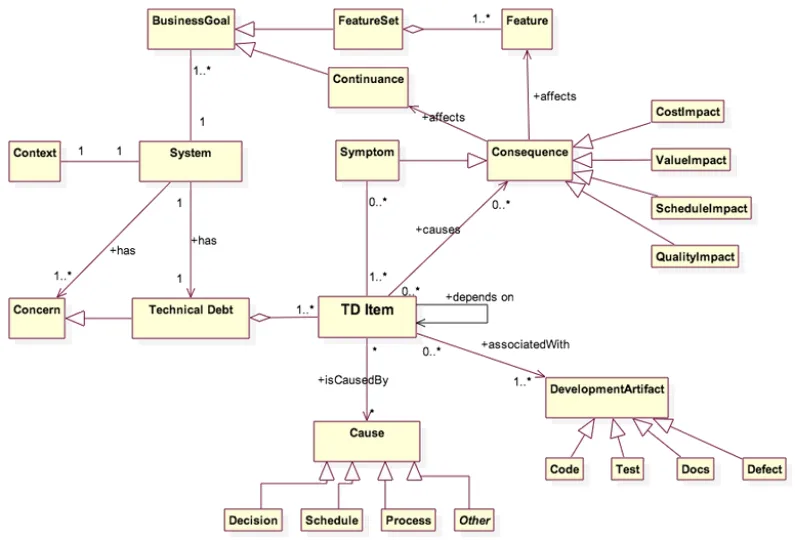
- Presents results from breakout groups, including a definition of technical debt and a draft conceptual model.
- Outlines a research roadmap developed from the seminar’s discussions.
- Includes abstracts of seminar talks and summaries of open discussions, with bibliographic and licensing information.
Managing Technical Debt
- Technical debt describes delayed work and immature artifacts that increase future costs of changing, evolving, and maintaining software.
- The metaphor helps developers and decision makers communicate design trade-offs and assess whether a system’s maintainability is moving in an undesirable direction.
- Technical debt results from short-term compromises that increase long-term complexity, and it may be incurred deliberately or unintentionally—often becoming visible only during maintenance.
- Effective management requires recognizing, analyzing, monitoring, measuring, and strategically paying down technical debt, yet many organizations lack established practices and tools.
- Code smells, coupling, cohesion, and dependency analysis can reveal some debt, but industry evidence suggests the most significant debt arises from design trade-offs that code-quality metrics cannot detect.
However, empirical examples collected from industry all point out that the most significant technical debt is caused by design trade-offs, which are not detectable by measuring code quality.
Technical Debt Framework
- Shared benchmarks are essential for validating new technical-debt approaches and building a stronger empirical research base.
- An ideal benchmark would combine codebases, architectural models, multiple versions, and known technical-debt items; industry guidance is needed to make such data available.
- The seminar brought together researchers, practitioners, and tool vendors through a flexible format of lightning talks, breakout groups, plenary discussions, and attendee-driven sessions.
- Participants organized the field around four themes: defining technical debt, measuring and analyzing it, managing it, and establishing a research roadmap.
- The agreed definition characterizes technical debt as expedient design or implementation choices that may make future changes more costly or impossible, creating liabilities chiefly for maintainability and evolvability.
- Technical debt should be understood through two complementary viewpoints: the properties and artifacts of debt items, and the management processes and states through which debt develops.
In software-intensive systems, technical debt is a collection of design or implementation constructs that are expedient in the short term, but set up a technical context that can make future changes more costly or impossible.
Modeling Technical Debt
- Technical debt consists of distinct debt items, each triggered by causes such as schedule pressure, missing expertise, limited information, or process decisions.
- These debt items affect system value, future-change costs, schedules, quality, and the sponsoring organization’s business objectives.
- Debt is tied to tangible development artifacts, including code, documentation, defects, and tests.
- The financial metaphor distinguishes principal—the cost of an initial shortcut or replacement solution—from recurring and accruing interest that increases costs over time.
- The conceptual model is a starting point for further work, including defining value, studying contextual factors and related forms of debt, and building research infrastructure.
The interest is comprised of costs that add up as time passes. There is recurring interest: additional cost incurred by the project in the presence of technical debt, due to reduced velocity (or productivity), induced defects, and loss of quality.
Technical Debt Research Agenda
- The authors propose publishing a fuller conceptual model and research road map after the broader community has reviewed and refined the ideas.
- A blog created before the seminar will continue supporting discussion and collaboration among researchers and practitioners.
- The table of contents shows that technical debt research spans financial aspects, measurement, runtime management, prioritization, business value, architecture, legacy systems, and social factors.
- The proceedings also include practical experience reports, domain-specific studies, working groups, and a section devoted to open research problems.
- The breadth of topics reflects technical debt as a multidisciplinary challenge requiring both theoretical models and applied management strategies.
The blog established before the seminar will continue to facilitate this interaction.
Financial and Architectural Debt
- Technical debt is framed through a financial metaphor but also has direct monetary consequences: it can represent savings from lower-quality development, revenue from timely delivery, and costs incurred through refactoring.
- A systematic literature review aims to create a glossary of financial terms used in technical-debt research and clarify how those concepts relate to one another in debt management.
- Researchers at the ESSeRE Lab evaluated five tools for measuring technical debt and found that many focus on code smells while neglecting broader architectural problems.
- Existing architectural analyses often emphasize cyclic dependencies and related issues, leaving other architectural smells insufficiently detected and potentially underprioritized.
On the one hand, it represents money saved while developing at a lower quality or money earned when delivering the product in time, whereas on the other hand, it represents money spent when applying a refactoring.
Measuring and Managing Debt
- Existing technical-debt indexes overlook relationships between code and architectural problems, as well as information from a system’s development history.
- A proposed debt index would combine code and architectural smell detection, design metrics, system history, and weighted prioritization of more critical problems.
- Researchers are developing a catalogue and classification of architectural smells, using metrics, historical changes, correlations, statistical analysis, and machine learning to set thresholds and prioritize remediation.
- In dynamic cloud environments, technical debt is treated as a moving target caused partly by runtime decisions that produce short-term gains but undermine long-term value.
- Runtime debt management requires predictive design support, online adaptive learning, and time-aware models to monitor debt proactively and respond to quality-of-service violations and costly adaptation.
We have motivated the need for treating technical debt as a “moving target” that needs to be dynamically and adaptively monitored for prevention and/or transforming the debt into value.
Managing Technical Debt
- Deferred bugs accumulate as “defect debt,” requiring managers to measure both its principal and the interest generated by severity, priority, and dependencies.
- The proposed defect-debt research combines severity and priority metrics with graph analysis, then uses reinforcement learning to recommend which defects to prioritize.
- Technical Debt Management must be continuous and largely automated, drawing information from code, backlogs, and architecture documentation.
- Debt should be evaluated in context and prioritized according to release goals, especially when it affects areas under active development or creates ripple effects across modules.
- Effective management balances remediation effort against value: the goal is not a debt-free system, but a competitive one, while reducing process and design practices that create debt.
Features are a system’s asset, code is its liability. In the end it is important to deliver a competitive system, not a debt-free system.
Measuring Technical Debt
- The technical-debt community agrees that debt must be managed, but still lacks widely accepted methods and tools for estimating it.
- Rather than judging design and code problems against arbitrary quality thresholds, researchers propose relative measurement against an optimized design identified through search-based software engineering.
- The distance between a system’s current state and its estimated optimum could represent repayment effort and translate directly into refactoring activities.
- Repository analysis could measure how individual commits contribute to technical debt, enabling contributor reports and potentially encouraging participation in debt-related surveys.
- Industry uses the technical-debt metaphor more broadly than researchers do, focusing on the financial cost of correcting software flaws and the ongoing “interest” caused by inefficiency.
Industry does not care whether a structural flaw fits Cunningham’s original concept of technical debt. Rather it cares that IT must spend money to correct these flaws, and that there may be a marginal cost in inefficient use of human and machine resources (i.e., interest) until they are fixed.
Debt, Quality, and Legacy
- Technical debt can be framed narrowly as architectural problems or broadly as software quality defects, with each perspective serving different audiences and purposes.
- A defect qualifies as technical debt when it is serious enough that the organization expects to spend money correcting it; otherwise, deferred correction does not represent planned debt.
- CISQ measures structural flaws in reliability, security, performance efficiency, and maintainability using issues detectable through static analysis and judged severe by industry experts.
- Aggregating these flaws with estimated correction effort can approximate corrective maintenance costs while also indicating risks such as outages, data corruption, and performance degradation.
- Technical debt may accumulate gradually as software environments change, leaving assets detached from their original assumptions; this delayed accumulation closely connects technical debt with software legacy, which practitioners associate with more than 75% of debt instances.
If a flaw is not sufficiently damaging that its correction can be deferred endlessly, it is not an item of technical debt because the organization does not plan to spend money correcting it.
Modeling Debt and Value
- Legacy software should not simply be rebranded as technical debt; its characteristics must be fully identified to ensure accurate, manageable debt assets.
- Further research could use the software legacy domain to unify technical debt instances and improve existing management practices.
- Montana State University’s research combines ISO-based software quality assessments with technical debt measurements in extensible SonarQube dashboards.
- Technical-debt-aware modeling can offer architects and modelers alternative refactorings, revealing how design decisions affect generated code and improving architecture-to-code traceability.
- Technical debt prioritization must reflect business context and future system evolution: in fast-moving markets, accepting debt may be justified to preserve time-to-market, while current tools often underrepresent product and market considerations.
In an innovative, rapidly growing market, time-to-market delivery may be essential for product success, so taking on technical debt in these situations may be warranted.
Prioritizing Technical Debt
- Technical debt must be prioritized both against planned features and relative to other debt items, requiring methods and tools that support refactoring decisions.
- Estimating a debt item’s impact, or interest, helps technical and non-technical stakeholders evaluate effects on lead time, maintenance cost, and risk.
- Commercial organizations may value competitive advantage, customer value, and market attractiveness more highly, so debt impact must be assessed in relation to these business concerns.
- The AnaConDebt approach compares the Principal/Interest ratio of debt items using weighted factors based on expert judgment or organizational metrics.
- Ratios can be recalculated over time, allowing stakeholders to determine whether repayment can be delayed and to reprioritize as new information emerges.
The assignment of weights to such factors, based either on expert experience or on metrics available at the organizations, gives a result that is simple to interpret and useful for comparison.
Technical Debt Tradeoffs
- Scientific research software often accumulates technical debt because domain experts and professors typically lack formal software-engineering training, while new students must build on inherited code.
- Legacy assumptions can constrain research progress: one study’s software could not fully exploit a larger system after being ported because memory-related limitations were embedded throughout the code.
- A proposed scientific-software ecosystem would provide a maintained supply chain, helping researchers select tools that remain suitable for future work.
- Google developers must choose between stable but soon-obsolete technologies and newer, incomplete platforms, making technical debt an unavoidable form of strategic tradeoff.
- Google’s rapid Android evolution creates fragmentation and rising maintenance costs for external developers, even as its enormous installed base offers significant opportunities.
The up-front design decision is not whether to take on technical debt, but which form.
Expanding Technical Debt Research
- Technical debt (TD) extends beyond individual projects to software product lines, where existing management tools may not capture new forms of debt.
- Product-line TD can appear as logical anomalies such as dead code, undead code, and over-constrained code that limit realizable configurations.
- Assessing product-line debt requires combining variability-model information, code variability, and build-space data rather than examining code in isolation.
- Concept maps can standardize TD terminology, organize research categories, and clarify how debt is identified, measured, managed, and documented.
- Architectural assessment provides a timeboxed, established method for evaluating systems against quality attributes and producing improvement recommendations through qualitative and quantitative analysis.
Examples of this are dead code, undead code or over-constrained code that reduces the potential number of code configurations below the range of configurations described by the variability model.
Assessing Technical Debt
- Architectural assessments can evaluate maintainability and evolvability while identifying, categorizing, prioritizing, and monitoring technical debt from system-wide architecture down to implementation details.
- Because technical debt affects runtime qualities, testability, defects, and future evolution, effective assessment often requires examining the system’s architecture, history, and development plans as a whole.
- Major unresolved challenges include quickly locating debt, creating business-understandable cost–value methods, and aligning debt prioritization with organizational needs.
- A metrics-driven approach can connect quality goals and architectural rules to code violations, historical changes, defects, and symptoms such as rising change costs or declining development velocity.
- No universal set of detection rules works across projects; assessing acquired software is especially difficult because historical data may be unavailable, making manual analysis necessary to estimate future sustainment costs.
Will a substantial part of every dollar devoted to new functionality instead go to dealing with accumulated debt?
Technical and Social Debt
- Technical debt captures the accumulated consequences of software decisions, such as architectural choices, and can limit product quality while increasing future project costs.
- Social debt is the organizational counterpart to technical debt: suboptimal social and technical decisions can damage development communities and ultimately contribute to software failure.
- Understanding social debt requires adapting methods from technical-debt analysis, organizational research, and social-network research to study socio-technical relationships.
- A study of 60 students found that explicitly identifying technical debt encouraged teams to discuss trade-offs, avoid unnecessary debt, and make debt-incurring decisions more deliberate and strategic.
- Visible debt lists improved communication, reduced dependence on isolated experts, supported negotiations for refactoring time, preserved project history, and helped teams cultivate continuous improvement.
The technical debt list was used as a historical memory of the immature parts of the project by all teams. They could use it to check if there was debt to be paid in parts of the project that were about to be modified.
Technical Debt Research Road Map
- Technical debt is defined as expedient design or implementation choices that make future changes more costly or impossible, creating an internal liability for maintainability and evolvability.
- The workshop envisions technical debt being managed as deliberately as defects and features, with clear standards for acceptable debt and “good-enough” software.
- Successful debt management would connect developer and manager concerns, helping organizations make better decisions about effort, priorities, and spending.
- The vision assumes that technical debt is usually incurred intentionally, supported by widely adopted tools, architectural assessment, and debt-aware development practices.
- Progress depends on stronger communication between researchers and practitioners, with proposed approaches demonstrating value to both managers and developers.
- The research agenda is organized around defining value, understanding the broader context of technical debt, and building infrastructure to support continued study and practice.
TD would be managed as carefully as we currently manage defects and new features.
Making Technical Debt Valuable
- Value is central to managing technical debt (TD), influencing both whether to incur it and whether, when, and which debt to repay.
- The traditional concepts of principal and interest capture many short- and long-term costs, but they overlook important factors such as opportunity cost and timing.
- Incurring TD can free resources to seize time-sensitive opportunities, yet the resources saved and those required for the opportunity may not be directly comparable.
- TD management and TD-related information may improve decision quality, but these benefits are difficult to measure and are essential to defining when software is “good enough.”
- Researchers should develop practical value proxies, validate them through data and case studies, and ensure that resulting measures are useful to developers as well as understandable in business contexts.
When does software have a level of quality (and a level of TD) that cannot be cost-effectively improved?
Expanding Technical Debt Research
- The Dagstuhl definition of technical debt (TD) focuses on phenomena closely tied to source code, but it excludes related forms such as social, people, process, and infrastructure debt.
- These broader forms of debt may cause TD, coexist with it, or shape how effectively organizations can manage it, showing that TD must be studied within its wider context.
- Important research priorities include uncertainty, organizational context, time, dependencies, knowledge management, causal chains, and models of TD management maturity.
- The TD research community is mature enough to benefit from shared infrastructure, including richer datasets, benchmarks, common outcome metrics, validated tools, and replication resources.
- Because effort data and objective ground truth are often scarce, the field should promote reusable raw data and intersubjective agreement through reference tools and shared standards.
“Ground truth in this area is difficult to come by, but we can strive for intersubjectivity, or widespread agreement on an essentially subjective proposition.”
Managing Technical Debt
- Architectural and model-driven technical debt operate at a higher abstraction level than implementation debt, though an overlapping middle layer links architectural and code maintainability metrics.
- Automatically generated code can introduce code smells even when model-level changes resolve model smells, highlighting the need for better model-code traceability.
- Managing technical debt requires choosing between continuing to pay interest through extra future effort and reducing the principal through refactoring.
- Context-specific checklists may support these decisions, but practitioners need estimation models that account for business goals, costs, implications, and the complexity and benefits of proposed changes.
- The technical-debt research community would benefit from shared datasets, tools, and agreed benchmarks to make methods and results easier to compare.
Technical debt leads to interest payments in the form of additional effort that software practitioners need to do in future development of a software system because of quick and dirty design decisions. Deciding whether continuing paying interest or paying down the principal by refactoring the software is one of the most important challenges in managing technical debt.
Deprecation and Research Infrastructure
- The technical debt community could improve research by designating open-source reference systems with accessible code, architecture, development histories, evolution scenarios, issue trackers, and developer contacts.
- Shared datasets, standardized metrics, benchmarks, controlled experiments, and reusable analysis tools would make technical debt studies more comparable and their results easier to validate.
- Software deprecation is presented as technical debt made visible: features remain temporarily for backward compatibility while signaling an expanding technology gap and possible future removal.
- Google’s shared, continuously built environment makes deprecation difficult because features cannot simply be deleted; although engineers can identify and update users, this approach becomes difficult to scale and more urgent as external dependencies grow.
- Product lines extend technical debt research from individual systems to families of related systems, where inter-system relationships create additional debt while all ordinary system-level problems still apply.
Deprecation in this environment can become a tragedy of the commons. Yet our environment is closed, in that Google engineers can readily determine all users of a given feature.
Technical Debt Automation
- Product-line code clones can arise from incomplete integration or parallelized development, creating significant technical debt.
- Even integrated product lines can accumulate debt when variability models and code annotations introduce unnecessary complexity or indirect dependencies.
- Legacy systems carry technical debt across releases, but manually identifying and removing it is costly and risky, especially when changes require extensive testing.
- Automated refactoring tools can detect or remove some smells, but current solutions handle only limited patterns and need developers to approve proposed changes.
- The section frames the key automation challenge as supporting more complex debt removal directly within developers’ workflows, while the next section turns to social debt in software engineering.
Because of the risk of change previously mentioned, it is likely that any automation will require the developer to arbitrate between considerations to approve any proposed changes.
Beyond Technical Debt
- Software friction arises not only from technical choices but also from organizational, social, ontological, and management decisions.
- Social debt is closely tied to technical debt, influencing software architectures, organizational structures, and the human processes of engineering.
- Cognitive distance, poor or excessive communication, and misaligned architectures can create social debt and increase project costs and risks.
- Future research should establish a precise, practical definition of social debt that helps professionals evaluate organizational structures and their trade-offs.
- Software projects accumulate visible, invisible, tangible, and intangible debts, all of which can affect quality, risk, and long-term evolution.
Some “debts” are invisible (software engineers can feel, but cannot see), others perceivable (software engineers can see, but not feel), others concrete (software engineers can see and feel) and finally others are still intangible (no feel, no see, and something still happens in the project).
Contributor Directory
- The passage lists contributors and their institutional affiliations, rather than presenting a substantive argument or narrative.
- The roster includes academics, industry professionals, and researchers from universities, corporations, and research organizations.
- Contributors represent a broad international network spanning the United States, Brazil, and multiple European countries, as well as Canada and Ukraine.
- The range of affiliations suggests the underlying work draws on diverse perspectives in software engineering, technology, and research.
- The directory helps readers identify the expertise and geographic breadth behind the publication.
Carnegie Mellon University – Pittsburgh, US
Managing Technical Debt
However, empirical examples collected from industry all point out that the most significant technical debt is caused by design trade-offs, which are not detectable by measuring code quality.
Technical and Social Debt
- Social debt is the organizational counterpart to technical debt: suboptimal social and technical decisions can damage development communities and ultimately contribute to software failure.
- Visible debt lists improved communication, reduced dependence on isolated experts, supported negotiations for refactoring time, preserved project history, and helped teams cultivate continuous improvement.
The technical debt list was used as a historical memory of the immature parts of the project by all teams. They could use it to check if there was debt to be paid in parts of the project that were about to be modified.
Making Technical Debt Valuable
- Value is central to managing technical debt (TD), influencing both whether to incur it and whether, when, and which debt to repay.
- The traditional concepts of principal and interest capture many short- and long-term costs, but they overlook important factors such as opportunity cost and timing.
When does software have a level of quality (and a level of TD) that cannot be cost-effectively improved?