Generative illustration for Feedback Systems in the Design and Development Process (Research in Engineering Design, 2022)
Feedback Systems in the Design and Development Process (Research in Engineering Design, 2022)
Overview unavailable.
Feedback in Design
- Examines the essential role of feedback in design and development processes, including design generation, project adaptation, coordination, and collaboration.
- Explains that feedback can increase project complexity and create resistance to beneficial changes.
- Introduces a conceptual framework showing how feedback operates at different process levels and influences goal-seeking, learning, and emergence.
- Presents a system-theoretic model for analyzing feedback situations, supported by concrete examples and grounded in systems theory and cybernetics.
Feedback in Design
- The design and development process is inherently complex and can only be understood partially from any one participant’s perspective, making system-theoretic analysis valuable.
- Feedback is described in two related ways: cybernetic self-regulation that reduces gaps between desired and perceived states, and circular causal influence in which outputs later affect inputs.
- Feedback systems shape how design processes evolve over time, producing control and stabilization as well as virtuous or vicious cycles of growth and decline.
- Feedback operates throughout design and development, including simulations, testing, project management, product-service data, software updates, and user-centered design.
- Because frequent feedback can reduce rework, support learning, and help products meet ambiguous stakeholder needs, it is widely treated as desirable in design process models.
“without candid, actionable feedback from people, we won’t know how to push our ideas forward”
Integrating Feedback Perspectives
- Feedback helps development projects adapt to new information and changing conditions, but it can also resist desirable changes and make decision-making more difficult.
- As design and development projects grow in scale, additional participants, design issues, and interdependencies create increasingly complex networks of interacting feedback loops.
- The article proposes a conceptual framework and system-theoretic process model to integrate previously separate perspectives on feedback in development projects.
- Its approach combines technocentric views of feedback as engineering control or natural balancing/self-reinforcing processes with human-centric views emphasizing intelligent, reflective participants.
- The framework is intended to improve understanding of development situations and reveal opportunities for research and practical improvement.
- The framework was developed through an integrative, snowballing literature review, shaped by the authors’ own judgments rather than designed as a fully systematic review.
But at the same time, feedback processes in a project organisation cause resistance to desirable changes and dynamic complexity that makes comprehension and effective decision-making difficult (Senge 1990).
Feedback Framework
- The study develops a conceptual framework for understanding feedback across diverse design and development process (DDP) situations.
- It views the DDP as a complex dynamic system shaped by communication patterns and by how participants create, reference, and modify design models, documents, and other representations.
- The framework expands the information-processing view of project organizations by emphasizing that information flows are dynamic, circular, and open to interpretation from multiple standpoints.
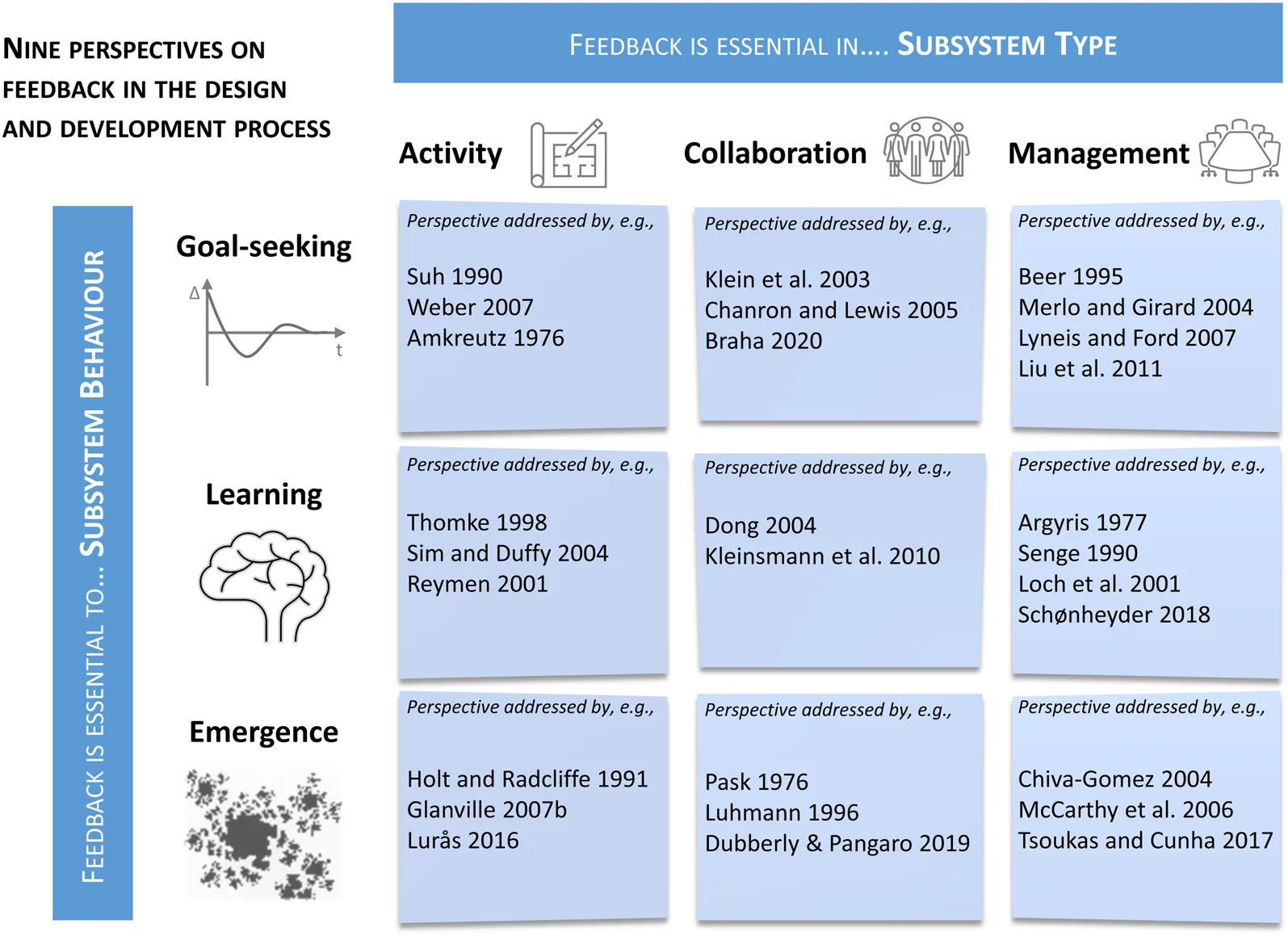
- Nine feedback perspectives are organized in a two-dimensional grid: three subsystem types—activity, collaboration, and management—crossed with distinct dynamic behaviors.
- One highlighted behavior is goal-seeking: feedback helps systems absorb uncertainty and disturbances, such as unexpected test results, changing workloads, or resource constraints.
Uncertainty is endemic in the design and development process—examples of goal-seeking and uncertainty absorption in this context include adjusting a design solution to approach specifications in response to unforeseen test or analysis results, and reallocating resources to ensure timely project delivery under unpredictable workload fluctuations.
Feedback in Design
- Learning enables design subsystems to acquire knowledge and adapt their behavior when contexts change or remain poorly defined.
- Emergence allows unexpected design trajectories, including creative opportunities and work reconfiguration, but can also produce cost overruns and design flaws.
- The framework’s nine perspectives offer interconnected ways to examine feedback across design and development situations and scales.
- Feedback is central to established design models, appearing as iterations, stage-to-stage loops, and cycles between concepts, knowledge, analysis, synthesis, and physical realization.
- The framework distinguishes cybernetic feedback and circular influence from iteration, while emphasizing how information quality, timing, and reinforcing cycles affect stability and convergence.
Emergence can also lead to adverse situations such as cost overruns and design flaws.
Feedback in Design
- Design activity is presented as a feedback-driven, goal-seeking process rather than a simple linear progression.
- Simon’s generate-test cycles propose alternatives and evaluate them against goals and constraints, with feedback helping designers account for dependencies across nested problem levels.
- Suh models design as a loop between creativity and analysis, arguing that better judgment of creative outcomes accelerates convergence toward correct solutions.
- Existing models do not fully represent how information accumulates during design or how designers’ freedom to maneuver progressively narrows.
- Weber’s control-circuit analogy casts analysis as a sensing function and synthesis as an actuating function, while changing constraints act as disturbances.
- Cybernetics provides a broader framework for understanding how design systems respond to uncertainty, disturbances, ambiguity, and shifting objectives.
“the gain of the feedback loop should be as large as possible to converge to a correct solution quickly; that is, the ability to judge the outcome of the creative process improves the creative process itself.”
Feedback in Design
- Engineering design literature has acknowledged cybernetics through ideas such as parallel problem-solving paths and the distinction between functional and structural system perspectives, but often without examining feedback in depth.
- Classical cybernetics highlights goal-directedness, dynamic behavior, and feedback—principles that are largely underemphasized in many design theories.
- Feedback may explain how systematic design methods can successfully guide the process even when designers lack a complete model of their own cognitive mechanisms.
- Amkreutz models designing as a generation function coupled with feedback, where evaluation, decision, and regulation continuously refine both the design solution and the criteria used to judge it.
- The design process can be understood as multiple coupled control systems converging toward goals, yet this model does not fully explain how designers acquire knowledge or produce novel, creative solutions.
The existence of feedback is why, he proposes, systematic methods can be devised to guide design, even while design cognition itself remains incompletely understood.
Learning Through Feedback
- Learning is essential in design and development process (DDP) activity because it helps participants overcome incomplete knowledge and continually modify or generate new understanding.
- Learning is intertwined with design work and evolves according to each designer’s situation, explaining why different people—or the same person at different times—may respond differently to identical information.
- Feedback operates through repeated cycles of design, building, testing, failure, learning, correction, and retrial, gradually improving solutions and revealing or eliminating flaws.
- Learning can be goal-directed: it helps designers clarify ill-specified goals, respond to novelty, avoid failure, and use process models to identify improvements and guide corrective decisions.
- Unlike rational-agent models that emphasize selecting the best option from existing knowledge, reflective approaches show how introspection about problems, actions, and unintended consequences can accelerate learning and improve design outcomes.
“trial, failure, learning, correction and retrial”
Feedback, Learning, and Emergence
- Designers learn through feedback by evaluating outcomes, making decisions, and regulating or modifying the design process.
- Reflection strategies shape the direction and performance of design, helping participants reframe design situations across successive iterations.
- The PSI framework encourages reflection on the problem, the people and perspectives involved, and the institutional or process context.
- Learning is essential to explain why different people respond differently to the same design situation and why design can generate new knowledge.
- Feedback contributes to emergent outcomes in both the designed system and the design process, producing results that may be creative and desirable or unexpected and problematic.
Emergent situations can cause subsequent DDP activity to react in unpredicted (also emergent) ways. The outcomes of emergence in DDP activity can be desirable (e.g. novel solutions) or undesirable (e.g. schedule overruns and design flaws).
Feedback and Emergent Design
- Feedback supports not only convergence but also divergent thinking, helping designers regulate creative activities and generate novel ideas.
- Learning contributes to emergence because a designer’s knowledge shapes how they interpret an evolving design, what information they notice, and how they revise it.
- Schön characterizes designing as a reflective conversation in which framing, moving, and seeing unexpected consequences can lead to deliberate reframing.
- The passage distinguishes rational, situated accounts of emergence from Schön’s emphasis on ill-defined goals and the designer’s thoughtful construction of the design situation.
- Cybernetics explains novelty as emerging from feedback cycles linking familiar activities such as generating and evaluating designs, though some accounts remain highly conceptual.
Schön (1983) describes this as a reflective conversation between designer and situation.
Feedback in Design Collaboration
- Feedback systems shape both what designers consider relevant and desirable, creating reciprocal loops in which actions alter subsequent events and experiences.
- New information arising during design may reinforce the existing appreciative setting or destabilize it, potentially producing a new system and a richer variety of ideas.
- Feedback helps explain how novel designs emerge from design-and-development-process activity and how emerging designs can unexpectedly reshape that activity, including in creative, nonroutine contexts.
- In collaborative design, interdependent objectives and constraints prevent problems from being perfectly divided among team members, so convergence usually requires iterative, piecewise adjustments.
- Conflicting feedback between coupled team members can create endless oscillation rather than agreement; mediation, commitment signals, staged decomposition, and modularization can help break these cycles and support convergence.
In this very simple case, and many others involving intercoupled cycles and delays, the system oscillates without converging to a mutually satisfactory solution in which all the goals are adequately met.
Feedback and Design Learning
- Whether decentralized design converges depends on the structure of the problem and the objectives pursued by each designer; a Nash equilibrium may or may not exist.
- As interdependent decision nodes multiply, feedback loops become larger and more interconnected, with small-world networks and highly connected nodes accelerating convergence.
- Coordination improves when small clusters of problems are solved quickly and then integrated into larger subproblems governed by slower feedback dynamics.
- Feedback is especially important in heterarchical design systems, where multiple decision-makers manage distinct but interdependent objectives without strong central control.
- Learning strengthens collaboration: agents adapt by recognizing others’ strategies and prior solutions, while teams work to align specialists’ different perspectives and develop shared understanding.
- From a second-order cybernetic perspective, collaborative design aims not only to solve technical problems but also to produce congruent thinking, reflected in increasingly aligned language among team members.
The few nodes that are highly connected in such networks also have greater influence on problem-solving dynamics than the many that are not.
Feedback and Emergent Design
- Design teams can be understood as cybernetic systems whose product models, process models, methods, and mental models regulate activity toward shared goals through feedback.
- These models evolve through learning, while differing perspectives among team members help manage the complexity of designing and require ongoing negotiation.
- Second-order cybernetics emphasizes that observers and the situations they observe are dynamically coupled, each influencing the other.
- When designers respond to colleagues’ work, their decisions alter the evolving design in return, creating unpredictable outcomes that exceed what individuals might produce alone.
- Pask’s conversation theory explains collaboration as a feedback process in which understanding is constructed through ambiguous, back-and-forth utterances rather than directly transmitted information.
Such dynamic couplings contribute to unpredictable, i.e. emergent outcomes.
Feedback Constructs Design
- Second-order cybernetics and conversation theory frame design collaboration as an ongoing conversation between participants and their design situation, shaped by reciprocal feedback.
- Communication has no fixed meaning: each participant interprets it through an individual mental model, which evolves in response to prior interactions and alters future reactions.
- Through feedback-driven coevolution, collaborators construct their personal understanding of the context, their interaction processes, and ultimately the design itself.
- Because these interconnected systems retain memory and influence one another, they function as unpredictable “non-trivial machines”; ambiguity in communication can therefore encourage creativity by inviting reinterpretation.
- Feedback also plays a central role in managing design and development processes, especially large concurrent-engineering projects involving interdependent teams, tasks, and information networks.
The feedback-driven coevolution of mental models may be conceptualised as the mechanism by which DDP participants construct a reality on several levels: they each construct a personal understanding of their context; together they construct the processes by which they interact, and through those processes they construct the design itself, as well.
Feedback in Complex Projects
- Unplanned events are inevitable in dynamic design and development projects (DDPs), making adaptive management essential.
- Feedback mechanisms help projects absorb uncertainty, identify issues quickly, and coordinate responses while preserving project goals; Agile and spiral methods institutionalize this through regular feedback.
- Feedback also contributes to dynamic complexity, especially when multiple intertwined feedback loops operate across large-scale projects.
- Qualitative models distinguish active feedback, which developers deliberately seek, from passive feedback originating outside the project; either type may increase information without necessarily improving decisions.
- Without effective filtering and coordination, feedback can be conflicting or overwhelming, while its absence can destabilize a project and damage cost, quality, and schedule.
- More complex and novel projects require greater responsive coordination, including reprioritizing tasks, reallocating resources, rescheduling work, and distributing updated information.
Without feedback, they argue, a DDP will become unstable with undesirable impacts on cost, quality and time.
Feedback-Driven Design Control
- The GRAI reference model separates a decision system from a technological system, linking management control with autonomous design centres that provide updates for detecting performance gaps.
- The Viable Systems Model treats organizational subsystems as autonomous, feedback-driven entities capable of adapting to uncertainty, managing resources, and interacting with their environment.
- Applied to engineering change and design management, the Viable Systems Model helps identify structural gaps and recommend improvements, though its cybernetic concepts can be difficult to grasp.
- O’Donnell and Duffy’s model closely integrates design and management activities, using feedback to adjust goals and reallocate resources while balancing design effectiveness against time and cost.
- Modelling approaches such as IDEF0 help practitioners represent functions through inputs, outputs, controls, and mechanisms, but do not always make individual feedback loops explicit.
A viable system uses internal feedback processes to autonomously respond to change, manage its resources, and manage interactions with its environment, thereby maintaining its existence in a context of uncertainty without requiring external control, within limits.
Modeling Feedback in Design
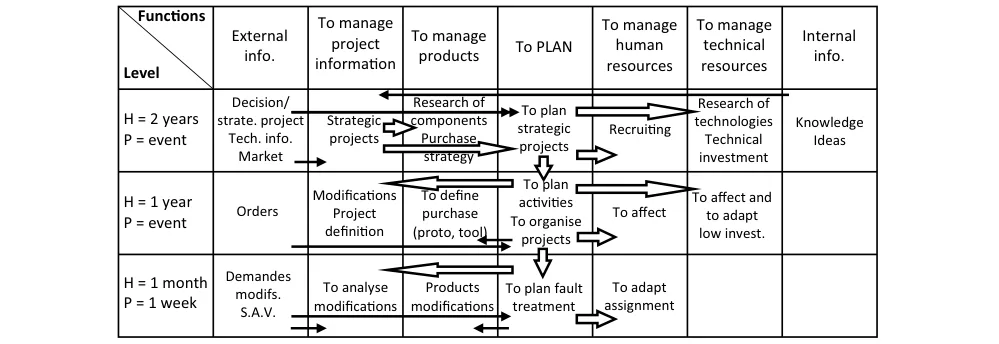
- The GRAI methodology models product-development decision systems through coupled representations, especially the GRAI grid, which maps interactions among control mechanisms with different time horizons and scopes.
- By structuring decision processes and their coordination, the GRAI grid can guide the design of information systems that deliver the right information to the right decision-making levels.
- Some models treat feedback as concurrent with ongoing work and as a useful way to absorb uncertainty, while task-sequence models treat late feedback as a source of rework that should be minimized.
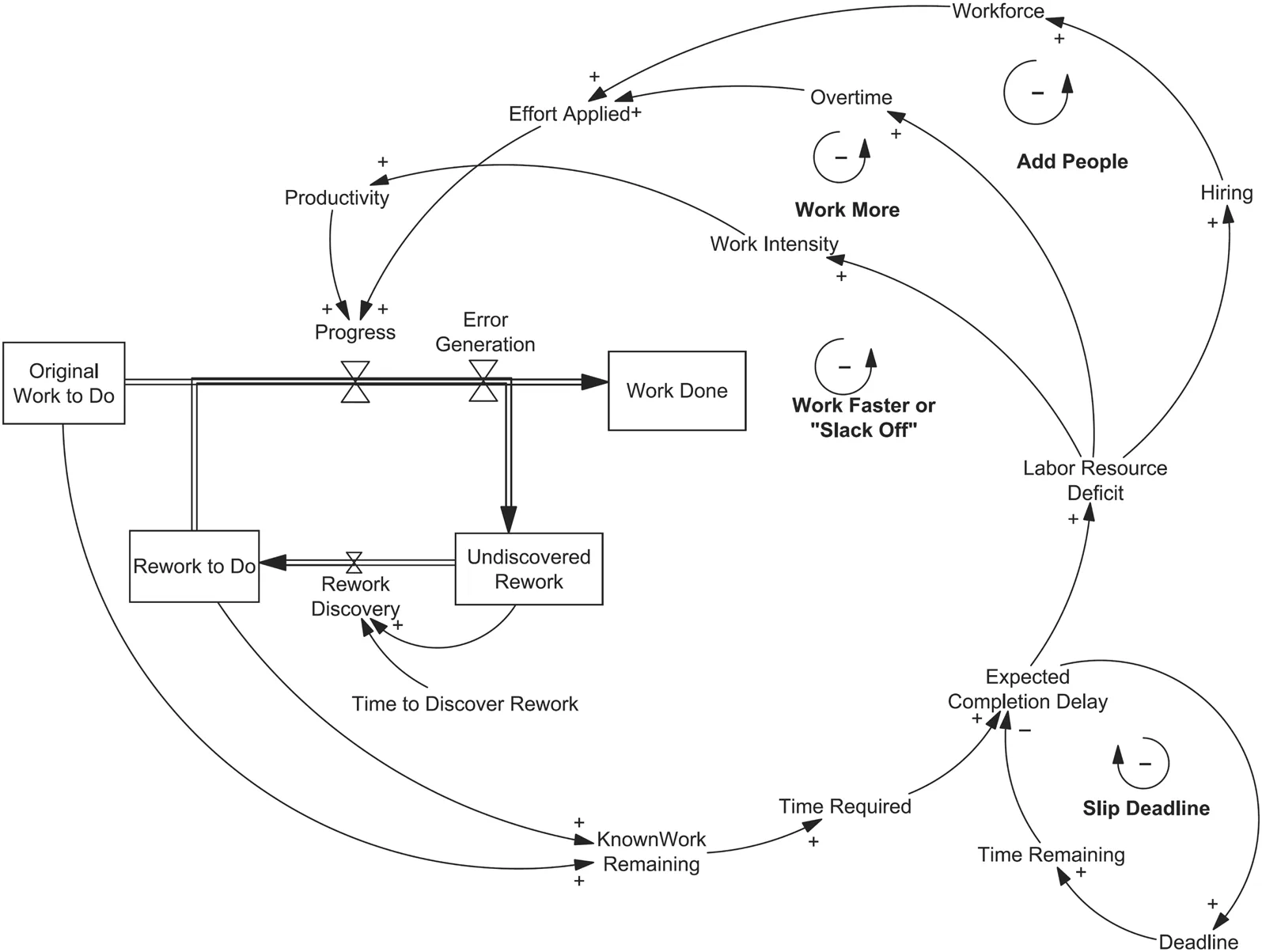
- Quantitative approaches such as System Dynamics examine goal-seeking behavior through intertwined feedback loops, delays, and imperfect information between development activities and managerial decisions.
- Together, these approaches show that feedback can either support adaptive coordination or create costly disruption, depending on when it occurs and how the process is organized.
The downstream task may eventually provide feedback that the assumption was incorrect, necessitating rework.
Feedback in Project Management
- System Dynamics models represent rework cycles and managerial feedback loops, allowing researchers to study how policies shape project evolution over time.
- Feedback-driven increases in work intensity may accelerate progress when projects fall behind, but delays and poorly designed policies can create oscillations and repeated rework.
- Resource allocation based only on past demand is myopic; predicting future needs helps balance short- and long-term objectives and avoid excessive fluctuations.
- In multi-team development, delayed integrator feedback forces teams to make decisions using outdated information, causing projects to alternate between appearing on schedule and falling behind.
- Controlling interconnected decision networks becomes harder when they are sparsely connected and have uneven connection patterns—features often found in product-development networks.
- System Dynamics models depend heavily on accurately specified equations and generally assume that feedback-loop structures remain static.
The delay between decisions and feedback means that teams must make decisions based on outdated information, causing oscillatory situations in which progress is repeatedly thought to be on schedule before falling behind.
Learning Through Feedback
- Testing strategies strongly shape learning in design and development: parallel testing can be more effective than sequential cycles when tests are cheap but slow, though it may reduce feedback opportunities.
- Testing many alternatives early and delaying commitment can reveal the feasible design region and reduce costly redesign later.
- Learning is essential because decisions must adapt to changing contexts, but interconnected organizational decisions can create delayed and unintended consequences.
- Systems thinking and causal loop diagrams help organizations understand feedback structures instead of merely reacting to visible events.
- Double-loop learning enables organizations to question goals when they harm broader interests, but managerial pressure, uncertainty, ambiguity, and internal politics can obstruct it.
People tend to mistakenly believe that “cause and effect are close in time and space”, whereas in reality, the consequences of decisions often occur much later than the actions and can manifest elsewhere in the system.
Feedback and Emergent Design
- Management learning occurs through feedback, but interacting feedback loops make learning from experience difficult and may even create resistance to organisational learning.
- At the management level, feedback enables large-scale design and development projects to adapt to emerging situations and coordinate interconnected organisational units.
- Adaptive system management models product development as a hierarchy of 13 subsystems, represented by causal networks whose control loops counterbalance internal and external disturbances.
- Autogenetic design theory treats design as an evolutionary feedback cycle, in which design processes change in response to shifting selection pressures from their context.
- Although these perspectives highlight feedback’s importance in managing emergent behaviour, they remain largely conceptual; systems engineering also recognises feedback as fundamental but often discusses it only within broader, abstract principles.
Feedback principles are important in this model as the authors describe that some processes are “intuitive and chaotic” requiring active management, and internal and external disturbances counterbalanced through control loops among the factors.
Feedback at Chaos’s Edge
- Complex adaptive systems theory explains DDP behavior through interactions among learning agents whose experience shapes rules, while outcomes prompt further learning and rule modification.
- Positive and negative feedback loops operate across multiple levels and timescales: negative feedback stabilizes and supports convergence, while positive feedback amplifies disturbances and drives change.
- Both feedback types can be virtuous or vicious depending on context; stability may improve project management but also resist the innovation and change essential to design and development processes.
- Operating at the “edge of chaos,” DDP systems can absorb some changes yet shift unpredictably into new quasi-stable states, helping explain sensitivity to initial conditions, chaotic behavior, and emergent creativity.
- Complex adaptive systems theory complements second-order cybernetics: the former emphasizes large-scale system behavior arising from situated learning, while the latter focuses on how individuals construct understanding through feedback.
A complex adaptive system is said to exist at the edge of chaos, a situation in which these regimes are in constant tension. At the edge of chaos, some changes may be absorbed while other changes can trigger the system to shift unpredictably to another quasi-stable state or configuration.
Feedback in Design Processes
- Feedback influences design from early conceptualization through complex concurrent engineering projects involving many participants.
- Goal-seeking perspectives emphasize negative feedback as a means of correcting deviations, reallocating resources, and helping designs converge toward desired states under uncertainty.
- Learning perspectives focus on how positive and negative feedback accumulate knowledge, shape decisions, and sometimes make management more difficult because of feedback complexity.
- Emergence perspectives explain how interactions among participants and feedback processes generate new designs, enable adaptation, and allow system structures to change over time.
- The literature divides broadly between technocentric approaches, which offer concrete models for managing uncertainty, and human-centric approaches, which provide richer theoretical insight into situated knowledge but are harder to apply practically.
Complex Adaptive Systems theory aims to explain how creativity, adaptation and emergence result from positive and negative feedback being held in tension, through the interactions of learning agents.
Integrating Feedback Perspectives
- Technocentric approaches treat design and development feedback as relatively fixed, modelable systems, while human-centric approaches emphasize fluidity, interpretation, reflection, and social interaction.
- The two perspectives are not mutually exclusive: many design situations combine constructing new understanding with pursuing measurable objectives.
- A discursive and pluralistic approach can reveal the complexity of design and development processes, though practitioners would benefit from a model integrating both viewpoints.
- The proposed synthesis must remain abstract enough to apply across ambiguous situations and multiple levels of the design and development process.
- The Feedback System Function Structure (FS2) model is introduced as a conceptual framework for explaining how feedback supports goal seeking, learning, and emergence.
When seeking to understand a complex system such as a DDP, a discursive and pluralistic approach is often revealing.
The FS2 Feedback Model
- The FS2 model represents a design-and-development situation as a system interacting with an environment through feedback loops.
- It distinguishes the system of interest from a broader feedback system that includes closely coupled environmental elements and recognizes that multiple interacting systems may operate on different timescales.
- The model decomposes the system into functions, influence flows, and memory, showing how these components support goal-seeking, learning, and emergence.
- Its generic structure can frame many design situations, provided they are understood in terms of feedback processes rather than fixed event sequences.
- The system is treated as informationally closed: meaningful information is shaped by its internal frame of reference and translated across the boundary through perception, implementation, communication, and artifacts such as documents or CAD models.
meaningful information exists only within the system given its idiosyncratic frame of reference
Goal-Seeking Feedback Model
- The FS2 model represents design and development feedback systems through functions, information flows, and memory-related influences, without specifying their physical implementation.
- Its cyclic flows capture feedback both across the system boundary with the environment and internally through reflection and the reprocessing of system memory.
- The model treats design and development processes similarly to engineering function structures, emphasizing interactions among functions and flows rather than concrete people, media, or process steps.
- Goal-seeking is presented as the central behavior of intelligent participants: they perceive the environment, detect or predict deviations from design and coordination goals, decide on responses, and act to influence outcomes.
- The model integrates established concepts from prior literature into a unified framework intended to support structured reflection and practical analysis of design and development processes.
Arguably the most fundamental behaviour of intelligent participants in feedback situations is goal-seeking (Pask 1969) which, to recap, enables equilibrium to be maintained and/or objectives to be approached in a context of uncertainty.
Detect, Predict, Decide
- The Detect function identifies deviations from system goals by comparing the perceived environment with those goals, enabling corrective responses.
- Detection is difficult in design practice because information may be poor, conflicting, or overwhelming; inaccurate evaluations can slow convergence toward a viable solution.
- Detect is reactive and may cause decisions to lag behind ideal responses, particularly when the environment follows a sustained trend of growth or decline.
- The Predict function complements feedback with feedforward by anticipating how the environment and potential actions may evolve, allowing problems to be prevented or mitigated before their consequences fully appear.
- The Decide function selects actions based on detected and predicted deviations, system goals, and decision heuristics about how possible actions will affect the environment.
Predict is a more cognitive approach in the sense that its effectiveness is more dependent on the system’s ability to understand how its environment may evolve over time and how it may respond to changes.
Feedback, Action, and Learning
- Decision-making combines rational analysis, reflection, environmental information, and heuristics, often amid conflicting goals and trade-offs.
- The principle of requisite knowledge suggests that decision heuristics should match the complexity of the environment, but bounded rationality and incomplete information make this impossible in practice.
- Implementation translates decisions into observable actions, yet authority, consensus, technical constraints, and limited execution speed can prevent appropriate responses.
- Ashby’s principle of requisite variety shows that a system must possess enough possible actions to counter the variety of situations in its environment, though design systems are inherently constrained.
- Detect, Predict, Decide, and Implement form a feedback loop whose effects reshape the environment; learning then updates the system’s situation models, goals, and decision heuristics over time.
“Only variety can destroy variety”
Learning Through Situation Models
- Learning drives dynamic complexity because it enables intelligent behavior and causes responses to similar stimuli to change over time.
- Situation models are subjective, purpose-oriented understandings of how an environment works and how it may respond to actions; they support reasoning about cause and effect.
- These models help systems anticipate changes in designs, processes, milestones, and the reactions of other participants, though their predictions remain imperfect.
- The Learn I function represents the ongoing revision of situation models in response to observations, including preserving effective methods and discarding ineffective ones.
- Learning differs from goal-seeking: instead of merely correcting a deviation, it changes the underlying understanding that guides future decisions, often through reflection and reframing.
Like any model, situation models are less than the situations they represent and are oriented towards a purpose—in this case, reasoning about cause and effect with respect to the goals of the system.
Heuristics and Learning
- The Abstract function converts complex situation models into practical decision heuristics—rules of thumb shaped by system goals.
- Developing heuristics requires deciding which factors matter, which can be ignored, and how to resolve inconsistencies in an incomplete or ill-defined understanding of a situation.
- System goals drive purposeful behavior because deviations from them trigger decisions and actions; in design, these goals are often internal, evolving, and open-ended.
- Design goals develop through feedback: subsystem teams refine requirements, assess their feasibility, and may reformulate them as problems and solutions evolve together.
- The FS2 model incorporates double-loop learning, allowing observed effects and reflection to modify not only actions but also the goals and broader elements guiding the system.
One purpose of design goals is “to motivate activity which in turn will generate new goals” (Simon 1981).
Perception and Emergence
- Feedback systems in dynamic design projects must support single- and double-loop learning in near-real time, making it difficult to distinguish learning effects from ordinary feedback adjustments.
- Emergence is treated as a context-dependent outcome: it can foster innovative, agile designs but may be harmful when safety, schedule, or budget control is paramount.
- The Perceive function is grounded in second-order cybernetics, which emphasizes that participants act through internal models formed in their minds rather than through neutral representations of reality.
- Because models filter stimuli and shape what participants can observe, they create unavoidable blind spots and influence the very processes and designs being perceived.
- A model need not accurately mirror the real world to be useful; its value is judged by whether it supports good decisions, while system memory shapes both decisions and observations.
Participants in such a system can only perceive from within the frame of their models and for this reason have blind spots they cannot see (von Foerster 2003).
Coordinating Coupled Feedback
- Perception is shaped not only by the environment but also by previous actions, since different ways of querying a system produce different information; this makes an actor’s frame of reference a source of unexpected outcomes.
- Design and development involve many interconnected feedback systems, with participants often belonging to several systems at once, such as performance and scheduling.
- Because systems have imperfectly aligned goals and perceive one another’s actions with delays or indirectly, their situation models, decision heuristics, and goals coevolve in complex ways.
- Interactions among feedback loops can foster creativity and desirable emergence, but they also make outcomes difficult to predict, hinder convergence, and slow learning because systems are changing, actions are irreversible, and causes are hard to isolate.
- Awareness of dynamic complexity, clear understanding of how individual work supports overall objectives, and higher-level feedback can improve decisions and reduce undesirable interactions.
- In the FS2 model, coordination is treated as a feedback- and feedforward-governed influence on decision-making, with coordination goals evolving as the effects of past decisions become visible.
The situation models, decision heuristics and goals, that are internal and unique to each system, therefore coevolve in complex manner as each system reacts to changes induced by others.
FS2 Feedback Model
- The FS2 model integrates insights from feedback-systems research for design and development processes (DDP).
- It decomposes feedback situations into functions supporting goal-seeking, learning, and emergence, emphasizing how these interrelated behaviors are realized.
- The model is intended to apply across activity, collaboration, and management subsystems and at multiple levels of the design and development process.
- A literature-mapping analysis indicates that earlier feedback models address only subsets of the concepts unified by FS2, especially because many focus on cyclic influence rather than decision-making functions.
- By combining human-centric and technocentric perspectives in a practical model, FS2 aims to translate largely discursive theoretical insights into applications and actionable implications.
Overall, to summarise Sect. 3.3, emergence is presented in our model as arising from dissonance between system memory and the system environment, as well as from the dynamic interactions among coupled feedback systems.
Feedback in Design Processes
- The design and development process is not mechanical or uncontrolled; participants consciously influence it by responding to feedback.
- Feedback systems are important not only for control and goal-seeking, but also for emergence and learning within design work.
- Analyzing interactions among participants—whose perceptions and goals are shaped by feedback—could reveal essential dynamics of the design and development process.
- Because few studies comprehensively examine feedback alongside information dependencies or task sequences, the authors argue that the topic deserves greater attention.
- The abstract FS2 model is intentionally designed to frame a complex, ambiguous process, encouraging reflection without oversimplifying important issues.
- The Feedback System Function Structure is a conceptual model for generating insight, not a practical recipe for improving design processes; its value depends on the validity, consistency, and usefulness of its concepts.
“Although feedback is most commonly associated with control or goal-seeking, researchers have also considered it to be essential to emergence and learning—both of which are key behaviours of the design and development process.”
Feedback in Design Processes
- The FS2 model was applied to three cases, including engineering design, process improvement, and reflection on the model itself; each application generated new insights and supported its use for retrospective analysis.
- Effective feedback in design and development processes should help systems approach goals quickly while minimizing oscillation, uncertainty, and coordination difficulties.
- Delays in cause-and-effect cycles, especially across organizational boundaries, weaken decision-makers’ ability to understand whether interventions are working and can destabilize the process.
- Poor-quality, excessive, or insufficient feedback information can also impair performance; feedback should be timely, reliable, and tailored to each decision-making unit’s ability to interpret it.
- Failures in any FS2 function or information flow can prevent uncertainty from being absorbed, learning from occurring, or improvements from being implemented—for example, deviations cannot be corrected if they are not detected or transmitted.
Long delays in feedback loops may even make it difficult to connect cause and effect at all.
Feedback, Control, and Emergence
- Organizations benefit most from feedback when they can absorb new ideas and respond quickly through practices such as agile development, information sharing, rapid prototyping, modularity, and reconfigurability.
- Bureaucratic processes, tightly integrated legacy systems, and psychological, cultural, or organizational barriers can prevent people from giving or acting on feedback effectively.
- A central tension exists between viewing feedback as a means of controlling work toward predefined goals and viewing it as a source of emergence, adaptation, and new design possibilities.
- Where goals are uncertain or difficult to define in advance, complex interactions among positive and negative feedback loops may be more valuable than rigid control, which can also inhibit innovation.
- Future research will test the FS2 model across more cases and assess whether practitioners find its framework useful for interpreting real-world dynamic design and development situations.
It is in fact the non-idealities relating to feedback that lead to the important DDP behaviours of creating new designs, and being able to adapt when new opportunities arise.
Feedback Systems in Design
- The FS2 model could guide reflection on difficult design and development process (DDP) feedback situations and support more structured analysis.
- Computational approaches, including agent-based simulations, could investigate how environmental models are managed, updated, misaligned, and coevolved during design.
- Observational and experimental studies could reveal how designers handle feedback in practice and how those responses affect design outcomes.
- Further conceptual work could examine interactions among feedback systems, including differences in influence, speed, autonomy, scale, and project evolution.
- The article concludes that combining technocentric and human-centric perspectives through the Feedback System Function Structure can improve understanding and effectiveness amid the uncertainty, novelty, and complexity of design.
The relevant system-theoretic ideas tend to be discursive and conceptual—very rich in insight, but not straightforward to transform into concrete recommendations for improvement.
Feedback in Design Processes
- A feedback-systems perspective complements views of design and development as iteration, negotiation, or networks of actors, tasks, and information.
- Feedback loops cross conventional boundaries, linking individuals with teams and engineering design with process management.
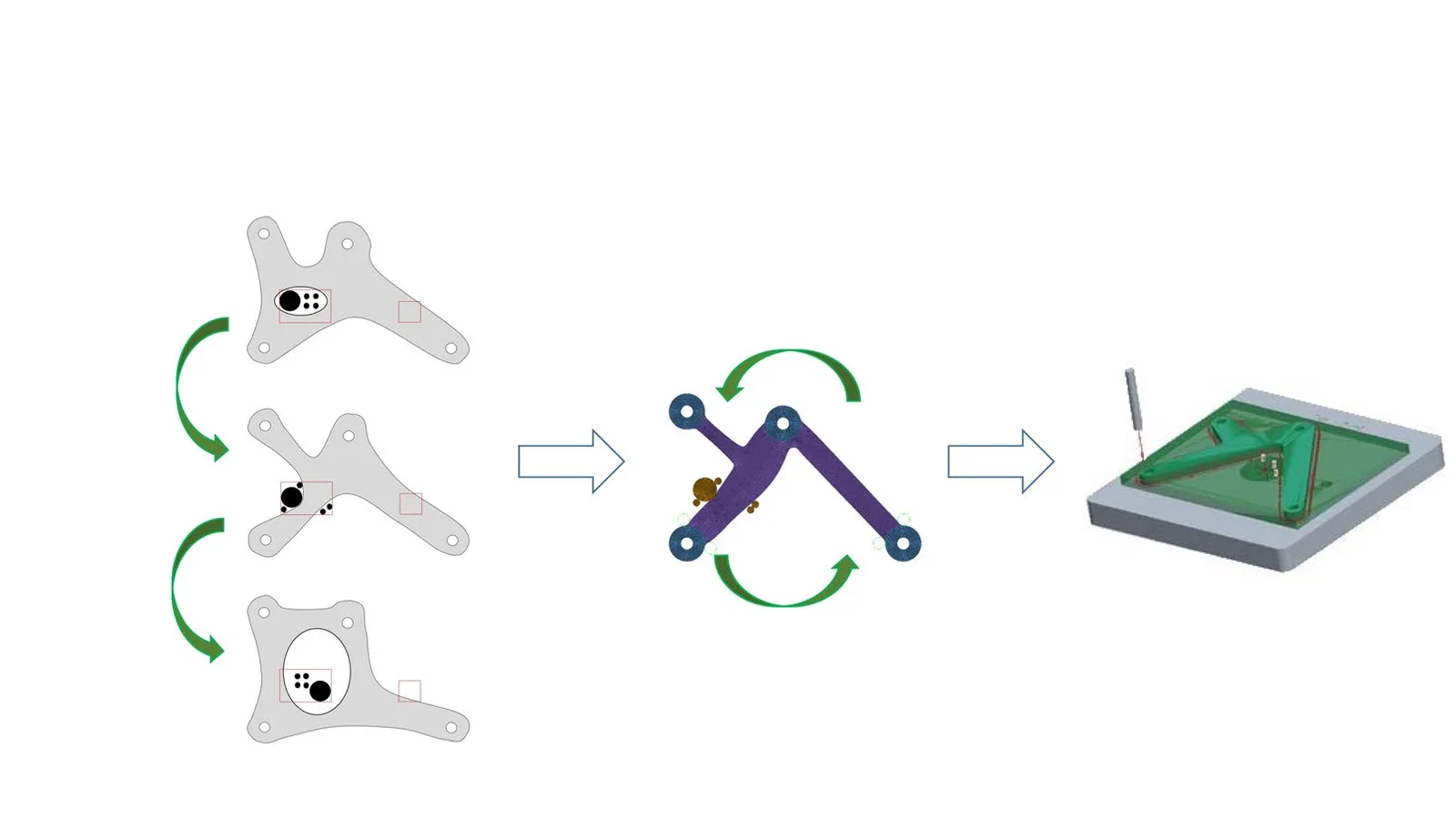
- The appendix applies the FS2 model to a student mechanical-design project involving topology selection, FEA refinement, and CNC machining planning.
- The students’ process demonstrates goal-seeking: they repeatedly revise CAD geometry to reduce the gap between simulated and desired performance.
- The process also produces learning and emergence, as students deepen their mechanics knowledge while different search paths lead to varied, non-exhaustively planned topologies.
In consequence, a feedback systems perspective can help to appreciate the design and development process more holistically as an interconnected and complex dynamic system.
Design as Feedback
- The design project is reframed as a feedback system centered on each designer’s interaction with design information, while largely setting aside collaboration between partners.
- Designers modify CAD models and use FEA and machining simulations as observations to evaluate stiffness, weight, and manufacturing time.
- Their decisions are guided by mechanical understanding and practical heuristics, such as removing material from low-stress regions to reduce weight.
- Although the objectives are clearly defined, designers must still prioritize competing goals and choose an overall strategy for maximizing performance.
- Each iteration involves detecting gaps from targets, predicting the remaining potential of a topology and its competitiveness, and deciding whether to refine, change, or finalize the design.
- As designers gain confidence in their heuristics, they may make larger changes and reach solutions faster, though repeated refinement can eventually plateau.
Eventually, the performance that can be gained by iterating a particular topology will reach a plateau.
Learning in Design Feedback
- The design process is an iterative feedback loop: the designer modifies CAD geometry using decision heuristics, then reanalyzes the part in FEA to assess the effects.
- Through iteration, the designer builds a situation model of how design changes affect performance and revises decision heuristics accordingly, such as focusing material changes near loading points.
- Design goals are not fixed; target values and desired tradeoffs evolve as the designer learns what is achievable and which strategies produce the best overall performance.
- Perception is selective: designers can only use FEA results they know how to interpret, so gaps in knowledge—such as unfamiliarity with Von Mises stress—limit what information enters the design process.
- The feedback-function analysis reveals dynamic complexity and emphasizes accurate simulation, clear goals, informed interpretation, reflective learning, and a pluralistic use of complementary analytical perspectives.
Each of these two perspectives reveals certain insights while obscuring others—other perspectives are possible as well.
Acknowledgments and Open Access
- The authors acknowledge contributors, peer reviewers, and colleagues whose feedback helped improve the article.
- Several figures are redrawn, adapted, or reprinted from earlier publications, with permissions and source credits carefully documented.
- Open-access publication was funded and organized through CAUL and its member institutions.
- The article is released under a Creative Commons Attribution 4.0 license, allowing reuse and adaptation with proper credit, source linking, and disclosure of changes.
- The references establish the article’s scholarly foundation in systems theory, engineering design, organizational learning, and design-process research.
If material is not included in the article's Creative Commons licence and your intended use is not permitted by statutory regulation or exceeds the permitted use, you will need to obtain permission directly from the copyright holder.
Design as Complex Systems
- The references frame engineering and product design as complex, adaptive, and often cybernetic systems rather than purely linear technical processes.
- Several works examine how coordination, communication, organizational structure, and decentralized decision-making shape design-team performance and convergence.
- Feedback is a recurring concern, linking self-regulated learning, dynamic decision-making, organizational design, and the consequences of neglecting feedback loops.
- The bibliography connects design practice with formal methods—including system modeling, task organization, structural complexity measurement, and agent-based simulation—to improve efficiency and effectiveness.
- Creativity is presented as an evolving interaction between problems and solutions, embedded in social, cultural, and cognitive systems.
- Recent sources extend these ideas to network patterns, cyber-physical systems, and safety and security analysis, showing the field’s movement toward increasingly interconnected design environments.
Creativity in the design process: co-evolution of problem-solution.
Design and Cybernetics
- The references span engineering design theory, conceptual design, and methods for structuring technical systems and design departments.
- Cybernetics, systems thinking, feedback, and complexity appear as major frameworks for understanding and improving design processes.
- Several works address collaboration, negotiation, knowledge integration, and shared understanding in co-design and product-development teams.
- The bibliography connects design research with adaptation, artificial intelligence, agent-based modeling, biomimetics, and game theory.
- Overall, the sources suggest that engineering design is treated as a dynamic, distributed, and information-intensive activity rather than a purely technical procedure.
“Try again. Fail again. Fail better: the cybernetics in design and the design in cybernetics.”
Systems Design References
- The references center on cybernetics, systems thinking, and complexity as foundations for understanding engineering design and project management.
- Several works challenge rigid control-oriented project management, emphasizing flexibility, novelty, adaptation, and the management of uncertainty and ambiguity.
- Engineering and product development are portrayed as complex social systems involving collaboration, organizational learning, decision-making, and coordination across disciplines.
- The bibliography connects design theory with practical methods such as systems modeling, adaptive management, design-process modeling, parallel testing, and data-driven product development.
- Safety, controllability, and system completeness broaden the discussion beyond design productivity toward resilience, risk management, and the behavior of interconnected systems.
Lost roots: how project management came to emphasize control over flexibility and novelty.
Systems Thinking in Design
- The references emphasize reflective practice as a way to improve engineering design, professional work, and learning from breakdowns.
- Systems thinking, cybernetics, and organizational learning appear as foundations for understanding complex design problems and coordinating local action with global consequences.
- Several works develop formal models, ontologies, and frameworks for representing generic design activities, collaborative processes, and design-support systems.
- The bibliography highlights uncertainty and complexity in project management, including the challenge of identifying and addressing “unknown unknowns” and cost or schedule overruns.
- Design research is also connected to experimentation, safety analysis, complexity theory, and organizational paradox, suggesting that effective innovation requires structured learning amid tensions and ambiguity.
“systems thinking and organizational learning: acting locally and thinking globally in the organization of the future.”
Engineering Design References
- The references center on engineering design processes, product development, and methods for modeling and improving complex technical systems.
- Cybernetics and systems thinking are recurring foundations, represented by works on conceptual systems, cognition, control, communication, and viable system models.
- Several studies examine iteration, uncertainty, information flows, feedback, and engineering-change management as central factors in successful development.
- The bibliography connects systematic design theories with practical approaches, including IDEF0 function modeling, VDI 2221, Toyota-inspired development, and integrated product development.
- Recent research extends these themes through simulation, process-model utility, product-development reliability, and the detection of unintended consequences in engineered systems.
The second Toyota paradox: how delaying decisions can make better cars faster.
Design Churn Effect
- The text points to a phenomenon hidden within product development: the “design churn effect.”
- It suggests that design-related changes or instability may be an important but underrecognized aspect of developing products.
- The topic is associated with research published in Res Eng Des, volume 14, issue 3, pages 145–161.
mation hiding in product development: the design churn effect.
Feedback in Design
“without candid, actionable feedback from people, we won’t know how to push our ideas forward”
Feedback at Chaos’s Edge
- Positive and negative feedback loops operate across multiple levels and timescales: negative feedback stabilizes and supports convergence, while positive feedback amplifies disturbances and drives change.
- Operating at the “edge of chaos,” DDP systems can absorb some changes yet shift unpredictably into new quasi-stable states, helping explain sensitivity to initial conditions, chaotic behavior, and emergent creativity.
A complex adaptive system is said to exist at the edge of chaos, a situation in which these regimes are in constant tension. At the edge of chaos, some changes may be absorbed while other changes can trigger the system to shift unpredictably to another quasi-stable state or configuration.
The FS2 Feedback Model
- The model decomposes the system into functions, influence flows, and memory, showing how these components support goal-seeking, learning, and emergence.
- The system is treated as informationally closed: meaningful information is shaped by its internal frame of reference and translated across the boundary through perception, implementation, communication, and artifacts such as documents or CAD models.
meaningful information exists only within the system given its idiosyncratic frame of reference
Coordinating Coupled Feedback
- Because systems have imperfectly aligned goals and perceive one another’s actions with delays or indirectly, their situation models, decision heuristics, and goals coevolve in complex ways.
- Interactions among feedback loops can foster creativity and desirable emergence, but they also make outcomes difficult to predict, hinder convergence, and slow learning because systems are changing, actions are irreversible, and causes are hard to isolate.
The situation models, decision heuristics and goals, that are internal and unique to each system, therefore coevolve in complex manner as each system reacts to changes induced by others.
Feedback, Control, and Emergence
- A central tension exists between viewing feedback as a means of controlling work toward predefined goals and viewing it as a source of emergence, adaptation, and new design possibilities.
- Where goals are uncertain or difficult to define in advance, complex interactions among positive and negative feedback loops may be more valuable than rigid control, which can also inhibit innovation.
It is in fact the non-idealities relating to feedback that lead to the important DDP behaviours of creating new designs, and being able to adapt when new opportunities arise.