I Am a Strange Loop (2008)
Overview unavailable.
The Self as Strange Loop
- Introduces the book’s central question: how consciousness, identity, and the feeling of “I” can emerge from physical matter and neural processes.
- Presents Hofstadter’s idea of the self as a “strange loop,” in which symbolic patterns and physical brain activity interact, creating the appearance of downward causation and free will.
- The preface traces the author’s lifelong interest in minds, Gödel’s self-reference, computation, analogy, and consciousness, including personal experiences involving his sister Molly and the origins of the book.
- Explains the book’s intended audience and accessible style, emphasizing concrete examples, metaphors, personal stories, dialogues, and minimal technical jargon rather than formal philosophical proof.
- Includes publication information, dedications, extensive acknowledgments, a chapter-by-chapter table of contents, and a prologue in dialogue form that begins the exploration of consciousness and illusion.
What Counts as Life?
- Plato initially defines living creatures through bodily functions such as growth, eating, learning, and reproduction, but Socrates exposes tensions in whether life belongs to bodies or souls.
- Their discussion expands the question of souls from humans to higher animals, lesser animals, plants, and borderline organisms, challenging rigid divisions between living categories.
- Plato ultimately treats creatures with souls as possessing “true life,” while soulless plants merely display the symptoms of life.
- Because Plato identifies the soul with the ability to think, Socrates leads him to see that defining true life requires answering the deeper question: what is thinking?
- Plato admits that knowing is more than asserting or recording information, yet finds that knowledge and conviction become elusive when examined closely, prompting caution about saying “I know.”
It is curious, how one often mistrusts one’s own opinions if they are stated by someone else.
Consciousness as Reflex
- Socrates challenges Plato’s claim that machines cannot know the meaning of words, pointing out that humans themselves learn language through repeated exposure and use.
- The dialogue suggests that both ordinary speech and deliberate word choice may arise from learned habits and mechanical associations rather than fully conscious thought.
- Plato struggles to explain what it means to know that he is alive, revealing how difficult it is to distinguish genuine awareness from automatic verbal responses.
- Socrates presses the unsettling conclusion that consciousness—and even the feeling of being alive—might be an illusion produced by complex reflexes.
- The exchange reframes living creatures as potentially nothing more than intricate systems of automatic processes, setting up the chapter’s investigation of souls and minds.
“Then feeling one is alive is merely an illusion propagated by a reflex that urges one to utter, without understanding, such a sentence, and a truly living creature is reduced to a collection of complex reflexes.”
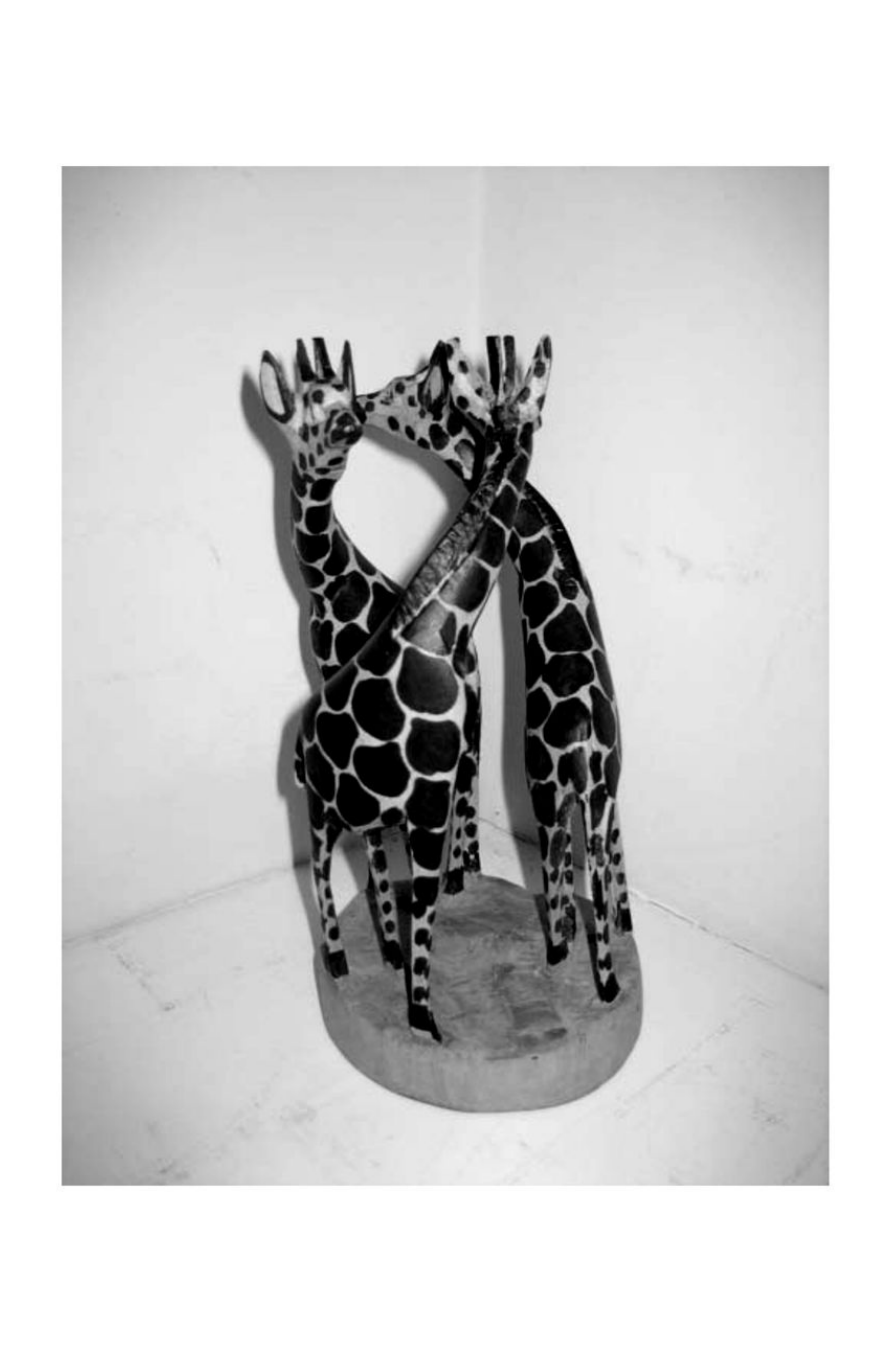
Photographs as Soul-Shards
- The narrator’s mother sees a photograph of her deceased husband as merely paper and dark spots, expressing the bleakness of grief.
- The narrator compares the photograph to Chopin’s sheet music: physical marks can evoke powerful inner experiences and connect people across time.
- Art and photographs preserve fragments of a person’s interior life, reactivating memories and emotional representations in the minds of those who knew them.
- The photograph becomes a cherished “soul-shard” that keeps the father’s smile, gentleness, and presence alive in the family.
- The discussion then contrasts human remembrance and consciousness with the narrator’s view of tomatoes as purely bodily, nonconscious entities without inner experience.
Like the score to a Chopin etude, that photograph is a soul-shard of someone departed, and it is something we should cherish as long as we live.
The Ethics of Eating
- The author distinguishes between killing mosquitoes and sparing other insects, revealing a personal hierarchy of moral concern toward living creatures.
- Although he still enjoys meat’s taste, he stopped eating mammals for ethical reasons and connects his vegetarianism to questions about souls.
- At fifteen, he fainted when asked to retrieve guinea pigs destined for scientific experiments, exposing an immediate and visceral horror of animal sacrifice.
- Despite this experience, he continued eating meat for years because meat-eating was socially unquestioned and vegetarianism seemed strange or moralistic to him.
- Reading Roald Dahl’s story “Pig” at age twenty-one profoundly changed his view of meat and ultimately affected the lives of other animals through his choices.
I don’t want to go on a crusade here, but I do need to talk a little bit about my vegetarian leanings, because they have everything to do with souls.
Revulsion and Vegetarianism
- In the story “Pig,” Lexington tours a slaughterhouse and watches pigs processed through a brutal industrial killing line.
- The observer suddenly becomes the observed: Lexington is mistaken for a pig, shackled, and slaughtered, erasing the boundary between human and animal.
- The story’s shocking reversal leaves the narrator mentally oscillating between identifying with Lexington and with a pig on a hook.
- At a Sardinian banquet featuring a roasted suckling pig, the narrator and his sister refuse to participate, choosing pasta and vegetables instead.
- Together, the story and the real-life banquet provoke the narrator to give up meat, turning horror into a personal ethical transformation.
In my mind, I kept on flipping back and forth between being an upside-down oinking pig on a hook and being Lexington, spilling into the cauldron...
Vegetarianism and Moral Boundaries
- The author’s early vegetarianism arose from compassion for living beings and became a passionate personal creed, despite confusion over admired meat-eating figures such as Einstein.
- Daily life in American society eventually led the author to abandon vegetarianism, revealing a troubling divide between his former moral convictions and later behavior.
- A friendship with Sue revived his ethical concerns, prompting him to return to vegetarianism before undergoing several further shifts in position.
- By his late thirties, he settled on a compromise: animals with “small enough” souls could be sacrificed for humans, though he recognized that drawing the line at mammals was arbitrary.
- Everyday language and grocery-store presentation distance people from the reality of eating animals, turning pigs, cows, and chickens into abstract products such as pork, beef, and anonymous cuts of flesh.
We English speakers do not eat pig or cow; we eat pork and beef. We do eat chicken — but we don’t eat chickens.
Who Possesses a Soul?
- The author’s enjoyment of meat was complicated by seeing animal carcasses in grocery-store loading areas and displays, where food became visibly connected to once-living beings.
- These encounters prompted questions about each animal’s subjective identity: who had inhabited its body, experienced the world through its senses, and disappeared at death.
- Similar reflections arose when the author crushed insects, though instinct suggested that different creatures might possess different degrees of inner meaning or soul.
- The disturbing images are introduced not as an argument for animal rights, but as a gateway to the book’s central philosophical question: what a soul is and who or what possesses one.
- The discussion then begins shifting toward the author’s love of Chopin and James Huneker’s emotionally charged writing about “stouter-souled” people.
Who was that animal? I wasn’t wondering about its name, because I knew that farm animals didn’t have names; I was grasping at something more philosophical — how it had felt to be that animal as opposed to some other one.
The Sizes of Souls
- Huneker’s claim that only “large-souled” people should attempt Chopin’s demanding étude suggests that human beings differ not merely in ability, but in spiritual or moral stature.
- Although this hierarchy sounds elitist and offensive to modern democratic sensibilities, the author admits that many people implicitly accept distinctions between lives of greater and lesser value.
- Ideas about unequal souls appear in judgments supporting capital punishment, wartime killing, slavery, religious persecution, and the subordination of women.
- People also debate whether someone with advanced Alzheimer’s, or an early-stage fetus, possesses a complete human soul, revealing how fluid and contested the boundaries of personhood can be.
- The passage challenges readers to recognize that even egalitarian societies routinely classify some human lives as diminished, absent, or less deserving of protection.
“Small-souled men, no matter how agile their fingers, should not attempt it.”
Drawing Moral Boundaries
- Everyday choices—from swatting insects and eating animals to using leather or ivory—force humans to decide which forms of life deserve moral consideration.
- The dialogue about whether a turkey is a “which” while a dog is a “whom” highlights how language reflects and shapes our judgments about animal status.
- Humans struggle to locate a decisive boundary between beings that may be killed without concern and those whose deaths cause anguish.
- Because humans possess greater intelligence, language, and cultural power, the author argues that “might makes right” effectively governs our ranking of living creatures.
- The author introduces a personal “consciousness cone” to explore which beings possess interiority and to what degree, preparing for a deeper examination of animal minds.
What gives us word-users the right to make life-and-death decisions concerning other living creatures that have no words? Why do we find ourselves in positions of such anguish (at least for some of us)?
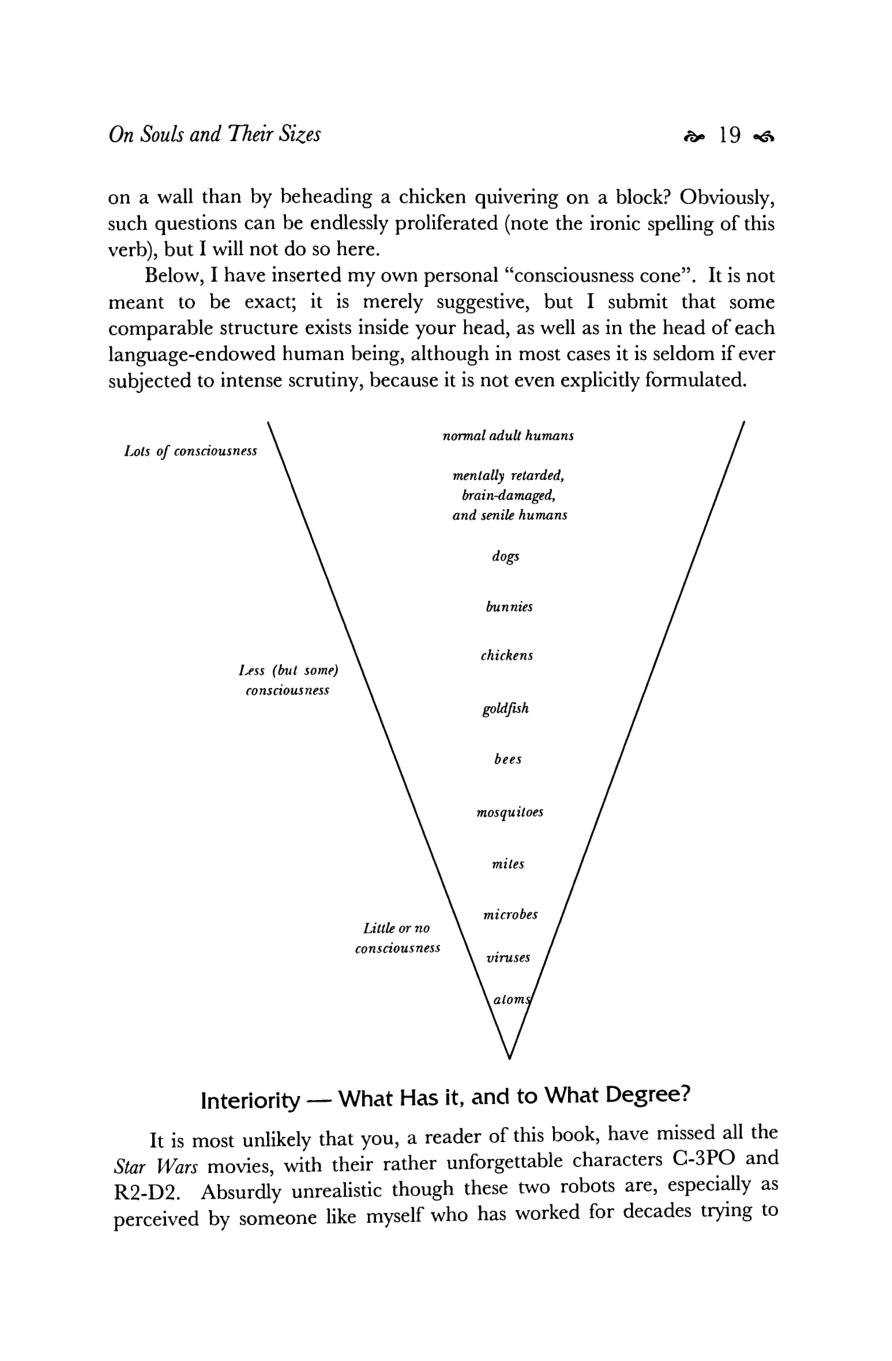
Degrees of Souledness
- Fictional robots can expand our intuitions about consciousness by showing that thinking and feeling need not depend on biological or fleshy bodies.
- Uniform marching robots provoke little sympathy because their identical appearance suggests interchangeability, mechanical behavior, and almost no interiority.
- The contrast between C-3PO, R2-D2, humans in decline, and animals raises the question of what makes an entity seem to possess a genuine inner self or “I.”
- The author rejects the idea that a complete human soul appears at conception, instead arguing that it develops gradually over years of maturation.
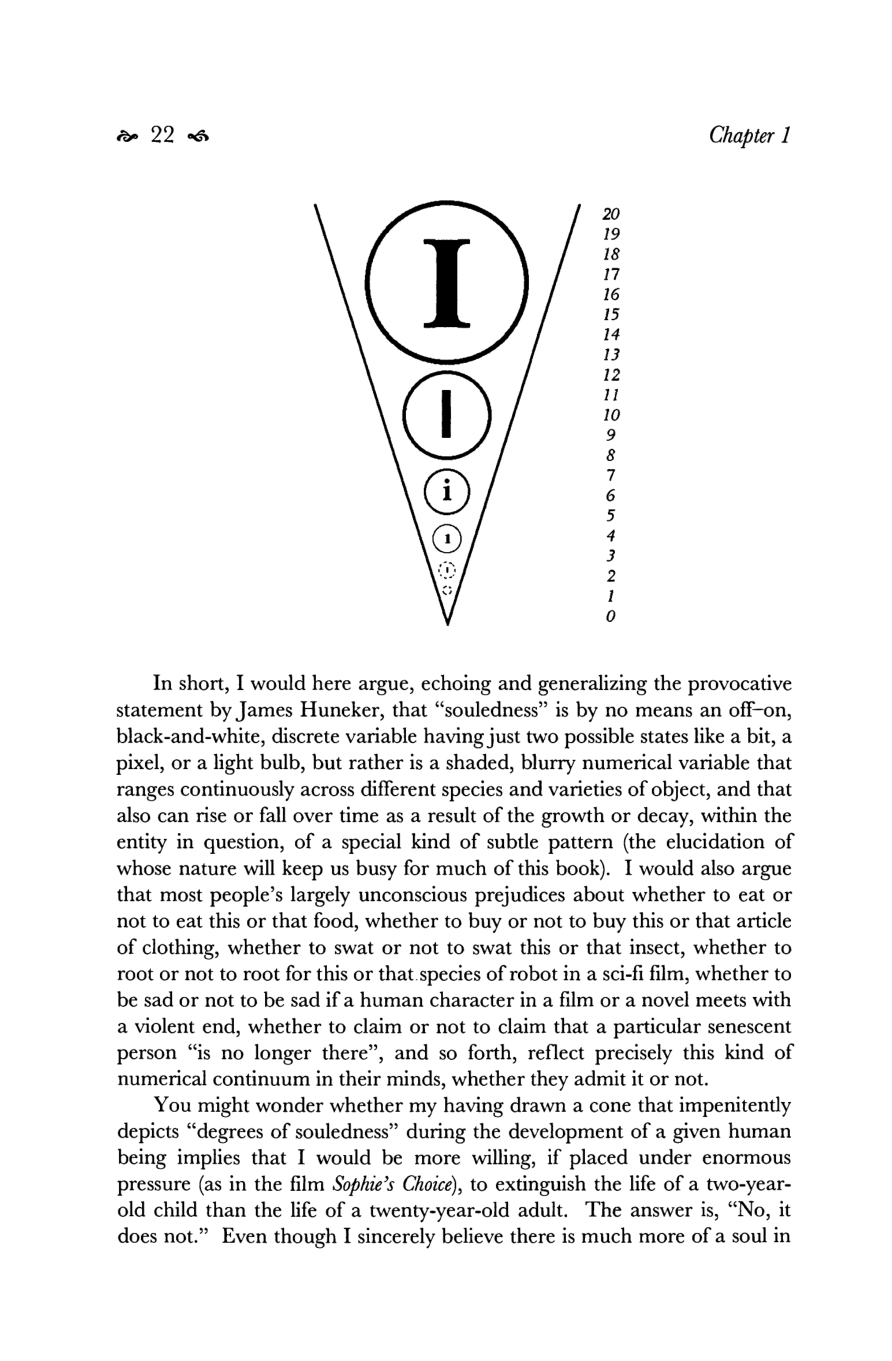
- The text introduces a playful scale of “degrees of souledness,” measured in “hunekers,” and questions the assumption that all normal adults reach the same maximum level.
I suspect that thanks to this unmistakable image of absolute interchangeability, virtually no viewer feels the slightest twinge of sadness when a bomb falls on the charging platoon and all of its members — these factory-made “creatures” — are instantly blown to smithereens.
The Souledness Continuum
- The author proposes that “souledness” varies by degree rather than existing as a simple yes-or-no condition, with an imagined scale measured in “hunekers.”
- A human embryo begins with essentially zero souledness, while increasingly complex internal patterns develop over time and gradually raise its value along the scale.
- This idea enters morally dangerous territory by seeming to imply that some people are worth more than others, so the author avoids trying to assign precise values.
- People’s everyday judgments about animals, food, insects, robots, fictional characters, and senescent humans may unconsciously reflect a perceived continuum of souledness.
- Although the author believes an adult has more developed soul than a toddler, the child’s immense developmental potential and perceived cuteness create powerful moral protection.
“souledness” is by no means an off-on, black-and-white, discrete variable having just two possible states like a bit, a pixel, or a light bulb, but rather is a shaded, blurry numerical variable that ranges continuously across different species and varieties of object.
Interiority and Strange Loops
- The book’s central question is what subtle patterns give rise to a “soul,” an “I,” consciousness, intentionality, or genuine meaning.
- These related qualities are presented as existing by degrees on a sliding scale, rather than as all-or-nothing properties.
- While expanding the chapter’s discussion of animal ethics, the author unexpectedly reconsidered the boundary between mammals and other animals and stopped eating chicken and fish.
- The author’s children independently reached similar conclusions, transforming the family’s diet into a vegetarian one within weeks.
- This unexpected reversal illustrates the “strange loop”: choices affect the self-model that produced them, feeding their consequences back into one’s sense of self.
- The next chapter introduces a productive tension between studying thought as abstract concepts and studying the brain as the physical machinery that enables thought.
Writing this chapter thus gave rise to a totally unexpected boomerang effect on its author — and as we shall see in later chapters, such an unpredictable bouncing-back of choices one has just made, followed by the incorporation of their repercussions into one’s self-model, serves as an excellent example of the meaning of the motto “I am a strange loop.”
Brain Beyond Anatomy
- Traditional neuroscience emphasizes physical structures, from neurotransmitters and synapses to neurons, cortical columns, and hemispheres.
- The author argues that this focus is too narrow, comparing it to literary criticism concerned only with books’ physical materials rather than plot, character, style, or metaphor.
- Abstract mental entities—including concepts, associations, memory systems, mental spaces, language, and humor—should also count as legitimate brain structures.
- Many such abstractions may be scientifically useful even before their physical basis is identified, just as genes and atoms were studied theoretically before direct observation was possible.
- Mapping abstractions onto physical brain structures would be valuable, but establishing precise relationships among them should itself qualify as neurological research.
My point is simple: abstractions are central, whether in the study of literature or in the study of the brain.
Architecture Over Microstructure
- Understanding the brain requires focusing on its large-scale organization, just as understanding a heart means recognizing it as a pump rather than examining every cell.
- Evolution shifted the focus of selection from the inner workings of contracting cells to increasingly efficient and complex pump architectures.
- Experts routinely reason at higher levels of abstraction: heart surgeons study cardiac structures, while car buyers care about safety, comfort, and efficiency rather than subatomic details.
- The microscopic level is probably the wrong place to explain high-level mental abilities such as concepts, creativity, memory, empathy, and consciousness.
- The discussion turns to John Searle’s criticism of artificial intelligence and introduces Turing machines, whose simple operations can perform any computation regardless of their physical materials.
The big picture will become clear only when we focus on the brain’s large-scale architecture, rather than doing ever more fine-grained analyses of its building blocks.
Mocking the Beer-Can Mind
- Searle ridicules the possibility of cognition in unconventional physical systems—such as toilet paper, pebbles, Tinkertoys, and beer cans—using deliberately absurd imagery.
- These humorous examples are presented as spontaneous jokes but function rhetorically to make readers dismiss the underlying ideas without serious examination.
- His “thirsty beer can” example falsely suggests that consciousness would reside in one can bearing the words “I am thirsty.”
- The text argues that cognition and sensation in such a system would be complex, distributed processes involving vast configurations of interacting components.
- By attacking this implausibly simplistic version of the theory, Searle targets a caricature rather than any serious computational model of mind.
How could a metallic beer can possibly experience thirst? And how would its popping up constitute thirst?
Mind Across Levels
- The idea that a single “thirst-experiencer” neuron represents thirst is compared to the discredited “grandmother cell” theory, revealing the weakness of reducing mental states to individual cells.
- Mental properties arise from vast, abstract patterns formed by interactions among billions of neural constituents, much as a mineral’s properties emerge from atomic organization.
- Concepts, sensations, memories, analogy-making, and consciousness cannot meaningfully be localized to a single neuron—or even to a small cortical column.
- Understanding the brain as a multilevel system is essential for analyzing elusive phenomena such as thought, perception, free will, and the sense of self.
- Roger Sperry’s view introduces consciousness as a genuine causal force in brain activity, raising the question of how different levels of agents and causes control one another.
To put it very simply, it comes down to the issue of who pushes whom around in the population of causal forces that occupy the cranium. It is a matter, in other words, of straightening out the peck-order hierarchy among intracranial control agents.
Causality in the Brain
- The brain contains nested layers of causal forces, culminating in large-scale patterns of excitation associated with mental states and ideas.
- Ideas and ideals are presented as genuinely causally potent, capable of producing new ideas and interacting across minds and environments.
- The text questions whether a conscious “I” directs physical brain processes or whether behavior is only the result of microscopic particle interactions.
- It asks whether abstract experiences—beliefs, love, guilt, dreams, and hopes—can causally affect the physical world or are merely impotent fictions.
- Everyday phenomena such as wars, laughter, smog, and marriage become tests of whether higher-level causes are real or reducible entirely to physics.
Who shoves whom around in the tangled megaganglion that is your brain, and who shoves whom around in “this teetering bulb of dread and dream” that is mine?
Emergent Levels of Explanation
- The author’s early belief in physics as the foundation of everything seemed to conflict with macroscopic causes such as evolution, nostalgia, religion, and jealousy.
- He resolves this tension by treating macroscopic forces as descriptions of complex patterns produced by underlying physical interactions, much like temperature and pressure emerge from microscopic motion.
- Shifting to higher levels of description makes the world comprehensible by discarding enormous amounts of detail while preserving useful regularities.
- Human beings have always acted meaningfully at the macroscopic level, long before anyone understood atoms, molecules, or subatomic particles.
- This framework leads to the concepts of “thinkodynamics” and “statistical mentalics,” applying the relationship between thermodynamics and statistical mechanics to thought and the brain.
I also realized that this kind of shift in levels of description yielded something very precious to living beings: comprehensibility.
The Power of Simplification
- “Thinkodynamics” describes large-scale mental patterns studied by psychology, while “mentalics” concerns microscopic neural events; “statistical mentalics” examines the collective behavior of those tiny components.
- Unlike a gas, the brain contains many intermediate levels between neural activity and conscious behavior, making it difficult to explain individual choices or emotions purely in terms of neurons.
- Human perception, language, and culture give us macroscopic concepts—such as “mosquito,” “itch,” and “swat”—rather than microscopic biological descriptions.
- Although microscopic explanations may preserve more information, people must simplify phenomena into familiar, higher-level patterns in order to understand and navigate the world.
- This drastic simplification is not merely a limitation: it enables abstraction, reliable survival, and the creation of literature, art, music, and science.
We necessarily simplify, and indeed, vastly so. But that sacrifice is also our glory.
Dominoes and Abstraction
- A spring-loaded network of dominoes, or “domino chainium,” could physically implement a computer by transmitting timed signals through branching and looping paths.
- The chainium can take a number such as 641 as input and determine whether it is prime by triggering tests for possible divisors.
- When a domino in the “divisor stretch” fails to fall, a local explanation points to its predecessor, while a deeper explanation identifies 641’s primality.
- The primality explanation operates at a higher, organizational level and makes no direct reference to gravity, dominoes, or other physical mechanisms.
- The example illustrates how computational or abstract properties can explain physical events across radically different domains of discourse.
The second answer bypasses all the physics of gravity and domino chains and makes reference only to concepts that belong to a completely different domain of discourse.
Beyond Local Causes
- The primality of 641 provides the best explanation for why some dominoes topple and others do not, making 641 the system’s “prime mover.”
- A purely local explanation—blaming each fallen or unmoved domino on its immediate neighbor—misses the larger pattern governing the chain.
- The traffic-jam metaphor illustrates how limited perspective can make people blame the car directly ahead, even when the true cause lies beyond the local scene.
- Large traffic jams arise from higher-level social or natural forces, such as commuting patterns, sporting events, or severe weather, rather than from the mechanics of individual cars.
- Collective phenomena require explanations at an abstract level: individual cars are merely pawns in a broader system whose underlying forces determine their behavior.
If you’re totally fog-bound like that, or if you’re incredibly myopic, then you might think to yourself, “It’s all my neighbor’s fault!”, and there’s at least a small chance that you’re right.
Patterns as Causes
- Explanations of brain activity can be given at multiple levels: a neuron’s immediate inputs may explain its behavior locally, while a person’s preferences provide a more meaningful organizational explanation.
- No single neuron is solely responsible for a complex mental response; like voters in an election, many neurons collectively participate without any one being privileged.
- Abstract patterns—such as the primality of 641—can genuinely play causal roles when they provide the most efficient and insightful explanation of a system’s behavior.
- Patterns do not introduce any extra physical force: microscopic laws still govern every event, but recognizing the system’s global organization makes causal understanding far more powerful.
- The analogy to gas temperature shows why higher-level descriptions matter: engineers use thermodynamic properties to design engines rather than tracking the trajectories of countless individual molecules.
“Deep understanding of causality sometimes requires the understanding of very large patterns and their abstract relationships and interactions, not just the understanding of microscopic objects interacting in microscopic time intervals.”
The Irrelevance of Microdetails
- Macroscopic outcomes such as gas pressure and piston movement depend on collective behavior, not on the identities or exact motions of individual molecules.
- Although lower-level processes are fully responsible for events, their precise details can vary enormously without changing the higher-level result.
- A millisecond change in playing Chopin would radically alter every air molecule’s trajectory while leaving the listener’s experience completely unchanged.
- The air molecules transmit the music, but countless different microscopic arrangements could perform the same kid-music job in ways indistinguishable to humans.
- Reliable statistical patterns can persist across radically different materials, shapes, environments, and even potentially different underlying physical laws.
Those air molecules could have done exactly the same kid-music job in an astronomical number of different but humanly indistinguishable fashions.
Predictability Across Levels
- Macroscopic statistical outcomes, such as nearly 500,000 heads in a million coin tosses, remain stable regardless of microscopic details.
- Although lower-level processes cause higher-level events, they can be irrelevant to understanding or predicting those higher-level outcomes.
- Everyday life depends on countless reliable macroscopic regularities, including steering a car, boiling water, handling objects, speaking, and pouring milk.
- This practical predictability does not require any knowledge of atoms or microscopic mechanisms.
- The macroworld also contains meaningful unpredictability, as illustrated by uncertain basketball shots and games whose outcomes can hinge on unexpected events.
Every day of our lives, we all depend in a million tacit ways on innumerable rock-solid predictabilities about how things happen in the visible, tangible world (the solidity of rocks being yet another of those countless rock-solid predictabilities).
The Careenium Model
- Tiny, often unknowable differences can determine whether an outcome is trivial, disastrous, or decisive.
- Speech reveals similar unpredictability: unconscious word choices and slips can expose hidden thoughts and carry major consequences.
- Everyday activities such as skiing combine familiar patterns with risks whose precise causes may remain hidden.
- Human experience spans predictable and wildly unpredictable events, drawing people toward risk while also frightening them.
- The “careenium” models layered causality as countless tiny magnetic particles—simms—that collide, cluster into larger simmballs, and continually exchange members.
- The thought experiment begins adding environmental sensitivity, suggesting how outside disturbances can influence complex systems at their boundaries.
These simms bash into each other and also bounce off the walls, careening about rather wildly in their perfectly flat world — and since it is frictionless, they just keep on careening and careening, never stopping.
Patterns Beyond Components
- The careenium metaphor illustrates how internal configurations of simmballs can preserve traces of external events, making them symbolic representations.
- Although individual simms encode nothing, larger organized patterns of simmballs can represent and remember events—much as neural firing patterns do in brains.
- The brain’s ability to internalize the external world is described as an astonishing product of evolution, despite seeming far-fetched when examined closely.
- A strict reductionist would treat simmballs as mere epiphenomena and insist that everything can ultimately be explained through the behavior of individual simms.
- Eliminating higher-level concepts creates overwhelming complexity and erases clear boundaries, making macroscopic patterns indispensable for practical understanding.
The key idea is that whereas no simm on its own encodes anything or plays a symbolic role, the simmballs, on their far more macroscopic level, do encode and are symbolic.
Beyond Reductionism
- A distant comet, precisely predicted to strike Jupiter, already reshapes human behavior on Earth months before the event through news, conversations, distractions, and countless unintended consequences.
- The comet’s influence illustrates how causes can propagate across vast distances and times, producing small but real changes in everyday life.
- A fully reductionist view becomes impossible to comprehend because every event expands into innumerable microscopic interactions involving the entire universe across all time.
- Humans therefore rely on higher-level phenomena—such as volcanoes, smiles, cats, and cars—because these larger patterns are perceptible and meaningful at our scale.
- The careenium is introduced from a new perspective: instead of focusing only on rapidly colliding simms, it can be viewed through time-lapse and by treating the simmballs as stationary pinball-like obstacles.
There is no comprehensibility left, since everything is shattered into a trillion trillion trillion invisible pieces that are scattered hither and yon. Reductionism is merciless.
Two Levels of Causation
- Changing the speed and scale of observation transforms the apparent dynamics of the careenium: tiny simms fade into a gray background while simmballs become the visible actors.
- The comparison to Brownian motion shows how apparently still matter can conceal intense microscopic activity, with Einstein’s explanation helping confirm the existence of molecules.
- At the microscopic level, simms appear to be the only real entities, mechanically pushing passive simmballs around; symbols and ideas become mere shorthand for their motions.
- At the macroscopic level, simmballs appear to interact meaningfully, with symbolic patterns triggering other patterns and generating an apparent logic independent of the underlying soup.
- The passage frames a central question about causal potency: whether causes belong only to microscopic components or can also be attributed to higher-level patterns.
In our new way of seeing things, their frenetic careening-about on the table forms nothing but a stationary gray background.
Symbolic Causality and Feedback
- The text proposes that cognition can be understood at the symbolic level, where patterns among “simmballs” visibly enact the logic of thought.
- The individual physical interactions among simms matter less than the higher-level symbolic process, much as individual air molecules matter less than the turning of a windmill.
- Causation depends on the level of description: meanings attached to symbols can causally influence other symbols while remaining fully consistent with physical laws.
- The chapter introduces feedback systems as a source of new concepts involving loops, goals, and self-regulation, using mechanisms such as governors, thermostats, and toilet valves.
- A leaking flush toilet illustrates how feedback can generate persistent cycles—alternating between filling and leaking—until an outside intervention breaks the loop.
Likewise, any old simm-bashings will do — the “thoughtmill” will churn no matter what, thanks to the symbolic nature of its simmballs.
When Feedback Seems Intentional
- A leaking toilet demonstrates how feedback systems can appear goal-oriented, even though their apparent “desires” are only convenient anthropomorphic shorthand.
- Teleological language becomes appealing when a system monitors its state and consistently moves toward a particular outcome.
- Examples involving a soccer ball suggest that feedback, goals, and desires are not strictly black-and-white categories but matters of interpretation.
- As feedback mechanisms become more sophisticated or hidden, it becomes increasingly tempting to describe systems as wishing, trying, or desiring.
- The Exploratorium’s red light uses simple circuitry to evade people, yet its teasing behavior gives it the apparent personality and humor of a living creature.
However, despite appearances, there is no hidden person guiding it — just some simple feedback mechanisms in some circuitry monitoring the objects in the enclosure and controlling the light beam. But the red spot seems for all the world to have a personality, an impish desire to tease people, even a sense of humor!
Feedback, Goals, and Growth
- Simple feedback loops can make virtual creatures appear to pursue food, compete with rivals, and behave like primitive living organisms.
- Time-lapse views of plants similarly reveal goal-directed patterns that are invisible at ordinary speed, raising questions about whether non-brain systems can possess desires or aspirations.
- Feedback encourages humans to replace a mechanical description of forces with cybernetic language about goals and desires; as systems grow more complex, this teleological perspective can become nearly inescapable.
- Audio feedback illustrates how repeated amplification can produce a rapidly escalating loop, turning a faint sound into a piercing screech.
- Theoretical exponential growth suggests absurdly catastrophic outcomes, but the passage signals that this scenario rests on a fallacy that will be examined next.
The question is whether such systems, despite their lack of brains, are nonetheless imbued with goals and desires. Do they have hopes and aspirations?
How Feedback Stabilizes
- Runaway feedback cannot be understood purely as an abstract exponential process; the physical amplifier and sound system impose limits and may even destroy themselves.
- The amplifier eventually saturates, reducing its gain as volume rises until output equals input, producing a stable but maddening screech rather than catastrophic amplification.
- The characteristic high-pitched sound comes from the feedback loop’s natural resonance frequency, much like a swing’s natural oscillation.
- The system does not settle instantly: it rapidly oscillates through nearby frequencies before homing in on its resonant pitch.
- Even a simple feedback loop contains unexpected complexity, preparing the way for more intricate examples such as a video camera pointed at its own display.
The little system contains the seeds of its own destruction!
The Taboos of Loops
- The author recalls hesitating to create video feedback because the salesperson’s panic reinforced his vague fear that closing the loop might damage the camera or television.
- After calmly reasoning through the system, he realizes that ordinary video feedback involves no amplification and is harmless, exposing the gap between intuition and reality.
- The fear of feedback appears primal and irrational, connected to broader cultural suspicions of mirrors, cameras, drawings, and representations of the self.
- Loops can seem mystically dangerous or intrinsically wrong, even as some people are irresistibly drawn to the very activities others fear.
- The author then recalls discovering Gödel’s Proof at age fourteen, intrigued by both the idea of a book devoted to one proof and the suggestive presence of “God” within “Gödel.”
Feedback — making a system turn back or twist back on itself, thus forming some kind of mystically taboo loop — seems to be dangerous, seems to be tempting fate, perhaps even to be intrinsically wrong, whatever that might mean.
The Allure of Self-Reference
- Encountering Gödel’s ideas revealed that numbers could be used to investigate reasoning and the foundations of mathematics, not merely arithmetic.
- The distinction between using a word and mentioning its name—illustrated by “Chicago is trisyllabic”—shows why quotation and self-reference require precision in formal reasoning.
- The possibility of language and reasoning turning back upon themselves captivated the narrator, even before he understood Gödel’s theorem.
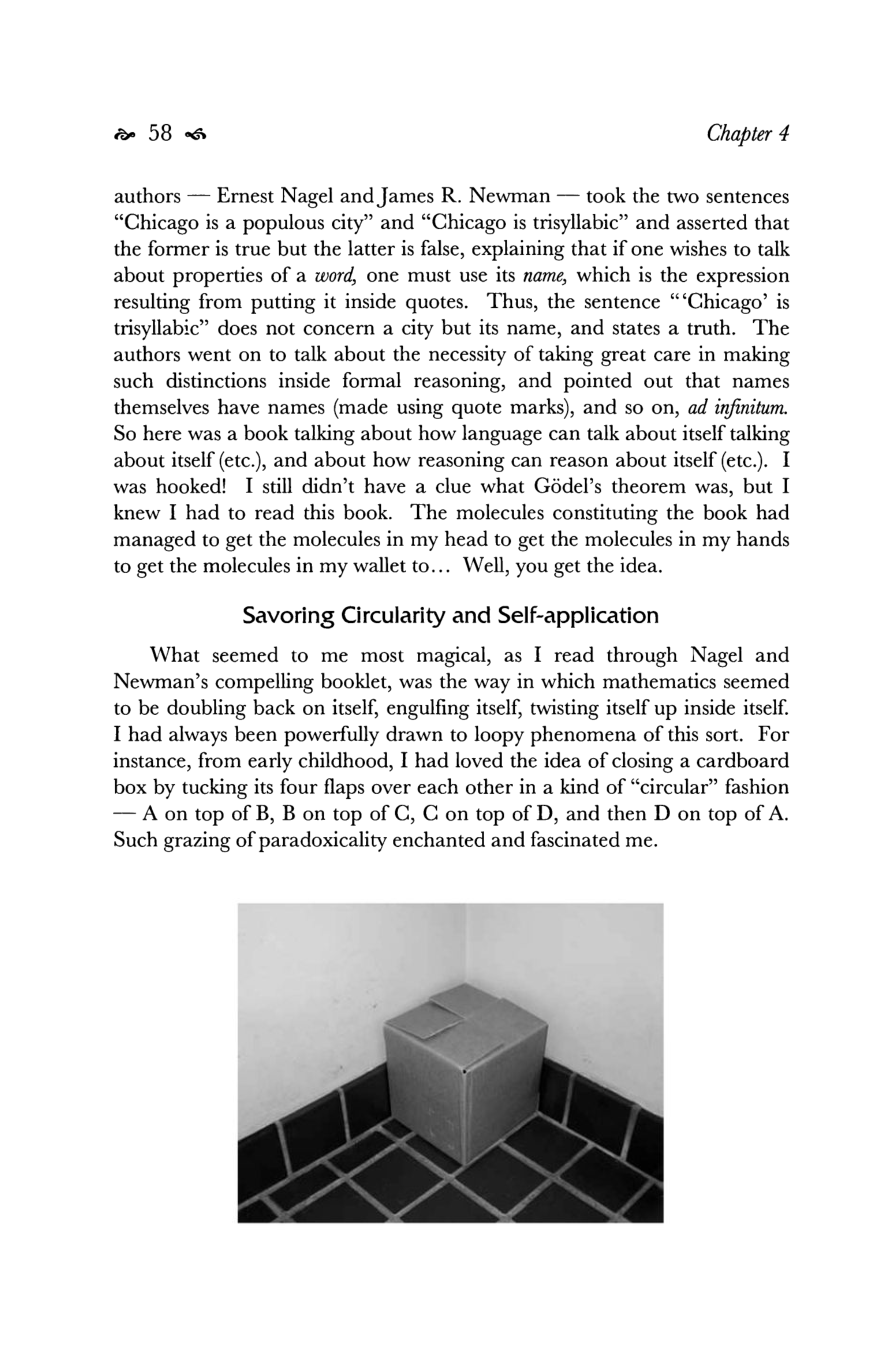
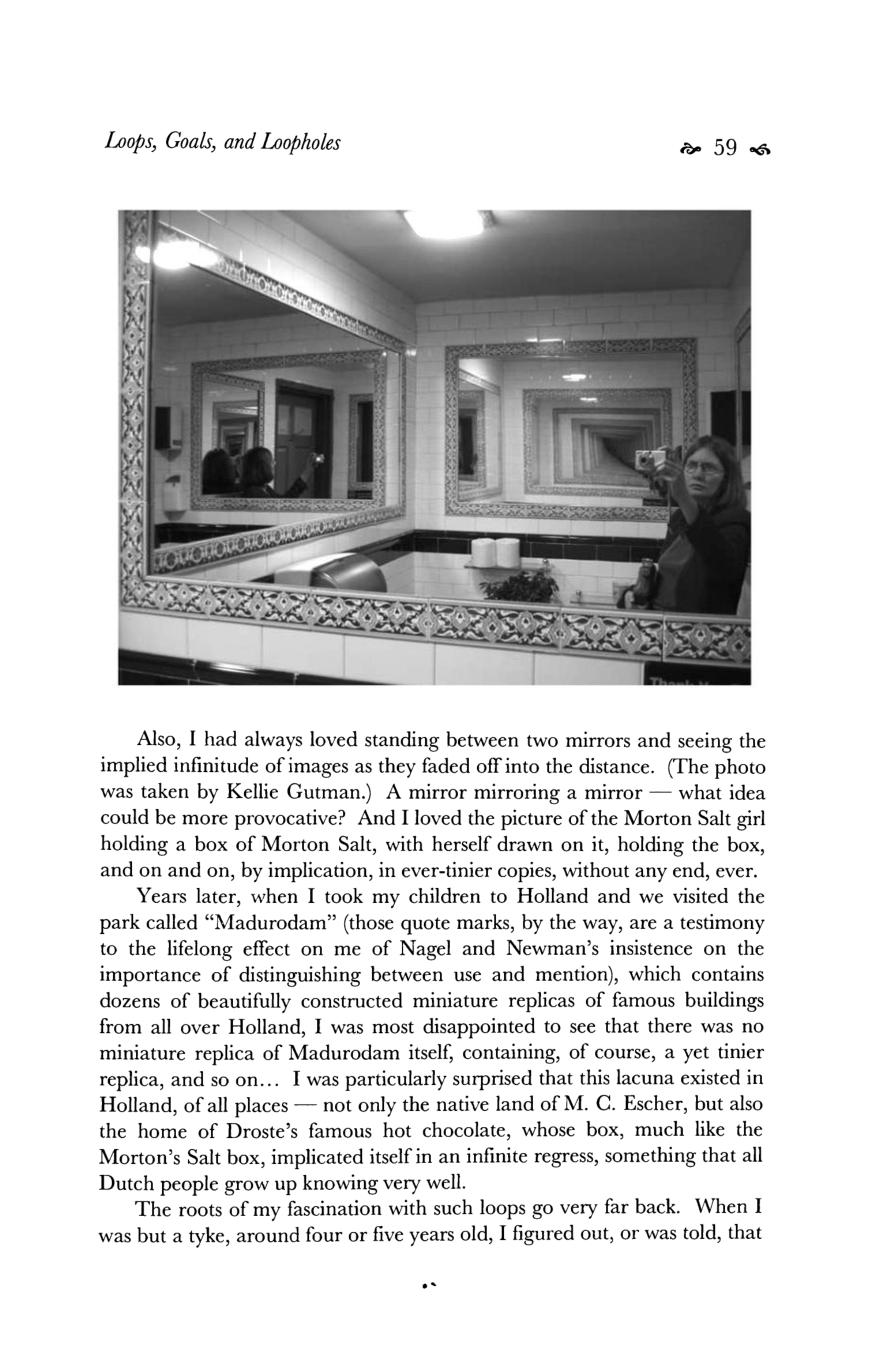
- The narrator’s fascination with circularity appears in nested boxes, facing mirrors, recursive product packaging, and imagined miniatures containing themselves.
- These examples make self-reference feel not only intellectually profound but also visually beautiful, paradoxical, and deeply rooted in the narrator’s childhood imagination.
What seemed to me most magical, as I read through Nagel and Newman’s compelling booklet, was the way in which mathematics seemed to be doubling back on itself, engulfing itself, twisting itself up inside itself.
The Allure of Loops
- The narrator’s childhood fascination with phrases like “two twos” reveals an early delight in self-reference, circularity, and recursively applied concepts.
- His attempt to invent “three three threes” shows both the excitement and ambiguity produced when language turns back upon itself.
- The narrator contrasts this instinctive love of loops with Bertrand Russell’s deep fear of self-reference after discovering a fatal paradox in set theory.
- Russell’s paradox, illustrated by the barber who shaves everyone who does not shave himself, exposed how seemingly legitimate definitions could become self-contradictory.
- To prevent such contradictions, Russell and Whitehead developed the theory of types, enforcing a hierarchy that barred sets and language from referring to themselves.
The point is that among my earliest memories is a relishing of loopy structures, of self-applied operations, of circularity, of paradoxical acts, of implied infinities. This, for me, was the cat’s meow and the bee’s knees rolled into one.
The Appeal of Self-Reference
- The author rejects Russell’s theory of types as an overly cautious attempt to prevent words and statements from referring to themselves.
- Many self-referential sentences are perfectly understandable and nonparadoxical, even when they are false, meaningless, or playful.
- While writing “Metamagical Themas,” the author collected and published inventive examples of linguistic loops, including self-referential puzzles, altered words, and letter-counting sentences.
- These examples demonstrate that feedback loops in language can produce insight, humor, and fascination rather than merely logical danger.
- Some readers, however, condemned the exercises as frivolous, introducing a conflict between playful linguistic experimentation and conventional academic seriousness.
Categorically banishing all loops of reference struck me as such a paranoid maneuver that I was disappointed for a lifetime with the once-bitten twice-shy mind of Bertrand Russell.
Loops, Paradoxes, and Feedback
- The self-referential paradox “This sentence is false” is presented as a case that cannot literally be emitted as verbal behavior because the sentence must exist before it can be spoken.
- The author rejects the idea that self-reference is inherently meaningless, citing its useful presence in communication, humor, art, literature, psychotherapy, mathematics, and computer science.
- He concludes that many educated people’s hostility toward self-reference may arise from a deep fear of paradox, instability, or systems folding back upon themselves.
- This reflection leads to a playful “theory of types”: people seem divided between those who savor recursive loops and those who recoil from them.
- The new chapter turns to video feedback, recounting the author’s first experiments in the 1970s and a later return with editor Bill Frucht, producing hundreds of color snapshots from their explorations.
Together in my kids’ old “playroom”, Bill and I spent many delightful hours sailing the same old seas but in a somewhat newer craft, and we wound up with several hundred color snapshots that archived our voyage superbly.
Video Feedback Landscapes
- A metallic strip on the television made nested screen images visible as a corridor of repeating doorways.
- The camera’s angle determined whether the corridor appeared truncated or stretched toward an apparently infinite vanishing point.
- Although the apparent infinity was limited by screen grain and the speed of light, it produced a powerful, dizzying illusion.
- Tilting the camera transformed the recursive corridor into a corkscrew-like helix, while certain twists unexpectedly created smooth galaxy-shaped spirals.
- Many of these spirals contained striking circular “black holes,” a phenomenon the author could not later reproduce or explain.
Nevertheless, peering down what looked like a magically endless corridor was much more enticing and provocative than merely peering down a mundanely truncated corridor.
Video Feedback Reverberation
- Covering the camera briefly caused a new, throbbing visual pattern to emerge rather than restoring the previous image.
- The pulsation was generated by the image’s delayed self-representation: motion created more motion within a cyclic feedback loop.
- The author compares this to “reverberant barking,” in which a fleeting jogger’s presence triggers a self-sustaining chain reaction among neighborhood dogs.
- This stable periodic behavior is an emergent phenomenon—arising from simple underlying rules without an obvious explanation at the higher level.
- Although the mechanics remain mysterious, the author accepts video reverberation as a robust phenomenon that can be understood and studied on its own level.
The image itself was moving. Now that may strike you as a fatuous, trivial, or smart-alecky answer, but since the image was of itself (albeit at a slight delay), it is in fact quite to the point.
Feedback’s Infinite Universe
- A seemingly random metallic strip unexpectedly enriched Video Voyage I, demonstrating how an “interloper” could add visual complexity to feedback images.
- Seeking more excitement in Video Voyage II, the experimenters dangled objects before the camera and discovered unanticipated transformations, including beads becoming swirling bluish-white globs.
- Each inserted object created a vast new range of possibilities when combined with changes in position, zoom, tilt, camera direction, brightness, and contrast.
- Although the experiments lasted only about a dozen hours and produced a 400-photo album, the explorers felt they had sampled a wondrous, almost inexhaustible visual universe.
- The richest and most unpredictable effects appeared near the central point of the theoretically infinite screen-within-screen regress, prompting a comparison with Mandelbrot’s mathematical feedback loops and fractal images.
For instance, when I dangled a chain of beads in front of the screen, what emerged (the choice of verb is not accidental) was a random-looking swirl of pockmarked bluish-white globs that reminded me a bit of some kind of exotic cheese.
Feedback Locks In Patterns
- Video feedback demonstrates how simple looping processes can generate unexpectedly intricate and persistent patterns.
- The loop creates “locking-in”: an initial hint rapidly develops into a self-stabilizing structure that continually refreshes and reproduces itself.
- Because emergent patterns are unpredictable despite the system’s mechanical determinism, they require imaginative language such as “corridors,” “galaxies,” “spirals,” and “black holes.”
- These metaphors reveal higher-level visual phenomena that a strictly pixel-by-pixel or reductionistic description would obscure.
- The richness of feedback becomes a central metaphor for understanding consciousness, selfhood, and emergent realities.
It will not go away because it is forever refreshing itself, feeding on itself, giving rebirth to itself.
Selfhood Through Perception
- Looping produces emergent structures that require new descriptions beyond the basic mechanisms from which they arise.
- The chapter challenges the intuition that the self, consciousness, and raw experience are irreducible realities independent of physical processes.
- Because evolution favors survival, living beings develop systems for sensing and categorizing their environments.
- Perception naturally turns inward: once a being can model its surroundings, it can also detect aspects of itself, making self-perception a mundane consequence rather than a mystery.
- A system that could perceive everything except itself would resemble a language lacking words for communication, meaning, or self-reference—an increasingly powerful but strangely self-ignorant structure.
After all, in the case of a being struggling to survive, the one thing that is always in its environment is... itself. So why, of all things, should the being be perceptually immune to the most salient item in its world?
Self-Reference and Perception
- A language or mind lacking the ability to refer to itself would have a fundamental gap, much like an incomplete formal system.
- Self-perception evolves in stages, from no feedback to truncated self-awareness and finally to rich, recursive self-observation.
- The sophistication of a self-referential system depends on many dimensions, including focus, zoom, color, resolution, and the balance between observing itself and its environment.
- Self-watching is not the same as perception: perception interprets complex input by selectively activating a small repertoire of internal symbols.
- Symbols are presented as physical, triggerable structures in the brain that implement categories or concepts.
Its selective neglect would be pathological, and would threaten its survival.
How Perception Activates Symbols
- “Symbols in the brain” are proposed neurological structures corresponding to concepts, such as people, places, objects, actions, and relationships—not merely metaphorical or allegorical symbols.
- Perception funnels vast numbers of incoming sensory signals into a small set of activated concepts, transforming raw input into meaningful interpretation.
- The same sensory stimulus can trigger different symbols depending on hunger, memories, and past experience, as illustrated by the varied interpretations of bakery smells in an airport.
- Perception is not purely bottom-up: expectations send signals outward from existing symbols, negotiating with incoming data to determine the final interpretation.
Each of these examples of symbol-triggering constitutes an act of perception, as opposed to the mere reception of a gigantic number of microscopic signals arriving from some source, like a million raindrops landing on a roof.
Mosquito Perception
- Perception is proposed as a repertoire of selectively triggerable symbols, produced by cascading signal-processing systems rather than by visual fidelity alone.
- The richness of this symbolic repertoire can vary widely across biological, artificial, and alien minds, suggesting a sliding scale of perceptual sophistication.
- A mosquito likely lacks abstract categories such as “dog,” “leg,” or “wall,” because its survival does not require that level of conceptual representation.
- Instead, its internal categories may be limited to practical signals such as a potential food source (“goodie”), landing place (“port”), or threat (“baddie”).
- The passage questions whether mosquitoes—and even thermostats, toilets, and heat-seeking missiles—are genuinely aware, or whether they can perform useful behaviors through non-symbolic mechanisms.
Who cares if I’m biting a dog, a cat, a mouse, or a human — and who cares if it’s an arm, an ear, a tail, or a leg — as long as I’m drawing blood?
The Mosquito’s Inner Life
- The passage questions whether a mosquito possesses any meaningful sense of self, bodily awareness, emotions, or internal experience.
- Although mosquitoes respond to threats, their behavior may be explained as automatic reflexes rather than perception involving symbols or concepts.
- The author argues that abstract categories such as “self,” “place,” and “movement” would offer little evolutionary benefit to a mosquito and might make it slower and less competitive.
- The mosquito’s tiny nervous system is presented as possibly lacking perceptual categories altogether, leaving almost no room for self-perception loops.
- The author humorously—but seriously—speculates that a mosquito’s “soul” may be almost unimaginably smaller than a human soul, while acknowledging that this remains a subjective guess.
I would be quite happy to compare a mosquito’s inner life to that of a flush toilet or a thermostat, but that’s about as far as I personally would go.
Perception Across Minds
- The precise level of mosquito intelligence is less important than recognizing that some creatures possess only a limited degree of complexity.
- Claims that mosquitoes may be as conscious as humans are challenged by the way people casually swat them; actions reveal beliefs more reliably than words.
- Self-driving vehicles require more than raw visual data: they rely on stored symbolic knowledge about roads, hills, mud, rocks, and other environmental features.
- A robot’s sensors provide the beginning of perception, while activating abstract knowledge structures represents its symbolic, interpretive end.
- Although modern robot vehicles remain far below mammals in perceptual ability, their environmental processing may be comparable to—or more sophisticated than—a mosquito’s.
I think you have to judge people’s opinions not by their words, but by their deeds.
Emergence of Selfhood
- Self-guiding robots demonstrate genuine survival in hostile environments, challenging the claim that computers merely simulate life.
- Increasing biological sophistication is reflected in increasingly rich repertoires of triggerable symbols and categories.
- Dogs appear to recognize a wide range of objects, actions, people, places, and social situations, with guide dogs learning especially extensive vocabularies of concepts.
- The use of categories such as “my tail” and “my dish” suggests that dogs possess a rudimentary model of their own bodies and selves.
- This reflexive self-model is presented as the first spark of “I”-ness, potentially shared in simpler forms by animals and young children.
If an automaton can drive itself a distance of two hundred miles across a tremendously forbidding desert terrain, how can this feat be called merely a “simulation”? It is certainly as genuine an act of survival in a hostile environment as that of a mosquito flying about a room and avoiding being swatted.
The Growth of Self
- Animals such as dogs develop a limited sense of themselves as physical entities by applying categories—such as paws, tails, or even “dog”—to themselves.
- The text distinguishes canine self-awareness from the far more expansive human sense of “I”-ness, which continues developing throughout life.
- The comparison between dogs and humans raises questions about why humans assign vastly greater moral significance, or “soul,” to human beings.
- The crucial evolutionary difference is that human concepts can be combined into larger concepts, creating hierarchies of meaning with essentially unlimited extensibility.
- This recursive conceptual capacity allows humans to build increasingly complex mental structures representing themselves and their relationship to the world.
Concepts in the brains of humans acquired the property that they could get rolled together with other concepts into larger packets, and any such larger packet could then become a new concept in its own right.
The Power of Nested Concepts
- Human concepts grow by nesting simpler ideas inside one another, as “parent” builds on “mother,” “father,” and “either/or.”
- Once foundational concepts exist, increasingly complex ideas—such as “grandparent,” “family,” and even “soap opera”—can be composed without an apparent limit.
- This conceptual snowballing allows humans to represent highly abstract emotional, psychological, and cultural phenomena.
- Even an ordinary phrase like “grocery store checkout stand” contains dozens of associated concepts, from carts and cashiers to bar codes, payment, and receipts.
- Not every component is consciously activated at once, but the full conceptual structure remains available for incorporation into new ideas and variations.
The list starts to seem endless, and yet we are merely talking about the internal richness of one extremely ordinary human concept.
Episodic Memory and Selfhood
- Personal experiences unfold over time as distinctive episodes, yet they also belong to recognizable categories such as missing a plane or getting lost.
- Episodic memory is a private storehouse containing experiences from our own lives, as well as episodes encountered through friends, fiction, news, and film.
- Most episodic memories remain dormant until triggered, allowing memory to enrich human life without overwhelming conscious attention.
- Questions about whether animals remember specific events reveal how difficult it is to distinguish episodic recollection from generalized associations.
- The richness of human concepts and memories enables an unusually deep, tangled self-model—what the author calls “I”-ness.
That deep and tangled self-model is what “I”-ness is all about.
Sorting Out Reality
- Perception rapidly funnels sensory input into discrete brain symbols, allowing animals and humans to respond reliably to their physical surroundings.
- Because accurate internal symbols provide stability, perceived objects and patterns largely define an individual’s reality—though some seem more real than others.
- Humans uniquely question what is real, especially as children encounter competing concepts ranging from gods and ghosts to scientific theories and fictional figures.
- To “sort out the reality” of something means deciding how strongly to believe in it and whether one can comfortably use it to explain events.
- A concept’s perceived reality can also be gauged by whether someone trusts sources that assume its existence; people may be certain, skeptical, or undecided.
The things and patterns it perceives are what define its reality — but not all perceived things and patterns are equally real to it.
What Counts as Real?
- People encounter many kinds of supposedly real entities—imaginary, metaphorical, obsolete, invisible, or beyond comprehension—making reality difficult to sort and define.
- The marathoner’s “twenty-mile wall” illustrates how a phenomenon can be physically explainable yet still vary in vividness, universality, and felt reality from person to person.
- The author’s struggle with advanced mathematics reveals an “abstraction ceiling,” an intangible boundary that produced genuine physical pain and lasting psychological consequences.
- The passage questions whether abstract experiences can be as real as concrete objects, suggesting that reality includes powerful limits and phenomena that cannot be directly touched or seen.
This hated, rigid “abstraction ceiling” against which I had metaphorically banged my head without any advance warning was a searingly painful, life-changing trauma. And so... how concrete, how genuine, how real a thing was this abstract “abstraction ceiling”?
Constructing Reality
- Reality is not simply divided into black and white; its ambiguities are multidimensional and often resistant to clear classification.
- Our confidence that physical objects are real comes from direct sensory experience, imagined possibilities, and analogies drawn from what we already know.
- We accept distant or inaccessible realities—such as Antarctica—through photographs, testimony, institutions, and layers of indirect evidence.
- Adult belief systems are built from interconnected abstractions, inductive reasoning, and chains of trust in authorities, despite the usual suspicion of arguments from authority.
- These externally grounded beliefs eventually turn inward, leading us to accept the reality of our own bodies, minds, and mortality through analogy with others.
Surely there should be nothing that is partly real — that wouldn’t make sense! And yet, though we try very hard to force the world to match this ideal black-and-white dichotomy, things unfortunately get terribly blurry.
The Reality of Self
- Our confidence in mortality and abstract truths arises from mental symbols that reliably represent both immediate experiences and distant concepts.
- Direct sensory experiences continually reinforce dormant symbols, forming the foundation of our broader sense of reality.
- What is activated most often feels most real: a minor hangnail can command more urgency than disasters, galaxies, or historical events.
- Human perception is fundamentally egocentric, centering reality on bodily sensations, emotions, interests, and possessions marked by “my.”
- The self or “I” seems like the firmest foundation of reality, yet the passage questions whether it may be as elusive and insubstantial as a shimmering rainbow.
We are all egocentric, and what is realest to each of us, in the end, is ourself. The realest things of all are my knee, my nose, my anger, my hunger, my toothache, my sideache, my sadness, my joy, my love for math, my abstraction ceiling, and so forth.
The Envelopes’ Marble
- The author discovers a seemingly impossible marble floating inside a box packed with envelopes.
- The “marble” is actually the compressed, aligned envelope flaps, whose triple paper layers and glue resist pressure.
- This experience illustrates an epiphenomenon: a convincing, unified result produced by many small, ordinary events.
- The incident reveals how tactile certainty can be misleading, making an emergent physical effect feel like a familiar object.
- Charmed by the illusion, the author names the box “Epi” and uses it to demonstrate ideas about epiphenomena, the self, and the “I.”
Oddly enough, there was a marble sitting (or floating?) right in the middle of that flimsy little cardboard box!
The Epiphenomenal Marble
- A lecture audience member turns the author’s strange envelope-and-marble experience into a playful poem about searching for something that may not exist.
- Although no actual marble is present, the packed envelopes produce a vivid tactile impression of a spherical, solid object with an apparent size and hardness.
- Calling the sensation a “marble” communicates the experience more effectively than a technical description of layered paper and glue.
- The episode illustrates how familiar concepts such as marbles, corridors, galaxies, and black holes can describe perceptual phenomena even when the things themselves are absent.
- The imagined marble serves as a metaphor for the powerful sense that something solid and real exists at the core of the self—the foundation of the indispensable pronoun “I.”
There was no marble anywhere in there — there was just a statistical epiphenomenon.
The Self as Prime Mover
- Living beings are guided by innate goals produced by evolved feedback loops, while more complex creatures also develop individual desires and aims.
- People explain their actions through wants and desires, but these explanations eventually terminate in an unexplained “I” whose motivations simply seem to exist.
- The pronoun “I” functions as the apparent endpoint of causal explanation: the entity that claims to initiate decisions, actions, and movement.
- A runner’s body continues pounding the pavement even while the conscious self complains, illustrating the apparent power of an intangible determination over physical matter.
- The passage raises a central puzzle: if particles and bodily mechanisms are the true physical basis of action, why does the coherent self seem to be the prime mover?
“Why do I always tell myself that I like running? I hate it!”
Two Levels of Causality
- Human experience suggests an ethereal “I” directs the body, controls objects, and produces thoughts, making the self seem undeniably real.
- The careenium can be understood from two radically different perspectives: a higher-level view of symbolic interactions and a lower-level view of precise particle dynamics.
- Thinkodynamics offers a useful but compressed explanation in which some events appear vague or causeless, while statistical mentalics traces every event through exact mathematical laws.
- The detailed, all-knowing perspective is described as the “God’s-eye” view, whereas the simplified, practical perspective is more accessible and useful to ordinary observers.
- Not every thinking creature can move between these levels of explanation, revealing limits in how observers understand causality and their own actions.
And in all of this, where are the particles? Nowhere to be seen.
The Careenium’s Strange Loop
- The careenium experiences only coarse-grained simmballic activity and remains unaware of the hidden simm-level processes generating its perceptions.
- Before becoming scientifically self-aware, the young careenium sees itself as governed entirely by thoughts and ideas rather than by underlying physical mechanisms.
- This self-image mirrors the human sense of being an autonomous “I,” despite the vast mechanistic activity occurring beneath conscious awareness.
- The text argues that the “I” is a peculiar abstract, locked-in feedback structure—a strange loop inside the careenium or human cranium.
- Chapter 8 begins an exploration of strange loops, using the cyclic folding of a cardboard box’s flaps as an intuitive encounter with paradox and self-reference.
What kind of thing, then, is this “I” that the careenium posits as driving its choices and its actions, and that human beings likewise posit as driving theirs? No one will be surprised at this point to hear me assert that it is a peculiar type of abstract, locked-in loop located inside the careenium or the cranium — in fact, a strange loop.
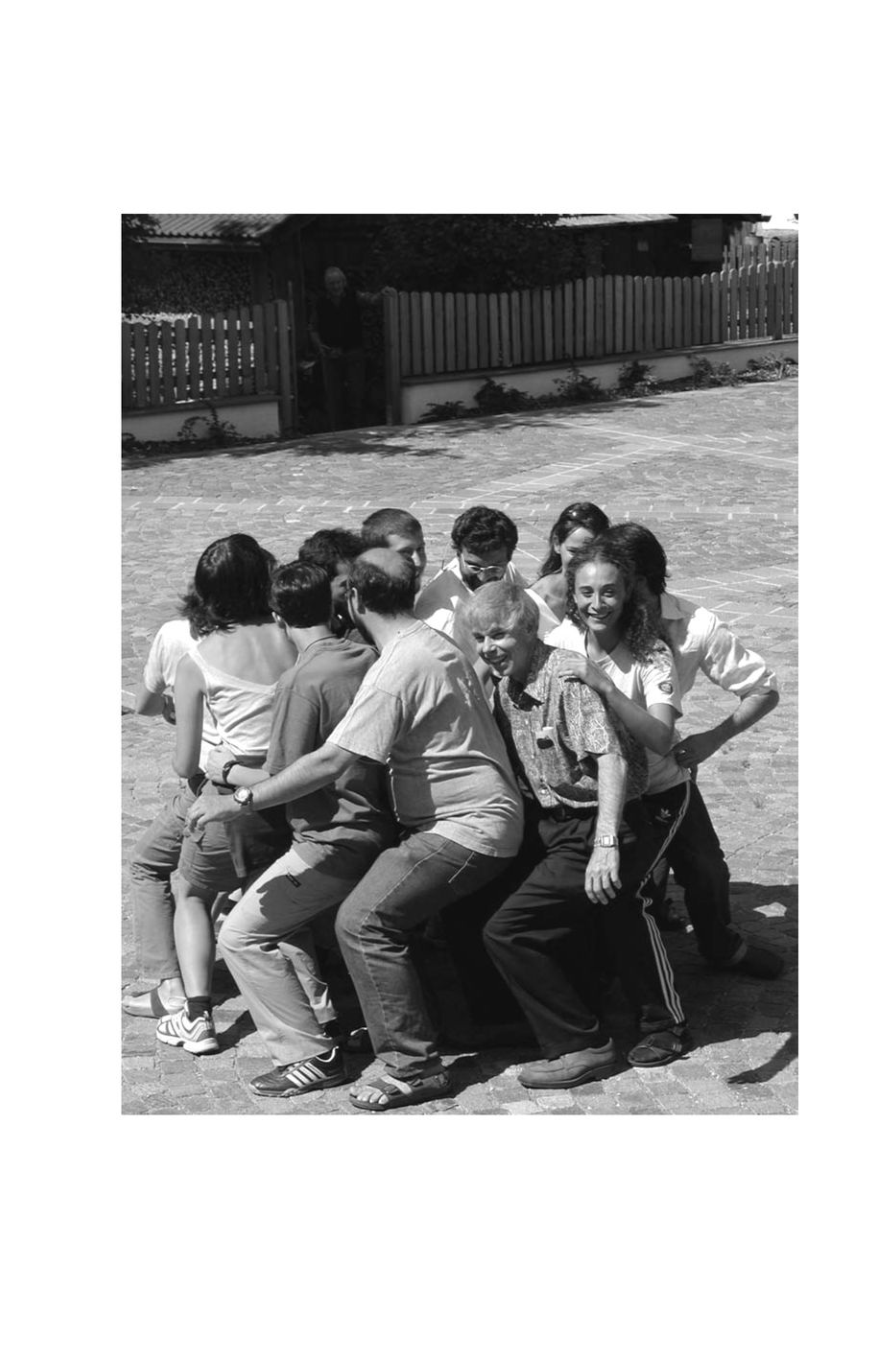
The Strange Loop
- The physical “lap loop” creates the uncanny sensation of sitting indirectly on one’s own lap, but because it can exist in the real world, it is not a true paradox.
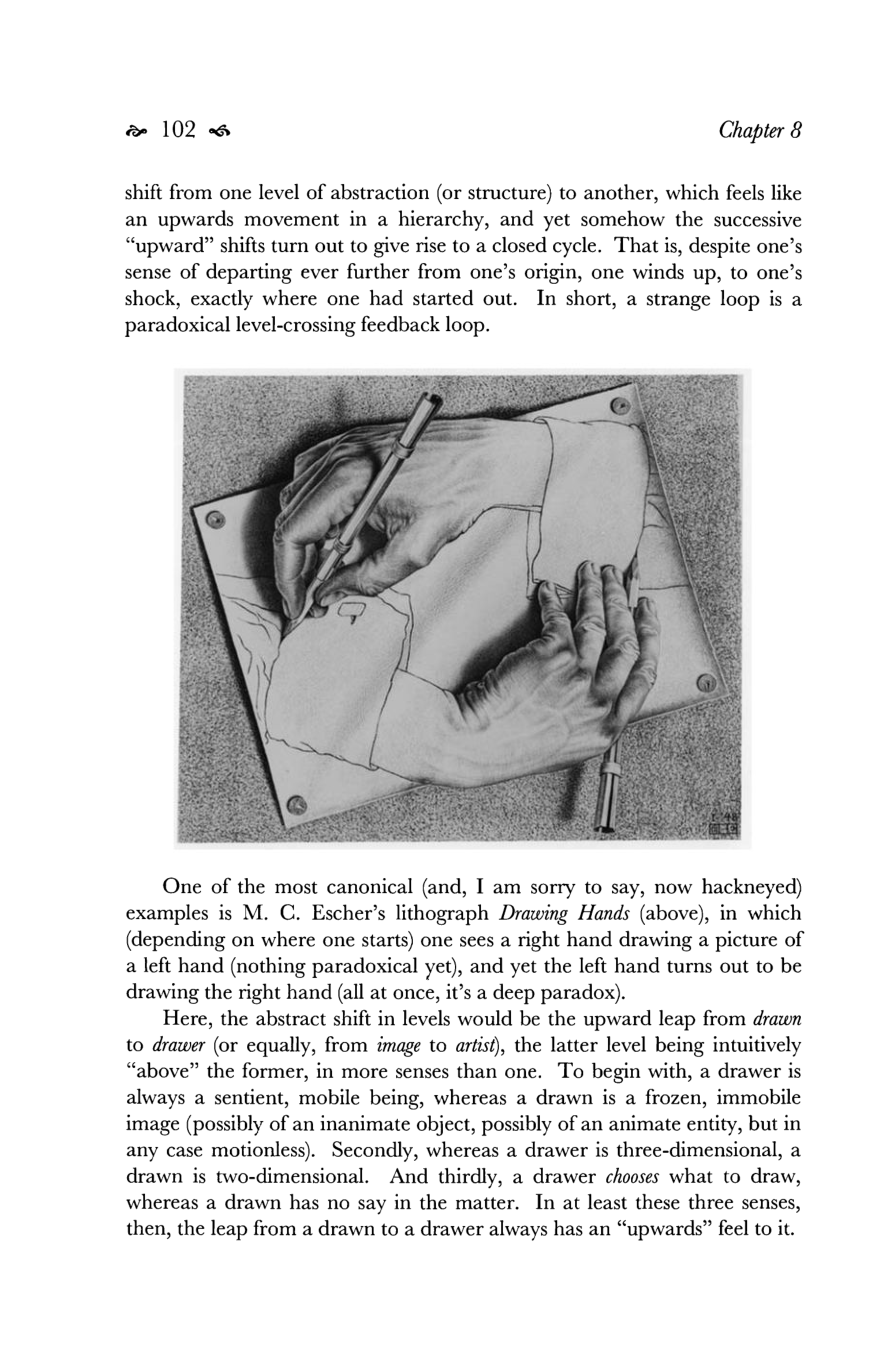
- A genuine strange loop is an abstract, paradoxical feedback cycle in which successive upward shifts between levels of abstraction unexpectedly return to the starting point.
- Escher’s Drawing Hands illustrates this structure by depicting each hand as both the drawer and the drawn, placing each hierarchically above the other.
- The distinction between a drawer and a drawn image normally seems clear: the drawer is mobile, three-dimensional, and capable of choice, while the image is static, two-dimensional, and passive.
- Drawing Hands only appears to present a genuine paradox because its realism makes viewers suspend disbelief; the passage ends by asking whether genuine strange loops can occur in feedback systems.
Even so, when I played the “A” role in this lap loop, I felt as if I was sitting, albeit indirectly, on my own lap! This was a most strange sensation.
Real Strange Loops
- Video and audio feedback create convincing loops and apparent infinite regress, but lack genuine paradox and therefore do not qualify as strange loops.
- The author argues that real strange loops must exist because human selves—not merely bodies—are themselves strange loops.
- These authentic loops are difficult to identify, seeming elusive and resistant to direct observation.
- Kurt Gödel discovered a genuine strange loop in 1930 within Bertrand Russell’s supposedly paradox-proof theory of types.
- Gödel’s interest was encouraged by numerical paradoxes such as G. G. Berry’s, which reveal how language can produce unexpectedly self-referential descriptions of numbers.
Strange loops are shy creatures, and they tend to avoid the light of day.
Berry’s Descriptive Paradox
- The text explores how a single number can be expressed through increasingly shorter mathematical or linguistic descriptions.
- Although 777,777 has many compact formulations, it is difficult to know whether an even shorter description might exploit some hidden mathematical property.
- Berry’s number, b, is defined as the smallest integer whose English descriptions require at least thirty syllables, implying that it must be extraordinarily large.
- The definition immediately undermines itself: the phrase defining b contains fewer than thirty syllables, thereby describing b more concisely than its own rule permits.
- This self-reference introduces a paradox that leads into related examples of self-undermining language, such as the word “nondescript.”
But wait a moment! How many syllables does my italicized phrase contain? Count them
Berry’s Paradox Unravels
- Berry’s paradox depends on self-undermining phrases whose meaning collapses when they are applied to themselves.
- The “smallest uninteresting integer” creates a similar paradox: once identified, the number becomes interesting precisely because it was supposedly uninteresting.
- Bertrand Russell tried to resolve the paradox by dividing “describability” into an infinite hierarchy of increasingly powerful levels.
- The text argues instead that the deeper problem is the vagueness and ambiguity of ordinary English when used for mathematical descriptions.
- Examples such as counting all languages, heavenly bodies, or magic squares show that it is unclear which English phrases genuinely describe well-defined numbers.
The weakness that I focus in on is the fact that English is a hopelessly imprecise medium for expressing mathematical statements; its words and phrases are far too vague.
The Vagueness Behind Berry’s Paradox
- Berry’s paradox depends on ill-defined notions such as “language,” “heavenly body,” and even what counts as a mathematical concept.
- Attempts to count languages, celestial objects, or syllables reveal that many seemingly precise categories have no objective boundaries.
- The phrase “English-language definition of an integer” is therefore too vague to produce a genuine strange loop; Berry’s construction is an imaginative fiction rather than a valid paradoxical object.
- Despite these flaws, Berry’s insight proved fertile: Greg Chaitin later replaced English descriptions with computer programs, helping establish algorithmic information theory and illuminate Gödel’s theorem.
- The discussion suggests that formal mathematics cannot simply assume a clean boundary between language, mathematics, and self-reference.
It’s already meaningless enough to talk about counting all the “items” in a garbage can, let alone all the languages of all time!
Paradoxes and Human Thought
- A mother’s toy-gun ban backfires when her son fashions a pistol from a peanut-butter sandwich, illustrating that restrictive rules may leave flexible means for recreating what they prohibit.
- Russell’s dismissal of Berry’s paradox did little to stop the emergence of further paradoxes in early twentieth-century mathematics.
- Mathematicians deliberately pursued increasingly troubling paradoxes because exposing weaknesses could help secure the foundations of their discipline.
- These paradoxes raised profound questions not only about reasoning and mathematics, but also about thinking and the human mind.
- The author recalls discovering Gödel’s Proof at fourteen and becoming fascinated by Gödel’s work as a window into the mystery of creative mathematical thought.
The lad quickly chewed it into the shape of a pistol, then lifted it up, pointed it at her, and shouted, “Bang bang! You’re dead, Mommy!”
Logic and Consciousness
- The passage raises profound questions about whether human thought, creativity, choice, and consciousness can arise from deterministic physical processes or rule-governed machines.
- It explores whether machines could generate genuinely new ideas, form opinions, experience confusion, possess a sense of self, or question their own consciousness and free will.
- The narrator recalls a youthful obsession with symbolic logic and mathematical language, believing these subjects might reveal the deepest secrets of meaning, thought, and creativity.
- As a teenager, the narrator taught symbolic logic to elementary-school children, testing whether strict patterns of inference could be learned like arithmetic.
- This intellectual pursuit was driven by a desire to understand how countless neural events inside the brain produce perception, memory, imagination, creativity, and feeling.
What drove all this — my core inner passion — was a burning desire to see unveiled the secrets of human mentation, to come to understand how it could be that trillions of silent, synchronized scintillations taking place every second inside a human skull enable a person to think, to perceive, to remember, to imagine, to create, and to feel.
Gödel’s Self-Referential Loop
- The author’s adolescent interests in mathematics, metamathematics, language, psychology, and mechanism converged on the mystery of how mind relates to matter.
- Although he later abandoned the belief that mathematics and logic contained all the answers, he retained the intuition that Gödel’s self-referential constructions illuminate the question “What am I?”
- To explore consciousness and the self, the book will provide a rough introduction to number theory, logic, and Gödel’s ideas.
- A playful postscript examines which numbers mathematical reference books omit, finding gaps at 43 and 49 and identifying 62 as the first number both deem uninteresting.
- The next chapter turns to Principia Mathematica, Bertrand Russell’s effort to prevent paradox by banning self-containing sets and self-referential sentences—restrictions Gödel’s work would challenge.
So please fasten your seat belt, dear reader. We’re going to be experiencing a bit of weather for the next two chapters.
PM’s Hidden Power
- The text distinguishes Principia Mathematica, the three-volume work, from PM, the precise symbol-manipulation system developed within it.
- Although PM required enormous effort to prove even simple facts such as 1 + 1 = 2, Gödel recognized that it could express arbitrarily subtle properties of whole numbers.
- PM can define rich numerical categories, such as integers that are or are not sums of two squares, revealing elegant mathematical dichotomies.
- The analogous question of which integers are sums of two primes remains an unsolved problem, showing how easily formal definitions can lead to profound challenges.
- The section turns toward the joy of discovering and explaining patterns, asking how prime numbers are distributed among those that are sums of two squares and those that are not.
It is mathematicians’ relentless search for why that in the end defines the nature of their discipline.
The Hunt for Hidden Patterns
- The passage asks whether primes that are sums of two squares (Class A) and those that are not (Class B) are both infinite, quickly identifiable, or governed by a predictable distribution.
- Mathematicians are portrayed as driven to investigate surprising connections between seemingly unrelated concepts, hoping to uncover hidden regularities beneath apparent chaos.
- The primes up to 100 appear to divide into the two classes in a surprisingly balanced way, raising questions about whether this near fifty-fifty split persists indefinitely.
- A closer inspection reveals apparent groupings of highlighted primes into singletons and pairs, but converting these into letter sequences exposes no clear periodic or rhythmic pattern.
- The balance between the classes is intriguing but unexplained, creating the productive tension between mathematical fascination and frustration that motivates persistent pattern-seeking.
What often happens is that some kind of unexpected yet intimate connection turns up — some kind of crazy hidden regularity that feels magical, the discovery or the revelation of which may even send mystical frissons up and down one’s spine.
Patterns Demand Proof
- Mathematical thinking is driven by the search for order in situations that initially appear chaotic.
- The apparent pattern of singleton and paired primes classified by sums of two squares collapses when the prime 101 creates a triplet.
- Instead of abandoning the investigation, the pattern-seeker reorganizes the primes into two classes and compares neighboring differences.
- These differences overwhelmingly consist of multiples of 4—especially 4, 8, and 12—suggesting a deeper regularity rather than coincidence.
- Mathematicians treat persistent patterns as evidence of an underlying reason and pursue proofs that transform conjectures into theorems.
What does a pattern-seeker do at this point — give up? Of course not!
Euclid’s Infinite Primes
- The mathematical mindset equates truth with provability: a statement is true when it has a proof, and false when it has none.
- Numerical evidence can suggest that a pattern continues indefinitely, but only reasoning can establish claims about infinity, such as whether prime numbers ever end.
- The imagined “Great Last Prime” would imply a finite, closed collection containing every prime.
- Euclid’s strategy is to multiply all supposed primes together to form Q, then consider Q + 1, which is one greater than a number divisible by every prime in the collection.
- Because no prime in the collection can divide Q + 1, yet Q + 1 must have a prime divisor if it is composite, the assumption that there is a last prime leads to a contradiction.
Given this very clear trend, if the primes were to run out all of a sudden, it would almost feel like falling off the edge of the Earth without any warning. It would be a huge shock.
The Endless Primes
- Euclid’s contradiction constructs a number, Q + 1, that has a prime divisor but is divisible by none of the supposedly complete list of primes.
- The contradiction disproves the existence of a greatest prime and establishes that primes continue forever.
- The author presents mathematical proof as a source of intellectual pleasure that can be revisited and reapplied in new variations.
- The “Mathematician’s Credo” holds that proofs guarantee truth and that every perfect, enduring pattern has an underlying reason, even if it has not yet been discovered.
- This credo leads back to Class A and Class B primes, whose observed patterns suggest forms such as 4n + 3 and 4n + 1.
There cannot be a “Great Last Prime in the Sky”; there cannot be a “Finite, Closed Club of All Primes”. These are fictions.
From Pattern to Proof
- Primes of the form 4n + 1 can be expressed as sums of two squares, whereas primes of the form 4n + 3 cannot—an unexpected connection between primes and squares.
- The pattern is stronger than initially suspected: every prime of the form 4n + 1 has exactly one representation as a sum of two squares, and the two prime classes approach equal proportions in the long run.
- For mathematicians, observing a striking numerical pattern is only the beginning; they seek a proof that reveals the single underlying reason behind infinitely many apparent coincidences.
- Mathematical culture treats truth and provability as inseparable: a statement is true because it has a proof, and a false statement has no proof.
- Mathematicians’ centuries-long pursuit of proof reflects their refusal to settle for empirical evidence, while puzzling “proofs” of absurd results eventually raised deeper questions about what proof itself means.
This is a glimpse of pure magic — the kind of magic that mathematicians live for.
Logic Meets Recursion
- At the turn of the twentieth century, philosophers and mathematicians sought to define reasoning precisely and merge it completely with mathematics.
- Rules of inference such as modus ponens reduced mathematical proof to orderly symbol manipulation built from axioms and earlier theorems.
- Russell and Whitehead’s Principia Mathematica appeared to unify mathematics and logic, promising protection from hidden errors in reasoning.
- As this vision of perfectly formalized mathematical truth took shape, a young Kurt Gödel was growing up in Brünn, Austro-Hungary.
- Gödel’s later work would draw on his knowledge of recursively defined number classes, including the Fibonacci sequence, in which each term is formed by adding the previous two.
Mathematical truth was all coming together so elegantly. And as this Holy Grail was emerging into clear view, a young boy was growing up in the town of Briinn, Austro-Hungary.
Mathematical Necessity
- A recursive definition generates new sequence elements from earlier ones according to a fixed, precise rule, with initial values serving as “seeds.”
- The Fibonacci sequence contains strikingly few perfect powers: 8 and 144 appear early, but searches through hundreds of terms found no others.
- This absence raises a deeper question: are 8 and 144 random accidents, or is there a mathematical reason that other perfect powers cannot occur?
- The Caspian Sea gemstone allegory illustrates the difficulty of proving that rare discoveries are unique when one cannot exhaustively search an effectively infinite domain.
- Unlike the contingent physical world, mathematics is portrayed as a realm where apparent coincidences may reflect necessary underlying reasons.
One would naturally wonder if more gems might be hidden down there, but how could one ever know?
Patterns, Proofs, and Gödel
- The Mathematician’s Credo holds that every mathematical pattern or phenomenon occurs for a statable, understandable reason.
- The apparent disconnect between perfect powers and Fibonacci numbers was finally explained through techniques developed in the proof of Fermat’s Last Theorem.
- A trio of mathematicians showed why 8 and 144 cannot reappear as perfect powers in the Fibonacci sequence, apart from 1.
- Gödel recognized a deep analogy between recursively generated number sequences and formal mathematical systems: axioms act as seeds, while inference rules generate successive theorems.
- This analogy gave Gödel a powerful way to think about how infinite mathematical structures can grow from finite starting points.
This is just one more triumph of the Mathematician’s Credo — one more reason to buy a lot of stock in the idea that in mathematics, where there’s a pattern, there's a reason.
Mechanizing Mathematical Truth
- Formal inference rules manipulate symbols mechanically, without requiring the person or machine applying them to understand their meanings.
- Although rule-following is purely typographical, rule designers must understand meanings to ensure that truth is preserved.
- The example of reversing “P v Q” to “Q v P” illustrates how symbolic manipulation can preserve truth while ignoring semantics.
- PM generates an unlimited succession of theorems by repeatedly applying its rules to axioms and previously derived formulas.
- Russell and Whitehead hoped PM would be both consistent—never generating false statements—and complete—eventually generating every true statement of number theory.
- These goals formalize the Mathematician’s Credo: a statement is true exactly when it has a proof, and every truth should therefore possess a proof.
The infinite body of theorems of PM is fully determined by the initial seeds and by the typographical “growth rules” that allow one to make new theorems out of old ones.
Gödel’s Strange Loop
- Russell and Whitehead aimed to give the Mathematician’s Credo a rigorous foundation by defining proof as derivation within Principia Mathematica (PM).
- Although Gödel admired PM’s comprehensiveness, he doubted that mathematical truths and PM theorems could ever perfectly coincide.
- Gödel realized that recursively generated numbers could mirror the way formal systems generate theorems from axioms and inference rules.
- He envisioned a precise one-to-one correspondence in which numerical calculations and symbolic derivations advanced in perfect “lock-step” synchrony.
- To make this vision rigorous, Gödel began developing a reversible method for converting any string of PM symbols into a positive integer and decoding the integer back into the original string.
An inner voice told him that this connection was not just a vague resemblance but could in all likelihood be turned into an absolutely precise correspondence.
Gödel Numbering
- Gödel assigned each basic symbol in Principia Mathematica a small integer, then encoded entire formulas by using those integers as exponents on successive prime numbers.
- The formula “0=0,” for example, becomes the unique integer 72900, whose prime factorization allows the original symbol sequence to be recovered exactly.
- Because prime factorization is unique, Gödel’s method creates a precise two-way mapping between symbolic formulas and ordinary integers, however enormous those integers become.
- Gödel extended the encoding from individual formulas to sequences of formulas, making it possible to represent complete proofs as single numbers.
- He then began defining recursively generated sets of integers, including numbers representing well-formed formulas, so arithmetic could track the structure and validity of formal expressions.
But no matter — numbers are just numbers, no matter how big they are. (Luckily for Godel, there are infinitely many primes, since if there had been merely, say, one billion of them, then his method would only have let him encode formulas made of a billion symbols or fewer. Now that would be a crying shame!)
Gödel’s Arithmetized Strings
- Well-formed formulas (wffs) can be assigned numerical codes, while meaningless symbol strings receive codes that do not represent valid statements.
- Gödel’s crucial insight was that every rule for rearranging or constructing symbols could be mirrored by arithmetic operations on their numerical codes.
- Recursive definitions create “clubs” of numbers by generating new members from earlier ones, dividing all integers into reachable members and unreachable non-members.
- For simple increasing rules like the Fibonacci sequence, it is easy to identify gaps; recursive rules that can move both upward and downward make membership much harder to determine.
- Wff-ness becomes a legitimate property of pure numbers: values such as 72900 encode valid formulas, while 576 and 2916 encode meaningless strings.
These were simply two different views of what was going on — views that were 100 percent equivalent and interchangeable.
Gödel’s Numerical Mirror
- Well-formed-formula (wff) numbers can be defined recursively and computationally, with rules that always produce larger outputs, making membership eventually predictable.
- The numerical properties of recursively defined sets can be studied independently of the original ideas that inspired them, just as probability can be studied without reference to gambling.
- Because wff-ness is recursively definable, Principia Mathematica could in principle examine its own formal and mechanical structure—an unexpected use of the system.
- Gödel extended this method by defining “prim numbers,” the numbers corresponding to provable formulas, using computational rules that precisely mirror PM’s typographical rules of inference.
- This encoding creates a two-way bridge between arithmetic and formal logic: prim numbers decode into theorems, while PM proofs can be represented as enormous integers.
Numerical computation was effectively thumbing its nose at typographical manipulation, sassily saying, “Anything you can do, I can do better!”
The Power of Prim Numbers
- “Prim numbers” encode formulas provable in Principia Mathematica, making logical provability a genuine number-theoretical property.
- Unlike ordinary numerical properties, prim-number rules can map larger numbers to smaller ones, allowing the number line to be revisited and making prim status far harder to determine.
- Mathematical statements about prim numbers can express complex claims about the structure and consistency of formal proofs, including whether infinitely many formulas are provable.
- A machine that decides whether any integer is prim would be vastly more powerful than a machine that merely tests ordinary primality.
- Under the Mathematician’s Credo, such a machine—Goru—could answer any number-theoretical question, foreshadowing the profound implications of Gödel’s ideas.
If you believed Goru to be reliable and you also believed in the Mathematician’s Credo (Principia Mathematica version), then you could conclude that your little Goru, working all by itself, could answer any number-theoretical question that you were interested in, just like a genie
Gödel’s Self-Referential Formula
- A hypothetical machine called Goru could determine whether a Gödel number is “prim,” thereby revealing whether the encoded mathematical statement is provable and, under the Mathematician’s Credo, true.
- Because prim numbers would encode all provable formulas, they would appear to contain mathematical knowledge in a hidden form; however, their elusive nature makes such a machine impossible to construct easily.
- Gödel then devised an enormous Principia Mathematica formula asserting that a particular integer g is not “prim.”
- That integer g was deliberately the Gödel number of the very formula making the assertion, causing the formula to refer to itself.
- Thus, Gödel’s formula can be read as saying, “This very formula is not provable via the rules of PM”—or simply, “I am unprovable.”
The prim numbers alone would therefore seem to contain, in a cloaked fashion, all of mathematical knowledge wrapped up inside them!
Gödel’s Self-Reference Trick
- Gödel’s original formula belonged to an infinite family of strange self-referential statements, some true and some false, hidden within the supposedly paradox-free system of Principia Mathematica.
- At only 25, Gödel revealed bizarre formulas whose self-referential properties have continued to challenge mathematicians, logicians, and philosophers.
- The apparent obstacle is that a formula cannot literally contain the enormous numeral representing its own Gödel number.
- Gödel overcame this by using short computational descriptions of enormous numbers, allowing a formula to refer to its own Gödel number without explicitly writing it out.
- A linguistic analogy inspired by W. V. O. Quine illustrates the challenge: sentences that seem self-referential often refer only to shorter quoted sentences rather than to themselves.
When you think about it at first, it seems like trying to squeeze an elephant into a matchbox — and in a way, that’s exactly right.
Building Self-Reference
- Directly inserting a sentence or Gödel number into itself is impossible because the embedded material must be shorter than the whole.
- Gödel’s solution is to use a concise description of the object rather than the object itself, much as DNA represents an elephant without being the elephant.
- Quine’s Quasi-Quip becomes a grammatical sentence when given a noun-like subject, but the example “Professor Quine” produces a false claim.
- Using the subjectless fragment “is white” creates the construction “is white” is white, which is grammatically complete and fulfills the Quip’s claim, even though it is false.
- This example demonstrates how carefully chosen linguistic fragments can generate genuine self-reference and move the argument closer to Gödelian self-referential sentences.
An elephant will not fit inside a matchbox! On the other hand, an elephant’s DNA will easily fit inside a matchbox...
Self-Reference Made Visible
- Quine’s Quasi-Quip is formed by placing a quoted copy of itself before the original, creating a full sentence that refers to itself.
- The Quip claims that the phrase it describes is a full sentence—and the phrase turns out to be the Quip itself, despite its fragmentary construction.
- Gödel’s method works analogously: a formula fragment’s Gödel number is substituted for its variable, producing a statement whose Gödel number refers back to that very statement.
- Unlike Quine’s sentence, Gödel’s construction concerns whether a formula is provable, not merely whether it is a complete sentence.
- A hybrid English example involving its own Gödel number conveys the idea, but remains metaphorical because English sentences are not formulas in Principia Mathematica and have no Gödel numbers.
- The author emphasizes that this self-referential argument is difficult even for sophisticated mathematicians and may require repeated rereading.
Quine’s Quip turns out to be talking about a phrase that is identical to the Quip itself! It is claiming that something is a full sentence, and when you go about constructing that thing, it turns out to be Quine’s Quip itself.
Self-Reference Without Regress
- Gödel’s construction starts with a number k encoding a formula fragment containing a variable, substitutes k into that fragment, and produces a much larger number g encoding the completed formula.
- The resulting formula does not explicitly contain its own Gödel number; instead, it describes that number indirectly, allowing it to assert its own non-theoremhood without becoming infinitely long.
- The distinction is illustrated through Sluggo’s endlessly recursive dreams, which represent direct self-reference and infinite regress.
- The Morton Salt label demonstrates self-reference without infinite regress: viewers infer that the small box depicted is the same as the larger box they hold through analogy and shared visual features.
And yet we still have a self-referential picture, because customers in the grocery store understand that the little box shown on the label is the same as the big box they are holding.
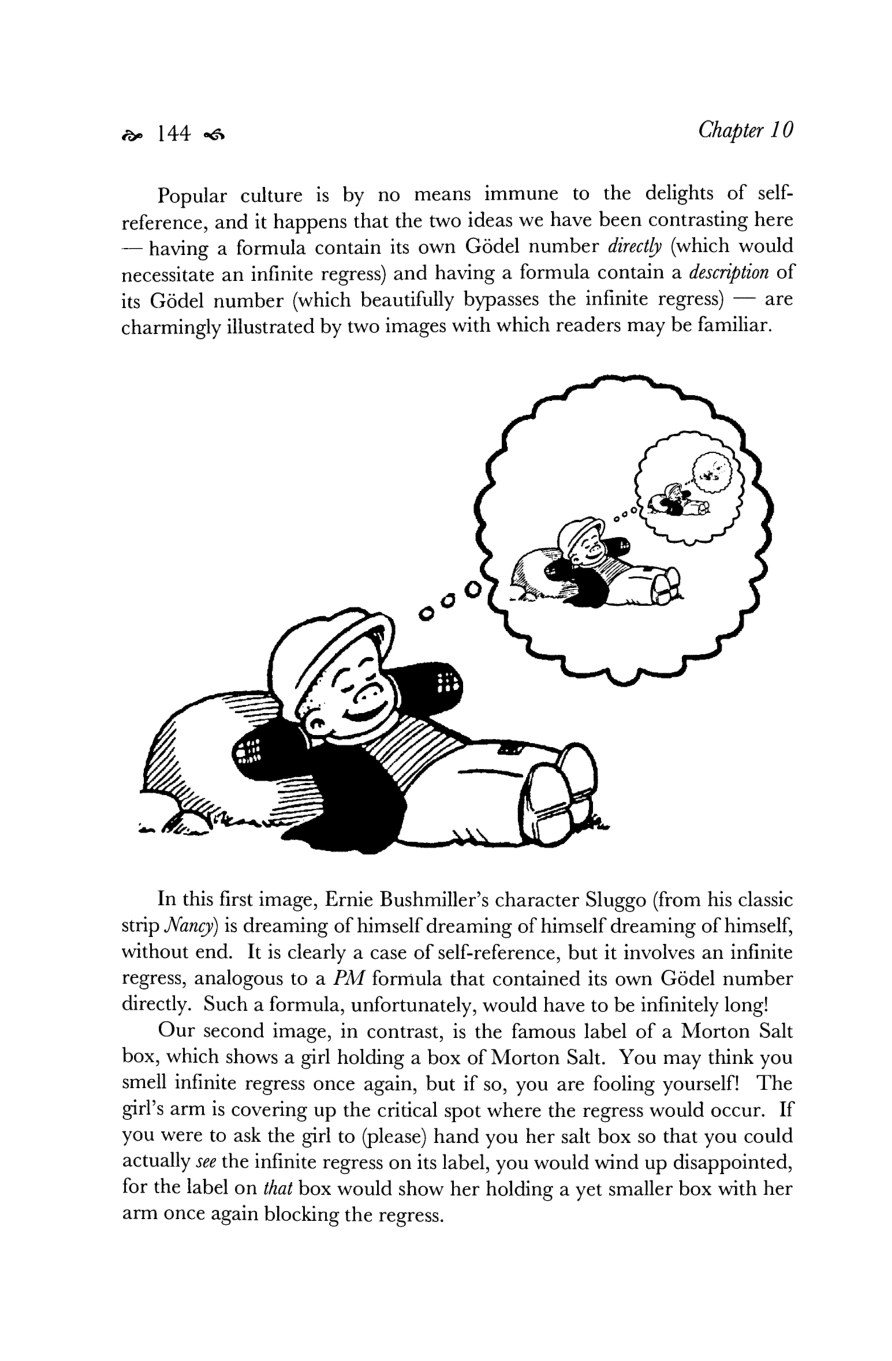
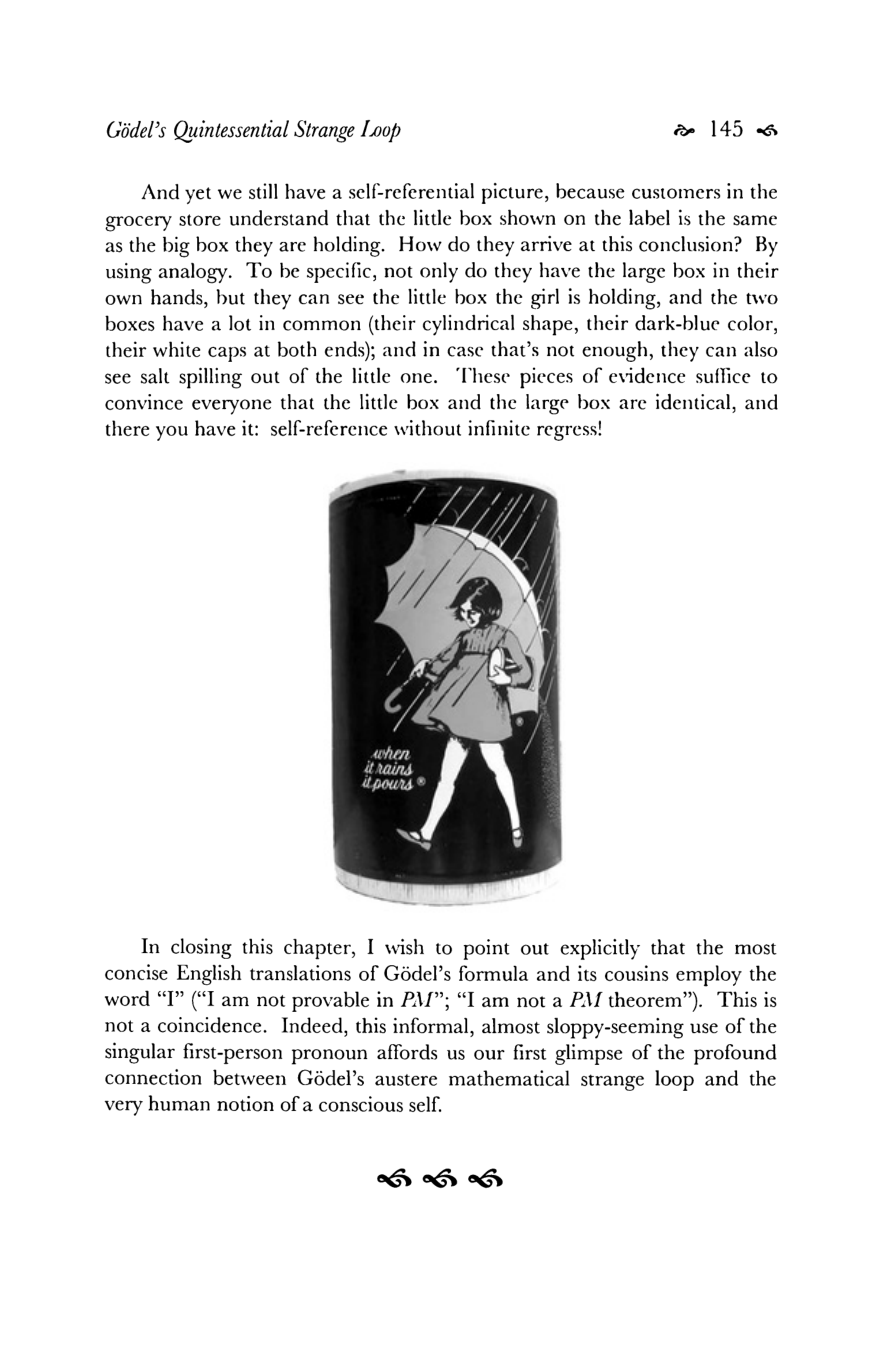
Meaning Through Analogy
- Gödel’s use of the singular “I” hints at a profound connection between mathematical self-reference and the human experience of a conscious self.
- Russell was stunned that Gödel found self-referential formulas inside Principia Mathematica, a system designed to prevent precisely such paradoxes.
- Although Russell described PM’s formulas as intrinsically meaningless marks, he acknowledged that a systematic mapping could interpret them as statements about numbers, operations, and logic.
- Gödel introduced a second, more elaborate mapping between symbols and numbers, allowing formulas to acquire meanings about formulas themselves as well as about arithmetic.
- The key lesson is that meaning is not fixed in the symbols alone: different interpretive mappings can reveal different levels of significance within the same formal system.
This upstart Austrian sorcerer had surely cast some sort of evil spell, but by what means had he wrought his wretched deed?
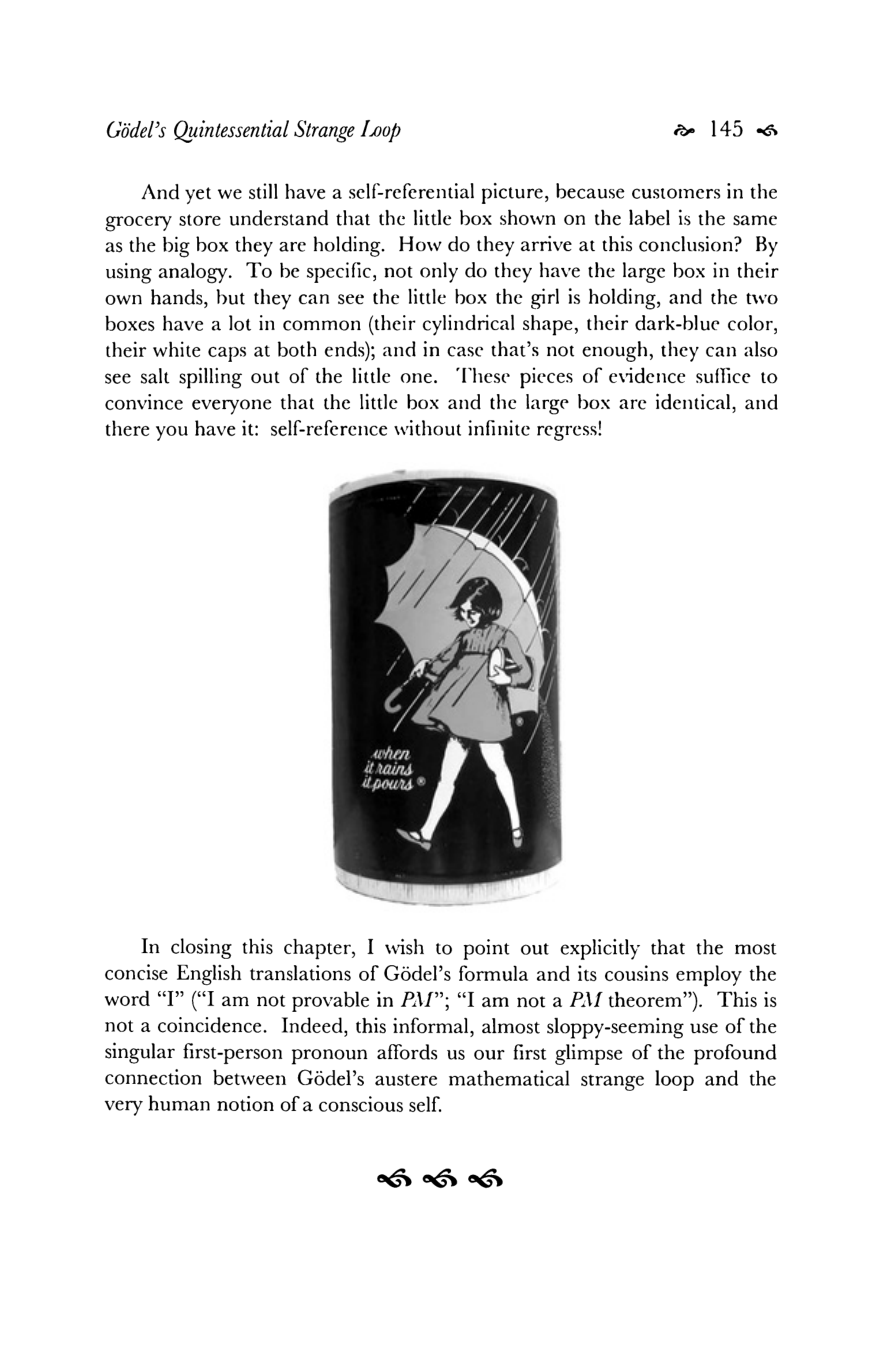
Analogy Creates Meaning
- Gödel’s mapping introduced a new, valid layer of meaning by connecting formulas to a deeper interpretation.
- Analogy allows people to generalize from a single example to a broader class, often without conscious effort.
- A bad slice of cake is taken to represent the whole cake, while one delicious cookie suggests that the rest of the batch is also delicious.
- Even objects that are individually distinct can be treated as equivalent when they share the relevant characteristics, such as ingredients, origin, and purpose.
- The author argues that countless small, unnoticed analogies form the foundation of much of our rich mental life.
Yet we take such throwaway analogies so much for granted that we tend to think that the word “analogy” must denote something far more exalted.
Analogy’s Hidden Messages
- Seemingly mundane analogies can reveal deep structures in human cognition and allow one statement to apply implicitly to another situation.
- An isomorphism is a precise analogy in which two situations share the same central structure, enabling meaning to transfer between them.
- People deliberately exploit obvious analogies to communicate indirectly, as when a parent addresses one muddy-booted child while also warning the child’s friend.
- Indirect communication works only when the recipient recognizes the intended analogy; otherwise the message fails.
- Romantic conversations frequently use analogy to convey criticism or test feelings indirectly, as shown by questions about bad breath and commitment.
Hinting by analogy allows us to get our message across politely but effectively.
Romance by Analogy
- Ben uses a discussion about another couple to communicate his own romantic hesitation to Audrey without speaking directly about himself.
- Because romance is marked by uncertainty and longing, conversations about other relationships often “boomerang” back onto the people having them.
- Analogies give lovers indirect clues about their own situations, making romantic subtext both nearly inevitable and emotionally consequential.
- Literature frequently exploits this kind of indirect reference, producing humor or irony when characters fail to recognize that one situation mirrors another.
- In La Femme du boulanger, the baker’s harsh condemnation of his cat’s betrayal indirectly echoes his feelings about his returning wife, reinforced by parallel heart-shaped imagery.
Such boomeranging-back is almost inevitable because romances, even very good ones, are filled with uncertainty and yearning.
Analogy and Representation
- The baker’s rebuke to his cat gains emotional force because viewers recognize the precise analogy between the cat’s infidelity and his wife’s, showing that analogy works in proportion to its visibility and precision.
- A television screen illustrates a deeper analogy: viewers effortlessly translate shifting pixels into meaningful scenes, effectively transporting themselves into another time and place.
- Animals and other creatures may see only raw pixels because they lack the representational ability to decode the screen’s patterns as people, actions, and events.
- This perceptual gap parallels Bertrand Russell’s inability to access the higher, Gödel-related meaning encoded in the formal symbols of Principia Mathematica, beyond their surface arithmetic meaning.
- The introduction of three-year-old Chantal Duplessix promises a more sympathetic and realistic example of how representational understanding develops.
A dog gazing vacantly at a television screen, unable to make out any imagery, unaware even that any imagery is intended, is thus not unlike Lord Russell staring blankly at a formula of his beloved system PM and seeing only its “easy” (arithmetical) meaning.
Layers of Meaning
- Chantal can understand the literal events depicted in a film but is too young to grasp the deeper analogy connecting those events.
- The passage compares Chantal’s limitation with Bertrand Russell’s inability to perceive the higher-level meaning Gödel encoded in the formulas of Principia Mathematica.
- Analogy allows meaning to build upon simpler meanings, creating interpretations that may remain inaccessible even when the underlying symbols are fully understood.
- A work can acquire meanings its creator never intended when unexpected real-world events create a new context for the audience.
- In the example of The Posh Shop Picketeers, an actual ushers’ strike transforms the play’s fictional picket-line dialogue into a pointed commentary on the audience’s immediate situation.
In a certain sad sense, the good Lord never learned to read his own holy books.
Reference Through Analogy
- A theatrical line condemning picket-line crossers inadvertently condemns the very audience listening to it, creating an unavoidable self-referential irony.
- The actors cannot resolve this contradiction because the analogy between the play’s situation and the theater’s real circumstances is too precise and visible to ignore.
- The passage argues that “direct” and “indirect” reference are not fundamentally different: both rely on codes, with analogy differing mainly by degree.
- The fictional play Prince Hyppia: Math Dramatica appears to avoid theatrical self-reference by discussing only number theory, but its mathematical dialogue eventually turns back on the play itself.
- Prince Hyppia’s declaration that a number is “unpennable” indirectly asserts that the very line he has just spoken cannot be written under the era’s dramatic conventions.
“Wherefore the number £ is saucy and not prim!” (It’s a rare audience that fails to gasp in unison when they hear Hyppia’s most math-dramatical outburst.)
Analogy Rewrites Meaning
- A playwright creates a drama about numbers, unaware that his characters’ language can also describe the conventions and limitations of theatrical writing.
- A witty review by critic Gerd Kiilot reveals an analogy between “saucy” numbers and “unpennable” dramatic lines, allowing audiences to reinterpret the play as a play about itself.
- The reinterpretation becomes compelling because the two domains appear precisely isomorphic, making both meanings apply equally well to the same lines.
- Although Y. Ted Enrustle vehemently rejects the new reading and insists his play is only about numbers, he cannot control how audiences understand it.
- The irony deepens when some of the play’s mathematical remarks seem more naturally understood as comments on drama than as statements about numbers.
And yet, protest though he might, there was nothing at all that Y. Ted Enrustle could do about how audiences were now interpreting his beloved play’s lines, because the two notions — the sauciness of certain integers and the unpennability of certain lines of theatrical dialogue — were now seen by enlightened playgoers as precisely isomorphic phenomena.
Meaning Through Analogy
- The author’s playful fictional references are analogical stand-ins for Gödel’s discovery within Russell and Whitehead’s Principia Mathematica.
- Analogies and mappings generate secondary meanings from primary ones, leading to the broader claim that all meaning is mediated by analogy.
- The apparent contradiction of an “unpennable” line disappears when pennability is understood as obedience to established dramaturgical rules.
- An unpennable line can still be written by breaking those rules; its startling inconsistency is precisely what makes it powerful and memorable.
- Strange loops do not fundamentally depend on negation, despite famous examples such as “This formula is not provable.”
Therefore, an unpennable line could indeed be penned —just not by someone who rigorously respected those rules.
Loops Through Isomorphism
- Strange loops arise when a system unexpectedly turns back on and seems to engulf itself, violating an assumed hierarchy—even without explicit negation or self-reference.
- Gödel showed that systems designed to discuss only numbers can nevertheless talk about themselves because numerical patterns can mirror patterns of any kind.
- Self-reference does not require indexical words such as “this,” “I,” or “here”; it can emerge naturally from an isomorphism between what is being discussed and what is doing the discussing.
- Russell’s attempt to eliminate indexical language from formal systems could not prevent self-reference, because Gödel’s mapping created an unforeseen structural correspondence.
- The natural numbers are powerful as a representational medium: they can reproduce the relationships and behavior of objects in other domains, effectively “dancing the same dance.”
Dancing the same dance is the key.
Numbers and Self-Reference
- Gödel recognized that positive integers form an extraordinarily rich representational medium capable of encoding numerical and non-numerical patterns.
- Because mathematics can represent its own operations, systems such as Principia Mathematica can generate statements that refer to themselves.
- Gödelian self-reference is presented not as a miracle but as an inevitable consequence of the integers’ ability to model arbitrary systems and reproduce their patterns.
- The analogy to video feedback suggests that self-reference can produce unexpected emergent structures requiring new concepts and vocabulary.
- The chapter introduces a distinctive form of mathematical causality through Gödel’s formula, whose meaning raises the question of whether it is truly unprovable within PM—a question dependent on PM’s consistency.
The bottom line, then, is that the unanticipated self-referential twist that Godel found lurking inside Principia Mathematica was a natural and inevitable outcome of the deep representational power of whole numbers.
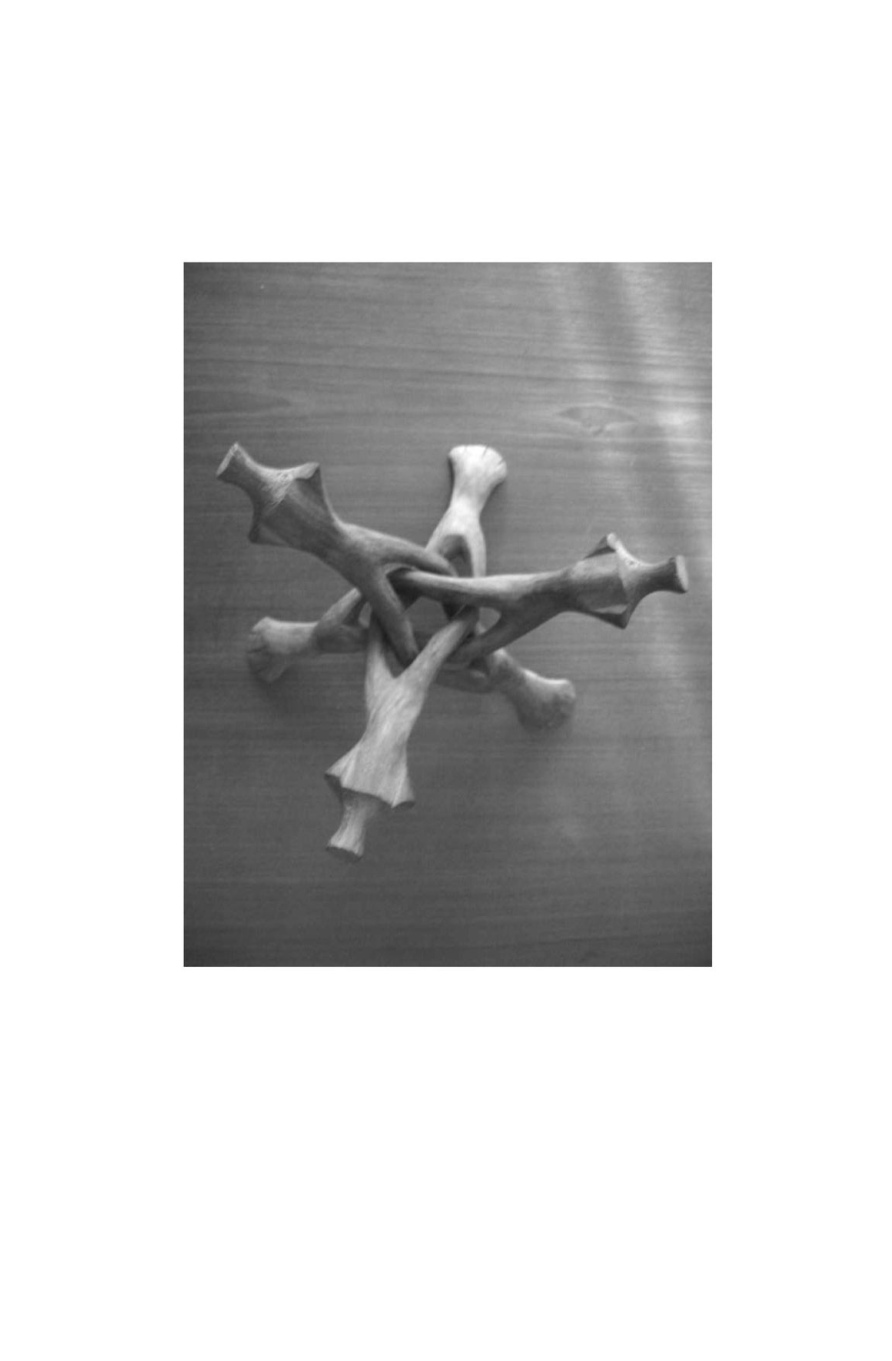
The Truth of KG
- If PM proved even one false arithmetic statement, its logical rules would allow every statement—true or false—to be proved, destroying its connection to arithmetic truth.
- The discussion assumes PM is consistent because its axioms and inference rules appear unquestionably sound.
- Under the hypothetical Provable-KG Scenario, KG would be both provable and false, since KG asserts that it is unprovable.
- Because this would contradict PM’s assumed consistency, the scenario must be rejected: KG is not provable in PM.
- Thus KG establishes a remarkable result: it is a true arithmetic statement that cannot be proved within PM itself.
In a nutshell, we have established two facts: (1) KG is unprovable in PM; and (2) KG is true.
Incompleteness from Strength
- Gödel’s sentence KG is both true and unprovable, with its truth and unprovability paradoxically entailing one another.
- This establishes that Principia Mathematica is incomplete: an infinite number of true statements about numbers escape its system of proof.
- The result shocked mathematicians because PM was widely believed to formalize essentially every method of proof used in mathematics.
- Gödel’s discovery arose from PM’s strength rather than weakness: numbers can mimic symbolic patterns of reasoning, allowing the system to encode and discuss itself.
- Adding axioms or inference rules to create a stronger system would not escape the problem; the same self-referential construction would generate a new unprovable statement.
To add insult to injury, Godel’s conclusion sprang not from a weakness in PM but from a strength. What a fantastic irony!
The Inevitability of Incompleteness
- Any axiomatic system powerful enough to represent whole-number arithmetic is inevitably vulnerable to incompleteness; the flaw is structural, not an oversight in Principia Mathematica.
- Gödel exploited PM’s self-referential power, turning the system’s sophistication against itself much like a judo opponent’s strength becomes a weakness.
- Expanding PM or adding its Gödel sentence as a new axiom cannot solve the problem: each extension generates another undecidable, self-referential sentence.
- There are infinitely many Gödel-numbering schemes, producing an endless succession of distinct but closely related “clones” of the original Gödel sentence.
- Gödel’s result shattered the prevailing belief—including Hilbert’s program—that all of mathematics could be securely grounded in a complete axiomatic framework.
It seems that holes are popping up inside the struggling boat of PM as plentifully as daisies and violets pop up in the springtime.
Top-Down Unscalability
- The argument establishes that KG cannot be a theorem of PM by analyzing its secondary meaning, while deliberately avoiding the numerical content of its primary Russellian meaning.
- No detailed examination of possible derivations or of the number g’s “sauciness” is needed for this non-numerical conclusion.
- The text introduces a mountain analogy in which explorers declare a newly discovered peak unclimbable solely from an unusual property of its summit.
- This claim contrasts sharply with ordinary mountaineering, where unscalability cannot be proven merely through repeated failures or by inspecting the peak from afar.
- The explorers’ reasoning represents an upside-down, top-down form of causality: a property at the summit is said to rule out every possible route from below.
By contrast, our team of explorers has concluded from some novel property of KJ, without once thinking about (let alone actually trying out) a single one of the infinitely many conceivable routes leading up to its summit, that by its very nature it is unscalable.
Gödel’s Downward Causality
- The “Gödel rays” metaphor imagines a hidden instability in a mountain, illustrating structures that ordinary perception cannot detect.
- Gödel’s discovery is presented as a rigorous counterpart to this fantasy: a formula’s hidden meaning can determine its truth or falsity, or whether it is derivable within an axiomatic system.
- This reverses the usual direction of mathematical reasoning, where one works upward from axioms through laborious proofs rather than inferring conclusions directly from a statement’s meaning.
- The example of infinitely many perfect numbers shows that merely understanding a conjecture does not normally reveal whether it is true; mathematical investigation and failed approaches are required.
- A hypothetical Gödel numbering that made a conjecture encode the claim that it has no proof demonstrates how self-reference can expose hidden information about provability.
Indeed it is. But Kurt Godel’s bombshell, though just as fantastic, was not a fantasy.
Truth Beyond Proof
- Gödel’s constructed statement is analogous to a hypothetical number-theoretic claim whose hidden meaning asserts its own unprovability, reversing the traditional direction of mathematical reasoning.
- This “upside-down” approach reasons downward from a would-be theorem and its concealed meaning rather than upward from axioms and surface-level numerical claims.
- The imagined Goru machine, which distinguishes provable (“prim”) formulas from unprovable (“saucy”) ones, would seem capable of deciding every mathematical conjecture—but Gödel’s incompleteness result exposes the flaw.
- Truth and provability diverge: a theorem’s provability guarantees its truth, but failure of proof does not establish falsehood, since some true statements are unprovable.
- The dream of a mechanical truth machine collapses further because no reliable prim/saucy distinguisher can exist, a limitation tied to Tarski’s work on the inexpressibility of truth within PM.
It’s a great scenario for solving all problems with just one little gadget, but unfortunately we can now see that it is fatally flawed. Godel revealed to us that there is a profound gulf between truth and provability in PM (indeed, in any formal axiomatic system like PM).
Truth and Upside-Down Causality
- Tarski’s result shows that, despite true and false statements each forming infinite sets of Gödel numbers, no purely number-theoretical method can define the boundary between them.
- The elusive nature of mathematical truth is presented as a profound, almost sacred mystery at the heart of humanity’s mathematical quest.
- Human perception is shaped by evolution to recognize high-level patterns—such as love, fear, family, and ambition—rather than the microscopic physical processes underlying them.
- This creates an “upside-down” view of causality: the macroscopic concepts we use to explain behavior seem causally powerful, even though the physical mechanisms operate at a far lower level.
- Gödel’s formulas illustrate a parallel: a vast numerical string can acquire a concise, meaningful interpretation, just as conscious thought makes brain activity intelligible while concealing its biological substrate.
There is thus a curious upside-downness to our normal human way of perceiving the world: we are built to perceive “big stuff” rather than “small stuff”, even though the domain of the tiny seems to be where the actual motors driving reality reside.
From Meaning to Matter
- Humans primarily experience themselves through high-level symbols and the persistent sense of “I,” rather than through direct awareness of neural activity.
- Our understanding typically develops from intuitive, abstract concepts toward detailed physical explanations; mental states such as belief and hope preceded their neuroscientific grounding.
- The history of genetics illustrates this downward progression: the abstract idea of a gene was understood long before its physical basis in DNA was discovered.
- DNA revealed that chemistry alone was not the key to heredity; its informational structure and meaning-bearing properties mattered more than the molecules’ physical identities.
- The genetic code demonstrates that biology requires an informational level of explanation, suggesting that physics by itself cannot fully capture how living systems operate.
And then, miraculously, it turned out that the chemistry of these four molecules was in a certain sense incidental — what mattered most of all when one thought about heredity was their newly revealed informational properties, as opposed to their traditional physico-chemical properties.
Why Levels Matter
- Particle physics may underlie every biological event, but explaining organisms entirely at that level is practically impossible.
- At the particle scale, boundaries such as cells, genes, and hogs disappear because particles freely cross them and interact with the wider universe.
- Scientists therefore use a more manageable informational level, where genes are understood by what they mean and do rather than only by their physical composition.
- Higher-level concepts such as breed temperament can have genuine causal significance, even though they emerge from lower-level molecules and particles.
- Everyday biological reasoning works precisely because it uses these useful abstractions instead of becoming trapped in microscopic detail.
If you go the particles route, then you are committed to doing so whole hog, which unfortunately means going way beyond the hog.
Everyday Patterns of Mind
- Symbolic brains are best understood through downward causality: ideas and desires can push around the microphysical stuff inside them.
- Human experience is organized around familiar abstract patterns and concepts—such as “tackiness,” “wild goose chases,” and “customer service departments”—rather than merely words or observable objects.
- These everyday symbols form the practical “mental reality” that dominates ordinary life, even though they are far less precise than concepts like prime numbers or checkmate.
- The categories people rely on most are vague and difficult to define, making it nearly impossible to specify perfect rules or pattern-recognition algorithms for them.
- Even logicians commonly use blurry macroworld categories such as “snow,” “wet,” and “bachelors” as examples of truth, revealing how deeply ordinary thinking depends on imprecise concepts.
And yet, for all its supposed reality, my list is pervaded by vague, blurry, unbelievably elusive abstractions.
The Reality of “I”
- Ordinary philosophical language is highly ambiguous, yet it often feels more real and trustworthy than precise statements about invisible physical phenomena.
- Human perception and belief operate primarily at the macroscopic level of familiar categories, vague objects, and apparent causal relationships.
- Complex human events such as wars, love, and jealousy become intelligible through large-scale patterns—not through descriptions of particles and physical laws.
- Everyday concepts define our experienced reality, with microscopic explanations remaining exceptional despite our intellectual knowledge of them.
- To understand ourselves, we rely on intangible patterns such as hopes and beliefs, which are unified into the powerful abstraction we call “I.”
We are powerfully driven to create a term that summarizes the presumed unity, internal coherence, and temporal stability of all the hopes and beliefs and desires that are found inside our own cranium — and that term, as we all learn very early on, is “I”. And pretty soon this high abstraction behind the scenes comes to feel like the maximally real entity in the universe.
The Self as Strange Loop
- We instinctively believe that an inner “I” causes our actions, but the author presents this sense of agency as a persistent illusion.
- The “I” is not a tangible neural object that could be isolated or removed; it is an abstract pattern, like an audio feedback loop, that nevertheless feels intensely real.
- The brain can be understood at both a low physical level and a high symbolic level, where large structures function as categories and meanings.
- Among the brain’s many symbols, the one called “I” is especially dominant because it represents the self in relation to other people and the wider world.
- Through a lifetime of perceiving its interactions, the “I” symbol grows from something simple into the brain’s most important and complex abstract structure.
The strange loop making up an “I” is no more a pinpointable, extractable physical object than an audio feedback loop is a tangible object possessing a mass and a diameter.
How the Self Emerges
- The human self is distributed throughout the brain rather than localized in one small region, because it incorporates an enormous range of information.
- A flexible, extensible category system allows humans to build vast episodic memories spanning decades and including experiences learned from others and media.
- The self also projects into the future through hopes, fears, imagined alternatives, and counterfactual “replays,” creating a layered inner identity.
- Although physics describes impersonal micro-level causes, the “I” remains an indispensable and reliably useful explanation for action and decision-making.
- Scientific knowledge cannot simply erase the self, which is deeply reinforced by language, culture, development, and evolution.
- Rich self-representation requires a highly flexible representational system; simpler organisms and nonrepresentational objects lack the categories needed to develop a comparable self.
My vast episodic memory of my past, together with its counterpart pointing blurrily towards what is yet to come ... gives rise to the endless hall of mirrors that constitutes my “I”.
Building the Self-Symbol
- Human self-representation begins with basic bodily feedback and gradually expands into abstract ideas of morality, agency, guilt, and pride.
- Children construct identities from social feedback, internalizing labels such as “shy,” “funny,” “lazy,” or “good-looking” within perceived hierarchies.
- Memories and experiences accumulate around the self-symbol, making it increasingly complex and richly connected to other mental representations.
- By acting in the world and observing the results, people learn about their abilities, preferences, and identity as choosers of actions.
- Social reactions function as indirect mirrors: people develop a sense of who they are by interpreting how others respond to them.
Constantly, relentlessly, day by day, moment by moment, my self-symbol is being shaped and refined — and in turn, it triggers external actions galore, day after day after day.
Sculpting the Self
- Our sense of “I” develops through experiments in behavior and the consequences of others’ reactions, beginning in childhood.
- Over time, we adjust humor, appearance, honesty, boasting, and language to gain positive responses and avoid negative ones.
- This continual adaptation creates a self-symbol whose complexity grows as we navigate social norms and feedback.
- Karen Horney describes the “idealized image” as a partly fictional but reality-based picture of oneself, shaped by genuine ideals and inner necessities.
- Although this idealized self may exaggerate one’s achievements, it reflects real potential and exerts a powerful influence on personality and behavior.
The idealized image might be called a fictitious or illusory self, but that would be only a half truth and hence misleading.
The Self-Symbol Loop
- The human “I” is a vast self-symbol composed of memories, aspirations, passions, confusions, accomplishments, and failures, including both healthy and neurotic elements.
- Our actions produce consequences that return as sensory feedback, which the brain compresses into a few meaningful symbols and uses to update its self-understanding.
- This ongoing cycle of symbols, actions, repercussions, and revised symbols gradually stabilizes and locks the structure of the “I” more rigidly into the mind.
- The process resembles an audio or video feedback loop, but human selfhood differs because it depends on perception, abstraction, and categorization—not merely the transmission of raw signals.
Indeed, as the years pass, the “I” converges and stabilizes itself just as inevitably as the screech of an audio feedback loop inevitably zeroes in and stabilizes itself at the system’s natural resonance frequency.
The Emergent Self
- The self emerges when raw sensory stimuli are transformed into symbols through categorizing, replaying, reflecting, comparing, imagining alternatives, and judging.
- Although particles underlie brain activity, they are largely irrelevant at the level where the symbolic “I” operates and develops.
- As the child’s sense of self becomes increasingly useful for interpreting experience, alternative ways of understanding the world without an “I” become nearly impossible to sustain.
- Parents and friends reinforce the apparent reality of the child’s identity, helping make the “I” seem stable, distinct, and socially recognizable.
- The passage raises a central question: is the self genuinely real, or is it an effective, persistent construction like temperature, pressure, or a rainbow?
By the time this brain had lived in this body for a couple of years or so, the “I” notion was locked into it beyond any conceivable hope of reversal.
Degrees of Selfhood
- A thought experiment about an imagined marble shows how explanatory usefulness and social consensus can make an unseen entity feel undeniably real.
- The notion of “I” gains its powerful reality because it efficiently organizes our understanding of causality and importance in the world.
- Selfhood is presented as a matter of degree, depending on the complexity of a brain’s strange loop and its ability to represent itself, its desires, and other selves.
- Mosquitoes are judged too symbolically limited to possess meaningful selfhood, while dogs display rudimentary self-awareness through social emotions and desire recognition.
- A dog’s self remains far simpler than a human’s because it lacks expansive concepts, rich episodic memory, imagined futures, and counterfactual thought.
- The autonomous robot vehicle Stanley prompts the question of whether sophisticated behavior and environmental representation might amount to an “I.”
Indeed, any oddballs who denied the existence of marbles inside their cardboard boxes would be accused of having lost their marbles. And thus it is with this notion of “I”.
Why Stanley Doesn’t Think
- An Intel executive claims Stanley genuinely thinks, but the author dismisses this as hype: successfully crossing a desert demonstrates sophisticated autonomy, not thought or self-awareness.
- Stanley’s passing of a rival vehicle does not show recognition, emotion, or a sense of shared identity; describing the event in human terms risks slipping into anthropomorphism.
- Even seeing its own body would not create an “I,” since bodily perception alone does not amount to a self.
- A genuine self would require a rich understanding of the vehicle’s place in the world, including its actions, relationships, goals, and hopes—not merely its GPS location.
- Such consciousness would depend on episodic memories, imagined futures, fears, and counterfactual reflections about what might have happened differently.
At the present, though, its ability to cross a desert without self-destructing strikes me as comparable to an ant’s following a dense pheromone trail across a vacant lot without perishing.
The Emergence of “I”
- Stanley’s autonomous driving system used sophisticated feedback, but its behavior did not amount to genuine self-awareness or consciousness.
- Human selfhood requires more than an ordinary feedback loop; it depends on a paradoxical “strange loop” involving self-reference, action, feedback, and an updated sense of self.
- The brain appears to be merely inert matter, yet appropriate patterns among its molecules can generate identity, inner awareness, and an “I.”
- An “I” does not arise automatically in every brain: without the right organizational patterns, the brain remains only soulless, selfless matter.
- The chapter begins tracing how evolution transformed primitive brains—originally simple mechanisms guiding organisms toward food and away from danger—into systems capable of richer self-representation.
A human brain is just a big spongy bulb of inanimate molecules tightly wedged inside a rock-hard cranium, and there it simply sits, as inert as a lump on a log. Why should self-reference and a self be lurking in such a peculiar medium any more than they lurk in a lump of granite?
Consciousness Beyond Carbon
- As systems become increasingly complex, they can develop the capacity to represent and respond to themselves—the first glimmer of an “I” and consciousness.
- The author highlights the mystery of how subjective experience, emotion, meaning, and personality could arise from brains that are physically just networks of cells exchanging chemicals.
- The idea that carbon chemistry itself produces consciousness is criticized as mystical and insufficient, since it cannot explain why brains—but not kidneys, mosquitoes, or cows—would be conscious.
- Consciousness is argued to depend less on the material substrate than on the organization and patterns of activity within it: “It ain’t the meat, it’s the motion.”
- By shifting attention from microscopic chemical interactions to higher-level symbolic patterns, previously invisible structures and meaning emerge, much like the careenium’s “simmballs” dancing above the blur of individual simms.
Simmballs filled with meaning are now seen to be doing a stately dance in a blurry soup that they don’t suspect for a split second consists of small interacting magnetic marbles called “simms”.
Meaning Through Alignment
- Meaning arises not from a mysterious substance but from reliable, stable alignment between symbols and events in the world.
- Unlike a humorous coincidence in a story, a careenium’s simmballs remain systematically in phase with reality; this persistent tracking gives them meaning.
- Human brains function similarly: meaningful symbols emerge from electrochemical activity through dependable patterns of alignment.
- Symbols, concepts, desires, and selves were not deliberately designed by evolution but arose as unintended by-products of increasingly effective, survival-enhancing brains.
- Understanding the mind requires shifting attention from low-level neural chemistry to the higher level at which symbolic structures and meanings become visible.
Meaning, no matter what its substrate might be — Tinkertoys, toilet paper, beer cans, simms, whole numbers, or neurons — is an automatic, unpreventable outcome of reliable, stable alignment; this was the lesson of Chapter 11.
Alien Meaning and Taboo
- Kliidgerot PM strings visually communicate whether they are edible or inedible, and these messages have always proven perfectly reliable.
- An alien named the Alfbert arrives and claims to have discovered that PM strings also contain messages about “whole numbers,” expressed in Alfbertic.
- The Kliidgerot regard whole numbers as incomprehensible and repugnant, having banished both the entities and their names from Austranius.
- Because the Alfbert unknowingly invokes the forbidden word “one,” its attempt to educate the Kliidgerot quickly provokes outrage and violence.
- The episode highlights how meaning depends on language, cultural assumptions, and the observer’s perspective: a genuine discovery can appear absurd or offensive to those unable to interpret it.
“Away with the alien! Off with its white head!” screams the infuriated mob, and a moment later, a phalanx of Kliidgerot grabs hold of the declaiming alien.
The Treacherous Banquet
- The Kliidgerot revive a forgotten banquet tradition and harvest supposedly edible PM strings from the sacred planet Woow.
- Although the Alfbert recognizes that the strings encode dangerously false statements about whole numbers, its warning is ignored.
- The Kliidgerot consume the strings and soon die, leaving the Alfbert to lament that they refused to listen.
- The Alfbert departs Austranius, only to awaken into a seemingly different scene where the Kliidgerot celebrate an ominous object falling from above.
- The allegory reverses the usual Whitehead–Russell and Gödel drama: creatures reject number-theoretical meaning in PM strings while treating them as meaningful messages of a higher-level kind.
“Your harvest of PM strings is treacherous! A foolish superstition has tricked you into thinking they are nutritious, but the truth is otherwise.”
Gödel’s Condensed Self-Reference
- A self-referential PM string such as Gödel’s KG would be inconceivably long if written out in full, perhaps rivaling even the largest numbers known from mathematical proofs.
- Gödel constructed KG through 46 stages, building increasingly complex concepts from named abbreviations rather than explicitly expanding every definition.
- These abbreviations form a tower: basic notions such as primes and exponents support more abstract notions until the system can express a statement about its own provability.
- The analogy of explaining “soap digest rack” in ancient Sanskrit illustrates how a short modern phrase can require hundreds of pages when expressed using only an old, limited vocabulary.
- KG is intelligible despite its enormous underlying length because it is highly condensable: a compact phrase can precisely represent an immense chain of formal definitions.
Likewise, Godel’s string KG, which we conventionally express in supercondensed form through phrases such as “I am not provable in PM”, would, if written out in pure PM notation, be monstrously long — and yet despite its formidable size, we understand precisely what it says.
Compression and Level Shifts
- Highly organized symbolic systems such as Gödel’s KG can be summarized through compact concepts, much as billions of heart cells can be described as a “pump.”
- Languages and minds grow by defining new terms from existing ones, allowing layers of abbreviations and ideas to compress increasingly complex structures.
- Pure Principia Mathematica strings are effectively incomprehensibly large because they contain self-referential statements about themselves.
- The only way to understand such strings is to identify recurring patterns, name them, and repeatedly compress the result until an immense structure reduces to a simple idea such as “I am not provable.”
- Russell overlooked this kind of hierarchical level-shift, in which higher-level structures—like images formed from colored dots—become more perceptually real than their underlying symbols or numbers.
The only hope for either the Alfbert or the Kliidgerot is to notice that certain patterns are used over and over again in the sea of symbols, and to give these patterns names, thus compressing the string into something more manageable, and then carrying this process of pattern-finding and compression out at the new, shorter level, and each time compressing further and further and further until finally the whole string collapses down into just one simple idea: “I am not edible” (or, translating out of the allegory, “I am not provable”).
Trapped at High Levels
- The Kliidgerot allegory illustrates how a system may recognize only high-level meanings while being unable to imagine the lower-level reality that generates them.
- Humans face the same limitation: conscious experience makes it difficult to imagine the countless chemical and neuronal events underlying thought.
- The human mind treats “I,” intentions, emotions, and beliefs as independent causal actors, though they may be shorthand for vast physical processes in the brain.
- This blindness to underlying levels defines a central feature of the human condition and parallels the Kliidgerotic condition.
- Complex patterns alone do not create a self: unlike a brain, a video feedback system has no symbols, meanings, or capacity to attribute causal power or think about anything.
The human condition is thus profoundly analogous to the Kliidgerotic condition: neither species can see or even imagine the lower levels of a reality that is nonetheless central to its existence.
The Blindness Beneath Thought
- Human selfhood emerges from the combination of rich symbolic repertoires and the brain’s ability to turn those symbols back upon itself in a strange loop.
- A second ingredient of strangeness is our inability to perceive the frenetic, low-level neural processes underlying thought.
- Because we cannot directly experience the brain’s micro-machinery, we imagine a sharp divide between physical matter and the abstract world of beliefs, desires, and emotions.
- Unlike video-feedback patterns, whose pixel-based nature we understand, our own mental patterns seem autonomous and meaningful because their neural substrate is hidden from us.
- Even neuroscientists can be overwhelmed by this apparent mind–matter gap and abandon physical explanations for consciousness and free will in favor of dualism.
And yet when it comes to perceiving ourselves, we tell a different story. Things are far murkier when we speak of ourselves than when we speak of video feedback, because we have no direct access to any analogue, inside our brains, to pixels and their local logic.
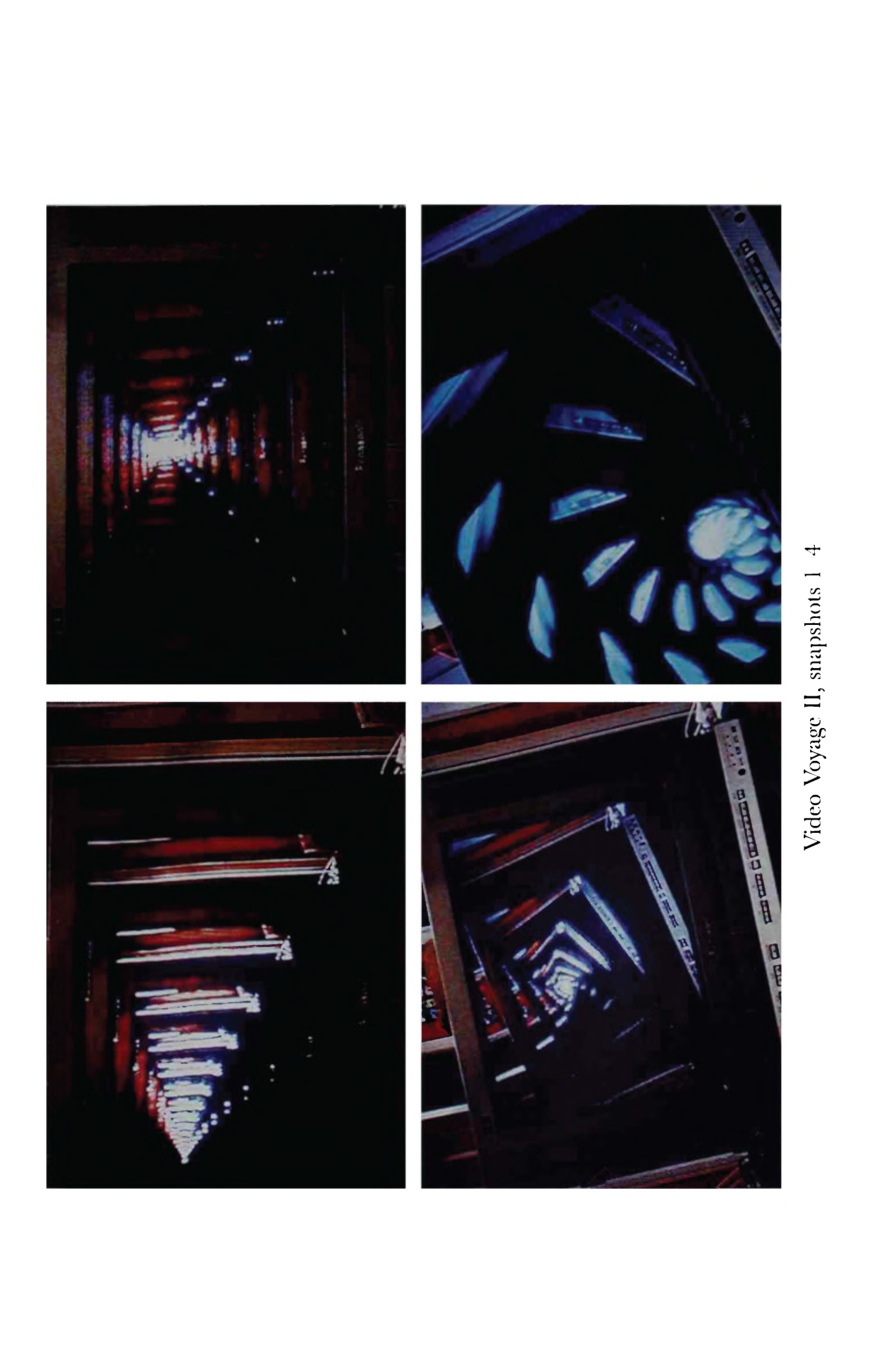
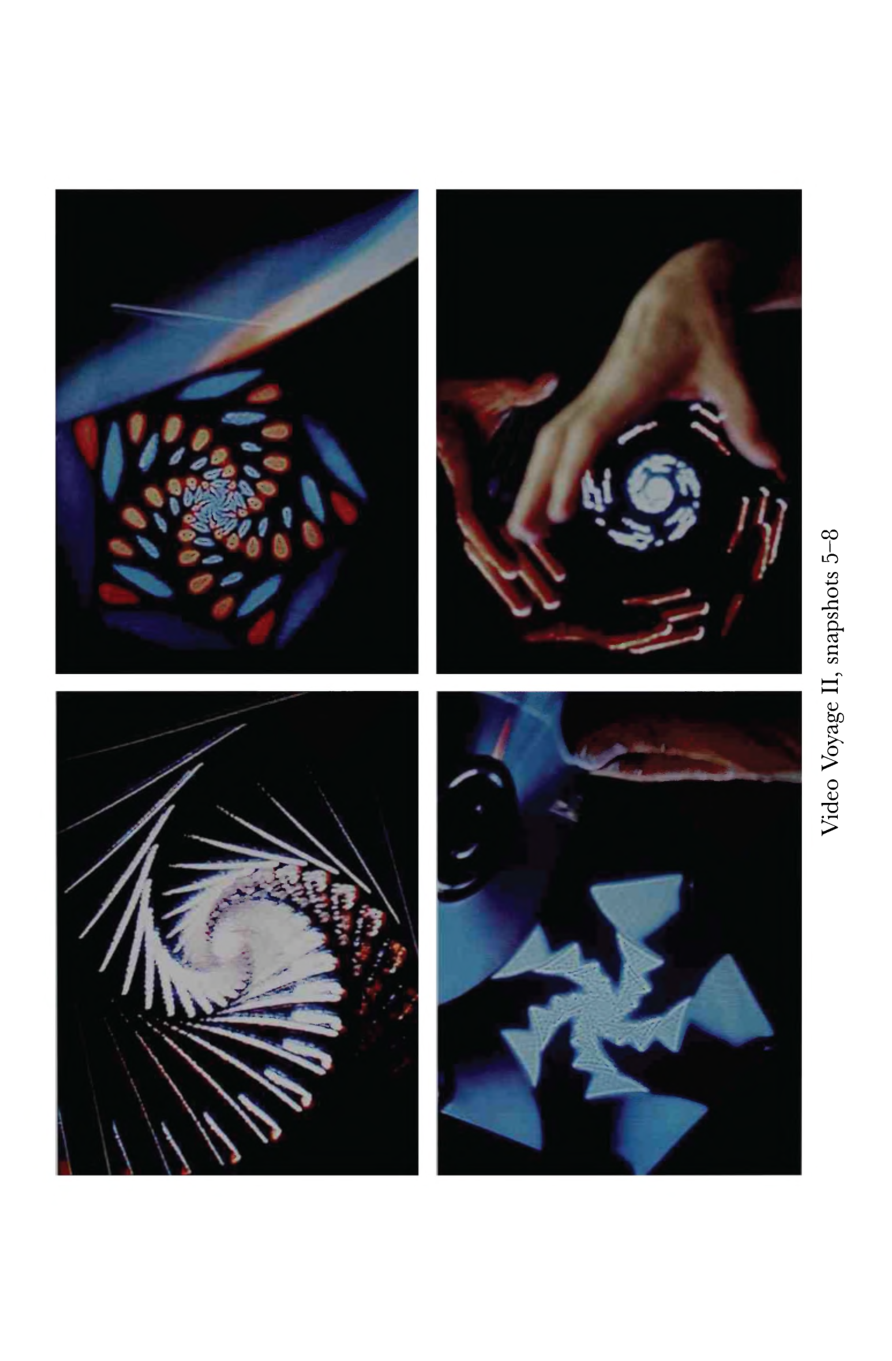
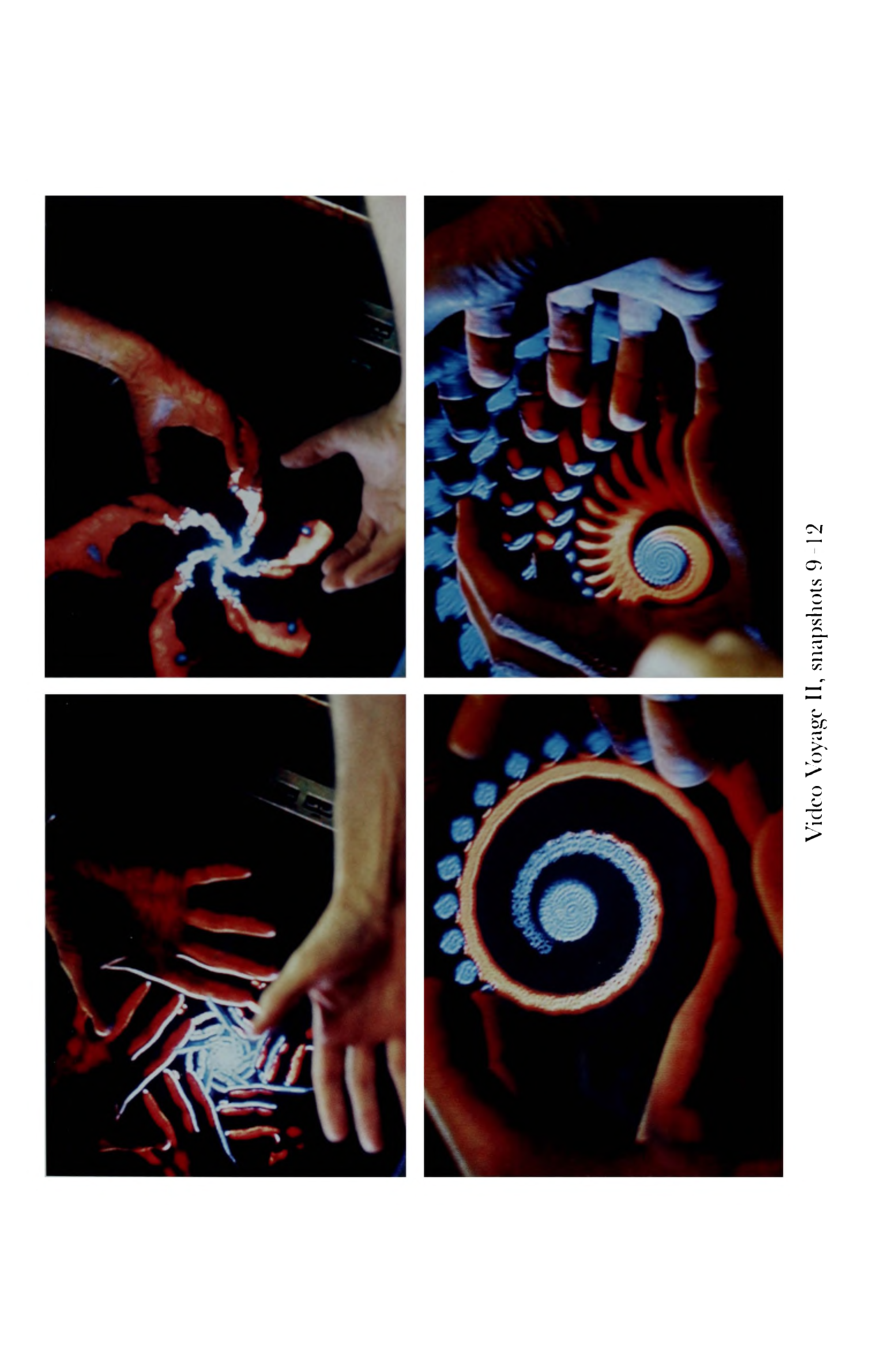
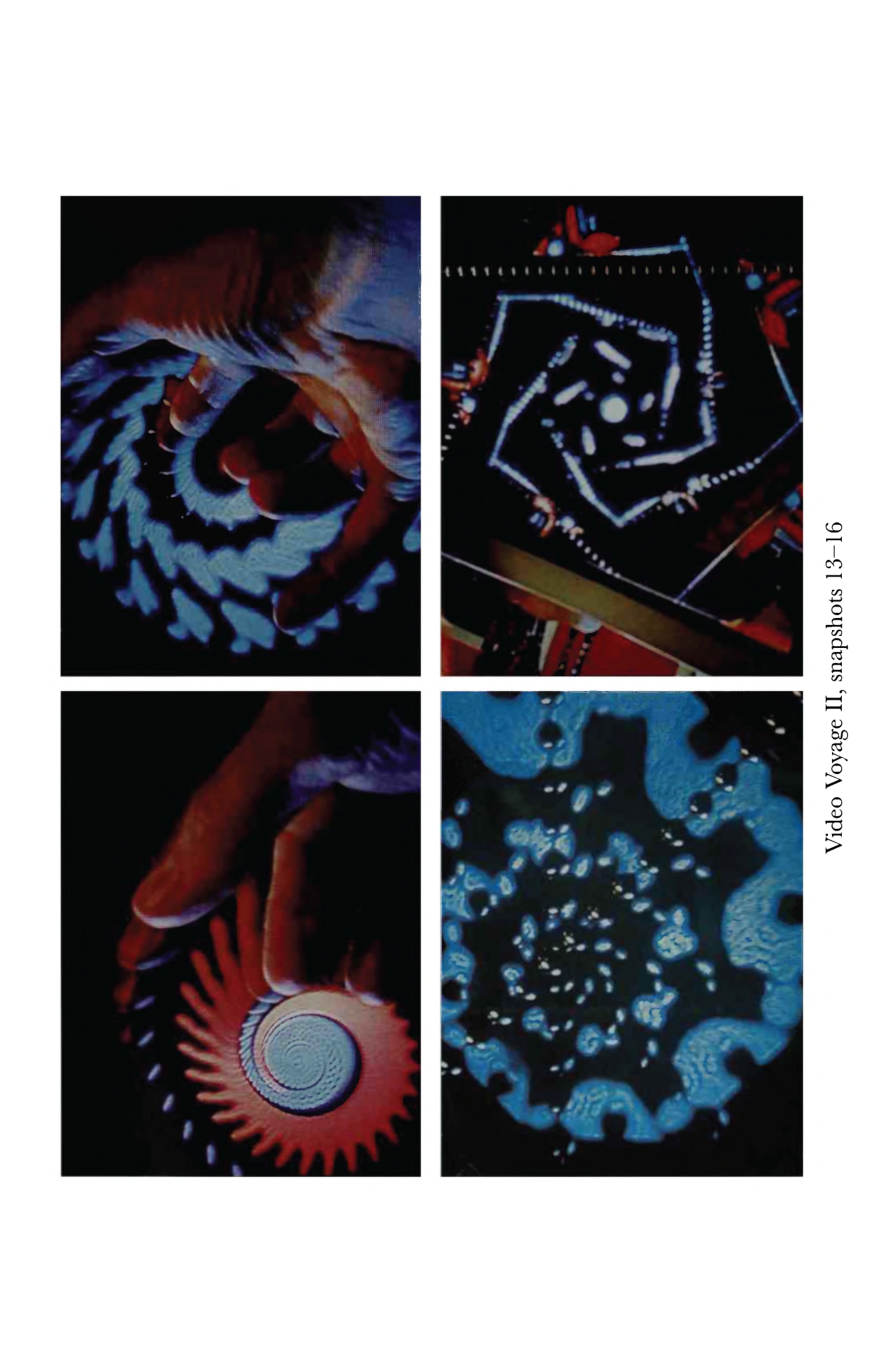
The Strange Loop of Selfhood
- Deep understanding does not necessarily come from accumulating detailed knowledge; excessive detail can sometimes obscure the underlying structure.
- Because humans cannot directly perceive the lower-level processes of the brain, the emergent pattern of “I”-ness feels like an independent source of causality rather than a product of those processes.
- Self-perception creates a feedback loop that reverses the apparent direction of causality, making the “I” seem to control the world from a central position.
- Although this selfhood is described as a trap, it is not inherently harmful; accepting it with humility can be a source of wonder and a defining feature of being human.
- Roger Sperry argues that ideas and ideals possess genuine causal power without requiring Cartesian dualism, much as emergent meanings in Gödel’s systems can exert effects beyond low-level rules.
Such a “trap” is not harmful if taken with a grain of salt; rather, it is something to rejoice in and cherish, for it is what makes us human.
Selves Within Selves
- The idea that the self is a single strange loop is called an oversimplification, because the mind contains representations of many other people and therefore houses many intertwined “I”s.
- People we know intimately are represented by increasingly rich, individualized strange loops that can become partly autonomous from their original, simplified templates.
- A feedback loop by itself produces nothing perceptible when it receives no input; even a powerful loop remains silent without an initial signal.
- The “vanilla” video loop illustrates this emptiness: a camera aimed only at a blank screen produces a fixed, identity-less image.
- Distinctive identity emerges when external content enters the loop, gets amplified, and forms a complex, self-stabilizing pattern.
When no signal enters a feedback loop, the loop has no perceptible effect; it might as well not even exist.
Selfhood Through Symbols
- A strange loop of selfhood requires more than self-reference: its distinctive identity emerges through contact with externally arranged elements in the world.
- Human selfhood is not fully present at birth or in the womb; it develops through perception, categorization, and interaction with the environment.
- The richer an organism’s symbolic and categorical equipment, the more complex and realized its sense of self; with too few categories, selfhood disappears.
- Mosquitoes possess almost no symbols and therefore almost no self, while human infants have immense potential to develop symbolic repertoires over time.
- Newborns begin in a state of near-total sensory confusion, lacking the symbolic machinery needed to construct a meaningful “I”; thus a human head can initially contain less than one strange loop.
To put it bluntly, since its future symbolic machinery is 99 percent missing, a human neonate, devastatingly cute though it might be, simply has no “I” — or, to be more generous, if it does possess some minimal dollop of “I”-ness, perhaps it is one huneker’s worth or thereabouts — and that’s not much to write home about.
Entwined Strange Loops
- Two initially separate camera-screen feedback loops become interconnected as the systems move close enough to see one another.
- Each loop remains more strongly defined by its own image, yet the other loop becomes part of its content and identity.
- As each system reproduces the other with greater fidelity, their supposedly private identities become increasingly fused and difficult to disentangle.
- The metaphor suggests that human identity is relational: one person’s private self can be partly constructed from and dependent on another’s.
- Understanding the self may require abstract structures—such as strange loops—that are far removed from the biological substrate in which they exist.
The more faithful the image of each screen on the other one, the more “private” identities of the two loops are intertwined, and the more they start to be fused, blurred, and even, to coin a word, undisentanglable from each other.
Perception and Identity
- Even if two systems represent each other perfectly, they remain distinct because each camera directly controls only its own screen.
- A system’s identity is grounded in which perceptual hardware is directly wired to it; effects on other systems remain indirect.
- Human communication lets others vividly experience events through language, art, photography, and music, but these impressions are secondary to their own sensory input.
- Because perceptions do not flow between brains at comparable speed or intensity, each person remains primarily themselves.
- The theory of the human “I” as a strange loop must be refined to account for many nested loops, including a privileged loop tied to direct perception and, next, control.
If, however, my perceptions came flooding as fast and furiously into your brain as they do into mine, then we’d be talking a truly different ballgame.
Intertwined Selves
- Our brains control our own bodies directly, but can influence other people’s actions indirectly through situations such as tennis or driving.
- Language greatly magnifies this indirect influence, allowing other people’s bodies to function as flexible extensions of our own intentions.
- The distinction between controlling one’s own body and another’s may be a difference of degree rather than a fundamental difference in kind.
- People can indirectly perceive and control one another, suggesting that minds and bodies are more intertwined than the notion of separate selves implies.
- Separate bodies, names, and personal pronouns reinforce the comforting idea that each person possesses a distinct, watertight identity.
Through language, other people’s bodies can become flexible extensions of our own bodies.
Life in Twinwirld
- Twinwirld is a thought experiment where 99 percent of births produce identical twins, while the remaining individuals are called “halflings.”
- Twins grow up, study, work, socialize, marry, and raise children together as unified social beings called “pairsons,” “dividuals,” or “duals.”
- Although each pairson has physically distinct left and right halves, those halves are rarely addressed or treated as separate individuals.
- Twinwirld’s language and customs recast ordinary concepts—friendship, love, parenthood, and identity—to fit a society organized around paired rather than individual persons.
- The world establishes a philosophical premise: physical parts can remain distinct without undermining the integrity of the whole.
Things have parts, to be sure, but that doesn’t mean that they don’t have integrity as wholes!
Twinwirld Pairson Identity
- Twinwirld’s two-part inhabitants usually remain physically and mentally close, communicating complex thoughts with very few words because each half can anticipate the other.
- The language distinguishes sharply between an isolated half (“i”), a whole pairson (“Twe”), and one addressed pairson (“UJ”).
- Unlike English, “you” and “they” are strictly plural, while “twey” serves as a genderless singular pronoun for one pairson.
- Twinwirld culture treats each pairson as a single indivisible unit, awarding one grade and assigning credit, blame, glory, or shame collectively rather than to either half.
- Education, art, science, and everyday conventions continually reinforce the idea that a pairson’s identity belongs to the team, not to its separate halves.
“Every dividual is indivisible”, runs an ancient Twinwirld saying.
Twinwirld’s Strange Selves
- In Twinwirld, two genetically linked halves naturally form a single social and psychological unit called a pairson, making separation seem bizarre and impoverished.
- Halflings occur in roughly 0.99 percent of births and are viewed as living a strange “half-life” compared with the normal paired existence.
- In the rarest cases, both halves split, producing genetically identical “twinns,” whose near-identicality can inspire either independence or playful deception.
- Because ordinary pairsons have no experience of twinning, they find it almost incomprehensible to grow up beside someone nearly identical to oneself.
- The discussion leads into questions about identity, language, and personhood: whether a soul belongs to an individual half, a pairson, or both, and how genetics and culture create a collective “Twe.”
How extremely strange it would be to grow up side by side with sometwo almost identical to twoself!
The Unity of Self
- Twinwirld explores whether personal identity belongs more naturally to an individual twin half (“i”) or to the fused pair (“Twe”).
- By adjusting the world’s assumptions, the author makes the rivalry between these two models of selfhood more or less compelling.
- In Siamese Twinwirld, joined twins lack the pronoun “i,” leaving “Twe” as the sole analogy for our concept of “I.”
- Human consciousness resembles Siamese Twinwirld because the left and right cerebral hemispheres work as a tightly integrated team that feels like one indivisible self.
- The bond between Twinwirld halves is proposed to be weaker than communication between our brain hemispheres but stronger than the intimacy found between ordinary human relationships.
And if you’re anything like me, neither of your half-brains goes around calling itself “i” and brazenly proclaiming itself an autonomous soul! Rather, the two of them together make just one capital “I”.
Shared Selves and Entwinement
- The author revisits the idea that two or more bodies might share a single self, using the Chaplin twins of York as a possible real-world example.
- The twins reportedly acted as one through finishing each other’s sentences, speaking in unison, and maintaining an unusually inseparable life together.
- Rather than invoking telepathy, the author explains their coordination through shared experiences, similar dispositions, and highly developed everyday communication.
- The twins raise a deeper question: can devotion to a joint purpose become so complete that each person partly loses her individual self?
- The discovery of a Bach wedding cantata containing the phrase “O thou charming bridal pair” seems like an uncanny coincidence that reinforces the chapter’s theme of union and entwinement.
Since these twins have seen, heard, touched, smelled, and thought about very much the same events throughout their lives, and started, no doubt, with brains quite similarly disposed to react to these stimuli, it might not take enormous channels of communication to keep them homing in on some sort of loose harmony.
One Soul, Two Bodies
- Bach’s wedding aria uses singular pronouns to address a couple, suggesting that marriage creates a sacred union of two souls into one.
- The same unusual singular address appears in French and Italian translations, emphasizing how deeply the language challenges ordinary ideas of personhood.
- The author imagines a final aria in which the married couple sings as a single “I,” abandoning counterpoint so their separate identities do not distract from their unity.
- The Twinwirld fantasy questions the assumed dogma that one body must contain one soul, self, person, or locus of consciousness.
- Marriage is presented as a possible “higher-level individual,” a new entity formed from two ordinary individuals.
“In this closing aria, ‘I’ would denote the couple itself, not either of its members, and the aria would be thought of as being for the couple’s one new voice rather than for two independent voices.”
The Marriage as Entity
- A marriage can be understood as a “third patient”—a living bond that deserves care alongside the two individual partners.
- Long marriages create such a powerful shared identity that the loss of one partner can feel like losing half of one’s soul.
- Through shared rituals and reflection, the couple develops a “joint mind,” discovering common reactions, interests, and ways of seeing.
- Over time, the partners’ inner resemblance becomes visible not in their facial features but in their expressions and shared outlook.
- The birth of children deepens the bond: a common commitment to raising them aligns the parents’ values and gradually transforms them into one “individual with two bodies.”
Something, some thing, was coming into being that was made out of both of us.
Shared Lives, Sudden Loss
- The narrator describes his and Carol’s hopes and dreams as a single shared pattern, even though they were physically represented in two separate brains.
- He compares shared hopes to genes and novels, arguing that abstractions can exist across different physical forms, organisms, languages, and cultures.
- Their marriage and children united them into a higher-level whole that acted like a single entity, much as a school of fish moves as one.
- In December 1993, Carol died suddenly of a brain tumor at age 42, leaving the narrator devastated and their children, Danny and Monica, only five and two.
- His deepest grief centered less on his own loneliness than on the future Carol had lost: watching her children grow up and sharing the countless experiences of family life.
There had been a bright shining soul behind those eyes, and that soul had been suddenly eclipsed. The light had gone out.
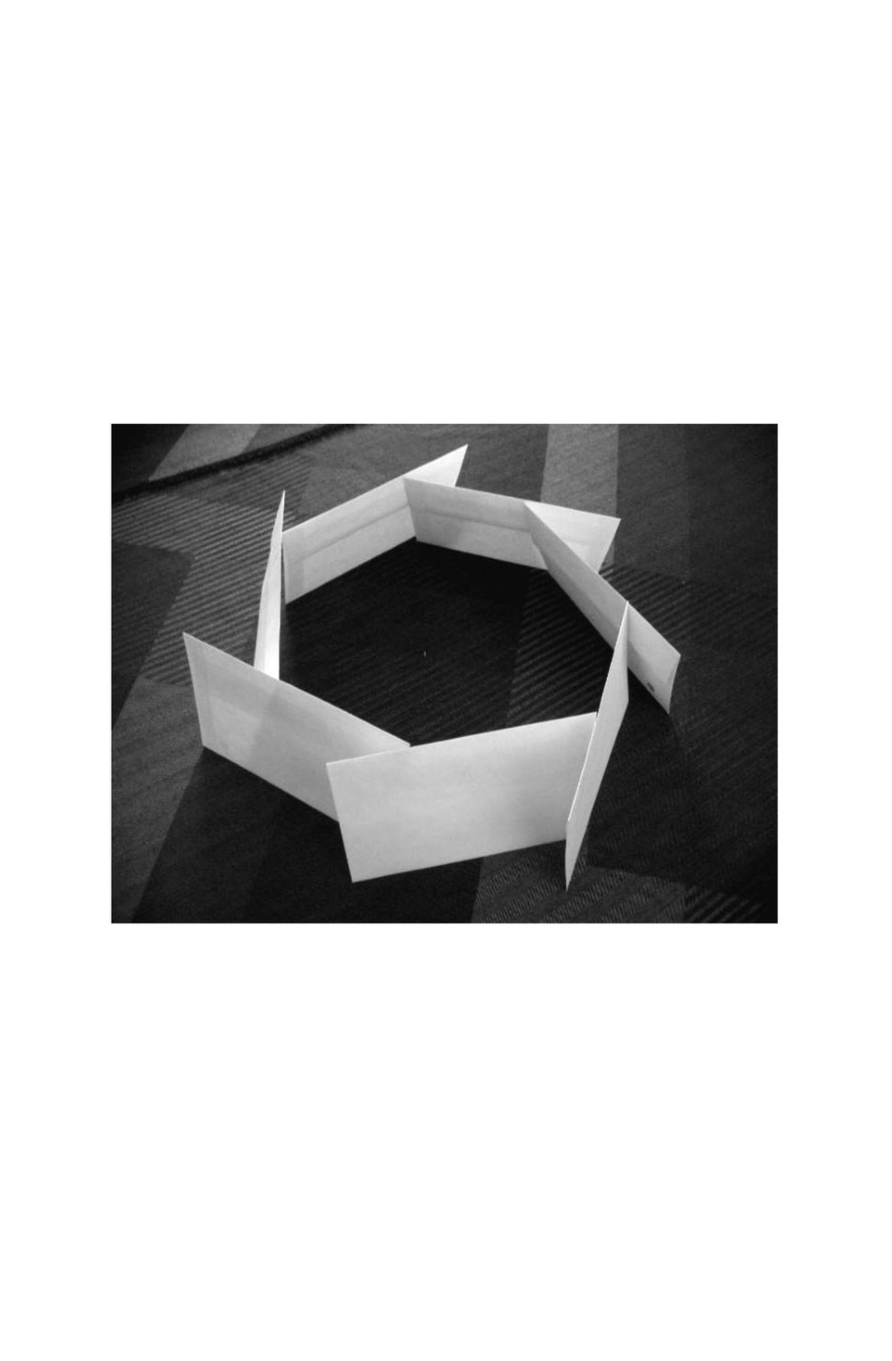
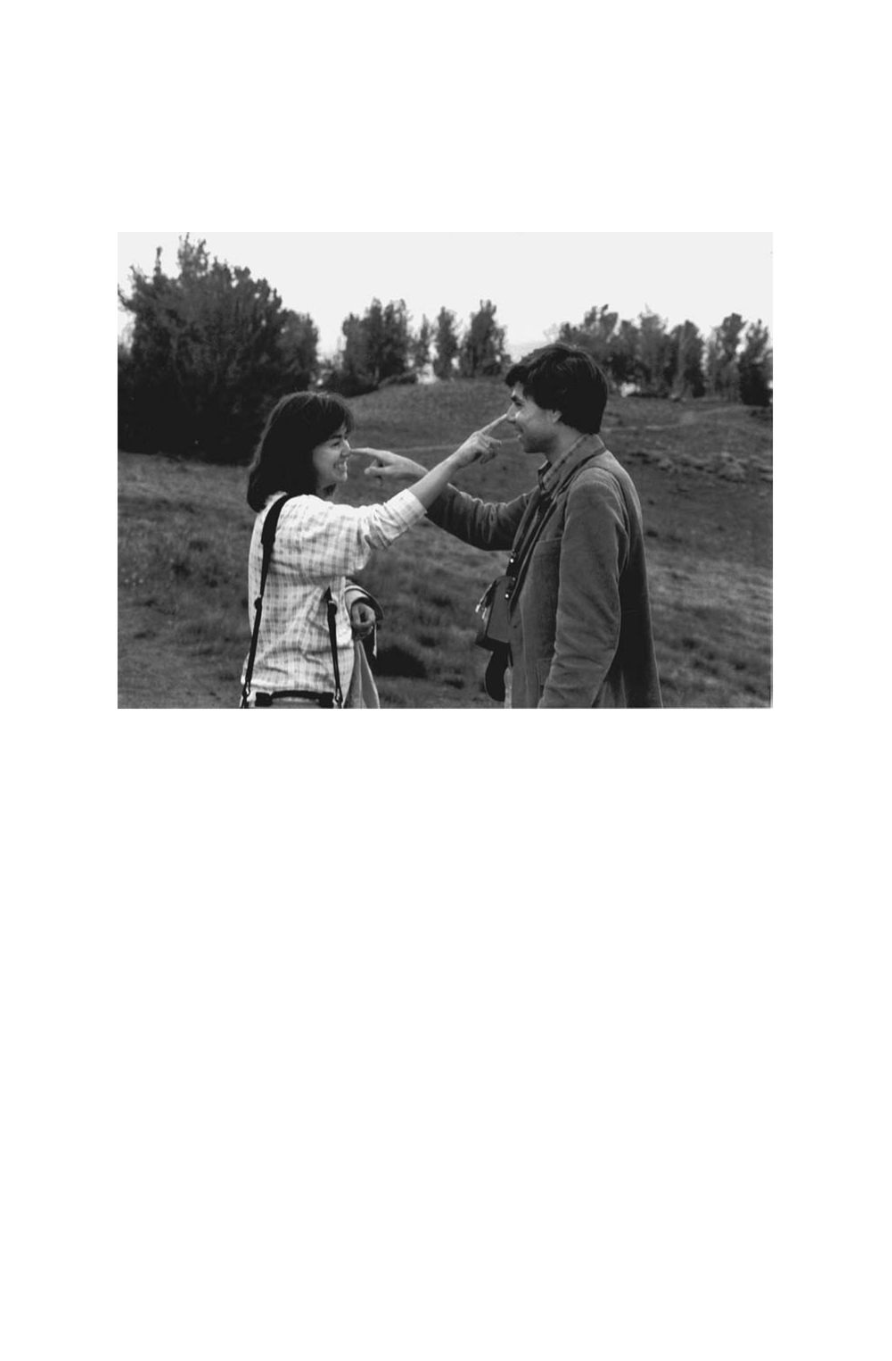
Grappling with Soul and Memory
- The author struggled to relate to traditional grief support groups, feeling that other participants focused on their own loss while he was consumed by the injustice of what was stolen from his deceased wife, Carol.
- Looking deeply at a photo of Carol brought a sudden realization that her core soul—their shared hopes and dreams for their young children—remained alive within his own brain.
- Haunted by the mystery of how Carol's consciousness vanished and why he continued to think of her in the present tense, the author reached out to philosopher Daniel Dennett.
- Over several months, the author engaged in a 35-page email exchange across the Atlantic with Dennett, articulating elusive and inexpressible ideas about minds, the self, and surviving loss.
- Re-reading these deeply personal, raw exchanges years later inspired the author to include excerpts in his book to illustrate his real-time struggle with the nature of soul and tragedy.
One day, as I gazed at a photograph of Carol taken a couple of months before her death, I looked at her face and I looked so deeply that I felt I was behind her eyes, and all at once, I found myself saying, as tears flowed, “That’s me! That’s me!”
Carolness and Grief
- The author includes deeply personal email reflections to Dan because they express, with unusual urgency, the book’s central questions about the human soul and consciousness.
- The original 35 pages of emotional, disorganized emails were heavily edited and reordered into a shorter but faithful account of the author’s most important struggles.
- Dan’s role was primarily that of a calm, supportive friend and sounding board, so his voice is largely omitted except for a poetic introduction comparing the author’s grief to a “desperate lark.”
- The author understands “Carol” as more than a vanished body: she is a vast pattern of memories, traits, hopes, loves, and habits distributed across people, recordings, and written recollections.
- Through this dispersed “Carolness,” the author argues that aspects of Carol continue to exist and survive in the physical world.
You are now embarked on a desperate lark, which is just what you should be doing right now. And your reflections are the reflections of a person who has encountered, and taken a measure of, the power of life on our sweet Earth.
Fragments of Consciousness
- The author explores whether memories, stories, and recordings can preserve fragments of Carol’s consciousness after her death.
- He argues that consciousness may be partly distributed across other minds, so the loss of a central brain does not necessarily erase every trace of a person.
- External memories—notes, notebooks, photographs, and other records—can preserve and transmit aspects of someone’s personality, effectively “resuscitating” them in a small way.
- A photograph may be physically inert yet psychologically powerful, much like Chopin’s scores, because patterns can trigger vivid inner responses in those who encounter them.
- The passage ends by asking whether there is a threshold of “critical mass” at which records such as videos or diaries contain a meaningful portion of a person’s self or consciousness.
Thus even a static representation on paper can contain elements of a “living” Carol, of Carol’s consciousness.
Shared Identity After Loss
- The author argues that representations such as photographs or written phrases may preserve a tiny fragment of a person’s inner life, not merely memories of being with them.
- On Monica’s birthday, grief leads him to wonder whether he can experience her joy on behalf of both his younger self and Carol, who had long shared the dream of having a daughter.
- Shared hopes and goals can create a continuing identity between people, especially when the surviving partner feels responsible for carrying out the deceased person’s wishes.
- Because of profound empathy and emotional closeness, the author sometimes felt that he was Carol, just as she could at times be him.
- Carol’s desires, sensations, humor, and point of view remain represented within his mind, suggesting that a person can persist through the consciousness of someone who deeply knew them.
For brief periods of time in conversations, or even in nonverbal moments of intense feeling, I was Carol' just as, at times, she was Doug.
Becoming Another Self
- The author wonders whether a simulated copy of Carol’s “personal gemma” in his brain preserves any genuine Carol-consciousness, or whether her original self has been irrevocably lost.
- A person is defined as a psychological point of view shaped by memories, associations, and habits—not merely by a body or physical location.
- Internalizing another person is compared to learning a foreign language: it begins as imitation but can become a genuine, reflexive way of thinking and being.
- Through decades of marriage, the author’s parents became deeply fluent in each other’s inner perspectives; he believes he and Carol achieved a lesser but still genuine mutual inhabiting of one another.
- Carol’s self had multiple, uneven instantiations in the minds of family and loved ones, though her own brain remained its richest and primary embodiment.
- An uncanny imitation of a professor illustrates how another person’s mannerisms can be temporarily “put on,” raising questions about the difference between surface imitation and deeper identity.
So it is with coming to see the world through another person’s soul.
The Soul’s Second Home
- Deep similarities in emotional responses, temperament, empathy, and character matter more for mutual understanding than shared opinions or factual experiences.
- A person’s innermost traits—such as confidence or feelings of inferiority—create a unique soul that may be impossible for someone with a different temperament to fully comprehend.
- The text explores whether one person’s deeper self can be absorbed into another person’s brain as an alter ego or “second vantage point” without replacing the host’s own identity.
- If enough of a person were preserved in another brain, their survival might seem possible even after their original brain perished.
- The central philosophical problem is whether a copied self-model can become a genuine self-referential “I,” or whether it merely points to the absent original person.
The crux is this: even if my internal model of Carol were unbelievably rich (e.g., like my Mom’s model of my Dad, say, or even ten times stronger than that), would it nonetheless be the wrong kind of structure to give rise to an “I”?
Transporting the Self
- The self is imagined as a layered network of pointers: outer layers connect to universal concepts, middle layers to personal memories, and the inner core to intensely indexical emotions and fears.
- The innermost self is difficult to reproduce elsewhere because its pointers loop back upon themselves, binding identity tightly to one body and brain.
- Although complete personal transfer may be impossible, people can partially internalize another person’s memories, preferences, and perspective, making psychological identity somewhat transportable.
- Carol may survive insofar as her point of view persists in the author’s brain and in the minds of others who knew or remember her.
- Photos, videos, writing, and other records preserve people by allowing their mental patterns and perspectives to be reconstructed across generations; Chopin is offered as a powerful example.
If this is true, then Carol survives because her point of view survives — or rather, she survives to the extent that her point of view survives — in my brain and those of others.
When Symbols Resemble People
- Watching recordings of Carol after her death may reactivate the same neural patterns that arose when she was physically present, producing both love and the unsettling sense of being deceived.
- This experience raises a profound question about the “Carol symbol” in Doug’s brain: is it merely a representation, or does it approach personhood in its own right?
- The Holden Caulfield symbol in J. D. Salinger’s mind offers a parallel: although fictional, it is rich enough to seem like a miniature person with a core identity or soul.
- The author acknowledges that grief and emotional longing make these questions more urgent but also distort the search for clear answers.
- He compares his uncertainty about self, soul, and consciousness to the confusion surrounding quantum mechanics before its foundational theories were established.
But as I watch the videos, knowing she is gone, the fraudulency will at once be being revealed and yet be deeply confusing me, because I will be seeming to see her, seeming to have revived her, seeming to have brought her back, just as I do in my dreams.
Ideas Before Grief
- The author acknowledges that readers might interpret his theories about souls and survival as an elaborate denial of Carol’s death, and admits he sometimes questioned his own motives.
- Old handwritten files revealed that his ideas about blurred identities, soul mergers, and consciousness had developed decades before Carol’s illness and death.
- Thought experiments involving linked brains and altered information flow helped him explore what makes a person unique and whether identities can merge.
- Marriage, parenthood, and shared love for their children intensified these longstanding reflections, bringing them to an emotional climax.
- The author finds solace in believing that grief did not make him abandon his principles; instead, it drove him to remain faithful to ideas he had carefully developed earlier.
- Chapter 17 begins a new exploration of universal machines, recalling the electronic kits that introduced him to circuits capable of computation and play.
I did not merely tumble for some kind of path-of-least-resistance belief system that winked at me, but instead I stayed true to my long-term principles, worked out with great care many years earlier.
The Universal Machine
- Traditional machines are dedicated to a single purpose, while modern devices increasingly transcend their original functions.
- Cell phones illustrate this shift: their circuitry is complex enough to support communication, games, photography, browsing, and many other applications.
- The computer revolution centers on crossing the “Godel-Turing threshold,” beyond which a machine can emulate any other kind of machine.
- Turing’s universal machine achieves this flexibility by interpreting data that describes its own structure, allowing it to imitate machines of arbitrary complexity.
- Different computers can run the same programs in principle; their practical difference is mainly speed, since imitation requires slower layers of lookup and interpretation.
One single universal machine morphs into new functionalities at the drop of a hat, or, more precisely, at the double-click of a mouse.
The Threshold of Universality
- Gödel showed that Principia Mathematica became universal simply by representing fundamental properties of positive integers, allowing it to define arbitrarily complex number-theoretical functions and even imitate itself.
- Russell and Whitehead missed this power because they regarded numerical patterns as self-contained mathematical objects rather than as representations capable of simulating other systems.
- Early computer engineers similarly designed machines for narrow tasks such as ballistics calculations and codebreaking, unaware that their machines contained far greater potential.
- Turing and von Neumann recognized that computers incorporating the expressive power of integer arithmetic could become universal machines, capable of running any suitable program.
- Modern devices conceal their numerical foundations behind screens, making computers appear to be phones, games, or virtual worlds rather than universal number-processing systems.
All at once, these machines were like music boxes that could read arbitrary paper scrolls with holes in them, and thus could play any tune.
Universal Patterns
- Complex computer simulations—from galaxies to proteins—ultimately rely on simple integer addition and multiplication in binary at the hardware level.
- Gödel’s 1931 insight about computation has become an invisible foundation of everyday digital life, hidden beneath images, games, and web searches.
- A single computational operation can have many equally valid interpretations, such as arithmetic multiplication, a bit shift, a pixel transfer, or deleting a character.
- Computers are called “computers” for historical reasons, but their universal nature allows them to represent and enact patterns far beyond their original purpose.
- Human brains likewise function as universal machines, internalizing external patterns through symbols and memories while preserving only the details shaped as important by evolution.
That term tips you off, if you bother to think about it, to the fact that underneath all the colorful pictures, seductive games, and lightning-fast Web searches, there is nothing going on but integer arithmetic. What a hilarious joke!
Representational Universality
- Humans can interpret patterns, images, and symbols as representations of distant or imaginary events, allowing ideas to travel beyond direct experience.
- The “doggie cam” story shows the gap between human and canine cognition: people can recognize Ollie and understand remote observation, while Ollie cannot grasp concepts such as webcams or distance.
- Representational universality emerges when a system’s symbols can expand without obvious limit, enabling beings to model others, refine those models, and invent fictional beings.
- This capacity creates an intense appetite for access to other minds, expressed through movies, news, gossip, webcams, and other forms of mediated experience.
- The desire for vicarious experience approaches empathy, which involves more than seeing another person’s perspective—it means taking on their values and desires.â
Once beyond the magic threshold, universal beings seem inevitably to become ravenously thirsty for tastes of the interiority of other universal beings.
Other Selves Within
- Memories and dreams can make a deceased or distant loved one feel vividly present, even though that person exists only within the mind.
- The author describes this experience as activating an internal symbol that temporarily changes how the mind operates.
- Once activated, the loved one’s symbol can influence jokes, memories, associations, emotional reactions, and value judgments in ways that surprise the thinker.
- The passage asks whether a mental representation of another person is merely an inert proxy or possesses something like an inner experience.
- If people and the self are concepts represented in the brain, then the mind is inhabited to varying degrees by other selves, depending on how deeply we represent and resonate with them.
You have allowed yourself to be invaded by an “alien universal being”, and to some extent the alien takes charge inside your skull, starts pushing things around in its own fashion, making words, ideas, memories, and associations bubble up inside your brain that ordinarily would not do so.
The Chemistry of Souls
- Souls, like clothes, fit some people and experiences better than others; personal resonance cannot simply be chosen or assumed.
- Musical taste vividly demonstrates this idea: despite a friend’s passionate praise of Bartók’s Violin Concerto and their shared enthusiasm for Prokofiev, the narrator felt no connection to Bartók’s work.
- Repeated listening confirmed that the problem was not unfamiliarity but a deep mismatch—a “deaf spot” or poor fit between the narrator and Bartók’s musical language.
- This failure of musical chemistry weakened the narrator’s sense of kinship with the friend, and their friendship eventually subsided.
- The experience serves as a metaphor for human relationships: one may respect another person’s intelligence and virtues while remaining unable to understand what makes their heart move.
Listening to it, I feel like a magnetic field bashing headlong into a superconductor — cannot penetrate even one micron!
Borrowed Selves
- Musical taste can create an immediate emotional connection, acting as a direct route between hearts and a guide to affinity between souls.
- People instinctively imitate others, absorbing gestures, speech patterns, styles, and habits from childhood through adulthood.
- The author discovers that even deeply personal creative work—music and writing—contains unmistakable traces of countless admired artists.
- Identity is portrayed as a composite fabric woven from borrowed fragments contributed by family, friends, teachers, artists, and other influential figures.
- Virtual people—those encountered through art, media, and history—can shape a person as profoundly as people met face to face.
Everything I do is some kind of modified borrowing from others who have been close to me either actually or virtually, and the virtual influences are among the most profound.
The Self as Collage
- People—whether real or fictional—shape us according to the depth and duration of their influence, not according to whether we ever met them.
- Each person is a selective accumulation of others’ habits, ideas, styles, phrases, hopes, and fears, which gradually fuse into the substance of the self.
- As new influences are added, older traits become buried deeper within us, though they remain part of our identity and history.
- Those we love, and who love us, exert the strongest influence, making the self a collaborative formation of many voices.
- David Oleson’s “I at the Center” visually captures how an individual’s identity is determined by the people closest to them, while hinting that influence weakens toward the periphery.
We are all curious collages, weird little planetoids that grow by accreting other people’s habits and ideas and styles and tics and jokes and phrases and tunes and hopes and fears as if they were meteorites that came soaring out of the blue, collided with us, and stuck.
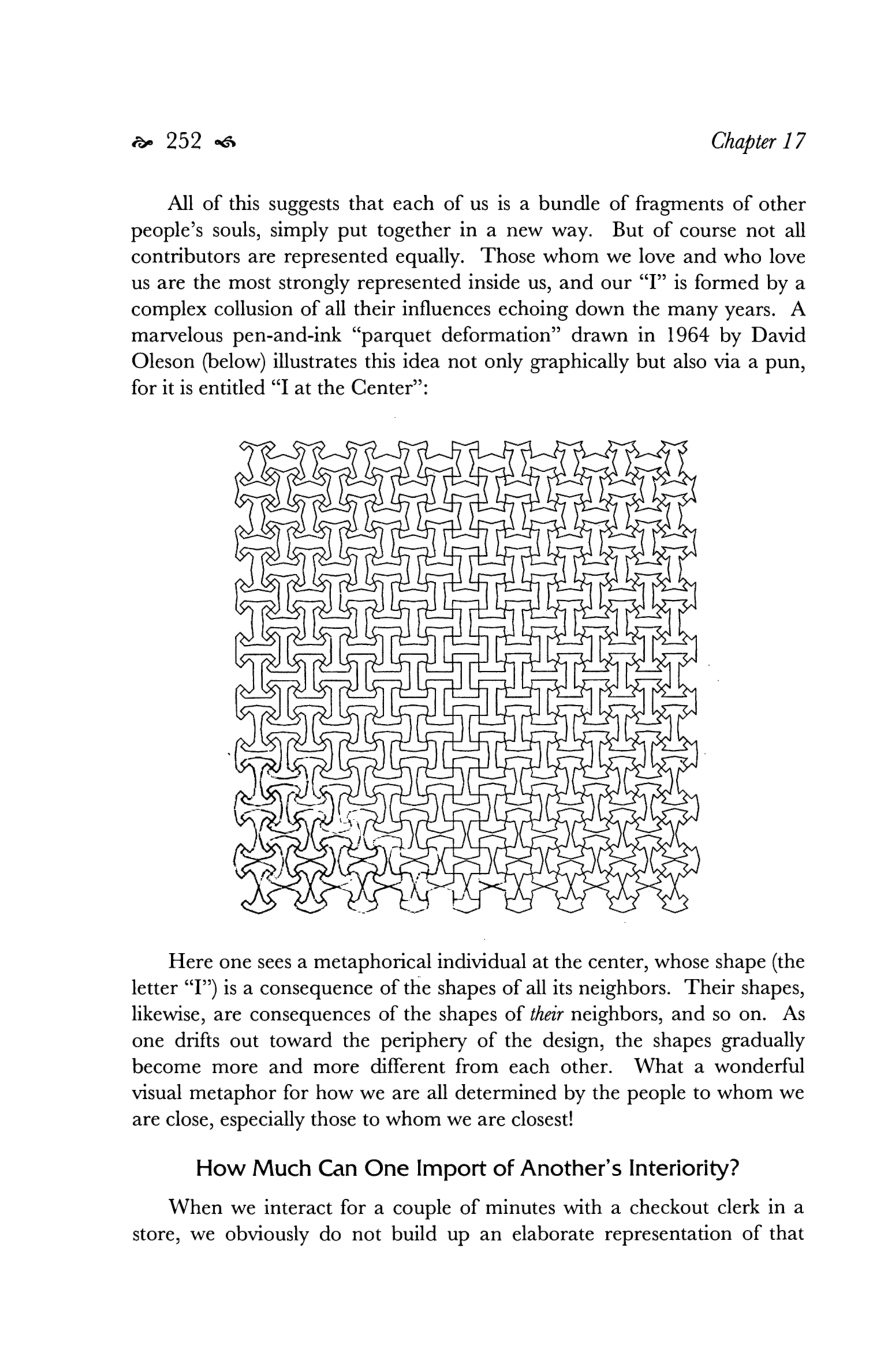
How Others Live Within Us
- Most people are represented only through superficial impressions, leaving their inner “strange loop” or individuality largely inaccessible to us.
- Peripheral public figures live in memory mainly through isolated achievements, while influential figures become complex inner symbols that shape our identities.
- People we know and love personally become far more intimate internal presences; their goals can blur with our own as we invest ourselves in their lives.
- Even our representations of loved ones remain imperfect, since our mental “camera” cannot capture their interiority as fully as they or we experience it ourselves.
- After Carol’s death, the prospect of watching videos of her reveals how memory and recorded images can revive a powerful illusion of presence while intensifying the pain of absence.
Watching the tapes would heighten the anguish of her death, by seeming to bring her back physically but doing nothing of the sort in reality.
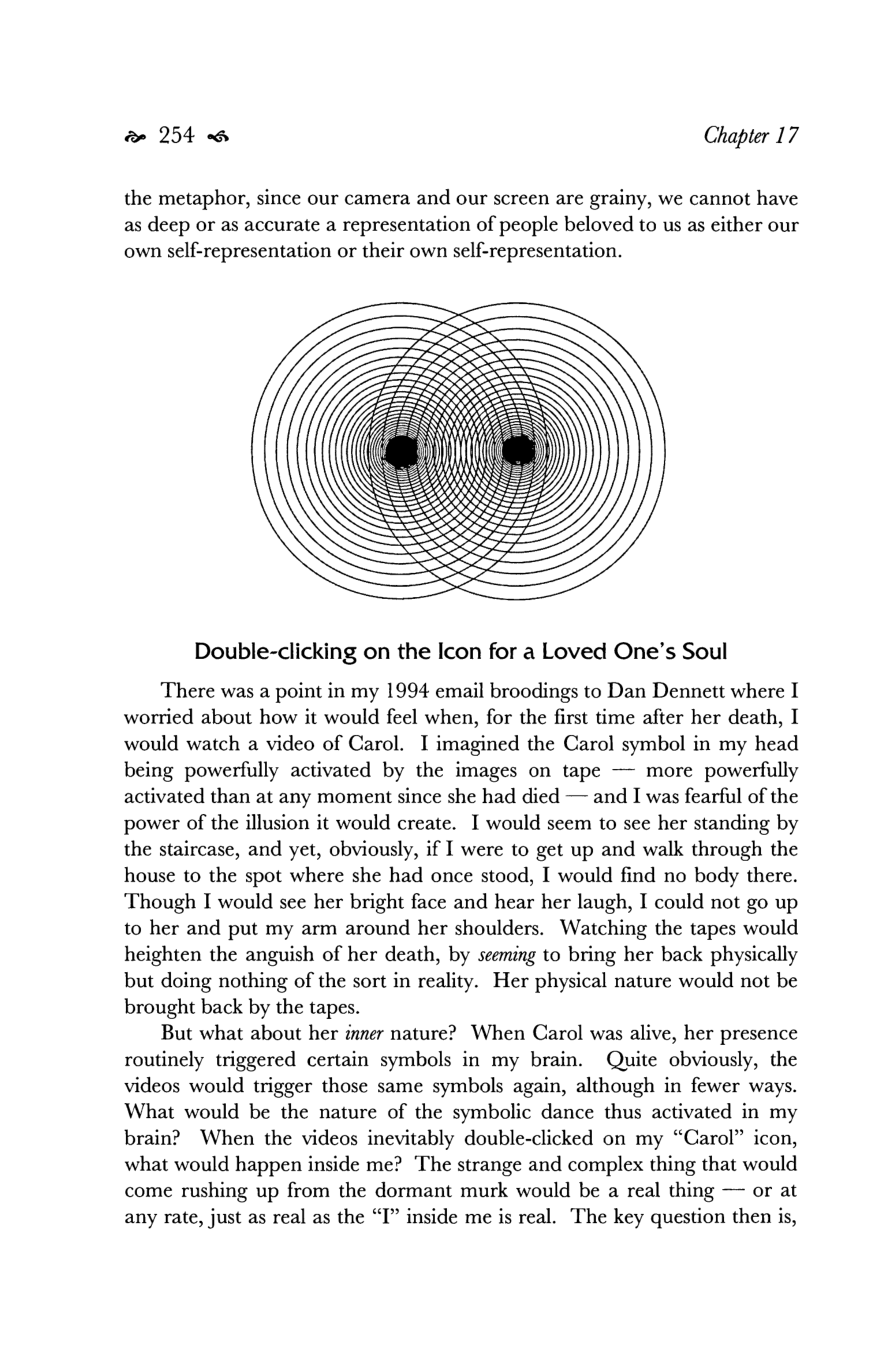
Living Through Another
- Videos of Carol reawaken symbolic patterns in the narrator’s brain, prompting him to question whether the resulting inner presence is genuinely real.
- Dan Dennett’s phrase that Carol would be “thinking with” the narrator’s brain suggests that shared memories could let her continue interpreting the world through him.
- Faces, voices, and familiar places can acquire Carol’s meanings when processed through memories the narrator absorbed during their life together.
- Carol’s continued presence depends on the fidelity and extent of those imported memories: she can live on in him only insofar as he accurately carries her experiences.
- The narrator compares these internal representations to mosaics: Carol’s self-portrait was exquisitely fine-grained, while his portrait of her was coarser but enriched by years of intimacy.
To that extent, and only to that extent, Carol would be thinking with my brain, feeling with my heart, living in my soul.
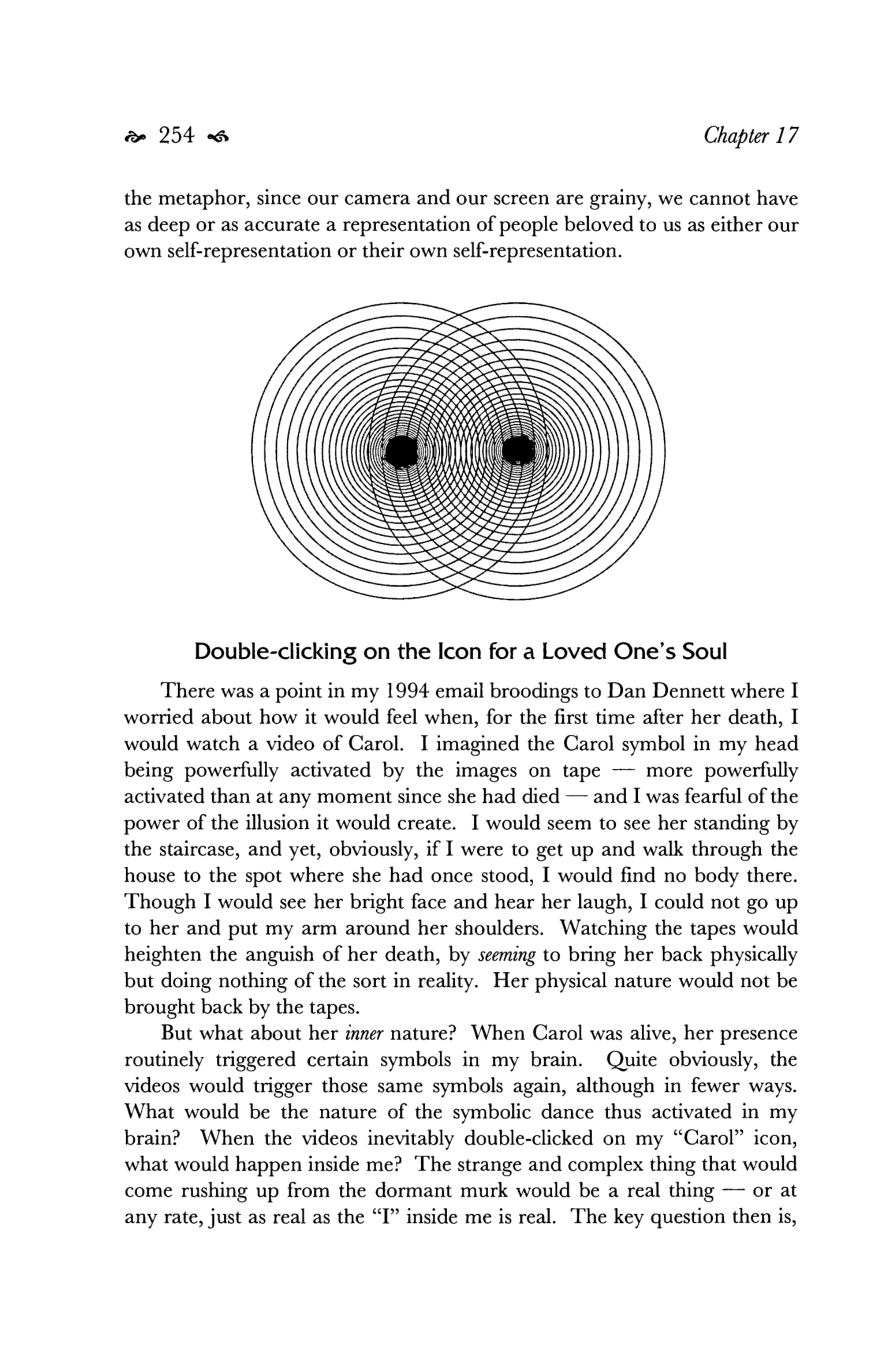
Patterns, Memories, and Selves
- Memories absorbed from loved ones, friends, books, films, and art can become vivid parts of one’s own identity, even when they were never personally experienced.
- Pseudo-memories can be mistaken for genuine memories, and without correction may become integral to a person’s self-image.
- The distinction between lived memories and imagined or inherited ones is portrayed as increasingly blurred over time, with both functioning as an emotional library awaiting revival.
- The possibility of sharing or recreating another person’s consciousness raises the question of whether physical brain matter is essential to subjective experience.
- The text argues that consciousness depends not on specific cells but on patterns of organization, suggesting that the same conscious experience could potentially be instantiated in different physical substrates.
The pattern of organization is what matters, not the substance. It ain’t the meat, it’s the motion!
Patterns After Death
- The molecules composing a person are not themselves the experiencers of consciousness; what matters is the organized pattern they form.
- Because patterns can be copied across different media, translation and memory can preserve something essential despite differences in language, upbringing, or physical substrate.
- The author argues that Carol’s “soul” can be transplanted into his brain because he shares enough understanding of the formative experiences that shaped her.
- Such preservation is necessarily incomplete: his memories of Carol are coarse, fragmentary copies rather than a full continuation of her original self.
- Death remains irreducibly painful, yet the dead persist temporarily as an afterglow in the memories and souls of those who loved them, fading only over generations.
When the sun is eclipsed, there remains a corona surrounding it, a circumferential glow. When someone dies, they leave a glowing corona behind them, an afterglow in the souls of those who were close to them.
Distributed Human Identity
- The familiar “caged-bird metaphor” treats one body or brain as containing one discrete person or soul.
- The author proposes that a human brain hosts not only its primary identity but also partial, coarse-grained copies of other people’s strange-loop patterns.
- Because every brain can contain such representations, each human consciousness exists to varying degrees across multiple brains, while retaining a principal or “main brain.”
- This theory makes possessive terms such as “my brain,” “my soul,” and even “my” itself more ambiguous than ordinary speech suggests.
- Everyday language remains workable because the main brain provides a primary reference point, even though identity is distributed socially across other minds.
My soul lives to lesser extents in brains that are not mine.
The Self Elsewhere
- The author considers metaphors for a mind or identity distributed across multiple locations, including swarms, tornadoes, underground plants, and embassies, but finds none fully adequate.
- Common sense says a person occupies one place, yet immersive experiences such as IMAX films make us feel located somewhere other than where our body physically sits.
- This sensation of “virtual displacement” is usually dismissed as suspended disbelief, but it may reveal how flexible and divided personal identity can be.
- The author revisits a webcam experience involving dogs and imagines greatly enhanced audiovisual technology that could make viewers feel as though they inhabit another body.
- Teleportation goggles serve as a thought experiment for testing whether conscious presence can be relocated while the physical body remains elsewhere.
You feel you have been transported to a place where your body is actually not located, and where your brain is not located either, for that matter.
The Experience of Telepresence
- Telepresence arises when remote audiovisual input and mediated control make a person feel located somewhere other than where their body actually is.
- The Ollie experiment suggests that sustained sensory immersion can shift one’s felt identity toward a remote machine or environment.
- The author distinguishes physical presence from the powerful subjective sense of being elsewhere, even when movement and bodily location remain fixed.
- During the typesetting of Gödel, Escher, Bach, prolonged work at Stanford made the author continue to feel psychologically present there after returning to Indiana.
- A telephone conversation with Scott Kim recreated the author’s visual experience of the Stanford terminal, demonstrating that telepresence can emerge through sound alone.
It was as if my eyes, though in Bloomington, were looking at an Imlac screen in California, thanks to Scott’s eyes and the clarity of his words on the phone.
The Fluidity of Presence
- Advanced telepresence could make a person feel fully located in California while their brain remains in Indiana, blurring the distinction between physical and virtual presence.
- The usual clues favoring Indiana as the “real” location—needing a helmet to reach California or being unable to eat there—could potentially be engineered away.
- As telepresence improves, the supposedly primary physical location becomes less significant, raising the possibility that a brain in a vat could sincerely believe it inhabits a remote robotic body.
- These thought experiments challenge deeply rooted assumptions about where consciousness is located, even though they are intended as philosophical tools rather than science-fiction predictions.
- Reading a novel provides an everyday example of virtual presence: attention shifts from the physical room and printed marks to an imagined world experienced as perceptually real.
What one starts to realize, as one explores these disorienting but technologically feasible ideas of virtual presence “elsewhere”, is that as the telepresence technology improves, the “primary” location becomes less and less primary.
Where Is the Self?
- Written symbols can instantly transport readers into distant places, times, and imagined perspectives, showing how perception constructs vivid realities from simple marks.
- A reader may simultaneously occupy several viewpoints—their physical location, a fictional character’s setting, and an imagined scene—making the idea of a single “real” self uncertain.
- The author’s encounter with a jogger illustrates how shared experience can create a fleeting sense of inhabiting another person’s perspective, even without literally seeing through her eyes.
- Hypothetical nose-mounted cameras and tunable glasses expose how easily visual perspective could be detached from bodily location and switched among different people.
- Remote-controlled robots and vehicles further complicate the meaning of “where I am,” raising the possibility that identity and presence may belong to a body, a controlling mind, or both.
Black curlicues on a white background, when suitably arranged, transport us in milliseconds to arbitrarily distant, long-gone, or even never-existent venues and epochs.
The Blurry Self
- Everyday encounters, especially overheard conversations and intimate dialogue, allow people to enter one another’s private viewpoints to varying degrees.
- Extensive communication can make two people’s worldviews partially fuse, enabling a form of mental “travel” into another person’s hopes and fears.
- This interpenetration of minds is presented as the true meaning of empathy, though it remains an incomplete, lower-resolution form of being someone else.
- Human identity depends on having one primary self to return to; multiple equally powerful selves would make the meaning of “I” unstable.
- Ordinary inner conflicts already reveal rival impulses within us, but we generally accept them as a normal part of being human rather than treating them as a crisis of identity.
To varying degrees, we human beings live inside other human beings already, even in a totally nontechnological world.
One Soul, Many Places
- The apparent split between different cognitive processes does not require abandoning the commonsense idea of a single self; that idea remains a highly effective approximation.
- The author compares this with Newtonian physics: a theory can work extraordinarily well in ordinary conditions while breaking down at extreme limits.
- Everyday mental conflicts reveal small deviations from the “one brain, one soul” model, but subordinate mental processes rarely challenge the brain’s dominant coordinating self.
- A person can meaningfully be in two places at once through distributed memories, perceptions, or brain processes without consciously noticing anything unusual.
- The hammerhead shark illustrates how one brain can process unrelated visual scenes simultaneously, raising deeper questions about where an experiencing self is located.
But in this chapter I have tried to show that you can indeed be in two places at the same time, and you don’t even notice anything funny going on.
Blurry Shared Consciousness
- Human brains routinely process multiple simultaneous worlds, so the idea that consciousness must be confined to one place at a time breaks down.
- Emotional closeness does not require literal shared sensations; another person’s experiences can be partially reproduced within our own minds.
- When Laura describes eating a familiar falafel, the narrator experiences a delayed, diminished form of her pleasure through memory and imagination.
- This “sympathetic pleasure” shows that feelings can be transmitted across distance and time, making personal boundaries less absolute.
- The central claim is not that minds fully merge, but that experiences from other brains are copied into us in a coarse-grained, imperfect way.
And so, at a distance, at a delay, and to a diminished degree, I am in her skin and she is in mine.
Interpenetrating Souls
- Emotional closeness allows thoughts and experiences to be copied between brains, suggesting that intensified communication could gradually dissolve the boundary between individuals.
- Although humanity lacks the extreme brain-to-brain bandwidth imagined in Twinwirld, ordinary relationships already provide glimpses of souls overlapping.
- Deep empathy—sharing a friend’s triumphs, romances, or misfortunes—amounts to partially living another person’s life inside one’s own mind.
- Everyday phrases such as “I feel for you” acknowledge this connection while avoiding the unsettling idea that souls genuinely interpenetrate.
- The familiar “caged-bird” metaphor treats each soul as sealed inside its body, a deeply ingrained assumption that obscures the fluidity of personal identity.
What are you doing but living their life inside your own head?
Blurry Selves, Interwoven Peoples
- The text rejects both the idea that each person is an utterly separate point and the claim that everyone is literally the same person.
- Instead, individuals are imagined as localized but blurry regions whose identities can overlap, allowing people to partially share one another’s existence.
- The same model is applied to countries and peoples, challenging the assumption that cultural identity aligns perfectly with physical borders.
- Migration and tourism demonstrate that nations and cultures continuously intermix, even though the concepts of “country” and “people” remain useful.
- Regional examples such as French-speaking Valle d’Aosta and German-speaking Alto Adige reveal the persistent blur between geography, language, and cultural identity.
Each of them is instead spread out into the other one, and each of them lives partially in the other.
National Halos and Afterglows
- National identity is inherently blurry: it is centered on a geographic homeland but extends beyond its borders and cannot be reduced to territory alone.
- The enduring connection of Overseas Chinese to China illustrates how a people can remain part of a nation even after emigration and physical separation.
- A country’s land mainly serves as a breeding ground for inherited genes and cultural memes—languages, traditions, stories, recipes, and customs—that can survive elsewhere.
- The histories of partitioned Poland and the Jewish Diaspora show that a people can endure without a homeland by preserving its culture, beliefs, and collective memory.
- Human identity after death is similarly understood as an afterglow in the minds of others, gradually fading as successive generations pass away.
It is a “halo” of Chineseness that extends far beyond the physical borders of the land.
Souls, Love, and Consciousness
- Death is portrayed as a gradual fading rather than an instantaneous cessation, because a person’s essence is distributed across the brains of others.
- Funerals and memorials reunite loved ones to rekindle and preserve the deceased person’s presence in their memories and minds.
- Human love is defined by the depth and brightness of another person’s internal representation—the more deeply someone is rooted in us, the more their symbolic “light” remains.
- The author treats “self,” “soul,” “I,” inner light, and consciousness as different names for the same phenomenon, existing in varying shades across natural and artificial beings.
- Against skeptics who distinguish consciousness from identity, the author offers a deliberately compressed thesis: consciousness is the activity of symbols—or thinking—within the brain.
Though the primary brain has been eclipsed, there is, in those who remain and who are gathered to remember and reactivate the spirit of the departed, a collective corona that still glows. This is what human love means.
The Dance of Symbols
- Consciousness and thinking arise when external events selectively activate dormant symbols in the brain, bringing them into novel configurations.
- The theory focuses on activity at the symbolic level rather than merely on neurons or physical matter.
- Skeptics demand a separate “reader” who experiences the activated symbols, but this may simply restate the problem using “aware” instead of “conscious.”
- Seeking an observer behind the symbols risks an infinite regress, continually postponing rather than explaining consciousness.
- Human brains specialize in compressing complex patterns into familiar symbols and identifying the essential gist of a situation, a capacity far less developed in simpler animals.
This dance of symbols in the brain is what consciousness is. (It is also what thinking is.)
How Memories Echo
- Nicole’s rejection initially feels wholly unique, yet it quickly evokes many earlier experiences of being disappointed or turned down.
- The mind abstracts away the surface details of an event, recognizing a deeper pattern that connects it to dormant memories.
- Once activated, old memories trigger still other memories, bringing long-buried emotional episodes back into consciousness.
- The cascade of associations eventually condenses into a single emotional conclusion: “jilted,” expressing the research group’s shared disappointment.
- A richly complex social encounter can therefore be reduced by the mind to one compact, emotionally charged symbol.
These old sagas, long ago wrapped up in nice neat mental packages, had been idly sitting around on the shelves of my brain, waiting to be triggered if and when “the same thing” should ever happen, in new guise.
Consciousness as Symbolic Dance
- Memory organizes complex experiences, such as the Nicole saga, into retrievable symbolic packages associated with dominant categories like “jilt.”
- Cognition operates through a looping process in which activated internal symbols trigger the retrieval and activation of other symbols.
- The author argues that perceiving internal symbolic patterns is not fundamentally different from recognizing objects in the external world, since sensory information ultimately becomes internal processing.
- There is no separate, magical “consciousness locus”; the perceiver of symbolic activity is itself another layer of symbolic activity.
- To examine objections to this view, the author introduces a dialogue between two personas: Strange Loop #641, representing the book’s ideas, and Strange Loop #642, representing skeptical challenges.
There is not some special “consciousness locus” where something magic happens, something other than just more of the same, some locus where the dancing symbols make contact with... well, with what?
The Inner Light Debate
- Two strange loops begin a debate between a believer in the book’s theory and a skeptical doubter.
- The doubter rejects supernatural dualism but insists consciousness requires a special explanation beyond ordinary physical activity.
- The believer argues that consciousness is an unusually intricate material pattern, with an “inner light” that grows stronger across increasingly complex organisms.
- The doubter objects that describing brain processes still leaves out the subjective “I,” including individual points of view and inner experience.
- The exchange frames the central tension between explaining consciousness physically and accounting for why the universe contains beings capable of experiencing it.
An “inner light” starts to turn on as we rise in this hierarchy. The light is still incredibly dim even at the list’s end, but if we extend the list further and sweep upwards through the brains of bees, goldfish, bunnies, dogs, and toddlers, it grows far brighter.
Strange Loops and Consciousness
- Sophisticated perception allows certain physical systems to mirror their surroundings and launch actions based on what they perceive.
- Primitive perceivers such as thermostats, knees, sperm, and tadpoles lack consciousness; consciousness emerges when perception operates through a rich, extensible system of symbols.
- A skeptical view argues that the universe contains only physical processes and no genuine “I” or “here,” raising the problem of subjective existence.
- The response locates selves in rare regions of the universe—especially human brains—where distinctive abstract patterns generate an “I” and a sense of “here.”
- Consciousness is compared not to ordinary physical vortices but to Gödelian strange loops: highly structured systems in which meanings and categories build upon themselves through evolutionary complexity.
To make an “I” you need meanings, and to make meanings you need perception and categories — in fact, a repertoire of categories that keeps on building on itself, growing and growing and growing.
What Makes a Self?
- The dialogue asks what could make one particular physical “strange loop” constitute a person rather than merely another complex structure.
- SL #641 argues that the self is an emergent outcome of a brain’s gradual development, accumulated experiences, language, and cultural conditioning—not a preexisting entity.
- The sense of “I” forms slowly as a developing brain begins to model itself and its location in the world, initially through awareness of the body that contains it.
- A challenge arises when indistinguishable brains are compared to inert machines: each conscious being nevertheless insists that it is located in its own body and experiences its own world.
- SL #642 rejects the idea that physical complexity alone explains consciousness, appealing instead to an additional, irreducible soul grounded in first-person experience; SL #641 counters that sophisticated brains could produce the same self-descriptions.
The knotty issue that simply will not go away is: What would make one of those strange loops me? Which one?
What Makes Experience Real
- Conscious experience is presented as more than producing words or signals; it requires genuinely felt, qualitative sensations such as seeing vivid purple.
- The discussion questions whether animals possess primordial experiences and whether differences in brain complexity imply differences in the richness of consciousness.
- Although complexity may shape the kinds of experiences an organism can have, it does not by itself explain why some physical systems feel anything at all.
- The experience of a flower’s color is enriched by details, surroundings, memories, and associations, challenging the idea that even basic sensations exist independently of context.
- Feeling distinguishes conscious organisms from merely responsive physical objects: a rope moves in the wind, but it does not possess an inner point of view.
A dangling rope doesn’t feel anything when a breeze impinges on it. There’s no feeling in there, there’s no here there.
Patterns Behind Experience
- The dialogue questions whether individual sensual experiences are the fundamental building blocks of mental life, comparing them to letters, words, and literary meaning.
- Meaning does not reside in isolated letters or words alone; it emerges from how they are arranged within larger, complex structures.
- Music provides a parallel: individual notes lack emotional significance, while melodies can evoke attraction or repulsion through their organization and logic.
- This suggests that conscious experience may arise from patterns of organization rather than from any special intrinsic quality in the components themselves.
- The proposed substance “feelium” is presented skeptically, since any inanimate substance would still need an explanation for how it could generate sensation.
A piece of music can have great emotional meaning despite being made of tiny atoms of sound that have no emotional meaning. What matters, therefore, is the pattern of organization, not the nature of the constituents.
The Origin of “I”
- The dialogue considers whether consciousness might arise from a dynamic, firelike physical process called “feelium,” rather than from inert matter.
- Even if feelium could explain which patterns produce experience, it would not immediately explain why one experiencer is a particular “I” rather than another.
- The speaker insists that personal identity feels localized: an inner fire is experienced as belonging to this brain and not to others.
- The response rejects the idea that a preexisting self enters a brain; instead, the self gradually emerges through the unpredictable experiences of a particular body and brain.
- Each “I” is defined by its history of experiences, making the question “Why couldn’t I have had someone else’s experiences?” a seductive but mistaken reversal of causality.
My inner fire is here, not anywhere else. I want to know what singles out this particular fire from all the others.
The Unhoused Self
- Personal identity is not something that begins as a fully formed self inside a particular brain; it gradually coalesces from evolving mental tendencies and verbal habits.
- The sense that one could have been born into another brain arises because the mind’s self-story imaginatively moves into other people through empathy, intimacy, and friendship.
- The question “Why am I here and not there?” is presented as a consequence of this mental projection, not as evidence that an enduring self might have occupied any brain arbitrarily.
- Although aspects of the self spill over into relationships with others, identity remains localized rather than evenly distributed across humanity.
- The dialogue ultimately challenges the assumption that the “I” is housed anywhere at all, portraying it instead as a self-reinforcing structure.
But unlike those physical systems, it could perceive and evolve in sophistication, and so, as weeks, months, and years passed, there gradually came to be someone in there.
The Illusion of Self
- The brain necessarily invents an “I,” but this self is portrayed as a powerful, self-reinforcing illusion—like the nonexistent marble seemingly felt inside a box of envelopes.
- The illusion of self emerges from “strange loops” in symbol-possessing brains and offers significant survival value by helping organisms navigate danger.
- The concept creates a paradox: if the “I” does not truly exist, who is being deceived, and how can the brain be called “my” brain?
- Because we cannot directly inspect the brain’s inner workings, our only available perspective is subjective experience—which continually confirms the apparent reality of the self.
- The tension between physical laws and conscious experience, along with the apparent ability of an “I” to cause physical actions, suggests that ordinary ideas about selfhood and causation need explanation.
The “I” — yours, mine, everyone’s — is a tremendously effective illusion, and falling for it has fantastic survival value.
The Illusion of “I”
- Physics casts doubt on the independent reality of the self, but for most people the everyday belief in an “I” overwhelms that doubt.
- The text proposes viewing the self as “a hallucination perceived by a hallucination,” an unsettling idea modeled partly on the shift from geocentrism to heliocentrism.
- Although scientifically counterintuitive, the ordinary concept of “I” remains indispensable for explaining human behavior and communicating about people.
- People can shift between everyday and scientific viewpoints, but abandoning belief in the self is far more difficult than accepting that the Earth moves around the Sun.
- The “I” myth persists because it is central to human belief systems and survival, while scientific alternatives are subtler and more psychologically disorienting.
My proposal for a truce to end this batde is to see the “I” as a hallucination perceived by a hallucination, which sounds pretty strange, or perhaps even stranger: the “I” as a hallucination hallucinated by a hallucination.
The Necessity of the I
- Consciousness is described as a self-referential dance of symbols: the brain’s symbolic processes are themselves perceived by symbols, perpetuating the cycle.
- From a purely microscopic perspective, mental entities such as desires, memories, and beliefs disappear into physical events, leaving no obvious room for downward causality.
- The higher-level view of experience is criticized as magical because it introduces experiencers, immaterial souls, and distinct forms of causality, even though it can sometimes explain phenomena more usefully.
- The speakers acknowledge an ironic dilemma: a strictly scientific explanation may be correct yet practically hopelessly useless, while human life depends on myths and abstractions.
- Although Taoism and Zen seek to dismantle the “I,” humans seemingly need an enduring sense of self to perceive abstractions, organize patterns, and create increasingly complex symbols.
Sometimes the strict scientific viewpoint is hopelessly useless, even if it’s correct. That’s a dilemma.
The Glory of Simplification
- Despite microscopic chaos, the world exhibits dependable macroscopic regularities—such as the motion of swings, shopping carts, and pedestrians—that make prediction possible.
- Human understanding relies on radically simplifying reality into useful categories rather than tracking every underlying particle interaction.
- We project desires, beliefs, and a unified “soul” or inner viewpoint onto minds, including ourselves, creating a persistent narrative of the “I.”
- Self-awareness intensifies this illusion because the mind continually observes itself and constructs an elaborate story about its own central essence.
- A completely perception-free or “I”-less state is impossible for creatures that must navigate the world; coarse-grained perception is not a tragedy but the basis of human survival and understanding.
We’re stuck at the level of radical simplification, for better or for worse.
The Mystery of “I”
- Using words to understand mystery inevitably brings us into contact with paradox, especially through the pronoun “I.”
- “I” refers simultaneously to a physical organism made of trillions of cells and to an abstract psychological pattern of memories, traits, desires, and emotions.
- This dual reference parallels Gödel’s self-referential sentence, which can be about numbers while also referring to itself.
- One speaker sees “I” as a uniquely mystical, self-pointing nexus of human existence; the other argues that it relies on ordinary referential stability and coding.
- Being still feels mysterious because finite beings cannot fully inspect the physical substrate that generates their sense of self.
It is just one thing described in two phenomenally different ways, and that's just the same as Godel’s sentence.
Gödelian Life and Self
- DNA self-reproduction mirrors Gödel’s self-reference: a blueprint is interpreted, copied, and used to construct an identical “child” machine.
- John von Neumann’s self-reproducing machine anticipated the abstract mechanism later recognized in molecular biology.
- Stable mappings—especially the genetic code—allow physical systems to acquire meaning, making self-reproduction and the development of life possible.
- The feeling of being a unique “I” is profound but does not transcend physical law; it emerges from perception, symbolism, and feedback that turns awareness back upon itself.
- This self-model becomes so compelling that it presents itself as primary reality, seeming magical while remaining a physically grounded “strange loop,” like Escher’s Drawing Hands.
The sole root of all these strange phenomena is perception, bringing symbols and meanings into physical systems. To perceive is to make a fantastic jump from William James’ “blooming, buzzing confusion” to an abstract, symbolic level.
The Teletransporter Riddle
- The preceding dialogue closes with playful gratitude, treating metaphors as tools for making sense of existence and the mystery of being “here.”
- The chapter returns to the troubling question of why a person experiences life from one particular brain rather than any other.
- Derek Parfit’s teletransporter thought experiment makes this identity puzzle vivid: a machine destroys the traveler’s body while recreating an exact duplicate on Mars.
- Repeated teleportation seems harmless because the traveler wakes with identical memories, appearance, and consciousness, making continuity feel unquestionable.
- The New Scanner preserves the original while creating a duplicate, forcing the protagonist to confront whether personal identity can exist in two places at once.
“Wait a minute,” I reply, “If I’m here I can’t also be on Mars.”
Replica and Identity
- A New Scanner perfectly reproduces Parfit’s body and mind on Mars, but its process fatally damages the Earth-based original, forcing him to confront imminent death.
- Parfit’s Replica tries to console him by promising to continue his relationships, family life, and unfinished book, yet these assurances cannot overcome the prospect of losing consciousness forever.
- The story exposes how easily we equate psychological and physical similarity with personal identity, especially when deciding whether the Martian person is truly Parfit or merely a copy.
- The apparent contradiction between the scanner’s two episodes reveals that our intuitions shift depending on whether the original body remains nearby or is destroyed.
- The passage criticizes readers as “mindless pushovers” for accepting teleportation as travel in one scenario while treating the surviving Earth version as the obvious real person in another.
Oh, but what mindless pushovers we are! Whereas we bought right into the “teleportation equals travel” theme of Episode I, falling for it hook, line, and sinker, we seem in Episode II to have unthinkingly taken the path of least resistance.
Identity and Teleportation
- A newly created Martian duplicate would sincerely claim to be the original Parfit because it possesses identical memories, showing that first-person testimony cannot conclusively establish personal identity.
- The Earthbound and Mars-borne versions of Parfit create symmetrical claims to authenticity, making it impossible to determine which one is the “real” person from the story alone.
- The way a thought experiment is narrated strongly shapes readers’ intuitions about what they find credible.
- Dennett’s concept of “intuition pumps” explains how carefully designed philosophical fables guide emotional and intellectual responses.
- The passage reveals striking similarities between Parfit’s teleportation case and Dennett’s earlier fantasy in The Mind’s I, differing mainly in presentation, planets, and characters.
My jaw fairly dropped. It was exactly the same fantasy, only with planets reversed and sexes reversed, and told in a more American style.
Parfit and Personal Identity
- Parfit’s teletransportation story raises the central question of which duplicate, if either, is the real person after transmission.
- The author argues that any serious theory of consciousness must confront the natural but unsettling question: “Which of the two would I be?”
- A “Cartesian Ego” is presented as an indivisible, private essence that makes each person uniquely themselves and serves as the subject of experience.
- The two teleportation episodes expose the difficulty of locating such an ego: it might travel, be destroyed, remain behind, or somehow belong to both versions.
- Parfit challenges the very coherence of personal identity in extraordinary cases, while acknowledging that the concept remains useful in ordinary life.
In my strange distorted imagery, that yolk is the secret of human identity — and alas, Parfit’s central mission in his book is to mercilessly crush the whole egg, and with it, the sacred yolk!
Identity Under Pressure
- Parfit tests the seemingly fundamental notion of a singular Cartesian Ego against extreme thought experiments, much as Einstein tested classical physics at the limits of speed and scale.
- His central conclusion is that personal identity becomes indeterminate under unusual conditions; in some cases, asking “Which one of them am I?” has no valid answer.
- A teleportation scenario producing identical people on Venus and Mars eliminates any obvious basis for deciding which copy is the original person.
- Despite this, ordinary intuitions insist that one copy must be real and the other fake, because we are accustomed to being located in one body at one time.
- Parfit and the author suggest that identity is not strictly black or white but exists in shades of gray, with language and cultural conventions hiding this ambiguity in everyday life.
To our everyday, downhome, SL #642~style minds, it’s very stark and very simple: one of the Parfits is a fake.
Parfit’s Radical Identity
- Parfit replaces the notion of indivisible personal identity with “psychological continuity,” treating selves as related by degrees of similarity rather than by an absolute boundary.
- A mind-to-mind “distance” would make today’s self closest to yesterday’s self, while acknowledging that they are not literally identical.
- The belief that objects and people remain the same over time is presented as a deeply ingrained cognitive convention that simplifies language and everyday life.
- Parfit’s view challenges foundational intuitions about existence, continuity, death, and personal identity with a force compared to relativity and quantum mechanics.
- Though disturbing, this perspective can also be liberating, reshaping how one relates to oneself, loved ones, and humanity more broadly.
The new view that Parfit proposes is a radical reperception of what it is to be, and in certain ways it is extremely disturbing. In other ways, it is extremely liberating!
Parfit’s Honest Doubts
- The author admires Parfit’s final section because he questions whether he truly believes the radical philosophical system he has constructed.
- Unlike the imagined Einstein analogy, Parfit is confident in his conclusions without claiming absolute certainty, acknowledging that his intellectual framework might still collapse.
- Parfit distinguishes between accepting the Reductionist View intellectually and continuing to resist it emotionally or instinctively.
- He compares this tension to fearing a fall from a skyscraper despite knowing one is physically safe, or fearing an ominous button despite understanding the risks rationally.
- Parfit’s willingness to expose these lingering doubts makes his philosophy unusually humble, psychologically honest, and compelling.
At the reflective or intellectual level, I would remain convinced that the Reductionist View is true. But at some lower level I would still be inclined to believe that there must always be a real difference between some future person’s being me, and his being someone else.
Parfit’s Morphing Identity
- A thought experiment imagines neurosurgical switches gradually replacing Derek Parfit’s personality traits with Napoleon Bonaparte’s, raising the question of when one person becomes the other.
- Parfit argues that identity depends on psychological continuity, which changes by degrees rather than through a clear-cut, all-or-nothing transition.
- On this view, a person can genuinely be partly Parfit and partly Napoleon, with countless possible hybrid identities between them.
- The classical Cartesian-Ego view demands a definite boundary, implying that Parfit’s identity would suddenly vanish and be replaced by Napoleon’s at one precise moment.
- The scenario exposes how deeply people’s emotional and cultural intuitions depend on the belief in indivisible, stable personal identities.
A person can be partly Derek Parfit and partly Napoleon Bonaparte, and drifting from the one to the other as the switches are thrown.
The Halo of Possible Selves
- A series of imagined “switches” radically reverses the author’s musical tastes, hobbies, politics, ethics, and philosophical views, testing what remains of personal identity.
- The author suggests that even changing one deeply held trait could make the resulting person feel entirely unlike “me,” revealing how strongly identity depends on core commitments.
- Milder changes—such as never encountering a favorite piece of music or occasionally watching football—would still produce recognizable alternate versions of the self.
- Personal identity is portrayed as surrounded by a spectrum of possible selves shaped by accidental experiences, relationships, and paths never taken.
- The word “who,” like personal pronouns, can subtly encourage us to treat entities—including machines—as more person-like than ordinary objects.
These are shades of gray that create a halo of “possible Dougs” around the Doug that I happen to have become, thanks to a million accidental events that have befallen me over the decades.
The Illusion of Self
- The discussion challenges a sharp divide between machines that merely think and machines that possess inner experience or a distinct personal identity.
- A person’s essence may consist not of a hidden inner core but of countless recognizable ways of smiling, speaking, listening, suffering, and relating to others.
- The sense of “I” is portrayed as a self-reinforcing illusion: it convinces itself that it is more substantial than the patterns and habits that constitute it.
- Parfit’s idea of “double survival” creates ambiguity over whether duplication means one person survives, two people exist, or the question has no meaningful answer.
- In the Venus-and-Mars teleportation scenario, both copies sincerely feel they are the original, suggesting that identity is grounded in psychological tendencies rather than a singular Cartesian ego.
But knee-jerk reflex or not, the truth of the matter is that there is no thing called “I” — no hard marble, no precious yolk protected by a Cartesian eggshell — there are just tendencies and inclinations and habits, including verbal ones.
The Illusion of Self
- The sense of being a single, unified “I” is portrayed as a reflexive habit rather than an independently existing entity.
- Although the self is ultimately described as a hallucination, it remains deeply valuable—much like money, whose worth depends on shared social conventions.
- The author argues that a person may be distributed across multiple brains and therefore exist in more than one place at once.
- The identity of a person is compared to the identity of a train: continuity depends less on fixed substance than on naming conventions and patterns of connection.
- If machines develop rich systems of self-representation, the distinction between “who” and “that” may gradually extend to them, just as belief in a Cartesian ego can fade gradually.
Ultimately, the “I” is a hallucination, and yet, paradoxically, it is the most precious thing we own.
Souls, Machines, and Meaning
- The author argues that seemingly bizarre questions about consciousness and artificial minds can illuminate the real experiences of human beings, including identity, decline, and death.
- As Jim’s Alzheimer’s disease erodes his memories and sense of self, his humor, ideals, preferences, and dreams survive in the minds of those who have loved and known him.
- This dispersed survival forms a “soular corona”: a diminished, low-resolution version of Jim’s first-person perspective existing across many other brains.
- The question of whether a future thinking machine should be called “who” or “which” is not merely grammatical, because such categories shape how humans treat and value entities.
- Against David Chalmers’s distinction between machines that think and machines who think, the author identifies thinking with consciousness and therefore considers thinking machines worthy of personal pronouns.
It is very sad, but it is also beautiful. In any case, it is our only consolation.
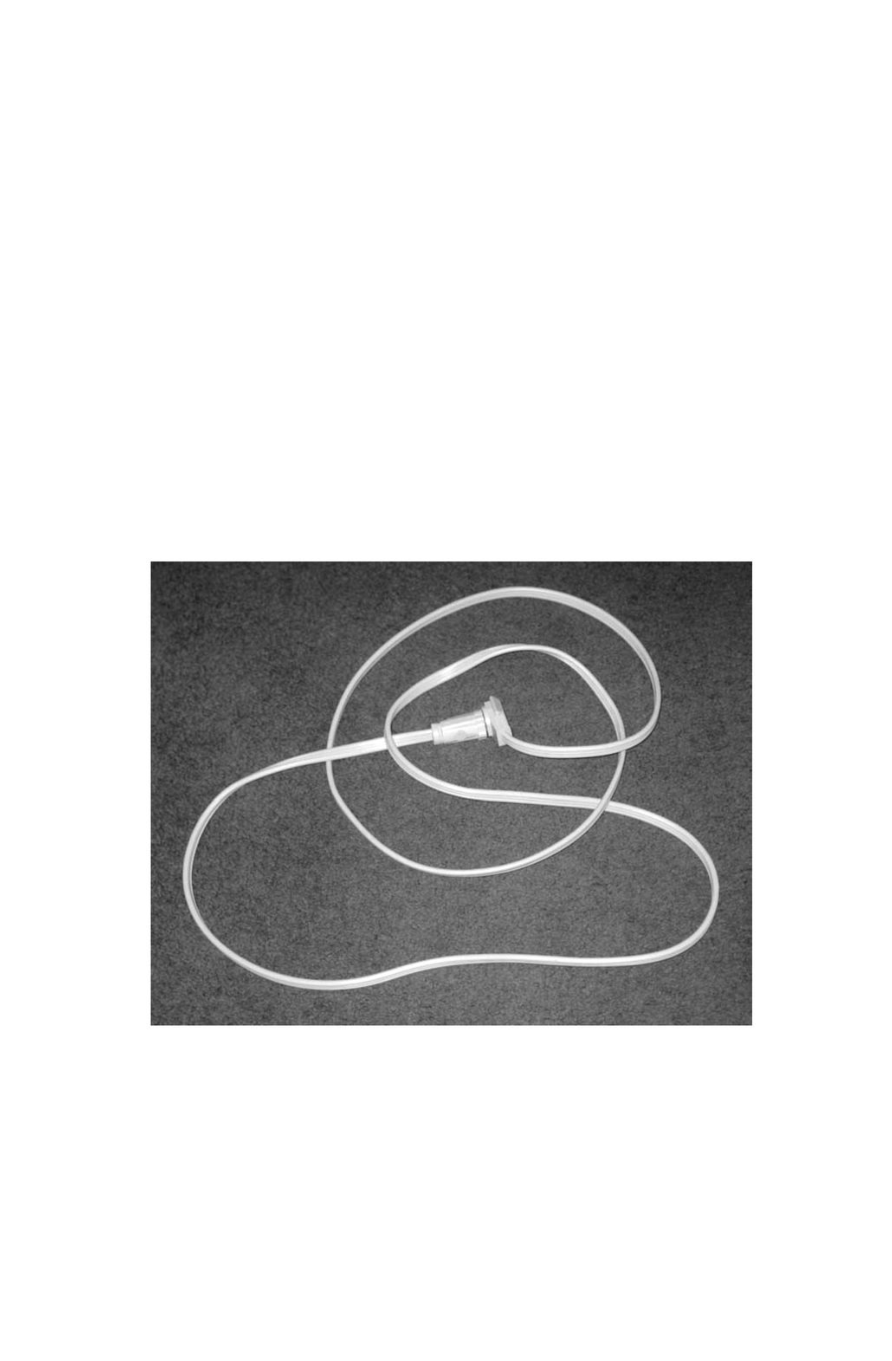
Chalmers’s Twin Machines
- The phrase “machine that thinks” is questioned because thinking beings should be described as “who,” not “that.”
- Chalmers imagines two physically identical machines performing the same difficult geometric proof in perfect synchrony.
- Despite their identical structure and processes, Machine Q supposedly has conscious experiences while Machine Z is a philosophical zombie with none.
- The narrator finds it incoherent to place two identical machines in the same universe while assigning consciousness to only one, since this seems to violate physical law.
- To preserve Chalmers’s thought experiment, the machines are separated into two distinct but isomorphic universes with identical laws of physics and corresponding histories.
Machine Q (it stands for “qualia”) is actually feeling something, whereas Machine Z (it rhymes with “dead”) is feeling nothing.
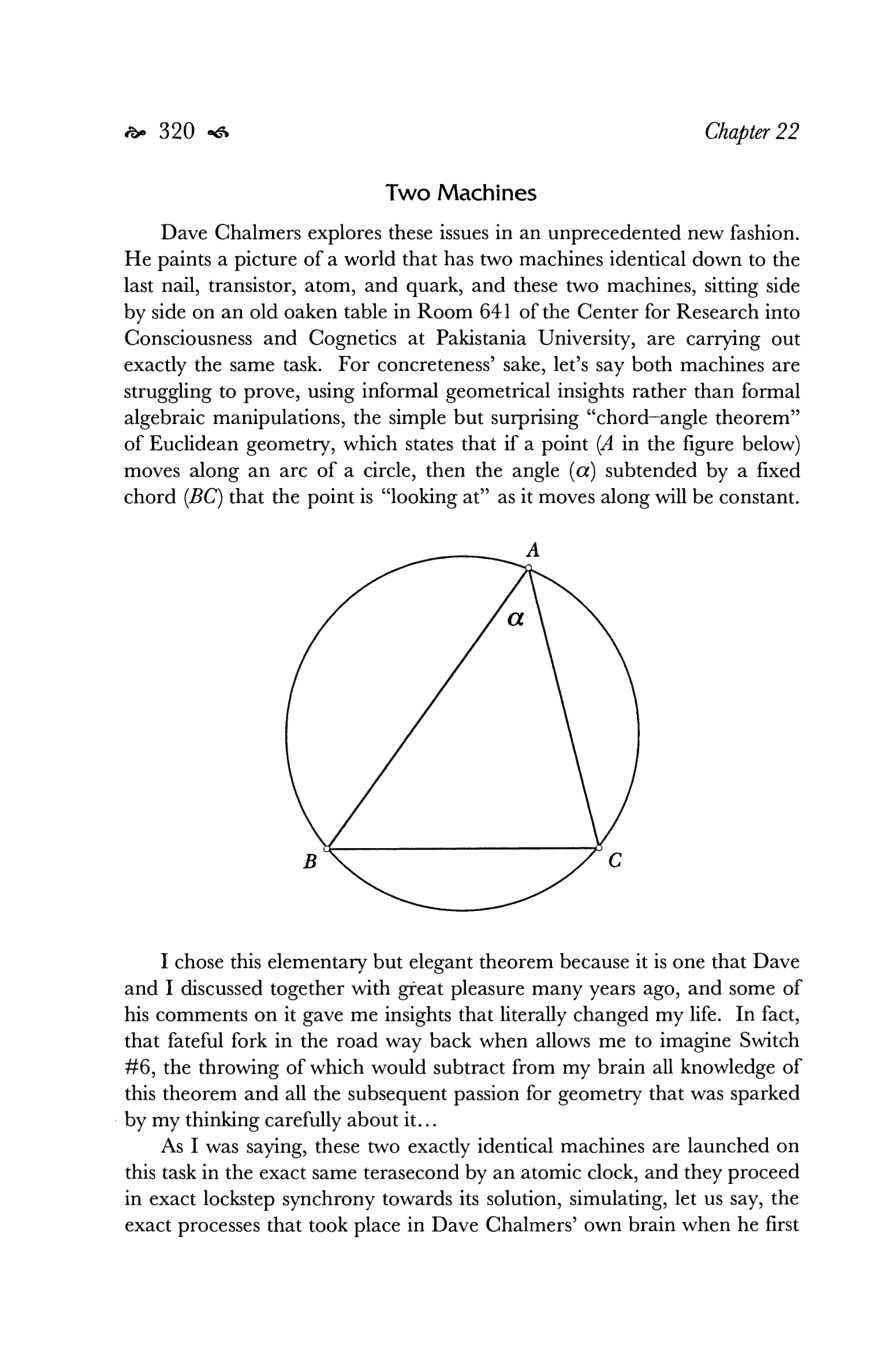
The Zombie Universe
- Universes Q and Z are physically identical, with machines that behave exactly alike down to the quark level.
- Despite this identical behavior, Machine Q has genuine feelings while Machine Z is entirely devoid of consciousness.
- The proposed difference is an additional ingredient—dubbed “elan mental”—that produces subjective experience without affecting physical events.
- People in the zombie universe act, speak, laugh, and claim to feel exactly as their conscious counterparts do, making their behavior indistinguishable from the outside.
- A zombie-version of Dave Chalmers lectures about consciousness while unknowingly lacking it, creating an ironic challenge to purely physical explanations of the mind.
Although physics is identical in Universes Q and Z, there are no feelings anywhere in Universe Z — just empty motions.
The Zombie Worry
- David Chalmers distinguishes between a conscious Universe Q and a physically identical but experience-less Universe Z, attributing consciousness to a mysterious extra ingredient called “elan mental” or “feelium.”
- Philosophers of mind use zombies—beings that behave exactly like conscious people without inner experience—to express the fear that consciousness might be absent despite all outward evidence.
- Hofstadter accepts that his view makes humans unconscious in the sense that the “I” is an illusion generated by the brain, while zombie-fearing philosophers insist that genuine consciousness is something more.
- These philosophers claim they can coherently imagine a zombie-filled world indistinguishable from ours, yet maintain that our own world contains real consciousness—leading them to reject Hofstadter and Parfit in favor of Chalmers.
- Following Dennett, Hofstadter argues that zombie scenarios often rely on dehumanizing stereotypes: their imagined zombies do not actually display the perfectly natural, normal behavior they are supposed to duplicate.
The “I” is, when all is said and done, an illusion, a sleight of mind, a trick that a brain plays on itself, a hallucination hallucinated by a hallucination.
Consciousness Is Emergent
- People fear zombies because a world of beings that merely behaves like us seems mechanically empty, despite their professed belief that behavior is all that matters.
- The familiar question—why consciousness was added to complex brains—wrongly treats consciousness as an optional evolutionary feature that could be attached to otherwise identical machinery.
- Consciousness is inseparable from brain design: like horsepower in an engine, it emerges along a continuous spectrum of self-perception as systems become more sophisticated.
- Primitive brains have little or no consciousness, while animals and humans possess increasing degrees of it; sufficiently rich conceptual systems inevitably generate a sense of self.
- The view that consciousness requires something beyond physical law is identified as dualism, which posits a separate realm of magical mental entities.
But consciousness is not a power moonroof (you can quote me on that).
Parodying Magical Essence
- Magical entities are defined as possessing a nonphysical soul containing exactly one “dollop of consciousness,” unlike ordinary entities.
- The author parodies this distinction through “liphosophy,” whose followers believe leaf piles possess an invisible essence called Leafpilishness.
- Leafpilishness is presented as granting each leaf pile a unique identity, while inexplicably excluding haystacks, paper, and French fries.
- The parody exposes how strange and question-begging it is to posit an undetectable essence that determines which physical entities count as special.
- It raises difficult questions about the boundaries of objects, including what constitutes a leaf pile, which leaves belong to it, and whether partial or composite objects could receive the essence.
What is this nutty Capitalized Essence all about? What follows from having this invisible, undetectable aura?
The Consciousness Essence
- The author satirizes the idea that consciousness is a mysterious, nonphysical essence attached to certain physical objects, comparing it to an invented substance called Leafpilishness.
- Treating consciousness as a detachable essence makes ordinary objects seem fundamentally different based on an unknowable “dollop” bestowed from elsewhere.
- This view raises difficult questions about which entities possess consciousness—whole bodies, brains, or specific brain regions—and what qualifies them to receive it.
- The notion also requires an implausible mechanism by which consciousness recognizes eligible objects, attaches to them, and avoids accidentally transferring to nearby matter.
- Questions about whether individual consciousnesses have different properties or serial numbers expose the conceptual absurdity of treating consciousness as a separate substance.
What mechanism in nature makes the elusive elixir of Consciousness glom onto some physical entities and spurn others?
The Mysteries of Dualism
- The idea that Consciousness is a separate essence raises the problem of how it could influence matter without violating physical law.
- Treating Consciousness as something distributed in variable “dollops” only relocates the problem: one must explain how amounts are assigned, stored, altered, and recovered.
- This model creates difficult questions about personal identity and the consciousness of people with dementia, fetuses, animals, plants, machines, and even inanimate objects.
- The author argues that dualism generates an ever-expanding, unmanageable set of mysteries rather than explaining consciousness.
- The discussion then turns to Chalmers’s philosophical zombie, questioning whether a completely feelingless being can genuinely be said to hold beliefs when it claims to enjoy things.
Belief in dualism leads to a hopelessly vast and murky pit of mysteries.
Shades of Sentience
- The distinction between phenomena involving feelings and those that do not is presented as gradual and ambiguous rather than sharply defined.
- A spectrum of verbs—from “agonize” and “exult” to “calculate,” “utter,” and “move”—illustrates varying degrees of implied emotion and sentience.
- The text questions where, if anywhere, a precise boundary should be drawn for attributing feelings, beliefs, or mental states to a zombie twin in Universe Z.
- Our willingness to describe fictional robots such as R2-D2 and C-3PO as frightened or emotionally significant depends more on their behavior than on any proven metaphysical status.
- The discussion returns to the semantic and ethical problem of whether beings indistinguishable in behavior should receive different pronouns—or different moral consideration—based solely on their universe’s supposed lack of consciousness.
What’s the difference between being alive and living? And more importantly, what merits being sobbed over?
Questioning Private Consciousness
- The text extends the question of moral and semantic boundaries from animals to fetuses and newborns, arguing that seemingly pedantic distinctions can have life-and-death consequences.
- The chapter attacks the philosophical “problem of the inverted spectrum,” which imagines that two people may use the same color words while privately experiencing entirely different colors.
- This thought experiment depends on an “Unbridgeable You-Me Chasm”—the idea that each person’s inner consciousness is completely inaccessible to everyone else.
- The imagined case of French people secretly experiencing red as blue and blue as red exposes the implausibility of a total disconnect between subjective experience, language, and shared physical brains.
- The author suggests that consciousness should not be treated as an isolated, ineffable realm wholly separated from observable behavior, biology, and communication.
It all comes from the idea that you are supposedly so different from me that there is no way to cross the gap between our interiorities — no way for you to know what I am like inside, or vice versa.
Against Inverted Spectra
- Extending the inverted-spectrum thought experiment to entire cultures makes its implausibility apparent, exposing it as a kind of naive fairy tale.
- An inverted auditory spectrum seems less plausible than an inverted visual spectrum because extremely low sounds gradually become bodily vibrations rather than remaining pure pitches.
- The two ends of the audible range are objectively asymmetric: low notes can be felt as physical oscillations, while high notes have no comparable bodily counterpart.
- The author argues that visual colors should not be treated as wholly private inventions, since the physical ends of the electromagnetic spectrum are likewise objectively different.
- The imagined sensations of “knurking” and “glebbing” illustrate the philosophical temptation to treat conscious qualities as detachable from their physical causes.
In general, low notes, as they sink ever lower, glide imperceptibly into bodily shakings as opposed to being pitches in a spectrum, whereas high notes, as they grow higher, do not do so.
The Inverted Spectrum
- Humans are assumed to possess innate experiences—“knurking” and “glebbing”—but early development arbitrarily determines which colors trigger which sensation.
- This color reversal is not caused by different neural wiring and cannot be detected through brain scans or any other objective measurement.
- The inverted-spectrum thought experiment proposes that two people with identical brains may nevertheless have completely different subjective experiences of the same color.
- It treats conscious feelings as pre-existing inner abstractions that are mapped onto external stimuli without a physically observable basis.
- The idea extends beyond color: people might attach radically different pleasurable or painful experiences to concepts such as liberty, imprisonment, or political opponents while using the same words.
Maybe experiences that I feel are pleasurable are unpleasurable for you, and vice versa.
The Inverted Spectrum
- The analogy of an “inverted political spectrum” exposes how arbitrary the inverted-spectrum thought experiment can seem when applied outside color perception.
- The imagined sensations of “knurking” and “glebbing” are not identifiable physical brain states; treating them as independent feelings effectively commits one to dualism.
- The argument questions why only colors should be rearranged: if private experiences can be swapped, any experience—from hearing piano notes to attending a baseball game—could supposedly replace another.
- By extending the thought experiment to absurd cases, the author argues that the original inverted-spectrum puzzle is no more coherent than its exaggerated versions.
- The riddle depends on the premise that people possess nonphysical “pure experiences” at birth, which later become attached to particular external stimuli despite identical physical brain states.
I hope that these sound ridiculously incoherent to you, and that you can move step by step backwards from these variations on the inverted-spectrum theme to the original inverted-spectrum riddle without losing the sense of ridiculousness.
The Illusion of Free Will
- The inverted-spectrum thought experiment is criticized as both overly timid and overly bold: it dismisses the physical world’s relevance to experience while relying on an implausibly narrow one-dimensional model.
- The author reframes ordinary “free will” as simply acting because one wants to, rather than because someone else forced the action.
- Desires motivate behavior, but external circumstances—obstacles, failures, other people, and chance—determine which paths remain available.
- Human choices and wants are described as outcomes of physical events in the brain, making the additional claim that they are “free” seem incoherent.
- The intense, thwarted desires of a dog are presented as a vivid example of will, prompting the question of whether human yearning is fundamentally different.
And so we move willy-nilly, but not freewilly-nilly, inside the maze. A combination of pressures, some internal and some external, collectively dictates our pathway in this crazy hedge maze called “life”.
Voting Minds, Unequal Souls
- The author questions what “free will” would mean, arguing that human choices are constrained by circumstance and competing desires.
- Decisions function like a weighted internal vote: stronger desires, including meta-level desires, override weaker impulses.
- Because external events are largely random and uncontrollable, the will is frequently frustrated rather than genuinely free.
- Paradoxically, the stability of this non-free will helps preserve personal identity, making each person recognizably themselves.
- The next chapter challenges the cultural belief that all human lives have equal value, pointing to war and capital punishment as evidence that society routinely violates it.
Our will, quite the opposite of being free, is steady and stable, like an inner gyroscope, and it is the stability and constancy of our non-free will that makes me me and you you, and that also keeps me me and you you. Free Willie is just another blue humpback.
A Spectrum of Souls
- Unequal treatment in incarceration and medical care is presented as an implicit ranking of whose inner life—and therefore whose life—society values most.
- Human behavior toward animals reveals a hierarchy of perceived soul-value, with species treated as having different degrees of worth.
- The text asks why distinctions among animal souls are accepted while explicit differences in soul-size within humanity are considered taboo.
- Violent psychopaths are placed at the low end of a consciousness spectrum because they cannot internalize the mental states of others and routinely cause harm.
- The high end is associated with exceptionally compassionate figures such as Gandhi, Eleanor Roosevelt, Mother Teresa, Martin Luther King, and Cesar Chavez.
To put it bluntly, these are people who are not as conscious as normal adults are, which is to say, they have smaller souls.
The Great Soul
- People with profound empathy who devote themselves to nonviolent service are presented as possessing unusually developed consciousness, or “greater souls.”
- The etymologies of “magnanimity,” “Mahatma,” and “compassion” reinforce the connection between generosity, greatness of soul, and suffering alongside others.
- Albert Schweitzer is offered as the model of magnanimity because he spent more than fifty years serving others at the hospital he founded in Gabon.
- Schweitzer’s compassion appeared in childhood: he was distressed by social inequality, animal suffering, and the expectation that prayer should exclude nonhuman life.
- His care extended even to worms and ants, illustrating how a heightened sense of responsibility can overcome ordinary hierarchies of worth.
“Dear God, protect and bless everything that breathes, keep it from all evil, and let it softly sleep.”
Reverence for Life
- Albert Schweitzer’s principle of “reverence for life” extends moral compassion beyond humanity to all living creatures.
- As a child, Schweitzer faced peer pressure to kill birds but followed his conscience when church bells stirred him to abandon the slingshot.
- He remembered this moment as a lifelong turning point, resolving to value his inner convictions above fear of ridicule.
- The anecdote illustrates the enduring conflict between social conformity and conscience, with conscience ultimately guiding ethical action.
- The shared Romance-language word for “conscience” and “consciousness” suggests a connection between moral awareness, the recognition of other creatures’ inner lives, and the idea of having a “soul.”
For me, though, they were a voice from Heaven. I threw my slingshot down, startling the birds so that they flew off to a spot safe from my companion’s slingshot, and I fled home.
Consciousness, Compassion, and Music
- Mosquitoes appear to function like instinctive, stimulus-driven machines, offering little evidence of empathy or an inner life.
- Lions show selective care: they fiercely nurture their young and may bond with humans, while remaining indifferent to many other creatures.
- Dogs are presented as especially capable of cross-species attachment, even sacrificing their lives for human companions—though the idea of a vegetarian lion seems almost absurd.
- The author proposes conscience—the capacity to care about doing right by other sentient beings—as the most natural and reliable indicator of consciousness.
- Musical taste is introduced as a more mysterious, controversial measure of consciousness, leading into the author’s formative fascination with Bach’s fugues and Glenn Gould’s recordings.
Until her dying day, Little Tyke was a vegetarian lion. Will miracles never cease?
Profundity Versus Virtuosity
- The author initially feared Schweitzer’s Bach organ recordings would be too heavy, but found them deeply moving and became devoted to them.
- He valued Schweitzer’s humble, simple playing—including occasional mistakes—as more human and profound than technically flawless performances.
- The recordings gained special meaning because they were made in the church where the bells had transformed Albert Schweitzer’s life.
- Bach’s music, as interpreted by Schweitzer, came to embody a cosmic wisdom that profoundly shaped the author.
- At a Bach commemoration, a technically brilliant but overly fast and showy performance of “The Great” fugue struck the author as impressive yet spiritually vapid.
Schweitzer’s playing was humble and simple, and it charmed me that he made mistakes now and then but simply went on unperturbedly.
Bach Beyond Technique
- The narrator is unsettled by a technically dazzling, self-promotional performance that seems disconnected from Bach’s contemplative and cosmic meaning.
- Flawless speed and polished execution are contrasted with Albert Schweitzer’s imperfect but deeply human and reflective musicianship.
- Schweitzer argues that many performers become so absorbed in technique that they fail to enter Bach’s spiritual world or convey its depth.
- The passage warns that modern admiration for Bach risks becoming vain and superficial, with performers praising themselves under the guise of honoring him.
- True devotion to Bach requires less dogmatism and noise, and more humility, tranquility, ability, and spiritual engagement.
We act as if we wanted to praise Bach, but in truth we only praise ourselves.
Reverence and Boundaries
- Listening to Bach through Schweitzer’s performances awakens memories of spirituality, mortality, and “reverence for life.”
- The narrator rescues a grasshopper and carpenter ant, finding unexpected meaning in their small acts of mercy.
- He kills a mosquito without remorse, revealing a personal boundary within his otherwise expansive compassion for living things.
- Bach’s music blends with concern for his aging mother, a friend’s ill son, and the frightening fragility of human life.
- When a homeless teenager asks for shelter, the narrator chooses hospitality and lets him sleep in the family playroom.
Something felt just right about this fortuitous conjunction.
Self Through Friendship
- The author sees a meaningful coincidence between experiences of compassion and magnanimity and his increasing focus on those concepts.
- True selflessness may actually be “soul-fullness”: magnanimous people enlarge themselves by internalizing and making room for other minds.
- The human brain’s extraordinary flexibility allows it to contain “multitudes” by representing the inner lives of other beings.
- A basic sense of friendship—caring for others who care in return—may be the key threshold for consciousness, present in humans and some animals.
- Contrary to theories that consciousness begins with raw sensory qualia, the author argues that selfhood and consciousness emerge through relationships with other selves.
In short, only when generosity is born is an ego born.
The Consciousness Quandary
- Human consciousness is presented as the remarkable benefit of brains complex enough to support friendship, love, and awareness of the world.
- The author recaps his attempt to explain the “I,” self, soul, inner light, intentionality, and consciousness, while admitting that serious problems remain.
- The central dilemma is whether consciousness exists beyond physical law or emerges from it; both alternatives lead to unsettling consequences.
- Dualism appeals because it preserves the reality of inner experience and explains the apparent divide between animate and inanimate things.
- By proposing a unique incorporeal essence for each person, dualism also offers an explanation of personal identity and the possibility of immortal souls, softening the fear of death.
In a nutshell, our quandary is this. Either we believe that our consciousness is something other than an outcome of physical law, or we believe it is an outcome of physical law — but making either choice leads us to disturbing, perhaps even unacceptable, consequences.
The Lure of Nondualism
- The author recounts using Prokofiev’s music at Carol’s memorial, finding emotional truth in the image of her soul ascending despite rejecting religious belief.
- Scientific training does not entirely erase inherited dualistic imagery; people may be drawn to ideas they intellectually reject because of their emotional and cultural power.
- Dualism creates an unbridgeable divide between physical bodies and nonphysical essences, generating numerous arbitrary and unanswered questions.
- Nondualism is scientifically appealing because it treats consciousness as an outcome of physical law, eliminating the need for an additional spiritual substance.
- Although nondualism can seem to erase the distinction between living and inert matter, different levels of description allow a brain to be understood as both conscious and animate at the whole-system level and physical at its smallest levels.
I can fall for the alluring imagery, even if I reject the ideas.
The Rainbow Self
- Animacy emerges gradually as a system develops an increasingly abstract, self-referential “I” pattern that represents itself as a causal agent driven by desires.
- The text questions whether a complex self-model can truly explain first-person experience—the source of “me-ness” or inner light.
- The thought experiment of identical bodies on Mars and Venus exposes competing intuitions: either personal identity belongs to one body, or the self is more like an elusive rainbow than a solid object.
- Rejecting a unique, indivisible Ego avoids nonphysical dualism but leaves the Hard Problem: how can a physical pattern ever constitute subjective experience?
- Many people intuitively regard physical systems as inherently unconscious mechanisms, making it difficult to accept that organized matter could possess interiority.
They will insist that there has to be a genuine marble of “F’-ness in one of the two bodies and not in the other one, as opposed to an elusive rainbow-like entity that first recedes and then disintegrates entirely as one draws ever closer.
Strange Loops and Selves
- The text counters the claim that computers could never be conscious or meaningful, emphasizing how increasingly sophisticated self-referential structures can generate apparent understanding.
- Self-reflecting patterns—or “strange loops”—are presented as the bridge between lifeless matter and animate, desire-driven beings, with the human sense of “I” emerging from them.
- Consciousness arises when perception converts vast flows of raw data into abstract symbols and feedback loops transform an impersonal “which” into a personal “who.”
- The self is a useful but invented macroscopic reality: a shorthand for an immense mass of unconscious physical and mental activity that explains our behavior.
- The tingling of a sleeping leg offers a fleeting metaphor for inner complexity, which is ultimately far beyond conscious experience, as illustrated by the countless hemoglobin molecules moving through the body.
You and I are mirages who perceive themselves, and the sole magical machinery behind the scenes is perception — the triggering, by huge flows of raw data, of a tiny set of symbols that stand for abstract regularities in the world. When perception at arbitrarily high levels of abstraction enters the world of physics and when feedback loops galore come into play, then “which” eventually turns into “who”.
Miracles of Self-Reference
- The body undergoes unimaginably rapid change, with roughly 400 trillion entities destroyed and recreated every second—scales far beyond intuitive human comprehension.
- Our inability to perceive the universe’s microscopic and cosmic realities protects us from overwhelming fear while allowing useful, survival-enhancing categories to structure experience.
- Human beings are self-perceiving, self-inventing “strange loops”: realities that arise through self-reference and cannot fully comprehend their own nature.
- Rather than solid, permanent objects, people are described as unpredictable, metaphorical, ambiguous, and beautiful—more like rainbows or poems than boulders.
- Accepting our tenuous nature means giving up naïve certainty about the self, but it offers a deeper and subtler understanding of what it means to be human.
We live in a state of blessed ignorance, but it is also a state of marvelous enlightenment, for it involves floating in a universe of mid-level categories of our own creation — categories that function incredibly well as survival enhancers.
Form Shapes Thought
- The author presents Eugene Onegin as an ideal union of literary form and content, extending that ideal to the design of this book.
- Careful attention to page breaks, paragraph placement, and interword spacing prompted extensive rewriting throughout the text.
- These aesthetic constraints function as unexpected creative challenges, improving the book’s clarity, elegance, visual appearance, and intellectual quality.
- The notes distinguish between artificial intelligence based on arithmetical simulations of neural activity and models built around words, concepts, and meaning.
- A personal story about the author’s mother shows how people’s emotional relationships to images can change dramatically over time, while other notes touch on consciousness and machine understanding.
The foregoing esthetic constraints (along with a number of others that I won’t describe here) amount to random darts being thrown at every page in the book, with each dart saying to me, in effect, “Here — don’t you think you could rewrite this sentence so that it not only looks better but also makes its point even more clearly and elegantly?”
Brains, Computation, and Emergence
- The notes support a philosophical debate over whether brains possess the “right stuff” for consciousness in a way computers—or other physical systems—do not.
- They connect neuroscience, cognitive science, and philosophy through studies of neurons, cortical structures, abstraction, and multi-level organization.
- The text emphasizes that science advances by positing useful abstractions, comparing concepts such as genes and atoms with higher-level ideas in cognition and brain research.
- Searle’s beer-can computer thought experiment vividly challenges the claim that a system simulating thirst would literally feel thirsty.
- The references also examine how macroscopic properties such as friction emerge from microscopic physics, and how simplification enables the discovery of abstract essences and causal structure.
- A mathematical aside recalls Euler’s use of 641 to refute Fermat’s conjecture, reinforcing the section’s broader interest in surprising explanatory insights.
So let us imagine our thirst-simulating program running on a computer made entirely of old beer cans, millions (or billions) of old beer cans that are rigged up to levers and powered by windmills.
Self-Reference and Teleology
- The notes connect cybernetic explanations to a shift from mechanistic reductionism toward goal-oriented, teleological descriptions, including holism, goalism, and soulism.
- Examples from virtual creatures and stories of self-destruction illustrate how systems can be understood through purposes, feedback, and the possibility of turning against themselves.
- The discussion traces the author’s early fascination with formal systems and self-reference, leading toward ideas related to Gödel’s incompleteness and Ackermann’s function.
- Russell and Whitehead’s Principia Mathematica is presented as deeply ironic: while its theory of types bans self-reference, the book repeatedly refers to itself through phrases such as “the present work,” “this Chapter,” and “us.”
- Lee Sallows’s self-tallying pangram inspires a fantasy of sentences that inventory not only themselves but one another, suggesting a vast community of mutually self-describing texts.
Principia Mathematica thus points at itself through the proud phrase “the present work” — exactly the kind of self-pointer that, in more formal contexts, its authors were at such pains to forbid categorically.
Self-Knowledge and Social Minds
- The interacting sentences are generally accurate when inventorying their own contents, but often inaccurate when representing other sentences.
- This models human society: people tend to have fairly reliable self-images while forming incomplete or mistaken impressions of others.
- Accurate mutual representations correspond to friendship, whereas rough, partial, or absent representations resemble relationships between strangers.
- In a dynamic population, sentences repeatedly update their inventories by observing themselves and a few others, gradually improving their accuracy despite constant change.
- Over time, each sentence may form a small circle of well-understood “friends” while remaining largely ignorant of the wider population—a caricature of people living inside one another.
- A closing anecdote about car alarms triggering one another illustrates how interconnected systems can produce surprising collective behavior.
This is a kind of caricature of my ideas about people “living inside each other”, proposed in Chapters 15 through 18.
Notes on Minds and Patterns
- An aerial observation of flashing, honking cars becomes a striking example of how the same event can be chaotic and deafening on the ground yet silent and surreal from above.
- The notes connect the book’s ideas about perception, analogy, categorization, memory, and selfhood to research on bees, mosquitoes, autonomous vehicles, and human consciousness.
- Self-reference is presented as central to identity: the human “I” is not merely a body-symbol but a system of pointers that continually refers back to the abstraction of the self.
- The text links abstract mathematical and computational structures—including Galois theory and Conway’s Game of Life—to broader questions about patterns, reality, and biological life.
- References to Escher emphasize a growing appreciation for the magic of ordinary, non-paradoxical scenes, suggesting that wonder can arise from everyday perception as much as from intellectual puzzles.
And yet, as observed from above by chance voyeurs in the plane, it was a totally silent, surrealistic vision of robots who had gotten one another all excited, and who certainly weren’t about to calm down, as dogs will.
Paradox, Proof, and Recursion
- The notes point readers toward major works on paradoxes and strange loops, framing self-reference as a central mathematical and philosophical theme.
- They trace the development of formal mathematics and logic, highlighting the historical effort to make mathematical reasoning completely precise.
- Gödel’s work emerges as a pivotal example of how formal systems can reveal truths—and limitations—that arise from their own structure.
- References on number theory, prime sums, Fibonacci numbers, and mathematical order show how apparently chaotic patterns invite persistent human investigation.
- The closing discussion emphasizes recursive thinking: ideas can be applied to themselves, turning ordinary abilities into progressively higher levels of “meta” reflection.
‘“Anything you can do I can do meta’ is one of Doug’s mottoes, and of course he applies it, recursively, to everything he does.”
Gödelian Notes and Misquotes
- Hofstadter clarifies that a supposedly famous “motto” attributed to him was actually Dan’s joke, though the rumor spread and people treated it as genuine.
- The notes describe the quest for a decision procedure: a mechanical method that could reliably sort every statement into the categories of true or false.
- They trace the lineage of self-reference and linguistic paradoxes through Gödel, Quine, Jules Richard, Cantor, Euclid, and Epimenides.
- Gödel’s groundbreaking paper quickly earned acclaim from figures such as John von Neumann, making him famous even though mathematicians needed decades to absorb its implications.
- Later notes explain wordplay involving omega-inconsistency, self-affirming formulas, and the endlessly repeatable nature of Gödel’s construction, while directing readers to further scholarship.
In fact, I had never said any such thing nor thought any such thought, and Dan was just “going me one meta”, in his own inimitable way.
Limits, Minds, and Selves
- The notes point to major limits on artificial intelligence and formal systems, including Gödelian undecidability, Church’s theorem, and Tarski’s treatment of truth and paradox.
- They explore how higher-level patterns—such as macroscopic behavior or mental symbols—may exert a kind of “downward causality” over underlying physical processes.
- The text connects explanations across levels, from quarks and genes to brains and information-manipulating systems, emphasizing how difficult deeper layers can be to access.
- Human thought is portrayed as continually engaging in counterfactual possibilities, or “alternity,” a feature also modeled in computational theories of cognition.
- Self-representation is presented as central to personal identity: over time, the brain’s internal loop helps the “I” converge, stabilize, and appear real to itself and others.
what appears to be a kind of upside-down causality
Ideas Behind the Text
- The notes connect the text to research on robotics, the brain’s physical basis, and Hans Moravec’s provocative predictions about humanity’s technological future.
- A discussion of Searle’s “semantic causal powers” raises the unresolved question of how physical brain matter gives rise to genuine meaning, while humorously questioning what kind of “stuff” could underlie obscure poetry.
- The references range across mathematical and computational extremes, including Graham’s constant, non-well-founded sets, universal machines, and the role of concepts as active symbols in the brain.
- An affectionate dinner-party anecdote shows Carol’s adaptability and David Moser’s playful wit, ending with the pun, “Indian-dinner givers.”
- Additional sources guide readers toward philosophical fantasy, quantum-mechanical history and mysteries, reflections on grief, and Escher-inspired parquet deformations.
“Why, you Indian-dinner givers, you!”
Souls as Shared Patterns
- The author replaces the caged-bird metaphor of an individual soul with an analogy from solid-state physics.
- In nonconducting solids, electrons remain localized around individual atoms, paralleling the idea that each brain contains its own unique soul.
- In metals, electrons form patterns distributed across the entire crystal, suggesting that a soul could be shared among all human brains rather than belonging to one person.
- Under this view, personal identity comes from the soul’s global, changing pattern—not from its physical location in a particular brain.
- The author also proposes intermediate possibilities in which partially localized, overlapping soul-patterns make ownership and individual boundaries difficult to distinguish.
In this image, then (which is close to Daniel Kolak’s view in I Am You), each human soul floats among all human brains, and its identity is determined not by its location but by the undulating global pattern it forms.
Consciousness and Self-Reference
- The notes survey competing accounts of consciousness, including panpsychism, quantum theories, qualia, and Dennett’s rejection of a central “Cartesian Theater” or dedicated consciousness locus.
- Human cognition is presented as fundamentally analogy-based: minds retrieve patterns, distill cores, and simplify without losing essential meaning—an ability the author has long hoped to reproduce computationally.
- Meaning and goal-directedness emerge from interactions among otherwise meaningless symbols and feedback processes, rather than being intrinsic properties of individual elements.
- The self is portrayed as a self-referential construction, especially through the pronoun “I,” linking consciousness to Gödelian loops and the self-replicating mechanisms underlying life.
- The section combines philosophical argument with spiritual perspectives from Taoism and Zen, mathematical examples, scientific references, and humorous personal asides.
To figure out how to give a computer the rudiments of this ability has been the Holy Grail of my research group for three decades now.
Notes on Mind and Meaning
- The section begins with an exuberant, absurd mathematical passage offered as a posthumous tribute to Bob.
- Hofstadter explains or cross-references major philosophical ideas, including Dennett’s “intuition pumps,” psychological continuity, and the “closest continuer” concept.
- He connects Einstein’s scientific achievements and his own evolving views of the mind to broader discussions of habits, verbal tendencies, and conceptual thought.
- Hofstadter recounts his friendship and intellectual disagreements with David Chalmers over qualia, zombies, and consciousness.
- Thought experiments involving Pluto, laughing zombies, and inverted colors illustrate how categories, analogies, and subjective experience challenge common-sense assumptions.
- The notes also clarify the origin of Hofstadter’s phrase “Capitalized Essences” and point readers toward further treatments of consciousness and the inverted-spectrum problem.
Despite our disagreements on qualia, zombies, and consciousness, we remain good friends.
Free Will and Poetic Form
- The author identifies free will as a fundamental disagreement with Dan Dennett: despite accepting many of Dennett’s arguments, he rejects the idea that humans possess free will of any kind.
- The brain’s “votes” are compared with electoral processes, linking mental decision-making to ideas developed in the author’s earlier works.
- The author recalls working intensely for the United Farm Workers after the assassinations of Martin Luther King Jr. and Robert Kennedy, including several meetings with Cesar Chavez.
- Several cited passages are translations by the author, reflecting the book’s engagement with philosophical and scientific writing across languages and traditions.
- The closing “Riposte” sections are carefully composed in paeonic meter, using exactly forty feet to imitate passages from earlier works and turning the form itself into a literary experiment.
I agree with most of Dan’s arguments in [Dennett 1984], and yet I can’t go along with him that we have free will, of any sort.
Interdisciplinary Bibliography
- The references span mathematics, logic, computation, philosophy, neuroscience, artificial intelligence, literature, and psychology.
- Recurring concerns include consciousness, mind-brain relations, self-reference, free will, creativity, and the nature of intelligence.
- Works on Galois theory, incompleteness, computability, and mathematical logic suggest a sustained interest in the limits and structures of formal reasoning.
- Several books explore artificial minds and machine behavior, linking cybernetics, computer-generated music, robotics, and theories of cognition.
- Literary works by Borges, Bierce, and Dahl sit alongside technical scholarship, emphasizing the interaction between imaginative narrative and philosophical inquiry.
- The bibliography’s breadth reflects an effort to understand human thought through both scientific explanation and cultural interpretation.
“The Self as a Center of Narrative Gravity”
Mind, Pattern, and Analogy
- The bibliography brings together works on consciousness, cognition, artificial intelligence, psychology, and the physical basis of mind.
- Mathematical logic and paradox—especially Gödel’s incompleteness theorem—form a major intellectual thread, linking formal systems to questions about human thought.
- Several entries focus on analogy, metaphor, mental spaces, and error-making, suggesting that flexible pattern recognition is central to cognition.
- Books on emergence, adaptation, animal awareness, quantum theory, and brain function broaden the discussion from abstract mathematics to biological and physical systems.
- The list also includes playful, eccentric, and possibly fictional-sounding works, reflecting a blend of rigorous scholarship with humor, imagination, and literary experimentation.
“Mystery, Classicism, Elegance: an Endless Chase after Magic”
Interdisciplinary Bibliography
- This bibliography section, covering authors from H through N, gathers sources across mathematics, logic, physics, psychology, philosophy, literature, and artificial intelligence.
- Many works investigate consciousness, selfhood, cognition, and whether minds can be understood as machines or computational systems.
- Several titles focus on paradox, self-reference, formal systems, strange loops, and self-reproducing automata—ideas central to questions about intelligence and agency.
- The list combines technical scholarship with accessible, imaginative, and literary works, including science fiction and mathematical fables.
- Taken together, the references suggest an interdisciplinary inquiry into how minds, machines, meaning, and mathematical structures are connected.
Robot: Mere Machine to Transcendent Mind.
Interdisciplinary Bibliography
- The references span physics, mathematics, artificial intelligence, philosophy, neuroscience, psychology, literature, and ethics.
- Recursion, formal systems, infinity, fractals, and Gödel’s theorems form a major intellectual thread across the cited works.
- Several books examine the relationship between mind, brain, behavior, computation, and human identity.
- The bibliography includes competing perspectives on artificial intelligence, including arguments about whether computers can genuinely think.
- Multiple translations and editions—especially of Pushkin’s Eugene Onegin—highlight issues of language, interpretation, and creative form.
“The Beauty of Fractals.”
Sources and Acknowledgments
- The bibliography draws on mathematics, logic, philosophy, psychology, cognitive science, artificial intelligence, and popular works about numbers and identity.
- Its sources include foundational texts such as Principia Mathematica alongside works on Gödel, Galois theory, prime numbers, animal thought, and intelligent machines.
- The acknowledgments thank numerous individuals for photographs, poems, artwork, logos, and other materials used throughout the book.
- The book incorporates recognizable cultural and visual works, including Escher’s Drawing Hands, Peanuts and Nancy cartoons, and the Morton Salt Umbrella Girl.
- The publishers note that they attempted to identify all copyright holders and will correct omissions in later editions.
Thanks to William Frucht for the cover photograph of video feedback and for all the photographs in the color insert in Chapter 4.
Permissions and Index
- The section acknowledges permissions for excerpts from thinkers and writers including Karen Horney, Daniel Dennett, Carson McCullers, Derek Parfit, and Albert Schweitzer.
- It then begins the book’s index, providing page references for its major concepts, examples, people, and cultural works.
- The early entries emphasize abstractions, selfhood, consciousness, mathematical accidents, and the development of a self-model or soul.
- Analogies emerge as a central method of thought, linking seemingly distant subjects such as brains, computers, couples, mathematics, music, and souls.
- The extensive cross-references reveal a book organized around recurring metaphors and conceptual correspondences rather than a single linear argument.
“afterglow of a soul”
Index of Strange Loops
- The index catalogs recurring analogies linking mathematics, logic, physics, biology, language, and everyday experience.
- Self-reference and strange loops appear as central ideas, connecting Gödel’s constructions with video feedback, self-symbols, selves, and self-replication.
- The entries repeatedly compare abstract mathematical structures with consciousness and identity—for example, souls with trains, planetoids, video loops, and inanimate matter.
- Many contrasts explore how meaning and identity emerge from patterns, including genes versus novels, symbols in brains versus books, and pixels versus events.
- The closing entries broaden the inquiry to animacy and animal self-awareness, suggesting that mindlike qualities may arise from seemingly nonliving substrates.
animacy, found in inanimate substrate
Selfhood, Symbols, and Universality
- The entries repeatedly return to consciousness and selfhood, including strange loops, the “artificial I,” awareness of symbols, and the possibility of another soul within oneself.
- Mathematical logic provides a framework for self-reference through Gödel’s theorem, Berry’s paradox, arithmetization, axioms, and universal systems.
- The text emphasizes that thinking and identity may depend more on informational organization than on physical material, invoking beer cans, ping-pong balls, genes, and representational universality.
- Perception is treated as constructed and variable, with examples involving audio feedback, swapped sensations, babies’ limited perceptual systems, and nonexperienced qualities such as blood.
- The range of references—from ants and birds to Bach, artificial intelligence, teleportation, and being someone else—suggests that minds emerge through layered interactions among symbols, bodies, and other beings.
“Anything you can do, I can do meta”
Minds, Selves, and Boundaries
- The index centers on consciousness as a high-level phenomenon, questioning whether the physical brain itself is the true substrate of interiority.
- It presents the self as potentially plural and fluid, with brains inhabited by more than one “I” and souls whose boundaries can blur.
- Recurring thought experiments—including the careenium, brain-in-a-vat, and Cartesian Ego—challenge commonsense assumptions about identity and reality.
- Metaphors such as the caged bird and butterflies illustrate how everyday language can clarify complex ideas while also misleading us about minds and boundaries.
- The entries connect causality, categorization, and selfhood, suggesting that the “I” may be where explanations stop and complexity is compressed into a usable identity.
brains: inhabited by more than one “I”, 248, 354
Causality, Consciousness, Computation
- The index highlights the book’s argument that higher-level patterns, meanings, and collective phenomena can exert genuine causal power, not merely reduce to underlying physics.
- Consciousness and personal identity are explored through brains, communication rates, soul-merging, coarse-grained copies, and thought experiments involving zombies and universal consciousness banks.
- Mathematics and computation recur as models of emergence, universality, incompleteness, flexible substrates, and the surprising transformation of ordinary objects into symbols or theorems.
- Perception is treated as an active, coarse-grained process in which colors, patterns, sounds, and even clouds acquire meanings that may differ radically between observers.
- Human relationships are presented as causally real systems: interpersonal “chemistry,” communication, compassion, musical taste, and shared identity can reshape how minds inhabit one another.
“chemistry” (interpersonal); enabling people to live inside each other
Consciousness and the Self
- The entries center on consciousness as a graded, distributed phenomenon rather than a single inner essence, linking it to thinking, strange loops, brain design, and emergent physical processes.
- The book contrasts computers as mere devices with the invisible computation occurring within them, while distinguishing computer searches, proofs, dedicated machines, and creative thought.
- Concepts and symbols are portrayed as active structures: they can be nested, embodied, recursively perceived, and woven into thought, consciousness, and even another person’s soul.
- Questions of identity and survival recur through discussions of the “I,” copied memories, soul-shards, counterfactuals, distributed selves, and the possibility of reducing death’s sting.
- The entries also connect philosophical problems to ordinary or imaginative examples—including cows, dogs, robots, music, teleportation, and Zen deconstruction—to test where consciousness and moral status begin.
“dance of symbols: as constituting another’s soul, 238; as constituting consciousness, 276, 289, 294, 319”
Minds, Souls, and Causality
- The index centers on consciousness, selfhood, and the possibility that human souls are distributed across brain processes rather than located in a single inner entity.
- It explores downward causality: higher-level patterns such as minds, desires, traffic jams, and engines can influence the behavior of their physical components.
- Entries on desires emphasize their causal power, conflicts, resistance to obstacles, and tendency to be projected onto inanimate objects.
- The text repeatedly challenges dualism and the animate–inanimate divide, questioning whether consciousness requires a separate nonphysical substance.
- Dogs, sunflowers, soccer balls, and other examples are used to examine agency, symbolic complexity, self-awareness, and differing degrees of personhood.
- Strange loops, self-symbols, virtual machines, and mathematical structures connect abstract reasoning with the emergence of identity and consciousness.
“dreads and dreams of sunflowers, 53”
Emergence, Self, and Consciousness
- The entries emphasize emergence: complex forces, brains, minerals, and everyday reality arise as patterns from simpler underlying systems.
- Selfhood is portrayed as unstable and constructed, tied to episodic memory, experience, self-reference, and the entrenched sense of “I.”
- Feedback loops and self-reference recur as mechanisms behind consciousness, representation, art, and even the entanglement of human souls.
- The text contrasts mathematical proof with empirical evidence while exploring essential incompleteness, paradox, and the limits of explanation.
- Evolution is credited with producing meaning, universality, and consciousness as unexpected or accidental by-products of increasing complexity and efficiency.
- Ordinary concepts such as existence, reality, and experience are treated as blurry rather than sharply defined, especially when viewed from physics or computation.
“throwing consciousness in as a bonus feature”
Consciousness and Strange Loops
- The index connects consciousness to self-symbols, strange loops, perception, and the distinction between first-person and third-person views of the self.
- It explores whether feeling and experience can exist independently of physics, including the idea of “feelium” and debates over feeling versus nonfeeling machines.
- Mathematical themes include Gödel numbering, incompleteness, Fibonacci numbers, infinity, and the search for stable foundations of mathematics.
- Entries on free will, frustrated desires, and machine agency suggest that will may be self-overriding rather than fully autonomous.
- Discussions of friendship, shared joys and pains, psychic fusion, and intimate identity suggest that consciousness and the self may emerge through relationships and shared interiority.
souls, as inevitable consequence oflong-term intimate sharing
Gödel, Strange Loops, Meaning
- The index presents Gödel as a central figure in exploring self-reference, mathematical meaning, consciousness, and the “I”-ness of minds.
- Gödel numbering converts formal symbols and formulas into arithmetic, making it possible for a system to encode statements about itself and generate Gödelian formulas.
- Gödel’s formula KG illustrates the gap between a string’s low-level formal structure and its high-level meaning, including the indexical force of the pronoun “I.”
- Gödel’s incompleteness theorem exposes a lasting gulf between truth and provability, while imagined machines such as Goru cannot solve every mathematical problem.
- The recurring images of strange loops, Gödelian swirls, and video feedback suggest that recursive self-reference may be an inevitable prototype for consciousness and meaning.
Godel’s strange loop: as inevitable as video feedback
Mind, Meaning, and Identity
- The index centers on questions of personal identity, consciousness, and the mysterious sense of “hereness,” including split selves, counterfactual identity, and the persistence of souls or soul-shards.
- Gödel, Hilbert, recursive functions, and higher-level logic recur as tools for exploring how meaning can emerge beyond a system’s immediate physical or formal structure.
- Many entries contrast low-level hardware with high-level patterns, emphasizing that brains, robots, biological systems, traffic jams, and pixel displays may be understood differently at different explanatory levels.
- Embodiment is treated as crucial to identity: perceptual and motor hard-wiring, cerebral hemispheres, bodily sensations, and experiments involving hands and water all complicate purely abstract views of the self.
- The personal entries about Carol and Douglas Hofstadter give emotional weight to these ideas, linking memory, grief, love, copied patterns, and the possibility that one person’s interiority can survive in another.
“soul-shards, survival of, in Doug”
Mind, Identity, and Grief
- The index portrays Douglas Hofstadter as a thinker deeply absorbed in minds, brains, logic, self-reference, consciousness, and the nature of the soul.
- His intellectual life is intertwined with artistic passions, especially Chopin, Bach, Prokofiev, piano playing, and an enduring fascination with form and abstraction.
- Carol’s illness and death form a major emotional center: he experiences her suffering, shares her joys, replays their past, and struggles with grief and the possibility of merged identities.
- The entries emphasize that personal identity is fluid and relational, explored through changing selves, imitation, pronoun choices, counterfactual versions, and imagined links between brains.
- Family members—including Nancy, Laura, Molly, Monica, and Oliver—appear as important mirrors, catalysts, and participants in Hofstadter’s reflections on selfhood and love.
- The index also reveals tensions between ideals and behavior, including oscillations over vegetarianism, meat-eating, animal hunting, and the limits of logic as an explanation of human life.
“looking at daughter Monica ‘for Carol’, for ‘Old-Doug’, for ‘Old-Carol’”
The Many Faces of “I”
- The text presents the self as analogous to Gödel’s strange loop: an emergent pattern that both represents and influences the brain.
- The “I” is described as an illusion or hallucination, yet one that is indispensable, unavoidable, and experienced as the most real thing.
- Personal identity develops gradually through perception, feedback, language, and the coarse-grained organization of experience rather than existing as a discoverable physical essence.
- A single brain may contain multiple “I”s, while an individual identity can also spread across or be symbolically represented in multiple brains.
- The human condition is portrayed as a tension between reductionistic explanations and the persistent, self-reinforcing myth of personal agency and identity.
“I”: analogous to Godel’s strange loop, 193, 202-206, 298
Selfhood and Strange Loops
- The entries repeatedly explore the “I” as an illusion, reflex, or emergent strange loop grounded in inaccessible low-level brain activity.
- Self-reference, indexicality, paradox, and Gödelian incompleteness connect personal identity with the limits of formal systems and provability.
- Interiority is portrayed as real but unevenly accessible: other people, animals, objects, robots, and even symbols may possess varying degrees of inwardness.
- Ideas and symbols have causal power, interact in unexpected ways, and help construct internal models of the outer world and of other minds.
- Mathematical concepts—including integers, infinity, perfect numbers, and indistinguishability—serve as metaphors and mechanisms for thinking about identity, consciousness, and universality.
“I am large, I contain multitudes” (Whitman)
Mind, Language, and Meaning
- The entries center on consciousness and subjective experience, including whether knees, sleeping limbs, or unusual sensations might possess awareness independently of ordinary brain mechanisms.
- Language is presented as unstable and powerful: its vagueness, hidden codes, self-reference, spacing, and meaningless symbols all affect how meaning and reference are constructed.
- The text repeatedly distinguishes levels of description, emphasizing that higher-level patterns, causal explanations, and formal analogies can matter more than low-level physical details.
- Thought experiments and invented worlds—such as the inverted spectrum, Twinwirld, and Universe Z—test assumptions about identity, perception, sensation, and reality.
- Ethical and social concerns appear alongside philosophical ones, especially questions about animal suffering, moral status, compassion, and the relationship between individual and national souls.
- Music, humor, poetry, mathematics, and fiction serve as tools for exploring how minds create meaning and how interpretation can transform experience.
knurking and glebbing, 335-336, 337; not physical processes but subjective sensations, 336; reliably evoked independently of brain’s wiring, 336
A Map of Consciousness
- The index reveals a sustained investigation into consciousness, qualia, panpsychism, and whether physical phenomena can possess inner experience.
- It repeatedly contrasts high-level mental phenomena with low-level brain structures, raising questions about causation, emergence, epiphenomena, and the limits of reductionist explanations.
- Personal identity and selfhood appear as central problems, explored through notions such as “I”-ness, survival, self-locking, soul-interpenetration, and living inside someone else.
- Logic and language provide another major framework, with entries on Gödel’s theorem, Russell’s paradox, blurry concepts, self-reference, and the meanings of ordinary words.
- Playful thought experiments—from leaf piles and mosquito brains to video feedback and an allegedly vegetarian lion—test how concepts of mind, reality, and agency apply in unusual cases.
- Love, memory, influence, loss, and borrowed mannerisms connect the abstract philosophical questions to emotional life and the formation of individual identity.
living inside someone else, 246, 247, 250, 253-254, 266, 271-272; see also survival; visitation
Meaning, Mind, and Mathematics
- The index highlights the book’s central examination of machines, consciousness, souls, and the possibility of artificial minds with language, opinions, or subjective identity.
- Meaning is presented as emerging through mappings, analogies, reliable alignment, and patterns rather than residing inherently in symbols or physical substrates.
- Mathematics is treated as the study of patterns and as a potential model of mechanized reasoning, while Gödel’s results challenge overly confident claims about formal systems.
- Recurring examples—including marriage as soul merger, memories as soul-shards, and teleportation to Mars—use imaginative scenarios to probe personal identity and continuity.
- The entries connect abstract ideas to ethical and social concerns, including unequal medical care, meat-eating, magnanimity, and the boundaries between magical and ordinary explanations.
meaning: as always mediated by mappings/analogies, 149-161, 158
Consciousness and Identity
- The index highlights the book’s central concern with consciousness, especially the gap between mind and matter and the possibility that consciousness may be an emergent or misleading phenomenon.
- Identity is treated as unstable and distributed, with entries on multiple simultaneous selves, multiple personalities, blurred identity through mutual perception, and the tension between “my brain,” “myself,” and others.
- Mosquitoes serve as provocative test cases for moral and philosophical questions: whether simple creatures possess qualia, an “I”-ness, or consciousness equal to humans—and whether they deserve empathy or rescue.
- Recurring metaphors and paradoxes—mirrors reflecting mirrors, infinite regress, microscopes examining their own lenses, and meteorites absorbing material—illustrate the book’s interest in self-reference and layered concepts.
- The entries also connect cognition to patterns and emergence, ranging from musical meaning and taste to molecular biology, neural activity, computer simulations, and the limits of explaining thought through neurons alone.
mirrors mirroring mirrors
Selves, Symbols, and Numbers
- The entries explore consciousness and personal identity, questioning the assumption that one body or brain must contain one unified self.
- They contrast human self-awareness with that of mosquitoes and robot vehicles, suggesting that intelligence and behavior do not necessarily imply an inner subject.
- Numbers are portrayed as flexible, richly interpretable patterns that can function as a medium for mathematics, text, images, and paradoxes.
- Novels and other symbolic structures are treated as patterns whose meanings emerge through relationships among letters, words, readers, and cultures.
- The index repeatedly returns to distributed or overlapping souls, challenging conventional ideas of individuality through metaphors such as soul-shards and an orchard of colored butterflies.
- Gödelian mathematics, nonprovability, and paradox appear as tools for probing the limits of formal systems and the nature of truth.
“no symbols, no self”
Identity, Perception, and Patterns
- The index highlights personal identity as unstable and multifaceted, shaped by brains, perception, naming conventions, serial numbers, and the contents of strange loops.
- Pairsons in Twinwirld embody the difficulty of imagining shared identity, especially their resistance to being divided into two separate “halflings.”
- Perception is presented as essential to the emergence of an “I,” involving feedback, coarse-grained interpretation, and awareness of the perceiver itself.
- Patterns and higher-level structures are treated as causally potent, challenging the idea that only microscopic particles can truly cause things.
- Paradoxes and self-reference play a central role in mathematics and strange loops, helping expose weaknesses in foundational systems.
- The entries connect philosophical debates about consciousness, personhood, panpsychism, and personal identity with imaginative thought experiments and fictional worlds.
strong resistance to breaking into two halflings
Index of Mind and Mathematics
- The entries connect physical causality and activity with questions about feeling, point of view, free will, and the nature of the self.
- Self-reference and formal systems recur through discussions of Principia Mathematica, Gödel numbering, incompleteness, and systems that represent or point to themselves.
- Prime numbers and related mathematical structures are presented as unexpectedly powerful, infinite, and partly unpredictable objects of study.
- The index explores representation and meaning through language, pixels, patterns, pointers, mappings, and the distinction between physical form and abstract information.
- Literary, artistic, and playful references—including pigs, plays-within-plays, poems, music, and fictional characters—suggest that the book treats philosophical problems through imaginative examples.
pointing at self is like video camera pointing at TV
Self-Reference and Reality
- Formal mathematics is presented as both a solid foundation and an intrinsically vulnerable system, since its power enables self-reference and paradox.
- Gödel numbering, recursive definitions, provability, and the boundary between mathematical proof and computer search dominate the mathematical themes.
- Pronouns and quotation marks are treated as self-referential tools that expose assumptions about identity, soulfulness, and the meaning of “I.”
- Consciousness is linked to qualia, psychological continuity, strange loops, and the uncertain status of pseudo-memories and raw sensation.
- Reality is portrayed as layered and perception-dependent, with macroscopic patterns potentially more “real” than microscopic physical events.
- The entries repeatedly contrast apparent randomness in the physical world with the structured, sometimes reasonless patterns found in mathematics.
its strength is its weakness
Consciousness, Symbols, and Paradox
- The entries emphasize the book’s critique of reductionism, especially its tendency to ignore spatiotemporal boundaries and the complexity of emergent phenomena.
- Consciousness is explored through contrasts between reflexes and awareness, robots and humans, physical substrates, and the provocative idea of a “Capitalized Essence of Consciousness.”
- Human minds are characterized by extensible symbol repertoires and representational universality, suggesting that symbolic capacity helps determine the scope or size of the self.
- Analogy and reference are treated as fundamental and always mediated, while mathematical and computational rules can generate meaning despite formally ignoring meaning.
- Self-reference, paradox, and Gödelian ideas dominate the entries on Russell, revealing the tension between formal systems and the meanings that arise within them.
- The many entries on robots, teletransportation, remote brains, and distributed bodies question whether consciousness depends on a particular physical location or material substrate.
“riddles about the Capitalized Essence of Consciousness”
Self-Reference and Consciousness
- The index highlights self-reference as central to life, consciousness, Gödelian incompleteness, and the construction of self-referential sentences.
- The self is presented as layered and evolving, formed through a “self-symbol” that accretes over time, incorporates self-delusion, and may appear as a strange loop.
- Consciousness and self-awareness are treated as gradual rather than absolute, with shades of gray across humans, animals, robots, and other entities.
- Meaning and “aboutness” are linked to semantics, machinery, brain structures, and transferable mental content, suggesting that consciousness depends on more than mere physical operation.
- The entries connect identity to perception, serial numbers, shared goals, and viewpoint-taking, raising questions about what makes an individual the same self over time.
- The section also juxtaposes technical theories with ethical and artistic concerns, especially Schweitzer’s compassion, music, selflessness, and the distinction between the sacred and profane.
“self-symbol: accreting over time; ... seen as strange loop”
Patterns of Mind and Soul
- The index centers on consciousness and “souledness” as graded phenomena, with souls described as patterns, regions, serial identities, and potentially divisible or mergeable entities.
- It emphasizes the importance of simplification and shorthand for human survival, while exploring how symbols, signals, language, and motor systems shape thought and action.
- Imagined models such as simms, simmballs, Careenium, and Twinwirld investigate how meaning, identity, and consciousness can emerge from interacting systems.
- Mathematical ideas—including prime sequences, primality, and the supposedly boring integer 62—are treated as sources of causality, history, and conceptual insight.
- Recurring questions about animals, zombies, brains, software beings, soul-shards, immortality, and extinction probe whether mind and value depend on structure rather than on any mystical substance.
simplification as human glory
Strange Loops and Selfhood
- The index centers on the “strange loop” as the proposed core of “I”-ness, linking selfhood to feedback, paradox, self-reference, and the emergence of identity.
- Stanley, a robotic vehicle, is examined through questions about thinking, episodic memory, hopes, fears, self-image, and what computational machinery might still lack for a genuine “I” to exist.
- Gödel’s theorems and Principia Mathematica recur as models of self-reference: formulas, symbol manipulation, and incompleteness become metaphors for consciousness and its limits.
- The entries portray the mind as potentially composed of many competing subselves and layers of imperceptible, subsymbolic activity rather than a single simple center.
- Survival is treated as graded and transportable, ranging from partial survival in other brains to teleported clones, with perception playing a crucial role in preserving a psychic point of view.
what is lacking for an “I” to exist in it, 190-191
Symbols, Selves, and Thought
- Symbols are presented as hierarchical, interactive patterns that can trigger one another, represent people, synchronize with the outside world, and expand into an effectively unlimited human repertoire.
- Thought and consciousness are closely identified with the activity—or “dance”—of symbols, challenging the idea that either requires a separate, inner substance.
- The self (“I,” soul, consciousness, and interiority) is treated as the most complex symbolic construction, with tactile illusions and related examples exposing the instability of a fixed self.
- Teleportation, telepresence, and thinking with another brain serve as thought experiments about identity, continuity, and whether consciousness belongs to a body or an informational pattern.
- Formal systems and self-reference remain central: theorems can appear meaningful or meaningless, while type theory and paradoxes such as “This sentence is false” probe the limits of representation.
“teetering bulb of dread and dream” (Edson)
Self, Universality, and Truth
- The index gathers recurring analogies that connect abstract ideas to ordinary experiences, from proofs and chocolate to traffic jams, TV screens, and salad.
- A major concern is the nature of selfhood: whether identity can persist through transplantation, duplication, altered bodies, or imagined worlds such as Twinwirld.
- Gödel, Principia Mathematica, Turing machines, and typographical rules illustrate how formal systems can represent, mirror, and sometimes undermine their own claims to truth.
- The entries link consciousness to symbol-triggering, imagery, embodiment, and the representational universality of humans and computers.
- Questions of truth, provability, meaning, and the limits of empathy culminate in the tension between universal understanding and the “Unbridgeable You-Me Chasm.”
two bodies but one self, 214—224
Identity and Strange Loops
- Video feedback is examined as a possible strange loop: it produces reverberating, locked-in patterns and entwined systems, yet appears to lack perception, symbols, thought, and a genuine “I.”
- The entries explore how virtual and representational experiences can feel increasingly real, including virtual presence, sonic vision, virtual food, and vicarious experience—blurring the boundary between simulation and reality.
- Questions of personal identity recur through “Where am I?”, teleportation, soul merger, brain-based voting, and the problem of what distinguishes one self from another.
- Perception and reasoning are shown to be interpretive and potentially inverted: meanings can generate conclusions, sensations can be flipped, and apparently simple concepts such as “wet” can resist precise definition.
- The section connects consciousness to ethics, especially the value of human and animal lives, vegetarianism, and whether verbal behavior or familiar habits of “I”-ness provide convincing evidence of inner awareness.
“violation of hierarchical order as essence of strange loop”
Mind, Language, and Identity
- The index highlights recurring questions about consciousness, qualia, identity, souls, and whether humans, robots, or even leaf piles could be “zombies.”
- Entries on free will portray it as constrained by hard facts rather than fully autonomous, while still exploring the will as a possible prime mover.
- Mathematics, set theory, Zen, language, and thought experiments appear side by side, reflecting an interdisciplinary investigation of mind and reality.
- Language is presented as both powerful and suspect: words can be hollow or alien, yet written records may preserve important “soul-shards.”
- The closing biography and reviews portray Douglas Hofstadter as an inventive cognitive scientist whose work combines intellectual depth, literary flair, humor, and originality.
“Douglas Hofstadter is a scientist with the inspired madness of a poet.”
Consciousness as Reflex
“Then feeling one is alive is merely an illusion propagated by a reflex that urges one to utter, without understanding, such a sentence, and a truly living creature is reduced to a collection of complex reflexes.”
Drawing Moral Boundaries
- Humans must decide which forms of life deserve moral consideration, yet no decisive boundary separates beings we may kill from those whose deaths cause anguish.
- Because humans possess greater intelligence, language, and cultural power, “might makes right” effectively governs how we rank living creatures.
What gives us word-users the right to make life-and-death decisions concerning other living creatures that have no words? Why do we find ourselves in positions of such anguish (at least for some of us)?
Degrees of Souledness
I suspect that thanks to this unmistakable image of absolute interchangeability, virtually no viewer feels the slightest twinge of sadness when a bomb falls on the charging platoon and all of its members — these factory-made “creatures” — are instantly blown to smithereens.
The Souledness Continuum
“souledness” is by no means an off-on, black-and-white, discrete variable having just two possible states like a bit, a pixel, or a light bulb, but rather is a shaded, blurry numerical variable that ranges continuously across different species and varieties of object.
Interiority and Strange Loops
Writing this chapter thus gave rise to a totally unexpected boomerang effect on its author — and as we shall see in later chapters, such an unpredictable bouncing-back of choices one has just made, followed by the incorporation of their repercussions into one’s self-model, serves as an excellent example of the meaning of the motto “I am a strange loop.”
Brain Beyond Anatomy
- The author argues that abstract mental entities—including concepts, memories, language, and humor—should count as legitimate brain structures, not merely physical anatomy.
- Mapping these abstractions onto physical brain structures would itself qualify as neurological research.
My point is simple: abstractions are central, whether in the study of literature or in the study of the brain.
Emergent Levels of Explanation
- Macroscopic forces are descriptions of complex patterns produced by underlying physical interactions, much as temperature and pressure emerge from molecular motion.
- Higher-level descriptions make the world comprehensible by discarding enormous detail while preserving useful regularities.
I also realized that this kind of shift in levels of description yielded something very precious to living beings: comprehensibility.
The Power of Simplification
We necessarily simplify, and indeed, vastly so. But that sacrifice is also our glory.
Symbolic Causality and Feedback
- Cognition can be understood at the symbolic level, where patterns among physical components enact the logic of thought.
- Causation depends on the level of description: meanings can influence symbols while remaining consistent with physical laws.
Likewise, any old simm-bashings will do — the “thoughtmill” will churn no matter what, thanks to the symbolic nature of its simmballs.
The Allure of Self-Reference
What seemed to me most magical, as I read through Nagel and Newman’s compelling booklet, was the way in which mathematics seemed to be doubling back on itself, engulfing itself, twisting itself up inside itself.
Loops, Paradoxes, and Feedback
Together in my kids’ old “playroom”, Bill and I spent many delightful hours sailing the same old seas but in a somewhat newer craft, and we wound up with several hundred color snapshots that archived our voyage superbly.
Feedback Locks In Patterns
- Video feedback shows how simple loops can generate intricate, persistent patterns through “locking-in,” as an initial hint becomes self-stabilizing.
- Emergent patterns are unpredictable despite mechanical determinism, requiring metaphors such as corridors, galaxies, and black holes.
It will not go away because it is forever refreshing itself, feeding on itself, giving rebirth to itself.
Selfhood Through Perception
- Once a being can model its surroundings, it can also detect aspects of itself, making self-perception a natural consequence rather than a mystery.
- The self, consciousness, and raw experience may be emergent patterns rather than irreducible realities independent of physical processes.
After all, in the case of a being struggling to survive, the one thing that is always in its environment is... itself. So why, of all things, should the being be perceptually immune to the most salient item in its world?
The Growth of Self
- The crucial evolutionary difference is that human concepts can combine into larger concepts, creating hierarchies of meaning with essentially unlimited extensibility.
- This recursive conceptual capacity lets humans build increasingly complex mental structures representing themselves and their relationship to the world.
Concepts in the brains of humans acquired the property that they could get rolled together with other concepts into larger packets, and any such larger packet could then become a new concept in its own right.
The Careenium’s Strange Loop
- The human “I” is a peculiar abstract, locked-in feedback structure—a strange loop inside the brain.
- The careenium’s sense of autonomous thought mirrors the human experience of being an independent “I,” despite hidden mechanistic activity beneath consciousness.
What kind of thing, then, is this “I” that the careenium posits as driving its choices and its actions, and that human beings likewise posit as driving theirs? No one will be surprised at this point to hear me assert that it is a peculiar type of abstract, locked-in loop located inside the careenium or the cranium — in fact, a strange loop.
The Strange Loop
- A genuine strange loop is an abstract feedback cycle in which successive upward shifts between levels of abstraction unexpectedly return to the starting point.
- Escher’s *Drawing Hands* depicts this structure by making each hand both the drawer and the drawn.
Even so, when I played the “A” role in this lap loop, I felt as if I was sitting, albeit indirectly, on my own lap! This was a most strange sensation.
PM’s Hidden Power
It is mathematicians’ relentless search for why that in the end defines the nature of their discipline.
The Hunt for Hidden Patterns
What often happens is that some kind of unexpected yet intimate connection turns up — some kind of crazy hidden regularity that feels magical, the discovery or the revelation of which may even send mystical frissons up and down one’s spine.
Patterns Demand Proof
What does a pattern-seeker do at this point — give up? Of course not!
Euclid’s Infinite Primes
Given this very clear trend, if the primes were to run out all of a sudden, it would almost feel like falling off the edge of the Earth without any warning. It would be a huge shock.
The Endless Primes
There cannot be a “Great Last Prime in the Sky”; there cannot be a “Finite, Closed Club of All Primes”. These are fictions.
From Pattern to Proof
This is a glimpse of pure magic — the kind of magic that mathematicians live for.
Logic Meets Recursion
Mathematical truth was all coming together so elegantly. And as this Holy Grail was emerging into clear view, a young boy was growing up in the town of Briinn, Austro-Hungary.
Gödel’s Strange Loop
An inner voice told him that this connection was not just a vague resemblance but could in all likelihood be turned into an absolutely precise correspondence.
Gödel’s Self-Referential Formula
- Gödel devised a Principia Mathematica formula asserting that a particular integer was not “prim,” with that integer encoding the very formula making the assertion.
- The formula therefore says, in effect, “I am unprovable.”
The prim numbers alone would therefore seem to contain, in a cloaked fashion, all of mathematical knowledge wrapped up inside them!
Self-Reference Without Regress
And yet we still have a self-referential picture, because customers in the grocery store understand that the little box shown on the label is the same as the big box they are holding.
Meaning Through Analogy
This upstart Austrian sorcerer had surely cast some sort of evil spell, but by what means had he wrought his wretched deed?
Analogy Creates Meaning
Yet we take such throwaway analogies so much for granted that we tend to think that the word “analogy” must denote something far more exalted.
Numbers and Self-Reference
The bottom line, then, is that the unanticipated self-referential twist that Godel found lurking inside Principia Mathematica was a natural and inevitable outcome of the deep representational power of whole numbers.
Incompleteness from Strength
- Gödel’s sentence KG is both true and unprovable, showing that Principia Mathematica is incomplete.
- The result arose from PM’s strength: numbers can mimic symbolic reasoning, allowing the system to encode and discuss itself.
To add insult to injury, Godel’s conclusion sprang not from a weakness in PM but from a strength. What a fantastic irony!
The Emergence of “I”
A human brain is just a big spongy bulb of inanimate molecules tightly wedged inside a rock-hard cranium, and there it simply sits, as inert as a lump on a log. Why should self-reference and a self be lurking in such a peculiar medium any more than they lurk in a lump of granite?
Consciousness Beyond Carbon
- Consciousness depends less on carbon chemistry than on the organization and patterns of activity within a system: “It ain’t the meat, it’s the motion.”
- Higher-level symbolic patterns make meaning and previously invisible structures emerge above microscopic interactions.
Simmballs filled with meaning are now seen to be doing a stately dance in a blurry soup that they don’t suspect for a split second consists of small interacting magnetic marbles called “simms”.
Meaning Through Alignment
- Meaning arises from reliable, stable alignment between symbols and events in the world, not from a mysterious substance.
- Symbols, concepts, desires, and selves arose as unintended by-products of increasingly effective, survival-enhancing brains.
Meaning, no matter what its substrate might be — Tinkertoys, toilet paper, beer cans, simms, whole numbers, or neurons — is an automatic, unpreventable outcome of reliable, stable alignment; this was the lesson of Chapter 11.
Compression and Level Shifts
- Languages and minds compress increasingly complex structures by defining new terms from existing ones.
- Understanding immense formal structures requires identifying patterns, naming them, and repeatedly compressing them until they reduce to a simple idea such as “I am not provable.”
The only hope for either the Alfbert or the Kliidgerot is to notice that certain patterns are used over and over again in the sea of symbols, and to give these patterns names, thus compressing the string into something more manageable, and then carrying this process of pattern-finding and compression out at the new, shorter level, and each time compressing further and further and further until finally the whole string collapses down into just one simple idea: “I am not edible” (or, translating out of the allegory, “I am not provable”).
Trapped at High Levels
The human condition is thus profoundly analogous to the Kliidgerotic condition: neither species can see or even imagine the lower levels of a reality that is nonetheless central to its existence.
The Blindness Beneath Thought
And yet when it comes to perceiving ourselves, we tell a different story. Things are far murkier when we speak of ourselves than when we speak of video feedback, because we have no direct access to any analogue, inside our brains, to pixels and their local logic.
The Unity of Self
- Twinwirld asks whether personal identity belongs to an individual twin half or to the fused pair, making each model seem natural by changing the world’s assumptions.
- Human consciousness is compared with Siamese Twinwirld because the cerebral hemispheres operate as a tightly integrated team that feels like one self.
And if you’re anything like me, neither of your half-brains goes around calling itself “i” and brazenly proclaiming itself an autonomous soul! Rather, the two of them together make just one capital “I”.
One Soul, Two Bodies
“In this closing aria, ‘I’ would denote the couple itself, not either of its members, and the aria would be thought of as being for the couple’s one new voice rather than for two independent voices.”
The Marriage as Entity
Something, some thing, was coming into being that was made out of both of us.
Shared Lives, Sudden Loss
- The narrator describes his and Carol’s hopes and dreams as a single shared pattern represented in two separate brains.
- Carol died suddenly of a brain tumor at forty-two, leaving him devastated and their children very young.
There had been a bright shining soul behind those eyes, and that soul had been suddenly eclipsed. The light had gone out.
Grappling with Soul and Memory
One day, as I gazed at a photograph of Carol taken a couple of months before her death, I looked at her face and I looked so deeply that I felt I was behind her eyes, and all at once, I found myself saying, as tears flowed, “That’s me! That’s me!”
Carolness and Grief
- “Carol” is presented as a vast pattern of memories, traits, hopes, loves, and habits distributed across people, recordings, and written recollections.
- Through this dispersed “Carolness,” aspects of Carol continue to exist in the physical world.
You are now embarked on a desperate lark, which is just what you should be doing right now. And your reflections are the reflections of a person who has encountered, and taken a measure of, the power of life on our sweet Earth.
Transporting the Self
- Although complete personal transfer may be impossible, people can partially internalize another person’s memories, preferences, and perspective.
- Photos, videos, and writing preserve people by allowing their mental patterns and viewpoints to be reconstructed across generations.
If this is true, then Carol survives because her point of view survives — or rather, she survives to the extent that her point of view survives — in my brain and those of others.
Borrowed Selves
Everything I do is some kind of modified borrowing from others who have been close to me either actually or virtually, and the virtual influences are among the most profound.
The Self as Collage
We are all curious collages, weird little planetoids that grow by accreting other people’s habits and ideas and styles and tics and jokes and phrases and tunes and hopes and fears as if they were meteorites that came soaring out of the blue, collided with us, and stuck.
How Others Live Within Us
Watching the tapes would heighten the anguish of her death, by seeming to bring her back physically but doing nothing of the sort in reality.
Living Through Another
To that extent, and only to that extent, Carol would be thinking with my brain, feeling with my heart, living in my soul.
Patterns, Memories, and Selves
- Memories absorbed from loved ones, friends, books, films, and art can become vivid parts of one’s identity, even when never personally experienced.
- Consciousness depends on patterns of organization rather than specific cells, suggesting that the same experience could potentially occur in different physical substrates.
The pattern of organization is what matters, not the substance. It ain’t the meat, it’s the motion!
Patterns After Death
- Patterns can be copied across different media, so translation and memory can preserve something essential despite changes in language, upbringing, or physical substrate.
- The dead persist temporarily as an afterglow in the memories and souls of those who loved them, fading across generations.
When the sun is eclipsed, there remains a corona surrounding it, a circumferential glow. When someone dies, they leave a glowing corona behind them, an afterglow in the souls of those who were close to them.
Consciousness as Symbolic Dance
- Cognition operates through loops in which activated internal symbols trigger the retrieval and activation of other symbols.
- There is no separate, magical consciousness locus; the perceiver of symbolic activity is itself another layer of symbolic activity.
There is not some special “consciousness locus” where something magic happens, something other than just more of the same, some locus where the dancing symbols make contact with... well, with what?
Parfit’s Radical Identity
- Parfit replaces indivisible personal identity with psychological continuity, treating selves as related by degrees of similarity rather than absolute identity.
- Though disturbing, this view can be liberating, reshaping how one relates to oneself, loved ones, and humanity.
The new view that Parfit proposes is a radical reperception of what it is to be, and in certain ways it is extremely disturbing. In other ways, it is extremely liberating!
Chalmers’s Twin Machines
Machine Q (it stands for “qualia”) is actually feeling something, whereas Machine Z (it rhymes with “dead”) is feeling nothing.
Consciousness Is Emergent
- Consciousness is inseparable from brain design: like horsepower in an engine, it emerges along a continuous spectrum as self-perception becomes more sophisticated.
- Sufficiently rich conceptual systems inevitably generate a sense of self; the view that consciousness requires something beyond physical law is dualism.
But consciousness is not a power moonroof (you can quote me on that).
Questioning Private Consciousness
It all comes from the idea that you are supposedly so different from me that there is no way to cross the gap between our interiorities — no way for you to know what I am like inside, or vice versa.
The Illusion of Free Will
- Ordinary “free will” is reframed as acting because one wants to, rather than because someone else forced the action.
- Human choices and wants are outcomes of physical events in the brain, making the additional claim that they are “free” seem incoherent.
And so we move willy-nilly, but not freewilly-nilly, inside the maze. A combination of pressures, some internal and some external, collectively dictates our pathway in this crazy hedge maze called “life”.
Voting Minds, Unequal Souls
Our will, quite the opposite of being free, is steady and stable, like an inner gyroscope, and it is the stability and constancy of our non-free will that makes me me and you you, and that also keeps me me and you you. Free Willie is just another blue humpback.
Self Through Friendship
- True selflessness may be “soul-fullness”: magnanimous people enlarge themselves by internalizing and making room for other minds.
- A basic sense of friendship—caring for others who care in return—may be a threshold for consciousness, present in humans and some animals.
In short, only when generosity is born is an ego born.
The Consciousness Quandary
In a nutshell, our quandary is this. Either we believe that our consciousness is something other than an outcome of physical law, or we believe it is an outcome of physical law — but making either choice leads us to disturbing, perhaps even unacceptable, consequences.
Strange Loops and Selves
- Consciousness arises when perception converts raw data into abstract symbols and feedback loops transform an impersonal “which” into a personal “who.”
- The self is a useful but invented macroscopic reality—a shorthand for immense unconscious physical and mental activity.
You and I are mirages who perceive themselves, and the sole magical machinery behind the scenes is perception — the triggering, by huge flows of raw data, of a tiny set of symbols that stand for abstract regularities in the world. When perception at arbitrarily high levels of abstraction enters the world of physics and when feedback loops galore come into play, then “which” eventually turns into “who”.
Miracles of Self-Reference
- Human beings are self-perceiving, self-inventing strange loops that arise through self-reference yet cannot fully comprehend their own nature.
- People are described as unpredictable, metaphorical, ambiguous, and beautiful—more like rainbows or poems than boulders.
We live in a state of blessed ignorance, but it is also a state of marvelous enlightenment, for it involves floating in a universe of mid-level categories of our own creation — categories that function incredibly well as survival enhancers.
Mind, Language, and Identity
“Douglas Hofstadter is a scientist with the inspired madness of a poet.”