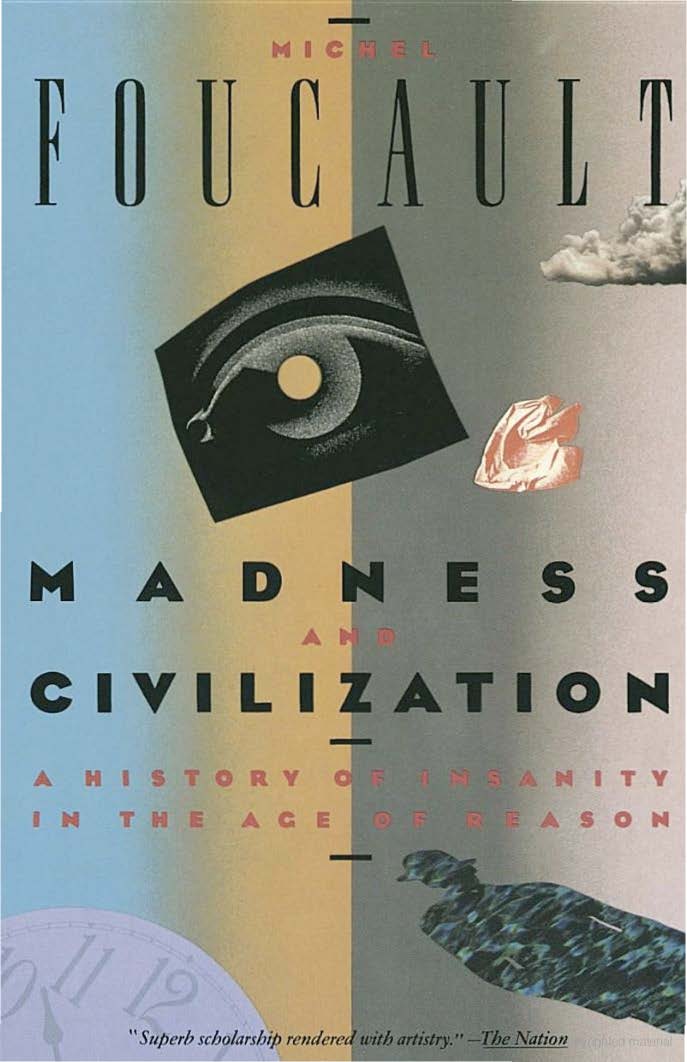
Madness and Civilization
Overview unavailable.
Madness and Civilization Introduction

- Provides bibliographic details and a list of other works by Michel Foucault, including 'The Order of Things' and 'Discipline and Punish'.
- Explains the book's methodology of using original documents to recreate the social perspective of madness during the 16th through 18th centuries.
- Traces the historical evolution of madness from the 'Ship of Fools' in the Renaissance to the institutional confinement of the classical age.
- Critiques the modern medical approach by highlighting how madness was historically intertwined with art, religion, and the 'animal spirit'.
- Discusses the transition of social stigma from leprosy to mental illness and the complex roles of reformers like Pinel and Tuke.
M D -"
N E s s
CIVILIZATION
HISTORY
IN THE ACE M I TY
AS 0 M
"Superb scholarship rendered with artistry." -The Nation
Also by Michel Foucault
The Order of Things: An Archaeology of the Human Sciences
The Archaeology of Knowledge (and The Discourse on Language)
The Birth of the Clinic: An Archaeology of Medical Perceptio!l
I, Pierre Riviere, having slaughtered my mother, my sister, and my
brother .... A Case of Parricide in the Nineteenth Century
Discipline and Punish: The Birth of the Prison
The History of Sexuality, Volumes 1, 2 and 3
Herculine Barbin, Being the Recently Discovered Memoirs of a
Nineteenth-Century French Hermaphrodite
Power/Knowledge: Selected Interviews and Other Writings,
1972-1977
The Foucault Reader (edited by Paul Rabinow)
Translated from the French by
RICHARD HOWARD
Vintage Books
A DIVISION OF RANDOM HOUSE
New York,
UtCAD:A(§SS
AND
CIVILIZATION
J History of Insanity in the
Jge of ~ason
MICHEL
FOUCAULT
~~
~~
VINTAGE BOOKS EDITION, NOVEMBER 1988
Copyright© 1965 by Random House, Inc.
All rights reserved under International and Pan-American Copyright
Conventions. Published in the United States by Random House, Inc.,
New York, and simultaneously in Canada by Random House of Canada
Limited, Toronto. Originally published in the United States by Pantheon
Books, in 1965, and in France as Histt1ire de la Folie © 1961, by Librairie
Pion. This translation is of the edition abridged by the author and
published in the Pion w/18 series. However, the author has added some
additional material from the original edition, including the chapter
"Passion and Delirium."
Library of Congress Cataloging in Publication Data
Foucault, Michel.
Madness and civilization.
Translation of Folie et deraison; histoire de la
folie.
Includes bibliographical references.
1. Psychiatry-History. z. Mental illness.
I. Title.
RC438.F613 1973 157'.1'09033 71-w581
ISBN o-679-7rno-x (pbk.)
Manufactured in the United States of America
13579086420
INTRODUCTION
MICHEL FouCAULT has achieved something truly creative
in this book on the history of madness during the so-called
classical age: the end of the sixteenth and the seventeenth
and eighteenth centuries. Rather than to review histori
cally the concept of madness, the author has chosen to re
create, mostly from original documents, mental illness,
folly, and unreason as they must have existed in their time,
place, and proper social perspective. In a sense, he has tried
to re-create the negative part of the concept, that which
has disappeared under the retroactive influence of present
day ideas and the passage of time. Too many historical
books about psychic disorders look at the past in the light
of the present; they single out only what has positive and
direct relevance to present-day psychiatry. This book be
longs to the few which demonstrate how skillful, sensitive
scholarship uses history to enrich, deepen, and reveal
new avenues for thought and investigation.
No oversimplifications, no black-and-white statements,
no sweeping generalizations are ever allowed in this book;
folly is brought back to life as a complex social phenome
non, part and parcel of the human condition. Most of the
time, for the sake of clarity, we examine madness through
one of its facets; as M. Foucault animates one facet of. the
problem after the other, he always keeps them related to
each other. The end of the Middle Ages emphasized the
comic, but just as often the tragic aspect of madness, as in
Tristan and lseult, for example. The Renaissance, with
( 'U)
JNTRODVCTION
Erasmus's Praise of F oily, demonstrated how fascinating
imagination and some of its vagaries were to the thinkers of
that day. The French Revolution, Pinel, and Tul<e empha
sized political, legal, medical, or religious aspects of mad
ness; and today, our so-called objective medical approach,
in spite of the benefits that it has brought to the mentally
ill, continues to look at only one side of the picture. Folly is
so human that it has common roots with poetry and trag
edy; it is revealed as much in the insane asylum as in the
writings of a Cervantes or a Shakespeare, or in the deep
psychological insights and cries of revolt of a Nietzsche.
Correctly or incorrectly, the author feels that Freud's
death instinct also stems from the tragic elements which led
men of all epochs to worship, laugh at, and dread folly
simultaneously. Fascinating as Renaissance men found it
they painted it, praised it, sang about it-it also heralded
for them death of the body by picturing death of the mind.
Nothing is more illuminating than to follow with M.
Foucault the many threads which are woven in this com
plex book, whether it speaks of changing symptoms, com
mitment procedures, or treatment. For example: he sees a
definite connection between some of the attitudes ,toward
madness and the disappearance, between 1200 and 1400, of
leprosy. In the middle of the twelfth century, France had
more than 2,000 leprosariums, and England and Scot
land 2 20 for a population of a million and a half
people. As leprosy vanished, in part because of segregation,
a void was created and the moral values attached to the
leper had to find another scapegoat. Mental illness and un
reason attracted that stigma to themselves, but even this
was neither complete, simple, nor immediate.
Renaissance men developed a delightful, yet horrible
way of dealing with their mad denizens: they were put on
a ship and entrusted to mariners because folly, water, and
sea, as everyone then "knew," .had an affinity for each
( 'U;)
Introduction
other. Thus, "Ships of Fools" crisscrossed the seas and
canals of Europe with their comic and pathetic cargo of
souls. Some of them found pleasure and even a cure in the
changing surroundings, in the isolation of being cast off,
while others withdrew further, became worse, or died
alone and away from their families. The cities and villages
which had thus rid themselves of their crazed and crazy,
could now take pleasure in watching the exciting sideshow
when a ship full of foreign lunatics would dock at their
harbors. The seventeenth and eighteenth centuries saw
much social unrest and economic depression, which they
tried to solve by imprisoning the indigents with the crimi
nals and forcing them to work. The demented fitted quite
natQrally between those two extremes of social maladjust
ment and iniquity.
A nice and hallowed tradition has labeled Tuke and Pinel
as the saviors of the mentally ill, hut the truth of the matter
is not so simple. Many others had treated them with kind
ness, pleading that they belonged first and foremost with
their families, and for at least two hundred years before.
the 17 Sos, legislation had been considered or passed to
segregate criminals and indigents from fools. But this legis
lation was prompted, as often as not, by a desire to protect
the poor, the criminal, the man imprisoned for debts, and
the juvenile delinquent from the frightening bestiality of
the madman. As the madman had replaced the leper, the
mentally ill person was now a subhuman and beastly scape
goat; hence the need to protect others. While the Quaker
Tuke applied his religious principles, first to demented
"friends" and later to foes also, partly to convert them, the
great Pinel was not sure at times that he was dealing with
sick people; he often marveled at their unbelievable endur
ance of physical hardship, and often cited the ability of
. schizophrenic women to sleep naked in subfreezing tem
peratures without suffering any ill effects. Were not these
(vii)
INTRODUCTION
people more healthy, more resistant than ordinary human
beings? Didn't they h!lve too much animal spirit in them?
Naturally, it is impossible to discuss a book as complex as
Madness and Civilization without oversimplifying and do
ing it an injustice. It is a tale of nuances, relative values, and
delicate shadings. Yet, it is an impressive monument: in a
dispassionate manner it marshals overwhelming evidence to
dispel more effectively than many previous attempts the
myth of mental illness, and re-establishes folly and un
reason in their rightful place as complex, human-too hu
man-phenomena. The roots and symptoms of folly are
being looked for today in psychology, medicine, and soci
ology, but they were and still are as present and important
in art,• religion, ethics, and epistemology. Madness is really
a manifestation of the "soul," a variable concept which
from antiquity to the twentieth century covered approxi
mately what came to be known, after Freud, as the un
conscious part of the human mind. t Only time will tell how
much better students of the psyche can look at the future,
after reading this sobering re-creation of yesteryear's mad
ness and the ineffective attempts of humanity to treat it by
amputation, projections, prejudices, and segregation.
Jos:E BARcHILON, M.D.
• My only quarrel with the book is the lack of emphasis on the humor
istic elements in psychoses and neuroses: i.e., the patient laughs at him
self, or laughs at the world through his illness.
t The fear and dread of madness is as real a factor in social and medical
attitudes or measures as anxiety, symptoms, and resistance in coping with
impulses from the individual unconscious; even though the author does
not explicitly compare madness with the unconscious, he equates mad
ness and dream activity so that the inference is clear enough.
('Viii)
PREFACE
The Archaeology of Silence
- The author proposes a history of the 'zero point' where madness and reason were not yet divided into separate, external categories.
- Modernity is characterized by a 'broken dialogue' where reason uses the language of psychiatry to conduct a monologue about madness.
- The act of confining the mad is described as a sovereign act of reason that establishes a void between the sane and the non-sane.
- To understand this history, one must reject the terminal truths of psychopathology and return to the original 'caesura' or split.
- The physician acts as a delegate of reason, ensuring that communication with the mad occurs only through the abstract lens of disease.
The language of psychiatry, which is a monologue of reason about madness, has been established only on the basis of such a silence.
PASCAL: "Men are so necessarily mad, that not to be mad
would amount to another form of madness"." And Dostoi
evsky, in his DIARY OF A WRITER: "It is not by confining
one's neighbor that one is convinced of one's own sanity."
We have yet to write the history of that other form of
madness, by which men, in an act of sovereign reason, con
fine their neighbors, and communicate and recognize each
other through the merciless language of non-madness; to
define the moment of this conspiracy before it was perma
nently established in the realm of truth, before it was re
vived by the lyricism of protest. We must try to return, in
history, to that zero point in the course of madness at
which madness is an undifferentiated experience, a not yet
divided experience of division itself. We must describe,
from the start of its trajectory, that "other form" which
relegates Reason and Madness to one side or the other of its
action as things henceforth external, deaf to all exchange,
and as though dead to one another.
This is doubtless an uncomfortable region. To explore it
we must renounce the convenience of terminal truths, and
never let ourselves be guided by what we may knO'W of
madness. None of the concepts of psychopathology, even
and especially in the implicit process of retrospections, can
play an organizing role. What is constitutive is the action
that divides madness, and not the science elaborated once
this division is made and calm restored. What is originative
is the caesura that establishes the distance between reason
and non-reason; reason's subjugation of non-reason, wrest-
( iz)
PREFACE
ing from it its truth as madness, crime, or disease, derives
explicitly from this point. Hence we must speak of that
initial dispute without assuming a victory, or the right to a
victory; we must speak of those actions re-examined in
history, leaving in abeyance all that may figure as a con
clusion, as a refuge in truth; we shall have to speak of this
act of scission, of this distance set, of this void instituted
between reason and what is not reason, without ever rely
ing upon the fulfillment of what it claims to be.
Then, and then only, can we determine the realm in
which the man of madness and the man of reason, moving
apart, are not yet disjunct; and in an, incipient and very
crude language, antedating that of science, begin the dia
logue of their breach, testifying in a fugitive way that they
still speak to each other. Here madness and non.i.madness,
reason and non-reason are inextricably involved: insepa
rable at the moment when they do not yet exist, and exist
ing for each other, in relation to each other, in the exchange
which separates them.
In the serene world of mental illness, modern man no
longer communicates with the madman: on one hand, the
man of reason delegates the physician to madness, thereby
authorizing a relation only through the abstract universal
ity of disease; on the other, the man of madness communi
cates with society only by the intermediary of an equally
abstract reason which is order, physical and moral con
straint, the anonymous pressure of the group, the require
ments of conformity. As for a common language, there is
no such thing; or rather, there is no such thing any longer;
the constitution of madness as a mental illness, at the end of
the eighteenth century, affords the evidence of a broken
dialogue, posits the separation as already effected, and
thrusts into oblivion all those stammered, imperfect words
without fixed syntax in which the exchange between mad
ness and reason was made. The language of psychiatry,
(x)
Preface
which is a monologue of reason about madness, has been
established only on the basis of such a silence.
I have not tried to 'WTite the history of that language, but
rather the archaeology of that silence.
The Greeks had a relation to something that they called
ti~QL~.
The Archaeology of Silence
- Modern psychiatry functions as a monologue of reason about madness, established only after the original dialogue between the two was silenced.
- Western culture's identity is fundamentally defined by its relationship to madness, a 'vertical' confrontation that establishes the limits of reason.
- The transition from the Renaissance to the modern era replaced a dramatic, symbolic debate with a 'silent transparency' that confines insanity within the category of mental illness.
- The classical period is marked by two pivotal events: the 'great confinement' of 1657 and the 1794 liberation of inmates, which together formed the structure of modern psychiatric experience.
I have not tried to write the history of that language, but rather the archaeology of that silence.
the separation as already effected, and
thrusts into oblivion all those stammered, imperfect words
without fixed syntax in which the exchange between mad
ness and reason was made. The language of psychiatry,
(x)
Preface
which is a monologue of reason about madness, has been
established only on the basis of such a silence.
I have not tried to 'WTite the history of that language, but
rather the archaeology of that silence.
The Greeks had a relation to something that they called
ti~QL~. This relation was not merely one of condemnation;
the existence of Thrasymachus or of Callicles suffices to
prove it, even if their language has reached us already en
veloped in the reassuring dialectic of Socrates. But the
Greek Logos had no contrary.
European man, since the beginning of the Middle Ages,
has had a relation to something he calls, indiscriminately,
Madness, Dementia, Insanity. Perhaps it is to this obscure
presence that Western reason owes something of its depth,
izs the arocpeocruvfi of the Socratic reasoners owes something
to the threat of ti~QL~. In any case, the Reason-Madness
nexus constitutes for Western culture one of the dimen
sions of its originality; it already accompanied that culture
long before Hieronymus Bosch, and will follow it long
after Nietzsche and Artaud.
What, then, is this confrontation beneath the language of
reason? Where can an interrogation lead us which does not
follow reason in its horizontal course, but seeks to retrace
in time that constant verticality which confronts European
culture with what it is not, establishes its range by its own
derangement? What realm do we enter which is neither the
history of knowledge, nor history itself; which is con
trolled by neither the teleology of truth nor the rational
sequence of causes, since causes have value and meaning
only beyond the division? A realm, no doubt, where what
is in question ·is the limits rather than the identity of a
culture.
The classical period-from Willis to Pinel, from the
frenzies of Racine's Oreste to Sade's Juliette and the Quinta
( zi)
PREFACE
del Sordo of Goya-cO'Vers precisely that epoch in 'Which
the exchange between madness and reason modifies its la•
guage, and in a radical manner. In the history of madness,
t'Wo events indicate this change 'With a singular clarity:
16 J7, the creation of the H opital General and the "great
confinement" of the poor; 1194, the liberation of the
chained inmates of Bicltre. Bet'Ween these t'Wo unique and
symmetrical events, something happens 'Whose ambiguity
has left the historians of medicine at a loss: blmd repression
in an absolutist regime, according to some; but according to
others, the gradual discO'Very by science and philanthropy
of madness in its positive truth. As a matter of fact, beneath
these reversible meanings, a structure is forming 'Which
does not resolve the ambiguity but determines it. It is this
structure 'Which accounts for the transition from the me
dieval and humanist experience of madness to our O'Wn ex
perience, 'Which confines insanity 'Within mental illness. In
the Middle Ages and until the Renaissance, man's dispute
'With madness 'Was a dramatic debate in 'Which be con
fronted the secret pO'Wers of the .'World; the experience of
madness 'Was clouded by images of the Fall and the Will of
God, of the Beast and the Metamorphosis, and of all the
marvelous secrets of Kno'Wledge. In our era, the experience
of madness remains silent in the composure of a kno'Wledge
'Which, k1lO'Wing too much about madness, forgets it. But
from one of these experiences to the other, the shift bas
been made by a 'World 'Without images, 'Without positive
character, in a kind of silent transparency 'Which reveals
as mute institution, act 'Without commentary, immediate
kno'Wledge-a great motionless structure; this structure is
one of neither drama nor knO'Wledge; it is the point 'Where
history is immobiliz.
The Legacy of Leprosy
- The disappearance of leprosy at the end of the Middle Ages left behind a vast network of sterile, uninhabitable wastelands and structures.
- These 'cities of the damned' once numbered in the thousands across Europe, creating a physical and social geography of exclusion.
- As the disease vanished, the state began to struggle over the control and redistribution of the immense endowments and properties left by the lazar houses.
- The vacant spaces of the leprosarium remained in the community's margins, waiting to be filled by new forms of social outcasts and diseases.
- The transition from leprosy to other forms of confinement represents a shift where the structures of exclusion remained even as the specific sickness changed.
For centuries, these reaches would belong to the non-human.
nce
of madness remains silent in the composure of a kno'Wledge
'Which, k1lO'Wing too much about madness, forgets it. But
from one of these experiences to the other, the shift bas
been made by a 'World 'Without images, 'Without positive
character, in a kind of silent transparency 'Which reveals
as mute institution, act 'Without commentary, immediate
kno'Wledge-a great motionless structure; this structure is
one of neither drama nor knO'Wledge; it is the point 'Where
history is immobiliz.ed in the tragic category 'Which both
establishes and impugns it.
(xii)
CONTENTS
I "Stultif era N avis" 3
n The Great Confinement 38
Ill The Insane 65
IV Passion and Delirium 85
v Aspects of Madness 117
VI Doctors and Patients 159
VII The Great Fear 199
VIII The New Division 221
IX The Birth of the Asylum 241
Conclusion 279
Notes 291
(xiii)
cYICAD~SS
AND
CIVILIZATION
A History of Insanity in the
Age of Reason
I
'' cJTULTIFER.A
~.A/7/S"
AT the end of the Middle Ages, leprosy disappeared from
the W estem world. In the margins of the community, at
the gates of cities, there stretched wastelands which sick
ness had ceased to haunt but had left sterile and long un
inhabitable. For centuries, these reaches would belong to
the non-human. From the fourteenth to the seventeenth
century, they would wait, soliciting with strange incanta
tions a new incarnation of disease, another grimace of ter
ror, renewed rites of purification and exclusion.
From the High Middle Ages to the end of the Crusades,
leprosariums had multiplied their cities of the damned over
the entire face of Europe. According to Mathieu Paris,
there were as many as 19,000 of them throughout Christen
dom. In any case, around 1226, when Louis VIII estab
lished the lazar-house law for France, more than 2,000
appeared on the official registers. There were 4 3 in the
(3)
MADNESS 8c CIVILIZATION
diocese of Paris alone: these included Bourg-le-Reine, Cor
beil, Saint-V alere, and the sinister Champ-Pourri (Rotten
Field); included also was Charenton. The two largest were
in the immediate vicinity of Paris: Saint-Germain and Saint
Lazare: 1 we shall hear their names again in the history of
another sickness. This is because from the fifteenth century
on, all were emptied; in the next century Saint-Germain
became a reformatory for young criminals; and before the
time of Saint Vincent there was only one leper left at Saint
Lazare, "Sieur Langlois, practitioner in the civil court."
The lazar house of Nancy, which was among the largest in
Europe, had only four inmates during the regency of Marie
de Medicis. According to Catel's Memoires, there were 29
hospitals in Toulouse at the end of the medieval period:
seven were leprosariums; but at the beginning of the seven
teenth century we find only three mentioned: Saint-Cyp
rien, Arnaud-Bernard, and Saint-Michel. It was a pleasure
to celebrate the disappearance of leprosy: in I635 the in
habitants of Reims formed a solemn procession to thank
God for having delivered their city from this scourge.
For a century already, royal authority had undertaken
the control and reorganization of the immense fortune
represented by the endowments of the lazar houses; in a
decree of December 19, 1543, Fran~ois I had a census and
inventory taken "to remedy the great disorder that exists at
present in the lazar houses"; in his tum, Henri IV in an
edict of 1606 prescribed a revision of their accounts and
allotted "the sums obtained from this investigation to the
sustenance of poor noblemen and crippled soldiers." The
same request for regulation is recorded on October 24'
161 2, but the excess revenues were now to be used for
feeding the poor.
In fact, the question of the leprosariums was not settled
in France before the end of the seventeenth century; and
the problem's econoinic importance provoked more than
one conflict.
The Disappearance of Leprosy
- During the seventeenth century, French authorities systematically redistributed the vast revenues and properties of defunct leprosariums to general hospitals and welfare institutions.
- In England and Scotland, the decline of leprosy began as early as the fourteenth century, leaving massive institutions like Saint Albans and Chatham with almost no patients.
- The Reformation in Germany accelerated the conversion of lazar houses into municipal welfare centers, often repurposing them for the care of the incurably ill and the mad.
- The retreat of leprosy was likely a result of social segregation and the end of the Crusades rather than medical intervention, leaving behind a vacant infrastructure of exclusion.
- The physical sites of the lazar houses remained as 'low places' that had historically served to keep the diseased at a sacred, ritualized distance from society.
Leprosy withdrew, leaving derelict these low places and these rites which were intended, not to suppress it, but to keep it at a sacred distance, to fix it in an inverse exaltation.
in an
edict of 1606 prescribed a revision of their accounts and
allotted "the sums obtained from this investigation to the
sustenance of poor noblemen and crippled soldiers." The
same request for regulation is recorded on October 24'
161 2, but the excess revenues were now to be used for
feeding the poor.
In fact, the question of the leprosariums was not settled
in France before the end of the seventeenth century; and
the problem's econoinic importance provoked more than
one conflict. Were there not still, in the year 1677, 44 lazar
(4)
"Stultifera Navis"
houses in the province of Dauphine alone? On February
20, 1672, Louis XIV assigned to the Orders of Saint-Lazare
and Mont-Carmel the effects of all the military and hospital
orders; they were entrusted with the administration of the
lazar houses of the kingdom. Some twenty years later, the
edict of 167 2 was revoked, and by a 'series of staggered
measures from March 1693 to July 1695 the goods of the
lazar houses were thenceforth assigned to other hospitals
and welfare establishments. The few lepers scattered in the
1,200 still-existing houses were collected at Saint-Mesmin
near Orleans. These decrees were first applied in Paris,
where the Parlement transferred the revenue in question to
the establishments of the Hopital General; this example was
imitated by the provincial authorities; Toulouse transferred
the effects of its lazar houses to the Hopital des Incurables
( 1696); those of Beaulieu in Normandy went to the Hotel
Dieu in Caen; those of V oley were assigned to the Hopital
de Sainte-Foy. Only Saint-Mesmin and the wards of Ga
nets, near Bordeaux, remained as a reminder.
England and Scotland alone had opened 2 20 lazar houses
for a million and a half inhabitants in the twelfth century.
But as early as the fourteenth century they began to empty
out; by the time Edward III ordered an inquiry into the
hospital of Ripon-in 1 342-there were no more lepers; he
assigned the institution's effects to the poor. At the end of
the twelfth century, Archbishop Puisel had founded a
hospital in which by 14 34 only two beds were reserved for
lepers, should any be found. In 1 348, the great leprosarium
of Saint Albans contained only three patients; the hospital
of Romenal in Kent was abandoned twenty-four years
later, for lack of lepers. At Chatham, the lazar house of
Saint Bartholomew, established in 1078, had been one of
the most important in England; under Elizabeth, it cared
for only two patients; it was finally closed in 16 2 7.
The same regression of leprosy occurred in Germany,
perhaps a little more slowly; and the same conversion of
( j')
MADNESS & CIVILIZATION
the lazar houses, hastened by the Reformation, which left
municipal administrations in charge of welfare and hospital
establishments; this was the case in Leipzig, in Munich, in
Hamburg. In I 542, the effects of the lazar houses of Schles
wig-Holstein were transferred to the hospitals. In Stuttgart
a magistrate's report of 1589 indicates that for fifty years
already there had been no lepers in the house provided for
them. At Lipplingen, the lazar house was soon peopled
with incurables and madmen.
A strange disappearance, which was doubtless not the
long-sought effect of obscure medical practices, but the
spontaneous result of segregation and also the consequence,
after the Crusades, of the break with the Eastern sources of
infection. Leprosy withdrew, leaving derelict these low
places and these rites which were intended, not to suppress
it, but to keep it at a sacred distance, to fix it in an inverse
exaltation.
The Legacy of Exclusion
- As leprosy vanished from Europe, the physical spaces and social rituals of segregation remained, leaving a structural void for future outcasts.
- The leper occupied a paradoxical sacred status, being physically removed from society while remaining a visible sign of God's grace and anger.
- Exclusion functioned as a form of spiritual reintegration where the leper's abandonment by man became the very mechanism of his salvation.
- The social structures once used for lepers were eventually repurposed for vagabonds, criminals, and the mentally ill.
- The Renaissance introduced the 'Ship of Fools' as a new symbolic and literary vessel for navigating the destiny of those excluded from society.
In a strange reversibility that is the opposite of good works and prayer, they are saved by the hand that is not stretched out.
ingen, the lazar house was soon peopled
with incurables and madmen.
A strange disappearance, which was doubtless not the
long-sought effect of obscure medical practices, but the
spontaneous result of segregation and also the consequence,
after the Crusades, of the break with the Eastern sources of
infection. Leprosy withdrew, leaving derelict these low
places and these rites which were intended, not to suppress
it, but to keep it at a sacred distance, to fix it in an inverse
exaltation. What doubtless remained longer ·than leprosy,
and would persist when the lazar houses had been empty
for years, were the values and images attached to the figure
of the leper as well as the meaning of his exclusion, the
social import~ce of that insistent and fearful figure which
was not driven off without first being inscribed within a
sacred circle.
H the leper was removed from the world, and from the.
community of the Church visible, his existence was yet a
constant manifestation of God, since it was a sign both of
His anger and of His grace: "My friend," says the ritual of
the Church of Vienne, "it pleaseth Our Lord that thou
shouldst be infected with this malady, and thou hast great
grace at the hands of Our Lord that he desireth to punish
thee for thy iniquities in this world." And at the very
moment when the priest and his assistants drag him out of
the church with backward step, the leper is assured that he
still bears witness for God: "And howsoever thou mayest
be apart from the Church and the company of the Sound,
yet art thou not apart from the grace of God." Brueghel's
(6)
"Stultifera Navis''
lepers attend at a distance, but forever, that climb to Cal
vary on which the entire people accompanies Christ. Hier
atic witnesses of evil, they accomplish their salvation in and
by their very exclusion: in a strange reversibility that is the
opposite of good works and prayer, they are saved by the
hand that is not stretched out. The sinner who abandons
the leper at his door opens his way to heaven. "For which
have patience in thy malady; for .Our Lord hateth thee not
because of it, keepeth thee not from his company; but if
thou hast patience thou wilt be saved, as was the leper who
died before the gate of the rich man and was carried
straight to paradise." Abandonment is his salvation; his ex
clusion offers him another form of communion.
Leprosy disappeared, the leper vanished, or almost, from
memory; these structures remained. Often, in these same
places, the formulas of exclusion would be repeated,
strangely similar two or three centuries later. Poor vaga
bonds, criminals, and "deranged minds" would take the
part played by the leper, and we shall see what salvation
was expected from this exclusion, for them and for those
who excluded them as well. With an altogether new mean
ing and in a very different culture, the forms would re
main-essentially that major form of a rigorous division
which is social exclusion but spiritual reintegration.
Something new appears in the imaginary landscape of
the Renaissance; soon it will occupy a privileged place
there: the Ship of Fools, a strange "drunken boat" that
glides along the calm rivers of the Rhineland and the Flem
ish canals.
The N arrenschiff, of course, is a literary composition,
probably borrowed from the old Argonaut cycle, one of
the great mythic themes recently revived and rejuvenated,
acquiring an institutional aspect in the Burgundy &tates.
Fashion favored the composition of these Ships, whose
( 7)
MADNESS 8c CIVILIZATION
crew of imaginary heroes, ethical models, or social types
embarked on a great symbolic voyage which would bring
them, if not fortune, then at least the figure of their destiny
or their truth.
The Ship of Fools
- The 'Ship of Fools' or Narrenschiff was a popular literary and artistic motif in the Renaissance, representing a symbolic voyage toward destiny or truth.
- Unlike other allegorical vessels of the era, these ships had a basis in reality as towns frequently expelled the insane by handing them over to boatmen.
- Municipalities used water-bound expulsion as a form of extradition to rid their streets of 'bothersome passengers' and wandering madmen.
- While some madmen were detained in local towers or hospitals, many were sent on symbolic pilgrimages to holy shrines in search of their lost reason.
- The practice created a unique social phenomenon where the insane led a wandering existence, transitioning between the jurisdiction of different European cities.
Often the cities of Europe must have seen these "ships of fools" approaching their harbors.
schiff, of course, is a literary composition,
probably borrowed from the old Argonaut cycle, one of
the great mythic themes recently revived and rejuvenated,
acquiring an institutional aspect in the Burgundy &tates.
Fashion favored the composition of these Ships, whose
( 7)
MADNESS 8c CIVILIZATION
crew of imaginary heroes, ethical models, or social types
embarked on a great symbolic voyage which would bring
them, if not fortune, then at least the figure of their destiny
or their truth. Thus Symphorien Champier composes a
Ship of Princes and Battles of Nobility in I 502, then a Ship
of Virtuous Ladies in I503; there is also a Ship of Health,
alongside the Blauwe Schute of Jacob van Oesrvoren in
I4I 3, Sebastian Brant's N a"enschiff ( I494), and the work
of Josse Bade:Stultiferae naviculae scaphae fatuarum mu
lierum (1498). Bosch's painting, of course, belongs to this
dream fleet.
But of all these romantic or satiric vessels, the N a"en
schiff is the only one that had a real existence-for they did
exist, these boats that conveyed their insane cargo from
town to town. Madmen then led an easy wandering exist
ence. The towns drove them outside their limits; they were
allowed to wander in the open countryside, when not en
trusted to a group of merchants and pilgrims. The custom
was especially frequent in Germany; in Nuremberg, in the
first half of the fifteenth century, the presence of 63 mad
men had been registered; 3 1 were driven away; in, the fifty
years that followed, there are records of 2 I more obliga
tory departures; and these are only the madmen arrested by
the municipal authorities. Frequently they were handed
over to boatmen: in Frankfort, in 1399, seamen were in
structed to rid the city of a madman who walked about the
streets naked; in the first years of the fifteenth century, a
criminal madman was expelled in the same manner from
Mainz. Sometimes the sailors disembarked these bothersome
passengers sooner than they had promised; witness a black
smith of Frankfort twice expelled and twice returning be;..
fore being taken to Kreuznach for good. Often the cities of
Europe must have seen these "ships of fools" approaching
their harbors.
It is not easy to discover the exact meaning of this cus-
( 8)
"Stultif era N avis"
tom. One might suppose it was a general means of extradi
tion by which municipalities sent wandering madmen out
of their own jurisdiction; a hypothesis which will not in
itself account for the facts, since certain madmen, even be
fore special houses were built for them, were admitted to
hospitals and cared for as such; at the Hotel-Dieu in Paris,
their cots were set up in the dormitories. Moreover, in the
majority of the cities of Europe there existed throughout
the Middle Ages and the Renaissance a place of detention
reserved for the insane; there was for example the Chatelet
of Melun or the famous Tour aux F ous in Caen; there were
the numberless Narrtilrmer of Germany, like the gates of
Liibeck or the Jungpfer of Hamburg. Madmen were thus
not invariably expelled. One might then speculate that
among them only foreigners were driven away, each city
agreeing to care for those madmen among its own citizens.
Do we not in fact find among the account hooks of certain
medieval cities subsidies for madmen or donations made
for the care of the insane? However, the problem is not
so simple, for there existed gathering places where the
madmen, more numerous than elsewhere, were not autoch
thonous. First come the shrines: Saint-Mathurin de
Larchant, Saint-Hildevert de Gournay, Besan~on, Gheel;
pilgrimages to these places were organized, often sup
ported, by cities or hospitals. It is possible that these ships
of fools, which haunted the imagination of the entire
early Renaissance, were pilgrimage boats, highly symbolic
cargoes of madmen in search of their reason: some went
down the Rhineland rivers toward Belgium and Ghee!
The Navigation of Fools
- The 'Ship of Fools' was a historical and symbolic reality where madmen were placed on boats to seek religious cures at distant shrines.
- Cities often used these voyages as a practical means of expulsion, ensuring that the insane were permanently removed from the community.
- The act of driving away the mad was not merely a social utility but a ritual exile, often involving public whippings or mock races.
- Water served a dual symbolic purpose, acting as both a purifying element and a medium that delivered the madman to the uncertainty of fate.
- The madman occupied a liminal space, physically and metaphorically confined to the threshold between the interior and the exterior world.
He is put in the interior of the exterior, and inversely.
men, more numerous than elsewhere, were not autoch
thonous. First come the shrines: Saint-Mathurin de
Larchant, Saint-Hildevert de Gournay, Besan~on, Gheel;
pilgrimages to these places were organized, often sup
ported, by cities or hospitals. It is possible that these ships
of fools, which haunted the imagination of the entire
early Renaissance, were pilgrimage boats, highly symbolic
cargoes of madmen in search of their reason: some went
down the Rhineland rivers toward Belgium and Ghee!;
others sailed up the Rhine toward the Jura and Besan~on.
But other cities, like Nuremberg, were certainly not
shrines and yet contained great numbers of madmen
many more, in any case, than could have been furnished by
the city itself. These madmen were housed and provided
for in the city budget, and yet they were not given treat-
( .9)
MADNESS & CIVILIZATION
ment; they were simply thrown into prison. We may sup
pose that in certain important cities-centers of travel and
markets-madmen had been brought in considerable num
bers by merchants and mariners and "lost" there, thus
ridding their native cities of their presence. It may have
happened that these places of "counterpilgrimage" have be
come confused with the places where, on the contrary, the
insane were taken as pilgrims. Interest in cure and in exclu
sion coincide: madmen were confined in the holy locus of a
miracle. It is possible that the village of Gheel developed in
this manner-a shrine that became a ward, a holy land
where madness hoped for deliverance, but where inan
enacted, according to old themes, a sort of ritual division.
What matters is that the vagabond madmen, the act of
driving them away, their departure and embarkation do not
assume their entire significance on the plane of social utility
or security. Other meanings much closer to rite are cer
tainly present; and we can still discern some traces of them.
Thus access to churches was denied to madmen, although
ecclesiastical law did not deny them the use of the sacra
ments. The Church takes no action against a priest who
goes mad; but in Nuremberg in 1421 a mad priest was
expelled with particular solemnity, as if the impurity was
multiplied by the sacred nature of his person, and the city
put on its budget the money given him as a viaticum. It
happened that certain madmen were publicly whipped, and
in the course of a kind of a game they were chased in a
mock race and driven out of the city with quarterstaff
blows. So many signs that the expulsion of madmen had
become one of a number of ritual exiles.
Thus we better understand the curious implication as
signed to the navigation of madmen and the prestige attend
ing it. On the one hand, we must not minimize its incon
testable practical effectiveness: to hand a madman over to
sailors was to be permanently sure he would not be prowl-
( 1 o)
"Stultifera Navis"
ing beneath the city walls; it made sure that he would go
far away; it made him a prisoner of his own departure. But
water adds to this the dark mass of its own values; it carries
off, but it does more: it purifies. Navigation delivers man to
the uncertainty of fate; on water, each of us is in the hands
of his own destiny; every embarkation is, potentially, the
last. It is for the other world that the madman sets sail in
his fools' boat; it is from the other world that he comes
when he disembarks. The madman's voyage is at once a
rigorous division and an absolute Passage. In one sense, it
simply develops, across a half-real, half-imaginary geog
raphy, the madman's liminal position on the horizon of
medieval concern-a position symbolized and made real at
the same time by the madman's privilege of being confined
within the city gates: his exclusion must enclose him; if he
cannot and must not have another prison than the thresh
old itself, he is kept at the point of passage. He is put in the
interior of the exterior, and inversely.
The Prisoner of the Passage
- The madman occupies a liminal position on the threshold of society, existing in a state where exclusion and enclosure occur simultaneously.
- Water serves as a powerful symbolic medium for madness, representing a great external uncertainty and a route that is both infinitely open and a total prison.
- The 'Ship of Fools' motif establishes the madman as a perpetual passenger whose only true homeland is the fruitless expanse between two shores.
- Western culture has historically linked the sea's instability to the loss of faith, the presence of the demonic, and the physical breakdown of human firmness.
- Literary and mystical traditions use the image of the soul as a skiff abandoned on a sea of desires to illustrate the vulnerability of human reason.
He is the Passenger par excellence: that is, the prisoner of the passage.
n and an absolute Passage. In one sense, it
simply develops, across a half-real, half-imaginary geog
raphy, the madman's liminal position on the horizon of
medieval concern-a position symbolized and made real at
the same time by the madman's privilege of being confined
within the city gates: his exclusion must enclose him; if he
cannot and must not have another prison than the thresh
old itself, he is kept at the point of passage. He is put in the
interior of the exterior, and inversely. A highly symbolic
position, which will doubtless remain his until our own
day, if we are willing to admit that what was formerly a
visible fortress of order has now become the castle of our
conscience.
Water and navigation certainly play this role. Confined
on the ship, from which there is no escape, the madman is.
delivered to the river with its thousand arms, the sea with
its thousand roads, to that great uncertainty external to
everything. He is a prisoner in the midst of what is the
freest, the openest of routes: bound fast at the infinite
crossroads. He is the Passenger par excellence: that is, the
prisoner of the passage. And the land he will come to is
unknown-as is, once he disembarks, the land from which
he comes. He has his truth and his homeland only in that
fruitless expanse between two countries that cannot belong
to him. Is it this ritual and these values which are at the
origin of the long imaginary relationship that can be traced
( ll)
MADNESS Bt CIVILIZATION
through the whole of W estem culture? Or IS it; con
versely, this relationship that, from time immemorial, has
called into being and established the rite of embarkation?
One thing at least is certain: water and madness have long
been linked in the dreams of European man.
already, disguised as a madman, Tristan had ordered
boatmen to land him on the coast of Cornwall. And when
he arrived at the castle of King Mark, no one recognized
him, no one knew whence he had come. But he made too
many strange remarks, both familiar and distant; he knew
too well the secrets of the commonplace not to have been
from another, yet nearby, world. He did not come from the
solid land, with its solid cities; but indeed from the ceaseless
unrest of the sea, from those unknown highways which
conceal so much strange knowledge, from that fantastic
plain, the underside of the world. Iseut, first of all, realized
that this madman was a son of the sea, and that insolent
sailors had cast him here, a sign of misfortune: "Accursed
be the sailors that brought this madman! Why did they not
throw him into the sea! "2 And more than once in the
course of time, the same theme reappears: among the mys
tics of the fifteenth century, it. has become the motif of the
soul as a skiff, abandoned on the infinite sea of desires, in
the sterile field of cares and ignorance, among the mirages
of knowledge, amid the unreason of the world-a craft at
the mercy of the sea's great madness, unless it throws out a
solid anchor, faith, or raises its spiritual sails so that the
breath of God may bring it to port. At the end of the
sixteenth century, De Lancre sees in the sea the origin of
the demoniacal leanings of an entire people: the hazardous
labor of ships, dependence on the stars, hereditary secrets,
estrangement from women-the very image of the great,
turbulent plain itself makes man lose faith in God and all
his attachment to his home; he is then in the hands of the
Devil, in the sea of Satan's ruses.8 In the classical period,
(12)
"Stultif era N avis"
the melancholy of the English was easily explained by the
influence of a maritime climate, cold, humidity, the insta
bility of the weather; all those fine droplets of water that
penetrated the channels and fibers of the human body and
made it lose its firmness, predisposed it to madness.
The Ship of Fools
- Western culture historically linked madness to water, viewing it as a dark, moving chaos that opposes the mind's stability.
- The fifteenth century saw a sudden emergence of the 'Ship of Fools' in literature and art, symbolizing a new cultural anxiety.
- Madness shifted from a specific vice to a general form of social criticism, involving everyone in a 'secret complicity' of unreason.
- The literary figure of the Madman evolved into a guardian of truth who exposes the deceptions and self-delusions of others.
- Folly became a central theme in learned literature, depicted as a universal force that embarks all of humanity on a common, insane odyssey.
In a comedy where each man deceives the other and dupes himself, the madman is comedy to the second degree: the deception of deception.
bulent plain itself makes man lose faith in God and all
his attachment to his home; he is then in the hands of the
Devil, in the sea of Satan's ruses.8 In the classical period,
(12)
"Stultif era N avis"
the melancholy of the English was easily explained by the
influence of a maritime climate, cold, humidity, the insta
bility of the weather; all those fine droplets of water that
penetrated the channels and fibers of the human body and
made it lose its firmness, predisposed it to madness. Finally,
neglecting an immense literature that stretches from Ophe
lia to the Lorelei, let us note only the great half-anthropo
logical, half-cosmological analyses of Heinroth, which in
terpret madness as the manifestation in man of an obscure
and aquatic element, a dark disorder, a moving chaos, the
seed and death of all things, which opposes the mind's lu
minous and adult stability.
But if the navigation of madmen is linked in the W estem
mind with so many immemorial motifs, why, so abruptly,
in the fifteenth century, is the theme suddenly formulated
in literature and iconography? Why does the figure of the
Ship of Fools and its insane crew all at once invade the
most familiar landscapes? Why, from the old union of
water and madness, was this ship born one day, and on just
that day?
Because it symbolized a great disquiet, suddenly dawning
on the horizon of European culture at the end of the
Middle Ages. Madness and the madman become major
figures, in their ambiguity: menace and mockery, the dizzy
ing unreason of the world, and the feeble ridicule of men.
First a whole literature of tales and moral fables, in
origin, doubtless, quite remote. But by the end of the
Middle Ages, it bulks large: a long series of "follies" which,
.stigmatizing vices and faults as in the past, no longer at
tribute them all to pride, to lack of charity, to neglect of
Christian virtues, but to a sort of great unreason for which
nothing, in fact, is exactly responsible, but which involves
everyone in a kind of secret complicity. The denunciation
of madness (la f olie) becomes the general form of criticism.
(13)
MADNESS Be CIVILIZATION
In farces and soties, the character of the Madman, the Fool,
or the Simpleton assumes more and more importance. He is
no longer simply a ridiculous and familiar silhouette in the
wings: he stands center stage as the guardian of truth
playing here a role which is the complement and converse
of that t~en by madness in the tales and the satires. H folly
leads each man into a blindness where he is lost, the mad
man, on the contrary, reminds each man of his truth; in a
comedy where each man deceives the other and dupes him
self, the madman is comedy to the second degree: the de
ception of deception; he utters, in his simpleton's language
which makes no show of reason, the words of reason that
release, in the comic, the comedy: he speaks love to lovers,
the truth of life to the young, the middling reality of things
to the proud, to the insolent, and to liars. Even the old
feasts of fools, so popular in Flanders and nonhem Europe,
were theatrical events, and organized into social and moral
criticism, whatever they may have contained of spontane
ous religious parody.
In learned literature, too, Madness or F oily was at work,
at the very hean of reason and truth. It is F oily which
embarks all. men without distinction on its insane ship and
binds them to the vocation of a common odyssey (Van
Oestvoren's Blauwe Scbu.te, Brant's Na"enscbiff); it is
Folly whose baleful reign Thomas Mumer conjures up in
his N~enbeschwonmg; it is Folly which gets the best of
Love in Corroz's satite Contre fol amour, or argues with
Love as to which of the two comes first, which of the two
makes the other possible, and triumphs in Louise LabC's
dialogue, Debat de folie et d'amour.
From Death to Madness
- The late fifteenth century marked a cultural shift where the obsession with death was gradually replaced by a fascination with madness.
- Literature and art of the period, including works by Erasmus and Bosch, began to depict folly as a universal human condition that binds all men together.
- Madness is presented as a form of 'serious game' where it claims to be closer to truth and happiness than reason itself.
- The transition from the 'Dance of Death' to the 'Ship of Fools' reflects a move from fearing the end of life to mocking the futility of existence.
- By internalizing the threat of death through the imagery of folly, Western culture tamed the absolute limit of mortality into an everyday spectacle of absurdity.
The head that will become a skull is already empty. Madness is the deja-la of death.
which
embarks all. men without distinction on its insane ship and
binds them to the vocation of a common odyssey (Van
Oestvoren's Blauwe Scbu.te, Brant's Na"enscbiff); it is
Folly whose baleful reign Thomas Mumer conjures up in
his N~enbeschwonmg; it is Folly which gets the best of
Love in Corroz's satite Contre fol amour, or argues with
Love as to which of the two comes first, which of the two
makes the other possible, and triumphs in Louise LabC's
dialogue, Debat de folie et d'amour. Folly also has its aca
demic pastimes; it is the object of argument, it contends
against itself; it is denounced, and defends itself by claiming
that it is closer to happiness and truth than reason, that it is
closer to reason than reason itself; Jakob Wimpfeling edits
the Monopolium philosophorum, and Judocus Gallus the
(14)
"Stultif era N r.Nis''
Monopolium et societas, vulgo des lichtschiffs. Fi~ally, at
the center of all these serious games, the great humanist
texts: the Moria rediviva of Flayder and Erasmus's Praise
of Folly. And confronting all these discussions, with their
tireless dialectic, confronting these discourses constantly
reworded and reworked, a long dynasty of images, from
Hieronymus Bosch with The Cure of Madness and The
Ship of Fools, down to Brueghel and his Dulle Griet;
woodcuts and engravings transcribe what the theater, what
literature and art have already taken up: the intermingled
themes of the Feast and of the Dance of Fools. Indeed,
from the fifteenth century on, the face of madness has
haunted the imagination of Western man.
A sequence of dates speaks for itself: the Dance of
Death in the Cimetiere des Innocents doubtless dates from
the first years of the fifteenth century, the one in the
Chaise-Dieu was probably composed around 1460; and it
was in 1485 that Guyot Marchant published his Danse
macabre. These sixty years, cenainly, were dominated by
· all this grinning imagery of Death. And it was in 1494 that
Brant wrote the Na"enschiff; in 1497 it was translated into
Latin. In the very last years of the century Hieronymus
Bosch painted his Ship of Fools. The Praise of Folly dates
from 1509. The order of succession is clear.
Up to the second half of the fifteenth century, or even a
little beyond, the theme of death reigns alone. The end of
man, the end of time bear the face of pestilence and war.
What overhangs human existence is this conclusion and this
order from which nothing escapes. The presence that
threatens even within this world is. a fleshless one. Then in
the last years of the century this enormous uneasiness turns
on itself; the mockery of madness replaces death and its
solemnity. From the discovery of that necessity which in
evitably reduces man to nothing, we have shifted to the
scornful contemplation of that nothing which is existence
(1;)
MADNESS 8t CIVILIZATION
itself. Fear in the face of the absolute limit of death turns
inward in a continuous irony; man disarms it in advance,
making it an object of derision by giving it an everyday,
tamed form, by constantly renewing it in the spectacle of
life, by scattering it throughout the vices, the difficulties,
and the absurdities of all men. Death's annihilation is no
longer anything because it was already everything, because
life itself was only futility, vain words, a squabble of cap
and bells. The head that will become a skull is already
empty. Madness is the deja-la of death.' But it is also its
vanquished presence, evaded in those everyday signs
which, announcing that death reigns already, indicate that
its prey will be a sorry prize indeed. What death unmasks
was never more than a mask; to discover the grin of the
skeleton, one need only lift off something that was neither
beauty nor truth, but only a plaster and tinsel face. From
the vain mask to the corpse, the same smile persists.
Madness as Death's Torsion
- The cultural focus shifted from the external threat of death to the internal presence of madness as the ultimate sign of human nothingness.
- Madness is described as the 'deja-la' of death, suggesting that the lunatic has already disarmed the macabre by embodying it while still alive.
- The Renaissance saw a reversal where the universal tide of human insanity was viewed as the catalyst that makes the world's end necessary.
- While literature and art like Bosch's paintings and Brant's poems share themes of unreason, the inherent unity between word and image began to dissolve during this period.
- The 'Ship of Fools' and the 'Dance of Madmen' became central motifs used to categorize every social estate under the umbrella of universal folly.
What death unmasks was never more than a mask; to discover the grin of the skeleton, one need only lift off something that was neither beauty nor truth, but only a plaster and tinsel face.
hat will become a skull is already
empty. Madness is the deja-la of death.' But it is also its
vanquished presence, evaded in those everyday signs
which, announcing that death reigns already, indicate that
its prey will be a sorry prize indeed. What death unmasks
was never more than a mask; to discover the grin of the
skeleton, one need only lift off something that was neither
beauty nor truth, but only a plaster and tinsel face. From
the vain mask to the corpse, the same smile persists. But
when the madman laughs, he already laughs with the laugh
of death; the lunatic, anticipating the macabre, has dis
armed it. The cries of Dulle Grict triumph, in the high
Renaissance, over that Triumph of Death sung at the end
of the Middle Ages on the walls of the Campo Santo.
The substitution of the theme of madness for that of
death does not mark a break, but rather a torsion within the
same anxiety. What is in question is still the nothingness of
existence, but this nothingness is no longer considered an
external, final term, both threat and conclusion; it is ex
perienced from within as the continuous and constant form
of existence. And where once man's madness had been not
to see that death's term was approaching, so that it was
necessary to recall him to wisdom with the spectacle of ·
death, now wisdom consisted of denouncing madness
everywhere, teaching men that they were no more than
dead men already, and that if the end was near, it was to
the degree that madness, become universal, would be one
(16}
"Stultif era N avis''
and the same with death itself. This is what Eustache Des.
champs prophesies:
We are cowardly and weak,
Covetous, old, evil-tongued.
Fools are all I see, in truth.
The end is near,
All goes ill . . .
The elements are now reversed. It is no longer the end of
time and of the world which will show retrospectively that
men were mad not to have been prepared for them; it is the
tide of madness, its secret invasion, that shows that the
world is near its final catastrophe; it is man's insanity that
invokes and makes necessary the world's end.
In its various forms-plastic or literary-this experience
of madness seems extremely coherent. Painting and text
constantly refer to one another-commentary here and il
lustration there. We find the same theme of the N arrentanz
over and over in popular festivals, in theatrical perform
ances, in engravings and woodcuts, and the entire last part
of the Praise of Folly is constructed on the model of a long
dance of madmen in which each profession and each estate
parades in turn to form the great round of unreason. It is
likely that in Bosch's Temptation of Saint Anthony in Lis
bon, many figures of the fantastic fauna which invade the
canvas are· borrowed from traditional masks; some perhaps
are transferred from the Malleus maleficarum. & for the
famous Ship of Fools, is it not a direct translation of
Brant's N arrenschiff, whose title it bears, and of which it
seems to illustrate quite precisely canto XXVII, also con
secrated to stigmatizing "drunkards and gluttons"? It has
even been suggested that Bosch's painting was part of a
series of pictures illustrating the principal cantos of Brant's
poem.
MADNESS & CIVILIZATION
As a matter of fact, we must not be misled by what
appears to be a strict continuity in these themes, nor imag
ine more than is revealed by history itself. It is unlikely that
an analysis like the one Emile Male worked out for the pre
ceding epochs, especially apropos of the theme of death,
could be repeated. Between word and image, between what
is depicted by language and what is uttered by plastic form,
the unity begins to dissolve; a single and identical meaning
is not immediately common to them. And if it is true that
the image still has the function of speaking, of transmitting
something consubstantial with language, we must.
The Scission of Word and Image
- The Renaissance marks a growing cleavage between language and plastic form, where images begin to diverge from the meanings traditionally dictated by speech.
- The decay of Gothic symbolism allows images to escape their role as moral teachers, instead gravitating toward their own fantastic and silent presence.
- Paradoxically, the liberation of the image arises from an excess of meaning and a proliferation of signs that eventually become too complex to decipher.
- As symbols become overburdened with allusions, they lose their original forms and transform into nightmare silhouettes and insane, hybrid beings.
- This shift represents a transition where wisdom becomes a prisoner of dreams, and the symbolic man is replaced by the 'insane being' of the image.
The neck of the Gutememch is endlessly elongated, the better to illustrate, beyond wisdom, all the real mediations of knowledge; and the symbolic man becomes a fantastic bird whose disproportionate neck folds a thousand times upon itself-an insane being, halfway between animal and thing, closer to the charms of an image than to the rigor of a meaning.
y itself. It is unlikely that
an analysis like the one Emile Male worked out for the pre
ceding epochs, especially apropos of the theme of death,
could be repeated. Between word and image, between what
is depicted by language and what is uttered by plastic form,
the unity begins to dissolve; a single and identical meaning
is not immediately common to them. And if it is true that
the image still has the function of speaking, of transmitting
something consubstantial with language, we must. recognize
that it already no longer says the same thing; and that by its
own plastic values painting engages in an experiment that
will take it farther and farther from language, whatever the
superficial identity of the theme. Figure and speech still
illustrate the same fable of folly in the same moral world,
but already they take two different directions, indicating,
in a still barely perceptible scission, what will be the great
line of cleavage in the Western experience of madness.
The dawn of madness on the horizon of the Renaissance
is first perceptible in the decay of Gothic symbolism; as if
that world, whose network of spiritual meanings was so
close-knit, had begun to unravel, showing faces whose
meaning was no longer clear except in the forms of mad
ness. The Gothic forms persist for a time, but little by little
they grow silent, cease to speak, to remind, to teach any
thing but their own fantastic presence, transcending all
possible language (though still familiar to the eye). Freed
from wisdom and from the teaching that organized it, the
image begins to gravitate about its own madness.
Paradoxically, this liberation derives from a proliferation
of meaning, from a self-multiplication of significance,
weaving relationships so numerous, so intertwined, so rich,
that they can no longer be deciphered except in the esoter
ism of knowledge. Things themselves become so burdened
( I 8 )
"Stultifera Nfl'Uis''
with attributes, signs, allusions that _they finally lose their
own form. Meaning is no longer read in an immediate per
ception, the figure no longer speaks for itself; between the
knowledge which animates it and the form into which it is
transposed, a gap widens. It is free for the dream. One book
bears witness to meaning's proliferation at the end of the
Gothic world, the Speculum bumanae salvationis, which,
beyond all the correspondences established by the patristic
tradition, elaborates, between the Old and the New Testa
ment, a symbolism not on the order of Prophecy, but deriv
ing from an equivalence of imagery. The Passion of Christ
is not prefigured only by the sacrifice of Abraham; it is
surrounded by all the glories of torture and its innumerable
dreams; Tubal the blacksmith and Isaiah's wheel take their
places around the Cross, forming beyond all the lessons of
the sacrifice the fantastic tableau of savagery, of tonpented
bodies, and of suffering. Thus the image is burdened with
$Upplementary meanings, and forced to express them. And
dreams, madness, the unreasonable can also slip into this
excess of meaning. The symbolic figures easily become
nightmare silhouettes. Witness that old image of wisdom so
often translated, in German engravings, by a long-necked
bird whose thoughts, rising slowly from heart to head,
have time to be weighed and reflected on; a symbol whose
values are blunted by being overemphasized: the long path
of reflection becomes in the image the alembic of a subtle
learning, an instrument which distills quintessences. The
neck of the Gutememch is endlessly elongated, the better
to illustrate, beyond wisdom, all the real mediations of
knowledge; and the symbolic man becomes a fantastic bird
whose disproportionate neck folds a thousand times upon
itself-an insane being, halfway between animal and thing,
closer to the charms of an image than to the rigor of a
meaning. This symbolic wisdom is a prisoner of the mad
ness of dreams.
The Fascination of Madness
- The transition from the Middle Ages to the Renaissance saw a fundamental shift where images of madness moved from moral teaching to pure fascination.
- The 'gryllos' evolved from a symbol of the soul's corruption into a demented, hermetic form that exists as a silent nightmare on the surface of the world.
- In Renaissance art, the animal is liberated from its role as a moral illustration and instead becomes a mirror that reveals man's secret, monstrous nature.
- The power of attraction in the fifteenth century shifted from the tangible desires of the flesh to the frightening freedom of hallucinations and impossible dreams.
And by an astonishing reversal, it is now the animal that will stalk man, capture him, and reveal him to his own truth.
e alembic of a subtle
learning, an instrument which distills quintessences. The
neck of the Gutememch is endlessly elongated, the better
to illustrate, beyond wisdom, all the real mediations of
knowledge; and the symbolic man becomes a fantastic bird
whose disproportionate neck folds a thousand times upon
itself-an insane being, halfway between animal and thing,
closer to the charms of an image than to the rigor of a
meaning. This symbolic wisdom is a prisoner of the mad
ness of dreams.
MADNESS & CIVILIZATION
A fundamental conversion of the world of images: the
constraint of a multiplied meaning liberates that world
from the control of form. So many diverse meanings are
established beneath the surface of the image that it presents
only an enigmatic face. And its power is no longer to teach
but to fascinate. Characteristic is the evolution of the
famous gryllos already familiar to the Middle Ages in the
English psalters, and at Chartres and Bourges. It taught,
then, how the soul of desiring man had become a prisoner
of the beast; these grotesque faces set in the bellies of mon
sters belonged to the world of the great Platonic metaphor
and denounced the spirit's corruption in the folly of sin.
But in the fifteenth century the gryllos, image of human
madness, becomes one of the preferred figures in the count
less Temptations. What assails the hermit's tranquillity is
not objects of desire, but these hermetic, demented forms
which have risen from a dream, and remain silent and fur
tive on the surface of a world. In the Lisbon Temptation,
facing Saint Anthony sits one of these figures born of mad
ness, of its solitude, of its penitence, of its privations; a wan
smile lights this bodiless face, the pure presence of anxiety
in the form of an agile grimace. Now it is exactly this
nightmare silhouette that is at once the subject and object
of the temptation; it is this figure which fascinates the gaze
of the ascetic-both are prisoners of a kind of mirror inter
rogation, which remains unanswered in a silence inhabited
only by the monstrous swarm that surrounds them. The
gryllos no longer recalls man, by its satiric form, to his
spiritual vocation forgotten in the folly of desire. It is mad
ness become Temptation; all it embodies of the impossible,
the fantastic, the inhuman, all that suggests the unnatural,
the writhing of an insane presence on the earth's surface
all this is precisely what gives the gryllos its strange power.
The freedom, however frightening, of his dreams, the hal
lucinations of his madness, have more power of attraction
(20)
"Stultif era N avis''
for fifteenth-century man than the desirable reality of the
flesh. ·
What then is this fascination which now operates
through the images of madness?
First, man finds in these fantastic figures one of the se
crets and one of the vocations of his nature. In the thought
of the Middle Ages, the legions of animals, named once and
for all by Adam, symbolically bear the values of humanity.
But at the beginning of the Renaissance, the relations with
animality are reversed; the beast is set free; it escapes the
world of legend and moral illustration to acquire a fantastic
nature of its own. And by an astonishing reversal, it is now
the animal that will stalk man, capture him, and reveal him
to his own truth. Impossible animals, issuing from a de
mented imagination, become the secret nature of man; and
when on the Last Day sinful man appears in his hideous
nakedness, we see that he has the monstrous shape of a
delirious animal; these are the screech owls whose toad
bodies combine, in Thierry Bouts's Hell, with the nakedness
of the damned; these are Stephan Lochner's winged insects
with cats' heads, sphinxes with beetl~s' wing cases, birds
whose wings are as disturbing and as avid as hands; this is
the great beast of prey with knotty fingers that figures in
Matthias Gri.inewald's Temptation.
The Wisdom of Madness
- Late medieval art depicts animality as a release of dark rage and sterile madness that exists within the human heart.
- Madness is portrayed as a form of esoteric knowledge that is both inaccessible to the wise and intimately possessed by the fool.
- The fool's crystal ball, often mocked by the rational, represents a dense and invisible knowledge that remains intact and unbroken.
- The Ship of Fools symbolizes a false paradise and the diabolical triumph of the Antichrist, signaling an approaching apocalypse.
- A shift in iconography reveals a world where divine order is replaced by a 'witches' Sabbath of nature' and the total annihilation of wisdom.
While the man of reason and wisdom perceives only fragmentary and all the more unnerving images of it, the Fool bears it intact as an unbroken sphere.
on the Last Day sinful man appears in his hideous
nakedness, we see that he has the monstrous shape of a
delirious animal; these are the screech owls whose toad
bodies combine, in Thierry Bouts's Hell, with the nakedness
of the damned; these are Stephan Lochner's winged insects
with cats' heads, sphinxes with beetl~s' wing cases, birds
whose wings are as disturbing and as avid as hands; this is
the great beast of prey with knotty fingers that figures in
Matthias Gri.inewald's Temptation. Animality has escaped
domestication by human symbols and values; and it is ani
mality that reveals the dark rage, the sterile madness that
lie in men's hearts.
At the opposite pole to this nature of shadows, madness
fascinates because it is knowledge. It is knowledge, first,
because all these absurd figures are in reality elements of. a
difficult, hermetic, esoteric learning. These strange forms
are situated, from the first, in the space of the Great Secret,
and the Saint Anthony who is tempted by them is not a
victim of the violence of desire but of the much more in
sidious lure of curiosity; he is tempted by that distant and
( 2 I )
MADNESS 8t CIVILIZATION
intimate knowledge which is offered, and at the same time
evaded, by the smile of the gryllos; his backward move
ment is nothing but that step by which he keeps from cross
ing the forbidden limits of knowledge; he knows already
and that is his temptation-what Jerome Cardan will say
later: "Wisdom, like other precious substances, must be
tom from the bowels of the earth." This knowledge, so
inaccessible, so formidable, the Fool, in his innocent idiocy,
already possesses. While the man of reason and wisdom
perceives only fragmentary and all the more unnerving
images of it, the Fool bears it intact as an unbroken sphere:
that crystal ball which for all others is empty is in his eyes
filled with the density of an invisible knowledge. Brueghel
mocks the sick man who tries to penetrate this crystal
sphere, but it is this iridescent bubble of knowledge-an
absurd but infinitely precious lantern-that sways at the
end of the stick Dulle Griet bears on her shoulder. And it is
this sphere which .figures on the reverse of the Garden of
Delights. Another symbol of knowledge, the tree (the for
bidden tree, the tree of promised immortality and of sin),
once planted in the heart of the earthly paradise, has been
uprooted and now forms the mast of the Ship of Fools, as
seen in the engraving that illustrates Josse Bade's Stultiferae
naviculae; it is this tree, without a doubt, that sways over
Bosch's Ship of Fools.
What does it presage, this wisdom of fools? Doubtless,
since it is a forbidden wisdom, it presages both the reign of
Satan and the end of the world; ultimate bliss and supreme
punishment; omnipotence on earth and the infernal fall.
The Ship of Fools sails through a landscape of delights,
where all is offered to desire, a sort of renewed paradise,
since here man no longer knows either suffering or need;
and yet he has not recovered his innocence. This false hap
piness is the diabolical triumph of the Antichrist; it is the
(22)
"Stultifera Navis''
End, already at hand. Apocalyptic dreams are not new, it
is true, in the fifteenth century; they are, however, very
different in nature from what they had been earlier. The
delicately fantastic iconography of the fourteenth century,
where castles are toppled like dice, where the Beast is al
ways the traditional dragon held at bay by the Virgin, in
shon where the order of God and its immil)ent victory are
always apparent, gives way to a vision of the world where
all wisdom is annihilated. This is the great witches' Sabbath
of nature: mountains melt and become plains, the eanh
vomits up the dead and bones tumble out of tombs; the
stars fall, the earth catches fire, all life withers and comes to
death.
The Reign of Madness
- The medieval vision of a divine, orderly victory over evil gives way to a Renaissance landscape where madness and universal fury consume the world.
- Dürer's Horsemen of the Apocalypse represent a shift from heralds of justice to disheveled warriors of a mad, chaotic vengeance.
- Madness is no longer seen as a fleeting appearance but as a hidden, dark necessity of the world that reveals the pitiless truth of human nature.
- In the Renaissance hierarchy, Folly moves from a minor vice to the leading force that governs both human weaknesses and the hidden motivations of virtue.
- The literary and moral themes of the era suggest that madness indirectly drives ambition, wealth, and even the curiosity of philosophers.
Victory is neither God's nor the Devil's: it belongs to Madness. On all sides, madness fascinates man.
teenth century,
where castles are toppled like dice, where the Beast is al
ways the traditional dragon held at bay by the Virgin, in
shon where the order of God and its immil)ent victory are
always apparent, gives way to a vision of the world where
all wisdom is annihilated. This is the great witches' Sabbath
of nature: mountains melt and become plains, the eanh
vomits up the dead and bones tumble out of tombs; the
stars fall, the earth catches fire, all life withers and comes to
death. The end has no value as passage and promise; it is the
advent of a night in which the world's old reason is en
gulfed. It is enough to look at Dlirer's Horsemen of the
Apocalypse, sent by God Himself: these are no angels of
triumph and reconciliation; these are no. heralds of serene
justice, but the disheveled warriors of a mad vengeance.
The world sinks into universal Fury. Victory is neither
God's nor. the Devil's: it belongs to Madness.
On all sides, madness fascinates man. The fantastic im
ages it generates are not fleeting appearances that quickly
disappear from the surface of things. By a strange paradox,
what is born from the strangest delirium was already hid
den, like a secret, like an inaccessible truth, in the bowels of
the earth. When man deploys the arbitrary nature of his
madness, he confronts the dark necessity of the world; the
animal that haunts his nightmares and his nights of priva
tion is his own nature, which will lay bare hell's pitiless
truth; the vain images of blind idiocy-such are the world's
Magna Scientia; and already, in this disorder, in this mad
universe, is prefigured what will be the cruelty of the fi
nale. In such images-and this is doubtless what gives them
their weight, what imposes such great coherence on their
(23)
MADNESS & CIVILIZATION
fantasy-the Renaissance has expressed what it appre
hended of the threats and secrets of the world.
During the same period, the literary, philosophical, and
moral themes of madness are in an altogether different vein.
The Middle Ages had given madness, or folly, a place
in the hierarchy of vices. Beginning with the thirteenth
century, it is customarily ranked among the wicked soldiers
of the psychomachy. It figures, at Paris as at Amiens, among
the evil soldiery, and is among the twelve dualities that dis
pute the sovereignty of the human soul: Faith and Idolatry,
Hope and Despair, Charity and Avarice, Chastity and Lust,
Prudence and Folly, Patience and Anger, Gentleness and
Harshness, Concord and Discord, Obedience and Rebel
lion, Perseverance and Inconstancy, Fortitude and Cow
ardice, Humility and Pride. In the Renaissance, Folly leaves
this modest place and comes to the fore. Whereas accord
ing to Hugues de Saint-Victor the genealogical tree of the
Vices, that of the Old Adam, had pride as its root, Folly
now leads the joyous throng of all human weaknesses. Un
contested coryphaeus, she guides them, sweeps them on,
and names them: "Recognize them here, in the group of
my companions .... She whose brows are drawn is Philautia
(Self-Love). She whom you see laugh with her eyes and
applaud , with her hands is ColaCia (Flattery). She who
seems half asleep is Lethe (Forgetfulness). She who leans
upon her elbows and folds her hands is Misoponia (Sloth).
She who is crowned with roses and anointed with perfume
is Hedonia (Sensuality). She whose eyes wander without
seeing is Anoia (Stupidity). She whose abundant flesh has
the hue of flowers is Tryphe (Indolence). And here among
these young women are two gods: the god of Good Cheer
and the god of Deep Sleep." 5 The absolute privilege of
Folly is to reign over whatever is bad in man. But does she
not also reign indirectly over all the good he can do: over
ambition, that makes wise politicians; over avarice, that
( 24)
"Stultifera Navis"
makes wealth grow; over indiscreet curiosity, that inspires
philosophers and men of learning?
The Humanization of Folly
- Folly is depicted as a reigning power over human vices like ambition and avarice, which paradoxically drive societal progress and wealth.
- Unlike the dark, tragic madness of earlier eras, this form of madness is characterized as brilliant, joyous, and superficial, lacking hidden enigmas.
- Madness is presented as the comic punishment for 'useless science' and scholars who lose themselves in the dust of books rather than the truth of experience.
- The focus shifts from madness as a cosmic or subterranean force to an internal human condition born of self-attachment and personal illusions.
If madness is the truth of knowledge, it is because knowledge is absurd, and instead of addressing itself to the great book of experience, loses its way in the dust of books and in idle debate.
e whose abundant flesh has
the hue of flowers is Tryphe (Indolence). And here among
these young women are two gods: the god of Good Cheer
and the god of Deep Sleep." 5 The absolute privilege of
Folly is to reign over whatever is bad in man. But does she
not also reign indirectly over all the good he can do: over
ambition, that makes wise politicians; over avarice, that
( 24)
"Stultifera Navis"
makes wealth grow; over indiscreet curiosity, that inspires
philosophers and men of learning? Louise Labe merely fol
lows Erasmus when she has Mercury implore the gods:
"Do not let that beautiful Lady perish who has given you
so much pleasure."
But this new royalty has little in common with the dark
reign of which we were just speaking and which communi
cated with the great tragic powers of this world.
True, madness attracts, but it does not fascinate. It rules
all that is easy, joyous, frivolous in the world. It is madness,
folly, which makes men "sport and rejoice," as it has given
the gods "Genius, Beauty, Bacchus, Silenus, and the gentle
guardian of gardens." 6 All within it is brilliant surface: no
enigma is concealed.
No doubt, madness has something to do with the strange
paths of knowledge. The first canto of Brant's poem is
devoted to books and scholars; and in the engraving which
illustrates this passage in the Latin edition of 1497, we see
enthroned upon his bristling cathedra of books the Magis
ter who wears behind his doctoral cap a fool's cap sewn
with bells. Erasmus, in his dance of fools, reserves a large
place for scholars: after the Grammarians, the Poets, Rhet
oricians, and Writers, come the Jurists; after them, the
"Philosophers respectable in beard and mantle"; finally the
numberless troop of the Theologians. But if knowledge is
so important in madness, it is not because the latter can
control the secrets of knowledge; on the contrary, madness
is the punishment of a disorderly and useless science. If
madness is the truth of knowledge, it is because knowledge
is absurd, and instead of addressing itself to the great book
of experience, loses its way in the dust of books and in idle
debate; learning becomes madness through the very excess
of false learning.
0 vos doctores, qui grandia nomina f ertis
Respicite antiquos patris, jurisque peritos.
(.zJ)
MADNESS & CIVILIZATION
Non in candidulis pensebant dogmata libris,
Arte sed ingenua sitibundum pectus alebant.1
( 0 ye learned men, who bear great names,
Look back at the ancient fathers, learned in the law.
They did not weigh dogmas in shining white books,
But fed their thirsty hearts with natural skill.)
According to the theme long familiar to popular satire,
madness appears here as the comic punishment of knowl
edge and its ignorant presumption.
In a general way, then, madness is not linked to the
world and its subterranean forms, but rather to man, to his
weaknesses, dreams, and illusions. Whatever obscure cos
mic manifestation there was in madness as seen by Bosch is
wiped out in Erasmus; madness no longer lies in wait for
mankind at the four comers of the earth; it insinuates itself
within man, or rather it is a subtle rapport that man main
tains with himself. The mythological personification of
madness in Erasmus is only a literary device. In fact, only
"follies" exist-human forms of madness: "I count as many
images as there are meI(; one need only glance at states,
even the wisest and best governed: "So many forms of
madness abound there, and each day sees so many new ones
born, that a thousand Democrituses would not suffice to
mock them." There is no madness but that which is in
every man, since it is man who constitutes madness in the
attachment he bears for himself and by the illusions he
entertains.
The Mirror of Folly
- Madness is redefined not as an external threat but as an inherent human condition rooted in self-attachment and personal illusion.
- The figure of Philautia, or self-love, is identified as the primary catalyst that leads man to mistake lies for reality and ugliness for beauty.
- The literary experience of madness in the fifteenth century shifted toward moral satire, categorizing insanity as a collection of human vices and flaws.
- While painters like Bosch saw madness as a terrifying terrestrial invasion, writers like Erasmus viewed it from a safe, Olympian distance through the lens of divine laughter.
- The mirror becomes the central symbol of madness, reflecting a man's own presumption rather than any objective truth about the world.
This man, uglier than a monkey, imagines himself handsome as Nereus; that one thinks he is Euclid because he has traced three lines with a compass.
literary device. In fact, only
"follies" exist-human forms of madness: "I count as many
images as there are meI(; one need only glance at states,
even the wisest and best governed: "So many forms of
madness abound there, and each day sees so many new ones
born, that a thousand Democrituses would not suffice to
mock them." There is no madness but that which is in
every man, since it is man who constitutes madness in the
attachment he bears for himself and by the illusions he
entertains. Philautia is the first figure Folly leads out in
her dance, but that is because they are linked by a privi
leged relation: self-attachment is the first sign of madness,
but it is because man is attached to himself that he accepts
error as truth, lies as reality, violence and ugliness as beauty
and justice. "This man, uglier than a monkey, imagines
himself handsome as Nereus; that one thinks he is Euclid
because he has traced three lines with a compass; that other
(26)
"Stultifera Navis''
one thinks he can sing like Hermogenes, whereas he is the
ass before the lyre, and his voice sounds as false as that of
the rooster pecking his hen." In this delusive attachment to
himself, man generates his madness like a mirage. The sym
bol of madness will henceforth be that mirror which, with
out reflecting anything real, will secretly offer the man
who observes himself in it the dream of his own presump
tion. Madness deals not so much with truth and the world,
as with man and whatever truth about himself he is able to
perceive ..
It thus gives access to a completely moral universe. Evil
is not punishment or the end of time, but only fault and
flaw. A hundred and sixteen cantos of Brant's poem are de
voted to portraits of the insane passengers on the Ship:
there are misers, slanderers, drunkards; there are those who
indulge in disorder and debauchery; those who interpret
the Scriptures falsely; those who practice adultery. Locher,
Brant's translator, notes in his Latin preface the purpose
and meaning of the work; it is concerned to teach "what
evil there may be, what good; what vices; whither virtue,
whither error may lead"; and this while castigating, accord
ing to the wickedness each man is guilty of, "the unholy,
the proud, the greedy, the extravagant, the debauche,d, the
voluptuous, the quick-tempered, the gluttonous, the vora
cious, the envious, the poisoners, the faith-breakers"· • . .
in short, all that man has been able to invent in the way of
irregularities in _his conduct.
In the domain of literary and philosophic expression, the
experience of madness in the fifteenth century generally
takes the form of moral satire. Nothing suggests those great
threats of invasion that haunted the imagination of the
painters. On the contrary, great pains are taken to ward it
off; one does not speak of such things. Erasmus turns our
gaze from that insanity "which the Furies let slip from hell,
each time they release their serpents"; it is not these insane
(.z7)
MADNESS & CIVILIZATION
forms that he has chosen to praise, but the "sweet illusion"
that frees the soul from "its painful cares and returns it to
the various forms of sensuality." This calm world is easily
mastered; it readily yields its naive mysteries to the eye5 of
the wise man, and the latter, by laughter, always keeps his
distance. Whereas Bosch, Brueghel, and Diirer were ter..;
ribly earth-bound spectators, implicated in that madness
they saw surging around them, Erasmus observes it from
-far enough away to be out of danger; he observes it from
the heights of his Olympus, and if he sings its praises, it is
because he can laugh at it with the inextinguishable laugh
ter of the Gods. For the madness of men is a divine spec
tacle: "In fact, could one make observations from the
Moon, as did.
Erasmus and Literary Madness
- Erasmus views human madness from a detached, Olympian perspective, treating the struggles of humanity as a minute and divine spectacle.
- The text identifies 'madness by romantic identification' as a durable theme where readers mistake literary fantasy for reality, exemplified by Don Quixote.
- There is a deep-seated anxiety regarding the blurred lines between artistic invention and the fascinations of actual delirium.
- The 'madness of vain presumption' is introduced as a form of self-delusion where individuals grant themselves virtues or powers they lack, such as poverty-stricken men believing they are gods.
We owe the invention of the arts to deranged imaginations; the Caprice of Painters, Poets, and Musicians is only a name moderated in civility to express their Madness.
always keeps his
distance. Whereas Bosch, Brueghel, and Diirer were ter..;
ribly earth-bound spectators, implicated in that madness
they saw surging around them, Erasmus observes it from
-far enough away to be out of danger; he observes it from
the heights of his Olympus, and if he sings its praises, it is
because he can laugh at it with the inextinguishable laugh
ter of the Gods. For the madness of men is a divine spec
tacle: "In fact, could one make observations from the
Moon, as did. Menippus, considering the numberless agita
tions of the Earth, one would think one saw a swarm of
flies or gnats fighting among themselves, struggling and lay
ing traps, stealing from one another, playing, gamboling,
falling, and dying, and one would not believe the troubles,
the tragedies that were produced by such a minute animal
cule destined to perish so shortly." Madness is no longer
the familiar foreignness of the world; it is merely a com
monplace spectacle for the foreign spectator; no longer a
figure of the cosmos, but a characteristic of the aewm.
But a new enterprise was being undertaken that would
abolish the tragic experience of madness in a critical con
sciousness. Let us ignore this phenomenon for the moment
and consider indiscriminately those figures to be found in
Don Quixot-e as well as in Scudery's novels, in King Lear as
well as in the theater of Jean de Rotrou or Tristan !'Her
mite.
Let us begin with t~e most important, and the most du
rable-since the eighteenth century will still recognize its
only just erased forms: madness by romantic identification.
Its features have been fixed once and for all by Cervantes.
But the theme is tirelessly repeated: direct adaptations (the
(28)
"Stultif era N avis"
Don Quichotte of Guerin de Houseal was perfonned in
1639; two years later, he staged Le Gouvernement de
Sancho Panfa), reinterpretations of a particular episode
(Pichou's Les Folies de Cardenio is a variation on the theme
of the "Ragged Knight" of the Sierra Morena), or, in a
more indirect fashion, satire on novels of fantasy (as in
Subligny's La Fausse CJelie, and within the story itself, as in
the episode of Julie d' Arviane). The chimeras are trans
mitted from author to reader, but what was fantasy on one
side becomes hallucination on the other; the writer's strata
gem is quite naively accepted as an image of reality. In
appearance, this is nothing but the simple-minded critique
of novels of fantasy, but just under the surface lies an
enonnous anxiety concerning the relationships, in a work
of art, between the real and the imaginary, and perhaps also
concerning the confused communication between fantastic
invention and the fascinations of delirium. "We owe the
invention of the arts to deranged imaginations; the Caprice
of Painters, Poets, and Musicians is only a name moderated
in civility to express their Madness." 8 Madness, in which
the values of another age, another art, another morality are
called into question, but which also reflects-blurred and
disturbed, strangely compromised by one another in a
common chimera-all the forms, even the most remote, of
the human imagination.
Immediately following this first form: the madness of vain
presumption. But it is not with a literary model that the
madman. identifies; it is with himself, and by means of a
delusive attachment that enables him to grant himself all
the qualities, all the virtues or powers he lacks. He inherits
the old Philautia of Erasmus. Poor, he is rich; ugly, he ad
mires himself; with chains still on his feet, he takes himself
for God. Such a one was Osuma's master of arts who be
lieved he was Neptune.9 Such is the ridiculous fate of the
seven characters of Desmarets de Saint-Sorlin's Les Vision-
MADNESS Be CIVILIZATION
naires, of Chateaufort in Cyrano de Bergerac's Le Pedant
joue, of M. de Richesource in Sir Politik.
The Faces of Unreason
- Madness often manifests as a 'measureless' vanity where the individual maintains an imaginary relation with themselves, attributing missing virtues or powers to their own character.
- The madness of just punishment serves as a moral mechanism that unveils hidden crimes through the sufferer's hallucinations and untamable words.
- Desperate passion and grief can lead to a madness that provides a merciful relief by replacing an irreparable absence with imaginary presences.
- In the works of Shakespeare and Cervantes, madness is an extreme state beyond appeal that leads inevitably to laceration and death rather than restoration.
- The literary experience of madness in the seventeenth century shifted from a tragic, timeless experience toward a more critical and moral interpretation of unreason.
Truthful, too, because the crime hidden from all eyes dawns like day in the night of this strange punishment; madness, in its wild, untamable words, proclaims its own meaning.
mself all
the qualities, all the virtues or powers he lacks. He inherits
the old Philautia of Erasmus. Poor, he is rich; ugly, he ad
mires himself; with chains still on his feet, he takes himself
for God. Such a one was Osuma's master of arts who be
lieved he was Neptune.9 Such is the ridiculous fate of the
seven characters of Desmarets de Saint-Sorlin's Les Vision-
MADNESS Be CIVILIZATION
naires, of Chateaufort in Cyrano de Bergerac's Le Pedant
joue, of M. de Richesource in Sir Politik. Measureless mad
ness, which has as many faces as the world has characters,
ambitions, and necessary illusions. Even in its extremities,
this is the least extreme of madnesses; it is, in the heart of
every man, the imaginary relation he maintains with him
self. It engenders the commonest of his faults. To denounce
it is the first and last element of all moral criticism.
To the moral world, also, belongs the madness of just
punishment, which chastises, along with the disorders of
the mind, those of the heart. But it has still other powers:
the punishment it inflicts multiplies by nature insofar as,
by punishing itself, it unveils the truth. The justification
of this madness is that it is truthful. Truthful since the
sufferer already experiences, in the vain whirlwind of his
hallucinations, what will for all eternity be the pain of his
punishment: Eraste, in Corneille's Melite, sees himself al
ready pursued by the Eumenides and condemned by
Minos. Truthful, too, because the crime hidden from all
eyes dawns like day in the night of this strange punishment;
madness, in its wild, untamable words, proclaims its own
meaning; in its chimeras, it utters its secret truth; its cries
speak for its conscience. Thus Lady Macbeth's delirium
reveals to those who "have known what they should not,,
words long uttered only to "dead pillows."
Then the last type of madness: that of desperate passion.
Love disappointed in its excess, and especially love deceived
by the fatality of death, has no other recourse hut madness.
As long as there was an object, mad love was more love
than madness; left to itself, it pursues itself in the void of
delirium. Punishment of a passion too abjectly abandoned
to its violence? No. doubt; but this punishment is also a
relief; it spreads, over the irreparable absence, the mercy of
imaginary presences; it recovers, in the paradox of innocent
joy or in the heroism of senseless pursuits, the vanished
(30)
"Stultif era N tl'llis"
form. H it leads to death, it is a death in which the lovers
will never be separated again. This is Ophelia's last song, this
is the delirium of Ariste in La F olie du sage. But above all,
this is the bitter and sweet madness of King Lear.
In Shakespeare, madness is allied to death and murder; in
Cervantes, images are controlled by the presumption and
the complacencies of the imaginary. These are supreme
models whose imitators deflect and disarm them. Doubtless,
both testify more to a tragic experience of madness appear
ing in the fifteenth century, than to a critical and moral
experience of Unreason developing in their own epoch.
Outside of time, they establish a link with a meaning about
to be lost, and whose continuity will no longer survive
except in darkness. But it is by comparing their work, and
what it maintains, with the meanings that develop among
their contemporaries or imitators, that we may decipher
what is happening, at the beginning of the seventeenth cen
tury, in the literary experience of madness.
In Shakespeare or Cervantes, madness still occupies an
extreme place, in that it is beyond appeal. Nothing ever
restores it either to truth or to reason. It leads only to
laceration and thence to death.
The Literary Evolution of Madness
- In the works of Shakespeare and Cervantes, madness is an absolute state that leads only to death and divine mercy rather than a medical cure.
- The transition into the seventeenth century sees madness move from a tragic, terminal reality to a median dramatic device used for narrative resolution.
- While earlier madness was a 'plenitude of death,' later literature treats it as a realm of irony and illusion where punishment is merely a pretense.
- Despite losing its tragic weight, madness remains essential as a mechanism where characters involuntarily speak the truth while unraveling their own errors.
- The recovery of reason in characters like Don Quixote is often portrayed as an ambiguous sign of imminent death rather than a true restoration of health.
Madness dissipated can be only the same thing as the imminence of the end; 'and even one of the signs by which they realized that the sick man was dying, was that he had returned so easily from madness to reason.'
onger survive
except in darkness. But it is by comparing their work, and
what it maintains, with the meanings that develop among
their contemporaries or imitators, that we may decipher
what is happening, at the beginning of the seventeenth cen
tury, in the literary experience of madness.
In Shakespeare or Cervantes, madness still occupies an
extreme place, in that it is beyond appeal. Nothing ever
restores it either to truth or to reason. It leads only to
laceration and thence to death. Madness, in its vain words, is
not vanity; the void that fills it is a "disease beyond my
practice," as the doctor says about Lady Macbeth; it is
already the plenitude of death; a madness that has no need
of a physician, but only of divine mercy. The sweet joy
Ophelia finally regains reconciles her with no happiness;
her mad song is as close to the essential as the "cry of
women" that announces through the corridors of Mac
beth's castle that "the Queen is dead." Certainly Don
Quixote's death occurs in a peaceful landscape, which at
the last moment has rejoined reason and truth. Suddenly
the Knight's madness has grown conscious of itself, and in
his own eyes trickles out in nonsense. But is this sudden
wisdom of his folly anything but "a new madness that had
(31)
MADNESS & CIVILIZATION
just come into his head"? The equivocation is endlessly
reversible and cannot be resolved, ultimately, except by
death itself. Madness dissipated can be only the same thing
as the imminence of the end; "and even one of the signs by
which they realized that the sick man was dying, was that
he had returned so easily from madness to reason." But
death itself does not bring peace; madness will still triumph
-a truth mockingly eternal, beyond the end of a life
which yet had been delivered from mad~ess by this very
end. Ironically, Don Quixote's insane life pursues and im
mortalizes him only by his insanity; madness is still the
imperishable life of death: "Here lies the famous hidalgo
who carried valor to such lengths· that it was said death,
could not triumph over life by his demise."
But very soon, madness leaves these ultimate regions
where Cervantes and Shakespeare had situated it; and in the
literature of the early seventeenth century it occupies, by
preference, a median place; it thus constitutes the knot
more than the denouement, the peripity rather than the
final release. Displaced in the economy of narrative
and dramatic structures, it authorizes the manifestation of
truth and the return of reason.
Thus madness is no longer considered in its tragic reality,
in the absolute laceration that gives it access to the other
.world; but only in the irony of its illusions. It is not a real
punishment, but only the image of punishment, thus a pre
tense; it can be linked only to the appearance of a crime or
to the illusion of a death. Though Ariste, in Tristan !'Her
mite's La Folie du sage, goes mad at the news of his daugh
ter's death, the fact is that she is not really dead; when
baste, in Melite, sees himself pursued by the Eumenides
and dragged before Minos, it is for a double crime which
he might have committed, which he might have wanted to
commit, but which in fact has not occasioned any real
death. Madness is deprived of its dramatic seriousness; it is
(32)
"Stultif era N avis"
punishment or despair only in the dimension of error. Its
dramatic function exists only insofar as we are concerned
with a false drama; a chimerical form in which only sup
posed faults, illusory murders, ephemeral disappearances
are involved.
Yet this absence of seriousness does not keep madness
from being essential-even more essential than it had been,
for if it brings illusion to its climax, it is from this point that
illusion is undone. In the madness in which his error has
enveloped him, the character involuntarily begins to un
ravel the web. Accusing himself, he speaks the truth in spite
of himself.
Madness as Baroque Trompe-l'oeil
- Madness serves as a central dramatic device where illusion reaches its climax only to inadvertently reveal the underlying truth.
- In preclassical literature, madness functions as a 'false punishment' that resolves real conflicts by carrying deception to its breaking point.
- The text describes madness as the ultimate 'qui pro quo,' where the confusion of identities and states eventually leads to a reconciliation with reason.
- Madness acts as a structural 'trompe-l'oeil,' masking a rigorous architectural equilibrium beneath a surface of feigned disorder and random violence.
- The use of theater-within-theater, as seen in Scudery's work, exemplifies how madness creates a renewed exchange between the real and the illusory.
It marks the point toward which converge, apparently, the tragic destinies of the characters, and from which, in reality, emerge the lines leading to happiness regained.
a false drama; a chimerical form in which only sup
posed faults, illusory murders, ephemeral disappearances
are involved.
Yet this absence of seriousness does not keep madness
from being essential-even more essential than it had been,
for if it brings illusion to its climax, it is from this point that
illusion is undone. In the madness in which his error has
enveloped him, the character involuntarily begins to un
ravel the web. Accusing himself, he speaks the truth in spite
of himself. In Melite, for example, all the stratagems the
hero has accumulated to deceive others are turned against
himself, and he becomes their first victim, believing that he
is guilty of the deaths of his rival and his mistress. But in his
delirium, he blames himself for having invented a whole
series of love letters; the truth comes to light, in and
through madness, which, provoked by the illusion of a de
nouement, actually resolves the real imbroglio of which it is
both cause and effect. To put it another way, madness is
the false, punishment of a false solution, but by its own
virtue it brings to light the real problem, which can then be
truly resolved. It conceals beneath error the secret enter
prise of truth. It is this function of madness, both ambigu
ous and central, that the author of L'Ospital des fous em
ploys when he portrays a pair of lovers who, to escape
their pursuers, pretend to be mad and hide among madmen;
in a fit of simulated dementia, the girl, who is dressed as a
boy, pretends to believe she is a girl-which she really is
thus uttering, by the reciprocal neutralization of these two
pretenses, the truth which in the end will triumph.
Madness is the purest, most total form of qui pro quo; it
takes the false for the true, death for life, man for woman,
the beloved for the Erinnys and the victim for Minos. But
it is also the most rigorously necessary form of the qui pro
(33)
MADNESS & CIVILIZATION
quo in the dramatic economy, for it needs no external ele
ment to reach a true resolution. It has merely to carry its
illusion to the point of truth. Thus it is, at the very heart of
the structure, in its mechanical center, both a feigned con
clusion, pregnant with a secret "starting over," and the first
step toward what will tum out to be the reconciliation
with reason and truth. It marks the point toward which
converge, apparently, the tragic destinies of the characters,
and from which, in reality, emerge the lines leading to hap
piness regained. In madness equilibrium is established, but it
masks that equilibrium beneath the cloud of illusion, be
neath feigned disorder; the rigor of the architecture is con
cealed beneath the cunning arrangement of these disordered
violences. The sudden bursts of life, the random gestures
and words, the wind of madness that suddenly breaks lines,
shatters attitudes, rumples draperies-while the sn-ings are
merely being pulled tighter-this is the very type of ba
roque trompe-l' oeil. Madness is the great trompe-l' oeil in
the tragicomic structures of preclassical literature.
This was understood by Georges de Scudery, who made
his Comedie des comediens a theater of theater, situating his
play, from the start, in the interacting illusions of madness.
One group of actors takes the part of spectators, another
that of actors. The former must pretend to take the decor
for reality, the play for life, while in reality these actors are
performing in a real decor; on the other hand, the latter
must pretend to play the part of actors, while in fact, quite
simply, they are actors acting. A double impersonation in
which each element is doubled, thus forming that re
newed exchange of the real and the illusory which is itself
the dramatic meaning of madness.
From Ship to Hospital
- The theater of the baroque age uses double impersonation to explore madness as a 'renewed exchange of the real and the illusory.'
- Madness has shifted from an eschatological threat at the limits of the world to a transparent and docile procession of reason.
- The metaphorical 'Ship of Fools' has been replaced by the physical reality of the hospital, marking the transition from embarkation to confinement.
- In the new 'Hospital of Madmen,' various forms of insanity are classified and ordered to serve as a pedagogical tool for acquiring true wisdom.
- Once a fugitive force, madness is now 'moored' and 'made fast,' functioning as a shimmering surface where truth and falsehood intersect.
Behold it moored now, made fast among things and men. Retained and maintained. No longer a ship but a hospital.
actors takes the part of spectators, another
that of actors. The former must pretend to take the decor
for reality, the play for life, while in reality these actors are
performing in a real decor; on the other hand, the latter
must pretend to play the part of actors, while in fact, quite
simply, they are actors acting. A double impersonation in
which each element is doubled, thus forming that re
newed exchange of the real and the illusory which is itself
the dramatic meaning of madness. "I do not know," Mon
dory says in the prologue to Scudery's play, "what ex
travagance has today come over my companions, but it is
so great that I am forced to believe that some spell has
robbed them of their reason, and the worst of it is that they
(34)
"Stultifera Navis"
are trying to make me lose mine, and you yours as well.
They wiSh to persuade me that I am not on a stage, that
this is the city of Lyons, that over there is an inn, and
there an innyard where actors who are not ourselves, yet
who are, are performing a Pastoral." In this extravaganza,
the theater develops its truth, which is illusion. Which is,
in the strict sense, madness.
The classical experience of madness is born. The great
threat that dawned on the horizon of the fifteenth century
subsides, the disturbing powers that inhabit Bosch's paint
ing have lost their violence. Forms remain, now transparent
and docile, forming a cortege, the inevitable procession of
reason. Madness has ceased to be-at the limits of the
world, of man and death-an eschatological figure; the
darkness has dispersed on which the eyes of madness were
fixed and out of which the forms of the impossible were
born. Oblivion falls upon the world navigated by the free
slaves of the Ship of Fools. Madness will no longer proceed
from a point within the world to a point beyond, on its
strange voyage; it will never again be that fugitive and
absolute limit. Behold it moored now, made fast among
things and men. Retained and maintained. No longer a ship
but a hospital.
Scarcely a century after the career of the mad ships, we
note the appearance of the theme of the "Hospital of Mad
men," the "Madhouse." Here every empty head, fixed and
classified according to the true reason of men, utters con
tradiction .and irony, the double language of Wisdom:
" ... the Hospital of incurable Madmen, where are recited
from end to end all the follies and fevers of the mind, by
men as well as women, a task no less useful than enjoyable,
and necessary for the acquisition of true wisdom." 10 Here
each form of madness finds its proper place, its distinguish
ing mark, and its tutelary divinity: frenzied and ranting
( 35)
MADNESS 8t CIVILIZATION
madness, symbolized by a fool astride a chair, straggles be
neath Minerva's gaze; the somber melancholics that roam
the countryside, solitary and avid wolves, have as their god
Jupiter, patron of animal metamorphoses; then come the
"mad drunkards," the "madmen deprived of memory and
understanding," the "madmen benumbed and half-dead,"
the "madmen of giddy and ·empty heads" . • • All this
world of disorder, in perfect order, pronounces, each in his
turn, the Praise of Reason. Already, in this ·"Hospital,"
co11:finemem has succeeded embarkation.
Tamed, madness preserves all the appearances of its
reign. It now takes part in the measures of reason and in the
labor of truth. It plays on the surface of things and in the
glitter of daylight, over all the workings of appearances,
over the ambiguity of reality and illusion, over all that in
determinate web, ever rewoven and broken, which both
unites and· separates truth and appearance. It hides and
manifests, it utters truth and falsehood, it is light and
shadow. It shimmers, a central and indulgent figure, al
ready precarious in this baroque age.
Let us not be surprised to come upon it so often in the
fictions of the novel and the theater.
The Great Confinement
- In the early seventeenth century, madness was a visible and integrated part of the social landscape, existing as a bridge between reality and illusion.
- Society initially treated madmen with a mix of curiosity and hospitality, allowing them to hold titles like 'Prince of Fools' and participate in public festivals.
- The classical age marked a sharp transition where the previously liberated voices of madness were systematically silenced and tamed.
- Massive institutions of confinement were established in Paris, resulting in the imprisonment of over one percent of the city's population within a few months.
- Madmen were increasingly grouped with the poor and the criminal in workhouses and prisons, marking a shift from social visibility to institutional isolation.
By a strange act of force, the classical age was to reduce to silence the madness whose voices the Renaissance had just liberated, but whose violence it had already tamed.
ngs and in the
glitter of daylight, over all the workings of appearances,
over the ambiguity of reality and illusion, over all that in
determinate web, ever rewoven and broken, which both
unites and· separates truth and appearance. It hides and
manifests, it utters truth and falsehood, it is light and
shadow. It shimmers, a central and indulgent figure, al
ready precarious in this baroque age.
Let us not be surprised to come upon it so often in the
fictions of the novel and the theater. Let us not be surprised
to find it actually prowling through the streets. Thousands
of times, Fran~ois Colletet has met it there:
I see, in this thoroughfare,
A natural, followed by children.
• . . Consider this unhappy wretch;
Poor mad fool, what will he do
With so many rags and tatters? • • •
I have seen such wild lunatics
Shouting insults in the streets • . •
Madness traces a very familiar silhouette in the social
landscape. A new and lively pleasure is taken in the old
confraternities of madmen, in their festivals, their gather-
( 36)
"Stultifera Navis"
ings, their speeches. Men argue passionately for or against
Nicolas Joubert, better known by the name of Angoule
vent, who declares himself Prince of Fools, a title disputed
by Valenti le Comte and Jacques Resneau: there follow
pamphlets, a trial, arguments; his lawyer declares and certi
fies him to be "an empty head, a gutted gourd, lacking in
common sense; a cane, a broken brain, that has neither
spring nor whole wheel in his head." Bluet d' Arberes, who
calls himself Comte de Permission, is a protege of the Cre
quis, the Lesdiguieres, the Bouillons, the Nemours; in 1602
he publishes-or someone publishes for him-his works,
in which he warns the reader that "he does not know how
to read or write, and has never learned," but that he is
animated "by the inspiration of God and the Angels."
Pierre Dupuis, whom Regnier mentions in his sixth satire,
is, according to Brascambille, "an archfool in a long robe";
he himself in his "Remontrance sur le reveil de Maitre
Guillaume" states that he has "a mind elevated as far as the
antechamber of the third degree of the moon." And many
other characters present in Regnier's fourteenth satire.
This world of the early seventeenth century is strangely
hospitable, in all senses, to madness. Madness is here, at the
heart of things and of men, an iionic sign that misplaces the
guideposts between the real and the chimerical, barely re
taining the memory of the great tragic threats-a life more
disturbed than disturbing, an absurd agitation in society,
the mobility of reason.
But new requirements are being generated:
A hundred and a hundred times have I taken up my lantern,
Seeking, at high noon ... 11
(37)
I I
THE GREAT
CONFINEMENT
Compelle fntrare.
BY a strange act of force, the classical age wa5 to reduce to
silence the madness whose voices the Ren~ance had just
liberated, but whose violence it had already tamed.
It is common knowledge that the sevent~enth century
created enormous houses of confinement; it is less com
monly known that more than one out of every hundred
inhabitants of the city of Paris found themselves confined
there, within several months. It is common knowledge that
absolute power made use of lettres de cachet and arbitrary
measures of imprisonment; what is less familiar is the judi
cial conscience that could inspire such practices. Since
Pinel, Tuke, Wagnitz, we know that madmen were sub
jected to the regime of this confinement for a century and
a half, and that they would one day be discovered in the
(38)
The Great Confinement
wards of the Hopital General, in the cells of prisons; they
would be found mingled with the population of the work
houses or Zuchthiiusern.
The Great Confinement
- The 1656 decree founding the Hopital General in Paris marked a shift where madness became inextricably linked to the act of confinement.
- This new institution was not a medical facility but a semi-judicial administrative entity with absolute authority over the poor and the insane.
- The Hopital General consolidated various existing buildings to house a diverse population including the unemployed, the sick, and the 'incurable'.
- Directors of the institution held sovereign power to judge and punish, utilizing stakes, irons, and dungeons without the possibility of legal appeal.
- Nineteenth-century psychiatry did not 'discover' the insane in hospitals, but rather inherited them from this pre-existing landscape of social exclusion.
The directors having for these purposes stakes, irons, prisons, and dungeons in the said Hopital General and the places thereto appertaining so much as they deem necessary, no appeal will be accepted from the regulations they establish.
use of lettres de cachet and arbitrary
measures of imprisonment; what is less familiar is the judi
cial conscience that could inspire such practices. Since
Pinel, Tuke, Wagnitz, we know that madmen were sub
jected to the regime of this confinement for a century and
a half, and that they would one day be discovered in the
(38)
The Great Confinement
wards of the Hopital General, in the cells of prisons; they
would be found mingled with the population of the work
houses or Zuchthiiusern. But it has rarely been made clear
what their status was there, what the meaning was of this
proximity which seemed to assign the same homeland to the
poor, to the unemployed, to prisoners, and to the insane. It
is within the walls of confinement that Pinel and nineteenth
century psychiatry would come upon madmen; it is there
-let us remember-that they would leave them, not with
out boasting of having "delivered" them. From the middle
of the seventeenth century, madness was linked with this
country of confinement, and with the act which designated
confinement as its natural abode.
A date can serve as a landmark: 1656, the decree that
founded, in Paris, the Hopital General. At first glance, this
is merely a reform-little more than an administrative re
organization. Several already existing establishments are
grouped under a single administration: the Salpetriere, re
built under the preceding reign to house an arsenal; Bicetre,
which Louis XIII had wanted to give to the Commandery
of. Saint Louis as a rest home for military invalids; "the
House and the Hospital of La Pitie, the larger as well as the
smaller, those of Le Refuge, situated in the Faubourg Saint
Victor, the House and Hospital of Scipion, the House of
La Savonnerie, with all the lands, places, gardens, houses,
and buildings thereto appertaining."1 All were now as
signed to the poor of Paris "of both sexes, of all ages and
from all localities, of whatever breeding and birth, in what
ever state they may be, able-bodied or invalid, sick or con
valescent, curable or incurable.·~ These establishments had
to accept, lodge, and feed those who presented themselves or
those sent by royal or judicial authority; it was also neces
sary to assure the subsistence, the appearance, and the gen
eral order of those who could not find room, but who
might or who deserved to be there. This responsibility was
(39)
MADNESS 8t CIVILIZATION
entrusted to directors appointed for life, who exercised
their powers, not only in the buildings of the Hopital but
throughout the city of Paris, over all those who came un
der their jurisdiction: "They have all power of authority,
of direction,. of administration, of commerce, of police, of
jurisdiction, of correction and punishment over all the poor
of Paris, both within and without the Hopital General."
The directors also appointed a doctor at a ·salary of one
thousand livres a year; he was to reside at La Pirie, but had
to visit each of the houses of the Hopital ·twice a week.
From the very start, one thing is clear: the Hopital Ge
neral is not a medical establishment. It is rather a sort of
semijudicial structure, an administrative entity which,
along with the already constituted powers, and outside of
the courts, decides, judges, and executes. "The directors
having for these purposes stakes, irons, prisons, . and dun
geons in the said Hopital General and the places thereto
appertaining so much as they deem necessary, no appeal
will be accepted from the regulations they establish within
the said hospital; and as for such regulations as intervene
from without, they will be executed according to their
form and tenor, notwithstanding opposition or whatsoever
appeal made or to be made, and without prejudice to these,
and for which, notwithstanding all defense or suits for jus
tice, no distinction will be made.
The Sovereign Hospital Order
- The Hopital General was established as a quasi-absolute sovereignty with jurisdiction beyond the reach of traditional courts and police.
- This institution was entirely divorced from medical concepts, serving instead as a mechanism for monarchical and bourgeois social order.
- The King intentionally bypassed ecclesiastical authority, specifically the Grand Almonry, to place the hospital under direct civil and royal control.
- Administration was handled by the bourgeoisie through a system of co-optation, creating a network of repression that eventually spread to thirty-two provincial cities.
- The structure represented a 'third order of repression' situated at the limits of the law, specifically designed to manage the world of poverty and madness.
A quasi-absolute sovereignty, jurisdiction without appeal, a writ of execution against which nothing can prevail-the Hopital General is a strange power that the King establishes between the police and the courts, at the limits of the law: a third order of repression.
in the said Hopital General and the places thereto
appertaining so much as they deem necessary, no appeal
will be accepted from the regulations they establish within
the said hospital; and as for such regulations as intervene
from without, they will be executed according to their
form and tenor, notwithstanding opposition or whatsoever
appeal made or to be made, and without prejudice to these,
and for which, notwithstanding all defense or suits for jus
tice, no distinction will be made."2 A quasi-absolute sover
eignty, jurisdiction without appeal, a writ of execution
against which nothing can prevail-the Hopital General is
a strange power that the King establishes between the po
lice and the courts, at the limits of the law: a third order of
repression. The insane whom Pinel would find at Bicetre
and at La Salpetriere belonged to this world.
In its functioning, or in its purpose, the Hopital General
had nothing to do with. any medical concept. It was an
instance of order, of the monarchical and bourgeois order
being organized in France during this period. It was di-
( 40)
The Great Confinement
rectly linked with the royal power which placed it under
the authority of the civil government alone; the Grand
Almonry of the Realm, which previously formed an eccle
siastical and spiritual mediation in the politics of assistance,
was abruptly elided. The King decreed: "We choose to be
guardian and protector of the said Hopital General as being
of our royal founding and especially as it does not depend
in any manner whatsoever upon our Grand Almonry, nor
upon any of our high officers, but is to· be totally exempt
from the direction, visitation, and jurisdiction of the officers
of the General Reform and others of the Grand Al
monry, and from all others to whom we forbid all knowl
edge and jurisdiction in any fashion or manner whatso
ever." The origin of the project had been parliamentary,
and the first two administrative heads appointed were the
first President of the Parlement and the Procurator Gen
eral. But they were soon supplemented by the Archbishop
of Paris, the President of the Court of Assistance, the Presi
dent of the Court of Exchequer, the Chief of Police, and
the Provost of Merchants. Henceforth the "Grand Bu
reau" had no more than a deliberative role. The actual ad
ministration and the real responsibilities were entrusted to
agents recruited by co-optation~ These were the true gov
ernors, the delegates of royal power and bourgeois fortune
to the world of poverty. The Revolution was able to give
them this testimony: "Chosen from the best families of the
bourgeoisie, . . . they brought to their administration dis
interested views and pure intentions."3
This structure proper to the monarchical and bourgeois
order of France, contemporary with its organization in
absolutist forms, soon extended its network over the whole
of France. An edict of the King, dated June 16, 1676, pre
scribed the establishment of an "hopital general in each city
of his kingdom." Occasionally the measure had been an
ticipated by the local authorities; the bourgeoisie of Lyons
(,p)
MADNESS 8c CIVILIZATION
had already organized in I 6 I 2 a charity establishment that
functioned in an analogous manner. The Archbishop of
Tours was proud to declare on July IO, 1676, that his
"archepiscopal city has happily foreseen the pious inten
tions of the King and erected an hopital general called La
Charite even before the one in Paris, whose order has
served as a model for all those subsequently established,
within or outside the kingdom." The Charite of Tours, in
fact, had been founded in 1656, and the King had endowed
it with an income of four thousand livres. Over the entire
face of France, hopitaux generaux were opened; on the eve
of the Revolution, they were to be found in thirty-two
provincial cities.
The Great Confinement
- The mid-17th century saw a rapid expansion of 'hopitaux generaux' across France, serving as models for public order and assistance.
- While the state led the movement, the Church actively participated by reforming its own institutions and creating new congregations for detention.
- The phenomenon was a European-wide trend, characterized by a unique complicity between absolute monarchies and the Catholic Counter-Reformation.
- In German-speaking regions, this movement manifested as 'Zuchthausern' or houses of correction, which multiplied throughout the 18th century.
- England established similar structures even earlier, linking the punishment of vagabonds directly with the relief of the poor through county-level taxes.
The great hospitals, houses of confinement, establishments of religion and public order, of assistance and punishment, of governmental charity and welfare measures, are a phenomenon of the classical period.
the pious inten
tions of the King and erected an hopital general called La
Charite even before the one in Paris, whose order has
served as a model for all those subsequently established,
within or outside the kingdom." The Charite of Tours, in
fact, had been founded in 1656, and the King had endowed
it with an income of four thousand livres. Over the entire
face of France, hopitaux generaux were opened; on the eve
of the Revolution, they were to be found in thirty-two
provincial cities.
Even if it had been deliberately excluded from the or
ganization of the hopitaux generaux-by complicity,
doubtless, between royal power and bourgeoisie-the
Church nonetheless did not remain a stranger to the move
ment. It reformed its own hospital institutions, redistrib
uted the wealth of its foundations, even created congrega
tions whose purposes were rather analogous to those of the
Hopital General. Vincent de Paul reorganized Saint-La
zare, the most important of the former lazar houses of
Paris; on January 7, I632, he signed a contract in the name
of the Congregationists of the Mission with the "Priory" of
Saint-Lazare, which was now to receive "persons detained
by order of His Majesty." The Order of Good Sons
opened hospitals of this nature in the north of France. The
Brothers of Saint John of God, called into France in 1602,
founded first the Charite of Paris in the Faubourg Saint
Germain, then Charenton, into which they moved on May
10, 1645. Not far from Paris, they also operated the Charite
of Senlis, which opened on October 27, 1670. Some years
before, the Duchess of Bouillon had donated them the
buildings and benefices of La Maladrerie, founded in the
fourteenth century by Thibaut de Champagne, at Chiteau-
( 42)
The Great Confinement
Thierry. They administered also the Charites of Saint-Yon,
Pontorson, Cadillac, and Romans. In 1699, the Lazarists
founded in Marseilles the establishment that was to become
the Hopital Saint-Pierre. Then, in the eighteenth century,
came Armentieres ( 17 12), Mareville ( 17 14), the Good
Savior of Caen (1735); Saint-Meins of Rennes opened
shortly before the Revolution ( 17 So).
The phenomenon has European dimensions. The con
stitution of an absolute monarchy and the intense Catholic
renaissance during the Counter-Reformation produced in
France a very particular character of simultaneous compe
tition and complicity between the government and the
Church. Elsewhere it assumed quite different forms; but its
localization in time was just as precise. The great hospitals,
houses of confinement, establishments of religion and. pub
lic order, of assistance and punishment, of governmental
charity and welfare measures, are a phenomenon of the
classical period: as universal as itself and almost contempo
rary with its birth. In German-speaking countries, it was
marked by the creation of houses of correction, the Zucht
hiiusern; the first antedates the French houses of· confine
ment (except for the Charite of Lyons); it opened in
Hamburg around 1620. The others were founded in the
second .half of the century: Basel ( 1667), Breslau ( 1668),
Frankfort ( 1684), Spandau ( 1684), Konigsberg ( 1691).
They continued to multiply in the eighteenth century;
Leipzig first in 1701, then Halle and Cassel in 1717 and
172~, later Brieg and Osnabriick (1756), and finally Tor
gau m 1771.
In England the origins of confinement are more remote.
An act of 157 5 covering both "the punishment of vaga
bonds and the relief of the poor" prescribed the construc
tion of houses of correction, to number at least one per
county. Their upkeep was to be assured by a tax, but the
public was encouraged to make voluntary donations.
The Rise of Confinement
- The eighteenth century saw a rapid proliferation of confinement centers across Germany, including Leipzig, Halle, and Cassel.
- In England, the evolution of 'bridewells' and workhouses transitioned from voluntary donations to mandatory local taxes and private enterprise.
- By the late 1700s, a vast network of institutions existed across Europe, housing a heterogeneous mix of criminals, the poor, and the insane.
- The scale of this movement was massive, with the Hôpital Général of Paris alone containing one percent of the city's total population.
- Early reformers like John Howard were outraged by the lack of distinction between different classes of inmates within these institutions.
What, then, was the reality represented by this entire population which almost overnight found itself shut up, excluded more severely than the lepers?
ltiply in the eighteenth century;
Leipzig first in 1701, then Halle and Cassel in 1717 and
172~, later Brieg and Osnabriick (1756), and finally Tor
gau m 1771.
In England the origins of confinement are more remote.
An act of 157 5 covering both "the punishment of vaga
bonds and the relief of the poor" prescribed the construc
tion of houses of correction, to number at least one per
county. Their upkeep was to be assured by a tax, but the
public was encouraged to make voluntary donations. It ap-
( 43)
MADNESS & CIVILIZATION
pears, however, that in this form the measure was scarcely
ever applied, since, some years later, it was decided to au
thorize private enterprise: it was no longer necessary to
obtain an official permit to open a hospital or a house of
correction; anyone who pleased might do so. At the begin
ning of the seventeenth century, a general reorganization: a
.fine of five pounds was imposed on any justice of the peace
who had not established one in the area of his jurisdiction;
the houses were to install trades, workshops, and factories
(milling, spinning, weaving) to aid in their upkeep and as
sure their inmates of work; a judge was to decide who was
qualified to be·sent there. The development of these "bride
wells" was not too considerable; often they were gradually
absorbed by the prisons to which they were attached; the
practice never spread as far as Scotland. On the other hand,
the workhouses were destined to greater success. They
date from the second half of the seventeenth century. An
act of 1670 defined their status, appointed officers of justice
to oversee the collection of taxes and the administration of
sums that would permit their functioning, and entrusted
the supreme control of their administration to a justice of
the peace. In 1697 several parishes of Bristol united to form
the first workhouse in England, and to designate the corpo
ration that would administer it. Another was established at
Worcester in 1703, a third the same year at Dublin; then at
Plymouth, Norwich, Hull, and Exeter. By the end of the
eighteenth century, there were 126 of them. The Gilbert
Act of 1792 gives the parishes facilities to create new ones;
at the same time, the control and authority of the justice of
the peace is reinforced; to keep the workhouses from be
coming hospitals, it is recommended that all contagious in
valids be turned away.
In several years, an entire network had spread across Eu
rope. John Howard, at the end of the eighteenth century,
undenook to investigate it; in England, Holland, Germany,
(44)
The Great Confinement
France, Italy, Spain, he made pilgrimages to all the chief
centers of confinement- "hospitals, prisons, jails" -and his
philanthropy was outraged by the fact that the same walls
could contain those condemned by common law, young
men who disturbed their families' peace or who squandered
their goods, people without profession, and the insane.
Proof that even at this period, a certain meaning had been
lost: that which had so hastily, so spontaneously summoned
into being all over Europe the category of classical order we
call confinement. In a hundred and fifty years, confinement
had become the abusive amalgam of heterogeneous ele
ments. Yet at its origin, there must have existed a unity
which justified its urgency; between these diverse forms
and the classical period that called them into being, there
must have been a principle of cohesion we cannot evade
under the scandal of pre-Revolutionary sensibility. What,
then, was the reality represented by this entire population
which almost overnight found itself shut up, excluded
more severely than the lepers? We must not forget that a
few years after its foundation, the Hopital General of Paris
alone contained six thousand persons, or around one per
cent of the population.
The Great Confinement
- The establishment of the Hôpital Général in 1656 marked a sudden shift in social sensibility, resulting in the mass exclusion of a significant portion of the population.
- Confinement was not originally a medical or philanthropic endeavor but a 'police' matter aimed at managing poverty and enforcing labor.
- The classical age viewed idleness as a source of disorder, leading to the systematic segregation of the poor, the unemployed, and the mad.
- This new social perception replaced the previous isolation of lepers with a complex unity of moral obligation, civil law, and authoritarian constraint.
- Early measures to control indigents included harsh punishments, such as forcing beggars to work in city sewers while chained in pairs.
Our philanthropy prefers to recognize the signs of a benevolence toward sickness where there is only a condemnation of idleness.
forms
and the classical period that called them into being, there
must have been a principle of cohesion we cannot evade
under the scandal of pre-Revolutionary sensibility. What,
then, was the reality represented by this entire population
which almost overnight found itself shut up, excluded
more severely than the lepers? We must not forget that a
few years after its foundation, the Hopital General of Paris
alone contained six thousand persons, or around one per
cent of the population. There must have formed, silently
and doubtless over the course of many years, a social sensi
bility, coiillilon to European culture, that suddenly began
to manifest itself in the second half of the seventeenth cen
tury; it was this sensibility that suddenly isolated the cate
gory destined to populate the places of confinement. To
inhabit the reaches long since abandoned by the lepers,
they chose a group that to our eyes is strangely mixed and
confused. But what is for us merely an undifferentiated
sensibility must have been, for those living in the classical
age, a clearly articulated perception. It is this mode of per
ception which we must investigate in order to discover the
form of sensibility to madness in an epoch we are accus
tomed to define by the privileges of Reason. The act
(45)
MADNESS Be CIVILIZATION
which, by tracing the locus of confinement, conferred
upon it its power of segregation and provided a new
homeland for madness, though it may be coherent and
concerted, is not simple. It organizes into a complex unity a
new sensibility to poverty and to the duties of assistance,
new forms of reaction to the economic problems of unem
ployment and idleness, a new et!llc of work, and also the
dream of a city where moral obligation was joined to civil
law, within the authoritarian forms of constraint. Ob
scurely, these themes are present during the construction of
the cities of confinement and their organization. They give
a meaning to this ritual, and explain in part the mode in
which madness was perceived, and experienced, by the
classical age.
Confinement, that massive phenomenon, the signs of
which are found all across eighteenth-century Europe, is a
"police" matter. Police, in the precise sense that the classical
epoch gave to it-that is, the totality of measures which
make work possible and necessary for all those who could
not live without it; the question Voltaire would soon
formulate, Colbert's contemporaries had already asked:
"Since you have established yourselves as a people, have
you not yet discovered the secret of forcing all the rich to
make all the poor work? Are you still ignorant of the first
principles of the police?"
Before having the medical meaning we give it, or that at
least we like to suppose it has, confinement was required by
something quite different from any concern with curing
the sick. What made-it necessary was an imperative of la
bor. Our philanthropy prefers to recognize the signs of a
benevolence toward sickness where there is only a con
demnation of idleness.
Let us return to the first moments of the "Confinement,"
and to that royal edict of April 27, 1656, that led to the
(46)
The Great Confinement
creation of the Hopital General. From the beginning, the
institution set itself the task of preventing "mendicancy
and idleness as the source of all disorders." In fact, this was
the last of the great measures that had been taken since the
Renaissance to put an end to unemployment or at least to
begging.4 In 1532, the Parlement of Paris decided to arrest
beggars and force them to work in the sewers of the city,
chained in pairs. The situation soon reached critical pro
portions: on March 2 3, 1534, the order was given ~'to poor
scholars and indigents" to leave the city, while it was for
bidden "henceforth to sing hymns before images in the
streets.
The Birth of Confinement
- Early modern efforts to control begging evolved from violent exclusion, such as public branding and whipping, to systematic confinement.
- Economic shifts and the Thirty Years' War created a massive, mobile population of unemployed workers, disbanded soldiers, and impoverished students.
- The decline of guilds and the prohibition of labor associations led to social unrest and the eventual intervention of the Church, which labeled worker gatherings as sorcery.
- The creation of the Hôpital Général marked a transition where the indigent were no longer simply driven away but were taken in charge at the cost of their individual liberty.
- The edict of 1657 established a total prohibition on begging in Paris, applying to all individuals regardless of age, health, or social standing.
In 1532, the Parlement of Paris decided to arrest beggars and force them to work in the sewers of the city, chained in pairs.
fact, this was
the last of the great measures that had been taken since the
Renaissance to put an end to unemployment or at least to
begging.4 In 1532, the Parlement of Paris decided to arrest
beggars and force them to work in the sewers of the city,
chained in pairs. The situation soon reached critical pro
portions: on March 2 3, 1534, the order was given ~'to poor
scholars and indigents" to leave the city, while it was for
bidden "henceforth to sing hymns before images in the
streets." The wars of religion multiplied this suspect
crowd, which included peasants driven from their farms,
disbanded soldiers or deserters, unemployed workers, im
poverished students, and the sick. When Henri IV began
the siege of Paris, the city, which had less than 100,000
inhabitants, contained more than 30,000 beggars. An eco
nomic revival began early in the seventeenth century; it
was decided to reabsorb by force the unemployed who
had not regained a place in society; a decree of the Parle
ment dated 1606 ordered the beggars of Paris to be
whipped in the public square, branded on the shoulder,
shorn, and then driven from the city; to keep them from
returning, an ordinance of 1607 established companies of
archers at all the city gates to forbid entry to indigents.
When the effects of the economic renaissance disappeared
with the Thirty Years' War, the problems of mendicancy
and idleness reappeared; until the middle of the century,
the regular increase of taxes hindered manufactures and
augmented unemployment. This was the period of upris
ings in Paris (1621), in Lyons (1652), in Rouen (1639).
At the same time, the world of labor was disorganized by
the appearance of new economic structures; as the large
manufactories developed, the guilds lost their powers and
their rights, the "General Regulations" prohibited all as-
( 47)
MADNESS 8t CIVILIZATION
semblies of workers, all leagues, all "associations." In many
professions, however, the guilds were reconstituted. They
were prosecuted, but it seems that the Parlements showed a
certain apathy; the Parlement. of Normandy disclaimed all
competence to judge the rioters of Rouen. This is doubt
less why the Church intervened and accused the workers'
secret gatherings of sorcery. A decree of the Sorbonne, in
1655, proclaimed "guilty of sacrilege and mortal sin" all
those who were found in such bad company.
In this silent conflict that opposed the severity of the
Church to the indulgence of the Parlements, the creation of
the Hopital was certainly, at least in the beginning~ a vic
tory for the Parle~ent. It was, in any case, a new solution.
For the first time, purely negative measures of exclusion
were replaced by a measure of confinement; the unem
ployed person was no longer driven away or punished; he
was taken in charge, at the expense of the nation but at the
cost of his indiv.idual liberty. Between him and society; an
implicit system of obligation was established: he had the
right to be fed, but he must accept the physical and moral
constraint of confinement.
It is this entire, rather undifferentiated mass at which the
edict of 1657 is aimed: a population without resources,
without social moorings, a class rejected or rendered mobile
by new economic developments. Less than two weeks after
it was signed, the edict was read· and proclaimed in the
streets. Paragraph 9: "We expressly prohibit and forbid all
persons of either sex, of any locality and of any age, of
whatever breeding and birth, and in whatever condition
they may be, able-bodied or invalid, sick or convalescent,
curable or incurable, to beg in the city and suburbs of
Paris, neither in the churches, nor at the doors of such, nor
at the doors of houses nor in the streets, nor anywhere else
in public, nor in secret, by day or night ...
The Great Confinement
- A 1656 edict in Paris strictly prohibited begging for all individuals regardless of age or health, under threat of whipping or the galleys.
- The 'archers of the Hopital' were a specialized militia tasked with hunting down and herding thousands of beggars into various institutional buildings.
- By 1661, over five thousand people, including pregnant women and children, were confined in a network of facilities like La Salpetriere and Bicetre.
- This movement was a pan-European response to a massive economic crisis characterized by falling wages, unemployment, and a scarcity of coin.
- In England, the poor were viewed as a 'savage' population living in licentious liberty, leading to proposals for their banishment to overseas colonies.
The militia, which was to become, in the mythology of popular terror, 'the archers of the Hopital,' began to hunt down beggars and herd them into the different buildings of the Hopital.
ict was read· and proclaimed in the
streets. Paragraph 9: "We expressly prohibit and forbid all
persons of either sex, of any locality and of any age, of
whatever breeding and birth, and in whatever condition
they may be, able-bodied or invalid, sick or convalescent,
curable or incurable, to beg in the city and suburbs of
Paris, neither in the churches, nor at the doors of such, nor
at the doors of houses nor in the streets, nor anywhere else
in public, nor in secret, by day or night ... under pain of
being whipped for the first offense, and for the second
(48)
The Great Confinement
condemned to the galleys if men and boys, banished if
women and girls." The year after-Sunday, May 13, 1657
-a high mass in honor of the Holy Ghost was sung at the
Church of Saint-Louis de la Pirie, and on the morning of
Monday the fourteenth, the militia, which was to become,
in the mythology of popular terror, "the archers of the
Hopital," began to hunt down beggars and herd them into
the different buildings of the Hopital. Four years later, La
Salpetriere housed 1 ,460 women and small children; at La
Pirie there were 98 boys, 897 girls between seven and
seventeen, and 95 women; at Bicetre, 1,615 adult men; at
La Savonnerie, 305 boys between eight and thirteen; fi
nally, Scipion lodged 530 pregnant women, nursing women,
and very young children. Initially, married people, even in
need, were not adinitted; the adininistration was instructed
to feed them at home; but soon, thanks to a grant from
Mazarin, it was possible to lodge them at La Salpetriere. In
all, between five and six thousand persons.
Throughout Europe, confinement had the same mean
ing, at least if we consider its origin. It constituted one of
the answers the seventeenth century gave to an econoinic
crisis that affected the entire Western world: reduction of
wages, unemployment, scarcity of coin-the coincidence
of these phenomena probably being due to a crisis in the
Spanish economy. Even England, of all the countries of
W estem Europe the least dependent on the system, had to
solve the same problems. Despite all the measures taken to
avoid unemployment and the reduction of wages, poverty
continued to spread in the nation. In 1622 appeared a
pamphlet, Grievous Groan for the Poor, attributed to
Thomas Dekker, which, emphasizing the danger, condemns
the general negligence: "Though the number of the poor
do daily increase, all things yet worketh for the worst in
their behalf; ... many of these parishes tumeth forth
their poor, yea, and their lusty labourers that will not
(49)
MADNESS & CIVILIZATION
work . . . to beg, filch, and steal for their maintenance, so
that the country is pitifully pestered with them." It was
feared that they would overrun the country, and since they
could not, as on the Continent, cross the border into an
other nation, it was proposed that they be "banished and
conveyed to the New-found Land, the East and West In
dies." In 1630, the King established a commission to assure
the rigorous observance of the Poor Laws. That same year,
it published a series of "orders and directions"; it recom
mended prosecuting beggars and vagabonds, as well as "all
those who live in idleness and will not work for reasonable
wages or who spend what they have in taverns." They
must be punished according to law and placed in houses of
correction; as for those with wives and children, investiga
tion must be made as to whether they were married and
their children baptized, "for these people live like savages
without being married, nor buried, nor baptized; and it is
this licentious liberty which causes so many to rejoice in
vagabondage.
The Great Confinement
- Authorities targeted the idle, vagabonds, and those living 'like savages' for punishment and forced labor in houses of correction.
- During economic crises, confinement served as a tool for social control to suppress begging and potential public agitation.
- In periods of prosperity, these institutions shifted to providing cheap manpower, making the interned contribute to national productivity.
- The system of forced labor became highly specialized across Europe, with specific cities focusing on industries like weaving, glass polishing, or milling.
- The moral condemnation of idleness was used to justify the transformation of houses of correction into productive industrial workshops.
For these people live like savages without being married, nor buried, nor baptized; and it is this licentious liberty which causes so many to rejoice in vagabondage.
as well as "all
those who live in idleness and will not work for reasonable
wages or who spend what they have in taverns." They
must be punished according to law and placed in houses of
correction; as for those with wives and children, investiga
tion must be made as to whether they were married and
their children baptized, "for these people live like savages
without being married, nor buried, nor baptized; and it is
this licentious liberty which causes so many to rejoice in
vagabondage." Despite the recovery that began in England
in the middle of the century, the problem was still unsolved
in Cromwell's time, for the Lord Mayor complains of "this
vermin that troops about the city, disturbing public order,
assaulting carriages, demanding alms with loud cries at the
doors of churches and private houses."
For a long time, the house of correction or the premises
of the Hopital General would serve to contain the unem
ployed, the idle, and vagabonds. Each time a crisis occurred
and the number of the poor sharply increased, the houses
of confinement regained, at least for a time, their initial
economic significance. In the middle of the eighteenth cen
tury, there was another great crisis: 12,000 begging work
ers at Rouen and as many at Tours; at Lyons the manufac
tories closed. The Count d'Argenson, "who commands the
department of Paris and the marshalseas," gave orders "to
arrest all the beggars of the kingdom; the marshalseas will
(;o)
The Great Confinement
perform this task in the countryside, while the same thing
is done in Paris, whither they are sure not to return, being
entrapped on all sides."
But outside of the periods of crisis, confinement acquired
another meaning. Its repressive function was combined
with a new use. It was no longer merely a question of
confining those out of work, but of giving work to those
who had been.confined and thus making them contribute to
the prosperity of all. The alternation is clear: cheap man
power in the periods of full employment and high salaries;
and in periods of unemployment, reabsorption of the idle
and social protection against agitation and uprisings. Let us
not forget that the first houses of confinement appear in
England in the most industrialized parts of the country:
Worcester, Norwich, Bristol; that the first hopital general
was opened in Lyons, forty years before that of Paris; that
Hamburg was the first German city to have its Zuchthaus,
in 1620. Its regulations, published in 1622, were quite pre
cise. The internees must all work. Exact record was kept of
the value of their work, and they were paid a fourth of it.
For work was not only an occupation; it must be produc
tive. The eight directors of the house established a general
plan. The Werkmeister assigned a task to each, and ascer
tained at the end of the week that it had been accom
plished. The rule of work would remain in effect until the
end of the eighteenth century, since John Howard could
still attest that they were "knitting and spinning; weavillg
stockings, linen, hair, and wool-and rasping logwood and
hartshorn. The quota of a robust man who shreds such
wood is forty-five pounds a day. Some men and horses
labour at a fulling-mill. A blacksmith works there without
cease/' Each house of confinement in Germany had its
specialty: spinning was paramount in Bremen, Brunswick,
Munich, Breslau, Berlin; weaving in Hanover. The men
shredded wood in Bremen and Hamburg. In Nuremberg
(;1)
MADNESS & CIVILIZATION
they polished optical glass; at Mainz the principal labor was
the milling of flour.
The first houses of correction were opened in England
during a full economic recession. The act of 161 o recom
mended only joining certain mills and weaving and carding
shops to all houses of correction in order to occupy the
pensioners.
The Economics of Confinement
- Early houses of correction transitioned from moral institutions into economic tools designed to utilize cheap, able-bodied manpower during industrial recovery.
- The integration of workhouses into local markets faced heavy opposition from private manufacturers who feared unfair competition from state-subsidized labor.
- Daniel Defoe critiqued the system, arguing that employing vagabonds in workhouses merely displaced honest workers and created poverty elsewhere.
- Failure to maintain profitable production led many institutions to abandon labor entirely, resulting in facilities filled with idleness and debauchery.
- In France, the Hopital General attempted to transform asylums into factories, often resulting in desperate, low-cost manufacturing efforts like simple lacing.
It is giving to one what you take away from another; putting a vagabond in an honest man's employment, and putting diligence on the tenters to find out some other work to maintain his family.
was paramount in Bremen, Brunswick,
Munich, Breslau, Berlin; weaving in Hanover. The men
shredded wood in Bremen and Hamburg. In Nuremberg
(;1)
MADNESS & CIVILIZATION
they polished optical glass; at Mainz the principal labor was
the milling of flour.
The first houses of correction were opened in England
during a full economic recession. The act of 161 o recom
mended only joining certain mills and weaving and carding
shops to all houses of correction in order to occupy the
pensioners. But what had been a moral requirement became
an economic tactic when commerce and industry recovered
after 16 51, the economic situation having been re-estab
lished by the Navigation Act and the lowering of the dis
count rate. All able-bodied manpower was to be used to the
best advantage, that is, as cheaply as possible. When John
Carey established his workhouse project in Bristol, he
ranked the need for work first: "The poor of both sexes
• • . may be employed in beating hemp, dressing and
spinning flax, or in carding wool and cotton." At Wor
cester, they manufactured clothes and stuffs; a workshop
for children was established. All of which did not always
proceed without difficulties. It was suggested that the
workhouses might enter the local industries and markets,
on the principle perhaps that such cheap production would
have a regulatory effect on. the sale price. But the manufac
tories protested. Daniel Defoe noticed that by the effect of
the too easy competition of the workhouses, poverty was
created in one area on the pretext of suppressing it in an
other; "it is giving to one what you take away from an
other; putting a vagabond in an honest man's employment,
and putting diligence on the tenters to find out some other
work to maintain his family." Faced with this danger of
competition, the authorities let the work gradually disap
pear. The pensioners could no longer earn even enough
to pay for their upkeep; at times it was necessary to put
them in prison so that they might at least have free bread.
As for the bridewells, as Howard attested, there were few
"in which any work is done, or can be done. The prisoners
( .r 2 )
The Great Confinement
have neither tools, nor materials of any kind: but spend
their time in sloth, profaneness and debauchery."
When the Hopital General was created in Paris, it was
intended above all to suppress beggary, rather than to pro
vide an occupation for the internees. It seems, however,
that Colbert, like his English contemporaries, regarded
assistance through work as both a remedy to unemployment
and a stimulus to the development of manufactories. In any
case, in the provinces the directors were to see that the
houses of charity had a certain economic significance. "All
the poor who are capable of working must, upon work
days, do what is necessary to avoid idleness, which is the
mother of all evils, as well as to accustom them to honest
toil and also to earning some part of their sustenance."
Sometimes there were even arrangements which permit
ted private entrepreneurs to utilize the manpower of the
asylums for their own profit. It was stipulated, for example,
according to an agreement made in 1708, that an entre
preneur should furnish the Charite of Tulle with wool,
soap, and coal, and in return the establishment would re~
deliver the wool carded and $pun. The profit was divided
between the entrepreneur and the hospital. Even in Paris,
several attempts were made to transform the buildings of
the Hopital General into factories. H we can believe the
author of an anonymous memoire that appeared in 1790, at
La Pirie "all the varieties of manufacture that could be
offered to the capital" were attempted; finally, "in a kind
of despair, a manufacture was undertaken of a sort of lac
ing found to be the least costly." Elsewhere, such efforts
were scarcely more fruitful.
The Failure of Forced Labor
- Attempts to transform hospitals into profitable factories failed as the economic significance of forced labor receded into 'privileged idleness.'
- Confinement was used as a clumsy tool to mask the social effects of unemployment and manipulate production costs, though it often exacerbated regional poverty.
- The houses of confinement were functional failures, unable to balance the costs of maintenance with the market value of the goods produced.
- Despite economic inefficiency, labor was viewed as a moral panacea and an ethical solution to the perceived disorder of poverty.
- The classical age valued labor not for its productive capacity, but for a 'moral enchantment' believed to be capable of abolishing indigence.
As for that power, its special characteristic, of abolishing poverty, labor-according to the classical interpretation-possessed it not so much by its productive capacity as by a certain force of moral enchantment.
between the entrepreneur and the hospital. Even in Paris,
several attempts were made to transform the buildings of
the Hopital General into factories. H we can believe the
author of an anonymous memoire that appeared in 1790, at
La Pirie "all the varieties of manufacture that could be
offered to the capital" were attempted; finally, "in a kind
of despair, a manufacture was undertaken of a sort of lac
ing found to be the least costly." Elsewhere, such efforts
were scarcely more fruitful. Numerous efforts were made
at Bicetre:' manufacture of thread and rope, mirror polish
ing, and especially the famous "great well." An attempt
was even made, in 1781, to substitute teams of prisoners for
the horses that brought up the water, in relay from five in
the morning to eight at· night: "What reason could have
(53)
MADNESS 8t CIVILIZATION
determined this strange occupation? Was it that of econ
omy or simply the necessity of busying the prisoners? H
the latter, would it not have been better to occupy them
with work more useful both for them and for the hospital?
H for reasons of economy, we are a long way from finding
any."11 During the entire eighteenth century, the economic
significance Colbert wanted to give the Hopital General
continued to recede; that center of forced labor would be
come a place of privileged idleness. "What is the source of
the disorders at Bicetre?" the men of the Revolution were
again to ask. And they would supply the answer that had
already been given in the seventeenth century: "It is idle
ness. What is the means of remedying it? Work."
The classical age used confinement in an equivocal man
ner, making it play a double role: to reabsorb unemploy
ment, or at least eliminate its most visible social effects, and
to control costs when they seemed likely to become. too
high; to act alternately on the manpower market and on
the cost of production. As it turned out, it does not seem
that the houses of confinement were able to play effectively
the double role that was expected of them. H they absorbed
the unemployed, it was mostly to mask their poverty, and
to avoid the social or political disadvantages ~f agitation;
but at the very moment the unemployed were herded into
forced-labor shops, unemployment increased in neighbor
ing regions or in similar areas. As for the effect on produc
tion costs, it could only be artificial, the market price of
such products bein~ disproportionate to the cost of manu
facture, calculated according to the expenses occasioned by
confinement itself.
Measured by their functional value alone, the creation of
the houses of confinement can be regarded as a failure.
Their disappearance throughout Europe, at the beginning
of the nineteenth century, as receiving centers for the in-
( J 4)
The Great Confinement
digent and prisons of poverty, was to sanction their ulti
mate failure: a transitory and ineffectual remedy, a social
precaution clumsily formulated by a nascent industrializa
tion. And yet, in this very failure, the classical period con
ducted an irreducible experiment. What appears to us to
day as a clumsy dialectic of production and prices then
possessed its real meaning as a certain ethical consciousness
of labor, in which the difficulties of the economic mecha
nisms lost their urgency in favor of an affirmation of value.
In this first phase of the industrial world, labor did not
seem linked to the problems it was to provoke; it was re
garded, on the contrary, as a general solution, an infallible
panacea, a remedy to all forms of poverty. Labor and pov
erty were located in a simple opposition, in inverse propor
tion to each other. As for that power, its special character
istic, of abolishing poverty, labor-according to the classical
interpretation-possessed it not so much by its produc
tive capacity as by a certain force of moral enchantment.
The Moral Enchantment of Labor
- Labor was historically viewed as a moral panacea and a direct remedy for poverty, functioning through ethical transcendence rather than mere economic productivity.
- The obligation to work was framed as a penance for the Fall of Man, where labor served as a redemptive force in a world cursed with sterility.
- Theological perspectives from both Catholics and Protestants held that labor does not naturally guarantee fruitfulness; instead, harvests are a gratuitous miracle from God.
- Idleness was reclassified as the supreme form of pride and rebellion, as it presumes a return to the effortless abundance of Eden that man no longer deserves.
- By the seventeenth century, sloth replaced pride and avarice as the root of all social disorder, leading to the institutionalization of labor in the Hôpital Général.
The sin of idleness is the supreme pride of man once he has fallen, the absurd pride of poverty.
world, labor did not
seem linked to the problems it was to provoke; it was re
garded, on the contrary, as a general solution, an infallible
panacea, a remedy to all forms of poverty. Labor and pov
erty were located in a simple opposition, in inverse propor
tion to each other. As for that power, its special character
istic, of abolishing poverty, labor-according to the classical
interpretation-possessed it not so much by its produc
tive capacity as by a certain force of moral enchantment.
Labor's effectiveness was acknowledged because it was
based on an ethical transcendence. Since the Fall, man had
accepted labor as a penance and for its power to work
redemption. It was not a law of nature which forced man
to work, but the effect of a curse. The earth was innocent
of that sterility in which it would slumber if man remained
idle: "The land had not sinned, and if it is accursed, it is by
the labor of the fallen man who cultivates it; from it no
fruit is won, particularly the most necessary fruit, save by
force and continual labor."6
The obligation to work was not linked to any confidence
in nature; and it was not even through an obscure loyalty
that the land would reward man's labor. The theme was
constant among Catholic thinkers, as among the Protes
tants, that labor does not bear its own fruits. Produce and
wealth were not found at the term of a dialectic of labor
and nature. Here is Calvin's admonition: "Nor do we be-
(;;)
MADNESS & CIVILIZATION
lieve, according as men will be vigilant and skillful, accord
ing as they will have done their duty well, that they can
make their land fertile; it is the benediction of God which
governs all things." And this danger of a labor which
would remain sterile if God did not intervene in His infi
nite mercy is acknowledged in turn by Boss·.:iet: "At each
moment, the hope of the harvest and the unique fruit of all
our labors may escape us; we are at the mercy of the incon
stant heavens that bring down rain upon the tender ears.''
This precarious labor to which nature is never obliged
to respond-save by the special will of God-is none
theless obligatory in all strictness: not on the level of
natural syntheses, but on the level of moral syntheses. The
poor man who, without consenting to "torment" the land,
waits until God comes to his aid, since He has proinised to
feed the birds of the sky, would be disobeying the great
law of Scripture: "Thou shalt not tempt the Lord thy.
God." Does not reluctance to work mean "trying beyond
measure the power of God," as Calvin says? It is seeking to
constrain the miracle, 7 whereas the miracle is granted daily
to man as the gratuitous reward of his labor. If it is true
that labor is not inscribed among the laws of nature, it is
enveloped in the order of the fallen world. This is why
idleness is rebellion-the worst form of all, in a sense: it
waits for nature to be generous as in the innocence of
Eden, and seeks to constrain a Goodness to which man
cannot lay claim since Adam. Pride was the sin of man
before the Fall; but the sin of idleness is the supreme pride
of man once he has fallen, the absurd pride of poverty. In
our world, where the land is no longer fertile except in
thistles and weeds, idleness is the fault par excellence. In the
Middle Ages, the great sin, radix malorum omnium, was
pride, Superbia. According to Johan Huizinga, there was a
time, at the dawn of the Renaissance, when the supreme sin
assumed the aspect of Avarice, Dante's cicca cupidigia. All
( 56)
The Great Confinement
the seventeenth-century texts, on the contrary, announced
the infernal triumph of Sloth: it was sloth which led the
round of the vices and swept them on. Let us not forget
that according to the edict of its creation, the Hopital Ge
neral must prevent "mendicancy and idleness as sources of
all disorder.
The Ethics of Idleness
- The seventeenth century marked a shift from Avarice to Sloth as the supreme sin, viewing idleness as a second rebellion against God.
- The asylum replaced the medieval lazar house, creating a new geography of exclusion based on economic utility rather than physical contagion.
- Madness was redefined through the lens of social immanence, where the inability to work became the primary marker of the insane.
- The community of labor acquired an ethical power of segregation, ejecting the socially useless into a world of forced, profitless work.
- By crossing the frontiers of the bourgeois order, the madman was seen as alienating himself from the sacred limits of the work ethic.
The asylum was substituted for the lazar house, in the geography of haunted places as in the landscape of the moral universe.
ccording to Johan Huizinga, there was a
time, at the dawn of the Renaissance, when the supreme sin
assumed the aspect of Avarice, Dante's cicca cupidigia. All
( 56)
The Great Confinement
the seventeenth-century texts, on the contrary, announced
the infernal triumph of Sloth: it was sloth which led the
round of the vices and swept them on. Let us not forget
that according to the edict of its creation, the Hopital Ge
neral must prevent "mendicancy and idleness as sources of
all disorder." Louis Bourdaloue echoes these condemna
tions of sloth, the wretched pride of fallen man: "What,
then, is the disorder of an idle life? It is, replies Saint Am
brose, in its true meaning a second rebellion of the creature
against God." Labor in the houses of confinement thus as
sumed its ethical meaning: since sloth had become the
absolute form of rebellion, the idle would be forced to
work, in the endless leisure of a labor without utility or
profit.
It was in a certain experience of labor that the indissoci
ably economic and moral demand for confinement was
formulated. Between labor and idleness in the classical world
ran a line of demarcation that replaced the exclusion of
leprosy. The asylum was substituted for the lazar house, in
the geography of haunted places as in the landscape of the
moral universe. The old rite5 of excommunication were re
vived, but in the world of production and commerce. It
was in these places of doomed and despised idleness, in
this space invented by a society which had derived an eth
ical transcendence from the law of work, that madness
would appear and soon expand until it had annexed them.
A day was to come when it could possess these sterile
reaches of idleness by a sort of very old and very dim right
of inheritance. The nineteenth century would consent,
would even insist that to the mad and to them alone be
transferred these lands on which, a hundred and fifty years ·
before, men had sought to pen the poor, the vagabond, the
unemployed.
It is not immaterial that madmen were included in the
proscription of idleness. From its origin, they would have
(57)
MADNESS & CIVILIZATION
their place beside the poor, deserving or not, and the idle,
voluntary or not. Like them, they would be subject to the
rules of forced labor. More than once, in fact, they figured
in their singular fashion within this uniform constraint. In
the workshops in which they were interned, they distin
guished themselves by their inability to work and to follow
the rhythms of collective life. The necessity, discovered in
the eighteenth century, to provide a special regime for the
insane, and the great crisis of confinement that shortly pre
ceded the Revolution, are linked to the experience of mad
ness available in the universal necessity of labor. Men did
not wait until the seventeenth century to "shut up" the
mad, but it was in this period that they began to "confine"
or "intern" them; along with an entire population with
whom their kinship was recognized. Until the Renaissance,
the sensibility to madness was linked to the presence of
imaginary transcendences. In the classical age, for the first
time, madness was perceived through a condemnation of
idleness and in a social immanence guaranteed by the com
munity of labor. This community acquired an ethical
power of segregation, which permitted it to eject, as into
another world, all forms of social uselessness. It was in this
other world, encircled by the sacred powers of labor, that
madness would assume the status we now attribute to it. If
there is, in classical madness, something which refers else-·
where, and to other things, it is no longer because the mad
man comes from the world of the irrational and bears its
stigmata; rather, it is because he crosses the frontiers of
bourgeois order of his own accord, and alienates himself
outside the sacred limits of its ethic.
The Ethics of Confinement
- Madness in the classical age was redefined as a voluntary alienation from the bourgeois order and its sacred ethic of labor.
- The practice of confinement was driven by moral perceptions rather than economic necessity, viewing poverty as a result of weakened discipline.
- Institutions like the Hopital General functioned as moral correction centers where directors held absolute judicial power to punish vice.
- Labor was utilized as a form of spiritual askesis and penance, intended to force the individual back into the ethical pact of human existence.
- The severity of work was designed to be purely repressive and punitive, prioritizing the reform of the soul over the value of production.
It will serve as askesis, as punishment, as symptom of a certain disposition of the heart.
of social uselessness. It was in this
other world, encircled by the sacred powers of labor, that
madness would assume the status we now attribute to it. If
there is, in classical madness, something which refers else-·
where, and to other things, it is no longer because the mad
man comes from the world of the irrational and bears its
stigmata; rather, it is because he crosses the frontiers of
bourgeois order of his own accord, and alienates himself
outside the sacred limits of its ethic.
In fact, the relation between the practice of confinement
and the insistence on work is not defined by economic con
ditions; far from it. A moral perception sustains and ani
mates it. When the Board of Trade published its report on
the poor in which it proposed the means "to render them
(58)
The Great Confinement
useful to the public," it was made quite clear that the ori
gin of poverty was neither scarcity of commodities nor un
employn:ient, but "the weakening of discipline and the
relaxation of morals." The edict of 1657, too, was full of
moral denunciations and strange threats. "The libertinage
of beggars has risen to excess because of an unfortunate
tolerance of crimes of all sorts, which attract the curse of
God upon the State when they remain unpunished." This
"libertinage" is not the kind that can be defined in relation
to the great law of work, but a moral libertinage: "Experi
ence having taught those persons who are employed in
charitable occupations that many among them of either sex
live together without marriage, that many of their children
are unbaptized, and that almost all of them live in ignorance
of religion, disdaining the sacraments, and continually prac
ticing all sorts of vice." Hence the Hopital does not have
the appearance of a mere refuge for those whom age, in
firmity, or sickness keep from working; it will have not
only the aspect of a forced labor camp, but also that of a
moral institution responsible for punishing, for correcting a
certain moral "abeyance" which does not merit the tribunal
of men, but cannot be corrected by the severity of penance
alone. The Hopital General has an ethical status. It is this
moral charge which invests its directors, and they are
granted every judicial apparatus and means of repression:
"They have power of authority, of direction, of admin
istration, of commerce, of police, of jurisdiction, of correc
tion and punishment"; and to accomplish this task "stakes,
irons, prisons, and dungeons"8 are put at their disposal.
And it is in this context that the obligation to work as
sumes its meaning as both ethical exercise and ~oral guar
antee. It will serve as askesis, as punishment, as symptom of
a certain disposition of the heart. The prisoner who could
and who would work would be released, not so much be
cause he was again useful to society, but because he had
( 5 .9 )
MADNESS & C1viLIZATION
again subscribed to the great ethical pact of human exist
ence. In April 1684' a decree created within the Hopital a_
section for boys and girls under twenty-five; it specified
that work must occupy the greater part of the day, and
must be accompanied by "the reading of pious books." But
the ruling defines the purely repressive nature of this work,
beyond any concern for production: "They will be made
to work as long and as hard as their strengths and situations
will permit." It is then, but only then, that they can be
taught an occupation "fltting their sex and inclination,"
insofar as the measure of their zeal in the first activities
makes it possible to "judge that they desire to reform."
Finally, every fault "will be punished by reduction of
gruel, by increase of work, by imprisonment and other
punishments customary in the said hospitals, as the direc
tors shall see fit.
The Republic of the Good
- Labor in confinement houses was instituted primarily as a tool for moral reform and constraint rather than economic productivity.
- The classical age saw the birth of institutions where moral obligations were synthesized with civil law and enforced through physical punishment.
- The 'moral city' of the bourgeois conscience was realized in reverse through confinement, creating a space where virtue was maintained solely through intimidation.
- State authority began to treat morality as an administrative affair, attempting to make the laws of the heart identical to the laws of the state.
- Religious instruction and strict surveillance in workhouses across Europe served to impose a 'sovereignty of good' on those deemed social failures.
In the shadows of the bourgeois city is born this strange republic of the good which is imposed by force on all those suspected of belonging to evil.
be made
to work as long and as hard as their strengths and situations
will permit." It is then, but only then, that they can be
taught an occupation "fltting their sex and inclination,"
insofar as the measure of their zeal in the first activities
makes it possible to "judge that they desire to reform."
Finally, every fault "will be punished by reduction of
gruel, by increase of work, by imprisonment and other
punishments customary in the said hospitals, as the direc
tors shall see fit." It is enough to read the "general regula
tions for daily life in the House of Saint-Louis de la Salpetri
ere" to understand that the very requirement of labor was
instituted as an exercise in moral reform and constraint,
which reveals, if not the ultimate meaning, at least the es
sential justification of confinement.
An important phenomenon, this invention of a site of
constraint, where morality castigates by means of admin
istrative enforcement. For the first time, institutions of
morality are established in which an astonishing synthesis
of moral obligation and civil law is effected. The law of
nations will no longer countenance the disorder of hearts. To
be sure, this is not the first time in European culture that
moral error, even in its most private form, has assumed the
aspect of a transgression against the written or unwritten
laws of the community. But in this great confinement of
the classical age, the essential thing-and the new event-is
that men were confined in cities of pure morality, where
the law that should reign ·in all hearts was to be applied
without compromise, without concession, in the rigorous
(60)
The Great Confinement
forms of physical constraint. Morality permitted itself to be
administered like trade or economy.
Thus we see inscribed in the institutions of absolute
monarchy-in the very ones that long remained the symbol
of its arbitrary power-the great bourgeois, and soon re
publican, idea that virtue, too, is· an affair of state, that
decree8 can be published to make it flourish, that an author
ity can be established to make sure it is respected. The walls
of confinement actually enclose the negative of that moral
city of which the bourgeois conscience began to dream in
the seventeenth century; a moral city for those who
sought, from the start, to avoid it, a city where right reigns
only by virtue of a force without appeal-a sort of sover
eignty of good, in which intimidation alone prevails and the
only recompense of virtue (to this degree its own reward)
is to escape punishment. In the shadows of the bourgeois
city is born this strange republic of the good which is im
posed by force on all those suspected of belonging to evil.
This is the underside of the bourgeoisie's great dream and
great preoccupation in the classical age: the laws of the
State and the laws of the heart at last identical. "Let our
politicians leave off their calculations . • . let them learn
once and for all that everything can be had for money,
except morals and citizens. "9
Is this not the dream that seems to have haunted the
founders of the house of confinement in Hamburg? One of
the directors is to see that "all in the house .are properly
instructed as to religious and moral duties. . . . The
schoolmaster must instruct the children in religion, and en
courage them, at proper times, to learn and repeat portions
of Scripture. He must also teach them reading, writing and
accounts, and a decent behaviour to those that visit the
house. He must take care that they attend divine service,
and are orderly at it."10 In England, the workhouse regu
lations devote much space to the surveillance of morals and
(61)
MADNESS Be CIVILIZATION
to religious education. Thus for the house in Plymouth, a
schoolmaster is to be appointed who will fulfill the triple
requirement of being "pious, sober, and discreet.
Fortresses of Moral Order
- Workhouses in Protestant Europe functioned as institutions of surveillance where religious education and moral discipline were mandatory.
- In Catholic countries, confinement was framed as a spiritual rescue, removing individuals from the 'storms of the great world' to prevent eternal damnation.
- Warders were conceptualized as incarnate 'guardian angels' whose role was to provide constant supervision and spiritual instruction to the interned.
- The ultimate goal of these institutions was to create a society where police regulations and religious virtues were perfectly aligned and indistinguishable.
- Confinement served as an authoritarian model for social happiness, operating on the belief that even the most 'strayed' men could be broken and corrected.
If wild beasts can be broken to the yoke, it must not be despaired of correcting the man who has strayed.
ns
of Scripture. He must also teach them reading, writing and
accounts, and a decent behaviour to those that visit the
house. He must take care that they attend divine service,
and are orderly at it."10 In England, the workhouse regu
lations devote much space to the surveillance of morals and
(61)
MADNESS Be CIVILIZATION
to religious education. Thus for the house in Plymouth, a
schoolmaster is to be appointed who will fulfill the triple
requirement of being "pious, sober, and discreet." Every
morning and evening, at the prescribed hour, it will he his
task to preside at prayers; every Saturday afternoon and on
holidays, he will address the inmates, exhorting and in-.
. structing them in "the fundamental parts of the Protestant
religion, according to the doctrine of the Church of Eng
land." Hamburg or Plymouth, Zuchthiiusem and work
houses-throughout Protestant Europe, fortresses of moral
order were constructed, in which were taught religion and
whatever was necessary to the peace of the State.
In Catholic countries, the goal is the same but the reli
gious imprint is a little more marked, as the work of Saint
Vincent de Paul bears witness. "The principal end for
which such persons have been removed here, out of the
storms of the great world, and introduced into this solitude
as pensioners, is entirely to keep them from the slavery of
sin, from being etemally damned, and to give them means
to rejoice in a perfect contentment in this world and in the
next; they will do all they can to worship, in this world,
Divine Providence. • . • Experience convinces us only too
unhappily that the source of the misrule triumphant today
among the young lies entirely in the lack of instruction and
of obedience in spiritual matters, since they much prefer to
follow their evil inclinations than the holy inspiration of
God and the charitable advice of their parents."11 There
fore the pensioners must be delivered from a world which,
for their weakness, is only an invitation to sin, must be
recalled to a solitude where they will have as companions
only their "guardian angels'l incarnate in the daily presence
of their warders: these latter, in fact, "render them the
same good offices that their guardian angels perform for
them invisibly: namely, instruct them, console them, and
procure their salvation." In the houses of La Charite, the
( 6 .z )
The Great Confinement
greatest attention was paid to this ordering of life and con
science, which throughout the eighteenth century would
more and more clearly appear as the raison d'etre of con
finement. In 1765, new regulations were established for the
Charite of Chiteau-Thierry; it was made quite clear that
"the Prior will visit all the prisoners at least once a week,
one after the other, and separately, to console them, to
exhort them to better conduct, and to assure himself that
they are treated as they should be; the subordinate officer
will do this every day."
All these prisons of moral order might have home the
motto which Howard could still read on the one in Mainz:
"If wild beasts can be broken to the yoke, it must not be
despaired of correcting the man who has strayed." For the
Catholic Church, as in the Protestant countries, confine
ment represents, in the form of an authoritarian model, the
myth of social happiness: a police whose order will be en
tirely transparent to the principles of religion, and a reli
gion whose requirements will be satisfied, without restric
tions, by the regulations of the police and the constraints
with which it can be armed. There is, in these institutions,
an attempt of a kind to demonstrate that order may be
adequate to virtue.
The Birth of Confinement
- Confinement emerged in the seventeenth century as a synthesis of religious morality and police authority, aiming to create a perfect city through forced order.
- The institutionalization of madness was driven by new economic values that prioritized labor and social integration over idleness and poverty.
- Reason achieved a pre-arranged triumph over unreason by sequestering it within neutral, blank spaces where the complexities of the city were suspended.
- Madness was stripped of the 'imaginary freedom' it enjoyed during the Renaissance, moving from the public stage of literature to the silence of the fortress.
- The early houses of correction made no clinical distinction between the insane, the debauched, and the criminal, grouping them all under the umbrella of unreason.
But in less than a half-century, it had been sequestered and, in the fortress of confinement, bound to Reason, to the rules of morality and to their monotonous nights.
e
Catholic Church, as in the Protestant countries, confine
ment represents, in the form of an authoritarian model, the
myth of social happiness: a police whose order will be en
tirely transparent to the principles of religion, and a reli
gion whose requirements will be satisfied, without restric
tions, by the regulations of the police and the constraints
with which it can be armed. There is, in these institutions,
an attempt of a kind to demonstrate that order may be
adequate to virtue. In this sense, "confinement" conceals
both a metaphysics of government and a politics of reli
gion; it is situated, as an effort of tyrannical synthesis, in
the vast space separating the garden of God and the cities
which men, driven from paradise, have built with their
own hands. The house of confinement in . the classical age
constitutes the densest symbol of that "police" which con
ceived of itself as the civil equivalent of religion for the
edification of a perfect city.
Confinement was an institutional creation peculiar to the
seventeenth century. It acquired from the first an impor
tance that left it no rapport with imprisonment as practiced
(63)
M ADNE s s & C1v-1LIZATION
in the Middle Ages. As an economic measure and a social
precaution, it had the value of inventiveness. But in the
history of unreason, it marked a decisive event: the mo
ment when madness was perceived on the social horizon of
poverty, of incapacity for work, of inability to integrate
with the group; the moment when madness began to rank
among the problems of the city. The new meanings as
signed to poverty, the importance given to the obligation
to work, and all the ethical values that are linked to labor,
ultimately determined the experience of madness and in
:B.ected its course.
A sensibility was born which had drawn a line and laid a
cornerstone, and which chose-only to banish. The con
crete space of classical society reserved a neutral region, a
blank page where the real life of the city was suspended;
here, order no longer freely confronted disorder, reason no
longer tried to make its own way among all that might
evade or seek to deny it. Here reason reigned in the pure
state, in a triumph arranged for it in advance over a fren
zied unreason. Madness was thus tom from that imaginary
freedom which still allowed it to :B.ourish on the Renais
sance horizon. Not so long ago, it had :B.oundered about in
broad daylight: in King Lear, in Don Quixote. But in less
than a half-century, it had been sequestered and, in the
fortress of confinement, bound to Reason, to the rules of
morality and to their monotonous nights.
I I I
THE INSANE
FRoM the creation of the Hopital General, from the open
ing, in Germany and in England, of the first houses of
correction, and until the end of the eighteenth century, the
age of reason confined. It confined the debauched, spend
thrift fathers, prodigal sons, blasphemers, men who "seek to
undo themselves," libertines. And through these parallels,
these strange complicities, the age sketched the profile of its
own experience of unreason.
But in each of these cities, we find an entire population
of madness as well. One-tenth of all the arrests made in
Paris for the Hopital General concern "the insane," "de
mented" men, individuals of "wandering mind," and "per
sons who have become completely mad." Between these
and the others, no sign of a differentiation. Judging from
the registries, the same sensibility appears to collect them,
the same gestures to set them apart. We leave it to medical
. archaeology to determine whether or not a man was sick,
criminal, or insane who was admitted to the hospital for
(65)
MADNESS & CIVILIZATION
"derangement of morals," or because he had "mistreated
his wife" and tried several times to kill himself.
Yet it must not be forgotten that the "insane" had as
such a particular place in the world of confinement.
The Shift to Secret Confinement
- The seventeenth century marked a transition from public displays of evil to the systematic concealment of unreason through confinement.
- While the Renaissance used public confession and outrage as tools for redemption, the new era viewed certain crimes as too scandalous for the public eye.
- The 'insane' occupied a unique status within confinement, distinguished from common prisoners by a specific sensibility toward their perceived alienation.
- Confinement served to protect the honor of families and religious institutions by hiding away individuals whose actions might cause social contagion.
- The state began to prioritize the 'oblivion' of certain crimes over the transparency of judicial trials to prevent the spread of immoral examples.
The light in which confession was made and punishment executed could alone balance the darkness from which evil issued.
Judging from
the registries, the same sensibility appears to collect them,
the same gestures to set them apart. We leave it to medical
. archaeology to determine whether or not a man was sick,
criminal, or insane who was admitted to the hospital for
(65)
MADNESS & CIVILIZATION
"derangement of morals," or because he had "mistreated
his wife" and tried several times to kill himself.
Yet it must not be forgotten that the "insane" had as
such a particular place in the world of confinement. Their
status was not merely that of prisoners. In the general
sensibility to unreason, there appeared to be a special
modulation which concerned madness proper, and was ad
dressed to those called, without exact semantic distinction,
insane, alienated, deranged, demented, extravagant.
This particular form of sensibility traces the features
proper to madness in the world of unreason. It is primarily
concerned with scandal. In its most general form, confine
ment is explained, or at least justified, by the desire to avoid
scandal. It even signifies thereby an important change in
the consciousness of evil. The Renaissance had freely al
lowed the forms of unreason to come out into the light of
day; public outrage gave evil the powers of example and
redemption. Gilles de Rais, accused, in the fifteenth cen
tury, of having been and of being "a heretic, an apostate, a
sorcerer, a sodomite, an invoker of evil spirits, a soothsayer,
a slayer of innocents, an idolater, working evil by deviation
from the faith," ended by himself admitting to crimes
"sufficient to cause the deaths of ten thousand persons" in
extrajudiciary confession; he repeated his avowal in Latin
before the tribunal; then he asked, of his own accord, that
"the said confession should be published in the vulgar
tongue and exhibited to each and every one of those pres
ent, the majority of whom knew no Latin, the publication
and confession to his shame of the said offenses by him
committed, in order the more easily to obtain the remission
of sins, and the mercy of God for the pardon of the sins by
him committed." At the trial, the same confession was re
quired before those assembled: he "was told by the Presid
ing Judge that he should state his case fully, and the shame
that he would gain thereby would serve to lessen the pun-
( 66)
The Insane
ishment he would suffer hereafter." Until the seventeenth
century, evil in all its most violent and most inhuman forms
could not be dealt with and punished unless it was brought
into the open. The light in which confession was made and
punishment executed could alone balance the darkness
from which evil issued. In order to pass through all the
stages of its fulfillment, evil must necessarily incur public
avowal and manifestation before reaching the conclusion
which suppresses it.
Confinement, on the contrary, betrays a form of con
science to which the inhuman can suggest only shame.
There are aspects of evil that have such a power of conta
gion, such a force of scandal that any publicity multiplies
them infinitely. Only oblivion can suppress them. In a case
of poisoning, Pontchartrain orders not a public trial but the
secrecy of an asylum: "As the facts of the case concerned a
good part of Paris, the King did not believe that so many
people should be brought to trial, many of whom had com
mitted crimes unawares, and others only by the ease of
doing so; His Majesty so determined the more readily in
sofar as he is persuaded that there are certain crimes which
must absolutely be thrust into oblivion."1 Beyond the dan
gers of example, the honor of families and that of religion
sufficed to recommend a subject for a house of confine
ment. Apropos of a priest who was to be sent to Saint
Lazare: "Hence a priest such as this cannot be hidden away
with too much care for the honor of religion and that of
the priesthood.
Secrecy and the Spectacle
- Classical society utilized confinement to hide crimes and behaviors that threatened the honor of families or religious institutions.
- Unlike the Renaissance, the Classical period felt a profound sense of shame regarding the 'inhuman,' leading to the systematic disappearance of social deviants.
- A stark exception to this rule of secrecy was made for the insane, who were transformed into a profitable public spectacle.
- In major cities like London and Paris, thousands of citizens paid admission to watch the mad perform like circus animals under the threat of the whip.
- By the late eighteenth century, keepers even used 'lucid' inmates to exhibit their fellow prisoners to avoid the personal stigma of such heartless work.
One went to see the keeper display the madmen the way the trainer at the Fair of Saint-Germain put the monkeys through their tricks.
by the ease of
doing so; His Majesty so determined the more readily in
sofar as he is persuaded that there are certain crimes which
must absolutely be thrust into oblivion."1 Beyond the dan
gers of example, the honor of families and that of religion
sufficed to recommend a subject for a house of confine
ment. Apropos of a priest who was to be sent to Saint
Lazare: "Hence a priest such as this cannot be hidden away
with too much care for the honor of religion and that of
the priesthood."2 Even late in the eighteenth century,
Malesherbes would defend confinement as a right of fami
lies seeking to escape dishonor. "That which is called.a base
action is placed in the rank of those which public order
does not permit us to tolerate. . . . It seems that the honor
of a family requires the disappearance from society of the
individual who by vile and abject habits shames his rela
tives." Inversely, liberation is in order when the danger of
(67)
MADNESS 8t CIVILIZATION
scandal is past and the honor of families or of the Church
can no longer be sullied. The Abbe Bargede had been
confined for a long time; never, despite his requests, had his
release been authorized; but now old age and infumity had
made scandal impossible. "And besides, his paralysis per
sists," writes d' Argenson; "he can neither write nor sign his
name; I think that there would be justice and charity in
setting him free." All those forms of evil that border on
unreason must be thrust into secrecy. Oassicism felt a
shame in the presence of the inhuman that the Renaissance
had never experienced.
Yet there is one exception in this consignment to secrecy:
that which is made for madmen. 8 It was doubtless a very
old custom of the Middle Ages to display the insane. In
certain of the Narrtarmer in Germany, barred windows
had been installed which permitted those outside to observe
the madmen chained within. They thus constituted a spec
tacle at the city gates. The strange fact is that this custom
did not disappear once the doors of the asylums closed, but
that on the contrary it then developed, assuming in Paris
and London almost an institutional character. As late as
1815, if a report presented in the House of Commons is to
be believed, the hospital of Bethlehem exhibited lunatics for
a penny, every Sunday. Now the annual revenue from
these exhibitions amounted to almost four hundred pounds;
which suggests the astonishingly high number of 96,000
visits a year.4 In France, the excursion to Bicerre and the
display of the insane remained until the Revolution one of
the Sunday distractions for the Left Bank bourgeoisie.
Mirabeau reports in his Observations d'un voyageur anglais
that the madmen at Bicetre were shown "like curious ani
mals, to the first simpleton willing to pay a coin." One
went to see the keeper display the madmen the way the
trainer at the Fair of Saint-Germain put the monkeys
through their tricks.11 Certain attendants were well known
(68)
The lnstme
for their ability to make the mad perform dances and acro
batics, with a few flicks of the whip. The only extenuation
to be found at the end of the eighteenth century was that
the mad were allowed to exhibit the mad, as if it were the
responsibility of madness to testify to its own nature. "Let
us not slander human nature. The English traveler is right
to regard the office of exhibiting madmen as beyond the
most hardened humanity. We have already said so. But all
dilemmas afford a remedy. It is the madmen themselves
who are entrusted in their lucid intervals with displaying
their companions, who, in their turn, return the favor.
Thus the keepers of these unfortunate creatures enjoy the
profits that the spectacle affords, without indulging in a
heartlessness to which, no doubt, they could never de
scend. "6 Here is madness elevated to spectacle above the
silence of the asylums, and becoming a public scandal for
the general delight.
Madness as Public Spectacle
- During the classical period, madness was transformed into a public exhibition where the insane were displayed for the entertainment of the 'sane' public.
- Unlike the Renaissance where madness was an integrated human experience, the eighteenth century viewed the madman as a distant, animalistic object behind bars.
- Asylums like Charenton organized theatrical performances where the insane acted as both performers and spectators for a mocking, curious audience.
- The act of confinement served a dual purpose: hiding the shame of unreason while simultaneously organizing the scandal of madness as a visible monster.
- By the end of the eighteenth century, the mad were treated as 'beings to be shown,' stripped of their humanity and reduced to biological mechanisms without thought.
Madness had become a thing to look at: no longer a monster inside oneself, but an animal with strange mechanisms, a bestiality from which man had long since been suppressed.
id so. But all
dilemmas afford a remedy. It is the madmen themselves
who are entrusted in their lucid intervals with displaying
their companions, who, in their turn, return the favor.
Thus the keepers of these unfortunate creatures enjoy the
profits that the spectacle affords, without indulging in a
heartlessness to which, no doubt, they could never de
scend. "6 Here is madness elevated to spectacle above the
silence of the asylums, and becoming a public scandal for
the general delight. Unreason was hidden in the silence of
the houses of confinement, but madness continued to be
present on the stage of the world-with more commotion
than ever. It would soon reach, under the Empire, a point
that had never been attained in the Middle Ages and the
Renaissance; the strange Brotherhood of the Blue Ship had
once given performances in which madness was mimed;
now it was madness itself, madness in flesh and blood,
which put on the show. Early in the nineteenth century,
Coulmier, the director of Charenton, had organized those
famous performances in which madmen sometimes played
the roles of actors, sometimes those of watched spectators.
"The insane who attended these theatricals were the object
of the attention and curiosity of a frivolous, irresponsible,
and often vicious public. The bizarre attitudes of these un
fortunates and their condition provoked the mocking
laughter and the insulting pity of the spectators. "7 Madness
became pure spectacle, in a world over which Sade ex
tended his sovereignty and which was offered as a diversion
(69)
MADNESS It CIVILIZATION
to the good conscience of a reason sure of itself. Until the
beginning of the nineteenth century, and to the indignation
of Royer-Collard, madmen remained monsters-that is,
etymologically, beings or things to be shown.
Confinement hid away unreason, and betrayed the shame
it aroused; but it explicitly drew attention to madness, '
pointed to it. H, in the case of unreason, the chief intention
was to avoid scandal, in the case of madness that intention
was to organize it. A strange contradiction: the classical age
enveloped madness in a total experience of unreason; it re
absorbed its particular forms, which the Middle Ages and
the Renaissance had clearly individualized into a general
apprehension in which madness consorted indiscriminately
with all the forms of unreason. But at the same time it
amgned to this same madness a special sign: not that of
sickness, but that of glorified scandal. Yet there is nothing
in common between this organized exhibition of madness in
the eighteenth century and the freedom with which it came
to light during the Renaissance. In the Renaissance, mad
ness was present everywhere and mingled with every ex
perience by its images or its dangers. During the clamcal
period, madness was shown, but on the other side of bars; if
present, it was at a distance, under the eyes of a reason that
no longer felt any relation to it and that would not com
promise itself by too close a resemblance. Madness had be
come a thing to look at: no longer a monster inside oneself,
but an animal with strange mechanisms, a bestiality from
which man had long since been suppressed. "I can easily
conceive of a man without hands, feet, head (for it is only
experience which teaches us that the head is more necessary
than the feet). But I cannot conceive of man without
thought; that would be utone or a brute."8
In his Report on the Care of the Insane Desportes de
scribes the cells of Bicetre as they were at the end of the
eighteenth century: "The unfortunate whose entire furni-
( 7 o)
The Insane
ture consisted of this straw pallet, lying with his head, feet,
and body pressed against the wall, could not enjoy sleep
without being soaked by the water that trickled from that
mass of stone.
The Animality of Madness
- Eighteenth-century asylums like Bicetre and La Salpetriere subjected the insane to horrific conditions, including damp stone cells and infestations of predatory rats.
- Dangerous patients were often restrained with complex iron mechanisms, chains, and bars that restricted movement to a few feet for years at a time.
- The treatment of the insane was not intended as a form of punishment or correction, but rather as a way to contain what was perceived as a subhuman frenzy.
- Asylums of this period functioned more like menageries than hospitals, operating on the belief that madness transformed humans into beasts.
- The extreme physical violence of these confinement practices reflected a cultural view that the madman had rejoined the immediate, raw violence of animality.
Madness borrowed its face from the mask of the beast.
re necessary
than the feet). But I cannot conceive of man without
thought; that would be utone or a brute."8
In his Report on the Care of the Insane Desportes de
scribes the cells of Bicetre as they were at the end of the
eighteenth century: "The unfortunate whose entire furni-
( 7 o)
The Insane
ture consisted of this straw pallet, lying with his head, feet,
and body pressed against the wall, could not enjoy sleep
without being soaked by the water that trickled from that
mass of stone." As for the cells of La Salpetriere, what
made "the place more miserable and often more fatal, was
that in winter, when the waters of the Seine rose4 those
cells situated at the level of the sewers became not only
more unhealthy, but worse still, a refuge for a swarm of
huge rats, which during the night attacked the unfortu
nates confined there and bit them wherever they could
reach them; madwomen have been found with feet, hands,
and faces torn by bites which are often dangerous and from
which several have died." But these were the dungeons and
cells long reserved for the most dangerous and most violent
of the insane. If they were calmer, and if no one had any
thing to fear from them, they were crammed into wards of
varying size. One of Samuel Tuke's most active disciples,
Godfrey Higgins, had obtained the right, which cost him
twenty pounds, to visit the asylum of York as a volunteer
inspector. In the course of a visit, he discovered a door that
had been carefully concealed and found behind it a roo~,
not eight feet on a side, which thirteen women occupied
during the night; by day, they lived in a room scarcely
larger.
On the other hand, when the insane were particularly
dangerous, they were constrained by a system which was
doubtless not of a punitive nature, but simply intended to
fix within narrow limits the physical locus of a raging
frenzy. Sufferers were generally chained to the walls and to
the beds. At Bethlehem, violent madwomen were chained
by the ankles to the wall of a long gallery; their only gar
ment was a homespun dress. At another hospital, in Bethnal
Green, a womari subject to violent seizures was placed in a
pigsty, feet and fists bound; when the crisis had passed she
was tied to her bed, covered only by a blanket; when she
(71)
MADNESS 8t CIVILIZATION
was allowed to take a few steps, an iron bar was placed
between her legs, attached by rings to her ankles and by a
short chain to handcuffs. Samuel T uke, in his Report on
the Condi'tion of the Indigent Insane, gives the details of a
complicated system devised at Bethlehem to control a re
putedly dangerous madman: he was attached by a long
chain that ran over the wall and thus pennitted the atten
dant to lead him about, to keep him on a leash, so to speak.
from outside; around his neck had been placed an iron ring,
which was attached by a short chain to another ring; this
latter slid the length of a vertical iron bar fastened to the
fioor and ceiling of the cell. When reforms began to be
instituted at Bethlehem, a man was found who had lived in
this cell, attached in this fashion, for twelve years.
When practices reach this degree of violent intensity, it
b~comes clear that they are no longer inspired by the desire
to punish nor by the duty to correct. The notion of a
"resipiscence" is entirely foreign to this regime. But there
was a certain image of animality that haunted the hospitals
of the period. Madness borrowed its face from the niask of
the beast. Those chained to the cell walls were no longer
men whose minds had wandered, hut beasts preyed upon
by a natural frenzy: as if madness, at its extreme point,
freed from that moral unreason in which its most attenu
ated forms are enclosed, managed to rejoin, by a paroxysm
of strength, the immediate violence of· animality. This
model of animality prevailed in the asylums and gave them
their cagelike aspect, their look of the menagerie.
Madness and the Animal Mask
- During the classical period, madness was perceived as a descent into pure animality, stripping the individual of human identity and moral unreason.
- Asylums were designed as menageries or human stables, utilizing iron grilles, cages, and chains to manage the perceived 'natural frenzy' of the insane.
- The inhuman treatment of the mad was not merely a lack of care but a positive expression of an ancient, obsessional fear of the animal world.
- Unlike later evolutionary perspectives that saw animality as a symptom of disease, the classical view held that the madman was not sick because his animal nature protected him from human fragility.
- The transition of the animal in man from a sign of diabolical powers to a 'zero degree' of nature redefined madness as man in immediate relation to his own animality.
Madness borrowed its face from the mask of the beast.
Madness borrowed its face from the niask of
the beast. Those chained to the cell walls were no longer
men whose minds had wandered, hut beasts preyed upon
by a natural frenzy: as if madness, at its extreme point,
freed from that moral unreason in which its most attenu
ated forms are enclosed, managed to rejoin, by a paroxysm
of strength, the immediate violence of· animality. This
model of animality prevailed in the asylums and gave them
their cagelike aspect, their look of the menagerie. Coguel
describes La Salpetriere at the end of the eighteenth cen
tury: "Madwomen seized with fits of violence are chained
like dogs at their cell doors, and separated from keepers and
visitors alike by a long corridor protected by an iron grille;
through this grille is passed their food and the straw on
which they sleep; by means of rakes, part of the filth that
surrounds them is cleaned out." At the hospital of Nantes,
(72)
The .lnstme
the menagerie appears to consist of individual cages . for
wild beasts. Never had &quirol seen "such an extravagance
of locks, of bolts, of iron bars to shut the doors of the
cells. . . . Tiny openings pierced next to the doors were
fitted with iron bars and shutters. Quite close to this open
ing hung a chain fastened to the wall and bearing at its end
a cast-iron receptacle, somewhat resembling a wooden
shoe, in which food was placed and passed through the bars
of these openings." When Fran~ois-Emmanuel Fodere ar7
rived at the hospital of Strasbourg in 1814' he found a kind
of human stable, constructed with great care and skill: "for
troublesome madmen and those who dirtied themselves, a
kind of cage, or wooden closet, which could at the most
contain one man of middle height, had been devised at the
ends of the great wards." These cages had gratings for
floors, and did not rest on the ground but were raised about
fifteen centimeters. Over these gratings was thrown a little
straw "upon which the madman lay, naked or nearly so,
took his meals, and deposited his excrement.''
This, to be sure, is a whole security system against the
violence of the insane and the explosion of their fury. Such
outbursts are regarded chiefly as a social danger. But what
is most important is that it is conceived in terms of an
animal freedom. The negative fact that "the madman is not
treated like a human being" has a very positive content:
this inhuman indifference actually has an obsessional value:
it is rooted in the old fears which since antiquity, and espe'."'
cially since the Middle Ages, have given the animal world
its familiar strangeness, its menacing marvels, its entire
weight of dumb anxiety. Yet this animal fear which ac
companies, with all its imaginary landscape, the perception
of madness, no. longer has the same meaning it had two or
three centuries earlier: animal metamorphosis is no longer
the visible sign of infernal powers, nor the result of a dia
bolic. alchemy of unreason. The animal in man no longer
(73)
MADNESS & CIVILIZATION
has any value as the sign of a Beyond; it has become his
madness, without relation to anything hut itself: his mad
ness in the state of nature. The animality that rages in
madness dispossesses man of what is specifically human in
him; not in order to deliver him over to other powers, hut
simply to establish him at the zero degree of his own na
ture. For classicism, madness in its ultimate form is man· in
immediate relation to his animality, without other refer
ence, without any recourse.
The day would come when from an evolutionary per
spective this presence of animality in madness would he
considered as the sign-indeed, as the very essence-of
disease. In the classical period, on the contrary, it mani
fested the very fact that the madman was not a sick man.
Animality, in fact, protected the lunatic from whatever
might he fragile, precarious, or sickly in man. The animal .
The Animality of Madness
- In the classical period, madness was viewed not as a disease but as a manifestation of man's immediate relation to his animality.
- This perceived animal nature was believed to protect the insane from human frailties, granting them an unnatural immunity to hunger, pain, and extreme cold.
- Medical dogmas of the time suggested that the mad required no protection from the elements, leading to horrific conditions where patients were left naked in freezing temperatures.
- Because madness was seen as unchained animality, treatment focused on brutalizing discipline and taming rather than medical cure or moral correction.
- The goal of eighteenth-century pedagogy for the insane was to master the bestial through physical punishment, effectively restoring the man to his purely animal truth.
In the morning, one no sooner opened his door than he ran in his shirt into the inner court, taking ice and snow by the fistful, applying it to his breast and letting it melt with a sort of delectation.
orm is man· in
immediate relation to his animality, without other refer
ence, without any recourse.
The day would come when from an evolutionary per
spective this presence of animality in madness would he
considered as the sign-indeed, as the very essence-of
disease. In the classical period, on the contrary, it mani
fested the very fact that the madman was not a sick man.
Animality, in fact, protected the lunatic from whatever
might he fragile, precarious, or sickly in man. The animal .
solidity of madness, and that density it borrows from the
blind world of beasts, inured the madman to hunger, heat,
cold, pain. It was common knowledge until the end of the
eighteenth century that the insane could support the miser
ies of existence indefinitely. There was no need to protect
them; they had no need to he covered or warmed. When,
in I 811, Samuel Tuke visited a workhouse in the Southern
. Counties, he saw cells where· the daylight passed through
little barred windows that had been cut in the doors. All
the women were entirely naked. Now "the temperature
was extremely rigorous, and the evening of the day before,
the thermometer had indicated a cold of 18 degrees. One
of these unfortunate women was lying on a little straw,
without covering." This ability of the insane to endure, like
animals, the worst inclemencies was still a medical dogma
for Pinel; he would always admire "the constancy and the
ease with which certain of the insane of both sexes hear the
most rigorous and prolonged cold. In the month of Ni
v&e of the Year III, on certain days when the ther-
( 74)
The lnstme
mometer indicated 1 o, 1 1, and as many as 16 degrees below
freezing, a madman in the hospital of Bicetre could not
endure his wool blanket, and remained sitting on the icy
floor of his cell. In the morning, one no sooner opened his
door than he ran in his shirt into the inner court, taking
ice and snow by the fistful, applying it to his breast and
letting it melt with a sort of delectation." Madness, insofar
as it partook of animal ferocity, preserved man from the
dangers of disease; it afforded him an invulnerability, simi
lar to that which nature, in its foresight, had provided for
animals. Curiously, the disturbance of his reason restored
the madman to the immediate kindness of nature by a re
turn to animality.
This is why, at this extreme point, madness was less than
ever linked to medicine; nor could it be linked to the do
main of correction. Unchained animality could be mastered
only by discipline and brutalizing. The theme of the animal
madman was effectively realized in the eighteenth century,
in occasional attempts to impose a certain pedagogy on the
insane. Pinel cites the case of a "very famous monastic
establishment, in one of the southern regions of France,"
where a violent madman would be given "a precise order to
change"; if he refused to go to bed or to eat, he "was
warned that obstinacy in his deviations would be punished
on the next day with ten strokes of the bullwhip." H, on.
the contrary, he was submissive and docile, he was allowed
"to take his meals in the refectory, next to; the disciplinar
ian," but at the least transgression, he was instantly ad
monished by a "heavy blow of a rod across his fingers."
Thus, by the use of a curious dialectic whose movement
explains all these "inhuman" practices of confinement, the
free animality of madness was tamed only by such dis
cipline whose meaning was not to raise the bestial to the
human, but to restore man to what was purely animal
within him. Madness discloses a secret of animality which is
(7;)
MADNESS 8t CIVILIZATION
its own truth, and in which, in some way, it is reabsorbed.
Toward the middle of the eighteenth century, a farmer in
the nonh of Scotland had his hour of fame. He was said to
possess the an of curing insanity.
Madness and the Abstract Bestiary
- During the seventeenth and eighteenth centuries, madness was viewed as a reduction of the human to a state of pure animality.
- Confinement practices aimed to tame the 'beast' within the madman through brutal discipline, hard labor, and physical punishment.
- The reduction to a beast of burden was seen as a paradoxical cure, where the abolition of the man eliminated the scandal of his madness.
- Western culture historically perceived the animal not as a part of natural order, but as a form of 'anti-nature' that threatened reason with frenzy.
- This obsession with animality created a 'hell of the classical age' where the insane were treated with a savagery justified by their perceived bestial status.
In the reduction to animality, madness finds both its truth and its cure; when the madman has become a beast, this presence of the animal in man, a presence which constituted the scandal of madness, is eliminated: not that the animal is silenced, but man himself is abolished.
actices of confinement, the
free animality of madness was tamed only by such dis
cipline whose meaning was not to raise the bestial to the
human, but to restore man to what was purely animal
within him. Madness discloses a secret of animality which is
(7;)
MADNESS 8t CIVILIZATION
its own truth, and in which, in some way, it is reabsorbed.
Toward the middle of the eighteenth century, a farmer in
the nonh of Scotland had his hour of fame. He was said to
possess the an of curing insanity. Pinel notes in passing that
this Gregory had the physique of a Hercules: "His method
consisted in forcing the insane to perform the most difficult
tasks of farming, in using them as beasts of burden, as ser
vants, in reducing them to an ultimate obedience with a
barrage of blows at the least act of revolt." In the reduction
to animality, madness finds both its truth and its cure;
when the madman has become a beast, this presence of the
animal in man, a presence which constituted the scandal of
madness, is eliminated: not that the animal is silenced, but
man himself is abolished. In the human being who has be
come a beast of burden, the absence of reason follows wis
dom and its order: madness is then cured, since it is alien
ated in something which is no less than its truth.
A moment would come when, from this animality of
madness, would be deduced the idea of a mechanistic psy
chology, and the notion that the forms of madness can be
referred to the great structures of animal life. But in the
seventeenth and eighteenth centuries, the animality that
lends its face to madness in no way stipulates a determinist
nature for its phenomena. On the contrary, it focates mad
ness in an area of unforeseeable freedom where frenzy is
unchained; if determinism can have any effect on it, it is in
the form of constraint, punishment, or discipline. Through
animality, madness does not join the great laws of nature
and of life, but rather the thousand forms of a bestiary. But
unlike the one popular in the Middle Ages, which illus
trated, in so many symbolic visages, the metamorphoses of
evil, this was an abstract bestiary; here evil no longer as
sumed its fantastic body; here we apprehend only its most
extreme form, the truth of the beast which is a truth with
out content. Evil is freed from all that its wealth of icono-
The Insane
graphic fauna could do, to preserve only a general power of
intimidation: the secret danger of an animality that lies in
wait and, all at once, undoes reason in violence and truth in
the madman's frenzy. Despite the contemporary effort to
constitute a positivist zoology, this obsession with an an
imality perceived as the natural locus of madness continued
to people the hell of the classical age. It was this obsession .
that created the imagery responsible for all the practices of
confinement and the strangest aspects of its savagery.
It has doubtless been essential to Western culture to link,
as it has done, its perception of madness to the iconographic
forms of the relation of man to beast. From the start,
Western culture has not considered it evident that animals
participate in the plenitude of nature, in its wisdom and its
order: this idea was a late one and long remained on the
surface of culture; perhaps it has not yet penetrated very
deeply into the subterranean regions of the imagination. In
fact, on close examination, it becomes evident that the
animal belongs rather to an anti-nature, to a negativity that
threatens order and by its frenzy endangers the positive
wisdom of nature. The work of Lautreamont bears witness
to this. Why should the fact that Western man has lived
for two thousand years on his definition as a rational animal
necessarily mean that he has recognized the possibility of an
order common to reason and to animality? Why should he
have necessarily designated, by this definition, the way in
which he inserts himself in natural positivity?
Animality and Classical Unreason
- The concept of the 'rational animal' shifted from a tension between reason and unreason to a positive evolutionary form within natural determinism.
- In the classical age, madness was perceived as an anti-natural frenzy that represented the violent negativity of animality.
- Confinement served to glorify this animality while simultaneously suppressing the moral scandal associated with other forms of unreason.
- The Renaissance theme of the 'madness of the Cross' was inverted in the seventeenth century to humiliate false reason rather than to embrace divine sacrifice.
- As philosophy transitioned into anthropology, madness lost its instructive value and was increasingly viewed through the lens of natural mechanism.
In any case, it was this animality of madness which confinement glorified, at the same time that it sought to avoid the scandal inherent in the immorality of the unreason.
an anti-nature, to a negativity that
threatens order and by its frenzy endangers the positive
wisdom of nature. The work of Lautreamont bears witness
to this. Why should the fact that Western man has lived
for two thousand years on his definition as a rational animal
necessarily mean that he has recognized the possibility of an
order common to reason and to animality? Why should he
have necessarily designated, by this definition, the way in
which he inserts himself in natural positivity? Indepen
dently of what Aristotle really meant, may we not assume
that for the West this "rational animal" has long been the
measure of the way in which reason's freedom functioned
in the locus of unreason, diverging from it until it consti
tuted its opposite term? From the moment philosophy be
came anthropology, and man sought to recognize himself
in a natural plenitude, the animal lost its power of negativ
ity, in order to become, between the determinism of nature
(77)
MADNESS 8t CIVILIZATION
and the reason of man, the positive form of an evolution.
The formula of the "rational animal" has utterly changed
its meaning: the unreason it suggested as the origin of all
possible reason has entirely disappeared. Henceforth mad
ness must obey the determinism of man perceived as a natu
ral being in his very animality. In the classical age, if it is
true that the scientific and medical analysis of madness, as
we shall see below, sought to establish it within this natural
mechanism, the real practices that concern the insane bear
sufficient witness to the fact that madness was still con:..
tained in the anti-natural violence of animality.
In any case, it was this animality of madness which con
finement glorified, at the same time that it sought to avoid
the scandal inherent in the immorality of the unreaso1lllhle.
Which reveals the distance established in the classical age
between madness and the other forms of unreason, even if
it is true that from a certain point of view they had been
identified or assimilated. If a whole range of unreason was
reduced to silence, but madness left free to speak the lan
guage of its scandal, what lesson could it teach which un
reason as a whole was not capable of transmitting? What
meaning had the frenzies and all the fury of the insane,
which could not be found in the-probably more sen
sible-remarks of the other internees? In what respect
then was madness more particularly significant?
Beginning with the seventeenth century, unreason in the
most general sense no longer had much instructive value.
That perilous reversibility of reason which was still so close
for the Renaissance was to be forgotten, and its scandals
were to disappear. The great theme of the madness of the
Cross, which belonged so intimately to the Christian ex
perience of the Renaissance, began to disappear in the sev
enteenth century, despite Jansenism and Pascal; Or rather, it
subsisted, but changed and somehow inverted its meaning.
(78)
The Insane
It was no longer a matter of requiring human reason to
abandon its pride and its certainties in order to lose itself in
the great unreason of sacrifice. When classical Christianity
speaks of the madness of the Cross, it is merely to humiliate
false reason and add luster to the eternal light of truth; the
madness of God-in-man's-image is simply a wisdom not
recognized by the men of unreason who live in this world:
"Jesus crucified ... was the scandal of the world and ap
peared as nothing but ignorance and madness to the eyes of
his time." But the fact that the world has become Christian,
and that the order of God is revealed through the meander
ings of history and the madness of men, now suffices to
show that "Christ has become the highest point of our wis
dom.
The Sanctification of Unreason
- Christian thought transitioned from viewing the Cross as a divine scandal to aligning faith with a rationalized, worldly wisdom.
- The 'madness' of Christ was marginalized for centuries until thinkers like Nietzsche and Dostoievsky reclaimed its revelatory power.
- As divine madness was suppressed by reason, the figure of the madman was reassigned a symbolic role as a link between man and his animality.
- Christ's historical association with the possessed and his own appearance of madness served to sanctify human infirmity and the state of affliction.
- Madness is presented as the ultimate stage of the Incarnation, where God takes on the most extreme stigmata of fallen human nature.
After Port-Royal, men would have to wait two centuries-until Dostoievsky and Nietzsche-for Christ to regain the glory of his madness, for scandal to recover its power as revelation, for unreason to cease being merely the public shame of reason.
ternal light of truth; the
madness of God-in-man's-image is simply a wisdom not
recognized by the men of unreason who live in this world:
"Jesus crucified ... was the scandal of the world and ap
peared as nothing but ignorance and madness to the eyes of
his time." But the fact that the world has become Christian,
and that the order of God is revealed through the meander
ings of history and the madness of men, now suffices to
show that "Christ has become the highest point of our wis
dom."9 The scandal of Christian faith and Christian abase
ment, whose strength and value as revelation Pascal still
preserved, would soon have no more meaning for Christian
thought except perhaps to reveal in these scandalized con
sciences so many blind souls: "Do not permit your Cross,
which has subdued the universe for you, to be still the
madness and scandal of proud minds." Christian unreason
was relegated by Christians themselves into the margins of
a reason that had become identical with the wisdom of
God incarnate. After Port-Royal, men would have to wait
two centuries-until Dostoievsky and Nietzsche-for Christ
to regain the glory of his madness, for scandal to recover its
power as revelation, for unreason to cease being merely the
. public shame of reason.
But at the very moment Christian reason rid itself of the
madness that had so long been a part of itself, the madman,
in his abolished reason, in the fury of his animality, re
ceived a singular power as a demonstration: it was as if
scandal, driven out of that superhuman region where it
related to God and where the Incarnation was manifested,
reappeared, in the plenitude of its force and pregnant with a
new lesson, in that region where man has a relation to na-
( 7 !) )
MADNESS & CIVILIZATION
ture and to his animality. The lesson's point of application
has shifted to the lower regions of madness. The Cross is no
longer to he considered in its scandal; hut it must not he
forgotten that throughout his human life Christ honored
madness, sanctified it as he sanctified infirmity cured, sin
forgiven, poverty assured of eternal riches. Saint Vincent
de Paul reminds those assigned to tend the mad within the
houses of confinement that their "rule in this is Our Lord
who chose to he surrounded by lunatics, demoniacs, mad
men, the tempted and the possessed." These men ruled by
the powers of the inhuman constitute, around those who
represent eternal Wisdom, around the Man who incarnates
it, a perpetual occasion for glorification: because they
glorify, by surrounding it, the wisdom that has been denied
them, and at the same time give it a pretext to humiliate
itself, to acknowledge that it is granted only by grace. Fur
ther: Christ did not merely choose to be surrounded by
lunatics; he himself chose to pass in their eyes for a mad
man, thus experiencing, in his incarnation, all the sufferings
of human misfortune. Madness thus became the ultimate
form, the final degree of God in man's image, before the
fulfillment and deliverance of the Cross: "O my Savior, you
were pleased to he a scandal to the Jews, and a madness to
the Gentiles; you were pleased to seem out of your senses,
as it is reported in the Holy Gospel that it was thought of
Our Lord that he had gone mad. Dicebant quoniam m
furorem versus est. His Apostles sometimes looked upon
him as a man in anger, and he seemed such to them, so that
they should bear witness that he had home with all our
infirmities and all our states of affiiction, and to teach them
and us as well to have compassion upon those who fall into
these infirmities."10 Coming into this world, Christ agreed
to take upon himself all the signs of the human condition
and the very stigmata of fallen nature; from poverty to
(Bo)
The Insane
death, he followed the long road of the Passion, which was
also the road of the passions, of wisdom forgotten, and of
madness.
The Sanctification of Madness
- The text explores how Christ's incarnation and suffering sanctified the human condition, including the 'ultimate form' of the Passion: madness.
- Madness is presented as the essential lower limit of human truth, representing the point where humanity meets animality and the ultimate depth of the Fall.
- While other forms of unreason were hidden as immoral scandals, madness was publicly exalted as a sign of both human guilt and the reach of divine mercy.
- The seventeenth-century Church viewed the insane as symbols of 'guilty innocence,' reflecting the animalistic nature within man that remains redeemable.
- This religious consciousness of madness as a 'fact of nature' paradoxically paved the way for its later objective medical analysis, stripping away its spiritual significance.
Madness is the lowest point of humanity to which God submitted in His incarnation, thereby showing that there was nothing inhuman in man that could not be redeemed and saved.
should bear witness that he had home with all our
infirmities and all our states of affiiction, and to teach them
and us as well to have compassion upon those who fall into
these infirmities."10 Coming into this world, Christ agreed
to take upon himself all the signs of the human condition
and the very stigmata of fallen nature; from poverty to
(Bo)
The Insane
death, he followed the long road of the Passion, which was
also the road of the passions, of wisdom forgotten, and of
madness. And because it was one of the forms of the Pas
sion-the ultimate form, in a sense, before death-madness
would now become, for those who suffered it, an object of
respect and compassion.
To respect madness is not to interpret it as the involun
tary and inevitable accident of disease, but to recognize this
lower limit of human truth, a limit not accidental but essen
tial. As death is the limit of human life in the realm of time,
madness is its limit in the realm o( animality, and just as
death had been sanctified by the death of Christ, madness,
in its most bestial nature, had also been sanctified. On
March 29, 1654' Saint Vincent de Paul'announced to Jean
Barreau, himself a congreganist, that his brother had just
been confined at Saint-Lazare as a lunatic: "We must
honor Our Lord in the state wherein He was when they
sought to bind Him, saying quoniam in frenesim versus est,
in order to sanctify that state in those whom His Divine
Providence has placed there."11 Madness is the lowest
point of humanity to which God submitted in His incarna
tion, thereby showing that there was nothing inhuman in
man that could not be redeemed and saved; the ultimate
point of the Fall was glorified by the divine presence: and
it is this lesson which, for the seventeenth century, all mad
ness still taught.
We see why the scandal of madness could be exalted,
while that of the other forms of unreason was concealed
with so much care. The scandal of unreason produced only
the contagious example of transgression and immorality;
the scandal of madness showed men how close to animality
their Fall could bring them; and at the same time how far
divine mercy could extend when it consented to save man.
For Renaissance Christianity, the entire instructive value of
(81)
MADNESS & CIVILIZATION
unreason and of its scandals lay in the madness of the In
carnation of God in man. For classicism, the Incarnation is
no longer madness; hut what is madness is this incarnation
of man in the beast, which is, as the ultimate point of his
Fall, the most manifest sign of his guilt; and, as the ultimate
object of divine mercy, the symbol of universal forgiveness
and innocence regained. Henceforth, all the lessons of mad
ness and the power of its instruction must he sought in this
obscure region, at the lower confines of humanity, where
man is hinged to nature, where he is both ultimate downfall
and absolute innocence. Does not the Church's solicitude
for the insane during the classical period, as it is symbolized
in Saint Vincent de Paul and his Congregation, or in the
Brothers of Charity, all those religious orders hovering
over madness and showing it to the world-does this not
indicate that the Church found in madness a difficult hut an
essential lesson: the guilty innocence of the animal in man?
This is the lesson to he read and understood in its spec
tacles, in which it exalted in the madman the fury of the
human beast. Paradoxically, this Christian consciousness of
animality prepared the moment when madness would he
treated as a fact of nature; it would then he quickly for
gotten what this "nature" meant for classical thought: not
the always accessible domain of an objective analysis, hut
that region in which there appears, for man, the always
possible scandal of a madness that is both his ultimate truth
and the form of his abolition.
Madness and the Abyss of Unreason
- Classical thought viewed madness not as a biological determinism, but as a manifestation of human animality and a descent into the 'scandal' of unreason.
- While modern positivism treats madness as a natural fact or a loss of liberty, the seventeenth century saw it as a raging, monstrous form of absolute freedom.
- Unreason served as the substantial foundation for madness, representing a subterranean danger that threatened to swallow human existence into darkness.
- The transition toward treating madness as a natural phenomenon was paradoxically rooted in a Christian consciousness that exalted the 'human beast.'
- Passion is identified as a primary cause of madness, resulting from a blind surrender to desires and an incapacity to moderate one's own impulses.
It was not a question of tending toward a determinism, but of being swallowed up by a darkness.
cles, in which it exalted in the madman the fury of the
human beast. Paradoxically, this Christian consciousness of
animality prepared the moment when madness would he
treated as a fact of nature; it would then he quickly for
gotten what this "nature" meant for classical thought: not
the always accessible domain of an objective analysis, hut
that region in which there appears, for man, the always
possible scandal of a madness that is both his ultimate truth
and the form of his abolition.
All these phenomena, these strange practices woven
around madness, 'these usages which glorify and at the same
time discipline it, reduce it to animality while making it
teach the lesson of the Redemption, put madness in a
strange position with regard to unreason as a whole. In the
houses of confinement, madness cohabits with all the forms
(82)
The Insane
of unreason which envelop it and define its most general
truth; and yet madness is isolated, treated in a special man
ner, manifested in its singularity as if, though belonging to
unreason, it nonetheless traversed that domain by a move
ment peculiar to itself, ceaselessly referring from itself to its
most paradoxical extreme.
We have now got in the habit of perceiving in madness a
fall into a determinism where all forms of liberty are gradu
ally suppressed; madness shows us nothing more than the
natural constants of a determinism, with the sequences of
its causes, and the discursive movement of its forms; for
madness threatens modern man only with that return to the
bleak world of beasts and things, to their fettered freedom.
It is not on this horizon of nature that the seventeenth and
eighteenth centuries recognized madness, but against a
background of Unreason; madness did not disclose a mech
anism, but revealed a liberty raging in the monstrous forms
of animality. We no longer understand unreason today,
except in it,s epithetic form: the Unreasonable, a sign at
tached to conduct or speech, and betraying to the layman's
eyes the presence of madness and all its pathological train;
for us the unreasonable is only one of madness's modes of
appearance. On the contrary, unreason, for classicism, had
a nominal value; it constituted a kind of substantial func
tion. It was in relation to unreason and to it alone that
madness could be understood. Unreason was its support; or
let us say that unreason defined the locus of madness's pos
sibility. For classical man, madness was not the natural con
dition, the human and psychological root of unreason; it
was only unreason's empirical form; and the madman,
tracing the' course of human degradation to the frenzied
nadir of animality, disclosed that underlying realm of un
reason which threatens man and envelops-at a tremendous
distance-all the forms of his natural existence. It was not a
MADNESS & CIVILIZATION
question of tending toward a determinism, but of being
swallowed up by a darkness. More effectively than any
other kind of rationalism, better in any case than our posi
tivism, classical rationalism could watch out for and guard
against the subterranean danger of unreason, that threaten
ing space of an absolute freedom.
IV
PASSION AND
'DELIRIUM
THE savage danger of madness is related to the danger of
the passions and to their fatal concatenation.
Sauvages had sketched the fundamental role of passion,
citing it as a more constant, more persistent, and somehow
more deserved cause of madness: "The distraction of our
mind is the result of our blind surrender to our desrres, our
incapacity to control or to moderate our passions. Whence
these amorous frenzies, these antipathies, these depraved
tastes, this melancholy which is caused by grief, these
transports wrought in us by denial, these excesses in eating,
in drinking, these indispositions, these corporeal vices which
cause madness, the worst of all maladies.
Passion as Madness
- Madness is historically framed as the result of a blind surrender to desires and an incapacity to moderate human passions.
- Before and after Descartes, passion served as the primary meeting ground where the soul's activity and the body's passivity communicated.
- The medicine of humors posits a reciprocal interaction where passions like anger or sadness both agitate and increase specific bodily fluids.
- The medicine of spirits introduces a mechanical transmission of movements, where animal spirits disrupt the body's economy to form a geometric figure of passion.
- This physiological structure forces the mind to focus on the object of passion, eventually subjecting the soul to the body's mechanical movements.
The humors which are customarily agitated by certain passions dispose those in whom they abound to the same passions, and to thinking of the objects which ordinarily excite them.
stant, more persistent, and somehow
more deserved cause of madness: "The distraction of our
mind is the result of our blind surrender to our desrres, our
incapacity to control or to moderate our passions. Whence
these amorous frenzies, these antipathies, these depraved
tastes, this melancholy which is caused by grief, these
transports wrought in us by denial, these excesses in eating,
in drinking, these indispositions, these corporeal vices which
cause madness, the worst of all maladies."1 But as yet, what
was involved was only passion's moral precedence, its re
sponsibility, in a vague way; the real target of this denunci
ation was the radical relation of the phenomena of madness
to the very possibility of passion.
(85)
MADNESS & CIVILIZATION
Before Descartes, and long after his influence as philoso
pher and physiologist had diminished, passion continued to
be the meeting ground of body and soul; the point where
the latter's activity makes contact with the former's passiv
ity, each being a limit imposed upon the other and the locus
of their communication.
The medicine of humors sees this ·unity primarily as a
reciprocal interaction: "The passions necessarily cause cer
tain movements in the humors; anger agitates the bile, sad
ness excites melancholy (black bile), and the movements
of the humors are on occasion so violent that they disrupt
the entire economy of the body, even causing death; fur
ther, the passions augment the quantity of the humors;
anger multiplies the bile as sadness increases melancholy.
The humors which are customarily agitated by certain pas
sions dispose those in whom they abound to the same
passions, and to thinking of the objects which ordinarily
excite them; bile disposes to anger and to thinking of those
we hate. Melancholy (black bile) disposes to sadness and
to thinking of untoward things; well-tempered blood dis
poses to joy. "2
The medicine of spirits substitutes for this vague idea of
"disposition" the rigor of a physical, mechanical transmis
sion of movements. If the passions are possible only in a
being which has a body, and a body not entirely subject to
the light of its mind and to the immediate transparence of
its will, this is true insofar as, in ourselves and without
ourselves, and generally in spite of ourselves, the mind's
movements obey a mechanical structure which is that of
the movement of spirits. "Before the sight of the object of
passion, the animal spirits were spread throughout the en
tire body in order to preserve all the parts in general; but at
the presence of the new object, this entire economy is dis
rupted. The majority of spirits are impelled into the
muscles of the arms, the legs, the face, and all the exterior
(86)
Passion and Delirium
parts of the body in order to afford it a disposition proper
to the prevailing passion and to give it the countenance and
movement necessary for the acquisition of the good or the
escape from the evil which presents itself."3 Passion thus
disperses the spirits, which are disposed to passion: that is,
under the effect of passion and in the presence of its object,
the spirits circulate, disperse, and concentrate according to a
spatial design which licenses the trace of the object in the
brain and its image in the soul, thus forming in the body a
kind of geometric figure of passion which is merely its ex
pressive transposition; but which also constitutes passion's
essential causal basis, for when all the spirits are grouped
around this object of passion, or at least around its image,
,the mind in its tum can no longer ignore it and will conse
quently be subject to passion.
One more step, and the entire system becomes a unity in
which body and soul communicate immediately in the sym
bolic values of common qualities. This is what happens in
the medicine of solids and fluids, which dominates eigh-.
· teenth-century practice.
Passion and the Unity of Madness
- The 18th-century medical perspective shifted toward a system where body and soul communicate through shared qualitative states like tension and relaxation.
- Passion is redefined not as a link in a causal chain, but as a deeper level where the soul and body exist in a perpetual metaphorical relation.
- The distinction between physical symptoms and mental states dissolves because soul and body are viewed as immediate expressions of one another.
- Madness becomes possible because it can affect the brain and the soul simultaneously through these shared qualitative origins.
- While classical moralists saw madness as a punishment for passion, the 18th century viewed passion as the very basis for the possibility of madness.
Passion indicates, at a new, deeper level, that the soul and the body are in a perpetual metaphorical relation in which qualities have no need to be communicated because they are already common to both.
so constitutes passion's
essential causal basis, for when all the spirits are grouped
around this object of passion, or at least around its image,
,the mind in its tum can no longer ignore it and will conse
quently be subject to passion.
One more step, and the entire system becomes a unity in
which body and soul communicate immediately in the sym
bolic values of common qualities. This is what happens in
the medicine of solids and fluids, which dominates eigh-.
· teenth-century practice. Tension and release, hardness and
softness, rigidity and relaxation, congestion and dryness
these qualitative states characterize the soul as much as the
body, and ultimately refer to a kind of indistinct and com
posite passional situation, one which imposes itself on the
concatenation of ideas, on the course of feelings, on the
state of fibers, on the circulation of fluids. The theme of
causality here appears as too discursive, the elements it
groups too disjunct for its schemas to be applicable. Are
the "active passions, such as anger, joy, lust," causes or
consequences "of the excessive strength, the excessive ten
sion, and the excessive elasticity of the nervous fibers, and
of the excessive activity of the nervous fluid"? Conversely,
cannot the "inert passions, such as fear, depression, ennui;
lack of appetite, the coldness that accompanies homesick
ness, bizarre appetites, stupidity, lack of memory" be as
(87)
MADNESS & CIVILIZATION
readily followed as they are preceded by "weakness of the
brain marrow and of the nervous fibers distributed in the
organs, by impoverishment and inertia of the fluids"?• In
deed, we must no longer try to situate passion in a .causal
succession, or halfway between the corporeal and the spir
itual; passion indicates, at a new, deeper level, that the soul
and the body are in a perpetual metaphorical relation in
which qualities have no need to be communicated because
they are already common to both; and in which phe
nomena of expression are not causes, quite simply because
soul and body are always each other's immediate expres
sion. Passion is no longer exactly at the geometrical center
of the body-and-soul complex; it is, a little short of that, at
the point where their opposition is not yet given, in that
region where both their unity and their distinction are estab
lished.
But at this level, passion is no longer simply one of the
causes-however powerful-of madness; rather it forms
. the basis for its very possibility. If it is true that there exists
a realm, in the relations of soul and body, where cause and
effect, determinism and expression still intersect in a web so
dense that they actually form only one and the same move
ment which cannot be dissociated except after the fact; if it
is true that prior to the violence of the body and the vivac
ity of the soul, prior to the softening of the fibers and the
relaxation of the mind, there are qualitative, as yet un
shared kinds of a priori which subsequently impose the
same values on the organic and on the spiritual, then we see
that there can be diseases such as madness which are from
the start diseases of the body and of the soul, maladies in
which the affection of the brain is of the same quality, of
the same origin, of the same nature, finally, as the affection
of the soul.
The possibility of madness is therefore implicit in the
very phenomenon of passion.
(88)
Passion and Delirium
It is true that long before the eighteenth century, and for
a long series of centuries from which we have doubtless not
emerged, passion and madness were kept in close relation to
one another. But let us allow the classical period its original
ity. The moralists of the Greco-Latin tradition had found
it just that madness be passion's chastisement; and to be
more certain that this was the case, they chose to define
passion as a temporary and attenuated madness.
Passion and Madness
- Classical thought inverted the traditional moral view of madness, seeing it not just as a punishment for passion but as a phenomenon rooted in the very nature of passion itself.
- The union of soul and body allows passion to manifest man's finitude while simultaneously exposing him to an infinite movement that threatens to destroy him.
- Madness acts as a paradoxical force that both confirms the unity of soul and body and violently turns against that unity to put it in question.
- Extreme emotional states can lead to a mechanical 'tetanus' or 'catalepsy' where movement cancels itself out through its own excess, resulting in a death-like immobility.
- The continuous agitation of the mind between fear and hope creates a locus of anxiety that can amplify slight external impacts into violent physical convulsions.
Madness, made possible by passion, threatened by a movement proper to itself what had made passion itself possible.
(88)
Passion and Delirium
It is true that long before the eighteenth century, and for
a long series of centuries from which we have doubtless not
emerged, passion and madness were kept in close relation to
one another. But let us allow the classical period its original
ity. The moralists of the Greco-Latin tradition had found
it just that madness be passion's chastisement; and to be
more certain that this was the case, they chose to define
passion as a temporary and attenuated madness. But class
ical thought could define a relation between passion and
madness which was not on the order of a pious hope, a
pedagogic threat, or a moral synthesis; it even broke with
the tradition by inverting the terms of the concatenation; it
based the chimeras of madness on the nature of passion; it
saw that the determinism of the passions was nothing but a
chance for madness to penetrate the world of reason; and
that if the unquestioned union of body and soul manifested
man's finitude in passion, it laid this same man open, at the
same time, to the infinite movement that destroyed him.
Madness, then, was not merely one of the possibilities
afforded by the union of soul and body; it was not just
one of the consequences of passion. Instituted by the unity
of soul and body, madness turned against that unity and
once again put it in question. Madness, made possible by
passion, threatened by a movement proper to itself what
had made passion itself possible. Madness was one of those
unities in which laws were compromised, perverted,
distorted-thereby manifesting such unity as evident and
established, but also as fragile and already doomed to de
struction.
There comes a moment in the course of passion when
laws are suspended as though of their own accord, when
movement either abruptly stops, without collision or ab
sorption of any kind of active force, or is propagated, the
action ceasing only at the climax of t9e paroxysm. Whytt
admits that an intense emotion can provoke madness ex-
( 89)
MADNESS & CIVILIZATION
actly as impact can provoke movement, for the sole reason
that emotion is both impact in the soul and agitation of the
nervous fiber: "It is thus that sad narratives or those ca
pable of moving the heart, a horrible and unexpected sight,
great grief, rage, terror, and the other passions which
make a great impression frequently occasion the most sud
den and violent nervous symptoms." But-it is here that
madness, strictly speaking, begins-it happens that this
movement immediately cancels itself out by its own excess
and abruptly provokes an immobility which may reach the
poirit of death itself. As if in the mechanics of madness,
repose were not necessarily a quiescent thing but could also
be a movement in violent opposition to itself, a movement
which under the effect of its own violence abruptly
achieves contradiction and the impossibility of continu
ance. "It is not unheard of that the passions, being very
violent, generate a kind of tetanus or catalepsy such that
the person then resembles a statue more than a living being.
Further, fear, affliction, joy, and shame carried to their ex
cess have more than once been followed by sudden
death."6
Conversely, it happens that movement, passing from soul
to body and from body to soul, propagates itself indefi
nitely in a locus of anxiety certainly closer to that space
where Malebranche placed souls than to that in which Des
cartes situated bodies. Imperceptible movements, often pro
voked by a slight external impact, accumulate, are ampli
fied, and end by exploding in violent convulsions. Giovanni
Maria Lancisi had already explained that the noble Romans
were often subject to the vapors-hysterical attacks, hypo
chondriacal fits-because in their court life "their minds,
continually agitated between fear and hope, never knew a
moment's repose.
Passion and Delirium
- Physicians of the era attributed madness to the constant agitation of the mind caused by the social pressures of court and city life.
- Madness is described as a process where small, imperceptible movements accumulate and amplify until they explode into violent physical convulsions.
- The soul can become fixated on a single fearful idea, gradually associating it with a network of dark imagery that eventually overpowers the will.
- Madness represents both the ultimate extension of passion and a breach in the causal unity between the body's movements and the soul's ideas.
- In states like melancholia, the mind becomes so absorbed by the vivacity of internal ideas that it loses its connection to external reality.
For example, a man who supposes in his sleep that he is being accused of a crime, immediately associates this idea with that of its satellites-judges, executioners, the gibbet.
hat space
where Malebranche placed souls than to that in which Des
cartes situated bodies. Imperceptible movements, often pro
voked by a slight external impact, accumulate, are ampli
fied, and end by exploding in violent convulsions. Giovanni
Maria Lancisi had already explained that the noble Romans
were often subject to the vapors-hysterical attacks, hypo
chondriacal fits-because in their court life "their minds,
continually agitated between fear and hope, never knew a
moment's repose." According to many physicians, city life,
the life of the court, of the salons, led to madne~ by this
multiplicity of excitations constantly accumulated, pro-
( SJ o)
Passion and Delirium
longed, and echoed without ever being attenuated. But
there is in this image, in its more intense forms, and in the
events constituting its organic version, a certain force
which, increasing, can lead to delirium, as if movement, in
stead of losing its strength in communicating itself, could
involve other forces in its wake, and from them derive an
additional vigor. This was how Sauvages explained the
origin of madness: a certain impression of fear is linked to
the congestion or the pressure of a certain medullary fiber;
this fear is limited to an object, as this congestion is strictly
localized. In proportion as this fear persists, the soul grants
it more attention, increasingly isolating and detaching it
from all else. But such isolation reinforces the fear, and the
soul, having accorded it too special a condition, gradually
ten.ds to attach to it a whole series of more or less remote
ideas: "It joins to this simple idea all those which are likely
to nourish and augment it. For example, a man who sup
poses in his sleep that he is being accused of a crime, im
mediately associates this idea with that of its satellites-
judges, executioners, the gibbet." And from being thus
burdened with all these new elements, involving them in its
course, the idea assumes a kind of additional power which
ultimately renders it irresistible even to the most concerted
efforts of the will.
Madness, which finds its first possibility in the phenome
non of passion, and in the deployment of that double cau
sality which, starting from passion itself, radiates both to
ward the body and toward the soul, is at the same time
suspension of passion, breach of causality, dissolution of the
elements of this unity. Madness participates both in the
necessity of passion and in the anarchy of what, released by
this very passion, transcends it and ultimately contests all it
implies. Madness ends by being a movement of the nerves
and muscles so violent that nothing in the course of images,
ideas~ or wills seems to correspond to it: this is the case of
(91)
MADNESS & CIVILIZATION
mania when it is suddenly intensified into convulsions, or
when it degenerates into continuous frenzy. Conversely,
madness can, in the body's repose or inertia, generate and
then maintain an agitation of the soul, without pause or
pacification, as is the case in melancholia, where external
objects do not produce the same impression on the suffer
er's mind as on that of a healthy man; "his impressions are
weak and he rarely pays attention to them; his mind is
almost totally absorbed by the vivacity of certain ideas."6
Indeed this dissociation between the external movements
of the body and the course of ideas does not mean that the
unity of body and soul is necessarily dissolved, nor that
each recovers its autonomy in madness. Doubtless the unity
is compromised in its rigor and in its totality; but it is fis
sured, it turns out, along lines which do not abolish it, but
divide it into arbitrary sectors.
The Fragmentation of Reason
- Madness does not dissolve the unity of body and soul but rather fissures it into arbitrary, isolated sectors.
- In melancholia and convulsions, segments of the mind and nervous system detach from the aggregate, losing contact with reality.
- The physical vibrations of the body's fibers can imitate perceptions so closely that the sufferer cannot distinguish between truth and chimera.
- Madness is defined not by the presence of an image or hallucination, but by the mind's act of affirming that image as truth.
- The transition from passion to madness occurs when an intense movement escapes rational mechanisms and enters the cycle of non-being.
He is mad when he posits as an affirmation of his death—when he suggests as having some value as truth—the still-neutral content of the image 'I am dead.'
arely pays attention to them; his mind is
almost totally absorbed by the vivacity of certain ideas."6
Indeed this dissociation between the external movements
of the body and the course of ideas does not mean that the
unity of body and soul is necessarily dissolved, nor that
each recovers its autonomy in madness. Doubtless the unity
is compromised in its rigor and in its totality; but it is fis
sured, it turns out, along lines which do not abolish it, but
divide it into arbitrary sectors. For when melancholia fixes
upon an aberrant idea, it is not only the soul which is
involved; it is the soul with the brain, the soul with the
nerves, their origin and their fibers: a whole segment of the
unity of soul and body is thus detached from the aggregate
and especially from the organs by which reality is per
ceived. The same thing occurs in convulsions and agitation:
the soul is not excluded from the body, but is swept along
so rapidly by it that it cannot retain all its conceptions; it is
separated from its memories, its intentions, its firmest ideas,
and thus isolated from itself and from all that remains stable
in the body, it surrenders itself to the most mobile fibers;
nothing in its behavior is henceforth adapted to reality, to
truth, or to prudence; though the fibers in their vibration
may imitate what is happening in the perceptions, the
sufferer cannot tell the difference: "The rapid and chaotic
pulsations of the arteries, or whatever other derangement
occurs, imprints this same movement on the fibers (as in
perception); they will represent as present objects which
are not so, as true those which are chimerical."7
( .9Z)
Passion and Delirium
In madness, the totality of soul and body is parceled out:
not according to the elements which constitute that totality
metaphysically; but according to figures, images which en
velop segments of the body and ideas of the soul in a kind
of absurd unity. Fragments which isolate man from him
self, but above all from reality; fragments which, by de
taching themselves, have formed the unreal unity of a hal
lucination, and by very virtue of this autonomy impose it
upon truth. "Madness is no more than the derangement of
the imagination."8 In other words, beginning with passion,
madness is still only an intense movement in the rational
unity of soul and body; this is the level of unreason; but
this intense movement quickly escapes the reason of the
mechanism and becomes, in its violences, its stupors, its
senseless propagations, an irrational movement; and it is
then that, escaping truth and its constraints, the Unreal
appears.
And thereby we find the suggestion of the third cycle
we must now trace: that of chimeras, of hallucinations, and
of error-the cycle of non-being.
Let us listen to what is said in these fantastic fragments.
Imagination is not madness. Even if in the arbi
trariness of hallucination, alienation finds the first access to
its vain liberty, madness begins only beyond this point,
when the mind binds itself to this arbitrariness and becomes
a prisoner of this apparent liberty. At the moment he wakes
from a dream, a man can indeed observe: "I am imagining
that I am dead": he thereby, denounces and measures the
arbitrariness of the imagination-he is not mad. He is mad
when he posits as an affirmation of his death-when he
suggests as having some value as truth-the still-neutral
content of the image "I am dead." And just as the con
sciousness of truth is not carried away by the mere pres
ence of the image, but in the act which limits, confronts,
(93)
MADNESS & CIVILIZATION
unifies, or dissociates the image, so madness will begin only
in the act which gives the value of truth to the image.
The Logic of Madness
- Madness is defined not by the presence of an image in the imagination, but by the act of affirming that image as an absolute truth.
- The imagination itself is considered innocent and neutral because it neither denies nor affirms, whereas madness surrenders to the immediacy of the image.
- Madness often manifests as a rigorous application of logic and syllogism based on a false initial premise, such as a man who starves because he believes he is dead.
- The 'marvelous logic' of the insane mirrors the language of reason so exactly that it reveals a hidden perfection of language at the heart of absurdity.
- Ultimately, madness is a singular organization of discourse that remains trapped within the limits of an image rather than transcending it through judgment.
The marvelous logic of the mad which seems to mock that of the logicians because it resembles it so exactly, or rather because it is exactly the same, and because at the secret heart of madness, at the core of so many errors, so many absurdities, so many words and gestures without consequence, we discover, finally, the hidden perfection of a language.
s the
arbitrariness of the imagination-he is not mad. He is mad
when he posits as an affirmation of his death-when he
suggests as having some value as truth-the still-neutral
content of the image "I am dead." And just as the con
sciousness of truth is not carried away by the mere pres
ence of the image, but in the act which limits, confronts,
(93)
MADNESS & CIVILIZATION
unifies, or dissociates the image, so madness will begin only
in the act which gives the value of truth to the image.
There is an original innocence of the imagination: "The
imagination itself does not err, since it neither denies nor
affirms but is fixed to so great a degree on the simple con
templation of an image" ;9 and only the mind can tum what
is given in the image into abusive truth, in other words, into
error, or acknowledged error, that is, into truth: "A drunk
man thinks he sees two candles where there is but one; a
man who has a strabismus and whose mind is cultivated
immediately acknowledges his error and accustoms himself
to see but one."10 Madness is thus beyond imagination, and
yet it is profoundly rooted in it; for it consists merely in
allowing the image a spontaneous value, total and absolute
truth. The act of the reasonable man who, rightly or
wrongly, judges an image to be true or false, is beyond this
image, transcends and measures it by what is not itself; the
act of the madman never oversteps the image presented,
but surrenders to its immediacy, and affirms it only insofar
is it is enveloped by it: "Many persons, not to say all, suc
cumb to madness only from being too concerned about an
object."11 Inside the image, confiscated by it, and inca
pable of escaping from it, madness is nonetheless more than
imagination, forming an act of undetermined content.
What is this act? An act of faith, an act of affirmation
and of negation-a discourse which sustains and at the same
time erodes the image, undermines it, distends it in the
course of a reasoning, and organizes it around a segment of
language. The man who imagines he is made of glass.is not
mad, for any sleeper can have this image in a dream; but he
is mad if, believing he is made of glass, he thereby con
cludes that he is fragile, that he is in danger of breaking,
that he must touch no object which might be too resistant,
that he must in fact remain motionless, and so on. Such
reasonings are those of a madman; but again we must note
(94)
Passion and Delirium
that in themselves they are neither absurd nor illogical. On
the contrary, they apply correctly the most rigorous fig
ures of logic. And Paul Zacchias has no difficulty finding
them, in all their rigor, among the insane. Syllogism, in a
man letting himself starve to death: "The dead do not eat;
I am dead; hence I do not eat." Induction extended to in
finity, in a man suffering from persecution delusions: "A,
B, and C are my enemies; all of them are men; therefore all
men are my enemies." Enthymeme, in another sufferer:
"Most of those who have lived in this house are dead, hence
I, who have lived in this house, am dead." The marvelous
logic of the mad which seems to mock that of the logicians
because it resembles it so exactly, or rather because it is
exactly the same, and because at the secret heart of mad
ness, at the core of so many errors, so many absurdities, so
many words and gestures without consequence, we dis
cover, finally, the hidden perfection of a language. "From
these things," Zacchias concludes, "you truly see how.best
to discuss the intellect." The ultimate language of madness
is that of reason, but the language of reason enveloped m
the prestige of the image, limited to the locus of appearance
which the image defines. It forms, outside the totality of
images and the universality of discourse, an abusive, singu
lar organization whose insistent quality constitutes madness.
The Logic of Delirium
- Madness is defined not by the image or the reasoning alone, but by the specific relationship and organization between the two.
- The case of the grieving father illustrates how a tragic event can trigger a logical chain of thought leading to a hallucinatory state.
- Delirium often possesses a hidden, rigorous organization that follows the rules of reason and logic to an extreme conclusion.
- The 'paradoxical truth' of madness lies in its use of pure reason and faultless discourse to sustain a reality that is fundamentally false.
- Underneath the chaotic appearance of dementia, there often exists a secret delirium that functions as a kind of reason in action.
In short, under the chaotic and manifest delirium reigns the order of a secret delirium.
uence, we dis
cover, finally, the hidden perfection of a language. "From
these things," Zacchias concludes, "you truly see how.best
to discuss the intellect." The ultimate language of madness
is that of reason, but the language of reason enveloped m
the prestige of the image, limited to the locus of appearance
which the image defines. It forms, outside the totality of
images and the universality of discourse, an abusive, singu
lar organization whose insistent quality constitutes madness.
Madness, then, is not altogether in the image, which of
itself is neither true nor false, neither reasonable nor mad;
nor is it, further, in the reasoning which is mere form,
revealing. nothing but the indubitable figures of logic. And
yet madness is in one and in the other: in a special version
or figure of their relationship.
Let us consider an example borrowed from Diemer
broek. A man was suffering from a profound melancholia.
As with all melancholics, his mind was attached to a fixed
idea, and this idea was for him the occasion of a constantly
renewed sadness. He accused himself of having killed his
( .9 5 )
MADNESS & CIVILIZATION
son, and in the excess of his remorse, declared that God, for
his punishment, had assigned a demon to tempt him, like
the demon which had tempted the Lord. This demon he
saw, spoke to, heard, and answered. He did not understand
why those around him refused to acknowledge such a pres
ence. Such then is madness: this remorse, this belief, this
hallucination, these speeches; in short, this complex of con
victions and images which constitutes a delirium. Now
Diemerbroek tries to find out what are the "causes" of this
madness, how it can have originated. And this is what he
learns: this man had taken his son bathing and the boy had
drowned. Hence the father considered himself responsible
for his son's death. We can therefore reconstitute in the
following manner the development of this madness: judg
ing himself guilty, the man decides that homicide is execra
ble in the sight of God on High; whence it occurs to his
imagination that he. is eternally damned; and since he
· knows that the chief torment of damnation consists in be
ing delivered into Satan's hands, he tells himself "that a
horrible demon is assigned to him." This demon he does
not as yet see, but since "he does not cease thinking of it,"
and "regards this notion as necessarily true," he imposes on
his brain a certain image of this demon; this image is pre
sented . to his soul by the action of the brain and of the
spirits with such insistence that he believes he continually
sees the demon itself."12
Hence madness, as analyzed by Diemerbroek, has two
levels; one is manifest to all eyes: an unwarranted melan
cholia in a man who wrongly accuses himself of having
killed his son; a depraved imagination which pictures de
mons; a dismantled reason which converses with a phan
tom. But at a deeper level, we find a rigorous organization
dependent on the faultless armature of a discourse. This
discourse, in its logic, commands the firmest belief in itself,
it advances by judgments and reasonings which connect
(96)
Passion and Delirium
together; it is a kind of reason in action. In short, under the
chaotic and manifest delirium reigns the order of a secret
delirium. In this second delirium, which is, in a sense, pure
reason, reason delivered of all the external tinsel of demen
tia, is located the paradoxical truth of madness. And this in
a double sense, since we find here both what makes mad
ness true (irrefutable logic, perfectly organized discourse,
faultless connection in the transparency of a virtual lan
guage) and what makes it truly madness (its own nature,
the special style of all its manifestations, and the internal
structure of delirium).
The Syntax of Delirium
- Madness is characterized by a paradoxical 'pure reason' that utilizes irrefutable logic and perfectly organized discourse to sustain its own internal truth.
- Delirious language serves as the ultimate organizing form of madness, acting as the determining principle for both physical and psychological manifestations.
- The body and soul are viewed as mere stages in the syntax of delirium, where physical symptoms are the sedimentation of repeated mental discourse.
- Madness begins when a fundamental moral discourse or maxim is overturned, such as when a patient adopts a 'horrible maxim' that justifies their passions.
- In the classical age, delirium exists both as a specific symptom of certain diseases and as the underlying structure that makes madness possible.
The body and the traces it conceals, the soul and the images it perceives, are here no more than stages in the syntax of delirious language.
. In this second delirium, which is, in a sense, pure
reason, reason delivered of all the external tinsel of demen
tia, is located the paradoxical truth of madness. And this in
a double sense, since we find here both what makes mad
ness true (irrefutable logic, perfectly organized discourse,
faultless connection in the transparency of a virtual lan
guage) and what makes it truly madness (its own nature,
the special style of all its manifestations, and the internal
structure of delirium).
But still more profoundly, this delirious language is the
ultimate truth of madness insofar as it is madness's organiz
ing form, the determining principle of all its manifestations,
whether of the body or of the soul. For if Diemerbroek's
melancholic converses with his demon, it is because the de
mon's image has been profoundly impressed by the move
ment of spirits on the still-ductile substance of the brain.
But in its turn, this organic figure is merely the other side of
a preoccupation which has obsessed the patient's mind; it
represents what might be called the sedimentation in the
body of an infinitely repeated discourse apropos of the
punishment God must reserve for sinners guilty of homi
cide. The body and the traces it conceals, the soul and the
images 'it perceives, are here no more than stages in the
syntax of delirious language.
And lest we be criticized for elaborating this entire anal
ysis around a single observation from a single author (a
privileged observation, since it concerns melancholic delir
ium), we shall also seek confirmation of the fundamental
role of delirious discourse in the classical conception of
madness in another author, of another period, and apropos
of a very different disease. This is a case of "nympho
mania" observed by Bienville. The imagination of a young
girl~ "Julie," had been inflamed by precocious reading and
(97)
MADNESS & CIVILIZATION
aroused by the remarks of a servant girl "initiated into the
secrets of Venus, . . . a virtuous handmaiden in the moth
er's eyes" but "a dear and voluptuous stewardess of the
daughter's pleasures." Yet Julie combats these-to her
new desires with all the impressions she has received in the
course of her education; to the seductive language of nov
els, she opposes the lessons of religion and virtue; and de
spite the vivacity of her imagination, she does not succumb
to disease so long as she possesses "the strength to reason
thus with herself: it is neither lawful nor virtuous to obey
so shameful a passion."18 But the wicked remarks, the dan
gerous readings increase; at every moment, they render
more intense the agitation of the weakening fibers; then the
fundamental language by which she had hitherto resisted
gradually gives way: "Nature alone had spoken hitherto;
but soon illusion, chimera, and extravagance played their
part; at length she acquired the unhappy strength to ap
prove in herself this horrible maxim: nothing is so beautiful
nor so sweet as to obey the desires of love." This funda
mental discourse opens the gates of madness: the imagina
tion is freed, the appetites continually increase, the fibers
reach the final degree of irritation. Delirium, in its lapidary
form of a moral principle, leads straight to the convulsions
which can endanger life itself.
At the end of this last cycle which had begun with the
liberty of the hallucination and which closes now with the
rigor of delirious language, we can conclude:
1. In madness, for the classical age, there exist two forms
of delirium. A special, symptomatic form, proper to some
of the diseases of the mind and especially to melancholia; in
this sense we can say that there are diseases with or without
delirium. In any case, such delirium is always manifest; it
forms an integral part of the signs of madness; it is imma
nent to madness's truth and constitutes only a sector of it.
The Language of Madness
- Classical thought identifies two forms of delirium: one that is a manifest symptom of specific mental diseases and another that is an implicit, underlying truth.
- Implicit delirium is believed to exist in all mental alterations, including silent gestures, wordless violence, and deviations from customary behavior.
- The classical definition of madness is fundamentally tied to the concept of 'delirium,' etymologically derived from moving 'away from the proper path of reason.'
- Language serves as the primary structure of madness, acting as a bridge that connects the silent thoughts of the mind to the visible movements of the body.
- Because madness is defined by delirious discourse, even physical sensations like vertigo are classified as madness due to the false affirmation they provide.
This word is derived from lira, a furrow; so that deliro actually means to move out of the furrow, away from the proper path of reason.
which closes now with the
rigor of delirious language, we can conclude:
1. In madness, for the classical age, there exist two forms
of delirium. A special, symptomatic form, proper to some
of the diseases of the mind and especially to melancholia; in
this sense we can say that there are diseases with or without
delirium. In any case, such delirium is always manifest; it
forms an integral part of the signs of madness; it is imma
nent to madness's truth and constitutes only a sector of it.
But there exists another delirium which is not always mani-
( 98)
Passion and Delirium
fest, which is not formulated by the sufferer himself in the
course of the disease, but which cannot fail to exist in the
eyes of anyone who, seeking to trace the disease from its
origins, attempts to formulate its riddle and its truth.
2. This implicit delirium exists in all the alterations of
the mind, even where we would expect it least. In cases of
no more than silent gestures, wordless violence, oddities of
conduct, classical thought has no doubt that madness is
continually subjacent, relating each of these particular signs
to the general essence of madness. James's Dictionary ex
pressly urges us to consider as delirious "the sufferers who
sin by fault or excess in any of various voluntary actions, in
a manner contrary to reason and to propriety; as when
they use their hand, for example, to tear out tufts of wool
or in an action similar to that which serves to catch flies; or
when a patient acts against his custom and without cause,
or when he speaks too much or too little against his normal
habits; if he abounds in obscene remarks, being, when in
health, of measured speech and decent in his discourse, and
if he utters words that have no consequence, if he breathes
more faintly than he must, or uncovers his private parts in
the presence of those who are near him. We also regard as
being in a state of delirium those whose minds are affected
by some derangement in the organs of sense, or who use
them in a fashion not customary to them, as when, for
example, a sufferer is deprived of some voluntary action or
acts inhabitually."14
3. Thus understood, discourse covers the entire range
of madness. Madness, in the classical sense, does not desig
nate so much a specific change in the mind or in the body,
as the existence, under the body's alterations, under the
oddity of conduct and conversation, of a delirious dis
course. The simplest and most general definition we can
give of classical madness is indeed delirium: "This word is
derived from lira, a furrow; so that deliro actually means to
(99)
MADNESS & CIVILIZATION
move out of the furrow, away from the proper path of
reason."111 Hence it is not surprising to find the eighteenth
century nosographers often classifying vertigo as a mad
ness, and more rarely hysterical convulsions; this is because
it is often impossible to find in hysterical convulsions the
unity of a language, while vertigo affords the delirious
affirmation that the world is really "turning around." Such
delirium is a necessary and sufficient reason for a disease to
be called madness. .
4. Language is the first and last structure of madness,
its constituent form; on language are based all the cycles in
which madness articulates its nature. That the essence of
madness can be ultimately defined in the simple structure of
a discourse does not reduce it to a purely psychological
nature, but gives it a hold over the totality of soul and
body; such discourse is both the silent language by which
the mind speaks to itself in the truth proper to it, and the
visible articulation in the movements of the body. Parallel
isms, complements, all the forms of immediate communica
tion which we have seen manifested, in madness are sus
pended between soul and body in this single language and
in its powers.
The Language of Delirium
- Delirious language acts as a bridge between the soul and the body, providing a structure that governs both mental images and physical movements.
- Madness is defined not just by behavior, but by a secret, underlying discourse that liberates passion from its natural limits.
- The classical age viewed delirium as the fundamental truth of madness, even when its internal logic appeared to follow the rules of reason.
- A historical parallel is drawn between madness and dreams, suggesting they share a common substance and origin in the human experience.
- The text explores how melancholia can shift from a physical disposition to a supernatural state that allows for prophecy and invisible visions.
It is in this delirium, which is of both body and soul, of both language and image, of both grammar and physiology, that all the cycles of madness conclude and begin.
e structure of
a discourse does not reduce it to a purely psychological
nature, but gives it a hold over the totality of soul and
body; such discourse is both the silent language by which
the mind speaks to itself in the truth proper to it, and the
visible articulation in the movements of the body. Parallel
isms, complements, all the forms of immediate communica
tion which we have seen manifested, in madness are sus
pended between soul and body in this single language and
in its powers. The movement of passion which persists until
it breaks and turns against itself, the sudden appearance of
the image, and the agitations of the body which were its
visible concomitants-all this, even as we were trying to
reconstruct it, was already secretly animated by this lan
guage. If the determinism of passion is transcended and
released in the hallucination of the image, if the image, in ·
return, has swept away the whole world of beliefs and de
sires, it is because the delirious language was already pres
ent-a discourse which liberated passion from all its limits,
and adhered with all the constraining weight of its affirma
tion to the image which was liberating itself.
It is in this delirium, which is of both body and soul, of
both language and image, of both grammar and physiol-
( 1 o o)
Passion and Delirium
ogy, that all the cycles of madness conclude and begin. It is
this delirium whose rigorous meaning organized them from
the start. It is madness itself, and also, beyond each of its
phenomena, its silent transcendence, which constitute the
truth of madness.
A last question remains: In the name of what can this
fundamental language be regarded as a delirium? Granting
that it is the truth of madness, what makes it true madness
and the originating form of insanity? Why should it be in
this discourse, whose forms we have seen to be so faithful
to the rules of reason, that we find all those signs which will
most manifestly declare the very absence of reason?
A central question, but one to which the classical age has
not formulated a direct answer. We must approach it
obliquely, interrogating the experiences which are to be
found in the immediate neighborhood of this essential lan
guage of madness: that is, the dream and the delusion.
The quasi-oneiric character of madness is one of the con
stant themes in the classical period. A theme which doubt
less derives from a very old tradition, to which Andre du
Laurens, at the end of the sixteenth century, still testifies;
for him melancholia and dreams have the same origin and
bear, in relation to truth, the same value. There are "natu
ral dreams" which represent what, during the preceding
day, has passed through the senses or the understanding but
happens to be modified by the specific temperament of the
, subject. In the same way, there is a melancholia which has a
merely physical origin in the disposition of the sufferer and
alters, for his mind, the importance, the value, and so to
speak the coloration of real events. But there is also a
melancholia which permits the sufferer to predict the future,
to speak in an unknown language, to see beings ordinarily
invisible; this melancholia originates in a supernatural inter
vention, the same which brings to the sleeper's mind those
( 101)
MADNESS & CIVILIZATION
dreams which foresee the future, announce events to come,
and cause him to see "strange things."
But in fact the seventeenth century preserves this tracli
tion of the resemblance between madness and dreams only
to break it all the more completely and to generate new,
more essential relations. Relations in which madness and
dreams are not only understood in their remote origin or
in their imminent value as signs, hut are confronted as
phenomena, in their development, in their very nature.
Dreams and madness then appeared to be of the same
substance.
The Dream of Waking Persons
- The seventeenth century redefined the relationship between madness and dreams, viewing them as sharing the same physical and mechanical substance.
- Physiological theories of the time attributed both states to the movement of vapors and spirits rising from the body to the brain.
- A direct analogy is drawn between the stages of falling asleep—from chaotic turbulence to clear imagery—and specific types of madness like mania, dementia, and melancholia.
- Madness is understood not just as a vivid hallucination, but as a complex of the image combined with the 'night of the mind' or the void of sleep.
- Classical definitions ultimately distinguish the madman from the sleeper only by the fact that the former experiences the dream state while awake.
Delirium is the dream of waking persons.
ause him to see "strange things."
But in fact the seventeenth century preserves this tracli
tion of the resemblance between madness and dreams only
to break it all the more completely and to generate new,
more essential relations. Relations in which madness and
dreams are not only understood in their remote origin or
in their imminent value as signs, hut are confronted as
phenomena, in their development, in their very nature.
Dreams and madness then appeared to be of the same
substance. Their mechanism was the same; thus Zacchias
could identify in sleepwalking the movements which cause
dreams, hut which in a waking state can also provoke
madness.
In the first moments when one falls asleep, the vapors
which rise in the body and ascend to the head are many,
turbulent, and dense. They are so dark that they waken no
image in the brain; they merely agitate, in their chaotic
dance, the nerves and the muscles. The same is true in the
frenzied, in maniacs: they suffer few hallucinations, no
false beliefs, but an intense agitation which they cannot
manage to control. Let us continue the evolution of sleep:
after the first period of turbulence, the vapors which rise to
the brain are clarified, their movement organized; this is the
moment when fantastic dreams are born; one sees miracles,
a thousand impossible things. To this stage corresponds that
of dementia, in which one is convinced of many things
"which are not in real life." Then at last the agitation of the
vapors is calmed altogether; the sleeper begins to see things
still more clearly; in the transparency of the henceforth,
limpid vapors, recollections of the day before reappear in
accordance with reality; such images are at most trans
posed, on one point or another-as occurs in melancholics,
who recognize all things. as they are, "in particular those
who are not merely distracted." Between the gradual de-
( 102)
Passion and Delirium
velopments of sleep-with what they contribute at each
stage to the quality of the imagination-and the forms of
madness, the analogy is constant, because the mechanisms
are the same: the same movement of vapors and spirits, the
same liberation of images, the same correspondence be
tween the physical qualities of phenomena and the psycho
logical .or moral values of sentiments. "To emerge from the
insane no differently than from the sleeping."16
The important thing, in Zacchias's analysis, is that mad
ness is not associated with dreams in their positive phe
nomena, but rather to the totality formed by sleep and
dreams together: that is, to a complex which includes-be
sides the image-hallucination, memory, or prediction, the
great void of sleep, the night of the senses, and all that
negativity which wrests man from the waking. state and its
apparent truths. Whereas tradition compared the delirium
of the madman to the vivacity of the dream images, the
classical period identified delirium only with the complex
of the image and the night of the mind, against which back
ground it assumed its liberty. And this complex, transposed
entire into the clarity of the waking state, constituted mad
ness. This is how we must understand the definitions of
madness which insistently recur throughout the classical
period. The dream, as a complex figure of image and sleep,
is almost always present in that definition. Either in a nega
tive fashion-the notion of the waking state then being the
only. one that distinguishes madmen from sleepers; or in a
positive fashion, delirium being defined as a modality of the
dream, with the waking state as the specific difference:
"Delirium is the dream of waking persons.
The Dream of Waking Persons
- The classical period defines madness as a specific modality of the dream, famously described as the dream of waking persons.
- While dreams are illusory, they are not inherently erroneous; madness only begins when the mind affirms these images as truth.
- The madman is characterized not merely by hallucination, but by a firm conviction and confidence that he is following reason while departing from it.
- Madness represents a fundamental disturbance in the human relationship to truth, manifesting as a liberation of the image in the dark night of reality.
- Different types of insanity, such as delirium and dementia, are categorized by the specific way they alter or weaken the subject's access to truth.
It is madness which takes its original nature from the dream and reveals in this kinship that it is a liberation of the image in the dark night of reality.
must understand the definitions of
madness which insistently recur throughout the classical
period. The dream, as a complex figure of image and sleep,
is almost always present in that definition. Either in a nega
tive fashion-the notion of the waking state then being the
only. one that distinguishes madmen from sleepers; or in a
positive fashion, delirium being defined as a modality of the
dream, with the waking state as the specific difference:
"Delirium is the dream of waking persons."17 The an
cients' notion of the dream as a transitory form of madness
is inverted; it is no longer the dream which borrows its
disturbing powers from alienation-showing thereby how
fragile or limited reason is; it is madness which takes its
original nature from the dream and reveals in this kinship
(103)
MADNESS 8c CIVILIZATION
that it is a liberation of the image in the dark night of
reality.
The dream deceives; it leads to confusions; it is illusory.
But it is not erroneous. And that is why madness is not
exhausted in the waking modality of the dream, and why it
overflows into error. It is true that in the dream, the imag
ination forges "impossible things and miracles," or that it
assembles lifelike figures "by an irrational method"; but,
Zacchias remarks, "there is no error in these things, and
consequently nothing insane." Madness occurs when the
images, which are so close to the dream, receive the .affirma
tion or negation that consti~tes error. It is in this sense that
the Encyclopedie proposed its famous definition of mad
ness: to depart from reason "with confidence and in the
firm conviction that one is following it-that, it seems to
me, is what is called being mad." Error is the other element
always present with the dream, in the classical definition of
insanity. The madman, in the seventeenth and eighteenth
centuries, is not so much the victim of an illusion, of a
hallucination of his senses, or of a movement of his Inind.
He is not abused; he deceives himself. If it is true that on
one hand the madman's mind is led on by the oneiric arbi
trariness of images, on the other, and at the same time, he
imprisons himself in the circle of an erroneous conscious
ness: "We call madmen," Sauvages was to say, "those who
are actually deprived of reason or who persist in some no
table error; it is this constant error of the soul manifest in
its imagination, in its judgments, and in its desires, which
constitutes the characteristic of this category."
Madness begins where the relation of man to truth is
disturbed and darkened. It is in this relation, at the same
time as in the destruction of this relation, that madness as
sumes its general meaning and its particular forms. Demen
tia, Zacchias says, using the term here in the most general
sense of madness, "lay in this, that the intellect did not
(104)
Passion and Delirium
distinguish true from false." But this breakdown, if we can
understand it only as negation, has positive structures
which give it singular forms. According to the different
forms of access to the truth, there will be different types of
madness. It is in this sense that Chrichton, for example,
distinguishes in the order of vesanias, first the class deliria,
which alter that relation to the truth which takes shape in
perception ("general delirium of the mental faculties, in
which the diseased perceptions are taken for realities");
then the class hallucinations, which alter representation
("error of the mind in which imaginary objects are taken
for realities, or else real objects are falsely represented");
and last, the class dementias, which without abolishing or
altering the faculties that afford access to truth, weaken
them and diminish their powers.
But we can also analyze madness starting with truth itself
and with the forms proper to it. It is in this manner that the
Ency clopedie distinguishes "physical truth" from "moral
truth.
The Blindness of Madness
- The Encyclopedie distinguishes between physical madness, involving perceptual disturbances like hallucinations, and moral madness, which involves the derangement of character and passions.
- Blindness is identified as the essential characteristic of classical madness, representing a state of quasi-sleep that surrounds false beliefs and mistaken judgments.
- Madness exists at the intersection of the dream and the error, borrowing the vivid imagery of the former and the false affirmations of the latter.
- While madness appears to be a plenitude of images and language, it is ultimately a manifestation of nothingness because it affirms nothing real or true.
- The paradox of madness lies in its ability to manifest as a visible explosion of signs, words, and gestures despite being rooted in the negative void of non-being.
Madness is precisely at the point of contact between the oneiric and the erroneous; it traverses, in its variations, the surface on which they meet, the surface which both joins and separates them.
nations, which alter representation
("error of the mind in which imaginary objects are taken
for realities, or else real objects are falsely represented");
and last, the class dementias, which without abolishing or
altering the faculties that afford access to truth, weaken
them and diminish their powers.
But we can also analyze madness starting with truth itself
and with the forms proper to it. It is in this manner that the
Ency clopedie distinguishes "physical truth" from "moral
truth." "Physical truth consists in the accurate relation of
our sensations with physical objects"; there will be a form
of madness determined by the impossibility of acceding to
this form of truth; a kind of madness of the physical world
which includes illusions, hallucinations, all perceptual dis
turbances; "it is a madness to hear choirs of angels, as cer
tain enthusiasts do." "Moral truth," on the other hand,
"consists in the exactitude of the relations we discern either
between moral objects, or between those objects and our
selves." There will be a form of madness consisting of the
loss of these relations; such is the madness of character, of
conduct, and of the passions. "Veritable madnesses, then,
are all the derangements of our mind, all the illusions of self
love, and all our passions when they are carried to the point
of blindness; for blindness is the distinctive characteristic of
madness."18
Blindness: one of the words which comes closest to the
(105)
MADNESS & CIVILIZATION
essence of classical madness. It refers to that night of quasi
sleep which surrounds the images of madness, giving them,
in their solitude, an invisible sovereignty; but it refers also
to ill-founded beliefs, mistaken judgments, to that whole
background of errors inseparable from madness. The fun
damental discourse of delirium, in its constitutive powers,
thus reveals to what extent, despite analogies of form, de
spite the rigor of its meaning, it was not a discourse of
reason. It spoke, but in the night of blindness; it was more -
than the loose and disordered text of a dream, since it de
ceived itself; but it was more than an erroneous proposi
tion, since it was plunged into that total obscurity which is
that of sleep. Delirium, as the principle of madness, is a
system of false propositions in the general syntax of the
dream.
Madness is precisely at the point of contact between the
oneiric and the erroneous; it traverses, in its variations, the
surface on which they meet, the surface which J:>oth joins
and separates them. With error, madness shares non-truth,
and arbitrariness in affirmation or negation; from the
dream, madness borrows the flow of images and the color
ful presence of hallucinations. But while error is merely
non-truth, while the dream neither affirms nor judges, mad
ness fills the void of error with images, and links hallucina
tions by affirmation of the false. In a sense, it is thus pleni
tude, joining to the figures of night the powers of day, to
the forms of fantasy the activity of the waking mind; it
links the dark content with the forms of light. But is not
such plenitude actually the culmination of the void? The
presence of images offers no more than night-ringed hallu
cinations, figures inscribed at the corners of sleep, hence
detached from any sensuous reality; however vivid they
are, however rigorously established in the body, these
images are nothingness, since they represent nothing; as for
(106}
Passion and Delirium
erroneous judgment, it judges only in appearance: affirm
ing nothing true or real, it does not affirm at all; it is en-
snared in the non-being of error. ·
Joining vision and blindness, image and judgment, hal
lucination and language, sleep and waking, day and night,
madness is ultimately nothing, for it unites in them all that
is negative. But the paradox of this nothing is to manifest
itself, to explode in signs, in words, in gestures.
Madness as Dazzled Reason
- Madness is defined as a paradoxical 'nothingness' that manifests through the visible signs, words, and gestures of the madman.
- The classical experience views madness as unreason, existing simultaneously as a void and as a structure that mimics the logic of reason.
- Foucault introduces the concept of 'dazzlement' to describe madness as reason blinded by an excess of light rather than a lack of it.
- The madman sees the same daylight as the rational man but perceives it as a void, leading him to accept hallucinations as reality.
- Descartes' method of doubt serves as an exorcism of madness by closing the senses to avoid the fascination and false visions of dazzlement.
Dazzlement is night in broad daylight, the darkness that rules at the very heart of what is excessive in light's radiance.
resent nothing; as for
(106}
Passion and Delirium
erroneous judgment, it judges only in appearance: affirm
ing nothing true or real, it does not affirm at all; it is en-
snared in the non-being of error. ·
Joining vision and blindness, image and judgment, hal
lucination and language, sleep and waking, day and night,
madness is ultimately nothing, for it unites in them all that
is negative. But the paradox of this nothing is to manifest
itself, to explode in signs, in words, in gestures. Inextricable
unity of order and disorder, of the reasonable being of
things and this nothingness of madness! For madness, if it is
nothing, can manifest itself only by departing from itself,
by assuming an appearance in the order of reason and thus
becoming the contrary of itself. Which illuminates the
paradoxes of the classical experience: madness is always ab
sent, in a perpetual retreat where it is inaccessible, without
phenomenal or positive character; and yet it is present and
perfectly visible in the singular evidence of the madman.
Meaningless disorder as madness is, it reveals, when we ex
amine it, only ordered classifications, rigorous mechanisms
in soul and body, language articulated according to a vis
ible logic. All that madness can say of itself is merely rea
son, though it is itself the negation of reason. In short, a
rational hold over madness is always possible and necessary'
to the very degree that madness is non-reason.
There is only one word which summarizes this experi
ence, Unreason: all that, for reason, is closest and most
remote, emptiest and most complete; all that presents itself
to reason in familiar structures-authorizing a knowledge,
and then a science, which seeks to be positive-and all that
is constantly in retreat from reason, in the inaccessible do-
main of nothingness. ·
And if, now, we try to assign a value, in and of itself,
outside its relations with the dream and with error, to clas-
( 1o7)
MADNESS & CIVILIZATION
sical unreason, we must understand it not as reason dis
eased, or as reason lost or alienated, but quite simply as
reason dazzled.
Dazzlement is night in broad daylight, the darkness that
rules at the very heart of what is excessive in light's radi
ance. Dazzled reason opens its eyes upon the sun and sees
nothing, that is, does not see; in dazzlement, the recession
of objects toward the depths of night has as an immediate
correlative the suppression of vision itself; at the moment
when it sees objects disappear into the secret night of light,
sight sees itself in the moment of its disappearance.
To say that madness is dazzlement is to say that the mad
man sees the daylight, the same daylight as the man of
reason (both live in the same brightness) ; but seeing this
same daylight, and nothing but this daylight and nothing in
it, he sees it as void, as night, as nothing; for him the
shadows are the way to perceive daylight. Which means
that, seeing the night and the nothingness of the night, he
does not see at all. And believing he sees, he admits as reali
ties the hallucinations of his imagination and all the multi
tudinous population of night. That is why delirium and
dazzlement are in a relation which constitutes the essence of
madness, exactly as truth and light, in their fundamental
relation, constitute classical reason.
In this sense, the Cartesian formula of doubt is certainly
the great exorcism of madness. Descartes closes his eyes and
plugs up his ears the better to see the true brightness of
essential daylight; thus he is secured against the dazzlement
of the madman who, opening his eyes, sees only night, and
not seeing at all, believes he sees when he imagines. In the
uniform lucidity of his closed senses, Descartes has broken
with all possible fascination, and if he sees, he is certain of
seeing that which he sees.
The Cartesian Mathesis of Light
- Descartes uses the formula of doubt as an exorcism of madness, closing his senses to ensure the lucidity of essential daylight.
- Classical culture replaces the symbolic cosmos of the Renaissance with an abstract, absolute division between brightness and darkness.
- This binary law of day and night excludes all dialectic or reconciliation, creating a world without twilight where everything is either truth or nothingness.
- Classical tragedy, exemplified by Racine, functions as the inverse of this order, where the day is haunted by the irreconcilable darkness of massacres and desires.
- The 'mathesis of light' in Cartesian physics mirrors the tragic caesura found in the art of Georges de la Tour and the theater of the era.
Descartes closes his eyes and plugs up his ears the better to see the true brightness of essential daylight; thus he is secured against the dazzlement of the madman who, opening his eyes, sees only night, and not seeing at all, believes he sees when he imagines.
Cartesian formula of doubt is certainly
the great exorcism of madness. Descartes closes his eyes and
plugs up his ears the better to see the true brightness of
essential daylight; thus he is secured against the dazzlement
of the madman who, opening his eyes, sees only night, and
not seeing at all, believes he sees when he imagines. In the
uniform lucidity of his closed senses, Descartes has broken
with all possible fascination, and if he sees, he is certain of
seeing that which he sees. While before the eyes of the
madman, drunk on a light which is darkness, rise and multi-
( 1o8)
Passion and Deliriu'lfl
ply images incapable of criticizing themselves (since the
madman sees them), but irreparably separated from being
(since the madman sees nothing).
Unreason is in the same relation to reason as dazzlement
to the brightness of daylight itself. And this is not a meta
phor. We are at the center of the great cosmology which
animates all classical culture. The "cosmos" of the Renais
sance, so rich in internal communications and symbolisms,
entirely dominated by the interacting presence of the stars,
has now disappeared, without "nature" having yet assl.lIIled
its status of universality, without its having received man's
lyrical recognition, subjecting him to the rhythm of its sea
sons. What the classical thinkers retain of the "world,"
what they already anticipate in "nature," is·an extremely
abstract law, which ·nonetheless forms the most vivid and
concrete opposition, that of day and night. This is no
longer the fatal time of the planets, it is not yet the lyrical
time of the seasons; it is the universal but absolutely divided
time of brightness and darkness. A form which thought
entirely masters in a mathematical science-Cartesian phys
ics is a kind of mathesis of light-but which at the same
time traces the great tragic caesura in human existence: one
that dominates the theatrical time of Racine and the space
of Georges de la Tour in the same imperious fashion. The
circle of day and night is the law of the classical world: the
most reduced but the most demanding of the world's neces
sities, the most inevitable but the simplest of nature's legali
ties.
A law which excludes all dialectic and all reconciliation;
which establishes, consequently, both the flawless unity of
knowledge and the uncompromising division of tragic ex
istence; it rules over a world without twilight, which
knows no effusion, nor the attenuated cares of lyricism;
everything must be either waking or dream, truth or dark-
( 1o9)
MADNESS & CIVILIZATION
ness, the light of being or the nothingness of shadow. Such
a law prescribes an inevitable order, a serene division which
makes truth possible and confirms it forever.
And yet on either side of this order, two symmetrical,
inverse figures bear witness that there are extremities where
it can be transgressed, showing at the same time to what
degree it is essential not to transgress it. On one side, trag
edy. The rule of the theatrical day has a positive content; it
forces tragic duration to be poised upon the singular but
universal alternation of day and night; the whole of the
tragedy must be accomplished in this unity of time, for
tragedy is ultimately nothing but the confrontation of two
realms, linked to each other by time itself, in the irrecon
cilable. Every day, in Racine's theater, is overhung by a
night, which it brings, so to speak, to light: the night of ·
Troy and its massacres, the night of Nero's desires, Titus's
Roman night, Athalie's night. These are the great stretches
of night, realms of darkness which haunt the day without
yielding an hour, and disappear only in the new night of
death. And these fantastic nights, in their turn, are haunted
by a light which forms a kind of infernal reflection of the:
day: the burning of Troy, the torches of the Praetorians,
the pale light of the dream.
Tragedy, Madness, and Light
- Classical tragedy utilizes a mirror-like relationship between day and night to reveal the profound truths of human existence and death.
- The tragic hero finds truth within the darkness of night, whereas the madman perceives only the illusions of night within the daylight.
- In the classical period, tragedy and madness become mutually exclusive, lacking a common language or shared ontological ground.
- The madman is excluded from being because he mistakes the non-being of night's hallucinations for the reality of the day.
- The play Andromaque represents the final moment in classical literature where madness and tragedy are allowed to intersect before their long separation.
Madness designates the equinox between the vanity of night's hallucinations and the non-being of light's judgments.
t brings, so to speak, to light: the night of ·
Troy and its massacres, the night of Nero's desires, Titus's
Roman night, Athalie's night. These are the great stretches
of night, realms of darkness which haunt the day without
yielding an hour, and disappear only in the new night of
death. And these fantastic nights, in their turn, are haunted
by a light which forms a kind of infernal reflection of the:
day: the burning of Troy, the torches of the Praetorians,
the pale light of the dream. In classical tragedy, day and
night are arranged like a pair of mirrors, endlessly refleC1
each other, and afford that simple couple a sudden pro
fundity which envelops in a single movement all of man'!
life and his death. In the same fashion, in De la Tour'~
Madeleine au miroir, light and shadow confront each other
divide and at the same time unite a face and its reflection, ~
skull and its image, .a vigil and a silence; and in the lmagE
Saint-Alexis, the page holding the torch reveals under the
shadow of the vault the man who was his master-a grave
and luminous boy encounters all of human misery; a chilc
brings death to light.
On the other side, facing tragedy and its hieratic Ian·
( ll 0)
Passion and Delirium
guage, is the confused murmur of madness. Here, too, the
great law of the division has been violated; shadow and
light mingle in the fury of madness, as in the tragic dis
order. But in another mode. In night, the tragic character
found a somber troth of day; the night of Troy remained
Andromache's troth, as Athalie's night presaged the troth
of the already advancing day; night, paradoxically, revealed;
it was the profoundest day of being. The madman, con
versely, finds in daylight only the inconsistency of the
night's figures; he lets the light be darkened by all the illu
sions of the dream; his day is only the most superficial
night of appearance. It is to this degree that tragic man,
more than any other, is engaged in being, is the bearer of
his troth, since, like Phedre, he flings in the face of the piti
less sun all the secrets of the night; while the madman is
entirely excluded from being. And how could he not be,
lending as he does the day's illusory reflection to the night's
non-being? ·
We understand that the tragic hero-in contrast to the
baroque character of the preceding period-can never be
mad; and that conversely madness cannot bear within itself
those values of tragedy, which we have known since Nietz
sche and Artaud. In the classical period, the man of tragedy
and the man of madness confront each other, without a
possible dialogue, without a common language; for the
fonner can utter only the decisive words of being, uniting
in a flash the troth of light and the depth of darkness; the
latter endlessly drones out the indifferent murmur which
cancels out both the day's chatter and the lying dark.
Madness designates the equinox between the vanity of
night's hallucinations and the non-being of light's judg
ments.
And this much, which the archaeology of knowledge has
been able to teach us bit by bit, was already offered to us in
( 111)
MADNESS & CIVILIZATION
a simple tragic fulguration, in the last words of Andro
maque.
As if, at the moment when madness was vanishing from
the tragic act, at the moment when tragic man was to sepa
rate himself for over two centuries from the man of un
reason-as if, at this very moment, an ultimate figuration
were demanded of madness. The curtain which falls on the
last scene of Andromaque also falls on the last of the great
tragic incarnations of madness. But in this presence on the
threshold of its own disappearance, in this madness incar
cerating itself for good, is articulated what it is and will be
for the entire classical age. Is it not precisely at the moment
of its disappearance that it can best present its ttuth, its
ttuth of absence, its ttuth which is that of day at the limits
of night?
The Classical Truth of Madness
- The madness of Orestes in Andromaque represents the final great tragic incarnation of madness before it is incarcerated by the classical age.
- Madness reveals its truth at the precise moment of its disappearance, acting as a lightning-flash that is only visible against the advancing night.
- Orestes experiences a triple circle of night, moving from the physical shadow of the crime to the internal darkness of hallucination.
- The progression of delirium leads from the false light of bloody images to an ultimate encounter with the Erinnyes and eternal vengeance.
- The text argues that the images of madness are ultimately fated for annihilation, leading the sufferer toward a 'death within death'.
A truth, in any case, that is instantaneous, since its appearance can only be its disappearance; the lightning-flash is seen only in the already advancing night.
demanded of madness. The curtain which falls on the
last scene of Andromaque also falls on the last of the great
tragic incarnations of madness. But in this presence on the
threshold of its own disappearance, in this madness incar
cerating itself for good, is articulated what it is and will be
for the entire classical age. Is it not precisely at the moment
of its disappearance that it can best present its ttuth, its
ttuth of absence, its ttuth which is that of day at the limits
of night? This had to be the last scene of the first great
classical tragedy; .or if one prefers, the first time in which
the classical truth of madness is expressed in a tragic move
ment which is the last of the preclassical theater. A ttuth, in
any case, that~s instantaneous, since its appearance can only
be its disappearance; the lightning-flash is seen only in the
already advancing night.
Orestes, in his frenzy, passes through a triple circle of
night: three concentric figurations of dazzlement. Day ha!!
just dawned over Pyrrhus's palace; night is still there, edg
ing this light with shadow, and peremptorily indicating i~
limit. On this morning which is a festival morning, the:
crime has been committed, and Pyrrhus has closed his ey~
on the dawning day: a fragment of shadow cast here oIJ
the steps of the altar, on the threshold of brightness and oJ
darkness. The two great cosmic themes of madness are thru
present in various forms, as omen, decor, and counterpoint
of Orestes' frenzy.19 It can then begin: in a pitiless clarity
which denounces the murder of Pyrrhus and the treachery
of Hermione, in that dawn where everything finally ex.
plodes in a ttuth so old and at the same time so young, ~
(II Z)
Passion and Delirium
first circle of shadow: a dark cloud into which, all around
Orestes, the world begins to withdraw; the truth appears in
this paradoxical twilight, in this matinal night where the
cruelty of truth will be transformed into the fury of hal
lucination:
Mais quelle epaisse nuit, tout a coup, m'environne?
(But what thick night suddenly surrounds me?)
It is the empty night of error; but against the back
ground of this first obscurity, a brilliance, a false light will
appear: that of images. The nightmare rises, not in the
bright light of morning, but in a somber scintillation: the
light of storm and of murder.
Dieux! quels ruisseaux de sang coulent autour de moil
(0 Gods! What streams of blood flow around me!~
And then appears the dynasty of the dream. In this night
the hallucinations are set free; the Erinnyes appear and take
over. What makes them precarious also makes them sov
ereign; they triumph easily in the solitude where they suc
ceed one another; nothing chall~nges them; images and lan
guage intersect, in apostrophes which are invocations,
presences affirmed and repulsed, solicited and feared. But
all these ·images converge toward night, toward a second
night which is that of punishment, of eternal vengeance, of
death within death. The Erinnyes are recalled to that dark
ness which is their own-their birthplace and their truth,
i.e., their own nothingness.
Venez-vous m'enlever dans Nternelle nuit?
(Do you come to bear me off into eternal night?)
This is the moment when it is revealed that the images of
madness are only dream and error, and if the sufferer who
is blinded by them appeals to them, it is only to disappear
with them in the annihilation to which they are fated.
A second time, then, we pass through a circle of night.
But we are not thereby restored to the daylight reality of
( l l 3)
MADNESS&: CIVILIZATION
the world. We accede, beyond what is manifested in mad
ness, to delirium, to that essential and constitutive structure
which had secretly sustained madness from the first. This
delirium has a name, Hermione; Hermione who no longer
reappears as a hallucinatory vision, but as the ultimate truth
of madness.
Delirium and the Night of Unreason
- The text identifies delirium as the essential and constitutive structure that secretly sustains madness from its inception.
- Using Orestes as an example, the author argues that madness finds its ultimate truth not in external visions, but in the internal devouring of the self.
- Unlike Greek tragedy where external fates rule, classical madness represents a passion that finds its perfection and fulfillment in its own destruction.
- The transition to the classical period redefined madness as a manifestation of non-being rather than a sign of another world.
- Confinement in this era was not merely a medical or humanitarian act, but a social gesture to suppress a figure that represented the void of unreason.
Unreason can appear only for a moment, the instant when language enters silence, when delirium itself is stilled, when the heart is at last devoured.
annihilation to which they are fated.
A second time, then, we pass through a circle of night.
But we are not thereby restored to the daylight reality of
( l l 3)
MADNESS&: CIVILIZATION
the world. We accede, beyond what is manifested in mad
ness, to delirium, to that essential and constitutive structure
which had secretly sustained madness from the first. This
delirium has a name, Hermione; Hermione who no longer
reappears as a hallucinatory vision, but as the ultimate truth
of madness. It is significant that Hermione intervenes at this
very moment of the frenzy: not among the Eumenides, nor
ahead of them-to guide them; but behind and separated
from· them by the night into which they have dragged
Orestes and in which they themselves are now scattered.
Hermione· intervenes as a figure of delirium, as the truth
which secretly reigned from the start, and of which the
Eumenides were ultimately only the servants. Here we
are at the opposite of Greek tragedy, where the Erinnyes
were the final destiny and truth which, in the night of time,
had awaited the hero; his passion was merely their instru
ment. Here the Eumenides are merely figures in the service
of delirium, the primary and ultimate truth, which was al
ready appearing in passion, and now declares itself in its
nakedness. This truth rules alone, thrusting images away:
Mais non, retirez-vous, laissez faire Hermione.
(But no, begone, let Hermione do her work.)
Hermione, who has always been present from the begin
ning, Hermione who has always lacerated Orestes, destroy
ing his reason bit by bit, Hermione for whom he has
become "parricide, assassin, sacrilege," reveals herself fi
nally as the truth and culmination of his madness. And
delirium, in its rigor, no longer has anything to say except
to articulate as imminent decision a truth long since com
monplace and laughable:
Et je lui porte enfin mon coeur a devorer.
(And I bring her at last my heart to devour.)
Days and years ago Orestes had offered up this savage
sacrifice. But now he expresses this principle of his madness
(114)
Passion and Delirium
as an end. For madness cannot go any farther. Having ut
tered its truth in its essential delirium, it can do no more
than collapse in a third night, that night from which there
is no return, the night of an incessant devouring. Unreason
can appear only for a moment, the instant when language
enters silence, when delirium itself is stilled, when the heart
is at last devoured.
In the tragedies of the early seventeenth century, mad
ness, too, released drama; but it did so by liberating truth;
madness still had access to language, to a renewed language
of explanation and of reality reconquered. It could be at
most only the penultimate moment of the tragedy. Not the
last, as in Andromaque, in which no truth is uttered except
the truth, in delirium, of a passion which has found with
madness the perfection of its fulfillment.
The movement proper to unreason, which classical learn
ing followed and pursued, had already accomplished the
whole of its trajectory in the concision of tragic language.
After which, silence could reign, and madness disappear in
the-always withdrawn-p~esence of unreason.
\
What we now know of unreason affords us a better un
derstanding of what confinement was.
This gesture, which banished madness to a neutral and
uniform world of exclusion, did not mark a halt in the
evolution of medical techniques, nor in the progress of
humanitarian ideas. It assumed its precise meaning in this
fact: that madness in the classical period ceased to be the
sign of another world, and that it became the paradoxical
manifestation of non-being. Ultimately, confinement did
seek to suppress madness, to eliminate from the social order
a figure which did not find its place within it; the essence of
confinement was not the exorcism of a danger.
Madness as Non-Being
- In the classical period, madness shifted from being a sign of another world to a paradoxical manifestation of non-being.
- Confinement served as a social mechanism to restore madness to its perceived truth as nothingness by suppressing it.
- The frequent recording of death in confinement registers was viewed not as cruelty, but as the logical annihilation of this nothingness.
- Classical thought recognized madness through specific 'faces' like mania and melancholia, which were defined by isolated delirious ideas.
- Melancholia was characterized by specific delusions, such as individuals believing they were made of glass or had transformed into beasts.
Some think that they are vessels of glass, and for this reason recoil from passers-by, lest they break; others fear death, which they yet cause most often to themselves.
sion, did not mark a halt in the
evolution of medical techniques, nor in the progress of
humanitarian ideas. It assumed its precise meaning in this
fact: that madness in the classical period ceased to be the
sign of another world, and that it became the paradoxical
manifestation of non-being. Ultimately, confinement did
seek to suppress madness, to eliminate from the social order
a figure which did not find its place within it; the essence of
confinement was not the exorcism of a danger. Confine
ment merely manifested what madness, in its essence, was:
a manifestation of non-being; and by providing this man-
( l l j )
MADNESS & CIVILIZATION
ifestation, confinement thereby suppressed it, since it re
stored it to its truth as nothingness. Confinement is the
practice which corresponds most exactly to madness ex
perienced as unreason, that is, as the empty negativity of
reason; by confinement, madness is acknowledged to be
nothing. That is, on one hand madness is immediately per
ceived as difference: whence the forms of spontaneous and
collective judgment sought, not from physicians, but from
men of good sense, to determine the confinement of a mad
man; and on the other hand, confinement cannot have any
other goal than a correction (that is, the suppression of the
difference, or the fulfillment of this nothingness in death);
whence those options for death so often to be found in the
registers of confinement, written by the attendants, and
which are not the sign of confinement's savagery, its in
humanity or perversion, but the strict expression of its
meaning: an operation to annihilate nothingness. 20 Con
finement sketches, on the surface of phenomena and in a
hasty moral synthesis, the secret and distinct strucmre of
madness.
Then did confinement establish its practices in this
profound intuition? Was it because madness under the
effect of confinement had really vanished from the classical
horizon that it was ultimately stigmatized as non-being?
Questions whose answers refer to each other in a perfect
circularity. It is futile, no doubt, to lose oneself in the end
less cycle of these forms of interrogation. Better to let clas
sical culture formulate, in its general structure, the experi
ence it had of madness, an experience which crops up with
the same meanings, in the identical order of its inner logic,
in both the order of speculation and the order of instim
tions, in both discourse and decree, in both word and
watchword-wherever, in fact, a signifying element can
assume for us the value of a language.
( 116)
v
~SPECTS OF ~ADNESS
IN this chapter we do not wish to write a history of the
different notions of psychiatry in the seventeenth and eigh
teenth centuries, but rather to show the specific faces by
which madness was recognized in classical thought. Faces
still haunted by mythical figures, but which have often
been essential in the organization of our practical knowl
edge.
I. Mania and Melancholia
The notion of melancholia was fixed, in the sixteenth cen
tury, between a certain definition by symptoms and an
explanatory principle concealed in the very term that des
ignated it. Among the symptoms, we find all the delirious
ideas an individual can form about himself: "Some think
themselves to be beasts, whose voice and actions they imi
tate. Some think that they are vessels of glass, and for this
reason recoil from passers-by, lest they break; others fear
( 117)
MADNESS & CIVILIZATION
death, which they yet cause most often to themselves. Still
others imagine that they are guilty of some crime, so that
they tremble with terror when they see another coming
toward them, thinking he seeks to take them prisoner and
sentence them to death."1 Delirious themes that remain iso
lated and do not compromise reason's totalit:f.
The Evolution of Melancholia
- Early definitions of melancholia described a partial delirium where patients remained prudent and sagacious in all areas except for a single obsessive theme.
- Historical accounts detail diverse delirious manifestations, such as patients believing they were made of glass or fearing they were guilty of capital crimes.
- The medical understanding shifted from a rigid system of four humors to a more fluid interpretation of how qualities like coldness and dryness affect the soul.
- By the eighteenth century, the 'blackness' and 'dryness' of the melancholic humor were seen as the direct causes of a patient's persistent imagination and social withdrawal.
- The concept of melancholia was eventually fixed by a qualitative transmission where the physical properties of the humor explained the psychological symptoms of fear and sadness.
Some think that they are vessels of glass, and for this reason recoil from passers-by, lest they break; others fear death, which they yet cause most often to themselves.
i
tate. Some think that they are vessels of glass, and for this
reason recoil from passers-by, lest they break; others fear
( 117)
MADNESS & CIVILIZATION
death, which they yet cause most often to themselves. Still
others imagine that they are guilty of some crime, so that
they tremble with terror when they see another coming
toward them, thinking he seeks to take them prisoner and
sentence them to death."1 Delirious themes that remain iso
lated and do not compromise reason's totalit:f. Thomas
Sydenham would even observe that melancholics "are
people who, apart from their complaint, are prudent and
sensible, and who have an extraordinary penetration and
sagacity. Thus Aristot1e rightly observed that melancholics
have more intelligence than other men."
Now this clear and coherent syndrome was designated
by a word that implied an entire causal system, that of
melancholia: "I beg you to regard closely the thoughts of
melancholics, their words, visions, actions, and you will dis
cover how all their senses are depraved by a melancholic
humor spread through their brain."2 Partial delirium and
the action of black bile were juxtaposed in the notion of
melancholia, unrelated for the moment beyond a disjunct
confrontation of a group of signs by a signifying name. Yet
in the eighteenth century a unity would be found, or rather
an exchange would be made-the nature of that cold, black
humor having become the major coloration of delirium, its
positive value in contrast to mania, dementia, and frenzy,
its essential principle of cohesion. And while Hermann
Boerhaave still defined melancholia as merely "a long, per
sistent delirium without fever, during which the sufferer is
obsessed by only one thought," Dufour, several years later,
shifted the weight of his definition to "fear and sadness,"
which were now supposed to explain the partial character
of the delirium: "Hence it is that melancholics love solitude
and shun company; this makes them more attached to the
object of their delirium or to their dominant passion, what
ever it may be, while they seem indifferent to anything
else." The concept is fixed not by a new rigor in observa-
( 118)
Aspects of Madness
ti.on, nor by a discovery in the realm of causes, hut by a
qualitative transmission proceeding from a cause implied in
the designation to a significant perception in the effects.
For a long time-until the beginning of the seventeenth
century-the discussion of melancholia remained fixed
within the tradition of the four humors and their essential
qualities: stable qualities actually inherent in a substance,
which alone could be considered as their cause. For Jean
Femel, the melancholic humor, related to earth and to au
tumn, is a juice "thick in consistency, cold and dry in tem
perament." But in the first half of the century, a debate
began over the origin of melancholia: must one necessarily
have a melancholic temperament to be afflicted with melan
cholia? Is the melancholic humor always cold and dry-is
it never warm, or humid? Is it the substance which acts, or
the qualities which are transmitted? The results of this
long debate may be summarized as follows:
1. The causality of substances is increasingly replaced
by a movement of qualities, which, without any vehicular
means, are immediately transmitted from body to soul,
from humor to ideas, from organs to conduct. Thus, for
Duncan's Apologist the best proof that the melancholic
juice produces melancholia is that in it one finds the very
qualities of the disease: "The melancholic juice possesses to
a far greater degree the conditions necessary to produce
melancholia than your fiery angers; since by its coldness, it
diminishes the quantity of spirits; by its dryness, it renders
them capable of preserving for a long time the type of a
strong and persistent imagination; and by its blackness, it
deprives them of their natural clarity and subtlety."3
2.
The Qualitative Logic of Melancholia
- Melancholia is defined by a specific set of qualities—coldness, dryness, and blackness—which diminish the spirits and fix the imagination.
- The severity of the disease is often determined by the degree of conflict between these melancholic qualities and the patient's natural temperament.
- A dialectic of qualities allows for paradoxical transformations, such as intense internal heat exhausting itself to become a cold melancholic state.
- The medical understanding of melancholia shifted from a purely physiological humor-based theory to a qualitative coherence that governs ideas and fears.
- While speculative reflection attempted to explain the condition through the movement of animal spirits, it struggled to account for the specific emotional nuances of anxiety and sadness.
This cooling of the body is the ordinary effect which follows immoderate heat once it has thrown off and exhausted its vigor.
melancholic
juice produces melancholia is that in it one finds the very
qualities of the disease: "The melancholic juice possesses to
a far greater degree the conditions necessary to produce
melancholia than your fiery angers; since by its coldness, it
diminishes the quantity of spirits; by its dryness, it renders
them capable of preserving for a long time the type of a
strong and persistent imagination; and by its blackness, it
deprives them of their natural clarity and subtlety."3
2. There is, besides this mechanics of qualities, a dynam
ics that analyzes the strength to be found imprisoned in
each. Thus cold and dryness can enter into conflict with
the temperament, and this opposition will generate symp
toms of melancholia violent in proportion to the struggle:
( I I 9)
MADNESS 8t CIVILIZATION
the strength that prevails and sweeps away all that resists it.
Thus women, whose nature is little inclined to melancholy,
fall a prey to it all the more seriously: "They are cruelly
used and violently disturbed by it, for melancholia being
more opposed to their temperament, it removes them fur
ther from their natural constitution."4,
3. But it is sometimes within the quality itself that the
conflict is generated. A quality may alter in the course of
its development and become the opposite of what it was.
Thus when "the entrails are heated, when all simmers
within the body . • . and all the juices are consumed,"
then this conflagration can turn to cold melancholia-pro
ducing "almost the same thing caused by the flow of wax in
a torch turned upside down. . . . This cooling of the
body is the ordinary effect which follows immoderate heat
once it has thrown off and exhausted its vigor."11 There is a
kind of dialectic of qualities which, free from any con
straint of substance, from any predetermination, makes its
way through reversals and contradictions.
4. Finally, qualities may be altered by accidents, circum
stances, the conditions of life; so that a being who is dry
and cold can become warm and humid, if his way of life
inclines him to it; as in the case of women: they "remain in
idleness, their bodies tend to perspire less [than those of
men], and heat, spirits, and humors remain within."8
Thus freed from a confining substantial basis, qualities
would be able to play an organizing and integrating role in
the notion of melancholia. On the one hand, they would
trace, among the symptoms and manifestations, a certain
profile of sadness, of blackness, of slowness, of immobility.
On the other, they would suggest a causal basis which
would no longer be the physiology of a humor, but the
pathology of an idea, of a fear, of a terror. The morbid
entity was not defined from observed signs nor from sup
posed causes; but somewhere between, and beyond both, it
(120)
Aspects of Madness
was perceived as a cenain qualitative coherence, which had
its own laws of transmission, of development, and of trans
formation. It is the secret logic of this quality that controls
the development of the idea of melancholia, not medical
theory. This is evident as early as Thomas Willis's texts.
At first glance, the coherence of their analyses is
vouched for on the level of speculative reflection. Willis's
explanation is borrowed whole from animal spirits and their
mechanical properties. Melancholia is "a madness without
fever or frenzy, accompanied by fear and sadness." To the
extent that it is delirium-that is, an essential break with
truth-its origin resides in a disordered movement of the
spirits and in a defective state of the brain; but can that
fear, that anxiety which makes melancholics "sad and punc
tilious," be explained by movements alone? Might there be
a mechanism of fear and a circulation of spirits that is pecu
liar to sadness? This is obvious to Descanes; it is no longer
so for Willis. Melancholia cannot be treated like a paralysis,
an apoplexy, a vertigo, or a convulsion.
The Phenomenology of Melancholia
- The text explores the shift from Cartesian mechanical explanations of madness to Willis's focus on the qualitative nature of melancholic spirits.
- Melancholia is defined as a state of 'impotent jostling' where the spirits lack the strength to produce the violent outbursts seen in mania or frenzy.
- The spirits in a melancholic state are described as losing their luminous transparency, becoming heavy, opaque, and shadowed like chemical vapors.
- The author suggests that the use of chemical metaphors, such as acid vapors, serves as a phenomenology of the patient's internal experience rather than a purely scientific explanation.
- By the mid-18th century, the focus of medical etiology shifted from the movement of animal spirits to the physical properties of the body's liquids and solids.
Usually they have the quasi-immediate rapidity and the absolute transparence of luminous rays; but in melancholia, they are charged with darkness; they become 'obscure, opaque, shadowy'; and the images of things which they bear to the brain and to the mind are veiled with 'shadow and with shades.'
hat is, an essential break with
truth-its origin resides in a disordered movement of the
spirits and in a defective state of the brain; but can that
fear, that anxiety which makes melancholics "sad and punc
tilious," be explained by movements alone? Might there be
a mechanism of fear and a circulation of spirits that is pecu
liar to sadness? This is obvious to Descanes; it is no longer
so for Willis. Melancholia cannot be treated like a paralysis,
an apoplexy, a vertigo, or a convulsion. In fact, it cannot
even be analyzed as a simple dementia, although melan
cholic delirium supposes a similar disorder in the movement
of spirits; disturbances in the mechanism easily explain de
lirium-that error common to all madness, dementia or
melancholia-but not the quality peculiar to delirium, the
coloration of sadness and fear which makes its landscape so
unique. One must penetrate the secret of predispositions.
After all, it is these essential qualities, hidden in the very
grain of the subtle matter, that explain the paradoxical
movements of the spirits.
In melancholia, the spirits are swept by an agitation, but
a feeble agitation, without power or violence: a son of
impotent jostling which does not follow marked paths, nor
open roads (aperta opercula), but traverses the cerebral
matter by endlessly creating new pores; yet the spirits do
not wander far upon the paths they trace; very soon their
( l 2 l)
MADNESS & CIVILIZATION
agitation languishes, their strength fails, and the movement
stops: "they do not reach far."7 Thus such disturbance,
common to all delirium, can produce on the surface of the
body neither those violent movements nor those cries that
may be observed in mania and frenzy; melancholia never
reaches violence; it is madness at the limits of its powerless
ness. This paradox is the result of the secret alterations of
the spirits. Usually they have the quasi-immediate rapidity
and the absolute transparence of luminous rays; but in mel
ancholia, they , are charged with darkness; they become
"obscure, opaque, shadowy"; and the images of things
which they bear to the brain and to the mind are veiled
with "shadow and with shades." They become heavy and
closer to a dark chemical vapor than to pure light. A chem
ical vapor that would be of an acid nature, rather than
sulfurous or alcoholic: for in acid vapors the particles are
mobile, and even incapable of rest, but their activity is
weak, without effect; when they are distilled, nothing re
mains in the alembic but an insipid phlegm. Do not acid
vapors have the very properties of melancholia, whereas
alcoholic vapors, always ready to burst into flame, suggest
frenzy; and sulfurous vapors, agitated by a violent and con
tinuous movement, indicate mania? H, then, one were to
seek "the formal reason and the causes" of melancholia, one
would consider the vapors that rise from the. blood to the
brain and that have degenerated into an acid and corrosive
vapor. In appearance, it is a melancholia of the spirits, a
chemistry of the humors that oriented Willis's analysis; but
in fact, the principal clue is afforded by the immediate qual
ities of melancholic suffering: an impotent disorder, and
then that shadow over the mind, along with that acid bit
terness which corrodes thought and feeling alike. The
chemistry of acids is not the explanation of the symptoms;
it is a qualitative option: a phenomenology of melancholic
experience.
(122)
Aspects of Madness
. Some seventy years later, animal spirits lost their scien
tific prestige. Now it was from the body's liquid and solid
elements that the secret of disease was sought. The Medical
Dictionary which Robert James published in England in
17 4 3 proposes, under Mania, a comparative etiology of that
disease and of melancholia: "It is evident that the brain is
the seat . . . of all diseases of this nature. . . .
The Mechanics of Melancholia
- The 18th-century medical shift moved away from 'animal spirits' toward an etiology based on the body's liquid and solid elements.
- Robert James localized madness in the brain, arguing that corrupted blood and humors destroy the 'noble functions' of the soul and mind.
- Melancholia was conceptualized as a physical obstruction where heavy, clogged blood fails to penetrate the fine arterioles of the brain.
- Medical theorists like Anne-Charles Lorry attempted to reconcile fluid and solid explanations, yet both relied on the same underlying qualitative perceptions of the patient's state.
- The unity of melancholia was defined more by a symbolic sensibility of 'slimy' functions and 'shadowy twilight' than by rigorous scientific observation.
It is this languishing flow, these choked vessels, this heavy, clogged blood that the heart labors to distribute throughout the organism, and which has difficulty penetrating into the very fine arterioles of the brain.
ative option: a phenomenology of melancholic
experience.
(122)
Aspects of Madness
. Some seventy years later, animal spirits lost their scien
tific prestige. Now it was from the body's liquid and solid
elements that the secret of disease was sought. The Medical
Dictionary which Robert James published in England in
17 4 3 proposes, under Mania, a comparative etiology of that
disease and of melancholia: "It is evident that the brain is
the seat . . . of all diseases of this nature. . . . It is there
that the Creator has fixed, although in a manner which is
inconceivable, the lodging of the soul, the mind, genius,
imagination, , memory, and all sensations. . . . All these
noble functions will be changed, depraved, diminished, and
totally destroyed, if the blood and the humors corrupted in
quality and quantity are no longer carried to the brain in a
uniform and temperate manner, but instead circulate there
with violence and impetuosity, or move about slowly, with
difficulty or with languor." It is this languishing flow, these
choked vessels, this heavy, clogged blood that the heart
labors to distribute throughout the organism, and which
has difficulty penetrating into the very fine arterioles of the
brain, where the circulation ought to be very rapid in order
to maintain the movement of thought-it is all this distress
ing obstruction which explains melancholia. Heaviness, en
cwnbrance-here again the primitive qualities guide anal
ysis. The explanation becomes a transfer to the organism of
qualities perceived in the condition, the conduct, the words
of the sick person. We move from qualitative apprehension
to supposed explanation. But it is this apprehension that
continues to· prevail and always wins out over theoretical
coherence. Anne-Charles Lorry juxtaposes the two main
forms of medical explanation-by solids and by fluids-and
ultimately causes them to intersect, thus distinguishing two
kinds of melancholia. The one whose origin is in solids is
nervous melancholia: a particularly strong sensation agi
tates the fibers which receive it; as a result, tension increases
in the other fibers, which become more rigid and at the
(1z3)
MADNESS & CIVILIZATION
same time susceptible to funher vibration. But should the
sensation become even stronger, then the tension increases
to such a degree in the other fibers that they become in
capable of vibrating; the state of rigidity is such that the
flow of blood is stopped and the animal spirits immobilized.
Melancholia has set in. In the other form of disease, the
"liquid form,'' the humors are impregnated with black bile;
they become thicker; clogged with these humors, the blood
thickens and stagnates in the meninges until it compresses
the principal organs of the nervous system. Then we find
again the rigidity of the fibers, but in this case it is no more
than a consequence of a humoral phenomenon. Lorry dis
tinguishes two melancholias: actually it is the same group
of qualities, affording melancholia its real unity, that he
employs successively in two explanatory systems. Only the
theoretical edifice has been doubled. The qualitative basis
in experience remains the same~
A symbolic unity formed by the languor of the fluids, by
the darkening of the animal spirits and the shadowy twi
light they spread over the images of things, by the viscosity
of the blood that laboriously trickles through the vessels,
by the thickening of vapors that have become blackish,
deleterious, and acrid, by visceral functions that have be
come slow and somehow slimy-this unity, more a product
of sensibility than of thought or theory, gives melancholia
its characteristic stamp.
It is this undertaking, more than faithful observation,
which reorganizes melancholia's symptoms and mode of
appearance.
Melancholia and Mania's Evolution
- The definition of melancholia shifted from partial delirium toward qualitative physical and emotional states like sadness, inertia, and visceral slowness.
- By the late eighteenth century, melancholia was increasingly identified by a 'dull stupor' and physical immobility rather than specific delusional thoughts.
- Physicians contrasted the fixed, reflective mind of the melancholic with the 'perpetual flux' and impetuous thoughts of the maniac.
- Mania was conceptualized as a violent, continuous movement of animal spirits that physically pierced new pores in the cerebral matter.
- The chemical myth of mania compared the patient's internal state to 'infernal water' or sulfurous liquids capable of spreading agitation throughout the body.
Is not such pernicious mobility that of an infernal water, sulfurous liquid, those aquae stygiae, ex nitro, vitriolo, antimonio, arsenico, et similibus exstillatae: its particles are in perpetual movement.
they spread over the images of things, by the viscosity
of the blood that laboriously trickles through the vessels,
by the thickening of vapors that have become blackish,
deleterious, and acrid, by visceral functions that have be
come slow and somehow slimy-this unity, more a product
of sensibility than of thought or theory, gives melancholia
its characteristic stamp.
It is this undertaking, more than faithful observation,
which reorganizes melancholia's symptoms and mode of
appearance. The theme of a partial delirium increasingly
disappears as a major symptom of melancholics in favor of
qualitative data like sadness, bitterness, a preference for
solitude, immobility. At the end of the eighteenth century,
all forms of madness without delirium, but characterized
by inertia, by despair, by a sort of dull stupor, would be
readily classified as melancholia. 8 And as early as James's
(124)
Aspects of Madness
Dictionary, an apoplectic melancholia is discussed, in which
the sufferers "refuse to rise from their beds . . . ; once on
their feet, they will not walk unless they are forced by
their friends or attendants; they in no way avoid others,
hut they seem to pay no· attention to what is said to them;
they make no answer." If, in this case, immobility and si
lence prevail and determine the diagnosis of melancholia,
there are cases in which one observes only bitterness, lan
guor, and a preference for isolation; their very agitation
must not deceive the observer nor authorize a hasty diag
nosis of mania; these patients are definitely suffering from
melancholia, for "they avoid company, prefer solitary
places, and wander without knowing where they are going;
they have a yellowish color, a dry tongue as in a person
suffering from great thirst, and their eyes are dry, hollow,
never moistened with tears; their entire body is dry and
burning hot, their face dark, and expressing only horror
and sadness."9
The analyses of mania and their evolution during the
classical period obey the same principles of coherence.
Willis opposes mania to melancholia. The mind of the
melancholic is entirely occupied by reflection, so that his
imagination remains at leisure and in repose; the maniac's
imagination, on the contrary, is occupied by a perpetual
flux of impetuous t~oughts. While the melancholic's mind
is fixed on a single object, imposing unreasonable propor
tions upon it, but upon it alone, mania deforms all concepts
and ideas; either they lose their congruence, or their repre
sentative value is falsified; in any case, the totality of
thought is disturbed in its essential relation to truth. Melan
cholia, finally, is always accompanied by sadness and fear;
on the contrary, in the maniac we find audacity and fury.
Whether it is a question of mania or melancholia, the cause
of the disease is always in the movement of the animal
(125)
MADNESS 8c CIVILIZATION
spirits. But this movement is quite particular in mania: it is
continuous, violent, always capable of piercing new pores
in the cerebral matter, and it creates, as the material basis of
incoherent thoughts, explosive gestures, continuous words
which betray mania. Is not such pernicious mobility that of
an infernal water, sulfurous liquid, those aquae stygiae, ex
nitro, 'Vitriolo, antimonio, arsenico, et similibus exstillatae:
its particles are in perpetual movement; they are capable of
provoking new pores and new channels in any substance;
and they have strength enough to spread themselves far,
exactly as the maniacal spirits are capable of spreading agi
tation through all the parts of the body. An infernal water
gathers in the secrecy of its movements all the images in
which mania takes its concrete form. It constitutes, in an
indissociable way, both its chemical myth and its dynamic
truth.
The Mechanics of Manic Tension
- Eighteenth-century medical thought shifted from the movement of animal spirits to a physical model of fiber tension to explain madness.
- Mania was conceptualized as a paroxysm of tension where the body's fibers vibrate at the slightest stimulus, creating a state of universal delirium.
- This model creates a rigorous antithesis between mania and melancholia, where the former is defined by hyper-resonance and the latter by immobility or relaxation.
- The maniac's insensibility to physical extremes like cold is attributed to an internal system so taut with vibration that it overrides external reality.
- The physical essence of mania was associated with a 'desertic' aridity, characterized by the literal drying and hardening of the brain's substance.
The essence of mania is desertic, sandy.
bus exstillatae:
its particles are in perpetual movement; they are capable of
provoking new pores and new channels in any substance;
and they have strength enough to spread themselves far,
exactly as the maniacal spirits are capable of spreading agi
tation through all the parts of the body. An infernal water
gathers in the secrecy of its movements all the images in
which mania takes its concrete form. It constitutes, in an
indissociable way, both its chemical myth and its dynamic
truth.
In the course of the eighteenth century, the image, with
all its mechanical and metaphysical implications, of animal
spirits in the channels of the nerves, was frequently re-·
placed by the image, more strictly physical but of an ~ven
more symbolic value, of a tension to which nerves, vessels,
and the entire system of organic fibers were subject. Mania
was thus a tension of the fibers carried to its paroxysm, the
maniac a sort of instrument whose strings, by the effect of
an exaggerated traction, began to vibrate at the remotest
and faintest stimulus. Maniacal delirium consisted of a con
tinual vibration of the sensibility. Through this image, the
differences from melancholia became precise and were or
ganized into a rigorous antithesis: the melancholic can no
longer enter into a resonance with the external world, be
cause his fibers are relaxed or because they have been im
mobilized by too great a tension (we see how the mechan
ics of tension expla~ns melancholic immobility as well as
maniacal agitation): only a few fibers vibrate in the melan
cholic, those which correspond to the precise point of his
( 12 6)
Aspects of Madness
delirium. On the contrary, the maniac vibrates to any and
every stimulus; his delirium is universal; stimuli do not
vanish into the density of his immobility, as in the melan
cholic's case; when his organism returns them, they have
been multiplied, as if the maniac had accumulated a sup
plementary energy in the tension of his fibers. It is this very
fact, moreover, that makes the maniac, in his turn, insen
sible, not with the· somnolent insensibility of the melan
cholic, but with an insensibility taut with interior vibra
tions; this is doubtless why maniacs "fear neither heat nor
cold, tear off their clothes, sJeep naked in the dead of win
ter without feeling the cold." It is also why they substitute
for the real world, which nonetheless continues to solicit
them, the unreal and chimerical world of their delirium:
"The essential symptoms of mania result from the fact that
objects do not present themselves to the sufferers as they
are in reality."10 The delirium of maniacs is not deter
mined by a particular error of judgment; it constitutes a
defect in the transmission of sense impressions to the brain,
a flaw in communication. In the psychology of madness,
the old idea of truth as "the conformity of thought to
things" is transposed in the metaphor of a resonance, a kind
of musical fidelity of the fibers to the sensations which
make them vibrate.
This theme of manic tension develops, beyond a medi
cine of solids, into intuitions that are still more qualitative.
The rigidity of fibers in a maniac always belongs to a dry
landscape; mania is regularly accompanied by a wasting of
the humors, and by a general aridity in the entire organism.
The essence of mania is desertic, sandy. ThCophile Bonet,
in his Sepulchretum anatomicum, declares that the brains of
maniacs, insofar as he had been able to observe them, al
ways seemed to be in a state· of dryness, of hardness, and of
friability. Later, Albrecht von Haller also found that the
maniac's brain was hard, dry, and brittle.
The Aridity of Mania
- Early medical discourse characterized mania as a state of organic aridity, where the brain and body were perceived as physically dry, hard, and brittle.
- Anatomical observations by figures like Bonet and von Haller claimed to find friable brain matter in maniacs, suggesting a literal wasting of humors.
- Quantitative studies by Dufour attempted to prove this theory by weighing brain tissue, concluding that the brains of the mad were significantly lighter than those of normal men.
- The perceived internal heat of the maniac was thought to grant them a supernatural resistance to cold, leading to the widespread use of ice water immersion as a cure.
- This medical framework contrasted the humid, heavy world of melancholia with the parched, violent, and fragile world of mania.
The essence of mania is desertic, sandy.
n a maniac always belongs to a dry
landscape; mania is regularly accompanied by a wasting of
the humors, and by a general aridity in the entire organism.
The essence of mania is desertic, sandy. ThCophile Bonet,
in his Sepulchretum anatomicum, declares that the brains of
maniacs, insofar as he had been able to observe them, al
ways seemed to be in a state· of dryness, of hardness, and of
friability. Later, Albrecht von Haller also found that the
maniac's brain was hard, dry, and brittle. Menuret repeats
(127)
MADNESS & CIVILIZATION
an observation of Forestier's that clearly shows how an
excessive loss of a humor, by drying out the vessels and
fibers, may provoke a state of mania; this was the case of a
young man who "having married ~ wife in the summer
time, became maniacal as a result of the excessive inter
course he had with her."
What some imagined or supposed, what others saw in a
quasi-perception, Dufour proved, numbered, named. Dur
ing an autopsy, he removed part of the medullary sub
stance from the brain of a subject who had died in a state of
mania; he cut out "a cube six lines in each direction" the
weight of which was 3 j.g. III, while the same volume taken
from an ordinary brain weighed 3 j.g. V: "this inequality
in weight, which seems at first of little consequence, is no
longer so slight if we consider the fact that the specific
difference between the total mass of the brain of a madman
and that of a normal man is around 7 gros less in the adul~
in whom the brain's entire mass ordinarily weighs three
livres." Mania's dessication and lightness show even on the
scale.
Were not this internal dryness and this heat further
proved by the ease with. which maniacs endured great
cold? It was an established fact that they had been seen
walking naked in the snow, that there was no need to warm
them when they were confined in the asylum, that they
could even be cured by cold. Since Jean-Baptiste van Hel
mont, the immersion of maniacs in ice water had been
widely practiced, and Menuret states that he knew a ma
niac who, having escaped from the prison where he was
kept, "walked several leagues in a violent rain without a hat
and almost without clothing, and who by this means recov
ered perfect health." Montchau, who cured a maniac by
"pouring ice water upon him, from as high above as pos
sible," was not astonished by so favorable a result; to ex
plain it he united all the themes of organic calefaction that
(128)
Aspects of Madness
had succeeded and intersected each other since the seven
teenth century: "One need not be surprised that ice water
produces such a prompt and perfect cure precisely when
boiling blood, furious bile, and mutinous liquors carried
disturbance and irritation everywhere"; by the impression
of coldness, "the vessels contracted more violently and
freed themselves of the liquors that crammed them; the
irritation of the solid parts caused by the extreme heat of
the liquors they contained ceased, and when the nerves
relaxed, the course of the spirits that had proceeded irregu
larly from one side to the other was re-established in its
natural state."
The world of melancholia was humid, heavy, and cold;
that of mania was parched, dry, compounded of violence
and fragility; a world which heat-unfelt but everywhere
manifested-made arid, friable, and always ready to relax
under the effect of a moist coolness. In the development of
all these qualitative simplifications, mania attained both its
full scope and its unity. It has doubtless remained what it
was at the beginning of the seventeenth century, "fury
without fever," but beyond these two characteristics,
which were still only descriptive, there developed a percep
'tual theme which was the real organizer of the clinical pic
ture.
The Qualitative Roots of Mania
- The clinical definition of mania evolved from seventeenth-century descriptions of 'fury without fever' into a complex psychological profile.
- As medical myths of humors and spirits faded, they were replaced by a schema of coherent qualities like heat, movement, and tension.
- Modern psychological notions, such as the rapid association of ideas, are actually neutralized versions of older, sensory-based perceptions.
- The transition to positivism in medicine was not a simple discovery of symptoms but a reorganization of madness around qualitative themes.
- Mania and melancholia are described as distinct landscapes: one a parched, panic-filled desert and the other a sodden, silent world of terror.
On the other, a parched and desenic world, a panic world where all was flight, disorder, instantaneous gesture.
but everywhere
manifested-made arid, friable, and always ready to relax
under the effect of a moist coolness. In the development of
all these qualitative simplifications, mania attained both its
full scope and its unity. It has doubtless remained what it
was at the beginning of the seventeenth century, "fury
without fever," but beyond these two characteristics,
which were still only descriptive, there developed a percep
'tual theme which was the real organizer of the clinical pic
ture. Once the explanatory myths disappeared, and hu
mors, spirits, solids, fluids no longer had any currency,
there would remain only the schema of coherent qualities
which would no longer even be named, and what this dy
namics of heat and movement slowly formed into a constel
lation characteristic of mania would now be observed as a
natural complex, as an immediate truth of psychological
observation. What had been perceived as heat, imagined as
agitation of spirits, conceived as fibrous tension, would
henceforth be recognized in the neutralized transparency
of psychological notions: exaggerated vivacity of internal
impressions, rapidity in the association of ideas, inattention
(1.2.9)
MADNESS 8c CIVILIZATION
to the external world. De la Rive's description already has
this limpidity: "External objects do not produce upon the
mind of a sufferer the same impression as upon the mind of
a healthy man; these impressions are weak, and the sufferer
rarely heeds them; his mind is almost entirely absorbed by
the action of the ideas produced by the deranged state of
his brain. These ideas have such a degree of vivacity that
the sufferer believes they represent real objects, and judges
accordingly." But we must not forget that this psycholog
ical structure of mania, as it appeared and was stabilized at
the end of the eighteenth century, is only the superficial
sketch of an entire profound organization, which itself
would capsize and which had developed according to the
half-perceptual, half-iconographic laws of a qualitative
world.
No doubt this entire universe of heat and cold, of humid
ity and dryness, reminded medical thought, about to accede
to positivism, of the circumstances of its own origin. But
this blazon of images was not simply reminiscence; it was
also an undertaking. In order to form the practical experi
ence of mania or melancholia, this gravitation, agai~t a
background of images, of qualities attracted to each other
by a whole system of sensuous and affective affinities was
essential. If mania, if melancholia henceforth assumed the
aspects our science knows them by, it is not because in the
course of centuries we have learned to "open our eyes" to
real symptoms; it is not because we have purified our per
ception to the point of transparency; it is because in the
experience of. madness, these concepts were organized
around certain qualitative themes that lent them their
unity, gave them their significant coherence, made them
finally perceptible. We have passed from a simple notional
description (fury without fever, delirious idee fire) to a
qualitative realm, apparently less organized, simpler, less
precisely limited, but which alone was able to. constitute
(130)
Aspects of Madness
recognizable, palpable units really present in the total ex
perience of madness. The field of observation of these dis
eases was partitioned into landscapes that obscurely g~ve
them their style and their structure. On the one hand, a
sodden, almost diluvian world, where man remained deaf,
blind, and numb to all that was not his one terror: a world
simplified in the extreme, and immoderately enlarged in a
single one of its details. On the other, a parched and
desenic world, a panic world where all was flight, dis
order, instantaneous gesture.
The Fire and the Smoke
- The historical perception of madness was structured by cosmic themes, contrasting the 'diluvian' world of melancholia with the 'panic' world of mania.
- Thomas Willis is credited as the discoverer of the mania-melancholia alternation, viewing them as internal metamorphoses rather than mere clinical observations.
- Willis used the dynamics of 'animal spirits' to explain the transition, describing melancholia as a dark tide and mania as a perpetual, heat-producing ferment.
- The relationship between these states was understood through the metaphor of a secret fire, where mania is the flame and melancholia is the smothering smoke.
- While eighteenth-century physicians acknowledged the proximity of these conditions, they often debated whether they constituted a single disease or separate causalities.
The combination of mania and melancholy is not, for Willis, a disease; it is a secret fire in which flame and smoke are in conflict; it is the vehicle of that light and that shadow.
ex
perience of madness. The field of observation of these dis
eases was partitioned into landscapes that obscurely g~ve
them their style and their structure. On the one hand, a
sodden, almost diluvian world, where man remained deaf,
blind, and numb to all that was not his one terror: a world
simplified in the extreme, and immoderately enlarged in a
single one of its details. On the other, a parched and
desenic world, a panic world where all was flight, dis
order, instantaneous gesture. It was the rigor of these
themes in their cosmic form-not the approximations of an
observing caution-which organized the experience (al
ready almost our own experience) of mania and melan
cholia.
It is Willis, with his spirit of observation, the purity of
his medical perception, whom we honor as the "discoverer"
of the mania-melancholia alternation. Cenainly Willis's
methods are of great interest, chiefly in this panicular: the
transition from one affection to the other is seen not as a
phenomenon of observation for which it was then a matter
of discovering the explanation, but rather as the conse
quence of a profound natural affinity which was of the
order of their secret nature. Willis does not cite a single
case of alternation which he had occasion to observe; what
he first discovered was an internal relation which engen
dered strange metamorphoses: "After melancholia, we
must consider mania, with which it has so many affinities
that these complaints often change into one another": it
happens, in fact, that the melancholic predisposition, if ag
gravated, becomes frenzy; frenzy, on the contrary, when it
decreases and loses its force, finally grows calm and turns
to melancholic .diathesis. A rigorous empiricism would see
two related diseases here, or even two successive symptoms
of the same disease. However, Willis does not pose the
( I 3 I )
. MADNESS & CIVILIZATION
problem in terms of symptoms nor in terms of disease; he
merely seeks the link connecting two states in the dynamics
of animal spirits. In the melancholic, we remember, the spir
its were somber and dim; they cast their shadows over the
images of things and formed a kind of dark tide; in the
maniac, on the contrary, the spirits seethed in a perpetual
ferment; they were carried by an irregular movement, con
stantly repeated; a movement that eroded and consumed,
and even without fever, sent out its heat. Between mania
and melancholia, the affinity is evident: not the affinity of
symptoms linked in experience, but the affinity-more
powerful and so much more evident in the landscapes of
the imagination-that unites in the same fire both smoke
and flame. "If we can say that in melancholia, the brain and
the animal spirits are obscured by smoke and a dense vapor,
mania seems to ignite a kind of conflagration hitherto
muffied by them." The flame in its rapid movement dis
sipates the smoke; but the smoke, when it falls back, smoth
ers the flame and extinguishes its brightness. The combina
tion of mania and melancholy is not, for Willis, a disease; it
is a secret fire in which flame and smoke are in conflict; it is
the vehicle of that light and that shadow.
Virtually all of the physicians of the eighteenth century
acknowledged the proximity of mania and melancholia.
Several, however, refused to call them two manifestations
of the same disease. Many observed a succession without
perceiving a symptomatic unity. Sydenham prefers to di
vide the domain of mania itself: on one hand, ordinary
mania-due to "an overexcited and too rapid blood"; on
the other, a mania which, as a general rule, "degenerates
into stupidity." The latter "results from the weakness of
the blood which too long a f ertnentation has deprived of its
most spirituous parts." Even more often, it is acknowl
edged that the succession of mania and melancholia is a
(132)
Aspects of Madness
phenomenon either of metamorphosis or of remote causal
ity.
The Mechanics of Mania
- Medical theorists of the period sought to divide mania into two categories: one caused by overexcited blood and another resulting from blood weakened by long fermentation.
- Physicians like Joseph Lieutaud and Dufour observed a frequent succession between melancholia and mania, though they initially lacked a precise structural explanation for this metamorphosis.
- Boerhaave and Van Swieten proposed a dynamic sequence where the stagnant 'black bile' of melancholia eventually becomes bitter and acidic, triggering the agitation of mania.
- Friedrich Hoffmann used the laws of mechanics to argue that the heavy, immobile blood of melancholia eventually jars the brain so violently that it causes a hardening of the vessels and a subsequent manic rebound.
- The transition from melancholia to mania was increasingly explained through physiological images of circulation, heat, and tension rather than purely cosmic or symbolic figures.
Of course the image of flame and smoke disappeared in Willis's successors; but it was still by images that the work of organization was accomplished.
to di
vide the domain of mania itself: on one hand, ordinary
mania-due to "an overexcited and too rapid blood"; on
the other, a mania which, as a general rule, "degenerates
into stupidity." The latter "results from the weakness of
the blood which too long a f ertnentation has deprived of its
most spirituous parts." Even more often, it is acknowl
edged that the succession of mania and melancholia is a
(132)
Aspects of Madness
phenomenon either of metamorphosis or of remote causal
ity. For Joseph Lieutaud, a melancholia that lasts a long
time and whose delirium is exacerbated loses its traditional
~ymptoms and assumes a strange resemblance to mania:
"the last stage of melancholia has many affinities with ·
mania." But the s.tatus of this analogy is not elaborated. For
Dufour, the link is even looser: it is a remote causal connec
tion, melancholia being able to provoke mania, as well as
"worms in the frontal sinuses, or dilated or varicose ves
sels." Without the support of an image, no observation suc
ceeded in transforming the evidence of succession into a
symptomatic structure that was both precise and essential.
Of course the image of flame and smoke disappeared in
Willis's successors; but it was still by images that the work
of organization was accomplished-images increasingly
functional, more firmly fixed in the great physiological
themes of circulation and heating, increasingly remote
from the cosmic figures Willis had borrowed them from.
For Boerhaave and his commentator Gerard van Swieten,
mania formed quite naturally the highest degree of melan
cholia-not only following a frequent metamorphosis, but
as the result of a necessary dynamic sequence: the cerebral
liquid, which stagnates in the melancholic, becomes agi
tated after a certain time, for the black bile that fills the
viscera becomes by its very immobility "bitterer and more
malignant"; there then form in it more acid and subtler
elements which, carried to the brain by the blood, provoke
the maniac's great agitation. Mania is thus distinguished
from melancholia only by a difference of degree: it is its
natural consequence, it results from the same causes, and is
ordinarily treated by the same remedies. For Friedrich
Hoffmann, the unity of mania and melancholia is a natural
effect of the laws of movement and shock; but what is pure
mechanics on the level of principles becomes dialectics in
(133)
MADNESS & CIVILIZATION
the development of life and of disease. Melancholia, in
effect, is characterized by immobility; in other words, the
thickened blood congests the brain where it accumulates;
where it ought to circulate, it tends to stop, immobilized by
its heaviness. But if this heaviness retards movement, it also
makes the shock more violent. at the moment it occurs; the
brain, the v~ by which it is traversed, its very sub
stance, more violently jarred, tend to resist more, therefore
to harden, and by this hardening the thickened blood is
sent back more energetically; its movement increases and it
is soon caught up in that agitation which is mania. We have
thus passed quite naturally from the image of an immobile
congestion to images of dryness, of hardness, of rapid
movement, and this by a sequence in which the principles
of classical mechanics are at every moment infiuenced, de-·
fiected, distorted by a fidelity to iconographic themes
which are the true organizers of this functional unity.
Subsequently other images will be added, but will no
longer play a constitutive role; they will function only as
so many interpretive variations upon the theme of a previ
ously acquired unity. Witness for example the explanation
Spengler proposed for the alternation between mania and
melancholia, borrowing its principle from the eleCtric ~at
tery.
The Iconography of Madness
- The unity of mental illnesses like mania and melancholia was initially organized by iconographic themes rather than empirical observation.
- Complex scientific metaphors, such as Spengler's electric battery analogy, served as interpretive variations on previously established perceptual unities.
- Early medical dictionaries, like James's, began to recognize the manic-depressive cycle as a single species of disease based on these underlying images.
- The transition from seventeenth-century thought to later clinical observation relied on images to provide the initial synthesis of symptoms.
- Historical classifications of hysteria and hypochondria reveal they were often excluded from the category of madness, being viewed instead as physical or spasmodic ailments.
The images assured the initial role of synthesis, that their organizing force made possible a structure of perception, in which at last the symptoms could attain their significant value.
every moment infiuenced, de-·
fiected, distorted by a fidelity to iconographic themes
which are the true organizers of this functional unity.
Subsequently other images will be added, but will no
longer play a constitutive role; they will function only as
so many interpretive variations upon the theme of a previ
ously acquired unity. Witness for example the explanation
Spengler proposed for the alternation between mania and
melancholia, borrowing its principle from the eleCtric ~at
tery. First there is a concentration of nervous power and of
its fiuid in a certain region of the system; only this sector is
agitated, all the rest is in a state of sleep: this is the melan
cholic phase. But when it reaches a certain degree of inten
sity, this local charge suddenly eipands into the entire sys
tem, which it agitates violently for a certain time, until its
discharge is complete: this is the manic episode. At this
level of elaboration, the image is too complex and too com
plete, it is borrowed from a model too remote to have an
organizing role in the perception of a pathological unity. It
is, on the contrary, suggested by that perception, which
(134)
Aspects of Madness
~tself is based on unifying, though much more elementary,
tmages.
It is these images which are secretly present in the text of
James's Dictionary, one of the first in which the manic
depressive cycle is given as an observed phenomenon, as a
unity easily perceived by an unprejudiced scrutiny. "It is
absolutely necessary to reduce melancholia and mania to a
single species of disease, and consequently to consider them
in one and the same glance, for we find from our experi
ments and our day-to-day observations that one and the
other have the same origin and the same cause. . . . The
most exact observations and our daily experience confirm
the fact, for we see that melancholics, especially those in
whom the disposition is inveterate, easily become maniacal,
and when the mania ceases, the melancholia begins again, in
such a way that there is a passage and return from one to
the other after certain periods of time."11 What was con
stituted, in the seventeenth and eighteenth centuries, under
the influence of images, was therefore a perceptual struc
ture, and not a conceptual system or even a group of symp
toms. The proof of this is that, just as in a perception,
qualitative transitions could occur without affecting the
integrity of the figure. Thus William Cullen would dis
cover in mania, as in melancholia, "a principal object of
delirium" -and, inversely, would attribute melancholia to
"a drier and firmer tissue of the brain's medullary sub
stance."
The essential thing is that the enterprise did not proceed
from observation to the construction of explanatory im
ages; that on the contrary, the images assured the initial
role of synthesis, that their organizing force made possible a
structure of perception, in which at last the symptoms
could attain their significant value and be organized as the
visible presence of the truth.
(135)
MADNESS & CIVILIZATION
II. Hysteria and Hypochondria
Two problems arise where these are concerned.
1. To what degree is it legitimate to treat them as mental
diseases, or at least as forms of madness?
2. Are we entitled to treat them together, as if they con
stituted a virtual couple, similar to that formed quite early
by mania and melancholia?
A glance at the classifications is enough to convince us;
hypochondria does not always appear beside dementia and
mania; hysteria is very rarely found there. Felix Plater
mentioned neither one among the lesions of the senses; and
at the end of the classical period, Cullen still catalogued
them in another category than that of the vesanias: hypo
chondria among the "adynamias, or diseases which consist
of a weakness or a loss of movement in the vital or animal
functions"; hysteria among "the spasmodic affections of
the natural functions.
The Convergence of Hysteria
- Early classical nosographers strictly separated hypochondria and hysteria, classifying them as physical ailments of the vital functions or spasmodic convulsions.
- Thomas Willis distinguished the two by their physiological origins, attributing hysteria to exploding spirits and hypochondria to irritated sensitive fibers.
- Throughout the eighteenth century, medical thought shifted toward identifying both conditions as variations of a single 'morbific constitution of the spirits.'
- By the mid-1700s, the two diseases were fully integrated into a shared system of symptoms that included both physical pains and mental failures like melancholia.
- This medical evolution eventually led to hysteria and hypochondria being reclassified as mental diseases rather than purely somatic illnesses.
In one case, the overheated spirits are subject to a reciprocal pressure which may give the impression that they are exploding-provoking those irregular or preternatural movements whose insane aspect constitutes hysterical convulsions.
nce us;
hypochondria does not always appear beside dementia and
mania; hysteria is very rarely found there. Felix Plater
mentioned neither one among the lesions of the senses; and
at the end of the classical period, Cullen still catalogued
them in another category than that of the vesanias: hypo
chondria among the "adynamias, or diseases which consist
of a weakness or a loss of movement in the vital or animal
functions"; hysteria among "the spasmodic affections of
the natural functions."
Moreover, in nosographic charts one rarely finds these
two diseases grouped in a logical proximity, or even com
bined in the form of an opposition. Sauvages classifies
hypochondria among the hallucinations- "hallucinations
that concern only the health" -hysteria among the forms
of convulsion. Linnaeus employs the same distinctions. Are
they not both faithful to the teaching of Willis, who had
studied hysteria in his book De morbis co1WUlsivis and
hypochondria in the section of De anima brutorum which
dealt with diseases of the head, giving it the name of passio
colica? Here it is certainly a question of two quite different
diseases: in one case, the overheated spirits are subject to a
reciprocal pressure which may give the impression that
they are exploding-provoking those irregular or preter
natural movements whose insane aspect constitutes hyster
ical convulsions. On the contrary, in passio colica, the spir-
( 136)
Aspects of Madness
its are irritated because of a matter that is hostile and
inappropriate to them (infesta et improportionnata); they
then provoke disturbances, irritations, corrugationes in the
sensitive fibers. Willis therefore advises us not to be sur
prised by certain analogies of symptoms: certainly, we
have seen convulsions produce pains as if the violent move
ment of hysteria could provoke the sufferings of hypo
chondria. But the resemblances are deceptive. "The
substance is not the same, but a little different."
But beneath these fixed distinctions of the nosographers,
a slow labor was being performed which tended increas
ingly to identify hysteria and hypochondria, as two forms
of one and the same disease. In 17 2 5 Richard Blackmore
published a Treatise of the Spleen and Vapours, or Hypo
chondriacal and Hysterical Affections; in it the two ill
nesses were defined as two varieties of a single affection
either a "morbific constitution of the spirits" or a "disposi
tion to leave their reservoirs and to consume themselves."
For Whytt, in the middle of the eighteenth century, the
identification was complete; the system of symptoms is
henceforth identical: "An extraordinary sensation of cold
and heat, of pains in several parts of the body; syncopes
and vaporous convulsions; catalepsy and tetanus; gas in the
stomach and intestines; an insatiable appetite for food;
vomiting of black matter; a sudden and abundant flow of
clear, pale urine; marasma or nervous atrophy; nervous
cough; palpitations of the heart; variations in the pulse;
periodic headaches; vertigo and dizzy spells; diminution
and failure of eyesight; depression, despair, melancholia or
even madness; nightmares or incubi."
Moreover, during the classical period hysteria and hypo
chondria slowly joined the domain of mental diseases.
Richard Mead could still write apropos of hypochondria:
"It is an illness of the whole body.
The Evolution of Hysteria
- During the classical period, hysteria and hypochondria transitioned from being viewed as whole-body organic illnesses to being classified as mental diseases.
- Thomas Willis argued that hysteria was often used as a medical 'catchall' or subterfuge to mask a physician's ignorance of a patient's true symptoms.
- By the late eighteenth century, hysteria was increasingly defined through a pathology of the imagination rather than physical uterine or organic dysfunction.
- The medical community struggled to find a cohesive qualitative definition for these diseases, as symptoms were often contradictory and lacked a unique contour.
- Hysteria and hypochondria were eventually grouped together under the emerging concept of 'diseases of the nerves' alongside mania and melancholia.
What has so often been the subterfuge of so much ignorance we take as the object of our treatment and our remedies.
nd abundant flow of
clear, pale urine; marasma or nervous atrophy; nervous
cough; palpitations of the heart; variations in the pulse;
periodic headaches; vertigo and dizzy spells; diminution
and failure of eyesight; depression, despair, melancholia or
even madness; nightmares or incubi."
Moreover, during the classical period hysteria and hypo
chondria slowly joined the domain of mental diseases.
Richard Mead could still write apropos of hypochondria:
"It is an illness of the whole body." And we must restore its
true value to Willis's text on hysteria: "Among the diseases
(137)
MADNESS & CIVILIZATION
of women, hysterical affection is of such bad repute that
like the semi-dam'llllti it must bear the faults of numerous
other affections; if a disease of unknown nature and hidden
origin appears in a woman in such a manner that its cause
escapes us, and that the therapeutic course is uncertain, we
immediately blame the bad influence of the uterus, whic~
for the most part, is not responsible; and when we are deal
ing with an inhabitual symptom, we declare that there is a
trace of hysteria hidden beneath it all, and what has so
often been the subterfuge of so much ignorance we take as
the object of our treatment and our remedies." With all
due regard to the traditional commentators on this text,
which is inevitably cited in any study on hysteria, it does
not mean that Willis suspected the absence of an organic
basis in symptoms of hysterical affection. He merely says,
and in an explicit way, that the idea of hysteria is a catchall
for the' fantasies, not of the person who is or believes him
self ill, but of the ignorant doctor who pretends to know
why. Nor does the fact that hysteria is classified by Willis
among diseases of the head indicate that he considered it a
disorder of the mind; but only that he attributed its origin
to a change in the nature, the origin, and the initial course
of the animal spirits.
However, at the end of the eighteenth century, hypo
chondria and hysteria figured, almost without dispute, on
the escutcheon of mental disease. In 17 5 5 Alberti published
at Halle his dissertation De morbis imaginariis hypocbon
driacorum; and Lieutaud, while defining hypochondria by
its spasms, recognized that "the mind is affected as much as
and perhaps more than the body; hence the term hypo
chondriac has become almost an offensive name avoided by
physicians who would please." As for hysteria, Joseph R~u
lin no longer ascribes to it any organic reality, at least in his
basic definition, establishing it from the start in a pathology
of the imagination: "This disease in which women invent,
(138)
Aspects of Madness
exaggerate, and repeat all the various absurdities of which a
disordered imagination is capable, has sometimes become
epidemic and contagious."
There were thus two essential lines of development, dur
ing the classical period, for hysteria and hypochondria.
One united them to form a common concept which was
that of a "disease of the nerves"; the other shifted their
meaning · and their traditional pathological basis-suffi
ciently indicated by their names-and tended to integrate
them gradually into the domain of diseases of the mind,
beside mania and melancholia. But this integration was not
achieved, as in the case of mania and melancholia, on the
level of primitive qualities~ perceived and imagined in their
iconographic values. We are dealing here with an entirely
different type of integration.
The physicians of the classical period certainly tried to
discover the qualities peculiar to hysteria and hypochon
dria. But they never reached the point of perceiving that
particular coherence, that qualitative cohesion which gave
mania and melancholia their unique contour. All qualities
were contradictorily invoked, each annulling the others,
leaving untouched the problem of what was the ultimate
nature of these two diseases.
Qualitative Instability of Hysteria
- Classical physicians struggled to define hysteria and hypochondria because their symptoms were often attributed to contradictory physical qualities.
- Early seventeenth-century views frequently linked hysteria to internal heat and 'amorous ardor,' particularly in women seeking or mourning husbands.
- The medical imagery shifted from vivid symbolic metaphors, like the 'fiery furnace' of the heart, to more abstract concepts of malign vapors and effervescence.
- Conflicting theories characterized these illnesses as either hot and dry or cold and stagnant, depending on whether the symptoms were convulsive or lethargic.
- George Cheyne’s 'The English Malady' illustrates how hysteria's unity was purely abstract, as its symptoms were dispersed across different qualitative regions of the body.
In which their mien is similar to alembics featly resting upon cylinders, without one's being able to see the fire from without, yet if one looks beneath the alembic, and places one's hand upon a woman's heart, one will find in both places a fiery furnace.
ealing here with an entirely
different type of integration.
The physicians of the classical period certainly tried to
discover the qualities peculiar to hysteria and hypochon
dria. But they never reached the point of perceiving that
particular coherence, that qualitative cohesion which gave
mania and melancholia their unique contour. All qualities
were contradictorily invoked, each annulling the others,
leaving untouched the problem of what was the ultimate
nature of these two diseases.
Often hysteria was perceived as the effect of an internal
heat that spread throughout the entire body, an efferves
cence, an ebullition ceaselessly manifested in convulsions
and spasms. Was this heat not related to the amorous ardor
with which hysteria was so often linked, in girls looking for
husbands and in young widows who had lost theirs? Hys
teria was ardent, by nature; its symptoms referred more
easily to an image than to an illness; that image was drawn
by Jacques Ferrand, at the beginning of the seventeenth
century, in all its material precision. In his Maladie d'amour
OU melancbolie erotique, he declared that women were
(139)
MADNESS & CIVILIZATION
more often distracted by love than men; but with what art
they could dissimulate it! "In which their mien is siriiilar to
alembics featly resting upon cylinders, without one's being
able to see the fire from without, yet if one looks beneath
the alembic, and places one's hand upon a woman's heart,
one will find in both places a fiery furnace." An admirable
image, in its symbolic weight, its affective overtones, and
the referential play of its imagery. Long after Ferrand, one
finds the qualifying theme of humid heat used to character
ize the secret distillations of hysteria and of hypochondria;
but the image yielded to a more abstract motif. Already in
Nicolas Chesneau, the flame of the feminine_ alembic . had
grown quite colorless: "I say that the hysterical affection is
not a simple one, but that we understand by this name
several diseases caused by a malign vapor which arises in
some way or other, is corrupted, and undergoes an ex--
traordinary effervescence." For others, on the contrary,
the heat rising from the hypochondriac regions is com
pletely dry: hypochondriacal melancholia is a "hot, dry"
illness, caused by "humors of the like quality." But some
perceived no heat in either hysteria or hypochondria: the
quality peculiar to these maladies was on the contrary lan
guor, inertia, and a cold humidity like that of the stagnant
humors: "I think that these affections [hypochondriacal
and hysterical], when they last for some time, come from
the fibers of the brain and the nerves when they are slack
and therefore feeble, without action or elasticity; as a con
sequence of which the nervous fluid is impoverished and
without force."12 There is probably no text that bears bet
ter witness to the qualitative instability of hysteria than
George Cheyne's book The English Malady: according to
Cheyne, the disease maintains its unity only in an abstract
manner; its symptoms are dispersed into different qualita
tive regions and attributed to mechanisms that belong to
each of these regions in its own right. All symptoins of
(140)
Aspects of Madness
spasm, cramp, and convulsion derive from a pathology of
heat symbolized by "harmful, bitter, or acrimonious va
pors." On the contrary, all psychological or organic signs
of weakness-"depression, syncopes, inactivity of the
mind, lethargic torpor, melancholia, and sadness" -mani
fest a condition of fibers which have become too humid or
too weak, doubtless under the effect of cold, viscous, thick
humors that obstruct the glands and the vessels, serous and
sanguine alike. As for paralyses, they signify both a chilling
and an immobilization of the fibers, "an interruption of
vibrations," frozen so to speak in the general inertia of
solids.
The Fluidity of Hysteria
- Early medical theories attributed mental and physical weakness to humid fibers and thick, viscous humors that obstructed the body's vessels.
- While mania and melancholia were easily categorized by excessive or diminished movement, hysteria and hypochondria defied such simple classification.
- Physicians like Stahl and Boerhaave held opposing views on whether hysterical symptoms were caused by stagnant, heavy blood or excessively volatile fluids.
- Chemical analogies further complicated the diagnosis, with theorists debating whether hysteria resulted from alkaline fermentation or acid reactions in the stomach.
- The inability to define the specific nature of hysterical movement led to a medical perception of the disease as being indiscriminately mobile or immobile.
Hysteria is indiscriminately mobile or immobile, fluid or dense, given to unstable vibrations or clogged by stagnant humors.
or organic signs
of weakness-"depression, syncopes, inactivity of the
mind, lethargic torpor, melancholia, and sadness" -mani
fest a condition of fibers which have become too humid or
too weak, doubtless under the effect of cold, viscous, thick
humors that obstruct the glands and the vessels, serous and
sanguine alike. As for paralyses, they signify both a chilling
and an immobilization of the fibers, "an interruption of
vibrations," frozen so to speak in the general inertia of
solids.
It was as difficult for the phenomena of hysteria and
hypochondria to find a place within the compass of quali
ties as it was easy for mania and melancholia to be estab-
lished there. '
The medicine of movement was just as indecisive in
dealing with them, its analyses just as unstable. It was quite
clear, at least to any perception that did not reject its own
images, that mania was related to an excessive mobility;
melancholia, on the contrary, to a diminution of move
ment. For hysteria and for hypochondria as well, the
choice was a difficult one. Georg Ernst Stahl opts instead
for an increasing heaviness of the blood, which becomes so
abundant and so thick that it is no longer capable of circu
lating regularly through the portal vein; it has a tendency
to stagnate, to collect there, and the crisis is a result "of the
effort it makes to 'effect an issue either by the higher or the
lower parts." For Boerhaave, on the contrary, and for Van
Swieten, hysterical movement is due to an excessive mobil
ity of all the fluids, which become so volatile, so incon
sistent, that they are agitated by the least movement: "In
weak constitutions," Van Swieten explains, "the blood is
dissolved; it barely coagulates, the serum is thus without
consistency, without quality; the lymph resembles the se-
( 1 4 1 )
MADNESS & CIVILIZATION
rum, as do the other fl.uids which the latter provides.
In this way, it becomes probable that the so-called immate
rial hysterical affection and hypochondriacal disease derive
from the dispositions of the particular state of the fibers." It _
is to this sensibility, this mobility, that we must attribute
the sufferings, the spasms, the singular pains so readily
suffered by "young girls of pale complexion, and individu
als too much given to study and meditation." Hysteria is
indiscriminately mobile or immobile, fl.uid or dense, given
to unstable vibrations or clogged by stagnant humors. No
one has managed to discover the actual nature of its move
ments.
We receive the same impression in the realm of chemical
analogies: for Lange, hysteria is a product of fermentation,
quite precisely of the fermentation "of salts, sent into
different parts of the body," with "the humors that are
located there." For others, it is of an alkaline nature. Mi
chael Ettmiiller, on the contrary, considers that diseases of
this kind belong to a chain of acid reactions, "the immedi
ate cause being the acid rawness of the stomach; the chyle
being acid, the quality of the blood is corrupted; it no
longer furnishes spirits; the lymph is acid, the bile without
strength; the nervous system suffers irritation, the digestive
leaven, spoiled, is less volatile and too acid." Viridet under
takes to reconstitute, apropos of "vapors which we experi
ence," a dialectic of alkalis and acids whose movements and
violent collisions, in the brain and the nerves, provoke the
signs of hysteria and hypochondria. Certain particularly
volatile animal spirits are alkaline salts that move with great
speed and transform themselves into vapors when they be
come too tenuous; but there are other vapors that are vol
atilized acids; the ether gives these latter enough movement
to carry them to the brain and the nerves where, "encoun
tering the alkalis, they cause infinite ills.
The Chemistry of Hysteria
- Early medical theories attributed hysteria and hypochondria to violent collisions of volatile animal spirits and alkaline salts within the brain.
- Unlike the simple qualitative diagnosis of mania, hysteria was viewed through a complex and unstable lens of dynamic chemical properties.
- The classical period saw a shift away from the ancient myth of the 'wandering womb,' which was previously thought to move toward various organs for its own comfort.
- Physicians like Le Pois and Willis began locating the source of hysterical convulsions in the brain and nervous system rather than the uterus.
- Despite the move toward neurological explanations, medical thought struggled to fully sever the essential link between hysteria and the female anatomy.
And so the womb, though it be so strictly attached to the parts we have described that it may not change place, yet often changes position, and makes curious and so to speak petulant movements in the woman's body.
is and acids whose movements and
violent collisions, in the brain and the nerves, provoke the
signs of hysteria and hypochondria. Certain particularly
volatile animal spirits are alkaline salts that move with great
speed and transform themselves into vapors when they be
come too tenuous; but there are other vapors that are vol
atilized acids; the ether gives these latter enough movement
to carry them to the brain and the nerves where, "encoun
tering the alkalis, they cause infinite ills."
Strange, the qualitative instability of these hysterical and
(142)
Aspects of Madness
hypochondriacal illnesses; strange, the confusion of their
dynamic properties and the secret nature of their chem
istry! To the very degree that the diagnosis of mania and
melancholia seemed simple in the context of qualities, so the
decipherment of these illnesses seemed hesitant. No doubt,
this imaginary landscape of qualities which was decisive for
the constitution of the melancholia-mania couple remained
secondary in the history of hysteria and hypochondria,
where it probably played no more than the role of continu
ally shifted scenery. The progress of hysteria did not lead,
as did that of mania, through the world's obscure qualities
reflected in a medical imagery. The space in which it as
'SUilled its dimensions was of another kind: that of the
body, in the coherence of its organic values and its moral
values.
It is customary to credit Charles le Pois and Willis with
liberating hysteria from the old myths of uterine displace
ment. Jean Liebault, translating or rather adapting Mari
nello's book to seventeenth-century standards, still ac
cepted, despite some restrictions, the idea of a spontaneous
movement of the womb; if it shifted position "it was to be
more at ease; not that this was done out of prudence, be
hest, or animal stimulus, but to preserve health and to ex
perience the enjoyment of something delectable." No
doubt, it was no longer deemed possible for the womb to
change place or to course through the body somersaulting
as it went, for it was "strictly attached" by its neck, by
ligaments, by vessels, and finally by the tunic of the peri
toneum; yet it could change position: "And so the womb,
though it be so strictly attached to the parts we have de
scribed that it may not change place, yet often changes
position, and makes curious and so to speak petulant move
ments in the woman's body. These movements are various:
to wit, ascending, descending, convulsive, vagrant, pr<>-'
(143)
MADNESS & CIVILIZATION
lapsed. The womb rises to the liver, spleen, diaphragm,
stomach, breast, heart, lung, gullet, and head." The physi
cians of the classical period were almost unanimous in
refusing to accept such an explanation.
At the beginning of the seventeenth century, Le Pois
could write, speaking of hysterical convulsions: "Of all
these one source is the father, and this not through sym
pathy but through idiopathy." More precisely, their origin
is in an accumulation of fluids toward the posterior part of
the skull: "Just as a river results from the confluence of a
quantity of smaller vessels which join to f ~rm it, so the
sinuses that are on the surface of the brain and terminate in
the posterior part of the head amass the liquid because of
the head's inclined position. The heat of the parts then
causes the liquid to warm and affect the origin of the
nerves." Willis, in his turn, makes a minute critique of the
uterine explanation: it is especially from affections of the
brain and the nervous system "that all the derangements
and irregularities which obtain in the movement of the
blood during this illness derive." And yet all these analyses
did not thereby abolish the idea of an essential link between
hysteria and the womb.
The Diffusion of Hysteria
- Medical thought shifted from viewing hysteria as a physical displacement of the womb to a propagation through the nervous system.
- The brain and stomach began to be viewed as relay stations that distributed visceral disturbances throughout the entire organism.
- Physicians like Stahl and Hoffmann linked hysteria in women to hypochondria in men, suggesting they were essentially the same disease.
- The classical period focused on mapping the pathways of a polymorphous disease that could manifest as anything from paralysis to insomnia.
- Despite new neurological theories, the uterus remained a central pathological element until the end of the eighteenth century.
It was, not so much a question of escaping the old localization in the uterus, but of discovering the principle and the pathways of a diverse, polymorphous disease dispersed throughout the entire body.
the head's inclined position. The heat of the parts then
causes the liquid to warm and affect the origin of the
nerves." Willis, in his turn, makes a minute critique of the
uterine explanation: it is especially from affections of the
brain and the nervous system "that all the derangements
and irregularities which obtain in the movement of the
blood during this illness derive." And yet all these analyses
did not thereby abolish the idea of an essential link between
hysteria and the womb. But the link is differently con
ceived: it is no longer regarded as the trajectory of a real
displacement through the body, but as a sort of secret prop
agation through the pathways of the organism and through
functional proximities. We cannot say that the seat of the
disease had become the brain, nor that Willis had made
possible a psychological analysis of hysteria. But the brain
now played the part of a relay station and the distributor of
a disease whose origin was visceral: the womb occasioned it
along with all the other viscera. Until the end of the eigh
teenth century, until Pinel, the uterus and the womb re
mained present in the pathology of hysteria, but as the
result of a privileged diffusion by the humors and nerves,
and not by a special prestige of their nature.
(144)
Aspects of Madness
Stahl justifies the parallelism of hysteria and hypochon
dria by a curious comparison of menstrual flow and hemor
rhoids. He explains, in his analysis of spasmodic move
ments, that the .hysterical affection is a violent pain, "ac
companied by tension and compression, which makes itself
principally felt below the hypochondriac regions." It is
called a hypochondriacal disease when it attacks men "in
whom nature makes an effort to be rid of excess blood by
vomiting or hemorrhoids"; it is called a hysterical affection
when it attacks women "the course of whose perio~ is not
as it should be. However, there is no essential difference
between these two affections." Hoffman's opinion is quite
similar, in spite of many theoretical differences. The cause
of hysteria is in the womb-loosening and weakening-but ,
the seat of the disease is to be sought, ·as in the case of
hypochondria, in the stomach and the intestines; the blood
and the vital humors begin to stagnate "in the membranous
and nervous tunics of the intestines"; gastric disturbances
result, which spread thence throughout the whole body. At
the very center of the organism, the stomach serves as a
relay station and diffuses the maladies that come from the
interior and subterranean cavities of the body: "It is not to
be doubted that the spasmodic affections experienced by
hypochondriacs and hysterics have their seat in the nervous
parts, and especially in the membranes of the. stomach and
the intestines, from which they are communicated by the
intercostal nerve to the head, to the chest, to the kidneys,
to the liver, and to all the principal organs of the body."
The role Hoffmann assigns to the intestines, the stomach,
and the intercostal nerve is indicative of the manner in
which the problem was presented in the classical period. It
was, not so much a question of escaping the old localization
in the uterus, but of discovering the principle and the path
ways of a diverse, polymorphous disease dispersed
throughout the entire body. A disease was to be accounted
(145)
MADNESS & CIVILIZATION
for that could attack the head as well as the legs, express
itseH in a paralysis or in frenzied movements, that could
bring on catalepsy or insomnia: in short, a disease that
traversed corporeal space so rapidly and so ingeniously that
it was virtually present throughout the entire body.
It is futile to insist on the change of medical horizons that
occurred from Marinello to Hoffmann. Nothing subsists of
that famous mobility ascribed to the uterus, which had
constantly figured in the Hippocratic tradition.
The Dynamics of Hysteria
- Medical theory shifted from the Hippocratic focus on uterine mobility to a broader concept of dynamic upheaval within the entire corporeal space.
- During the eighteenth century, the understanding of hysteria and hypochondria transitioned from a physical dynamics of the body to a morality of sensibility.
- Early modern physicians like Highmore and Sydenham viewed hysteria as a disorder of 'animal spirits' that could penetrate even the densest parts of the body.
- The disease was characterized by an unequal distribution of these spirits, which moved impetuously to create spasms and functional disturbances regardless of organic laws.
- Hysteria was perceived as a state where the internal order of organs was replaced by a chaotic, passive space subject to the whims of mobile spirits.
The hysterical body was thus given over to that disorder of the spirits which, outside of all organic laws and any functional necessity, could successively seize upon all the available spaces of the body.
ck the head as well as the legs, express
itseH in a paralysis or in frenzied movements, that could
bring on catalepsy or insomnia: in short, a disease that
traversed corporeal space so rapidly and so ingeniously that
it was virtually present throughout the entire body.
It is futile to insist on the change of medical horizons that
occurred from Marinello to Hoffmann. Nothing subsists of
that famous mobility ascribed to the uterus, which had
constantly figured in the Hippocratic tradition. Nothing,
except perhaps a certain theme which appeared more
clearly now that it was no longer confined to a single med
ical theory, but persisted unchanged through the succession
of speculative concepts and explanatory schemas. This was
the theme of a dynamic upheaval of corporeal space, of a
tide of the lower powers, which, too long constrained and,
as it were, congested, began to seethe and ultimately spread
their disorder-with or without the brain's mediation
through the entire body. This theme remained almost sta
tionary until the beginning of the eighteenth century, de
spite the complete reorganization of physiological con
cepts. And strangely enough, it was during the eighteenth
century, when no theoretical or experimental innovation in
pathology had occurred, that the theme was suddenly mod
ified, changed direction-that a dynamics of corporeal
space was replaced by a morality of sensibility. It was then,
and only then, that the ideas of hysteria and hypochondria
wete to veer, and definitively enter the world of madness.
We must try now to reconstitute the evolution. of the
theme, in each of its three stages:
1. a dynamics of organic and moral penetration;
2. a physiology of corporeal continuity;
3. an ethic of .nervous sensibility.
H corporeal space is perceived as a solid and continuous
whole, the disordered movement of hysteria and of hypo-
( 146)
Aspects of Madness
chondria could result only from an element whose extreme
tenuousness and incessant mobility permitted it to penetrate
into the place occupied by the solids themselves. As Na
thaniel Highmore put it, the animal spirits, "because of
their igneous tenuity, can penetrate even the densest, the
most compact bodies . . . , and because of their activity,
can penetrate the entire microcosm in a single instant." The
spirits, if their mobility increased, if penetration occurred,
chaotically and in an untimely manner, in all the parts of
the body to which they were unsuited, provoked a thou
sand diverse signs of disturbance. Hysteria, for Highmore
as for Willis, his adversary, and for Sydenham as well, was
the disease of a body indiscriminately penetrable to all the
efforts of the spirits, so that the internal order of organs
gave way to the incoherent space of masses passively sub
ject to the chaotic movement of the spirits. These latter
"move impetuously and in excessive quantity upon such or
such a part, there causing spasms or even pain . . . and
disturbing the function of the organs, both those which
they abandon and those toward which they move, neither
being able to avoid serious damage from this unequal dis
tribution of spirits, which is entirely contrary to the laws
of animal economy."13 The hysterical body was thus given
over to that disorder of the spirits which, outside of all
organic laws and any functional necessity, could succes
sively seize upon all the available spaces of the body.
The effects varied according to the regions affected, and
the disease, undifferentiated in the pure source of its move
ment, assumed various configurations depending on the
spaces it traversed and the surfaces where it appeared:
"Having accumulated in the stomach, they rush in a host
and with impetuosity upon the muscles of the larynx and
the pharynx, producing spasms throughout the entire area
they traverse, and causing in the stomach a swelling which
resembles a large ball.
Hysteria and the Interior Man
- Hysteria is characterized as a disease of movement where animal spirits traverse the body, manifesting as different symptoms depending on the organs they encounter.
- The disease is described as a 'ruse of the body' because it imitates the symptoms of localized illnesses while originating from a general internal disorder.
- The physical manifestation of hysteria varies from stomach swelling and heart palpitations to extreme cranial pain, often deceiving physicians into misdiagnosis.
- The susceptibility to hysteria is linked to the density and resistance of the body's internal space, which distinguishes the 'interior man' from the visible 'exterior man'.
- The distinction between male hypochondria and female hysteria is attributed to the spatial solidarity and firmness of the corporeal constitution rather than different causes.
Actually suffering from the disordered and excessive movement of spirits, the organ imitates its own illness; starting from a defect in the movement within internal space, it imitates a disorder that strictly belongs to itself.
the body.
The effects varied according to the regions affected, and
the disease, undifferentiated in the pure source of its move
ment, assumed various configurations depending on the
spaces it traversed and the surfaces where it appeared:
"Having accumulated in the stomach, they rush in a host
and with impetuosity upon the muscles of the larynx and
the pharynx, producing spasms throughout the entire area
they traverse, and causing in the stomach a swelling which
resembles a large ball." A little higher, the hysterical affec-
( 147)
MADNESS & CIVILIZATION
tion, "seizing upon the colon and upon the region which is
below the heart cavity, causes there an insupportable pain
which resembles the iliac affection." Should it rise still
higher, the disease attacks "the vital parts and causes so
violent a palpitation of the heart that the sick person does
not doubt that his attendants must be able to hear the
sound his heart makes as it beats against his ribs." Finally, if
it attacks "the exterior part of the head, between the
cranium and the pericranium, and· there remains fixed in a
single spot, it causes an extreme pain that is accompanied
by violent fits of vomiting."14 Each part of the body de
termines in its own right and by its own nature the form of
the symptom produced. Hysteria thus appears as the most
real and the most deceptive of diseases; real because it is
based upon a movement of the animal spirits; illusory as
well, because it generates symptoms that seem provoked by
a disorder inherent in the organs, whereas they are only the
formation, at the level of these organs, of a central or
rather general disorder; it is the derangement of internal
mobility that assumes the appearance, on the body's sur
face, of a local symptom. Actually suffering from the dis
ordered and excessive movement of spirits, the organ imi
tates its own illness; starting from a defect in the movement
within internal space, it imitates a disorder that strictly be
longs to itself; in this manner, hysteria "imitates almost all
the maladies to which hriman B.esh is subject, for in what-.
ever part of the body it lodges, it immediately produces the
symptoms that are proper to that part, and if the physician
does not have great wisdom and experience, he will e3sily
be deceived and will attribute to an illness essential and
proper to such and such a part, symptoms that are entirely
the result of hysterical affection": 111 stratagems of a disease
that, traversing corporeal space in the homogenous form of
movement, manifests itself in specific aspects; but the type,
here, is not essence; it is a ruse of the body.
(148)
Aspects of Madness
The more easily penetrable the internal space becomes,
the more frequent is hysteria and the more various its as
pects; but if the body is firm and resistant, if internal space
is dense, organized, and solidly heterogeneous in its differ
ent regions, the symptoms of hysteria are rare and its
effects will remain simple. Is this not exactly what separates
female hysteria from the male variety, or, if you will, hys
teria from hypochondria? Neither symptoms, in fact, nor
even causes form the principle of separation between the
diseases, but only the spatial solidarity of the body, and so
to speak the density of the interior landscape: "Beyond
what we may call the exterior man, who is composed of
parts which are visible to the senses, there is an interior man
formed of a system of animal spirits, a man who can be seen
only with the eyes of the mind. This latter man, closely
joined and so to speak united with the corporeal constitu
tion, is more or less deranged from his state to the degree
that the principles which form the machine have a natural
firmness.
The Moral Interior Landscape
- Medical theory in this period posits an 'interior man' composed of animal spirits that can only be perceived through the eyes of the mind.
- Hysteria is framed as a disease of the 'delicate' and 'soft,' primarily attacking women who lead idle or luxurious lives rather than those accustomed to labor.
- The physical permeability of the body is equated with a moral laxity of the heart, where a lack of spiritual firmness allows for the disordered penetration of spirits.
- The transition from Platonic models to Cartesian ones shifts the view of hysteria from a vertical hierarchy of organs to a chaotic, lawless whirlwind within a porous volume.
- Medical diagnosis of the era often relied on identifying emotional sorrow as the definitive proof of an hysterical affection.
This internal space which has become permeable and porous is perhaps only the laxity of the heart.
e body, and so
to speak the density of the interior landscape: "Beyond
what we may call the exterior man, who is composed of
parts which are visible to the senses, there is an interior man
formed of a system of animal spirits, a man who can be seen
only with the eyes of the mind. This latter man, closely
joined and so to speak united with the corporeal constitu
tion, is more or less deranged from his state to the degree
that the principles which form the machine have a natural
firmness. That is why this disease attacks women more than
men, because they have a more delicate, less firm constitu
tion, because they lead a softer life, and because they are
accustomed to the luxuries and commodities of life and not
to suffering." And already, in the lines of this text, this
spatial density yields one of its meanings: it is also a moral
density; the resistance of the organs to the disordered pene-·
tration of the spirits is perhaps one and the same thing as
that strength of soul which keeps the thoughts and the
desires in order. This internal space which has become
permeable and porous is perhaps only the laxity of the
heart. Which explains why so few women are hysterical
when they are accustomed to a hard and laborious life, yet
strongly incline to become so when they lead a soft, idle,
luxurious, and lax existence; or if some sorrow manages to
conquer their resolution: "When women consult me about
some complaint whose n_ature I cannot determine, I ask if
(149)
MADNESS It CIVILIZATION
the malady from which they are suffering attacks them
only when they have some sorrow • • . : if they admit as
much, I am fully assured that their complaint is an hyster
ical a1f ection. "16
Thus we have a new formulation of the old moral intui
tion that from the time of Hippocrates and Plato had made
the womb a living and perpetually mobile animal, and dis
tributed the spatial ordering of its movements; this intuition
perceived in hysteria the incoercible agitation of desires in
those who had neither the possibility of satisfying them nor
the strength to master them; the image of the female organ
rising to the breast and to the head gave a mythical expres
sion to an upheaval in the great Platonic tripartition and in
the hierarchy that was intended to assure its immobility.
For Sydenham, for the disciples of Descartes, the moral
intuition is identical; but the spatial landscape in which it is
expressed has changed; Plato's vertical and hieratic order is
replaced by a volume which is traversed by incessant mo
tion whose disorder is no longer a revolution of the depths
to the heights but a lawless whirlwind in a chaotic space.
This "interior body" which Sydenham tried to penetrate
with "the eyes of the mind" was not the objective body
avail.able to the dull gaze of a neutralized observation; it
was the site where a certain manner of imagining the body
and of deciphering its internal movements combined with a
certain manner of investing it with moral values. The
development is completed, the work done on the level of
this ethical perception. In this perception the ever pliant
images of medical theory are inflected and altered; in it,
too, the great moral themes are formulated and gradually
alter their initial aspect.
This penetrable body must, however, be a continuous
body. The dispersion of the disease through the organs is
only the reverse of a movement of propagation which per-
( 110)
Aspects of Madness
mits it to pass from one to another and to affect them all in
succession. H the body of the hypochondriac or the hys
teric is a porous body, separated from itself, distended by
the invasion of disease, this invasion can be effected only by
means of a certain spatial continuity. The body in which
the disease circulates must have other properties than the
body in which the sufferer's dispersed symptoms appear.
The Sympathy of Nerves
- Eighteenth-century medicine viewed hypochondria and hysteria as idiopathic diseases of the nervous system's general agency.
- The nervous fiber was seen as a remarkable medium capable of integrating heterogeneous sensory impressions through a single, identical nature.
- Physicians like Tissot theorized that a single nerve fiber could simultaneously transmit voluntary movement and sensory data through combined fluid and corpuscular motions.
- Despite the physical network of fibers, medical thought required the concept of 'sympathy' to explain how distant organs could suffer together without a direct physical path.
- The porous and sensitive body of the hysteric was defined by its capacity for immediate, indirect physiological solidarity across all its parts.
This is the movement of a succession of ivory balls.
ly the reverse of a movement of propagation which per-
( 110)
Aspects of Madness
mits it to pass from one to another and to affect them all in
succession. H the body of the hypochondriac or the hys
teric is a porous body, separated from itself, distended by
the invasion of disease, this invasion can be effected only by
means of a certain spatial continuity. The body in which
the disease circulates must have other properties than the
body in which the sufferer's dispersed symptoms appear.
The problem haunted eighteenth-century medicine, and
was to make hypochondria and hysteria diseases of the
"nervous type"; that is, idiopathic diseases of the general
agency of all the sympathies.
The nervous fiber is endowed with remarkable proper
ties, which permit it to integrate the most heterogeneous
elements. Is it· not astonishing that, responsible for trans
mitting the most diverse impressions, the nerves should be
of the same nature everywhere, and in every organ? "The
nerve whose expansion at the back of the eye makes it
possible to receive the impression of so subtle a matter as
light; the nerve which, in the organ of hearing, becomes
sensitive to the vibrations of sonorous bodies, differs no
whit in nature from those which serve the grosser sensa
tions such as touch, taste, and odor." This identity of na
ture, in different functions, assures the possibility of com
munication between the most distant organs, and those
most dissimilar physiologically: "This homogeneity in the
nerves of the animal, combined with the numerous com
munications that all maintain with each other . • . estab
lishes among the organs a harmony that often makes one or
several parts participate in the affections of those which
are injured."17 But what is still more admirable, a nervous
fiber can transmit simultaneously the stimulus of a volun
tary movement and the impression left on the organ by the
senses. Simon-Andre Tissot conceived this double function
of one and the same fiber as the combination of an undula
tory movement for voluntary stimulus ("this is the move-
( 1; 1)
MADNESS & CIVILIZATION
ment of a fluid enclosed in a malleable container, in a
bladder, for example, that when I press it would eject
liquid through a tube") and a corpuscular movement for
sensation ("this is the movement of a succession of ivory
balls"). Thus sensation and movement can be produced at
the same time in the same nerve: any tension and any re
laxation in the fiber will alter both movements and sensa
tions, as we can observe in all nervous diseases.
And yet, despite all these unifying virtues of the nervous
system, is it certain that we can explain, by the real net
work of its fibers, the cohesion of such diverse disorders as
those which characterize hysteria or hypochondria? How
conceive the liaison among the signs that from one part of
the body to the other betray the presence of a nervous affec
tion? How explain, and by tracing what line of connection,
that in certain "delicate and highly sensitive" women a
heady perfume or the too vivid description of a tragic
event or even the sight of a combat produces such an im
pression that they "fall into syncopes or suffer convul
sions"? One seeks in vain: no precise liaison of the nerves;
no path proceeding from the original cause; but only a
remote, indirect action which is rather on the order of a
physiological solidarity. This is because the different parts
of the body possess a "very determined faculty, which is
either general and extends throughout the entire system of
animal economy, or particular and influences certain parts
principally." This very distinct property of both "the
faculty of feeling and that of moving" which permits the
organs to communicate with each other and to suffer to
gether, to react to a stimulus, however distant-is sym
pathy.
The Physiology of Sympathy
- The concept of sympathy is defined as a physiological solidarity that allows distant organs to communicate and suffer together through the nervous system.
- Nervous diseases are reinterpreted as disorders of sympathy, where an exaggerated sensibility makes the body hyper-reactive to internal and external stimuli.
- The female body is characterized as an 'absolutely privileged site' for these sympathies due to the womb's immediate complicity with the rest of the organism.
- Hysteria and 'vapors' are viewed as the natural result of a female nervous system that possesses more mobility and sensitivity than that of men.
- The nervous system serves not just as a transmitter of movement, but as a mechanism for the body to echo its own internal phenomena across its organic space.
The entire female body is riddled by obscure but strangely direct paths of sympathy; it is always in an immediate complicity with itself, to the point of forming a kind of absolutely privileged site for the sympathies.
rather on the order of a
physiological solidarity. This is because the different parts
of the body possess a "very determined faculty, which is
either general and extends throughout the entire system of
animal economy, or particular and influences certain parts
principally." This very distinct property of both "the
faculty of feeling and that of moving" which permits the
organs to communicate with each other and to suffer to
gether, to react to a stimulus, however distant-is sym
pathy. As a matter of fact, Whytt succeeded neither in
isolating sympathy in the ensemble of the nervous system,
nor in defining it in relation to sensibility· and to movement
Sympathy exists in the organs only insofar as it is received
there through the intermediary of the nerves; it is the more
( I J .J )
Aspects of Madness
marked in proportion to their mobility, and at the same
time it is one of the forms of sensibility: "All sympathy, all
consensus presupposes sentiment and consequently can ex
ist only by the mediation of the nerves, which are the only
instruments by which sensation operates."18 But the ner
vous system is no longer invoked here to explain the exact
transmission of a movement or a sensation, but to justify, in
its totality and its mass, the body's sensibility with regard
to its own phenomena, and its own echo across the volumes
of its organic space.
Diseases of the nerves are essentially disorders of sym
pathy; they presuppose a state of general vigilance in the
nervous.system which makes each,.organ susceptible of en
tering into sympathy with any other: "In such a state of
sensibility of the nervous system, the passions of the soul,
violations of diet, sudden alternation of heat and cold or of
heaviness and humidity of the atmosphere, will very readily
produce morbific symptoms; so that with such a constitu
tion, one will not enjoy steady or constant health, but gen
erally suffer a continual succession of more or less severe
pains." Doubtless this exaggerated sensibility is compen
sated by zones of insensibility, of sleep, as it were; in a
general way, hysterical sufferers are those in whom this
internal sensibility is the most exquisite, hypochondriacs
possessing it, on the contrary, in a relatively blunted form.
And of course women belong to the first category: is not
the womb, with the brain, the organ that maintains most
sympathy with the whole organism? It suffices to cite "the
vomiting that generally accompanies the inflammation of
the womb; the nausea, the disordered appetite that follow
conception; the constriction of the diaphragm and of the
muscles of the abdomen during childbirth; the headache,
the heat and the pains in the back, the intestinal colic
suffered when the time of the menstrual flow approaches."
The entire female body is riddled by obscure but strangely
(1;3)
MADNESS & CIVILIZATION
direct paths of sympathy; it is always in an immediate com
plicity with itself, to the point of forming a kind of abso
lutely privileged site for the sympathies; from one extrem
ity of its organic space to the other, it encloses a perpetual
possibility of hysteria. The sympathetic sensibility of he1
organism, radiating through her entire body, condemns
woman to those diseases of the nerves that are called va
pors. "The women whose systems have generally more
mobility than those of men are more subject to nervow
diseases, which are also more serious in them."18 And
Whytt assures us he has witnessed that "the' pain of a
toothache caused convulsions in a young girl whose nerves
were weak, and an unconsciousness lasting several hmm
and returning when the pain became more acute."
Diseases of the nerves are diseases of corporeal continu
ity.
The Irritable Nervous System
- Eighteenth-century medicine viewed nervous diseases like hysteria and hypochondria as products of an 'organic space' that was strangely constricted or too intimate with itself.
- Physicians of the era conflated physiological sensibility with physical mobility, suggesting that weak or light fibers led to excessive reactions to external stimuli.
- The concept of 'irritation' served as a bridge between a person's natural disposition and the onset of a pathological event.
- Nervous sufferers were characterized as having a 'universal resonance,' possessing both a delicate physical organism and an easily impressionable, unquiet heart.
- Medical thought deliberately maintained an ambiguity between the specific suffering of an individual organ and the general propagation of disorder throughout the entire body.
A body too close to itself, too intimate in each of its parts, an organic space which is, in a sense, strangely constricted: this is what the theme common to hysteria and hypochondria has now become.
oman to those diseases of the nerves that are called va
pors. "The women whose systems have generally more
mobility than those of men are more subject to nervow
diseases, which are also more serious in them."18 And
Whytt assures us he has witnessed that "the' pain of a
toothache caused convulsions in a young girl whose nerves
were weak, and an unconsciousness lasting several hmm
and returning when the pain became more acute."
Diseases of the nerves are diseases of corporeal continu
ity. A body too close to itself, too intimate in each of ia
parts, an organic space which is, in a sense, strangely con
stricted: this is what the theme common to hysteria and
hypochondria has now become; the rapprochement of the
body with itself assumes, for some, the aspect of a precise
all too precise-image: such is the celebrated "shriveling oi
the nervous system" described by Pomme. Such image!
mask the problem, but do not suppress it, and do not keeF
the enterprise from continuing.
Is this sympathy, basically, a property hidden in eacli
organ-that "sentiment" which Cheyne spoke of-or a real
propagation through an intermediary element? And is the:
pathological proximity which characterizes these nervow
diseases an exasperation of this sentiment, or a greatei
mobility of this interstitial body?
It is a curious but doubtless characteristic phenomenor
of medical thought in the eighteenth century, in the perioc
when physiologists tried to define most precisely the func·
tions and the role of the nervous system (sensibility anc
(154)
Aspects of Madness
irritability; sensation and movement), that physicians used
these ideas indiscriminately in the undifferentiated unity of
pathological perception, articulating them according to a
schema entirely different from that proposed by physiol
ogy.
Sensibility and movement are not distinguished. Tissot
explains that the child has more sensibility than 'anyone else
because in him everything is lighter and more mobile; ir
ritability, in the sense in which Haller understood a prop
erty of the nervous fiber, is identified with irritation, un
derstood as the pathological state of an organ aroused by a
prolonged stimulus. It would thus be acknowledged that
nervous diseases were states of irritation combined with an
excessive mobility of the fibers.
"On occasion one sees persons for whom the smallest
moving cause occasions much more movement than it pro
duces in healthy persons; they cannot sustain the slight
est alien impression. The faintest sound, the weakest light
affords them extraordinary symptoms."20 By this deliber
ately preserved ambiguity in the notion of irritation, med
icine at the end of the eighteenth century could in effect
show the continuity between disposition (irritability) and
the pathological event (irritation) ; but it could also main
tain both the theme of a disorder proper to an organ which
suffers, but in a fashion all its own, a general attack (it is
the sensibility particular to the organ which assures this
nonetheless discontinuous communication), and the idea of
a propagation in the organism of a single disorder that can
attack it in each of its parts (it is the mobilit}r of the fiber
which is responsible for this continuity, despite the diverse
forms it assumes in the organs).
But if the notion of ~'irritated fiber" certainly plays this
role of concerted confusion, it also permits a decisive dis
tinction in pathology. On one hand, nervous sufferers are
the most irritable, that is, have the most sensibility: tenu-
( 155)
MADNESS & CIVILIZATION
ousness of fiber, delicacy of organism; but they also have
an easily impressionable soul, an unquiet heart, too strong a
sympathy for what happens around them. This son of uni
versal resonance-simultaneously sensation and mobility
constitutes the first determination of the illness.
The Irritability of Nervous Souls
- Nervous diseases were redefined as a result of excessive sensibility and an 'unquiet heart' rather than mere physical sympathy.
- The concept of irritability introduced a paradox where extreme nervous reaction could actually extinguish the soul's ability to feel, leading to a form of unconsciousness.
- The moral locus of illness shifted from the 'revenge of a crude body' to a consequence of being overly affected by the external world.
- Patients were viewed as both innocent victims of their nerves and guilty participants in a lifestyle of unnatural urban excess and sedentary passions.
- The physical state of the nerves became a moral judgment on the sufferer's preference for the 'phantoms of opinion' over the labors of nature.
The hysteric's unconsciousness is only the reverse of his sensibility.
role of concerted confusion, it also permits a decisive dis
tinction in pathology. On one hand, nervous sufferers are
the most irritable, that is, have the most sensibility: tenu-
( 155)
MADNESS & CIVILIZATION
ousness of fiber, delicacy of organism; but they also have
an easily impressionable soul, an unquiet heart, too strong a
sympathy for what happens around them. This son of uni
versal resonance-simultaneously sensation and mobility
constitutes the first determination of the illness. Women
who have "frail fibers," who are easily carried away, in
their idleness, by the lively movements of their imagination,
are more often attacked by nervous diseases than men who
are "more robust, drier, hardened by work." But this excess
of irritation has this peculiarity: that in its vivacity it at
tenuates, and sometimes ends by extinguishing, the sensa
tions of the soul; as if the sensibility of the nervous organ
itself overcharged the soul's capacity to feel, and appropri
ated for its own advantage the multiplicity of sensations
aroused by its extreme mobility; the nervous system "is in
such a state of irritation and reaction that it is then inca
pable of transmitting to the soul what it is experiencing; all
its figures are disordered; it can no longer interpret
them."21 Thus appears the idea of a sensibility which is not
sensation, and of an inverse relation between that delicacy
which derives as much from the soul as from the body, and
a cenain numbness of the sensations that prevents nervous
shocks from reaching the.soul. The hysteric's unconscious
ness is only the reverse of his sensibility. It is this relation,
which the notion of sympathy could not define, which was
contributed by the concept of irritability, though so little
elaborated and still so confused in the thinking of pathol
ogists.
But by this very fact, the moral significance of "nervous
complaints" was profoundly altered. Insofar as diseases of
the nerves had been associated with the organic movements
of the lower parts of the body (even by the many and
confused paths of sympathy), they were located within a
cenain ethic of desire: they represented the revenge of a
crude body; it had been as ·the result of an excessive vi<>:-
( 1; 6)
Aspects of Madness
lence that one became ill. From now on one fell ill from too
much feeling; one suffered from an excessive solidarity
with all the beings around one. One was no longer com
pelled by one's secret nature; one was the victim of every
thing which, on the surface of the world, solicited the body
and the soul.
And as a result, one was both more innocent and more
guilty. More innocent, because one was swept by the total
irritation of the nervous system into an unconsciousness
great in proportion to one's disease. But more guilty, much
more guilty, because everything to which one was attached
in the world, the life one had led, the affections one had
had, the passions and the imaginations one had cultivated
too complacently-all combined in the irritation of the
nerves, finding there both their natural effect and their
moral punishment. All life was finally judged by this degree
of irritation: abuse of things that were not natural, the sed
entary life of cities, novel reading, theatergoing, immoder
ate thirst for knowledge, "too fierce a passion for the sex, or
that other criminal habit, as morally reprehensible as it is
physically harmful."22 The innocence of the nervous suf
ferer, who no longer even feels the irritation of his nerves,
is at bottom only the just punishment of a deeper guilt: the
guilt which makes him prefer the world to nature: "Terrible
state! . . . This is the torment of all effeminate souls
whom inaction has plunged into dangerous sensuality, and
who, to rid themselves of the labors imposed by nature,
have embraced all the phantoms of opinion. . . . Thus the
rich are punished for the deplorable use of their fortune.
The Moralization of Madness
- The transition into the nineteenth century redefined nervous suffering as a moral punishment for choosing worldly sensuality over nature.
- Hysteria and hypochondria were fully integrated into the domain of mental disease once sensibility was seen to blind the mind.
- The classical experience of unreason as a 'paradoxical manifestation of non-being' collapsed into a psychological framework of guilt and fault.
- This shift allowed madness to be viewed as a natural punishment for moral evil, paving the way for modern scientific psychiatry.
- Therapeutics of the period focused on the 'robustness' of the nervous fiber, treating the body as the visible presence of moral weakness.
What had been blindness would become unconsciousness, what had been error would become fault, and everything in madness that designated the paradoxical manifestation of non-being would become the natural punishment of a moral evil.
nce of the nervous suf
ferer, who no longer even feels the irritation of his nerves,
is at bottom only the just punishment of a deeper guilt: the
guilt which makes him prefer the world to nature: "Terrible
state! . . . This is the torment of all effeminate souls
whom inaction has plunged into dangerous sensuality, and
who, to rid themselves of the labors imposed by nature,
have embraced all the phantoms of opinion. . . . Thus the
rich are punished for the deplorable use of their fortune."23
We stand here on the threshold of the nineteenth cen
rury, where the irritability of the fibers will enjoy physio
logical and pathological fortunes. What it leaves for the
moment, in the domain of nervous diseases, is nonetheless
something very important.
This is, on the one hand, the complete identification of
(157) I
MADNESS 8c CIVILIZATION
hysteria and hypochondria as mental diseases. By the cap
ital distinction between sensibility and sensation, they enter
into that domain of unreason which we have seen was char
acterized by the essential moment of error and dream, that
is, of blindness. As long as vapors were convulsions or
strange sympathetic communications through the body,
even when they led to fainting and loss of consciousness,
they were not madness. But once the mind becomes blind ·
through the very excess of sensibility-then madness ap
pears.
But on the other hand, such an identification gives mad
ness a new content of guilt, of moral sanction, of just pun
ishment which was not at all a part of the classical experi
ence. It burdens unreason with all these new values: instead
of making blindness the condition of possibility for all the
manifestations of madness, it describes blindness, the
blindness of madness, as the psychological effect of a moral
fault. And thereby compromises what had been essential
in the experience of unreason. What had been blindness
would become unconsciousness, what had been error
would become fault, and everything in madness that desig
nated the paradoxical manifestation ~f non-being would
become the natural punishment of a moral evil. In short,
that whole vertical hierarchy which constituted the struc
ture of classical madness, from the cycle of material causes
to the transcendence of delirium, would now collapse and
spread over the surface of a domain which psychology and
morality would soon occupy together and contest with
each other.
The "scientific psychiatry" of the nineteenth century
became possible.
It was in these "diseases of the nerves" and in these
"hysterias," which would soon provoke its irony, that this
psychiatry took its origin.
(I JI)
VI
'DOCTORS AND
PATIENTS
THE therapeutics of madness did not function in the hos
pital, whose chief concern was to sever or to "correct."
And yet in the non-hospital domain, treatment continued
to develop throughout the classical period: long cures for
madness were elaborated whose aim was not so much to
care for the soul as to cure the entire individual,. his nervous
fiber as well as the course of his imagination. The mad
man's body was regarded as the visible and solid presence of
his cfisease: whence those physical cures whose meaning
was borrowed from a moral perception and a moral thera
peutics of the body.
1. Consolidation. There exists in madness, even in its
most agitated forms, an element of weakness. If in madness
the spirits are subjected to irregular movements, it is be
cause they have not enough strength or weight to follow
the gravity of their natural course; if spasms and convul-
( 1; 9)
MADNESS 8t CIVILIZATION
sions so often occur in nervous illnesses, it is because the
fiber is too mobile, or too irritable, or too sensitive to vibra
tions; in any case, it lacks robustness.
Consolidation and Robustness in Madness
- Madness is conceptualized as a secret weakness or lack of resistance where animal spirits are subject to irregular, passive violence.
- The goal of treatment is to provide a 'calm vigor' and robustness that subjects the body's fibers to the course of natural law.
- Therapeutic techniques include using 'stinking odors' like burnt leather to provoke the soul into a defensive, vivifying rebellion.
- Iron is viewed as the ideal fortifying substance because it uniquely combines extreme resistance with the ability to be domesticated by human technique.
- Healing involves a balance of firm gentleness, ranging from the use of music and pleasant walks to the application of red-hot iron in water.
Against the vapors, the spirits are reinforced 'by the most stinking odors'; disagreeable sensation vivifies the spirits, which in a sense rebel and vigorously flock to the place where the assault must be repelled.
ody.
1. Consolidation. There exists in madness, even in its
most agitated forms, an element of weakness. If in madness
the spirits are subjected to irregular movements, it is be
cause they have not enough strength or weight to follow
the gravity of their natural course; if spasms and convul-
( 1; 9)
MADNESS 8t CIVILIZATION
sions so often occur in nervous illnesses, it is because the
fiber is too mobile, or too irritable, or too sensitive to vibra
tions; in any case, it lacks robustness. Beneath the apparent
violence of madness, which sometimes seems to multiply
the strength of maniacs to considerable proportions, there
is always a secret weakness, an essential lack of resistance;
the madman's frenzies, in fact, are only a passive vio
lence. What is wanted, then, is a cure that will give the
spirits or the fibers a vigor, but a calm vigor, a strength no
disorder can mobilize, since from the start it will be subject
to the course of natural law. More than the image of vi
vacity and vigor, it is one of robustness that prevails, envel
oping the theme in a new resistance, a young elasticity, but
subjugated and already domesticated. A force must be
found within nature to reinforce nature itself.
The ideal remedy would "take the part" of the spirits,
and "help them conquer the cause that ferments them." To
take the part of the spirits would be to struggle against the
vain agitation to which they are subject in spite of them
selves; it would also permit them to escape from all the
chemical ebullition that heats and troubles them; finally it
would give them enough solidity to resist the vapors that
try to suffocate them, to make them inert, and to carry
them off in their whirlwind. Against the vapors, the spirits
are reinforced "by the most stinking odors''; disagreeable
sensation vivifies the spirits, which in a sense rebel and
vigorously Hock to the place where the assault must
be repelled; to this effect "asafetida, oil of amber, burnt
leather and feathers will be used-that is, whatever can
provide the soul with strong and disagreeable feelings."
Against fermentation, theriac must be given, "anti-epileptic
spirits of Charras," or best of all, the famous Queen of
Hungary water;1 acidity disappears and the spirits regain
their true influence. Finally, to restore their true mobility,
Lange recommends that the spirits be subjected to sensa-
( 16 o)
Doctors and Patients
tions and movements that are both agreeable, measured,
and regular: "When the animal spirits are dispersed and
disunited, remedies are necessary which calm their move
ment and return them to their natural situation, such things
as give the soul a sweet and moderate feeling of pleasure:
agreeable odors, walks in delightful spots, the sight of per
sons who are in the habit of providing diversion, and
Music." This firm gentleness, a proper gravity, ultimately a
vivacity intended only to protect the body-all these are
means to consolidate, within the organism, the fragile ele ..
ments connecting body and soul.
But there is probably no better fortifying procedure
than the use of the substance which is both the most solid
. and the most do~e, the most resistant but the most pliable
in the hands of the man who knows how to forge it to his
purposes: iron. Iron unites, in its privileged nature, all·those
qualities that quickly become contradictory when they are
isolated. Nothing resists better, nothing can better obey; it
is a gift 9f nature, but it is also at the disposal of all of man's
techniques. How could man help nature and lend it an
abundance of strength by a surer means-that is, one closer
to nature and more obedient to man-than by the applica
tion of iron? The old example of Dioscorides is always
cited, who gave to the inertia of water the vigorous virtues
foreign to it by plunging into it a bar of red-hot iron.
Iron Strength and Blood Purification
- Medical practitioners historically viewed iron as a miraculous substance capable of transmitting its inherent strength and resistance directly to the human organism.
- The use of iron filings and salts was based on an 'operative metaphor' where the metal's qualities were absorbed without the substance itself needing to be digested.
- Madness was often conceptualized as a corruption of internal fluids, leading to a variety of therapeutic techniques centered on purification.
- Early experiments in blood transfusion sought to replace the 'thick blood' of melancholics with clear blood, sometimes using animal donors like calves.
- These treatments prioritized the immediate communication of physical qualities over observed physiological sequences or positive scientific effects.
It is evident here that an imagery of wonder-working iron governs discursive thought and prevails over observation itself.
adictory when they are
isolated. Nothing resists better, nothing can better obey; it
is a gift 9f nature, but it is also at the disposal of all of man's
techniques. How could man help nature and lend it an
abundance of strength by a surer means-that is, one closer
to nature and more obedient to man-than by the applica
tion of iron? The old example of Dioscorides is always
cited, who gave to the inertia of water the vigorous virtues
foreign to it by plunging into it a bar of red-hot iron. The
ardor of fire, the calm mobility of water, the rigor of a
metal treated until it had become supple-all these ele
ments, united, conferred upon water powers of reinforce
ent, of vivification, of consolidation, which it could trans
mit to the organism. But iron is efficacious even aside from
any preparation; Sydenham recommends it in its simplest
form, by the direct absorption of iron filings. Whytt in
stances a man who, in order to cure himself of a weakness
of the stomach nerves involving a permanent state of hypo
chondria, took 230 grains of iron every day. This was
( I 6 I)
MADNESS & CIVILIZATION
because to all its virtues, iron added the remarkable prop
erty of transmitting itself directly, without intermediary or
transformation. What it communicated was not its sub
stance but its strength; paradoxically, though itself so re
sistant, it immediately dissolved in the organism, depositing
there only its qualities, without rust or waste. It is evident
here that an imagery of wonder-working iron governs dis
cursive thought and prevails over observation itself. If
experiments were made, it was not to reveal a positive se
quence. of effects, but to emphasize this immediate com
munication of qualities. Wright fed a dog Mars salts; he
observed that an hour later the chyle, if mixed with tinc
ture of nut gall, did not display that purple color it invari
ably assumed if the iron had been absorbed. This must have
been because the iron, without mixing with the diges
tion, without passing into the blood, without penetrating
the organism substantially, fortified the membranes and
fibers directly. More than an observed effect, the consolida
tion of the spirits and the nerves appears rather as an opera
tive metaphor which implies a transfer of strength without
any discursive dynamics. Strength is supplied by contact,
exclusive of any exchange or substance, any communication
of movements.
2. Purification. Clogging of the viscera, ebullition of
false ideas, fermentation of vapors, violence, corruption of
liquids and spirits-madness elicits an entire series of thera
peutics, each of which can be attached to the identical
operation of purification.
The ideal was a sort of total purification: the simplest
but also the most impossible of cures. It would consist of
substituting for the melancholic's overcharged, thick blood,
encumbered with bitter humors, a light, clear blood whose
new movement would dissipate the delirium. In 1662 Mo
ritz Hoffman suggested blood transfusion as a remedy for
melancholia. Some years later, the idea had attained suffi-
( I 6 .Z )
Doctors and Patients
cient currency for the Philosophical Society of London to
plan a series of experiments upon the subjects confined in
Bedlam; Allen, the doctor entrusted with the enterprise,
refused. But Jean-Baptiste Denis tried it upon one of his
patients stricken with amorous melancholia; he drew off
ten ounces of blood, which he replaced with a slightly
smaller quantity taken from the femoral artery of a calf;
the following day he began again, but this time the opera
tion involved only a few ounces. The patient became calm;
the following day his mind cleared; he was soon entirely
cured; "all the professors of the Academy of Surgeons at
tested it." The technique, however, was quickly aban
doned, despite a few later attempts.
The preferred medications were those that forestalled
corruption.
Therapeutics of Corruption
- Early medical practices for madness included blood transfusions from animals, such as calves, to replace human blood and clear the mind.
- Physicians utilized substances like myrrh and aloes based on the logic that if they preserve corpses, they must also prevent the 'corruption' of living humors.
- Techniques of deflection sought to draw 'black vapors' out of the brain by creating physical wounds, pustules, or cauterizations on the skin's surface.
- In extreme cases, doctors intentionally inoculated patients with skin diseases like scabies to lure internal corruption toward the body's exterior.
- Bitters and coffee were prescribed as purifying agents to dissolve internal fermentations and provide 'cleanliness' to the animal spirits without excessive heat.
By the end of the century, it became customary to inoculate scabies in the most resistant cases of mania.
ces of blood, which he replaced with a slightly
smaller quantity taken from the femoral artery of a calf;
the following day he began again, but this time the opera
tion involved only a few ounces. The patient became calm;
the following day his mind cleared; he was soon entirely
cured; "all the professors of the Academy of Surgeons at
tested it." The technique, however, was quickly aban
doned, despite a few later attempts.
The preferred medications were those that forestalled
corruption. We know "as a result of more than three thou
sand years of experience that Myrrh and Aloes preserve
corpses. "2 Are not these deteriorations of bodies of the
same nature as those that accompany the diseases of the
humors? Then nothing would be more recommendable
against the vapors than products like myrrh or aloes, and
especially the famous elixir of Paracelsus. But more must be
attempted than to forestall corruptions; they must be de
stroyed. Whence the therapeutics that attack deterioration
itself, and seek either to deflect the corrupt substances or to
dissolve the corrupting ones: techniques of deflection and
techniques of detersion.
To the first belong all the strictly physical methods that
seek to create wounds or sores on the surface of the body,
both centers of infection that relieve the organism, and cen
ters of evacuation into the outside world. Thus F allowes
explains the beneficial mechanism of his oleum cepbalicum;
in madness, "black vapors clog the very fine vessels
through which the animal spirits must pass"; the blood is
thus deprived of direction; it encumbers the veins of the
brain where it stagnates, unless it is agitated by a confused
(163)
MADNESS & CIVILIZATION
movement "that distracts the ideas." Oleum cephalicum has
the advantage of provoking "little pustules on the head";
they are anointed with oil to keep them from drying out
and so that "the black vapors lodged in the brain" may
continue to escape. But burning and cauterizing the body
at any point produces the same effect. It was even supposed
that diseases of the skin such as scabies, eczema, or smallpox
could put an end to a fit of madness; the corruption then
left the viscera and the brain, to spread on the surface of
the body, where it was released externally. By the end of
the century, it became customary to inoculate scabies in the
most resistant cases of mania. In his Instructions of 1785,
addressed to the directors of ~ospitals, Fran~ois Doublet
recommends that if bleedings, purges, baths, and showers
do not cure mania, the use of "cauters, setons, superficial
abscesses, inoculation of scabies" will.
But the principal task is to dissolve the ferme~tations
which, having formed in the body, give rise to madness. To
accomplish this, the chief agent is bitters. Bitterness has all
the harsh virtues of sea water; it purifies by wearing away,
it works its corrosion on everything useless, unhealthy, and
impure that the disease may have deposited in the body and
the soul. Bitter and active, coffee is useful for "fat persons
whose thickened humors circulate with difficulty"; it dries
without burning-for it is the property of such substances
to dissipate superfluous humidity without dangerous heat;
there is in coffee, as it were, fire without flame, a purifying
power that does not calcine; coffee reduces impurities:
"those who take it feel by long experience that it restores
the stomach, consumes its superfluous humidity, dissipates
wind, dissolves the phlegm of the bowels, where it per
forms a mild abstersion, and what is most considerable,
prevents the fumes from rising to the head and conse
quently reduces the aches and pains customarily suffered
(164)
Doctors and Patients
there; finally, it affords strength, vigor, and cleanliness to
the animal spirits, without leaving any great impression of
heat, even upon the most inured persons who are accus
tomed to use it.
Purification and Dissolution Therapies
- Medical practitioners of the era utilized bitter tonics like quinine and elixir of vitriol to strengthen the nervous system and combat depression.
- Soaps and 'soapy fruits' such as cherries and oranges were prescribed to dissolve internal obstructions believed to cause nervous ailments.
- Soluble tartar was championed as a powerful detersive for treating madness and melancholia rooted in harmful humors within the primary canals.
- Vinegar served a dual role as both an internal dissolvant and an external revulsive to draw harmful liquids to the surface of the body.
- Unusual substances including chimney soot, wood lice, and powdered lobster claw were categorized alongside honey as effective dissolvants for obstructions.
Among the dissolvants, Raulin also cites honey, chimney soot, Oriental saffron, wood lice, powdered lobster claw, and bezoar.
h, consumes its superfluous humidity, dissipates
wind, dissolves the phlegm of the bowels, where it per
forms a mild abstersion, and what is most considerable,
prevents the fumes from rising to the head and conse
quently reduces the aches and pains customarily suffered
(164)
Doctors and Patients
there; finally, it affords strength, vigor, and cleanliness to
the animal spirits, without leaving any great impression of
heat, even upon the most inured persons who are accus
tomed to use it."3 Bitter, but tonic also, is the quinine
Whytt freely prescribes to persons "whose nervous system
is very delicate"; it is efficacious against "weakness, dis
couragement, and depression"; two years of a cure consist
ing only of a tincture of quinine, "occasionally discontin
ued for a month at most," were sufficient to cure a woman
suffering from a nervous complaint. For delicate persons,
quinine must be associated with "a bitterness pleasant to the
taste"; but if the organism is able to withstand stronger
attacks, vitriol, mixed with quinine, cannot be too strongly
recomme~ded. Twenty or thirty drops of elixir of vitriol
are sovereign.
Quite naturally, soaps and soap products inevitably en
joy privileged effects in this purificatory enterprise. "Soap
dissolves almost anything that is concrete."4 Tissot believes
that soap can be consumed directly, and that it will cahn
many nervous ailments; but more often it is sufficient to
consume, first thing in the morning, by themselves or with
bread, "soapy fruits" -that is, cherries, strawberries, cur
rants, figs, oranges, grapes, ripe pears, and "other fruits of
this nature." But there are cases where the difficulty is so
serious, the obstruction so irreducible, that no soap can
conquer it. Soluble tartar is then recommended. Muzzell
was the first to have the idea of prescribing tartar for "mad
ness and melancholia," and published several triumphant
observations on the subject. Whytt confirms them, and
shows at the same time that tartar functions as a detersive,
since it is especially efficacious against obstructive illnesses:
"Insofar as I have observed it, soluble tartar is more useful in
maniac or melancholic affections produced by harmful
humors amassed in the primary canals, than for those pro-
( 165)
MADNESS & CIVILIZATION
duced by a flaw in the brain." Among the dissolvants,
Raulin also cites honey, chimney soot, Oriental saffron,
wood lice, powdered lobster claw, and bezoar.
Halfway between these internal methods of dissolution
and the external techniques of deflection, we find a series of
practices of which the most frequent are applications of
vinegar. As an acid, vinegar dissolves obstructions, destroys
foreign bodies as they are fermenting. But in external ap
plication, it can serve as a revulsive, and draw harmful
humors and liquids to the surface. It is curious but quite
characteristic of the therapeutic thinking of this period
that no contradiction was admitted between these two
modes of action. Given what it is by nature-detersive and
:revulsive-vinegar would act in any situation according to
this .double determination, even though one of these two
modes of action can no longer be analyzed in a rational and
discursive fashion. It functions, then, directly, without in
termediary, through the simple contact of two natural ele
ments. Hence it is recommended to rub the head, shaved if
possible, with vinegar. The Gazette de medecine cites the
case of an empiric. who managed to cure "a quantity of
madmen by a very swift and very simple means. Here is his
secret: After he has purged them above and below, he has
them soak their head and hands in vinegar, and leaves them
in this situation until they fall asleep, or rather until they
wake up, and most of them are cured upon waking. He also
applies to the patient's shaved head chopped leaves of Dip
sacus, or fuller's weed."
3. Immersion.
Purification and Immersion
- Eighteenth-century medicine utilized simple substances like vinegar and water to treat madness through physical shock and chemical alteration.
- The practice of immersion combined moral themes of ritual purification and rebirth with physiological theories of liquid equilibrium.
- Water was viewed as a universal regulator capable of dissolving the corruptions introduced by civilization, theater-going, and novel reading.
- Historical anecdotes, such as Van Helmont's story of a drowning madman, reinforced the belief that sudden, prolonged submersion could restore mental order.
- Medical practitioners often disregarded the physical danger of these treatments, suggesting that patients be kept underwater for long periods without fear for their lives.
In the Middle Ages, the traditional treatment of a maniac was to plunge him several times into water 'until he had lost his strength and forgotten his fury.'
vinegar. The Gazette de medecine cites the
case of an empiric. who managed to cure "a quantity of
madmen by a very swift and very simple means. Here is his
secret: After he has purged them above and below, he has
them soak their head and hands in vinegar, and leaves them
in this situation until they fall asleep, or rather until they
wake up, and most of them are cured upon waking. He also
applies to the patient's shaved head chopped leaves of Dip
sacus, or fuller's weed."
3. Immersion. Here two themes intersect: the theme of
ablution, with all that relates it to the rites of purity and
rebirth; and the much more physiological theme of im
pregnation or immersion, which modifies the essential qual
ities of liquids and solids. Despite their different origin, and
the gap between their levels of conceptual elaboration, they
form, up to the end of the eighteenth century, a unity
(166)
Doctors and Patients
coherent enough so that their opposition is not experienced
as such. The idea of nature, with its ambiguities, serves as
their element of cohesion. Water, the simple and primitive
liquid, belongs to all that is purest in nature; all the dubious
modifications man has been able to add to nature's essential
kindness cannot change the beneficence of water; when
civilization, life in society, the imaginary desires aroused by
novel reading and theaterg<?ing provoke nervous ailments,
the return to water's limpidity assumes the meaning of a
ritual of purification; in that transparent coolness, one is
reborn to one's first innocence. But at the same time, the
water naturally inherent in the composition of all bodies
restores each to its own equilibrium; water serves as a
universal physiological regulator. All these themes· were
expressed by Tissot, a disciple of Rousseau, whose imagina
tion was as moral as it was medical: "Nature has prescribed
water as the unique beverage of all nations; she gave it the
power to dissolve all sorts of nourishment; it is agreeable to
the palate; choose therefore a good cold water, fresh and
light; it fortifies and cleans the bowels; the Greeks and
Romans regarded it as a universal remedy."
The practice of immersion reaches far back into the his
tory of madness; the baths taken at Epidaurus alone would
bear witness to this; and cold applications of all kinds must
have been current throughout antiquity, since Soranus of
Ephesus, if we are to believe Caelius Aurelianus, already
protested against their abuse. In the Middle Ages, the tra
ditional treatment of a maniac was to plunge him several
times into water "until he had lost his strength and forgot
ten his fury." Franciscus Sylvius recommends immersions
in cases of melancholia or frenzy. And the story, accepted
in the eighteenth century, of Van Helmont's sudden dis
covery of the usefulness of hydrotherapy, was actually a
reinterpretation. According to Menuret, this invention,
supposedly dating from the middle of the seventeenth cen-
( 167)
MADNESS & CIVILIZATION
tury, was the fortunate result of chance: a heavily chained
madman was being transported on an open wagon; he man
aged, however, to free himself from his chains and jumped
into a lake, tried to swim, fainted; when he was rescued,
everyone thought he was dead, hut he quickly recovered
his spirits, which were abruptly restored to their natural
order, and he "lived a long time without experiencing any
further attack of madness." This anecdote supposedly en
lightened Van Belmont, who began to plunge the insane
indiscriminately into the sea or into fresh water; "the only
care that must he taken, is to plunge the sufferers into the
water suddenly and unawares, and to keep them there for a
long time. One need have no fear for their lives.
The Fluidity of Water Cures
- The water cure emerged in the late seventeenth century as a major therapeutic approach for madness, often involving sudden and prolonged immersion.
- Medical practitioners like Van Belmont and Doublet prescribed baths and showers to treat various pathological forms, including frenzy, mania, and melancholia.
- Water was valued for its extreme versatility, acting as a humectant, a constrictor, or a consolidator depending on its temperature and application.
- The eighteenth-century medical community viewed water as a universal reservoir of metaphors capable of addressing contradictory physical states.
- Physicians debated the thermal effects of water, with some arguing cold water cools the body while others claimed it drives blood to the heart to increase natural heat.
The only care that must he taken, is to plunge the sufferers into the water suddenly and unawares, and to keep them there for a long time.
was dead, hut he quickly recovered
his spirits, which were abruptly restored to their natural
order, and he "lived a long time without experiencing any
further attack of madness." This anecdote supposedly en
lightened Van Belmont, who began to plunge the insane
indiscriminately into the sea or into fresh water; "the only
care that must he taken, is to plunge the sufferers into the
water suddenly and unawares, and to keep them there for a
long time. One need have no fear for their lives."
The truth of the story is of little importance; one thing is
certain, which it conveys in the form of an anecdote: from
the end of the seventeenth century, the water cure takes or
regains its place as a major therapeutics of madness. When
Doublet published his Instructions shortly before the Rev
olution, he prescribed, for the four major pathological
forms he recognized (frenzy, mania, melancholia, imbecil
ity), the regular use of baths, adding the use of cold show
ers for the first two. And at this period, Cheyne had
already long since recommended that "all those who need
to fortify their temperament" install baths in their house,
and use them every two, three, or four days; or "if they
have not the means, to bathe in some manner either in a lake
or in running water, whenever they have occasion."
The advantages of water are evident, to a medicine
dominated by the concern to equilibrate liquids and solids.
For if water has powers of impregnation, which place it
first among the humectants, it has, insofar as it can receive
supplementary qualities ·like cold and heat, the virtues of
constriction, of cooling or of heating, and it can even have
those effects of consolidation attributed to substances like
iron. In fact, the interplay of qualities is very labile, in the
(168)
Doctors and Patients
fluid substance of water; just as it penetrates easily into the
web of all the tissues, it may be easily impregnated by all
the qualitative influences to which it is subjected. Paradox
ically, its universal use in the eighteenth century was not
the result of a general recognition of its effect and mode of
action, but of the ease with which the most contradictory
forms and modalities could be attributed to its action. It is .
the locus of all possible therapeutic themes, forming an in
exhaustible reservoir of operative metaphors. In this fluid
element occurs the universal exchange of qualities.
Of course, cold water cools. Otherwise would it be used
in frenzy and mania-diseases of heat, in which the spirits
boil, solids stretch, liquids seethe to the point of evapora
tion, leaving the brains of these sufferers "dry and fragile,"
as anatomy can daily testify? Reasonably enough, Barthel
emy-Camille Boissieu cites cold water among the essential
means of cooling cures; as a bath, it comes first among the
"antiphlogistics" which tear from the body the excessive
igneous particles found there; as a drink, it is a "procrasti
native dilution" which diminishes the resistance of fluids to
the actions of solids, and thus indirectly lowers the general
heat of the body.
But it can just as well be said that cold water heats and
hot water cools. It is precisely this thesis which Darut de
fends. Cold baths attack the blood that is at the periphery
of the body and "drive it more vigorously toward the
heart." But the heart being the seat of natural heat, there
the blood is heated, especially because "the heart, which
struggles alone against the other parts, makes new efforts to
drive out the blood and to overcome the resistance of the
capillaries. Whence a great intensity of circulation, the di
vision of the blood, the fluidity of the humors, the destruc
tion of the encumbrances, the augmentation of the forces
of natural heat, of the appetite of the digestive forces, of
the activity of the body and the mind." The paradox of the
( l 6 .
The Paradox of Water
- Medical theories of the era attributed physiological changes to the temperature of water, viewing cold baths as a means to stimulate internal heat and circulation.
- Hot baths were paradoxically seen as cooling agents that relieved the heart by drawing humors and blood to the body's periphery.
- The excessive use of hot drinks and humectants was feared to cause a general feminization of the human race by inducing softness and physical weakness.
- Cold water was believed to act as a desiccant by tightening tissues and closing pores, thereby protecting the organism from the 'softness of humidity.'
- Alternative qualitative intuitions suggested that tepid or cold baths were necessary to restore suppleness to a shriveled or dry nervous system.
Woe to the human race, if this prejudice extends its reign to the common people; there will be no more plowmen, artisans, soldiers, for they will soon be robbed of the strength and vigor necessary to their profession.
there
the blood is heated, especially because "the heart, which
struggles alone against the other parts, makes new efforts to
drive out the blood and to overcome the resistance of the
capillaries. Whence a great intensity of circulation, the di
vision of the blood, the fluidity of the humors, the destruc
tion of the encumbrances, the augmentation of the forces
of natural heat, of the appetite of the digestive forces, of
the activity of the body and the mind." The paradox of the
( l 6 .9 )
MADNESS Be CIVILIZATION
hot bath is symmetrical: it draws the blood to the periph
ery, as well as the humors, perspiration, and all liquids,
useful or harmful. Thus the vital centers are relieved; the
heart now must function slowly; and the organism is
thereby cooled. Is not this fact confirmed by "those syn
copes, those lipothymias, that weakness, that lack of vigor"
which accompany the too constant use of hot baths?
Further still: so rich is water's polyvalence, so great its
aptitude for submitting to the qualities it bears, that it even
manages to lose its efficacity as a liquid, and to act as a
desiccant. Water can conjure away humidity. It revives the
old principle "like to like," but in another sense, and by the
intermediary of an entire visible mechanism. For some, it is
cold water that dries, heat on the contrary preserving
water's humidity. Heat, in fact, dilates the pores of the
organism, distends its membranes, and permits humidity to
impregnate them by a secondary effect. Heat clears the
way for liquids. It is precisely for this reason that all the
hot drinks the seventeenth century used and abused risk
becoming harmful: relaxation, general humidity, softness
of the entire organism-this is what threatens those who
consume too many such infusions. And since these are the
distinctive traits of the female body, as opposed to virile
dryness and solidity, the abuse of hot drinks risks leading to
a general feminization of the human race: "Most men are
censured, not without reason, for having degenerated in
contracting the softness, the habits, and the inclinations of
women; there is lacking only a resemblance in bodily con
stitution. Excessive use of humectants immediately acceler
ates the metamorphosis and makes the two sexes almost as
alike in the physical as in the moral realm. Woe to the
human race, if this prejudice extends its reign to the com
mon people; there will be no more plowmen, artisans, sol
diers, for they will soon be robbed of the strength and
vigor necessary to their profession."5 In cold water, it is
(170)
Doctors and Patients
the cold that vanquishes all the powers of humidity, for by
tightening the tissues, it closes them to all possibility of
impregnation: "Do we not see how much the vessels, the
tissues of our flesh tighten when we wash in cold water or
when we are numbed with cold? "8 Cold baths thus have
the paradoxical property of consolidating the organism, of
guaranteeing it against the softness of humidity, of "giving
tone to the parts," as Hoffmann said, "and augmenting the
systaltic power of the heart and the v~els."
But in other qualitative intuitions, 'the relationship is re
versed; here it is heat that dries up water's humectant prop
erties, while cold ceaselessly preserves and renews them.
Against diseases of the nerves due to "a shriveling of the
nervous system" and "the dryness of the membranes," ·
Pomme does not recommend hot baths-which abet the
heat that reigns in the body-but tepid or cold baths that
can permeate the tissues of the organism and restore their
suppleness. Is this not the method spontaneously practiced
in America? And are not its effects, its very mechanism
visible to the naked eye in the development of the cure,
since at the most acute point of the crisis, the sufferers fl.
The Therapeutic Evolution of Water
- Early eighteenth-century medicine viewed water as a qualitative substance capable of restoring suppleness to shriveled nerves and dry membranes.
- The extreme versatility of water's perceived qualities—its ability to heat, cool, or solidify—eventually led to a neutralization of its symbolic medical power.
- By the era of Pinel, water was stripped of its complex physiological properties and reduced to a purely mechanical tool of violence and purification.
- Asylum techniques like surprise baths and high-pressure showers were designed to obliterate insane ideas through a state of near-death and symbolic baptism.
- The ultimate goal of these movements was to regulate the 'irregular agitation' of madness by restoring a controlled mobility to the body and soul.
Such violence promised the rebirth of a baptism.
e nerves due to "a shriveling of the
nervous system" and "the dryness of the membranes," ·
Pomme does not recommend hot baths-which abet the
heat that reigns in the body-but tepid or cold baths that
can permeate the tissues of the organism and restore their
suppleness. Is this not the method spontaneously practiced
in America? And are not its effects, its very mechanism
visible to the naked eye in the development of the cure,
since at the most acute point of the crisis, the sufferers fl.oat
in the water of the bath-to such an extent has internal
heat rarified the air and the liquids of their bodies; yet if
they remain a long time in the bath water, "three, four, or
even six hours a day," then relaxation takes place, the
water gradually impregnates the membranes and the fibers,
the body becomes heavy and sinks naturally to the bottom.
At the end of the eighteenth century, die powers of
water wane in the very excess of its qualitative versatility:
cold, it can heat; hot, it can cool; instead of humidifying, it
is even capable of solidifying, of petrifying by cold, or of
sustaining a fire with its own heat. In it, all the values of
beneficence and maleficence indiscriminately combine. It is
endowed with all possible complicities. In medical thought,
it forms a therapeutic theme which can be used and ma-
( I 7 I )
MADNESS & CIVILIZATION
nipulated unconditionally, and whose effect can be under
stood in the most diverse physiologies and pathologies. It
has so many values, so many different modes of action, that
it can confirm anything, cancel anything. No doubt it was
this very polyvalence, with all the disputes it generated,
that finally neutralized water. By Pinel's day, water was
still used, but it had again become entirely limpid, its quali
tative overtones had been eliminated, and its mode of action
could no longer be anything but mechanical.
Showers, hitherto less used than baths and drinks, now
become the favored technique. And paradoxically, water
regains, beyond all the physiological variations of the pre
ceding epoch, its simple function of purification. The only
quality attributed to it is violence, an irresistible flow wash
ing away all the impurities that form madness; by its own
curative power, it reduces the individual to his simplest
possible expression, to his merest and purest form of exist
ence, thus affording him a second birth; it is a matter, Pinel
explains, "of destroying even the smallest traces of the ex-·
travagant ideas of the insane, which can be done only by
obliterating, so to speak, these ideas in a state close to that
of death." Whence the famous techniques used in asylums
like Charenton at the end of the eighteenth and the begin
ning of the nineteenth century: the shower proper-"the
insane man, fastened to an armchair, was placed beneath a
reservoir filled with cold water which poured directly
upon his head through a large pipe"; and surprise baths
"the sufferer came down the corridors to the ground floor,
and arrived in a square vaulted room, in which a pool had
been constructed; he was pushed over backwards and into
the water."1 Such violence promised the rebirth of a bap
tism.
4. Regulation of MO'Vement. If it is true that madness is
the irregular agitation of the spirits, the disordered move
ment of fibers and ideas, it is also obstruction of the body
( I 7 .z )
Doctors a:nd Patients
and the soul, stagnation of the humors, immobilization of
the fibers in their rigidity, fixation of ideas and attention on
a theme that gradually prevails over all others. It is then a
matter of restoring to the mind and to the spirits, to the
body and to the soul, the mobility which gives them life.
This mobility, however, must be measured and controlled;·
it must not become a vain agitation of the fibers which no
longer obey the stimuli of the exterior world.
Therapeutic Mobility and Madness
- Madness is conceptualized as a state of stagnation where humors are immobilized and ideas become obstinately fixed.
- The goal of medical treatment is to restore a measured mobility to the body and soul that aligns with the natural movements of the exterior world.
- Physical exercises like running and horseback riding are prescribed to physically loosen rigid fibers and evacuate degenerate juices.
- Sea voyages and travel are utilized to break the cycle of obsessive thoughts by subjecting the patient to the rhythmic order of nature and a variety of new sensations.
- The eighteenth century shifted the perception of the sea from a source of dangerous temptation to a powerful regulator of organic health.
The rolling of the sea, the most regular, the most natural movement in the world, and the one most in accord with cosmic order—that same movement which De Lancre once considered so dangerous for the human heart.
z )
Doctors a:nd Patients
and the soul, stagnation of the humors, immobilization of
the fibers in their rigidity, fixation of ideas and attention on
a theme that gradually prevails over all others. It is then a
matter of restoring to the mind and to the spirits, to the
body and to the soul, the mobility which gives them life.
This mobility, however, must be measured and controlled;·
it must not become a vain agitation of the fibers which no
longer obey the stimuli of the exterior world. The animat
ing idea of this therapeutic theme is the restitution of a
movement that corresponds to the prudent mobility of the
exterior world. Since madness can be dumb immobility,
obstinate fixation as well as disorder and agitation, the cure
consists in reviving in the sufferer a movement that will be
both regular and real, in the sense that it will obey the rules
of the world's movements.
Physicians of the period evoke the firm belief of the an
cients, who attributed salutary effects to various forms of
walking and running: simple walking, which both limbers
and strengthens the body; running at an ever increasing
speed, which better distributes the juices and humors
throughout the body, at the same time that it diminishes the
weight of the organs; running fully dressed, which heats
and loosens the tissues, softens too rigid fibers. Sydenham
especially recommends horseback riding in cases of melan
cholia and hypochondria: "But the best thing I have yet
found to fortify and animate the blood and the spirits, is to
ride almost every day, and in this manner to make rather
long excursions in the fresh air. This exercise, by the ex
traordinary jolting it causes the lungs and especially the
viscera of the lower stomach, rids the blood of the excre
mental humors that reside there, gives resilience to the
fibers, re-establishes the functions of the organs, reanimates
natural heat, e~cuates degenerate juices by perspiration or
other means, or else re-establishes them in their previous
state, dissipates obstructions, opens all passages, and finally,
(173)
MADNESS Be CIVILIZATION
through the continual movement it causes the blood, re
news it, so to speak, and accords it an extraordinary vi
gor. "8 The rolling of the sea, the most regular, the most
natural movement in the world, and the one most in accord
with cosmic order-that same movement which De Lancre
once considered so dangerous for the human heart, offering
as it did so many hazardous temptations, improbable and
always unfulfilled dreams, constitutive of the image, in
fact, of infinite evil-was considered by the eighteenth cen
tury as a powerful regulator of organic mobility. In it, the
very rhythm of nature spoke. Gilchrist wrote an entire
treatise "on the use of sea voyages in Medicine"; Whytt
found the remedy difficult to apply to those subject to
melancholia; it is "difficult to convince such patients to un
dertake a long sea voyage; but a case must be cited of
hypochondriacal vapors that immediately disappeared in a
young man who was constrained to travel in a ship for four
or five weeks."
Travel has the additional interest of acting directly upon
the flow of ideas, or at least by a more direct means, since it
passes only through the sensations. The variety of the land
scape dissipates the melancholic's obstinacy: a remedy in
use since antiquity, but which the eighteenth century pre
scribed with a new insistence, and whose forms it varied,
from real travel to the imaginary voyages of literature and
the theater. Antoine le Camus prescribes "in order to relax
the brain" in all cases of vaporous affections: "walks, jour
neys, rides, exercise in the fresh air, dancing, spectacles,
diverting reading, occupations that can cause the obsessive
idea to be forgotten.
Therapeutics of Movement
- The eighteenth century utilized travel and physical movement as a medical remedy to dissipate the obstinate obsessions of melancholic patients.
- For those suffering from mania, regular movement served to regulate internal agitation and fix the attention on external objects rather than internal delusions.
- Movement was viewed as a moral conversion that forced the alienated mind to leave its pure subjectivity and return to the general order of the world.
- The medical techniques of immersion and movement were secretly organized around the dual themes of restoring initial purity and initiating the subject into the solid truth of being.
- Madness was conceptualized as a state of both error and sin, representing a void where the individual is withdrawn from truth and imprisoned in the non-being of evil.
It is both a 'falling in step' and a conversion, since movement prescribes its rhythm, but constitutes, by its novelty or variety, a constant appeal to the mind to leave itself and return to the world.
dissipates the melancholic's obstinacy: a remedy in
use since antiquity, but which the eighteenth century pre
scribed with a new insistence, and whose forms it varied,
from real travel to the imaginary voyages of literature and
the theater. Antoine le Camus prescribes "in order to relax
the brain" in all cases of vaporous affections: "walks, jour
neys, rides, exercise in the fresh air, dancing, spectacles,
diverting reading, occupations that can cause the obsessive
idea to be forgotten." The country, by the gentleness and
variety of its landscapes, wins melancholics from their
single obsession "by taking them away from the places that
might revive the memory of their sufferings."
But inversely, the agitation of mania can be corrected by
the good effects of a regular movement. This is no longer a
(174)
Doctors and Patients
restoring of motion but a regulation of agitation, momen
tarily stopping its course, fixing the attention. Travel is
efficacious not by its incessant breaks in continuity, but by
the novelty of the objects it affords, by the curiosity to
which it gives birth. It should permit the external distrac
tion of a mind which has escaped all control, and has es
caped from itself in the vibration of its interior movement.
"If one can discover objects or persons who may be able to
distract the attention from the pursuit of deranged ideas
and who may be able to fix it somewhat upon others, they
must be presented often to maniacs; and it is for this reason
that advantages may often be obtained from travel, which
interrupts the sequence of former ideas and offers objects
that fix the attention."9
Utilized for the changes it affords in melancholia, or for
the regularity it imposes upon mania, the therapeutics of
movement conceals the idea of a seizure by the world of
the alienated mind. It is both a "falling in step" and a con
version, since movement prescribes its rhythm, but consti
tutes, by its novelty or variety, a constant appeal to the
mind to leave itself and return to the world. If it is true that
the techniques of immersion always concealed the ethical,
almost religious memories of ablution, of a second birth, in
these cures by movement we can also recognize a sym
metrical moral theme, but one that is the converse of the
first: to return to the world, to entrust oneself to its wis
dom by returning to one's place in the. general order of
things, thus forgetting madness, which is the moment of
pure subjectivity. We see how e~en in empiricism, the
means of cure encounter the great organizing structures of
the experience of madness in the classical period. Being
both error and sin, madness is. simultaneously impurity and
solitude; it is withdrawn from the world, and from truth;
but it is by that very fact imprisoned in evil. Its double
nothingness is to be the visible form of that non-being
(17;)
MADNESS & CIVILIZATION
which is evil, and to utter, in the void and in the sensational
appearances of its delirium, the non-being of error. It is
totally fJUre, since it is nothing if not the evanescent point
of a subjectivity from which all presence of the truth has
been removed; and totally imfJUre, since this nothingness is
the non-being of evil. The technique of cure, down to its
physical symbols most highly charged with iconographic
intensity-consolidation and return to movement on the
one hand, purification and immersion on the other-is se
cretly organized around these two fundamental themes: the
subject must be restored to his initial purity, and must be
wrested from his pure subjectivity in order to be initiated
into the world; the non-being that alienates him from him
self must be annihilated, and he must be restored to the
plenitude of the exterior world, to the solid truth of being.
The techniques were to subsist longer than their mean
ing.
The Degeneration of Therapeutic Movement
- Classical medicine originally used movement and purification to restore the madman's essential link to the truth of the exterior world.
- Over time, these profound philosophical aims were reduced to purely mechanical effects and moral punishments as madness became defined by guilt.
- The 'rotatory machine' exemplifies this shift, using centrifugal force to physically disrupt melancholic stupor through sheer speed and abrupt stops.
- The transition marks a move from seeking ontological truth to merely regulating the organism's internal functional norms.
- By the late eighteenth century, physicians increasingly argued that physical remedies were insufficient without the moral influence of a healthy mind over a sick one.
The melancholia was driven out, without the rotation having had time to release the manic agitation.
rn to movement on the
one hand, purification and immersion on the other-is se
cretly organized around these two fundamental themes: the
subject must be restored to his initial purity, and must be
wrested from his pure subjectivity in order to be initiated
into the world; the non-being that alienates him from him
self must be annihilated, and he must be restored to the
plenitude of the exterior world, to the solid truth of being.
The techniques were to subsist longer than their mean
ing. When, outside the experience of unreason, madness
had received a purely psychological and moral status, when
the relations of error and fault by which classicism defined
madness were crammed into .the single notion of guilt, the
techniques still remained, but with a much more restricted
significance; all that was sought was a mechanical effect, or
a moral punishment. It was in this manner that the meth
ods of regulating movement degenerated into the famous
"rotatory machine" whose mechanism and efficacity were
d.emonstrated by Mason Cox at the beginning of the nine
teenth century: 16 a perpendicular pillar is attached to both
floor and ceiling; the sufferer is attached to a chair or a bed
hung from a horizontal arm moving around the pillar; by
means of a "not very complicated system of gears" the
machine is set for "the degree of speed desired." Cox cites
one of his own observations; it concerns a man whom mel
ancholia had thrown into a kind of stupor: "His complex
ion was dark and leaden, his eyes yellow, his looks con
stantly fixed upon the ground, his limbs motionless, his
(176)
Doctors and Patients
tongue dry and paralyzed, and his pulse slow.'' This sufferer
was placed upon the rotatory machine, which was set at an
increasingly rapid movement. The effect surpassed expecta
tion; the sufferer became excessively disturbed: melan
cholic rigidity gave way to manic agitation. But this first
effect passed, and the invalid relapsed into his initial state.
The rhythm was then changed; the machine was made to
turn very rapidly, hut it was stopped at regular intervals,
and in a very abrupt manner. The melancholia· was driven
out, without the rotation having had time to release the
manic agitation. This "centrifugation" of melancholia is
very characteristic of the new use of the ·old therapeutic
themes. Movement no longer aimed at restoring the invalid
to the truth of the exterior world, hut only at producing a
series of internal effects, purely mechanical and purely
psychological. It was no longer the presence of the truth
that determined the cure, hut a functional norm. In this
reinterpretation of the old method, the organism was no
longer related to anything hut itself and its own nature,
while in the initial version, what was to he restored was its
relation with the world, its essential link with being and
with truth: if we add that the rotatory machine was soon
used as a threat and a punishment, we see the impoverish
ment of the meanings which had richly sustained the thera
peutic methods throughout the entire classical period. Med
icine was now content to regulate and to punish, with
means which had once served to exorcise sin, to dissipate
error in the restoration of madness to the world's obvious
truth.
In 1771, Bienville wrote apropos of Nymphomania that
there were times when it could be cured "merely by treat
ing the imagination; but there were none or almost none
when physical remedies alone could effect a radical cure."
And a little later, Beauchesne: "One would undertake in
(177)
MADNESS & CIVILIZATION
vain to cure a man suffering from madness, if one tried to
succeed by physical means alone. . . . Material remedies
can never enjoy a complete success without that succor
which a strong and healthy mind affords a weak and sick
one.
The Harmony of Healing
- Classical medicine viewed the mind and body as a unified entity where physical and moral treatments were not yet distinct categories.
- The transition toward modern psychology began when medical techniques lost their total significance and were relegated to either local bodily or local soulful effects.
- Music was historically employed as a powerful therapeutic tool for madness, capable of curing melancholia, delirium, and even the plague.
- The efficacy of music was understood not as a psychological influence, but as a physical process where harmonious sounds reverted to mechanical vibrations within the body.
- Health was restored by reversing the cycle of harmony, allowing the human being to redescend from qualitative sensation to physical equilibrium.
Man, as unity of soul and body, followed the cycle of harmony in a reverse direction, redescending from the harmonious to the harmonic.
there were times when it could be cured "merely by treat
ing the imagination; but there were none or almost none
when physical remedies alone could effect a radical cure."
And a little later, Beauchesne: "One would undertake in
(177)
MADNESS & CIVILIZATION
vain to cure a man suffering from madness, if one tried to
succeed by physical means alone. . . . Material remedies
can never enjoy a complete success without that succor
which a strong and healthy mind affords a weak and sick
one."
Such texts do not discover the necessity of a psycholog
ical treatment; rather they mark the end of an era: the era
·when the difference between physical medicaments and
moral treatments was not yet accepted as obvious by med
ical thought. The unity of the symbols begins to break
down, and the techniques lose their total significance. They
are no longer credited with more than a local efficacity--on
the body or on the soul. The cure again changes direction;
it is no longer determined by the meaningful unity of the
disease, organized around its major qualities; but, segment
by segment, must address itself to the various elements that
compose the disease; the cure will consist of a series of
partial destructions, in which psychological attack and
physical intervention are juxtaposed, . complement each
other, but never interpenetrate.
In fact, what to us seems already the outline of a psy
chological cure was no such thing to the classical physicians
who applied it. Since the Renaissance, music had regained
all those therapeutic virtues antiquity had attributed to it.
Its effects were especially remarkable upon madness. Jo
hann Schenck cured a man "fallen into a profound melan
cholia" by having him attend "concerts of musical instru
ments that particularly pleased him"; Wilhelm Albrecht
also cured a delirious patient, after having tried all other
remedies in vain, by prescribing· the performance, during
one of his attacks, of "a little song which awakened the
sufferer, pleased him, excited him to laugh, and dispelled
the paroxysm forever." Even cases of frenzy were cited as
having been cured by music. Now, such observations were
never meant to suggest psychological interpretations. If
(178)
Doctors and Patients
music cured, it was by acting upon the entire human being,
by penetrating the body as directly, as efficaciously as it did
the soul: did not Diemerbroek know of people stricken
with the plague who had been cured by music? Doubtless
most people no longer believed, as Giambattista della Porta
still did, that music, in the material reality of its sounds,
afforded the body the secret virtues hidden 1irt the very
substance of the instruments; no longer believed, as he did,
that lymphatics were cured by "a lively air played on a
holly flute," or that melancholics were soothed by "a soft
air played on a hellebore flute," or that it was necessary to
use "a flute made of larkspur or iris stems to cure impotent
and frigid men." But if music no longer transmitted the
virtues sealed in substances, it was efficacious upon the
body because of the qualities it imposed upon it. It even
constituted the most rigorous of all the mechanisms of qual
ity, since at its origin it was nothing but movement,
whereas once it had reached the ear it immediately became
qualitative effect. Music's therapeutic value occurred be
cause this transformation was undone in the body, quality
there re-decomposed into movements, the pleasure of sen
sation became what it had always been: regular vibrations
and equilibrium of tensions. Man, as unity of soul and
body, followed the cycle of harmony in a reverse direction,
redescending from the harmonious to the harmonic. In him,
music was decomposed, but health restored.
Music and Passion Therapeutics
- Music functions as a therapeutic agent by decomposing qualitative sound back into physical vibrations that restore the body's equilibrium.
- The human nervous system is conceptualized as an assemblage of taut fibers that resonate with music like the strings of an instrument.
- Eighteenth-century medicine utilized the 'reciprocal symbolism' of soul and body to treat madness through the strategic application of passions.
- Fear was specifically employed to 'petrify' the nervous system and congeal overly mobile fibers, effectively neutralizing manic anger.
- The antithesis of passions, such as using anger to dissolve the phlegm of melancholics, relies on the belief that qualities and movements are immediately transferable between body and soul.
The nervous system vibrates with the music that fills the air; the fibers are like so many "deaf dancers" whose movement keeps time to a music they do not hear.
e it had reached the ear it immediately became
qualitative effect. Music's therapeutic value occurred be
cause this transformation was undone in the body, quality
there re-decomposed into movements, the pleasure of sen
sation became what it had always been: regular vibrations
and equilibrium of tensions. Man, as unity of soul and
body, followed the cycle of harmony in a reverse direction,
redescending from the harmonious to the harmonic. In him,
music was decomposed, but health restored. But there was
another avenue, still more direct and more efficacious: by
taking it, man no longer played the negative role of anti
instrurnent; he reacted as if he himself were the instrument:
"If one were to consider the human body as merely an
assemblage of more or less taut fibers, ignoring their sensi
bility, their life, their movement, one would easily conceive
that music must produce the same effect on the fibers as it
does on the strings of similar instruments;"11 an effect of
resonance which has no need to follow the long and com-
( 179)
MADNESS & CIVILIZATION
plex paths of auditory sensation. The nervous system vi
brates with the music that fills the air; the fibers are like so
many "deaf dancers" whose movement keeps time to a
music they do not hear. And this time, it is within the body
itself, from the nervous fiber to the soul, that the music is
recomposed, the harmonic structure of consonance restor
ing the harmonious functioning of the passions.
The very use of passion in the therapeutics of madness
must not be understood as a form of psychological medica
tion. To employ passion against dementia is merely to at
tack the unity of soul and body at its most rigorous point,
to utilize an event in the double system of its effects, and in
the immediate correspondence of their meaning. To cure
madness by passion implies that one accepts the reciprocal
symbolism of soul and body. Fear, in the eighteenth cen
tury, was regarded as one of the passions most advisable to
arouse in madmen. It was considered the natural comple
ment of the constraints imposed upon maniacs and lunatics;
a sort of discipline was even imagined which would imme
diately accompany and compensate every attack of anger
in a maniac by a reaction of fear: "It is by force that the
furies of a maniac are overcome; it is by opposing fear to
anger that anger may be mastered. ff the terror of punish
ment and public shame are associated in the mind during
attacks of anger, one will not appear without the other; the
poison and the antidote are inseparable. "12 But fear is
efficacious not only at the level of the effects of the disease;
it is the disease itself that fear attacks and suppresses. It has,
in fact, the property of petrifying the operations of the
nervous system, somehow congealing its too mobile fibers,
controlling all their disordered movements; "fear being a
passion that diminishes the excitation of the brain, it can
consequently calm its excesses, and especially the irascible
excitation of maniacs. "18
(180)
Doctors tmd Patients
If the fear-anger antithesis is efficacious against manic
irritation, it can be used inversely against the unmotivated
fears of melancholics, hypochondriacs, and all those who
have a lymphatic temperament. Tissot, reviving the tradi
tional idea that anger is a discharge of bile, considers that it
is useful for dissolving the phlegms amassed in the stomach
and in the blood. By subjecting the nervous fibers to a
stronger tension, anger gives them more vigor, thus restor
ing their lost elasticity and permitting fear to disappear.
The cure by passion is based on a constant metaphor of
qualities and movements; it always implies that they are
immediately transferable in their own modality from the
body to the soul, and vice versa.
Madness, Guilt, and Moral Cure
- Classical medicine viewed the passions, such as anger or joy, as physical mechanisms capable of altering the body's fibers and fluids directly.
- The distinction between physical and moral treatments was originally nonexistent because both acted upon a shared system of organic and spiritual movements.
- A profound shift occurred in the nineteenth century when madness was redefined through the lens of guilt and personal responsibility.
- Psychological medicine emerged not from Cartesian dualism, but from the introduction of punishment and severity as therapeutic tools.
- The transition to 'moral methods' replaced innocent determinism with a system that sought to cure by plucking the 'string of pain' in the patient.
A single string still vibrates in them, that of pain; have courage enough to pluck it.
ea that anger is a discharge of bile, considers that it
is useful for dissolving the phlegms amassed in the stomach
and in the blood. By subjecting the nervous fibers to a
stronger tension, anger gives them more vigor, thus restor
ing their lost elasticity and permitting fear to disappear.
The cure by passion is based on a constant metaphor of
qualities and movements; it always implies that they are
immediately transferable in their own modality from the
body to the soul, and vice versa. It must be used, says
Scheidenmantel in the treatise he devotes to this form of
cure, "when the cure necessitates in the body changes
identical to those which this passion produces." And it is
in this sense that it can be the universal substitute for all
other physical therapeutics; it is only another way to pro
duce the same sequence of effects. Between a cure by the
passions and a cure by the prescriptions of the pharmaco
poeia, there is no difference in nature; but only a diversity
in the mode of access to those mechanisms which are com
mon to the body and to the soul. "The passions must be
utilized, if the sufferer cannot be led by reason to do what
is necessary for the restoration of his health."
It is thus not possible to use as a valid or .at least meaning
ful distinction for the classical period the diff erence-im
mediately apparent to us-between physical medications
and psychological or moral medications. The difference
only begins to exist in all its profundity the day when fear
is no longer used as a method for arresting movement, but
as a punishment; when joy does not signify organic expan
sion, but reward; when anger is nothing more than a re
sponse to concerted humiliation; in short, when the nine-
( l 8 l)
MADNESS & CIVILIZATION
teenth century, by inventing its famous "moral methods,"
has brought madness and its cure into the domain of guilt.
The distinction between the physical and the moral be
comes a practical concept in the medicine of the mind
only when the problematics of madness shifts to an inter
rogation of the subject responsible. The purely moral
space, which is then defined, gives the exact measurements
of that psychological inwardness where modem man seeks
both his depth and his truth. Physical therapeutics tends to
become, in the first half of the nineteenth century, a cure
devised by an innocent determinism, and moral treatment a
cure wrought by a culpable freedom. Psychology, as a
means of curing, is henceforth organized around punish
ment. Before seeking to relieve, it inflicts suffering within
the rigor of a moral necessity. "Do not employ consola
tions, they are useless; have no recourse to reasoning, it
does not persuade; do not be sad with melancholics, your
sadness sustains theirs; do not assume an air of gaiety with
them, they are only hurt by it. What is required is great
sang-froid, and when necessary, severity. Let your reason
be their rule of conduct. A single string still vibrates in
them, that of pain; have courage enough to pluck it."H
The heterogeneity of the physical and the moral in med
ical thought is not a result of Descartes's definition of sub
stances; a century and a half of post-Cartesian medicine did
not succeed in assimilating that separation on the level of
problems and methods, nor in understanding the distinction
of substances as an opposition of organic to psychological.
Cartesian or anti-Cartesian, classical medicine never intro
duced Descartes's metaphysical dualism into anthropology.
And when the separation did occur, it was not by a re
newed loyalty to the Meditations, but by a new privilege
accorded to transgression. Only the use of punishment dis
tinguished, in treating the mad, the medications of the
body from those of the soul. A purely psychological medi-
( 18 .z)
DoctMs and Patients
cine was made possible only when madness was alienated in
guilt.
The Dual Universe of Madness
- Classical medicine did not adopt Cartesian dualism but instead separated the body and soul through the use of punishment and the concept of guilt.
- Physicians of the period acted as philosophers, using reasoning and persuasion to convince patients that their desires were 'apparent goods' but 'real evils.'
- Therapeutics were divided into two universes: one addressing madness as a physical passion and the other addressing it as a discursive error or delirium.
- The treatment of unreason often focused on 'awakening' the patient, attempting to tear them away from their waking dream and return them to authentic perception.
- A purely psychological medicine only became possible once madness was fundamentally alienated within the framework of moral guilt.
A purely psychological medicine was made possible only when madness was alienated in guilt.
tesian or anti-Cartesian, classical medicine never intro
duced Descartes's metaphysical dualism into anthropology.
And when the separation did occur, it was not by a re
newed loyalty to the Meditations, but by a new privilege
accorded to transgression. Only the use of punishment dis
tinguished, in treating the mad, the medications of the
body from those of the soul. A purely psychological medi-
( 18 .z)
DoctMs and Patients
cine was made possible only when madness was alienated in
guilt.
Of this, however, a whole aspect of medical practice dur
ing the classical period might stand as a long denial. The
psychological element, in its purity, seems to have its place
among the techniques. How else explain the importance
attached to exhortation, to persuasion, to reasoning, to that
whole dialogue in which the classical physician engages
with his patient, independently of the cure by bodily rem
edies? How explain that Sauvages can write, in agreement
with all his contemporaries: "One must be a philosopher to
be able to cure the diseases of the soul. For as the origin of
these diseases is nothing more than a violent desire for a
thing which the sufferer envisages as a good, it is part of the
physician's duty to prove to him by solid reasons that what
he desires so ardently is an apparent good but a real evil, in
order to make him renounce his error."
In fact this approach to madness is neither more nor less
psychological than any of those we have already discussed.
Language, the formulations of truth or morality, are in
direct contact with the body; and it is Bienville again, in his
treatise on N ympbomania, who shows how the adoption or
the rejection of an ethical principle can directly modify the
course of organic processes. However, there is a difference
in nature between those techniques which consist in modi
fying the qualities common to body and soul, and those
which consist in treating madness by discourse. In the first
case, the technique is one of metaphors, at the level of a
disease that is a deterioration of nature; in the second, the
technique is one of language, at the level of a madness per
ceived as reason's debate with itself. The technique, in this
last form, functions in a domain where madness is "treated"
-in all the senses of the word-in terms of truth and error.
In short, there always existed, throughout the classical
(183)
MADNESS 8c CIVILIZATION
period, a juxtaposition of two technical universes in the
therapeutics of madness. One, which is based on an implicit
mechanics of qualities, and which addresses madness as es
sentially passion-that is, a certain compound (movement
quality) belonging to both body and soul; the other, which
is based on the discursive movement of reason reasoning
with itself, and which addresses madness as error, as double
inanity of language and image, as delirium. The structural
cycle of passion and of delirium which constitutes the clas
sical experience of madness reappears here in the world of
techniques-but in a syncopated form. Its unity is ex
pressed only distantly. What is immediately visible, in cap
ital letters, is the duality, almost the opposition, in the med
icine of madness, of the methods of suppressing the disease,
and of the forms of treating unreason. These latter can be
reduced to three essential configurations.
1. Awakening. Since delirium is the dream of waking
persons, those who are delirious must be tom from this
quasi-sleep, recalled from their waking dream and its im
ages to an authentic awakening, where the dream disap
pears before the images of perception. Descartes sought this
absolute awakening, which dismisses one by one all the
forms of illusion, at the beginning of his Meditations, an~
found it, paradoxically, in the very awareness of the dream,
in the consciousness of deluded consciousness.
The Invasion of Wakefulness
- Delirium is conceptualized as a 'waking dream' from which the patient must be forcibly recalled to authentic perception.
- The medical intervention replaces the internal Cartesian Cogito with an external authority, imposing wakefulness from the outside.
- Therapeutic methods often utilize 'invasion' through sudden shocks, such as discharging guns or the threat of red-hot irons, to break convulsive cycles.
- Alternative treatments involve the slow imposition of 'wisdom,' using mathematics, pedagogy, or the rigors of domestic management to displace delirium.
- The relationship between doctor and patient is defined by a dissociation where the physician embodies the certainty of truth against the patient's illusion.
A completely exterior Cogito, alien to cogitation itself, and which can be imposed upon it only in the form of an invasion.
ing. Since delirium is the dream of waking
persons, those who are delirious must be tom from this
quasi-sleep, recalled from their waking dream and its im
ages to an authentic awakening, where the dream disap
pears before the images of perception. Descartes sought this
absolute awakening, which dismisses one by one all the
forms of illusion, at the beginning of his Meditations, an~
found it, paradoxically, in the very awareness of the dream,
in the consciousness of deluded consciousness. But in mad
men, it is medicine which must effect the awakening, trans
forming the solitude of Cartesian courage into an authori
tarian intervention, by the man awake and certain of Im
wakefulness, into the illusion of the man who sleeps wak
ing: a short cut that dogmatically reduces Descartes's Ion~
road. What Descartes discovers at the end of his resolutio11
and in the doubling of a consciousness that never separate! ·
from itself and does not split, medicine imposes from out
side, and in the dissociation of doctor and patient. The
physician, in relation to the madman, reproduces the mo-
( 184)
Doctors ll1ld Patients
ment of the Cogito in relation to the time of the dream, of
illusion, and of madness. A completely exterior Cogito,
alien to cogitation itself, and which can be imposed upon it
only in the form of an invasion.
This structure of invasion by wakefulness is one of the
most constant forms among the therapeutics of madness. It
often assumes the simplest aspects, simultaneously those
most highly charged with images and those most credited
with immediate powers. It is asserted that a gun discharged
near her cured a young girl of convulsions contracted as
the result of severe grief. Without going so far as this icon
ographic representation of the methods of awakening, sud
den and strong emoti1 .ns achieve the same result. It is in this
spirit that Boerhaave performed his famous cure of con
vulsives at Haarlem. In the city hospital, an epidemic of
convulsions had broken out. Antispasmodics, administered
in strong doses, did no good. Boerhaave ordered "that
stoves filled with burning coals be brought, and that iron
hooks of a certain form be heated in them; thereupon, he
said in a Joud voice that since all the means hitherto em
ployed in attempting to cure the convulsions had been use
less, he knew of only one other remedy, which was to bum
to the bone, with red-hot irons, a certain spot on the arm of
any person, male or female, who suffered an attack of a
convulsive illness."111
Slower, but also more certain of the truth it confronts, is
the awakening that proceeds from wisdom itself and from
its insistent, imperative progress through the landscapes of
madness. From this wisdom, in its various forms, Willis
sought the cure of the various madnesses. For imbeciles, a
pedagogical wisdom; an "attentive, and devoted master
must educate them completely"; they must be taught, little
by little and very slowly, what children are taught in
school. For melancholics, a wisdom that takes as its model
the most rigorous and most evident forms of truth: what is
(181)
MADNESS St CIVILIZATION
imaginary in their delirium will disappear in the light of an
incontestable truth; this is why "mathematical and chem
ical" studies are strongly recommended. For the others, the
wisdom of a well-ordered life will reduce their delirium;
there is no need to impose upon them any other truth than
that of their everyday life; remaining in their homes, "they
must continue to manage their affairs, direct their families,
order and cultivate their estates, their gardens, their or
chards, their .fields.
Reason, Morality, and Illusion
- The classical approach to madness shifted from a reintroduction to truth through rigorous study toward the imposition of social and moral order.
- Physicians evolved from 'awakeners' of truth into moralists who viewed a pure conscience and obedience as the primary defenses against insanity.
- Treatment methods transitioned from pedagogical reasoning to energetic repression and the enforcement of blind submission to authority.
- An alternative therapeutic technique involves theatrical representation, where the physician uses the patient's own imagination to cure delirium.
- This 'complicity of the unreal' suggests that illusion can be a tool for health, allowing perception to mime the dream until the madness is conquered from within.
Illusion can cure the illusory—while reason alone can free from the unreasonable.
ary in their delirium will disappear in the light of an
incontestable truth; this is why "mathematical and chem
ical" studies are strongly recommended. For the others, the
wisdom of a well-ordered life will reduce their delirium;
there is no need to impose upon them any other truth than
that of their everyday life; remaining in their homes, "they
must continue to manage their affairs, direct their families,
order and cultivate their estates, their gardens, their or
chards, their .fields." It is, on the contrary, the exactitude of
a social order, imposed from without and, if necessary, by
force, that can gradually restore the minds of maniacs to
the light of truth: "For this, the insane person, placed in a
special house, will be treated, either by the doctor or by
trained assistants, in such a way that he may be always
maintained in his duty, in his appearance and habits, by
warnings, by remonstrances, and by punishments immedi
ately infficted."18
Little by little during the classical period, this authori
tarian awakening of madness would lose its original mean
ing and limit itself to being no more than recollection of
moral law, return to the good, fidelity to the law. What
Willis still intended as a reintroduction to truth would no
longer be entirely understood by Sauvages, who speaks of
lucidity in the recognition of the good: "Thus, one can
recall to reason those whom false principles of moral phi
losophy have caused to lose their own, as long as they are
willing to examine with us what is tmly good, and what
things are to be preferred to others." Already it is no
longer as awakener that the physician is to function, but as
moralist. Against madness, Tissot considers that "a pure
conscience, without reproach, is an excellent preservative.'1
And soon comes Pinel, for whom the awakening to truth
no longer has a meaning in the cure, but only obedience
and blind submission: "A fundamental principle for the
cure of mania in a great number of cases is to resort .first o~
(186)
Doctors and Patients
all to an energetic repression, and to proceed subsequently
to methods of benevolence."
2. Theatrical Representation. In appearance at least,
this is a technique rigorously opposed to that of awakening.
There, delirium, in all its immediate vivacity, was con
fronted by the patient work of reason. Either in the form
of a slow pedagogy, or the form of an authoritarian inva
sion, reason was imposed, as if by the weight of its own
being. The non-being of madness, the inanity of error, was
forced to yield, finally, to this pressure of the truth. Here,
the therapeutic operation functions entirely in the space of
the imagination; we are dealing with a complicity of the
unreal with itself; the imagination must play its own game,
voluntarily propose new images, espouse delirium for de
lirium's sake, and without opposition or confrontation,
without even a visible dialectic, must, paradoxically, cure.
Health must lay siege to madness and conquer it in the very
nothingness in which the disease is imprisoned. When the
imagination "is sick, it can be cured only by the effect of a
healthy and active imagination. . . . It is all one whether
the invalid's imagination is cured by fear, by a strong and
painful impression upon the senses, or by an illusion."17
Illusion can cure the illusory-while reason alone can free
from the unreasonable. What then is this dark power of the
imaginary?
Insofar as it is of the essence of the image to be taken for
reality, it is reciprocally characteristic of reality that it can
mime the image, pretend to the same substance,. the same
significance. Without a break, without a jolt, perception
can continue the dream, fill in its gaps, confirm what is
precarious about it, and lead it to its fulfillment. If illusion
can appear as true as perception, perception in its turn can
become the visible, unchallengeable truth of illusion.
The Theater of Madness
- The text explores a historical medical technique where physicians cured madness by mimetically participating in the patient's delusions.
- By integrating the unreality of the image into perceived truth, doctors avoided contradicting the patient and instead validated their internal logic.
- The cure relied on continuing the 'delirious discourse' to a point of paroxysm where the madness was forced to confront its own internal contradictions.
- This method represents a unique intersection of Hippocratic medical tradition and theatrical experience, using 'lucid ruse' to combat 'blindness.'
- The ultimate goal was to dramatize the illusion until it collapsed under its own weight, opening the patient to the 'dazzlement of truth.'
The same language must continue to make itself understood, merely bringing a new deductive element to the rigor of its discourse. Yet this element is not indifferent; the problem is not to pursue the delirium, but by continuing it to bring it to an end.
imaginary?
Insofar as it is of the essence of the image to be taken for
reality, it is reciprocally characteristic of reality that it can
mime the image, pretend to the same substance,. the same
significance. Without a break, without a jolt, perception
can continue the dream, fill in its gaps, confirm what is
precarious about it, and lead it to its fulfillment. If illusion
can appear as true as perception, perception in its turn can
become the visible, unchallengeable truth of illusion. Such
is the first step of the cure by "theatrical representation":
to integrate the unreality of the image into perceived truth,
(187)
MADNESS 8t CIVILIZATION
without the latter seeming to contradict or even contest the
former. Thus Zacatus Lusitanus describes the cure of a
melancholic who believed himself damned while still on
earth because of the enormity of the sins he had committed.
In the impossibility of convincing him by reasonable argu
ments that he could be saved, his physicians accepted his
delirium and caused an "angel" dressed in white, with a
sword in its hand, to appear to him, and after a severe
exhortation this delusive vision announced that his sins had
been remitted.
From this very example, we see the next step: representa
tion within the image is not enough; it is also necessary to
continue the delirious discourse. For in the patient's insane
words there is a voice that speaks; it obeys its own gram
mar, it articulates a meaning. Grammar and meaning must
be maintained in such a way that the representation of the
hallucination in reality does not seem like the transition
from one register to another, like a translation into a new
language, with an altered meaning. The same language
must continue to make itself understood, merely bringing a
new deductive element to the rigor of its discourse. Yet this
element is not indifferent; the problem is not to pursue the
delirium, but by continuing it to bring it to an end. It must
be led to a state of paroxysm and crisis in which, without
any addition of a foreign element, it is confronted by itself
and forced to argue against the demands of its own truth.
The real and perceptual discourse that prolongs the deliri
ous language of the images mUst therefore, without
escaping the latter's laws, without departing from its sover
eignty, exercise a positive function in relation to it; it tight
ens that language around its essential element; if it
represents it at the risk o,f confirming it, it is in order to
dramatize it. The case is cited of a sufferer who thought
that he was dead, and was really dying from not eating; "a
group of people who had made themselves pale and were
(188)
Doctors and Patients
dressed like the dead, entered his room, set up a table,
brought food, and began to eat and drink before the bed.
The starving 'dead man' looked at them; they were aston
ished that he stayed in bed; they persuaded him that dead
people eat at least as much as living ones. He readily ac
commodated himself to this idea."18 It is within a contin
uous discourse that the elements of delirium, coming into
contradiction, bring on the crisis. A crisis which is, in a
very ambiguous manner, both medical and theatrical; a
whole tradition of W estem medicine dating from Hip
pocrates here intersects, suddenly and for only a few years,
with one of the major forms of theatrical experience.
Before us appears the great theme of a crisis that confronts
the madman with his own meaning, reason with unreason,
man's lucid ruse with the blindness of the lunatic-a crisis
which marks the point at which illusion, turned back upon
itself, will open to the dazzlement of truth.
This opening is imminent in the crisis; in fact it is this
opening, with its immediate proximity, that constitutes the
essential element of the crisis. But the opening does not
result from the crisis itself.
The Ruse of Truth
- A crisis occurs when madness is confronted with its own meaning, forcing illusion to turn back upon itself toward truth.
- To achieve a medical cure rather than a dramatic tragedy, physicians employ a 'ruse' that confirms the delirium while simultaneously suppressing it.
- Theatrical devices, such as pretending to remove a physical object from a patient's body, externalize the internal illusion to destroy it.
- By artificially reconstituting the delirium, the physician creates a distance that allows the sufferer to recover their liberty from the disease.
- The exchange of non-being with itself allows the imaginary death to be defeated by the mere representation of unreal death.
The artificial reconstitution of delirium constitutes the real distance in which the sufferer recovers his liberty.
ce.
Before us appears the great theme of a crisis that confronts
the madman with his own meaning, reason with unreason,
man's lucid ruse with the blindness of the lunatic-a crisis
which marks the point at which illusion, turned back upon
itself, will open to the dazzlement of truth.
This opening is imminent in the crisis; in fact it is this
opening, with its immediate proximity, that constitutes the
essential element of the crisis. But the opening does not
result from the crisis itself. In order for the crisis to be
medical and not simply dramatic, in order for it to be not
an annihilation of the man, but simply a suppression of the
disease; in short, in order for the dramatic representation of
the delirium to have an effect of comic purification, a ruse
must be introduced at a given moment. A ruse, or at least
an· element which surreptitiously alters the autonomous
operation of the delirium, and which, ceaselessly confirm
ing it, does not bind it to its own truth without at the same
time linking it to the necessity for its own suppression. The
simplest example of this method is the ruse employed with
delirious patients who imagine they perceive within their
bodies an object or an extraordinary animal: "When an
invalid believes that he has a living animal shut up within
his body, one must pretend to have withdrawn it; if it is in
(189)
MADNESS & CIVILIZATION
the stomach, one m~y, by means of a powerful purge, pro
duce this effect, throwing such an animal into the basin
without the patient's noticing."19 The theatrical device
represents the object of the delirium but cannot do so
without externalizing it, and if it gives the invalid a percep
tual confirmation of his illusion, it does so only while rid
ding him of it by force. The artificial reconstitution of
delirium constitutes the real distance in which the sufferer
recovers his liberty.
But sometimes, there is even no need of this "distancing."
It is within the quasi-perception of the delirium that there
is established, by means of a ruse, a perceptual element,
silent at first, but whose gradual affirmation will come to
contest the entire system. It is in himself and in the percep
tion which confirms his delirium that the sufferer· perceives
the liberating reality. Trallion reports how a physician dis
sipated the delirium of a melancholic who imagined he had
no head, but only a kind of void in its place; the physician,
entering into the delirium, ~ed at the sufferer's request to
fill up this space, and placed upon his head a great ball of
lead. Soon the discomfort that resulted from the painful
weight· convinced the invalid that he had a head. Ulti
mately the ruse and its function of comic reduction can be
assured, with the complicity of the physician but without
any other direct intervention on his part, by the spontane
ous reaction of the sufferer's organism. In the case cited
above of the melancholic who was really dying because he
would not eat, believing himself already dead, the theatrical
representation of a dead men's banquet incited him to eat;
this nourishment restored him, "the consumption of food
made him quieter," and the organic disorder thus disappear
ing, the delirium which was indissociably cause and effect
disappeared forthwith. Thus the real death that would have
resulted from the imaginary death was avoided by reality,
by the mere representation of unreal death. The exchange
(1,0)
Doctors and Patients
of non-being with itself is carried out in this ingenious
play: the non-being of delirium is turned against the being
of the illness, and suppresses it by the simple fact that it is
driven out of the delirium by dramatic representation.
The Theater of Unreason
- Delirium can be cured through theatrical representation, where the 'non-being' of the illusion is turned against the illness to suppress it.
- By confirming a patient's fantasy through external reality, the delirium is forced to confront its own internal contradictions and eventually disappear.
- A shift occurred in the classical period where theatrical cures were replaced by a return to the 'immediacy' of nature.
- The return to nature acts as a 'rigorous refusal of therapeutics,' suggesting that ignoring the disease and resuming natural labor is the ultimate cure.
- Madness is viewed as an artifice or anti-nature, and healing requires man to renounce medical intervention in favor of a passive, industrious fidelity to the natural world.
The exchange of non-being with itself is carried out in this ingenious play: the non-being of delirium is turned against the being of the illness, and suppresses it by the simple fact that it is driven out of the delirium by dramatic representation.
the delirium which was indissociably cause and effect
disappeared forthwith. Thus the real death that would have
resulted from the imaginary death was avoided by reality,
by the mere representation of unreal death. The exchange
(1,0)
Doctors and Patients
of non-being with itself is carried out in this ingenious
play: the non-being of delirium is turned against the being
of the illness, and suppresses it by the simple fact that it is
driven out of the delirium by dramatic representation. The
fulfillment of delirium's non-being in being is able to sup
press it as non-being itself; and this by the pure mechanism
of its internal contradiction-a mechanism that is both a
play on words and a play of illusion, games of language and
of the image; the delirium, in effect, is suppressed as non
being since it becomes a perceived form of being; but since
the being of delirium is entirely in its non-being, it is sup
pressed as delirium. And its confirmation in theatrical fan
tasy restores it to a truth which, by holding it captive in
reality, drives it out of reality itself, and makes it disappear
in the non-delirious discourse of reason. '
3. The Return to the Immediate. Since madness is illu
sion, the cure of madness, if it is true that such a cure can
·be effected by theater, can also and still more directly he
effected by the suppression of theater. To entrust madness
and its empty world directly to the plenitude of a nature
which does not deceive because its immediacy does not ac
knowledge non-being, is to deliver madness both to its own
troth (since madness, as a disease, is after all only a natural
being), and to its closest contradiction (since delirium, as
appearance without content, is the very contrary of the
often secret and invisible wealth of nature). This contra
diction thus appears as the reason of unreason, in a double
sense: it withholds unreason's causes, and at the same time
conceals the principle of its suppression. It must he noted,
however, that these themes are not contemporary with the
classical period for its entire duration. Although they are
organized around the same experience of unreason, they
follow after the themes of theatrical representation; and
their appearance marks the moment when the debate on
being and illusion begins to yield to a problematics of na-
( 191)
MADNESS & CIVILIZATION
ture. Games of theatrical illusion lose their meaning, and
the artificial techniques of iconographic representation are
replaced by the simple and confident act of a natural re
duction. And this in an ambiguous direction, since it is as
much a question of reduction by nature as of a reduction to
nature.
The return to the immediate is the therapeutics par ez
cellence, because it is the rigorous refusal of therapeutics: it
cures insofar as it is a disregard of all cures. It is in man's
passivity with regard to himself, in the silence he imposes
on his art and his artifices, that nature engages in an activity
which is exactly reciprocal to renunciation. For, to con
sider it more closely, this passivity of man is real activity;
when man entrusts himself to medicine, he escapes the law
of labor that nature itself imposes on him; he sinks into the
world of artifice, and of anti-nature, of which his madness
is only one of the manifestations; it is by ignoring this dis
ease and resuming his place in the activity of natural beings
that man in an apparent passivity (which is in fact only an
industrious fidelity) succeeds in being cured. Thus Berna
din de Saint-Pierre explains how he cured himself of a
"strange disease," in which, "like Oedipus, he saw two
suns." Medicine had offered him its succor, and had in
formed him that "the seat of his disease was in the nerves.
Nature and the Laborer
- Bernadin de Saint-Pierre illustrates a cure for madness by shifting from intellectual meditation to physical labor and the observation of nature.
- The classical view of madness associates it with a primitive, predatory bestiality that must be managed rather than simply unleashed.
- A return to nature is not an abandonment to savage desire, but a return to the 'immediate' through the disciplined life of the laborer.
- Labor serves as a therapeutic mediation that renders artificial desires useless and replaces imaginary delirium with the presence of reality.
- True pleasure is found in the eternal order of things, providing a satisfaction that spontaneously dismisses the need for repressive medicine.
I gave up most books; I turned my eyes to the works of nature, which addressed all my senses in a language that neither time nor nations can corrupt.
ure, of which his madness
is only one of the manifestations; it is by ignoring this dis
ease and resuming his place in the activity of natural beings
that man in an apparent passivity (which is in fact only an
industrious fidelity) succeeds in being cured. Thus Berna
din de Saint-Pierre explains how he cured himself of a
"strange disease," in which, "like Oedipus, he saw two
suns." Medicine had offered him its succor, and had in
formed him that "the seat of his disease was in the nerves."
In vain he applied the most highly prized medicaments; he
soon noticed that the physicians themselves were killed by
their own remedies: "It was to Jean-Jacques Rousseau that
I owed my return to health. I had read, in his immortal
writings, among other natural truths,. that man is made to
work, not to meditate. Until that time I had exercised my
soul and rested my body; I changed my ways; I exercised
my body and rested my soul. I gave up most books; I
turned my eyes to the works of nature, which addressed
all my senses in a language that neither time nor nations can
corrupt. My history and my newspapers were the plants of
(I .9.Z)
Doctors and Patients
the field and forest; it was not my thoughts that straggled
to them, as in the system of men, hut their thoughts that
came to me in a thousand agreeable shapes."20
Despite the formulations of it which certain disciples of
Rousseau managed to propose, this return to the immediate
was neither absolute nor simple. For madness, even if it is
provoked or sustained by what is most artificial in society,
appears, in its violent forms, as the savage expression of the
most primitive human desires. Madness in the classical pe
riod, as we have seen, is rooted in the threats of bestiality
a bestiality completely dominated by predatory and mur
derous instincts. To entrust madness to nature would be,
by an uncontrolled reversal, to abandon it to that fury of
anti-nature. The cure of madness thus supposes a return to
what is immediate, not in relation to desire, but in relation
to the imagination-a return that dismisses from man's life
and pleasures everything that is artificial, unreal, imaginary.
The therapeutics, by the reflective plunge into the immedi
ate, secretly supposes the mediation of a wisdom which
distinguishes, in nature, between what derives from vio
lence and what derives from truth. This is the whole differ
ence between the Savage and the Laborer. "Savages ..•
lead the life of a carnivorous animal rather than that of a
reasonable being"; the life of the Laborer, on the other
hand, "is in fact happier than that of the man of the
world." On the savage's side, immediate desire, without
discipline, without constraint, without real morality; on the
laborer's side, pleasure without mediation, in other words,
without vain stimulus, without provocation or imaginary
achievement .. What, in nature and its immediate virtues,
cures madness is pleasure-but a pleasure that on one hand
makes desire vain without even having to repress it, since it
offers a plenitude of satisfaction in advance, and on the
other makes . imagination absurd, since it spontaneously
contributes the happy presence of reality. "Pleasures enter
(193)
MADNESS & CIVILIZATION
into the eternal order of things; they exist invariably; cer
tain conditions are necessary to form them • . . ; these
conditions are not arbitrary; nature has formed them; imag
ination cannot create, and the man most devoted to plea
sures can increase them only by renouncing all those which ·
do not bear this stamp of nature."21 The immediate world
of the laborer is thus a world suffused with wisdom and
measure, which cures madness insofar as it renders desire
useless, along with the movements of passion desire gives
rise to, and also insofar as it reduces along with the imagi
nary all the· possibilities of delirium.
Nature as Cure
- The immediate world of labor and nature is presented as a curative agent that reduces the possibilities of delirium by rendering imaginary desires useless.
- Nature functions as a paradoxical force that frees man from the violence of his own passions by binding him to a system of natural obligations and rhythms.
- The liberation of the madman is reinterpreted not as a philanthropic discovery of humanity, but as a strategic submission to the 'gentle constraints' of the natural world.
- The village of Gheel exemplifies a shift where the exclusion of the mad is transformed into an idyllic reconciliation between unreason and the laws of nature.
- The formerly empty space of confinement begins to be populated by positive values, where madness is cured through exposure to healthful food, pure air, and natural liberty.
For it has the power of freeing man from his freedom.
not arbitrary; nature has formed them; imag
ination cannot create, and the man most devoted to plea
sures can increase them only by renouncing all those which ·
do not bear this stamp of nature."21 The immediate world
of the laborer is thus a world suffused with wisdom and
measure, which cures madness insofar as it renders desire
useless, along with the movements of passion desire gives
rise to, and also insofar as it reduces along with the imagi
nary all the· possibilities of delirium. What Tissot under
stands by "pleasure" is this immediate curative agent, liber
ated from both passion and language: that is, from the two
great forms of human experience that give birth to un
reason.
And perhaps nature, as the concrete form of the immedi
ate, has an even more fundamental power in the suppression
of madness. For it has the power of freeing man from his
freedom. In nature-that nature, at least, which is measured
by the double exclusi?n of the violence of desire and the
unreality of hallucination-man is doubtless liberated from
social constraints (those which force him "to calculate and
draw up the balance sheet of his imaginary pleasures which
bear that name but are none") and from the uncontrollable
movement of the passions. But by that very fact, he is
gently and as it were internally bound by a system of natu
ral obligations. The pressures of the healthiest needs, the
rhythm of the days and the seasons, the calm necessity to
feed and shelter oneself, constrain the disorder of madmen
to a regular observance. The excessively remote inventions
of the imagination are dismissed, along with the excessively
urgent disguises of desire. In the gentleness of a pleasure
that does not constrain, man is linked to the wisdom of
nature, and this fidelity in the form of freedom dissipates
the unreason which juxtaposes in its paradox the extreme
(194)
Doctors and Patients
determinism of passion and the extreme fantasy of the
image. Thus one begins to dream, in these mingled land
scapes of ethics and medicine, of a liberation from madness:
a liberation that must not be understood in its origin as the
discovery, by philanthropy, of the humanity of madmen,
but as a desire to open madne~ to the gentle constraints of
nature.
The old village of Gheel which, from the end of the
Middle Ages, still bore witness to the now forgotten rela
tion between the confinement of madmen and the exclusion
of lepers, also received in the last years of the eighteenth
century a sudden reinterpretation. What had once marked,
here, the entire violent, pathetic separation of the world of
madmen from the world of men, now conveyed the idyllic
values of a rediscovered unity of unreason and nature. This
village had once signified that madmen were confined, and
that therefore the man of reason was protected from them;
now it manifested that the madman was liberated, and that,
in this liberty which put him on a level with the laws of
nature, he was reconciled with the man of reason. At
Gheel, according to Jouy's description of it, "four-fifths of
the inhabitants are mad, but mad in the full sense of the
word, and they enjoy without restraint the same freedom
as the other citizens .... Healthful food, pure air, all the de
vices of liberty: such is the regimen prescribed for them,
and to which the greatest number, by the end of a year,
owe their cure." Without anything in the institutions hav
ing as yet really changed, the meaning of exclusion and of
confinement begins to alter: it slowly assumes positive val
ues, and the neutral, empty, nocturnal space in which un
reason was formerly restored to its nothingness begins to be
peopled by a nature to which madness, liberated, is obliged
to submit.
The Moralization of Madness
- The concept of confinement shifted from a neutral space of exclusion to a positive therapeutic regimen designed to 'cure' the mad.
- Madness was liberated from repressive physical systems only to be subjugated by the 'immutable laws of morality' and the demands of nature.
- Labor, specifically agricultural work, was introduced as a counterpoise to mental extravagance, forcing the patient to trade 'savage freedom' for productive toil.
- This transition reduced the complex experience of unreason to a strictly moral perception, which later formed the basis for 19th-century clinical psychiatry.
- The distinction between physical and psychological medicine was non-existent during this period because the concept of psychology had not yet been invented.
In a space so arranged, madness will never again be able to speak the language of unreason, with all that in it transcends the natural phenomena of disease.
all the de
vices of liberty: such is the regimen prescribed for them,
and to which the greatest number, by the end of a year,
owe their cure." Without anything in the institutions hav
ing as yet really changed, the meaning of exclusion and of
confinement begins to alter: it slowly assumes positive val
ues, and the neutral, empty, nocturnal space in which un
reason was formerly restored to its nothingness begins to be
peopled by a nature to which madness, liberated, is obliged
to submit. Confinement, as the separation of reason from
unreason, is not suppressed; but at the very heart of its
intention, the space it occupies reveals natural powers,
(1j5)
MADNESS & CIVILIZATION
more constraining for madness, more likely to subjugate it
in its essence, than the whole of the old limiting and re
presmve system. Madness must be liberated from that sys
tem so that, in the space of confinement, now endowed
with a positive efficacity, it will be free to slough off its
savage freedom, and to welcome the demands of nature
that are for it both truth and law. Insofar as it is law, nature
constrains the violence of desire; insofar as it is truth, it
~educes anti-nature, and all the hallucinations of the imag
inary.
Here is how Pinel describes that nature, speaking of the
hospital of Saragossa: there has been established here "a
sort of counterpoise to the mind's extravagances by the
attraction and the charm inspired by the cultivation of
the fields, by the natural instinct that leads man to sow the
earth and thus to satisfy his needs by the fruit of his labors.
From morning on, you can see them . . . leaving gaily for
the various parts of a vast enclosure that belongs to the
hospital, sharing with a sort of emulation the tasks appro
priate to the seasons, cultivating wheat, vegetables, con
cerned in tum with the harvest, with trellises, with the
vintage, with olive picking, and finding in the evening, in
their solitary asylum, calm and quiet sleep. The most con
stant experience has indicated, in this hospital, that this is
the surest and most efficacious way to restore man to rea
son. "22 Beneath the conventional images, the rigor of a
meaning is easily perceived. The return to the immediate is
effective against unreason only insofar as the immediate is
controlled-and divided against itself; an immediate in
which violence is isolated from truth, savagery separated
from liberty, in which nature can no longer recognize itself
in the fantastic figures of anti-nature. In short, an immedi
ate in which nature is mediatized by morality. In a space so
arranged, madness will never again be able to speak the
language of unreason, with all that in it transcends the
(196)
Doctors and Patients
natural phenomena of disease. It will be entirely enclosed in
a pathology. A transformation which later periods have
received as a positive acquisition, the accession, if not of a
truth, at least of what would make the recognition of truth
possible; but which in the eyes of history must appear as
what it was: that is, the reduction of the classical experi
ence of unreason to a strictly moral perception of madness,
which would secretly serve as a nucleus for all the concepts
that the nineteenth century would subsequently vindicate
as scientific, positive, and experimental.
This metamorphosis, which occurred in the second half
of the eighteenth century, was initiated in the techniques of
cure. But it very quickly appeared more generally, winning
over the minds of reformers, guiding the great reorganiza
tion of the experience of madness in the last years of the
century. Very soon Pinel could write: "How necessary it
is, in order to forestall hypochondria, melancholia, or ma
nia, to follow the immutable laws of morality!"
In the classical period, it is futile to try to distinguish
physical therapeutics from psychological medications, for
the simple reason that psychology did not exist.
The Birth of Psychology
- In the classical period, medical treatments did not distinguish between the physical and the psychological because the soul and body were scoured as one.
- The modern concept of psychology emerged only when madness was dissociated from 'unreason' and reduced to a purely moral or organic disease.
- Foucault argues that psychology was born not as a discovery of truth, but as a sign that madness had been detached from its essential meaning.
- Freud is credited with breaking the silence of positivism by restoring the possibility of a dialogue with unreason through language.
- The transition from Descartes to Rameau's Nephew illustrates a shift from the philosophical rejection of madness to an internal acknowledgement of it.
And it is precisely here that psychology was born—not as the truth of madness, but as a sign that madness was now detached from its truth which was unreason.
very quickly appeared more generally, winning
over the minds of reformers, guiding the great reorganiza
tion of the experience of madness in the last years of the
century. Very soon Pinel could write: "How necessary it
is, in order to forestall hypochondria, melancholia, or ma
nia, to follow the immutable laws of morality!"
In the classical period, it is futile to try to distinguish
physical therapeutics from psychological medications, for
the simple reason that psychology did not exist. When the
consumption of bitters was prescribed, for example, it was
not a question of physical treatment, since it was the soul as
well as the body that was to be scoured; when the simple
life of a laborer was prescribed for a melancholic, when the
comedy of his delirium was acted out before him, this was
not a psychological intervention, since the movement of
the spirits in the nerves, the density of the humors were
principally involved. But in the first case, we are dealing
with an art of the transformation of qualities, a technique
in which the essence of madness is taken as nature, and as
disease; in the second, we are dealing with an art of dis
course, and of the restitution of truth, in which madness is
significant as unreason.
MADNESS & CIVILIZATION
When, in the years that followed, this great experience
of unreason, whose unity is characteristic of the classical
period, was dissociated, when madness, entirely confined
within a moral intuition, was nothing more than disease,
then the distinction we have just established assumed an
other meaning; what had belonged to disease pertained to
the organic, and what had belonged to unreason, to the
transcendence of its discourse, was relegated to the psycho
logical. And it is precisely here that psychology was horn
-not as the truth of madness, hut as a sign that madness
was now detached from its truth which was unreason and
that it was henceforth nothing but a phenomenon adrift;
insignificant upon the undefined surface of nature. An
enigma without any truth except that which could reduce
it. .
This is why we must do justice to Freud. Between
Freud's Fi'lJe Case Histories and Janet's scrupulous investi
gations of Psychological Healing, there is more than the
density of a discO'lJery; there is the sovereign violence of a
return. Janet enumerated the elements of a division, drew
up his inventory, annexed here and there, perhaps con
quered. Freud went back to madness at the level of its
language, reconstituted one of the essential elements of an
experience reduced to silence by positivism; he did not
make a major addition to the list of psychological treat
ments for madness; he restored, in medical thought, the
possibility of a dialogue with unreason. Let us not be sur
prised that the most "psychological" of medications has so
quickly encountered its converse and its organic confirma
tions. It is not psychology that is involved in psychoanal
ysis: hut precisely an experience of unreason that it has
been psychology's meaning, in the modem world, to mask.
VII
THE GREAT :FEAR
"Om: afternoon, I was there, looking a great deal, speaking
rarely, listening as little as I could, when I was accosted by
one of the most bizarre persons in this country, where God
has not let them lack. He was a mixture of loftiness, base
ness, good sense, and unreason."
In doubt's confrontation with its major dangers, Des
cartes realized that he could not be mad-though he was to
acknowledge for a long time to come that all the powers of
unreason kept vigil around his thought; but as a philoso
pher, resolutely undertaking to doubt, he could not be
"one of these insane ones." Rameau's Nephew, though,
knew quite well-and among his fleeting certainties, this
was the most obstinate-that he was mad.
The Return of Unreason
- While Descartes excluded madness from the realm of philosophical thought, the character of Rameau's Nephew represents a self-conscious embrace of insanity.
- The eighteenth century witnessed a shift where unreason, previously hidden away in confinement, began to reappear as a visible social phenomenon.
- For the first time since the Great Confinement, the madman became a social individual with whom others could engage in conversation.
- This era struggled to categorize these figures, blurring the lines between madness, sickness, criminality, and patriotic delusion.
- The presence of the 'madman' in public spaces like cafes transformed unreason from a hidden shame into a picturesque yet disturbing social profile.
It was the first time since the Great Confinement that the madman had become a social individual; it was the first time that anyone had entered into conversation with him, and that, once again, he was questioned.
mixture of loftiness, base
ness, good sense, and unreason."
In doubt's confrontation with its major dangers, Des
cartes realized that he could not be mad-though he was to
acknowledge for a long time to come that all the powers of
unreason kept vigil around his thought; but as a philoso
pher, resolutely undertaking to doubt, he could not be
"one of these insane ones." Rameau's Nephew, though,
knew quite well-and among his fleeting certainties, this
was the most obstinate-that he was mad. "Before begin
ning, he heaved a profound sigh and raised his hands to his
forehead; then he regained his calm demeanor and said to
me: you know I am ignorant, mad, impertinent, and
lazy."1
The eighteenth century could not exactly understand
the meaning expressed in Le Neveu de Rameau. Yet some-
( 199)
MADNESS 8c CIVILIZATION
thing had happened, just when the text was written, which
promised a decisive change. A curious thing: the unreason
that had been relegated to the distance of confinement re
appeared, fraught with new dangers and as if endowed
with a new power of interrogation. Yet what the eigh
teenth century first noticed about it was not the secret
interrogation, but only the social effects: the tom clothing,
the arrogance in rags, the tolerated insolence whose dis
turbing powers were silenced by an amused indulgence.
The eighteenth century might not have recognized itself in
Rameau's Nephew, but it was entirely present in the I who
served him as interlocutor and as a type of "exhibitor,"
amused yet reticent, and with a secret anxiety: for this was
the first time since the Great Confinement that the madman
had become a social individual; it was the first time that
anyone had entered into conversation with him, and that,
once again, he was questioned. Unreason reappeared as a
classification, which is not much; but it nonetheless reap
peared, and slowly recovered its place in the familiarity of
the social landscape. It was there some ten years before the
Revolution, when Mercier found it without more astonish
ment than: "Go into another caf e; a man whispers to you in
a calm and confident tone: 'You cannot imagine, Monsieur,
the Government's ingratitude toward me, and its blindness
to its own interests! For thirty years I have neglected my
own affairs; I have shut myself up in my study, meditating,
dreaming, calculating; I have devised a project to pay all
the State's debts; another to enrich the King and assure him
an income of 400 million; another to destroy England for
ever, whose very name affronts me. . • . When, utterly
devoted to these vast operations that demand all the appli
cation of genius, I was distracted by domestic problems,
some nagging creditors kept me in prison for three years •
• • . But, Monsieur, you see how patriotism is valued-I
die unknown and a martyr for my country.' "2 At a dis-
(.zoo)
The Great Fear
tance, such persons form a circle around Rameau's
Nephew; they do not have his dimensions; it is only in the
search for the picturesque that they can pass for his epi
gones.
And yet they are a little more than a social profile, a
caricatural silhouette. There is something inside them that.
concerns-and touches the unreason of the eighteenth cen
tury. Their chatter, their anxiety, that vague delirium and
that ultimate anguish they experience commonly enough
and in real existences which can still be traced. As with the
libertine, the debauchee, or the ruffian of the end of the
seventeenth century, it is difficult to say whether they are
mad, sick, or criminal.
The Mirror of Unreason
- The eighteenth century saw the emergence of 'cracked heads,' individuals whose irrational schemes acted as a distorted mirror to Enlightenment philosophy.
- Classical reason began to tolerate a proximity to unreason, allowing a caricatured double of itself to exist on the margins of social order.
- A profound shift occurred as the fear of being confined was replaced by a fear of the confinement centers themselves as sources of physical and moral contagion.
- Medical myths transformed houses of confinement into perceived breeding grounds for mysterious diseases that threatened to infect the entire body politic.
- The historical sites of leper colonies were repurposed for confinement, reviving medieval horrors and the symbolic stigma of the 'leper' in a new social context.
As if, at the moment of its triumph, reason revived and permitted to drift on the margins of order a character whose mask it had fashioned in derision-a sort of double in which it both recognized and revoked itself.
And yet they are a little more than a social profile, a
caricatural silhouette. There is something inside them that.
concerns-and touches the unreason of the eighteenth cen
tury. Their chatter, their anxiety, that vague delirium and
that ultimate anguish they experience commonly enough
and in real existences which can still be traced. As with the
libertine, the debauchee, or the ruffian of the end of the
seventeenth century, it is difficult to say whether they are
mad, sick, or criminal. Mercier himself does not quite know
what status to give them: "Thus there are in Paris some
very good people, economists and anti-economists, who
have warm hearts, eager for the public good; but unf ortu
nately they have cracked beads; that is, they are short
sighted, they do not know what century they are in, nor
what men they are dealing with; more unbearable than
idiots, because with pennies and false lights they start from
an impossible principle and reason falsely therefrom."
They.really existed, these schemers with "cracked heads,,,
adding a muffled accompaniment of unreason to the reason
of the philosophers, and around those plans for reform,
those constitutions, those projects; the rationality of the
Enlightenment found in them a sort of darkened mirror, an
inoffensive caricature. But is it not essential that in a
movement of amused indulgence, a personage of unreason
is allowed back into daylight, at the very moment he was
believed to be most profoundly hidden in the space of con
finement? As if classical reason once again admitted a
proximity, a relation, a quasi-resemblance between itself
and the images of unreason. As if, at the moment of its
triumph, reason revived and permitted to drift on the mar
gins of order a character whose mask it had fashioned in
(zoz)
MADNESS 8c CIVILIZATION
derision-a sort of double in which it both recognized and
revoked itself.
Yet fear and anxiety were not far off: in the reaction of
confinement, they reappeared, doubled. People were once
afraid, people were still afraid, of being confined; at the end
of the eighteenth century, Sade was still haunted by fear of
what he called "the black men" who lay in wait to put him
away. But now the estate of confinement acquired its own
powers; it became in its tum the birthplace of evil, and
could henceforth spread that evil by itself, instituting an
other reign of terror.
Suddenly, in a few years in the middle of the eighteenth
century, a fear arose-a fear formulated in medical terms
but animated, basically, by a moral myth. People were in
dread of a mysterious disease that spread, it was said, from
the houses of confinement and would soon threaten the
cities. They spoke of prison fevers; they evoked the wag
ons of criminals, men in chains who passed through the
cities, leaving disease in their wake; scurvy was thought to
cause contagions; it was said that the air, tainted by disease,
would corrupt the residential quarters. And the great .image
of medieval horror reappeared, giving birth, in the meta
phors of dread, to a second panic. The house of confine
ment was no longer only the lazar house at the city's edge;
it was leprosy itself confronting the town: "A terrible ul
cer upon the body politic, an ulcer that is wide, deep, and
draining, one that cannot be imagined except by looking
full upon it. Even the air of the place, which can he smelled
four hundred yards away-everything suggests that one· is
approaching a place of yiolence, an asylum of degradation
and infortune."8 Many of these centers of confinement
were built in the . very places where the lepers had once
been kept; it was as if, across the centuries, the new tenants
had received the contagion. They revived the blazon and
( .20.2)
The Great Fear
the meaning that had been borne in those places: "Too
great a leper for the capital!
The Contagion of Confinement
- Confinement centers like Bicetre were often built on the sites of former leper colonies, inheriting their historical legacy of social exclusion and horror.
- The public perceived these institutions as receptacles of moral and physical 'rottenness' that fermented within closed spaces.
- Eighteenth-century thought used chemical metaphors to describe how the 'acid' of vice and disease created harmful vapors that could penetrate the human soul.
- The air surrounding these prisons and hospitals was viewed as a 'tainted' medium capable of spreading an epidemic of corruption to entire cities.
- Public panic over these 'putrid fevers' became so intense that it led to official medical inquiries and calls to burn down the offending buildings.
The name of Bicetre is a word no one can pronounce without an inexpressible feeling of repugnance, of horror and contempt.
of the place, which can he smelled
four hundred yards away-everything suggests that one· is
approaching a place of yiolence, an asylum of degradation
and infortune."8 Many of these centers of confinement
were built in the . very places where the lepers had once
been kept; it was as if, across the centuries, the new tenants
had received the contagion. They revived the blazon and
( .20.2)
The Great Fear
the meaning that had been borne in those places: "Too
great a leper for the capital! The name of Bicetre is a word
no one can pronounce without an inexpressible feeling of
repugnance, of horror and contempt. . . . It has become
the receptacle for all the most monstrous and vile things to
be found in society."4
The evil which men had attempted to exclude by con
finement reappeared, to the horror of the public, in a fan
tastic guise. There appeared, ramifying in every direction,
the themes of an evil, both physical and moral, that envel
oped in this very ambiguity the mingled powers of corro
sion and horror. There prevailed, then, a sort of undiffer
entiated image of "rottenness" that had to do with the
corruption of morals as well as with the decomposition of
the flesh, and upon which were based both the repugnance
and the pity felt for the confined. First the evil began to
ferment in the closed spaces of confinement. It had all the
virtues attributed to acid in eighteenth-century chemistry:
its fine particles, sharp as needles, penetrated bodies and
hearts as easily as if they were passive and friable alkaline.
particles. The mixture boiled immediately, releasing harm
ful vapors and corrosive liquids: "These wards are a dread
ful place where all crimes together ferment and spread
around them, as by fermentation, a contagipus atmosphere
which those who live there breathe and which seems to
become attached to them."11 These burning vapors then
rise, spread through the air, and finally fall upon the neigh
borhood, impregnating bodies and contaminating souls.
Thus the idea of a contagion of evil-as-rottenness is articu
lated in images. The palpable agent of this epidemic is air,
that air which is called "tainted," the term obscurely sug
gesting that it is not in conformity with the purity of its
nature, and that it acts as the communicating element of the
taint. It is sufficient to remember the value, both moral and
medical, ascribed at about the same period to country air
(203)
MADNESS&: CIVILIZATION
(bodily health, spiritual vigor), to realize the whole com
plex of contrary meanings conveyed by the corrupted air
of hospitals, prisons, houses of confinement. By this atmos
phere laden with maleficent vapors, entire cities were
threatened, whose inhabitants would be slowly impreg
nated with rottenness and taint.
And these are not only reflections halfway between
morality and medicine. We must doubtless take into ac
count an entire literary development, a whole emotional,
perhaps political exploitation of vague fears. But in certain
cities there were movements of panic as real, as easy to
date, as the great crises of horror that wracked the Middle
Ages from time to time. In 17 80 an epidemic spread
through Paris: its origin was attributed to the infection of
the Hopital General; there was even talk of burning the
buildings of Bicetre. The police lieutenant, faced with the
frenzy of the population, sent a commission of inquiry
which included, together with several staff doctors, the
Dean of the Faculte and the physician of the Hopital Ge
neral. According to their .findings, Bicetre was subject to a
"putrid fever" which was linked to the bad quality of the
air.
The Alchemy of Fear
- An 18th-century epidemic in Paris sparked public panic and demands to burn down the Bicetre hospital due to fears of contagion.
- Official medical reports attempted to quell the frenzy by blaming the weather rather than the 'unreasonable' inhabitants of the institution.
- The association between madness and disease was forged through fantastic imagery and social dread rather than scientific rigor.
- The medical profession entered the world of confinement not as a healer of the sick, but as a guardian protecting society from perceived moral and physical corruption.
- This synthesis of unreason and illness revived ancient stigmas associated with leprosy, marking the confined with a new 'imaginary stigma' of disease.
The doctor came, once the conversion of images was effected, the disease having already assumed the ambiguous aspects of fermentation, of corruption, of tainted exhalations, of decomposed flesh.
80 an epidemic spread
through Paris: its origin was attributed to the infection of
the Hopital General; there was even talk of burning the
buildings of Bicetre. The police lieutenant, faced with the
frenzy of the population, sent a commission of inquiry
which included, together with several staff doctors, the
Dean of the Faculte and the physician of the Hopital Ge
neral. According to their .findings, Bicetre was subject to a
"putrid fever" which was linked to the bad quality of the
air. As for the original source of the disease, the report
denied that it Jay in the internees and the infection they
might spread; it must be attributed quite simply to the bad
weather that made the disease endemic in the capital; the
symptoms that were to be observed at the Hopital General
were "in accordance with the nature of the season and ex
actly the same as the illnesses observed in Paris at the same
period." The population had to be reassured and Bicetre
cleared of its guilt: "The rumors that have begun to spread
concerning a contagious illness at Bicetre that is capable of
infecting the capital are without foundation." Evidently
the report did not check the rumors completely, since some
time later the physician of the Hopital General issued an
other in which he made the same statement; he was forced
(204)
The Great Fear
to acknowledge the poor sanitary conditions of Bicetre, but
"matters have not, for all that, reached the 1Cruel extremity
of converting the refuge of these unfortunates into another
source of inevitable evils much more lamentable than those
which require a remedy as prompt as it is efficacious."
The circle was closed: all those forms of unreason which
had replaced leprosy in the geography of evil, and which
had been banished into the remotest social distance, now
became a visible leprosy and offered their running sores to
the promiscuity of men. Unreason was once more present;
but marked now by an imaginary stigma of disease, which
added its powers of terror.
Thus it is in the realm of the fantastic and not within the
rigor of medical thought that unreason joins illness and
draws closer to it. Long before the problem of discovering
to what degree the unreasonable is pathological was formu
lated, there had formed, in the space of confinement and by
an alchemy peculiar to it, a melange combining the dread
of unreason and the old specters of disease. From a great
distance, the old confusions about leprosy functioned once
again; and it is the vigor of these fantastic themes which
was the first agent of synthesis between the world of un
reason and the medical universe. They first communicated
through the hallucinations of fear, combining the infernal
mixtures of "corruption" and "taint." It is important, per
haps decisive for the place madness was to occupy in mod
ern culture, that homo medicus was not called into the
world of confinement as an arbiter, to divide what was
crime from what was madness, what was evil from what
was illness, but rather as a guardian, to protect others from
the vague danger that exuded through the walls of con
finement. It is easy to suppose that a free and generous
sympathy awakened interest in the fate of the· confined,
and that a more diligent and informed medical attention
could recognize disease where previously the authorities
(.ao;)
MADNESS 8c CIVILIZATION
had indiscriminately punished transgressions. As it hap
pened, the atmosphere was not one of such benevolent neu
trality. If a doctor was summoned, if he was asked to ob
serve, it was because people were afraid-afraid of the
strange chemistry that seethed behind the walls of con
finement, afraid of the powers forming there that threat
ened to propagate. The doctor came, once the conversion
of images was effected, the disease having already assumed
the ambiguous aspects of fermentation, of corruption, of
tainted exhalations, of decomposed flesh.
The Sterilized Cage
- The medicalization of madness was driven by a primal fear of the 'strange chemistry' and physical corruption seething behind asylum walls.
- Eighteenth-century reform sought to neutralize houses of confinement by treating them as sources of atmospheric and moral contagion.
- Progress toward a medical status for unreason paradoxically relied on a regression to ancient symbols of impurity and tainted exhalations.
- The ideal asylum was reimagined as a 'sterilized' cage where madness could be safely observed as a moral spectacle without the risk of infection.
- Moralists and doctors collaborated to transform these shadowy places into pedagogical tools intended to terrify youth away from licentiousness.
The ideal was an asylum which, while preserving its essential functions, would be so organized that the evil could vegetate there without ever spreading; an asylum where unreason would be entirely contained and offered as a spectacle, without threatening the spectators.
ned, the atmosphere was not one of such benevolent neu
trality. If a doctor was summoned, if he was asked to ob
serve, it was because people were afraid-afraid of the
strange chemistry that seethed behind the walls of con
finement, afraid of the powers forming there that threat
ened to propagate. The doctor came, once the conversion
of images was effected, the disease having already assumed
the ambiguous aspects of fermentation, of corruption, of
tainted exhalations, of decomposed flesh. What is tradition
ally calle_d "progress" toward madness's attaining a medical
status was in fact made possible only by a strange regres
sion. In the inextricable mixture of moral and physical
contagions, 6 and by virtue of that symbolism of Impurity
so familiar to the ·eighteenth century; very early images·
rose again to the surface of human memory. And it was as a
result of this reactivation of images, more than by an im
provement of knowledge, that unreason was eventually
confronted by medical thought. Paradoxically, in the re
turn to that fantastic life which mingles with the con
temporary images of illness, positivism would gain a hold
over unreason, or rather would discover a new reason for
protecting itself against it.
The question, for the moment, was not to suppress the
houses of confinement, but to neutralize them as potential
causes of a new evil. The problem was to organize them
while purifying them. The great rcf orm movement that
developed in the second half of the eighteenth century
originated in the effort to reduce contamination by de
stroying impurities and vapors, abating fermentations, pre
venting evil and disease from tainting the air and spreading
their contagion in . the atmosphere of the cities. The hos
pital, the house of correction, all the places of confinement,
were to be more completely isolated, surrounded by a
purer air: this period produced a whole literature con-
( z o 6)
The Great Fear
ceming the amng of hospitals, · which tentatively ap
proaches the medical problem of contagion, but aims more
specifically at themes of moral communication. In 1776 a
decree of the Council of State appointed a commission to
determine "the degree of amelioration of which the various
hospitals in France are in need." Viel was instructed to re
build the wards of La Salpetriere. The ideal was an asylum
which, while preserving its essential functions, would be so
organized that the evil could vegetate there without ever
spreading; an asylum where unreason would be entirely
contained and offered as a spectacle, without threatening
the spectators; where it would have all the powers of ex
ample and none of the risks of contagion. In short, an asy
lum restored to its truth as a cage. It is this "sterilized"
confinement, if we may employ an anachronistic term, that
was still, in 1789, the dream of the Abbe Desmonceaux, in a
little work dedicated to National Benevolence; he planned
to create a pedagogical instrument-'-a spectacle conclu
sively proving the drawbacks of immorality: "these
guarded asylums . . . are retreats as useful as they are
necessary .•.. The sight of these shadowy places and the
guilty creatures they contain is well calculated to preserve
from the same acts of just reprobation the deviations of a
too licentious youth; it is thus prudent of mothers and fa
thers to familiarize their children at an early age with these
horrible and detestable places, where shame and turpitude
fetter crime, where man, corrupted in his essence, often
loses forever the rights he had acquired in society."
Such are the dreams by which morality, in complicity
with medicine, tried to defend itself against the dangers
contained but insufficiently restricted by confinement.
These same dangers, at the same time, fascinated men's
imaginations and their desires.
The Reservoir of the Fantastic
- Moral and medical authorities attempted to use the horror of confinement as a deterrent, yet these places of 'shame and turpitude' exerted a dark, irresistible attraction on the public imagination.
- The prisons and correction wards became sites of legendary debauchery where 'unbridled corruption' was transmitted between generations, echoing the delirious gardens of Hieronymus Bosch.
- While the classical period sought to segregate unreason from society, the fortresses of confinement inadvertently acted as a 'long silent memory' that preserved forbidden imagery.
- This cultural function allowed a world of monsters and fantastic visions to survive intact from the sixteenth century through to the nineteenth century, eventually surfacing in the works of Sade and Goya.
Such nights were peopled with inaccessible pleasures; such corrupt and ravaged faces became masks of voluptuousness; against these dark landscapes appeared forms-pains and delights-which echoed Hieronymus Bosch and his delirious gardens.
nd fa
thers to familiarize their children at an early age with these
horrible and detestable places, where shame and turpitude
fetter crime, where man, corrupted in his essence, often
loses forever the rights he had acquired in society."
Such are the dreams by which morality, in complicity
with medicine, tried to defend itself against the dangers
contained but insufficiently restricted by confinement.
These same dangers, at the same time, fascinated men's
imaginations and their desires. Morality dreams of exorcis
ing them, but there is something in man which makes him
dream of experiencing them, or at least of approaching
(207)
MADNESS & CIVILIZATION
them and releasing their hallucinations. The horror that
now surrounded the fortresses of confinement also exer
cised an irresistible attraction. Such nights were peopled
with inaccessible pleasures; such corrupt and ravaged faces
became masks of voluptuousness; against these dark land
scapes appeared forms-pains and delights-which echoed
Hieronymus Bosch and his delirious gardens. The secrets
that escaped from the chateau in the One Hundred and
Twenty Days of Sodom have been murmured ever since:
"There, the most infamous excesses are committed upon
the very person of the prisoner; we hear of certain vices
practiced frequently, notoriously, and even publicly in the
common room of the prison, vices which the propriety of
modem ti.mes does not pennit us to name. We are told that
numerous prisoners, simillimi feminis mores stu1Jrati et con:..
stupratores; that they return from this obscure, forbidden
place covered over with their own and others' debaucher
ies, lost to all shame and ready to commit all sorts of
crimes."7 And La Rochefoucauld-Liancourt in his tum
evoked those figures of Old Women and Young Women in
the correction wards of La Salp~triere, who from genera
tion to generation communicate the same secrets and the
same pleasures: "The correction ward is the place of great
est punishment for the House, containing when we visited
it forty-seven girls, most of them very young, more
thoughtless than guilty. . . . And always this confusion of
ages, this shocking mixture of frivolous girls with hardened
women who can teach them only the art of the most un-
. bridled corruption." For a long ti.me these visions would
prowl insistently through the nights of the eighteenth cen
tury. For a moment they would be picked out by the piti
less light of Sade's work and placed by it in the rigorous
geometry of Desire. They would be taken up again and
wrapped in the murky light of Goya's Madhouse, or the
twilight that surrounds the Quinta del Sordo. How closely
(208)
The Great Fear
the faces of the Disparates resemble them! A whole imag
inary landscape reappears, conveyed by the Great Fear
confinement now inspires.
What the classical period had confined was not only an
abstract unreason which mingled madmen and libertines,
invalids, and criminals, but also an enormous reservoir of
the fantastic, a dormant world of monsters supposedly en
gulfed in the darkness of Hieronymus Bosch which had
once spewed ~hem forth. One might say that the fortresses
of confinement added to their social role of segregation and
purification a quite opposite cultural function. Even as they
separated reason from unreason on society's surface, they
preserved in depth the images where they mingled and ex
changed properties. The fortresses of confinement func
tioned as a great, long silent memory; they maintained in
the shadows an iconographic power that men might have
thought was exorcised; created by the new classical order,
they preserved, against it and against time, forbidden fig
ures that could thus be transmitted intact from the six
teenth to the nineteenth century. In this abolished time, the
Brocken joined Dulle Griet in the same imaginary land
scape, and Noirceuil, the great legend of the Marechal de
Rais.
The Reawakening of Unreason
- Confinement acted as a silent memory that preserved forbidden medieval and Renaissance imagery throughout the classical era.
- The liberation of these images at the end of the eighteenth century transformed unreason from a cosmic figure into a language of desire and appetite.
- Sadism emerged as a massive cultural shift where madness became a delirium of the heart, characterized by the complicity of desire and murder.
- The literature of horror and the works of Sade are intrinsically linked to the physical spaces of confinement like cells and fortresses.
- As the eighteenth century progressed, the dread of unreason and the fear of madness reinforced each other, leading to a new awareness of nervous diseases.
Sadism is not a name finally given to a practice as old as Eros; it is a massive cultural fact which appeared precisely at the end of the eighteenth century, and which constitutes one of the greatest conversions of Western imagination.
esses of confinement func
tioned as a great, long silent memory; they maintained in
the shadows an iconographic power that men might have
thought was exorcised; created by the new classical order,
they preserved, against it and against time, forbidden fig
ures that could thus be transmitted intact from the six
teenth to the nineteenth century. In this abolished time, the
Brocken joined Dulle Griet in the same imaginary land
scape, and Noirceuil, the great legend of the Marechal de
Rais. Confinement allowed, indeed called for, this resistance
of imagery.
But the images liberated at the end of the eighteenth
century were not identical at all points with those the sev
enteenth century had tried to eliminate. Something had
happened, in the darkness, which detached them from that
secret world where the Renaissance, after the Middle Ages,
had found them; they had lodged in the hearts, in the de
sires, in the imaginations of men; and instead of manifesting
to sight the abrupt presence of the insane, they seethed as
the strange contradiction of human appetites: the com
plicity of desire and murder, of cruelty and the longing to
suffer, of sovereignty and slavery, of insult and humilia-
( 2o9)
MADNESS & CIVILIZATION
tion. The great cosmic conflict whose peripities had been
revealed by the Insane in the fifteenth and sixteenth cen
turies, shifted until it became, at the end of the classical
period, a dialectic lacking the heart's mediation. Sadism is
not a name finally given to a practice as old as Eros; it is a
massive cultural fact which appeared precisely at the end of
the eighteenth century, and which constitutes one of the
greatest conversions of W estem imagination: unreason
transformed into delirium of the heart, madness of desire,
the insane dialogue of love and death in the limitless pre
sumption of appetite. Sadism appears at the very moment
that unreason, confined for over a century and reduced to
silence, reappears, no longer as an image of the world, no
longer as a figura, but as language and desire. And it is no
accident that sadism, as an individual phenomenon bearing
the name of a man, was born of confinement and, within
confinement, that Sade's entire oeuvre is dominated by the
images of the Fortress, the Cell, the Cellar, the Convent,
the inaccessible Island which thus form, as it were, the
natural habitat of unreason. It is no accident, either, that all
the fantastic literature of madness and horror, which is
contemporary with Sade's oeuvre, takes place, preferen
tially, in the strongholds of confinement. And this whole
sudden conversion of Western memory at the end of the
eighteenth century, with its possibility of rediscovering
deformed and endowed with a new meaning-figures fa
miliar at the end of the Middle Ages: was this conversion
not authorized by the survival and the reawakening of the
fantastic in the very places where unreason had been re
duced to silence?
In the classical period, the awareness of madness and the
awareness of unreason had not separated from one another.
The experience of unreason that had guided all the prac
tices of confinement so enveloped the awareness of madness
( .z l 0 )
The Great Fear
that it very nearly permitted it to disappear, sweeping it
along a road of regression where it was close to losing its
most specific elements.
But in the anxiety of the second half of the eighteenth
century, the fear of madness grew at the same time as the
dread of unreason: and thereby the two forms of obsession,
leaning upon each other, continued to reinforce each other.
And at the very moment we note the liberation of the
iconographic powers that accompany unreason, we hear on
all sides complaints about the ravages of madness. Already
we are familiar with the concerti generated by "nervous
diseases," and the awareness that man becomes more deli
cate in proportion as he perfects himself.
The Modernity of Madness
- The eighteenth century saw a rising dread of madness that mirrored a growing obsession with unreason, creating a self-reinforcing cycle of fear.
- Medical professionals of the era began to view nervous diseases as a byproduct of civilization, suggesting that man becomes more delicate as he perfects himself.
- A shift occurred where madness was no longer seen as a timeless state but as a condition situated within a specific historical and social context.
- While unreason is viewed as a deep, unconditioned return to the roots of time, the knowledge of madness is increasingly linked to the progress of nature and history.
- The concept of 'English suicide' emerged as a medical curiosity, where individuals were observed to end their lives without apparent cause even in the midst of happiness.
Do not glory in your state, if you are wise and civilized men; an instant suffices to disturb and annihilate that supposed wisdom of which you are so proud.
, the fear of madness grew at the same time as the
dread of unreason: and thereby the two forms of obsession,
leaning upon each other, continued to reinforce each other.
And at the very moment we note the liberation of the
iconographic powers that accompany unreason, we hear on
all sides complaints about the ravages of madness. Already
we are familiar with the concerti generated by "nervous
diseases," and the awareness that man becomes more deli
cate in proportion as he perfects himself. As the century
advanced, the concern became more pressing, the warnings
more solemn. Already Raulin had observed that "since the
binh of medicine . . . these illnesses have multiplied, have
become more dangerous, more complicated, more prob
lematical and difficult to cure." By Tissot's time, this gen
eral impression became a firm belief, a sort of medical
dogma: nervous diseases "were formerly much less fre
quent than they are nowadays; and this for two reasons: ·
one, that men were in general more robust, and less fre
quently ill; there were fewer diseases of any kind; the
other, that the causes which produce nervous diseases in
especial have multiplied in a greater proportion, in recent
times, than the other general causes of illness, some of
which even seem to have diminished. . . . I do not hesitate
to say that if they were once the rarest, they are today the
most frequent."8 And soon men regained that awareness,
which had been so intense in the sixteenth century, of the
precariousness of a reason that can at any moment be com
promised, and definitively, by madness. Matthey, a Geneva
physician very close to Rousseau's influence, formulates the
prospect for all men of reason: "Do not glory in your state,
if you are wise and civilized men; an instant suffices to
(211)
MADNESS & CIVILIZATION
disturb and annihilate that supposed wisdom of which you
are so proud; an unexpected event, a sharp and sudden
emotion of the soul will abruptly change the most reason
able and intelligent man into a raving idiot." The threat of
madness resumes its place among the emergencies of the
century.
This awareness, however, has a very special style. The
obsession with unreason is a very affective one, involved in
the movement of iconographic resurrections. The fear of
madness is much freer with regard to this heritage; and
while the return of um'eason has the aspect of a massive
repetition, connecting with itself outside of time, the
awareness of madness is on the contrary accompanied by a
certain analysis of modernity, which situates it from the
start in a temporal, historical, and social context. In the
disparity between the awareness of unreason and the
awareness of madness, we have, at the end of the eighteenth
century, the point of departure for a decisive movement:
that by which the experience of unreason will continue,
with Holderlin, Nerval, and Nietzsche, to proceed ever
deeper toward the roots of time-unreason thus becoming,
par excellence, the world's contratempo-and the knowl
edge of madness seeking on the contrary to situate it ever
more precisely within the development of nature and his
tory. It is after this period that the time of unreason and the
time of madness receive two opposing vectors: one being
unconditioned return and absolute submersion; the other,
on the contrary, developing according to the chronicle of a
history.9
1. Madness and Liberty. For a long time, certain forms
of melancholia were considered specifically English; this
was a fact in medicine and a constant in literature. Montes
quieu contrasted Roman suicide, which was a form of
moral and political behavior, the desired effect of a con
certed education, with English suicide, which had to be
( 2 l 2)
The Great Fear
considered as an illness since "the English kill themselves
without any apparent reason for doing so; they kill them
selves in the very lap of happiness.
The English Malady
- Eighteenth-century thinkers identified a specific form of melancholia and suicide unique to the English, occurring even in the 'lap of happiness' without apparent cause.
- Initial theories attributed this madness to intemperate climates, but shifted toward socioeconomic factors like wealth, refined food, and the pressures of a mercantile society.
- Spurzheim argued that the very liberties enjoyed in England—freedom of conscience and religion—disturbed minds by forcing individuals to navigate a sea of conflicting opinions.
- The text suggests that mercantile liberty and the pursuit of wealth alienate individuals from their true essence, replacing natural desires with the tyranny of financial interest.
- Madness is presented as the ultimate penalty for a society that prioritizes the 'liberty of interests' over the stability of the human soul.
The English kill themselves without any apparent reason for doing so; they kill themselves in the very lap of happiness.
r a long time, certain forms
of melancholia were considered specifically English; this
was a fact in medicine and a constant in literature. Montes
quieu contrasted Roman suicide, which was a form of
moral and political behavior, the desired effect of a con
certed education, with English suicide, which had to be
( 2 l 2)
The Great Fear
considered as an illness since "the English kill themselves
without any apparent reason for doing so; they kill them
selves in the very lap of happiness." It is here that the
milieu plays its role, for if happiness in the eighteenth cen
tury is part of the order of nature and reason, unhappiness,
or at least whatever deters from happiness without reason,
must be part of another order. This order was sought first
in the excesses of the climate, in nature's deviation from its
equilibrium and its happy mean (temperate climates are
caused by nature; intemperate climates by the milieu). But
this was not sufficient to explain la maladie anglaise; already
Cheyne had declared that wealth, refined food, the abun
dance all the inhabitants enjoyed, the life of pleasure and
ease the richest society led, were at the origin of such ner
vous disorders. Increasingly, a political and economic ex
planation was sought, in which wealth, progress, institu
tions appear as the determining element of madness. At the
beginning of the nineteenth century, Spurzheim made a
synthesis of all these analyses in one of the last texts de
voted to them.10 Madness, "more frequent in England than
anywhere else," is merely the penalty of the liberty that
reigns there, and of the wealth universally enjoyed. Free
dom of conscience entails more dangers than authority and
despotism. "Religious sentiments . . . exist without re
striction; every individual is entitled to preach to anyone
who will listen to him," and by listening to such different
opinions, "minds are disturbed in the search for truth."
Dangers of indecision, of an irresolute attention, of a vacil
lating soul! The danger, too, of disputes, of passions, of
obstinacy: "Everything meets with opposition, and oppo-.
sition excites the feelings; in religion, in politics, in science,
as in everything, each man is permitted to form an opinion;
but he must expect to meet with opposition." Nor does so
much liberty permit a man to master time; every man is left
to his own uncertainty, and the State abandons all to their
(213)
MADNESS & CIVILIZATION
fluctuations: "The English are a nation of merchants; a
mind always occupied with speculations is continually agi
tated by fear and hope. Egotism, the soul of commerce,
easily becomes envious and summons other faculties to its
aid." Besides, this liberty is far from true natural liberty: on
all sides it is constrained and harried by demands opposed
to the most legitimate desires of individuals: this is the lib
erty of interests, of coalitions, of financial combinations,
not of man, not of minds and hearts. For financial reasons,
families are here more tyrannical than anywhere else: only
wealthy girls are able to marry; "the others are reduced to
other means of satisfaction that ruin the body and derange
the manifestations of the soul. The same cause favors
libertinage, which predisposes to madness." A mercantile
liberty thus appears as the element in which opinion can
never arrive at the truth, in which the immediate is neces
sarily subject to contradiction, in which time escapes the
mastery and certainty of the seasons, in which man is dis
possessed of his desires by the laws of interest. In short,
liberty, far from putting man in possession of himself,
ceaselessly alienates him from his essence and his world; it
fascinates him in the absolute exteriority of other people
and of money, in the irreversible interiority of passion and
unfulfilled desire.
The Milieu of Madness
- The liberty of the mercantile state is analyzed as a non-natural environment that alienates man from his essence and fosters psychological instability.
- Liberalism and personal liberty are critiqued for creating a world of absolute exteriority where money and unfulfilled desires displace natural truth.
- Religious devotion and moral rigor are identified as catalysts for melancholia and delirium, particularly through the use of fear-based preaching.
- Enlightenment physicians like Pinel viewed religious texts and beliefs as dangerous transmissions of error that could trigger hallucinations in weak minds.
- Historical analysis suggests that structured religious eras prevented madness by organizing time so strictly that no leisure remained for boredom or empty passions.
Time was thus assigned to an organized happiness, which left no leisure for empty passions, for disgust with life, for boredom.
never arrive at the truth, in which the immediate is neces
sarily subject to contradiction, in which time escapes the
mastery and certainty of the seasons, in which man is dis
possessed of his desires by the laws of interest. In short,
liberty, far from putting man in possession of himself,
ceaselessly alienates him from his essence and his world; it
fascinates him in the absolute exteriority of other people
and of money, in the irreversible interiority of passion and
unfulfilled desire. Between man and the happine8s of a
world in which he recognizes himself, between man and a
nature in which he finds his truth, the liberty of the mer
cantile state is "milieu": and to this very degree it is the
determining element of madness. When Spurzheim was
writing-at the height of the Holy Alliance, during the
restoration of the authoritarian monarchies-liberalism was
readily blamed for all the sins of the world's madness: "It is
singular to see that man's greatest desire, which is his per
sonal liberty, has its disadvantages as well." But for us, the
point of such an analysis is not its critique of liberty, but its
very employment of the notion that designates for Spurz-
( 214)
The Great Fear
heim the non-natural milieu in which the psychological and
physiological mechanisms of madness are favored, ampli
fied, and multiplied.
2. Madness, Religion, and Time. Religious beliefs pre
pare a kind of landscape of images, an illusory milieu fa
vorable to every hallucination and every delirium. For a
long time, doctors were suspicious of the effects of too
strict a devotion, too strong a belief. Too much moral
rigor, too much anxiety about salvation and the life to
come were often thought to bring on melancholia. The
Ency elope die does not fail to cite such cases: "The intem
perate impressions made by certain extravagant preachers,
the excessive fears they inspire of the pains with which our
religion threatens those who break its laws, produce aston
ishing revolutions in weak minds. At the hospital of Mon
telimar, several women were reported suffering from mania
and melancholia as a result of a mission held in that city;
these creatures were ceaselessly struck by the horrible
images that had thoughtlessly been presented to them; they
spoke of nothing but despair, revenge, punishment, etc.,
and one of them absolutely refused to undergo any cure,
convinced that she was in Hell and that nothing could ex
tinguish the fire she believed was devouring her." Pinel fol
lows the line of these enlightened physician5-forbidding
books of devotion to be given to "melancholics by piety,"
even recommending solitary confinement for "religious
persons who believe themselves to be inspired and who seek
to make proselytes." But this again is more of a critique
than a positive analysis: the religious object or theme is
suspected of arousing delirium and hallucination by the de
lirious and hallucinatory nature attributed to it. Pinel re
ports the case of a recently cured madman who had "read
in a religious book . . . that each man has his guardian
angel; on the following night, he thought he was sur
rounded by a choir of angels and imagined he heard celes-
( .z 1 5 )
MADNESS 8t CIVILIZATION
tial music and received revelations." Religion is considered
here only as an element in the transmission of error. But
even before Pinel, there had been analyses of a more rigor
ous historical nature, in which religion appeared as a milieu
of satisfaction or repression of the passions. In 1781 a Ger
man author described as happy those distant eras when
priests were endowed with absolute powers: then idleness
did not exist, every moment was marked by "ceremonies,
religious practices, pilgrimages, visits to the poor and the
sick, calendar festivals."11 Time was thus assigned to an
organized happiness, which left no leisure for empty pas
sions, for disgust with life, for boredom.
Religion, Civilization, and Madness
- Historical religious structures provided a rigid organization of time that prevented the development of 'empty passions' and boredom.
- Physical religious penances, such as long pilgrimages, functioned as medical treatments by forcing bodily movement and a change of environment.
- The decline of authoritarian religion left an 'empty milieu' of idleness and remorse where madness could function freely.
- The progress of civilization and abstract knowledge is linked to dementia, as the brain allegedly hardens from over-speculation without physical exercise.
- Sensory-based knowledge is viewed as protective of health, whereas complex intellectual pursuits are seen as a risk to physiological harmony.
The change of air, the length of the road, absence from home, distance from the things which upset them, their associations with other pilgrims, the slow and energetic movement of walking, had more effect upon them than the comfortable journeys.
nature, in which religion appeared as a milieu
of satisfaction or repression of the passions. In 1781 a Ger
man author described as happy those distant eras when
priests were endowed with absolute powers: then idleness
did not exist, every moment was marked by "ceremonies,
religious practices, pilgrimages, visits to the poor and the
sick, calendar festivals."11 Time was thus assigned to an
organized happiness, which left no leisure for empty pas
sions, for disgust with life, for boredom. If a man felt
guilty, he was subjected to real, often material punishment
which occupied his mind and gave him an assurance that
the transgression was redressed. And when the confessor
encountered those "hypochondriacal penitents who came
too often to confession," he assigned them as penance ei
ther a severe hardship that "diluted their too thick blood,"
or long pilgrimages: "The change of air, the length of the
road, absence from home, distance from the things which
upset them, their associations with other pilgrims, the slow
and energetic movement of walking, had more effect upon
them than the comfortable journeys . . . that in our day
take the place of pilgrimages." Finally, the sacred nature of
the priest gave each of his ~junctions an absolute value,
and no one dreamed of trying to avoid it; "usually the
whims of sick people deny all this to the physician." For
Moehsen, religion is the mediation between man and trans
gression, between man and punishment: in the form of an
authoritarian synthesis, it suppresses the transgression by
imposing the punishment; if, on the contrary, religion
loosens its hold but maintains the ideal forms of remorse of
conscience, of spiritual mortification, it leads directly to
madness; only the consistency of the religious milieu can
permit man to escape alienation in the excessive delirium of
(216)
The Great Fear
transgressions. By accomplishing its rites and its require
ments, man avoids both the useless idleness of his passions
before the transgression, and the vain repetition of his re
morse once the transgression is committed; religion organ
izes all human life around fulfillment of the moment. That
old religion of happier time,s was the perpetual celebration
of the present. But once it was.idealized in the modern age,
religion cast a temporal halo around the present, an empty
milieu-that of idleness and remorse, in which the heart of
man' is abandoned to its own anxiety, in which the passions
surrender time to unconcern or to repetition in which, fi
nally, madness can function freely.
3. Madness, Civilization, and Sensibility. Civilization, in
a general way, constitutes a milieu favorable to the devel
opment of madness. If the progress of knowledge dissipates
error, it also has the effect of propagating a taste and even a
mania for study; the life of the library, abstract specula
tions, the perpetual agitation of the mind without the exer
cise of the body, can have the most disastrous effects. Tis
sot explains that in the human body it is those parts subject
to frequent work which are first strengthened and hard
ened; among laborers, the muscles and fibers of the arms
harden, giving them their physical strength and the good
health they enjoy until an advanced age; "among men of
letters, the brain hardens; often they become incapable of
connecting their ideas," and so are doomed to dementia.
The more abstract or complex knowledge becomes, the
greater the risk of madness. A body of knowledge still close
to what is most immediate in the senses, requiring, accord
ing to Pressavin, only a little work on the part of the inner
sense and organs of the brain, provokes only a sort of phys
.iological happiness: "The sciences whose objects are easily
perceived by our senses, which off er the soul agreeable re
lations because of the harmony of their consonance . . .
The Infirmities of Wisdom
- Abstract and complex knowledge creates a dangerous tension in the brain that can lead to madness by detaching the soul from immediate sensory experience.
- Sensory-based sciences promote physiological happiness and bodily harmony, whereas intellectual application fatigues the inner organs and disequilibrates the body.
- Modern social habits, such as reversing day and night, further alienate individuals from the natural movements and purity of the environment.
- Artificial cultural experiences like theater and novels overstimulate the nerves, particularly in women, by cultivating impossible sentiments that do not exist in nature.
- The cost of expanding knowledge is a rise in the 'infirmities of wisdom,' where the artificial milieu of society grows faster than actual understanding.
The moment at which our women rise in Paris is far removed from that which nature has indicated; the best hours of the day have slipped away; the purest air has disappeared; no one has benefited from it.
doomed to dementia.
The more abstract or complex knowledge becomes, the
greater the risk of madness. A body of knowledge still close
to what is most immediate in the senses, requiring, accord
ing to Pressavin, only a little work on the part of the inner
sense and organs of the brain, provokes only a sort of phys
.iological happiness: "The sciences whose objects are easily
perceived by our senses, which off er the soul agreeable re
lations because of the harmony of their consonance . . .
perform throughout the entire bodily machine a light ac-
( 217)
MADNESS & CIVILIZATION
tivity which is beneficial to all the functions." On the oon
trary, a knowledge too poor in these sensuous relations, too
free with regard to the immediate, provokes a tension of
the· brain alone which disequilibrates the whole body; sci
ences "of things whose relationships are difficult to grasp
because they are not readily available to our senses, or be
cause their too complicated relations oblige us to expend
great application in their study, present the soul with an
exercise that greatly fatigues the inner sense by a too con
tinuous tension upon that organ." Knowledge thus forms
around feeling a milieu of abstract relationships where man
risks losing the physical happiness in which his relation to
the world is usually established. Knowledge multiplies, no
doubt, but its cost increases too. Is it certain that there are
more wise men today? One thing, at least, is certain: "there
are more people who have the infirmities of wisdom." The
milieu of knowledge grows faster than knowledge itself.
But it is not only knowledge that detaches man from
feeling; it is sensibility itself: a sensibility that is no longer
controlled by the movements of nature, but by all the hab
its, all the demands of social life. Modem man-but woman
more than man-turns day into night and night into day:
"The moment at which our women rise in Paris is far re
moved from that which nature has indicated; the best hours
of the day have slipped away; the purest air has disap
peared; no one has benefited from it. The vapors, the harm
ful exhalations, attracted by the sun's heat, are already ris
ing in the atmosphere; this is the hour that beauty chooses
to rise."12 This disorder of the senses continues in the the
ater, where illusions are cultivated, where vain passions and
the most fatal movements of the soul are aroused by arti
fice; women especially enjoy these spectacles "that inflame
and arouse them"; their souls "are so strongly shaken that
this produces a commotion in their nerves, fleeting, in
truth, but whose consequences are usually serious; the
(218)
The Great Fear
momentary loss of their senses, the tears they shed at the
performances of our modern tragedies are the least acci
dents that can result from them."13 Novels form a still
more artificial milieu, and are more dangerous to a dis
ordered sensibility; the verisimilitude modern authors at
tempt to produce, and all the art they employ to imitate
truth, only give more prestige to the violent and dangerous
sentiments they seek to awaken in their female readers: "In
the earliest epochs of French gallantry and manners, the
less perfected minds of women were content with facts and
events as marvelous as they were unbelievable; now they
demand believable facts yet sentiments so marvelous that
their own minds are disturbed and confounded by them;
they then seek, in all that surrounds them, to realize the
marvels by which they are enchanted; but everything
seems to them without sentiment and without life, because
they are trying to find what does not exist in nature.
The Alienation of Unreason
- The eighteenth century redefined madness as a consequence of man's detachment from the immediacy of nature and the natural world.
- Contemporary critics blamed the rise of the novel for corrupting female sensibility and causing nervous disorders through unrealistic emotional stimulation.
- Madness shifted from being viewed as a moral failing or animalistic state to being understood as a historical and social 'alienation.'
- Nineteenth-century reformers expressed collective moral outrage over the historical practice of confining the insane alongside criminals in dungeons.
- The age of positivism sought to distinguish the 'innocence' of madness from the 'guilt' of crime, leading to the separation of asylums from prisons.
A girl who at ten reads instead of running will, at twenty, be a woman with the vapors and not a good nurse.
epochs of French gallantry and manners, the
less perfected minds of women were content with facts and
events as marvelous as they were unbelievable; now they
demand believable facts yet sentiments so marvelous that
their own minds are disturbed and confounded by them;
they then seek, in all that surrounds them, to realize the
marvels by which they are enchanted; but everything
seems to them without sentiment and without life, because
they are trying to find what does not exist in nature."14
The novel constitutes the milieu of perversion, par excel
lence, of all sensibility; it detaches the soul from all that is
immediate and natural in feeling and leads it into an imag
inary world of sentiments violent in proportion to their
unreality, and less controlled by the gentle laws of nature;
"The existence of so many authors has produced a host of
readers, and continued reading generates every nervous
complaint; perhaps of all the causes that have harmed
women's health, the principal one has been the infinite mul
tiplication of novels in the last hundred years . . . a girl
who at ten reads instead of running will, at twenty, be a
woman wi.th the vapors and not a good nurse. "111
Slowly, and still in a very scattered fashion, the eigh
teenth century constituted, around its awareness of mad
ness and of its threatening spread, a whole new order of
concepts. In the landscape of unreason where the sixteenth
century had located it, madness concealed a meaning and
an origin that were obscurely moral; its secrecy related it to
( .z I 9 )
MADNESS & CIVILIZATION
sin, and the animality imminently perceived in it did not
make it, paradoxically, more innocent. In the second half of
the eighteenth century, madness was no longer recognized
in what brings man closer to an immemorial fall or an in
definitely .present animality; it was, on the contrary, situ
ated in those distances man takes in regard to himself, to his
world, to all that is offered by the immediacy of nature;
madness became possible in that milieu where man's rela
tions with his feelings, with time, with others, are altered;
madness was possible because of everything which, in
man's life and development, is a break with the immediate.
Madness was no longer of the order of nature or of the
Fall, but of a new order, in which men began to have a
presentiment of history, and where there formed, in an
obscure originating relationship, the "alienation" of the
physicians and the "alienation" of the philosophers-two
configurations in which man in any case corrupts his truth,
but between which the nineteenth century, after Hegel,
soon lost all trace of resemblance.
(ZZO)
VI I I
'THE ~W V//7/SION
EVERY psychiatrist, every historian yielded, at the begin
ning of the nineteenth century, to the. same impulse of in
dignation; everywhere we find the same outrage, the same
virtuous censure: "No one blushed to put the insane in
prison." And Esquirol, listing the fortress of Ha in Bor
deaux, the houses of correction in Toulouse and Refines,
the "Bicetres" still existing in Poitiers, in Caen, in Amiens,
the "Chateau" of Angers, continues: "Moreover, there are
few prisons where the raving mad are not to be found;
these unfortunates are chained in dungeons beside crim
inals. What a monstrous association! The calm madmen are
treated worse than malefactors."
The entire century echoes him; in England, it was the
Tukes, who had turned historians and apologists for their
ancestral occupation; in Germany, after Wagnitz, it was
Reil who groaned over those wretches "thrown, like State
criminals, into dungeons where the eye of humanity never
penetrates." The age of positivism, for over half a century,
constantly claimed to have been the first to free the mad
(221)
MADNESS & CIVILIZATION
from a lamentable confusion with the felonious, to separate
the innocence of unreason from the guilt of crime.
The Myth of Liberation
- The nineteenth century claimed to be the first to humanely separate the insane from common criminals, a claim the author dismisses as vanity.
- Protests against the commingling of the mad and the felonious were actually an 'incessant murmur' throughout the entire eighteenth century.
- Early reformers like Malesherbes and various asylum directors had already sought to isolate the mad for the sake of order and cure long before the age of positivism.
- A critical shift in perspective occurred between centuries: the nineteenth century pitied the mad for being treated like criminals, whereas the eighteenth century pitied the criminals for being forced to live with the mad.
- The eventual separation of these groups was less a sudden humanitarian revolution and more the culmination of long-standing, practical complaints from asylum overseers.
One is horrified upon entering these asylums of misery and affliction; one hears only cries of despair, yet here dwells the man distinguished by his talents and his virtues.
the
Tukes, who had turned historians and apologists for their
ancestral occupation; in Germany, after Wagnitz, it was
Reil who groaned over those wretches "thrown, like State
criminals, into dungeons where the eye of humanity never
penetrates." The age of positivism, for over half a century,
constantly claimed to have been the first to free the mad
(221)
MADNESS & CIVILIZATION
from a lamentable confusion with the felonious, to separate
the innocence of unreason from the guilt of crime.
Yet it is simple enough to show the vanity of this claim.
For years the same protests had been raised; before Reil,
there had been Franck: "Those who have visited the insane
asylums of Germany recall with dread what they have
seen. One is horrified upon entering these asylums of mis
ery and affliction; one hears only cries of despair, yet here
dwells the man distinguished by his talents and his virtues."
Before Esquirol, before Pinel, there had been La Rochefou
cauld-Liancourt, there had been Tenon; and before them,
an incessant murmur throughout the eighteenth century,
composed of insistent protests, lodged year after. year even
by those whom one would have thought the most indiffer
ent, the most eager perhaps that such a confusion should
subsist. Twenty-five years before the exclamations of a
Pinel, we must invoke Malesherbes "visiting the State pris
ons with the intention of breaking down their gates. Pris
oners whom he found to be insane . . . were sent to
houses where the society, the exercise, and the care he had
scrupulously prescribed would be sure, he said, to cure
them." Still earlier in the century, and in a lower voice,
there had been all those directors, those bursars, those over
seers who from generation to generation always asked and
sometimes achieved the same thing: the separation of mad
men from convicts; there had been the Prior of La Charite
in Senlis who begged the police to remove several prisoners
and confine them instead in any of several fortresses; there
had been that overseer of the House of Correction in
Brunswick who asked-and this was only in 1713-that
the madmen not he allowed to mingle with the internees
assigned to the workshops. Had not what the nineteenth
century formulated so ostentatiously, with all the resources
of its pathos, already been whispered and indefatigably re
peated by the eighteenth? Did Esquirol and Reil and the
(222)
The New Division
Tulce5 do anything more than shout at the top of their
lungs what had been, for years, commonplaces of asylum
practice? The slow emigration of the mad which we have
mentioned, from 17 20 to the Revolution, was probably no
more than the most visible effect of that practice.
And yet, let us listen to what was being said in this half
silence. When the Prior of Senlis asked that madmen be
separated from certain convicts, what were his arguments?
"He is deserving of mercy, as well as two or three others
who would be better off in some citadel, because of the
company of six others who are mad, and who torment
them night and day." And the meaning of this sentence
would be so clearly understood by the' police that the in
ternees in question would be set free. And the demands of
the Brunswick overseer have the same meaning: the work
shop is disturbed by the cries and the confusion of the
insane; their frenzy is a perpetual danger, and it would be
better to send them back to the cells, or to keep them in
chains. And already, we can anticipate that from one cen
tury to the next, the same protests did not have, at bottom,
the same value. Early in the nineteenth century, there was
indignation that the mad were not treated any better than
those condemned by common law or than State prisoners;
throughout the eighteenth century, emphasis was placed on
the fact that the prisoners deserved a better fate than one
that lumped them with the insane.
The Politics of Confinement
- The shift in how madness was perceived during the eighteenth century was driven by the internal dynamics of confinement rather than medical or humanitarian progress.
- Early protests against confinement came from prisoners who were indignant at being forced to live alongside the insane, viewing madness as a degradation of their own status.
- Madness eventually became a political symbol of despotism, representing the ultimate humiliation and the silencing of human reason by an oppressive state.
- The isolation of the mad into specific categories emerged from the 'saturnalia of reason' within prisons, where madness served as an additional, unintended punishment for other inmates.
- By the time of the Revolution, the presence of the mad among the sane was viewed as a tool of tyranny and a manifestation of bestiality triumphant over order.
The struggle against the established powers, against the family, against the Church, continues at the very heart of confinement, in the saturnalia of reason.
to send them back to the cells, or to keep them in
chains. And already, we can anticipate that from one cen
tury to the next, the same protests did not have, at bottom,
the same value. Early in the nineteenth century, there was
indignation that the mad were not treated any better than
those condemned by common law or than State prisoners;
throughout the eighteenth century, emphasis was placed on
the fact that the prisoners deserved a better fate than one
that lumped them with the insane. For Esquirol, the scandal
is due to the fact that the mad are only mad; for the
Prior of Senlis, to the fact that the convicts are, after all,
only convicts.
A difference which is perhaps not of such significa,ice,
and which ought to have been easily perceived. And yet, it
is necessary to emphasize it in order to understand how
the consciousness of madness was transformed in the course
of the eighteenth century. It did not evolve in the context
of a humanitarian movement that gradually related it more
(223)
MADNESS & CIVILIZATION
closely to the madman's human reality, to his most affect
ing and most intimate aspect; nor did it evolve under the
pressure of a scientific need that made it more attentive,
more faithful to what madness might have to say for itself.
If it slowly changed, it was within that simultaneously real
and artificial space of confinement. Certain imperceptible
shifts in its structures, or at times certain violent crises,
gradually formed the awareness of madness contemporane
ous with the Revolution. No medical advance, no humani
tarian approach was responsible for the fact that the mad
were gradually isolated, that the monotony of insanity was
divided into rudimentary types. It was the depths of con
finement itself that generated the phenomenon; it is from
confinement that we must seek an account of this new
awareness of madness.
A political more than a philanthropic awareness. For if
the eighteenth century perceived that there were among
the confined-among the libertines, the debauched, the
prodigal sons-certain men whose confusion and disorder
were of another nature, and whose anxiety was irreducible,
this perception was the result of the confined themselves.
They were the first to protest, and with the most violence.
Ministers, police officers, ~agistrates were assailed with the
same endless and tirelessly repeated complaints: one man
writes to Maurepas, indignant at being "forced to mingle
with madmen, some of whom are so violent that at every
moment I risk suffering dangerous a~use from them"; an
other-the Abbe de Montcrif-makes the same complaint
to Lieutenant Berryer: "This is the ninth month that I have
been confined here in this dreadful place with fifteen or
twenty raving madmen, pell-mell with epileptics." The far
ther we advance into the century, the stronger grow these
protests against confinement: increasingly, madness be
comes the specter of the internees, the very image of their
humiliation, of their reason vanquished and reduced to si-
( 224)
The New Division
lence. The day soon comes when Mirabeau recognizes in
the shameful promiscuity of madness both a subtle instru
ment of brutality against those to be punished and the very
image of despotism, bestiality triumphant. The madman is
not the first and the most innocent victim of confinement,
but the most obscure and the most visible, the most in
sistent of the symbols of the confining power. Tyranny
secretly persists among the confined in this lurid presence
of unreason. The struggle against the established powers,
against the family, against the Church, continues at the
very heart of confinement, in the saturnalia of reason. And
madness so well represents these punishing powers that it
effectively plays the part of an additional punishment, a
further torment which maintains order in the uniform
chastisement of the houses of correction.
The Essence of Confinement
- Madness serves as a symbolic and literal punishment within houses of correction, acting as a tool to maintain order through terror.
- The eighteenth-century literature of confinement suggests that the environment of the prison itself inevitably produces madness in the sane.
- Reformers like Mirabeau argued that while criminals should be put to labor, the mad were seen as beings who could simply 'vegetate anywhere.'
- The presence of the insane among prisoners was not viewed as an accidental abuse of the system, but rather as the fundamental truth of confinement.
- A debate emerged regarding whether the scandal of prisons lay in the mingling of different classes of people or in the lack of truly 'guilty' inhabitants.
The scandal lies only in the fact that the madmen are the brutal truth of confinement, the passive instrument of all that is worst about it.
of the symbols of the confining power. Tyranny
secretly persists among the confined in this lurid presence
of unreason. The struggle against the established powers,
against the family, against the Church, continues at the
very heart of confinement, in the saturnalia of reason. And
madness so well represents these punishing powers that it
effectively plays the part of an additional punishment, a
further torment which maintains order in the uniform
chastisement of the houses of correction. La Roche
foucauld-Liancourt bears witness to this in his report to the
Committee on Mendicity: "One of the punishments in
flicted upon the epileptics and upon the other patients of
the wards, even upon the deserving poor, is to place them
among the mad." The scandal lies only in the fact that the
madmen are the brutal truth. of confinement, the passive
instrument of all that is worst about it. Is this not symbol
ized by the fact-also a commonplace of all the literature
of confinement in the eighteenth century-that a sojourn
in a house of correction necessarily leads to madness? Hav
ing to live in this delirious world, amid the triumph of
unreason, how may one avoid joining, by the fatality of the
site and the event, the very men who are its living symbol?
"I observe that the majority of the insane confined in the
houses of correction and the State prisons have become so,
the latter through the excess of ill-treatment, the former
through the horror of the solitude in which they continu
ally encounter the harassments of an imagination sharp
ened by pain."1
The presence of madmen among the prisoners is not the
(225)
MADNESS 8t CIVILIZATION
scandalous limit of confinement, but its truth; not abuse,
but essence. The polemic instituted by the eighteenth cen
tury against confinement certainly dealt with the enforced
mingling of the mad and the sane; but it did not deal with
the basic relation acknowledged between madness and con
finement. Whatever attitude is adopted, that, at least, is not
in question. Mirabeau, the Friend of Man, is as severe about
confinement as about the confined themselves; in his eyes,
no one confined in "the celebrated State prisons" is inno
cent; but his place is not in these costly institutions, where
he drags out a useless life; why confine "daughters of joy
who, transported to provincial manufactories, could be
come daughters of labor"? Or "rascals who are waiting
only for freedom in order to get themselves hanged? Why
are these people, attached to walking fetters, not employed
at those tasks which might prove harmful to voluntary
workers? They would serve as an example .•. "Once this
entire population was removed, who would remain in the
houses of confinement? Those who could not be placed
anywhere else, and who belong there by right: "Some pris
oners of State whose crimes must not be revealed," to
whom may be added "old men who, having consumed in
debauchery and dissipation all the fruit of their life's labor,
and having cherished the ambitious prospect of dying in a
hospital, come there in peace"; finally, the mad, who must
wallow somewhere: "These last can vegetate anywhere."2
Mirabeau the younger conducts his demonstration in the
opposite direction: "I formally defy anyone in the world to
prove that State prisoners, rascals, libertines, madmen,
ruined old men constitute I do not say the majority, but the
third, the fourth, the tenth part of the inhabitants of for
tresses, houses of correction, and State prisons." For him
the scandal is thus not that .the mad are mingled with the
criminal, but that they do not constitute, together, the es
sential part of the confined population; who then can com-
( 226)
The New Division
plain of being forced to mix with criminals? Not those who
have lost their reason forever, but those who in their youth
spent their time in wildness: "I might ask . . . why rascals
and libertines are mingled together ....
The Paradox of Confinement
- Eighteenth-century critics argued that mixing the mad with the young and impressionable was a crime that led to further moral corruption.
- The political critique of the era did not seek to liberate the mad, but rather to justify confinement by making madness its primary object.
- Madness became a paradoxical symbol, representing both the blind arbitrariness of state power and the ultimate reason for its existence.
- The separation of unreason led to a new, tighter bond between madness and crime, isolating them as the only figures truly deserving of imprisonment.
- Confinement was viewed as a transformative force that could actually produce madness in those who were initially sane.
Hence an abyss yawns in the middle of confinement; a void which isolates madness, denounces it for being irreducible, unbearable to reason.
s of for
tresses, houses of correction, and State prisons." For him
the scandal is thus not that .the mad are mingled with the
criminal, but that they do not constitute, together, the es
sential part of the confined population; who then can com-
( 226)
The New Division
plain of being forced to mix with criminals? Not those who
have lost their reason forever, but those who in their youth
spent their time in wildness: "I might ask . . . why rascals
and libertines are mingled together .... I could ask why
young men with dangerous dispositions are left with men
who will rapidly lead them to the last degree of corrup
tion. . . . Finally, if this confusion of libertines and vil
lains exists, as is all too true, why do we, by this odious,
infamous, atrocious combination, make ourselves guilty of
the most abominable of all crimes, that of leading men into
crime?" As for madmen, what other fate could be desired
for them? Neither reasonable enough not to be confined,
nor wise enough not to be treated as wicked, "it is all too
true that those who have lost the use of reason must be
hidden from society."3
We see how the political critique of confinement func
tioned in the eighteenth century. Not in the direction of a
liberation of the mad; nor can we say that it permitted a
more philanthropic or a greater medical attention to the
insane. On the contrary, it linked madness more firmly
than ever to confinement, and this by a double tie: one
which made madness the very symbol of the confining
power and its absurd and obsessive representative within
the world of confinement; the other which designated
madness as the object par excellence of all the measures of
confinement. Subject and object, image and goal of repres
sion, symbol of its blind arbitrariness and justification of all
that could be reasonable and deserved within it: by a para
doxical circle, madness finally appears as the only reason
for a confinement whose profound unreason it symbolizes.
Still so close to this eighteenth-century notion, Michelet
would formulate it with an astonishing rigor; he returns to
the very movement of Mirabeau's thought, apropos of the
stay the latter made at Vincennes at the same time as Sade:
First, confinement causes alienation: "Prison makes men
MADNESS 8c CIVILIZATION
mad. Those found in the Bastille and in Bicetre were stupe
fied."
Secondly, what is most unreasonable, most shameful,
most profoundly immoral in the tyranny of the eighteenth
century is represented. in the space of confinement, and by
a madman: "We have seen the frenzies of La Salpetriere. A
dreadful lunatic existed at Vincennes, the poisonous de
Sade, writing in the hope of corrupting the time to come."
Thirdly, it is for this one madman alone that confine
ment ought to have been reserved, and nothing of the kind
was done: "He was soon set free, and Mirabeau kept in
confinement."
Hence an abyss yawns in the middle of confinement; a
void which isolates madness, denounces it for being irre
ducible, unbearable to reason; madness now appears with
what distinguishes it from all these confined forms as well.
The presence of the mad appears as an injustice; but for
others. The undifferentiated unity of unreason had been
broken. Madness was individualized, strangely twinned
with crime, at least linked with it by a proximity which had
not yet been called into question. In this confinement
drained of a part of its content, these two figures-mad
ness, crime-subsist alone; by themselves, they symbolize
what may be necessary about it; they alone are what hence
fonh deserves to be confined. Having taken its distance,
having finally become an assignable form in the confused
world of unreason, did not liberate madness; between mad
ness and confinement, a profound relation had been insti
riited, a link which was almost one of essence.
The Economic Necessity of Poverty
- The institution of confinement faced a crisis as madness and crime became the only remaining justifications for its existence.
- Poverty began to be viewed as an economic phenomenon rather than a moral transgression or a result of individual sloth.
- A new social theory emerged suggesting that a certain level of indigence is an inalienable and necessary part of any well-governed state.
- The poor were recharacterized as the essential agents of national wealth, providing the labor required for commerce and colonial expansion.
- This shift led to a moral rehabilitation of the pauper, who was now seen as the firmest support of an empire's prosperity.
In short, a people would be poor which had no paupers.
een called into question. In this confinement
drained of a part of its content, these two figures-mad
ness, crime-subsist alone; by themselves, they symbolize
what may be necessary about it; they alone are what hence
fonh deserves to be confined. Having taken its distance,
having finally become an assignable form in the confused
world of unreason, did not liberate madness; between mad
ness and confinement, a profound relation had been insti
riited, a link which was almost one of essence.
But at the same moment, confinement suffered another,
still deeper crisis that called into question not only its re
pressive role but its very .existence; a crisis which arose not
from within, and which was not attached to political pro-
( 228)
The New Division
tests, but which slowly appeared on the entire social and
economic horizon.
Poverty was gradually being freed from the old moral
confusions. Men had seen unemployment assume, during
crises, an aspect that could no longer be identified with that
of sloth; had seen indigence and idleness forced to spread
into the countryside, where men had supposed they could
recognize precisely the most immediate and the purest
forms of moral life; all this revealed that poverty was per
haps not only of the order of transgression: "Mendicity is
the fruit of poverty, which itself is the result of accidents
occurring either in the cultivation of the land or in the
production of manufactures, or in the rise of commodity
prices, in an excess of population, etc .... "4 Poverty had
become an economic phenomenon.
But not contingent-nor destined to be suppressed for
ever. There was a certain quantity of indigence which man
would not succeed in eliminating-a kind of fatality of
poverty which must accompany all the forms of society to
the end of time, even where all the idle were employed:
"There need be, in a well-governed state, only those poor
born in indigence, or those who fall into it by accident."11
This basic poverty was in a sense inalienable: birth or ac
cident, it formed a part of life that could not be avoided.
For a long time, it was inconceivable to have a state in
which there were no paupers, so deeply did need appear to
be inscribed in man's fate and in the structure of society:
property, labor, and poverty are terms which remain linked
in the thought of philosophers until the nineteenth century.
Necessary because it could not be suppressed, this role of
poverty was necessary too because it made wealth possible.
Because they labor and consume little, those who are in
need permit a nation to enrich itself, to set a high value on
its fields, its colonies, and its mines, to manufacture prod-
( 2 2 .9 )
MADNESS a: CIVILIZATION
ucts which will be sold the world over; in short, a people
would be poor which had no paupers. Indigence becomes
an indispensable element in the State. In it is concealed the
secret but also the real life of a society. The poor constitute
the basis and the glory of nations. And their poverty,
which cannot be suppressed, must be exalted and revered:
"My purpose is merely to attract a share of that vigilant
attention [that of the government] to the suffering portion
of the People . . .; the succor it is owed derives essentially
from the honor and the prosperity of an Empire, of which
the Poor are everywhere the firmest support, for a sover
eign cannot preserve and extend his realm without favoring
the population, the cultivation of the Land, the Arts, and
commerce; and the Poor are the necessary agents of these
great powers which establish the true strength of a Peo
ple. "8 Here is an entire moral rehabilitation of the Pauper,
which designates, at a deeper level, a social and economic
.reintegration of his role and character.
The Economic Rehabilitation of Poverty
- The eighteenth century shifted from viewing the poor as moral outcasts to seeing them as the essential foundation of an empire's strength.
- Mercantilist confinement was replaced by a social reintegration of the pauper as a necessary agent of industry and commerce.
- Economic thought began to distinguish between 'Poverty' as a scarcity of commodities and 'Population' as a productive force of wealth.
- Physiocrats and economists argued that man's labor is the primary source of value, making a large population a vital national asset.
- A large, poor population was seen as economically advantageous because it provided the cheap labor necessary to lower production costs and expand markets.
The 'Poor Man' was a vague notion in which were combined that wealth which is Man and the state of Need which is acknowledged as essential to humanity.
and the prosperity of an Empire, of which
the Poor are everywhere the firmest support, for a sover
eign cannot preserve and extend his realm without favoring
the population, the cultivation of the Land, the Arts, and
commerce; and the Poor are the necessary agents of these
great powers which establish the true strength of a Peo
ple. "8 Here is an entire moral rehabilitation of the Pauper,
which designates, at a deeper level, a social and economic
.reintegration of his role and character. In the mercantilist
economy, the Pauper, being neither producer nor con
sumer, had no place: idle, vagabond, unemployed, he be
longed only to confinement, a measure by which he was
exiled and as it were abstracted from society. With the
nascent industry which needs manpower, he once again
plays a part in the body of the nation.
Thus, economic thought elaborates on new foundations
the notion of poverty. There had been the entire Christian
tradition for which the Poor Man had had a real and con-,
crete existence, a presence of flesh and blood: an always
individual countenance of need, the symbolic passage of
God in man's image. The abstraction of confinement had
removed the Poor Man, had identified him with other fig
ures, enveloping him in an ethical condemnation, but had
not dissociated him from his features. The eighteenth cen
tury discovered that "the Poor" did not exist as a concrete
(.z30)
The New Division
and final reality; that in them, two realities of different
natures had too long been confused.
On one hand, there was Poverty: scarcity of commodi
ties and money, an economic situation linked to the state of
commerce, of agriculture, of industry. On the other, there
was Population: not a passive element subject to the fluctu
ations of wealth, but a force which directly contributed to
the economic situation, to the production of wealth, since it
is man's labor which creates-or at least transmits, shifts,
and multiplies-wealth. The "Poor Man" was a vague no
tion in which were combined that wealth which is Man and
the state of Need which is acknowledged as essential to
humanity. Indeed, between Poverty and Population, there
is a rigorously inverse relation.
Physiocrats and economists are in agreement on this.
Population is in itself one of the elements of wealth; it
forms, indeed, its certain and inexhaustible source. For
Fran~ois Quesnay and his disciples, man is the essential
mediation between the land and wealth: "A man is worth
as much as the land, according to an old proverb. If a man
is valueless, so is the land. With men, one doubles the land
one possesses; one clears it, one acquires it. God alone could
from the earth make a man, whereas all over the world it
has been possible to have land by means of men, or at least
the product of the land, which comes down to the same
thing. It follows that the first good is the possession of men,
and the second, of the land."7
For the economists, the population is a good quite as
essential, if not more so, since in their view wealth is cre
ated not only in agricultural labor, but in every industrial
transformation, and even in commercial circulation. Wealth
is linked to a labor actually effected by man: "The State
having real wealth only in the annual products of its lands
and in the industry of its inhabitants, its wealth will be at a
(231)
MADNESS & CIVILIZATION
maximum when the product of each acre of land and of the
industry of each individual is raised to its maximum."8 Par
adoxically, a population will be precious in proportion to
its numbers, since it will afford industry a cheap labor
force, which, by lowering the cost price, will permit a de
velopment of production and of commerce. In this in
finitely open labor market, the "fundamental price" -what
corresponds for Turgot to the worker's subsistence-and
the price determined by supply and demand ultimately
coincide.
The Economics of Poverty
- The classical view shifted to see a large population as a precious resource that provides the cheap labor necessary for commercial competition.
- Confinement of the poor is criticized as an economic error that artificially masks poverty while removing essential labor from the market.
- The only rational remedy for indigence is to restore the poor to the circuit of production where labor is most scarce.
- Traditional charitable foundations are viewed as dangerous because they immobilize capital and prevent it from returning to circulation.
- The fixed nature of foundations contradicts the ever-changing needs of society, potentially leading to the total absorption of private property.
The moment could come when 'the ever multiplying foundations would ultimately absorb all funds and all private property.'
each acre of land and of the
industry of each individual is raised to its maximum."8 Par
adoxically, a population will be precious in proportion to
its numbers, since it will afford industry a cheap labor
force, which, by lowering the cost price, will permit a de
velopment of production and of commerce. In this in
finitely open labor market, the "fundamental price" -what
corresponds for Turgot to the worker's subsistence-and
the price determined by supply and demand ultimately
coincide. A nation will therefore be favored in commercial
competition to the degree that it has at its disposal the great
est potential wealth of a numerous population.
Confinement was a gross error, and an economic mis
take: poverty was to be suppressed by removing and main
taining by charity a poor population. Actually, it was
poverty that was being artificially masked; and a part of
the population was being really suppressed, wealth being
always constant. Was the intention to help the poor escape
their provisional indigence? They were kept from doing
so: the labor market was limited, which was all the more
dangerous in that this was precisely a period of crisis. On
the contrary, the high cost of products should have been
palliated by a cheap labor force, their scarcity being com
pensated by a new industrial and agricultural effort. The
only reasonable remedy: to restore this entire population to
the circuit of production, in order to distribute it to the
points where the labor force was rarest. To utilize the
poor, vagabonds, exiles, and emigres of all kinds, was one of
the secrets of wealth, in the competition among nations:
"What is the best means of weakening the neighboring
states whose power and industry tend to overshadow us?"
asked Josias Tucker apropos of the emigration of the Prot
estants. "Is it to force their subjects to remain at home by
refusing to receive and incorporate them among us, or is it
(232)
The New Division
to attract them to us by good wages, allowing them to
enjoy the advantages of the other citizens?"
Confinement is open to criticism because of the reper
cussions it can have on the labor market; but still more,
because it constitutes, and with it the entire enterprise of
traditional charity, a dangerous financing. Like the Middle
Ages, the classical period had always sought to provide aid
to the poor by the system of foundations. This meant that a
share of land capital or income was thereby immobilized.
And for good, since, in the just concern to avoid the com
mercialization of the charity enterprises, all juridical mea
sures were taken so that these goods would never return to
circulation. But with the passage of time, their utility di
minished; the economic situation changed, poverty altered
its aspect: "Society does not always have the same needs;
nature and the distribution of property, the division be
tween the different orders of the people, the opinions, the
customs, the general occupations of the nation or of its
different portions, the climate itself, the diseases and other
accidents of human life undergo a continual variation; new
needs are born; others cease to make themselves felt."9 The
definitive character of the foundation was in contradiction
to the variable and indefinite rate of the accidental needs
which it was supposed to satisfy. Without the wealth
which it immobilized being restored to circulation, new
wealth had to be created as new needs appeared. The share
of funds and revenues which were set aside constantly in
creased, thereby diminishing the productive share. Which
inevitably led to a greater poverty, hence to more numer
ous foundations. And the process could extend indefinitely.
The moment could come when "the ever multiplying
foundations would ultimately absorb all funds and all pri
vate property.
The Liberation of Madness
- The economic burden of perpetual foundations and immobilized wealth led to a crisis where productive resources were increasingly consumed by sterile monuments.
- Madness was conceptually liberated from the broader category of 'unreason' well before the physical walls of the dungeons were torn down.
- As the general practice of confinement crumbled, legislators struggled to find a new social location for the mad, oscillating between the prison, the hospital, and the family.
- The reform process narrowed the scope of internment, releasing moral transgressors while solidifying the specific detention of the mad as a necessity for social safety.
- The emergence of madness as an individualized object of study was a prerequisite for its eventual status as a medical and legal problem.
If all the men who ever lived had had a tomb, it would have been quite necessary, in order to find land to cultivate, to overturn these sterile monuments, and to stir the ashes of the dead in order to feed the living.
isfy. Without the wealth
which it immobilized being restored to circulation, new
wealth had to be created as new needs appeared. The share
of funds and revenues which were set aside constantly in
creased, thereby diminishing the productive share. Which
inevitably led to a greater poverty, hence to more numer
ous foundations. And the process could extend indefinitely.
The moment could come when "the ever multiplying
foundations would ultimately absorb all funds and all pri
vate property." Upon close scrutiny, the classical forms of
aid were a cause of impoverishment, the gradual immobili-
( 233)
MADNESS 8c CIVILIZATION
zation and in a sense the slow death of all productive
wealth: "If all the men who ever lived had had a tomb, it
would have been quite ne~ary, in order to find land to
cultivate, to overturn these sterile monuments, and to stir
the ashes of the dead in order to feed the living."10
What disappeared, in the course of the eighteenth cen
tury, was not the inhuman rigor with which madmen were
treated, but the evident necessity of confinement, the total
unity in which they were situated without difficulty, and
those countless threads that wove them into the continuous
texture of unreason. Madness was set free long before
Pinel, not from the material constraints which kept it in the
dungeon, hut from a much more binding, perhaps more
decisive servitude which kept it under the domination of
unreason's obscure power. Even before the Revolution,
madness was free: free for a perception which individual
ized it, free for the recognition of its unique features and
for all the operations that would finally give it its status as
an object.
Left alone, and detached from its former relations,
within the crumbling walls of confinement, madness was a
problem-raising questions it had hitherto never formu
lated.
Above all, it embarrassed the legislator who, unable to
keep from sanctioning the end of confinement, no longer
knew at what point in the social sphere to situate it
prison, hospital, or family aid. The measures taken imme
diately before or after the beginning of the Revolution re
flect this indecision.
In his circular on the lettres de cachet, Breteuil asked the
administrators to indicate the nature of the detention orders
in the various houses of confinement, and what reasons jus
tified them. After a year or two of detention at the most,
those men were to be set free "who, having done nothing
(234)
The New Division
that could expose them to the severity of the punishments
pronounced by the laws, had abandoned themselves to the
excesses of libertinage, debauchery, and dissipation." On
the other hand, those prisoners were to be kept in the
houses of confinement "whose minds are deranged and
whose imbecility makes them incapable of conducting
themselves in a world where their rages would make them
dangerous. With respect to these, all that is necessary is to
ascertain whether their condition is still the same, and un
fortunately it becomes indispensable to continue their de
tention as long as it is acknowledged that their freedom is
harmful to society, or a useless benefit to themselves." This
was the first stage: to reduce as much as possible the prac
tice of confinement with regard to moral transgressions,
family conflicts, the most benign aspects of libertinage, yet
to leave it untouched in its principle, and with one of its
major meanings intact: the internment of the mad. This is
the moment when madness actually takes possession of
confinement, while confinement itself is divested of its
other forms of utility.
The second stage was that of the great investigations
prescribed by the National Assembly and by the Constitu
ent Assembly, immediately following the Declaration of
the Rights of Man: "No man may be arrested or detained
except in the cases determined by law and according to the
forms therein prescribed. . . .
The Birth of Asylum
- The era of general confinement ended as the National Assembly sought to align detention practices with the Declaration of the Rights of Man.
- Reformers argued that mixing the mad with criminals was a 'degrading' practice that insulted the dignity of humanity.
- Madness became the primary justification for continued internment even as other forms of arbitrary detention were abolished.
- New decrees mandated that physicians and magistrates evaluate the 'true circumstances' of the mad to determine if they should be released or hospitalized.
- This transition marked the moment madness took exclusive possession of confinement, shifting it from a penal to a quasi-medical status.
This is the moment when madness actually takes possession of confinement, while confinement itself is divested of its other forms of utility.
ngs intact: the internment of the mad. This is
the moment when madness actually takes possession of
confinement, while confinement itself is divested of its
other forms of utility.
The second stage was that of the great investigations
prescribed by the National Assembly and by the Constitu
ent Assembly, immediately following the Declaration of
the Rights of Man: "No man may be arrested or detained
except in the cases determined by law and according to the
forms therein prescribed. . . . The law must permit only
the penalties strictly and evidently necessary, and no one
may be punished under a law established and promulgated
subsequent to the crime." The era of confinement was
over. There remained only an imprisonment shared for the
moment by condemned or presumed criminals and the
mad. The Committee on Mendicity of the Constitutent As
sembly designated five persons to visit the houses of con
finement in Paris. The Duke de la Rochefoucauld-Lian
court presented the report (December 1789); he declared
(235)
MADNESS & CIVILIZATION
that the presence of madmen gave the houses of correction
a degrading aspect and was likely to reduce the inmates to a
status unworthy of humanity; the melange tolerated there
proved a great frivolity on the part of the authorities and ,
the magistrates: "This carelessness is far from the enlight.,.
ened and scrupulous pity for misfortune whereby it re
ceives all possible alleviation and consolation . . . ; in seek
ing to succor poverty, can one ever consent to appear to
degrade humanity?"
If the mad defile those with whom they have been im
prudently confined, a special internment must be reserved
for them; a confinement that is not medical, but that ought
to be the most efficacious and the easiest form of aid: "Of
all the misfortunes that afflict humanity, the condition of
madness is still one of those that with m0st reason call for
pity and respect; it is for this condition that our attentions
must with most reason be prodigal; when there is no hope
of a cure, how many means still remain that can afford
these unfortunates at least a tolerable existence." In. this
text, the status of madness appears in all its ambiguity: it is
necessary both to protect the confined population from its .
dangers, and to grant it the benefits of a special aid.
The third stage was the great series of decrees issued
between the twelfth and the sixteenth of March 1790. In
them, the Declaration of the Rights of Man received a con
crete application: "In the space of six weeks, beginning
with the present decree, all persons detained in fortresses,
religious houses, houses of correction, police houses, or
other prisons whatsoever, by lettres de cachet or by order
of the agents of the executive power, so long as they are
not convicted, or under arrest, or not charged with major
crimes, or confined by reason of madness, will be set at
liberty." Confinement is thus definitively reserved for cer
tain categories of convicted criminals and for madmen. But
for the latter, a special arrangement is in order: "Persons
(z36)
The New Division
detained for reasons of dementia will be, for the space of
three months, starting from the day of publication of the
present decree, at the suit of our procurators, interrogated
by the magistrates in the usual manner, and by virtue of
their disposition visited by physicians who, under the su
pervision of the directors of the district, will pronounce
upon the true circumstances of the patients in order that,
after the sentence that will have certified as to their condi
tion, they may be released or cared for in hospitals indi
cated for that purpose." It appears that the choice is hence
forth made. On March 29, 1790, Bailly, Duport-Dutertre,
and a police administrator went to La Salpetriere to deter
mine in what manner this decree could be carried out; they
then made a similar visit to Bicetre.
The Legal Regression of Madness
- Following the French Revolution, authorities struggled to implement decrees intended to certify and properly house the insane due to a total lack of dedicated hospitals.
- A significant legal regression occurred in 1790 when the law categorized the management of the insane alongside the control of vicious and dangerous animals.
- New legislation shifted the burden of supervision to families, while granting municipal authorities unchecked power to intervene in cases of negligence.
- Despite the theoretical shift toward medical care, the lack of infrastructure forced the continued detention of the insane in prisons and overcrowded general hospitals like Bicetre.
- The transition period was marked by a paradox where the insane were legally recognized as citizens yet practically treated as wild beasts under police vigilance.
And by a regression, which was to be of great importance for the future, madmen were brought under the sway of immediate and unchecked measures adopted not even against dangerous criminals, but against marauding beasts.
irectors of the district, will pronounce
upon the true circumstances of the patients in order that,
after the sentence that will have certified as to their condi
tion, they may be released or cared for in hospitals indi
cated for that purpose." It appears that the choice is hence
forth made. On March 29, 1790, Bailly, Duport-Dutertre,
and a police administrator went to La Salpetriere to deter
mine in what manner this decree could be carried out; they
then made a similar visit to Bicetre. The difficulties were
numerous; to begin with, there existed no hospitals in
tended or at least reserved for the mad.
In the face of these material difficulties, to which were
added certain theoretical uncertainties, a long phase of hesi
tation was to begin. From all sides, the Assembly was asked
to provide a text which would grant protection from mad
men even before the promised creation of the hospitals.
And by a regression, which was to be of great importance
for the future, madmen were brought under the sway of
immediate and unchecked measures adopted not even
against dangerous criminals, but against marauding beasts.
The Law of August 16-i4, 1790, "entrusts to the vigilance
and authority of the municipal bodies . . . the care of ob
viating and remedying the disagreeable events that may be
occasioned by madmen set at liberty, and by the wander
ing of vicious and dangerous animals." The law of July 22,
1791, reinforces this arrangement, making families respon
sible for the supervision of the insane, and permitting the
municipal authorities to take all measures that might prove
useful: "The relatives of the insane must care for them,
prevent them from straying, and see that they do not
(237)
MADNESS & CIVILIZATION
commit offenses or disorders. The municipal authority
must obviate the inconvenience that may result from the
negligence with which private persons fulfill this duty." By
this detour around their liberation, madmen regained, but
this time within the law itself, that animal status in which
confinement had seemed to isolate them; they again became
wild beasts at the very period when doctors began to at
tribute to them a gentle animality. But even though this
legal disposition was put in the hands of the authorities, the
problems were not solved thereby; hospitals for the insane
still did not exist.
Countless requests flooded the Ministry of the Interior.
Delessart answered one Qf them, for example: "I feel as you
do, Monsieur, how important it is' that we labor without
respite · toward the establishment of houses designed to
serve as retreats for the unfortunate class of the insane.
• • . With regard to those insane persons whom the lack
of such an establishment has relegated to the various pris
ons of your department, I do not see any other means at
present of removing them from those places so unsuited to
their state, except to transfer them temporarily, if pos
sible, to Bicetre. It would therefore be appropriate for the
Directory to write to the Paris establishment in order to
ascertain a way to have them admitted to that house, where
the costs of their upkeep will be paid by your department
or by the communes where these unfortunates reside, if
their families are not in a position to assume that expense."
Bicetre thus became the great center to which all the insane
were sent, especially once Saint-Lazare was closed. The
same was true for the women at La Salpetriere: in 1792,
two hundred madwomen were taken there who had been
installed five years previously in the former novitiate of the
Capucines on the Rue Saint-Jacques. But in the remote
provinces, there was no question of sending the insane to
the former hdpitaux generaux. Generally, they were de-
( 238)
The New Division
tained in the prisons, as was the case for example at the
fortress of Ha, at the Chateau of Angers, or at Bellevaux.
The Chaos of Confinement
- Following the closure of traditional hospitals, the insane in French provinces were often relocated to prisons where they faced indescribable disorder.
- Institutions like Bicetre and Bellevaux became sites of extreme tension where political prisoners, criminals, and the indigent were forced into shared, violent spaces.
- Administrators during the Revolution struggled to define the social status of madness, often viewing it as a category of misfortune that could remain in prisons even if the poor were removed.
- The period was marked by a profound difficulty in situating madness within the newly restructured social sphere of 'humanity' and justice.
- The narrative shifts toward the 'Birth of the Asylum,' highlighting the Society of Friends' efforts in York to provide medical resources and comfort to the mentally ill.
The indigent and the old have before their eyes nothing but chains, bars, and bolts.
s closed. The
same was true for the women at La Salpetriere: in 1792,
two hundred madwomen were taken there who had been
installed five years previously in the former novitiate of the
Capucines on the Rue Saint-Jacques. But in the remote
provinces, there was no question of sending the insane to
the former hdpitaux generaux. Generally, they were de-
( 238)
The New Division
tained in the prisons, as was the case for example at the
fortress of Ha, at the Chateau of Angers, or at Bellevaux.
The disorder in such places was indescribable, and contin
ued for a long time-until the Empire. Antoine Nodier
gives some details about Bellevaux: "Every day, the uproar
warns the neighborhood that those confined are fighting
and persecuting one another. The guards rush upon them.
Constituted as they are today, the prison guards are the
laughingstock of the combatants. The municipal admin
istrators are implored to intervene in order to re-establish
peace and quiet; their authority is flouted; they are shamed
and insulted; this is no longer a house of justice and deten
tion."
The disorders are as great, greater perhaps, at Bicerre;
political prisoners are kept there; hunted suspects are hid
den there; poverty and famine keep many people hungry.
The administration never ceases to protest; it asks that
criminals be kept separate; and-it is important to note
some people still suggest that, in their place of detention,
madmen be confined as well. On the ninth Brumaire, Year
III, the bursar of Bicetre writes to "Citizens Grandpre
and Osmond, members of the Committee on Administra
tion and Tribunals": "I submit that at a moment when
humanity is decidedly the order of the day, there is no one
who does not experience an impulse of horror upon seeing
crime and indigence united in the same asylum." Was it
necessary to recall the September massacres, the continual
escapes, and, for so many innocent eyes, the sight of
strangled prisoners, of swinging chains? The indigent .and
the old "have before their eyes nothing but chains, bars,
and bolts. Add to this the groans of the prisoners that
sometimes reach them. . . . It is on this basis that I ur
gently ask either that the prisoners be removed from Bi
cetre, leaving only the indigent there, or that the indigent
be removed, leaving only the prisoners." And here, finally,
(239)
MADNESS & CIVILIZATION
is the decisive point, if we remember that this letter was
written in the middle of the Revolution, long before the
reports of Georges Cabanis, and several months after Pinel,
according to tradition, had "liberated" the insane of Bicetre:
"We could perhaps in this latter case leave the madmen
there, another class of unfortunates who cause horrible
suffering to humanity. . . . Make haste, then, citizens who
cherish humanity, to realize such a beautiful dream, and be
persuaded in advance that you will thereupon have deserved
well of it." So great was the confusion of those years; so
difficult was it, at the moment when "humanity" was being
re-evaluated, to determine the place madness was to occupy
within it; so difficult was it to situate madness in a social
sphere that was being restructured.
IX
THE ~IRTH OF
THE ~SYLUM
WE know the images. They are familiar in all histories of
psychiatry, where their function is to illustrate that happy
age when madness was finally recognized and treated ac
cording to a truth to which we had too long remained blind.
"The worthy Society of Friends ... sought to assure
those of its members who might have the misfortune to lose
their reason without a sufficient fortune to resort to expen
sive establishments all the resources of medicine and all the
comforts of life compatible with their state; a voluntary
subscription furnished the funds, and for the last two years,
an establishment that seems to unite many advantages with
all possible economy has been founded near the city of
York.
The Birth of the Asylum
- The Society of Friends established the York Retreat as a rural, farm-like environment designed to replace the prison-like atmosphere of traditional madhouses.
- Philippe Pinel famously confronted the revolutionary Couthon to advocate for the removal of chains from the insane at Bicetre, arguing that their violence was a result of their confinement.
- These historical accounts of Tuke and Pinel have evolved into powerful myths that frame the transition to the modern asylum as a simple act of humanitarian liberation.
- Beneath the surface of these philanthropic legends lay a new set of silent operations that reorganized the clinical experience and management of madness.
- The motivation for Tuke's reforms was partly driven by a desire to protect Quaker patients from the 'ill language' and 'exceptionable practices' of strangers.
The confrontation of the wise, firm philanthropist and the paralytic monster.
ng remained blind.
"The worthy Society of Friends ... sought to assure
those of its members who might have the misfortune to lose
their reason without a sufficient fortune to resort to expen
sive establishments all the resources of medicine and all the
comforts of life compatible with their state; a voluntary
subscription furnished the funds, and for the last two years,
an establishment that seems to unite many advantages with
all possible economy has been founded near the city of
York. H the soul momentarily quails at the sight of that
dread disease which seems created to humiliate human rea
son, it subsequently experiences gentler emotions when it
( 24 l)
MADNESS & CIVILIZATION
considers all that an ingenious benevolence has been able to
invent for its care and cure.
"This house is situated a mile from York, in the Inidst of
a fertile and smiling countryside; it is not at all the idea of a
prison that it suggests, but rather that of a large farm; it is
surrounded by a great, walled garden. No bars, no grilles
on the windows. "1
As for the liberation of the insane at Bicetre, the story is
famous: the decision to remove the chains from the pris
oners in the dungeons; Couthon visiting the hospital to find
out whether any suspects were being hidden; Pinel cou
rageously going to meet him, while everyone trembled at
the sight of the "invalid carried in men's arms." The con
frontation of the wise, firm philanthropist and the paralytic
monster. "Pinel immediately led him to the section for the
deranged, where the sight of the cells made a painful im
pression oil him. He asked to interrogate all the patients.
From most, he received only insults and obscene apostro
phes. It was useless to prolong the interview. Turning to
Pinel: 'Now, citizen, are you mad yourself to seek to un
chain such beasts?' Pinel replied calmly: 'Citizen, I am
convinced that these madmen are so intractable only be
cause they have been deprived of air and liberty.'
" 'Well, do as you like with them, but I fear you may
become the victim. of your own presumption.' Whereupon,
Couthon was taken to his carriage. His departure was a
relief; everyone breathed again; the great philanthropist
immediately set to work."2
These are images, at least insofar as each of the stories
derives the essence of its power from imaginary forms: the
patriarchal calm of Tuke's home, where the heart's passions
and the mind's disorders slowly subside; the lucid firmness
of Pinel, who masters in a word and a gesture the two .
animal frenzies that roar against him as they hunt him
down; and the wisdom that could distinguish, between the
(242)
The Birth of the Asylum
raving madman and the bloodthirsty member of the Con
vention, which was the true danger: images that will carry
far-to our own day-their weight of legend.
The legends of Pinel and Tuke transmit mythical values,
which nineteenth-century psychiatry would accept as ob
vious in nature. But beneath the myths themselves, there
was an operation, or rather a series of operations, which .
silently organized the world of the asylum, the methods of
cure, and at the same time the concrete experience of mad
ness.
Tuke's gesture, first of all. Because it is contemporary
with Pinel's, because he is known to have been borne along
by a whole current of "philanthropy," this gesture is re
garded as an act of "liberation." The truth was quite differ
ent:" . . . there has also been particular occasion to ob
serve the great loss, which individuals of our society have
sustained, by being put under the care of those who are not
only strangers to our principles, but by whom they are .
frequently mixed with other patients, who may indulge
themselves in ill language, and other exceptionable prac
tices.
Religion and Moral Segregation
- The establishment of the Retreat was driven by a desire to protect Quaker patients from the corrupting influence and 'ill language' of secular public asylums.
- Religious segregation aimed to recreate a familiar social milieu that functioned as both a natural habit and a constant principle of coercion.
- Religion is viewed as the invincible element of reason that persists even during madness, acting as a counterweight to delirious excitement.
- Unlike classical confinement which controlled madness from without, the Retreat used religious anxiety to force the patient into a moral debate with themselves.
- The management of patients relied heavily on the principle of fear, which was believed to remain intact despite the presence of insanity.
Religious segregation has a very precise meaning: it does not attempt to preserve the sufferers from the profane presence of non-Quakers, but to place the insane individual within a moral element where he will be in debate with himself and his surroundings: to constitute for him a milieu where, far from being protected, he will be kept in a perpetual anxiety, ceaselessly threatened by Law and Transgression.
ave been borne along
by a whole current of "philanthropy," this gesture is re
garded as an act of "liberation." The truth was quite differ
ent:" . . . there has also been particular occasion to ob
serve the great loss, which individuals of our society have
sustained, by being put under the care of those who are not
only strangers to our principles, but by whom they are .
frequently mixed with other patients, who may indulge
themselves in ill language, and other exceptionable prac
tices. This often seems to leave an unprofitable effect upon
the patients' minds after they are restored to the use of
their reason, alienating them from those religious attach
ments which they had before experienced; and sometimes,
even corrupting them with vicious habits to which they
had been strangers."8 The Retreat would serve as an in
strument of segregation: a moral and religious segregation
which sought to reconstruct around madness a milieu as
much as possible like that of the Community of Quakers.
And this for two reasons: first, the sight of evil is for every
sensitive soul the cause of suffering, the origin of all those
strong and untoward passions such as horror, hate, and di
gust which engender or perpetuate madness: "It was
thought, very justly, that the indiscriminate mixture, which
(243)
MADNESS & CIVILIZATION
must occur in large public establishments, of persons of
opposite religious sentiments and practices; of the profligate
and the virtuous; the profane and the serious; was calcu
lated to check the progress of returning reason, and to fix,
still deeper, the melancholy and misanthropic train of
ideas ... "4 But the principal reason lies elsewhere: it is
that religion can play the double role of nature and of rule,
since it has assumed the depth of nature in ancestral habit,
in education, in everyday exercise, and since it is at the
same time a constant principle of coercion. It is both spon
taneity and constraint, and to this degree it controls the
only forces that can, in reason's eclipse, counterbalance the
measureless violence of madness; its precepts, "where these
have been strongly imbued in early life . . . become little
less than principles of our nature; and their restraining
power is frequently felt, even under the delirious excite
ment of insanity. To encourage the influence of religious
principles over the mind of the insane is considered of great
consequence, as a means of cure."5 In the dialectic of in
sanity where reason hides without abolishing itself, religion
constitutes the concrete form of what cannot go mad; it
bears what is invincible in reason, it bears what subsists be
neath madness as quasi-nature and around it as the constant
solicitation of a milieu "where, during lucid intervals, or
the state of convalescence, the patient might enjoy the so
ciety of those who were of similar habits and opinions."
Religion safeguards the old secret of reason in the presence
of madness, thus making closer, more immediate, the con
straint that was already rampant in classical confinement.
There, the religious and moral milieu was imposed from
without, in such a way that madness was controlled, not
cured. At the Retreat, religion was part of the movement
which indicated .in spite of everything the presence of rea
son in madness, and which led from insanity to health. Re
ligious segregation has a very precise meaning: it does not
(244)
The Birth of the Asylum
attempt to preserve the sufferers from the profane presence
of non-Quakers, but to place the insane individual within a
moral element where he will be in debate with himself and
his surroundings: to constitute for him a milieu where, far
from being protected, he will be kept in a perpetual anxi
ety, ceaselessly threatened by Law and Transgression.
"The principle of fear, which is rarely decreased by in
sanity, is considered as of great importance in the manage
ment of the patients.
The Pedagogy of Fear
- The Quaker Retreat shifted the treatment of madness from external physical restraint to an internal moral debate within the patient.
- Fear was transformed from a superficial tool of containment into a deep psychological mediation between reason and unreason.
- By removing physical chains, the asylum forced the patient to become his own jailer through the constant threat of moral transgression.
- The patient is no longer considered guilty for being mad, but is held entirely responsible for any behavior that disturbs social morality.
- This new 'disalienation' creates a solidarity between the madman and the man of reason based on a shared capacity for anxiety and guilt.
Now madness would never—could never—cause fear again; it would be afraid, without recourse or return, thus entirely in the hands of the pedagogy of good sense, of truth, and of morality.
ylum
attempt to preserve the sufferers from the profane presence
of non-Quakers, but to place the insane individual within a
moral element where he will be in debate with himself and
his surroundings: to constitute for him a milieu where, far
from being protected, he will be kept in a perpetual anxi
ety, ceaselessly threatened by Law and Transgression.
"The principle of fear, which is rarely decreased by in
sanity, is considered as of great importance in the manage
ment of the patients."6 Fear appears as an essential presence
in the asylum. Already an ancient figure, no doubt, if we
think of the terrors of confinement. But these terrors sur
rounded madness from the outside, marking the boundary
of reason and unreason, and enjoying a double power: over
the violence of fury in order to contain it, and over reason
itself to hold it at a distance; such fear was entirely on the
surface. The fear instituted at the Retreat is of great depth;
it passes between reason and madness like a mediation, like
an evocation of a common nature they still share, and by
which it could link them together. The terror that once
reigned was the most visible sign of the alienation of mad
ness in the classical period; fear was now endowed with a
power of disalienation, which permitted it to restore a
primitive complicity between the madman and the man of
reason. It re-established a solidarity between them. Now
madness would never-could never-cause fear again; it
would be afraid, without recourse or return, thus entirely
in the hands of the pedagogy of good sense, of truth, and
of morality.
Samuel T uke tells how he received at the Retreat a
maniac, young and prodigiously strong, whose seizures
caused panic in those around ·him and even among his
guards .. When he entered the Retreat he was loaded with
chains; he wore handcuffs; his clothes were attached by
ropes. He had no sooner arrived than all his shackles were
removed, and he was permitted to dine with the keepers;
(245)
MADNESS & CIVILIZATION
his agitation immediately ceased; "his attention appeared t<>
be arrested by his new situation." He was taken to his room;
the keeper explained that the entire house was organized in
terms of the greatest liberty and the greatest comfort for
all, and that he would not be subject to any constraint so
long as he did nothing against the rules of the house or the
general principles of human morality. For his part, the
keeper declared he had no desire to use the means of coer
cion at his disposal. "The maniac was sensible of the kind
ness of his treatment. He promised to restrain himself." He
sometimes still raged, shouted, and frightened his compan
ions. The keeper reminded him of the threats and promises
of the first day; if he did not control himself, it would be
necessary to go back to the old ways. The patient's agita
tion would then increase for a while, and then rapidly de
cline. "He would listen with attention to the persuasions
and arguments of his friendly visitor. After such conversa
tions, the patient was generally better for some days or a
week." At the end of four months, he left the Retreat,
entirely cured. Here fear is addressed to the invalid di
rectly, not by instruments but in speech; there is no ques
tion of limiting a liberty that rages beyond its bounds, but
of marking out and glorifying a region of simple responsi
bility where any manifestation of madness will be linked to
punishment. The obscure guilt that once linked transgres
sion and unreason is thus shifted; the madman, as a human
being originally endowed with reason, is no longer guilty
of being mad; hut the madman, as a madman, and in the
· interior of that disease of which he is no longer guilty, must
feel morally responsible for everything within him that
may disturb morality and society, and must hold no one
but himself responsible for the punishment he receives.
The Stifling Anguish of Responsibility
- The transition from physical constraint to moral treatment shifted the burden of guilt from the act of madness to the madman's own conscience.
- Tuke's asylum replaced the 'free terror' of external punishment with an internal system of self-surveillance and moral accountability.
- Work was introduced as a primary therapeutic tool to detach the patient from fatal liberties of mind and enforce a system of social and religious responsibility.
- The asylum organized madness into a non-reciprocal relationship where the patient is an object of observation and the keeper is the representative of reason.
- Intellectual pursuits like mathematics and natural sciences were favored over the imagination to anchor the patient in the 'wisdom and goodness of Providence.'
Tuke created an asylum where he substituted for the free terror of madness the stifling anguish of responsibility; fear no longer reigned on the other side of the prison gates, it now raged under the seals of conscience.
tion of madness will be linked to
punishment. The obscure guilt that once linked transgres
sion and unreason is thus shifted; the madman, as a human
being originally endowed with reason, is no longer guilty
of being mad; hut the madman, as a madman, and in the
· interior of that disease of which he is no longer guilty, must
feel morally responsible for everything within him that
may disturb morality and society, and must hold no one
but himself responsible for the punishment he receives. The
assignation of guilt is no longer the mode of relation that
obtains between the madman and the sane man in their
generality; it becomes both the concrete form of coexist-
( 246)
The Birth of the Asylum
ence of each madman with his keeper, and the form of
awareness that the madman must have of his own madness.
We must therefore re-evaluate the meanings assigned to
Tuke's work: liberation of the insane, abolition of con-.
straint, constitution of a human milieu-these are only
justifications. The real operations were different. In fact
Tuke created an asylum where he substituted for the free
terror of madness the stifling anguish of responsibility; fear
no longer reigned on the other side of the prison gates, it
now raged under the seals of conscience. Tuke now trans
ferred the age-old terrors in which the insane had been
trapped to the very heart of madness. The asylum no
longer punished the madman's guilt, it is true; but it did
more, it organized that guilt; it organized it for the madman
as a consciousness of himself, and as a non-reciprocal rela
tion to the keeper; it organized it for the man of reason as
an awareness of the Other, a therapeutic intervention in the
madman's existence. In other words, by this guilt the mad
man became an object of punishment always vulnerable to
himself and to the Other; and, from the acknowledgment
of his status as object, from the awareness of his guilt, the
madman was to return to his awareness of himself as a free
and responsible subject, and consequently to reason. This
movement by which, objectifying himself for the Other,
the madman thus returned to his liberty, was to be found as
much in Work as in Observation.
Let us not forget that we are in a Quaker world where
God blesses men in the signs of their prosperity. Work
comes first in "moral treatment" as practiced at the Retreat.
In itself, work possesses a constraining power superior to all
forms of physical coercion, in that the regularity of the
hours, the requirements of attention, the obligation to pro
duce a result detach the sufferer from a liberty of mind that
would be fatal and engage him in a system of responsibili
ties: "Regular employment is perhaps the most generally
(247)
MADNESS & CIVILIZATION
efficacious; and those kinds of employment are doubtless to
be preferred, both on a moral and physical account, which
are accompanied by considerable bodily action; that are
most agreeable to the patient and which are most opposite
to the illusions of his disease."7 Through work, man re
turns to the order of God's commandments; he submits his
liberty to laws that are those of both morality and reality.
Hence mental work is not to be rejected; yet with absolute
rigor, all exercises of the imagination must be excluded as
being in complicity with the passions, the desires, or all
delirious illusions. On the contrary, the study of what· is
eternal in nature and most in accord with the wisdom and
goodness of Providence has the greatest efficacity in reduc
ing the madman's immoderate liberties and bringing him to
discover the forms of his responsibility. "The various
branches of the mathematics and natural science furnish the
most useful class of subjects on which to employ the minds
of the insane.
The Birth of the Asylum
- Asylums shifted from physical constraint to moral rule, using work and science to reduce the madman's 'immoderate liberties.'
- Work in the asylum was stripped of productive value and instead functioned as a tool for submission to order and responsibility.
- Tuke introduced the 'need for esteem' as a psychological lever, forcing patients to conform to social expectations through constant observation.
- Social rituals like tea parties were used as traps of politeness where patients had to mask their madness to avoid detection by staff.
- The madman became a 'perfect stranger' in the world of reason, constantly judged by a non-reciprocal gaze that sought out the smallest signs of disorder.
Incessantly cast in this empty role of unknown visitor, and challenged in everything that can be known about him, drawn to the surface of himself by a social personality silently imposed by observation, by form and mask, the madman is obliged to objectify himself in the eyes of reason as the perfect stranger.
luded as
being in complicity with the passions, the desires, or all
delirious illusions. On the contrary, the study of what· is
eternal in nature and most in accord with the wisdom and
goodness of Providence has the greatest efficacity in reduc
ing the madman's immoderate liberties and bringing him to
discover the forms of his responsibility. "The various
branches of the mathematics and natural science furnish the
most useful class of subjects on which to employ the minds
of the insane." In the asylum, work is deprived of any
productive value; it is imposed only as a moral rule; a lim
itation of liberty, a submission to order, an engagement of
responsibility, with the single aim of disalienating the mind
lost in the excess of a liberty which physical constraint
limits only in appearance.
Even more efficacious than work, than the observation
of others, is what T uke calls "the need for esteem": "This
principle in the human mind, which doubtless influences in
a great degree, though often secretly, o.ur general manners;
and which operates with peculiar force on our introduction
into a new circle of acquaintance." In classical confinement,
the madman was also vulnerable to observation, but such
observation did not, basically, involve him; it involved only
his monstrous surface, his visible animality; and it included
at least one form of reciprocity, since the sane man could
read in the madman, as in a mirror, the imminent movement
of his downfall. The observation T uke now instituted as
(248)
The Birth of the Asylum
one of the great elements of asylum existence was both
deeper and less reciprocal. It pursued in the madman the
least perceptible signs of his madness, in the place where
madness becomes secretly distinct from reason, begins to
detach itself from it; and the madman cannot return this
observation in any form, since he is merely observed; he is
a kind of new arrival, a latecomer in the world of reason.
Tuke organized an entire ceremonial around these observa
tions. There were social occasions in the English manner,
where everyone was obliged to imitate all the formal re
quirements of social existence; nothing else circulated ex
cept the observation that would spy out any incongruity,
any disorder, any awkwardness where madness might be
tray itself. The directors and staff of the Retreat thus regu
larly invited several patients to "tea-parties"; the guests
"dress in their best clothes, and vie with each other in po
liteness and propriety. The best fare is provided, and the
visitors are treated with all the attention of strangers .. The
evening generally passes with the greatest harmony and
enjoyment. It rarely happens that any unpleasant circum
stance occurs; the patients control, to a wonderful degree,
their different propensities; and the scene is at once curious
and affectingly gratifying." Curiously, this rite is not one of
intimacy, of dialogue, of mutual acquaintance; it is the or
ganization around the madman of a world where every
thing would be like and near him, but in which he himself
would remain a stranger, the Stranger par excellence who is
judged not only by appearances but by all that they may
betray and reveal in spite of themselves. Incessantly cast in
this empty role of unknown visitor, and challenged in
everything that can be known about him, drawn to the
surface of himself by a social personality silently imposed
by observation, by form and mask, the madman is obliged
to objectify himself in the eyes of reason as the perfect
stranger, that is, as the man whose strangeness does not
(249)
MADNESS & CIVILIZATION
reveal itself. The city of reason welcomes him only with
this qualification and at the price of this surrender to
anonymity.
The Birth of Moral Surveillance
- The asylum shifted from physical constraint to a system of self-restraint where patients were forced to objectify themselves through the eyes of reason.
- Madness was integrated into a moral consciousness governed by rewards and punishments, moving from a world of censure to a universe of judgment.
- The science of mental disease became an exercise in observation and classification rather than a dialogue, reducing the patient to a visible object.
- A new form of authority emerged where the keeper's gaze and resolute voice replaced chains, establishing a non-reciprocal power dynamic.
- Psychoanalysis later attempted to balance this absolute observation by introducing language, though it maintained the underlying structure of the watcher and the watched.
Madness no longer exists except as seen. The proximity instituted by the asylum, an intimacy neither chains nor bars would ever violate again, does not allow reciprocity.
his empty role of unknown visitor, and challenged in
everything that can be known about him, drawn to the
surface of himself by a social personality silently imposed
by observation, by form and mask, the madman is obliged
to objectify himself in the eyes of reason as the perfect
stranger, that is, as the man whose strangeness does not
(249)
MADNESS & CIVILIZATION
reveal itself. The city of reason welcomes him only with
this qualification and at the price of this surrender to
anonymity.
We see that at the Retreat the partial suppression of
physical constraint was part of a system whose essential
element was the constitution of a "self-restraint" in which
the patient's freedom, engaged by work and the observa
tion of others, was ceaselessly threatened by the recogni
tion of guilt. Instead of submitting to a simple negative
operation that loosened bonds and delivered one's deepest
nature from madness, it must be recognized that one was in
the grip of a positive operation that confined madness in a
system of rewards and punishments, and included it in the
movement of moral consciousness. A passage from a world
of Censure to a universe of Judgment. But thereby a psy
chology of madness becomes possible, for under observa
tion madness is constantly required, at the surface of itself,
to deny its dissimulation. It is judged only by its acts; it is
not accused of intentions, nor are its secrets to be fath
omed. Madness is responsible only for that part of itself
which is visible. All the rest is reduced to silence. Madnes5
no longer exists except as seen. The proximity instituted by
the asylum, an intimacy neither chains nor bars would eve1
violate again, does not allow reciprocity: only the nearnes5
of observation that watches, that spies, that comes closer in
order to see better, but moves ever farther away, since it
accepts and acknowledges only the values of the Stranger.
The science of mental disease, as it would develop in the asy
lum, would always be only of the order of observation and
classification. It would not be a dialogue. It could not be
that until psychoanalysis had exorcised this phenomenon oi
observation, essential to the nineteenth-century asylum,
and substituted for its silent magic the powers of language.
It would be fairer to say that psychoanalysis doubled th~
absolute observation of the watcher with the endless mono-
( .2 JO)
The Birth of the Asylum
logue of the person watched-thus preserving the old asy
lum structure of non-reciprocal observation but balancing
it, in a non-symmetrical reciprocity, by the new structure
of language without response.
Surveillance and Judgment: already the outline appears
of a new personage who will be essential in the nineteenth
century asylum. T uke himself suggests this personage,
when he tells the story of a maniac subject to seizures of
irrepressible violence. One day while he was walkingin the
garden of the asylum with the keeper, this patient suddenly
entered a phase of excitation, moved several steps· away,
picked up a large stone, and made the gesture of throwing
it at his companion. The keeper stopped, looked the patient
in the eyes; then advanced several steps toward him and "in
a resolute tone of voice ... commanded him to lay down
the stone"; as he approached, the patient lowered his hand,
then dropped his weapon; "he then submitted to be quietly
led to his apartment." Something had been born, which
was no longer repression, but authority. Until the end of
the eighteenth century, the world of madmen was peopled
only by the abstract, faceless power which kept them con
fined; within these limits, it was empty, empty of all t~at
was not madness itself; the guards were often recruited
among the inmates themselves. T uke established, on the
contrary, a mediating element between guards and patients,
between reason and madness.
The Birth of Authority
- The transition from material repression to moral authority marked a shift in how madness was managed at the end of the eighteenth century.
- Tuke introduced a mediating element where the keeper confronts madness not with weapons, but through the prestige of reason and observation.
- The asylum transformed the madman into a perpetual minor, replacing abstract legal status with a concrete, psychological state of childhood.
- The concept of the 'family' was used to organize the asylum, creating a structure of coexistence that subjected the patient to the adult-like domination of the man of reason.
- The absence of physical constraint in the nineteenth-century asylum represented madness mastered rather than unreason liberated.
The space reserved by society for insanity would now be haunted by those who were 'from the other side' and who represented both the prestige of the authority that confines and the rigor of the reason that judges.
quietly
led to his apartment." Something had been born, which
was no longer repression, but authority. Until the end of
the eighteenth century, the world of madmen was peopled
only by the abstract, faceless power which kept them con
fined; within these limits, it was empty, empty of all t~at
was not madness itself; the guards were often recruited
among the inmates themselves. T uke established, on the
contrary, a mediating element between guards and patients,
between reason and madness. The space reserved by soci
ety for insanity would now be haunted by those who were
"from the other side''. and who represented both the pres
tige of the authority that confines and the rigor of the
reason that judges. The keeper intervenes, without weap
ons, without instruments of constraint, with observation
and language only; he advances upon madness, deprived of
all that could protect him or make him seem threatening,
risking an immediate confrontation without recourse. In
fact, though, it is not as a concrete person that he confronts
(251)
MADNESS & CIVILIZATION
madness, but as a reasonable being, invested by that very
fact, and before any combat takes place, with the authority
that is his for not being mad. Reason's victory over unrea
son was once assured only by material force, and in a sort
of real combat. Now the combat was always decided be
forehand, unreason's defeat inscribed in advance in the
concrete situation where madman and man of reason meet.
The absence of constraint in the nineteenth-century asy
lum is not unreason liberated, but madness long since mas
tered.
For this new reason which reigns in the asylum, madness
does not represent the absolute form of contradiction, but
instead a minority status, an aspect of itself that does not
have the right to autonomy, and can live only grafted onto
the world of reason. Madness is childhood. Everything at
the Retreat is organized so that the insane are transformed
into minors. They are regarded "as children who have an
overabundance of strength and make dangerous use of it.
They must be given immediate punishments and rewards;
whatever is remote has no effect on them. A new system of
education must be applied, a new direction given to their
ideas; they must first be subjugated, then encouraged, then
applied to work, and this work made agreeable by attrac
tive means."8 For a long time already, the law had regarded
the insane as minors, but this was a juridical situation, ab
stractly defined by interdiction and trusteeship; it was not a
concrete iIDOde of relation between man and man. Minority
status became for Tuke a style of existence to be applied to
the mad, and for the guards a mode of sovereignty. Great
emphasis was placed on the concept of the "family" which
organized the community of the insane and their keepers at
the Retreat. Apparently this "family" placed the patient in
a milieu both normal and natural; in reality it alienated him
still more: the juridical minority assigned to the madman
was intended to protect him as a subject of law; this ancient
(252)
The Birth of the Asylum
structure, by becoming a form of coexistence, delivered
him entirely, as a psychological subject, to the authority
and prestige of the man of reason, who assumed for him the
concrete figure of an adult, in other words, both domina
tion and destination.
In the great reorganization of relations between madness
and reason, the family, at the end of the eighteenth cen
tury, played a decisive part-simultaneously imaginary land
scape and real social structure; it is from the family that.
Tuke starts out, and toward it that he progresses. Lending
it the prestige of primitive values not yet compromised in
the social, Tuke makes the family play a role of disaliena
tion; it was, in his myth, the antithesis of that "milieu"
which the eighteenth century saw as the origin of all mad
ness.
The Family and the Asylum
- At the end of the eighteenth century, the family became the primary model for organizing the relationship between madness and reason.
- Samuel Tuke introduced a simulated family structure into the asylum, treating the madman as a minor under perpetual patriarchal tutelage.
- This shift transformed the 'discourse of unreason' from a cosmic or religious confrontation into a psychological conflict against the figure of the Father.
- While the state eventually resumed responsibility for the poor and sick, the asylum remained a 'fictitious family' isolated from broader social evolution.
- The patriarchal sedimentation of the asylum provided the historical foundation for psychoanalysis to later interpret madness through a familial lens.
So that what, in their violence, it was once obligatory to interpret as profanations or blasphemies, it would henceforth be necessary to see as an incessant attack against the Father.
etween madness
and reason, the family, at the end of the eighteenth cen
tury, played a decisive part-simultaneously imaginary land
scape and real social structure; it is from the family that.
Tuke starts out, and toward it that he progresses. Lending
it the prestige of primitive values not yet compromised in
the social, Tuke makes the family play a role of disaliena
tion; it was, in his myth, the antithesis of that "milieu"
which the eighteenth century saw as the origin of all mad
ness. But he introduced it as well, in a very real way, into
the world of the asylum; where it appears both as truth and
as norm for all relations that may obtain between the mad
man and the man of reason. Thus minority under family
tutelage, a juridical status in which the madman's civil status
is alienated, becomes a concrete situation in which his con
crete liberty is alienated. The entire existence of madness,
in the world now being prepared for it, was enveloped in
what we may call, in anticipation, a "parental comple:i('
The prestige of patriarchy is revived around madness in the
bourgeois family. It is this historical sedimentation which
psychoanalysis would later bring to light, according it
through a new myth the meaning of a destiny that sup
posedly marked all of W estem culture and perhaps all civi
lization, whereas it had been slowly deposited by it and
only solidified quite recently at the turn of this century,
when madnesS was doubly alienated within the family-by
the myth of a disalienation in patriarchal purity, and by a
truly alienating situation in an asylum constituted in the
family mode. Henceforth, and for a period of time the end
of which it is not yet possible to predict, the discourse of
(253)
MADNESS & CIVILIZATION
unreason will be indissociably linked with the half-real, half
imaginary dialectic of the Family. So that what, in their
violence, it was once obligatory to interpret as profanations
·or blasphemies, it would henceforth be necessary to see as
an incessant attack against the Father. Thus in the modem
world, what had been the great, irreparable confrontation
of reason and unreason became the secret thrust of instincts
against the solidity of the family institution and against its
most archaic symbols.
There is an astonishing convergence of the movement of
fundamental institutions and this evolution of madness in
the world of confinement. The liberal economy, as we have
seen, tended to entrust the care of the poor and the sick to
the family rather than to the State: the family thus became
the site of social responsibility. But if the patient can be
entrusted to the family, he is nonetheless mad, which is too
strange and inhuman. Tuke, precisely, reconstitutes around
madness a simulated family, which is an institutional par
ody but a real psychological situation. Where the family is
inadequate, he substitutes for it a fictitious family decor of
signs and attitudes. But by a very curious intersection, the
day would come when the family was relieved of its re
sponsibility to care for the patient in general, while it kept
the fictitious values that concern madness; and long after
the diseases of the poor had again become an affair of state,
the asylum would keep the insane in the imperative fiction
of the family; the madman remains a minor, and for a long
time reason will retain for him the aspect of the Father.
Oosed upon these fictitious values, the asylum was pro
tected from history and from social evolution. In Tuke's
mind, the problem was to constitute a milieu which would
imitate the oldest, the purest, the most natural forms of
coexistence: the most human milieu possible, while being
the least social one possible. In fact, he isolated the social
structure of the bourgeois family, reconstituted it symbol-
( 254)
The Birth of the Asylum
ically in the asylum, and set it adrift in history.
The Secularized Asylum
- Tuke's asylum model sought to recreate the symbolic structure of the bourgeois family, isolating it from social evolution and history.
- In contrast to Tuke, Pinel viewed religion not as a moral foundation but as a medical object that could potentially trigger or exacerbate madness.
- Pinel observed that religious fanaticism and terrifying iconography often led to melancholia, citing high rates of insanity among priests and monks.
- The asylum was reimagined as a neutralized space, purified of religious images and books to prevent the perpetuation of delirium.
- Despite removing religious icons, Pinel believed the 'filtered' moral content of religion could still serve as a tool for restoring a patient's moral truth.
The asylum, always oriented to anachronistic structures and symbols, would be, par excellence, inadapted and out of time.
.
Oosed upon these fictitious values, the asylum was pro
tected from history and from social evolution. In Tuke's
mind, the problem was to constitute a milieu which would
imitate the oldest, the purest, the most natural forms of
coexistence: the most human milieu possible, while being
the least social one possible. In fact, he isolated the social
structure of the bourgeois family, reconstituted it symbol-
( 254)
The Birth of the Asylum
ically in the asylum, and set it adrift in history. The asy
lum, always oriented to anachronistic structures and sym
bols, would be, par excellence, inadapted and out of time.
And exactly where animality manifested a presence with
out history, an eternal return, would slowly reappear the
immemorial scars of old hatreds, old family profanations,
the forgotten signs of incest and punishment.
Pinel advocates no religious segregation. Or rather, a
segregation that functions in the opposite direction from
that practiced by Tuke. The benefits of the renovated asy
lum were offered to all, or almost all, except the fanatics
"who believe themselves inspired and seek to make con
verts." Bicetre and La Salpetriere, according to Pinel's in
tention, form a complementary figure to the Retreat.
Religion must not be the moral substratum of life in the
asylum, but purely and simply a medical object: "Religious
opinions in a hospital for the insane must be considered only
in a strictly medical relation, that is, one must set aside all
other considerations of public worship and political belief,
and investigate only whether it is necessary to oppose the
exaltation of ideas and feelings that may originate in this
source, in order to effect the cure of certain alienated
minds."9 A source of strong emotions and terrifying im
ages which it arouses through fears of the Beyond, Cathol
icism frequently provokes madness; it generates delirious
beliefs, entertains hallucinations, leads men to despair and
to melancholia. We must not be surprised if, "examining
the registers of the insane asylum at Bicetre, we find in
scribed there many priests and monks, as well as country
people maddened by a frightening picture of the future."
Still less surprising is it to see the number of religious mad
nesses vary. Under the Old Regime and during the Revolu
tion, the strength of superstitious beliefs, or the violence of
the struggles in wJUch the Republic opposed the Catholic
(2;;)
MADNESS & CIVILIZATION
Church, multiplied melancholias of religious origin. With
the return of peace, the Concordat having erased the
struggles, these forms of delirium disappeared; in the Year
X, 50 per cent of the melancholics in Bicetre were suffering
from religious madness, 3 3 per cent the following year, and
only 18 per cent in the Year XII. The asylum must thus be
freed from religion and from all its iconographic connec
tions; "melancholics by devotion" must not be allowed
their pious books; experience "teaches that this is the surest
means of perpetuating insanity or even of making it in
curable, and the more such permission is granted, the less
we manage to calm anxiety and scruples." Nothing takes us
further from T uke and his dreams of a religious com
munity that would at the same time be a privileged site of
mental cures, than this notion of a neutralized asylum, puri
fied of those images and passions to which Christianity gave
birth and which made the mind wander toward illusion,
toward error, and soon toward delirium and hallucinations.
But Pinel's problem was to reduce the iconographic
forms, not the . moral content of religion. Once "filtered,"
religion possesses a disalienating power that dissipates the
images, calms the passions, and restores man to what is most
immediate and essential: it can bring him closer to his moral
truth. And it is here that religion is often capable of effect
ing cures. Pinel relates several Voltairean stories.
The Asylum's Moral Domain
- Pinel sought to strip religion of its 'iconographic forms' and hallucinations, retaining only its moral power to restore a patient's reason.
- Filtered religion acts as a disalienating force that encourages labor, patience, and a return to the essential virtues of nature.
- The modern asylum functions as a religious domain without religion, replacing spiritual ritual with a strict uniformity of ethical conduct.
- Madness is viewed as having a 'primitive morality' at its core that remains untouched by dementia and serves as the foundation for a cure.
- The values of family, work, and social duty are imposed within the asylum to mirror the continuity of broader social morality.
The asylum is a religious domain without religion, a domain of pure morality, of ethical uniformity.
nder toward illusion,
toward error, and soon toward delirium and hallucinations.
But Pinel's problem was to reduce the iconographic
forms, not the . moral content of religion. Once "filtered,"
religion possesses a disalienating power that dissipates the
images, calms the passions, and restores man to what is most
immediate and essential: it can bring him closer to his moral
truth. And it is here that religion is often capable of effect
ing cures. Pinel relates several Voltairean stories. One, for
example, of a woman of twenty-five, "of strong constitu
tion, united in wedlock to a weak and delicate man"; she
suffered "quite violent fits of hysteria, imagining she was
possessed by a demon who followed her in different shapes,
sometimes emitting bird noises, sometimes mournful sounds
and piercing cries." Happily, the local cure was more con
cerned with natural religion than learned in the . techniques
of exorcism; he believed in curing through the benevolence
ot nature; this "enlightened man, of kindly and persuasive
character, gained ascendancy over the patient's mind and
(256)
The Birth of the Asylum
managed to induce her to leave her bed, to resume her
domestic tasks, and even to spade her garden. . . . This
was followed by the most fortunate effects, and by a cure
that lasted three years." Restored to ·the extreme simplicity
of this moral content, religion could not help conniving ·
with philosophy and with medicine, with all the forms of
wisdom and science that can restore the reason in a dis
turbed mind. There are even instances of religion serving as
a preliminary treatment, preparing for what will be done in
the asylum: take the case of the young girl "of an ardent
temperament, though very docile and pious" who was tom
between "the inclinations of her heart and the severe prin
ciples of her conduct"; her confessor, after having vainly
counseled her to attach herself to God, proposed examples
of a firm and measured holiness, and "offered her the best
remedy against high passions: patience and time." Taken to
La Salpetriere, she was treated, on Pinel's orders, "accord
ing to the same moral principles," and her illness proved
"of very short duration." Thus the asylum assimilates not
the social theme of a religion in which men feel themselves
brothers in the same communion and the same community,
but the moral power of consolation, of confidence, and a
docile fidelity to nature. It must resume the moral enter
prise of religion, exclusive of its fantastic text, exclusively
on the level of virtue, labor, and social life.
The asylum is a religious domain without religion, a
domain of pure morality, of ethical uniformity. Everything
that might retain the signs of the old differences was elimi
nated. The last vestiges of rite were extinguished. Formerly
the house of confinement had inherited, in the social
sphere, the almost absolute limits of the lazar house; it was a
foreign country. Now the asylum must represent the great
continuity of social morality. The values of family and
work, all the acknowledged virtues, now reign in the asy
lum. But their reign is a double one. First, they prevail in
( 2 51)
MADNESS & CIVILIZATION
fact, at the hean of madness itself; beneath the violence and
disorder of insanity, the solid nature of the essential virtues
is not disrupted. There is a primitive morality which is
ordinarily not affected even by the worst dementia; it is
this morality which both appears and functions in the cure:
"I can generally testify to the pure virtues and severe prin
ciples often manifested by the cure. Nowhere except in
novels have I seen spouses more worthy of being cherished,
parents more tender, lovers more passionate, or persons
more attached to their duties than the majority of the in
sane fortunately brought to the period of convalescence."10
This inalienable virtue is both the truth and the resolution
of madness.
The Asylum's Moral Uniformity
- The asylum functions as a mechanism to impose a homogeneous rule of morality, treating virtue as the ultimate resolution to madness.
- Social behaviors such as celibacy, laziness, and debauchery are denounced as primary causes of insanity, with marriage and mechanical labor prescribed as cures.
- Pinel's approach transformed the asylum into an instrument of social denunciation, targeting the 'lower classes' for their perceived lack of order and harmony.
- Madness became inextricably linked to social failure, shifting the perception of insanity from a spiritual fall to a consequence of class-based degeneracy.
- The institution sought to create an ethical continuity between madness and reason by enforcing bourgeois morality as a universal law.
Henceforth, the essential madness, and the really dangerous one, was that which rose from the lower depths of society.
ia; it is
this morality which both appears and functions in the cure:
"I can generally testify to the pure virtues and severe prin
ciples often manifested by the cure. Nowhere except in
novels have I seen spouses more worthy of being cherished,
parents more tender, lovers more passionate, or persons
more attached to their duties than the majority of the in
sane fortunately brought to the period of convalescence."10
This inalienable virtue is both the truth and the resolution
of madness. Which is why, if it reigns, it must reign as well.
The asylum reduces differences, represses vice, eliminates
irregularities. It denounces everything that opposes the es
sential virtues of society: celibacy-"the number of girls
fallen into idiocy is seven times greater than the num
ber of married women for the Year XI and the Year XIII;
for dementia, the proportion is two to four times greater;
we can thus deduce that marriage constitutes for women a
kind of preservative against the two sorts of insanity which
are most inveterate and most often incurable"; debauchery,
misconduct, and "extreme perversity of habits"-"vicious
habits such as drunkenness, limitless promiscuity, an apa
thetic lack of concern can gradually degrade the reason and
end in outright insanity"; laziness-"it is the most constant
and unanimous result of experience that in all public asy
lums, as in prisons and hospitals, the surest and perhaps the
sole guarantee of the maintenance of health and good habits
and order is the law of rigorously executed mechanical
work." The asylum sets itself the task of the homogeneous
rule of morality, its rigorous extension to all those who
tend to escape from it.
But it thereby generates an indifference; if the law does
(258)
The Birth of the Asylum
not reign universally, it is because there are men who do
not recognize it, a class of society that lives in disorder, in
negligence, and almost in illegality: "If on the one hand we
see families prosper for a long series of years in the bosom
of harmony and order and concord, how many others, es
pecially in the lower classes, afflict the eye with a repulsive
spectacle of debauchery, of dissensions, and shameful dis
tress! That, according to my daily notes, is the most fertile
source of the insanity we treat in the hospitals."11
In one and the same movement, the asylum becomes, in
Pinel's hands, an instrument of moral uniformity and of
social denunciation. The problem is to impose, in a univer
sal form, a morality that will prevail from within upon
those who are strangers to it and in whom insanity is al
ready present before it has made itself manifest. In the first
case, the asylum must act as an awakening and a reminder,
invoking a forgotten nature; in the second, it must act by
means of a social shift in order to snatch the individual
from his condition. The operation as practiced at the Re
treat was still simple: religious segregation for purposes of
moral purification. The operation as practiced by Pinel was
relatively complex: to effect moral syntheses, assuring an
ethical continuity between the world of madness and the
world of reason, but by practicing a social segregation that
would guarantee bourgeois morality a universality of fact
and permit it to be imposed as a law upon all forms of
insanity.
In the classical period, indigence, laziness, vice, and mad
ness mingled in an equal guilt within unreason; madmen
were caught in the great confinement of poverty and un
employment, but all had been promoted, in the proximity
of transgression, to the essence of a Fall. Now madness
belonged to social failure, which appeared without distinc
tion as its cause, model, and limit. Half a century later,
(259)
MADNESS & CIVILIZATION
mental disease would become degeneracy. Henceforth, the
essential madness, and the really dangerous one, was that
which rose from the lower depths of society.
The Silence of Pinel
- Madness became increasingly associated with social failure and the lower classes, shifting from a spiritual fall to a form of social degeneracy.
- Pinel's asylum functioned as a site of moral synthesis and legislation rather than a natural retreat, aiming to eliminate insanity through social pressure.
- The use of silence was introduced as a psychological tool to replace physical chains, forcing the patient into a state of self-reflection and isolation.
- By removing the 'spectacle' of madness, the asylum stripped the patient of their delusional identity and replaced it with a sense of shame and solitude.
- The transition from physical to moral constraint meant that the prisoner was no longer a captive of the dungeon, but a prisoner of their own internal monologue.
Henceforth, more genuinely confined than he could have been in a dungeon and chains, a prisoner of nothing but himself, the sufferer was caught in a relation to himself that was of the order of transgression, and in a non-relation to others that was of the order of shame.
unreason; madmen
were caught in the great confinement of poverty and un
employment, but all had been promoted, in the proximity
of transgression, to the essence of a Fall. Now madness
belonged to social failure, which appeared without distinc
tion as its cause, model, and limit. Half a century later,
(259)
MADNESS & CIVILIZATION
mental disease would become degeneracy. Henceforth, the
essential madness, and the really dangerous one, was that
which rose from the lower depths of society.
Pinel's asylum would never be, as a retreat from the
world, a space of nature and immediate truth like Tuke's,
' but a uniform domain of legislation, a site of moral syn
theses where insanities born on the outer limits of society
were eliminated. The entire life of the inmates, the entire
conduct of their keepers and doctors, were organized by
Pinel so that these moral syntheses would function. And
this by three principal means:
1. Silence. The fifth chained prisoner released by Pinel
was a former ecclesiastic whose madness had caused him to
be excommunicated; suffering from delusions of grandeur,
he believed he was Christ; this was "the height of human
arrogance in delirium." Sent to Bicetre in 1782, he had been
in chains for twelve years. For the pride of his bearing, the
grandiloquence of his ideas, he was one of the most cele
brated spectacles of the entire hospital, but as he knew that
he was reliving Christ's Passion, "he endured with patience
this long martyrdom and the continual sarcasms his mania
exposed him to." Pinel chose him as one of the first twelve
to be released, though his delirium was still acute. But Pinel
did not treat him as he did the others; without a word, he
had his chains struck off, and "ordered expressly that
everyone imitate his own reserve and not address a word to
this poor madman. This prohibition, which was rigorously
observed, produced upon this self-intoxicated creature an
effect much more perceptible than irons and the dungeon;
he felt humiliated in an abandon and an isolation so new to ·
him amid his freedom. Finally, after long hesitations, they
saw him come of his own accord to join the society of the
other patients; henceforth, he returned to more sensible
and true ideas."12
Deliverance here has a paradoxical meaning. The dun-
( 26 o)
The Birth of the Asylum
geon, the chains, the continual spectacle, the sarcasms were,
to the sufferer in his delirium, the very element of his lib
erty. Acknowledged in that very fact and fascinated from
without by so much complicity, he could not be dislodged
from his immediate truth. But the chains that fell, the in
difference and silence of all those around him confined
him in the limited use of an empty liberty; he was delivered
in silence to a truth which was not acknowledged and
which he' would demonstrate in vain, since he was no
longer a spectacle, and from which he could derive no ex
altation, since he was not even humiliated. It was the man
himself, not his projection in a delirium, who was now
humiliated: for physical constraint yielded to a liberty that
constantly touched the limits of solitude; the dialogue of
delirium and insult gave way to a monologue in a language
which exhausted itself in the silence of others; the entire
show of presumption and outrage was replaced by in
difference. Henceforth, more genuinely confined than he
could have been in a dungeon and chains, a prisoner of
nothing but himself, the sufferer was caught in a relation to
himself that was of the order of transgression, and in a non
relation to others that was of the order of shame.
The Silence of the Asylum
- The transition from physical chains to psychological confinement shifts the burden of guilt from the persecutor to the madman himself.
- Classical internment replaced the active struggle between reason and unreason with an absolute silence that isolates the sufferer within their own monologue.
- The asylum structure forces the madman to view his own delirium as a transgression, making confession the only path back to social recognition.
- By observing madness in others, the patient is manipulated into recognizing the absurdity of their own claims, effectively turning madness into its own spectacle.
- Freud’s psychoanalysis is presented as a cautious reinstitution of listening to a language that had been eroded into a monologue of guilt.
Delivered from his chains, he is now chained, by silence, to transgression and to shame.
he limits of solitude; the dialogue of
delirium and insult gave way to a monologue in a language
which exhausted itself in the silence of others; the entire
show of presumption and outrage was replaced by in
difference. Henceforth, more genuinely confined than he
could have been in a dungeon and chains, a prisoner of
nothing but himself, the sufferer was caught in a relation to
himself that was of the order of transgression, and in a non
relation to others that was of the order of shame. The oth
ers are made innocent, they are no longer persecutors; the
guilt is shifted inside, showing the madman that he was
fascinated by nothing but his own presumption; the enemy
faces disappear; he no longer feels their presence as ob
servation, but as a denial of attention, as observation de
flected; the others are now nothing but a limit that cease
lessly recedes as he advances. Delivered from his chains, he
is now chained, by silence, to transgression and to shame.
He feels himself punished, and he sees the sign of his in
nocence in that fact; free from all physical punishment, he
must prove himself guilty. His torment was his glory; his
deliverance must humiliate him.
Compared to the incessant dialogue of reason and mad-
( 261)
MADNESS & CIVILIZATION
ness during the Renaissance, classical internment had been a
silencing. But it was not total: language was engaged in
things rather than really suppressed. Confinement, prisons,
dungeons, even tortures, engaged in a mute dialogue be
tween reason and unreason-the dialogue of struggle. This
dialogue itself was now disengaged; silence was absolute;
there was no longer any common language. between mad
ness and reason; the language of delirium can be answered
only by an absence of language, for delirium is not a frag
ment of dialogue with reason, it is not language at all; it
refers, in an ultimately silent awareness, only to transgres
sion. And it is only at this point that a common language
becomes possible again, insofar as it will be one of acknowl
edged guilt. "Finally, after long hesitations, they saw him
come of his own accord to join the society of the other
patients ... " The absence of language, as a fundamental
structure of asylum life, has its correlative in the exposure
of confession. When Freud, in psychoanalysis, cautiously
reinstitutes exchange, or rather begins once again to listen
to this language, henceforth eroded into monologue, should
we be astonished that the formulations he hears are always
those of transgression? In this inveterate silence, transgres
sion has taken over the very sources of speech.
2. Recognition by Mirror. At the Retreat, the madman
was observed, and knew he was observed; but except for
that direct observation which permitted only an indirect
apprehension of itself, madness had no immediate grasp of
its own character. With Pinel, on the contrary, observation
operated only within the space defined by madness, with
out surface or exterior limits. Madness would see itself,
would be seen by itself-pure spectacle and absolute subject.
"Three insane persons, each of whom believed himself to
be a king, and each of whom took the title Louis XVI,
quarreled one day over the prerogatives of royalty, and
defended them somewhat too energetically. The keeper ap-
( .z 6 .z)
.The Birth of the Asylum
proached, one of them, and drawing him aside, asked:
'Why do you argue with these men who are evidently
mad? Doesn't everyone know that you should be recog
nized as Louis XVI?' Flattered by this homage, the mad
man immediately withdrew, glancing at the others with a
disdainful hauteur. The same trick worked with the second
patient. And thus in an instant there no longer remained
any trace of an argument."18 This is the first phase, that of
exaltation. Madness is made to observe itself, but in others:
it appears in them as a baseless pretense-in other words, as
absurd.
The Mirror of Madness
- The first phase of treatment involves 'exaltation,' where a patient is encouraged to recognize the absurdity of another's delusions while remaining blind to their own.
- By projecting madness onto others, the subject feels a sense of sovereign justification and absolute truth in their own delirium.
- The second phase, 'abasement,' uses the other madman as a mirror to force the subject to recognize the chimerical nature of their own pretensions.
- This shift marks a transition from the 18th-century focus on madness as a lack of truth to the 19th-century view of madness as moral arrogance and an overextended self.
- The therapeutic process relies on a 'reciprocal observation' where truth enters by surprise rather than through the external violence of reason.
He is now pitilessly observed by himself. And in the silence of those who represent reason, and who have done nothing but hold up the perilous mirror, he recognizes himself as objectively mad.
en who are evidently
mad? Doesn't everyone know that you should be recog
nized as Louis XVI?' Flattered by this homage, the mad
man immediately withdrew, glancing at the others with a
disdainful hauteur. The same trick worked with the second
patient. And thus in an instant there no longer remained
any trace of an argument."18 This is the first phase, that of
exaltation. Madness is made to observe itself, but in others:
it appears in them as a baseless pretense-in other words, as
absurd. However, in this observation that condemns others,
the madman assures his own justification and the certainty
of being adequa~e to his delirium. The rift between pre
sumption and reality allows itself to be recognized only in
the object. It is entirely masked, on the contrary, in the
subject, which becomes immediate truth and absolute
judge: the exalted sovereignty that denounces the others'
false sovereignty dispossesses them and thus confirms itself
in the unfailing plenitude of presumption. Madness, as
simple delirium, is projected onto others; as perfect uncon
sciousness, it is entirely accepted.
It is at this point that the mirror, as an accomplice, be
comes an agent of demystification. Another inmate of Bi
cetre, also believing himself a king, always expressed him
self "in a tone of command and with supreme authority."
One day when he was calmer, the keeper approached him
and asked why, if ·he were a sovereign, he did not put an
end to his detention, and why he remained mingled with
madmen of all kinds. Resuming this speech the following
days, "he made him see, little by little, the absurdity of his
pretensions, showed him another madman who had also
been long convinced that he possessed supreme power and
had become an object of mockery. At first the maniac felt
shaken, soon he cast doubts upon his title of sovereign, and
finally he came to realize his chimerical vagaries. It was in
(263)
MADNESS 8t CIVILIZATION
two weeks that this unexpected moral revolution took
place, and after several months of tests, this worthy father
was restored to his family."14 This, then, is. the phase of
abasement: presumptuously identified with the object of
his delirium, the madman recognizes himself as in a mirror
in this madness whose absurd pretensions he has de
nounced; his solid sovereignty as a subject dissolves in this
object he has demystified by accepting it. He is now piti
lessly observed by himself. And in the silence of those who
represent reason, and who have done nothing but hold up
the perilous mirror, he recognizes himself as objectively
mad. ·
We have seen by what means-and by what mystifica
tions-eighteenth-century therapeutics tried to persuade
the madman of his madness in order to release him from it.
Here the movement is of an entirely different nature; it is
not a question of dissipating error by the impressive spec
tacle of a truth, even a pretended truth; but of treating
madness in its arrogance rather than in its aberration. The
classical mind condemned in madness a certain blindness to
the truth; from Pinel on, madness would be regarded rather
as an impulse from the depths which exceeds the juridical
limits of the individual, ignores the moral limits fixed for
him, and tends to an apotheosis of the self. For the nine
teenth century, the initial model of madness would be to
believe oneself to be God, while for the preceding centuries
it had been to deny God. Thus madness, in the spectacle of
itself as unreason humiliated, was able to find its salvation
when; imprisoned in the absolute subjectivity of its delir
ium, it surprised the absurd and objective image of that
delirium in the identical madman. Truth insinuated itself, as
if by surprise (and not by violence, in the eighteenth-cen
tury mode), in this play of reciprocal observations where it
never saw anything'but itself.
The Birth of the Asylum
- The asylum transformed madness from an observed object into a state of absolute subjectivity where the madman was forced to recognize himself in the image of other madmen.
- By creating a community of reciprocal observation, the institution replaced physical chains with the internal humiliation of self-judgment and shame.
- The asylum functioned as a juridical microcosm where patients were subjected to a permanent, invisible tribunal that demanded constant self-evaluation.
- Pinel's 'liberating' reforms paradoxically converted therapeutic methods into instruments of repression and immediate, unappealable punishment.
- To counteract religious or internal delusions, the asylum staff utilized 'the decor of justice' and staged displays of terror to instill a more immediate fear than that of the afterlife.
Awareness was now linked to the shame of being identical to that other, of being compromised in him, and of already despising oneself before being able to recognize or to know oneself.
be God, while for the preceding centuries
it had been to deny God. Thus madness, in the spectacle of
itself as unreason humiliated, was able to find its salvation
when; imprisoned in the absolute subjectivity of its delir
ium, it surprised the absurd and objective image of that
delirium in the identical madman. Truth insinuated itself, as
if by surprise (and not by violence, in the eighteenth-cen
tury mode), in this play of reciprocal observations where it
never saw anything'but itself. But the :l;Sylum, in this com
munity of, madmen, placed the mirrors in such a way that
(~64)
The Birth of the Asylum
the madman, when all was said and done, inevitably sur
prised himself, despite himself, as a madman. Freed from
the chains that made it a purely observed object, madness
lost, paradoxically, the essence of its liberty, which was
solitary exaltation; it became responsible for what it knew
of its truth; it imprisoned itself in an infinitely self-referring
observation; it was finally chained to the humiliation of
being its own object. Awareness was now linked to the
· shame of being identical to that other, of being compro
mised in him, and of already despising oneself before being
able to recognize or to know oneself.
3. Perpetual Judgment. By this play of mirrors, as by si
lence, madness is ceaselessly called upon to judge itself. But
beyond this, it is at every moment judged from without;
judged not by moral or scientific conscience, but by a sort
of invisible tribunal in permanent session. The asylum Pinel
dreamed of and partly realized at Bicetre, but especially at
La Salpetriere, is a juridical microcosm. To be efficacious,
this judgment must be redoubtable in aspect; all the icono
graphic apanage of the judge and the executioner must be
present in the mind of the madman, so that he understands
what universe of judgment he now belongs to. The decor
of. justice, in all its terror and implacability, will thus be
part of the treatment. One of the inmates at Bicetre
suffered from a religious delirium animated by a fear of
hell; he believed that the only way he could escape eternal
damnation was by rigorous abstinence. It was necessary to
compensate this fear of a remote justice by the presence of
a more immediate and still more redoubtable one: "Could
the irresistible curse of his sinister ideas be counterbalanced
other than by the impression of a strong and deep fear?"
One evening, ~he director came to the patient's door "with
matter likely to produce fear-an angry eye, a thundering
tone of voice, a group of the staff armed with strong
chains that they shook noisily. They set some soup beside
(z6;)
MADNESS & CIVILIZATION
the madman and gave him precise orders to eat it during
the night, or else suffer the most cruel treatment. They
retired, and left the madman in the most distressed state of
indecision between the punishment with which he was
threatened and the frightening prospect of the torments in
the life to come. After an inner combat of several hours,
the former idea prevailed, and he decided to take some
nourishment."111
The asylum as a juridical instance recognized no other. It
judged immediately, and without appeal. It possessed its own
instruments of punishment, and used them as it saw fit. The
old confinement had generally been practiced outside of
normal juridical forms, but it imitated the punishment of
criminals, using the same prisons, the same dungeons, the
same physical brutality. The justice that reigned in Pinel's
asylum did not borrow its modes of repression from the
other justice, but invented its own. Or rather, it used the
therapeutic methods that had become known in the eigh
teenth century, but used them as chastisements. And this is
not the least of the paradoxes of Pinel's "philanthropic"
and "liberating" enterprise, this conversion of medicine
into justice, of therapeutics into repression.
The Juridical Asylum
- Pinel's asylum replaced physical brutality with a new system of repression that converted medical treatments into moral punishments.
- Therapeutic methods like cold showers were repurposed as juridical tools to break the will of patients and enforce labor and obedience.
- The asylum was designed as a world of constant judgment where the patient was forced to recognize their own guilt through systematic punishment.
- The ultimate goal of this 'liberation' was the internalization of the judge, leading the patient to a state of permanent remorse and self-surveillance.
- Patients who resisted this moral synthesis were subjected to a second reclusion, creating a new layer of confinement within the institution.
The desired result was not long in coming: 'Her repentance was announced by a torrent of tears which she shed for almost two hours.'
the same prisons, the same dungeons, the
same physical brutality. The justice that reigned in Pinel's
asylum did not borrow its modes of repression from the
other justice, but invented its own. Or rather, it used the
therapeutic methods that had become known in the eigh
teenth century, but used them as chastisements. And this is
not the least of the paradoxes of Pinel's "philanthropic"
and "liberating" enterprise, this conversion of medicine
into justice, of therapeutics into repression. In the medicine
of the classical period, baths and showers were used as rem
edies as a result of the physicians' vagaries about the nature
of the nervous system: the intention was to refresh the
organism, to relax the desiccated fibers; it is true that they
also added, among the happy consequences of the cold
shower, the psychological effect of the unpleasant surprise
which interrupted the course of ideas and changed the na
ture of sentiments; but we were still in the landscape of
medical speculation. With Pinel, the use of the shower be
came frankly juridical; the shower was the habitual pun
ishment of the ordinary police tribunal that sat perma
nently at the asylum: "Considered as a means of repression,
it often suffices to subject to the general law of manual
( .z 6 6 )
The Birth of the Asylum
labor a madman who is susceptible to it, in order to con
quer an obstinate refusal to take nourishment, and to sub
jugate insane persons carried away by a sort of turbulent
and reasoned humor."
Everything was organized so that the madman would
recognize himself in a world of judgment that enveloped
him on all sides; he must know that he is watched, judged,
and condemned; from transgression to punishment, the
connection must be evident, as a guilt recognized by all:
"We profit from the circumstance of the bath, remind him
of the transgression, or of the omission of an important
duty, and with the aid of a faucet suddehly release a
shower of. cold water up~n his head, which often discon ...
certs the madman or drives out a predominant idea by a
strong and unexpected impression; if the idea persists, the
shower is repeated, but care is taken to avoid the hard tone
and the shocking terms that would cause rebellion; on the
contrary, the madman is made to understand that it is for
his sake and reluctantly that we resort to such violent
measures; sometimes we add a joke, taking care not to go
too far with it."16 This almost arithmetical obviousness of
punishment, repeated as often as necessary, the recognition
of transgression by its repression-all this must end in the
internalization of the juridical instance, and the birth of
remorse in the inmate's mind: it is only at this point that the
judges agree to stop the punishment, certain that it will
continue indefinitely in the inmate's conscience. One ma
niac had the habit of tearing her clothes and breaking any
object that came into her hands; she was given showers, she
was put into a straitjacket, she finally appeared "humiliated
and dismayed"; but fearing that this shame might be transi
tory and this remorse too superficial, "the director, in order
to impress a feeling of terror upon her, spoke to her with
the most energetic firmness, but without anger, and an
nounced to her diat she would henceforth be treated with
(267}
MADNESS & CIVILIZATION
the greatest severity." The desired result was not long in
coming: "Her repentance was announced by a torrent of
tears which she shed for almost two hours." The cycle is
complete twice over: the transgression is punished and its
author recognizes her guilt.
There were, however, madmen who escaped from this
movement and resisted the moral synthesis it brought about.
These latter would be set apart in the heart .of the asylum,
forming a new confined population, which could not even
relate to justice. When we speak of Pinel and his work of
liberation, we too often omit this second reclusion.
The Asylum's Perpetual Judgment
- Pinel's asylum reform did not truly liberate the mad but instead subjected them to a moral synthesis where guilt and recognition of transgression became central.
- Specific groups, such as religious fanatics, the idle, and thieves, were excluded from reform and subjected to a second, more rigorous reclusion for defying bourgeois values.
- The asylum transformed from a place of arbitrary confinement into a juridical space of perpetual judgment where every action is treated as a social crime.
- Madness is no longer viewed as outside of judgment; it is now caught in an endless trial that only concludes when the patient internalizes remorse.
- The medical figure emerges as a supreme authority, shifting the experience of madness into a moral world governed by the doctor's gaze.
Madness escaped from the arbitrary only in order to enter a kind of endless trial for which the asylum furnished simultaneously police, magistrates, and torturers.
rrent of
tears which she shed for almost two hours." The cycle is
complete twice over: the transgression is punished and its
author recognizes her guilt.
There were, however, madmen who escaped from this
movement and resisted the moral synthesis it brought about.
These latter would be set apart in the heart .of the asylum,
forming a new confined population, which could not even
relate to justice. When we speak of Pinel and his work of
liberation, we too often omit this second reclusion. We
have already seen that he denied the benefits of asylum
reform to "fanatics who believe themselves inspired and
seek to make converts, and who take a perfidious pleasure
in inciting the other madmen to disobedience on the pretext
that it is better to obey God than man." But confinement
and the dungeon will be equally obligatory for "those who
cannot be subjected to the general law of work and who, in
malicious activity, enjoy tormenting the other inmates,
provoking and ceaselessly inciting them to subjects of dis
cord," and for women "who during their seizures have an
irresistible propensity to steal anything they can lay their
hands on." Disobedience by religious fanaticism, resistance
to work, and theft, the three great transgressions against
bourgeois society, the three major offenses against its essen
tial values, are not excusable, even by madness; they de
serve imprisonment pure and simple, exclusion in the most
rigorous sense of the term, since they all manifest the same
resistance to the moral and social uniformity that forms the
raison d'etre of Pinel's asylum.
Formerly, unreason was set outside of judgment, to be
delivered, arbitrarily, to the powers of reason. Now it is
judged, and not only upon entering the asylum, in order to
be recognized, classified, and made innocent forever; it is
caught, on the contrary, in a perpetual judgment, which
( .2 6 8 )
The Birth of the Asylum
never ceases to pursue it and to apply sanctions, to proclaim
its transgressions, to require honorable amends, to exclude,
finally, those whose transgressions risk compromising the
social order. Madness escaped from the arbitrary only in
order to enter a kind of endless trial for which the asylum
furnished simultaneously police, magistrates, and torturers;
a trial whereby any transgression in life, by a virtue proper
to life in the asylum, becomes a social crime, observed,
condemned, and punished; a trial which has no outcome
but in a perpetual recommencement in the internalized
form of remorse. The madmen "delivered" by Pinel and,
after him, the madmen of modem confinement are under
arraignment; if they have the privilege of no longer being
associated or identified with convicts, they are condemned,
at every moment, to be subject to an accusation whose text
is never given, for it is their entire life in the asylum which
constitutes it. The asylum of the age of positivism, which it
is Pinel's glory to have founded, is not a free realm of obser
vation, diagnosis, and therapeutics; it is a juridical space
where one is accused, judged, and condemned, and from
which one is never released except by the version of this
trial in psychological depth-that is, by remorse. Madness
will be punished in the asylum, even if it is innocent outside
of it. For a long time to come, and until our own day at
least, it is imprisoned in a moral world.
To silence, to recognition in the mirror, to perpetual
judgment, we must add a fourth structure peculiar to the
world of the asylum as it was constituted at the end of the
eighteenth century: this is the apotheosis of the medical
personage. Of them all, it is doubtless the most important,
since it would ·authorize not only new contacts between
doctor and patient, but a new relation between insanity and
medical thought, and ultimately command the whole mod
em experience of madness. Hitherto, we find in the asy-
( 2 6 .
Apotheosis of the Medical Personage
- The end of the eighteenth century marked a shift where the physician became the essential figure and gatekeeper of the asylum.
- This transformation redefined confinement from a simple social exclusion into a medicalized space where mental disease could be formally identified.
- The doctor's authority in the asylum was initially based on moral character and wisdom rather than objective scientific knowledge or medical skill.
- Early asylum doctors often found that traditional medical remedies were merely 'concomitants' rather than actual causes of recovery.
- The medical enterprise was viewed as a moral task, using a balance of gentleness and authority to manage the behavior of the insane.
It is not as a scientist that homo medicus has authority in the asylum, but as a wise man.
he mirror, to perpetual
judgment, we must add a fourth structure peculiar to the
world of the asylum as it was constituted at the end of the
eighteenth century: this is the apotheosis of the medical
personage. Of them all, it is doubtless the most important,
since it would ·authorize not only new contacts between
doctor and patient, but a new relation between insanity and
medical thought, and ultimately command the whole mod
em experience of madness. Hitherto, we find in the asy-
( 2 6 .9 )
MADNESS & CIVILIZATION
lums only the same structures of confinement, but dis
placed and deformed. With the new status of the medical
personage, the deepest meaning of confinement is abol
ished: mental disease, with the meanings we now give it, is
made possible.
The work of T uke and of Pinel, whose spirit and values
are so different, meet in this transformation of the medical
personage. The physician, as we have seen, played no part
in the life of confinement. Now he becomes the essential
figure of the asylum. He is in charge of entry. The ruling
at the Retreat is precise: "On the admission of patients, the
committee should, in general, require a certificate signed by
a medical person. . . . It should also be stated whether the
patient is afflicted with any complaint independent of ,in
sanity. It is also desirable that some account should be sent,
how long the patient has been disordered; whether any, or
what sort of medical means have been used."17 From the
end of the eighteenth century, the medical certificate be
comes almost obligatory for the confinement of madmen.
But within the asylum itself, the doctor takes a preponder
ant place, insofar as he converts it into a medical space.
However, and this is the essential point, the doctor's inter
vention is not made by virtue of a medical skill .or power
.that he possesses in himself and that would be justified by a
body of objective knowledge. It is not as a scientist that
homo medicus has authority in the asylum, but as a wise
man. If the medical profession is required, it is as a juridical
and moral guarantee, not in the name of science. A man of
great probity, of utter virtue and scruple, who had had long
experience in the asylum would do as well. For the medical
enterprise is only a part of an enormous moral task that
must be accomplished at the asylum, and which alone can
ensure the cure of the insan~: "Must it not be an inviolable
law in the administration of any establishment for the in
sane, whether public or private, to grant the maniac all the
(270)
The Birth of the Asylum
liberty that the safety of his person and of that of others
permits, and to proportion his repression to the greater or
lesser seriousness of danger of his deviations . . . , to
gather all the facts that can serve to enlighten the physician
in treatment, to study with care the particular varieties of
behavior and temperament, and accordingly to use gentle
ness or firmness, conciliatory terms or the tone of authority
and an inflexible severity? "18 According to Samuel T uke,
the first doctor appointed at the Retreat was recommended
by his "indefatigable perseverance"; doubtless he had no
particular knowledge of mental illnesses when he entered
the asylum, but "he entered on his office with the anxiety
and ardor of a feeling mind, upon the exertion of whose
skill, depended the dearest interest of many of his fellow
creatures." He tried the various remedies that his own com
mon sense and the experience of his predecessors suggested.
But he was soon disappointed, not because the results were
bad, or that the number of cures was minimal: "Yet the
medical means were so imperfectly connected with the
progress of recovery, that he could not avoid suspect
ing them, to be rather concomitants than causes." He
then realized that there was little to be done using the med
ical methods known up to that time.
The Physician as Moral Authority
- Early asylum reformers like Tuke and Pinel realized that traditional medical remedies were often merely coincidental to a patient's recovery rather than the cause.
- The role of the physician shifted from a scientific practitioner to a moral figurehead who exercised authority through personality and social status.
- Medical objectivity in the asylum was actually a form of domination rooted in the patient's perceived status as a legal and social minor.
- Treatment involved winning the patient's obedience through a combination of 'superior discernment' and the threat of immediate punishment.
- The doctor functioned as a composite figure of Father, Judge, and Law, using moral pressure to force confessions and behavioral conformity.
If the medical personage could isolate madness, it was not because he knew it, but because he mastered it; and what for positivism would be an image of objectivity was only the other side of this domination.
w
creatures." He tried the various remedies that his own com
mon sense and the experience of his predecessors suggested.
But he was soon disappointed, not because the results were
bad, or that the number of cures was minimal: "Yet the
medical means were so imperfectly connected with the
progress of recovery, that he could not avoid suspect
ing them, to be rather concomitants than causes." He
then realized that there was little to be done using the med
ical methods known up to that time. The concern for hu
manity prevailed within him, and he decided to use no
medicament that would be too disagreeable to the patient.
But it must not be thought that the doctor's role had little
importance at the Retreat: by the visits he paid regularly to
the patients, by the authority he exercised in the house over
all the staff, "the physician . . . sometimes possesses more
influence over the patients' minds, than the other atten
dants."
It is thought that T uke and Pinel opened the asylum to
medical knowledge. They did not introduce science, but a
personality, whose powers borrowed from science only
their disguise, or at most their justification. These powers,
(271)
MADNESS & CIVILIZATION
by their nature, were of a moral and social order; they took
root in the madman's minority status, in the insanity of his
person, not of his mind. H the medical personage could
isolate madness, it was not because he knew it, but because
he mastered it; and what for positivism would he an image of
objectivity was only the other side of this domination. "It is a
very important object to win the confidence of these suffer
ers, and to arouse in them feelings of respect and obedience,
which can only he the fruit of superior discernment, distin
guished education, and dignity of tone and manner. Stupid
ity, ignorance, and the lack of principles, sustained by a
tyrannical harshness, may incite fear, but always inspire dis
trust. The keeper of madmen who has obtained domination
over them directs and rules their conduct as he pleases; he
must be endowed with a firm character, and on occasion
display an imposing strength. He must threaten little hut
carry out his threats, and if he is disobeyed, punishment
must immediately ensue."19 The physician could exercise
his absolute authority in the world of the asylum only inso
far as, from the beginning, he was Father and Judge,
Family and Law-his medical practice being for a long time
no more than a complement to the old rites of Order,
Authority, and Punishment. And Pinel was well aware that
the doctor cures when, exclusive of modem therapeutics,
he brings into play these immemorial figures.
Pinel cites the case of a girl of seventeen who had been
raised by her parents with "extreme indulgence"; she had
fallen into a "giddy, mad delirium without any cause that
could be determined"; at the hospital she was treated with
great gentleness, but she always showed a certain "haughti
ness" which could not be tolerated at the asylum; she spoke
"of her parents with nothing but bitterness." It was decided
to subject her to a regime of strict authority; "the keeper,
in order to tame this inflexible character, seized the moment
of the bath and expressed himself forcibly concerning cer-
( .z 7 .z)
The Birth of the Asylum
tain unnatural persons who dared oppose their parents and
disdain their authority. He warned the girl she would
hencefonh be treated with all the severity she deserved, for
she herself was opposed to her cure and dissimulated with
insurmountable obstinacy the basic cause of her illness."
Through this new rigor and these threats, the sick girl felt
"profoundly moved . . . she ended by acknowledging her
wrongs and making a frank confession that she had
suffered a loss of reason as the result of a forbidden roman
tic attachment, naming the person who had been its ob
ject.
The Physician as Thaumaturge
- The medical cure for madness shifted from objective diagnosis to a moral confrontation where the physician acts as a judge and father figure.
- By using threats and moral rigor, Pinel forced patients to confess the 'secret faults' or romantic attachments underlying their mental agitation.
- The asylum became a microcosm of bourgeois society, replicating structures of paternal authority, immediate justice, and social order.
- The doctor's power to cure became 'quasi-miraculous' and mysterious, relying on a moral complicity between doctor and patient rather than medical science.
- As psychiatry moved toward positivism in the nineteenth century, practitioners lost sight of the moral origins of the power they wielded over the mad.
It is by bringing such powers into play, by wearing the mask of Father and of Judge, that the physician, by one of those abrupt short cuts that leave aside mere medical competence, became the almost magic perpetrator of the cure, and assumed the aspect of a Thaumaturge.
e warned the girl she would
hencefonh be treated with all the severity she deserved, for
she herself was opposed to her cure and dissimulated with
insurmountable obstinacy the basic cause of her illness."
Through this new rigor and these threats, the sick girl felt
"profoundly moved . . . she ended by acknowledging her
wrongs and making a frank confession that she had
suffered a loss of reason as the result of a forbidden roman
tic attachment, naming the person who had been its ob
ject." After this first confession, the cure became easy: "a
most favorable alteration occurred . . . she was hence
fonh soothed and could not sufficiently express her grati
tude toward the keeper who had brought an end to her
continual agitation, and had restored tranquillity and calm
to her heart." There is not a moment of the story that
could not be transcribed in psychoanalytical terms. To such
a degree was it true that the medical personage, according
to Pine!, had to act not as the result of an objective defini
tion of the disease or a specific classifying diagnosis, but by
relying upon that prestige which envelops the secr~ts of the
Family, of Authority, of Punishment, and of Love; it is by
bringing such powers into play, by wearing the mask of
Father and of Judge, that the physician, by one of those
abrupt short cuts that leave aside mere medical competence,
became the . almost magic perpetrator of the cure, and as
sumed the aspect of a Thaumaturge; it was enough that he
observed and spoke, to cause secret faults to appear, insane
presumptions to vanish, and madness at last to yield to
reason. His presence and his words were gifted with that
power of disalienation, which at one blow revealed the
transgression and restored the order of morality.
It is a curious paradox to see medical practice enter the
uncenain domain of the quasi-miraculous at the very mo
ment when the .knowledge of mental illness tries to assume
( :J 7 3 )
MADNESS & CIVILIZATION
a positive meaning. On the one hand, madness puts itself at
a distance in an objective field where the threats of unreason
disappear; but at this same moment, the madman tends to
form with the doctor, in an unbroken unity, a "couple"
whose complicity dates back to very old links. Life in the
asylum as Tuke and Pinel constituted it permitted the birth
of that delicate structure which would become the essential
nucleus of madness-a structure that formed a kind of
microcosm in which were symbolized the massive struc
tures of bourgeois society and its values: Family-Child rela
tions, centered on the theme of paternal authority; Trans
gression-Punishment relations, centered on the theme of
immediate justice; Madness-Disorder relations, centered on
the theme of social and moral order. It is from these that the
physician derives his power to cure; and it is to the degree
that the patient finds himself, by so many old links, already
alienated in the doctor, within the doctor-patient couple,
that the doctor has the almost miraculous power to cure
him.
In the time of Pinel and T uke, this power had nothing
extraordinary about it; it was explained and demonstrated
in the efficacity, simply, of moral behavior; it was no more
mysterious than the power of the eighteenth-century doc
tor when he diluted fluids or relaxed fibers. But very soon
the meaning of this moral practice escaped the physician, to
the very extent that he enclosed his knowledge in the
norms of positivism: from the beginning of the nineteenth
century, the psychiatrist no longer quite knew what was
the nature of the power he had inherited from the great
reformers, and whose efficacity seemed so foreign to his
idea of mental illness and to the practice of all other doc
tors.
This psychiatric practice, mysterious even to those who
used it, is very important in the situation of the madman
within the medical world.
The Doctor as Thaumaturge
- Nineteenth-century psychiatry gained autonomy from general medicine but lost clarity regarding the true nature of its own power.
- The psychiatrist's authority shifted from a transparent moral practice to a mysterious, quasi-magical power hidden behind the mask of positivism.
- Patients began to view the doctor as a 'thaumaturge' or wonder-worker, possessing a daemonic secret of knowledge beyond human measure.
- Psychiatric objectivity is described as a reification of a magical nature, requiring the patient's complicity and total self-surrender.
- Modern psychiatric practice remains a moral tactic from the eighteenth century that has been overlaid and obscured by scientific myths.
Increasingly the patient would accept this self-surrender to a doctor both divine and satanic, beyond human measure in any case; increasingly he would alienate himself in the physician, accepting entirely and in advance all his prestige, submitting from the very first to a will he experienced as magic, and to a science he regarded as prescience and divination.
to
the very extent that he enclosed his knowledge in the
norms of positivism: from the beginning of the nineteenth
century, the psychiatrist no longer quite knew what was
the nature of the power he had inherited from the great
reformers, and whose efficacity seemed so foreign to his
idea of mental illness and to the practice of all other doc
tors.
This psychiatric practice, mysterious even to those who
used it, is very important in the situation of the madman
within the medical world. First because medicine of the
{:l74-)
The Birth of the Asylum
mind for the first time in the history of W estem science
was to assume almost complete autonomy: from the time of
the Greeks, it had been no more than a chapter of medi
cine, and we have seen Willis study madness . under the
rubric "diseases of the head"; after Pineland Tuke, psychi
atry would become a medicine of a particular style: . those
most eager to discover the origin of madness in organic
causes or in hereditary dispositions would not be able to
avoid this style. They would be all the more unable to
avoid it in that this particular style-bringing into play
increasingly obscure moral powers-would originally be a
sort of bad conscience; they would increasingly confine
themselves in positivism, the more they felt their practice
slipping out of it.
As positivism imposes itself upon medicine and psychi
atry, this practice becomes more and more obscure, the
psychiatrist's power more and more miraculous, and the
doctor-patient couple sinks deeper into a strange world. In
the patient's eyes, the doctor becomes a thaumaturge; the
authority he has borrowed from order, morality, and the
family now seems to derive from himself; it is because he is
a doctor that he is believed to possess these powers, and
while Pinel, with Tuke, strongly asserted that his moral
action was not necessarily linked to any scientific compe
tence, it was thought, and by the patient first of all, that it
was in the esotericism of his knowledge, in some almost
daemonic secret of knowledge, that the doctor had found
the power to unravel insanity; and increasingly the patient
would accept this self-surrender to a doctor both divine
and satanic, beyond human measure in any case; increas
ingly he would alienate himself in the physician, accepting
entirely and in advance all his prestige, submitting from
the very first to a will he experienced as magic, and to a
science he regarded as prescience- and divination, thus be
coming the ideal arid perfect correlative of those powers he
(275)
MADNESS & CIVILIZATION
projected upon the doctor, pure object without any resist
ance except his own inertia, quite ready to become precisely
that hysteric in whom Charcot exalted the doctor's marvel
ous powers. If we wanted to analyze the profound structures
of objectivity in the knowledge and practice of nineteenth
century psychiatry from Pinel to Freud,20 we should have
to show in fact that such objectivity was from the start a
reification of a magical nature, which could only be ac
complished with the complicity of the patient himself, and
beginning from a transparent and clear moral practice,
gradually forgotten as positivism imposed its myths of sci
entific objectivity; a practice forgotten in its origins and its
meaning, but always used and always present. What we
call psychiatric practice is a certain moral tactic contempo
rary with the end of the eighteenth century, preserved in
the rites of asylum life, and overlaid by the myths of posi
tivism.
But if the doctor soon became a .thaumaturge for the
patient, he could not be one in his own positivist doctor's
eyes.
The Doctor as Thaumaturge
- Psychiatric practice evolved from a moral tactic into a positivist myth that obscured the doctor's true power over the patient.
- The medical community eventually reduced madness to a mere 'combination of persuasion and mystification,' stripping it of its objective reality.
- Freud is identified as the first to fully embrace the physician-patient relationship as the central, concrete reality of psychiatry.
- While Freud dismantled traditional asylum structures like silence and mirrors, he concentrated their collective power into the single person of the doctor.
- The modern psychiatrist inherited the quasi-divine status of a judge and observer, centralizing the authority previously distributed throughout the asylum.
But if the doctor soon became a thaumaturge for the patient, he could not be one in his own positivist doctor's eyes.
actice,
gradually forgotten as positivism imposed its myths of sci
entific objectivity; a practice forgotten in its origins and its
meaning, but always used and always present. What we
call psychiatric practice is a certain moral tactic contempo
rary with the end of the eighteenth century, preserved in
the rites of asylum life, and overlaid by the myths of posi
tivism.
But if the doctor soon became a .thaumaturge for the
patient, he could not be one in his own positivist doctor's
eyes. That obscure power whose origin he no longer knew,
in which he could not decipher the patient's complicity,
and in which he would not consent to acknowledge the
ancient powers which constituted it, nevertheless had to be
given some status; and since nothing in positivist under
standing could justify such a transfer of will or similar re
mote-control operations, the moment would soon come
when madness itself would be held responsible for such
anomalies. These cures without basis, which must be rec
ognized as not being false cures, would soon become the
true cures of false illnesses. Madness was not what one be
lieved, nor what it believed itself to be; it was infinitely less
than itself: a combination of persuasion and mystification.
We can see here the gen~sis of Babinski's pithiatism. And
by a strange reversal, thought leaped back almost two cen
turies to the era when between madness, false madness, and
(276)
The Birth of the Asylum
the simulation of madness, the limit was indistinct-identi
cal symptoms confused to the point where transgression
replaced unity; further still, medical thought finally
effected an identification over which all Western thought
since Greek medicine had hesitated: the identification of
madness with madness-that is, of the medical concept
with the critical concept of madness. At the 'end of the
nineteenth century, and in the thought of Babinski's con
temporaries, we find that prodigious postulate, which no
medicine had yet dared formulate: that madness, after all,
was only madness.
Thus while the victim of mental illness is entirely alien
ated in the real person of his doctor, the doctor dissipates
the reality of the mental illness in the critical concept of
madness. So that there remains, beyond the empty forms of
positivist thought, only a single concrete reality: the doctor
patient couple in which all alienations are summarized,
linked, and loosened. And it is to this degree that all nine
teenth-century psychiatry really converges on Freud, the
first man to accept in all its seriousness the reality of the
physician-patient couple, the first to consent not to look
away nor to investigate elsewhere, the first not to attempt
to hide it in a psychiatric theory that more or less harmon
ized with the rest of medical knowledge; the first to follow
its consequences with absolute rigor. Freud demystified _all
the other asylum structures: he abolished silence and ob
servation, he eliminated madness's recognition of itself in
the mirror of its own spectacle, he silenced the instances of
condemnation. But on the other hand he exploited the
structure that enveloped the medical personage; he ampli
fied its thaumaturgical virtues, preparing for its omnipo
tence a quasi-divine status. He focussed upon this single
presence-concealed behind the patient and above him, in
an absence that is also a total presence-all the powers that
had been distributed in the collective existence of the asy-
( 277)
MADNESS 8t CIVILIZATION
lum; he transformed this into an absolute Observation, a
pure and circumspect Silence, a Judge who punishes and
rewards in a judgment that does not even condescend to
language; he made it the Mirror in which madness, in an
almost motionless movement, clings to and casts off itself.
To the doctor, Freud tranSferred all the structures Pinel
and Tuke had set up within confinement.
Psychoanalysis and Goya's Darkness
- Freud concentrated the institutional powers of the asylum into the single figure of the doctor, creating a psychoanalytical situation where the doctor acts as an absolute observer and judge.
- While psychoanalysis delivers the patient from the physical asylum, it maintains the essential structure of alienation by making the doctor the central subject of the cure.
- The author argues that psychoanalysis remains a stranger to the 'sovereign enterprise of unreason' because it cannot truly hear the voices of the mad or decipher their signs.
- Goya's later works represent a shift from the institutionalized madness of the asylum to a more profound, cosmic darkness where man is cast into a world of monsters and enchantments.
- The 'lightning-flash' works of figures like Nietzsche and Artaud represent a form of unreason that remains irreducible to the moral imprisonment of modern psychiatric liberation.
Psychoanalysis can unravel some of the forms of madness; it remains a stranger to the sovereign enterprise of unreason.
ll the powers that
had been distributed in the collective existence of the asy-
( 277)
MADNESS 8t CIVILIZATION
lum; he transformed this into an absolute Observation, a
pure and circumspect Silence, a Judge who punishes and
rewards in a judgment that does not even condescend to
language; he made it the Mirror in which madness, in an
almost motionless movement, clings to and casts off itself.
To the doctor, Freud tranSferred all the structures Pinel
and Tuke had set up within confinement. He did deliver
the patient from the existence of the asylum within which
his "liberators" had alienated him; but he did not deliver
him from what was essential in this existence; he regrouped
its powers, extended them to the maximum by uniting them
in the doctor's hands; he created the psychoanalytical situa
tion where, by an inspired short-circuit, alienation becomes
disalienating because, in the doctor, it becomes a subject.
The doctor, as an alienating figure, remains the key to
psychoanalysis. It is perhaps because it did not suppress this
ultimate structure, and because it referred all the others to
it, that psychoanalysis has not been able, will not be able, to
hear the voices of unreason, nor to decipher in themselves
the signs of the madman. Psychoanalysis can unravel some
of the forms of madness; it remains a stranger to the sover
eign enterprise of unreason. It can neither liberate nor
transcribe, nor most certainly explain, what is essential in
this enterprise.
Since the end of the eighteenth century, the life of un
reason no longer manifests itself except in the lightning
fl.ash of works such as those of Holderlin, of Nerval, of
Nietzsche, or of Artaud-forever irreducible to those
alienations that can be cured, resisting by their own
strength that gigantic moral imprisonment which we are in
the habit of calling, doubtless by antiphrasis, the liberation
of the insane by Pinel and T uke.
CONCLUSION
THE Goya who painted The Madhouse must have experi
enced before that grovel of flesh in the void, that nakedness
among bare walls, something related to a contemporary
pathos: the symbolic tinsel that crowned the insane kings
left in full view suppliant bodies, bodies vulnerable to
chains and whips, which contradicted the delirium of the
faces, less by the poverty of these trappings than by the
human truth which radiated from all that. unprofaned flesh.
The man in the tricome is not mad because he has stuck an
old hat upon his nakedness; but within this madman in a hat
rises-by the inarticulate power of his muscular body, of
his savage and marvelously unconstricted youth-a human
presence already liberated and somehow free since the be
ginning of time, by his birthright. The Madhouse is less
concerned with madness and those strange faces one finds
elsewhere in the Caprichos, moreover, than with the vast
monotony of these new bodies, shown in all their vigor,
and whose gestures, if they invoke their dreams, celebrate
especially their dark freedom: its language is close to the
world of Pinel.
MADNESS 8c CIVILIZATION
The Goya of the Disparates and the Quinta del Sordo
addresses himself to another madness. Not that of madmen
cast into prison, but that of man cast into darkness. Does
Goya not link us, by memory, with the old world of en
chantments, of fantastic rides, of witches perched on the
branches of dead trees? Is not the monster whispering its
secrets into the ears of the Monk related to the gnome who
fascinated Bosch's Saint Anthony? But they are different
for Goya, and their prestige, which overshadows all his
later work, derives from another power. For Bosch or
Brueghel, these forms are generated by the world itself;
through the fissures of a strange poetry, they rise from
stones and plants, they well out of an animal howl; the
whole complicity of nature is not too much for their dance.
Goya and the Void
- The author contrasts Goya's monstrous forms with those of Bosch and Brueghel, noting that Goya's creatures emerge from a 'monotonous darkness' rather than the natural world.
- Goya's later works represent a 'Sleep of Reason' where madness is no longer a mask of truth but a force that corrodes and decomposes the human face into black holes and screams.
- Madness in Goya's vision becomes the ultimate possibility of abolishing both man and the world, existing as an ambiguous intersection of chaos and apocalypse.
- This radical unreason transmits a primitive savagery to future thinkers like Nietzsche and Artaud, establishing a total contestation of Western culture.
- The text suggests that Goya's 'Idiot' represents a profound temporal link, serving as either the first movement toward liberty or the final convulsion of a dying humanity.
Goya's forms are born out of nothing: they have no background, in the double sense that they are silhouetted against only the most monotonous darkness, and that nothing can assign them their origin, their limit, and their nature.
es? Is not the monster whispering its
secrets into the ears of the Monk related to the gnome who
fascinated Bosch's Saint Anthony? But they are different
for Goya, and their prestige, which overshadows all his
later work, derives from another power. For Bosch or
Brueghel, these forms are generated by the world itself;
through the fissures of a strange poetry, they rise from
stones and plants, they well out of an animal howl; the
whole complicity of nature is not too much for their dance.
Goya's forms are born out of nothing: they have no back
ground, in the double sense that they are silhouetted against
only the most monotonous darkness, and that nothing can
assign them their origin, their limit, and their nature. The
Disparates are without landscape, without walls, without
setting-and this is still a further difference from the
Caprichos; there is not a star in the night sky of the great
human bats we see in the Way of Flying. The branch on
which these witches jabber-out of what tree does it grow?
Does it fly? Toward what sabbath, and what clearing?
Nothing in all this deals with a world, neither this one
nor any other. It is indeed a question of that Sleep of
Reason which Goya, in 1797, had already made the first
image of the "universal idiom"; it is a question of a night
which is doubtless that of classical unreason, that triple
night into which Orestes sank. But in that night, man
communicates with what is deepest in himself, and with
what is most solitary. The desert of Bosch's Saint Anthony
was infinitely populous; and even if it was a product of her
imagination, the landscape that Dulle Griet moved through
was marked by a whole human language. Goya's Monk,
(280)
Conclusion
with that hot beast against his back, its paws on his shoul
ders and its mouth panting at his ear, remains alone: no
secret is revealed. All that is present is the most internal,
and at the same time the most savagely free, of forces: the
power which hacks apart the bodies in the Gran Disparate,
which breaks free and assaults our eyes in the Raging Mad
ness. Beyond that point, the faces themselves decompose;
this is no longer the madness of the Caprichos, which tied
on masks truer than the truth of faces; this is a madness
beneath the mask, a madness that eats away faces, corrodes
features; there are no longer eyes or mouths, but glances
shot from nowhere and staring at nothing (as in the
Witches' Sabbath); or screams from black holes (as in the
Pilgrimage of Saint Isidore). Madness has become man's
possibility of abolishing both man and the world-and even
. those images that challenge the world and deform man. It
is, far beyond dreams, beyond the nightmare of bestiality,
the last recourse: the end and the beginning of everything.
Not because it is a promise, as in German lyricism, but
because it is the ambiguity of chaos and apocalypse: Goya's
Idiot who shrieks and twists his shoulder to escape from the
nothingness that imprisons him-is this the birth of the first
man and his first movement toward liberty, or the last con
vulsion of the last dying man?
And this madness that links and divides time, that twists
the world into the ring of a single night, this madness so
foreign to the experience of its contemporaries, does it not
transmit-to those able to receive it, to Nietzsche and to
Anaud-those barely audible voices of classical unreason,
in which it was always a question of nothingness and night,
but amplifying them now to shrieks and frenzy? But giving
them for the first time an expression, a droit de cite, and a
hold on W estem culture which makes possible all contesta
tions, as well as total contestation? But restoring their prim
itive savagery?
(281)
MADNESS&. C1v1LIZATION
Sade's calm, patient language also gathers up the final
words of unreason and also gives them, for the future, a
remoter meaning.
Sade and the Sovereignty of Unreason
- The Marquis de Sade's work represents a restoration of primitive savagery and unreason to Western culture, giving it a permanent voice.
- Initially, Sade uses an ironic justification of desire by claiming that even the most insane murders are part of the natural order.
- Sade eventually moves beyond Rousseau's philosophy to suggest that true sovereignty requires the total rejection of natural liberty and equality.
- In this framework, nature is no longer a guide for human behavior but merely an object for the sovereign individual to dominate and destroy.
- The 'Society of the Friends of Crime' establishes a social link based solely on the rejection of all natural bonds and the exercise of violence.
The relation established by Rousseau is precisely reversed; sovereignty no longer transposes the natural existence; the latter is only an object for the sovereign, which permits him to measure his total liberty.
cal unreason,
in which it was always a question of nothingness and night,
but amplifying them now to shrieks and frenzy? But giving
them for the first time an expression, a droit de cite, and a
hold on W estem culture which makes possible all contesta
tions, as well as total contestation? But restoring their prim
itive savagery?
(281)
MADNESS&. C1v1LIZATION
Sade's calm, patient language also gathers up the final
words of unreason and also gives them, for the future, a
remoter meaning. Between Goya's broken drawings and
that uninterrupted stream of words continuing from the
first volume of Justine to the tenth of Juliette, there is
doubtless nothing in common except a certain movement
that retraces the course of contemporary lyricism, drying
?P its sources, rediscovering the secret of unreason's noth
mgness.
Within the chateau where Sade's hero confines himself,
within the convents, the ·forests, the dungeons where he
endlessly pursues the agony of his victims, it seems at first
glance that nature can act with utter freedom .. There man
rediscovers a truth he had forgotten, though it was mani
fest: what desire can be contrary to nature, since it was
given to man by nature itself? And since it was taught by
nature in the great lesson of life and death which never stops
repeating itself in the world? The madness of desire, insane
murders, the most unreasonable passions-all are wisdom
and reason, since they are a part of the order of nature.
Everything that morality and religion, everything that a
clumsy society has stifled in man, revives in the castle of
murders. There man is finally attuned to his own nature; or
rather, by an ethic peculiar to this strange confinement,
man must scrupulously maintain, without deviation, his
fidelity to nature: a strict task, a total enterprise: "You will
know nothing unless you have known everything; if you
are timid enough to stop with Nature, she will escape you
forever."1 Conversely, if man has wounded or changed na
ture, it is man's task to repair the damage through the
mathematics of a sovereign vengeance: "Nature caused us
all to be born equal; if fate is pleased to disturb this plan of
the general law, it is our responsibility to correct its ca
price, and to repair by our attention the usurpations of the
stronger."2 The slowness of revenge, like the insolence of
(.28.2)
Conclusion
desire, belongs to nature. There is nothing that the madness
of men invents which is not either nature made manifest or
nature restored.
But this is only the first phase of Sade's thought: the
ironic justification, both rational an~ lyrical, the gigantic
pastiche, of Rousseau. Beyond this demonstration-by-ab
surdity of the inanity of contemporary philosophy, beyond
all its verbiage about man and nature, the real decisions are
still to be made: decisions that are also breaks, in which the
links between man and his natural being disappear.3 The
famous Society of the Friends of Crime, the project of a
Swedish Constitution, once we remove their stinging refer
ences to the Social Contract and to the proposed constitu
tions for Poland or Corsica, establish nothing but the sov
ereign rigor of subjectivity in the rejection of all natural
liberty and all natural equality: uncontrolled disposal of
one member by the other, the unconditional exercise of
violence, the limitless application of the right of death-this
entire society, whose only link is the very rejection of a
link, appears to be a dismissal of nature-the only cohesion
asked of individuals is intended to protect, not a natural
existence, but the free exercise of sovereignty over and
against nature.~ The relation established by Rousseau is
precisely reversed; sovereignty no longer transposes the
natural existence; the latter is only an object for the sover
eign, which permits him to measure his total liberty.
Sade and the Sovereignty of Unreason
- Sade's philosophy represents a total reversal of Rousseau's naturalism, where sovereignty is exercised over and against nature rather than through it.
- The solitary madness of desire in Sade's work does not lead back to a social or natural order but into a void that dominates nature through total liberty.
- The character of Justine represents a natural virtue that is eventually exhausted as an object for crime, leading to her expulsion from the domain of human sovereignty.
- Nature finally reasserts its omnipotence through a criminal subjectivity, manifesting as a violent storm that destroys Justine and identifies with the madness of the heart.
- The 'nothingness of unreason' eventually becomes a self-abolishing violence where the language of nature dies and leaves no trace of its existence.
The night of madness is thus limitless; what might have been supposed to be man's violent nature was only the infinity of non-nature.
of the right of death-this
entire society, whose only link is the very rejection of a
link, appears to be a dismissal of nature-the only cohesion
asked of individuals is intended to protect, not a natural
existence, but the free exercise of sovereignty over and
against nature.~ The relation established by Rousseau is
precisely reversed; sovereignty no longer transposes the
natural existence; the latter is only an object for the sover
eign, which permits him to measure his total liberty. Fol
lowed to its logical conclusion, desire leads only in appear
ance to the rediscovery of nature. Actually, for Sade there
is no return to the natal terrain, no hope that the first re
jection of social order may surreptitiously become the re
established order of happiness, through a dialectic of nature
renouncing and thus confirming itself. The solitary mad
ness of desire that still for Hegel, as for the eighteenth
century philosophers, plunges man into a natural world that
is immediately resumed in a social world, for Sade merely
(283)
MADNESS & CIVILIZATION
casts man into a void that dominates nature in a total ab
sence of proportion and community, into the endlessly re
peated nonexistence of gratification. The night of madness
is thus limitless; what might have been supposed to be
man's violent nature was only the infinity of non-nature.
Here is the source of Sade's great monotony: as he ad
vances, the settings dissolve; the surprises, the incidents, the
pathetic or dramatic links of the scenes vanish. What was
still vicissitude in Justine-an event experienced, hence
new-becomes in Juliette a sovereign game, always trium
phant, without negativity, and whose perfection is such
that its novelty can only be its similarity to itself. As with
Goya, there are no longer any backgrounds for these metic
ulous Disparates. And yet in this absence of decor, which
can as easily be total night as absolute day (there are no
shadows in Sade), we advance slowly toward a goal: the
death of Justine. Her innocence had exhausted even the
desire to torment it. We cannot say that crime had not
overcome her virtue; we must say inversely that her natural
virtue had brought her to the point of having exhausted all
the possible means of being an object for crime. And at this
point, when crime can do nothing more than drive her
from the domain of its sovereignty (Juliette expels her
from the Chateau de Noirceuil), Nature in her turn, so
long dominated, scorned, profaned, 11 submits entirely to
that which contradicted her: Nature in turn enters madness,
and there, in an instant, but for an instant only, restores her
omnipotence. The storm that is unleashed, the lightning
that strikes and consumes Justine, is Nature become crim
inal subjectivity. This death that seems to escape from, the
insane domain of Juliette belongs to Nature more pro
foundly than any other; the night of storm, of thunder and
lightning, is a sufficient sign that Nature is lacerating herself,
that she has reached the extreme point of her dissension,
and that she is revealing in this golden flash a sovereignty
(284)
Conclusion
which is both herself and something quite outside herself:
the sovereignty of a mad heart that has attained, in its soli
tude, the limits of the world that wounds it, that turns it
against itself and abolishes it at the moment when to have
mastered it so well gives it the right to identify itself with
that world. That lightning-flash which Nature drew from
herself in order to strike Justine was identical with the long
existence of Juliette, who would also disappear in solitude,
leaving no trace or corpse or anything upon which Nature
could claim her due. The nothingness of unreason, in
which the language of Nature had died forever, has be
come a violence of Nature and against Nature, to the point
of the savage abolition of itself.
Madness and the Modern Work
- Sade and Goya represent a shift where unreason becomes a power of annihilation, allowing the Western world to transcend reason through violence.
- In the classical experience, madness and art limited one another, existing in a state of mutual exclusion where one's presence invalidated the other's truth.
- The modern era has seen an increase in artists who succumb to madness, signaling a fundamental change in the relationship between creative output and mental collapse.
- Unlike previous eras, the modern connection between madness and art is a 'game of life and death' where no accommodation or communication between the two is possible.
- The madness of figures like Nietzsche and Artaud does not merely accompany their work but serves as a dangerous competition that challenges the very existence of the art.
The nothingness of unreason, in which the language of Nature had died forever, has become a violence of Nature and against Nature, to the point of the savage abolition of itself.
it so well gives it the right to identify itself with
that world. That lightning-flash which Nature drew from
herself in order to strike Justine was identical with the long
existence of Juliette, who would also disappear in solitude,
leaving no trace or corpse or anything upon which Nature
could claim her due. The nothingness of unreason, in
which the language of Nature had died forever, has be
come a violence of Nature and against Nature, to the point
of the savage abolition of itself.6
For Sade as for Goya, unreason continues to watch by
night; but in this vigil it joins with fresh powers. The non
being it once was now becomes the power to annihilate.
Through Sade and Goya, the W estem world received the
possibility of transcending its reason in violence, and of
recovering tragic experience beyond the promises of dialec
tic.
After Sade and Goya, and since them, unreason has be
longed to whatever is decisive, for the modem world, in
any work of art: that is, whatever any work ot art contains
that is both murderous and constraining.
The madness of Tasso, the melancholia of Swift, the de
lirium of Rousseau belong to their works, just as these
works belong to their authors. Here in the texts, there in
the lives of the men, the same violence spoke, or the same
bitterness; visions certainly were exchanged; language .and
delirium interlaced. But further, the work of art and mad
ness, in classical experience, were more profoundly united at
another level: paradoxically, at the point where they lim
ited one another. For there existed a region where madness
challenged the work of art, reduced it ironically, made of
(~8;)
MADNESS 8t CIVILIZATION
its iconographic landscape a pathological world of hallu
cinations; that language which was delirium was no~ a
work of art. And conversely, delirium was robbed of its
meager truth as madness if it was called a work of art. But
by admitting this very fact, there was no reduction of one
by the other, but rather. (remembering Montaigne) a dis
covery of the central incertitude where the work of art is
born, at the moment when it stops being born and is truly a
work of art. In this opposition, to which Tasso and Swift
bore witness after Lucretius-and which it was vain to at
tempt to separate into lucid intervals and criSes-was dis
closed a distance where the very truth of a work of art
raised a problem: was it madness, or a work of art? Inspira
tion, or hallucination? A spontaneous babble of words, or
the pure origins of language? Must its truth, even before its
birth, be taken from the wretched truth of men, or discov
ered far beyond its origin, in the being that it presumes?
The madness of the writer was, for other men, the chance
to see being born, over and over again, in the discourage
ment of repetition and disease, the truth of the work of
art.
The madness of Nietzsche, the madness of Van Gogh or
of Artaud, belongs to their work perhaps neither more nor
less profoundly, but in quite another way. The frequency
in the modem world of works of art that explode out of
madness no doubt proves nothing about the reason of that
world, about the meaning of such works, or even about the
relations formed and broken between the real world and
the artists who produced such works. And yet this fre
quency must be taken seriously, as if it were the insistence
of a question: from the time of Holderlin and Nerval, the
number of writers, painters, and musicians who have "suc
cumbed" to madness has increased; but let us make no mis
take here; between madness and the work of art, there has
be~n no accommodation, no more constant exchange, no
(z86)
Conclusion
communica~on of languages; their oppoSinon is much
more dangerous than formerly; and their competition now
allows no quarter; theirs is a game of life and death.
Madness and the Work
- The relationship between madness and art is no longer one of communication or exchange, but a lethal competition where one necessitates the abolition of the other.
- Madness represents the absolute break with the work of art, acting as a void or a line of dissolution where the creative truth ceases to exist.
- The collapse of figures like Nietzsche and Artaud into madness does not merely signal a psychiatric end, but opens their work to the modern world by creating an unanswerable question.
- Through the silence and interruption caused by madness, the work of art forces the world to confront its own guilt and lack of meaning.
- The modern work of art exists as a 'sheer cliff' over the abyss of its own absence, defined by the very madness that eventually consumes it.
Nietzsche's madness—that is, the dissolution of his thought—is that by which his thought opens out onto the modem world.
as if it were the insistence
of a question: from the time of Holderlin and Nerval, the
number of writers, painters, and musicians who have "suc
cumbed" to madness has increased; but let us make no mis
take here; between madness and the work of art, there has
be~n no accommodation, no more constant exchange, no
(z86)
Conclusion
communica~on of languages; their oppoSinon is much
more dangerous than formerly; and their competition now
allows no quarter; theirs is a game of life and death. Ar
taud's madness does not slip through the fissures of the
work of art; his madness is precisely the abse'llCe of the
'WO'Tk of art, the reiterated presence of that absence, its
central void experienced and measured in all its endless di
mensions. Nietzsche's last cry, proclaiming himself both
Christ and Dionysos, is not on the border of reason and
unreason, in the perspective of the work of art, their com
mon dream, finally realized and immediately vanishing, of a
reconciliation of the "shepherds of Arcady and the fisher
men of Tiberias"; it is the very annihilation of the work of
,art, the point where it becomes impossible and where it
must fall silent; the hammer has just fallen from the phi
losopher's hands. And Van Gogh, who did not want to ask
"permission from doctors to paint pictures," knew quite
well that his work and his madness were incompatible.
Madness is the absolute break with the work of art; it
forms the constitutive moment of abolition, which dissolves
in time the truth of the work of art; it draws the exterior
edge, the line of dissolution, the contour against the void.
Artaud's oeuvre experiences its own absence in madness, but
that experience, the fresh courage of that ordeal, all those
words hurled against a fundamental absence of language,
all that space of physical suffering and terror which sur
rounds or rather coincides with the void-that is the work
of art itself: the sheer cliff over the abyss of the work's
absence. Madness is no longer the space of indecision
through which it was possible to glimpse the original truth
of the work of art, but the decision beyond which this
truth ceases irrevocably, and hangs forever over history. It
is of little importance on exactly which day in the autumn
of 1888 Nietzsche went mad for good, and after which his
texts no longer afford philosophy but psychiatry: all of
(287)
MADNESS & CIVILIZATION
them, including the postcard to Strindberg, belong to
Nietzsche, and all are related to The Birth of Tragedy. But
we must not think of this continuity in. terms of a system,
of a thematics, or even of an existence: Nietzsche's mad
ness-that is, the dissolution of his thought-is that by
which his thought opens out onto the modem world. What
made it impossible makes it immediate for us; what took it
from Nietzsche offers it to us. This does not mean that
madness is the only language common to the work of art
and the modem world (dangers of the pathos of maledic
tion, inverse and symmetrical danger of psychoanalyses);
but it means that, through madness, a work that seems to
drown in the world, to reveal there its non-sense, and to
trans.figure itself with the features of pathology alone, actu
ally engages within itself the world's time, masters it, and
leads it; by the madness which interrupts it, a work of art
opens a void, a moment of silence, a question without an
swer, provokes a breach without reconciliation where the
world is forced to question itself. What is necessarily a
profanation in the work of art returns to that point, and, in
the time of that work swamped in madness, the world is
made aware of its guilt. Henceforth, and through the me
diation of madness, it is the world that becomes culpable
(for the .
Madness and the Work of Art
- A work of art creates a void or a question without an answer through the madness that interrupts it, forcing the world to question its own foundations.
- The relationship between the world and madness has shifted, making the world feel culpable and responsible for the unreason it once sought to exclude.
- Madness is described as the final instant of a work of art, marking the point where the work drives itself to its absolute limits.
- The world, which previously attempted to justify or measure madness through psychology, must now justify itself before the profound excess of artists like Nietzsche and Van Gogh.
There is no madness except as the final instant of the work of art—the work endlessly drives madness to its limits; where there is a work of art, there is no madness.
, masters it, and
leads it; by the madness which interrupts it, a work of art
opens a void, a moment of silence, a question without an
swer, provokes a breach without reconciliation where the
world is forced to question itself. What is necessarily a
profanation in the work of art returns to that point, and, in
the time of that work swamped in madness, the world is
made aware of its guilt. Henceforth, and through the me
diation of madness, it is the world that becomes culpable
(for the .first time in the W estem world) in relation to the
work of art; it is now arraigned by the work of art, obliged
to order itself by its language, compelled by it to a task of
recognition, of reparation, to the task of restoring reason
from that unreason and to that unreason. The madness in
which the work of art is engulfed is the space of our enter
prise, it is the endless path to ful.fillment, it is our mixed vo
cation of apostle and exegete. This is why it makes little
difference when the .first voice of madness insinuated itself
into Nietzsche's pride, into Van Gogh's humility. There is
no madness except as the final instant of the work of art
the work endlessly drives madness to its limits; where there
(288)
Conclusion
is a 'Work of art, there is no madness; and yet madness is
contemporary with the work 'of art, since it inaugurates
the time of its truth. The moment when, together, the work
of art and madness are born and fulfilled is the beginning
of the time when the world finds itself arraigned by that
. work of art and responsible before it for what it is.
Ruse and new triumph of madness: the world that
thought to measure and justify madness through psychol
ogy must justify itself before madness, since in its struggles
and agonies it measures itself by the excess of works like
those of Nietzsche, of Van Gogh, of Artaud. And nothing
in itself, especially not what it can know of madness, as
sures the world that it is justified by such works of madness.
:J\(JJTES
CHAPTER I. "STULTIFERA NAVIS"
1. Cf. J. Lebeuf, Histofre de la ville et de tout le diocese de
Paris (Paris, 1754-58).
2. Tristan et lseut, Bossuat edition, pp. 219-22.
3. Pierre de Lancre, Tableau de l'incomtance des mauvais
anges (Paris, 1612).
+ In this sense, the experience of madness exhibits a rigorous
continuity with the experience of leprosy. The ritual of
the leper's exclusion showed that he was, as a living man,
the very presence of death.
5. Erasmus, The Praise of Folly, § 9.
6. Louise Labe, Debat de folie et d'i:rmour (Lyons, 1566),
P· 98.
7. Sebastian Brant, Stultifera navis, Latin translation of 1497,
fol. I I,
8. Saint-tvremond, Sir Politik would be, act V, scene ii.
9. Cervantes, Don Quixote, Part II, Chap. 1.
10. T. Gazoni, L'Ospedale de passi incurabili (Ferrara, 1586).
Cf. Charles de Beys, L'Ospital des fous (1635).
11. Mathurin Regnier, Satire XIV, vv. 7-10.
CHAPTER II. THE GREAT CoNFINEMENT
1. Edict of 1656, article IV. Later the Saint-Esprit and the
Enfants-Trouves would be added, and the Savonnerie
withdrawn.
2. Ibid., article XII.
3. La Rochefoucauld-Liancourt's report in the name of the
Committee on Mendicity to the Constituent Assembly
(Proces verbaux de l'Assemblee nationale, Vol. XXI).
( 2 .9 l )
NOTES
+ From a spiritual point of view, poveny at the end of the
sixteenth and the beginning of the seventeenth century was
experienced as an apocalyptic threat. "One of the most evi
dent signs that the coming of the Son of God and the end
of time are at hand is the extreme of both spiritual and
temporal poverty to which the world is reduced. These
are evil days . . . afftictions have multiplied because of the
multitude of transgressions, pain being the inseparable
shadow of evil." (Jean-Pierre Camus, De la mendicite
legitime des pauwes [Douai, 163'1-], pp. 3-4.)
S· Musquinet de la Pagne, Bicltre reforme OU etablissement
d'une maison de discipline (Paris, 1790), p. 22.
6. Bossuet, t.
Spectacles of Madness
- The text highlights the historical practice of treating the insane as public spectacles, where thousands of people paid admission to view inmates.
- Religious and moral frameworks of the era viewed madness and suffering as inseparable shadows of evil and human transgression.
- Institutional visits were sometimes intended as moral lessons, such as using the sight of the diseased to inspire a horror of vice in young nobles.
- Early psychiatric and medical citations reflect a transition from theological interpretations of 'madness' to more systematic nosological classifications.
- The diverse backgrounds of the confined—including priests, captains, and singers—illustrate the indiscriminate nature of early institutionalization.
After paying your money, you were led by a guide into the section for the insane.
e coming of the Son of God and the end
of time are at hand is the extreme of both spiritual and
temporal poverty to which the world is reduced. These
are evil days . . . afftictions have multiplied because of the
multitude of transgressions, pain being the inseparable
shadow of evil." (Jean-Pierre Camus, De la mendicite
legitime des pauwes [Douai, 163'1-], pp. 3-4.)
S· Musquinet de la Pagne, Bicltre reforme OU etablissement
d'une maison de discipline (Paris, 1790), p. 22.
6. Bossuet, t.levations sur Jes mysteres, Sixth Week, Twelfth
Elevation.
7. "We seek that God should serve our mad appetites, and
that He should be as though subject to ourselves." Calvin,
Forty-ninth Sermon on Deuteronomy, July 3, 1555.
8. Regulations of the Hopital Genera~ articles XII and XIII.
9. Jean-Jacques Rousseau, Discours sur Jes sciences et Jes arts.
10. John Howard, The State of the Prisons in England and
Wales (London, 1784), p. 73·
I I. Sermon cited in Pierre Collet, Vie de saint Vincent de
Paul (Paris, 1818).
CHAPTER Ill. THE INSANE
1. Fran~ois Ravaisson, Les Archives de la Bastille (Paris,
1866-1904), Vol. XIII, pp. 161-62.
2. Bibliotheque nation~ Fonds Oairambault, 986.
3. It did happen, but very late, and doubtless under the in
fluence of the practice which concerned madmen, that
those affticted with venereal disease were also exhibited.
Pere Richard, in his Memoires, tells of the visit the Prince
de Conde made to them with the Duke d'Enghien in order
to "inspire him with a horror of vice." (Memoires du
Pere Richard, manuscript in the Bibliotheque de la Ville
de Paris, fol. 2 5.)
Notes
+ Ned Ward, in The London Spy (London, 1700), cites the
figure of twopence.
5. "Everyone used to be admitted to visit Bicetre, and in good
weather you might see at least two thousand persons a
day. After paying your money, you were led by a guide
into the section for the insane." (Memoires du Nre Rich
ard, loc. cit., fol. 61). The visit included an Irish priest "who
slept on straw," a ship's captain whom the sight of men
made furious, "for it was the injustice of men that had
driven him mad," a young man "who sang in a ravishing
fashion" (ibid.).
6. Mirabeau (H.), Observations d'un voyageur anglais (Paris,
1788), p. 213, n. 1.
7. Jean-Etienne-Dominique Esquirol, "Memoire historique et
statistique sur la Maison Royale de Charenton," in Des
maladies mentales (Paris, 1838), Vol. II, p. 212.
8. Pascal, Pensees (Brunschvicg edition), no. 339.
9. Bossuet, Panegyrique de saint Bernard, Preamble.
IO. Saint Vincent here alludes to the text of Saint Paul (I Cor.,
I, 23): "to the Jews, indeed, a stumbling-block and to the
Gentiles foolishness."
I I. COT1'espondance de saint Vincent de Paul, Coste edition
(Paris, 192<>-24), Vol. V, p. 146.
CHAPTER IV. PASSION AND DELIRIUM
1. Fran~ois Boissier de Sauvages, Nosologie mhhodique
(Lyons, 1772), Vol. VII, p. 12.
2. F. Bayle and H. Grangeon, Relation de Ntat de quelques
personnes prhendues possedees faite d'autorite au Parle
ment de Toulouse (Toulouse, 1682), pp. 26-27.
3. Malebranche, Recherche de la verite, Book V, Chap. 3.
4. Sauvages, op. cit., Vol. VII, p. 291.
5. Robert Whytt, Traite des maladies neroeuses (French
trans., Paris, 1777), Vol. II, pp. 288-91.
6. Charles-Gaspard de la Rive, "Sur un etablissement potir
la guerison des alienes," Bibliotheque britannique, Vol.
VIII, P· 304.
NOTES
7. Encyclopedie, article on Mania.
8. L'Ame materielle, ou nouveau systeme sur les purs -prin
cipes des pbilosopbes tmciens et modemes qui soutiennent
son fnrmaterialite. Arsenal, manuscript no. 22 39, p. 169.
9. Paul Zacchias, Quaestiones medico-legales (Avignon, 166o-
61), Book II, Vol. II, question 4' p. 119.
10. Sauvages, op. cit., Vol. VII, p. 15. ·
II. Ibid., P· 20.
12. Ysbrand van Diemerbroek, Disputationes trracticae, de
morbis capitis, in Opera omnia anatomica et medica
(Utrecht, 1685), Historia III, pp. 4-5.
13. J.-D.-T.
Citations of Madness and Medicine
- The text provides a dense bibliographic record of medical and philosophical treatises on madness from the 16th to the 18th centuries.
- Historical annotations reveal a grim indifference toward the mentally ill, including the hope for a patient's death after long confinement.
- Case studies from the 18th century describe the physical manifestations of melancholia, such as extreme lethargy, pallor, and sensory withdrawal.
- The references trace the evolution of medical thought from demonic possession to physiological theories involving 'vapors' and nervous disorders.
- Literary and historical figures like Andromache and Madame de Sévigné are used to illustrate the cultural intersection of grief, royalty, and sadness.
His health is fading greatly; it is to be hoped that he will soon die.
aterielle, ou nouveau systeme sur les purs -prin
cipes des pbilosopbes tmciens et modemes qui soutiennent
son fnrmaterialite. Arsenal, manuscript no. 22 39, p. 169.
9. Paul Zacchias, Quaestiones medico-legales (Avignon, 166o-
61), Book II, Vol. II, question 4' p. 119.
10. Sauvages, op. cit., Vol. VII, p. 15. ·
II. Ibid., P· 20.
12. Ysbrand van Diemerbroek, Disputationes trracticae, de
morbis capitis, in Opera omnia anatomica et medica
(Utrecht, 1685), Historia III, pp. 4-5.
13. J.-D.-T. Bienville, De la nympbomanie (Amsterdam,
177 I), PP· 140-53.
1+ Robert James, Dictionnaire umversel de medecine (French
trans., Paris, 1746-.J8), Vol. III, p. 977.
15. Ibid.
16. Zacchias, op. cit., Book I, Vol. II, question 4' p. 118.
17. Archibald Pitcaime, quoted by Sauvages, op. cit., VoL
VII, pp. 33 and 301.
18. Encyclopedie, article on Madness.
19. We should add Andromache herself, widow, and bride,
and widow again, in her mourning garments and festive
garb which ultimately mingle and say the same thing; and
the luster of her royalty in the night of her slavery.
20. Cf. for example annotations like the following, apropos
of a madman confined for seventeen years at Saint-Lazare:
"His health is fading greatly; it is to be hoped that he will
soon die." (Bibliotheque national, Fonds Clairambault, 986,
fol. 113)
CHAPTER v. ASPECTS OF MADNESS
1. Johann Weyer, De praestigiis daemonum (1563).
2. Ibid.
3. Apologie pour Monsieur Dunctm.
4~ Ibid.
S· Hippolyte-Jules la Mesnardiere, Traite de la meltmcolie
(La Fleche, 1635), p. 10.
(.z94)
Notes
6. Apologie pour Monsieur Duncan.
7. Thomas Willis, Opera omnia (Lyons, 1681), Vol. II, p. 242.
8. "A soldier became melancholic because of his parents' re
jection of a girl he desperately loved. He was distracted,
complained of a severe headache, and of a continual heavi
ness in that part. He grew visibly thinner; his face turned
pale and he became so weak that he voided his excrement
without noticing it. .•• There was no delirium, although
the patient gave no positive answers and seemed to be en
tirely absorbed. He never asked for either food or drink."
(Gazette salutaire, March 17, 1763)
9. Robert James, Dictionnaire universel de medecine (French
trans., Paris, 1746-48), Vol. IV, p. 1215.
10. Encyclopedie, article on Mania.
11. William Cullen, lnS'titutions de medecme pratique (French
trans., 2 vols., Paris, l 78 5), Vol. II, p. 3 15.
12. M. Flemyng, Nwropatbia sive de morbis hypochondriacis
et hystericis (Amsterdam, 1741), pp. i-ii. "
13. Thomas Sydenham, Medecine pratique (French trans.,
Paris, 1784},pp.400-40+
14· Ibid., PP· 395-¢.
15. Ibid., p. 394.
16. I bid., p. 394.
17. Jean-Baptiste Pressavin, Nouveau traite desvapeurs (Lyons,
177° ), PP· 2-3.
18. Robert Whytt, Traite des maladies nerveuses (French
trans., Paris, 1777), Vol. I, pp. 23-24' 50-51.
19. Ibid., pp. 47, 126-27, 166-67.
20. Simon-Andre Tissot, Traite des nerf s et de leurs maladies
(Paris, 1778-80), Vol. I, Part 2, p. 302.
21. Ibid., pp. 278-,9, 302-3.
22. Pressavin, op. cit.; p. 65.
23. Louis-Sebastien Mercier, Tableau de Paris (Amsterdam,
1783), Vol. III, p. 199.
CHAPTER VI. DOCTORS AND PATIENTS
1. Madame de Sevigne used it a great deal, finding it "good
against sadness" (cf. letters of October 16 and 20, 1675).
(.z,9;)
NOTES
2. Lange, Traite des vapeurs (Paris, 1689), p. 251.
3. Consultation de la Oosure, Arsenal, manuscript no. 4528,
fol. I 19.
4. Joseph Raulin, Traite des affections vaporeuses du seze
(Paris, r758), P· 339·
5. Jean-Baptiste Pressavin, Nouveau Traite des vapeurs
(Lyons, 1770), Foreword, not paginated.
6. A. Rostaing, Reflexions sur les affections vaporeuses (Paris,
1778), P· 75·
7. Jean-Etienne-Dominique Esquirol, Des maladies mentales
(Paris, 1838), Vol. II, p. 225.
8. Thomas Sydenham, "Dissertation sur l'affection hyste
rique," Medecine pratique (French trans., Paris, 1784),
P· 425·
9.
Unreason and the Great Fear
- The text provides a comprehensive bibliography of 18th and 19th-century medical treatises focusing on 'vapors,' nervous affections, and mental alienation.
- Historical figures like Mirabeau critique the institutional failures of Bicêtre, describing it as a place where hospitals nurture sickness and prisons nurture crime.
- The transition from the 18th to the 19th century marks a shift in the perception of madness from a collapse of time to a chronological regression or 'return.'
- Psychoanalysis is identified as an attempt to reconcile the heterogeneous temporal structures of unreason and the scientific knowledge of madness.
- The emergence of 'The Great Fear' and 'The New Division' signifies a social and medical reorganization of how madness is categorized and confined.
I knew, as did everyone, that Bicetre was both hospital and prison; but I did not know that the hospital had been built to nurture sickness, the prison to nurture crime.
. 4528,
fol. I 19.
4. Joseph Raulin, Traite des affections vaporeuses du seze
(Paris, r758), P· 339·
5. Jean-Baptiste Pressavin, Nouveau Traite des vapeurs
(Lyons, 1770), Foreword, not paginated.
6. A. Rostaing, Reflexions sur les affections vaporeuses (Paris,
1778), P· 75·
7. Jean-Etienne-Dominique Esquirol, Des maladies mentales
(Paris, 1838), Vol. II, p. 225.
8. Thomas Sydenham, "Dissertation sur l'affection hyste
rique," Medecine pratique (French trans., Paris, 1784),
P· 425·
9. · William Cullen, Institutions de medecine pratique (French
trans., Paris, 1785), Vol. II, p. 317.
10. There is still some question whether the inventor of the
rotatory machine was Maupertuis, Darwin, or the Dane
Katzenstein.
11. Encyclopedie, article on Music.
12. Alexander Crichton, On Mental Diseases, cited in Elias
Regnault, Du degre de competence des medecins (Paris,
1828), pp. 187-88.
13. Cullen, op. cit., p. 307.
14. Frans:ois Leuret, fragments psycbologiques sur la folie
(Paris, 1834), pp. 308-21. .
15. Cited by Robert Whytt, Traite des maladies nerveuses
(French trans., Paris, 1777), Vol. I, p. 296.
16. Thomas Willis, Opera omnia (Lyons, 1681), Vol. II, p. 261.
17. M. Hulshorff, Discours sur Jes penchants, read at the
Academy of Berlin. Cited in the Gazette salutaire, August
17, 1769.
18. Ibid., Joe. cit.
19. Encyclopedie, article on Melancholy.
20. Bernardin de Saint-Pierre, Preambule de L' Arcadie.
Oeuvres (Paris, 1818), Vol. VII, pp. 11-14.
21. Simon-Andre Tissot, Avis aux gens de lettres sur leur
sante (Lausanne, 1767), pp. 90-94·
(2j6)
Notes
22. Philippe Pinel, Traite medico-pbilosopbique sur l'aliena
tion mentale (Paris, 1801), pp. 238-39.
CHAPTER VII. THE GREAT FEAR
1. Denis Diderot, Le Neveu de Rameau. Oeuvres (Pleiade edi
tion), P· 435·
2. Louis-Sebastien Mercier, Tableau de Paris (Amsterdam,
1783), Vol. I, pp. 233-3+
3. Ibid., Vol. VIII, p. 1.
4. Ibid., p. 2. ·
S· Musquinet de la Pagne, Bicetre reforme OU etablissemem
d'une maison de discipline (Paris, 1790), p. 16.
6. "I knew, as did everyone, that Bicetre was both. hospital
and prison; but I did not know that the hospital had been
built to nurture sickness, the prison to nurture crime."
(Mirabeau [H.], Obseroatiom d'un voyageur anglais
[Paris, 1788], p. 6.)
7. Mirabeau, op. cit., p. 1+
8. Simon-Andre Tissot, Traite des nerfs et de leurs maladies
(Paris, 1778-80), Vol. I, pp. iii-iv.
9. In nineteenth-century evolutionism, madness is indeed a
return, but along a chronological path; it is not the ab
solute collapse of time. It is a question of time turned back,
not of repetition in the strict sense. Psychoanalysis, which
has tried to confront madness and unreason again, has
found itself faced with this problem of time; fixation,
death-wish, collective unconscious, archetype define more
or less happily this heterogeneity of two temporal struc
tures: that which is proper to the experience of Unreason
and to the knowledge it envelops; that which is proper to
the knowledge of madness, and to the science it authorizes.
10. Johann Christoph Spurzheim, Obseroatiom sur la folie
(Paris, 1818).
11. J. C. N. Moehsen, Gescbicbte der Wissemcbaften in der
. Mark Brandenburg (Berlin and Leipzig, 1781).
12. Edme-Pierre Beauchesne, De l'infiuence des aff ectiom de
l'dme dans Jes maladies nerveuses des femmes (Paris, 1783),
P· 31•
NOTES
13. Ibid., p. 33.
14. Ibid., pp. 37-38.
15. "Causes physiques ~t morales des mam: des nerfs," Gazette
salutaire, October 6, 1768 (anonymous article).
CHAPTER VIII. THE NEW DMSION
1. Mirabeau (H.), Des lettres de cachet et des fJrlsons d'etat,
Chap. I I. Oeuvres (Merilhou edition), Vol. I, p. 264.
2. Mirabeau (V.), L'Ami des hommes (Paris, I758), Vol. II,
PP· 4I4 ff.
3. Mirabeau, Des lettres de cachet, p. 26+
4. Jean-Pierre Brissot de Warville, Tbeorie des lois crim
inelles (Paris, I78I), Vol. I, p. 79.
5. Encyclopedie, article on Hospital.
6.
Scholarly Citations and Author Biography
- The text provides a comprehensive list of primary source citations for chapters concerning the new division of social institutions and the birth of the asylum.
- Key historical figures referenced include Mirabeau, Turgot, and Philippe Pinel, highlighting the transition from state prisons to medicalized mental health facilities.
- The bibliography includes seminal works such as Samuel Tuke's description of the York Retreat and Pinel's medico-philosophical treatise on mental alienation.
- A concluding section references the transgressive works of the Marquis de Sade, linking the history of madness to themes of nature and social cohesion.
- The document concludes with a biographical sketch of Michel Foucault, detailing his academic career at the Collège de France and his major published works.
One would have said that Nature, weary of her own works, was ready to mingle all the elements together in order to force them into new forms.
es ~t morales des mam: des nerfs," Gazette
salutaire, October 6, 1768 (anonymous article).
CHAPTER VIII. THE NEW DMSION
1. Mirabeau (H.), Des lettres de cachet et des fJrlsons d'etat,
Chap. I I. Oeuvres (Merilhou edition), Vol. I, p. 264.
2. Mirabeau (V.), L'Ami des hommes (Paris, I758), Vol. II,
PP· 4I4 ff.
3. Mirabeau, Des lettres de cachet, p. 26+
4. Jean-Pierre Brissot de Warville, Tbeorie des lois crim
inelles (Paris, I78I), Vol. I, p. 79.
5. Encyclopedie, article on Hospital.
6. Abbe de Recalde, Traite sur les abus qui subsistent dans
les bOpitaux .du royaume (Paris, I786), pp. ii, iii.
7. Mirabeau, L'Ami des hommes, Vol. I, p. 22.
8. Turgot, "Eloge de Gournay," Oeuvres (Schelle edition),
Vol. I, p. 6o7.
9. Turgot, article on Foundation in the Encyclopedie.
10. Turgot, "Lettre a Trudaine sur le Limousin," Oeuvres
(Schelle edition), Vol. II, pp. 478-C)5.
CHAPTER IX. THE BIRTH OF THE ASYLUM
1. Charles-Gaspard de la Rive, letter to the editors of the
Bibliotheque britannique concerning a new establishment
for the cure of the insane. This text appeared in the Biblio
theque britannique, then in a separate brochure. De la
Rive's visit to the Retreat dates from I798.
2. Scipion Pinel, Traite complet du regime sanitaire des
alienes (Paris, I836), p. 56.
3. Samuel Tuke, Description of the Retreat, an Institution
near York for Insane Persons of the Society of Friends
(York, I8I3), p. 50.
4. Ibid., p. 23.
5. Ibid., p. 12I.
6. Ibid., p. I4I·
(298)
Notes
7. Ibid., p. 156.
8. De la Rive, Joe. cit., p. 30.
9. Philippe Pinel, Traite medico-pbilosopbique sur l'aliena-
tion mentale (Paris, 1801 ), p. 265.
IO. Ibid., P· 141.
11. Ibid., pp. 2<)-30·
12. Scipion Pinel, op. cit., p. 63.
13. Cited in Rene Semelaigne, Alienistes et pbilantbropes
(Paris, 1912), Appendix, p. 502.
14. Philippe Pinel, op. cit., p. 256.
15. Ibid., pp. 207-8.
16. Ibid., p. 205.
17. Cited in Tuke, op. cit., pp. 8<)-90.
18. Philippe Pinel, op. cit., pp. 292-93·
19. John Haslam, Observations on Insanity with Practical Re
marks on This Disease (London, 1798), cited by Philippe
Pinel, op. cit., pp. 2 53-54.
20. These structures still persist in non-psychoanalytic psy
chiatry, and in many aspects of psychoanalysis itself.
CoNCLUSION
1. Cent vingt journees de Sodome, quoted by Maurice
Blanchot, Lautretrmont et Sade (Paris, 1949), p. 235.
2. Ibid., Joe. cit., p. 225.
3. Infamy must be able to go as far as "to dismember nature
and dislocate the universe." Cent vingt journees de Sodome
(Paris, 1935), Vol. II, p. 369.
4. This cohesion imposed on the socii consists, in effect, of
not admitting among themselves the validity of the right of
death, which they can exercise over others, but of rec
ognizing among themselves an absolute right of free dis
posal; each must be able to belong to the other.
5. Cf. the episode of the volcano at the end of Juliette (Pau
vert edition, Paris, 1954), Vol. VI, pp. 31-33.
6. "One would have said that Nature, weary of her own
works, was ready to mingle all the elements together in
order to force them into new forms." Ibid., p. 270.
(299)
ABOUT THE AUTHOR
Michel Foucault was born in Poitiers, France, in 1926. He
lectured in many universities throughout the world and
served as director at the Institut Frarn;ais in Hamburg, and
the lnstitut de Philosophic at the Faculte des Lettres in the
University of Clermont-Ferrand. He wrote frequently for
French newspapers and reviews, and held a chair at France's
most prestigious institution, the College de France.
In addition to Madness and Gvilization, his works available
in Vintage are The Order of Things, The Birth of the Clinic,
Discipline and Punish, and The History of Sexuality.
Michel Foucault died in June 1984.
Michel Foucault's Academic Legacy
- Michel Foucault held a prestigious chair at the College de France, the nation's most esteemed academic institution.
- His major intellectual contributions include seminal works such as Madness and Civilization and The Order of Things.

- The author's bibliography spans diverse subjects including clinical medicine, punitive systems, and the history of sexuality.
- Foucault's prolific career and influence on contemporary thought concluded with his death in June 1984.
Michel Foucault died in June 1984.
hair at France's
most prestigious institution, the College de France.
In addition to Madness and Gvilization, his works available
in Vintage are The Order of Things, The Birth of the Clinic,
Discipline and Punish, and The History of Sexuality.
Michel Foucault died in June 1984.