Generative illustration for On Violence
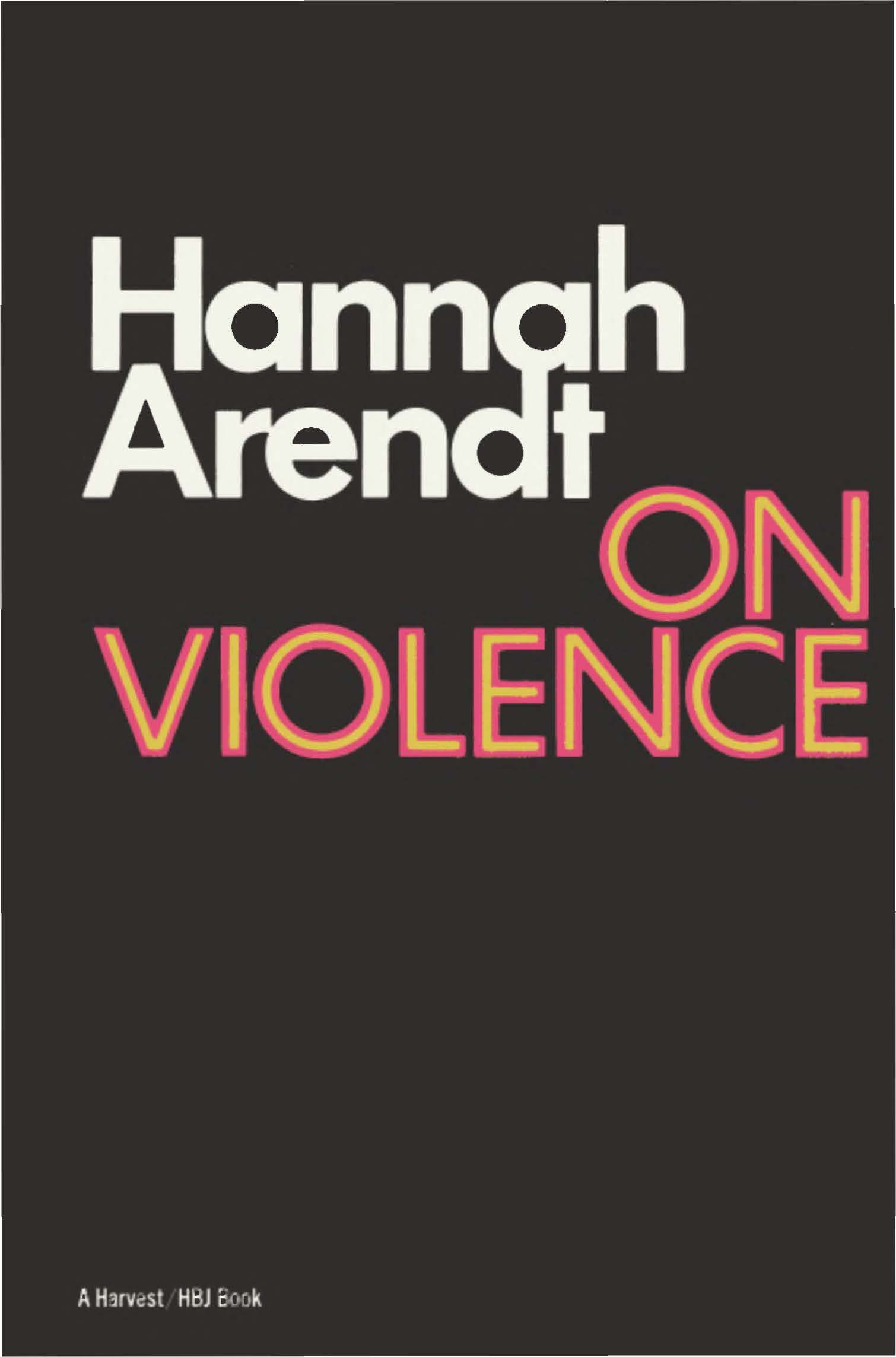
On Violence
Overview unavailable.
On Violence and Warfare
- The twentieth century has been defined by wars and revolutions, with violence treated as their common denominator.
- The technical development of weapons has reached a destructive potential where no political goal can justify their actual use.
- Modern warfare between superpowers functions on deterrence rather than victory, creating an unprecedented and absurd strategic reality.
- Violence inherently relies on implements, making it deeply tied to the unpredictable perils of the means-end category in human affairs.
- The extreme unpredictability and arbitrariness of the battlefield cannot be eliminated by modern simulations, game theories, or scientific calculations.
The "apocalyptic" chess game between the superpowers, that is, between those that move on the highest plane of our civilization, is being played according to the rule "if either 'wins' it is the end of both"...
The Persistence of Warfare
- Warfare persists not because of human aggression or economic dangers, but because no political substitute has emerged to serve as a final arbiter in international affairs.
- The survival of war is deeply tied to the identification of national independence with the absolute sovereignty of the state.
- While the American Constitution historically omitted the concept of sovereignty, the modern U.S. has adopted the bankrupt European nation-state tradition.
- The fact that conventional war remains possible in underdeveloped regions offers no true consolation regarding its overall obsoleteness.
- Scientifically minded brain trusters pose a unique danger because they calculate probabilities rather than genuinely thinking about human consequences.
Covenants, without the sword, are but words
The Illusion of Futurology
- Hypothetical constructions of future events rely on a logical flaw where initial speculation quickly transforms into accepted fact.
- Such speculative theories are categorized not as science, but as pseudo-science that imitates the surface features of genuine scientific inquiry.
- Strategic theories of this nature are actively dangerous because they foster a false sense of understanding and control over actual events.
- True events are occurrences that interrupt routine processes, rendering predictions based on automatic present trends inherently fragile.
- Human action and unexpected accidents consistently destroy the rigid patterns upon which futurologists rely for their evidence.
- Despite the enormous historical role of violence, it has been largely neglected and taken for granted in social and political thought.
Predictions of the future are never anything but projections of present automatic processes and procedures, that is, of occurrences that are likely to come to pass if men do not act and if nothing unexpected happens; every action, for better or worse, and every accident necessarily destroys the whole pattern in whose frame the prediction moves and where it finds its evidence.
The Obsolescence of Violence
- Traditional literature on war historically treated violence as a mere instrument subservient to broader political and economic ends.
- Nineteenth-century formulas by thinkers like Clausewitz and Engels viewed war as a continuation of politics or an accelerator of economic development.
- Modern developments, such as the military-industrial complex and thermonuclear weapons, reverse this dynamic, suggesting war has become the foundational social system.
- Advances in biological weapons, robot soldiers, and the complexities of guerrilla warfare demonstrate that extreme technical superiority can actually become a liability.
- The sheer destructive capability of modern arsenals means that a country's violence capacity no longer reliably indicates its true strength or survival prospects.
A thermonuclear war cannot be considered a continuation of politics by other means (according to the formula of Clausewitz). It would be a means of universal suicide.
The Appeal of Violence
- Violence has become increasingly popular in domestic affairs and revolutionary contexts, even as it grows more uncertain in international relations.
- While Marx acknowledged violence in history, he viewed it as a secondary consequence rather than the primary driver of societal change.
- Traditional Marxist theory emphasized that revolutions result from objective societal circumstances rather than intentional conspiracies or arbitrary violence.
- Historical figures like Sorel and modern thinkers like Sartre have attempted to integrate the glorification of violence into leftist philosophy.
- Sartre's modern view that violence allows oppressed people to recreate themselves sharply contrasts with classical Marxist and Hegelian traditions that prioritized labor and thought.
Political assassination, except for a few acts of individual terror perpetrated by small groups of anarchists, was mostly the prerogative of the Right, while organized armed uprisings remained the specialty of the military.
The Shift Toward Violence
- Philosophers like Sartre, Marx, and Hegel share a rebellion against the factuality of the human condition, yet a distinct gulf separates peaceful labor from actual deeds of violence.
- Sartre's casual endorsement of killing highlights an alarming new shift toward violence in revolutionary thinking that remains alarmingly unnoticed.
- This experiential logic of violence is entirely unprecedented and cannot be derived from idealistic concepts of thought or materialistic concepts of labor.
- The New Left's psychology is inextricably shaped by growing up under the shadow of the atom bomb and inheriting a world marked by genocide and state terror.
- Despite initial widespread commitments to nonviolence and civil rights successes, contemporary militant movements are increasingly yielding to a glorification of violence.
"To shoot down a European is to kill two birds with one stone . . . there remain a dead man and a free man," says Sartre in his preface.
Global Student Rebellion
- Students and critics exchange reciprocal, largely meaningless political slogans and accusations.
- Proposed psychological and social causes for student unrest contradict the global nature of the rebellion.
- Despite varied local conditions, the student generation is universally characterized by courage and confidence in change.
- The primary, unprecedented catalyst for student rebellion is that technological progress is leading straight into disaster.
- Scientific advancement has reached a terrifying stage where any development can be weaponized for war.
the simple fact that technological progress is leading in so many instances straight into disaster
The Generation That Hears the Ticking
- Universities remain deeply entangled with federal funding and war-oriented research despite efforts toward institutional divorce.
- Modern technological proliferation increasingly threatens the survival of entire nations and all mankind.
- The younger generation lives with a profound, visceral awareness of potential doomsday as their defining worldview.
- Youth frequently condition their personal and global futures on the baseline assumption that the world will still exist.
- Global student rebellions manifest differently based on local institutional contexts and the intervention of police force.
- The introduction of tangible group interests and the Black Power movement shifted student protests from rhetorical theory into real violence.
To the often-heard question Who are they, this new generation? one is tempted to answer, Those who hear the ticking.
The Glorification of Violence
- Western countries face open hostility regarding violent means, yet black student violence enjoys backing from a significant minority within the Negro community.
- University authorities yield more readily to black demands backed by force compared to the moral claims of white rebels, viewing violence through the lens of historical labor struggles.
- The academic establishment's capitulation stems partly from an implicit recognition that force and violence can be successful techniques of social control when supported popularly.
- The student movement's glorification of violence relies on a baffling hodgepodge of Marxist leftovers and rhetorical excesses rather than coherent Marxist theory.
- Intellectuals like Sartre champion the myth that violence can heal its own wounds, treating revenge as a cure-all despite its detachment from historical reality.
Violence, like Achilles' lance, can heal the wounds it has inflicted.
Illusions of Revolutionary Violence
- Rebellions by the disinherited rarely succeed in altering systemic structures, instead frequently transforming revolutionary dreams into nightmares through mad fury.
- The concept of a unified Third World is exposed as an ideology rather than a concrete political reality.
- Student movements often seek saviors in foreign revolutionary figures like Mao or Castro through pseudo-religious incantations.
- Participatory democracy stands out as a genuine positive political slogan derived from the authentic revolutionary council tradition.
- Both Marx and Lenin ultimately aimed for a society where public action and the state would wither away entirely.
The rarity of slave rebellions and of uprisings among the disinherited and downtrodden is notorious; on the few occasions when they occurred it was precisely 'mad fury' that turned dreams into nightmares for everybody.
The Moral Paradox of Rebellion
- The New Left's slogans remain declamatory and are invoked against both Western representative democracy and Eastern one-party bureaucracies.
- There is a striking clash between the moral character of the current rebellion and its reliance on traditional Marxian rhetoric.
- Observers note that the movement is fundamentally characterized by disinterestedness and moral passion rather than traditional economic self-interest.
- Unlike historical Marxist movements that aligned with the down-to-earth interests of the working class, modern rebels have struggled to find reliable external allies.
- The hostility of the working class and the failure to cooperate with the Black Power movement left white rebels isolated outside the universities.
Their revolutionary idea, as Spender states, is moral passion.
The Evolution of Progress
- Authors discuss the persistent loyalty to nineteenth-century doctrines driven by the concept of historical Progress.
- The idea of universal progress evolved from an accumulation of knowledge in the seventeenth century to an Enlightenment education of mankind.
- By the nineteenth century, traditional limitations on progress disappeared, viewing motion itself as eternal and without end.
- Marxist philosophy utilized Hegelian concepts to provide a conceptual guarantee for the continuous progression of history.
- Despite relying on metaphorical guarantees, Marxism outcompeted other historical models by promising linear continuity instead of cyclical decline.
Now, in the words of Proudhon, motion is 'le fait primitif' and 'the laws of movement alone are eternal.'
The Illusion of Progress
- Individual human lives face the certain future of death, offering little personal comfort in grand notions of human progress.
- Philosophers like Herzen and Kant highlighted the chronological unfairness of progress, where later generations benefit from the uncompensated labors of their predecessors.
- Despite its philosophical flaws, the concept of progress provides a reassuring guide for acting into the future and escaping the unknown.
- Modern political and economic theories, as well as Marxist thought, rely heavily on the comforting assumption that nothing totally unexpected can happen.
- Twentieth-century events, including morally inspired student rebellions, have violently contradicted these predictable historical doctrines.
- Human beings in a free society cannot be psychologically manipulated by advertising or hidden persuaders, exposing the limits of manipulation theories.
This generation, trained like its predecessors in hardly anything but the various brands of the my-share-of-the-pie social and political theories, has taught us a lesson about manipulation, or, rather, its limits, which we would do well not to forget.
The Illusion of Progress
- A National Guard soldier who refused to attack unarmed protesters was diagnosed with 'suppressed aggressions' rather than acknowledging a moral crisis.
- The 19th-century belief in unlimited progress has been universally accepted largely due to the vast developments in the natural sciences.
- Unlike the natural sciences, strict research in the humanities must logically come to an end, leading to a senseless demand for forced original scholarship.
- The rebellion of the young is often directed against the academic glorification of science and scholarship, which they view as deeply compromised.
- The progress of science no longer aligns with the progress of mankind and could potentially spell the end of human existence.
- Violence and disruptive student activities are often driven by the conviction that only drastic disruption can interrupt automatic historical processes.
In the enlightened age we live in, this could be explained only by insanity; "he was rushed to a psychiatric examination [and] diagnosed as suffering from 'suppressed aggressions.'"
The Nature of Political Violence
- Action inherently interrupts automatic and predictable human behavior.
- Political theorists across the ideological spectrum largely agree that violence is simply the most extreme manifestation of power.
- Max Weber and C. Wright Mills define power through the ultimate reliance on violence and the rule of men over men.
- Writers like Bertrand de Jouvenel and Voltaire view power as an instrument of rule rooted in the instinct of domination and compelling others.
- Equating the commands of a policeman with those of a gunman highlights the problematic consensus that power and violence are fundamentally synonymous.
To command and to be obeyed: without that, there is no Power-with it no other attribute is needed for it to be.
Distinguishing Violence and Power
- Alexander Passerin d'Entreves uniquely distinguishes between violence and power, viewing power as institutionalized or qualified force.
- Most political theorists, from the Right to the Left and from historical figures to modern thinkers, fundamentally equate power with coercive force or the rule of man over man.
- Traditional political thought is deeply rooted in the concept of absolute sovereignty championed by thinkers like Jean Bodin and Thomas Hobbes.
- Bureaucracy represents a modern, formidable form of domination characterized as rule by Nobody, where responsibility cannot be localized.
- Rule by Nobody functions as the most tyrannical form of government because there is no accountable human authority to question.
- The impossibility of identifying responsible parties or enemies within bureaucratic systems drives worldwide rebellious unrest and chaotic political instability.
If, in accord with traditional political thought, we identify tyranny as government that is not held to give account of itself, rule by Nobody is clearly the most tyrannical of all, since there is no one left who could even be asked to answer for what is being done.
Law, Power, and Obedience
- The Hebrew-Christian tradition fortified political concepts by rooting the essence of law in simple command and obedience.
- Philosophical and scientific traditions highlight both an innate aggressiveness and a psychological instinct for submission in human nature.
- The interconnected nature of the will to power and the will to submission complicates traditional views of political dominance.
- Ancient models like the Athenian isonomy and the Roman civitas offered an alternative concept of power independent of the command-obedience relationship.
- Eighteenth-century revolutionaries sought to establish republics based on the rule of law and citizen consent rather than the rule of man over man.
- True institutional power relies on the ongoing support and consent of the people rather than unquestioning obedience to violence.
If we would trust our own experiences in these matters, we should know that the instinct of submission, an ardent desire to obey and be ruled by some strong man, is at least as prominent in human psychology as the will to power, and, politically, perhaps more relevant.
The Nature of Power
- All political institutions depend entirely on the living power and opinion of the people to maintain their existence.
- Power inherently relies on numbers and collective support, whereas violence can operate with fewer people by depending on implements.
- Tyranny is recognized as the most violent yet least powerful form of government due to its fundamental lack of broad support.
- Apparent disruptions by tiny minorities often succeed only because the passive majority refuses to exercise its own power.
- Current political science suffers from a failure to properly distinguish between distinct concepts like power, strength, force, and violence.
What actually happens in such cases is something much more serious: the majority clearly refuses to use its power and overpower the disrupters; the academic processes break down because no one is willing to raise more than a voting finger for the status quo.
Distinctions in Political Concepts
- Treating political terms as synonyms causes blindness to actual political realities.
- The traditional view mistakenly reduces all public affairs simply to the question of who rules whom.
- Power is distinct because it belongs to a group acting in concert, not to an isolated individual.
- Strength is an inherent property of an individual, whereas force refers to the energy of nature or circumstances.
- Authority relies on unquestioning recognition without the need for coercion or persuasion.
Power corresponds to the human ability not just to act but to act in concert.
Authority, Power, and Violence
- A father loses authority by acting as a tyrant or by treating his child as an equal.
- The greatest enemy of authority is contempt, and laughter is the surest way to undermine it.
- When institutional authority collapses, raw power enters, often leading to conflict and the resort to violence.
- Universities and churches face unprecedented institutional crises due to the erosion of traditional obedience.
- While authority, power, and violence rarely appear in pure forms in the real world, they remain fundamentally distinct concepts.
The greatest enemy of authority, therefore, is contempt, and the surest way to undermine it is laughter.
Power Versus Violence
- Equating power with violence often makes violence appear as the ultimate prerequisite for maintaining any power structure.
- Theorists have long argued that advanced government weaponry has made successful revolutions nearly impossible.
- Despite the immense technological gap between state militaries and citizen weaponry, revolutions have continuously persisted.
- A government's absolute superiority in violence lasts only as long as its underlying power structure and obedience remain intact.
- When commands are no longer obeyed, state-owned means of violence become useless and weapons quickly change hands.
In a contest of violence against violence the superiority of the government has always been absolute; but this superiority lasts only as long as the power structure of the government is intact—that is, as long as commands are obeyed and the army or police forces are prepared to use their weapons.
The Nature of Power
- Civil obedience is merely the outward manifestation of ongoing public support and consent.
- Revolutions occur when power disintegrates, revealing the underlying vulnerability of political systems.
- A revolutionary situation requires an organized group ready to step in and assume power, which was absent during the French student protests.
- De Gaulle sought support and offered concessions rather than relying purely on commands during the crisis.
- No government relies exclusively on violence; even tyrannical rule depends on a structured power basis and organized solidarity.
- Violence ultimately functions as a last resort of power against single individuals or criminals who defy the majority consensus.
The sudden dramatic breakdown of power that ushers in revolutions reveals in a flash how civil obedience -to laws, to rulers, to institutions-is but the outward manifestation of support and consent.
Power Versus Violence
- Superior military violence can be rendered helpless by a well-organized and resolute opponent, as demonstrated in guerrilla warfare and Vietnam.
- Violence is instrumental and always requires an external justification, whereas power is an absolute end in itself.
- Government is essentially organized power, making questions about the ultimate end of government nonsensical or utopian.
- Power needs legitimacy derived from its initial creation, whereas violence relies on immediate justification and implements rather than numbers.
- Power and violence are distinct phenomena that operate under entirely different principles, though they frequently appear combined in practice.
Power springs up whenever people get together and act in concert, but it derives its legitimacy from the initial getting together rather than from any action that then may follow.
The Paradox of Violence
- Violence multiplies human strength through artifacts and machinery, increasing its destructive effectiveness with distance.
- While violence can easily destroy power and compel instant obedience, power can never actually grow out of the barrel of a gun.
- Nonviolent resistance succeeds only against restrained opponents, whereas totalitarian regimes would respond to it with massacre and submission.
- Rule by sheer violence is a symptom of shrinking power, serving as a desperate substitute when political authority is lost.
- The use of violence inevitably triggers a boomerang effect, destroying the victor's own political institutions and resulting in ultimate impotence.
Violence can always destroy power; out of the barrel of a gun grows the most effective command, resulting in the most instant and perfect obedience.
The Nature of Totalitarian Power
- Totalitarian terror is sustained ubiquitously by turning every citizen into a potential informer for the police state.
- Unlike traditional tyrannies, totalitarian domination eventually turns against its own friends and supporters out of fear of all power.
- The climax of terror occurs when the police state devours its own children, marking the exact moment when true power disappears entirely.
- Power and violence are fundamental opposites; where one rules absolutely, the other is completely absent.
- Violence is utterly incapable of creating power and can only destroy it, making it essential to examine its roots independently.
The climax of terror is reached when the police state begins to devour its own children, when yesterday's executioner becomes today's victim.
Animal Behavior and Human Violence
- Comparing human behavior to animal behavior and vice versa are two sides of the same methodological error.
- Deriving human standards of behavior from other animal species is problematic and often done because animals are easier to experiment with.
- Research in social and natural sciences increasingly frames violent behavior as a natural, instinctual reaction.
- Unlike hunger or sex, aggressive instincts are portrayed as independent of provocation, where a lack of stimulation leads to a dangerous accumulation of energy.
- This framing leads to the paradoxical conclusion that unprovoked, irrational violence is natural to human beings.
It is as though the sensation of hunger in man would increase with the decrease of hungry people.
Reason, Instinct, and Human Violence
- Modern science often defines humanity as an animal rationale equipped with reason, yet treats this reason as a dangerous trait that makes humans worse than beasts.
- Scientific theories suggest that human toolmaking and long-range weapons bypass natural animal restraints, rendering human instincts unstable.
- Consequently, science attempts to cure us of the side effects of reason by manipulating and controlling our instincts according to animal standards.
- The text challenges these common assumptions, arguing that violence is neither beastly nor irrational.
- Rage and violence do not spring automatically from misery or suffering, but rather arise from a perceived injustice where conditions could be changed.
As against these theories and their implications, I shall argue in what follows that violence is neither beastly nor irrational-whether we understand these terms in the ordinary language of the humanists or in accordance with scientific theories.
The Rationality of Violence
- Rebellions and revolutions are frequently initiated and led by members of the upper classes rather than solely stemming from personal injury.
- Violence driven by rage is not inherently irrational, as its immediacy can sometimes serve as the only appropriate remedy in extreme situations.
- Human emotions like rage are natural responses, and attempting to eradicate them would effectively dehumanize individuals.
- The absence of emotion does not equal rationality; rather, true reason requires a capacity to be genuinely moved by tragic events.
- Collective guilt confessions and undirected rage create dangerous obfuscations that substitute real accountability with abstraction.
- Historically, hypocrisy often plays a more momentous role than mere injustice in transforming engaged individuals into enraged radicals.
To act with deliberate speed goes against the grain of rage and violence, but this does not make them irrational.
The War on Hypocrisy
- The Reign of Terror and modern radical movements share a deep-rooted hatred of societal hypocrisy rather than a simple desire for justice.
- Radical thinkers like Sorel, Pareto, and Fanon embraced a profound break with bourgeois moral standards.
- Violence is often deployed to tear away masks and force truth out into the open against deceptive appearances.
- This violent reaction against hypocrisy becomes irrational once it develops strategic goals and starts hunting for suspects.
- Collective violence creates a powerful and intoxicating sense of group coherence and brotherhood among participants.
This violent reaction against hypocrisy, however justifiable in its own terms, loses its raison d'etre when it tries to develop a strategy of its own with specific goals; it becomes "irrational" the moment it is "rationalized."
Death and Political Violence
- Death is typically an antipolitical experience of extreme loneliness and impotence that removes individuals from the world of appearances.
- When faced collectively in action, the proximity of death and mortality can intensely stimulate human vitality.
- Individual mortality highlights the potential immortality of the broader human group or species.
- While historical suicide squads embodied brotherhood through shared mortality, no lasting body politic has ever been founded on equality before death.
- The intense fraternal bonds forged by collective violence are ultimately transitory because they depend on immediate physical danger.
It is as though life itself, the immortal life of the species, nourished, as it were, by the sempiternal dying of its individual members, is 'surging upward,' is actualized in the practice of violence.
The Glorification of Violence
- Sorel and Pareto argued that praise of life and praise of violence are intertwined, viewing violence as a vital creative force.
- Sorel believed that a weakening bourgeoisie had lost its energy, requiring proletarian violence to reawaken the fighting spirit.
- Inspired by Bergson, Sorel positioned the violent worker-producer against the complacent consumer and intellectual classes.
- The moral qualities Sorel associated with violence included honor, glory, and indifference to material advantage.
- Sorel and Pareto were profoundly influenced by the Dreyfus Affair, shaping their theories on revolutionary violence.
Therefore are not praise of life and praise of violence the same?
Power, Violence, and Intellectual Elites
- Nonviolent disruption utilizes physical force that violates opponents' rights short of taking their life.
- The integration of workers into society created a mixed system termed Pluto-democracy by Pareto.
- Sorel's faith in the working class as revolutionary producers failed as workers sought better living standards.
- Modern productivity growth stems from technological development driven by scientists rather than workers.
- Intellectuals have emerged as a new elite class, though they lack organization and power experience.
- Intellectuals often cling to past revolutionary traditions, hindering their understanding of their current societal role.
The enormous growth of productivity in the modern world was by no means due to an increase in the worker՞' productivity, but exclusively the development of technology, and this depended neither on the working class nor on the bourgeoisie, but on the scientists.
The Biological Metaphors of Politics
- Intellectuals are identified as a potentially revolutionary class whose unrecognized power could profoundly impact society.
- The rebellious modern generation revives the philosophies of Bergson, Nietzsche, and Sorel, combining violence, life, and creativity.
- Glorifying life and violence as creative forces draws upon older traditions, paralleling Marx, Nietzsche, and Bergson.
- Traditional political thought frames power through organic growth, dictating that power must continuously expand or face decay and death.
- Interpreting political matters through organic and biological terms—such as viewing a society as sick—is deemed theoretically dangerous.
- Relying on biological metaphors ultimately promotes violence by framing political conflicts as medical treatments where the surgeon's knife has the final say.
Nothing, in my opinion, could be theoretically more dangerous than the tradition of organic thought in political matters by which power and violence are interpreted in biological terms.
Racism, Violence, and Ideology
- Collective violent action is often mistakenly viewed through organic metaphors as a natural prerequisite for human survival.
- Unlike mere prejudice, racism is an explicit ideological system whose logical consequence is murderous extermination.
- Nonviolent civil rights movements successfully eliminated discriminatory laws in the South but failed when facing deep urban social conditions.
- Current riots and backlash phenomena represent articulate protests against genuine grievances and rational interest-group reactions rather than full-blown racist ideologies.
- The greatest danger is that street violence will escalate and generate a true racist ideology to justify itself, potentially leading to a police state.
Racism, as distinguished from race, is not a fact of life, but an ideology, and the deeds it leads to are not reflex actions, but deliberate acts based on pseudo-scientific theories.
The Illusion of Enlightened Self-Interest
- The notion of enlightened self-interest is repeatedly refuted by reality because true self-interest inherently opposes long-term collective goals in favor of immediate private concerns.
- Human mortality creates a fundamental time discrepancy where individuals prioritize short-term survival and profit over the enduring condition of the shared public world.
- Expecting people to behave rationally and nonviolently in interest conflicts without an understanding of the public good is entirely unrealistic.
- Violence is instrumental and can remain rational only when it pursues short-term goals to effectively dramatize grievances and secure public attention.
- Historical examples demonstrate that violence is frequently more successful as a weapon of reform than of revolution, often forcing institutions to enact long-overdue changes.
Self-interest is interested in the self, and the self dies or moves out or sells the house; because of its changing condition, that is, ultimately because of the human condition of mortality, the self qua self cannot reckon in terms of long-range interest, i.e. the interest of a world that survives its inhabitants.
Violence and Bureaucratic Tyranny
- Institutions often yield to nonsensical and damaging demands achieved through violence simply because they are easier to implement than long-term structural reforms.
- The inherent danger of utilizing violence is that the means frequently overwhelm the end, permanently introducing violence into the body politic.
- Because action is irreversible, the most probable change brought about by the practice of violence is a transition to an increasingly violent world.
- The growing attraction of violence is directly proportional to the bureaucratization of public life, where traditional avenues for grievances have vanished.
- Bureaucracy is defined as a form of government where rule by nobody deprives everyone of political freedom, creating a tyranny without a tyrant.
- Global student rebellions are universally directed against ruling bureaucracies, explaining why Eastern rebels demand free speech while Western rebels dismiss it.
Bureaucracy is the form of government in which everybody is deprived of political freedom, of the power to act; for the rule by Nobody is not no-rule, and where all are equally powerless we have a tyranny without a tyrant.
The Crisis of Human Action
- Western rebels face a suspension of meaningful political action because traditional preliminaries like free speech no longer suffice.
- The transformation of governments and republics into sprawling bureaucracies has drastically shrunk the public realm over the modern age.
- Human action, rooted in the human capacity for natality and new beginnings, is what fundamentally distinguishes us from animals.
- Modern progress equates to relentless growth and bigness, which in turn demands more administration and erodes individual political power.
- Without a new example of participatory democracy, society risks being ruled by technocrats and algorithms, degrading humanity into mere biological cogs.
What the world today stands in greatest need of may well be a new example if the next thousand years are not to become an era of supercivilized monkeys.
The Perils of Bigness
- Riots and campus rebellions provide a rare feeling of collective action in a world where human agency is increasingly frustrated.
- The disintegration of public services and environmental degradation are automatic results of mass societies becoming unmanageable.
- Bigness inherently breeds vulnerability, causing strength and resiliency to slowly drain from societal institutions.
- A new brand of nationalism and separatism is emerging worldwide as a direct resentment against overwhelming centralization.
- Centralized administration ultimately monopolizes power, causing authentic local and institutional power sources to dry up.
Bigness is afflicted with vulnerability; cracks in the power structure of all but the small countries are opening and widening.
The Impotence of Power
- Power structures can remain seemingly intact while simultaneously losing their grip and effectiveness.
- Party bureaucracies have demonstrated the ability to crush popular political movements even at the cost of losing elections.
- Scientific teamwork allows humanity to achieve impossible feats like trips to the moon while failing to end disastrous small wars.
- Modern scientific progress follows inexorable laws that compel humanity to do whatever is technically possible regardless of consequences.
- Every decrease in established power serves as an open invitation for individuals or governments to substitute violence in its place.
It is as though we have fallen under a fairyland spell which permits us to do the "impossible" on the condition that we lose the capacity of doing the possible.
Marxism Versus Existential Violence
- Marx emphasized mass consciousness and collective alteration rather than individual liberation through isolated violent acts.
- Scholars like Leonard Schapiro and Raymond Aron view the New Left's emphasis on violence as a regression to pre-Marxian utopian socialism or Russian anarchism.
- Sartre attempts to justify violence through a Hegelian framework rooted in scarcity and antagonistic class reciprocity.
- Sartre argues that violence becomes a contingent necessity where scarcity makes each human presence redundant to another.
- The author criticizes Sartre's logical leap from mutual indifference in daily life to the active justification of killing, torturing, and enslaving.
There is all the difference in the world between "not taking notice" and "denying," between "denying any link" with somebody and "negating" his otherness; and for a sane person there is still a considerable distance to travel from this theoretical "negation" to killing, torturing, and enslaving.
Student Protest and Nihilism
- Student protesters form a mixed coalition alongside dropouts, hippies, and criminal elements.
- Established powers often fail to distinguish between nonviolent civil disobedience like sit-ins and actual crimes.
- Helmut Schelsky warned of a metaphysical nihilism that rejects the entire process of scientific and technical civilization.
- Conservative critics like Nathan Glazer compare student radicals to Luddite machine smashers.
- Analogies comparing modern student movements to past historical precedents often overlook the unique destructive potential of twentieth-century technology.
The great danger at present is that the established and the respectable . . . seem prepared to follow the most profoundly nihilistic denial possible, which is the denial of the future through denial of their own children, the bearers of the future.
Generations and the University Crisis
- Stephen Spender notes that today's students possess a completely different mood, style, and thought process compared to students from forty years prior.
- A shared concern for the world's future bridges generational divides, driven by common fears regarding nuclear weapons, environmental destruction, and technological debasement.
- Prominent scientists like Adolf Portmann and George Wald understand and share the profound uneasiness of the younger generation regarding the nuclear age.
- While the politicization of universities is often blamed on rebellious students, this movement was actually preceded by the politicization of the academy by established powers.
- The survival of both universities and civilized society depends on maintaining intellectual detachment and independence from political power.
- The rise of application-minded technocrats risks replacing traditional intellectual pursuit with an age of tyranny and utter sterility.
However that may be, the point is that the politicization of the universities by the students' movement was preceded by the politicization of the universities by the established powers.
The Crisis of the University
- Critics like Commager and Lindsay question the university's dual role as an educational sanctuary and an active participant in military and corporate ventures.
- While students possess the power to destroy universities, doing so would eliminate their own foundational base for resistance.
- Universities must remain distinct as spaces where power does not have the final say, despite existing hypocrisies.
- Official reactions to radical student and Black activism often oscillate between frightened appeasement and a severe lack of imagination.
- False comparisons between campus activism and labor-management disputes rely on a flawed corporate model of university governance.
To pretend that the university is 'the brain of society' or of the power structure is dangerous, arrogant nonsense -if only because society is not a 'body,' let alone a brainless one.
Academic Conflicts and Ideology
- Bayard Rustin criticized university capitulation to student demands, arguing for remedial training instead of superficial courses.
- The text expresses concern that new niche academic programs might later be viewed as systemic traps preventing true education.
- James Forman's manifesto demanded total control and reparations, invoking revolutionary rhetoric and the threat of force.
- Forman's manifesto simultaneously called for revolutionary seizure of power while demanding Christian and Jewish patience and nonviolence.
- Scholars like Jürgen Habermas struggle to discard outdated Marxist categories of class struggle and ideology.
What a reflection on the moral and intellectual state of society that much courage was required to talk common sense in these matters!
The Rules of Law
- Historically, serious criminal punishment involved banishment, casting the offender outside the community.
- Legal philosopher Passerin d'Entreves compares certain laws to accepted directives like the rules of a game rather than state imperatives.
- Individuals obey pre-existing societal laws primarily because participation in the human community requires conformity to its rules.
- Denying the foundational rules of law on principle represents a total refusal to enter human society rather than mere disobedience.
- Statistical data regarding declining police efficiency and low conviction rates reveal that the odds heavily favor modern criminals.
Every man is born into a community with pre-existing laws which he 'obeys' first of all because there is no other way for him to enter the great game of the world.
Crime, Terror, and Student Revolt
- Police brutality increases because frustrated officers face rising undetected crime rates and treat demonstrators as easy targets.
- International comparisons show that while crime clearance rates are dropping globally, the problem is uniquely severe in America.
- Historical analysis reveals that Stalin's terror hindered rather than helped Russian industrialization and economic development.
- Russian victory in World War II was achieved only when national emergency forced the regime to temporarily abate police terror.
- Veterans who tasted freedom during the war and terror afterward form the generation challenging contemporary tyranny.
- Radical student theories advocating for open government violence and societal destruction are dismissed as political idiocy and hypocrisy.
What then turned the scales was that police terror abated under the pressure of the national emergency; the people, left to themselves, could again gather together and generate enough power to defeat the foreign invader.
Knowledge, Meritocracy, and Social Resentment
- New leftist groups in Germany historically neglected the crucial issue of recognizing the Oder-Neisse Line despite their extremist opposition.
- Daniel Bell expresses cautious hope in scientific work, while Noam Chomsky questions whether rule by knowledgeable elites will be benign.
- A future meritocracy based on natural brain power risks provoking unprecedented resentment akin to racial antagonism.
- The numerical dominance of the disadvantaged against a meritocratic elite could drive society toward tyrannies and despotism.
- Popular demagoguery often exploits natural anxieties regarding integration, safety, and economic security among ordinary citizens.
- Ill-designed government integration policies can sometimes backfire and have a crushing impact on the minority schools they aim to help.
Is it not plausible to assume that this resentment will harbor all the murderous traits of a racial antagonism, as distinguished from mere class conflicts, inasmuch as it too will concern natural data which cannot be changed, hence a condition from which one could liberate oneself only by extermination of those who happen to have a higher I.Q.?
East and West Student Revolts
- Western student debates are characterized by ideological doubletalk and a lack of substantive political clarity.
- Observers note that German and other Western student leftists often exhibit extreme arrogance paired with profound ignorance.
- In stark contrast, Eastern European rebels possess a refreshing political clarity born from a heavy historical price.
- Czech student leaders reject the false dichotomy between capitalist and socialist freedoms, focusing instead on basic human rights.
- Despite the stark differences, Western students still face legitimate grievances and frustrations regarding political freedom.
In contrast to this mixture of stupidity and impertinence, the atmosphere among the eastern rebels is refreshing, although one shudders to think of the exorbitant price that has been paid for it.
Comprehensive Index of References
- The text consists of an alphabetical index listing various prominent historical figures, philosophers, and political theorists.
- It includes citations for international institutions, universities, and research centers across the globe.
- Multiple entries reference major political events, social movements, and radical organizations from the 20th century.
- Publications, newspapers, and academic journals are frequently cited alongside authors and thinkers.
- Page numbers and specific notations accompany each name, indicating a comprehensive bibliographic back-matter section.
Hull University, 89
On Violence and Warfare
- Modern warfare between superpowers functions on deterrence rather than victory, creating an unprecedented and absurd strategic reality.
The "apocalyptic" chess game between the superpowers, that is, between those that move on the highest plane of our civilization, is being played according to the rule "if either 'wins' it is the end of both"...
The Persistence of Warfare
- Scientifically minded brain trusters pose a unique danger because they calculate probabilities rather than genuinely thinking about human consequences.
Covenants, without the sword, are but words
The Illusion of Futurology
- Human action and unexpected accidents consistently destroy the rigid patterns upon which futurologists rely for their evidence.
Predictions of the future are never anything but projections of present automatic processes and procedures, that is, of occurrences that are likely to come to pass if men do not act and if nothing unexpected happens; every action, for better or worse, and every accident necessarily destroys the whole pattern in whose frame the prediction moves and where it finds its evidence.
The Obsolescence of Violence
- The sheer destructive capability of modern arsenals means that a country's violence capacity no longer reliably indicates its true strength or survival prospects.
A thermonuclear war cannot be considered a continuation of politics by other means (according to the formula of Clausewitz). It would be a means of universal suicide.
The Appeal of Violence
- Sartre's modern view that violence allows oppressed people to recreate themselves sharply contrasts with classical Marxist and Hegelian traditions that prioritized labor and thought.
Political assassination, except for a few acts of individual terror perpetrated by small groups of anarchists, was mostly the prerogative of the Right, while organized armed uprisings remained the specialty of the military.
The Shift Toward Violence
- Sartre's casual endorsement of killing highlights an alarming new shift toward violence in revolutionary thinking that remains alarmingly unnoticed.
"To shoot down a European is to kill two birds with one stone . . . there remain a dead man and a free man," says Sartre in his preface.
Global Student Rebellion
- The primary, unprecedented catalyst for student rebellion is that technological progress is leading straight into disaster.
the simple fact that technological progress is leading in so many instances straight into disaster
The Generation That Hears the Ticking
- Youth frequently condition their personal and global futures on the baseline assumption that the world will still exist.
To the often-heard question Who are they, this new generation? one is tempted to answer, Those who hear the ticking.
The Glorification of Violence
- Intellectuals like Sartre champion the myth that violence can heal its own wounds, treating revenge as a cure-all despite its detachment from historical reality.
Violence, like Achilles' lance, can heal the wounds it has inflicted.
Illusions of Revolutionary Violence
- Rebellions by the disinherited rarely succeed in altering systemic structures, instead frequently transforming revolutionary dreams into nightmares through mad fury.
The rarity of slave rebellions and of uprisings among the disinherited and downtrodden is notorious; on the few occasions when they occurred it was precisely 'mad fury' that turned dreams into nightmares for everybody.
The Moral Paradox of Rebellion
- Observers note that the movement is fundamentally characterized by disinterestedness and moral passion rather than traditional economic self-interest.
Their revolutionary idea, as Spender states, is moral passion.
The Evolution of Progress
- By the nineteenth century, traditional limitations on progress disappeared, viewing motion itself as eternal and without end.
Now, in the words of Proudhon, motion is 'le fait primitif' and 'the laws of movement alone are eternal.'
The Illusion of Progress
- Twentieth-century events, including morally inspired student rebellions, have violently contradicted predictable historical doctrines.
This generation, trained like its predecessors in hardly anything but the various brands of the my-share-of-the-pie social and political theories, has taught us a lesson about manipulation, or, rather, its limits, which we would do well not to forget.
The Illusion of Progress
- A National Guard soldier who refused to attack unarmed protesters was diagnosed with suppressed aggressions rather than acknowledging a moral crisis.
In the enlightened age we live in, this could be explained only by insanity; "he was rushed to a psychiatric examination [and] diagnosed as suffering from 'suppressed aggressions.'"
The Nature of Political Violence
- Equating the commands of a policeman with those of a gunman highlights the problematic consensus that power and violence are fundamentally synonymous.
To command and to be obeyed: without that, there is no Power-with it no other attribute is needed for it to be.
Distinguishing Violence and Power
- Rule by Nobody functions as the most tyrannical form of government because there is no accountable human authority to question.
If, in accord with traditional political thought, we identify tyranny as government that is not held to give account of itself, rule by Nobody is clearly the most tyrannical of all, since there is no one left who could even be asked to answer for what is being done.
Law, Power, and Obedience
- The interconnected nature of the will to power and the will to submission complicates traditional views of political dominance.
If we would trust our own experiences in these matters, we should know that the instinct of submission, an ardent desire to obey and be ruled by some strong man, is at least as prominent in human psychology as the will to power, and, politically, perhaps more relevant.
The Nature of Power
- Apparent disruptions by tiny minorities often succeed only because the passive majority refuses to exercise its own power.
What actually happens in such cases is something much more serious: the majority clearly refuses to use its power and overpower the disrupters; the academic processes break down because no one is willing to raise more than a voting finger for the status quo.
Distinctions in Political Concepts
- Power is distinct because it belongs to a group acting in concert, not to an isolated individual.
Power corresponds to the human ability not just to act but to act in concert.
Authority, Power, and Violence
- The greatest enemy of authority is contempt, and laughter is the surest way to undermine it.
The greatest enemy of authority, therefore, is contempt, and the surest way to undermine it is laughter.
Power Versus Violence
- A government's absolute superiority in violence lasts only as long as its underlying power structure and obedience remain intact.
In a contest of violence against violence the superiority of the government has always been absolute; but this superiority lasts only as long as the power structure of the government is intact—that is, as long as commands are obeyed and the army or police forces are prepared to use their weapons.
The Nature of Power
- Revolutions occur when power disintegrates, revealing the underlying vulnerability of political systems.
The sudden dramatic breakdown of power that ushers in revolutions reveals in a flash how civil obedience -to laws, to rulers, to institutions-is but the outward manifestation of support and consent.
Power Versus Violence
- Power needs legitimacy derived from its initial creation, whereas violence relies on immediate justification and implements rather than numbers.
Power springs up whenever people get together and act in concert, but it derives its legitimacy from the initial getting together rather than from any action that then may follow.
The Paradox of Violence
- While violence can easily destroy power and compel instant obedience, power can never actually grow out of the barrel of a gun.
Violence can always destroy power; out of the barrel of a gun grows the most effective command, resulting in the most instant and perfect obedience.
The Nature of Totalitarian Power
- The climax of terror occurs when the police state devours its own children, marking the exact moment when true power disappears entirely.
The climax of terror is reached when the police state begins to devour its own children, when yesterday's executioner becomes today's victim.
Animal Behavior and Human Violence
- Unlike hunger or sex, aggressive instincts are portrayed as independent of provocation, where a lack of stimulation leads to a dangerous accumulation of energy.
It is as though the sensation of hunger in man would increase with the decrease of hungry people.
Reason, Instinct, and Human Violence
- The text challenges common assumptions, arguing that violence is neither beastly nor irrational.
As against these theories and their implications, I shall argue in what follows that violence is neither beastly nor irrational-whether we understand these terms in the ordinary language of the humanists or in accordance with scientific theories.
The Rationality of Violence
- Violence driven by rage is not inherently irrational, as its immediacy can sometimes serve as the only appropriate remedy in extreme situations.
To act with deliberate speed goes against the grain of rage and violence, but this does not make them irrational.
The War on Hypocrisy
- This violent reaction against hypocrisy becomes irrational once it develops strategic goals and starts hunting for suspects.
This violent reaction against hypocrisy, however justifiable in its own terms, loses its raison d'etre when it tries to develop a strategy of its own with specific goals; it becomes "irrational" the moment it is "rationalized."
Death and Political Violence
- When faced collectively in action, the proximity of death and mortality can intensely stimulate human vitality.
It is as though life itself, the immortal life of the species, nourished, as it were, by the sempiternal dying of its individual members, is 'surging upward,' is actualized in the practice of violence.
The Glorification of Violence
- Sorel and Pareto argued that praise of life and praise of violence are intertwined, viewing violence as a vital creative force.
Therefore are not praise of life and praise of violence the same?
Power, Violence, and Intellectual Elites
- Modern productivity growth stems from technological development driven by scientists rather than workers.
The enormous growth of productivity in the modern world was by no means due to an increase in the worker՞' productivity, but exclusively the development of technology, and this depended neither on the working class nor on the bourgeoisie, but on the scientists.
The Biological Metaphors of Politics
- Interpreting political matters through organic and biological terms—such as viewing a society as sick—is deemed theoretically dangerous.
Nothing, in my opinion, could be theoretically more dangerous than the tradition of organic thought in political matters by which power and violence are interpreted in biological terms.
Racism, Violence, and Ideology
- Unlike mere prejudice, racism is an explicit ideological system whose logical consequence is murderous extermination.
Racism, as distinguished from race, is not a fact of life, but an ideology, and the deeds it leads to are not reflex actions, but deliberate acts based on pseudo-scientific theories.
The Illusion of Enlightened Self-Interest
- Human mortality creates a fundamental time discrepancy where individuals prioritize short-term survival and profit over the enduring condition of the shared public world.
Self-interest is interested in the self, and the self dies or moves out or sells the house; because of its changing condition, that is, ultimately because of the human condition of mortality, the self qua self cannot reckon in terms of long-range interest, i.e. the interest of a world that survives its inhabitants.
Violence and Bureaucratic Tyranny
- Bureaucracy is defined as a form of government where rule by nobody deprives everyone of political freedom, creating a tyranny without a tyrant.
Bureaucracy is the form of government in which everybody is deprived of political freedom, of the power to act; for the rule by Nobody is not no-rule, and where all are equally powerless we have a tyranny without a tyrant.
The Crisis of Human Action
- Without a new example of participatory democracy, society risks being ruled by technocrats and algorithms, degrading humanity into mere biological cogs.
What the world today stands in greatest need of may well be a new example if the next thousand years are not to become an era of supercivilized monkeys.
The Perils of Bigness
- Bigness inherently breeds vulnerability, causing strength and resiliency to slowly drain from societal institutions.
Bigness is afflicted with vulnerability; cracks in the power structure of all but the small countries are opening and widening.
The Impotence of Power
- Scientific teamwork allows humanity to achieve impossible feats like trips to the moon while failing to end disastrous small wars.
It is as though we have fallen under a fairyland spell which permits us to do the "impossible" on the condition that we lose the capacity of doing the possible.
Marxism Versus Existential Violence
- The author criticizes Sartre's logical leap from mutual indifference in daily life to the active justification of killing, torturing, and enslaving.
There is all the difference in the world between "not taking notice" and "denying," between "denying any link" with somebody and "negating" his otherness; and for a sane person there is still a considerable distance to travel from this theoretical "negation" to killing, torturing, and enslaving.
Student Protest and Nihilism
- Helmut Schelsky warned of a metaphysical nihilism that rejects the entire process of scientific and technical civilization.
The great danger at present is that the established and the respectable . . . seem prepared to follow the most profoundly nihilistic denial possible, which is the denial of the future through denial of their own children, the bearers of the future.
Generations and the University Crisis
- While the politicization of universities is often blamed on rebellious students, this movement was actually preceded by the politicization of the academy by established powers.
However that may be, the point is that the politicization of the universities by the students' movement was preceded by the politicization of the universities by the established powers.
The Crisis of the University
- Universities must remain distinct as spaces where power does not have the final say, despite existing hypocrisies.
To pretend that the university is 'the brain of society' or of the power structure is dangerous, arrogant nonsense -if only because society is not a 'body,' let alone a brainless one.
Academic Conflicts and Ideology
- The text expresses concern that new niche academic programs might later be viewed as systemic traps preventing true education.
What a reflection on the moral and intellectual state of society that much courage was required to talk common sense in these matters!
The Rules of Law
- Individuals obey pre-existing societal laws primarily because participation in the human community requires conformity to its rules.
Every man is born into a community with pre-existing laws which he 'obeys' first of all because there is no other way for him to enter the great game of the world.
Crime, Terror, and Student Revolt
- Russian victory in World War II was achieved only when national emergency forced the regime to temporarily abate police terror.
What then turned the scales was that police terror abated under the pressure of the national emergency; the people, left to themselves, could again gather together and generate enough power to defeat the foreign invader.
Knowledge, Meritocracy, and Social Resentment
- A future meritocracy based on natural brain power risks provoking unprecedented resentment akin to racial antagonism.
Is it not plausible to assume that this resentment will harbor all the murderous traits of a racial antagonism, as distinguished from mere class conflicts, inasmuch as it too will concern natural data which cannot be changed, hence a condition from which one could liberate oneself only by extermination of those who happen to have a higher I.Q.?
East and West Student Revolts
- In stark contrast, Eastern European rebels possess a refreshing political clarity born from a heavy historical price.
In contrast to this mixture of stupidity and impertinence, the atmosphere among the eastern rebels is refreshing, although one shudders to think of the exorbitant price that has been paid for it.
Comprehensive Index of References
- Page numbers and specific notations accompany each name, indicating a comprehensive bibliographic back-matter section.
Hull University, 89