One Hundred Years of Solitude
Sourced from scanned PDF via OCR — view quality check
Overview unavailable.
The Genesis of Macondo
- The narrative opens with Colonel Aureliano Buendía facing a firing squad, triggering a memory of his father taking him to discover ice.
- Macondo is described as a young, primitive village where the world is so new that many objects have not yet been named.
- A family of gypsies visits the village annually in March to showcase scientific novelties and inventions from the outside world.
- The gypsy Melquíades introduces the magnet, causing a chaotic and magical reaction among the village's metal household objects.
- Melquíades asserts that all objects possess a soul and that his 'magical irons' simply wake them up.
- José Arcadio Buendía is immediately captivated by these wonders, possessing an imagination that seeks to surpass the limits of nature.
The world was so recent lhat many things lacked names, and in order to inrucatc them it was nccessaty to point.
HARPERPERENNIALCI> MODERNCLAS~ICS
This book was originally published in Argentina in 1967 by Editorial Sudamericanos,
S.A., Buenos Aires, under the title Cien Aflos de Soledad.
A hardcover edition of this book was published in 1970 by Harper & Row, Pub-
lishers. A reissued hardcover edition was published in 2003.
P.S.TM is a trademark of HarperCollins Publishers.
ONE HUNDRED YEARS OF SOUTUDE. English translation copyright ID 1970 by Harper
& Row, Publishers, Inc. Assistance for the translation of this volume was given by the
Center for Inter-American Relations. All rights reserved. Printed in the United States
of America. No part of this book may be used or reproduced in any manner what-
soever without written permission except in the case of brief quotations embodied in
critical articles and reviews. For information, address HaiperCollins Publishers, 195
Broadway, New York, NY 10007.
HarperCollins books may be purchased for educational, business, or sales promo-
tional use. For information, please e-mail the Special Markets Department at SPsales
@harpercollins.com.
FIRST HARPER PERENNIAL EDITION PUBUSHED 1992.
FIRST PERENNIAL CLASSICS EDITION PUBUSHED 1998.
FIRST HARPER PERENNIAL MODERN CLASSICS EDmON PUBUSHED 2006.
Designed by Elliou Beard
The Library of Congress has catalogued the first· Perennial Classics edition as follows:
Garda Marquez, Gabriel.
[Cien afios de soledad. English]
One hundred years of solitude I Gabriel Garda Marquez.-Ist Perennial
Classics ed.
p.
cm.
ISBN 0-06-074045-0
1. Macondo (Imaginary place)-Fiction. 2. Latin America-Social conditions-
Fiction. 3. Epic literature. I. Title.
PQ8180.17.A73C5131998
863---dc21
98-24308
ISBN-tO: 0-06-088328-6 (pbk.)
ISBN-13: 978-0-06-088328-7 (pbk.)
17 18 19 +/RRD 30 29 28
for jomi garcia ascot
and maria Luisa eLio
I~.
!LI.·
'.
"
Colonel Aureliano Buendia l
m. Remedios Moscote
Jose Arcadia Buendia
m. Ursula 19uarim
I
- j
- ·---- - -
- l
Amaranta
I
17 Aurelianos
I Jose Arcadio
I
m. Rebeca
Aureliano Jose
(by Pilar Ternera)
Arcadio
(by Pilar· Ternera)
m. Santa Sofia de la Piedad
I
- ---. - r --
I
Remedios the Beauty
Aureliano Segundo
Jose Arcadia Segundo
m. Fernanda del Carpio .
I
"I
I Renata Remedios (Meme)
Jose Arcadia
I Amaranta Ursula
I
I
m. Gaston
Aureliano
Aureliano
(by Mauricio Babilonia)
(by Aureliano)
'C~' .J\1ANY YEARS LATER, as he faced the firing squad, Colonel
Aureliano Buendia was to remember that distant afternoon when his
Hlther look him to discover icc. At that Lime Macondo was ~ village
of twenty adobe houses, built on the bank of a river of clear water
that ran along a bed of polished stones, which were white and enor-
mous, like prchistOl;c eggs. The world was so recent lhat many things
lacked names, and in order to inrucatc them it was nccessaty to point.
Every year during the month of March a family of ragged gypsies
would set up their tenls ncar the viUagc, and with a great uproar of
pipes and kettledrums they would display new inventions, First they
brought the magnet A heavy gypsy with an untamed beard and spar-
row hands, who introduced himself as Melqulades, put on a bold
public demonstration of what he himself called the eighth wonder of
the learned alchemists of Macedonia. He went from house to house
dragging two metal ingots and everybody was amazed to see pots,
pans, tongs, and braziers tumble down from their places and beams
creak from the desperation of nails and screws tJying to emerge, and
even objects that had been lOSl for a long time appeared from where
they had been searched for most and went dragging along in tur-
bulent confusion behind Melquiadcs' magical irons. "Things have a
, I
I
Gabr-iel Garcia o?\Il6r'l"ez
life of their OWI1," the b'Ypsy proclaimed with a harsh accent. "It's sim-
ply a matter or waking up their souls." J ose Arcadio Buendia, whose
unbridled imagination always went beyond the genius of nature and
even beyond miracles and magic, thought that it would be possible
to make usc of that useless invention to extract gold from the bow-
els of the eanh. Mclquiadcs, who was an honest man, warned him:
" It won't work for that." ButJose Arcadio Buendia at that time did
not believe in the honesty of gypsies, so he traded his mule and a pair
of goalS for the two magnetized ingots. Ursula Tguanin, his wife, who
relied on lhosc animals to increase ulcir poor domestic holdings, was
unable to dissuade him. "V cry soon we'U have gold enough and more
to pave the floors of the house," her husband rep lied. For several
months he worked hard to demonstrate the truth of his idea. H e
explored evel), inch of the region, even the ri v~ rbcd , dragging the
two iron ingots aJong and reciting Meiquiades' incantation aloud. The
only thing he succeeded in doing was tq unearth a suit of fifteenth-
century armor which had all of its pieces soldered together with rust
and inside of which there was the hoUow reson~nce of an enormous
s ton e- f~led gourd. When J ose Arcadio Buendia and· the four men of
his expedition managed to take the armor apart, they found inside
a calcified skeleton with a copper locket containing a woman's hair
around its neck.
In March the gypsies returned. This time they brought a telescope
and a magnifying glass the size of a drum, whi"ch they exhibited as
the latest discovery ofthc J cws of Amsterdam. They placed a gypsy
woman at one end of the village and set up the telescope at the
entrance lo the tenl. For the price of five reales, people could look
into the telescope and see the gypsy woman an armis length away.
"Science has eliminated distance," Melquiades proclaimed. "In a
short lime, man wilJ be able to sec what is happening in any place
in the world without leaving his own house." A burning noonday sun
brought out a startling demonstration with the gigantic magnifying
2
ONE H UND R ED YEARS of SO LIT U DE
glass: they put a pile of dry hay in the middle of the street and set
it on fire by concentrating the sun's rays. J ose Arcadio Buendia, who
had still not been consoled for the failure of his magnets, conceived
the idea of using that invention as a weapon of war. Again
M elquiades tried to dissuade him, but he finally accepted the two
magnetized ingots and three colonial coins in exchange for the mag-
nifying glass. Ursula wepl in consternation. That money was from
a chest of gold coins that her father had put together over an entire
life of p.ivation and that she had buried underneath her bed in hopes
of a proper occasion to make use of it. Jose Areadio Buendia made
no altemptto console her, completely absorbed in his tactical exper-
iments with the abnegation of a scientist and even at the risk of his
own life. In an attempt to show the en-eets of the glass on enemy
troops, he exposed himself to the concentration of the sun's rays and
sun-ered burns which turned into sores that took a long time to heal.
O ver the protests of his wife, who was alarmed at such a dangerous
invention, at one point he was ready to set the house on fire. He
would spend hours on end in his room, calculating the strategic pos-
sibilities of his novel weapon until he succeeded in putting together
a manual of startling instructional clarity and an irresistible power
of conviction. He sent it to the govermnent, accompanied by numer-
ous descriptions of his experiments and several pages of explanatOlY
sketches, by a messenger who crossed the mountains, got lost in meas-
ureless swamps, forded stormy rivers, and was on the point of per-
ishing under the lash of despair, plague, and wild beasts until he
found a route lhatjoined the one used by the mules that carried the
mail. In spite of the fact that a trip to the capital was little less than
impossible at that lime, J ose Arcadia Buendia promised to undertake
it as soon as the government ordered him to so that he could put on
some practical demonstrations of his invention for the military author-
ities and could train them himself in the complicated art of solar war.
For several years he waited for an answer. Finally, tired of wailing]
3
The Magnet and the Magnifier
- Jose Arcadio Buendia trades his livestock for magnets, obsessively believing they can extract gold from the earth despite warnings from the gypsy Melquiades.
- His search for gold yields only a rusted suit of 15th-century armor containing a calcified skeleton and a locket of hair.
- The gypsies return with a telescope and a giant magnifying glass, which Melquiades presents as scientific wonders that eliminate distance.
- Buendia envisions the magnifying glass as a revolutionary weapon of war, sacrificing his wife's inheritance of gold coins to acquire it.
- He conducts dangerous experiments on himself, suffering severe burns while attempting to prove the glass's tactical efficacy.
- He eventually drafts a military manual and sends it to the government via a messenger who survives a treacherous journey through swamps and mountains.
The only thing he succeeded in doing was to unearth a suit of fifteenth-century armor which had all of its pieces soldered together with rust and inside of which there was the hollow resonance of an enormous stone-filled gourd.
, I
I
Gabr-iel Garcia o?\Il6r'l"ez
life of their OWI1," the b'Ypsy proclaimed with a harsh accent. "It's sim-
ply a matter or waking up their souls." J ose Arcadio Buendia, whose
unbridled imagination always went beyond the genius of nature and
even beyond miracles and magic, thought that it would be possible
to make usc of that useless invention to extract gold from the bow-
els of the eanh. Mclquiadcs, who was an honest man, warned him:
" It won't work for that." ButJose Arcadio Buendia at that time did
not believe in the honesty of gypsies, so he traded his mule and a pair
of goalS for the two magnetized ingots. Ursula Tguanin, his wife, who
relied on lhosc animals to increase ulcir poor domestic holdings, was
unable to dissuade him. "V cry soon we'U have gold enough and more
to pave the floors of the house," her husband rep lied. For several
months he worked hard to demonstrate the truth of his idea. H e
explored evel), inch of the region, even the ri v~ rbcd , dragging the
two iron ingots aJong and reciting Meiquiades' incantation aloud. The
only thing he succeeded in doing was tq unearth a suit of fifteenth-
century armor which had all of its pieces soldered together with rust
and inside of which there was the hoUow reson~nce of an enormous
s ton e- f~led gourd. When J ose Arcadio Buendia and· the four men of
his expedition managed to take the armor apart, they found inside
a calcified skeleton with a copper locket containing a woman's hair
around its neck.
In March the gypsies returned. This time they brought a telescope
and a magnifying glass the size of a drum, whi"ch they exhibited as
the latest discovery ofthc J cws of Amsterdam. They placed a gypsy
woman at one end of the village and set up the telescope at the
entrance lo the tenl. For the price of five reales, people could look
into the telescope and see the gypsy woman an armis length away.
"Science has eliminated distance," Melquiades proclaimed. "In a
short lime, man wilJ be able to sec what is happening in any place
in the world without leaving his own house." A burning noonday sun
brought out a startling demonstration with the gigantic magnifying
2
ONE H UND R ED YEARS of SO LIT U DE
glass: they put a pile of dry hay in the middle of the street and set
it on fire by concentrating the sun's rays. J ose Arcadio Buendia, who
had still not been consoled for the failure of his magnets, conceived
the idea of using that invention as a weapon of war. Again
M elquiades tried to dissuade him, but he finally accepted the two
magnetized ingots and three colonial coins in exchange for the mag-
nifying glass. Ursula wepl in consternation. That money was from
a chest of gold coins that her father had put together over an entire
life of p.ivation and that she had buried underneath her bed in hopes
of a proper occasion to make use of it. Jose Areadio Buendia made
no altemptto console her, completely absorbed in his tactical exper-
iments with the abnegation of a scientist and even at the risk of his
own life. In an attempt to show the en-eets of the glass on enemy
troops, he exposed himself to the concentration of the sun's rays and
sun-ered burns which turned into sores that took a long time to heal.
O ver the protests of his wife, who was alarmed at such a dangerous
invention, at one point he was ready to set the house on fire. He
would spend hours on end in his room, calculating the strategic pos-
sibilities of his novel weapon until he succeeded in putting together
a manual of startling instructional clarity and an irresistible power
of conviction. He sent it to the govermnent, accompanied by numer-
ous descriptions of his experiments and several pages of explanatOlY
sketches, by a messenger who crossed the mountains, got lost in meas-
ureless swamps, forded stormy rivers, and was on the point of per-
ishing under the lash of despair, plague, and wild beasts until he
found a route lhatjoined the one used by the mules that carried the
mail. In spite of the fact that a trip to the capital was little less than
impossible at that lime, J ose Arcadia Buendia promised to undertake
it as soon as the government ordered him to so that he could put on
some practical demonstrations of his invention for the military author-
ities and could train them himself in the complicated art of solar war.
For several years he waited for an answer. Finally, tired of wailing]
3
The Roundness of the Earth
- After failing to sell his 'solar war' invention to the military, Jose Arcadio Buendia receives navigation tools and maps from the gypsy Melquiades.
- Jose Arcadio Buendia abandons his domestic duties and family to obsessively study the stars and master the use of the astrolabe and sextant.
- Through pure astronomical speculation and isolation, he deduces the scientific truth that the earth is round, a claim met with hostility by his wife, Ursula.
- The village concludes that Jose Arcadio Buendia has lost his mind when he proposes that one can return to a starting point by sailing consistently east.
- Melquiades returns to Macondo, validates Jose Arcadio's discovery as a proven fact of the outside world, and gifts him an alchemy laboratory.
- The physical contrast between the two men grows stark, as Melquiades has aged rapidly from exotic diseases while Jose Arcadio retains his immense strength.
The children would remember for the rest of their lives the august solemnity with which their father, devastated by his prolonged vigil and by the wrath of his imagination, revealed his discovery to them: 'The earth is round, like an orange.'
, I
I
Gabr-iel Garcia o?\Il6r'l"ez
life of their OWI1," the b'Ypsy proclaimed with a harsh accent. "It's sim-
ply a matter or waking up their souls." J ose Arcadio Buendia, whose
unbridled imagination always went beyond the genius of nature and
even beyond miracles and magic, thought that it would be possible
to make usc of that useless invention to extract gold from the bow-
els of the eanh. Mclquiadcs, who was an honest man, warned him:
" It won't work for that." ButJose Arcadio Buendia at that time did
not believe in the honesty of gypsies, so he traded his mule and a pair
of goalS for the two magnetized ingots. Ursula Tguanin, his wife, who
relied on lhosc animals to increase ulcir poor domestic holdings, was
unable to dissuade him. "V cry soon we'U have gold enough and more
to pave the floors of the house," her husband rep lied. For several
months he worked hard to demonstrate the truth of his idea. H e
explored evel), inch of the region, even the ri v~ rbcd , dragging the
two iron ingots aJong and reciting Meiquiades' incantation aloud. The
only thing he succeeded in doing was tq unearth a suit of fifteenth-
century armor which had all of its pieces soldered together with rust
and inside of which there was the hoUow reson~nce of an enormous
s ton e- f~led gourd. When J ose Arcadio Buendia and· the four men of
his expedition managed to take the armor apart, they found inside
a calcified skeleton with a copper locket containing a woman's hair
around its neck.
In March the gypsies returned. This time they brought a telescope
and a magnifying glass the size of a drum, whi"ch they exhibited as
the latest discovery ofthc J cws of Amsterdam. They placed a gypsy
woman at one end of the village and set up the telescope at the
entrance lo the tenl. For the price of five reales, people could look
into the telescope and see the gypsy woman an armis length away.
"Science has eliminated distance," Melquiades proclaimed. "In a
short lime, man wilJ be able to sec what is happening in any place
in the world without leaving his own house." A burning noonday sun
brought out a startling demonstration with the gigantic magnifying
2
ONE H UND R ED YEARS of SO LIT U DE
glass: they put a pile of dry hay in the middle of the street and set
it on fire by concentrating the sun's rays. J ose Arcadio Buendia, who
had still not been consoled for the failure of his magnets, conceived
the idea of using that invention as a weapon of war. Again
M elquiades tried to dissuade him, but he finally accepted the two
magnetized ingots and three colonial coins in exchange for the mag-
nifying glass. Ursula wepl in consternation. That money was from
a chest of gold coins that her father had put together over an entire
life of p.ivation and that she had buried underneath her bed in hopes
of a proper occasion to make use of it. Jose Areadio Buendia made
no altemptto console her, completely absorbed in his tactical exper-
iments with the abnegation of a scientist and even at the risk of his
own life. In an attempt to show the en-eets of the glass on enemy
troops, he exposed himself to the concentration of the sun's rays and
sun-ered burns which turned into sores that took a long time to heal.
O ver the protests of his wife, who was alarmed at such a dangerous
invention, at one point he was ready to set the house on fire. He
would spend hours on end in his room, calculating the strategic pos-
sibilities of his novel weapon until he succeeded in putting together
a manual of startling instructional clarity and an irresistible power
of conviction. He sent it to the govermnent, accompanied by numer-
ous descriptions of his experiments and several pages of explanatOlY
sketches, by a messenger who crossed the mountains, got lost in meas-
ureless swamps, forded stormy rivers, and was on the point of per-
ishing under the lash of despair, plague, and wild beasts until he
found a route lhatjoined the one used by the mules that carried the
mail. In spite of the fact that a trip to the capital was little less than
impossible at that lime, J ose Arcadia Buendia promised to undertake
it as soon as the government ordered him to so that he could put on
some practical demonstrations of his invention for the military author-
ities and could train them himself in the complicated art of solar war.
For several years he waited for an answer. Finally, tired of wailing]
3
['
gabriel g arda .7I1arquez
he bemoaned to Melquiades the railure or his project and the gypsy
then gave him a convincing proor or his honesty: he gave him back
the doubloons in exchange ror the magnirying glass, and he left him
in addition some Portuguese maps and several instruments of navi-
gation. [n his own handwriting he set down a concise synthesis of th.c
studies by Monk Hermann, which he lert J ose Areadio so that he
would be able to make usc or the astrolabe, the compass, and the sex-
tant. Jose Arcadia Buendia spent the long months of the rainy sea-
son shut up in a smail room t.hat he had built in the rear of the hOllse
so that no one would disturb his experiments. Having completely
abandoned his domestic obligationsl he spent entire nights in the
courtyard watching the course of the stars and he almost contracted
sunstroke from trying to establish an exact method to ascertain nool1.
\¥hcn he became an expert in the usc and manipulation of his instru-
ments, he conceived a notion of space that allowed him to navigate
across unknown seas, to visit uninhabited territories, and to establish
relations with splendid beings without having to leave his study. That
was the period in which he acquired the habit of talking to himself,
of walking through the house without paying attention to anyone, as
Ursula and the children broke their backs in the garden, growing
banana and caladium, cassava and ·yams, ahuyama roots and egg-
plants. Suddenly, without warning, his feverish activity was inter-
rupted and was replaced by a kind of raseination. He spent several
days as if he were bewitched, softly repeating to himself a string or
fearrul conjectures without giving credit to his own understanding.
Finally, one Tuesday in D ecember, aL lunchtime, all at once he
released the whole weight of his torment. The children would
remember for the rest of their lives the august solemnity with which
their rather, devastated by his prolonged vigil and by the wrath or
his imagination, revealed his discovery to them:
uThe earth is round, like an orange."
1
ONE J-I UNDRED YEARS _j SOLITUDE
U rsula lost her patience. ceir you have to go crazy, please go crazy
all by yourselfl" she shouted. "But don't try to put your gypsy ideas
into the heads of the children." Jose Arcadia Buendia, impassive, did
not let himselr be rrightened by the desperation of his wife, who, in
a seizure or rage, smashed the astrolabe against the floor. He built
another one, he gathered the men of the village in hjs lilde room,
and he demonstrated to them, with th ~ories that none of them could
understand, the possibil.ity of returning to where one had set out by
consistently sailing east. The whole village was convinced that J ose
Arcadia Buendia had lost his reason, when Melquiades returned to
set tllings straight. He gave public praise to tl,e intelligence of a man
who from pure astTonomieal speculation had evolved a theory that
had already been proved in practice, although unknown in
Macondo unlil then, and as a proof of his aclmiraLion he made him
a gift tl,at was to have a profound influence on the future of the vil-
lage: the laboratory or an alchemist.
By then Melquiades had aged with surprising rapidity. On his
first trips he seemed to be the same age as J ose Arcadio Buendia.
But while the latter had preserved his extraordinary strength, which
permitted him to pull down a horse by grabbing its ears, the gypsy
seemed to have been worn down by some tenacious iUness. It was,
in reality, the result of multiple and rare diseases contracted on his
innumerable trips around the world. According to what he himself
said as he spoke to Jose Arcadio Buendia while helping him set up
the laboratory, death followed him everywhere, snilfmg at the' culfs
of his pants, but never deciding to give him the final clutch of its
claws. He was a fugitive rrom all the plagues and catastrophes that
had ever lashed mankind. Hc had survived pellagra in Persia, scurvy
in the Malayan arch.ipelago, leprosy in Alexandria, beriberi in
Japan, bubonic plague in Madagascar, an earthquake in Sicily, and
a disastrous shipwreck in tl,e Strait of Magellan. That prodigious
5
Melquíades and the Alchemist's Dream
- Melquíades is introduced as a world-weary traveler who has survived countless global plagues and catastrophes, carrying an aura of ancient mystery.
- Despite his vast wisdom and near-mythical status, the gypsy suffers from mundane human ailments, poverty, and the physical toll of his travels.
- José Arcadio Buendía forms an immediate, profound bond with Melquíades, seeing him as a gateway to the darkest reaches of the imagination.
- The gypsy leaves behind a rudimentary laboratory and alchemical texts, including formulas for the philosopher's stone and doubling gold.
- Driven by obsession, José Arcadio Buendía convinces Úrsula to sacrifice her gold coins for a failed alchemical experiment that results in a pestilential syrup.
- The encounter establishes a lasting rift between the men's fascination with the unknown and Úrsula's pragmatic, suspicious view of the 'diabolical' sciences.
He wore a large black hat that looked like a raven with widespread wings, and a velvet vest across which the patina of the centuries had skated.
['
gabriel g arda .7I1arquez
he bemoaned to Melquiades the railure or his project and the gypsy
then gave him a convincing proor or his honesty: he gave him back
the doubloons in exchange ror the magnirying glass, and he left him
in addition some Portuguese maps and several instruments of navi-
gation. [n his own handwriting he set down a concise synthesis of th.c
studies by Monk Hermann, which he lert J ose Areadio so that he
would be able to make usc or the astrolabe, the compass, and the sex-
tant. Jose Arcadia Buendia spent the long months of the rainy sea-
son shut up in a smail room t.hat he had built in the rear of the hOllse
so that no one would disturb his experiments. Having completely
abandoned his domestic obligationsl he spent entire nights in the
courtyard watching the course of the stars and he almost contracted
sunstroke from trying to establish an exact method to ascertain nool1.
\¥hcn he became an expert in the usc and manipulation of his instru-
ments, he conceived a notion of space that allowed him to navigate
across unknown seas, to visit uninhabited territories, and to establish
relations with splendid beings without having to leave his study. That
was the period in which he acquired the habit of talking to himself,
of walking through the house without paying attention to anyone, as
Ursula and the children broke their backs in the garden, growing
banana and caladium, cassava and ·yams, ahuyama roots and egg-
plants. Suddenly, without warning, his feverish activity was inter-
rupted and was replaced by a kind of raseination. He spent several
days as if he were bewitched, softly repeating to himself a string or
fearrul conjectures without giving credit to his own understanding.
Finally, one Tuesday in D ecember, aL lunchtime, all at once he
released the whole weight of his torment. The children would
remember for the rest of their lives the august solemnity with which
their rather, devastated by his prolonged vigil and by the wrath or
his imagination, revealed his discovery to them:
uThe earth is round, like an orange."
1
ONE J-I UNDRED YEARS _j SOLITUDE
U rsula lost her patience. ceir you have to go crazy, please go crazy
all by yourselfl" she shouted. "But don't try to put your gypsy ideas
into the heads of the children." Jose Arcadia Buendia, impassive, did
not let himselr be rrightened by the desperation of his wife, who, in
a seizure or rage, smashed the astrolabe against the floor. He built
another one, he gathered the men of the village in hjs lilde room,
and he demonstrated to them, with th ~ories that none of them could
understand, the possibil.ity of returning to where one had set out by
consistently sailing east. The whole village was convinced that J ose
Arcadia Buendia had lost his reason, when Melquiades returned to
set tllings straight. He gave public praise to tl,e intelligence of a man
who from pure astTonomieal speculation had evolved a theory that
had already been proved in practice, although unknown in
Macondo unlil then, and as a proof of his aclmiraLion he made him
a gift tl,at was to have a profound influence on the future of the vil-
lage: the laboratory or an alchemist.
By then Melquiades had aged with surprising rapidity. On his
first trips he seemed to be the same age as J ose Arcadio Buendia.
But while the latter had preserved his extraordinary strength, which
permitted him to pull down a horse by grabbing its ears, the gypsy
seemed to have been worn down by some tenacious iUness. It was,
in reality, the result of multiple and rare diseases contracted on his
innumerable trips around the world. According to what he himself
said as he spoke to Jose Arcadio Buendia while helping him set up
the laboratory, death followed him everywhere, snilfmg at the' culfs
of his pants, but never deciding to give him the final clutch of its
claws. He was a fugitive rrom all the plagues and catastrophes that
had ever lashed mankind. Hc had survived pellagra in Persia, scurvy
in the Malayan arch.ipelago, leprosy in Alexandria, beriberi in
Japan, bubonic plague in Madagascar, an earthquake in Sicily, and
a disastrous shipwreck in tl,e Strait of Magellan. That prodigious
5
l I
GalJriel Garcia c.?\1tfrquez
creatufe, said to possess the keys of Nostradamus, was a gloomy
man enveloped in a sad aura with an Asiatic look that seemed to
,
,
know what there was on the other side of things. He wore a large
black hat that looked like a raven with widespread wings, and a vel-
vet vest across which the patina of the centuries had skated. But in
spite of his immense wisdom and his mysterious breadth, he had a
human burden, an earthly condition that kept him involved in the
small problems of daily life. He would complain of the ailments o/"
old age, he suffered from the most insignificant economic difficulties,
and he had stopped laughing a long time back because scurvy had
made his teeth drop out. O n that sufTocating noontime when the
gypsy revealed his secrets, J ose Arcadio Buendia had the certainty
that it was the beginning of a great friendship. The children were
startled by his fantastic stories. Aureliano, who could not have been
more than five at the time, would remember him for the rest of his
life as he saw him that aHernoon, sitting against the metallic and
quivering light [rom the window, lighting up with his deep organ
voice the dttrkest reaches of the imagination, while down over his
temples there flowed the grease that was being melted by the heat.
Jose Arcadia, his older brother, would pass on that wonderful image
as a hereditary memory to all of his descendants. Ursula, on the
othcr hand, held a bad memory of that visiL, for shc had entered the
room just as Melquiades had carelessly broken a flask of bichloride
of mercury.
"It's the smell of the devil," she said.
"Not at aJl," Mc!quiades corrected her. "It has been proven that
the devil has sulphuric properties and this is just a little corrosive
sublimate."
Always didactic, he went into a learned exposition of the dia-
bolical properties of cinnabar, but Ursula paid no attention to him,
although she took the children 01T to pray. That biting odor would
stay forever in her mind linked to the memory of Melquiades.
6
ONE H UNDRED YEARS 'J SOLITUDE
T he rudimentary l abora tory~in addition to a profusion of pots,
funnels, retorts, filters, and sieves-was made up of a primitive water
pipe, a glass beaker with a long, thin neck, a reproduction of the
philosopher's egg, and a stilf'tlle gypsies tllemselves had built in accor-
dance with modern descriptions of the three-anned alembic of Mary
theJew. N ang with those items, Mclquiades len: samples of the seven
metals tI,at corresponded to ti,e seven planets, the formulas of Moses
and Zosimus for doubling the quantity of gold, and a set of notes and
sketches concerning the processes of the Great Teaching that would
permit those who could interpret them to undertake the manufac-
ture of the philosopher's stone. Seduced by the simplicity of the for-
mulas to double ti,e quantity of gold, J ose Arcadia Buendia paid court
to Ursula for several weeks so that she would let him dig up her colo-
nial coins and increttsc them by as many times as it was possible to
subdivide mercury. Ursula gave in, as always, to her husband's
unyielding obstinacy. T hen Jose Arcadia Buendia tllrew three dou-
bloons into a pan and fused tI,em wi til copper filings, orpiment, brim-
stone, and lead. He put it. all to boil in a pot of castor oil until he
got a thick and pestilential syrup which was more like common
caramel than valuable gold. In risky and desperate processes of dis-
tillation, melted wi til ti,e seven ·planela,y metals, mixed with hermetic
mercury and vitriol of Cyprus, and put back to cook in hog fat for
lack of any radish oil, Ursula's precious inheritance was reduced to
a large piece of burnt hog cracklings that was finnly stuck to the bot-
tom of the pot.
When the gypsies came back, Ursula had turned the whole pop-
ulation or the village against t.hem. But. curiosity was greater than fear,
for Lhat Lime the gypsies went about the town making a deafening
noise with all manner of musical instruments while a hawker
announced the exhibition of the most fabulous discovery of the
Naciancenes. So that everyone went to the tent and by paying one
cent they saw a youthful Melquiades, recovered, unwrinkled, with a
7
The Transformation of Macondo
- José Arcadio Buendía’s alchemical obsession results in the destruction of Ursula’s inheritance, reducing her gold to burnt residue.
- The return of the gypsies introduces a rejuvenated Melquíades, whose false teeth are perceived by the villagers as a supernatural miracle.
- Upon learning the simple mechanical truth behind the dentures, José Arcadio Buendía suffers a crisis of disillusionment regarding his own primitive lifestyle.
- The narrative contrasts Buendía’s current erratic behavior with his history as the village’s visionary and industrious founding patriarch.
- Ursula is established as the severe, tireless engine of the household, maintaining order and cleanliness through unbreakable nerves.
- Macondo is described as a model of egalitarian design, where streets and houses were perfectly arranged for communal access to resources.
Those who remembered his gums that had been destroyed by scurvy, his flaccid cheeks, and his withered lips trembled with fear at the final proof of the gypsy's supernatural power.
l I
GalJriel Garcia c.?\1tfrquez
creatufe, said to possess the keys of Nostradamus, was a gloomy
man enveloped in a sad aura with an Asiatic look that seemed to
,
,
know what there was on the other side of things. He wore a large
black hat that looked like a raven with widespread wings, and a vel-
vet vest across which the patina of the centuries had skated. But in
spite of his immense wisdom and his mysterious breadth, he had a
human burden, an earthly condition that kept him involved in the
small problems of daily life. He would complain of the ailments o/"
old age, he suffered from the most insignificant economic difficulties,
and he had stopped laughing a long time back because scurvy had
made his teeth drop out. O n that sufTocating noontime when the
gypsy revealed his secrets, J ose Arcadio Buendia had the certainty
that it was the beginning of a great friendship. The children were
startled by his fantastic stories. Aureliano, who could not have been
more than five at the time, would remember him for the rest of his
life as he saw him that aHernoon, sitting against the metallic and
quivering light [rom the window, lighting up with his deep organ
voice the dttrkest reaches of the imagination, while down over his
temples there flowed the grease that was being melted by the heat.
Jose Arcadia, his older brother, would pass on that wonderful image
as a hereditary memory to all of his descendants. Ursula, on the
othcr hand, held a bad memory of that visiL, for shc had entered the
room just as Melquiades had carelessly broken a flask of bichloride
of mercury.
"It's the smell of the devil," she said.
"Not at aJl," Mc!quiades corrected her. "It has been proven that
the devil has sulphuric properties and this is just a little corrosive
sublimate."
Always didactic, he went into a learned exposition of the dia-
bolical properties of cinnabar, but Ursula paid no attention to him,
although she took the children 01T to pray. That biting odor would
stay forever in her mind linked to the memory of Melquiades.
6
ONE H UNDRED YEARS 'J SOLITUDE
T he rudimentary l abora tory~in addition to a profusion of pots,
funnels, retorts, filters, and sieves-was made up of a primitive water
pipe, a glass beaker with a long, thin neck, a reproduction of the
philosopher's egg, and a stilf'tlle gypsies tllemselves had built in accor-
dance with modern descriptions of the three-anned alembic of Mary
theJew. N ang with those items, Mclquiades len: samples of the seven
metals tI,at corresponded to ti,e seven planets, the formulas of Moses
and Zosimus for doubling the quantity of gold, and a set of notes and
sketches concerning the processes of the Great Teaching that would
permit those who could interpret them to undertake the manufac-
ture of the philosopher's stone. Seduced by the simplicity of the for-
mulas to double ti,e quantity of gold, J ose Arcadia Buendia paid court
to Ursula for several weeks so that she would let him dig up her colo-
nial coins and increttsc them by as many times as it was possible to
subdivide mercury. Ursula gave in, as always, to her husband's
unyielding obstinacy. T hen Jose Arcadia Buendia tllrew three dou-
bloons into a pan and fused tI,em wi til copper filings, orpiment, brim-
stone, and lead. He put it. all to boil in a pot of castor oil until he
got a thick and pestilential syrup which was more like common
caramel than valuable gold. In risky and desperate processes of dis-
tillation, melted wi til ti,e seven ·planela,y metals, mixed with hermetic
mercury and vitriol of Cyprus, and put back to cook in hog fat for
lack of any radish oil, Ursula's precious inheritance was reduced to
a large piece of burnt hog cracklings that was finnly stuck to the bot-
tom of the pot.
When the gypsies came back, Ursula had turned the whole pop-
ulation or the village against t.hem. But. curiosity was greater than fear,
for Lhat Lime the gypsies went about the town making a deafening
noise with all manner of musical instruments while a hawker
announced the exhibition of the most fabulous discovery of the
Naciancenes. So that everyone went to the tent and by paying one
cent they saw a youthful Melquiades, recovered, unwrinkled, with a
7
I,
gabriel garcia o?I1t!rQ1lez
new and nashing set of teeth. Those who remembered his gums that
had been destroyed by scurvy, his flaccid cheeks, and his withered
lips trembled with fear at the final proof of the gypsy's supernatural
power. The fear ltIrneci into panic when Melquiades look out his
leeth, intact, encased in their gums, and showed them lO the audi-
ence for an inslant--a Reeting instant in which he went back La being
the same decrepit man of years past-and put them back again and
smiled once more with the full control of his restored youth. Even
J ose Arcadio Buenrua himself considered that Melquiades' knowledge
had rcached unbearable extremes, but he felt a healthy excitement
when the gypsy explained to him alone the workings of his false teeth.
It seemed so simple and so procligious at the same time Lhalovcnught
he lost all interest in his experiments in alchemy. He underwent a
new c.isis of bad humor. He did not go back to eating regularly, and
he would spend the day walking III rough Il,e house. "Incredible things
afC happening in the world," he said to Ursula, "Right there across
the JiveI' there are aU kinds of magical instruments while we keep on
living like donkeys." Those who had knowll him since the founda-
tion of Maconclo were startled at how much he had changed uncleI'
Me,lquiades' influence.
At fI.-stJosc Arcadio Buendia had been a kind of youthful patri-
arch who would give instructions for planting and advice for the rais-
ing of ch,ildren and animals, and who collaborated with everyone,
even in the physical work, for the welfare of the community, Since
his house (i'om the very first had been the best in lhe village, the oth-
ers had been built in its image and likeness. It had a small, well-
lighted living roOI11, a dining room in the shape 01" a terrace with gaily
colored flowers, two bedrooms, a courtyard with a gigantic chestnut
tree, a weU-kept garden, and a conal where goalS, pigs, and hens lived
in peaceful communion. 'fhe only animals that were prohibited, not
just in his house but in the entire settlement, were figllling cocks.
Ursula's capacity for work was the same as that of her husband.
B
ONE HUN DRED YEARS of SO LITUDE
Active, small, severe, that woman of unbreakable nelves who at no
moment in her life had been heard to sing seemed to be everywhere,
fi·om dawn until quite late at night, always pUl~ued by the soft whis-
pering of her stiff, starched petticoats. Thanks to her the floors of
tamped earth, the unwhitewashed mud walls, the rustic, wooden fur-
niture Il,ey had built Il,emscives were always clean, and the old chests
where they kept their clollles exhaled the warm smell of basil.
Jose Arcadia Buendia, who was the m o~ t enterprising man ever
to be seen in the village, had set up the placement of the houses in
such a way that from all of them one could reach the river and
draw waleI' with the same eHol't, and he had lined up the streets
with such good sense that no house got more sun than another dur-
ing the hot time of day. Within a few years Maconclo was a viliage
that was more orderly and hardworking than any known until Il,en
by its three hundred inhabitants. It was a truly happy viliage where
no one was over thirty years of age and where no one had died.
Since the time of its founding, J ose Arcadio Buendia had built
traps and cages, In a short time he rilled not only his own house but
aU of those in the village with troupials, canaries, bee caters, and
redbreasts. The concert of so many different birds became so dis-
turbing that Ursula would plug her ears with beeswax so as not to
lose her sense of reality. The first time that Mciquiades' tribe
arrived, selling glass baUs for headaches, everyone was surprised that
Il,ey had been able to find that viUage lost in the drowsiness of the
swamp, and the b'Ypsies confessed that they had found their way by
Il,e song of Il,e birds.
That spirit of social initiative disappeared in a short time, pulled
away by the fever of the magnets, the astronomical calculations, the
dreams of transmutatiun, and the urge to discover the wonders of
the world. From a clean and active man, Jose Arcadia Buendia
changed into a man lazy in appearance, careless in his dress, with
a wild beard that Ursula managed to trim with great effort and a
9
The Founding of Macondo
- Macondo begins as a youthful, idyllic village of three hundred inhabitants where no one has yet died.
- Jose Arcadio Buendia fills the village with thousands of birds, whose songs eventually serve as a beacon for traveling gypsies.
- The patriarch's obsession with scientific discovery and alchemy transforms him from an active leader into a disheveled, visionary recluse.
- Driven by a desire to connect with modern inventions, Buendia organizes an expedition to find a route to civilization.
- The geography surrounding the village is treacherous, consisting of impenetrable mountains to the east and endless swamps to the south and west.
- The expedition party ventures north into the dense woods, quickly losing sight of the sun as they struggle through the wilderness.
It was a truly happy village where no one was over thirty years of age and where no one had died.
I,
gabriel garcia o?I1t!rQ1lez
new and nashing set of teeth. Those who remembered his gums that
had been destroyed by scurvy, his flaccid cheeks, and his withered
lips trembled with fear at the final proof of the gypsy's supernatural
power. The fear ltIrneci into panic when Melquiades look out his
leeth, intact, encased in their gums, and showed them lO the audi-
ence for an inslant--a Reeting instant in which he went back La being
the same decrepit man of years past-and put them back again and
smiled once more with the full control of his restored youth. Even
J ose Arcadio Buenrua himself considered that Melquiades' knowledge
had rcached unbearable extremes, but he felt a healthy excitement
when the gypsy explained to him alone the workings of his false teeth.
It seemed so simple and so procligious at the same time Lhalovcnught
he lost all interest in his experiments in alchemy. He underwent a
new c.isis of bad humor. He did not go back to eating regularly, and
he would spend the day walking III rough Il,e house. "Incredible things
afC happening in the world," he said to Ursula, "Right there across
the JiveI' there are aU kinds of magical instruments while we keep on
living like donkeys." Those who had knowll him since the founda-
tion of Maconclo were startled at how much he had changed uncleI'
Me,lquiades' influence.
At fI.-stJosc Arcadio Buendia had been a kind of youthful patri-
arch who would give instructions for planting and advice for the rais-
ing of ch,ildren and animals, and who collaborated with everyone,
even in the physical work, for the welfare of the community, Since
his house (i'om the very first had been the best in lhe village, the oth-
ers had been built in its image and likeness. It had a small, well-
lighted living roOI11, a dining room in the shape 01" a terrace with gaily
colored flowers, two bedrooms, a courtyard with a gigantic chestnut
tree, a weU-kept garden, and a conal where goalS, pigs, and hens lived
in peaceful communion. 'fhe only animals that were prohibited, not
just in his house but in the entire settlement, were figllling cocks.
Ursula's capacity for work was the same as that of her husband.
B
ONE HUN DRED YEARS of SO LITUDE
Active, small, severe, that woman of unbreakable nelves who at no
moment in her life had been heard to sing seemed to be everywhere,
fi·om dawn until quite late at night, always pUl~ued by the soft whis-
pering of her stiff, starched petticoats. Thanks to her the floors of
tamped earth, the unwhitewashed mud walls, the rustic, wooden fur-
niture Il,ey had built Il,emscives were always clean, and the old chests
where they kept their clollles exhaled the warm smell of basil.
Jose Arcadia Buendia, who was the m o~ t enterprising man ever
to be seen in the village, had set up the placement of the houses in
such a way that from all of them one could reach the river and
draw waleI' with the same eHol't, and he had lined up the streets
with such good sense that no house got more sun than another dur-
ing the hot time of day. Within a few years Maconclo was a viliage
that was more orderly and hardworking than any known until Il,en
by its three hundred inhabitants. It was a truly happy viliage where
no one was over thirty years of age and where no one had died.
Since the time of its founding, J ose Arcadio Buendia had built
traps and cages, In a short time he rilled not only his own house but
aU of those in the village with troupials, canaries, bee caters, and
redbreasts. The concert of so many different birds became so dis-
turbing that Ursula would plug her ears with beeswax so as not to
lose her sense of reality. The first time that Mciquiades' tribe
arrived, selling glass baUs for headaches, everyone was surprised that
Il,ey had been able to find that viUage lost in the drowsiness of the
swamp, and the b'Ypsies confessed that they had found their way by
Il,e song of Il,e birds.
That spirit of social initiative disappeared in a short time, pulled
away by the fever of the magnets, the astronomical calculations, the
dreams of transmutatiun, and the urge to discover the wonders of
the world. From a clean and active man, Jose Arcadia Buendia
changed into a man lazy in appearance, careless in his dress, with
a wild beard that Ursula managed to trim with great effort and a
9
I
1
! I
yabriel yarda .Marquez
kitchen knife. T here were many who considered him the victim of
some strange spell. But even those most convinced of his madness
left work and family to follow him when he brought out his tools to
clear the land and asked the assembled group to open a way that
would put Macondo in contact with the great inventions.
J ose Arcadia Buendia was completely ignorant of the geography
of the region. He knew that to the east there lay an impenetrable
mountain chain and that on the other side of the mountains there
was the ancient city of Riohacha, where in times pasl~according
to what he had been told by the fIrst Aurcliano Buendia, his grand-
falhcl~Sir Francis Drake had gone crocodile hunting with cannons
and that he repaired them and stuffed them with straw to bring to
Queen Elizabeth. In his youth, J ose Arcadia Buendia and his men,
with wives and children, animals and all kinds of domestic imple-
ments, had crossed the mountains in search of an outlet to the sea,
and after twenty-six months they gave up the expedition and
founded Macondo, so they would not have to go back. It was, there-
forc, a route that did not interest him, for it could lead only to the
past. To the south lay the swamps, covered with an eternal veg-
etable scum, and the whole vast universe of the great swamp, which,
according to what the gypsies said, had no Limits. The great swamp
in the west mingled with a boundJess extension of water where there
were soft-skinned cetaceans that had the head and torso of a
woman, causing the ruinaLion of sailors with the charm of their
extraordinary breasts. T he gypsies sailed along that route for six
months before they reached the strip of land over which the mules
that carried the mail passed. According to J ose Arcadia Buendia's
calculations, the only possibility of contact with civilization lay along
the northern route. So he handed out clearing tools and hunting
weapons to the same men who had been with him during the
founding of Macondo. He threw his direcLional instruments and his
maps into a knapsack, and he undertook lhe reckless adventure.
JO
ONE H UNDRED YEARS ,jSOLlTUDE
DW'ing the fIrst days they did not come across any appreciable
obstacle. They went down along the stony bank of the river to the
place where years before they had found the soldier's armor, and
from there they went into the woods along a path between wild
orange trees. At the end of the fIrst week they killed and roasted a
deer, but they agreed to eat only half of it and salt the rest for the
days that lay ahead. With that precaution they ttied to postpone the
necessity of having to cat macaws, whose blue flesh had a harsh and
musky taste. Then, for more than ten days, they did not see the sun
again. The ground became sort and damp, like volcanic ash, and
the vegetation was thicker and thicker, and the cries of the birds and
the uproar of the monkeys became more and more remote, and the
world became eternally sad. The men on the expedition fclt over-
whelmed by their most ancient memories in that paradise of damp-
ness and silence, going back to before original sin, as their boots
sank into pools of steaming oil and their machetes destroyed bloody
lilies and golden salamanders. For a week, almost without speaking,
they went ahead like sleepwalkers through a universe of grief,
lighted only by the tenuous reflection of luminous insects, and their
lungs were overwhelmed by a suffocating smell of blood. They could
,
not return because the strip that they were opening as they went
along would soon close up with a new vegetation that almost
seemed to grow before their eyes. "It's all tight," J ose Arcadia
Buendia would say. "The main thing is not to lose our bearings."
Always following his compass, he kept on guiding his men toward
the invisible north so that they would be able to get out of that
enchanted region. It was a thick night, starless, but the darkness was
becoming impregnated with a fresh and clear air. Exhausted by the
long crossing, they hung up their hammocks and slept deeply for the
first time in two weeks. When they woke up, with the sun already
high in the sky, they were speechless with fascination. Before them,
surrounded by ferns and palm trees, white and powdery in the silent
It
The Galleon in the Jungle
- An expedition led by José Arcadio Buendía treks through a suffocating, primordial jungle that seems to close behind them as they pass.
- The men discover an enormous, spectral Spanish galleon stranded miles inland, perfectly preserved and overgrown with orchids and moss.
- The discovery of the ship demoralizes Buendía, who views it as a cruel irony of fate rather than a triumph of exploration.
- Upon finally reaching the sea, Buendía is disappointed by its gray, lackluster appearance and concludes it was not worth the sacrifice.
- Returning in a rage, Buendía maps Macondo as an isolated peninsula, despairing that they are cut off from the progress of modern science.
For a week, almost without speaking, they went ahead like sleepwalkers through a universe of grief, lighted only by the tenuous reflection of luminous insects, and their lungs were overwhelmed by a suffocating smell of blood.
I
1
! I
yabriel yarda .Marquez
kitchen knife. T here were many who considered him the victim of
some strange spell. But even those most convinced of his madness
left work and family to follow him when he brought out his tools to
clear the land and asked the assembled group to open a way that
would put Macondo in contact with the great inventions.
J ose Arcadia Buendia was completely ignorant of the geography
of the region. He knew that to the east there lay an impenetrable
mountain chain and that on the other side of the mountains there
was the ancient city of Riohacha, where in times pasl~according
to what he had been told by the fIrst Aurcliano Buendia, his grand-
falhcl~Sir Francis Drake had gone crocodile hunting with cannons
and that he repaired them and stuffed them with straw to bring to
Queen Elizabeth. In his youth, J ose Arcadia Buendia and his men,
with wives and children, animals and all kinds of domestic imple-
ments, had crossed the mountains in search of an outlet to the sea,
and after twenty-six months they gave up the expedition and
founded Macondo, so they would not have to go back. It was, there-
forc, a route that did not interest him, for it could lead only to the
past. To the south lay the swamps, covered with an eternal veg-
etable scum, and the whole vast universe of the great swamp, which,
according to what the gypsies said, had no Limits. The great swamp
in the west mingled with a boundJess extension of water where there
were soft-skinned cetaceans that had the head and torso of a
woman, causing the ruinaLion of sailors with the charm of their
extraordinary breasts. T he gypsies sailed along that route for six
months before they reached the strip of land over which the mules
that carried the mail passed. According to J ose Arcadia Buendia's
calculations, the only possibility of contact with civilization lay along
the northern route. So he handed out clearing tools and hunting
weapons to the same men who had been with him during the
founding of Macondo. He threw his direcLional instruments and his
maps into a knapsack, and he undertook lhe reckless adventure.
JO
ONE H UNDRED YEARS ,jSOLlTUDE
DW'ing the fIrst days they did not come across any appreciable
obstacle. They went down along the stony bank of the river to the
place where years before they had found the soldier's armor, and
from there they went into the woods along a path between wild
orange trees. At the end of the fIrst week they killed and roasted a
deer, but they agreed to eat only half of it and salt the rest for the
days that lay ahead. With that precaution they ttied to postpone the
necessity of having to cat macaws, whose blue flesh had a harsh and
musky taste. Then, for more than ten days, they did not see the sun
again. The ground became sort and damp, like volcanic ash, and
the vegetation was thicker and thicker, and the cries of the birds and
the uproar of the monkeys became more and more remote, and the
world became eternally sad. The men on the expedition fclt over-
whelmed by their most ancient memories in that paradise of damp-
ness and silence, going back to before original sin, as their boots
sank into pools of steaming oil and their machetes destroyed bloody
lilies and golden salamanders. For a week, almost without speaking,
they went ahead like sleepwalkers through a universe of grief,
lighted only by the tenuous reflection of luminous insects, and their
lungs were overwhelmed by a suffocating smell of blood. They could
,
not return because the strip that they were opening as they went
along would soon close up with a new vegetation that almost
seemed to grow before their eyes. "It's all tight," J ose Arcadia
Buendia would say. "The main thing is not to lose our bearings."
Always following his compass, he kept on guiding his men toward
the invisible north so that they would be able to get out of that
enchanted region. It was a thick night, starless, but the darkness was
becoming impregnated with a fresh and clear air. Exhausted by the
long crossing, they hung up their hammocks and slept deeply for the
first time in two weeks. When they woke up, with the sun already
high in the sky, they were speechless with fascination. Before them,
surrounded by ferns and palm trees, white and powdery in the silent
It
Gabriel Garda c7Y16rquez
morning tight, ~as an enormOliS Spanish galleon. Tilted slightly to
the starboard, it had hanging from its intact masts the dirty rags of
its sails in the midst of its rigging, which was adorned with orchids.
The hull, covered witll an armor of petrified barnacles and soft
moss, was firmly fastened into a surface of stones. The whole struc-
ture seemed to occupy its own space, one of solitude and oblivion,
protected from the vices of time and the habits of the birds. Inside,
where the expediLionaries explored with careful intent, there was
nothing but a thick forest of flowers.
T he discovery of the galleon, an indication of the proxirrlity of the
sea, broke Jose Arcadia Buendia's dtive. He considered it a trick of
his whimsical fate to have searched for the sea without finding it, at
the cost of countless sacrifices and suffering, and to have found it all
of a sudden without looking for it, as if it lay across his path like an
insunTIountable object. Many years later Colonel Aureliano Buendia
crossed the region again, when it was already a regular mail roule,
and the only part of the ship he found was its burned-out frame in
the midst of a field of poppies. Only then, convinced that the story
had not been some product of his father's imagination, did he won-
der how the galleon had been able to get inland to tl,at spot. But
Jose Arcadia Buendia did not concern himself wilh that when he
found the sea after another four days' journey from the galleon. H is
dreams ended as he faced that ashen, loamy, dirty sea, which had
not merited the risks and sacrifices of the adventure.
"God damn it!" he shouted. "1\1acondo is surrounded by water
on aU sides."
The idea of a peninsular Macondo prevailed for a long time,
inspired by the arbitrary map that J ose Arcadio Buendia sketched
on his return from the expedition. He drew it in rage, evilly, exag-
gerating the difficulties of communication, as if to punish himself for
the absolute lack of sense with which he had chosen the place.
"Wc'IJ never gel anywhere," he lamented to U rsula. "We're going
12
ONE H UNDRED YEARS oj SOLITUDE
to rot our lives away here without receiving the benefits of science."
That certainty, mulled over for several months in the small room he
used as his laboratory, brought him to the conception of the plan
to move Macondo to a better place. But that time Ursula had antic-
ipated his feverish designs. With the secret and implacable labor of
a small ant she predisposed the women of the viUage . against the
flightiness of their husbands, who were already preparing [or the
move. J ose Arcadio Buendia did not know at what moment or
because of what adverse forces his plan had become enveloped in
a web of pretexts, disappointments, and evasions until it turned into
!latlling but an illusion. Ursula watched him with innocent attention
and even felt some pity for him on the morning when she found
him in the back room muttering about his plans for moving as he
placed his laboratory pieces in their original boxes. She let him fm-
ish. She let him nail up the boxes ancl put his initials on them witll
an inked brush, without reproaching him, but knowing now that he
knew (because she had heard him say so in his soft monologues) tl,at
the men of the village would not back him up in his undertaking.
Only when he began to take down the door of the room did Ursula
dare ask him what he was doing, and he answered with a certain
bitterness. "Since ' no one· wants to leave, we'll leave all by our-
selves. uUrsula did not become upset.
"We will not leave," she said. "We will stay here, because we have
had a son here."
"We have still not had a death," he said. "A person docs not
belong to a place untiJ there is someone dead under the ground."
U rsula replied with a soft firmness:
"If I have to die for the rest of you to stay here, I will die."
Jose Arcadio Buendia had not thought that his wife's will was so
firm. He tried to seduce her with the charm of his fantasy, with the
promise of a prodigious world where all one had to do was sprin-
kle some magic Liquid on the ground and the planL~ would bear fruit
13
The Roots of Macondo
- Ursula secretly undermines Jose Arcadio Buendia's plans to relocate the village by turning the local women against the idea.
- Jose Arcadio Buendia argues that the family does not truly belong to the land until someone is buried beneath it.
- Ursula asserts her dominance and commitment to the home by offering to die if that is what it takes to secure their roots.
- The conflict shifts Jose Arcadio Buendia's focus from his scientific fantasies to the reality of his neglected, 'wild' children.
- The narrative introduces the contrasting natures of the two sons: the unimaginative Jose Arcadio and the precocious, observant Aureliano.
"If I have to die for the rest of you to stay here, I will die."
Gabriel Garda c7Y16rquez
morning tight, ~as an enormOliS Spanish galleon. Tilted slightly to
the starboard, it had hanging from its intact masts the dirty rags of
its sails in the midst of its rigging, which was adorned with orchids.
The hull, covered witll an armor of petrified barnacles and soft
moss, was firmly fastened into a surface of stones. The whole struc-
ture seemed to occupy its own space, one of solitude and oblivion,
protected from the vices of time and the habits of the birds. Inside,
where the expediLionaries explored with careful intent, there was
nothing but a thick forest of flowers.
T he discovery of the galleon, an indication of the proxirrlity of the
sea, broke Jose Arcadia Buendia's dtive. He considered it a trick of
his whimsical fate to have searched for the sea without finding it, at
the cost of countless sacrifices and suffering, and to have found it all
of a sudden without looking for it, as if it lay across his path like an
insunTIountable object. Many years later Colonel Aureliano Buendia
crossed the region again, when it was already a regular mail roule,
and the only part of the ship he found was its burned-out frame in
the midst of a field of poppies. Only then, convinced that the story
had not been some product of his father's imagination, did he won-
der how the galleon had been able to get inland to tl,at spot. But
Jose Arcadia Buendia did not concern himself wilh that when he
found the sea after another four days' journey from the galleon. H is
dreams ended as he faced that ashen, loamy, dirty sea, which had
not merited the risks and sacrifices of the adventure.
"God damn it!" he shouted. "1\1acondo is surrounded by water
on aU sides."
The idea of a peninsular Macondo prevailed for a long time,
inspired by the arbitrary map that J ose Arcadio Buendia sketched
on his return from the expedition. He drew it in rage, evilly, exag-
gerating the difficulties of communication, as if to punish himself for
the absolute lack of sense with which he had chosen the place.
"Wc'IJ never gel anywhere," he lamented to U rsula. "We're going
12
ONE H UNDRED YEARS oj SOLITUDE
to rot our lives away here without receiving the benefits of science."
That certainty, mulled over for several months in the small room he
used as his laboratory, brought him to the conception of the plan
to move Macondo to a better place. But that time Ursula had antic-
ipated his feverish designs. With the secret and implacable labor of
a small ant she predisposed the women of the viUage . against the
flightiness of their husbands, who were already preparing [or the
move. J ose Arcadio Buendia did not know at what moment or
because of what adverse forces his plan had become enveloped in
a web of pretexts, disappointments, and evasions until it turned into
!latlling but an illusion. Ursula watched him with innocent attention
and even felt some pity for him on the morning when she found
him in the back room muttering about his plans for moving as he
placed his laboratory pieces in their original boxes. She let him fm-
ish. She let him nail up the boxes ancl put his initials on them witll
an inked brush, without reproaching him, but knowing now that he
knew (because she had heard him say so in his soft monologues) tl,at
the men of the village would not back him up in his undertaking.
Only when he began to take down the door of the room did Ursula
dare ask him what he was doing, and he answered with a certain
bitterness. "Since ' no one· wants to leave, we'll leave all by our-
selves. uUrsula did not become upset.
"We will not leave," she said. "We will stay here, because we have
had a son here."
"We have still not had a death," he said. "A person docs not
belong to a place untiJ there is someone dead under the ground."
U rsula replied with a soft firmness:
"If I have to die for the rest of you to stay here, I will die."
Jose Arcadio Buendia had not thought that his wife's will was so
firm. He tried to seduce her with the charm of his fantasy, with the
promise of a prodigious world where all one had to do was sprin-
kle some magic Liquid on the ground and the planL~ would bear fruit
13
Gabriel Garcia dWarq uez
whenever a man wished, and where all manner of instruments
against pain were sold at bargain prices. Bul Ursula was insensible
to his c1ailvoyancc.
Ulnstcad of going around thinking about your crazy inventions,
you should be wonying about your sons," she replied. "Look at the
stale lhey're in, running wild just like donkeys."
J ose Arcadio Buendia took his wife's words literally. He looked
out the window and saw the barefoot children in the sunny garden
and he had the impression that only at that instant had they begun
to exist, conceived by Ursula's spell. Something occurred inside of
him then, something mysterious and definitive that uprooted him
from his own lime and carried him adrift through an unexplored
region of his memory. While Ursula continued sweeping the house,
which was safe now [i'om being abandoned for the rest of her life,
he stood there with an absorbed look, contemplat.ing the children
until his eyes became moist and he dried them with the back of his
hand, exhaling a deep sigh of resignation.
"All right," he said. "Tell them to come help me take the things
out of the boxes."
J ose Arcadio, the older of the children, was fourteen. He had a
square head, thick hair, and his father's character. Although he had
the same impulse for growth and physical strength, it was carly evi-
dent that he lacked imagination. He had been conceived and born
during the difficult crossing of the mountains, before the founding of
Macondo, and his parents gave thanks to heaven when they saw he
had no animal features. AUI'diano, the first human being to be born
in Macondo, would be six years old in March, He was silent and
wilhdrawn, He had wept in his mother's womb and had been born
with his eyes open. As they were cutting the umbilical cord, he moved
his head from side to side, taking in the things in the room and exam-
ining the faces of the people with a fearless curiosity. TIlen, indifferent
to those who came close to look at him, he kept his attention con-
14
ONE I·IUNDRE D YEARS 'J SOLIT UDE
eenlrated on the palm roof, which looked a,"if it were about to col-
lapse under the tremendous pressure of the rain. Ursula did not
remember the intensity of that look again until one day when little
AUI'cliano, at the age of three, went into the kitchen at the moment
she was taking a pot of boiling soup from the stove and putting it on
ti,e table. The child, perplexed, said from the doorway, "It's going
to spill." The pot was firmly placed in the center of the table, but
just as soon as the child made his announcement, it began an unmis-
takable movement toward the edge, as if impelled by some inner
dynamism, and it rell and broke on the floor. Ursula, alarmed, told
her husband about the episode, but he inte'lJreted it as a natural phe-
nomenon. T hat was the way he always was, alien La the existence
of his sons, partly because he considered childhood as a peliod of
mental insufficiency, and partly because he was always too absorbed
in his fantastic speculations,
But since the afternoon when he called the children in to help
him unpack the things in the laboratory, he gave them his best
hours. In the small separate room, where the walls were gradually
being covered by strange maps and fabulous drawings, he taught
them to read and write and do sums, and he spoke to tI,em about
the wonders of the world, not only where his learning had extended,
but forcing the limits of his imagination to extremes, It was in that
way that the boys ended up learning that in the southern extremes
of Africa there were men so intelligent and peaceful that their only
pastime was to sit and think, and that it was possible to cross the
Aegean Sea on fOOL by jumping from island to island all the way to
the port of Salonika. T hose hallucinating sessions remained printed
on the memories of the boys in such a way that many years later,
a second before the regular army officer gave tile filing squad the
command to fire, Colonel Aurcliano Buendia saw once morc that
warm March afternoon on which his father had interrupted the les-
son in physics and stood fascinated, witll his hand in the air and his
15
The Magic of Macondo
- Young Aureliano displays a potential telekinetic ability when he predicts a pot of soup will spill, which then moves on its own and shatters.
- José Arcadio Buendía initially ignores his children's development, viewing childhood as a state of mental insufficiency compared to his scientific pursuits.
- The father eventually dedicates himself to teaching his sons, blending factual geography with wild, imaginative tales of the world's wonders.
- A new generation of gypsies arrives in Macondo, bringing fantastical inventions like mind-reading monkeys and machines that erase bad memories.
- The village is transformed into a chaotic fair, overwhelming the inhabitants and sending José Arcadio Buendía on a frantic search for his old friend Melquíades.
The pot was firmly placed in the center of the table, but just as soon as the child made his announcement, it began an unmistakable movement toward the edge, as if impelled by some inner dynamism, and it fell and broke on the floor.
Gabriel Garcia dWarq uez
whenever a man wished, and where all manner of instruments
against pain were sold at bargain prices. Bul Ursula was insensible
to his c1ailvoyancc.
Ulnstcad of going around thinking about your crazy inventions,
you should be wonying about your sons," she replied. "Look at the
stale lhey're in, running wild just like donkeys."
J ose Arcadio Buendia took his wife's words literally. He looked
out the window and saw the barefoot children in the sunny garden
and he had the impression that only at that instant had they begun
to exist, conceived by Ursula's spell. Something occurred inside of
him then, something mysterious and definitive that uprooted him
from his own lime and carried him adrift through an unexplored
region of his memory. While Ursula continued sweeping the house,
which was safe now [i'om being abandoned for the rest of her life,
he stood there with an absorbed look, contemplat.ing the children
until his eyes became moist and he dried them with the back of his
hand, exhaling a deep sigh of resignation.
"All right," he said. "Tell them to come help me take the things
out of the boxes."
J ose Arcadio, the older of the children, was fourteen. He had a
square head, thick hair, and his father's character. Although he had
the same impulse for growth and physical strength, it was carly evi-
dent that he lacked imagination. He had been conceived and born
during the difficult crossing of the mountains, before the founding of
Macondo, and his parents gave thanks to heaven when they saw he
had no animal features. AUI'diano, the first human being to be born
in Macondo, would be six years old in March, He was silent and
wilhdrawn, He had wept in his mother's womb and had been born
with his eyes open. As they were cutting the umbilical cord, he moved
his head from side to side, taking in the things in the room and exam-
ining the faces of the people with a fearless curiosity. TIlen, indifferent
to those who came close to look at him, he kept his attention con-
14
ONE I·IUNDRE D YEARS 'J SOLIT UDE
eenlrated on the palm roof, which looked a,"if it were about to col-
lapse under the tremendous pressure of the rain. Ursula did not
remember the intensity of that look again until one day when little
AUI'cliano, at the age of three, went into the kitchen at the moment
she was taking a pot of boiling soup from the stove and putting it on
ti,e table. The child, perplexed, said from the doorway, "It's going
to spill." The pot was firmly placed in the center of the table, but
just as soon as the child made his announcement, it began an unmis-
takable movement toward the edge, as if impelled by some inner
dynamism, and it rell and broke on the floor. Ursula, alarmed, told
her husband about the episode, but he inte'lJreted it as a natural phe-
nomenon. T hat was the way he always was, alien La the existence
of his sons, partly because he considered childhood as a peliod of
mental insufficiency, and partly because he was always too absorbed
in his fantastic speculations,
But since the afternoon when he called the children in to help
him unpack the things in the laboratory, he gave them his best
hours. In the small separate room, where the walls were gradually
being covered by strange maps and fabulous drawings, he taught
them to read and write and do sums, and he spoke to tI,em about
the wonders of the world, not only where his learning had extended,
but forcing the limits of his imagination to extremes, It was in that
way that the boys ended up learning that in the southern extremes
of Africa there were men so intelligent and peaceful that their only
pastime was to sit and think, and that it was possible to cross the
Aegean Sea on fOOL by jumping from island to island all the way to
the port of Salonika. T hose hallucinating sessions remained printed
on the memories of the boys in such a way that many years later,
a second before the regular army officer gave tile filing squad the
command to fire, Colonel Aurcliano Buendia saw once morc that
warm March afternoon on which his father had interrupted the les-
son in physics and stood fascinated, witll his hand in the air and his
15
Gabriel Garcia .:Marquez
eyes motionless, listening to the distant pipes, drums, and jingles of
the gypsies, who were coming to the village once morc, announc-
ing the laLest and most startling eliscovery of the sages of Memphis.
They were new gypsies, young men and women who knew only
their own language, handsome specimens with oily slcins and intel-
ligent hands, whose dances and music sowed a panic of uproarious
joy Lhrough Lhe streets, with parroLs painted all colors reciting Ital-
ian arias, and a hen who laid a hundred golden eggs Lo the sound
of a tambourine, and a trained monkey who read minds, and the
multiple-use machine that could be used at the same time to sew on
buttons and reduce fevers, and lhe apparatus to make a person for-
get his bad memories, and a poultice to lose time, and a thousand
more inventions so ingenious and unusualthatJosc Arcadia Buendia
must have wanted to invent a memory machine so that he could
remember them all. In an instant they transrormed the village. The
inhabitants of Macondo found themselves lost in their own streets,
conrused by the crowded fair.
Holding a child by each hand so as noL to lose Lhem in the tlllnulL,
bumping inLo aerobaLs with gold-capped Leeth and jugglers with six
arms, suffocated by the mingled breath or manure and sandals that
Lhe crowd exhaled, J osc Arcadio Buenelia.wenL about everywhere ijke
a madman, looking for Melquiades so that he could reveal to him
Lhe inrmiLe secreLs or that fabulous nightmare. He asked several gyp-
sies, who did not understand his language. Finally he reached the
place where Mclquiades used to set up his tent and he found a tac-
iturn Armenian who in Spanish was hawking a syrup to make one-
self invisible. He had drunk down a glass of the amber substance in
one gulp as J ose Areaelio Buendia elbowed his way Lhrough the
absorbed group that was witnessing the spectacle, and was able to
ask his quesLion. The b'YPsy wrapped him in the frightful climate of
his look berore he turned into a puddle of pestilential and smoking
pitch over which the echo of his reply stili floated: "Melquiades is
16
,
ONE H UNDRED YEARS ,j SOLITUDE
dead." Upset by the news, Josc Arcadia Buendia stood motionless,
Lrying to rise above his afIYction, until the group dispersed, called
away by other artifices, and the puddle of the taciturn Armenian
evaporated completely. Other gypsies confirmed later on that
Melquiades had in facL succumbed to the fever on the beach aL Sin-
gapore and that his body had been thrown into the deepest part of
theJa,,:a Sea. The children had no interest in the news. They insisted
lhat their father take lhem to see the overwhelming novelty of Ule
sages of Memphis thaL was being advertised at the entrance of a Lent
that, according to 'what was said, had belonged to King Solomon.
They insisted so much that J ose Arcadio Buendia paid the Lhirty
realcs and led them into the center of Ule tent, where there was a
giant with a hairy torso and a shaved head, with a copper ring in
his nose and a heavy iron chain on hjs ankle, watching over a pirate
chest. When it was opened by the gianL, the chest gave off a glacial
exhalation. Lnsidc Ulcrc was only an enormous, transparent block with
infinite internal needles in which the light of the sunset was broken
up into colored stars. Disconcerted, knowing that the children were
wailing for an immediate explanation,Jose Arcadio Buendia ventured
a murmur:
"It's the largest diamond in the world."
"No," the gypsy countered. "It's ice."
Jose Arcadia Buendia, without understanding, stretched out his
hand toward the cake, but the giant moved it away. "Five reales
marc to touch it," he said.Jose Arcadia Buendia pai'd them and,put
his hand on tlle ice and held it there for several minutes as his heart
filled with fear and jubilation aL the contact with mysLery. WiUlOut
knowing what to say, he paid ten reaJes morc so that his sons could
have that proeligious experience. Little J ose Areaelio refused Lo Loueh
it. AUI-cliano, on the other hand, took a stcp rorward and put his
hand on it, withdrawing it immediately. "It's boiling," he exclaimed,
sLarued. BuL his rather paid no aLLention to him. IntoxicaLed by the
17
The Miracle of Ice
- José Arcadio Buendía is devastated by the news of the gypsy Melquíades' death, reportedly from fever in Singapore.
- The children convince their father to visit a new gypsy attraction housed in a tent supposedly belonging to King Solomon.
- Inside a pirate chest, they discover a massive block of ice, which José Arcadio Buendía initially mistakes for the world's largest diamond.
- The tactile experience of the ice—described as 'boiling' by Aureliano—fills the father with a sense of religious and scientific awe.
- The narrative shifts to the family history of Úrsula Iguarán, detailing a matriarchal trauma caused by Sir Francis Drake’s attack on Riohacha.
- The ancestor's fear of pirates leads to a life of seclusion and the construction of a windowless bedroom to keep out the 'pirates of her dreams.'
Intoxicated by the evidence of the miracle, he forgot at that moment about the frustration of his delirious undertakings and Melquiades' body, abandoned to the appetite of the squid.
Gabriel Garcia .:Marquez
eyes motionless, listening to the distant pipes, drums, and jingles of
the gypsies, who were coming to the village once morc, announc-
ing the laLest and most startling eliscovery of the sages of Memphis.
They were new gypsies, young men and women who knew only
their own language, handsome specimens with oily slcins and intel-
ligent hands, whose dances and music sowed a panic of uproarious
joy Lhrough Lhe streets, with parroLs painted all colors reciting Ital-
ian arias, and a hen who laid a hundred golden eggs Lo the sound
of a tambourine, and a trained monkey who read minds, and the
multiple-use machine that could be used at the same time to sew on
buttons and reduce fevers, and lhe apparatus to make a person for-
get his bad memories, and a poultice to lose time, and a thousand
more inventions so ingenious and unusualthatJosc Arcadia Buendia
must have wanted to invent a memory machine so that he could
remember them all. In an instant they transrormed the village. The
inhabitants of Macondo found themselves lost in their own streets,
conrused by the crowded fair.
Holding a child by each hand so as noL to lose Lhem in the tlllnulL,
bumping inLo aerobaLs with gold-capped Leeth and jugglers with six
arms, suffocated by the mingled breath or manure and sandals that
Lhe crowd exhaled, J osc Arcadio Buenelia.wenL about everywhere ijke
a madman, looking for Melquiades so that he could reveal to him
Lhe inrmiLe secreLs or that fabulous nightmare. He asked several gyp-
sies, who did not understand his language. Finally he reached the
place where Mclquiades used to set up his tent and he found a tac-
iturn Armenian who in Spanish was hawking a syrup to make one-
self invisible. He had drunk down a glass of the amber substance in
one gulp as J ose Areaelio Buendia elbowed his way Lhrough the
absorbed group that was witnessing the spectacle, and was able to
ask his quesLion. The b'YPsy wrapped him in the frightful climate of
his look berore he turned into a puddle of pestilential and smoking
pitch over which the echo of his reply stili floated: "Melquiades is
16
,
ONE H UNDRED YEARS ,j SOLITUDE
dead." Upset by the news, Josc Arcadia Buendia stood motionless,
Lrying to rise above his afIYction, until the group dispersed, called
away by other artifices, and the puddle of the taciturn Armenian
evaporated completely. Other gypsies confirmed later on that
Melquiades had in facL succumbed to the fever on the beach aL Sin-
gapore and that his body had been thrown into the deepest part of
theJa,,:a Sea. The children had no interest in the news. They insisted
lhat their father take lhem to see the overwhelming novelty of Ule
sages of Memphis thaL was being advertised at the entrance of a Lent
that, according to 'what was said, had belonged to King Solomon.
They insisted so much that J ose Arcadio Buendia paid the Lhirty
realcs and led them into the center of Ule tent, where there was a
giant with a hairy torso and a shaved head, with a copper ring in
his nose and a heavy iron chain on hjs ankle, watching over a pirate
chest. When it was opened by the gianL, the chest gave off a glacial
exhalation. Lnsidc Ulcrc was only an enormous, transparent block with
infinite internal needles in which the light of the sunset was broken
up into colored stars. Disconcerted, knowing that the children were
wailing for an immediate explanation,Jose Arcadio Buendia ventured
a murmur:
"It's the largest diamond in the world."
"No," the gypsy countered. "It's ice."
Jose Arcadia Buendia, without understanding, stretched out his
hand toward the cake, but the giant moved it away. "Five reales
marc to touch it," he said.Jose Arcadia Buendia pai'd them and,put
his hand on tlle ice and held it there for several minutes as his heart
filled with fear and jubilation aL the contact with mysLery. WiUlOut
knowing what to say, he paid ten reaJes morc so that his sons could
have that proeligious experience. Little J ose Areaelio refused Lo Loueh
it. AUI-cliano, on the other hand, took a stcp rorward and put his
hand on it, withdrawing it immediately. "It's boiling," he exclaimed,
sLarued. BuL his rather paid no aLLention to him. IntoxicaLed by the
17
II'
I,
gabriel garcia d'Wdrquez
evidence of the miracle, he fo rgot at that moment about the frus-
tration of his delirious undertakings and Melquiades' body, aban-
doned to lhe appetite of the squid,. He paid anolher five reales and
with his hand on the cake, as if giving testimony on the holy scrip-
tures, he exclaimed:
"This is the great invention of our time."
13
~HEN TH E PIRAT E Sir Francis Drake attacked Riohacha in
the sixteenth century, U rsula Iguarill1's great-great-grandmother
became so frightened with the ringing of alarm bells and the firing
of cannons that she lost control of her nerves and sat down on a
lighted stove. T he burns changed her into a useless wife for the rest
of her days. She could only sit on one side, cushioned by pillows,
and something strange must have happened to her way of walking,
for she never walked again in public. She gave up all kinds of social
activity, obsessed with the notion that her body gave ofT a singed
odor. Dawn would find her in the courtyard, for she did not dare
faU asleep lest she dream of the English and their ferocious attack
dogs as they came through the windows of her bedroom to submit
her to shameful tortures with their rcd-hot irons. Her husband, an
Aragonese merchant by whom she had two children, spent half the
value of his slore on mcdkincs and pastimes in an attempt to aJle-
vialc her terror. FinaJly he sold t.he business and look the family to
live far from the sea in a settlement of peaceful Indians located in
the foothills, where he built his wife a bedroom without windows so
that the pirates of her dream would have no way to get in:
In that hidden village there was a native-born tobacco planter
19
A Bond of Conscience
- The ancestral history of the Buendía and Iguarán families is linked back to a lucrative partnership in a village founded centuries ago.
- Despite being cousins, José Arcadio Buendía and Úrsula Iguarán marry, defying family fears of genetic abnormalities like the 'pig's tail' that plagued a relative.
- Úrsula refuses to consummate the marriage for months, wearing a reinforced sailcloth garment with leather straps and an iron buckle to protect her virginity.
- The couple's lack of intimacy becomes a public scandal, leading to rumors that José Arcadio Buendía is impotent.
- The tension reaches a breaking point when a rival, Prudencio Aguilar, publicly insults José Arcadio's manhood after losing a cockfight.
- Driven by honor and suppressed frustration, José Arcadio Buendía challenges Aguilar to a duel to the death.
I don't care if I have piglets as long as they can talk.
9abriel 9arc{a .:iW6rq1lez
who had lived there for some time, DOli J osc Arcadio Buendia, with
whom Ursula's great-great-grandfather established a partnership
that was so lucrative that within a few years they made a fortune.
Several centuries later the great-great-grandson of the native-born
planter married the grcat-grca~-granddaughter of the Aragoncse.
T herefore, every lime that Ursula became exercised over her hus-
band's mad ideas, she woul~ leap back over three hundred years of
fate and curse the day that Sir Francis Drake had attacked Rio-
hacha. It was simply a way of giving herself some relief, bccause
actually they were joined till dcath by a bond that was more solid
than love: a common prick of conscience. They were cousins. T hey
had grown up together in the old village that both of their ances-
tors, with their work and their good habits, had transformed into
onc of the finest towns in the province. Although their marriage was
predicted from the time they had come into the world, when they
expressed their desire to be married their own relatives tried to stop
it. They were afraid that those two healthy products of two races
that had interbred over the centuries would suffer the shame of
breeding iguanas. There had already been a horrible precedent. An
aunt of Orsula's, married to an uncle of Jose Arcadia Buendia, had
a son who went through life wealing loose, baggy trousers and who
bled to death after having lived forty-two years in the purest state
of virginity, for he had been born and had grown up with a carti-
laginous tail in the shape of a corkscrew and with a smalituft of hair
on the Gp. A pig's tail that was never allowed to be seen by any
woman and that cost him his life when a butcher friend did him the
favor of chopping it off with his cleaver. J ose Arcadio Buendia, with
the whimsy of his nineteen years, resolved the problem with a sin-
gle phrase: "1 don't care if I have piglets as long as they can talk."
So they were married amidst a festival of fireworks and a brass band
that went on for three days. They would have been happy from
then on if Ursula's mother had not terrified her with all manner of
20
ONE H UND RED YEARS of SOLITUDE
sinister predictions about their oflspring, even to the extreme of
advising her to refuse to consummate the marriage. Fearing Lhat her
stout and willful husband would rape lier while she slept, Ursula,
before going to bcd, would put on a rudimentary kind of drawers
that her mother had made out 0 [" sailcloth and had reinforced with
a system of crisscrossed leather straps and that was closed in the
front by a thick iron buckle. T hat was how they lived for several
months. During the day he would take care of his fighting cocks and
she would do frame embroidery with her mother. At night they
would wrestle for several hours in an anguished violence that
seemed to be a substitute for the act of love, until popular intuiGon
got a whiff of something irregular and the rumor spread that Ursula
was still a virgin a year after her marriage because her husband was
impotent. Jose Arcadia Buendia was the last one to hear the rumor.
"Look at what people are going around saying, Ursula," he told
his wife very calmly.
"Let thern talk," she said. "We know that it's not true."
So the situation went on the same way for another six months
until illat tragic Sunday when Jose Areadio Buendia won a cockfight
fi·om Prudencio Aguilar. Furious, aroused by ille blood of his bird,
the loser backed away from J ose Arcadio Buendia so that evelyone
in the cockpit could hear what he was going to tell him.
"Congratulations!" he shouted. "Maybe that rooster of yours can
do your wife a favor."
Jose Arcadio Buendia serenely picked up his rooster. "I'll be
right back," he lold everyone. And then to Prudencio Aguilar:
'CY au go home and gel a weapon, because I'm going to kill you."
Ten minutes later he returned with the notched spear that had
belonged to his grandfather. At the door to the cockpit, where half
ille town had gathered, Prudencio Aguilar was waiting for him. There
was no time to defend himself. Jose Arcadia Buendia's spear, thrown
with the strength of a bull and with the same good aim with which
21
The Ghost of Prudencio Aguilar
- José Arcadio Buendía kills Prudencio Aguilar with a spear to avenge an insult to his honor.
- Following the killing, José Arcadio Buendía forces his wife, Úrsula, to abandon her chastity pants, ending their period of unconsummated marriage.
- The ghost of Prudencio Aguilar begins to haunt the couple, appearing sad and trying to wash his fatal wound with water.
- Driven by guilt and the persistent, lonely presence of the ghost, the couple decides they can no longer live in their town.
- A group of young families joins the Buendías on an exodus across the mountains to find a new land, leaving their past behind.
He was livid, a sad expression on his face, trying to cover the hole in his throat with a plug made of esparto grass.
9abriel 9arc{a .:iW6rq1lez
who had lived there for some time, DOli J osc Arcadio Buendia, with
whom Ursula's great-great-grandfather established a partnership
that was so lucrative that within a few years they made a fortune.
Several centuries later the great-great-grandson of the native-born
planter married the grcat-grca~-granddaughter of the Aragoncse.
T herefore, every lime that Ursula became exercised over her hus-
band's mad ideas, she woul~ leap back over three hundred years of
fate and curse the day that Sir Francis Drake had attacked Rio-
hacha. It was simply a way of giving herself some relief, bccause
actually they were joined till dcath by a bond that was more solid
than love: a common prick of conscience. They were cousins. T hey
had grown up together in the old village that both of their ances-
tors, with their work and their good habits, had transformed into
onc of the finest towns in the province. Although their marriage was
predicted from the time they had come into the world, when they
expressed their desire to be married their own relatives tried to stop
it. They were afraid that those two healthy products of two races
that had interbred over the centuries would suffer the shame of
breeding iguanas. There had already been a horrible precedent. An
aunt of Orsula's, married to an uncle of Jose Arcadia Buendia, had
a son who went through life wealing loose, baggy trousers and who
bled to death after having lived forty-two years in the purest state
of virginity, for he had been born and had grown up with a carti-
laginous tail in the shape of a corkscrew and with a smalituft of hair
on the Gp. A pig's tail that was never allowed to be seen by any
woman and that cost him his life when a butcher friend did him the
favor of chopping it off with his cleaver. J ose Arcadio Buendia, with
the whimsy of his nineteen years, resolved the problem with a sin-
gle phrase: "1 don't care if I have piglets as long as they can talk."
So they were married amidst a festival of fireworks and a brass band
that went on for three days. They would have been happy from
then on if Ursula's mother had not terrified her with all manner of
20
ONE H UND RED YEARS of SOLITUDE
sinister predictions about their oflspring, even to the extreme of
advising her to refuse to consummate the marriage. Fearing Lhat her
stout and willful husband would rape lier while she slept, Ursula,
before going to bcd, would put on a rudimentary kind of drawers
that her mother had made out 0 [" sailcloth and had reinforced with
a system of crisscrossed leather straps and that was closed in the
front by a thick iron buckle. T hat was how they lived for several
months. During the day he would take care of his fighting cocks and
she would do frame embroidery with her mother. At night they
would wrestle for several hours in an anguished violence that
seemed to be a substitute for the act of love, until popular intuiGon
got a whiff of something irregular and the rumor spread that Ursula
was still a virgin a year after her marriage because her husband was
impotent. Jose Arcadia Buendia was the last one to hear the rumor.
"Look at what people are going around saying, Ursula," he told
his wife very calmly.
"Let thern talk," she said. "We know that it's not true."
So the situation went on the same way for another six months
until illat tragic Sunday when Jose Areadio Buendia won a cockfight
fi·om Prudencio Aguilar. Furious, aroused by ille blood of his bird,
the loser backed away from J ose Arcadio Buendia so that evelyone
in the cockpit could hear what he was going to tell him.
"Congratulations!" he shouted. "Maybe that rooster of yours can
do your wife a favor."
Jose Arcadio Buendia serenely picked up his rooster. "I'll be
right back," he lold everyone. And then to Prudencio Aguilar:
'CY au go home and gel a weapon, because I'm going to kill you."
Ten minutes later he returned with the notched spear that had
belonged to his grandfather. At the door to the cockpit, where half
ille town had gathered, Prudencio Aguilar was waiting for him. There
was no time to defend himself. Jose Arcadia Buendia's spear, thrown
with the strength of a bull and with the same good aim with which
21
Gabriel Garda JWtlrqllez
the first Al.lreliano Buendia had exterminated the jaguars in the
region, pierced his throat. That night, as they held a wake over the
corpse in the cockpil,JOSC Arcadia Buendia went into the bedroom
as his wire was putting on her chastity pants. Pointing the spear at
her he ordered: "Take them orI" Ursula had no doubt about her hus-
band's decision. "You'll be responsible for what happens," she mur-
mured. Jose Arcadia Buendia stuck the spear into the dirt floor.
lI[r you bear iguanas, we'll raise iguanas," he said. UBut there'll
be no morc kilJings in this town because of YOll.
1l
It was a fine June night, cool and with a moon, arid they were
awake and frolicking in bed unLiI dawn, indifferent to the breeze
that passed through the bedroom, loaded with the weeping or l'ru-
dcncio Aguilar's kin.
T he maller was put down as a duel or 11Onor, but both or them
were len: with a twinge in their conscience. One night, when she could
not sleep, 'Ursula went out into the courtyard to gel some water and
she saw Prudencio Aguilar by the water jar. He was livid, a sad
expression on his face, trying to cover the hole in his throat with a
plug made or esparto grass. It did not bring on rear in her, but pity.
She went back to the room and told her husband what she had seen,
bUl he did not think much or it. "This just means that we can't stand
the weight of our conscience." Two nights later Ursula saw Prudencio
Aguilar again, in the bathroom, using the esparto plug to wash the
clotted blood li·om Ilis throat. On another night , he saw him 'trolling
in the rain. Jose Arcadia Buendia, annoyed by his wife's hallucina-
tions, went out into the courtyard armed with the spear. 'There was
lhe dead man with his sad expression.
"You go to heU," Jose Arcadia Buendia shouted at him. 'just as
many times as you come back, I'll kiU you again."
Prudencio Aguilar did not go away, nor did Jose Arcadia Buendia
dare throw the spear. He never slept well aller that. He was tor-
menled by the immense desolation with which the dead man had
22
ONE H UNDRED YEARS 'J SO L ITUD E
looked at him through the rain, his deep nostalgia as he yearned for
living people, the anxiety with wl]ich he searched tl1rough the house
looking ror some water with which to soak his esparto plug. "He must
be surrering a gl'eat deal," he said to Ursula. "You can see that he's
so velY lonely." She w~s so moved that the next time she saw the
dead man uncovering t1:le pots on the stove she understood what he
was looking ror, and from then on she placed water jugs all about
the house. One night when he round him washing his wound in his
own 1'00111, Jose Arcadia Buen.dia could no longer resist.
"It's aU right, IJrudencio," he told him. "We're going to leave tlus
town, just as far away as we can go, and we'lJ never come back. Go
in peace now."
T hat was how they undertook the crossing of the mountains.
Several rriends or J ose . Arcadia Buendia, young men like him,
excited by the adventure, dismantled their houses and packed up,
along with their wives and children, to head toward the land that
no one had promised them. Berore he lert, J ose Arcadia Buendia
buried the spear in the courtyard and, one after the other, he cut
the throats or his magnificent fighting cocks, trusting that in tl,at
way he could give some measure or peace lo Prudencio Aguilar. All
thal (j rsula took along were a trunk with her bridal clothes, a lew
household utensils, and the small chest with tl,e gold pieces that she
had inherited rrom her rather. They did not layout any definite itin-
erary. They simply tried to go in a direction opposite to the road to
Riohacha so that they v{ould not leave any trace or meet any peo-
ple they knew. It was an absurd journey. After fourteen months, her
stomach corrupted by mOllkey meat and snake stew, Ursula gave
birth to a son who had all or his features human. She had traveled
halr or lhe trip in a hammock that two men carried on their shoul-
ders, because swelling had disfigured her legs and her varicose veins
had purred up like bubbles. Although it was pitiful to sec tl,em with
their sunken stomachs and languid eyes, the children sUlvived the
23
The Founding of Macondo
- The expedition wanders for nearly two years through swamps and mountains to escape their past in Riohacha.
- Ursula endures a grueling pregnancy and birth during the journey, fearing her child might be born with animal features.
- Jose Arcadio Buendia dreams of a city with mirror walls, leading him to found the village of Macondo by a stony river.
- The founder later misinterprets his dream as a prophecy of houses built from blocks of ice to combat the tropical heat.
- As the village is established, the next generation of Buendias begins to mature, marked by Aureliano's interest in alchemy and Jose Arcadio's imposing physical development.
He asked what city it was and they answered him with a name that he had never heard, that had no meaning at all, but that had a supernatural echo in his dream: Macondo.
Gabriel Garda JWtlrqllez
the first Al.lreliano Buendia had exterminated the jaguars in the
region, pierced his throat. That night, as they held a wake over the
corpse in the cockpil,JOSC Arcadia Buendia went into the bedroom
as his wire was putting on her chastity pants. Pointing the spear at
her he ordered: "Take them orI" Ursula had no doubt about her hus-
band's decision. "You'll be responsible for what happens," she mur-
mured. Jose Arcadia Buendia stuck the spear into the dirt floor.
lI[r you bear iguanas, we'll raise iguanas," he said. UBut there'll
be no morc kilJings in this town because of YOll.
1l
It was a fine June night, cool and with a moon, arid they were
awake and frolicking in bed unLiI dawn, indifferent to the breeze
that passed through the bedroom, loaded with the weeping or l'ru-
dcncio Aguilar's kin.
T he maller was put down as a duel or 11Onor, but both or them
were len: with a twinge in their conscience. One night, when she could
not sleep, 'Ursula went out into the courtyard to gel some water and
she saw Prudencio Aguilar by the water jar. He was livid, a sad
expression on his face, trying to cover the hole in his throat with a
plug made or esparto grass. It did not bring on rear in her, but pity.
She went back to the room and told her husband what she had seen,
bUl he did not think much or it. "This just means that we can't stand
the weight of our conscience." Two nights later Ursula saw Prudencio
Aguilar again, in the bathroom, using the esparto plug to wash the
clotted blood li·om Ilis throat. On another night , he saw him 'trolling
in the rain. Jose Arcadia Buendia, annoyed by his wife's hallucina-
tions, went out into the courtyard armed with the spear. 'There was
lhe dead man with his sad expression.
"You go to heU," Jose Arcadia Buendia shouted at him. 'just as
many times as you come back, I'll kiU you again."
Prudencio Aguilar did not go away, nor did Jose Arcadia Buendia
dare throw the spear. He never slept well aller that. He was tor-
menled by the immense desolation with which the dead man had
22
ONE H UNDRED YEARS 'J SO L ITUD E
looked at him through the rain, his deep nostalgia as he yearned for
living people, the anxiety with wl]ich he searched tl1rough the house
looking ror some water with which to soak his esparto plug. "He must
be surrering a gl'eat deal," he said to Ursula. "You can see that he's
so velY lonely." She w~s so moved that the next time she saw the
dead man uncovering t1:le pots on the stove she understood what he
was looking ror, and from then on she placed water jugs all about
the house. One night when he round him washing his wound in his
own 1'00111, Jose Arcadia Buen.dia could no longer resist.
"It's aU right, IJrudencio," he told him. "We're going to leave tlus
town, just as far away as we can go, and we'lJ never come back. Go
in peace now."
T hat was how they undertook the crossing of the mountains.
Several rriends or J ose . Arcadia Buendia, young men like him,
excited by the adventure, dismantled their houses and packed up,
along with their wives and children, to head toward the land that
no one had promised them. Berore he lert, J ose Arcadia Buendia
buried the spear in the courtyard and, one after the other, he cut
the throats or his magnificent fighting cocks, trusting that in tl,at
way he could give some measure or peace lo Prudencio Aguilar. All
thal (j rsula took along were a trunk with her bridal clothes, a lew
household utensils, and the small chest with tl,e gold pieces that she
had inherited rrom her rather. They did not layout any definite itin-
erary. They simply tried to go in a direction opposite to the road to
Riohacha so that they v{ould not leave any trace or meet any peo-
ple they knew. It was an absurd journey. After fourteen months, her
stomach corrupted by mOllkey meat and snake stew, Ursula gave
birth to a son who had all or his features human. She had traveled
halr or lhe trip in a hammock that two men carried on their shoul-
ders, because swelling had disfigured her legs and her varicose veins
had purred up like bubbles. Although it was pitiful to sec tl,em with
their sunken stomachs and languid eyes, the children sUlvived the
23
Gabriel Garda ,Mt!rc!"CZ
journey better than their parents, and most or the time it was run
for them. One. morning, after almost two years of crossing, they
became the first l!l0rtals to see the western slopes of the mountain
range. From the cloudy summit they saw the immense aquatic
expanse of the great swamp as it spread out toward the other side
or the world. But they never round the sea. One night, arter several
months of lost wandering through the swamps, far away now from
the last Indians they had met on their way, they camped on the
banks of a stony river whose waters wefe like a torrent of frozen
glass. Years later, during the second civil war, Colonel AurcHano
Buendia tried to rollow that same route in order to take Riohacha
by surprise and arter six days or traveling he understood that it was .
madness. Nevertheless, the night on which they camped beside the
river, his rather's host had the look or shipwrecked people with no
escape, but their number had grown during the crossing and they
were aU prepared (and they succeeded) to die or old age. J ose Arca-
dio Buendia dreamed that night that right there a noisy city with
houses having mirror walls rose up. He asked what city it was and
they answered him with a name that he had never heard, that had
no meaning at all, but that had a supernatural echo in his dream:
Macondo. On the rollowing day he convinced his men that they
wou ld never find the sea. He ordered them to cut down the trees
La make a clearing beside the river, at the coolest spot on the bank,
and there they rounded the village.
J ose Arcadia Buendia did not succeed in deciphering the dream
of houses with In.iimr waU$ wltil the day he discovered icc. Then he
thought he understood its deep meaning. He ulOughtthat in the near
future they would be able to manufacture blocks of icc 0 11 a large
scale from such a common material as water and with them build
the new houses of the viUagc. Macondo would no longer be a burn-
ing place, where the hinges and door knockers twisted with the heat,
but would be changed into a wintry city. 11' he did nul persevere in
24
ONE HU ND RED YEARS of SOLITUDE
his attempts to build an icc factory, it was because at Ulat time he
was absolutely enthusiastic ove~ the education or his sons, especially
that or Aureliano, who rrom the first had revealed a strange intuition
ror alchemy. The laboratory had been dusted olf. Reviewing
Mclquiadcs' nOles, serene now, without the exaltation of novelty, in
prolonged and patient sessions they tried to separate Ursula's gold
rrom the debris Ulat was stuck to the bottom or the pot. YoungJosc
Arcadio scarcely took part in the process. While his rather was
involved body and soul with his watcr pipe, ule willrul firstborn, who
had always been too big ror his age, had become a monumental ado-
lescenl. His voice had changed. An incipient ruzz appeared on his
upper lip. One night, as UrsuJa went into the room where he was
undressing to go to bed, she relt a mingled sense or shame and pity:
he was the first man that she had seen naked arter her husband, and
he was so well-equipped ror lirc that he seemed abnormal. Ursula,
pregnant for the third time, relived her newlywed lerror.
Around that time a merry, roul-mouthed, provocative woman
came to the house to help with the chores, and she knew how to read
the ruture in cards. Ursula spoke to her about her son. She thought
that his disproportionate size was something as unnatural as her
cousin's tail of a pig. The woman let out an expansive laugh thal
resounded through the house like a spray or broken glass. 'J ust the
oppositc/' she said. uHe'll be VCIY lucky." In order to confirm her
prediction she brought her cards to the house a rew days later and
locked hcrsclfup with J ose Arcadio in a granalY olfthe kitchen. She
calmly placed her cards on an old carpenter's bench, saying anything
that came into her head, while the boy waited beside her, more bored
than intrigued. Suddenly she reached out her hand and touched him.
ULordy!" she said, sincerely startled, and that was all she could say.
J ose AJ'cadio relt his bones filling up with roam, a languid rear, and
a teniblc desire to weep. The woman made no insinuations. BUlJose
AJ'cadio kept looking ror her all night long, ror the smell or smoke
25
The Awakening of Jose Arcadio
- Ursula seeks a fortune teller's advice regarding her son Jose Arcadio's unusual physical development, fearing it is a curse.
- The fortune teller, Pilar Ternera, discovers Jose Arcadio's virility and predicts he will be exceptionally lucky.
- Jose Arcadio becomes obsessed with Pilar, haunted by her scent and a newfound, confusing physical desire.
- Despite his initial fear and social awkwardness during a formal visit, his 'brutal anxiety' drives him to seek her out at night.
- The narrative follows his tense, sensory-rich journey through his silent house and into Pilar's crowded, dark home.
- The encounter highlights the transition from childhood innocence to the overwhelming and disorienting world of adult passion.
Jose Arcadio felt his bones filling up with foam, a languid fear, and a terrible desire to weep.
Gabriel Garda ,Mt!rc!"CZ
journey better than their parents, and most or the time it was run
for them. One. morning, after almost two years of crossing, they
became the first l!l0rtals to see the western slopes of the mountain
range. From the cloudy summit they saw the immense aquatic
expanse of the great swamp as it spread out toward the other side
or the world. But they never round the sea. One night, arter several
months of lost wandering through the swamps, far away now from
the last Indians they had met on their way, they camped on the
banks of a stony river whose waters wefe like a torrent of frozen
glass. Years later, during the second civil war, Colonel AurcHano
Buendia tried to rollow that same route in order to take Riohacha
by surprise and arter six days or traveling he understood that it was .
madness. Nevertheless, the night on which they camped beside the
river, his rather's host had the look or shipwrecked people with no
escape, but their number had grown during the crossing and they
were aU prepared (and they succeeded) to die or old age. J ose Arca-
dio Buendia dreamed that night that right there a noisy city with
houses having mirror walls rose up. He asked what city it was and
they answered him with a name that he had never heard, that had
no meaning at all, but that had a supernatural echo in his dream:
Macondo. On the rollowing day he convinced his men that they
wou ld never find the sea. He ordered them to cut down the trees
La make a clearing beside the river, at the coolest spot on the bank,
and there they rounded the village.
J ose Arcadia Buendia did not succeed in deciphering the dream
of houses with In.iimr waU$ wltil the day he discovered icc. Then he
thought he understood its deep meaning. He ulOughtthat in the near
future they would be able to manufacture blocks of icc 0 11 a large
scale from such a common material as water and with them build
the new houses of the viUagc. Macondo would no longer be a burn-
ing place, where the hinges and door knockers twisted with the heat,
but would be changed into a wintry city. 11' he did nul persevere in
24
ONE HU ND RED YEARS of SOLITUDE
his attempts to build an icc factory, it was because at Ulat time he
was absolutely enthusiastic ove~ the education or his sons, especially
that or Aureliano, who rrom the first had revealed a strange intuition
ror alchemy. The laboratory had been dusted olf. Reviewing
Mclquiadcs' nOles, serene now, without the exaltation of novelty, in
prolonged and patient sessions they tried to separate Ursula's gold
rrom the debris Ulat was stuck to the bottom or the pot. YoungJosc
Arcadio scarcely took part in the process. While his rather was
involved body and soul with his watcr pipe, ule willrul firstborn, who
had always been too big ror his age, had become a monumental ado-
lescenl. His voice had changed. An incipient ruzz appeared on his
upper lip. One night, as UrsuJa went into the room where he was
undressing to go to bed, she relt a mingled sense or shame and pity:
he was the first man that she had seen naked arter her husband, and
he was so well-equipped ror lirc that he seemed abnormal. Ursula,
pregnant for the third time, relived her newlywed lerror.
Around that time a merry, roul-mouthed, provocative woman
came to the house to help with the chores, and she knew how to read
the ruture in cards. Ursula spoke to her about her son. She thought
that his disproportionate size was something as unnatural as her
cousin's tail of a pig. The woman let out an expansive laugh thal
resounded through the house like a spray or broken glass. 'J ust the
oppositc/' she said. uHe'll be VCIY lucky." In order to confirm her
prediction she brought her cards to the house a rew days later and
locked hcrsclfup with J ose Arcadio in a granalY olfthe kitchen. She
calmly placed her cards on an old carpenter's bench, saying anything
that came into her head, while the boy waited beside her, more bored
than intrigued. Suddenly she reached out her hand and touched him.
ULordy!" she said, sincerely startled, and that was all she could say.
J ose AJ'cadio relt his bones filling up with roam, a languid rear, and
a teniblc desire to weep. The woman made no insinuations. BUlJose
AJ'cadio kept looking ror her all night long, ror the smell or smoke
25
Gabriel Garcia ,:Mtfrqllez
that she had under her armpits and that had got caught under his
skin. He wanted to be with her all the time, he wanted her to be his
mother, for them never to leave the granary, and for her to say
"Lordy!" to him. One day he could not stand it anymore and he went
looking for her at her house. He made a formal visit, sitting uncom-
prehendingly in the living room without saying a word. At that
moment he had no desire for her. He found her dilTerent, entirely
foreign to the image that her smel~1 brought all, as if she were some-
one else. He drank his colTee and lellthe house in depression. T hat
night, during the frightful time of lying awake, he desired her again
with a brutal anxiety, but he did not want her that time as she had
been in U1C granary but as she had been that afternoon.
Days later the woman suddenly called him to her house, where
she was alone with her mother, and she had him come into the bed-
rOom with the pretext of showing hjm a deck of cards. Then she
touched him Witll such freedom that he suffered a delusion after the
initial shudder, and he fclt morc fear than pleasure. She asked him
to come and sec her that night. He agreed, in order to get away,
knowing tllat he was incapable of going. But that night, in his burn-
ing bcd, he understood that he had to go see her, even if he were
not capable. He got dressed by feci, listening in tl,e dark to his
brother's calm breathing, the dry cough of his father in the next
room, the asthma or the hens in the courtyard, the buzz of the mos-
quitoes, the beating of his heart, and the inordinate bustle of a world
that he had not noticed until then, and he went out into the sleep-
ing street. With all his heart he wanted the door to be barred and
not just closed as she had promised him. But it was open. He pushed
it with the tips of his fingers and the hinges yielded with a mourn-
ful and articulate moan that left a frozen echo inside of him. From
the moment he entered, sideways and trying not to make a noise, he
caught the smell. He was still in the hallway, where the woman's three
brothers had their hammocks in positions that he could not sec and
26
ONE H UNDRED YEARS oj SOLITUD I;
that he could not determine in the darkness as he felt his way along
the hall to push open the bedroom door and get his bearings iliere
so as not to mistake the bed. He found it. He bumped against the
ropes of the hammocks, which were lower tllan he had suspected,
and a man who had been snoring until then turned in his sleep and
said in a kind of delusion, "It was Wednesday." When he pushed
open tl,e bedroom door, he could not prevent it from scraping against
the uneven floor. Suddenly, in tl,e absolute darkness, he understood
with a hopeless nostalgia that he was completely disoriented. Sleep-
ing in the narrow room were the mother, another daughter with her
husband and two children, and the woman, who may not have been
there. He could have guided himself by the smell if the smell had not
been all over the housc, so devious and at the same time so definite,
as it had always been on his skin. He did not move for a long time,
wondering in fright how he had .ever got to that abyss of abandon-
ment, when a hand Witll all its fingers extended and feeling about
in the darkness touched his face. He was not surprised, for without
knowing, he had been expecting it. T hen he gave himself over to tl,at
hand, and in a terrible state of exhaustion he let himself be led to a
shapeless place where his clothes were taken 01T and he was heaved
about like a sack of potalOes and thrown from onc side to the other
in a bottomless darkness in which his arms were useless, where it no
longer smelled of woman but of ammonia, and where he tried to
remember her face and found before hjm the face of Ursula, con-
fusedly aware that he was doing something that for a very long time
he had wanted to do but tl,at he had imagined could really never
be done, not knowing what he was doing because he did not know
where his reet were or where his head was, or whose feet or whose
head, and feeling that he could no longer resist the glacial rumbling
of his kidneys and the air or his inlestines, and fear, and the bewil-
dered anxiety to Ace and at the same time stay forever in that exas-
perated silence and tl,at fearful solitude.
27
The Awakening of Jose Arcadio
- Jose Arcadio experiences a disorienting and primal sexual awakening in the darkness, led by an unseen hand into a state of total abandonment.
- The woman is revealed to be Pilar Ternera, a survivor of past trauma who joined the founding exodus of Macondo to escape a complicated lover.
- Despite her aging physique, Pilar retains a 'madness of her heart' that captivates Jose Arcadio, leading him into a secret, obsessive nocturnal life.
- Jose Arcadio's internal transformation is so profound that he begins to understand the existential fear of death, distancing him from his family's daily life.
- While Jose Arcadio is consumed by his private passion, his father and brother celebrate a rare success in alchemy by recovering Ursula's gold from metallic debris.
He was so wrapped up in himself that he did not even understand the joy of everyone when his father and his brother aroused the household with the news that they had succeeded in penetrating the metallic debris and had separated Ursula's gold.
Gabriel Garcia ,:Mtfrqllez
that she had under her armpits and that had got caught under his
skin. He wanted to be with her all the time, he wanted her to be his
mother, for them never to leave the granary, and for her to say
"Lordy!" to him. One day he could not stand it anymore and he went
looking for her at her house. He made a formal visit, sitting uncom-
prehendingly in the living room without saying a word. At that
moment he had no desire for her. He found her dilTerent, entirely
foreign to the image that her smel~1 brought all, as if she were some-
one else. He drank his colTee and lellthe house in depression. T hat
night, during the frightful time of lying awake, he desired her again
with a brutal anxiety, but he did not want her that time as she had
been in U1C granary but as she had been that afternoon.
Days later the woman suddenly called him to her house, where
she was alone with her mother, and she had him come into the bed-
rOom with the pretext of showing hjm a deck of cards. Then she
touched him Witll such freedom that he suffered a delusion after the
initial shudder, and he fclt morc fear than pleasure. She asked him
to come and sec her that night. He agreed, in order to get away,
knowing tllat he was incapable of going. But that night, in his burn-
ing bcd, he understood that he had to go see her, even if he were
not capable. He got dressed by feci, listening in tl,e dark to his
brother's calm breathing, the dry cough of his father in the next
room, the asthma or the hens in the courtyard, the buzz of the mos-
quitoes, the beating of his heart, and the inordinate bustle of a world
that he had not noticed until then, and he went out into the sleep-
ing street. With all his heart he wanted the door to be barred and
not just closed as she had promised him. But it was open. He pushed
it with the tips of his fingers and the hinges yielded with a mourn-
ful and articulate moan that left a frozen echo inside of him. From
the moment he entered, sideways and trying not to make a noise, he
caught the smell. He was still in the hallway, where the woman's three
brothers had their hammocks in positions that he could not sec and
26
ONE H UNDRED YEARS oj SOLITUD I;
that he could not determine in the darkness as he felt his way along
the hall to push open the bedroom door and get his bearings iliere
so as not to mistake the bed. He found it. He bumped against the
ropes of the hammocks, which were lower tllan he had suspected,
and a man who had been snoring until then turned in his sleep and
said in a kind of delusion, "It was Wednesday." When he pushed
open tl,e bedroom door, he could not prevent it from scraping against
the uneven floor. Suddenly, in tl,e absolute darkness, he understood
with a hopeless nostalgia that he was completely disoriented. Sleep-
ing in the narrow room were the mother, another daughter with her
husband and two children, and the woman, who may not have been
there. He could have guided himself by the smell if the smell had not
been all over the housc, so devious and at the same time so definite,
as it had always been on his skin. He did not move for a long time,
wondering in fright how he had .ever got to that abyss of abandon-
ment, when a hand Witll all its fingers extended and feeling about
in the darkness touched his face. He was not surprised, for without
knowing, he had been expecting it. T hen he gave himself over to tl,at
hand, and in a terrible state of exhaustion he let himself be led to a
shapeless place where his clothes were taken 01T and he was heaved
about like a sack of potalOes and thrown from onc side to the other
in a bottomless darkness in which his arms were useless, where it no
longer smelled of woman but of ammonia, and where he tried to
remember her face and found before hjm the face of Ursula, con-
fusedly aware that he was doing something that for a very long time
he had wanted to do but tl,at he had imagined could really never
be done, not knowing what he was doing because he did not know
where his reet were or where his head was, or whose feet or whose
head, and feeling that he could no longer resist the glacial rumbling
of his kidneys and the air or his inlestines, and fear, and the bewil-
dered anxiety to Ace and at the same time stay forever in that exas-
perated silence and tl,at fearful solitude.
27
G"briel Garda .J\II(.rquez
Her name was Pilar Temera. She had been part of the exodus
that ended with the founding of Macondo, dragged along by her fam-
ily in oreler to separate her from the man who had raped her at four-
teen and had continued to love her until s.hc was twenty-two, but who
never made up his mind to make t.he situation public because he was
a man apart. He promised to follow her to the ends of the earth, but
only later Oil, when he put his affairs in order, and she had become
tired of waiting for him, always identifying him with the taU anel short,
blond and brunet men that her cards promised from land and sea
wit.hin three days, three months, or three years. With her waiting she
had lost the strength of her thighs, the firmness of her breasts, her
habit of tenderness, but she kept the madness of her heart intact.
Maddened by that prodigious plaything, J ose Arcadio followed her
paUl every night through the labyrinth of the room. On a certain
occasion he found the door barred, and he knocked several limes,
knowing that if he had the boldness to knock ule first time he would
have had to knock until the last, and after a.n interminable wait she
opened the door for him. During the day, lying down to dream, he
would secreuy enjoy the memories of Ule night before. But when she
came into the hOllse, merry, indifferent, chatty, he did not have to
make any effort to hide his tension, because that woman, whose
explosive laugh frightened off the doves, had nothing to do with thc
invisible power that taught him how to breathe {i'om within and con-
trol his heartbeats, and that had permittcd him to understand why
men are afraid of death. He was so wrapped up in himself that he
did not even understand the joy of everyone when his father and his
brouler aroused the household with the news ulat uley had succeeded
in penetrating the metallic debris and had separated Ursula's gold.
T hcy had succeeded, as a matter of fact, after putting in com-
plicated and persevering days at it. Ursula was happy, and she even
gavc thanks to God for the invention of alchemy, while the people
of the village crushcd into the laboratory, and they served . them
2U
ON E H UND RED YEARS 'f SO LITUD E
guava jelly on crackers to celebrate Ule wonder, and Jose Arcadio
Buendia lct UlCm see the crucible with the recovered gold, as if he
had just invented it. Showing it all around, he ended up in front of
his older son, who during the past fcw days had barely put in an
appearance in Ule laboratory. He put the dry and yellowish mass in
fro ~lt of hi~ eyes and asked him: "What does it look like to you?"
J ose Al'cadio answered sincerely:
"Dog shit."
His father gave him a blow with the back of his hand Ulat
brought out blood and tears. That night Pilar Temera put arnica
compresses on the swelling, feeling about for the bottle and colton
~n ~l e dark, and she did everything she wanted with him as long as
It did not bother him, making an effort to love him without hurt-
ing him. They reached such a state of intimacy that later, wiUlOut
realizing it, they were whispering to each other.
. "I want to be alone with you," he said. "One of these days I'm
gOing to tell everybody and we can stop all of this sneaking around."
She did not try to calm him down.
"That would be fine," she said. ulf we're alone, we'll leave the
lamp lighted so that we can see each oUler, and I can holler as much
~s J want without anybody's having to butt in, and you can whisper
In my car any crap you can think or."
'That conversation, the biting rancor that he fel t against his
falher, and the imminent possibility of wild love inspired a serene
courage in him. 1n a spontaneous way, without any preparation, he
told evcryuling to his brother.
At first young Aureliano understood only the risk, the immense
possibility of danger Ulat his brother's adventures implied, and he
could not understand the fascination of the object. Littlc by little he
became contaminated with the anxiety. lIe wondered about the
details of the dangers, he identified himself with the suffering and
enjoyment of his brouler, he fclt frightened and happy. He would stay
29
The Earthquake of Love
- José Arcadio enters a secret, intense sexual relationship with Pilar Ternera, fueled by a desire for intimacy and rebellion against his father.
- Aureliano becomes a silent confidant to his brother, vicariously experiencing the thrill and danger of the affair until it consumes his thoughts.
- The brothers use a physical ailment—intestinal parasites—as a convenient cover to explain away their exhaustion and lack of interest in their father's alchemy.
- The family expands with the birth of Amaranta, a child whose arrival is met with Ursula's cautious relief that she is physically 'human.'
- The return of the gypsies marks a shift in Macondo from a place of scientific wonder to one of mere amusement and spectacle.
He would stay awake waiting for him until dawn in the solitary bed that seemed to have a bottom of live coals, and they would keep on talking until it was time to get up.
G"briel Garda .J\II(.rquez
Her name was Pilar Temera. She had been part of the exodus
that ended with the founding of Macondo, dragged along by her fam-
ily in oreler to separate her from the man who had raped her at four-
teen and had continued to love her until s.hc was twenty-two, but who
never made up his mind to make t.he situation public because he was
a man apart. He promised to follow her to the ends of the earth, but
only later Oil, when he put his affairs in order, and she had become
tired of waiting for him, always identifying him with the taU anel short,
blond and brunet men that her cards promised from land and sea
wit.hin three days, three months, or three years. With her waiting she
had lost the strength of her thighs, the firmness of her breasts, her
habit of tenderness, but she kept the madness of her heart intact.
Maddened by that prodigious plaything, J ose Arcadio followed her
paUl every night through the labyrinth of the room. On a certain
occasion he found the door barred, and he knocked several limes,
knowing that if he had the boldness to knock ule first time he would
have had to knock until the last, and after a.n interminable wait she
opened the door for him. During the day, lying down to dream, he
would secreuy enjoy the memories of Ule night before. But when she
came into the hOllse, merry, indifferent, chatty, he did not have to
make any effort to hide his tension, because that woman, whose
explosive laugh frightened off the doves, had nothing to do with thc
invisible power that taught him how to breathe {i'om within and con-
trol his heartbeats, and that had permittcd him to understand why
men are afraid of death. He was so wrapped up in himself that he
did not even understand the joy of everyone when his father and his
brouler aroused the household with the news ulat uley had succeeded
in penetrating the metallic debris and had separated Ursula's gold.
T hcy had succeeded, as a matter of fact, after putting in com-
plicated and persevering days at it. Ursula was happy, and she even
gavc thanks to God for the invention of alchemy, while the people
of the village crushcd into the laboratory, and they served . them
2U
ON E H UND RED YEARS 'f SO LITUD E
guava jelly on crackers to celebrate Ule wonder, and Jose Arcadio
Buendia lct UlCm see the crucible with the recovered gold, as if he
had just invented it. Showing it all around, he ended up in front of
his older son, who during the past fcw days had barely put in an
appearance in Ule laboratory. He put the dry and yellowish mass in
fro ~lt of hi~ eyes and asked him: "What does it look like to you?"
J ose Al'cadio answered sincerely:
"Dog shit."
His father gave him a blow with the back of his hand Ulat
brought out blood and tears. That night Pilar Temera put arnica
compresses on the swelling, feeling about for the bottle and colton
~n ~l e dark, and she did everything she wanted with him as long as
It did not bother him, making an effort to love him without hurt-
ing him. They reached such a state of intimacy that later, wiUlOut
realizing it, they were whispering to each other.
. "I want to be alone with you," he said. "One of these days I'm
gOing to tell everybody and we can stop all of this sneaking around."
She did not try to calm him down.
"That would be fine," she said. ulf we're alone, we'll leave the
lamp lighted so that we can see each oUler, and I can holler as much
~s J want without anybody's having to butt in, and you can whisper
In my car any crap you can think or."
'That conversation, the biting rancor that he fel t against his
falher, and the imminent possibility of wild love inspired a serene
courage in him. 1n a spontaneous way, without any preparation, he
told evcryuling to his brother.
At first young Aureliano understood only the risk, the immense
possibility of danger Ulat his brother's adventures implied, and he
could not understand the fascination of the object. Littlc by little he
became contaminated with the anxiety. lIe wondered about the
details of the dangers, he identified himself with the suffering and
enjoyment of his brouler, he fclt frightened and happy. He would stay
29
gabriel garcia .:Marquez
awake waiting for him until dawn in the solitary bed that seemed to
have a bOllom of live coals, and they would keep on talking until it
was time to get up, so that both of them soon suffered from the same
drowsiness, fcll the same lack of interest in alchemy and the wisdom
of their father, and they took refuge in solitude. "Those kids are Qut
of their heacls,"Ursllia said. "They must have worms." She prepared
a repugnant potion for them made out of mashed wormseed, which
they both drank with unforeseen stoicism, and they sat down at the
same lime on their pots eleven times in a single day, expelling some
rose-colored parasites that they showed to eve,ybody with great jubi-
I~ Jon , for it allowed them to deceive Ursula as to the origin of their
distractions and drowsiness. Aurcliano not only understood by then,
he also lived his brother's experiences as something of his own, for
on one occasion when the .latter was explaining in great detail the
mecha ni~ms of love, he interrupted hjm to ask: "What does it feel
like?" Jose Arcadio g~ve an immediate reply:
"It's like an earthquake."
One January Thursday at two o'clock in the morning, Arnaranta
was born, Before anyone came into the room, U rsula eXainined her
carefully. She was light and watery, like a newt, but all of her parts
were human. Aureliano did not notice the new thing except when
the house became full of people. Protected by the confusion, he went
off in search of his brother, who had not been in bed since cleven
o'clock,. and it was such an impulsive decision that he did not even
have time to ask himself how he could get him out of Pilar Temera's
bedroom. He circled the house for several hours, whistling private
calls, until the proximity of 'dawn forced him to go home. In his
mother's room, playing with the newborn little sister and with a face
that drooped with innocence, he found J ose Arcadia,
Ursula was barely over her forty days' rest when the gypsies
returned. They were the same acrobats and jugglers that had brought
the ice. Unlike Melquiades' tribe, they had shown ve,y quickly that
30
ONE 1-1 UNDRED YEARS of SOLl'rUpE
they were not heralds of progress but purveyors of amusement. Even
when they brought tJ,e ice tJle>, did not advertise it for its usefulness
in the life of man hut as a simple circus curiosity. This time, along
with many other artifices, they brought a flying carpet. But they did
not afTer it as a fundamenlaJ contribution to the development of trans-
port, rather as an object of recreation. The people at once dug up
their last gold pieces to take advantage of a quick flight over the
houses of the village. Protected by the delightful cover of collective
disorder,jose Al'cadio and Pilar passed many relaxing hours. They
were two happy lovers among the crowd, and they even came to sus-
pect that love could be a Iceling that was more relaxing and deep
than the happiness, wild but momenlal)" of their secret nights. Pilar,
however, broke the spell. Stimulated by the enthusiasm that j ose
Arcadio showed in her companionship, she confused the form and
the occasion, and all of a sudden she threw tJle whole world on top
of him, UN ow you rcally are a man," she told him. And since he did
not understand what she mcant, she spelled it out to him.
"You're going to be a father,"
jose Arcadio did not dare leave the house for several days. It was
enough for him to hear the rocking laughter of Pilar in the kitchen
to run and take refuge in the laboratory, where the artifacts of
alchemy had come alive again with Ursula's blessing. Jose Arcadia
Buendia received his errant son with joy and initiated him in the
search for the philosopher's stone, which he had finally undertaken.
One afternoon the boys grew enthusiastic over the flying carpet that
went swiftly by Il,e laboratOlY at window level carrying the gypsy who
was dliving it and several children from the village who were mer-
rily waving their hands, but jose Arcadio Buendia did not even look
at it. "Let them dream," he said, "We'll do better flying than they
are doing, and with more scientific resources than a mjserable bed-
spread," In spite of his feigned interest, Jose Arcadia never under-
stood the powers of the philosopher's egg, which to him looked like
31
The Burden of Fatherhood
- The gypsies return to Macondo with circus-like curiosities, including a flying carpet that the villagers treat as a recreational novelty.
- José Arcadio and Pilar Ternera find a deeper, more relaxed connection in public until she reveals that she is pregnant.
- Terrified by the news of impending fatherhood, José Arcadio retreats into his father’s alchemy laboratory to hide from his anxieties.
- José Arcadio Buendía dismisses the gypsies' flying carpet as a 'miserable bedspread,' believing scientific alchemy will yield superior results.
- Consumed by a 'virulent rancor' and unable to confide in his brother Aureliano, José Arcadio becomes withdrawn and hostile.
- Seeking escape from his worries at the fair, José Arcadio becomes infatuated with a beautiful young gypsy girl in the crowd.
Stimulated by the enthusiasm that jose Arcadio showed in her companionship, she confused the form and the occasion, and all of a sudden she threw tJle whole world on top of him, UN ow you rcally are a man," she told him.
gabriel garcia .:Marquez
awake waiting for him until dawn in the solitary bed that seemed to
have a bOllom of live coals, and they would keep on talking until it
was time to get up, so that both of them soon suffered from the same
drowsiness, fcll the same lack of interest in alchemy and the wisdom
of their father, and they took refuge in solitude. "Those kids are Qut
of their heacls,"Ursllia said. "They must have worms." She prepared
a repugnant potion for them made out of mashed wormseed, which
they both drank with unforeseen stoicism, and they sat down at the
same lime on their pots eleven times in a single day, expelling some
rose-colored parasites that they showed to eve,ybody with great jubi-
I~ Jon , for it allowed them to deceive Ursula as to the origin of their
distractions and drowsiness. Aurcliano not only understood by then,
he also lived his brother's experiences as something of his own, for
on one occasion when the .latter was explaining in great detail the
mecha ni~ms of love, he interrupted hjm to ask: "What does it feel
like?" Jose Arcadio g~ve an immediate reply:
"It's like an earthquake."
One January Thursday at two o'clock in the morning, Arnaranta
was born, Before anyone came into the room, U rsula eXainined her
carefully. She was light and watery, like a newt, but all of her parts
were human. Aureliano did not notice the new thing except when
the house became full of people. Protected by the confusion, he went
off in search of his brother, who had not been in bed since cleven
o'clock,. and it was such an impulsive decision that he did not even
have time to ask himself how he could get him out of Pilar Temera's
bedroom. He circled the house for several hours, whistling private
calls, until the proximity of 'dawn forced him to go home. In his
mother's room, playing with the newborn little sister and with a face
that drooped with innocence, he found J ose Arcadia,
Ursula was barely over her forty days' rest when the gypsies
returned. They were the same acrobats and jugglers that had brought
the ice. Unlike Melquiades' tribe, they had shown ve,y quickly that
30
ONE 1-1 UNDRED YEARS of SOLl'rUpE
they were not heralds of progress but purveyors of amusement. Even
when they brought tJ,e ice tJle>, did not advertise it for its usefulness
in the life of man hut as a simple circus curiosity. This time, along
with many other artifices, they brought a flying carpet. But they did
not afTer it as a fundamenlaJ contribution to the development of trans-
port, rather as an object of recreation. The people at once dug up
their last gold pieces to take advantage of a quick flight over the
houses of the village. Protected by the delightful cover of collective
disorder,jose Al'cadio and Pilar passed many relaxing hours. They
were two happy lovers among the crowd, and they even came to sus-
pect that love could be a Iceling that was more relaxing and deep
than the happiness, wild but momenlal)" of their secret nights. Pilar,
however, broke the spell. Stimulated by the enthusiasm that j ose
Arcadio showed in her companionship, she confused the form and
the occasion, and all of a sudden she threw tJle whole world on top
of him, UN ow you rcally are a man," she told him. And since he did
not understand what she mcant, she spelled it out to him.
"You're going to be a father,"
jose Arcadio did not dare leave the house for several days. It was
enough for him to hear the rocking laughter of Pilar in the kitchen
to run and take refuge in the laboratory, where the artifacts of
alchemy had come alive again with Ursula's blessing. Jose Arcadia
Buendia received his errant son with joy and initiated him in the
search for the philosopher's stone, which he had finally undertaken.
One afternoon the boys grew enthusiastic over the flying carpet that
went swiftly by Il,e laboratOlY at window level carrying the gypsy who
was dliving it and several children from the village who were mer-
rily waving their hands, but jose Arcadio Buendia did not even look
at it. "Let them dream," he said, "We'll do better flying than they
are doing, and with more scientific resources than a mjserable bed-
spread," In spite of his feigned interest, Jose Arcadia never under-
stood the powers of the philosopher's egg, which to him looked like
31
.,
gabriel gorda .:Marquez
a poorly blown bottle. He did not succeed in escaping from his wor-
ries. He lost his appetite and he could not sleep. He feU into an ill
humor, the same as his father's over the failure of his undertakings,
and such was his upset that J ose Arcadia Buendia himself relieved
him of his duties in the laboratory, thinking that he had taken
alchemy loa much to heart. AUfcliano, of course, understood thal his
brother's alllietion did not have its source in the search for the
philosopher's stone, but he could not get into his confidence. He had
lost his former spontaneity. From an accomplice and. a commu-
nicative person he had become withdrawn and hostile. Anxious for
solitude, bitten by a virulent rancor against the world, one night he
left his bed as usual, but he did not go to Pilar Ternera's house, but
to mingle in the tumult of the fair. After wandering about among all
kinds of contraptions without becoming interested in any of them,
he spotted something that was not a part of it all: a very young gypsy
girl, almost a child, who was weighted down by beads and was the
most beautiful woman tllatJose Arcadia had ever seen in Ills life. She
was in the crowd that was wiLncssing the sad spectacle of the man
who had been turned into a snake for having disobeyed his parents.
J ose Arcadia paid no attention. While the sad inten'ogation of the
snake-man was taking place, he made his way through the crowd up
to the first row, where the gypsy girl was, and he stopped behind her.
He pressed against her back. T he girl tried to separate herself, but
J ose Arcadia pressed more strongly against her back. Then she felt
him. She remained motionless against him, trembling WiUl surprise
and fear unable to believe tl,e evidence, and finally she turned her
,
head and looked at him wilh a lremulous smile. At lhat inslant two
gypsies pUl the snake-man inlo his cage and carried him inlo the tent.
The gypsy who was conducting the show announced:
"And now, ladies and gentlemen. we are going lo show the ter-
rible test of the woman who must have her head chopped off every
32
ONE H UNDRED YEARS of SO L ITUDE
night at this time for one hundred and fifty years as punishment for
having seen what shc should not have."
J ose Arcadia and the gypsy girl did not witness the decapitation.
They went to her tent, where they kissed each other with a desper-
ate anxiety while they took off their clothes. ThG gypsy girl re;"oved
the SLarched lace corsels she had on and tllere shc was, changed into
practically nothing. She was a languid little frog, with incipient breasts
and legs so thin that they did not even match the size of J ose Arca-
dia's arms, but she had a decision and a warmth that compensated
for her fragility. Nevertheless, Josi: Arcadia could not respond to her
because they were in a kind of public tent where tlle gypsies passed
through with their circus things and did their business. and 'would
even tarry by the bed for a game of dice. T he lamp hanging from
the center pole lighted the whole place up. During a pause in the
caresses,Josc Arcadio stretched out naked on the bed without know-
ing what to do, while the girl tried to inspire him. A gypsy woman
with splendid flesh came in a short time after accompanied by a man
who was not 0 (' the caravan but who was not from the village either,
and they both began to undress in front of the bed. Without mean-
ing to, the woman looked at Jose Arcadia and examined his mag-
nificent animal in repose with a kind of pathetic fervor.
"My boy," she exclaimed, "may God preselve you just as you
arc."
Jose Arcadia's companion asked them to leave them alone and
,
the couple lay down on the ground, close to the bed. The passion
o[ the otl,ers woke up J ose Arcadia's feIVor. On the first contact the
bones of the girl seemed to become disjointed witll a disorderly
crunch like the sound of a box of dominoes, and her skin broke out
into a pale sweat and her eyes filled with tears as her whole body
exhaled a lugubrious lament and a vague smell of mud. But she
bore the impact with a firmness of character and a bravery that
33
José Arcadio Leaves
- José Arcadio abandons the gypsy spectacle and follows the young gypsy girl into her tent, where desire overwhelms fear, shame, and the carnival’s public chaos.
- Their sexual encounter is portrayed as both awkward and transformative, mixing grotesque physical detail with ecstatic, almost mystical language.
- By Saturday night, José Arcadio ties a red cloth around his head and runs away with the gypsies, marking a sudden break from his family and village life.
- Úrsula reacts with panic and determination, searching the abandoned camp and then setting off down the road after the caravan.
- José Arcadio Buendía remains emotionally detached, treating his son’s disappearance as a harsh but useful path toward manhood.
"He's become a gypsy!" she shouted to her husband, who had not shown the slightest sign of alann over tnc disappearance.
.,
gabriel gorda .:Marquez
a poorly blown bottle. He did not succeed in escaping from his wor-
ries. He lost his appetite and he could not sleep. He feU into an ill
humor, the same as his father's over the failure of his undertakings,
and such was his upset that J ose Arcadia Buendia himself relieved
him of his duties in the laboratory, thinking that he had taken
alchemy loa much to heart. AUfcliano, of course, understood thal his
brother's alllietion did not have its source in the search for the
philosopher's stone, but he could not get into his confidence. He had
lost his former spontaneity. From an accomplice and. a commu-
nicative person he had become withdrawn and hostile. Anxious for
solitude, bitten by a virulent rancor against the world, one night he
left his bed as usual, but he did not go to Pilar Ternera's house, but
to mingle in the tumult of the fair. After wandering about among all
kinds of contraptions without becoming interested in any of them,
he spotted something that was not a part of it all: a very young gypsy
girl, almost a child, who was weighted down by beads and was the
most beautiful woman tllatJose Arcadia had ever seen in Ills life. She
was in the crowd that was wiLncssing the sad spectacle of the man
who had been turned into a snake for having disobeyed his parents.
J ose Arcadia paid no attention. While the sad inten'ogation of the
snake-man was taking place, he made his way through the crowd up
to the first row, where the gypsy girl was, and he stopped behind her.
He pressed against her back. T he girl tried to separate herself, but
J ose Arcadia pressed more strongly against her back. Then she felt
him. She remained motionless against him, trembling WiUl surprise
and fear unable to believe tl,e evidence, and finally she turned her
,
head and looked at him wilh a lremulous smile. At lhat inslant two
gypsies pUl the snake-man inlo his cage and carried him inlo the tent.
The gypsy who was conducting the show announced:
"And now, ladies and gentlemen. we are going lo show the ter-
rible test of the woman who must have her head chopped off every
32
ONE H UNDRED YEARS of SO L ITUDE
night at this time for one hundred and fifty years as punishment for
having seen what shc should not have."
J ose Arcadia and the gypsy girl did not witness the decapitation.
They went to her tent, where they kissed each other with a desper-
ate anxiety while they took off their clothes. ThG gypsy girl re;"oved
the SLarched lace corsels she had on and tllere shc was, changed into
practically nothing. She was a languid little frog, with incipient breasts
and legs so thin that they did not even match the size of J ose Arca-
dia's arms, but she had a decision and a warmth that compensated
for her fragility. Nevertheless, Josi: Arcadia could not respond to her
because they were in a kind of public tent where tlle gypsies passed
through with their circus things and did their business. and 'would
even tarry by the bed for a game of dice. T he lamp hanging from
the center pole lighted the whole place up. During a pause in the
caresses,Josc Arcadio stretched out naked on the bed without know-
ing what to do, while the girl tried to inspire him. A gypsy woman
with splendid flesh came in a short time after accompanied by a man
who was not 0 (' the caravan but who was not from the village either,
and they both began to undress in front of the bed. Without mean-
ing to, the woman looked at Jose Arcadia and examined his mag-
nificent animal in repose with a kind of pathetic fervor.
"My boy," she exclaimed, "may God preselve you just as you
arc."
Jose Arcadia's companion asked them to leave them alone and
,
the couple lay down on the ground, close to the bed. The passion
o[ the otl,ers woke up J ose Arcadia's feIVor. On the first contact the
bones of the girl seemed to become disjointed witll a disorderly
crunch like the sound of a box of dominoes, and her skin broke out
into a pale sweat and her eyes filled with tears as her whole body
exhaled a lugubrious lament and a vague smell of mud. But she
bore the impact with a firmness of character and a bravery that
33
Gabriel Garcfa J1!Iarquez
were admirable. Jose Arcadio felt himself liflcd up into the aIr
toward a slate of seraphic inspiration, where his heart burst forlh
with an outpouring of tender obsce,nitics that .entered· the girl
through her cars and came out of her mouth u'anslatcd into her lan-
guage. It was T hursday. On :saturday night, J ose Arcadio wrapped
a red cloth around his head and left with the gypsies.
When Ursula discovered his absence she searched for him all
through the village. In the remains of the gypsy camp there was noth-
ing but a garbage pit among· the still smoking ashes of the extin-
guished campfires. Someone who was there io?king for beads among
the trash told Ursula that the night before he had seen her son in
the tumult of the caravan pushing the snake-mail's cage on a cart.
" He's become a gypsy!" she shouted to her husband, who had not
shown the slightest sign of alann over tnc disappearance.
"I hope it's true," Jose Arcadia Buendia said, grinding in his
mortar the material that had been ground a thousand times and
reheated and ground again. "That way he'll learn to be a man."
Ursula asked where the gypsies had gon~. She went along ask-
ing and following the road she had been shown, thinking that she
still had time to catch up to them. She kept getting farther away
from the village until she felt so far away that she did not think
about returning. Jose Arcadia Buendia did not discover that his wife
was missing until eight o'clock at night, when 'he lefl the material
warming in a bed of manure and went to see what was wrong with
little Amaranta, who was getting hoarse from crying. In a rew hours
he gathered a group of well-equipped men, put Amaranta in the
hands of a woman who offered to nurse her, and was lost on invis-
ible paths in pursuit of Ursula. Aurelia"o went with them. Some
lndian fishclmcn, whose language they could not understand, told
them with signs that they had not seen anyone pass. After three
days of useless searching they returned to the village.
For several weeks Jose Arcadio Buendia let himself be overcome
34
ONE H UNDRED YEARS of SOLITUDE
by consternation. He took care of Liltle Amaranta Like a mother. He
bathed and dressed her, took her to be nursed four times a day, and
even sang to her at night the songs that Ursula never knew how to
sing. On a certain occasion Pilar Ternera volunLCered to do the
household chores until Ursula came back. Aureliano, whose myste-
lious intuition had become sharpened with the misfortune, felt a glow
of clailvoyance when he saw her come in, Then he knew diat in some
inexplicable way she was to blame for his brother's flight and the con-
sequent disappearance of his mother, and he harassed her with a
silent and implacable hostility in such a way that the woman did not
return to the house.
Time put things in their place. J ose Arcadia Buendia and his son
did not know exactly when they returned to the laboratOlY, dusting
things, lighting the water pipe, involved once more in the patient
manipulation of the material that had been sleeping for several
·months in its bed of manure. Even Amaranta, lying in a wicker bas-
ket, observed with curiosity the absorbing work of her lather and
her brother in the small room where the air was rarefied by mer-
cury vapors. O n a certain occasion, months aflerUrsula's departure,
strange tllings began to happen. An empty flask that had been for-
gotten in a cupboard for a long time became so heavy that it could
not be moved. A pan or water on the worktable boiled without any
fire under it for a half hour until it completely evaporated. J ose
Arcadio Buendia and his son obselved those phenomena with star-
tled excitement, . unable to explain them but interpreting tllem as
predictions of the material. One day Amaranta's basket began to
move by itself and made a complete turn about the room, to the
consternation of Aurcliano, who hurried to stop it. But his father did
not get upset. He put the basket in its place and tied it to the leg of
a table, convinced that the long-awaited event was imminent. It was
on that occasion tllat Aurcliano heard him say:
"if you don't fear God, fear him through the metals."
35
The Return of Ursula
- Jose Arcadio Buendia assumes a maternal role, caring for infant Amaranta after Ursula's disappearance and his failed search party.
- Aureliano develops a sharpened clairvoyance, sensing Pilar Ternera's indirect responsibility for the family's recent misfortunes and driving her away.
- The men return to their alchemical laboratory, where they witness supernatural phenomena like self-moving objects and boiling water without fire.
- Jose Arcadio Buendia begins to value the 'miracle' of his family's restoration over the scientific discovery of the philosopher's stone.
- Ursula returns unexpectedly after five months, rejuvenated and accompanied by a new group of settlers who bring Macondo into contact with the outside world.
An empty flask that had been forgotten in a cupboard for a long time became so heavy that it could not be moved.
Gabriel Garcfa J1!Iarquez
were admirable. Jose Arcadio felt himself liflcd up into the aIr
toward a slate of seraphic inspiration, where his heart burst forlh
with an outpouring of tender obsce,nitics that .entered· the girl
through her cars and came out of her mouth u'anslatcd into her lan-
guage. It was T hursday. On :saturday night, J ose Arcadio wrapped
a red cloth around his head and left with the gypsies.
When Ursula discovered his absence she searched for him all
through the village. In the remains of the gypsy camp there was noth-
ing but a garbage pit among· the still smoking ashes of the extin-
guished campfires. Someone who was there io?king for beads among
the trash told Ursula that the night before he had seen her son in
the tumult of the caravan pushing the snake-mail's cage on a cart.
" He's become a gypsy!" she shouted to her husband, who had not
shown the slightest sign of alann over tnc disappearance.
"I hope it's true," Jose Arcadia Buendia said, grinding in his
mortar the material that had been ground a thousand times and
reheated and ground again. "That way he'll learn to be a man."
Ursula asked where the gypsies had gon~. She went along ask-
ing and following the road she had been shown, thinking that she
still had time to catch up to them. She kept getting farther away
from the village until she felt so far away that she did not think
about returning. Jose Arcadia Buendia did not discover that his wife
was missing until eight o'clock at night, when 'he lefl the material
warming in a bed of manure and went to see what was wrong with
little Amaranta, who was getting hoarse from crying. In a rew hours
he gathered a group of well-equipped men, put Amaranta in the
hands of a woman who offered to nurse her, and was lost on invis-
ible paths in pursuit of Ursula. Aurelia"o went with them. Some
lndian fishclmcn, whose language they could not understand, told
them with signs that they had not seen anyone pass. After three
days of useless searching they returned to the village.
For several weeks Jose Arcadio Buendia let himself be overcome
34
ONE H UNDRED YEARS of SOLITUDE
by consternation. He took care of Liltle Amaranta Like a mother. He
bathed and dressed her, took her to be nursed four times a day, and
even sang to her at night the songs that Ursula never knew how to
sing. On a certain occasion Pilar Ternera volunLCered to do the
household chores until Ursula came back. Aureliano, whose myste-
lious intuition had become sharpened with the misfortune, felt a glow
of clailvoyance when he saw her come in, Then he knew diat in some
inexplicable way she was to blame for his brother's flight and the con-
sequent disappearance of his mother, and he harassed her with a
silent and implacable hostility in such a way that the woman did not
return to the house.
Time put things in their place. J ose Arcadia Buendia and his son
did not know exactly when they returned to the laboratOlY, dusting
things, lighting the water pipe, involved once more in the patient
manipulation of the material that had been sleeping for several
·months in its bed of manure. Even Amaranta, lying in a wicker bas-
ket, observed with curiosity the absorbing work of her lather and
her brother in the small room where the air was rarefied by mer-
cury vapors. O n a certain occasion, months aflerUrsula's departure,
strange tllings began to happen. An empty flask that had been for-
gotten in a cupboard for a long time became so heavy that it could
not be moved. A pan or water on the worktable boiled without any
fire under it for a half hour until it completely evaporated. J ose
Arcadio Buendia and his son obselved those phenomena with star-
tled excitement, . unable to explain them but interpreting tllem as
predictions of the material. One day Amaranta's basket began to
move by itself and made a complete turn about the room, to the
consternation of Aurcliano, who hurried to stop it. But his father did
not get upset. He put the basket in its place and tied it to the leg of
a table, convinced that the long-awaited event was imminent. It was
on that occasion tllat Aurcliano heard him say:
"if you don't fear God, fear him through the metals."
35
yabriel yarcla .:Marquez
Suddenly, almost five months aficr her disappearance, Ursula
came back. She arrived cxa1ted, rejuvenated, with new clothes in a
style that was unknown in the village. J ose Arcadio Buendia could
barely stand up under the impacl. ClThat was it!" he shouted. HI
knew it was going to happen." And he reaUy believed it, for during
his prolonged imprisonment as he manipulated the material, he
begged in the depth of his heart that the longed-for miracle should
not be the discovery of the philosopher's stone, or the freeing of the
breath that makes metals live, or the faculty to convert the hinges
and the locks of the house into gold, but what had just happened:
Ursula's return. But she djd not share his excitement. She gave him
a conventional kiss, as if she had been away only an hour, and she
told him:
"Look out the cloor."
Jose Arcadio Buendia took a long time to get out of his per-
plexity when he went out into the street and saw Il,e crowd. T hey
wefe not gypsies. They were men and women like them, with
straight hair and dark ,skin, who spoke the same language and com-
plained of the same pains. T hey had mules loaded down with things
to cat, oxcarts with furniture and domestic utensils, pure and sim-
ple earthly accessories put on sale without any fuss by peddlers of
everyday reality. They came from the other side of the swamp, only
two days away, where there were towns that received mail every
month in the year and where they were fam iliar with the imple-
ments of good living. Ursula had not ~aught up with the gypsies, but
she had found the route that her husband had been unable to dis-
cover in his frustrated search for the great invenlions.
36
soN was brought to his grandparents'
house two weeks after he was born. Ursula admitted him grudg-
inglYI conquered once more by the obstinacy of her husband, who
could not tolerate Il,e idea that an offshoot of his blood should be
adrift, but he imposed the co·ndition Il,at the child should never
know his true identity. Although he was given the name J ose Arca-
dio, they ended up calling him simply Arcadio so as to avoid con-
fusion. At that time there was so much activity in the town and so
much bustle in the house that the care of the children was relegated
to a secondary level. They were put in the care of Visitaci6n, a
Guajiro Indian woman who had arrived in town with a brother in
night from a plague of insomnia that had been scourging their tl;be
for several years. They were both so docile and willing to help that
Ursula took them on to help her with her household chores. That
was how Arcadio and Amaranta came to speak the Guajiro lan-
guage before Spanish, and Illey learned to drink lizard brolll and
eat spider eggs without U rsula's knowing it, for she was too busy
with a promising business in candy animals. Macondo had changed.
The people who had come with Ursula spread the news of the good
quality of its soil and its privileged position with respect to the
37
The Transformation of Macondo
- Ursula returns from her journey having discovered a route to civilization, effectively ending Macondo's isolation.
- The village evolves into a bustling commercial town, attracting Arab merchants and new settlers who establish stores and workshops.
- Jose Arcadio Buendia abandons his alchemical obsessions to resume his role as a civic leader, organizing the town's expansion and land distribution.
- The Buendia children are raised by Guajiro servants, learning indigenous languages and customs while their parents are consumed by business and leadership.
- The community bans most gypsies as purveyors of vice, though an exception is made for Melquiades' tribe, who are revealed to have been wiped out for seeking forbidden knowledge.
That was how Arcadio and Amaranta came to speak the Guajiro language before Spanish, and they learned to drink lizard broth and eat spider eggs without Ursula's knowing it.
yabriel yarcla .:Marquez
Suddenly, almost five months aficr her disappearance, Ursula
came back. She arrived cxa1ted, rejuvenated, with new clothes in a
style that was unknown in the village. J ose Arcadio Buendia could
barely stand up under the impacl. ClThat was it!" he shouted. HI
knew it was going to happen." And he reaUy believed it, for during
his prolonged imprisonment as he manipulated the material, he
begged in the depth of his heart that the longed-for miracle should
not be the discovery of the philosopher's stone, or the freeing of the
breath that makes metals live, or the faculty to convert the hinges
and the locks of the house into gold, but what had just happened:
Ursula's return. But she djd not share his excitement. She gave him
a conventional kiss, as if she had been away only an hour, and she
told him:
"Look out the cloor."
Jose Arcadio Buendia took a long time to get out of his per-
plexity when he went out into the street and saw Il,e crowd. T hey
wefe not gypsies. They were men and women like them, with
straight hair and dark ,skin, who spoke the same language and com-
plained of the same pains. T hey had mules loaded down with things
to cat, oxcarts with furniture and domestic utensils, pure and sim-
ple earthly accessories put on sale without any fuss by peddlers of
everyday reality. They came from the other side of the swamp, only
two days away, where there were towns that received mail every
month in the year and where they were fam iliar with the imple-
ments of good living. Ursula had not ~aught up with the gypsies, but
she had found the route that her husband had been unable to dis-
cover in his frustrated search for the great invenlions.
36
soN was brought to his grandparents'
house two weeks after he was born. Ursula admitted him grudg-
inglYI conquered once more by the obstinacy of her husband, who
could not tolerate Il,e idea that an offshoot of his blood should be
adrift, but he imposed the co·ndition Il,at the child should never
know his true identity. Although he was given the name J ose Arca-
dio, they ended up calling him simply Arcadio so as to avoid con-
fusion. At that time there was so much activity in the town and so
much bustle in the house that the care of the children was relegated
to a secondary level. They were put in the care of Visitaci6n, a
Guajiro Indian woman who had arrived in town with a brother in
night from a plague of insomnia that had been scourging their tl;be
for several years. They were both so docile and willing to help that
Ursula took them on to help her with her household chores. That
was how Arcadio and Amaranta came to speak the Guajiro lan-
guage before Spanish, and Illey learned to drink lizard brolll and
eat spider eggs without U rsula's knowing it, for she was too busy
with a promising business in candy animals. Macondo had changed.
The people who had come with Ursula spread the news of the good
quality of its soil and its privileged position with respect to the
37
Gabriel Garcia .:Marquez
swamp, so thal from the narrow viUagc of past times it changed into
an active lown with slores and workshops and a permanent com-
mercial route over which the first Arabs arrived with their baggy
paille; and rings in Ulcir ears, swapping glass beads for macaws. Jose
Arcadia Buendia did not have a moment's rest. Fascinated by an
immediate reality that came to be more fantastic than the vast uni-
verse of his imagination, he lost all interest in the alchemist's labo-
ratory, put to rest the material that had become attenuated with
months of manipulation, and went back to being the cntcIprising
man of earlier days when he had decided upon the layout of the
streets and the location of the new houses so that no onc would
enjoy privileges that everyone did not have. He acquired sllch
authority among the new ~ rr.ivals tl1at foundaLions were not laid or
walls built without his being consulted, and it was decided that he
shollid be the one in charge of the distribution of the land. When
the acrobat gypsies returned, with their vagabond carnival trans-
lormed now into a gigantic organization of games of luck and
chance, they wcrc receivni with great joy, [0 1' it was thought that
J ose Arcadio would be coming back with them. BlIt J ose Arcadio
did not return, nor did they come with tl1C snake-man, who, accord-
ing to what Ol'sllia thought, was the only one who could tell them
about their son, so the gypsies were not allowed to camp in town or
set root in it in the future, ror they were considered tl1C bearers of
concupiscence and perversion. Jose Arcadio Buendia, however, was
explicit in maintaining that the old tribe of MeJquiades, who had
contributed so much to the growth of the village with his age-old
wisdom and his fabulous inventions, would always find the gates
open. But Melquiades' tribe, according to what the wanderers said,
had been wiped off the face of the earth because they had gone
beyond the limits of human knowledge.
Emancipated for the moment at least from the torment 01' fan-
tasy, jose Arcadia Buendja in a short time set up a system of order
38
ONG H UNDRED YEARS ,j SOLITUDE
and work which aUowed for only one bit of license: the freeing of the
birds, which, since the time of the founding, had made time merry
Witl1 their nutes, and installing in their place musical clocks in every
house. "rhey were wondrous clocks made of carved wood, which the
Arabs had traded for macaws and whiehJosi: Arcadio Buendia had
synchronized witl1 such precision that every half hour tl1e town grew
merry with the progressive chords of the same so~g until it reached
the climax of a noontime that was as exact and unanimous as a COfTI w
plete waltz. It was also J ose Arcadio B'uenrua who decided during
those years dUlt they should plant almond trees instead of acacias on
the streets, and who discovered, without ever revealing it, a way to
make them live forever. Many years later, when Macondo was a field
of wooden houses with zinc roofs, the broken and dusty almond trees
still stood on the oldest streets, although no one knew who had
planted tl1em. While his rather was putting the town in order and his
mother was increasing their wealth with her marvelous business of
candied little roosters and fish, which lell d,e house twice a day strung
along sticks of' balsa wood, Auretiano spent interminable hours in ille
abandoned laboratory, learning the art of silver work by his own
experimentation. He had shot lip so fast that in a sholt time the c!Oill-
ing left behind by his broiller no longer fit him and he began to wear
his father's, but Visitaci6n had to sew pleats in the shirt and darts
in the pants, because Aureliano had not acquired the corpulence of
the others. Adolescence had taken away tl1e softness of his voice and
had made him silent and definitely solitalY, but, on the other hand,
it had restored the intense expression tl1at he had had in his eyes
when he was born. He concentrated so much on his experi_ments in
silver work that he scarcely left the laboratory to eat. Worried. over
his inner withdrawal,Josc Arcadia Buendia gave him the keys to the
house and a litt.le money, thinking that perhaps he needed a woman.
Bul AureLiano spent the money on muriaLic acid to prepare some
aqua regia and he beautified the keys by plating il,em with gold. His
39
The Order of Macondo
- José Arcadio Buendía organizes Macondo by replacing birds with synchronized musical clocks and planting immortal almond trees.
- Úrsula expands the family fortune through her successful business of selling candied animals on balsa sticks.
- Aureliano enters a solitary adolescence, dedicating himself to the art of silver work and displaying an uncanny, prophetic intensity in his eyes.
- The younger children, Arcadio and Amaranta, reject Spanish in favor of the Guajiro language, prompting Úrsula to lament the inheritance of 'parents' madness.'
- Aureliano predicts a visitor's arrival, which is realized when a young girl named Rebeca appears with a trunk and a sack of her parents' bones.
It was also Jose Arcadio Buendia who decided during those years that they should plant almond trees instead of acacias on the streets, and who discovered, without ever revealing it, a way to make them live forever.
Gabriel Garcia .:Marquez
swamp, so thal from the narrow viUagc of past times it changed into
an active lown with slores and workshops and a permanent com-
mercial route over which the first Arabs arrived with their baggy
paille; and rings in Ulcir ears, swapping glass beads for macaws. Jose
Arcadia Buendia did not have a moment's rest. Fascinated by an
immediate reality that came to be more fantastic than the vast uni-
verse of his imagination, he lost all interest in the alchemist's labo-
ratory, put to rest the material that had become attenuated with
months of manipulation, and went back to being the cntcIprising
man of earlier days when he had decided upon the layout of the
streets and the location of the new houses so that no onc would
enjoy privileges that everyone did not have. He acquired sllch
authority among the new ~ rr.ivals tl1at foundaLions were not laid or
walls built without his being consulted, and it was decided that he
shollid be the one in charge of the distribution of the land. When
the acrobat gypsies returned, with their vagabond carnival trans-
lormed now into a gigantic organization of games of luck and
chance, they wcrc receivni with great joy, [0 1' it was thought that
J ose Arcadio would be coming back with them. BlIt J ose Arcadio
did not return, nor did they come with tl1C snake-man, who, accord-
ing to what Ol'sllia thought, was the only one who could tell them
about their son, so the gypsies were not allowed to camp in town or
set root in it in the future, ror they were considered tl1C bearers of
concupiscence and perversion. Jose Arcadio Buendia, however, was
explicit in maintaining that the old tribe of MeJquiades, who had
contributed so much to the growth of the village with his age-old
wisdom and his fabulous inventions, would always find the gates
open. But Melquiades' tribe, according to what the wanderers said,
had been wiped off the face of the earth because they had gone
beyond the limits of human knowledge.
Emancipated for the moment at least from the torment 01' fan-
tasy, jose Arcadia Buendja in a short time set up a system of order
38
ONG H UNDRED YEARS ,j SOLITUDE
and work which aUowed for only one bit of license: the freeing of the
birds, which, since the time of the founding, had made time merry
Witl1 their nutes, and installing in their place musical clocks in every
house. "rhey were wondrous clocks made of carved wood, which the
Arabs had traded for macaws and whiehJosi: Arcadio Buendia had
synchronized witl1 such precision that every half hour tl1e town grew
merry with the progressive chords of the same so~g until it reached
the climax of a noontime that was as exact and unanimous as a COfTI w
plete waltz. It was also J ose Arcadio B'uenrua who decided during
those years dUlt they should plant almond trees instead of acacias on
the streets, and who discovered, without ever revealing it, a way to
make them live forever. Many years later, when Macondo was a field
of wooden houses with zinc roofs, the broken and dusty almond trees
still stood on the oldest streets, although no one knew who had
planted tl1em. While his rather was putting the town in order and his
mother was increasing their wealth with her marvelous business of
candied little roosters and fish, which lell d,e house twice a day strung
along sticks of' balsa wood, Auretiano spent interminable hours in ille
abandoned laboratory, learning the art of silver work by his own
experimentation. He had shot lip so fast that in a sholt time the c!Oill-
ing left behind by his broiller no longer fit him and he began to wear
his father's, but Visitaci6n had to sew pleats in the shirt and darts
in the pants, because Aureliano had not acquired the corpulence of
the others. Adolescence had taken away tl1e softness of his voice and
had made him silent and definitely solitalY, but, on the other hand,
it had restored the intense expression tl1at he had had in his eyes
when he was born. He concentrated so much on his experi_ments in
silver work that he scarcely left the laboratory to eat. Worried. over
his inner withdrawal,Josc Arcadia Buendia gave him the keys to the
house and a litt.le money, thinking that perhaps he needed a woman.
Bul AureLiano spent the money on muriaLic acid to prepare some
aqua regia and he beautified the keys by plating il,em with gold. His
39
"
Gabriel Garcia .:Marquez
excesses were hardly comparable to those of Arcadia and Amaranta,
who had already begun to get their second teeth and still went about
all day clutching at thc Indians' cloaks, stubborn in their decision not
to speak Spanish but the Guajiro language. "You shouldn't com-
plain," Ursula told her husband. "Children inherit their parents' mad-
ness." And as she was lamenting her misfortune, convinced that the
wild behavior of her children was something as fearful as a pig's tail,
Aureliano gave her a look that wrapped her in an atmosphere of
uncertainty.
"Somebody is coming," he told her.
Ursula, as she did whenever he made a prediction, tried to break
it down with her housewifely logic. It was normal for someone to be
coming. Dozens of strangers came through Macondo CVCIY day
without arousing suspicion or secret ideas. Nevertheless, beyond ~ll
logic, Aurcliano was sure of his prediction.
"I don't know who it wiJI be," he insisted, "but whoever it is is
already on the way."
That Sunday, in fact, Rebeca arrived. She was only cleven years
old. She had made the difficult trip from Manaure with some hide
dealers who had taken on the task of delivering her along with a let-
ter toJosc Arcadia Buendia, but they could not explain precisely who
the person was who had asked the favor. Her entire baggage con-
sisted of a small trunk, a little rocking chair WiUl small hand-painted
flowers, and a canvas sack which kept making a cloc-eloe-cloe sound,
where she carried her parents' bones. The letter addressed to Jose
Arcadia Buendia was written in very warm terms by someone who
still loved him very much in spite of time and distance, and who felt
obliged by a basic humanitarian feeling to do the charitable thing and
send him that poor unsheltered orphan, who was a second cousin of
Ursula's and consequencly also a relative of J ose Arcadia Buendia,
although farther removed, because she was the daughter of that
unforgettable friend Nicanor Ulloa and his very wortilY wifc Rebeca
40
ON E B UNDRED YEA RS .fSOLITUDE
Montiel, may God ·keep them in His holy kingdom, whose remains
the girl was carrying so umt they might be given Cluistian burial. The
names mentioned, as well as the signature on the letter, were per-
fectly legible, but neither Jose Arcadia Buendia nor Ursula remem-
bered having any relatives with those names, nor did they know any-
one by Ule name of the sender of the letter, much less the remote
village of Manaurc. It was impossible to obtain any further infor-
mation from the girl. From the moment she arrived she had been
sitting in the rocker, sucking her finger and observing everyone with
her large, starUed eyes without giving any sign of understanding what
they were asking her. She wore a diagonally striped dress that had
been dyed black, worn by usc, and a pair of scaly patent leather
boots. Her hair was held behind her cars with bows of black ribbon.
She wore a scapular with ,the images worn away by sweat, and on
her right wrist (he fang of a carnivorous animal mounted on a back-
ing of copper as an amulet against the evil eye. Her greenish skin,
her stomach, round and tense as a drum, revealed poor health and
hunger that were older than she was, but when they.gave her some-
tiling to eat she kept the plate on her knees wiUlOut tasting anything.
They even began to think that she was a deaf-mute until the Indi-
ans asked her in their language if she wanted some water and she
moved her eyes as if she recognized Ulem and said yes with her head.
They kept her, because th~re was nothing else they could do.
They decided to call her Rebeca, which according to ti,e letter was
her mother's name, because Aureliano had the patience to read to
her the names of all the saints and he did not get a reaction from
anyone of them. Since there was no cemetety in Macondo at that
time, for no one had died up till ulen, tlley kept the bag of bones to
wait for a worthy place of burial, and for a long time it got in the
way everywhere and would be found where least expected, always
with its clucking of a broody hen. A long time passed before Rebeca
became incorporated into the life of the family. She would sit in her
4 1
The Arrival of Rebeca
- A mysterious orphan girl arrives at the Buendía household with a letter claiming she is a distant relative of Ursula and José Arcadio.
- The girl carries a canvas bag containing the bones of her parents, seeking a Christian burial in a town that has not yet seen a death.
- Despite her initial silence and apparent frailty, she is eventually identified as Rebeca after reacting to the name of her mother.
- The family discovers her strange and compulsive eating habits, specifically her appetite for damp earth and whitewash from the walls.
- The household attempts to break her of these 'pernicious' habits using harsh deterrents like cow gall and hot chili.
- Rebeca remains an enigmatic presence, obsessed with the music of clocks and existing on the fringes of the family's daily life.
No one understood why she had not died of hunger until the Indians discovered that Rebeca only liked to eat the damp earth of the courtyard and the cake of whitewash that she picked off the walls with her nails.
"
Gabriel Garcia .:Marquez
excesses were hardly comparable to those of Arcadia and Amaranta,
who had already begun to get their second teeth and still went about
all day clutching at thc Indians' cloaks, stubborn in their decision not
to speak Spanish but the Guajiro language. "You shouldn't com-
plain," Ursula told her husband. "Children inherit their parents' mad-
ness." And as she was lamenting her misfortune, convinced that the
wild behavior of her children was something as fearful as a pig's tail,
Aureliano gave her a look that wrapped her in an atmosphere of
uncertainty.
"Somebody is coming," he told her.
Ursula, as she did whenever he made a prediction, tried to break
it down with her housewifely logic. It was normal for someone to be
coming. Dozens of strangers came through Macondo CVCIY day
without arousing suspicion or secret ideas. Nevertheless, beyond ~ll
logic, Aurcliano was sure of his prediction.
"I don't know who it wiJI be," he insisted, "but whoever it is is
already on the way."
That Sunday, in fact, Rebeca arrived. She was only cleven years
old. She had made the difficult trip from Manaure with some hide
dealers who had taken on the task of delivering her along with a let-
ter toJosc Arcadia Buendia, but they could not explain precisely who
the person was who had asked the favor. Her entire baggage con-
sisted of a small trunk, a little rocking chair WiUl small hand-painted
flowers, and a canvas sack which kept making a cloc-eloe-cloe sound,
where she carried her parents' bones. The letter addressed to Jose
Arcadia Buendia was written in very warm terms by someone who
still loved him very much in spite of time and distance, and who felt
obliged by a basic humanitarian feeling to do the charitable thing and
send him that poor unsheltered orphan, who was a second cousin of
Ursula's and consequencly also a relative of J ose Arcadia Buendia,
although farther removed, because she was the daughter of that
unforgettable friend Nicanor Ulloa and his very wortilY wifc Rebeca
40
ON E B UNDRED YEA RS .fSOLITUDE
Montiel, may God ·keep them in His holy kingdom, whose remains
the girl was carrying so umt they might be given Cluistian burial. The
names mentioned, as well as the signature on the letter, were per-
fectly legible, but neither Jose Arcadia Buendia nor Ursula remem-
bered having any relatives with those names, nor did they know any-
one by Ule name of the sender of the letter, much less the remote
village of Manaurc. It was impossible to obtain any further infor-
mation from the girl. From the moment she arrived she had been
sitting in the rocker, sucking her finger and observing everyone with
her large, starUed eyes without giving any sign of understanding what
they were asking her. She wore a diagonally striped dress that had
been dyed black, worn by usc, and a pair of scaly patent leather
boots. Her hair was held behind her cars with bows of black ribbon.
She wore a scapular with ,the images worn away by sweat, and on
her right wrist (he fang of a carnivorous animal mounted on a back-
ing of copper as an amulet against the evil eye. Her greenish skin,
her stomach, round and tense as a drum, revealed poor health and
hunger that were older than she was, but when they.gave her some-
tiling to eat she kept the plate on her knees wiUlOut tasting anything.
They even began to think that she was a deaf-mute until the Indi-
ans asked her in their language if she wanted some water and she
moved her eyes as if she recognized Ulem and said yes with her head.
They kept her, because th~re was nothing else they could do.
They decided to call her Rebeca, which according to ti,e letter was
her mother's name, because Aureliano had the patience to read to
her the names of all the saints and he did not get a reaction from
anyone of them. Since there was no cemetety in Macondo at that
time, for no one had died up till ulen, tlley kept the bag of bones to
wait for a worthy place of burial, and for a long time it got in the
way everywhere and would be found where least expected, always
with its clucking of a broody hen. A long time passed before Rebeca
became incorporated into the life of the family. She would sit in her
4 1
Gabriel Garcfa .Marquez
small rocker sucking her finger in the most remote corner of the
house. Nothing attracted her attention except the music of the clocks,
which she would look for every half hour with her frightened eyes
as ir she hoped to find it someplace in the air. They could not get
her to cat for several days. No o.ne understood why she had not died
of hunger until the Indians, who were aware of everything, for they
went ceaselessly about the house on their stealthy feet, discovered that
Rebeca only liked to eat the damp earth of the courtyard and the
cake of whitewash that she picked off the walls with her nails. It was
obvious that her parents, or whoever had raised her, had scolded her
for that habit because she did it secretively and with a feeling of guilt,
trying to put away supplies 50 that she could eat when no one was
looking. From then on they put her undet an implacable watch. They
threw cow gall onto the courtyard and rubbed hot chili on the walls,
thinking they could defeat her pernicious vice with those methods,
but she showed such signs of astuteness and ingenuity to find some
earth that Ursula found herself forced to usc more drastic methods.
She put some orange juice and rhubarb into a pan that she left in
the dew all night and she gave her the dose the following day on an
empty stomach. Although no one had told her that it was the spe-
cific remedy for the vice of eating earth, she thought that any bitter
substance in an empty stomach would have to make the Uvcr react.
Rebeca was so rebellious and strong in spite of her frailness that they
had to tic her up like a calf to make her swallow the medicine, and
they could barely keep back her kicks or bear up under. the strange
hieroglyphics that she alternated with her bites and spitting, and that,
according to what the scandalized Indians said, were the vilest obscen-
ities that one could ever imagine in their language. When Ursula dis-
covered that, she added whipping to the treatment. It was never
established whelller it was the rhubarb or the beatings that had effect,
or both of them together, but the truth was that in a few weeks
Rebeca began to show signs of recovery. She took part in the games
42
ONE H UNDRED YEARS 'I SOLITUDE
of Arcadia and Amaranta, who treated her like an older sister, and
she ate heartily, using the utensils properly. It was soon.revealed that she
spoke Spanish with as much fluency as the Indian language, that she
had a remarkable ability for manual work, and that she could sing
the waltz of the clocks with some very fu;'ny words that she herself
had invented. It did not take long for them to consider her another
member of the family. She was more affectionate to Ursula than any
of her own children had been, and she called Arcadia and Amaranta
brother and sister, Aurcliano uncle, and Jose Arcadia Buendia
grandpa. So that she finally deserved, as much as the others, the
name of Rebeca Buendia, the only one that she ever had and that
she bore with dignity until her death.
One night about the time that Rebeca was cured of the vice of
eating earth and was brought to sleep in the other children's room,
the Indian woman, who slept with them, awoke by chance and heard
a strange, intermittent sound in the corner. She got up in alarm,
thinking that an animal had come into the room, and then she saw
Rebeca in the rocker, sucking her finger and with her eyes lighted
up in the darkness like those of a cat. Terrified, exhausted by her fate,
Visitaci6n recognized in those eyes the symptoms of the sickness
whose threat had obliged her and her brother to exile themselves for-
ever ii-om an age-old kingdom whcre they had been prince and
princess. It was the insomnia plague_
Catam'e, the Indian, was gone from Il,e house by morning. His
sister stayed because her fatalistic heart told her that the lethal sick-
ness would follow her, no matter what, to the farthest corner of the
earth. No one understood Visitaci6n's alarm. leU we don't ever sleep
again, so much the better," Jose Arcadio Buendia said in good
humor. "That way we can get more out of life." But the Indian
woman explained that the most fearsome part of the sickness of
insomnia was not the impossibility of sleeping, for the body did not
feel any fatigue at all, but its inexorable evolution toward a more crit-
43
The Insomnia Plague Arrives
- Ursula uses a combination of bitter rhubarb and physical discipline to break Rebeca of her compulsive habit of eating earth.
- Rebeca successfully integrates into the Buendía household, demonstrating intelligence, manual skill, and a deep affection for her adoptive family.
- Visitación, the Indian servant, discovers Rebeca awake at night and recognizes the symptoms of a hereditary 'insomnia plague' from her homeland.
- The plague is described as a terrifying condition that leads to the total loss of memory, including the names of objects and one's own identity.
- José Arcadio Buendía dismisses the threat as native superstition, jokingly suggesting that a lack of sleep will simply allow for more productivity.
- While her brother flees in terror, Visitación remains out of fatalism, and Ursula takes the precaution of isolating Rebeca to prevent further spread.
She saw Rebeca in the rocker, sucking her finger and with her eyes lighted up in the darkness like those of a cat.
Gabriel Garcfa .Marquez
small rocker sucking her finger in the most remote corner of the
house. Nothing attracted her attention except the music of the clocks,
which she would look for every half hour with her frightened eyes
as ir she hoped to find it someplace in the air. They could not get
her to cat for several days. No o.ne understood why she had not died
of hunger until the Indians, who were aware of everything, for they
went ceaselessly about the house on their stealthy feet, discovered that
Rebeca only liked to eat the damp earth of the courtyard and the
cake of whitewash that she picked off the walls with her nails. It was
obvious that her parents, or whoever had raised her, had scolded her
for that habit because she did it secretively and with a feeling of guilt,
trying to put away supplies 50 that she could eat when no one was
looking. From then on they put her undet an implacable watch. They
threw cow gall onto the courtyard and rubbed hot chili on the walls,
thinking they could defeat her pernicious vice with those methods,
but she showed such signs of astuteness and ingenuity to find some
earth that Ursula found herself forced to usc more drastic methods.
She put some orange juice and rhubarb into a pan that she left in
the dew all night and she gave her the dose the following day on an
empty stomach. Although no one had told her that it was the spe-
cific remedy for the vice of eating earth, she thought that any bitter
substance in an empty stomach would have to make the Uvcr react.
Rebeca was so rebellious and strong in spite of her frailness that they
had to tic her up like a calf to make her swallow the medicine, and
they could barely keep back her kicks or bear up under. the strange
hieroglyphics that she alternated with her bites and spitting, and that,
according to what the scandalized Indians said, were the vilest obscen-
ities that one could ever imagine in their language. When Ursula dis-
covered that, she added whipping to the treatment. It was never
established whelller it was the rhubarb or the beatings that had effect,
or both of them together, but the truth was that in a few weeks
Rebeca began to show signs of recovery. She took part in the games
42
ONE H UNDRED YEARS 'I SOLITUDE
of Arcadia and Amaranta, who treated her like an older sister, and
she ate heartily, using the utensils properly. It was soon.revealed that she
spoke Spanish with as much fluency as the Indian language, that she
had a remarkable ability for manual work, and that she could sing
the waltz of the clocks with some very fu;'ny words that she herself
had invented. It did not take long for them to consider her another
member of the family. She was more affectionate to Ursula than any
of her own children had been, and she called Arcadia and Amaranta
brother and sister, Aurcliano uncle, and Jose Arcadia Buendia
grandpa. So that she finally deserved, as much as the others, the
name of Rebeca Buendia, the only one that she ever had and that
she bore with dignity until her death.
One night about the time that Rebeca was cured of the vice of
eating earth and was brought to sleep in the other children's room,
the Indian woman, who slept with them, awoke by chance and heard
a strange, intermittent sound in the corner. She got up in alarm,
thinking that an animal had come into the room, and then she saw
Rebeca in the rocker, sucking her finger and with her eyes lighted
up in the darkness like those of a cat. Terrified, exhausted by her fate,
Visitaci6n recognized in those eyes the symptoms of the sickness
whose threat had obliged her and her brother to exile themselves for-
ever ii-om an age-old kingdom whcre they had been prince and
princess. It was the insomnia plague_
Catam'e, the Indian, was gone from Il,e house by morning. His
sister stayed because her fatalistic heart told her that the lethal sick-
ness would follow her, no matter what, to the farthest corner of the
earth. No one understood Visitaci6n's alarm. leU we don't ever sleep
again, so much the better," Jose Arcadio Buendia said in good
humor. "That way we can get more out of life." But the Indian
woman explained that the most fearsome part of the sickness of
insomnia was not the impossibility of sleeping, for the body did not
feel any fatigue at all, but its inexorable evolution toward a more crit-
43
Gabriel Garda d\1arquez
ical manifestation: a loss of memory. She meant that when the sick
person became used to his stale of vigil, the recollection of his child-
hood began to be erased from hjs memory, then the name and notion
of things, and finally the identity of people and even the awareness
of his own being, until he sank into a kind of idiocy that had no past.
J ose Arcadio Buendia, dying with laughter, thought that it was just
a question of one of the many iUncsses invented by the Indians' super-
stitions. But Ursula, just to be safe, took the precaution of isolating
Rebeca from the other children.
After several weeks, when V isitacion's terror seemed to have
died down, J ose Arcadio Buendia found himself rolling over in bed,
unable to fall asleep. Orsuia, who had also awakened, asked him
what was wrong, and he answered: "I'm thinking .about Prudencio
Aguilar again." T hey did not sleep a minute, but the following day
they felt so rested that they forgot about the bad night. Aureliano
commented with SUlVrisc at lunchtime that he felt very well in spite
of the fact that he had spent the whole night in the laboratOIY gild-
ing a brooch that he planned to give to Ursula ror her birthday.
They did not become alarmed until the third day, when no one felt
sleepy at bedtime and they realized that they had gone more than
firty hOllrs without sleeping.
lIThe children arc awake too,}) the Indian said with her fatalistic
conviction. "Once it gets into a house no one can escape the plague."
T hey had indeed contracted the illness of insomnia. Ursula, who
had learned from her mother Il,e medicinal value of plants, prepared
and made them all drink a brew of monkshood, but they could not
get to sleep and spent the whole day dreaming on their feet. In that
state of hallucinated lucidity, not only did Il,ey sec Il,e images of their
own dreams, but some saw the images dreamed by others. IL was as
if the house wcre full of visitors. Silting in her rocker in a corner of
the kitchen, Rebcca dreamed that a man who looked very much like
44
ONE HUNDRED YEARS of SO LITUDE
her, dressed in white linen and with his shirt collar closed by a gold
buttoll, was bringing her a bouquet of roses. He was accompanied
by a woman with delicate hands who took out onc rose and put it
in the child's hair. Ursula understood that the man and woman were
Rebeca's parents, but even though she made a great effort to rec-
ognize them, she confirmed her certainty that she had never seen
them. In the meantime, through an ovcrsight that Jose Arcadia
Buendia never forgave himself for, the candy animals made in the
house were still being sold in the town. Children and adults sucked
with delight on the delicious litLle green roosters of insomnia, the
exquisite pink fish of insomnia, and the tender yellow ponies of insom-
nia, so that dawn on Monday found the whole town awake. No one
was alarmed at first. On Il,e contralY, they were happy at not sleep-
ing because there was so much to do in Macondo in those days that
there was barely enough time. They worked so hard that soon they
had nothing else to do and they could be found at three o'clock in
the morning with their arms crossed, counLing the notes in th.c waltz
of the clock. Those who wanted to slcep, not from fatigue but because
of the nostalgia for dreams, tried all kinds of methods of exhausting
themselves. They would gather together to converse endlessly, to teU
over and over for hours on end the same jokes, to complicate to the
limits of exasperation the story about the capon, which was an end-
less game in which the narrator asked if they wanted him to teU Il,em
the story about the capon, and when they answered yes, the na1'1'a-
to~' would say that he had not asked them to say yes, but whether
Il,ey wanted him to tell them the stOlY about the capon, and when
Il,ey answered no, the narrator told Il,em that he had not asked them
to say no, but whether they wanted him to teU them the story about
the capon, and when they remained silent the narrator told them that
he had nOl asked them to remain silent bUl whether they wanled him
to tell . them the story about the capon, and no one could leave
15
The Insomnia Plague
- The Buendía household realizes they have contracted a contagious insomnia plague that prevents sleep without causing immediate fatigue.
- The illness induces a state of 'hallucinated lucidity' where individuals begin to see their own dreams and the dreams of others while awake.
- Through the sale of artisanal candy animals, the plague spreads rapidly until the entire town of Macondo is unable to sleep.
- Initially, the townspeople embrace the extra time for productivity, but they soon run out of work and succumb to boredom and repetitive social games.
- The community resorts to endless, circular storytelling, such as the 'story about the capon,' to pass the infinite hours of the night.
In that state of hallucinated lucidity, not only did they see the images of their own dreams, but some saw the images dreamed by others.
Gabriel Garda d\1arquez
ical manifestation: a loss of memory. She meant that when the sick
person became used to his stale of vigil, the recollection of his child-
hood began to be erased from hjs memory, then the name and notion
of things, and finally the identity of people and even the awareness
of his own being, until he sank into a kind of idiocy that had no past.
J ose Arcadio Buendia, dying with laughter, thought that it was just
a question of one of the many iUncsses invented by the Indians' super-
stitions. But Ursula, just to be safe, took the precaution of isolating
Rebeca from the other children.
After several weeks, when V isitacion's terror seemed to have
died down, J ose Arcadio Buendia found himself rolling over in bed,
unable to fall asleep. Orsuia, who had also awakened, asked him
what was wrong, and he answered: "I'm thinking .about Prudencio
Aguilar again." T hey did not sleep a minute, but the following day
they felt so rested that they forgot about the bad night. Aureliano
commented with SUlVrisc at lunchtime that he felt very well in spite
of the fact that he had spent the whole night in the laboratOIY gild-
ing a brooch that he planned to give to Ursula ror her birthday.
They did not become alarmed until the third day, when no one felt
sleepy at bedtime and they realized that they had gone more than
firty hOllrs without sleeping.
lIThe children arc awake too,}) the Indian said with her fatalistic
conviction. "Once it gets into a house no one can escape the plague."
T hey had indeed contracted the illness of insomnia. Ursula, who
had learned from her mother Il,e medicinal value of plants, prepared
and made them all drink a brew of monkshood, but they could not
get to sleep and spent the whole day dreaming on their feet. In that
state of hallucinated lucidity, not only did Il,ey sec Il,e images of their
own dreams, but some saw the images dreamed by others. IL was as
if the house wcre full of visitors. Silting in her rocker in a corner of
the kitchen, Rebcca dreamed that a man who looked very much like
44
ONE HUNDRED YEARS of SO LITUDE
her, dressed in white linen and with his shirt collar closed by a gold
buttoll, was bringing her a bouquet of roses. He was accompanied
by a woman with delicate hands who took out onc rose and put it
in the child's hair. Ursula understood that the man and woman were
Rebeca's parents, but even though she made a great effort to rec-
ognize them, she confirmed her certainty that she had never seen
them. In the meantime, through an ovcrsight that Jose Arcadia
Buendia never forgave himself for, the candy animals made in the
house were still being sold in the town. Children and adults sucked
with delight on the delicious litLle green roosters of insomnia, the
exquisite pink fish of insomnia, and the tender yellow ponies of insom-
nia, so that dawn on Monday found the whole town awake. No one
was alarmed at first. On Il,e contralY, they were happy at not sleep-
ing because there was so much to do in Macondo in those days that
there was barely enough time. They worked so hard that soon they
had nothing else to do and they could be found at three o'clock in
the morning with their arms crossed, counLing the notes in th.c waltz
of the clock. Those who wanted to slcep, not from fatigue but because
of the nostalgia for dreams, tried all kinds of methods of exhausting
themselves. They would gather together to converse endlessly, to teU
over and over for hours on end the same jokes, to complicate to the
limits of exasperation the story about the capon, which was an end-
less game in which the narrator asked if they wanted him to teU Il,em
the story about the capon, and when they answered yes, the na1'1'a-
to~' would say that he had not asked them to say yes, but whether
Il,ey wanted him to tell them the stOlY about the capon, and when
Il,ey answered no, the narrator told Il,em that he had not asked them
to say no, but whether they wanted him to teU them the story about
the capon, and when they remained silent the narrator told them that
he had nOl asked them to remain silent bUl whether they wanled him
to tell . them the story about the capon, and no one could leave
15
Gabriel gurcla 3I1arquez
because the narrator would say that he had not asked them to leave
but whether they wanted him to tell them the story about the capon,
and so on and on in a vicious circle that lasted entire nights.
When Josi: Arcadia Buendia realized that the plague had invaded
the town, he gathered together the heads of families to explain to
them what he knew about the sickness of insomnia, and they agreed
on methods to prevent the scourge from spreading to other towns in
the swamp. That was why they took the bells off the goats, bells that
the Arabs had swapped them for macaws, and put them at the
entrance to town at the disposal of those who would not listen to the
advice and entreaties of the sentinels and insisted on visiting the town.
All strangers who passed through the streets of Macondo at that time
had to ring their bells so that the sick people would know that they
were healthy. T hey were not allowed to cat or drink anything dur-
ing their stay, for there was no doubt but that the illness was trans-
mitted by mouth, and all food and drink had been contaminated by
insomnia. In that way they kept the plague restricted to the perime-
ter of the lown. So effective was the quarantine that the day came
when the emergency situation was accepted as a natural thing and
life was organized in such a way that work picked up its rhythm again
and no one worried any more about the useless habit of sleeping.
it was Aurcliano who conceived the formula that was to protect
them against loss of memOlY for several months. He discovered it
by chance. An expert insomniac, having been one of the first, he
had learned the art of silvcrwork to perfection. One day he was
looking for the small anvil that he used for laminating metals and
he could not remember its name. His father told him: "Stake."
Aurcliano wrote the name on a piece of paper that he pasted to the
base of the small anvil: ,wh. In that way he was sure of not forget-
ting it in the future. It did not occur to him that tlus was the first
manifestation of a loss of memory, because the object had a difficult
name La remember. But a few days later he discovered that he had
46
ONE HUNDRED YEARS ,j SO LITUDE
trouble remembering almost every object in the laboratOlY. Then he
marked them with their respective names so that all he had to do
was read the inscripLion in order to identify them. When his father
told lum about Ius alarm at having forgotten even the most impres-
sive happenings of his childhood, Aureliano explained his method to
him, and J ose Arcadia Buendia put it into practice all through the
house and later on imposed it on the whole village. With an inked
brush he marked evelything with its name: wble, chair, clock, door,
wall, bed, flail. He went to the corral and marked the animals and
plants: COWJ goatJ Pi& hen, cassavaJ caladium, bana"a. Little by little,
studying the infinite possibilities of a loss of memory, he realized tlmt
the day nUght come when things would be recognized by their
inscriptions but that no onc would remember their use. Then he
was more explicit. The sign that he hung on the neck of the cow
was an exemplary proof of the way in which the inhabitants of
Macondo were prepared to fight against loss of memory: 7his is lile
cow. She mu.st be milked every moming so that she will produce milk, and the
milk must be boiled ill order to be mi.'(ed with coJfee to make coJfee and milk.
Thus they went on living in a reality that was slipping away,
momentarily captured by words, but which would escape irremedi-
ably when they forgot the values of the written letters.
At the beginning of the road into the swamp they put lip a sign
that said MACON DO and anoUler larger one on the main street that
said GOD EXISTS. In all the houses keys to memorizing objects and
feelings had been written. But the system demanded so much vigi-
lance and moral strength that many succumbed to Ule spell of an
imaginary reality, one invented by themselves, which was less prac-
tical for Ulem but more comforting. Pilar Ternera was Ule one who
contributed most to popularize that mystification when she conceived
the trick of reading ule past in cards as she had read tile future before.
By means of that recourse the insomniacs began to live in a world
built on the uncertain alternatives of the cards, where a father was
47
The Labyrinth of Memory
- The inhabitants of Macondo establish a strict quarantine, using bells to distinguish the healthy from the infected and banning outside food to contain the insomnia plague.
- As the town adapts to perpetual wakefulness, they begin to view their sleepless state as a natural condition and resume their daily labor.
- Aureliano Buendía discovers the first signs of memory loss when he forgets the names of his tools, leading him to label objects with written signs.
- José Arcadio Buendía expands this system to the entire village, labeling everything from furniture to livestock with increasingly complex instructions for use.
- The community struggles against a slipping reality, eventually placing a sign in the center of town that simply asserts 'GOD EXISTS' as a foundational truth.
- Exhausted by the effort of maintaining written memory, many citizens retreat into 'imaginary realities' and use tarot cards to reconstruct their forgotten pasts.
Thus they went on living in a reality that was slipping away, momentarily captured by words, but which would escape irremediably when they forgot the values of the written letters.
Gabriel gurcla 3I1arquez
because the narrator would say that he had not asked them to leave
but whether they wanted him to tell them the story about the capon,
and so on and on in a vicious circle that lasted entire nights.
When Josi: Arcadia Buendia realized that the plague had invaded
the town, he gathered together the heads of families to explain to
them what he knew about the sickness of insomnia, and they agreed
on methods to prevent the scourge from spreading to other towns in
the swamp. That was why they took the bells off the goats, bells that
the Arabs had swapped them for macaws, and put them at the
entrance to town at the disposal of those who would not listen to the
advice and entreaties of the sentinels and insisted on visiting the town.
All strangers who passed through the streets of Macondo at that time
had to ring their bells so that the sick people would know that they
were healthy. T hey were not allowed to cat or drink anything dur-
ing their stay, for there was no doubt but that the illness was trans-
mitted by mouth, and all food and drink had been contaminated by
insomnia. In that way they kept the plague restricted to the perime-
ter of the lown. So effective was the quarantine that the day came
when the emergency situation was accepted as a natural thing and
life was organized in such a way that work picked up its rhythm again
and no one worried any more about the useless habit of sleeping.
it was Aurcliano who conceived the formula that was to protect
them against loss of memOlY for several months. He discovered it
by chance. An expert insomniac, having been one of the first, he
had learned the art of silvcrwork to perfection. One day he was
looking for the small anvil that he used for laminating metals and
he could not remember its name. His father told him: "Stake."
Aurcliano wrote the name on a piece of paper that he pasted to the
base of the small anvil: ,wh. In that way he was sure of not forget-
ting it in the future. It did not occur to him that tlus was the first
manifestation of a loss of memory, because the object had a difficult
name La remember. But a few days later he discovered that he had
46
ONE HUNDRED YEARS ,j SO LITUDE
trouble remembering almost every object in the laboratOlY. Then he
marked them with their respective names so that all he had to do
was read the inscripLion in order to identify them. When his father
told lum about Ius alarm at having forgotten even the most impres-
sive happenings of his childhood, Aureliano explained his method to
him, and J ose Arcadia Buendia put it into practice all through the
house and later on imposed it on the whole village. With an inked
brush he marked evelything with its name: wble, chair, clock, door,
wall, bed, flail. He went to the corral and marked the animals and
plants: COWJ goatJ Pi& hen, cassavaJ caladium, bana"a. Little by little,
studying the infinite possibilities of a loss of memory, he realized tlmt
the day nUght come when things would be recognized by their
inscriptions but that no onc would remember their use. Then he
was more explicit. The sign that he hung on the neck of the cow
was an exemplary proof of the way in which the inhabitants of
Macondo were prepared to fight against loss of memory: 7his is lile
cow. She mu.st be milked every moming so that she will produce milk, and the
milk must be boiled ill order to be mi.'(ed with coJfee to make coJfee and milk.
Thus they went on living in a reality that was slipping away,
momentarily captured by words, but which would escape irremedi-
ably when they forgot the values of the written letters.
At the beginning of the road into the swamp they put lip a sign
that said MACON DO and anoUler larger one on the main street that
said GOD EXISTS. In all the houses keys to memorizing objects and
feelings had been written. But the system demanded so much vigi-
lance and moral strength that many succumbed to Ule spell of an
imaginary reality, one invented by themselves, which was less prac-
tical for Ulem but more comforting. Pilar Ternera was Ule one who
contributed most to popularize that mystification when she conceived
the trick of reading ule past in cards as she had read tile future before.
By means of that recourse the insomniacs began to live in a world
built on the uncertain alternatives of the cards, where a father was
47
The Recovery of Memory
- Jose Arcadio Buendia attempts to combat the town's collective amnesia by designing a 'memory machine'—a spinning dictionary of essential knowledge.
- A decrepit stranger arrives in Macondo, a town sinking into the 'quicksand of forgetfulness' where commerce has ceased because people no longer remember the value of things.
- The visitor is revealed to be Melquiades, who has returned from death because he could not endure the solitude of the afterlife.
- Melquiades restores the town's memory using a medicinal potion, ending the era of labeling objects with signs.
- Upon his return, Melquiades introduces the daguerreotype, a new invention that captures the family's image on metal for eternity.
- The restoration of memory brings a mix of joy and shame as the inhabitants realize the 'solemn nonsense' they had written on their walls during the plague.
He really had been through death, but he had returned because he could not bear the solitude.
Gabriel Garcia .:Marquez
remembered faintly as the dark man who had arrived at the begin-
ning of April and a mother was remembered only as the dark woman
who wore a gold ring on her left hand, and where a birth date was
reduced to the last Tuesday on which a lark sang in the laurel tree.
Defeated by those practices of consolation, Jose Arcadio Buendia tI,en
decided to build the memory machine that he had desired once in
order to remember !.he marvelous inventions of the gypsies. 'The arti-
fact was based on the possibility of reviewing every morning, from
beginning to end, the totality of knowledge acquired dUling one's life.
He conceived of it as a spinning dictionary that a person placed on
the axis could operate by means of a lever, so that in very few hours
there would pass before his eyes the notions most necessary for life.
He had succeeded in writing almost fourteen thousand entries when
along the road from the swamp a strange-looking old tnan with the
sad sleepers' beU appeared, carrying a bulging suitcase tied with a
rope and pulling a cart covered with black cloth. He went straight
to the house of Jose Arcadio Buendia.
Visitacion did not recognize him when she opened the door and
she thought he had come with the idea of selling something, unaware
that nothing could be sold in a town that was sinking irrevocably into
the quicksand of forgetfulness. He was a decrepit man. Although his
voice was also broken by uncertainty and his hands seemed to doubt
the existence of things, it was evident that he came from the world
where men could still sleep and remember. J ose Arcadio Buendia
found him sitting in the living room fanning himself with a patched
black hat as he read wi til compassionate attention the signs pasted
to the walls. He greeted him with a broad show of affection, afraid
that he had known him at another time and that he did not remcm-
ber him now. But the visitor was aware of his falseness. He fclt him-
self forgotten, not with the irremediable forgetfulness of the heart, but
with a different kind of forgetfulness, which was more cruel and irrev-
ocable and which he knew very well because it was the forgetfulness
10
ON E H UNDRED YEA·RS ,j SO LITUDE
of death. Then he understood. He opened the suitcase crammed with
indecipherable objects and [i'om among them he took out a little case
with many flasks. He gave J ose Arcadio Buenclia a drink of a gen-
tle color and the light went on in his memory. His eyes became moist
from weeping even before he noticed himself in an absurd living room
where objects were labeled and before he was ashamed of the solemn
nonsense written on the walls, and even before he recognized the
newcomer with a dazzling glow of joy. It was Melquiades.
While Macondo was celebrating the recovery of its metnOly,Jo;e
Arcadio Buendia and Melquiades dusted off their old friendship. The
gypsy was inclined to stay in the town. He really had been through
death, but he had returned because he could not bear the solitude.
Repudiated by his tribe, having lost aU of his supernatural faculties
because of his faithfulness to life, he decided to take refuge in that
comer of the world which had still not been discovered by deatll, ded-
icated to the operation of a daguerreotype laboratory. Jose Arcadio
Buendia had never heard of that invention. But when he saw him-
self and his whole fami.ly fastened onto a sheet of iridescent metal for
an eternity, he was mute with stupefaction. That was the date of the
oxidized daguerreotype in which Jose Arcadio Buendia appeared with
his bJistly and graying hair, his cardboard collar attached to his shirt
by a copper button, and an expression of starued solemnity, whom
Ursula described, dying with laughter, as a "frightened general." J ose
Arcaclio Buendia was, in fact, frightened on that clear December
morning when the daguerreotype was made, for he was thinking that
people were slowly wearing away while his image would endure on
a metallic plaque. T hrough a clui ous reversal of custom, it was Ursula
who got that idea out of his head) as it was also she who forgot her
ancient bitterness and decided Lhat Mdquiades would stay on in the
house, although she never permitted them to make a daguerreotype
of her because (according to her very words) she did not want to sur-
vive as a laughingstock for her grandchildren. That morning she
49
Daguerreotypes and Wandering Minstrels
- Ursula overcomes her bitterness to allow Melquíades to stay, though she refuses to be photographed herself to avoid becoming a 'laughingstock' for future generations.
- A family daguerreotype captures a young Aureliano with the same clairvoyant look he will possess years later when facing a firing squad.
- Aureliano becomes a master silversmith, earning significant wealth through his quiet, disciplined work while his father and Melquíades pursue alchemical distractions.
- The town remains curious about Aureliano’s solitary nature, noting that despite being a grown man, he has never known a woman.
- Francisco the Man, a legendary 200-year-old wanderer who once defeated the devil, returns to Macondo to sing the news of the outside world.
- Through Francisco's songs, Ursula learns of her mother's death while searching for news of her missing son, Jose Arcadio.
He had the same languor and the same clairvoyant look that he would have years later as he faced the firing squad.
Gabriel Garcia .:Marquez
remembered faintly as the dark man who had arrived at the begin-
ning of April and a mother was remembered only as the dark woman
who wore a gold ring on her left hand, and where a birth date was
reduced to the last Tuesday on which a lark sang in the laurel tree.
Defeated by those practices of consolation, Jose Arcadio Buendia tI,en
decided to build the memory machine that he had desired once in
order to remember !.he marvelous inventions of the gypsies. 'The arti-
fact was based on the possibility of reviewing every morning, from
beginning to end, the totality of knowledge acquired dUling one's life.
He conceived of it as a spinning dictionary that a person placed on
the axis could operate by means of a lever, so that in very few hours
there would pass before his eyes the notions most necessary for life.
He had succeeded in writing almost fourteen thousand entries when
along the road from the swamp a strange-looking old tnan with the
sad sleepers' beU appeared, carrying a bulging suitcase tied with a
rope and pulling a cart covered with black cloth. He went straight
to the house of Jose Arcadio Buendia.
Visitacion did not recognize him when she opened the door and
she thought he had come with the idea of selling something, unaware
that nothing could be sold in a town that was sinking irrevocably into
the quicksand of forgetfulness. He was a decrepit man. Although his
voice was also broken by uncertainty and his hands seemed to doubt
the existence of things, it was evident that he came from the world
where men could still sleep and remember. J ose Arcadio Buendia
found him sitting in the living room fanning himself with a patched
black hat as he read wi til compassionate attention the signs pasted
to the walls. He greeted him with a broad show of affection, afraid
that he had known him at another time and that he did not remcm-
ber him now. But the visitor was aware of his falseness. He fclt him-
self forgotten, not with the irremediable forgetfulness of the heart, but
with a different kind of forgetfulness, which was more cruel and irrev-
ocable and which he knew very well because it was the forgetfulness
10
ON E H UNDRED YEA·RS ,j SO LITUDE
of death. Then he understood. He opened the suitcase crammed with
indecipherable objects and [i'om among them he took out a little case
with many flasks. He gave J ose Arcadio Buenclia a drink of a gen-
tle color and the light went on in his memory. His eyes became moist
from weeping even before he noticed himself in an absurd living room
where objects were labeled and before he was ashamed of the solemn
nonsense written on the walls, and even before he recognized the
newcomer with a dazzling glow of joy. It was Melquiades.
While Macondo was celebrating the recovery of its metnOly,Jo;e
Arcadio Buendia and Melquiades dusted off their old friendship. The
gypsy was inclined to stay in the town. He really had been through
death, but he had returned because he could not bear the solitude.
Repudiated by his tribe, having lost aU of his supernatural faculties
because of his faithfulness to life, he decided to take refuge in that
comer of the world which had still not been discovered by deatll, ded-
icated to the operation of a daguerreotype laboratory. Jose Arcadio
Buendia had never heard of that invention. But when he saw him-
self and his whole fami.ly fastened onto a sheet of iridescent metal for
an eternity, he was mute with stupefaction. That was the date of the
oxidized daguerreotype in which Jose Arcadio Buendia appeared with
his bJistly and graying hair, his cardboard collar attached to his shirt
by a copper button, and an expression of starued solemnity, whom
Ursula described, dying with laughter, as a "frightened general." J ose
Arcaclio Buendia was, in fact, frightened on that clear December
morning when the daguerreotype was made, for he was thinking that
people were slowly wearing away while his image would endure on
a metallic plaque. T hrough a clui ous reversal of custom, it was Ursula
who got that idea out of his head) as it was also she who forgot her
ancient bitterness and decided Lhat Mdquiades would stay on in the
house, although she never permitted them to make a daguerreotype
of her because (according to her very words) she did not want to sur-
vive as a laughingstock for her grandchildren. That morning she
49
Gabriel Garcia .:Jlilrirqllez
dressed the children in their best c1othcs, powdcred their faces, and
gave a spoonful of marrow syrup to each one so that they would all
remain absolutely motionless duling the nearly two minutes in front
of Mclquiadcs' fantastic camera. In the family daguerreotype, the only
one that ever existed, Aureliano appeared dressed in black velvet
between Amaranta and Rebeca. He had the same languor and the
same clailvoyant look that he would have years later as he faced the
firing squad. But he still had not sensed the premonition of his fate.
He was an expert silversmith, praised allover the swampland for the
delicacy of his work. In the workshop, which he shared with McJ-
quiades' mad laboratory, he could barely be heard breathing. He
seemed to be taking refuge in some other time, while his father and
the gypsy with shouts interpreted the predictions of Nostradamus
amidst a noise of flasks and trays and the disaster of spilled acids and
silver bromide that was lost in the twists and turns it gave at every
instant. T hat dedication to his work, the good judgrncl1t with which
he directed his attention, had allowed Aurcliano to earn in a short
time more money than Ursula had with her delicious candy fauna,
but everybody thought it strange that he was now a full-grown man
and had not known a woman. It was U'ue that he had ncver had onc.
Several months later saw the return of Francisco the Man, an
ancient vagabond who was almost two hundred years old and who
frequently passed through Macondo distribuung songs that he com-
posed himself. In them Francisco the Man told in great detail the
things that had happened in the towns a10ng his route, from Manaure
to the edge of the swamp, so that if anyone had a message to send
or' an event to make public, he would pay him two cents to include
it in his repertory. That was how Ursula learned of thc death of her
mother, as a simple consequence of listening to the songs in the hope
that they would say sometlung about her son J ose Arcadio. Francisco
the Man, called ulat because he had once defeated ule devil in a duel
of improvisation, and whose real name no one knew, disappeared
50
ON E H UN DRED YEARS 'f SO LITUD E
from Macondo during the insomnia plague and one night he reap-
peared suddenly in Catarina's store. "fhe whole town went to listen
to him to find out what had happened in tl,e world. On that occa-
sion tllere arrived witll him a woman who was so fat that four Indi-
ans had to carry her in a rocking chair, and an ado le~cent mulatto
girl with a forlorn look who protected her from the sun with an
umbreUa. Aureliano went to Catarina's store tllat night. [-Ie found
Francisco tlle Man, like a monolithic chameleon, sitting in the rnidst
of a circle of bystanders. He was singing the news with Ius old, out-
of-tunc voice, accompanying himself with tlle same archaic accordion
that Sir Walter Raleigh had given him in the Guianas and keeping
time with his great walking feet that were cracked from saltpeter. In
front of a door at the rear through which men were going and com-
ing, the matron of the rocking chair was situng and ranning herself
in silence. Catarina, with a felt rose behind his car, was selling the
gathering mugs of fermented cane juice, and he took advantage of
Ule occasion to go over to the men and put his hand on them where
he should not have. Toward midnight Ule heat was unbearable. Aure-
liano listened to the news to tl,e end without healing anything that
was of interest to his family. He was getting ready to go home when
the matron signaled him with her hand.
"You go in too," she told him. "It only costs twenty cents."
AUl'eliano threw a coin into the hopper that the matron had in
her lap and went into the room without knowing why. T he adoles-
cent mulatto girl, with her small bitch's teats, was naked on the bed.
Before Aureljano sixty-three men had passed through the room that
night. From being used so much ~ kneaded with sweat and sighs, the
air in the room had begun to turn to mud. The girl took 0 ([ Ule
soaked sheet and asked Aurcliano to hold it by one side. It was as
heavy as a piece of canvas. T hey squeezed it, twisting it at tlle ends
until it regained its natural weight. They turned over the mat and
the sweat came out of tlle other side. AUl'cliano was anxious for that
51
The Debt of Seventy Men
- Aureliano enters a room where a young mulatto girl is forced into prostitution to repay her grandmother for a house lost in a fire.
- The room is thick with the physical exhaustion of sixty-three previous men, and Aureliano helps the girl wring out sweat-soaked sheets.
- Overwhelmed by shame and a sense of physical inadequacy compared to his brother, Aureliano is unable to perform and instead pays for extra time.
- The girl's tragic backstory reveals a calculated future of ten more years of nightly exploitation to settle her grandmother's debt.
- Aureliano decides to marry the girl to save her, but he finds she has already been moved to the next town by the time he returns.
- In the aftermath, Aureliano retreats into solitary work while José Arcadio Buendía attempts to use daguerreotypes to photograph God.
From being used so much, kneaded with sweat and sighs, the air in the room had begun to turn to mud.
Gabriel Garcia .:Jlilrirqllez
dressed the children in their best c1othcs, powdcred their faces, and
gave a spoonful of marrow syrup to each one so that they would all
remain absolutely motionless duling the nearly two minutes in front
of Mclquiadcs' fantastic camera. In the family daguerreotype, the only
one that ever existed, Aureliano appeared dressed in black velvet
between Amaranta and Rebeca. He had the same languor and the
same clailvoyant look that he would have years later as he faced the
firing squad. But he still had not sensed the premonition of his fate.
He was an expert silversmith, praised allover the swampland for the
delicacy of his work. In the workshop, which he shared with McJ-
quiades' mad laboratory, he could barely be heard breathing. He
seemed to be taking refuge in some other time, while his father and
the gypsy with shouts interpreted the predictions of Nostradamus
amidst a noise of flasks and trays and the disaster of spilled acids and
silver bromide that was lost in the twists and turns it gave at every
instant. T hat dedication to his work, the good judgrncl1t with which
he directed his attention, had allowed Aurcliano to earn in a short
time more money than Ursula had with her delicious candy fauna,
but everybody thought it strange that he was now a full-grown man
and had not known a woman. It was U'ue that he had ncver had onc.
Several months later saw the return of Francisco the Man, an
ancient vagabond who was almost two hundred years old and who
frequently passed through Macondo distribuung songs that he com-
posed himself. In them Francisco the Man told in great detail the
things that had happened in the towns a10ng his route, from Manaure
to the edge of the swamp, so that if anyone had a message to send
or' an event to make public, he would pay him two cents to include
it in his repertory. That was how Ursula learned of thc death of her
mother, as a simple consequence of listening to the songs in the hope
that they would say sometlung about her son J ose Arcadio. Francisco
the Man, called ulat because he had once defeated ule devil in a duel
of improvisation, and whose real name no one knew, disappeared
50
ON E H UN DRED YEARS 'f SO LITUD E
from Macondo during the insomnia plague and one night he reap-
peared suddenly in Catarina's store. "fhe whole town went to listen
to him to find out what had happened in tl,e world. On that occa-
sion tllere arrived witll him a woman who was so fat that four Indi-
ans had to carry her in a rocking chair, and an ado le~cent mulatto
girl with a forlorn look who protected her from the sun with an
umbreUa. Aureliano went to Catarina's store tllat night. [-Ie found
Francisco tlle Man, like a monolithic chameleon, sitting in the rnidst
of a circle of bystanders. He was singing the news with Ius old, out-
of-tunc voice, accompanying himself with tlle same archaic accordion
that Sir Walter Raleigh had given him in the Guianas and keeping
time with his great walking feet that were cracked from saltpeter. In
front of a door at the rear through which men were going and com-
ing, the matron of the rocking chair was situng and ranning herself
in silence. Catarina, with a felt rose behind his car, was selling the
gathering mugs of fermented cane juice, and he took advantage of
Ule occasion to go over to the men and put his hand on them where
he should not have. Toward midnight Ule heat was unbearable. Aure-
liano listened to the news to tl,e end without healing anything that
was of interest to his family. He was getting ready to go home when
the matron signaled him with her hand.
"You go in too," she told him. "It only costs twenty cents."
AUl'eliano threw a coin into the hopper that the matron had in
her lap and went into the room without knowing why. T he adoles-
cent mulatto girl, with her small bitch's teats, was naked on the bed.
Before Aureljano sixty-three men had passed through the room that
night. From being used so much ~ kneaded with sweat and sighs, the
air in the room had begun to turn to mud. The girl took 0 ([ Ule
soaked sheet and asked Aurcliano to hold it by one side. It was as
heavy as a piece of canvas. T hey squeezed it, twisting it at tlle ends
until it regained its natural weight. They turned over the mat and
the sweat came out of tlle other side. AUl'cliano was anxious for that
51
Gabriel Garcia .J'I16rqllez
operation never to end. He knew the theoreLical mechanics of love,
but he could not stay on his feet because of lhc weakness of his knees,
and although he had goose pimples on his burning skin he could not
resist the urgent need to expel the weight or his bowels. When the
girl finished fIXing up the bed and told him to get undressed, he gave
her a confused explanation: "They made me come in. T hey told me
to throw twenty cents into U1C hopper and hurry ':IP." "fhe girl under-
stood his confusion. uff you throw in twenty cenls morc when you
go oul, you can stay a litlle longer," she said softly. AureEano got
undressed, tormented by shame, unable to get rid or the idea that
his nakedness could not stand comparison with that or his brother.
In spite of the girl's efforts he fclt morc and more indifferent and ter-
ribly alone. "I'll throw in another twenty cents," he said with a des-
olate voice. T he girl thanked him in silence. Her back was raw. Her
skin was stuck to her ribs and her breathing was forced because of
an immeasurable exhaustion. Two years before, far away from there,
she had fallen asleep without putting oUllhe candle and had awak-
ened surrounded by names. The house where she lived with the
grandmother who had raised her was reduced to ashes. Since then
her grandmother carried her from town to town, putting her to bed
for twenty cents in order to make up the value of the burned house.·
According to the girl's calculations, she still had ten years of seventy
men per night, because she also had lo pay the expenses of the trip
and food for both of them as weU as the pay or the Indians who car-
ried the rocking chair. When the matron knocked on the door the
second time, Aurcliano left the room without having done anything,
troubled by a desire to weep. That night he could not sleep, think-
ing about the girl, with a mixture of desire and pity. He fclt an irre-
sistible need to love her and protect her. At dawn, worn out by
insomnia and fever, he made the calm decision to many her in order
to li'ee her from the despotism or her grandmother and to enjoy aU
the nights of saLisfaction that she would give the seventy men. But
52
ONE HU NDR ED YEA RS ,jSOLITUDE
at ten o'clock in the morning, when he reached Catarina's store, the
girl had left town.
Time mitigated his mad proposal, but it aggravated his feelings .
or rrustration. He took refuge in work. He resigned himself to being
a womanless man ror all his lire in order to hide the shame of his use-
lessness. In the meantime, Mdquiades had printed on his plates eve,y-
thing that was printable in Macondo, and he lert the daguerreotype
laboratory to the fantasies orJos'; Arcadio Buendia, who had resolved
to usc it to obtain scientific proof or the existence of God. Through
a complicated process of superimposed exposures taken in different
parts of the house, he was sure that sooner or later he would gel a
daguerreotype of God, if He existed, or put an end once and for aU
to the supposition of His exislence. Melquiades got deeper into his
inte'l)retations or Nostradamus. He would stay up until very late, sur-
focating in his faded velvet vest, scribbling with his tiny sparrow
hands, whose rings had lost the glow of rormer times. One night he
thought he had found a prediction of the future orMacondo. It was
to be a luminous city with great glass houses where there was no trace
remaining of the race of the Buendias. ult's a m.istake," Jose Arca-
dio Buendia thundered. "They won't be houses or glass but or ice,
as I dreamed, and there wiU always be a Buendia, fJer o11uzia SiCUla secu-
tomm." Orsula fought to preserve common sense in that extravagant
house, having broadened her business of little candy animals with an
oven that went all nighl turning out baskets and more baskets or
bread and a prodigious variety of puddings, meringues, and cook-
ies, which disappeared in a few h?urs on the roads winding through
the swamp. She had reached an age where she had a right lo resl,
but she was nonetheless marc and more active. So busy was she in
her prosperous enterprises that one afLernoon she looked distractedly
toward the courtyard wh ile the Indian woman helped her sweeten
the dough and she saw lwo unknown and beautirul adolescent girls
doing rrame embroide,y in the light or the sunset. T hey were Rebeea
53
The Expansion of the Buendías
- Melquíades immerses himself in the prophecies of Nostradamus, envisioning a future Macondo made of glass where the Buendía lineage has vanished.
- José Arcadio Buendía rejects the prophecy, insisting the city will be made of ice and that his family line will endure forever.
- Ursula’s candy and bread business flourishes, providing the financial means to transform the family's modest home into a grand estate.
- The adolescent Rebeca and Amaranta emerge from their mourning period, revealing themselves as beautiful and distinct young women.
- Aureliano begins mentoring Arcadio in the art of silverwork and literacy, marking a transition of skills to the next generation.
- Driven by the need for space, Ursula leads a massive construction project, expanding the house with numerous rooms, gardens, and stables.
It was to be a luminous city with great glass houses where there was no trace remaining of the race of the Buendias.
Gabriel Garcia .J'I16rqllez
operation never to end. He knew the theoreLical mechanics of love,
but he could not stay on his feet because of lhc weakness of his knees,
and although he had goose pimples on his burning skin he could not
resist the urgent need to expel the weight or his bowels. When the
girl finished fIXing up the bed and told him to get undressed, he gave
her a confused explanation: "They made me come in. T hey told me
to throw twenty cents into U1C hopper and hurry ':IP." "fhe girl under-
stood his confusion. uff you throw in twenty cenls morc when you
go oul, you can stay a litlle longer," she said softly. AureEano got
undressed, tormented by shame, unable to get rid or the idea that
his nakedness could not stand comparison with that or his brother.
In spite of the girl's efforts he fclt morc and more indifferent and ter-
ribly alone. "I'll throw in another twenty cents," he said with a des-
olate voice. T he girl thanked him in silence. Her back was raw. Her
skin was stuck to her ribs and her breathing was forced because of
an immeasurable exhaustion. Two years before, far away from there,
she had fallen asleep without putting oUllhe candle and had awak-
ened surrounded by names. The house where she lived with the
grandmother who had raised her was reduced to ashes. Since then
her grandmother carried her from town to town, putting her to bed
for twenty cents in order to make up the value of the burned house.·
According to the girl's calculations, she still had ten years of seventy
men per night, because she also had lo pay the expenses of the trip
and food for both of them as weU as the pay or the Indians who car-
ried the rocking chair. When the matron knocked on the door the
second time, Aurcliano left the room without having done anything,
troubled by a desire to weep. That night he could not sleep, think-
ing about the girl, with a mixture of desire and pity. He fclt an irre-
sistible need to love her and protect her. At dawn, worn out by
insomnia and fever, he made the calm decision to many her in order
to li'ee her from the despotism or her grandmother and to enjoy aU
the nights of saLisfaction that she would give the seventy men. But
52
ONE HU NDR ED YEA RS ,jSOLITUDE
at ten o'clock in the morning, when he reached Catarina's store, the
girl had left town.
Time mitigated his mad proposal, but it aggravated his feelings .
or rrustration. He took refuge in work. He resigned himself to being
a womanless man ror all his lire in order to hide the shame of his use-
lessness. In the meantime, Mdquiades had printed on his plates eve,y-
thing that was printable in Macondo, and he lert the daguerreotype
laboratory to the fantasies orJos'; Arcadio Buendia, who had resolved
to usc it to obtain scientific proof or the existence of God. Through
a complicated process of superimposed exposures taken in different
parts of the house, he was sure that sooner or later he would gel a
daguerreotype of God, if He existed, or put an end once and for aU
to the supposition of His exislence. Melquiades got deeper into his
inte'l)retations or Nostradamus. He would stay up until very late, sur-
focating in his faded velvet vest, scribbling with his tiny sparrow
hands, whose rings had lost the glow of rormer times. One night he
thought he had found a prediction of the future orMacondo. It was
to be a luminous city with great glass houses where there was no trace
remaining of the race of the Buendias. ult's a m.istake," Jose Arca-
dio Buendia thundered. "They won't be houses or glass but or ice,
as I dreamed, and there wiU always be a Buendia, fJer o11uzia SiCUla secu-
tomm." Orsula fought to preserve common sense in that extravagant
house, having broadened her business of little candy animals with an
oven that went all nighl turning out baskets and more baskets or
bread and a prodigious variety of puddings, meringues, and cook-
ies, which disappeared in a few h?urs on the roads winding through
the swamp. She had reached an age where she had a right lo resl,
but she was nonetheless marc and more active. So busy was she in
her prosperous enterprises that one afLernoon she looked distractedly
toward the courtyard wh ile the Indian woman helped her sweeten
the dough and she saw lwo unknown and beautirul adolescent girls
doing rrame embroide,y in the light or the sunset. T hey were Rebeea
53
and Amaranta. As soon as they had takcn ofT the mourning clothes
for their grandmother, which they wore with inflexible rigor for three
years, their bright clothes seemed to have given them a new place
in the world. Rebeca, contrary to what might have been expected,
was the more beautiful. She had a light complexion, large and peace-
ful eyes, and magical hands that seemed to work out the design of
the embroidery with invisible threads. Amaranla, the younger, was
somewhat graceless, but she had the natural distinction, the inner
tightness of her dcad grandmother. Next to them, although he was
already revealing cl,e physical drive of his fathcr, Arcadia looked like
a child. He set about learning the art of silverwork with AUl·eliano,
who had also taught him how to read and write. Ursula suddenly
realized that the house had become full of pcople, that her children
were on· the point of marrying and having childrcn, and that they
would be obliged to scatter for lack of space. Then she took out the
money she had accumulated over long years of hard labor, made
SOIl'lC arrangements with her customers, and undertook the enJarge-
ment of the house. She had a formal parlor for visils built, another
one t.hat was mOTC comfortable and cool for daily lISC, a dining room
with a table with twelve places where the family could sit with all of
their guests, nine bedrooms with windows on the courtyard, and a
long porch protected from the heat of noon by a rose garden with
a railing on which to place pots of ferns and begonias. She had the
kitchen enlarged to hold two ovcns. The granary where Pilar Tern-
era had read Jose Arcadia's future was lorn down and another twice
as large built so that there would ncver be a lack of food in the house.
She had baths built in the courtyard in the shade of the chestnut tree,
one for the womr:n and anothcr for the mcn, and in the rear a large
slablc, a fenced-in chicken yard, a shed for the milk cows, and an
av~ary open to the four winds so that wandering birds could roost
there at their pleasure. Followed by dozcns of masons and carpen-
51
ON I; HUNDRED YEARS ,j SOLlTUDE
tel'S, as if sh,c had contracted her husband's hallucinating fever, UrsuJa
ftxed the position of ~gh t and heat and distributed space without the
least .sense of its limitations. T he primitive building of the founders
bccamc f~led with tools and materials, of workmen exhausted by
sweat, who asked everybody please not to molest them, exasperated
by the sack of bones that followed them everywhere with itS dull rat-
tle. In that discomfort, breath.ing quicklime and tar, no one could sec
very well how from the bowels of the earth lhere was rising not only
the largest house in the town, but the most hospitable and cool house
tl,at had cver existed in the region of the swamp. J ose Arcadia
Buendia, tlying to surplise Divine Providence in the midst of the u"lt-
aclysm, was the one who least understood it. The new house was
almost firtished when lJrsula drew him out of his chimelical world
in order to inform him that she had an order to paint the front blue
and not white as they had wanted. She showed him the official doc-
ument. Jose Arcadia Buendia, without understanding what his wife
was talking about, deciphered cl,e signature.
"Who is this fellow?" he asked.
"The magistrate," Ursula answered disconsolately. "They say
he's an authority sent by the government."
Don Apolinar Moscote, the magistrate, had anived in Macondo
vcry quietly. He put up at the HotclJac.ob- built by one of the first
Arabs who camc to swap knickknacks for macaws- and on the fol-
lowing day he rented a small room with a door on the street two
blocks away from the Buendia house. He set up a table and a chair
that he had bought from J acob, nailed up on the wall tl,e shield of
tl,e rcpublic that he had brought with him, and on the door he
painted thc sign: Magistrate. His first order was for all the houses to
be painted blue in celebration of the anniversary of national inde-
pendence. J ose Arcadia Buendia, wicll the copy of the order in his
hand, found hitT! taking his nap in a hammock he had set up in the
55
The Arrival of Authority
- The Buendía family nears completion of the most hospitable and cool house in the region, only to be met with a government mandate.
- Don Apolinar Moscote arrives quietly as the town's first magistrate, attempting to impose national law through symbolic acts like painting houses blue.
- José Arcadio Buendía confronts the magistrate, asserting that Macondo was built through communal effort without government assistance or the need for judicial oversight.
- The conflict highlights the tension between Macondo’s founding autonomy and the encroaching reach of the central state.
- The confrontation escalates from a philosophical debate on self-governance to a physical threat when the magistrate reveals he is armed.
Because my house is going to be white, like a dove.
and Amaranta. As soon as they had takcn ofT the mourning clothes
for their grandmother, which they wore with inflexible rigor for three
years, their bright clothes seemed to have given them a new place
in the world. Rebeca, contrary to what might have been expected,
was the more beautiful. She had a light complexion, large and peace-
ful eyes, and magical hands that seemed to work out the design of
the embroidery with invisible threads. Amaranla, the younger, was
somewhat graceless, but she had the natural distinction, the inner
tightness of her dcad grandmother. Next to them, although he was
already revealing cl,e physical drive of his fathcr, Arcadia looked like
a child. He set about learning the art of silverwork with AUl·eliano,
who had also taught him how to read and write. Ursula suddenly
realized that the house had become full of pcople, that her children
were on· the point of marrying and having childrcn, and that they
would be obliged to scatter for lack of space. Then she took out the
money she had accumulated over long years of hard labor, made
SOIl'lC arrangements with her customers, and undertook the enJarge-
ment of the house. She had a formal parlor for visils built, another
one t.hat was mOTC comfortable and cool for daily lISC, a dining room
with a table with twelve places where the family could sit with all of
their guests, nine bedrooms with windows on the courtyard, and a
long porch protected from the heat of noon by a rose garden with
a railing on which to place pots of ferns and begonias. She had the
kitchen enlarged to hold two ovcns. The granary where Pilar Tern-
era had read Jose Arcadia's future was lorn down and another twice
as large built so that there would ncver be a lack of food in the house.
She had baths built in the courtyard in the shade of the chestnut tree,
one for the womr:n and anothcr for the mcn, and in the rear a large
slablc, a fenced-in chicken yard, a shed for the milk cows, and an
av~ary open to the four winds so that wandering birds could roost
there at their pleasure. Followed by dozcns of masons and carpen-
51
ON I; HUNDRED YEARS ,j SOLlTUDE
tel'S, as if sh,c had contracted her husband's hallucinating fever, UrsuJa
ftxed the position of ~gh t and heat and distributed space without the
least .sense of its limitations. T he primitive building of the founders
bccamc f~led with tools and materials, of workmen exhausted by
sweat, who asked everybody please not to molest them, exasperated
by the sack of bones that followed them everywhere with itS dull rat-
tle. In that discomfort, breath.ing quicklime and tar, no one could sec
very well how from the bowels of the earth lhere was rising not only
the largest house in the town, but the most hospitable and cool house
tl,at had cver existed in the region of the swamp. J ose Arcadia
Buendia, tlying to surplise Divine Providence in the midst of the u"lt-
aclysm, was the one who least understood it. The new house was
almost firtished when lJrsula drew him out of his chimelical world
in order to inform him that she had an order to paint the front blue
and not white as they had wanted. She showed him the official doc-
ument. Jose Arcadia Buendia, without understanding what his wife
was talking about, deciphered cl,e signature.
"Who is this fellow?" he asked.
"The magistrate," Ursula answered disconsolately. "They say
he's an authority sent by the government."
Don Apolinar Moscote, the magistrate, had anived in Macondo
vcry quietly. He put up at the HotclJac.ob- built by one of the first
Arabs who camc to swap knickknacks for macaws- and on the fol-
lowing day he rented a small room with a door on the street two
blocks away from the Buendia house. He set up a table and a chair
that he had bought from J acob, nailed up on the wall tl,e shield of
tl,e rcpublic that he had brought with him, and on the door he
painted thc sign: Magistrate. His first order was for all the houses to
be painted blue in celebration of the anniversary of national inde-
pendence. J ose Arcadia Buendia, wicll the copy of the order in his
hand, found hitT! taking his nap in a hammock he had set up in the
55
Gabriel Garcia :Marquez
narrow office. uDid you write this paper?" he asked him. Don
Apolinar Moscotc, a mature man, timid, with a ruddy complexion,
said yes. "By what right?" J ose Arcadia Buendia asked again. Don
Apolinar Moscote picked up a paper from the drawer of the table
and showed it to him. <II have been named magistrate of this LDWn, n
Jose Arcadia Buendia did not even look at cl,e appointment.
"In this town we do not give orders wiu1 pieces of paper," he
said without losing hjs calm. "And so that you know it once and for
aI!, we don't need any judges here because iliere's nothing cl,at
needs judging."
Facing Don Apolinar Moscotc, still without raising his voice, he
gave a detailed account of how they had founded the village, of how
they had distributed the land, opened the roads, and introduced the
improvements that necessity required wicllOut having bothered the
government and without anyone having bothered them. "We arc so
peaceful lhal none of us has died even of a natural death," he said.
"You can sec that we still don't have any cemetery." No onc was
upset that the government had not helped them. On the contrary,
they were happy that up until then it had let them grow in peace,
and he hoped Il,at it would continue leaving them iliat way, because
Il,ey had not founded a town so cllat the first upstart who came
along would tell them what to do. Don Apolinar had put on his
denim jacket, white like his trousers, without losing at any moment
the elegance of his gestures.
"So that if you want lo slay here like any other ordinary citizen,
you're quite welcome," Jose Arcadia Buendia concluded. "But if
you've come to cause disorder by making ilie people paint Il,eir
houses blue, you can pick up your junk and go back where you came
from. Because my house is going to be white, like a dove."
Don Apolinar Moscote turned pale. He took a step backward
and tightened his jaws as he said with a certain alIliction:
"1 must warn you that I'm armed."
56
·ONE H UND RED YEARS 'J SO LIT U DE
J ose Arcadia Buendia did not know exactly when his hands
regained the useful strengili wiili which he used to pull down horses.
He grabbed Don Apolinar Moscote by Il,e lapels and lilled him up
to the level of his eyes.
ClI'm doing this," he said, Hbecause I would raUlcr carry you
around alive and not have to keep carrying you around dead for the
rest of my life.))
In Illat way he carried him through the middle of ilie streel, sus-
pended by Il,e lapels, until he put him down on his two feet on the
swa~p road. A week later he was back wiili six barefoot and ragged
soldiers, armed WIth shotguns, and an oxcart in which his wife and
seven daughters were traveling. Two other carts arrived later with
the furniture, the baggage, and the household utensils. He setued his
family in ilie .Hotcl J acob, while he looked for a house, and he went
back to open his office under Il,e protection of the soldiers. The
founders of Macondo, resolving to expel the invaders, weill with
uleir older sons to put themselves at cl,e disposal of Jose Arcadia
Buendia. But he was against it, as he explained, because it was not
manly to make trouble for someone in front of his family, and Don
Apolinar had returned with his wife and daughters. So he decided
to resolve the situation in a pleasant way.
Aurcliano went wilh him. About that time he had begun to cul-
tivate the black mustache with waxed tips and the somewhat
stentorian voice that would characterize him in the war. Unarmed
without paying any attention to the guards, they went into the rna ~
., Ili
D
Ali
'
g
IstratC S 0 lee.
on · po nar ,Mascolc did nOllose his calm. He intro-
duced them to two of his daugh tel~ who happened to be there:
Arnparo, sixteen, dark like her mother, and Remedios, only nine, a
pretty litue girl with illy-colored skin and green eyes. They were gra-
~iou s and well-mannered. As soon as the men came in, before being
mtroduced, they gave them chairs to sit on. But they both remained
standing.
57
The Magistrate and the Pianola
- Don Apolinar Moscote returns to Macondo with his family and a small military guard to re-establish his authority.
- Jose Arcadio Buendia allows the magistrate to stay out of respect for his wife and daughters, rather than fear of his soldiers.
- A tense truce is established on the condition that the soldiers leave and the townspeople retain the right to paint their houses any color.
- Aureliano Buendia experiences a sudden, physical infatuation with the magistrate's youngest daughter, Remedios.
- Ursula finishes the construction of a grand new house, importing luxury goods and a pianola to provide a social setting for her daughters.
The image of Remedios, the magistrate's younger daughter, who, because of her age, could have been his daughter, kept paining him in some part of his body.
Gabriel Garcia :Marquez
narrow office. uDid you write this paper?" he asked him. Don
Apolinar Moscotc, a mature man, timid, with a ruddy complexion,
said yes. "By what right?" J ose Arcadia Buendia asked again. Don
Apolinar Moscote picked up a paper from the drawer of the table
and showed it to him. <II have been named magistrate of this LDWn, n
Jose Arcadia Buendia did not even look at cl,e appointment.
"In this town we do not give orders wiu1 pieces of paper," he
said without losing hjs calm. "And so that you know it once and for
aI!, we don't need any judges here because iliere's nothing cl,at
needs judging."
Facing Don Apolinar Moscotc, still without raising his voice, he
gave a detailed account of how they had founded the village, of how
they had distributed the land, opened the roads, and introduced the
improvements that necessity required wicllOut having bothered the
government and without anyone having bothered them. "We arc so
peaceful lhal none of us has died even of a natural death," he said.
"You can sec that we still don't have any cemetery." No onc was
upset that the government had not helped them. On the contrary,
they were happy that up until then it had let them grow in peace,
and he hoped Il,at it would continue leaving them iliat way, because
Il,ey had not founded a town so cllat the first upstart who came
along would tell them what to do. Don Apolinar had put on his
denim jacket, white like his trousers, without losing at any moment
the elegance of his gestures.
"So that if you want lo slay here like any other ordinary citizen,
you're quite welcome," Jose Arcadia Buendia concluded. "But if
you've come to cause disorder by making ilie people paint Il,eir
houses blue, you can pick up your junk and go back where you came
from. Because my house is going to be white, like a dove."
Don Apolinar Moscote turned pale. He took a step backward
and tightened his jaws as he said with a certain alIliction:
"1 must warn you that I'm armed."
56
·ONE H UND RED YEARS 'J SO LIT U DE
J ose Arcadia Buendia did not know exactly when his hands
regained the useful strengili wiili which he used to pull down horses.
He grabbed Don Apolinar Moscote by Il,e lapels and lilled him up
to the level of his eyes.
ClI'm doing this," he said, Hbecause I would raUlcr carry you
around alive and not have to keep carrying you around dead for the
rest of my life.))
In Illat way he carried him through the middle of ilie streel, sus-
pended by Il,e lapels, until he put him down on his two feet on the
swa~p road. A week later he was back wiili six barefoot and ragged
soldiers, armed WIth shotguns, and an oxcart in which his wife and
seven daughters were traveling. Two other carts arrived later with
the furniture, the baggage, and the household utensils. He setued his
family in ilie .Hotcl J acob, while he looked for a house, and he went
back to open his office under Il,e protection of the soldiers. The
founders of Macondo, resolving to expel the invaders, weill with
uleir older sons to put themselves at cl,e disposal of Jose Arcadia
Buendia. But he was against it, as he explained, because it was not
manly to make trouble for someone in front of his family, and Don
Apolinar had returned with his wife and daughters. So he decided
to resolve the situation in a pleasant way.
Aurcliano went wilh him. About that time he had begun to cul-
tivate the black mustache with waxed tips and the somewhat
stentorian voice that would characterize him in the war. Unarmed
without paying any attention to the guards, they went into the rna ~
., Ili
D
Ali
'
g
IstratC S 0 lee.
on · po nar ,Mascolc did nOllose his calm. He intro-
duced them to two of his daugh tel~ who happened to be there:
Arnparo, sixteen, dark like her mother, and Remedios, only nine, a
pretty litue girl with illy-colored skin and green eyes. They were gra-
~iou s and well-mannered. As soon as the men came in, before being
mtroduced, they gave them chairs to sit on. But they both remained
standing.
57
Gabriel Garcia dVltlrquez
"Very well, my friend," Jose Arcadia Buendia said, "you may stay
here, nol because you have those bandits with shotguns at the door,
but out of consideration for your wife and daughters."
Don Apolinar Moscote was upset, bUlJose Arcadia Buendia did
not give him time to reply. "We only make two conditions," he
went on. "The first: that everyone can paint his house the color he
(ccls like. T he second: that the soldiers leave at once. We will guar-
antee order ror you." The magistrate raised his right hand with all
the fingers extended.
"Your word of honor?"
"The word or your enemy," Jose Arcadia Buendia said. And he
added in a bitter lone: "Because I must teU you onc thing: YOLI and
1 arc still enemies."
The soldiers lell that same ruternoon. A rew days laterJ ose Arca-
dia Buendia round a house ror the magistrate's rarnily. Everybody was
at peace except Aurcliano. The image of Remedios, the magistrate's
younger daughter, who, because of her age, could have been his
daughter, kept paining him in some part or his body. It was a phys-
ical sensaLion that almost bothered him when he walked, like a peb-
ble in his shoe.
58
C'(~'E NEW I-lOUSE, white, like a dove, was inaugurated with
a dance. Ursula had got that idea from the afternoon when she saw
Rebeca and Amaranta changed into adolescents, and it could
almost have been said that the main reason behind the construction
was a desire to have a proper place for the girls to receive visitors.
In order lhat nothing would be lacking in splendor she worked like
a galley slave as the repairs were under way, so that before they
were finished she had ordered costly necessities for the decorations,
the table service, and the marvelous invention that was to arouse the
astonishment or the town and Ule jubilation or the young people: the
pianola. They delivered it broken down, packed in several boxes
that were unloaded along with the Viennese furniture, the
Bohemian crystal, the table service [rom ,the Indies Company, the
tablccloUls u'om Holland, and a rich variety or lamps and candle-
sticks, hangings and drapes. The import house sent along at its own
expense an Ilaljan expert, Pietro Crespi, to assemble and tunc the
pianola, to instruct the purchasers in its functioning, and to teach
them how to dance the latest music printed on its six paper roUs.
Pietro Crespi was young and blond, the most handsome and well-
mannered man who had ever been seen in Macondo, so scrupulous
59
The Arrival of Pietro Crespi
- Pietro Crespi, a handsome and meticulously dressed Italian, arrives in Macondo to install a pianola and teach the Buendía family the latest dances.
- The town is mesmerized by the 'miracle' of the self-playing instrument, prompting José Arcadio Buendía to attempt to photograph the invisible player.
- Úrsula maintains a strict and vigilant watch over her daughters during their dance lessons, despite her husband's dismissive comments about the instructor.
- Preparations for a grand housewarming party involve a selective guest list that favors the town's founding families while excluding others like the Moscote sisters.
- Driven by scientific curiosity, José Arcadio Buendía abandons his search for God to dismantle and study the mechanical secrets of the pianola.
José Arcadio Buendía was as if struck by lightning, not because of the beauty of the melody, but because of the automatic working of the keys of the pianola, and he set up Melquíades' camera with the hope of getting a daguerreotype of the invisible player.
Gabriel Garcia dVltlrquez
"Very well, my friend," Jose Arcadia Buendia said, "you may stay
here, nol because you have those bandits with shotguns at the door,
but out of consideration for your wife and daughters."
Don Apolinar Moscote was upset, bUlJose Arcadia Buendia did
not give him time to reply. "We only make two conditions," he
went on. "The first: that everyone can paint his house the color he
(ccls like. T he second: that the soldiers leave at once. We will guar-
antee order ror you." The magistrate raised his right hand with all
the fingers extended.
"Your word of honor?"
"The word or your enemy," Jose Arcadia Buendia said. And he
added in a bitter lone: "Because I must teU you onc thing: YOLI and
1 arc still enemies."
The soldiers lell that same ruternoon. A rew days laterJ ose Arca-
dia Buendia round a house ror the magistrate's rarnily. Everybody was
at peace except Aurcliano. The image of Remedios, the magistrate's
younger daughter, who, because of her age, could have been his
daughter, kept paining him in some part or his body. It was a phys-
ical sensaLion that almost bothered him when he walked, like a peb-
ble in his shoe.
58
C'(~'E NEW I-lOUSE, white, like a dove, was inaugurated with
a dance. Ursula had got that idea from the afternoon when she saw
Rebeca and Amaranta changed into adolescents, and it could
almost have been said that the main reason behind the construction
was a desire to have a proper place for the girls to receive visitors.
In order lhat nothing would be lacking in splendor she worked like
a galley slave as the repairs were under way, so that before they
were finished she had ordered costly necessities for the decorations,
the table service, and the marvelous invention that was to arouse the
astonishment or the town and Ule jubilation or the young people: the
pianola. They delivered it broken down, packed in several boxes
that were unloaded along with the Viennese furniture, the
Bohemian crystal, the table service [rom ,the Indies Company, the
tablccloUls u'om Holland, and a rich variety or lamps and candle-
sticks, hangings and drapes. The import house sent along at its own
expense an Ilaljan expert, Pietro Crespi, to assemble and tunc the
pianola, to instruct the purchasers in its functioning, and to teach
them how to dance the latest music printed on its six paper roUs.
Pietro Crespi was young and blond, the most handsome and well-
mannered man who had ever been seen in Macondo, so scrupulous
59
Gabriel Garefn .:Marquez
in his dress that in spite of the sulTocating heat he would work in his
brocade vest and heavy coat of dark cloth. Soaked in sweat, keep-
ing a reverent distance from the owners of the house, he spent sev-
eral weeks shut up in the parlor with a dedication much like that of
Aurcliano in his si1vcrwork. One moming, without opening the door,
without calling anyone La witness the miracle, he placed the first roll
in the pianola and the tormenting hammering and the constant noise
of wooden lathings ceased in a silence that was startled at the order
and neatness of the music. They all ran to the parlor. Jose Arcadio
Buendia was as if struck by lightning, not because of the beauty of
the melody, but because of the automatic working of the keys of ti,e
pianola, and he sel up Mclquiadcs' camera with the hope of gelting
a daguerreotype of tile invisible player. That day the Italian had lunch
with them. Rcbeca and Amaranta, serving the table, were intimidated
by the way in which ti,e angelic man with pale and ringless hands
manipulated the utensils. In the living room, next La the parlor, Pietro
Crespi taught them how to dance. He showed thcm the steps with-
out touching them, keeping time with a metronome, under the
friendly eye of Ursula, who did not leave the room for a moment
while her daughter.; had their lesson. Pietro Crespi wore special pants
on those days, very clastic and tight, and dancing slippers. "You don't
have to worry so much," Jose Arcadio Buendia told her. "The man's
a faiIY." But she did not Icave 01T her vigilance unol the appren-
ticeship was over and the Italian left Macondo. Then tlley began to
organize the party. Ursula drew up a strict guest list, in which the
only ones invited were the descendants of the rounders, except ror
the family of Pilar Ternera, who by tI,en had had two more children
by unknown father.;. It was truly a high-class list, except tI,at it was
determined by feelings of friendship, for thosc favored were not only
the oldest friends of Jose Arcadia Buendia's house since bcrore they
undertook the exodus and the founding of Macondo, but also their
sons and grandsons, who were the constant companions of Aurcliano
60
ONE H UNDRED YEA RS 'J SO LrrUDE
and Arcadia since infancy, and their daughters, who ~ere the only
ones who visited ti,e house to embroider with Rebeca and Arnaranta.
Don Apolinar Moscote, the benevolent ruler whose activity had been
reduced to the maintenance from his scanty resources of two police-
men armed with wooden clubs, was a figurehead. In order to sup-
port the household expenses his daughters had opened a sewing shop,
where they made felt flower.; as well as guava delicacies, and wrote
love notes to order. But in spite of being modest and hardworking,
the most beautiful girls in town, and the most skilled at the new
dances, they did not manage to be considered for ti,e party.
While Ursula and the girls unpacked furniture, polished silverware,
and hung pictures of maidens in boats full of roses, which gave a
breath of new life to the naked areas that the masons had built,Jose
Arcadio Buendia stopped his pursuit of the image of God, convinced
or His nonexistence, and he took the pianola apart in order to deci-
pher its magical secret. Two days before ti,e party, swamped in a
shower of leftover keys and hammers, bungling in ti,e midst of a
mixup of strings that would unroll in one direction and 1'011 up again
in the other, he succeeded in a fashion in putting the instrument back
together. T here had never been as many suqJrlses and as much dash-
ing about as in those days, but the new pitch lamps wcre lighted on
the designated day and hour. T he house was opened, still smelling
of resin and damp whitewash, and the children and grandchildren
of the founders saw the porch with ferns and begonias, the quiet
rooms, the garden saturated with the fragrance of the roses, and they
gathered together in the parlor, facing lhe unknown invention lhat
had been covered with a white sh ~ct. 'fhose who were familiar with
the piano, popular in other towns in the swamp) felt a little dis-
heartened, but more bitter was Ursula's disappointment when she put
in the first roll so that Amaranta and Rebeca could begin the danc-
ing and ti,e mechanism did not work. Melquiades, almost blind by
then, crumbling "v:ith decrepitude, used the arls of his timeless wis-
6 1
The Pianola and Secret Appetites
- The Buendía family unveils a new pianola, which initially malfunctions until José Arcadio Buendía accidentally forces the chaotic music to flow.
- Pietro Crespi, a refined Italian expert, arrives to repair the instrument and teaches the family modern dances, sparking a romantic interest in Rebeca.
- Despite the festive atmosphere, a violent brawl breaks out among onlookers when a woman insults Arcadio’s appearance.
- Following Pietro Crespi's departure, Rebeca falls into a deep, inconsolable depression that she hides behind a mask of solitude.
- Rebeca’s emotional distress triggers a relapse into her childhood pica, leading her to secretly consume damp earth and lime once again.
She went back to eating earth. The first time she did it almost out of curiosity, sure that the bad taste would be the best cure for the temptation.
Gabriel Garefn .:Marquez
in his dress that in spite of the sulTocating heat he would work in his
brocade vest and heavy coat of dark cloth. Soaked in sweat, keep-
ing a reverent distance from the owners of the house, he spent sev-
eral weeks shut up in the parlor with a dedication much like that of
Aurcliano in his si1vcrwork. One moming, without opening the door,
without calling anyone La witness the miracle, he placed the first roll
in the pianola and the tormenting hammering and the constant noise
of wooden lathings ceased in a silence that was startled at the order
and neatness of the music. They all ran to the parlor. Jose Arcadio
Buendia was as if struck by lightning, not because of the beauty of
the melody, but because of the automatic working of the keys of ti,e
pianola, and he sel up Mclquiadcs' camera with the hope of gelting
a daguerreotype of tile invisible player. That day the Italian had lunch
with them. Rcbeca and Amaranta, serving the table, were intimidated
by the way in which ti,e angelic man with pale and ringless hands
manipulated the utensils. In the living room, next La the parlor, Pietro
Crespi taught them how to dance. He showed thcm the steps with-
out touching them, keeping time with a metronome, under the
friendly eye of Ursula, who did not leave the room for a moment
while her daughter.; had their lesson. Pietro Crespi wore special pants
on those days, very clastic and tight, and dancing slippers. "You don't
have to worry so much," Jose Arcadio Buendia told her. "The man's
a faiIY." But she did not Icave 01T her vigilance unol the appren-
ticeship was over and the Italian left Macondo. Then tlley began to
organize the party. Ursula drew up a strict guest list, in which the
only ones invited were the descendants of the rounders, except ror
the family of Pilar Ternera, who by tI,en had had two more children
by unknown father.;. It was truly a high-class list, except tI,at it was
determined by feelings of friendship, for thosc favored were not only
the oldest friends of Jose Arcadia Buendia's house since bcrore they
undertook the exodus and the founding of Macondo, but also their
sons and grandsons, who were the constant companions of Aurcliano
60
ONE H UNDRED YEA RS 'J SO LrrUDE
and Arcadia since infancy, and their daughters, who ~ere the only
ones who visited ti,e house to embroider with Rebeca and Arnaranta.
Don Apolinar Moscote, the benevolent ruler whose activity had been
reduced to the maintenance from his scanty resources of two police-
men armed with wooden clubs, was a figurehead. In order to sup-
port the household expenses his daughters had opened a sewing shop,
where they made felt flower.; as well as guava delicacies, and wrote
love notes to order. But in spite of being modest and hardworking,
the most beautiful girls in town, and the most skilled at the new
dances, they did not manage to be considered for ti,e party.
While Ursula and the girls unpacked furniture, polished silverware,
and hung pictures of maidens in boats full of roses, which gave a
breath of new life to the naked areas that the masons had built,Jose
Arcadio Buendia stopped his pursuit of the image of God, convinced
or His nonexistence, and he took the pianola apart in order to deci-
pher its magical secret. Two days before ti,e party, swamped in a
shower of leftover keys and hammers, bungling in ti,e midst of a
mixup of strings that would unroll in one direction and 1'011 up again
in the other, he succeeded in a fashion in putting the instrument back
together. T here had never been as many suqJrlses and as much dash-
ing about as in those days, but the new pitch lamps wcre lighted on
the designated day and hour. T he house was opened, still smelling
of resin and damp whitewash, and the children and grandchildren
of the founders saw the porch with ferns and begonias, the quiet
rooms, the garden saturated with the fragrance of the roses, and they
gathered together in the parlor, facing lhe unknown invention lhat
had been covered with a white sh ~ct. 'fhose who were familiar with
the piano, popular in other towns in the swamp) felt a little dis-
heartened, but more bitter was Ursula's disappointment when she put
in the first roll so that Amaranta and Rebeca could begin the danc-
ing and ti,e mechanism did not work. Melquiades, almost blind by
then, crumbling "v:ith decrepitude, used the arls of his timeless wis-
6 1
Gabriel Garda .:M6rquez
dom in an allempt to fix it. Finally Jose Arcadio Buendia managed,
by mistake, to move a device that was stuck and the music came Qut,
first in a burst and then in a flow of mixed-up notes. Beating against
the strings that had been put in without order or concert and had
been tuned with temerity, the hammers let go. But the stubborn
descendants of the twenty-one intrepid people who plowed through
the mountains in search of the sea to the west avoided the reefs of
the melodic mixup and the dancing wenl on until dawn.
Pietro Crespi came back to repair the pianola. Rebeca and Ama-
ranta helped him put the strings in order and helped him with their
laughter at the mixup of the melodies. It was extremely pleasant and
so chaste in its way that Ursula ceased her vigilance. On the eve of
his departure a farewell dance for him was improvised with the
pianola and with Rebeca he put on a skillful demonstration of mod-
ern dances. Arcadia and Amaranta matched them in grace and skill.
But the exhibition was interrupted because Pilar Ternera, who was
at the door with the onlookers, had a fight, biting and hairpulling,
with a woman who had dared to comment that Arcadio had a
woman's behind. Toward midnight Pietro Crespi took his leave with
a senLimental little speech, and he promised to return very soon.
Rebeca accompanied him to the door, and having closed up the
house and put out the lamps, she went to her room to weep. It was
an inconsolable weeping that lasted for several days, the cause of
which was not known even by Amaranta. Her hermetism was not
odd. Although she seemed expansive and cordial, she had a solitary
character and an impenetrable heart. She was a splendid adolescent
with long and firm bones, but she still insisted on using the small
wooden rocking chair with which she had arrived at the house, rein-
iorced many times and with the arms gone. No one had discovered
ulat even at that age she still had Ule habit of sucking her finger. That
was why she would not lose an opportunity to lock herself in the bath-
room and had acquired the habit of sleeping with her face to the wall.
62
ONE HUNDRED YEARS ,jSOLITUDE
On rainy afternoons, embroidering with a group of friends on the
begonia porch, she would lose the uuead of the conversation and a
tear of nostalgia would salt her palate when she saw the strips of
damp earth and the piles of mud that the earulworms had pushed
up in the garden. T hose secret tastes, defeated in the past by oranges
and rhubarb, broke out into an irrepressible urge when she began
to weep. She went back to eating earth. The first time she did it
almost out of cu riosity, sure that the bad taste would be the best cure
for the temptation. And, in fact, she could not bear the earth in her
mouth. But she persevered, overcome by the growing anxiety} and
little by litue she was getting back her ancestral appetite, the taste of
primary minerals, the unbricUed satisfacLion of what was the origi-
nal food. She would put handfuls of earth in her pockets, and ate
ulem in small bits without being seen, with a confused feeling of pleas-
ure and rage, as she instructed her girlfriends in the most difficult
needlepoint and spoke about other men, who did not deselVe the sac-
rifice of having one cat the whitewash on the walls because of ulem.
The handfuls of earth made the only man who deselVed that show
of degradation less remote and more certain, as if the ground that
he walked on with his fine patent leather boots in another part of Ule
world were transmitting to her the weight and the temperature of his
blood in a mineral savor that left a harsh aftertaste in her mouth and
a sediment of peace in her heart. One afternoon, for no reason,
Amparo Moscote asked permjssion to see the house. Amaranta and
Rebeca, disconcerted by the unexpected visit, attended her WiUl a stilT
formality. They showed her the remodeled mansion, they had her
l.isten to the rolls on the pianola, -and they offered her orange mar-
malade and crackers. Amparo gave a lesson in dignity, personal
charm, and good manners that impressed Ursula in the few moments
that she was present during the visit. Aller two hours, when the con-
versation was beginning to wai1c, Amparo took advantage of Ama-
ranta's distraction and gave Rebeca a letter. She was able to see the
63
Letters and Longing
- Rebeca finds a physical connection to her distant lover by consuming handfuls of earth, which provides her a mineral peace.
- Amparo Moscote visits the Buendía house and secretly delivers a letter to Rebeca, establishing a bond of silent complicity.
- The letter is written in the same methodical green ink as the pianola instructions, confirming it is from Pietro Crespi.
- Aureliano uses Amparo’s presence as a premonition to manifest a meeting with the young Remedios Moscote.
- When Remedios finally appears in his workshop, Aureliano is so overcome by her presence that he suffers a sudden asthma attack.
- Aureliano’s obsession deepens as he abandons his work to search for Remedios, finding her only in the solitude of his own mind.
The handfuls of earth made the only man who deserved that show of degradation less remote and more certain, as if the ground that he walked on with his fine patent leather boots in another part of the world were transmitting to her the weight and the temperature of his blood.
Gabriel Garda .:M6rquez
dom in an allempt to fix it. Finally Jose Arcadio Buendia managed,
by mistake, to move a device that was stuck and the music came Qut,
first in a burst and then in a flow of mixed-up notes. Beating against
the strings that had been put in without order or concert and had
been tuned with temerity, the hammers let go. But the stubborn
descendants of the twenty-one intrepid people who plowed through
the mountains in search of the sea to the west avoided the reefs of
the melodic mixup and the dancing wenl on until dawn.
Pietro Crespi came back to repair the pianola. Rebeca and Ama-
ranta helped him put the strings in order and helped him with their
laughter at the mixup of the melodies. It was extremely pleasant and
so chaste in its way that Ursula ceased her vigilance. On the eve of
his departure a farewell dance for him was improvised with the
pianola and with Rebeca he put on a skillful demonstration of mod-
ern dances. Arcadia and Amaranta matched them in grace and skill.
But the exhibition was interrupted because Pilar Ternera, who was
at the door with the onlookers, had a fight, biting and hairpulling,
with a woman who had dared to comment that Arcadio had a
woman's behind. Toward midnight Pietro Crespi took his leave with
a senLimental little speech, and he promised to return very soon.
Rebeca accompanied him to the door, and having closed up the
house and put out the lamps, she went to her room to weep. It was
an inconsolable weeping that lasted for several days, the cause of
which was not known even by Amaranta. Her hermetism was not
odd. Although she seemed expansive and cordial, she had a solitary
character and an impenetrable heart. She was a splendid adolescent
with long and firm bones, but she still insisted on using the small
wooden rocking chair with which she had arrived at the house, rein-
iorced many times and with the arms gone. No one had discovered
ulat even at that age she still had Ule habit of sucking her finger. That
was why she would not lose an opportunity to lock herself in the bath-
room and had acquired the habit of sleeping with her face to the wall.
62
ONE HUNDRED YEARS ,jSOLITUDE
On rainy afternoons, embroidering with a group of friends on the
begonia porch, she would lose the uuead of the conversation and a
tear of nostalgia would salt her palate when she saw the strips of
damp earth and the piles of mud that the earulworms had pushed
up in the garden. T hose secret tastes, defeated in the past by oranges
and rhubarb, broke out into an irrepressible urge when she began
to weep. She went back to eating earth. The first time she did it
almost out of cu riosity, sure that the bad taste would be the best cure
for the temptation. And, in fact, she could not bear the earth in her
mouth. But she persevered, overcome by the growing anxiety} and
little by litue she was getting back her ancestral appetite, the taste of
primary minerals, the unbricUed satisfacLion of what was the origi-
nal food. She would put handfuls of earth in her pockets, and ate
ulem in small bits without being seen, with a confused feeling of pleas-
ure and rage, as she instructed her girlfriends in the most difficult
needlepoint and spoke about other men, who did not deselVe the sac-
rifice of having one cat the whitewash on the walls because of ulem.
The handfuls of earth made the only man who deselVed that show
of degradation less remote and more certain, as if the ground that
he walked on with his fine patent leather boots in another part of Ule
world were transmitting to her the weight and the temperature of his
blood in a mineral savor that left a harsh aftertaste in her mouth and
a sediment of peace in her heart. One afternoon, for no reason,
Amparo Moscote asked permjssion to see the house. Amaranta and
Rebeca, disconcerted by the unexpected visit, attended her WiUl a stilT
formality. They showed her the remodeled mansion, they had her
l.isten to the rolls on the pianola, -and they offered her orange mar-
malade and crackers. Amparo gave a lesson in dignity, personal
charm, and good manners that impressed Ursula in the few moments
that she was present during the visit. Aller two hours, when the con-
versation was beginning to wai1c, Amparo took advantage of Ama-
ranta's distraction and gave Rebeca a letter. She was able to see the
63
gabriel garcfa JWcirquez
name of the Estimable Senorita Rcbcca Buendia, written in the same
methodical hand, with the same green ink, and the same· delicacy of
words with which the instructions for the operation of the pianola
were written, and she folded the letter with the tips of her fingers and
hid it in her bosom, looking at Amparo Moscotc w:ilh an expression
of endless and unconditional gratitude and a silent promise of com-
plicity unto death.
The sudden friendship between Amparo Moseote and Rebeea
Buendia awakened the hopes of Aureliano. The memory of little
Remedios had not stopped tormenting him, but he had not found
a chance to see her. When he would stroll through town with his clos-
est friends, Magnifico Visbal and Gerineldo Marquez-
the sons of
t.he founders of the same names--he would look for her in the sewing
shop with an anxious glance, but he saw only the older sisters. 'I'hc
presence of Amparo Moscotc in the house was like a premoniLion.
"She has to come with her," Aurcliano would say to himself in a low
voice. ICShc has to come." He repeated it so many times and with
such conviction that one afternoon when he was putting tugether a
little gold fish in the workshop, he had the certainty that she had
answered his call. Indeed, a short time later he heard the childish
voice, and when he looked up his heart froze with terror as he saw
the girl at the door, dressed in pink organdy and wearing white bools.
"You can't go in there, Remedios," Amparo Moscote said fi'om
the hall. "They're working."
But Aureliano did not give her time to respond. He picked up the
little fish by the chain that came through its mouth and said to her:
"Come in."
Remedios went over and asked some questions about the fish lllat
i\urcliano could not answer because he was seized willl a sudden
attack of asthma. He wanted to stay beside that lily skin forever,
beside those emerald eyes, close to that voice that called him "sir"
with every question, showing the same respect that she gave her
64
ONE HU NDRED YEA RS _j SOLITUDE
father. Mciquiades was in the corner seated at th ~ desk scribbling
indecipherable signs. Aurcliano hated him. All he could do was tell
Remedios tl,at he was going to give her the little fish and the girl was
so startled by the ofTer that she left the workshop as fast as she could.
That afternoon Aurcliano lost the hidden patience with which he had
waited for a chance to see her. He neglected his work. In several des-
perate elforts of concentration he willed her to appear but Remedios
did not respond. He looked for her in her sisters' shop, behind the
window shades in her house, in her father's office, but he found her
only in the image that saturated his private and terrible solitude. He
would spend whole hours with Rebeea in tl,e parlor listening to the
music on the pianola. She was listening to it because it was the music
with \vhich Pietro Crespi had taught them how to dance. Aureliano
listened to it simply because everything, even music, reminded him
of Remedios.
The house became full of love. Aurcliano expressed it in poetry
tllat had no beginning or end. He would write it on the harsh pieces
o~ parchment that Mclquiadcs gave him, on the bathroom walls, on
the skin of his arms, and in all of it Remedios would appear trans-
figured: Remedios in the soporific air of two in the afternoon, Reme-
dios in the soll b'reath of the roses, Remedios in the water-clock
secrets of the moths, Remedios in the steaming morning bread,
Remedios everywhere and Remedios forever. Rebeca waited for her
love at four in the afternoon, embroidering by the window. She knew
that tl,e mailman's mule arrived only every two weeks, but she· always
waited for him, convinced that he was going to arrive on some other
day by mistake. It happened quite the opposite: once the mule did
not come on the uSLIal day. Mad with desperation, Rebeca got up
in the middle of the night and ate handfuls of earth in the garden
with a suicidal drive, weeping with pain ancI fury, chewing tender
earlllworms and chipping her leeth on snail shells. She vomited until
dawn. She feU into a state of feverish prostration, lost consciousness,
65
The Desolation of Love
- Aureliano becomes consumed by an all-encompassing love for Remedios, documenting her name on parchment, his own skin, and the walls of the house.
- Rebeca suffers through a desperate, obsessive wait for the mailman, leading to a relapse of her pica where she consumes earth and snails in a suicidal frenzy.
- Ursula discovers Rebeca's secret stash of sixteen perfumed letters and preserved mementos, revealing the depth of her hidden romantic life.
- Aureliano seeks solace in alcohol at a local establishment, finding that intoxication allows him to better endure the 'torture' of his memories.
- In a state of drunken delirium and lost memory, Aureliano wanders to the home of Pilar Ternera to fulfill a desire held since his infancy.
Mad with desperation, Rebeca got up in the middle of the night and ate handfuls of earth in the garden with a suicidal drive, weeping with pain and fury, chewing tender earthworms and chipping her teeth on snail shells.
gabriel garcfa JWcirquez
name of the Estimable Senorita Rcbcca Buendia, written in the same
methodical hand, with the same green ink, and the same· delicacy of
words with which the instructions for the operation of the pianola
were written, and she folded the letter with the tips of her fingers and
hid it in her bosom, looking at Amparo Moscotc w:ilh an expression
of endless and unconditional gratitude and a silent promise of com-
plicity unto death.
The sudden friendship between Amparo Moseote and Rebeea
Buendia awakened the hopes of Aureliano. The memory of little
Remedios had not stopped tormenting him, but he had not found
a chance to see her. When he would stroll through town with his clos-
est friends, Magnifico Visbal and Gerineldo Marquez-
the sons of
t.he founders of the same names--he would look for her in the sewing
shop with an anxious glance, but he saw only the older sisters. 'I'hc
presence of Amparo Moscotc in the house was like a premoniLion.
"She has to come with her," Aurcliano would say to himself in a low
voice. ICShc has to come." He repeated it so many times and with
such conviction that one afternoon when he was putting tugether a
little gold fish in the workshop, he had the certainty that she had
answered his call. Indeed, a short time later he heard the childish
voice, and when he looked up his heart froze with terror as he saw
the girl at the door, dressed in pink organdy and wearing white bools.
"You can't go in there, Remedios," Amparo Moscote said fi'om
the hall. "They're working."
But Aureliano did not give her time to respond. He picked up the
little fish by the chain that came through its mouth and said to her:
"Come in."
Remedios went over and asked some questions about the fish lllat
i\urcliano could not answer because he was seized willl a sudden
attack of asthma. He wanted to stay beside that lily skin forever,
beside those emerald eyes, close to that voice that called him "sir"
with every question, showing the same respect that she gave her
64
ONE HU NDRED YEA RS _j SOLITUDE
father. Mciquiades was in the corner seated at th ~ desk scribbling
indecipherable signs. Aurcliano hated him. All he could do was tell
Remedios tl,at he was going to give her the little fish and the girl was
so startled by the ofTer that she left the workshop as fast as she could.
That afternoon Aurcliano lost the hidden patience with which he had
waited for a chance to see her. He neglected his work. In several des-
perate elforts of concentration he willed her to appear but Remedios
did not respond. He looked for her in her sisters' shop, behind the
window shades in her house, in her father's office, but he found her
only in the image that saturated his private and terrible solitude. He
would spend whole hours with Rebeea in tl,e parlor listening to the
music on the pianola. She was listening to it because it was the music
with \vhich Pietro Crespi had taught them how to dance. Aureliano
listened to it simply because everything, even music, reminded him
of Remedios.
The house became full of love. Aurcliano expressed it in poetry
tllat had no beginning or end. He would write it on the harsh pieces
o~ parchment that Mclquiadcs gave him, on the bathroom walls, on
the skin of his arms, and in all of it Remedios would appear trans-
figured: Remedios in the soporific air of two in the afternoon, Reme-
dios in the soll b'reath of the roses, Remedios in the water-clock
secrets of the moths, Remedios in the steaming morning bread,
Remedios everywhere and Remedios forever. Rebeca waited for her
love at four in the afternoon, embroidering by the window. She knew
that tl,e mailman's mule arrived only every two weeks, but she· always
waited for him, convinced that he was going to arrive on some other
day by mistake. It happened quite the opposite: once the mule did
not come on the uSLIal day. Mad with desperation, Rebeca got up
in the middle of the night and ate handfuls of earth in the garden
with a suicidal drive, weeping with pain ancI fury, chewing tender
earlllworms and chipping her leeth on snail shells. She vomited until
dawn. She feU into a state of feverish prostration, lost consciousness,
65
Gabriel Garcia JlII6rquez
and her heart went into a shameless delirium. -0 rsuia, scandalized,
lorced the lock on her trunk and found at the bottom, tied together
with pink ribbons, the sixteen perfumed letters and the skeletons of
leaves and petals preserved in old books and the d,ied butterflies that
turned to powder at the touch.
Aureliano was the only one capable of understanding such des-
olation. That afternoon, while Ursula was trying to rescue Rcbcca
Ii-om the slough of delirium, he went with Magnifico Visbal and Ge-
rineldo Marquez to Catarina's store. The cstablishment had been
expanded with a gallery of wooden rooms where single women who
smelled of dead flowers lived. A group made up of an accordion and
drums played the songs or Francisco the Man, who had not been seen
in Macondo for several years. The three friends dra"k fe,mented cane
juice. Magnifico and Gcrineldo, contemporaries of Aurcliano but
more skilled in the ways of the world, drank methodically with the
women seated on their laps. One of the womell, withered and with
gold work on her teeth, gave Aureliano a caress Ulat made him shud-
der. He rejected her. H e had discovered that the more he drank the
more he thought about Remedios, but he could bear the torture of
his recollections better. He did not know exacUY when he began to
float. He saw his friends and the women sailing in a radiant glow,
without weight or mass, saying words that did not come Qut of their
mouths and making mysterious signals that did not correspond to
their expressions. Catarina put a hand on his shoulder and said to
him: !CIt's going on cleven." Aurc1iano turned his head, saw the enor-
mous disfigured face with a felt flower behind Ule car, and then he
lost his memory, as during the times of forgetfulness, and he recov-
ered it on a strange dawn and in a room that was completely for-
eign, where Pilar Ternera stood in her slip, barefoot, her hair down,
holding a lamp over him, startled with disbelief.
"Aureliano!"
66
ONE HUNDRED YEARS 'I SOL' TUDE
Aureliano checked his feet and raised his head. He did not know
how he had come there, but he knew what his aim was, because he
had carried it hidden since infancy in an inviolable backwater of his
heart.
"I've come to sleep with you," he said.
His clothes were smeared with mud and vOInit. Pilar Ternera who
'lived alone at that time with her two younger children, did n~t ask
him any questions. She took him to the bed. She cleaned his face with
a damp cloth, took olf his clothes, and then got completely undressed
and lowered the mosquito netting so that her children would not see
them if they woke up. She had become tired of waiting for the man
who would stay, of the men who left, 01" the countless men who
missed the road to her house, confused by the uncertainty of the
cards. During the wait her skin had become wrinkled, her breasts had
witllered, tile coals of her heart had gone out. She felt for Aureliano
in the darkness, put her hand on his stomach and kissed him on the
neck with a maternal tenderness. "My poor child," she murmured.
Aureliano shuddered. Wi til a calm skill, witllout tl,e slightest misstep,
he left his accumulated grief behind and found Remedios changed
~nto a swamp without hoIizons, smelling of a raw animal and recently
Ironed clothes. When he came to the surface he was weeping. First
they were involuntaIY and broken sobs. Then he emptied himself out
in an unleashed flow, feeling that sometlung swollen and painlul had
burst inside of him. She waited, scratching his head with the tips of
her fingers, until his body got rid of the dark material that would
not let him live. Then Pilar Ternera asked him: uWho is it?}! And
Aureliano told her. She let out a laugh that in other times frightened
the doves and that now did not even wake up the children. "You'll
have to raise her first," she mocked, but underneath the mockery
Aurc1iano found a reservoir of understanding. When he wenl out or
the room, leaving behind not only his doubts about Ius virility but
67
Aureliano's Release and Forbidden Love
- Aureliano finds emotional and physical catharsis through an encounter with Pilar Ternera, purging a long-held internal grief.
- Pilar Ternera promises to facilitate Aureliano's desire for the young Remedios Moscote despite the age difference.
- The Buendía household falls into turmoil as Amaranta’s secret, unrequited passion for Pietro Crespi is discovered through hidden letters.
- Úrsula reacts to the romantic chaos by imposing a strict period of mourning and forbidding social activities like embroidery and music.
- José Arcadio Buendía initially opposes Aureliano's choice of a Moscote daughter, labeling love a disease and citing political enmity.
- Úrsula eventually supports Aureliano’s choice, praising the Moscote sisters' virtues and swaying her husband's opinion.
She waited, scratching his head with the tips of her fingers, until his body got rid of the dark material that would not let him live.
Gabriel Garcia JlII6rquez
and her heart went into a shameless delirium. -0 rsuia, scandalized,
lorced the lock on her trunk and found at the bottom, tied together
with pink ribbons, the sixteen perfumed letters and the skeletons of
leaves and petals preserved in old books and the d,ied butterflies that
turned to powder at the touch.
Aureliano was the only one capable of understanding such des-
olation. That afternoon, while Ursula was trying to rescue Rcbcca
Ii-om the slough of delirium, he went with Magnifico Visbal and Ge-
rineldo Marquez to Catarina's store. The cstablishment had been
expanded with a gallery of wooden rooms where single women who
smelled of dead flowers lived. A group made up of an accordion and
drums played the songs or Francisco the Man, who had not been seen
in Macondo for several years. The three friends dra"k fe,mented cane
juice. Magnifico and Gcrineldo, contemporaries of Aurcliano but
more skilled in the ways of the world, drank methodically with the
women seated on their laps. One of the womell, withered and with
gold work on her teeth, gave Aureliano a caress Ulat made him shud-
der. He rejected her. H e had discovered that the more he drank the
more he thought about Remedios, but he could bear the torture of
his recollections better. He did not know exacUY when he began to
float. He saw his friends and the women sailing in a radiant glow,
without weight or mass, saying words that did not come Qut of their
mouths and making mysterious signals that did not correspond to
their expressions. Catarina put a hand on his shoulder and said to
him: !CIt's going on cleven." Aurc1iano turned his head, saw the enor-
mous disfigured face with a felt flower behind Ule car, and then he
lost his memory, as during the times of forgetfulness, and he recov-
ered it on a strange dawn and in a room that was completely for-
eign, where Pilar Ternera stood in her slip, barefoot, her hair down,
holding a lamp over him, startled with disbelief.
"Aureliano!"
66
ONE HUNDRED YEARS 'I SOL' TUDE
Aureliano checked his feet and raised his head. He did not know
how he had come there, but he knew what his aim was, because he
had carried it hidden since infancy in an inviolable backwater of his
heart.
"I've come to sleep with you," he said.
His clothes were smeared with mud and vOInit. Pilar Ternera who
'lived alone at that time with her two younger children, did n~t ask
him any questions. She took him to the bed. She cleaned his face with
a damp cloth, took olf his clothes, and then got completely undressed
and lowered the mosquito netting so that her children would not see
them if they woke up. She had become tired of waiting for the man
who would stay, of the men who left, 01" the countless men who
missed the road to her house, confused by the uncertainty of the
cards. During the wait her skin had become wrinkled, her breasts had
witllered, tile coals of her heart had gone out. She felt for Aureliano
in the darkness, put her hand on his stomach and kissed him on the
neck with a maternal tenderness. "My poor child," she murmured.
Aureliano shuddered. Wi til a calm skill, witllout tl,e slightest misstep,
he left his accumulated grief behind and found Remedios changed
~nto a swamp without hoIizons, smelling of a raw animal and recently
Ironed clothes. When he came to the surface he was weeping. First
they were involuntaIY and broken sobs. Then he emptied himself out
in an unleashed flow, feeling that sometlung swollen and painlul had
burst inside of him. She waited, scratching his head with the tips of
her fingers, until his body got rid of the dark material that would
not let him live. Then Pilar Ternera asked him: uWho is it?}! And
Aureliano told her. She let out a laugh that in other times frightened
the doves and that now did not even wake up the children. "You'll
have to raise her first," she mocked, but underneath the mockery
Aurc1iano found a reservoir of understanding. When he wenl out or
the room, leaving behind not only his doubts about Ius virility but
67
Gabriel Garefa J11arql<ez
also the bitler weight that his heart had borne for so many months,
Pilar Ternera made him a spontaneous promise.
"I'm going to talk to the girl," she told him, "and you'll see what
I'll selve her on the tray."
She kept her promise. But it was a bad moment, because the
house had lost its peace of former days. When she discovered
Rebeca's passion, which was impossible to keep secret because of her
shouts, Amaranta surrered an attack of fever. She also sufle red from
the barb of a lonely love. Shut up in Ule baUlroom, she would release
herself from ilie torment of a hopeless passion by writing feverish let-
ters, which she finally hid in the bottom of her trunk. Ursuia barely
had the strength to take care of the two sick girls. She was unable,
after prolonged and insidious interrogations, to ascertain the causes
of Amaranta's prostration. l'i'jnally, in another moment of inspiration,
she forced the lock on the trunk and found the letters tied with a pink
ribbon, swollen with rresh lilies and still wet with tears, addressed and
never sent to Pietro Crespi. Weeping with rage, she cursed the day
iliat it had occurred to her to buy the pianola, and she forbade the
embroidery lessons and decreed a kind of mourning with no one dead
which was to be prolonged until the daughters got over their hopes.
Useless was the intervention of J ose Arcadia Buendia, who had mod-:-
ifted his first impression of Pietro Crespi and admired his ability in
the manipulation of musical machines. So that when Pilar Ternera
told Aurcliano that Remedios had decided on marriage, he could sec
thal the news would only give his parents more trouble. Invited to
the parlor for a formal intelv iew, j ose Arcadia Buendia and U rsula
listened stonily to their son's declaration. When he learned t.he name
of ti,e fiancee, however,jose Arcadio Buendia grew red witll indig-
nation. "Love is a disease," he thundered. "With so many pretty and
decent girls around, the only thing that occurs to you is to get mar-
ried to the daughter of our enemy." But Ursula agreed with ilie
choice. She confessed her arrection for the seven Moscote sisters, for
68
O NE HU NDRED YEARS 'f SOLIT U DE
their beauty, their ability for work, their modesty, and ulcir good
manners, and she celebrated her son's prudence. Conquered by his
wife's, enthusiasm,Jose Arcadia Buendia then laid. down one condi-
tion: Rcbcca, who was the Olle he wanted, would marry Pietro
Crespi. Ursula would take Amaranta on a trip to the capital of the
province when she had time, so that contact with dilTerent people
would alleviate her disappointment Rebeca got her health back just
as soon as she heard of the agreement, and she wrote her fiance a
jubilant letter that she submitted to her parents' approval and put
into the mail without the use of any intermediaries. Amaranta pre-
tended to accept ule decision and little by little she recovered from
her fevers, but she promised herself that Rebeca would marry only
over her dead body.
The following Saturday jose Arcadio Buendia put on his dark suit,
his celluloid collar, and the deerskin boots that he had worn for the
first time the night of the party, and went to ask for the hand of
Remedios Moscote. T he magistrate and his wife received him,
pleased and worried at the same time, for uley did not know ilic rea-
son for Ule unexpected visit, and ilien iliey ulOught that he was con-
fused about the name of ilie intended bride. In order to remove the
mistake, the mother woke Remedios up and carried her into the liv-
ing room, still drowsy from sleep. They.asked her if it was true that
she had decided to get married, and she answered, whimpering, that
she only wanted iliem to let her sleep. jose Arcadia Buendia, under-
standing the distress of ilie Moscotes, went to clear things up wiili
Aureliano. When he returned, the Moscotes had put on formal cloth-
ing, had rearranged the furniture, and pu~ fresh flowers in the vases,
and were waiting in the company of their older daughters. Over-
whelmed by the unpleasantness of the occasion and the bothersome
hard coliar,jose Arcadia Buendia confirmed the fact iliat Remedios ,
indeed, was the chosen one. "It doesn't make sense," Don Apotinar
Moscote said with consternation. "We have six other daughters, all
69
Marriage Pacts and Mortal Fades
- The family resolves the romantic rivalry between Rebeca and Amaranta by arranging Rebeca's marriage to Pietro Crespi, though Amaranta secretly vows to stop the union.
- José Arcadio Buendía formally requests the hand of the youngest Moscote daughter, Remedios, for his son Aureliano.
- The Moscote parents are bewildered by the choice, noting that Remedios is still a child who wets her bed while they have six older, eligible daughters.
- Aureliano agrees to wait for Remedios to reach puberty and the age of conception before the marriage takes place.
- The legendary Melquíades begins a rapid, tragic decline into senility, losing his senses and speaking in a confused hodgepodge of ancient languages.
- Melquíades becomes a ghostly figure in the household, ignored by the family as he wanders blindly through the rooms.
Amaranta pretended to accept the decision and little by little she recovered from her fevers, but she promised herself that Rebeca would marry only over her dead body.
Gabriel Garefa J11arql<ez
also the bitler weight that his heart had borne for so many months,
Pilar Ternera made him a spontaneous promise.
"I'm going to talk to the girl," she told him, "and you'll see what
I'll selve her on the tray."
She kept her promise. But it was a bad moment, because the
house had lost its peace of former days. When she discovered
Rebeca's passion, which was impossible to keep secret because of her
shouts, Amaranta surrered an attack of fever. She also sufle red from
the barb of a lonely love. Shut up in Ule baUlroom, she would release
herself from ilie torment of a hopeless passion by writing feverish let-
ters, which she finally hid in the bottom of her trunk. Ursuia barely
had the strength to take care of the two sick girls. She was unable,
after prolonged and insidious interrogations, to ascertain the causes
of Amaranta's prostration. l'i'jnally, in another moment of inspiration,
she forced the lock on the trunk and found the letters tied with a pink
ribbon, swollen with rresh lilies and still wet with tears, addressed and
never sent to Pietro Crespi. Weeping with rage, she cursed the day
iliat it had occurred to her to buy the pianola, and she forbade the
embroidery lessons and decreed a kind of mourning with no one dead
which was to be prolonged until the daughters got over their hopes.
Useless was the intervention of J ose Arcadia Buendia, who had mod-:-
ifted his first impression of Pietro Crespi and admired his ability in
the manipulation of musical machines. So that when Pilar Ternera
told Aurcliano that Remedios had decided on marriage, he could sec
thal the news would only give his parents more trouble. Invited to
the parlor for a formal intelv iew, j ose Arcadia Buendia and U rsula
listened stonily to their son's declaration. When he learned t.he name
of ti,e fiancee, however,jose Arcadio Buendia grew red witll indig-
nation. "Love is a disease," he thundered. "With so many pretty and
decent girls around, the only thing that occurs to you is to get mar-
ried to the daughter of our enemy." But Ursula agreed with ilie
choice. She confessed her arrection for the seven Moscote sisters, for
68
O NE HU NDRED YEARS 'f SOLIT U DE
their beauty, their ability for work, their modesty, and ulcir good
manners, and she celebrated her son's prudence. Conquered by his
wife's, enthusiasm,Jose Arcadia Buendia then laid. down one condi-
tion: Rcbcca, who was the Olle he wanted, would marry Pietro
Crespi. Ursula would take Amaranta on a trip to the capital of the
province when she had time, so that contact with dilTerent people
would alleviate her disappointment Rebeca got her health back just
as soon as she heard of the agreement, and she wrote her fiance a
jubilant letter that she submitted to her parents' approval and put
into the mail without the use of any intermediaries. Amaranta pre-
tended to accept ule decision and little by little she recovered from
her fevers, but she promised herself that Rebeca would marry only
over her dead body.
The following Saturday jose Arcadio Buendia put on his dark suit,
his celluloid collar, and the deerskin boots that he had worn for the
first time the night of the party, and went to ask for the hand of
Remedios Moscote. T he magistrate and his wife received him,
pleased and worried at the same time, for uley did not know ilic rea-
son for Ule unexpected visit, and ilien iliey ulOught that he was con-
fused about the name of ilie intended bride. In order to remove the
mistake, the mother woke Remedios up and carried her into the liv-
ing room, still drowsy from sleep. They.asked her if it was true that
she had decided to get married, and she answered, whimpering, that
she only wanted iliem to let her sleep. jose Arcadia Buendia, under-
standing the distress of ilie Moscotes, went to clear things up wiili
Aureliano. When he returned, the Moscotes had put on formal cloth-
ing, had rearranged the furniture, and pu~ fresh flowers in the vases,
and were waiting in the company of their older daughters. Over-
whelmed by the unpleasantness of the occasion and the bothersome
hard coliar,jose Arcadia Buendia confirmed the fact iliat Remedios ,
indeed, was the chosen one. "It doesn't make sense," Don Apotinar
Moscote said with consternation. "We have six other daughters, all
69
Gabriel Garcia .Marquez
unmarried, and at an age where they deserve it, who would be
delighted to be the honorable wife of a gentleman as serious and
hardworking as your son, and Aurelito lays his eyes precisely on the
one who still wets her bed." His wife, a weU-preserved woman with
amicted eyelids and expression, scolded his mistake. When they fin-
ished the fruit punch, they willingly accepted Aureliano's decision.
Except that Senora Moscote begged the favor of speaking to Ursula
alone. lntrigued, protesting that they were involving her in men's
affairs, but really feeling deep emotion, Ursula went to visit her the
next day. A half hour later she returned with the news that Reme-
dios had not reached puberty. Aureliano did not consider that a seri-
ous barrier. He had waited so long that he could wait as long as was
necessary until his bride reached the age of conception.
The newfound harmony was interrupted by the death of MeI-
quiadcs. Although it was a foreseeable event, the circumstances were
not. A few months after his return, a process of aging had taken place
in him ulat was so rapid and critical that soon he was treated as one
of those useless great-'grandfalhcrs who wander about the bedrooms
like shades, dragging d,eir feet, remembering better times aloud, and
whom no onc bothers about or remembers really until the morning
they find them dead in their bed. At fil~tJOSi: Arcadio Buendia helped
him in his work, enthusiastic over the novelty of the daguerreotypes
and the predictions of Nostradamus. But little by little he began
abandoning him to his soljtude, for communication was becomjng
increasingly difficult. H e was losing his sight and his hearing, he
seemed to confuse the people he was speaking to with others he had
known in remote epochs of mankind, and he would answer questions
with a complex hodgepodge of languages. He would walk. along grop-
ing in the air, although he passed between objects with an inexpli-
cable fluidity, as if he were endowed with some ins.tinct of direction
based on an immediate prescience. One day he forgot to put in his
false teeth, which at night he left in a glass of water beside his bed,
70
ONE H U ND RED YEARS oj SOLITUDE
and he never put tI,em in again. When Ursula undertook the enlarge-
ment of the house, she had them build him a special room next to
Aureliano's workshop, far from U1C noise and bustle of U1C house, with
a window flooded with light and a bookcase where she herself put
iri order the books that were almost destroyed by dust and moths,
ti,e flaky stacks of paper covered with indecipherable signs, and the
glass with his false teeth, where some aquatic plants witll tiny yellow
flowers had taken root. T he new place seemed to please Melquiades,
because he was never seen anymore, not even in the dining r.oom.
He only wenl to Aurcliano's workshop, where he would spend hours
on end scribbling his enigmatic literature on the parchmenlS that he
had brought with him and that seemed to have been made out of
some dry material that crumpled like puff paste. There he ate the
meals that V isitacion brought him twice a day, although in the last
days he lost Ius appetite and fed only on vegetables. He soon acquired
the forlorn look that one sees in vegetarians. H is skin became cov-
ered with a thin moss, similar· to that which flourished on the antique
vest that he never took off, and his breath exhaled the odor of a sleep-
ing animal. Aureliano ended up forgetting about him, absorbed in
the composition of his poems, but on one occasion he thought he
understood something of what Mclquiades was saying in his grop-
ing monologues, and he paid attention. In reality, the only thing that
could be isolated in ti,e rocky paragraphs was the insistent hammering
on the word equinox, equinox, equinox, and the name of Alexander von
Humboldt. Arcadio got a little e10ser to him when he began to help
Aureliano in his silvelwork. Mclquiades answered that effort at com-
mUlucation at times by giving forth with phrases in Spanish that had
very little to do with reality. One afternoon, however, he seemed to
be illuminated by a sudden emotion. Year~ later, facing the firing
squad, Arcadia would remember the trembling with which
Mclquiades made him listen to several pages of his impenetrable Wl;t-
ing, which of course he did not understand, but which when read
The Immortality of Melquiades
- Melquiades retreats into a private room filled with light and ancient books, spending his final days scribbling enigmatic literature on crumbling parchments.
- The aging alchemist undergoes a physical transformation, growing moss on his skin and exhaling the scent of a sleeping animal as he adopts a vegetarian diet.
- Despite his isolation, Melquiades maintains a cryptic connection with Aureliano and Arcadio, obsessively repeating the word 'equinox' and the name of Alexander von Humboldt.
- Melquiades claims to have found immortality and requests that mercury be burned in his room for three days following his eventual passing.
- The prophet's life ends when he drowns in the river after declaring he had already died of fever in Singapore, leading Jose Arcadio Buendia to refuse his burial in hopes of a resurrection.
His skin became covered with a thin moss, similar to that which flourished on the antique vest that he never took off, and his breath exhaled the odor of a sleeping animal.
Gabriel Garcia .Marquez
unmarried, and at an age where they deserve it, who would be
delighted to be the honorable wife of a gentleman as serious and
hardworking as your son, and Aurelito lays his eyes precisely on the
one who still wets her bed." His wife, a weU-preserved woman with
amicted eyelids and expression, scolded his mistake. When they fin-
ished the fruit punch, they willingly accepted Aureliano's decision.
Except that Senora Moscote begged the favor of speaking to Ursula
alone. lntrigued, protesting that they were involving her in men's
affairs, but really feeling deep emotion, Ursula went to visit her the
next day. A half hour later she returned with the news that Reme-
dios had not reached puberty. Aureliano did not consider that a seri-
ous barrier. He had waited so long that he could wait as long as was
necessary until his bride reached the age of conception.
The newfound harmony was interrupted by the death of MeI-
quiadcs. Although it was a foreseeable event, the circumstances were
not. A few months after his return, a process of aging had taken place
in him ulat was so rapid and critical that soon he was treated as one
of those useless great-'grandfalhcrs who wander about the bedrooms
like shades, dragging d,eir feet, remembering better times aloud, and
whom no onc bothers about or remembers really until the morning
they find them dead in their bed. At fil~tJOSi: Arcadio Buendia helped
him in his work, enthusiastic over the novelty of the daguerreotypes
and the predictions of Nostradamus. But little by little he began
abandoning him to his soljtude, for communication was becomjng
increasingly difficult. H e was losing his sight and his hearing, he
seemed to confuse the people he was speaking to with others he had
known in remote epochs of mankind, and he would answer questions
with a complex hodgepodge of languages. He would walk. along grop-
ing in the air, although he passed between objects with an inexpli-
cable fluidity, as if he were endowed with some ins.tinct of direction
based on an immediate prescience. One day he forgot to put in his
false teeth, which at night he left in a glass of water beside his bed,
70
ONE H U ND RED YEARS oj SOLITUDE
and he never put tI,em in again. When Ursula undertook the enlarge-
ment of the house, she had them build him a special room next to
Aureliano's workshop, far from U1C noise and bustle of U1C house, with
a window flooded with light and a bookcase where she herself put
iri order the books that were almost destroyed by dust and moths,
ti,e flaky stacks of paper covered with indecipherable signs, and the
glass with his false teeth, where some aquatic plants witll tiny yellow
flowers had taken root. T he new place seemed to please Melquiades,
because he was never seen anymore, not even in the dining r.oom.
He only wenl to Aurcliano's workshop, where he would spend hours
on end scribbling his enigmatic literature on the parchmenlS that he
had brought with him and that seemed to have been made out of
some dry material that crumpled like puff paste. There he ate the
meals that V isitacion brought him twice a day, although in the last
days he lost Ius appetite and fed only on vegetables. He soon acquired
the forlorn look that one sees in vegetarians. H is skin became cov-
ered with a thin moss, similar· to that which flourished on the antique
vest that he never took off, and his breath exhaled the odor of a sleep-
ing animal. Aureliano ended up forgetting about him, absorbed in
the composition of his poems, but on one occasion he thought he
understood something of what Mclquiades was saying in his grop-
ing monologues, and he paid attention. In reality, the only thing that
could be isolated in ti,e rocky paragraphs was the insistent hammering
on the word equinox, equinox, equinox, and the name of Alexander von
Humboldt. Arcadio got a little e10ser to him when he began to help
Aureliano in his silvelwork. Mclquiades answered that effort at com-
mUlucation at times by giving forth with phrases in Spanish that had
very little to do with reality. One afternoon, however, he seemed to
be illuminated by a sudden emotion. Year~ later, facing the firing
squad, Arcadia would remember the trembling with which
Mclquiades made him listen to several pages of his impenetrable Wl;t-
ing, which of course he did not understand, but which when read
Gabriel Garcia JWarqHez
aloud were like encyclicals being chanted. Then he smiled ror the first
time in a long while and said in Spanish: "When I die, burn mer-
cury in my room ror three days." Arcadio told that toJos!: Arcadia
Buendia and the latter tried to get more explicit inrormation, but he
received only one answer: "I have found immortality." When
Melquiades' breathing began to smell, Arcadia took him to bathe in
the river on Thursday mornings. He seemed to get better. He would
undress and get into the water with the boys, and his mysterious sense
of orientation would allow him to avoid the deep and dangerous
spots. "We come from the water,". he said on a certain occasion.
Much time passed in that way without anyone's seeing him in the
house except on the night when he made a pathetic effort to fix the
pianola, and when he would go to the river with Arcadio, carrying
under his arm a gourd and a bar or palm oil soap wrapped in a towel.
One Thursday, berore they called him to go to the river, Aureliano
heard him say: "I have died of fever on the dunes of Singapore."
T hat day he went into the water at a bad spot and they did not find
him until the rollowing day, a few miles downstream, washed up on
a bright bend in the river and with a solitary vulture sitting on his
stomach. Over the scandalized protests of U rsula, who wept with
more grier than she had had ror her own rather, Jose Arcadio Buendia
was opposed to their burying him. <II-Ie is immortal," he said, "and
he himselr revealed the rormula or his resurrection." He brought out
the forgotten water pipe and put a kettle or mercury to boil next to
the body, which little by little was filling with blue bubbles. Don
Apolinar Moscotc ventured to remind him that an unbuIied drowned
man was a danger to public health. "None of that, because he's alive,"
was the answer of Jose Arcadio Buendia; who finished the seventy-
two hours with the mercurial incense as the body was already begin-
ning to burst with a livid Auorescence, the sofl whjsties of which
impregnated the house with a pestilential vapor. Only then did he
permit them to bury him, not in any ordinary way, but with the
72
ONE HUN DRED YEARS of SOLITUDE
honors reserved ror Macondo's greatest beneractor. It was the first
burial and the best-allcndcd onc that was ever seen in the town, only
surpassed, a century later, by Big Mama's funeral carnival. They
buried him in a grave dug in the center or the plot de,uned ror the
cemetel)" with a stone on which they wrote the only thing they knew
about him: MELQuIADES. They gave him his nine nights or wake. In
the tumult that gathered in the courtyard to drink colfee, tell jokes,
and play cards, Amaranta found a chance to confess her love to
Pietro Crespi, who a few weeks before had formalized his promise
to Rebeca and had set up a store ror musical instruments and
mechanical toys in the same section where the Arabs had lingered
in other times swapping knickknacks for macaws, and which the peo-
ple called the Street or the Turks. The Italian, whose head covered
with patent leather curls aroused in women an irrepressible need to
sigh, dealt with Amaranta as with a capIicious little girl who was not
worth taking seriously.
"I have a younger brother," he told her. "He's coming to help
me in the store."
Amaranta fclt humiliated and told Pietro Crespi with a virulent
anger that she was prepared to stop her sister's wedding even ir her
own dead body had to lie across the door. The Italian was so
impressed by the dramatics or the threat that he could not resist the
temptation to mention it to Rebeca. That was how Amaranta's trip,
always put off by Ursula's work, was arranged in less than a week.
Amaranta put up no resistance, but when she kissed Rebeca good-
bye she whispered in her car:
"Don't get your hopes up. Even if they send me to the ends or
the earth I'll find some way of stopping you from getting married,
even if I have to kill you."
With the absence of U rsula, with the invisible presence of
Mclquiades, who continued his stealthy shuming through the rooms,
the house seemed enormous and empty. Rebeca took charge or
73
The Death of Melquíades
- José Arcadio Buendía attempts to revive Melquíades with mercurial incense, only allowing burial once the body begins to decompose with a 'livid fluorescence.'
- Melquíades is given the grandest funeral in Macondo's history, marking the first burial in the town's newly designated cemetery.
- Amaranta confesses her love to Pietro Crespi, but after he dismisses her feelings and suggests his younger brother instead, she vows to stop his marriage to Rebeca.
- To defuse the tension, Úrsula arranges for Amaranta to be sent away, though Amaranta leaves with a final, whispered death threat to her sister.
- In Úrsula's absence, the house feels empty yet haunted by Melquíades's ghost, while Pietro Crespi’s mechanical gifts reignite José Arcadio Buendía’s obsession with alchemy and perpetual motion.
- Aureliano shifts his focus away from his workshop to spend his afternoons teaching the child Remedios how to read and write.
Amaranta felt humiliated and told Pietro Crespi with a virulent anger that she was prepared to stop her sister's wedding even if her own dead body had to lie across the door.
Gabriel Garcia JWarqHez
aloud were like encyclicals being chanted. Then he smiled ror the first
time in a long while and said in Spanish: "When I die, burn mer-
cury in my room ror three days." Arcadio told that toJos!: Arcadia
Buendia and the latter tried to get more explicit inrormation, but he
received only one answer: "I have found immortality." When
Melquiades' breathing began to smell, Arcadia took him to bathe in
the river on Thursday mornings. He seemed to get better. He would
undress and get into the water with the boys, and his mysterious sense
of orientation would allow him to avoid the deep and dangerous
spots. "We come from the water,". he said on a certain occasion.
Much time passed in that way without anyone's seeing him in the
house except on the night when he made a pathetic effort to fix the
pianola, and when he would go to the river with Arcadio, carrying
under his arm a gourd and a bar or palm oil soap wrapped in a towel.
One Thursday, berore they called him to go to the river, Aureliano
heard him say: "I have died of fever on the dunes of Singapore."
T hat day he went into the water at a bad spot and they did not find
him until the rollowing day, a few miles downstream, washed up on
a bright bend in the river and with a solitary vulture sitting on his
stomach. Over the scandalized protests of U rsula, who wept with
more grier than she had had ror her own rather, Jose Arcadio Buendia
was opposed to their burying him. <II-Ie is immortal," he said, "and
he himselr revealed the rormula or his resurrection." He brought out
the forgotten water pipe and put a kettle or mercury to boil next to
the body, which little by little was filling with blue bubbles. Don
Apolinar Moscotc ventured to remind him that an unbuIied drowned
man was a danger to public health. "None of that, because he's alive,"
was the answer of Jose Arcadio Buendia; who finished the seventy-
two hours with the mercurial incense as the body was already begin-
ning to burst with a livid Auorescence, the sofl whjsties of which
impregnated the house with a pestilential vapor. Only then did he
permit them to bury him, not in any ordinary way, but with the
72
ONE HUN DRED YEARS of SOLITUDE
honors reserved ror Macondo's greatest beneractor. It was the first
burial and the best-allcndcd onc that was ever seen in the town, only
surpassed, a century later, by Big Mama's funeral carnival. They
buried him in a grave dug in the center or the plot de,uned ror the
cemetel)" with a stone on which they wrote the only thing they knew
about him: MELQuIADES. They gave him his nine nights or wake. In
the tumult that gathered in the courtyard to drink colfee, tell jokes,
and play cards, Amaranta found a chance to confess her love to
Pietro Crespi, who a few weeks before had formalized his promise
to Rebeca and had set up a store ror musical instruments and
mechanical toys in the same section where the Arabs had lingered
in other times swapping knickknacks for macaws, and which the peo-
ple called the Street or the Turks. The Italian, whose head covered
with patent leather curls aroused in women an irrepressible need to
sigh, dealt with Amaranta as with a capIicious little girl who was not
worth taking seriously.
"I have a younger brother," he told her. "He's coming to help
me in the store."
Amaranta fclt humiliated and told Pietro Crespi with a virulent
anger that she was prepared to stop her sister's wedding even ir her
own dead body had to lie across the door. The Italian was so
impressed by the dramatics or the threat that he could not resist the
temptation to mention it to Rebeca. That was how Amaranta's trip,
always put off by Ursula's work, was arranged in less than a week.
Amaranta put up no resistance, but when she kissed Rebeca good-
bye she whispered in her car:
"Don't get your hopes up. Even if they send me to the ends or
the earth I'll find some way of stopping you from getting married,
even if I have to kill you."
With the absence of U rsula, with the invisible presence of
Mclquiades, who continued his stealthy shuming through the rooms,
the house seemed enormous and empty. Rebeca took charge or
73
Gabriel Garcfa .JW6rquez
domesGc order, while tl,e Indian woman took care of the bakery. At
dusk, when Pietro Crespi would arrive, preceded by a cool breath
of lavender and always bringing a toy as a gift, his fiancee would
receive the visitor in the main parlor with doors and windows open
to be safe from any suspicion. It was an unnecessary precaution, for
ti,e Italian had shown himself to be so respectful that he did not even
touch the hand of the woman who was going La be his wife withjn
the year. Those visits were filling the house with remarkable toys.
Mechanical ballerinas, music boxes, acrobatic monkeys, trotting
horses, clowns who played the tambourine: the rich and startling
mechanical fauna that Pietro Crespi brought dissipated J os(Arca-
dio Buendia's affiiction ovcr the death of Melquiades and canied him
back to his old days as an alchemist. He lived at that time in a par-
adise of disemboweled animals, of mechanisms that had been taken
apart in an attemplto perfect t.he~ with a system of perpetual motion
based upon the principles of the pendulum. Aureliano, for his part,
had neglected ti,e workshop in order to teach little Remedios to read
and write. At first the child preferred her dolls to the man who would
come every afternoon and who was responsible for her being sepa-
rated from her toys in order to be bathed and dressed and seated in
the parlor to receive the~ visitor . But Aureliano's patience and devo-
tion finally won her over, up to the point where she would spend
many hours with him studying the meaning of thc letters and sketch-
ing in a notehook with colored pencils Iittlc houscs wilh cows in the
corral and round suns witll yellow rays that hid behind the hills.
O nly Rebeca was unhappy, because of Amaranla's Uncal. She
knew her sister's character, the haughtiness of her spirit, and she was
frightened by the virulence of her anger. She would spend whole
hours sucking her finger in the bathroom, holding herself back with
an exhausting iron will so as not to eat earth. tn search of some relief
for her uncertainty, she called Pilar Terncra to read her future. After
a string of conventional vagaries, Pilar Ternera predicted:
74
ONE H UNDRED YEARS 'f SO LIT UDE
"You will not be happy as long as your parents remain unburied."
Rebeca shuddered. As in the memory of a dream she saw her-
self entering the house as a very small girl, with the trunk and the
little rocker, and a bag whose contents she had never known. She
remembered a bald gentleman dressed in linen and with his collar
closed by a gold bulton, who had no tiling to do with the king of
hearts. She remembered a very young and beautiful woman with
wann and perfumed hands, who had nothing in common with lh~
jack of diamonds and his rheumatic hands, and who used to put flow-
ers in her hair and take her out walking in the afternoon through a
town with green streeLs.
ccI don't understand," she said.
Pilar T ernera seemed disconcerted:
HJ don't either, but that's what the cards say."
Rebeca was so preoccupied with the enigma that she told it to
J ose Arcadia Buendia, and he scolded her for believing in the pre-
dictions of the cards, but he undertook the silent task of searching
closets and tfunks, moving furniture and turning over beds and
floorboards looking for the bag of bones. He remembered that he
had not seen it since the time of the rebuilding. He secretly sum-
moned the masons and one of them revealed that he had walled up
the bag in some bedroom because it ~othcrcd him in his work. After
several days of listening, with their ears against the walls, they per-
ceived the deep cloc-cloc. They penetrated the wall and there were
the bones in tl,e intact bag. T hey buried it the same day in a grave
without a stone next to that of Mclguiades, and J ose Arcadia
Buendia returned. home free of a burden that for a moment had
weighed on his conscience as much as the memory of Prudcncio
Aguilar. When he went through the kitchen he kissed Rebeca on
the forehead.
"Get those bad thoughts out of your head," he told her. "You're
going to be happy."
75
Bones and Prophecies
- Aureliano wins over Remedios through patient devotion and shared lessons in drawing and reading.
- Rebeca suffers from the virulence of Amaranta's anger and struggles against her compulsion to eat earth.
- A cryptic prophecy from Pilar Ternera leads Jose Arcadio Buendia to find and bury the long-lost bag of bones belonging to Rebeca's parents.
- The burial of the bones relieves Jose Arcadio Buendia of a spiritual burden comparable to his guilt over Prudencio Aguilar.
- Pilar Ternera returns to the Buendia household, where her presence begins to distract and unsettle Arcadio and Aureliano.
After several days of listening, with their ears against the walls, they perceived the deep cloc-cloc.
Gabriel Garcfa .JW6rquez
domesGc order, while tl,e Indian woman took care of the bakery. At
dusk, when Pietro Crespi would arrive, preceded by a cool breath
of lavender and always bringing a toy as a gift, his fiancee would
receive the visitor in the main parlor with doors and windows open
to be safe from any suspicion. It was an unnecessary precaution, for
ti,e Italian had shown himself to be so respectful that he did not even
touch the hand of the woman who was going La be his wife withjn
the year. Those visits were filling the house with remarkable toys.
Mechanical ballerinas, music boxes, acrobatic monkeys, trotting
horses, clowns who played the tambourine: the rich and startling
mechanical fauna that Pietro Crespi brought dissipated J os(Arca-
dio Buendia's affiiction ovcr the death of Melquiades and canied him
back to his old days as an alchemist. He lived at that time in a par-
adise of disemboweled animals, of mechanisms that had been taken
apart in an attemplto perfect t.he~ with a system of perpetual motion
based upon the principles of the pendulum. Aureliano, for his part,
had neglected ti,e workshop in order to teach little Remedios to read
and write. At first the child preferred her dolls to the man who would
come every afternoon and who was responsible for her being sepa-
rated from her toys in order to be bathed and dressed and seated in
the parlor to receive the~ visitor . But Aureliano's patience and devo-
tion finally won her over, up to the point where she would spend
many hours with him studying the meaning of thc letters and sketch-
ing in a notehook with colored pencils Iittlc houscs wilh cows in the
corral and round suns witll yellow rays that hid behind the hills.
O nly Rebeca was unhappy, because of Amaranla's Uncal. She
knew her sister's character, the haughtiness of her spirit, and she was
frightened by the virulence of her anger. She would spend whole
hours sucking her finger in the bathroom, holding herself back with
an exhausting iron will so as not to eat earth. tn search of some relief
for her uncertainty, she called Pilar Terncra to read her future. After
a string of conventional vagaries, Pilar Ternera predicted:
74
ONE H UNDRED YEARS 'f SO LIT UDE
"You will not be happy as long as your parents remain unburied."
Rebeca shuddered. As in the memory of a dream she saw her-
self entering the house as a very small girl, with the trunk and the
little rocker, and a bag whose contents she had never known. She
remembered a bald gentleman dressed in linen and with his collar
closed by a gold bulton, who had no tiling to do with the king of
hearts. She remembered a very young and beautiful woman with
wann and perfumed hands, who had nothing in common with lh~
jack of diamonds and his rheumatic hands, and who used to put flow-
ers in her hair and take her out walking in the afternoon through a
town with green streeLs.
ccI don't understand," she said.
Pilar T ernera seemed disconcerted:
HJ don't either, but that's what the cards say."
Rebeca was so preoccupied with the enigma that she told it to
J ose Arcadia Buendia, and he scolded her for believing in the pre-
dictions of the cards, but he undertook the silent task of searching
closets and tfunks, moving furniture and turning over beds and
floorboards looking for the bag of bones. He remembered that he
had not seen it since the time of the rebuilding. He secretly sum-
moned the masons and one of them revealed that he had walled up
the bag in some bedroom because it ~othcrcd him in his work. After
several days of listening, with their ears against the walls, they per-
ceived the deep cloc-cloc. They penetrated the wall and there were
the bones in tl,e intact bag. T hey buried it the same day in a grave
without a stone next to that of Mclguiades, and J ose Arcadia
Buendia returned. home free of a burden that for a moment had
weighed on his conscience as much as the memory of Prudcncio
Aguilar. When he went through the kitchen he kissed Rebeca on
the forehead.
"Get those bad thoughts out of your head," he told her. "You're
going to be happy."
75
Gabriel Garcia .:Marquez
T he li'iendship with Rebeca opened up to Pilar Ternera the
doors of the house, closed by Ursula since the birth of Arcaclio. She
would arrive at any hour of the day, like a flock of goats, and would
unleash her feverish energy in the hardest tasks. Sometimes she
would go into the workshop and help Arcadia sensitize the
daguerreotype plates with an efficiency and a tenderness that ended
up by confusing him. T hat woman bothered him. The tan of her
skin, her smell of smoke, the disorder of her laughter in the dark-
room distracted his altcntion and made him bump into things.
On a certain occasion Aurcliano was there working on his silver,
and Pilar Tcrncra leaned over the table to admire his laborious
patience. Suddenly it happened. Aurelial10 made sure that Arcaclio
was in the darkroom before raising his eyes and meeting those of Pilar
Ternera, whose thought was pe.fectly visible, as if exposed lO tile light
ornoon.
uWell," Aurcliano said. "Tell me what it is."
Pilar Ternera bit her lips with a sad smile.
wT'hat you'd be good in a waf," she said. "Where you put your
eye, you put your buBet.1}
Aurcliano relaxed with the proof of the omen. He went back to
concenlrate on his work as if nothing had happened, and his voice
lOok on a restful strength.
"I will recognize him," he said. "He'll bear my name."
J ose Arcadia Buenclia finally got what he was looking for: he con-
nected the mechanism of the clock to a mechanical ballerina, and
the toy danced uninterruptedly to the rhythm of her own music for
three days. That discovery excited him much more than any of his
otller harebrained undertakings. He slOpped eating. He stopped sleep-
ing. Only the vigilance and care of Rebeca kept him li'om being
dragged off by his imagination into a state of perpetual delirium from
which he would not recover. He would spend the nights walking
around the room thinking aloud, searching for a way to apply the
76
ONE H UNDRED YEA RS 'J SO LITUD I;
principles of the pendulum to oxcarts, to harrows, to everything that
was useful when put into motion. The fever of insomnia fatigued him
so much that one dawn he could not recognize the old man with
white hair and uncertain gestures who came into rus bedroom. It was
Prudencio Aguilar. When he finally identified him, startled that the
dead also aged, J ose Arcadia Buendia felt himself shaken by nostal-
gia. "Prudencio," he exclaimed. "You've come from a long way om"
Mter many years of death the yearning for Ole living was so intense,
the need for company so pressing, so terrifying the nearness of that
other death which exists within death, that Prudencio Aguilar had
ended up loving his worst enemy. He had spent a great deal of time
looking for him. He asked the dead from Riohacha about him, the
dead who came from the Upar Valley, those who came from the
swamp, and no one could tell him because Maconclo was a town that
was unknown to the dead until Melquiades arrived and marked it
with a small black dot on the motley maps of death. J ose Arcaclio
Buendia conversed witll Prudencio Aguilar until dawn. A few hours
later, worn out by the vigil, he went into Aureliano's workshop and
asked him: "What day is today?" Aureliano told him that it was Tues-
day. "I was tllinking ti,e same tiling," J ose Arcaclio Buendia said, "but
suddenly I realized that it's still Monday, like yesterday. Look at the
sky, look at the walls, look at the begonias. Today is Monday too."
Used to his' manias, Aureliano paid no attention to rum. On the next
day, Wednesday, J ose Arcaclio Buendia went back to the workshop.
"This is a disaster," he said. "Look at the air, listen to the buzzing
of ti,e sun, the same as yesterday and the day before. Today is Mon-
day too." That night Pietro Crespi found him on the porch, weep-
ing for Prudencio Aguilar, for Melquiades, for Rebeca's parents, for
his mother and father, for all ofiliose he <:QuId remember and wbo
were now alone in deatll. He gave him a mechanical bear that walked
on its hind legs on a tightrope, but he could not distract him from
his obsession. I-Ie asked him what had happened to the project he
77
The Broken Time Machine
- José Arcadio Buendía becomes obsessed with the mechanics of motion after successfully connecting a clock to a dancing ballerina.
- The ghost of Prudencio Aguilar, the man José Arcadio killed, returns to visit him, revealing that even the dead age and suffer from loneliness.
- Macondo is described as a place so isolated that it was unknown to the dead until Melquíades marked it on the 'maps of death.'
- José Arcadio Buendía falls into a state of temporal delirium, convinced that time has stopped and every day is still Monday.
- His descent into madness is marked by the realization that a pendulum can lift anything except itself, symbolizing his own intellectual entrapment.
- The patriarch's distress culminates in a desperate search for any physical change in his surroundings that might prove the passage of time.
When he finally identified him, startled that the dead also aged, Jose Arcadio Buendia felt himself shaken by nostalgia.
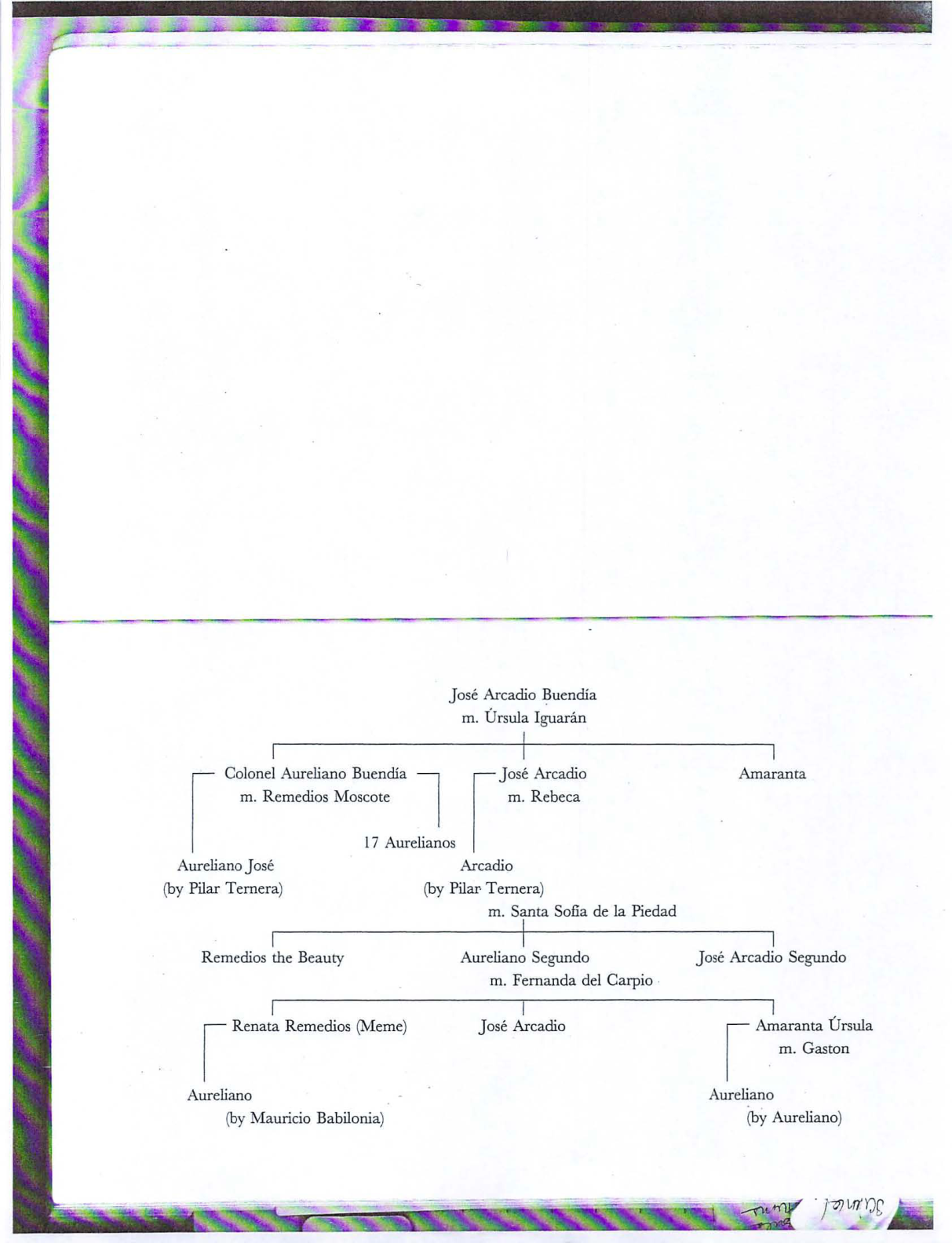
Gabriel Garcia .:Marquez
T he li'iendship with Rebeca opened up to Pilar Ternera the
doors of the house, closed by Ursula since the birth of Arcaclio. She
would arrive at any hour of the day, like a flock of goats, and would
unleash her feverish energy in the hardest tasks. Sometimes she
would go into the workshop and help Arcadia sensitize the
daguerreotype plates with an efficiency and a tenderness that ended
up by confusing him. T hat woman bothered him. The tan of her
skin, her smell of smoke, the disorder of her laughter in the dark-
room distracted his altcntion and made him bump into things.
On a certain occasion Aurcliano was there working on his silver,
and Pilar Tcrncra leaned over the table to admire his laborious
patience. Suddenly it happened. Aurelial10 made sure that Arcaclio
was in the darkroom before raising his eyes and meeting those of Pilar
Ternera, whose thought was pe.fectly visible, as if exposed lO tile light
ornoon.
uWell," Aurcliano said. "Tell me what it is."
Pilar Ternera bit her lips with a sad smile.
wT'hat you'd be good in a waf," she said. "Where you put your
eye, you put your buBet.1}
Aurcliano relaxed with the proof of the omen. He went back to
concenlrate on his work as if nothing had happened, and his voice
lOok on a restful strength.
"I will recognize him," he said. "He'll bear my name."
J ose Arcadia Buenclia finally got what he was looking for: he con-
nected the mechanism of the clock to a mechanical ballerina, and
the toy danced uninterruptedly to the rhythm of her own music for
three days. That discovery excited him much more than any of his
otller harebrained undertakings. He slOpped eating. He stopped sleep-
ing. Only the vigilance and care of Rebeca kept him li'om being
dragged off by his imagination into a state of perpetual delirium from
which he would not recover. He would spend the nights walking
around the room thinking aloud, searching for a way to apply the
76
ONE H UNDRED YEA RS 'J SO LITUD I;
principles of the pendulum to oxcarts, to harrows, to everything that
was useful when put into motion. The fever of insomnia fatigued him
so much that one dawn he could not recognize the old man with
white hair and uncertain gestures who came into rus bedroom. It was
Prudencio Aguilar. When he finally identified him, startled that the
dead also aged, J ose Arcadia Buendia felt himself shaken by nostal-
gia. "Prudencio," he exclaimed. "You've come from a long way om"
Mter many years of death the yearning for Ole living was so intense,
the need for company so pressing, so terrifying the nearness of that
other death which exists within death, that Prudencio Aguilar had
ended up loving his worst enemy. He had spent a great deal of time
looking for him. He asked the dead from Riohacha about him, the
dead who came from the Upar Valley, those who came from the
swamp, and no one could tell him because Maconclo was a town that
was unknown to the dead until Melquiades arrived and marked it
with a small black dot on the motley maps of death. J ose Arcaclio
Buendia conversed witll Prudencio Aguilar until dawn. A few hours
later, worn out by the vigil, he went into Aureliano's workshop and
asked him: "What day is today?" Aureliano told him that it was Tues-
day. "I was tllinking ti,e same tiling," J ose Arcaclio Buendia said, "but
suddenly I realized that it's still Monday, like yesterday. Look at the
sky, look at the walls, look at the begonias. Today is Monday too."
Used to his' manias, Aureliano paid no attention to rum. On the next
day, Wednesday, J ose Arcaclio Buendia went back to the workshop.
"This is a disaster," he said. "Look at the air, listen to the buzzing
of ti,e sun, the same as yesterday and the day before. Today is Mon-
day too." That night Pietro Crespi found him on the porch, weep-
ing for Prudencio Aguilar, for Melquiades, for Rebeca's parents, for
his mother and father, for all ofiliose he <:QuId remember and wbo
were now alone in deatll. He gave him a mechanical bear that walked
on its hind legs on a tightrope, but he could not distract him from
his obsession. I-Ie asked him what had happened to the project he
77
Gabriel GClrc(a ~arquez
had explained to him a few days before about the possibility of build-
ing a pendulum machine that would help men to fly and he answered
that it was impossible because a" pendulum could lift anything into
the air but it could not lift itself. On Thursday he appeared in the
workshop again with the painful look of plowed ground. "The time
machine has broken," he almost sobbed, "and Ursula and Amaranta
so far away!" Aureliano scolded him like a child and he adopted a
contrite air. He spent six hours examining things, trying to fmd a dif'
ference from their appearance on the previous day in the hope of dis-
covering in them some change that would rcvea1 the pa5Sage of time.
He spent the whole night in bed with his eyes open, calling to Pru-
dencio Aguilar, to Melquiades, to all the dead, so that they would
share his distress. But no one came. On Friday, before anyone arose,
he watched the appearance of nature again until he did not have the
slightest doubt but that it was Monday. Then he grabbed the bar
from a door and with the savage violence of his uncommon strength
he smashed to dust the equipment in the alchemy laboratory, the
daguerreotype room, the silver workshop, shouting like a man pos-
sessed in some high-sounding and fluent but completely incompre-
hensible language. He was about to finish off the rest of the house
when Aureliano asked the neighbors for help. Ten men were needed
to get him down, fourteen to tic him up, twenty to drag him to the
chestnut tree in the courtyard, where they left him tied up, barking
in the strange language and giving off a green froth at the mouth.
When Ursula and Amaranta returned he was still tied to the trunk
of t.he chestnut tree by his hands and feel, soaked with rain and in
a state of total innocence. They spoke to him and he looked at them
without recognizing them, saying things they did not understand.
Ursula untied his wrists and ankles, lacerated by the pressure of the
rope, and left him tied only by the waist. Later on they built him a
shelter of palm branches to protect him from the sun and the rain.
78
~URELIANO B UENDIA and Remedios Moscote were mar-
ried one Sunday in March before the altar Father Nicanor Reyna
had set up in the parlor. It was the culmination of four weeks of
shocks in the Moscote household because little Remedios had
reached puberty before getting over the habits of childhood. In spite
of the fact that her mother had taught her about the changes of
~dolesccncc, one February afternoon she burst shouting· into the liv-
Ing room, where her sistcrs wcre chatting with AurcLiano, and
showed tllcm her panties, smearcd with a chocolate-colored paste.
A month for the wedding was agreed upon. There was barely
enough time to teach her how to wash herself, get dressed 'by her-
selr, and understand the fundamental business of a home. They
made her urinate over hot bricks in order to cure her of the habit
of wetting her bed. It took a good deal of work to convince her of
the inviolabiljty of the maritaJ secret, for Remedios was so confused
and at the same time so amazed at the reyelation that she wanted
to talk to everybody about the details or the wedding "night. It was
a fatiguing ello rt, but on the date set for ti,e ceremony tile child was
as adept ill the ways of the world as any of her sisters. Don Apoli-
nar Moscote escorted her by the arm down the street that was dec-
79
Madness and Matrimony
- José Arcadio Buendía descends into a violent, incomprehensible madness, destroying his laboratory and requiring twenty men to subdue him.
- The family tethers the patriarch to a chestnut tree in the courtyard, where he remains in a state of total innocence and linguistic isolation.
- Remedios Moscote undergoes a frantic, accelerated transition from childhood habits to the responsibilities of womanhood in preparation for her marriage.
- Despite her extreme youth and recent puberty, Remedios displays surprising poise and maturity during the wedding ceremony.
- Aureliano Buendía experiences the wedding with a grim intensity, wearing the same boots he will later wear to face a firing squad.
- The marriage marks a turning point where Remedios begins to emerge as a stabilizing, graceful force within the chaotic Buendía household.
Ten men were needed to get him down, fourteen to tic him up, twenty to drag him to the chestnut tree in the courtyard, where they left him tied up, barking in the strange language and giving off a green froth at the mouth.
Gabriel GClrc(a ~arquez
had explained to him a few days before about the possibility of build-
ing a pendulum machine that would help men to fly and he answered
that it was impossible because a" pendulum could lift anything into
the air but it could not lift itself. On Thursday he appeared in the
workshop again with the painful look of plowed ground. "The time
machine has broken," he almost sobbed, "and Ursula and Amaranta
so far away!" Aureliano scolded him like a child and he adopted a
contrite air. He spent six hours examining things, trying to fmd a dif'
ference from their appearance on the previous day in the hope of dis-
covering in them some change that would rcvea1 the pa5Sage of time.
He spent the whole night in bed with his eyes open, calling to Pru-
dencio Aguilar, to Melquiades, to all the dead, so that they would
share his distress. But no one came. On Friday, before anyone arose,
he watched the appearance of nature again until he did not have the
slightest doubt but that it was Monday. Then he grabbed the bar
from a door and with the savage violence of his uncommon strength
he smashed to dust the equipment in the alchemy laboratory, the
daguerreotype room, the silver workshop, shouting like a man pos-
sessed in some high-sounding and fluent but completely incompre-
hensible language. He was about to finish off the rest of the house
when Aureliano asked the neighbors for help. Ten men were needed
to get him down, fourteen to tic him up, twenty to drag him to the
chestnut tree in the courtyard, where they left him tied up, barking
in the strange language and giving off a green froth at the mouth.
When Ursula and Amaranta returned he was still tied to the trunk
of t.he chestnut tree by his hands and feel, soaked with rain and in
a state of total innocence. They spoke to him and he looked at them
without recognizing them, saying things they did not understand.
Ursula untied his wrists and ankles, lacerated by the pressure of the
rope, and left him tied only by the waist. Later on they built him a
shelter of palm branches to protect him from the sun and the rain.
78
~URELIANO B UENDIA and Remedios Moscote were mar-
ried one Sunday in March before the altar Father Nicanor Reyna
had set up in the parlor. It was the culmination of four weeks of
shocks in the Moscote household because little Remedios had
reached puberty before getting over the habits of childhood. In spite
of the fact that her mother had taught her about the changes of
~dolesccncc, one February afternoon she burst shouting· into the liv-
Ing room, where her sistcrs wcre chatting with AurcLiano, and
showed tllcm her panties, smearcd with a chocolate-colored paste.
A month for the wedding was agreed upon. There was barely
enough time to teach her how to wash herself, get dressed 'by her-
selr, and understand the fundamental business of a home. They
made her urinate over hot bricks in order to cure her of the habit
of wetting her bed. It took a good deal of work to convince her of
the inviolabiljty of the maritaJ secret, for Remedios was so confused
and at the same time so amazed at the reyelation that she wanted
to talk to everybody about the details or the wedding "night. It was
a fatiguing ello rt, but on the date set for ti,e ceremony tile child was
as adept ill the ways of the world as any of her sisters. Don Apoli-
nar Moscote escorted her by the arm down the street that was dec-
79
Gabriel Garcia o/116rquez
orated with flowers and wreaths amidst the explosion of rockets and
the music of several bands, and she waved with her hand and gave
her tJmnks with a smile to tJlOse who wished her good luck from the
windows. AUfcliano, dressed in black, wearing the same patent
leather boots with metal fasteners that he would have on a few years
later as he faced the firing squad, had an intense paleness and a
hard lump in his throat when he met the bride at the door of the
house and led her to the altar. She behaved so naturally, with such
discretion that she did not lose her composure, not even when
,
Aurcliano dropped Ule ring as he tried to put it on her finger. In the
midst of the murmurs and confusion of the guests, she kept her arm
with the fingerless lace glove held up and remained like that with
her ring finger ready until tJ,e bridegroom managed to stop the ring
with his foot before it roUed to the door, and came back blushing
to the allar. Her molher and sisters sulTered so much from the fear
that the child would do something wrong during the ceremony that
in the end they were the ones who committed the impertinence of
picking her up to kiss her. From that day on the sense of responsi-
bility, the natural grace, the calm control that Remedios would have
in the face of adverse circumstances was revealed. It was she who,
on her own initiative, put aside the largest piece that she had cut
from the wedding cake and took it on a plate with a (ark to Jose
Arcadia Buendia. Tied to tl,e trunk of the chestnut tree, huddled on
a wooden stool underneath the palm shelter, the enormous old man,
discolored by the sun and rain, made a vague smile of gratitude and
ate the piece of cake with his fingers, mumbling an unintelligible
psalm. The only unhappy person in that noisy celebration, which
lasted until dawn on Monday, was Rebeca Buendia. It was her own
frustrated party. By an arrangement of Orsula's, her marriage was
to be celebrated on the same day, but that Friday Pietro Crespi
received a letter with the news of his mother's imminent death. The
wedding was postponed. Pietro Crespi left for the capital of the
GO
ONE H UND RED YEARS 'f SO LITUDE
province an hour after receiving the letter, and on the road he
missed his mother, who arrived punctually Saturday night and at
Aureliano's wedding sang the sad aria that she had prepared for the
wedding of her son. Pietro Crespi returned on Sunday midnight to
sweep up the ashes of the party, after having worn out five horses
on the road in an attempt to be in time for his wedding. It was
never discovered who wrote the letter. Tormented by U rsula, Ama-
ran la wept with indignation and swore her innocence in front of the
altar, which the carpenters had not finished dismantling.
Father Nicanor Reyna-whom Don Apolinar Moscote had
brought from ule swamp to officiate at ule wedcling--was an old man
hardened by the ingratitude of his ministry. His skin was sad, with the
bones almost exposed, and he had a pronounced round stomach and
tJ,e expression of an old angel, which came more !i·om simplicity tJm l
from goodness. He had planned to return to his parish after tJ,e wed-
ding, but he was appaUed at the hardness of the inhabitants of
Macondo, who were prospering in I..he midst of scandal, subject to
the natural law, without baptizing their children or sanctifying their
festivals. T hinking that no land needed tJ,e seed of God so much he
,
decided to stay on for another week to Christianize both circumcised
and gentile, legalize concubinage, and give the sacraments to the
dying. But no one paid any attention to him. T hey would answer him
that they had been· many years without a priest, arranging the busi-
ness of their souls directly witll God, and tJmt they had lost the evil
of original sin. T ired of preaching in the open, f ather Nicanor
decided La undertake the building of a church, the largest in the
world, with life-size saints and stained-glass windows on the sides, so
that people would come from Rome to honor God in the center of
impiety. He went everywhere begging alms with a copper dish. They
gave him a large amount, but he wanted marc, because the church
had to have a bell that wouJd raise lhe drowned up to the surface
of tJ,e water. He pleaded so much that he lost his voice. His bones
81
A Wedding and Divine Proof
- Aureliano's wedding celebration is bittersweet, as the patriarch José Arcadio Buendía remains tied to a tree, forgotten by most except for a small gesture of kindness.
- Rebeca's wedding to Pietro Crespi is derailed by a mysterious letter regarding his mother's health, which turns out to be a cruel ruse of unknown origin.
- Father Nicanor Reyna is horrified by the spiritual apathy of Macondo's citizens, who claim to have bypassed original sin and deal directly with God.
- The priest resolves to build the world's largest church in Macondo to combat the town's 'impiety' and begins an aggressive campaign for alms.
- Faced with indifference, Father Nicanor resorts to a public display of divine power to prove God's existence to the skeptical townspeople.
Pietro Crespi returned on Sunday midnight to sweep up the ashes of the party, after having worn out five horses on the road in an attempt to be in time for his wedding.
Gabriel Garcia o/116rquez
orated with flowers and wreaths amidst the explosion of rockets and
the music of several bands, and she waved with her hand and gave
her tJmnks with a smile to tJlOse who wished her good luck from the
windows. AUfcliano, dressed in black, wearing the same patent
leather boots with metal fasteners that he would have on a few years
later as he faced the firing squad, had an intense paleness and a
hard lump in his throat when he met the bride at the door of the
house and led her to the altar. She behaved so naturally, with such
discretion that she did not lose her composure, not even when
,
Aurcliano dropped Ule ring as he tried to put it on her finger. In the
midst of the murmurs and confusion of the guests, she kept her arm
with the fingerless lace glove held up and remained like that with
her ring finger ready until tJ,e bridegroom managed to stop the ring
with his foot before it roUed to the door, and came back blushing
to the allar. Her molher and sisters sulTered so much from the fear
that the child would do something wrong during the ceremony that
in the end they were the ones who committed the impertinence of
picking her up to kiss her. From that day on the sense of responsi-
bility, the natural grace, the calm control that Remedios would have
in the face of adverse circumstances was revealed. It was she who,
on her own initiative, put aside the largest piece that she had cut
from the wedding cake and took it on a plate with a (ark to Jose
Arcadia Buendia. Tied to tl,e trunk of the chestnut tree, huddled on
a wooden stool underneath the palm shelter, the enormous old man,
discolored by the sun and rain, made a vague smile of gratitude and
ate the piece of cake with his fingers, mumbling an unintelligible
psalm. The only unhappy person in that noisy celebration, which
lasted until dawn on Monday, was Rebeca Buendia. It was her own
frustrated party. By an arrangement of Orsula's, her marriage was
to be celebrated on the same day, but that Friday Pietro Crespi
received a letter with the news of his mother's imminent death. The
wedding was postponed. Pietro Crespi left for the capital of the
GO
ONE H UND RED YEARS 'f SO LITUDE
province an hour after receiving the letter, and on the road he
missed his mother, who arrived punctually Saturday night and at
Aureliano's wedding sang the sad aria that she had prepared for the
wedding of her son. Pietro Crespi returned on Sunday midnight to
sweep up the ashes of the party, after having worn out five horses
on the road in an attempt to be in time for his wedding. It was
never discovered who wrote the letter. Tormented by U rsula, Ama-
ran la wept with indignation and swore her innocence in front of the
altar, which the carpenters had not finished dismantling.
Father Nicanor Reyna-whom Don Apolinar Moscote had
brought from ule swamp to officiate at ule wedcling--was an old man
hardened by the ingratitude of his ministry. His skin was sad, with the
bones almost exposed, and he had a pronounced round stomach and
tJ,e expression of an old angel, which came more !i·om simplicity tJm l
from goodness. He had planned to return to his parish after tJ,e wed-
ding, but he was appaUed at the hardness of the inhabitants of
Macondo, who were prospering in I..he midst of scandal, subject to
the natural law, without baptizing their children or sanctifying their
festivals. T hinking that no land needed tJ,e seed of God so much he
,
decided to stay on for another week to Christianize both circumcised
and gentile, legalize concubinage, and give the sacraments to the
dying. But no one paid any attention to him. T hey would answer him
that they had been· many years without a priest, arranging the busi-
ness of their souls directly witll God, and tJmt they had lost the evil
of original sin. T ired of preaching in the open, f ather Nicanor
decided La undertake the building of a church, the largest in the
world, with life-size saints and stained-glass windows on the sides, so
that people would come from Rome to honor God in the center of
impiety. He went everywhere begging alms with a copper dish. They
gave him a large amount, but he wanted marc, because the church
had to have a bell that wouJd raise lhe drowned up to the surface
of tJ,e water. He pleaded so much that he lost his voice. His bones
81
Gabriel Garcia .7I16rquez
began to fill wiu, sounds. O ne Saturday, not even having collected
the price of the doors, he fell into a desperate confusion. He impro-
vised an altar in I. he square and on Sunday he went through the town
with a small bell, as in the days of insomnia, ~aUing people to an
open-air mass. Many went out of curiosity. O thers from nostalgia.
Others so u,at God would not take the disdain for His intermediary
as a personal insult. So that at eight in the morning half the town
was in the square, where Father Nicanor chantcd the gospels in a
voice that had been lacerated by his pleading. At the end, when the
congregation began to break up, he raised his anns signaling for
attention.
':JU5t a moment," he said. "Now we shall witness an undeniable
proof of the infinite power of God."
T he boy who had helped him with u,e mass brought him a cup
of thick and steaming chocolate, which he drank without pausing to
breathe. T hen he wiped his lips with a handkerchief that he drew
from his sleeve, extended his arms, and closed his eyes. Thereupon
Father Nicanor rose six inches above the level of the ground. It was
a convincing measure. He went among the houses for several days
repeating the demonstration of levitation by means of chocolate while
the acolyte collected so much money in a bag that in less than a
manU' he began the construction of the church. No one doubted ule
divine origin of the demonstration exccptJosc Arcadio Bucndia, who
without changing expression watched the troop of people who gath-
ercd around the chestnut trce onc morning to witncss the revelation
once more. He merely stretched on his stool a little and shrugged his
shoulders when Father Nicanor began to rise up from the ground
along with thc chair he was sitting on.
"Hoc est simplicissi11llLf," Jose Arcadio Buendia said. fCH011lO isle sta-
tum quarlu.m materiae invellil."
Father Nicanor raised his hands and ule four legs of ti,e chair aU
landed on Ule ground at u,e same time.
62
ONE H UNDRED YEARS .f SOLI TUDE
fWego, JJ he said. "Factum hoc existen.tiam Dei probat S£lIC dubio. "
Thus it was discovered that J ose Arcadia Buendia's devilish jar-
gon was Latin. Father Nicanor took advantage of the circumstance
of his being u,e only person who had been able to communicate
with him to try to inject ule faith into his twisted mind. Every after-
noon he would sit by the chestnut tree preaching in Latin, butJ ose
Arcadia Buendia insisted on rejecting rhetorical tricks and the trans-
mutation of chocolate, and he demanded the daguerreotype of God
as the only proof. Father Nicanor tI,en brought him medals and pic-
tures and even a reproduction of the Veronica, but Jose Arcadio
Buendia rejected them as artistic objccts without any scientific basis.
He was so stubborn that Father Nicanor gave up his attempts at
evangelization and continued visiting him out of humanitarian feel-
ings. But then it was J ose Arcadia Buendia who took the lead and
. tried to break down the priest's faith with rationalist tricks. On a
certain occasion when Father Nicanor brought a checker set to the
chestnut tree and invited him to · a game, Jose Arcadia Buendia
would not accept, because according to him he could never under-
stand the scnse of a contest in which the two adversaries have
agreed upon the rules. Father Nicanor, who had never seen check-
ers played that way, could not play it again. Ever more startled at
.lose Arcadia Buendia's lucidity, he asked him how it was possible
that tl,ey had him tied to a tree.
"floc est simplicissimus," he replied. "Because I'm crazy."
From then on, concerned about his own faith, the priest did not
come back to visit him and dedicated himself to hurrying along the
building of Ule church. Rebeca felt her hopes being reborn. Her
future was predicated on the completion of the work, for one Sun-
day when Fauler Nicanor was lunching at the house and the whole .
family sitting at the table spoke of the solemnity and splendor that
religious ceremonics would acquirc whcn thc church was built, Ama-
ran\" said: "The luckiest one will be Rebeca." And since Rebeca did
83
Levitation and Latin Logic
- Father Nicanor uses public demonstrations of levitation fueled by chocolate to fundraise for the construction of a new church.
- Jose Arcadio Buendia reveals his supposed madness is actually a command of Latin, allowing him to debate the priest on equal terms.
- The priest fails to convert Jose Arcadio Buendia, who demands scientific proof of God's existence rather than rhetorical tricks.
- Jose Arcadio Buendia's rationalist arguments begin to erode Father Nicanor's own faith, leading the priest to avoid further visits.
- The timeline for the church's completion becomes a source of tension between Rebeca and Amaranta regarding Rebeca's future wedding.
He merely stretched on his stool a little and shrugged his shoulders when Father Nicanor began to rise up from the ground along with the chair he was sitting on.
Gabriel Garcia .7I16rquez
began to fill wiu, sounds. O ne Saturday, not even having collected
the price of the doors, he fell into a desperate confusion. He impro-
vised an altar in I. he square and on Sunday he went through the town
with a small bell, as in the days of insomnia, ~aUing people to an
open-air mass. Many went out of curiosity. O thers from nostalgia.
Others so u,at God would not take the disdain for His intermediary
as a personal insult. So that at eight in the morning half the town
was in the square, where Father Nicanor chantcd the gospels in a
voice that had been lacerated by his pleading. At the end, when the
congregation began to break up, he raised his anns signaling for
attention.
':JU5t a moment," he said. "Now we shall witness an undeniable
proof of the infinite power of God."
T he boy who had helped him with u,e mass brought him a cup
of thick and steaming chocolate, which he drank without pausing to
breathe. T hen he wiped his lips with a handkerchief that he drew
from his sleeve, extended his arms, and closed his eyes. Thereupon
Father Nicanor rose six inches above the level of the ground. It was
a convincing measure. He went among the houses for several days
repeating the demonstration of levitation by means of chocolate while
the acolyte collected so much money in a bag that in less than a
manU' he began the construction of the church. No one doubted ule
divine origin of the demonstration exccptJosc Arcadio Bucndia, who
without changing expression watched the troop of people who gath-
ercd around the chestnut trce onc morning to witncss the revelation
once more. He merely stretched on his stool a little and shrugged his
shoulders when Father Nicanor began to rise up from the ground
along with thc chair he was sitting on.
"Hoc est simplicissi11llLf," Jose Arcadio Buendia said. fCH011lO isle sta-
tum quarlu.m materiae invellil."
Father Nicanor raised his hands and ule four legs of ti,e chair aU
landed on Ule ground at u,e same time.
62
ONE H UNDRED YEARS .f SOLI TUDE
fWego, JJ he said. "Factum hoc existen.tiam Dei probat S£lIC dubio. "
Thus it was discovered that J ose Arcadia Buendia's devilish jar-
gon was Latin. Father Nicanor took advantage of the circumstance
of his being u,e only person who had been able to communicate
with him to try to inject ule faith into his twisted mind. Every after-
noon he would sit by the chestnut tree preaching in Latin, butJ ose
Arcadia Buendia insisted on rejecting rhetorical tricks and the trans-
mutation of chocolate, and he demanded the daguerreotype of God
as the only proof. Father Nicanor tI,en brought him medals and pic-
tures and even a reproduction of the Veronica, but Jose Arcadio
Buendia rejected them as artistic objccts without any scientific basis.
He was so stubborn that Father Nicanor gave up his attempts at
evangelization and continued visiting him out of humanitarian feel-
ings. But then it was J ose Arcadia Buendia who took the lead and
. tried to break down the priest's faith with rationalist tricks. On a
certain occasion when Father Nicanor brought a checker set to the
chestnut tree and invited him to · a game, Jose Arcadia Buendia
would not accept, because according to him he could never under-
stand the scnse of a contest in which the two adversaries have
agreed upon the rules. Father Nicanor, who had never seen check-
ers played that way, could not play it again. Ever more startled at
.lose Arcadia Buendia's lucidity, he asked him how it was possible
that tl,ey had him tied to a tree.
"floc est simplicissimus," he replied. "Because I'm crazy."
From then on, concerned about his own faith, the priest did not
come back to visit him and dedicated himself to hurrying along the
building of Ule church. Rebeca felt her hopes being reborn. Her
future was predicated on the completion of the work, for one Sun-
day when Fauler Nicanor was lunching at the house and the whole .
family sitting at the table spoke of the solemnity and splendor that
religious ceremonics would acquirc whcn thc church was built, Ama-
ran\" said: "The luckiest one will be Rebeca." And since Rebeca did
83
Gahriel Garcia .:Marquez
not understand what she meant, she explained it to her with an inno- .
cent smile:
"You're going to be the one who will inaugurate the church with
your wedding."
Rebeca tried to forestall any comments. The way the construc-
tion was going the church would not be built before another ten
years. Father Nicanor did not agree: the growing generosity of the
faithful permitted him to make more optimistic calculations. To the
mute indignation of Rebeca, who could not finish her lunch, Ursula
celebrated Amaranta's idea and contributed a considerable sum for
the work LO move faster. Father N icanor felt that with another con-
tribution like that the church would be ready within three years.
From ulcn on Rcbeca did not say another word to Amaranta, con-
vinced that her initiative had not the innocence that she attempted
to give it. "That was the least serious thing 1 could have donc,"
Amaranta answered her dUl;ng the violent argument they had that
night. "In that way 1 won't have to kill you for three years," Rebeca
accepted the challenge.
When Pietro Crespi round out about the new postponement, he .
went through a crisis of disappointment, but Rebeca gave him a final
proof of her loyalty. "We'll elope whenever you say," she told him.
Pietro Crespi, however, was not a man of adventure. He lacked the
impulsive character of his fiancee, and he considered respect for one's
given word as a wealth that should not be squandered. Then Rebeca
turned to more audacious methods. A mysterious wind blew oul the
I~mps in Ule parlor and Ursula surprised the lovers kissing in the dark.
Pietro Crespi gave her some confused explanations about the poor
quality of modern pitch lamps and he even helped her install a more
sccure system of illumination for the room. But the fucl failed again
or the wicks became clogged and Ursula found Rebeca sitting on her
fiance's lap. This time she would accept no explanation. She turned
the responsibility of the bakery over to the Indian woman and sat
84
ONE H UNDRED YEARS of SOLITUDE
in a rocking chair to watch over the young people during the visits,
ready to win out over maneuvers that had already been old when
she, was a ~r1 . ,cePoor Mama," Rebeca would say with mock inctig-
naDon, seclIlg Ursula yawn during the boredom of the visits. It'When
she dies she'l1 go off to her reward ~n that rocking chair." After three
months of supervised love, fatigued by the slow progress of the con-
struction, which he went to inspect every day, Pietro Crespi decided
to give Father Nicanor UlC money he needed to finish the church.
A~naranta did not grow impatient. As she conversed with her girl-
friends every afternoon when they came to embroider on the porch
she tried to think of new subterfuges. A mistake in calculation spoile~
the one she considered the most eff~ctive: removing the mothballs
that Rebeca had put in her wedding dress before she put it away in
the bedroom dresser. She did it when two months were left for the
completion of the church. But Rebeca was so impatient with the
approach of the wedding that she wanted to gctthe dress ready ear-
lier than Amaranta had foreseen. When she opened the dresser and
unfolded first the papers and then the protective cloth, she found the
fabric of the dress and the stitches of the veil and even Ule crown of
orange blossoms perforated by moths. Although she was sure that she
had put a handful of mothballs in the wrappings, ule disaster seemed
so natural that she did not dare blame Amaranla. There was less than
a month until the wedding, but Amparo Moscote promised to sew
a new dress within a week. Amaranta rclt faint that rainy noontime
when Amparo came to the house wrapped in the froth of needlework
for Rebeca to have the final fitting of the dress. She lost her voice
and a thread of cold sweat ran down the path of her spine. For long
months she had trembled with fright waiting for that hour, because
If she had not been able to conceive the ultimate obstacle to Rebeca's
wedding, she was sure that at the last moment, when all the resources
of her imagination had failed, she would have the courage to poi-
son her. That afternoon, while Rebcca was suffocating with heat
85
The Poisoned Wedding Dress
- Rebeca and Amaranta engage in a violent confrontation where Rebeca vows to survive Amaranta's sabotage for three years.
- Pietro Crespi rejects Rebeca's offer to elope, choosing instead to uphold his honor and fund the church's completion to expedite the wedding.
- Ursula begins a strict vigil over the couple's courtship after catching them in several staged 'accidents' in the dark.
- Amaranta successfully ruins Rebeca's wedding dress by removing mothballs, but the plan fails when a friend offers to sew a replacement immediately.
- Driven to desperation by the impending ceremony, Amaranta cold-bloodedly resolves to poison Rebeca with laudanum.
If she had not been able to conceive the ultimate obstacle to Rebeca's wedding, she was sure that at the last moment, when all the resources of her imagination had failed, she would have the courage to poison her.
Gahriel Garcia .:Marquez
not understand what she meant, she explained it to her with an inno- .
cent smile:
"You're going to be the one who will inaugurate the church with
your wedding."
Rebeca tried to forestall any comments. The way the construc-
tion was going the church would not be built before another ten
years. Father Nicanor did not agree: the growing generosity of the
faithful permitted him to make more optimistic calculations. To the
mute indignation of Rebeca, who could not finish her lunch, Ursula
celebrated Amaranta's idea and contributed a considerable sum for
the work LO move faster. Father N icanor felt that with another con-
tribution like that the church would be ready within three years.
From ulcn on Rcbeca did not say another word to Amaranta, con-
vinced that her initiative had not the innocence that she attempted
to give it. "That was the least serious thing 1 could have donc,"
Amaranta answered her dUl;ng the violent argument they had that
night. "In that way 1 won't have to kill you for three years," Rebeca
accepted the challenge.
When Pietro Crespi round out about the new postponement, he .
went through a crisis of disappointment, but Rebeca gave him a final
proof of her loyalty. "We'll elope whenever you say," she told him.
Pietro Crespi, however, was not a man of adventure. He lacked the
impulsive character of his fiancee, and he considered respect for one's
given word as a wealth that should not be squandered. Then Rebeca
turned to more audacious methods. A mysterious wind blew oul the
I~mps in Ule parlor and Ursula surprised the lovers kissing in the dark.
Pietro Crespi gave her some confused explanations about the poor
quality of modern pitch lamps and he even helped her install a more
sccure system of illumination for the room. But the fucl failed again
or the wicks became clogged and Ursula found Rebeca sitting on her
fiance's lap. This time she would accept no explanation. She turned
the responsibility of the bakery over to the Indian woman and sat
84
ONE H UNDRED YEARS of SOLITUDE
in a rocking chair to watch over the young people during the visits,
ready to win out over maneuvers that had already been old when
she, was a ~r1 . ,cePoor Mama," Rebeca would say with mock inctig-
naDon, seclIlg Ursula yawn during the boredom of the visits. It'When
she dies she'l1 go off to her reward ~n that rocking chair." After three
months of supervised love, fatigued by the slow progress of the con-
struction, which he went to inspect every day, Pietro Crespi decided
to give Father Nicanor UlC money he needed to finish the church.
A~naranta did not grow impatient. As she conversed with her girl-
friends every afternoon when they came to embroider on the porch
she tried to think of new subterfuges. A mistake in calculation spoile~
the one she considered the most eff~ctive: removing the mothballs
that Rebeca had put in her wedding dress before she put it away in
the bedroom dresser. She did it when two months were left for the
completion of the church. But Rebeca was so impatient with the
approach of the wedding that she wanted to gctthe dress ready ear-
lier than Amaranta had foreseen. When she opened the dresser and
unfolded first the papers and then the protective cloth, she found the
fabric of the dress and the stitches of the veil and even Ule crown of
orange blossoms perforated by moths. Although she was sure that she
had put a handful of mothballs in the wrappings, ule disaster seemed
so natural that she did not dare blame Amaranla. There was less than
a month until the wedding, but Amparo Moscote promised to sew
a new dress within a week. Amaranta rclt faint that rainy noontime
when Amparo came to the house wrapped in the froth of needlework
for Rebeca to have the final fitting of the dress. She lost her voice
and a thread of cold sweat ran down the path of her spine. For long
months she had trembled with fright waiting for that hour, because
If she had not been able to conceive the ultimate obstacle to Rebeca's
wedding, she was sure that at the last moment, when all the resources
of her imagination had failed, she would have the courage to poi-
son her. That afternoon, while Rebcca was suffocating with heat
85
Gabriel Garcia .JI16rqllez
inside the armor of thread that Amparo Moseote was putting about
her body with thousands of pins and infinite patience, Amaranta
made several mistakes in her crocheting and pricked her finger with
the needle, but she decided with frightful coldness that the date would
be the last Friday before the wedding and the method would be a
dose of laudanum in her coffee.
A greater obstacle, as impassable as it was unforeseen, obliged a
new and indefinite postponement. One week before the date set for
the wedding, little Remedios woke up in the middle of the night
soaked in a hot broth which had exploded in her insides with a kind
of tearing belch, and she died three days later, poisoned by her own
blood, with a pair of twins crossed in her stomach. Amaranla suf-
fered a crisis of conscience. She had begged God with such fervor
for something fearful to happen so that she would not have to poi-
son Rebeca that she felt guilty of Remedios' death. That was not the
obstacle that she had begged for so much. Remedios had brought a
breath of men;ment to tile house. She had settled down witll her hus-
band in a room ncar the workshop, which she decorated Witll the
dolls and toys of her recent childhood, and her merry vitality over-
flowed the four walls of tile bedroom and went like a whirlwind of
good health along the porch with the begonias. She would start
singing at dawn. She was lhe only person who dared intervene in the
arguments between Rebeca and Amaranta. She plunged into the
fatiguing chore of taking care of J ose Arcadio Buendia. She would
bl;ng him his food, she would help him with his daily ·necessities, wash
him with soap and a scrubbing brush, .keep his hair and beard free
of lice and nits, keep the palm shelter in good condition and rein-
force it with waterproof canvas in stormy wcather. In her last months
she had succeeded in communicating with him in phrases of rudi-
mentary Latin. When the son of Aureliano and Pilar Ternera was
born and brought to ille house and baptized in an intimate ceremony
with the name Aurcliano J ose, Remedios decided that he would be
86
ONE H UND RED YEARS oj SOLITUDE
~o ns idered their oldest child. Her maternal instinct surprised
Ursula. Aureliano, for his part, found in her the justification that he
needed to live. He worked all day in his workshop and Remedios
would bring him a cup or black coffee in the middle of the morn-
ing. T hey would both visit the Moscotes evelY night. Aurcliano would
play endless games or dominoes with his father-in-law while Reme-
dios chatted with her sisters or talked to her mother about more
important ilungs. The link witll ti,e Buendias consolidated Don Apoli-
nar Moscote's authority in the town. On frequent trips to the capi-
tal of the province he succeeded in getting the government to build
a school so that Arcadio, who had inherited the educational entllU-
siasm of his grandfalher, could take charge of it. T hrough persua-
sion he managed to get the majority of houses painted blue in time
for the date of national independence. At the urging or Fatller
Nicanor, he arranged ror the transfer of Catarino's store La a back-
street and he closed down several scandalous establishments illat pros-
pered in the center of town. Once he returned with six policemen
armed with rifles to whom he entrusted the maintenance of order ,
and no one remembered the original agreement not to have armed
men in the town. Aurcliano enjoyed his father-in-Iaw's efficiency.
"You're going to get as fat as he is," his friends would say to him.
But hjs sedentary Life, whkh accentuated his cheekbones and con-
centrated the sparkle or his eyes, did not increase Ius weight or alter
the parsimony of his character, but, on the contrary, it hardened on
his lips the straight line of solitary meditation and implacable deci-
sion. So deep was the aflection that he and his wife had succeeded
in arousing in boill their families that when Remedios announced tI,at
she was going Lo have a child, even Rcbcca and Amaranta declared
a truce in order to knit items in blue wool if it was to be a boy and
in pink wool in case it was a girl. She was the last person Arcadio
illOught about a rew years later when he raced the firing squad.
Ursula ordered a mourning period of closed doors and windows ,
87
The Death of Remedios
- The sudden and tragic death of the young Remedios Moscote, caused by a pregnancy complication, forces an indefinite postponement of Rebeca's wedding.
- Amaranta suffers a profound crisis of conscience, believing her fervent prayers for a disaster to stop the wedding inadvertently caused Remedios's death.
- Before her passing, Remedios had become the soul of the Buendía household, bridging family feuds and tenderly caring for the senile José Arcadio Buendía.
- Aureliano finds a sense of purpose and domestic peace through his marriage, while his father-in-law, Don Apolinar Moscote, uses the family alliance to consolidate political power.
- Moscote’s administrative 'efficiency' introduces the first armed police force to Macondo, violating the town's original agreement to remain unarmed.
- The entire family, including the feuding sisters, unites in mourning for the girl who was the last person Arcadio thought of before his execution.
One week before the date set for the wedding, little Remedios woke up in the middle of the night soaked in a hot broth which had exploded in her insides with a kind of tearing belch, and she died three days later, poisoned by her own blood, with a pair of twins crossed in her stomach.
Gabriel Garcia .JI16rqllez
inside the armor of thread that Amparo Moseote was putting about
her body with thousands of pins and infinite patience, Amaranta
made several mistakes in her crocheting and pricked her finger with
the needle, but she decided with frightful coldness that the date would
be the last Friday before the wedding and the method would be a
dose of laudanum in her coffee.
A greater obstacle, as impassable as it was unforeseen, obliged a
new and indefinite postponement. One week before the date set for
the wedding, little Remedios woke up in the middle of the night
soaked in a hot broth which had exploded in her insides with a kind
of tearing belch, and she died three days later, poisoned by her own
blood, with a pair of twins crossed in her stomach. Amaranla suf-
fered a crisis of conscience. She had begged God with such fervor
for something fearful to happen so that she would not have to poi-
son Rebeca that she felt guilty of Remedios' death. That was not the
obstacle that she had begged for so much. Remedios had brought a
breath of men;ment to tile house. She had settled down witll her hus-
band in a room ncar the workshop, which she decorated Witll the
dolls and toys of her recent childhood, and her merry vitality over-
flowed the four walls of tile bedroom and went like a whirlwind of
good health along the porch with the begonias. She would start
singing at dawn. She was lhe only person who dared intervene in the
arguments between Rebeca and Amaranta. She plunged into the
fatiguing chore of taking care of J ose Arcadio Buendia. She would
bl;ng him his food, she would help him with his daily ·necessities, wash
him with soap and a scrubbing brush, .keep his hair and beard free
of lice and nits, keep the palm shelter in good condition and rein-
force it with waterproof canvas in stormy wcather. In her last months
she had succeeded in communicating with him in phrases of rudi-
mentary Latin. When the son of Aureliano and Pilar Ternera was
born and brought to ille house and baptized in an intimate ceremony
with the name Aurcliano J ose, Remedios decided that he would be
86
ONE H UND RED YEARS oj SOLITUDE
~o ns idered their oldest child. Her maternal instinct surprised
Ursula. Aureliano, for his part, found in her the justification that he
needed to live. He worked all day in his workshop and Remedios
would bring him a cup or black coffee in the middle of the morn-
ing. T hey would both visit the Moscotes evelY night. Aurcliano would
play endless games or dominoes with his father-in-law while Reme-
dios chatted with her sisters or talked to her mother about more
important ilungs. The link witll ti,e Buendias consolidated Don Apoli-
nar Moscote's authority in the town. On frequent trips to the capi-
tal of the province he succeeded in getting the government to build
a school so that Arcadio, who had inherited the educational entllU-
siasm of his grandfalher, could take charge of it. T hrough persua-
sion he managed to get the majority of houses painted blue in time
for the date of national independence. At the urging or Fatller
Nicanor, he arranged ror the transfer of Catarino's store La a back-
street and he closed down several scandalous establishments illat pros-
pered in the center of town. Once he returned with six policemen
armed with rifles to whom he entrusted the maintenance of order ,
and no one remembered the original agreement not to have armed
men in the town. Aurcliano enjoyed his father-in-Iaw's efficiency.
"You're going to get as fat as he is," his friends would say to him.
But hjs sedentary Life, whkh accentuated his cheekbones and con-
centrated the sparkle or his eyes, did not increase Ius weight or alter
the parsimony of his character, but, on the contrary, it hardened on
his lips the straight line of solitary meditation and implacable deci-
sion. So deep was the aflection that he and his wife had succeeded
in arousing in boill their families that when Remedios announced tI,at
she was going Lo have a child, even Rcbcca and Amaranta declared
a truce in order to knit items in blue wool if it was to be a boy and
in pink wool in case it was a girl. She was the last person Arcadio
illOught about a rew years later when he raced the firing squad.
Ursula ordered a mourning period of closed doors and windows ,
87
The Return of the Prodigal
- Ursula imposes a strict, year-long period of mourning for Remedios, turning the Buendía house into a silent, tomb-like shrine.
- The engagement between Pietro Crespi and Rebeca stagnates into a 'fatigued love,' leading a demoralized Rebeca to resume her habit of eating earth.
- Amaranta adopts Aureliano José as a son, seeking to alleviate the guilt she feels over her secret prayers for Remedios' death.
- The household's oppressive silence is shattered by the arrival of a massive, tattooed man whose footsteps shake the very foundations of the home.
- The stranger is revealed to be the long-lost José Arcadio, returning from years at sea with a body covered in cryptic tattoos and a vocabulary of sailor slang.
- Despite his formidable and weathered appearance, José Arcadio returns in poverty, requiring his mother to pay for his horse rental before he falls into a three-day sleep.
A huge man had arrived. His square shoulders barely fitted through the doorways. He was wearing a medal of Our Lady of Help around his bison neck, his arms and chest were completely covered with cryptic tattooing, and on his right wrist was the tight copper bracelet of the nilios-en-cruz amulet.
Gabriel. Garcia J\1arq"ez
with no onc entering or leaving except on matters of utmost neces-
sity. She prohibiled any lalking aloud for a year and she put Reme-
dios' daguerreotype in the place where her body had been laid out,
with a black .ibbon around il and an oil lamp lhat was always kept
lighted. Future generations, who never let the lamp go out, would
be puzzled at that girl in a pleated skirt, white boots, and with an
organdy band around her head, and they were never able to con-
nect her with U1C standard image of a great-grandmother. Amaranta
took charge of Aureliano J ose. She adopted him as a son who would
share her solitude and relieve her from the involuntary laudanum
that her mad beseeching"had thrown into Remedios' cofl(::c. Pietro
Crespi would tiptoe in at dusk, with a black ribbon on his hat, and
he would pay a silent visit to Rebeca, who seemed to be bleeding
lo deaUl inside the black dress with sleeves down to her wrists. Just
the idea of thinking about a new date for Ule wedding would have
been so irreverent that the engagement turned into an eternal rela-
tionship, a fatigued love that no onc worried about again, as if the
lovers, who in other clays had sabotaged the lamps in order to kiss,
had been abandoned to the free will of death. Having lost her bear-
ings, completely demoralized, Rebeca began eating earth again.
Suddenly- when the mourning had gone on so long Ulat Ule
needlepoint sessions began again-
someone pushed open the street
door at two in the afternoon in the mortal silence of the heat and
the braces in the foundation shook with such force that Amaranla
and her friends sewing on the porch, Rcbcca sucking her finger in
her bedroom, Ursula in the kitchen, AUt"diana in the workshop, and
even Jose Arcadia Buendia under the solitary chestnut tree had the
impression that an earthquake was breaking up the house. A huge
man had arrived. His square shoulders barely fitted through U1C door-
ways. He was wearing a medal of Our Lady of Help around his bison
neck, his arms and chest were complelely covered with cryptic tat-
tooing, and on his right wrist was Ule tighl copper bracelet of the
8U
ONE H UNDRED YEARS ,jSO LITUDE
nilios-en-cruz amulet. Hjs skin was tanned by U1C salt of the open air,
his hair was short and straight like the mane of a mule, his jaws were
of iron, and he wore a sad smile. He had a belt on that was twice
as thick as the cinch of a horse, boots with leggings and spurs and
iron on the heels, and his presence gave the quaking impression of
a seismic tremor. He went through the parlor and the living room,
cal1)'ing some half-worn saddlebags in his hand, and he appeared like
a thundcl-clap on thc porch with the bcgonia~ where Amaraula and
her friends were paralyzed, their nccdJes in the air. uHeiJo," he said
to them in a tired voice, threw the saddlebags on a worktable, and
went by on his way to the back of the house. uHello," he said to the
startled Rebeca, who saw him pass by the door of her bedroom.
"Hello," he said to Aureliano, who was at his silversmith's bench with
all five senses alert. He did not linger with anyone. He went directly
to the kitchen and Ulere he Slopped for the first time at the end of
a trip that had begun on the oUler side of the world. "Hello," he said.
Ursula stood for a fraction of' a second wiUl her mouth open, looked
into his eyes, gave a cry, and flung her anns around his neck, shout-
ing and weeping with joy. It wasJose Arcadio. He was returning as
poor as when he had left, to such an extreme that Ursula had to give
him two pesos to pay for the rental of his horse. He spoke a Span-
ish that was larded with sailor slang. They asked where he had been
and he answered: "Out therc_n H c hung his hammock in the room
they assigned him and slept for three days. When he woke up, afler
eating sixteen raw eggs, he went directly to Catarino's slo~e, where
his monumental size provoked a panic of curiosity among tl1C women.
He called for music and cane liquor for everyone, to be put on his
bill. He would Indian-wresUe with five men at Ule same time. '1t can't
be done," they said, convinced that.they would not be able to move
his anTI. uHe has lli;ios-et1 ~CTU<'." Catarina, who did not believe in mag-
ical tricks of strength, bet him twelve pesos that he could not move
the counter. J ose Arcadio pulled it out of its place, lifted it over his
89
The Return of Jose Arcadio
- Jose Arcadio returns to Macondo as a tattooed giant of immense strength, shocking the town with his monumental size and crude behavior.
- He earns money by betting on his physical power and auctioning his sexual favors to the local women in the red-light district.
- Despite his return, he remains an outsider to his family, spending his days sleeping and his nights in bars rather than integrating into the home.
- He regales the family with fantastic, gruesome tales of his travels, including cannibalism at sea and encountering mythical sea dragons.
- Ursula mourns the lost years of her son's life, unable to reconcile the boy she lost with the 'lout' whose presence now withers the household flowers.
- While most of the family feels repugnance toward him, Rebeca is instantly captivated by his raw, 'protomale' energy compared to her refined fiancé.
He had been shipwrecked and spent two weeks adrift in the Sea of Japan, feeding on the body of a comrade who had succumbed to sunstroke and whose extremely salty flesh as it cooked in the sun had a sweet and granular taste.
Gabriel. Garcia J\1arq"ez
with no onc entering or leaving except on matters of utmost neces-
sity. She prohibiled any lalking aloud for a year and she put Reme-
dios' daguerreotype in the place where her body had been laid out,
with a black .ibbon around il and an oil lamp lhat was always kept
lighted. Future generations, who never let the lamp go out, would
be puzzled at that girl in a pleated skirt, white boots, and with an
organdy band around her head, and they were never able to con-
nect her with U1C standard image of a great-grandmother. Amaranta
took charge of Aureliano J ose. She adopted him as a son who would
share her solitude and relieve her from the involuntary laudanum
that her mad beseeching"had thrown into Remedios' cofl(::c. Pietro
Crespi would tiptoe in at dusk, with a black ribbon on his hat, and
he would pay a silent visit to Rebeca, who seemed to be bleeding
lo deaUl inside the black dress with sleeves down to her wrists. Just
the idea of thinking about a new date for Ule wedding would have
been so irreverent that the engagement turned into an eternal rela-
tionship, a fatigued love that no onc worried about again, as if the
lovers, who in other clays had sabotaged the lamps in order to kiss,
had been abandoned to the free will of death. Having lost her bear-
ings, completely demoralized, Rebeca began eating earth again.
Suddenly- when the mourning had gone on so long Ulat Ule
needlepoint sessions began again-
someone pushed open the street
door at two in the afternoon in the mortal silence of the heat and
the braces in the foundation shook with such force that Amaranla
and her friends sewing on the porch, Rcbcca sucking her finger in
her bedroom, Ursula in the kitchen, AUt"diana in the workshop, and
even Jose Arcadia Buendia under the solitary chestnut tree had the
impression that an earthquake was breaking up the house. A huge
man had arrived. His square shoulders barely fitted through U1C door-
ways. He was wearing a medal of Our Lady of Help around his bison
neck, his arms and chest were complelely covered with cryptic tat-
tooing, and on his right wrist was Ule tighl copper bracelet of the
8U
ONE H UNDRED YEARS ,jSO LITUDE
nilios-en-cruz amulet. Hjs skin was tanned by U1C salt of the open air,
his hair was short and straight like the mane of a mule, his jaws were
of iron, and he wore a sad smile. He had a belt on that was twice
as thick as the cinch of a horse, boots with leggings and spurs and
iron on the heels, and his presence gave the quaking impression of
a seismic tremor. He went through the parlor and the living room,
cal1)'ing some half-worn saddlebags in his hand, and he appeared like
a thundcl-clap on thc porch with the bcgonia~ where Amaraula and
her friends were paralyzed, their nccdJes in the air. uHeiJo," he said
to them in a tired voice, threw the saddlebags on a worktable, and
went by on his way to the back of the house. uHello," he said to the
startled Rebeca, who saw him pass by the door of her bedroom.
"Hello," he said to Aureliano, who was at his silversmith's bench with
all five senses alert. He did not linger with anyone. He went directly
to the kitchen and Ulere he Slopped for the first time at the end of
a trip that had begun on the oUler side of the world. "Hello," he said.
Ursula stood for a fraction of' a second wiUl her mouth open, looked
into his eyes, gave a cry, and flung her anns around his neck, shout-
ing and weeping with joy. It wasJose Arcadio. He was returning as
poor as when he had left, to such an extreme that Ursula had to give
him two pesos to pay for the rental of his horse. He spoke a Span-
ish that was larded with sailor slang. They asked where he had been
and he answered: "Out therc_n H c hung his hammock in the room
they assigned him and slept for three days. When he woke up, afler
eating sixteen raw eggs, he went directly to Catarino's slo~e, where
his monumental size provoked a panic of curiosity among tl1C women.
He called for music and cane liquor for everyone, to be put on his
bill. He would Indian-wresUe with five men at Ule same time. '1t can't
be done," they said, convinced that.they would not be able to move
his anTI. uHe has lli;ios-et1 ~CTU<'." Catarina, who did not believe in mag-
ical tricks of strength, bet him twelve pesos that he could not move
the counter. J ose Arcadio pulled it out of its place, lifted it over his
89
Gahriel Garcia Jl16rquez
head, and put it in the street. It took cleven men to put it back. In
the heat of the pruty he exhibited his unusual masculinity on the bar,
completely covered with tattoos of words in several languages intcr-
hvincd in blue and red. To the women who were besieging him and
coveting him he put the question as to who would pay the most. The
one who had the most money offered him twenty pesos. Then he pro-
posed raming himself off among them at ten pesos a chance. It was
a fantastic price because the most sought-after woman earned ci,ght
pesos a night, but they all accepted. They wrote their names on four-
teen pieces of paper whjch they put into a hat and each woman took
one oul. When th,cre were only two pieces left to draw, it was estab-
lished to whom they belonged.
"Five pesos more from each one," Jose Arcadia proposed, "and
I'll share myself with both."
He made his living that way. He had been around the world sixty-
five times, enlisted in a crew' of sailors without a country. The women
who wentla bed with him that night in Catarina's store brought him
naked into the dance salon so that people could see that there was
not a square inch of his body that was not tattooed, front and back,
and from his neck to his toes. He did not succeed in becoming incor-
porated into the family. He slept all day and spent the night in the
red-light district, making bets on his strength. On the rare occasions
when Ursula got him to sit down at the table, he gave signs of radi-
ant good humor, especially when he told about his adventures in
remote countries. He had been' shipwrecked and spent two weeks
adrift in thc Sca of Japan, feeding on the body 01" a comrade who
had succumbed to sunstroke and whose extremely salty flesh as it
cooked in the sun had a sweet and granular taste. Under a bright
noonday sun in the Gulf of Bengal his ship had killed a sea dragon,
in the stomach of which they found the helmet, the buckles, and the
weapons of a Crusader. In the Caribbean he had seen the ghost 01"
the pirate ship of Victor Hugues, with its sails lOrn by the winds of
90
ON E HU NDR ED YEARS of SOLIT UDE
death, the masts chewed by sea worms, and still looking for the course
to Guadeloupe. Ursula would weep at the table as if she were read-
ing the letters that had never arrived and in which J ose AJ'cadio told
about his deeds and misadventures. "And there was so much of a
home here for you, my son," she ,,,auld sob, Uand so much food
thrown to the hogs!" But undenleath it all she could not conceive that
the boy the gypsies took away was the same lout who would eat half
a suckling pig for lunch and whose flatulence withered the flowers.
Something similar lOok place with the rest of the frunily. AJnaranta
could not conceal the repugnance that she felt at the table because
of his bestial belching. Arcadia, who never knew the secret of their
relationship, scarcely answered the questions that he asked with the
obvious idea of gaining his affection. Aureliano tried to relive the
times when they slept in the same room, tried to revive the complicity
of childhood, but Jose AJ'cadio had forgotten about it, because life
at sea had saturated his mcn:ory with too many things to remem-
ber. Only Rebeca succumbed to thc first impact. The day that she
saw him pass by her bedroom she thought that Pietro Crespi was a
sugruy dandy next to that protomale whose volcanic breathing could
be heard all over the housG. She tried to get near him under any pre-
text. On a certain occasion J ose AJ'cadio looked at her body with
shameless attention and said to her: "You're a woman, little sister."
Rebeca lost control of herselr. She went back to eating earth and the
whitewash on the waUs with the avidity of previous days, and she
sucked her finger with so much anxicty that she developed a callus
on her thumb. She vomited up a green liquid with dead leeches in
it. She spent nights awake shaking with fever, fighting against delir-
ium, waiting untiJ the house shook with the return of Jose Arcadia
at dawn. One afternoon, when eycryone was having a siesta, she
could no long~r resist and went to his bedroom. She found him in
his shorts, lying in the hammock that he had hung from the beams
with a ship's hawser. She was so impressed by his enormous motley
9 t
The Scandalous Union
- Rebeca experiences a physical and psychological relapse into her childhood pica, eating earth and whitewash due to her intense obsession with Jose Arcadio.
- A clandestine encounter in a hammock leads to a violent and transformative sexual awakening for Rebeca, described as a 'cyclonic power.'
- Jose Arcadio confronts Pietro Crespi, Rebeca's former suitor, with brutal indifference to social laws and family ties to announce their marriage.
- Ursula views the marriage as an unforgivable sacrilege and effectively exiles the couple from the family home, treating them as if they were dead.
- The couple settles in a sparsely furnished house near the cemetery, where their loud and unbridled passion scandalizes the neighborhood and disturbs the peace of the dead.
She managed to thank God for having been born before she lost herself in the inconceivable pleasure of that unbearable pain, splashing in the steaming marsh of the hammock which absorbed the explosion of blood like a blotter.
Gahriel Garcia Jl16rquez
head, and put it in the street. It took cleven men to put it back. In
the heat of the pruty he exhibited his unusual masculinity on the bar,
completely covered with tattoos of words in several languages intcr-
hvincd in blue and red. To the women who were besieging him and
coveting him he put the question as to who would pay the most. The
one who had the most money offered him twenty pesos. Then he pro-
posed raming himself off among them at ten pesos a chance. It was
a fantastic price because the most sought-after woman earned ci,ght
pesos a night, but they all accepted. They wrote their names on four-
teen pieces of paper whjch they put into a hat and each woman took
one oul. When th,cre were only two pieces left to draw, it was estab-
lished to whom they belonged.
"Five pesos more from each one," Jose Arcadia proposed, "and
I'll share myself with both."
He made his living that way. He had been around the world sixty-
five times, enlisted in a crew' of sailors without a country. The women
who wentla bed with him that night in Catarina's store brought him
naked into the dance salon so that people could see that there was
not a square inch of his body that was not tattooed, front and back,
and from his neck to his toes. He did not succeed in becoming incor-
porated into the family. He slept all day and spent the night in the
red-light district, making bets on his strength. On the rare occasions
when Ursula got him to sit down at the table, he gave signs of radi-
ant good humor, especially when he told about his adventures in
remote countries. He had been' shipwrecked and spent two weeks
adrift in thc Sca of Japan, feeding on the body 01" a comrade who
had succumbed to sunstroke and whose extremely salty flesh as it
cooked in the sun had a sweet and granular taste. Under a bright
noonday sun in the Gulf of Bengal his ship had killed a sea dragon,
in the stomach of which they found the helmet, the buckles, and the
weapons of a Crusader. In the Caribbean he had seen the ghost 01"
the pirate ship of Victor Hugues, with its sails lOrn by the winds of
90
ON E HU NDR ED YEARS of SOLIT UDE
death, the masts chewed by sea worms, and still looking for the course
to Guadeloupe. Ursula would weep at the table as if she were read-
ing the letters that had never arrived and in which J ose AJ'cadio told
about his deeds and misadventures. "And there was so much of a
home here for you, my son," she ,,,auld sob, Uand so much food
thrown to the hogs!" But undenleath it all she could not conceive that
the boy the gypsies took away was the same lout who would eat half
a suckling pig for lunch and whose flatulence withered the flowers.
Something similar lOok place with the rest of the frunily. AJnaranta
could not conceal the repugnance that she felt at the table because
of his bestial belching. Arcadia, who never knew the secret of their
relationship, scarcely answered the questions that he asked with the
obvious idea of gaining his affection. Aureliano tried to relive the
times when they slept in the same room, tried to revive the complicity
of childhood, but Jose AJ'cadio had forgotten about it, because life
at sea had saturated his mcn:ory with too many things to remem-
ber. Only Rebeca succumbed to thc first impact. The day that she
saw him pass by her bedroom she thought that Pietro Crespi was a
sugruy dandy next to that protomale whose volcanic breathing could
be heard all over the housG. She tried to get near him under any pre-
text. On a certain occasion J ose AJ'cadio looked at her body with
shameless attention and said to her: "You're a woman, little sister."
Rebeca lost control of herselr. She went back to eating earth and the
whitewash on the waUs with the avidity of previous days, and she
sucked her finger with so much anxicty that she developed a callus
on her thumb. She vomited up a green liquid with dead leeches in
it. She spent nights awake shaking with fever, fighting against delir-
ium, waiting untiJ the house shook with the return of Jose Arcadia
at dawn. One afternoon, when eycryone was having a siesta, she
could no long~r resist and went to his bedroom. She found him in
his shorts, lying in the hammock that he had hung from the beams
with a ship's hawser. She was so impressed by his enormous motley
9 t
Gabriel Garcia .:Marquez
nakedness that she felt an impulse to retreat. uExcusc mc," she said,
"1 didn't know you were here." But she lowered her voice so as not
to wake anyone up. "Come here," he said. Rcbcca obeyed. She
stopped beside the hammock in an icy sweat, fceling knots forming
in her intestines, whilcJosc Arcadia stroked her ankles with the tips
of his fingers, then her calves, then her thighs, murmuring: "Oh, lit-
tle sister, little sister." She had to make a supernatural effort not to
die when a startlingly regulated cyclonic power lifted her up by thc
waist and despoiled her of her intimacy with three slashes of its claws
and quartered her like a little bird. She managed to thank God for
having been born before she lost herself in tile inconceivable pleas-
ure of that unbearable pain, splashing in the steaming marsh of the
hammock which absorbed the explosion of blood like a blotter.
T hree days latcr they were married during the five-o'clock mass.
J ose Arcadia had gone to Pietro Crespi's store the day before. He
found him giving a zither lesson and did not draw him aside to speak
to him. "I'm going to marry Rebeca," he told him. Pietro Crespi
turned pale, gave the zither to onc of his pupils, and dismissed the
class. When they were alone in the room that was crowded with musi-
cal instruments and mechanical toys, Pietro Crespi said:
"She's your sister."
"I don't care," Jose Arcadia -replied.
Pietro Crespi mopped his brow with the handkerchief that was
soaked in lavender.
"It's against nature," he explained, "and besides, it's against the
law."
Jose Arcadio grew i~pat ie nt, not so much at the argument as
over Pietro Crespi's paleness.
"Fuck nature two times over," he said. "And I've come to teli
you not to bother going to ask Rebeca anything."
But his brutal deportment broke down when he saw Pietro
Crespi's eyes grow moist.
92
ONE HUNDRED YEARS ,j SOLITUDE
"Now," he said to him in a different tone, "if you really like the
family, there's Amaranta for you."
Father Nicanor revealed in his Sunday sermon that Jose Arca-
dia and Rebeca were not brother and sister. Ursula never forgave
what she considered an inconceivable lack of respect and when they
came back from church she forbade the newlyweds to set foot in the
house again. For her it was as if they were dead. So they rented a
house across from the cemetery and established themselves there
witl, no other furniture butJose Arcadia's hammock. On their wed-
ding night a scorpion that had got into her slipper bit Rebeca on
tl,e foot. Her tongue went to sleep, but tl,at did not stop them from
spenrling a scandalous honeymoon. The neighbors were startled by
the cries that woke up the whole dist~ict as many as eight times in
a single night and three times during siesta, and they prayed that
such wild passion would not disturb the peace of the dead.
Aureliano was the only one who was concerned about them. He
bought them some furniture and gave them some money until J ose
Arcadia recovered his sense of reality and began to work the no-
man's-land that bordered the courtyard of the house. Amaranta, on
the other hand, never did overcome her rancor against Rebeca,
even though life offered her a satisfaction of which she had not
dreamed: at the initiative of Ursula, who did not know how to
repair the shame, Pietro Crespi continued having lunch at the house
on Tuesdays, rising above his defeat with a serene dignity. He still
wore the black ribbon on his hat as a sign of respect for the family,
and he took pleasure in showing his affection for Orsula by bring-
ing her exotic gifts: Portuguese sardines, Turkish rose marmalade,
and on one occasion a lovely M'anila shawl. Amaranta looked after
him. with a loving diligence. She anticipated his wants, pulled out
the threads on the cuffs of his shirt, and embroidered a dozen hand-
kerchiefs with his initials for his birtl,day. On Tuesdays, after lunch,
while she would embroider on tl,e porch, he would keep her happy
93
Courtship and Political Awakening
- Amaranta harbors a persistent grudge against Rebeca while simultaneously cultivating a domestic intimacy with the rejected Pietro Crespi.
- Pietro Crespi finds a 'secret tenderness' in Amaranta and eventually proposes marriage, to which she responds with a calculated, mature delay.
- Aureliano remains emotionally numb following the death of Remedios, finding more solace in work and dominoes than in the prospect of a new wife.
- Don Apolinar Moscote attempts to educate Aureliano on the ideological divide between the Conservatives and the 'bad' Liberal Freemasons.
- The looming threat of civil war begins to overshadow the domestic affairs of the Buendía household, signaling a shift in Aureliano's focus.
She waited for the hot blush to leave her ears and gave her voice a serene stress of maturity.
Gabriel Garcia .:Marquez
nakedness that she felt an impulse to retreat. uExcusc mc," she said,
"1 didn't know you were here." But she lowered her voice so as not
to wake anyone up. "Come here," he said. Rcbcca obeyed. She
stopped beside the hammock in an icy sweat, fceling knots forming
in her intestines, whilcJosc Arcadia stroked her ankles with the tips
of his fingers, then her calves, then her thighs, murmuring: "Oh, lit-
tle sister, little sister." She had to make a supernatural effort not to
die when a startlingly regulated cyclonic power lifted her up by thc
waist and despoiled her of her intimacy with three slashes of its claws
and quartered her like a little bird. She managed to thank God for
having been born before she lost herself in tile inconceivable pleas-
ure of that unbearable pain, splashing in the steaming marsh of the
hammock which absorbed the explosion of blood like a blotter.
T hree days latcr they were married during the five-o'clock mass.
J ose Arcadia had gone to Pietro Crespi's store the day before. He
found him giving a zither lesson and did not draw him aside to speak
to him. "I'm going to marry Rebeca," he told him. Pietro Crespi
turned pale, gave the zither to onc of his pupils, and dismissed the
class. When they were alone in the room that was crowded with musi-
cal instruments and mechanical toys, Pietro Crespi said:
"She's your sister."
"I don't care," Jose Arcadia -replied.
Pietro Crespi mopped his brow with the handkerchief that was
soaked in lavender.
"It's against nature," he explained, "and besides, it's against the
law."
Jose Arcadio grew i~pat ie nt, not so much at the argument as
over Pietro Crespi's paleness.
"Fuck nature two times over," he said. "And I've come to teli
you not to bother going to ask Rebeca anything."
But his brutal deportment broke down when he saw Pietro
Crespi's eyes grow moist.
92
ONE HUNDRED YEARS ,j SOLITUDE
"Now," he said to him in a different tone, "if you really like the
family, there's Amaranta for you."
Father Nicanor revealed in his Sunday sermon that Jose Arca-
dia and Rebeca were not brother and sister. Ursula never forgave
what she considered an inconceivable lack of respect and when they
came back from church she forbade the newlyweds to set foot in the
house again. For her it was as if they were dead. So they rented a
house across from the cemetery and established themselves there
witl, no other furniture butJose Arcadia's hammock. On their wed-
ding night a scorpion that had got into her slipper bit Rebeca on
tl,e foot. Her tongue went to sleep, but tl,at did not stop them from
spenrling a scandalous honeymoon. The neighbors were startled by
the cries that woke up the whole dist~ict as many as eight times in
a single night and three times during siesta, and they prayed that
such wild passion would not disturb the peace of the dead.
Aureliano was the only one who was concerned about them. He
bought them some furniture and gave them some money until J ose
Arcadia recovered his sense of reality and began to work the no-
man's-land that bordered the courtyard of the house. Amaranta, on
the other hand, never did overcome her rancor against Rebeca,
even though life offered her a satisfaction of which she had not
dreamed: at the initiative of Ursula, who did not know how to
repair the shame, Pietro Crespi continued having lunch at the house
on Tuesdays, rising above his defeat with a serene dignity. He still
wore the black ribbon on his hat as a sign of respect for the family,
and he took pleasure in showing his affection for Orsula by bring-
ing her exotic gifts: Portuguese sardines, Turkish rose marmalade,
and on one occasion a lovely M'anila shawl. Amaranta looked after
him. with a loving diligence. She anticipated his wants, pulled out
the threads on the cuffs of his shirt, and embroidered a dozen hand-
kerchiefs with his initials for his birtl,day. On Tuesdays, after lunch,
while she would embroider on tl,e porch, he would keep her happy
93
gabriel garcia .:Marquez
company. For Pietro Crespi, that woman whom he always had con-
sidered and treated as a child was a revelation. Although her tem-
perament lacked grace, she had a rare sensibility for appreciating
the things of tllC world and had a secret tenderness. One Tuesday,
when no one doubted that sooner or later it had to happen, Pietro
Crespi asked her to marry him. She did not stop her work. She
waited for the hot blush to leave her cars and gave her voice a
serene stress of maturity.
"or course, Crespi," she said. "But when we know each other
belleI'. h IS never good to be hasty in things.
1I
Ursula was confused. In spite of the esteem she had for Pietro
Crespi, she could not tell whether his decision was good or bad from
the moral point of view after his prolonged and famous engagement
to Rebeca. But she finally accepted it as an unqualified fact because
no one shared her doubts. Aureliano, who was the man of the house,
conrus~d her further with his enigmatic and final opinion:
"These are not times to go around thjnking about weddings."
That opinion, which UrsuJa understood only some months later,
was the only sincere onc that Aurcliano could express at that
moment, not only with respect to marriage, but to anything that was
not war. He himself, facing a firing squad, would not understand too
well the concatenation of the seIies of subtle but irrevocable accidents
thal brought him to that point. T he death of Remedios had not pro-
duced the despair that he had feared. It was, rather, a dull feeling
of rage that gradually dissolved in a solitalY and passive frustration
similar to the one he had felt during the time he was resigned to liv-
ing without a woman. He plunged into his work again, but he kept
up the custom of playing dominoes with his father-in-law. In a house
bound up in mourning, the nightly conversations consolidated the
friendship between the two men. HGet married again, Aurelito," his
father-in-law would tell him. "I have six daughters for you to choose
from." On one occasion on the eve of the elections, Don Apolinar
91
ONE H UN DREt) YEARS of SOLITUDE
Moscotc returned from one of his frequent trips worried about the
political situation in the c6untly. The Liberals were determined to
go to war. Since Aurcliano at that time had very confused notions
about the difference between Conservatives and Liberals, his
father-in-law gave him some schematic lessons. T he Liberals, he said,
were Freemasons, bad people, wanting to hang priests, to institute
civil marriage and divorce, to recognize the rights of illegitimate chil-
dren as equal to those oflcgitimatc ones, and to cut the country up
into a federal system that would take power away from the supreme
authority . 'The Conselvatives, on the other hand, who had received
their power djrectly from God, proposed the establishment of pub-
lic order and family morality. They were the defenders of the faith
of Christ, of the principle of authority, and were not prepared to per-
mit the country to be broken down into autonomous entities. Because
of his humanitarian feelings Aureliano sympathized with the Liberal
attitude with respect to the rights of natural children, but in any case,
he could not understand how people arrived at the extreme of wag-
ing war over things that could not be touched with the hand. It
seemed an exaggeration to him that for the elections his father-in-
law had them send six soldie l~ armed with rifles under the command
of a sergeant to a town with no political passions. T hey not only
arrived, but they went from house to house confiscating hunting
weapons, machetes, and even kitchen knives before they distributed
among males over twenty-one the blue ballots with the names of the
Conservative candidates and the red ballots with the names of the
Liberal candidates. On the eve of Ule elections Don Apolinar Moscote
himself read a decree UIat prohibited the sale of alcoholic beverages
and the gathering together of more than three people who were not
of the same family. The elections took place witllOut incident. At eight
o'clock on Sunday morning a wooden ballot box was set up in the
square, which was watched over by Ule six soldiers. The voting was
absolutely free, as Aureliano himself was able to attest since he spent
95
The Seeds of Civil War
- Aureliano witnesses the blatant manipulation of local elections as his father-in-law, Don Apolinar Moscote, replaces Liberal ballots with Conservative ones.
- The government enforces strict control over the town by confiscating all potential weapons, including basic kitchen knives, under the guise of security.
- Apolinar Moscote justifies the theft of household tools by claiming they serve as false evidence of a Liberal uprising.
- Aureliano experiences a political awakening, realizing the inherent 'trickery' of the Conservatives and declaring his allegiance to the Liberal cause.
- The town's indignation over the loss of their tools leads Aureliano toward a clandestine network involving a local doctor who is secretly a terrorist.
The cynicism of the remark alarmed him. He said nothing, but on a certain night when Gerineldo Marquez and Magnifico Visbal were speaking with some other friends about the incident of the knives, they asked him if he was a Liberal or a Conservative.
gabriel garcia .:Marquez
company. For Pietro Crespi, that woman whom he always had con-
sidered and treated as a child was a revelation. Although her tem-
perament lacked grace, she had a rare sensibility for appreciating
the things of tllC world and had a secret tenderness. One Tuesday,
when no one doubted that sooner or later it had to happen, Pietro
Crespi asked her to marry him. She did not stop her work. She
waited for the hot blush to leave her cars and gave her voice a
serene stress of maturity.
"or course, Crespi," she said. "But when we know each other
belleI'. h IS never good to be hasty in things.
1I
Ursula was confused. In spite of the esteem she had for Pietro
Crespi, she could not tell whether his decision was good or bad from
the moral point of view after his prolonged and famous engagement
to Rebeca. But she finally accepted it as an unqualified fact because
no one shared her doubts. Aureliano, who was the man of the house,
conrus~d her further with his enigmatic and final opinion:
"These are not times to go around thjnking about weddings."
That opinion, which UrsuJa understood only some months later,
was the only sincere onc that Aurcliano could express at that
moment, not only with respect to marriage, but to anything that was
not war. He himself, facing a firing squad, would not understand too
well the concatenation of the seIies of subtle but irrevocable accidents
thal brought him to that point. T he death of Remedios had not pro-
duced the despair that he had feared. It was, rather, a dull feeling
of rage that gradually dissolved in a solitalY and passive frustration
similar to the one he had felt during the time he was resigned to liv-
ing without a woman. He plunged into his work again, but he kept
up the custom of playing dominoes with his father-in-law. In a house
bound up in mourning, the nightly conversations consolidated the
friendship between the two men. HGet married again, Aurelito," his
father-in-law would tell him. "I have six daughters for you to choose
from." On one occasion on the eve of the elections, Don Apolinar
91
ONE H UN DREt) YEARS of SOLITUDE
Moscotc returned from one of his frequent trips worried about the
political situation in the c6untly. The Liberals were determined to
go to war. Since Aurcliano at that time had very confused notions
about the difference between Conservatives and Liberals, his
father-in-law gave him some schematic lessons. T he Liberals, he said,
were Freemasons, bad people, wanting to hang priests, to institute
civil marriage and divorce, to recognize the rights of illegitimate chil-
dren as equal to those oflcgitimatc ones, and to cut the country up
into a federal system that would take power away from the supreme
authority . 'The Conselvatives, on the other hand, who had received
their power djrectly from God, proposed the establishment of pub-
lic order and family morality. They were the defenders of the faith
of Christ, of the principle of authority, and were not prepared to per-
mit the country to be broken down into autonomous entities. Because
of his humanitarian feelings Aureliano sympathized with the Liberal
attitude with respect to the rights of natural children, but in any case,
he could not understand how people arrived at the extreme of wag-
ing war over things that could not be touched with the hand. It
seemed an exaggeration to him that for the elections his father-in-
law had them send six soldie l~ armed with rifles under the command
of a sergeant to a town with no political passions. T hey not only
arrived, but they went from house to house confiscating hunting
weapons, machetes, and even kitchen knives before they distributed
among males over twenty-one the blue ballots with the names of the
Conservative candidates and the red ballots with the names of the
Liberal candidates. On the eve of Ule elections Don Apolinar Moscote
himself read a decree UIat prohibited the sale of alcoholic beverages
and the gathering together of more than three people who were not
of the same family. The elections took place witllOut incident. At eight
o'clock on Sunday morning a wooden ballot box was set up in the
square, which was watched over by Ule six soldiers. The voting was
absolutely free, as Aureliano himself was able to attest since he spent
95
Gabriel Garcia o?\Ifarquez
almost the entire day with his father-in-law seeing that no one voted
morc than oncc. At four in the afternoon a roll of dnlms in t.he square
announced the closing of the poUs and Don Apolinar Moscote scaled
the baUot box with a label crossed by his signature. That night, while
he played dominoes with Aureliano, he ordered the sergeant to break
the seal in order to count the votes. There were almost as many red
ballots as blue, but the sergeant left only ten red ones and made up
the difference with blue ones. Then they sealed the box again with
a new label and the first thing on the following day it was taken to
the capital of the province. "The Liberals will go La war," AUI'cLiana
said. Don Apolinar concentrated on his domino pieces. "If you're say-
ing that because of the switch in ballots, they won't," he said. uWc
left a few red ones in so there won't be any complaints." Aurcliano
understood the disadvantages of being in the opposition. "If I were
a Liberal," he said, "I'd go to war because of those ballots." His
father-in-law looked at him over his glasses.
Hearne now, Aurclito," he said, "if you were a Liberal, even
though you're my son-in-law, you wouldn't have seen the switching
of the ballots."
What really caused indign.ation in thc town was not U1C results
of the elections but the fact that the soldiers had not returned the
weapons. A group of women spoke with Aurel.iano so that he could
obtain the return of their kitchen knives from his father-in-law. Don
Apol inar Moscotc explained to him, in strictest confidence, that the
soldiers had taken the weapons off as proof that the Liberals were
preparing for war. The cynicism of ule remark alarmed him. He
said nothing, but on a certain night when Gerincldo Marquez and
Magnifico Visbal were speaking with some other friends about the
incident of ule knives, they asked him if he was a Liberal or a Con-
servative. Aureliano did not hesitate.
"If I have to be something I'll be a Liberal," he said, "because
the Consclvatives are tricky. n
96
ONE H UND RED yeARS ,j SOLITUDE
On the following day, at the urging of his friends, he went to see
Dr. Alirio Noguera to be treated for a supposed pain in his liver. He
did not even understand the meaning of the subterfuge. Dr. Alirio
Noguera had arrived i.n Macondo a few years before wiul a medi-
cine chest of tasteless pills and a meclical ·motto that convinced no
one: Olle nail draws allother. In reality he was a charlatan. Behind his
innocent fa~ade of a doctor without prestige there was hidden a ter-
rorist who WiUl his short-legged boots covered the scars that five years
in the stocks had left on his legs. Taken prisoner during the first fed-
eralist adventure, he managed to cscape to Curayao disguised in U1C
. garment he detested most in this world: a cassock. At U1C end of a
prolonged e,ule:.stirred up by the exciting news that exiles from all
over the Caribbean brought to Cu ra~ao, he set out in a smuggler's
schooner and appeared in Riohacha with the bottles of pills that were
nothing but refined sugar and a diploma from the University of
Leipzig that he had forged himself. He wept with disappointment.
·The federalist feryor, which the exiles had pictured as a powder keg
about to explode, had clissolved into a vague electoral illusion. Embit-
tered by failure, yearning for a safe place where he could await old
age, the false homeopath took refuge in Macondo. In the narrow
bOlue-crowded room that he rented on one side of the square, he
lived several years off Ule hopelessly ill who, after having tried every-
uling, consoled themselves with sugar pills. His instincts of an agi-
tator remained dormant as long as Don Apolinar Moscote was a fig-
urehead. He passed the time remembering and fighting against
asthma. The approach of tile elections was the uuead that led him
once marc to thc skein of subversion. He made contact with the
young people in Ule town, who lacked political knowledge, and he
embarked on a stealthy campaign of instigation. The numerous red
ballots that appeared in the box and Ulat were attributed by Don
Apolinar Moscote to the curiosity that came from youth were part
of his plan: he made his disciples vote in order to show them that
97
The Seeds of Subversion
- Dr. Noguera, a fugitive federalist and fraudulent homeopath, settles in Macondo after escaping political exile in Curaçao.
- Disillusioned by peaceful electoral processes, Noguera uses his medical practice as a front to radicalize the town's youth.
- The doctor views elections as a farce and advocates for a coordinated national campaign of targeted assassinations.
- Aureliano Buendía joins the conspiracy under the guise of seeking medical treatment, despite his family ties to the Conservative magistrate.
- The plot involves the sons of the town's founders, though most remain ignorant of the specific, violent details of the plan.
- Aureliano is horrified by the doctor's 'mystique of personal assassination' despite his own desire to see the Conservative regime fall.
In the den that smelled of camphorated cobwebs he found himself facing a kind of dusty iguana whose lungs whistled when he breathed.
Gabriel Garcia o?\Ifarquez
almost the entire day with his father-in-law seeing that no one voted
morc than oncc. At four in the afternoon a roll of dnlms in t.he square
announced the closing of the poUs and Don Apolinar Moscote scaled
the baUot box with a label crossed by his signature. That night, while
he played dominoes with Aureliano, he ordered the sergeant to break
the seal in order to count the votes. There were almost as many red
ballots as blue, but the sergeant left only ten red ones and made up
the difference with blue ones. Then they sealed the box again with
a new label and the first thing on the following day it was taken to
the capital of the province. "The Liberals will go La war," AUI'cLiana
said. Don Apolinar concentrated on his domino pieces. "If you're say-
ing that because of the switch in ballots, they won't," he said. uWc
left a few red ones in so there won't be any complaints." Aurcliano
understood the disadvantages of being in the opposition. "If I were
a Liberal," he said, "I'd go to war because of those ballots." His
father-in-law looked at him over his glasses.
Hearne now, Aurclito," he said, "if you were a Liberal, even
though you're my son-in-law, you wouldn't have seen the switching
of the ballots."
What really caused indign.ation in thc town was not U1C results
of the elections but the fact that the soldiers had not returned the
weapons. A group of women spoke with Aurel.iano so that he could
obtain the return of their kitchen knives from his father-in-law. Don
Apol inar Moscotc explained to him, in strictest confidence, that the
soldiers had taken the weapons off as proof that the Liberals were
preparing for war. The cynicism of ule remark alarmed him. He
said nothing, but on a certain night when Gerincldo Marquez and
Magnifico Visbal were speaking with some other friends about the
incident of ule knives, they asked him if he was a Liberal or a Con-
servative. Aureliano did not hesitate.
"If I have to be something I'll be a Liberal," he said, "because
the Consclvatives are tricky. n
96
ONE H UND RED yeARS ,j SOLITUDE
On the following day, at the urging of his friends, he went to see
Dr. Alirio Noguera to be treated for a supposed pain in his liver. He
did not even understand the meaning of the subterfuge. Dr. Alirio
Noguera had arrived i.n Macondo a few years before wiul a medi-
cine chest of tasteless pills and a meclical ·motto that convinced no
one: Olle nail draws allother. In reality he was a charlatan. Behind his
innocent fa~ade of a doctor without prestige there was hidden a ter-
rorist who WiUl his short-legged boots covered the scars that five years
in the stocks had left on his legs. Taken prisoner during the first fed-
eralist adventure, he managed to cscape to Curayao disguised in U1C
. garment he detested most in this world: a cassock. At U1C end of a
prolonged e,ule:.stirred up by the exciting news that exiles from all
over the Caribbean brought to Cu ra~ao, he set out in a smuggler's
schooner and appeared in Riohacha with the bottles of pills that were
nothing but refined sugar and a diploma from the University of
Leipzig that he had forged himself. He wept with disappointment.
·The federalist feryor, which the exiles had pictured as a powder keg
about to explode, had clissolved into a vague electoral illusion. Embit-
tered by failure, yearning for a safe place where he could await old
age, the false homeopath took refuge in Macondo. In the narrow
bOlue-crowded room that he rented on one side of the square, he
lived several years off Ule hopelessly ill who, after having tried every-
uling, consoled themselves with sugar pills. His instincts of an agi-
tator remained dormant as long as Don Apolinar Moscote was a fig-
urehead. He passed the time remembering and fighting against
asthma. The approach of tile elections was the uuead that led him
once marc to thc skein of subversion. He made contact with the
young people in Ule town, who lacked political knowledge, and he
embarked on a stealthy campaign of instigation. The numerous red
ballots that appeared in the box and Ulat were attributed by Don
Apolinar Moscote to the curiosity that came from youth were part
of his plan: he made his disciples vote in order to show them that
97
Gabriel Garda .:Marquez
elections were a farce. "The only effective thing," he would say, His
violence." The mqjOlity of Aureliano's friends were enthusiastic over
the idea of liquidating the Conservative establishment, but no onc
had dared include him in the plans, not only because of his tics with
lhe magistrate, but because of his solitary and elusive character. It
was known, furthermore, that he had voted blue at his fathcr-in-:Iaw's
direction. So it was a simple matter of chance that he revealed his
political sentiments, and it was purely a matter of curiosity, a caprice,
lhal brought him to visit the doctor for the treatment of a pain that
he did not have. In the den that smelled of camphorated cobwebs
he found himself facing a kind of dusty iguana whose lungs whistled
when he breathed. Before asking him any questions the doctor took
him to the window and examined the inside of his lower eyelid. "It's
nOlthere," Aureliano said, following what they told him. He pushed
lhe tips of his fingers into his liver and added: "Here's where I have
the pain that won't let me sleep'," Then Dr. Noguera closed the win-
dow with the pretext that there was too much sun, and explained to
him in simple terms that it was a patriotic duty to assassinate Con-
servatives. For several days Aureliano carried a small bottle of pills
in his shirt pocket. He would take it out every two hours, put three
pills in the palm of his hand, and pop them into his mouth (or them
10 be slowly dissolved on llis tongue. Don Apolinar MoscOle made
fun of llis faith in homeopathy, but tllOse who were in on the plot
recognized another one of their people in him. Almost all of the sons
of lhe founders were implicated, although none of them knew con-
cretely what action they were plotting. Nevertheless, the day ti,e doc-
lor revealed ti,e secret to Aureliano, the latter elicited the whole plan
of the conspiracy. Although he was convinced at that time of the
urgency of liquidating the Conservative regime, ti,e plot horrified him.
Dr. Noguera had a mystique of personal assassination. I-lis system was
redllced to coo~dinating a series of in'dividual actions which in one
masterstroke covering the whole nation would liquidate the func-
98
ONE HUND RED YEARS 'f SOLITU DE
tionaries of the, regime along with their respective families, especially
the children, in oreler to exterminate Conservatism at its roots. Don
Apolinar Moscote, his wife, and his six daughters, needless to say,
were on the list.
"You're no Liberal or anything e1se/' Aureliano told him with-
out getting excited. "You're nothing but a butcl~er."
"rn that case/' the doctor replied with equal calm, "give me
back the bottle. You don't need it anymore."
Only six montl1S later did Aurcliano learn that the doctor had
given up on him as a man of action because he was a sentimental
person with no future, with a passive character, and a definite soli-
tary vocation. T hey tried to keep him surrounded, fearing that he
would betray the conspiracy. Aureliano Calmcd them down: he would
not say. a word, but on the night they went to murder tbe Moscote
family they would find him guarding the door. He showed such a
convincing decision that the plan was postponed for an indefinite
date. It was during those days that Ursula asked his opinion about
the marriage between Pietro Crespi and Amaranta, and he
answered that these were not times to' be thinking about such a thing.
For a week he had been carrying an old-fashioned pistol under his
shirt. He kept his eyes on his friends. In the afternoon he would go
have coffee with J ose Arcadia and Rebeca, who had begun to put
their house in order, and from seven o'clock on he would play domi-
noes with his father-in-law. At lunchtime he was chatting with Arca-
dio, who was already a huge adolescent, and he found him more and
more excited over the imminence of war. In school, where Arcadia
had pupils older than llimself mixed in with children who were barely
beginning to talk, the Liberal fever had caught on. There was talk
of shooting Father Nicanor, of turning the church into a school, of
instituting free love. Aureliano tried to calm down his drive. He rec-
ommended discretion and prudence to him. Deaf to his calm rea-
soning, to his sense of reality, Arcadio reproached him in public for
99
The Outbreak of War
- Aureliano prevents a local Liberal conspiracy from assassinating his father-in-law, Don Apolinar Moscote, by threatening to guard the door personally.
- The town of Macondo is occupied by a surprise military force that establishes a curfew, seizes tools, and executes Dr. Noguera without trial.
- Arcadio, now a fervent and reckless adolescent, publicly mocks Aureliano for his perceived weakness and lack of revolutionary zeal.
- The military occupation turns into a reign of terror, characterized by arbitrary violence against civilians and the suppression of religious and civil authorities.
- Aureliano undergoes a profound internal transformation, shedding his passive nature to assume a position of sudden, authoritative leadership.
- The chapter concludes with Aureliano finally deciding to take action, signaling the start of his involvement in the civil war.
Only six months later did Aureliano learn that the doctor had given up on him as a man of action because he was a sentimental person with no future, with a passive character, and a definite solitary vocation.
Gabriel Garda .:Marquez
elections were a farce. "The only effective thing," he would say, His
violence." The mqjOlity of Aureliano's friends were enthusiastic over
the idea of liquidating the Conservative establishment, but no onc
had dared include him in the plans, not only because of his tics with
lhe magistrate, but because of his solitary and elusive character. It
was known, furthermore, that he had voted blue at his fathcr-in-:Iaw's
direction. So it was a simple matter of chance that he revealed his
political sentiments, and it was purely a matter of curiosity, a caprice,
lhal brought him to visit the doctor for the treatment of a pain that
he did not have. In the den that smelled of camphorated cobwebs
he found himself facing a kind of dusty iguana whose lungs whistled
when he breathed. Before asking him any questions the doctor took
him to the window and examined the inside of his lower eyelid. "It's
nOlthere," Aureliano said, following what they told him. He pushed
lhe tips of his fingers into his liver and added: "Here's where I have
the pain that won't let me sleep'," Then Dr. Noguera closed the win-
dow with the pretext that there was too much sun, and explained to
him in simple terms that it was a patriotic duty to assassinate Con-
servatives. For several days Aureliano carried a small bottle of pills
in his shirt pocket. He would take it out every two hours, put three
pills in the palm of his hand, and pop them into his mouth (or them
10 be slowly dissolved on llis tongue. Don Apolinar MoscOle made
fun of llis faith in homeopathy, but tllOse who were in on the plot
recognized another one of their people in him. Almost all of the sons
of lhe founders were implicated, although none of them knew con-
cretely what action they were plotting. Nevertheless, the day ti,e doc-
lor revealed ti,e secret to Aureliano, the latter elicited the whole plan
of the conspiracy. Although he was convinced at that time of the
urgency of liquidating the Conservative regime, ti,e plot horrified him.
Dr. Noguera had a mystique of personal assassination. I-lis system was
redllced to coo~dinating a series of in'dividual actions which in one
masterstroke covering the whole nation would liquidate the func-
98
ONE HUND RED YEARS 'f SOLITU DE
tionaries of the, regime along with their respective families, especially
the children, in oreler to exterminate Conservatism at its roots. Don
Apolinar Moscote, his wife, and his six daughters, needless to say,
were on the list.
"You're no Liberal or anything e1se/' Aureliano told him with-
out getting excited. "You're nothing but a butcl~er."
"rn that case/' the doctor replied with equal calm, "give me
back the bottle. You don't need it anymore."
Only six montl1S later did Aurcliano learn that the doctor had
given up on him as a man of action because he was a sentimental
person with no future, with a passive character, and a definite soli-
tary vocation. T hey tried to keep him surrounded, fearing that he
would betray the conspiracy. Aureliano Calmcd them down: he would
not say. a word, but on the night they went to murder tbe Moscote
family they would find him guarding the door. He showed such a
convincing decision that the plan was postponed for an indefinite
date. It was during those days that Ursula asked his opinion about
the marriage between Pietro Crespi and Amaranta, and he
answered that these were not times to' be thinking about such a thing.
For a week he had been carrying an old-fashioned pistol under his
shirt. He kept his eyes on his friends. In the afternoon he would go
have coffee with J ose Arcadia and Rebeca, who had begun to put
their house in order, and from seven o'clock on he would play domi-
noes with his father-in-law. At lunchtime he was chatting with Arca-
dio, who was already a huge adolescent, and he found him more and
more excited over the imminence of war. In school, where Arcadia
had pupils older than llimself mixed in with children who were barely
beginning to talk, the Liberal fever had caught on. There was talk
of shooting Father Nicanor, of turning the church into a school, of
instituting free love. Aureliano tried to calm down his drive. He rec-
ommended discretion and prudence to him. Deaf to his calm rea-
soning, to his sense of reality, Arcadio reproached him in public for
99
I'
'I,
Gabrie! Garcia ,:Marquez
his weakness of character. Aurcliano waited. Finally, in the beginning
of December, Ursula burst into the workshop all upset.
"War's broken out!"
War in fact had broken out three months before. Martial law
,
,
was in effect in the whole cauntly. The only one who knew it imme-
diately waS Don Apolinar Moscote, but he did not b~ve the newS even
to his wife while the army platoon that was to occupy the town by
surprise was on its way. They entered noiselessly before dawn, with
two pieces of light artillery drawn by mules, and ,they set up their
headquarters in the school. A 6 P.M. curfew was established. A more
drastic search than the previous one was undertaken, house by house,
and this time they even took farm implements. T hey dragged out Dr.
Noguera, tied him to a tree in the square, and shot him without any
due process of law. Father Nicanor tried to impress the military
authorities with the miracle of levitation and had his head split open
by the butt of a soldier's ~ifle. The Liberal exaltation had been extin-
guished into a silent terror. AUfcliano, pale, mysterious, continued
playing dominoes with his father-in-law. He understood that in spite
of his present title of civil and military leader 0[' the town, Don Apoli-
nar Mascatc was once more a figurehead. The decisions were made
by the army captai~l) who each morning collected an extraordinary
levy for the defense of public order. rour soldiers under his command
snatched a woman who had been bitten by a mad dog from her fam-
ily and killed her with their rifle butts, One Sunday, two weeks after
the occupation, Aureliano entered Gerineldo Marquez's house and
with his usual terseness asked for a mug of coffee .without sugar.
When the two of them were alone in the kitchen, Aureliano gave his
voice an authority that had never been heard before. "Get the boys
ready/' he said. "We're going to war." Gcrineldo Marquez did not
believe him.
"With what weapons?" he asked.
"With theirs," Aureliano replied.
100
ONE HUNDRED YEARS 'f SOLI T UDE
T uesday at midnight in a mad opeJ:ation, twenty-one men under
the age of thirty commanded by Aureliano Buendia, armed with
table knives and sharpened tools, took the garrison by surprise,
seized the weapons, and in the courtyard executed the captain and
the four soldiers who had killed the woman.
That same night, while the sound of the firing squad could be
heard, Arcadia was named civil and military leader of the town. T he
married rebels barely had lime to take leave of their wives, whom
uley left to their own devices. T hey left at dawn, cheered by the peo-
ple who had been liberated from the terror, to join the forces of the
revolutionary general Victorio Medina, who, according to the latest
reports, was on his way to, Manaure. Before leaving, Aureliano
brought Don Apolinar Moscotc out of a closet. "Rest easy, father-
in-law," he told him. "The new government guarantees on its word
of honor your personal safety ~nd that of your family." Don Apoli-
nar Moscote had u'ouble identifying that conspirator in high boots
and with a rifle slung over his shoulder with the person he had played
dominoes with until nine in the evening.
"This is madness, Aurelito," he exclaimed.
"Not madness," Aurcliano said. "War. And don't call me Aure-
lito anymore. Now I'm Colonel Aurcliano Buendia."
101
The Rise of Colonel Buendia
- Aureliano Buendia initiates a violent uprising against the local garrison using only primitive tools and knives.
- The rebels execute the soldiers responsible for the death of a local woman and seize their firearms.
- Arcadio is appointed as the civil and military leader of the town as the rebels prepare to join General Victorio Medina.
- Aureliano transitions from a quiet family man to a revolutionary leader, demanding a new level of respect and authority.
- The townspeople celebrate their liberation from the previous regime's terror as the rebel forces depart for Manaure.
"Not madness," Aurcliano said. "War. And don't call me Aurelito anymore. Now I'm Colonel Aurcliano Buendia."
I'
'I,
Gabrie! Garcia ,:Marquez
his weakness of character. Aurcliano waited. Finally, in the beginning
of December, Ursula burst into the workshop all upset.
"War's broken out!"
War in fact had broken out three months before. Martial law
,
,
was in effect in the whole cauntly. The only one who knew it imme-
diately waS Don Apolinar Moscote, but he did not b~ve the newS even
to his wife while the army platoon that was to occupy the town by
surprise was on its way. They entered noiselessly before dawn, with
two pieces of light artillery drawn by mules, and ,they set up their
headquarters in the school. A 6 P.M. curfew was established. A more
drastic search than the previous one was undertaken, house by house,
and this time they even took farm implements. T hey dragged out Dr.
Noguera, tied him to a tree in the square, and shot him without any
due process of law. Father Nicanor tried to impress the military
authorities with the miracle of levitation and had his head split open
by the butt of a soldier's ~ifle. The Liberal exaltation had been extin-
guished into a silent terror. AUfcliano, pale, mysterious, continued
playing dominoes with his father-in-law. He understood that in spite
of his present title of civil and military leader 0[' the town, Don Apoli-
nar Mascatc was once more a figurehead. The decisions were made
by the army captai~l) who each morning collected an extraordinary
levy for the defense of public order. rour soldiers under his command
snatched a woman who had been bitten by a mad dog from her fam-
ily and killed her with their rifle butts, One Sunday, two weeks after
the occupation, Aureliano entered Gerineldo Marquez's house and
with his usual terseness asked for a mug of coffee .without sugar.
When the two of them were alone in the kitchen, Aureliano gave his
voice an authority that had never been heard before. "Get the boys
ready/' he said. "We're going to war." Gcrineldo Marquez did not
believe him.
"With what weapons?" he asked.
"With theirs," Aureliano replied.
100
ONE HUNDRED YEARS 'f SOLI T UDE
T uesday at midnight in a mad opeJ:ation, twenty-one men under
the age of thirty commanded by Aureliano Buendia, armed with
table knives and sharpened tools, took the garrison by surprise,
seized the weapons, and in the courtyard executed the captain and
the four soldiers who had killed the woman.
That same night, while the sound of the firing squad could be
heard, Arcadia was named civil and military leader of the town. T he
married rebels barely had lime to take leave of their wives, whom
uley left to their own devices. T hey left at dawn, cheered by the peo-
ple who had been liberated from the terror, to join the forces of the
revolutionary general Victorio Medina, who, according to the latest
reports, was on his way to, Manaure. Before leaving, Aureliano
brought Don Apolinar Moscotc out of a closet. "Rest easy, father-
in-law," he told him. "The new government guarantees on its word
of honor your personal safety ~nd that of your family." Don Apoli-
nar Moscote had u'ouble identifying that conspirator in high boots
and with a rifle slung over his shoulder with the person he had played
dominoes with until nine in the evening.
"This is madness, Aurelito," he exclaimed.
"Not madness," Aurcliano said. "War. And don't call me Aure-
lito anymore. Now I'm Colonel Aurcliano Buendia."
101