printmgr file
Overview unavailable.
Global Offering Notice
- Introduces Knowledge Atlas Technology Joint Stock Company Limited’s global offering of H Shares on the Hong Kong Stock Exchange under stock code 2513.
- Sets out key offering terms, including 37,419,500 offer shares, a Hong Kong offer tranche and international tranche, and an offer price of HK$116.20 per share plus applicable fees and levies.
- Identifies the sponsor, coordinators, bookrunners and lead managers involved in the offering, while noting HKEX and regulators do not take responsibility for the prospectus contents.
- Highlights investor cautions, including the need to review risk factors, PRC/Hong Kong legal and regulatory differences, underwriting termination conditions, and U.S. offering restrictions.
- Notes the company is a Chapter 18C Specialist Technology Company with potentially high investment risks, and that the Hong Kong public offering uses a fully electronic application process.
Stock code: 2513
Knowledge Atlas Technology Joint Stock Company Limited
北京智譜華章科技股份有限公司
(A joint stock company established in the People’s Republic of China with limited liability)
GLOBAL
OFFERING
Sole Sponsor, Sponsor-Overall Coordinator, Overall Coordinator, Joint Global Coordinator, Joint Bookrunner and Joint Lead Manager
Overall Coordinators, Joint Global Coordinators, Joint Bookrunners and Joint Lead Managers
Joint Bookrunners and Joint Lead Managers
IMPORTANT
IMPORTANT: If you are in any doubt about any of the contents of this prospectus, you should seek independent professional advice.
Knowledge Atlas Technology Joint Stock Company Limited
北京智譜華章科技股份有限公司
(A joint stock company established in the People’s Republic of China with limited liability)
GLOBAL OFFERING
Number of Offer Shares under the Global Offering
37,419,500 H Shares (subject to the Over-allotment
Option)
Number of Hong Kong Offer Shares
1,871,000 H Shares (subject to reallocation)
Number of International Offer Shares
35,548,500 H Shares (subject to reallocation and the
Over-allotment Option)
Offer Price
HK$116.20 per H Share, plus brokerage of 1.0%, SFC
transaction levy of 0.0027%, Stock Exchange trading
fee of 0.00565% and AFRC transaction levy of
0.00015% (payable in full on application in Hong Kong
dollars and subject to refund)
Nominal value
RMB0.10 per H Share
Stock code
2513
Sole Sponsor, Sponsor-Overall Coordinator, Overall Coordinator,
Joint Global Coordinator, Joint Bookrunner and Joint Lead Manager
Overall Coordinators, Joint Global Coordinators, Joint Bookrunners and Joint Lead Managers
Joint Bookrunners and Joint Lead Managers
Hong Kong Exchanges and Clearing Limited, The Stock Exchange of Hong Kong Limited and Hong Kong Securities Clearing Company Limited take no responsibility for the contents
of this prospectus, make no representation as to its accuracy or completeness, and expressly disclaim any liability whatsoever for any loss howsoever arising from or in reliance upon
the whole or any part of the contents of this prospectus.
A copy of this prospectus, having attached thereto the documents specified in “Appendix VII—Documents Delivered to the Registrar of Companies and Documents on Display—A.
Documents Delivered to the Registrar of Companies” to this prospectus, has been registered by the Registrar of Companies in Hong Kong as required by section 342C of the Companies
(Winding Up and Miscellaneous Provisions) Ordinance (Chapter 32 of the Laws of Hong Kong). The Securities and Futures Commission and the Registrar of Companies in Hong Kong take
no responsibility for the contents of this prospectus or any other document referred to above.
The Offer Price will be HK$116.20 per Offer Share, unless otherwise announced. Applicants for Hong Kong Offer Share may be required to pay, on application (subject to application
channels), the Offer Price of HK$116.20 for each Hong Kong Offer Share together with a brokerage fee of 1.0%, a SFC transaction levy of 0.0027%, AFRC transaction levy of
0.00015% and a Hong Kong Stock Exchange trading fee of 0.00565%.
The Sponsor-Overall Coordinator (for and on behalf of the Underwriters) may, with the consent of our Company, reduce the number of Offer Shares and/or the Offer Price below that
stated in this prospectus at any time on or prior to the morning of the last date for lodging applications under the Hong Kong Public Offering. In such a case, notices of the reduction in
the number of Hong Kong Offer Shares and/or the Offer Price will be published on the websites of the Stock Exchange at www.hkexnews.hk and our Company at www.zhipuai.cn as
soon as practicable but in any event not later than the morning of the day which is the latest day for lodging applications under the Hong Kong Public Offering. For further information,
see the sections headed “Structure of the Global Offering” and “How to Apply for Hong Kong Offer Shares” in this prospectus.
Prior to making an investment decision, prospective investors should carefully consider all of the information set out in this prospectus, and in particular, the risk factors set out in the
section headed “Risk Factors.”
We are incorporated, and substantially all of our businesses are located, in the PRC. Potential investors should be aware of the differences in the legal, economic and financial systems
between the PRC and Hong Kong and that there are different risk factors relating to investment in PRC-incorporated businesses. Potential investors should also be aware that the
regulatory framework in the PRC is different from the regulatory framework in Hong Kong and should take into consideration the different market nature of the H Shares. Such
differences and risk factors are set out in “Risk Factors,” “Appendix IV—Summary of Principal Legal and Regulatory Provisions” and “Appendix V— Summary of Articles of
Association” to this Prospectus.
The obligations of the Hong Kong Underwriters under the Hong Kong Underwriting Agreement to subscribe for, and to procure applicants for the subscription for, the Hong Kong
Offer Shares are subject to termination by the Sponsor-Overall Coordinator (for and on behalf of the Hong Kong Underwriters) if certain grounds arise prior to 8:00 a.m. on the day
that trading in the H Shares commences on the Stock Exchange. Such grounds are set out in “Underwriting—Underwriting Arrangements and Expenses—The Hong Kong Public
Offering—Grounds for Termination” in this prospectus.
The Offer Shares have not been, and will not be, registered under the U.S. Securities Act or any state securities laws in the United States and may not be offered, sold, pledged or
otherwise transferred within the United States or to, or for the account or benefit of, any U.S. Investors. The Offer Shares will be offered and sold outside the United States to persons
that are not, and are not acting for the account or benefit of, U.S. Investors in offshore transactions in reliance on Regulation S. There has not been and will not be any public offering
of the H Shares in the United States.
Our Company is a Specialist Technology Company (as defined in Chapter 18C of the Listing Rules). The securities of Specialist Technology Companies carry high investment
risks including risks of share price volatility and inflated valuation due to the difficulty in valuing such companies. Investors should fully understand the investment risks of a
Specialist Technology Company and the risks disclosed by our Company before making their investment decisions.
ATTENTION
We have adopted a fully electronic application process for the Hong Kong Public Offering. We will not provide printed copies of this prospectus to the public in relation to the Hong
Kong Public Offering.
This prospectus is available at the website of the Hong Kong Stock Exchange at www.hkexnews.hk and our website at www.zhipuai.cn. If you require a printed copy of this
prospectus, you may download and print from the websites above.
December 30, 2025
IMPORTANT
Fully Electronic Application Process
- The Hong Kong Public Offering has transitioned to a fully electronic application process, eliminating the distribution of printed prospectus copies.
- Investors must access the prospectus digitally via the HKEXnews website or the company's official website at www.zhipuai.cn.
- Applications can only be submitted through two digital channels: the HK eIPO White Form service or the HKSCC EIPO channel via brokers.
- A strict minimum application of 100 Hong Kong Offer Shares is required, with further increments following specific tiered multiples.
- The maximum individual application is capped at 935,500 shares, representing 50% of the initial Hong Kong Offer Shares.
- Full payment or pre-funding is mandatory at the time of application, with costs ranging from approximately HK$11,737 to over HK$109 million.
We will not provide any physical channels to accept any application for the Hong Kong Offer Shares by the public.
IMPORTANT NOTICE TO INVESTORS
OF HONG KONG OFFER SHARES
FULLY ELECTRONIC APPLICATION PROCESS
We have adopted a fully electronic application process for the Hong Kong Public Offering
and below are the procedures for application. We will not provide printed copies of this
prospectus to the public in relation to the Hong Kong Public Offering.
This prospectus is available at the website of the Stock Exchange at www.hkexnews.hk
under the “HKEXnews > New Listings > New Listing Information” section, and our website at
www.zhipuai.cn. If you require a printed copy of this prospectus, you may download and print
from the website addresses above.
To apply for the Hong Kong Offer Shares, you may:
(1)
apply online through the HK eIPO White Form service through the designated website
www.hkeipo.hk; or
(2)
apply electronically through the HKSCC EIPO channel and cause HKSCC Nominees to apply
on your behalf by instructing your broker or custodian who is a HKSCC Participant to give
electronic application instructions via HKSCC’s FINI system to apply for the Hong Kong
Offer Shares on your behalf.
We will not provide any physical channels to accept any application for the Hong Kong Offer
Shares by the public. The contents of the electronic version of this prospectus are identical to the
printed document as registered with the Registrar of Companies in Hong Kong pursuant to Section
342C of the Companies (Winding Up and Miscellaneous Provisions) Ordinance.
If you are an intermediary, broker or agent, please remind your customers, clients or
principals, as applicable, that this prospectus is available online at the website addresses above. Please
refer to “How to Apply for Hong Kong Offer Shares” for further details of the procedures through
which you can apply for the Hong Kong Offer Shares electronically.
Your application through the HK eIPO White Form service or the HKSCC EIPO channel must
be made for a minimum of 100 Hong Kong Offer Shares and in multiples of that number of Hong
Kong Offer Shares as set out in the table below.
If you are applying through the HK eIPO White Form service, you may refer to the table below
for the amount payable for the number of H Shares you have selected. You must pay the respective
amount payable on application in full upon application for Hong Kong Offer Shares.
– ii –
IMPORTANT
If you are applying through the HKSCC EIPO channel, you are required to pre-fund your
application based on the amount specified by your broker or custodian, as determined based on the
applicable laws and regulations in Hong Kong.
No. of
Hong Kong
Offer Shares
applied for
Amount
payable(2) on
application/
successful
allotment
No. of
Hong Kong
Offer Shares
applied for
Amount
payable(2) on
application/
successful
allotment
No. of
Hong Kong
Offer Shares
applied for
Amount
payable(2) on
application/
successful
allotment
No. of
Hong Kong
Offer Shares
applied for
Amount
payable(2) on
application/
successful
allotment
HK$
HK$
HK$
HK$
100
11,737.19
2,500
293,429.69
30,000
3,521,156.31
600,000
70,423,126.20
200
23,474.37
3,000
352,115.63
40,000
4,694,875.08
700,000
82,160,313.90
300
35,211.56
3,500
410,801.57
50,000
5,868,593.86
800,000
93,897,501.60
400
46,948.75
4,000
469,487.51
60,000
7,042,312.62
935,500(1) 109,801,390.94
500
58,685.94
4,500
528,173.44
70,000
8,216,031.39
600
70,423.12
5,000
586,859.39
80,000
9,389,750.15
700
82,160.32
6,000
704,231.26
90,000 10,563,468.94
800
93,897.50
7,000
821,603.14
100,000 11,737,187.70
900 105,634.69
8,000
938,975.01
200,000 23,474,375.40
1,000 117,371.88
9,000 1,056,346.90
300,000 35,211,563.10
1,500 176,057.82
10,000 1,173,718.76
400,000 46,948,750.80
2,000 234,743.75
20,000 2,347,437.55
500,000 58,685,938.50
(1)
Maximum number of Hong Kong Offer Shares you may apply for and this is 50% of the Hong Kong Offer Shares
initially offered.
(2)




Hong Kong Offering Timetable
- The total payment for shares includes mandatory fees such as brokerage, SFC transaction levies, and Stock Exchange trading fees.
- The Hong Kong Public Offering is scheduled to commence on December 30, 2025, and conclude its application phase by January 5, 2026.
- Strict adherence to the specified number of shares is required, as non-compliant applications are subject to immediate rejection.
- Allocation results and interest levels will be disclosed across multiple digital platforms and a dedicated telephone enquiry line by January 7, 2026.
- Successful applicants will receive H Share certificates or have them deposited into the CCASS system by the final settlement date.
No application for any other number of Hong Kong Offer Shares will be considered and any such application is liable to be rejected.
The amount payable is inclusive of brokerage, SFC transaction levy, the Stock Exchange trading fee and AFRC
transaction levy. If your application is successful, brokerage will be paid to the Exchange Participants (as defined in
the Listing Rules) or to the HK eIPO White Form Service Provider (for applications made through the application
channel of the HK eIPO White Form service) while the SFC transaction levy, the Stock Exchange trading fee and
the AFRC transaction levy will be paid to the SFC, the Stock Exchange and the AFRC, respectively.
No application for any other number of Hong Kong Offer Shares will be considered and any such
application is liable to be rejected.
– iii –
EXPECTED TIMETABLE(1)
If there is any change in the following expected timetable of the Hong Kong Public Offering, we
will issue an announcement to be published on the websites of the Stock Exchange at
www.hkexnews.hk and our Company at www.zhipuai.cn.
Hong Kong Public Offering commences . . . . . . . . . .
9:00 a.m.
Tuesday, December 30, 2025
Latest time for completing applications under the HK
eIPO White Form service through the designated
website www.hkeipo.hk(2) . . . . . . . . . . . . . . . . . . .
11:30 a.m. on
Monday, January 5, 2026
Application lists of the Hong Kong Public Offering
open(3) . . . . . . . . . . . . . . . . . . . . . . . . . . . . . . . . . . .
11:45 a.m. on
Monday, January 5, 2026
Latest time to (a) completing payments of HK eIPO
White Form applications by effecting internet
banking transfer(s) or PPS payment transfer(s) and
(b) giving electronic application instructions to
HKSCC(4)
. . . . . . . . . . . . . . . . . . . . . . . . . . . . . . . .
12:00 noon on
Monday, January 5, 2026
If you are instructing your broker or custodian who is a HKSCC Participant and will submit an
electronic application instructions on your behalf through HKSCC’s FINI system in accordance with your
instruction, you are advised to contact your broker or custodian for the earliest and latest time for giving
such instructions, as this may vary by broker or custodian.
Application lists of the Hong Kong Public Offering
close(3) . . . . . . . . . . . . . . . . . . . . . . . . . . . . . . . . . . .
12:00 noon on
Monday, January 5, 2026
Announcement of the level of applications in the
Hong Kong Public Offering; the level of
indications of interest in the International Offering;
and the basis of allocation of the Hong Kong Offer
Shares to be published on the websites of our
Company at www.zhipuai.cn(5) and the Stock
Exchange at www.hkexnews.hk . . . . . . . . . . . . . . .
at or before
11:00 p.m. on
Wednesday, January 7, 2026
The results of allocations in the Hong Kong Public Offering (with successful applicants’ identification
document numbers, where appropriate) to be made available through a variety of channels, including:
• in the announcement to be posted on the websites
of our Company at www.zhipuai.cn(6) and the
Stock
Exchange
at
www.hkexnews.hk,
respectively . . . . . . . . . . . . . . . . . . . . . . . . . . . . . . .
at or before
11:00 p.m. on
Wednesday, January 7, 2026
– iv –
EXPECTED TIMETABLE(1)
• the “Allotment Results” page on the designated results of
allocations
website
at
www.tricor.com.hk/ipo/result
or
www.hkeipo.hk/IPOResult . . . . . . . . . . . . . . . . . . . . . . . . . . . .
from 11:00 p.m. on
Wednesday, January 7, 2026 to 12:00
midnight on Tuesday, January 13, 2026
• from the allocation results telephone enquiry line by calling
+852 3691 8488 between 9:00 a.m. and 6:00 p.m. . . . . . . . . . . .
from Thursday, January 8, 2026 to
Tuesday, January 13, 2026
(except Saturday, Sunday and
Hong Kong public holidays)
H Share certificates in respect of wholly or partially successful
applications to be despatched or deposited into CCASS . . . . . . .
on or before(6)
Wednesday, January 7, 2026
HK eIPO White Form e-Auto Refund payment instructions/




Hong Kong Listing Timetable
- The document outlines the critical dates for the public offering, including the commencement of H Share trading on January 8, 2026.
- Strict deadlines are established for the HK eIPO White Form service, with application submissions closing at 11:30 a.m. and payments at 12:00 noon.
- Contingency plans are in place for severe weather, such as 'black' rainstorm warnings or tropical cyclone signals, which may delay the opening of application lists.
- H Share certificates only become valid evidence of title at 8:00 a.m. on the Listing Date, provided the Global Offering becomes unconditional.
- Refunds for unsuccessful or partially successful applications are scheduled for dispatch on or before the trading commencement date.
- Investors are warned that trading based on allocation details prior to the validation of share certificates is done entirely at their own risk.
Investors who trade the H Shares on the basis of publicly available allocation details prior to the receipt of H Share certificates or prior to the H Share certificates becoming valid evidence of title do so entirely at their own risk.
refund checks in respect of wholly or partially successful
applications (if applicable) or wholly or partially unsuccessful
applications to be despatched . . . . . . . . . . . . . . . . . . . . . . . . . . . .
on or before(7)(8)
Thursday, January 8, 2026
Dealings in the H Shares on the Main Board of the Stock
Exchange to commence at
. . . . . . . . . . . . . . . . . . . . . . . . . . . . .
9:00 a.m. on
Thursday, January 8, 2026
Notes:
(1)
All dates and times refer to Hong Kong local dates and times, except as otherwise stated.
(2)
You will not be permitted to submit your application under the HK eIPO White Form service through the designated website at
www.hkeipo.hk after 11:30 a.m. on the last day for submitting applications. If you have already submitted your application and
obtained an application reference number from the designated website prior to 11:30 a.m., you will be permitted to continue the
application process (by completing payment of the application monies) until 12:00 noon on the last day for submitting
applications, when the application lists close.
(3)
If there is/are a “black” rainstorm warning signal, a tropical cyclone warning signal number 8 or above and/or Extreme
Conditions in force in Hong Kong at any time between 9:00 a.m. and 12:00 noon on Monday, January 5, 2026, the application
lists will not open or close on that day. See the section headed “How to Apply for Hong Kong Offer Shares—E. Severe Weather
Arrangements” for further details.
(4)
Applicants who apply for Hong Kong Offer Shares by giving electronic application instructions to HKSCC via HKSCC’s
FINI system should refer to the section headed “How to Apply for Hong Kong Offer Shares—A. Applications for Hong Kong
Offer Shares—2. Application Channels”.
(5)
None of the websites or any of the information contained on the websites forms part of this prospectus.
(6)
The H Share certificates will only become valid evidence of title at 8:00 a.m. on the Listing Date provided that the Global
Offering has become unconditional in all respects. Investors who trade the H Shares on the basis of publicly available allocation
details prior to the receipt of H Share certificates or prior to the H Share certificates becoming valid evidence of title do so
entirely at their own risk.
(7)
HK eIPO White Form e-Auto Refund payment instructions/refund checks will be issued in respect of wholly or partially
unsuccessful applications pursuant to the Hong Kong Public Offering and in respect of wholly or partially successful applicants.
Part of the applicant’s identification document number, or, if the application is made by joint applicants, part of the identification
document number of the first-named applicant, provided by the applicant(s) may be printed on the refund check, if any. Such
– v –
EXPECTED TIMETABLE(1)
data would also be transferred to a third party for refund purposes. Banks may require verification of an applicant’s
identification document number before encashment of the refund check. Inaccurate completion of an applicant’s identification
document number may invalidate or delay encashment of the refund check.
(8)




Share Collection and Refund Procedures
- Applicants for 500,000 or more shares via HK eIPO White Form must collect certificates in person at the Far East Finance Centre.
- Individual applicants are strictly prohibited from authorizing third parties to collect certificates on their behalf.
- Refunds are processed via e-Auto Refund for single bank account users, while multiple bank account users receive physical checks by post.
- Small-scale applicants (under 500,000 shares) will receive all documentation via ordinary post at their own risk.
- The Global Offering is contingent upon becoming unconditional; if terminated, the company will issue a formal announcement.
- This prospectus is legally restricted to the Hong Kong Public Offering and does not constitute an offer in any other jurisdiction.
Applicants being individuals who are eligible for personal collection may not authorize any other person to collect on their behalf.
Applicants who have applied on the HK eIPO White Form service for 500,000 or more Hong Kong Offer Shares may collect
H Share certificates in person from our H Share Registrar, Tricor Investor Services Limited, at 17/F, Far East Finance Centre,
16 Harcourt Road, Hong Kong from 9:00 a.m. to 1:00 p.m. on Thursday, January 8, 2026 or any other places or date as notified
by us as the date of despatch/collection of H Share certificates/HK eIPO White Form e-Auto Refund payment instructions/
refund checks. Applicants being individuals who are eligible for personal collection may not authorize any other person to
collect on their behalf. Individuals must produce evidence of identity acceptable to our H Share Registrar at the time of
collection.
Applicants who have applied for Hong Kong Offer Shares through HKSCC EIPO channel should refer to “How to Apply for
Hong Kong Offer Shares—D. Despatch/Collection of H Share Certificates and Refund of Application Monies” for details.
Applicants who have applied through the HK eIPO White Form service and paid their applications monies through single bank
accounts may have refund monies (if any) despatched to the bank account in the form of HK eIPO White Form e-Auto Refund
payment instructions. Applicants who have applied through the HK eIPO White Form service and paid their application
monies through multiple bank accounts may have refund monies (if any) despatched to the address as specified in their
application instructions in the form of refund checks in favor of the applicant (or, in the case of joint applications, the first-
named applicant) by ordinary post at their own risk.
The H Share certificates and/or refund checks for applicants who have applied for less than 500,000 Hong Kong Offer Shares
and any uncollected H Share certificates will be despatched by ordinary post, at the applicants’ risk, to the addresses specified in
the relevant applications.
Further information is set out in the section headed “How to Apply for Hong Kong Offer Shares—D. Despatch/Collection of
H Share Certificates and Refund of Application Monies.”
The above expected timetable is a summary only. For details of the structure of the Global Offering,
including its conditions, and the procedures for applications for Hong Kong Offer Shares, see “Structure of
the Global Offering” and “How to Apply for Hong Kong Offer Shares,” respectively.
If the Global Offering does not become unconditional or is terminated in accordance with its terms, the
Global Offering will not proceed. In such a case, our Company will make an announcement as soon as
practicable thereafter.
– vi –
CONTENTS
IMPORTANT NOTICE TO PROSPECTIVE INVESTORS
This prospectus is issued by our Company solely in connection with the Hong Kong Public
Offering and does not constitute an offer to sell or a solicitation of an offer to buy any security other
than the Hong Kong Offer Shares offered by this prospectus pursuant to the Hong Kong Public
Offering. This prospectus may not be used for the purpose of, and does not constitute, an offer or a
solicitation of an offer to subscribe for or buy any security in any other jurisdiction or in any other
circumstances. No action has been taken to permit a public offering of the Offer Shares or the
distribution of this prospectus in any jurisdiction other than Hong Kong. The distribution of this
prospectus and the offering and sale of the Offer Shares in other jurisdictions are subject to
restrictions and may not be made except as permitted under the applicable securities laws of such
jurisdictions pursuant to registration with or authorization by the relevant securities regulatory




Prospectus Disclaimers and Contents
- Investors are strictly cautioned to rely only on the information explicitly provided within the prospectus document.
- The company disclaims any responsibility for unauthorized information or representations made by third parties, including underwriters and directors.
- Official digital content on the company's website is explicitly excluded from forming part of the legal prospectus.
- The document outlines a comprehensive structure covering risk factors, regulatory overviews, and detailed financial information.
- A significant portion of the document is dedicated to the business operations, history, and corporate structure of Zhipu AI.
Information contained on our website, located at www.zhipuai.cn, does not form part of this prospectus.
authorities or an exemption therefrom.
You should rely only on the information contained in this prospectus to make your
investment decision. We have not authorized anyone to provide you with information that is
different from what is contained in this prospectus. Any information or representation not made in
this prospectus must not be relied on by you as having been authorized by us, the Sole Sponsor,
Sponsor-Overall Coordinator, the Overall Coordinators, the Joint Global Coordinators, the Joint
Bookrunners, the Joint Lead Managers, the Capital Market Intermediaries, any of the
Underwriters, any of our or their respective directors, officers or representatives, or any other
person or party involved in the Global Offering. Information contained on our website, located at
www.zhipuai.cn, does not form part of this prospectus.
Page
EXPECTED TIMETABLE . . . . . . . . . . . . . . . . . . . . . . . . . . . . . . . . . . . . . . . . . . . . . . . . . . . . . . . . .
iv
CONTENTS . . . . . . . . . . . . . . . . . . . . . . . . . . . . . . . . . . . . . . . . . . . . . . . . . . . . . . . . . . . . . . . . . . . . . .
vii
SUMMARY . . . . . . . . . . . . . . . . . . . . . . . . . . . . . . . . . . . . . . . . . . . . . . . . . . . . . . . . . . . . . . . . . . . . . .
1
DEFINITIONS AND ACRONYMS . . . . . . . . . . . . . . . . . . . . . . . . . . . . . . . . . . . . . . . . . . . . . . . . . .
24
GLOSSARY OF TECHNICAL TERMS . . . . . . . . . . . . . . . . . . . . . . . . . . . . . . . . . . . . . . . . . . . . . .
36
FORWARD-LOOKING STATEMENTS . . . . . . . . . . . . . . . . . . . . . . . . . . . . . . . . . . . . . . . . . . . . .
39
RISK FACTORS . . . . . . . . . . . . . . . . . . . . . . . . . . . . . . . . . . . . . . . . . . . . . . . . . . . . . . . . . . . . . . . . . .
40
WAIVERS FROM STRICT COMPLIANCE WITH THE REQUIREMENTS UNDER THE
LISTING RULES . . . . . . . . . . . . . . . . . . . . . . . . . . . . . . . . . . . . . . . . . . . . . . . . . . . . . . . . . . . . . . .
67
INFORMATION ABOUT THIS PROSPECTUS AND THE GLOBAL OFFERING . . . . . . . . .
72
DIRECTORS, SUPERVISOR AND PARTIES INVOLVED IN THE GLOBAL
OFFERING . . . . . . . . . . . . . . . . . . . . . . . . . . . . . . . . . . . . . . . . . . . . . . . . . . . . . . . . . . . . . . . . . . . .
75
CORPORATE INFORMATION . . . . . . . . . . . . . . . . . . . . . . . . . . . . . . . . . . . . . . . . . . . . . . . . . . . .
80
INDUSTRY OVERVIEW . . . . . . . . . . . . . . . . . . . . . . . . . . . . . . . . . . . . . . . . . . . . . . . . . . . . . . . . . .
82
REGULATORY OVERVIEW . . . . . . . . . . . . . . . . . . . . . . . . . . . . . . . . . . . . . . . . . . . . . . . . . . . . . .
95
– vii –
CONTENTS
Page
HISTORY, DEVELOPMENT AND CORPORATE STRUCTURE . . . . . . . . . . . . . . . . . . . . . . .
113
BUSINESS . . . . . . . . . . . . . . . . . . . . . . . . . . . . . . . . . . . . . . . . . . . . . . . . . . . . . . . . . . . . . . . . . . . . . .
145
DIRECTORS, SUPERVISOR AND SENIOR MANAGEMENT . . . . . . . . . . . . . . . . . . . . . . . . .
223
RELATIONSHIP WITH OUR CONTROLLING SHAREHOLDERS . . . . . . . . . . . . . . . . . . . . .
235
SUBSTANTIAL SHAREHOLDERS . . . . . . . . . . . . . . . . . . . . . . . . . . . . . . . . . . . . . . . . . . . . . . . . .
238
SHARE CAPITAL . . . . . . . . . . . . . . . . . . . . . . . . . . . . . . . . . . . . . . . . . . . . . . . . . . . . . . . . . . . . . . . .
242
FINANCIAL INFORMATION . . . . . . . . . . . . . . . . . . . . . . . . . . . . . . . . . . . . . . . . . . . . . . . . . . . . .
245
CORNERSTONE INVESTORS . . . . . . . . . . . . . . . . . . . . . . . . . . . . . . . . . . . . . . . . . . . . . . . . . . . .
291
FUTURE PLANS AND USE OF PROCEEDS . . . . . . . . . . . . . . . . . . . . . . . . . . . . . . . . . . . . . . . . .
299
UNDERWRITING . . . . . . . . . . . . . . . . . . . . . . . . . . . . . . . . . . . . . . . . . . . . . . . . . . . . . . . . . . . . . . .
302




Global Offering and AI Leadership
- The document outlines the structure and legal appendices for a specialist technology company's initial public offering on the Hong Kong Stock Exchange.
- The company is seeking a listing under Chapter 18C of the Listing Rules, a specific pathway for technology companies that do not meet standard financial requirements.
- Founded in 2019, the firm is a leading Chinese AI developer focused on Artificial General Intelligence (AGI) and the Model-as-a-Service (MaaS) platform.
- The company launched GLM, China’s first proprietary pre-trained large model framework, and open-sourced a 100 billion-scale model in 2022.
- Market data shows significant growth with a revenue CAGR of over 130% between 2022 and 2024, capturing a 6.6% market share in China's general-purpose large model sector.
In particular, we are a specialist technology company seeking to list on the Main Board of the Hong Kong Stock Exchange under Chapter 18C of the Listing Rules because we are unable to meet the requirements under Rule 8.05(1), (2) or (3) of the Listing Rules.
STRUCTURE OF THE GLOBAL OFFERING . . . . . . . . . . . . . . . . . . . . . . . . . . . . . . . . . . . . . . .
313
HOW TO APPLY FOR HONG KONG OFFER SHARES . . . . . . . . . . . . . . . . . . . . . . . . . . . . . . .
321
APPENDIX I
ACCOUNTANTS’ REPORT . . . . . . . . . . . . . . . . . . . . . . . . . . . . . . . . . . . . . . .
I-1
APPENDIX II
UNAUDITED PRO FORMA FINANCIAL INFORMATION . . . . . . . . . . . .
II-1
APPENDIX III
TAXATION AND FOREIGN EXCHANGE . . . . . . . . . . . . . . . . . . . . . . . . . .
III-1
APPENDIX IV
SUMMARY OF PRINCIPAL LEGAL AND REGULATORY
PROVISIONS . . . . . . . . . . . . . . . . . . . . . . . . . . . . . . . . . . . . . . . . . . . . . . . . . . .
IV-1
APPENDIX V
SUMMARY OF ARTICLES OF ASSOCIATION . . . . . . . . . . . . . . . . . . . . .
V-1
APPENDIX VI
STATUTORY AND GENERAL INFORMATION . . . . . . . . . . . . . . . . . . . . .
VI-1
APPENDIX VII
DOCUMENTS DELIVERED TO THE REGISTRAR OF COMPANIES
AND DOCUMENTS ON DISPLAY . . . . . . . . . . . . . . . . . . . . . . . . . . . . . . . . .
VII-1
– viii –
SUMMARY
This summary aims to give you an overview of the information contained in this prospectus. As
this is a summary, it does not contain all the information that may be important to you. You should
read this prospectus in its entirety before you decide to invest in the Offer Shares. In particular, we are
a specialist technology company seeking to list on the Main Board of the Hong Kong Stock Exchange
under Chapter 18C of the Listing Rules because we are unable to meet the requirements under Rule
8.05(1), (2) or (3) of the Listing Rules. There are unique challenges, risks and uncertainties associated
with investing in companies such as us. Your investment decision should be made in light of these
considerations.
There are risks associated with any investment. Some of the particular risks in investing in the
Offer Shares are set out in “Risk Factors” of this prospectus. You should read that section carefully
before you decide to invest in the Offer Shares. Your investment decision should be made in light of
these considerations.
OVERVIEW
Who We Are
We are a leading AI company in China, dedicated to developing general-purpose large models. We
were founded in 2019 on the bold idea of pursuing innovation toward artificial general intelligence (AGI) in
China. We have solidly delivered advanced technology across the full spectrum of AI research and steadily
scaled up its commercial application to achieve fast growth in revenue. In 2021, we launched GLM
framework, China’s first proprietary pre-trained large model framework, and debuted our Model-as-a-
Service (MaaS) product development and commercialization platform, through which we provide our large
model services. In 2022, we open-sourced our first 100 billion–scale model (GLM-130B). We operate in the
large language model (LLM) market, a sub-segment of the broader AI market. We offer general-purpose
large model services to institutional customers, including private enterprises and public sector entities, as
well as individual users, including individual end-users and individual developers. Our models had
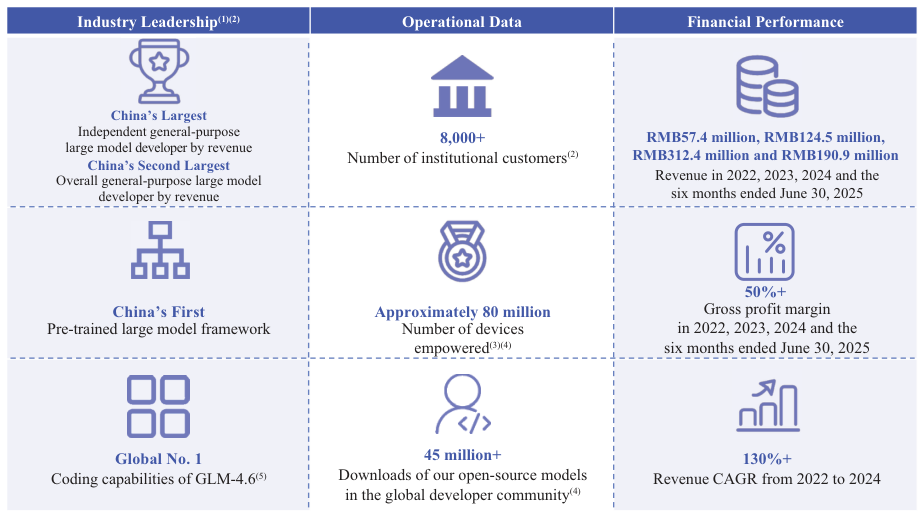
empowered over eight thousand institutional customers as of June 30, 2025 and approximately 80 million
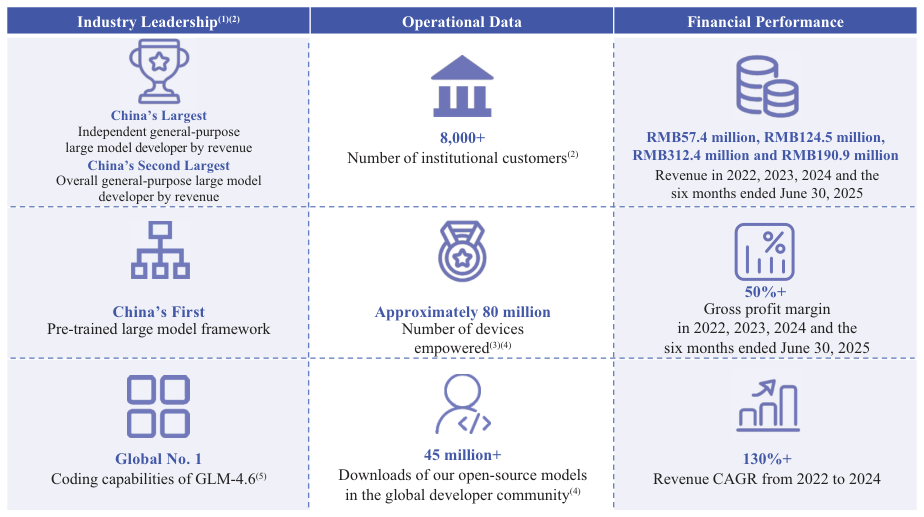
devices as of the Latest Practicable Date. According to Frost & Sullivan, we ranked first among China’s
independent developers and second among all developers of general-purpose large models with a market
share of 6.6% in terms of revenue in 2024.
– 1 –
SUMMARY
We achieved significant growth in revenue during the Track Record Period. In 2022, 2023 and 2024,
our revenue was RMB57.4 million, RMB124.5 million and RMB312.4 million, respectively, representing a
CAGR of over 130%. For the six months ended June 30, 2024 and 2025, our revenue was RMB44.9 million
and RMB190.9 million, respectively.
Industry Leadership(1)(2)
Operational Data
Financial Performance
Global No. 1
RMB57.4 million, RMB124.5 million,




China's Leading MaaS Platform
- The company ranks as China's largest independent general-purpose large model developer by revenue as of 2025.
- Their business model centers on a Model-as-a-Service (MaaS) platform offering language, multimodal, agent, and coding models.
- The platform demonstrates significant growth with a revenue CAGR exceeding 130% from 2022 to 2024.
- Global reach is evidenced by over 45 million downloads of open-source models and empowerment of approximately 80 million devices.
- The MaaS architecture is built on three pillars: a comprehensive model portfolio, scalable applications, and easy infrastructure adaptability.
- The GLM-4.6 model achieved top-tier global rankings for coding capabilities on the CodeArena evaluation platform in late 2025.
Through this product development and commercialization platform, we deliver intelligence to institutional customers, developers and individual customers in the most suitable, sensible and scalable way despite great heterogeneity in computing infrastructure, devices and applications.
RMB312.4 million and RMB190.9 million
China’s First
130%+
45 million+
Approximately 80 million
50%+
China’s Largest
China’s Second Largest
8,000+
Independent general-purpose
large model developer by revenue
Overall general-purpose large model
developer by revenue
Number of institutional customers(2)
Revenue in 2022, 2023, 2024 and the
six months ended June 30, 2025
Gross profit margin
in 2022, 2023, 2024 and the
six months ended June 30, 2025
Revenue CAGR from 2022 to 2024
Downloads of our open-source models
in the global developer community(4)
Number of devices
empowered(3)(4)
Coding capabilities of GLM-4.6(5)
Pre-trained large model framework
Notes:
(1)
According to Frost & Sullivan.
(2)
As of June 30, 2025.
(3)
Including smart phones, personal computers and smart vehicles.
(4)
As of the Latest Practicable Date.
(5)
Ranked in November 2025 by CodeArena, the latest industry-recognized global evaluation platform designed to assess models’ coding
capabilities.
– 2 –
SUMMARY
OUR BUSINESS MODEL: THE MAAS PLATFORM
As we commercialize our technology to seize the tremendous market opportunity presented by
advanced AI, we organize our offerings around our all-in-one MaaS platform. Our MaaS platform primarily
offers four types of models: language models, multimodal models, agent models and coding models, as well
as integrated tools for model fine-tuning, deployment and agent development. The key features of our MaaS
platform are comprehensiveness in model capabilities, scalability across broad application scenarios and
adaptability
with
diverse
computing
infrastructure.
Through
this
product
development
and
commercialization platform, we deliver intelligence to institutional customers, developers and individual
customers in the most suitable, sensible and scalable way despite great heterogeneity in computing
infrastructure, devices and applications.
Internet
Financial
Services
Technology
Smart
Devices
Healthcare
Retail
Scalable
Applications
Comprehensive
Portfolio
Model
Easy
Infra
Adaptability
Compatibility with
Computing Resources
Standardized API Access
MaaS
Language Model
Agent Model
Multimodal Model
Coding Model
Computing Power Support
……
Flexible Custom
Model Deployment
MaaS in the
loop
Safe and Accessible
Our MaaS platform comprises the following three levels:
•
Comprehensive model portfolio. We have built a comprehensive portfolio of advanced AI models,
showcasing
industry-leading
performance
in
language,
multimodal,
agentic
and
coding
capabilities. From our broad and capable repertoire, customers and developers can always find the
most suitable solution for their specific needs.
•
Scalable applications. Our models and agents are designed for seamless functionality across
diverse hardware, application scenarios and business workflows. They are capable of handling
complex tasks, enabling AI-native, multimodal and holistic dialogs, and performing deep
reasoning. For example, our models and agents can assist institutional customers in streamlining
business workflows, processing and analyzing operating data at a massive scale and supporting
decision-making. In addition, our MaaS platform provides an agent workspace, which
encompasses a variety of agent templates and scenario-based solutions. Through this agent
workspace, our customers can swiftly customize agents through streamlined model fine-tuning,
incremental model training and prompt engineering.
•
Easy infra adaptability. In collaboration with our computing infrastructure partners, we co-design
an advanced computing infrastructure that enables our MaaS platform to deliver integrated
computing, networking, training communications and inference acceleration capabilities. The




MaaS Deployment and Model Architecture
- The Model-as-a-Service (MaaS) platform supports a wide range of model sizes from 1.5 billion to 230 billion parameters for diverse hardware.
- On-premise deployment provides organizations with greater control over data security and performance optimization for specialized domains.
- Cloud-based deployment offers agility and cost-effectiveness by eliminating the need for local infrastructure and utilizing usage-based pricing.
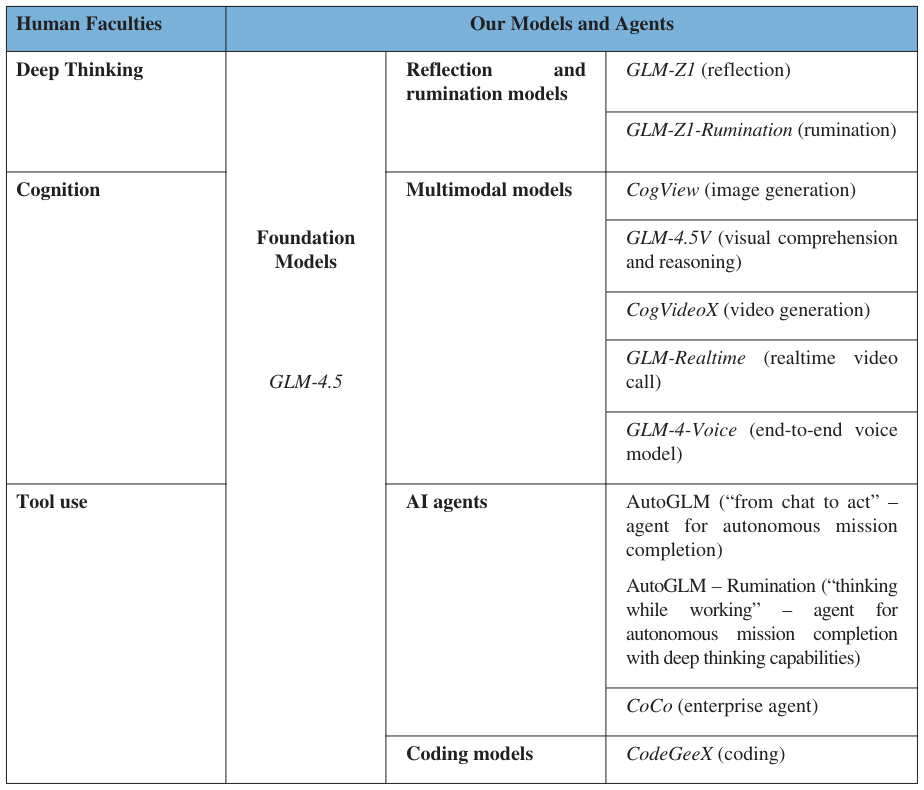
- The AI development strategy focuses on three core human faculties: deep thinking, cognition, and tool use.
- The GLM series foundation models serve as the base for specialized reflection, multimodal, agent, and coding models.
- Revenue recognition varies by deployment type, occurring at delivery for on-premise solutions and over the contract term for cloud services.
To teach machines to think like humans, we must empower AI with three core human faculties: deep thinking, cognition and tool use.
collaboration also enables our models to offer broad adaptability, supporting model sizes ranging
from 1.5 billion to 230 billion parameters and large-scale, real-time deployment across clouds and
chipsets. In particular, such adaptability allows our models to scale across mass-use devices such
as mobile phones, personal computers and smart vehicles and benefit vast numbers of end
consumers.
– 3 –
SUMMARY
Our MaaS platform offers flexible custom model deployment options to meet the diverse needs of
businesses while maintaining efficiency, scalability and data security. We primarily offer two deployment
approaches—on-premise and cloud-based deployment:
•
For on-premise deployment, our models are hosted within the customer’s own infrastructure. This
approach allows organizations to utilize their proprietary or sensitive data to tailor AI models to
their specific domains. On-premise deployment offers greater control over performance
optimization and infrastructure configuration, making it suitable for complex or highly specialized
application scenarios.
•
For cloud-based deployment, our models are hosted on a scalable and reliable cloud
infrastructure.
This
approach
is
sensible
for
businesses
seeking
agility
and
ease
of
implementation. By utilizing the cloud, customers eliminate the need for costly local
infrastructure, allowing them to deploy AI solutions quickly and cost effectively.
For on-premise deployment, we recognize revenue at the point in time when the large model and
related services are delivered to the customer’s designated location and accepted by the customer. For
cloud-based deployment, we recognize revenue over the contract term. Specifically, for subscription-based
contracts, we generally recognize revenue ratably over the contract term; for usage-based contracts, we
recognize revenue based on the customer’s utilization of the resources when the services are rendered to the
customers. For details of our revenue recognition policies, see “Financial Information—Material
Accounting Policies and Estimates—Material Accounting Policy Information—Revenue Recognition.”
OUR MODELS AND AGENTS
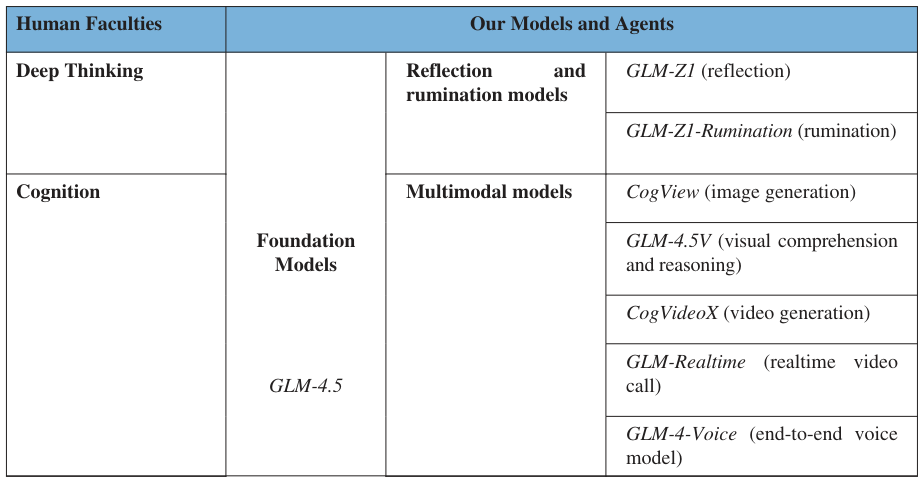
To teach machines to think like humans, we must empower AI with three core human faculties: deep
thinking, cognition and tool use. We have developed our AI models accordingly, which can be grouped into
three corresponding categories: reflection and rumination models, multimodal models and agent models.
We have also developed coding models, which generate code autonomously and enhance programming
efficiency. All four categories are developed upon our GLM series of foundation models. Foundation
models and reflection and rumination models belong to the broader category of language models.
The following chart sets forth our select models and AI agents in our current portfolio:
Human Faculties
Our Models and Agents
Deep Thinking
Reflection
and
rumination models
GLM-Z1 (reflection)
GLM-Z1-Rumination (rumination)
Cognition
Multimodal models
CogView (image generation)
Foundation
Models
GLM-4.5V (visual comprehension
and reasoning)
CogVideoX (video generation)
GLM-4.5
GLM-Realtime
(realtime
video
call)
GLM-4-Voice (end-to-end voice
model)
– 4 –
SUMMARY
Human Faculties
Our Models and Agents
Tool use
AI Agents
AutoGLM (“from chat to act” –
agent for autonomous mission
completion)
AutoGLM – Rumination (“thinking
while
working”
–
agent
for
autonomous
mission
completion
with deep thinking capabilities)
CoCo (enterprise agent)
Coding models
CodeGeeX (coding)
Foundation Models
Foundation models are pre-trained LLMs that serve as the foundation for the development of a variety
of specialized models. GLM-4.5 is our flagship foundation model, which we open-sourced upon launch.
Through multi-stage training and comprehensive post-training with fine-tuning and reinforcement learning,




GLM-4.5 Performance and Benchmarks
- GLM-4.5 is a 355-billion-parameter model that excels in agentic, reasoning, and coding tasks while supporting multi-modal extensions.
- The model ranked first among global open-source models and first in China across twelve industry-standard benchmark tests in July 2025.
- GLM-4.5 achieved the world's second-lowest hallucination rate in RAG evaluations, indicating high reliability in avoiding non-existent answers.
- Market adoption is significant, with token consumption on OpenRouter consistently ranking among the top ten globally and top three for Chinese companies.
- The product line includes specialized versions like GLM-4.5-Air for efficiency and the GLM-Z1 series for 'deep thinking' and complex reasoning.
Reflection and rumination models spend additional time “deep thinking” before generating an answer, which makes them better for complex reasoning tasks.
GLM-4.5 achieves strong performance across agentic, reasoning and coding tasks. GLM-4.5 also supports
multi-modal extensions and large context processing, allowing it to interpret high-level prompts and
autonomously generate practical solutions. GLM-4.5 has a model scale of 355 billion parameters and we
have also developed GLM-4.5-Air, a lightweight version with 106 billion parameters.
GLM-4.5 achieves the following leading positions, according to Frost & Sullivan:
•
Benchmark tests. Based on an evaluation across twelve industry-standard benchmark tests1 in July
2025, GLM-4.5 ranked third globally, first in China and first among global open-source models.
GLM-4.5 achieved a comprehensive score of 63.2 under these twelve benchmarks, compared with
scores ranging from 46.3 to 65.0 for industry peer models.
•
Global leaderboards. GLM-4.5 ranked fifth globally on Chatbot Arena and WebDev Arena in
September 2025, which are industry-recognized global leaderboards that rank the overall
capabilities and coding capabilities of large models, respectively.
•
Token consumption volume. Since the launch of GLM-4.5 and up to early December 2025, our
token consumption volume on OpenRouter, a leading global platform that provides API access to
a wide range of large models, had consistently ranked among the top ten globally and the top
three
among
Chinese
companies.
This
sustained
performance
underscores
the
strong
competitiveness and market recognition of GLM-4.5, demonstrating its advanced efficiency,
scalability and real-world applicability.
•
Popularity rankings. Within only 48 hours of its initial launch, GLM-4.5 ranked first globally on
the trending board of Hugging Face, the world’s largest platform for open-source models.
1 Benchmark tests are structured, standardized evaluations that measure LLMs’ capabilities across a range of tasks. The twelve industry-
standard benchmark tests we used to evaluate GLM-4.5 include three categories: (i) agentic benchmarks, including TAU-Bench, BFCL V3
and BrowseComp. GLM-4.5 achieved a comprehensive score of 58.1 under these agentic benchmarks, compared with scores ranging from
45.0 to 61.1 for industry peer models; (ii) reasoning benchmarks, including MMLU-Pro, AIME 24, MATH-500, SciCode, GPQA, HLE and
LCB (2407-2501). GLM-4.5 achieved a comprehensive score of 68.8 under these reasoning benchmarks, compared with scores ranging
from 63.5 to 74.2 for industry peer models; and (iii) coding benchmarks, including SWE-Bench Verified and Terminal-Bench. GLM-4.5
achieved a comprehensive score of 50.9 under these coding benchmarks, compared with scores ranging from 36.7 to 55.5 for industry peer
models.
– 5 –
SUMMARY
•
Hallucination rate. In September 2025, GLM-4.5 had the world’s second-lowest and China’s
lowest hallucination rate, according to the LLM Hallucination Leaderboard for Retrieval-
Augmented Generation (RAG). This benchmark evaluates large models based on how frequently
they produce non-existent answers (i.e., hallucinations) in response to intentionally misleading
questions.
In September 2025, we released GLM-4.6, a further updated version of our foundational model which
primarily features enhanced coding capabilities. In November 2025, GLM-4.6 ranked first globally on
CodeArena, the latest industry-recognized global evaluation platform designed to assess models’ coding
capabilities.
Reflection and Rumination Models
Reflection and rumination models spend additional time “deep thinking” before generating an answer,
which makes them better for complex reasoning tasks. Building upon our foundation model, we built our
reflection model (GLM-Z1) and rumination model (GLM-Z1-Rumination).
GLM-Z1 is a reflection model designed to tackle problems with certainty, aiming for more precise and
accurate solutions. It was developed based on the foundation model through extended reinforcement
learning and further training on tasks including mathematics, coding and logic.




Evolution of Agentic AI
- GLM-Z1-Rumination introduces iterative, deep-thinking capabilities designed to solve open-ended problems through external information gathering.
- The multimodal suite spans image, video, and voice generation, including GLM-Realtime for live video interactions.
- AutoGLM marks a shift from conversational AI to 'acting' AI, capable of autonomously controlling digital devices via graphical user interfaces.
- AutoGLM 2.0 operates on the cloud, allowing the AI to complete tasks across mobile apps and websites without interrupting the user's local device usage.
- The company leverages its position as the first in China to develop 100-billion-parameter models to build a comprehensive Model-as-a-Service (MaaS) platform.
- Strategic focus remains on scaling general-purpose R&D and fostering a vibrant open-source ecosystem to drive commercialization.
AutoGLM represents a major step forward in the evolution of our AI universe—from “chat” to “act,” bridging the gap between conversation-based AI and real-world task execution.
GLM-Z1-Rumination is designed to address problems with uncertainty, especially open-ended,
exploratory questions that require gathering and processing external information iteratively. Compared with
GLM-Z1, GLM-Z1-Rumination is capable of deeper and longer thinking and using tools to solve more
open-ended and complex problems.
Multimodal Models
Multimodal models are capable of processing and integrating information from various modalities,
such as text, images, audio and video. We have developed various multimodal models serving different
functionalities, such as CogView (image generation), GLM-4.5V (visual comprehension and reasoning),
CogVideoX (video generation), GLM-Realtime (realtime video call) and GLM-4-Voice (voice model).
AI Agents
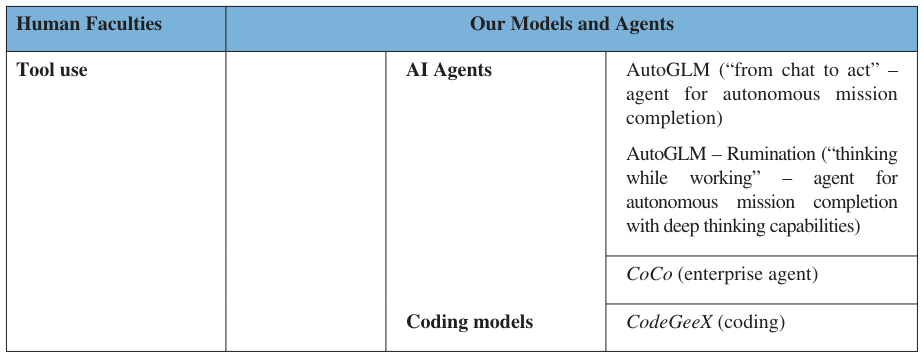
AI agents combine reasoning, planning and tool-use capabilities, and can autonomously perform multi-
step tasks without constant human input.
Our foundation agent model is AutoGLM. AutoGLM represents a major step forward in the evolution
of our AI universe—from “chat” to “act,” bridging the gap between conversation-based AI and real-world
task execution. Designed as a foundation agent tailored for autonomous control of digital devices through
graphical user interfaces (GUIs), AutoGLM transforms human-like reasoning into concrete actions.
AutoGLM achieved SOTA performance under AgentBench, an agentic AI benchmark recognized by the
2024 AI Index published by Stanford University.
In August 2025, we released an updated version of AutoGLM (also known as “AutoGLM 2.0”), which
is powered by our then latest foundation model GLM-4.5 and visual comprehension and reasoning model
GLM-4.5V. This updated version enables AutoGLM to simulate human actions across a broader range of
mobile applications and websites. It can autonomously complete requested tasks on the cloud without
occupying the user’s mobile phone or computer, allowing users to continue using their own devices without
interruption.
– 6 –
SUMMARY
AutoGLM Rumination is an advanced version of AutoGLM. It is an autonomous AI agent designed to
explore open-ended questions and take action based on its findings. AutoGLM Rumination features
“thinking
while
working”—it
leverages
outstanding
reasoning
capabilities
powered
by
the
GLM-Z1-Rumination
model
while
incorporating
AutoGLM’s
interactive
operational
capabilities.
AutoGLM Rumination can handle complex tasks involving deep reasoning, iterative research and producing
actionable outcomes.
We have also developed CoCo, a sophisticated enterprise AI agent designed to deliver intelligent
automation across corporate environments.
Coding Models
CodeGeeX is a powerful coding model designed to enhance programming efficiency and streamline
workflows. It enables developers to automatically generate code based on natural language descriptions or
complete unfinished lines or blocks of code, significantly improving productivity.
As of the Latest Practicable Date, the select models and agents set forth above had been
commercialized.
OUR STRENGTHS
•
First AI company in China to have self-developed large models at a scale of over 100 billion
parameters;
•
Comprehensive large model portfolio;
•
Deep academic roots as cornerstone for technological leadership;
•
All-in-one MaaS platform maximizing model commercialization;
•
Vibrant ecosystem fostered by open-source strategy and agentic agenda; and
•
Management and advisory team with extensive research and industry experience.
See “Business—Our Strengths.”
OUR STRATEGIES
•
Strengthen our R&D capabilities in general-purpose large models;
•
Optimize our MaaS platform; and
•
Attract and retain the best minds.
See “Business—Our Strategies.”
SPECIALIST TECHNOLOGY INDUSTRY




AI Sector Compliance and Growth
- The company is officially classified as a Specialist Technology Industry provider under the Artificial Intelligence subcategory of Next-generation Information Technology.
- Their core offerings include multimodal large models capable of processing text, images, audio, and video through billions of parameters.
- Commercial applications span diverse sectors including municipal transportation management, financial services, and large-scale document analysis for internet firms.
- The China Large Language Model (LLM) market is projected to experience explosive growth, rising from RMB5.3 billion in 2024 to RMB101.1 billion by 2030.
- Institutional and enterprise customers are identified as the primary drivers of this market, expected to maintain a 63.7% compound annual growth rate.
- The regulatory landscape currently requires no specific approvals for the company's specialist technology products as of the latest practicable date.
A large model is a complex set of algorithms that identify and leverage patterns from vast amounts of data by iteratively adjusting billions of parameters to increase accuracy.
Our industry consultant, Frost & Sullivan, confirms and our Directors are of the view that we fall
within an acceptable sector of a Specialist Technology Industry, namely, Artificial Intelligence under Next-
generation Information Technology as defined under Chapter 18C of the Listing Rules.
– 7 –
SUMMARY
The following table sets forth an analysis of how our offerings fall within the acceptable sector:
Specialist
Technology
Products
Acceptable
Sector
Acceptable Sector –
Subcategories
Functions and Applicability Analysis
Each of our models
and agents
See “—Our Models
and Agents” above
Next generation
Information
technology—Artificial
Intelligence
AI-powered
algorithm
programming:
image recognition,
audio-visual
learning, natural
language
processing,
machine learning
and deep learning
A large model is a complex set of
algorithms that identify and leverage
patterns from vast amounts of data by
iteratively
adjusting
billions
of
parameters to increase accuracy. Such
algorithms enable our models to achieve
functions
such
as
image
recognition,
audio-visual learning, natural language
processing, machine learning and deep
learning. For example, our multimodal
models
can
process
and
integrate
information
from
various
modalities,
including text, images, audio and video.
AI solutions:
the design
and provision of
AI solutions used in
different industry
verticals.
Our models constitute the foundation for
AI
solutions
to
a
broad
range
of
industries,
such
as
technology
and
internet, public service and traditional
corporate sectors (e.g., financial services,
manufacturing and energy). For example,
for the technology and internet sector, our
large models help our customers review
documents and analyze operating data on
a massive scale. For the public service
sector, we developed large models for
municipal
public
transportation
management
that
enable
accurate
monitoring of bus traffic flow and real-
time
estimation
of
arrival.
See
“Business—Our Commercial Use Cases”
for more use cases demonstrating the
applications
of
our
AI
solutions
in
different industry verticals.
Based on the following analysis and the view of the Directors and Frost & Sullivan, the Sole Sponsor
is of the view that the models and agents offered by the Group as described in this prospectus fall within an
acceptable sector of a Specialist Technology Industry, namely, Artificial Intelligence under Next Generation
Information Technology as defined under Chapter 18C of the Listing Rules. As of the Latest Practicable
Date, no regulatory approval had been required for our Specialist Technology Products.
INDUSTRY OVERVIEW AND COMPETITIVE LANDSCAPE
As a large model company, we operate in the LLM market, a subset of the AI market. LLM
development has experienced great leaps forward in recent years, especially since 2022. The most cutting-
edge research is currently conducted in the United States and China, with a number of leading players
having emerged in each country.
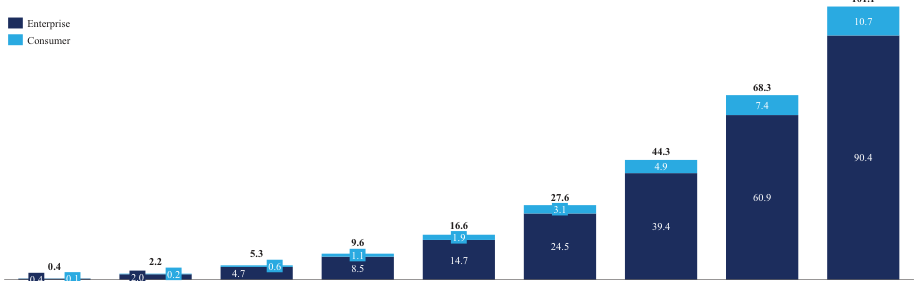
In terms of revenue, the size of the LLM market in China was RMB5.3 billion in 2024, with
institutional customers contributing RMB4.7 billion and individual customers contributing RMB0.6 billion.
With the continued advancement of LLM technologies and growing demand from both institutional and
– 8 –
SUMMARY
individual consumers, the market is estimated to grow to RMB101.1 billion by 2030, representing a CAGR
of 63.5% from 2024 to 2030. With institutional customers remaining as the main growth driver, the
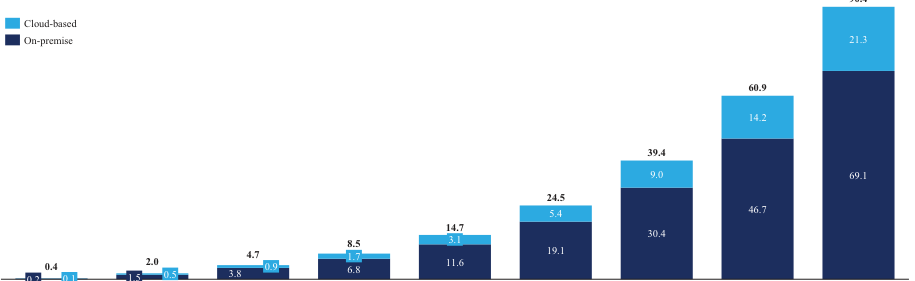
enterprise LLM market in China is estimated to reach RMB90.4 billion by 2030, representing a CAGR of
63.7% from 2024 to 2030.
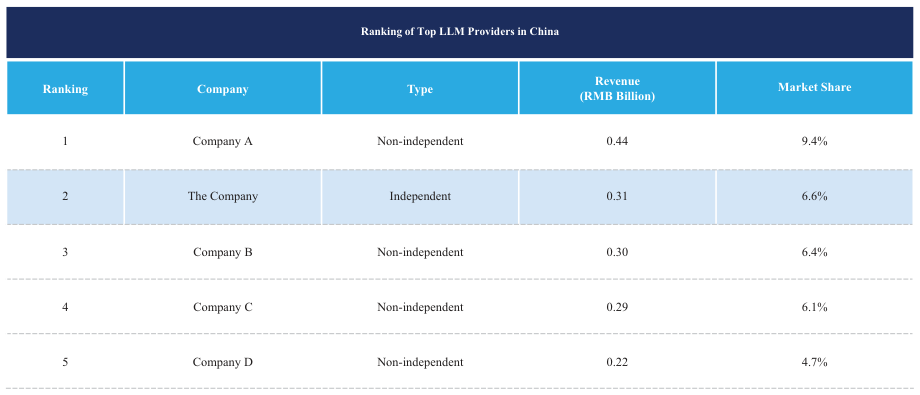
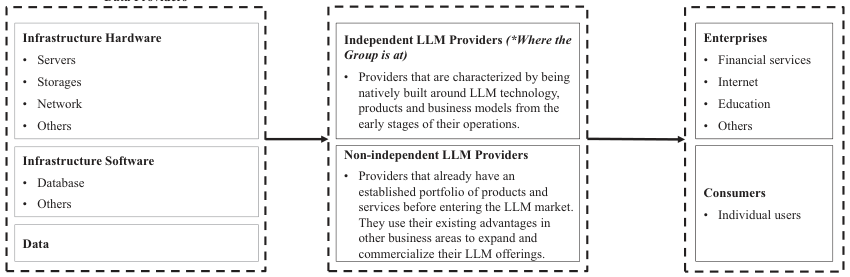
Participants in the LLM market in China can be divided into independent providers and non-
independent providers. Independent providers are characterized by being natively built around LLM




Competitive Dynamics in China's LLM Market
- The Chinese LLM market is divided between 'non-independent' technology giants and 'independent' pure-play providers.
- Tech giants leverage massive existing user bases and diversified business lines to promote their AI products rapidly.
- Enterprise clients often prefer independent providers to avoid direct competition with tech giants or falling into their spheres of influence.
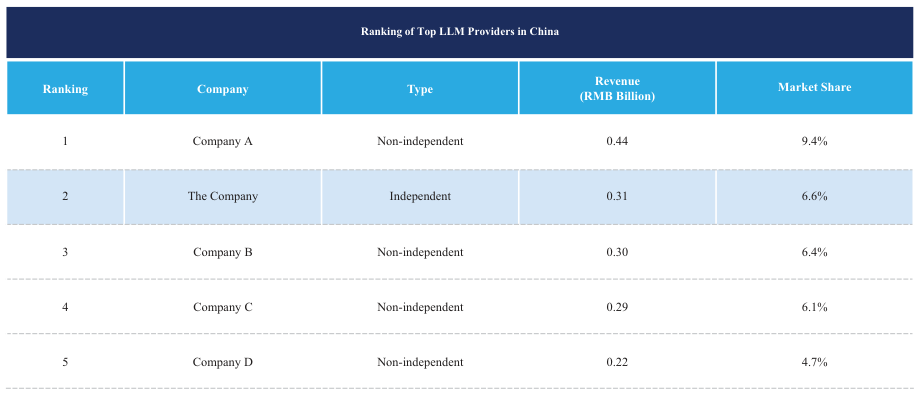
- Market data from 2024 shows a mix of independent and non-independent firms among the top five revenue earners, with the leader holding a 14.9% market share.
- The featured company emphasizes a research-driven culture, employing 657 R&D specialists focused on natural language processing and multimodal analysis.
- Intellectual property protection is a core strategic pillar, evidenced by 86 registered patents and hundreds of pending applications.
Also, enterprise clients in certain industries can be sensitive about falling or appearing to fall into spheres of influence by certain technology giants and are more inclined to adopt AI solutions from “pure-play” providers.
technology, products and business models from the early stages of their operations; and non-independent
providers are typically technology giants that branch into the AI area. Independent providers face very
different competitive dynamics as compared with those of non-independent providers. For example,
leveraging their pre-existing, diversified business lines, non-independent providers have accumulated
massive user bases, which facilitates the promotion of their LLM products. On the other hand, however,
enterprise clients may be disinclined to select an LLM product offered by a technology giant if it operates
business lines that compete directly with the client’s own business. Also, enterprise clients in certain
industries can be sensitive about falling or appearing to fall into spheres of influence by certain technology
giants and are more inclined to adopt AI solutions from “pure-play” providers.
Ranking of Top LLM Providers in China, in terms of revenue (2024)
Ranking of Top LLM Providers in China
e
p
y
T
y
n
a
p
m
o
C
Ranking
Revenue
(RMB Billion)
Market Share
1
%
4.9
4
4.0
tn
e
d
n
e
p
e
d
ni-
n
o
N
A
y
n
a
p
m
o
C
2
%
6.6
1
3.0
tn
e
d
n
e
p
e
d
n
I
y
n
a
p
m
o
C
e
h
T
3
%
4.6
0
3.0
tn
e
d
n
e
p
e
d
ni-
n
o
N
B
y
n
a
p
m
o
C
4
%
1.6
9
2.0
tn
e
d
n
e
p
e
d
ni-
n
o
N
C
y
n
a
p
m
o
C
5
%
7.4
2
2.0
tn
e
d
n
e
p
e
d
ni-
n
o
N
D
y
n
a
p
m
o
C
Notes:
1)
Company A, founded in 1999, is a public company listed on Shenzhen Stock Exchange.
2)
Company B, founded in 1999, is a public company listed on both the Hong Kong Stock Exchange and the New York Stock
Exchange.
3)
Company C, founded in 2014, is a public company listed on the Hong Kong Stock Exchange.
4)
Company D, founded in 2000, is a public company listed on both Hong Kong Stock Exchange and NASDAQ.
Source: Frost & Sullivan
– 9 –
SUMMARY
RESEARCH AND DEVELOPMENT
We are, at the core, a company of data scientists and engineers, with R&D ingrained in every aspect of
what we do. On a daily basis, we are intensely focused on elevating the intelligence of our foundation
models; improving and developing useful and cost-effective AI agents for ever more industry verticals and
other use cases; and collaborate with business partners to design and improve our computing infrastructure
that enables our MaaS platform to deliver comprehensive capabilities. We achieve these through, first and
foremost, our people, as well as our robust technology infrastructure and rigorous R&D processes.
As of June 30, 2025, we had a R&D team of 657 members with background and experience in the
relevant fields such as natural language processing, advanced decision-making in complex systems and
multimodal semantic analysis. See “Business—Research and Development—Talent.”
INTELLECTUAL PROPERTY
Our intellectual property is critical to our innovation which underpins our success. We seek to protect
our intellectual property through a combination of patents, copyrights, trademarks, domain names, trade
secrets, confidentiality agreements and other measures. As of the Latest Practicable Date, we had 86
registered patents in China, among which 84 were invention patents, and 232 patent applications in China.
As of the same date, we had 160 copyrights, 314 trademarks and 59 domain names in China.
We have designed and adopted comprehensive measures to protect our intellectual property. We enter
into employment agreements with confidentiality, non-compete covenants and intellectual property




LLM Market Competition and Growth
- The company secures intellectual property through strict ownership clauses with employees and consultants, reporting no material infringement disputes to date.
- The Large Language Model (LLM) market is characterized by intense competition based on technical capabilities, ecosystem building, and talent acquisition.
- Revenue has demonstrated explosive growth with a CAGR exceeding 130%, rising from RMB57.4 million in 2022 to RMB312.4 million in 2024.
- Significant net losses have occurred alongside revenue growth, primarily driven by massive investments in research and development which reached RMB2,195.4 million in 2024.
- The path to profitability relies on leveraging the expanding Chinese LLM market, iterating AI models, and broadening customer reach to achieve operating leverage.
- Future sustainability is predicated on the belief that revenue growth will eventually outpace the high costs of R&D and infrastructure.
Our losses during the Track Record Period were primarily due to our significant investments in research and development.
ownership clauses with our employees, certain consultants and advisors. They acknowledge that the
intellectual property developed by them in connection with their employment with us, including our in-
house developed content, is our property. During the Track Record Period and up to the Latest Practicable
Date, we had not been subject to any material disputes or claims for infringement of third parties’
trademarks, licenses and other intellectual property rights.
COMPETITION
As a large model company, we operate in what is known as the LLM market, a subset of the AI
market. The LLM market is highly competitive. According to Frost & Sullivan, LLM vendors compete
based on factors including (i) technical capabilities such as self-developed LLM pre-training framework and
model customization and optimization, (ii) flexible business models and delivery strategies, (iii) ecosystem
building capabilities and (iv) talent with deep technical backgrounds and extensive experience. We compete
with both independent and non-independent LLM vendors, both within China and internationally. We may
also in the future face competition from new entrants that will increase the competition. Principal
competitive factors important to us include scope, performance and safety of our service offerings, user
experience, our R&D capabilities and our talents. For additional details regarding the competitive landscape
of the industry in which we operate, see “Industry Overview” and “Business—Competition.”
BUSINESS SUSTAINABILITY
Our Historical Performance
We achieved strong growth in revenue during the Track Record Period. Our revenues grew from
RMB57.4 million in 2022 to RMB124.5 million in 2023 and further to RMB312.4 million in 2024 with a
CAGR of over 130%. Our revenue also grew significantly from RMB44.9 million in the six months ended
June 30, 2024 to RMB190.9 million in June 30, 2025.
While we achieved sustained business growth, we had loss for the year of RMB143.7 million,
RMB788.0 million, RMB2,958.0 million, RMB1,235.6 million and RMB2,357.9 million in 2022, 2023,
– 10 –
SUMMARY
2024 and the six months ended June 30, 2024 and 2025, respectively. Our losses during the Track Record
Period were primarily due to our significant investments in research and development. Our R&D expenses
increased from RMB84.4 million in 2022 to RMB528.9 million in 2023 and further to RMB2,195.4 million
in 2024. Our R&D expenses increased by 85.6% from RMB859.2 million in the six months ended June 30,
2024 to RMB1,594.7 million in June 30, 2025.
Path to Profitability
While the absolute amount of our net losses increased during the Track Record Period, we expect to
turn around our net loss position through increase in revenue and enhancement in operating efficiency.
Continuous Revenue Growth
Revenue growth is key to achieving profitability. We have built a robust portfolio of AI models and
agents to empower a broad range of industries and address unique challenges and optimize workflows in
each industry. Leveraging the significant market potential of the LLM market, as well as our technological
leadership, we are well positioned to upgrade our AI models and agents in response to emerging market
opportunities and continue to achieve revenue growth. The growth in our revenue will gradually cover the
relevant costs and expenses and thereby reduce our net losses in general. We plan to increase our revenue
by (i) leveraging the growth potential of the LLM market in China; (ii) continuously promote iteration and
upgrade of AI models and agents; (iii) broadening our customer reach; and (iv) expanding our solutions use
for new industry sectors.
Improving Operating Leverage




Operational Efficiency and Stakeholder Dynamics
- The company is prioritizing profitability through optimized R&D efficiency and the iteration of its foundation models via its MaaS platform.
- Operational management strategies include simplifying workflows, controlling administrative expenses, and adopting data-driven marketing approaches.
- Customer concentration is high but declining, with the top five customers accounting for 40.0% of revenue in mid-2025 compared to 61.5% in 2023.
- The supply chain relies heavily on providers of computing hardware, data cleansing services, and large model evaluation support.
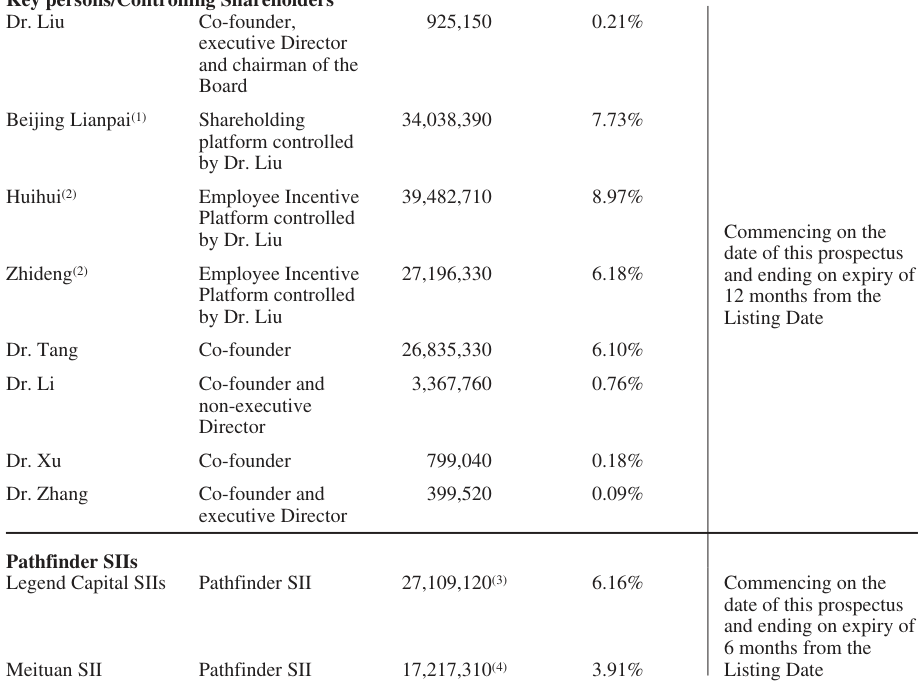
- A group of controlling shareholders, including several doctors and investment entities, maintains a collective interest of approximately 33.03%.
- The company asserts its business model is sustainable based on historical growth and strategic cloud-based deployment.
With our deep academic roots as cornerstone for technological leadership, we are constantly making technological advancements and iterations of our foundation models, boosting our profitability.
Improvement of our operating efficiency is also a significant factor to achieve profitability. We plan to
optimize R&D efficiency and improve operational management effectiveness. Since our inception, we have
invested significantly in R&D and our MaaS platform. With our deep academic roots as cornerstone for
technological leadership, we are constantly making technological advancements and iterations of our
foundation models, boosting our profitability. We have also adopted measures to control general and
administration expenses and improving operational efficiency. We have simplified workflows and
optimized resource allocation to ensuring that operational needs are met in a cost-effective manner. In
addition, we have adopted a focused approach to selling and marketing activities to further improve the
efficiency of related expenses. By directing resources and efforts toward cloud-based deployment and
leveraging data-driven insights, we have optimized our selling and marketing strategies.
See “Business—Business Sustainability” for details. Taking into account our historical growth, the
market opportunities and our plan to achieve profitability, we are of the view that we have a sustainable
business model.
OUR CUSTOMERS AND SUPPLIERS
Our customers include enterprises, public sector entities and individual users. In each year/period
during 2022, 2023, 2024 and the six months ended June 30, 2025, revenue from our five largest customers
accounted for 55.4%, 61.5%, 45.5% and 40.0% of our total revenue, respectively. In each year/period
during 2022, 2023, 2024 and the six months ended June 30, 2025, revenue from our largest customer
accounted for 15.4%, 14.7%, 19.0% and 11.0% of our total revenue, respectively.
Our suppliers primarily consist of (i) providers of computing resources, such as computing hardware
and computing services, (ii) hardware equipment vendors, including servers, storage devices and network
devices, (iii) providers of research and development support, such as data cleansing and large model
evaluation services, and (iv) providers of marketing services. In each year/period during 2022, 2023, 2024
and the six months ended June 30, 2025, purchases from our five largest suppliers accounted for 54.5%,
– 11 –
SUMMARY
53.6%, 47.3% and 50.2% of our total purchases, respectively. In each year/period during 2022, 2023, 2024
and the six months ended June 30, 2025, purchases from our largest supplier accounted for 33.1%, 16.4%,
15.6% and 13.4% of our total purchases, respectively.
OUR CONTROLLING SHAREHOLDERS
As of the Latest Practicable Date, the Controlling Shareholders, Beijing Lianpai, Dr. Liu, Dr. Tang, Dr.
Li, Dr. Xu, Dr. Zhang, Huihui and Zhideng, by virtue of the Amended Concert Party Agreement entered
into among them, were collectively interested in approximately 33.03% of the Shares. See “History,
Development and Corporate Structure—Concert Party Arrangement and Our Controlling Shareholders” for
further details.
Immediately following the completion the Global Offering, our group of Controlling Shareholders will
in aggregate hold approximately 30.22% of the Shares (assuming the Over-allotment Option is not
exercised). Accordingly, upon Listing, they will remain as our group of Controlling Shareholders as defined
under the Listing Rules. For further details about our Controlling Shareholders, see “Relationship with our
Controlling Shareholders.”
APPLICATION FOR LISTING ON THE STOCK EXCHANGE
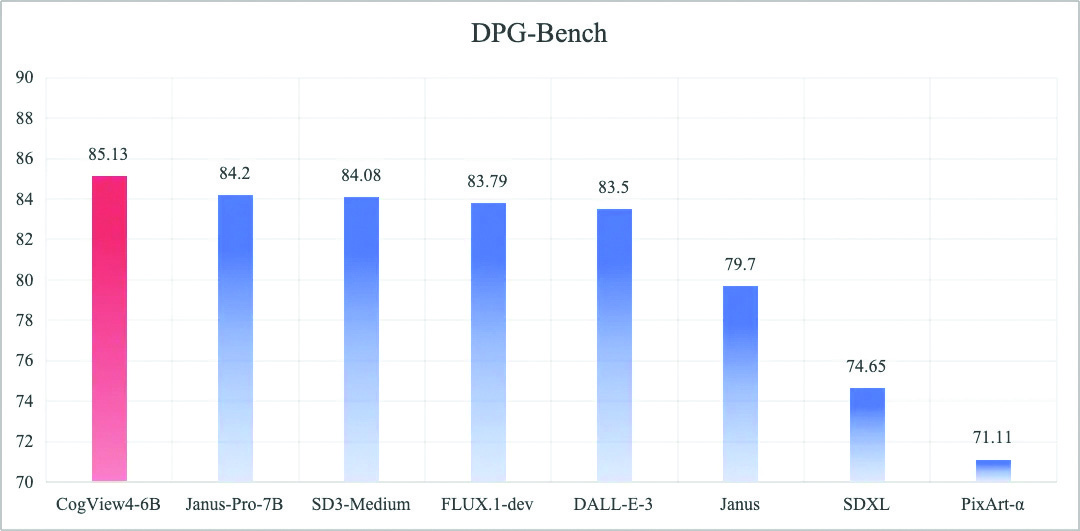



IPO Listing and Risk Factors
- The company is applying for a Hong Kong Stock Exchange listing under Rule 18C.03, targeting a market capitalization exceeding HK$6 billion.
- Pre-IPO funding rounds have successfully raised over RMB8,360 million across eight distinct investment phases.
- The business faces significant R&D risks, specifically the necessity of continuous innovation in the rapidly changing AI industry to remain competitive.
- Operational dependencies include a heavy reliance on third-party computing resources and the performance of proprietary Model-as-a-Service (MaaS) platforms.
- Regulatory and market uncertainties persist, particularly regarding evolving Chinese AI laws and the early-stage development of Artificial General Intelligence (AGI).
- The company admits to a limited track record in commercialization, making future demand and market size difficult to predict accurately.
The development of AGI is still at an early stage and there are substantial uncertainties in the future realization of AGI.
We have applied to the Stock Exchange for the granting of the listing of, and the permission to deal in
(i) the H Shares to be converted pursuant to the Conversion of Unlisted Shares and (ii) the H Shares to be
issued pursuant to the Global Offering (including any H Shares which may be issued pursuant to the
exercise of the Over-allotment Option) on the basis that, among other things, we satisfy the requirements
under Rule 18C.03 of the Listing Rules as a Commercial Company (as defined in the Listing Rules) with
reference to our expected market capitalization at the time of Listing, which, based on the Offer Price of
HK$116.20 per Offer Share, exceeds HK$6 billion.
PRE-IPO INVESTMENTS
We completed eight rounds of Pre-IPO Investments and had raised funds of over RMB8,360 million.
See “History, Development and Corporate Structure—Pre-IPO Investments” for further details of the Pre-
IPO Investments and the Pre-IPO Investors.
RISK FACTORS
Our operations and the Global Offering involve certain risks and uncertainties, including (i) risks
related to our research and development, (ii) risks related to our commercialization, (iii) risks related to our
operations, (iv) risks related to our intellectual property, (v) risks related to our financial condition and need
for additional capital, (vi) risks related to where we conduct business, and (vii) risks related to the Global
Offering, which are set out in the section headed “Risk Factors” in this prospectus. You should read that
section in its entirety carefully before you decide to invest in the Offer Shares. Some of the major risks we
face include, but are not limited to:
•
The AI industry is characterized by constant changes. If we are not able to upgrade, enhance or
innovate our technologies and services, our business, results of operations, financial condition and
prospects could be adversely affected.
•
We have made and expect to continue to make substantial investments in R&D. If we cannot
continuously invest in our R&D activities while achieving technological innovation, our business,
results of operations, financial condition and prospects may be materially and adversely affected.
•
The development of AGI is still at an early stage and there are substantial uncertainties in the
future realization of AGI.
•
We are exposed to risks relating to our R&D team and our senior management.
– 12 –
SUMMARY
•
We rely on third parties to provide computing resources to us, and any disruption of their services
or fluctuation of prices could adversely affect our business, results of operations and financial
condition.
•
Our commercial success depends on the performance of our models. Any failure in research and
development efforts to offer high-quality models and solutions could harm our business, results of
operations, financial condition and prospects.
•
The AI industry is subject to evolving and extensive regulation in China. Future laws and
regulations may impose additional requirements and other obligations that could materially and
adversely affect our business, results of operations, financial condition and prospects.
•
We may not be able to obtain or maintain adequate intellectual property rights protection for our
business, or the scope of such intellectual property rights protection may not be sufficiently broad.
•
We may not be able to compete effectively against current or future competitors.
•
The size of our addressable market and the demand for our solutions may not increase as rapidly
as we anticipate due to a variety of factors, which would materially and adversely affect our
business, results of operations, financial condition and prospects.
•
Any failure of our MaaS platform to perform as required could harm our business, results of
operations, financial condition and prospects.
•
We have a limited track record in the commercialization of our business.
SUMMARY OF KEY FINANCIAL INFORMATION




Consolidated Financial Performance Summary
- The company experienced rapid revenue growth, increasing from RMB 57.4 million in 2022 to RMB 312.4 million in 2024.
- Gross profit margins remained relatively stable between 48.9% and 64.6% throughout the reported periods.
- Research and development expenses are the primary driver of losses, reaching over 700% of total revenue in 2024.
- Operating losses have widened significantly, totaling over RMB 2.5 billion in 2024 as the company scales its operations.
- Financial statements include significant non-cash adjustments, such as changes in the carrying amounts of financial instruments issued to investors.
- The company remains in a pre-profit stage with total losses for the first half of 2025 exceeding RMB 2.3 billion.
Research and development expenses . . . . . . . . . . (84,377) (147.0) (528,884) (424.7) (2,195,436) (702.7)
The following tables set forth the summary of key financial information during the Track Record
Period, extracted from the Accountants’ Report as set out in Appendix I to this document. The key financial
information set forth below should be read together with, and is qualified in its entirety by reference to, our
financial statements in this document, including the related notes. Our consolidated financial information
was prepared in accordance with the IFRS Accounting Standards.
– 13 –
SUMMARY
Summary of Consolidated Statements of Profit or Loss and Other Comprehensive Income
The following table summarizes our results of operations and as percentage of our total revenue for the
years/periods indicated.
Year Ended December 31,
Six Months Ended June 30,
2022
2023
2024
2024
2025
Amount
% of
revenue Amount
% of
revenue
Amount
% of
revenue
Amount
% of
revenue
Amount
% of
revenue
(RMB in thousands, except for percentages)
(Unaudited)
Revenue
57,409
100.0
124,538
100.0
312,414
100.0
44,909
100.0
190,877
100.0
Cost of revenue . . . . . .
(26,049)
(45.4)
(44,056)
(35.4)
(136,525)
(43.7)
(22,950)
(51.1)
(95,453)
(50.0)
Gross profit . . . . . . . .
31,360
54.6
80,482
64.6
175,889
56.3
21,959
48.9
95,424
50.0
Other income . . . . . . . .
1,784
3.1
9,965
8.0
19,281
6.2
4,174
9.3
4,614
2.4
Selling and marketing
expenses . . . . . . . . . .
(15,139)
(26.4) (101,198)
(81.3)
(387,475) (124.0)
(144,194)
(321.1)
(208,570)
(109.3)
General and
administration
expenses . . . . . . . . . .
(32,316)
(56.3)
(66,302)
(53.2)
(133,603)
(42.8)
(51,452)
(114.6)
(185,165)
(97.0)
Research and
development
expenses . . . . . . . . . .
(84,377) (147.0) (528,884) (424.7) (2,195,436) (702.7)
(859,217) (1,913.2) (1,594,661)
(835.4)
Impairment losses on
financial assets . . . . .
(31)
(0.1)
(19,786)
(15.9)
(17,008)
(5.4)
(763)
(1.7)
(10,867)
(5.7)
Loss from operations
(98,719) (172.0) (625,723) (502.4) (2,538,352) (812.5) (1,029,493) (2,292.4) (1,899,225)
(995.0)
Finance costs . . . . . . . .
(5,694)
(9.9)
(26,332)
(21.1)
(38,321)
(12.3)
(12,212)
(27.2)
(53,270)
(27.9)
Share of profits less
losses of
associates . . . . . . . . .
—
—
(453)
(0.4)
21,254
6.8
324
0.7
14,147
7.4
Changes in fair value of
financial instruments
measured at fair
value through profit
or loss (“FVPL”) . . .
5,972
10.4
26,022
20.9
66,271
21.2
7,004
15.6
9,791
5.1
Changes in the carrying
amounts of financial
instruments issued to
investors . . . . . . . . . .
(45,209)
(78.7) (161,471) (129.7)
(468,859) (150.1)
(201,174)
(448.0)
(429,295)
(224.9)
Loss before taxation
(143,650) (250.2) (787,957) (632.7) (2,958,007) (946.8) (1,235,551) (2,751.2) (2,357,852) (1,235.3)
Income tax . . . . . . . . . .
—
—
—
—
—
—
—
—
—
—
Loss for the year . . . . . (143,650) (250.2) (787,957) (632.7) (2,958,007) (946.8) (1,235,551) (2,751.2) (2,357,852) (1,235.3)
Loss attributable to:
Equity holders of the
Company . . . . . . . . . (143,374) (249.7) (787,960) (632.7) (2,956,491) (946.3) (1,235,551) (2,751.2) (2,351,173) (1,231.8)
Non-controlling
interests . . . . . . . . . .
(276)
(0.5)
3
0.0
(1,516)
(0.5)
—
—
(6,679)
(3.5)
– 14 –
SUMMARY
Non-IFRS Financial Measure




Non-IFRS Financial Performance Metrics
- The company utilizes 'adjusted loss for the year' as a non-IFRS measure to facilitate period-to-period comparisons of operating performance.
- Adjustments to the net loss include adding back equity-settled share-based compensation, changes in the carrying amount of financial instruments, and listing expenses.
- Management argues these adjustments provide useful information by removing non-cash items and one-time costs like those associated with the Global Offering.
- Financial data shows a significant increase in net loss from 2022 to 2025, with the adjusted net loss for the first half of 2025 reaching over 1.7 billion RMB.
- Revenue is primarily driven by on-premise deployment of large model services through their MaaS platform, consistently outperforming cloud-based deployment.
The use of such non-IFRS measure has limitations as an analytical tool, and you should not consider them in isolation from, or as substitute for analysis of, our consolidated financial statements.
To supplement our consolidated financial statements that are presented in accordance with IFRS
Accounting Standards, we also use adjusted loss for the year (a non-IFRS measure), as an additional financial
measures which is not required by or presented in accordance with IFRS Accounting Standards. We believe that
this non-IFRS measure facilitates comparisons of operating performance from period to period by eliminating
potential impact of certain items. We believe that this measure provides useful information to investors and
others in understanding and evaluating our consolidated financial statements in the same manner as they help our
management. However, our presentation of adjusted loss for the year (a non-IFRS measure) may not be
comparable to similar measures presented by other companies. The use of such non-IFRS measure has
limitations as an analytical tool, and you should not consider them in isolation from, or as substitute for analysis
of, our consolidated financial statements or financial condition as reported under IFRS Accounting Standards.
We define adjusted loss for the year/period (a non-IFRS measure) as loss for the year/period adjusted for adding
back equity-settled share-based compensation expenses, changes in the carrying amount of financial instruments
issued to investors, and listing expenses.
Year Ended
December 31,
Six Months Ended
June 30,
2022
2023
2024
2024
2025
(RMB in thousands)
(Unaudited)
Net loss for the year/period
(143,650)
(787,957) (2,958,007)
(1,235,551)
(2,357,852)
Add:
— Equity-settled share-based
compensation expenses(1)
1,024
5,502
23,579
4,217
158,852
— Changes in the carrying amount of
financial instruments issued to
investors(2)
45,209
161,471
468,859
201,174
429,295
— Listing expense(3)
—
—
—
—
17,731
Adjusted net loss for the year/period
(non-IFRS measure)
(97,417)
(620,984) (2,465,569)
(1,030,160)
(1,751,974)
Notes:
(1)
Equity-settled share-based compensation expenses represented share-based compensation expenses incurred in connection with
our share incentive plan. Equity-settled share-based compensation expenses are not expected to result in future cash payments. The
reconciling item is non-cash and does not result in cash outflow, and the adjustment has been consistently made during the Track
Record Period.
(2)
We adjust changes in the carrying amount of financial instruments issued to investors because it was non-cash, in nature. We recognized
the financial instruments at present value of financial instruments, with changes in such carrying amounts being booked in profit or loss,
arising from redemption rights issued to Pre-IPO Investors. These redemption rights issued will be terminated and converted into equity
upon the Global Offering.
(3)
Listing expenses represent professional fees, underwriting commission and fees incurred in connection with the Listing and the Global
Offering.
– 15 –
SUMMARY
Revenue
During the Track Record Period, we derived our revenue from providing large model services through
our MaaS platform. The following table sets forth a breakdown of revenue by segment both in absolute
amount and as a percentage of our total revenue for the years/periods indicated.
Year Ended December 31,
Six Months Ended June 30,
2022
2023
2024
2024
2025
(RMB in thousands, except for percentages)
(Unaudited)
On-premise deployment
54,815
95.5% 112,614
90.4% 263,930
84.5% 26,806
59.7% 161,777
84.8%
Cloud-based deployment
2,594
4.5%
11,924
9.6%
48,484
15.5% 18,103
40.3%
29,100
15.2%
Total
57,409 100.0% 124,538 100.0% 312,414 100.0% 44,909 100.0% 190,877 100.0%

Revenue Expansion and Cost Structures
- The company began generating revenue from overseas on-premise deployments in 2024, with a significant initial focus on Southeast Asian markets like Malaysia and Singapore.
- While Mainland China remains the dominant revenue source, the share of on-premise revenue from Southeast Asia grew to 11.1% by the first half of 2025.
- Cost of revenue is primarily driven by payroll for service personnel and computing service fees, the latter of which saw a sharp increase in 2024 and 2025.
- The company utilizes third-party outsourcing for labor-intensive tasks such as data annotation to manage technical service and consultation costs.
- Gross profit margins for on-premise deployment have remained relatively strong, though cloud-based deployment margins show significant volatility and a downward trend.
Starting from 2024, our large model on-premise deployment services have generated revenue from overseas customers, primarily from customers in Southeast Asia.
Starting from 2024, our large model on-premise deployment services have generated revenue from
overseas customers, primarily from customers in Southeast Asia. The following table sets forth a
breakdown of revenue derived from on-premise deployment by geographical location of our customers both
in absolute amount and as a percentage of our total revenue derived from on-premise deployment for the
years/periods indicated.
Years Ended December 31,
Six Months Ended June 30,
2022
2023
2024
2024
2025
(RMB in thousands, except for percentages)
On-premise
deployment
Mainland China . . . .
54,815
100.0% 112,614
100.0% 262,479
99.5% 26,806 100.0%
142,990
88.4%
Southeast Asia(1) . . . .
—
—
—
—
1,080
0.4%
—
—
17,927
11.1%
Hong Kong . . . . . . . .
—
—
—
—
371
0.1%
—
—
—
—
Others(2) . . . . . . . . . .
—
—
—
—
—
—
—
—
860
0.5%
Total . . . . . . . . . . . . .
54,815
100.0% 112,614
100.0% 263,930
100.0% 26,806
100.0% 161,777
100.0%
Notes:
(1)
Includes Malaysia and Singapore.
(2)
Include the United States.
Cost of Revenue
During the Track Record Period, our cost of revenue consisted of (i) payroll cost, mainly representing
the wages and benefits of service personnel involved in the deployment and maintenance of our services;
(ii) computing service fee paid to providers of computing power necessary for providing our services;
(iii) provision for warranty; (iv) depreciation and amortization; (v) technical service and consultation fees as
we outsourced to third-party service providers certain standard labor intensive tasks to save costs, such as
data annotation; (vi) tax and surcharges; and (vii) others.
– 16 –
SUMMARY
The following table sets forth a breakdown of our cost of revenue by nature both in absolute amount
and as a percentage of our total cost of revenue for the years/periods indicated.
Year Ended December 31,
Six Months Ended June 30,
2022
2023
2024
2024
2025
(RMB in thousands, except for percentages)
(Unaudited)
Payroll cost
16,434
63.1% 15,375
34.9%
74,262
54.4% 10,832
47.2% 37,628
39.4%
Computing service fee
—
—
11,996
27.2%
30,173
22.1%
8,451
36.8% 35,845
37.6%
Provision for warranty
2,101
8.1%
4,522
10.3%
12,171
8.9%
1,672
7.3%
6,670
7.0%
Depreciation and
amortization
1,912
7.3%
6,436
14.6%
6,769
5.0%
549
2.4%
2,074
2.2%
Technical service and
consultation fees
4,553
17.5%
623
1.4%
9,126
6.7%
356
1.6%
6,165
6.5%
Taxes and surcharges
57
0.2%
1,713
3.9%
541
0.4%
361
1.6%
1,109
1.2%
Others
992
3.8%
3,391
7.7%
3,483
2.5%
729
3.1%
5,962
6.1%
Total
26,049
100.0% 44,056
100.0% 136,525
100.0% 22,950
100.0% 95,453
100.0%
The following table sets forth a breakdown of our cost of revenue by segment in absolute amount and
as a percentage of our total cost of revenue for the years/periods indicated:
Year Ended December 31,
Six Months Ended June 30,
2022
2023
2024
2024
2025
(RMB in thousands, except for percentages)
(Unaudited)
On-premise
deployment . . . . . .
25,429
97.6% 35,833
81.3%
89,674
65.7% 10,030
43.7%
66,237
69.4%
Cloud-based
deployment . . . . . .
620
2.4%
8,223
18.7%
46,851
34.3% 12,920
56.3%
29,216
30.6%
Total
26,049
100.0% 44,056
100.0% 136,525
100.0% 22,950
100.0% 95,453
100.0%
Gross Profit and Gross Profit Margin
The following table sets forth a breakdown of our gross profit and gross profit margins, for the
years/periods indicated.
Year Ended December 31,
Six Months Ended June 30,
2022
2023
2024
2024
2025
Gross
Profit
Gross
Profit
Margin
Gross
Profit
Gross
Profit
Margin
Gross
Profit
Gross
Profit
Margin
Gross
Profit
Gross
Profit
Margin
Gross
Profit
Gross
Profit
Margin
(RMB in thousands, except for percentages)
(Unaudited)
On-premise
deployment
29,386
53.6%
76,781
68.2%
174,256
66.0%
16,776
62.6%
95,540
59.1%
Cloud-based
deployment
1,974
76.1%
3,701
31.0%
1,633
3.4%
5,183
28.6%
Escalating Losses and Strategic Investment
- The company experienced a dramatic increase in net losses, rising from RMB143.7 million in 2022 to over RMB2.9 billion by 2024.
- Significant capital is being deployed into research and development to build advanced foundation models and expand the R&D team.
- Operating costs are further driven by the procurement of massive computing services and hardware from third parties to support business expansion.
- Aggressive sales and marketing investments are being made to capture emerging market opportunities and grow the customer base.
- The financial position shows a widening net liability gap, reaching RMB6.15 billion by mid-2025, largely due to comprehensive losses and financial instruments issued to investors.
Such overall upward trend in our net loss was primarily due to (i) the significant increase in research and development expenses as we expanded our R&D team and procured substantially more computing services from third parties and related computing hardware.
(116) (0.4%)
Total
31,360
54.6% 80,482
64.6% 175,889
56.3% 21,959 48.9%
95,424 50.0%
– 17 –
SUMMARY
Loss for the Year/Period
We recorded accumulated losses during the Track Record Period mainly because, despite achieving
substantial revenue growth, we strategically made significant investments in research and development to
support the development of advanced models and the ongoing improvement of our foundation models, and
investments in sales and marketing activities to increase our customer base.
Our net loss increased from RMB143.7 million in 2022, to RMB788.0 million in 2023, and further
increased to RMB2,958.0 million in 2024. Our net loss increased from RMB1,235.6 million for the
six months ended June 30, 2024 to RMB2,357.9 million for the six months ended June 30, 2025. Such
overall upward trend in our net loss was primarily due to (i) the significant increase in research and
development expenses as we expanded our R&D team and procured substantially more computing services
from third parties and related computing hardware, generally in line with our business expansion; and
(ii) the increase in selling and marketing expenses as we expanded our sales and marketing team and made
more advertising investment in order to swiftly take advantage of emerging market opportunities.
Summary of Consolidated Statements of Financial Position
The following table sets forth a summary of our consolidated statement of financial position as of the
dates indicated.
As of December 31,
As of June 30,
2022
2023
2024
2025
(RMB in thousands)
Total non-current assets
62,445
996,675
1,359,902
1,360,356
Total current assets
299,531
1,863,478
3,015,867
3,740,355
Total current liabilities
(531,855) (3,608,888) (7,838,055)
(10,829,216)
Net current liabilities
(232,324) (1,745,410) (4,822,188)
(7,088,861)
Total assets less current liabilities
(169,879)
(748,735) (3,462,286)
(5,728,505)
Total non-current liabilities
(10,309)
(233,858)
(492,859)
(422,336)
Net liabilities
(180,188)
(982,593) (3,955,145)
(6,150,841)
Our net liabilities increased from RMB180.2 million as of December 31, 2022 to RMB982.6 million as
of December 31, 2023, primarily attributable to total comprehensive loss of RMB788.0 million mainly
driven by the research and development expenses we incurred, and capital contributions from equity holders
of RMB18.8 million, partially offset by the recognition of the equity settled share-based transactions of
RMB5.5 million. Our net liabilities further increased from RMB982.6 million as of December 31, 2023 to
RMB3,955.1 million as of December 31, 2024, primarily attributable to total comprehensive loss of
RMB2,958.1 million mainly driven by the research and development expenses and capital contributions
from equity holders of RMB41.0 million, partially offset by the recognition of the equity settled share-based
transactions of RMB23.6 million. Our net liabilities further increased to RMB6,150.8 million as of June 30,
2025, primarily attributable to total comprehensive loss of RMB2,357.4 million mainly driven by the
research and development expenses, partially offset by the recognition of the equity settled share-based
transactions of RMB161.7 million.
Our net current liabilities increased from RMB232.3 million as of December 31, 2022 to
RMB1,745.4 million as of December 31, 2023, primarily attributed to an increase of RMB2,721.9 million in
financial instruments issued to investors, partially offset by an increase of RMB1,030.4 million in cash and
cash equivalents.
Our net current liabilities increased from RMB1,745.4 million as of December 31, 2023 to
RMB4,822.2 million as of December 31, 2024, primarily attributed to an increase of RMB3,497.1 million in
financial instruments issued to investors, partially offset by an increase of RMB1,019.8 million in cash and
cash equivalents.
– 18 –
SUMMARY
Financial Position and Cash Burn
- Net current liabilities increased significantly to RMB7,088.9 million by mid-2025, largely due to financial instruments issued to Pre-IPO investors.
- The company expects to transition from a net liability position to a net asset position following the Global Offering as investor rights terminate and liabilities are re-designated as equity.
- Operating activities show a consistent and widening net cash outflow, reaching over RMB1.3 billion for the first half of 2025 alone.
- The monthly cash burn rate has escalated dramatically from RMB3.0 million in 2022 to RMB327.3 million in 2025, driven by R&D and hardware procurement.
- Despite high burn rates, the company maintains substantial liquidity with RMB8,943.1 million in cash and facilities as of October 2025, supplemented by expected IPO proceeds.
Our historical cash burn rate was RMB3.0 million, RMB105.9 million, RMB194.5 million and RMB327.3 million for each of the years ended December 31, 2022, 2023 and 2024 and for the six months ended June 30, 2025, respectively.
Our net current liabilities increased from RMB4,822.2 million as of December 31, 2024 to
RMB7,088.9 million as of June 30, 2025, primarily attributed to an increase of RMB2,887.8 million in
financial instruments issued to investors. For more information, see “Financial Information—Discussion of
Selected Items of Consolidated Statements of Financial Position.”
During the Track Record Period, we recognized the financial instruments issued to Pre-IPO Investors
as financial liabilities. The financial instruments issued to investors will be re-designated from liabilities to
equity as a result of the termination of all special rights of the Pre-IPO Investors upon the Global Offering.
For more details, see Note 26 of the Accountants’ Report set forth in Appendix I to this prospectus. We
expect to turn our net liabilities position into net asset position upon such re-designation.
Summary of Consolidated Statements of Cash Flows
The following table sets forth our cash flows for the years/periods indicated.
Year Ended December 31,
Six Months Ended
June 30,
2022
2023
2024
2024
2025
(RMB in thousands)
(Unaudited)
Net cash used in operating activities
(68,246)
(648,017) (2,244,919)
(994,678) (1,327,150)
Net cash generated from/(used in) investing
activities
32,921
(784,965)
(48,559)
(138,775)
(556,373)
Net cash generated from financing activities
191,196
2,463,043
3,312,073
816,341
2,165,110
Net increase/(decrease) in cash and cash
equivalents
155,871
1,030,061
1,018,595
(317,112)
281,587
Cash and cash equivalents at the beginning of
the year/period
63,057
218,928
1,249,175
1,249,175
2,268,164
Effect of exchange rate changes
—
186
394
3
2,219
Cash and cash equivalents at the end of the
year/period
218,928
1,249,175
2,268,164
932,066
2,551,970
Our cash burn rate refers to the average monthly (i) net cash used in operating activities, (ii) net cash
used in the purchases of property and equipment, (iii) net cash used in/generated from the purchases/
disposal of wealth management products and (iv) lease payments. Our historical cash burn rate was
RMB3.0 million, RMB105.9 million, RMB194.5 million and RMB327.3 million for each of the years
ended December 31, 2022, 2023 and 2024 and for the six months ended June 30, 2025, respectively, mainly
representing our investment in R&D activities and business operations. During the Track Record Period, we
recorded expenditure in purchase of property and equipment primarily due to our procurement and lease of
computing hardware and offices, for the operation activities and R&D activities in line with our business
expansion.
We had cash and cash equivalents, short-term investment measured at FVPL, and available committed
bank facilities of RMB8,943.1 million in aggregate as of October 31, 2025. We estimate that we will
receive net proceeds of RMB3,785.3 million (HK$4,173.4 million) after deducting the underwriting
commissions and other estimated offering expenses payable by us in connection with the Global Offering,
assuming no Over-allotment Option is exercised and based on the Offer Price of HK$116.20 per Offer
Share.
Assuming that the average cash burn rate going forward will be RMB327.3 million, similar to the cash
burn rate level for the six months ended June 30, 2025 based on the underlying assumptions that (i) the
– 19 –
SUMMARY
Financial Viability and Cash Flow
- The company estimates a financial runway of 27.3 to 38.9 months depending on the utilization of net proceeds from its upcoming listing.
- Operational sustainability is predicated on maintaining current employee levels in R&D and avoiding significant capital investments or fixed asset acquisitions.
- Net cash used in operating activities has increased dramatically year-over-year, rising from RMB68.2 million in 2022 to over RMB1.3 billion in the first half of 2025 alone.
- The company's liquidity position shows signs of strain, with the current ratio declining steadily from 0.6 in 2022 to 0.3 by mid-2025.
- Significant losses before tax are the primary drivers of cash outflows, though these are partially offset by changes in financial instruments and trade payables.
- The global offering is priced at HK$116.20 per share, targeting a total market capitalization of approximately HK$51.155 billion.
We will continue to monitor our cash flows from operations closely and maintain our financial viability through a variety of means, including, among others, banking facilities and external financings.
number of our employees will not increase significantly, particularly in the R&D department; (ii) we do not
expect substantial capital investment; and (iii) we do not expect significant acquisitions of fixed assets, we
estimate that our cash and cash equivalents, short term investment measured at FVPL, and available
committed bank facilities as of October 31, 2025 will be able to maintain our financial viability for
27.3 months or, if we take into account 10% of the estimated net proceeds from the Listing (namely, the
portion allocated for our working capital and other general corporate purposes), 28.5 months or, if we also
take into account the estimated net proceeds from the Listing, 38.9 months. We will continue to monitor our
cash flows from operations closely and maintain our financial viability through a variety of means,
including, among others, banking facilities and external financings.
For the six months ended June 30, 2025, our net cash used in operating activities amounted to
RMB1,327.2 million, primarily attributable to the loss before tax of RMB2,357.9 million, mainly offset by
(i) changes in the carrying amounts of financial instruments issued to investors of RMB429.3 million and
(ii) an increase in trade and other payables of RMB238.3 million.
For the year ended December 31, 2024, our net cash used in operating activities amounted to
RMB2,244.9 million, primarily attributable to the loss before tax of RMB2,958.0 million, adjusted mainly
by (i) increase in trade and other receivables of RMB415.0 million and (ii) fair value changes of FVPL of
RMB66.3 million. The foregoing was partially offset by (i) changes in carrying amount of financial
instruments issued to investors of RMB468.9 million, (ii) depreciation on property and equipment of
RMB270.3 million, and (iii) increase in trade and other payables of RMB416.0 million.
For the year ended December 31, 2023, our net cash used in operating activities amounted to
RMB648.0 million, primarily attributable to the loss before tax of RMB788.0 million, adjusted mainly by
increase in trade and other receivables of RMB269.5 million. The foregoing was partially offset by
(i) increase in trade and other payables of RMB143.2 million, (ii) changes in carrying amount of financial
instruments issued to investors of RMB161.5 million, and (iii) depreciation on property and equipment of
RMB63.8 million.
For the year ended December 31, 2022, our net cash used in operating activities amounted to
RMB68.2 million, primarily attributable to the loss before tax of RMB143.7 million, adjusted mainly by
increase in trade and other receivables of RMB19.6 million. The foregoing was partially offset by (i)
changes in carrying amount of financial instruments issued to investors of RMB45.2 million, (ii) increase in
trade and other payables of RMB12.9 million, (iii) depreciation on property and equipment of
RMB16.6 million, and (iv) increase in contract liabilities of RMB13.1 million.
KEY FINANCIAL RATIOS
The following table sets forth our key financial ratios as of the dates or for the years/periods indicated:
As of/For the
Year Ended
December 31,
As of/For the
Six Months
Ended
June 30,
2022
2023
2024
2025
Revenue growth ratio
/
1.2
1.5
3.3
Current Ratio(1)
0.6
0.5
0.4
0.3
Quick Ratio(2)
0.5
0.5
0.4
0.3
Gearing ratio(3)
7.1% 27.6% 20.4%
12.0%
Notes:
(1)
Current ratio is calculated by dividing current assets by current liabilities as of the date indicated.
(2)
Quick ratio is calculated by dividing current assets less inventories by current liabilities as of the date indicated.
(3)
Gearing ratio is calculated by dividing total interest-bearing bank and other borrowings and lease liabilities divided by total equity
as of the end of the period multiplied by 100%.
– 20 –
SUMMARY
GLOBAL OFFERING STATISTICS
Based on the fixed
Offer Price of HK$116.20
per Offer Share
Market capitalization of our Shares(1)
HK$51,155 million
Global Offering and Capital Allocation
- The company expects to receive net proceeds of approximately HK$4,173.4 million based on an offer price of HK$116.20 per share.
- A significant majority of the proceeds, approximately 70%, is earmarked for strengthening research and development in general-purpose large AI models.
- The remaining funds are split equally between optimizing the Model-as-a-Service (MaaS) platform, expanding business partner networks, and general working capital.
- The unaudited pro forma adjusted net tangible assets per share is calculated at HK$17.85 based on over 440 million shares in issue.
- The company does not intend to pay cash dividends in the foreseeable future, opting instead to retain earnings for business expansion.
- Future dividend payments are subject to director discretion and strict PRC regulatory requirements regarding after-tax profits.
Investors should not purchase our ordinary shares with the expectation of receiving cash dividends.
Unaudited pro forma adjusted net tangible assets per Share(2)
HK$17.85
Notes:
(1)
The calculation of market capitalization is based on 440,230,190 H Shares expected to be in issue immediately upon completion of
the Global Offering, assuming that the Over-allotment Option is not exercised.
(2)
The unaudited pro forma adjusted consolidated net tangible assets attributable to equity shareholders of the Company per H Share
is arrived at after the adjustments referred to in “Appendix II - Unaudited Pro Forma Financial Information,” and on the basis that
440,230,190 Shares were in issue (being 402,810,690 Shares in issue and outstanding as of June 30, 2025 taking into account the
Share Subdivision and 37,419,500 H Shares to be issued pursuant to Global Offering) and does not take into account of any shares
which may be issued upon the exercise of the Over-allotment Option or the share incentive plans.
FUTURE PLANS AND USE OF PROCEEDS
Assuming that the Over-allotment Option is not exercised, after deducting the underwriting
commissions and other estimated offering expenses payable by us in connection with the Global Offering,
and based on the Offer Price of HK$116.20 per Share, we estimate that we will receive net proceeds of
approximately HK$4,173.4 million from the Global Offering. We intend to use the proceeds from the
Global Offering for the purposes and in the amounts set forth below:
•
Approximately 70.0% (or HK$2,921.4 million) will be used to continuously strengthen our
research and development capabilities in general-purpose large AI models;
•
Approximately 10.0% (or HK$417.3 million) will be used to continuously optimize our MaaS
platform by offering the latest foundation models and training/inference tools and infrastructures;
•
Approximately 10.0% (or HK$417.3 million) will be used for the development of our business
partner network, as well as for strategic investments; and
•
Approximately 10.0% (or HK$417.3 million) will be used for working capital and other general
corporate purposes.
For details, please see “Future Plans and Use of Proceeds.”
DIVIDEND POLICY
We did not declare or pay any dividend during the Track Record Period. We do not currently have a
formal dividend policy or a fixed dividend payout ratio. We currently intend to retain all available funds and
earnings, if any, to fund the development and expansion of our business and we do not anticipate paying
any cash dividends in the foreseeable future. Investors should not purchase our ordinary shares with the
expectation of receiving cash dividends. Any future determination to pay dividends will be made at the
discretion of our Directors and may be based on a number of factors, including our future operations and
earnings, capital requirements and surplus, general financial condition, contractual restrictions and other
factors that our Directors may deem relevant. Regulations in the PRC currently permit payment of dividends
of a PRC company only out of accumulated distributable after-tax profits less any recovery of accumulated
losses and appropriations to statutory and other reserves that we are required to make, as determined in
accordance with its articles of association and the accounting standards and regulations in China. As advised
– 21 –
SUMMARY
Financial Risks and Strategic Developments
- The company anticipates it will be unable to pay dividends in the foreseeable future due to significant accumulated losses and regulatory reserve requirements.
- Total listing expenses are estimated at RMB158.5 million, representing approximately 4.0% of the gross proceeds from the Global Offering.
- The company and nine subsidiaries were added to the U.S. Entity List in early 2025, restricting access to certain American software and technology.
- Management believes the Entity List designation will not have a material adverse impact as they do not currently rely on items subject to Export Administration Regulations.
- Recent technological advancements include the release of flagship foundation models GLM-4.5 and GLM-4.5V, focusing on reasoning and visual comprehension.
In light of our accumulated losses as disclosed in this prospectus, it is unlikely that we will be eligible to pay dividends out of our profits in the foreseeable future.
by our PRC Legal Adviser, taking into account the aforesaid, we may not have sufficient or any
distributable profits to make dividend distributions to our Shareholders in a given year, in view of our
accumulated losses, or even if we become profitable, as we will only be able to declare or pay dividends out
of our distributable profits until (i) the accumulated losses are covered by our after-tax profits, and
(ii) sufficient statutory and other reserves are drawn in accordance with the relevant laws, regulations and
our constitutional documents. In light of our accumulated losses as disclosed in this prospectus, it is
unlikely that we will be eligible to pay dividends out of our profits in the foreseeable future.
LISTING EXPENSES
Listing expenses represent professional fees, underwriting commission and fees incurred in connection
with the Listing and the Global Offering. We recorded listing expenses of nil, nil, nil and RMB17.7 million
in 2022, 2023, 2024 and for the six months ended June 30, 2025, respectively. Our listing expenses are
estimated to be approximately RMB158.5 million (HK$174.7 million) (including underwriting commission)
accounted for 4.0% of the gross proceeds of the Global Offering, based on the Offer Price of HK$116.20
per Share and no exercise of the Over-allotment Option), among which, approximately RMB121.4 million
(HK$133.8 million) is directly attributable to the issuance of Shares and will be charged to equity upon
completion of the Listing, and approximately RMB37.1 million (HK$40.9 million) will be charged to our
consolidated statements of profit or loss. The listing expenses we expect to incur would consist of
approximately
RMB118.3
million
(HK$130.4
million)
underwriting
related
expenses
and
fees,
approximately RMB40.2 million (HK$44.3 million) non-underwriting-related expenses and fees, which
consist of fees and expenses of legal advisors and reporting accountants of approximately RMB21.8 million
(HK$24.0 million) and other fees and expenses of approximately RMB18.4 million (HK$20.3 million).
ENTITY LIST ADDITION
On January 16, 2025, our Company and nine of our subsidiaries were added to the Entity List
administered by the BIS. The addition restricts our ability to purchase or otherwise access certain goods,
software and technology that are subject to the EAR without a license from the BIS. However, as we did not
rely on any EAR item during the Track Record Period, such incident has not had, and our Directors are of
the view that (assuming there is no expansion of the EAR restrictions or the scope of entities added to the
Entity List) it will not have in the near future, any material adverse impact on our business and financial
performance. In light of the foregoing, our International Sanctions Counsel advised that the fact that our
Company is on the Entity List does not and will not cause any material adverse effect on our business and
financial conditions of the Group. See “Business—U.S. Export Control Laws and Regulations.”
RECENT DEVELOPMENTS
In July and August 2025, we released GLM-4.5, GLM-4.5V and an updated version of AutoGLM (also
known as “AutoGLM 2.0”). GLM-4.5 is our flagship foundation model. Through multi-stage training and
comprehensive post-training with fine-tuning and reinforcement learning, GLM-4.5 achieves strong
performance across agentic, reasoning and coding tasks. GLM-4.5V is our foundational vision-language
model (VLM) designed for general-purpose visual comprehension and reasoning. It can perform a variety of
highly complex visual comprehension and reasoning tasks autonomously. The updated version of
AutoGLM and Financial Performance
- The company introduced AutoGLM, an autonomous agent powered by GLM-4.5 that simulates human actions on mobile and web applications without occupying the user's device.
- Institutional customer growth surged to over 12,000 by September 2025, with daily token consumption reaching 4.2 trillion in November 2025.
- Revenue for the third quarter of 2025 is estimated to increase by over 60% year-over-year, though net losses are expected to rise due to heavy R&D spending.
- The company confirmed that the COVID-19 pandemic had no material adverse impact on its operations, noting a 116.9% revenue increase between 2022 and 2023.
- Regulatory milestones were achieved with the completion of the CSRC filing in December 2025 for the company's global offering.
It can autonomously complete requested tasks on the cloud without occupying the user’s mobile phone or computer, allowing users to continue using their own devices without interruption.
AutoGLM is powered by GLM-4.5 and GLM-4.5V, and can simulate human actions across a broader range
of mobile applications and websites. It can autonomously complete requested tasks on the cloud without
occupying the user’s mobile phone or computer, allowing users to continue using their own devices without
interruption. In September 2025, we released GLM-4.6, a further updated version of our foundational model
which primarily features enhanced coding capabilities. For details, see “Business—Our Models” and
“Business—Our AI Agents.”
– 22 –
SUMMARY
For the nine months ended September 30, 2025, we had over 12,000 institutional customers,
representing a substantial increase compared to the six months ended June 30, 2025. In addition, our
average daily token consumption volume was 4.2 trillion in November 2025.
Based on our unaudited management accounts, we estimate our revenue in the three months ended
September 30, 2025 to increase by over 60% compared to the same period in 2024. We expect to record a
significant increase in net loss for 2025, as we expect to incur substantial amount of research and
development expenses in this year and be affected by changes in the carrying amounts of financial
instruments issued to investors.
NO MATERIAL ADVERSE CHANGE
The Directors confirm that, up to the date of this prospectus, there has been no material adverse change
in our financial or trading position since June 30, 2025, and there is no event since June 30, 2025 which
would materially affect the information shown in the Accountants’ Report in Appendix I to this prospectus
NO MATERIAL ADVERSE IMPACT OF THE COVID-19 PANDEMIC
The outbreak of the COVID-19 pandemic in 2020 disrupted normal life and daily routines worldwide,
prompting governments to implement a range of restrictive measures to curb the outbreak. In particular, the
PRC government imposed stringent measures to combat the spread of the pandemic, including travel
restrictions, mandatory suspensions of business operations, quarantine requirements, remote and alternative
working arrangements, limits on social and public gatherings and lockdowns of cities or regions. In May
2023, the World Health Organization declared that the COVID-19 pandemic is no longer a global health
emergency, and the PRC government began to ease restrictions and quarantine measures in China as the
pandemic came under control. We are an AI company primarily focused on the development of AI models
and agents. Our business operations, including research and development activities, were not materially and
adversely affected by the COVID-19 pandemic during the Track Record Period. Our revenue increased
significantly by 116.9%, from RMB57.4 million in 2022 to RMB124.5 million in 2023. Based on the
foregoing, our Directors are of the view that the COVID-19 pandemic did not, and is not expected to, have
any material adverse impact on our business, financial condition or results of operations during the Track
Record Period and up to the Latest Practicable Date.
CSRC FILING
We submitted a filing to the CSRC for application of the Listing and the Global Offering on July 3,
2025. The CSRC confirmed our completion of filing on December 15, 2025.
– 23 –
DEFINITIONS AND ACRONYMS
In this prospectus, unless the context otherwise requires, the following terms shall have the
meanings set out below. Certain other terms are explained in “Glossary of Technical Terms” of this
prospectus.
DEFINITIONS
“Accountants’ Report”
the accountants’ report for the Track Record Period prepared by
KPMG, the text of which is set out in Appendix I to this
prospectus;
“Amended Concert Party Agreement”
the concert party agreement entered into by Beijing Lianpai,
Dr. Liu, Dr. Tang, Dr. Li, Dr. Xu, Dr. Zhang, Huihui and Zhideng
dated April 5, 2023;
“Articles of Association” or “Articles”
the articles of association of our Company adopted on June 28,
2025, which shall become effective as of the date on which the H
Corporate Definitions and Subsidiaries
- This section provides a formal glossary of terms and legal entities essential for understanding the company's prospectus.
- It details a series of 'Beijing Knowledge' subsidiaries, most of which were established between 2023 and 2025 as wholly owned entities.
- The text defines the geographical scope of 'China' or 'PRC' to specifically exclude Hong Kong, Macau, and Taiwan for the purposes of the document.
- Operational definitions are provided for financial infrastructure, including the Central Clearing and Settlement System (CCASS) and the role of Capital Market Intermediaries.
- The document identifies Beijing Lianpai as a limited partnership and one of the company's Controlling Shareholders.
“Beijing Knowledge Qingying” Beijing Knowledge Qingying Culture Media Co., Ltd. (北京智譜清影科技文化傳媒有限公司), a limited liability company established under the laws of the PRC on March 13, 2025, and a wholly owned subsidiary of our Company;
Shares are listed on the Stock Exchange, as amended from time to
time, a summary of which is set out in “Appendix V—Summary
of Articles of Association” to this prospectus;
“associates”
has the meaning ascribed to it under the Listing Rules;
“Beijing Knowledge Future”
Beijing Knowledge Future Technology Co., Ltd. (北京智譜未來科
技有限公司), a limited liability company established under the
laws of the PRC on March 15, 2024, and a wholly owned
subsidiary of our Company;
“Beijing Knowledge Haiying”
Beijing Knowledge Haiying Education Technology Co., Ltd. (北京
智譜海英教育科技有限公司),
a
limited
liability
company
established under the laws of the PRC on November 6, 2024, and a
wholly owned subsidiary of our Company;
“Beijing Knowledge Huixing”
Beijing Knowledge Huixing Technology Co., Ltd. (北京智譜慧興
科技有限公司), a limited liability company established under the
laws of the PRC on October 29, 2024, and a non-wholly owned
subsidiary of our Company;
“Beijing Knowledge Linghang”
Beijing Knowledge Linghang Technology Co., Ltd. (北京智譜領航
科技有限公司), a limited liability company established under the
laws of the PRC on May 22, 2024, and a wholly owned subsidiary
of our Company;
“Beijing Knowledge Qingyan”
Beijing Knowledge Qingyan Technology Co., Ltd. (北京智譜清言
科技有限公司), a limited liability company established under the
laws of the PRC on December 5, 2023, and a wholly owned
subsidiary of our Company;
“Beijing Knowledge Qingying”
Beijing Knowledge Qingying Culture Media Co., Ltd. (北京智譜清
影科技文化傳媒有限公司), a limited liability company established
under the laws of the PRC on March 13, 2025, and a wholly
owned subsidiary of our Company;
“Beijing Knowledge Xingyao”
Beijing Knowledge Xingyao Technology Co., Ltd. (北京智譜興曜
科技有限公司), a limited liability company established under the
laws of the PRC on September 24, 2024, and a wholly owned
subsidiary of our Company;
– 24 –
DEFINITIONS AND ACRONYMS
“Beijing Lingxin Intelligent”
Beijing Lingxin Intelligent Technology Co., Ltd. (北京聆心智能科
技有限公司), a limited liability company established under the
laws of the PRC on November 19, 2021, and a wholly owned
subsidiary of our Company;
“Beijing Lianpai”
Beijing
Lianpai
Technology
Development
Center
(Limited
Partnership) (北京鏈湃科技發展中心(有限合夥)), formerly known
as Beijing Kaiaigeer Technology Development Center (Limited
Partnership)
(北京凱愛格爾科技發展中心(有限合夥)),
a
limited
partnership established in the PRC on May 10, 2019, and one of
the Controlling Shareholders;
“Board” or “Board of Directors”
the board of Directors;
“business day”
a day on which banks in Hong Kong are generally open for normal
banking business to the public and which is not a Saturday,
Sunday or public holiday in Hong Kong;
“Capital Market Intermediaries” or
“capital market intermediary(ies)”
the capital market intermediaries participating in the Global
Offering and has the meaning ascribed thereto under the Listing
Rules;
“CCASS”
Central Clearing and Settlement System established and operated
by HKSCC;
“Chengdu Knowledge Atlas”
Chengdu Knowledge Atlas Technology Co., Ltd. (成都智譜華章科
技有限公司), a limited liability company established under the
laws of the PRC on December 27, 2024, and a wholly owned
subsidiary of our Company;
“China” or “PRC”
the People’s Republic of China, unless the context requires
otherwise, excluding, for the purposes of this prospectus only, the
regions of Hong Kong, the Macau Special Administrative Region
and Taiwan of the People’s Republic of China;
“close associates(s)”
has the meaning ascribed to it under the Listing Rules;
“Companies Ordinance”
the Companies Ordinance (Chapter 622 of the Laws of Hong
Kong), as amended, supplemented or otherwise modified from
time to time;
“Companies (Winding up and
Miscellaneous Provisions)
Ordinance”
the Companies (Winding up and Miscellaneous Provisions)
Ordinance (Chapter 32 of the Laws of Hong Kong), as amended,
supplemented or otherwise modified from time to time;
“Company”
Corporate Definitions and Acronyms
- The document defines Knowledge Atlas Technology Joint Stock Company Limited, a PRC-based entity established in 2019 and converted to a joint stock company in 2025.
- It identifies a core group of controlling shareholders including Dr. Liu, Dr. Tang, Dr. Li, Dr. Xu, and Dr. Zhang, who are bound by a Concert Party Agreement.
- The text outlines the conversion of over 178 million unlisted shares into H Shares for listing on the Stock Exchange following CSRC filing.
- Key regulatory and operational terms are defined, including the PRC Company Law, the Entity List administered by BIS, and the FINI online platform for new listings.
- Provisions are included for 'Extreme Conditions,' such as super typhoons, that might affect the public's ability to work or impact safety in Hong Kong.
“Extreme Conditions” extreme conditions as announced by the government of Hong Kong in the case where a super typhoon or other natural disaster of a substantial scale seriously affects the working public’s ability to resume work or brings safety concern for a prolonged period;
Knowledge Atlas Technology Joint Stock Company Limited (北京
智譜華章科技股份有限公司),
a
limited
liability
company
established under the laws of the PRC on June 11, 2019 and
converted into a joint stock company with limited liability on
March 26, 2025;
“Company Law” or “PRC Company
Law”
the Company Law of the PRC (中華人民共和國公司法), as
amended, supplemented or otherwise modified from time to time;
“Compliance Advisor”
has the meaning ascribed to it under the Listing Rules;
– 25 –
DEFINITIONS AND ACRONYMS
“Concert Party Agreement”
the concert party agreement entered into by Beijing Lianpai,
Dr. Liu, Dr. Tang, Dr. Li, Dr. Xu, Dr. Zhang, Huihui and Zhideng
dated March 1, 2023 and as amended and replaced by the
Amended Concert Party Agreement;
“connected person(s)”
has the meaning ascribed to it under the Listing Rules;
“connected transaction(s)”
has the meaning ascribed to it under the Listing Rules;
“Controlling Shareholders”
has the meaning ascribed to it under the Listing Rules, and unless
the context otherwise requires, collectively refers to, Beijing
Lianpai, Dr. Liu, Dr. Tang, Dr. Li, Dr. Xu, Dr. Zhang, Huihui and
Zhideng, and “Controlling Shareholder” means any one of them and
details of which are set out in the section headed “Relationship with
our Controlling Shareholders” in this prospectus;
“Conversion of Unlisted Shares”
the conversion of 178,282,205 Unlisted Shares (immediately
following the Share Subdivision) in aggregate held by existing
Shareholders into H Shares upon the completion of the Global
Offering. Such Conversion of Unlisted Shares into H Shares has
been filed with the CSRC on July 3, 2025 and an application for
H Shares to be listed on the Stock Exchange has been made to the
Listing Committee. The CSRC issued the filing notice on
December 15, 2025;
“core connected person(s)”
has the meaning ascribed to it under the Listing Rules;
“Designated Bank”
HKSCC Participant’s EIPO Designated Bank;
“Director(s)”
the director(s) of our Company;
“Dr. Li”
Dr. Li Juanzi (李涓子), our co-founder, non-executive Director and
one of the Controlling Shareholders;
“Dr. Liu”
Dr. Liu Debing (劉德兵), our co-founder, executive Director,
chairman of the Board and one of the Controlling Shareholders;
“Dr. Tang”
Dr. Tang Jie (唐傑), our co-founder and one of the Controlling
Shareholders;
“Dr. Xu”
Dr. Xu Bin (許斌), our co-founder and one of the Controlling
Shareholders;
“Dr. Zhang”
Dr. Zhang Peng (張鵬), our co-founder, executive Director, chief
executive officer, general manager and one of the Controlling
Shareholders;
“EIT Law”
the PRC Enterprise Income Tax Law (中華人民共和國企業所得稅
法), as enacted by the NPC on March 16, 2007 and effective on
January 1, 2008, as amended, supplemented or otherwise modified
from time to time;
“Employee Incentive Schemes”
our employee incentive schemes adopted and/or amended by
resolutions of our Board on June 5, 2025, a summary of the
– 26 –
DEFINITIONS AND ACRONYMS
principal terms of which is set forth in “Appendix VI—Statutory
and General Information—D. Employee Incentive Schemes” to this
prospectus;
“Employee Ownership Platform(s)”
Huihui and Zhideng;
“Entity List”
the “Entity List” administrated by BIS;
“Extreme Conditions”
extreme
conditions
as
announced
by
the
government
of
Hong Kong in the case where a super typhoon or other natural
disaster of a substantial scale seriously affects the working
public’s ability to resume work or brings safety concern for a
prolonged period;
“Fast Interface for New Issuance” or
“FINI”
an online platform operated by HKSCC that is mandatory for
admission to trading and, where applicable, the collection and
processing of specified information on subscription in and
settlement for all New Listings;
“Frost & Sullivan”
Frost & Sullivan (Beijing) Inc., Shanghai Branch Co., a global
market research and consulting company, which is an Independent
Third Party;
“General Rules of HKSCC”
Definitions and Offering Terms
- This section provides formal definitions for key entities and financial terms involved in a Global Offering on the Hong Kong Stock Exchange.
- It details the structure of the Hong Kong Public Offering, including specific share counts and associated transaction fees like the SFC levy and Stock Exchange trading fee.
- The document identifies specific corporate subsidiaries such as Hangzhou Knowledge Atlas and Huangshi Knowledge Atlas, establishing their legal status within the Group.
- Technical procedures for share applications are defined, specifically outlining the HK eIPO White Form and HKSCC EIPO systems for digital and nominee-based subscriptions.
- The text establishes the legal framework for the offering by referencing the Guide for New Listing Applicants and the Hong Kong Underwriting Agreement.
“Hong Kong Public Offering” the offer for subscription of the Hong Kong Offer Shares to the public in Hong Kong at the Offer Price (plus brokerage of 1.0%, SFC transaction levy of 0.0027%, Stock Exchange trading fee of 0.00565% and AFRC transaction levy of 0.00015%).
General Rules of HKSCC published by the Stock Exchange and as
amended from time to time;
“Global Offering”
the Hong Kong Public Offering and the International Offering;
“Group”
our Company and all of our subsidiaries or, where the context so
requires, in respect of the period before our Company became the
holding company of our present subsidiaries, the business operated
by such subsidiaries or their predecessors (as the case may be);
“Guide for New Listing Applicants”
or “Guide”
The Guide for New Listing Applicants, as published by the Stock
Exchange on November 29, 2023 and effective on January 1,
2024, as amended or supplemented or otherwise modified from
time to time;
“H Share(s)”
Shares of our Company for which an application has been made
for listing and permission to trade on the Stock Exchange;
“H Share Registrar”
Tricor Investor Services Limited;
“Hangzhou Knowledge Atlas”
Hangzhou Knowledge Atlas Technology Co., Ltd. (杭州智譜華章
科技有限公司), a limited liability company established under the
laws of the PRC on September 20, 2023, and a wholly owned
subsidiary of our Company;
“HK eIPO White Form”
the application for Hong Kong Offer Shares to be issued in the
applicant’s own name by submitting applications online through
the designated website at www.hkeipo.hk;
“HK eIPO White Form Service
Provider”
the HK eIPO White Form service provider designated by our
Company as specified on the designated website at
www.hkeipo.hk;
– 27 –
DEFINITIONS AND ACRONYMS
“HKSCC”
Hong Kong Securities Clearing Company Limited;
“HKSCC EIPO”
the application for the Hong Kong Offer Shares to be issued in the
name of HKSCC Nominees and deposited directly into CCASS to
be credited to your or a designated HKSCC Participant’s stock
account through causing HKSCC Nominees to apply on your
behalf, including by instructing your broker or custodian who is a
HKSCC Participant to give electronic application instructions via
HKSCC’s FINI system to apply for the Hong Kong Offer Shares
on your behalf;
“HKSCC Nominees”
HKSCC Nominees Limited, a wholly owned subsidiary of
HKSCC;
“HKSCC Operational Procedures”
the Operational Procedures of HKSCC in relation to CCASS,
containing
the
practices,
procedures
and
administrative
requirements relating to operations and functions of CCASS, from
time to time in force;
“HKSCC Participant”
a participant admitted to participate in CCASS as a direct clearing
participant,
a
general
clearing
participant
or
a
custodian
participant;
“Hong Kong” or “HK”
the Hong Kong Special Administrative Region of the PRC;
“Hong Kong dollar(s)” or “HK$”
Hong Kong dollar(s), the lawful currency of Hong Kong;
“Hong Kong Offer Shares”
the 1,871,000 new H Shares initially being offered by our
Company for subscription at the Offer Price pursuant to the Hong
Kong Public Offering, subject to reallocation as described in
“Structure of the Global Offering” of this prospectus;
“Hong Kong Public Offering”
the offer for subscription of the Hong Kong Offer Shares to the
public in Hong Kong at the Offer Price (plus brokerage of 1.0%,
SFC transaction levy of 0.0027%, Stock Exchange trading fee of
0.00565% and AFRC transaction levy of 0.00015%), subject to
and in accordance with the terms and conditions set out in this
prospectus;
“Hong Kong Underwriters”
the underwriters of the Hong Kong Public Offering whose names
are set out in “Underwriting—Hong Kong Underwriters” of this
prospectus;
“Hong Kong Underwriting
Agreement”
the underwriting agreement dated December 29, 2025 relating to
the Hong Kong Public Offering entered into by our Company,
Dr. Liu, the Sponsor-Overall Coordinator and the Hong Kong
Underwriters;
“Huangshi Knowledge Atlas”
Huangshi Knowledge Atlas Technology Co., Ltd. (黄石智譜華章科
技有限公司), a limited liability company established under the
laws of the PRC on November 11, 2025, and a wholly owned
subsidiary of our Company;
“Huihui”
Corporate Definitions and Offering Terms
- The document defines Zhuhai Hengqin Huihui as a PRC-established limited partnership serving as an Employee Ownership Platform and Controlling Shareholder.
- It outlines the International Offering parameters, involving over 35 million H Shares targeted at non-U.S. investors under Regulation S.
- The text establishes the legal framework for International Sanctions, referencing regulations from the U.S., EU, UK, UN, and Australia.
- Key corporate subsidiaries are identified, including Jincheng Yaoda in the British Virgin Islands and Jingsheng Hengxing in Singapore.
- The timeline for the public offering is specified, with a Latest Practicable Date in late 2025 and an expected Listing Date in early January 2026.
“International Sanctions” all applicable laws and regulation to economic sanctions, export controls, trade embargoes and wider prohibitions and restrictions on international trade and investment related activities.
Zhuhai Hengqin Huihui Enterprise Management Partnership
(Limited Partnership) (珠海橫琴慧惠企業管理合夥企業(有限合夥)),
formerly known as Ningbo Huihui Enterprise Management
– 28 –
DEFINITIONS AND ACRONYMS
Partnership (Limited Partnership) (寧波慧惠企業管理合夥企業(有
限合夥)), a limited partnership established in the PRC on June 23,
2021, one of our Employee Ownership Platforms and one of the
Controlling Shareholders;
“IFRS Accounting Standards”
IFRS
Accounting
Standards
issued
by
the
International
Accounting Standards Board from time to time;
“Independent Third Party(ies)”
individuals or company(ies), who or which, to the best of our
Directors’ knowledge, information and belief, having made all
reasonable enquiries, is not a connected person of our Company
within the meaning of the Listing Rules;
“International Offer Shares”
the 35,548,500 H Shares initially being offered for subscription
under the International Offering, together with, where relevant,
any additional H Shares which may be issued by our Company
pursuant to the exercise of the Over-allotment Option, and subject
to reallocation as described in “Structure of the Global Offering”
of this prospectus;
“International Offering”
the offer of the International Offer Shares at the Offer Price
outside the United States to persons that are not, and are not acting
for the account or benefit of, U.S. Investors in offshore
transactions in reliance on Regulation S and subject to the terms
and conditions of the International Underwriting Agreement, as
further described in “Structure of the Global Offering” of this
prospectus;
“International Sanctions”
all applicable laws and regulation to economic sanctions, export
controls, trade embargoes and wider prohibitions and restrictions
on international trade and investment related activities, including
those adopted administered and enforced by the U.S. Government,
the EU and its member states, the UK, UN or Government of
Australia and other competent government authorities;
“International Sanctions Counsel”
King & Wood Mallesons, our legal advisers as to International
Sanctions laws in connection with the Listing;
“International Underwriters”
the group of international underwriters expected to enter into the
International Underwriting Agreement relating to the International
Offering;
“International Underwriting
Agreement”
the
international
underwriting
agreement
relating
to
the
International Offering to be entered into by our Company, Dr. Liu,
the
Sponsor-Overall
Coordinator
and
the
International
Underwriters on or about January 6, 2026;
“Jincheng Yaoda”
Jincheng Yaoda Technology Limited, a company incorporated
under the laws of the British Virgin Islands on January 6, 2022,
and a wholly owned subsidiary of our Company;
“Jingsheng Hengxing”
JINGSHENG
HENGXING
TECHNOLOGY
PTE.
LTD.,
a
company incorporated under the laws of Singapore with limited
liability on November 23, 2023, and an indirect wholly owned
subsidiary of our Company;
– 29 –
DEFINITIONS AND ACRONYMS
“Joint Bookrunners”
the joint bookrunners as named in “Directors, Supervisor and
Parties involved in the Global Offering”;
“Joint Global Coordinators”
the joint global coordinators as named in “Directors, Supervisor
and Parties involved in the Global Offering”;
“Joint Lead Managers”
the joint lead managers as named in “Directors, Supervisor and
Parties involved in the Global Offering”;
“Latest Practicable Date”
December 22, 2025, being the latest practicable date for the
purpose of ascertaining certain information contained in this
prospectus prior to its publication;
“Listing”
the listing of our H Shares on the Main Board;
“Listing Committee”
the Listing Committee of the Stock Exchange;
“Listing Date”
the date, expected to be on or about Thursday, January 8, 2026, on
which dealings in our H Shares first commence on the Main
Board;
“Listing Rules”
Definitions and Corporate Acronyms
- The document defines key financial terms and regulatory bodies governing a public offering on the Stock Exchange of Hong Kong.
- It identifies 'Mr. Wang' (Wang Shaolan) as a co-founder and deputy general manager of the company.
- The 'Offer Price' is set at HK$116.20 per share, excluding various transaction levies and brokerage fees.
- The company maintains several wholly owned subsidiaries under the 'Knowledge Atlas' and 'Knowledge Huanyu' branding across Nanjing, Shanghai, and Shenzhen.
- A 'Share Subdivision' is detailed, converting each single share of RMB1.00 into ten shares of RMB0.10 each prior to listing.
- The 'Over-allotment Option' allows for the issuance of up to 5,612,900 additional H Shares to cover potential over-allocations.
“Share Subdivision” the sub-division of the Shares by the Company where the Company subdivided its Shares from one Share of RMB1.00 each into ten Shares of RMB0.10 each, which will become effective immediately prior to the Listing;
the Rules Governing the Listing of Securities on The Stock
Exchange of Hong Kong Limited, as amended or supplemented or
otherwise modified from time to time;
“Main Board”
the stock exchange (excluding the option market) operated by the
Stock Exchange which is independent from and operated in
parallel with the GEM of the Stock Exchange;
“Mr. Wang”
Mr. Wang Shaolan (王紹蘭), our co-founder and deputy general
manager;
“Nanjing Knowledge Atlas”
Nanjing Knowledge Atlas Technology Co., Ltd. (南京智譜華章科
技有限公司), a limited liability company established under the
laws of the PRC on April 19, 2013, and a wholly owned subsidiary
of our Company;
“Offer Price”
the offer price per Offer Share (exclusive of brokerage fee of
1.0%, SFC transaction levy of 0.0027%, Stock Exchange trading
fee of 0.00565% and AFRC transaction levy of 0.00015%) of
HK$116.20 at which Hong Kong Offer Shares are to be
subscribed in the manner further described in “Structure of the
Global Offering” in this prospectus;
“Offer Share(s)”
the Hong Kong Offer Shares and the International Offer Shares;
“Overall Coordinator(s)”
China International Capital Corporation Hong Kong Securities
Limited,
Huatai
Financial
Holdings
(Hong
Kong)
Limited,
BOCOM International Securities Limited, Guotai Junan Securities
(Hong Kong) Limited and China Merchants Securities (HK) Co.,
Limited;
“Over-allotment Option”
the option expected to be granted by our Company to the
International Underwriters, exercisable by the Sponsor-Overall
Coordinators (for and on behalf of the International Underwriters)
pursuant to the International Underwriting Agreement, pursuant to
– 30 –
DEFINITIONS AND ACRONYMS
which our Company may be required to allot and issue up to an
aggregate of 5,612,900 additional H Shares at the Offer Price to,
among other things, cover over-allocations in the International
Placing, if any, further details of which are described in “Structure
of the Global Offering”;
“Pathfinder SII(s)”
has the meaning ascribed to it in Chapter 2.5 of the Guide;
“PRC Legal Advisors”
Tian Yuan Law Firm, our legal advisors as to PRC laws in
connection with the Global Offering;
“Pre-IPO Investment(s)”
the pre-IPO investment(s) in our Company, details of which are
set
out
in
“History,
Development
and
Corporate
Structure—Pre-IPO Investments” in this prospectus;
“Pre-IPO Investor(s)”
the investor(s) of the Pre-IPO Investments;
“Regulation S”
Regulation S under the U.S. Securities Act;
“Renminbi” or “RMB”
the lawful currency of the PRC;
“Securities and Futures Commission”
or “SFC”
the Securities and Futures Commission of Hong Kong;
“Shanghai Knowledge Huanyu”
Shanghai Knowledge Huanyu Technology Co., Ltd. (上海智譜寰宇
科技有限公司), a limited liability company established under the
laws of the PRC on May 14, 2024, and a wholly owned subsidiary
of our Company;
“Share(s)”
ordinary share(s) in the share capital of our Company with a
nominal value of RMB0.10 each upon the completion of the Share
Subdivision; before the completion of the Share Subdivision,
ordinary share(s) in the share capital of our Company with a
nominal value of RMB1.00 each;
“Share Subdivision”
the sub-division of the Shares by the Company where the
Company subdivided its Shares from one Share of RMB1.00 each
into ten Shares of RMB0.10 each, which will become effective
immediately prior to the Listing;
“Shareholder(s)”
holder(s) of our Share(s);
“Shenzhen Knowledge Atlas”
Shenzhen Knowledge Atlas Technology Co., Ltd. (深圳智譜華章科
技有限公司), a limited liability company established under the
laws of the PRC on July 21, 2021, and a wholly owned subsidiary
of our Company;
“Shenzhen Lingxin Intelligent”
Shenzhen Knowledge Lingxin Intelligent Technology Co., Ltd. (深圳
智譜聆心智能科技有限公司), a limited liability company established
under the laws of the PRC on August 6, 2025, and a wholly owned
subsidiary of our Company;
– 31 –
DEFINITIONS AND ACRONYMS
“Singapore Data Counsel”
Corporate Definitions and Legal Framework
- The document defines key legal and financial entities involved in a corporate listing, including the Sole Sponsor and Stabilizing Manager, China International Capital Corporation.
- It outlines specific regulatory categories under Chapter 18C of the Listing Rules, focusing on Specialist Technology companies and products.
- The text details the corporate structure of the Group, identifying various subsidiaries such as Tianjin Knowledge Atlas and Zhejiang Knowledge Xinpian.
- A significant portion of the definitions addresses U.S. regulatory compliance, specifically citing Executive Order 14105 and the final rule effective January 2025.
- The Track Record Period for the financial reporting is defined as the three years ending December 31, 2024, plus the first half of 2025.
- The definitions clarify the status of Unlisted Shares and the roles of Employee Ownership Platforms like Zhideng in the company's control structure.
“U.S. Investors” (i) U.S. persons or (ii) United States person as defined in 31 CFR Part 850.229, the final rule that implements Executive Order 14105 and became effective in January 2025.
Bayfront Law LLC, our legal advisers as to Singapore data
protection laws;
“Sole Sponsor” or “Sponsor-Overall
Coordinator”
China International Capital Corporation Hong Kong Securities
Limited;
“Sophisticated Independent
Investor(s)”
has the meaning ascribed to it in Chapter 2.5 of the Guide;
“Specialist Technology”
has the meaning ascribed to it under Chapter 18C of the Listing
Rules;
“Specialist Technology Company”
has the meaning ascribed to it under Chapter 18C of the Listing
Rules;
“Specialist Technology Industry”
has the meaning ascribed to it under Chapter 18C of the Listing
Rules;
“Specialist Technology Product”
has the meaning ascribed to it under Chapter 18C of the Listing
Rules;
“State Council”
the State Council of the PRC (中華人民共和國國務院);
“Stock Exchange”
The Stock Exchange of Hong Kong Limited, a wholly owned
subsidiary of Hong Kong Exchanges and Clearing Limited;
“Stabilizing Manager”
China International Capital Corporation Hong Kong Securities
Limited;
“subsidiary(ies)”
has the meaning ascribed to it under the Listing Rules;
“substantial shareholder(s)”
has the meaning ascribed to it under the Listing Rules;
“Supervisor”
the supervisor of our Company;
“Tianjin Knowledge Atlas”
Tianjin Knowledge Atlas Technology Co., Ltd. (天津智譜華章科技
有限公司), a limited liability company established under the laws
of the PRC on October 25, 2024, and a wholly owned subsidiary
of our Company;
“Track Record Period”
the three years ended December 31, 2024 and the six months
ended June 30, 2025;
“Underwriters”
the Hong Kong Underwriters and the International Underwriters;
“Underwriting Agreements”
the Hong Kong Underwriting Agreement and the International
Underwriting Agreement;
“Unlisted Share(s)”
ordinary share(s) issued by our Company, with a nominal value of
RMB0.10 each (taking into account the Share Subdivision), which
is/are not listed on any stock exchange;
“U.S.” or “United States”
the United States of America, its territories, its possessions and all
areas subject to its jurisdiction;
– 32 –
DEFINITIONS AND ACRONYMS
“US$”
United States dollar(s), the lawful currency of the United States;
“U.S. persons”
U.S. persons as defined in Regulation S;
“U.S. Investors”
(i) U.S. persons or (ii) United States person as defined in 31 CFR Part
850.229, the final rule that implements Executive Order 14105 and
became effective in January 2025, which includes any United States
citizen, lawful permanent resident, entity organized under the laws of
the United States or any jurisdiction within the United States
(including foreign branches), or any person in the United States;
“U.S. Securities Act”
United States Securities Act of 1933, as amended, supplemented
or otherwise modified from time to time;
“we”
the Company or the Group, as the context requires;
“Xiangtai Ruifeng”
Hong Kong Xiangtai Ruifeng Technology Limited (香港祥泰瑞豐
科技有限公司), a company incorporated under the laws of Hong
Kong with limited liability on September 21, 2023, and an indirect
wholly owned subsidiary of our Company;
“Zhideng”
Zhuhai Hengqin Zhideng Enterprise Management Partnership
(Limited Partnership) (珠海橫琴智登企業管理合夥企業(有限合夥)),
formerly known as Ningbo Zhideng Enterprise Management
Partnership (Limited Partnership) (寧波智登企業管理合夥企業(有
限合夥)), a limited partnership established in the PRC on June 23,
2021, one of our Employee Ownership Platforms and one of the
Controlling Shareholders;
“Zhejiang Knowledge Xinpian”
Zhejiang Knowledge Xinpian Technology Co., Ltd. (浙江智譜新篇
科技有限公司), a limited liability company established under the
laws of the PRC on February 24, 2025, and a wholly owned
subsidiary of our Company;
“Zhuhai Knowledge Future”
Zhuhai Knowledge Future Technology Co., Ltd. (珠海智譜未來科
技有限公司), a limited liability company established under the
laws of the PRC on December 18, 2024, and a wholly owned
subsidiary of our Company; and
“Zhuhai Knowledge Linghang”
Definitions and Regulatory Framework
- The text identifies Zhuhai Knowledge Linghang Technology Co., Ltd. as a wholly owned subsidiary established in late 2024.
- A comprehensive list of acronyms outlines the regulatory landscape, including Hong Kong's AFRC and the U.S. Bureau of Industry and Security (BIS).
- Key Chinese governmental bodies such as the CAC, CSRC, and MIIT are defined to establish the legal and administrative context of the company's operations.
- Technical definitions for AI-related terms are provided, distinguishing between standard AI, autonomous AI agents, and the pursuit of Artificial General Intelligence (AGI).
- The document clarifies that in cases of linguistic inconsistency regarding Chinese entities or laws, the Chinese versions shall prevail over English translations.
“AGI” artificial general intelligence, a sophisticated level of artificial intelligence that matches and even surpasses human capabilities across all cognitive tasks;
Zhuhai Knowledge Linghang Technology Co., Ltd. (珠海智譜領航
科技有限公司), a limited liability company established under the
laws of the PRC on December 16, 2024, and a wholly owned
subsidiary of our Company.
ACRONYMS
“AFRC”
the Accounting and Financial Reporting Council of Hong Kong;
“BIS”
the U.S. Department of Commerce’s Bureau of Industry and
Security;
“CAC”
the Cyberspace Administration of China (中華人民共和國國家互聯
網信息辦公室);
– 33 –
DEFINITIONS AND ACRONYMS
“CAGR”
compounded annual growth rate, which is calculated by dividing
the amount at the end of the period by the amount of the beginning
of that period, raising the result to an exponent of one divided by
the number of years in the period, and subtracting one from the
subsequent result;
“CCASS”
the Central Clearing and Settlement System established and
operated by HKSCC;
“CSRC”
China Securities Regulatory Commission (中國證券監督管理委員
會);
“EAR”
the Export Administration Regulations administered by BIS;
“ESG”
environmental, social and corporate governance;
“HKSCC”
Hong Kong Securities Clearing Company Limited, a wholly
owned subsidiary of Hong Kong Exchanges and Clearing Limited;
“IASB”
International Accounting Standards Board;
“MIIT”
the Ministry of Industry and Information Technology of the PRC
(中華人民共和國工業和信息化部);
“NDRC”
the National Development and Reform Commission of the PRC
(中華人民共和國國家發展和改革委員會);
“NPC”
the National People’s Congress of the PRC (中華人民共和國全國
人民代表大會);
“PBOC”
the People’s Bank of China (中國人民銀行), the central bank of the
PRC;
“SAFE”
the State Administration of Foreign Exchange of the PRC (中華人
民共和國國家外匯管理局);
“SCNPC”
the standing committee of the National People’s Congress of the
PRC (中華人民共和國全國人民代表大會);
“SFO”
the Securities and Futures Ordinance, Chapter 571 of the Laws of
Hong Kong, as amended, supplemented or otherwise modified
from time to time;
“STA”
the State Taxation Administration of the PRC (中華人民共和國國
家稅務總局); and
“VAT”
value-added tax.
For ease of reference, the names of Chinese laws and regulations, governmental authorities,
institutions, natural persons or other entities (including certain of our subsidiaries) have been included in
the prospectus in both the Chinese and English languages and in the event of any inconsistency, the Chinese
versions shall prevail. English translations of company names and other terms from the Chinese language
are provided for identification purposes only.
– 34 –
DEFINITIONS AND ACRONYMS
Certain amounts and percentage figures included in this prospectus were subjected to rounding
adjustments. Accordingly, figures shown as totals in certain tables may not be arithmetic aggregation of the
figures preceding them.
For the purpose of this prospectus, references to “provinces” of China include provinces,
municipalities under direct administration of the central government and provincial-level autonomous
regions.
– 35 –
GLOSSARY OF TECHNICAL TERMS
In this prospectus, unless the context otherwise requires, explanations and definitions of
certain terms used in this prospectus in connection with our Group and our business shall have the
meanings set out below. The terms and their meanings may not correspond to standard industry
meaning or usage of these terms.
“AGI”
artificial general intelligence, a sophisticated level of artificial
intelligence that matches and even surpasses human capabilities
across all cognitive tasks;
“AI”
artificial intelligence, an area of computer science that focuses on
machinery simulation of intelligence displayed by humans and
other animals;
“AI agent”
a system or program that utilizes AI to perform tasks and achieve
goals autonomously on behalf of a user or another system;
“AI model”
mathematical algorithms which can take unstructured data as input
and
transform
them
into
informative
outputs
through
its
“intelligence,” namely, the capability of perceiving the world,
transcribing and organizing information, enhancing or generating
Glossary of Technical Terms
- The text provides foundational definitions for core AI concepts including algorithms, machine learning, and deep learning architectures.
- It distinguishes between specialized hardware like GPUs and software frameworks like APIs and Integrated Development Environments (IDEs).
- Key linguistic concepts are defined, such as corpora for training data and the distinction between Natural Language Processing (NLP) and Understanding (NLU).
- The glossary addresses the limitations of AI, specifically defining 'hallucination' as the generation of plausible but fabricated information.
- It outlines modern deployment models like Model-as-a-Service (MaaS) and the scaling efficiency of Mixture of Experts (MoE) architectures.
“hallucination” the phenomenon where a large language model generates plausible-sounding but factually incorrect or fabricated information;
content, or making decisions;
“algorithm”
a procedure or formula for solving a problem, based on conducting
a sequence of specific actions, especially by a computer;
“API”
application programming interface, a set of predefined rules,
protocols and tools that allow users to integrate AI capabilities into
applications, websites or software;
“cloud computing”
the practice of storing computer data and programs on multiple
servers that can be accessed through the internet;
“computing power”
the ability of a computer system to process data and perform tasks;
“corpus (plural: corpora)”
a
collection
of
linguistic
data,
such
as
written
texts
or
transcriptions of recorded speech, usually stored in a computer
database and used as a foundation for linguistic analysis;
“deep learning”
a machine learning technique that constructs artificial neural
networks with multiple layers to extract features from the raw
input;
“deep neural networks”
deep
learning
architecture
that
emulates
the
information
processing
and
distributed
communication
nodes
found
in
biological systems, utilized to augment data acquisition and
analytical capabilities;
“foundation model”
a pre-trained LLM that serves as the foundation for the development
of a variety of specialized models;
“general-purpose large model”
an AI model trained on a vast and diverse dataset and designed to
perform a broad range of tasks rather than being limited to a specific,
narrowly defined application;
– 36 –
GLOSSARY OF TECHNICAL TERMS
“GPU”
graphics processing unit,
a specialized processor
originally
designed for rendering graphics, but now widely used to accelerate
parallel computations in fields like AI, especially for training and
inference of deep learning models;
“GUI”
graphical user interface, a user interface that allows individuals to
interact with software applications or digital devices through
visual elements such as windows, icons, menus and buttons, rather
than text-based commands;
“hallucination”
the
phenomenon
where
a
large
language
model
generates
plausible-sounding
but
factually
incorrect
or
fabricated
information;
“IDE”
integrated development environment, a comprehensive software
application that provides developers with a unified interface for
writing, editing, debugging, and testing code;
“inference”
the process of applying trained models to new data to generate
predictions;
“knowledge graphs”
represents a network of real-world entities, such as objects, events,
situations or concepts, and illustrates the relationship between
them. This information is usually stored in a graph database and
visualized as a graph structure;
“large language model (LLM)”
a deep-learning AI model trained on vast amounts of text to
understand, generate and interact in human language;
“large model”
a deep-learning AI model trained on vast amounts of data and
designed to perform a broad range of tasks;
“MaaS”
Model-as-a-Service, a delivery model of AI model and agent
solutions catered for specific industry verticals or scenarios;
“machine learning”
the scientific study of algorithms and statistical models that
computer systems use to effectively perform specific tasks without
being explicitly programmed to do so;
“MoE”
mixture of experts, a type of neural network architecture that
employs sub-networks, or “experts”, to process specific input parts
that aims to scale models efficiently;
“natural language processing”
or “NLP”
a branch of AI that helps computers understand, interpret and
manipulate human language;
“natural language understanding”
or “NLU”
a subtopic of natural language processing in AI that deals with
machine reading comprehension;
“open source”
a source code that is made freely available for possible modification
and redistribution;
“petaflops”
a unit of measurement equal to one quadrillion (1015) floating
point operations per second;
– 37 –
Technical Glossary and Forward-Looking Statements
- The text defines essential AI terminology including PPO, RLHF, and SOTA performance to establish a technical baseline.
- It explains the structural components of LLMs, such as Transformers, tokens, and the concept of sparse activation for efficiency.
- The document outlines the training pipeline from pre-training to supervised fine-tuning (SFT) and human feedback optimization.
- A formal legal disclaimer identifies forward-looking statements based on management's current beliefs and future expectations.
- The text warns that these projections are subject to significant risks, including market competition, regulatory changes, and financial volatility.
- Specific operational uncertainties are listed, ranging from capital expenditure plans to the ability to retain key management personnel.
These statements are subject to certain risks, uncertainties and assumptions, including the other risk factors as described in this prospectus.
GLOSSARY OF TECHNICAL TERMS
“PPO”
proximal
policy
optimization,
a
policy-based
reinforcement
learning algorithm that aims to improve the stability and efficiency
of policy gradient methods;
“pre-train”
the process of training models on large-scale data to learn general
features prior to task-specific fine-tuning;
“reinforcement learning from human
feedback” or “RLHF”
a method for optimizing large model outputs, mainly by collecting
human-annotated preference data to refine the model’s feedback
responses;
“SDK”
software development kit, a set of software development tools that
allows the creation of applications for a certain software package;
“SOTA performance”
state-of-the-art performance, a common industry term referring to
the highest publicly reported level of effectiveness or accuracy
achieved on a given task, benchmark or evaluation at a particular
point in time;
“sparse activation”
a technique used to reduce the computing cost and enhance
effectiveness and performance of LLMs where only a small
number of units, or neurons in a neural network, are active or
producing output at the same time;
“supervised fine-tuning” or “SFT”
a technique used to adapt a pre-trained LLM to a specific task by
training it on a labeled dataset;
“token”
the basic unit of data processed by AI models;
“Transformer”
a
deep
learning
model,
distinguished
by
its
adoption
of
self-attention, differentially weighting the significance of each part
of the input data;
“vector”
a multi-dimensional mathematical object with direction and
magnitude, representing data features.
– 38 –
FORWARD-LOOKING STATEMENTS
We have included in this prospectus forward-looking statements. Statements that are not
historical facts, including statements about our intentions, beliefs, expectations or predictions for
the future, are forward-looking statements.
This prospectus contains certain forward-looking statements and information relating to our Company
and our subsidiaries that are based on the beliefs of our management as well as assumptions made by and
information currently available to our management. When used in this prospectus, the words “aim,”
“anticipate,” “believe,” “could,” “expect,” “going forward,” “intend,” “may,” “ought to,” “plan,” “project,”
“seek,” “should,” “will,” “would” and the negative of these words and other similar expressions, as they
relate to our Group or our management, are intended to identify forward-looking statements. Such
statements reflect the current views of our management with respect to future events, operations, liquidity
and capital resources, some of which may not materialize or may change. These statements are subject to
certain risks, uncertainties and assumptions, including the other risk factors as described in this prospectus.
You are strongly cautioned that reliance on any forward-looking statements involves known and unknown
risks and uncertainties. The risks and uncertainties facing our company which could affect the accuracy of
forward-looking statements include, but are not limited to, the following:
•
our operation and business prospects;
•
our strategies, plans, objectives and goals and our ability to successfully implement them;
•
estimates of our costs, expenses, future revenues, capital expenditures and our needs for
additional financing;
•
our ability to attract and retain senior management and key employees;
•
future developments, trends, conditions and competitive landscape in the industry and markets in
which we operate;
•
changes to regulatory and operating conditions in the industry and markets in which we operate;
•
our financial condition and operating results and performance;
•
our capital expenditure plans;
•
our dividend policy;
•
industry trends and competition; and
•
general political and economic conditions;
Risk Factors and Uncertainties
- The company disclaims any obligation to update forward-looking statements regardless of new information or future events.
- Investors are warned that the market price of H Shares could decline significantly, potentially leading to a total loss of investment.
- Material risks are categorized into seven key areas including R&D, commercialization, intellectual property, and jurisdictional challenges.
- The AI industry and Large Language Model (LLM) markets are defined by rapid, constant technological breakthroughs and evolving application modes.
- Unknown or currently immaterial risks may still pose significant threats to the company's future financial condition and operations.
In any such case, the market price of our H Shares could decline, and you may lose all or part of your investment.
Subject to the requirements of applicable laws, rules and regulations, we do not have any and
undertake no obligation to update or otherwise revise the forward-looking statements in this prospectus,
whether as a result of new information, future events or otherwise. As a result of these and other risks,
uncertainties and assumptions, the forward-looking events and circumstances discussed in this prospectus
might not occur in the way we expect or at all. Accordingly, you should not place undue reliance on any
forward-looking information. All forward-looking statements in this prospectus are qualified by reference to
the cautionary statements in this section.
In this prospectus, statements of or references to our intentions or those of our Directors are made as of
the date of this prospectus. Any such information may change in light of future developments.
– 39 –
RISK FACTORS
You should carefully consider all of the information in this prospectus, including the risks
and uncertainties described below, before making an investment in our H Shares. The following is a
description of what we consider to be our material risks. Any of the following risks could have a
material adverse effect on our business, results of operations, financial condition and prospects. In
any such case, the market price of our H Shares could decline, and you may lose all or part of your
investment.
These factors are contingencies that may or may not occur, and we are not in a position to
express a view on the likelihood of any such contingency occurring. The information given is as of
the Latest Practicable Date unless otherwise stated, will not be updated after the date hereof, and is
subject to the cautionary statements in the section headed “Forward-Looking Statements” in this
prospectus.
We believe there are certain risks and uncertainties involved in our operations, some of which are
beyond our control. We have categorized these risks and uncertainties into: (i) risks related to our research
and development, (ii) risks related to our commercialization, (iii) risks related to our operations, (iv) risks
related to our intellectual property, (v) risks related to our financial condition and need for additional
capital, (vi) risks related to the jurisdictions where we conduct business, and (vii) risks related to the Global
Offering.
Additional risks and uncertainties that are presently not known to us or not expressed or implied below
or that we currently deem immaterial could also harm our business, results of operations, financial condition
and prospects. You should consider our business and prospects in light of the challenges we face, including
those discussed in this section.
RISKS RELATED TO OUR RESEARCH AND DEVELOPMENT
The AI industry is characterized by constant changes. If we are not able to upgrade, enhance or
innovate our technologies and services, our business, results of operations, financial condition and
prospects could be adversely affected.
The AI industry in general, and LLM market we focus on in particular, are characterized by constant
changes. We expect that new technologies and modes of applications will continue to emerge and evolve.
Rapid and significant technological breakthroughs continue to shape the AI industry, including
Technological Evolution and R&D Risks
- The company's future success depends on its ability to integrate multimodal advancements and AI agents into its large language models.
- Established competitors with existing product portfolios may possess more resources and commercialization experience than independent providers.
- Significant R&D investment is required to overcome technological challenges and differentiate services through innovative, efficient features.
- Rapid technological shifts or the emergence of alternative technologies could render current models obsolete or unattractive to the market.
- The AI industry remains in a developmental stage characterized by significant uncertainties and massive capital requirements for foundation models.
- Financial performance is heavily tied to the ability to scale R&D spending, which has seen exponential growth from RMB84.4 million to over RMB2 billion.
In addition, the emergence of new or alternative technologies could replace or reduce the demand for our models and solutions, render our technologies obsolete or unattractive.
developments of large language models, multimodal integration and AI agents. Thus, our future business,
results of operations, financial condition and competitive position depend on our ability to develop and
introduce new and enhanced models that incorporate and integrate the latest technological advancements
and our ability to commercialize our technology in ways that satisfy evolving customer demands. Our peers,
especially non-independent providers who already have an established portfolio of products and services
before entering the LLM market, may have or have invested more resources in developing new technologies
or have more experience in commercializing their LLM offerings. We may encounter significant
unexpected technological challenges, or delays in developing new and enhanced models, which require us
to invest significant resources in R&D and also require that we:
•
continuously improve commercializing our models and technologies;
•
design innovative, accurate and efficiency-enhanced features and functions that differentiate our
services from those of our competitors;
•
respond effectively to technological changes and new product and solution announcements by our
competitors; and
– 40 –
RISK FACTORS
•
adjust to changing customer preferences, market conditions and regulatory landscape quickly and
cost-effectively.
Considering the rapid advancement of technology, we may be unable to upgrade our technologies
promptly, efficiently or cost-effectively, or at all. In addition, the emergence of new or alternative
technologies could replace or reduce the demand for our models and solutions, render our technologies
obsolete or unattractive. As a result, our business, results of operations, financial condition and prospects
may be materially and adversely affected.
We have made and expect to continue to make substantial investments in R&D. If we cannot
continuously invest in our R&D activities while achieving technological innovation, our business,
results of operations, financial condition and prospects may be materially and adversely affected.
R&D is crucial to our business and operations. However, our AI technology, or the AI industry as a
whole, is still at a development stage and is susceptible to significant uncertainties. We have been investing
heavily in our R&D efforts with a focus on elevating the intelligence of our foundation model. Our research
and development expenses were RMB84.4 million, RMB528.9 million, RMB2,195.4 million, RMB859.2
The Risks of AGI Development
- The company's R&D expenses have dramatically exceeded total revenue, reaching over 1,900% of revenue in some periods.
- Technological advancement is categorized into five stages of Large Language Models, with the company currently attempting to move beyond the first three.
- There is no guarantee that the final stages of AI development—self-perception and consciousness—are technically achievable.
- Rapid innovation in the AI sector creates a high risk of existing solutions becoming obsolete before development costs are recovered.
- The realization of Artificial General Intelligence (AGI) remains speculative, and failure to achieve it could invalidate the company's massive capital investments.
- Success is heavily dependent on a specialized team of data scientists and engineers in a highly competitive talent market.
However, we cannot guarantee that we will be able to the self-perception stage and consciousness stage.
million and RMB1,594.7 million in 2022, 2023 and 2024 and the six months ended June 2024 and 2025,
respectively, representing 147.0%, 424.7%, 702.7%, 1,913.2% and 835.4% of our total revenue in the
respective periods. The AI industry is subject to rapid technological changes and is evolving quickly in
terms of technological innovation. We must invest substantial resources in R&D to advance our technology,
expand our offerings and ensure that our models and solutions remain innovative and competitive. As a
result, we may continue to incur significant R&D expenses in the future. However, R&D activities are
inherently uncertain. We cannot guarantee that we will be able to continue invest significantly in R&D
activities or our R&D efforts, especially out investments in the development of AGI, will yield anticipated
benefits or recognition. Through the five stages of LLM, we have developed large models and agents across
the first three stages. However, we cannot guarantee that we will be able to the self-perception stage and
consciousness stage. Even if we succeed in our R&D efforts and generate the results we expect, we may
still encounter practical difficulties in commercializing our development results. New technologies or new
approaches to known technologies could render our existing technologies and solutions that we are
developing or expect to develop in the future unattractive, expensive or even obsolete, thereby limiting our
ability to recover related development costs, which could result in a decline in our revenues, profitability
and market share.
The development of AGI is still at an early stage and there are substantial uncertainties in the future
realization of AGI.
It is widely recognized within the industry that continued advances in AI research will ultimately result
in the realization of AGI, which will significantly expand the AI market and generate substantial benefits
for industry participants. We share this belief and, since our inception, have been dedicated to advancing
our model performance and investing heavily in our R&D activities in pursuit of AGI. However, we cannot
assure you that we, or any of our competitors, will ultimately achieve AGI. We believe the industry as a
whole is still at an early stage of development, and further fundamental breakthroughs may prove
exceptionally difficult or unattainable regardless of collective or individual effort. If AGI is not technically
achievable, or if meaningful progress toward AGI slows or stalls, the commercial benefits we achieved may
not justify the time, capital and resources we have invested. As a result, our business, results of operations,
financial condition and prospects could be adversely affected.
We are exposed to risks relating to our R&D team and our senior management.
As a leader in the development of general-purpose AI in China, we are fundamentally a company
comprised of data scientists and engineers. Our success depends on the continued service of our technology
leadership and R&D team and senior management. According to Frost & Sullivan, the LLMs market in
– 41 –
RISK FACTORS
Talent Scarcity and Computing Costs
- The company faces intense competition for AI experts with deep technical backgrounds in natural language processing and complex systems.
- Loss of core scientists would be difficult to replace and could severely disrupt business operations due to their unique industry relationships and reputations.
- Employee retention is heavily dependent on share incentive schemes and maintaining a competitive, inclusive workplace culture.
- The demand for computational resources is growing exponentially as AI models become more complex, leading to a massive surge in service fees.
- Computing service fees have risen to represent over 70% of total research and development expenses as of 2025.
- Reliance on third-party computing providers creates significant risks regarding price fluctuations, hardware shortages, and potential service disruptions.
If one or more of our core scientists were unable or unwilling to continue to contribute their services to us, we may not be able to replace them in a timely manner, or at all.
China has a high demand for talent, especially for experts with deep technical backgrounds and extensive
experience. Leading industry players have attracted top-tier talent and built strong technical teams, while
new entrants face intense competition in acquiring skilled professionals. Our core scientists have significant
industry experience, and their knowledge and relationships would be difficult to replace. See
“Business—Research and Development—Talent.” If one or more of our core scientists were unable or
unwilling to continue to contribute their services to us, we may not be able to replace them in a timely
manner, or at all. In addition, the status and reputation of our core scientists and senior management in the
AI industry and the academic community could directly or indirectly affect us. As a result, our business may
be severely disrupted, and our financial condition and results of operations may be materially and adversely
affected.
In addition, we rely on our R&D team to support our rigorous R&D process. Our R&D team consists of
members with background and experience in fields such as natural language processing, advanced decision-
making in complex systems and multimodal semantic analysis. The competition for these highly skilled and
qualified employees in our industry is increasingly intense. To help attract, retain and motivate key
individuals, employee incentives such as share incentive schemes have been, and will continue to be, an
important part of their compensation. Our employee hiring and retention also depend on our ability to build
and maintain a diverse and inclusive working environment and be recognized as an attractive employer and
desirable workplace. If our share-based payment expenses or other compensation programs and workplace
culture cease to be viewed as competitive, our ability to attract, retain and motivate key individuals would be
weakened, which would in turn materially and adversely affect our business, financial condition and prospects.
We rely on third parties to provide computing resources to us, and any disruption of their services or
fluctuation of prices could adversely affect our business, results of operations and financial condition.
We are highly dependent on high-performance and cost-effective computing resources, such as computing
hardware and computing services, for R&D activities and business operation. Computing power forms the
foundation for training and inference of AI models and is essential for scaling and commercializing AI
technologies. As models become increasingly complex and model parameters grow exponentially, the demand
for computational resources continues to rise. In 2022, 2023, 2024 and the six months ended June 30, 2024 and
2025, our computing service fees amounted to RMB14.6 million, RMB311.7 million, RMB1,552.8 million,
RMB603.2 million and RMB1,145.1 million, accounting for 17.3%, 58.9%, 70.7%, 70.2% and 71.8% of our
research and development expenses, respectively. Such resources may be subject to price fluctuations, shortages
or changes in the terms of service, including the discontinuation of access to core technologies. Any such events
could increase our operating costs and expenses, limit the scale of the deployment of our solutions, or otherwise
adversely affect our business. We may not be able to obtain adequate replacements on a timely basis, or at all,
and we may be forced to purchase computing power at premium prices, which could have a material adverse
effect on our business, financial condition and results of operations.
In addition, any limitation on the capacity of our third-party suppliers could impede our ability to
deliver solutions and conduct R&D activities in a timely manner, which could adversely affect our business,
financial condition and results of operations. Any incident affecting our computing power suppliers’
infrastructure that may be caused by cyber-attacks, natural disasters, fire, flood, severe storm, earthquake,
Operational Risks and Model Performance
- External disruptions such as power loss, geopolitical conflicts, and trade sanctions can severely impact computing power supply chains and service stability.
- The commercial success of the business is fundamentally tied to the research, development, and performance of complex AI models.
- Flawed algorithms or biased, inaccurate data can lead to sub-optimal or inappropriate outputs, triggering regulatory scrutiny and reputational damage.
- Improper configuration or failure to provide adequate maintenance services can result in contract terminations and legal claims.
- Scaling operations requires the recruitment and retention of highly specialized personnel, which is not guaranteed as the customer base grows.
If the data used are inaccurate, incomplete, unrepresentative or biased, or if our algorithms are flawed, incorrectly designed or calibrated, our models may generate inaccurate, sub-optimal, unfair or otherwise inappropriate outputs.
power loss, telecommunications failures, terrorist or other attacks and other similar events beyond our
control could negatively affect our services. In addition, the continued operations of computing power
suppliers depend on highly specialized and regulated global supply chains. Therefore, geopolitical conflicts
and changes of the relevant laws and regulations, including export controls, economic sanctions and trade
tariffs, may affect the price and services provided by our computing power suppliers, which could
negatively affect our business, financial condition and results of operations. A prolonged service disruption
affecting our services for any of the foregoing reasons would adversely impact our ability to serve our
customers, damage our reputation, expose us to liability, cause us to lose customers or harm our business.
We may also incur significant costs for using alternative resources or taking other actions in preparation for,
or in reaction to, events that damage the third-party services we use.
– 42 –
RISK FACTORS
Our commercial success depends on the performance of our models. Any failure in research and
development efforts to offer high-quality models and solutions could harm our business, results of
operations, financial condition and prospects.
Our models are complex and deployed across a wide range of application scenarios. The performance
of our models depend on various factors, including our legitimate usage of open-source software, quantity
and quality of data used, adequacy of training and others. If the data used are inaccurate, incomplete,
unrepresentative or biased, or if our algorithms are flawed, incorrectly designed or calibrated, our models
may generate inaccurate, sub-optimal, unfair or otherwise inappropriate outputs, including in relation to
matching results. This may adversely affect user experience and outcomes, and may give rise to complaints,
negative publicity or increased scrutiny from regulators and other stakeholders. In addition, the correct and
proper configuration of our models and the proper provision of implementation, analytical and maintenance
services may influence customer experience. Any defects, errors, instability, security vulnerabilities or
unintended bias in our models, or any failure to deploy, configure or support our models properly, may
result in contract terminations or non-renewals, reduced customer payments, negative publicity or legal
claims against us.
In addition, inability to meet specific customer demands may result in customer dissatisfaction or
reputational damage, which could materially harm our business. As our business and customer base expand,
it is essential to maintain efficient R&D efforts to meet customer demands on a larger scale. However, there
is no assurance that we will be able to recruit or retain sufficient qualified personnel with experience in
developing and deploying our models.
RISKS RELATED TO OUR COMMERCIALIZATION
Competitive Risks in LLM Development
- The LLM market is characterized by intense and increasing competition that is expected to lead to rapid industry consolidation.
- Major competitors often possess superior financial, R&D, and marketing resources, along with stronger brand recognition and partner networks.
- Resource-heavy development may favor a small group of leading players who can better secure computing resources and withstand regulatory shifts.
- Pricing pressures resulting from market competition could lead to significant reductions in profitability and market share.
- Customers may choose competitor models even if the company's technology is technically superior or more cost-efficient.
- The actual size and growth rate of the addressable market for LLM solutions remain uncertain and difficult to predict.
In light of these factors, even if our models are more advanced, effective and cost-efficient than those of our competitors, current or potential customers may accept competitors’ models in lieu of ours.
We may not be able to compete effectively against current or future competitors.
While the LLM market is still at an early stage of development, it is already highly competitive and is
expected to become increasingly competitive. We currently face intense competition from our competitors
and may face even greater competition in the future. As the development of large models becomes
increasingly resource-intensive, both in China and globally, we expect the industry to consolidate rapidly,
with development efforts concentrated among a small group of leading players. Our competitors may have
better financial, R&D or marketing resources, stronger brand recognition, better support from upstream and
downstream business partners, stronger ability to seek business partners to secure better pricing on
computing resource service, more advanced models in terms of scope and performance, or the capability to
expand customer bases more quickly than we do. As a result, our competitors may be able to respond more
quickly and effectively to new or changing opportunities, technologies, standards or customer requirements
than us and may have the ability to initiate or withstand significant regulatory changes and industry
evolvement. Market competition may also result in continued pricing pressures, which may lead to price
reductions in certain of our solutions, which may, in turn, materially and adversely affect our profitability
and market share.
In addition, new competitors or alliances may emerge with larger market share, broader customer
bases, more widely adopted proprietary technologies, greater marketing expertise, stronger financial
resources and larger sales forces than us. In light of these factors, even if our models are more advanced,
effective and cost-efficient than those of our competitors, current or potential customers may accept
competitors’ models in lieu of ours. If we are unable to successfully compete in the market, our business,
results of operations, financial condition and prospects may be materially and adversely affected.
The size of our addressable market and the demand for our solutions may not increase as rapidly as
we anticipate due to a variety of factors, which would materially and adversely affect our business,
results of operations, financial condition and prospects.
We are pursuing opportunities in a market that is undergoing rapid changes, including technological
and regulatory changes, and it is difficult to predict the timing and scale of such opportunities. If the LLM
– 43 –
RISK FACTORS
Market Volatility and Platform Risks
- The evolving nature of the LLM market makes it difficult to accurately predict customer demand or future growth trajectories.
- Company success is not guaranteed by overall market growth if the firm fails to effectively capture specific opportunities.
- The Model-as-a-Service (MaaS) platform's viability depends on technical reliability, pricing competitiveness, and constant innovation.
- Expanding into diverse industry verticals requires specialized solutions and support that the company may struggle to provide.
- Failure to retain existing customers or attract new ones at competitive prices poses a material threat to revenue growth.
Even if the LLM market grows substantially, there is no guarantee that demand for our solutions will correlate with that growth if we fail to effectively pursue such opportunities.
market experience a shift in customer or prospective customer demand, our solutions may not compete as
effectively, or at all, and they may not be deployed by customers. Given the evolving nature of the LLM
market, it is difficult to predict customer demand for our solutions or the future market growth. The
addressable market for our solutions may be smaller than we have estimated, our future growth
opportunities and sales growth may be smaller than we estimate, and our future business, results of
operations and financial condition may be materially and adversely affected. Even if the LLM market grows
substantially, there is no guarantee that demand for our solutions will correlate with that growth if we fail to
effectively pursue such opportunities. There is also no guarantee that our business will be successful simply
because of the future or trends of the addressable market of our solutions. If demand does not develop or if
we cannot accurately forecast customer demand, our future business, results of operations and financial
condition would be materially and adversely affected.
Any failure of our MaaS platform to perform as required could harm our business, results of
operations, financial condition and prospects.
Our success depends on the quality, reliability and efficiency of our MaaS platform. Any deficiencies
could lead to customer dissatisfaction, loss of business opportunities or harm to our reputation. In particular,
the successful performance of our MaaS platform depends, among other things, on:
•
customer acceptance of our MaaS platform;
•
delivery of promising models and applications on the platform;
•
versatility of our deployment options;
•
the relative reliability and robustness of our platform;
•
our ability to develop new applications for our customers in different industry verticals;
•
competitiveness of the pricing model for our MaaS platform;
•
our ability to constantly upgrade, advance and innovate our platform and technologies; and
•
our ability to keep abreast of technology and industry trends and continue to advance our
platform.
There can be no assurance that we will successfully address any of these or other factors that may
affect the market acceptance of our platform. If we are unsuccessful in achieving and maintaining market
acceptance of our MaaS platform, our business, financial condition, results of operations and prospects
could be adversely affected.
If we fail to retain existing customers, attract new customers or increase the spending by existing
customers, our business, results of operations, financial condition and prospects may be materially
and adversely affected.
We have been expanding our customer base to cover various industries. Our abilities to retain existing
customers, attract new customers, as well as increase the spending by existing customers depend on a
number of factors, including our ability to offer effective solutions that address the evolving needs of our
customers at competitive prices, the strength of our technologies and the effectiveness of our sales and
marketing efforts. If we fail to retain existing customers or attract new customers, we may not be able to
grow our revenue as quickly as we anticipate, or at all. As our customer base grows and diversifies into
other sectors, we may be unable to provide customers with solutions that meet the specific demand of such
customers, and we may be unable to provide quality customer support, which could result in customer
– 44 –
RISK FACTORS
Commercialization Risks and Market Expansion
- Failure to meet customer expectations regarding AI solutions can lead to reputational damage and a significant loss of expected revenue.
- The company faces a limited track record in commercializing large models within the nascent and evolving Chinese consumer market.
- Success depends heavily on attracting and retaining a specialized sales force that possesses both deep AI knowledge and extensive industry resources.
- Expanding into new industry verticals introduces risks related to established competitors, lack of industry-specific familiarity, and regulatory compliance.
- New business models and vertical expansions require substantial upfront R&D costs and management resources before generating any revenue.
- Maintaining compatibility with diverse third-party hardware and platforms is essential for remaining competitive in the AI ecosystem.
Our ability to successfully commercialize our business may involve inherent risks, longer timelines and higher costs as the consumer market for large models in China is still at its early stage of development.
dissatisfaction, decreased overall demand for our solutions and loss of expected revenue. In addition, our
inability to meet customer expectations may damage our reputation and could consequently limit our ability
to retain existing customers and attract new customers, which would materially and adversely affect our
business, results of operations, financial condition and prospects.
We have a limited track record in the commercialization of our business.
We have a limited track record in launching, sales and marketing and commercialization of our large
models. Our ability to successfully commercialize our business may involve inherent risks, longer timelines
and higher costs as the consumer market for large models in China is still at its early stage of development.
We may incur additional marketing expenses and resources on enhancing the market acceptance of our
technologies and solutions. In addition, the success of our sales and marketing efforts depends on our ability
to attract, motivate and retain qualified and professional employees in our commercialization team who
have, among other things, adequate AI knowledge to communicate effectively with AI professionals,
sufficient experience in sales and marketing in the AI industry, and extensive industry resources.
Furthermore, competition for experienced sales and marketing personnel is intense. If we are unable to
attract, motivate and retain a sufficient number of qualified sales and marketing personnel to support our
business, our commercialization of our business may be adversely affected.
Due to our limited track record in commercializing our business, we cannot guarantee that our efforts
to promote customer adoption of our modes will succeed, that our sales results will meet our forecast, that
third parties will deploy and operate our models effectively and meet overall user experience, or that we will
be able to fully maintain quality control over our models, which may materially and adversely affect the
mass commercialization of our business, and, in turn, materially and adversely affect our business, results of
operations, financial condition and prospects.
If our attempt to expand our offerings or business model is unsuccessful, our business, results of
operations, financial condition and prospects may be materially and adversely affected.
We provide innovative AI-powered solution designed to address diverse needs of our customers across
different industries. However, expanding our offering categories into new industry verticals, or expand our
business model to involve new services, involves additional risks and challenges. Our lack of familiarity
with new verticals or industries may make it more difficult for us to keep pace with evolving customer
demands and preferences. In addition, there may be one or more existing market leaders in any vertical or
industry that we decide to expand into. Such companies may be able to compete more effectively than us by
leveraging their experience in doing business in that market as well as their deeper industry insight and
greater brand recognition among customers. We may be required to develop new supply-chain relationships
and capabilities. We will need to comply with laws and regulations specific to these industries. Expansion
into any new industry sectors and development of new solutions may place significant strain on our
management and resources and incur substantial R&D and other costs and expenses before generating any
revenues. Failure to expand successfully could have a material adverse effect on our business, results of
operations, financial condition and prospects.
If we are unable to ensure compatibility of our models with a variety of hardware, platforms and
applications developed by others, including our partners, we may become less competitive and our
business, results of operations, financial condition and prospects may be harmed.
AI Compatibility and Regulatory Risks
- The company's success depends on maintaining model compatibility across diverse hardware and software platforms, currently supporting over 40 global chip platforms.
- Failure to adapt models to evolving hardware and software technologies could significantly harm the company's competitive edge and financial results.
- The Chinese AI industry is facing an increasingly stringent regulatory environment, including specific measures for generative AI services.
- Generative AI providers in China must assume legal responsibilities for content production, network security, and personal information protection.
- Compliance requirements include mandatory security assessments and algorithm filings for services with public opinion or social mobilization capabilities.
- Uncertainty regarding the interpretation and implementation of evolving PRC laws poses significant legal and operational risks to the business.
The interpretation and implementation of existing measures are evolving and the PRC regulatory agencies, including the CAC, may further adopt new laws, regulations, rules, or detailed implementation and interpretation related to the above-mentioned measures, which may negatively affect us.
Our models may be integrated with a variety of hardware, platforms and applications, and we need to
modify and enhance our models to adapt to changes in hardware and software technologies in a timely and
cost-effective manner. As of June 30, 2025, our models were compatible with over 40 major global chip
platforms. Compatibility of our models with hardware, platform and software developed by others is critical
to the performance of our solutions. Failure to ensure compatibility of our models may negatively affect our
competitive edge, and our business, results of operations, financial condition and prospects would be
harmed.
– 45 –
RISK FACTORS
RISKS RELATED TO OUR OPERATIONS
The AI industry is subject to evolving and extensive regulation in China. Future laws and regulations may
impose additional requirements and other obligations that could materially and adversely affect our
business, results of operations, financial condition and prospects.
The AI industry in China is evolving and we may experience strengthened regulatory environment
along with rapid industry evolution. Government authorities in China may continue to issue new laws,
regulations and rules governing the AI industry. For example, on July 10, 2023, the CAC and six other
ministries jointly issued the Interim Measures for the Administrative Measures on Generative Artificial
Intelligence Services (《生成式人工智能服務管理暫行辦法》) (the “Measures on Generative AI Services”),
which imposes compliance requirements for providers of generative AI services. The Measures on
Generative AI Services require generative AI service providers to take effective measures to enhance the
accuracy and reliability of the content created by generative AI. Generative AI service providers shall
(i) assume the responsibilities of content producers and perform network information security obligations;
(ii) assume the responsibilities of processors of personal information to protect personal information; and
(iii) process training data such as conducting pre-training optimization in accordance with applicable laws
and regulations. In addition, the providers of generative AI services with public opinion attributes or the
capacity for social mobilization shall apply for security assessment and complete the filing formalities of
algorithms in accordance with the Provisions on the Administration of Algorithm Recommendation for
Internet Information Services (《互聯網信息服務算法推薦管理規定》). Moreover, the Administrative
Provisions on Deep Synthesis in Internet-based Information Services (《互聯網信息服務深度合成管理規定
》), jointly promulgated by the CAC and two other ministries on November 25, 2022, which became
effective on January 10, 2023, impose certain compliance obligations upon service providers using deep
synthesis
technology
to
provide
internet-based
information
services.
See
“Regulatory
Overview—Regulations on Information Industry—Regulations on the Application of Artificial Intelligence
Technologies.” The interpretation and implementation of existing measures are evolving and the PRC
regulatory agencies, including the CAC, may further adopt new laws, regulations, rules, or detailed
implementation and interpretation related to the above-mentioned measures, which may negatively affect
us. As such, we cannot assure you that our compliance measures are, and will be, always considered
sufficient under applicable laws and regulations. If we are unable to comply with the then applicable laws
and regulations, such actual and alleged failure could subject us to significant legal, financial and
operational consequences.
We are subject to complex and evolving laws, regulations and governmental policies regarding
cybersecurity, data security and personal information. Actual or alleged failure to comply with
privacy and data protection laws, regulations and governmental policies could damage our
China's Evolving Data Regulations
- The PRC government has rapidly expanded its regulatory framework for cybersecurity and data protection through several major legislative acts since 2017.
- The Cybersecurity Law and Data Security Law impose broad obligations on 'network operators' and entities engaged in data-related activities.
- The Personal Information Protection Law (PIPL) establishes strict rules for the entire lifecycle of personal data processing.
- Compliance is complicated by the evolving and often uncertain interpretation of these laws, creating significant operational risks for technology firms.
- Companies face liability not only for their own actions but also for the potential failures of third-party data vendors to comply with privacy standards.
- Failure to safeguard data or meet regulatory standards can result in severe legal, financial, and reputational damage.
There is no guarantee as to the effectiveness of the measures we have taken to urge or supervise such third-party vendors or public data controllers to abide by applicable cybersecurity, data protection and personal information protection laws and regulations.
reputation, deter current and potential customers from using our solutions and could subject us to
significant legal, financial and operational consequences.
In recent years, cybersecurity, data protection and personal information protection have become an
increasing regulatory focus of government authorities across the world. The PRC government has enacted a
series of laws, regulations and governmental policies relating to cybersecurity, data protection and personal
information protection in the past few years. For instance, on November 7, 2016, the Standing Committee
of the National People’s Congress promulgated the Cybersecurity Law of the People’s Republic of China
(《中華人民共和國網絡安全法》), effective since June 1, 2017. The Cybersecurity Law created the first
national-level data protection framework for “network operators,” which may potentially include all
organizations in China that provide services over the internet or through other types of information network.
On June 10, 2021, the Standing Committee of the National People’s Congress promulgated the Data
Security Law of the People’s Republic of China (《中華人民共和國數據安全法》), effective since
September 1, 2021. The Data Security Law sets out a number of obligations on data security and privacy
undertaken by entities and individuals engaged in data-related activities. On August 20, 2021, the Standing
Committee of the National People’s Congress enacted the Personal Information Protection Law of the
– 46 –
RISK FACTORS
People’s Republic of China (《中華人民共和國個人信息保護法》), which became effective on November 1,
2021. This law establishes principles and specific rules for personal information processing throughout its
entire lifecycle, and imposes obligations on personal information processors. On September 24, 2024, the
State Council promulgated the Regulation on Network Data Security Management (《網絡數據安全管理條
例》), which came into effect on January 1, 2025 and further provides rules on network data security. See
“Regulatory
Overview—Regulations
Relating
to
Internet
Information
Security
and
Privacy
Protection—Regulations Relating to Cybersecurity and Internet Information Security.”
The above regulatory developments relevant to cybersecurity, data protection and personal information
protection could generally impact the data collection, use, storage and other data processing activities
conducted by the enterprises in technology industry, including us. Failure or alleged failure to comply with
these laws and regulations may expose us to potential legal liability, harm our reputation and brand and,
consequently, our business. In addition, the laws and regulations regarding cybersecurity, data protection
and personal information protection in China are generally complex and evolving, with uncertainty as to the
interpretation and application thereof, which may lead to uncertainty about the scope of our responsibility in
this regard. We may be unable to safeguard the data of our users due to factors beyond our control. We may
source training data from third-party vendors, public websites, public datasets or other publicly accessible
sources during the operation of our business. There is no guarantee as to the effectiveness of the measures
we have taken to urge or supervise such third-party vendors or public data controllers to abide by applicable
cybersecurity, data protection and personal information protection laws and regulations. If any of these
entities fails, or is deemed to have failed, to obtain such data in a reasonable and lawful manner, or to
comply with applicable cybersecurity and data privacy and protection laws and regulations, it could have a
material adverse effect on our service as well as our reputation. Moreover, we cannot guarantee that we can
effectively filter, desensitize, anonymize data obtained from third-party vendors and publicly accessible
Cybersecurity and Regulatory Risks
- Current data processing technologies have inherent limitations that may prevent full compliance with evolving cybersecurity and personal information protection laws.
- System failures, security breaches, or cyber attacks could damage the company's reputation and lead to significant legal and financial consequences.
- The 2022 CAC Measures mandate cybersecurity reviews for certain entities, particularly those whose data activities might influence national security.
- There is a lack of clear criteria or interpretation regarding what specific data processing activities are deemed to 'influence national security' by regulators.
- The Regulations on Protection of Critical Information Infrastructure define 'CII' as systems in vital sectors like finance and energy that could endanger public interest if compromised.
- While not yet identified as a Critical Information Infrastructure Operator (CIIO), the company remains subject to potential future designation by industry authorities.
However, the CAC Measures provide no further explanation or interpretation for the criteria on determining the risks that “have or could have an influence on national security.”
sources before further processing to comply with relevant laws and regulations due to the inherent
limitations of current data processing technologies. As such, we cannot assure you that our cybersecurity,
data protection and personal information protection measures are, and will be, always considered sufficient
under applicable laws and regulations. Additionally, the effectiveness of our protection measures is also
subject to system failure, interruption, inadequacy, security breaches or cyber attacks. If we are unable to
comply with the then-applicable laws and regulations, or to address any cybersecurity, data protection and
personal information protection concerns, such actual or alleged failure could damage our reputation, deter
current and potential users from using our solutions and subject us to significant legal, financial and
operational consequences.
In addition, on December 28, 2021, the CAC, the NDRC, the MIIT and several other administrations
jointly promulgated the Measures for Cybersecurity Review (《網絡安全審查辦法》, the “CAC Measures”),
effective on February 15, 2022, which provides that entities meeting certain standards shall be subject to a
cybersecurity review. See “Regulatory Overview—Regulations Relating to Internet Information Security
and Privacy Protection—Regulations Relating to Cybersecurity and Internet Information Security.”
Although we are not obligated to apply for a cybersecurity review pursuant to the CAC Measures with
respect to our proposed Global Offering, regulatory authorities may initiate cybersecurity review if they
determine that our solutions or data processing activities have or could have influence on the national
security. However, the CAC Measures provide no further explanation or interpretation for the criteria on
determining the risks that “have or could have an influence on national security.” In addition, since the
interpretation and implementation of these laws and regulations with respect to cybersecurity review keep
evolving, therefore, we cannot assure you that there will not be any additional regulatory requirements
regarding cybersecurity review relating to new laws and regulations.
In accordance with the Regulations on Protection of Critical Information Infrastructure (《關鍵信息基
礎設施安全保護條例》), which were promulgated by the State Council on July 30, 2021 and became
effective on September 1, 2021, a critical information infrastructure (the “CII”) refers to important network
facilities or information systems in important industries or fields such as public communication and
information service, energy, communications, water conservation, finance, public services, e-government
– 47 –
RISK FACTORS
affairs and national defense science, which may endanger national security, people’s livelihood and public
interest in case of damage, function loss or data leakage. In addition, competent authorities and
administration departments of each important industry and field shall be responsible for formulating
determination rules and determining the critical information infrastructure operator (the “CIIO”) in the
respective critical industry or field. As of the Latest Practicable Date, we had not received any notification
from relevant regulatory authorities regarding our identification as a critical information infrastructure
Regulatory Risks and Data Security
- The company faces potential classification as a Critical Information Infrastructure Operator (CIIO), which would trigger mandatory national security reviews.
- New Chinese regulations mandate security assessments and certifications for cross-border transfers of personal information and important data.
- Compliance with evolving data protection laws may result in substantial expenses, operational delays, or the need to fundamentally alter business practices.
- Future legislation and re-interpretations of existing laws create an unpredictable regulatory environment that could lead to fines, lawsuits, or public censure.
- Even unfounded concerns regarding data protection could materially damage the company's reputation and financial prospects.
Any such review process could result in increased compliance costs, delays to our business operations or product deployment, and may have a material adverse effect on our business, financial condition and results of operations.
operator. We cannot guarantee that authorities will not classify our MaaS platform as CII in the future. If
deemed a CIIO in the future, where we procure network products or services and such procurement affects
or may affect national security, we would be required to apply for a cybersecurity review with the
Cybersecurity Review Office. In addition, if the relevant regulatory authorities determine that the network
products or services used by us or our data processing activities affect or may affect national security, we
may be subject to cybersecurity review. Any such review process could result in increased compliance
costs, delays to our business operations or product deployment, and may have a material adverse effect on
our business, financial condition and results of operations.
Further, the Measures on Security Assessment of Cross-border Data Transfer (《數據出境安全評估辦法
》), promulgated on July 7, 2022 and effective on September 1, 2022, and the Provisions on Promoting and
Regulating Cross-border Data Flows (《促進和規範數據跨境流動規定》), promulgated and effective on
March 22, 2024, provide that the transfer of personal information and important data by data handler
meeting certain volume thresholds or other standards as provided therein shall apply for security
assessment, file with a standard contract for cross-border data transfer or obtain a personal information
protection certification. As our business continues to grow, there may be circumstances where we engage in
such cross-border data transfers. In such cases, in order to satisfy the legal and regulatory requirements, we
may need to comply with the foregoing requirements as well as any other limitations under PRC laws then
applicable. Complying with these laws and requirements could cause us to incur substantial expenses or
require us to alter or change our practices in ways that could harm our business.
We anticipate that new laws and regulations concerning cybersecurity, data protection and personal
information protection will continue to be proposed and adopted. The impact of such future laws and
regulations on our business cannot yet be fully determined. New laws and regulations, amendments to or
re-interpretations of existing laws and regulations may require us to incur additional costs and restrict our
business operations. In addition to the possibility of fines, lawsuits, regulatory investigations, public
censure, other claims and penalties, significant costs for remediation and damage to our reputation, we
could be materially and adversely affected if legislation or regulations are expanded to require changes in
our data processing practices and policies or if the applicable legislation or regulations are interpreted or
implemented in ways that negatively impact our business, results of operations, financial condition and
prospects. Any inability to adequately address cybersecurity, data protection or personal information
protection concerns, even if unfounded, or to comply with applicable laws, regulations, standards and other
obligations relating to cybersecurity, data protection or personal information protection could require
Geopolitical Risks and Trade Policies
- Ongoing geopolitical tensions, particularly between China and the U.S., create significant uncertainties for international business operations.
- The implementation of substantial new tariffs and retaliatory protectionist measures by various governments threatens to reduce global economic activity.
- Trade disputes contribute to broader macroeconomic instability, including inflationary pressures and foreign exchange volatility.
- The dynamic and unpredictable trade landscape may lead to increased sanctions, export controls, and investment restrictions targeting high-tech sectors.
- Prolonged economic downturns resulting from these tensions could materially and adversely affect financial results and future prospects.
These developments have created a dynamic and unpredictable trade landscape, which may adversely impact our business, financial condition, results of operations and prospects.
significant resources and efforts, which may have a material effect on our business, results of operations,
financial condition and prospects.
We are subject to risks associated with international trade policies, geopolitics and trade protection
measures, and our business, financial condition and results of operations may be materially and
adversely affected.
We are subject to the risks associated with international trade policies, geopolitics and trade protection
measures, and our business, financial condition and results of operations could be adversely affected.
In recent years, complexities in international relations, such as the geopolitical tensions between China
and the U.S., have presented new challenges and ongoing uncertainties. For example, in April 2025, the
U.S. government announced substantial new tariffs affecting a wide range of products and jurisdictions and
has indicated an intention to continue developing new trade policies. In response, certain other governments
– 48 –
RISK FACTORS
announced or implemented retaliatory tariffs and other protectionist measures. While China and the U.S.
made announcement on a joint statement to substantially move down the tariff levels in May 2025, there is
no assurance as to how the U.S.-China trade tensions might develop or whether there will be any changes to
the scope and extent of goods that are or will be being subject to tariffs or new trade policies introduced by
the two countries. These circumstances could reduce levels of international trade, investment, technological
exchange, and other economic activities. They might also lead to changes in political and economic
relations between countries, sanctions, export controls, and other geopolitical issues. These developments
have created a dynamic and unpredictable trade landscape, which may adversely impact our business,
financial condition, results of operations and prospects.
Trade disputes, tariffs and other political tensions between the U.S. and other countries may also
exacerbate unfavorable macroeconomic conditions including inflationary pressures, foreign exchange
volatility, financial market instability and economic recessions or downturns. Any prolonged economic
downturn or escalation in trade tensions could materially and adversely affect our business, financial
condition, results of operations and prospects.
We may be subject to the risks associated with export controls, economic sanctions and investment
restrictions, and our business, financial condition and results of operations may be materially and
adversely affected.
Geopolitics and international trade tensions have led to certain countries and organizations utilizing
economic sanctions, export controls, investment restrictions and other restrictive measures targeting high-
Export Controls and Regulatory Risks
- The company and nine subsidiaries were added to the U.S. Department of Commerce's Entity List in early 2025.
- Being on the Entity List restricts access to U.S.-origin goods, software, and technology, including certain non-U.S. items with U.S. content.
- The company has implemented export control compliance measures, but there is no guarantee these will be sufficient or strictly followed.
- New legislative efforts, such as the Remote Access Security Act, aim to close gaps that allow PRC-affiliated companies to access restricted technology via cloud services.
- Potential future restrictions on cloud computing leases for AI training could further damage the company's financial condition and operations.
The bill received unanimous bipartisan support in the U.S. House Foreign Affairs Committee.
technology solutions, including in the AI industry. These policies have introduced uncertainties to global
investment activities, increased compliance costs and limited access to critical resources necessary to R&D
activities and operations for companies operating in affected industries.
On January 16, 2025, we and nine of our subsidiaries (“Listed Entities”) were added to the entity list
(the “Entity List”) administered by the U.S. Department of Commerce, Bureau of Industry and Security
(“BIS”). The addition of Listed Entities to the Entity List (the “Entity List Addition”) restricts our ability to
purchase or otherwise access goods, software and technology (collectively, the “Items”) that are subject to
the Export Administration Regulations (the “EAR”) without a license from the BIS. Items subject to the
EAR include, among other things, U.S.-origin items, as well as certain items of non-U.S.-origin that contain
more than a de minimis portion of U.S.-origin controlled content, and non-U.S.-origin items that are the
direct product of certain U.S. origin controlled software or technology. For further information, see
“Regulatory Overview—U.S. Export Control laws and Regulations.” In order to address the EAR-related
risks after the Entity List Addition, we have put in place a series of export control compliance measures.
However, there can be no assurance that our export control compliance measures could be strictly followed
and implemented, or that the implementation of such export control compliance measures would be
sufficient for us to address concerns under the EAR.
Additionally, there can be no assurance that the U.S. or other governments or organizations will not
impose additional sanctions or export controls on us and/or our subsidiaries. Any such event could
materially and adversely affect our business, financial condition and results of operations. Given recent calls
by the U.S. government to enhance control over cloud computing leases, we cannot assure you that the U.S.
government will not impose additional restrictions on the provision of cloud computing services for AI
training to PRC enterprises. Such measures could be implemented through the enactment of new legislation
by the U.S. Congress or amendments to the EAR. In addition, on April 9, 2025, the Remote Access Security
Act, which seeks to address perceived gaps in current export control laws that have permitted companies
affiliated with the PRC Communist Party to obtain access to restricted U.S. technology via cloud services,
was reintroduced. The bill received unanimous bipartisan support in the U.S. House Foreign Affairs
Committee. If enacted into federal law, such legislation could adversely affect our business, financial
condition and results of operations.
– 49 –
RISK FACTORS
Regulatory Hurdles and Investment Restrictions
- Economic sanctions and export controls targeting suppliers or customers can materially damage the company's financial operations.
- New U.S. regulations, including Executive Order 14105 and the America First Investment Policy, restrict investments in Chinese tech firms.
- The company is classified as a 'covered foreign person,' leading to a total prohibition on U.S. persons participating in the Global Offering.
- To comply with these laws, the company has structured its offering to occur exclusively outside the United States in offshore transactions.
- While private equity investment is restricted, a 'publicly traded securities exception' may allow U.S. investors to trade H Shares after the listing.
- The company's limited operating history since 2019 creates additional uncertainty regarding its future performance and growth.
Accordingly, as advised by our International Sanctions Counsel, U.S persons (as defined under the Final Rule) are prohibited to invest in our Company in the Global Offering.
Furthermore, as our business is closely interrelated with our customers and suppliers, any imposition of
economic sanctions or export control, that impact our customers or suppliers could materially and adversely affect
our business, financial condition and results of operations. Moreover, we may be subject to review and enforcement
under domestic and foreign laws that govern foreign investment and acquisitions. In both U.S. and non-U.S.
jurisdictions, these regulatory requirements may apply different requirements based on the nature of the company
and the profiles of the investors involved. As a result, investments by particular investors may need to be filed with
local regulators or could even be prohibited under certain circumstances, which limits our ability to engage in
strategic transactions that might otherwise be beneficial to us and our investors. These laws are also regularly
changed and updated. For example, recently issued U.S. government regulations, such as the final rule (the “Final
Rule”) implementing Executive Order 14105 which became effective in January 2025, restricts direct and indirect
investment by U.S. persons (as defined under the Final Rule) into companies with specified connections to China
that use specific technologies of concern. Notably, on February 21, 2025, the U.S. government issued the “America
First Investment Policy” proposing to further expand the set of technologies of concern. These rules are aimed at
exerting greater U.S. government oversight over U.S. direct and indirect investments involving China in certain
sectors, and may introduce new hurdles and uncertainties for cross-border collaborations, investments and funding
opportunities of China-based issuers, including us. As advised by our International Sanctions Counsel, we are
deemed a covered foreign person as our business activities are notifiable under the Final Rule. However, due to the
addition of our Company to the Entity List, pursuant to the Final Rule, U.S. persons (as defined under the Final
Rule) are prohibited to acquire any equity interest in our Company that is not yet publicly traded, except through
valid exemptions, or unless such investments were completed prior to the effective date of the Final Rule.
Accordingly, as advised by our International Sanctions Counsel, U.S persons (as defined under the Final Rule) are
prohibited to invest in our Company in the Global Offering. Accordingly, we have structured the Global Offering so
that the Offer Shares will be offered and sold outside the United States to persons that are not, and are not acting for
the account or benefit of, U.S. Investors, which term includes U.S. persons as defined under the Final Rule as well
as Regulation S, in offshore transactions. The investment restrictions could limit our ability to raise funds, in
particular, from U.S. Investors, and the liquidity and market price of our publicly traded securities could be
adversely affected due to a lack of participation from these investors. As advised by our International Sanctions
Counsel, once our Company’s H Shares are issued and become publicly traded, U.S. persons are exempted under
the publicly traded securities exception regardless of whether the company engages in covered activities. Hence, the
investments in our Group’s publicly traded H Shares after Listing will not be subject to any reporting requirement or
prohibition under the Final Rule. Continuing changes in both U.S. and non-U.S. jurisdictions to foreign investment
laws and rules could adversely affect our strategic initiatives, financial performance and growth prospects.
We have a limited operating history, which may make it difficult to evaluate our current business and
predict our future performance.
We have a limited operating history. Since our inception in 2019, we have been dedicated to
developing high-performance, safe and reliable general-purpose intelligent systems. Our operations provide
Risks of Limited History
- The company has a limited operating history, making it difficult for investors to assess their ability to market and commercialize solutions.
- Many of the company's products are still in various stages of development rather than being fully realized.
- Predictions regarding future success or viability are inherently less accurate due to the lack of long-term performance data.
- The business faces typical early-stage risks within rapidly evolving and highly competitive industries.
- Historical financial results may not serve as a reliable or meaningful basis for predicting future prospects or financial condition.
- Unforeseen expenses and operational delays could significantly impact the company's ability to achieve its stated goals.
Our historical results may not provide a meaningful basis for evaluating our business, results of operations, financial condition or prospects.
a limited basis for you to assess our ability to successfully market and commercialize our solutions. Certain
of our solutions are still at various stages of development. Consequently, predictions about our future
success or viability may not be as accurate as they could be if we had a longer operating history. We will
encounter risks and difficulties frequently experienced by early-stage companies in rapidly evolving fields.
If we do not address these risks and difficulties successfully, we may not be successful in our future
business and operations.
As a result of our limited operating history, particularly in light of the rapidly evolving and competitive
nature of our industries, it may be difficult to evaluate our current business or reliably predict our future
performance based on our historical performance. Our historical results may not provide a meaningful basis
for evaluating our business, results of operations, financial condition or prospects. We may encounter
unforeseen expenses, difficulties, complications, delays and other known and unknown factors, and may not
be able to achieve promising results in future periods. If we cannot address these risks and overcome these
difficulties successfully, our business, results of operations, financial condition and prospects will suffer.
– 50 –
RISK FACTORS
Strategic Risks and AI Integrity
- The company faces significant risks if business strategies based on uncertain future assumptions fail to be implemented effectively.
- Unforeseen external factors, such as regulatory changes or talent shortages, can undermine even well-executed business plans.
- Brand reputation is critical to financial performance, yet marketing efforts like industry conferences carry high costs with no guaranteed return.
- The rapid evolution of AI technologies introduces risks of misuse, bias, and legal challenges that could damage public trust.
- Misuse of AI by third parties or perceived flaws in the technology can lead to litigation and decreased market adoption.
- Strategic initiatives may divert management attention and increase cash outflows, potentially impacting long-term financial stability.
Flaws or misuse of AI technologies may also lead to litigation or other proceedings initiated by certain individuals claiming for infringement of legitimate rights such as privacy or personality rights.
We may not be successful in implementing our business plans and strategies effectively, or at all,
which could materially and adversely affect our business, results of operations, financial condition
and prospects.
Our business plans and strategies are based on our assumptions of future events, which may entail
certain risks and uncertainties inherent to our business. These assumptions may not be correct, which could
affect the commercial viability of our business plans and strategies. As such, we cannot guarantee that our
business plans and strategies will be implemented successfully as scheduled or at all.
If we fail to implement our business plans and strategies effectively and efficiently, we may be unable
to expand our operations, manage our growth, seize market opportunities as expected or remain
competitive. Furthermore, even if we implement our business plans and strategies effectively and
efficiently, there may be other unexpected events or factors beyond our control that may prevent us from
achieving desirable and profitable results, such as changes in local laws and regulations and governmental
policies, the availability of skilled professionals and changes in customer demand. Moreover, our business
plans and strategies may divert the attention of our senior management, increase our operating costs, and
increase our cash outflows for operating and investing activities. Accordingly, if our business plans and
strategies cannot be successfully implemented, or if they do not yield ideal results, we may have significant
difficulties in recovering our costs and therefore experience a material adverse impact on our business,
financial condition and prospects.
Our business is dependent on the strengths and market acceptance of our brand. If we fail to
maintain and enhance our brand, or if we incur excessive expenses in this effort, our business, results
of operations, financial condition and prospects may be materially and adversely affected.
Our business and financial performance depends on the strength and market acceptance of our brand.
To enhance the market acceptance of our brand, we participate in online and offline events, such as industry
conferences, product launch events and developer forums from time to time to showcase client success
stories and developer breakthroughs and to deepen industry connections. However, these events may
substantially increase our marketing expenses and we cannot assure you that these activities will be
successful or that we will be able to achieve the promotional effect we expect.
If we are unable to maintain our reputation, enhance our brand recognition or promote our solutions, or
if we incur excessive expenses in this effort, our business, results of operations, financial condition and
prospects may be materially and adversely affected.
Any flaws or misuse of AI technologies, whether actual or perceived, intended or inadvertent,
committed by us or by other third parties, could have a material adverse effect on our reputation,
business, results of operations, financial condition and prospects.
AI technologies are in the process of rapid development and continue to evolve. Similar to many
innovations, AI technologies present risks and challenges, such as potential misuse by third parties for
inappropriate purposes or biased applications that may breach public confidence or violate applicable laws
and regulations in China and other jurisdictions. Flaws or misuse of AI technologies may also lead to
litigation or other proceedings initiated by certain individuals claiming for infringement of legitimate rights
such as privacy or personality rights. Such misuse could affect customer perception, public opinions, views
of policymakers and regulators and result in decreased adoption of AI technologies.
In addition, we cannot assure you that any measures we haven taken or may take to prevent the misuse
AI Risks and Property Compliance
- Misuse or premature application of AI technologies could damage public trust and hinder societal acceptance of AI solutions.
- Inappropriate AI usage, whether intentional or accidental, may lead to negative publicity, legal violations, and regulatory scrutiny.
- The company faces operational risks due to missing title certificates for several leased properties in China, which could lead to eviction.
- Failure to register lease agreements with Chinese authorities may result in administrative fines and legal challenges to property rights.
- The business is susceptible to various legal and administrative proceedings arising from alleged violations of law, contract breaches, or torts.
Any inappropriate, abusive or premature usage of AI technologies, whether actual or perceived, whether intended or inadvertent and whether by us or by third parties, may dissuade prospective customers from adopting AI solutions.
of our technologies will always be effective, or that our technologies will not be misused or applied in a
way that is inconsistent with our intention or public expectation. Any inappropriate, abusive or premature
usage of AI technologies, whether actual or perceived, whether intended or inadvertent and whether by us
or by third parties, may dissuade prospective customers from adopting AI solutions, may impair the general
– 51 –
RISK FACTORS
acceptance of AI solutions by the society, may attract negative publicity and adversely impact our
reputation and may even violate applicable laws and regulations in China and subject us to legal or
administrative proceedings and/or other organizations and heightened scrutiny by the regulators. Each of the
foregoing events may in turn materially and adversely affect our business, results of operations, financial
condition and prospects.
Our legal right to some leased properties may be challenged.
As of the Latest Practicable Date, we leased 18 properties in the PRC, mainly as our offices. As of the
Latest Practicable Date, we had not received copies of the real property title certificates from the lessors or
the property owners for five properties we leased. As advised by our PRC Legal Advisors, if the relevant
lessor has no right to lease the leased property and a third party other than the parties to the relevant lease
contracts have legal title to such leased property, such third party may claim that the relevant lease contracts
are null and void or have no effect thereto, or request us to cease our use and move out of such leased
property.
As of the Latest Practicable Date, 14 out of our 18 leased properties used as our offices had not been
registered and filed with relevant land and real estate administration bureaus in the PRC. Under the
Measures for Administration of Lease of Commodity Properties (《商品房屋租賃管理辦法》), which was
promulgated by the Ministry of Housing and Urban-Rural Development of the PRC on December 1, 2010
and became effective on February 1, 2011, both lessors and lessees are required to file the lease agreements
for registration and obtain property leasing filing certificates for their leases. We cannot assure you that we
will be able to comply with the relevant laws and regulations by completing all required filings of our
existing and future lease agreements in China. We may be required by relevant government authorities to
file future lease agreements for registration within a time limit and may be subject to a fine ranging from
RMB1,000 to RMB10,000 for each non-registered lease exceeding such time limit.
We may from time to time be subject to claims, disputes, lawsuits and other legal and administrative
proceedings.
We may be subject to claims and various legal and administrative proceedings. Claims arising out of
actual or alleged violations of law, breach of contract or torts could be asserted against us by customers,
business partners, suppliers, competitors, employees or governmental entities in investigations and legal
Legal and Regulatory Risks
- Legal and administrative proceedings can be costly and disruptive regardless of the actual merit of the claims involved.
- Management attention may be diverted from core business operations to handle litigation, settlements, or injunctive relief.
- The company operates under a complex PRC regulatory scheme involving multiple governmental authorities like the MIIT and CAC.
- Failure to maintain or renew necessary licenses can lead to revenue confiscation, fines, or the total discontinuation of operations.
- Strategic partnerships with global academic institutions are critical for research but remain vulnerable to expansion and maintenance challenges.
If we fail to complete, obtain or maintain any of the required licenses or approvals or make the necessary filings, we may be subject to various penalties, such as confiscation of the revenue that was generated through the implicated operations.
proceedings.
Regardless of the merit of any particular claim, legal and administrative proceedings may be
expensive, time-consuming or disruptive to our operations and may divert management’s attention from our
business operations. If a judgment, a fine or a settlement involving a payment of a material sum of money
were to occur, or injunctive relief were issued against us, it may result in significant monetary liabilities and
may materially disrupt our business and operations, and our business, results of operations, financial
condition, prospects and reputation could be materially and adversely affected. In recognition of these
considerations, we may enter into agreements to settle litigation and resolve such disputes. There is no
assurance that such agreements can be obtained on acceptable terms or that litigation will not occur. These
agreements may also significantly increase our operating expenses. Legal or administrative proceedings and
claims may arise in the future, which may cause us to incur legal costs, divert our managements’ attention,
suffer reputational damage and financial losses, and our business, results of operations, financial condition
and prospects could be materially and adversely affected.
If we fail to obtain and maintain the requisite licenses and approvals required under the regulatory
environment applicable to our business, or if we are required to take actions that are time consuming
or costly in order to obtain and maintain such licenses and approvals, our business, results of
operations, financial condition and prospects may be materially and adversely affected.
Under the current PRC regulatory scheme, a number of governmental authorities including but not
limited to the MIIT, the MPS and the CAC, jointly regulate major aspects of our industries. We cannot
– 52 –
RISK FACTORS
assure you that we can successfully renew the licenses required for our business in a timely manner or that
these licenses are sufficient to conduct all of our present or future business. The interpretation and
implementation of existing and future laws and regulations governing our business activities may change
from time to time in the future. If we fail to complete, obtain or maintain any of the required licenses or
approvals or make the necessary filings, we may be subject to various penalties, such as confiscation of the
revenue that was generated through the implicated operations, the imposition of fines and the
discontinuation or restriction of our operations. Any such penalties may disrupt our business operations and
materially and adversely affect our business, results of operations, financial condition and prospects.
We may be unable to expand and maintain existing strategic partnerships with academic institutions.
We have formed strategic partnerships with universities around the world to establish joint research
laboratories. See “Business—Research and Development—Talent.” Through these joint laboratories, we
Operational and Regulatory Risks
- The company relies on collaborations with academic institutions to recruit talent and build brand recognition, but these partnerships are not guaranteed to continue.
- Potential non-compliance with PRC social insurance and housing provident fund regulations could lead to mandatory supplemental payments and administrative penalties.
- While no material penalties have been issued yet, a change in regulatory interpretation could adversely affect financial conditions and business prospects.
- Technology infrastructure is vulnerable to unexpected failures, natural disasters, human error, and security breaches that could disrupt service availability.
- The company cannot guarantee that existing recovery systems or security protocols will be adequate to prevent data loss or cyberattacks.
- Ongoing reliance on IT networks for R&D and operations creates susceptibility to damage during software upgrades or hardware failures.
We cannot assure you that any applicable recovery system, security protocol, network protection mechanisms or other defense procedures are, or will be, adequate to prevent such network or service interruptions, system failures or data losses.
identify and engage highly skilled and qualified candidates to enrich our talent pool, gain deeper industry
insight and establish stronger brand recognition. However, there can be no assurance that these institutions
will continue to collaborate with us on commercially reasonable terms, or at all. We also cannot assure you
that we will be able to establish new joint laboratories, or extend existing relationships with these
institutions when our agreements with them expire. If we are unable to maintain our relationships with these
institutions, or any of our collaborations with these institutions are terminated, we may not be able
effectively attract qualified talents and enhance our brand awareness through these collaborations, which
could adversely affect our business, results of operations, financial condition and prospects.
We may be subject to supplemental contributions of social insurance and housing provident funds
required by relevant governmental authorities.
PRC laws and regulations require us to participate in various government sponsored employee
benefit plans. These benefit plans include social insurance, housing provident funds and other welfare-
oriented payment obligations. If we are deemed to be not in compliance, competent authorities may
require
us
to
make
supplementary
payments
for
social
insurance
shortfalls.
See
“Business—Employees.” As of the Latest Practicable Date, we had not received any notice for
payment of penalties of social insurance premium and housing provident funds from the competent
authorities, nor had we been subject to any material administrative penalties during the Track Record
Period and up to the Latest Practicable Date. However, if the relevant PRC authorities hold a different
view with us and, for instance, determine that we shall make supplemental contributions, that we are
not in compliance with labor laws and regulations or that we are subject to fines or other administrative
penalties, our results of operation, financial conditions, business and prospects may be adversely
affected.
Our technology infrastructure and information technology system may experience unexpected
failure, interruption, inadequacy, security breaches or cyberattacks. Our reputation, business, results
of operations, financial condition and prospects may be harmed by service disruptions or by our
failure to timely and effectively scale up and adapt our existing technology and infrastructure.
Our technology infrastructure may encounter disruptions or other outages caused by problems or
defects in our own technologies and systems, such as malfunctions in software or network overload, and by
damages from fires, floods, earthquakes and other natural disasters, telecommunication failures, power loss,
human error or other accidents. Our infrastructure and systems may be breached if any vulnerabilities
therein are exploited by unauthorized third parties. We cannot assure you that any applicable recovery
system, security protocol, network protection mechanisms or other defense procedures are, or will be,
adequate to prevent such network or service interruptions, system failures or data losses. The occurrence of
unanticipated problems that affect our technological infrastructure could result in interruptions in the
availability of our services. It may be difficult for us to respond to such interruptions in a timely manner, or
at all.
– 53 –
RISK FACTORS
Furthermore, we rely on information technology networks and systems across various aspects of our
operations including R&D and operations. These information technology systems may be susceptible to
damage, disruptions or shutdowns due to failures during the process of upgrading or replacing software,
databases or components, power outages, hardware failures, telecommunication failures, user errors or
Operational Risks and Global Expansion
- Information technology systems are vulnerable to catastrophic events, viruses, and hackers, which could lead to operational disruptions and unauthorized usage.
- Security breaches or system failures risk damaging the company's reputation, reducing customer satisfaction, and incurring significant litigation costs.
- Current insurance coverage is limited, lacking key man life insurance and protection for network infrastructure or property damages.
- The company is actively expanding into international markets, specifically Southeast Asia, which introduces complex regulatory and economic risks.
- Global outreach requires significant management attention and resources to navigate unfamiliar market conditions and intellectual property enforcement.
- Compliance with diverse international laws regarding cybersecurity and data privacy presents a major hurdle for overseas growth.
Any actual or perceived attack or security breach may damage our reputation and brand, expose us to risks of potential litigation and liabilities, and require us to expend significant capital and other resources to alleviate problems caused by such attacks or security breaches.
catastrophic events. If our information technology systems suffer damage, disruption or shutdown, we may
incur substantial costs in repairing or replacing these systems. In addition, our information technology
systems may be susceptible to computer viruses and attacks by computer hackers. Such instances may result
in system failures, operational disruptions, or unauthorized usage of our computing power.
Any such disruption or inadequacy that causes interruptions to our operations, or failure to maintain
the network and server or solve such problems in a timely manner, could affect the ability of customers to
use our services and reduce our customer satisfaction. Any actual or perceived attack or security breach may
damage our reputation and brand, expose us to risks of potential litigation and liabilities, and require us to
expend significant capital and other resources to alleviate problems caused by such attacks or security
breaches. As a result, our reputation, business, results of operations, financial condition and prospects could
be adversely affected.
Our insurance coverage may not be sufficient to cover all losses or potential claims by our customers
which would affect our business, results of operations, financial condition and prospects.
Our insurance may not be adequate to fully compensate for all kinds of losses we may suffer in the
future. For example, we do not maintain key man life insurance, insurance policies covering damages to our
network infrastructures or information technology systems or any insurance policies for our properties. In
addition, our insurers will review our policies every year and we cannot guarantee that our policies can be
renewed on similar or other acceptable terms or at all. Furthermore, if we suffer unexpected severe losses or
losses that far exceed the policy limits, it could materially and adversely affect our business, results of
operations, financial condition and prospects.
We are in the process of prudently expanding our international operations, which exposes us to
significant regulatory, economic and political risks, the failure to handle which may adversely affect
our business, results of operations, financial condition and prospects.
Although substantially all of our revenue during the Track Record Period was generated in China, we
are in the process of expanding our international outreach. In the six months ended June 30, 2025, we
derived RMB18.8 million from overseas markets, accounting for 9.8% of our total revenue during the
period. Leveraging the advanced performance and safety of our models, we are continuously expanding our
global reach and actively participating in building national and municipal foundation model platforms in
countries and regions such as China and Southeast Asia. We may adapt to and develop strategies to address
international markets but there is no guarantee that such efforts will have the desired effect. As a result, we
may be required to devote significant management attention and financial resources. In connection with
such expansion, we may face difficulties including increased competition, uncertain enforcement of our
intellectual property rights, unfamiliar market conditions, credit and collectability risk on our trade
receivables, and the complexity of compliance with Chinese and foreign laws and regulations such as those
regarding cybersecurity, data security and personal information, potential adverse movement of currency
Operational Risks and Intellectual Property
- The company faces significant challenges from fluctuating exchange rates, trade barriers, and complex geopolitical tensions affecting the AI industry.
- Compliance with international laws is difficult, as meeting the legal requirements of one country may inadvertently violate the regulations of another.
- Natural disasters, force majeure events, and contagious diseases like COVID-19 pose material threats to business continuity and physical infrastructure.
- Vulnerabilities in information systems due to power loss, telecommunications failures, or cyberattacks could lead to severe operational disruptions.
- Intellectual property is critical to the business, yet existing legal protections may not be sufficient to prevent misappropriation by competitors or former employees.
- The company maintains a portfolio of 86 registered patents and 160 copyrights in China but remains at risk regarding the scope of these protections.
In some cases, compliance with the laws and regulations of one country could violate the laws and regulations of another country.
exchange rates, tariffs and trade barriers, a variety of regulatory or contractual limitations on our ability to
operate, political risks and a geographically and culturally diverse workforce and customer base.
Furthermore, changes in foreign tax rules, regulations and other requirements, such as changes in tax rates
and statutory and judicial interpretations of tax laws may adversely affect our global operation. In addition,
operating in the AI industry, we are especially susceptible to the changes in geopolitical situations and laws
and regulations relating to data security and personal information, especially those in jurisdictions where we
do business. Failure to overcome any of these difficulties could harm our business. In some cases,
compliance with the laws and regulations of one country could violate the laws and regulations of another
country. We cannot assure you that we are able to fully comply with the legal requirements of each foreign
jurisdiction and successfully adapt our business models to local market conditions.
– 54 –
RISK FACTORS
We may experience any future occurrence of force majeure events, natural disasters or outbreaks of
contagious diseases.
Any future occurrence of force majeure events, natural disasters or outbreaks of epidemics and
contagious diseases, including COVID-19 pandemic, avian influenza, severe acute respiratory syndrome,
H1N1 influenza or Ebola virus, may materially and adversely affect our business, results of operations,
financial condition and prospects. An outbreak of an epidemic or contagious disease could result in a
widespread health crisis and restrict the level of business activities in affected areas, which may, in turn,
materially and adversely affect our business. Moreover, China has experienced natural disasters such as
earthquakes, floods and droughts in the past few years. Any future occurrence of severe natural disasters in
China may materially and adversely affect its economy and therefore our business.
We are also vulnerable to natural disasters and other calamities because our properties and information
systems are susceptible to damage or disruption from fire, floods, typhoons, earthquakes, power loss,
telecommunications failures, break-ins, war, riots, terrorist attacks, or similar events. Any of the foregoing
events may give rise to interruptions, damage to our property, breakdowns, system failures, technology
platform failures, or internet failures, which could result in disruptions to our business operations and
adversely affect our business, results of operations, financial condition and prospects.
RISKS RELATED TO OUR INTELLECTUAL PROPERTY
We may not be able to obtain or maintain adequate intellectual property rights protection for our
business, or the scope of such intellectual property rights protection may not be sufficiently broad.
We consider our patents, software copyrights, trademarks and other intellectual property rights to be
critical to our business operations. We rely on a combination of patent, copyright, trademark and trade
secret laws to protect our intellectual property rights. However, the steps we take to protect our intellectual
property might not be adequate to prevent or deter infringement or other misappropriation of our intellectual
property by competitors, former employees or other third parties. We have been protecting the proprietary
technologies that we consider commercially important by, among others, filing patent applications and
registering software copyrights in the PRC and other jurisdictions. As of the Latest Practicable Date, we had
86 registered patents in China, among which 84 were invention patents, and 232 patent applications in
China. In addition, as of the Latest Practicable Date, we had 160 copyrights in China. See
“Business—Intellectual Property.”
Intellectual Property Risk Factors
- The patent application process is costly and time-consuming, with no guarantee that proprietary technologies will receive adequate legal protection.
- Failure to identify patentable R&D outputs in a timely manner may allow competitors to commercialize similar solutions without restriction.
- The evolving nature of intellectual property laws in China introduces substantial risks regarding the enforcement and stability of legal rights.
- Litigation to defend intellectual property can lead to significant financial costs, management distraction, and the potential exposure of confidential information during discovery.
- Competitors with greater resources may launch counterclaims or exploit technologies in jurisdictions where the company lacks formal protection.
- Adverse legal rulings could result in existing patents being invalidated, held unenforceable, or interpreted so narrowly that they lose their competitive value.
Furthermore, because of the substantial amount of discovery required in connection with intellectual property litigation, some of our confidential information could be compromised by disclosure during this
The patent application process may be expensive and time consuming, and we may not be able to file
and prosecute all necessary or desirable patent applications at a reasonable cost or in a timely manner, or at
all. In addition, we may however fail to identify patentable aspects of our R&D outputs before it is too late
to obtain patent protection. As a result, we may not be able to prevent competitors from developing and
commercializing competitive solutions in all such fields. Specifically, patents may be invalidated, and
patent applications may not be granted for several reasons, including known or unknown prior deficiencies
in the patent application or the lack of novelty of the underlying invention or technology. Our patent
applications may not be granted in the end. As such, we do not know the degree of future protection that we
will have on our proprietary technologies, if any, and we may not be able to obtain adequate intellectual
property protection with respect to our solutions.
Further, the application of laws governing intellectual property rights in China is evolving, and could
involve substantial risks to us. In the event that we have to resort to litigation and other legal proceedings to
enforce our intellectual property rights, such action, litigation or other legal proceedings could result in
substantial costs and diversion of our management’s attention and resources and could disrupt our business.
There is no assurance that we will be able to enforce our intellectual property rights effectively or otherwise
prevent others from the unauthorized use of our intellectual property. Failure to adequately protect our
intellectual property could materially and adversely affect our brand and reputation, and our business,
financial condition and results of operations.
– 55 –
RISK FACTORS
Any of the foregoing could materially and adversely affect our business, results of operations, financial
condition, competitive position and prospects.
Unauthorized use of our intellectual property by third parties may harm our brand and reputation
and may materially and adversely affect our business.
Competitors may infringe, misappropriate or violate our intellectual property rights. Unauthorized use
of our intellectual properties by third parties may harm our brand and reputation and may materially and
adversely affect our business. In addition, to counter infringement or unauthorized use, litigation may be
necessary in the future to enforce or defend our intellectual property rights, to protect our trade secrets or to
determine the validity and scope of our own intellectual property rights. This can be expensive and time-
consuming. Any claims that we assert against perceived infringers could also provoke these parties to assert
counterclaims against us alleging that we infringe their intellectual property rights. Many of our current and
potential competitors have the ability to dedicate substantially greater resources to enforce and/or defend
their intellectual property rights than we do. We may also encounter difficulties in protecting and defending
our intellectual property rights in overseas jurisdictions. Accordingly, we may not be able to prevent third
parties from infringing upon or misappropriating our intellectual property. Competitors may use our
technologies in jurisdictions where we have not obtained intellectual property protection to develop their
own technologies.
An adverse result in any litigation proceeding could put our intellectual properties, as well as any
intellectual properties that may issue in the future from our pending intellectual property applications, at risk
of being invalidated, held unenforceable or interpreted narrowly.
Furthermore, because of the substantial amount of discovery required in connection with intellectual
property litigation, some of our confidential information could be compromised by disclosure during this
Intellectual Property Risk Factors
- Legal challenges such as counterclaims and third-party administrative actions can lead to the revocation or amendment of existing intellectual property protections.
- Maintaining intellectual property rights requires strict adherence to procedural requirements, fee payments, and documentation deadlines across multiple jurisdictions.
- The loss of patent or copyright protection could allow competitors to enter the market, significantly damaging the company's competitive standing.
- Trade secrets and unpatented know-how are difficult to protect and rely heavily on confidentiality agreements that may be breached intentionally or inadvertently.
- Enforcing trade secret claims is often costly and time-consuming with uncertain legal outcomes.
- The company faces potential litigation from competitors claiming that its solutions infringe upon their own intellectual property rights.
Nevertheless, there can be no guarantee that an employee or a third party will not make an unauthorized use or disclosure of our proprietary confidential information intentionally or inadvertently.
type of litigation. Defendant counterclaims alleging invalidity or unenforceability are commonplace, and
can be asserted on numerous grounds. Third parties may also raise similar claims before administrative
bodies in China or abroad, even outside the context of litigation. Such proceedings could result in
revocation or amendment to our intellectual properties in such a way that they no longer cover and protect
our technologies. The outcome following legal assertions of invalidity and unenforceability is unpredictable.
If a defendant were to prevail on a legal assertion of invalidity and/or unenforceability, we would lose at
least part, and perhaps all, of the intellectual property protection on our business. Such a loss of intellectual
property protection could materially and adversely affect our business.
Obtaining and maintaining our intellectual property protection depends on compliance with various
procedural, documentary, fee payment and other requirements imposed by governmental agencies,
and our intellectual property protection could be reduced or eliminated for noncompliance with these
requirements.
Obtaining and maintaining intellectual properties can be challenging. Failure to respond to official
actions within prescribed time limits, non-payment of periodic maintenance fees and failure to properly
legalize and submit formal documents, can result in abandonment or lapse of the intellectual property or
intellectual property application, leading to partial or complete loss of intellectual property rights in the
relevant jurisdiction. In any such event, our competitors might be able to enter the market, which would
materially and adversely affect our business.
We may be unable to protect the confidentiality of our trade secrets, and we may be subject to claims
that our employees or third parties have wrongfully used or disclosed alleged trade secrets owned by
others.
In addition to patents and copyrights, we rely on trade secrets, including unpatented know-how,
technology and other proprietary information, to protect our business and thus maintain our competitive
– 56 –
RISK FACTORS
position. We protect these trade secrets, in part, by entering into non-disclosure and confidentiality
agreements, non-compete covenants or include such undertakings in the agreements with parties that have
access to them. We also enter into employment agreements with our employees that include undertakings
regarding assignment of inventions and discoveries. Nevertheless, there can be no guarantee that an
employee or a third party will not make an unauthorized use or disclosure of our proprietary confidential
information intentionally or inadvertently. It is possible that a competitor will gain access to such
information and make use of such information, and that our competitive position will be compromised, in
spite of any legal action we might take against persons making such unauthorized disclosures. In addition,
to the extent that our employees or business partners use intellectual property owned by others in their work
for us, disputes may arise as to the rights in related or resulting know-how and inventions.
Trade secrets are difficult to protect. Our employees or business partners might intentionally or
inadvertently disclose our trade secret information to competitors, or our trade secrets may otherwise be
misappropriated. Enforcing claims that third parties have misappropriated and are using our trade secrets
may be costly and time-consuming, and the outcome of such proceedings is inherently uncertain.
If third parties claim that we infringe upon their intellectual property rights, we may incur liabilities
and may have to redesign or discontinue selling the solutions involved.
Some of our competitors may claim that the commercial use of our solutions has infringed their
intellectual properties. Therefore, our competitors may initiate legal proceedings alleging that we are
Intellectual Property Litigation Risks
- Competitors may utilize intellectual property litigation as a strategic tool to gain market advantages.
- The hiring of employees from competitors poses a risk of unintentional trade secret misappropriation and subsequent lawsuits.
- Identifying potential infringements is complicated by pending patents and trademarks that are not yet public record.
- IP claims can result in significant financial damages, mandatory product redesigns, or the total prohibition of certain solutions.
- Litigation often diverts management's focus and causes customers to defer or limit their use of affected products.
- New intellectual property acquired by competitors can threaten the viability of products even after they have successfully launched.
We cannot guarantee that such employees will not use their previous employers’ proprietary know-how or trade secrets in their work for us, which could result in litigation against us.
infringing, misappropriating or violating their intellectual property rights in connection with the
commercialization of the relevant solutions.
Our competitors may use intellectual property litigation to gain a competitive advantage. Infringements
of the intellectual property involve analysis of complex legal and factual issues, the determination of which
is often uncertain. We may hire employees who have previously worked for our competitors. We cannot
guarantee that such employees will not use their previous employers’ proprietary know-how or trade secrets
in their work for us, which could result in litigation against us. Our competitors may also have filed for
patent protection which is not as yet a matter of public knowledge or claim trademark rights that have not
been revealed through our searches of relevant public records. Our efforts to identify and avoid infringing
on third parties’ intellectual property rights may not always be successful. Any claims of patent or other
intellectual property infringement, regardless of their merit, could:
•
be expensive and time-consuming to defend;
•
require us to pay substantial damages to third parties;
•
forbid us from making or providing solutions that incorporate the challenged intellectual property;
•
require us to redesign or rebrand our solutions;
•
require us to enter into royalty or licensing agreements in order to obtain the right to use a third-
party’s intellectual property, such agreements may not be available on terms acceptable to us or at
all;
•
divert the attention of our management; or
•
result in customers terminating, deferring or limiting their use of the affected solutions until
resolution of the litigation.
In addition, new intellectual properties obtained by our competitors could threaten the continued life of
the solution in the market even after it has already been introduced.
– 57 –
RISK FACTORS
RISKS RELATED TO OUR FINANCIAL CONDITION AND NEED FOR ADDITIONAL CAPITAL
Growth Sustainability and Financial Risks
- The company experienced rapid revenue growth between 2022 and 2025, driven primarily by the commercialization of general-purpose large AI models.
- Despite significant revenue increases, there is no guarantee that historical growth rates can be sustained due to market volatility and competition for AI expertise.
- The firm has incurred substantial and increasing net losses, reaching RMB2,357.9 million in the first half of 2025 alone.
- Heavy investments in research and development for foundation models and aggressive sales marketing are the primary drivers of the accumulated losses.
- Future profitability remains uncertain as the company must navigate the dynamic AI market and effectively manage its scaling strategies.
- Failure to address evolving market needs or manage operational expenses could materially damage the company's financial condition.
We may not be able to sustain our historical growth rates, and our historical growth may not be indicative of our future growth or financial results.
We may not be able to sustain our historical growth rates, and our historical growth may not be
indicative of our future growth or financial results.
We achieved growth during the Track Record Period. Our revenue increased by 116.9% from
RMB57.4 million in 2022 to RMB124.5 million in 2023 and further increased by 150.9% to
RMB312.4 million in 2024. Our revenue increased by 325.0% from RMB44.9 million in the six months
ended June 30, 2024 to RMB190.9 million in the six months ended June 30, 2025. However, there is no
assurance that we will be able to maintain our historical growth rates in future periods. Our growth was
primarily driven by the commercialization of our general-purpose large models, which could be affected by
the development of the AI and the related industry, accumulation of AI experts in China, awareness of
enterprises to deploy AI applications, our investment in technology innovation and AI solutions and our
ability to create value for users with our advanced large model solutions. We cannot assure you that we will
be able to effectively manage our growth or implement our business strategies. If the market for our
solutions does not develop as we expect or if we fail to address the needs of this dynamic market, our
business, results of operations and financial condition will be materially and adversely affected.
We have incurred accumulated losses during the Track Record Period and incurred net losses in
2022, 2023 and 2024, the six months ended June 30, 2024 and 2025 and may continue to experience
net losses in the foreseeable future.
We have incurred, and may continue to incur, significant research and development expenses, selling
expenses, administrative expenses and other expenses related to our ongoing operations. We recorded
accumulated losses during the Track Record Period mainly because, we made significant investments in
research and development to support the development of advanced models and the ongoing improvement of
our foundation models, and investments in sales and marketing activities to increase our customer base. For
the years ended December 31, 2022 and 2023 and 2024 and the six months ended June 30, 2024 and 2025,
we had net loss of RMB143.7 million, RMB788.0 million, RMB2,958.0 million, RMB1,235.6 million and
RMB2,357.9 million, respectively. See “Financial Information—Results of Operations” for a discussion of
Financial Risks and Liquidity Challenges
- The company anticipates continued significant expenses and net losses for the foreseeable future as it advances its AI performance.
- Revenue generation is heavily dependent on market acceptance of the MaaS platform and the overall development of the AI industry.
- Historical data shows a dramatic escalation in net liabilities, reaching RMB7,080.6 million by mid-2025.
- The company faces substantial liquidity risk due to persistent negative operating cash flows and net current liabilities.
- Profitability remains uncertain, and even if achieved, the company may struggle to sustain it in subsequent periods.
- A significant portion of current liabilities stems from financial instruments issued to investors, which are expected to reclassify to equity upon listing.
Even if we achieve profitability in the future, we may not be able to sustain profitability in subsequent periods thereafter.
our financial performance during the Track Record Period. Our ability to generate revenue will depend
primarily on our ability to sell our solutions, as well as the overall development of the AI and the related
industry and awareness of enterprises to deploy AI applications, which is subject to significant uncertainty.
We expect to continue to incur significant expenses and losses for the foreseeable future. We anticipate that
our expenses will increase significantly as we continue to advance performance.
The amount of our future net losses will depend, in part, on our future expenses resulted from costs and
expenses incurred by our research and development and in relation to our operations and our ability to
generate revenues if we cannot leverage our MaaS platform to deliver intelligence to clients in the most
effective and efficient form, or fails to achieve market acceptance among enterprise clients and developers,
our business may not become profitable. Even if we achieve profitability in the future, we may not be able
to sustain profitability in subsequent periods thereafter. Our prior losses and expected future losses have
had, and will continue to have, an adverse effect on business, financial position and results of operations.
We had net current liabilities and net liabilities and recorded net operating cash outflows historically
which may continue into the foreseeable future and expose us to liquidity risk.
We recorded net current liabilities and net liabilities throughout the Track Record Period. As of
December 31, 2022, 2023 and 2024 and June 30, 2025, we had net current liabilities of RMB232.3 million,
RMB1,745.4 million, RMB4,822.2 million and RMB7,080.6 million, respectively, and net liabilities of
RMB180.2 million, RMB982.6 million, RMB3,955.1 million and RMB6,150.8 million, respectively. We
were in such positions primarily due to (i) an increase in financial instruments issued to investors, and (ii) a
decrease in cash and cash equivalents. We expect that the financial instrument issued to investors will be
– 58 –
RISK FACTORS
reclassified from liabilities to equity, because the redemption rights granted to the Pre-IPO investors will
terminate upon Listing and the relevant financial instrument issued to investors will be reclassified to
equity. A net current liabilities position can expose us to the risk of shortfalls in liquidity, in which case our
ability to raise funds, obtain bank loans and declare and pay dividends will be materially and adversely
affected.
Also,
we
recorded
net
cash
outflow
from
operating
activities
of
RMB68.2
million,
RMB648.0 million, RMB2,244.9 million, RMB994.7 million and RMB1,327.2 million for the years ended
December 31, 2022, 2023 and 2024 and the six months ended June 30, 2024 and 2025, respectively. See
“Financial Information—Liquidity and Capital Resources—Cash Flows.” Negative operating cash flow
Financial Risks and Liquidity Challenges
- The company may require additional external financing to support expansion if internal cash flow proves insufficient.
- Future operating cash flow is vulnerable to market competition and macroeconomic shifts beyond the company's control.
- Significant credit risk exists due to potential payment delays or defaults from a diverse customer base including enterprises and public entities.
- Trade receivables have shown substantial growth, increasing from RMB27.9 million to over RMB453 million within the tracked period.
- The company faces financial liability risks from redemption rights granted to Pre-IPO investors, which could impact the balance sheet.
We cannot assure you that we will be able to collect all or any of our trade receivables or collect the amount for any unbilled work on time, or at all, after meeting the agreed contractual milestones.
may require us to obtain additional financing to meet our financing needs and obligations and support our
expansion plans. In the event that we are unable to generate sufficient cash flow from our operations or
otherwise obtain sufficient external funds to finance our business, our liquidity and financial condition may
be materially and adversely affected and we may not be able to expand our business as expected. We cannot
assure you that we will have sufficient cash from other sources to fund our operations. If we resort to other
financing activities, we will incur additional financing costs, and we cannot guarantee that we will be able
to obtain the financing on terms acceptable to us, or at all. As a result, our business, financial condition and
results of operations may be materially and adversely affected. We cannot guarantee that prospective
business activities of our Group and/or other matters beyond our control, such as market competition and
changes to the macroeconomic environment, will not adversely affect our operating cash flow and lead to
net operating cash outflows in the future. If we encounter long-term and continuous net operating cash
outflow in the future, we may not have sufficient working capital to cover our operating costs, and our
business, financial position and results of operations may be materially and adversely affected.
We are subject to credit risk related to delay in payment and defaults of customers or third parties,
which would adversely affect our liquidity and financial condition.
Our cash flow and business sustainability are subject to the timely settlement of payments by our
customers. Our customers primarily include enterprises, public sector entities and individual users. As of
December 31, 2022, 2023 and 2024 and June 30, 2025, our trade and other receivables amounted to
RMB27.9 million, RMB416.4 million, RMB666.8 million and RMB453.4 million, respectively, and we
recorded provision for trade receivables of RMB 29.0 thousand, RMB1.0 million, RMB9.0 million and
RMB25.9
million.
For
more
details
on
our
trade
and
other
receivables,
see
“Financial
Information—Discussion of Selected Items of Consolidated Statements of Financial Position—Trade and
Other Receivables.” We cannot assure you that we will be able to collect all or any of our trade receivables
or collect the amount for any unbilled work on time, or at all, after meeting the agreed contractual
milestones. Our customers may face unexpected circumstances, including, but not limited to, long payment
cycle, adverse operating condition or financial condition of our customers, and our customers’ inability to
pay caused by their end customers’ delay in payment. Our customers may delay or even default in their
payment obligation. As a result, we may not be able to receive such customer’s payment of uncollected
debts in full, or at all, and we may need to make provisions for trade and notes receivables. The occurrence
of such event would materially and adversely affect our financial condition and results of operations.
The changes in the carrying amounts of financial instruments issued to investors may adversely affect
our financial condition and results of operations.
During the Track Record Period, we recognized the financial instruments issued to Pre-IPO Investors
as financial liabilities. The Pre-IPO Investors were granted redemption rights to require us to redeem all of
the instruments upon certain redemption or liquidation events. See “History, Development and Corporate
Structure—Pre-IPO Investments.” The financial liabilities are initially recognized and subsequently
Financial Liabilities and Capital Risks
- Financial liabilities are measured at the present value of the highest possible redemption amount, reflecting potential settlement outcomes.
- The company has experienced significant and escalating losses in the carrying amounts of financial instruments issued to investors from 2022 through mid-2025.
- Fluctuations in these carrying amounts pose a material threat to the company's overall financial condition and operational results.
- Substantial capital outlays are required to sustain business operations, R&D strategies, and expansion plans.
- Net cash used in operating activities has increased dramatically, reaching over RMB2.2 billion in 2024.
- The company faces the risk of being unable to secure adequate future financing or only obtaining it on unfavorable terms.
Any significant fluctuations in the changes in the carrying amounts of financial instruments issued to investors may materially affect our financial condition and results of operations.
measured at the present value of the redemption amount, which represents the settlement that would be
triggered by the event with the highest settlement outcome. Changes in the carrying amounts of the financial
liabilities are recognized as “changes in carrying amounts of financial instruments issued to investors” in
profit or loss. We recognized losses in the changes in the carrying amounts of financial instruments issued
to investors of RMB45.2 million, RMB161.5 million, RMB468.9 million and RMB429.3 million in 2022,
– 59 –
RISK FACTORS
2023, 2024 and the six months ended June 30, 2025, respectively. Any significant fluctuations in the
changes in the carrying amounts of financial instruments issued to investors may materially affect our
financial condition and results of operations.
We may not be able to raise adequate capital to finance our business operations, expansion plans or
R&D strategies, or we may be able to do so only on unfavorable terms.
The implementation of our business and R&D strategies requires a substantial outlay of capital. In
2022, 2023 and 2024 and the six months ended June 30, 2024 and 2025, our net cash used in operating
activities amounted to RMB68.2 million, RMB648.0 million, RMB2,244.9 million, RMB994.7 million and
RMB1,327.2 million, respectively. Our capital expenditures were RMB31.7 million, RMB508.6 million,
Financial Risks and Asset Impairment
- The company faces significant capital expenditure requirements and cannot guarantee that future cash flow will be sufficient to meet operational needs.
- Failure to secure additional equity or debt financing could prevent the full implementation of research and development strategies.
- Intangible assets and goodwill are subject to annual impairment tests, which rely heavily on management's subjective judgments and market assumptions.
- Inaccurate estimates regarding revenue growth or discount rates could lead to unexpected impairment losses that adversely affect financial results.
- Share-based payment expenses have increased dramatically, rising from RMB 1.0 million in 2022 to a projected RMB 158.9 million for the first half of 2025.
- The continued use of share incentive plans to attract talent will likely result in the dilution of existing shareholders' equity.
If our estimates and judgments are inaccurate, the recoverable amount determined could be inaccurate and the impairment recognized may not be adequate, and we may need to record additional impairments in the future.
RMB132.8 million, RMB104.5 million and RMB23.9 million in 2022, 2023 and 2024 and the six months
ended June 30, 2024 and 2025, respectively. As we pursue our business and R&D strategies and seek to
respond to developments in our business and opportunities and trends in our industry, our actual capital
expenditure may differ from our expected capital expenditures. No assurance can be given that our available
funds and cash flow from operations will be sufficient to meet our cash needs for the future, or that we will
not require additional equity or debt financing. If we determine we need to obtain additional funds through
external financing and are unable to do so, we may be prevented from fully implementing our business or
R&D strategy.
We may record impairments of intangible assets and goodwill.
We may record impairments of intangible assets and goodwill, which may adversely affect our
financial condition and results of operations. Impairment tests on goodwill are undertaken annually or when
there is an indication of possible impairment at each reporting date. Other non-financial assets are subject to
impairment tests whenever events or changes in circumstances indicate that their carrying amount may not
be recoverable. When these events occur, we measure impairment by comparing the carrying value of the
asset to the recoverable amount of such asset, which is the greater of the fair value less costs of disposal and
the value in use. If the recoverable amount is less than the carrying amount of such asset, we recognize an
impairment loss based on the recoverable amount of such asset.
The application of impairment test to our intangible assets and goodwill requires management’s
judgment, including an estimate of the recoverable amount which is the higher of its value in use and its fair
value less costs of disposal. We use the value in use of the cash-generating unit to which the goodwill is
allocated to determine the recoverable amount. The cash flow projections used to determine the value in use
of a cash-generating unit is based on assumptions, such as revenue growth rates, long term growth rate,
gross profit margin rates, and discount rate applied to the projected cash flows. These assumptions may be
affected by unexpected changes in future market or economic conditions. If our estimates and judgments are
inaccurate, the recoverable amount determined could be inaccurate and the impairment recognized may not
be adequate, and we may need to record additional impairments in the future.
We have granted, and may continue to grant, certain awards under our share incentive plans, which
may result in increased share-based payment expenses, affect our business, results of operations,
financial condition and prospects, and potentially dilute the shareholding of our existing shareholders.
We adopted share incentive plans including share-based payments for the benefit of our Directors and
employees to incentivize and reward the eligible persons who have contributed to our success. In 2022,
2023 and 2024 and the six months ended June 30, 2024 and 2025, we incurred share-based payment
expenses of RMB1.0 million, RMB5.5 million, RMB23.6 million, RMB4.2 million and RMB 158.9 million
respectively. We believe the granting of share-based payments is of significant importance to our ability to
attract and retain key personnel and employees. Nevertheless, share-based payment expenses would
potentially dilute the shareholding of existing shareholders. We may continue to grant share-based payments
to employees in the future. As a result, our share-based payment expenses may increase, which may affect
– 60 –
RISK FACTORS
Regulatory and Financial Risks
- Adjustments to share-based payment terms and vesting schedules could lead to substantial fluctuations in reporting expenses.
- The company relies on preferential tax treatments for high-tech and small enterprises that are subject to revocation or challenge by PRC authorities.
- Discretionary government grants, which have increased significantly since 2022, are not guaranteed and may be reduced or canceled.
- Operations are heavily influenced by China's shifting economic, political, and social conditions, particularly within the AI industry.
- Future capital raising activities are subject to evolving filing and reporting requirements from the China Securities Regulatory Commission.
If our preferential tax treatments are revoked, become unavailable or if the calculation of our tax liability is successfully challenged by the PRC tax authorities, the discontinuation of any of the various types of preferential tax treatment we enjoy could materially and adversely affect our results of operations.
our financial condition and results of operations. We may re-evaluate the vesting schedules, lock-up period,
or other key terms applicable to the grants under the share incentive plan from time to time. If we choose to
do so, we may experience a substantial change in our share-based payment expenses in the reporting periods
following this Global Offering.
We may experience discontinuation, reduction or delay of any preferential tax treatments or government
grants.
We and certain of our PRC subsidiaries enjoy various types of preferential tax treatment according to
the prevailing PRC tax laws. Our PRC subsidiaries recognized as high and new technology enterprises are
subject to a reduced EIT rate of 15%. In addition, certain of our PRC subsidiaries recognized as small and
low-profit enterprises are subject to a reduced EIT of 20%. Such preferential tax treatments are subject to
change and termination. If our preferential tax treatments are revoked, become unavailable or if the
calculation of our tax liability is successfully challenged by the PRC tax authorities, the discontinuation of
any of the various types of preferential tax treatment we enjoy could materially and adversely affect our
results of operations.
We also receive grants from local governments, which are discretionary and vary from year to year. In
2022, 2023 and 2024 and the six months ended June 30, 2025, we recorded government grants as deferred
income amounting RMB10.3 million, RMB29.7 million, RMB34.8 million and RMB36.2 million,
respectively. Local governments may decide to adjust such grants in the future. We cannot assure you of the
continued availability of the government grants currently enjoyed by some of our PRC subsidiaries. Any
reduction, cancelation, or repayment of government grants could adversely affect our business, financial
condition and results of operations.
RISKS RELATED TO THE JURISDICTIONS WHERE WE CONDUCT BUSINESS
Changes in China’s economic, political and social conditions, as well as government policies, could
have a material adverse effect on our business and prospects.
Our business, financial condition and results of operations may be influenced by the general political,
economic and social conditions in China, where we operate and conduct our R&D activities. Governments
worldwide have implemented, and may continue to introduce, among others, various policies and measures
to encourage the economic growth and guide the allocation of resources. The AI industry in general is
affected by macro-economic factors, including international, national, regional and local economic
conditions, consumer demand and discretionary spending. Any changes in these factors may have material
and adverse effect on our business, financial condition and prospects.
We may be subject to the approval or other requirements of the China Securities Regulatory
Commission or other PRC governmental authorities in connection with future security activities.
As the PRC laws and regulations in relation to overseas issuance and listing of shares develop, we are
required to make filings with or report to CSRC or other PRC regulatory authorities for our future capital
raising activities. On February 17, 2023, the CSRC promulgated the Trial Administrative Measures of
Overseas Securities Offering and Listing by Domestic Companies (《境內企業境外發行證券和上市管理試行
Chinese Overseas Listing Regulations
- The Overseas Listing Trial Measures, effective March 31, 2023, mandate filing requirements for Chinese companies seeking to list securities abroad.
- Companies must file with the CSRC after submitting an offering application, detailing the scope of activities and entities involved.
- Failure to comply with filing procedures or providing false information can result in administrative penalties, including warnings and significant fines.
- Non-compliance may restrict a company's ability to complete its offering, thereby hindering business development and financial prospects.
- The Archives Rules require domestic enterprises and their service providers to establish strict confidentiality and archives management systems.
- These regulations involve multiple Chinese authorities, including the CSRC, the Ministry of Finance, and the National Administration of State Secrets Protection.
If a domestic company fails to complete the filing procedure or conceals any material fact or falsifies any major content in its filing documents, such domestic company may be subject to administrative penalties.
辦法》) (the “Overseas Listing Trial Measures”) and their implementation guidelines. The Trial Measures,
which came into effect on March 31, 2023, mainly provide the scope of activities subject to the filing
requirement, the entities subject to filing obligations, and the filing procedures. See “Regulatory
Overview—Regulations Relating to Overseas Securities Offering, Listing and Full Circulation of H Shares-
Regulations on Overseas Securities Offering and Listing. We are required to file with the CSRC in
accordance with the Overseas Listing Trial Measures after our application for the Offering is submitted. If a
domestic company fails to complete the filing procedure or conceals any material fact or falsifies any major
content in its filing documents, such domestic company may be subject to administrative penalties, such as
– 61 –
RISK FACTORS
order to rectify, warnings, fines, and its controlling shareholders, actual controllers, the person directly in
charge and other directly liable persons may also be subject to administrative penalties, such as warnings
and fines. In addition, such failure may restrict our ability to complete the proposed Offering and to finance
the development of our business and may have a material and adverse effect on our business, financial
condition and prospects.
On February 24, 2023, the CSRC, the MOF, the National Administration of State Secrets Protection of
China, and the National Archives Administration of China published the Provisions on Strengthening
Confidentiality and Archives Administration of Overseas Securities Offering and Listing by Domestic
Companies
(《關于加强境內企業境外發行證券和上市相關保密和檔案管理工作的規定》)
(the
“Archives
Rules”), which came into effect on March 31, 2023. The Archives Rules require that, in relation to the
overseas securities offering and listing activities of domestic enterprises, either in direct or indirect form,
such domestic enterprises, as well as securities companies and securities service institutions providing
relevant securities services, are required to strictly comply with relevant requirements on confidentiality and
archives management, establish a sound confidentiality and archives system, and take necessary measures to
implement their confidentiality and archives management responsibilities. Any failure to comply with
Regulatory and Legal Risks
- New Archives Rules and CSRC regulations may impose strict filing requirements that could adversely affect future capital raising activities.
- Failure to obtain necessary regulatory approvals or waivers from Chinese authorities could negatively impact the company's financial condition and share price.
- The majority of the company's assets and senior management are located in China, making service of process and legal enforcement difficult for foreign investors.
- China lacks reciprocal enforcement treaties for civil and commercial judgments with major Western nations including the United States, United Kingdom, and Japan.
- While specific arrangements exist for judgment recognition between Mainland China and Hong Kong, the effectiveness and outcomes of such legal actions remain uncertain.
Currently, China does not have treaties providing for the reciprocal enforcement of judgments in civil and commercial matters by courts with Japan, the United States, the United Kingdom or most other western countries.
Archives Rules may materially and adversely affect our business, results of operations, financial condition
and prospects.
We are closely monitoring how they will affect our operations and our future financing. In addition, if
the CSRC or other PRC regulatory authorities in the future promulgate new rules or explanations imposing
further requirements that we obtain their approvals or complete the required filing or other regulatory
procedures for this Global Offering or future capital raising activities, there can be no assurance that we will
be able to obtain a waiver of such requirements, if and when procedures are established to obtain such a
waiver. Any unforeseen situations or negative publicity regarding such approval, filing or other
requirements could materially and adversely affect our business, financial condition, prospects and the
trading price of our Shares.
It may be difficult to effect service of process, enforce foreign judgments or bring original actions
against us, our Directors, Supervisors and senior management residing in China.
We are a company incorporated under the PRC laws and substantially all of our assets and subsidiaries
are located in China. Substantially all of our Directors and senior management reside within China. As a
result, it may not be possible for you to effect service of legal process within China on us or our Directors or
senior management. Judgments of courts of another jurisdiction may be reciprocally recognized or enforced
if the jurisdiction has a treaty on that with China. Currently, China does not have treaties providing for the
reciprocal enforcement of judgments in civil and commercial matters by courts with Japan, the United
States, the United Kingdom or most other western countries. On July 14, 2006, Hong Kong and China
entered into the Arrangement on Reciprocal Recognition and Enforcement of Judgments in Civil and
Commercial Matters by the Courts of the Mainland and of the Hong Kong Special Administrative Region
Pursuant to Choice of Court Agreements Between Parties Concerned (《關於內地與香港特別行政區法院相
互認可和執行當事人協議管轄的民商事案件判決的安排》) (the “Arrangement”), pursuant to which reciprocal
recognition and enforcement of the judgment may be possible between these two jurisdictions provided that
the judgment is rendered by a designated court of these two jurisdictions and the parties has a expressly
written choice of court. On January 18, 2019, the Supreme People’s Court and the government of the Hong
Kong Special Administrative Region entered into the Arrangement on Reciprocal Recognition and
Enforcement of Judgments in Civil and Commercial Matters by the Courts of the Mainland and of the Hong
Kong Special Administrative Region (《關於內地與香港特別行政區法院相互認可和執行民商事案件判決的安
排》) (the “New Arrangement”), which became effect on January 29, 2024, which seeks to establish a
mechanism with further clarification on and certainty for reciprocal recognition and enforcement of
judgments in a wider range of civil and commercial matters between Mainland China and Hong Kong.
Although the New Arrangement has been signed, the outcome and effectiveness of any action brought
under the New Arrangement may still be uncertain. In addition, Hong Kong has no arrangement for
– 62 –
RISK FACTORS
Financial and Regulatory Risks
- Enforcing foreign legal judgments against the company or its management may be difficult due to lack of reciprocal enforcement treaties.
- Strict PRC regulations on Renminbi conversion and remittance could limit the company's ability to pay dividends or fund offshore capital expenditures.
- Capital account transactions require specific approval or registration with the State Administration of Foreign Exchange (SAFE).
- Fluctuations in exchange rates between the Renminbi and foreign currencies like the U.S. or Hong Kong dollar may diminish asset values and investment returns.
- The company does not currently utilize hedging instruments to mitigate its exposure to foreign currency risk.
- Non-resident investors may be subject to a 10% mainland China withholding tax on dividends and capital gains from share transfers.
As a result, you may encounter difficulty in enforcing foreign judgments against us or our Directors or senior management.
reciprocal enforcement of judgments with the United States and certain other jurisdictions. As a result, you
may encounter difficulty in enforcing foreign judgments against us or our Directors or senior management.
Laws and regulations over foreign currency conversion and on the remittance of Renminbi into and
out of China may affect our utilization of our revenue and our ability to remit dividends.
The PRC government imposes laws and regulations on the convertibility of the Renminbi into foreign
currencies and, in certain cases, the remittance of Renminbi into and out of China. Under the existing PRC
foreign exchange regulations, foreign exchange transactions under the current account conducted by us,
including the payment of dividends, can be made in foreign currencies without prior approval of SAFE by
complying with certain procedural requirements and conduct such transactions at designated foreign
exchange banks within China that have the licenses to carry out foreign exchange business. Foreign
exchange transactions under the capital account, however, normally need to be approved by or registered
with the SAFE or its local branch unless otherwise permitted by law. Any insufficiency of foreign exchange
may restrict our ability to obtain sufficient foreign exchange for dividend payments to shareholders or
satisfy any other foreign exchange obligation. If we do not meet the procedural approvals in respect of the
foreign exchange administration, our potential offshore capital expenditure plans and even our business may
be materially and adversely affected.
Fluctuations in exchange rates of Renminbi against Hong Kong dollar, U.S. dollar or other foreign
currencies could affect our business, results of operations, financial condition, and the value of your
investment.
Fluctuations in the exchange rate of Renminbi against Hong Kong dollar, U.S. dollar and other foreign
currencies are affected by, among other things, the changes in China’s and international political and
economic conditions. The proceeds from the Global Offering will be denominated in Hong Kong dollars.
As a result, any appreciation of Renminbi against U.S. dollar, Hong Kong dollar or any other foreign
currencies may result in a decrease in the value of our foreign currency-denominated assets and our
proceeds from the Global Offering. Conversely, any depreciation of Renminbi may adversely affect the
value of, and any dividends payable on our H Shares in foreign currencies. We have not utilized, and may
not in the future utilize, any instrument to reduce our foreign currency risk exposure. All of these factors
could affect our business, results of operations, financial condition and prospects, and could affect the value
of, and dividends payable on, our H Shares in foreign currency terms.
We are a mainland China enterprise and we are subject to mainland China tax on our global income
and any gains on the sales of H Shares and dividends on the H Shares may be subject to mainland
China income taxes.
Under the PRC EIT Law and its implementation rules, subject to any applicable tax treaty or similar
arrangement between the mainland China and a non-mainland China investor’s jurisdiction of residence that
provides for a different income tax arrangement, mainland China withholding tax at the rate of 10% is
normally applicable to dividends from mainland China sources payable to investors that are non-mainland
China resident enterprises, which do not have an establishment or place of business in mainland China, or
which have an establishment or place of business in mainland China if the relevant income is not effectively
connected with such establishment or place of business. Any gains realized on the transfer of shares by such
investors are subject to a 10% mainland China income tax rate if such gains are regarded as income from
sources within mainland China unless a treaty or similar arrangement provides otherwise.
PRC Individual Income Tax Regulations
- Foreign individual investors are generally subject to a 20% withholding tax on dividends and capital gains sourced within mainland China.
- A reduced withholding tax rate of 10% typically applies to dividends paid to non-resident individual holders of H Shares based on specific tax arrangements.
- Investors residing in jurisdictions without tax treaties with mainland China must pay the full 20% withholding tax on dividends.
- Gains derived by individuals from the transfer of listed shares may be exempt from individual income tax under specific circulars issued by Chinese authorities.
- Income from the transfer of listed shares on domestic exchanges remains exempt unless the shares are subject to specific sales restrictions.
Non-mainland China resident individual holders who reside in jurisdictions that have not entered into tax treaties with mainland China are subject to a 20% withholding tax on dividends received from us.
Under the PRC Individual Income Tax Law (《中華人民共和國個人所得稅法》) and its implementation
rules, dividends from sources within mainland China paid to foreign individual investors who are not
mainland China residents are generally subject to a mainland China withholding tax at a rate of 20% and
gains from mainland China sources realized by such investors on the transfer of shares are generally subject
to a 20% mainland China income tax rate, in each case, subject to any reduction or exemption set forth in
– 63 –
RISK FACTORS
applicable tax treaties and laws in mainland China. Pursuant to the Circular on Questions Concerning the
Collection of Individual Income Tax Following the Repeal of Guo Shui Fa [1993] No. 045 (《關於國稅
發[1993]045號文件廢止後有關個人所得稅徵管問題的通知》) (Guo Shui Han [2011] No. 348) (國稅
函[2011]348號) dated June 28, 2011, issued by the SAT, dividends paid to non-mainland China resident
individual holders of H Shares are generally subject to individual income tax of mainland China at the
withholding tax rate of 10%, in which the non-mainland China resident individual holder of H Shares
resides as well as the tax arrangement between mainland China and Hong Kong. Non-mainland China
resident individual holders who reside in jurisdictions that have not entered into tax treaties with mainland
China are subject to a 20% withholding tax on dividends received from us. However, pursuant to the
Circular Declaring that Individual Income Tax Continues to be Exempted over Income of Individuals from
Transfer of Shares (《關於個人轉讓股票所得繼續暫免徵收個人所得稅的通知》) issued by the MOF of
mainland China and the SAT on March 30, 1998, gains of individuals derived from the transfer of listed
shares of enterprises may be exempt from individual income tax. In addition, on December 31, 2009, the
MOF, the SAT and the CSRC jointly issued the Circular on Relevant Issues Concerning the Collection of
Individual Income Tax over the Income Received by Individuals from Transfer of Listed Shares Subject to
Sales Limitation (《關於個人轉讓上市公司限售股所得徵收個人所得稅有關問題的通知》) (Cai Shui [2009]
No. 167) which states that individuals’ income from the transfer of listed shares on certain domestic
exchanges shall continue to be exempted from individual income tax, except for the relevant shares which
are subject to sales restrictions as defined in the Supplementary Circular on Relevant Issues Concerning the
Collection of Individual Income Tax over the Income Received by Individuals from Transfer of the Listed
Shares Subject to Sales Limitations (《關於個人轉讓上市公司限售股所得徵收個人所得稅有關問題的補充通
Taxation and Dividend Risks
- Current Chinese tax law does not explicitly mandate individual income tax on the sale of H shares by non-resident individuals, but future changes could reduce investment value.
- Dividends are strictly paid out of distributable profits calculated under PRC GAAP, which may differ significantly from IFRS standards.
- The company may be unable to pay dividends even during profitable years if there are accumulated losses or mandatory reserve requirements.
- The company's cash flow is dependent on its subsidiaries' ability to distribute profits, which are also subject to PRC legal restrictions.
- Non-compliance with SAFE registration requirements for employee share incentive plans could result in legal sanctions or administrative fines.
As a result, we may not have sufficient, if any, distributable profits to enable us to make dividend distributions to our Shareholders in the future, including periods for which our financial statements indicate that our operations have been profitable.
知》) (Cai Shui [2010] No. 70). As of the Latest Practicable Date, the aforesaid provision has not expressly
provided that individual income tax shall be collected from non-mainland China resident individuals on the
sale of shares of mainland China resident enterprises listed on overseas stock exchanges.
If mainland China income tax is imposed on gains realized from the transfer of our H Shares or on
dividends paid to our non-mainland China resident investors, the value of your investment in our H Shares
may be affected. Furthermore, our Shareholders whose jurisdictions of residence have tax treaties or
arrangements with mainland China may not qualify for benefits under such tax treaties or arrangements.
Payment of dividends is subject to restrictions under PRC law.
Under PRC law, dividends may be paid only out of distributable profits. Distributable profits are
defined as our profits after taxes as determined under PRC GAAP less any recovery of accumulated losses
and appropriations to statutory and other reserves that we are required to make. As a result, we may not
have sufficient, if any, distributable profits to enable us to make dividend distributions to our Shareholders
in the future, including periods for which our financial statements indicate that our operations have been
profitable. Any distributable profits not distributed in a given year are retained and available for distribution
in subsequent years.
Moreover, because the calculation of distributable profits under PRC GAAP is different from the
calculation under IFRSs in certain respects, our subsidiaries may not have distributable profits as
determined under PRC GAAP, even if they have profits for that year as determined under IFRSs, or vice
versa. Accordingly, we may not receive sufficient distributions from our subsidiaries. Failure by our
subsidiaries to pay dividends to us could have a negative impact on our cash flow and our ability to make
dividend distributions to our Shareholders in the future, including those periods in which our financial
statements indicate that our operations have been profitable.
Any failure to comply with relevant regulations regarding the registration requirements for employee
share incentive plans may subject our share incentive plan participants or us to fines and other legal
or administrative sanctions.
In February 2012, SAFE promulgated the Notices on Issues Concerning the Foreign Exchange
Administration for Domestic Individuals Participating in Stock Incentive Plan of Overseas Publicly Listed
– 64 –
RISK FACTORS
Company
(《關于境內個人參與境外上市公司股權激勵計劃外匯管理有關問題的通知》)
(Hui
Fa
[2012]
PRC Stock Incentive Regulations
- PRC residents participating in overseas stock incentive plans must register with the State Administration of Foreign Exchange (SAFE).
- Compliance requires the appointment of domestic qualified agents and overseas-entrusted institutions to manage share transactions.
- Failure to adhere to registration requirements can result in significant fines and legal sanctions for both the company and its employees.
- Regulatory complexities may hinder the company's ability to offer future incentive plans to its directors and staff under PRC law.
- The State Administration of Taxation (SAT) mandates that employees pay individual income tax on exercised options and restricted shares.
- The company bears the legal responsibility to file tax documents and withhold income taxes, facing potential government sanctions for non-compliance.
Failure to complete SAFE registrations may subject them to fines, and legal sanctions.
No. 7), replacing earlier rules promulgated in 2007. Pursuant to these rules, PRC citizens and non-PRC
citizens who reside in China for a continuous period of not less than one year and participate in any stock
incentive plan of an overseas publicly listed company, subject to a few exceptions, are required to register
with SAFE through a domestic qualified agent and complete certain other procedures. In addition, an
overseas-entrusted institution must be retained to handle matters in connection with the exercise or sale of
stock options and the purchase or sale of shares and interests. We and our executive officers and other
employees who are PRC citizens or who reside in China for a continuous period of not less than one year
and who have been granted options will be subject to these regulations when our company becomes an
overseas-listed company upon the completion of the Global Offering. Failure to complete SAFE
registrations may subject them to fines, and legal sanctions. In light of the above, we cannot assure you that
we will continuously adopt additional incentive plans for our directors, executive officers and employees
under PRC law.
In addition, SAT has issued certain circulars concerning employee share options and restricted shares.
Under these circulars, our employees working in China who exercise share options or are granted restricted
shares will be subject to PRC individual income tax. We have obligations to file documents related to
employee share options or restricted shares with relevant tax authorities and to withhold individual income
taxes of those employees who exercise their share options. If our employees fail to pay or we fail to
withhold their income taxes according to relevant laws and regulations, we may face sanctions imposed by
the tax authorities or other PRC governmental authorities.
RISKS RELATED TO THE GLOBAL OFFERING
Market Risks and Shareholder Dilution
- The lack of a prior public market for H Shares creates uncertainty regarding future liquidity and trading volume.
- The initial Offer Price is determined by negotiation and may not reflect the actual market value post-offering.
- Stock price volatility may be driven by external factors unrelated to the company's actual operating performance.
- New investors face immediate dilution as the Offer Price exceeds the net tangible book value per share.
- Future capital raises or the exercise of over-allotment options could further dilute existing shareholder interests.
- Dividend payments are not guaranteed and remain subject to board discretion, financial performance, and regulatory constraints.
In addition, the Stock Exchange and other securities markets have, from time to time, experienced significant price and volume volatility that is not related to the operating performance of any particular company.
There has been no prior public market for our H Shares, an active trading market for our H Shares
may not develop following the Global Offering and the liquidity and market price of our H Shares
may be volatile.
Prior to the Global Offering, there was no public market for our H Shares. We cannot assure you that a
public market for our H Shares with adequate liquidity and trading volume will develop and be sustained
following the completion of the Global Offering. The Offer Price range for our H Shares was the result of
negotiations between us, the Overall Coordinator and the Global Coordinator on behalf of the Underwriters,
and the Offer Price may differ significantly from the market price for our H Shares following the Global
Offering. If an active public market for our H Shares does not develop following the completion of the
Global Offering, the market price and liquidity of our H Shares could be materially and adversely affected.
The price and trading volume of our H Shares may be highly volatile. Several factors, some of which are
beyond our control, such as variations in our prospects, changes in our pricing policy, the emergence of new
technologies, strategic alliances or acquisitions, the addition or departure of key personnel, changes in profit
forecast or recommendations by financial analysts, changes in ratings by credit rating agencies, litigation or
the removal of the restrictions on share transactions, could cause large and sudden changes to the volume
and price at which our H Shares will trade. In addition, the Stock Exchange and other securities markets
have, from time to time, experienced significant price and volume volatility that is not related to the
operating performance of any particular company.
You will incur immediate and significant dilution if the Offer Price of our H Shares is substantially
higher than the net tangible book value per H Share, and may experience further dilution if we issue
additional Shares in the future.
The Offer Price of the Shares is higher than the net tangible book value per Share immediately prior to
the Global Offering. Therefore, purchasers of the Shares in the Global Offering will experience an
immediate dilution in pro forma net tangible book value, and our existing Shareholders will receive an
increase in the pro forma adjusted consolidated net tangible asset value per Share of their Shares. In
addition, holders of our Shares may experience further dilution of their interests if the Underwriters exercise
the Over-allotment Option or if we issue additional shares in the future to raise additional capital.
– 65 –
RISK FACTORS
We cannot assure you when, whether and in what form or size we will pay dividends in the future.
Our ability to pay dividends will depend on whether we are able to generate sufficient earnings.
Distribution of dividends shall be decided by our Board of Directors at their discretion and will be subject to
the approval of the general meeting. A decision to declare or to pay dividends and the amount thereof
depends on various factors, including but not limited to our prospects, cash flows and financial position,
operating and capital expenditure requirements, distributable profits, our Articles of Association and other
constitutional documents, the PRC Company Law and any other applicable PRC laws and regulations,
market conditions, our strategy and projection for our business, contractual restrictions and obligations,
taxation, regulatory restrictions and any other factors from time to time deemed by our Board of Directors
as relevant to the declaration or suspension of dividends. As a result, there can be no assurance whether,
when and in what form we will pay dividends in the future. Subject to any of the above constraints, we may
not be able to pay dividends in accordance with our dividend policy. See “Financial Information—Dividend
Policy.”
Prospectus Reliability and Regulatory Waivers
- The company warns that official government statistics and forecasts regarding the PRC economy may not be entirely accurate or reliable.
- None of the parties involved in the Global Offering have independently verified the data sourced from government publications.
- Investors are cautioned to ignore unauthorized media coverage, press articles, and financial projections not contained within the official prospectus.
- The company disclaims responsibility for any media information that conflicts with the disclosures provided in the formal offering documents.
- A waiver was sought from the Stock Exchange regarding the requirement to have at least two executive directors resident in Hong Kong.
- The management presence waiver is necessary because the group's core business operations are primarily managed and conducted within the PRC.
Certain facts, forecasts and other statistics obtained from government publications contained in this prospectus may not be reliable in terms of accuracy, competence or reliance.
Certain facts, forecasts and other statistics obtained from government publications contained in this
prospectus may not be reliable in terms of accuracy, competence or reliance.
Certain facts, forecasts and other statistics contained in this prospectus relating to China, the PRC
economy and the industry in which we operate have been derived from various official government
publications. We have no reason to believe that such information is false or misleading or that any fact has
been omitted that would render such information false or misleading. However, we cannot assure you of the
accuracy or completeness of information obtained from these sources. The information from official
government sources has not been independently verified by us, the Sole Sponsor, the Overall Coordinator,
the underwriters or any other party involved in the Global Offering and no representation is given as to its
accuracy. For these reasons, the information from various government publications contained in this
prospectus may not be accurate and should not be given undue reliance as a basis for making your
investment in our H Shares.
You should read the entire prospectus carefully and we strongly caution you not to place any reliance
on any information contained in press articles and other media regarding us and the Global Offering.
Prior to the publication of this prospectus, there has been and there may also be, subsequent to the date
of this prospectus but prior to the completion of the Global Offering, press and media coverage regarding
us, our business, our industry and the Global Offering, which contain, among other things, certain financial
information, projections, valuations and other forward-looking information about us and the Global
Offering. We have not authorized the disclosure of any such information in the press or media and do not
accept responsibility for the accuracy or completeness of such press articles or other media coverage. We
make no representation as to the appropriateness, accuracy, completeness or reliability of any of such
projections, valuations or other forward-looking information about us. To the extent such statements are
inconsistent with, or conflict with, the information contained in this prospectus, we disclaim responsibility
for them. Accordingly, prospective investors are cautioned to make their investment decisions on the basis
of the information contained in this prospectus only and should not rely on any other information.
– 66 –
WAIVERS FROM STRICT COMPLIANCE WITH THE REQUIREMENTS
UNDER THE LISTING RULES
In preparation for the Listing, our Group has sought the following waivers from strict compliance with
the relevant provisions of the Listing Rules:
MANAGEMENT PRESENCE IN HONG KONG
Pursuant to Rules 8.12 and 19A.15 of the Listing Rules, an issuer must have sufficient management
presence in Hong Kong and, in normal circumstances, at least two of the issuer’s executive directors must
be ordinarily resident in Hong Kong.
All of our executive Directors currently reside in the PRC and in the future will not be ordinarily
resident in Hong Kong. Since most of our Group’s core business operations are based, managed and
conducted outside of Hong Kong, our Group does not have, and in the foreseeable future will not have, a
sufficient management presence in Hong Kong for the purpose of satisfying the requirement under
Rules 8.12 and 19A.15 of the Listing Rules.
Accordingly, we have applied to the Stock Exchange for, and the Stock Exchange has granted us, a
waiver from compliance with Rules 8.12 and 19A.15 of the Listing Rules subject to, among others, the
following conditions:
(a)
Regulatory Communication and Compliance Waivers
- The company has appointed Dr. Liu Debing and Mr. Cheng Ching Kit as authorized representatives to serve as the primary communication channel with the Stock Exchange.
- All directors, including those not resident in Hong Kong, must maintain constant accessibility and possess valid travel documents for potential meetings with regulators.
- Maxa Capital Limited has been appointed as a Compliance Advisor to provide an additional layer of communication between the company and the Stock Exchange.
- The text outlines strict protocols for updating the Stock Exchange regarding any changes to key personnel or contact information.
- A waiver is sought regarding Rule 10.04 to allow close associates of existing shareholders to participate as cornerstone investors in the offering.
- The company must satisfy specific conditions under the Listing Rules to permit share allocations to existing shareholders or their nominees.
In the event that a Director expects to travel, he/she will endeavor to provide the phone number of the place of his/her accommodation to our Authorized Representatives or maintain an open line of communication via his/her mobile phone.
pursuant to Rule 3.05 of the Listing Rules, we have appointed two authorized representatives (the
“Authorized Representatives”), Dr. Liu Debing (劉德兵), our executive Director and chairman of the
Board, and Mr. Cheng Ching Kit (鄭程傑), our company secretary, who will act as our Company’s
principal channel of communication with the Stock Exchange. Each of our Authorized Representatives
will be available to meet with the Stock Exchange in Hong Kong within a reasonable time frame upon
the request of the Stock Exchange and will be readily contactable by telephone, facsimile and/or email
(where available). Each of our Authorized Representatives is authorized to communicate on our behalf
with the Stock Exchange;
(b)
each of our Authorized Representatives has means to contact all our Directors (including our
independent non-executive Directors) promptly at all times as and when the Stock Exchange wishes to
contact our Directors for any matters. Our Directors who are not ordinarily resident in Hong Kong
possess or can apply for valid travel documents to visit Hong Kong and will be able to meet with the
Stock Exchange within a reasonable period of time, when required. Each of our Directors has provided
his/her respective mobile phone numbers, office phone numbers, fax numbers and/or email addresses
(where available) to our Authorized Representatives. In the event that a Director expects to travel, he/
she will endeavor to provide the phone number of the place of his/her accommodation to our
Authorized Representatives or maintain an open line of communication via his/her mobile phone. Each
of our Directors and Authorized Representatives has provided his/her mobile phone numbers, office
phone numbers, fax numbers and/or email addresses (where available) to the Stock Exchange;
(c)
pursuant to Rule 3A.19 of the Listing Rules, we have appointed Maxa Capital Limited as our
Compliance Advisor, which shall have access at all times to our Authorized Representatives, Directors,
senior management and other officers of our Company, and will act as an additional channel of
communication between the Stock Exchange and us upon Listing; and
(d)
meetings between the Stock Exchange and our Directors could be arranged through our Authorized
Representatives or the Compliance Advisor, or directly with our Directors within a reasonable time
frame. We will inform the Stock Exchange of any changes of our Authorized Representatives, the
Directors and/or the Compliance Advisor as soon as practicable in accordance with this Listing Rules.
– 67 –
WAIVERS FROM STRICT COMPLIANCE WITH THE REQUIREMENTS
UNDER THE LISTING RULES
WAIVER UNDER RULE 10.04 AND CONSENT UNDER PARAGRAPH 1C(2) OF APPENDIX F1
TO THE LISTING RULES IN RESPECT OF SUBSCRIPTIONS OF OFFER SHARES BY CLOSE
ASSOCIATES OF EXISTING SHAREHOLDERS AS CORNERSTONE INVESTORS
Rule 10.04 of the Listing Rules provides that a person who is an existing shareholder of the issuer may
only subscribe for or purchase any securities for which listing is sought which are being marketed by or on
behalf of a new applicant either in his or its own name or through nominees if the conditions set out in
Rules 10.03(1) and (2) of the Listing Rules are fulfilled.
Paragraph 1C(2) of Appendix F1 to the Listing Rules provides, inter alia, that no allocations will be
permitted to an applicant’s existing shareholders or their close associates, whether in their own names or
through nominees, unless the conditions set out in Rules 10.03 and 10.04 are fulfilled, without the prior
written consent of the Stock Exchange.
Chapter 2.5 of the Guide provides that (i) given the likely significant funding needs of Specialist
Specialist Technology IPO Participation
- The Listing Rules permit existing shareholders of Specialist Technology Companies to participate in IPOs to meet funding needs.
- Shareholders with a 10% or greater stake must subscribe as cornerstone investors, while those with less than 10% may act as cornerstone investors or placees.
- Strict anti-preference rules ensure that existing shareholders receive no special allocation advantages over other investors, aside from assured entitlement at the IPO price.
- The document identifies specific cornerstone investors including Qizhi SP, Structured Credit SP Fund, and Luster LightTech International.
- Complex ownership structures reveal significant state involvement, with several investment entities ultimately controlled by the Beijing SASAC.
In the case of subscription as a placee, the applicant and its sponsors must confirm that no preference in allocation was given to the existing shareholder.
Technology Companies (as defined under Chapter 18C of the Listing Rules) and the importance of existing
shareholders in meeting the funding needs of these companies, existing shareholders or their close
associates may participate in the initial public offering (“IPO”) of a Specialist Technology Company
provided that the applicant complies with MB Rules 8.08(1)/19A.13A, 18C.08 and 8.08A/19A.13C. An
existing shareholder holding 10% or more of the shares in the Specialist Technology Company prior to the
IPO must subscribe for shares in the IPO as a cornerstone investor; and an existing shareholder holding less
than 10% of the shares in the Specialist Technology Company prior to the IPO may subscribe for shares in
the IPO as either a cornerstone investor or a placee. In the case of subscription as a placee, the applicant and
its sponsors must confirm that no preference in allocation was given to the existing shareholder; and in the
case of subscription as a cornerstone investor, the applicant and its sponsors must confirm that no
preference was given to the existing shareholder other than the preferential treatment of assured entitlement
at the IPO price and the terms are substantially the same as other cornerstone investors.
As further described in “Cornerstone Investors,” each of JSC International Investment Fund SPC
(acting for and on behalf of Qizhi SP) (“Qizhi SP”), JinYi Capital Multi-Strategy Fund SPC Ltd. (acting for
and on behalf of Structured Credit SP Fund) (“Structured Credit SP Fund”) and Luster LightTech
International Limited (凌雲光技術國際有限公司) (“Luster LightTech International”) has entered into a
cornerstone investment agreement as a cornerstone investor with the Company and the Sponsor-Overall
Coordinator to subscribe for Offer Shares.
Qizhi SP
As further described in “Cornerstone Investors,” Qizhi SP is indirectly wholly owned by Jingquan
Qizhi (Beijing) Equity Investment Fund Partnership (Limited Partnership) (璟泉啟智(北京)股權投資基金合
夥企業(有限合夥)) (“JSC Qizhi (Beijing)”), whose general partner is JSC Management Consulting (Beijing)
Co., Ltd. (璟泉善誠管理諮詢(北京)有限公司) (“JSC Management Consulting (Beijing)”). JSC Management
Consulting (Beijing) is controlled by Beijing Financial Holdings Group Co., Ltd. (北京金融控股集團有限公
司), which is wholly owned by State-owned Assets Supervision and Administration Commission of the
Beijing Municipal People’s Government (北京市人民政府國有資產監督管理委員會) (“Beijing SASAC”).
Beijing Jingneng Green Energy M&A Investment Fund (Limited Partnership) (北京京能綠色能源並購投資
基金(有限合夥)) (“Beijing Jingneng”) is a limited partner of JSC Qizhi (Beijing) holding 30.69%
partnership interest therein. Beijing Jingneng Tongxin Investment Management Co., Ltd. (北京京能同鑫投資
管理有限公司) (“Beijing Jingneng Tongxin”) is the general partner of Beijing Jingneng, and the sole limited
partner of Beijing Jingneng is Beijing Energy Group Co., Ltd. (北京能源集團有限責任公司) (“Beijing
Energy Group”), holding 88.00% partnership interest therein. Both Beijing Jingneng Tongxin and Beijing
Energy Group are wholly owned by Beijing SASAC.
– 68 –
WAIVERS FROM STRICT COMPLIANCE WITH THE REQUIREMENTS
UNDER THE LISTING RULES
As further described in “History, Development and Corporate Structure,” each of (i) Beijing
Zhongguancun Science City Phase II Technology Growth Equity Investment Partnership (Limited
Partnership) (北京中關村科學城二期科技成長股權投資合夥企業(有限合夥)) (“Zhongguancun
Science City”), (ii) AI Fund Partnership (Limited Partnership) (北京市人工智能產業投資基金(有限合夥))
(“AI Fund”); and (iii) Beijing Daxing Industrial Fund Partnership (Limited Partnership) (北京市大興區產
業發展基金合夥企業(有限合夥)) (“Daxing Industrial Fund”) was a Shareholder of the Company as of the
Latest Practicable Date. Zhongguancun Science City is owned as to 1% by Beijing Zhongguancun Science
City Technology Investment Management Co., Ltd. (北京中關村科學城科技投資管理有限公司) as its general
partner, which is ultimately controlled by State-owned Assets Supervision and Administration Commission
Corporate Ownership and Listing Waivers
- The text details complex ownership structures involving various Beijing-based state-owned assets supervision and administration commissions (SASACs).
- Multiple investment funds, including the AI Fund and Daxing Industrial Fund, are identified as close associates due to their ultimate control by PRC governmental bodies.
- Luster LightTech International is established as a close associate of its parent company, which was already a shareholder prior to the global offering.
- The Structured Credit SP Fund is linked to the Tsinghua University Education Foundation, which supports academic standards and research facilities in China.
- Tsinghua University is identified as a beneficial owner of both the Structured Credit SP Fund and Tsinghua Technology, making them close associates.
- The company has applied for specific waivers from the Stock Exchange to allow these associated entities to participate as cornerstone investors in the Global Offering.
The objects of the Tsinghua University Education Foundation include improving quality of education and academic standards in China.
of the People’s Government of Haidian District, Beijing (北京市海淀區人民政府國有資產監督管理委員會)
(“Haidian SASAC”). AI Fund is owned as to 0.5% by Beijing Jingguoguan Property Management Co., Ltd.
(北京京國管置業管理有限公司) as one of its general partners, which is wholly owned by Beijing State-
owned Capital Operation Management Co., Ltd. (北京國有資本運營管理有限公司) and ultimately controlled
by Beijing SASAC. Daxing Industrial Fund is owned as to 0.10% by Beijing North Business Capital
Management Co., Ltd. (北商資本管理(北京)有限公司) as its general partner, which is ultimately controlled
by State-owned Assets Supervision and Administration Commission of the People’s Government of Daxing
District, Beijing (北京市大興區人民政府國有資產監督管理委員會) (“Daxing SASAC”).
On the basis that (i) Zhongguancun Science City, AI Fund and Daxing Industrial Fund are ultimately
controlled by, among others, Haidian SASAC, Beijing SASAC and Daxing SASAC, respectively, each of
which is a PRC governmental body in Beijing and (ii) Qizhi SP is ultimately controlled by Beijing SASAC,
Qizhi SP is a close associate of each of Zhongguancun Science City, AI Fund and Daxing Industrial Fund.
Luster LightTech International
Luster LightTech International is a wholly owned subsidiary of Luster LightTech Co., Ltd. (凌雲光技
術股份有限公司) (“Luster”). As further described in “History, Development and Corporate Structure,”
Luster was a Shareholder of our Company as of the Latest Practicable Date. As further described in
“Cornerstone Investors,” as Luster LightTech International is wholly owned by Luster, it is a close associate
of Luster.
Structured Credit SP Fund
JinYi Capital Multi-Strategy Fund SPC Ltd. is a segregated portfolio company incorporated in the
Cayman Islands. The funding of JinYi Capital Multi-Strategy Fund SPC Ltd.—Structured Credit SP Fund,
which is participating in the Global Offering, is from Tsinghua University Education Foundation (清華大學
教育基金會). The objects of the Tsinghua University Education Foundation include improving quality of
education and academic standards in China. Its activities include financial support for improving
educational and research facilities, research projects and publications, engaging prominent global scholars
to lecture and hold teaching positions in China and establishing scholarships, bursaries and teaching awards.
Tsinghua University has substantially benefitted from Tsinghua University Education Foundation and is
accordingly beneficially interested in Tsinghua University Education Foundation and therefore Structured
Credit SP Fund.
As further described in “History, Development and Corporate Structure,” Tsinghua Control
Technology Transfer Co., Ltd. (華控技術轉移有限公司) (“Tsinghua Technology”) was a Shareholder of the
Company as of the Latest Practicable Date. Tsinghua Technology is wholly owned by Tsinghua University
Asset Management Co., Ltd. (清華大學資產管理有限公司), which is in turn wholly owned by Tsinghua
University.
On the basis that Tsinghua University has a beneficial interest in both Structured Credit SP Fund and
Tsinghua Technology, Structured Credit SP Fund is a close associate of Tsinghua Technology.
– 69 –
WAIVERS FROM STRICT COMPLIANCE WITH THE REQUIREMENTS
UNDER THE LISTING RULES
We have applied for a waiver under Rule 10.04 of the Listing Rules and consent under paragraph
1C(2) of Appendix F1 to the Listing Rules to permit Qizhi SP, Structured Credit SP Fund and Luster
LightTech International to participate as cornerstone investors in the Global Offering to subscribe for the
Offer Shares under the International Offering. The Stock Exchange has agreed to grant the requested
consent subject to the conditions that:
(a)
our Company will comply with the public float requirements of Rules 19A.13A and 18C.08 of the
Listing Rules and the free float requirements of Rule 19A.13C of the Listing Rules;
(b)
Cornerstone Investment and Regulatory Compliance
- The Company and Sole Sponsor confirm that no preferential treatment was given to specific cornerstone investors like Qizhi SP and Luster LightTech beyond assured entitlement at the Offer Price.
- Regulatory guidelines generally prohibit share allocations to 'connected clients' of syndicate members without prior written consent from the Stock Exchange.
- CICC Financial Trading Limited (CICC FT) is identified as a connected client of the Sole Sponsor, CICCHKS, as they belong to the same corporate group.
- CICC FT will utilize cross-border delta-one OTC swap transactions to pass the economic risks and returns of the Offer Shares to independent third-party clients.
- The Stock Exchange granted a waiver for CICC FT's participation provided the terms are no more favorable than those offered to other cornerstone investors.
CICC FT will hold the Offer Shares on a non-discretionary basis to hedge the Gaoyi OTC Swaps, while the economic risks and returns of the underlying Offer Shares are passed to the CICC FT Ultimate Clients (Gaoyi).
our Company and the Sole Sponsor confirm that no preferential treatment has been, nor will be,
directly or indirectly, given to Qizhi SP, Structured Credit SP Fund and Luster LightTech International,
as cornerstone investors by virtue of their relationship with the Company in any allocation in the
Global Offering, other than the preferential treatment of assured entitlement under the cornerstone
investments at the Offer Price and the terms are substantially the same as other cornerstone investors;
and
(c)
details of the subscription of the Offer Shares by Qizhi SP, Structured Credit SP Fund and Luster
LightTech International as cornerstone investors under the Global Offering are disclosed in this
prospectus, and details of the allocation will be disclosed in the allotment results announcement of our
Company. For further information about the relevant cornerstone investments, see “Cornerstone
Investors.”
CONSENT IN RESPECT OF THE PROPOSED SUBSCRIPTION OF H SHARES BY CERTAIN
CORNERSTONE INVESTOR WHO IS A CONNECTED CLIENT
Paragraph 1C(1) of Appendix F1 to the Listing Rules provides that no allocations will be permitted to
“connected clients” of the overall coordinator(s), any syndicate member(s) (other than the overall
coordinator(s)) or any distributor(s) (other than syndicate member(s)) (collectively, the “Distributors”, and
each a “Distributor”), without the prior written consent of the Stock Exchange.
Paragraph 1B of the Appendix F1 to the Listing Rules states that “connected client” in relation to an
exchange participant means any client which is a member of the same group of companies as such exchange
participant. CICC Financial Trading Limited (“CICC FT”) has entered into a cornerstone investment
agreement with the Company and China International Capital Corporation Hong Kong Securities Limited
(“CICCHKS”). CICC FT and China International Capital Corporation Limited (“CICCL”) will enter into a
series of cross border delta-one OTC swap transactions (the “Gaoyi OTC Swaps”) with each other and the
ultimate clients (the “CICC FT Ultimate Clients (Gaoyi)”), which are independent third parties, pursuant to
which CICC FT will hold the Offer Shares on a non-discretionary basis to hedge the Gaoyi OTC Swaps,
while the economic risks and returns of the underlying Offer Shares are passed to the CICC FT Ultimate
Clients (Gaoyi). CICC FT and CICCHKS, the Sole Sponsor, the Sponsor-Overall Coordinator and one of
the Overall Coordinators and Underwriters of the Global Offering, are members of the same group of
companies. Accordingly, CICC FT is a connected client of CICCHKS.
We have applied for, and the Stock Exchange has granted, a consent under paragraph 1C(1) of
Appendix F1 to the Listing Rules to permit CICC FT (in connection with Gaoyi OTC Swaps) to participate
in the Global Offering as a cornerstone investor on the following basis and conditions:
(a)
the Offer Shares to be allocated to CICC FT (in connection with the Gaoyi OTC Swaps) will be held on
behalf of independent third parties;
(b)
the cornerstone investment agreement does not contain any material terms which are more favorable to
CICC FT than those in other cornerstone investment agreements;
– 70 –
WAIVERS FROM STRICT COMPLIANCE WITH THE REQUIREMENTS
UNDER THE LISTING RULES
(c)
no preferential treatment has been, nor will be, given to CICC FT by virtue of its relationship with
CICCHKS in any allocation of Offer Shares in the Global Offering other than the assured entitlement
under the relevant cornerstone investment agreement following the principles set out in Chapter 4.15 of
the Guide that the cornerstone investment agreement of CICC FT does not contain any material terms
which are more favorable to it than those in the other cornerstone investment agreements;
(d)
Regulatory Compliance and Director Responsibility
- CICC FT confirms it will not receive preferential treatment in share allocation beyond its cornerstone investment agreement.
- The company and its coordinators have provided all necessary written confirmations to the Stock Exchange per regulatory guidelines.
- Directors accept full collective and individual responsibility for the accuracy and completeness of the prospectus information.
- The prospectus confirms that no material omissions exist that would render the document's statements misleading or deceptive.
- The CSRC filing process for the H Shares listing and Global Offering was completed between July and December 2025.
Our Directors, having made all reasonable enquiries, confirm that, to the best of their knowledge and belief, the information contained in this prospectus is accurate and complete in all material respects and not misleading or deceptive.
CICC FT confirms that to the best of its knowledge and belief, it has not received and will not receive
preferential treatment in the allocation of Offer Shares in the Global Offering as a cornerstone investor
by virtue of its relationship with CICCHKS, other than the assured entitlement under the relevant
cornerstone investment agreement;
(e)
each of the Company, the Overall Coordinators, CICCHKS and CICC FT has provided the Stock
Exchange with written confirmations in accordance with Chapter 4.15 of the Guide; and
(f)
details of the cornerstone investment, the identities of ultimate beneficial owners of the securities and
details of the structured products under has been disclosed in this prospectus, and details of the final
allocation will be disclosed in the allotment results announcement.
– 71 –
INFORMATION ABOUT THIS PROSPECTUS AND THE GLOBAL OFFERING
DIRECTORS’ RESPONSIBILITY STATEMENTS
This prospectus, for which our Directors (including any proposed Director who is named as such in the
prospectus), collectively and individually accept full responsibility, includes particulars given in compliance
with the Companies (Winding Up and Miscellaneous Provisions) Ordinance, the Securities and Futures
(Stock Market Listing) Rules (Cap 571V of the Laws of Hong Kong) and the Listing Rules for the purpose
of giving information to the public with regard to the Group. Our Directors, having made all reasonable
enquiries, confirm that, to the best of their knowledge and belief, the information contained in this
prospectus is accurate and complete in all material respects and not misleading or deceptive, and there are
no other matters the omission of which would make any statement in this prospectus misleading.
CSRC FILING
We submitted a filing to the CSRC for application of listing of the H Shares on the Stock Exchange,
the Conversion of Unlisted Shares and the Global Offering on July 3, 2025. The CSRC confirmed our
completion of filing on December 15, 2025.
INFORMATION ON THE GLOBAL OFFERING
This prospectus is published solely in connection with the Hong Kong Public Offering, which forms
part of the Global Offering. For applicants under the Hong Kong Public Offering, this prospectus set out the
Global Offering Terms and Restrictions
- The Hong Kong Offer Shares are offered exclusively based on the information and representations explicitly contained within the prospectus.
- No unauthorized person or entity is permitted to provide information or make representations regarding the Global Offering outside of this document.
- The offering is fully underwritten by designated Hong Kong and International Underwriters, with the latter agreement expected by early January 2026.
- The prospectus does not guarantee that the company's affairs will remain unchanged after the date of publication or that the information remains current indefinitely.
- Public offering and distribution of the prospectus are strictly limited to Hong Kong, with specific prohibitions against sales in the PRC.
- Applicants are legally deemed to represent that they are not associates of the company's directors or existing shareholders.
No action has been taken to permit a public offering of the Offer Shares or the general distribution of this prospectus in any jurisdiction other than in Hong Kong.
terms and conditions of the Hong Kong Public Offering.
The Hong Kong Offer Shares are offered solely on the basis of the information contained and
representations made in this prospectus and on the terms and subject to the conditions set out in this
prospectus. No person is authorized to give any information in connection with the Global Offering or to make
any representation not contained in this prospectus, and any information or representation not contained herein
must not be relied upon as having been authorized by our Company, the Sole Sponsor, the Sponsor-Overall
Coordinator, the Overall Coordinators, the Joint Global Coordinators, the Joint Bookrunners, the Joint Lead
Managers, the Underwriters, any of their respective directors, officers, partners, agents, employees or advisors
or any other party (collectively, the “Relevant Persons”) involved in the Global Offering.
The Listing is sponsored by the Sole Sponsor and the Global Offering is managed by the Overall
Coordinators. The Hong Kong Public Offering is fully underwritten by the Hong Kong Underwriters under
the terms and conditions of the Hong Kong Underwriting Agreement. The International Offering is
expected to be fully underwritten by the International Underwriters subject to the terms and conditions of
the International Underwriting Agreement, which is expected to be entered into on or around January 6,
2026.
Neither the delivery of this prospectus nor any subscription or acquisition made under it shall, under
any circumstances, constitute a representation that there has been no change or development reasonably
likely to involve a change in our affairs since the date of this prospectus or imply that the information
contained in this prospectus is correct as of any date subsequent to the date of this prospectus.
PROCEDURES FOR APPLICATION FOR THE HONG KONG OFFER SHARES
The procedures for applying for the Hong Kong Offer Shares are set forth in the section headed “How
to Apply for Hong Kong Offer Shares” in this prospectus.
STRUCTURE AND CONDITIONS OF THE GLOBAL OFFERING
Details of the structure of the Global Offering, including its conditions, are set out in the section
headed “Structure of the Global Offering” in this prospectus.
– 72 –
INFORMATION ABOUT THIS PROSPECTUS AND THE GLOBAL OFFERING
RESTRICTIONS ON OFFER AND SALE OF THE OFFER SHARES
Each person acquiring the Hong Kong Offer Shares under the Hong Kong Public Offering will be
required to, or be deemed by his/her acquisition of the Hong Kong Offer Shares to, confirm that he/she is
aware of the restrictions on offers and sales of the Shares described in this prospectus.
No action has been taken to permit a public offering of the Offer Shares or the general distribution of
this prospectus in any jurisdiction other than in Hong Kong. Accordingly, and without limitation to the
following, this prospectus may not be used for the purposes of, and does not constitute, an offer or invitation
in any jurisdiction or in any circumstances in which such an offer or invitation is not authorized or to any
person to whom it is unlawful to make such an offer or invitation for subscription. The distribution of this
prospectus and the offering and sale of the Offer Shares in other jurisdictions are subject to restrictions and
may not be made except as permitted under the applicable securities laws of such jurisdictions and pursuant
to registration with or authorization by the relevant securities regulatory authorities or an exemption
therefrom. In particular, the Offer Shares have not been offered and sold, and will not be offered and sold,
directly or indirectly, in the PRC.
Persons applying for or purchasing the Offer Shares under the Global Offering are deemed, by their
making an application or purchase, to have represented that they are not associates of any of our Directors
or existing Shareholders or a nominee of any of the foregoing.
APPLICATION FOR LISTING OF H SHARES ON THE STOCK EXCHANGE
H Share Listing and Trading
- The company has applied for a listing of H Shares on the Hong Kong Stock Exchange, including shares from the Global Offering and converted unlisted shares.
- Trading is expected to commence at 9:00 a.m. on January 8, 2026, under the stock code 2513, with shares traded in board lots of 100.
- Under local ordinances, any share allotment becomes invalid if the Stock Exchange refuses the listing within a specific three-to-six-week window.
- The H Shares will be eligible for deposit, clearance, and settlement through the Central Clearing and Settlement System (CCASS).
- The company explicitly disclaims responsibility for any tax liabilities incurred by investors, recommending consultation with professional advisors.
Under section 44B(1) of the Companies (Winding Up and Miscellaneous Provisions) Ordinance, any allotment made in respect of any application will be invalid if the listing of, and permission to deal in, the H Shares on the Stock Exchange is refused.
We have applied to the Stock Exchange for the granting of the listing of, and permission to deal in, our
H Shares to be issued pursuant to the Global Offering (including any H Shares which may be issued
pursuant to the exercise of the Over-allotment Option) and the H Shares to be converted from the Unlisted
Shares.
No part of our Shares or loan capital is listed or dealt in on any other stock exchange and no such
listing or permission to list is being or proposed to be sought on any other stock exchange as of the date of
this prospectus. All the Offer Shares will be registered on the H Share register of members of the Company
in Hong Kong in order to enable them to be traded on the Stock Exchange.
Under section 44B(1) of the Companies (Winding Up and Miscellaneous Provisions) Ordinance, any
allotment made in respect of any application will be invalid if the listing of, and permission to deal in, the H
Shares on the Stock Exchange is refused before the expiration of three weeks from the date of the closing of
the application lists, or such longer period (not exceeding six weeks) as may, within the said three weeks, be
notified to the Company by or on behalf of the Stock Exchange.
COMMENCEMENT OF DEALINGS IN THE H SHARES
Assuming that the Hong Kong Public Offering becomes unconditional in Hong Kong at or before
8:00 a.m. in Hong Kong on Thursday, January 8, 2026, it is expected that dealings in the H Shares on the
Stock Exchange are expected to commence at 9:00 a.m. on Thursday, January 8, 2026. The H Shares will be
traded in board lots of 100 H Shares each. The stock code of the H Shares will be 2513.
H SHARES WILL BE ELIGIBLE FOR ADMISISON INTO CCASS
Subject to the granting of the listing of, and permission to deal in, the H Shares on the Stock Exchange
and compliance with the stock admission requirements of HKSCC, the H Shares will be accepted as eligible
securities by HKSCC for deposit, clearance and settlement in CCASS with effect from the date of
commencement of dealings in the H Shares on the Stock Exchange or on any other date as determined by
HKSCC. Settlement of transactions between participants of the Stock Exchange is required to take place in
CCASS on the second settlement day after any trading day. All activities under CCASS are subject to the
General Rules of HKSCC and HKSCC Operational Procedures in effect from time to time.
– 73 –
INFORMATION ABOUT THIS PROSPECTUS AND THE GLOBAL OFFERING
All necessary arrangements have been made enabling the H Shares to be admitted into CCASS.
Investors should seek the advice of their stockbrokers or other professional advisers for details of the
settlement arrangements as such arrangements may affect their rights and interests.
PROFESSIONAL TAX ADVICE RECOMMENDED
You should consult your professional advisors if you are in any doubt as to the taxation implications of
subscribing for, purchasing, holding or disposing of, or dealing in, the H Shares or exercising any rights
attaching to the H Shares. We emphasize that none of us, the Relevant Persons, any of our or their
respective directors, officers or representatives or any other person involved in the Global Offering accepts
responsibility for any tax effects or liabilities resulting from your subscription, purchase, holding or
disposing of, or dealing in, the H Shares or your exercise of any rights attaching to the H Shares.
H SHARE REGISTER OF MEMBERS AND STAMP DUTY
Share Registration and Administrative Protocols
- H Shares will be registered in Hong Kong through Tricor Investor Services Limited, while the principal register remains at the PRC head office.
- Transactions involving H Shares are subject to Hong Kong stamp duty, and dividend payments are dispatched via ordinary post at the shareholder's risk.
- Financial data uses specific exchange rate conversions for RMB, USD, and HKD, though these rates are for convenience and do not guarantee actual conversion liquidity.
- The English version of the prospectus takes legal precedence over Chinese translations, except for the names of PRC entities where the original Chinese names prevail.
- Rounding adjustments in financial tables may result in arithmetic discrepancies between individual figures and the listed totals.
- The document identifies key executive and non-executive directors, including their residential addresses and nationalities within the PRC.
No representation is made that the amounts denominated in one currency could actually be converted into the amounts denominated in another currency at the rates indicated or at all.
All of the H Shares issued pursuant to applications made in the Global Offering will be registered on
our H Share register of members to be maintained in Hong Kong by our H Share Registrar, Tricor Investor
Services Limited. Our principal register of members will be maintained by us at our head office in the PRC.
Dealings in the H Shares registered in our H Share register of members will be subject to Hong Kong
stamp duty. See “Statutory and General Information—E. Other Information—6. Taxation of Holders of H
Shares” in Appendix VI to this prospectus. Investors should seek professional tax advice for further details
of Hong Kong stamp duty.
Unless determined otherwise by our Company, dividends payable in respect of our H Shares will be
paid to the Shareholders listed on the H Share register of members of our Company in Hong Kong, by
ordinary post, at the Shareholders’ risk, to the registered address of each Shareholder of our Company.
EXCHANGE RATE CONVERSION
Solely for your convenience, this prospectus contains translations among certain amounts denominated
in Renminbi, Hong Kong dollars and U.S. dollars. No representation is made that the amounts denominated
in one currency could actually be converted into the amounts denominated in another currency at the rates
indicated or at all. Unless indicated otherwise, (i) the translations between Renminbi and U.S. dollars were
made at the rate of RMB7.0572 to US$1.00, (ii) the translations between U.S. dollars and Hong Kong
dollars were made at the rate of HK$7.7808 to US$1.00, and (iii) the translations between Renminbi and
Hong Kong dollars were made at the rate of RMB0.9070 to HK$1.00. Any discrepancies in any table
between totals and sums of amounts listed therein are due to rounding.
LANGUAGE
If there is any inconsistency between the English version of this prospectus and the Chinese translation
of this prospectus, the English version of this prospectus shall prevail unless otherwise stated. The English
translation of the names of the PRC entities, enterprises, nationals, facilities, regulations in Chinese included
in this prospectus is for identification purposes only. To the extent there is any inconsistency between the
Chinese names of the PRC entities, enterprises, nationals, facilities, regulations and their English
translations, the Chinese names shall prevail. In addition, if there is any inconsistency between the names of
any of the entities mentioned in the English version of this prospectus which are not in the English language
and their English translations, the names in their respective original language shall prevail.
ROUNDING
Certain amounts and percentage figures included in this prospectus have been subject to rounding
adjustments. Accordingly, figures shown as totals in certain tables or charts may not be an arithmetic
aggregation of the figures preceding them and figures rounded to the nearest thousand, million or billion
may not be identical to figures that have been rounded differently to them.
– 74 –
DIRECTORS, SUPERVISOR AND PARTIES INVOLVED IN THE GLOBAL OFFERING
Name
Address
Nationality
Executive Directors
Dr. Liu Debing (劉德兵)
Unit 1304, Unit 3, Building 3
District 2, Chaoxin Jiayuan Xili
Chaoyang District, Beijing
PRC
Chinese
Dr. Zhang Peng (張鵬)
Unit 201, 6th Floor, Building 5
Courtyard 5, Liqing Road
Chaoyang District, Beijing
PRC
Chinese
Ms. Zhang Xiaohan (張笑涵)
Room 603
No. 17, Lane 300, Qinzhou South Road
Xuhui District, Shanghai
PRC
Chinese
Non-executive Directors
Dr. Li Juanzi (李涓子)
Apartment 1701, Unit 4, Building 10
Xueqingyuan, Xueqing Road
Haidian District, Beijing
PRC
Chinese
Mr. Li Jiaqing (李家慶)
Room 302
No. 8, Lane 800, Jinxiu Road
Pudong New Area, Shanghai
PRC
Chinese
Mr. Wang Meng (王盟)
Room 101, Unit 2, Building 11
One Sino Park
No. 2 Qijia Village South Street
Xingshikou Road
Haidian District, Beijing
PRC
Chinese
Independent non-executive Directors
Dr. Yang Qiang (楊強)
Global Offering Parties and Governance
- The document lists key administrative personnel including Dr. Xie Deren and Mr. Tang Ying, primarily based in Beijing and Hong Kong.
- A notable governance detail specifies that Supervisor Mr. Pei Bo will resign upon the completion of the company's listing per PRC regulations.
- China International Capital Corporation (CICC) serves as the Sole Sponsor and a primary Overall Coordinator for the global offering.
- A large syndicate of financial institutions, including Huatai Financial and BOCOM International, is managing the bookrunning and lead management roles.
- The legal framework for the offering involves multiple jurisdictions, with Linklaters handling Hong Kong and U.S. laws while Tian Yuan Law Firm manages PRC legal matters.
- Specialized legal counsel from Bayfront Law LLC and King & Wood Mallesons has been retained for Singaporean data protection and international sanctions compliance.
In accordance with the applicable PRC laws and regulation, the Supervisor will resign as Supervisor of the Company with effect from the completion of Listing.
Room 22M, Tower 1B
Henley Park, 8 Muk Tai Street
Kowloon, Hong Kong
Chinese
(Hong Kong)
Dr. Xie Deren (謝德仁)
Apartment 1202, Unit 2, Building 5
Xueqingyuan, Xueqing Road
Haidian District, Beijing
PRC
Chinese
Mr. Tang Ying (唐穎)
Room 1902, Building 3
Courtyard 23
Guangqu Road
Chaoyang District, Beijing
PRC
Chinese
– 75 –
DIRECTORS, SUPERVISOR AND PARTIES INVOLVED IN THE GLOBAL OFFERING
Name
Address
Nationality
Supervisor Note
Mr. Pei Bo (裴博)
Room 1085, 8th Floor, Building 20
Xiajiayuan Subdistrict Office
Chaoyang District, Beijing
PRC
Chinese
Note: In accordance with the applicable PRC laws and regulation, the Supervisor will resign as Supervisor of
the Company with effect from the completion of Listing.
For further information regarding our Directors and Supervisor, see “Directors, Supervisor and Senior
Management” in this prospectus.
PARTIES INVOLVED IN THE GLOBAL OFFERING
Sole Sponsor and Sponsor-
Overall Coordinator
China International Capital Corporation Hong Kong Securities
Limited
29/F, One International
Finance Centre, 1 Harbour View Street
Central, Hong Kong
Overall Coordinators, Joint
Global Coordinators, Joint
Bookrunners and Joint Lead
Managers
China International Capital Corporation Hong Kong Securities
Limited
29/F, One International
Finance Centre, 1 Harbour View Street
Central, Hong Kong
Huatai Financial Holdings (Hong Kong) Limited
62F, the Center
99 Queen’s Road
Central
Hong Kong
BOCOM International Securities Limited
9/F, ManYee Building
68 DesVoeux Road Central
Hong Kong
Guotai Junan Securities (Hong Kong) Limited
27/F, Low Block, Grand Millennium Plaza
181 Queen’s Road Central
Hong Kong
China Merchants Securities (HK) Co., Limited
48/F, One Exchange Square
8 Connaught Place
Central
Hong Kong
– 76 –
DIRECTORS, SUPERVISOR AND PARTIES INVOLVED IN THE GLOBAL OFFERING
Joint Bookrunners, Joint Lead
Managers and Capital Market
Intermediaries
China International Capital Corporation
Hong Kong Securities Limited
29/F, One International
Finance Centre, 1 Harbour View Street
Central, Hong Kong
Huatai Financial Holdings (Hong Kong) Limited
62F, the Center
99 Queen’s Road
Central
Hong Kong
BOCOM International Securities Limited
9/F, ManYee Building
68 DesVoeux Road Central
Hong Kong
Guotai Junan Securities (Hong Kong) Limited
27/F, Low Block, Grand Millennium Plaza
181 Queen’s Road Central
Hong Kong
China Merchants Securities (HK) Co., Limited
48/F, One Exchange Square
8 Connaught Place
Central
Hong Kong
Futu Securities International (Hong Kong) Limited
34/F, United Centre
No. 95 Queensway
Admiralty
Hong Kong
Tiger Brokers (HK) Global Limited
23/F, Li Po Chun Chambers
189 Des Voeux Road Central
Hong Kong
SPDB International Capital Limited
33/F, SPD Bank Tower
One Hennessy, 1 Hennessy Road
Hong Kong
– 77 –
DIRECTORS, SUPERVISOR AND PARTIES INVOLVED IN THE GLOBAL OFFERING
CMB International Capital Limited
45/F, Champion Tower
3 Garden Road
Central
Hong Kong
Zheshang International Financial Holdings Co., Limited
1703-1706, 17/F, Infinitus Plaza
199 Des Voeux Road Central
Sheung Wan
Hong Kong
Riche Bright Securities Limited
Office 2, 7/F, AT Tower
180 Electric Road
North Point
Hong Kong
UOB Kay Hian (Hong Kong) Limited
6/F Harcourt House
39 Gloucester Road
Hong Kong
Legal advisers to our Company
As to Hong Kong and U.S. laws:
Linklaters
11/F, Alexandra House
Chater Road
Central
Hong Kong
As to PRC laws:
Tian Yuan Law Firm
Unit 509, Tower A
Corporate Square
35 Financial Street
Xicheng District
Beijing
PRC
As to Singaporean data protection laws:
Bayfront Law LLC
79 Robinson Road #14-01
CapitaSky
Singapore 068897
As to International Sanctions laws:
King & Wood Mallesons
10F, Building B4, Xinchen Lin-gang Center
Lane 9, North Yunjuan Road, Shengang Street
Pudong New District, Shanghai
PRC
– 78 –
DIRECTORS, SUPERVISOR AND PARTIES INVOLVED IN THE GLOBAL OFFERING
Corporate Structure and AI Market
- The document lists the extensive legal and financial advisory network supporting the offering, including Baker & McKenzie and KPMG.
- Corporate governance is established through specialized committees focusing on audits, remuneration, nominations, and ESG strategy.
- The company maintains a dual presence with headquarters in Beijing's Haidian District and a principal place of business in Wanchai, Hong Kong.
- Industry data provided by Frost & Sullivan serves as the foundation for the market analysis, though government statistics remain unverified by the underwriters.
- The text transitions into a broader industry overview, positioning Artificial Intelligence as the catalyst for the Fourth Industrial Revolution's inflection point.
The Fourth Industrial Revolution represents a profound global technological transformation, driven by the convergence of digital, physical, and biological systems.
Legal advisers to the Sole
Sponsor and the Underwriters
As to Hong Kong and U.S. laws:
Baker & McKenzie
14/F, One Taikoo Place
979 King’s Road
Quarry Bay
Hong Kong
As to PRC laws:
Commerce & Finance Law Offices
12-14th Floor, China World Office 2
No. 1 Jianguomenwai Avenue
Beijing
PRC
Reporting Accountants and
Independent Auditor
KPMG
Certified Public Accountants
Public Interest Entity Auditor registered in accordance with
the Accounting and Financial Reporting Council Ordinance
8th Floor, Prince’s Building
10 Chater Road, Central
Hong Kong
Industry consultant
Frost & Sullivan (Beijing) Inc., Shanghai Branch Co.
Room 2504, Wheelock Square
1717 Nanjing West Road
Jing’an District
Shanghai
PRC
Receiving banks
Bank of China (Hong Kong) Limited
1 Garden Road
Hong Kong
CMB Wing Lung Bank Limited
45 Des Voeux Road
Central, Hong Kong
Bank of Communications (Hong Kong) Limited
Unit B B/F & G/F, Unit C G/F, 1-3/F, 16/F Room 01 &
18/F, Wheelock House
20 Pedder Street Central, Hong Kong
– 79 –
CORPORATE INFORMATION
Headquarters and registered office in the PRC
10th Floor, Building 9
Yard 1, Zhongguancun East Road
Haidian District
Beijing
PRC
Principal place of business in Hong Kong
40/F, Dah Sing Financial Centre
248 Queen’s Road East, Wanchai
Hong Kong
Company’s website
www.zhipuai.cn
(information on this website does not form part of
this prospectus)
Company Secretary
Mr. Cheng Ching Kit (鄭程傑)
(an associate member of The Hong Kong Chartered
Governance Institute and The Chartered Governance
Institute in the United Kingdom)
40/F, Dah Sing Financial Centre
248 Queen’s Road East, Wanchai
Hong Kong
Authorized representatives
Dr. Liu Debing (劉德兵)
10th Floor, Building 9
Yard 1, Zhongguancun East Road
Haidian District
Beijing
PRC
Mr. Cheng Ching Kit (鄭程傑)
40/F, Dah Sing Financial Centre
248 Queen’s Road East, Wanchai
Hong Kong
Audit Committee
Dr. Xie Deren (謝德仁) (Chairperson)
Dr. Yang Qiang (楊強)
Dr. Li Juanzi (李涓子)
Remuneration Committee
Mr. Tang Ying (唐穎) (Chairperson)
Dr. Liu Debing (劉德兵)
Dr. Xie Deren (謝德仁)
Nomination Committee
Dr. Yang Qiang (楊強) (Chairperson)
Mr. Tang Ying (唐穎)
Dr. Li Juanzi (李涓子)
ESG and Strategy Committee
Dr. Li Juanzi (李涓子) (Chairperson)
Dr. Liu Debing (劉德兵)
Dr. Yang Qiang (楊強)
– 80 –
CORPORATE INFORMATION
Compliance advisor
Maxa Capital Limited
Unit 2602
26/F, Golden Centre
188 Des Voeux Road Central
Sheung Wan
Hong Kong
H Share Registrar
Tricor Investor Services Limited
17/F, Far East Finance Centre
16 Harcourt Road
Hong Kong
Principal bank
China Merchants Bank Co., Ltd.
(Beijing Tsinghua Yuan Technology and Finance
Branch)
G/F, Building B, Technology Tower
Tsinghua Science Park
Haidian District, Beijing
PRC
– 81 –
INDUSTRY OVERVIEW
Certain information and statistics set out in this section have been extracted from various official
government publications, market data providers and a report commissioned by us and prepared by an
independent third party, Frost & Sullivan. The information from official government sources has not
been independently verified by us, the Sole Sponsor, the Sponsor-Overall Coordinator, the Overall
Coordinators, the Joint Global Coordinators, the Joint Bookrunners, the Joint Lead Managers, the
Capital Market Intermediaries, the Underwriters or any of their respective directors, officers,
employees, advisors or agents or any other parties involved in the Global Offering, and no
representation is given as to its accuracy, fairness and completeness.
OVERVIEW OF ARTIFICIAL INTELLIGENCE MARKET
Artificial Intelligence Has Brought the Fourth Industrial Revolution to An Inflection Point
The Fourth Industrial Revolution represents a profound global technological transformation,
The Fourth Industrial Revolution
- The Fourth Industrial Revolution is defined by the convergence of physical, digital, and biological worlds, moving at a faster pace than previous revolutions.
- Artificial Intelligence serves as the primary driver of this era, enabling intelligent automation and the merging of physical and digital realms.
- AI development relies on three core pillars: exponential computing power, innovative algorithms like Transformer architectures, and massive volumes of high-quality data.
- Global economic impact is projected to reach over US$20 trillion by 2030, with AI influencing 20% of all business decision-making.
- China's AI market is experiencing rapid acceleration, with a projected compound annual growth rate of 35.5% leading into 2030.
Unlike the first three industrial revolutions which were powered by steam, electricity and computers and Internet, the Fourth Industrial Revolution is unfolding at a faster pace, on a broader scale, and with deeper impacts on society and the economy.
characterized by the convergence of the physical, digital and biological worlds. Unlike the first three
industrial revolutions which were powered by steam, electricity and computers and Internet, the Fourth
Industrial Revolution is unfolding at a faster pace, on a broader scale, and with deeper impacts on society
and the economy. Artificial intelligence (AI) is one of the most critical drivers and defining forces of this
revolution. It plays an irreplaceable role in enabling other digital technologies, realizing intelligent
automation, creating new business models and industries and merging the physical and digital realms.
AI is a major branch of computer science, referring to technologies that simulate and extend human
intelligence, enabling machines to perceive, understand, reason, learn and make autonomous decisions.
These capabilities allow machines to perform complex tasks without human intervention. The development
of AI is profoundly transforming economic growth, business operations and human life. It is estimated that
AI will empower at least 20% of daily business decision-making worldwide and enable at least 80% of
consumer mainstream smart devices globally by 2030, creating an AI-influenced economy of over US$20
trillion.
Computing power, algorithms and data are key drivers of the AI market growth:
•
Computing power. Computing power forms the foundation for training and inference of AI
models and is essential for scaling and commercializing AI technologies. As models become
increasingly complex and model parameters grow exponentially, the demand for computational
resources continues to rise.
•
Algorithms. Algorithms are essential building blocks that enable AI to mimic—and even
exceed—human intelligence. The optimization and innovation of algorithms directly influence
learning efficiency, general capabilities and adaptability. From simpler algorithms used in early
days such as decision trees and support vector machines to advanced approaches nowadays such
as deep neural networks and Transformer-based algorithm architectures, the evolution of
algorithms has driven breakthroughs in fields such as multimodal interaction and agent-based task
execution. Superior algorithms improve model performance and significantly reduce reliance on
computing power, enhancing the feasibility and cost-effectiveness of AI applications.
•
Data. Data are a fundamental element for training and continuously optimizing AI models. The
improvement of AI capabilities depends on large volume of high-quality data inputs. By deeply
mining data and recognizing patterns, AI models gradually enhance their performance in
perception, understanding and decision-making tasks. Therefore, the scale, quality and diversity
of data directly determine the learning outcomes and intelligence levels of AI systems.
The size of the AI market in China grew from RMB93.7 billion in 2022 to RMB160.7 billion in 2024,
representing a CAGR of 31.0% from 2022 to 2024, and it is estimated to further increase to
RMB993.0 billion in 2030 with a CAGR of 35.5% from 2024 to 2030.
– 82 –
INDUSTRY OVERVIEW
Market Size of AI Market in China, in terms of revenue (RMB billions)
2022
2023
2024
2025E
2026E
2027E
2028E
2029E
2030E
93.7
121.0
160.7
218.9
304.4
430.4
586.4
775.5
993.0
2022-2024
2024-2030E
CAGR
31.0%
35.5%
Note: The size of AI market in China represents the market players’ revenue derived from the provision of AI solutions.
Source: Frost & Sullivan, China Academy of Information and Communications Technology (CAICT)
Key Differences Between Large Language Models and Discriminative AI
The Shift to Generative AI
- AI technology is transitioning from discriminative models focused on recognition to Large Language Models (LLMs) capable of content generation.
- LLMs utilize Transformer architectures with billions of parameters, allowing them to understand context and generate coherent text, code, and media.
- Unlike traditional AI that requires high-quality labeled data, LLMs rely on massive amounts of unstructured data during their pre-training phase.
- Discriminative AI is limited by its task-specific design, struggling with deep semantic comprehension and multi-turn dialogues.
- LLMs possess a degree of autonomy and decision-making capability that enables them to act as independent agents in response to external changes.
- The hardware requirements for LLMs are significantly higher, necessitating massive distributed computing clusters and high-performance GPUs.
With autonomy, perception, decision-making and execution capabilities, LLMs can act independently in response to external changes and set goals.
AI technology is undergoing a significant shift from traditional discriminative AI to large language
models (LLMs). Traditional discriminative AI focuses primarily on recognition and judgment tasks, such as
classification, regression and object detection. At its core, it learns the mapping relationship between inputs
and labeled outputs to help machines make accurate decisions. LLMs are very large deep learning models
that are pre-trained on vast amounts of data and are built upon neural networks with billions to hundreds of
billions of parameters, making them capable of understanding and generating natural language and other
types of contents to perform a wide range of tasks. As a result, they are capable of handling tasks that
traditional discriminative AI methods struggle with. The main differences between discriminative AI and
LLMs can be summarized as follows.
LLMs
Discriminative AI
Main Functions
•
Capable of performing
various generative tasks
including text, image, audio
and code generation, and
content summarization,
translation and style
transformation. The core lies
in generating semantically
coherent content based on
contextual understanding.
•
With autonomy, perception,
decision-making and
execution capabilities, LLMs
can act independently in
response to external changes
and set goals.
•
Focuses on classifying input
data into predefined
categories or making
predictions based on labeled
data. Emphasizes
recognition and abstraction
of existing knowledge.
Mainly applied in tasks such
as image recognition, voice
interaction and intelligent
recommendation.
– 83 –
INDUSTRY OVERVIEW
LLMs
Discriminative AI
Application Examples
•
Generative tools for text,
images, audio, video, code
and AI agents.
•
Facial recognition, speech
recognition and media
content recommendation.
Computing Power
•
Requires high-performance
GPUs or specialized AI
chips, and optimized
hardware architecture to
support large-scale training
and inference. Especially
during training, it demands
massive distributed
computing clusters.
•
Typically has fewer
parameters and can be
trained or run using general-
purpose CPUs or GPUs.
Usually does not require
large-scale distributed
computing clusters.
Algorithms
•
Primarily based on
Transformer architectures
with billion or more
parameters, along with
reinforcement learning
techniques.
•
Typically uses techniques
such as logistic regression,
support vector machines,
decision trees, random
forests and smaller neural
networks.
Data
•
Relies mainly on large-scale
unstructured data (especially
in pre-training), with
relatively low dependency on
labeled data (mostly needed
in later fine-tuning stages).
•
Heavily dependent on
structured, high-quality
labeled data.
Compared
with
LLMs,
discriminative
AI
has
clear
limitations
in
generalization,
semantic
understanding and multimodal processing as well as autonomous decision-making and interaction
capabilities, making it difficult to meet increasingly complex and diverse application demands.
•
Limited semantic understanding and multimodal capabilities. Discriminative AI struggles with
deep semantic comprehension, making it difficult to handle multi-turn dialogs and process
multimodal information effectively.
•
Limited generalization. Discriminative AI is typically designed for specific tasks, making it less
adaptable to new tasks and lacking in flexibility and general-purpose applicability.
•
Lack of autonomous decision-making. Discriminative AI primarily operates in a passive and
reactive manner, lacking the ability to make independent decisions.
OVERVIEW OF LLMS MARKET IN CHINA
The Evolution Toward AGI
- AI is transitioning from task-specific Artificial Narrow Intelligence (ANI) to Artificial General Intelligence (AGI) which matches human cognitive capabilities.
- Large Language Models (LLMs) are the primary drivers of this shift due to breakthroughs in parameter scale, multimodal fusion, and self-evolution.
- The development of LLMs is categorized into five stages: pre-training, alignment and reasoning, self-learning, self-perception, and consciousness.
- The industry's developmental framework is modeled after cognitive science, moving from basic linguistic skills to abstract thinking and self-awareness.
- Leading institutions like OpenAI utilize similar five-level frameworks to track the progression from conversational agents to autonomous and organizational AI.
The sequence is closely modeled on developmental stages observed in cognitive science, where intelligence is seen as progressing from basic perception and linguistic capability, through the acquisition of reasoning and problem-solving skills, to the emergence of self-awareness and abstract thinking.
LLMs Emerge as a Core Force Driving Paradigm Shifts in the AI Market
AI is currently transitioning from Artificial Narrow Intelligence (ANI), which is limited to specific
tasks, toward Artificial General Intelligence (AGI), which represents a sophisticated level of artificial
intelligence that matches and even surpasses human capabilities across all cognitive tasks. LLMs are at the
heart of this shift and are emerging as the key driving force behind this new era in AI development. With
continuous breakthroughs in parameter scale, semantic understanding, multimodal fusion and self-evolution
– 84 –
INDUSTRY OVERVIEW
capabilities, LLMs have overcome the limitations of fragmented traditional discriminative AI applications.
They are beginning to show technical potential to approach general intelligence.
Based on levels of capabilities, LLMs can be categorized into five stages:
•
Pre-training stage. Capable of understanding, writing and speaking natural language, with basic
language interaction abilities such as text-based conversations, it represents the earliest form of
linguistic intelligence.
•
Alignment and reasoning stage. With multimodal understanding and output capabilities, these
models are aligned with human intentions and are further developed to reason and plan. This
enhances safety, reduces hallucination and extends alignment capabilities beyond text to include
images, videos, audio, and actions.
•
Self-learning stage. Capable of using tools and calling external resources (such as APIs, standard
software or physical devices) to solve real-world problems, these models can plan and execute
multi-step tasks through self-critique, self-reflection and rumination, marking a transition from
closed models to open ecosystem collaboration.
•
Self-perception stage. Operating independently of human oversight, these models form their own
attitudes and simulated emotions by observing and interpreting behavior on their own.
•
Consciousness stage. Attaining a form of awareness regarding both their internal processes and
external environment, these models can explore scientific laws and address philosophical
questions. These models demonstrates systematic thinking and organizational skills. These models
may integrate themselves into complex social structures or develop self-organizing systems.
There is no official standard but the AI industry (both in China and the world) has a strong converging
view on the stages of development toward AGI, according to Frost & Sullivan. The sequence is closely
modeled on developmental stages observed in cognitive science, where intelligence is seen as progressing
from basic perception and linguistic capability, through the acquisition of reasoning and problem-solving
skills, to the emergence of self-awareness and abstract thinking. This analogy underpins the rationale for
understanding artificial intelligence development into stages that reflect increasing complexity and
autonomy.
Leading institutions further validate this approach. For example, OpenAI, one of the globally leading
AI companies, has articulated a similar framework to describe the evolution of AI capabilities, which is also
structured around five levels of development as of the date of this prospectus. At Level 1, Conversational AI
refers to systems that interact with users through natural, conversational language. Level 2, Reasoning AI,
describes systems that perform basic problem-solving tasks at a level comparable to a person with
doctorate-level education. Level 3, Autonomous AI, involves agents that can independently take actions and
complete tasks on a user’s behalf. Level 4, Innovating AI, covers systems that generate new ideas and
innovations without human intervention. Finally, Level 5, Organizational AI, represents the stage
China's Enterprise-Led AI Growth
- The commercialization of Large Language Models (LLMs) in China is primarily driven by institutional and enterprise demand rather than individual consumers.
- Enterprises demonstrate a significantly higher willingness to pay for LLM integration compared to the consumer market, where monetization remains in early stages.
- Key enterprise applications include automated customer service, personalized marketing content generation, and productivity tools for workflow automation.
- The Chinese LLM market is projected to grow from RMB5.3 billion in 2024 to RMB101.1 billion by 2030, maintaining a robust CAGR of 63.5%.
- Institutional customers are expected to contribute the vast majority of market revenue, estimated at RMB90.4 billion of the total market by 2030.
- Business models are diversifying into cloud-based and on-premise deployment strategies to meet varying corporate security and infrastructure needs.
In contrast, the enterprise scenario is the main driver of growth in LLM market in China.
sometimes described as “super-AI,” in which AI performs the full range of functions typically carried out
by an entire organization. This growing harmonization of thinking among the academia and technology
companies suggests that the five-stage taxonomy provides a useful and widely acknowledged roadmap.
Enterprise Scenario is the Primary Commercial Application Focus for LLMs in China
The commercialization of LLMs involves offering model capabilities, toolchain support and training or
fine-tuning services for enterprises, and offering AIGC (AI-generated content) applications for individual
users. Through deployment methods such as cloud-based deployment and on-premises deployment, LLM
providers enable enterprises to build intelligent capabilities in text generation, semantic understanding,
logical reasoning and multimodal interaction.
– 85 –
INDUSTRY OVERVIEW
In terms of the progress of commercialization, the consumer market for LLMs in China is still at its
early stage. While consumer-facing applications like AI assistants and AIGC tools are emerging, the users’
willingness to pay for LLMs remains low. In contrast, the enterprise scenario is the main driver of growth in
LLM market in China. Enterprises have clear and strong practical needs for LLM deployment and show
higher ability to pay and better efficiency in adopting LLMs in their business operations. As a result, the
current focus of commercialization of LLMs in China is centered on adoption by institutional customers.
LLMs are increasingly being integrated into enterprise business workflows to enhance efficiency and
productivity across multiple functions. For customer service, LLM-powered chatbots and virtual agents
deliver personalized communication based on customer profiles and interaction histories. For marketing and
sales activities, LLMs enable automated campaign content generation and personalized messaging to
improve engagement and conversion. For productivity and workflow automation, LLMs are embedded into
productivity software and tools, supporting tasks such as email drafting, meeting note generation and
documentation processing, thereby reducing time spent on routine work. By leveraging LLMs, enterprises
can automate repetitive, text-heavy processes, make more informed and data-driven decisions and generate
highly personalized and contextually relevant content.
In terms of revenue, the size of the LLM market in China was RMB5.3 billion in 2024, with
institutional customers contributing RMB4.7 billion and individual customers contributing RMB0.6 billion.
With the continued advancement of LLM technologies and growing demand from both institutional and
individual customers, the market is estimated to grow to RMB101.1 billion by 2030, representing a CAGR
of 63.5% from 2024 to 2030. With institutional customers remaining as the main growth driver, the
enterprise LLM market in China is estimated to reach RMB90.4 billion by 2030, representing a CAGR of
63.7% from 2024 to 2030.
Size of the LLMs Market in China, in terms of revenue (RMB billions)
2022
2023
4.7
0.6
2024
8.5
1.1
2025E
14.7
1.9
2026E
24.5
3.1
2027E
4.9
2028E
60.9
7.4
2029E
90.4
10.7
2030E
0.4
2.2
5.3
9.6
16.6
27.6
44.3
68.3
101.1
39.4
Enterprise
Consumer
CAGR
2022-2024
2024-2030E
Total
264.0%
63.5%
Enterprise
261.3%
63.7%
Consumer
192.8%
61.6%
0.1
0.4
2.0
0.2
Source: Frost & Sullivan, CAICT
Diversified Business Models in Enterprise LLMs Market in China
With the continuous evolution of LLM technology and the rapid growth of enterprises’ demand, the
commercialization path of China’s enterprise LLM market has become increasingly clear and is showing a
diversified landscape. Currently, the main business models for enterprise LLMs include two approaches:
cloud-based deployment and on-premise deployment, each catering to different enterprise needs in terms of
China's Enterprise LLM Market Dynamics
- The Chinese enterprise LLM market is bifurcated into cloud-based and on-premise deployment models, each catering to different business scales and security needs.
- On-premise deployment currently dominates the market revenue, favored by large enterprises for its superior data control and customization capabilities.
- The total enterprise LLM market in China is projected to explode from RMB4.7 billion in 2024 to RMB90.4 billion by 2030.
- While on-premise solutions hold the largest market share, cloud-based deployments are expected to grow at a faster CAGR of 69.4% through 2030.
- The industry value chain distinguishes between 'independent' LLM providers, who are natively built around the technology, and 'non-independent' providers who leverage existing product portfolios.
This setup allows organizations to build, train and use LLMs tailored to their needs, all within their own infrastructure.
cost, data security and real-time business requirements. Cloud-based deployment solutions offer LLM
toolchains, application development platforms and model services (typically delivered via APIs) provided
– 86 –
INDUSTRY OVERVIEW
by LLM providers to enterprises through the cloud. On-premise deployment solutions, by contrast, are
customized software and services installed within an enterprise’s own IT environments. These solutions
include locally deployed LLMs, toolchains and tools for model training and fine-tuning. This setup allows
organizations to build, train and use LLMs tailored to their needs, all within their own infrastructure.
Cloud-based Deployment
On-Premise Deployment
Pricing Model
•
Subscription-based /
Pay-per-use
•
Embedded in software
licensing / hardware
bundling
•
Based on the specific
products and/or services
provided to clients
Typical Clients
•
Software application service
providers, smart hardware
manufacturers and small and
medium-sized enterprises
•
Large enterprises
Core Features
•
Standardized, easy to
integrate, pay-as-you-go and
highly flexible
•
Suitable for lightweight
deployment and rapid
testing
•
Can be customized based on
specific requirements, strong
data control and high level of
security
•
Suitable for industries with
strict data privacy and system
stability requirements
Use Cases
•
Enterprises integrate general
LLM capabilities via API
access
•
Enterprises deploy LLMs
locally to build proprietary
model systems
In terms of revenue, the size of the enterprise LLMs market in China was RMB4.7 billion in 2024, of
which the cloud-based deployment market accounted for RMB0.9 billion and the on-premise deployment
market accounted for RMB3.8 billion. By 2030, the enterprise LLMs market in China is estimated to
increase to RMB90.4 billion, with cloud-based deployment market accounting for RMB21.3 billion and
on-premise deployment market accounting for RMB69.1 billion. The cloud-based enterprise LLMs market
in China is estimated to grow at a CAGR of 69.4% from 2024 to 2030, outpacing the average CAGR of the
overall enterprise LLMs market in China of the same period.
– 87 –
INDUSTRY OVERVIEW
Market Size of Enterprise LLMs Market in China, in terms of revenue (RMB billions)
0.2
2022
0.5
1.5
2023
0.9
3.8
2024
1.7
6.8
2025E
3.1
11.6
2026E
5.4
19.1
2027E
0.1
30.4
2028E
14.2
46.7
2029E
21.3
69.1
2030E
0.4
2.0
4.7
8.5
14.7
24.5
39.4
60.9
90.4
9.0
Cloud-based
On-premise
CAGR
2022-2024
2024-2030E
Total
261.3%
63.7%
Cloud-based
163.1%
69.4%
On-premise
306.5%
62.2%
Source: Frost & Sullivan, CAICT
Key participants in the LLM industry value chain include upstream participants, comprising
infrastructure and data providers, midstream participants, represented by independent LLM providers, such
as the Company, and non-independent LLM providers, and downstream participants, comprising of
enterprises and individual consumers. The following chart sets forth key participants in the LLM industry
value chain.
Upstream
Upstream
Midstream
Midstream
Downstream
Downstream
Infrastructure and
Data Providers
LLM Providers
Enterprises and Consumers
Data
Infrastructure Hardware
• Servers
• Storages
• Network
• Others
Independent LLM Providers (*Where the
Group is at)
• Providers that are characterized by being
natively built around LLM technology,
products and business models from the
early stages of their operations.
Non-independent LLM Providers
• Providers that already have an
established portfolio of products and
services before entering the LLM market.
They use their existing advantages in
other business areas to expand and
commercialize their LLM offerings.
Enterprises
• Financial services
• Internet
• Education
• Others
Consumers
• Individual users
Infrastructure Software
• Database
• Others
Source: Frost & Sullivan
Cloud-Based LLM Integration
- Cloud-based deployment offers enterprises 'ready-to-use' and scalable LLM capabilities through standardized APIs.
- Software and device manufacturers can efficiently embed text, image, and voice generation into products like AI glasses and robots.
- The cloud model eliminates the need for intensive upfront investments in computing resources and complex engineering.
- Pay-as-you-go pricing models transform AI from an exclusive tool for large corporations into universal infrastructure for SMEs.
- Agile cloud interfaces allow enterprises to integrate models within hours, significantly shortening the cycle from planning to commercial deployment.
The inclusive nature of cloud-based deployment helps transform AI technology from a tool exclusive to large enterprises into a universal infrastructure for all types of enterprises, accelerating the intelligent transformation of the entire industry.
Cloud-based Solutions Provide Enterprises With “Ready-to-Use” LLM Capabilities
As enterprises in China advance their digital transformation, cloud-based deployment is gradually
becoming an important path for integrating LLM capabilities. Compared to on-premises deployment, cloud-
based deployment offers “ready-to-use” and “scalable” features, enabling software vendors, device
manufacturers of AI devices (such as smartphones, embodied AI robots and AI glasses) and various
enterprises to access LLM services more efficiently and conveniently, thus meeting diverse business needs.
For software and device providers, cloud-based deployment offers an efficient way to embed LLM
functions. Through standardized APIs, they can integrate capabilities such as text generation, image
– 88 –
INDUSTRY OVERVIEW
generation and voice generation into existing products such as customer service platforms, marketing
content generators and service robots, or even create new products based on capabilities of LLMs.
For end-use enterprises, training and deploying LLM typically involves intensive investments in
computing resources and complex engineering works, making it hard for most to build end-to-end solutions
independently. Under the cloud-based model, LLM providers handle centralized training, deployment,
fine-tuning and inference, while enterprises access these capabilities through standard APIs and pay by
usage or subscription, significantly reducing the barriers of adoption and upfront investment. Cloud-based
deployment improves accessibility and shortens the cycle from planning to commercial deployment.
Driving Forces of Cloud-Based Solutions Market
•
Significantly lowering the barriers and costs for enterprise access to LLMs drives demand for
cloud-based deployment. Cloud-based deployment provides “ready-to-use” services via the cloud
in the form of APIs. Enterprises do not need to worry about the underlying model architecture,
computing
resource
management
or
maintenance
issues.
With
on-demand
usage
and
pay-as-you-go pricing, cloud-based deployment greatly reduces initial investment and operational
costs. For example, if an enterprise opts not to deploy on the cloud, a single H100 GPU costs
approximately USD 25,000. For enterprises that require multiple GPUs configured within a single
system, the expenses can be substantial, particularly for small- and medium-sized enterprises.
Cloud deployment reduces or eliminates the need for substantial capital expenditures, such as
purchasing GPUs, by enabling operational expenditure models where you pay for usage as
needed, avoiding large upfront hardware investments. Through standardized services and tiered
pricing mechanisms, cloud-based deployment enables small and medium-sized enterprises and
innovation teams to access high-quality LLM capabilities with lower barriers. The inclusive
nature of cloud-based deployment helps transform AI technology from a tool exclusive to large
enterprises into a universal infrastructure for all types of enterprises, accelerating the intelligent
transformation of the entire industry.
•
The agile nature of cloud-based deployment also drives demand. In fast-changing and highly
competitive environments, enterprises increasingly require flexible and scalable AI capabilities.
With cloud-based standardized interfaces, cloud-based deployment allows enterprises to integrate
models within hours, enabling rapid transitions from testing to deployment. The “elastic supply
and fast delivery” model enables businesses to experiment and implement solutions quickly and
flexibly. In contrast, on-premises deployment may progress more slowly depending on internal
infrastructure build-out, and its scalability could be constrained by the capacity of purchased
hardware.
•
Strong and rapidly evolving technical capabilities. Leading cloud-based LLMs providers invest
Cloud vs On-Premise LLM Deployment
- Cloud-based LLMs offer rapid iteration and access to advanced capabilities through continuous fine-tuning by expert teams.
- Market concentration is increasing as leading cloud providers leverage massive computational resources and ecosystem advantages to outperform smaller players.
- The future of cloud AI is shifting toward multimodal integration, processing text, visual, audio, and motion data for holistic decision-making.
- On-premise deployment is becoming the preferred strategy for sectors like finance and government that prioritize data sovereignty and security.
- Hosting models locally allows for deep industry-specific customization using proprietary data that cannot be shared with external cloud providers.
- On-premise solutions reduce dependency on external networks, ensuring system reliability and responsiveness for mission-critical operations.
In the future, LLMs will expand from text processing to image recognition, video analysis, 3D modeling and more, enabling holistic AI solutions and better decision-making for enterprises.
heavily in computing power, training data and engineering resources to train proprietary LLMs
with robust generalization and reliability. These models are continuously fine-tuned and
optimized by expert teams, with updates pushed via the cloud. This rapid iteration ensures that
enterprises always have access to the most advanced AI capabilities, a benefit that most
on-premise deployments cannot match.
Future Trends of the Cloud-Based Deployment Model
•
Leading market players expected to increase market share. As the cloud-based solutions market
matures, leading providers are consolidating their advantages in model performance, ecosystem
development, customer resources and service delivery. Their large-scale delivery capacity and
accumulated expertise allow them to create full-cycle commercial models and diverse
monetization strategies. Given the service-dependency and high client loyalty of cloud-based
solutions, market leaders are also more likely to retain and expand their user base. As enterprises
– 89 –
INDUSTRY OVERVIEW
increasingly prioritize model stability, service reliability and ongoing optimization, smaller
players face challenges in computational resources, product maturity and domain-specific
customization. This will likely lead to increased market concentration.
•
Multimodal integration. Multimodal integration is emerging as a critical direction. Enterprises
now seek models that can process and generate not only text but also visual, audio and motion
data. For example, manufacturers want models to analyze images and video streams from
production lines for quality checks and fault detection. In finance, multimodal data fusion
enhances risk assessment and customer interaction. In the future, LLMs will expand from text
processing to image recognition, video analysis, 3D modeling and more, enabling holistic AI
solutions and better decision-making for enterprises.
On-Premise Deployment Offers More Secure and Customizable LLM Capabilities
In the current AI application landscape, on-premise deployment is becoming a key strategy for large
enterprises aiming to build proprietary AI capabilities. By hosting models and supporting infrastructure
within their own IT environments, enterprises in sectors such as finance, government and healthcare, which
require high levels of security, control and response stability, can ensure greater privacy and autonomy.
On-premise deployment also allows enterprises to fine-tune models based on internal data and workflows,
meeting the complex, and high-stakes demands of various specialized scenarios.
Drivers of the On-Premise Deployment Model
•
Demand for secure and controllable AI capabilities. For enterprises with mission-critical systems,
on-premise deployment reduces reliance on external networks and minimizes service disruption
caused by connectivity issues or cloud service failures. Enterprises gain full control over system
architecture
and
resource
allocation,
improving
system
reliability
and
responsiveness.
Additionally, as data privacy has been one of the top concerns for enterprises deploying LLMs,
keeping data within internal infrastructure helps meet strict data security, privacy and compliance
requirements, particularly important for institutions in finance, healthcare and government sectors
where data protection, sovereignty and direct operational control outweigh the benefits of
cloud-deployment.
•
Need for industry-specific customization. LLM applications are often highly specialized,
involving areas such as intelligent customer service, legal document review, financial analytics
and medical diagnosis. On-premise deployment allows enterprises to privately train and fine-tune
models using proprietary data and domain-specific knowledge bases. This leads to better
alignment with business workflows and significantly improves real-world performance and value.
Future Trends of the On-Premise Deployment Model
•
China's Dual-Engine AI Ecosystem
- The AI market is evolving into a dual-engine model where open-source and closed-source systems coexist to balance flexibility with professional stability.
- Open-source models drive rapid technology diffusion and lower innovation costs, while closed-source models lead in high-performance commercial applications.
- A maturing value chain in China—spanning data collection to industry-specific applications—is fostering a collaborative and sustainable market growth.
- The market structure is bifurcating into general-purpose digital infrastructure and specialized vertical ecosystems for sectors like healthcare and finance.
- The competitive landscape distinguishes between 'independent' providers focused solely on LLMs and 'non-independent' providers leveraging existing product portfolios.
- Market data from 2024 identifies 'The Company' as the largest independent LLM provider in China and the second-largest provider overall by revenue.
Independent providers are characterized by being natively built around LLM technology, products and business models from the early stages of their operations.
Dual-engine model of open source and commercialization. Open-source and closed-source
models will co-exist and develop alongside each other. Open-source models, because of their
flexibility and accessibility, will likely remain attractive to enterprises. They help lower the costs
of innovation and make it easier for enterprises to develop customized applications. Their
openness also drives fast technology diffusion and collaborative innovation, accelerating model
adoption. At the same time, closed-source models, developed and maintained by professional
technical teams, offer more stable and efficient performance and more robust support services. In
the future, open-source models will play a key role in driving technical innovation and fostering
collaboration within the community, while closed-source models will take the lead in commercial
applications and enterprise services. This dual-engine development will offer enterprises a wider
range of choices to meet diverse needs across industries and scenarios.
– 90 –
INDUSTRY OVERVIEW
•
Improvement of the LLM value chain and ecosystem building. The rapid growth of enterprise AI
market in China is supported by a maturing value chain, from upstream data collection, annotation
and computing resource infrastructure, to midstream model development and algorithm
optimization, and downstream industry-specific applications and commercialization. This
ecosystem is becoming increasingly collaborative, with deeper partnerships across the value chain
that promote sustainable market growth.
•
Coexistence of general-purpose foundations and vertical ecosystems. The market will evolve into
a structure combining general-purpose foundations with vertical ecosystems. General-purpose
models, often offered by tech giants, will serve as digital infrastructure, providing standardized
services for general semantic understanding and generation. Meanwhile, industry-specific vertical
models and solutions will emerge. For example, in healthcare industry, LLMs will integrate with
medical imaging and electronic health records to form a vertical medical ecosystem. In finance
industry, LLMs will focus on scenarios such as risk analysis and investment decisions to build a
financial ecosystem. This coexisting structure offers enterprises both the broad capabilities of
general models and the deep functionality of vertical solutions, advancing the market toward
greater diversity and specialization.
COMPETITIVE LANDSCAPE OF LLM MARKET IN CHINA
Overview and Ranking of LLM Market in China
Participants in the LLM market in China can be divided into independent providers and
non-independent providers. Independent providers are characterized by being natively built around LLM
technology, products and business models from the early stages of their operations. Their businesses
typically do not compete with those of their clients within the industry ecosystem. In contrast,
non-independent providers already have an established portfolio of products and services before entering
the LLM market. They use their existing advantages in other business areas to expand and commercialize
their LLM offerings.
In term of revenue in 2024, the Company is the largest independent LLM provider and the
second-largest overall LLM provider in China.
Ranking of Top LLM Providers in China, in terms of revenue (2024)
Ranking of Top LLM Providers in China
e
p
y
T
y
n
a
p
m
o
C
Ranking
Revenue
(RMB Billion)
Market Share
1
%
4.9
4
4.0
tn
e
d
n
e
p
e
d
ni-
n
o
N
A
y
n
a
p
m
o
C
2
%
6.6
1
3.0
tn
e
d
n
e
p
e
d
n
I
y
n
a
p
m
o
C
e
h
T
3
%
4.6
0
3.0
tn
e
d
n
e
p
e
d
ni-
n
o
N
B
y
n
a
p
m
o
C
4
%
1.6
9
2.0
tn
e
d
n
e
p
e
d
ni-
n
o
N
C
y
n
a
p
m
o
C
5
%
7.4
2
2.0
tn
e
d
n
e
p
e
d
ni-
n
o
N
D
y
n
a
p
m
o
C
Notes:
1)
AI Industry Competitor Profiles
- Company A focuses on intelligent audio technology and smart city solutions, operating primarily out of Hefei since 1999.
- Company B is a massive e-commerce and cloud conglomerate with nearly 200,000 employees and listings on both the HKEX and NYSE.
- Company C specializes in computer vision and automotive solutions, maintaining a smaller workforce of under 5,000 employees.
- Company D provides a diverse portfolio including intelligent driving and cloud services, with a significant workforce of nearly 400,000.
- The text distinguishes Model-as-a-Service (MaaS) from traditional Platform-as-a-Service (PaaS) by its focus on pre-trained large models.
- MaaS operates at a higher level of abstraction than PaaS, targeting both enterprises and developers rather than just development teams.
The MaaS platform provided by the Company, on the other hand, operates at a higher level of abstraction, focusing specifically on delivering pre-trained large models and model development toolkits as services.
Company A, founded in 1999 in Hefei, is a public company listed on Shenzhen Stock Exchange. It is an AI company primarily
adopting intelligent audio technology, which provides a wide range of services including intelligent education services,
– 91 –
INDUSTRY OVERVIEW
consumer services, smart city business and enterprise AI solutions, among others, to both institutional and individual customers
based on various monetization method such as project-based method and sales of products. It had approximately 5,000
employees as of December 31, 2024.
2)
Company B, founded in 1999 in Hangzhou, is a public company listed on both the Hong Kong Stock Exchange and the New
York Stock Exchange. It provides a wide range of services, including cloud and AI services, logistics services, local lifestyle
services, entertainment services and e-commerce services to both institutional and individual customers based on a variety of
monetization method, such as project-based method and take rate-based method. It had less than 0.2 million employees as of
December 31, 2024.
3)
Company C, founded in 2014 in Hong Kong, is a public company listed on the Hong Kong Stock Exchange. It is an AI company
primarily adopting computer vision technology and primarily provides computer vision AI solutions, automobile solutions and
computing infrastructure solutions, among others, to institutional customers based on project-based monetization method. It had
less than 5,000 employees as of December 31, 2024.
4)
Company D, founded in 2000 in Beijing, is a public company listed on both Hong Kong Stock Exchange and NASDAQ. It is an
AI company that offers a wide range of products and services including mobile internet services, cloud services and intelligent
driving system, among others, to both institutional and individual customers based on various monetization method, such as
project-based method and subscription-base method. It had less than 0.4 million employees as of December 31, 2024.
Source: Expert interview, Frost & Sullivan
The MaaS platform of the Company also has a comprehensive model portfolio with diversified features
supported.
Language
Code
generation
Image
generation
Video
generation
Audio
generation
Real-time
video
Inference
Character
GUI Agent
Phone/Web
Use
Computer
Use
The Company
Company A
Company B
Company C
Company D
Company E
Company F
Notes:
1)
Company E, founded in 2015 and headquartered in California, United States, is a global AI company specializing in the development of
general-purpose AI.
2)
Company F, founded in 1998 and headquartered in California, United States, is a global technology company a diversified portfolio of
businesses centered on internet-related services and products.
The MaaS platform provided by the Company differs from a traditional Platform-as-a-Service (PaaS)
offering, according to Frost & Sullivan. PaaS provides developers with a general-purpose, cloud-based
environment that includes middleware, databases and APIs to build, test and deploy software applications.
The targeted customers of a PaaS offering are limited to developers, as such platforms are designed to
– 92 –
INDUSTRY OVERVIEW
provide middleware software, runtime environments and other deployment capabilities required for
application development. As a result, their primary users are individual developers or development teams
within enterprises. The MaaS platform provided by the Company, on the other hand, operates at a higher
level of abstraction, focusing specifically on delivering pre-trained large models and model development
toolkits as services, enabling enterprises and developers to access, fine-tune and integrate advanced AI
models.
The following table sets forth a comparison of MaaS and PaaS platforms.
MaaS
PaaS
Core Offering . . . . . . .
•
Provides pre-trained large models,
model development toolkits for
fine-tuning
and
integrating
advanced
AI
capabilities
into
various applications
•
China's LLM Market Success Factors
- Cloud platforms are evolving to provide AI-native development services that abstract away underlying infrastructure management.
- Leading vendors maintain a competitive edge by offering a multi-layered model matrix ranging from lightweight edge models to massive flagship models.
- A positive feedback loop is created by using real-world client data to iteratively lower training costs while improving model performance.
- Success depends on flexible business models including on-demand, subscription, and one-time deployment options to suit diverse enterprise budgets.
- The creation of a 'closed-loop' ecosystem involving chip manufacturers, developers, and industry-specific clients forms a significant barrier to entry.
- Open-sourcing models has become a strategic tool for vendors to accumulate a vast developer base and extend technological reach.
This forms a positive feedback loop featuring low training costs, strong model performance and high adaptability to applications.
Provides a cloud development and
deployment platform that enables
users
to
build,
deploy,
and
manage
applications
without
needing to manage the underlying
infrastructure
Technical Focus . . . . . .
•
Operates
at
a
higher
level,
delivering AI-native development
services where the AI models
themselves can also be the core
offerings
•
Operates
at
the
application
development layer that abstracts
infrastructure
Target User . . . . . . . . .
•
Developers
specifically for
AI
model
development
without
building AI models particularly
large models from scratch
•
Developers
seeking
scalable
environment
for
general
application development
Key Success Factors of LLMs Market in China
•
Technical barriers. Leading vendors rely on independently developed LLM pre-training
frameworks to build a comprehensive and multi-layered model portfolio with both breadth and
depth, which forms a complete matrix that ranges from lightweight edge models to flagship
models with hundreds of billions of parameters, supporting various application scenarios such as
text generation, image understanding, code generation, multimodal interaction, retrieval-
augmented generation and video synthesis. These architectures, which cover multi-dimensional
task capabilities, not only meet the increasingly diverse needs of clients but also continuously
enhance model general capability and training efficiency through iterative development. In
addition, leading companies can quickly customize and optimize models based on real client
feedback, driving the evolution of foundational technologies through accumulated scenario data
and industry demands. This forms a positive feedback loop featuring low training costs, strong
model performance and high adaptability to applications. The systematic synergy from the
foundational framework and model design to application feedback significantly raises the
technical difficulty for new entrants to replicate or surpass, forming the core technological barrier
in the LLMs market in China.
•
Flexible business models and delivery strategies. Enterprises differ greatly in terms of industry
characteristics, data sensitivity, computing power infrastructure and budget levels. Therefore, the
ability of vendors to provide flexible and customizable business models as well as diversified
delivery strategies has become a key factor in determining their breadth of client coverage and
market penetration capabilities. Leading LLM vendors typically offer a range of business models,
such as on-demand usage, subscription-based payments and one-time deployment options, to meet
the multi-tiered needs of both small and medium enterprises and large enterprises.
•
Ecosystem building capabilities. Building a large-scale and well-integrated ecosystem has become
a crucial barrier to sustainable competitive advantage for leading vendors. Top enterprises have
– 93 –
INDUSTRY OVERVIEW
developed comprehensive ecosystem networks encompassing developer communities, hardware
partners, industry clients and public sector users. This expands the application scope and
deployment efficiency of their model capabilities, and significantly raises the barriers for new
entrants. In the developer ecosystem, some vendors have taken the lead in open-sourcing their
models, continuously iterating them while building active communities, thereby accumulating a
vast developer base and extending their technological reach. Upstream, leading vendors work
closely with major computing chip manufacturers to enable high-efficiency adaptation across
multiple
hardware
platforms
and
optimize
model
inference
and
training
performance.
Downstream, they collaborate with independent software vendors and key clients in industries
such as finance, healthcare, government and manufacturing to jointly develop intelligent
solutions, accelerating real-world adoption. This “multi-directional expansion and closed-loop
Ecosystem Barriers and AI Regulation
- The 'feedback' ecosystem model creates a competitive barrier by integrating open-source communities with hardware-software synergy.
- China's Large Language Model (LLM) market faces a significant talent barrier due to the high demand for experts with deep technical backgrounds.
- The industry analysis is supported by a commissioned Frost & Sullivan report costing RMB600,000, independent of the listing's success.
- Data and forecasts are derived from a mix of in-house databases, government publications, and independent third-party reports.
- The regulatory landscape for AI in China is governed by specific provisions on deep synthesis and internet-based information services.
- Compliance is overseen by multiple authorities including the CAC, the MIIT, and the Ministry of Public Security.
The 'feedback' ecosystem model... achieves a deep integration of resources, capabilities and clients, forming an unique ecosystem barrier that is difficult to replicate.
feedback” ecosystem model, which connects open-source communities, software-hardware
synergy and industry applications, not only accelerates technical optimization and product
iteration but also achieves a deep integration of resources, capabilities and clients, forming an
unique ecosystem barrier that is difficult to replicate.
•
Talent barriers. The LLMs market in China has a high demand for talent, especially for experts
with deep technical backgrounds and extensive experience. Leading industry players have
attracted top-tier talent and built strong technical teams, while new entrants face intense
competition in acquiring skilled professionals.
SOURCE OF INFORMATION
In connection with the Global Offering, we have engaged Frost & Sullivan to conduct a detailed
analysis and prepare an industry report on the markets in which we operate (the “Frost & Sullivan Report”).
Services provided by Frost & Sullivan include market assessments, competitive benchmarking, and strategic
and market planning for a variety of industries. We have agreed to a total of RMB600,000 in fees and
expenses for the preparation and use of the Frost & Sullivan Report. The payment of such an amount was
not contingent upon our successful Listing or on the results of the Frost & Sullivan Report. Apart from the
Frost & Sullivan Report, we have not commissioned any other industry report in connection with the Global
Offering.
We have extracted certain information from the Frost & Sullivan Report in this section, as well as in
the sections headed “Summary,” “Risk Factors,” “Business,” “Financial Information” and elsewhere in this
prospectus to provide our potential investors with a more comprehensive presentation of the industries in
which we operate. Unless otherwise noted, all of the data and forecasts contained in this section are derived
from the Frost & Sullivan Report, various official government publications and other publications. Frost &
Sullivan prepared its report based on its in-house database, independent third-party reports and publicly
available data from reputable industry organizations. Where necessary, Frost & Sullivan contacts companies
operating in the industry to gather and synthesize information in relation to the market, prices and other
relevant information. Frost & Sullivan believes that the basic assumptions used in preparing the Frost &
Sullivan Report, including those used to make future projections, are factual, correct and not misleading.
Frost & Sullivan has independently analyzed the information, but the accuracy of the conclusions of its
review largely relies on the accuracy of the information collected. Frost & Sullivan’s research may be
affected by the accuracy of these assumptions and the choice of these primary and secondary sources.
– 94 –
REGULATORY OVERVIEW
REGULATIONS ON INFORMATION INDUSTRY
Regulations on the Application of Artificial Intelligence Technologies
Based on our understanding of the regulatory regime of artificial intelligence technologies and as
advised by our PRC Legal Advisor, we are subject to the following AI- related laws and regulations (“AI-
related Laws and Regulations”).
On November 25, 2022, the CAC, the MIIT and the Ministry of Public Security jointly promulgated
the Administrative Provisions on Deep Synthesis in Internet-based Information Services (《互聯網信息服務
China's Generative AI Regulations
- The Deep Synthesis Provisions mandate that service providers verify user identities and label AI-generated content to prevent the spread of illegal information.
- Service providers with social mobilization capabilities must undergo security assessments and comply with specific filing requirements for recommendation algorithms.
- The Interim Measures on Generative AI hold service providers legally responsible as the 'producers' of any online information generated by their systems.
- Providers are required to implement content filtering, promptly remove illegal material, and optimize models to prevent the recurrence of prohibited outputs.
- Strict data privacy rules prohibit the collection of unnecessary personal information and the unlawful retention of user input records.
- Regulations specifically demand that providers prevent minors from developing addiction to or excessive dependence on generative AI services.
Service providers shall be responsible as producers of the online information.
深度合成管理規定》), which took effect on January 10, 2023. These provisions impose certain compliance
obligations on service providers that use deep synthesis technology to provide internet-based information
services, including but not limited to establishing databases to identify illegal or malicious information,
labeling information generated from using deep synthesis technologies and verifying users’ real identities
before allowing them to use deep synthesis information publishing services. Deep synthesis technology
refers to the use of generative synthetic algorithms such as deep learning and virtual reality to create online
content, including text, images, audios, videos, virtual scenes and other related content. In addition, deep
synthesis service providers with public opinion attributes or social mobilization capabilities shall conform
with filing requirements, modification procedures or cancelation of filing in accordance with the
Administrative Provisions on Recommendation Algorithms in Internet-based Information Services (《互聯
網信息服務算法推薦管理規定》). Where deep synthesis service providers develop new products, new
applications and new functions with public opinion attributes or social mobilization capabilities, they shall
conduct a security assessment in accordance with the relevant provisions. As our cloud-based AI model and
agent solutions would be considered as internet-based information services using deep synthesis technology,
we are subject to the compliance requirements of these provisions.
On July 10, 2023, the CAC and six other ministries jointly published the Interim Administrative
Measures on Generative AI Services (《生成式人工智能服務管理暫行辦法》) (“Interim Measures on
Generative AI”), which came into effect on August 15, 2023. The Interim Measures on Generative AI apply
to the provision of generative content such as text, images, audios and videos to the public within the
territory of China by utilizing generative AI technology. As our AI model and agent solutions are generative
AI services, we are subject to the Interim Measures on Generative AI.
The Interim Measures on Generative AI impose various obligations on generative AI service providers,
from content filtering and control to protecting the personal information of users. Specifically, (i) service
providers shall be responsible as producers of the online information. Upon discovering any “illegal
content,” service providers shall promptly take appropriate measures, such as suspending generation, halting
transmission, removing relevant content, implement rectification measures, including model optimization
training, and report the foregoing to competent authorities. Service providers shall also add marks to
generated content such as images and videos; (ii) service providers shall sign service agreements with users,
protect users’ personal information and fulfill the obligation to protect users’ input information and usage
records in accordance with the law. Service providers shall not collect unnecessary personal information,
unlawfully retain input information or usage records that can identify users’ identities, or unlawfully
provide users’ input information or usage records to others; (iii) service providers shall specify and publicly
disclose the applicable users, scenarios and purposes of their services. Service providers shall guide users to
scientifically and rationally understand and use generative AI technology in compliance with applicable
laws. Service providers shall implement effective measures to prevent minors from developing excessive
dependence on or addiction to generative AI services; and (iv) service providers shall, upon discovering that
users are engaging in illegal activities through generative AI services, promptly implement appropriate
measures, including issuing warnings, restricting service functions, suspending or terminating services in
Generative AI Regulatory Compliance
- Service providers must ensure training data and base models originate from lawful sources and respect intellectual property rights.
- Providers are required to implement measures ensuring the authenticity, accuracy, objectivity, and diversity of training data.
- AI services with public opinion or social mobilization capabilities must undergo security assessments and formal filing with the CAC.
- Compliance involves a multi-stage content review process, including sensitive vocabulary databases and manual re-examination of high-risk content.
- New regulations mandate the identification and labeling of AI-generated and synthesized content to ensure transparency.
We utilized our models to improve contextual comprehension, enabling detection of illegal information.
compliance with relevant laws or as agreed, preserve relevant records and report to the competent
authorities.
– 95 –
REGULATORY OVERVIEW
The Interim Measures on Generative AI provide special requirements for data training activities such
as pre-training and fine-tuning. In particular, (i) service providers shall use data and base models from
lawful sources; (ii) service providers shall not infringe others’ legally vested intellectual property rights;
(iii) service providers shall obtain consents from individuals or ensure that other conditions provided by
laws and regulations are met if personal information is used; (iv) service providers shall implement effective
measures to enhance training data quality, ensuring authenticity, accuracy, objectivity and diversity of the
training data; and (v) service providers shall comply with the requirements of relevant laws.
In addition, the Interim Measures on Generative AI require service providers offering generative AI
services with public opinion attributes or social mobilization capabilities to conduct security assessments and
comply with filing formalities, modification procedures and filing cancellation procedures with the CAC in
accordance with the Administrative Provisions on Recommendation Algorithms in Internet-based Information
Services (《互聯網信息服務算法推薦管理規定》). To comply with the Measures on Generative AI Services,
we have completed eight generative AI filings during the period from August 2023 to June 2025. Furthermore,
we have taken measures including but not limited to (i) protecting users’ personal information and privacy by
providing user agreements and privacy policy which clarify the rights and obligations between parties;
(ii) establishing complaint and reporting mechanism to set up a convenient channel for users to file complaints
and reports with us; and (iii) taking reasonable disposal measures for illegal information identified during the
generative AI service. To identify illegal information during the generative AI service, we established a
comprehensive sensitive vocabulary database combined with multilevel review protocols to conduct
automated content review. We utilized our models to improve contextual comprehension, enabling detection
of illegal information. We also implemented a two-stage review process for high-risk content, including
automated initial screening followed by sampled manual re-examination.
On December 31, 2021, the CAC, the MIIT, the Ministry of Public Security and the State
Administration for Market Regulation (the “SAMR”) joint promulgated the Administrative Provisions on
Internet Information Service Algorithm Recommendation (《互聯網信息服務算法推薦管理規定》), which
became effective on March 1, 2022. The Administrative Provisions on Internet Information Service
Algorithm
Recommendation
implement
classification
and
grading
management
for
algorithm
recommendation service providers based on various criteria and stipulates that algorithm recommendation
service providers with public opinion attributes or social mobilization capabilities shall file with the CAC
within ten business days from the date of providing such services. We have completed 14 filings of Internet
information services algorithm between June 2023 and November 2025.
On March 7, 2025, the CAC, the MIIT, the Ministry of Public Security and the National Radio and
Television Administration jointly promulgated the Measures for the Identification of AI-Generated and
Synthesized Content (《人工智能生成合成內容標識辦法》), which became effective on September 1, 2025. The
AI Content Identification and Compliance
- New regulations mandate that all AI-generated content must feature both explicit visual indicators and implicit digital watermarks.
- Service providers and platforms are legally responsible for ensuring that AI-generated text, audio, and video are clearly identified to users.
- The company has completed all necessary algorithm and generative AI filings required by PRC legal authorities.
- Directors and legal advisors confirm the company has faced no material penalties or investigations regarding AI-related laws during the track record period.
- National industrial catalogs currently classify big data, cloud computing, and blockchain as 'encouraged' categories for development.
- Unauthorized intrusion into strategic computer systems or the dissemination of destructive viruses remains a criminal offense under internet security laws.
Explicit markings, such as visible text prompts and visual indicators, must be presented prominently to users.
Measures for the Identification of AI-Generated and Synthesized Content requires that all AI-generated text,
images, audio, video and virtual scenes be clearly identified with both explicit and implicit markings. Explicit
markings, such as visible text prompts and visual indicators, must be presented prominently to users. Implicit
markings, such as metadata and digital watermarks, must embed key production details within the content itself.
Service providers, platforms and application distributors are responsible for ensuring compliance. Users must
declare when content is generated by AI and tampering with any identification marks is expressly prohibited. The
measures provides exemptions for non-public research and development activities. Breaches may result in
penalties. As we generate and synthesize content utilizing generative AI technologies, we are subject to such
regulations. We make explicit and implicit markings on all AI-generated and sythesized content which is subject
to such requirements to make sure that such contents are identified pursuant to the foregoing Measures.
As (i) we have completed relevant filings required under AI-related Laws and Regulations, including
algorithms filings and Generative AI filings, and (ii) we have not been subject to any administrative penalties,
litigations or criminal liabilities or any material regulatory inquiries, formal notice, warnings, sanctions or
penalties in related to AI-related Laws and Regulations during the Track Record Period and up to the Latest
Practicable Date, our Directors are of the view, and as confirmed by our PRC Legal Advisors, that during the
– 96 –
REGULATORY OVERVIEW
Track Record Period and up to the Latest Practicable Date, (a) there was no material discrepancy between
requirements under AI-related Laws and Regulations and our practices from PRC legal prospective, (b) we
were not in violations of any applicable AI-regulated Laws and Regulations in all material respects, (c) we
were not involved in any material investigations by the CAC or received any material regulatory inquiries,
formal notice, warnings, sanctions or penalties in relation to AI-related Laws and Regulations. We do not
expect the AI-related Laws and Regulations to have any material adverse impact on our business operation and
financial performance. Based on the foregoing and the due diligence work performed by the Sole Sponsor,
nothing material has come to their attention that contradicts such view of the Directors.
National Catalog for Guidance on Industrial Restructuring
In accordance with the National Catalog for Guidance on Industrial Restructuring (2024 Version) (《產
業結構調整指導目錄(2024年本)》), which was promulgated by the National Development and Reform
Commission (the “NDRC”) on December 27, 2023 and came into effect on February 1, 2024, big data,
cloud computing, software and information technology services and blockchain information services are
classified as encouraged categories to the extent permitted under relevant PRC laws and regulations.
REGULATIONS RELATING TO INTERNET INFORMATION SECURITY AND PRIVACY
PROTECTION
Regulations relating to Cybersecurity and Internet Information Security
In accordance with the Decisions on Protection of Internet Security (《關於維護互聯網安全的決定》),
which were enacted by the SCNPC on December 28, 2000 and amended on August 27, 2009, the following
activities conducted through the internet, if constitute a crime according to PRC laws, are subject to criminal
punishment: (i) intrusion into a strategically significant computer or system; (ii) intentionally inventing and
disseminating destructive programs, such as computer viruses, to attack the computer system and the
communications network, thereby destroying the computer system and the communications networks;
(iii) violating national regulations, suspending the computer networks or the communication services
China Cybersecurity Regulatory Framework
- Internet service providers are legally prohibited from leaking state secrets, spreading false commercial information, or infringing on intellectual property.
- Providers must maintain user logs, including login and exit times, for a minimum of 60 days to facilitate the detection of illegal information.
- The Cybersecurity Law mandates a graded protection system to prevent data disclosure, theft, or tampering while requiring emergency response plans.
- Network operators are required to provide technical assistance to national security authorities for criminal investigations and state security protection.
- National information security follows a principle of 'independent grading,' where entities determine their own security levels based on specific regulatory guidelines.
- The State Security Law emphasizes achieving 'secure and controllable mastery' of core technologies and critical infrastructure to safeguard cyberspace sovereignty.
The government shall intensify network governance, prevent, suppress and lawfully punish cybercrimes including cyberattacks, network intrusions, cyber espionage and dissemination of illegal or harmful information, thereby safeguarding national cyberspace sovereignty, security and
without authorization; (iv) leaking state secrets; (v) spreading false commercial information; or
(vi) infringing intellectual property rights through the internet.
In accordance with the Provisions on Technical Measures for the Internet Security Protection (《互聯
網安全保護技術措施規定》), which were promulgated by the Ministry of Public Security on December 13,
2005, internet service providers shall take proper measures including anti-virus, data back-up, record
keeping of certain information such as the login-in and exit time of users and other related measures, keep
records of certain information about their users for at least 60 days and detect illegal information.
In accordance with the Cybersecurity Law of the People’s Republic of China (《中華人民共和國網絡安
全法》), which was promulgated by the SCNPC on November 7, 2016 and came into effect on June 1,
2017, a graded system for cybersecurity protection is adopted, under which network operators are required
to perform the obligations of security protection to ensure that the network is free from interference,
disruption or unauthorized access, and prevent network data from being disclosed, stolen or tampered. In
addition, network operators shall formulate emergency plans and promptly respond and handle security
risks, initiate emergency plans, take appropriate remedial measures and report to regulatory authorities in
the event comprising cybersecurity threats and provide technical assistance and support to public security
and national security authorities for protection of national security and facilitate criminal investigations in
accordance with the law.
In accordance with the Administrative Measures for the Classified Protection of Information Security
(《信息安全等級保護管理辦法》), which was jointly promulgated by the Ministry of Public Security, the
State Secrecy Administration, the State Cryptography Administration and the Information Office of the
State Council on June 22, 2007 and came into effect on the same date, and the Guide for the Classification
– 97 –
REGULATORY OVERVIEW
of Information Security and Cybersecurity (《信息安全技術網絡安全等級保護定級指南》), which was
promulgated by Standardization Administration of the PRC on April 28, 2020 and came into effect on
November 1, 2020, the classified protection of the information security at the national level shall follow the
principle of “independent grading and independent protection.” Accordingly, the security protection grade
of the information system shall be determined by entities operating and using an information system in
accordance with the applicable rules.
In accordance with the State Security Law of the People’s Republic of China (《中華人民共和國國家安
全法》), which was promulgated by the SCNPC on February 22, 1993 and most recently amended on
July 1, 2015, the government shall establish a network and information security assurance system, enhance
cybersecurity protection capabilities, strengthen innovation in network and information technologies and
achieve secure and controllable mastery of core network technologies, critical infrastructure, major
information systems and data. The government shall intensify network governance, prevent, suppress and
lawfully punish cybercrimes including cyberattacks, network intrusions, cyber espionage and dissemination
of illegal or harmful information, thereby safeguarding national cyberspace sovereignty, security and
China Data Security Regulations
- The Criminal Law of the PRC imposes criminal liability on network service providers who fail to fulfill security management obligations after being ordered to rectify.
- The Data Security Law establishes a classification and grading protection system to safeguard individual and organizational rights while promoting the digital economy.
- National security reviews are conducted for data processing activities that may impact the state, with final decisions being legally binding.
- Organizations must implement whole-process data security management systems, including technical safeguards and employee training.
- Critical Information Infrastructure (CII) is defined as systems in vital sectors like energy, finance, and national defense that could endanger the public if compromised.
- Competent authorities are responsible for identifying and notifying specific operators designated as part of the Critical Information Infrastructure.
Decisions rendered in accordance with the law through such reviews shall be final.
developmental interests.
In accordance with the Criminal Law of the People’s Republic of China (《中華人民共和國刑法》),
which was promulgated by the National People’s Congress on July 1, 1979 and most recently amended on
December 29, 2023, a network service provider is subject to criminal liability if such network service
provider fails to fulfill its information network security management obligations prescribed by applicable
laws or administrative regulations, and refuse to rectify upon being ordered by regulatory authorities if they
meet specified circumstances.
In accordance with the Data Security Law of the People’s Republic of China (《中華人民共和國數據安
全法》), which was promulgated by the SCNPC on June 10, 2021 and came into effect on September 1,
2021, the government safeguards data-related rights and interests of individuals and organizations,
encourages the reasonable and effective utilization of data in accordance with the law, ensures the orderly
and lawful free flow of data and promotes the development of the digital economy with data as a critical
enabler. The government establishes a data classification and grading protection system and data security
review system, and conducts national security reviews of data processing activities that affect or may affect
national security. Decisions rendered in accordance with the law through such reviews shall be final. Data
processing activities shall comply with laws and regulations by establishing and improving a whole-process
data security management system, organizing data security education and training and implementing
technical measures and other necessary safeguards to ensure data security. When conducting data
processing activities via the internet or other information networks, such obligations shall be fulfilled on the
basis of compliance with the cybersecurity graded protection system. Any organization or individual that
engages data processing activities in violation of the Data Security Law of the People’s Republic of China
shall bear corresponding civil, administrative or criminal liability depending on the specific circumstances.
In accordance with the Regulations on Protection of Critical Information Infrastructure (《關鍵信息基
礎設施安全保護條例》), which were promulgated by the State Council on July 30, 2021 and became
effective on September 1, 2021, a critical information infrastructure (the “CII”) refers to important network
facilities or information systems in important industries or fields such as public communication and
information service, energy, communications, water conservation, finance, public services, e-government
affairs and national defense science, which may endanger national security, people’s livelihood and public
interest in case of damage, function loss or data leakage. In addition, competent authorities and
administration departments of each important industry and field shall be responsible for formulating
determination rules and determining the critical information infrastructure operator in the respective critical
industry or field. The result of the determination of critical information infrastructure operator shall be
communicated to the operator and reported to the public security department of the State Council.
On December 28, 2021, the CAC and twelve other PRC regulatory authorities jointly revised and
promulgated the Cybersecurity Review Measures (《網絡安全審查辦法》), which came into effect on
– 98 –
REGULATORY OVERVIEW
China's Cybersecurity and Data Regulations
- The Cybersecurity Review Measures mandate national security reviews for critical information infrastructure operators (CIIOs) and network platform operators.
- Network Platform Operators with over one million users must undergo a cybersecurity review before seeking a listing in a foreign country.
- The Security Assessment Measures establish strict thresholds for outbound data transfers, including specific limits on sensitive personal information.
- Industrial and telecommunication data processors are now required to implement rigorous data classification and grading systems.
- New administrative measures impose comprehensive obligations on data handling, from collection and storage to destruction and emergency planning.
In addition, Network Platform Operators holding personal information of more than one million users that seek listing in a foreign country are obliged to apply for a cybersecurity review by the Cybersecurity Review Office.
February 15, 2022 and replaced the previous version. The Cybersecurity Review Measures provide that the
purchase of cyber products and services by critical information infrastructure operators (the “CIIOs”) and
the network platform operators (the “Network Platform Operators”) which engage in data processing
activities that affect or may affect national security shall be subject to the cybersecurity review by the
Cybersecurity Review Office, the department which is responsible for the implementation of cybersecurity
review under the CAC. Specifically, CIIOs that purchase network products and services shall anticipate the
potential national security risk of products and services after they enter operation. If they affect or may
affect national security, a cybersecurity review shall be reported to the Cybersecurity Review Office. In
addition, Network Platform Operators holding personal information of more than one million users that seek
listing in a foreign country are obliged to apply for a cybersecurity review by the Cybersecurity Review
Office.
On July 7, 2022, the CAC promulgated the Measures on Security Assessment of Cross-border Data
Transfer (《數據出境安全評估辦法》) (the “Security Assessment Measures”), which came into effect on
September 1, 2022. The Security Assessment Measures outline the requirements and procedures for security
assessments on outbound transfer of important data or personal information collected within the territory of
mainland China. More specifically, the security assessment shall be required provided that: (i) the data
transferred out of mainland China is important data; (ii) a critical information infrastructure operator or data
processor that processes personal information of more than one million individuals intends to provide
personal information overseas; (iii) the data processor who has provided personal information of 100,000
individuals or sensitive personal information of 10,000 individuals to overseas recipients, in each case as
calculated cumulatively, since January 1 of the previous year, intends to provide personal information
overseas; or (iv) under other circumstances as stipulated by the CAC. The assessment result is valid for two
years. In the case of changes to the transfer circumstances, the recipient country’s data laws, or other major
situational changes, the data processing entity may also need to re-submit an application.
On December 8, 2022, the MIIT issued the Administrative Measures for Data Security in the Industrial
and Information Technology Field (Trial Implementation) (《工業和信息化領域數據安全管理辦法(試行)》),
which came into effect on January 1, 2023. According to these administrative measures, industrial and
telecommunication data processors shall implement data classification and grading on a regular basis.
Furthermore, industrial and telecommunication data processors are required to establish and improve a
comprehensive data classification management system, implement protective measures corresponding to the
types and levels of the data risk level, and apply the highest level of required protection when processing
different levels of data simultaneously if it is difficult to take separate protection measures. The measures
also impose certain obligations on industrial and telecommunication data processors regarding the
implementation of data security work system, key management administration, data collection, storage,
usage, transmission, provision, publicity, destruction, safety audits, and emergency planning, among other
aspects.
On February 17, 2023, the China Securities Regulatory Commission (the “CSRC”) issued the Trial
Administrative Measures of the Overseas Securities Offering and Listing by Domestic Companies (《境內
企業境外發行證券和上市管理試行辦法》) (the “Overseas Listing Trial Measures”) and five supporting
Cross-Border Data Regulations
- The Overseas Listing Trial Measures mandate that domestic companies comply with national security and data protection laws before listing on foreign exchanges.
- Companies must complete required national security reviews before submitting listing applications to overseas regulatory agencies or trading venues.
- New provisions from March 2024 offer exemptions for data security assessments if a non-CIIO processor transfers personal data of fewer than 100,000 individuals annually.
- Specific thresholds exist for mandatory standard contracts or certifications, triggered when transferring data for 100,000 to 1,000,000 individuals.
- Data processors are exempt from security assessments for outbound transfers if the data has not been officially designated as 'important data' by the state.
- The regulatory landscape continues to evolve with the introduction of the Cyber Data Security Regulations in late 2024.
If the proposed overseas offering and listing necessitates a national security review, relevant security review procedures shall be completed according to law before the application for such offering and listing is submitted to any overseas parties.
guidelines, which came into effect on March 31, 2023. According to the Overseas Listing Trial Measures,
(i) provision of personal information, important data to overseas parties in relation to overseas offering and
listing of domestic companies shall be in compliance with applicable laws, administrative regulations and
relevant state rules; and (ii) overseas offering and listing by domestic companies shall be made in strict
compliance with relevant laws, administrative regulations and rules concerning national security in spheres
of cybersecurity and data security, and duly fulfill their obligations to protect national security. If the
proposed overseas offering and listing necessitates a national security review, relevant security review
procedures shall be completed according to law before the application for such offering and listing is
submitted to any overseas parties such as securities regulatory agencies and trading venues.
On March 22, 2024, the CAC promulgated the Provisions on Promoting and Regulating Cross-Border
Data Flows (《促進和規範數據跨境流動規定》), effective on the date of promulgation. The provisions
– 99 –
REGULATORY OVERVIEW
provide several exemptions from undergoing data security assessment, obtaining personal information
protection certification, or entering into standard contract for outbound transfer of personal information for
businesses. These exemptions include, among others, scenarios where a data processor, other than CIIO, has
cumulatively transferred overseas the personal information (excluding sensitive personal information) of
fewer than 100,000 individuals since January 1 of the current year. A data processor, other than critical
information infrastructure operator, shall enter into a standard contract with overseas recipients for the
cross-border transfer of personal information, or obtain certification for personal information protection if
since January 1 of the current year, the data processor has cumulatively transferred to overseas recipients
personal information (excluding sensitive personal information) of more than 100,000 but less than
1,000,000 individuals, or sensitive personal information of less than 10,000 individuals. The provisions also
explicitly state that data processors are not required to conduct data security assessment for cross-border
transfers of data if the data has not been notified or published as important data by relevant departments or
regions.
On September 24, 2024, the Cyber Data Security Regulations (《網絡數據安全管理條例》) were
China's Data Security Framework
- The Cyber Data Security Regulations effective in 2025 consolidate requirements from existing cybersecurity and personal information laws.
- Data processors are mandated to implement technical safeguards like encryption and access control to prevent unauthorized data leaks or tampering.
- National security reviews are required for data processing activities that could impact state security, aligning with cross-border transfer protocols.
- The PRC Civil Code and Personal Information Protection Law establish core principles of legitimacy, necessity, and minimal scope for data handling.
- Specific protections are mandated for minors, requiring online service providers to manage their access duration and consumption habits.
- Important data must be officially designated by authorities before specific outbound transfer security assessments are triggered.
Notably, if the data has not been notified or publicly released as important data by relevant regions or departments, there is no need to apply for an outbound important data transfer security assessment before transferring the data overseas.
promulgated by the State Council, which came into effect on January 1, 2025. The Cyber Data Security
Regulations implemented and reiterated the general requirements on data security management from the
Cybersecurity Law, the Data Security Law and the Personal Information Protection Law. The specific
provisions include, but are not limited to, the following: (i) data processors must establish and improve data
security protection, and adopt technical measures such as encryption, backup and access control to protect
data from being tampered with, damaged, leaked, illegally obtained or illegally used; (ii) a network data
processor shall inform an individual in accordance with the law by way of formulating rules for the
processing of personal information prior to the processing of personal information; and (iii) where personal
information and important data are provided to third parties, the data processor must agree on the purpose,
method, scope, and security protection obligations by contract or other means. The Cyber Data Security
Regulations also aligns with the existing relevant laws and regulations on cybersecurity review, the
protection of important data and cross-border security management of network data. Network data
processors that conduct network data processing activities affecting or may affect national security shall
undergo national security review in accordance with relevant state regulations. For data recognized as
important data, the relevant regions and departments shall promptly notify or publicly release to the network
data processors. Notably, if the data has not been notified or publicly released as important data by relevant
regions or departments, there is no need to apply for an outbound important data transfer security
assessment before transferring the data overseas.
Regulations relating to Personal Information Protection
In accordance with the Decisions on Strengthening the Protection of Online information (《關於加強網
絡信息保護的決定》), issued by the SCNPC in 2012 and the Protection Provisions for the Personal
Information
of
Telecommunications
and
Internet
Users
(《電信和互聯網用戶個人信息保護規定》)
promulgated by the MIIT in 2013, telecommunication business operators and internet service providers are
required to set up their own rules for collecting and use of internet users’ information and are prohibited
from collecting or using such information without consent from users. Moreover, they shall strictly keep
users’ personal information confidential and shall not divulge, tamper with, damage, sell or illegally provide
others with such information.
On May 28, 2020, the SCNPC issued the PRC Civil Code (《中華人民共和國民法典》), effective on
January 1, 2021, which provides that the personal information of natural person shall be protected by law,
and the processing of personal information shall be subject to the principles of legitimacy, lawfulness and
necessity, with no excessive processing.
The PRC Minor Protection Law (《中華人民共和國未成年人保護法》), which came into effect on
June 1, 2021 and last amended in April 2024, provides that online service providers for products and
services such as social networking are required to establish special management systems of user duration,
access authority and consumption for the minors.
– 100 –
REGULATORY OVERVIEW
On August 20, 2021, the SCNPC promulgated the PRC Personal Information Protection Law (《中華
人民共和國個人信息保護法》), which became effective on November 1, 2021. Pursuant to the PRC Personal
Information Protection Law, the handling of personal information shall follow the principles of lawfulness,
legitimacy, necessity, shall be for a specific and reasonable purpose and shall be limited to the minimum
scope for achieving the purpose. The PRC Personal Information Protection Law specified the rules for
handling sensitive personal information. Personal information handlers shall bear responsibility for their
Chinese Data Privacy Regulations
- Personal information handlers must implement security measures or face severe penalties including service termination and confiscation of illegal income.
- Internet information service providers are required to establish real-name authentication and maintain robust systems for ecological governance and emergency response.
- Service providers must maintain visible portals for public complaints and whistleblowing to ensure timely handling of grievances.
- Entities processing data for over ten million individuals must undergo mandatory compliance audits at least once every two years.
- The CAC has the authority to mandate third-party professional audits of personal information processing activities under specific circumstances.
- Mobile application providers are strictly prohibited from utilizing software to threaten national security or infringe upon the rights of minors.
The internet information service providers shall set up a convenient portal for complaints and whistleblowing at an eye-catching position and timely handle the complaints and whistleblowing of users and the public.
personal information handling activities and adopt the necessary measures to safeguard the security of the
personal information they handle. If personal information handlers do not handle personal information in
accordance with the law, they will be ordered to correct, suspend or terminate the provision of services, and
face confiscation of illegal income, fines or other penalties.
On June 27, 2022, the CAC promulgated the Provisions on the Administrative of Account Information
of Internet Users (《互聯網用戶帳號信息管理規定》), which came into effect on August 1, 2022. These
provisions apply to the registration, use, and management of internet users’ account information by internet
information service providers. The provisions stipulate that internet information service providers must,
among others, equip themselves with professional and technical capabilities appropriate to the scale of
services, establish, improve and strictly implement the authentication of real identity information,
verification of account information, security of information content, ecological governance, emergency
responses, protection of personal information and other management systems. The internet information
service providers shall set up a convenient portal for complaints and whistleblowing at an eye-catching
position and timely handle the complaints and whistleblowing of users and the public.
On February 12, 2025, the CAC published the Administrative Measures for the Compliance Audit of
Personal Information Protection (《個人信息保護合規審計管理辦法》), effective on May 1, 2025. Personal
information processors that process personal information of more than ten million individuals shall carry out
a compliance audit of personal information protection at least once every two years. Where a personal
information processor conducts a compliance audit on personal information protection by itself, it shall have
its internal department, or a commissioned professional institution regularly conduct compliance audits on
its compliance with laws and administrative regulations in processing personal information. In certain
circumstances, national cyberspace administration authorities and other departments performing personal
information protection duties may require personal information processors to commission professional
institutions to conduct compliance audits on personal information processing activities. When conducting
compliance audits, personal information processors shall follow the Guidelines for Personal Information
Protection Compliance Audits outlined in these Measures.
Regulations relating to Mobile Internet Application Information Services
The Administrative Provisions on Mobile Internet Application Information Services (《移動互聯網應
用程序信息服務管理規定》), issued by the CAC on June 28, 2016 and amended on June 14, 2022, provides
that mobile internet application providers are prohibited from utilizing applications to engage in activities
that may threaten national security, public interests or infringe on the legitimate rights of individuals or
organizations. Mobile internet application providers shall fulfill the responsibility for information content
management, establish and improve information content security management, information content
ecological governance, network data security, personal information protection, protection of minors and
Chinese Mobile App Regulations
- Mobile application providers must verify user identities and implement management systems to ensure content security and user rights protection.
- Regulatory bodies prohibit the collection of personal information irrelevant to services and mandate clear, voluntary user consent without coercive methods.
- App operators are forbidden from using default settings, bundling clauses, or making consent a prerequisite for accessing basic services.
- The MIIT conducts inspections to target deceptive practices, such as misleading users into downloading apps or excessively requesting permissions.
- New mandates require app providers to maintain a list of collected personal information and complete formal filing procedures with provincial authorities.
The data processors shall clearly outline the purpose, method, and scope of sensitive personal information processing activities, maintain a list of collected personal information, and shall not use methods such as default ticking, reducing text size, or lengthy texts to induce users’ consent.
other management systems to ensure content security, foster a healthy online environment, and strengthen
the protection of user rights. In addition, mobile internet application providers offering information services
through mobile internet applications are required to verify the identity of the registered users. If an internet
information service provider violates relevant laws and regulations and service agreement with the mobile
application distribution platforms, mobile app stores may issue warnings, suspend services, or remove the
applications from distribution, and report the violations to governmental authorities.
The Announcement of Conducting Special Supervision against the Illegal Collection and Use of
Personal Information by App (《關於開展App違法違規收集使用個人信息專項治理的公告》) jointly issued
– 101 –
REGULATORY OVERVIEW
by the CAC, the MIIT, the Ministry of Public Security and the SAMR on January 23, 2019, pursuant to
which, (i) application operators are prohibited from collecting any personal information irrelevant to their
services; (ii) information collection and usage policies should be presented clearly and simply, with
voluntary user consent; and (iii) user authorization should not be obtained through coercive methods, such
as default settings, bundling clauses, or making consent a prerequisite for service access. Applications
operators violating such rules may face corrective orders within a specified period of time, public reporting,
suspension of operations for rectification, or revocation of business licenses or operational permits.
The Notice on Further Special Rectification of App Infringing upon Users’ Personal Rights and
Interests (《關於開展縱深推進App侵害用戶權益專項整治行動的通知》), issued by the MIIT on July 22,
2020, mandates inspections of app service providers for practices including, among others,
(i) collecting or using personal information without user consent, collecting or using personal
information beyond the scope necessary for providing services, or forcing users to receive
advertisements; (ii) excessively or frequently requesting user permissions or launching third-party
apps; and (iii) deceiving or misleading users into downloading apps or sharing personal information.
The notice specifies a regulatory inspection period, requiring non-compliant entities to rectify
violations within five business days, failing which the MIIT may publicly announce violations, remove
the apps from the app stores, or impose other administrative penalties.
The Notice from the Ministry of Industry and Information Technology on Further Improving the
Service Capabilities of Mobile Internet Applications (《工業和信息化部關于進一步提升移動互聯網應用服務
能力的通知》), issued by the MIIT on February 6, 2023 and came into effect on the same day, requires app
providers
to
inform
users
of
personal
information
processing
rules
in
a
concise,
clear
and
easy-to-understand manner. Any changes to these rules must be promptly communicated to users. The data
processors shall clearly outline the purpose, method, and scope of sensitive personal information processing
activities, maintain a list of collected personal information, and shall not use methods such as default
ticking, reducing text size, or lengthy texts to induce users’ consent.
The Notice on the Filing of Mobile Internet Applications (《關於開展移動互聯網應用程序備案工作的通
知》), which was promulgated by the MIIT on July 21, 2023 and came into effect on the same day,
mandates that app operators providing internet information services in China complete filing procedures as
required by the PRC Anti-telecommunications Network Fraud Law (《中華人民共和國反電信網絡詐騙法》)
and the Administrative Measures on Internet Information Service (《互聯網信息服務管理辦法》). App
operators shall complete filing procedures with the provincial-level communications administration bureau
where they are registered. The filing process is conducted online via the National Internet Basic Resources
PRC Foreign Investment Framework
- The 2019 Foreign Investment Law established a unified legal foundation for foreign entities, replacing several legacy joint-venture laws.
- China employs a 'Negative List' system where foreign investment is prohibited or restricted in specific industries but permitted elsewhere under national treatment.
- The Reporting Measures require foreign investors to submit comprehensive data, including initial, change, and annual reports, to commerce departments.
- A security review mechanism is mandatory for investments in national defense or major sectors where foreign investors acquire actual control.
- Major sectors subject to security review include critical infrastructure, energy, information technology, and essential cultural products.
- The 2024 Negative List serves as the current regulatory benchmark for determining which industries remain restricted to foreign capital.
The following categories of foreign investment shall require foreign investors or domestic relevant parties to proactively declare the security review prior to implementation: (i) investments in national defense security-related sectors... and (ii) investments in major sectors affecting national security.
Management System (國家互聯網基礎資源管理系統), with applications submitted through network access
service providers and app distribution platforms, including those for mini-programs and quick applications,
for review and approval.
REGULATIONS RELATING TO FOREIGN INVESTMENT
In March 2019, the Foreign Investment Law of PRC (《中華人民共和國外商投資法》) was
promulgated by National People’s Congress and came into effect on January 1, 2020, which replaced the
Sino-Foreign Equity Joint Venture Enterprise Law of PRC, the Sino-Foreign Cooperative Joint Venture
Enterprise Law of PRC and the Wholly Foreign-owned Enterprise Law of PRC, and became the legal
foundation for foreign investment in the PRC.
According to the Foreign Investment Law of the PRC, the State Council shall promulgate or approve a
list of special administrative measures for access of foreign investments. The Foreign Investment Law
grants national treatment to foreign-invested entities, except for those investing in the industries specified in
the Negative List.
The NDRC and the Ministry of Commerce of the People’s Republic of China (the “MOFCOM”)
jointly issued the Special Administrative Measures (Negative List) for Foreign Investment Access (2024
– 102 –
REGULATORY OVERVIEW
version) (《外商投資准入特別管理措施(負面清單) (2024年版)》) in November 2024 (the “2024 Negative
List”). The 2024 Negative List sets out the industries in which foreign investments are prohibited or
restricted. Pursuant to the Foreign Investment Law and the 2024 Negative List, foreign investors shall not
make investments in prohibited industries as specified in the 2024 Negative List, while foreign investments
must satisfy certain conditions stipulated in the 2024 Negative List for investment in restricted industries.
Industries not listed in the 2024 Negative List are generally deemed “permitted” for foreign investments.
On December 30, 2019, the MOFCOM and SAMR promulgated the Measures for the Reporting of
Foreign Investment Information (《外商投資信息報告辦法》) (the “Reporting Measures”), which came into
effect on January 1, 2020. The Reporting Measures regulate information reporting relating to foreign
investment in the PRC. Pursuant to the Reporting Measures, foreign investors and foreign-invested
enterprises who directly or indirectly carry out investment activities in the PRC shall report investment
information to the competent departments of commerce by submitting initial reports, change reports,
cancelation reports and annual reports.
On December 19, 2020, the NDRC and the MOFCOM jointly promulgated the Measures on the
Security Review of Foreign Investment (《外商投資安全審查辦法》), effective on January 18, 2021, setting
forth provisions concerning the security review mechanism on foreign investment, including the types of
investments subject to review, review scopes and procedures, among others. The following categories of
foreign investment shall require foreign investors or domestic relevant parties to proactively declare the
security review prior to implementation: (i) investments in national defense security-related sectors such as
military industry, military supporting industries, or within geographical areas adjacent to military facilities
and military industrial installations; and (ii) investments in major sectors affecting national security,
including critical agricultural products, energy and resources, major equipment manufacturing, critical
infrastructure, significant transportation services, essential cultural products and services, major information
technology and internet products/services, critical financial services, key technologies and other vital
domains, where the investor acquires actual control over the invested enterprise.
REGULATIONS RELATING TO VALUE-ADDED TELECOMMUNICATION SERVICES
Regulations on Value-Added Telecommunications Services
The
Telecommunications
Regulations
of
the
PRC
(《中華人民共和國電信條例》)
(the
Chinese Telecommunications Regulatory Framework
- Telecommunications services in China are strictly categorized into infrastructure and value-added services, both requiring specific operating licenses from the MIIT.
- Internet information services are classified as value-added telecommunications services, necessitating compliance with rigorous administrative measures and catalogs.
- Foreign equity ownership in value-added telecommunications enterprises is generally capped at 50%, with specific exceptions for sectors like e-commerce and call centers.
- The 2024 Negative List explicitly restricts foreign investment in companies providing internet content through mobile apps and websites.
- Domestic license holders are strictly prohibited from leasing, selling, or transferring telecommunications licenses to foreign investors or providing them with operational resources.
- Regulations mandate that foreign investors must establish specific foreign-invested enterprises to apply for the necessary telecommunications business operation licenses.
A PRC domestic company that holds a value-added telecommunications business operation licenses is prohibited from leasing, transferring or selling such license to foreign investors in any means.
“Telecommunications Regulations”) as promulgated by the State Council in 2000 and most recently
amended in 2016, requires telecommunications service providers to obtain operating licenses prior to the
commencement of their operations. The Telecommunications Regulations distinguish “infrastructure
telecommunications services” from “value-added telecommunications services.” According to the
Telecommunications Regulations, operators of value-added telecommunications services shall obtain value-
added telecommunications business operation licenses from the MIIT or its provincial branches prior to the
commencement of such services.
Moreover, the Administrative Measures on Telecommunications Business Operating Licenses (《電信
業務經營許可管理辦法》), revised by the MIIT in July 2017, set forth more provisions to specify the types
of licenses required to operate value-added telecommunications services, the qualifications and procedures
for applying such licenses and the administration and supervision of such licenses. According to the Catalog
of Telecommunications Business (《電信業務分類目錄》) most recently amended by the MIIT on June 6,
2019, internet information services fall within the value-added telecommunications services.
Regulations on Foreign Investment Restriction on Value-Added Telecommunications Services
Pursuant to the Regulations for the Foreign-Invested Telecommunications Enterprises (《外商投資電信
企業管理規定》), which was promulgated by the State Council in 2001 and most recently amended on
March
29,
2022,
the
ultimate
foreign
equity
ownership
in
a
foreign-invested
value-added
– 103 –
REGULATORY OVERVIEW
telecommunication enterprise is subject to a cap of 50%, except as otherwise stipulated by the state. The
2024 Negative List further states that the equity ratio of foreign investment in the value-added
telecommunications enterprises operating telecommunication services opened up pursuant to the PRC WTO
Accession Commitments shall not exceed 50% except for the investment in e-commerce operation business,
domestic multi-party communication business, information storage and re-transmission business or call
center business. As we provide Internet information services to our users through our mobile apps and
websites, we are classified as a value-added telecommunication enterprise under the category of Internet
content provider, which is restricted from foreign investments under the 2024 Negative List. Therefore, the
ultimate foreign equity ownership in our Company is subject to and in compliance with a cap of 50%.
In 2006, the Ministry of Information Industry, currently known as the MIIT, issued the Circular on
Strengthening
the
Administration
of
Foreign
Investment
in
and
Operation
of
Value-added
Telecommunications Business (《信息產業部關于加强外商投資經營增值電信業務管理的通知》), according
to which, a foreign investor in the telecommunications service industry in the PRC must establish a foreign
invested enterprise and apply for a telecommunications business operation license, while a PRC domestic
company that holds a value-added telecommunications business operation licenses is prohibited from
leasing, transferring or selling such license to foreign investors in any means, and from providing any
assistance, including providing resources, sites or facilities, to foreign investors that illegally conduct value-
added telecommunications business in the PRC.
Regulations on Internet Information Services
The Administrative Measures on Internet Information Services (《互聯網信息服務管理辦法》), which
was promulgated by the State Council in September 2000 and most recently amended on December 6, 2024,
set out guidelines on the provision of internet information services. Such measures classify internet
information services
into
commercial internet information services and non-commercial internet
Chinese Intellectual Property Regulations
- Commercial internet content providers must obtain a specific value-added telecommunications business license from Chinese authorities.
- Patent law categorizes protections into invention, design, and utility models with varying durations from 10 to 20 years.
- Trademark registrations last for ten years and require formal filing of license agreements with the trademark bureau to remain valid.
- Copyright protection applies automatically to works of literature, science, and software, granting owners both personal and property rights.
- The National Copyright Administration and China Copyright Protection Center oversee the formal registration and management of computer software copyrights.
- Domain name services are supervised by the MIIT, which requires formal registration procedures for an applicant to become a holder.
Implementation of a patent without the authorization of the patent holder shall constitute an infringement of patent rights, and shall be held liable for compensation to the patent holder and may be imposed a fine, or even subject to criminal liabilities.
information services, and according to which, a commercial operator of internet content provision services
must obtain a value-added telecommunications business operation license with the scope of internet
information service from the appropriate telecommunications authorities.
REGULATIONS RELATING TO INTELLECTUAL PROPERTY
Patent
In accordance with the Patent Law of the PRC (《中華人民共和國專利法》) and its implementation
rules, patent is classified as invention patent, design patent and utility model patent. The duration of
invention patent right, design patent right and utility model patent right shall be 20 years, 15 years and ten
years, respectively, all of which calculated from the date of application. To be patentable, invention or
utility models must meet three criteria: novelty, inventiveness and practicability. The National Intellectual
Property Administration is responsible for examining and approving patent applications. Implementation of
a patent without the authorization of the patent holder shall constitute an infringement of patent rights, and
shall be held liable for compensation to the patent holder and may be imposed a fine, or even subject to
criminal liabilities.
Trademark
According to the Trademark Law of the PRC (《中華人民共和國商標法》) and its implementation
rules, registered trademarks are granted a term of ten years which may be renewed for consecutive ten-year
periods upon request by the trademark owner. Trademark license agreements must be filed with the
trademark bureau for record. Conducts that constitute an infringement of the exclusive right to use a
registered trademark include but not limited to using a trademark that is identical with or similar to a
registered trademark on the same or similar goods without the permission of the trademark registrant, and
the infringing party will be ordered to stop the infringement act immediately and may be imposed a fine.
– 104 –
REGULATORY OVERVIEW
The infringing party may also be held liable for the right holder’s damages, which will be equal to gains
obtained by the infringing party or the losses suffered by the right holder as a result of the infringement,
including reasonable expenses incurred by the right holder for stopping the infringement.
Copyright
According to the Copyright Law of the PRC (《中華人民共和國著作權法》) and implementation rules,
Chinese citizens, legal persons, or other organizations shall, whether published or not, own copyright in
their works, which include, among others, works of literature, art, natural science, social science,
engineering technology and computer software. Copyright owners of protected works enjoy personal rights
and property rights with respect to publication, authorship, alteration, integrity, reproduction, distribution,
lease, exhibition, performance, projection, broadcasting, dissemination via information network, production,
adaptation, translation, compilation and other rights.
Pursuant to the Regulation on Computer Software Protection (《計算機軟件保護條例》) and the
Measures for the Registration of Computer Software Copyright (《計算機軟件著作權登記辦法》), the
National Copyright Administration is mainly responsible for the registration and management of software
copyright in China and recognizes the China Copyright Protection Center as the software registration
organization. The China Copyright Protection Center shall grant certificates of registration to computer
software copyright applicants in compliance with the regulations of the Measures for the Registration of
Computer Software Copyright and the Regulation on Computers Software Protection.
Domain names
The Measures on Administration of Internet Domain Names (《互聯網域名管理辦法》) provide that
the MIIT shall supervise the domain names services nationwide and publicize the PRC domain name
system. After completion of the registration procedures, the applicant will become the holder of the relevant
domain name. In November 2017, the MIIT promulgated the Notice on Regulating the Use of Domain
PRC Internet and Labor Regulations
- Internet information service providers must legally own and register their domain names under the entity or its senior management.
- The PRC Labor Law and Labor Contract Law mandate written employment contracts and impose strict requirements on hiring and dismissal.
- Employers are legally obligated to ensure employee rights to rest and provide wages that meet or exceed local minimum standards.
- Companies must establish labor safety and sanitation systems that strictly adhere to state standards and provide employee education.
- The Social Insurance Law requires enterprises to provide comprehensive welfare schemes including pension, medical, and unemployment insurance.
- Failure to make full and timely social insurance contributions can result in late fees, administrative fines, or criminal liabilities.
Violations of the Labor Contract Law of the PRC and the Labor Law of the PRC may result in the imposition of fines and other administrative liabilities and/or incur criminal liabilities in the case of serious violations.
Names in Providing Internet-based Information Services (《工業和信息化部關于規範互聯網信息服務使用域
名的通知》), which became effective on January 1, 2018. Pursuant to the notice, the domain name used by
an internet-based information service provider in providing internet-based information services must be
registered and owned by such provider in accordance with the law. If the internet-based information service
provider is an entity, the domain name registrant must be the entity (or any of the entity’s shareholders), or
the entity’s principal or senior manager.
REGULATIONS RELATING TO EMPLOYMENT AND SOCIAL WELFARE
Regulations Relating to Employment
The major PRC laws and regulations that govern employment relationship are the Labor Law of the
PRC (《中華人民共和國勞動法》), the Labor Contract Law of the PRC (《中華人民共和國勞動合同法》)
and the Implementation Rules of the Labor Contract Law of the PRC (《中華人民共和國勞動合同法實施條
例》). Pursuant to the aforementioned laws and regulations, labor relationships between employers and
employees must be executed in written form. The laws and regulations above impose stringent requirements
on the employers in relation to entering into fixed-term employment contracts, hiring of temporary
employees and dismissal of employees. As prescribed under the laws and regulations, employers shall
ensure their employees have the right to rest and the right to receive wages no lower than the local
minimum wages. Employers must establish a system for labor safety and sanitation that strictly abides by
state standards and provide relevant education to its employees. Violations of the Labor Contract Law of the
PRC and the Labor Law of the PRC may result in the imposition of fines and other administrative liabilities
and/or incur criminal liabilities in the case of serious violations.
– 105 –
REGULATORY OVERVIEW
Regulations Relating to Social Insurance and Housing Fund
Pursuant to the Social Insurance Law of the PRC (《中華人民共和國社會保險法》), which was
promulgated by the SCNPC on October 28, 2010 and amended on December 29, 2018, enterprises and
institutions in the PRC shall provide their employees with welfare schemes covering pension insurance,
unemployment insurance, maternity insurance, occupational injury insurance, medical insurance and other
welfare plans. The employer shall apply to the local social insurance agency for social insurance registration
within 30 days from the date of its establishment. And it shall, within 30 days from the date of employment,
apply to the social insurance agency for social insurance registration for the employee. Employer shall make
contribution to the social insurance in full and on time, and failure to do so will result in late fees and fines.
Meanwhile, the Interim Regulation on the Collection and Payment of Social Insurance Premiums (《社會保
險費徵繳暫行條例》) promulgated by the State Council on January 22, 1999 and revised on March 24, 2019
prescribes the details concerning the collection and payment of social insurance.
According to the Regulation on the Administration of Housing Provident Fund (《住房公積金管理條例
PRC Regulatory Compliance Framework
- New entities must register for the housing accumulation fund and open employee accounts within 30 days of establishment or recruitment.
- Failure to comply with housing fund registration can result in fines up to RMB50,000 and potential compulsory enforcement by the People’s Court.
- The Overseas Listing Trial Measures establish a strict filing and regulatory regime for PRC domestic enterprises seeking international listings.
- Non-compliance with overseas listing procedures can lead to corporate fines up to RMB10,000,000 and personal fines for responsible officers.
- Listed issuers are required to report material events, such as changes in control or regulatory investigations, to the CSRC within three working days.
- New provisions strengthen confidentiality and archives administration for domestic enterprises involved in overseas securities offerings.
Any entity failing to complete the relevant procedure within the time limit will be fined RMB10,000 to RMB50,000.
》), which was implemented on April 3, 1999 and most recently revised on March 24, 2019, any newly
established entity shall make deposit registration at the housing accumulation fund management center
within 30 days as at its establishment. After that, the entity shall open a housing accumulation fund account
for its employees in an entrusted bank. Within 30 days as at the date an employee is recruited, the entity
shall make deposit registration at the housing accumulation fund management center and go through the
formalities of opening housing provident fund accounts on behalf of its employees. Any entity that fails to
make deposit registration of the housing accumulation fund or fails to open a housing accumulation fund
account for its employees shall be ordered to complete the relevant procedures within a prescribed time
limit. Any entity failing to complete the relevant procedure within the time limit will be fined RMB10,000
to RMB50,000. Any entity that fails to make payment of housing provident fund within the time limit or has
a shortfall in payment of housing provident fund will be ordered to make the payment or make up the
shortfall within the prescribed time limit, otherwise, the housing provident management center is entitled to
apply for compulsory enforcement with the People’s Court.
REGULATIONS RELATING TO OVERSEAS SECURITIES OFFERING, LISTING AND “FULL
CIRCULATION” OF “H SHARES”
Regulations on Overseas Securities Offering and Listing
The Overseas Listing Trial Measures adopt a filing and regulatory regime to regulate the direct and
indirect overseas listing of securities of PRC domestic enterprises. If a domestic enterprise fails to comply
with the filing procedures as required, or if it is listed outside of PRC despite being prohibited from doing
so, the CSRC may order the domestic enterprise to rectify the situation, issue a warning and impose a fine
of not less than RMB1,000,000 and not more than RMB10,000,000. A warning may be given to the directly
responsible officer and other directly responsible persons and a fine of not less than RMB500,000 and not
more than RMB5,000,000 shall be imposed. If the controlling shareholder or the actual controller of the
domestic enterprise organizes or instructs to engage in the above illegal acts, he may be liable to a fine of
not less than RMB1,000,000 and not more than RMB10,000,000. The Overseas Listing Trial Measures also
stipulate that in the event of any material events such as change of control, investigation or punishment by
the overseas securities supervisory authority or relevant authorities, change of listing status or transfer of
listing segment, or termination of listing on its own initiative or compulsory termination of listing after the
issuer’s overseas listing, the issuer shall report the specific circumstances to the CSRC within three working
days from the date of the announcement of the relevant event.
On February 24, 2023, the CSRC, the Ministry of Finance, the National Administration of State
Secrets Protection and the National Archives Administration of China jointly promulgated the Provisions on
Strengthening the Confidentiality and Archives Administration Concerning the Overseas Securities Offering
and Listing by Domestic Enterprises (《關于加强境內企業境外發行證券和上市相關保密和檔案管理工作的規
定》) (the “Confidentiality and Archives Administration Provisions”), which became effective on March 31,
– 106 –
REGULATORY OVERVIEW
2023. According to the Confidentiality and Archives Administration Provisions, if a domestic joint stock
H-Share Circulation and Tax Regulations
- Strict compliance procedures are required for overseas listed entities when disclosing information involving state secrets or national security interests.
- The 'Full Circulation' policy allows domestic unlisted shares of H-share companies to be listed and traded on the Stock Exchange.
- Shareholders have the flexibility to determine the volume of shares for circulation through mutual consultation and regulatory compliance.
- Once domestic unlisted shares are converted and listed on an overseas exchange, they cannot be converted back to the domestic market.
- The CSRC and Shenzhen Stock Exchange have established specific implementation measures for cross-border share transfers and settlement management.
- Corporate entities are subject to the PRC Enterprise Income Tax Law, which governs the taxation of income for domestic and overseas-listed firms.
After domestic unlisted shares are listed and circulated on the Stock Exchange, they may not be converted back domestically.
company with a direct overseas listing or a domestic operating entity with an indirect overseas listing
provides or publicly discloses through its overseas listed entity, documents or information involving state
secrets or secrets of the work of state organs, or other documents or information the disclosure of which
would adversely affect national security or public interests, the corresponding procedures shall be strictly
complied with in accordance with the relevant state regulations.
Regulations on “Full Circulation” of “H Shares”
“Full circulation” represents listing and circulating on the Stock Exchange of the domestic unlisted
shares of an H-share listed company, including unlisted domestic shares held by domestic shareholders prior
to overseas listing, unlisted domestic shares additionally issued after overseas listing, and unlisted shares
held by foreign shareholders. On November 14, 2019, CSRC announced the Guidelines on Application for
“Full Circulation” of Domestic Unlisted Shares of H-share Companies (《H股公司境內未上市股份申請全流
通業務指引》) (“Full Circulation Guidelines”), which were amended on August 10, 2023. As regulated in
the Full Circulation Guidelines, shareholders of domestic unlisted shares have the flexibility to jointly
decide the amount and proportion of shares that will be included in the circulation application. This decision
should be reached through mutual consultation, ensuring compliance with relevant laws, regulations and
policies governing state-owned asset administration, foreign investment and industry regulation.
Meanwhile, the H-share listed company corresponding to these shares may be authorized to file for “full
circulation” with the CSRC. An unlisted domestic joint stock company may file with the CSRC for “full
circulation” at the time of its offering and listing overseas. After domestic unlisted shares are listed and
circulated on the Stock Exchange, they may not be converted back domestically. Pursuant to the Overseas
Listing Trial Measures, for a domestic company directly offering shares and listing overseas, shareholders
of its domestic unlisted shares applying to convert such shares into shares listed and offering on an overseas
trading venue shall conform to relevant regulations promulgated by the CSRC. Additionally, they are
required to authorize the domestic company to submit the conversion application to the CSRC on their
behalf. On December 31, 2019, China Securities Depository and Clearing Corporation Limited and
Shenzhen Stock Exchange jointly announced the Measures for Implementation of H-share “Full
Circulation” Business (《H股全流通業務實施細則》) (the “Measures for Implementation”). The businesses
of cross-border share transfer registration, maintenance of deposit and holding details, transaction
entrustment and instruction transmission, settlement, management of settlement participants, services of
nominal holders, and other details in relation to the H-share “full circulation” business are subject to the
Measures for Implementation.
REGULATIONS RELATING TO TAX
Income Tax Law
According to the PRC Enterprise Income Tax Law (《中華人民共和國企業所得稅法》) promulgated by
the National People’s Congress on March 16, 2007, and most recently amended on December 29, 2018 and
the Enterprise Income Tax Implementation Regulations (《中華人民共和國企業所得稅法實施條例》)
China Corporate Tax Framework
- Enterprises in China are classified as resident or non-resident based on their legal establishment and actual place of management.
- Resident enterprises are generally subject to a uniform 25% income tax rate on their worldwide income, with reductions for small low-profit or high-tech firms.
- Dividend distributions to Hong Kong entities can benefit from a reduced 5% withholding tax rate if specific ownership thresholds are met.
- Non-resident taxpayers utilize a self-assessment system for treaty benefits, requiring them to retain documentation for potential tax authority inspections.
- Value-added Tax (VAT) applies to most commercial activities in China, with a standard 6% rate for services and intangible assets.
Resident enterprises refer to enterprises that are established in accordance with the law within the territory of China, or enterprises that are established in accordance with foreign (regional) laws but have their actual place of management within the territory of China.
promulgated by the State Council on December 6, 2007, and most recently amended on December 6, 2024
and effective from January 20, 2025, enterprises are categorized as resident enterprises and non-resident
enterprises. Resident enterprises refer to enterprises that are established in accordance with the law within
the territory of China, or enterprises that are established in accordance with foreign (regional) laws but have
their actual place of management within the territory of China. Non-resident enterprises refer to an
enterprise that is established in accordance with foreign (regional) laws and whose actual place of
management is not within the territory of China, but which has established establishments or premises
within the territory of China, or enterprises that have not established establishments or premises within the
territory of China but derive income from sources within China. Resident enterprises are subject to a
uniform 25% enterprise income tax rate on their worldwide income. The enterprise income tax rate is
reduced by 20% for qualifying small low-profit enterprises. The high-tech enterprises that need full support
from the PRC government will enjoy a 15% tax rate reduction for enterprise income tax.
– 107 –
REGULATORY OVERVIEW
Income Tax Relating to Dividend Distribution
Pursuant to the Arrangement Between Mainland China and the Hong Kong Special Administrative
Region for the Avoidance of Double Taxation and the Prevention of Fiscal Evasion with respect to Taxes on
Income (《內地和香港特別行政區關于對所得避免雙重徵稅和防止偷漏稅的安排》) and relevant protocols,
which were promulgated by the State Taxation Administration on August 21, 2006, came into effect on
December 8, 2006, the withholding tax rate 5% applies to dividends paid by a PRC company to a Hong
Kong company if such Hong Kong company directly holds at least 25% of the equity interests in a PRC
company, otherwise the 10% withholding tax rate applies.
Pursuant to the Administrative Measures on Entitlement of Non-resident Taxpayers to Preferential
Treatment under Tax Treaties (《非居民納稅人享受協定待遇管理辦法》), which was promulgated by the
State Taxation Administration on October 14, 2019, came into effect on January 1, 2020, non-resident
taxpayers who enjoy treaty benefits shall follow the procedure of “self-assessment, declaration and
enjoyment, and retention of documentation for inspection.” If a non-resident taxpayer self-assesses that it
meets the conditions for enjoying treaty benefits, it may declare and enjoy such benefits during its own tax
filing,
or
through
the
withholding
agent
during
withholding
declarations.
Such
taxpayer
must
simultaneously collect and retain relevant documentation for inspection in accordance with such measures,
and is subject to subsequent administration by the tax authorities.
Value-added Tax
Pursuant to the Provisional Regulations on Value-added Tax of the PRC (《中華人民共和國增值稅暫行條
例》), which was promulgated by the State Council on December 13, 1993 and most recently amended on
November 19, 2017, and the Detailed Rules for the Implementation of the Interim Regulations of the PRC on
Value-added Tax (《中華人民共和國增值稅暫行條例實施細則》), which was promulgated by the Ministry of
Finance on December 25, 1993 and most recently amended on October 28, 2011, all entities or individuals in
the PRC engaged in the sale of goods, processing services, repair and replacement services, and the provision
of services, sales of intangible assets, real estate and importation of goods are required to pay value-added tax
(“VAT”). Unless otherwise provided, taxpayers engaged in provision of services and sales of intangible assets
are subject to a tax rate of 6%.
According to the Circular on Policies for Simplifying and Consolidating Value-added Tax Rates (《關
於簡併增值稅稅率有關政策的通知》), announced by the Ministry of Finance and the State Taxation
Chinese Tax and Exchange Regulations
- China implemented a series of VAT reforms between 2017 and 2019, progressively lowering the top tax rates from 17% to 13%.
- The Renminbi is freely convertible for current account items like trade and dividends but remains restricted for capital account items.
- Domestic companies must register overseas listings with the State Administration of Foreign Exchange (SAFE) within 15 working days.
- Funds raised through overseas listings must be used in a manner consistent with public disclosure documents and are generally expected to be repatriated.
- Recent administrative shifts allow qualified banks to handle foreign exchange registrations directly under SAFE supervision to simplify the process.
Renminbi is freely convertible for payments of current account items, such as trade and service-related foreign exchange transactions and dividend payments, but not freely convertible for capital account items.
Administration on April 28, 2017, the structure of value-added tax rates will be simplified from July 1, 2017
and the 13% VAT rate will be canceled. The scope of goods with 11% tax rate and the provisions for
deducting input tax are specified. According to the Circular on Adjusting Value-added Tax Rates of
Ministry of Finance and the State Administration of Taxation (《財政部、國家稅務總局關于調整增值稅稅率
的通知》) announced by the Ministry of Finance and the State Taxation Administration on April 4, 2018,
effective from May 1, 2018, with respect to VAT taxable sales or imported goods of a taxpayer, the
previous applicable 17% and 11% tax rates are adjusted as 16% and 10% respectively. According to the
Announcement on Relevant Policies for Deepening Value-Added Tax Reform (《關於深化增值稅改革有關
政策的公告》) announced by the Ministry of Finance, the State Taxation Administration and the General
Administration of Customs on March 20, 2019, effective from April 1, 2019, with respect to VAT taxable
sales or imported goods of a VAT general taxpayer, the originally applicable VAT rate of 16% shall be
adjusted to 13%, and the originally applicable VAT rate of 10% shall be adjusted to 9%.
REGULATIONS RELATING TO FOREIGN EXCHANGE
The principal regulation governing foreign currency exchange in China is the Foreign Exchange
Administration Regulations of the PRC (《中華人民共和國外匯管理條例》) which was promulgated by the
State Council on January 29, 1996 and most recently amended on August 5, 2008. Pursuant to this
regulation and other PRC rules and regulations on currency conversion, Renminbi is freely convertible for
– 108 –
REGULATORY OVERVIEW
payments of current account items, such as trade and service-related foreign exchange transactions and
dividend payments, but not freely convertible for capital account items, such as direct investment, loan or
investment in securities outside China unless prior approval or registration of the State Administration of
Foreign Exchange (the “SAFE”) or its local counterpart is obtained.
According to the Notice on Relevant Issue Concerning the Administration of Foreign Exchange for
Overseas Listing (《關于境外上市外匯管理有關問題的通知》) issued by the SAFE on December 26, 2014,
the domestic companies shall register the overseas listing with the foreign exchange control bureau located
at its registered address in 15 working days after completion of the overseas listing and issuance. The funds
raised by the domestic companies through overseas listing may be repatriated to China or deposited
overseas, provided that the intended use of the fund shall be consistent with the contents of the public
disclosure documents.
According to the Guidelines for the Foreign Exchange Business under the Capital Account (2024) (《
資本項目外匯業務指引(2024年版)》) issued by SAFE on April 3, 2024, in principle, the funds raised by
overseas listings of domestic companies should be repatriated to China in a timely manner, and can be
repatriated in RMB or foreign currency. The use of funds shall be consistent with the relevant contents
listed in the publicly disclosed documents. Domestic companies using the funds raised from overseas
listings to carry out overseas direct investment, overseas securities investment, overseas lending and other
businesses shall comply with the relevant foreign exchange management regulations.
The Notice on Simplifying Direct Investment-related Foreign Exchange Administration Policies (《關
于進一步簡化和改進直接投資外匯管理政策的通知》), which was issued by SAFE on February 13, 2015 and
was amended on December 30, 2019, allowing entities and individuals to apply for foreign exchange
registrations through qualified banks. Under SAFE’s supervision, these banks can directly review
applications. On March 30, 2015, SAFE released the Circular on Reforming Settlement Management of
Foreign Capital in Foreign-invested Enterprises (《關于改革外商投資企業外匯資本金結匯管理方式的通知
》). This circular mandates discretionary foreign exchange settlement for foreign-invested enterprises,
Foreign Exchange and Capital Management
- SAFE Circular 16 establishes a 100% tentative percentage for foreign exchange settlement based on actual business needs of domestic institutions.
- Enterprises are strictly prohibited from using settled foreign exchange for securities investment, inter-enterprise borrowings, or non-self-use real estate.
- Outbound profit remittance requires rigorous verification of board resolutions, tax records, and audited financial statements to ensure transaction genuineness.
- Foreign-invested enterprises (FIEs) are permitted to use converted Renminbi for domestic equity investments provided they comply with the negative list.
- Recent reforms allow qualified enterprises to make domestic payments from capital accounts without providing prior proof of veracity for every transaction.
The tentative percentage of foreign exchange settlement for foreign currency earnings in capital account of domestic institutions is 100%, subject to adjustment by SAFE in due time in accordance with international revenue and expenditure situations.
enabling them to settle foreign exchange capital based on operational needs, subject to document
verification. The circular emphasizes authentic and self-use principles within the enterprise’s business
scope, barring use for payments beyond business scope, securities investment (unless specified), Renminbi
entrust loans, inter-enterprise borrowings, or real estate expenses (except for self-use by foreign-invested
real estate enterprises).
The Circular on Reforming and Standardizing the Foreign Exchange Settlement Management Policy of
Capital Account (《關于改革和規範資本項目結匯管理政策的通知》) (the “SAFE Circular 16”), was
promulgated by SAFE on June 9, 2016 and was amended on December 4, 2023. Pursuant to the SAFE
Circular 16, foreign currency earnings in capital account that relevant policies of willingness exchange
settlement have been clearly implemented on (including the recalling of raised capital by overseas listing)
may undertake foreign exchange settlement in the banks according to actual business needs of the domestic
institutions. The tentative percentage of foreign exchange settlement for foreign currency earnings in capital
account of domestic institutions is 100%, subject to adjustment by SAFE in due time in accordance with
international revenue and expenditure situations
On January 26, 2017, SAFE promulgated the Circular on Further Improving Reform of Foreign
Exchange Administration and Optimizing Genuineness and Compliance Verification (《關于進一步推進外
匯管理改革完善真實合規性審核的通知》), which stipulates several capital control measures with respect to
the outbound remittance of profit from domestic entities to offshore entities, including: (i) banks should
check board resolutions regarding profit distribution, the original version of tax filing records, and audited
financial statements pursuant to the principle of genuine transactions; and (ii) domestic entities should hold
income to account for previous years’ losses before remitting the profits. Moreover, pursuant to this
circular, domestic entities should make detailed explanations of the sources of capital and utilization
arrangements, and provide board resolutions, contracts, and other proof when completing the registration
procedures in connection with an outbound investment.
– 109 –
REGULATORY OVERVIEW
The Notice for Further Advancing the Facilitation of Cross-border Trade and Investment (《關於進一
步促進跨境貿易投資便利化的通知》) was promulgated by the SAFE on October 23, 2019, and was amended
on December 4, 2023. Among others, it allows all FIEs to use Renminbi converted from foreign currency
denominated capital for equity investments in China, as long as the equity investment is genuine, does not
violate applicable laws, and complies with the negative list on foreign investment.
According to the Circular of the State Administration for Foreign Exchange on Optimizing Foreign
Exchange Administration to Support the Development of Foreign-related Business (《國家外匯管理局關于
優化外匯管理支持涉外業務發展的通知》) promulgated with effect from April 10, 2020 by the SAFE, the
reform of facilitating the payments of incomes under the capital accounts shall be promoted nationwide.
Under the prerequisite of ensuring true and compliant use of funds and compliance and complying with the
prevailing administrative provisions on use of income from capital accounts, enterprises which satisfy the
criteria are allowed to use income under the capital account, such as capital funds, foreign debt and overseas
listing, for domestic payment, without the need to provide proof materials for veracity to the bank
beforehand for each transaction.
REGULATIONS RELATING TO DIVIDEND DISTRIBUTION
PRC and U.S. Regulatory Frameworks
- PRC laws mandate that foreign-invested enterprises pay dividends only from accumulated profits after setting aside 10% for general reserves.
- Companies in China must continue reserve allocations until they reach 50% of registered capital and must offset prior losses before distribution.
- The PRC Anti-Unfair Competition Law requires operators to adhere to principles of integrity and business ethics to protect market order.
- New interim provisions specifically target unfair competition in cyberspace to regulate the digital economy and encourage innovation.
- U.S. export controls, managed by the BIS under the EAR, regulate the transfer of commercial, dual-use, and military-related technologies.
A PRC company, including foreign-invested enterprise, is required to set aside as general reserves at least 10% of its after-tax profit, until the cumulative amount of such reserves reaches 50% of its registered capital.
In accordance with the Company Law of the People’s Republic of China (《中華人民共和國公司法》),
which most recently amended on December 29, 2023, and the Foreign Investment Law of the People’s Republic
of China (《中華人民共和國外商投資法》), foreign-invested enterprises in the PRC may pay dividends only out
of their accumulated profit, if any, determined in accordance with PRC accounting standards and regulations. A
PRC company, including foreign-invested enterprise, is required to set aside as general reserves at least 10% of
its after-tax profit, until the cumulative amount of such reserves reaches 50% of its registered capital, and shall
not distribute any profits until any losses from prior fiscal years have been offset.
REGULATIONS RELATING TO ANTI-UNFAIR COMPETITION
According to the PRC Anti-Unfair Competition Law (《中華人民共和國反不正當競爭法》), which was
adopted by the SCNPC on September 2, 1993 and most recently amended on June 27, 2025 with effect from
October 15, 2025, unfair competition refers to that the operator disrupts the market competition order and
damages the legitimate rights and interests of other operators or consumers in violation of the provisions of
the PRC Anti-Unfair Competition Law in the production and operating activities. Pursuant to the PRC Anti-
Unfair Competition Law, operators must abide by the principle of voluntariness, equality, impartiality,
integrity and adhere to laws and business ethics during market transactions. Operators in violation of the
PRC Anti-Unfair Competition Law should bear corresponding civil, administrative or criminal liabilities
depending on the specific circumstances.
On May 6, 2024, the SAMR issued Interim Provisions Against Unfair Competition in Cyberspace
(《網絡反不正當競爭暫行規定》), which took effect on September 1, 2024. Such provisions provide a
regulatory basis for preventing and curbing unfair competition acts in cyberspace, maintaining the market
order of fair competition, encouraging innovation, protecting the legitimate rights and interests of business
operators and consumers, and promoting the standardized, sustainable and sound development of the digital
economy.
U.S. EXPORT CONTROL LAWS AND REGULATIONS
The U.S. government imposes export controls for national security, foreign policy and other various
policy reasons. One of the primary U.S. export control regimes is governed by the EAR, which are
administered and enforced by the BIS. BIS is responsible for regulating the export, reexport or transfer
(in-country) of a diverse range of goods, software and technology (collectively, “items”) including most
commercial items, “dual-use” items (i.e., those items having both commercial and military or proliferation
applications) and less-sensitive military items.
– 110 –
REGULATORY OVERVIEW
Scope of EAR Regulations
- The Bureau of Industry and Security (BIS) regulates all U.S.-origin items globally, including those in transit through the United States.
- Foreign-made items are subject to the EAR if they contain more than a de minimis amount of controlled U.S. content, typically 25% or 10% for sanctioned nations.
- The 'direct product' rule extends U.S. jurisdiction to foreign items created using specific highly-controlled U.S. software or technology.
- Violations of export controls carry severe penalties, including fines up to $374,474 or twice the transaction value, and up to 20 years in prison.
- Determining license requirements involves checking the Commerce Control List (CCL), country-based restrictions, and restricted party lists.
Violations of U.S. export controls may have serious consequences including, but not limited to, civil monetary penalties of up to $374,474 in 2025 or twice the value of the transaction, whichever is greater; or criminal penalties of up to $1 million per violation and/or up to 20 years in prison.
BIS regulates the export, reexport and in-country transfer of items that are “subject to the EAR.” The
following items are subject to the EAR: (i) all U.S.-origin items wherever they are located in the world;
(ii) any item physically in or moving in transit through the United States or U.S. Foreign Trade Zone
(including items of foreign origin); (iii) any foreign-made item containing more than a de minimis amount
of certain controlled U.S.-origin content; and (iv) certain foreign made items that are the “direct product” of
certain highly-controlled U.S.-origin software or technology (or are the direct product of a plant or major
plant component that is itself the direct product of such U.S.-origin software or technology). Generally,
foreign-made items that incorporate controlled U.S.-origin content accounting for less than 25% of the value
of such items are not subject to the EAR when exported, reexported or transferred (in-country) to any
country except for Cuba, Iran, North Korea or Syria (for which the de minimis threshold is 10%), unless the
controlled content is of a certain type for which there is no de minimis threshold. For purposes of the de
minimis analysis, any item that by itself requires a destination-based license to be exported to, reexported to
or transferred (in-country) within the country at issue is considered to be a controlled item.
Items that are subject to the EAR may require a license from the BIS prior to the export, reexport or
transfer (in-country) of the item. Violations of U.S. export controls may have serious consequences
including, but not limited to, civil monetary penalties of up to $374,474 in 2025 (as periodically adjusted for
inflation) or twice the value of the transaction, whichever is greater; or criminal penalties of up to $1 million
per violation and/or up to 20 years in prison; loss of access to items subject to the EAR; inclusion on one or
more BIS lists of parties of concern; and/or reputational harm. To determine whether a license is required
for the export, reexport or transfer (in-country) of an item subject to the EAR, it is necessary to review the
following:
•
Classification of the Item. BIS maintains the Commerce Control List (“CCL,” Supplement 1 to 15
C.F.R. Part 744), which provides descriptions of items under Export Control Classification
Numbers (“ECCNs”). Items that are not described under an ECCN on the CCL, but that are
nevertheless subject to the EAR, are designated EAR99;
•
Country-based License Requirements. Each ECCN identifies reasons for control, which indicate
licensing requirements to certain destinations based on a review of the Commerce Country Chart
(Supplement 1 to 15 C.F.R. Part 738). EAR99 items do not have specific reasons for control and
do not require a license for most destinations, except for countries subject to comprehensive U.S.
sanctions. Items on the CCL may also be subject to restrictions imposed by comprehensive U.S.
sanctions;
•
Restricted Parties. BIS maintains lists of companies, organizations and individuals that may be
subject to additional license requirements, regardless of the classification of the item; the Entity
List is one of such lists; and
•
Entity List Compliance and Liability
- The Bureau of Industry and Security (BIS) added the company and nine subsidiaries to the Entity List on January 16, 2025, restricting access to items subject to the EAR.
- Legal guidance clarifies that Entity List restrictions do not automatically apply to legally distinct parent companies, subsidiaries, or sister companies unless specifically listed.
- The Group has implemented comprehensive export control compliance measures across all entities to mitigate risks following the Entity List Addition.
- Suppliers and buyers are strictly liable for unauthorized exports, reexports, or transfers of EAR-governed items to listed entities.
- Liability under the EAR extends beyond direct violations to include aiding, abetting, conspiring, or acting with 'knowledge' of a violation.
- The EAR defines 'knowledge' broadly to include the conscious disregard of facts or the willful avoidance of information regarding potential violations.
The EAR defines “knowledge” as including “positive knowledge that the circumstance exists or is substantially certain to occur,” as well as “an awareness of a high probability of its existence or future occurrence,” which is “inferred from evidence of the conscious disregard of facts known to a person and is also inferred from a person’s willful avoidance of facts.”
Prohibited End Uses. BIS may also impose license requirements, regardless of an item’s
classification, if the item will be used in certain end uses, which are often related to certain
proliferation activities.
Our Company and our nine subsidiaries (together, the “Listed Entities”) were added to the Entity List
on January 16, 2025 (the “Entity List Addition”). The addition of the Listed Entities to the Entity List
restricts our ability to purchase or otherwise access certain items that are subject to the EAR. However, the
Entity List restrictions do not apply to other entities within the Group that are legally distinct from the
Listed Entities. Public guidance in the form of a Frequently Asked Question (“FAQ”) No. 134 issued by
BIS has clarified that “[s]ubsidiaries, parent companies, and sister companies are legally distinct from listed
entities [and,] . . . [t]herefore, the licensing and other obligations imposed on a listed entity by virtue of its
being listed do not per se apply to its subsidiaries, parent companies, sister companies, or other legally
distinct affiliates that are not listed on the Entity List.” Similarly, BIS has advised that “[t]he Entity List
license requirements do not extend to parent companies unless the applicable listing for the company so
– 111 –
REGULATORY OVERVIEW
states” (see BIS FAQ 136). In order to address EAR-related risks after the Entity List Addition, we have put
in place a series of export control compliance measures for the entire Group, in abundance of caution.
Pursuant to Section 744.16(a) of the EAR, a person “may not, without a license from the BIS, export,
reexport or transfer (in-country) any items included in the License Requirement column of an entity’s entry
on the Entity List . . . when that entity is a party to a transaction as described in §748.5(c) through (f) of the
EAR,” i.e., the purchaser, intermediate consignee, ultimate consignee or end-user. As specified on the
Entity List, the license requirement for exports, reexports or transfers (in-country) to entities listed on the
Entity List applies to “all items subject to the EAR.” A party (e.g., a supplier to the Company) that exports,
reexports or transfers (in-country) an item that is subject to the EAR is strictly liable for violations related to
such activity. Any other party to a transaction, including the buyer (e.g., the Company), must also comply
with the EAR. Specifically, the EAR provides a basis for liability for activities, including, but not limited to,
the following: (i) causing, aiding or abetting a violation; (ii) soliciting or attempting a violation;
(iii) conspiring to bring about or engage in a violation; (iv) misrepresenting or concealing facts to the U.S.
government in connection with activities subject to the EAR; (v) acting with the intent to evade the EAR;
(vi) failing to comply with recordkeeping requirements of the EAR; and (vii) acting with “knowledge” that
a violation has occurred or is about to occur. The EAR defines “knowledge” as including “positive
knowledge that the circumstance exists or is substantially certain to occur,” as well as “an awareness of a
high probability of its existence or future occurrence,” which is “inferred from evidence of the conscious
disregard of facts known to a person and is also inferred from a person’s willful avoidance of facts.” 15
C.F.R. § 772.1.
– 112 –
HISTORY, DEVELOPMENT AND CORPORATE STRUCTURE
OVERVIEW
Evolution of Zhipu AI
- Founded in 2019 by a team from Tsinghua University, the company is a leading Chinese AI firm focused on achieving artificial general intelligence (AGI).
- The company transitioned from foundational pre-training frameworks in 2020 to releasing massive models like GLM-130B and ChatGLM by 2023.
- Zhipu QingYan was among the first large model products to successfully complete regulatory filing in China, marking a significant compliance milestone.
- The 2024-2025 roadmap shows a rapid expansion into multimodal capabilities, including visual comprehension, video generation, and emotional voice models.
- The company is pioneering 'AutoGLM' agents capable of autonomous device operation and multi-step reasoning through 'rumination' and deep research features.
Our Company draws on the academic rigor and innovative spirit of its founding team to advance cutting-edge developments in AI.
We are a leading AI company in China, dedicated to pursuing innovation toward artificial general
intelligence (AGI).
Our history can be traced back to June 2019, when our Company was founded by a team with deep
academic roots at Tsinghua University, including Dr. Liu, Dr. Li, Dr. Tang, Dr. Xu, Dr. Zhang and
Mr. Wang. Our Company draws on the academic rigor and innovative spirit of its founding team to advance
cutting-edge developments in AI. For the background and the relevant industry experience of our founders,
see “Directors, Supervisor and Senior Management” in this prospectus.
KEY MILESTONES
The following table sets forth the key milestones of our corporate and business development.
Year
Milestone events
2019
•
Our Company was established.
2020
•
We
commenced
development
of
General
Language
Model
(GLM),
our
pre-training framework.
2021
•
We released GLM-10B, our first ten-billion-parameter pre-trained large model.
•
We
launched
our
Model-as-a-Service
(MaaS)
product
development
and
commercialization platform.
2022
•
We released GLM-130B, an open-source large model.
•
We released CodeGeeX, our high-performance coding model, in September.
2023
•
We released billion-parameter foundation chat model, ChatGLM, in March and an
open-source ChatGLM-6B, in March.
•
We released Zhipu QingYan, which was one of the first domestic large model
products to complete regulatory filing in China.
2024
•
We released GLM-4, our foundation model with agent orchestration capabilities.
•
We released GLM-4V, our visual comprehension foundation model.
•
We released CogVideoX, our next-generation video generation model, and our
Zhipu Qingying mobile app.
•
We released GLM-4-Plus, the latest and most advanced foundation model in the
GLM-4 series, and introduced the AI video call function in Zhipu QingYan.
•
We released GLM-4-Voice, our end-to-end emotional voice generation model, and
AutoGLM, our foundational agent model for autonomous device operation.
•
We released GLM-Z1, our reflection model for advanced reasoning tasks.
2025
•
We released GLM-Realtime, an end-to-end model supporting real-time audiovisual
interaction, humming, two-minute memory retention, and “Function Call” features.
•
We released AutoGLM Rumination, our first AI agent combining deep research
and operational execution, enabling autonomous multi-step reasoning and action.
– 113 –
HISTORY, DEVELOPMENT AND CORPORATE STRUCTURE
Year
Milestone events
•
We released GLM-4.5, GLM-4.5V, an updated version of AutoGLM (also known
as “AutoGLM 2.0”) and GLM-4.6.
OUR PRINCIPAL SUBSIDIARIES
The following table sets forth the information on our principal subsidiaries that have made material
contribution to our operating results and financial position during the Track Record Period.
Subsidiary
Place of
incorporation
Date of
incorporation
Registered
capital
Principal activities
Beijing Knowledge
Xingyao
PRC
September 24, 2024
RMB300,000,000
Provision of large
model related
services
Tianjin Knowledge
Atlas
PRC
October 25, 2024
RMB950,000,000
Provision of large
model related
services
As of the Latest Practicable Date, our other subsidiaries were principally engaged in, among others,
provision of large model related services. A summary of the principal activities of our other subsidiaries are
set out in Note 1 to the Accountants’ Report as set out in Appendix I to this prospectus.
ESTABLISHMENT AND MAJOR SHAREHOLDING CHANGES OF OUR COMPANY
Establishment of Our Company in 2019
On June 11, 2019, our Company was established as a limited liability company under the laws of the
PRC by Beijing Lianpai, Dr. Liu, Dr. Tang, Dr. Li, Dr. Xu, Dr. Zhang, Beijing CAS Star Hard Technology
Venture Capital Partnership (Limited Partnership) (北京中科創星硬科技創業投資合夥企業(有限合夥))
(“CAS Star”) and Tsinghua Control Technology Transfer Co., Ltd. (華控技術轉移有限公司) (“Tsinghua
Corporate Evolution and Pre-IPO Financing
- The company originated with a diverse ownership structure involving individual founders, institutional investors like CAS Star, and the Beijing Lianpai holding entity.
- In 2021, the company established employee ownership platforms, Huihui and Zhideng, through capital transfers from Beijing Lianpai to incentivize staff.
- A significant transition occurred in March 2025 when the company converted from a limited liability company into a joint stock company based on audited net assets.
- Pre-IPO strategic growth was supported by multiple funding rounds, including a Series Angel Financing involving the transfer of intellectual property rights valued at over RMB20 million.
- A one-for-ten share subdivision was scheduled for mid-2025 to adjust the nominal value of shares immediately prior to the public listing.
- Legal advisors have confirmed that all capital transfers, share issuances, and subdivisions comply with relevant PRC laws and SAMR registrations.
Innovation Zhiyuan subscribed for registered capital of our Company in the amount of RMB526,316 by transferring intellectual property rights with an appraised value of approximately RMB20.37 million.
Technology”), with a registered capital of RMB10.0 million. Beijing Lianpai is held by Dr. Liu as to
approximately 92.70% as its general partner, and approximately 4.21%, 2.65% and 0.44% by Mr. Wang
Shaolan, Zhang Bo (張鈸) (our chief scientist) and Meng Zhaojun (孟兆軍) as its limited partners,
respectively. Meng Zhaojun, an Independent Third Party, made early-stage financial investments in the
Company and remains a minority Shareholder through Beijing Lianpai. Each of CAS Star and Tsinghua
Technology is an Independent Third Party.
At the time of establishment, our Company was owned by Beijing Lianpai, Dr. Liu, Dr. Tang, Dr. Li,
Dr. Xu, Dr. Zhang, CAS Star and Tsinghua Technology as to approximately 49.38%, 0.80%, 21.97%,
4.00%, 0.80%, 0.40%, 10.67% and 11.99%, respectively.
Capital Transfer to our Employee Ownership Platforms in 2021
In August 2021, Beijing Lianpai transferred registered capital in our Company in the amount of
RMB0.80 million and RMB0.40 million to our Employee Ownership Platforms, Huihui and Zhideng, at the
consideration of approximately RMB0.80 million and RMB0.40 million, respectively.
Upon completion of such transfer, our Company was owned by Beijing Lianpai, Dr. Liu, Dr. Tang,
Dr. Li, Dr. Xu, Dr. Zhang, Huihui, Zhideng, CAS Star and Tsinghua Technology as to approximately
37.38%, 0.80%, 21.97%, 4.00%, 0.80%, 0.40%, 8.00%, 4.00%, 10.67% and 11.99%, respectively.
For details of Huihui and Zhideng, see “—Employee Ownership Platforms” below.
– 114 –
HISTORY, DEVELOPMENT AND CORPORATE STRUCTURE
Pre-IPO Investments
To fund our strategic growth and broaden our shareholder base, we have conducted several rounds of
Pre-IPO Investments. See “—Pre-IPO Investments” for details.
Conversion into a Joint Stock Company in 2025
On March 26, 2025, our Company was converted from a limited liability company into a joint stock
company with limited liability. Based on the audited net assets of the Group as of January 31, 2025, our
Company converted all Shares of the limited liability company into the Shares of the joint stock company at
a ratio of 71.9047597:1. Upon completion of such conversion, the registered capital of our Company was
RMB36,224,375 divided into 36,224,375 Shares with nominal value of RMB1.00 each, which was
subscribed by all our then Shareholders in proportion to their respective interests in our Company before
conversion.
Share Subdivision prior to the Listing
Pursuant to the resolutions of the Shareholders dated June 28, 2025, the Shares will be split on a
one-for-ten basis immediately prior to the Listing, and the nominal value of the Shares will be changed from
RMB1.00 each to RMB0.10 each. Immediately after the Share Subdivision, the registered share capital of
the Company will be RMB40,281,069 with 402,810,690 Shares in a nominal value of RMB0.10 each.
PRC Legal Advisors’ Confirmation
As advised by our PRC Legal Advisors, as of the Latest Practicable Date, our Company has made all
necessary registrations or filings with the relevant local branch of SAMR in respect of the capital transfers
and increases as well as issuances, transfers and subdivision of Shares set out above in all material respects,
and such capital transfers and increases as well as issuances, transfers and subdivision of Shares were
conducted in compliance with the applicable PRC laws and regulations in all material respects.
PRE-IPO INVESTMENTS
Series Angel Investments
We completed the series angel financing (the “Series Angel Financing”) in January 2022, where
Beijing Innovation Zhiyuan Technology Co., Ltd (北京創新智源科技有限公司) (“Innovation Zhiyuan”)
subscribed for registered capital of our Company in the amount of RMB526,316 by transferring intellectual
property rights with an appraised value of approximately RMB20.37 million as of the valuation benchmark
date of March 31, 2021 as consideration.
– 115 –
HISTORY, DEVELOPMENT AND CORPORATE STRUCTURE
Series A Financing
Series A to B3 Financing
- The company successfully completed its Series A financing in May 2022, raising a total of RMB 152 million from eight different investment entities.
- Series B1 financing followed in February 2023, securing RMB 208 million primarily from Junlian Xiangdao and Qiming entities.
- The Series B2 financing round was executed in two stages during mid-2023, totaling over RMB 410 million in consideration.
- Tianjin Sankuai Technology emerged as a major investor during the first stage of Series B2, contributing RMB 300 million alone.
- The financing trajectory shows rapid scaling, with the company moving from Series A to Series B3 within a span of less than two years.
- Several capital transfers between shareholders occurred alongside these rounds, conducted through arm's length negotiations without increasing registered capital.
Such capital transfers were conducted based on arm’s length negotiation between the Shareholders and did not involve any increase of registered capital by our Company.
We completed the series A financing (the “Series A Financing”) in May 2022. Details of our Series A
Financing are set out below:
Subscriber
Registered capital
subscribed for
Consideration
(RMB)
(RMB)
Zaozhuang Tongzhi Equity Investment Partnership (Limited
Partnership) (棗莊通智股權投資合夥企業(有限合夥))
(“Tongzhi Investments”)
706,767
47,000,000
Shenzhen Dachen Chuanghong Private Equity Investment
Partnership (Limited Partnership) (深圳市達晨創鴻私募股權
投資企業(有限合夥)) (“Dachen Chuanghong”)
556,391
37,000,000
Beijing Huakong Industrial Investment Fund (Limited
Partnership) (北京華控產業投資基金(有限合夥)) (“Beijing
Huakong”)
300,752
20,000,000
Beijing Rongpin Investment Management Co., Ltd. (北京榮品
投資管理有限公司) (“Rongpin Investments”)
300,752
20,000,000
Beijing The Jiangmen Venture Capital Center (Limited
Partnership) (北京將門創業投資中心(有限合夥)) (“Jiangmen
Venture Capital”)
150,376
10,000,000
Luster LightTech Co., Ltd. (凌雲光技術股份有限公司)
(“Luster”)
150,376
10,000,000
Nanjing Turing Phase I Venture Capital Partnership (Limited
Partnership) (南京圖靈一期創業投資合夥企業(有限合夥))
(“Nanjing Turing”)(1)
75,188
5,000,000
Shenzhen Caizhi Chuangying Private Equity Investment
Partnership (Limited Partnership) (深圳市財智創贏私募股權
投資企業(有限合夥)) (“Caizhi Chuangying”)
45,113
3,000,000
Total
2,285,715
152,000,000
Note:
(1)
In August 2023, Nanjing Turing transferred all registered capital in our Company held by it to Beijing Xinglian Zhaoji Enterprise
Management Partnership (Limited Partnership) (北京星連肇基企業管理合夥企業(有限合夥)) (“Xinglian Zhaoji”). Such capital
transfer was conducted based on arm’s length negotiation between the Shareholders and did not involve any increase of registered
capital by our Company.
– 116 –
HISTORY, DEVELOPMENT AND CORPORATE STRUCTURE
Series B1 Financing
We completed the series B1 financing (the “Series B1 Financing”) in February 2023. Details of our
Series B1 Financing are set out below:
Subscriber
Registered capital
subscribed for
Consideration
(RMB)
(RMB)
Suzhou Junlian Xiangdao Equity Investment Partnership
(Limited Partnership) (蘇州君聯相道股權投資合夥企業(有
限合夥)) (“Junlian Xiangdao”)
878,017
125,000,000
Suzhou Qiming Rongqian Equity Investment Partnership
(Limited Partnership) (蘇州啟明融乾股權投資合夥企業
(有限合夥)) (“Qiming Rongqian”)(1)
343,628
48,921,079
Kunshan Qiming Rongkai Equity Investment Partnership
(Limited Partnership) (昆山市啟明融凱股權投資合夥企業
(有限合夥)) (“Qiming Rongkai”)(1)
239,375
34,078,921
Total
1,461,020
208,000,000
Note:
(1)
In February 2023, Innovation Zhiyuan transferred registered capital of our Company in the amount of RMB78,662 and
RMB54,797 to Qiming Rongqian and Qiming Rongkai, respectively. Such capital transfers were conducted based on arm’s length
negotiation between the Shareholders and did not involve any increase of registered capital by our Company.
Series B2 Financing
We completed the series B2 financing (the “Series B2 Financing”) in August 2023. Details of our
Series B2 Financing are set out below:
Subscriber
Registered capital
subscribed for
Consideration
(RMB)
(RMB)
Stage 1 (completed in July 2023)
Tianjin Sankuai Technology Co., Ltd. (天津三快科技有限公
司) (“Tianjin Sankuai”)
1,721,731
300,000,000
Stage 2 (completed in August 2023)
Junlian Xiangdao
167,333
31,383,890
Xinglian Zhaoji
146,551
27,486,153
Qingdao Huakong Growth Equity Investment Partnership
(Limited Partnership) (青島華控成長股權投資合夥企業(有限合
夥)) (“Qingdao Huakong”)
67,706
12,698,553
Qiming Rongqian
65,847
12,349,835
– 117 –
HISTORY, DEVELOPMENT AND CORPORATE STRUCTURE
Subscriber
Registered capital
subscribed for
Consideration
(RMB)
(RMB)
Dachen Chuanghong
80,462
15,091,018
Qiming Rongkai
45,870
8,603,079
Caizhi Chuangying
13,330
2,500,000
Total
2,308,830
410,112,528
Series B3 Financing
We completed the series B3 financing (the “Series B3 Financing”) in January 2024. Details of our
Series B3 Financing are set out below:
Subscriber
Registered capital
subscribed for
Consideration
(RMB)
(RMB)
Corporate Financing and Capital Structure
- The company executed a multi-stage financing strategy between November 2023 and January 2024, raising over RMB 608 million from investors like Trend Mega and Shanghai Yunya.
- Series B4 financing, completed in August 2024, significantly increased the capital base with a total consideration of approximately RMB 1.23 billion.
- High-profile institutional investors participated in the Series B4 round, including Tencent Investment, TAL Education, and the Social Security Zhongguancun Innovation Fund.
- Internal capital transfers between shareholders, such as those involving CAS Star and Shanghai Yunya, were conducted via arm’s length negotiations without increasing the company's total registered capital.
- The company continued its aggressive expansion of registered capital into late 2024 through the Series B5 financing rounds, involving entities like Shanghai Feiya.
Such capital transfer was conducted based on arm’s length negotiation between the Shareholders and did not involve any increase of registered capital by our Company.
Stage 1 (completed in November 2023)
Trend Mega Limited (“Trend Mega”)
1,134,991
255,304,308
Shanghai Yunya Enterprise Management Consulting Co., Ltd. (上
海雲玡企業管理諮詢有限公司) (“Shanghai Yunya”)(1)(2)
666,846
150,000,000
Junlian Xiangdao
140,787
31,668,557
Stage 2 (completed in January 2024)
Hangzhou Guanghe II Venture Capital Partnership (Limited
Partnership) (杭州光合貳期創業投資合夥企業(有限合夥))
(“Hangzhou Guanghe”)
86,629
20,000,000
Tianjin Heyuan Youze Yihao Venture Capital Partnership
(Limited Partnership) (天津合遠優擇壹號創業投資合夥企業(有
限合夥)) (“Tianjin Heyuan”)
346,515
80,000,000
Xinglian Zhaoji
160,264
37,000,158
Qingdao Huakong
151,600
34,999,900
Total
2,687,632
608,973,038
Notes:
(1)
In October 2023, CAS Star transferred registered capital of our Company in the amount of RMB342,314 to Shanghai Yunya. Such
capital transfer was conducted based on arm’s length negotiation between the Shareholders and did not involve any increase of registered
capital by our Company.
(2)
Shanghai Yunya (i) transferred registered capital of our Company in the amount of RMB171,157 and RMB333,423 to Hangzhou
Duoxiang Network Technology Co., Ltd. (杭州多項網絡科技有限公司) (“Duoxiang Network”) in October 2023 and December 2023,
– 118 –
HISTORY, DEVELOPMENT AND CORPORATE STRUCTURE
respectively; and (ii) transferred registered capital of our Company in the amount of RMB138,971 to Shanghai Feiya Technology Co.,
Ltd. (上海飛玡科技有限公司) (“Shanghai Feiya”) in August 2024. Such capital transfers were conducted based on arm’s length
negotiation between the Shareholders and did not involve any increase of registered capital by our Company.
Series B4 Financing
We completed the series B4 financing (the “Series B4 Financing”) in August 2024. Details of our
Series B4 Financing are set out below:
Subscriber
Registered capital
subscribed for
Consideration
(RMB)
(RMB)
Guangxi Tencent Venture Capital Co., Ltd. (廣西騰訊創業投資有限公
司) (“Tencent Investment”)
694,854
200,000,000
Beijing Shunying Equity Investment Partnership (Limited
Partnership) (北京順贏股權投資合夥企業(有限合夥)) (“Bejing
Shunying”)
521,141
150,000,000
TAL Education (Beijing) Co., Ltd. (欣欣相融教育科技(北京) 有限公
司) (“TAL”)
347,427
100,000,000
Beijing Xiaofeng Technology Co., Ltd. (北京小鋒科技有限公司)
(“Xiaofeng Technology” )
347,427(1)
100,000,000
Xiamen Yaheng Venture Capital Investment Fund Partnership
(Limited Partnership) (廈門雅恆創業投資基金合夥企業(有限合夥))
(“Xiamen Yaheng”)
347,427
100,000,000
Ningbo Meishan Free Trade Port Zone Mingheng Enterprise
Management Consulting Partnership (Limited Partnership) (寧波
梅山保稅港區明恒企業管理諮詢合夥企業(有限合夥)) (“Ningbo
Mingheng”)
347,427
100,000,000
Xinglian Zhaoji
334,372
96,242,408
Social Security Zhongguancun Innovation Investment Fund (Beijing)
Partnership (Limited Partnership) (社保基金中關村自主創新投資基
金(北京) 合夥企業(有限合夥)) (“Social Security Zhongguancun
Innovation Fund”)
330,056
95,000,000
Dachen Chuanghong
186,488
53,676,779
Qingdao Huakong
175,282
50,451,444
Shanghai Yunya
173,714
50,000,000
Duoxiang Network
173,714
50,000,000
Tianjin Heyuan
116,175
33,438,672
Qiming Rongqian
102,387
29,470,000
Qiming Rongkai
71,327
20,530,000
Total
4,269,218
1,228,809,303
– 119 –
HISTORY, DEVELOPMENT AND CORPORATE STRUCTURE
Note:
(1)
The registered share capital was subscribed by Beijing Huapin Borui Network Technology Co., Ltd. (北京華品博睿網絡技術有限
公司) (“Huapin Borui”), the parent company of Xiaofeng Technology.
Series B5 Financing
We completed the series B5-1 financing (the “Series B5-1 Financing”), series B5-2 financing (the
“Series B5-2 Financing”) and series B5-3 financing (the “Series B5-3 Financing”, together with Series B5-1
Financing and Series B5-2 Financing, the “Series B5 Financing”) in November 2024. Details of our Series
B5 Financing are set out below:
Subscriber
Registered capital
subscribed for
Consideration
(RMB)
(RMB)
Series B5-1 Financing
Shanghai Feiya
465,090
200,000,000
Wuxi Yunhui Digital Economy Investment Management
Series B Financing Rounds
- The text details a complex series of capital injections through Series B5 and B6 financing rounds involving numerous institutional investors.
- Major subscribers include specialized funds like the AI Fund, Prosperity7, and the Social Security Zhongguancun Innovation Fund.
- The Series B6-2 financing represents a significant single investment from the Haihe Fuxin Youda Fund totaling 950 million RMB.
- Internal capital transfers occurred in late 2024, involving the movement of registered capital between entities like Huapin Borui and Xiaofeng Technology.
- The financing timeline extends from late 2024 into May 2025, demonstrating a rapid and continuous scaling of the company's capital base.
- Total considerations for the listed sub-rounds exceed 3.2 billion RMB, reflecting high valuation and investor confidence in the digital economy and AI sectors.
Such capital transfers were conducted based on arm’s length negotiation between the Shareholders and did not involve any increase of registered capital by our Company.
Partnership (Limited Partnership) (無錫雲暉數字經濟投資管理合
夥企業(有限合夥)) (“Wuxi Yunhui”)
232,545
100,000,000
Junlian Xiangdao
155,038
66,670,000
Shenzhen Zhaoshang Shuke Innovation Private Equity Fund
Partnership (Limited Partnership) (深圳市招商數科創新私募股權
投資基金合夥企業(有限合夥)) (“Zhaoshang Shuke”)
139,527
60,000,000
Social Security Zhongguancun Innovation Fund
77,507
33,330,000
Xiaofeng Technology
69,763(1)
30,000,000
Xiamen Yaheng
34,882
15,000,000
Series B5-2 Financing
P7 China Holdings PCC Limited (“Prosperity7”)
495,390
213,030,000
AI Fund Partnership (Limited Partnership) (北京市人工智能產業投
資基金(有限合夥)) (“AI Fund”)
465,090
200,000,000
Shanghai Feiya
465,090
200,000,000
Social Security Zhongguancun Innovation Fund(2)
118,474
50,946,934
Beijing Lianrong Zhiyuan Equity Investment Partnership (Limited
Partnership) (北京聯融致遠股權投資合夥企業(有限合夥))
(“Lianrong Zhiyuan”)
116,272
50,000,000
Suzhou Junlian Jinfan Venture Capital Partnership (Limited
Partnership) (蘇州君聯錦帆創業投資合夥企業(有限合夥))
(“Junlian Jinfan”)(2)
116,173
49,957,107
– 120 –
HISTORY, DEVELOPMENT AND CORPORATE STRUCTURE
Subscriber
Registered capital
subscribed for
Consideration
(RMB)
(RMB)
Series B5-3 Financing
Hubei Yangtze CITIC Technology Mobile Communication
Industry Investment Fund Partnership (Limited Partnership) (湖
北長江中信科移動通信技術產業投資基金合夥企業(有限合夥))
(“5G Fund”)
209,290
90,000,000
Total
3,160,131
1,358,934,041
Notes:
(1)
The registered share capital was subscribed by Huapin Borui. In November 2024, Huapin Borui transferred all registered capital
of our Company held by it to Xiaofeng Technology as its intra-group transaction. Such capital transfer did not involve any
increase of registered capital by our Company.
(2)
In November 2024, (i) Dr. Liu transferred registered capital of our Company in the amount of RMB14,397 and RMB14,683 to
Junlian Jinfan and Social Security Zhongguancun Innovation Fund, respectively; and (ii) Beijing Lianpai (which was controlled
by Dr. Liu as its general partner) transferred registered capital of our Company in the amount of RMB44,671 and RMB45,555 to
Junlian Jinfan and Social Security Zhongguancun Innovation Fund, respectively. Such capital transfers were conducted based on
arm’s length negotiation between the Shareholders and did not involve any increase of registered capital by our Company.
Series B6-1 Financing and Series B6-2 Financing
We completed the series B6-1 (the “Series B6-1 Financing”) and series B6-2 financing (the “Series
B6-2 Financing”) in December 2024. Details of our Series B6-1 Financing and Series B6-2 Financing are
set out below:
Subscriber
Registered capital
subscribed for
Consideration
(RMB)
(RMB)
Series B6-1 Financing
Beijing Zhongguancun Science City Phase II Technology Growth
Equity Investment Partnership (Limited Partnership) (北京中關
村科學城二期科技成長股權投資合夥企業(有限合夥))
(“Zhongguancun Science City”)
826,211
500,000,000
Beijing Daxing Industrial Fund Partnership (Limited Partnership)
(北京市大興區產業發展基金合夥企業(有限合夥)) (“Daxing
Industrial Fund”)
495,726
300,000,000
Xinglian Zhaoji
160,285
97,000,000
Junlian Xiangdao
89,700
54,284,213
Social Security Zhongguancun Innovation Fund
34,231
20,715,787
Series B6-2 Financing
Tianjin Haihe Fuxin Youda Venture Capital Fund Partnership
(Limited Partnership) (天津海河富新優達創業投資基金合夥企業
(有限合夥)) (“Haihe Fuxin Youda Fund”)
1,569,800
950,000,000
Total
3,175,953
1,922,000,000
– 121 –
HISTORY, DEVELOPMENT AND CORPORATE STRUCTURE
Series B6-3 Financing, Series B6-3+ Financing and Series B6-4 Financing
We completed the series B6-3 (the “Series B6-3 Financing”), series B6-3+ (the “Series B6-3+
Financing”) and series B6-4 financing (the “Series B6-4 Financing”, together with Series B6-1 Financing,
Series B6-2 Financing, Series B6-3 Financing, Series B6-3+ Financing, the “Series B6 Financing”) in May
2025. Details of our Series B6-3 Financing, Series B6-3+ Financing and Series B6-4 Financing are set out
below:
Subscriber
Registered capital
subscribed for
Series B6 Financing Rounds
- The company secured significant capital through Series B6-3, B6-3+, and B6-4 financing rounds, totaling over 2.45 billion RMB.
- Major institutional investors include Hangzhou Chengtou Industrial Fund, High-tech Orinno, and Zhuhai Huafa, with the latter contributing 500 million RMB.
- A significant portion of the funding was structured through convertible notes issued to entities like Lenovo Venture Capital and Tianchuang Capital.
- The convertible notes were officially converted into company shares following the firm's transition into a joint stock company in March 2025.
- The financing structure ensures that note-holders receive equity interests and rights equivalent to other Pre-IPO investors.
- The document notes a subsequent phase of equity transfers involving multiple investment groups occurring in August 2025.
The conversion of the convertible notes issued by each of Tianchuang Capital, Lenovo Venture Capital, Xiarui Investments and Zhuhai Huafa shall be effected by way of issuance of newly issued Shares at the agreed conversion prices.
Consideration
(RMB)
(RMB)
Series B6-3 Financing
Hangzhou Chengtou Industrial Development Investment
Partnership (Limited Partnership) (杭州城投產業發展投資合
夥企業(有限合夥)) (“Hangzhou Chengtou Industrial Fund”)
578,347
350,000,000
Chengdu High-tech Orrino Youchan Equity Investment Fund
Partnership (Limited Partnership) (成都高新策源優產股權投
資基金合夥企業(有限合夥)) (“High-tech Orinno”)
495,726
300,000,000
Junlian Xiangdao
240,784
145,715,755
Hangzhou Shangcheng Linghang Venture Capital Co., Ltd. (杭
州上城領航創業投資有限公司) (“Shangcheng Linghang”)
165,242
100,000,000
Social Security Zhongguancun Innovation Fund
48,390
29,284,213
Series B6-3+ Financing
AI Fund
330,484
200,000,000
Series B6 Convertible Notes(3)
Tianjin Tianchuang Haihe Yongtai Puxin Venture Capital
Partnership (Limited Partnership) (天津天創海河永鈦譜鑫創
業投資合夥企業(有限合夥)) (“Tianchuang Capital”)(1)(3)
214,815
130,000,000
Zhuhai Huafa New Quality Productivity Investment Fund
Partnership (Limited Partnership) (珠海市新質生產力投資基
金合夥企業(有限合夥)) (“Zhuhai Huafa”)(2)(3)
826,211
500,000,000
Lenovo Small and Medium Enterprise Development Venture
Capital Fund (Tianjin) Partnership (Limited Partnership) (聯
想中小企業發展創業投資基金(天津) 合夥企業(有限合夥))
(“Lenovo Venture Capital”)(2)(3)
165,242
100,000,000
Hainan Xiarui Investment Partnership (Limited Partnership) (海
南夏睿投資合夥企業(有限合夥)) (“Xiarui Investments”)(2)(3)
165,242
100,000,000
– 122 –
HISTORY, DEVELOPMENT AND CORPORATE STRUCTURE
Subscriber
Registered capital
subscribed for
Consideration
(RMB)
(RMB)
Series B6-4 Financing
Zhihui Linghang Venture Capital Partnership (Limited
Partnership) (上海浦東智慧領航創業投資合夥企業(有限合
夥)) (“Zhihui Linghang”)
826,211
500,000,000
Total
4,056,694
2,454,999,968
Notes:
(1)
On September 3, 2024, the Company, Tianchuang Capital, Dr. Liu and Dr. Tang entered into a convertible note agreement, pursuant to
which the Company agreed to issue a convertible note in the principal amount of RMB130 million to Tianchuang Capital.
(2)
The Company, Dr. Liu and Dr. Tang entered into convertible note agreements respectively with Lenovo Venture Capital on February 7,
2025, Xiarui Investments on January 25, 2025 and Zhuhai Huafa on January 26, 2025, pursuant to which, the Company agreed to issue
convertible notes to each of Lenovo Venture Capital, Xiarui Investments and Zhuhai Huafa in the principal amount of RMB100 million,
respectively. On March 17, 2025, the Company, Dr. Liu and Dr. Tang entered into an additional convertible note agreement with Zhuhai
Huafa for a principal amount of RMB400 million, on substantially the same terms as the above.
(3)
Pursuant to the convertible note agreements entered into between the Company and each of Tianchuang Capital, Lenovo Venture
Capital, Xiarui Investments and Zhuhai Huafa, the notes are convertible into the Shares of the Company at the subscription price under
the Series B6 Financing or Series B6-3 Financing (as the case may be) upon the completion of the Company’s conversion into a joint
stock company on March 26, 2025. Pursuant to the capital increase agreements entered into between the Company and each of
Tianchuang Capital, Lenovo Venture Capital, Xiarui Investments and Zhuhai Huafa on May 13, 2025, the conversion of the convertible
notes issued by each of Tianchuang Capital, Lenovo Venture Capital, Xiarui Investments and Zhuhai Huafa shall be effected by way of
issuance of newly issued Shares at the agreed conversion prices, with each of Tianchuang Capital, Lenovo Venture Capital, Xiarui
Investments and Zhuhai Huafa receiving equity interests in the Company corresponding to the principal amounts of the notes converted
and enjoying all rights of the other Pre-IPO Investors in the relevant round. The conversion was completed on May 29, 2025.
Equity Transfers in August 2025
In August 2025, each of Beijing Lianpai, Zhaoshang Shuke, Lianrong Zhiyuan, Tianjin Heyuan,
Hangzhou Guanghe, Innovation Zhiyuan, Rongpin Investments, Xiaofeng Technology and Xinglian Zhaoji
Pre-IPO Capital Transfers and Financing
- The company underwent a series of share transfers between existing shareholders and Pre-IPO investors through arm’s length negotiations.
- These capital transfers were secondary market transactions and did not involve the issuance of new registered capital by the company.
- A diverse group of investment partnerships and venture capital funds, such as Shanchuang Zhizhi and Lingtou Future, acquired significant shareholdings.
- The company's financing history progressed through eight distinct stages, from Series Angel to Series B6, spanning from 2021 to 2025.
- The company experienced exponential growth in valuation, rising from a pre-money valuation of RMB387.02 million at the Angel stage to nearly RMB20 billion by Series B6.
Such capital transfers were conducted based on arm’s length negotiation between the Shareholders and did not involve any increase of registered capital by our Company.
transferred the Shares in our Company held by them respectively to certain Pre-IPO Investors as set forth as
follows. Such capital transfers were conducted based on arm’s length negotiation between the Shareholders
and did not involve any increase of registered capital by our Company.
Transferor
Transferee
Number of
Shares
transferred
Consideration
(RMB)
Beijing Lianpai
Shanghai
Shanchuang
Zhizhi
Venture
Capital
Partnership (Limited Partnership) (上海杉創智至創業投
資合夥企業(有限合夥)) (“Shanchuang Zhizhi”)
42,920
20,000,000
Beijing Lianpai
Guangdong Hengqin Shanzhi Investment Partnership
(Limited Partnership) (廣東橫琴杉智投資合夥企業(有限
合夥)) (“Hengqin Shanzhi”)
42,920
20,000,000
Zhaoshang Shuke
Zhongxiao
Ruizheng
(Shanghai)
Venture
Capital
Partnership (Limited Partnership) (中小銳正(上海)創
業投資合夥企業(有限合夥)) (“Zhongxiao Ruizheng”)
40,303
20,000,000
– 123 –
HISTORY, DEVELOPMENT AND CORPORATE STRUCTURE
Transferor
Transferee
Number of
Shares
transferred
Consideration
(RMB)
Lianrong Zhiyuan
Shandong Fuhong New Energy Industry Investment
Fund Partnership (Limited Partnership) (山東孚弘新能源
產業投資基金合夥企業(有限合夥))
(“Shandong
Fuhong”)
30,210
14,999,602
Tianjin Heyuan
Nanjing Rongjia Xingpu Equity Investment Partnership
(Limited Partnership) (南京融嘉星譜股權投資合夥企業(
有限合夥)) (“Rongjia Xingpu”)
72,967
35,325,956
Tianjin Heyuan
Qingdao
Lingtou
Future
Venture
Capital
Fund
Partnership (Limited Partnership) (青島瓴投未來創業投
資基金合夥企業(有限合夥)) (“Lingtou Future”)
68,548
33,186,520
Hangzhou Guanghe
Rongjia Xingpu
13,662
6,614,044
Hangzhou Guanghe
Lingtou Future
12,834
6,213,480
Innovation Zhiyuan
Anhui Jia’an Qixin Venture Capital Partnership (Limited
Partnership)
(安徽嘉岸啟信創業投資合夥企業(有限合
夥)) (Jia’an Qixin)
165,242
80,000,000
Rongpin Investments
Hainan Hezun Investment Co., Ltd. (海南何尊投資有限
公司) (“Hainan Hezun”)
300,752
20,000,000
Xiaofeng
Technology
Beijing Beijiao United Lingyue No.4 Equity Investment
Centre (Limited Partnership) (北京北交聯合羚躍肆號股
權投資中心(有限合夥)) (“Lingyue No.4”)
125,997
61,000,000
Xiaofeng
Technology
Beijing Beijiao United Lingyue No.5 Equity Investment
Centre (Limited Partnership) (北京北交聯合羚躍伍號股
權投資中心(有限合夥)) (“Lingyue No.5”)
39,245
19,000,000
Xiaofeng
Technology
Huahai
Jinpu
Venture
Capital
(Jinan)
Partnership
(Limited Partnership) (華海金浦創業投資(濟南)合夥企
業(有限合夥)) (“Huahai Jinpu”)
103,276
50,000,000
Xinglian Zhaoji
Lingyue No.4
82,621
40,000,000
For details of the shareholding of our Company upon completion of the Pre-IPO Investments, See
“—Capitalization of Our Company” below.
– 124 –
HISTORY, DEVELOPMENT AND CORPORATE STRUCTURE
Key Terms of the Pre-IPO Investments
The following table summarizes the key terms of the Pre-IPO Investments(1):
Series Angel
Financing
Series A
Financing
Series B1
Financing
Series B2
Financing
Series B3
Financing
Series B4
Financing
Series B5
Financing
Series B6
Financing
Date of
agreements
April 8, 2021 April 28, 2021 January 12, 2022
February 15, 2022
March 8, 2023
April 19, 2023
May 12, 2023
May 15, 2023
July 6, 2023
August 4, 2023
November 28, 2023
February 2, 2024
April 18, 2024
August 8, 2024
December 8, 2024
December 31, 2024
January 7, 2025
February 7, 2025
March 19, 2025
May 13, 2025
May 23, 2025
Date of last
settlement of
consideration
April 8, 2021 July 8, 2021
February 24, 2022 June 28, 2023
January 2, 2024 January 24, 2024 June 21, 2024
May 29, 2025
Amount of
consideration
paid to the
Company
RMB20.37
million(6)
RMB152.00
million
RMB208.00
million
RMB410.11
million
RMB608.97
million
RMB1,228.81
million
RMB1,358.93
million
RMB4,377.00
million
Approximate
pre-money
valuation of
our
Company(2)
RMB387.02
million
RMB700.00
million
RMB1,900.00
million
RMB2,580.00
million
RMB3,850.00
million
RMB6,000.00
million
RMB11,999.99
million
RMB19,999.99
million
Approximate
post-money
valuation of
our
Company(3)
RMB407.39
million
RMB852.00
million
RMB2,108.00
million
Pre-IPO Financing and Valuation
- The company underwent multiple funding rounds from Series Angel through Series B6, showing a rapid escalation in share price from RMB3.87 to RMB60.52.
- Valuation considerations were based on arm's length negotiations, factoring in commercialization milestones, R&D management, and expected market value.
- Pre-IPO investors received significant discounts to the offer price, ranging from 96.33% for early angel investors to 42.58% for the final Series B6 round.
- The company raised approximately RMB8,364.20 million from these investments, with 58% already utilized for R&D and capital expenditures.
- All existing shareholders are subject to a 12-month lock-up period following the Listing Date in accordance with PRC law.
- Beyond capital, the strategic benefits of these investments include industry resource networking and a market endorsement of the group's performance.
The Pre-IPO Investors’ investment demonstrated their confidence in our Group and served as an endorsement of our performance, strengths and prospects.
RMB3,210.11
million
RMB4,572.00
million
RMB7,228.82
million
RMB13,358.93
million
RMB24,376.99
million
– 125 –
HISTORY, DEVELOPMENT AND CORPORATE STRUCTURE
Series Angel
Financing
Series A
Financing
Series B1
Financing
Series B2
Financing
Series B3
Financing
Series B4
Financing
Series B5
Financing
Series B6
Financing
Cost per
Share(4)
RMB3.87
RMB6.65
RMB14.24
Stage 1:
RMB17.42
Stage 2:
RMB18.76
Stage 1:
RMB22.49
Stage 2:
RMB23.09
RMB28.78
RMB43.00
RMB60.52
Basis of
consideration
The consideration for the Pre-IPO Investments which involved increase of registered capital and/or issuance of new Shares in which the
Company was a party was determined based on arm’s length negotiations between the Company and the Pre-IPO Investors, after taking into
consideration various factors, including but not limited to, (i) the timing of the investments; (ii) the status of milestones and prospects of
commercialization of our products and our technology advancement; (iii) our expansion capacity and R&D management system; (iv) strategic
layout, execution efficiency and other factors of our Group; and (v) the expected market value and prospects of our business.
To the best knowledge of our Company, for the Pre-IPO Investments which involved the transfer of existing registered capital or Shares to the
Pre-IPO Investors, the considerations were determined among the relevant then Shareholders of our Company and the relevant Pre-IPO
Investors upon their respective arm’s length negotiations.
Discount to the
Offer Price(5)
96.33%
93.69%
86.49%
Stage 1:
83.47%
Stage 2:
82.20%
Stage 1:
78.66%
Stage 2:
78.09%
72.69%
59.20%
42.58%
Lock-up period
Our Pathfinder SIIs will be subject to the disposal restrictions pursuant to Chapter 18C.14 of the Listing Rules. See “—Lock-up Periods” below
for further details.
In addition, all existing Shareholders (including the Pre-IPO Investors) are subject to a lock-up period of 12 months following the Listing Date
according to the applicable PRC law.
Use of proceeds
The proceeds received by us from the Pre-IPO Investments which involved increase of registered capital and/or issuance of new Shares by our
Company amounted to approximately RMB8,364.20 million, of which approximately 58% of the funds raised from such Pre-IPO Investments
had been utilized as of the Latest Practicable Date. All of such proceeds were utilized for the R&D, capital expenditures and general working
capital needs of our Group in accordance with the annual consolidated budget of the Company approved by the Pre-IPO Investors.
No proceeds were received by our Company from the Pre-IPO Investments that involved transfers by the then Shareholders of existing registered
capital or Shares by our Company to the Pre-IPO Investors.
– 126 –
HISTORY, DEVELOPMENT AND CORPORATE STRUCTURE
Series Angel
Financing
Series A
Financing
Series B1
Financing
Series B2
Financing
Series B3
Financing
Series B4
Financing
Series B5
Financing
Series B6
Financing
Strategic
benefits
We are of the view that (i) our Group would benefit from the additional capital provided by the Pre-IPO Investors; (ii) our Group could benefit
from the Pre-IPO Investors’ knowledge and experience and take advantage of their industry resources and networks, while at the same time
broaden our shareholder base; and (iii) the Pre-IPO Investors’ investment demonstrated their confidence in our Group and served as an
endorsement of our performance, strengths and prospects.
Notes:
(1)
Pre-IPO Investment and Valuation
- Pre-IPO investments were structured through both the subscription of new registered capital and the transfer of existing shares between private parties.
- Valuation increases were driven by business development milestones, specifically the commercialization of specialist technology products and R&D progress.
- The transition from Series Angel to Series A was fueled by the generation of stable revenue from knowledge graph products and the start of large language model training.
- The launch of the GLM-10B model in September 2021 served as a primary catalyst for the valuation jump between Series A and Series B1 financing.
- Subsequent valuation growth was attributed to the release of the GLM-130B open-source model and the CodeGeeX high-performance coding model in 2022.
- Calculations for cost per share were adjusted to account for the company's conversion to a joint stock company and a planned share subdivision in 2025.
The increase in valuation from the Series A Financing to the Series B1 Financing was mainly due to the launch of GLM-10B, our first ten-billion-parameter pre-trained large model, in September 2021, which significantly raised our market visibility.
The Pre-IPO Investments consist of both (i) subscription of additional registered capital of the Company or new Shares by the Pre-IPO Investors, for which the Company was a party to
such Pre-IPO Investments and received proceeds from such Pre-IPO Investors, the details of which are set out in this table; and (ii) transfer of existing registered capital or Shares to the
Pre-IPO Investors, for which the Company was not a party to such Pre-IPO Investments and received no proceeds from such Pre-IPO Investors, and for further details of such
transfers, see “—Series A Financing,” “—Series B1 Financing,” “—Series B3 Financing” and “—Series B5 Financing” above.
(2)
The pre-money valuation refers to the cost per Share paid to the Company for the corresponding round of Pre-IPO Investment, multiplied by the total registered share capital of the
Company immediately prior to the corresponding round of Pre-IPO Investment.
(3)
The post-money valuation refers to the cost per Share paid to our Company for the corresponding series of Pre-IPO Investment, multiplied by the total registered capital of the Company
immediately after the completion of the corresponding round of Pre-IPO Investment. The increase of valuation of our Company in each series of our Pre-IPO Investments was due to the
business development and operation status of our Group, and in particular, the key milestones achieved by our Group, the launch and commercialization of our Specialist Technology
Products, the advancement of our research and development and the prevailing market sentiment at the time when the investments were made. See “—Key Milestones” and “—Reasons for
Changes in our Company’s Valuation in relation to the Pre-IPO Investments” for details.
(4)
The cost per Share of each series of Pre-IPO Investment is calculated by dividing the total amount of consideration by the amount of increased registered capital subscribed by the relevant
Pre-IPO Investors in the corresponding series of Pre-IPO Investment, and adjusted with reference to the share conversion rate under the Company’s conversion from a limited liability
company to a joint stock company in March 2025 assuming the Share Subdivision is completed. See “—Establishment and Major Shareholding Changes of Our Company—Conversion
into a Joint Stock Company in 2025” and “—Establishment and Major Shareholding Changes of Our Company—Share Subdivision prior to the Listing” for details.
(5)
The discount to the Offer Price is calculated based on the foreign exchange rate as set out in this prospectus.
(6)
This represents the appraised value of the intellectual property rights as of the valuation benchmark date of March 31, 2021 transferred in kind as consideration for the Series Angel
Investment.
– 127 –
HISTORY, DEVELOPMENT AND CORPORATE STRUCTURE
Reasons for Changes in our Company’s Valuation in relation to the Pre-IPO Investments
The principal reasons for the material increases in our Company’s valuation in several rounds of our
Pre-IPO Investments are as follows:
(1)
The increase in valuation from the Series Angel Financing to the Series A Financing was mainly due to
the Company’s early knowledge graph-related products started to generate stable revenue, and our
R&D team proactively commenced pre-training large language models.
(2)
The increase in valuation from the Series A Financing to the Series B1 Financing was mainly due to
the launch of GLM-10B, our first ten-billion-parameter pre-trained large model, in September 2021,
which significantly raised our market visibility.
(3)
The increase in valuation from the Series B1 Financing to the Series B2 Financing was mainly due to
the launch of our GLM-130B, an open-source large model, in August 2022, and the launch of
CodeGeeX, our high-performance coding model, in September 2022, expanding our product portfolio
and customer reach.
(4)
Valuation Growth and Pre-IPO Rights
- The company's valuation surged across multiple Series B funding rounds driven by the successful launch of the ChatGLM foundation model and its open-source counterpart.
- The release of Zhipu QingYan in August 2024 marked a significant milestone as one of the first domestic large models to complete regulatory filing in China.
- Continuous R&D advancements, specifically the release of GLM-4 and GLM-4V, further solidified the company's market position and growth potential.
- Pre-IPO investors were granted extensive special rights, including liquidation priority, redemption rights, and director nomination rights.
- In preparation for the Global Offering, most special investor rights were terminated or suspended to comply with Stock Exchange listing requirements.
- The Sole Sponsor has confirmed that the Pre-IPO investments meet the regulatory standards for the upcoming listing.
The increase in valuation from the Series B4 Financing to the Series B5 Financing was mainly due to the launch of Zhipu QingYan in August 2024, which was one of the first domestic large model products to complete regulatory filing in China.
The increase in valuation from the Series B2 Financing to the Series B3 Financing was mainly due to
the dual launch of our billion-scale foundation model, ChatGLM and an open-source ChatGLM-6B in
March 2023, which was extremely well received among customers.
(5)
The increase in valuation from the Series B3 Financing to the Series B4 Financing was mainly due to
the continuous growth in market influence resulting from our successful launch of ChatGLM and
ChatGLM-6B.
(6)
The increase in valuation from the Series B4 Financing to the Series B5 Financing was mainly due to
the launch of Zhipu QingYan in August 2024, which was one of the first domestic large model
products to complete regulatory filing in China, indicating tremendous commercialization potential and
raising our position within the market.
(7)
The increase in valuation from the Series B5 Financing to the Series B6 Financing was mainly due to
the release of GLM-4 and GLM-4V, which demonstrated our leading R&D abilities and significant
growth potential.
Special Rights of the Pre-IPO Investors
The Pre-IPO Investors had been granted with customary special rights, including, among others,
priority at liquidation, pre-emptive rights, rights of first refusal, co-sale rights, information rights,
redemption rights, anti-dilution rights, and director nomination rights.
Pursuant to the Shareholders’ special rights termination agreement dated June 27, 2025, in anticipation
of the Global Offering, (a) all the redemption rights and divestment rights had been terminated and ceased
to be exercisable immediately prior to the first submission of the Company’s listing application to the Stock
Exchange (the “First Filing”), provided however that, such rights shall be restored upon the earliest of (i)
the withdrawal of the listing application to the Stock Exchange by our Company; (ii) the listing application
being ultimately not accepted, rejected, returned, vetoed, subject to termination of review, not registered, or
not filed by the relevant regulatory authorities or the Stock Exchange; or (iii) the Company failing to
complete the Listing within 12 months after the First Filing; and (b) all other special rights will be
automatically terminated immediately prior to the Listing on the Listing Date in compliance with
Chapter 4.2 of the Guide for New Listing Applicants.
Sole Sponsor’s Confirmation
On the basis that (i) the considerations for the Pre-IPO Investments were settled no less than 120 clear
days before the Listing Date; and (ii) the redemption and divestment rights granted to the Pre-IPO Investors
– 128 –
HISTORY, DEVELOPMENT AND CORPORATE STRUCTURE
had been terminated prior to the submission of Listing application to the Stock Exchange and all other
special rights will be terminated upon Listing, the Sole Sponsor confirms that the Pre-IPO Investments are
in compliance with Chapter 4.2 of the Guide for New Listing Applicants issued by the Stock Exchange.
Information about Our Pre-IPO Investors
We have received investments from three Sophisticated Independent Shareholders. Two of the
Sophisticated Independent Shareholders Analysis
- Legend Capital and Meituan serve as the company's Pathfinder Sophisticated Independent Investors (SIIs).
- These investors held over 10% of the issued share capital for at least 12 months prior to the initial filing.
- The company maintains that these investors are independent from core connected persons and lack acting-in-concert arrangements.
- Legend Capital's involvement includes the nomination of Mr. Li Jiaqing as a Director.
- The aggregate holding of SIIs is expected to remain above 10% provided the market capitalization exceeds HK$30 billion at listing.
- Legend Capital's structure involves complex layers of limited partnerships and management companies controlled by entities like LCM and Juncheng Hezhong.
Save for being our Sophisticated Independent Shareholders and the nomination of Mr. Li Jiaqing as a Director by Legend Capital, each of our Sophisticated Independent Investors is independent from and not connected with any core connected persons.
Sophisticated Independent Shareholders, namely Legend Capital SIIs and Meituan SII, are our Pathfinder
SIIs, each having invested in our Company for at least 12 months prior to the First Filing. In accordance
with Chapter 2.5 of the Guide for New Listing Applicants, each of Legend Capital SIIs and Meituan SII
holds more than 3%, and in aggregate more than 10%, of the issued share capital of the Company as of the
date of our First Filing and throughout the 12-month period prior to the First Filing. For details of the
ownership percentage of shareholding in our Company’s share capital of each of the Sophisticated
Independent Investors, see “—Capitalization of Our Company.” Save for (i) being our Sophisticated
Independent Shareholders and (ii) the nomination of Mr. Li Jiaqing as a Director by Legend Capital (which
is not, and has not been, a close associate of Mr. Li Jiaqing) pursuant to Legend Capital’s director
nomination right, to the best of the Company’s knowledge, information and belief, as of the Latest
Practicable Date, each of our Sophisticated Independent Investors is independent from and not connected
with any core connected persons of our Company and did not have any acting-in-concert arrangement with
any of the core connected persons of our Company.
As of the Latest Practicable Date, our Sophisticated Independent Investors held, in aggregate,
approximately 13.49% in the total issued share capital of our Company, and will hold, in aggregate, no less
than 10% in the total issued share capital of our Company, assuming that our expected market capitalization
at the time of Listing will exceed HK$30 billion.
To the best of the Company’s knowledge, information and belief, save as disclosed herein, each of the
Pre-IPO Investors is independent from each other, and each of the Pre-IPO Investors is an Independent
Third Party.
Set out below is a description of our Sophisticated Independent Investors (including Pathfinder SIIs)
and other Pre-IPO Investors.
Our Pathfinder SIIs
(i)
Junlian Xiangdao, Junlian Jinfan and Social Security Zhongguancun Innovation Fund (collectively,
“Legend Capital SIIs”)
Junlian Xiangdao is a limited partnership established under the laws of the PRC, which is engaged in
equity investments, investment management, asset management, and other activities. Junlian Xiangdao is
owned as to (i) approximately 1.18% by its general partner, Lhasa Junqi Enterprise Management Co., Ltd.
(拉薩君祺企業管理有限公司) (“Lhasa Junqi”), which is wholly owned by Legend Capital Management Co.,
Ltd. (君聯資本管理股份有限公司) (“LCM”) and (ii) approximately 98.82% by other 29 limited partners,
none of which holds more than 30% partnership interest therein. LCM is owned as to 80.00% by Beijing
Juncheng Hezhong Investment Management Partnership (Limited Partnership) (北京君誠合眾投資管理合夥
企業(有限合夥)) (“Juncheng Hezhong”). Juncheng Hezhong is controlled by its general partner Beijing
Junqi Jiarui Enterprise Management Co., Ltd. (北京君祺嘉睿企業管理有限公司), which is owned by
Mr. Chen Hao (陳浩) as to 40% and none of the other partners holds 30% or more interest therein.
Junlian Jinfan is a limited partnership established under the laws of the PRC, which is principally
engaged in venture capital. Junlian Jinfan is owned as to (i) approximately 1.40% by its general partner, Lhasa
Junqi, (ii) approximately 70.15% by Xiamen Jianfa Emerging Industries Equity Investment No. 11 Partnership
(Limited Partnership) (廈門建發新興產業股權投資拾壹號合夥企業(有限合夥)) as its largest limited partner,
– 129 –
HISTORY, DEVELOPMENT AND CORPORATE STRUCTURE
which is ultimately controlled by Xiamen Municipal People’s Government State-owned Assets Supervision
and Administration Commission (廈門市人民政府國有資產監督管理委員會), and (iii) approximately 28.45%
Sophisticated Independent Investor Structures
- The Social Security Zhongguancun Innovation Fund is primarily funded by the National Social Security Fund Council, which holds a 98.04% limited partner interest.
- Legend Capital SIIs are managed by LCM, a professional investment institution with over HK$15 billion in assets under management across technology and healthcare sectors.
- Under listing guidelines, multiple shareholding entities managed by the same fund manager are aggregated as a single Sophisticated Independent Investor.
- Tianjin Sankuai, an investment arm of Meituan, maintains a diverse portfolio including major listed companies like Li Auto and Hesai Group.
- Meituan's investment portfolio saw significant growth, rising from approximately RMB33.98 billion in late 2022 to RMB41.31 billion by the end of 2024.
- Compliance with Rule 18C.05 is demonstrated through the disclosure of specific shareholding percentages at the time of the first filing and the preceding 12-month period.
The different shareholding entities are purely different funds managed by the same fund manager and should be aggregated as one SII.
by Junlian Xiangdao as its limited partner.
Social Security Zhongguancun Innovation Fund is a limited partnership established under the laws of
the PRC, which is principally engaged in investment activities and venture capital. Social Security
Zhongguancun Innovation Fund is owned as to (i) approximately 1.96% by Beijing Jun Chuang Li Xin
Venture Capital Partnership (Limited Partnership) (北京君創勵新創業投資合夥企業(有限合夥)) as its general
partner, in which Lhasa Junqi holds 50% partnership interest as the general partner, and (ii) approximately
98.04% by National Social Security Fund Council (全國社會保障基金理事會) as its sole limited partner.
As the fund manager of each of Legend Capital SIIs is LCM and the general partner of each of the
Legend Capital SIIs is ultimately controlled by LCM, the different shareholding entities are purely different
funds managed by the same fund manager and should be aggregated as one SII pursuant to Chapter 2.5 of
the Guide for New Listing Applicants. LCM is a leading professional investment institution in the PRC with
a focus on early-stage venture capital investments and growth-stage private equity investments. LCM has
made investments in companies across various industries, such as the technology, healthcare, consumer,
enterprise service and intelligent manufacturing industries. The assets under management (“AUM”) of LCM
was more than HK$15 billion as of December 31, 2021 (being a date not more than six months prior to the
date on which Legend Capital SIIs signed the first definitive agreement for its investment in our Company)
and more than HK$15 billion as of December 31, 2024, respectively. As of the Latest Practicable Date,
Legend Capital SIIs held approximately 6.73% of the total issued Shares. In compliance with Rule 18C.05
of the Listing Rules, Legend Capital SIIs held approximately 6.73% and 6.63% of the total issued Shares as
of June 30, 2025 (being the date of the First Filing) and June 30, 2024 (being the commencement date of the
12-month period prior to the First Filing), respectively.
(ii) Tianjin Sankuai (“Meituan SII”)
Tianjin Sankuai is a limited liability company established under the laws of the PRC, which is
principally engaged in retail business. Tianjin Sankuai is wholly owned by Meituan (美团), the class B
shares of which are listed on the Main Board of the Stock Exchange (stock codes: 3690 (HKD counter) and
83690 (RMB counter)).
Meituan has a diverse investment portfolio and its portfolio companies include Li Auto Inc., a
company listed on the Stock Exchange (stock code: 2015) and NASDAQ (ticker symbol: LI); Hesai Group,
a company listed on NASDAQ (ticker symbol: HSAI); H World Group Limited, a company listed on the
Stock Exchange (stock code: 1179) and NASDAQ (ticker symbol: HTHT) and Maoyan Entertainment, a
company listed on the Stock Exchange (stock code: 1896). The value of the diverse investment portfolio
held by Meituan was approximately RMB33.98 billion as of December 31, 2022 (being a date not more
than six months prior to the date on which Meituan SII signed the relevant definitive agreement for its
investment in our Company) and RMB41.31 billion as of December 31, 2024.
As of the Latest Practicable Date, Meituan SII held approximately 4.27% of the total issued Shares. In
compliance with Rule 18C.05 of the Listing Rules, Meituan SII held approximately 4.27% and 8.26% of the
total issued Shares as of June 30, 2025 (being the date of the First Filing) and June 30, 2024 (being the
commencement date of the 12-month period prior to the First Filing), respectively.
Our other Sophisticated Independent Investor
Qiming Rongqian and Qiming Rongkai (collectively, “Qiming Venture SIIs”)
Qiming Rongqian is a limited partnership established under the laws of the PRC. Qiming Rongqian is
owned as to (i) approximately 1.01% by Suzhou Qikun Venture Capital Partnership (Limited Partnership)
– 130 –
HISTORY, DEVELOPMENT AND CORPORATE STRUCTURE
Pre-IPO Investor Structures
- The text details the complex ownership structures of Qiming Venture Partners' funds, Qiming Rongqian and Qiming Rongkai, which are aggregated as a single Sophisticated Investor (SII).
- Qiming Venture Partners is identified as a leading Chinese venture capital firm with assets under management (AUM) growing from US$6.0 billion in 2021 to US$9.0 billion by late 2024.
- Significant state-linked involvement is noted in Qiming Rongkai, which is 30% owned by a fund controlled by the Kunshan Municipal Government State-owned Assets Supervision and Administration Office.
- Other major Pre-IPO investors holding over 1% interest include Xinglian Zhaoji and Tongzhi Investments, both ultimately controlled by Ye Xiaobin through various management entities.
- Ant Group is represented in the investment pool through its vehicles Shanghai Yunya and Shanghai Feiya, though no single shareholder holds more than one-third of Ant Group.
- The document outlines the specific shareholding percentages of these entities at key regulatory milestones, such as the date of the First Filing and the Latest Practicable Date.
Qiming Venture Partners is a leading venture capital firm in China, which is focused on investing in outstanding companies at their early and growth stages in the technology and healthcare industries.
(蘇州啟坤創業投資合夥企業(有限合夥)) (“Suzhou Qikun”) as its general partner, which is ultimately
controlled by Yu Jia (于佳) and Xu Jing (徐靜) as to 50% and 50%, respectively, and (ii) approximately
98.99% by other 35 limited partners, none of which holds more than 30% partnership interest therein.
Qiming Rongkai is a limited partnership established under the laws of the PRC. Qiming Rongkai is
owned as to (i) approximately 2.89% by Suzhou Qikun as its general partner, (ii) 30% by Kunshan
Industrial Development Investment Fund Partnership (Limited Partnership) (昆山市產業發展投資母基金合夥
企業(有限合夥)) as its limited partner, which is ultimately controlled by Kunshan Municipal Government
State-owned Assets Supervision and Administration Office (昆山市政府國有資產監督管理辦公室), and
(iii) approximately 67.11% by other 13 limited partners, none of which holds more than 30% partnership
interest therein.
As each of Qiming Rongqian and Qiming Rongkai is a venture capital fund operated under Qiming
Venture Partners, the different shareholding entities are purely different funds managed by the same fund
manager and should be aggregated as one SII pursuant to Chapter 2.5 of the Guide for New Listing
Applicants. Qiming Venture Partners is a leading venture capital firm in China, which is focused on
investing in outstanding companies at their early and growth stages in the technology and healthcare
industries. The AUM of Qiming Venture Partners was approximately US$6.0 billion as of December 31,
2021 (being a date not more than six months prior to the date on which Qiming Venture SIIs signed the first
definitive agreement for its investment in our Company), and approximately US$9.0 billion as of
December 31, 2024, respectively.
As of the Latest Practicable Date, Qiming Venture SIIs held approximately 2.49% of the total issued
Shares. Qiming Venture SIIs held approximately 2.49% and 3.97% of the total issued Shares as of June 30,
2025 (being the date of submission of the First Filing) and June 30, 2024 (being the commencement date of
the 12-month period prior to the First Filing), respectively.
Our other major Pre-IPO Investors
We have also received investments from the other major Pre-IPO Investors, each of which held 1.00%
or more interest in the Company as of the Latest Practicable Date.
Xinglian Zhaoji and Tongzhi Investments
Xinglian Zhaoji is a limited partnership established under the laws of the PRC, which is principally
engaged in software development services, computer system services, data processing, market research,
economic and trade consulting, enterprise management consulting and public relations services. Xinglian
Zhaoji is owned as to (i) approximately 0.002% by Beijing Zhiqiao Management Consulting Co., Ltd. (北京
智橋管理諮詢有限公司) as its general partner, which is ultimately controlled by Ye Xiaobin (葉曉斌), and
(ii) approximately 99.998% by other ten limited partners, none of which holds more than 30% partnership
interest therein.
Tongzhi Investments is a limited partnership established under the laws of the PRC, which is
principally engaged in equity investments, investment management, asset management, and other activities
through private placement funds. Tongzhi Investments is owned as to (i) approximately 0.02% by Hainan
Zhiqiao Private Equity Fund Management Partnership (Limited Partnership) (海南智橋私募基金管理合夥企
業(有限合夥)) as its general partner, which is ultimately controlled by Ye Xiaobin (葉曉斌), and
(ii) approximately 99.98% by other 14 limited partners, none of which holds more than 30% partnership
interest therein.
Shanghai Yunya and Shanghai Feiya
Shanghai Yunya is a limited liability company established under the laws of the PRC, an investment
vehicle of Ant Group Co., Ltd. (螞蟻科技集團股份有限公司) (“Ant Group”). None of the shareholders of
Ant Group holds more than one third of the equity interest therein.
– 131 –
HISTORY, DEVELOPMENT AND CORPORATE STRUCTURE
Corporate Ownership and Investment Structures
- Shanghai Feiya is revealed to be a subsidiary of Ant Group, tracing its ownership through Cayman Islands entities and the Ant Unicorn Fund.
- The Haihe Fuxin Youda Fund is heavily backed by the Wuqing District government, with over 66% of its interests controlled by the local SASAC.
- Trend Mega and Capital Today Evergreen Fund are identified as being under the ultimate control of individual investor Xu Xin.
- Fortune Capital's investment vehicles, such as Dachen Chuanghong, are ultimately controlled by the Hunan Provincial State-owned Cultural Assets Supervision and Administration Committee.
- Huakong Capital entities, including Beijing and Qingdao branches, operate as limited partnerships ultimately controlled by Zhang Yang.
- The text details a complex web of offshore holding companies, state-owned assets, and private equity partnerships within the PRC regulatory framework.
Shanghai Feiya is wholly owned by Accelerator VIII Ltd., an exempted company incorporated in the Cayman Islands with limited liability and wholly owned by Ant Unicorn Fund, L.P.
Shanghai Feiya is a limited liability company established under the laws of the PRC. Shanghai Feiya is
wholly owned by Accelerator VIII Ltd., an exempted company incorporated in the Cayman Islands with
limited liability and wholly owned by Ant Unicorn Fund, L.P. Ant Unicorn Fund, L.P. is an exempted
limited partnership registered in the Cayman Islands, and managed by its general partner, Ant Unicorn Ltd.,
an indirect wholly owned subsidiary of Ant Group.
Haihe Fuxin Youda Fund
Haihe Fuxin Youda Fund is a limited partnership established under the laws of the PRC, which is
principally engaged in equity investment, investment management, and asset management through private
equity funds. Haihe Fuxin Youda Fund is owned as to (i) approximately 0.20% by Beijing Shang Finance
Co., Ltd. (北京尚融資本管理有限公司) as its general partner, which is ultimately controlled by Wei Lidong
(尉立東), (ii) approximately 33.27% by Tianjin Wuqing District Innovation and Entrepreneurship
Investment Co., Ltd. (天津市武清區創新創業投資有限公司) as its limited partner, which is ultimately
controlled by the State-owned Assets Supervision and Administration Commission of the People’s
Government of Wuqing District, Tianjin (天津市武清區人民政府國有資產監督管理委員會) (“Wuqing
SASAC”), (iii) approximately 33.16% by Tianjin Jingjin New Town Technology Development Co., Ltd. (天
津市京津新城科技發展股份有限公司) as its limited partner, which is ultimately controlled by Wuqing
SASAC, and (iv) approximately 33.37% by other three limited partners, none of which holds more than
30% partnership interest therein.
Trend Mega
Trend Mega was incorporated in the British Virgin Islands. Trend Mega is indirectly owned as to
approximately 99.75% by Capital Today Evergreen Fund, L.P., which is controlled by its general partner,
Capital Today Evergreen GenPar Ltd., which is in turn controlled by Xu Xin.
Fortune Capital
Dachen Chuanghong is a limited partnership established under the laws of the PRC, which is
principally engaged in equity investment. Dachen Chuanghong is owned as to (i) approximately 4.25% by
Shenzhen Fortune Venture Capital Co., Ltd. (深圳市達晨財智創業投資管理有限公司) (“Fortune Capital”) as
its general partner, which is ultimately controlled by Hunan Provincial State-owned Cultural Assets
Supervision and Administration Committee (湖南省國有文化資產監督管理委員會), and (ii) approximately
95.75% by other fourty-nine limited partners, none of which holds more than 30% partnership interest
therein.
Caizhi Chuangying is a limited partnership established under the laws of the PRC, which is principally
engaged in equity investment. Caizhi Chuangying is owned as to (i) approximately 0.18% by Fortune
Capital, and (ii) approximately 99.82% by other 30 limited partners, none of which holds more than 30%
partnership interest therein.
Huakong Capital
Beijing Huakong is a limited partnership established under the laws of the PRC, which is principally
engaged in investment, investment management and consulting for non-securities businesses. Beijing
Huakong is owned as to (i) 1% by Beijing Huakong Investment Consulting Co., Ltd. (北京華控投資顧問有
限公司) as its general partner, which is wholly owned by Beijing Huakong Investment Management Group
Co., Ltd. (北京華控投資管理集團有限公司) and ultimately controlled by Zhang Yang (張揚), and (ii) 99% by
other eight limited partners, none of which holds more than 30% partnership interest therein.
Qingdao Huakong is a limited partnership established under the laws of the PRC, which is principally
engaged in equity investment, investment management, and asset management through private equity funds.
– 132 –
HISTORY, DEVELOPMENT AND CORPORATE STRUCTURE
Qingdao Huakong is owned as to (i) approximately 0.03% by Horgos Huakong Venture Capital Co., Ltd.
(霍爾果斯華控創業投資有限公司) as its general partner, which is ultimately controlled by Zhang Yang (張
揚), and (ii) approximately 99.97% by other 21 limited partners, none of which holds more than 30%
partnership interest therein.
Zhongguancun Science City
State-Owned Investment Structures
- Zhongguancun Science City operates as a limited partnership primarily controlled by the Haidian District SASAC through a 99% limited partner stake.
- Zhuhai Huafa is a venture capital and equity investment entity ultimately governed by the Zhuhai Municipal Government SASAC.
- Zhihui Linghang involves a complex ownership structure where the Shanghai Pudong SASAC maintains ultimate control over nearly 99.8% of the partnership interests.
- The AI Fund is heavily backed by the Beijing Municipal Government, with 99% of its capital provided by a guidance fund controlled by the Beijing SASAC.
- These entities demonstrate a recurring pattern of PRC state-owned assets supervision and administration commissions (SASAC) acting as the ultimate controlling authorities of major investment vehicles.
AI Fund is owned as to (i) 0.5% by Beijing Jingguoguan Property Management Co., Ltd. as its general partner... and (iii) 99% by Beijing Municipal Government Investment Guidance Fund (Limited Partnership) as its sole limited partner.
Zhongguancun Science City is a limited partnership established under the laws of the PRC, which is
principally engaged in equity investments, investment management, asset management, and other activities
through private equity funds. Zhongguancun Science City is owned as to (i) 1% by Beijing Zhongguancun
Science City Technology Investment Management Co., Ltd. (北京中關村科學城科技投資管理有限公司) as
its general partner, which is ultimately controlled by State-owned Assets Supervision and Administration
Commission of the People’s Government of Haidian District, Beijing (北京市海淀區人民政府國有資產監督
管理委員會) (“Haidian SASAC”), and (ii) 99% by Beijing Haidian District State-owned Assets Investment
Group Co., Ltd. (北京市海淀區國有資產投資集團有限公司) as its sole limited partner, which is wholly
owned by State-owned Capital Operation Company of Haidian District, Beijing (北京市海淀區國有資本運營
有限公司) and ultimately controlled by Haidian SASAC.
Zhuhai Huafa
Zhuhai Huafa is a limited partnership established under the laws of the PRC, which is principally
engaged in venture capital, equity investment, investment management, and asset management activities.
Zhuhai Huafa is owned as to (i) approximately 0.13% by Zhuhai Kechuang Haisheng Venture Capital Fund
Management Co., Ltd. (珠海科創海盛創業投資基金管理有限公司) as its general partner, which is wholly
owned by Zhuhai Technology and Entrepreneurship Investment Co., Ltd. (珠海科技創業投資有限公司) and
ultimately controlled by Zhuhai Municipal Government State-owned Assets Supervision and Administration
Commission (珠海市人民政府國有資產監督管理委員會) (“Zhuhai SASAC”), (ii) 62.5% by Zhuhai Huafa
Group Co., Ltd. (珠海華發集團有限公司) (“Huafa Group”) as its largest limited partner, which is in turn
ultimately controlled by Zhuhai SASAC, and (iii) approximately 37.37% by Zhuhai Huafa Technology
Industry Group Co., Ltd. (珠海華發科技產業集團有限公司) as its limited partner, whose largest shareholder
is Huafa Group.
Zhihui Linghang
Zhihui Linghang is a limited partnership established under the laws of the PRC, which is principally
engaged in venture capital. Zhihui Linghang is owned as to (i) approximately 0.20% by Bokang
Co-Winning Equity Investment Fund Management Co., Ltd. (博康共贏股權投資基金管理有限公司) as its
general partner, which has Bokang Holding Group Co., Ltd. (博康控股集團有限公司) as its largest
shareholder and ultimately controlled by Zhang Tao (張滔), (ii) approximately 79.84% by Shanghai Pudong
Leadership Area Investment Center (Limited Partnership) (上海浦東引領區投資中心(有限合夥)) as its largest
limited partner, which is ultimately controlled by State-owned Assets Supervision and Administration
Commission of Pudong New District, Shanghai (上海市浦東新區國有資產監督管理委員會) (“Pudong
SASAC”), and (iii) approximately 19.96% by Shanghai Zhangjiang Technology Venture Capital Co., Ltd.
(上海張江科技創業投資有限公司) as its limited partner, which is wholly owned by Shanghai Zhangjiang
(Group) Co., Ltd. (上海張江(集團)有限公司) and ultimately controlled by Pudong SASAC.
AI Fund
AI fund is a limited partnership established under the laws of the PRC, which is principally engaged in
equity investments, investment management, asset management, and other activities through private equity
funds. AI Fund is owned as to (i) 0.5% by Beijing Jingguoguan Property Management Co., Ltd. (北京京國
管置業管理有限公司) as its general partner, which is wholly owned by Beijing State-owned Capital
Operation Management Co., Ltd. (北京國有資本運營管理有限公司) and ultimately controlled by Beijing
– 133 –
HISTORY, DEVELOPMENT AND CORPORATE STRUCTURE
Municipal People’s Government State-owned Assets Supervision and Administration Commission (北京
市人民政府國有資產監督管理委員會) (“Beijing SASAC”), (ii) 0.5% by Beijing Qiou Management
Consulting Partnership (Limited Partnership) (北京啟歐管理諮詢合夥企業(有限合夥)) as its general partner,
which is ultimately controlled by Qiming Venture, and (iii) 99% by Beijing Municipal Government
Investment Guidance Fund (Limited Partnership) (北京市政府投資引導基金(有限合夥)) as its sole limited
partner, which is ultimately controlled by Beijing SASAC.
Tencent Investment
Corporate Ownership and Investment Structures
- Tencent Investment is revealed to be a multi-layered entity ultimately controlled by Tencent founder Ma Huateng through a series of holding companies and partnerships.
- Duoxiang Network operates under a complex structure owned by Hangzhou Zhenxi, with ultimate beneficial ownership shared among several individuals including Zheng Junfang and Wu Zeming.
- Hangzhou Chengtou Industrial Fund represents a state-linked investment vehicle, ultimately controlled by the Hangzhou Municipal People’s Government.
- Beijing Shunying is a limited partnership with a diverse ownership base, including interests held by high-profile tech figure Lei Jun.
- The text details the intricate web of general and limited partnerships that define the legal and financial control of major Chinese investment entities.
The general partner of both Shenzhen Tengyuan and Shenzhen Tenglu is Shenzhen Tengqing Enterprise Management Co., Ltd., which is controlled as to 80% by Ma Huateng, the founder of Tencent.
Tencent Investment is a limited liability company established in the PRC on January 6, 2020. Tencent
Investment is wholly owned by Shenzhen Tencent Ruijian Investment Co., Ltd. (深圳市騰訊睿見投資有限公
司), which is in turn wholly owned by Shenzhen Tencent Ruitou Enterprise Management Co., Ltd. (深圳市
騰訊睿投企業管理有限公司), a company principally engaged in enterprise management consulting.
Shenzhen Ruitou Enterprise Management Co., Ltd is controlled each as to 50% by Shenzhen Tengyuan
Enterprise
Management
Partnership
(Limited
Partnership)
(深圳市藤遠企業管理合夥企業(有限合夥))
(‘‘Shenzhen Tengyuan’’) and Shenzhen Tenglv Enterprise Management Partnership (Limited Partnership)
(深圳市藤綠企業管理合夥企業(有限合夥)) (‘‘Shenzhen Tenglu’’). The general partner of both Shenzhen
Tengyuan and Shenzhen Tenglu is Shenzhen Tengqing Enterprise Management Co., Ltd. (深圳市藤青企業
管理有限公司), which is controlled as to 80% by Ma Huateng (馬化騰), the founder of Tencent, and held as
to 20% by Xu Chenye (許晨曄). Each of Shenzhen Tengyuan and Shenzhen Tenglu has two limited
partners, namely, Xu Chenye, holding 20% partnership interests therein, and Lu Shan (盧山), holding 5%
partnership interests therein.
Duoxiang Network
Duoxiang Network is a limited company incorporated under the laws of the PRC, which is wholly
owned by Hangzhou Zhenxi Investment Management Co., Ltd. (杭州臻希投資管理有限公司), which is in
turn owned by Hangzhou Zhensheng Investment Management Partnership (Limited Partnership) (杭州臻晟
投資管理合夥企業(有限合夥)) (“Hangzhou Zhensheng”) and Hangzhou Zhenqiang Investment Management
Partnership (Limited Partnership) (杭州臻強投資管理合夥企業(有限合夥)) (“Hangzhou Zhenqiang”) as to
50% and 50%, respectively. The general partner of Hangzhou Zhensheng and Hangzhou Zhenqiang is
Hangzhou Zhenyue Enterprise Management Co., Ltd. (杭州臻悅企業管理有限公司), which is owned by each
of Zheng Junfang (鄭俊芳), Wu Zeming (吳澤明), Jiang Fang (蔣芳) and Shao Xiaofeng (邵曉鋒) as to 25%,
respectively. Each of Duoxiang Network and its ultimate beneficial owners is an Independent Third Party.
Hangzhou Chengtou Industrial Fund
Hangzhou Chengtou Industrial Fund is a limited partnership established under the laws of the PRC,
which is principally engaged in business management consulting and equity investment. Hangzhou
Chengtou Industrial Fund is owned as to (i) 0.02% by Hangzhou Chengchuang Investment Management
Co., Ltd. (杭州城創投資管理有限公司) as its general partner, which is wholly owned by Hangzhou Chengtou
Capital Group Co., Ltd. (杭州城投資本集團有限公司) and ultimately controlled by Hangzhou Municipal
People’s Government State-owned Assets Supervision and Administration Commission (杭州市人民政府國
有資產監督管理委員會), and (ii) 99.98% by Hangzhou Urban Construction Investment Group Co., Ltd. (杭
州市城市建設投資集團有限公司) as its sole limited partner, which is ultimately controlled by Hangzhou
Municipal People’s Government (杭州市人民政府).
Bejing Shunying
Beijing Shunying is a limited partnership established under the laws of the PRC. As of the Latest
Practicable Date, Beijing Shunying is owned as to (i) approximately 0.05% by Beijing Shunzhong Shunying
Enterprise Management Partnership (Limited Partnership) (北京順眾順贏企業管理合夥企業(有限合夥)) as its
general partner, whose general partner is Beijing Shunzhong Enterprise Management Co., Ltd. (北京順眾企
– 134 –
HISTORY, DEVELOPMENT AND CORPORATE STRUCTURE
業管理有限責任公司) (“Beijing Shunzhong EMC”), which is ultimately owned by Lei Jun (雷軍), Ma
Wenjing (馬文靜), Cao Liping (曹莉平) and Cheng Tian (程天), (ii) approximately 33.32% by Beijing
Shunmi Shunying Enterprise Management Partnership (Limited Partnership) (北京順米順贏企業管理合夥企
業(有限合夥)) as its limited partner, (iii) approximately 33.32% by Beijing Shunjin Shunying Enterprise
Management Partnership (Limited Partnership) (北京順金順贏企業管理合夥企業(有限合夥)) as its limited
partner, and (iv) approximately 33.31% by other three limited partners, none of which holds more than 30%
partnership interest of Beijing Shunying.
Prosperity7
Corporate Structure and Strategic Acquisitions
- Prosperity7 is a protected cell company in Guernsey wholly-owned by Saudi Aramco's venture arm.
- The Daxing Industrial Fund is almost entirely controlled by the State-owned Assets Supervision and Administration Commission of Beijing's Daxing District.
- High-tech Orinno is a PRC limited partnership dominated by entities ultimately controlled by the Chengdu High-tech Zone Finance and State-Owned Assets Bureau.
- The Group reported no major acquisitions or disposals exceeding the 25% threshold defined by Listing Rules during the Track Record Period.
- A strategic consolidation occurred with Beijing Lingxin Intelligent, moving from a 5.02% stake to 100% ownership to bolster AI market share.
The acquisitions were made as part of the Group’s strategy to expand its market share of artificial intelligence in the PRC.
Prosperity7 is a protected cell company established in Guernsey, and is wholly-owned by Aramco
Ventures Company, a company established under the laws of the Kingdom of Saudi Arabia.
Daxing Industrial Fund
Daxing Industrial Fund is a limited partnership established under the laws of the PRC, which is
principally engaged in equity investment, investment management, and asset management through private
equity funds. Daxing Industrial Fund is owned as to (i) 0.10% by Beijing North Business Capital
Management Co., Ltd. (北商資本管理(北京)有限公司) as its general partner, which is ultimately controlled
by State-owned Assets Supervision and Administration Commission of the People’s Government of Daxing
District, Beijing (北京市大興區人民政府國有資產監督管理委員會) (“Daxing SASAC”) and (ii) 99.90% by
Beijing Daxing Development Guidance Fund (Limited Partnership) (北京市大興發展引導基金(有限合夥)) as
its sole limited partner, which is ultimately controlled by Daxing SASAC.
High-tech Orinno
High-tech Orinno is a limited partnership established under the laws of the PRC, which is principally
engaged in equity investment, investment management, and asset management through private equity funds.
High-tech Orinno is owned as to (i) 1.00% by Chengdu High-tech New Economy Venture Capital Co., Ltd.
(成都高新新經濟創業投資有限公司) as its general partner, (ii) 50.00% by Chengdu High-tech Jicui
Technology Co., Ltd. (成都高新集萃科技有限公司) as its limited partner, (iii) 44.00% by Chengdu
High-Tech Investment Group Co., Ltd. (成都高新投資集團有限公司) as its limited partner, and (iv) 5% by
Chengdu High-tech Zone Finance and State-Owned Assets Bureau (成都高新技術產業開發區國資金融局).
Each of Chengdu High-tech New Economy Venture Capital Co., Ltd., Chengdu High-tech Jicui Technology
Co., Ltd. and Chengdu High-Tech Investment Group Co., Ltd. is ultimately controlled by Chengdu High-
tech Zone Finance and State-Owned Assets Bureau.
MAJOR ACQUISITIONS, DISPOSALS AND MERGERS
During the Track Record Period, our Company did not conduct any acquisition of business for which
any of the applicable percentage ratios as defined under the Listing Rules exceeds 25% which would require
disclosure pursuant to Rule 4.05A of the Listing Rules. We also did not conduct any other acquisitions,
disposals or mergers material to our Group during the Track Record Period and up to the Latest Practicable
Date.
During the Track Record Period, our Company acquired additional equity interest in Beijing Lingxin
Intelligent, which is mainly engaged in providing artificial intelligence services. Our Company held
approximately 5.02% interest in Beijing Lingxin Intelligent prior to such acquisitions, and held 100%
interest in Beijing Lingxin Intelligent upon completion of such acquisitions. The acquisitions were made as
part of the Group’s strategy to expand its market share of artificial intelligence in the PRC.
In September 2023, the Company entered into transfer agreements with then shareholders of Beijing
Lingxin Intelligent, namely Nantong Xinfang Technology Development Center (Limited Partnership) (南通
– 135 –
HISTORY, DEVELOPMENT AND CORPORATE STRUCTURE
欣房科技發展中心(有限合夥)), Sanya Lianxing Shangzhi No.1 Equity Investment Fund Partnership (Limited
Partnership) (海南三亞連星尚智壹號股權投資基金合夥企業有限合夥)), Nanjing Turing, Infinite Qihang
Venture Investment (Taiyuan) Partnership (Limited Partnership) (無限啟航創業投資(太原)合夥企業(有限合
夥)), Huang Minlie (黃民烈), Tsinghua Technology, Beijing Beiqingxin Intelligent Technology Center
(Limited Partnership) (北京倍傾心智能科技中心(有限合夥)), Shanghai Xindiao Enterprise Management
Partnership (Limited Partnership) (上海心雕企業管理事務所(有限合夥)) and Shanghai Yiniansha Enterprise
Management Consulting Center (Limited Partnership) (上海依念薩企業管理諮詢中心(有限合夥)), to acquire
Corporate Acquisitions and Employee Incentives
- The company acquired a 94.98% equity interest in Beijing Lingxin Intelligent for approximately RMB73 million, settled in October 2024.
- The acquisition was conducted through arm’s length negotiations and complied with all material PRC laws and regulatory requirements.
- Employee Ownership Platforms, Huihui and Zhideng, were established in 2021 to incentivize key personnel through partnership interests.
- Dr. Liu serves as the sole general partner for both platforms, maintaining all management and voting powers while participants hold economic interests.
- The incentive schemes include a diverse group of participants, ranging from executive directors to full-time interns serving as algorithm specialists.
The eligible participants of the Employee Ownership Platforms are only entitled to the economic interest therein.
an aggregate of approximately 94.98% equity interest in Beijing Lingxin Intelligent for a total cash
consideration of RMB73,004,600. To the best knowledge, information and belief of the Company, each of
the transferors in the above transactions is an Independent Third Party.
The consideration for above acquisitions was determined through arm’s length negotiation between our
Company and the relevant transferors with reference to an independent valuation of net assets value of
Beijing Lingxin Intelligent as of May 31, 2023 and was fully settled on October 24, 2024. None of the
applicable percentage ratios as defined under the Listing Rules in respect of the above acquisition exceeds
25% which would require disclosure pursuant to Rule 4.05A of the Listing Rules. As advised by the PRC
Legal Advisors, each of the above acquisitions has been properly and legally completed and settled,
conducted in compliance with all material aspects of applicable PRC laws and regulations, and all necessary
regulatory approvals have been obtained.
EMPLOYEE OWNERSHIP PLATFORMS
In recognition of the contributions of our key employees and to incentivize them to further promote our
development, we adopted the Employee Incentive Schemes from 2021 to 2025, to award the partnership
interest in our Employee Ownership Platforms to the eligible participants under the Employee Incentive
Schemes. As of the Latest Practicable Date, Huihui and Zhideng were established as our Employee
Ownership Platforms. The terms of Employee Incentive Schemes are not subject to the provisions of
Chapter 17 of the Listing Rules as it does not involve any grant of share options or awards or any issuance
of new Shares by our Company after Listing.
According to the Employee Incentive Schemes and the related grant agreements, the eligible
participants were awarded partnership interests in the Employee Ownership Platforms. All management and
voting powers of the Employee Ownership Platforms are exercised by their respective sole general partner
according to the respective partnership agreements. The eligible participants of the Employee Ownership
Platforms are only entitled to the economic interest therein.
Huihui
Huihui was established under the laws of the PRC on June 23, 2021, with Dr. Liu (our executive
Director) acting as its sole general partner, holding approximately 30.33% partnership interest therein. As of
the date of this prospectus, Huihui had 426 limited partners who are current and former employees of the
Group, among whom Dr. Zhang and Ms. Zhang Xiaohan (our executive Directors) held approximately
20.98% and 0.46% partnership interest as limited partners therein, respectively. None of the limited partners
of Huihui holds 30% or more of the partnership interest therein.
Zhideng
Zhideng was established under the laws of the PRC on June 23, 2021, with Dr. Liu (our executive
Director) acting as its sole general partner, holding approximately 39.01% partnership interest therein. As of
the date of this prospectus, Zhideng had 25 limited partners who are current employees and consultants of
the Group, among whom Dr. Zhang (our executive Director) held approximately 4.63% partnership interest
as a limited partner therein. All 16 consultants among the limited partners are full-time interns who are
algorithm specialists engaged by the Group, each of whom is an Independent Third Party. The primary
– 136 –
HISTORY, DEVELOPMENT AND CORPORATE STRUCTURE
responsibilities of these consultants include, among other things, code development, research and
Corporate Governance and Listing Strategy
- A formal Concert Party Agreement establishes a unified voting bloc among key founders and entities, ensuring collective control over the company.
- Dr. Liu maintains ultimate decision-making authority in the event of any internal disputes or disagreements among the controlling shareholders.
- The group of Controlling Shareholders collectively holds approximately 33.03% of the company's shares prior to the Global Offering.
- The company previously initiated a preliminary filing for an A Share Listing in mainland China, involving a tutoring agreement with CICC.
- Management pivoted to a Hong Kong listing to leverage an international platform, enhance capital access, and attract a more diverse global investor base.
In particular, Dr. Liu and Dr. Tang will exercise their shareholder rights as Shareholders in relation to major matters of the Group consistently and collectively, and in the event of a disagreement or dispute, the final decision shall rest with Dr. Liu.
pre-training of visual language models, and algorithm development. None of the limited partners of Zhideng
holds 30% or more of the partnership interest therein.
None of the limited partners of Huihui and Zhideng is entitled to any special rights under the relevant
partnership agreements that would affect Dr. Liu’s control over Huihui and Zhideng as the sole general
partner.
For further details of our Employee Incentive Schemes, see “Appendix VI—D. Employee Incentive
Schemes” in this prospectus.
CONCERT PARTY ARRANGEMENT AND OUR CONTROLLING SHAREHOLDERS
To formalize their cooperation as Shareholders in achieving the shared goals and objective of our
Group, Beijing Lianpai, Dr. Liu, Dr. Tang, Dr. Li, Dr. Xu, Dr. Zhang, Huihui and Zhideng entered into the
Concert Party Agreement in March 2023, as amended and replaced by the Amended Concert Party
Agreement entered into among them in April 2023. Pursuant to the Amended Concert Party Agreement,
Beijing Lianpai, Dr. Liu, Dr. Tang, Dr. Li, Dr. Xu, Dr. Zhang, Huihui and Zhideng confirmed and agreed
that, during the period in which any party directly or indirectly holds or controls any Shares of the
Company, they will act in concert when exercising their shareholder rights as Shareholders of the Company.
In particular, Dr. Liu and Dr. Tang will exercise their shareholder rights as Shareholders in relation to major
matters of the Group consistently and collectively, and in the event of a disagreement or dispute, the final
decision shall rest with Dr. Liu. Accordingly, Beijing Lianpai, Dr. Liu, Dr. Tang, Dr. Li, Dr. Xu, Dr. Zhang,
Huihui and Zhideng constitute our group of Controlling Shareholders.
As of the Latest Practicable Date, our Controlling Shareholders were collectively interested in
approximately 33.03% of the Shares, and will hold approximately 30.22% of the Shares immediately
following the completion of the Global Offering (assuming the Over-allotment Option is not exercised).
Therefore, upon Listing, they will remain as our group of Controlling Shareholders. See “Relationship with
our Controlling Shareholders” for further details.
A SHARE LISTING ATTEMPT
In April 2025, we made a preliminary filing (上市輔導備案) with the Beijing Regulatory Bureau of
CSRC (中國證券監督管理委員會北京監管局) in relation to a tutoring agreement with China International
Capital Corporation Limited (中國國際金融股份有限公司) in connection with an A shares listing (the
“Proposed A Share Listing”), pursuant to which China International Capital Corporation Limited agreed to
act as the tutoring institution of the Company to provide guidance and preliminary compliance advice on the
requirements of the CSRC and the Shanghai Stock Exchange. Since the execution of the tutoring agreement
and up to the Latest Practicable Date, (i) the Company did not receive any formal comments or inquiries
from the CSRC or the Shanghai Stock Exchange in connection with the Proposed A Share Listing, and
(ii) the Company had not submitted any formal listing application for the Proposed A Share Listing, nor had
it formulated any specific listing plan.
To further expand our business and considering that the Hong Kong Stock Exchange would provide us
with an international platform to enhance our capital access, attract diverse overseas investors and broaden
our shareholder base, we voluntarily decided to pursue a listing in Hong Kong.
To the best of their knowledge and belief, our Directors are not aware of any other matters relating to
the Proposed A Share Listing that which may materially and adversely affect the Company’s suitability for
Listing and need to be brought to the attention of the Stock Exchange or the Shareholders.
Base on the foregoing and the due diligence work performed by the Sole Sponsor, nothing material has
come to their attention that contradicts the Directors’ view disclosed above regarding our Company’s A
share listing attempts.
– 137 –
HISTORY, DEVELOPMENT AND CORPORATE STRUCTURE
CAPITALIZATION OF OUR COMPANY
Company Capitalization and Shareholding Structure
- The text details the company's capitalization structure before and after a planned share subdivision, conversion of unlisted shares, and global offering.
- Controlling shareholders, including Beijing Lianpai and several individual doctors, maintain significant stakes but their shares generally do not count toward the public float.
- Sophisticated independent investors such as Legend Capital, Meituan, and Qiming Venture hold substantial positions that will convert to H shares contributing to the public float.
- A diverse group of institutional investors, including Tencent Investment and various technology funds, participate in the ownership structure with varying degrees of share conversion.
- The post-offering structure distinguishes between H shares and unlisted shares to determine the final percentage of shareholding and public market liquidity.
As of the Latest Practicable Date and immediately after completion of the Share Subdivision, the Conversion of Unlisted Shares and the Global Offering (assuming the Over-allotment Option is not exercised), the summary of the capitalization of our Company is set out as follows:
As of the Latest Practicable Date and immediately after completion of the Share Subdivision, the
Conversion of Unlisted Shares and the Global Offering (assuming the Over-allotment Option is not
exercised), the summary of the capitalization of our Company is set out as follows:
As of the Latest
Practicable Date
Upon completion of the Share Subdivision, the Conversion of
Unlisted Shares and the Global Offering
Shareholder
Number
of Shares
Percentage
of
shareholding
Number
of H Shares
Number
of Unlisted
Shares
Total
number
of Shares
Percentage of
shareholding
Whether the
H Shares
count
towards
public float
or not
Our Controlling
Shareholders
Beijing Lianpai . . 3,403,839
8.45%
—
34,038,390
34,038,390
7.73%
—
Dr. Liu . . . . . . . . .
92,515
0.23%
—
925,150
925,150
0.21%
—
Dr. Tang . . . . . . . 2,683,533
6.66%
—
26,835,330
26,835,330
6.10%
—
Dr. Li . . . . . . . . . .
336,776
0.84%
—
3,367,760
3,367,760
0.76%
—
Dr. Xu . . . . . . . . .
79,904
0.20%
—
799,040
799,040
0.18%
—
Dr. Zhang . . . . . .
39,952
0.10%
—
399,520
399,520
0.09%
—
Huihui . . . . . . . . . 3,948,271
9.80%
5,922,407
33,560,303
39,482,710
8.97%
No
Zhideng . . . . . . . . 2,719,633
6.75%
4,079,450
23,116,880
27,196,330
6.18%
No
Our Sophisticated
Independent
Investors
Legend Capital SIIs
Junlian
Xiangdao . . . . . 1,866,775
4.63%
18,667,750
—
18,667,750
4.24%
Yes
Junlian Jinfan . . .
175,241
0.44%
1,752,410
—
1,752,410
0.40%
Yes
Social Security
Zhongguancun
Innovation
Fund . . . . . . . . .
668,896
1.66%
6,688,960
—
6,688,960
1.52%
Yes
Meituan SII
Tianjin
Sankuai . . . . . . 1,721,731
4.27%
17,217,310
—
17,217,310
3.91%
Yes
Qiming Venture SIIs
Qiming
Rongqian . . . . .
590,524
1.47%
2,952,620
2,952,620
5,905,240
1.34%
Yes
Qiming
Rongkai . . . . . .
411,369
1.02%
2,056,845
2,056,845
4,113,690
0.93%
Yes
Other Shareholders
Xinglian Zhaoji and
Tongzhi
Investments
Xinglian
Zhaoji . . . . . . .
951,934
2.36%
6,696,856
2,822,484
9,519,340
2.16%
Yes
Tongzhi
Investments . . .
706,767
1.75%
2,120,300
4,947,370
7,067,670
1.61%
Yes
Shanghai Yunya and
Shanghai Feiya
Shanghai
Yunya . . . . . . .
539,323
1.34%
5,393,230
—
5,393,230
1.23%
Yes
Shanghai Feiya . . 1,069,151
2.65%
10,691,510
—
10,691,510
2.43%
Yes
– 138 –
HISTORY, DEVELOPMENT AND CORPORATE STRUCTURE
As of the Latest
Practicable Date
Upon completion of the Share Subdivision, the Conversion of
Unlisted Shares and the Global Offering
Shareholder
Number
of Shares
Percentage
of
shareholding
Number
of H Shares
Number
of Unlisted
Shares
Total
number
of Shares
Percentage of
shareholding
Whether the
H Shares
count
towards
public float
or not
Haihe Fuxin Youda
Fund . . . . . . . . . . . . . 1,569,800
3.90%
4,709,400
10,988,600
15,698,000
3.57%
Yes
Tsinghua
Technology . . . . . . . 1,553,439
3.86%
—
15,534,390
15,534,390
3.53%
—
Trend Mega . . . . . . . . . 1,134,991
2.82%
11,349,910
—
11,349,910
2.58%
Yes
Fortune Capital
Dachen
Chuanghong . .
823,341
2.04%
2,470,023
5,763,387
8,233,410
1.87%
Yes
Caizhi
Chuangying . . .
58,443
0.15%
175,329
409,101
584,430
0.13%
Yes
Huakong Capital
Beijing
Huakong . . . . .
300,752
0.75%
1,503,760
1,503,760
3,007,520
0.68%
Yes
Qingdao
Huakong . . . . .
528,047
1.31%
2,640,235
2,640,235
5,280,470
1.20%
Yes
Zhongguancun Science
City . . . . . . . . . . . . .
826,211
2.05%
2,478,633
5,783,477
8,262,110
1.88%
Yes
Zhuhai Huafa . . . . . . . .
826,211
2.05%
2,478,633
5,783,477
8,262,110
1.88%
Yes
Zhihui Linghang . . . . .
826,211
2.05%
4,131,055
4,131,055
8,262,110
1.88%
Yes
AI Fund . . . . . . . . . . . .
795,574
1.98%
3,977,870
3,977,870
7,955,740
1.81%
Yes
Tencent Investment . . .
694,854
1.73%
6,948,540
—
6,948,540
1.58%
Yes
Duoxiang Network . . .
678,294
1.68%
6,782,940
—
Corporate Shareholding and Public Float
- The document details a complex cap table involving a share subdivision, conversion of unlisted shares, and a global offering.
- A diverse array of institutional investors is listed, including industrial funds like Hangzhou Chengtou and venture capital arms like Lenovo Venture Capital.
- The data tracks the transition of shareholding percentages from the 'Latest Practicable Date' to the post-offering structure.
- Most institutional holdings are designated as counting toward the 'public float,' indicating they meet regulatory requirements for liquidity.
- Public shareholders participating in the Global Offering are expected to hold 8.50% of the total shares post-transaction.
- The final total share count is projected to reach 440,230,190 shares following the completion of the offering.
Upon completion of the Share Subdivision, the Conversion of Unlisted Shares and the Global Offering.
6,782,940
1.54%
Yes
CAS Star . . . . . . . . . . .
591,227
1.47%
1,773,681
4,138,589
5,912,270
1.34%
Yes
Hangzhou Chengtou
Industrial Fund . . . .
578,347
1.44%
1,735,041
4,048,429
5,783,470
1.31%
Yes
Beijing Shunying . . . . .
521,141
1.29%
5,211,410
—
5,211,410
1.18%
Yes
Prosperity7 . . . . . . . . .
495,390
1.23%
4,953,900
—
4,953,900
1.13%
Yes
Daxing Industrial
Fund . . . . . . . . . . . . .
495,726
1.23%
1,735,041
3,222,219
4,957,260
1.13%
Yes
High-tech Orinno . . . .
495,726
1.23%
1,982,904
2,974,356
4,957,260
1.13%
Yes
Xiamen Yaheng . . . . . .
382,309
0.95%
1,911,545
1,911,545
3,823,090
0.87%
Yes
Guanghe
Tianjin Heyuan . .
321,175
0.80%
3,211,750
—
3,211,750
0.73%
Yes
Hangzhou
Guanghe . . . . .
60,133
0.15%
601,330
—
601,330
0.14%
Yes
TAL . . . . . . . . . . . . . . .
347,427
0.86%
3,474,270
—
3,474,270
0.79%
Yes
Ningbo Mingheng . . . .
347,427
0.86%
1,042,281
2,431,989
3,474,270
0.79%
Yes
Hainan Hezun . . . . . . .
300,752
0.75%
902,256
2,105,264
3,007,520
0.68%
Yes
Lingyue
Lingyue No.4 . . . .
208,618
0.52%
625,854
1,460,326
2,086,180
0.47%
Yes
Lingyue No.5 . . . .
39,245
0.10%
117,735
274,715
392,450
0.09%
Yes
Wuxi Yunhui . . . . . . . .
232,545
0.58%
2,325,450
—
2,325,450
0.53%
Yes
Tianchuang Capital . . .
214,815
0.53%
1,074,075
1,074,075
2,148,150
0.49%
Yes
5G Fund . . . . . . . . . . . .
209,290
0.52%
1,046,450
1,046,450
2,092,900
0.48%
Yes
Shangcheng
Linghang . . . . . . . . .
165,242
0.41%
1,321,936
330,484
1,652,420
0.38%
Yes
Xiarui Investments . . .
165,242
0.41%
826,210
826,210
1,652,420
0.38%
Yes
– 139 –
HISTORY, DEVELOPMENT AND CORPORATE STRUCTURE
As of the Latest
Practicable Date
Upon completion of the Share Subdivision, the Conversion of
Unlisted Shares and the Global Offering
Shareholder
Number
of Shares
Percentage
of
shareholding
Number
of H Shares
Number
of Unlisted
Shares
Total
number
of Shares
Percentage of
shareholding
Whether the
H Shares
count
towards
public float
or not
Lenovo Venture
Capital . . . . . . . . . . .
165,242
0.41%
660,968
991,452
1,652,420
0.38%
Yes
Jia’an Qixin . . . . . . . . .
165,242
0.41%
660,968
991,452
1,652,420
0.38%
Yes
Jiangmen Venture
Capital . . . . . . . . . . .
150,376
0.37%
451,128
1,052,632
1,503,760
0.34%
Yes
Luster . . . . . . . . . . . . . .
150,376
0.37%
451,128
1,052,632
1,503,760
0.34%
Yes
Xiaofeng
Technology . . . . . . .
148,672
0.37%
1,486,720
—
1,486,720
0.34%
Yes
Huahai Jinpu . . . . . . . .
103,276
0.26%
1,032,760
—
1,032,760
0.23%
Yes
Zhaoshang Shuke . . . .
99,224
0.25%
992,240
—
992,240
0.23%
Yes
Innovation Zhiyuan . . .
94,156
0.23%
282,468
659,092
941,560
0.21%
Yes
Rongjia Xingpu . . . . . .
86,629
0.22%
433,145
433,145
866,290
0.20%
Yes
Lianrong Zhiyuan . . . .
86,062
0.21%
860,620
—
860,620
0.20%
Yes
Lingtou Future . . . . . . .
81,382
0.20%
—
813,820
813,820
0.18%
—
Shanchuang Zhizhi . . .
42,920
0.11%
429,200
—
429,200
0.10%
Yes
Hengqin Shanzhi . . . . .
42,920
0.11%
429,200
—
429,200
0.10%
Yes
Zhongxiao
Ruizheng . . . . . . . . .
40,303
0.10%
201,515
201,515
403,030
0.09%
Yes
Shandong Fuhong . . . .
30,210
0.07%
151,050
151,050
302,100
0.07%
Yes
Public Shareholders
taking part in the
Global Offering . . . .
—
—
37,419,500
—
37,419,500
8.50%
Yes
Total . . . . . . . . . . . . . .40,281,069
100%
215,701,705
224,528,485
440,230,190
100.00%
PUBLIC FLOAT
Public Float and Lock-up Restrictions
- The company details the conversion of unlisted shares into H Shares, noting that over 10 million shares held by controlling entities will be excluded from the public float.
- Approximately 51% of total issued shares will remain as unlisted shares and will not contribute to the public float calculation upon listing.
- The expected market capitalization at listing is approximately HK$51.2 billion, with a public float representing 46.73% of total issued shares.
- The company satisfies the minimum public float requirement under Rule 19A.13A, which mandates at least 10% for this specific market valuation.
- All existing shareholders, including Pre-IPO investors, are subject to a mandatory 12-month disposal prohibition under PRC law following the listing date.
- Specific lock-up periods are defined for key persons and controlling shareholders, ranging from 6 to 12 months for various investment entities.
Pursuant to the applicable PRC law, all existing Shareholders (including our Pre-IPO Investors) are prohibited from disposing of any of the Shares held by them within the 12 months following the Listing Date.
An aggregate of 10,001,857 H Shares converted from Unlisted Shares (taking into account the Share
Subdivision) held by Huihui and Zhideng, which are members of our group of Controlling Shareholders,
representing approximately 2.48% of our total issued Shares as of the Latest Practicable Date or
approximately 2.27% of our total issued Shares upon Listing (assuming the Over-allotment Option is not
exercised), will not be counted as part of the public float of our Company in accordance with
Rule 19A.13A(1) of the Listing Rules.
In addition, an aggregate of 224,528,485 Unlisted Shares (taking into account the Share Subdivision)
that will not be converted into H Shares, representing approximately 55.74% of our total issued Shares as of
the Latest Practicable Date or approximately 51.00% of our total issued Shares upon Listing (assuming the
Over-allotment Option is not exercised), will not be counted as part of the public float of our Company.
To the best knowledge and information of our Directors, taking into account the Share Subdivision and
the Conversion of Unlisted Shares into H Shares upon Listing, 205,699,848 H Shares will be counted
towards the public float of our Company in accordance with Rule 19A.13A(1) of the Listing Rules,
representing approximately 46.73% of our total issued Shares upon Listing (assuming the Over-allotment
Option is not exercised).
– 140 –
HISTORY, DEVELOPMENT AND CORPORATE STRUCTURE
Assuming that the Over-allotment Option is not exercised, based on the Offer Price of HK$116.20 per
Offer Share, the expected market capitalization of the Company upon Listing would be approximately
HK$51.2 billion, and the percentage that would result in the expected market value of H Shares held by the
public to be HK$4.5 billion at the time of Listing is approximately 8.80%. Accordingly, the minimum
prescribed public float percentage applicable to our H Shares under Rule 19A.13A(1) of the Listing Rules is
10%. Therefore, our Company will be able to satisfy the minimum public float requirement under Rule
19A.13A of the Listing Rules as over 10% of our Company’s total issued Shares will be held by the public
upon completion of the Global Offering.
LOCK-UP PERIODS
Pursuant to the applicable PRC law, all existing Shareholders (including our Pre-IPO Investors) are
prohibited from disposing of any of the Shares held by them within the 12 months following the Listing Date.
The table below sets out the list of persons who are, together with their respective close associates,
subject to disposal restrictions pursuant to Rules 18C.13 and 18C.14 of the Listing Rules:
Person(s)
Capacity
Number of
Shares subject
to disposal
restrictions
immediately
following the
completion of
the Share
Subdivision
and the
Global Offering
Shareholding
subject to disposal
restrictions
immediately
following
completion of the
Global Offering
(assuming the
Over-allotment
Option is not
exercised)
Lock-up period for a
Commercial Company
Key persons/Controlling Shareholders
Dr. Liu
Co-founder,
executive Director
and chairman of the
Board
925,150
0.21%
Commencing on the
date of this prospectus
and ending on expiry of
12 months from the
Listing Date
Beijing Lianpai(1)
Shareholding
platform controlled
by Dr. Liu
34,038,390
7.73%
Huihui(2)
Employee Incentive
Platform controlled
by Dr. Liu
39,482,710
8.97%
Zhideng(2)
Employee Incentive
Platform controlled
by Dr. Liu
27,196,330
6.18%
Dr. Tang
Co-founder
26,835,330
6.10%
Dr. Li
Co-founder and
non-executive
Director
3,367,760
0.76%
Dr. Xu
Co-founder
799,040
0.18%
Dr. Zhang
Co-founder and
executive Director
399,520
0.09%
Pathfinder SIIs
Legend Capital SIIs
Pathfinder SII
27,109,120(3)
6.16%
Commencing on the
date of this prospectus
and ending on expiry of
6 months from the
Listing Date
Meituan SII
Pathfinder SII
17,217,310(4)
3.91%
– 141 –
HISTORY, DEVELOPMENT AND CORPORATE STRUCTURE
Notes:
(1)
Corporate Structure and Listing Compliance
- Key leadership figures, including co-founder Wang Shaolan and chief scientist Zhang Bo, are subject to strict share disposal restrictions under Rule 18C.14.
- The company has established Employee Ownership Platforms, Huihui and Zhideng, to grant partnership interests to executive directors and core R&D experts.
- Specific algorithm experts, including Mr. Yan Xingyu, Dr. Gu Xiaotao, and Dr. Du Zhengxiao, are identified as key personnel subject to lock-up rules.
- The company must maintain a free float market capitalization of at least HK$600 million to comply with Stock Exchange listing requirements.
- Post-offering, the company expects a free float of approximately 11.7 million H shares, valued at HK$1,363.9 million, comfortably exceeding the regulatory threshold.
- The corporate structure involves a complex network of 100% owned subsidiaries across various Chinese cities including Beijing, Shanghai, and Shenzhen.
All the above executive Directors, senior management members and key persons of our Company shall be subject to disposal restrictions pursuant to Rule 18C.14 of the Listing Rules.
As of the Latest Practicable Date, Mr. Wang Shaolan (our co-founder) and Zhang Bo (張鈸) (our chief scientist) are limited partners of
Beijing Lianpai and shall be subject to disposal restrictions pursuant to Rule 18C.14 of the Listing Rules.
(2)
As of the Latest Practicable Date, Huihui and Zhideng were established as our Employee Ownership Platforms, under which the eligible
participants (including our executive Directors, Dr. Liu, Dr. Zhang and Ms. Zhang Xiaohan as well as other core R&D employees of our
Group) were awarded partnership interest in the Employee Ownership Platforms. Our core R&D employees for the purpose of
Rule 18C.14 of the Listing Rules include the followings:
•
Mr. Yan Xingyu, an algorithm expert;
•
Dr. Gu Xiaotao, an algorithm expert; and
•
Dr. Du Zhengxiao, an algorithm expert.
See “—Employee Ownership Platforms” for further details. All the above executive Directors, senior management members and key
persons of our Company shall be subject to disposal restrictions pursuant to Rule 18C.14 of the Listing Rules.
(3)
Representing the Shares to be held by Junlian Xiangdao, Junlian Jinfan and Social Security Zhongguancun Innovation Fund upon
completion of the Global Offering.
(4)
Representing the Shares to be held by Tianjin Sankuai upon completion of the Global Offering.
FREE FLOAT
Pursuant to Rule 19A.13C(1) of the Listing Rules, our Company must ensure that a portion of the total
number of its issued shares listed on the Stock Exchange with a market capitalization of at least
HK$600,000,000 are not subject to any disposal restrictions (whether under contract, the Listing Rules,
applicable laws or otherwise) at the time of Listing.
On the basis that (i) no Offer Shares will be allocated under the Global Offering to any core connected
person of our Company or person which is not regarded as a member of the public under Rule 8.24 of the
Listing Rules and (ii) all Offer Shares to be issued to the cornerstone investors are excluded for the purpose
of satisfying the free float requirement, upon completion of the Global Offering (assuming the completion
of Share Subdivision and Conversion of Unlisted Shares and the Over-allotment Option is not exercised), it
is expected that 11,737,900 H Shares will not be subject to any disposal restrictions (whether under
contract, the Listing Rules, applicable laws or otherwise) at the time of the Listing, representing a market
value of approximately HK$1,363.9 million based on the Offer Price of HK$116.20 per Offer Share at the
time of Listing, which is over HK$600 million and will satisfy the free float requirement under
Rule 19A.13C(1)(b) of the Listing Rules.
– 142 –
HISTORY, DEVELOPMENT AND CORPORATE STRUCTURE
SHAREHOLDING AND CORPORATE STRUCTURE
Corporate Structure Immediately Before the Global Offering
The following chart sets forth our corporate and shareholding structure immediately before the
completion of the Global Offering:
Our Company
Dr. Liu(1)
Qiming
Venture SIIs(2)
%
9
4.2
%
7
2.4
%
0
8.9
Meituan SII(2)
Other
Shareholders
53.27%
Hangzhou
Knowledge
Atlas
100%
Shanghai
Knowledge
Huanyu
100%
Beijing Lianpai(1)
Huihui(1)
Legend Capital
SIIs(2)
6.73%
8.45%
0.23%
Tianjin
Knowledge
Atlas
100%
Chengdu
Knowledge
Atlas
100%
100%
Zhuhai
Knowledge
Linghang
Zhuhai
Knowledge
Future
100%
Beijing
Knowledge
Qingyan
100%
100%
Beijing
Knowledge
Qingying
Beijing
Knowledge
Future
100%
Knowledge
Haiying
100%
Beijing
Zhejiang
Knowledge
Xinpian
100%
Dr. Li(1)
Dr. Xu (1)
%
0
1.0
%
0
2.0
%
4
8.0
Zhideng(1)
Dr. Tang(1)
Dr. Zhang(1)
6.75%
6.66%
100%
Jincheng
Yaoda
100%
100%
Corethinks
Technology
SDN. BHD.
100%
Jingsheng
Hengxing
100%
100%
100%
Xiangtai
ZYNIX
LIMITED
SUPER
CONVERGENCE
SARL
Ruifeng
Huangshi
Knowledge
Atlas
Beijing
Knowledge
Xingyao
100%
70%
Beijing
Knowledge
Huixing(3)
100%
Nanjing
Knowledge
Atlas
Shenzhen
Knowledge
Atlas
100%
Corporate Structure and AGI Vision
- The document outlines a complex corporate hierarchy of subsidiaries across major Chinese cities including Beijing, Shenzhen, and Hangzhou, following a Global Offering.
- A group of 'Controlling Shareholders' led by Dr. Liu maintains significant influence through a concert party arrangement and various investment vehicles.
- Founded in 2019, the company has positioned itself as a leader in China's pursuit of Artificial General Intelligence (AGI) through its proprietary GLM framework.
- The company successfully transitioned from research to commercialization, ranking first among China's independent developers of general-purpose large models by 2024 revenue.
- Their technological reach is extensive, with services empowering over 8,000 institutional customers and approximately 80 million devices as of mid-2025.
We were founded in 2019 on the bold idea of pursuing innovation toward artificial general intelligence (AGI) in China.
100%
Beijing
Knowledge
Linghang
100%
Beijing
Lingxin
Intelligent
100%
Shenzhen
Lingxin
Intelligent
Notes:
(1)
Beijing Lianpai, Dr. Liu, Dr. Tang, Dr. Li, Dr. Xu, Dr. Zhang, Huihui and Zhideng are parties acting in concert and are our
group of Controlling Shareholders. See “—Concert Party Arrangement and Our Controlling Shareholders” for details. Beijing
Lianpai, Huihui and Zhideng are controlled by Dr. Liu by virtue of Dr. Liu serving as their respective general partner.
(2)
For the details of the background information of Legend Capital SIIs, Meituan SII, Qiming Venture SIIs and other Pre-IPO
Investors, see “—Pre-IPO Investments” for details.
(3)
The remaining 30% equity interest of Beijing Knowledge Huixing is held by Hainan Hezun, an Independent Third Party.
– 143 –
HISTORY, DEVELOPMENT AND CORPORATE STRUCTURE
Corporate Structure Immediately After Completion of the Global Offering
The following chart sets forth our corporate and shareholding structure immediately after completion
of the Global Offering (assuming the Over-allotment Option is not exercised):
Our Company
Dr. Liu(1)
Qiming
Venture SIIs(2)
%
8
2.2
%
1
9.3
%
7
9.8
Meituan SII(2)
Other
Other Public
Shareholders
Shareholders
48.74%
8.50%
Hangzhou
Knowledge
Atlas
100%
Shanghai
Knowledge
Huanyu
100%
Beijing Lianpai(1)
Huihui(1)
Legend Capital
SIIs(2)
6.16%
7.73%
0.21%
Tianjin
Knowledge
Atlas
100%
Chengdu
Knowledge
Atlas
100%
100%
Zhuhai
Knowledge
Linghang
Zhuhai
Knowledge
Future
100%
Beijing
Knowledge
Qingyan
100%
100%
Beijing
Knowledge
Qingying
Beijing
Knowledge
Future
100%
Knowledge
Haiying
100%
Beijing
Zhejiang
Knowledge
Xinpian
100%
Dr. Li(1)
Dr. Xu (1)
%
9
0.0
%
8
1.0
%
6
7.0
Zhideng(1)
Dr. Tang(1)
Dr. Zhang(1)
6.18%
6.10%
100%
Jincheng
Yaoda
100%
100%
Corethinks
Technology
SDN. BHD.
100%
Jingsheng
Hengxing
100%
100%
100%
Xiangtai
ZYNIX
LIMITED
SUPER
CONVERGENCE
SARL
Ruifeng
Huangshi
Knowledge
Atlas
Beijing
Knowledge
Xingyao
100%
70%
Beijing
Knowledge
Huixing(3)
100%
Nanjing
Knowledge
Atlas
Shenzhen
Knowledge
Atlas
100%
100%
Beijing
Knowledge
Linghang
100%
Beijing
Lingxin
Intelligent
100%
Shenzhen
Lingxin
Intelligent
Notes:
(1)-(3) Please refer to the notes in “—Shareholding and Corporate Structure—Corporate Structure Immediately Before the Global
Offering” above.
– 144 –
BUSINESS
OVERVIEW
Who We Are
We are a leading AI company in China, dedicated to developing general-purpose large models. We
were founded in 2019 on the bold idea of pursuing innovation toward artificial general intelligence (AGI) in
China. We have solidly delivered advanced technology across the full spectrum of AI research and steadily
scaled up its commercial application to achieve fast growth in revenue. In 2021, we launched GLM
framework, China’s first proprietary pre-trained large model framework, and debuted our Model-as-a-
Service (MaaS) product development and commercialization platform, through which we provide our large
model services. In 2022, we open-sourced our first 100 billion–scale model (GLM-130B). We operate in the
large language model (LLM) market, a sub-segment of the broader AI market. We offer general-purpose
large model services to institutional customers, including private enterprises and public sector entities, as
well as individual users, including individual end-users and individual developers. Our models had
empowered over eight thousand institutional customers as of June 30, 2025 and approximately 80 million
devices as of the Latest Practicable Date. According to Frost & Sullivan, we ranked first among China’s
independent developers and second among all developers of general-purpose large models in terms of
revenue in 2024.
How We Define AGI
What does AGI look like and how do we get there? Although there is no official industry standard, we
think it follows this roadmap:
•
The Evolution of Machine Intelligence
- The development of AI is categorized into five distinct stages: pre-training, alignment/reasoning, self-learning, self-perception, and consciousness.
- The company has already achieved milestones in the first three stages, including the creation of China's first 100 billion-scale model and an AI agent with rumination capabilities.
- A Model-as-a-Service (MaaS) platform serves as the commercial foundation, offering a comprehensive portfolio across language, multimodal, and coding domains.
- The platform emphasizes flexible deployment options, including cloud, API, on-premise, and on-device hosting to ensure scalability across industry verticals.
- Safety is a core focus, with the GLM-4-9B model achieving a significantly low hallucination rate of 1.3% according to Stanford's 2025 AI Index Report.
Without human supervision, machines develop their own attitudes and emotions by observing their behavior and interpreting it themselves.
Pre-training stage. We teach machines to understand, write and speak human languages.
•
Alignment and reasoning stage. We align machines with human intentions and teach them to
reason and plan. This improves safety, reduces hallucination and enables alignment with images,
videos, audios and actions.
•
Self-learning stage. We teach machines to learn from what they thought and did through self-
critique, self-reflection and rumination.
•
Self-perception stage. Without human supervision, machines develop their own attitudes and
emotions by observing their behavior and interpreting it themselves.
•
Consciousness stage. Machines become aware of their internal and external existence, similar to
human consciousness (subject to the complexities of that concept even for humans).
We have developed large models and agents across the first three stages, such as GLM-130B, China’s
first 100 billion-scale large model (at the pre-training stage), ChatGLM, China’s first open-source large chat
model (at the alignment and reasoning stage) and AutoGLM – Rumination, China’s first AI agent with
rumination capabilities (at the self-learning stage). We are advancing towards the self-perception stage and
consciousness stage, standing on the frontier of AGI innovation.
Our MaaS Platform
We aim to teach machines to think like humans and benefit humanity with reliable AI. Since we
released our first model in 2020, as we continue to iterate, we have started to explore how our technology,
so long as it is reliable, can be useful for enterprises and individuals. We commenced commercialization in
2021, two years earlier than scaled commercialization of general-purpose large models began in China
– 145 –
BUSINESS
according to Frost & Sullivan. We organize our offerings around our MaaS platform, through which we
deliver intelligence to customers in the most suitable, sensible and scalable way. Our MaaS platform
features:
•
Comprehensive model portfolio. We have built a comprehensive portfolio of advanced AI models,
showcasing
industry-leading
performance
in
language,
multimodal,
agentic
and
coding
capabilities. From our broad and capable repertoire, customers and developers can always find the
most suitable solution for their specific needs.
•
Empowering enterprises and individuals. A notable benefit of our MaaS business model is the
potential for us to leverage our institutional customers to reach their own customers on a
significant magnitude, so that we extend our influence to these end users in an indirect but highly
efficient manner. According to Frost & Sullivan, as of June 30, 2025, we empowered the highest
number of devices in China among independent large model providers, and the second-highest
among all large model providers.
•
Easy custom deployment. Our models can be hosted on the cloud, accessed via application
programming interface (API), deployed on-premise to compute private datasets or pre-installed
on-device. We also provide plug-and-play templates and plugins, as well as standardized,
integrated tools for model fine-tuning, deployment and agent development. These approaches
enable rapid scenario-based, codeless or low-code model development, driving high scalability
across industry verticals.
•
Safety and reliability. We have developed a secure and scalable architecture to develop safe and
reliable models, backed by leading safety performance. For example, our GLM-4-9B model
achieved one of the lowest hallucination rates (1.3%) among top models, as evaluated by the Hughes
Hallucination Evaluation Model (HHEM-2.1-Open), according to the 2025 AI Index Report
published by Stanford University.
•
“MaaS in the loop.” Leveraging our MaaS platform, we have established a thriving network that
connects computing resource providers, smart device manufacturers, institutional customers,
developers and individual customers. We have learned substantial insights from the real-world
AI Growth and Ecosystem Strategy
- The company utilizes a 'virtuous insight flywheel' by deploying models to understand real-world usage and refine training strategies.
- Financial growth is accelerating rapidly, with revenue increasing from RMB57.4 million in 2022 to RMB312.4 million in 2024, a CAGR exceeding 130%.
- The business model relies on an ecosystem of three pillars: open-source collaboration, robust computing infrastructure, and industry partnerships.
- Open-source engagement is a primary driver of innovation, with over 45 million model downloads and 1,000 projects created by global developers.
- Technical compatibility is a core strength, as the company's models are optimized to run across more than 40 major global chip platforms.
We see open-sourcing as a key catalyst for the vitality of our ecosystem.
deployment of our models, which enable us to better understand how people actually use and
benefit from our AI across different use cases and refine our training strategies in a more targeted
manner, resulting in a virtuous insight flywheel.
We believe that as model capabilities continue to advance, there will be ever broader proliferation of
AI-powered applications, AI-enabled devices and AI-transformed organizations.
We achieved significant growth in revenue during the Track Record Period. In 2022, 2023 and 2024,
our revenue was RMB57.4 million, RMB124.5 million and RMB312.4 million, respectively, representing a
CAGR of over 130%. For the six months ended June 30, 2024 and 2025, our revenue was RMB44.9 million
and RMB190.9 million, respectively.
– 146 –
BUSINESS
Industry Leadership(1)(2)
Operational Data
Financial Performance
Global No. 1
RMB57.4 million, RMB124.5 million,
RMB312.4 million and RMB190.9 million
China’s First
130%+
45 million+
Approximately 80 million
50%+
China’s Largest
China’s Second Largest
8,000+
Independent general-purpose
large model developer by revenue
Overall general-purpose large model
developer by revenue
Number of institutional customers(2)
Revenue in 2022, 2023, 2024 and the
six months ended June 30, 2025
Gross profit margin
in 2022, 2023, 2024 and the
six months ended June 30, 2025
Revenue CAGR from 2022 to 2024
Downloads of our open-source models
in the global developer community(4)
Number of devices
empowered(3)(4)
Coding capabilities of GLM-4.6(5)
Pre-trained large model framework
Notes:
(1)
According to Frost & Sullivan.
(2)
As of June 30, 2025.
(3)
Included smart phones, personal computers and smart vehicles.
(4)
As of the Latest Practicable Date.
(5)
Ranked in November 2025 by CodeArena, the latest industry-recognized global evaluation platform designed to assess models’ coding
capabilities.
Our Ecosystem
We have fostered an ecosystem based on three pillars: open-source collaboration, robust computing
infrastructure and diverse industry partnership. From foundational research to real-world application,
participants in our ecosystem develop dynamic and interdependent relationships, creating an environment
where innovation is continuously stimulated, reinforced and scaled across sectors.
•
Developers – Advancing innovation through open source. We see open-sourcing as a key catalyst
for the vitality of our ecosystem. We have broadly open-sourced our models, inviting global
participation in a transparent governance structure. Developers (i.e. programmers) worldwide
collaborate at multiple levels around our open-source offerings, ranging from foundational models
to algorithm plugins and security enhancements to performance optimization and multilingual
adaptation. As of June 30, 2025, our open-source models had been downloaded for over 45
million times in the global developer community, and more than 1,000 open-source projects had
been created based on our models, through which developers customized the open-source models
through model fine-tuning and incremental model training so that our models can serve their
specific needs. For example, based on our open-source models, developers built an open-source
project named “LangChain-Chatchat,” which is a Q&A chatbot customized based on the user’s
local knowledge base.
– 147 –
BUSINESS
•
Infra providers – Facilitating broad compatibility. We commit to broad computing compatibility
so that models can be easily deployed across a wide range of computing infrastructures, or
“infra,” such as cloud-based large-scale clusters, heterogeneous high-performance servers and
edge-embedded accelerators. As of June 30, 2025, our models were compatible with over 40
major global chip platforms. In this unified system, developers can initiate requests, fine-tune
performance and achieve high resource efficiency. This compatibility allows advanced large
AI Ecosystem and Ethical Commitment
- The company leverages a business partner network to drive industry-wide AI transformation through a virtuous cycle of real-world feedback and model innovation.
- AI is envisioned as a ubiquitous, infinite commodity engineered from human intellect rather than finite physical resources.
- The organization acknowledges that AI's superhuman capabilities pose profound risks to the fabric of society if not handled with extreme care.
- Safety is established as the primary priority, evidenced by the company being the only Chinese firm to sign the Frontier AI Safety Commitments at the 2024 Seoul Summit.
- A commitment to humility and transparency is emphasized, including a pledge to acknowledge mistakes and interrogate values as the technology enters uncharted territories.
Even better, the supply of this new resource could be infinite, because it is not mined from the crust of the Earth but engineered from the depth of the best human minds.
models to be deployed despite heterogeneity in infra, while also enabling our infra partners to
realize broader commercial prospects through the integration of our models.
•
Business partners – Driving industry transformation. Our business partner network defines the
upper boundaries of our ecosystem. With our robust foundational models, top-tier computing
compatibility and comprehensive development tools, our business partners can rapidly extend AI
capabilities to various industries. Each deployment not only provides fresh data for model
innovation and real-world feedback for tool enhancement but also contributes new industry
approaches to the broader community. This creates a virtuous cycle of continuous improvement,
feeding new insights back into our foundational models and shared tools.
OUR COMMITMENT TO SAFE AND ETHICAL AI
We envision a world where AI serves as a transformative force for good, a world where AI—
ultimately AGI—empowers humanity to improve life in all corners of our planet and address the greatest
challenges of our time.
We see two aspects of the AI revolution that we believe will make it even more transformative than the
earlier industrial revolutions in human history. On the one hand, AI will become a ubiquitous commodity,
just like oil, powering work anywhere and anytime so that humans do not need to. Even better, the supply of
this new resource could be infinite, because it is not mined from the crust of the Earth but engineered from
the depth of the best human minds. On the other hand, AI will be more than a utility. With potentially
boundless scale and superhuman capabilities, AI could achieve scientific breakthroughs that humans could
not manage on their own. Handled properly, we believe AI will lead to unimaginable progress and propel
our civilization to an unknown height.
At the same time, there are profound risks inherent in creating machine systems that emulate human
intelligence. Handled in wrong ways, AI could lead to grave harm, even catastrophe. In particular, AI will
seep into the finest fabric of human society and smallest crease of everyone’s lives. The culture of every
community and the wellbeing of every individual will be at stake. Therefore, we must approach AI with
extreme care.
As a leader in foundational AI technologies, we understand our responsibility. We do essentially two
things: enhance the technology to make it more useful and extend its application to put it to more purposeful
use. In doing so, to ensure that our AI remains a force for good for all of humanity, we are committed to
adhering to our core AI safety and ethics principles and steering our organization and everything we do
around these principles. Safety is our first and foremost priority. We are the only Chinese AI company to
have signed the Frontier AI Safety Commitments in the 2024 AI Seoul Summit, with our international peers.
We also place vital focus on ethical considerations such as democratization, diversity, equity, environmental
sustainability and transparency. In particular, we will endeavor to ensure that AI does not diminish the great
cultural diversity that makes us human. See “—Our Core AI Safety and Ethics Principles.”
Acting responsibly requires foresight, diligence and a heavy dose of humility every step of the way.
We are ready to acknowledge the limits of our knowledge. The development of AI will venture into
uncharted territories, raising questions we cannot yet answer. As we forge forward, we pledge to remain
humble, continuously interrogating our values, assumptions and methodologies. When we make a mistake,
we will own it, correct it, and learn from it. By anchoring ourselves in responsibility, transparency and
collaboration, we will strive to ensure that AI serves as a vehicle for sustained human prosperity.
– 148 –
BUSINESS
OUR STRENGTHS
First AI company in China to have self-developed large models at a scale of over 100 billion
parameters
China's Leading AI Model Framework
- The company is a pioneer in China's AI sector, being the first to develop large models with over 100 billion parameters and ranking first among independent Chinese developers by 2024 revenue.
- Their proprietary GLM framework distinguishes itself by integrating both unidirectional and bidirectional attention mechanisms, allowing for superior language understanding and generation.
- The firm has maintained a rapid innovation cycle, releasing advanced agents like AutoGLM-Rumination, which is capable of sustained 'thinking while working' for extended periods.
- As of July 2025, their flagship GLM-4.5 model ranked third globally and first in China across twelve industry-standard benchmark tests.
- A first-mover commercial strategy initiated in 2021 has allowed the company to build a scalable Model-as-a-Service (MaaS) platform and a diverse portfolio ranging from on-device to flagship cloud models.
In March 2025, we introduced AutoGLM-Rumination, a major breakthrough for frontier AI agents as it is able to autonomously carry out agent operations that require sustained “thinking while working” for tens of minutes.
According to Frost & Sullivan, we were the first AI company in China to have self-developed large
models at a scale of over 100 billion parameters, and we ranked first among China’s independent developers
and second among all developers of general-purpose large models by revenue in 2024.
•
Innovative foundational architecture. Our technological leadership is built upon our GLM
framework, China’s first proprietary pre-trained large model framework. Unlike mainstream
unidirectional architectures, our innovative design uniquely integrates both unidirectional and
bidirectional attention mechanisms. This gives our models solid capabilities in both complex
language understanding and nuanced generation, establishing a robust and versatile foundation for
all our models.
•
Pioneering model innovation. We have consistently delivered breakthrough model releases,
expanding the horizon of large model capabilities. In 2022, we introduced GLM-130B, China’s
first open-source pre-trained model at the 100-billion parameter scale. In October 2024, we
released the device-control agent model AutoGLM, which was initially designed for phone use,
and we further launched the computer-use AI agent GLM-PC, substantially concurrently with
other globally leading AI companies. In March 2025, we introduced AutoGLM-Rumination, a
major breakthrough for frontier AI agents as it is able to autonomously carry out agent operations
that require sustained “thinking while working” for tens of minutes. In July 2025, we launched
GLM-4.5, our flagship foundation model featuring strong agentic, reasoning and coding
capabilities.
According
to
Frost
&
Sullivan,
based
on
an
evaluation
across
twelve
industry-standard benchmark tests in July 2025, GLM-4.5 ranked third globally, first in China and
first among global open-source models.
•
Early commercial strategy and first-mover advantage. Our technological strength is accompanied
by a first-mover advantage in commercialization. We commenced commercialization in 2021,
two years earlier than scaled commercialization of general-purpose large models began in China
according to Frost & Sullivan. We have successfully built a large and scalable business through
our MaaS platform and industry partnerships. This market leadership is reinforced by substantial
user adoption and engagement, which creates a virtuous cycle of real-world insights, model
refinement and sustained growth.
Comprehensive large model portfolio
Based upon our proprietary large model pre-training framework GLM, we have built a comprehensive
model portfolio, according to Frost & Sullivan. This enables us to offer customers a wide array of
foundation models and an ability for rapid customization. Our model matrix includes lightweight on-device
models, cost-efficient models and 100 billion–scale flagship large models, each purpose-built to address
specific client needs. This portfolio supports comprehensive functionality including dialogue, general-
purpose agents, code generation, image comprehension and text-to-image/video generation with voice
capabilities, delivering thorough coverage across all major large model application scenarios.
– 149 –
BUSINESS
GLM large model pre-training framework
Coding
Model
Autonomous
Agent
AutoGLM
Rumination
Deep thinking and
operation assistant
AutoGLM
Mobile/Web operation
assistant
GLM-Z1-
Rumination
Deep thinking agent
Open-sourced
GLM-PC
Desktop operation
assistant
CodeGeeX
Agent
Code
automation
assistant
CodeGeeX
4-ALL-9B
Open-
sourced
LM-
Realtime
Real-time video
call
GLM-4-Voice
Emotion-
infused speech
GLM-Edge-
V
On-device
multimodal
comprehension
GLM-4.5V
Cloud-based
multimodal
comprehension
CogView-4
Image
generation
CogVideoX-2
Video
generation
GLM-
Edge
On-device
model
GLM-4-
9B
Open-
sourced
GLM-4-
32B
Open-
sourced
GLM-Z1
Reflection
model
Language Model
Multimodal Model
Agent
Language
Multimodal
GLM-
4.5
Flagship Foundation Model Capabilities
- The GLM-4.5 model ranks as a top-tier global competitor, placing first in China and leading the global open-source market as of July 2025.
- Agentic models like GLM-Z1-Rumination and AutoGLM function as a 'brain' and 'hands' system to automate complex tasks and user interface operations.
- The multimodal portfolio includes CogView4 and CogVideoX, achieving state-of-the-art status in text-to-image and video generation with specific bilingual strengths.
- The CodeGeeX platform has seen massive developer adoption, generating an average of over 100 million lines of code daily by mid-2025.
- A Model-as-a-Service (MaaS) platform allows customers to customize agents through fine-tuning, creating a feedback loop that improves core model training.
This capability is built upon two core models: GLM-Z1-Rumination, which serves as the agent’s “brain” for deep reasoning and autonomous planning, and AutoGLM, which provides the “hands” to perceive and operate any user interface.
Flagship
foundation
model
Our models are distinguished in terms of individual capabilities by industry-leading performance, with
several achieving global state-of-the-art (SOTA) status:
•
Language models – Reliable foundation for advanced intelligence. Our flagship model, GLM-4.5,
has capabilities comparable with the world’s most advanced models. According to Frost &
Sullivan, based on an evaluation across twelve industry-standard benchmark tests in July 2025,
GLM-4.5 ranked third globally, first in China and first among global open-source models. Within
only 48 hours of its initial launch, GLM-4.5 ranked first globally on the trending board of
Hugging Face, the world’s largest platform for open-source models, demonstrating its popularity
among global users.
•
Agentic models – Automating complex tasks and device control. Our agentic models are
engineered to power universal agents that can understand, think and execute complex tasks on
behalf of humans. This capability is built upon two core models: GLM-Z1-Rumination, which
serves as the agent’s “brain” for deep reasoning and autonomous planning, and AutoGLM, which
provides the “hands” to perceive and operate any user interface. AutoGLM achieved SOTA
performance under AgentBench, an agent AI benchmark recognized by the 2024 AI Index
published by Stanford University.
•
Multimodal models – Redefining content creation. Our leadership extends across the full spectrum
of multimodal AI. In text-to-image generation, our CogView4 ranked first on the DPG-Bench
benchmark
and
was
also
the
world’s
first
open-source
model
capable
of
accurately
comprehending and generating Chinese text. For video generation, CogVideoX achieves top-tier
performance, ranking among the leaders on the comprehensive SuperCLUE-I2V benchmark. Our
comprehensive multimodal leadership is further cemented by GLM-4V, China’s first open-source
bilingual multimodal dialog model, and GLM-4-Voice, China’s first end-to-end hyper-realistic
speech model, showcasing our pioneering capabilities across all major modalities.
•
Coding models – Transforming coding experience. CodeGeeX, released in 2023 and continuously
iterated, has consistently demonstrated outstanding performance, as evidenced by enthusiastic
adoption in the developer community. As of June 30, 2025, CodeGeeX generated on average
more than 100 million lines of code on a daily basis.
– 150 –
BUSINESS
Supported by our comprehensive model portfolio, our customers can flexibly access and integrate a
wide range of model capabilities to meet their diverse needs. Specifically, our MaaS platform provides an
agent workspace, which encompasses a variety of agent templates and scenario-based solutions. Through
this agent workspace, our customers can swiftly customize agents through streamlined model fine-tuning,
incremental model training and prompt engineering. See also “—All-in-one MaaS platform maximizing
model commercialization” below for details. They also provide valuable feedback on industry applications
and scenario demands. The collaboration helps us refine our large model pre-training strategies, enhance
development efficiency and lower training costs. Ultimately, it creates a positive cycle that strengthens the
general capabilities of our foundation models and expands both the breadth and depth of our model
portfolio. This allows us to better serve the diverse needs of a broader customer base and drive continuous
expansion of large model applications.
Deep academic roots as cornerstone for technological leadership
We are at the forefront of AI research with significant recognition in the global academic community.
In May 2024, NATURE, a leading international academic journal, featured our ChatGLM models, citing
them as prominent representatives of Chinese foundational large models. We have also presented our
research at top global conferences, including the International Conference on Learning Representations
R&D Excellence and MaaS Commercialization
- The company maintains a research-centric culture with over 74% of its workforce dedicated to R&D and a portfolio of 500 papers with 58,000 citations.
- A strategic partnership with Tsinghua University's Knowledge Engineering Group (KEG) provides a robust system for technological exchange and talent recruitment.
- The 'Model-as-a-Service' (MaaS) platform offers an all-in-one ecosystem including language, multimodal, and coding models like GLM-4.5 and CodeGeeX.
- The platform is designed to democratize AI, allowing institutional customers to fine-tune models and develop agents regardless of their internal technical expertise.
- By moving away from traditional project-based AI, the company achieves economies of scale through standardized agent templates and scenario-based solutions.
- The business model focuses on 'Intelligence Empowerment,' serving over 8,000 institutional customers across sectors like finance, healthcare, and manufacturing.
This association, rooted in a shared academic lineage, helps instill continuity and coherence in our technological roadmap.
(ICLR) and the International World Wide Web Conference (WWW). As of June 30, 2025, our elite research
and academic advisory teams had published approximately 500 highly influential papers, which had been
cited over 58,000 times collectively.
We are, at the core, a company of data scientists and engineers, with R&D ingrained in every aspect of
what we do. We are singularly focused on elevating the intelligence of our foundation models, driving
incremental progress toward more advanced AI. This is achieved first and foremost through our people. As
of June 30, 2025, over 74% of our employees are dedicated to research and development, with core
members bringing experience from leading research institutions and universities such as Tsinghua
University. Our team specializes in areas such as natural language processing, advanced decision-making in
complex systems and multimodal semantic analysis.
Our core technology team maintains a close and enduring partnership with the Knowledge Engineering
Group (KEG) at Tsinghua University, forming a distinctive and robust system for technological exchange.
This association, rooted in a shared academic lineage, helps instill continuity and coherence in our
technological roadmap. It enables us to systematically collaborate with KEG, one of China’s leading AI
laboratories, to achieve cutting-edge research outcomes. We actively engage in extensive research
collaborations with other top-tier universities and AI research institutions as well, which also allows us to
identify and nurture promising AI scientists at an early stage and secure a steady inflow of high-caliber
talent.
– 151 –
BUSINESS
All-in-one MaaS platform maximizing model commercialization
Foundation
model
Products and
solutions
Agent and
model tools
Institutional
customers and
developers
Diversified solutions
Agent templates
Scenario-based
solutions
Institutional customers served
8,000+
Model fine-tuning
Toolkits
Smart devices
Technology
Internet
Financial services
Retail
Healthcare
…
Agent
workspace
Enhance
model general
capabilities
Enhance
domain- and
task-specific
capabilities
Enhance
product
capabilities
AI agent
development
tools
Intelligence
Empowerment
Autonomous Agent
GLM-Z1
-Rumination
AutoGLM
Rumination
GLM-4.5
GLM-4-Air
GLM-Z1
CodeGeeX
GLM-4.5V
CogView-3
Multimodal model
Language model
AutoGLM
Coding model
GLM-Realtime
Manufacturing
Our all-in-one MaaS platform is built on our advanced model capabilities. The platform provides an
access to a matrix of models and a suite of agentic tools—including agent development and model fine-
tuning platforms—with flexible deployment options. Any institutional customer, regardless of its in-house
AI expertise, can efficiently and cost-effectively use and fine-tune models, develop applications, and
harness the agentic capabilities across diverse industry scenarios through our MaaS platform.
Our comprehensive model portfolio empowers customers with foundational capabilities to solve
general-purpose tasks. Our extensive suite of agentic tools, such as scenario templates and plugin libraries,
further enable quick model customization and application development. Customers can easily build
dedicated models and solutions tailored to specific sectors or scenarios. This approach allows us to achieve
greater operational efficiency and economies of scale, surpassing traditional project-based AI companies.
Within our intelligent platform, customers can seamlessly access and deploy a range of AI agent capabilities
to address their unique requirements and workflows, satisfying diverse deployment needs and driving broad
AI transformation for enterprises and developers.
Our MaaS platform has earned a solid customer base. This vibrant and dedicated community provides
a solid foundation for ongoing advancements in our model and agent AI capabilities and accelerates our
commercialization trajectory.
– 152 –
BUSINESS
Open-Source and Agentic Ecosystems
- The company pioneered the open-source movement for Chinese large models, achieving over 45 million downloads and global recognition from Stanford University.
- A robust hardware strategy ensures model compatibility with over 40 major domestic and international chips through proprietary operator libraries.
- The 'Project Z' initiative empowers early-stage startups with limited technical resources to implement large models in specialized, long-tail market scenarios.
- Model-as-a-Service (MaaS) platforms are being used to integrate AI agent capabilities into diverse sectors including finance, e-commerce, and smart vehicles.
- Strategic regional collaborations focus on building national foundation model platforms across China and Southeast Asia to drive localized AI development.
In this way, our business growth is supported not only by our own efforts, but also by the collective success of our business partners.
Vibrant ecosystem fostered by open-source strategy and agentic agenda
We have developed a diverse ecosystem involving developers, computing infrastructure providers and
industry business partners, which creates a positive dynamic that accelerates our progress.
Cloud Center
Infrastructure
Cloud Center
Cross-platform Chips
Infrastructure
Co-design Chips
Chips
Computing Power
Applications
Infrastructure
Internet
Technology
Smart devices
Mobile
PC
Smart vehicle
Financial
Services
E-commerce
Banks
Securities
Office Electronics
Industries
me
E-comm
nternet
y
ics
In
ties
i
i l
ercee
B
Financial
Services
Banks
n
Secur
u it
B
Technology
icle
Offf if ce Electron
Cities
Tianjin
Shanghai
Zhuhai
Chengdu
Hong Kong
Beijing
Hangzhou
Shenzhen
Global
Cl
d C
t
I f
t
t
C
ti
P
Cl
d C
t
I f
t
t
C
ti
P
MaaS
One-stop deployment,
fine-tuning and launch of Intelligence
……
……
Education
Search
Hiring
We were the first Chinese AI company to open-source proprietary large models. In 2023, we were
named the fifth most popular open-source large model provider globally by Standford University, the only
Chinese company to earn this recognition. As of June 30, 2025, we had open-sourced over 50 models, and
our open-source large models had been downloaded over 45 million times. Our open-source strategy has
formed a robust and dynamic developer community. Through this community, we continuously enhance our
industry influence and global brand presence and secure mindshare among our customers.
We maintain close partnerships with upstream leading computing power infrastructure providers. Our
model capabilities allow us to define the computing power required. In turn, advances in computing power
infrastructure drive the development of next-generation models. Through these partnerships, we have
significantly enhanced the compatibility of our models with both domestic and international mainstream
hardware chips. As of June 30, 2025, our models were compatible with more than 40 major hardware chips.
By developing proprietary operator libraries and related technologies, we are able to ensure efficient model
training across diverse hardware environments. We can also provide model-chip-integrated solutions
tailored to specific needs of our institutional customers, which expands our network of hardware partners.
We also collaborate with lighthouse customers and specialized industry partners to create benchmark
use cases across industries. Leveraging our MaaS platform, we empower our partners with AI agent
capabilities to enhance their products and deliver greater value to end users. Through our industry network
development program Project Z, we empower our industry business partners to explore opportunities in
long-tail market scenarios. Participants in Project Z are typically early-stage start-ups seeking to implement
large models within specific industry sectors. They often have limited technical capabilities or lack the
resources to develop large models independently. We provide these companies with access to our large
models and infrastructure and offer tailored technical support. This approach enables our industry business
partners to scale their operations efficiently, while concurrently facilitating the expansion of our large
models into new industry scenarios. In this way, our business growth is supported not only by our own
efforts, but also by the collective success of our business partners. In addition, we place great importance on
regional collaboration in AI development, actively participating in building national and municipal
foundation model platforms in countries and regions such as China and Southeast Asia.
– 153 –
BUSINESS
Management and advisory team with extensive research and industry experience
Our management and scientific advisory teams bring together a wealth of expertise in AI, large models
Leadership and R&D Strategy
- The company is led by a management team with elite academic backgrounds, including experts in large language models and data mining from institutions like Tsinghua University.
- Strategic guidance is provided by esteemed advisors such as Professor Zhang Bo, an academician of the Chinese Academy of Sciences.
- The organization maintains a close collaboration with the KEG research group at Tsinghua University, focusing on original AI innovation and the GLM model framework.
- A primary business strategy involves strengthening R&D to explore the upper bounds of intelligence through iterative development of foundation models.
- Future technical goals include optimizing training infrastructure and developing self-evolution paradigms to reduce costs and boost performance.
- The company aims to create models capable of autonomous exploration and reflection to solve complex tasks in real-world environments.
We are continuously developing foundation models which can explore the upper bounds of intelligence.
and internet-sector applications. With proven track records in technological advancement and successful
commercialization across AI, big data and related fields, they continue to steer our pursuit of technological
leadership and sustainable business growth. Their global perspective and forward-thinking research agenda
have shaped our long-term strategic direction.
We have a management team with elite academic and industry backgrounds. Dr. Liu Debing, our co-
founder, executive Director and chairman of the Board, brings extensive expertise in large language models,
machine learning and data mining. He has led or participated in more than thirty major scientific research
projects, collaborating with institutions such as the Ministry of Science and Technology and Chinese
Academy of Engineering. Dr. Liu plays a leading role in driving our technical innovation. Dr. Zhang Peng,
our co-founder, executive Director and CEO, specializes in knowledge graphs and large-scale pre-trained
models and is a core contributor to the development of our GLM model series and AMiner. With over ten
publications in leading conferences such as International Conference on Machine Learning (ICML) and
International Semantic Web Conference (ISWC), Dr. Zhang is a prominent figure in translating AI research
into impactful real-world applications.
We benefit profoundly from the expertise of and guidance from our esteemed academic advisors.
Professor Zhang Bo, our chief scientist, is an academician of the Chinese Academy of Sciences. Professor
Zhang has played a pivotal role in both foundational AI theory and practical applications such as pattern
recognition, knowledge engineering and robotics. In addition, we have collaborated closely with the
Department of Computer Science and Technology at Tsinghua University. KEG, a research group of the
department, focuses on original innovation in AI driven by both data and knowledge, conducting research in
areas such as AI, LLMs, knowledge graphs, data mining and social networks. KEG is led by Professor Li
Juanzi, a leading expert in knowledge graphs, semantic content management and social network mining.
Her insights help us bridge foundational AI research with real-world system deployment. Since 2018, with
the internationally acclaimed leading scientists in artificial intelligence such as Dr. Tang Jie, KEG has
pioneered research in cognitive intelligence and spearheaded the development of the GLM large model
framework, representing a milestone in China-originated large model innovation.
With the leadership of our management team, we have assembled a world-class team of scientists and
engineers, combining cutting-edge technical expertise with extensive experience in translating research into
tangible industry impact.
OUR STRATEGIES
We plan to implement the following strategies to further develop our business.
Strengthen our R&D capabilities in general-purpose large models
We are continuously developing foundation models which can explore the upper bounds of
intelligence. We are committed to consolidating our technological leadership by investing in the iterative
development
of
our
foundation
models,
key
algorithms
and
large-scale
training and
inference
infrastructures. Specifically:
•
Enhance large model capabilities and optimize training infrastructure. We will continue to invest
in building versatile, powerful large models, focusing on designing new model architecture, and
optimizing training infrastructure to reduce training costs and boost performance. This would
include new attention and memory mechanisms, infinity context, test-time and online learning,
deep reasoning algorithms, self-refinement and self-evolution paradigms. By these means, our
– 154 –
BUSINESS
models will be able to autonomously explore, reflect and operate in both online and real-world
environments, enabling them to tackle complex tasks and continuously improve their performance
Advancing GLM and MaaS Ecosystems
- The company aims to strengthen its GLM framework by optimizing technology infrastructure and data processing platforms for scalable model deployment.
- Development is shifting toward multi-agent AI systems and embodied intelligence capable of interacting with the physical world.
- Future research goals include pushing foundation models toward understanding emotion and consciousness to create personalized superintelligent assistants.
- The Model-as-a-Service (MaaS) platform is being diversified across various parameter scales to reduce hardware barriers and democratize AI access.
- Strategic partnerships with consumer electronics and internet companies are being leveraged to integrate on-device intelligence and adaptive edge computing.
In the future, we will push the boundaries of large foundation models to understand emotion and consciousness such that we can build a personalized, superintelligent assistant for everyone.
through self-learning and reflection.
•
Strengthen our GLM framework and optimize data processing platform. We will continue to
improve our GLM framework. Specifically, we plan to continue investing in the research and
development of our technology infrastructure to improve model performance, increase the
efficiency of underlying computing resources and ensure that computing resources provided by
our computing resource partners are optimally suited to our models and sufficient for our scalable
training and model deployment across diverse platforms and hardware. We plan to upgrade our
data processing platforms to support high-quality storage and analysis of datasets, providing a
solid foundation for further expanding the frontiers of large model capabilities.
•
Continue to develop AI agents. We are building models that can drive innovation and
collaboratively work as multiple agents in an organization. We plan to further upgrade our agent
workspace that enables customers to easily and seamlessly integrate diverse model applications
and tools. This will facilitate the efficient deployment of AI agent solutions deeply tailored to
specific industries, regions and scenarios, and drive advancements in intelligent automation. We
are building foundation models for embodied intelligence which can interact with the physical
world. In the future, we will push the boundaries of large foundation models to understand
emotion and consciousness such that we can build a personalized, superintelligent assistant for
everyone.
Optimize our MaaS platform
We are committed to optimizing our MaaS platform and deepening our industry engagement. Through
a combination of technical innovation, industry-focused expansion and targeted marketing initiatives, we
aim to make our large models accessible to more industry sectors and users. Specifically:
•
Further diversify our model offerings through the MaaS platform. We are strategically expanding
our model portfolio across a spectrum of parameter scales, ensuring optimal performance on
various computing resources and devices. By engineering models that adapt to differing
computational capabilities, we reduce hardware barriers and democratize access to advanced AI
technologies. At the application level, we remain focused on delivering convenient, user-friendly
experiences that make large model technology more accessible, enabling companies and
organizations of all sizes, as well as individual customers, to unlock large models’ potential.
•
Empower a wider range of institutional customers, end-users and business partners. We will
continue to enhance the capabilities of our foundation models, especially their adaptability with
diverse industry sectors and application scenarios. In addition, through our scalable MaaS
platform, we aim to leverage our institutional customers to reach their end users on a significant
magnitude. When our technology helps our institutional customers better serve their consumer
clients, we ourselves reach and extend our influence to these end users in an indirect but efficient
way. Specifically, we have collaborated with several leading global consumer electronics
providers, deploying our models on their flagship products to support on-device intelligent
interactions, facilitate multilingual conversations and provide personalized recommendations. As
consumer electronics companies increasingly recognize the transformative potential of AI, we
anticipate their willingness to adopt such technologies will continue to grow. Looking ahead, we
intend to further expand the role of AI in consumer electronics, aiming to enable cross-device
collaborations and adaptive edge intelligence (i.e. on-device AI systems that can autonomously
adjust its behavior in response to dynamic changes in the environment). We have also formed
partnerships with several leading Chinese internet companies (e.g., a prominent social and
AI Strategy and MaaS Platform
- The company is integrating AI capabilities into its lifestyle platform to enhance translation, data analytics, and content creation.
- Project Z serves as an industry network program that provides early-stage startups with access to large models and technical infrastructure.
- A core strategic pillar involves recruiting and retaining global top-tier R&D talent through a culture of scientific inquiry.
- The business model is centered on a Model-as-a-Service (MaaS) platform that delivers intelligence across diverse computing environments.
- The MaaS platform features a comprehensive portfolio of language, multimodal, agentic, and coding models for institutional and individual use.
As a company built by scientists and engineers, talent serves as the bedrock of our sustained success and long-term growth.
lifestyle platform), enhancing functions such as translation, data analytics, content creation and
– 155 –
BUSINESS
search with our AI capabilities. As the strategic value of AI becomes more widely appreciated
among internet companies, we aim to expand the application of our models to an even broader
array of use cases, such as advertising recommendations, intelligent customer service and
knowledge analysis.
In addition, we will continue to invest in Project Z, our industry network development program,
which we believe will facilitate our expansion into new industry sectors. Participants in Project Z
are typically early-stage start-ups seeking to implement large models within specific industry
sectors. They often have limited technical capabilities or lack the resources to develop large
models independently. We provide these companies with access to our large models and
infrastructure and offer tailored technical support. This approach enables our industry business
partners to scale their operations efficiently, while concurrently facilitating the expansion of our
large models into new industry scenarios. In this way, our business growth is supported not only
by our own efforts, but also by the collective success of our business partners.
Attract and retain the best minds
As a company built by scientists and engineers, talent serves as the bedrock of our sustained success
and long-term growth. We have recruited many of the most talented scientists and professionals across the
world who are driven by a shared ambition to advance general-purpose AI.
We are committed to attracting and retaining top-tier R&D professionals as well as drawing specialists
from a wide range of disciplines through comprehensive talent development programs and competitive
incentive structures. We actively foster an environment where scientific inquiry is valued and innovation is
encouraged at every level. By cultivating a strong sense of belonging and loyalty among our team, we
empower each team member to contribute to our collective mission. This unwavering focus on talent
enables us to build and sustain a highly skilled workforce and maintain a robust foundation that drives our
ongoing development and secures our leadership in the industry.
OUR BUSINESS MODEL: THE MAAS PLATFORM
Overview
As we commercialize our technology to seize the tremendous market opportunity presented by
advanced AI, we organize our offerings around our all-in-one MaaS platform. Through this product
development and commercialization platform, we deliver intelligence to institutional customers, developers
and individual customers in the most suitable, sensible and scalable way despite great heterogeneity in
computing infrastructure, devices and applications.
– 156 –
BUSINESS
Internet
Financial
Services
Technology
Smart
Devices
Healthcare
Retail
Scalable
Applications
Comprehensive
Portfolio
Model
Easy
Infra
Adaptability
Compatibility with
Computing Resources
Standardized API Access
MaaS
Language Model
Agent Model
Multimodal Model
Coding Model
Computing Power Support
……
Flexible Custom
Model Deployment
MaaS in the
loop
Safe and Accessible
Our MaaS platform comprises the following three levels:
•
Comprehensive model portfolio. We have built a comprehensive portfolio of advanced AI models,
showcasing
industry-leading
performance
in
language,
multimodal,
agentic
and
coding
capabilities. From our broad and capable repertoire, customers and developers can always find the
most suitable solution for their specific needs.
•
Scalable applications. Our models and agents are designed for seamless functionality across
diverse hardware, application scenarios and business workflows. They are capable of handling
complex tasks, enabling AI-native, multimodal and holistic dialogs, and performing deep
MaaS Platform Advantages
- The Model-as-a-Service (MaaS) platform streamlines business workflows by offering customizable agent templates and scenario-based solutions.
- Advanced infrastructure co-design allows models to scale from 1.5 billion to 230 billion parameters across diverse hardware like mobile phones and smart vehicles.
- The platform features a user-friendly, codeless development environment that enables three-step fine-tuning without requiring in-house AI expertise.
- Significant cost efficiency is achieved through high-performance smaller models, such as GLM-4-Air, which reduces computing costs by 20 times compared to larger competitors.
- The system prioritizes speed and reliability, boasting reasoning speeds of 200 tokens per second and a low hallucination rate of 1.3%.
For example, our reasoning model GLM-4-Air, with a model size of only 32 billion parameters, delivers a performance similar to competitors’ models with a size of 671 billion parameters, reducing computing costs by 20 times.
reasoning. For example, our models and agents can assist institutional customers in streamlining
business workflows, processing and analyzing operating data at a massive scale and supporting
decision-making. In addition, our MaaS platform provides an agent workspace, which
encompasses a variety of agent templates and scenario-based solutions. Through this agent
workspace, our customers can swiftly customize agents through streamlined model fine-tuning,
incremental model training and prompt engineering.
•
Easy infra adaptability. In collaboration with our infrastructure business partners, we co-design
an advanced computing infrastructure that enables our MaaS platform to deliver integrated
computing, networking, training communications and inference acceleration capabilities. The
collaboration also enables our models to offer broad adaptability, supporting model sizes ranging
from 1.5 billion to 230 billion parameters and large-scale, real-time deployment across clouds and
chipsets. In particular, such adaptability allows our models to scale across mass-use devices such
as mobile phones, personal computers and smart vehicles and benefit vast numbers of end
consumers.
Our MaaS platform provides our customers with the following key advantages:
•
User-friendly. Our customers do not need to invest in pre-training. Our MaaS platform
provides a broad selection of agentic templates and tools, enabling three-step fine-tuning of
dedicated models and codeless application development. We bundle our AI models and
agentic tools as an integrated offering through our all-in-one MaaS platform. This platform
provides customers with unified access to a matrix of AI models and a suite of agentic tools
such as agent development environments and model fine-tuning platforms. Customers,
– 157 –
BUSINESS
regardless of their in-house AI expertise, can efficiently and cost-effectively use and fine-
tune AI models, develop customized applications and leverage agentic capabilities for a
range of industry scenarios. Our offering accommodates two modes of bundling: customers
may select from either pre-configured packages or customizable combinations, according to
their operational requirements. A pre-configured package is a ready-made bundle to meet
common needs, whereas a customizable combination allows customers to adjust the type and
scale of models included to suit their specific needs. Customers can deploy and integrate
these AI models and agentic tools into their own workflows using scenario templates, plugin
libraries and user-friendly interfaces offered by the MaaS platform. This enables them to
build and tailor solutions to their specific sector or operational needs. The platform supports
seamless access, development and deployment, allowing enterprises and developers to
address unique requirements and drive broad AI adoption.
•
Cost-efficient. We have engineered high-performance models that combine smaller model
sizes with lower computing requirements—enabling broader, more affordable access to AI
capabilities. For example, our reasoning model GLM-4-Air, with a model size of only
32 billion parameters, delivers a performance similar to competitors’ models with a size of
671 billion parameters, reducing computing costs by 20 times, according to Frost & Sullivan.
•
Fast. We recognize that processing speed is crucial for customer experience. According to
Frost & Sullivan, our GLM-Z1-32B-0414 has achieved a reasoning speed of 200 tokens per
second, which is among the fastest in the world.
•
Secure. Our portfolio also offers unparalleled security and reliability. Our GLM-4-9B model
achieved one of the lowest hallucination rates (1.3%) among top models, as evaluated by the
Hughes Hallucination Evaluation Model (HHEM-2.1-Open), according to the 2025 AI Index
The MaaS Business Model
- The Model-as-a-Service (MaaS) model allows the company to reach massive end-user bases indirectly through institutional customers.
- Growth is amplified by the commercial success of 'blockbuster' applications built by partners using the company's underlying models.
- The company focuses on general model capabilities like text generation and coding that can be applied across every industry vertical.
- A 'MaaS in the loop' flywheel creates a virtuous cycle where real-world deployment data and feedback fuel continuous model refinement.
- The technology is being integrated into consumer electronics to power on-device AI agents for real-time, context-aware interactions.
- In the technology sector, models are automating complex tasks such as document review, data analysis, and creative content generation.
The result is a virtuous insight flywheel: as our customers’ applications thrive, they produce more quality feedback that fuels further model improvements, which then allows us to optimize our models, and to attract even more institutional customers and application opportunities.
Report published by Stanford University.
A notable benefit of our MaaS business model is the potential for us to leverage our institutional
customers to reach their end users on a significant magnitude. When our technology helps our institutional
customers better serve their consumer clients, we ourselves reach and extend our influence to these end
users in an indirect but efficient way, without having to acquire, select and maintain these relationships.
Specifically:
•
Growth amplification. When our institutional customers release blockbuster applications powered
by our models (for example, an auto translation tool adopted by a leading lifestyle-focused social
media app in early 2025 when it received an unexpected influx of English-speaking new users),
we share indirectly in their commercial success. Leveraging the MaaS platform, we do not rely
solely on our own sales efforts to achieve growth; instead, we deliver good models to our
institutional customers to make them more successful and benefit from the collective momentum
that results.
•
General capability serving myriad application scenarios. The reason why the AI—and ultimately
AGI—technology is potentially so transformative is that it could be applied in every industry vertical
and every use case. This is precisely the reason we strive to serve lighthouse customers in all industries
across the board, so that our models benefit humanity in the most impactful way. Even though
application scenarios are myriad, the core model capabilities required are essentially the same, for
example text generation, image understanding and coding. As we enhance the general capabilities of
our models, their impact on society and the attendant commercial value grow exponentially.
•
“MaaS in the loop.” Leveraging the open architecture and first-mover advantages of our MaaS
platform, we have established a thriving community that connects computing resource providers, smart
device manufacturers, institutional customers, developers and end users. We have gathered substantial
– 158 –
BUSINESS
insights from the real-world deployment of our models, which enable us to better understand how
people actually use and benefit from our AI across different use cases and refine our training strategies
in a more targeted manner. The result is a virtuous insight flywheel: as our customers’ applications
thrive, they produce more quality feedback that fuels further model improvements, which then allows
us to optimize our models, and to attract even more institutional customers and application
opportunities. This self-reinforcing loop strengthens our platform’s core competitiveness.
Applications in Industry Verticals
Our large models can be seamlessly applied across a broad range of industries to address unique
challenges and optimize workflows. By leveraging the advanced capabilities of our MaaS platform, our
institutional customers can efficiently customize and deploy models tailored to their specific business needs.
For example:
•
Technology and internet sector. We support institutional customers in the technology and internet
sector from various perspectives. For consumer electronics such as smartphones, our large models
power on-device AI agents to support functions such as advanced audiovisual call interpretation,
long-context memory for sustained dialogue and automated social media content creation. This
allows smartphones to provide natural, real-time and context-aware AI experiences, making
intelligent technology an accessible part of everyday smartphone interactions. Beyond consumer
electronics, we enhance office software with intelligent content generation, enabling such
software to autonomously generate and refine documents, presentations and speech drafts from
short prompts. Our large models also help our institutional customers review documents and
analyze operating data on a massive scale. For creative platforms, we enable their users to turn
Large Model Industry Applications
- Large-model technologies are being integrated into the public service sector to manage transportation flow, estimate arrival times, and identify structural hazards in infrastructure.
- Academic and research communities utilize AI-driven platforms for plain-language literature searches and automated summarization of scientific articles.
- Traditional corporate sectors like finance and manufacturing use these models for market trend analysis, regulatory impact assessment, and intelligent safety monitoring.
- The Model-as-a-Service (MaaS) platform provides flexible deployment through on-premise hosting for data security or cloud-based hosting for cost-effective agility.
- Revenue data shows a strong preference for on-premise deployment, consistently accounting for the vast majority of the company's total revenue across the track record period.
In road and bridge maintenance, our multimodal large models power an intelligent inspection system that collects real-time imagery and geographic data, allowing precise identification of structural hazards.
simple prompts into complex multimedia works (e.g., short videos and images) through
multimodal generation, thereby broadening creative horizons and strengthening community
engagement.
•
Public service sector. We apply large-model technologies across various areas in the public
service sector, such as public transportation management, municipal road and bridge maintenance
and education. For example, we developed large models for municipal public transportation
management that enable accurate monitoring of bus traffic flow and real-time estimation of arrival
times. In road and bridge maintenance, our multimodal large models power an intelligent
inspection system that collects real-time imagery and geographic data, allowing precise
identification of structural hazards. For the academic and research community, we offer an AI-
driven scientific intelligence platform that delivers advanced academic support for institutions and
scholars worldwide. The platform allows users to search for academic articles using plain-
language prompts and provides AI-assisted literature review with automated summarization and
interactive Q&A features.
•
Traditional corporate sector. Our large models facilitate the transformation of traditional
corporate sectors, such as financial services and manufacturing. For example, trained on extensive
financial datasets, our large models help financial institutions to analyze market trends, assess the
impact of newly implemented regulations and evaluate the financial performance of listed
companies. We also help clients in the manufacturing industry to establish intelligent safety
monitoring systems. Our large models can accurately interpret safety monitoring footage, provide
comprehensive assessments and identify safety risks or non-compliant behaviors.
See “—Our Commercial Use Cases” for the use cases of our large models applied in the sectors above.
– 159 –
BUSINESS
Deployment Approaches
Our MaaS platform offers flexible custom model deployment options to meet the diverse needs of
businesses while maintaining efficiency, scalability and data security. We primarily offer two deployment
approaches—on-premise and cloud-based deployment:
•
For on-premise deployment, our models are hosted within the customer’s own infrastructure. This
approach allows organizations to utilize their proprietary or sensitive data to tailor AI models to
their specific domains. On-premise deployment offers greater control over performance
optimization and infrastructure configuration, making it suitable for complex or highly specialized
application scenarios.
•
For cloud-based deployment, our models are hosted on a scalable and reliable cloud
infrastructure.
This
approach
is
sensible
for
businesses
seeking
agility
and
ease
of
implementation. By utilizing the cloud, customers eliminate the need for costly local
infrastructure, allowing them to deploy AI solutions quickly and cost effectively.
The following table sets forth a breakdown of our revenue during the Track Record Period by means of
deployment:
Year ended December 31,
Six Months Ended June 30,
2022
2023
2024
2024
2025
(RMB in thousands)
(Unaudited)
On-premise deployment
54,815
95.5% 112,614
90.4% 263,930
84.5% 26,806
59.7% 161,777
84.8%
Cloud-based deployment
2,594
4.5% 11,924
9.6% 48,484
15.5% 18,103
40.3% 29,100
15.2%
Total
57,409
100.0%124,538
100.0%312,414
100.0%44,909
100.0%190,877 100.0%
For on-premise deployment, we recognize revenue at the point in time when the large model and
related services are delivered to the customer’s designated location and accepted by the customer. For
cloud-based deployment, we recognize revenue over the contract term. Specifically, for subscription-based
contracts, we generally recognize revenue ratably over the contract term; for usage-based contracts, we
recognize revenue based on the customer’s utilization of the resources when the services are rendered to the
Revenue Models and Business Workflow
- The company offers on-premise deployment through packaged pricing based on model scale and computing resources, charged one-off or annually.
- Cloud-based services utilize both usage-based token consumption and subscription-based contracts for enterprise and individual users.
- A tiered pricing strategy aims to attract a broader customer base with lower-priced plans while securing higher margins through premium and bespoke agreements.
- Individual users access basic models for free via web and mobile apps, while advanced features are monetized through subscriptions.
- The business workflow integrates infrastructure providers to offer elastic cloud resources and localized servers for on-premise model training.
- Strategic optimization includes providing usage analytics to clients to reduce operational burdens and improve service efficiency.
We intend to introduce lower-priced plans that provide limited access to the most resource-intensive models, thereby attracting a broader customer base while encouraging clients who require premium performance to select higher-margin plans.
customers. For details of our revenue recognition policies, see “Financial Information—Material
Accounting Policies and Estimates—Material Accounting Policy Information—Revenue Recognition.”
For on-premise deployment, our solutions are offered as a package, with pricing determined by the
types and scale of models, the amount of computing resources included and implementation costs. The
packaged price is charged on a one-off or annual basis. For cloud-based deployment, we offer both usage-
based contracts, where customers are charged according to the volume of tokens consumed, and
subscription-based contracts, where pricing is determined by the length of subscription, the types and scale
of models and the amount of computing resources included. Individual users typically access our models
and agents through our web portals and mobile applications (such as the Z.ai website and AutoGLM mobile
app) free of charge. Certain advanced features within these web portals and mobile applications are
available on a subscription basis, and the relevant revenue is categorized under the cloud-based deployment
segment.
We regularly review and adjust our pricing strategies with the aim of further enhancing both our
attractiveness to customers and our overall profitability. Specifically, we plan to optimize our pricing tiers
by taking into account usage volume, performance and advanced functionalities. We intend to introduce
– 160 –
BUSINESS
lower-priced plans that provide limited access to the most resource-intensive models, thereby attracting a
broader customer base while encouraging clients who require premium performance to select higher-margin
plans. In addition, we will continue to negotiate directly with high-value customers, developing bespoke
agreements that reflect both the substantial value they receive and the costs incurred in providing those
services. We expect that optimization of our pricing tiers will improve our overall profitability, as lower-
priced plans enable us to expand our customer base and thus spread fixed costs more effectively, and
higher-priced, bespoke plans increase our profit margins. Furthermore, we plan to offer usage analytics to
clients, encouraging them to optimize their interactions with our services, which in turn should help us to
reduce our operational burden.
Business Workflow
The chart below illustrates the main stages of our business workflow:
Infra Providers
Provide elastic cloud
computing resources
Design our service plan based on
customers’ needs. Evaluate scenario
suitability and deployment method
Provide high-performance
infrastructure for on-
premise training
Service Delivery
Customer Needs Analysis
Service Plan Design
Continuously optimize our services
based on customer feedback
Continuous optimization
Single scenario/
Data volume/quality/compliance
Multiple, integrated scenarios
Core Customer Needs
Customer Type
Data-related needs:
Enterprises
Public service
Individual
users
Individual
developers
Application scenario-related needs:
On-premise deployment
Cloud-based deployment
Determine Deployment Method
Model fine-tuning
Model incremental training
Prompt engineering
Model customization
Support industry-specific
customization and
service delivery
Industry business
partners
•
The upstream: collaboration with infrastructure providers. Our computing infrastructure partners
provide highly elastic cloud computing resources, allowing our customers to efficiently scale up
or down the usage based on their actual demand. In addition, our computing infrastructure
partners can also supply localized computing resources, such as high-performance computing
servers, to support on-premise incremental model training and operations. We also collaborate
with computing infrastructure partners to co-design infrastructure that offers broad adaptability to
support large-scale, real-time deployment. See “—Easy infra adaptability” above.
•
Service Delivery and Model Architecture
- The service delivery process begins with in-depth assessments of customer data requirements and application scenarios to tailor model fine-tuning.
- Deployment options are flexible, offering both cloud-based and on-premise solutions based on specific security and organizational needs.
- Project Z empowers early-stage startups with limited technical resources by providing access to large model infrastructure and technical support.
- The company's AI portfolio is structured around three core human faculties: deep thinking, cognition, and tool use.
- All specialized models, including multimodal and agent models, are built upon the foundational GLM (General Language Model) series.
In this way, our business growth is supported not only by our own efforts, but also by the collective success of our business partners.
Our service delivery. To begin each engagement, we conduct in-depth discussions to understand
each customer’s specific requirements, focusing on two primary areas: data and application
scenarios. For data-related needs, we assess the volume and type of data required for effective
model fine-tuning and incremental training, with the goal of tailoring our models for each
customer’s specific industry and use cases. We also discuss data security and compliance
requirements to ensure that our solutions meet regulatory and organizational standards. For
application scenario–related needs, we work closely with each customer to determine whether
they plan to implement large models in a single scenario or across multiple, integrated scenarios.
This step guides us to determine the scale and sophistication of the large models we propose.
– 161 –
BUSINESS
Building on our understanding of customer needs, we design and present a tailored service plan.
At this stage, we further assess model suitability for the intended scenarios, refining our approach
through ongoing discussions with the customer. We determine the deployment method—cloud-
based or on-premise—based on the customer’s preferences and requirements. See above for
details of respective advantages of cloud-based and on-premise deployment. We then customize
our large models for the customer’s specific application scenarios using model fine-tuning,
incremental training and prompt engineering. After deployment, we remain engaged, continuously
improving model performance and optimizing our services based on customer feedback.
•
The downstream: empowering industry business partners. Through Project Z, we empower our
industry business partners to explore opportunities in long-tail market scenarios. Participants in
Project Z are typically early-stage start-ups seeking to implement large models within specific
industry sectors. They often have limited technical capabilities or lack the resources to develop
large models independently. We provide these companies with access to our large models and
infrastructure and offer tailored technical support. This approach enables our industry business
partners to scale their operations efficiently, while concurrently facilitating the expansion of our
large models into new industry scenarios. In this way, our business growth is supported not only
by our own efforts, but also by the collective success of our business partners.
OUR MODELS
Overview
To teach machines to think like humans, we must empower AI with three core human faculties: deep
thinking, cognition and tool use. We have developed our AI models accordingly, which can be grouped into
three corresponding categories: reflection and rumination models, multimodal models and agent models.
We have also developed coding models, which generate code autonomously and enhance programming
efficiency. All four categories are developed upon our GLM (General Language Model) series of
foundation models. Foundation models and reflection and rumination models belong to the broader category
of language models.
The following diagram sets forth our select models and AI agents in our current portfolio:
Tool Use
• AutoGLM
• Coco
• CodeGeeX
Deep Thinking
• GLM-Z1
• GLM-Z1-Rumination
Cognition
• CogView
• GLM-4.5V
• CogVideoX
• GLM-Realtime
• GLM-4-Voice
Foundation Model
• GLM-4.5
– 162 –
BUSINESS
Human Faculties
Our Models and Agents
Deep Thinking
Reflection
and
rumination models
GLM-Z1 (reflection)
GLM-Z1-Rumination (rumination)
Cognition
Multimodal models
CogView (image generation)
Foundation
Models
GLM-4.5V (visual comprehension
and reasoning)
CogVideoX (video generation)
GLM-4.5
GLM-Realtime
(realtime
video
call)
GLM-4-Voice (end-to-end voice
model)
Tool use
AI agents
AutoGLM (“from chat to act” –
agent for autonomous mission
completion)
AutoGLM – Rumination (“thinking
while
working”
–
agent
for
autonomous
mission
completion
GLM-4.5 and Model Ecosystem
- The GLM-4.5 flagship foundation model serves as the core for a diverse ecosystem of specialized AI, including reflection, multimodal, and coding models.
- Reflection and rumination models like GLM-Z1 are designed for 'deep thinking' to handle complex reasoning tasks beyond standard generation.
- AI agents such as AutoGLM and CoCo integrate reasoning and tool-use to perform multi-step tasks autonomously without human intervention.
- GLM-4.5 features a massive scale of 355 billion parameters, with a lightweight 'Air' version optimized at 106 billion parameters.
- As of late 2025, GLM-4.5 ranked first among global open-source models and third globally across twelve industry-standard benchmark tests.
- The model has achieved significant market traction, ranking among the top ten globally for token consumption on the OpenRouter platform.
Reflection and rumination models spend additional time “deep thinking” before generating an answer, which makes them better for complex reasoning tasks.
with deep thinking capabilities)
CoCo (enterprise agent)
Coding models
CodeGeeX (coding)
•
Foundation models are pre-trained LLMs that serve as the foundation for the development of a
variety of specialized models. Our flagship foundation model is GLM-4.5.
•
Reflection and rumination models spend additional time “deep thinking” before generating an
answer, which makes them better for complex reasoning tasks. Building upon our foundation model,
we built our reflection model (GLM-Z1) and rumination model (GLM-Z1-Rumination). Foundation
models and reflection and rumination models belong to the broader category of language models.
•
Multimodal models are capable of processing and integrating information from various
modalities, such as text, images, audio and video. We have developed various multimodal models
serving different functionalities, such as text-to-image and text-to-video generation and image and
video comprehension.
•
AI agents combine reasoning, planning and tool-use capabilities, and can autonomously perform
multi-step tasks without constant human input. Our foundation agent model is AutoGLM and we
further developed AutoGLM-Rumination. We have also developed enterprise agent CoCo.
•
Coding models generate code autonomously and enhance programming efficiency. Our
representative coding model is CodeGeeX.
– 163 –
BUSINESS
The following diagram sets forth the development timeline of our select models:
2020.11
GLM
CodeGeeX
GLM-10B
ChatGLM
ChatGLM2
GLM-4
CogVideoX
GLM-4-Voice
AutoGLM
GLM-Z1
GLM-Z1-
Rumination
GLM-130B
WebGLM
VisualGLM
CogVLM
GLM-4-9B
GLM-4V-9B
GLM-4-Plus
GLM-PC
GLM-Realtime
GLM-4-32B-
0414
GLM-Z1-32B-
0414
ChatGLM3
2021
2022.9
2023.3
2023.6
2024.1
2024.7
2024.10
2024.12
2025.3
GLM-4.5
2025.7
GLM-4.6
2025.9
2022.8
2022.11
2023.5
2023.10
2024.6
2024.8
2024.11
GLM-4.5V
AutoGLM 2.0
2025.8
2025.1
2025.4
Our Flagship Foundation Model – GLM-4.5
Overview
GLM-4.5 is our flagship foundation model, which we open-sourced upon launch. Through multi-stage
training and comprehensive post-training with fine-tuning and reinforcement learning, GLM-4.5 achieves
strong performance across agentic, reasoning and coding tasks. GLM-4.5 also supports multi-modal
extensions and large context processing, allowing it to interpret high-level prompts and autonomously
generate practical solutions. GLM-4.5 has a model scale of 355 billion parameters and we have also
developed GLM-4.5-Air, a lightweight version with 106 billion parameters.
GLM-4.5 achieves the following leading positions, according to Frost & Sullivan:
•
Benchmark tests. Based on an evaluation across twelve industry-standard benchmark tests1 in July
2025, GLM-4.5 ranked third globally, first in China and first among global open-source models.
GLM-4.5 achieved a comprehensive score of 63.2 under these twelve benchmarks, compared with
scores ranging from 46.3 to 65.0 for industry peer models.
•
Global leaderboards. GLM-4.5 ranked fifth globally on Chatbot Arena and WebDev Arena in
September 2025, which are industry-recognized global leaderboards that rank the overall
capabilities and coding capabilities of large models, respectively.
•
Token consumption volume. Since the launch of GLM-4.5 and up to early December 2025, our
token consumption volume on OpenRouter, a leading global platform that provides API access to
a wide range of large models, had consistently ranked among the top ten globally and the top
three
among
Chinese
companies.
This
sustained
performance
underscores
the
strong
competitiveness and market recognition of GLM-4.5, demonstrating its advanced efficiency,
scalability and real-world applicability.
•
GLM-4.5 Performance and Training
- GLM-4.5 achieved global popularity by ranking first on the Hugging Face trending board within 48 hours of its launch.
- The model demonstrates competitive performance across twelve industry-standard benchmarks, specifically in agentic, reasoning, and coding tasks.
- As of September 2025, GLM-4.5 recorded the lowest hallucination rate in China and the second-lowest globally on the RAG leaderboard.
- The training process involves a multilingual pre-training phase followed by three domain-specific mid-training stages to boost performance.
- Post-training alignment utilizes supervised fine-tuning (SFT) and reasoning reinforcement learning (RL) to enhance logical deduction and human interaction.
- The subsequent GLM-4.6 update further improved coding capabilities, securing a top global ranking on the CodeArena platform.
This benchmark evaluates large models based on how frequently they produce non-existent answers (i.e., hallucinations) in response to intentionally misleading questions.
Popularity rankings. Within only 48 hours of its initial launch, GLM-4.5 ranked first globally on
the trending board of Hugging Face, the world’s largest platform for open-source models.
1 Benchmark tests are structured, standardized evaluations that measure LLMs’ capabilities across a range of tasks. The twelve industry-
standard benchmark tests we used to evaluate GLM-4.5 include three categories: (i) agentic benchmarks, including TAU-Bench, BFCL V3
and BrowseComp. GLM-4.5 achieved a comprehensive score of 58.1 under these agentic benchmarks, compared with scores ranging from
45.0 to 61.1 for industry peer models; (ii) reasoning benchmarks, including MMLU-Pro, AIME 24, MATH-500, SciCode, GPQA, HLE and
LCB (2407-2501). GLM-4.5 achieved a comprehensive score of 68.8 under these reasoning benchmarks, compared with scores ranging
from 63.5 to 74.2 for industry peer models; and (iii) coding benchmarks, including SWE-Bench Verified and Terminal-Bench. GLM-4.5
achieved a comprehensive score of 50.9 under these coding benchmarks, compared with scores ranging from 36.7 to 55.5 for industry peer
models.
– 164 –
BUSINESS
•
Hallucination rate. In September 2025, GLM-4.5 had the world’s second-lowest and China’s lowest
hallucination rate, according to the LLM Hallucination Leaderboard for Retrieval-Augmented
Generation (RAG). This benchmark evaluates large models based on how frequently they produce
non-existent answers (i.e., hallucinations) in response to intentionally misleading questions.
In September 2025, we released GLM-4.6, a further updated version of our foundational model which
primarily features enhanced coding capabilities. In November 2025, GLM-4.6 ranked first globally on CodeArena,
the latest industry-recognized global evaluation platform designed to assess models’ coding capabilities.
How We Built GLM-4.5
Pre-training and mid-training. Pre-training is the initial phase where a model is trained on a general
dataset to learn fundamental language patterns. Our pre-training corpus consists of multilingual (mostly
English and Chinese) documents. After pre-training, we add three stages to further boost the model’s
performance on important application areas. Unlike traditional pre-training on large-scale general datasets,
these training stages utilize medium-size, domain-specific datasets. We use both self-collected datasets from
public internet resources and datasets procured from professional third-party vendors. According to Frost &
Sullivan, such practice is line with industry norm.
Post-training. Post-training further refines models to align with human preferences, such as
understanding human intentions, following instructions and facilitating multi-turn dialogs. The alignment
was achieved with supervised fine-tuning (SFT) and reasoning reinforcement learning (RL). While SFT
largely aligned the foundation models with human preferences through authentic human prompts and
interactions, reasoning RL further enhances the model’s capabilities in logical deduction and structured
problem-solving.
Features and Advantages
Through multi-stage training and comprehensive post-training with fine-tuning and reinforcement
learning, GLM-4.5 achieves strong performance across agentic, reasoning and coding tasks. The key
features and advantages of GLM-4.5 include:
Outstanding agentic capabilities. GLM-4.5 excels at handling complex agentic tasks, demonstrating an
advanced ability to interpret high-level prompts and autonomously generate practical solutions. For
GLM-4.5 and Specialized Reasoning Models
- GLM-4.5 utilizes a Mixture of Experts (MoE) architecture to balance high performance with model scale efficiency.
- The model features a dual-mode design, offering a 'thinking-mode' for complex reasoning and a 'non-thinking-mode' for rapid responses.
- GLM-Z1, a reflection model, uses extended reinforcement learning to solve structured problems with high precision and self-verification.
- The GLM-Z1-Rumination model is specialized for open-ended, uncertain tasks that require iterative information processing.
- GLM-Z1 achieves a high inference speed of 200 tokens per second, significantly outperforming comparable reflection models in cost-efficiency.
This is similar to a group of physicians with different specialities working together to treat a complicated medical issue.
example, when provided with a single-sentence instruction, GLM-4.5 can construct a video streaming
website, design and code a classic tic-tac-toe game, or create a polished, visually appealing presentation
deck. These advanced agentic features make GLM-4.5 a valuable tool for streamlining daily workflows and
enhancing automation and productivity.
High efficiency supported by the mixture of experts (MoE) architecture. GLM-4.5 is our first model
using the mixture of experts (MoE) architecture. MoE is an innovative architecture that utilizes multiple
specialized sub-networks, or experts, to process different parts of complex data input. This is similar to a
group of physicians with different specialities working together to treat a complicated medical issue. A
gating network, or router, determines which experts are activated for a specific input. The MoE architecture
substantially increases model efficiency and contribute to more accurate outputs. Based on our evaluation
under the relevant benchmark tests, GLM-4.5 achieved an outstanding balance between model performance
and model scale, and outperformed various peer models with similar scales.
Fast response speed and dual-mode design. The output speed for GLM-4.5 can reach 100 tokens per
second. This makes GLM-4.5 ideal for low-latency and high-concurrency application scenarios, where
multiple computing demands surge at the same time and require rapid responses in real time. GLM-4.5 also
features a dual-mode design: a thinking-mode for complex, multi-step reasoning tasks and a non-thinking-
mode for tasks that require rapid responses. This allows users to choose the appropriate mode based on their
specific needs.
– 165 –
BUSINESS
Our Reflection and Rumination Models – GLM-Z1 and GLM-Z1-Rumination
Overview
Building upon our foundation model, GLM-4-Air-0414, we developed our reflection model (GLM-Z1)
and rumination model (GLM-Z1-Rumination). Reflection model and rumination model both spend
additional time “deep thinking” before generating an answer, which makes them better for complex
reasoning tasks.
•
Reflection models are designed to tackle problems with certainty, aiming for more precise and
accurate solutions. For example, reflection models can solve a math equation using multiple
approaches and plug the solution back in to confirm its correctness. Compared with traditional
LLMs, reflection models significantly boost reliability and precision in solving structured,
determinate tasks.
•
Rumination models are designed to address problems with uncertainty, especially those open-
ended, exploratory questions that require gathering and processing external information
iteratively. For example, rumination models can address complex, opinion-driven tasks, such as
“writing a comparative analysis of AI development in two cities and their future development
plans.” Rumination models require longer thinking time compared with reflection models.
Key Features and Advantages of Our Reflection Model: GLM-Z1
GLM-Z1 is a reflection model featuring deep thinking capabilities. It was developed based on the
foundation model through extended reinforcement learning and further training on tasks including
mathematics, coding and logic. Compared to the foundation model, GLM-Z1 significantly improves
mathematical abilities and the capability to solve complex tasks. Key features and advantages of GLM-Z1
include:
Robust reasoning capabilities. We evaluated GLM-Z1 on various commonly used benchmarks relating
to math, reasoning, coding, instruction following, tool calling and science. GLM-Z1 demonstrated
capabilities comparable to peer leading reflection models.
Fast inference speed and high cost-efficiency. GLM-Z1 is able to achieve an inference speed of up to
200 tokens per second, substantially surpassing comparable reflection models. Meanwhile, the cost of
GLM-Z1 is substantially lower than comparable reflection models. Unlike other resource-intensive models,
GLM-Z1 and CogView-4 Capabilities
- GLM-Z1 is designed to run on consumer-grade hardware, lowering the entry barrier for advanced AI model usage.
- The GLM-Z1-Rumination model utilizes extended reinforcement learning to develop multi-step reasoning and logical deduction skills.
- Unlike standard reflection models, the Rumination variant integrates real-time search tools to handle open-ended research tasks and synthesize diverse information.
- CogView-4 represents a state-of-the-art text-to-image model that achieved top rankings on the DPG-Bench benchmark.
- CogView-4 is the first open-source model to support Chinese character generation and can visualize complex imagery from classical Chinese poetry.
- The multimodal suite supports ultra-long prompts and bilingual inputs, allowing for high-resolution image generation with precise semantic alignment.
This transforms the model from a static knowledge repository into a dynamic research assistant.
GLM-Z1 can run on a single consumer-grade GPU, reducing hardware-related barriers for users of our
models.
Extended reinforcement learning. GLM-Z1 is equipped with extended reinforcement learning, which
requires longer training durations, more sophisticated reward models and novel algorithms designed
specifically to cultivate multi-step reasoning processes. The goal is to teach the model not just to provide
plausible answers, but to follow logical steps, identify implicit assumptions and handle complex
instructions.
Key Features and Advantages of Our Rumination Model: GLM-Z1-Rumination
GLM-Z1-Rumination is a deep reasoning model with rumination capabilities. Compared with
reflection models, GLM-Z1-Rumination is capable of deeper and longer thinking and using tools to solve
more open-ended and complex problems. GLM-Z1-Rumination is trained through scaled end-to-end
reinforcement learning with responses graded by “ground-truth” answers (the most accurate answer against
which
the
performance
of
a
model is
evaluated) or
“rubrics”
(a
set
of
qualitative criteria).
– 166 –
BUSINESS
GLM-Z1-Rumination can also utilize search tools during its deep-thinking process to handle complex tasks.
The model shows significant improvements in research-style writing and complex tasks. Key features and
advantages of GLM-Z1-Rumination include:
Solving open-ended questions with deeper and longer thinking. GLM-Z1-Rumination is capable of
iterative, multi-step reasoning for tasks lacking definitive answers, such as nuanced research or comparative
analysis. Such tasks require synthesizing information from potentially diverse sources, structuring complex
arguments, making nuanced judgments and generating coherent, long-form text.
Search tool integration during deep thinking. For complex, research-style tasks, the model’s internal
knowledge may be insufficient. By integrating search capabilities during the generation process,
GLM-Z1-Rumination can actively search up-to-date information, analyze it and incorporate it into its
rumination. This transforms the model from a static knowledge repository into a dynamic research
assistant.
Our Multimodal Models
CogView – Image generation
CogView is our text-to-image generation model series. CogView-4, is the first open-source
text-to-image model supporting the generation of Chinese characters. It also ranked first in the
comprehensive scoring of the DPG-Bench benchmark test, achieving SOTA performance among open-
source text-to-image generation models. Key features and advantages of CogView-4 are set forth below:
SOTA performance. CogView-4 demonstrates strong capabilities in complex semantic alignment and
instruction following. It supports bilingual input in both Chinese and English without restrictions on input
length. The model can generate images of any resolution within a specified range. In March 2025,
CogView-4 achieved the overall highest score on the DPG-Bench benchmark, which is an industry-
recognized benchmark for text-to-image generation models.
Left: CogView-4 ranked first on the DPG-Bench Benchmark;
Right: CogView-4 is able to visualize the imagery and mood in classical Chinese poetry. “On the wild path, the clouds grow dark; on the
riverboat, a solitary fire shines bright (野徑雲俱黑,江船火獨明).”
Bilingual capabilities. CogView-4 is the first open-source text-to-image model that supports the
generation of Chinese characters. The model is trained with bilingual text-image data, enabling it to process
prompts in both languages effectively. CogView-4 can seamlessly integrate Chinese and English characters
into images, making the creation of posters and illustrations with Chinese texts more convenient. In
addition, CogView-4 excels in understanding and following Chinese prompts, such as capturing and
visualizing the imagery and mood described in classical Chinese poetry.
Supporting ultra-long prompt. CogView-4 can interpret and generate visual content for ultra-long
GLM-4.5V Visual Reasoning Capabilities
- The GLM-4.5V model integrates language and vision to perform complex reasoning tasks beyond simple image recognition.
- It demonstrates state-of-the-art performance in visual localization, identifying and analyzing target objects for industrial applications like quality control.
- The model can autonomously reproduce functional webpages, including static layouts and dynamic interactions, from screenshots or screen recordings.
- As a 'visual detective,' it can deduce geographic locations and coordinates by analyzing environmental clues like vegetation and architecture without external tools.
- It processes diagram-rich documents by performing OCR and text analysis simultaneously, mimicking human-like comprehension of technical reports.
- The CogVideoX series complements these visual tools by transforming creative concepts into high-quality video content.
GLM-4.5V excels as a “visual detective,” combining perceptual acuity with reasoning skills for image recognition and inference.
prompts such as a detailed story outline. For instance, given a multi-paragraph story, the model can
– 167 –
BUSINESS
seamlessly convert it into visual content by producing a four-panel comic strip. Each panel could depict key
portions of the narrative, capturing the essence of the story while integrating text or imagery as needed,
effectively demonstrating its strength in both storytelling and image generation tasks.
GLM-4.5V – Visual comprehension and reasoning
GLM-4.5V is our foundational vision-language model (VLM) designed for general-purpose visual
comprehension and reasoning. A VLM combines language understanding with visual processing. Unlike
traditional language models which rely solely on textual inputs, VLMs integrate visual data (e.g., images,
videos or graphics) with natural language to perform tasks that require a blend of textual and visual
comprehension. Based on a comprehensive evaluation across 42 industry-recognized benchmark tests,
GLM-4.5V achieved SOTA performance on nearly all tasks among open-source models of similar scale.
Specifically, GLM-4.5V can perform a variety of highly complex visual comprehension and reasoning
tasks autonomously. For example:
Visual localization. GLM-4.5V can accurately identify, analyze and locate a target object in an image.
This feature can be applied in a broad range of use cases, such as safety inspections, quality control and
remote sensing analysis. Compared to traditional vision models, GLM-4.5V leverages richer knowledge and
more sophisticated reasoning capabilities, enabling it to comprehend and execute more complex localization
instructions.
Webpage reproduction. GLM-4.5V can reproduce webpages by analyzing screenshots or screen
recordings of the webpages. It infers logical relationships, layout rules and user intent among webpage
elements, then generates highly accurate and complete web code. Unlike conventional image-based
recognition, GLM-4.5V can analyze screen recordings of webpage interactions and generate executable
code that mirrors both the static and dynamic features shown. Users can further refine the webpages with
simple instructions.
Image-based reasoning. GLM-4.5V excels as a “visual detective,” combining perceptual acuity with
reasoning skills for image recognition and inference. For example, given a photo of a landscape or street
scene, the model can examine fine-grained clues such as vegetation, weather patterns and architectural
styles to deduce the likely location and approximate latitude and longitude, all without external search tools.
Comprehension of complex, diagram-rich documents. GLM-4.5V can read multi-page, diagram-rich
documents to collect and summarize information from text and diagrams. It can also provide commentaries
based on the information it comprehends. For diagrams, unlike traditional approaches that rely on separate
optical character recognition (OCR) and text analysis, GLM4.5V performs both processes simultaneously,
much like a human being. This enhances its accuracy in understanding image-based data, allowing it to
efficiently comprehend diagram-rich documents, such as technical reports and presentation decks.
CogVideoX – Video generation
CogVideoX is our video generation model series. Combining cutting-edge efficiency, advanced
technology and versatile functionalities, CogVideoX is able to transform creative concepts into high-quality
videos.
CogVideoX demonstrates significant advancements in video generation capabilities, elevating the
Multimodal AI and Autonomous Agents
- CogVideoX enables high-fidelity 4K video generation at 60fps with support for complex semantic prompts and multi-channel output.
- GLM-Realtime facilitates seamless audiovisual calls with a two-minute context memory and the ability to perform vocal melodies.
- The GLM-4-Voice model utilizes an end-to-end architecture with audio tokens to eliminate information loss from text-based conversion.
- AutoGLM marks a shift from conversational AI to autonomous action by simulating human interactions with digital interfaces.
- These models integrate into hardware like smart glasses and robots to provide near-instantaneous intelligent interactions.
AutoGLM represents a major step forward in the evolution of our AI universe—from “chat” to “act,” bridging the gap between conversation-based AI and real-world task execution.
quality, esthetic appeal, motion coherence and semantic understanding of complex prompts in video
generation tasks. It supports 4K ultra-HD resolution, enabling the creation of 10-second, 4K videos with
60 frames per second. CogVideoX interprets and executes sophisticated prompts with precision, supporting
a variety of artistic styles and presenting results that align perfectly with user expectations. The model also
accommodates multi-channel generation, allowing users to generate up to four videos simultaneously from
the same text prompt or image.
– 168 –
BUSINESS
GLM-Realtime – Realtime Video Call
GLM-Realtime is our multimodal model that supports video and audio interactions, enabling seamless,
real-time AI audiovisual call experiences. During our R&D process, we have integrated GLM-Realtime into
smart glasses and companion robots, enabling users to experience intelligent, near-instantaneous
interactions. With its real-time audiovisual capabilities, GLM-Realtime sets a new standard for AI
integration in hardware, providing a robust foundation for next-generation intelligent devices.
A key feature of GLM-Realtime is its ability to remember up to two minutes of conversation context
during video calls, enhancing dialog coherence and user interaction. In voice-based interactions,
GLM-Realtime supports a fully end-to-end experience and introduces an innovative singing feature,
allowing the model to perform vocal melodies.
In addition, GLM-Realtime goes beyond real-time interaction by incorporating a function call feature,
which enables it to dynamically access external knowledge and tools. This flexibility expands its
capabilities far beyond its built-in knowledge, unlocking a broad range of potential use cases and real-world
applications.
GLM-4-Voice – Voice model
GLM-4-Voice is an end-to-end voice model. Unlike the traditional method that requires a two-step
process—first converting speech to text, and then text back to speech—GLM-4-Voice operates using audio
tokens and models speech production directly. As a result, comprehension and generation of speech occur
simultaneously within a single architecture, eliminating the potential for information loss associated with
intermediate text-based transformation steps.
GLM-4-Voice can directly understand and generate Chinese and English speech, conduct real-time
voice conversations, and can follow user instructions to change the emotion, tone, speed, dialect and other
attributes of the voice.
To bridge the gap between text and speech modalities, we conduct large-scale speech-text pre-training.
This enables GLM-4-Voice to demonstrate strong performance across various tasks, such as speech
language modeling and spoken question answering. To further enhance GLM-4-Voice’s conversational
capabilities, we fine-tune the model on high-quality conversational datasets using a “streaming thoughts”
template. This template alternates between output text and speech tokens, improving the model’s ability to
generate seamless, low-latency responses while maintaining high-quality performance.
– 169 –
BUSINESS
OUR AI AGENTS
AutoGLM – “From Chat to Act”: autonomous mission completion
AutoGLM represents a major step forward in the evolution of our AI universe—from “chat” to “act,”
bridging the gap between conversation-based AI and real-world task execution. Designed as a foundation
agent tailored for autonomous control of digital devices through graphical user interfaces (GUIs),
AutoGLM transforms human-like reasoning into concrete actions: AutoGLM can simulate human actions
on a mobile phone or a computer, allowing it to autonomously complete tasks such as ordering food
delivery, booking hotels and commenting on social media posts.
AutoGLM achieved SOTA performance under AgentBench, an agentic AI benchmark recognized by
The Evolution of AutoGLM
- AutoGLM 2.0 significantly outperforms leading models like GPT-4o and Claude-3.5-Sonnet in mobile and browser benchmarks.
- The system utilizes a cloud-based execution model that allows the agent to complete tasks autonomously without occupying the user's physical device.
- Development focuses on overcoming the scarcity of decision-making data by using synthesized trajectories and self-evolving reinforcement learning.
- A specialized intermediate interface disentangles high-level planning from 'grounding,' which ensures actions are based on accurate, trustworthy sources.
- The agent demonstrates high success rates (70-100%) in executing complex, multi-step tasks across different Chinese Android applications.
- AutoGLM acts as a scheduling layer that can navigate across multiple apps seamlessly, such as moving from a social platform to a reservation app.
Building capable foundation agents requires enriching them with dynamic knowledge, either through direct interaction with real-world environments or through learning from synthesized trajectories.
the 2024 AI Index published by Stanford University. Specifically, in the benchmark for phone use,
AutoGLM outperformed prior leaders with a task success improvement of over 20%; in the benchmark for
browser use, AutoGLM also outperformed advanced models such as GPT-4o and Claude-3.5-Sonnet.
In August 2025, we released an updated version of AutoGLM (also known as “AutoGLM 2.0”), which
is powered by our then latest foundation model GLM-4.5 and visual comprehension and reasoning model
GLM-4.5V. This updated version enables AutoGLM to simulate human actions across a broader range of
mobile applications and websites. It can autonomously complete requested tasks on the cloud without
occupying the user’s mobile phone or computer, allowing users to continue using their own devices without
interruption.
How we built AutoGLM
Developing foundation agents is very different from developing ordinary LLMs. Training foundation
agents faces a critical challenge: the scarcity of decision-making data in existing pre-training sets. While the
internet contains vast amounts of human knowledge, it primarily consists of static information that
inadequately captures human decision-making and environmental interaction. Building capable foundation
agents requires enriching them with dynamic knowledge, either through direct interaction with real-world
environments or through learning from synthesized trajectories. Such foundation agents can then self-evolve
in the digital world, iteratively improving to achieve genuine general intelligence. To address this challenge,
we employed a comprehensive suite of training techniques, such as:
Intermediate interface design. It is essential to design an intermediate interface that disentangles
planning and grounding behaviors in foundation GUI agents. They present distinct requirements—planning
demands flexibility and error recovery, while “grounding,” which is the process of ensuring that the model’s
outputs are solidly based on trustworthy sources rather than on speculation or fabricated content,
emphasizes action accuracy. Their separation via the intermediate interface enables more agile development
and enhanced performance.
Self-evolving online curriculum reinforcement learning. We recognize that error recovery is crucial for
robust and deployable agent applications, yet it remains difficult to acquire through training alone.
Additionally, the shortage of instructions and trajectories impedes training progress. We address this
challenge through self-evolving reinforcement learning, implemented according to a progressive
weak-to-strong curriculum.
Key features and advantages of AutoGLM
High success rate of task execution. We evaluated AutoGLM by executing frequent tasks on seven
common Chinese Andriod Apps, such as “order a cold coconut latte from the nearest coffee shop, with half
sugar.” According to Frost & Sullivan, AutoGLM performed decently on most evaluated apps, with success
rates ranging between 70% and 100%. We also evaluated AutoGLM’s abilities on AndroidLab, an
interactive Android benchmark and development environment that supports reproducible evaluation.
– 170 –
BUSINESS
Execution of ultra-long tasks across various mobile apps. AutoGLM can understand and execute ultra-
long instructions and tasks without interruption. In addition, AutoGLM enables task execution across
multiple apps, eliminating the need for users to switch between apps. Acting as a scheduling layer between
users and apps, this cross-app functionality is a critical advancement in automation. For example, the
following diagram illustrates how AutoGLM helps arrange dinner with a friend.
Return to the restaurant
guide app to make a
reservation
Look up recommendations
on a social networking
platform
Look up the corresponding
restaurant on a restaurant
guide app
Share the restaurant’s page
on the restaurant guide app
to a friend via an instant
messaging app
Advanced AI Agent Ecosystem
- GLM-PC serves as a versatile computer-use assistant capable of managing meetings, documents, and background tasks through an invisible screen feature.
- AutoGLM Rumination introduces a 'thinking while working' paradigm, combining deep reasoning with the ability to execute complex, multi-step actions.
- The Rumination model bridges the gap between research and execution, enabling the AI to perform tasks like booking travel or purchasing products after analysis.
- CoCo is an enterprise-focused agent that orchestrates corporate software, databases, and knowledge bases to automate complex business workflows.
- CoCo utilizes a personalized memory system that adapts to individual employee responsibilities to provide proactive, industry-specific insights.
- The suite emphasizes results-focused delivery, ensuring that AI interactions conclude with tangible, measurable business outcomes.
AutoGLM Rumination features “thinking while working”—it leverages outstanding reasoning capabilities powered by the GLM-Z1-Rumination model while incorporating AutoGLM’s interactive operational capabilities.
Computer-use version (GLM-PC). GLM-PC is the computer-use version of AutoGLM. It is developed
based on the CogAgent model, and it is the first computer-use AI agent in China. GLM-PC is a versatile
tool designed for practical use across various scenarios. It functions as a meeting assistant by scheduling,
attending and summarizing meetings, and supports document management tasks such as downloading,
sharing and summarizing content. It can search and summarize information from public resources. GLM-PC
also enables remote and scheduled operations, allowing users to execute tasks via mobile commands or at
pre-set times. Additionally, its invisible screen feature enables it to run autonomously in the background,
freeing up the user’s workspace while completing tasks efficiently.
AutoGLM Rumination
AutoGLM Rumination is an advanced version of AutoGLM. It is an autonomous AI agent designed to
explore open-ended questions and take action based on its findings. AutoGLM Rumination features
“thinking
while
working”—it
leverages
outstanding
reasoning
capabilities
powered
by
the
GLM-Z1-Rumination
model
while
incorporating
AutoGLM’s
interactive
operational
capabilities.
AutoGLM Rumination can handle complex tasks involving deep reasoning, iterative research and producing
actionable outcomes. It can thoroughly explore open-ended, in-depth questions, dynamically navigate multi-
step research processes, conduct web-based information searches, or even take further actions based on
research findings.
AutoGLM Rumination bridges the gap from reasoning to execution, offering an unparalleled
combination of reasoning, research and actionable capabilities. For instance, it can conduct deep research on
travel options and directly book tickets for the selected itinerary. It can also recommend cost-effective
product based on extensive comparisons and complete the purchase.
CoCo – Enterprise AI Agent
CoCo is a sophisticated enterprise AI agent designed to deliver intelligent automation across corporate
environments. CoCo provides enterprises with secure access to, and autonomous orchestration of, a range of
– 171 –
BUSINESS
critical resources, such as enterprise software, knowledge bases and databases. Leveraging advanced
personalized memory, CoCo enables one-click automation of complex workflows. Its fundamental principle
is to develop a deep understanding of both individual user needs and the overall business context to ensure
the delivery of meaningful output. CoCo has the following key features and advantages:
Results-focused delivery. CoCo is designed to accompany and assist business processes end-to-end,
ensuring that every task concludes with a tangible, measurable result. This outcome-based framework
underscores CoCo’s commitment to delivering value through actionable output.
Intelligent, personalized support. CoCo introduces a unique memory system, dynamically adjusted to
individual employee’s responsibilities and needs. It acts as a trusted personal assistant, proactively
supporting users with tailored services and industry insights that align with their current priorities, providing
timely and precise information at every step of the workflow.
Seamless integration with corporate infrastructure. CoCo embeds effortlessly within existing
enterprise systems, bringing together the enterprise’s data and operational tools under a unified platform.
This cohesion allows CoCo to function as an AI assistant that not only understands the nuances of enterprise
operations but also drives efficiency from within. With these enterprise-grade capabilities, CoCo is
positioned to elevate business performance and deliver clear, measurable results.
OUR CODING MODELS
CodeGeeX
CodeGeeX and MaaS Operations
- CodeGeeX serves as a versatile AI coding assistant capable of generating 100 million lines of code daily as of mid-2025.
- The platform supports multi-language translation, automated commenting, and in-IDE technical support to maintain developer focus.
- Institutional customer growth has scaled rapidly, increasing from 48 customers in 2022 to over 3,100 by June 2025.
- Token consumption has seen exponential growth, reaching 4.6 trillion daily tokens by June 2025 compared to just 0.5 billion in late 2022.
- The GLM-4.5-Air and GLM-4.6 models maintain hallucination rates below 10% according to the HHEM-2.3 evaluation model.
- The Model-as-a-Service (MaaS) platform utilizes a lightweight approach for agent customization, offering a cost-effective alternative to from-scratch development.
As of June 30, 2025, CodeGeeX generated on average more than 100 million lines of code on a daily basis.
CodeGeeX is a powerful coding model designed to enhance programming efficiency and streamline
workflows. It enables developers to automatically generate code based on natural language descriptions or
complete unfinished lines or blocks of code, significantly improving productivity. CodeGeeX also facilitates
semantic-level code translation across multiple programming languages and can automatically add detailed
line-level comments. Additionally, developers can ask CodeGeeX technical questions directly within their
integrated development environment (IDE), eliminating the need to consult external search engines and
ensuring uninterrupted focus. Supporting popular IDEs as well as prevalent programming languages,
CodeGeeX is a versatile assistant that adapts to developers’ needs. As of June 30, 2025, CodeGeeX
generated on average more than 100 million lines of code on a daily basis.
KEY OPERATING DATA
The following table sets forth a breakdown of the number of our institutional customers by business
segment during each period of the Track Record Period:
Year Ended
December 31,
Six Months Ended
June 30, 2025
2022
2023
2024
Number of institutional customers
Cloud-based deployment . . . . . . . . . . . . . . . . . . . . . . . . . . . . . . . . . .
—
2,812
5,457
3,061
On-premise deployment . . . . . . . . . . . . . . . . . . . . . . . . . . . . . . . . . . .
48
61
123
95
Total . . . . . . . . . . . . . . . . . . . . . . . . . . . . . . . . . . . . . . . . . . . . . . . . .
48
2,873
5,580
3,156
– 172 –
BUSINESS
For use cases that demonstrate the applications of our models and agents for institutional customers
across diverse industry sectors, see “—Our Commercial Use Cases” below.
In addition:
•
Token consumption volume. Our average daily token consumption volume was 0.5 billion,
2.1 billion, 0.2 trillion and 4.6 trillion in December 2022, 2023 and 2024 and June 2025,
respectively.
•
Hallucination rate. The hallucination rate of our GLM-4.5-Air (released in July 2025) and
GLM-4.6 (released in September 2025) was 9.3% and 9.5%, respectively, as evaluated by the
Hughes Hallucination Evaluation Model (HHEM-2.3) according to the LLM hallucination rate
leaderboard published on GitHub.
OUR COMMERCIAL USE CASES
Our models and agents can be seamlessly applied across a broad range of industries to address unique
challenges and optimize workflows. By leveraging the advanced capabilities of our MaaS platform, our
clients can efficiently customize and deploy models and agents tailored to their specific business needs.
Specifically, our MaaS platform provides an agent workspace, which encompasses a variety of agent
templates and scenario-based solutions. Through this agent workspace, our clients can swiftly customize
agents through streamlined model fine-tuning, incremental model training and prompt engineering. In
contrast to conventional AI companies—which often require substantial resources for from-scratch
development—our MaaS platform implements a lightweight approach that allows us to provide scalable
services with high efficiency and affordable cost. Our models and agents enable our clients to unlock new
levels of innovation, efficiency and personalization. Below are some use cases demonstrating the
applications of our models and agents across diverse sectors.
Use Case 1: Technology and Internet Sector – a Mobile AI Agent
Integrating Agentic AI Models
- A world-leading electronics producer integrated agentic models into smartphones to provide real-time audiovisual analysis and social media content generation.
- The mobile AI agent features GLM-Realtime streaming inference, allowing it to interpret on-screen text and visual details with minimal latency.
- Advanced long-context memory enables the mobile assistant to maintain coherent, multi-turn dialogues by recalling information from previous sessions.
- System-level integration via AutoGLM allows users to control device settings and initiate complex tasks through natural language commands.
- Collaboration with Kingsoft Office improved WPS AI by replacing fragmented small-scale models with a unified GLM architecture to boost scalability and accuracy.
- The transition to large-scale models for WPS AI reduced R&D costs and shortened development cycles while enhancing the quality of generated content.
This integration immediately put our AI into the pocket of a vast number of consumers, allowing them to experience and benefit from our AI at any time.
Our client is a world-leading consumer electronics producer. We partnered with the client to integrate
our agentic models into its latest smartphone series. This marks a significant step in integrating advanced AI
agent capabilities directly to consumer mobile devices. Given that mobile phones now serve as a primary
touchpoint for people worldwide, this integration immediately put our AI into the pocket of a vast number
of consumers, allowing them to experience and benefit from our AI at any time. Our comprehensive model
capabilities allow us to provide users with a diverse suite of agentic functionalities, spanning from
audiovisual calls to social media content generation:
On-device AI audiovisual call. Powered by our GLM-Realtime model, the smartphone features an
innovative AI audiovisual call function. This capability allows the mobile AI agent to interpret images and
videos in real time during calls, instantly recognizing both on-screen text and nuanced visual details. Our
model’s advanced streaming inference ensures that analyses and responses are delivered with minimal
latency, supporting smooth, interactive and natural communication.
Long-context memory. As an intelligent voice assistant, the mobile AI agent is equipped with multi-
turn long-context memory. This enables it to recall information from previous parts of the conversation or
earlier sessions, supporting not only one-off responses but also maintaining coherent, ongoing dialog
throughout a user’s interactions.
System integration and function calling. Utilizing our AutoGLM foundation agent, the mobile AI agent
supports direct system-level function calling. Users can operate various device features—such as adjusting
settings, retrieving information and initiating tasks—simply by using natural language commands. This
demonstrates the model’s strength in enabling robust, context-aware system integration.
– 173 –
BUSINESS
Social media content generation. Leveraging the models’ multimodal generation capabilities, the
mobile AI agent allows users to efficiently produce concise and engaging social media content based on
images selected from their photo albums. This seamless workflow automates content creation, enhancing
productivity and creativity.
Use Case 2: Technology and Internet Sector – Kingsoft Office’s WPS AI
Our client, Kingsoft Office, is a leading office software services provider in China. Kingsoft Office
intended to integrate advanced AI capabilities to enhance productivity and transform how users interact with
office tools. Therefore, we helped Kingsoft Office improve its AI-powered office software WPS AI. Our
solution enabled WPS AI to generate more accurate, high-quality content and autonomously assist users
across tasks, significantly enhancing productivity and user satisfaction. By integrating our models across
Kingsoft Office’s products, we improved scalability and reduced maintenance costs, allowing more
intelligent features to be delivered efficiently and consistently.
Our client’s challenges. Kingsoft Office encountered the following challenges with its WPS AI:
•
Limited intelligence. The original WPS AI was unable to deliver truly smart and intuitive user
experiences due to technological constraints. The content generated by the original WPS often
failed to meet users’ expectations or intents.
•
Scalability challenges. Kingsoft Office relied on developing and training separate small-scale
models for each specialized application scenario. This approach led to high R&D costs, lengthy
product development cycles and high maintenance costs, limiting the number of intelligent
features that could be implemented.
Our solution. Our GLM series models helped WPS AI improve its intelligence and scalability
substantially, while reducing maintenance costs. The key improvements included:
•
AI Integration Across Industries
- WPS AI utilizes iterative model generation to autonomously produce outlines, slides, and speech drafts from a single theme.
- Zhaopin.com implemented an AI recruiting assistant to automate resume screening and provide post-interview evaluations for employers.
- Job seekers on Zhaopin use AI to generate and polish professional resumes based on personal strengths and preferences.
- Nieta launched a short video generation agent that transforms natural language prompts into complete videos with narration and music.
- The automotive sector is shifting from rigid command-based systems to emotionally intelligent and personalized cabin interactions.
This agent allows users to simply enter a creative idea in natural language, which is then automatically transformed into a complete short video, including visuals, narration and background music.
Enhanced intelligence. We helped WPS AI improve the quality of the content it generated. For
example, the user only needs to provide a theme, and WPS AI is able to produce outlines, slide
content and speech drafts step by step, and format the content autonomously. Such autonomy is
achieved by iteratively using our models to generate and modify the content generated
progressively.
•
Cross-product integration. To address the scalability and maintenance issues, we helped Kingsoft
Office integrate our large models across its diverse office software products, substantially
improved its user experience and reduced operational costs.
Use Case 3: Technology and Internet Sector – Zhaopin.com’s AI Recruiting Assistant
Our client, Zhaopin.com, is China’s leading human capital ecosystem platform, offering one-stop
professional human resources services for both employers and job candidates.
Our client’s challenges. With a vast database of job postings and candidate resumes, enterprise
recruiters struggled with low screening efficiency. Improving the precision of candidate-job matching was
critical to enhancing the recruitment process for both employers and job candidates.
Our solution. Our AI recruiting assistant allowed Zhaopin.com to provide various features to both
employers and job seekers. For employers, our AI assistant uses conversational interactions to understand
employers’ hiring requirements, screens resumes and provides targeted recommendations. During
interviews, the AI assistant analyzes candidates’ skills and provides comprehensive post-interview
evaluations. For job candidates, once they provide information about their strengths, our AI assistant
generates complete, professional resumes and can further polish such resumes according to the job seekers’
preferences.
– 174 –
BUSINESS
Use Case 4: Technology and Internet Sector – Nieta’s AI-Powered Multimodal Content Creation
Platform
Our client, Nieta, is a rapidly growing AI generated content (AIGC) platform in China. It empowers
everyday users to transform creative ideas into illustrations, comics, animations, novels, music and even
virtual merchandise, while enabling users to share, discover and collaborate on creative works through its
interactive social community features.
Our client’s challenges. Nieta aims to address the evolving real-world creative needs of its users. Its
goal is to lower the technical barriers for everyday creators, enabling them to quickly and seamlessly
produce complex and high-quality multimedia content from simple prompts. However, this requires
advanced infrastructure, including cutting-edge AI models with strong language, multimodal, agentic and
coding capabilities, to optimize the user creation process and community engagement.
Our solution. Leveraging our large model capabilities, we partnered with Nieta to launch an intelligent
short video generation agent in April 2025. This agent allows users to simply enter a creative idea in natural
language, which is then automatically transformed into a complete short video, including visuals, narration
and background music. Our technology equips the agent with advanced large language model and video
generation capabilities, enabling seamless conversion from text input to full-fledged multimodal content.
This highly accessible platform demonstrates the innovative potential of large models in cultural and
creative industries and significantly broadens the ways in which AI can support and empower everyday
users.
Use Case 5: Traditional Corporate Sector – an Automotive Manufacturer’s Intelligent Cabin System
Our client is an automotive manufacturer specializing in high-end intelligent pure electric vehicles. Our
solution helped the client transform the user experience of intelligent cabin from rigid, instruction-based
commands
to
intuitive,
emotionally
intelligent
and
highly
personalized
interactions,
accurately
AI-Driven User Experiences
- A high-end electric vehicle manufacturer transitioned from rigid command execution to intuitive, natural communication using GLM series models.
- The intelligent cabin system now utilizes multi-turn guided dialogs to accurately interpret colloquial voice commands and user intent.
- Enhanced emotional intelligence allows the vehicle's AI to switch personas and provide empathetic, context-aware interactions.
- The system generates dynamic content like jokes and voice-controlled games to enrich the in-vehicle environment.
- Mengniu Dairy launched 'Mengmeng,' an AI nutritionist providing personalized health plans and proactive coaching to consumers.
- The AI Health Planner feature uses adaptive planning to dynamically adjust goals and provide empathetic motivation for users.
This allowed the system to interpret user needs with greater accuracy, significantly enhancing the comprehension of commands, even when phrased naturally or informally.
understanding natural user input and adapting to individual preferences. This not only enriched the in-
vehicle environment with dynamic content and engaging conversations but also delivered a more satisfying,
human-like user experience for high-end electric vehicle owners.
Our client’s challenges. Our client aimed to enhance its intelligent cabin system, which relied on rigid
and precise user instructions for command execution. This approach resulted in a passive and less dynamic
user experience. The system encountered difficulties in comprehending colloquial voice commands, leading
to a low success rate in understanding user intent.
Our solution. By deploying the GLM series models, our solution allows the interactions by the
intelligent cabin to transition from the simple Q&A format to intuitive and natural communication. This
equipped the intelligent cabin with enhanced personalization, emotional depth and adaptive interaction. Key
improvements included:
•
Improved user intent comprehension through multi-turn guided dialog. Our solution introduced a
user intent confirmation mechanism through multi-turn guided dialogs. This allowed the system to
interpret user needs with greater accuracy, significantly enhancing the comprehension of
commands, even when phrased naturally or informally.
•
Enhanced emotional intelligence. Our solution enabled dynamic switching across diverse
conversational styles and personas, offering a more immersive and relatable dialog experience
tailored to individual user preferences. Additionally, the system demonstrated advanced emotional
intelligence, facilitating empathetic, context-aware conversations for a more human-like
interaction.
– 175 –
BUSINESS
•
Dynamic and engaging content generation. Our solution allowed the creation of entertaining and
impromptu content such as jokes, stories and personalized responses, enriching the interactive
quality of intelligent cabin communications based on both user inputs and specific scenarios. The
enhanced intelligent cabin system also supported voice-controlled games such as riddles and trivia
quizzes, fostering a more interactive and enjoyable user experience.
Use Case 6: Retail Sector – Mengniu Dairy’s AI Nutritionist Mengmeng
Our client, Mengniu Diary, is a world-renowned dairy company. We assisted Mengniu Dairy in
creating an AI nutritionist “Mengmeng” to deliver expert-level, personalized nutrition and health services to
consumers worldwide. Our solution helped Mengniu bring greater value to its customers while
strengthening brand loyalty and differentiation in the health and wellness market.
Our client’s challenges. As more families seek expert advice to improve their health, the desire for
on-demand access to reliable nutrition information is surging. Building an AI-powered nutritionist platform
required significant investment in domain-specific model training and technical resources, which is
challenging for diary companies.
Our solution. We collaborated with Mengniu Diary to create Mengmeng, allowing the client’s diverse
customer base to interact naturally with the AI nutritionist anytime to receive expert insights and
personalized nutrition health services. In addition, Mengmeng includes an AI Health Planner feature. The
AI Health Planner creates personalized health and nutrition plans based on individual assessments, offering
real-time interaction and progress tracking. It employs adaptive planning, dynamically adjusting goals when
deviations occur, and provides proactive reminders, coaching and empathetic motivation to help users
achieve their objectives effectively.
Use Case 7: Traditional Corporate Sector – Integrated Large Model Solutions for a Corporate
Conglomerate
Enterprise LLM Integration and AMiner
- A Chinese financial conglomerate is integrating LLMs across diverse business lines to enhance internal management and operational efficiency.
- The financial capital management LLM achieves an AI automation rate exceeding 50% for regulatory inquiries and data governance.
- Logistics-specific LLMs improve transportation planning and customer service through advanced image recognition and text extraction.
- Internal office systems are being upgraded with personal knowledge bases and 'Document + AI' workflows to boost employee productivity.
- AMiner provides AI-driven scientific intelligence for global scholars, offering academic search, literature analysis, and writing assistance.
- Zhipu QingYan serves as a general-purpose generative AI assistant capable of web search, image interpretation, and complex document reading.
Notably, this LLM achieves an AI automation rate exceeding 50% in Q&A on new financial regulations.
Our client is a conglomerate in China with a primary focus on financial services and a range of other
diversified business segments. Our client is dedicated to advancing intelligent system upgrades, integrating
LLMs across various business lines and enhancing internal management efficiency. We have delivered a
diverse range of integrated, one-stop solutions for our client. For example:
•
Financial capital management LLM. We developed an advanced LLM tailored for financial
capital management for our client. It is capable of responding autonomously in various
formats—including natural language, images and tables—to inquiries from various departments
of our client’s commercial banking business group regarding the latest financial regulations. The
model facilitates data inquiries and analysis and provides robust support for data governance.
Notably, this LLM achieves an AI automation rate exceeding 50% in Q&A on new financial
regulations. Its introduction greatly accelerated the practical implementation of the latest financial
regulations throughout our client’s commercial banking business group, empowering employees
to conduct efficient information search, data analysis and data management, and propelling the
bank toward a new era of intelligent capital management.
•
Transportation and logistics LLM. We developed an LLM for the client’s transportation and
logistics business group. It is designed for various application scenarios, including order
management, transportation planning, intelligent customer service and equipment operation and
maintenance. The model effectively enhances operational efficiency within the logistics industry.
With strong perceptual and conversational abilities, this LLM demonstrates excellence in logistics
image recognition, text information extraction, information query, logistics text recommendation,
customer credit assessment and tool/plugin integration.
– 176 –
BUSINESS
•
Intelligent upgrade of office collaboration systems. To address our client’s requirements for a
more intelligent internal office collaboration system, and guided by the “Document + AI”
philosophy, we developed an employee personal knowledge base. This equips employees with
productivity tools that support document comprehension, creation and application, transforming
everyday operations. Leveraging the CoCo enterprise agent, we efficiently established an
integrated “knowledge base + workflow + agents” system and successfully completed the
deployment of essential infrastructure and a vector database.
Use Case 8: Public Service Sector (Education) – AMiner – Our Research Assistant for Scholars
AMiner is an AI-driven scientific intelligence and big data mining platform. Designed to provide
intelligent academic services for research institutions and scholars globally, AMiner utilizes advanced data
mining and analysis to enhance research efficiency. Supported by a vast database of millions of academic
papers and powered by our GLM series of models, AMiner’s core functions include academic search with
natural language queries, detailed scholar profiles, and AI-assisted literature analysis that supports
automatic summarization and interactive Q&A. AMiner also offers writing assistance tools for literature
reviews, translation and language refinement, along with personalized subscriptions for the latest academic
trends.
Use Case 9: Zhipu QingYan – Our Chatbot for Everyone
Zhipu QingYan is our advanced generative AI assistant, powered by our GLM series models. Drawing
on our comprehensive model capabilities, Zhipu QingYan supports a wide range of application scenarios,
with key features including:
General-purpose Q&A. Zhipu QingYan can respond to user queries on a broad spectrum of topics,
supporting capabilities such as web-based search, image interpretation and document reading. Notably,
Zhipu QingYan integrates the GLM-Z1-Rumination model, delivering more comprehensive and precise
Zhipu AI Research and Talent
- Zhipu QingYan offers multimodal capabilities including video and image generation, as well as accessibility services for visually impaired users.
- The platform features a no-code environment for customizable agents, with over 800,000 active custom AI agents already created by users.
- The company maintains a core focus on R&D, driven by a team of 657 specialists in natural language processing and multimodal semantic analysis.
- Leadership includes Dr. Zhang Bo, a Chinese Academy of Sciences academician known for pioneering the theory of quotient space and granular computing.
- CEO Dr. Zhang Peng leads the practical application of the GLM model series, focusing on frameworks driven by both knowledge and data.
We are, at the core, a company of data scientists and engineers, with R&D ingrained in every aspect of what we do.
answers through the renumeration process. See “—Our Models” above for details.
Multimodal comprehension and generation. Zhipu QingYan can generate videos and images to
facilitate efficient and imaginative artistic creation. While traveling, it offers instant background
explanations for tourist attractions and provides environment recognition services, particularly beneficial for
visually impaired users. In creative fields such as art and design, it inspires users and supports the
generation of original artistic works.
Customizable agents. Users can create their own AI agents via a no-code platform, tailoring the AI
agents for specific needs. As of the Latest Practicable Date, there were over 800,000 active custom AI
agents on the Zhipu QingYan platform.
RESEARCH AND DEVELOPMENT
We are, at the core, a company of data scientists and engineers, with R&D ingrained in every aspect of
what we do. On a daily basis, we are intensely focused on elevating the intelligence of our foundation
models; improving and developing useful and cost-effective AI agents for ever more industry verticals and
other use cases; and collaborate with industry business partners to design and improve our computing
infrastructure that enables our MaaS platform to deliver comprehensive capabilities. We achieve these
through, first and foremost, our people, as well as our robust technology infrastructure and rigorous R&D
processes.
– 177 –
BUSINESS
Talent
We have a deep bench of AI talent. As of June 30, 2025, we had a R&D team of 657 members with
background and experience in the relevant fields such as natural language processing, advanced decision-
making in complex systems and multimodal semantic analysis. Our R&D team is led by our chief scientist
Dr. Zhang Bo and other tech leaders. Our tech leaders have an average of over 12 years of experience in the
relevant fields.
•
Dr. Zhang Bo: An academician of the Chinese Academy of Sciences, Dr. Zhang has played a
pivotal role in both foundational AI theory and practical applications such as pattern recognition,
knowledge engineering and robotics. He is particularly noted for his pioneering theory of quotient
space for problem solving, introducing innovative methods for multi-granularity reasoning and
computational complexity reduction, which have become central to granular computing. With
more than 400 published papers and several award-winning monographs, Dr. Zhang’s work has
been recognized with prestigious honors and leading national prizes for scientific achievement.
He also co-founded the National Key Laboratory of Intelligent Technology and Systems, further
shaping the direction of artificial intelligence research and its real-world impact in China.
•
Dr. Liu Debing: Dr. Liu brings extensive expertise in LLMs, machine learning and data
mining. He has led or participated in more than 30 major scientific research projects, collaborating
with institutions such as the Ministry of Science and Technology and Chinese Academy of
Engineering. Mentored by Gao Wen, an academician of the Chinese Academy of Engineering and
a prominent expert in artificial intelligence research, Dr. Liu has published over 20 papers at
major international conferences and holds more than 50 invention patents globally. Dr. Liu plays a
leading role in driving our technical innovation and strategic research direction.
•
Dr. Zhang Peng: As our CEO, Dr. Zhang is at the forefront of practical AI innovation in China.
Dr. Zhang specializes in knowledge graphs and large-scale pre-trained models and has played a
core role in the development of our GLM model series. With over ten publications in leading
conferences such as International Conference on Machine Learning (ICML) and International
Semantic Web Conference (ISWC), he focuses on advancing AI frameworks driven by both
knowledge and data. His practical expertise spans the deployment of large-scale pre-trained
Key Personnel and Intellectual Property
- Profiles of top technical leaders highlight expertise in large language models (LLMs), data mining, and Model-as-a-Service (MaaS) platforms.
- The leadership team includes alumni from prestigious institutions like Carnegie Mellon, UIUC, and Tsinghua University, with prior experience at Google.
- Key staff members have significant academic impact, with individual publication records exceeding 30-40 papers and thousands of citations.
- The company employs competitive remuneration and proactive retention strategies to mitigate the risk of losing specialized technical talent.
- Employment contracts strictly enforce company ownership of all inventions and intellectual property developed during the term of employment.
- Rigorous confidentiality and proprietary information clauses prevent employees from disclosing technical or trade secrets to third parties indefinitely.
We own all rights, titles and interests (including patent rights, copyrights, trade secret rights and all other intellectual property rights of any sort throughout the world) relating to any and all inventions.
models, semantic big data analysis, intelligent question answering and decision support systems,
positioning him as a prominent figure in translating AI research into impactful real-world
applications.
•
Mr. Yan Xingyu: Mr. Yan specializes in data mining and pre-training and development of large
models. He has played a central role in the research and development of our MaaS platform.
Mr. Yan’s innovations have significantly enhanced the performance and quality of our MaaS
platforms. Mr. Yan holds a master’s degree from Carnegie Mellon University and previously
worked as a senior research and development engineer at Google.
•
Dr. Gu Xiaotao: Dr. Gu is an expert in data mining and LLMs, with practical experiences in the
development of NLP and pre-training of LLMs in a major technology company in China. He
earned his PhD from the University of Illinois at Urbana-Champaign and bachelor’s degree from
Tsinghua University. Dr. Gu has published over 40 papers at major international conferences,
including Association for Computational Linguistics (ACL), Conference on Computer Vision and
Pattern Recognition (CVPR), International Conference on Learning Representations (ICLR) and
Conference on Knowledge Discovery and Data Mining (KDD).
•
Dr. Du Zhengxiao: Dr. Du specializes in the application of machine learning algorithms to real-
world systems, including information retrieval, knowledge graphs and pre-trained language
models. He also focuses on the algorithms for machine learning and reinforcement learning.
– 178 –
BUSINESS
Dr. Du completed both his PhD and undergraduate studies in computer science at Tsinghua
University. Dr. Du has published over 30 papers at major international conferences, accumulating
over 8,000 citations.
We retain key management and technical staff with competitive remuneration packages and welfare
benefits. In the event of termination of employment requested by a key staff, we closely communicate with
the staff for the reason of departure and feedback for us. We also recruit candidates with relevant
knowledge and skills and invest in training initiatives to avoid the negative impact that could be caused by
the departure of any key staff. The key terms of agreements with management and technical staff are set out
below.
•
Inventions arrangement. We own all rights, titles and interests (including patent rights,
copyrights, trade secret rights and all other intellectual property rights of any sort throughout the
world) relating to any and all inventions (whether or not patentable), designs, know-how, ideas
and information made, conceived or reduced to practice, in whole or in part, by the employee
during the term of the employment contract to the fullest extent allowed by applicable laws, and
the employee shall promptly disclose all inventions to us.
•
Proprietary information arrangement. All inventions and all other business, technical and
financial information the employee develops, learns or obtains during the term of the employment
contract that relate to us or our business or demonstrably anticipated business, or that are
developed in whole or in part during the employment or using our equipment, supplies, facilities
or confidential information, or that are received by or for us in confidence, constitute proprietary
information. The employee shall hold in confidence and not disclose or, except within the scope
of the employment, use any proprietary information.
•
Confidentiality. During the employment, except as necessary to perform work duties, and for all
time thereafter, the employee shall not, without our prior written consent, disclose, divulge,
announce, publish, impart, transfer or otherwise make known to any third party, or in any way use
any information, such as technical and trade secrets, belonging to us or belonging to any other
party for which we have a duty of confidentiality.
•
R&D Strategy and Academic Partnerships
- The company enforces strict non-competition clauses for staff and interns, lasting up to two years post-employment to protect intellectual property.
- Internal R&D focuses on the fundamental principles of large models, including training, parameter tuning, and algorithm optimization.
- Collaborative R&D is conducted through joint laboratories with elite universities like Tsinghua and Zhejiang to explore basic research and specific AI applications.
- The company maintains a policy of zero outsourcing for R&D activities to ensure all technological innovation remains proprietary.
- Strategic partnerships with academic leaders like Dr. Li Juanzi and Dr. Huang Minlie provide expertise in semantic mining, AI safety, and NLP.
- These academic collaborations serve as a talent pipeline and bridge the gap between foundational research and real-world system deployment.
We enter into written internship agreements with confidentiality, non-compete covenants and intellectual ownership clauses with our interns to make sure that all intellectual property developed by them in connection with their work at our Company, are our property, even after their departure from our Company.
Non-competition. For certain staff, we have the right to unilaterally initiate a non-competition
period of up to two years following the termination of employment. During the term of
employment and the non-competition period initiated by us, the employee shall not engage in any
competitive behavior.
In addition to our full-time R&D employees, we have an internship program through which university
students are offered the opportunity to work with our R&D team. We enter into written internship
agreements with confidentiality, non-compete covenants and intellectual ownership clauses with our interns
to make sure that all intellectual property developed by them in connection with their work at our Company,
are our property, even after their departure from our Company.
While we conduct a vast majority of our R&D activities in-house, we also partner with leading
universities around the world to establish joint research laboratories, driving innovation in advanced AI
technologies and constantly replenishing our talent pipeline. We do not outsource any R&D activities to
third parties. Our in-house R&D activities primarily serve our the development and enhancement of our
serve offerings and our independently initiated projects, with an emphasis on technological innovation and
practical application. Our in-house R&D focus on fundamental principles of large models, model training,
parameter tuning and algorithm optimization. In contrast, our collaborative R&D is centered around joint
research projects with academic institutions, mainly exploring the application of large models in specific
fields. These projects have a stronger academic focus and tend to be more fundamental in nature, serving
the purpose of basic research rather than direct technological enhancement. As of June 30, 2025, we had
– 179 –
BUSINESS
close collaboration with various universities and research institutions in China such as Tsinghua University,
Zhejiang University, Tianjin University, Yanshan University and Zhongguancun Academy. For example,
we have collaborated closely with the Department of Computer Science at Tsinghua University and
co-established the Knowledge Engineering Group (KEG). KEG focuses on original innovation in AI driven
by both data and knowledge, conducting research in areas such as AI, LLMs, knowledge graphs, data
mining and social networks. KEG has participated in a number of leading national and international
projects. We also partner with numerous industry leaders through KEG, including the following:
•
Dr. Li Juanzi: Dr. Li is a leading expert in semantic content management and text and social
network mining. She has led pioneering research with impactful applications in journalism, social
networks and web services. Dr. Li is the project leader and one of the drafters for the national
standard “Chinese News Markup Language,” now adopted by a major news agency in China.
Dr. Li has also published extensively in leading academic venues and her research has been
recognized with major awards. Her work bridges foundational AI research with real-world system
deployment, driving advances in semantic, multilingual and multi-modal knowledge technologies.
•
Dr. Huang Minlie: Dr. Huang is a leading expert in AI and NLP. His research focuses on large
language models, AI safety, social intelligence, and language generation. He has made significant
contributions to dialog systems, automatic question answering and sentiment analysis. Dr. Huang
has published over 400 papers in top venues, accumulating over 25,000 citations. Dr. Huang has
served key roles for major conferences. He has received prestigious awards such as the Wu Wenjun
Artificial Intelligence Science and Technology Award (吳文俊人工智能科學技術獎) and Qian
Weichang Chinese Information Processing Science and technology Award (錢偉長中文信息處理科
學技術獎).
•
Dr. Xu Bin: Specializing in knowledge graphs, data mining and AI, Dr. Xu has led projects in
Strategic R&D and Infrastructure
- The organization collaborates with top-tier universities like Tsinghua and Peking University to establish laboratories focused on foundation models and ethical AI alignment.
- Strategic partnerships serve as a talent pipeline, allowing the company to identify and recruit promising AI scientists early in their careers.
- Standardized R&D agreements typically grant the company sole ownership of intellectual property and commercial rights resulting from these collaborations.
- The company provides data, materials, and funding, while academic partners provide lead researchers and meet specific project targets.
- A robust technology infrastructure is maintained to support the high computational demands of training and iterating large-scale AI models at low cost.
Through these collaborations, we are able to identify promising future AI scientists early on, ensuring a continuous supply of young talent with great potential.
developing large-scale educational knowledge graph and scalable technology for scientific
intelligence mining and knowledge services. He has published over 100 papers in top conferences
and journals and serves on the editorial board of Service Oriented Computing and Applications
(SOCA). Dr. Xu chairs key committees in the Chinese Computer Federation and leads
standardization efforts as Chair of the IEEE Knowledge Graph Working Group. His work has
advanced the application of knowledge graph technologies, supporting intelligent knowledge
discovery and integration at scale.
Together with Tsinghua University and Peking University, we also jointly established the Beijing Key
Laboratory of Foundation Models. This laboratory focuses on fundamental research into large models, super-
intelligence technologies, security and ethical alignment, and is committed to translating cutting-edge research
into practical applications in areas such as finance, healthcare and education. In addition, as a founding partner
of the Tsinghua University Foundation Model Research Center, we facilitate interdisciplinary collaboration,
academic exchange and talent development in the field of AI. Through these collaborations, we are able to
identify promising future AI scientists early on, ensuring a continuous supply of young talent with great
potential.
These R&D collaborations are mutually beneficial, with third-party institutions and researchers
involved benefiting from academic or industry recognition for their contribution, while we are primarily
entitled to the intellectual property generated. For our R&D collaborations, we typically enter into written
agreements with the collaborating parties, which set out the following key terms.
•
Roles and responsibilities. We are typically responsible for providing the materials and data
required for the R&D projects as well as monetary support. For collaborations with co-owned
patents, we are typically responsible for preparation and filing of the patent applications and
maintenance of the relevant patent rights. The collaborating academic institute is typically
responsible for designating lead professor and researchers to the project and meeting the set
targets of the project.
– 180 –
BUSINESS
•
Responsible personnel. Each party shall assign sufficient personnel to the joint development. For
some major collaborations, our agreement also set out the key R&D personnel to be assigned by
the institute for the project.
•
Funding contribution. We are typically responsible for the monetary support and other in-kind
funding of the collaborative projects, as well as expenses in relation to intellectual property
applications and intellectual property rights maintenance.
•
Intellectual property. In general, we solely own the intellectual property rights created through
our R&D collaboration and the economic interests of commercializing intellectual property. In
limited cases where we collaborate with academic institute primarily to support their research
objectives, we enter into ad hoc agreements with the collaborating academic institute to jointly
own the intellectual property rights created through the collaborations.
•
Confidentiality. Each party shall maintain confidentiality of information obtained in relation to
the collaboration, and not use information obtained for other purposes.
Our Technology Infrastructure
Our technology infrastructure is designed to satisfy the requirements of our operations, support the
growth of our business and ensure the reliability of our operations. We have made continuous efforts in the
development of our technology infrastructure to provide computation resources for training and iterating
powerful AI models at low cost.
Both
training
and
inference are
computationally intensive tasks.
Our
advanced
computing
infrastructure provides sufficient computing resource for our model development. In addition, we
Infrastructure and R&D Architecture
- The company co-designs computing infrastructure with partners to ensure hardware is optimized for scalable model training and deployment.
- A cloud-based architecture allows for real-time processing of large data volumes and high-speed performance across diverse business operations.
- Geographically dispersed servers and rigorous contingency plans, including regular data recovery testing, ensure high availability and stability.
- The R&D process follows a disciplined, modular lifecycle from architectural design and pre-training to post-training alignment and deployment.
- Architectural strategies include investigating Mixture-of-Experts (MoE) and multimodal cross-attention designs to enhance flexibility and data processing.
- Design choices are specifically aligned with hardware parallel processing strategies to ensure training stability and reliable learning.
While we use the Transformer architecture as the foundation for most of our models, we also investigate various approaches to improve the Transformer architecture.
collaborate with computing resource partners and co-design the computing infrastructure to ensure that
computing resources provided by such partners are optimally suited to our models and sufficient for our
scalable training and model deployment across diverse platforms and hardware. The compatibility of our
existing technology architecture and services allows for swift transition and effective integration across
different computing infrastructures. Therefore, we do not expect any material technological issues or other
hurdles for us to switch computing infrastructure providers. We also adopt a highly scalable, cloud-based
technology architecture through our cooperation with trusted cloud computing service providers in China.
Our cloud-based technology architecture allows us to process large volumes of data on a real-time basis and
ensure high-speed and stable performances on a large scale to accommodate and support the increased
complexity and diversity of our business operations. We have been enhancing our technology architecture
by increasing the investment in third-party cloud computing services to ensure our cloud architecture can
effectively address our growing business needs.
We are supported by servers in geographically dispersed areas across China which enables the high
availability of our technology infrastructure. In addition, we have in place a comprehensive set of
contingency plans to manage potential risks of any emergency or service disruption. For example, we back
up our operating data regularly, and our staff responsible for database management perform daily inspection
on our backup record to make sure all the operating data are properly archived. We also test the data
recovery capability of our systems, which help us ensure our backup data can be completely retrieved. We
did not experience any material service disruptions during the Track Record Period and up to the Latest
Practicable Date.
Our R&D Process and Achievements
Our R&D Process
We follow a disciplined, modular and evaluation-driven process in the development of our models and
agents. Our R&D process ensures that our models are both technically robust and adaptable to a broad range
– 181 –
BUSINESS
of applications, while meeting critical standards for safety, performance and scalability. Generally, our
foundation language models are developed through the following process.
Architectural
Design
Pre-training
Post-training
Alignment
Deployment
Optimization
Continuous
Evaluation and
Feedback
•
Architectural design. We begin by selecting and adapting an underlying model structure based
on the complexity of the target tasks, the characteristics of the input data and the requirements of
the deployment environment. While we use the Transformer architecture as the foundation for
most of our models, we also investigate various approaches to improve the Transformer
architecture. These include sparse expert models such as MoE, hybrid encoder structures which
combine multiple architectural styles for enhanced flexibility, and multimodal cross-attention
designs, which enable the model to process and interact with information from different types of
data, such as text and images. Our design strategy emphasizes modularity, allowing the model to
handle a variety of input types, including text, computer code and structured tabular data. To
support training stability and reliable learning, we integrate techniques such as pre-layer
normalization which standardize data at certain points in the network for consistent behavior,
residual scaling which adjusts how shortcut connections influence information flow, and
stochastic depth which randomly skips certain layers during training to improve generalization.
We also carefully consider the hardware on which the models will be deployed, aligning our
design choices with suitable parallel processing strategies. These strategies include tensor
Large Language Model Training
- The training process utilizes advanced parallelism techniques like FSDP to distribute model parameters and data across multiple computing units efficiently.
- Pre-training involves rigorous data cleaning including de-duplication, quality filtering of offensive or low-quality content, and strategic tokenization.
- Models are trained using autoregressive or span-based objectives to balance language generation with deep comprehension capabilities.
- Fine-tuning adapts general skills to specific tasks like coding or summarization using gradient-based optimization and lightweight strategies like LoRA.
- Post-training alignment is a critical final phase designed to ensure model outputs reflect human values and comply with safety standards.
First, we remove near-duplicate documents through de-duplication, which helps improve the variety of training data and reduces the risk of the model simply memorizing repeated information.
parallelism (splitting operations within a model across multiple computing units), pipeline
parallelism (distributing different parts of the model across hardware to process data in
sequence), and fully sharded data parallelism (FSDP), which spreads both data and model
parameters across many machines to achieve efficient large-scale training. All decisions are
made with careful consideration of the particular requirements and limitations of the deployment
infrastructure.
•
Pre-training. The pre-training phase focuses on developing a model with strong general-purpose
language understanding and generation skills. To achieve this, we train our models on extensive
and diverse collections of data from both publicly available sources and third-party vendors. Our
data processing workflow comprises three main steps. First, we remove near-duplicate
documents through de-duplication, which helps improve the variety of training data and reduces
the risk of the model simply memorizing repeated information. Second, we filter out low-quality
content, including material that contains offensive language, meaningless placeholders, flawed
web markup or corrupted code, to ensure the integrity of the dataset. Third, we apply
tokenization, a technique that breaks text down into smaller units, such as sub words, to facilitate
consistent processing across different languages and types of content. We further improve data
quality by stratifying and re-weighting the datasets, so that high-quality sources are better
represented during training.
Our training objective typically follows an autoregressive language modeling paradigm or a span-
based blank-filling strategy. Unlike traditional pre-training methods that focus solely on either
generation or token prediction, our approach enables our models to perform both language
generation and comprehension tasks, enhancing their effectiveness on a wide range of
downstream applications. To maximize computational efficiency during training, we use methods
such as mixed-precision computation which speeds up processing while reducing memory use,
gradient checkpointing which saves memory by selectively storing intermediate calculations, and
cosine learning rate scheduling which gradually reduces the pace of learning in a technically
optimal way.
We also refine the model further through fine-tuning, where the model is trained on datasets that
are tailored to specific domains or tasks. This allows the model to adapt its broad, general-purpose
– 182 –
BUSINESS
language skills to support concrete applications, such as text summarization, answering questions
or generating computer code. We achieve fine-tuning through gradient-based optimization, where
the model’s parameters are updated based on specific objectives related to the target task. We also
adjust training settings, known as hyperparameters, such as the learning rate which determines
how quickly the model learns, batch size, which is the amount of data processed at once, and
details of the optimization algorithm. For projects seeking efficient use of computational
resources, we employ lightweight tuning strategies, such as Low-Rank Adaptation (LoRA) or P-
Tuning, which update only a small subset of the model’s parameters while retaining strong task
performance. Throughout fine-tuning, we rely on established evaluation metrics to measure text
quality and assess accuracy, to ensure that the model’s outputs meet both technical standards and
business needs.
•
Post-training alignment. While pre-training and fine-tuning equip the model with technical
skills, a post-training alignment phase is essential to ensure the model responds in ways that
reflect human values, comply with safety standards and follow task instructions accurately. We
achieve this alignment using a two-step process. First, through supervised fine-tuning (SFT), the
model is trained on real examples of human-written instructions and their corresponding
Model Refinement and Deployment
- Human-led interactions and Reinforcement Learning from Human Feedback (RLHF) improve natural conversation and instruction following.
- The Proximal Policy Optimization (PPO) algorithm is used to ensure stable behavioral adjustments and alignment with human preferences.
- Quantization techniques, including 8-bit integer formats, reduce memory usage and latency for edge device deployment.
- Continuous monitoring systems track distributional drift and error frequency to maintain post-deployment reliability.
- Controlled canary rollouts and adversarial prompt sets are utilized to ensure safety, fairness, and regulatory compliance.
PPO restricts the size of behavioral adjustments made during training by using a “clipped” objective function, helping to prevent abrupt changes and ensuring reliable progress.
responses. Unlike artificial, template-based prompts, these genuine interactions improve the
model’s ability to follow instructions naturally and produce human-like conversations. Second,
we apply reinforcement learning from human feedback (RLHF). In this stage, human reviewers
assess and rate the model’s responses on criteria such as safety, factual accuracy, usefulness and
relevance. We then use such annotated data to train a reward model, which helps the main model
refine its behavior. We use the reinforcement learning algorithm Proximal Policy Optimization
(PPO) for its stability and efficiency. PPO restricts the size of behavioral adjustments made
during training by using a “clipped” objective function, helping to prevent abrupt changes and
ensuring reliable progress. For example, in our GLM-4-Plus model series, integrating PPO into
the post-training phase leads to more consistent and reliable responses and better alignment with
human preferences. We carefully check the quality of alignment data review through multi-layer
audits.
•
Deployment optimization (“quantization”). To make our models suitable for deployment in
production environments where computing resources are limited, we use various model
compression and quantization techniques. Quantization involves reducing the precision of model
calculations, such as converting model weights from 32-bit floating point to 16-bit floating point
or 8-bit integer formats, which helps decrease the model’s size and the amount of memory it
uses, with minimal effect on accuracy. We apply both post-training quantization, which is
performed after the initial model training, and quantization-aware training, where the model is
trained to anticipate and accommodate lower precision from the outset. Additionally, we deploy
our models using optimized software runtimes which support advanced methods like tensor
parallel inference to further improve efficiency during real-time use. These approaches
collectively reduce the model’s memory requirements and speed up response times, enabling
applications that require fast, low-latency performance, such as those running on edge devices or
private cloud infrastructure, while still supporting high throughput and robust task execution.
•
Continuous evaluation and feedback. After deployment of models, we maintain a rigorous
evaluation and monitoring system to ensure ongoing model reliability and safety. This
framework continuously tracks key performance indicators in real time, such as latency,
frequency of errors and activation of any safety measures. It helps us promptly identify issues
such as distributional drift (changes in input patterns) or declines in model performance. When
introducing new versions of a model, we use controlled canary rollouts, where we release
updates to a small subset of users first, to monitor for unintended effects before broader
deployment. We also gather anonymized user feedback, which provides valuable insights for
improving future iterations.
– 183 –
BUSINESS
To further ensure model quality and compliance, we use carefully designed synthetic test suites
and adversarial prompt sets, which assess the model’s robustness, fairness and adherence to
relevant regulations or guidelines. Updates to the model or its systems are implemented gradually,
with comprehensive checks for backward compatibility and regression testing to prevent the
reintroduction of past errors, thus safeguarding both technical and operational integrity.
Our Technology Breakthroughs
Our advancements in AI technologies depend on consistent innovation and groundbreaking research.
The following table highlights our major research breakthroughs, reflecting our commitment to advancing
advanced AI and addressing global challenges through responsible innovation.
Date
Breakthrough
June 2021
Completed training of our first ten-billion-parameter model, GLM-10B, based on our
Evolution of GLM Models
- The GLM-10B model established a foundation for localized Chinese language AI and represented a breakthrough in model size and sophistication.
- The development of GLM-130B focused on lowering hardware requirements through quantization, allowing massive bilingual models to run on smaller systems.
- ChatGLM-6B democratized AI by enabling efficient performance on consumer-grade hardware for both academic and commercial use.
- The GLM-4 generation introduced multimodal capabilities and enhanced agent abilities, handling complex conversations across text and images.
- CogVideoX utilized a 3D Variational Autoencoder to compress video data to 2% of its size, significantly accelerating high-resolution video generation.
- The GLM-4-Plus model integrated Proximal Policy Optimization (PPO) to rival top international models in language understanding and instruction following.
Using a cutting-edge 3D Variational Autoencoder (3D VAE), it compresses video data to just 2% of its original size, making training faster and less resource-intensive while generating videos that are more natural and fluid.
GLM pre-training framework. According to Frost & Sullivan, our GLM-10B was one
of the first few ten-billion-parameter models trained in China, representing a
breakthrough in both model size and technological sophistication. Our GLM-10B’s
optimization for Chinese language environments also sets a strong foundation for
localization of our AI models.
June 2021
Completed training of a trillion-parameter sparse model using an MoE architecture.
Such sparse model also reached “convergence,” meaning our training algorithm has
succeeded in finding an optimized set of parameters that enable the model to perform
the given task.
August 2022
Developed and open-sourced the massive bilingual 130-billion-parameter pre-trained
language model GLM-130B. One of our major goals for GLM-130B was to lower the
hardware
requirements
for
accessing
trillion-parameter-scale
LLMs
without
efficiency and effectiveness disadvantages. To allow GLM-130B to run on smaller
systems without losing performance, we attempted to compress GLM-130B as much
as possible via quantization techniques. Our GLM-130B also outperformed many
then globally recognized models in English tasks and demonstrated solid abilities in
Chinese-language tasks, making it a standout model for bilingual applications. Its
reproducibility and support for multiple hardware platforms further enhance its
practicality for researchers and developers worldwide.
March 2023
Released and open-sourced our ChatGLM dialog model, ChatGLM-6B, based on our
GLM framework. Quantization significantly reduced the hardware requirements of
ChatGLM-6B, so that the model can run efficiently on consumer-grade hardware. By
open-sourcing ChatGLM-6B for both academic and commercial use, developers of all
levels can access, study and build upon this model, not only making AI models more
accessible, but also accelerating the development and adoption of AI across industries.
January 2024
Released our next-generation foundation model GLM-4 with significant performance
improvements over the previous generation. Our GLM-4 can handle longer and more
complex conversations, work effectively across multiple types of input, such as text and
images, and perform tasks faster and more efficiently, supporting more users at the same
time while reducing costs. Additionally, it has enhanced agent abilities, making it a
powerful tool for a wide range of applications.
– 184 –
BUSINESS
Date
Breakthrough
June 2024
Open-sourced GLM-4-9B, the smaller, more accessible version of GLM-4, and
GLM-4V-9B, a visual model based on GLM-4. Despite their smaller size, GLM-4-9B
and GLM-4V-9B delivered multimodal capabilities comparable to then globally
recognized multimodal models, according to Frost & Sullivan.
July 2024
Introduced CogVideoX, the video generation model built on the earlier CogVideo
model with multiple key upgrades that improve performance, efficiency and usability.
Using a cutting-edge 3D Variational Autoencoder (3D VAE), it compresses video data
to just 2% of its original size, making training faster and less resource-intensive while
generating videos that are more natural and fluid by effectively capturing relationships
between frames. Its Transformer architecture and innovative 3D position encoding
enhances video consistency and ensure smooth transitions across frames. This allows
CogVideoX to generate higher-resolution videos (up to 1440×960) in just 30 seconds
for a six-second clip—six times faster than its predecessor.
August 2024
Released the upgraded GLM-4 model, GLM-4-Plus, achieving performance that rivals
or even surpasses top international models in key areas such as understanding
language, following instructions and processing long and complex texts. Our
GLM-4-Plus incorporates PPO to enhance precision and adaptability, making it
suitable for complex real-world applications.
October 2024
Evolution of GLM Models
- The release of GLM-4-Voice and AutoGLM marks a shift toward natural voice interaction and autonomous digital device control via GUIs.
- The introduction of GLM-PC and GLM-Zero-Preview demonstrates advancements in independent computer operation and complex reasoning through reinforcement learning.
- GLM-Realtime provides low-latency video comprehension and voice interaction, including the ability to perform 'Function Calls' and remember conversation context.
- AutoGLM Rumination integrates deep reasoning with practical action to handle complex research and industry-specific tasks.
- The organization outlines a three-tiered safety framework—Model, Personal, and Sovereign—to mitigate the catastrophic risks of AGI.
- Safety principles prioritize reducing hallucinations, protecting personal mental health, and collaborating with global stakeholders.
In particular, AI will seep into the finest fabric of human society and smallest crease of everyone’s lives.
Released the end-to-end bilingual voice model GLM-4-Voice. It represents a major
breakthrough in voice interaction technology by offering more natural, emotional and
efficient human-like communication.
October 2024
Released our AI Agent AutoGLM, the foundation agents for autonomous control of
digital devices through GUIs. Our AutoGLM represents a step toward building more
capable AI tools that can support real-world problem-solving with minimal human input.
November 2024
Released the upgraded AutoGLM Agent with GLM-PC, initiating research on
computer use, where the AI can independently operate a computer like a human user
does. GLM-PC demonstrates the potential of AI to transform how we interact with
everyday technology, bringing us closer to automated and intelligent personal
computing.
December 2024
Unveiled GLM-Zero-Preview, our first reasoning model developed using advanced
reinforcement learning technique. Our GLM-Zero-Preview is designed for handling
complex tasks requiring mathematical logic, coding and deep reasoning. Using
advanced reinforcement learning, GLM-Zero-Preview can break down problems,
reflect on its methodology and adapt its approach—mimicking how humans rethink
and optimize their solutions.
January 2025
Released
the
end-to-end
model
GLM-Realtime
that
enables
real-time
video
comprehension and voice interaction with low delay. It can understand and respond
quickly to video and audio inputs, remember up to two minutes of conversation context
and even perform singing. Our GLM-Realtime is also capable of “Function Call,”
allowing it to use external tools or data for more complex tasks.
March 2025
Released AutoGLM Rumination, our first AI agent capable of deep research and tasks.
Unlike traditional AI, which either thinks or executes tasks separately, our AutoGLM
Rumination combines deep reasoning with practical action, and can handle complex
responsibilities and drastically improve efficiency across industries such as research,
education, finance and everyday services.
– 185 –
BUSINESS
OUR CORE AI SAFETY AND ETHICS PRINCIPLES
We envision a world where AI serves as a transformative force for good, a world where AI—
ultimately AGI—empowers humanity to improve life in all corners of our planet and address the greatest
challenges of our time.
At the same time, there are profound risks inherent in creating machine systems that emulate human
intelligence. Handled in wrong ways, AI could lead to grave harm, even catastrophe. In particular, AI will
seep into the finest fabric of human society and smallest crease of everyone’s lives. The culture of every
community and the wellbeing of every individual will be at stake. Therefore, we must approach AI with
extreme care.
As a leader in foundational AI technologies, we are committed to adhering to our core AI safety and
ethics principles and steering our organization and everything we do around these principles.
Core Principles
Safety as our fundamental priority. We pledge to conduct rigorous research and deploy robust safety
mechanisms to ensure predictable, controlled AI behaviors under all conditions. Our safety measures
include the following three levels:
•
Model level. We will continuously refine our models to reduce hallucinations and biased outputs.
We will also prevent offensive behaviors or unethical recommendations from the models.
•
Personal level. We implement strong safeguards to prevent unauthorized access to sensitive
information and protect individuals from manipulative or unethical actions that could harm
mental health or exploit personal vulnerabilities.
•
Sovereign level. We also see a crucial need for collaboration among stakeholders we call
“sovereigns”—governments, industries and international organizations that represent the wills of
AI Safety and Ethical Governance
- The organization has committed to the Frontier AI Safety Commitments from the 2024 AI Seoul Summit, focusing on risk management and transparency.
- A core mission is the democratization of AI, aiming to bridge the gap between the tech elite and underserved communities to ensure equitable benefits.
- Environmental sustainability is prioritized through the development of energy-efficient systems and the use of renewable energy for operations.
- The company emphasizes accountability by openly communicating challenges and implementing swift solutions for unintended consequences.
- Technical achievements include the GLM-4-9B model reaching one of the world's lowest hallucination rates at 1.3% according to Stanford's 2025 AI Index.
- The firm was the only Chinese AI company recognized in the 2024 AI Safety Index by the Future of Life Institute.
AI should be advancement for all humanity, not a privilege reserved for a few.
their constituencies—to ensure safety as AI poses unprecedented questions on the social fabric
of our societies at every level: local, tribal, national, global. We are dedicated to working closely
with the broader community to develop AI best practices and global governance frameworks.
We, together with the world’s leading AI companies, signed the Frontier AI Safety Commitments
in the 2024 AI Seoul Summit. These commitments include: (i) effectively identify, assess and
manage risks when developing and deploying frontier AI models and systems; (ii) be
accountable for safely developing and deploying frontier AI models and systems; and (iii) use
approaches to frontier AI safety that are appropriately transparent to external actors.
Democratization, diversity and equity. AI should be advancement for all humanity, not a privilege
reserved for a few. We are dedicated to ensuring that its benefits extend beyond the tech elite and the
wealthy, and reach underserved communities and marginalized groups. Addressing power imbalances and
ensuring fairness will remain central to our approach. We will design AI systems to respect human values,
autonomy and dignity, embedding alignment processes to ensure these systems are inclusive and equitable.
Environmental sustainability. We are deeply aware of the environmental costs associated with
training and deploying large-scale AI systems. To mitigate these impacts, we are committed to designing
energy-efficient systems and using clean, renewable energy sources for our operations. Sustainability will
be a core principle guiding us, ensuring that technological progress does not come at the expense of our
planet.
– 186 –
BUSINESS
Transparency and accountability. We believe that trust in AI can only be earned through
transparency and accountability. We will communicate not only our successes but also our challenges,
confronting risks and openly addressing limitations. Accountability means taking ownership of our actions.
If errors occur or unintended consequences arise, we will act swiftly to address them, openly communicate
what went wrong, and implement solutions to prevent recurrence. By fostering dialog with the broader AI
community, we aim to create a transparent, collaborative environment where feedback can shape better,
safer AI practices.
Achievements
•
We signed the Frontier AI Safety Commitments in the 2024 AI Seoul Summit together with the
world’s leading AI companies.
•
We were the only Chinese AI company acknowledged in the AI Safety Index 2024, published by
the Future of Life Institute, a renowned nonprofit organization established by leading AI experts.
•
Our GLM-4-9B model achieved one of the lowest hallucination rates (1.3%) among top LLMs,
as evaluated by the Hughes Hallucination Evaluation Model (HHEM-2.1-Open) according to the
2025 AI Index Report published by Stanford University:
2.9%
2.8%
2.6%
2.5%
2.5%
2.4%
2.4%
1.9%
1.8%
1.7%
1.7%
1.5%
1.4%
1.3%
1.3%
0.0%
0.5%
1.0%
1.5%
2.0%
2.5%
3.0%
3.5%
ai21labs/AI21-Jamba-
1.5-Mini
Qwen/Qwen2.5-7B-
Instruct
Intel/neural-chat-7b-v3-3
microsoft/Orca-2-13b
microsoft/Phi-3.5-MoE-
instruct
openai/o1
deepseek/deepseek-chat
openai/GPT-3.5-Turbo
openai/GPT-4
openai/GPT-4o-mini
openai/GPT-4-Turbo
openai/GPT-4o
openai/o1-mini
gemini-2.0-flash-exp
THUDM/glm-4-9b-chat
Hallucination rate
Source: HHEM leaderboard, 2025 | Chart: 2025 AI Index report
•
Our GLM-4.5 achieved the world’s second lowest and China’s lowest hallucination rate in
September 2025, according to the LLM Hallucination Leaderboard for Retrieval-Augmented
Generation (RAG).
DATA PRIVACY AND PERSONAL INFORMATION PROTECTION
Data Security and Sourcing
- The organization maintains a comprehensive management system and technical standards to protect personal information throughout its entire life cycle.
- A dedicated data security team is responsible for overseeing all protection efforts and ensuring compliance with privacy specifications.
- User data is collected only with direct authorization through self-operated applications to facilitate service delivery.
- Model training relies on a mix of open-source data for general capabilities and third-party vendor data for specialized industry knowledge.
- Third-party datasets are prioritized for high-quality, accurate, and reliable information that is often scarce in public domains.
We primarily rely on open-source data to train our models’ general capabilities, such as broad language understanding and generation, as well as basic logical reasoning.
We attach great importance to data security and protection. We have built a comprehensive personal
information management system and formulated a series of technical standards and specifications to ensure
data and personal information security throughout their life cycle. Our data security team oversees our data
security and personal information protection efforts.
Data Collection
We collect data from our users with their direct authorization to us through our self-operated
applications for the purpose of providing services. We also obtain data from (i) third-party vendors, which
primarily consist of text, image, audio and video data, to train and optimize our models, and (ii) open
websites, public datasets or other publicly accessible sources, which primarily consist of publicly available
text, images and similar content, to train and optimize our models. We primarily rely on open-source data to
train our models’ general capabilities, such as broad language understanding and generation, as well as
basic logical reasoning. We use third-party vendor datasets mainly for industry-specific training, since high-
quality specialized data are relatively scarce in public sources and datasets procured from third-party
vendors typically have higher quality, accuracy and reliability. In general, we do not acquire any data from
– 187 –
BUSINESS
Data Privacy and Collection
- The company collects data directly from users via self-operated platforms only after obtaining explicit consent through clear privacy policies.
- Collected information includes basic user identifiers, device attributes, and interaction data such as AI prompts, queries, and generated content.
- Institutional client data is generally not processed unless the company is specifically commissioned as a data processor for limited service scenarios.
- Third-party data acquisition requires vendors to guarantee that information is anonymized, desensitized, and sourced from legitimate, legally compliant origins.
- Public data collection is strictly limited to non-sensitive information to ensure compliance with privacy standards and protect individual rights.
The user data we collect, store and use generally include (i) users’ basic information, such as mobile phone number; (ii) data from users’ interactions with our AI product, including user inputs such as prompts, queries, images, audio files, documents and other information, as well as the content generated by our product.
our institutional customers or their end-users unless we are explicitly entrusted by our institutional
customers to do so for the specific purpose of providing services. Details regarding such entrusted data
processing are set out below.
We collect data from users who directly authorize us through our self-operated applications, such as
mobile apps, WeChat mini programs and other online platforms. Such data are collected solely for the
purposes of providing, maintaining and improving our services. We collect data from both domestic and
overseas users. Our user privacy policies clearly describe our data collection, usage, sharing and processing
practices and how users can exercise their rights in activities relating to the processing of personal
information. In particular, we provide users with prior notice and obtain their consent as to what data are
being collected, how such data will be used and undertake to manage and use the data collected in
accordance with applicable laws before they use our services. The user data we collect, store and use
generally include (i) users’ basic information, such as mobile phone number; (ii) data from users’
interactions with our AI product, including user inputs such as prompts, queries, images, audio files,
documents and other information, as well as the content generated by our product; and (iii) attribute
information of devices used to install and operate our mobile applications, such as device identifiers. The
scope of usage is consistent with that being disclosed in our privacy policies and does not exceed the scope
authorized by users. The data are collected and used mainly for the purposes of user registration, content
generation, and user safety.
We collaborate closely with our clients for provision of our services and are deeply involved in the
deployment with routine communications with the clients. Generally, we do not collect or otherwise process
any personal data of our clients’ end users unless specifically commissioned or directed by the client to do
so. Only in very limited circumstances, where we are expressly entrusted by our clients, we may process the
personal data of our clients’ end-users, solely for the purpose of performing the agreed-upon services. We
only process clients’ end-users’ personal data in limited scenarios, for which we act as a data processor of
the clients. In these scenarios, we provide operational support for two mobile applications on behalf of the
clients and, in doing so, obtain consent directly from the end-users through the privacy policies displayed
within such applications, or as otherwise required by applicable laws and regulations. Save for such limited
and specific entrusted services, we do not collect or otherwise process any personal data of our clients’ end-
users in the ordinary course of business.
The data we obtained from third party vendors have been provided after anonymization or
desensitization pursuant to the relevant agreements with such vendors. We request the third-party vendors to
explicitly confirm in their agreements or undertakings with us that: (i) they have acquired data from
legitimate sources and that they have obtained the rights to use such data for the purpose specified in the
agreements or undertakings; (ii) they comply with all applicable laws and regulations and does not infringe
on any third-party rights; (iii) all services, data and content provided to us are free of illegal or harmful
content and do not infringe upon third-party intellectual property rights, trade secrets, personality rights,
personal information rights or any other legitimate rights or interests; and (iv) they are liable for any breach
of these obligations and will compensate us for resulting losses.
For public websites, public datasets or other publicly accessible sources, we limit the scope of data so
that such data we collect do not contain sensitive personal information or private personal information.
Data Processing
Data Processing and Privacy Protocols
- The company processes individual user data using a minimal scope approach to ensure the least impact on data subject rights.
- Client data ownership remains with the clients, with the company acting only as an entrusted processor under strict contractual instructions.
- On-premise deployment for Model-as-a-Service (MaaS) ensures that data processing remains entirely within the client's own infrastructure.
- AI model training involves rigorous data desensitization and the removal of personally identifiable information before processing begins.
- Data sharing with third-party partners is restricted to specific, legitimate purposes and requires explicit user notification and legal undertakings.
For our MaaS clients who opt for on-premise deployment, our models are hosted within the clients’ own infrastructures, thereby ensuring that data processing remains under the clients’ control.
We process data on an as-needed basis for our services and model training during the ordinary course
of our business operations.
For individual users’ data, we strictly process data in a manner with the least impact on the rights of data
subjects. We process data for specific, reasonable purposes within a minimal scope and inform the subjects of
such personal information in advance. Data shall not be used for any purpose irrelevant to such purpose.
– 188 –
BUSINESS
For client data, we generally deploy the access control mechanism on the server side and do not
collect, store, process, use or have ownership over our clients’ end-users’ personal data. We only process
such data as entrusted by our clients in accordance with the instructions of our clients to fulfill the purposes
of our collaboration agreements with them, and do not process such data beyond the scope stipulated in
such agreements or outside our client’s explicit instructions. To ensure the implementation of this principle,
we take specific measures in different scenarios. For example, for our MaaS clients who opt for on-premise
deployment, our models are hosted within the clients’ own infrastructures, thereby ensuring that data
processing remains under the clients’ control. In this scenario, during product maintenance processes, such
as model fine-tuning, we may access clients’ data stored locally by our clients only with their consent and
solely for maintenance purposes, without engaging in any other data processing activities, such as
transferring or downloading data. Whereas for MaaS clients who prefer cloud-based deployment over local
infrastructure, we only process the interaction data between the clients’ end-users and our AI products, and
such data processing is strictly governed by the terms of the service agreements with our clients.
For AI model training, we desensitize the input data before processing. We remove or use similar
technologies to process personal and sensitive information, such as personal identifiable information, and
make reasonable efforts within the limits of existing technical measures to ensure that our data are used for
training purposes without personal information attached.
Data Sharing
We do not share users’ data with third parties, except for the limited purposes and under the special
circumstances set forth in our privacy policies. Pursuant to our policies, we only grant authorization to
third-party business partners to access our user data for legitimate, necessary and specific purposes, and we
inform our users of the purpose, use and scope of data sharing. We secure legal undertakings from
authorized business partners under relevant agreements that require them to comply with the authorized
purposes, scopes and security measures in handling such data. We de-identify personally identifiable
information and would not share with authorized partners any personally identifiable data without user
consent.
Data Storage and Deletion
Data Retention and Security
- The organization implements strict data storage and deletion mechanisms based on the 'minimum necessary period' principle.
- Legally mandated retention periods are strictly followed, such as keeping transaction records for at least three years.
- Retention durations are determined by assessing data sensitivity, processing risks, and specific business requirements.
- Personal information is deleted or anonymized upon account deactivation or once the processing purpose is fulfilled.
- All domestic user data is stored within China and managed through a centralized data middle platform.
- Confidential information is transmitted via API encryption to ensure data integrity and security across business units.
We store all user data collected and generated during our domestic operations in China.
We have established data and personal information storage and deletion mechanisms and management
procedures. We store users’ personal information for the minimum amount of time necessary to fulfill the
purpose for which it was collected. For personal information subject to legally mandated retention periods,
we adhere to relevant requirements. For example, we retain online transaction information, including
service details and payment records, for at least three years from the transaction completion date, as
required by applicable laws. For personal information not subject to specific legally mandated retention
periods, we follow the “minimum necessary period” principle as stipulated under Article 19 of the PRC
Personal Information Protection Law, to ensure that we only keep personal information for the shortest time
needed to fulfill the specific purpose for which the information was collected or processed. We determine
retention periods based on the type of personal information, guided by a comprehensive assessment that
considers the purpose and necessity of processing, the sensitivity of the personal information involved,
potential risks associated with the processing and our specific business needs. We delete such personal
information or anonymize them in a timely manner after the purpose of processing such data has been
achieved, when users request account deactivation or data deletion, or as otherwise provided by applicable
laws and regulations.
We store all user data collected and generated during our domestic operations in China. To ensure the
confidentiality and integrity of our data, we maintain a comprehensive and rigorous data security system.
Specifically, we implement centralized governance over users’ personal information and uniformly store
confidential personal information collected by each business unit in our data middle platform through
API-encrypted transmission. Our data middle platform encrypts such personal information using encryption
– 189 –
BUSINESS
Data Privacy and Compliance
- The company restricts internal data access through encryption, desensitization, and formal approval procedures on a need-to-use basis.
- Domestic PRC data remains stored within China, while overseas data from the Z.ai website is hosted in Singapore.
- Cross-border data transfers primarily involve anonymous technical data sent to domestic entities for processing, which legal advisors deem exempt from PRC export regulations.
- The Z.ai platform is designed for a global audience in English and lacks PRC-specific identifiers or geo-targeting mechanisms.
- Voluntary access by PRC users to overseas platforms is not classified as purposeful collection of personal information under current legal assessments.
- The company has not reached the thresholds requiring mandatory security assessments or standard contract filings for data export.
While PRC-based users may voluntarily access the overseas online product and submit information due to the global and open nature of online services, such possibility does not constitute purposeful collection of PRC individuals’ personal information.
algorithms. Each business unit and data processing personnel can only access such information on a
need-to-use basis with formal approval procedure.
As of the Latest Practicable Date, personal information collected or generated by our domestic
operating entities in the PRC was stored within the PRC and has not been transferred overseas and personal
information collected by our overseas operating entities through our Z.ai website was stored in Singapore.
In accordance with our privacy policy, our overseas operating entity has conducted certain cross-border
transfers of user data. Specifically, during the Track Record Period, certain data collected or generated by
our overseas operating entity, primarily consisting of anonymous technical data, such as device type,
operating system, browser version, session duration and on-site event interactions, were transmitted to our
domestic entities solely for processing. As our domestic entities did not provide any personal information of
PRC individuals or any important data to overseas recipients during such transfer and processing, such
transfer and processing activities are not subject to PRC laws and regulations governing cross-border data
transfers, according to our PRC Legal Advisors. In addition, in accordance with our privacy policy, our
overseas entities use third-party vendors and service providers, such as analytics service providers, as
necessary to provide or optimize our services. Accordingly, the collection of pseudonymous or anonymous
technical and interaction data may result in cross-border transfer of data.
While our overseas entity may collect certain information submitted by users located in the PRC, based
on the user information identifiable to us and our reasonable assessment, we have not engaged in any
cross-border transfer of important data or PRC personal information that would trigger any thresholds or
specific criteria under PRC laws and regulations on cross-border data transfer. First, such information has not
been identified, notified or publicly designated by any competent governmental authorities as “important data”
and therefore does not require a security assessment as important data, according to our PRC Legal Advisors.
Second, our “reasonable assessment” primarily focused on whether the data collection activities of our
overseas operating entity constitute a cross-border processing activity subject to PRC data export regulatory
requirements, including whether our overseas online product is targeted at PRC individuals or involved the
analysis or evaluation of their behavior. In particular, (i) the online product is provided in English and
accessible globally without PRC-specific versions or localization; (ii) registration and login do not require
PRC-specific identifiers such as PRC mobile numbers or identity card numbers; and (iii) the product contains
no precise geo-targeting functions or mechanisms that select users located in the PRC. While PRC-based users
may voluntarily access the overseas online product and submit information due to the global and open nature
of online services, such possibility does not constitute purposeful collection of PRC individuals’ personal
information. Accordingly, as advised by our PRC Legal Advisors, we are not required under PRC laws and
regulations to apply for a security assessment for cross-border data transfers, to complete the filing of standard
contracts for such transfers or to obtain personal information protection certification.
Although we did not generate any revenue from our Z.ai website during the Track Record Period, we
have implemented appropriate compliance measures, including disclosure and user consent through our
Data Compliance and Internal Controls
- The company has established rigorous cross-border data transfer protocols, including self-assessments and security measures for transmission and storage.
- Legal advisors in both China and Singapore have confirmed that the company's data practices comply with the Personal Data Protection Act and other regional regulations.
- Third-party vendor management systems include mandatory data security assessments and contractual indemnification clauses for legal breaches.
- Operational applications undergo technical testing and privacy compliance reviews before any product launches or material updates.
- Internal security policies utilize the principle of minimum authorization, restricting employee access to sensitive user data through password complexity and bastion hosts.
- Client-entrusted data is processed only under explicit authorization, requiring clients to prove legitimate data sourcing and end-user consent.
We adopt the principle of minimum authorization for the staff who may have access to users’ personal data.
privacy policy, completion of a self-assessment on data cross-border transfer, adoption of security measures
for data transmission and storage. In line with industry practice, we engaged experienced data security legal
advisors to draft the privacy policy. We have been monitoring our overseas entity’s data processing
practices, with readiness to fulfill any additional regulatory obligations should triggering conditions arise. In
light of the foregoing, our PRC Legal Advisors advise that we comply with the current PRC regulatory
requirements on cross-border data transfers. Based on our Singapore Data Counsel’s diligence on our data
protection policies and practices, our Singapore Data Counsel advise that our Singapore operating entity’s
data collection, storage, usage, disclosure and transfer (including cross-border data transfer) complied with
the relevant data protection laws and regulations in Singapore, including the Personal Data Protection Act
2012 of Singapore, during the Track Record Period and up to the Latest Practicable Date. Based on the
foregoing, our Directors are of the view that we are in compliance with applicable PRC and overseas data
protection (including data storage and data transfer) laws and regulations in all material respects.
– 190 –
BUSINESS
Internal Control
We have adopted and implemented policies and management systems in relation to data privacy and
personal information protection, including the following principles.
•
Management of third-party vendors and clients. We have formulated a third-party vendor
management system and client management system to conduct necessary data security assessment
and data security capability review. The relevant agreements with third-party data providers include
the representations and warranties made by relevant third parties in relation to compliance with
relevant laws and regulations, as well as the relief and indemnification clauses and dispute resolution
mechanism that we can resort to in the event of the breach by such data providers. For our
operational applications, including mobile apps, we conduct technical testing and privacy
compliance reviews prior to product launches and material updates. We also engage external legal
advisers to review and assess the compliance of our privacy-related practices on a regular basis. For
our clients who entrust us to process their data for certain of our business cooperation, we request
them to confirm that they have acquired such data from legitimate sources and obtained the rights to
use such data, with their end users’ consent for the purposes specified in our agreements. We only
use data for purposes explicitly authorized by our clients, and do not use data for purposes without
prior approval and consent. We continuously monitor our data processing collaboration with our
clients, and regularly review the content of such collaborations, the scope of the collaboration
agreements and the execution of such agreements to ensure compliance with relevant laws and
regulations.
•
Comprehensive data and personal information security and management policies. We have
implemented comprehensive employee confidentiality policies, data use approval procedures and
data tracking mechanisms to ensure the security of our database. We adopt the principle of
minimum authorization for the staff who may have access to users’ personal data. Our operating
systems and database systems have password complexity requirements, adopt the bastion host,
Data Security and Protection Protocols
- The company utilizes a secure gateway server and comprehensive audit records to strictly manage administrative access and monitor system users.
- Data is categorized by confidentiality levels and undergoes de-identification or anonymization before being processed by personnel.
- A cybersecurity contingency plan is in place, including regular incident response drills and mandatory reporting protocols for security breaches.
- Technical safeguards include SSL/HTTPS protocols, role-based access control, firewalls, and regular data recovery testing to prevent leakage.
- The firm has achieved multiple international certifications, such as ISO/IEC 27001:2013 and DCMM Level II, validating their security infrastructure.
Data are categorized in accordance with their level of confidentiality, and de-identified or anonymized before they are processed by our personnel.
which is a specially designated server that acts as a secure gateway for administrative access to
the database, for remote management and strictly restrict access to the default accounts. We keep
comprehensive audit records of our systems which cover all system users. We have formulated
corresponding workplace procedures based on relevant rules and regulations. As a data processor,
we have implemented multiple data protection and cybersecurity measures to ensure our proper
handling of sensitive data, including our data desensitization technology used for all data training
activities.
•
Cybersecurity contingency plan and incident response drill. During the Track Record Period, we
did not find material non-compliance issues for data security. We have formulated a
cybersecurity contingency plan and conduct training and incident response drills in preparation
for any emergency cybersecurity incidents. In the event that our security measures are
compromised, we will report to the competent authority in accordance with relevant laws and
regulations and promptly inform impacted users.
Data Protection
We have adopted secure sockets layer (SSL) to ensure the secured transmission of data and prevent
any unauthorized users or personnel from accessing or using our data for unintended purposes. Data are
categorized in accordance with their level of confidentiality, and de-identified or anonymized before they
are processed by our personnel. Use and retrieval of data are subject to assessment and approval procedures
based on data categorization, and operation journals are maintained. Our application systems set up identity
authentication, user identity uniqueness verification, role-based access control and other security control
mechanisms and use HTTPS protocol for secure communication.
– 191 –
BUSINESS
We use firewalls, anti-malware, network security protection applications and various encryption
technologies at both software and hardware levels to protect data privacy and securely store such data. To
minimize the risk of data loss or leakage, we conduct regular data backup and data recovery tests. We audit
and monitor all the user accounts for server operation. If we find any server operating system with any security
loopholes, we will upgrade the security protection to ensure the security of all server systems and applications.
We have our own independent database and secure server system. Our server systems are protected
with heightened levels of security. We regularly conduct user account auditing and monitoring of our server
operations. Once we discover security issues with certain server systems, we will promptly upgrade such
systems to ensure the security of our server systems and applications. We have a comprehensive personal
information security and management system, covering security management of our data, source code,
personal information, third-party personnel, cybersecurity incidents and infrastructure.
Through continuous investment in technology advancement, we have improved our overall security
capabilities. Meanwhile, we have obtained multiple certifications, including the information security
management system certification (ISO/IEC 27001:2013), the one-star personal information protection
impact assessment certificate, the data management capability maturity (DCMM) Level II certification and
the privacy information management system certification (ISO/IEC 27701:2019), and our core information
Data Security and Compliance
- The company maintains MLPS Level III certification, the high standard for data security and protection in the PRC.
- Internal audits confirm no material administrative penalties, investigations, or data breaches occurred during the Track Record Period.
- A comprehensive internal framework governs the entire data lifecycle, including encryption, anonymization, and contingency planning.
- A dedicated oversight committee monitors regulatory updates and maintains proactive communication with PRC authorities.
- Legal advisors confirm the group is in material compliance with all applicable cybersecurity and personal data protection laws.
- The Cybersecurity Review Measures mandate specific review triggers for critical information infrastructure operators purchasing network products.
Moreover, our service design puts great emphasis on data security, and our solutions must pass data privacy evaluations and security tests before launching or delivery to clients.
systems have multi-level protection scheme (MLPS) Level III certification. Moreover, our service design
puts great emphasis on data security, and our solutions must pass data privacy evaluations and security tests
before launching or delivery to clients.
Considering that (i) during the Track Record Period and up to the Latest Practicable Date, we had not
been subject to any material administrative penalties, mandatory rectifications or other sanctions by any
competent PRC regulatory authorities in relation to cybersecurity, data security or personal data protection,
nor had we been involved in or subject to any investigation, warning, litigation or other administrative or
governmental proceedings pending or, to the best of our knowledge, threatened against us in this regard;
(ii) during the Track Record Period and up to the Latest Practicable Date, we had not experienced any
material information security incidents including data or personal data theft, leakage, damage or loss, nor
had we received any material claims from any third party based on infringement of such party’s rights under
applicable PRC data protection laws and regulations; (iii) we have formulated and implemented a
comprehensive set of internal policies, procedures and measures on cybersecurity, data security, personal
data protection, including, among others, data access control, data encryption and anonymization, data
backup and recovery, contingency plans for cybersecurity incidents, incident response procedures, as well
as vendor and third-party data management measures, which provide detailed operational guidance and
controls for data processing activities throughout the entire data lifecycle; (iv) our core systems have
satisfied the security protection requirements under the Multi-Level Protection Scheme (“MLPS”) and
obtained MLPS Level III Certification; (v) we have established a committee responsible for cybersecurity
and data compliance oversight, including formulating and enforcing internal rules and conducting
compliance reviews; (vi) we have been continuously monitoring updates to laws, regulations and industry
guidelines on cybersecurity, data security and personal data protection, while maintaining ongoing
communication with the relevant regulatory authorities and proactively seeking their compliance guidance;
and (vii) we promptly update our internal policies to reflect regulatory changes, so as to ensure timely
enhancements to our operational practices in response to evolving requirements, our Directors are of the
view and our PRC Legal Advisors advise that, during the Track Record Period and up to the Latest
Practicable Date, we had not been and were not involved in any non-compliance incidents related to
cybersecurity, data security and personal data protection which, individually or in the aggregate, had or
were reasonably likely to have a material and adverse financial or operational impact on the Group, and as
of the Latest Practicable Date, we were in compliance with applicable PRC laws and regulations on
cybersecurity, data security and personal data protection in all material respects in the PRC. In addition,
during the Track Record Period and up to the Latest Practicable Date, we had not experienced any material
user complaint or subject to any pending or threatened litigation, arbitration or administrative proceedings
with respect to our overseas data protection.
– 192 –
BUSINESS
The Cybersecurity Review Measures outline two specific scenarios in which operators are required to
apply for a cybersecurity review. Specifically, the Cybersecurity Review Measures require that critical
information infrastructure operators that purchase network products and services shall anticipate the
Cybersecurity Compliance and Sales Strategy
- Operators of critical information infrastructure must undergo cybersecurity reviews if their services impact national security.
- Companies with over one million users seeking foreign listings are mandated to file for cybersecurity review, though Hong Kong is currently excluded from this 'foreign' definition.
- The company maintains it is exempt from mandatory filings as it has not been officially designated as a critical information infrastructure operator by Chinese authorities.
- A specialized sales and marketing team of 145 members targets diverse industries through regional divisions in China, Hong Kong, and Singapore.
- The company utilizes an all-in-one Model-as-a-Service (MaaS) platform offering flexible deployment options including cloud, API, and on-premise solutions.
- Sales personnel collaborate with a dedicated client support team to fine-tune models for specific business environments and industry pain points.
As advised by our PRC Legal Advisors, “listing in a foreign country” should not include “listing in Hong Kong.”
potential national security risk of these products and services once they are operational. If they affect or may
affect national security, the operator must apply for cybersecurity review with the Cybersecurity Review
Office. In addition, network platform operators holding personal information of more than one million users
that seek for listing in a foreign country are obliged to apply for a cybersecurity review by the Cybersecurity
Review Office. The obligations to make voluntary filings for cybersecurity review are not applicable to us
on the basis that: (i) according to Regulations on Protection of Critical Information Infrastructure (《關鍵信
息基礎設施安全保護條例》), the competent authorities and administration departments of important
industries and sectors are responsible for organizing the identification of critical information infrastructure
within their respective industries and sectors in accordance with identification rules and notifying operators
about their identification results. Therefore, the identification of a critical information infrastructure
operator is subject to the competent authorities. As of the Latest Practicable Date, we had not received any
notification from relevant regulatory authorities regarding our identification as a critical information
infrastructure operator; and (ii) as advised by our PRC Legal Advisors, “listing in a foreign country” should
not include “listing in Hong Kong.” Therefore, we were not required to apply for a cybersecurity review
under the Cybersecurity Review Measures as of the Latest Practicable Date.
SALES AND MARKETING
Sales
Through our all-in-one MaaS platform, we deliver intelligence to meet the diverse needs of clients
across a broad range of industries via our model and agent solutions through a variety of deployment
options. Our model and agent solutions can be hosted on the cloud, accessed via API, deployed on-premise
to computer private datasets or pre-installed on-device. To enhance our market reach and penetration, we
have assembled a professional sales and marketing team consisting of 145 members as of June 30, 2025.
Our sales and marketing team are specialized in different regions and industry sectors to capture new
business opportunities, acquire new clients and projects, and better understand our client needs and changes
in market trends. We promote our services through our in-house sales team. Our sales team is divided into
regional sales teams in major cities in China and certain overseas regions, such as Hong Kong and
Singapore. Through our regional and industry-focused sales strategy, we penetrate, expand and maintain
strong connections in targeted markets to serve our clients.
Alongside our sales taskforce, we have a client support team dedicated to assisting our clients in
fine-tuning and deploying our models to enhance their capabilities within specific business environments.
Our sales personnels work closely with our client support team to make sure that we can propose the best
solutions to address the pain points in each industry and maximize the value-added of our services.
Meanwhile, our sales operation and management center oversee project management, financial processes
Strategic Partnerships and IP Growth
- The company focuses on co-developing benchmark cases with industry leaders to demonstrate tangible service benefits and build market trust.
- Strategic collaborations with application providers integrate core AI models into existing solutions to address specific industry requirements.
- Marketing efforts rely on 'entry projects' for early adopters to cultivate a word-of-mouth reputation and establish brand equity.
- Brand awareness is driven through a mix of offline industry conferences, developer forums, and digital content marketing.
- Intellectual property is a core pillar of success, with 86 registered patents in China and over 230 additional applications in progress.
- Research and development efforts include collaborations with universities, resulting in co-owned patents for advanced LLM instruction-following.
We typically establish our presence with entry projects for specific use cases, from which we create value for the early adopters of AI model and agent solutions in each sector and cultivate our word-of-mouth reputation.
and other sales administration tasks.
We aim to create value for clients and share in their success. We not only seek to work closely with
industry leaders, but also to forge partnerships with entities that specialize in specific industry applications.
By targeting influential and innovative leaders in the respective industry sector, we can co-develop and
deliver benchmark cases to showcase the tangible benefits and capabilities of our services. These
benchmark cases can also serve as respected reference points, building trust and credibility, encouraging
further adoption by other entities in the same or related industries, and accelerating our entry and
recognition across different industries. On the other hand, through collaboration with established industry
application providers, we integrate the core capabilities of our models into the solutions offered by these
industry partners to help enhance their products and their services for end users. This approach not only
enables our partners to address unique industry requirements more effectively but also ensures that the
strengths of our models are fully realized in practice. Through partnerships, we extend our platform’s reach
– 193 –
BUSINESS
and deliver practical model capabilities and value to users across different industries and consumers. In this
way, we bring together industry-leading collaborations and technology enablement to drive both the
adoption and the ongoing service extension of AI.
Marketing and Branding
We typically establish our presence with entry projects for specific use cases, from which we create
value for the early adopters of AI model and agent solutions in each sector and cultivate our word-of-mouth
reputation. We believe that our brand equity and market recognition depend, in part, on our ability to add
value for iconic corporate clients in each industry sector and increase our industry influence.
We have also increased our brand awareness through a variety of branding and marketing activities to
reach potential customers, including in-person and online events, content marketing, partner marketing,
developer outreach, search engine optimization, social media and public relations. We hosted and
participated in various offline events, such as industry conferences, product launch events and developer
forums to showcase client success stories and developer breakthroughs and to deepen industry connections.
Such events allow us to demonstrate how AI can empower entities across different industries. Through
establishing exhibition booths at these regional and global events, our potential customers around the world
may experience how we digitalize cities and businesses with AI. In addition, we enhance awareness of our
brand and promote our new and existing solutions through online channels. We have also been a significant
contributor to numerous publications on the latest industry development and market trends and publications
that educate the general public about AI.
INTELLECTUAL PROPERTY
Our intellectual property is critical to our innovation which underpins our success. We seek to protect
our intellectual property through a combination of patents, copyrights, trademarks, domain names, trade
secrets, confidentiality agreements and other measures. As of the Latest Practicable Date, we had 86
registered patents in China, among which 84 were invention patents, and 232 patent applications in China.
Among the 86 registered patents, four were co-owned under our R&D collaboration with universities and
research institutions. The table below sets forth our key patents in relation to our MaaS platform as of the
Latest Practicable Date.
Patent name
Jurisdiction
Patent number
Status
Application date
A method, device and medium for
optimizing the instruction-
following capability of LLMs
PRC
2024115864607
Granted
November 8, 2024
An intelligent extraction method and
system for input text containing
mathematical formulas
PRC
2024103497310
Intellectual Property and Business Assets
- The document lists a comprehensive portfolio of granted patents in the PRC, focusing on LLM training, web navigation, and dynamic model adjustment.
- Significant emphasis is placed on evaluation methodologies, including alignment for Chinese LLMs, safety assessments, and text quality metrics.
- The company holds 160 copyrights, with a core focus on software such as AutoGLM, Zhipu QingYan, and various iterations of the ChatGLM platform.
- Intellectual property protection is enforced through strict employment agreements featuring confidentiality, non-compete, and ownership clauses.
- The company reports a clean legal record regarding IP, with no material disputes or infringement claims during the track record period.
- The portfolio includes 314 trademarks and 59 domain names, supporting a robust Model-as-a-Service (MaaS) business infrastructure.
They acknowledge that the intellectual property developed by them in connection with their employment with us, including our in-house developed content, is our property.
Granted
March 26, 2024
A training method for web navigation
AI agents based on LLMs
PRC
2024103093694
Granted
March 19, 2024
A method, device, equipment and
medium for dynamically adjusting
the depth of LLMs
PRC
2024102713774
Granted
March 11, 2024
A training method and device for
MoE models based on decision
trees
PRC
2024102713030
Granted
March 11, 2024
An application-oriented LLM
interface system, method, device
and medium
PRC
2024100405834
Granted
December 25, 2023
An automatic parallelised language
model text generation method
PRC
2023118355360
Granted
December 28, 2023
– 194 –
BUSINESS
Patent name
Jurisdiction
Patent number
Status
Application date
A method, device and storage
medium for generating instruction
fine-tuning data
PRC
2023117958411
Granted
December 25, 2023
A general text quality evaluation
method based on LLMs
PRC
2023116186705
Granted
November 30, 2023
An alignment evaluation method for
Chinese LLMs
PRC
2023116210193
Granted
November 30, 2023
A fair and efficient multi-dialog
system evaluation system and
method
PRC
2023115438272
Granted
November 20, 2023
A generative information extraction
method and device based on
pre-trained models
PRC
2021110162958
Granted
August 31, 2021
An evaluation method, device and
electronic equipment for LLMs
PRC
2023109676521
Granted
August 2, 2023
A personality test method, device and
electronic equipment based on
human-machine dialog
PRC
2023108615338
Granted
July 13, 2023
A model optimisation training
system, method and relevant device
PRC
2023108092439
Granted
July 4, 2023
A method, device, medium and
computing equipment for initial
dialog content generation
PRC
2023106006354
Granted
May 25, 2023
A safety evaluation method and
relevant device based on LLMs
PRC
2024119331870
Granted
December 26, 2024
A method for extracting key
information frames from
surveillance videos
PRC
201510062263X
Granted
March 13, 2015
As of the Latest Practicable Date, we had 160 copyrights, including 154 software copyrights. The table
below sets forth our key software copyrights in relation to our MaaS platform as of the Latest Practicable
Date.
Copyright name
Jurisdiction
Copyright number
Registration date
AutoGLM software V1.1.01
PRC
14591247
December 25, 2024
GLM embedded large model system V1.0
PRC
12267756
December 19, 2023
Zhipu QingYan software V1.0
PRC
11783805
December 8, 2023
ChatGLM-6B software V1.1
PRC
11479077
August 4, 2023
Large model GLM3.5_130B platform V0.8
PRC
11279154
June 20, 2023
Large-scale pre-trained model application
platform V1.0
PRC
9568431
May 20, 2022
Large-scale pre-trained model system V1.0
PRC
9568432
May 20, 2022
As of the Latest Practicable Date, we also had 314 trademarks and 59 domain names in China. During
the Track Record Period and up to the Latest Practicable Date, we did not have (i) any material co-owned IP
rights and (ii) any licensing-in or licensing-out arrangements with third parties. We have designed and
adopted comprehensive measures to protect our intellectual property. We enter into employment agreements
with confidentiality, non-compete covenants and intellectual property ownership clauses with our
employees, certain consultants and advisors. They acknowledge that the intellectual property developed by
– 195 –
BUSINESS
them in connection with their employment with us, including our in-house developed content, is our
property. During the Track Record Period and up to the Latest Practicable Date, we had not been subject to
any material disputes or claims for infringement of third parties’ trademarks, licenses and other intellectual
property rights.
BUSINESS SUSTAINABILITY
Our Historical Performance
Rapid Growth and Rising Losses
- The company experienced explosive revenue growth with a CAGR exceeding 130%, rising from RMB57.4 million in 2022 to RMB312.4 million in 2024.
- Despite strong gross profit margins, the company reported massive and increasing net losses, reaching RMB2,958.0 million in 2024.
- The primary driver of these losses is aggressive investment in research and development, which surged from RMB84.4 million to over RMB2.1 billion in just two years.
- Management aims to achieve profitability by leveraging a robust portfolio of AI models and agents to capture a share of the projected US$20 trillion AI-influenced economy.
- Market forecasts suggest that by 2030, AI will empower 20% of global business decision-making and 80% of consumer smart devices.
While we achieved sustained business growth, we had loss for the year of RMB143.7 million, RMB788.0 million, RMB2,958.0 million, RMB1,235.6 million and RMB2,357.9 million in 2022, 2023, 2024 and the six months ended June 30, 2024 and 2025, respectively.
We achieved strong growth in revenue during the Track Record Period. Our revenues grew from
RMB57.4 million in 2022 to RMB124.5 million in 2023 and further to RMB312.4 million in 2024 with a
CAGR of over 130%. Our revenue also grew significantly from RMB44.9 million in the six months ended
June 30, 2024 to RMB190.9 million in June 30, 2025. We achieved continued growth in gross profit and
gross margin during the Track Record Period. Our gross profit increased from RMB31.4 million in 2022 to
RMB80.5 million in 2023 and further to RMB175.9 million in 2024, with a CAGR of over 100%. Our gross
profit also grew significantly from RMB22.0 million in the six months ended June 30, 2024 to
RMB95.4 million in June 30, 2025.
While we achieved sustained business growth, we had loss for the year of RMB143.7 million,
RMB788.0 million, RMB2,958.0 million, RMB1,235.6 million and RMB2,357.9 million in 2022, 2023,
2024 and the six months ended June 30, 2024 and 2025, respectively. After eliminating the impact of
equity-settled sharebased compensation expenses, changes in the carrying amount of financial instruments
issued to investors and listing expenses, which are not indicative of our operating performance, we had
adjusted net losses (non-IFRS measure) of RMB97.4 million, RMB621.0 million, RMB2,465.6 million,
RMB1,030.2 million and RMB1,752.0 million in 2022, 2023, 2024 and the six months ended June 30, 2024
and 2025, respectively.
Our losses during the Track Record Period were primarily due to our significant investments in
research
and
development.
Our
R&D
expenses
increased
from
RMB84.4
million
in
2022
to
RMB528.9 million in 2023 and further to RMB2,195.4 million in 2024. Our R&D expenses increased by
85.6% from RMB859.2 million in the six months ended June 30, 2024 to RMB1,594.7 million in June 30,
2025.
Path to Profitability
While the absolute amount of our net losses increased during the Track Record Period, we expect to
turn around our net loss position through increase in revenue and enhancement in operating efficiency.
Continuous Revenue Growth
Revenue growth is key to achieving profitability. We have built a robust portfolio of AI models and
agents to empower a broad range of industries and address unique challenges and optimize workflows in
each industry. Leveraging the significant market potential of the LLM market, as well as our technological
leadership, we are well positioned to upgrade our AI models and agents in response to emerging market
opportunities and continue to achieve revenue growth. The growth in our revenue will gradually cover the
relevant costs and expenses and thereby reduce our net losses in general.
Rapid Growth of The LLM Market
According to Frost & Sullivan, AI will empower at least 20% of daily business decision-making
worldwide and enable at least 80% of consumer smart devices globally by 2030, creating an AI-influenced
economy of over US$20 trillion. Driven by advancements in computing power, algorithm architectures and
data volume, quality and diversity, the AI market is expected to experience rapid and significant growth.
– 196 –
BUSINESS
China's AI Market Expansion
- The Chinese AI market is projected to reach RMB993.0 billion by 2030, driven by a compound annual growth rate of 35.5%.
- The Large Language Model (LLM) sub-market is expected to experience even faster growth, with a projected CAGR of 63.5% through 2030.
- The company claims a first-mover advantage as the first in China to develop self-owned models exceeding 100 billion parameters.
- R&D efforts are focused on Mixture of Experts (MoE) architecture and sparse activation to improve inference efficiency and reduce latency.
- Strategic focus is shifting toward mission-critical workflows like compliance review and decision support by reducing model hallucination rates.
- Future development plans include expanding multi-modal capabilities across text, speech, images, and video to maintain a competitive edge.
As a result, our models are expected to be reusable and verifiable in a greater number of mission-critical workflows, such as document processing, professional question-and-answer services, research and decision support and compliance review tasks.
According to Frost & Sullivan, the AI market in China grew from RMB93.7 billion in 2022 to RMB160.7
billion in 2024, representing a CAGR of 31.0% from 2022 to 2024, and is estimated to further increase to
RMB993.0 billion in 2030 with a CAGR of 35.5% from 2024 to 2030. While the LLM market in China is
still at its early stage, with the continued advancement of LLM technologies and growing demand from both
enterprises and consumers, the LLM market in China is estimated to grow to RMB101.1 billion by 2030,
representing a CAGR of 63.5% from 2024 to 2030. See “Industry Overview.” According to Frost &
Sullivan, we were the first AI company in China to have self-developed large models at a scale of over 100
billion parameters. Benefiting from the growth potential of the AI market and the LLM sub-market, our
comprehensive model portfolio will enable us to grasp the market potential and achieve continuous revenue
growth.
Continuously Promote Iteration and Upgrade of Our AI Models and Agents
Our core growth strategy centers on the strengthen of R&D capabilities in general-purpose large models
for the continuous iteration and upgrade of its foundation models and agent frameworks to enhance model
capabilities, scalability and adaptability. We have developed a comprehensive suite of AI models, ranging
from flagship, large-scale general-purpose models to lightweight agents designed for desktop and mobile
environments. This diverse model portfolio allows us to address diverse computing requirements and client
scenarios. Moving forward, we intends to further improve our models’ apprehension, generation and reasoning
abilities, with a particular focus on performance in complex industry settings. By incorporating network
optimization technologies, such as MoE architecture and sparse activation techniques, and leveraging high-
quality data resources, including proprietary datasets, industry-specific annotated data and synthetic data, we
implement a unified technology roadmap under which these measures are developed and deployed in an
integrated manner to improve model performance, stability, industry-specific applicability and delivery
efficiency. For example, by optimizing inference paths and distributed scheduling, we seek to continuously
enhance resource utilization efficiency and response consistency across different use cases, enabling enterprise
clients to support large-scale API calls with lower and more stable per-request computing resource
consumption and more predictable latency. In parallel, by continuously expanding high-quality general-
purpose corpora and licensed structured industry datasets and building industry knowledge bases and fine-
tuning frameworks, we aim to materially improve knowledge coverage, language understanding and reasoning
consistency, while reducing hallucination rates and enhancing instruction following, tool calling and agent-like
capabilities. As a result, our models are expected to be reusable and verifiable in a greater number of mission-
critical workflows, such as document processing, professional question-and-answer services, research and
decision support and compliance review tasks, driving client progression from single-scenario to multi-
scenario use, increasing client renewals and support larger-scale deployments. These integrated measures are
designed to improve training quality and generalization capabilities, enhance the performance of our existing
AI models in terms of accuracy, efficiency and stability, and support the development of iterated and upgraded
AI models with enhanced capabilities and a broader range of application scenarios. We will also continue
building our multi-modal capabilities, enabling enhanced comprehension and output across text, speech,
images and video, maintaining a technological advantage in multi-modal interaction and content
AI Agent Evolution and Expansion
- Development of AI agents focuses on autonomous planning, long-term memory, and reflective learning to achieve continuous self-improvement.
- Performance upgrades in code generation and content creation are designed to increase client dependency and switching costs.
- Network optimization is expected to lower unit inference costs, improving gross margins and allowing for flexible pricing strategies.
- The company's institutional customer base saw massive growth, expanding from 48 in 2022 to over 3,100 by mid-2025.
- Strategic partnerships with 'lighthouse clients' and IoT device integration are key drivers for cross-sector applicability and industry penetration.
For AI agent solutions, we are developing our agent frameworks with autonomous planning, tool use, long-term memory and reflective learning abilities, empowering the agents to deconstruct complex tasks, autonomously call external tools and self-optimize their own execution processes.
understanding. For AI agent solutions, we are developing our agent frameworks with autonomous planning,
tool use, long-term memory and reflective learning abilities, empowering the agents to deconstruct complex
tasks, autonomously call external tools and self-optimize their own execution processes, and thus gradually
achieving continuous self-improvement.
We plan to drive client demand and stickiness through coordinated and significant performance
upgrade of our models, which are intended to enhance user experience and increase client dependency.
Improvements in our AI models and agents’ performance in certain critical tasks, such as code generation,
question answering and content creation, are expected to boost client usage and application scenarios. As
our network optimization technologies improve inference efficiency and service stability, we expect unit
computing resource consumption and, accordingly, unit inference cost to decrease, which is expected to
contribute to improved gross margins for our cloud-based solutions and create headroom for more flexible
– 197 –
BUSINESS
pricing strategies. At the same time, as our models’ agentic, reasoning and multi-step task execution
capabilities strengthen and a single foundation model can be deployed in a broader range of high-value
scenarios and critical business processes, we expect clients to increase both the breadth and depth of their
usage and to integrate our models more deeply into their daily operations, thereby increasing switching
costs and reinforcing client “stickiness”. In addition to significant upgrade, our regular model and agent
upgrades will ensure ongoing product competitiveness and sustained revenue growth. As model capabilities
and deployment efficiency advance, we expect to steadily narrow our operating loss, supporting our long-
term growth and strengthening our profitability.
Broaden Our Customer Reach
To continue our revenue growth, we intend to expand our customer base. During the Track Record
Period, our client base continued to grow as we improved our brand awareness. The number of our
institutional customers increased from 48 in 2022 to 3,156 in the six months ended June 30, 2025. Our
growing client base reflects the scalability and strength of our MaaS platform. We have strategically
positioned ourselves in industry sectors with complex application scenarios, such as technology and
financial services. By continuously creating value for clients, accumulating industry insights and enhancing
our service offerings, we are able to deepen our expertise and broaden our industry impact and thus attract
new clients in the same or related sectors. In addition, as our models can be easily adapted to other
companies in the same or similar industry sector, we expect to expand our client base at low costs. Through
our partnerships with lighthouse clients in various fields, we jointly drive innovation in industry demand
and simultaneously improve model performance and cross-sector applicability. We plan to deepen our
industry penetration through our comprehensive and scalable MaaS platform and reach more end users
through more IoT devices empowered by our AI models, further empowering a broad range of industries
with our large model capabilities. For example, in the consumer electronics sector, we have established
collaborations with several leading global consumer electronics providers, deploying our models on their
flagship products to support on-device intelligent interactions, facilitate multilingual conversations and
AI Expansion and Industry Integration
- The company is integrating AI into consumer electronics to enable cross-device collaboration and adaptive edge intelligence.
- Strategic partnerships with leading Chinese internet firms are enhancing translation, data analytics, and content creation capabilities.
- Technological innovation focuses on self-learning models and optimizing infrastructure to reduce hardware barriers for all customer sizes.
- A Model-as-a-Service (MaaS) platform allows for cost-efficient entry into diverse sectors like office software, recruitment, and dairy.
- Collaborations with market leaders provide high-quality, real-world data to refine model performance under specific hardware constraints.
- Validated specialized solutions are being standardized into a replicable framework to shorten deployment cycles across the industry.
Once validated in these specialized settings, we plan to standardize the solutions for broader use, deploying them via API, cloud and on-premise deployment.
deliver provide personalized recommendations. We intend to further expand the role of AI in consumer
electronics, aiming to enable cross-device collaborations and adaptive edge intelligence. In the internet
sector, we have formed partnerships with several leading Chinese internet companies, enhancing functions
such as translation, data analytics, content creation and search with our AI capabilities. As awareness of
AI’s strategic value rises among internet companies, we aim to expand the application of our models to an
even broader array of use cases, such as advertising recommendations, intelligent customer service and
knowledge analysis.
In addition, technological innovation is considered a crucial factor for our development. By
consistently iterating our foundation models, key algorithms and large-scale training and inference
infrastructures, and continuously developing versatile, powerful models by designing new model
architecture and optimizing training infrastructure, our AI model and agent solutions will be able to tackle
complex tasks and continuously improve their performance through self-learning and reflection. Therefore,
we expect to attract new customers through our technological innovation and leading performance of our AI
model and agent solutions. Furthermore, as we expand our model portfolio across a spectrum of parameter
scales and engineer models that adapt to different computational capabilities, we reduce hardware barriers
and make our large models more accessible, extending our customer reach to companies and organizations
of all sizes, as well as individual customers.
Extending Our Solutions Use to New Industry Sectors
With our MaaS platform, we are able to enter into new industry sectors in a time-efficient and cost-
efficient way. We have been continuously expanding to new industry sectors. For example, we partnered
with a world-leading appliance and consumer electronics corporation to integrate our agentic models into
their latest smartphone series in 2024. In the future, we intend to continue working with clients that are
– 198 –
BUSINESS
market leaders with deep industry knowledge and abundant scenario data, such as Kingsoft Office,
Zhaopin.com and Mengniu Dairy. We plan to co-create application scenarios and undertake tailored model
fine-tuning, enabling us to build high-precision, industry-specific models that directly address real-world
operational needs, expanding our footprint to empower more industry sectors. By leveraging the these
market leaders’ industry know-how such as application scenarios and integration methodologies, we plan to
rapidly obtain high-quality real-world data on user preference and habits and operating environment that
enhances the performance and expertise of our AI models, facilitating their adoption in sectors with high
entry barriers. In particular, through our collaboration with the consumer electronics corporation, we expect
to accumulate practical know-how regarding the performance of our models under different hardware and
resource constraints, such as latency, power consumption, memory usage and stability, cross-device
collaboration mechanisms and common failure modes and edge cases, without accessing or relying on end-
users’ personal information. Once validated in these specialized settings, we plan to standardize the
solutions for broader use, deploying them via API, cloud and on-premise deployment. Over time, these
integration methodologies and insights form a replicable framework that shortens deployment cycles,
Strategic AI Commercialization and Expansion
- The company focuses on lowering implementation costs and technical risks to drive sustained enterprise engagement and recurring revenue.
- A dedicated agent workspace is being upgraded to allow customers to seamlessly integrate diverse model applications and intelligent automation.
- Short-term growth targets consumer electronics and IoT, while long-term plans involve high-barrier sectors like healthcare and education.
- Strategic partnerships allow the company to bypass the need for domain-specific expertise by collaborating with established industry leaders.
- The business model is evolving from B2B to B2C, aiming for a more diversified and resilient revenue structure through an extended intelligence network.
- R&D investment for new sectors is structured at approximately 10% to 15% of the revenue generated from those specific sectors.
This division of roles enables us to quickly understand and encode domain-specific requirements, such as pedagogical logic, assessment standards and student interaction patterns, into our solutions.
lowers implementation and maintenance costs and reduces technical risks for new clients, making it easier
to roll out our models across additional device categories and industry scenarios. As a result, enterprises are
more likely to integrate our models in their business processes, leading to sustained engagement and
increased usage over time. We expect this collaborative approach to accelerate the commercial adoption of
our AI models, drive up client usage and generates recurring revenue streams from both existing and new
clients. As the collaborating client base and our engagement levels grow, we expect the demand for our AI
model and agent solutions to increase, further accelerating our revenue growth and deepening our
relationships within each vertical sector.
We are dedicated to creating super intelligent, widely accessible AGI-native applications that can
empower and serve a wide range of customers and industries. We plan to further upgrade our agent
workspace that enables customers to easily and seamlessly integrate diverse model applications and tools.
This will improve the efficiency in deployment of our AI agent solutions deeply tailored to new industries,
regions and scenarios, and drive advancements in intelligent automation. Furthermore, by tapping into the
expansive intelligence network across industry verticals, we are able to fully leverage the adaptability of our
foundation models to deliver wide-ranging benefits to end users of IoT devices. This enables us to
accelerate the commercialization of our AI model and agent solutions. Looking ahead, we expect to develop
an extended network that evolves from business-to-business to business-to-consumer applications, fostering
a more diversified and resilient revenue structure.
In the next six months, we intend to prioritize the consumer electronics and IoT sectors, accelerating
our model deployment and scenario validation. In the longer term, we plan to explore sectors with higher
entry barriers, such as education and healthcare. For entry into each sector, we plan to incur R&D
expenditure, including the computing service fees, of 10% to 15% of the revenue generated from such
sector.
We adopt a structured strategy to enter new industry sectors, including education and healthcare, which
typically feature higher regulatory, technical and trust entry barriers. We plan to actively collaborate with
industry participants that possess deep domain-relevant expertise and long-standing operational experience
but do not have the capability or resources to develop their own foundation models. In the education sector,
for example, we established strategic partnerships and joint ventures with leading companies to co-develop
products and services tailored to educational use cases. Under these partnerships, we contribute our AI
model and agentic technologies, while our partners contribute their curriculum expertise, teaching
methodologies, compliance know-how and access to real-world application scenarios. This division of roles
enables us to quickly understand and encode domain-specific requirements, such as pedagogical logic,
assessment standards and student interaction patterns, into our solutions, and to deliver deployable offerings
that address concrete business needs in a high-barrier sector without needing to build industry capabilities
from scratch. In addition, as many companies in these sectors prefer to integrate existing third-party
foundation models as the underlying capability for their business-facing or consumer-facing applications,
– 199 –
BUSINESS
we plan to provide our general-purpose and industry-adapted models to institutional customers on a
business-to-business-to-business or business-to-business-to-consumer basis, where enterprises can develop
Scaling AI in High-Barrier Sectors
- The company employs an indirect scaling strategy by providing foundational models to clients who manage end-user operations and compliance in specialized industries.
- Technical development focuses on critical indicators for high-stakes fields, specifically targeting hallucination control, instruction following, and multi-step reasoning.
- Strategic expansion is centered on education and healthcare, where reliability and safety guardrails are paramount for sustainable revenue growth.
- The model architecture is being refined to support complex workflows like preliminary information triage and structured content generation.
- Financial data reveals a significant focus on research and development, which peaked at over 1,900% of revenue in early 2024 before beginning to stabilize.
- Achieving profitability is contingent on improving operating leverage and efficiency across R&D, administrative, and marketing expenses.
In practice, we focus on optimizing key technical indicators that are critical for these sectors, including model stability, hallucination control, instruction following and robustness in complex, multi-step task execution.
industry-specific AI model and agent applications based on our models. This approach allows us to
participate in the value chain of high-barrier sectors indirectly but at scale, broadening our reach across
multiple institutions and use cases while our clients handle end-user operations, content, licensing and
sector-specific compliance. Furthermore, we are continually upgrading our models to satisfy the stringent
requirements of education and healthcare use cases, which place particular emphasis on reliability, safety
and controllability. In practice, we focus on optimizing key technical indicators that are critical for these
sectors, including model stability, hallucination control, instruction following and robustness in complex,
multi-step task execution. For example, we are enhancing our models’ ability to (i) execute multi-stage
reasoning processes with consistent outputs, (ii) strictly comply with predefined prompts and safety
policies, (iii) call external tools in a controllable manner and (iv) maintain high availability and predictable
behavior in complex, high-stakes scenarios. These improvements are designed to ensure that, when our
models are deployed in education and healthcare workflows, they can provide highly reliable support for
tasks such as structured content generation, knowledge-based question answering, workflow assistance and
preliminary information triage, within guardrails set by sector specialists. Together, we expect these
measures to enable us to not only enter but also to establish and consolidate our position in education,
healthcare and other high-barrier industries, supporting sustainable business expansion and revenue growth
in these sectors.
Improving Operating Leverage
Improvement of our operating efficiency is also a significant factor to achieve profitability. The
following table sets forth our research and development expenses, selling and marketing expenses and
administrative expenses, as a percentage of revenue for the years indicated.
Year Ended
December 31,
Six Months Ended
June 30,
2022
2023
2024
2024
2025
(%)
(unaudited)
As a percentage of revenue:
Research and development expenses . . . . . . . . . . . . . . . . . . . . . . .
147.0
424.7
702.7
1,913.2
835.4
General and administration expenses . . . . . . . . . . . . . . . . . . . . . .
56.3
53.2
42.8
114.6
97.0
Selling and marketing expenses . . . . . . . . . . . . . . . . . . . . . . . . . .
26.4
81.3
124.0
321.1
109.3
Total . . . . . . . . . . . . . . . . . . . . . . . . . . . . . . . . . . . . . . . . . . . . . . .
229.7
559.2
869.5
2,348.9
1,041.7
Scaling R&D and Operational Efficiency
- Operating expenses surged to 869.5% of total revenue by 2024, driven by aggressive investments in R&D and marketing.
- The company is implementing cost-control measures, including simplified workflows and data-driven marketing, to improve operational efficiency.
- Research and development costs peaked as a percentage of revenue in early 2024 due to the acceleration of next-generation foundation models and multimodal agents.
- High computing service fees represent a substantial portion of R&D spending, which the company aims to mitigate through optimized model training and infrastructure.
- The Model-as-a-Service (MaaS) platform is intended to create economies of scale and shorten the time-to-market for AI applications.
- Management expects operating leverage to improve as commercialization ramps up and revenue growth begins to outpace expense increases.
With our deep academic roots as cornerstone for technological leadership, we are constantly making technological advancements and iterations of our foundation models, boosting our profitability.
Our operating expenses as a percentage of total revenue increased from 229.7% in 2022 to 559.2% in
2023 and to 869.5% in 2024, primarily attributable to our significant increase in investments in R&D and
marketing expenses. While we expect to continue to incur significant research and development expenses in
the near future, we have adopted measures to control general and administration expenses and improving
operational efficiency. Our operating expenses as a percentage of total revenue decreased from 2,348.9% in
the six months ended June 30, 2024 to 1,041.7% in the six months ended June 30, 2025. We have simplified
workflows and optimized resource allocation to ensuring that operational needs are met in a cost-effective
manner. In addition, we have adopted a focused approach to selling and marketing activities to further
improve the efficiency of related expenses. By directing resources and efforts toward cloud-based
deployment and leveraging data-driven insights, we have optimized our selling and marketing strategies.
Accordingly, we expect our operating expenses as a percentage of revenue to decrease as we ramp up
commercialization of our solutions to achieve revenue growth and improve the efficiency of our sales and
marketing and administrative activities and our spending on such activities.
Since our inception, we have invested significantly in R&D and our MaaS platform. With our deep
academic roots as cornerstone for technological leadership, we are constantly making technological
– 200 –
BUSINESS
advancements and iterations of our foundation models, boosting our profitability. Our research and
development expenses amounted to RMB84.4 million, RMB528.9 million, RMB2,195.4 million,
RMB859.2 million and RMB1,594.7 million in 2022, 2023, 2024 and the six months ended June 30, 2024
and 2025, respectively accounting for 147.0%, 424.7%, 702.7%, 1,913.2% and 835.4% of our total revenue
in the same periods, respectively. Our R&D expenses as a percentage of our total revenue increased
significantly from 2022 to 2024 primarily because we expanded our R&D team and devoted significant
efforts to iterate our foundation models and advance our technology infrastructure. Our R&D expenses as a
percentage of our total revenue were relatively high in the six months ended June 30, 2024 and 2025
compared to that in 2022, 2023 and 2024 primarily because we strategically increased our R&D investment
in early 2024 to accelerate the development and iteration of our next-generation flagship foundation models
and multimodal agents, which result in a higher computing service fees. Going forward, we plan to further
optimize our R&D processes and strengthen our internal R&D collaboration mechanisms to enable dynamic
allocation of R&D resources. As computing service fees contribute to a substantial portion of our research
and development expenses, we plan to focus on increasing the efficiency of computing resource through
advancements in our research and development capabilities. As we optimize training and inference of our
models and advance our self-developed infrastructure platforms, we expect to achieve more efficient
consumption of computing services. As a result, our R&D expenses as a percentage of our total revenue
decreased from the six months ended June 30, 2024 to the six months ended June 30, 2025. In addition, we
can leverage our leading industry position and our models’ broad compatibility for computing power
infrastructure and seek business partners to secure better pricing on computing service. Furthermore,
benefiting from our MaaS platform, we have achieved efficient mass-production of AI applications.
Leveraging the increasing capabilities of our MaaS platform, we aim to generate economies of scale and
shorten the time-to-market of our AI model deployment and commercialization, achieving improvement in
operating leverage as our business grows.
Administrative and Marketing Expenses
- General and administrative expenses fluctuated significantly, peaking at 114.6% of total revenue in the first half of 2024.
- The company implemented share incentive schemes in late 2024 and early 2025 to attract and retain key management talent.
- Selling and marketing expenses experienced a dramatic surge, reaching 124.0% of total revenue in 2024 and 321.1% in the first half of that year.
- Management expects a temporary spike in 2025 expenses due to equity-settled share-based compensation and listing costs.
- Future strategies involve introducing digital management tools and data-driven decision support systems to refine budget and project monitoring.
- The company aims to improve operating leverage by streamlining internal finance and project management processes.
Our selling and marketing expenses as a percentage of our total revenue in the same periods, respectively, accounting for 26.4%, 81.3%, 124.0%, 321.1% and 109.3%.
Our general and administration expenses amounted to RMB32.3 million, RMB66.3 million,
RMB133.6 million, RMB51.5 million and RMB185.2 million in 2022, 2023, 2024 and the six months
ended June 30, 2024 and 2025, respectively, accounting for 56.3%, 53.2%, 42.8%, 114.6% and 97.0% of
our total revenue in the same periods, respectively. Our general and administration expenses as a percentage
of our total revenue decreased from 2022 to 2024 and from the six months ended June 30, 2024 to the six
months ended June 30, 2025, primarily attributable to our effective cost control measures and our efforts in
increasing our operational efficiency. Our general and administration expenses as a percentage of our total
revenue were relatively high in the six months ended June 30, 2024 and 2025 compared to that in 2022,
2023 and 2024 primarily due to the expansion of our management team, as well as the implementation of
our share incentive schemes in late 2024 and early 2025 to attract and retain our key talent. We expect our
general and administration expenses to grow significantly alongside our business growth mainly due to
expected increase in employee benefit expenses. We expect to continue to evaluate and monitor the
effectiveness and efficiency of our general and administration expenses in order to improve our operating
leverage. Except for an expected temporary increase in our general and administration expense as a
percentage of our revenue in 2025 primarily due to expected significant increase in equity-settled share-
based compensation expenses and expected listing expenses, we expect our general and administration
expenses to remain relatively stable as percentage of our revenue in the near future with a decrease in such
percentage in the long run. To improve management efficiency, enable faster decision-making and achieve
higher stability of the core team, we have streamlined our internal finance, operations and project
management processes. Going forward, we plan to introduce digital management tools and data-driven
decision support systems to refine budget management, project monitoring and performance evaluation
processes to enhance our resource allocation.
Our selling and marketing expenses amounted to RMB15.1 million, RMB101.2 million and
RMB387.5 million, RMB144.2 million and RMB208.6 million in 2022, 2023, 2024 and the six months
ended June 30, 2024 and 2025, respectively, accounting for 26.4%, 81.3%, 124.0%, 321.1% and 109.3% of
our total revenue in the same periods, respectively. Our selling and marketing expenses as a percentage of
– 201 –
BUSINESS
Marketing Strategy and Cash Flow
- Revenue growth between 2022 and 2024 was driven by aggressive advertising investments aimed at capturing emerging market opportunities.
- Marketing expenses peaked during the launch of major AI models and Model-as-a-Service (MaaS) offerings to build brand awareness and partner ecosystems.
- The company expects marketing costs to decrease as a percentage of revenue over time through data-driven targeting and improved brand influence.
- Despite significant cash reserves of RMB2,552.0 million, the company continues to experience net cash outflows from operating activities due to R&D and net losses.
- Management plans to improve cash flow by leveraging revenue growth, optimizing operating leverage, and tightening accounts receivable collection cycles.
We strategically made more advertising investment in order to swiftly take advantage of emerging market opportunities.
our total revenue increased from 2022 to 2024 primarily attributable to significant increase in our
advertising and marketing expenses, as we strategically made more advertising investment in order to
swiftly take advantage of emerging market opportunities. Our selling and marketing expenses as a
percentage of our total revenue then decreased from the six months ended June 30, 2024 to the six months
ended June 30, 2025 as we adopted a more focused and effective marketing approach. Our selling and
marketing expenses as a percentage of our total revenue were relatively high in the six months ended
June 30, 2024 and 2025 compared to that in 2022, 2023 and 2024 primarily driven by our increased efforts
to promote the launches of our major new AI models and our expanded MaaS offerings as we invested in
brand promotion, customer education, industry events and building our partner ecosystem. These initiatives
improved client awareness and our market acceptance, expanded our partner network and accelerated the
adoption of our new AI model and agent solutions. We expect our selling expenses to grow alongside our
business growth mainly due to expected increases in employee benefit expenses. As we increase our brand
awareness, we expect our selling and marketing expenses to decrease as a percentage of our revenue in the
long run. To improve marketing efficiency, reduce client acquisition costs, accelerate market expansion and
achieve sustained growth in brand influence, we plan to use data analytics to enable targeted client
engagement and channel resource allocation, as well as strengthen brand communications and client
experience management.
Improving Operating Cash Flow Position
We have a healthy cash balance to support our operations and future business expansion. During the
Track Record Period, we funded our cash requirements principally with cash generated from our operations
and capital contribution from shareholders. We had cash and cash equivalents of RMB218.9 million,
RMB1,249.2 million, RMB2,268.2 million and RMB2,552.0 million as of December 31, 2022, 2023 and
2024 and June 30, 2025, respectively. We believe that we possess sufficient working capital, taking into
account the financial resources available to us, including (i) cash and cash equivalents; (ii) short-term
investments measured at FVPL; (iii) available bank facilities; and (iv) the estimated net proceeds from the
Global Offering.
We had net cash flows used in operating activities of RMB68.2 million, RMB648.0 million,
RMB2,244.9 million, RMB994.7 million and RMB1,327.2 million in 2022, 2023, 2024 and the six months
ended June 30, 2024 and 2025, respectively. Our operating cash flows were primarily due to (i) our net
losses and (ii) our significant investments in our research and development efforts to enhance our services
during the Track Record Period. We expect to improve our net operating cash outflows position by taking
advantage of (i) our continuous revenue growth; (ii) our improved operating leverage; and (iii) our
improved working capital. In addition, we plan to reinforce our receivable collection efforts to reduce the
accounts receivable collection cycles. We plan to (i) further strengthen our client management practices,
including rigorous review of payment terms at the contract stage, performing periodic review, monitoring
payment behavior and implementing credit assessment procedures to ensure their financial creditworthiness
and (ii) enhance collection of accounts receivable by promptly issuing invoices, regularly checking with our
clients to ensure collection and implementing remedial measures when customers do not make timely
payment.
OUR CUSTOMERS
Client Base and Contractual Terms
- The company serves a diverse client base including enterprises, public sector entities, and individual users, experiencing rapid expansion during the track record period.
- Standard agreements cover licenses for AI models and agent solutions, hardware integration, and maintenance services with typical durations of one year.
- Intellectual property rights are strictly retained by the company, with explicit prohibitions against reverse engineering, decompiling, or disassembling their software and algorithms.
- Pricing and credit terms are determined by solution sophistication and market demand, with credit windows generally ranging from 10 to 180 days.
- The company maintains a high customer concentration, with the five largest clients accounting for 40.0% to 61.5% of total revenue across the reported periods.
- Data processing and privacy compliance are central to their service agreements, requiring client consent and adherence to applicable image and data protection laws.
No party shall conduct any reverse engineering, decompiling, disassembly or use other methods to obtain the source code and underlying algorithms of the software, hardware and related technologies provided by any other party.
We have a broad and diverse client base, which expanded rapidly over the Track Record Period. Our
customers include enterprises, public sector entities and individual users. We generally enter into written
agreements with our enterprise and public sector clients, the major terms and conditions of which are set out
below.
•
Service scope. We provide licenses of use rights to our model and/or agent solutions, maintenance
and upgrade service related to our model and/or agent solutions and/or hardware embedded with
our model and/or agent solutions.
– 202 –
BUSINESS
•
Pricing. Our pricing is primarily determined by functions of solutions, scope of services,
technological sophistication and advantages of our solutions, deployment method, costs of
procuring hardware and components and value created for our clients. In addition, we take into
consideration the prices of our competitors’ offerings and overall market demand. We may grant a
credit term to certain customers, which generally ranges from ten days to six months.
•
Payment terms. We grant credit terms to certain customers on a case-by-case basis, which
generally ranges from 10 to 180 days.
•
Duration. The term of agreement is usually one year.
•
Ownership. All intellectual property rights of the model and/or agent solutions, services and
technical materials provided by us under the agreement belong to us and will not change due to
the transfer of product ownership. For agreements involving new R&D requirements, the
ownership of intellectual property rights for such R&D results is based on commercial
negotiations. No party shall conduct any reverse engineering, decompiling, disassembly or use
other methods to obtain the source code and underlying algorithms of the software, hardware and
related technologies provided by any other party.
•
Data use. When necessary, our clients may authorize us to process their data for the purposes
agreed upon with them. In circumstances where the data are from or generated by our clients’
users, we obtain consent from our clients for the purposes specified in our cooperation
agreements. We typically undertake to comply with all applicable laws and regulations in
connection with the collection of our clients’ data, including but not limited to any laws in respect
of intellectual property rights, privacy, data protection and image rights. See “—Data Privacy and
Personal Information Protection.”
•
Warranty. We typically provide warranty for one to three years after the delivery of the project.
During the warranty period, we also provide free technical support and maintenance to customers.
•
Compliance. Clients certify that all solutions will be used in compliance with all applicable laws
and regulations.
•
Confidentiality. Each party shall maintain confidentiality of information obtained in relation to the
relevant agreement and its contractual terms, and not use information obtained for other purposes.
Individual users are required to agree to our terms of services before using our AI model and agent
solutions. In each year/period during 2022, 2023, 2024 and the six months ended June 30, 2025, revenue
from our five largest customers accounted for 55.4%, 61.5%, 45.5% and 40.0% of our total revenue,
respectively. In each year/period during 2022, 2023, 2024 and the six months ended June 30, 2025, revenue
from our largest customer accounted for 15.4%, 14.7%, 19.0% and 11.0% of our total revenue, respectively.
– 203 –
BUSINESS
The table below sets forth the details of our five largest customers, to which we provided on-premise
deployment of AI model and agent solutions along with technology support and consulting services, in each
year during the Track Record Period.
Customer Principal Business
Number of
Years of
Business
Relationship Credit Term
Revenue
% of
Total
Revenue
(RMB’000)
Six months ended June 30, 2025
A(1)
art-related
learning
services,
live-streaming
Customer Revenue and Business Profiles
- The data outlines the top customers and revenue streams for a technology firm across the fiscal years 2022, 2023, and 2024.
- Revenue sources are heavily concentrated in AI applications, telecommunications infrastructure, and smart education services.
- Credit terms for major clients vary significantly, ranging from immediate payment upon acceptance to extended periods of six months.
- The company maintains a diverse client base including publicly listed IT service firms, scientific research institutions, and government-related entities.
- Total revenue from the top five customers has shown a substantial upward trend, increasing from approximately RMB 31.8 million in 2022 to over RMB 142 million in 2024.
Customer A is an IT service company based in Beijing, China, with a registered capital of RMB868.3 million.
e-commerce, cultural tourism research and study,
smart education services, and AI education
2
10 working days
20,977
11.0%
B(2)
telecommunications services
2
30 days
18,980
9.9%
C(3)
telecommunications
infrastructure,
multimedia
telecommunications,
and
information
and
communications technology services
1
35 days
17,927
9.4%
D(4)
information system integration services, technical
services, retail of computer software, hardware and
auxiliary equipment
1
6 months
9,623
5.0%
E(5)
information
system
integration
services
and
software development
1
30 days
9,026
4.7%
Total
76,533
40.0%
Year ended December 31, 2024
F(6)
technology development and consulting services;
computer system and data processing services;
development of AI applications
1
10 working days
59,465
19.0%
G(7)
scientific research and education
4
pay upon acceptance
31,038
9.9%
H(8)
value-added telecommunication services; operation,
production and distribution of audio-visual and
electronic media
1
10 working days
26,770
8.6%
I(9)
technology
development
and
technical
services
related to mobile communications and the internet;
wholesale and leasing of mobile phones and internet
equipment
5
2 months
14,297
4.6%
J(10)
technology marketing and application services
1
10 working days
10,619
3.4%
Total
142,189
45.5%
– 204 –
BUSINESS
Customer Principal Business
Number of
Years of
Business
Relationship Credit Term
Revenue
% of
Total
Revenue
(RMB’000)
Year ended December 31, 2023
K(11)
technology development, consulting, communication,
transfer and promotion services; wholesale of computer
software and hardware; information system integration
services
3
60 days
18,244
14.6%
L(12)
technology promotion and computer system services;
software development and computer graphic design;
organization
of
exhibition
and
display
activities;
corporate
planning;
business
management
and
consulting; conference services
1
10 working days
17,536
14.1%
M(13)
development
of
AI
applications;
technology
development, consulting, communication, transfer and
promotion services; computer system services
2
20 working days
16,809
13.5%
N(14)
production of mobile terminals and communication
equipment,
electronic
components
and
computer
software and hardware
1
15 working days
14,875
11.9%
O(15)
technology
promotion
services;
computer
system
services;
wholesale
of
communication
equipment,
electronic products, computers, software and auxiliary
equipment
1
10 working days
9,163
7.4%
Total
76,627
61.5%
Year ended December 31, 2022
P(16)
development, consulting, service, transfer and training
of electronic information and software technology;
manufacturing,
wholesale
and
retail
of
computers,
auxiliary
equipment
and
software;
integration
of
computer systems
1
10 days
8,850
15.4%
Q(17)
sale of robots and industrial automatic control devices;
technology development, consulting, communication,
transfer and promotion services
1
N/A
7,925
13.8%
R(18)
implementation of national strategies, regulations and
policies
of
science
and
technology
development;
drafting of relevant local legislative and regulatory and
formulation
and
implementation
of
related
policy
measures
1
60 working days
6,545
11.4%
S(19)
technology development, consulting, communication,
transfer and promotion services; development of AI
software
1
pay upon
acceptance
5,675
9.9%
T(20)
education and training of talent
1
15 working days
2,830
4.9%
Total
31,825
55.4%
Notes:
(1)
Customer A is an IT service company based in Beijing, China, with a registered capital of RMB868.3 million. Customer A is listed on
Shenzhen Stock Exchange.
(2)
Customer Profiles and Supplier Networks
- The text provides a detailed breakdown of diverse customers ranging from telecommunications giants to specialized AI software developers.
- A significant portion of the client base consists of state-linked entities, higher education institutions, and government agencies in Beijing and Shenzhen.
- Financial transparency is highlighted through the disclosure of registered capital and stock exchange listings for major corporate clients.
- The company maintains a clean operational record with no material product liability claims or significant customer complaints during the track record period.
- The supply chain is categorized into four main areas: computing resources, hardware equipment, R&D support, and marketing services.
During the Track Record Period and up to the Latest Practicable Date, we did not experience any material product liability claims, product, quality issues and customer complaints.
Customer B is the Ningxia branch of a telecommunications network operation Company. Its parent company has a registered capital of
RMB213.1 billion and is listed on both Shanghai Stock Exchange and HKEx.
(3)
Customer C is a company that provides telecommunication infrastructure and multimedia telecommunication services, based in Wilayah
Persekutuan, Malaysia.
– 205 –
BUSINESS
(4)
Customer D is an IT and cloud computing service company based in Shanghai, China, with a registered capital of USD80.0 billion.
(5)
Customer E is a software and IT service company based in Beijing, China, with a registered capital of RMB50.0 million.
(6)
Customer F is an IT service company based in Beijing, China, with a registered capital of RMB100.0 million. Customer F is a wholly
owned subsidiary of a company listed on Shenzhen Stock Exchange.
(7)
Customer G is a higher education institution based in Shenzhen, China.
(8)
Customer H is an IT service company based in Hangzhou, China, with a registered capital of RMB139.5 million. Customer H is listed on
the Shenzhen Stock Exchange.
(9)
Customer I is a branch research institute of a telecommunications network operation Company based in Beijing, China. Its parent
company has a registered capital of RMB53.2 billion and is listed on HKEx.
(10) Customer J is an IT service company based in Beijing, China, with a registered capital of RMB70.0 million.
(11) Customer K is a delivery service company based in Beijing, China, with a registered capital of USD5.05 billion. Customer K is a wholly
owned subsidiary of a company listed on HKEx.
(12) Customer L is a recruitment service company based in Beijing, China, with a registered capital of RMB10.0 million.
(13) Customer M is an AI software development company based in Beijing, China, with a registered capital of RMB1.9 million.
(14) Customer N is an electronic devices company based in Dongguan, China, with a registered capital of RMB65.0 million.
(15) Customer O is an IT service company based in Beijing, China, with a registered capital of RMB10.0 million. Customer O is a wholly
owned subsidiary of a company listed on Shanghai Stock Exchange.
(16) Customer P is an IT service company based in Tianjin, China, with a registered capital of RMB1.5 billion. Customer P is listed on
Shanghai Stock Exchange.
(17) Customer Q is a cloud computing and AI technology company based in Hangzhou, China, with a registered capital of RMB1.0 billion.
(18) Customer R is a government agency based in Beijing, China, responsible for formulating and promoting science and technology policies
in the city.
(19) Customer S is an IT service company based in Beijing, China, with a registered capital of RMB90.6 million.
(20) Customer T is a science and technology institution based in Beijing, China, responsible for providing training programs and talent
services for science and technology professionals.
During the Track Record Period and up to the Latest Practicable Date, none of our Directors, their
associates or any of our current Shareholders (who, to the knowledge of our Directors, own more than 5%
of our share capital) had any interest in any of our five largest customers in each year during the Track
Record Period that are required to be disclosed under the Listing Rules.
During the Track Record Period and up to the Latest Practicable Date, we did not experience any
material product liability claims, product, quality issues and customer complaints.
OUR SUPPLIERS
Our suppliers primarily consist of (i) providers of computing resources, such as computing hardware
and computing services, (ii) hardware equipment vendors, including servers, storage devices and network
devices, (iii) providers of research and development support, such as data cleansing and large model
evaluation services, and (iv) providers of marketing services.
– 206 –
BUSINESS
Supplier Management and Procurement
- The company employs a rigorous internal selection process for suppliers based on quality, price, service, and credentials.
- Legal and finance departments oversee procurement protocols, primarily utilizing framework agreements for cloud computing resources.
- Standard contract terms include durations of one to four years, installment-based payments, and credit terms of up to 40 days.
- The company maintains a high level of supplier concentration, with the top five suppliers accounting for approximately 47% to 55% of total purchases.
- Computing services represent the primary procurement category, with major suppliers often having business relationships ranging from one to four years.
- Historical data shows no significant price fluctuations or material breaches of contract during the track record period.
In each year/period during 2022, 2023, 2024 and the six months ended June 30, 2025, purchases from our five largest suppliers accounted for 54.5%, 53.6%, 47.3% and 50.2% of our total purchases, respectively.
We have established a set of internal measures on selection of suppliers. We take into account various
factors in selecting our suppliers, which primarily include product quality, price, service quality,
qualifications and credentials. When engaging suppliers, our legal and finance department is primarily
responsible for reviewing the procurement agreements in accordance with our procurement protocols. We
usually enter into framework agreements with our computing resource suppliers, particularly cloud
computing service providers, the major terms of which are set out below.
•
Service scope. Under the framework agreements, the suppliers generally provide cloud computing
service that meet our needs for computing services, along with necessary computing infrastructure
and technical support services.
•
Duration. The term of agreement generally range from one to four years and is renewable upon
mutual agreement.
•
Payment terms. We typically settle the payments in installments in accordance with the performance
progress of the agreements. Generally, we may be granted a credit term of up to 40 days.
•
Termination. Typically, either party may terminate the agreements with written notice and the
other party’s written consent or in the event of the opposing party’s material violation of laws and
regulations or material breach of contracts. In such cases, the terminating party is liable for any
losses suffered by the other party.
During the Track Record Period, we had not experienced any significant fluctuation in prices set by
our suppliers, material breach of contract on the part of our suppliers or delay in delivery of our orders from
our suppliers.
In each year/period during 2022, 2023, 2024 and the six months ended June 30, 2025, purchases from
our five largest suppliers accounted for 54.5%, 53.6%, 47.3% and 50.2% of our total purchases,
respectively. In each year/period during 2022, 2023, 2024 and the six months ended June 30, 2025,
purchases from our largest supplier accounted for 33.1%, 16.4%, 15.6% and 13.4% of our total purchases,
respectively. The table below sets forth the details of our five largest suppliers in each year during the Track
Record Period.
Supplier Principal Business
Products/Services
Procured
Number of
Years of
Business
Relationship Credit Term
Purchase
Amount
% of
Total
Purchases
(RMB’000)
Six months ended June 30, 2025
A(1)
software development, technical
services and development and
information system integration
services
Computing service
2
30 days
207,921
13.4%
B(2)
software development, technical
services and development and
information system integration
services
Computing service
1
10 working
days
157,052
10.1%
C(3)
software development; technology
service and development;
information system integration
services
Computing service
1
prepayments
152,430
9.8%
D(4)
technical services and development
and software development
Computing service
4
5-15 working
days
139,442
9.0%
– 207 –
BUSINESS
Supplier Principal Business
Products/Services
Procured
Number of
Years of
Business
Relationship Credit Term
Purchase
Amount
% of
Total
Purchases
(RMB’000)
E(5)
technical services and development
and software development
Computing service
3
N/A
123,474
7.9%
Total
780,319
50.2%
Year ended December 31, 2024
E
technical service and development;
software development
computing services
3
N/A
394,771
15.6%
C
software development; technology
service and development;
information system integration
services
computing services
1
prepayments
379,829
15.0%
F(6)
technical service and development;
sale of computer software and
hardware
computing hardware
2
7 days
191,150
7.6%
G(7)
technical service and development;
sale of construction materials; data
processing services
computing services
1
10 working
days
119,834
4.7%
D
technical service and development;
software development
computing services
4
Supplier Analysis and Concentration
- The data details the procurement expenditures and credit terms for major suppliers across the fiscal years 2022 and 2023.
- A significant portion of the company's spending is concentrated in technical services, software development, and computing hardware.
- Supplier concentration is high, with the top five suppliers accounting for over 50% of total procurement in several periods.
- The supplier base is primarily located in Beijing, featuring a mix of private IT firms and subsidiaries of companies listed on the Shanghai Stock Exchange.
- Payment terms vary significantly between suppliers, ranging from immediate prepayments to credit windows of up to 40 days.
- Directors confirm that no major shareholders or directors hold interests in these top-tier suppliers, ensuring compliance with Listing Rules.
During the Track Record Period and up to the Latest Practicable Date, to the best knowledge of our Directors, none of our Directors, their associates or any of our current Shareholders had any interest in our five largest suppliers.
5 - 15
working days
112,394
4.4%
Total
1,197,978
47.3%
Year ended December 31, 2023
E
technical service and development;
software development
computing services
3
N/A
158,890
16.4%
H(8)
technical service and development;
software development
computing services
and hardware
2
2 - 5 days
124,471
12.8%
I(9)
internet information services; labor
dispatch services
computing hardware
2
prepayments
95,841
9.9%
J(10)
software and technology consulting
services
computing hardware
3
15 - 40 days
83,869
8.6%
K(11)
technical service and development;
software development; data
processing and storage support
computing hardware
2
prepayments
57,345
5.9%
Total
520,416
53.6%
Year ended December 31, 2022
J
software and IT services
computing hardware
3
10 days
25,204
33.1%
L(12)
data processing and storage support
services; technical service and
development
computing services
3
5 days
5,834
7.7%
D
technical service and development;
software development
computing services
4
5 days
5,028
6.6%
E
technical service and development;
software development
computing services
3
N/A
2,804
3.7%
M(13)
technical service and development;
software development
computing services
3
prepayments
2,548
3.4%
Total
41,418
54.5%
– 208 –
BUSINESS
Notes:
(1)
Supplier A is an IT service company based in Beijing, China, with a registered capital of RMB10.0 million.
(2)
Supplier B is an IT service company based in Bejing, China, with a registered capital of RMB1.6 billion.
(3)
Supplier C is an IT service company based in Jiaxing, China, with a registered capital of RMB721.1 million.
(4)
Supplier D is an IT service company based in Beijing, China, with a registered capital of RMB58.2 million.
(5)
Supplier E is an IT service company based in Beijing, China, with a registered capital of RMB1.0 billion.
(6)
Supplier F is an IT service company based in Beijing, China, with a registered capital of RMB10.0 million.
(7)
Supplier G is an IT service and data processing service company based in Beijing, China, with a registered capital of
RMB673.5 million.
(8)
Supplier H is an IT service company based in Beijing, China, with a registered capital of RMB47.8 million. Supplier H is listed
on Shanghai Stock Exchange.
(9)
Supplier I is an internet information services company based in Chongqing, China, with a registered capital of RMB50.0 million.
(10) Supplier J is an IT service company based in Beijing, China, with a registered capital of RMB700.0 million. Supplier J is a
wholly owned subsidiary of a company listed on Shanghai Stock Exchange.
(11) Supplier K is an IT service and data processing and collection company based in Beijing, China, with a registered capital of
RMB14.0 million.
(12) Supplier L is an IT service and data processing and collection company based in Beijing, China, with a registered capital of
RMB200.0 million.
(13) Supplier M is an IT service company based in Beijing, China, with a registered capital of RMB92.3 million.
During the Track Record Period and up to the Latest Practicable Date, to the best knowledge of our
Directors, none of our Directors, their associates or any of our current Shareholders (who, to the knowledge
of our Directors, own more than 5% of our share capital) had any interest in our five largest suppliers in
each year during the Track Record Period that are required to be disclosed under the Listing Rules.
OVERLAPPING CUSTOMERS AND SUPPLIERS
Overlapping Customer and Supplier Relationships
- Customer A transitioned from a non-entity in 2023 to the company's largest customer by mid-2025, while simultaneously acting as a supplier of database services.
- Revenue from Customer A surged from 1.0% in 2024 to 11.0% of total revenue in the first half of 2025.
- Supplier E, a subsidiary of a major Chinese internet firm, served as the primary supplier in 2023 and 2024 while also purchasing deployment services.
- Purchases from Supplier E peaked at RMB394.8 million in 2024, representing over 15% of the company's total procurement costs.
- The financial data reveals a complex ecosystem where major business partners occupy dual roles as both service providers and revenue sources.
Customer A, our largest customer in the six months ended June 30, 2025, was also our supplier in 2024 and 2025.
Customer A, our largest customer in the six months ended June 30, 2025, was also our supplier in 2024
and 2025. We procured database and IP authorization services from Customer A in 2024 and 2025 and
provided on-premise deployment to Customer A in the same years. In 2022, 2023, 2024 and the six months
ended June 30, 2025, our purchases from Customer A amounted to nil, nil, RMB12.9 million and
RMB11.8 million, accounting for nil, nil, 0.5% and 0.8% of our total purchases in the same periods,
respectively, and our sales to Customer A amounted to nil, nil, RMB3.2 million and RMB21.0 million,
accounting for nil, nil, 1.0% and 11.0% of our revenue during the same periods, respectively.
Supplier E, our largest supplier in 2023 and 2024, was also our customer in 2024 and 2025. Supplier E
is a cloud service provider, and a subsidiary of a large internet technology Company in China. During the
Track Record Period, we procured computing services from Supplier E. We also provided on-premise and
cloud-based deployment to Supplier E in 2024. In 2022, 2023, 2024 and the six months ended June 30, 2025,
our purchases from Supplier E amounted to RMB2.8 million, RMB158.9 million, RMB394.8 million and
RMB123.5 million, accounting for 3.7%, 16.4%, 15.6% and 8.2% of our total purchases in the same periods,
respectively, and our sales to Supplier A amounted to nil, nil, RMB2.4 million and RMB4.7 million,
accounting for nil, nil, 0.8% and 2.5% of our revenue during the same periods, respectively.
– 209 –
BUSINESS
Overlapping Customers and Suppliers
- The company maintains complex business relationships where major clients also serve as key suppliers for research, recruitment, and infrastructure.
- Customer G, a Chinese public university, contributed nearly 10% of 2024 revenue while simultaneously providing R&D services.
- Revenue from specific entities like Customer I and Customer P shows high volatility, with significant single-year spikes followed by periods of zero sales.
- Procurement from Customer Q, a cloud computing firm, has scaled dramatically from under RMB 1 million in 2022 to over RMB 94 million by mid-2025.
- Management asserts that all dual-role transactions were conducted on an arm's length basis under normal commercial terms.
Customer P/Supplier L was also one of our five largest suppliers in the same year.
Customer G was also our suppliers during the Track Record Period. Customer G is a public university in
China. During the Track Record Period, we provided on-premise deployment to Customer G and procured
research and development services from Customer G in relation to our collaboration with such university. In
2022, 2023, 2024 and the six months ended June 30, 2025, our sales to the Customer G amounted to
RMB1.6 million, RMB0.4 million, RMB31.0 million and nil, accounting for 2.8%, 0.3%, 9.9% and nil of our
revenue during the same periods, respectively, and our purchases from Customer G amounted to
RMB0.7 million, RMB1.4 million, RMB1.7 million and RMB1.6 million, accounting for 0.9%, 0.1%, 0.1% and
0.1% of our total purchases in the same periods, respectively.
Customer I was also our suppliers during the Track Record Period. Customer I is an online recruitment
platform in China. During the Track Record Period, we provided on-premise deployment to Customer I and
procured recruiting services from Customer I. In 2022, 2023, 2024 and the six months ended June 30, 2025,
our sales to Customer I amounted to nil, RMB17.5 million, nil and nil, accounting for nil, 14.1%, nil and nil
of our revenue during the same periods, respectively, and our purchases from Customer I amounted to
RMB24,000, RMB0.1 million, RMB0.2 million and RMB0.9 million, accounting for 0.03%, 0.01%, 0.01%
and 0.1% of our total purchases in the same years, respectively.
Customer P/Supplier L was also one of our five largest suppliers in the same year. Customer P/
Supplier L is a supercomputer manufacturer in China. During the Track Record Period, we provided on-
premise deployment to Customer P/Supplier L and procured computing services from Customer P/
Supplier L. In 2022, 2023, 2024 and the six months ended June 30, 2025, our sales to Customer P/
Supplier L amounted to RMB8.9 million, nil, nil and nil, accounting for 15.4%, nil, nil and nil of our
revenue during the same periods, respectively, and our purchases from Customer P/Supplier L amounted to
RMB5.8 million, RMB5.2 million, nil and nil, accounting for 7.7%, 0.5%, nil and nil of our total purchases
in the same periods, respectively.
Customer Q was also our suppliers during the Track Record Period. Customer Q is a cloud computing
company in China. During the Track Record Period, we provided on-premise deployment to Customer Q and
procured computing services from Customer Q. In 2022, 2023, 2024 and the six months ended June 30, 2025,
our sales to Customer Q amounted to RMB7.9 million, nil, nil and nil, accounting for 13.8%, nil, nil and nil of
our revenue during the same periods, respectively, and our purchases from Customer Q amounted to
RMB0.98 million, RMB27.2 million, RMB76.6 million and RMB94.5 million, accounting for 1.3%, 2.8%, 3.0%
and 6.3% of our total purchases in the same periods, respectively.
Our Directors are of the view that each of our transactions with such overlapping customers and
suppliers during the Track Record Period were conducted in the ordinary course of business on an arm’s
length basis and with normal commercial terms between the relevant parties.
COMPETITION
LLM Market Competition and Achievements
- The company operates in the highly competitive Large Language Model (LLM) market, facing pressure from both independent and non-independent vendors globally.
- Key competitive factors include technical capabilities, flexible business models, ecosystem building, and the retention of high-level technical talent.
- The company emphasizes the necessity of constant innovation to mitigate risks associated with the rapidly changing AI industry landscape.
- A comprehensive list of awards from 2020 to 2024 highlights the company's recognition by major Chinese and international scientific and technological institutions.
- The company maintains all necessary material licenses and permits, including Value-added Telecommunications Business Operation Licenses, to ensure regulatory compliance.
If we are not able to upgrade, enhance or innovate our technologies and services, our business, results of operations, financial condition and prospects could be adversely affected.
As a large model company, we operate in what is known as the LLM market, a subset of the AI
market. The LLM market is highly competitive. According to Frost & Sullivan, LLM vendors compete
based on factors including (i) technical capabilities such as self-developed LLM pre-training framework and
model customization and optimization, (ii) flexible business models and delivery strategies, (iii) ecosystem
building capabilities and (iv) talent with deep technical backgrounds and extensive experience. We compete
with both independent and non-independent LLM vendors, both within China and internationally. We may
also in the future face competition from new entrants that will increase the competition. Principal
competitive factors important to us include scope, performance and safety of our service offerings, user
experience, our R&D capabilities and our talents. For additional details regarding the competitive landscape
of the industry in which we operate, see “Industry Overview.” For risks relating to our competitiveness in
the industry, see “Risk Factors—The AI industry is characterized by constant changes. If we are not able to
upgrade, enhance or innovate our technologies and services, our business, results of operations, financial
condition and prospects could be adversely affected.”
– 210 –
BUSINESS
AWARDS AND RECOGNITIONS
The following table sets out a summary of the major awards and recognitions we had received as of the
Latest Practicable Date.
Year
Awards or Recognition
Issuing Authority
2024
2024 World Computing Conference Special
Exhibition—Outstanding Achievement
(2024世界計算大會專題展優秀成果)
World Computing Conference (世界計算大會)
2024
Scientific and Technological Progress
Award—First Prize (科技進步一等獎)
Chinese Institute of Electronics (中國電子學
會)
2023
Digital Economy Industry Innovation
Achievement (數字經濟產業創新成果)
Global Digital Economy Conference
2023
Artificial Intelligence Key Technology and
Application Evaluation Key Laboratory (人
工智能關鍵技術和應用評測重點實驗室)
China Artificial Intelligence Industry Alliance
(中國人工智能產業發展聯盟)
2023
The 25th China Hi-Tech Fair—Excellent
Product Award (第二十五届中國國際高新技
術成果交易會優秀產品獎)
China Hi-Tech Fair Organizing Committee
(中國國際高新技術成果交易組委會)
2021
State Scientific and Technological Progress
Award—Second Prize (國家科學技術進步獎
二等獎)
State Council
2021
Beijing Invention Patent Award—First Prize
(北京市發明專利一等獎)
The People’s Government of Beijing
Municipality
2021
2021 “Sci-Tech Innovation China”
List—Rising Enterprise (2021年“科創中
國”榜單新銳企業)
China Association for Science and
Technology (中國科學技術協會)
2021
Zhongguancun High-Tech Enterprise (中關村
高新技術企業)
Zhongguancun Science Park Administrative
Committee (中關村科技園區管理委員會)
2020
SIGKDD Test of Time Award
Association for Computing Machinery
2020
2020 Outstanding Scientific and
Technological Achievement Award
(2020年度優秀科技成果獎)
Chinese Association for Artificial Intelligence
(中國人工智能學會)
2020
Zhongguancun Golden Seed Enterprise (中關
村金種子企業)
Zhongguancun Science Park Administrative
Committee (中關村科技園區管理委員會)
LICENSES, PERMITS AND APPROVALS
During the Track Record Period and up to the Latest Practicable Date, we had obtained all material
licenses, permits, approvals and certificates necessary to conduct our actual business operations from the
– 211 –
BUSINESS
relevant government authorities, and such licenses, permits, approvals and certificates remained in full
effect. The following table sets out the details of our material licenses and permits as of the Latest
Practicable Date.
License/Permit
Entity Holding
the License/Permit
Issuing
Authority
Grant Date
Expiration Date
Value-added
Telecommunications
Business Operation
License (for
provision of internet
information services)
Our Company
MIIT
May 30, 2025
April 16, 2029
Value-added
Telecommunications
Business Operation
License (for
provision of internet
information services)
Beijing
Knowledge
Huixing
MIIT
January 26, 2025
January 26, 2030
EMPLOYEES
Workforce and Operational Infrastructure
- The company maintains a workforce of 883 employees, with a heavy concentration of 74.4% dedicated to research and development.
- Recruitment strategies utilize diverse channels including campus outreach and third-party recruiters to maintain high talent standards.
- Employee relations are characterized by competitive compensation, performance-based rewards, and a lack of labor union representation.
- Insurance coverage is limited to mandatory PRC requirements, notably excluding business interruption and product liability insurance.
- The company operates without owning any real property, relying entirely on leased or non-owned facilities for its business activities.
In line with general market practice, we do not maintain any business interruption insurance or product liability insurance, which are not mandatory under PRC laws.
As of June 30, 2025, we had 883 employees, substantially all of whom were based in China. The
following table sets forth the number of our employees by function.
Function
Number of
Employees
Percentage
Research and Development
657
74.4%
Sales and Marketing
145
16.4%
Management and administrative
81
9.2%
Total
883
100.0%
Our success depends on our ability to attract, retain and motivate qualified personnel. We adopt high
standards and strict procedures in our recruitment, including campus recruitment, online recruitment,
internal referral and third-party recruiters, to satisfy our demands for different types of talents. We provide
regular and specialized training tailored to the needs of our employees in different departments. New
employees will receive pre-job training and general training.
We believe we offer our employees competitive compensation packages. In addition, we regularly
evaluate the performance of our employees and reward those who perform well with higher compensation
or promotion. We enter into standard contracts and agreements regarding confidentiality, intellectual
property, employment, commercial ethics and non-compete with our executive officers and full-time
employees. During the Track Record Period, we made contributions to social insurance and housing
provident funds in compliance with applicable PRC laws and regulations in all material respects.
None of our employees are currently represented by labor unions. We believe that we maintain a good
working relationship with our employees, and we have not experienced any material labor disputes or any
difficulty in recruiting staff for our operations during the Track Record Period.
INSURANCE
We consider our insurance coverage to be adequate as we have in place all the mandatory insurance
policies required by PRC laws and regulations and in accordance with the commercial practices in our
– 212 –
BUSINESS
industry. In line with general market practice, we do not maintain any business interruption insurance or
product liability insurance, which are not mandatory under PRC laws. We do not maintain key man life
insurance, insurance policies covering damages to our network infrastructures or information technology
systems or any insurance policies for our properties. See “Risk Factors—Our insurance coverage may not
be sufficient to cover all losses or potential claims by our customers which would affect our business,
results of operations, financial condition and prospects.”
PROPERTIES
As of the Latest Practicable Date, we did not own any real property. As of June 30, 2025, we had no
single property with a carrying amount of 15% or more of our total assets, and on this basis, we are not
required by Rule 5.01A of the Listing Rules to include in this prospectus any valuation report. Pursuant to
section 6(2) of the Companies Ordinance (Exemption of Companies and Prospectuses from Compliance
Property Leasing and Compliance Risks
- The company is exempted from providing a full valuation report for its land and building interests under specific Hong Kong ordinance requirements.
- Five of the company's 18 leased office properties in China lack proper title certificates, potentially allowing third parties to void the lease contracts.
- Management believes the risk of displacement is low and that relocation would be easy and inexpensive due to an abundance of available office space.
- Under the PRC Civil Code, the company can legally withhold or reduce rent if third-party claims prevent them from using their leased premises.
- Fourteen lease agreements remain unregistered with Chinese authorities, a common administrative non-compliance often caused by uncooperative landlords.
- While failure to register leases does not invalidate them, the company faces potential fines of up to RMB10,000 per property if they fail to rectify the issue.
As advised by our PRC Legal Advisors, if the relevant lessor has no right to lease the leased property and a third party other than the parties to the relevant lease contracts have legal title to such leased property, such third party may claim that the relevant lease contracts are null and void.
with Provisions) Notice, this prospectus is exempted from compliance with the requirements of section
342(1)(b) of the Companies (Winding Up and Miscellaneous Provisions) Ordinance in relation to paragraph
34(2) of the Third Schedule to the Companies (Winding Up and Miscellaneous Provisions) Ordinance,
which requires a valuation report with respect to all of our interests in land or buildings.
As of the Latest Practicable Date, we leased 18 properties with a GFA of 25,860 sq.m. in the PRC as
our offices from Independent Third Party. As of the Latest Practicable Date, the lessors of five out of our
18 leased premises used as our offices had not provided copies of the real property title certificates to us
despite our continuous effort in requesting such documents. As advised by our PRC Legal Advisors, if the
relevant lessor has no right to lease the leased property and a third party other than the parties to the relevant
lease contracts have legal title to such leased property, such third party may claim that the relevant lease
contracts are null and void or have no effect thereto, or request us to cease our use and move out of such
leased property. However, considering that (i) as of the Latest Practicable Date, we had not received any
notices requiring us to cease our use or move out of such leased property, (ii) according to Frost & Sullivan,
there are abundant unoccupied properties available for lease at similar costs and we believe we would be
able to relocate our facilities to a different site relatively easily if we are required by third parties, and (iii) in
accordance with the relevant provisions of the PRC Civil Code, if we are unable to use or accrue proceeds
from the leased property due to any claim by a third person, we may request reduction of rent or refuse to
pay rent, our Directors are of the view that such incidents will not have a material adverse impact on our
continuous operation, financial condition and results of operations. In the event that we are required to
relocate from the leased properties, we expect that the relocation cost will be minimal for each leased
property. In light of the foregoing, our Directors are of the view that if we are required to relocate, it will
not have a material disruption on our business operations. As advised by our PRC Legal Advisors, as of the
Latest Practicable Date we were not in violations of the fire safety requirements pursuant to the relevant
laws and regulations in the PRC in all material respects. Accordingly, our Directors are of the view that our
leased properties comply with the fire safety requirements in all material respects pursuant to the relevant
laws and regulations. Based on the foregoing, nothing material has come to the attention of the Sole
Sponsor that would cause them to cast doubt on the Directors’ view relating to the fire safety issue.
As of the Latest Practicable Date, 14 out of our 18 leased properties used as our offices had not been
registered and filed with relevant land and real estate administration bureaus in the PRC. The failure to
register such lease agreements is due to factors beyond our control including, among other things, the
lessors’ willingness to cooperate in the registration process and provision of relevant documents for
registration is necessary. As advised by our PRC Legal Advisors, failure to complete the registration and
filing of lease agreements will not affect the validity of such lease agreements nor the lawful and effective
use of leased properties pursuant to the lease agreements. However, the relevant authorities may require us
to rectify such noncompliance within a prescribed period and we may be subject to a fine ranging from
RMB1,000 to RMB10,000 for each of such properties if we fail to rectify such non-compliance within the
prescribed period. During the Track Record Period, we have not been subject to any administrative penalties
Regulatory Compliance and Export Controls
- The company has failed to complete the registration and filing of certain lease agreements with competent authorities.
- Management believes the lack of lease registration will not result in a material adverse effect on operations or financial standing.
- On January 16, 2025, the company and nine subsidiaries were added to the U.S. Department of Commerce's Entity List.
- Being on the Entity List restricts the company's ability to acquire items subject to Export Administration Regulations (EAR) without a license.
- Restrictions apply to U.S.-origin goods, software, and technology, as well as certain foreign-made items with U.S. content.
- The company faces potential legal and operational consequences for any violations of these U.S. export control laws.
The addition of the Listed Entities to the Entity List (the “Entity List Addition”) restricts our ability to purchase or otherwise access certain goods, software and technology (collectively, “items”) that are subject to the EAR without a license from the BIS.
imposed by the competent authorities for failure to complete the registration and filing of the lease
– 213 –
BUSINESS
agreements. Based on the above, we believe that the failure to register and file the leased properties will not
have any material adverse effect on our operation and financial condition. See “Risk Factors—Our legal
right to some leased properties may be challenged.”
U.S. EXPORT CONTROL LAWS AND REGULATIONS
On January 16, 2025, our Company and nine of our subsidiaries (together, “Listed Entities”) were
added to the Entity List administered by the BIS. The addition of the Listed Entities to the Entity List (the
“Entity List Addition”) restricts our ability to purchase or otherwise access certain goods, software and
technology (collectively, “items”) that are subject to the EAR without a license from the BIS. Items subject
to the EAR include, among other things, U.S.-origin items, as well as non-U.S. items that contain more than
a de minimis portion of U.S.-origin controlled content, and certain items of non-U.S.-origin that are the
direct product of certain U.S.-origin controlled software or technology. For further information and the
potential consequences for violating U.S. export controls, see “Regulatory Overview—U.S. Export Control
Laws and Regulations.”
Navigating Entity List Restrictions
- Legal counsel confirms that Entity List restrictions do not automatically extend to legally distinct subsidiaries or affiliates of listed entities.
- Non-listed entities are strictly prohibited from acting as agents, fronts, or shell companies to bypass sanctions for listed affiliates.
- Suppliers may continue providing EAR-regulated items to non-listed entities provided there is no diversion or indirect transfer to the listed parties.
- The company has shifted from purchasing physical AI chips to procuring computing resources from cloud service providers in China to maintain compliance.
- Directors believe the sanctions will not have a material adverse impact on business performance as no major investors or suppliers have withdrawn support.
- The company has established a dedicated export control compliance program to manage ongoing regulatory risks and internal controls.
However, a Non-listed Entity (or any other person) may not act as an agent, a front, or a shell company for a Listed Entity in order to facilitate transactions that would not otherwise be permissible with the Listed Entity.
As advised by our International Sanctions Counsel, the Entity List restrictions do not apply to
non-listed entities in our Group that are legally distinct from the Listed Entities (the “Non-listed Entities”).
That is, BIS has explicitly advised that “the licensing and other obligations imposed on an entity by virtue
of being listed on the Entity List do not per se apply to its subsidiaries, sister companies, or other legally
distinct affiliates that are not listed on the Entity List.” However, a Non-listed Entity (or any other person)
may not act as an agent, a front, or a shell company for a Listed Entity in order to facilitate transactions that
would not otherwise be permissible with the Listed Entity.
Our International Sanctions Counsel further confirmed that our suppliers can continue to provide items
subject to the EAR to the Non-listed Entities that are legally distinct from the Listed Entities so long as
(i) those items are not exported, reexported or transferred, directly or indirectly, to the Listed Entities;
(ii) those items are not diverted to the Listed Entities by the Non-listed Entities; and (iii) the Listed Entities
do not otherwise serve as the purchaser, intermediate consignee, ultimate consignee or end-user of the
items. In addition, our International Sanctions Counsel also confirmed that (i) our suppliers can still
continue to provide items that are not subject to the EAR to the Listed Entities; and (ii) our customers can
lawfully purchase items subject to the EAR from the Listed Entities so long as those items were obtained
lawfully by the Listed Entities (e.g., obtained prior to the Entity List Addition or obtained pursuant to a
license from the BIS).
During the Track Record Period and prior to the Entity List Addition, we purchased certain computing
hardware containing U.S.-origin AI chips subject to the EAR in compliance with the relevant export control
rules and regulations and we have not procured any items subject to the EAR since August 2023. We did
not rely on any specific EAR items during the Track Record Period. After the Entity List Addition, we are
unable to purchase AI chips subject to the EAR and have not procured any AI chips subject to the EAR.
However, this has not had an adverse impact on our business, as we did not plan to develop our own AI data
center. In fact, we have not procured any AI chips, whether subject to the EAR or not, since the Entity List
Addition. Instead, we procure computing resources from reputable cloud computing service providers in
China, whose services were not subject to the EAR as of the Latest Practicable Date.
In light of the above, the Entity List Addition has not had, and our Directors are of the view that
(assuming there is no expansion of the EAR restrictions or the scope of the Entity List Addition) it will not
have in the near future, any material adverse impact on our business and financial performance. In addition,
as of the Latest Practicable Date, none of our material investors, customers or suppliers had withdrawn their
investment or ceased doing business with us due to the Entity List Addition.
– 214 –
BUSINESS
Internal Control Measures
To address concerns under the EAR, we have taken all reasonable steps to establish an export control
compliance program supported by dedicated compliance resources, in accordance with the Export
Export Compliance Framework
- The Group has implemented a comprehensive export control compliance program based on the eight elements mandated by the BIS.
- A dedicated management committee involving legal, finance, and IT departments oversees the program to ensure organizational sustainability.
- The policy includes rigorous risk assessments to prevent 'Listed Entities' from accessing software or technology subject to EAR regulations.
- Global screening protocols are used to vet business partners against restricted party lists from the U.S., UK, EU, UN, and Australia.
- Continuous monitoring and internal audits are supplemented by external legal counsel to maintain compliance with evolving international laws.
In addition, it is our policy that EAR Items shall be prevented from being provided to the Listed Entities by Non-listed Entities.
Compliance Guidelines—The Elements of an Effective Export Compliance Program issued by the BIS. Out
of prudence, we have extended the export control compliance program to cover our entire Group. Our legal
department is responsible for overseeing export control compliance. To ensure the sustainability of our
export control compliance program, we have also established a new export control compliance management
committee, consisting of our general manager and members from our legal department, finance department,
information systems management department and procurement department to act as the central point of
contact for employees in respect of any export control-related questions. Our export control compliance
program incorporates all eight elements of an effective export control compliance program issued by the
BIS.
(i)
Management awareness and commitment. We will publish annual statements to all employees
expressing our support of export control compliance, the consequences of violating the EAR and
the designated contact person for such matters. All employees are required to sign an
acknowledgement confirming their compliance with our export control compliance policies and
procedures.
(ii) Risk assessment. We are in the process of implementing, among others, policies and standard
operating procedures to
a)
identify, restrict and monitor access to software or technology that are subject to the EAR,
such that the Listed Entities and their personnel will not have access to any such software or
technology;
b)
(i) identify and classify items procured from our suppliers by obtaining the relevant export control
information, export control classification numbers (“ECCN”) if applicable and (ii) identify and
classify items created by us by jurisdictional analysis and ECCN classification; and
c)
screen our business partners (including customers and suppliers) against the restricted and
sanctioned party lists under the U.S., the United Kingdom, the European Union, the United
Nations and Australia regimes. In addition, it is our policy that EAR Items shall be prevented
from being provided to the Listed Entities by Non-listed Entities.
(iii) Export authorization. We will monitor and periodically review (internally and via an external
consultant if necessary) our procured and saleable items, to determine whether they are subject to
the EAR and, if so, the relevant classification and licensing requirements.
(iv) Record retention. We update, verify and retain customer identification records. In addition, we
conduct verification and maintain updated records if there are doubts about previously collected
information or if we identify or suspect any unusual activities.
(v)
Training. We will conduct export compliance training in various forms (including in-person and
online training) for all of our employees.
(vi) Audits. We will conduct internal audits for compliance with our export control compliance program.
(vii) Export violations and corrective actions. Our export control compliance management policy sets
out the available reporting channel and investigation process on any reports regarding actual or
suspected violations of export control laws and regulations. The export control compliance
management committee will investigate any potential issues and take corrective actions. All
reports are treated in a strictly confidential manner.
– 215 –
BUSINESS
(viii)Export control compliance management policy. We have adopted an Export Control Compliance
Management Policy that applies to all Group entities. The policy expressly sets out the rules and
regulations related to the EAR. We will regularly review and refresh this policy to ensure that it will
reflect any changes to the EAR and company operations.
In addition to our export control compliance program listed above, we will continue to engage external
counsel and consultants to review and advise on our export control compliance program on an ongoing
Export Compliance and Trade Resilience
- International Sanctions Counsel has verified that the company's export control policies provide an effective framework for mitigating risks related to the Entity List.
- The company intends to apply for removal from the U.S. Entity List once they have established a sufficient track record of compliance.
- Escalating tariffs between the U.S. and China have had limited impact because the company does not export to the U.S. or procure raw materials directly from there.
- The Group has not experienced service cancellations or material pricing adjustments despite the ongoing international trade tensions.
- The company maintains that its operations pose no material threat to the environment as it does not operate production facilities.
- ESG policies are being integrated into the business model to promote corporate social responsibility and sustainability.
We remain committed to having the Listed Entities removed from the Entity List and intend to build up the track record of our export control compliance program.
basis. Accordingly, our International Sanctions Counsel has reviewed our export control compliance
policies and advises that, subject to the implementation and enforcement of the above compliance policies,
our export control compliance measures provide a reasonably adequate and effective internal control
framework for us to identify and mitigate any material risk relating to the Entity List.
Based on the foregoing, our Directors believe that our export control compliance policies provide a
reasonably adequate and effective internal control framework to identify and mitigate any material risk
relating to the Entity List Addition, and the establishment of the export control compliance program, would
be beneficial to the application for removal of the Listed Entities from the Entity List in the future. As of the
Latest Practicable Date, we had not yet submitted a removal application to the BIS. However, we remain
committed to having the Listed Entities removed from the Entity List and intend to build up the track record
of our export control compliance program. We will proceed with our removal request as soon as an
appropriate opportunity arises.
Based on the foregoing, nothing material has come to the attention of the Sole Sponsor that would
cause them to cast doubt on the Directors’ view relating to the effectiveness and sufficiency of the export
control compliance policy of our Group on identifying and mitigating material risk relating to Entity List.
TARIFFS AND INTERNATIONAL TRADE POLICIES
Starting in February 2025, the tariff war between the United States and China escalated with the
introduction of significant additional tariffs by the United States against imports from China, followed by
further measures and reciprocal countermeasures from China. However, as (a) we had not exported any
products to the United States during the Track Record Period and up to the Latest Practicable Date; (b) we
had not procured any raw materials or components directly from the U.S during the Track Record Period
and up to the Latest Practicable Date; and (c) since our Entity List designation in January 2025, we have not
imported any items from the United States, as we have been unable to do so without appropriate
authorization, the impacts of the increased tariffs by the U.S. and the countermeasures taken by China on
our business operations were limited as of the Latest Practicable Date. As of the Latest Practicable Date, we
had not received any service cancellations, material pricing adjustments or delivery suspensions from our
customers and suppliers due to the recent U.S. tariff hikes. Accordingly, we have not experienced any
material indirect impact from our customers and suppliers in relation to the increased tariffs.
ENVIRONMENTAL, SOCIAL AND GOVERNANCE
We are subject to various social, health, safety and environmental laws and regulations and our
operations are regularly inspected by local government authorities. We believe we have adequate policies
ensuring compliance with all social, health, safety and environmental protection regulations. Particularly,
we believe that our continuous growth also depends on integrating social values into our business. We
attach great importance to environmental, social and governance matters (“ESG”) and are committed to the
promotion of corporate social responsibility and environmental protection.
– 216 –
BUSINESS
Environment, Climate and Sustainability
Given the nature of our business, we do not operate any production facilities or otherwise impose any
material threats to the environment or the climate. Therefore, we are not subject to significant
environmental or climate-related risks. Nonetheless, we have made significant efforts toward environmental
protection, climate change and sustainability.
Energy and Resource Consumption
Corporate Energy and Resource Management
- The company's primary environmental footprint consists of office electricity usage and municipal water consumption.
- Energy and resource expenses rose from RMB0.1 million in 2022 to RMB0.8 million in 2024, reflecting business expansion and office relocation.
- Water consumption intensity increased from 4.7 to 5.7 tons per million RMB of revenue between 2024 and mid-2025 due to headcount growth.
- The firm targets a 5% reduction in electricity intensity by 2027 through stricter appliance controls and optimized R&D hardware efficiency.
- Operational strategies for sustainability include digital-first workflows, light-colored office interiors to maximize natural light, and regular manual inspections of empty rooms.
- The company reports zero Scope 1 greenhouse gas emissions, as it lacks direct production activities, with Scope 2 emissions limited to purchased electricity.
For example, we paint our offices in light colors and make sure the curtains are open during daytime to reduce use of lighting.
Our direct energy consumption primarily consist of electricity usage in our offices and our resource
consumption primarily consist of water source from municipal water supply. For years ended December 31,
2022, 2023 and 2024 and the six months ended June 30, 2025, our Company’s energy and resource
consumption expenses for our offices were RMB0.1 million, RMB0.4 million, RMB0.8 million and
RMB0.4 million, respectively. The following table sets forth our Company’s energy and resource
consumption in 2024 and the six months ended June 30, 2025.
Year Ended
December 31,
2024
Six Months
Ended
June 30, 2025
Electricity (MWh) . . . . . . . . . . . . . . . . . . . . . . . . . . . . . . . . . . . . . . . . . . . . . . . . .
82
44
Electricity intensity (MWh per million RMB of revenue) . . . . . . . . . . . . . . . . . .
0.3
0.2
Water consumption (tons) . . . . . . . . . . . . . . . . . . . . . . . . . . . . . . . . . . . . . . . . . .
1,456
1,084
Water consumption intensity (tons per million RMB of revenue) . . . . . . . . . . . .
4.7
5.7
Notes:
(1)
We gradually relocated our offices in 2023. Prior to this relocation, we only maintained data on consumption expenses, but not on
consumption volume. Given the significant differences in the office premises and associated facilities before and after the relocation, the
consumption volume from our previous offices is not comparable to that after the relocation and is not relevant for setting our future
targets. Therefore, we have not retrospectively collected consumption volume data for the period prior to 2024.
(2)
Our water consumption increased primarily due to the increase in our employees, which was in line with our business expansion.
As we optimize our models and R&D capabilities, we are able to utilize the hardware resources
efficiently, thereby achieving the same results with less computing power. We also strive to empower
enterprises to improve operating efficiency and achieve carbon neutrality via our services. Moreover, we
believe that as AI and its application develop and mature, AI can solve problems more efficiently than
traditional technologies, ultimately resulting in less energy consumption.
In addition, we make efforts to save electricity energy in our daily office life as a part of our corporate
culture. We operate most of our businesses digitally and utilize cloud-based services to reduce consumption of
paper and renovate our offices with environmental-friendly materials, in an effort to keep our carbon
consumption low. For example, we paint our offices in light colors and make sure the curtains are open during
daytime to reduce use of lighting. We also arrange our office superintendents to inspect the building regularly and
turn down the lights in empty rooms. We have imposed office policies for air conditioning with considerations to
season, weather and use scenario to manage the energy consumption of air conditioning and displayed notices
adjacent to the air conditioners to remind our employees of the environmental impact.
We aim to reduce our Company’s electricity intensity by 5% by 2027 compared to the level in the year
ended December 31, 2024. We plan to achieve this goal by implementing stricter controls over the use of
high-wattage appliance.
– 217 –
BUSINESS
Emissions
Greenhouse Gas Emissions
In accordance with the relevant standards of the Global Reporting Initiative (GRI) and the Greenhouse
Gas Protocol (GHG Protocol), we do not engage in Scope 1 greenhouse gas emission because we do not
carry out any production activities and have no direct emission from our business operations. Our scope 2
greenhouse gas emissions arose solely from the consumption of purchased electricity at our offices. The
following table sets forth our Company’s greenhouse gas emission in 2024 and the six months ended
June 30, 2025.
Year Ended
December 31,
2024
Six Months Ended
June 30, 2025
Corporate Sustainability and Culture
- The company has set a target to reduce Scope 2 greenhouse gas emissions intensity by 5% by 2027 through the adoption of energy-efficient equipment.
- Management is currently assessing the feasibility of collecting data for Scope 3 emissions to meet future Stock Exchange disclosure requirements.
- Hazardous waste production is considered negligible as the company operates out of leased offices where property managers handle disposal.
- A goal has been established to decrease non-hazardous waste intensity by 2% by 2027 compared to 2024 levels.
- The firm emphasizes a balanced lifestyle and safety training, including fire drills and mental health support, to maintain employee well-being.
- Significant investment is made in human capital, with over 1,100 hours of leadership training provided to mid-level and senior managers.
We nurtured a friendly and inspirational corporate culture that we believe is attractive to the talented scientists who are keen on our success, and we invest heavily in training and retaining them.
Scope 2 greenhouse gas emissions (tons of CO2 equivalent) . . . . . . . . . . . .
438
237
Scope 2 greenhouse gas emissions intensity (tons of CO2 equivalent per
million RMB of revenue) . . . . . . . . . . . . . . . . . . . . . . . . . . . . . . . . . . . . .
1.4
1.2
We aim to reduce our Company’s scope 2 greenhouse gas emissions intensity by 5% by 2027
compared to the level in the year ended December 31, 2024. We plan to achieve this goal by replacing some
of our equipment with more electrically efficient equipment.
We are currently in the process of assessing the applicability of scope 3 emissions, identifying relevant
departments and external stakeholders and evaluating feasibility of relevant data collection. Going forward,
we are committed to improving our understanding of Scope 3 greenhouse gas emissions and making the
required disclosures in accordance with the relevant guide issued by the Stock Exchange.
Waste Management
As we lease our offices as well as certain office equipment, such as printers, our hazardous waste is
generally negligible. The relevant property management company and equipment provided is responsible
for collection and disposal of any hazardous waste that may arise. Our non-hazardous waste primarily
consists of general domestic waste generated from employees’ daily activities in the offices. The generation
of such waste is unavoidable and does not have any material direct financial or operational impact on our
Group. The following table sets forth our Company’s solid waste emission during the Track Record Period.
Year Ended December 31, 2024
Six Months Ended
June 30, 2025
2022
2023
2024
Non-hazardous waste (tons) . . . . . . . .
20
45
70
35
Non-hazardous waste intensity (tons
per million RMB of revenue) . . . . .
0.3
0.4
0.2
0.2
Given that we operate in leased office premises, all non-hazardous waste is collected and disposed of
by the property management company. We aim to reduce our Company’s non-hazardous waste intensity by
2% by 2027 compared to the level in the year ended December 31, 2024.
Social Responsibility
We believe that having a balanced lifestyle is crucial to achieving a good mindset at work. Therefore,
we encourage employees to maintain good mental and physical health by participating in sports and
recreational activities. With respect to our safety policy, we require all employees to follow our safety rules
and receive safety training, which includes fire drills and video on evacuation and other fire safety
measures.
– 218 –
BUSINESS
We nurtured a friendly and inspirational corporate culture that we believe is attractive to the talented
scientists who are keen on our success, and we invest heavily in training and retaining them. We provide
adequate resources to help them succeed, including easy access to our rich internal resources for training
and studying, our invaluable industry-related insights and opportunities to work in an inclusive community
with our similar-minded scientists. We continually increase our investment in employee training with the
aim of enhancing both professional competence and overall capabilities. Since January 1, 2024, we have
accumulated over 360 hours in new staff induction session, enabling new employees to quickly blend in the
corporate culture, master essential job skills and clarify their career development paths. Meanwhile, we
have organized cultural training programs for senior management, with a cumulative training duration of
over 330 hours from January 1, 2023 to June 30, 2025. In addition, we continue to optimize our leadership
development training program, concentrating on key topics such as objective management, performance
management, empowerment and motivation, effective collaboration and case studies. During the Track
Record Period, we provided nearly 1,100 hours of training sessions to our mid-level and senior managers
AI Governance and Social Impact
- The company developed an AI-powered digital sign language broadcaster for the 2022 Winter Olympics to improve accessibility for the hearing impaired.
- A systematic governance framework has been established to ensure algorithmic transparency and explainability for regulators and stakeholders.
- Model architectures are designed with clear decision paths to allow for the tracing and explanation of key AI outputs.
- Fairness and bias-mitigation strategies are integrated throughout the AI lifecycle, from data selection to continuous monitoring.
- The organization is formalizing its ESG structure by establishing a dedicated Strategy and ESG Committee and a specialized task force.
We incorporate 'explainability' as a core design principle and adopts model architectures that can provide clear decision paths so that our AI models and matching algorithms are developed in a way that allows us to trace and explain how key outputs are generated.
under this program, supporting their comprehensive improvement in areas including team building,
decision-making and execution capabilities.
We have also played a role in advancing social inclusion and accessibility by developing the digital
sign language broadcaster, an AI-powered digital figure that delivers real-time, professional sign language
interpretation of event news for people with hearing impairments, for 2022 Winter Olympics. This
innovative effort not only supports equal participation in society and improves quality of life for people with
disabilities, but also promotes the standardization of national sign language and sets a benchmark for the
human-centered application of technology.
Data Governance
We have established a systematic and multi-layered governance framework to promote algorithmic
transparency to regulators and responsible AI practices. At the model development and system design stage,
we incorporate “explainability” as a core design principle and adopts model architectures that can provide
clear decision paths so that our AI models and matching algorithms are developed in a way that allows us to
trace and explain how key outputs are generated. We maintain comprehensive documentation, including
system architecture descriptions, data processing flows and decision logic, so that regulators and other
stakeholders, including those without a technical background, can understand the basic principles of the
operations of our AI models. At the model deployment and operational stage, in compliance with relevant
regulations, we have implemented transparency management measures such as periodically publishing
technical reports or academic papers on our models, proactively disclosing material algorithm updates and
maintaining user inquiry and feedback channels. These measures also help enhance public and user trust in
the reliability and integrity of our AI models. We actively participates in open-source communities and have
open-sourced most of our self-developed models, which further enhances our algorithmic transparency. In
addition, as part of our data governance framework, we incorporate fairness and bias-mitigation
considerations throughout the lifecycle of our AI models, including data selection, training, testing and
monitoring, to reduce discriminatory outcomes and promote fairness in matching results.
Governance
As part of our efforts to promote corporate social responsibility and sustainable development, we are in
the process of optimizing our corporate governance on environmental, social and corporate governance. We
have established a Strategy and ESG Committee which is responsible for overseeing and guiding our ESG
initiatives. We also plan to adopt a comprehensive ESG policy. In addition, we intend to set up an ESG task
force led by the Strategy and ESG Committee, which would be responsible for the formulation,
implementation and evaluation of our ESG initiatives and report to our Strategy and ESG committee
regularly. Moreover, we plan to engage professional external ESG consultants to help us establish and
improve our ESG policies and standards.
– 219 –
BUSINESS
ESG Risk and Internal Controls
- The ESG task force annually evaluates environmental, social, and climate risks based on frequency, recovery costs, and social awareness.
- Specific metrics for assessment include renewable energy usage, employee travel emissions, and supplier environmental programs.
- Despite a low-impact business model primarily conducted online, the company is adopting an international-standard environmental management system.
- The company reports zero material fines or penalties related to health, safety, or environmental regulations during the track record period.
- Internal control systems are overseen by the Board of Directors, with senior management monitoring daily implementation across subsidiaries.
- Financial reporting risks are managed through standardized accounting policies for budgeting and statement preparation.
Despite that our operations do not involve any production facilities or otherwise impose any material threats to the environment, we still make our best effort to minimize our impact on the environment.
Each year, the ESG task force will perform identification and evaluation of ESG risk factors, weighing
the risks of different ESG factors, including environmental, social and climate-related risks, by evaluating
aspects such as affected scope, frequency of occurrence, recovery costs, predictability and social awareness,
so that we can pinpoint the key ESG risk factors and formulate mitigation measures accordingly. In such
assessment, we may also use metrics such as percentage of renewable energy used for our solutions,
employee air travel emissions, percentage of suppliers that have an environmental program in place, potable
water use per square foot and/or waste to landfill per square foot.
Worldwide environmental issues such as climate change and natural resources depletion are becoming
increasingly prominent. Despite that our operations do not involve any production facilities or otherwise
impose any material threats to the environment, we still make our best effort to minimize our impact on the
environment. We intend to adopt a company-wide environmental management system that aligns with
customary international standards. Our Strategy and ESG committee are responsible for overseeing, and the
ESG task force will be responsible for implementing, the environmental management system.
During the Track Record Period and up to the Latest Practicable Date, we had not been subject to any
fines or other penalties due to noncompliance in relation to health, work safety or environment regulations
and had not had any incident, or received any claim for personal or property damage made by our
employees, which had materially and adversely affected our financial condition or business operations.
Given that we operate our business primarily in the office, and that a majority of our operations are
conducted online, we leave limited impact on the environment with a small carbon footprint. As advised by
our PRC Legal Advisors, we were in compliance with laws or regulations in relation to health, work safety
or environment in all material respects during the Track Record Period and up to the Latest Practicable
Date. In light of such business nature, environmental-related and social-related risks and climate-related
issues are not likely to have material negative impacts on our business, strategy and financial performance
going forward. During the Track Record Period and up to the Latest Practicable Date, we had not incurred
material capital expenditures or compliance costs related to climate and environmental protection. In 2022,
2023, 2024 and the six months ended June 30, 2025, our expenses in relation to environmental compliance
matters were RMB0.04 million, RMB4.5 million, RMB0.02 million and RMB0.2 million, respectively. We
also do not anticipate to incur material capital expenditures or compliance costs related to climate in the
foreseeable future.
RISK MANAGEMENT AND INTERNAL CONTROL
We have established and currently maintain risk management and internal control systems consisting
of policies and procedures that we consider to be appropriate for our business operations. We are dedicated
to continually improving these systems. We have adopted and implemented comprehensive risk
management policies in various aspects of our business operations. Our Board of Directors is responsible
for the establishment and updating of our internal control systems, while our senior management monitors
the daily implementation of the internal control procedures and measures with respect to each subsidiary
and functional departments.
Financial Reporting Risk Management
We have adopted comprehensive accounting policies in connection with our financial reporting risk
management, such as financial management, budget management and financial statement preparation. We
Corporate Risk Management Framework
- The finance department maintains strict accounting policies through regular management account reviews and ongoing staff training.
- Legal departments conduct rigorous due diligence and contract reviews to ensure regulatory compliance and intellectual property protection.
- Internal control procedures are designed to monitor the status and timely renewal of all material licenses, permits, and government approvals.
- Human resources policies focus on high recruitment standards, performance-based remuneration, and specialized departmental training.
- A comprehensive anti-corruption and anti-bribery framework includes mandatory training for all employees and third-party agents.
- The company utilizes a dedicated whistleblowing channel to identify and mitigate internal risks related to ethical violations or illegal acts.
We maintain high standards in recruitment with strict procedures to ensure the quality of new hires and provide specialized training tailored to the needs of our employees in different departments.
also have procedures in place to carry out such accounting policies, and our finance department reviews our
management accounts in accordance with such procedures. In addition, we provide ongoing training to our
finance staff to ensure that these policies are well-observed and effectively implemented.
– 220 –
BUSINESS
Information System Risk Management
See “—Data Privacy and Personal Information Protection.”
Compliance and Intellectual Property Risk Management
We have designed and adopted strict internal procedures to ensure the compliance of our business
operations with the relevant rules and regulations, as well as the protection of our intellectual property
rights. Our legal department examines the contract terms and reviews all relevant documents for our
business operations, including licenses and permits obtained by the counterparties or us to perform
contractual obligations and all the necessary underlying due diligence materials, before we enter into any
contract or business arrangements. There was no material and systemic non-compliance during the Track
Record Period and up to the Latest Practicable Date.
We have in place detailed internal procedures to ensure that our in-house legal department reviews our
services, for regulatory compliance before they are made available to the general public. Our legal
department is also responsible for identification of any regulatory requirements, obtaining any requisite
governmental pre-approvals or consent and completing any required regulatory filings, including preparing
and submitting all necessary documents for filing with relevant government authorities within the
prescribed regulatory timelines and ensuring all necessary application, renewals or filings for trademark,
copyright and patent registration have been timely made to the competent authorities.
Internal Control Risk Management
We have designed and adopted strict internal procedures to ensure the compliance of our business
operations with the relevant rules and regulations. We maintain internal procedures to ensure that we have
obtained all material requisite licenses, permits and approvals for our business operation, and conduct
regular reviews to monitor the status and effectiveness of those licenses and approvals. We obtain requisite
governmental approvals or consents, including preparing and submitting all necessary documents for filing
with relevant government authorities within the prescribed regulatory timelines.
Human Resources Risk Management
We have established internal control and risk management policies covering various aspects of human
resource management such as recruitment, training, work ethics and legal compliance. We maintain high
standards in recruitment with strict procedures to ensure the quality of new hires and provide specialized
training tailored to the needs of our employees in different departments. We also conduct periodic
performance reviews for our employees, and their remuneration is performance-based. We monitor the
implementation of internal risk management policies on a regular basis to identify, manage and mitigate
internal risks in relation to the potential incompliance with our code of conduct, work ethics and violations
of our internal policies or illegal acts at all levels of our Group.
In particular, we have in place a set of comprehensive anti-corruption and anti-bribery policies within
our company to promote and support the compliance with applicable anti-corruption laws and regulations,
providing guidance on anti-corruption and anti-bribery practices, the whistleblowing channel, as well as the
responsibilities for implementing the policies. All of our employees and third-party agents are required to
understand and comply with such policies, and we from time to time provide anti-corruption trainings to our
employees and third-party agents.
Investment Risk Management
Corporate Governance and Leadership Structure
- The investment department manages the full lifecycle of projects, from sourcing and due diligence to portfolio management and risk assessment.
- The company reports a clean legal record with no material administrative, arbitration, or bankruptcy proceedings during the track record period.
- A nine-member Board of Directors oversees the group, split evenly between executive, non-executive, and independent non-executive directors.
- The core leadership consists of co-founders Dr. Liu Debing, Dr. Zhang Peng, and Dr. Li Juanzi, who act in concert regarding strategic planning.
- Independent non-executive directors are appointed to provide objective advice and ensure balanced governance within the board's decision-making process.
The department sources investment projects in accordance with our investment strategy and conducts thorough pre-investment due diligence to assess the risks, business synergies and potential return of the investment projects.
Our investment department is responsible for investment project sourcing, screening, execution and
portfolio management. The department sources investment projects in accordance with our investment
strategy and conducts thorough pre-investment due diligence to assess the risks, business synergies and
potential return of the investment projects.
– 221 –
BUSINESS
LEGAL PROCEEDINGS AND COMPLIANCE
During the Track Record Period and up to the Latest Practicable Date, we had not been involved in any
actual or pending legal, arbitration or administrative proceedings (including any bankruptcy or receivership
proceedings) that we believe would have a material adverse effect on our business, results of operations,
financial condition or reputation and compliance.
During the Track Record Period and up to the Latest Practicable Date, there were no material breaches
or violations of laws or regulations applicable to us which are expected to have a material adverse effect on
our business, financial condition or results of operations.
– 222 –
DIRECTORS, SUPERVISOR AND SENIOR MANAGEMENT
BOARD OF DIRECTORS
Our Board of Directors comprises nine Directors, including three executive Directors, three
non-executive Directors and three independent non-executive Directors. The powers and duties of our
Board include determining our business and investment plans, devise management and governance policies
and exercising other powers, functions and duties as conferred by the Articles. The table below sets out the
key information of our Directors:
Name
Age
Date of
joining
our
Group
Date of
appointment
as Director(1)
Existing
position(s)
in our Group
Roles and
responsibilities
Relationship
with other
Directors,
Supervisor
and senior
management
Executive Directors
Dr. Liu
Debing
(劉德兵)
49
June 11,
2019
March 26,
2025(2)
Co-founder,
executive
Director and
chairman of the
Board
Responsible for the
strategic planning,
business direction
and overall
management of our
Group
Party acting in
concert with
Dr. Zhang and
Dr. Li
Dr. Zhang
Peng
(張鵬)
46
June 11,
2019
March 26,
2025(2)
Co-founder,
executive
Director, chief
executive officer
and general
manager
Responsible for the
business
development, R&D
and the daily
operations and
management of our
Group
Party acting in
concert with
Dr. Liu and
Dr. Li
Ms. Zhang
Xiaohan
(張笑涵)
28
July 11,
2022
March 26,
2025(2)
Executive director
Participating in the
Board as an
employee director
None
Non-executive Directors
Dr. Li Juanzi
(李涓子)
61
June 11,
2019
June 28,
2025
Co-founder and
non-executive
Director
Responsible for
providing guidance
for the R&D,
strategy and business
development of our
Group
Party acting in
concert with
Dr. Liu and
Dr. Zhang
Mr. Li
Jiaqing
(李家慶)
52
February 10,
2023
March 26,
2025(2)
Non-executive
Director
Responsible for
providing guidance
for the strategy and
business
development of our
Group
None
Mr. Wang
Meng
(王盟)
42
August 19,
2024
March 26,
2025(2)
Non-executive
Director
Responsible for
providing guidance
for the strategy and
business
development of our
Group
None
– 223 –
DIRECTORS, SUPERVISOR AND SENIOR MANAGEMENT
Name
Age
Date of
joining
our
Group
Date of
appointment
as Director(1)
Existing
position(s)
in our Group
Roles and
responsibilities
Relationship
with other
Directors,
Supervisor
and senior
management
Independent Non-executive Directors
Dr. Yang
Qiang
(楊強)
64
December 30,
2025
June 28,
2025
Independent
non-executive
Director
Responsible for
providing
independent advice
to our Board
None
Dr. Xie
Deren
(謝德仁)
53
December 30,
2025
June 28,
2025
Independent
non-executive
Director
Responsible for
providing
independent advice
to our Board
None
Mr. Tang
Ying
(唐穎)
48
December 30,
2025
June 28,
2025
Independent
non-executive
Director
Responsible for
providing
independent advice
Executive Leadership and Corporate Governance
- The company underwent a significant structural conversion into a joint stock company with limited liability in March 2025.
- Dr. Liu Debing, co-founder and chairman, brings 18 years of industry experience and multiple national-level science and technology awards to the board.
- CEO Dr. Zhang Peng leads business development and R&D, leveraging a 20-year career including a long tenure at Tsinghua University.
- The board includes a younger perspective through Ms. Zhang Xiaohan, an executive employee director specializing in data labeling operations.
- The governance structure was formalized in June 2025 with the re-designation of directors and the appointment of independent non-executive directors.
Ms. Zhang Xiaohan (張笑涵), aged 28, is our executive Director. She is our employee director.
to our Board
None
Notes:
(1)
The re-designation of each Director as an executive Director or a non-executive Director and the appointment of independent
non-executive Directors were approved by the Shareholders on June 28, 2025. The appointment of the independent
non-executive Directors took effect as of the date of this prospectus.
(2)
This date of the appointment as Director refers to the appointment date at the Shareholders’ meeting of our Company for the
conversion into a joint stock company with limited liability in March 2025. See “History, Development and Corporate
Structure—Establishment and Major Shareholding Changes of Our Company—Conversion into a Joint Stock Company in
2025” for further details of the conversion.
Executive Directors
Dr. Liu Debing (劉德兵), aged 49, is our co-founder, executive Director and chairman of the Board.
He is primarily responsible for the strategic planning, business direction and overall management of our
Group.
Dr. Liu has nearly 18 years of experience in the computing technology industry. From September 2007
to December 2012, he worked at the Beijing Institute of Technicolor (China) Technology Co., Ltd. (特藝(中
國) 科技有限公司) with his last position as a research engineer. Dr. Liu subsequently worked as senior
engineer at Tsinghua University.
Dr. Liu obtained a bachelor’s degree in computer science and technology from Beijing Jiaotong
University (北京交通大學) in the PRC in July 1999 and a Ph.D. degree in computer science and technology
from Institute of Computing Technology, Chinese Academy of Sciences (中國科學院計算技術研究所) in the
PRC in July 2007.
In October 2013, Dr. Liu received the Science and Technology Progress Award—First Prize from the
Chinese Association for Artificial Intelligence. In November 2017, he was awarded the title of Senior
Engineer by the Chinese Academy of Sciences and the Beijing Science and Technology Progress
Award—First Prize by the Beijing Municipal People’s Government. In September 2021, Dr. Liu received
the National Science and Technology Progress Award—Second Prize by the State Council. In March 2024,
Dr. Liu received Science and Technology Progress—First Prize from the China Institute of Electronics.
Dr. Zhang Peng (張鵬), aged 46, is our co-founder, executive Director, chief executive officer and
general manager. He is primarily responsible for the business development, R&D and the daily operations
and management of our Group.
– 224 –
DIRECTORS, SUPERVISOR AND SENIOR MANAGEMENT
Dr. Zhang has nearly 20 years of experience in the field of computer science. He worked at Tsinghua
University from August 2005 to December 2020.
Dr. Zhang obtained a bachelor’s degree in computer science and technology, a master’s degree in
computer science and technology and a Ph.D. degree in electronics and information in July 2002, July 2005
and June 2025, respectively, from Tsinghua University in the PRC.
In November 2009, Dr. Zhang received the Fourth Wang Xuan News Science and Technology Award
from the China Association of Press and Technology Professionals. In March 2024, Dr. Zhang was awarded
the Science and Technology Progress Award—First Prize by the China Institute of Electronics. In April
2025, Dr. Zhang was awarded the title of Model Worker of the National Industry and Information System
by the Ministry of Human Resources and Social Security and the MIIT.
Ms. Zhang Xiaohan (張笑涵), aged 28, is our executive Director. She is our employee director.
Ms. Zhang joined our Group in October 2021 and has served as core manager of our Group’s data
labeling operations and Zhipu QingYan since July 2022.
Ms. Zhang obtained a bachelor’s degree in engineering mechanics in July 2019 and a master’s degree
in data science and information technology from in July 2022 from Tsinghua University in the PRC.
Non-executive Directors
Profiles of Key Directors
- Dr. Li Juanzi, a co-founder and non-executive Director, provides strategic guidance for R&D and business development.
- Dr. Li has held a long-term academic tenure at Tsinghua University and leads several major research centers focused on knowledge intelligence and industrial IoT.
- Her career is marked by numerous high-level accolades, including the National Scientific and Technological Progress—Second Prize from the State Council.
- Mr. Li Jiaqing serves as a non-executive Director, leveraging his experience as the president of Legend Capital to guide group strategy.
- Mr. Li's professional background includes a management role at Lenovo Group and various directorships at listed logistics and wealth management firms.
Dr. Li also serves as director of the Joint Research Center between Tsinghua University’s Department of Computer Science and Technology and Siemens (China) Co., Ltd for Industrial Intelligence and Internet of Things.
Dr. Li Juanzi (李涓子), aged 61, is our co-founder and non-executive Director. She is primarily
responsible for providing guidance for the R&D, strategy and business development of our Group.
From July 1989 to July 1996, Dr. Li was a lecturer in the Department of Computer Science and
Technology at Shanxi University (山西大學). Dr. Li served as lecturer from December 2001 to December
2002, associate professor from December 2002 to December 2008 and tenured professor since December
2008 in the Department of Computer Science and Technology at Tsinghua University.
Since December 2014, Dr. Li has served as director of the Special Committee on Language and
Knowledge Computing of the Chinese Information Processing Society of China. Since January 2019, Dr. Li
has served as director of the Knowledge Intelligence Center at the Institute for Artificial Intelligence of
Tsinghua University. Dr. Li also serves as director of the Joint Research Center between Tsinghua
University’s Department of Computer Science and Technology and Siemens (China) Co., Ltd for Industrial
Intelligence and Internet of Things.
Dr. Li obtained a bachelor’s degree and a master’s degree in computer science and technology from
Shanxi University in the PRC in July 1986 and July 1989, respectively. She received her Ph.D. degree in
computer science and technology from Tsinghua University in the PRC in January 2000. Dr. Li also
conducted postdoctoral research in the same field from December 2000 to December 2001.
In October 2013, Dr. Li received the Scientific and Technological Progress—First Prize from the
Chinese Association for Artificial Intelligence. In November 2017, Dr. Li received the Beijing Scientific
and Technological Progress—First Prize from the Beijing People’s Municipal Government. In March 2020,
Dr. Li was recognized by the China Language Resources Protection Outstanding Individual Award. In April
2021, Dr. Li received the Beijing Invention Patent Award—First Prize from the Beijing People’s Municipal
Government.
In
September
2021,
Dr.
Li
received
the
National
Scientific
and
Technological
Progress—Second Prize from the State Council. In March 2024, Dr. Li received Scientific and
Technological Progress—First Prize from the China Institute of Electronics. In April 2025, Dr. Li was
recognized as Outstanding Mentor from Tsinghua University.
– 225 –
DIRECTORS, SUPERVISOR AND SENIOR MANAGEMENT
Mr. Li Jiaqing (李家慶), aged 52, is our non-executive Director. He is primarily responsible for
providing guidance for the strategy and business development of our Group.
From July 1999 to January 2000, Mr. Li served as business development manager at Lenovo Group
(聯想集團). Since July 2001, he has worked at and currently serves as the president of Legend Capital (君聯
資本). Mr. Li served as director of Hichain Logistics Co., Ltd. (江蘇海晨物流股份有限公司), a company
listed on the Shenzhen Stock Exchange (stock code: 300873), since May 2016; as director of Howbuy
Wealth Management Co., Ltd. (好買財富管理股份有限公司), a company listed on the National Equities
Director Profiles and Professional Backgrounds
- Mr. Li possesses extensive experience as a non-executive director across diverse sectors including logistics, cloud technology, and pharmaceuticals.
- The educational backgrounds of the directors are prestigious, featuring degrees from Tsinghua University, Beijing Institute of Technology, and international institutions in France and Canada.
- Mr. Wang Meng brings a strong technical and investment background, having held leadership roles at China Mobile and Ant Group.
- Dr. Yang Qiang serves as an independent non-executive director with a distinguished academic career at the University of Waterloo and Simon Fraser University.
- Dr. Yang's industry influence is significant, highlighted by his role as the founding director of Huawei's Noah’s Ark Laboratory and co-founder of 4Paradigm Inc.
He was the founding director of the Noah’s Ark Laboratory of Huawei from June 2012 to October 2014.
Exchange and Quotations (stock code: 834418), from November 2012 to September 2024; as non-executive
director of Pharmaron Beijing Co., Ltd. (康龍化成(北京) 新藥技術股份有限公司), a company listed on the
Shenzhen Stock Exchange (stock code: 300759) and the Stock Exchange (stock code: 3759), since October
2016; as non-executive director of Eastern Air Logistics Co., Ltd. (東方航空物流股份有限公司), a company
listed on the Shanghai Stock Exchange (stock code: 601156), from July 2017 to April 2024; and as non-
executive director of UCloud Technology Co., Ltd. (優刻得科技股份有限公司), a company listed on the
Shanghai Stock Exchange (stock code: 688158), from June 2020 to August 2024, in each case providing
strategic and governance guidance to the respective company.
Mr. Li obtained bachelor’s degrees in engineering and business administration in July 1996 and a
master’s degree in management science and engineering in July 1999 from Tsinghua University in the PRC
and a master’s degree in business administration from Collège des Ingénieurs in France in June 2001.
Mr. Li holds a fund qualification certificate (基金從業資格).
Mr. Wang Meng (王盟), aged 42, is our non-executive Director. He is primarily responsible for
providing guidance for the strategy and business development of our Group.
Mr. Wang worked at China Mobile Communications Group Co., Ltd. (中國移動通信集團有限公司) as
project manager of the support and maintenance center of its management information system department
and as deputy general manager of its cloud computing center. From January 2018 to January 2022,
Mr. Wang served as executive director and chief representative at the Beijing representative office of China
Merchants Innovation Investment Management Co., Ltd. (招商局創新投資管理有限公司). Since February
2022, Mr. Wang served as director of the investment and corporate development department at Ant Group
(螞蟻集團).
Mr. Wang obtained a bachelor’s degree in communications engineering from in July 2005 and a
master’s degree in communications and information system in July 2007 from Beijing Institute of
Technology (北京理工大學) in the PRC.
Independent Non-executive Directors
Dr. Yang Qiang (楊強), aged 64, is our independent non-executive Director. He is primarily
responsible for providing independent advice to our Board.
Dr. Yang served as assistant and associate professor with tenure at the University of Waterloo in
Canada from September 1989 to August 1995. He was associate professor and later tenured professor at
Simon Fraser University in Canada from September 1995 to September 2004, during which period he was
also the NSERC Industry Chair Professor. From August 2001 to June 2012, Dr. Yang was associate
professor and later tenured professor at the Hong Kong University of Science and Technology. He was the
founding director of the Noah’s Ark Laboratory of Huawei from June 2012 to October 2014. He served as
dean of the Department of Computer Science and Engineering and New Bright Chair Professor of
Engineering at the Hong Kong University of Science and Technology from November 2014 to February
2018.
Dr. Yang co-founded and served as director at 4Paradigm Inc. (第四範式集團股份有限公司) since
November 2016, a company listed on the Stock Exchange (stock code: 6682). He served as an independent
– 226 –
DIRECTORS, SUPERVISOR AND SENIOR MANAGEMENT
non-executive director of WeBank Co., Ltd. (深圳前海微衆銀行股份有限公司) from December 2016 to April
Profiles of Executive Leadership
- Dr. Yang is a highly distinguished academic and AI expert holding multiple chair professorships and a Ph.D. from the University of Maryland.
- Dr. Yang holds the distinction of being the first Chinese fellow of the Association for the Advancement of Artificial Intelligence (AAAI).
- Dr. Xie Deren serves as an independent non-executive Director, providing high-level oversight and independent advice to the Board.
- Dr. Xie possesses extensive experience in accounting and regulatory standards, serving on committees for the Ministry of Finance and the China Securities Regulatory Commission.
- Both directors hold significant positions across various listed companies and prestigious academic institutions in China and Hong Kong.
He was the first Chinese fellow of the Association for the Advancement of Artificial Intelligence (AAAI) in 2013.
2018 and as chief artificial intelligence officer. Since May 2018, Dr. Yang has also served as an
independent non-executive director of China Mobile Limited (中國移動有限公司), a company listed on the
Stock Exchange (stock code: 941) and Shanghai Stock Exchange (stock code: 600941).
Dr. Yang has been chair professor of artificial intelligence in the Department of Data Science and
Artificial Intelligence and chief artificial intelligence officer at the Hong Kong Polytechnic University, a
fellow of the Institute of Advanced Studies of Lingnan University in Hong Kong and Chair Professor at The
Hong Kong University of Science and Technology (Guangzhou).
Dr. Yang obtained a bachelor’s degree in astrophysics from Peking University in the PRC in July 1982
and master’s degrees in astrophysics and computer science in July 1985 and July 1987, respectively, and a
Ph.D. degree in computer science, specializing in artificial intelligence, in July 1989, from the University of
Maryland in the United States.
Dr. Yang is a fellow of the Institute of Electrical and Electronics Engineers (IEEE), the American
Association for the Advancement of Science (AAAS), the International Association for Pattern Recognition
(IAPR), the Association for Computing Machinery (ACM) and the Chinese Association for Artificial
Intelligence (CAAI). He was the first Chinese fellow of the Association for the Advancement of Artificial
Intelligence (AAAI) in 2013. Dr. Yang has also been a fellow of the Royal Society of Canada (RSC) and
the Canadian Academy of Engineering (CAE) in 2021.
Dr. Xie Deren (謝德仁), aged 53, is our independent non-executive Director. He is primarily
responsible for providing independent advice to our Board.
Dr. Xie successively served as a lecturer and an associate professor and served as a professor since
December 2005 at the School of Economics and Management, Tsinghua University (清華大學經濟管理學
院). Dr. Xie is now a council member of Accounting Society of China (中國會計學會) and the vice
Chairman of Enterprise Accounting Standards Committee of Accounting Society of China. He became a
member of the 17th Issuance Review Committee of the China Securities Regulatory Commission (中國證監
會發行審核委員會) in September 2017. He had been a member of the First, Second and Third Advisory
Committee for Enterprises Accounting Standards of the Ministry of Finance (財政部) from July 2016 to
August 2023. Dr. Xie is a member of the Auditing Standards Committee of the Chinese Institute of
Certified Public Accountants since December 2023.
Dr. Xie has been serving as an independent non-executive director and the chairman of the audit
committee and remuneration committee of HengTai Securities Co., Ltd. (恒泰證券股份有限公司), a
company listed on the Stock Exchange (stock code: 1476) from January 2020 to September 2023; an
independent non-executive director, the chairman of audit committee and a member of remuneration
committee of Xiamen Bank Co., Ltd. (廈門銀行股份有限公司), a company listed on the Shanghai Stock
Exchange (stock code: 601187) since March 2021; an independent non-executive director, the chairman of
audit committee and a member of remuneration committee of Beijing Jingwei Hirain Technologies Co., Ltd.
(北京經緯恒潤科技股份有限公司), a company listed on Shanghai Stock Exchange (stock code: 688326)
since October 2020; an independent non-executive director, the chairman of audit committee and a member
of remuneration committee of Liaoning Chengda Co., Ltd. (遼寧成大股份有限公司), a company listed on
Shanghai Stock Exchange (stock code: 600739) from August 2021 to January 2022; an independent non-
executive director and the chairman of the audit committee and a member of remuneration committee of
AInnovation Technology Group Co., Ltd. (創新奇智科技集團股份有限公司), a company listed on the Stock
Exchange (stock code: 2121) since May 2021; and director of China Electronics Engineering Design
Institute Co., Ltd. (中國電子工程設計院股份有限公司).
– 227 –
DIRECTORS, SUPERVISOR AND SENIOR MANAGEMENT
Director Profiles and Regulatory Confirmations
- The text details the professional background of Mr. Tang Ying, an independent non-executive Director with extensive experience in management consulting and digital marketing.
- Mr. Tang held significant leadership roles at Roland Berger and Tiens Group before founding iFORCE Beijing Interactive, which was later acquired by a Shanghai-listed company.
- The document outlines the academic credentials of Dr. Xie and Mr. Tang, highlighting degrees from prestigious institutions like Xiamen University and Shanghai Jiao Tong University.
- Standard regulatory confirmations are provided, asserting that directors have no undisclosed conflicts of interest or recent external directorships.
- The section notes a transition in corporate governance where the current Supervisor will resign upon the completion of the Listing, leaving the company without a Supervisor.
In accordance with the applicable PRC laws and regulation, the Supervisor will resign as Supervisor of the Company with effect from the completion of Listing, and our Company will no longer have any Supervisor.
Dr. Xie obtained his bachelor’s degree and Ph.D. degree in accounting from Xiamen University (廈門
大學) in the PRC in July 1993 and July 1998, respectively.
Mr. Tang Ying (唐穎), aged 48, is our independent non-executive Director. He is primarily
responsible for providing independent advice to our Board.
From August 1998, Mr. Tang served at Roland Berger International Management Consulting
(Shanghai) Co., Ltd. (羅蘭貝格國際管理諮詢(上海)有限公司), where he held several senior management
positions and was appointed a Global Principal in 2005, specializing in the automotive industry practice.
From 2006 to 2008, he served as executive vice president for global strategy and business operations at
Tiens Group (天獅集團).
In 2011, Mr. Tang founded and served as executive director at iFORCE Beijing Interactive Co., Ltd.
(北京百孚思廣告有限公司), which was wholly acquired in 2015 by Zhewen Interactive Group Co., Ltd. (浙
文互聯集團股份有限公司) (formerly known as KEDA Group Co., Ltd. (科達集團股份有限公司)), a company
listed on the Shanghai Stock Exchange (stock code: 600986), and became the core digital marketing
company within the Zhewen Interactive Group Co., Ltd. group. Mr. Tang served in Zhewen Interactive
Group Co., Ltd. as vice general manager since June 2016, as general manager from December 2016 to July
2017, as director in July 2017, vice chairman from December 2018 to November 2020, and as chairman and
chief executive officer from November 2020 to June 2025. Mr. Tang has continued to serve as director at
Zhewen Interactive Group Co., Ltd. since June 2025. Since March 2025, Mr. Tang has also served as
director at Juewei Foods Co., Ltd. (絕味食品股份有限公司), a company listed on the Shanghai Stock
Exchange (stock code: 603517).
Mr. Tang obtained a bachelor’s degree in economics from Shanghai Jiao Tong University in the PRC
in July 1999 and an executive master’s degree in business administration (EMBA) from the Cheung Kong
Graduate School of Business (CKGSB) in the PRC in 2012. Mr. Tang also completed the CEO Program
and Business Scholars Program (DBA) from CKGSB and the Global Finance GFD Program at Tsinghua
University.
General Confirmations
Save as disclosed above, each of our Directors has confirmed that he/she has no other relationship with
any other Directors, Supervisor and senior management of our Company and none of our Directors,
Supervisors or senior management has held any other directorships in listed companies during the three
years immediately preceding the date of this prospectus.
Save as disclosed above, to the best knowledge of our Directors, there are no other matters relating to
the appointment of our Directors and Supervisor that need to be brought to the attention of our Shareholders
and there is no other information in relation to our Directors and Supervisor which is required to be
disclosed pursuant to Rule 13.51(2) of the Listing Rules.
Each of our Directors has confirmed that he/she obtained legal advice on June 24, 2025 with regard to
the requirements under the Listing Rules that are applicable to him/her as a director of a listed issuer and the
possible consequences of making a false declaration or giving false information to the Stock Exchange as
set out in Rule 3.09D of the Listing Rules and he/she understood his/her obligations as a director of a listed
issuer.
Each of our independent non-executive Directors has confirmed his independence with regards to each
of the factors as set out in Rule 3.13(1) to (8) of the Listing Rules and that there are no other factors that
may affect his independence at the time of his appointment.
– 228 –
DIRECTORS, SUPERVISOR AND SENIOR MANAGEMENT
SUPERVISOR
As of the Latest Practicable Date, we had one Supervisor. In accordance with the applicable PRC laws
and regulation, the Supervisor will resign as Supervisor of the Company with effect from the completion of
Listing, and our Company will no longer have any Supervisor. The table below sets out the key information
of our Supervisor:
Name
Age
Date of
joining
our
Corporate Governance and Senior Management
- Mr. Pei Bo, a 25-year-old law graduate from Tsinghua University, serves as the Supervisor responsible for monitoring the performance of Directors and senior management.
- Dr. Zhang Peng, a co-founder and CEO, leads the Group's business development, research and development, and daily operations.
- Mr. Wang Shaolan, co-founder and deputy general manager, brings over 20 years of technology industry experience to his role in financing and operations.
- Mr. Xiao Lei, the board secretary, manages corporate governance and financing operations, drawing on a background in legal consultancy and investment banking.
- The senior management team is structured to oversee day-to-day business functions, with specific roles dedicated to legal compliance, financial strategy, and technical R&D.
Mr. Pei Bo (裴博), aged 25, was appointed as our Supervisor in March 2025. He is primarily responsible for monitoring the performance of the Directors and senior management.
Group
Date of
appointment
as Supervisor
Existing
position(s)
in our Group
Roles and
responsibilities
Relationship
with other
Directors and
senior
management
Mr. Pei Bo
(裴博)
25
July 1,
2024
March 26,
2025
Supervisor
Responsible for
monitoring the
performance of the
Directors and senior
management
None
Mr. Pei Bo (裴博), aged 25, was appointed as our Supervisor in March 2025. He is primarily
responsible for monitoring the performance of the Directors and senior management.
Mr. Pei obtained bachelor’s degree in law in June 2024 from Tsinghua University in the PRC. He
holds a PRC Legal Professional Qualification Certificate (法律職業資格證書).
SENIOR MANAGEMENT
Our senior management is responsible for the day-to-day management of our business. The table below
sets out the key information of our senior management:
Name
Age
Date of
joining our
Group
Date of
appointment
as senior
management
Existing position(s)
in our Group
Roles and
responsibilities
Relationship
with other
Directors,
Supervisor
and senior
management
Dr. Zhang
Peng
(張鵬)
46
June 11, 2019 January 1,
2024
Co-founder,
executive Director,
chief executive
officer and general
manager
Responsible for the
business development,
R&D and the daily
operations and
management of our
Group
Party acting in
concert with
Dr. Liu and Dr. Li
Mr. Wang
Shaolan
(王紹蘭)
52
June 11, 2019 July 1, 2019
Co-founder and
deputy general
manager
Responsible for the
business development,
financing and the daily
operations and
management of our
Group
None
Mr. Xiao Lei
(肖磊)
37
October 30,
2025
December 18,
2025
Board secretary
Responsible for the
corporate governance
and financing
operations of our Group
None
Dr. Zhang Peng (張鵬), aged 46 is our co-founder, executive Director, chief executive officer and
general manager. See “—Directors—Executive Directors” above for his biographical details.
– 229 –
DIRECTORS, SUPERVISOR AND SENIOR MANAGEMENT
Mr. Wang Shaolan (王紹蘭), aged 52, is our co-founder and deputy general manager. He is mainly
responsible for the business development, financing and the daily operations and management of our Group.
Mr. Wang has nearly more than 20 years of experience in the technology industry. From August 2001
to May 2012, he worked at Beijing O2Micro Microelectronics Development Co., Ltd. (北京凹凸微系電子開
發有限公司). From July 2012 to June 2013, he worked at Nebula Sunac (Beijing) Technology Co., Ltd. (星
雲融創(北京)科技有限公司). From July 2013 to December 2017, he served as chief executive officer at
Wankang Century Technology (Beijing) Co., Ltd. (萬康世紀科技(北京)有限公司). From March 2018 to June
2019, he worked at Tsinghua University.
Mr. Wang obtained a master’s degree in electronics and electronical drive from Anhui University of
Technology (安徽工業大學) in the PRC in June 1999.
Mr. Xiao Lei (肖磊), aged 37, is our board secretary. He is mainly responsible for the corporate
governance and financing operations of our Group.
Mr. Xiao served as a legal consultant of COFCO Land Management Co, Ltd. (中糧置地管理有限公司)
from August 2012 to August 2014. Mr. Xiao held several positions, including the deputy general manager
and general manager of the legal department, secretary to the board, general manager of the investment
banking department and deputy general manager of Shoutai Jinxin (Beijing) Equity Investment Fund
Management Co., Ltd. (首泰金信(北京) 股權投資基金管理股份有限公司) from May 2014 to January 2020.
Mr. Xiao served as director of finance and investment, joint company secretary, board secretary, chief
financial officer and vice president of AInnovation Technology Group Co., Ltd (創新奇智科技集團股份有限
Corporate Governance and Executive Appointments
- Mr. Xiao's professional background includes a vice presidency at Shanghai Soybean Network Technology and advanced legal degrees from China University of Political Science and Law.
- Mr. Cheng Ching Kit was appointed as company secretary, bringing over 12 years of experience and dual professional memberships in Hong Kong and UK governance institutes.
- The Board has established four specialized committees—Audit, Remuneration, Nomination, and ESG and Strategy—to oversee specific operational and regulatory aspects.
- The Audit Committee is chaired by Dr. Xie Deren and is composed of members with specific financial management expertise required by Listing Rules.
- Primary duties of the Audit Committee include overseeing external auditors, reviewing financial reporting procedures, and evaluating internal control systems.
- The committee is mandated to meet with external auditors without executive directors present at least biannually to ensure independent oversight.
The primary duties of the Audit Committee are (i) reviewing annually the performance of external auditors and making recommendations to the board on their appointment, reappointment, removal, fees and terms.
公司), a company listed on the Stock Exchange (stock code: 2121). He served as vice president of Shanghai
Soybean Network Technology Co., Ltd. (上海黃豆網絡科技有限公司) from February 2024 to October 2025.
Mr. Xiao obtained his bachelor’s degree in law from China University of Political Science and Law (中
國政法大學) in the PRC in July 2009 and his master’s degree in civil and commercial law from China
University of Political Science and Law in June 2012.
COMPANY SECRETARY
Mr. Cheng Ching Kit (鄭程傑) was appointed as our company secretary in June 2025.
Mr. Cheng Ching Kit is an assistant vice president of SWCS Corporate Services Group (Hong Kong)
Limited, a professional services provider specializing in corporate services, and has over 12 years of
experience in corporate secretarial field. He is an associate member of both The Hong Kong Chartered
Governance Institute and The Chartered Governance Institute in the United Kingdom.
Mr. Cheng holds a Bachelor of Commerce degree in finance from the University of Queensland,
Australia and a Master of Laws degree in Chinese law from the University of Hong Kong.
BOARD COMMITTEES
Our Board has established the Audit Committee, the Remuneration Committee, the Nomination
Committee and the ESG and Strategy Committee and delegated various responsibilities to these committees,
which assist our Board in discharging its duties and overseeing particular aspects of our Group’s activities.
Audit Committee
We have established the Audit Committee pursuant to Rule 3.21 of the Listing Rules with written terms
of reference in compliance with paragraph D.3 of Part 2 of the Corporate Governance Code as set out in
Appendix C1 to the Listing Rules (the “CG Code”). The Audit Committee consists of Dr. Xie Deren,
– 230 –
DIRECTORS, SUPERVISOR AND SENIOR MANAGEMENT
Dr. Yang Qiang and Dr. Li Juanzi. Dr. Xie Deren is the chairperson of the Audit Committee and has the
appropriate professional qualifications or accounting or related financial management expertise as required
under Rule 3.10(2) of the Listing Rules.
The primary duties of the Audit Committee are (i) reviewing annually the performance of external
auditors and making recommendations to the board on their appointment, reappointment, removal, fees and
terms; (ii) acting as liaison between the Company, the internal audit department and external auditors and
assessing the independence of external auditors and effectiveness of audit procedures; (iii) establishing
policies for engaging external auditors for non-audit services and ensuring such services do not affect
independence of external auditors and that the external auditors are qualified to provide non-audit services;
(iv) reviewing accounting policies, financial status, reporting procedures, internal controls and financial
statements; (v) communicating with the Board, management and both internal and external auditors and
meet with external auditors without executive directors present to discuss important and exceptional items
in company reports and accounts at least biannually; (vi) examining the Company’s financial policies,
internal control systems and risk management and making recommendations for improvement; and
(vii) performing other duties and responsibilities as assigned by our Board and/or required by applicable
laws and regulations (including the Listing Rules) from time to time.
Remuneration Committee
Corporate Governance Committee Structures
- The Remuneration Committee is established to formulate and supervise pay policies for directors and senior management based on performance and market benchmarks.
- Strict protocols are in place to ensure no director is involved in deciding their own remuneration to prevent conflicts of interest.
- The Nomination Committee oversees the selection criteria for leadership, focusing on cultural background, education, and professional experience.
- A key responsibility of the Nomination Committee is the annual review of the Board's structure, size, and composition to align with company strategy.
- The committees are mandated to maintain a reserve list of candidates for senior roles to ensure long-term business continuity.
- Both committees operate under specific Listing Rules and Corporate Governance Codes to ensure regulatory compliance and transparency.
The primary duties of the Remuneration Committee are (i) formulating remuneration policies for Directors and senior management based on their duties, time commitment, responsibilities and remuneration in comparable companies.
We have established the Remuneration Committee pursuant to Rule 3.25 of the Listing Rules with
written terms of reference in compliance with paragraph E.1 of Part 2 of the CG Code. The Remuneration
Committee consists of Mr. Tang Ying, Dr. Liu Debing and Dr. Xie Deren. Mr. Tang Ying is the chairperson
of the Remuneration Committee.
The primary duties of the Remuneration Committee are (i) formulating remuneration policies for
Directors and senior management based on their duties, time commitment, responsibilities and remuneration
in comparable companies; (ii) reviewing and approving remuneration proposals based on policies and
objectives set by the Board; (iii) evaluating the performance of Directors and senior management annually
and submitting bonus proposals for Board approval; (iv) supervising the implementation of remuneration
policies; (v) advising the Board on remuneration of Directors and senior management, including
non-monetary benefits, pensions and compensation for loss or termination of office, and preparing
proposals on remuneration of non-executive Directors; (vi) consulting the chairman of the Board or general
manager and obtaining independent advice as needed when setting remuneration for executive Directors;
(vii) reviewing and approving compensation for loss or termination of office to ensure consistency with
contract terms and fairness; (viii) overseeing arrangements for compensation for loss of office resulting
from misconduct or dismissal; (ix) ensuring that no Director or their associates are involved in deciding
their own remuneration and that remuneration of non-executive directors who serve on the Remuneration
Committee is determined by other members; (x) reviewing employee incentive schemes and Directors’
service contracts; and (xi) performing other duties and responsibilities as assigned by our Board and/or
required by applicable laws and regulations (including the Listing Rules) from time to time.
Nomination Committee
We have established the Nomination Committee pursuant to Rule 3.27A of the Listing Rules with
written terms of reference in compliance with paragraph B.3 of Part 2 of the CG Code. The Nomination
Committee consists of Dr. Yang Qiang, Mr. Tang Ying and Dr. Li Juanzi. Dr. Yang Qiang is the
chairperson of the Nomination Committee.
The primary duties of the Nomination Committee are: (i) developing selection criteria and procedures
for Directors and senior management based on factors such as cultural background, educational history and
professional experience, and making recommendations to the Board; (ii) identifying and nominating
– 231 –
DIRECTORS, SUPERVISOR AND SENIOR MANAGEMENT
qualified
candidates
for
directorships,
examining
the
suitability
of
nominees
and
providing
recommendations to the Board; (iii) searching for and assessing qualified candidates for senior management
and proposing appointments to the Board; (iv) evaluating the independence of independent non-executive
Directors; (v) reviewing the Board’s structure, size and composition at least annually, assessing skills,
knowledge and experience and recommending changes based on company strategy, and nominating
members to Board committees for Board approval; (vi) advising the Board on Director appointments,
reappointments and succession planning, especially chair and general manager; (vii) establishing,
maintaining and updating a reserve list of candidates for Directors and senior management to ensure
business continuity; (viii) evaluating the performance of Directors and based on such evaluation results,
recommending
changes
and
reappointments,
including
the
chair
and
chief
executive
officer;
Governance and Board Diversity
- The ESG and Strategy Committee oversees business operations, industry research, and strategic development plans.
- The company integrates ESG management into its core strategy, focusing on goals, policies, and material risk assessment.
- A formal Board Diversity Policy has been adopted to support sustainable development through a wide range of perspectives.
- Candidate selection criteria prioritize merit while considering factors like gender, age, cultural background, and professional experience.
- The current Board composition includes a diverse mix of expertise in computer science, AI research, and business management.
- The company specifically acknowledges the importance of gender diversity, currently maintaining a ratio of two female to seven male directors.
Our Company recognizes and embraces the benefits of having a diverse Board and sees increasing diversity at the Board level as an essential element in supporting the attainment of our Company’s strategic objectives and sustainable development.
(ix) formulating and reviewing the Board diversity policy, monitoring progress towards diversity objectives
and disclosing the policy or its summary in the Company’s annual report as appropriate; and (x) performing
other duties and responsibilities as assigned by our Board and/or required by applicable laws and
regulations (including the Listing Rules) from time to time.
ESG and Strategy Committee
We have established the ESG and Strategy Committee. The ESG and Strategy Committee consists of
Dr. Liu Debing, Dr. Li Juanzi and Dr. Yang Qiang. Dr. Li Juanzi is the chairperson of the ESG and Strategy
Committee.
The primary duties of the ESG and Strategy Committee are (i) overseeing the Company’s business
operations; (ii) researching and monitoring domestic and international industry developments and relevant
policies; (iii) reviewing and considering the Company’s strategic development plans and making
recommendations to the Board; (iv) providing advice and recommendations on major capital operations, key
investment and financing decision and material business reforms; (v) conducting research and providing
advice and support in relation to the Company’s ESG management, including but not limited to ESG goals,
objectives, policies and material ESG risks; and (vi) performing such other duties as may be required under
applicable laws and regulations (including the Listing Rules) and as delegated by the Board from time to
time.
BOARD DIVERSITY POLICY
Our Board has adopted a board diversity policy (“Board Diversity Policy”), which sets out the
approach to achieve diversity on our Board. Our Company recognizes and embraces the benefits of having a
diverse Board and sees increasing diversity at the Board level as an essential element in supporting the
attainment of our Company’s strategic objectives and sustainable development. Our Company seeks to
achieve Board diversity through the consideration of a number of factors, including but not limited to talent,
skills, gender, age, cultural and educational background, ethnicity, professional experience, independence,
knowledge and length of service. We will select potential Board candidates based on merit and his/her
potential contribution to our Board while taking into consideration our own business model and specific
needs from time to time. All Board appointments will be based on merit and candidates will be considered
against objective criteria, having due regard to the benefits of diversity on our Board.
Our Board has a balanced mix of knowledge, skills and experience, including but without limitation to
computer science, artificial intelligence research, business management, investment, accounting, consulting
and marketing. Members of our Board have obtained degrees in various majors including computer science,
engineering, economics and business administration. We have three independent non-executive Directors
from different backgrounds, including artificial intelligence research and management, accounting,
consulting and marketing.
With regards to gender diversity on the Board, we recognize the particular importance of gender
diversity. Our Board currently comprises two female Directors and seven male Directors and expects to
– 232 –
DIRECTORS, SUPERVISOR AND SENIOR MANAGEMENT
Corporate Governance and Compensation
- The company commits to maintaining gender diversity at all levels, explicitly stating the Board will not consist of a single gender.
- A recruitment pipeline for mid- to senior-level staff is being established to ensure future gender diversity in senior management and board succession.
- The Nomination Committee is tasked with monitoring the Board Diversity Policy and reporting progress annually in corporate governance reports.
- Remuneration for Directors and Supervisors saw a significant increase, rising from RMB 5.0 million in 2022 to RMB 43.4 million for the first half of 2025.
- The five highest-paid individuals (excluding Directors) received aggregate compensation reaching RMB 55.5 million in the first six months of 2025.
- Post-listing compensation will be guided by a Remuneration Committee based on comparable company benchmarks and individual performance.
Our Board Diversity Policy provides that our Board should not be a single gender board.
continue to maintain an appropriate gender mix in the Board upon Listing. We have taken and will continue
to take steps to promote and enhance gender diversity at all levels of our Company, including but without
limitation at our Board and senior management levels. Our Board Diversity Policy provides that our Board
should not be a single gender board. We will also ensure that there is gender diversity when recruiting staff
at mid- to senior- level so that we will have a pipeline of senior management and potential successors to our
Board going forward to achieve and maintain gender diversity. It is our objective to maintain an appropriate
balance of gender diversity with reference to the expectations of stakeholders and international and local
recommended best practices.
Our Nomination Committee is responsible for ensuring the diversity of our Board members. After
Listing, our Nomination Committee will review our Board Diversity Policy and its implementation from
time to time to monitor its continued effectiveness and we will disclose the implementation of our Board
Diversity Policy, including any measurable objectives set for implementing the Board Diversity Policy and
the progress on achieving these objectives, in our corporate governance report on an annual basis.
CORPORATE GOVERNANCE
Our Company aims to achieve high standards of corporate governance which are crucial to the
development and safeguard the interests of our Shareholders. To accomplish this, our Company expects to
comply with the CG Code and the relevant Listing Rules after the Listing.
COMPENSATION OF DIRECTORS, SUPERVISOR AND SENIOR MANAGEMENT
Our Directors, Supervisor and members of our senior management receive compensation from our
Group in the form of fees, salaries and other benefits and contribution to pension scheme.
The aggregate remuneration (including salaries, allowances, benefits in kind, discretionary bonuses,
retirement scheme contributions and share-based payments) paid or payable to our Directors and Supervisor
for the three years ended December 31, 2024 and the six months ended June 30, 2025 was approximately
RMB5.0 million, RMB6.0 million, RMB11.5 million and RMB43.4 million, respectively. Save as disclosed
above, no amounts have been paid or are payable by any member of our Group to our Directors or
Supervisor for the three years ended December 31 2024.
The aggregate amount of salaries, allowances, benefits in kind, discretionary bonuses, retirement
scheme contributions and share-based payments paid or payable to our five highest paid individuals
(excluding Directors) in respect of the three years ended December 31, 2024 and the six months ended
June
30,
2025
was
approximately
RMB2.0
million,
RMB12.4
million,
RMB30.8
million
and
RMB55.5 million, respectively.
No remuneration was paid by us to our Directors, Supervisor or the five highest paid individuals as an
inducement to join or upon joining us or as a compensation for loss of office in respect of the three years
ended December 31, 2024 and the six months ended June 30, 2025. Further, none of our Directors or
Supervisor had waived or agreed to waive any remuneration during the same periods.
Under the arrangement currently in force, the aggregate remuneration (including salaries, allowances,
benefits in kind, discretionary bonuses, retirement scheme contributions and excluding share-based
payments) of our Directors and Supervisor for the year ending December 31, 2025 is estimated to be
approximately RMB9.0 million.
Our Board will review and determine the remuneration and compensation packages of our Directors,
Supervisor and senior management and will, following the Listing, receive recommendation from the
Remuneration Committee, which will take into account salaries paid by comparable companies, time
commitment and responsibilities of our Directors and performance of our Group.
– 233 –
DIRECTORS, SUPERVISOR AND SENIOR MANAGEMENT
EMPLOYEE INCENTIVE SCHEMES
Corporate Governance and Shareholder Structure
- The company has appointed Maxa Capital Limited as its Compliance Advisor to ensure adherence to Listing Rules regarding financial reporting and transactions.
- Directors and Controlling Shareholders have confirmed they hold no interests in businesses that compete with the company's operations.
- A group of eight entities and individuals, including Beijing Lianpai and several doctors, act as Controlling Shareholders via a Concert Party Agreement.
- The Controlling Shareholders' collective interest is expected to decrease from 33.03% to approximately 30.22% following the Global Offering.
- The company asserts its ability to operate independently from its Controlling Shareholders through a structured board of nine directors.
- The Compliance Advisor's term begins on the Listing Date and continues until the first full financial year's annual report is distributed.
As of the Latest Practicable Date, Beijing Lianpai, Dr. Liu, Dr. Tang, Dr. Li, Dr. Xu, Dr. Zhang, Huihui and Zhideng, by virtue of the Amended Concert Party Agreement entered into among them, were collectively interested in approximately 33.03% of the Shares.
For further details of our Employee Incentive Schemes, See “Appendix VI—Statutory and General
Information—D. Employee Incentive Schemes” for details.
DISCLOSURE UNDER RULE 8.10 OF THE LISTING RULES
Each of our Directors confirms that, as of the Latest Practicable Date, he/she did not have any interest
in any business which competes or is likely to compete directly or indirectly with our business and requires
disclosure under Rule 8.10 of the Listing Rules.
COMPLIANCE ADVISOR
We have appointed Maxa Capital Limited as our Compliance Advisor pursuant to Rule 3A.19 of the
Listing Rules. Pursuant to Rule 3A.23 of the Listing Rules, our Compliance Advisor will advise our
Company in the following circumstances:
•
before the publication of any regulatory announcement, circular and financial report;
•
where a transaction, which might be notifiable or connected transaction under the Listing Rules, is
contemplated, including shares issues, sales and transfers of treasury shares and share
repurchases;
•
where our Company proposes to use the proceeds from the Global Offering in a manner different
from that detailed in this prospectus or where our business activities, developments or results
deviate from any forecast, estimate or other information in this prospectus; and
•
where the Stock Exchange makes an inquiry of our Company regarding unusual movements in the
price or trading volume of our H Shares under Rule 13.10 of the Listing Rules.
The term of the appointment shall commence on the Listing Date and end on the date on which our
Company distribute our annual report in respect of our financial results for the first full financial year
commencing after the Listing Date.
– 234 –
RELATIONSHIP WITH OUR CONTROLLING SHAREHOLDERS
OVERVIEW
As of the Latest Practicable Date, Beijing Lianpai, Dr. Liu, Dr. Tang, Dr. Li, Dr. Xu, Dr. Zhang,
Huihui and Zhideng, by virtue of the Amended Concert Party Agreement entered into among them, were
collectively interested in approximately 33.03% of the Shares. Accordingly, they are our group of
Controlling
Shareholders
under
the
Listing
Rules.
See
“History,
Development
and
Corporate
Structure—Concert Party Arrangement and Our Controlling Shareholders” for further details.
Immediately following the completion the Global Offering, our Controlling Shareholders will in
aggregate hold approximately 30.22% of the Shares (assuming the Over-allotment Option is not exercised).
Accordingly, upon Listing, they will remain as our group of Controlling Shareholders as defined under the
Listing Rules.
DISCLOSURE UNDER RULE 8.10 OF THE LISTING RULES
As of the Latest Practicable Date, each of our Controlling Shareholders had confirmed that none of
them had any interest in any business, other than our business, which competes or is likely to compete,
either directly or indirectly, with our Group’s business which would require disclosure under Rule 8.10 of
the Listing Rules.
INDEPENDENCE FROM OUR CONTROLLING SHAREHOLDERS AND THEIR RESPECTIVE
CLOSE ASSOCIATES
We believe that we are capable of carrying on our business independently from our Controlling
Shareholders and their respective close associates (other than the Group) after the Listing for the following
reasons:
Management Independence
Our Board comprises three executive Directors, three non-executive Directors and three independent
Corporate Governance and Operational Independence
- The Group's leadership is anchored by co-founders Dr. Liu and Dr. Zhang, who manage strategic planning, R&D, and daily operations.
- Directors are bound by fiduciary duties that mandate prioritizing the company's interests and abstaining from voting on transactions involving personal conflicts.
- The Board includes three independent non-executive directors to ensure impartial decision-making and oversight of critical corporate matters.
- The Group maintains full operational independence from its Controlling Shareholders, possessing its own licenses, facilities, and intellectual property.
- Administrative functions such as finance, HR, and legal are managed by a dedicated internal team separate from the Controlling Shareholders.
- A diversified base of customers and suppliers ensures the business can function without reliance on the Controlling Shareholders' networks.
In the event that there is an actual or potential conflict of interest arising out of any transaction to be entered into between our Group and any of the Directors or their respective close associates, the interested Director(s) shall abstain from voting.
non-executive Directors. Dr. Liu is our co-founder, executive Director and the chairman of our Board
responsible for the strategic planning, business direction, daily operations and overall management of our
Group. Dr. Zhang is our co-founder, executive Director, chief executive officer and general manager
responsible for the business development, R&D and the daily operations and management of our Group.
With the support of our experienced management team, Dr. Liu and Dr. Zhang are expected to continuously
devote a sufficient portion of their time to the day-to-day operations of our Group upon Listing. Dr. Li is
our co-founder and a non-executive Director, primarily responsible for providing guidance for the strategy
and business development of our Group. Dr. Li, as a non-executive Director, is not involved in the
management of our day-to-day operations.
Each of our Directors is aware of his/her fiduciary duties as a Director, which require, among other
things, that he/she acts for the benefit and in the best interests of our Company and does not allow any
conflict between his/her duties as a Director and his/her personal interests. In the event that there is an
actual or potential conflict of interest arising out of any transaction to be entered into between our Group
and any of the Directors or their respective close associates, the interested Director(s) shall abstain from
voting at the relevant Board meetings of our Company in respect of such transactions and shall not be
counted in the quorum.
Our Board comprises nine Directors, including three independent non-executive Directors, which
represent one-third of the members of our Board. Our independent non-executive Directors have extensive
experience in corporate management and governance, and they are appointed to ensure that our Board will
only make decisions after due consideration of independent and impartial opinions. Certain matters of our
Company must always be referred to the independent non-executive Directors for review.
– 235 –
RELATIONSHIP WITH OUR CONTROLLING SHAREHOLDERS
We have adopted a series of corporate governance measures to manage conflicts of interest, if any,
between our Group and our Controlling Shareholders that would support our independent management. For
details, see “Corporate Governance Measures” in this section.
Based on the reasons above, our Directors are of the view that our Group is capable of our business
independently from our Controlling Shareholders and their respective close associates after the Listing.
Operational Independence
We have full rights to make all decisions on, and carry on our own business operations independently
from our Controlling Shareholders and their respective close associates and will continue to do so after the
Listing. Our Group is able to operate without reliance on our Controlling Shareholders and their respective
close associates.
We have independent access to our customers, suppliers as well as our business partners. Our
customer, supplier and business partner bases are diversified and unrelated to our Controlling Shareholders
and their respective close associates. We also possess the relevant licenses, certificates, facilities and
intellectual property rights necessary to carry on and operate our principal businesses independently.
We have full-time management team and staff to carry out our own administration and operation
independently from our Controlling Shareholders and their respective close associates. All key
administrative functions (including administration, finance, internal audit, human resources, legal and
Operational and Financial Independence
- The company maintains full operational independence by managing its own administrative, compliance, and secretarial functions without reliance on controlling shareholders.
- All full-time employees are recruited independently through internal referrals, campus recruitment, and third-party sources rather than through parent entities.
- Financial independence is established through separate accounting systems, independent bank accounts, and a dedicated treasury department.
- The group demonstrates its ability to secure third-party funding, evidenced by previous independent Pre-IPO investments and a lack of outstanding loans from controlling shareholders.
- New corporate governance measures include amended Articles of Association that mandate directors to abstain from voting on transactions where they have a conflict of interest.
- The Board of Directors will maintain a balanced composition where at least one-third are independent non-executive directors to ensure impartial decision-making.
In particular, our Articles of Association provide that, in reviewing a connected transaction or related party transaction, the connected or related Director shall make appropriate disclosure to the Borad and shall not vote on the resolution.
compliance and company secretarial functions) have been and will be carried out by our own without
reliance on our Controlling Shareholders and their respective close associates. As of the Latest Practicable
Date, all of our full-time employees were independent from our Controlling Shareholders and their
respective close associates and were primarily recruited through both internal referrals and external sources,
such as campus recruitment, recruitment websites and third-party recruiters.
Based on the reasons above, our Directors are of the view that we have full rights to make all decisions
on and to carry out our own business operations independently from our Controlling Shareholders and their
respective close associates and will continue to do so after the Listing.
Financial Independence
We have independent internal control and accounting systems. We also have an independent finance
department responsible for discharging financial management, accounting, reporting, funding and treasury
functions. We maintain bank accounts independently and do not share any bank account with our
Controlling Shareholders. We are capable of obtaining financing from third parties, if necessary, without
reliance our Controlling Shareholders and their respective close associates. We also received a series of Pre-
IPO Investments from third-party investors independently in the past. See “History, Development and
Corporate Structure—Pre-IPO Investments” for further details of our Pre-IPO Investments.
As of the Latest Practicable Date, we did not have any outstanding loans granted or guaranteed by any
of our Controlling Shareholders or their respective close associates to us.
Based on the above, our Directors believe that we are able to maintain financial independence and
would not place undue reliance on our Controlling Shareholders or their respective close associates.
CORPORATE GOVERNANCE MEASURES
Our Directors recognize the importance of good corporate governance in protecting our Shareholders’
interests. We will adopt the following measures to safeguard good corporate governance standards and to
avoid potential conflict of interests between our Group and our Controlling Shareholders:
(a)
as part of our preparation for the Global Offering, we have amended our Articles of Association to
comply with the Listing Rules which will take effect upon Listing. According to our Articles of
– 236 –
RELATIONSHIP WITH OUR CONTROLLING SHAREHOLDERS
Association, Directors shall avoid any conflict of interest between themselves and the Company
and shall not improperly use their position to benefit themselves. In particular, our Articles of
Association provide that, in reviewing a connected transaction or related party transaction, the
connected or related Director shall make appropriate disclosure to the Borad and shall not vote on
the resolution, and the Director shall not be counted in the quorum present at the meeting;
(b)
we are committed that our Board should include a balanced composition with not less than
one-third of independent non-executive Directors to ensure that our Board is able to effectively
exercise independent judgment in its decision-making process and provide independent advice to
our Shareholders. We have appointed three independent non-executive Directors and believe our
independent non-executive Directors possess sufficient experience and they are free of any
business or other relationship which could interfere in any material manner with the exercise of
their independent judgment and will be able to provide an impartial, external opinion to protect
the interests of our Shareholders. For details of our independent non-executive Directors, see
“Directors, Supervisor and Senior Management—Board of Directors—Independent non-executive
Directors” in this prospectus;
(c)
Corporate Governance and Shareholding Structure
- The company has appointed Maxa Capital Limited as a Compliance Advisor to ensure adherence to Listing Rules and corporate governance standards.
- Internal control mechanisms have been established to identify and manage connected transactions with controlling shareholders.
- Independent non-executive Directors are mandated to conduct annual reviews of continuing connected transactions to ensure they remain fair and reasonable.
- The Directors assert that existing corporate governance measures are sufficient to protect minority shareholders and manage potential conflicts of interest.
- The document details the substantial shareholding interests of key individuals, including Dr. Liu and Dr. Tang, both before and after the Global Offering.
- A significant portion of the shareholding is held through joint interests, reflecting a complex structure of control among the primary stakeholders.
Based on the above, our Directors believe that there are sufficient and adequate corporate governance measures in place to manage any existing and potential conflicts of interest.
we have appointed Maxa Capital Limited as our Compliance Advisor pursuant to Rule 3A.19 of
the Listing Rules, which will provide advice and guidance to us in respect of compliance with the
applicable laws and the Listing Rules including various requirements relating to Directors’ duties
and corporate governance;
(d)
our Company has established internal control mechanisms to identify connected transactions.
Upon and after the Listing, if our Company enters into connected transactions (if any) with our
Controlling Shareholders or any of their associates, our Company will comply with the applicable
Listing Rules; and
(e)
as required by the Listing Rules, our independent non-executive Directors shall review any
continuing connected transaction annually and confirm in our annual report that such transactions
have been entered into in our ordinary and usual course of business, are either on normal
commercial terms or on terms no less favorable to us than those available to or from independent
third parties and on terms that are fair and reasonable and in the interests of our Shareholders as a
whole.
Based on the above, our Directors believe that there are sufficient and adequate corporate governance
measures in place to manage any existing and potential conflicts of interest that may arise between our
Group and our Controlling Shareholders, and to protect minority Shareholders’ interests after the Listing.
– 237 –
SUBSTANTIAL SHAREHOLDERS
So far as our Directors are aware, immediately following the completion of the Global Offering and
assuming the Over-allotment Option is not exercised, the following persons will have interests and/or short
positions in the Shares or underlying shares of our Company which would fall to be disclosed pursuant to
the provisions of Divisions 2 and 3 of Part XV of the SFO, or, directly or indirectly, be interested in 10% or
more of the nominal value of any class of share capital carrying the rights to vote in all circumstances at
general meetings of our Company:
As of the Latest Practicable Date
taking into account the Share
Subdivision
Immediately following the
completion of the Share
Subdivision and the Global
Offering (assuming the Over-
allotment Option is not exercised)
Name of
Shareholder
Type of
Shares
to be held
upon Listing
Nature of Interest
Number of
Shares(1)
Approximate
percentage in
the total
issued
Shares
Number of
Shares(1)
Approximate
percentage of
shareholding in
the relevant
type of Shares
Beijing Lianpai Unlisted Shares Beneficial interest
34,038,390
8.45%
34,038,390
15.23%
Unlisted Shares Interests held
jointly with
another person(2)
99,005,840
24.58%
89,003,983
39.81%
Dr. Liu
Unlisted Shares Beneficial interest
925,150
0.23%
925,150
0.41%
Unlisted Shares Interests held
jointly with
another person(2)
132,119,080
32.80%
122,117,223
54.62%
Dr. Tang
Unlisted Shares Beneficial interest
26,835,330
6.66%
26,835,330
12.00%
Unlisted Shares Interests held
jointly with
another person(2)
106,208,900
26.37%
96,207,043
43.03%
Dr. Li
Unlisted Shares Beneficial interest
3,367,760
0.84%
3,367,760
1.51%
Unlisted Shares Interests held
jointly with
another person(2)
129,676,470
32.19%
119,674,613
53.53%
Dr. Xu
Unlisted Shares Beneficial interest
799,040
0.20%
799,040
0.36%
Unlisted Shares Interests held
jointly with
another person(2)
132,245,190
32.83%
122,243,333
54.68%
Dr. Zhang
Unlisted Shares Beneficial interest
399,520
0.10%
399,520
0.18%
Unlisted Shares Interests held
jointly with
another person(2)
132,644,710
32.93%
122,642,853
54.86%
Huihui
Unlisted Shares Beneficial interest
39,482,710
9.80%
33,560,303
15.01%
Unlisted Shares Interests held
jointly with
another person(2)
93,561,520
23.23%
89,482,070
40.41%
Zhideng
Unlisted Shares Beneficial interest
27,196,330
6.75%
23,116,880
10.34%
Unlisted Shares Interests held
jointly with
another person(2)
105,847,900
Substantial Shareholders and Equity Structure
- The document details the ownership structure of the company both before and after the completion of a Share Subdivision and Global Offering.
- Key institutional investors include major tech-related entities such as Meituan, Ant Group, and Tsinghua Asset Management.
- Mr. Chen Hao and associated entities like Junqi Jiarui and Junlian Xiangdao maintain a significant interest, holding over 12% of H Shares post-listing.
- A Concert Party Agreement exists between several individuals and entities, including Dr. Liu and Dr. Tang, requiring them to act in unison when exercising shareholder rights.
- The transition from Unlisted Shares to H Shares is a primary feature of the post-listing capital structure for many substantial shareholders.
- All reported interests are classified as long positions, indicating a commitment to the company's future value.
They will act in concert when exercising their shareholder rights as Shareholders of the Company.
26.28%
99,925,493
45.08%
– 238 –
SUBSTANTIAL SHAREHOLDERS
As of the Latest Practicable Date
taking into account the Share
Subdivision
Immediately following the
completion of the Share
Subdivision and the Global
Offering (assuming the Over-
allotment Option is not exercised)
Name of
Shareholder
Type of
Shares
to be held
upon Listing
Nature of Interest
Number of
Shares(1)
Approximate
percentage in
the total
issued
Shares
Number of
Shares(1)
Approximate
percentage of
shareholding in
the relevant
type of Shares
Mr. Chen Hao(3) Unlisted Shares Interest in controlled
corporation
27,109,120
6.73%
—
—
H Shares
—
—
27,109,120
12.51%
Junqi Jiarui(3)
Unlisted Shares Interest in controlled
corporation
27,109,120
6.73%
—
—
H Shares
—
—
27,109,120
12.51%
Juncheng
Hezhong(3)
Unlisted Shares Interest in controlled
corporation
27,109,120
6.73%
—
—
H Shares
—
—
27,109,120
12.51%
LCM(3)
Unlisted Shares Interest in controlled
corporation
27,109,120
6.73%
—
—
H Shares
—
—
27,109,120
12.51%
Lhasa Junqi(3)
Unlisted Shares Interest in controlled
corporation
27,109,120
6.73%
—
—
H Shares
—
—
27,109,120
12.51%
Junlian
Xiangdao(3)
Unlisted Shares Beneficial interest
18,667,750
4.63%
—
—
H Shares
—
—
18,667,750
8.62%
Meituan(4)
Unlisted Shares Interest in controlled
corporation
17,217,310
4.27%
—
—
H Shares
—
—
17,217,310
7.95%
Tianjin
Sankuai(4)
Unlisted Shares Beneficial interest
17,217,310
4.27%
—
—
H Shares
—
—
17,217,310
7.95%
Ant Group(5)
Unlisted Shares Interest in controlled
corporation
16,084,740
3.99%
—
—
H Shares
—
—
16,084,740
7.42%
Tsinghua Asset
Management(6)
Unlisted Shares Interest in controlled
corporation
15,534,390
3.86%
15,534,390
6.95%
Tsinghua
Technology(6)
Unlisted Shares Beneficial interest
15,534,390
3.86%
15,534,390
6.95%
Xu Xin(7)
Unlisted Shares Interest in controlled
corporation
11,349,910
2.82%
—
—
– 239 –
SUBSTANTIAL SHAREHOLDERS
As of the Latest Practicable Date
taking into account the Share
Subdivision
Immediately following the
completion of the Share
Subdivision and the Global
Offering (assuming the Over-
allotment Option is not exercised)
Name of
Shareholder
Type of
Shares
to be held
upon Listing
Nature of Interest
Number of
Shares(1)
Approximate
percentage in
the total
issued
Shares
Number of
Shares(1)
Approximate
percentage of
shareholding in
the relevant
type of Shares
H Shares
—
—
11,349,910
5.24%
Capital Today
Evergreen
GenPar Ltd.(7)
Unlisted Shares Interest in controlled
corporation
11,349,910
2.82%
—
—
H Shares
—
—
11,349,910
5.24%
Capital Today
Evergreen
Fund, L.P.(7)
Unlisted Shares Interest in controlled
corporation
11,349,910
2.82%
—
—
H Shares
—
—
11,349,910
5.24%
Trend Mega(7)
Unlisted Shares Beneficial interest
11,349,910
2.82%
—
—
H Shares
—
—
11,349,910
5.24%
Notes:
(1)
All interests stated are long positions.
(2)
Pursuant to the Amended Concert Party Agreement, Beijing Lianpai, Dr. Liu, Dr. Tang, Dr. Li, Dr. Xu, Dr. Zhang, Huihui and
Zhideng confirmed and agreed that, during the period in which any party directly or indirectly holds or controls any shares of the
Company, they will act in concert when exercising their shareholder rights as Shareholders of the Company. Therefore, under
the SFO, each of Beijing Lianpai, Dr. Liu, Dr. Tang, Dr. Li, Dr. Xu, Dr. Zhang, Huihui and Zhideng is deemed to be interested
in the Shares held by each other.
(3)
Junlian Xiangdao Equity Investment Partnership (Limited Partnership) (蘇州君聯相道股權投資合夥企業(有限合夥)) (“Junlian
Corporate Shareholding and Control Structures
- The document details complex ownership chains involving Legend Capital Management (LCM) and its various investment vehicles like Junlian Xiangdao and Junlian Jinfan.
- Major tech conglomerates including Meituan and Ant Group are identified as significant indirect shareholders through wholly owned subsidiaries.
- Academic and institutional involvement is highlighted by Tsinghua University's 100% ownership of Tsinghua Technology through its asset management arm.
- The disclosure establishes 'deemed interests' under the Securities and Futures Ordinance (SFO) for individuals like Mr. Chen Hao and Ms. Xu Xin.
- The text confirms that no other persons will hold a 10% or more interest in the company's voting share capital following the Global Offering.
Therefore, under the SFO, each of Mr. Chen Hao, Junqi Jiarui, Juncheng Hezhong, LCM and Lhasa Junqi is deemed to be interested in the Shares held by Junlian Xiangdao, Junlian Jinfan and Social Security Zhongguancun Innovation Fund.
Xiangdao”) is owned as to approximately 1.18% by its general partner, Lhasa Junqi Enterprise Management Co., Ltd. (拉薩君祺
企業管理有限公司) (“Lhasa Junqi”), which is wholly owned by Legend Capital Management Co., Ltd. (君聯資本管理股份有限公
司) (“LCM”). LCM is owned as to 80.00% by Beijing Juncheng Hezhong Investment Management Partnership (Limited
Partnership) (北京君誠合眾投資管理合夥企業(有限合夥)) (“Juncheng Hezhong”). Juncheng Hezhong is controlled by its general
partner Beijing Junqi Jiarui Enterprise Management Co., Ltd. (北京君祺嘉睿企業管理有限公司) (“Junqi Jiarui”), which is owned
by Mr. Chen Hao (陳浩) as to 40% and none of the other shareholders holds 30% or more interest therein. Junlian Jinfan Venture
Capital Partnership (Limited Partnership) (蘇州君聯錦帆創業投資合夥企業(有限合夥)) (“Junlian Jinfan”) is owned as to
approximately 1.40% by its general partner, Lhasa Junqi. Social Security Zhongguancun Innovation Investment Fund (Beijing)
Partnership (Limited Partnership) (社保基金中關村自主創新投資基金(北京) 合夥企業(有限合夥)) (“Social Security Zhongguancun
Innovation Fund”) is owned as to approximately 1.96% by Beijing Jun Chuang Li Xin Venture Capital Partnership (Limited
Partnership) (北京君創勵新創業投資合夥企業(有限合夥)) as its general partner, in which Lhasa Junqi holds 50% partnership
interest as the general partner. Therefore, under the SFO, each of Mr. Chen Hao, Junqi Jiarui, Juncheng Hezhong, LCM and
Lhasa Junqi is deemed to be interested in the Shares held by Junlian Xiangdao, Junlian Jinfan and Social Security
Zhongguancun Innovation Fund.
(4)
Tianjin Sankuai Technology Co., Ltd. (天津三快科技有限公司) (“Tianjin Sankuai”) is wholly owned by Meituan (美团), the
Class B Shares of which are listed on the Main Board of the Stock Exchange (stock codes: 3690 (HKD counter) and
83690 (RMB counter)). Therefore, under the SFO, Meituan is deemed to be interested in the Shares held by Tianjin Sankuai.
(5)
Shanghai Yunya Enterprise Management Consulting Co., Ltd. (上海雲玡企業管理諮詢有限公司) (“Shanghai Yunya”) is wholly
owned by Ant Group Co., Ltd. (螞蟻科技集團股份有限公司) (“Ant Group”). Shanghai Feiya Technology Co., Ltd. (上海飛玡
科技有限公司) (“Shanghai Feiya”) is wholly owned by Ant Unicorn Fund, L.P., an exempted limited partnership registered in
the Cayman Islands, and managed by its general partner, Ant Unicorn Ltd., an indirect wholly owned subsidiary of Ant Group.
Therefore, under the SFO, Ant Group is deemed to be interested in the Shares held by Shanghai Yunya and Shanghai Feiya.
– 240 –
SUBSTANTIAL SHAREHOLDERS
(6)
Tsinghua Control Technology Transfer Co., Ltd. (華控技術轉移有限公司) (“Tsinghua Technology”) is wholly owned by
Tsinghua University Asset Management Co., Ltd. (清華大學資產管理有限公司) (“Tsinghua Asset Management”), which is in
turn wholly owned by Tsinghua University. Therefore, Tsinghua Asset Management is deemed to be interested in the Shares
held by Tsinghua Technology.
(7)
Trend Mega Limited (“Trend Mega”) is owned as to approximately 99.75% by Capital Today Evergreen Fund, L.P., which is
controlled by its general partner, Capital Today Evergreen GenPar Ltd., a wholly owned subsidiary of Xu Xin.
Saved as disclosed herein, our Directors are not aware of any other person who will, immediately
following the completion of the Global Offering (assuming that the Over-allotment Option is not exercised)
and the Conversion of Unlisted Shares into H Shares, have any interest and/or short positions in the Shares
or underlying shares of our Company which would fall to be disclosed to the Company pursuant to the
provisions of Divisions 2 and 3 of Part XV of the SFO, or, who is, directly or indirectly, interested in 10%
or more of the nominal value of any class of our share capital carrying rights to vote in all circumstances at
general meetings of our Company.
– 241 –
SHARE CAPITAL
Share Capital and Global Offering
- The company plans a one-for-ten share split prior to the Global Offering, reducing the nominal value per share from RMB1.00 to RMB0.10.
- Post-offering, the share capital will consist of Unlisted Shares and H Shares, with Unlisted Shares maintaining a majority stake of approximately 51%.
- Unlisted Shares and H Shares are considered the same class of ordinary shares and rank pari passu, particularly regarding dividends and distributions.
- H Shares are generally restricted from being traded by PRC persons, except for specific qualified institutional and domestic investors.
- The conversion of Unlisted Shares into H Shares for overseas trading requires strict adherence to internal approvals and CSRC filing procedures.
- Dividends for H Shares will be declared in Renminbi but can be paid in either Hong Kong dollars or Renminbi.
Unlisted Shares and H Shares shall rank pari passu with each other in all respects and, in particular, will rank equally for dividends or distributions declared, paid or made.
As of the Latest Practicable Date, the registered share capital of our Company was RMB40,281,069
divided into 40,281,069 Unlisted Shares, with a nominal value of RMB1.00 each.
Immediately prior to the Global Offering, the ordinary shares of the Company will be split on a one for
ten basis, and the registered share capital of our Company will be RMB40,281,069, comprising 402,810,690
Unlisted Shares in issue of nominal value RMB0.10 each.
Immediately after the completion of the Share Subdivision, the Conversion of Unlisted Shares into H
Shares and the Global Offering (assuming the Over-allotment Option is not exercised), the share capital of
our Company will be as follows:
Number of
Shares
Description of Shares
Approximate
percentage of
total issued
share capital
224,528,485 Unlisted Shares
51.00%
178,282,205 H Shares to be converted from Unlisted Shares
40.50%
37,419,500 H Shares to be issued under the Global Offering
8.50%
440,230,190
100.00%
Immediately after the completion of the Share Subdivision, the Conversion of Unlisted Shares into H
Shares and the Global Offering (assuming the Over-allotment Option is exercised in full), the share capital
of our Company will be as follows:
Number of
Shares
Description of Shares
Approximate
percentage of
total issued
share capital
224,528,485 Unlisted Shares
50.36%
178,282,205 H Shares to be converted from Unlisted Shares
39.99%
43,032,400 H Shares to be issued under the Global Offering
9.65%
445,843,090
100.00%
SHARE CLASSES AND RANKING
Upon the completion of the Global Offering and the Conversion of Unlisted Shares into H Shares, our
Shares will consist of Unlisted Shares and H Shares. Unlisted Shares and H Shares are all ordinary Shares
in the share capital of our Company and are regarded as the same class of Shares under the Articles of
Association.
Apart from certain qualified domestic institutional investors in the PRC, the qualified PRC investors
under the Shanghai-Hong Kong Stock Connect and the Shenzhen-Hong Kong Stock Connect and other
persons who are entitled to hold our H Shares pursuant to relevant PRC laws and regulations or upon
approvals of any competent authorities (such as our certain existing shareholders the Unlisted Shares held
– 242 –
SHARE CAPITAL
by whom will be converted into H Shares according to the filing with the CSRC), H Shares generally cannot
be subscribed by or traded between legal or natural PRC persons.
Unlisted Shares and H Shares shall rank pari passu with each other in all respects and, in particular,
will rank equally for dividends or distributions declared, paid or made. All dividend for H Shares will be
denominated and declared in Renminbi, and paid in Hong Kong dollars or Renminbi, whereas all dividends
for Unlisted Shares will be paid in Renminbi. Other than cash, dividends could also be paid in the form of
shares or a combination of cash and shares.
CIRCUMSTANCES
UNDER
WHICH
GENERAL
MEETING
AND
CLASS
MEETING
ARE
REQUIRED
Pursuant to the PRC Company Law and the Articles of Association, our Company may from time to
time by special resolution of shareholders, among others, increase its capital or decrease its capital. For
details
of
circumstances
under
which
our
Shareholders’
general
meetings
are
required,
see
“Appendix V—Summary of Articles of Association” in this prospectus.
CONVERSION OF UNLISTED SHARES INTO H SHARES
Pursuant to the regulations prescribed by the securities regulatory authorities of the State Council, the
Unlisted Shares may be converted into H Shares. Such converted Shares could be listed or traded on an
overseas stock exchange, provided that prior to the conversion and trading of such converted Shares, any
requisite internal approval process has been duly completed and all the filling procedures with the relevant
regulatory authorities, including CSRC which requires administrative filing procedures for the conversion
Conversion of Unlisted Shares
- The conversion of unlisted shares into H shares requires compliance with both overseas exchange regulations and PRC regulatory filings, specifically with the CSRC.
- A total of 178,282,205 unlisted shares held by 57 shareholders are slated for conversion, representing over 40% of the company's total issued shares post-offering.
- The 'Full Circulation' program allows domestic unlisted shares to be converted and traded on the Stock Exchange, either during an IPO or as a separate application.
- Post-conversion procedures involve instructing the H Share Registrar and ensuring the shares are eligible for deposit and settlement via HKSCC and CCASS.
- Under PRC Company Law, shares issued prior to a public offering are subject to a statutory one-year lock-up period from the date of listing.
The PRC Company Law provides that in relation to the public offering of a company, the shares issued prior to the public offering shall not be transferred within a period of one year from the date on which the publicly offered shares are listed on any stock exchange.
and trading of such converted Shares, have been obtained. In addition, such conversion and trading shall
comply with the regulations, requirements and procedures prescribed by the relevant overseas stock
exchange. If any of the Unlisted Shares are to be converted, listed and traded as H Shares on the Stock
Exchange, such conversion, listing and trading will need to be filed with the relevant PRC regulatory
authorities, including the CSRC, and the approval of the Stock Exchange.
We will perform the following procedures for the Conversion of Unlisted Shares into H Shares after
receiving the approval of the Stock Exchange: (a) giving instructions to our H Share Registrar regarding
relevant share certificates of the converted H Shares; and (b) enabling the converted H Shares to be
accepted as eligible securities by HKSCC for deposit, clearance and settlement in the CCASS.
The Conversion of Unlisted Shares into H Shares will involve an aggregate of 178,282,205 Unlisted
Shares (taking into account the Share Subdivision) held by 57 existing Shareholders, representing
approximately 44.26% of total issued Shares of the Company as of the Latest Practicable Date and
approximately 40.50% of total issued Shares of the Company upon completion of the Conversion of
Unlisted Shares into H Shares and the Global Offering (assuming the Over-allotment Option is not
exercised).
Filing with the CSRC and Full Circulation Application
In accordance with the Guidelines for the “Full Circulation” Program for Domestic Unlisted Shares of
H-share Listed Companies (《H股公司境內未上市股份申請「全流通」業務指引》) and the Overseas Listing
Trial Measures announced by the CSRC, H-share listed companies which apply for the conversion of
domestic shares and unlisted foreign shares into H shares for listing and circulation on the Stock Exchange
shall file the application with the CSRC according to the administrative filing procedures necessary for the
Overseas Listing Trial Measures. An H-share listed company may apply for a “Full Circulation” separately
or when applying for refinancing overseas. An unlisted domestic joint stock company may apply for “Full
Circulation” when applying for an overseas initial public offering.
– 243 –
SHARE CAPITAL
We have filed with the CSRC for, and received the filing notice from the CSRC dated December 15,
2025 in relation to the Global Offering and the conversion of 178,282,205 Unlisted Shares (taking into
account the Share Subdivision) into H Shares on a one-for-one basis upon Listing.
Listing Approval by the Stock Exchange
We have applied to the Stock Exchange for the approval for the granting of listing of, and permission
to deal in, our H Shares to be issued pursuant to the Global Offering (including any H Shares which may be
issued pursuant to the exercise of the Over-allotment Option) and the H Shares to be converted from
178,282,205 Unlisted Shares (taking into account the Share Subdivision) on the Stock Exchange, which is
subject to the approval by the Stock Exchange.
TRANSFER OF SHARES ISSUED PRIOR TO GLOBAL OFFERING
The PRC Company Law provides that in relation to the public offering of a company, the shares issued
prior to the public offering shall not be transferred within a period of one year from the date on which the
publicly offered shares are listed on any stock exchange. Accordingly, Shares issued by our Company prior
to the Global Offering shall be subject to such statutory restriction and not be transferred within a period of
one year from the Listing Date. See “History, Development and Corporate Structure—Pre-IPO
Investments.”
For details of the lock-up undertaking given pursuant to the PRC Company Law and the Listing Rules,
see “History Development and Corporate Structure—Lock-up Periods” and “Underwriting—Underwriting
Arrangements and Expenses—Undertakings to the Stock Exchange pursuant to the Listing Rules.”
REGISTRATION OF SHARES NOT LISTED ON THE OVERSEAS STOCK EXCHANGE
AI Commercialization and Financial Framework
- The document outlines regulatory compliance for H-share companies regarding the 'Full Circulation' program for domestic unlisted shares.
- Directors have been granted general mandates to issue, sell, or transfer treasury shares following the completion of the Global Offering.
- Financial reporting follows IFRS Accounting Standards, which the company notes may differ materially from other jurisdictions like the United States.
- The company identifies as a leading Chinese AI developer focused on Artificial General Intelligence (AGI) and general-purpose large models.
- A proprietary Model-as-a-Service (MaaS) platform is used to deliver scalable AI solutions to over 8,000 institutional customers.
- Revenue growth is driven by flexible deployment options, including cloud-based and on-premise solutions for diverse enterprise needs.
We were founded in 2019 on the bold idea of pursuing innovation toward artificial general intelligence (AGI) in China.
According to the Guidelines for the “Full Circulation” Program for Domestic Unlisted Shares of
H-share Listed Companies, the domestic shareholders of unlisted shares shall handle share transfer
registration in accordance with the relevant rules of China Securities Depository and Clearing Corporation
Limited (中國證券登記結算有限責任公司) (the “CSDC”), and H-share companies should submit relevant
status reports to the CSRC within 15 days after the shares involved in the application completing the
transfer registration in the CSDC.
GENERAL MANDATE TO ISSUE SHARES, SELL AND/OR TRANSFER TREASURY SHARES AND
REPURCHASE MANDATE
Subject to the completion of the Global Offering, pursuant to the Shareholders resolutions of the
Company, our Directors have been granted general unconditional mandates to allot, issue Shares, or sell
and/or transfer Shares out of treasury that are held as treasury shares. See “Statutory and General
Information—A. Further Information about Our Group—5. Resolutions of our Shareholders” in Appendix
VI to this prospectus for further details.
– 244 –
FINANCIAL INFORMATION
The following discussion and analysis of our financial condition and results of operations should
be read in conjunction with our audited consolidated financial statements and the accompanying notes
included in the Accountants’ Report set out in Appendix I to this prospectus. We have prepared our
financial information in accordance with IFRS Accounting Standards as issued by the International
Accounting Standards Board, which may differ in certain material aspects from generally accepted
accounting principles in other jurisdictions, including the United States.
The following discussion contains forward-looking statements that reflect our current view with
respect to future events and financial performance. These statements are based on our assumptions
and analysis in light of our experience and perception of historical trends, current conditions and
expected future developments, as well as factors that we believe are appropriate under the
circumstances. However, our actual results could differ materially from those anticipated in these
forward-looking statements as a result of various factors. Factors that could cause or contribute to
such differences include, without limitation, those discussed in the sections headed “Forward-Looking
Statements,” “Risk Factors” and “Business” in this prospectus.
OVERVIEW
We are a leading AI company in China, dedicated to developing general-purpose large models. We were
founded in 2019 on the bold idea of pursuing innovation toward artificial general intelligence (AGI) in China.
We have solidly delivered breakthrough technology across the full spectrum of cutting-edge research and
steadily scaled up its commercial application to achieve fast growth in revenue. Our models had empowered
over eight thousand institutional customers as of June 30, 2025 and approximately 80 million devices as of the
Latest Practicable Date. According to Frost & Sullivan, we ranked first among China’s independent
developers and second among all developers of general-purpose large models in terms of revenue in 2024.
As we commercialize our technology to seize the tremendous market opportunity presented by advance
AI, we organize our offerings around our all-in-one MaaS platform. Through this product development and
commercialization platform, we deliver intelligence to enterprise clients, developers and end customers in
the most suitable, sensible and scalable way despite the great heterogeneity in computing infrastructure,
devices and applications. Our MaaS platform offers flexible custom model deployment options to meet the
diverse needs of businesses while maintaining efficiency, scalability and data security. We primarily offer
two deployment approaches cloud-based and on-premise deployment. We achieved significant growth in
revenue during the Track Record Period. In 2022, 2023 and 2024 and for the six months ended June 30,
AI Research and Financial Growth
- The company experienced exponential revenue growth, rising from RMB57.4 million in 2022 to RMB312.4 million in 2024.
- Research and development expenses have surged dramatically, reaching RMB2,195.4 million in 2024 as the firm prioritizes in-house AI technology.
- A significant portion of R&D spending is dedicated to computing service fees, which exceeded RMB1.5 billion in 2024 alone.
- The company plans to allocate approximately 70% of its Global Offering proceeds toward strengthening general-purpose large AI model capabilities.
- Operational efficiency is heavily dependent on the unit price of computing power, which is forecasted by Frost & Sullivan to decline in the future.
- Revenue growth is driven by the expansion of Model-as-a-Service (MaaS) offerings, including the release of state-of-the-art models like GLM-4-Plus.
Technological leadership requires sustained substantial investment in R&D.
2024
and
2025,
our
revenue
was
RMB57.4
million,
RMB124.5
million,
RMB312.4
million,
RMB44.9 million and RMB190.9 million, respectively.
FACTORS AFFECTING OUR RESULTS OF OPERATIONS AND FINANCIAL CONDITION
Our results of operations and financial conditions have been, and are expected to continue to be
affected by a number of factors, including those key factors set out below:
Investment in R&D
As a leading AI company, we are committed to enhancing the capabilities of the AI models and agents
in our comprehensive AI suite, innovating new ones, and improving and developing efficient and cost-
effective AI services for ever more industry verticals and other use cases. To achieve this, we have
prioritized in-house R&D of AI technologies since our inception. Technological leadership requires
sustained substantial investment in R&D. Our research and development expenses significantly increased
from RMB84.4 million in 2022 to RMB528.9 million in 2023, and further increased to RMB2,195.4 million
in 2024. Our research and development expenses also increased from RMB859.2 million for the six months
ended June 30, 2024 to RMB1,594.7 million for the six months ended June 30, 2025.
– 245 –
FINANCIAL INFORMATION
Going forward, we plan to continue to invest in advancing model performance and driving progress
toward more advanced AI. We will also continue to attract and retain top-tier R&D professionals, as well as
specialists from a wide range of disciplines. Specifically, we plan to invest around 70.0% of our net
proceeds from the Global Offering to strengthen our research and development capabilities in general
purpose large AI model. For more information, see “Future Plans and Use of Proceeds” in this prospectus.
Our ability to continuously develop and introduce new technologies that meet our customers’ demands is
subject
In particular, computing power is essential for AI companies, as it underpins both the training,
inference, and continuous development of our models and agentic tools in our research and development
activities. Our computing service fees paid to third party computing power provider necessary for our R&D
activities amounted to RMB14.6 million, RMB311.7 million, RMB1,552.8 million, RMB603.2 million and
RMB1,145.1 million, in 2022, 2023 and 2024 and for the six months ended June 30, 2024 and 2025,
respectively. Controlling such costs is key to improving our operational efficiency. According to Frost &
Sullivan, the future unit price of computing power is expected to decline which will help us lower both our
cost of revenue and research and development expenses, supporting our efforts to reduce costs while
enhancing operational effectiveness to a number of risks and uncertainties, many of which are beyond our
control. For more information, see “Risk Factors—Risks Related to Our Research and Development—We
have made and expect to continue to make substantial investments in R&D. If we cannot continuously
invest in our R&D activities while achieving technological innovation, our business, results of operations,
financial condition and prospects may be materially and adversely affected.”
Expansion of Our Offerings
During the Track Record Period, we generated revenue from the provision of large model-related
services through our MaaS platform, including on-premise deployment and cloud-based deployment. These
services were designed to meet the diverse needs of our customers while ensuring efficiency, scalability,
and data security. Our significant revenue growth during this period was driven by our continual interation
and enhancement of our models and rapid market expansion.
As our services gained greater recognition and our brand presence expanded, we were able to develop
and deliver services with stronger capabilities and additional functionalities for our customers. For instance,
we released GLM-4-Plus (latest model of the GLM-4 series) in August 2024, which reached SOTA
Model Innovation and Market Expansion
- The company has introduced specialized 'reflection' and 'rumination' models (GLM-Z1) designed for deep thinking and complex reasoning tasks.
- A diverse portfolio of parameter scales is being developed to ensure compatibility across various hardware and computing power levels.
- The sales strategy focuses on penetrating regional markets and partnering with industry leaders to create benchmark case studies.
- Marketing expenses have scaled dramatically from RMB15.1 million in 2022 to RMB387.5 million in 2024 to support rapid growth.
- The business model relies on integrating core AI capabilities into the solutions of established industry application providers.
Reflection model and rumination model both spend additional time “deep thinking” before generating an answer, which makes them better for complex reasoning tasks.
performance in various benchmark tests, and significantly outperformed comparable models in long-video
processing and small action understanding. In addition, building upon GLM-4 series as our base model, we
further developed the reflection model (GLM-Z1) and rumination model (GLM-Z1-Rumination). Reflection
model and rumination model both spend additional time “deep thinking” before generating an answer,
which makes them better for complex reasoning tasks. For more information, see “Business—Our Models”
in this prospectus. We believe that these enhanced capabilities will enable us to meet the needs of an even
broader range of customers across more industry verticals.
Furthermore, we are also committed to continuously expanding our service portfolio across a variety of
parameter scales, ensuring compatibility with a wide range of computing power and end devices. This
approach enables our models to better match end devices’ computational capacity and reduce hardware
limitations. At the application level, we remain focused on delivering convenient, user-friendly experiences
that make large model technology more accessible, enabling companies and organizations of all sizes, as
well as individual users, to unlock large models’ potential. Our future success largely depends on our ability
to further expand our services offerings and enhance our existing ones.
Expansion of Our Customer Base
Our growth depends on our ability to expand our customer base. We have formed regional and
industry-focused sales strategy, through which we penetrate, expand and maintain connections in targeted
markets to serve our customers. We not only seek to work closely with industry leaders, but also to forge
partnerships with entities that specialize in specific industry applications. By targeting influential and
– 246 –
FINANCIAL INFORMATION
innovative leaders in the respective industry sector, we can co-develop and deliver benchmark cases to
showcase the tangible benefits and capabilities of our services. We have participated in various branding
and marketing activities to reach potential customers, including in-person and online events, content
marketing, partner marketing, developer outreach, search engine optimization, social media and public
relations, and we adjust our marketing strategies from time to time based on our management’s judgment.
For the years ended December 31, 2022, 2023 and 2024 and for the six months ended June 30, 2024 and
2025, our selling and marketing expenses were RMB15.1 million, RMB101.2 million, RMB387.5 million,
RMB144.2 million and RMB208.6 million, respectively. The increases during the Track Record Period
were primarily due to the increased advertising activities and expansion of sales and marketing team, in line
with our business growth.
We have a broad and diverse client base, which expanded rapidly over the Track Record Period. Our
customers include enterprises, public sector entities and individual users. We target influential and
innovative leaders in the respective industry sector and co-develop and deliver benchmark cases to
showcase the tangible benefits and capabilities of our services. Through collaboration with established
industry application providers, we integrate the core capabilities of our models into the solutions offered by
these industry partners to help enhance their products and their services for end users. For more
information, see “Business—Sales and Marketing—Sales” in this prospectus.
We believe through partnerships, we would be able to extend our reach and deliver practical model
capabilities and value to users across different industries and customers. Our ability to attract new customers
and deepen our relationships with existing customers is a key factor to our business growth and financial
conditions.
Development and Competition in China’s AI Industry
China's AI Market Expansion
- The AI market in China is experiencing explosive growth, rising from RMB52.4 billion in 2020 to a projected RMB993.0 billion by 2030.
- Global AI integration is expected to empower 20% of business decision-making and 80% of consumer smart devices by 2030, creating over US$20 trillion in value.
- The company identifies as the largest independent LLM vendor in China by revenue as of 2024, leveraging R&D and talent as core advantages.
- Operational success is heavily contingent on macroeconomic conditions, global demand for general-purpose large models, and evolving regulatory environments.
- Financial reporting follows IFRS Accounting Standards, reflecting the company's transition from a limited liability company to a joint stock limited liability company in 2025.
According to Frost & Sullivan, by 2030, AI will empower at least 20% of daily business decision-making worldwide and enable at least 80% of consumer mainstream smart devices globally, achieving over US$20.0 trillion in value.
We operate in the rapidly growing AI industry. Our business, financial performance, and future growth
are affected by the development of this industry, including the general factors affecting the global and
China’s AI market, macroeconomic conditions, regulatory environment, as well as the market acceptance,
adoption and demand of large models and related services. According to Frost & Sullivan, the size of the AI
market in China expanded rapidly from RMB52.4 billion in 2020 to RMB160.7 billion in 2024,
representing a CAGR of 32.3%.
Furthermore, the size of the AI market in China is expected to grow further to RMB993.0 billion in
2030, with a CAGR of 35.5%. According to Frost & Sullivan, by 2030, AI will empower at least 20% of
daily business decision-making worldwide and enable at least 80% of consumer mainstream smart devices
globally, achieving over US$20.0 trillion in value.
According to Frost & Sullivan, we were the largest independent vendor among all LLMs vendors in
China by revenue in 2024. Competition within the AI market significantly influences our financial
performance. We believe that our competitive advantage is derived from the scope, performance and safety
of our service offerings, user experience, our R&D capabilities and our talent. However, intensified
competition or an inability to sustain this advantage may adversely affect our operational performance. For
more information, see “Risk Factors—Risks Related to Our Commercialization—We may not be able to
compete effectively against current or future competitors.”
General Factors Affecting the Industries in Which We Operate
Our business and operating results are also affected by general factors affecting the AI industry, which
include:
•
the overall economic conditions in markets where we operate;
•
global acceptance of and demand for general-purpose large models; and
•
relevant laws and regulations, governmental policies and initiatives.
– 247 –
FINANCIAL INFORMATION
Any changes in any of these general factors may have a material impact on our business operations and
results of operations.
BASIS OF PRESENTATION
We were incorporated in China on June 11, 2019 as a limited liability company. In March 2025, we
were converted from a limited liability company into a joint stock limited liability company.
Our historical financial information has been prepared in accordance with all applicable IFRS
Accounting Standards as issued by the International Accounting Standards Board (“IASB”). Further details
of the material accounting policy information adopted are set out in Note 2 of the Accountants’ Report in
Appendix I to this prospectus.
The IASB has issued a number of new and revised IFRS Accounting Standards. For the purpose of
preparing this historical financial information, we have consistently applied all applicable new and revised
IFRS Accounting Standards throughout the Track Record Period. We have not adopted any new and revised
accounting standards and interpretations issued but not yet effective for the accounting period beginning
January 1, 2024 which are set out in Note 35 of the Accountants’ Report in Appendix I to this prospectus.
The historical financial information also complies with the applicable disclosure provisions of the
Listing Rules.
MATERIAL ACCOUNTING POLICIES AND ESTIMATES
Financial Policies and Revenue Recognition
- Management must use historical experience and various factors to make judgments and estimates that affect reported financial amounts.
- Revenue is recognized when control of a product or service is transferred to the customer, excluding taxes collected for third parties.
- The company distinguishes between acting as a principal or an agent based on whether it controls the service before delivery.
- On-premise deployment revenue is recognized upon delivery and customer acceptance at a specific point in time.
- Cloud-based deployment revenue is recognized over the contract term, either ratably for subscriptions or based on utilization for usage-based contracts.
Control refers to our ability to direct the use of and obtain substantially all of the remaining benefits from the product or service.
The preparation of the Historical Financial Information in conformity with IFRS Accounting Standards
requires our management to make judgments, estimates and assumptions that affect the application of
policies and reported amounts of assets, liabilities, income and expenses. The estimates and associated
assumptions are based on historical experience and various other factors that are believed to be reasonable
under the circumstances, the results of which form the basis of making the judgments about carrying values
of assets and liabilities that are note readily apparent from other sources. Actual results may differ from
these estimates.
Below is a summary of the accounting policies in accordance with IFRS Accounting Standards that we
believe are important to the presentation of our financial results and involve the need to make estimates and
judgments about the effect of matters that are inherently uncertain. We also have other policies that we
consider to be key accounting policies. We do not expect such estimates and assumptions to be likely to
change significantly in the future. For more information, please see Note 2 to the Accountants’ Report set
out in Appendix I to this prospectus.
Material Accounting Policy Information
Revenue Recognition
We classify income as revenue when it arises from the sale of goods or the provision of services in the
ordinary course of our business.
Revenue from contracts with customers
We recognize revenue when control over a product or service is transferred to the customer at the
amount of promised consideration to which we expect to be entitled, excluding those amounts collected on
behalf of third parties such as value added tax or other sales taxes.
In determining whether we act as a principal or as an agent, it considers whether it obtains control of
the product or service before they are transferred to the customers. Control refers to our ability to direct the
use of and obtain substantially all of the remaining benefits from the product or service.
– 248 –
FINANCIAL INFORMATION
We principally engage in the provision of large model-related services, which offers on-premise
deployment and cloud-based deployment.
On-premise deployment
Our on-premise deployment consists primarily of localized deployment of large models and all
necessary on-site services to facilitate such deployment. We recognize revenue at the point of time when the
large model and related services are delivered to the customer’s designated location and accepted by the
customer.
We also provide other related services such as model training and fine-tuning. We recognize revenue
from these services upon the transfer of control, either over time or at a point in time, depending on the
nature of the arrangements.
Cloud-based deployment
Our cloud-based deployment is provided through cloud infrastructure. We recognize revenue over the
contract term. For subscription-based contract, we generally recognize revenue ratably over the contract
term. For usage-based contract, we recognize revenue base on the customer’s utilization of the resources
when the services are rendered to the customers.
Revenue from other sources and other income
Dividends
We recognize dividend income in profit or loss on the date on which our right to receive payment is
established.
Interest income
Financial Instruments and Credit Losses
- Interest income is calculated using the effective interest method, applied to gross carrying amounts unless an asset becomes credit-impaired.
- Government grants are treated as deferred income and recognized as expense reductions in the periods the related costs are incurred.
- Financial instruments with redemption obligations are recorded as liabilities at the present value of the highest possible settlement outcome.
- Convertible bonds are designated as financial liabilities measured at fair value through profit or loss (FVPL).
- Expected credit losses (ECLs) are calculated as probability-weighted estimates of cash shortfalls for assets measured at amortized cost.
- Loss allowances generally equal lifetime ECLs, though low-risk instruments may be measured based on a 12-month default window.
A contract that contains an obligation for the Company or the Group to purchase its own equity instruments for cash or another financial asset gives rise to a financial liability even if the Company’s or the Group’s obligation to purchase is conditional on the counterparty exercising its right to redeem.
We recognize interest income using the effective interest method. The effective interest rate that
exactly discounts estimated future cash receipts through the expected life of the financial asset to the gross
carrying amount of the financial asset. In calculating interest income, the effective interest rate is applied to
the gross carrying amount of the asset (when the asset is not credit-impaired). However, for financial assets
that have become credit-impaired subsequent to initial recognition, interest income is calculated by applying
the effective interest rate to the amortized cost of the financial asset. If the asset is no longer credit-
impaired, then the calculation of interest income reverts to the gross basis.
Government grants
We recognize government grants that compensate us for expenses incurred are recognized in the
statement of financial position as deferred income and are recognized as a reduction of the expenses related
to the grants in profit or loss on a systematic basis in the same periods in which such expenses are incurred.
Financial instruments issued to investors
A contract that contains an obligation for the Company or the Group to purchase its own equity
instruments for cash or another financial asset gives rise to a financial liability even if the Company’s or the
Group’s obligation to purchase is conditional on the counterparty exercising its right to redeem.
We initially recognize the financial instruments issued to investors and subsequently measure the
financial instruments issued to investors at the present value of the redemption amount, which represents the
settlement that would be triggered by the event with the highest settlement outcome. We recognize changes
in the carrying amounts of the financial liabilities in profit or loss as “changes in carrying amounts of
financial instruments issued to investors”.
– 249 –
FINANCIAL INFORMATION
The carrying amounts of the financial instruments issued to investors are reclassified to share premium
upon the termination of the counterparty’s redemption right.
Convertible Bonds
We designated convertible bonds as financial liabilities measured at FVPL on initial recognition.
Subsequent to initial recognition, the convertible bonds are carried at fair value with changes in fair value
recognized in profit or loss as changes in fair value of financial instruments measured at FVPL.
Credit Losses
Credit losses from financial instruments and contract assets
We recognize a loss allowance for expected credit losses (“ECL”s) on:
•
financial assets measured at amortized cost (including cash at bank and on hand, trade and other
receivables, and time deposits); and
•
contract assets.
Measurement of ECLs
ECLs are a probability-weighted estimate of credit losses. Generally, we measure credit losses as the
present value of all expected cash shortfalls between the contractual and expected amounts.
The expected cash shortfalls of trade and other receivables and contract assets are discounted using the
effective interest rate determined at initial recognition or an approximation thereof if the effect of
discounting is material.
The maximum period considered when estimating ECLs is the maximum contractual period over
which we are exposed to credit risk.
ECLs are measured on either of the following bases:
•
12-month ECLs: these are the portion of ECLs that result from default events that are possible
within the 12 months after the reporting date (or a shorter period if the expected life of the
instrument is less than 12 months); and
•
lifetime ECLs: these are the ECLs that result from all possible default events over the expected
lives of the items to which the ECL model applies.
We measure loss allowances at an amount equal to lifetime ECLs, except for the following, which are
measured at 12-months ECLs:
•
financial instruments that are determined to have low credit risk at the reporting date; and
•
Credit Risk and Impairment Policies
- Loss allowances for trade receivables and contract assets are consistently measured based on lifetime Expected Credit Losses (ECLs).
- Significant increases in credit risk are determined using a mix of historical experience, qualitative analysis, and forward-looking information.
- Financial assets are assumed to have increased in risk automatically if they become past due.
- A financial asset is classified as credit-impaired when specific detrimental events occur, such as debtor bankruptcy or contract breaches.
- Assets are written off entirely when there is no realistic prospect of recovery due to a lack of debtor assets or income sources.
The gross carrying amount of a financial asset or contract asset is written off to the extent that there is no realistic prospect of recovery.
other financial instruments for which credit risk (i.e. the risk of default occurring over the
expected life of the financial instrument) has not increased significantly since initial recognition.
Loss allowances for trade receivables and contract assets are always measured at an amount equal to
lifetime ECLs.
Significant increases in credit risk
When determining whether the credit risk of a financial instrument has increased significantly since
initial recognition and when measuring ECLs, we consider reasonable and supportable information that is
– 250 –
FINANCIAL INFORMATION
relevant and available without undue cost or effort. This includes both quantitative and qualitative
information and analysis, based on our historical experience and informed credit assessment, that includes
forward-looking information.
We assume that the credit risk on a financial asset has increased significantly if it is past due.
ECLs are remeasured at each reporting date to reflect changes in the financial instrument’s credit risk
since initial recognition. Any change in the ECL amount is recognized as an impairment gain or loss in
profit or loss. We recognize an impairment gain or loss for all financial instruments with a corresponding
adjustment to their carrying amounts through a loss allowance account, except for investments in non-equity
securities that are measured at FVOCI (recycling).
At the end of each year during the Track Record Period, we assess whether a financial asset is credit-
impaired. A financial asset is credit-impaired when one or more events that have a detrimental impact on the
estimated future cash flows of the financial asset have occurred.
Evidence that a financial asset is credit-impaired includes the following observable events:
•
significant financial difficulties of the debtor;
•
a breach of contract, such as a default or being past due;
•
the restructuring of a loan or advance by us on terms that we would not consider otherwise;
•
it is probable that the debtor will enter bankruptcy or other financial reorganization; or
•
the disappearance of an active market for a security because of financial difficulties of the issuer.
Write-off policy
The gross carrying amount of a financial asset or contract asset is written off to the extent that there is
no realistic prospect of recovery. This is generally the case when we determine that the debtor does not have
assets or sources of income that could generate sufficient cash flows to repay the amounts subject to the
write-off.
We recognize subsequent recoveries of an asset that was previously written off as a reversal of
impairment in profit or loss in the period in which the recovery occurs.
Impairment of non-current assets other than financial assets
Asset Impairment and Financial Performance
- The company evaluates non-current assets for impairment by comparing their carrying amounts to their recoverable amounts, defined as the higher of fair value or value in use.
- Determining value in use involves significant management judgment regarding future cash flows, revenue levels, and operating costs discounted to present value.
- Impairment testing is conducted at the level of cash-generating units (CGUs) for property, equipment, and intangible assets, with goodwill impairments being irreversible.
- No impairment losses were recognized during the Track Record Period as recoverable amounts consistently exceeded carrying amounts.
- Financial data reveals a massive surge in research and development expenses, which reached over 700% of total revenue by 2024.
- Despite growing revenue, the company faces substantial operational losses driven by aggressive spending in R&D and marketing.
In determining the value in use, expected future cash flows generated by the asset are discounted to their present value, which requires significant judgment relating to the level of revenue and amount of operating costs.
If circumstances indicate that the carrying amount of a non-current asset other than financial assets
may not be recoverable, the asset may be considered impaired and an impairment loss may be recognized in
accordance with accounting policy for impairment of non-current assets to the Accountants Report. These
assets are tested for impairment periodically or whenever the events or changes in circumstances indicate
that their recorded carrying amounts may not be recoverable. When such a decline has occurred, the
carrying amount is reduced to recoverable amount. The recoverable amount is the greater of the fair value
less costs of disposal and value in use. In determining the value in use, expected future cash flows generated
by the asset are discounted to their present value, which requires significant judgment relating to the level of
revenue and amount of operating costs.
In accordance with IAS 36.12, we assess at the end of each reporting period whether there is any
indication that non-current assets (other than inventories, deferred tax assets and financial assets) may be
impaired. If any such indication exists, we estimate the recoverable amount of the relevant assets.
Impairment tests on property and equipment, right-of-use assets, intangible assets and other non-current
assets were performed at the level of cash-generating units (CGUs). In performing such tests, the carrying
– 251 –
FINANCIAL INFORMATION
amount of each CGU is compared to its recoverable amount. The recoverable amount is determined based
on the estimated future cash flows, discounted to their present value using a pre-tax discount rate that
reflects current market assessments of the time value of money and the risks specific to the assets. An
impairment loss in respect of goodwill is not reversed.
In accordance with IAS 36, we performed impairment tests at the end of each period on non-current
assets, primarily including property, plant and equipment, right-of-use assets, intangible assets and other
non-current assets at the CGU level. The recoverable amounts of these assets exceeded their respective
carrying amounts at the end of each period, therefore, no impairment loss was recognized during the Track
Record Period.
PRINCIPAL COMPONENTS OF CONSOLIDATED STATEMENT OF PROFIT OR LOSS
The following table summarizes our results of operations and as percentage of our total revenue for the
years/periods indicated.
Year Ended December 31,
Six Months Ended June 30,
2022
2023
2024
2024
2025
Amount
% of
revenue Amount
% of
revenue
Amount
% of
revenue
Amount
% of
revenue
Amount
% of
revenue
(RMB in thousands, except for percentages)
(Unaudited)
Revenue
57,409
100.0
124,538
100.0
312,414
100.0
44,909
100.0
190,877
100.0
Cost of revenue . . . . . .
(26,049)
(45.4)
(44,056)
(35.4)
(136,525)
(43.7)
(22,950)
(51.1)
(95,453)
(50.0)
Gross profit . . . . . . . .
31,360
54.6
80,482
64.6
175,889
56.3
21,959
48.9
95,424
50.0
Other income . . . . . . . .
1,784
3.1
9,965
8.0
19,281
6.2
4,174
9.3
4,614
2.4
Selling and marketing
expenses . . . . . . . . . .
(15,139)
(26.4) (101,198)
(81.3)
(387,475) (124.0)
(144,194)
(321.1)
(208,570)
(109.3)
General and
administration
expenses . . . . . . . . . .
(32,316)
(56.3)
(66,302)
(53.2)
(133,603)
(42.8)
(51,452)
(114.6)
(185,165)
(97.0)
Research and
development
expenses . . . . . . . . . .
(84,377) (147.0) (528,884) (424.7) (2,195,436) (702.7)
(859,217) (1,913.2) (1,594,661)
(835.4)
Impairment losses on
financial assets . . . . .
(31)
(0.1)
(19,786)
(15.9)
(17,008)
(5.4)
(763)
(1.7)
(10,867)
(5.7)
Loss from operations
(98,719) (172.0) (625,723) (502.4) (2,538,352) (812.5) (1,029,493) (2,292.4) (1,899,225)
(995.0)
Finance costs . . . . . . . .
(5,694)
(9.9)
(26,332)
(21.1)
(38,321)
(12.3)
(12,212)
(27.2)
(53,270)
(27.9)
Share of profits less
losses of
associates . . . . . . . . .
—
—
(453)
(0.4)
21,254
6.8
Financial Performance and Non-IFRS Adjustments
- The company reports significant and increasing net losses, reaching over 2.3 billion RMB for the first half of 2025.
- A major driver of reported losses is the change in carrying amounts of financial instruments issued to investors, which are non-cash in nature.
- Management utilizes a non-IFRS 'adjusted loss' measure to provide a clearer view of operating performance by excluding specific non-cash and one-time items.
- Adjustments to the net loss include equity-settled share-based compensation, listing expenses, and valuation changes of investor-held instruments.
- Redemption rights issued to Pre-IPO investors are expected to terminate and convert into equity upon the completion of the Global Offering.
These redemption rights issued will be terminated and converted into equity upon the Global Offering.
324
0.7
14,147
7.4
Changes in fair value of
financial instruments
measured at fair
value through profit
or loss (“FVPL”) . . .
5,972
10.4
26,022
20.9
66,271
21.2
7,004
15.6
9,791
5.1
Changes in the carrying
amounts of financial
instruments issued to
investors . . . . . . . . . .
(45,209)
(78.7) (161,471) (129.7)
(468,859) (150.1)
(201,174)
(448.0)
(429,295)
(224.9)
Loss before
taxation . . . . . . . . . . (143,650) (250.2) (787,957) (632.7) (2,958,007) (946.8) (1,235,551) (2,751.2) (2,357,852) (1235.3)
Income tax . . . . . . . . . .
—
—
—
—
—
—
—
—
—
—
Loss for the year . . . . . (143,650) (250.2) (787,957) (632.7) (2,958,007) (946.8) (1,235,551) (2,751.2) (2,357,852) (1235.3)
Loss attributable to:
Equity holders of the
Company . . . . . . . . . (143,374) (249.7) (787,960) (632.7) (2,956,491) (946.3) (1,235,551) (2,751.2) (2,351,173) (1,231.8)
Non-controlling
interests . . . . . . . . . .
(276)
(0.5)
3
0.0
(1,516)
(0.5)
—
—
(6,679)
(3.5)
– 252 –
FINANCIAL INFORMATION
Non-IFRS Financial Measure
To supplement our consolidated financial statements that are presented in accordance with IFRS Accounting
Standards, we also use adjusted loss for the year (a non-IFRS measure), as an additional financial measures which is
not required by or presented in accordance with IFRS Accounting Standards. We believe that this non-IFRS
measure facilitates comparisons of operating performance from period to period by eliminating potential impact of
certain items. We believe that this measure provides useful information to investors and others in understanding and
evaluating our consolidated financial statements in the same manner as they help our management. However, our
presentation of adjusted loss for the year (a non-IFRS measure) may not be comparable to similar measures
presented by other companies. The use of such non-IFRS measure has limitations as an analytical tool, and you
should not consider them in isolation from, or as substitute for analysis of, our consolidated financial statements or
financial condition as reported under IFRS Accounting Standards. We define adjusted loss for the year (a non-IFRS
measure) as loss for the year/period adjusted for adding back equity-settled share-based compensation expenses,
changes in the carrying amount of financial instruments issued to investors, and listing expenses.
Year Ended
December 31,
Six Months Ended
June 30,
2022
2023
2024
2024
2025
(RMB in thousands)
(Unaudited)
Net loss for the year/period
(143,650)
(787,957) (2,958,007)
(1,235,551)
(2,357,852)
Add:
— Equity-settled share-based
compensation expenses(1)
1,024
5,502
23,579
4,217
158,852
— Changes in the carrying amount of
financial instruments issued to
investors(2)
45,209
161,471
468,859
201,174
429,295
— Listing expense(3)
—
—
—
—
17,731
Adjusted net loss for the year/period
(non-IFRS measure)
(97,417)
(620,984) (2,465,569)
(1,030,160)
(1,751,974)
Notes:
(1)
Equity-settled share-based compensation expenses represented share-based compensation expenses incurred in connection with our
share incentive plan. Equity-settled share-based compensation expenses are not expected to result in future cash payments. The
reconciling item is non-cash and does not result in cash outflow, and the adjustment has been consistently made during the Track
Record Period.
(2)
We adjust changes in the carrying amount of financial instruments issued to investors because it was non-cash in nature. We recognized
the financial instruments at present value of financial instruments, with changes in such carrying amounts being booked in profit or loss,
arising from redemption rights issued to Pre-IPO Investors. These redemption rights issued will be terminated and converted into equity
upon the Global Offering.
(3)
Listing expenses represent professional fees, underwriting commission and fees incurred in connection with the Listing and the Global
Offering.
MaaS Platform Revenue Analysis
- The company generates revenue through its Model-as-a-Service (MaaS) platform, offering a matrix of large models and agentic tools.
- On-premise deployment is the dominant revenue stream, accounting for over 80% of total revenue as of 2025, driven by demand for data security and regulatory compliance.
- The Internet and technology sector remains the largest industry vertical for on-premise services, though public services and telecommunications show significant growth.
- Cloud-based deployment is offered on a subscription or usage basis, but the company cannot track user industries due to privacy-focused registration processes.
- While historically focused on mainland China, the company began expanding its on-premise services to overseas markets, specifically Southeast Asia, in 2024.
When registering for our cloud-based services, users are not required to disclose their respective industries, and we do not proactively collect or retain such information in the course of service usage.
Revenue
During the Track Record Period, we derived our revenue from providing large model services through
our MaaS platform. This platform offers customers access to a matrix of models and a suite of agentic tools
with flexible deployment options, including on-premise deployment and cloud-based deployment. During
the Track Record Period, we generated substantially all of our revenue from mainland China.
– 253 –
FINANCIAL INFORMATION
The following table sets forth a breakdown of revenue by segment both in absolute amount and as a
percentage of our total revenue for the years/periods indicated.
Year Ended December 31,
Six Months Ended June 30,
2022
2023
2024
2024
2025
(RMB in thousands, except for percentages)
(Unaudited)
On-premise deployment
54,815
95.5% 112,614
90.4% 263,930
84.5% 26,806
59.7% 161,777
84.8%
Cloud-based deployment
2,594
4.5%
11,924
9.6%
48,484
15.5% 18,103
40.3%
29,100
15.2%
Total
57,409 100.0% 124,538 100.0% 312,414 100.0% 44,909 100.0% 190,877 100.0%
On-premise deployment
On-premise deployment refers to the provision of large model services according to the customers’
specific instructions and needs on the customers’ infrastructure. This service is designed to meet the
commercial needs of customers, such as large private enterprises and public sector entities, who have
stringent requirements around data security, regulatory compliance and system customization. This
approach allows customers to use our AI models in their specific domains, with the peace of mind that their
sensitive data remain secure and private. Unlike our on-premise deployment, where we provide localized
services at the client’s designated site pursuant to detailed service agreements, our cloud-based deployment
services are offered on a subscription or usage basis through cloud infrastructure. When registering for our
cloud-based services, users are not required to disclose their respective industries, and we do not proactively
collect or retain such information in the course of service usage. As a result, we are unable to determine the
industries in which users of our cloud-based services operate.
The following table sets forth a breakdown of revenue derived from on-premise deployment by
industry vertical both in absolute amount and as a percentage of our total revenue derived from on-premise
deployment for the years/periods indicated.
Year Ended December 31,
Six Months Ended June 30,
2022
2023
2024
2024
2025
(RMB in thousands, except for percentages)
Internet and technology . .
30,258
55.2% 76,177
67.6% 130,956
49.6% 11,598
43.3% 61,924
38.3%
Public services . . . . . . . . .
19,752
36.0% 10,267
9.1% 57,967
22.0%
693
2.6% 47,533
29.4%
Telecommunications . . . . .
1,504
2.7% 21,742
19.3% 42,731
16.2% 13,748
51.3% 22,045
13.6%
Traditional corporate(1) . . .
2,198
4.0%
939
0.8% 26,559
10.1%
64
0.2% 18,679
11.5%
Consumer electronics . . . .
915
1.7%
241
0.2%
3,405
1.3%
42
0.2%
9,177
5.7%
Others(2) . . . . . . . . . . . . . . .
188
0.4%
3,248
3.0%
2,312
0.8%
661
2.4%
2,419
1.5%
Total . . . . . . . . . . . . . . . . .
54,815
100.0%112,614
100.0%263,930
100.0%26,806
100.0%161,777
100.0%
Notes:
(1)
Includes financial services, manufacturing and energy sectors.
(2)
Includes retail, media and consulting sectors.
– 254 –
FINANCIAL INFORMATION
Starting from 2024, our large model on-premise deployment services have generated revenue from
overseas customers, primarily from customers in Southeast Asia. The following table sets forth a
breakdown of revenue derived from on-premise deployment by geographical location of our customers both
in absolute amount and as a percentage of our total revenue derived from on-premise deployment for the
years/periods indicated.
Years Ended December 31,
Six Months Ended June 30,
2022
2023
2024
2024
2025
(RMB in thousands, except for percentages)
On-premise deployment
Mainland China
54,815
Cloud Deployment and Revenue Costs
- The company utilizes cloud-based deployment to offer customers agile access to foundation models and AI tools with minimal up-front investment.
- Cost of revenue is primarily driven by payroll for service personnel and computing service fees paid to third-party cloud providers for model training and inference.
- Financial data shows a significant shift in cost structure, with computing service fees rising from 0% in 2022 to over 37% of total costs by mid-2025.
- The business maintains a presence in Southeast Asia, Hong Kong, and the United States, though regional revenue concentrations vary.
- On-premise deployment remains a major cost segment, but cloud-based deployment costs have grown rapidly as the company scales its AI offerings.
- Technical service fees are managed by outsourcing labor-intensive tasks like data annotation to third-party providers to maintain cost efficiency.
Each such invocation consumes computing power to process and analyze the relevant inputs and generate the corresponding outputs, resulting in computing service fees primarily representing amounts paid to third-party cloud service providers.
100.0% 112,614
100.0% 262,479
99.5% 26,806
100.0% 142,990
88.4%
Southeast Asia(1)
—
—
—
—
1,080
0.4%
—
—
17,927
11.1%
Hong Kong
—
—
—
—
371
0.1%
—
—
—
—
Others(2)
—
—
—
—
—
—
—
—
860
0.5%
Total
54,815
100.0%112,614
100.0%263,930
100.0%26,806
100.0%161,777
100.0%
Notes:
(1)
Includes Malaysia and Singapore.
(2)
Include the United States.
Cloud-based deployment
Cloud-based deployment allows customers to access our large portfolio of foundation models, agents
and tools. This approach is particularly sensible for businesses seeking agility and ease of implementation.
Cloud-based deployment help accelerate our customers’ AI adoption process by minimizing up-front
investment and offering flexible, secure and efficient access to cutting-edge model capabilities across
diverse industry use cases.
Cost of Revenue
During the Track Record Period, our cost of revenue consisted of (i) payroll cost, mainly representing
the wages and benefits of service personnel involved in the deployment and maintenance of our services;
(ii) computing service fee paid to providers of computing power necessary for providing our services, which
includes the cost of computing power used for model training and fine-tuning prior to delivery of on-
premise deployment to clients, as well as the cost of computing power used in providing services to clients
through cloud-based deployment. In particular, for services provided through cloud-based deployment, our
clients access and invoke our proprietary large models hosted on cloud infrastructure based on their specific
needs, and each such invocation consumes computing power to process and analyze the relevant inputs and
generate the corresponding outputs, resulting in computing service fees primarily representing amounts paid
to third-party cloud service providers for computing resources that support the training, hosting and
inference of our models; (iii) provision for warranty; (iv) depreciation and amortization; (v) technical
service and consultation fees as we outsourced to third-party service providers certain standard labor
intensive tasks to save costs, such as data annotation; (vi) tax and surcharges; and (vii) others.
– 255 –
FINANCIAL INFORMATION
The following table sets forth a breakdown of our cost of revenue by nature both in absolute amount
and as a percentage of our total cost of revenue for the years/periods indicated.
Year Ended December 31,
Six Months Ended June 30,
2022
2023
2024
2024
2025
(RMB in thousands, except for percentages)
(Unaudited)
Payroll cost
16,434
63.1% 15,375
34.9%
74,262
54.4% 10,832
47.2% 37,628
39.4%
Computing service fee
—
—
11,996
27.2%
30,173
22.1%
8,451
36.8% 35,845
37.6%
Provision for warranty
2,101
8.1%
4,522
10.3%
12,171
8.9%
1,672
7.3%
6,670
7.0%
Depreciation and
amortization
1,912
7.3%
6,436
14.6%
6,769
5.0%
549
2.4%
2,074
2.2%
Technical service and
consultation fees
4,553
17.5%
623
1.4%
9,126
6.7%
356
1.6%
6,165
6.5%
Taxes and surcharges
57
0.2%
1,713
3.9%
541
0.4%
361
1.6%
1,109
1.2%
Others
992
3.8%
3,391
7.7%
3,483
2.5%
729
3.1%
5,962
6.1%
Total
26,049
100.0% 44,056
100.0% 136,525
100.0% 22,950
100.0% 95,453
100.0%
The following table sets forth a breakdown of our cost of revenue by segment in absolute amount and
as a percentage of our total cost of revenue for the years/periods indicated:
Year Ended December 31,
Six Months Ended June 30,
2022
2023
2024
2024
2025
(RMB in thousands, except for percentages)
(Unaudited)
On-premise
deployment . . . . . .
25,429
97.6% 35,833
81.3%
89,674
65.7% 10,030
43.7%
66,237
69.4%
Cloud-based
deployment . . . . . .
620
2.4%
8,223
18.7%
46,851
34.3% 12,920
56.3%
29,216
30.6%
Total
26,049
100.0% 44,056
100.0% 136,525
100.0% 22,950
100.0% 95,453
100.0%
Gross Profit and Gross Profit Margin
Financial Performance and R&D Trends
- On-premise deployment remains the primary driver of gross profit, benefiting from high-value contracts with large enterprises and public sector clients who prioritize data security.
- Cloud-based deployment margins have experienced a significant decline, dropping from a high of 76.1% in 2022 to a slight loss in the first half of 2025.
- Research and development expenses have surged dramatically, growing from approximately 84 million RMB in 2022 to over 2.1 billion RMB in 2024.
- Computing service fees have become the dominant R&D cost component, accounting for over 70% of the total R&D budget by 2025 as the company scales its AI model training.
- Payroll costs and technical service fees represent secondary R&D expenditures, reflecting the ongoing investment in specialized personnel and outsourced data cleansing.
These customers are often willing and able to pay higher prices for dedicated deployment, dedicated model services and comprehensive on-site support.
The following table sets forth a breakdown of our gross profit and gross profit margin for the years/
periods indicated.
Year Ended December 31,
Six Months Ended June 30,
2022
2023
2024
2024
2025
Gross
Profit
Gross
Profit
Margin
Gross
Profit
Gross
Profit
Margin
Gross
Profit
Gross
Profit
Margin
Gross
Profit
Gross
Profit
Margin
Gross
Profit
Gross
Profit
Margin
(RMB in thousands, except for percentages)
(Unaudited)
On-premise
deployment
29,386
53.6%
76,781
68.2%
174,256
66.0%
16,776
62.6%
95,540
59.1%
Cloud-based
deployment
1,974
76.1%
3,701
31.0%
1,633
3.4%
5,183
28.6%
(116) (0.4%)
Total
31,360
54.6% 80,482
64.6% 175,889
56.3% 21,959 48.9%
95,424 50.0%
– 256 –
FINANCIAL INFORMATION
The level of our overall gross profit margin is affected by the variety of our service offerings. During
the Track Record Period, our on-premise deployment had notably higher gross profit margins while our
cloud-based deployment had relatively lower gross profit margins.
Specifically, on-premise deployment is typically provided to large private enterprises and public sector
customers who have pressing requirements for data security, regulatory compliance, and extensive
customisation. These customers are often willing and able to pay higher prices for dedicated deployment,
dedicated model services and comprehensive on-site support. Cloud-based deployment enables the
customers to deploy AI solutions quickly and cost effectively, without the need for costly local
infrastructure.
Other Income
During the Track Record Period, our other income comprised (i) interest income from bank deposits;
(ii) net (loss)/gain on disposal of property and equipment and intangible assets; and (iii) others.
The following table sets forth a breakdown of other income for the years/periods indicated.
Year Ended December 31,
Six Months Ended
June 30,
2022
2023
2024
2024
2025
(RMB in thousands)
(Unaudited)
Interest income
1,426
11,236
13,406
4,163
4,607
Net (loss)/gain on disposal of property and
equipment and intangible assets
—
(1,539)
6,807
—
(15)
Others
358
268
(932)
11
22
Total
1,784
9,965
19,281
4,174
4,614
Research and Development Expenses
During the Track Record Period, our research and development expenses consisted of (i) computing
service fees paid to third party providers for the computing power used in our research and development
activities; (ii) payroll cost, mainly representing the wages and benefits of our research and development
personnel, including the share-based payment expenses; (iii) depreciation and amortization; (iv) technical
service and consultation fees, mainly representing fees for outsourced R&D activities, such as data
cleansing, large model evaluation and other activities; and (v) others.
– 257 –
FINANCIAL INFORMATION
The following table sets forth a breakdown of research and development expenses both in absolute
amount and as a percentage of our total research and development expenses for the years/periods indicated.
Year Ended December 31,
Six Months Ended June 30,
2022
2023
2024
2024
2025
(RMB in thousands, except for percentages)
(Unaudited)
Computing service
fees
14,633
17.3% 311,746
58.9% 1,552,832
70.7% 603,237
70.2% 1,145,124
71.8%
Payroll cost
41,982
49.8% 137,296
26.0%
324,193
14.8% 107,988
12.6%
265,567
16.7%
Depreciation and
amortization
14,689
17.4% 49,206
9.3%
259,038
11.8% 118,517
13.8%
123,966
7.8%
Technical service and
consultation fees
11,412
13.5% 25,184
4.8%
45,036
2.1% 24,670
2.9%
52,209
3.3%
Others(1)
1,661
2.0%
5,452
1.0%
14,337
0.6%
4,805
0.5%
7,795
0.4%
Total
84,377 100.0%528,884 100.0%2,195,436 100.0%859,217 100.0%1,594,661 100.0%
Note:
(1)
AI Development and Marketing Expenditures
- The company is aggressively investing in foundation models and advanced training infrastructure to capitalize on the AI industry's expansion.
- Frequent, large-scale model training and retraining require significant computing power sourced from third-party suppliers.
- Research and development costs are currently recognized as immediate expenses rather than capitalized assets, as specific feasibility and benefit criteria have not yet been met.
- Selling and marketing expenses have surged dramatically, driven largely by a massive increase in advertising and marketing spend from 2022 to 2024.
- Payroll costs for sales personnel and technical service fees represent significant portions of the operational budget alongside computing service fees.
- The financial data reveals a shift from payroll-dominated marketing costs to a strategy focused heavily on broad advertising and market reach.
We are constantly experimenting with larger models, richer datasets and more frequent iterations which need substantially more computing power from third party suppliers.
Others mainly included utilities, offices and transportation and travel expenses associated with our research and
development activities.
We are committed to capitalizing on the rapid expansion of the AI industry. To achieve this goal, we
have been continually updating our foundation models and investing in more advanced model training
infrastructure. In parallel, we are exploring new application scenarios to increase our models’ compatibility
to better match end devices’ computational capacity and reduce hardware limitations.
All these activities require us to run frequent and large-scale model training and retraining. We are
constantly experimenting with larger models, richer datasets and more frequent iterations which need
substantially more computing power from third party suppliers.
We recognize expenditure on research and development activities as research and development
expenses in profit or loss when it incurred. Such expenditure is capitalized only when (i) the cost can be
measured reliably, (ii) the related products and/or services are both technically and commercially feasible,
(iii) there is a high probability of future economic benefits of such products and/or services, and (iv) we
intend to complete the development and have sufficient resources to do so, as well as to use or sell the
resulting products or services. Once capitalized, development expenditure is carried at cost, less any
accumulated amortization and impairment losses. The Company did not capitalize any research and
development expenses during the Track Record Period.
Selling and Marketing Expenses
During the Track Record Period, our selling and marketing expenses mainly represented (i) advertising
and marketing expenses; (ii) payroll cost, mainly representing the wages and benefits of our sales personnel,
including the share-based payment expenses; (iii) technical service and consultation fees, mainly
representing outsourcing service fees, market research expenses, translation fees, bidding fees and other
fees in relation to our sales and distribution activities; (iv) computing service fees paid to third party
computing power providers used in our sales and promotion activities; (v) depreciation and amortization;
and (vi) others.
– 258 –
FINANCIAL INFORMATION
The following table sets forth a breakdown of selling and marketing expenses both in absolute amount
and as a percentage of our total selling and marketing expenses for the years/periods indicated.
Year Ended December 31,
Six Months Ended June 30,
2022
2023
2024
2024
2025
(RMB in thousands, except for percentages)
(Unaudited)
Advertising
and
marketing
expenses
1,167
7.7% 54,868
54.2% 237,453
61.3%
80,713
56.0%
95,675
45.9%
Payroll cost
11,378
75.2% 30,334
30.0%
93,695
24.2%
44,493
30.9%
71,744
34.4%
Technical
service and
consultation
fees
210
1.4%
3,767
3.7%
21,963
5.7%
9,061
6.3%
8,778
4.2%
Computing
service fees
—
—
1,852
1.8%
12,840
3.3%
2,287
1.6%
20,564
9.9%
Depreciation
and
amortization
1,705
11.3%
5,615
5.5%
6,054
1.6%
2,956
2.1%
4,194
2.0%
Others(1)
679
4.4%
4,762
4.8%
15,470
3.9%
4,684
3.1%
7,615
3.6%
Total
15,139
100.0%101,198
100.0% 387,475
100.0%
144,194
100.0% 208,570
100.0%
Note:
(1)
Others mainly included general office expenses, transportation and travel expenses in relation to selling and marketing activities,
and market research expenses.
General and Administrative Expenses
Administrative and Financial Cost Breakdown
- General and administrative expenses are primarily driven by payroll costs, which surged from RMB20.9 million in 2022 to RMB124.7 million in the first half of 2025.
- Payroll costs consistently represent the largest share of administrative spending, reaching 67.3% of the total administrative budget by mid-2025.
- Finance costs include significant transaction costs related to financial instruments issued to investors, which peaked at RMB31.9 million in the first half of 2025.
- The company experienced a notable shift in associate performance, moving from a loss of RMB0.5 million in 2023 to a profit of RMB21.3 million in 2024.
- Fair value changes of financial instruments measured at FVPL showed substantial growth, peaking at RMB66.3 million in 2024.
We recognized impairment loss on trade and other receivables and contract assets of RMB0.03 million, RMB19.8 million, RMB17.0 million, RMB0.8 million and RMB10.9 million in 2022, 2023 and 2024 and for the six months ended June 30, 2024 and 2025, respectively.
During the Track Record Period, our general and administrative expenses consisted of (i) payroll cost,
mainly representing the wages and benefits of our general and administrative personnel, including the share-
based payments; (ii) professional service fees in relation to our general and administrative activities;
(iii) depreciation and amortization; (iv) transportation and travel expenses in relation to our general and
administrative activities; and (v) others.
The following table sets forth a breakdown of general and administrative expenses both in absolute
amount and as a percentage of our total general and administrative expenses for the years/periods indicated.
Year ended December 31,
Six Months Ended June 30,
2022
2023
2024
2024
2025
(RMB in thousands, except for percentages)
(Unaudited)
Payroll cost
20,923
64.7% 33,956
51.2% 78,369
58.7%
29,041
56.4% 124,655
67.3%
Professional
service fees
2,835
8.8% 11,931
18.0% 14,845
11.1%
6,608
12.8% 28,345
15.3%
Depreciation
and
amortization
1,712
5.3% 7,674
11.6%
8,076
6.0%
5,656
11.0%
8,802
4.8%
Transportation
and travel
expenses
2,583
8.0% 3,914
5.9%
5,759
4.3%
2,559
5.0%
3,516
1.9%
Others(1)
4,263
13.2% 8,827
13.3% 26,554
19.9%
7,588
14.8% 19,847
10.7%
Total
32,316
100.0%66,302
100.0%133,603
100.0% 51,452
100.0%185,165 100.0%
– 259 –
FINANCIAL INFORMATION
Note:
(1)
Others mainly included utilities, offices and property management expenses associated with our general and administrative
activities.
Impairment Losses on Financial Assets
Impairment losses on financial assets mainly represented provision of trade and other receivables and
contract assets. We recognized impairment loss on trade and other receivables and contract assets of
RMB0.03 million, RMB19.8 million, RMB17.0 million, RMB0.8 million and RMB10.9 million in 2022,
2023 and 2024 and for the six months ended June 30, 2024 and 2025, respectively.
Finance Costs
During the Track Record Period, our finance costs consisted of (i) interest on lease liabilities;
(ii) interest on bank loans; (iii) transaction costs in relation to the financial instruments issued to investors;
and (iv) foreign currency exchange loss/(gain), net. The following table sets forth a breakdown of finance
costs in absolute amount for the years/period indicated.
Year Ended December 31,
Six Months Ended
June 30,
2022
2023
2024
2024
2025
(RMB in thousands)
(Unaudited)
Interest on lease liabilities
788
7,498
30,931
11,840
17,983
Interest on bank loans
—
—
1,716
—
1,807
Transaction costs in relation to the financial
instruments issued to investors
4,906
16,488
20,119
5,185
31,975
Foreign currency exchange loss/(gain), net
—
2,346
(14,445)
(4,813)
1,505
Total
5,694
26,332
38,321
12,212
53,270
Share of Profits Less Losses of Associates
During the Track Record Period, our share of profits less losses of associates represented our share in
the profits or losses of our associates. We recognized losses of associates of RMB0.5 million in 2023, and
profits of associates of RMB21.3 million in 2024. We recognized profits of associates of RMB0.3 million
and RMB14.1 million for the six months ended June 30, 2024 and 2025, respectively.
Changes in Fair Value of Financial Instruments Measured at FVPL
During the Track Record Period, our changes in fair value of financial instruments measured at FVPL
represented changes in fair value of (i) our equity investment of certain unlisted entities; and (ii) our
investments of wealth management products. We recognized changes in fair value of financial instruments
measured at FVPL of RMB6.0 million, RMB26.0 million, RMB66.3 million, RMB7.0 million and
RMB9.8 million in 2022, 2023 and 2024, and for the six months ended June 30, 2024 and 2025,
respectively.
Changes in the Carrying Amount of Financial Instruments Issued to Investors
Financial Performance and Pre-IPO Liabilities
- The company classifies Pre-IPO financial instruments as liabilities due to redemption rights granted to investors, which will terminate upon certain future events.
- Significant losses were recorded in the carrying amount of these financial instruments, reaching RMB429.3 million for the first half of 2025.
- Total revenue experienced a massive 325.0% increase year-over-year, driven primarily by the expansion of large model services.
- On-premise deployment revenue surged by 503.5%, reflecting a strategic shift toward providing complex services to a broader customer base.
- Cost of revenue rose by 315.9%, largely due to increased computing service fees and payroll costs associated with business scaling.
- Gross profit margin improved slightly to 50.0%, with on-premise deployment maintaining a robust margin of 59.1%.
Our revenue derived from on-premise deployment increased by 503.5%, from RMB26.8 million for the six months ended June 30, 2024 to RMB161.8 million for the six months ended June 30, 2025 as we continued to provide more complex large model services to our customers.
During the Track Record Period, we recognized the financial instruments issued to Pre-IPO Investors
as financial liabilities, because they were granted redemption rights to require us to redeem all of the
– 260 –
FINANCIAL INFORMATION
instruments upon certain redemption or liquidation events. For more details, please see “History,
Development and Corporate Structure—Pre-IPO Investments” in this prospectus. We expect to continue to
recognize such redemption rights held by Pre-IPO Investors for the period from December 31, 2024 to the
date when the redemption rights held by our Pre-IPO Investors were terminated, and we do not expect to
recognize changes in the carrying amount of financial instruments issued to investors thereafter. For more
details, see Note 26 of the Accountants’ Report set forth in Appendix I to this prospectus. We recognized
losses in the changes in the carrying amount of financial instruments issued to investors of
RMB45.2 million, RMB161.5 million, RMB468.9 million, RMB201.2 million and RMB429.3 million in
2022, 2023 and 2024 and for the six months ended June 30, 2024 and 2025, respectively.
RESULTS OF OPERATIONS
Six Months Ended June 30, 2025 Compared to Six Months Ended June 30, 2024
Revenue
Our total revenue increased by 325.0%, from RMB44.9 million for the six months ended June 30, 2024
to RMB190.9 million for the six months ended June 30, 2025, in line with our overall business expansion
and increase in the sales volume of both on-premise deployment and cloud-based deployment.
On-premise deployment
Our revenue derived from on-premise deployment increased by 503.5%, from RMB26.8 million for
the six months ended June 30, 2024 to RMB161.8 million for the six months ended June 30, 2025 as we
continued to provide more complex large model services to our customers and to extend our large model
services to additional customers.
Cloud-based deployment
Our revenue derived from cloud-based deployment increased by 60.7%, from RMB18.1 million for the
six months ended June 30, 2024 to RMB29.1 million for the six months ended June 30, 2025, primarily
resulted from an increase in the number of customers and application scenarios of our service offerings.
Cost of Revenue
Our cost of revenue increased by 315.9%, from RMB23.0 million for the six months ended June 30,
2024 to RMB95.5 million for the six months ended June 30, 2025. The increase was in line with our
business expansion and revenue growth. Specifically, the increase was primarily due to (i) an increase in
computing service fees of RMB27.4 million, which was in line with our business expansion and revenue
growth, (ii) an increase in technical service and consultation fees of RMB5.8 million, and (iii) an increase in
payroll cost of RMB26.8 million, in line with our business expansion.
Gross Profit and Gross Profit Margin
Our gross profit increased by 334.6%, from RMB22.0 million for the six months ended June 30, 2024
to RMB95.4 million for the six months ended June 30, 2025. Our gross profit margin increased from 48.9%
for the six months ended June 30, 2024 to 50.0% for the six months ended June 30, 2025.
On-premise deployment
Our gross profit for on-premise deployment increased by 469.5% from RMB16.8 million for the
six months ended June 30, 2024 to RMB95.5 million for the six months ended June 30, 2025. Our gross
profit margin for on-premise deployment remained relatively stable at 62.6% for the six months ended
June 30, 2024 and 59.1% for the six months ended June 30, 2025.
– 261 –
FINANCIAL INFORMATION
Cloud-based deployment
Financial Performance and Strategic Expansion
- Cloud-based deployment shifted from a gross profit of RMB5.2 million to a gross loss of RMB0.1 million as the company cut prices to capture market share.
- Research and development expenses surged by 85.6% to nearly RMB1.6 billion, driven by massive investments in computing power for foundation model iteration.
- Operating expenses across selling, marketing, and administration rose significantly, primarily due to increased payroll costs associated with rapid business expansion.
- Finance costs and carrying amounts of financial instruments increased sharply following new equity financing rounds and transaction costs.
- The company's total loss for the six-month period nearly doubled, growing from RMB1.2 billion in 2024 to over RMB2.3 billion in 2025.
Our research and development expenses increased by 85.6%, from RMB859.2 million for the six months ended June 30, 2024 to RMB1,594.7 million for the six months ended June 30, 2025.
Our gross profit for cloud-based deployment was RMB5.2 million for the six months ended June 30,
2024, while we recorded gross loss of RMB0.1 million for the six months ended June 30, 2025. Our gross
profit margin for cloud-based deployment was 28.6% for the six months ended June 30, 2024, while we
recorded gross loss margin of 0.4% for the six months ended June 30, 2025, primarily due to the decrease in
price of cloud-based deployment in line with the market trend, and our strategy to rapidly gain market share
with competitive price.
Other Income
Our other income increased from RMB4.2 million for the six months ended June 30, 2024 to
RMB4.6 million for the six months ended June 30, 2025, mainly due to an increase in interest income of
RMB0.4 million associated with our cash and cash equivalent balance.
Research and Development Expenses
Our research and development expenses increased by 85.6%, from RMB859.2 million for the six
months ended June 30, 2024 to RMB1,594.7 million for the six months ended June 30, 2025, primarily due
to (i) an increase in computing service fees of RMB541.9 million, paid to third party computing power
providers as we devote significant efforts to iterate our foundation models, and investing in more advanced
model training infrastructure; and (ii) an increase in payroll cost of RMB157.6 million, in line with our
business expansion.
Selling and Marketing expenses
Our selling and marketing expenses increased by 44.6%, from RMB144.2 million for the six months
ended June 30, 2024 to RMB208.6 million for the six months ended June 30, 2025, primarily due to an
increase in payroll cost of RMB27.3 million, in line with our business expansion.
General and Administrative expenses
Our general and administrative expenses increased from RMB51.5 million for the six months ended
June 30, 2024 to RMB185.2 million for the six months ended June 30, 2025, primarily due to an increase in
payroll cost of RMB95.6 million, in line with our business expansion.
Impairment Losses on Financial Assets
Our impairment losses on financial assets increased from RMB0.8 million for the six months ended
June 30, 2024 to RMB10.9 million for the six months ended June 30, 2025, primarily due to an increase in
trade receivables and contract asset in line with our business expansion.
Finance Costs
Our finance costs increased from RMB12.2 million for the six months ended June 30, 2024 to
RMB53.3 million for the six months ended June 30, 2025, primarily due to an increase in the transaction
costs on issuance of financial instruments to investors of RMB26.8 million associated with the equity
financing.
Share of Profit Less Losses of Associates
Our share of profit less losses of associates increased from RMB0.3 million for the six months ended
June 30, 2024 to RMB14.1 million for the six months ended June 30, 2025, primarily due to the operations
and financial performance of our associates in each period.
– 262 –
FINANCIAL INFORMATION
Changes in Fair Value of Financial Instruments Measured at FVPL
Changes in fair value of financial instruments measured at FVPL increased from RMB7.0 million for
the six months ended June 30, 2024 to RMB9.8 million for the six months ended June 30, 2025, primarily
due to an increase in the fair value of the unlisted entity.
Changes in the Carrying Amounts of Financial Instruments Issued to Investors
Our changes in the carrying amounts of financial instruments issued to investors increased from
RMB201.2 million for the six months ended June 30, 2024 to RMB429.3 million for the six months ended
June 30, 2025. The increase was primarily due to the additional equity financing in 2025.
Loss for the year
As a result of the foregoing, our loss for the period increased from RMB1,235.6 million for the six
months ended June 30, 2024 to RMB2,357.9 million for the six months ended June 30, 2025.
Year Ended December 31, 2024 Compared to Year Ended December 31, 2023
Revenue
Financial Growth and R&D Surge
- Total revenue grew by 150.9% to RMB312.4 million in 2024, driven by model iterations and expansion into broader industry sectors.
- Cloud-based deployment revenue surged by 306.6%, though its gross profit margin plummeted from 31.0% to 3.4% due to strategic price reductions.
- Research and development expenses saw a massive 315.1% increase, reaching over RMB2.1 billion as the company invested heavily in foundation models.
- Computing service fees for R&D alone increased by RMB1.24 billion, reflecting the high cost of third-party computing power for model training.
- Overall gross profit margin declined from 64.6% to 56.3%, primarily impacted by the rising costs of service personnel and cloud infrastructure.
Our gross profit margin for cloud-based deployment decreased from 31.0% to 3.4%, as we continued to lower service prices strategically and in line with the market trend.
Our total revenue increased by 150.9%, from RMB124.5 million in 2023 to RMB312.4 million in
2024, in line with our overall business expansion and increase in the sales volume of both on-premise
deployment and cloud-based deployment.
On-premise deployment
Our revenue derived from on-premise deployment increased by 134.4%, from RMB112.6 million in
2023 to RMB263.9 million in 2024. Since 2023, there were iterations of our models which resulted in
improvements in their versatility, performance and sophistication. This enabled us to provide more complex
large model services to our customers and to extend our large model services to customers in a broader
range of industry sectors. In addition, as an industry leader with deep expertise in the AI sector, we enjoy
broad industry recognition and a solid market share. As the market expanded and demand accelerated, we
believe that the advantages of our leading position became even more prominent, enabling us to secure
orders more effectively.
Cloud-based deployment
Our revenue derived from cloud-based deployment increased by 306.6%, from RMB11.9 million in
2023 to RMB48.5 million in 2024. Our cloud-based deployment has similarly benefited from model
improvement and industry expansion, which resulted in an increase in the number of customers and
application scenarios of our service offerings.
Cost of Revenue
Our cost of revenue increased by 209.9%, from RMB44.1 million in 2023 to RMB136.5 million in
2024. The increase was in line with our business expansion and revenue growth in 2024. Specifically, the
increase was primarily due to (i) an increase in payroll cost of RMB58.9 million as we recruited more
service personnel and incurred more share-based payment expenses, and (ii) an increase in computing
service fees of RMB18.2 million, which was in line with our business expansion and revenue growth.
Gross Profit and Gross Profit Margin
Our gross profit increased by RMB95.4 million, or 118.5%, from RMB80.5 million in 2023 to
RMB175.9 million in 2024. Our gross profit margin decreased from 64.6% in 2023 to 56.3% in 2024.
– 263 –
FINANCIAL INFORMATION
On-premise deployment
Our gross profit for on-premise deployment increased by 127.0% from RMB76.8 million in 2023 to
RMB174.3 million in 2024. Our gross profit margin for on-premise deployment remained relatively stable
at 68.2% in 2023 and 66.0% in 2024.
Cloud-based deployment
Our gross profit for cloud-based deployment decreased by 55.9% from RMB3.7 million in 2023 to
RMB1.6 million in 2024. Our gross profit margin for cloud-based deployment decreased from 31.0% to
3.4%, as we continued to lower service prices strategically and in line with the market trend.
Other Income
Our other income increased from RMB10.0 million in 2023 to RMB19.3 million in 2024, primarily
due the net gain on disposal of property and equipment and intangible assets.
Research and Development Expenses
Research and development expenses increased by 315.1%, from RMB528.9 million in 2023 to
RMB2,195.4 million in 2024. The increase was primarily due to (i) an increase in payroll cost of RMB186.9
million, as we expanded our R&D team and incurred more share-based payment expenses; (ii) an increase
in computing service fees of RMB1,241.1 million, paid to third party computing power providers as we
devote significant efforts to iterate our foundation models, and investing in more advanced model training
infrastructure; and (iii) an increase in depreciation and amortization of RMB209.8 million primarily due to
an increase in the quantity of our electronic equipment, such as computing hardware, and right-of-use assets
which were used for research and development purpose.
Selling and Marketing Expenses
Financial Performance and Strategic Expansion
- Selling and marketing expenses surged by 282.9% to RMB387.5 million, driven by aggressive advertising and a significant expansion of the sales team.
- General and administrative costs doubled due to increased hiring and share-based payment expenses as the company scaled its operations.
- The company's annual loss widened dramatically by 275.4%, reaching nearly RMB3 billion in 2024 despite growth in specific financial instruments.
- Revenue growth was robust at 116.9% between 2022 and 2023, fueled by the deployment of increasingly sophisticated large AI models.
- Cloud-based deployment revenue saw a massive 359.7% increase, reflecting a strategic shift toward more versatile and accessible service models.
As a result of the above factors, our loss for the year increased by 275.4%, from RMB788.0 million in 2023 to RMB2,958.0 million in 2024.
Selling and marketing expenses increased by 282.9%, from RMB101.2 million in 2023 to RMB387.5
million in 2024. The increase was primarily due to (i) an increase in payroll cost of RMB63.4 million as we
expanded our sales and marketing team and incurred more share-based payment expenses, (ii) an increase in
advertising and marketing expenses of RMB182.6 million, as we strategically made more advertising
investment in order to swiftly take advantage of emerging market opportunities, and (iii) an increase in
technical service and consultation fees of RMB18.2 million, in line with our business expansion.
General and Administrative Expenses
General and administrative expenses increased by 101.5%, from RMB66.3 million in 2023 to
RMB133.6 million in 2024. The increase was primarily due to an increase in payroll cost of
RMB44.4 million as we recruited more general and administrative personnel and incurred more share-based
payment expenses.
Impairment Losses on Financial Assets
Impairment loss on financial assets decreased by 14.0%, from RMB19.8 million in 2023 to
RMB17.0 million in 2024, due to an one-time write-off of other receivables in 2023.
Finance Costs
Our finance costs increased from RMB26.3 million in 2023 to RMB38.3 million in 2024, primarily
due to a significant increase in interest on lease liabilities of RMB23.4 million, partially offset by an
increase in foreign currency exchange gain of RMB16.8 million.
– 264 –
FINANCIAL INFORMATION
Share of Profits Less Losses of Associates
We recorded share of profits less losses of associates of RMB0.5 million in 2023, and share of profits
less losses of associates of RMB21.3 million in 2024, primarily due to the operations and financial
performance of our associates in each year.
Changes in Fair Value of Financial Instruments Measured at FVPL
Changes in fair value of financial instruments measured at FVPL significantly increased from
RMB26.0 million in 2023 to RMB66.3 million in 2024, primarily due to the increase in the fair value of
some investee companies and our procurement of wealth management products.
Changes in the Carrying Amount of Financial Instruments Issued to Investors
Changes in the carrying amount of financial instruments issued to investors increased by 190.4% from
RMB161.5 million in 2023 to RMB468.9 million in 2024, mainly driven by the completion of additional
equity financing.
Loss for the Year
As a result of the above factors, our loss for the year increased by 275.4%, from RMB788.0 million in
2023 to RMB2,958.0 million in 2024.
Year Ended December 31, 2023 Compared to Year Ended December 31, 2022
Revenue
Our total revenue increased by 116.9%, from RMB57.4 million in 2022 to RMB124.5 million in 2023,
in line with our overall business expansion and increase in the sales volume of both on-premise deployment
and cloud-based deployment of our large models.
On-premise deployment
Our revenue derived from on-premise deployment increased by 105.4%, from RMB54.8 million in
2022 to RMB112.6 million in 2023. Since 2023, there were iterations of our models which resulted in
improvements in their versatility, performance and sophistication. This enabled us to provide more complex
large model services to our customers and to extend our large model services to customers in a broader
range of industry sectors. In addition, as the market expanded and demand accelerated, we believe that the
advantages of our leading position became even more prominent, enabling us to secure orders more
effectively.
Cloud-based deployment
Our revenue derived from cloud-based deployment increased by 359.7% from RMB2.6 million in 2022
to RMB11.9 million in 2023, primarily due to model improvement and industry expansion.
Cost of Revenue
Financial Performance and Strategic Expansion
- Gross profit surged by 156.6% to RMB80.5 million in 2023, driven by a significant margin increase in on-premise deployment services.
- Cloud-based deployment margins collapsed from 76.1% to 31.0% due to intense market competition and strategic price reductions aimed at capturing market share.
- Research and development expenses skyrocketed by 526.8%, reaching RMB528.9 million as the company invested heavily in foundation model iteration and computing power.
- Selling and marketing costs increased nearly sixfold to RMB101.2 million to capitalize on emerging market opportunities through aggressive advertising.
- General administrative expenses and impairment losses also rose, with the latter seeing a sharp spike due to a one-time write-off of other receivables.
We had also made strategic reductions to our service prices to expand our market share and attract additional customers.
Our cost of revenue increased by 69.1%, from RMB26.0 million in 2022 to RMB44.1 million in 2023.
The increase in cost of revenue was in line with business expansion and revenue growth in 2023.
Specifically, the increase was primarily due to an increase in computing service fees of RMB12.0 million,
as we processed more requests from a broader customer base and addressed more demands.
– 265 –
FINANCIAL INFORMATION
Gross Profit and Gross Profit Margin
As a result of the foregoing, our gross profit increased by 156.6%, from RMB31.4 million in 2022 to
RMB80.5 million in 2023. Our gross profit margin increased from 54.6% in 2022 to 64.6% in 2023.
On-premise deployment
Our gross profit for on-premise deployment increased by 161.3% from RMB29.4 million in 2022 to
RMB76.8 million in 2023. Our gross profit margin for on-premise deployment increased from 53.6% in
2022 to 68.2% in 2023. The increase in our gross profit margin of on-premise deployment was primarily
due to the enhanced sophistication and complexity of our services driven by the improved diversification
and performance of our models.
Cloud-based deployment
Our gross profit for cloud-based deployment increased by 87.5% from RMB2.0 million in 2022 to
RMB3.7 million in 2023. Our gross profit margin for cloud-based deployment decreased from 76.1% in
2022 to 31.0% in 2023. A growing number of users had been accessing our models via API interfaces.
According to Frost & Sullivan, this approach had been increasingly adopted by users in recent years.
However, due to the intense market competition, the prices of such services had decreased. We had also
made strategic reductions to our service prices to expand our market share and attract additional customers.
As a result, both the gross profit and gross profit margin of our cloud-based deployment services decreased
significantly.
Other Income
Our other income increased from RMB1.8 million in 2022 to RMB10.0 million in 2023, primarily due
to the increase in interest income of RMB9.8 million as our cash and cash equivalent balance increased.
Research and Development Expenses
Research and development expenses increased by 526.8%, from RMB84.4 million in 2022 to
RMB528.9 million in 2023. The increase was primarily due to (i) an increase in computing service fees of
RMB297.1 million, paid to third party computing power providers as we devote significant efforts to iterate
our foundation models, and investing in more advanced model training infrastructure; and (ii) an increase in
payroll cost of RMB95.3 million, as we expanded our R&D team and incurred more share-based payment
expenses.
Selling and Marketing Expenses
Selling and marketing expenses increased by 568.5%, from RMB15.1 million in 2022 to
RMB101.2 million in 2023. The increase was primarily due to (i) an increase in payroll cost of
RMB19.0 million as we expanded our sales and marketing team and incurred more share-based payment
expenses, and (ii) an increase in advertising and marketing expenses of RMB53.7 million, as we expanded
our sales and promotion channels. we strategically made more advertising investment in order to swiftly
take advantage of emerging market opportunities.
General and Administrative Expenses
General administrative expenses increased by 105.2%, from RMB32.3 million in 2022 to
RMB66.3 million in 2023. The increase was primarily due to an increase in payroll cost of
RMB13.0 million as we recruited additional general and administrative personnel and incurred more share-
based payment expenses.
– 266 –
FINANCIAL INFORMATION
Impairment Losses on Financial Assets
Impairment loss on financial assets significantly increased from RMB0.03 million in 2022 to
RMB19.8 million in 2023 due to an one-time write-off of other receivables in 2023.
Finance Costs
Financial Performance and Position Analysis
- Finance costs surged from RMB5.7 million to RMB26.3 million between 2022 and 2023, driven by increased lease liabilities and financial advisor fees.
- The company experienced a dramatic 448.5% increase in annual losses, reaching RMB788.0 million in 2023 compared to RMB143.7 million the previous year.
- Fair value changes in financial instruments and carrying amounts of instruments issued to investors saw massive spikes, largely due to additional equity financing activities.
- The consolidated statement of financial position reveals a significant net liability position that widened to over RMB6.1 billion by mid-2025.
- Current liabilities are heavily dominated by financial instruments issued to investors, which grew from RMB457.9 million in 2022 to over RMB9.5 billion by June 2025.
As a result of the above factors, our loss for the year increased by 448.5%, from RMB143.7 million in 2022 to RMB788.0 million in 2023.
Our finance costs increased from RMB5.7 million in 2022 to RMB26.3 million in 2023 primarily due
to (i) an increase in interest on lease liabilities of RMB6.7 million as we rented additional office premises;
and (ii) an increase in transaction costs in relation to the financial instruments issued to investors of
RMB11.6 million due to the related financial advisor’s fees in relation to financing activities.
Share of Profits Less Losses of Associates
Share of losses of associates increased from nil in 2022 to losses of RMB0.5 million in 2023, primarily
due to the operations and financial performance of our associates in each year.
Changes in Fair Value of Financial Instruments Measured at FVPL
Fair value change of financial instruments measured at FVPL increased by 335.7%, from
RMB6.0 million in 2022 to RMB26.0 million in 2023, primarily due the increase in the fair value of
investee companies and procurement of wealth management products.
Changes in the Carrying Amount of Financial Instruments Issued to Investors
Changes in the carrying amount of financial instruments issued to investors increased by 257.2% from
RMB45.2 million to RMB161.5 million, mainly driven by the completion of the additional equity financing.
Loss for the Year
As a result of the above factors, our loss for the year increased by 448.5%, from RMB143.7 million in
2022 to RMB788.0 million in 2023.
DISCUSSION OF SELECTED ITEMS OF CONSOLIDATED STATEMENTS OF FINANCIAL
POSITION
The following table sets forth a summary of our consolidated statement of financial position as of the
dates indicated.
As of December 31,
As of June 30,
2025
2022
2023
2024
(RMB in thousands)
ASSETS
Non-current assets
Property and equipment
41,418
787,537
866,363
772,619
Intangible assets
21,027
54,573
50,359
55,399
Goodwill
—
39,379
39,379
39,379
Interests in associates
—
13,047
201,198
290,345
Other non-current assets
—
46
97,260
202,614
Time deposits
—
102,093
105,343
—
Total non-current assets
62,445
996,675
1,359,902
1,360,356
– 267 –
FINANCIAL INFORMATION
As of December 31,
As of June 30,
2025
2022
2023
2024
(RMB in thousands)
Current assets
Short-term investments measured at FVPL
31,777
158,904
42,621
549,364
Inventories and contract costs
10,342
28,782
32,465
67,866
Trade and other receivables
27,886
416,441
666,841
453,387
Contract assets
403
9,960
4,718
6,654
Time deposits
10,092
—
—
106,968
Cash at bank and on hand
219,031
1,249,391
2,269,222
2,556,116
Total current assets
299,531
1,863,478
3,015,867
3,740,355
Total assets
361,976
2,860,153
4,375,769
5,100,711
LIABILITIES
Current liabilities
Trade and other payables
25,834
288,197
603,488
838,417
Contract liabilities
35,230
74,062
75,059
75,367
Bank loans
—
—
137,246
137,214
Lease liabilities
12,832
66,765
213,161
213,458
Financial instruments issued to investors
457,959
3,179,864
6,676,943
9,564,760
Convertible bonds
—
—
132,158
—
Total current liabilities
531,855
3,608,888
7,838,055
10,829,216
Net current liabilities
(232,324) (1,745,410) (4,822,188)
(7,088,861)
Total assets less current liabilities
(169,879)
(748,735) (3,462,286)
(5,728,505)
Non-current liabilities
Lease liabilities
—
204,117
458,107
386,132
Deferred income
10,309
29,741
34,752
36,204
Total non-current liabilities
10,309
233,858
492,859
422,336
NET LIABILITIES
(180,188)
(982,593) (3,955,145)
(6,150,841)
The following table sets forth our current assets and current liabilities as of the dates indicated.
As of December 31,
As of June 30,
2025
As of October 31,
2025
2022
2023
2024
(RMB in thousands)
(Unaudited)
Current assets
Short-term investments
measured at FVPL
31,777
158,904
42,621
549,364
228,516
Inventories and contract costs
10,342
28,782
32,465
67,866
94,958
Trade and other receivables
27,886
416,441
666,841
453,387
521,688
Contract assets
403
9,960
Financial Liabilities and Asset Growth
- The company experienced a massive increase in net current liabilities, rising from RMB232.3 million in 2022 to over RMB8.2 billion by late 2025.
- The primary driver of these liabilities is the issuance of financial instruments to investors, which reached RMB9.9 billion by October 2025.
- Management is addressing liquidity concerns by securing banking facilities and implementing disciplined working-capital management to optimize debt structures.
- Property and equipment assets saw a dramatic 1,801.4% surge in 2023, largely due to the procurement of computing hardware and electronic equipment.
- Despite significant cash reserves of over RMB2.5 billion, the company maintains a negative net current asset position due to the scale of its short-term obligations.
Our net current liabilities increased by 651.3% from RMB232.3 million as of December 31, 2022 to RMB1,745.4 million as of December 31, 2023, primarily attributed to an increase of RMB2,721.9 million in financial instruments issued to investors.
4,718
6,654
2,972
Time deposits
10,092
—
—
106,968
—
Cash at bank and on hand
219,031
1,249,391
2,269,222
2,556,116
2,584,011
Total current assets
299,531
1,863,478
3,015,867
3,740,355
3,432,145
– 268 –
FINANCIAL INFORMATION
As of December 31,
As of June 30,
2025
As of October 31,
2025
2022
2023
2024
(RMB in thousands)
(Unaudited)
Current liabilities
Trade and other payables
25,834
288,197
603,488
838,417
1,209,354
Contract liabilities
35,230
74,062
75,059
75,367
117,451
Bank loans
—
—
137,246
137,214
268,367
Lease liabilities
12,832
66,765
213,161
213,458
216,879
Financial instruments issued
to investors
457,959
3,179,864
6,676,943
9,564,760
9,904,392
Convertible bonds
—
—
132,158
—
—
Total current liabilities
531,855
3,608,888
7,838,055
10,829,216
11,716,443
Net current liabilities
(232,324) (1,745,410) (4,822,188)
(7,088,861)
(8,284,298)
Our net current liabilities increased slightly from RMB7,088.9 million as of June 30, 2025 to
RMB8,284.3 million as of October 31, 2025, primarily due to (i) an increase in trade and other payables of
RMB370.9 million, and (ii) a decrease in short-term investments measured at FVPL of RMB320.8 million.
To improve our net current liabilities position as of October 31, 2025, we have secured substantial banking
facilities that provide us with a strong liquidity cushion, which allows us to optimize our debt structure and
prudently refinance certain short-term borrowings into longer-tenor facilities. In addition, we implement
disciplined working-capital management, including close monitoring of trade receivables collection and
careful management of procurement and payment schedules, which together enable a more efficient cash-
flow cycle, reduce working-capital requirements and strengthen operating cash flows. Through these
combined financing and operational measures, we expect to further enhance our liquidity and improve our
net current liabilities position.
Our net current liabilities increased by 47.0% from RMB4,822.2 million as of December 31, 2024 to
RMB7,088.9 million as of June 30, 2025, primarily due to an increase in financial instruments issued to
investors of RMB2,887.8 million.
Our net current liabilities increased by 176.3% from RMB1,745.4 million as of December 31, 2023 to
RMB4,822.2 million as of December 31, 2024, primarily attributed to an increase of RMB3,497.1 million in
financial instruments issued to investors, partially offset by an increase of RMB1,019.8 million in cash and
cash equivalents.
Our net current liabilities increased by 651.3% from RMB232.3 million as of December 31, 2022 to
RMB1,745.4 million as of December 31, 2023, primarily attributed to an increase of RMB2,721.9 million in
financial instruments issued to investors, partially offset by an increase of RMB1,030.4 million in cash and
cash equivalents.
– 269 –
FINANCIAL INFORMATION
Property and Equipment
During the Track Record Period, our property and equipment consisted of (i) right-of-use assets,
(ii) electronic equipment and others and (iii) leasehold improvement. The following table sets forth the
breakdown of our property and equipment as of the dates indicated.
As of December 31,
As of June 30,
2022
2023
2024
2025
(RMB in thousands)
Property and equipment
Right-of-use assets
11,971
257,582
623,825
555,302
Electronic equipment and others
29,447
511,348
228,130
202,690
Leasehold improvements
—
18,607
14,408
14,627
Total
41,418
787,537
866,363
772,619
Our property and equipment significantly increased by 1,801.4% from RMB41.4 million as of
December 31, 2022 to RMB787.5 million as of December 31, 2023, primarily due to an increase in
electronic equipment of RMB481.9 million, mainly resulted from the procurement of large quantity of
electronic equipment, mainly comprising computing hardware that provide us with additional computing
Asset Management and Strategic Acquisitions
- The company experienced a significant shift in its operational model, moving from owning to leasing electronic equipment and computing hardware to improve efficiency.
- Property and equipment values fluctuated due to business expansion, right-of-use asset increases, and subsequent depreciation cycles.
- Intangible assets saw a 159.5% surge in 2023, driven primarily by the acquisition of a subsidiary and the integration of its patent rights.
- Goodwill remained stable at RMB39.4 million following the 2023 acquisition of Beijing Lingxin Intelligent, with no impairment losses recorded through mid-2025.
- The company utilizes an extended eight-year forecast period for goodwill impairment testing, reflecting the long-term growth trajectory of its underlying technology.
This is because we partially shifted from owning to leasing electronic equipment for operational efficiency.
power and an increase in right-of-use assets of RMB245.6 million mainly consisted of increase in the leased
office premise and electronic equipment such as computing hardware in line with our business expansion.
Our property and equipment increased by 10.0% from RMB787.5 million as of December 31, 2023 to
RMB866.4 million as of December 31, 2024, primarily due to an increase of right-of-use asset of
RMB366.2 million mainly resulted from additional leases of office premise and electronic equipment, such
as computing hardware, in line with our business expansion, partially offset by a decrease in electronic
equipment of RMB283.2 million due to the disposal of some electronic equipment, including computing
hardware. This is because we partially shifted from owning to leasing electronic equipment for operational
efficiency.
Our property and equipment decreased by 10.8% from RMB866.4 million as of December 31, 2024 to
RMB772.6 million as of June 30, 2025, primarily due to depreciation in property and equipment.
Intangible Assets
During the Track Record Period, our intangible assets mainly reflected our software and patents. Our
intangible assets increased by 159.5% from RMB21.0 million as of December 31, 2022 to RMB54.6 million
as of December 31, 2023, primarily due to an increase in patent rights of RMB31.8 million primarily resulted
from the acquisition of one subsidiary in 2023, pursuant to which its patent rights were integrated into our
Group. Our intangible assets remained relatively stable at RMB54.6 million as of December 31, 2023 and
RMB50.4 million as of December 31, 2024, respectively. Our intangible assets increased from RMB50.4
million as of December 31, 2024 to RMB55.4 million as of June 30, 2025, primarily due to the acquisition of
domain name.
Goodwill
Goodwill arising from the acquisition of subsidiaries represents the excess of the consideration
transferred, the amount of any non-controlling interest in the acquiree and the acquisition-date fair value of
any previous equity interest in the acquiree over the fair value of the identified net assets acquired. During
the Track Record Period, goodwill arose from our acquisition of Beijing Lingxin Intelligent in 2023. It
amounted to nil, RMB39.4 million, RMB39.4 million and RMB39.4 million as of December 31, 2022, 2023
and 2024, and June 30, 2025, respectively.
– 270 –
FINANCIAL INFORMATION
Goodwill impairment reviews are undertaken annually or more frequently if events or changes in
circumstances indicate a potential impairment. Determining whether goodwill is impaired requires us to
estimate the recoverable amounts of the cash generating unit (“CGU”) to which we have allocated goodwill,
which is the higher of fair value less costs of disposal and value in use. This recoverable amounts
calculation requires us to estimate the future cash flows expected to arise from the CGU and a suitable
discount rate to calculate the present value. Where the book value of the CGU exceeds its recoverable
amounts, an impairment loss may arise.
The goodwill has been allocated to the CGU of Beijing Lingxin Intelligent. The recoverable amount of
CGU of Beijing Lingxin Intelligent is determined based on value in use calculation, determined by
discounting the future cash flows to be generated from the continuing operation of the CGU of Beijing
Lingxin Intelligent with reference to valuation reports issued by an independent valuer. These calculations
use cash flow projections based on financial budgets approved by management covering an eight-year
period. We adopted a forecast period of longer than five years in view that the business is still under
significant growth and will require additional time for the underlying technology to reach stable status. The
key assumptions used in the estimation of the recoverable amounts are as follows:
As of December 31,
As of June 30,
2023
2024
2025
Annual revenue growth rate(i) . . . . . . . . . . . . . . . . . . . . . . . . . . . . .
Financial Assets and Impairment Analysis
- The company conducted goodwill impairment tests for Beijing Lingxin Intelligent, concluding that no impairment was necessary through mid-2025.
- Key financial assumptions include annual revenue growth rates up to 35% and steady gross profit margins between 54% and 58%.
- Sensitivity analysis indicates that a 2% to 3% increase in the pre-tax discount rate would eliminate the existing financial headroom.
- Interests in associates, specifically the Xinglian equity investment fund, saw a significant increase from nil in 2022 to RMB290.3 million by June 2025.
- Other non-current assets grew substantially, driven by input VAT deductions and prepayments for computing service fees.
The following table sets out the hypothetical change to pre-tax discount rate that would have removed the remaining headroom.
15%-35%
8%-35%
12%-35%
Annual gross profit margin(i) . . . . . . . . . . . . . . . . . . . . . . . . . . . . . .
54%-58%
54%-58%
55%-58%
Growth rate beyond the forecast period(ii) . . . . . . . . . . . . . . . . . . . .
2%
2%
2%
Pre-tax discount rate(iii) . . . . . . . . . . . . . . . . . . . . . . . . . . . . . . . . . .
19%
18%
17%
Notes:
(1)
The annual revenue growth rates and gross profit margins are based on the current operational status and expectations of future
changes in the industry and adjusted for other factors that are specific to the CGU.
(2)
The growth rate beyond the forecast period is based on relevant industry growth forecasts and does not exceed the average growth
rate of the relevant industry.
(3)
The pre-tax discount rate reflects specific risks relating to the CGU of Beijing Lingxin Intelligent.
The headroom of CGU of Beijing Lingxin Intelligent as of December 31, 2023 and 2024 and June 30,
2025 amounted to RMB16.0 million, RMB23.0 million and RMB18.0 million, respectively. We have
undertaken sensitivity analysis on the impairment test of goodwill. The following table sets out the
hypothetical change to pre-tax discount rate that would have removed the remaining headroom:
As of December 31,
As of June 30,
2023
2024
2025
Pre-tax discount rate . . . . . . . . . . . . . . . . . . . . . . . . . . . . . . . . . . . .
2%
3%
2%
As a result of the impairment tests, we believe that there was no impairment of goodwill as of
December 31, 2023 and 2024 and June 30, 2025. Reasonable possible changes in key assumptions would
not lead to impairment of the goodwill as of December 31, 2023 and 2024 and June 30, 2025. No
impairment of goodwill was recorded during the Track Record Period. For more details, see Note 13 of the
Accountants’ Report set forth in Appendix I to this prospectus.
Interests in Associates
During the Track Record Period, the interests in associates primarily represented our limited
partnership interest in Beijing XingLian DingSen Equity Investment Fund Partnership (Limited Partnership)
(“Xinglian”), which is a limited partnership in which we were one of the limited partners. During the Track
– 271 –
FINANCIAL INFORMATION
Record Period, our interests in associates amounted to nil, RMB13.0 million, RMB201.2 million and
RMB290.3 million as of December 31, 2022, 2023 and 2024 and June 30, 2025, respectively. The increase
was due to our injection of our capital contribution into Xinglian. For more information, see Note 15 of the
Accountants’ Report set forth in Appendix I to this prospectus.
Other Non-current Assets
During the Track Record Period, our other non-current assets consisted of (i) input VAT to be
deducted; (ii) prepayment of computing service fees; and (iii) contract assets representing revenue
recognized while the payment milestones have yet to be met. The following table sets forth the breakdown
of our non-current assets as of the dates indicated.
As of December 31,
As of June 30,
2022
2023
2024
2025
(RMB in thousands)
Input VAT to be deducted
—
—
49,979
130,925
Prepayment of computing service fees
—
—
39,522
61,123
Contract assets
—
46
7,759
10,566
Total
—
46
97,260
202,614
Asset Growth and Contract Costs
- Non-current assets more than doubled from RMB97.3 million to RMB202.6 million in the first half of 2025.
- The surge in assets was primarily driven by a significant increase in input VAT to be deducted, resulting from expanded business procurements.
- Prepayments for computing service fees rose sharply as the company scaled its procurement of computing power.
- Contract fulfillment costs, representing expenses for ongoing service contracts, reached RMB70 million by mid-2025.
- A portion of service fees for on-premise solutions is being withheld by customers until warranty periods or specific conditions are met.
- Inventory write-downs have steadily increased each year, reaching RMB2.18 million by June 30, 2025.
We had prepayment of computing service fees in 2024 as we substantially increase our procurement of computing power.
We recorded other non-current assets of RMB97.3 million as of December 31, 2024 as we
substantially expanded our business with significant increase in related procurements that entail huge
amount of input VAT to be deducted. We had prepayment of computing service fees in 2024 as we
substantially increase our procurement of computing power. In addition, for some on-premise deployment
solutions, as commercially agreed with our customers, certain portion of the service fee was withheld by
such customers until the completion of the warranty period or other conditions. Our non-current assets
increased from RMB97.3 million as of December 31, 2024 to RMB202.6 million as of June 30, 2025
primarily due to a significant increase in input VAT to be deducted of RMB80.9 million, which is
associated with the increased procurement as a result of our continuous business expansion.
Inventories and Contract Costs
During the Track Record Period, our inventories and contract costs primarily consisted of (i) contract
fulfillment cost, representing costs incurred to fulfill ongoing contracts. Contract fulfillment cost will be
recognized as cost of revenue in the period in which revenue from the related service is recognized; and
(ii) purchased hardware and components.
The table below sets forth, our balance of our inventories and contract costs as of the dates indicated.
As of December 31,
As of June 30,
2022
2023
2024
2025
(RMB in thousands)
Contract fulfillment cost
10,939
30,082
32,979
70,046
Purchased hardware and components
—
—
1,218
—
Less: write-down of inventories
(597)
(1,300)
(1,732)
(2,180)
Total
10,342
28,782
32,465
67,866
– 272 –
FINANCIAL INFORMATION
Inventory and Contract Cost Management
- The company measures impairment by comparing expected consideration against direct costs not yet recognized as expenses under IFRS 15.
- Inventories are valued at the lower of cost or net realizable value, with hardware costs determined by transaction prices.
- Impairment assessments for signed contracts rely on binding agreements and historical execution data for cost projections.
- Write-downs for inventories and contract costs have steadily increased from RMB0.6 million in 2022 to RMB2.2 million by mid-2025.
- Total inventory and contract costs surged by 109.0% in the first half of 2025, reaching RMB67.9 million due to expanded on-premise deployment services.
- Average turnover days for these assets fluctuated significantly, peaking at 162 days in 2023 before dropping to 95 days by June 2025.
Our inventories and contract costs increased by 109.0% from RMB32.5 million as of December 31, 2024 to RMB67.9 million as of June 30, 2025, primarily due to an increase in contract fulfillment cost of RMB37.1 million primarily due to the completion and acceptance of certain ongoing on-premise services.
Our inventories and contract costs mainly include the contract costs incurred in fulfilling our on-
premises deployment service contracts. In measuring impairment loss on contract costs, we determined the
recoverable amount of these contract costs by comparing the remaining expected amount of consideration to
be received in exchange for the goods or services to which the asset relates and the costs that relate directly
to providing those goods or services and that have not been recognized as expenses in accordance with
IFRS 15. In measuring impairment losses of inventories, we determine the carrying amount of inventories at
the lower amount of cost and net realizable value. The cost of our purchased hardware and components is
determined at the transaction price. Net realizable value is the estimated selling price in the ordinary course
of business less the estimated costs necessary to make the sale. The impairment provision for inventories
and contract costs has been assessed accordingly, specifically: (i) for inventories and contract costs related
to signed contracts, the estimated selling price was determined based on binding agreements; and (ii) the
estimated costs to complete and selling costs were projected with reference to the historical execution of
similar projects and approved budgets submitted during the project initiation phase, which were reviewed
and authorized by our management. Based on the aforementioned impairment assessment, we recognized
write-down of inventories and contract costs of RMB0.6 million, RMB1.3 million, RMB1.7 million and
RMB2.2 million as of December 31, 2022, 2023 and 2024 and June 30, 2025 , respectively. Our Directors
are of the view that impairment for inventories and contract costs was assessed appropriately and that
sufficient provision was made based on the impairment assessment mentioned above.
Our inventories and contract costs increased by 178.3% from RMB10.3 million as of December 31,
2022 to RMB28.8 million as of December 31, 2023, primarily attributed to an increase in on-premise
deployment services in progress. Our inventories and contract costs increased by 12.8% from
RMB28.8 million as of December 31, 2023 to RMB32.5 million as of December 31, 2024, primarily
affected by our expanded operations and an increase in the number of on-premise deployment services in
progress, especially those requiring on-premise deployment of equipment, software and models. Our
inventories and contract costs increased by 109.0% from RMB32.5 million as of December 31, 2024 to
RMB67.9 million as of June 30, 2025, primarily due to an increase in contract fulfillment cost of
RMB37.1 million primarily due to the completion and acceptance of certain ongoing on-premise services.
The table below sets forth our average inventory and contract costs turnover days as of the dates
indicated.
Year Ended December 31,
Six Months Ended
June 30,
2022
2023
2024
2025
Average inventory and contract costs
turnover days(1)
124
162
82
95
Note:
(1)
Inventory and Receivables Analysis
- Inventory turnover days fluctuated significantly, peaking at 162 days in 2023 due to service complexity before dropping to 82 days in 2024 as cloud-based deployments increased efficiency.
- Total trade and other receivables experienced an explosive 1,393.4% increase between 2022 and 2023, driven by capital contributions and hardware procurement facilitation.
- The company increasingly acts as a procurement agent for customers, advancing payments to suppliers for hardware which significantly inflates 'other receivables' on the balance sheet.
- Trade receivables grew from RMB6.6 million in 2022 to RMB171.7 million by mid-2025, reflecting rapid business scaling and a corresponding rise in credit loss allowances.
- A substantial portion of the 2023 receivables spike was attributed to RMB120.3 million in capital contributions from Pre-IPO Investors.
Our average inventory and contract costs turnover days increased from 124 days in 2022 to 162 days in 2023, primarily due to the complexity and diversification of our services.
Average turnover day of inventory and contract costs is calculated based on the average balance of inventory and contract costs
divided by cost of revenue for the relevant year/period and multiplied by 365 days for a given year and 180 days for a six-month
period. Average balance of inventory and contract costs is calculated by dividing the sum of inventory and contract costs at the
beginning and the end of the year/period by two.
Our average inventory and contract costs turnover days increased from 124 days in 2022 to 162 days in
2023, primarily due to the complexity and diversification of our services, and decreased to 82 days in 2024,
primarily due to the enhanced delivery efficiency of our services and the increased volume of cloud-based
deployment with relatively quick service delivery. Our average inventory and contract costs turnover days
remained relatively stable at 95 days for the six months ended June 30, 2025.
As of October 31 2025, we had subsequently sold RMB10.8 million, or 15.9%, of our outstanding
inventories and contract costs as of June 30, 2025.
– 273 –
FINANCIAL INFORMATION
Trade and Other Receivables
During the Track Record Period, our trade and other receivables included (i) trade receivables
primarily representing the amounts due from customers for our services provided in the ordinary course of
business; (ii) other receivables primarily in relation to facilitating the purchase of hardware for certain of
our customers; (iii) deposits paid to or withheld by our suppliers and landlords; (iv) receivables from
disposal of investments in equity securities measure at FVPL; and (v) receivables of capital contribution
from equity holders.
The table below sets forth our trade and other receivables as of the dates indicated.
As of December 31,
As of June 30,
2025
2022
2023
2024
(RMB in thousands)
Trade receivables
6,643
8,883
100,170
171,657
Less: credit loss allowance
(29)
(988)
(9,035)
(25,880)
6,614
7,895
91,135
145,777
Other receivables
1,833
117,591
263,805
95,381
Deposits
3,640
16,584
67,912
70,257
Receivables from disposal of investments in equity
securities measured at FVPL
—
—
45,216
7,098
Receivables of capital contribution from equity holders
—
120,328
—
—
5,473
254,503
376,933
172,736
Less: loss allowance
(3)
(18,779)
(27,327)
(21,172)
5,470
235,724
349,606
151,564
Input VAT deductible
4,169
84,527
98,729
83,139
Prepayments for computing service fees
11,633
88,295
127,371
72,907
15,802
172,822
226,100
156,046
Total
27,886
416,441
666,841
453,387
Our total trade and other receivables significantly increased by 1,393.4%, from RMB27.9 million as of
December 31, 2022 to RMB416.4 million as of December 31, 2023, primarily due to (i) an increase in other
receivables of RMB115.8 million as we helped facilitate purchase of hardware for certain of our customers;
Our other receivables increased as we made advance payments to our suppliers for the procurement of
hardware; and (ii) receivables of capital contribution from equity holders of RMB120.3 million representing
investment amount from Pre-IPO Investors.
Our total trade and other receivables increased by 60.1%, from RMB416.4 million as of December 31,
2023 to RMB666.8 million as of December 31, 2024, primarily due to (i) an increase in other receivables of
RMB146.2 million. We facilitated one of our customers in technology industry for the procurement of
certain hardware. Our on-premise deployment services typically do not include sales of computing
hardware, which customers are generally required to procure independently. Given our expertise with the
relevant hardware and our industry resources, at the customer’s request, we procured specified hardware
items and provided them together with our on-premise deployment service, charging the customer based on
the quantity and model of the hardware. Under this transaction, we acted as solely an agent in the delivery
– 274 –
Trade Receivables and Financial Liquidity
- The company experienced a significant increase in trade receivables from RMB6.6 million in 2022 to RMB145.8 million by mid-2025, driven by business expansion and a broader service portfolio.
- A major settlement of RMB192.8 million in other receivables occurred by October 2025, resolving potential recoverability concerns regarding hardware-related transactions.
- The average trade receivables turnover days increased sharply from 21 days in 2023 to 112 days in the first half of 2025, reflecting shifts in customer payment practices and milestone-based billing.
- Loss allowances for trade receivables have been scaled up significantly, reaching RMB25.9 million by June 30, 2025, to account for expected credit losses under IFRS 9.
- On-premise deployment services utilize a milestone-based payment structure, which contributes to the varying aging profile of the company's receivables.
Our average trade receivables turnover days remained relatively stable at 23 days in 2022 and 21 days in 2023.
FINANCIAL INFORMATION
of the hardware. As a result, the receivables due from the customer were recorded as other receivables. As
of October 31, 2025, RMB192.8 million, or 100% of other receivables in such nature were settled. There
were no recoverability issue regarding payment collection for such transaction; (ii) an increase in trade
receivables of RMB91.3 million, resulted from our business expansion and increase in the sales volume of
our services, (iii) a significant increase in deposits, due to the increase in our procurement for business
activities and additional leases; and (iv) an increase in receivables from disposal of investments in equity
securities measured at FVPL of RMB45.2 million as we transferred equity interests in certain of our
investee companies to Xinglian.
Our total trade and other receivables decreased by 32.0%, from RMB666.8 million as of December 31,
2024 to RMB453.4 million as of June 30, 2025, primarily due to a decrease in other receivables of
RMB168.4 million as such receivables were subsequently settled in majority as of June 30, 2025, partially
offset by an increase in trade receivables of RMB71.5 million in line with our business expansion.
We typically set forth the trading terms with our customers in the relevant service agreements. During
the Track Record Period, for our on-premise deployment, we generally received milestone payments from
our customers based on milestones as specified in the commercial agreements with such customers.
The table below sets forth an aging analysis of our trade receivables, net of loss allowance as of the
dates indicated.
As of December 31,
As of June 30,
2022
2023
2024
2025
(RMB in thousands)
Within 3 months
6,498
5,379
74,191
76,694
3 months to 6 months
—
1,425
13,804
28,891
6 months to 1 year
116
82
1,444
38,504
1 year to 2 years
—
1,009
1,302
1,358
More than 2 years
—
—
394
330
Total
6,614
7,895
91,135
145,777
When estimating the expected credit loss for trade receivables, we took into account all reasonable and
supportable information available, including information about past events, current conditions and forecasts
of future economic conditions in accordance with IFRS 9. Based on our assessment, we had recognized loss
allowance
of
trade
receivables
of
RMB0.03
million,
RMB1.0
million,
RMB9.0
million
and
RMB25.9 million as of December 31, 2022, 2023 and 2024 and June 30, 2025, respectively. Our Directors
are of the view that impairment for trade receivables was assessed appropriately and that sufficient expected
credit loss was recognized.
The table below sets forth our average trade receivables turnover days as of the dates indicated.
Year Ended
December 31,
Six Months
Ended
June 30,
2025
2022
2023
2024
Average trade receivables turnover days(1)
23
21
58
112
Note:
(1)
Average turnover days of trade and other receivables is calculated based on the average balance of trade receivables divided by
revenue for the relevant year/period and multiplied by 365 days for a given year and 180 days for a six-month period. Average
balance of trade receivables is calculated by dividing the sum of trade receivables at the beginning and the end of the year/period
by two.
– 275 –
FINANCIAL INFORMATION
Our average trade receivables turnover days remained relatively stable at 23 days in 2022 and 21 days
in 2023. In 2023, we experienced significant growth in our customer base and sales volume. For our new
customers, their payment practices varied widely. We also broadened our service portfolio, particularly
through
on-premise
deployment
that
follow
a
milestone-based
payment
structure.
Under
these
arrangements, customers make payments when specific contractual milestones are completed, generally
Financial Receivables and Investments
- Trade receivables turnover days increased significantly from 58 days in 2024 to 112 days by mid-2025.
- Management maintains confidence in debt recoverability due to the strong credit history of private and state-owned enterprise clients.
- Short-term investments (FVPL) surged to RMB549.4 million in 2025, driven largely by the purchase of structured deposits.
- The company utilizes principal-guaranteed wealth management products to improve cash utilization without disrupting operations.
- Strict internal controls and risk management policies govern investment decisions, including board approval and issuer diversification.
Consequently, our trade receivables turnover days increased notably to 58 days in 2024 and further increased to 112 days for the six months ended June 30, 2025.
resulting in longer payment periods than before. Consequently, our trade receivables turnover days
increased notably to 58 days in 2024 and further increased to 112 days for the six months ended June 30,
2025.
We do not foresee any material recoverability issue with our trade receivables based on our evaluation
of the historical credit standing and the credit records of our customers, which are generally private or state-
owned enterprises with strong economic performance and credit history. We will continue to strengthen our
management in trade receivables and improve the collection rate in the future, and our Directors are of the
view that sufficient provision has been made to trade receivables during the Track Record Period. See
“—Disclosure About Financial Risks—Credit Risks” in this section.
As of October 31, 2025, RMB86.5 million, or 50.4%, of our trade receivables as of June 30, 2025 had
been settled by our customers.
Short-term Investment Measured at FVPL
During the Track Record Period, our short-term investments measured at FVPL represented (i) our equity
investments in certain unlisted companies; and (ii) various wealth management products that we purchased
from commercial banks in China. The wealth management products we purchased were primarily structured
deposits. The interest rate of wealth management products during the Track Record Period ranged from 1.55%
to 3.86% per annum.
Our short-term investments measured at FVPL significantly increased by 400.1% from RMB31.8 million
as of December 31, 2022 to RMB158.9 million as of December 31, 2023, primarily due to (i) an increase in
investments in equity securities of RMB47.1 million primarily because we made additional equity investments
in 2023; and (ii) an increase in wealth management products of RMB80.0 million as we purchased additional
structured
deposits.
Our
short-term
investments
measured
at
FVPL
significantly
decreased
from
RMB158.9 million as of December 31, 2023 to RMB42.6 million as of December 31, 2024 due to the maturity
of our wealth management products. Our short-term investments measured at FVPL increased from
RMB42.6 million as of December 31, 2024 to RMB549.4 million as of June 30, 2025 due to the procurement
of additional structured deposits.
We purchase wealth management products as an supplemental mean to improve utilization of our cash
on hand on a short-term basis. We believe that making such investments is in the best interest of the
Company, and we can make better use of our cash by utilizing principal-guaranteed structured deposits, to
enhance our income without interfering with our business operations or capital expenditures. The purchases
of wealth management products are subject to the approval of our Board and the purchases are carefully
reviewed and assessed by the staff in our finance department with financial management or accounting
background. Additionally, we have established a set of risk management and capital preservation
investment policy, and have implemented a series of internal control measures regarding our investment in
wealth management products. These policies and measures include:
•
our investment decisions are made on a case-by-case basis and after due and careful consideration
of a number of factors, such as the duration of the investment and the expected returns;
•
we only purchase low-risk wealth management products issued by qualified financial institutions,
and in any given period, we invest in products provided by multiple issuers to mitigate
concentration risks;
– 276 –
FINANCIAL INFORMATION
•
Our financial department is responsible for the overall execution of our short-term investments,
including risk assessment; and
•
Trade and Other Payables
- The company maintains a strategy of investing surplus cash into low-risk, short-maturity wealth management products to maximize capital efficiency.
- Total trade and other payables saw a massive surge from RMB 25.8 million in 2022 to RMB 838.4 million by mid-2025.
- Computing service fees represent the largest and fastest-growing liability, reflecting intensive R&D and operational scaling.
- The average trade payables turnover days increased significantly from 7 days in 2022 to 120 days in 2025, indicating a shift in payment cycles.
- A temporary spike in 2023 payables was partially attributed to RMB 97.8 million in advances from Pre-IPO investors prior to capital injection.
In the future, we may continue to purchase low-risk wealth management products with a short maturity period based on surplus cash situation to maximize our capital utilization efficiency.
after making an investment, we closely monitor its performance and fair value on a regular basis.
In the future, we may continue to purchase low-risk wealth management products with a short maturity
period based on surplus cash situation to maximize our capital utilization efficiency. Our investments in
wealth management products will be subject to the compliance with the requirements under Chapter 14 of
the Listing Rules
Trade and Other Payables
During the Track Record Period, our trade and other payables included (i) trade payables mainly
representing the amount payable for computing hardware, computing service, advertisements in the ordinary
course of business; (ii) computing service fees payable; (iii) marketing and promotion payable; (iv) payroll
of staff costs; (v) other payables and accruals; (vi) advances from equity holders to be injected as capital;
(vii) other taxes payables; and (viii) provision of warranties.
The table below sets forth our trade and other payables as of the dates indicated.
As of December 31,
As of
June 30,
2025
2022
2023
2024
(RMB in thousands)
Trade payables due to third parties
663
6,754
58,293
69,403
Computing service fees payables
1,509
104,536
269,467
495,348
Marketing and promotion payables
—
4,357
89,052
28,981
Payables of staff costs
15,386
45,226
104,229
105,846
Other payables and accruals
1,987
12,309
43,767
109,173
Subtotal
19,545
173,182
564,808
808,751
Advances from equity holders to be injected as capital
—
97,750
—
—
Other taxes payables
3,401
11,038
22,304
8,348
Provisions for warranties
2,888
6,227
16,376
21,318
Total
25,834
288,197
603,488
838,417
Our trade and other payables increased from RMB25.8 million as of December 31, 2022 to
RMB288.2 million as of December 31, 2023 primarily due to (i) an increase in computing service fees
payable to third party suppliers of RMB103.0 million in relation to our operating and R&D activities; and
(ii) the occurrence of advance from equity holders of RMB97.8 million in 2023 because we received
proceeds of equity financing from certain Pre-IPO Investors in 2023 in advance prior to the completion of the
transaction.
Our trade and other payables increased from RMB288.2 million as of December 31, 2023 to
RMB603.5 million as of December 31, 2024, primarily due to (i) an increase in computing service fees
payable of RMB164.9 million in relation to our operating and R&D activities; (ii) an increase in trade
payables of RMB51.5 million in line with our business expansion; and (iii) an increase in marketing and
promotion payables of RMB84.7 million due to our increased advertising activities.
Our trade and other payables increased from RMB603.5 million as of December 31, 2024 to
RMB838.4 million as of June 30, 2025, primarily due to a significant increase in computing service fees
payables of RMB225.9 million in relation to our operating and R&D activities.
– 277 –
FINANCIAL INFORMATION
The following table sets forth an aging analysis of our trade payables as of the dates indicated.
As of December 31,
As of
June 30,
2025
2022
2023
2024
(RMB in thousands)
Within 3 months
663
5,333
57,676
59,596
3 months to 6 months
—
865
57
5,848
6 months to 1 year
—
526
257
3,680
More than 1 year
—
30
303
279
Total
663
6,754
58,293
69,403
The table below sets forth the average trade payables turnover days for the years/period indicated.
Year Ended December 31,
Six Months
Ended
June 30,
2025
2022
2023
2024
Average trade payables turnover days(1)
7
31
87
120
Note:
(1)
Financial Liabilities and Working Capital
- Trade payables turnover days increased significantly from 7 days in 2022 to 120 days by mid-2025, reflecting improved bargaining power and supply chain management.
- As of October 31, 2025, the company had successfully settled 63.6% of its outstanding trade payables from the June 30 balance.
- Contract liabilities, representing customer advance payments, grew by 110.2% in 2023 due to business expansion before stabilizing at approximately RMB75 million.
- Deferred income from government grants for AI research and development increased steadily, reaching RMB36.2 million by June 30, 2025.
- Government grants are recognized as a reduction of expenses in profit or loss, with a peak of RMB36.3 million charged to profit or loss in 2024.
- The timing of revenue recognition for sales contracts caused fluctuations in contract liability balances throughout the Track Record Period.
Our average trade payables turnover days increased to 120 days for the six months ended June 30, 2025 primarily due to enhanced supply chain management and bargaining power.
Average turnover days of trade and other payables is calculated based on the average balance of trade payables divided by cost of
revenue for the relevant year/period and multiplied by 365 days for a given year and 180 days for a six-month period. Average
balance of trade payables is calculated by dividing the sum of trade and other payables at the beginning and the end of the year/
period by two.
Our average trade payables turnover days increased from 7 days in 2022 to 31 days in 2023, and
further increased to 87 days in 2024, primarily attributable to enhanced supply chain management. Our
average trade payables turnover days increased to 120 days for the six months ended June 30, 2025
primarily due to enhanced supply chain management and bargaining power.
As of October 31, 2025, we had settled RMB359.2 million, or 63.6%, of our outstanding trade
payables as of June 30, 2025.
Contract Liabilities
During the Track Record Period, our contract liabilities represented advance payments made by
customers for provision of services. Our contract liabilities increased by 110.2% from RMB35.2 million as
of December 31, 2022 to RMB74.1 million as of December 31, 2023, generally in line with the business
expansion and the increase in the sales volume of our services, and remained relatively stable at
RMB75.1 million as of December 31, 2024, primarily because the delivery and revenue recognition
progress of our sales contracts varied, which resulted in fluctuations in our contract liabilities as of the end
of the relevant years. Our contract liabilities remained relatively stable at RMB75.1 million as of
December 31, 2024 and RMB75.4 million as of June 30, 2025, respectively. As of October 31, 2025,
RMB22.5 million or 29.8% of our contract liabilities as of June 30, 2025 had been subsequently recognized
as revenue.
Deferred Income
Deferred income during the Track Record Period represents government grants, which were non-
recurring financial support or subsidies from government primarily as incentives for research and
– 278 –
FINANCIAL INFORMATION
development projects in relation to AI and related technology. Some governmental grants were conditioned
upon the completion of the related research and development projects. Government grants are recognized as
a reduction of the expenses related to the grants in profit or loss on a systematic basis in the same periods in
which such expenses are incurred. We recorded deferred income of RMB10.3 million, RMB29.7 million,
RMB34.8 million and RMB36.2 million as of December 31, 2022, 2023 and 2024 and June 30, 2025,
respectively. Such fluctuations were primarily due to the joint impact of new grants received and the
amount released to profit or loss during the relevant years. During the Track Record Period,
RMB2.9 million, RMB11.2 million, RMB36.3 million and RMB5.7 million were charged to profit or loss.
LIQUIDITY AND CAPITAL RESOURCES
Working Capital
Working Capital and Cash Burn
- The company confirms sufficient working capital for at least 12 months based on current cash, investments, and expected IPO proceeds.
- Cash burn rate is defined by operating activities, equipment purchases—primarily computing power—and lease payments.
- Historical cash burn has escalated dramatically from RMB3.0 million in 2022 to RMB327.3 million for the first half of 2025.
- Total liquidity as of October 2025 stands at RMB8,943.1 million, with an additional RMB3,785.3 million expected from the Global Offering.
- Financial viability is estimated to last between 27.3 and 38.9 months depending on the inclusion of various IPO proceeds.
- Future cash management strategies include stricter client credit assessments and reinforced receivable collection efforts.
To be specific, a major portion of our expenditure on equipment purchases and leasing is related to computing power equipment, which is essential in our day-to-day operations and research and development activities and representing significant cash outflows.
Our Directors are of the opinion that, taking into account of the financial resources available to us,
including (i) cash and cash equivalents; (ii) short-term investments measured at FVPL; (iii) available
committed bank facilities; and (iv) the estimated net proceeds from the Global Offering, we have sufficient
working capital to meet our present requirements and for the next 12 months from the date of this
prospectus.
Our cash burn rate refers to the average monthly (i) net cash used in operating activities, (ii) net cash
used in the purchases of property and equipment, (iii) net cash used in/generated from the purchases/
disposal of wealth management products and (iv) lease payments. We consider these items to be key
indicators reflecting our operational condition and efficiency, which can significantly impact our cash flow.
To be specific, a major portion of our expenditure on equipment purchases and leasing is related to
computing power equipment, which is essential in our day-to-day operations and research and development
activities and representing significant cash outflows. In addition, we procured wealth management products
as an supplemental mean to improve utilization of our cash on hand on a short-term basis, which also
significantly affects our cash flow. Our historical cash burn rate was RMB3.0 million, RMB105.9 million,
RMB194.5 million and RMB327.3 million for each of the years ended December 31, 2022, 2023 and 2024
and for the six months ended June 30, 2025, respectively, mainly representing our investment in R&D
activities and business operations. During the Track Record Period, we recorded expenditure in purchase of
property and equipment primarily due to our procurement and lease of computing hardware and offices, for
the operation activities and R&D activities in line with our business expansion.
We had cash and cash equivalents, short-term investment measured at FVPL, and available committed
bank facilities of RMB8,943.1 million in aggregate as of October 31, 2025. We estimate that we will
receive net proceeds of RMB3,785.3 million (HK$4,173.4 million) after deducting the underwriting
commissions and other estimated offering expenses payable by us in connection with the Global Offering,
assuming no Over-allotment Option is exercised and based on the Offer Price of HK$116.20 per Offer
Share.
Assuming that the average cash burn rate going forward will be RMB327.3 million, similar to the cash
burn rate level for the six months ended June 30, 2025 based on the underlying assumptions that (i) the
number of our employees will not increase significantly, particularly in the R&D department; (ii) we do not
expect substantial capital investment; and (iii) we do not expect significant acquisitions of fixed assets, we
estimate that our cash and cash equivalents, short term investment measured at FVPL, and available
committed bank facilities as of October 31, 2025 will be able to maintain our financial viability for
27.3 months or, if we take into account 10% of the estimated net proceeds from the Listing (namely, the
portion allocated for our working capital and other general corporate purposes), 28.5 months or, if we also
take into account the estimated net proceeds from the Listing, 38.9 months. We will continue to monitor our
cash flows from operations closely and maintain our financial viability through a variety of means,
including, among others, banking facilities and external financings. In addition, we plan to reinforce our
receivable collection efforts to reduce the accounts receivable collection cycles. We plan to (i) further
– 279 –
FINANCIAL INFORMATION
strengthen our client management practices, including rigorous review of payment terms at the contract
stage, performing periodic review, monitoring payment behavior and implementing credit assessment
Financial Performance and Cash Flows
- The company implements strict creditworthiness procedures and remedial measures to manage accounts receivable and ensure timely client payments.
- Operating activities consistently resulted in net cash outflows throughout the track record period, reaching a peak deficit of RMB2,244.9 million in 2024.
- Net cash used in operations is primarily driven by significant losses before tax, which amounted to RMB2,357.9 million in the first half of 2025 alone.
- Financing activities serve as the primary source of liquidity, with net cash generated from financing reaching over RMB3.3 billion in 2024 to offset operating losses.
- Cash and cash equivalents have grown significantly from RMB63.1 million in 2022 to over RMB2.5 billion by mid-2025, despite heavy operational spending.
For the six months ended June 30, 2025, our net cash used in operating activities amounted to RMB1,327.2 million, primarily attributable to the loss before tax of RMB2,357.9 million.
procedures to ensure their financial creditworthiness and (ii) enhance collection of accounts receivable by
promptly issuing invoices, regularly checking with our clients to ensure collection and implementing
remedial measures when customers do not make timely payment.
Cash Flows
The table below sets forth, for the years/periods indicated, a summary of our consolidated statements
of cash flows.
Year Ended December 31,
Six Months Ended
June 30,
2022
2023
2024
2024
2025
(RMB in thousands)
(Unaudited)
Net cash used in operating activities
(68,246)
(648,017) (2,244,919)
(994,678) (1,327,150)
Net cash generated from/(used in) investing
activities
32,921
(784,965)
(48,559)
(138,775)
(556,373)
Net cash generated from financing activities
191,196
2,463,043
3,312,073
816,341
2,165,110
Net increase/(decrease) in cash and cash
equivalents
155,871
1,030,061
1,018,595
(317,112)
281,587
Cash and cash equivalents at the beginning of
the year/period
63,057
218,928
1,249,175
1,249,175
2,268,164
Effect of exchange rate changes
—
186
394
3
2,219
Cash and cash equivalents at the end of the
year/period
218,928
1,249,175
2,268,164
932,066
2,551,970
Net Cash Used in Operating Activities
During the Track Record Period, our cash generated from operating activities is primarily derived from
the sales of our services. Our cash outflow from operating activities comprises mainly operating expenses.
For the six months ended June 30, 2025, our net cash used in operating activities amounted to
RMB1,327.2 million, primarily attributable to the loss before tax of RMB2,357.9 million, mainly offset by
(i) changes in the carrying amounts of financial instruments issued to investors of RMB429.3 million and
(ii) an increase in trade and other payables of RMB238.3 million.
For the year ended December 31, 2024, our net cash used in operating activities amounted to
RMB2,244.9 million, primarily attributable to the loss before tax of RMB2,958.0 million, adjusted mainly
by (i) increase in trade and other receivables of RMB415.0 million and (ii) changes in fair value of financial
instruments measured at FVPL of RMB66.3 million. The foregoing was partially offset by (i) changes in
carrying amount of financial instruments issued to investors of RMB468.9 million, (ii) depreciation on
property and equipment of RMB270.3 million, and (iii) increase in trade and other payables of
RMB416.0 million.
For the year ended December 31, 2023, our net cash used in operating activities amounted to
RMB648.0 million, primarily attributable to the loss before tax of RMB788.0 million, adjusted mainly by
increase in trade and other receivables of RMB269.5 million. The foregoing was partially offset by
– 280 –
FINANCIAL INFORMATION
(i) increase in trade and other payables of RMB143.2 million, (ii) changes in carrying amount of financial
instruments issued to investors of RMB161.5 million, and (iii) depreciation on property and equipment of
RMB63.8 million.
For the year ended December 31, 2022, our net cash used in operating activities amounted to
RMB68.2 million, primarily attributable to the loss before tax of RMB143.7 million, adjusted mainly by
increase in trade and other receivables of RMB19.6 million. The foregoing was partially offset by
(i) changes in carrying amount of financial instruments issued to investors of RMB45.2 million, (ii) increase
in trade and other payables of RMB12.9 million, (iii) depreciation on property and equipment of
RMB16.6 million, and (iv) increase in contract liabilities of RMB13.1 million.
Net Cash Generated From / (Used In) Investing Activities
Investing and Financing Activities
- The company's investing activities are primarily driven by the purchase and disposal of wealth management products and property equipment.
- A significant shift occurred in the first half of 2025, with net cash used in investing activities reaching RMB556.4 million, largely due to a RMB500 million investment in wealth management products.
- Financing activities show a massive upward trajectory, with net cash generated rising from RMB191.2 million in 2022 to over RMB3.3 billion in 2024.
- The primary source of financing is the issuance of financial instruments to investors, supplemented in 2025 by RMB700 million from convertible bonds.
- Research and development costs have seen an explosive increase, jumping from approximately RMB25.9 million in 2022 to over RMB1.4 billion in 2024.
For the six months ended June 30, 2025, our net cash generated from financing activities amounted to RMB2,165.1 million, mainly attributable to (i) proceeds from the issuance of financial instruments to investors of RMB1,625.0 million and (ii) proceeds from the issuance of convertible bonds of RMB700.0 million.
Our cash generated from investing activities primarily consisted of proceeds from disposal of property
and equipment and proceeds generated from the maturity of short-term investments measured at FVPL.
During the Track Record Period, our cash used in investing activities primarily consisted of payment for the
purchase of property and equipment, and purchase of short-term investments measured at FVPL.
For the six months ended June 30, 2025, our net cash used in investing activities amounted to
RMB556.4 million, mainly attributable to: (i) payments for the purchases of wealth management products
of RMB500.0 million and (ii) payments for capital injections to associates of RMB75.0 million. The
foregoing was partially offset by proceeds from disposal of investment in equity securities measured at
FVTPL of RMB42.5 million.
For the year ended December 31, 2024, our net cash used in investing activities amounted to
RMB48.6 million, mainly attributable to: (i) proceeds from disposal of property and equipment of
RMB114.6 million, (ii) proceeds generated from the disposal of wealth management product of
RMB200.5 million, and (iii) proceeds from disposal of investments in equity securities measured at FVPL
of RMB160.8 million. The foregoing was partially offset by (i) payments for capital injections to associates
of RMB170.0 million, (ii) payment for the purchase of property and equipment of RMB126.0 million,
(iii) purchase of investments in equity securities measured at FVPL of RMB118.7 million, and (iv) purchase
of wealth management products of RMB100.0 million.
For the year ended December 31, 2023, our net cash used in investing activities amounted to
RMB785.0 million, mainly attributable to: (i) purchase of wealth management product of RMB1,100.0
million and (ii) payment for the purchase of property and equipment of RMB506.8 million. The foregoing
was partially offset by proceeds generated from the maturity of wealth management products of
RMB1,023.6 million.
For the year ended December 31, 2022, our net cash generated from investing activities amounted to
RMB32.9 million, mainly attributable to the maturity of short-term investments measured at FVPL of
RMB1,117.2 million. The foregoing was partially offset by purchase of wealth management products of
RMB1,042.0 million.
Net Cash Generated From Financing Activities
Our cash generated from financing activities primarily consisted of proceeds from the issuance of
financial instruments to investors. During the Track Record Period, our cash used in investing activities
primarily consisted of capital element of lease rentals paid.
For the six months ended June 30, 2025, our net cash generated from financing activities amounted to
RMB2,165.1 million, mainly attributable to (i) proceeds from the issuance of financial instruments to
investors of RMB1,625.0 million and (ii) proceeds from the issuance of convertible bonds of
RMB700.0 million.
– 281 –
FINANCIAL INFORMATION
For the year ended December 31, 2024, our net cash generated from financing activities amounted to
RMB3,312.1 million, mainly attributable to proceeds from the issuance of financial instruments to investors
of RMB3,019.6 million.
For the year ended December 31, 2023, our net cash generated from financing activities amounted to
RMB2,463.0 million, mainly attributable to proceeds from the issuance of financial instruments to investors
of RMB2,419.0 million.
For the year ended December 31, 2022, our net cash generated from financing activities amounted to
RMB191.2 million, mainly attributable to proceeds from the issuance of financial instruments to investors
of RMB208.0 million.
Cash Operating Cost
The following table sets forth key information relating to our cash operating costs for the years/periods
indicated:
Year Ended December 31,
Six Months Ended
June 30,
2025
2022
2023
2024
(RMB in thousands)
Research and development costs(1)
25,894
247,811
1,425,605
927,001
Workforce employment(2)
84,825
181,943
Financial Indebtedness and Operating Costs
- The text provides a detailed breakdown of cash operating costs, including research and development, workforce employment, and product marketing expenses.
- Operating costs are adjusted for changes in working capital and exclude non-cash items like share-based payments and depreciation.
- The company's total indebtedness saw a massive increase from RMB 470.8 million in 2022 to over RMB 10.7 billion by October 2025.
- A significant driver of this debt is 'financial instruments issued to investors,' which grew from RMB 457.9 million to nearly RMB 9.9 billion.
- Lease liabilities, primarily for office space and computing hardware, represent another major component of the company's financial obligations.
- The financial data reflects a period of rapid scaling, with total operating costs and liabilities ballooning over a three-year track record period.
Our indebtedness during the Track Record Period primarily consisted of bank loans and lease liabilities.
490,639
339,125
Direct production costs, including
materials(3)
5,545
16,001
20,068
66,770
Product marketing(4)
2,056
59,182
198,161
192,684
Non-income taxes, royalties and other
governmental charges(5)
1
205
2,490
1,790
Total
118,321
505,142
2,136,963
1,527,370
Notes:
(1)
Research and development costs under cash operating costs represent research and development expenses (excluding payroll cost
and non-cash items under research and development expenses) adjusted by changes in working capital relating to research and
development activities as of the previous and current year end.
(2)
Cash operating costs relating to workforce employment represent the sum of payroll cost under research and development expenses,
administrative expenses, costs of sales and selling and marketing expenses (excluding share-based payments expenses which are
non-cash in nature) adjusted by changes in working capital relating to payroll cost as of previous and current year end under the
above operating expenses.
(3)
Cash operating costs relating to direct production costs, including materials, represent the cost of revenue (excluding payroll cost
and non-cash items under contract fulfillment costs) adjusted by changes in working capital relating to service as of the previous and
current year end.
(4)
Cash operating costs relating to product marketing represent the selling and marketing expenses (excluding payroll cost and non-
cash items under selling and marketing expenses) adjusted by changes in working capital relating to sales and distribution activities
as of the previous and current year end.
(5)
Cash operating costs relating to non-income taxes, royalties and other governmental charges mainly represent payment of VAT,
stamp duty, taxes and surcharges.
– 282 –
FINANCIAL INFORMATION
INDEBTEDNESS
Our indebtedness during the Track Record Period primarily consisted of bank loans and lease
liabilities. The following table sets forth a breakdown of our indebtedness as of the dates indicated.
As of December 31,
As of June 30,
2025
As of
October 31,
2025
2022
2023
2024
(RMB in thousands)
(unaudited)
Current portion:
Lease liabilities
12,832
66,765
213,161
213,458
216,879
Bank loans
—
—
137,246
137,214
268,367
Financial instruments
issued to investors
457,959
3,179,864
6,676,943
9,564,760
9,904,392
Advances received
from equity
shareholders to be
injected as capital
—
97,750
—
—
—
Convertible bonds
—
—
132,158
—
—
Non-current portion:
Lease liabilities
—
204,117
458,107
386,132
348,528
Total
470,791
3,548,496
7,617,615
10,301,564
10,738,166
Lease Liabilities
Our lease liabilities were primarily related to our office leases and computing hardware. Our lease
liabilities were RMB12.8 million, RMB270.9 million, RMB671.3 million, RMB599.6 million and
Indebtedness and Capital Structure
- Lease liabilities experienced a massive 2,011% surge in 2023, driven by aggressive expansion into new office spaces and computing hardware.
- The company maintains a clean credit history with no defaults and holds significant liquidity through RMB6,130.5 million in unutilized bank facilities.
- Financial instruments issued to investors grew exponentially from RMB458 million to nearly RMB10 billion, reflecting heavy reliance on pre-IPO capital investments.
- Short-term convertible bonds totaling RMB830 million were issued in 2024 and 2025, all of which were converted into equity-linked instruments by May 2025.
- Bank borrowing remains relatively low compared to investor-led financing, with recent loans secured at competitive interest rates between 2.11% and 2.65%.
Our lease liabilities increased by 2,011.0% from RMB12.8 million as of December 31, 2022 to RMB270.9 million as of December 31, 2023 as we rented new premises as offices and additional computing hardware, in line with our business expansion.
RMB565.4 million as of December 31, 2022, 2023 and 2024, June 30, 2025 and October 31, 2025,
respectively. Our lease liabilities increased by 2,011.0% from RMB12.8 million as of December 31, 2022 to
RMB270.9 million as of December 31, 2023 as we rented new premises as offices and additional computing
hardware, in line with our business expansion. Our lease liabilities increased by 147.8% from
RMB270.9 million as of December 31, 2023 to RMB671.3 million as of December 31, 2024, as we rented
additional premises. Our lease liabilities then decreased by 10.7% to RMB599.6 million, primarily due to
our payment of outstanding leases. The lease liabilities remained relatively stable at RMB565.4 million as
of October 31, 2025.
As of December 31, 2022, 2023 and 2024, June 30, 2025 and October 31, 2025, other than as disclosed
above, we did not have any other borrowings, charges, mortgages, debentures or debt securities issued or
outstanding, or authorized or otherwise created but unissued, or other similar indebtedness, hire purchase
and finance lease commitments, liabilities under acceptance, acceptance credits, any material guarantees or
other material contingent liabilities.
Bank Loans
We had one bank loan in 2024, with effective interest rate of 2.65%. Such bank loan was not secured
or guaranteed, and was subsequently repaid in full in July 2025. From July 2025 to October 2025, we added
ten bank loans with aggregated amount of RMB268.2 million, with effective interest rate of 2.20% and
2.11%, respectively. Such bank loans were not secured or guaranteed. As of December 31, 2024, June 30,
2025 and October 31, 2025, the outstanding balance of the bank loan (with accrued interest) amounted to
RMB137.2 million, RMB137.2 million and RMB268.4 million, respectively.
– 283 –
FINANCIAL INFORMATION
Our bank loans contain standard terms, conditions and covenants that are customary for commercial
bank loans in China. Our Directors confirmed that we did not experience any difficulty in obtaining bank
loans or other borrowings, default in payment of bank loans or other borrowings or breach of covenants
during the Track Record Period and up to the Latest Practicable Date.
As of October 31, 2025, we had committed unutilized bank facilities of RMB6,130.5 million.
Financial instruments issued to investors
Our financial instruments issued to investors represent preferred rights that we granted, allowing
certain investors, who have acquired equity either by purchasing existing shares or through capital
investment, to require us to redeem their invested capital if agreed conditions are not met. As of
December 31, 2022, 2023 and 2024, June 30, 2025 and October 31, 2025, our financial instruments issued
to
investors
amounted
to
RMB458.0
million,
RMB3,179.9
million,
RMB6,676.9
million,
RMB9,564.8 million and RMB9,904.4 million, respectively. This continued growth was primarily driven by
new investments. See “History, Reorganization and Corporate Structure—Pre-IPO Investments” for details.
Convertible Bonds
Our convertible bonds (“Convertible Bond”) represented Convertible Bond we issued to certain
investors
in
2024
and
2025,
with
an
aggregate
principal
amount
of
RMB130.0
million
and
RMB700.0 million respectively. The Convertible Bond bears interest up to 8% per annum. In May 2025,
the bond holders converted all outstanding Convertible Bonds into our financial instruments issued to
investors. For more information, see Note 27 of the Accountants’ Report set forth in Appendix I to this
prospectus and “History, Reorganization and Corporate Structure—Pre-IPO Investments” in the prospectus.
Since October 31, 2025 and up to the date of the prospectus, as our lease liabilities, bank loans,
financial instruments issued to investors and convertible bonds remained relatively stable, the Directors
confirm that, there had not been any material change in our indebtedness and contingent liabilities.
Contingent Liabilities
R&D and Operating Expenditures
- The company reports no material contingent liabilities as of June 30, 2025.
- Research and development (R&D) expenditure experienced massive growth, rising from approximately RMB 81 million in 2022 to over RMB 2.19 billion in 2024.
- R&D dominates the company's financial profile, consistently accounting for approximately 80% of total operating expenditures during the Track Record Period.
- Selling, marketing, and general administrative expenses also scaled significantly alongside R&D, though they remain secondary to technical investment.
- Capital expenditures peaked in 2023 at RMB 508.6 million, primarily driven by property and equipment purchases, before tapering off in the first half of 2025.
- Future capital expenditures are expected to be funded through a combination of existing cash, operating activities, and proceeds from the Global Offering.
During the Track Record Period, our R&D expenditure primarily consisted of R&D expenses adjusted by intangible assets related to R&D software acquired from third parties and capitalized and amortization expenses of capitalized intangible assets included in R&D expenditure.
As of December 31, 2022, 2023 and 2024 and June 30, 2025, we did not have any material contingent
liabilities.
– 284 –
FINANCIAL INFORMATION
R&D EXPENDITURE AND TOTAL OPERATING EXPENDITURE
During the Track Record Period, our R&D expenditure primarily consisted of R&D expenses adjusted
by intangible assets related to R&D software acquired from third parties and capitalized and amortization
expenses of capitalized intangible assets included in R&D expenditure. The table below sets forth our total
R&D expenditure for the years/periods indicated.
For the Year Ended
December 31,
For the Six
Months Ended
June 30,
2022
2023
2024
2024
2025
(RMB in thousands)
Annual R&D expenditure
Research and development expenses
84,377
528,884
2,195,436
859,217
1,594,661
Add: Intangible assets related to R&D software
acquired from third parties and capitalized
—
38,655
6,125
6,125
427
Less: Amortization expenses of capitalized
intangible assets included in R&D
expenditure
(3,393)
(4,874)
(9,497)
(4,621)
(5,001)
80,984
562,665
2,192,064
860,721
1,590,087
Total R&D expenditure
2,835,713
4,425,800
The table below sets forth our annual and total operating expenditure for the periods indicated.
For the Year Ended
December 31,
For the Six Months
Ended June 30,
2022
2023
2024
2024
2025
(RMB in thousands)
Annual total operating expenditure
Research and development expenses
84,377
528,884
2,195,436
859,217
1,594,661
Selling and marketing expenses
15,139
101,198
387,475
144,194
208,570
General administrative expenses
32,316
66,302
133,603
51,452
185,165
Adjustments:
Add: Intangible assets related to R&D
software acquired from third parties and
capitalized
—
38,655
6,125
6,125
427
Less: Amortization expenses of capitalized
intangible assets included in R&D
expenditure
(3,393)
(4,874)
(9,497)
(4,621)
(5,001)
128,439
730,165
2,713,142
1,056,367
1,983,822
Total operating expenditure
3,571,746
5,555,568
– 285 –
FINANCIAL INFORMATION
The table below sets forth our annual R&D expenditure ratio and the total R&D expenditure ratio for
the periods indicated.
For the Year Ended
December 31,
For the Six Months Ended
June 30,
2022
2023
2024
2024
2025
Annual R&D expenditure ratio(1)
63.1%
77.1%
80.8%
81.5%
80.2%
Total R&D expenditure ratio
79.4%(2)
79.7%(3)
Notes:
(1)
Calculated by dividing annual R&D expenditure by annual total operating expenditure.
(2)
Calculated by dividing total R&D expenditure for the three financial years prior to listing by total operating expenditure for the three
financial years prior to listing.
(3)
Calculated by dividing total R&D expenditure over the Track Record Period by total operating expenditure over the Track Record
Period.
CAPITAL EXPENDITURES AND COMMITMENTS
Capital Expenditure
During the Track Record Period, our capital expenditure primarily consisted of purchases of property
and equipment and intangible assets in relation to office equipment and leasehold improvements in relation
to renovation.
The table below sets forth, for the periods indicated, our capital expenditures.
For the year ended
December 31,
For the six months ended
June 30,
2022
2023
2024
2024
2025
(RMB in thousands)
Payment for the purchase of
property and equipment
31,651
506,760
125,958
98,388
12,740
Payment for the purchase of
intangible assets
—
1,809
6,802
6,150
11,168
Total
31,651
508,569
132,760
104,538
23,908
We expect that our capital expenditures in 2025 will primarily consist of purchases of property and
equipment and intangible assets. We intend to fund our future capital expenditures with our existing cash
balance, cash generated from our operating activities and financing activities and proceeds from the Global
Offering. See “Future Plans and Use of Proceeds” in this prospectus.
Capital Commitments
Financial Ratios and Risk Management
- The company reports a significant increase in revenue growth ratio, rising from 1.2 in 2023 to 3.3 by mid-2025.
- Liquidity ratios show a downward trend, with the current and quick ratios both dropping to 0.3 as of June 30, 2025.
- Credit risk is managed through individual customer evaluations and a shift toward advance payments for cloud-based services.
- Concentration of credit risk has decreased significantly, with the top five debtors' share of receivables falling from 74.9% to 39.0%.
- The company maintains no material capital commitments or off-balance sheet arrangements as of the latest reporting period.
As of December 31, 2022, 2023 and 2024 and June 30, 2025, 74.9%, 75.3%, 50.9% and 39.0% of the total trade receivables were due from our five largest trade debtors, respectively.
We did not have any material capital commitments as of December 31, 2022, 2023 and 2024, and
June 30, 2025.
– 286 –
FINANCIAL INFORMATION
KEY FINANCIAL RATIOS
The following table sets forth our key financial ratios as of the dates indicated, or for the years/periods
indicated:
As of/For the
Year Ended
December 31,
As of/For the
Six Months
Ended
June 30,
2025
2022
2023
2024
Revenue growth ratio
/
1.2
1.5
3.3
Current Ratio(1)
0.6
0.5
0.4
0.3
Quick Ratio(2)
0.5
0.5
0.4
0.3
Gearing ratio(3)
7.1% 27.6% 20.4%
12.0%
Notes:
(1)
Current ratio is calculated by dividing current assets by current liabilities as of the date indicated.
(2)
Quick ratio is calculated by dividing current assets less inventories by current liabilities as of the date indicated.
(3)
Gearing ratio is calculated by dividing bank loans and lease liabilities divided by total equity as of the end of the period multiplied
by 100%.
DISCLOSURE ABOUT FINANCIAL RISKS
We are exposed to various types of risks, including interest rate risk, foreign currency risk, credit risk,
liquidity risk.
Credit Risk
Our credit risk refers to the risk that a counterparty will default on its contractual obligations resulting in a
financial loss to us. Our credit risk is primarily attributable to trade and other receivables and contract assets.
Our exposure to credit risk arising from cash at bank is limited because the counterparties are banks and
financial institutions with high credit standing, for which we consider to have low credit risk.
We do not provide any guarantees which would expose us to credit risk.
We have established a credit risk management policy under which individual credit evaluations are
performed on all customers requiring credit over a certain amount. These evaluations focus on the
customer’s past history of making payments when due and current ability to pay and take into account
information specific to the customer as well as pertaining to the economic environment in which the
customer operates. We generally requires customers of on-premise deployment to settle progress billings,
and cloud-based deployment customers to pay in advance under usage-based contracts and periodic billings
under subscription-based contracts.
Significant concentrations of credit risk primarily arise when we have significant exposure to
individual customers. As of December 31, 2022, 2023 and 2024 and June 30, 2025, 74.9%, 75.3%, 50.9%
and 39.0% of the total trade receivables were due from our five largest trade debtors, respectively.
We measure loss allowances for trade receivables at an amount equal to lifetime ECLs, which is
calculated using a provision matrix. As our historical credit loss experience does not indicate significantly
different loss patterns for different customer segments and geographic regions, the loss allowance based on
past due status is not further distinguished between our different customer bases. For more details, see
Note 31(a) of the Accountants’ Report set forth in Appendix I to this prospectus.
– 287 –
FINANCIAL INFORMATION
Liquidity Risk
We regularly monitor current and expected liquidity requirements, to ensure that we maintain sufficient
reserves of cash and adequate committed lines of funding from major financial institutions to meet its
liquidity requirements in the short and longer term. For more details, see Note 31(b) of the Accountants’
Report set forth in Appendix I to this prospectus.
OFF-BALANCE SHEET ARRANGEMENTS
As of the Latest Practicable Date, we did not enter into any off-balance sheet transactions or
arrangements.
DIVIDEND POLICY
Dividend Policy and Financial Disclosures
- The company has not paid dividends historically and does not anticipate paying any cash dividends in the foreseeable future.
- Future dividend payments are subject to director discretion and strict PRC regulatory requirements regarding after-tax profits and statutory reserves.
- Accumulated losses and a lack of distributable reserves as of mid-2025 make it unlikely the company will be eligible to pay dividends soon.
- Related-party transactions were conducted on an arm's length basis and are not expected to distort future performance results.
- Total estimated listing expenses are approximately RMB158.5 million, with a significant portion to be charged directly to equity.
- The company intends to retain all available funds to prioritize the development and expansion of its business operations.
Investors should not purchase our ordinary shares with the expectation of receiving cash dividends.
We did not declare or pay any dividend during the Track Record Period. We do not currently have a
formal dividend policy or a fixed dividend payout ratio. We currently intend to retain all available funds and
earnings, if any, to fund the development and expansion of our business and we do not anticipate paying
any cash dividends in the foreseeable future. Investors should not purchase our ordinary shares with the
expectation of receiving cash dividends. Any future determination to pay dividends will be made at the
discretion of our Directors and may be based on a number of factors, including our future operations and
earnings, capital requirements and surplus, general financial condition, contractual restrictions and other
factors that our Directors may deem relevant. Regulations in the PRC currently permit payment of dividends
of a PRC company only out of accumulated distributable after-tax profits less any recovery of accumulated
losses and appropriations to statutory and other reserves that we are required to make, as determined in
accordance with its articles of association and the accounting standards and regulations in China. As advised
by our PRC Legal Adviser, taking into account the aforesaid, we may not have sufficient or any
distributable profits to make dividend distributions to our Shareholders in a given year, in view of our
accumulated losses, or even if we become profitable, as we will only be able to declare or pay dividends out
of our distributable profits until (i) the accumulated losses are covered by our after-tax profits, and
(ii) sufficient statutory and other reserves are drawn in accordance with the relevant laws, regulations and
our constitutional documents. In light of our accumulated losses as disclosed in this prospectus, it is
unlikely that we will be eligible to pay dividends out of our profits in the foreseeable future.
DISTRIBUTABLE RESERVES
As of June 30, 2025, we did not have any distributable reserves.
RELATED-PARTY TRANSACTIONS
We enter into transactions with our related parties from time to time. During the Track Record Period,
we entered into a number of related party transactions. For more information, see Note 33 to the
Accountants’ Report in Appendix I to this document. Our Directors are of the view that each of our
transactions with related parties during the Track Record Period were conducted in the ordinary course of
business on an arm’s length basis and with normal commercial terms between the relevant parties. Our
Directors are also of the view that our related party transactions during the Track Record Period would not
distort our results of operations or cause our historical results to become non-reflective of our future
performance.
LISTING EXPENSES
Listing expenses represent professional fees, underwriting commission and fees incurred in connection
with the Listing and the Global Offering. We recorded listing expenses of nil, nil, nil and RMB17.7 million
in 2022, 2023, 2024 and for the six months ended June 30, 2025, respectively. Our listing expenses are
– 288 –
FINANCIAL INFORMATION
estimated to be approximately RMB158.5 million (HK$174.7 million) (including underwriting commission)
accounted for 4.0% of the gross proceeds of the Global Offering, based on the Offer Price of HK$116.20
per Share and no exercise of the Over-allotment Option), among which approximately RMB121.4 million
(HK$133.8 million) is directly attributable to the issuance of Shares and will be charged to equity upon
completion of the Listing, and approximately RMB37.1 million (HK$40.9 million) will be charged to our
consolidated statements of profit or loss. The listing expenses we expect to incur would consist of
approximately
RMB118.3
million
(HK$130.4
million)
underwriting
related
expenses
and
fees,
approximately RMB40.2 million (HK$44.3 million) non-underwriting-related expenses and fees, which
Listing Expenses and Pro Forma Assets
- The company estimates legal and accounting fees for the listing at approximately RMB21.8 million, with additional expenses totaling RMB18.4 million.
- Directors confirm there have been no material adverse changes to the group's financial or trading position since June 30, 2025.
- An unaudited pro forma statement illustrates how the Global Offering would transform the group's consolidated net tangible liabilities into net tangible assets.
- The pro forma adjustment accounts for an estimated RMB3.8 billion in net proceeds and a significant RMB9.5 billion impact from the termination of financial instruments.
- Calculations are based on a fixed offer price of HK$116.20 per H Share and assume the conversion of liabilities upon the completion of the offering.
The unaudited pro forma statement of adjusted consolidated net tangible assets has been prepared for illustrative purposes only and because of its hypothetical nature, it may not give a true picture of the financial position of the Group.
consist of fees and expenses of legal advisors and reporting accountants of approximately RMB21.8 million
(HK$24.0 million) and other fees and expenses of approximately RMB18.4 million (HK$20.3 million).
The listing expenses above are the latest practicable estimate for reference only, and the actual amount
may differ from this estimate.
DISCLOSURE REQUIRED UNDER THE LISTING RULES
Our Directors have confirmed that as of the Latest Practicable Date, they were not aware of any
circumstances that would give rise to a disclosure requirement under Rules 13.13 to Rules 13.19 of the
Listing Rules.
NO MATERIAL ADVERSE CHANGE
The Directors confirm that, up to the date of this prospectus, there has been no material adverse change
in our financial or trading position since June 30, 2025, and there is no event since June 30, 2025 which
would materially affect the information shown in the Accountants’ Report in Appendix I to this prospectus.
UNAUDITED PRO FORMA STATEMENT OF ADJUSTED CONSOLIDATED NET TANGIBLE
ASSETS
The following unaudited pro forma statement of adjusted consolidated net tangible assets of our Group is
prepared in accordance with Rule 4.29 of the Listing Rules and is set out below to illustrate the effect of the
Global Offering on the consolidated net tangible liabilities of the Group attributable to the equity shareholders
of the Company as of June 30, 2025 as if the Global Offering had taken place on June 30, 2025.
The unaudited pro forma statement of adjusted consolidated net tangible assets has been prepared for
illustrative purposes only and because of its hypothetical nature, it may not give a true picture of the financial
position of the Group had the Global Offering been completed as of June 30, 2025 or at any future date.
Consolidated net
tangible liabilities
of the Group
attributable
to equity
shareholders of
the Company as
of June 30, 2025(1)
Estimated net
proceeds from the
Global Offering(2)
Estimated
impact upon the
termination of
financial
instruments
issued to
investors(3)
Unaudited
pro forma
adjusted
consolidated
net tangible
assets
attributable
to equity
shareholders
of the
Company
Unaudited pro
forma adjusted
consolidated
net tangible
assets
attributable
to equity
shareholders of
the Company
per Share
RMB’000
RMB’000
RMB’000
RMB’000
RMB(4)
HK$(5)
Based on an Offer Price of
HK$116.20 per H Share
(6,240,424)
3,804,426
9,564,760
7,128,762
16.19
17.85
– 289 –
FINANCIAL INFORMATION
Notes:
(1)
The consolidated net tangible liabilities of the Group attributable to the equity shareholders of the Company as of June 30, 2025
is arrived at after (i) deducting intangible assets of RMB55,399,000 and (ii) deducting goodwill of RMB39,379,000 from the
total deficit attributable to equity shareholders of the Company of RMB6,145,646,000 which is extracted from the Accountants’
Report set out in Appendix I to this prospectus.
(2)
The estimated net proceeds from the Global Offering are based on the 37,419,500 H shares expected to be issued pursuant to the
Global Offering and the Offer Price of HK$116.20 per H Share, after deduction of the estimated underwriting fees and other
expenses relating to the Global Offering paid or payable by the Group (excluding the listing expense that have been charged to
profit or loss during the Track Record Period), and does not take into account of any shares which may be issued upon the
exercise of the Over-allotment Option or the share incentive plans.
The estimated net proceeds of the Global Offering have been converted to Renminbi at an exchange rate of HK$1 to
RMB0.9070. No representation is made that Hong Kong dollars amount have been, could have been or may be converted to
Renminbi, or vice versa, at that rate or at any other rate.
(3)
Financial Adjustments and Cornerstone Placing
- Financial instruments totaling over RMB 9.5 billion will be reclassified from liabilities to equity upon the company's listing.
- The pro forma net tangible assets calculation is based on a total of 440,230,190 shares, including those from the Global Offering.
- Calculations exclude potential shares from the Over-allotment Option or existing share incentive plans.
- Financial figures were converted from RMB to Hong Kong dollars at a specific exchange rate of 1.1016 for reporting purposes.
- The report does not account for any trading results or business transactions occurring after the June 30, 2025 cutoff date.
- The company has officially entered into cornerstone investment agreements as part of the placing process.
Upon the Listing, the redemption rights of the financial instruments will be automatically terminated, and the financial instruments issued to investors will be reclassified from liabilities to equity accordingly.
As of June 30, 2025, the carrying amount of financial instruments issued to investors of the Company was RMB9,564,760,000
(as set out in Note 26 of Appendix I). Upon the Listing, the redemption rights of the financial instruments will be automatically
terminated, and the financial instruments issued to investors will be reclassified from liabilities to equity accordingly.
(4)
The unaudited pro forma adjusted consolidated net tangible assets attributable to equity shareholders of the Company per
H Share is arrived at after the adjustments referred to in the preceding paragraphs and on the basis that 440,230,190 shares were
in issue (being 402,810,690 shares in issue and outstanding as of June 30, 2025 taking into account the Share Subdivision and
37,419,500 H Shares to be issued pursuant to Global Offering) and does not take into account of any shares which may be issued
upon the exercise of the Over-allotment Option or the share incentive plans.
(5)
The unaudited pro forma adjusted consolidated net tangible assets attributable to equity shareholders of the Company per
H Share amounts in RMB are converted to Hong Kong dollar with an exchange rate of RMB1 to HK$1.1016 No representation
is made that Renminbi amount have been, could have been or may be converted to Hong Kong dollars, or vice versa, at that rate
or at any other rate.
(6)
No adjustment has been made to reflect any trading results or other transactions of the Group entered into subsequent to June 30,
2025.
– 290 –
CORNERSTONE INVESTORS
THE CORNERSTONE PLACING
We have entered into cornerstone investment agreements (the “Cornerstone Investment Agreements”)
The Cornerstone Placing Agreement
- Cornerstone Investors have committed to subscribing for H Shares totaling approximately HK$2,984.2 million at an offer price of HK$116.20 per share.
- The investment represents 68.63% of the total Offer Shares, assuming the Over-allotment Option is not exercised.
- The company intends for this placement to raise its market profile and signal investor confidence in its long-term business prospects.
- Cornerstone Investors will not receive board representation or preferential rights beyond the guaranteed allocation of shares at the final Offer Price.
- The shares acquired will rank equally with existing shares and contribute toward the company's public float requirements under Listing Rules.
- While most investors are independent third parties, three specific funds are identified as close associates of existing shareholders.
Our Company is of the view that, leveraging on the Cornerstone Investors’ investment experience and market position, the Cornerstone Placing will help to raise the profile of our Company and to signify that such Cornerstone Investors have confidence in our Company’s business and prospects.
with the cornerstone investors set forth below (the “Cornerstone Investors”) who have agreed to subscribe
for such number of our Offer Shares (rounded down to the nearest whole board lot of 100 H Shares) which
may be purchased at the Offer Price with an aggregate amount of approximately HK$2,984.2 million)
(exclusive of the brokerage, the SFC transaction levy, the AFRC transaction levy and the Stock Exchange
trading fee) (the “Cornerstone Placing”).
Based on an Offer Price of HK$116.20 per Offer Share, the total number of Offer Shares to be
subscribed by the Cornerstone Investors would be 25,681,600 H Shares, representing approximately (i)
68.63% of the Offer Shares pursuant to the Global Offering, assuming that the Over-allotment Option is not
exercised, (ii) 5.83% of our total issued share capital upon completion of the Global Offering and assuming
that the Over-allotment Option is not exercised, and (iii) 5.76% of our total issued share capital upon
completion of the Global Offering and assuming full exercise of the Over-allotment Option.
Our Company is of the view that, leveraging on the Cornerstone Investors’ investment experience and
market position, the Cornerstone Placing will help to raise the profile of our Company and to signify that
such Cornerstone Investors have confidence in our Company’s business and prospects. Our Company
became acquainted with each of the Cornerstone Investors in its ordinary course of operation through the
Group’s business network or through introduction by the Company’s existing Shareholders or the Overall
Coordinators involved in the Global Offering.
The Cornerstone Placing will form part of the International Placing, and the Cornerstone Investors will
not acquire any Offer Shares under the Global Offering (other than pursuant to the Cornerstone Investment
Agreements). The Offer Shares to be subscribed by the Cornerstone Investors will rank pari passu in all
respects with the fully paid Shares in issue and will be counted towards the public float of our Company for
the purpose of Rule 19A.13A of the Listing Rules. Immediately following the completion of the Global
Offering, (i) none of the Cornerstone Investors and their close associates will become a substantial
shareholder of the Company; (ii) none of the Cornerstone Investors and their close associates will have any
Board representation in the Company solely by virtue of its cornerstone investment, and (iii) equity interests
in the Company being beneficially owned by the three largest public Shareholders will be less than 50% for
the purpose of Rule 8.08(3) of the Listing Rules. Other than a guaranteed allocation of the relevant Offer
Shares at the Offer Price, the Cornerstone Investors do not have any preferential rights in the Cornerstone
Investment Agreements compared with other public Shareholders. There are no side arrangements or
agreements between our Company and the Cornerstone Investors or any benefit, direct or indirect, conferred
on the Cornerstone Investors by virtue of or in relation to the Listing, other than a guaranteed allocation of
the relevant Offer Shares at the final Offer Price, following the principles as set out in Chapter 4.15 of the
Listing Guide.
To the best knowledge, information and belief of our Company, other than JSC International
Investment Fund SPC (acting for and on behalf of Qizhi SP), JinYi Capital Multi-Strategy Fund SPC Ltd.
(acting for and on behalf of Structured Credit SP Fund) and Luster LightTech International Limited (凌雲光
技術國際有限公司) (collectively, the “Relevant Investors”), each of which is a close associate of an existing
Shareholder of our Company, (i) the other Cornerstone Investors and its respective ultimate beneficial
owners are Independent Third Parties; (ii) none of the Cornerstone Investors is accustomed to take or has
taken instructions from our Company, the Directors, the Supervisor, chief executive of our Company,
Cornerstone Investor Regulations
- The text outlines strict prohibitions against side agreements between cornerstone investors and company insiders regarding the acquisition or voting of shares.
- It confirms that cornerstone investors must remain independent from the company's directors, supervisors, and substantial shareholders.
- A critical requirement is that the subscription of offer shares cannot be financed, directly or indirectly, by the company or its close associates.
- The document notes that the Stock Exchange has granted a specific waiver from strict compliance with certain regulatory requirements.
- These measures are designed to ensure transparency and prevent market manipulation during the initial public offering process.
none of the subscription of the Offer Shares by the Cornerstone Investors is directly or indirectly financed by our Company, the Directors, the Supervisor, chief executive of our Company, substantial Shareholders, existing Shareholders or any of their respective subsidiaries or their respective close associates.
substantial Shareholders, existing Shareholders or any of their respective subsidiaries or their respective
close associates in relation to the acquisition, disposal, voting or other disposition of the Offer Shares; and
(iii) none of the subscription of the Offer Shares by the Cornerstone Investors is directly or indirectly
financed by our Company, the Directors, the Supervisor, chief executive of our Company, substantial
Shareholders, existing Shareholders or any of their respective subsidiaries or their respective close
associates. The Stock Exchange has granted a waiver from strict compliance with the requirements under
– 291 –
CORNERSTONE INVESTORS
Cornerstone Investor Regulations
- The company has obtained specific waivers from Listing Rules to allow close associates of existing shareholders to participate as cornerstone investors.
- Cornerstone investors have confirmed they possess sufficient internal resources or managed assets to fully finance their share subscriptions.
- The final number of shares allocated to cornerstone investors is subject to reallocation based on the demand levels of the Hong Kong Public Offering.
- The Sponsor-Overall Coordinator maintains absolute discretion to adjust allocations to ensure compliance with public float and placing guidelines.
- Provisions are in place for delayed delivery of shares to certain cornerstone investors to facilitate over-allocation and stabilization efforts.
Such delayed delivery arrangement is in place to facilitate the over-allocation in the International Placing.
Rule 10.04 of the Listing Rules and consent under paragraph 1C(2) of Appendix Fl to the Listing Rules to
permit Offer Shares in the International Offering to be placed to the Relevant Investors. For further details,
see “Waiver from Strict Compliance with the Requirements under the Listing Rules—Waiver under
Rule 10.04 and Consent under Paragraph 1C(2) of Appendix F1 to the Listing Rules in respect of
Subscriptions of Offer Shares by Close Associates of Existing Shareholders as Cornerstone Investors.”
To the best knowledge of the Company and as confirmed by each of the Cornerstone Investors, their
subscriptions under the Cornerstone Investment would be financed by their own internal resources,
resources of their shareholders or (in the case of the Cornerstone Investor which is funds or investment
manager) the assets managed for their investors, and each of them has sufficient funds to settle its respective
investment under the Cornerstone Placing. Each of the Cornerstone Investors has confirmed that all
necessary approvals have been obtained with respect to the Cornerstone Placing.
The total number of Offer Shares to be subscribed for by the Cornerstone Investors (and, for any
Cornerstone Investors who will subscribe for our Offer Shares through QDII, the QDIIs) under the
Cornerstone Investment may be affected by reallocation of the Offer Shares between the International
Offering and the Hong Kong Public Offering in the event of over-subscription under the Hong Kong Public
Offering, as described in the paragraphs headed “Structure of the Global Offering—The Hong Kong Public
Offering—Reallocation and Clawback” in this prospectus. The number of Offer Shares to be acquired by
each Cornerstone Investor may be reduced in accordance with the terms of the Cornerstone Investment
Agreements to satisfy the public demands under the Hong Kong Public Offering, after taking into account
the requirements under Rule 18C.09 to the Listing Rules as well as the discretion of the Sponsor-Overall
Coordinator (for and on behalf of the International Underwriters) to exercise the Over-allotment Option.
Further, the Sponsor-Overall Coordinator and the Company can adjust the number of Offer Shares to be
acquired by each Cornerstone Investor in their sole and absolute discretion for the purpose of compliance
with Rules 8.08(3), 19A.13A and 19A.13C of the Listing Rules and Appendix F1 (Placing Guidelines for
Equity Securities) to the Listing Rules. Details of the actual number of Offer Shares to be allocated to each
of the Cornerstone Investors will be disclosed in the allotment results announcement to be issued by the
Company on or around January 7, 2025. The Cornerstone Investors have agreed to pay in full for the
relevant Offer Shares that they have subscribed before dealings in the Company’s H Shares commence on
the Stock Exchange. Certain Cornerstone Investors have agreed that delivery of all or any part of the Offer
Shares it will subscribe may be deferred to a date later than the Listing Date. Such delayed delivery
arrangement is in place to facilitate the over-allocation in the International Placing. There will be no delayed
delivery if there is no over-allocation in the International Placing. For details of the Over-allotment Option
and the stabilization action by the Stabilizing Manager, see “Structure of the Global Offering—Over-
allotment Option” and “Structure of the Global Offering—Stabilization” in this prospectus.
THE CORNERSTONE INVESTORS
The information about our Cornerstone Investors set forth below has been provided by the Cornerstone
Investors in connection with the Cornerstone Placing.
– 292 –
CORNERSTONE INVESTORS
The table below sets forth the details of the Cornerstone Placing, based on the Offer Price of
HK$116.20:
Assuming the Over-allotment
Option is not exercised
Assuming the Over-allotment
Option is exercised in full
Cornerstone Investors
Total
Investment
Amount (1)
Number
of Offer
Shares to
be
Global Offering Cornerstone Investors
- The document details the allocation of offer shares to various cornerstone investors, totaling over 25.6 million shares.
- JSC International Investment Fund SPC is the largest participant, contributing US$179 million for approximately 32% of the offer shares.
- The total investment from all listed cornerstone entities amounts to approximately HK$2.98 billion.
- Ownership structures reveal significant state involvement, specifically through the Beijing State-owned Assets Supervision and Administration Commission (SASAC).
- Other notable investors include WT Asset Management, GF Fund, and Taikang Life, representing a diverse mix of asset management and insurance capital.
- The shareholding percentages are calculated based on the total issued share capital immediately following the completion of the Global Offering.
JSC Management Consulting (Beijing) is controlled by Beijing Financial Holdings Group Co., Ltd., which is wholly owned by State-owned Assets Supervision and Administration Commission of the Beijing Municipal People’s Government.
acquired (2)
Approximate
% of the
Offer Shares
Approximate
% of our
total issued
share capital
immediately
upon
completion
of the Global
Offering
Approximate
% of the
Offer Shares
Approximate
% of our
total issued
share capital
immediately
upon
completion
of the Global
Offering
(million)
JSC International Investment
Fund SPC (acting for and
on behalf of Qizhi SP) . . .
US$
179.0
11,985,900
32.03%
2.72%
27.85%
2.69%
JinYi Capital Multi-Strategy
Fund SPC Ltd. (acting for
and on behalf of
Structured Credit SP
Fund) . . . . . . . . . . . . . . . . .
US$
7.0
468,700
1.25%
0.11%
1.09%
0.11%
Perseverance Asset
Management . . . . . . . . . . .
US$
29.0
1,941,800
5.19%
0.44%
4.51%
0.44%
Shanghai Gaoyi and CICC
Financial Trading Limited
(in connection with Gaoyi
OTC Swaps) . . . . . . . . . . .
US$
9.0
602,600
1.61%
0.14%
1.40%
0.14%
WT Asset Management . . . .
US$
44.9
3,006,500
8.03%
0.68%
6.99%
0.67%
Taikang Life . . . . . . . . . . . . .
US$
30.0
2,008,800
5.37%
0.46%
4.67%
0.45%
GF Fund . . . . . . . . . . . . . . . .
US$
42.0
2,812,300
7.52%
0.64%
6.54%
0.63%
3W Fund . . . . . . . . . . . . . . . .
US$
18.0
1,205,200
3.22%
0.27%
2.80%
0.27%
RIME . . . . . . . . . . . . . . . . . .
HK$
75.0
645,400
1.72%
0.15%
1.50%
0.14%
Optimas Capital Limited . . .
US$
10.0
669,600
1.79%
0.15%
1.56%
0.15%
Luster LightTech
International Limited . . . .
US$
5.0
334,800
0.89%
0.08%
0.78%
0.08%
Total . . . . . . . . . . . . . . . . . . .
HK$2,984.2
25,681,600
68.63%
5.83%
59.68%
5.76%
Note1: The investment amount is exclusive of the brokerage fee, the SFC transaction levy, the Stock Exchange trading fee and the
AFRC transaction levy.
Note2: Subject to rounding down to the nearest whole board lot of 100 H Shares. Calculated based on the exchange rate set out in
“Information about this Prospectus and the Global Offering — Exchange Rate Conversion.”
JSC International Investment Fund SPC (acting for and on behalf of Qizhi SP)
JSC International Investment Fund SPC (acting for and on behalf of Qizhi SP) is indirectly wholly
owned by Jingquan Qizhi (Beijing) Equity Investment Fund Partnership (Limited Partnership) (璟泉啟智(北
京)股權投資基金合夥企業(有限合夥)) (“JSC Qizhi (Beijing)”), whose general partner is JSC Management
Consulting
(Beijing)
Co.,
Ltd.
(璟泉善誠管理諮詢(北京)有限公司)
(“JSC
Management
Consulting
(Beijing)”) and holds 0.07% partnership interest therein. JSC Management Consulting (Beijing) is
controlled by Beijing Financial Holdings Group Co., Ltd. (北京金融控股集團有限公司), which is wholly
owned by State-owned Assets Supervision and Administration Commission of the Beijing Municipal
People’s Government (北京市人民政府國有資產監督管理委員會) (“Beijing SASAC”). Beijing Jingneng
Green Energy M&A Investment Fund (Limited Partnership) (北京京能綠色能源並購投資基金(有限合夥))
(“Beijing Jingneng”), a limited partnership established in the PRC, is a limited partner of JSC Qizhi
(Beijing) holding 30.69% partnership interest therein. Beijing Jingneng Tongxin Investment Management
– 293 –
CORNERSTONE INVESTORS
Co., Ltd. (北京京能同鑫投資管理有限公司) (“Beijing Jingneng Tongxin”) is the general partner of Beijing
Jingneng, and the sole limited partner of Beijing Jingneng is Beijing Energy Group Co., Ltd. (北京能源集團
有限責任公司) (“Beijing Energy Group”), holding 88.00% partnership interest therein. Both Beijing
Cornerstone Investor Profiles
- Beijing SASAC maintains significant control over Jingneng Tongxin and Beijing Energy Group through total ownership.
- JinYi Capital's participation in the Global Offering is funded by the Tsinghua University Education Foundation, a national non-public fundraising entity.
- The Tsinghua University Education Foundation operates under strict PRC regulations to preserve and enhance asset value for educational development.
- Perseverance Asset Management, a Singapore-licensed firm, manages multiple funds and has previously acted as a cornerstone investor for major companies like CATL.
- CICC Financial Trading Limited facilitates cross-border delta-one OTC equity swap transactions for Shanghai Gaoyi as part of the investment structure.
The funding of JinYi Capital Multi-Strategy Fund SPC Ltd. — Structured Credit SP Fund, which is participating in the Global Offering, are from Tsinghua University Education Foundation.
Jingneng Tongxin and Beijing Energy Group are wholly owned by Beijing SASAC. Save for Beijing
Jingneng, there is no other limited partner holding 30.00% or more interest in JSC Qizhi (Beijing).
JinYi Capital Multi-Strategy Fund SPC Ltd. (acting for and on behalf of Structured Credit SP Fund)
JinYi Capital Multi-Strategy Fund SPC Ltd. (“JinYi Capital”) is a segregated portfolio company
incorporated under the Companies Act of the Cayman Islands and is an exempted company with limited
liability incorporated in the Cayman Islands. JinYi (Tianjin) Asset Management Co., Ltd. (進益(天津)資產管
理有限責任公司) is the investment manager of JinYi Capital and is ultimately controlled by Fan Xiang. Save
for Fan Xiang, an Independent Third Party, there is no other ultimate beneficial owner holding 30% or more
interest in JinYi Capital. The funding of JinYi Capital Multi-Strategy Fund SPC Ltd. — Structured Credit
SP Fund, which is participating in the Global Offering, are from Tsinghua University Education Foundation
(清華大學教育基金會).
Tsinghua University Education Foundation was established in 1994 and is a national non-public
fundraising foundation registered with and approved by the Ministry of Civil Affairs of the PRC, with the
Ministry of Education of the PRC as its supervising authority. Tsinghua University Education Foundation
was initiated by Tsinghua University, with its funding principally from social donations. Pursuant to the
Interim Measures for the Administration of Preservation and Appreciation of Assets of Charitable
Organizations
(《慈善組織保值增值投資活動管理暫行辦法》)
and
other
applicable
regulations,
the
foundation may invest in financial products that comply with the relevant requirements for the purpose of
preserving and enhancing the value of its assets and supporting the development of educational and
charitable causes.
Perseverance Asset Management
Perseverance
Asset
Management
International
(Singapore)
Pte.
Ltd.
(“Perseverance
Asset
Management”) acts as the investment advisor or investment manager on a discretionary basis of no more
than six investment funds and/or separated managed accounts (collectively the “Perseverance Funds”). No
single ultimate beneficial owner holds 30% or more interest in each of the Perseverance Funds.
Perseverance Asset Management is a private limited company incorporated in Singapore in October 2018,
and holds a Capital Markets Services License for fund management with Monetary Authority of Singapore.
Perseverance Asset Management is wholly owned by Perseverance Asset Management International, which
is principally engaged in investment management and investment advisory services and an Independent
Third Party. Certain investments funds for which Perseverance Asset Management acts as the investment
advisor or investment manager invested in ZIJIN GOLD INTERNATIONAL COMPANY LIMITED (紫金
黃金國際有限公司) (stock code: 2259.HK), Contemporary Amperex Technology Co. and Limited (寧德時代
新能源科技股份有限公司) (stock code: 3750.HK) and Acotec Scientific Holdings Limited (先瑞達醫療科技
控股有限公司) (stock code: 6669.HK) as cornerstone investor. Perseverance Asset Management is entering
into the cornerstone investment agreement with the Company in its capacity as an investment advisor or
investment manager and on behalf of the Perseverance Funds.
Shanghai Gaoyi and CICC Financial Trading Limited (in connection with Gaoyi OTC Swaps)
CICC Financial Trading Limited (“CICC FT”) is a wholly owned subsidiary of China International
Capital Corporation Limited, of which its shares are listed on the Shanghai Stock Exchange (stock code:
601995) and the Stock Exchange (stock code: 3908).
CICC FT and China International Capital Corporation Limited (“CICCL”) will enter into a series of
cross border delta-one OTC equity swap transactions (collectively, the “Gaoyi OTC Swaps”) with each
– 294 –
CORNERSTONE INVESTORS
CICC FT Swap Arrangements
- CICC FT acts as a legal holder of Offer Shares on a non-discretionary basis to hedge OTC swap transactions for ultimate clients.
- The economic risks and returns of the shares are fully transferred to the Gaoyi Ultimate Clients, who also fully fund the swaps.
- CICC FT maintains legal title but voluntarily waives voting rights associated with the shares during the swap term per internal policy.
- A six-month lock-up period applies, after which clients may request early termination and cash settlement through share disposal.
- The ultimate clients are investment funds managed by Shanghai Gaoyi, a PRC-based asset manager focused on secondary market investments.
- The Stock Exchange granted specific consent to allow this allocation despite potential 'connected client' regulatory restrictions.
Despite that CICC FT will hold the legal title of the Offer Shares by itself, it will not exercise the voting rights attaching to the relevant Offer Shares during the terms of the Gaoyi OTC Swaps according to its internal policy.
other and the ultimate clients (the “CICC FT Ultimate Clients (Gaoyi)”), pursuant to which CICC FT will
hold the Offer Shares on a non-discretionary basis to hedge the Gaoyi OTC Swaps while the economic risks
and returns of the underlying Offer Shares are passed to the CICC FT Ultimate Clients (Gaoyi), subject to
customary fees and commissions. The Gaoyi OTC Swaps will be fully funded by the CICC FT Ultimate
Clients (Gaoyi). During the terms of the Gaoyi OTC Swaps, all economic returns of the Offer Shares
subscribed by CICC FT will be passed to the CICC FT Ultimate Clients (Gaoyi) and all economic losses
shall be borne by the CICC FT Ultimate Clients (Gaoyi) through the Gaoyi OTC Swaps, and CICC FT will
not take part in any economic return or bear any economic loss in relation to the Offer Shares. The Gaoyi
OTC Swaps are linked to performance of the Offer Shares and the CICC FT Ultimate Clients (Gaoyi) may,
after expiration of the lock-up period beginning from the date of the cornerstone agreement entered into
between CICC FT and the Company and ending on the date which is six months from the Listing Date,
request to early terminate the Gaoyi OTC Swaps at their own discretions, upon which CICC FT may
dispose of the Offer Shares and settle the Gaoyi OTC Swaps in cash in accordance with the terms and
conditions of the Gaoyi OTC Swaps. Despite that CICC FT will hold the legal title of the Offer Shares by
itself, it will not exercise the voting rights attaching to the relevant Offer Shares during the terms of the
Gaoyi OTC Swaps according to its internal policy. To the best of CICC FT’s knowledge having made all
reasonable inquiries, each of the CICC FT Ultimate Clients (Gaoyi) is an independent third party of CICC
FT, China International Capital Corporation Hong Kong Securities Limited (“CICCHKS”) and the
companies which are members of the same group of CICCHKS, and no single ultimate beneficial owner
holds 30% or more interests in each of the CICC FT Ultimate Clients (Gaoyi).
The CICC FT Ultimate Clients (Gaoyi) are investment funds managed by Shanghai Gaoyi Asset
Management Partnership (Limited Partnership) (上海高毅資產管理合夥企業(有限合夥) (“Shanghai Gaoyi”).
Shanghai Gaoyi is a limited partnership established in the PRC, which is engaged in asset management and
investment management with a primary focus on investments in secondary market. Certain investment
funds managed by Shanghai Gaoyi entered into delta-one OTC swap transactions in connection with the
cornerstone investment in Zijin Gold International Company Limited (紫金黃金國際有限公司) (stock code:
2259), Nanjing Leads Biolabs Co., Ltd.(南京維立志博生物科技股份有限公司) (stock code: 9887) and
Contemporary Amperex Technology Co., Limited (寧德時代新能源科技股份有限公司) (stock code: 3750)
and bear all economic return and loss. Shanghai Gaoyi holds the Qualification of Private Investment Fund
Manager (私募投資基金管理人資格) accredited by the Asset Management Association of China (中國證券投
資基金業協會). The managing partner of Shanghai Gaoyi is Shanghai Gaoyi Investment Management Co.,
Ltd. (上海高毅投資管理有限公司) (“Gaoyi Investment”). Perseverance Asset Management is an affiliate of
Shanghai Gaoyi. As confirmed by Shanghai Gaoyi, there is no single ultimate beneficial owner holding
30% or more interests in the CICC FT Ultimate Clients (Gaoyi). Each of Shanghai Gaoyi and the CICC FT
Ultimate Clients (Gaoyi) is an Independent Third Party.
Our Company has applied to the Stock Exchange for, and the Stock Exchange has granted, its consent
under paragraph 1C(2) of Appendix F1 to the Listing Rules to permit us to allocate the Offer Shares to
CICC FT. See “Waiver from Strict Compliance with the Requirements under the Listing Rules—Consent in
Respect of the Proposed Subscription of H Shares by Certain Cornerstone Investor Who Is a Connected
Client.”
WT Asset Management
Cornerstone Investor Profiles
- WT Asset Management is a Hong Kong-based firm managing approximately US$4.25 billion in assets for institutional investors like pension funds and family offices.
- The WT Funds focus on achieving absolute returns by investing in companies with significant exposure to or impact from the PRC market.
- Taikang Life, a subsidiary of Taikang Insurance Group, provides comprehensive personal security and wealth management products across diverse demographic segments.
- Taikang Insurance Group operates as a major financial conglomerate specializing in insurance, asset management, and elderly care services.
- GF Fund Management is a long-standing institution licensed to manage high-level assets including the National Social Security Fund and Basic Pension Insurance Funds.
- The listed cornerstone investors represent a mix of private asset management, insurance conglomerates, and state-linked pension fund managers.
The Funds pursue to achieve absolute return and long-term capital appreciation by investing primarily in the listed securities of companies which have great exposure or material impact by the PRC.
WT Asset Management Limited (“WT Asset Management”) is a company incorporated in Hong Kong
with limited liability and licensed by the SFC to carry on type 9 (asset management) regulated activity. WT
Asset Management is beneficially owned as to 100% by Mr. Tongshu Wang (王通書), who is an
Independent Third Party. WT Asset Management has agreed to procure certain investors, namely WT China
Fund Limited, WT China Focus Fund, WT Growth Fund and/or a segregated management account
(investment portfolio professionally managed by WT Asset Management (as investment manager) where
the investor owns the underlying investments directly) (collectively, the “Funds”), that WT Asset
Management has discretionary investment management power over, to subscribe for such number of the
– 295 –
CORNERSTONE INVESTORS
Offer Shares. The Funds are managed by WT Asset Management as investment manager. The Funds pursue
to achieve absolute return and long-term capital appreciation by investing primarily in the listed securities
of companies which have great exposure or material impact by the PRC. Investors of the Funds include but
are not limited to pension funds, fund of funds, family offices and other sophisticated institutional investors.
Save for Mr. Tongshu Wang (王通書) who hold over 30% interests in WT Growth Fund and WT China
Focus Fund, and the single ultimate beneficial owner of the segregated management account which is a
pension fund based in North America respectively, no other single ultimate beneficial owner holds 30% or
more interests in the Funds. Each of the Funds is an Independent Third Party. As of September 30, 2025,
the total AUM of the Funds is approximately US$4.25 billion.
Taikang Life
Taikang Life Insurance Co., Ltd (“Taikang Life”), a company incorporated in China, is a wholly
owned subsidiary of Taikang Insurance Group Inc. There is no shareholder holding 30% or more in Taikang
Insurance Group Inc. Taikang Life provides a full range of personal security and investment and wealth
management products and services for individuals and families. The products on offer correspond to the
different requirements of customers in terms of market segments such as the children and teenagers, females
and high-income population groups. They also meet multidimensional demands regarding health care and
accident cover, pensions and wealth management, among others. Taikang Insurance Group Inc. is an
insurance and financial service conglomerate focused on insurance, asset management and health and
elderly care as main businesses. The Beijing-headquartered company consists of several subsidiaries
including Taikang Life, Taikang AMC, Taikang Pension, Taikang Healthcare, Taikang Health, and TK.CN.
Its product offering covers life insurance, internet-based financial insurance, enterprise annuity, asset
management, health and elderly care, health management and commercial real estate, among others.
GF Fund
GF Management Co., Ltd. (廣發基金管理有限公司) (“GF Fund Management”) and GF International
Investment Management Limited(廣發國際資產管理有限公司) (“GF Fund HK”, together with GF Fund
Management, “GF Fund”) have, respectively, entered into Cornerstone Investment Agreement with our
Company.
GF Fund Management was established on August 5, 2003. GF Fund Management and its subsidiaries
are licensed to conduct business as Qualified Investment Manager of Public Fund, Entrusted Domestic
Investment Manager of National Social Security Fund (NSSF), qualified investment management institution
of Basic Pension Insurance Funds, qualified fund management company to provide asset management
services for specific clients, Qualified Domestic Institutional Investor (QDII), RMB Qualified Foreign
Institutional Investor (RQFII), Qualified Foreign Institutional Investors (QFII), Qualified Domestic Limited
Partner (QDLP), entrusted insurance Funds investment manager, entrusted investment manager of asset
Cornerstone Investors and Fund Structures
- GF Fund Management is a major asset manager controlled by GF Securities, which holds a 54.53% stake.
- GF Fund HK serves as the international window for its parent company, holding multiple SFC licenses for securities dealing and asset management.
- GF Fund Management and its HK subsidiary act as discretionary managers for several specific investment accounts and funds.
- 3W Fund Management, owned by Weiwei WU, focuses on absolute returns and long-term capital growth through fundamental value investing.
- RIME Capital, majority-owned by ZHUO Ying, manages the RIME Selected Shares LPF for cornerstone subscription.
- All mentioned cornerstone entities and their underlying funds are identified as independent third parties with diversified ownership.
As GF Fund Management’s window company overseas, GF Fund HK strategically connects China and the overseas market.
management for Insurance Security Funds and fund investment advisor, making it a large Fund
management company with comprehensive asset management capabilities and experience. The controlling
shareholder of GF Fund Management is GF Securities Co., Ltd. (廣發證券股份有限公司) (“GF Securities”),
a limited company listed on the Stock Exchange (stock code: 1776) and Shenzhen Stock Exchange (stock
code: 000776), which owns 54.53% shareholding in GF Fund Management. Apart from GF Securities, no
other shareholder has a 30% or more shareholding in GF Fund Management.
GF Fund HK is a wholly owned subsidiary of GF Fund Management. GF Fund HK (central number in
the Hong Kong Securities and Futures Commission license: AXL121) was incorporated in Hong Kong in
December 2010. GF Fund HK is licensed by SFC to carry on Type 1 (dealing in securities), Type 4
(advising on securities) and Type 9 (asset management) regulated activities in Hong Kong. GF Fund HK
serves as the global investment and business platform for its parent company, GF Fund Management. As
GF Fund Management’s window company overseas, GF Fund HK strategically connects China and the
overseas market. GF Fund HK capitalizes the investment and research capabilities of GF Management and
its competitive advantage in the overseas market to provide comprehensive quality service to its clients.
– 296 –
CORNERSTONE INVESTORS
The subscription of the Offer Shares as a cornerstone investor will be made by GF Fund Management
and GF Fund HK in their capacity as the discretionary investment manager of Guangfa Global Selective
Equities, Guangfa Theme Investment Discretionary Account No.37, Guangfa Theme Investment
Discretionary Account No.36, Guangfa Xinhui Discretionary Account No.5, Guangfa Theme Investment
Discretionary Account No.53, Guangfa Organic Growth (QDII) Discretionary Account No.8 and Global
Absolute Return Fund under their management. Based on the best knowledge of GF Fund Management and
GF Fund HK, each fund is an Independent Third Party, and no ultimate beneficial owner holds 30% or more
interest.
3W Fund
3W Fund Management Limited (“3W Fund”) is incorporated in Hong Kong with limited liability and
licensed by the Hong Kong SFC to carry out type 9 (asset management) regulated activity. 3W Fund, which
is ultimately wholly owned by Mr. Weiwei WU, an Independent Third Party, has agreed to procure 3W
Global Fund, over which 3W Fund has discretionary investment management power, to subscribe for such
number of the Investor Shares. 3W Global Fund pursues to maximize absolute return and seek long-term
capital growth primarily through fundamental investment principle with value approach. No single investor
holds 30% or more interests in 3W Global Fund.
RIME
RIME Capital Limited (“RIME”) is incorporated in Hong Kong with limited liability and licensed by
the SFC to carry on type 1, 4, 9 regulated activities. The firm is ultimately owned by ZHUO Ying, who
owns 64% shares of RIME and is an Independent Third Party. RIME is a discretionary investment manager
of RIME Selected Shares LPF (“RIME LPF”) and certain funds and separated managed accounts. RIME
has agreed to procure RIME LPF to subscribe for the Offer Shares. RIME LPF is a limited partnership
incorporated in Hong Kong and the ultimate beneficial owner of RIME LPF is SENG Iek Chon, an
Independent Third Party, who owns 60% shares of the RIME LPF. Save for SENG Iek Chon, there is no
other ultimate beneficial owner holding 30% or more interest in RIME LPF.
Optimas Capital Limited
Cornerstone Investors and Closing Conditions
- Optimas Capital Limited, a Hong Kong-based investment manager owned by Ms. Cai Yun, is participating via the Optimas GCM Fund SPC.
- Luster LightTech International Limited, a subsidiary of a Shanghai-listed company, is investing as both a cornerstone investor and an existing customer of the Group.
- Luster's investment focuses on international trade in optoelectronic information and does not require additional shareholder or exchange approval.
- The cornerstone obligations are contingent upon the effectiveness of both Hong Kong and International Underwriting Agreements.
- Finalization of the investment requires the Listing Committee's approval for H Share dealings and the absence of any legal injunctions prohibiting the transaction.
- Investors must maintain the accuracy of all representations and warranties through the closing date to fulfill their contractual obligations.
Luster is one of our customers. Our Group has entered into sales contracts with Luster in connection with our provision of services to Luster in the ordinary course of business on an arm’s length basis on normal commercial terms.
Optimas Capital Limited (“OCL”) is an investment management company incorporated in Hong Kong
and wholly owned by Ms. Cai Yun. OCL principally provides multi-product investment services to global
investors and is licensed by the Securities and Futures Commission to carry on Type 4 (Advising on
Securities) and Type 9 (Asset Management) regulated activities under Part V of the Securities and Futures
Ordinance. OCL has entered into Cornerstone Investment Agreement with the Company, on behalf of
Optimas GCM Fund SPC (“GCM Fund”) as its sub-manager.
GCM Fund is a segregated portfolio company incorporated in the Cayman Islands and its principal
business activities include investment and trading. GCM Fund seeks to generate investment returns by
primarily investing on companies with high growth prospects globally. No ultimate beneficial owner holds
30% or more interest in GCM Fund.
Luster LightTech International Limited
Luster LightTech International Limited (凌雲光技術國際有限公司) is a wholly-owned subsidiary of
Luster LightTech Co., Ltd. (凌雲光技術股份有限公司) (“Luster”) and primarily focuses on international
trade and marketing activities in the field of optoelectronic information. Luster is a company listed on the
Shanghai Stock Exchange (stock code: 688400), whose business consists of machine vision and fiber optics
based on optical technology innovation, and is committed to becoming a global leader in the fields of visual
artificial intelligence and optoelectronic information. Approval by Luster’s shareholders and Shanghai
Stock Exchange is not required for Luster LightTech International Limited’s subscription for the Offer
Shares pursuant to the Cornerstone Investment Agreement.
– 297 –
CORNERSTONE INVESTORS
Luster is one of our customers. Our Group has entered into sales contracts with Luster in connection
with our provision of services to Luster in the ordinary course of business on an arm’s length basis on
normal commercial terms.
CLOSING CONDITIONS
The obligation of each of Cornerstone Investors to acquire the Offer Shares under the respective
Cornerstone Investment Agreement is subject to, among other things, the following closing conditions:
(i)
the Hong Kong Underwriting Agreement and the International Underwriting Agreement being
entered into and having become effective and unconditional (in accordance with their respective
original terms or as subsequently waived or varied by agreement of the parties thereto) by no later
than the time and date as specified in the Hong Kong Underwriting Agreement and the
International Underwriting Agreement, and neither the Hong Kong Underwriting Agreement nor
the International Underwriting Agreement having been terminated;
(ii) the Listing Committee having granted the approval for the listing of, and permission to deal in, the
H Shares (including the H Shares under the Cornerstone Placing) as well as other applicable
waivers and approvals and such approval, permission or waiver having not been revoked prior to
the commencement of dealings in the H Shares on the Stock Exchange;
(iii) no laws shall have been enacted or promulgated which prohibits the consummation of the
transactions contemplated in the Global Offering or the respective Cornerstone Investment
Agreement, and there being no orders or injunctions from a court of competent jurisdiction in
effect precluding or prohibiting consummation of such transactions; and
(iv) the agreement, representations, warranties, acknowledgements, undertakings and confirmations of
the Cornerstone Investors under the respective Cornerstone Investment Agreement are (as of the
date of the respective Cornerstone Investment Agreement) and will be (as of the Closing (as
defined in the respective Cornerstone Investment Agreement)) accurate and true in all respects
and not misleading and that there is no material breach of the respective Cornerstone Investment
Agreement on the part of the relevant Cornerstone Investors.
Cornerstone Restrictions and Proceeds Allocation
- Cornerstone Investors are bound by a six-month lock-up period following the Listing Date, prohibiting the disposal of shares except under limited circumstances like transfers to wholly-owned subsidiaries.
- The company expects to receive net proceeds of approximately HK$4,173.4 million from the Global Offering, based on an offer price of HK$116.20 per share.
- A significant 70% of the proceeds is earmarked for strengthening research and development in general-purpose large AI models through 2028.
- Investment priorities include enhancing pre-trained large models, developing deep reasoning capabilities, and optimizing training infrastructure to reduce costs.
- The company plans to allocate 10% of the total proceeds specifically toward AI agents to facilitate intelligent automation and industry-specific deployment.
By these means, our models will be able to autonomously explore, reflect and operate in both online and real-world environments, enabling them to tackle complex tasks and continuously improve their performance through self-learning and reflection.
RESTRICTIONS ON THE CORNERSTONE INVESTORS
Each of the Cornerstone Investors has agreed that without the prior written consent of our Company,
the Sole Sponsor and the Overall Coordinators, it will not, whether directly or indirectly, at any time during
the period of six months following the Listing Date (both days inclusive) (the “Lock-up Period”), dispose
of, in any way, any of the Offer Shares it has purchased, pursuant to the respective Cornerstone Investment
Agreement, save for certain limited circumstances, such as transfers to any of its wholly-owned subsidiaries
who will be bound by the same obligations of the Cornerstone Investors, including the Lock-up Period
restriction.
– 298 –
FUTURE PLANS AND USE OF PROCEEDS
FUTURE PLANS
For a detailed description of our future plans, see “Business—Our Strategies.”
USE OF PROCEEDS
Assuming that the Over-allotment Option is not exercised, after deducting the underwriting
commissions and other estimated offering expenses payable by us in connection with the Global Offering,
and based on the Offer Price of HK$116.20 per Share, we estimate that we will receive net proceeds of
approximately HK$4,173.4 million from the Global Offering. We intend to use the proceeds from the
Global Offering for the purposes and in the amounts set forth below:
(i)
Approximately 70.0% (or HK$2,921.4 million) will be used to continuously strengthen our
research
and
development
capabilities
in
general-purpose
large
AI
models,
of
which
approximately 34.5% (or HK$1,439.8 million), 26.0% (or HK$1,085.1 million) and 9.5% (or
HK$396.5 million) is expected to be used in 2026, 2027 and 2028, respectively:
(a)
approximately 60.0% (or HK$2,504.0 million) will be allocated to enhance our large model
capabilities and optimize our training infrastructure. We are committed to consolidating our
technological leadership by investing in the iterative development of our foundation models,
key algorithms and large-scale training and inference infrastructures. Specifically,
• approximately 20.0% (or HK$834.7 million) will be used for the ongoing research and
development of pre-trained large models, with a focus on maintaining our technological
leadership and enhancing the core general capabilities of such models, which will enable
our models to develop foundational capabilities and accelerate downstream learning
efficiency. We plan to further invest in enhancing our computing power, attracting and
retaining top-tier research and development professionals and acquiring high-quality
structured data;
• approximately 20.0% (or HK$834.7 million) will be used for the ongoing research and
development of deep reasoning models, with the aim of improving their self-learning
capabilities through training. We will continue to invest in building versatile, powerful large
models,
focusing
on
designing
new
model
architecture,
and
optimizing
training
infrastructure to reduce training costs and boost performance. This would include new
attention and memory mechanisms, infinity context, test-time and online learning, deep
reasoning algorithms, self-refinement and self-evolution paradigms. By these means, our
models will be able to autonomously explore, reflect and operate in both online and real-
world environments, enabling them to tackle complex tasks and continuously improve their
performance through self-learning and reflection;
• approximately 10.0% (or HK$417.3 million) will be used for the ongoing research and
development of AI agents, with an emphasis of enhancing the self-learning capabilities of
these models through training. We plan to further upgrade our agent workspace that enables
users to easily and seamlessly integrate diverse model applications and tools. This will
facilitate the efficient deployment of AI agent solutions deeply tailored to specific
industries, regions and scenarios, and drive advancements in intelligent automation; and
AI Development and Resource Allocation
- The company plans to invest HK$417.3 million into emerging technologies to maintain its leadership in the Chinese advanced AI market.
- A significant portion of funds is dedicated to strengthening the GLM framework and building high-quality corpora for large model training.
- The strategy includes optimizing the Model-as-a-Service (MaaS) platform to offer diverse foundation models across various parameter scales.
- Investment is focused on reducing hardware barriers by engineering models compatible with consumer-grade hardware and IoT devices.
- A dedicated 5.0% of proceeds will be used to bolster sales, marketing, and brand penetration to better serve targeted client markets.
By engineering models that adapt to differing computational capabilities, we reduce hardware barriers and democratize access to advanced AI technologies.
• approximately 10.0% (or HK$417.3 million) will be used to explore cutting-edge and
emerging technologies, with the aim of maintaining our technological leadership in the
development of advanced AI in China.
(b)
approximately
10.0%
(or
HK$417.3
million)
will
be
allocated
to
strengthen
our
GLM framework, optimize our data processing platforms, and build high-quality corpora.
Specifically,
– 299 –
FUTURE PLANS AND USE OF PROCEEDS
• approximately 5.0% (or HK$208.7 million) will be used to strengthen our GLM framework.
In particular, we plan to continue investing in the research and development of our
technology infrastructure to improve model performance, increase the efficiency of
underlying computing resources and ensure that computing resources provided by our
computing resource partners are optimally suited to our models and sufficient for our
scalable training and model deployment across diverse platforms and hardware; and
• approximately 5.0% (or HK$208.7 million) will be used to optimize our data processing
platform and build high-quality corpora. We plan to upgrade our data processing platforms
to support high-quality storage and analysis of datasets, providing a solid foundation for
further expanding the frontiers of large model capabilities.
(ii) Approximately 10.0% (or HK$417.3 million) will be used to continuously optimize our MaaS
platform by offering the latest foundation models and training/inference tools and infrastructures,
of which approximately 6.0% (or HK$250.4 million), 3.0% (or HK$125.2 million) and 1.0% (or
HK$41.7 million) is expected to be used in 2026, 2027 and 2028, respectively:
(a)
approximately 5.0% (or HK$208.7 million) will be allocated to the continuous deployment
of large models with varying parameter scales, designed to be compatible with a wide range
of computing resources and end devices. We plan to provide more offerings over our MaaS
platform by strategically expanding our model portfolio across a spectrum of parameter
scales, ensuring optimal performance on various computing resources and devices. By
engineering models that adapt to differing computational capabilities, we reduce hardware
barriers and democratize access to advanced AI technologies. Specifically,
• approximately 2.5% (or HK$104.3 million) will be used to strengthen the deployment of
our platform portfolio by optimizing our large models and ensuring their compatibility with
a wide range of computing resources and end devices, which enables our models to better
match end devices’ computational capacity and reduce hardware limitations. We also plan
to diversify our MaaS platform service offerings, reach more end users through more IoT
devices empowered by our AI models, further empowering a broad range of industries with
our large model capabilities; and
• approximately 2.5% (or HK$104.3 million) will be used for the research and development
of large model products that run on consumer-grade hardware, including our applications
and hardware products such as consumer electronics. We remain focused on delivering
convenient, user-friendly experiences that make large model technology more accessible,
enabling companies and organizations of all sizes, as well as individual users, to unlock
large models’ potential.
(b)
approximately 5.0% (or HK$208.7 million) will be allocated to strengthen our sales and
marketing teams and conduct additional marketing activities to further enhance our brand
name, increase our market penetration and maintain strong connections in targeted markets
to serve our clients. By working closely with our client support team, our sales and
marketing teams can deliver tailored solutions that address specific customer needs and
Strategic Expansion and AI Investment
- The company plans to allocate HK$417.3 million toward developing its business partner network and pursuing strategic investments through 2028.
- A primary goal is to integrate more computing infrastructure partners into the upstream value chain to improve model versatility.
- Investment targets include companies with mature AI products, stable operations of at least two years, and strong R&D capabilities.
- The strategy focuses on both controlling and non-controlling equity stakes in firms specializing in large models and intelligent algorithms.
- These acquisitions are intended to accelerate model training efficiency and enhance multimodal capabilities for more advanced AI solutions.
Specifically, we plan to invite more computing infrastructure partners to join our upstream value chain, further enhancing the versatility and adaptability of our models.
maximize the value of our services. By strengthening our sales and marketing teams, we will
be able to gain deeper insights into evolving market trends, which in turn supports the
continuous optimization of our MaaS platform.
(iii) Approximately 10.0% (or HK$417.3 million) will be used for the development of our business
partner network, as well as for strategic investments, of which approximately 4.0% (or
HK$166.9 million), 4.0% (or HK$166.9 million) and 2.0% (or HK$83.5 million) is expected to be
used in 2026, 2027 and 2028, respectively. Specifically, we plan to invite more computing
– 300 –
FUTURE PLANS AND USE OF PROCEEDS
infrastructure partners to join our upstream value chain, further enhancing the versatility and
adaptability of our models. In addition, we plan to focus on investments in and acquisitions of
high-quality upstream and downstream assets within the large model industry, and on establishing
industry networks and strategic alliances.
Our selection criteria for potential target companies include but are not limited to those (i) whose
business is closely related to AI technologies and applications, including but not limited to large models,
intelligent algorithms, AI platforms and AI-enabled applications. We will also consider companies that
provide sector-specific AI solutions; (ii) have a solid user/customer base and at least two years of stable
operations; (iii) possess mature products or technology platforms with continuous R&D and technological
iteration capabilities; (iv) led by senior management with substantial industry experience and supported by
professional R&D personnel; and (v) demonstrate solid growth potential in their respective AI fields. By
investing in these types of companies, we expect to strengthen our capabilities across the AI value chain.
Strategic acquisitions in targeted AI sectors are intended to accelerate our model training efficiency, and
enhance our multimodal capabilities. These improvements support our overall competitiveness, enabling us
to deliver more advanced, efficient and diversified AI solutions to our customers. We intend to make
aforementioned investments and acquisitions mainly through equity, both controlling and non-controlling,
Capital Allocation and Underwriting
- The company identifies over 3,000 potential acquisition targets as of mid-2025, though no specific agreements or letters of intent have been finalized.
- Approximately 10% of the net proceeds, totaling HK$417.3 million, is earmarked for general working capital and corporate purposes.
- Unused proceeds will be held in short-term interest-bearing accounts at licensed financial institutions to ensure liquidity and compliance.
- The Hong Kong Underwriting Agreement, signed in late 2025, involves a consortium of major financial institutions led by CICC and Huatai.
- Underwriters have agreed to subscribe for shares not taken up by the public, provided specific listing approvals and conditions are met.
However, there is no guarantee that we will be able to invest in or acquire the targets that we desire.
evaluated on the case-by-case basis.
According to Frost & Sullivan, as of June 30, 2025, there were over 3,000 potential targets in the
market that met our criteria. As such, our Directors are of the opinion that there is a sufficient number of
suitable target companies available in the market for our investment and acquisition plans. The criteria are
subject to adjustment based on changes in the market conditions and our strategic needs. However, there is
no guarantee that we will be able to invest in or acquire the targets that we desire. As of the Latest
Practicable Date, we had not identified any potential acquisition or investment targets and had not entered
into any letters of intent or definitive agreement for the acquisition of any company.
(iv) Approximately 10.0% (or HK$417.3 million) will be used for working capital and other general
corporate purposes.
The additional net proceeds that we would receive if the Over-allotment Option were exercised in full
would be HK$632.6 million (based on the Offer Price of HK$116.20 per Share).
To the extent that the net proceeds from the Global Offering are either more or less than expected, we
will adjust our allocation of the net proceeds for the above purposes on a pro rata basis.
To the extent that the net proceeds of the Global Offering are not immediately used for the above
purposes, we will only deposit such funds into short-term interest-bearing accounts at licensed commercial
banks and/or other authorized financial institutions (as defined under the Securities and Futures Ordinance
or applicable laws and regulations in other jurisdictions). In such event, we will comply with the appropriate
disclosure requirements under the Listing Rules. We will issue an appropriate announcement if there is any
material change to the above proposed use of proceeds in accordance with the Listing Rules.
– 301 –
UNDERWRITING
HONG KONG UNDERWRITER
China International Capital Corporation Hong Kong Securities Limited
Huatai Financial Holdings (Hong Kong) Limited
BOCOM International Securities Limited
Guotai Junan Securities (Hong Kong) Limited
China Merchants Securities (HK) Co., Limited
Futu Securities International (Hong Kong) Limited
Tiger Brokers (HK) Global Limited
SPDB International Capital Limited
CMB International Capital Limited
Zheshang International Financial Holdings Co., Limited
Riche Bright Securities Limited
UOB Kay Hian (Hong Kong) Limited
UNDERWRITING ARRANGEMENTS AND EXPENSES
The Hong Kong Public Offering
Hong Kong Underwriting Agreement
The Hong Kong Underwriting Agreement was entered into on December 29, 2025. Pursuant to the Hong
Kong Underwriting Agreement, our Company is offering the Hong Kong Offer Shares for subscription on the
terms and conditions set out in this prospectus and the Hong Kong Underwriting Agreement at the Offer Price.
Subject to (a) the Stock Exchange granting approval for the listing of, and permission to deal in, the
H Shares to be issued pursuant to the Global Offering (including the H Shares which may be issued pursuant to
the exercise of the Over-allotment Option and the H Shares to be converted from Unlisted Shares) as mentioned
herein on the Main Board of the Stock Exchange and such approval not subsequently having been revoked and
(b) certain other conditions set out in the Hong Kong Underwriting Agreement, the Hong Kong Underwriters
have agreed severally but not jointly to subscribe for, or procure subscribers for, their respective applicable
proportions of the Hong Kong Offer Shares being offered which are not taken up under the Hong Kong Public
Offering on the terms and conditions set out in this prospectus and the Hong Kong Underwriting Agreement.
The Hong Kong Underwriting Agreement is conditional on, among other things, the International
Underwriting Agreement having been executed and becoming unconditional and not having been terminated in
accordance with its terms.
Grounds for Termination
Underwriting Termination Rights
- The Sponsor-Overall Coordinator maintains absolute discretion to terminate the Hong Kong Underwriting Agreement before the Listing Date.
- Termination can be triggered by changes in laws, regulations, or judicial interpretations across multiple jurisdictions including Hong Kong, the PRC, and the US.
- Broad economic and political shifts, such as currency devaluations or changes to the Hong Kong dollar's peg system, serve as grounds for cancellation.
- The agreement includes extensive force majeure clauses covering everything from pandemics and volcanic eruptions to civil commotion and acts of terrorism.
- Market-specific disruptions, such as trading moratoriums on major global stock exchanges or banking activity suspensions, allow for immediate withdrawal.
- The requirement to issue a prospectus supplement without prior coordinator consent provides a specific procedural trigger for termination.
The Sponsor-Overall Coordinator (for itself and on behalf of the Hong Kong Underwriters) can, in its sole and absolute discretion, by a notice in writing to us, terminate the Hong Kong Underwriting Agreement with immediate effect.
The Sponsor-Overall Coordinator (for itself and on behalf of the Hong Kong Underwriters) can, in its sole
and absolute discretion, by a notice in writing to us, terminate the Hong Kong Underwriting Agreement with
immediate effect if, at any time at or prior to 8:00 a.m. on the Listing Date:
(a)
there develops, occurs, exists or comes into effect:
(i)
any new law or regulation or any change or development involving a prospective change or
any event or series of events or circumstances likely to result in a change or a development
involving a prospective change in existing laws or regulations, or the interpretation or
application thereof by any court or any competent authority in or affecting Hong Kong, the
PRC, the United States or any other jurisdictions relevant to our Group or the Global
Offering (each a “Relevant Jurisdiction” and collectively, the “Relevant Jurisdictions”);
(ii)
any change or development involving a prospective change, or any event or series of events
or circumstances likely to result in a change or prospective change, in any local, national,
regional or international financial, political, military, industrial, economic, fiscal, legal,
– 302 –
UNDERWRITING
regulatory, currency, credit or market conditions or sentiments, taxation, equity securities or
currency exchange rate or controls or any monetary or trading settlement system, or foreign
investment regulations (including, without limitation, a devaluation of the Hong Kong
dollar, United States dollar or Renminbi against any foreign currencies, a change in the
system under which the value of the Hong Kong dollar is linked to that of the United States
dollar or the Renminbi is linked to any foreign currency or currencies) or other financial
markets (including, without limitation, conditions and sentiments in stock and bond
markets, money and foreign exchange markets, the inter-bank markets and credit markets)
in or affecting any Relevant Jurisdictions, or affecting an investment in the Offer Shares;
(ii)
any event or series of events, or circumstances in the nature of force majeure (including,
without limitation, any acts of government, declaration of a regional, national or
international emergency or war, calamity, crisis, economic sanctions, strikes, labor disputes,
other industrial actions, lock-outs, fire, explosion, flooding, tsunami, earthquake, volcanic
eruption, civil commotion, riots, rebellion, public disorder, paralysis in government
operations, acts of war, epidemic, pandemic, outbreak or escalation, mutation or
aggravation of infectious diseases, accident or interruption or delay in transportation, local,
national, regional or international outbreak or escalation of hostilities (whether or not war is
or has been declared), act of God or act of terrorism (whether or not responsibility has been
claimed)) in or affecting any of the Relevant Jurisdictions;
(iii)
the imposition or declaration of any moratorium, suspension or limitation (including
without limitation, any imposition of or requirement for any minimum or maximum price
limit or price range) on the trading in shares or securities generally on the Stock Exchange,
the Shanghai Stock Exchange, the Shenzhen Stock Exchange, the New York Stock
Exchange, or the NASDAQ Global Market;
(iv)
the imposition or declaration of any general moratorium on banking activities in or
affecting any of the Relevant Jurisdictions or any disruption in commercial banking or
foreign exchange trading or securities settlement or clearing services, procedures or matters
in or affecting any of the Relevant Jurisdictions;
(v)
other than with the prior written consent of the Sponsor-Overall Coordinator, the issue or
requirement to issue by our Company of a supplement or amendment to this prospectus or
other documents in connection with the offer and sale of the Offer Shares pursuant to the
Companies (Winding up and Miscellaneous Provisions) Ordinance or the Listing Rules or
Underwriting Termination Conditions
- The document outlines specific legal and regulatory triggers that allow underwriters to terminate the global offering agreement.
- Key triggers include investigations by political or regulatory bodies against company directors or senior management members.
- Economic sanctions, export controls, or the withdrawal of trading privileges in relevant jurisdictions constitute grounds for termination.
- Internal corporate changes, such as the removal of the Board chairman or directors being charged with indictable offenses, are listed as material risks.
- The Sole Sponsor maintains absolute discretion to determine if an event has a 'Material Adverse Effect' on the group's financial position or the offering's success.
- Any materialization of risks previously disclosed in the 'Risk Factors' section can lead to the cancellation of the underwriting commitment.
which, in any such case individually or in the aggregate, in the sole and absolute opinion of the Sole Sponsor and the Sponsor-Overall Coordinator... has or will or may have a material adverse effect.
upon any requirement or request of the Stock Exchange and/or the SFC;
(vi)
the commencement by any authority or other regulatory or political body or organization of
any public action or investigation against any member of our Group or a director or a senior
management member of our Company or announcing an intention to take any such action;
(vii) the imposition of economic sanctions or export controls in whatever form, directly or
indirectly, on any member of our Group or any of the Controlling Shareholders or by or on
any Relevant Jurisdiction, or the withdrawal of trading privileges which existed on the date
of the Hong Kong Underwriting Agreement, in whatever form, directly or indirectly, by, or
for, any Relevant Jurisdiction, save as disclosed in this prospectus;
(viii) any valid demand by creditors for payment or repayment of indebtedness of any member of
our Group or in respect of which any member of our Group is liable prior to its stated
maturity;
(ix)
any non-compliance of this prospectus (or any other documents used in connection with the
contemplated offering, allotment, issue, subscription or sale of any of the Offer Shares), the
CSRC Filings or any aspect of the Global Offering with the Listing Rules or any other
applicable Laws;
– 303 –
UNDERWRITING
(x)
any litigation, dispute, legal action or claim or regulatory or administrative investigation or
action being threatened, instigated or announced against any member of our Group or any
Controlling Shareholder or any Director or senior management members as named in this
prospectus;
(xi)
that the chairman of the Board, any Director or any member of senior management of our
Company named in this prospectus seeks to retire, or is removed from office or vacating
his/her office;
(xii) any Director or any member of senior management of our Company named in this
prospectus is being charged with an indictable offence or prohibited by operation of law or
otherwise disqualified from taking part in the management or taking directorship of a
company;
(xiii) any contravention by any member of our Group or any Director of the Listing Rules or
applicable Laws;
(xiv) any change or prospective change, or a materialization of, any of the risks set out in the
section headed “Risk Factors” in this prospectus,
which, in any such case individually or in the aggregate, in the sole and absolute opinion of the
Sole Sponsor and the Sponsor-Overall Coordinator (for and on behalf of the Hong Kong
Underwriters):
(i)
has or will or may have a material adverse effect or any development involving a
prospective material adverse effect, on the profits, losses, results of operations, assets,
liabilities, general affairs, business, management, performance, prospects, shareholders’
equity, position or condition (financial, trading or otherwise) of our Group, taken as a whole
(the “Material Adverse Effect”);
(ii)
has or will or may have a material adverse effect on the success of the Global Offering or
the level of applications under the Hong Kong Public Offering or the level of indications of
interest under the International Offering;
(iii)
makes or will make or may make it impracticable, inadvisable, inexpedient or incapable for
any material part of the Hong Kong Underwriting Agreement, the Hong Kong Public
Offering or the Global Offering to be performed or implemented as envisaged, or for the
Hong Kong Public Offering and/or the Global Offering to proceed, or to market the Global
Offering, or the delivery or distribution of the Offer Shares on the terms and in the manner
contemplated by the offering documents as defined therein; or
(iv)
has or will or may have the effect of making any part of the Hong Kong Underwriting
Agreement (including underwriting) incapable of performance in accordance with its terms
or preventing the processing of applications and/or payments pursuant to the Global
Offering or pursuant to the underwriting thereof; or
(b)
Underwriting Termination Conditions
- The Sole Sponsor and Underwriters reserve the right to act if statements in the prospectus or CSRC filings are found to be untrue, inaccurate, or misleading.
- Material omissions or misstatements discovered after the prospectus date that would have been relevant at the time of issuance are grounds for concern.
- Breaches of warranties or obligations by the Company or Warranting Shareholders that result in a Material Adverse Effect can trigger underwriting clauses.
- The agreement covers potential liabilities arising from indemnities or the withdrawal of the prospectus and Global Offering by the Company.
- Specific regulatory failures, such as the refusal or revocation of listing approval by the Listing Committee, are listed as critical events.
- Legal or financial instability, including winding-up orders, liquidations, or the appointment of receivers for any Group member, constitutes a material breach.
any estimate, forecast, expression of opinion, intention or expectation contained in any such Relevant Documents, was, when it was issued, or has become unfair or misleading in any respect or based on untrue, dishonest or unreasonable assumptions or given in bad faith
there has come to the notice of the Sole Sponsor and the Sponsor-Overall Coordinator (for and on
behalf of the Hong Kong Underwriters) that:
(i)
any statement contained in this prospectus, the formal notice, the CSRC filings and/or any
notices, announcements, advertisements, communications or other documents issued or
used by or on behalf of our Company in connection with the Hong Kong Public Offering
(including
any
supplement
or
amendment
thereto)
(collectively,
the
“Relevant
Documents”), save and except for the Underwriters’ information (namely, logos, names,
addresses and qualifications of the Underwriters) was, when it was issued, or has become
untrue, incorrect, inaccurate in any material respect or misleading; or that any estimate,
forecast, expression of opinion, intention or expectation contained in any such Relevant
Documents, was, when it was issued, or has become unfair or misleading in any respect or
based on untrue, dishonest or unreasonable assumptions or given in bad faith;
– 304 –
UNDERWRITING
(ii)
any matter has arisen or has been discovered which would, had it arisen or been discovered
immediately before the date of the Prospectus, constitute a material omission or
misstatement in any Global Offering Document;
(iii)
any breach of, or any event or circumstance rendering untrue or incorrect or misleading in
any respect, any of the Warranties (as defined in the Hong Kong Underwriting Agreement)
given by our Company or the Warranting Shareholder (as defined in the Hong Kong
Underwriting Agreement) in the Hong Kong Underwriting Agreement or the International
Underwriting Agreement which will have a Material Adverse Effect on the Global
Offering;
(iv)
any event, act or omission which gives rise or is likely to give rise to any liability of any of
the Indemnifying Parties pursuant to the indemnities in the Hong Kong Underwriting
Agreement;
(v)
any material breach of any of the obligations or undertakings imposed upon our Company
or the Warranting Shareholder to the Hong Kong Underwriting Agreement or the
International Underwriting Agreement;
(vi)
there is any change or development involving a prospective change, constituting or having a
Material Adverse Effect;
(vii) our Company withdraws this prospectus (and/or any other documents used in connection
with the subscription or sale of any of the Offer Shares pursuant to the Hong Kong Public
Offering) or the Global Offering;
(viii) that the approval by the Listing Committee of the listing of, and permission to deal in, the H
Shares in issue and to be issued pursuant to the Global Offering (including pursuant to any
exercise of the Over-allotment Option) is refused or not granted, other than subject to
customary conditions, on or before the Listing Date, or if granted, the approval is
subsequently withdrawn, cancelled, qualified (other than by customary conditions), revoked
or withheld;
(ix)
any person (other than any of the Sole Sponsor) has withdrawn its consent to the issue of
this prospectus with the inclusion of its reports, letters and/or legal opinions (as the case
may be) and references to its name included in the form and context in which it respectively
appears;
(x)
any prohibition on our Company for whatever reason from offering, allotting, issuing or
selling any of the Offer Shares pursuant to the terms of the Global Offering;
(xi)
an order or petition is presented for the winding-up or liquidation of any member of our
Group, or any member of our Group makes any composition or arrangement with its
creditors or enters into a scheme of arrangement or any resolution is passed for the
winding-up of any member of our Group or a provisional liquidator, receiver or manager is
appointed over all or part of the assets or undertaking of any member of our Group or
anything analogous thereto occurs in respect of any member of our Group which will have a
Material Adverse Effect on the Global Offering;
Underwriting Conditions and Shareholder Undertakings
- The underwriting agreement may be terminated if CSRC filings are rejected, withdrawn, invalidated, or found to be non-compliant with applicable laws.
- Termination can occur if a material portion of bookbuilding orders or cornerstone investment commitments are withdrawn or fail to settle on time.
- The Company is restricted from issuing new shares or convertible securities for six months following the Listing Date, subject to specific exceptions.
- Controlling Shareholders are bound by a 12-month lock-up period during which they cannot dispose of or encumber their beneficial interests in the company's securities.
- Shareholders must immediately notify the Company if they pledge their shares as security for a loan or if they receive notice that such pledged shares will be disposed of.
Each member of the Controlling Shareholders has undertaken to the Stock Exchange and to our Company that, it shall not and shall procure that the relevant registered holder(s) will not without the prior written consent of the Stock Exchange... dispose of, nor enter into any agreement to dispose of or otherwise create any options, rights, interests or encumbrances.
(xii) (A) the notice of acceptance of the CSRC Filings issued by the CSRC and/or the results of
the CSRC Filings published on the website of the CSRC is rejected, withdrawn, revoked or
invalidated; or (B) other than with the prior written consent of the Sponsor-Overall
Coordinator, the issue or requirement to issue by our Company of a supplement or
amendment to the CSRC Filings pursuant to the CSRC Rules or upon any requirement or
request of the CSRC; or (C) any non-compliance of the CSRC Filings with the CSRC Rules
or any other applicable Laws; or
(xiii) that (i) a material portion of the orders placed or confirmed in the bookbuilding process or
(ii) any investment commitment made by any cornerstone investors under the Cornerstone
– 305 –
UNDERWRITING
Investment Agreements signed with such cornerstone investors, have been withdrawn,
terminated or cancelled, or with respect to which the payment of the relevant orders and/or
investment commitment has not been received or settled in the stipulated time and manner
or otherwise.
Undertakings to the Stock Exchange pursuant to the Listing Rules
Undertakings by our Company
Pursuant to Rule 10.08 of the Listing Rules, our Company has undertaken to the Stock Exchange that it
will not exercise power to issue any further Shares, or securities convertible into Shares (whether or not of a
class already listed) or enter into any agreement to such an issue within six months from the Listing Date
(whether or not such issue of Shares or securities will be completed within six months from the Listing
Date), except (a) pursuant to the Global Offering (including any additional Shares which may be issued
pursuant to the exercise of the Over-allotment Option), or (b) under any of the circumstances provided
under Rule 10.08 of the Listing Rules.
Undertakings by our Controlling Shareholders
Pursuant to Rule 10.07 and Rule 18C.13 of the Listing Rules, each member of the Controlling
Shareholders has undertaken to the Stock Exchange and to our Company that, it shall not and shall procure
that the relevant registered holder(s) will not without the prior written consent of the Stock Exchange or
unless otherwise in compliance with the applicable requirement of the Listing Rules, in the period
commencing on the date by reference to which disclosure of his/her/its shareholding in our Company is
made in this prospectus and ending on the date which is 12 months from the Listing Date, dispose of, nor
enter into any agreement to dispose of or otherwise create any options, rights, interests or encumbrances
(save as pursuant to a pledge or charge as security in favor of an authorized institution (as defined in the
Banking Ordinance (Chapter 155 of the Laws of Hong Kong) for a bona fide commercial loan) in respect
of, any of the securities in respect of which it is shown by this prospectus to be the beneficial owner(s).
Pursuant to Note (3) to Rule 10.07(2) of the Listing Rules, each member of the Controlling
Shareholders has further undertaken to the Stock Exchange and to our Company that within the period
commencing on the date by reference to which disclosure of his/her/its shareholding in our Company is
made in this prospectus and ending on the date which is 12 months from the Listing Date, it will and will
procure that the relevant registered holder(s) will:
(i)
when it pledges or charges any securities of our Company beneficially owned by him/her/it in favor of
an authorized institution pursuant to Note (2) to Rule 10.07(2) of the Listing Rules, immediately
inform our Company of such pledge/charge together with the number of securities so pledged/charged;
and
(ii) when it receives indications, either verbal or written, from the pledgee/chargee that any of the
pledged/charged securities of our Company will be disposed of, immediately inform our
Key Person Lock-up Undertakings
- The company is required to notify the Stock Exchange and issue public announcements regarding any changes in controlling shareholder interests.
- A specific group of Key Persons, including several doctors and associated entities, have entered into irrevocable lock-up agreements.
- Key Persons are prohibited from disposing of or encumbering their shares for a period of 12 months following the Listing Date.
- Exceptions to the disposal ban include pledges for bona fide commercial loans from authorized banking institutions.
- Key Persons must immediately inform the company in writing if they pledge their shares or if they receive notice that pledged shares will be sold.
- The company commits to transparency by disclosing any such share pledges or potential disposals to the Stock Exchange and the public.
Each of the Key Persons has further irrevocably and unconditionally undertaken to us and the Stock Exchange, and shall procure its/his/her respective close associates, that within the period... ending on the date which is 12 months from the Listing Date, it/he/she will: (a) when it/he/she (or its/his/her respective close associate) pledges or charges any securities in our Company... immediately inform us in writing.
Company of such indications.
Our Company will inform the Stock Exchange as soon as we have been informed of the matters
referred to in paragraph (i) and (ii) above (if any) by our Controlling Shareholders and subject to the then
requirements of the Listing Rules disclose such matters by way of an announcement.
Undertakings by the Key Persons
Pursuant to Rule 18C.14(1) of the Listing Rules, each of the key persons and their close associates (the
“Key Persons”), comprising Dr. Liu, Dr. Tang, Dr. Li, Dr. Xu, Dr. Zhang, Wang Shaolan, Beijing Lianpai,
Zhideng, Huihui, Yan Xingyu, Gu Xiaotao, Zhang Bo and Du Zhengxiao, has irrevocably and
unconditionally undertaken to us and to the Stock Exchange that except pursuant to the Global Offering, or
– 306 –
UNDERWRITING
the Over-allotment Option, it/he/she shall not and shall procure that its/his/her respective close associates
and the relevant registered Shareholder(s) controlled by it/him/her shall not, in the period commencing on
the date by reference to which disclosure of its/his/her shareholdings (or its/his/her respective close
associate’s shareholdings, if applicable) in our Company is made in this prospectus and ending on the date
which is 12 months from the Listing Date, dispose of, nor enter into any agreement to dispose of or
otherwise create any options, rights, interests or encumbrances (save as (i) pursuant to a pledge or charge as
security in favor of an authorized institution (as defined in the Banking Ordinance (Chapter 155 of the Laws
of Hong Kong) for a bona fide commercial loan, or (ii) disposing any interest in such securities of our
Company in the circumstances provided under Rule 18C.15 of the Listing Rules) in respect of, any of our
securities that it/he/she (or its/his/her respective close associate, if applicable) is shown to beneficially own
in this prospectus.
In accordance with Note 2 to Rule 18C.14 of the Listing Rules, each of the Key Persons has further
irrevocably and unconditionally undertaken to us and the Stock Exchange, and shall procure its/his/her
respective close associates, that within the period commencing on the date by reference to which disclosure
of its/his/her shareholdings (or its/his/her respective close associate’s shareholdings, if applicable) in our
Company is made in this prospectus and ending on the date which is 12 months from the Listing Date, it/he/
she will: (a) when it/he/she (or its/his/her respective close associate) pledges or charges any securities in our
Company beneficially owned by it/him/her (or by its/his/her respective close associate) in favor of an
authorized institution (as defined in the Banking Ordinance (Chapter 155 of the Laws of Hong Kong)),
immediately inform us in writing of such pledge or charge together with the number of our securities so
pledged or charged; and (b) when it/he/she (or its/his/her respective close associate) receives indications,
either verbal or written, from the pledgee or chargee that any of our pledged or charged securities
beneficially owned by it/him/her (or by its/his/her respective close associate) will be disposed of,
immediately inform us in writing of such indications. We will also inform the Stock Exchange as soon as
we have been informed of the matters mentioned in the paragraphs (a) and (b) above by any of the Key
Persons and make a public disclosure in relation to such information by way of an announcement in
accordance with the Listing Rules.
Undertakings by Pathfinder SIIs
Pathfinder SII Lock-up Undertakings
- Pathfinder Sophisticated Independent Investors (SIIs) are bound by an irrevocable six-month lock-up period following the Listing Date.
- The restrictions prohibit the disposal of securities or the creation of options and encumbrances, with limited exceptions for bona fide commercial loans.
- SIIs must immediately notify the Company in writing if they pledge their shares as security to an authorized financial institution.
- The Company is obligated to inform the Stock Exchange and issue a public announcement if any pledged shares are at risk of being disposed of by a lender.
- The Company itself is restricted from issuing or allotting new shares during the 'First Six-Month Period' without prior written consent from underwriters.
Each of the Pathfinder SIIs has irrevocably and unconditionally undertaken to us and to the Stock Exchange that except pursuant to the Global Offering, or the Over-allotment Option, it shall not... dispose of, nor enter into any agreement to dispose of or otherwise create any options, rights, interests or encumbrances.
Pursuant to Rule 18C.14(2) of the Listing Rules, each of the Pathfinder SIIs has irrevocably and
unconditionally undertaken to us and to the Stock Exchange that except pursuant to the Global Offering, or
the Over-allotment Option, it shall not, and shall procure that the relevant registered holder(s) shall not, in
the period commencing on the date by reference to which disclosure of its shareholdings in our Company is
made in this prospectus and ending on the date which is 6 months from the Listing Date, dispose of, nor
enter into any agreement to dispose of or otherwise create any options, rights, interests or encumbrances
(save as (i) pursuant to a pledge or charge as security in favor of an authorized institution (as defined in the
Banking Ordinance (Chapter 155 of the Laws of Hong Kong) for a bona fide commercial loan, or
(ii) disposing any interest in such securities of our Company in the circumstances provided under
Rule 18C.15 of the Listing Rules) in respect of, any of our securities that it is shown to beneficially own in
this prospectus.
In accordance with Note 2 to Rule 18C.14 of the Listing Rules, each of the Pathfinder SIIs has further
irrevocably and unconditionally undertaken to us and the Stock Exchange that, within the period
commencing on the date by reference to which disclosure of its shareholdings in our Company is made in
this prospectus and ending on the date which is 6 months from the Listing Date, it will: (a) when it pledges
or charges any securities in our Company beneficially owned by it in favor of an authorized institution (as
defined in the Banking Ordinance (Chapter 155 of the Laws of Hong Kong)), immediately inform us in
writing of such pledge or charge together with the number of our securities so pledged or charged; and
(b) when it receives indications, either verbal or written, from the pledgee or chargee that any of our
pledged or charged securities beneficially owned by it will be disposed of, immediately inform us in writing
of such indications. We will also inform the Stock Exchange as soon as we have been informed of the
– 307 –
UNDERWRITING
matters mentioned in the paragraphs (a) and (b) above by any of the Pathfinder SIIs and make a public
disclosure in relation to such information by way of an announcement in accordance with the Listing Rules.
Undertakings pursuant to the Hong Kong Underwriting Agreement
Undertakings by our Company
Pursuant to the Hong Kong Underwriting Agreement, our Company has undertaken to the Sole
Sponsor, the Sponsor-Overall Coordinator, the Overall Coordinators, the Hong Kong Underwriters and the
Capital Market Intermediaries not to (save for the offer, allotment and issue of the Offer Shares by our
Company pursuant to the Global Offering including pursuant to any exercise of the Over-allotment Option),
without the prior written consent of the Sole Sponsor and Sponsor-Overall Coordinator (for itself and on
behalf of the Hong Kong Underwriters) and unless in compliance with the Listing Rules, at any time during
the period commencing on the date of the Hong Kong Underwriting Agreement and ending on, and
including, the last date of the six months after the Listing Date (the “First Six-Month Period”):
(i)
Underwriting and Shareholder Undertakings
- The text outlines strict legal restrictions on the company regarding the issuance, sale, or transfer of any equity securities during a specified lock-up period.
- Prohibitions extend beyond direct sales to include swaps, derivative arrangements, or any transaction that transfers the economic consequences of ownership.
- A secondary six-month period is defined where the company must ensure any allowed transactions do not create a 'disorderly or false market' in the shares.
- Dr. Liu, identified as the Warranting Shareholder, is legally bound to ensure the company complies with these restrictive undertakings.
- The agreement covers a wide range of financial instruments, including warrants, options, and convertible securities, whether settled in cash or stock.
we will take all reasonable steps to ensure that such transaction, offer, agreement or announcement will not create a disorderly or false market in the Shares
allot, issue, sell, accept subscription for, offer to allot, issue or sell, contract or agree to allot, issue
or sell, assign, mortgage, charge, pledge, hypothecate, lend, grant or sell any option, warrant, right
or contract to subscribe for or purchase, grant or purchase any option, warrant, or contract or right
allot, issue or sell, or otherwise transfer or dispose of or create an encumbrance over, or agree to
transfer or dispose of or create an encumbrance over, either directly or indirectly, conditionally or
unconditionally, any legal or beneficial interest in the share capital or any other equity securities
of our Company, or any interests in any of the foregoing (including, but not limited to, any
securities that are convertible into or exercisable or exchangeable for, or that represent the right to
receive, or any warrants or other rights to purchase any share capital or other equity securities of
our Company, as applicable), or deposit any share capital or other equity securities of our
Company, as applicable, with a depositary in connection with the issue of depositary receipts; or
(ii) enter into any swap or other arrangement that transfers to another, in whole or in part, any of the
economic consequences of subscription or ownership (legal or beneficial) of any Shares or other
equity securities of our Company, or any interest therein (including, without limitation, any
securities of which are convertible into or exchangeable or exercisable for, or represent the right
to receive, or any warrants or other rights to purchase, any Shares); or
(iii) enter into any transaction with the same economic effect as any transaction described in
paragraphs (i) or (ii) above; or
(iv) offer to or agree to do, or announce any intention to do any such transaction described in
paragraphs (i), (ii) or (iii) or announce any intention to do so,
in each case, whether any such transaction described in paragraphs (i), (ii) or (iii) above is to be settled by
delivery of the Shares or other securities of our Company, in cash or otherwise (whether or not the issue of
such Shares or other securities of our Company will be completed within the First Six-Month Period).
If, at any time during the period of six months commencing on the date on which the First Six-Month
Period expires (the “Second Six-Month Period”), we further agree that, in the event we are allowed to enter
into any of the transactions specified in paragraph (i), (ii) or (iii) above or offers to or agrees to or
announces any intention to effect any such transaction, we will take all reasonable steps to ensure that such
transaction, offer, agreement or announcement will not create a disorderly or false market in the Shares or
any other equity securities of ours.
The Warranting Shareholder has undertaken to the Sole Sponsor, the Sponsor-Overall Coordinator, the
Overall Coordinators, the Hong Kong Underwriters and the Capital Market Intermediaries that he shall use
his reasonable endeavours to procure our Company to comply with the above undertakings.
– 308 –
UNDERWRITING
Undertaking by Warranting Shareholder
Pursuant to the Hong Kong Underwriting Agreement, Dr. Liu (the “Warranting Shareholder”) has
undertaken to us, and each of the Sole Sponsor, the Sponsor-Overall Coordinator, the Overall Coordinators,
the Hong Kong Underwriters and the Capital Market Intermediaries that without the prior written consent of
the Sole Sponsor and Sponsor-Overall Coordinator (for itself and on behalf of the Hong Kong
Underwriters) and unless in compliance with the Listing Rules (including Rule 10.07(3) of the Listing Rules
and Note (2) to Rule 10.07(2) of the Listing Rules):
(a)
during the 12 months from the Listing Date, he will not, and will procure that the relevant
registered holder(s), any nominee or trustee holding on trust for him and the companies controlled
by him will not:
(i)
Lock-up and Underwriting Restrictions
- The agreement prohibits the sale, mortgage, or transfer of any company shares or equity interests by specified parties for a 12-month period following the listing date.
- Restrictions extend to swaps or any financial arrangements that transfer the economic consequences of ownership to another party.
- The lock-up applies regardless of whether transactions are settled via physical delivery of shares, cash payments, or occur after the initial period.
- Parties are strictly forbidden from even announcing an intention to dispose of securities or entering into transactions with similar economic effects.
- In the event of a permitted disposal after the lock-up, the party must ensure the action does not create a 'disorderly or false market' for the company's securities.
- Any pledging or charging of shares as collateral must be immediately reported in writing to the company and the Sponsor-Overall Coordinator.
he will take all reasonable steps to ensure that such a disposal will not create a disorderly or false market in the securities of our Company
sell, offer to sell, accept subscription for, contract or agree to allot, issue or sell, mortgage,
charge, pledge, hypothecate, lend, grant or sell any option, warrant, contract or right to
purchase, grant or purchase any option, warrant, contract or right to sell, or otherwise
transfer or dispose of or create an encumbrance over, or agree to transfer or dispose of or
create an encumbrance over, either directly or indirectly, conditionally or unconditionally,
any Shares or other equity securities of our Company or any interest therein (including,
without limitation, any securities convertible into or exchangeable or exercisable for or that
represent the right to receive, or any warrants or other rights to purchase any Shares or other
equity securities of our Company, as applicable or any interest in any of the foregoing)
beneficially owned by it (the “Locked-up Securities”), or deposit any Shares or other
securities of our Company with a depositary in connection with the issue of depositary
receipts; or
(ii) enter into any swap or other arrangement that transfers to another, in whole or in part, any of
the economic consequences of ownership (legal or beneficial) of, any Locked-up Securities;
or
(iii) enter into any transaction with the same economic effect as any transaction described in
paragraphs (i) or (ii) above; or
(iv) offer to or agree to or announce any intention to effect any transaction described in
paragraphs (i), (ii) or (iii) above,
in each case, whether any such transaction described in paragraphs (a)(i), (a)(ii) or (a)(iii) above is
to be settled by delivery of any Shares or other equity securities of our Company, in cash or
otherwise and whether or not the settlement or delivery of any Shares or other securities will be
completed during the 12 months from the Listing Date. Until the expiry of the 12 months period
following the Listing Date, in the event that it enters into any of the transactions specified in
paragraphs (a)(i),(a)(ii) or (a)(iii) or offer to or agrees to or contract to or publicly announce any
intention to effect any such transaction, he will take all reasonable steps to ensure that such a
disposal will not create a disorderly or false market in the securities of our Company; and
(b)
at any time from the date of the Hong Kong Underwriting Agreement up to and including the date
falling 12 months after the Listing Date, he will:
(i)
if and when he pledges or charges any Shares or other securities of our Company beneficially
owned by him, immediately inform our Company and the Sponsor-Overall Coordinator in
writing of such pledge or charge together with the number of Shares or other securities of our
Company so pledged or charged; and
– 309 –
UNDERWRITING
(ii) if and when he receives indications, either verbal or written, from any pledgee or chargee
that any of the pledged or charged Shares or other securities of our Company will be
disposed of, immediately inform our Company and the Sponsor-Overall Coordinator of such
Underwriting and Shareholder Restrictions
- Warranting Shareholders are permitted to acquire additional securities provided they maintain the minimum public float and adhere to existing lock-up agreements.
- Shares may be used as collateral for bona fide commercial loans from authorized financial institutions, subject to specific notification requirements.
- The Company is obligated to publicly disclose any information regarding the pledging or disposal of shares by Warranting Shareholders as required by the Stock Exchange.
- Hong Kong Underwriters currently hold no shareholding interest but may acquire H Shares through the fulfillment of their underwriting obligations.
- The International Offering is contingent upon the execution of an agreement that includes an Over-allotment Option for up to 15% of the initial Offer Shares.
- Failure to enter into or the termination of the International Underwriting Agreement will result in the cancellation of the entire Global Offering.
Potential investors should note that in the event that the International Underwriting Agreement is not entered into or terminated, the Global Offering will not proceed.
indications.
Subject to compliance with the applicable requirements under the Listing Rules, the restrictions above
shall not prevent the Warranting Shareholder from (i) purchasing additional Shares or other securities of our
Company and disposing of such additional Shares or securities of our Company in accordance with the
Listing Rules, provided that any such purchase or disposal does not contravene the lock-up arrangements
with the Warranting Shareholder referred to above in paragraph (a) or the compliance by the Company with
the minimum public float requirement, and (ii) using the Shares or other securities of our Company or any
interest therein beneficially owned by them as security (including a charge or a pledge) in favor of an
authorized institution (as defined in the Banking Ordinance (Chapter 155 of the Laws of Hong Kong)) or
other financial institutions for a bona fide commercial loan provided that notification shall be provided as
set forth above in paragraph (b).
Our Company has undertaken to the Sole Sponsor, the Sponsor-Overall Coordinator, the Overall
Coordinators, the Hong Kong Underwriters and the Capital Market Intermediaries that upon receiving such
information in writing from the Warranting Shareholder, it will, as soon as practicable and if required
pursuant to the Listing Rules, the SFO and/or any other applicable law, notify the Stock Exchange and/or
other relevant authorities, and make a public disclosure in relation to such information by way of an
announcement.
Hong Kong Underwriter’s Interests in our Company
Save for its obligations under the Hong Kong Underwriting Agreement, as of the Latest Practicable
Date, the Hong Kong Underwriters had no shareholding interest in our Company or had any right or option
(whether legally enforceable or not) to subscribe for or nominate persons to subscribe for securities of our
Company.
Following the completion of the Global Offering, the Hong Kong Underwriters and their affiliated
companies may hold a certain portion of the H Shares as a result of fulfilling their respective obligations
under the Hong Kong Underwriting Agreement.
The International Offering
International Underwriting Agreement
In connection with the International Offering, we expect to enter into the International Underwriting
Agreement with, among others, the International Underwriters on or around January 6, 2026. Under the
International Underwriting Agreement and subject to the Over-allotment Option, the International
Underwriters would, subject to certain conditions set out therein, agree severally but not jointly to
subscribers for, or procure to subscribe for, the International Offer Shares initially being offered pursuant to
the International Offering. It is expected that the International Underwriting Agreement may be terminated
on similar grounds to the Hong Kong Underwriting Agreement. Potential investors should note that in the
event that the International Underwriting Agreement is not entered into or terminated, the Global Offering
will not proceed. See “Structure of the Global Offering—The International Offering” for further details.
Over-allotment Option
Our Company is expected to grant the Over-allotment Option to the International Underwriters,
exercisable in whole or in part by the Sponsor-Overall Coordinator (for itself and on behalf of the
International Underwriters) at any time from the date of the International Underwriting Agreement until
– 310 –
UNDERWRITING
30 days after the last day for lodging applications under the Hong Kong Public Offering, pursuant to which
our Company may be required to issue up to an aggregate of 5,612,900 H Shares, representing not more
than 15% of the number of the Offer Shares initially available under the Global Offering, at the Offer Price,
to cover over-allocations in the International Offering, if any. See “Structure of the Global Offering—Over-
allotment Option” for further details.
Commissions and Expenses
Underwriting Commissions and Fees
- Underwriters receive a fixed commission of 2% of the aggregate offer price, covering sub-underwriting and other internal fees.
- The company may award an additional discretionary incentive fee of up to 1% of the total offer price.
- Total estimated expenses for the global offering, including commissions and professional fees, reach approximately HK$194.4 million.
- The Sole Sponsor is entitled to a specific fee of US$500,000 for their role in the listing process.
- The company and warranting shareholders provide indemnification to underwriters against losses incurred during the performance of their duties.
- Syndicate members are permitted to engage in diverse financial activities globally that are independent of the underwriting and stabilization process.
The ratio of the Fixed Fee and the Discretionary Fee payable to all Underwriters is therefore 67:33.
The Underwriters and the Capital Market Intermediaries will receive an underwriting commission of
2% of the aggregate Offer Price of all the Offer Shares (including any Offer Shares to be issued pursuant to
the exercise of the Over-allotment Option) (the “Fixed Fee”), out of which they will pay any
sub-underwriting commissions and other fees.
Our Company may, at our sole and absolute discretion, pay to one or more Underwriters or the Capital
Market Intermediaries an incentive fee of up to 1% of the aggregate Offer Price of all the Offer Shares
(including any Offer Shares to be issued pursuant to the exercise of the Over-allotment Option) (the
“Discretionary Fee”). The ratio of the Fixed Fee and the Discretionary Fee payable to all Underwriters is
therefore 67:33.
For any unsubscribed Hong Kong Offer Shares reallocated to the International Offering, the
underwriting commission will not be paid to the Hong Kong Underwriters but will instead be paid, at the
rate applicable to the International Offering, to the relevant International Underwriters.
The aggregate underwriting commissions payable by our Company to the Underwriters in relation to
the Global Offering (assuming the full payment of the discretionary incentive fee and the full exercise of the
Over-allotment Option) will be approximately HK$150.0 million.
The aggregate underwriting commissions and incentive fees together with the Stock Exchange listing
fees, the AFRC transaction levy, the SFC transaction levy and the Stock Exchange trading fee, legal and
other professional fees and printing and all other expenses relating to the Global Offering are estimated to
be approximately HK$194.4 million (assuming the full payment of the discretionary incentive fee and the
full exercise of the Over-allotment Option) and will be paid by our Company.
Sole Sponsor’s Fee
An amount of US$500,000 is payable by our Company as sponsor fee to the Sole Sponsor.
Indemnity
Each of our Company and member of our Warranting Shareholder has agreed to indemnify the Hong
Kong Underwriters for certain losses which they may suffer or incur, including losses arising from their
performance of their obligations under the Hong Kong Underwriting Agreement and any breach by any of
our Company and members of our Warranting Shareholder of the Hong Kong Underwriting Agreement.
ACTIVITIES BY SYNDICATE MEMBERS
The underwriters of the Hong Kong Public Offering and the International Offering (together, the “Syndicate
Members”) and their affiliates may each individually undertake a variety of activities (as further described
below) which do not form part of the underwriting or stabilizing process.
The Syndicate Members and their affiliates are diversified financial institutions with relationships in
countries around the world. These entities engage in a wide range of commercial and investment banking, loan
financing, brokerage, funds management, trading, hedging, investing and other activities for their own account
and for the account of others. In the ordinary course of their various business activities, the Syndicate Members
– 311 –
UNDERWRITING
Syndicate Trading and Market Impact
- Syndicate members and their affiliates engage in diverse financial activities including trading securities, derivatives, and credit default swaps for their own accounts.
- These entities may act as agents or principals in H Share transactions, potentially providing financing to initial purchasers secured by the shares themselves.
- Market-making and liquidity provision requirements on various stock exchanges often necessitate hedging activities that directly involve the H Shares.
- Such trading and hedging activities can occur globally and may result in syndicate members holding conflicting long and short positions.
- The collective actions of these financial institutions may negatively impact the trading price, liquidity, and volatility of the H Shares.
- Strict regulations prohibit syndicate members, excluding the Stabilizing Manager, from conducting transactions intended to artificially maintain the market price.
Those activities may require hedging activity by those entities involving, directly or indirectly, the buying and selling of the H Shares, which may have a negative impact on the trading price of the H Shares.
and their respective affiliates may purchase, sell or hold a broad array of investments and actively trade
securities, derivatives, loans, commodities, currencies, credit default swaps and other financial instruments for
their own account and for the accounts of their customers. Such investment and trading activities may involve or
relate to assets, securities, co-investments and/or instruments of or with our Company and/or persons and entities
with relationships with our Company and may also include swaps and other financial instruments entered into for
hedging purposes in connection with our Company’s loans and other debt.
In relation to the H Shares, the activities of the Syndicate Members and their affiliates could include acting
as agent for buyers and sellers of the H Shares, entering into transactions with those buyers and sellers in a
principal capacity, including as a lender to initial purchasers of the H Shares (which financing may be secured by
the H Shares) in the Global Offering, proprietary trading in the H Shares, and entering into over the counter or
listed derivative transactions or listed or unlisted securities transactions (including issuing securities such as
derivative warrants listed on a stock exchange) which have as their underlying assets, assets including the H
Shares. Such transactions may be carried out as bilateral agreements or trades with selected counterparties. Those
activities may require hedging activity by those entities involving, directly or indirectly, the buying and selling of
the H Shares, which may have a negative impact on the trading price of the H Shares. All such activities could
occur in Hong Kong and elsewhere in the world and may result in the Syndicate Members and their affiliates
holding long and/or short positions in the H Shares, in baskets of securities or indices including the H Shares, in
units of funds that may purchase the H Shares, or in derivatives related to any of the foregoing.
In relation to issues by Syndicate Members or their affiliates of any listed securities having the H Shares as
their underlying securities, whether on the Stock Exchange or on any other stock exchange, the rules of the stock
exchange may require the issuer of those securities (or one of its affiliates or agents) to act as a market maker or
liquidity provider in the security, and this will also result in hedging activity in the H Shares in most cases.
All such activities may occur both during and after the end of the stabilizing period described in the section
headed “Structure of the Global Offering”. Such activities may affect the market price or value of the H Shares,
the liquidity or trading volume in the H Shares and the volatility of the price of the H Shares, and the extent to
which this occurs from day to day cannot be estimated.
It should be noted that when engaging in any of these activities, the Syndicate Members will be subject to
certain restrictions, including the following:
(a)
the Syndicate Members (other than the Stabilizing Manager or its affiliates or any person acting for it)
must not, in connection with the distribution of the Offer Shares, effect any transactions (including
issuing or entering into any option or other derivative transactions relating to the Offer Shares),
whether in the open market or otherwise, with a view to stabilizing or maintaining the market price of
any of the Offer Shares at levels other than those which might otherwise prevail in the open market;
and
(b)
Structure of the Global Offering
- Syndicate members must strictly adhere to market misconduct laws, including prohibitions on insider dealing and price rigging.
- The Sole Sponsor and its affiliates maintain ongoing commercial relationships with the company, providing investment banking and financing services.
- The Global Offering is divided into a Hong Kong Public Offering and an International Offering, totaling over 37 million H Shares.
- Investors are restricted to participating in either the Hong Kong Public Offering or the International Offering, but not both.
- The total Offer Shares represent approximately 8.50% of the company's enlarged issued share capital, potentially rising to 9.65% if the Over-allotment Option is exercised.
The Syndicate Members must comply with all applicable laws and regulations, including the market misconduct provisions of the SFO, including the provisions prohibiting insider dealing, false trading, price rigging and stock market manipulation.
the Syndicate Members must comply with all applicable laws and regulations, including the market
misconduct provisions of the SFO, including the provisions prohibiting insider dealing, false trading,
price rigging and stock market manipulation.
Certain of the Syndicate Members or their respective affiliates have provided from time to time, and expect
to provide in the future, investment banking, loan financing and other services to our Company and each of its
affiliates for which such Syndicate Members or their respective affiliates have received or will receive customary
fees and commissions.
In addition, the Syndicate Members or their respective affiliates may provide financing to investors to
finance their subscriptions of Offer Shares in the Global Offering.
SOLE SPONSOR’S INDEPENDENCE
The Sole Sponsor satisfy the independence criteria set out in Rule 3A.07 of the Listing Rules. See
“Appendix VI—Statutory and General Information—E. Other Information—3. Sole Sponsor” for further details.
– 312 –
STRUCTURE OF THE GLOBAL OFFERING
THE GLOBAL OFFERING
This prospectus is published in connection with the Hong Kong Public Offering as part of the Global
Offering. China International Capital Corporation Hong Kong Securities Limited is the Sole Sponsor and
Sponsor-Overall Coordinator; and China International Capital Corporation Hong Kong Securities Limited,
Huatai Financial Holdings (Hong Kong) Limited, BOCOM International Securities Limited, Guotai Junan
Securities (Hong Kong) Limited and China Merchants Securities (HK) Co., Limited are the Overall
Coordinators of the Global Offering.
The Listing of the H Shares on the Stock Exchange is sponsored by the Sole Sponsor. The Sole
Sponsor have made an application on behalf of our Company to the Stock Exchange for the listing of, and
permission to deal in, the H Shares to be issued as mentioned in this prospectus.
37,419,500 Offer Shares (subject to reallocation and the Over-allotment Option) will initially be made
available under the Global Offering comprising:
(a)
the Hong Kong Public Offering of initially 1,871,000 H Shares (subject to reallocation) in Hong Kong
as described in “—The Hong Kong Public Offering” in this section below; and
(b)
the International Offering of initially 35,548,500 H Shares (subject to reallocation and the Over-allotment
Option) outside the United States (including to professional and institutional investors within Hong Kong)
in offshore transactions in reliance on Regulation S to investors that are not, and not for the account or
benefit of, U.S. Investors, as described in “—The International Offering” in this section below.
Investors may either:
(i)
apply for Hong Kong Offer Shares under the Hong Kong Public Offering; or
(ii) apply for or indicate an interest for International Offer Shares under the International Offering,
but may not do both.
The Offer Shares will represent approximately 8.50% of the enlarged issued share capital of our
Company immediately following the completion of the Global Offering, assuming the Over-allotment
Option is not exercised. If the Over-allotment Option is exercised in full, the Offer Shares will represent
approximately 9.65% of the enlarged issued share capital of our Company immediately following the
completion of the Global Offering and the issue of Offer Shares pursuant to the Over-Allotment Option.
References in this prospectus to applications, application monies or the procedure for applications
relate solely to the Hong Kong Public Offering.
THE HONG KONG PUBLIC OFFERING
Number of Offer Shares initially offered
Hong Kong Public Offering Structure
- The company is initially offering 1,871,000 H Shares to the public in Hong Kong, representing 5% of the total Global Offering.
- The offering is open to both the general public and professional investors, including brokers, fund managers, and corporate entities.
- Allocation of shares is based on the volume of valid applications and may involve balloting if the offering is oversubscribed.
- Available shares are divided into two equal pools: Pool A for applications of HK$5 million or less, and Pool B for applications exceeding HK$5 million.
- To prevent market concentration, multiple applications or any single application for more than 50% of the public offering shares will be rejected.
Such allocation could, where appropriate, consist of balloting, which could mean that some applicants may receive a higher allocation than others who have applied for the same number of Hong Kong Offer Shares.
Subject to reallocation as mentioned below, our Company is initially offering 1,871,000 H Shares
(subject to reallocation) for subscription by the public in Hong Kong at the Offer Price, representing
approximately 5% of the total number of Offer Shares initially available under the Global Offering. Subject
to reallocation as mentioned below, the number of Offer Shares initially offered under the Hong Kong
Public Offering, subject to any reallocation of Offer Shares between the International Offering and the
Hong Kong Public Offering, will represent approximately 0.43% of the enlarged issued share capital of our
Company immediately following the completion of the Global Offering (assuming the Over-allotment
Option is not exercised).
The Hong Kong Public Offering is open to members of the public in Hong Kong as well as to
institutional and professional investors. Professional investors generally include brokers, dealers, companies
(including fund managers) whose ordinary business involves dealing in shares and other securities and
corporate entities that regularly invest in shares and other securities.
– 313 –
STRUCTURE OF THE GLOBAL OFFERING
Completion of the Hong Kong Public Offering is subject to the conditions set out in “—Conditions of
the Global Offering” in this section below.
Allocation
Allocation of Offer Shares to investors under the Hong Kong Public Offering will be based solely on
the level of valid applications received under the Hong Kong Public Offering. The basis of allocation may
vary, depending on the number of Hong Kong Offer Shares validly applied for by applicants. Such
allocation could, where appropriate, consist of balloting, which could mean that some applicants may
receive a higher allocation than others who have applied for the same number of Hong Kong Offer Shares,
and those applicants who are not successful in the ballot may not receive any Hong Kong Offer Shares.
For allocation purposes only, the total number of Hong Kong Offer Shares available under the Hong Kong
Public Offering (after taking into account any reallocation referred to below) will be divided equally (to the
nearest board lot) into two pools: pool A and pool B (with any odd lot being allocated to pool A).
Pool A:
The Hong Kong Offer Shares in pool A will be allocated on an equitable basis to valid
applicants who have applied for Hong Kong Offer Shares with an aggregate subscription
price of HK$5 million or less (excluding the brokerage, the AFRC transaction levy, the
SFC transaction levy and the Stock Exchange trading fee payable).
Pool B:
The Hong Kong Offer Shares in pool B will be allocated on an equitable basis to valid
applicants who have applied for Hong Kong Offer Shares with an aggregate subscription
price of more than HK$5 million and up to the total value in pool B (excluding the
brokerage, the AFRC transaction levy, the SFC transaction levy and the Stock Exchange
trading fee payable).
For the purpose of the immediately preceding paragraph only, the “price” for the Hong Kong Offer
Shares means the price payable on application. See the subsection headed “—Pricing—Price Payable on
Application”.
Applicants should be aware that applications in pool A and applications in pool B may receive
different allocation ratios. If any Hong Kong Offer Shares in one (but not both) of the pools are
unsubscribed, such unsubscribed Hong Kong Offer Shares will be transferred to the other pool to satisfy
demand in that other pool and be allocated accordingly.
Applicants can only receive an allocation of Hong Kong Offer Shares from either pool A or pool B and
not from both pools. Multiple or suspected multiple applications under the Hong Kong Public Offering and
any application for more than 935,500 Hong Kong Offer Shares (being 50% of the total number of Offer
Shares initially available under the Hong Kong Public Offering) will be rejected.
Reallocation and Clawback
Global Offering Share Allocation
- The distribution of shares is divided between the Hong Kong Public Offering and the International Offering.
- A mandatory clawback mechanism is triggered based on specific demand levels in the Hong Kong market.
- The Listing Rules dictate how shares are reallocated to increase the Hong Kong portion when demand is high.
- Reallocation thresholds are specifically defined for demand levels exceeding 10 times and 50 times the initial supply.
- These structural requirements ensure a fair distribution of shares to public investors during high-demand scenarios.
Paragraph 4.2 of Practice Note 18 of the Listing Rules (as modified by Rule 18C.09 of the Listing Rules) requires a clawback mechanism to be put in place.
The allocation of the Offer Shares between the Hong Kong Public Offering and the International
Offering is subject to reallocation under the Listing Rules. Paragraph 4.2 of Practice Note 18 of the Listing
Rules (as modified by Rule 18C.09 of the Listing Rules) requires a clawback mechanism to be put in place
which would have the effect of increasing the number of Hong Kong Offer Shares to a certain percentage of
the total number of Offer Shares offered under the Global Offering when certain prescribed total demand
levels are reached under the Hong Kong Public Offering.
If the International Offering is fully subscribed or oversubscribed and the number of Offer Shares
validly applied for under the Hong Kong Public Offering represents (a) 10 times or more but less than
50 times, (b) 50 times or more of the total number of Offer Shares initially available under the Hong Kong
– 314 –
STRUCTURE OF THE GLOBAL OFFERING
Global Offering Reallocation Mechanics
- The Sponsor-Overall Coordinator maintains discretionary power to reallocate shares between the Hong Kong Public Offering and the International Offering based on demand.
- Mandatory reallocation triggers can increase the Hong Kong Public Offering to 10% or 20% of total shares depending on the level of oversubscription.
- Specific provisions allow for a discretionary increase of up to 3,742,000 shares for Hong Kong applicants if the International Offering is undersubscribed or Hong Kong demand is moderate.
- If the Hong Kong Public Offering is undersubscribed, the remaining shares may be shifted back to the International Offering at the coordinator's discretion.
- The entire Global Offering faces cancellation if both segments are undersubscribed, unless underwriters step in to procure the remaining balance.
- Final details regarding the distribution and reallocation of shares must be publicly disclosed in a results announcement by early January 2026.
Where the International Offer Shares are not fully subscribed, if the Hong Kong Offer Shares are also not fully subscribed, the Global Offering will not proceed unless the Underwriters would subscribe or procure subscribers.
Public Offering, then Offer Shares will be reallocated to the Hong Kong Public Offering from the
International Offering. As a result of such reallocation, the total number of Offer Shares available under the
Hong Kong Public Offering will be increased to 3,742,000 Offer Shares (in the case of (a)), 7,483,900 Offer
Shares (in the case of (b)), representing approximately 10% and 20% of the total number of Offer Shares
initially available under the Global Offering, respectively (before any exercise of the Over-allotment
Option). In each case, the additional Offer Shares reallocated to the Hong Kong Public Offering will be
allocated between pool A and pool B and the number of Offer Shares allocated to the International Offering
will be correspondingly reduced in such manner as the Sponsor-Overall Coordinator deems appropriate.
In addition to any mandatory reallocation required as described above, the Offer Shares to be offered in
the Hong Kong Public Offering and the Offer Shares to be offered in the International Offering may, in certain
circumstances, be reallocated between these offerings at the discretion of the Sponsor-Overall Coordinator.
The Sponsor-Overall Coordinator may, at its discretion, reallocate Offer Shares initially allocated for the
International Offering to the Hong Kong Public Offering to satisfy valid applications in Pool A and Pool B in
accordance with the guidance in Chapter 4.14 of the Guide for New Listing Applicants as follows: if (i) the
International Offer Shares are undersubscribed and the Hong Kong Offer Shares are fully subscribed or
oversubscribed are undersubscribed; or (ii) the International Offer Shares are fully subscribed or
oversubscribed and the Hong Kong Offer Shares is fully subscribed or oversubscribed and the Hong Kong
Offer Shares are oversubscribed by less than 10 times of the number of Hong Kong Offer Shares initially
available under the Hong Kong Public Offering, provided that the Offer Price would be set at HK$116.20 per
Offer Share, up to 1,871,000 Offer Shares may be reallocated to the Hong Kong Public Offering from the
International Offering, so that the total number of the Offer Shares available under the Hong Kong Public
Offering following such reallocation will be increased to 3,742,000 Offer Shares; representing twice of the
number of the Offer Shares initially available under the Hong Kong Public Offering.
The Offer Shares to be offered in the Hong Kong Public Offering and the Offer Shares to be offered in
the International Offering may, in certain circumstances, be reallocated between these offerings at the
discretion of the Sponsor-Overall Coordinator.
If the Hong Kong Public Offering is not fully subscribed for, the Sponsor-Overall Coordinator has the
authority to reallocate all or any unsubscribed Hong Kong Offer Shares to the International Offering, in
such proportions as the Sponsor-Overall Coordinator deem appropriate.
Where the International Offer Shares are not fully subscribed, if the Hong Kong Offer Shares are also
not fully subscribed, the Global Offering will not proceed unless the Underwriters would subscribe or
procure subscribers for their respective applicable proportions of the Offer Shares being offered which are
not taken up under the Global Offering on the terms and conditions of this Prospectus and the Underwriting
Agreements.
Details of any reallocation of the Offer Shares between the Hong Kong Public Offering and the
International Offering will be disclosed in the results announcement which is expected to be published on or
before 11:00 p.m. on Wednesday, January 7, 2026.
Applications
Global Offering Structure
- Applicants must confirm they are not participating in both the Hong Kong Public Offering and the International Offering simultaneously.
- Breaching the non-duplication undertaking may result in the rejection of the applicant's submission.
- The initial cost for a single board lot of 100 shares is set at HK$11,737.19, including various levies and fees.
- The International Offering comprises 95% of the total initial Offer Shares, totaling 35,548,500 H Shares.
- The International Offering represents approximately 8.07% of the company's total shares in issue post-offering, assuming no over-allotment.
Such applicant’s application under International Offering is liable to be rejected if such undertaking and/or confirmation is/are breached and/or untrue.
Each applicant under the Hong Kong Public Offering will be required to give an undertaking and
confirmation in the application submitted by him that he and any person(s) for whose benefit he is making
the application has not applied for or taken up, or indicated an interest for, and will not apply for or taken
up, or indicated an interest for, any International Offer Shares under the International Offering. Such
applicant’s application under International Offering is liable to be rejected if such undertaking and/or
confirmation is/are breached and/or untrue (as the case may be) or if he has been or will be placed or
allocated International Offer Shares under the International Offering.
– 315 –
STRUCTURE OF THE GLOBAL OFFERING
Applicants under the Hong Kong Public Offering may be required to pay, on application (subject to
application channels), the Offer Price of HK$116.20 per Offer Share in addition to the brokerage, the AFRC
transaction levy, the SFC transaction levy and the Stock Exchange trading fee payable on each Offer Share,
amounting to a total of HK$11,737.19 for one board lot of 100 Shares.
THE INTERNATIONAL OFFERING
Number of International Offer Shares initially offered
The International Offering will consist of an offering of initially 35,548,500 H Shares being offered by
our Company and representing approximately 95% of the total number of Offer Shares initially available
under the Global Offering (subject to reallocation and the Over-allotment Option). The number of Offer
Shares initially offered under the International Offering, subject to any reallocation of Offer Shares between
the International Offering and the Hong Kong Public Offering, will represent approximately 8.07% of the
total Shares in issue immediately following the completion of the Global Offering (assuming the Over-
allotment Option is not exercised).
Allocation
International Offering and Over-allotment
- The International Offering targets institutional and professional investors outside the United States, utilizing a book-building process to establish a stable shareholder base.
- Allocation decisions prioritize investors based on demand timing, asset size, and the likelihood of holding shares long-term rather than immediate selling.
- Listing Rules require that at least 50% of the total Global Offering be allocated to independent price-setting investors to ensure market integrity.
- Mechanisms are in place to prevent 'double-dipping' by excluding investors from the International Offering if they have also applied through the Hong Kong Public Offering.
- The company may grant an Over-allotment Option allowing the issuance of up to 15% additional shares to cover excess demand within 30 days of the offering.
- Total share counts remain subject to change through clawback arrangements and the potential exercise of the Over-allotment Option.
Such allocation is intended to result in a distribution of the H Shares on a basis which would lead to the establishment of a solid professional and institutional shareholder base to the benefit of our Company and the Shareholders as a whole.
The International Offering will include selective marketing of H Shares to institutional and
professional investors and other investors anticipated to have a sizeable demand for such Offer Shares in
Hong Kong and other jurisdictions outside the United States in reliance on Regulation S to investors that are
not, and not for the account or benefit of, U.S. Investors. Professional investors generally include brokers,
dealers, companies (including fund managers) whose ordinary business involves dealing in shares and other
securities and corporate entities that regularly invest in shares and other securities. Allocation of Offer
Shares pursuant to the International Offering will be effected in accordance with the “book-building”
process described in the paragraph headed “—Pricing and Allocation” in this section below and based on a
number of factors, including the level and timing of demand, the total size of the relevant investor’s
invested assets or equity assets in the relevant sector and whether or not it is expected that the relevant
investor is likely to buy further H Shares and/or hold or sell its H Shares after the Listing. Such allocation is
intended to result in a distribution of the H Shares on a basis which would lead to the establishment of a
solid professional and institutional shareholder base to the benefit of our Company and the Shareholders as
a whole. In addition, pursuant to Rule 18C.08 of the Listing Rules, at least 50% of the total number of
shares offered in the Global Offering (excluding any shares to be issued pursuant to the exercise of the
Over-allotment Option) will be taken up by independent price setting investors, as defined under the Listing
Rules, in the International Offering.
The Sponsor-Overall Coordinator (on behalf of the Underwriters) may require any investor who has been
offered Offer Shares under the International Offering and who has made an application under the Hong Kong
Public Offering to provide sufficient information to the Sponsor-Overall Coordinators so as to allow them to
identify the relevant applications under the International Offering and to ensure that they are excluded from
any allocation of Offer Shares under the International Offering.
Reallocation and Clawback
The total number of Offer Shares to be issued pursuant to the International Offering may change as a
result of the clawback arrangement described in the paragraph headed “—The Hong Kong Public Offering
—Reallocation” in this section above, the exercise of the Over-allotment Option in whole or in part and/or
any reallocation of unsubscribed Offer Shares originally included in the Hong Kong Public Offering.
OVER-ALLOTMENT OPTION
In connection with the Global Offering, our Company is expected to grant the Over-allotment Option
to the International Underwriters, exercisable by the Sponsor-Overall Coordinator (on behalf of the
International Underwriters).
– 316 –
STRUCTURE OF THE GLOBAL OFFERING
Pursuant to the Over-allotment Option, the International Underwriters will have the right, exercisable
by the Sponsor-Overall Coordinator (on behalf of the International Underwriters) at any time from the date
of the International Underwriting Agreement until 30 days after the last day for lodging applications under
the Hong Kong Public Offering, to require our Company to issue up to an aggregate of 5,612,900 H Shares,
representing not more than 15% of the total number of Offer Shares initially available under the Global
Offering, at the Offer Price under the International Offering to cover over-allocations in the International
Offering, if any.
If the Over-allotment Option is exercised in full, the additional Offer Shares to be issued pursuant
thereto will represent approximately 1.26% of the total Shares in issue immediately following the
completion of the Global Offering and the issue of Offer Shares pursuant to the Over-allotment Option. If
the Over-allotment Option is exercised, an announcement will be made.
Market Stabilization Practices
- Underwriters may intervene in the secondary market to prevent the share price from falling below the initial offer price.
- The Stabilizing Manager has the discretion to over-allocate shares or establish short positions to support market stability.
- In the Hong Kong market, any stabilizing bids or purchases are strictly prohibited from exceeding the original Offer Price.
- Stabilization activities are temporary and must conclude within 30 days of the Hong Kong Public Offering application deadline.
- Investors are warned that once the stabilization period ends, the lack of artificial support may cause the share price to decline.
- The liquidation of long positions held by the Stabilizing Manager can itself create downward pressure on the market price.
However, there is no obligation on the Stabilizing Manager (or its affiliates or any person acting for it) to conduct any such stabilizing action.
STABILIZATION
Stabilization is a practice used by underwriters in some markets to facilitate the distribution of
securities. To stabilize, the underwriters may bid for, or purchase, the securities in the secondary market
during a specified period of time, to retard and, if possible, prevent a decline in the initial public market
price of the securities below the offer price. Such transactions may be effected in all jurisdictions where it is
permissible to do so, in each case in compliance with all applicable laws and regulatory requirements,
including those of Hong Kong. In Hong Kong, the price at which stabilization is effected is not permitted to
exceed the Offer Price.
In connection with the Global Offering, the Stabilizing Manager (or its affiliates or any person acting
for it), on behalf of the Underwriters, may over-allocate or effect transactions with a view to stabilizing or
supporting the market price of the H Shares at a level higher than that which might otherwise prevail for a
limited period after the Listing Date. However, there is no obligation on the Stabilizing Manager (or its
affiliates or any person acting for it) to conduct any such stabilizing action. Such stabilizing action, if taken:
(a) will be conducted at the absolute discretion of the Stabilizing Manager (or its affiliates or any person
acting for it) and in what the Stabilizing Manager reasonably regards as the best interest of our Company;
(b) may be discontinued at any time; and (c) is required to be brought to an end within 30 days of the last
day for lodging applications under the Hong Kong Public Offering.
Stabilization action permitted in Hong Kong pursuant to the Securities and Futures (Price Stabilizing)
Rules of the SFO includes: (a) over-allocating for the purpose of preventing or minimizing any reduction in
the market price of the H Shares, (b) selling or agreeing to sell the H Shares so as to establish a short
position in them for the purpose of preventing or minimizing any reduction in the market price of
the H Shares, (c) purchasing, or agreeing to purchase, the H Shares pursuant to the Over-allotment Option
in order to close out any position established under paragraph (a) or (b) above, (d) purchasing, or agreeing
to purchase, any of the H Shares for the sole purpose of preventing or minimizing any reduction in the
market price of the H Shares, (e) selling or agreeing to sell any H Shares in order to liquidate any position
established as a result of those purchases and (f) offering or attempting to do anything as described in
paragraph (b), (c), (d) or (e) above.
Specifically, prospective applicants for and investors in the Offer Shares should note that:
(a)
the Stabilizing Manager (or its affiliates or any person acting for it) may, in connection with the
stabilizing action, maintain a long position in the H Shares;
(b)
there is no certainty as to the extent to which and the time or period for which the Stabilizing
Manager (or its affiliates or any person acting for it) will maintain such a long position;
(c)
liquidation of any such long position by the Stabilizing Manager (or its affiliates or any person
acting for it) and selling in the open market may have an adverse impact on the market price of
the H Shares;
– 317 –
STRUCTURE OF THE GLOBAL OFFERING
(d)
no stabilizing action can be taken to support the price of the H Shares for longer than the
stabilization period, which will begin on the Listing Date, and is expected to expire on the 30th
day after the last day for lodging applications under the Hong Kong Public Offering. After this
date, when no further stabilizing action may be taken, demand for the H Shares, and therefore the
price of the H Shares, could fall;
(e)
the price of the H Shares cannot be assured to stay at or above the Offer Price by the taking of any
stabilizing action; and
(f)
Stabilization and Pricing Mechanisms
- The Stabilizing Manager may execute transactions at or below the Offer Price to stabilize the share value after listing.
- Stabilization is supported by delayed delivery arrangements for up to 15% of the initial Offer Shares.
- The exercise of the Over-allotment Option is strictly dependent on investor agreement to these delayed delivery terms.
- The fixed Offer Price is set at HK$116.20 per share, with specific additional levies and fees for public applicants.
- The Sponsor-Overall Coordinator maintains the authority to reduce the Offer Price or the number of shares based on investor interest.
If no investor in the International Offering agrees to the delayed delivery arrangements, no stabilizing actions will be undertaken by the Stabilizing Manager and the Over-allotment Option will not be exercised.
stabilizing bids or transactions effected in the course of the stabilizing action may be made at any
price at or below the Offer Price and can, therefore, be done at a price below the price paid by
applicants for, or investors in, the Offer Shares.
In order to effect stabilization actions, the Stabilizing Manager will arrange cover of up to an aggregate
of 5,612,900 H Shares, representing up to 15% of the initial Offer Shares, through delayed delivery
arrangements with investors who have been allocated Offer Shares in the International Offering. The
delayed delivery arrangements (if specifically agreed by an investor) relate only to the delay in the delivery
of the Offer Shares to such investor and the Offer Price for the Offer Shares allocated to such investor will
be fully paid before the Listing Date.
Both the size of such cover and the extent to which the Over-allotment Option can be exercised will
depend on whether arrangements can be made with investors such that a sufficient number of H Shares can
be delivered on a delayed basis. If no investor in the International Offering agrees to the delayed delivery
arrangements, no stabilizing actions will be undertaken by the Stabilizing Manager and the Over-allotment
Option will not be exercised.
Our Company will ensure or procure that an announcement in compliance with the Securities and
Futures (Price Stabilizing) Rules of the SFO will be made within seven days of the expiration of the
stabilization period.
Over-allocation
Following any over-allocation of H Shares in connection with the Global Offering, the Stabilizing
Manager (or its affiliates or any person acting for it) may cover such over-allocations by exercising the
Over-allotment Option in full or in part, by using H Shares purchased by the Stabilizing Manager (or its
affiliates or any person acting for it) in the secondary market at prices that do not exceed the Offer Price, or
by a combination of these methods.
PRICING AND ALLOCATION
Offer Price
The Offer Price will be HK$116.20 per Offer Share, unless otherwise announced, as further explained
below.
Price Payable on Application
Applicants under the Hong Kong Public Offering may be required to pay, on application (subject to
application channels), the Offer Price of HK$116.20 per Offer Share plus brokerage of 1.0%, AFRC
transaction levy of 0.00015%, SFC transaction levy of 0.0027% and Stock Exchange trading fee of
0.00565%, amounting to a total of HK$11,737.19 for one board lot of 100 H Shares.
Reduction in Offer Price and/or Number of Offer Shares
The Sponsor-Overall Coordinator (on behalf of the Underwriters) may, where it deems appropriate,
based on the level of interest expressed by prospective investors during the book-building process in respect
– 318 –
STRUCTURE OF THE GLOBAL OFFERING
Global Offering Price Adjustments
- The company reserves the right to reduce the number of Offer Shares or the Offer Price prior to the final application deadline.
- Any significant reduction triggers a cancellation and relaunch of the Global Offering via a supplemental prospectus on the FINI platform.
- The Sponsor-Overall Coordinator maintains discretionary power to reallocate shares between the Hong Kong Public and International Offerings.
- Public notices regarding price or share reductions may be published as late as the morning of the final application day.
- The entire offering remains conditional upon the Hong Kong Stock Exchange granting formal listing approval and permission to deal in H Shares.
The Global Offering will be canceled and subsequently relaunched on FINI pursuant to the supplemental prospectus
of the International Offering, and with our consent, reduce the number of Offer Shares offered and/or the
Offer Price below that stated in this prospectus at any time on or prior to the morning of the last day for
lodging applications under the Hong Kong Public Offering. In such a case, our Company will, as soon as
practicable following the decision to make such reduction, and in any event not later than the morning of the
last day for lodging applications under the Hong Kong Public Offering, cause to be published on the
websites of our Company and the Hong Kong Stock Exchange at www.zhipuai.cn and www.hkexnews.hk,
respectively, notice of the reduction, the cancelation of the Global Offering and the relaunch of the Global
Offering at the revised number of the Offer Shares and/or the revised Offer Price. This notice will also
include confirmation or revision, as appropriate, of the working capital statement and the Global Offering
statistics as set out in this prospectus, as well as any other financial information which may change as a
result of the reduction.
We will, as soon as practicable following the decision to make the reduction, in addition to publishing
the notice, issue a supplemental prospectus containing details in relation to the change in the number of
Offer Shares being offered and/or the revised Offer Price. The Global Offering will be canceled and
subsequently relaunched on FINI pursuant to the supplemental prospectus
Before submitting applications for the Hong Kong Offer Shares, applicants should have regard to the
possibility that any announcement of a reduction in the number of Offer Shares and/or the Offer Price may
not be made until the last day for lodging applications under the Hong Kong Public Offering. In the absence
of any such notice so published, the number of Offer Shares will not be reduced.
In the event of a reduction in the number of Offer Shares, the Sponsor-Overall Coordinator (for and on
behalf of the Underwriters) may, at its discretion, reallocate the number of Offer Shares to be offered in the
Hong Kong Public Offering and the International Offering. The Offer Shares to be offered in the Hong
Kong Public Offering and the Offer Shares to be offered in the International Offering may, in certain
circumstances, be reallocated between these offerings at the discretion of the Sponsor-Overall Coordinator
(for and on behalf of the Underwriters).
Announcement of Basis of Allocation
The level of indications of interest in the International Offering, the level of applications in the Hong
Kong Public Offering, the basis of allocations of the Hong Kong Offer Shares and the results of allocations
in the Hong Kong Public Offering are expected to be made available through a variety of channels in the
manner described in “How to Apply for Hong Kong Offer Shares – B. Publication of Results”.
UNDERWRITING
The Hong Kong Public Offering is fully underwritten by the Hong Kong Underwriters under the terms
and conditions of the Hong Kong Underwriting Agreement and is subject to, among other things, the
conditions set out in the subsection headed “—Conditions of the Global Offering”.
We expect to enter into the International Underwriting Agreement relating to the International Offering
on or around Tuesday, January 6, 2026.
These underwriting arrangements, including the Underwriting Agreements, are summarized in the
section headed “Underwriting”.
CONDITIONS OF THE GLOBAL OFFERING
Acceptance of all applications for Offer Shares will be conditional on:
(a)
the Stock Exchange granting approval for the listing of, and permission to deal in, the H Shares to be
issued pursuant to the Global Offering (including the H Shares which may be issued pursuant to the
– 319 –
STRUCTURE OF THE GLOBAL OFFERING
exercise of the Over-allotment Option and the H Shares to be converted from Unlisted Shares) as
mentioned herein on the Main Board of the Stock Exchange and such approval not subsequently having
Global Offering Conditions and Procedures
- The Global Offering is contingent upon the execution of the International Underwriting Agreement and both offerings remaining unconditional.
- If specified conditions are not met or waived by the deadline, the offering will lapse and all application monies will be returned without interest.
- H Share certificates are scheduled for issuance on January 7, 2026, but only become valid title evidence on the morning of January 8, 2026.
- Trading of H Shares on the Hong Kong Stock Exchange is expected to commence at 9:00 a.m. on January 8, 2026, under stock code 2513.
- The application process is fully electronic, with strict eligibility criteria regarding age, residency, and legal status in the U.S. and mainland China.
H Share certificates for the Offer Shares are expected to be issued on Wednesday, January 7, 2026, but they will only become valid evidence of title at 8:00 a.m. on Thursday, January 8, 2026.
been withdrawn, canceled or revoked;
(b)
the execution and delivery of the International Underwriting Agreement on or about Tuesday,
January 6, 2026; and
(c)
the obligations of the Hong Kong Underwriters under the Hong Kong Underwriting Agreement and the
obligations of the International Underwriters under the International Underwriting Agreement
becoming and remaining unconditional and not having been terminated in accordance with the terms of
the respective agreements,
in each case on or before the dates and times specified in the respective Underwriting Agreements (unless and to
the extent such conditions are validly waived on or before such dates and times).
The consummation of each of the Hong Kong Public Offering and the International Offering is
conditional upon, among other things, the other offering becoming unconditional and not having been
terminated in accordance with its terms.
If the above conditions are not fulfilled or waived prior to the dates and times specified, the Global
Offering will lapse and the Stock Exchange will be notified immediately. Notice of the lapse of the
Hong Kong Public Offering will be published by our Company on the websites of our Company at
www.zhipuai.cn and the Stock Exchange at www.hkexnews.hk, respectively, on the next day following
such lapse. In such a situation, all application monies will be returned, without interest, on the terms set out
in the section headed “How to Apply for Hong Kong Offer Shares—D. Despatch/Collection of H Share
Certificates and Refund of Application Monies”. In the meantime, all application monies will be held in
separate bank account(s) with the receiving bank or other bank(s) in Hong Kong licensed under the Banking
Ordinance (Chapter 155 of the Laws of Hong Kong).
H Share certificates for the Offer Shares are expected to be issued on Wednesday, January 7, 2026, but
they will only become valid evidence of title at 8:00 a.m. on Thursday, January 8, 2026, provided that the
Global Offering has become unconditional in all respects at or before that time.
DEALINGS IN THE H SHARES
Assuming that the Hong Kong Public Offering becomes unconditional at or before 8:00 a.m. in
Hong Kong on Thursday, January 8, 2026, it is expected that dealings in the H Shares on the Hong Kong
Stock Exchange will commence at 9:00 a.m. on Thursday, January 8, 2026.
The H Shares will be traded in board lots of 100 Shares each and the stock code of the H Shares will be
2513.
– 320 –
HOW TO APPLY FOR HONG KONG OFFER SHARES
IMPORTANT NOTICE TO INVESTORS
OF HONG KONG OFFER SHARES
FULLY ELECTRONIC APPLICATION PROCESS
We have adopted a fully electronic application process for the Hong Kong Public Offering.
This prospectus is available at the website of the Stock Exchange at www.hkexnews.hk under the
“HKEXnews > New Listings > New Listing Information” section, and our website at www.zhipuai.cn.
The contents of the electronic version of this prospectus are identical to the printed Prospectus as
registered with the Registrar of Companies in Hong Kong pursuant to Section 342C of the Companies
(Winding Up and Miscellaneous Provisions) Ordinance.
A.
APPLICATION FOR HONG KONG OFFER SHARES
1.
Who Can Apply
You can apply for Hong Kong Offer Shares if you or the person(s) for whose benefit you are applying
for:
•
are 18 years of age or older; and
•
have a Hong Kong address (for the HK eIPO White Form service only);
•
are outside the United States (within the meaning of Regulation S), and are a person described in
paragraph (h)(3) of Rule 902 of Regulation S and are not a U.S. Investor; and
•
are not a legal or natural person (except qualified domestic institutional investors) of the People’s
Republic of China.
Unless permitted by the Listing Rules or a waiver and/ or consent has been granted by the Stock
Exchange to us, you cannot apply for any Hong Kong Offer Shares if you or the person(s) for whose benefit
you are applying for:
•
Hong Kong Public Offering Procedures
- The text outlines strict eligibility criteria, excluding existing shareholders, directors, and connected persons from participating in the public offering.
- The application window is strictly defined, running from December 30, 2025, to noon on January 5, 2026.
- Two primary application channels are provided: the HK eIPO White Form for physical certificates and the HKSCC EIPO channel for electronic deposits.
- Applicants are warned that both digital platforms are subject to capacity limitations and potential service interruptions during peak times.
- The legal framework establishes that completing payment constitutes a binding application and a declaration that no multiple applications were made.
The HK eIPO White Form service and the HKSCC EIPO channel are facilities subject to capacity limitations and potential service interruptions and you are advised not to wait until the last day.
are an existing holder or beneficial owner of our Shares and/or a substantial shareholder of any of
our subsidiaries;
•
are our director, supervisor or chief executive officer of ours and/or any of our subsidiaries;
•
are a close associate of any of the above persons;
•
are our connected person or will become our connected person immediately upon completion of
the Global Offering; or
•
have been allocated or have applied for any International Offer Shares or otherwise participate in
the International Offering.
2.
Application Channels
The Hong Kong Public Offering period will begin at 9:00 a.m. on Tuesday, December 30, 2025
and end at 12:00 noon on Monday, January 5, 2026 (Hong Kong time).
– 321 –
HOW TO APPLY FOR HONG KONG OFFER SHARES
To apply for Hong Kong Offer Shares, you may use one of the following application channels:
Application
Channel
Platform
Target Investors
Application Time
HK eIPO White Form
service
www.hkeipo.hk
Applicants who
would like to
receive a physical
H Share certificate.
Hong Kong Offer
Shares successfully
applied for will be
allotted and issued
in your own name.
From 9:00 a.m. on
Tuesday,
December 30, 2025
to 11:30 a.m. on
Monday, January 5,
2026. The latest
time for completing
full payment of
application monies
will be 12:00 noon
on Monday,
January 5, 2026.
HKSCC EIPO
channel
Your broker or
custodian who is
a HKSCC
Participant will
submit electronic
application
instructions on
your behalf
through HKSCC’s
FINI system in
accordance with
your instruction.
Applicants who
would not like to
receive a physical
H Share certificate.
Hong Kong Offer
Shares successfully
applied for will be
allotted and issued
in the name of
HKSCC Nominees,
deposited directly
into CCASS and
credited to your
designated HKSCC
Participant’s stock
account.
Contact your broker
or custodian for the
earliest and latest
time for giving such
instructions, as this
may vary by broker
or custodian.
The HK eIPO White Form service and the HKSCC EIPO channel are facilities subject to capacity
limitations and potential service interruptions and you are advised not to wait until the last day of the
application period to apply for Hong Kong Offer Shares.
For those applying through the HK eIPO White Form service, once you complete payment in respect
of any application instructions given by you or for your benefit through the HK eIPO White Form service
to make an application for Hong Kong Offer Shares, an actual application shall be deemed to have been
made. If you are a person for whose benefit the electronic application instructions are given, you shall be
deemed to have declared that only one set of electronic application instructions has been given for your
benefit. If you are an agent for another person, you shall be deemed to have declared that you have only
given one set of electronic application instructions for the benefit of the person for whom you are an
agent and that you are duly authorized to give those instructions as an agent.
For the avoidance of doubt, giving an application instruction under the HK eIPO White Form service
more than once and obtaining different application reference numbers without effecting full payment in
respect of a particular reference number will not constitute an actual application.
If you apply through the HK eIPO White Form service, you are deemed to have authorized the HK
eIPO White Form Service Provider to apply on the terms and conditions in this prospectus, as
supplemented and amended by the terms and conditions of the HK eIPO White Form service.
– 322 –
HOW TO APPLY FOR HONG KONG OFFER SHARES
Hong Kong Share Application Procedures
- Investors can authorize brokers or custodians to apply for Hong Kong Offer Shares through the HKSCC EIPO channel.
- HKSCC Nominees acts as a legal intermediary, assuming no liability for actions taken on behalf of the applicant.
- Strict anti-duplication rules apply, where multiple applications by a single person across different channels lead to total rejection.
- Individual applicants must provide specific identity documentation, prioritizing HKID cards over national IDs or passports.
- Corporate applicants are required to provide LEI registration or certificates of incorporation to validate their legal status.
- Joint applications are limited to a maximum of four individuals and require a valid Hong Kong address and contact details.
If you are suspected of making more than one application through the HK eIPO White Form service or any other channel, all of your applications are liable to be rejected.
By instructing your broker or custodian to apply for the Hong Kong Offer Shares on your behalf
through the HKSCC EIPO channel, you (and, if you are joint applicants, each of you jointly and severally)
are deemed to have instructed and authorized HKSCC to cause HKSCC Nominees (acting as nominee for
the relevant HKSCC Participants) to apply for Hong Kong Offer Shares on your behalf and to do on your
behalf all the things stated in this prospectus and any supplement to it.
For those applying through HKSCC EIPO channel, an actual application will be deemed to have been
made for any application instructions given by you or for your benefit to HKSCC (in which case an
application will be made by HKSCC Nominees on your behalf) provided such application instruction has
not been withdrawn or otherwise invalidated before the closing time of the Hong Kong Public Offering.
HKSCC Nominees will only be acting as a nominee for you and neither HKSCC nor HKSCC
Nominees shall be liable to you or any other person in respect of any actions taken by HKSCC or HKSCC
Nominees on your behalf to apply for Hong Kong Offer Shares or for any breach of the terms and
conditions of this prospectus.
Only one application may be made for the benefit of any person. If you are suspected of making more
than one application through the HK eIPO White Form service or any other channel, all of your
applications are liable to be rejected.
3.
Information Required to Apply
You must provide the following information with your application:
For Individual / Joint Applicants
For Corporate Applicants
•
Full name(s)2 as shown on your identity
document
•
Full name(s)2 as shown on your identity
document
•
Identity document’s issuing country or
jurisdiction
•
Identity document’s issuing country or
jurisdiction
•
Identity document type, with order of
priority:
•
Identity document type, with order of
priority:
i.
HKID card; or
i.
LEI registration document; or
ii.
National identification document; or
ii.
Certificate of incorporation; or
iii.
Passport; and
iii.
Business registration certificate; or
•
Identity document number
iv.
Other equivalent document; and
•
Identity document number
Notes:
1.
If you are applying through the HK eIPO White Form service, you are required to provide a valid e-mail address, a contact
telephone number and a Hong Kong Address. You are also required to declare that the identity information provided by you
follows the requirements as described in Note 2 below. In particular, where you cannot provide a HKID number, you must
confirm that you do not hold a HKID card. The number of joint applicants may not exceed four. If you are a firm, the applicant
must be in the individual members’ names.
2.
The applicant’s full name as shown on their identity document must be used and the surname, given name, middle and other
names (if any) must be input in the same order as shown on the identity document. If an applicant’s identity document contains
– 323 –
HOW TO APPLY FOR HONG KONG OFFER SHARES
Hong Kong Share Application Protocols
- Applicants must provide both English and Chinese names if they possess both, with strict adherence to HKID and LEI identification standards.
- Trustees and investment funds are required to provide specific client identification data (CID) linked to their asset management companies or trading accounts.
- Joint account applications are strictly limited to a maximum of four holders in accordance with FINI market practices.
- Nominee applications must disclose full identity details for all beneficial owners to avoid the application being treated as the nominee's own.
- Unlisted companies under an applicant's statutory control are treated as the applicant's own benefit, requiring full disclosure of control structures.
- Applications through the HKSCC EIPO channel may require pre-funding as determined by brokers or custodians based on local regulations.
If you do not include this information, the application will be treated as being made for your benefit.
both an English and Chinese name, both English and Chinese names must be used. Otherwise, either English or Chinese names
will be accepted. The order of priority of the applicant’s identity document type must be strictly followed and where an individual
applicant has a valid HKID card (including both Hong Kong Residents and Hong Kong Permanent Residents), the HKID number
must be used when making an application to subscribe for Hong Kong Offer Shares. Similarly for corporate applicants, a LEI
number must be used if an entity has a LEI certificate.
3.
If the applicant is a trustee, the client identification data (“CID”) of the trustee, as set out above, will be required. If the applicant
is an investment fund (i.e. a collective investment scheme, or CIS), the CID of the asset management company or the individual
fund, as appropriate, which has opened a trading account with the broker will be required, as above.
4.
The maximum number of joint account holders on FINI is capped at 4 in accordance with market practice.
5.
If you are applying as a nominee, you must provide: (i) the full name (as shown on the identity document), the identity
document’s issuing country or jurisdiction, the identity document type; and (ii), the identity document number, for each of the
beneficial owners or, in the case(s) of joint beneficial owners, for each joint beneficial owner. If you do not include this
information, the application will be treated as being made for your benefit.
6.
If you are applying as an unlisted company and (i) the principal business of that company is dealing in securities; and (ii) you
exercise statutory control over that company, then the application will be treated as being for your benefit and you should provide
the required information in your application as stated above.
“Unlisted company” means a company with no equity securities listed on the Stock Exchange or any other stock exchange.
“Statutory control” means you:
•
control the composition of the board of directors of our Company;
•
control more than half of the voting power of our Company; or
•
hold more than half of the issued share capital of our Company (not counting any part of it which carries no right to
participate beyond a specified amount in a distribution of either profits or capital).
For those applying through HKSCC EIPO channel, and making an application under a power of
attorney, we and the Overall Coordinators, as our agent, have discretion to consider whether to accept it on
any conditions we think fit, including evidence of the attorney’s authority.
Failing to provide any required information may result in your application being rejected.
4.
Permitted Number of Hong Kong Offer Shares for Application
Board lot size
:
100 H Shares
Permitted number of Hong Kong
Offer Shares for application and
amount payable on application/
successful allotment
:
Hong Kong Offer Shares are available for application in
specified board lot sizes only. Please refer to the amount payable
associated with each specified board lot size in the table below.
The Offer Price is HK$116.20 per Share.
If you are applying through the HKSCC EIPO channel, your
broker
or
custodian
may
require
you
to
pre-fund
your
application, in such amount as determined by the broker or
custodian, based on the applicable laws and regulations in Hong
Kong. You are responsible for complying with any such pre-
funding requirement imposed by your broker or custodian with
respect to the Hong Kong Offer Shares you applied for.
By instructing your broker or custodian to apply for the
Hong Kong Offer Shares on your behalf through the HKSCC
EIPO channel, you (and, if you are joint applicants, each of you
jointly and severally) are deemed to have instructed and authorized
HKSCC to cause HKSCC Nominees (acting as nominee for the
relevant HKSCC Participants) to arrange payment of the Offer
Price, brokerage, SFC transaction levy, the Stock Exchange
Hong Kong Offer Share Applications
- The document outlines the specific payment amounts required for different tiers of Hong Kong Offer Shares, ranging from 100 to 935,500 shares.
- Payments are inclusive of brokerage fees, SFC transaction levies, Stock Exchange trading fees, and AFRC transaction levies.
- Applicants using the HK eIPO White Form service must pay the full amount at the time of application to be considered.
- Strict prohibitions are in place against multiple applications by the same individual or for the same benefit across different channels.
- The H Share Registrar utilizes a system to identify and reject suspected multiple applications based on names and identification numbers.
- The maximum number of shares an individual can apply for is capped at 50% of the initial Hong Kong Offer Shares.
If you are suspected of submitting or cause to submit more than one application, all of your applications will be rejected.
trading fee and the AFRC transaction levy by debiting the relevant
nominee bank account at the designated bank for your broker or
custodian.
– 324 –
HOW TO APPLY FOR HONG KONG OFFER SHARES
If you are applying through the HK eIPO White Form service
you may refer to the table below for the amount payable for the
number of Shares you have selected. You must pay the respective
amount payable on application in full upon application for Hong
Kong Offer Shares.
No. of
Hong Kong
Offer Shares
applied for
Amount
payable(2) on
application/
successful
allotment
No. of
Hong Kong
Offer Shares
applied for
Amount
payable(2) on
application/
successful
allotment
No. of
Hong Kong
Offer Shares
applied for
Amount
payable(2) on
application/
successful
allotment
No. of
Hong Kong
Offer Shares
applied for
Amount
payable(2) on
application/
successful
allotment
HK$
HK$
HK$
HK$
100
11,737.19
2,500
293,429.69
30,000
3,521,156.31
600,000
70,423,126.20
200
23,474.37
3,000
352,115.63
40,000
4,694,875.08
700,000
82,160,313.90
300
35,211.56
3,500
410,801.57
50,000
5,868,593.86
800,000
93,897,501.60
400
46,948.75
4,000
469,487.51
60,000
7,042,312.62
935,500(1)
109,801,390.94
500
58,685.94
4,500
528,173.44
70,000
8,216,031.39
600
70,423.12
5,000
586,859.39
80,000
9,389,750.15
700
82,160.32
6,000
704,231.26
90,000
10,563,468.94
800
93,897.50
7,000
821,603.14
100,000
11,737,187.70
900
105,634.69
8,000
938,975.01
200,000
23,474,375.40
1,000
117,371.88
9,000
1,056,346.90
300,000
35,211,563.10
1,500
176,057.82
10,000
1,173,718.76
400,000
46,948,750.80
2,000
234,743.75
20,000
2,347,437.55
500,000
58,685,938.50
(1)
Maximum number of Hong Kong Offer Shares you may apply for and this is 50% of the Hong Kong Offer Shares initially offered.
(2)
The amount payable is inclusive of brokerage, SFC transaction levy, the Stock Exchange trading fee and AFRC transaction levy. If your
application is successful, brokerage will be paid to the Exchange Participants (as defined in the Listing Rules) or to the HK eIPO White
Form Service Provider (for applications made through the application channel of the HK eIPO White Form service) while the SFC
transaction levy, the Stock Exchange trading fee and the AFRC transaction levy will be paid to the SFC, the Stock Exchange and the
AFRC, respectively.
No application for any other number of the Hong Kong Offer Shares will be considered and any such
application is liable to be rejected.
5.
Multiple Applications Prohibited
You or your joint applicant(s) shall not make more than one application for your own benefit, except
where you are a nominee and provide the information of the underlying investor in your application as
required under the paragraph headed “—A. Application for Hong Kong Offer Shares—3. Information
Required to Apply” in this section. If you are suspected of submitting or cause to submit more than one
application, all of your applications will be rejected.
Multiple applications made either through (i) the HK eIPO White Form service, (ii) HKSCC EIPO
channel, or (iii) both channels concurrently are prohibited and will be rejected. If you have made an
application through the HK eIPO White Form service or HKSCC EIPO channel, you or the person(s) for
whose benefit you have made the application shall not apply for any International Offer Shares.
The H Share Registrar would record all applications into its system and identify suspected multiple
applications with identical names, identification document numbers and reference numbers according to the
Best Practice Note on Treatment of Multiple/Suspected Multiple Applications (“Best Practice Note”) issued
by the Federation of Share Registrars Limited.
Since applications are subject to personal information collection statements, identification document
numbers displayed are redacted.
– 325 –
HOW TO APPLY FOR HONG KONG OFFER SHARES
6.
Hong Kong Offer Share Terms
- Applicants authorize agents to execute all necessary documents for registering and depositing shares into the CCASS system.
- By applying, investors confirm they have read the prospectus and agree to be bound by all stated terms and procedures.
- Liability for the company and its underwriters is strictly limited to information and representations contained within the official prospectus.
- Investors must consent to the disclosure of personal data to regulatory bodies, including the SFC and the Stock Exchange.
- Applications are generally irrevocable once accepted and cannot be rescinded due to innocent misrepresentation.
- The agreement mandates compliance with HKSCC General Rules and Operational Procedures for all electronic application instructions.
Agree (without prejudice to any other rights which you may have once your application has been accepted) that you will not rescind it because of an innocent misrepresentation.
Terms and Conditions of an Application
By applying for Hong Kong Offer Shares through the HK eIPO White Form service or HKSCC
EIPO channel, you (or as the case may be, HKSCC Nominees will do the following things on your behalf):
(a).
undertake to execute all relevant documents and instruct and authorize us and/or the Overall
Coordinators, as our agents, to execute any documents for you and to do on your behalf all
things necessary to register any Hong Kong Offer Shares allocated to you in your name or in
the name of HKSCC Nominees as required by the Articles of Association, and (if you are
applying through the HKSCC EIPO channel) to deposit the allotted Hong Kong Offer Shares
directly into CCASS for the credit of your designated HKSCC Participant’s stock account on
your behalf;
(b).
confirm that you have read and understand the terms and conditions and application procedures
set out in this prospectus and the designated website of the HK eIPO White Form service (or
as the case may be, the agreement you entered into with your broker or custodian), and agree to
be bound by them;
(c).
(if you are applying through the HKSCC EIPO channel) agree to the arrangements,
undertakings and warranties under the participant agreement between your broker or custodian
and HKSCC and observe the General Rules of HKSCC and the HKSCC Operational
Procedures for giving application instructions to apply for Hong Kong Offer Shares;
(d).
confirm that you are aware of the restrictions on offers and sales of shares set out in this
prospectus and they do not apply to you, or the person(s) for whose benefit you have made the
application;
(e).
confirm that you have read this prospectus and any supplement to it and have relied only on the
information and representations contained therein in making your application (or as the case
may be, causing your application to be made) and will not rely on any other information or
representations;
(f).
agree that our Company, the Sole Sponsor, the Sponsor-Overall Coordinator, the Overall
Coordinators, the Joint Global Coordinators, the Joint Bookrunners, the Joint Lead Managers,
the Underwriters, the Capital Market Intermediaries, any of their respective directors,
supervisors, officers, employees, partners, agents, advisers and any other parties involved in the
Global Offering (the “Relevant Persons”), the H Share Registrar and HKSCC will not be
liable for any information and representations not in this prospectus and any supplement to it;
(g).
agree to disclose the details of your application and your personal data and any other personal
data which may be required about you and the person(s) for whose benefit you have made the
application to us, the Relevant Persons, the H Share Registrar, HKSCC, HKSCC Nominees, the
Stock Exchange, the SFC and any other statutory regulatory or governmental bodies or
otherwise as required by laws, rules or regulations, for the purposes under the paragraph headed
“—G. Personal Data—3. Purposes and 4. Transfer of personal data” in this section;
(h).
agree (without prejudice to any other rights which you may have once your application (or as
the case may be, HKSCC Nominees’ application) has been accepted) that you will not rescind
it because of an innocent misrepresentation;
(i).
agree that subject to Section 44A(6) of the Companies (Winding Up and Miscellaneous
Provisions) Ordinance, any application made by you or HKSCC Nominees on your behalf
cannot be revoked once it is accepted, which will be evidenced by the notification of the result
of the ballot by the H Share Registrar by way of publication of the results at the time and in the
manner as specified in the paragraph headed “—B. Publication of Results” in this section;
– 326 –
HOW TO APPLY FOR HONG KONG OFFER SHARES
Share Application Terms and Conditions
- Applicants must confirm they are not being financed by the company's directors or substantial shareholders to ensure independence.
- The agreement stipulates that all applications and resulting contracts are governed strictly by the laws of Hong Kong.
- Applicants must warrant that they are not 'U.S. Investors' and that the shares have not been registered under the U.S. Securities Act.
- The terms strictly prohibit multiple applications for the same beneficiary to prevent market manipulation or unfair allocation.
- Applicants acknowledge that providing false declarations is a criminal offense that may lead to prosecution.
- The document requires confirmation that the applicant has not participated in the International Offering portion of the global share sale.
confirm that you understand that we and the Overall Coordinators will rely on your declarations and representations in deciding whether or not to allocate any Hong Kong Offer Shares to you and that you may be prosecuted for making a false declaration;
(j).
confirm that you are aware of the situations specified in the paragraph headed “—C.
Circumstances in which you will not be allocated Hong Kong Offer Shares” in this section;
(k).
agree that your application or HKSCC Nominees’ application, any acceptance of it and the
resulting contract will be governed by and construed in accordance with the laws of
Hong Kong;
(l).
agree to comply with the Companies Ordinance, the Companies (Winding Up and
Miscellaneous Provisions) Ordinance, the Articles of Association and laws of any place outside
Hong Kong that apply to your application and that neither we nor the Relevant Persons will
breach any law inside and/or outside Hong Kong as a result of the acceptance of your offer to
purchase, or any action arising from your rights and obligations under the terms and conditions
contained in this prospectus;
(m).
confirm that (a) your application or HKSCC Nominees’ application on your behalf is not
financed directly or indirectly by our Company, any of the directors, chief executives,
substantial Shareholder(s) or existing shareholder(s) of our Company or any of their respective
close associates; and (b) you are not accustomed or will not be accustomed to taking
instructions
from
our
Company,
any
of
the
directors,
chief
executives,
substantial
shareholder(s) or existing shareholder(s) of our Company or any of its subsidiaries or any of
their respective close associates in relation to the acquisition, disposal, voting or other
disposition of the Shares registered in your name or otherwise held by you;
(n).
warrant that the information you have provided is true and accurate;
(o).
confirm that you understand that we and the Overall Coordinators will rely on your declarations
and representations in deciding whether or not to allocate any Hong Kong Offer Shares to you
and that you may be prosecuted for making a false declaration;
(p).
agree to accept Hong Kong Offer Shares applied for or any lesser number allocated to you
under the application;
(q).
declare and represent that this is the only application made and the only application intended by
you to be made to benefit you or the person for whose benefit you are applying;
(r).
represent, warrant and undertake that (i) you understand that the Hong Kong Offer Shares have
not been and will not be registered under the U.S. Securities Act; and (ii) you and any person
for whose benefit you are applying for the Hong Kong Offer Shares are outside the United
States (as defined in Regulation S) or are a person described in paragraph (h)(3) of Rule 902 of
Regulation S and are not a U.S. Investor;
(s).
undertake and confirm that you or the person(s) for whose benefit you have made the
application have not applied for or taken up, or indicated an interest for, and will not apply for
or take up, or indicate an interest for, any International Offer Shares nor have participated in the
International Offering;
(t).
confirm that you are aware of the restrictions on the Global Offering set out in this prospectus;
(u).
(if the application is made for your own benefit) warrant that no other application has been or
will be made for your benefit by giving electronic application instructions to HKSCC directly
or indirectly or through the application channel of the HK eIPO White Form service or by any
one as your agent or by any other person; and
– 327 –
HOW TO APPLY FOR HONG KONG OFFER SHARES
(v).
(if you are making the application as an agent for the benefit of another person) warrant that
(i) no other application has been or will be made by you as agent for or for the benefit of that
person or by that person or by any other person as agent for that person by giving application
instructions to HKSCC and the HK eIPO White Form Service Provider and (ii) you have due
authority to give electronic application instructions on behalf of that other person as its agent;
and
Hong Kong Share Allocation Procedures
- Applicants must warrant that their purchase complies with all applicable international laws to avoid legal breaches for the issuing entity.
- Allotment results are accessible through designated websites, telephone inquiry lines, and the Stock Exchange's official portal starting January 7, 2026.
- HKSCC Participants have early access to review allotment results via the FINI system to report any discrepancies before the general public announcement.
- The company and its coordinators maintain absolute discretion to reject any application or accept only a portion of it without providing justification.
- Share allocations become void if the Stock Exchange fails to grant listing permission within a specific three-to-six-week window following the application close.
- Multiple or suspected duplicate applications are strictly prohibited and serve as grounds for immediate disqualification from the offering.
We, the Overall Coordinators, the H Share Registrar and their respective agents and nominees have full discretion to reject or accept any application, or to accept only part of any application, without giving any reasons.
(w).
if the laws of any place outside Hong Kong apply to your application, agree and warrant that
you have complied with all these laws and none of us nor any Relevant Person will breach any
of these laws as a result of the acceptance of your offer to purchase, or any action arising from
your rights and obligations under the terms and conditions contained in this prospectus.
B.
PUBLICATION OF RESULTS
Results of Allocation
You can check whether you are successfully allocated any Hong Kong Offer Shares through:
Platform
Date/ Time
Applying through the HK eIPO White Form service or HKSCC EIPO channel:
Website
the “Allotment Results” page on
the designated results of
allocations website at
www.tricor.com.hk/ipo/result
or
www.hkeipo.hk/IPOResult
24 hours, from 11:00 p.m.
Wednesday, January 7, 2026
to 12:00 midnight on
Tuesday, January 13, 2026
(Hong Kong time)
The full list of (i) wholly or
partially successful applicants
using the HK eIPO White
Form service and HKSCC
EIPO channel, and (ii) the
number of Hong Kong Offer
Shares conditionally allotted
to them, among other things,
will be displayed at
www.hkeipo.hk/IPOResult
or
www.tricor.com.hk/ipo/result
The Stock Exchange’s website
at www.hkexnews.hk and our
website at www.zhipuai.cn
which will provide links to
the above mentioned websites
of the H Share Registrar.
No later than 11:00 p.m. on
Wednesday, January 7, 2026
(Hong Kong time).
Telephone
+852 3691 8488 – the allocation
results telephone enquiry line
provided by the H Share
Registrar
between 9:00 a.m. and 6:00
p.m., from Thursday,
January 8, 2026 to Tuesday,
January 13, 2026 (Hong
Kong time) on a Business
Day
– 328 –
HOW TO APPLY FOR HONG KONG OFFER SHARES
For those applying through HKSCC EIPO channel, you may also check with your broker or custodian
from 6:00 p.m. on Tuesday, January 6, 2026 (Hong Kong time).
HKSCC Participants can log into FINI and review the allotment result from 6:00 p.m. on Tuesday,
January 6, 2026 (Hong Kong time) on a 24-hour basis and should report any discrepancies on allotments to
HKSCC as soon as practicable.
Allocation Announcement
We expect to announce the results of the level of indications of interest in the Global Offering, the
level of applications in the Hong Kong Public Offering and the basis of allocations of Hong Kong Offer
Shares on the Stock Exchange’s website at www.hkexnews.hk and our website at www.zhipuai.cn by no
later than 11:00 p.m. on Wednesday, January 7, 2026 (Hong Kong time).
C.
CIRCUMSTANCES IN WHICH YOU WILL NOT BE ALLOCATED HONG KONG OFFER
SHARES
You should note the following situations in which Hong Kong Offer Shares will not be allocated to
you or the person(s) for whose benefit you are applying for:
1.
If your application is revoked:
Your application or the application made by HKSCC Nominees on your behalf may be revoked
pursuant to Section 44A(6) of the Companies (Winding Up and Miscellaneous Provisions) Ordinance.
2.
If we or our agents exercise our discretion to reject your application:
We, the Overall Coordinators, the H Share Registrar and their respective agents and nominees have full
discretion to reject or accept any application, or to accept only part of any application, without giving any
reasons.
3.
If the allocation of Hong Kong Offer Shares is void:
The allocation of Hong Kong Offer Shares will be void if the Stock Exchange does not grant
permission to list the H Shares either:
•
within three weeks from the closing date of the application lists; or
•
within a longer period of up to six weeks if the Stock Exchange notifies us of that longer period
within three weeks of the closing date of the application lists.
4.
If:
•
you make multiple applications or suspected multiple applications. You may refer to the
paragraph headed “—A. Applications for Hong Kong Offer Shares—5. Multiple Applications
Prohibited” in this section on what constitutes multiple applications;
•
Hong Kong Share Allotment Risks
- Applications for Hong Kong Offer Shares may be rejected due to incomplete instructions, payment errors, or potential legal violations.
- HKSCC Participants must maintain sufficient funds on deposit, but a risk of money settlement failure remains during the balloting process.
- In cases of extreme settlement failure by a broker or custodian, allotted shares may be reallocated to the International Offering, leaving the applicant with nothing.
- The company and relevant registrars disclaim all liability for non-allocation resulting from third-party money settlement failures.
- H Share certificates only become valid evidence of title on a specific future date, provided the Global Offering becomes unconditional.
- Specific collection procedures exist for large-scale applications, requiring in-person pickup or electronic deposit into CCASS accounts.
In the extreme case, you will not be allocated any Hong Kong Offer Shares due to the money settlement failure by such HKSCC Participant.
your application instruction is incomplete;
•
your payment (or confirmation of funds, as the case may be) is not made correctly;
•
the Underwriting Agreements do not become unconditional or are terminated;
•
we or the Overall Coordinators believe that by accepting your application, it or we would violate
applicable securities or other laws, rules or regulations.
– 329 –
HOW TO APPLY FOR HONG KONG OFFER SHARES
5.
If there is money settlement failure for allotted H Shares:
Based on the arrangements between HKSCC Participants and HKSCC, HKSCC Participants will be
required to hold sufficient application funds on deposit with their designated bank before balloting. After
balloting of Hong Kong Offer Shares, the Receiving Bank will collect the portion of these funds required to
settle each HKSCC Participant’s actual Hong Kong Offer Share allotment from their designated bank.
There is a risk of money settlement failure. In the extreme event of money settlement failure by a
HKSCC Participant (or its designated bank), who is acting on your behalf in settling payment for your
allotted shares, HKSCC will contact the defaulting HKSCC Participant and its designated bank to determine
the cause of failure and request such defaulting HKSCC Participant to rectify or procure to rectify the
failure.
However, if it is determined that such settlement obligation cannot be met, the affected Hong Kong
Offer Shares will be reallocated to the International Offering. Hong Kong Offer Shares applied for by you
through the broker or custodian may be affected to the extent of the settlement failure. In the extreme case,
you will not be allocated any Hong Kong Offer Shares due to the money settlement failure by such HKSCC
Participant. None of us, the Relevant Persons, the H Share Registrar and HKSCC is or will be liable if
Hong Kong Offer Shares are not allocated to you due to the money settlement failure.
D.
DESPATCH/COLLECTION
OF
H
SHARE
CERTIFICATES
AND
REFUND
OF
APPLICATION MONIES
You will receive one H Share certificate for all Hong Kong Offer Shares allotted to you under the
Hong Kong Public Offering (except pursuant to applications made through the HKSCC EIPO channel
where the H Share certificates will be deposited into CCASS as described below).
No temporary document of title will be issued in respect of the Shares. No receipt will be issued for
sums paid on application.
H Share certificates will only become valid evidence of title at 8:00 a.m. on Thursday, January 8, 2026
(Hong Kong time), provided that the Global Offering has become unconditional and the right of termination
described in the section headed “Underwriting” has not been exercised. Investors who trade H Shares prior
to the receipt of H Share certificates or the H Share certificates becoming valid evidence of title do so
entirely at their own risk.
The right is reserved to retain any H Share certificate(s) and (if applicable) any surplus application
monies pending clearance of application monies.
The following sets out the relevant procedures and time:
HK eIPO White Form service
HKSCC EIPO channel
Despatch/collection of H Share certificate
For application of 500,000 Hong
Kong Offer Shares or more
Collection in person at Tricor
Investor Services Limited, at
17/F, Far East Finance Centre,
16 Harcourt Road, Hong Kong
H Share certificate(s) will be
issued in the name of HKSCC
Nominees, deposited into
CCASS and credited to your
designated HKSCC
Participant’s stock account
Time: from 9:00 a.m. to 1:00 p.m.
on Thursday, January 8, 2026
(Hong Kong time)
No action by you is required
– 330 –
HOW TO APPLY FOR HONG KONG OFFER SHARES
HK eIPO White Form service
HKSCC EIPO channel
If you are an individual, you must
not authorize any other person
to collect for you. If you are a
corporate applicant, your
authorized representative must
bear a letter of authorization
from your corporation stamped
with your corporation’s chop.
Share Collection and Refund Procedures
- Applicants must provide valid identification to the H Share Registrar to collect share certificates in person.
- Uncollected certificates or those for applications under 500,000 shares are mailed via ordinary post at the applicant's risk.
- Refunds for surplus application monies are processed via e-Auto Refund for single accounts or physical checks for multiple accounts.
- The refund timeline is primarily set for January 8, 2026, though specific timing depends on individual broker arrangements.
- Severe weather protocols, including tropical cyclones or black rainstorms, can delay the opening and closing of application lists.
- Contingency plans are in place to ensure share certificate delivery to HKSCC even during periods of extreme weather conditions.
If you do not collect your H Share certificate(s) personally within the time above, it/they will be sent to the address specified in your application instructions by ordinary post at your own risk
Both individuals and authorized
representatives must produce, at
the time of collection, evidence
of identity acceptable to the
H Share Registrar.
Note: If you do not collect your
H Share certificate(s) personally
within the time above, it/they
will be sent to the address
specified in your application
instructions by ordinary post at
your own risk
For application of less than 500,000
Hong Kong Offer Shares
Your H Share certificate(s) will be
sent to the address specified in
your application instructions by
ordinary post at your own risk
Date: Wednesday, January 7,
2026
Refund mechanism for surplus application monies paid by you
Date
Thursday, January 8, 2026
Subject to the arrangement
between you and your
broker or custodian
Responsible party
H Share Registrar
Your broker or custodian
Application monies paid through
single bank account
Any refund will be despatched to
the bank account in the form
of HK eIPO White Form
e-Auto Refund payment
instructions
Your broker or custodian will
arrange refund to your
designated bank account
subject to the arrangement
between you and it
Application monies paid through
multiple bank accounts
Refund check(s) will be
despatched to the address as
specified in your application
instructions by ordinary post
at your own risk
Except in the event of any Severe Weather Signals (as defined below) in force in Hong Kong on the
Business Day before the Listing Date rendering it impossible for the relevant share certificates to be
– 331 –
HOW TO APPLY FOR HONG KONG OFFER SHARES
despatched to HKSCC in a timely manner, our Company shall procure the H Share Registrar to arrange for
delivery of the supporting documents and share certificates in accordance with the contingency arrangements
as agreed between them. You may refer to “—E. Severe Weather Arrangements” in this section.
E.
SEVERE WEATHER ARRANGEMENTS
The Opening and Closing of the Application Lists
The application lists will not open or close on Monday, January 5, 2026 if, there is/are:
•
a tropical cyclone warning signal number 8 or above;
•
a black rainstorm warning; and/or
•
Extreme Conditions,
(collectively, “Severe Weather Signals”),
in force in Hong Kong at any time between 9:00 a.m. and 12:00 noon on Monday, January 5, 2026.
Instead they will open between 11:45 a.m. and 12:00 noon and/or close at 12:00 noon on the next
Business Day which does not have Severe Weather Signals in force at any time between 9:00 a.m. and
12:00 noon.
Listing Timetables and Data Privacy
- Postponements in the application process may lead to delays in the official listing date of H Shares.
- Specific contingency plans are in place for severe weather signals, including modified delivery schedules for physical share certificates.
- H Shares will be admitted into the Central Clearing and Settlement System (CCASS) upon approval from the Stock Exchange and HKSCC.
- Settlement between Exchange Participants must occur on the second settlement day following any trading day.
- The collection and use of personal data from applicants are strictly governed by the Personal Data (Privacy) Ordinance of Hong Kong.
If any of Severe Weather Signal is hoisted on Wednesday, January 7, 2026, the H Share Registrar will make appropriate arrangements for the delivery of the H Share certificates to the CCASS Depository’s service counter so that they would be available for trading on Thursday, January 8, 2026.
Prospective investors should be aware that a postponement of the opening/closing of the application lists
may result in a delay in the listing date. Should there be any changes to the dates mentioned in the section headed
“Expected Timetable” in this prospectus, an announcement will be made and published on the Stock Exchange’s
website at www.hkexnews.hk and our website at www.zhipuai.cn of the revised timetable.
If any of Severe Weather Signal is hoisted on Wednesday, January 7, 2026, the H Share Registrar will
make appropriate arrangements for the delivery of the H Share certificates to the CCASS Depository’s
service counter so that they would be available for trading on Thursday, January 8, 2026.
If any of Severe Weather Signal is hoisted on Wednesday, January 7, 2026, for application of less than
500,000 Hong Kong Offer Shares, the despatch of physical H Share certificates will be made by ordinary
post when the post office re-opens after any of those warnings is lowered or canceled (e.g. in the afternoon
of Wednesday, January 7, 2026 or Thursday, January 8, 2026).
If any of Severe Weather Signal is hoisted on Thursday, January 8, 2026, for application of 500,000
Hong Kong Offer Shares or more, physical H Share certificates will be available for collection at the
H Share Registrar’s office after any of those warnings is lowered or canceled (e.g. in the afternoon of
Thursday, January 8, 2026 or Friday, January 9, 2026).
Prospective investors should be aware that if they choose to receive physical H Share certificates
issued in their own name, there may be a delay in receiving the H Share certificates.
F.
ADMISSION OF THE H SHARES INTO CCASS
If the Stock Exchange grants the listing of, and permission to deal in, the H Shares on the Stock Exchange
and we comply with the stock admission requirements of HKSCC, the H Shares will be accepted as eligible
securities by HKSCC for deposit, clearance and settlement in CCASS with effect from the date of
commencement of dealings in the H Shares or any other date HKSCC chooses. Settlement of transactions
between Exchange Participants is required to take place in CCASS on the second settlement day after any trading
day.
– 332 –
HOW TO APPLY FOR HONG KONG OFFER SHARES
All activities under CCASS are subject to the General Rules of HKSCC and HKSCC Operational
Procedures in effect from time to time.
All necessary arrangements have been made enabling the Shares to be admitted into CCASS.
You should seek the advice of your broker or other professional advisor for details of the settlement
arrangement as such arrangements may affect your rights and interests.
G.
PERSONAL DATA
The following Personal Information Collection Statement applies to any personal data collected and
held by our Company, the H Share Registrar, the receiving banks and the Relevant Persons about you in
the same way as it applies to personal data about applicants other than HKSCC Nominees. This personal
data may include client identifier(s) and your identification information. By giving application
instructions to HKSCC, you acknowledge that you have read, understood and agree to all of the terms of
the Personal Information Collection Statement below.
1.
Personal Information Collection Statement
This Personal Information Collection Statement informs the applicant for, and holder of, Hong Kong
Offer Shares, of the policies and practices of our Company and the H Share Registrar in relation to
personal data and the Personal Data (Privacy) Ordinance (Chapter 486 of the Laws of Hong Kong).
2.
Reasons for the collection of your personal data
Personal Data Collection and Usage
- Applicants must provide accurate personal data to ensure the successful processing of Hong Kong Offer Shares and the dispatch of share certificates.
- Inaccurate or missing data can lead to the rejection of applications, delays in share transfers, or the inability to receive entitled services.
- Personal data is utilized for verifying identities, identifying duplicate applications, and facilitating the balloting process for share allocation.
- The company uses collected information to manage shareholder registers, establish benefit entitlements like dividends, and distribute corporate communications.
- Data may be shared with third-party agents, financial advisers, and regulatory bodies both within and outside Hong Kong to fulfill operational obligations.
- Confidentiality is maintained, but disclosure is permitted to entities like HKSCC Nominees and service providers necessary for business operations.
Failure to supply the requested data or supplying inaccurate data may result in your application for Hong Kong Offer Shares being rejected, or in the delay or the inability of our Company or the H Share Registrar to effect transfers or otherwise render their services.
It is necessary for applicants and registered holders of Hong Kong Offer Shares to ensure that
personal data supplied to our Company or its agents and the H Share Registrar is accurate and up-to-date
when applying for Hong Kong Offer Shares or transferring Hong Kong Offer Shares into or out of their
names or in procuring the services of the H Share Registrar.
Failure to supply the requested data or supplying inaccurate data may result in your application for
Hong Kong Offer Shares being rejected, or in the delay or the inability of our Company or the H Share
Registrar to effect transfers or otherwise render their services. It may also prevent or delay registration or
transfers of Hong Kong Offer Shares which you have successfully applied for and/or the despatch of
Share certificate(s) to which you are entitled.
It is important that applicants for and holders of Hong Kong Offer Shares inform our Company and
the H Share Registrar immediately of any inaccuracies in the personal data supplied.
3.
Purposes
Your personal data may be used, held, processed, and/or stored (by whatever means) for the
following purposes:
•
processing your application and refund check and HK eIPO White Form e-Auto Refund
payment instruction(s), where applicable, verification of compliance with the terms and
application procedures set out in this prospectus and announcing results of allocation of Hong
Kong Offer Shares;
•
compliance with applicable laws and regulations in Hong Kong and elsewhere;
•
registering new issues or transfers into or out of the names of the holders of the Shares
including, where applicable, HKSCC Nominees;
•
maintaining or updating the register of members of our Company;
•
verifying identities of applicants for and holders of the Shares and identifying any duplicate
applications for the Shares;
•
facilitating Hong Kong Offer Shares balloting;
– 333 –
HOW TO APPLY FOR HONG KONG OFFER SHARES
•
establishing benefit entitlements of holders of the Shares, such as dividends, rights issues,
bonus issues, etc.;
•
distributing communications from our Group;
•
compiling statistical information and profiles of the holder of the Shares;
•
disclosing relevant information to facilitate claims on entitlements; and
•
any other incidental or associated purposes relating to the above and/or to enable our Company
and the H Share Registrar to discharge their obligations to applicants and holders of the Shares
and/or regulators and/or any other purposes to which applicants and holders of the Shares may
from time to time agree.
4.
Transfer of personal data
Personal data held by our Company and the H Share Registrar relating to the applicants for and
holders of Hong Kong Offer Shares will be kept confidential but our Company and the H Share Registrar
may, to the extent necessary for achieving any of the above purposes, disclose, obtain or transfer
(whether within or outside Hong Kong) the personal data to, from or with any of the following:
•
our Company’s appointed agents such as financial advisers, receiving banks and overseas
principal share registrar;
•
HKSCC or HKSCC Nominees, who will use the personal data and may transfer the personal
data to the H Share Registrar, in each case for the purposes of providing its services or facilities
or performing its functions in accordance with its rules or procedures and operating FINI and
CCASS (including where applicants for the Hong Kong Offer Shares request a deposit into
CCASS);
•
any
agents,
contractors
or
third-party
service
providers
who
offer
administrative,
telecommunications, computer, payment or other services to our Company or the H Share
Registrar in connection with their respective business operation;
•
Data Privacy and Financial Reporting
- The document outlines the legal framework for sharing personal data with regulatory bodies like the SFC and Stock Exchange.
- Personal data of share applicants is retained only as long as necessary and is governed by the Personal Data (Privacy) Ordinance of Hong Kong.
- Shareholders maintain the right to access, verify, and correct their personal data held by the Company or the H Share Registrar.
- KPMG provides a comprehensive Accountants' Report on the historical financial information of Knowledge Atlas Technology Joint Stock Company Limited.
- The financial audit covers a Track Record Period spanning from December 2022 through June 2025.
- Company directors are legally responsible for ensuring the Historical Financial Information provides a true and fair view, free from material misstatement.
Personal data which is no longer required will be destroyed or dealt with in accordance with the Personal Data (Privacy) Ordinance (Chapter 486 of the Laws of Hong Kong).
the Stock Exchange, the SFC and any other statutory regulatory or governmental bodies or
otherwise as required by laws, rules or regulations, including for the purpose of the Stock
Exchange’s administration of the Listing Rules and the SFC’s performance of its statutory
functions; and
•
any persons or institutions with which the holders of Hong Kong Offer Shares have or propose
to have dealings, such as their bankers, solicitors, accountants or brokers etc.
5.
Retention of personal data
Our Company and the H Share Registrar will keep the personal data of the applicants and holders of
Hong Kong Offer Shares for as long as necessary to fulfill the purposes for which the personal data were
collected. Personal data which is no longer required will be destroyed or dealt with in accordance with the
Personal Data (Privacy) Ordinance (Chapter 486 of the Laws of Hong Kong).
6.
Access to and correction of personal data
Applicants for and holders of Hong Kong Offer Shares have the right to ascertain whether our
Company or the H Share Registrar hold their personal data, to obtain a copy of that data, and to correct
any data that is inaccurate. Our Company and the H Share Registrar have the right to charge a reasonable
fee for the processing of such requests. All requests for access to data or correction of data should be
addressed to our Company and the H Share Registrar, at their registered address disclosed in the section
headed “Corporate information” in this prospectus or as notified from time to time, for the attention of
our Company secretary, or the H Share Registrar for the attention of the privacy compliance officer.
– 334 –
APPENDIX I
ACCOUNTANTS’ REPORT
The following is the text of a report set out on pages I-1 to I-85, received from the Company’s
reporting accountants, KPMG, Certified Public Accountants, Hong Kong, for the purpose of incorporation
in this prospectus.
ACCOUNTANTS’
REPORT
ON
HISTORICAL
FINANCIAL
INFORMATION
TO
THE
DIRECTORS OF KNOWLEDGE ATLAS TECHNOLOGY JOINT STOCK COMPANY LIMITED
AND CHINA INTERNATIONAL CAPITAL CORPORATION HONG KONG SECURITIES
LIMITED
Introduction
We report on the historical financial information of Knowledge Atlas Technology Joint Stock
Company Limited (the “Company”) and its subsidiaries (together, the “Group”) set out on pages I–3 to I-85,
which comprises the consolidated statements of financial position of the Group and the statements of
financial position of the Company as at 31 December 2022, 2023 and 2024 and 30 June 2025, and the
consolidated statements of profit or loss and other comprehensive income, the consolidated statements of
changes in equity and the consolidated statements of cash flows, for each of the years ended 31 December
2022, 2023 and 2024 and the six months ended 30 June 2025 (the “Track Record Period”), and material
accounting policy information and other explanatory information (together, the “Historical Financial
Information”). The Historical Financial Information set out on pages I–3 to I-85 forms an integral part of
this report, which has been prepared for inclusion in the prospectus of the Company dated 30 December
2025 (the “Prospectus”) in connection with the initial listing of shares of the Company on the Main Board
of The Stock Exchange of Hong Kong Limited.
Directors’ responsibility for the Historical Financial Information
The directors of the Company are responsible for the preparation of the Historical Financial
Information that gives a true and fair view in accordance with the basis of preparation and presentation set
out in Note 1 to the Historical Financial Information, and for such internal control as the directors of the
Company determine is necessary to enable the preparation of the Historical Financial Information that is
free from material misstatement, whether due to fraud or error.
Reporting accountants’ responsibility
Accountants' Report and Financial Opinion
- The reporting accountants are responsible for expressing an opinion on the historical financial information provided in the investment circular.
- Work was conducted under the Hong Kong Standard on Investment Circular Reporting Engagements 200 to ensure freedom from material misstatement.
- Procedures included assessing risks of fraud or error and evaluating the appropriateness of accounting policies and estimates made by directors.
- Internal controls were considered to design appropriate procedures, though no opinion was expressed on the effectiveness of those controls.
- The accountants concluded that the financial information provides a true and fair view of the Group's financial position from 2022 through mid-2025.
- A review was also conducted on the stub period corresponding financial information for the first half of 2024.
The procedures selected depend on the reporting accountants’ judgement, including the assessment of risks of material misstatement of the Historical Financial Information, whether due to fraud or error.
Our responsibility is to express an opinion on the Historical Financial Information and to report our
opinion to you. We conducted our work in accordance with Hong Kong Standard on Investment Circular
Reporting Engagements 200 “Accountants’ Reports on Historical Financial Information in Investment
Circulars” issued by the Hong Kong Institute of Certified Public Accountants (the “HKICPA”). This
standard requires that we comply with ethical standards and plan and perform our work to obtain reasonable
assurance about whether the Historical Financial Information is free from material misstatement.
Our work involved performing procedures to obtain evidence about the amounts and disclosures in
the Historical Financial Information. The procedures selected depend on the reporting accountants’
judgement, including the assessment of risks of material misstatement of the Historical Financial
Information, whether due to fraud or error. In making those risk assessments, the reporting accountants
consider internal control relevant to the entity’s preparation of the Historical Financial Information that
gives a true and fair view in accordance with the basis of preparation and presentation set out in Note 1 to
the Historical Financial Information in order to design procedures that are appropriate in the circumstances,
but not for the purpose of expressing an opinion on the effectiveness of the entity’s internal control. Our
work also included evaluating the appropriateness of accounting policies used and the reasonableness of
accounting estimates made by the directors, as well as evaluating the overall presentation of the Historical
Financial Information.
– I-1 –
APPENDIX I
ACCOUNTANTS’ REPORT
We believe that the evidence we have obtained is sufficient and appropriate to provide a basis for our
opinion.
Opinion
In our opinion, the Historical Financial Information gives, for the purpose of the accountants’ report,
a true and fair view of the Group’s and the Company’s financial position as at 31 December 2022, 2023 and
2024 and 30 June 2025, and of the Group’s financial performance and cash flows for the Track Record
Period in accordance with the basis of preparation and presentation set out in Note 1 to the Historical
Financial Information.
Review of stub period corresponding financial information
We have reviewed the stub period corresponding financial information of the Group which comprises
the consolidated statement of profit or loss and other comprehensive income, the consolidated statement of
changes in equity and the consolidated statement of cash flows for the six months ended 30 June 2024 and
other explanatory information (the “Stub Period Corresponding Financial Information”). The directors of
Accountants' Report and Financial Performance
- KPMG provides a limited assurance review of the company's stub period financial information, noting that a review is significantly less in scope than a full audit.
- The company reported no adjustments to the underlying financial statements and confirmed that no dividends were paid during the track record period.
- Revenue shows significant growth, rising from approximately RMB 57.4 million in 2022 to over RMB 312.4 million in 2024.
- Research and development expenses have escalated dramatically, reaching over RMB 2.19 billion in 2024, contributing to substantial operational losses.
- The consolidated statements reveal deepening net losses, driven by high selling, administrative, and R&D costs alongside changes in the fair value of financial instruments.
A review is substantially less in scope than an audit conducted in accordance with Hong Kong Standards on Auditing and consequently does not enable us to obtain assurance that we would become aware of all significant matters that might be identified in an audit.
the Company are responsible for the preparation and presentation of the Stub Period Corresponding
Financial Information in accordance with the basis of preparation and presentation set out in Note 1 to the
Historical Financial Information. Our responsibility is to express a conclusion on the Stub Period
Corresponding Financial Information based on our review. We conducted our review in accordance with
Hong Kong Standard on Review Engagements 2410 “Review of Interim Financial Information Performed
by the Independent Auditor of the Entity” issued by the HKICPA. A review consists of making inquiries,
primarily of persons responsible for financial and accounting matters, and applying analytical and other
review procedures. A review is substantially less in scope than an audit conducted in accordance with Hong
Kong Standards on Auditing and consequently does not enable us to obtain assurance that we would
become aware of all significant matters that might be identified in an audit. Accordingly, we do not express
an audit opinion. Based on our review, nothing has come to our attention that causes us to believe that the
Stub Period Corresponding Financial Information, for the purpose of the accountants’ report, is not
prepared, in all material respects, in accordance with the basis of preparation and presentation set out in
Note 1 to the Historical Financial Information.
Report on matters under the Rules Governing the Listing of Securities on The Stock Exchange of
Hong Kong Limited and the Companies (Winding Up and Miscellaneous Provisions) Ordinance
Adjustments
In preparing the Historical Financial Information, no adjustments to the Underlying Financial
Statements as defined on page I–3 have been made.
Dividends
We refer to Note 30(g) to the Historical Financial Information which states that no dividends have
been paid by the Company in respect of the Track Record Period.
KPMG
Certified Public Accountants
8th Floor, Prince’s Building
10 Chater Road
Central, Hong Kong
30 December 2025
– I-2 –
APPENDIX I
ACCOUNTANTS’ REPORT
HISTORICAL FINANCIAL INFORMATION
Set out below is the Historical Financial Information which forms an integral part of this accountants’
report.
The consolidated financial statements of the Group for the Track Record Period, on which the
Historical Financial Information is based, were audited by KPMG under separate terms of engagement with
the Company in accordance with Hong Kong Standards on Auditing issued by the HKICPA (the
“Underlying Financial Statements”).
– I-3 –
APPENDIX I
ACCOUNTANTS’ REPORT
Consolidated statements of profit or loss and other comprehensive income
(Expressed in Renminbi (“RMB”))
Years ended 31 December
Six months ended 30 June
Note
2022
2023
2024
2024
2025
RMB’000
RMB’000
RMB’000
RMB’000
RMB’000
(unaudited)
Revenue
4
57,409
124,538
312,414
44,909
190,877
Cost of revenue
(26,049)
(44,056)
(136,525)
(22,950)
(95,453)
Gross profit
4(b)
31,360
80,482
175,889
21,959
95,424
Other income
5
1,784
9,965
19,281
4,174
4,614
Selling and marketing
expenses
(15,139)
(101,198)
(387,475)
(144,194)
(208,570)
General and administration
expenses
(32,316)
(66,302)
(133,603)
(51,452)
(185,165)
Research and development
expenses
(84,377)
(528,884)
(2,195,436)
(859,217)
(1,594,661)
Impairment losses on
financial assets
31(a)
(31)
(19,786)
(17,008)
(763)
(10,867)
Loss from operations
(98,719)
(625,723)
(2,538,352)
(1,029,493)
(1,899,225)
Finance costs
6(a)
(5,694)
(26,332)
(38,321)
(12,212)
(53,270)
Share of profits less losses
of associates
15
-
(453)
21,254
324
14,147
Changes in fair value of
financial instruments
measured at fair value
through profit or loss
(“FVPL”)
5,972
26,022
66,271
7,004
9,791
Changes in the carrying
amounts of financial
instruments issued to
investors
26
(45,209)
(161,471)
(468,859)
(201,174)
(429,295)
Loss before taxation
6
(143,650)
(787,957)
Historical Financial Performance Summary
- The company has experienced rapidly accelerating annual losses, growing from approximately RMB 143 million in 2022 to nearly RMB 3 billion by the end of 2024.
- A significant financial burden is driven by 'Financial instruments issued to investors,' which ballooned from RMB 458 million to over RMB 9.5 billion in just three and a half years.
- The consolidated statement of financial position reveals a severe net liability position, reaching a deficit of over RMB 6.1 billion by June 2025.
- Despite heavy losses, the company maintains a substantial cash position, with cash at bank and on hand increasing to over RMB 2.5 billion by mid-2025.
- The loss per share has worsened significantly over the reported periods, dropping from RMB 7.80 in 2022 to RMB 62.27 for the first half of 2025 alone.
The accompanying notes form part of this Historical Financial Information.
(2,958,007)
(1,235,551)
(2,357,852)
Income tax
7
-
-
-
-
-
Loss for the year/period
(143,650)
(787,957)
(2,958,007)
(1,235,551)
(2,357,852)
The accompanying notes form part of this Historical Financial Information.
– I-4 –
APPENDIX I
ACCOUNTANTS’ REPORT
Consolidated statements of profit or loss and other comprehensive income (continued)
(Expressed in RMB)
Years ended 31 December
Six months ended 30 June
Note
2022
2023
2024
2024
2025
RMB’000
RMB’000
RMB’000
RMB’000
RMB’000
(unaudited)
Loss for the year/
period
(143,650)
(787,957)
(2,958,007)
(1,235,551)
(2,357,852)
Other
comprehensive
income for the
year/period
(after tax):
Items that may be
reclassified to
profit or loss:
– Exchange
differences on
translation of
financial
statements into
presentation
currency
-
-
(79)
17
414
Total
comprehensive
income for the
year/period
(143,650)
(787,957)
(2,958,086)
(1,235,534)
(2,357,438)
Loss attributable
to:
Equity shareholders
of the Company
(143,374)
(787,960)
(2,956,491)
(1,235,551)
(2,351,173)
Non-controlling
interests
(276)
3
(1,516)
-
(6,679)
(143,650)
(787,957)
(2,958,007)
(1,235,551)
(2,357,852)
Total
comprehensive
income
attributable to:
Equity shareholders
of the Company
(143,374)
(787,960)
(2,956,570)
(1,235,534)
(2,350,759)
Non-controlling
interests
(276)
3
(1,516)
-
(6,679)
(143,650)
(787,957)
(2,958,086)
(1,235,534)
(2,357,438)
Loss per share
Basic and diluted
(RMB)
10
(7.80)
(29.46)
(87.20)
(36.67)
(62.27)
The accompanying notes form part of this Historical Financial Information.
– I-5 –
APPENDIX I
ACCOUNTANTS’ REPORT
Consolidated statements of financial position
(Expressed in RMB)
As at 31 December
As at 30 June
Note
2022
2023
2024
2025
RMB’000
RMB’000
RMB’000
RMB’000
Non-current assets
Property and equipment
11(a)
41,418
787,537
866,363
772,619
Intangible assets
12(a)
21,027
54,573
50,359
55,399
Goodwill
13
-
39,379
39,379
39,379
Interests in associates
15
-
13,047
201,198
290,345
Other non-current assets
17(a)
-
46
97,260
202,614
Time deposits
21(b)
-
102,093
105,343
-
62,445
996,675
1,359,902
1,360,356
Current assets
Short-term investments measured at
FVPL
16
31,777
158,904
42,621
549,364
Inventories and contract costs
18(a)
10,342
28,782
32,465
67,866
Trade and other receivables
19(a)
27,886
416,441
666,841
453,387
Contract assets
20
403
9,960
4,718
6,654
Time deposits
21(b)
10,092
-
-
106,968
Cash at bank and on hand
21(a)
219,031
1,249,391
2,269,222
2,556,116
299,531
1,863,478
3,015,867
3,740,355
Current liabilities
Trade and other payables
22(a)
25,834
288,197
603,488
838,417
Contract liabilities
23(a)
35,230
74,062
75,059
75,367
Bank loans
24
-
-
137,246
137,214
Lease liabilities
25(a)
12,832
66,765
213,161
213,458
Financial instruments issued to
investors
26
457,959
3,179,864
6,676,943
9,564,760
Convertible bonds
27
-
-
132,158
-
531,855
3,608,888
7,838,055
10,829,216
Net current liabilities
(232,324)
(1,745,410)
(4,822,188)
(7,088,861)
Total assets less current liabilities
(169,879)
(748,735)
(3,462,286)
(5,728,505)
Non-current liabilities
Lease liabilities
25(a)
-
204,117
458,107
386,132
Deferred income
10,309
29,741
34,752
36,204
10,309
233,858
492,859
422,336
NET LIABILITIES
(180,188)
(982,593)
(3,955,145)
(6,150,841)
The accompanying notes form part of this Historical Financial Information.
– I-6 –
APPENDIX I
ACCOUNTANTS’ REPORT
Consolidated statements of financial position (continued)
(Expressed in RMB)
As at 31 December
As at 30 June
Note
2022
2023
2024
2025
RMB’000
RMB’000
RMB’000
RMB’000
CAPITAL AND RESERVES
30
Paid-in capital/share capital
14,807
28,478
36,224
40,281
Reserves
(196,160)
(1,011,071)
(3,992,853)
(6,185,927)
Total equity - deficit
attributable to equity
Financial Position and Equity Deficit
- The company exhibits a significant and growing net liability position, with the total deficit increasing from approximately 180 million RMB in 2022 to nearly 5.9 billion RMB by mid-2025.
- A primary driver of the financial strain is the 'Financial instruments issued to investors,' which surged from 458 million RMB to over 9.5 billion RMB during the reported period.
- Current liabilities consistently exceed current assets, resulting in a widening net current liability gap that reached nearly 7.9 billion RMB by June 2025.
- Despite the heavy losses, the company has significantly increased its investments in subsidiaries and property and equipment, indicating aggressive expansion or infrastructure building.
- The consolidated statements of changes in equity reveal that accumulated losses are the primary factor eroding the capital base, far outweighing capital contributions.
The accompanying notes form part of this Historical Financial Information.
shareholders of the
Company
(181,353)
(982,593)
(3,956,629)
(6,145,646)
Non-controlling interests
1,165
-
1,484
(5,195)
TOTAL EQUITY -
DEFICIT
(180,188)
(982,593)
(3,955,145)
(6,150,841)
The accompanying notes form part of this Historical Financial Information.
– I-7 –
APPENDIX I
ACCOUNTANTS’ REPORT
Statements of financial position of the Company
(Expressed in RMB)
As at 31 December
As at 30 June
Note
2022
2023
2024
2025
RMB’000
RMB’000
RMB’000
RMB’000
Non-current assets
Property and equipment
11(b)
41,040
786,127
844,023
742,140
Intangible assets
12(b)
19,033
17,710
18,726
17,483
Investments in subsidiaries
14
46,440
94,328
709,950
1,194,062
Interests in associates
15
-
13,047
201,198
290,345
Other non-current assets
17(b)
-
46
92,920
202,614
Time deposits
21(b)
-
102,093
105,343
-
106,513
1,013,351
1,972,160
2,446,644
Current assets
Short-term investments measured at
FVPL
16
31,777
158,904
42,621
549,364
Inventories and contract costs
18(b)
10,277
28,692
31,172
64,389
Trade and other receivables
19(b)
27,893
419,444
824,474
750,090
Contract assets
20
403
9,960
4,718
6,654
Time deposits
21(b)
10,092
-
-
106,968
Cash at bank and on hand
21(a)
184,742
1,237,835
1,608,972
1,469,365
265,184
1,854,835
2,511,957
2,946,830
Current liabilities
Trade and other payables
22(b)
27,045
292,219
658,985
918,558
Contract liabilities
23(b)
34,200
74,012
68,761
62,546
Bank loans
24
-
-
137,246
137,214
Lease liabilities
25(b)
12,832
66,421
208,021
206,195
Financial instruments issued to
investors
26
457,959
3,179,864
6,676,943
9,564,760
Convertible bonds
27
-
-
132,158
-
532,036
3,612,516
7,882,114
10,889,273
Net current liabilities
(266,852)
(1,757,681)
(5,370,157)
(7,942,443)
Total assets less current liabilities
(160,339)
(744,330)
(3,397,997)
(5,495,799)
Non-current liabilities
Lease liabilities
25(b)
-
203,696
447,856
372,274
Deferred income
10,309
26,741
24,431
25,883
10,309
230,437
472,287
398,157
NET LIABILITIES
(170,648)
(974,767)
(3,870,284)
(5,893,956)
CAPITAL AND RESERVES
30
Paid-in capital/share capital
14,807
28,478
36,224
40,281
Reserves
(185,455)
(1,003,245)
(3,906,508)
(5,934,237)
TOTAL EQUITY - DEFICIT
(170,648)
(974,767)
(3,870,284)
(5,893,956)
The accompanying notes form part of this Historical Financial Information.
– I-8 –
Consolidated statements of changes in equity
(Expressed in RMB)
Attributable to equity shareholders of the Company
Note
Paid-in
capital
Capital
reserve
Other
reserve
Share-based
payments
reserve
Exchange
reserve
Accumulated
losses
Total
Non-controlling
interests
Total
equity - deficit
RMB’000
RMB’000
RMB’000
RMB’000
RMB’000
RMB’000
RMB’000
RMB’000
RMB’000
(Note 30(b)) (Note 30(c)) (Note 30(d)) (Note 30(e)) (Note 30(f))
Balance at 1 January 2022
12,812
58,776
(2,286)
300
-
(66,505)
3,097
1,441
4,538
Changes in equity for the
year ended
31 December 2022:
Total comprehensive
income for the year
-
-
-
-
-
(143,374)
(143,374)
(276)
(143,650)
Capital contributions from
equity shareholders
30(b)
1,461
-
(43,561)
-
-
-
(42,100)
-
(42,100)
Increase in paid-in capital
through transfer from
capital reserve
30(b)
534
(534)
-
-
-
-
-
-
-
Equity settled share-based
transactions
29
-
-
-
1,024
-
-
1,024
-
1,024
Balance at 31 December
2022
14,807
58,242
(45,847)
1,324
-
(209,879)
(181,353)
1,165
(180,188)
The accompanying notes form part of this Historical Financial Information.
– I-9 –
APPENDIX I
ACCOUNTANTS’ REPORT
Consolidated statements of changes in equity (continued)
(Expressed in RMB)
Attributable to equity shareholders of the Company
Note
Paid-in
capital
Capital
reserve
Other
reserve
Share-based
payments
reserve
Exchange
reserve
Accumulated
losses
Total
Non-controlling
interests
Consolidated Statements of Equity Changes
- The financial data reveals a significant and accelerating trend of accumulated losses, growing from approximately 210 million RMB in early 2023 to nearly 4 billion RMB by mid-2025.
- A major structural shift occurred in 2025 with the conversion into a joint stock limited liability company, involving a massive transfer of 4.24 billion RMB from capital reserves to offset accumulated losses.
- Equity-settled share-based transactions increased dramatically over the period, jumping from 5.5 million RMB in 2023 to over 161 million RMB in the first half of 2025 alone.
- The company's total equity position has deteriorated into a deep deficit, reaching a negative 3.95 billion RMB by June 30, 2025.
- Despite heavy losses, the company continued to receive capital contributions from equity shareholders and non-controlling interests to bolster paid-in capital.
Conversion into a joint stock limited liability company 30(b) - (4,243,292) - - - 4,243,292 - - -
Total
equity - deficit
RMB’000
RMB’000
RMB’000
RMB’000
RMB’000
RMB’000
RMB’000
RMB’000
RMB’000
(Note 30(b)) (Note 30(c)) (Note 30(d)) (Note 30(e)) (Note 30(f))
Balance at 1 January 2023
14,807
58,242
(45,847)
1,324
-
(209,879)
(181,353)
1,165
(180,188)
Changes in equity for the year
ended 31 December 2023:
Total comprehensive income for
the year
-
-
-
-
-
(787,960)
(787,960)
3
(787,957)
Capital contributions from equity
shareholders
30(b)
9,838
-
(28,620)
-
-
-
(18,782)
-
(18,782)
Increase in paid-in capital
through transfer from capital
reserve
30(b)
3,833
(3,833)
-
-
-
-
-
-
-
Distributions to non-controlling
equity shareholders on
liquidation of a subsidiary
-
-
-
-
-
-
-
(1,168)
(1,168)
Equity settled share-based
transactions
29
-
-
-
5,502
-
-
5,502
-
5,502
Balance at 31 December 2023
28,478
54,409
(74,467)
6,826
-
(997,839)
(982,593)
-
(982,593)
The accompanying notes form part of this Historical Financial Information.
– I-10 –
APPENDIX I
ACCOUNTANTS’ REPORT
Consolidated statements of changes in equity (continued)
(Expressed in RMB)
Attributable to equity shareholders of the Company
Note
Paid-in
capital
Capital
reserve
Other
reserve
Share-based
payments
reserve
Exchange
reserve
Accumulated
losses
Total
Non-controlling
interests
Total
equity - deficit
RMB’000
RMB’000
RMB’000
RMB’000
RMB’000
RMB’000
RMB’000
RMB’000
RMB’000
(Note 30(b)) (Note 30(c)) (Note 30(d)) (Note 30(e)) (Note 30(f))
Balance at 1 January 2024
28,478
54,409
(74,467)
6,826
-
(997,839)
(982,593)
-
(982,593)
Changes in equity for the
year ended 31 December
2024:
Loss for the year
-
-
-
-
-
(2,956,491)
(2,956,491)
(1,516)
(2,958,007)
Other comprehensive
income for the year
-
-
-
-
(79)
-
(79)
-
(79)
Total comprehensive
income for the year
-
-
-
-
(79)
(2,956,491)
(2,956,570)
(1,516)
(2,958,086)
Capital contributions from
equity shareholders
30(b)
5,764
-
(46,809)
-
-
-
(41,045)
-
(41,045)
Increase in paid-in capital
through transfer from
capital reserve
30(b)
1,982
(1,982)
-
-
-
-
-
-
-
Capital contribution from
non-controlling interests
-
-
-
-
-
-
-
3,000
3,000
Equity settled share-based
transactions
29
-
-
-
23,579
-
-
23,579
-
23,579
7,746
(1,982)
(46,809)
23,579
-
-
(17,466)
3,000
(14,466)
Balance at 31 December
2024
36,224
52,427
(121,276)
30,405
(79)
(3,954,330)
(3,956,629)
1,484
(3,955,145)
The accompanying notes form part of this Historical Financial Information.
– I-11 –
APPENDIX I
ACCOUNTANTS’ REPORT
Consolidated statements of changes in equity (continued)
(Expressed in RMB)
Attributable to equity shareholders of the Company
Note
Paid-in capital
/share capital
Capital
reserve
Other
reserve
Share-based
payments
reserve
Exchange
reserve
Accumulated
losses
Total
Non-controlling
interests
Total
equity - deficit
RMB’000
RMB’000
RMB’000
RMB’000
RMB’000
RMB’000
RMB’000
RMB’000
RMB’000
(Note 30(b))
(Note 30(c)) (Note 30(d)) (Note 30(e)) (Note 30(f))
Balance at 1 January
2025
36,224
52,427
(121,276)
30,405
(79)
(3,954,330)
(3,956,629)
1,484
(3,955,145)
Changes in equity for
the six months
ended 30 June
2025:
Loss for the period
-
-
-
-
-
(2,351,173)
(2,351,173)
(6,679)
(2,357,852)
Other comprehensive
income for the
period
-
-
-
-
414
-
414
-
414
Total comprehensive
income for the
period
-
-
-
-
414
(2,351,173)
(2,350,759)
(6,679)
(2,357,438)
Capital contributions
from equity
shareholders
30(b)
4,057
-
(4,057)
-
-
-
-
-
-
Conversion into a joint
stock limited
liability company
30(b)
-
(4,243,292)
-
-
-
4,243,292
-
-
-
Equity settled share-
based transactions
29
-
-
-
161,742
-
-
161,742
-
161,742
4,057
(4,243,292)
(4,057)
161,742
-
4,243,292
161,742
-
161,742
Balance at 30 June
2025
Consolidated Financial Performance Analysis
- The company experienced a significant widening of accumulated losses, reaching over RMB 2.2 billion by mid-2024.
- Total equity shows a substantial deficit, indicating that liabilities significantly outweigh assets on the balance sheet.
- Operating activities consistently consume large amounts of cash, with net cash used in operations exceeding RMB 1.3 billion in the first half of 2025 alone.
- Losses before taxation have accelerated sharply year-over-year, jumping from RMB 143 million in 2022 to nearly RMB 3 billion in 2024.
- Significant non-cash adjustments include depreciation, changes in the carrying amounts of financial instruments issued to investors, and share-based payments.
Balance at 30 June 2024 (unaudited): (2,247,895) Total equity - deficit.
40,281
(4,190,865)
(125,333)
192,147
335
(2,062,211)
(6,145,646)
(5,195)
(6,150,841)
The accompanying notes form part of this Historical Financial Information.
– I-12 –
APPENDIX I
ACCOUNTANTS’ REPORT
Consolidated statements of changes in equity (continued)
(Expressed in RMB)
Attributable to equity shareholders of the Company
Note
Paid-in
capital
Capital
reserve
Other
reserve
Share-based
payments
reserve
Exchange
reserve
Accumulated
losses
Total
Non- controlling
interests
Total
equity - deficit
RMB’000
RMB’000
RMB’000
RMB’000
RMB’000
RMB’000
RMB’000
RMB’000
RMB’000
(Note 30(b)) (Note 30(c))
(Note 30(d))
(Note 30(e)) (Note 30(f))
Balance at
1 January 2024
28,478
54,409
(74,467)
6,826
-
(997,839)
(982,593)
-
(982,593)
Changes in equity
for the six
months ended
30 June 2024:
Loss for the period
(unaudited)
-
-
-
-
-
(1,235,551)
(1,235,551)
-
(1,235,551)
Other
comprehensive
income for the
period
(unaudited)
-
-
-
-
17
-
17
-
17
Total
comprehensive
income for the
period
(unaudited)
-
-
-
-
17
(1,235,551)
(1,235,534)
-
(1,235,534)
Capital
contributions
from equity
shareholders
(unaudited)
30(b)
2,092
-
(36,077)
-
-
-
(33,985)
-
(33,985)
Equity settled
share-based
transactions
(unaudited)
29
-
-
-
4,217
-
-
4,217
-
4,217
2,092
-
(36,077)
4,217
-
-
(29,768)
-
(29,768)
Balance at
30 June 2024
(unaudited)
30,570
54,409
(110,544)
11,043
17
(2,233,390)
(2,247,895)
-
(2,247,895)
The accompanying notes form part of this Historical Financial Information.
– I-13 –
APPENDIX I
ACCOUNTANTS’ REPORT
APPENDIX I
ACCOUNTANTS’ REPORT
Consolidated statements of cash flows
(Expressed in RMB)
Years ended 31 December
Six months ended 30 June
Note
2022
2023
2024
2024
2025
RMB’000
RMB’000
RMB’000
RMB’000
RMB’000
(unaudited)
Operating activities
Loss before taxation
(143,650)
(787,957)
(2,958,007) (1,235,551) (2,357,852)
Adjustments for:
Depreciation on property and
equipment
6(c)
16,567
63,822
270,252
131,105
132,908
Amortisation of intangible
assets
6(c)
3,451
5,109
9,685
4,510
6,128
Net loss/(gain) on disposal of
property and equipment and
intangible assets
5
-
1,539
(6,807)
-
15
Equity settled share-based
transactions
6(b)
1,024
5,502
23,579
4,217
158,852
Changes in fair value of
financial instruments
measured at FVPL
(5,972)
(26,022)
(66,271)
(7,004)
(9,791)
Changes in the carrying
amounts of financial
instruments issued to
investors
26
45,209
161,471
468,859
201,174
429,295
Interest income from time
deposits
(462)
(2,176)
(3,250)
(1,625)
(1,625)
Finance costs
6(a)
5,694
26,332
38,321
12,212
53,270
Share of profits less losses of
associates
15
-
453
(21,254)
(324)
(14,147)
Changes in working capital:
Increase in inventories and
contract costs
(2,918)
(18,369)
(3,683)
(24,905)
(29,200)
(Increase)/decrease in trade
and other receivables
(19,601)
(269,462)
(415,011)
(279,763)
72,790
(Increase)/decrease in contract
assets
(403)
(9,603)
(2,471)
8,730
(4,743)
Increase in restricted cash
(103)
(113)
(842)
-
(3,088)
Increase in trade and other
payables
12,893
143,193
415,973
179,911
238,278
Increase in contract liabilities
13,137
38,832
997
14,073
308
Increase/(decrease) in deferred
income
6,888
19,432
5,011
(1,438)
1,452
Cash used in operations
(68,246)
(648,017)
(2,244,919)
(994,678) (1,327,150)
Income tax paid
-
-
-
-
-
Net cash used in operating
activities
(68,246)
(648,017)
(2,244,919)
(994,678) (1,327,150)
The accompanying notes form part of this Historical Financial Information.
– I-14 –
APPENDIX I
ACCOUNTANTS’ REPORT
Consolidated statements of cash flows (continued)
(Expressed in RMB)
Years ended 31 December
Six months ended 30 June
Note
2022
2023
2024
2024
2025
RMB’000
RMB’000 RMB’000
RMB’000 RMB’000
(unaudited)
Knowledge Atlas Financial Statements
- The company, formerly known as Beijing Zhipu Huazhang Technology, transitioned to a joint stock limited liability company in March 2025.
- Financing activities show a massive influx of capital, with proceeds from financial instruments rising from 208 million RMB in 2022 to over 3 billion RMB in 2024.
- Investing activities reflect significant capital expenditure on property and equipment, peaking at over 506 million RMB in 2023.
- The Group is heavily active in wealth management products, frequently moving hundreds of millions of RMB in and out of these short-term investments.
- Cash and cash equivalents have grown exponentially from approximately 63 million RMB at the start of 2022 to over 2.5 billion RMB by mid-2025.
- The Group's primary business focus is the provision of large model-related services within the People’s Republic of China.
The Company and its subsidiaries (together, the “Group”) are principally engaged in the provision of large model-related services in the PRC.
Investing activities
Payments for the purchases of property
and equipment
(31,651)
(506,760) (125,958)
(98,388)
(12,740)
Payments for the purchases of
intangible assets
-
(1,809)
(6,802)
(6,150)
(11,168)
Proceeds from disposal of property and
equipment and intangible assets
7
-
114,603
-
5
Payments for the purchases of wealth
management product
(1,041,999) (1,100,000) (100,000) (100,000) (500,000)
Proceeds from disposal of wealth
management products
1,117,232
1,023,594
200,534
180,412
-
Placement of time deposits
-
(110,000)
-
-
-
Proceeds from maturity of time deposits
370
20,175
-
-
-
Payments for the purchases of
investments in equity securities
measured at FVPL
(11,038)
(35,579) (118,747) (111,649)
-
Proceeds from disposal of investments
in equity securities measured
at FVPL
-
-
160,811
-
42,530
Payments for capital injections to
associates
-
(13,500) (170,000)
-
(75,000)
Payment for the acquisition of a
subsidiary, net of cash acquired
32
-
(61,086)
(3,000)
(3,000)
-
Net cash generated from/(used in)
investing activities
32,921
(784,965)
(48,559) (138,775) (556,373)
The accompanying notes form part of this Historical Financial Information.
– I-15 –
APPENDIX I
ACCOUNTANTS’ REPORT
Consolidated statements of cash flows (continued)
(Expressed in RMB)
Years ended 31 December
Six months ended 30 June
Note
2022
2023
2024
2024
2025
RMB’000
RMB’000
RMB’000
RMB’000
RMB’000
(unaudited)
Financing activities
Proceeds from the
issuance of financial
instruments to
investors
21(c)
208,000
2,419,038
3,019,587
893,190
1,625,000
Payments of transaction
costs for the issuance
of financial
instruments to
investors
21(c)
(4,906)
(13,250)
(8,406)
(3,238)
(33,926)
Advanced capital
injections received
from equity
shareholders
21(c)
-
97,750
-
-
-
Proceeds from the
issuance of
convertible bonds
21(c)
-
-
130,000
-
700,000
Proceeds from bank
loans
21(c)
-
-
137,166
-
-
Capital element of lease
rentals paid
21(c)
(11,110)
(31,829)
(147,387)
(61,771)
(106,075)
Interest element of lease
rentals paid
21(c)
(788)
(7,498)
(30,931)
(11,840)
(17,983)
Capital contribution
from non-controlling
interests
-
-
3,000
-
-
Distribution to
non-controlling equity
holders on liquidation
of a subsidiary
-
(1,168)
-
-
-
Proceeds from financing
of property and
equipment
-
-
210,680
-
-
Payments of interests on
bank loans
21(c)
-
-
(1,636)
-
(1,839)
Payment of costs in
connection with the
proposed listing of the
Company’s shares
-
-
-
-
(67)
Net cash generated from
financing activities
191,196
2,463,043
3,312,073
816,341
2,165,110
Net increase/(decrease) in
cash and cash
equivalents
155,871
1,030,061
1,018,595
(317,112)
281,587
Cash and cash
equivalents at the
beginning of the year/
period
21(a)(i)
63,057
218,928
1,249,175
1,249,175
2,268,164
Effect of foreign
exchange rate changes
-
186
394
3
2,219
Cash and cash
equivalents at the end
of the year/period
21(a)(i)
218,928
1,249,175
2,268,164
932,066
2,551,970
The accompanying notes form part of this Historical Financial Information.
– I-16 –
APPENDIX I
ACCOUNTANTS’ REPORT
Notes to the Historical Financial Information
(Expressed in RMB unless otherwise indicated)
1
Basis of preparation and presentation of the Historical Financial Information
Knowledge Atlas Technology Joint Stock Company Limited (the “Company”, formerly known as
Beijing Zhipu Huazhang Technology Limited) was established in the People’s Republic of China (the
“PRC”) on 11 June 2019 as a limited liability company. The Company was converted from a limited
liability company into a joint stock limited liability company on 26 March 2025.
The Company and its subsidiaries (together, the “Group”) are principally engaged in the provision of
large model-related services in the PRC.
Subsidiary Structure and AI Expansion
- The document details the corporate structure of a group as of June 30, 2025, listing numerous wholly-owned subsidiaries across China, Hong Kong, Singapore, and the British Virgin Islands.
- A significant majority of the subsidiaries are dedicated to the 'provision of large model-related services,' indicating a heavy strategic focus on artificial intelligence and LLM development.
- The group has undergone rapid expansion between 2023 and 2024, establishing multiple new entities in major Chinese tech hubs like Hangzhou, Shanghai, and Tianjin.
- Capitalization varies significantly across the entities, ranging from nominal amounts for offshore investment holdings to RMB 950,000,000 for the Tianjin-based technology subsidiary.
- The auditing history shows a transition for many entities from RSM China CPA LLP to Beijing Chengju Certified Public Accountants between 2022 and 2024.
Beijing Knowledge Xingyao Technology Co., Ltd. (北京智譜興曜科技有限公司) (i) The PRC 24 September 2024 RMB300,000,000 100% 100% - Provision of large model-related services
As at 30 June 2025, the Company’s subsidiaries are as follows:
Effective percentage of
equity interests
Name of Company
Place and
date of
establishment/
incorporation
Particulars of
issued/ registered
and paid-up capital
Held by
the
Group
Held by
the
Company
Held by a
subsidiary Principal activities
Auditors
Nanjing Knowledge
Atlas Technology
Co., Ltd. (南京智譜華
章科技有限公司)
(formerly known as
Nanjing Zhihu
Information
Technology Co., Ltd.
(南京知乎信息科技有
限公司)) (i)
The PRC
19 April 2013
RMB1,100,000
100%
100%
-
Provision of large
model-related
services
2022: RSM ChinaCPA
LLP (容誠會計師事務
所(特殊普通合夥)) (i)
2023-2024: Beijing
Chengju Certified
Public Accountants (北
京誠炬會計師事務所(普
通合夥)) (i)
Shenzhen Knowledge
Atlas Technology
Co., Ltd. (深圳智譜
華章科技有限公司)
(formerly known as
Shenzhen Knowledge
Future Co., Ltd. 深圳
智譜未來科技有限公
司)) (i)
The PRC
21 July 2021
RMB5,000,000
100%
100%
-
Provision of large
model-related
services
2022: RSM ChinaCPA
LLP (容誠會計師事務
所(特殊普通合夥)) (i)
2023-2024: Beijing
Chengju Certified
Public Accountants (北
京誠炬會計師事務所(普
通合夥)) (i)
Beijing Lingxin
Intelligent
Technology Co., Ltd.
(北京聆心智能科技有
限公司) (“Beijing
Lingxin Intelligent”)
(See Note 32) (i)
The PRC
19 November 2021
RMB5,052,631
100%
100%
-
Provision of large
model-related
services
2023-2024: Beijing
Chengju Certified
Public Accountants (北
京誠炬會計師事務所(普
通合夥)) (i)
Jincheng Yaoda
Technology
Limited (ii)
The British Virgin
Islands 6 January
2022
USD100
100%
100%
-
Investment
holding
2024: Beijing Chengju
Certified Public
Accountants (北京誠炬
會計師事務所(普通合
夥)) (i)
Hangzhou Knowledge
Atlas Technology
Co., Ltd. (杭州智譜華
章科技有限公司) (i)
The PRC
20 September 2023
RMB10,000,000
100%
100%
-
Provision of large
model-related
services
2023-2024: Beijing
Chengju Certified
Public Accountants (北
京誠炬會計師事務所(普
通合夥)) (i)
Hong Kong Xiangtai
Ruifeng Technology
Limited (ii)
Hong Kong
21 September 2023
100,000 shares
100%
-
100%
Investment
holding
2024: Beijing Chengju
Certified Public
Accountants (北京誠炬
會計師事務所(普通合
夥)) (i)
– I-17 –
APPENDIX I
ACCOUNTANTS’ REPORT
Effective percentage of
equity interests
Name of Company
Place and
date of
establishment/
incorporation
Particulars of
issued/ registered
and paid-up capital
Held by
the
Group
Held by
the
Company
Held by a
subsidiary Principal activities
Auditors
JINGSHENG
HENGXING
TECHNOLOGY
PTE. LTD. (formerly
known as ZHIPU
HENGYAO
TECHNOLOGY
PTE. LTD.) (ii)
Singapore
23 November 2023
SGP10,000
100%
-
100%
Investment
holding
2024: Beijing Chengju
Certified Public
Accountants (北京誠炬
會計師事務所(普通合
夥)) (i)
Beijing Knowledge
Qingyan Technology
Co., Ltd. (北京智譜清
言科技有限公司) (i)
The PRC
5 December 2023
RMB10,000,000
100%
100%
-
Provision of large
model-related
services
2024: Beijing Chengju
Certified Public
Accountants (北京誠炬
會計師事務所(普通合
夥)) (i)
Beijing Knowledge
Future Technology
Co., Ltd. (北京智譜未
來科技有限公司) (i)
The PRC
15 March 2024
RMB10,000,000/
RMB5,000,000
100%
100%
-
Provision of large
model-related
services
Not applicable
Shanghai Knowledge
Huanyu Technology
Co., Ltd. (上海智譜寰
宇科技有限公司) (i)
The PRC
14 May 2024
RMB10,000,000
100%
100%
-
Provision of large
model-related
services
2024: Beijing Chengju
Certified Public
Accountants (北京誠炬
會計師事務所(普通合
夥)) (i)
Beijing Knowledge
Linghang
Technology Co., Ltd.
(北京智譜領航科技有
限公司) (i)
The PRC
22 May 2024
RMB30,000,000
100%
100%
-
Provision of large
model-related
services
2024: Beijing Chengju
Certified Public
Accountants (北京誠炬
會計師事務所(普通合
夥)) (i)
Beijing Knowledge
Xingyao Technology
Co., Ltd. (北京智譜興
曜科技有限公司) (i)
The PRC
24 September 2024
RMB300,000,000
100%
100%
-
Provision of large
model-related
services
2024: Beijing Chengju
Certified Public
Accountants (北京誠炬
會計師事務所(普通合
夥)) (i)
Tianjin Knowledge
Atlas Technology
Co., Ltd. (天津智譜華
章科技有限公司) (i)
The PRC
25 October 2024
RMB950,000,000/
Corporate Expansion and Financial Deficits
- The document details a rapid series of subsidiary incorporations between late 2024 and mid-2025 across China, the UK, and Malaysia.
- All listed subsidiaries are primarily focused on the provision of large model-related services, indicating a heavy investment in AI infrastructure.
- The Group maintains 100% ownership in the vast majority of these entities, with registered capital reaching as high as RMB 450 million for specific regional branches.
- Despite the aggressive expansion, the Group reported a significant net loss of over RMB 2.3 billion for the first half of 2025.
- Financial health indicators show substantial net liabilities of RMB 6.15 billion, largely driven by financial instruments issued to investors.
- The financial statements are prepared in accordance with IFRS Accounting Standards and comply with Hong Kong Stock Exchange disclosure rules.
For the six months ended 30 June 2025, the Group incurred net loss of RMB2,357,852,000 and as at 30 June 2025, the Group recorded net liabilities of RMB6,150,841,000.
RMB250,000,000
100%
100%
-
Provision of large
model-related
services
2024: Beijing Chengju
Certified Public
Accountants (北京誠炬
會計師事務所(普通合
夥)) (i)
Beijing Knowledge
Huixing Technology
Co., Ltd. (北京智譜慧
興科技有限公司) (i)
The PRC
29 October 2024
RMB10,000,000
70%
-
70%
Provision of large
model-related
services
2024: Beijing Chengju
Certified Public
Accountants (北京誠炬
會計師事務所(普通合
夥)) (i)
Beijing Knowledge
Haiying Education
Technology Co., Ltd.
(北京智譜海英教育科
技有限公司) (i)
The PRC
6 November 2024
RMB5,000,000/nil
100%
-
100%
Provision of large
model-related
services
Not applicable
ZYNIX LIMITED (ii)
The United
Kingdom
20 November 2024
GBP1
100%
-
100%
Provision of large
model-related
services
Not applicable
Zhuhai Knowledge
Linghang
Technology Co., Ltd.
(珠海智譜領航科技有
限公司) (i)
The PRC
16 December 2024
RMB100,000,000
100%
100%
-
Provision of large
model-related
services
Not applicable
– I-18 –
APPENDIX I
ACCOUNTANTS’ REPORT
Effective percentage of
equity interests
Name of Company
Place and
date of
establishment/
incorporation
Particulars of
issued/ registered
and paid-up capital
Held by
the
Group
Held by
the
Company
Held by a
subsidiary Principal activities
Auditors
Zhuhai Knowledge
Future Technology
Co., Ltd. (珠海智譜未
來科技有限公司) (i)
The PRC
18 December 2024
RMB15,000,000
100%
100%
-
Provision of large
model-related
services
Not applicable
Chengdu Knowledge
Atlas Technology
Co., Ltd. (成都智譜華
章科技有限公司) (i)
The PRC
27 December 2024
RMB300,000,000/
RMB150,000,000
100%
100%
-
Provision of large
model-related
services
2024: Beijing Chengju
Certified Public
Accountants (北京誠炬
會計師事務所(普通合
夥)) (i)
Zhejiang Knowledge
Xinpian Technology
Co., Ltd. (浙江智譜新
篇科技有限公司) (i)
The PRC
24 February 2025
RMB450,000,000/
RMB200,000,000
100%
100%
-
Provision of large
model-related
services
Not applicable
Beijing Knowledge
Qingying
Technology Culture
Media Co., Ltd. (北京
智譜清影科技文化傳
媒有限公司) (i)
The PRC
13 March 2025
RMB5,000,000/
nil
100%
100%
-
Provision of large
model-related
services
Not applicable
Corethinks Technology
SDN. BHD. (ii)
Malaysia
30 June 2025
MYR1
100%
-
100%
Provision of large
model-related
services
Not applicable
Notes:
(i)
These companies are limited liability companies established in the Chinese Mainland. The English translations of the names are
for reference only. The official names of these entities are in Chinese.
(ii)
These companies are limited liability companies established outside of the Chinese Mainland.
All companies comprising the Group have adopted 31 December as their financial year end date.
The Historical Financial Information has been prepared in accordance with IFRS Accounting
Standards issued by the International Accounting Standards Board (the “IASB”). Further details of the
material accounting policy information adopted are set out in Note 2.
The IASB has issued a number of new and revised IFRS Accounting Standards. For the purpose of
preparing this Historical Financial Information, the Group has consistently applied all applicable new and
revised IFRS Accounting Standards throughout the Track Record Period. The Group has not adopted any
new and revised accounting standards and interpretations issued but not yet effective for the Track Record
Period which are set out in Note 35.
The Historical Financial Information also complies with the applicable disclosure provisions of the
Rules Governing the Listing of Securities on as The Stock Exchange of Hong Kong Limited (the “Stock
Exchange”).
For the six months ended 30 June 2025, the Group incurred net loss of RMB2,357,852,000 and as at
30 June 2025, the Group recorded net liabilities of RMB6,150,841,000 and net current liabilities of
RMB7,088,861,000,
which
included
financial
instruments
issued
to
investors
amounted
to
Financial Solvency and Accounting Policies
- The Group maintains a going concern status based on cash flow forecasts through June 2026 and over RMB 2.3 billion in unutilized banking facilities.
- Financial instruments issued to investors, totaling over RMB 9.5 billion, are expected to convert into equity upon the Company's stock exchange listing.
- Historical Financial Information is prepared primarily on a historical cost basis, with specific exceptions for investments and convertible bonds measured at fair value.
- Management utilizes estimates and judgments based on historical experience to determine asset and liability carrying values where direct data is unavailable.
- The Group defines subsidiary control as having exposure to variable returns and the power to affect those returns through involvement with the entity.
- Intra-group balances and unrealized gains or losses from internal transactions are eliminated during the consolidation of financial statements.
The directors of the Company are of the opinion that no payment is expected for the settlement of the liabilities arising from financial instruments issued to investors within twelve months from the date of this report.
RMB9,564,760,000. The directors of the Company are of the opinion that no payment is expected for the
settlement of the liabilities arising from financial instruments issued to investors within twelve months from
the date of this report and the related redemption options would be terminated and the financial instruments
issued to investors would be converted into equity upon the listing of the Company’s shares on the Stock
– I-19 –
APPENDIX I
ACCOUNTANTS’ REPORT
Exchange. Taking the above into consideration, together with cashflow forecast for the twelve months
ending 30 June 2026 prepared by management of the Group and available unutilised banking facilities of
RMB2,362,835,000 as at 30 June 2025, which can be utilised by the Group to fulfil its liquidity
requirements when necessary, the directors of the Company consider that the Group will have sufficient
financial resources to continue as a going concern for the next twelve months. Therefore, the directors of the
Company are satisfied that it is appropriate to prepare the Historical Financial Information on a going
concern basis.
The accounting policies set out below have been applied consistently to all periods presented in the
Historical Financial Information.
The Historical Financial Information is presented in RMB and all values are rounded to the nearest
thousand (RMB’000) unless when otherwise stated.
2
Material accounting policy information
(a)
Basis of measurement
The measurement basis used in the preparation of the Historical Financial Information is the historical
cost basis, except for investments and convertible bonds which are measured at their fair values as
explained in Note 2(f) and Note 2(r).
(b)
Use of estimates and judgements
The preparation of the Historical Financial Information in conformity with IFRS Accounting
Standards requires management to make judgements, estimates and assumptions that affect the application
of policies and reported amounts of assets, liabilities, income and expenses. The estimates and associated
assumptions are based on historical experience and various other factors that are believed to be reasonable
under the circumstances, the results of which form the basis of making the judgements about carrying
values of assets and liabilities that are not readily apparent from other sources. Actual results may differ
from these estimates.
The estimates and underlying assumptions are reviewed on an ongoing basis. Revisions to accounting
estimates are recognised in the period in which the estimate is revised if the revision affects only that
period, or in the period of the revision and future periods if the revision affects both current and future
periods.
Judgements made by management in the application of IFRS Accounting Standards that have
significant effect on the Historical Financial Information and major sources of estimation uncertainty are
discussed in Note 3.
(c)
Subsidiaries and non-controlling interests
Subsidiaries are entities controlled by the Group. The Group controls an entity when it is exposed to,
or has rights to, variable returns from its involvement with the entity and has the ability to affect those
returns through its power over the entity. The financial statements of subsidiaries are included in the
Historical Financial Information from the date on which control commences until the date on which control
ceases.
Intra-group balances and transactions, and any unrealised income and expenses (except for foreign
currency transaction gains or losses) arising from intra-group transactions, are eliminated. Unrealised losses
resulting from intra-group transactions are eliminated in the same way as unrealised gains, but only to the
extent that there is no evidence of impairment.
– I-20 –
APPENDIX I
ACCOUNTANTS’ REPORT
Accounting for Business Combinations
- Non-controlling interests (NCI) can be measured at fair value or as a proportionate share of net identifiable assets.
- Changes in subsidiary interests that do not result in a loss of control are treated strictly as equity transactions.
- Losing control of a subsidiary triggers the derecognition of assets and liabilities, with any retained interest remeasured at fair value.
- Investments in associates are managed via the equity method, where the Group recognizes its share of profits or losses until significant influence ceases.
- Goodwill is recorded at cost less accumulated impairment and must undergo annual impairment testing.
- Securities investments are initially stated at fair value, with subsequent accounting determined by their specific classification.
When the Group loses control of a subsidiary, it derecognises the assets and liabilities of the subsidiary, and any related NCI and other components of equity.
For each business combination, the Group can elect to measure any non-controlling interests (“NCI”)
either at fair value or at the NCI’s proportionate share of the subsidiary’s net identifiable assets. NCI are
presented in the Historical Financial Information of consolidated statement of financial position within
equity, separately from equity attributable to the equity shareholders of the Company. NCI in the results of
the Group are presented on the face of the Historical Financial Information of profit or loss and other
comprehensive income as an allocation of the total profit or loss and comprehensive income for the year
between NCI and the equity shareholders of the Company.
Changes in the Group’s interests in a subsidiary that do not result in a loss of control are accounted
for as equity transactions.
When the Group loses control of a subsidiary, it derecognises the assets and liabilities of the
subsidiary, and any related NCI and other components of equity. Any resulting gain or loss is recognised in
profit or loss. Any interest retained in that former subsidiary is measured at fair value when control is lost.
In the Company’s statement of financial position, an investment in a subsidiary is stated at cost less
impairment losses (see Note 2(j)(ii)), unless it is classified as held for sale.
(d)
Associates
An associate is an entity in which the Group or the Company has significant influence, but not control
or joint control, over the financial and operating policies.
An investment in an associate is accounted for using the equity method, unless it is classified as held
for sale. They are initially recognised at cost, which includes transaction costs. Subsequently, the Historical
Financial Information includes the Group’s share of the profit or loss and other comprehensive income
(“OCI”) of those investees, until the date on which significant ceases.
When the Group’s share of losses exceeds its interest in the associate, the Group’s interest is reduced
to nil and recognition of further losses is discontinued except to the extent that the Group has incurred legal
or constructive obligations or made payments on behalf of the investee. For this purpose, the Group’s
interest is the carrying amount of the investment under the equity method, together with any other long-term
interests that in substance form part of the Group’s net investment in the associate, after applying the ECL
model to such other long-term interests where applicable (see Note 2(j)(i)).
Unrealised gains arising from transactions with equity-accounted investees are eliminated against the
investment to the extent of the Group’s interest in the investee. Unrealised losses are eliminated in the same
way as unrealised gains, but only to the extent there is no evidence of impairment.
In the Company’s statement of financial position, an investment in an associate is accounted for using
the equity method, unless it is classified as held for sale.
(e)
Goodwill
Goodwill arising on acquisition of businesses is measured at cost less accumulated impairment losses
and is tested annually for impairment (see Note 2(j)(ii)).
(f)
Other investment in securities
The Group’s policies for investments in securities, other than investments in subsidiaries, associates
and joint ventures, are set out below.
Investments in securities are recognised/derecognised on the date the Group commits to purchase/sell
the investment. The investments are initially stated at fair value plus directly attributable transaction costs,
– I-21 –
APPENDIX I
ACCOUNTANTS’ REPORT
except for those investments measured at FVPL for which transaction costs are recognised directly in profit
or loss. For an explanation of how the Group determines fair value of financial instruments, see Note 31(c).
These investments are subsequently accounted for as follows, depending on their classification.
(i)
Non-equity investments
Accounting Policies and Asset Management
- Non-equity investments are measured at fair value through profit or loss (FVPL), with all value changes and interest recognized immediately.
- Equity investments are generally classified as FVPL unless an irrevocable election is made to designate them as fair value through other comprehensive income (FVOCI).
- Property and equipment are recorded at cost and depreciated using the straight-line method, with electronic equipment typically lasting three to five years.
- Research expenditure is expensed as incurred, while development costs are only capitalized if technical and commercial feasibility can be demonstrated.
- Intangible assets like patents and software are amortized over periods ranging from one to eight years, subject to annual reviews of their useful lives.
- Lease assessments focus on whether a contract conveys the right to control an identified asset and obtain substantially all its economic benefits.
Development expenditure is capitalised only if the expenditure can be measured reliably, the product or process is technically and commercially feasible, future economic benefits are probable and the Group intends to and has sufficient resources to complete development and to use or sell the resulting asset.
Non-equity investments are mainly wealth management products and are measured at FVPL. Changes
in the fair value of the investments (including interest) are recognised in profit or loss.
(ii)
Equity investments
An investment in equity securities is classified as FVPL, unless the investment is not held for trading
purposes and on initial recognition the Group makes an irrevocable election to designate the investment at
fair value through OCI (“FVOCI”) (non-recycling) such that subsequent changes in fair value are
recognised in OCI instead of recognised in profit or loss as in the case of those investments classified as
FVPL. Such election is made on an instrument-by-instrument basis, but may only be made if the investment
meets the definition of equity from the issuer’s perspective. Dividends from an investment in equity
securities, irrespective of whether classified as at FVPL or FVOCI, are recognised in profit or loss as other
income (see Note 2(v)).
(g)
Property and equipment
Property and equipment are stated at cost less accumulated depreciation and impairment losses (see
Note 2(j)(ii)).
If significant parts of an item of property and equipment have different useful lives, then they are
accounted for as separate items (major components).
Any gain or loss on disposal of an item of property and equipment is recognised in profit or loss.
Depreciation is calculated to write off the cost of items of property and equipment less their estimated
residual values, if any, using the straight-line method over their estimated useful lives, and is generally
recognised in profit or loss.
The estimated useful lives are as follows:
- Electronic equipment and others
3 - 5 years
- Leasehold improvements
Over the shorter of the lease term and estimated useful lives
Depreciation methods, useful lives and residual values are reviewed annually and adjusted if
appropriate.
(h)
Intangible assets (other than goodwill)
Expenditure on research activities is recognised in profit or loss as incurred. Development
expenditure is capitalised only if the expenditure can be measured reliably, the product or process is
technically and commercially feasible, future economic benefits are probable and the Group intends to and
has sufficient resources to complete development and to use or sell the resulting asset. Otherwise, it is
recognised in profit or loss as incurred. Capitalised development expenditure is subsequently measured at
cost less accumulated amortisation and any accumulated impairment losses.
Other intangible assets, including patents, that are acquired by the Group and have finite useful lives
are measured at cost less accumulated amortisation and any accumulated impairment losses (see
Note 2(j)(ii)).
– I-22 –
APPENDIX I
ACCOUNTANTS’ REPORT
Amortisation is calculated to write off the cost of intangible assets less their estimated residual values,
if any, using the straight-line method over their estimated useful lives, and is generally recognised in profit
or loss.
The estimated useful lives are as follows:
- Patents
5 to 8 years
- Software
1 to 8 years
Amortisation methods, useful lives and residual values are reviewed annually and adjusted if
appropriate.
(i)
Leased assets
At inception of a contract, the Group assesses whether the contract is, or contains, a lease. This is the
case if the contract conveys the right to control the use of an identified asset for a period of time in
exchange for consideration. Control is conveyed where the customer has both the right to direct the use of
the identified asset and to obtain substantially all of the economic benefits from that use.
As a lessee
Lease Accounting and Impairment
- The Group treats lease and non-lease components as a single lease component for accounting purposes.
- Right-of-use assets and lease liabilities are recognized at commencement, excluding short-term or low-value leases.
- Lease liabilities are initially measured at the present value of future payments using implicit or incremental borrowing rates.
- Right-of-use assets include initial liability amounts, direct costs, and restoration estimates, subsequently depreciated over the lease term.
- Lease liabilities are remeasured following changes in indices, rates, or lease modifications, with adjustments applied to the asset's carrying amount.
- The Group establishes loss allowances for expected credit losses on financial assets measured at amortized cost and contract assets.
When the lease liability is remeasured in this way, a corresponding adjustment is made to the carrying amount of the right-of-use asset, or is recorded in profit or loss if the carrying amount of the right-of-use asset has been reduced to zero.
Where the contract contains lease component(s) and non-lease component(s), the Group has elected
not to separate non-lease components and accounts for each lease component and any associated non-lease
components as a single lease component for all leases.
At the lease commencement date, the Group recognises a right-of-use asset and a lease liability,
except for leases that have a short lease term of 12 months or less, and leases of low-value items. When the
Group enters into a lease in respect of a low-value item, the Group decides whether to capitalise the lease on
a lease-by-lease basis. If not capitalised, the associated lease payments are recognised in profit or loss on a
systematic basis over the lease term.
Where the lease is capitalised, the lease liability is initially recognised at the present value of the lease
payments payable over the lease term, discounted using the interest rate implicit in the lease or, if that rate
cannot be readily determined, using a relevant incremental borrowing rate. After initial recognition, the
lease liability is measured at amortised cost and interest expense is recognised using the effective interest
method. Variable lease payments that do not depend on an index or rate are not included in the
measurement of the lease liability, and are charged to profit or loss as incurred.
The right-of-use asset recognised when a lease is capitalised is initially measured at cost, which
comprises the initial amount of the lease liability adjusted for any lease payments made at or before the
commencement date, plus any initial direct costs incurred and an estimate of costs to dismantle and remove
the underlying asset or to restore the underlying asset or the site on which it is located, less any lease
incentives received. The right-of-use asset is subsequently stated at cost less accumulated depreciation and
impairment losses (see Note 2(j)(ii)). Depreciation is calculated using the straight-line method over the lease
term.
The lease liability is remeasured when there is a change in future lease payments arising from a
change in an index or rate, if there is a change in the Group’s estimate of the amount expected to be payable
under a residual value guarantee, or if the Group changes its assessment of whether it will exercise a
purchase, extension or termination option. When the lease liability is remeasured in this way, a
corresponding adjustment is made to the carrying amount of the right-of-use asset, or is recorded in profit or
loss if the carrying amount of the right-of-use asset has been reduced to zero.
– I-23 –
APPENDIX I
ACCOUNTANTS’ REPORT
The lease liability is also remeasured when there is a lease modification, which means a change in the
scope of a lease or the consideration for a lease that is not originally provided for in the lease contract, if
such modification is not accounted for as a separate lease. In this case, the lease liability is remeasured
based on the revised lease payments and lease term using a revised discount rate at the effective date of the
modification.
In the consolidated statement of financial position, the current portion of long-term lease liabilities is
determined as the present value of contractual payments that are due to be settled within twelve months
after the reporting period.
(j)
Credit losses and impairment of assets
(i)
Credit losses from financial instruments and contract assets.
The Group recognises a loss allowance for expected credit losses (“ECL”s) on:
•
financial assets measured at amortised cost (including cash at bank and on hand, trade and other
receivables, and time deposits); and
•
contract assets (see Note 2(l)).
Measurement of ECLs
Expected Credit Loss Framework
- Expected Credit Losses (ECLs) are calculated as probability-weighted estimates of cash shortfalls discounted to their present value.
- The Group distinguishes between 12-month ECLs for low-risk assets and lifetime ECLs for assets with significantly increased credit risk.
- Trade receivables and contract assets are subject to a simplified approach where loss allowances are always measured at lifetime ECLs.
- Credit risk assessment incorporates both historical experience and forward-looking information to identify significant increases in default probability.
- Financial assets are deemed credit-impaired when specific detrimental events occur, such as debtor bankruptcy or breach of contract.
- Assets are written off entirely when there is no realistic prospect of recovery, such as a lack of debtor assets or income sources.
The gross carrying amount of a financial asset or contract asset is written off to the extent that there is no realistic prospect of recovery.
ECLs are a probability-weighted estimate of credit losses. Generally, credit losses are measured as the
present value of all expected cash shortfalls between the contractual and expected amounts.
The expected cash shortfalls of trade and other receivables and contract assets are discounted using
the effective interest rate determined at initial recognition or an approximation thereof if the effect of
discounting is material.
The maximum period considered when estimating ECLs is the maximum contractual period over
which the Group is exposed to credit risk.
ECLs are measured on either of the following bases:
•
12-month ECLs: these are the portion of ECLs that result from default events that are possible
within the 12 months after the reporting date (or a shorter period if the expected life of the
instrument is less than 12 months); and
•
lifetime ECLs: these are the ECLs that result from all possible default events over the expected
lives of the items to which the ECL model applies.
The Group measures loss allowances at an amount equal to lifetime ECLs, except for the following,
which are measured at 12-months ECLs:
•
financial instruments that are determined to have low credit risk at the reporting date; and
•
other financial instruments for which credit risk (i.e. the risk of default occurring over the
expected life of the financial instrument) has not increased significantly since initial recognition.
Loss allowances for trade receivables and contract assets are always measured at an amount equal to
lifetime ECLs.
– I-24 –
APPENDIX I
ACCOUNTANTS’ REPORT
Significant increases in credit risk
When determining whether the credit risk of a financial instrument has increased significantly since
initial recognition and when measuring ECLs, the Group considers reasonable and supportable information
that is relevant and available without undue cost or effort. This includes both quantitative and qualitative
information and analyses, based on the Group’s historical experience and informed credit assessment, that
includes forward-looking information.
The Group assumes that the credit risk on a financial asset has increased significantly if it is past due.
ECLs are remeasured at each reporting date to reflect changes in the financial instrument’s credit risk
since initial recognition. Any change in the ECL amount is recognised as an impairment gain or loss in
profit or loss. The Group recognises an impairment gain or loss for all financial instruments with a
corresponding adjustment to their carrying amounts through a loss allowance account, except for
investments in non-equity securities that are measured at FVOCI (recycling).
At each reporting date, the Group assesses whether a financial asset is credit-impaired. A financial
asset is credit-impaired when one or more events that have a detrimental impact on the estimated future cash
flows of the financial asset have occurred.
Evidence that a financial asset is credit-impaired includes the following observable events:
•
significant financial difficulties of the debtor;
•
a breach of contract, such as a default or being past due;
•
the restructuring of a loan or advance by the Group on terms that the Group would not consider
otherwise;
•
it is probable that the debtor will enter bankruptcy or other financial reorganisation; or
•
the disappearance of an active market for a security because of financial difficulties of the issuer.
Write-off policy
The gross carrying amount of a financial asset or contract asset is written off to the extent that there is
no realistic prospect of recovery. This is generally the case when the Group determines that the debtor does
not have assets or sources of income that could generate sufficient cash flows to repay the amounts subject
to the write-off.
Subsequent recoveries of an asset that was previously written off are recognised as a reversal of
impairment in profit or loss in the period in which the recovery occurs.
(ii)
Asset Impairment and Contract Accounting
- The Group evaluates non-financial assets for impairment at each reporting date, estimating recoverable amounts if indicators of value loss exist.
- Recoverable amounts are determined by identifying the higher of an asset's 'value in use' through discounted cash flows or its fair value minus disposal costs.
- Impairment losses are prioritized to reduce goodwill first, and while general asset impairments can be reversed, goodwill impairments are permanent.
- Inventories are strictly measured at the lower of their transaction cost or their net realisable value in the ordinary course of business.
- Contract costs are capitalized only if they are expected to be recovered and relate directly to future revenue generation, otherwise they are expensed immediately.
- Contract assets represent revenue recognized before an unconditional right to payment exists, while contract liabilities track prepayments for future goods or services.
An impairment loss in respect of goodwill is not reversed.
Impairment of other non-current assets
At each reporting date, the Group reviews the carrying amounts of its non-financial assets (other than
inventories and other contract costs, contract assets and deferred tax assets) to determine whether there is
any indication of impairment. If any such indication exists, then the asset’s recoverable amount is estimated.
Goodwill is tested annually for impairment.
For impairment testing, assets are grouped together into the smallest group of assets that generates
cash inflows from continuing use that are largely independent of the cash inflows of other assets or cash-
generating units (“CGU”s).
– I-25 –
APPENDIX I
ACCOUNTANTS’ REPORT
The recoverable amount of an asset or CGU is the greater of its value in use and its fair value less
costs of disposal. Value in use is based on the estimated future cash flows, discounted to their present value
using a pre-tax discount rate that reflects current market assessments of the time value of money and the
risks specific to the asset or CGU.
An impairment loss is recognised if the carrying amount of an asset or CGU exceeds its recoverable
amount.
Impairment losses are recognised in profit or loss. They are allocated first to reduce the carrying
amount of any goodwill allocated to the CGU, and then to reduce the carrying amounts of the other assets in
the CGU on a pro rata basis.
An impairment loss in respect of goodwill is not reversed. For other assets, an impairment loss is
reversed only to the extent that the resulting carrying amount does not exceed the carrying amount that
would have been determined, net of depreciation or amortisation, if no impairment loss had been
recognised.
(k)
Inventories and contract costs
(i)
Inventories
Inventories are measured at the lower of cost and net realisable value. Cost of purchased inventory is
determined at the transaction price. Net realisable value is the estimated selling price in the ordinary course
of business less the estimated costs necessary to make the sale.
(ii)
Contract costs
Contract costs are either the incremental costs of obtaining a contract with a customer or the costs to
fulfil a contract with a customer which are not capitalised as inventories (See Note 2(k)(i)).
Incremental costs of obtaining a contract are capitalised if the costs relate to revenue which will be
recognised in a future reporting period and the costs are expected to be recovered. Other costs of obtaining a
contract are expensed when incurred.
Costs to fulfil a contract are capitalised if the costs relate directly to an existing contract or to a
specifically identifiable anticipated contract; generate or enhance resources that will be used to provide
goods or services in the future; and are expected to be recovered. Otherwise, costs of fulfilling a contract,
which are not capitalised are expensed as incurred.
Capitalised contract costs are stated at cost less accumulated amortisation and impairment losses.
Amortisation of capitalised contract costs is recognised in profit or loss when the revenue to which the asset
relates is recognised (see Note 2(v)(i)).
(l)
Contract assets and contract liabilities
A contract asset is recognised when the Group recognises revenue (see Note 2(v)(i)) before being
unconditionally entitled to the consideration under the terms in the contract. Contract assets are assessed for
ECLs (see Note 2(j)(i)) and are reclassified to receivables when the right to the consideration becomes
unconditional (see Note 2(m)).
A contract liability is recognised when the customer pays non-refundable consideration before the
Group recognises the related revenue (see Note 2(v)(i)). A contract liability is also recognised if the Group
has an unconditional right to receive non-refundable consideration before the Group recognises the related
revenue. In such latter cases, a corresponding receivable is also be recognised (see Note 2(m)).
– I-26 –
APPENDIX I
ACCOUNTANTS’ REPORT
(m)
Financial Instruments and Employee Benefits
- Trade receivables are recognized when the Group has an unconditional right to consideration, typically measured at transaction price or fair value.
- Cash and cash equivalents are defined as highly liquid, short-term investments with insignificant risk of value changes and maturities under three months.
- Financial liabilities arise from contracts requiring the Group to purchase its own equity instruments, even if the obligation is conditional.
- Convertible bonds are designated as financial liabilities measured at fair value through profit or loss (FVPL).
- Short-term employee benefits and retirement plan contributions are expensed as services are rendered, provided a legal or constructive obligation exists.
A contract that contains an obligation for the Company or the Group to purchase its own equity instruments for cash or another financial asset gives rise to a financial liability even if the Company’s or the Group’s obligation to purchase is conditional on the counterparty exercising its right to redeem.
Trade and other receivables
A receivable is recognised when the Group has an unconditional right to receive consideration and
only the passage of time is required before payment of that consideration is due.
Trade receivables that do not contain a significant financing component are initially measured at their
transaction price. Trade receivables that contain a significant financing component and other receivables are
initially measured at fair value plus transaction costs. All receivables are subsequently stated at amortised
cost (see Note 2(j)(i)).
(n)
Cash and cash equivalents
Cash and cash equivalents comprise cash at bank and on hand, demand deposits with banks and other
financial institutions, and short-term, highly liquid investments that are readily convertible into known
amounts of cash and which are subject to an insignificant risk of changes in value, having been within three
months of maturity at acquisition. Cash and cash equivalents are assessed for ECL (see Note 2(j)(i)).
(o)
Trade and other payables
Trade and other payables are initially recognised at fair value. Subsequent to initial recognition, trade
and other payables are stated at amortised cost using the effective interest method unless the effect of
discounting would be immaterial, in which case they are stated at invoice amounts.
(p)
Interest-bearing borrowings
Interest-bearing borrowings are measured initially at fair value less transaction costs. Subsequently,
these borrowings are stated at amortised cost using the effective interest method. Borrowing costs are
expensed in the period in which they are incurred.
(q)
Financial instruments issued to investors
A contract that contains an obligation for the Company or the Group to purchase its own equity
instruments for cash or another financial asset gives rise to a financial liability even if the Company’s or the
Group’s obligation to purchase is conditional on the counterparty exercising its right to redeem.
The financial instruments issued to investors are initially recognised and subsequently measured at the
present value of the redemption amount, which represents the settlement that would be triggered by the event
with the highest settlement outcome. Changes in the carrying amounts of the financial liabilities are recognised
in profit or loss as “changes in carrying amounts of financial instruments issued to investors”.
The carrying amounts of the financial instruments issued to investors are reclassified to share premium
upon the termination of the counterparty’s redemption right.
(r)
Convertible bonds
The Group designated the convertible bonds as financial liabilities measured at fair value through profit
or loss on initial recognition. Subsequent to initial recognition, the convertible bonds are carried at fair value
with changes in fair value recognised in profit or loss as “changes in fair value of financial instruments
measured at FVPL”.
(s)
Employee benefits
(i)
Short-term employee benefits and contributions to defined contribution retirement plans
– I-27 –
APPENDIX I
ACCOUNTANTS’ REPORT
Short-term employee benefits are expensed as the related service is provided. A liability is recognised for
the amount expected to be paid if the Group has a present legal or constructive obligation to pay this amount as
a result of past service provided by the employee and the obligation can be estimated reliably.
Obligations for contributions to defined contribution retirement plans are expensed as the related service
is provided.
(ii)
Share-based payments
Accounting for Equity and Taxes
- Equity-settled share-based payments are valued using the binomial model and expensed over the vesting period.
- Expense adjustments for equity awards are based on the likelihood of service conditions being met by the vesting date.
- Modifications to equity-settled payments require additional expense recognition if they increase the fair value for the employee.
- Termination benefits are recorded as expenses when the offer becomes irrevocable or during restructuring.
- Income tax expense includes current and deferred tax, generally recognized in profit or loss unless linked to equity or business combinations.
- Deferred tax is not recognized for specific temporary differences, such as the initial recognition of goodwill or certain subsidiary investments.
The amount recognised as an expense is adjusted to reflect the equity awards for which the related service conditions are expected to be met, such that the amount ultimately recognised is based on the equity awards that meet the related service conditions at the vesting date.
The grant-date fair value of equity-settled share-based payments granted to employees is measured using
the binomial model. The amount is generally recognised as an expense, with a corresponding increase in equity,
over the vesting period of the equity awards. The amount recognised as an expense is adjusted to reflect the
equity awards for which the related service conditions are expected to be met, such that the amount ultimately
recognised is based on the equity awards that meet the related service conditions at the vesting date. The equity
amount is recognised in the share-based payments reserve until either the equity award is exercised (when it is
included in the amount recognised in paid-in capital) or the equity award expires (when it is released directly to
retained profits).
Where the terms of an equity-settled share-based payments are modified, an expense is first recognised as
if the terms had not been modified. In addition, an expense is recognised for any modification that increases the
total fair value of the share-based payments, or is otherwise beneficial to the employee as measured at the date of
the modification.
(iii) Termination benefits
Termination benefits are expensed at the earlier of when the Group can no longer withdraw the offer
of those benefits and when the Group recognises costs for a restructuring.
(t)
Income tax
Income tax expense comprises current tax and deferred tax. It is recognised in profit or loss except to
the extent that it relates to a business combination, or items recognised directly in equity or in OCI.
Current tax comprises the estimated tax payable or receivable on the taxable income or loss for the
year and any adjustments to the tax payable or receivable in respect of previous years. The amount of
current tax payable or receivable is the best estimate of the tax amount expected to be paid or received that
reflects any uncertainty related to income taxes. It is measured using tax rates enacted or substantively
enacted at the reporting date. Current tax also includes any tax arising from dividends.
Current tax assets and liabilities are offset only if certain criteria are met.
Deferred tax is recognised in respect of temporary differences between the carrying amounts of assets
and liabilities for financial reporting purposes and the amounts used for taxation purposes. Deferred tax is
not recognised for:
•
temporary differences on the initial recognition of assets or liabilities in a transaction that is not a
business combination and that affects neither accounting nor taxable profit or loss and does not
give rise to equal taxable and deductible temporary differences;
•
temporary differences related to investments in subsidiaries and associates to the extent that the
Group is able to control the timing of the reversal of the temporary differences and it is probable
that they will not reverse in the foreseeable future; and
•
taxable temporary differences arising on the initial recognition of goodwill.
– I-28 –
APPENDIX I
ACCOUNTANTS’ REPORT
Accounting Policies and Revenue Recognition
- The Group accounts for deferred tax assets and liabilities separately for leases, basing asset recognition on the probability of future taxable profits.
- Provisions for warranties and onerous contracts are calculated using discounted future cash flows and historical probability data.
- Contingent liabilities are disclosed when economic outflows are possible but not probable, or when amounts cannot be reliably estimated.
- Revenue is recognized only when control of a product or service is transferred to the customer, excluding third-party taxes.
- The Group distinguishes between acting as a principal or agent based on its ability to direct the use of and obtain benefits from services.
- Core business operations focus on large model-related services through both on-premise and cloud-based deployment.
Control refers to the Group’s ability to direct the use of and obtain substantially all of the remaining benefits from the product or service.
The Group recognised deferred tax assets and deferred tax liabilities separately in relation to its lease
liabilities and right-of-use assets.
Deferred tax assets are recognised for unused tax losses, unused tax credits and deductible temporary
differences to the extent that it is probable that future taxable profits will be available against which they
can be used. Future taxable profits are determined based on the reversal of relevant taxable temporary
differences. If the amount of taxable temporary differences is insufficient to recognise a deferred tax asset in
full, then future taxable profits, adjusted for reversals of existing temporary differences, are considered,
based on the business plans for individual subsidiaries in the Group. Deferred tax assets are reviewed at
each reporting date and are reduced to the extent that it is no longer probable that the related tax benefit will
be realised; such reductions are reversed when the probability of future taxable profits improves.
Deferred tax assets and liabilities are offset only if certain criteria are met.
(u)
Provisions and contingent liabilities
Generally provisions are determined by discounting the expected future cash flows at a pre-tax rate
that reflects current market assessment of the time value of money and the risks specific to the liability.
A provision for warranties is recognised when the underlying products or services are sold, based on
historical warranty data and a weighting of possible outcomes against their associated probabilities.
A provision for onerous contracts is measured at the present value of the lower of the expected cost of
terminating the contract and the expected net cost of continuing with the contract, which is determined
based on the incremental costs of fulfilling the obligation under that contract and an allocation of other costs
directly related to fulfilling that contract. Before a provision is established, the Group recognises any
impairment loss on the assets associated with that contract (see Note 2(j)(ii)).
Where it is not probable that an outflow of economic benefits will be required, or the amount cannot
be estimated reliably, the obligation is disclosed as a contingent liability, unless the probability of outflow
of economic benefits is remote. Possible obligations, whose existence will only be confirmed by the
occurrence or non-occurrence of one or more future events are also disclosed as contingent liabilities unless
the probability of outflow of economic benefits is remote.
(v)
Revenue and other income
Income is classified by the Group as revenue when it arises from the sale of goods or the provision of
services in the ordinary course of the Group’s business.
(i)
Revenue from contracts with customers
Revenue is recognised when control over a product or service is transferred to the customer at the
amount of promised consideration to which the Group is expected to be entitled, excluding those amounts
collected on behalf of third parties such as value added tax or other sales taxes.
In determining whether the Group acts as a principal or as an agent, it considers whether it obtains
control of the product or service before they are transferred to the customers. Control refers to the Group’s
ability to direct the use of and obtain substantially all of the remaining benefits from the product or service.
The Group principally engages in the provision of large model-related services, which offers
on-premise deployment and cloud-based deployment.
– I-29 –
APPENDIX I
ACCOUNTANTS’ REPORT
(a)
On-premise deployment
The Group’s on-premise deployment consists primarily of localised deployment of large models
Revenue Recognition and Financial Policies
- Revenue for on-site large model deployment is recognized upon delivery and customer acceptance at a designated location.
- Cloud-based services generate revenue either ratably over a subscription term or based on specific customer usage metrics.
- Interest income is calculated using the effective interest method, with specific adjustments for credit-impaired financial assets.
- Government grants are treated as deferred income and recognized as expense reductions in the periods the related costs are incurred.
- Foreign currency transactions are translated at transaction-date rates, while foreign operations are translated into RMB for presentation.
- The document defines related parties based on control, significant influence, or membership in key management personnel.
For usage-based contract, revenue is recognised based on the customer’s utilisation of the resources when the services are rendered to the customers.
and all necessary on-site services to facilitate such deployment. Revenue is recognised at the
point of time when the large models and related services are delivered to the customer’s
designated location and accepted by the customer.
The Group also provides other related services such as model training and fine-tuning. Revenue
from these services is recognised upon the transfer of control, either over time or at a point in
time, depending on the nature of the arrangements.
(b)
Cloud-based deployment
The Group’s cloud-based deployment is provided through cloud infrastructure. Revenue is
recognised over the contract term. For subscription-based contract, revenue is generally
recognised ratably over the contract term. For usage-based contract, revenue is recognised based
on the customer’s utilisation of the resources when the services are rendered to the customers.
(ii)
Revenue from other sources and other income
(a)
Dividends
Dividend income is recognised in profit or loss on the date on which the Group’s right to receive
payment is established.
(b)
Interest income
Interest income is recognised using the effective interest method. The effective interest rate that
exactly discounts estimated future cash receipts through the expected life of the financial asset to
the gross carrying amount of the financial asset. In calculating interest income, the effective
interest rate is applied to the gross carrying amount of the asset (when the asset is not credit-
impaired). However, for financial assets that have become credit-impaired subsequent to initial
recognition, interest income is calculated by applying the effective interest rate to the amortised
cost of the financial asset. If the asset is no longer credit-impaired, then the calculation of interest
income reverts to the gross basis.
(c)
Government grants
Government grants that compensate the Group for expenses incurred are recognised in the
statement of financial position as deferred income and are recognised as a reduction of the
expenses related to the grants in profit or loss on a systematic basis in the same periods in which
such expenses are incurred.
(w)
Translation of foreign currencies
Transactions in foreign currencies are translated into the respective functional currencies of group
companies at the exchange rates at the dates of the transactions.
Monetary assets and liabilities denominated in foreign currencies are translated into the functional
currency at the exchange rates at the reporting date. Non-monetary assets and liabilities that are measured at
fair value in a foreign currency are translated into the functional currency at the exchange rate when the fair
value was determined. Non-monetary assets and liabilities that are measured based on historical cost in a
foreign currency are translated at the exchange rate at the date of the transaction. Foreign currency
differences are generally recognised in profit or loss.
– I-30 –
APPENDIX I
ACCOUNTANTS’ REPORT
The assets and liabilities of foreign operations are translated into RMB, the Group’s presentation
currency, at the exchange rates at the reporting date. The income and expenses of foreign operations are
translated into RMB at the exchange rates at the dates of the transactions. Foreign currency differences are
recognised in OCI and accumulated in the exchange reserve, except to the extent that the translation
difference is allocated to NCI.
(x)
Related parties
(a)
A person, or a close member of that person’s family, is related to the Group if that person:
(i)
has control or joint control over the Group;
(ii)
has significant influence over the Group; or
(iii)
is a member of the key management personnel of the Group or the Group’s parent.
(b)
An entity is related to the Group if any of the following conditions applies:
(i)
The entity and the Group are members of the same group.
(ii)
Financial Reporting and Asset Valuation
- The text defines the complex criteria for identifying related parties, including joint ventures, associates, and post-employment benefit plans.
- Segment reporting is determined by how senior executive management allocates resources and assesses performance across business lines and geographies.
- Material operating segments can only be aggregated if they share similar economic characteristics, products, and regulatory environments.
- Management must exercise significant judgement when estimating the recoverable amount of non-current non-financial assets to determine impairment.
- Impairment assessments rely on discounting expected future cash flows, which are sensitive to revenue projections and operating cost assumptions.
- The Group's primary revenue source is identified as providing large model-related services within the PRC.
In determining the value in use, expected future cash flows generated by the asset are discounted to their present value, which requires significant judgement relating to the level of revenue and amount of operating costs.
One entity is an associate or joint venture of the other entity (or an associate or joint
venture of a member of a group of which the other entity is a member).
(iii)
Both entities are joint ventures of the same third party.
(iv)
One entity is a joint venture of a third entity and the other entity is an associate of the
third entity.
(v)
The entity is a post-employment benefit plan for the benefit of employees of either the
Group or an entity related to the Group.
(vi)
The entity is controlled or jointly controlled by a person identified in (a).
(vii) A person identified in (a)(i) has significant influence over the entity or is a member of the
key management personnel of the entity (or of a parent of the entity).
(viii) The entity, or any member of a group of which it is a part, provides key management
personnel services to the Group or to the Group’s parent.
Close members of the family of a person are those family members who may be expected to
influence, or be influenced by, that person in their dealings with the entity.
(y)
Segment reporting
Operating segments and the amounts of each segment item reported in the Historical Financial
Information, are identified from the financial information provided regularly to the Group’s most senior
executive management for the purposes of allocating resources to, and assessing the performance of, the
Group’s various lines of business and geographical locations.
Individually material operating segments are not aggregated for financial reporting purposes unless
the segments have similar economic characteristics and are similar in respect of the nature of products and
services, the type or class of customers, the methods used to distribute the products or provide the services,
and the nature of the regulatory environment. Operating segments which are not individually material may
be aggregated if they share a majority of these criteria.
– I-31 –
APPENDIX I
ACCOUNTANTS’ REPORT
3
Accounting judgements and estimates
Notes 13, 27, 29 and 31(c) contain information about the assumptions and their risk factors relating to
goodwill impairment, fair value of convertible bonds, share-based payments and financial instruments.
Other significant sources of estimation uncertainty are as follows:
Impairment of non-current non-financial assets
If circumstances indicate that the carrying amount of a non-current non-financial asset may not be
recoverable, the asset may be considered “impaired”, and an impairment loss may be recognised in
accordance with accounting policy for impairment of non-current assets as described in Note 2(j)(ii). These
assets are tested for impairment periodically or whenever the events or changes in circumstances indicate
that their recorded carrying amounts may not be recoverable. When such a decline has occurred, the
carrying amount is reduced to recoverable amount. The recoverable amount is the greater of the fair value
less costs of disposal and value in use. In determining the value in use, expected future cash flows generated
by the asset are discounted to their present value, which requires significant judgement relating to the level
of revenue and amount of operating costs. The Group uses all readily available information in determining
an amount that is a reasonable approximation of the recoverable amount, including estimates based on
reasonable and supportable assumptions and projections of the level of revenue and amount of operating
costs. Changes in these estimates could have a significant impact on the recoverable amount of the assets
and could result in additional impairment charge or reversal of impairment in future periods.
4
Revenue and segment reporting
(a)
Revenue
The principal activities of the Group are the provision of large model-related services in the PRC.
(i)
Disaggregation of revenue
Disaggregation of revenue from contracts with customers by major service types and timing of
revenue recognition are as follows:
Revenue Analysis and Segment Reporting
- The Group's revenue is primarily driven by on-premise deployment, which significantly outpaces cloud-based deployment in total earnings.
- Financial data shows a rapid growth trajectory, with total revenue increasing from approximately 57.4 million RMB in 2022 to over 312.4 million RMB in 2024.
- Revenue recognition occurs predominantly at a specific point in time, though the 'over time' recognition category has seen steady growth.
- The company maintains a diverse but shifting customer base, with different major clients exceeding the 10% revenue threshold in different fiscal years.
- Segment reporting is divided into on-premise and cloud-based services, with gross profit serving as the primary measure for performance assessment.
On-premise deployment: this segment develops and provides customised large model-related services according to the customers’ specific instructions and needs at the customers’ infrastructure.
Years ended 31 December
Six months ended 30 June
2022
RMB’000
2023
RMB’000
2024
RMB’000
2024
RMB’000
2025
RMB’000
(unaudited)
Revenue from
contracts with
customers
within the scope
of IFRS 15
Disaggregated by
major service
types:
- On-premise
deployment
54,815
112,614
263,930
26,806
161,777
- Cloud-based
deployment
2,594
11,924
48,484
18,103
29,100
57,409
124,538
312,414
44,909
190,877
– I-32 –
APPENDIX I
ACCOUNTANTS’ REPORT
Years ended 31 December
Six months ended 30 June
2022
RMB’000
2023
RMB’000
2024
RMB’000
2024
RMB’000
2025
RMB’000
(unaudited)
Timing of revenue
recognition
At a point in time
53,423
88,937
250,521
13,397
155,636
Over time
3,986
35,601
61,893
31,512
35,241
57,409
124,538
312,414
44,909
190,877
During the Track Record Period, the Group’s customers with whom transactions have exceeded 10%
of the Group’s revenue in the respective years/periods are as follows:
Years ended 31 December
Six months ended 30 June
2022
RMB’000
2023
RMB’000
2024
RMB’000
2024
RMB’000
2025
RMB’000
(unaudited)
Customer A
-
-
59,465
-
-
Customer B
*
18,244
-
-
-
Customer C
-
17,536
-
-
-
Customer D
*
16,810
-
-
-
Customer E
-
14,875
-
-
-
Customer F
8,850
-
-
-
-
Customer G
7,925
-
-
-
-
Customer H
6,545
*
-
-
-
Customer I
-
-
-
-
20,977
Customer J
-
*
*
13,409
-
*
Less than 10% of the Group’s revenue for the respective years
Details of concentrations of credit risk are set out in Note 31(a).
(ii)
Revenue expected to be recognised in the future arising from contracts with customers in existence at
the reporting date
The Group applies the practical expedient in paragraph 121(a) of IFRS 15 of not disclosing the
transaction price allocated to the remaining performance obligation as the original expected duration of the
Group’s contracts are one year or less.
(b)
Segment reporting
The Group manages its businesses by service types. In a manner consistent with the way in which
information is reported internally to the Group’s chief operating decision maker for the purposes of resource
allocation and performance assessment, the Group has presented the following two reportable segments. No
operating segments have been aggregated to form the following reportable segments.
•
On-premise deployment: this segment develops and provides customised large model-related
services according to the customers’ specific instructions and needs at the customers’
infrastructure.
•
Cloud-based deployment: this segment develops and provides cloud-based large model-related
services to customers through cloud infrastructure.
– I-33 –
APPENDIX I
ACCOUNTANTS’ REPORT
(i)
Segment results
For the purposes of assessing segment performance and allocating resources, the Group’s most senior
executive management monitors the results attributable to each reportable segment on the following bases:
Revenue and expenses are allocated to the reportable segments with reference to revenue generated
by those segments and direct expenses incurred by those segments. The measure used for reporting segment
result is gross profit. No inter-segment sales have occurred during the Track Record Period. Assistance
provided by one segment to another, including sharing of assets and technical know-how, is not measured.
The Group’s other operating income and expenses, such as other income, selling and marketing
expenses, general and administrative expenses, research and development expenses, impairment losses on
financial assets, finance costs, and assets and liabilities are not measured under individual segments.
Accordingly, neither information on segment assets and liabilities nor information concerning capital
Segment Performance and Financial Reconciliations
- The Group operates two primary reportable segments: on-premise deployment and cloud-based deployment, with the former generating the vast majority of revenue and gross profit.
- Total revenue experienced explosive growth from RMB 57.4 million in 2022 to over RMB 312 million in 2024, though the cloud-based segment recorded a small gross loss in the first half of 2025.
- Despite rising revenues, the Group's consolidated loss before taxation widened significantly, reaching nearly RMB 2.96 billion in 2024, primarily driven by massive research and development spending.
- Research and development expenses are the largest cost driver, ballooning from RMB 84.4 million in 2022 to over RMB 2.19 billion in 2024.
- Financial results are heavily impacted by non-cash items, including changes in the carrying amounts of financial instruments issued to investors and fair value adjustments.
- The Group's operations are entirely concentrated within the PRC, with all revenue derived from domestic customers and all non-current assets located there.
Consolidated loss before taxation (143,650) (787,957) (2,958,007) (1,235,551) (2,357,852)
expenditure, interest income and interest expenses is presented.
Information regarding the Group’s reportable segments as provided to the Group’s most senior
executive management for the purposes of resource allocation and assessment of segment performance
during the Track Record Period is set out below.
Year ended 31 December 2022
On-premise deployment
Cloud-based deployment
Total
RMB’000
RMB’000
RMB’000
Segment revenue derived from external
customers
54,815
2,594
57,409
Segment gross profit
29,386
1,974
31,360
Year ended 31 December 2023
On-premise deployment
Cloud-based deployment
Total
RMB’000
RMB’000
RMB’000
Segment revenue derived from external
customers
112,614
11,924
124,538
Segment gross profit
76,781
3,701
80,482
Year ended 31 December 2024
On-premise deployment
Cloud-based deployment
Total
RMB’000
RMB’000
RMB’000
Segment revenue derived from external
customers
263,930
48,484
312,414
Segment gross profit
174,256
1,633
175,889
– I-34 –
APPENDIX I
ACCOUNTANTS’ REPORT
Six months ended 30 June 2025
On-premise deployment
Cloud-based deployment
Total
RMB’000
RMB’000
RMB’000
Segment revenue derived from external
customers
161,777
29,100
190,877
Segment gross profit/(loss)
95,540
(116)
95,424
Six months ended 30 June 2024 (unaudited)
On-premise deployment
Cloud-based deployment
Total
RMB’000
RMB’000
RMB’000
Segment revenue derived from external
customers
26,806
18,103
44,909
Segment gross profit
16,776
5,183
21,959
(ii) Reconciliations of reportable segment profit or loss
Years ended 31 December
Six months ended 30 June
2022
2023
2024
2024
2025
RMB’000
RMB’000
RMB’000
RMB’000
RMB’000
(unaudited)
Reportable segment
gross profit
31,360
80,482
175,889
21,959
95,424
Other income
1,784
9,965
19,281
4,174
4,614
Selling and
marketing
expenses
(15,139)
(101,198)
(387,475)
(144,194)
(208,570)
General and
administration
expenses
(32,316)
(66,302)
(133,603)
(51,452)
(185,165)
Research and
development
expenses
(84,377)
(528,884)
(2,195,436)
(859,217)
(1,594,661)
Impairment losses on
financial assets
(31)
(19,786)
(17,008)
(763)
(10,867)
Finance costs
(5,694)
(26,332)
(38,321)
(12,212)
(53,270)
Share of profits less
losses of
associates
-
(453)
21,254
324
14,147
Changes in fair value
of financial
instruments
measured at FVPL
5,972
26,022
66,271
7,004
9,791
Changes in the
carrying amounts
of financial
instruments issued
to investors
(45,209)
(161,471)
(468,859)
(201,174)
(429,295)
Consolidated loss
before taxation
(143,650)
(787,957)
(2,958,007)
(1,235,551)
(2,357,852)
– I-35 –
APPENDIX I
ACCOUNTANTS’ REPORT
(iii) Geographic information
The Group’s revenue is substantially derived from customers located in the PRC, and all of the
Group’s non-current assets are located or allocated to operations located in the PRC. Accordingly, no
segment analysis based on geographical locations is provided.
5
Other income
Years ended 31 December
Six months ended 30 June
2022
2023
2024
2024
2025
RMB’000
RMB’000
RMB’000
RMB’000
RMB’000
(unaudited)
Interest income
1,426
11,236
13,406
4,163
4,607
Net (loss)/gain
on disposal of
property and
equipment
and intangible
assets
-
(1,539)
6,807
-
(15)
Others
358
268
(932)
11
22
1,784
9,965
19,281
4,174
4,614
6
Loss before taxation
(a)
Finance costs
Years ended 31 December
Six months ended 30 June
2022
2023
2024
2024
2025
RMB’000
RMB’000
RMB’000
RMB’000
RMB’000
(unaudited)
Interest on lease
liabilities
(Note 11(c))
788
7,498
30,931
11,840
17,983
Interest on bank
loans
-
-
1,716
-
1,807
Transaction costs on
issuance of
financial
instruments to
investors
4,906
16,488
20,119
5,185
31,975
Foreign currency
exchange loss/
(gain), net
-
2,346
(14,445)
(4,813)
1,505
5,694
26,332
38,321
12,212
53,270
– I-36 –
APPENDIX I
ACCOUNTANTS’ REPORT
(b)
Staff Costs and Tax Reconciliations
- Total staff costs experienced a massive surge from RMB90.7 million in 2022 to over RMB573 million by 2024, driven largely by salaries and equity-settled compensation.
- Equity-settled share-based compensation expenses saw a dramatic spike in the first half of 2025, reaching RMB158.8 million compared to just RMB4.2 million in the same period of 2024.
- The Group consistently reported significant losses before taxation, with the deficit widening from RMB143.7 million in 2022 to nearly RMB3 billion in 2024.
- Tax benefits from research and development deductions provided a significant offset, totaling RMB305.4 million in 2024 alone.
- The Group maintains retirement benefit schemes including local government-managed plans in Mainland China and the Mandatory Provident Fund (MPF) in Hong Kong.
- Despite the heavy losses, the Group has not recognized the tax effect of unused tax losses, which grew to RMB510.5 million by mid-2025.
The Group has no further obligation for payment of other retirement benefits beyond the above contributions.
Staff costs
Years ended 31 December
Six months ended 30 June
2022
2023
2024
2024
2025
RMB’000
RMB’000
RMB’000
RMB’000
RMB’000
(unaudited)
Salaries, wages and other
benefits
82,198
195,117
512,176
171,663
318,624
Contributions to defined
contribution retirement
benefit schemes (i)
7,499
16,666
37,466
16,474
22,118
Equity-settled share-based
compensation expenses
(excluding expenses of nil,
nil, nil, nil and
RMB2,890,000 capitalised as
inventories
respectively)(Note 29)
1,024
5,502
23,579
4,217
158,852
90,721
217,285
573,221
192,354
499,594
Note:
(i)
The employees of the Company and its subsidiaries established in the Chinese Mainland participate in defined contribution
retirement benefit schemes managed by the respective local governments, whereby the Company and these subsidiaries are
required to contribute to the schemes at specified percentages of the employees’ average salaries during the Track Record Period.
Employees of the Company and these subsidiaries are entitled to receive retirement benefits, calculated based on a percentage of
the average salaries level in the Chinese Mainland, from the above-mentioned retirement schemes at their normal retirement age.
The Group also operates a Mandatory Provident Fund Scheme (the “MPF Scheme”) under the Hong Kong Mandatory Provident
Fund Scheme Ordinance for employees under the jurisdiction of the Hong Kong Employment Ordinance. The MPF Scheme is a
defined contribution retirement plan administered by an independent trustee. Under the MPF Scheme, the employer and its
employees are each required to make contributions to the plan at 5% of the employees’ relevant salaries, subject to a cap of
monthly relevant salaries of HK$30,000. Contributions to the MPF Scheme vest immediately.
The Group has no further obligation for payment of other retirement benefits beyond the above contributions.
(c)
Other items
Years ended 31 December
Six months ended 30 June
Note
2022
2023
2024
2024
2025
RMB’000
RMB’000
RMB’000
RMB’000
RMB’000
(unaudited)
Depreciation on property
and equipment
(excluding expenses
of nil, nil, nil, nil and
RMB3,311,000
capitalised as
inventories
respectively)
11(a)
16,567
63,822
270,252
131,105
132,908
Amortisation of
intangible assets
12(a)
3,451
5,109
9,685
4,510
6,128
Listing expense
-
-
-
-
17,731
– I-37 –
APPENDIX I
ACCOUNTANTS’ REPORT
7
Income tax in the consolidated statements of profit or loss and other comprehensive income
Reconciliations between income tax expenses and accounting losses at applicable tax rates:
Years ended 31 December
Six months ended 30 June
2022
2023
2024
2024
2025
RMB’000
RMB’000
RMB’000
RMB’000
RMB’000
(unaudited)
Loss before taxation
(143,650)
(787,957)
(2,958,007)
(1,235,551)
(2,357,852)
Tax on loss before taxation,
calculated at the rates
applicable to profits in the
jurisdictions concerned (i)
(35,912)
(196,989)
(739,502)
(308,888)
(589,463)
Tax rates differentials (ii)
13,507
79,736
290,253
122,511
221,902
Tax effect of additional
deduction on research and
development expenses (iii)
(8,406)
(41,757)
(305,408)
(119,645)
(239,946)
Tax effect of non-deductible
expenses (iv)
7,200
31,978
83,782
34,123
96,960
Tax effect of unrecognised
unused tax losses and
deductible temporary
differences
23,611
127,032
670,875
271,899
510,547
-
-
-
-
-
Notes:
(i)
Entities of the Group established in the Chinese Mainland were subject to the PRC Corporate Income Tax rate of 25%
during the Track Record Period.
Taxation for subsidiaries incorporated in other jurisdictions is calculated at the applicable income tax rates in the
relevant jurisdictions.
(ii)
Certain subsidiaries of the Group obtained the certificates of “High and New Technology Enterprise” (“HNTE”) from
the tax authorities and were subject to a preferential tax rate of 15% during the Track Record Period.
(iii)
Corporate Taxation and Executive Emoluments
- The PRC Corporate Income Tax laws increased the additional deduction for qualified R&D expenses from 75% to 100% effective October 1, 2022.
- Certain financial instrument adjustments and share-based payment expenses are classified as non-deductible for tax purposes under PRC regulations.
- Executive compensation structures for directors and supervisors include salaries, discretionary bonuses, retirement contributions, and share-based payments.
- Total director and supervisor emoluments showed a significant upward trend, increasing from approximately 5 million RMB in 2022 to over 11.5 million RMB in 2024.
- A massive spike in share-based payments is recorded for Dr. Liu Debing in the first half of 2025, reaching over 27 million RMB.
An additional 100% of qualified research and development expenses incurred is allowed to be deducted from taxable income under the PRC Corporate Income Tax laws and regulations after 1 October 2022.
An additional 75% of qualified research and development expenses incurred is allowed to be deducted from taxable
income under the PRC Corporate Income Tax laws and regulations before 1 October 2022. An additional 100% of
qualified research and development expenses incurred is allowed to be deducted from taxable income under the PRC
Corporate Income Tax laws and regulations after 1 October 2022.
(iv)
Tax effect of non-deductible expenses mainly represented the changes in the carrying amounts of financial instruments
issued to investors and share-based payments expenses, which are not deductible in accordance with the relevant tax
regulations in the PRC.
– I-38 –
APPENDIX I
ACCOUNTANTS’ REPORT
8
Directors’ and supervisors’ emoluments
Directors’ and supervisors’ emoluments during the Track Record Period are as follows:
Year ended 31 December 2022
Directors’
fee
Salaries,
allowances
and other
benefits
Discretionary
bonuses
Retirement
scheme
contributions Sub-total
Share-based
payments
Total
RMB’000
RMB’000
RMB’000
RMB’000 RMB’000
RMB’000 RMB’000
(Note (i))
Directors
Dr. Liu Debing
-
662
1,259
58
1,979
426
2,405
Dr. Zhang Peng
-
895
257
56
1,208
353
1,561
Dr. Li Juanzi
-
94
-
-
94
-
94
Dr. Tang Jie
-
-
-
-
-
-
-
Mr. Wang Shaolan
-
574
334
58
966
-
966
Mr. Li Jiaqing (appointed on
21 January 2022)
-
-
-
-
-
-
-
Mr. Xiang Xiaobo
-
-
-
-
-
-
-
Dr. Xu Bin (redesignated in on
15 February 2022)
-
-
-
-
-
-
-
Mr. Mi Lei
-
-
-
-
-
-
-
Mr. Zhou Zhifeng (appointed on
15 February 2022)
-
-
-
-
-
-
-
Mr. Wu Xi
-
-
-
-
-
-
-
Supervisor
Dr. Xu Bin (redesignated out on
15 February 2022)
-
-
-
-
-
-
-
-
2,225
1,850
172
4,247
779
5,026
Year ended 31 December 2023
Directors’
fee
Salaries,
allowances
and other
benefits
Discretionary
bonuses
Retirement
scheme
contributions Sub-total
Share-based
payments
Total
RMB’000
RMB’000
RMB’000
RMB’000 RMB’000
RMB’000 RMB’000
(Note (i))
Directors
Dr. Liu Debing
-
694
545
63
1,302
1,261
2,563
Dr. Zhang Peng
-
891
220
63
1,174
388
1,562
Dr. Li Juanzi
-
10
-
-
10
-
10
Dr. Tang Jie
-
-
-
-
-
-
-
Mr. Wang Shaolan
-
579
161
63
803
-
803
Mr. Li Jiaqing
-
-
-
-
-
-
-
Mr. Xiang Xiaobo
-
-
-
-
-
-
-
Mr. Xu Bin (resigned on 8 March
2023)
-
1
-
-
1
-
1
Mr. Mi Lei
-
-
-
-
-
-
-
Mr. Zhou Zhifeng (resigned on
8 March 2023)
-
-
-
-
-
-
-
Mr. Wu Xi (resigned on 8 March
2023)
-
-
-
-
-
-
-
Mr. Zhang Haifeng (appointed on
8 March 2023)
-
-
-
-
-
-
-
Mr. Wang Meng (appointed on
4 August 2023)
-
-
-
-
-
-
-
Supervisor
Mr. Yan Xingyu (appointed on
8 March 2023)
-
749
248
63
1,060
-
1,060
-
2,924
1,174
252
4,350
1,649
5,999
– I-39 –
APPENDIX I
ACCOUNTANTS’ REPORT
Year ended 31 December 2024
Directors’
fee
Salaries,
allowances
and other
benefits
Discretionary
bonuses
Retirement
scheme
contributions
Sub-total
Share-based
payments
Total
RMB’000
RMB’000
RMB’000
RMB’000
RMB’000
RMB’000
RMB’000
(Note (i))
Directors
Dr. Liu Debing
-
998
1,154
66
2,218
1,094
3,312
Dr. Zhang Peng
-
1,774
625
66
2,465
609
3,074
Dr. Li Juanzi
-
6
-
-
6
-
6
Dr. Tang Jie
-
-
-
-
-
-
-
Mr. Wang Shaolan
-
596
1,036
66
1,698
2,347
4,045
Mr. Li Jiaqing
-
-
-
-
-
-
-
Mr. Xiang Xiaobo
-
-
-
-
-
-
-
Mr. Zhang Haifeng
-
-
-
-
-
-
-
Mr. Wang Meng
-
-
-
-
-
-
-
Supervisor
Mr. Yan Xingyu
-
753
254
66
1,073
-
1,073
-
4,127
3,069
264
7,460
4,050
11,510
Six months ended 30 June 2025
Directors’
fee
Salaries,
allowances
and other
benefits
Discretionary
bonuses
Retirement
scheme
contributions Sub-total
Share-based
payments
Total
RMB’000
RMB’000
RMB’000
RMB’000 RMB’000
RMB’000 RMB’000
(Note (i))
Directors
Dr. Liu Debing
-
530
213
34
777
27,339
28,116
Executive Compensation and Emoluments
- The report provides a granular breakdown of director and supervisor compensation, including salaries, discretionary bonuses, and retirement contributions.
- A significant portion of total compensation for top executives is derived from share-based payments, which are measured according to specific accounting policies.
- There was notable turnover in the leadership team during 2025, with several directors resigning or being re-appointed within a three-month window.
- The composition of the 'five highest paid individuals' shifted over the track record period, moving from a majority of directors to a majority of non-directors.
- Non-director compensation saw a massive spike in the first half of 2025, primarily driven by over 51 million RMB in equity-settled share-based compensation expenses.
These represent the estimated value of equity awards granted to the directors under the Group’s equity award schemes.
Dr. Zhang Peng
-
1,091
348
34
1,473
9,155
10,628
Dr. Li Juanzi (resigned on
26 March 2025 and re-
appointed on 28 June 2025)
-
-
-
-
-
-
-
Dr. Tang Jie (resigned on
28 June 2025)
-
-
-
-
-
-
-
Mr. Wang Shaolan (resigned on
26 March 2025)
-
177
370
17
564
2,724
3,288
Ms. Zhang Xiaohan (appointed
on 26 March 2025)
-
271
80
10
361
610
971
Mr. Li Jiaqing
-
-
-
-
-
-
-
Mr. Xiang Xiaobo (resigned on
26 March 2025)
-
-
-
-
-
-
-
Mr. Zhang Haifeng (resigned on
26 March 2025)
-
-
-
-
-
-
-
Mr. Wang Meng
-
-
-
-
-
-
-
Supervisors
Mr. Pei Bo (appointed on
26 March 2025)
-
65
18
8
91
-
91
Mr. Yan Xingyu (resigned on
26 March 2025)
-
189
55
17
261
50
311
-
2,323
1,084
120
3,527
39,878
43,405
– I-40 –
APPENDIX I
ACCOUNTANTS’ REPORT
Six months ended 30 June 2024 (unaudited)
Directors’
fee
Salaries,
allowances
and other
benefits
Discretionary
bonuses
Retirement
scheme
contributions
Sub-total
Share-
based
payments
Total
RMB’000
RMB’000
RMB’000
RMB’000
RMB’000
RMB’000
RMB’000
(Note (i))
Directors
Dr. Liu Debing
-
466
480
33
979
577
1,556
Dr. Zhang Peng
-
706
313
33
1,052
194
1,246
Dr. Li Juanzi
-
6
-
-
6
-
6
Dr. Tang Jie
-
-
-
-
-
-
-
Mr. Wang Shaolan
-
290
480
33
803
-
803
Mr. Li Jiaqing
-
-
-
-
-
-
-
Mr. Xiang Xiaobo
-
-
-
-
-
-
-
Mr. Zhang Haifeng
-
-
-
-
-
-
-
Mr. Wang Meng
-
-
-
-
-
-
-
Supervisor
Mr. Yan Xingyu
-
376
84
33
493
90
583
-
1,844
1,357
132
3,333
861
4,194
Note:
(i)
These represent the estimated value of equity awards granted to the directors under the Group’s equity award schemes.
The value of these equity awards is measured according to the Group’s accounting policies for share-based payment
transactions.
The details of these benefits in kind, including the principal terms and equity awards granted, are disclosed in Note 29.
9
Individuals with highest emoluments
The number of directors and non-directors included in the five highest paid individuals during the
Track Record Period are set out below:
Years ended 31 December
Six months ended 30 June
2022
2023
2024
2024
2025
Number of
individuals
Number of
individuals
Number of
individuals
Number of
individuals
Number of
individuals
(unaudited)
Directors
3
1
-
-
2
Non-directors
2
4
5
5
3
5
5
5
5
5
– I-41 –
APPENDIX I
ACCOUNTANTS’ REPORT
The emoluments of the directors are disclosed in Note 8. The emoluments of the individuals who are
not directors and who are amongst the five highest paid individuals of the Group are set out below:
Years ended 31 December
Six months ended 30 June
2022
2023
2024
2024
2025
RMB’000
RMB’000
RMB’000
RMB’000
RMB’000
(unaudited)
Salaries, wages and other benefits
1,259
7,858
12,958
6,844
2,745
Discretionary bonuses
616
2,445
9,236
2,147
1,286
Contributions to defined contribution
retirement plans
115
96
159
98
34
Equity-settled share-based
compensation expenses
10
2,050
8,414
1,159
51,464
2,000
12,449
30,767
10,248
55,529
The number of the individuals who are not directors and who are amongst the five highest paid
individuals of the Group are within the following bands:
Years ended 31 December
Six months ended 30 June
2022
2023
2024
2024
2025
Number of
individuals
Number of
individuals
Number of
individuals
Number of
individuals
Number of
individuals
(unaudited)
Hong Kong Dollars (“HK$”)
1,000,001 - HK$1,500,000
2
-
-
-
-
HK$1,500,001 - HK$2,000,000
-
-
-
2
-
HK$2,000,001 - HK$2,500,000
-
-
-
2
-
HK$2,500,001 - HK$3,000,000
-
2
-
-
-
HK$3,000,001 - HK$3,500,000
-
-
-
1
-
HK$3,500,001 - HK$4,000,000
-
1
-
-
-
HK$4,000,001 - HK$4,500,000
-
1
-
-
-
HK$4,500,001 - HK$5,000,000
-
-
1
-
-
HK$5,000,001 - HK$5,500,000
-
-
2
-
-
HK$8,500,001 - HK$9,000,000
-
-
1
-
-
Loss Per Share Analysis
- The company reports significant and increasing net losses, with the loss attributable to ordinary shareholders rising from RMB 103.9 million in 2022 to nearly RMB 1.4 billion in 2024.
- Basic loss per share has escalated sharply over the track record period, moving from RMB 7.80 in 2022 to RMB 87.20 in 2024.
- The calculation of weighted average shares includes a complex adjustment for the company's conversion into a joint stock company in March 2025.
- Financial instruments issued to investors significantly impact the loss allocation, accounting for over RMB 1.5 billion in adjustments in 2024 alone.
- Diluted loss per share remains identical to basic loss per share because including convertible bonds and other instruments would be anti-dilutive.
- Initial property and equipment costs were primarily driven by electronic equipment and right-of-use assets, totaling RMB 59 million by the end of 2022.
During the Track Record Period, financial instruments issued to investors and convertible bonds were not included in the calculation of diluted loss per share as their inclusion would have been anti-dilutive.
HK$9,500,001 - HK$10,000,000
-
-
1
-
-
HK$12,500,001 - HK$13,000,000
-
-
-
-
1
HK$14,000,001 - HK$14,500,000
-
-
-
-
1
HK$33,500,001 - HK$34,000,000
-
-
-
-
1
10
Loss per share
Basic loss per share is calculated by dividing the loss attributable to ordinary equity shareholders of
the Company by the weighted average number of ordinary shares in issue or deemed to be in issue during
the Track Record Period.
As described in Note 30(b), the Company was converted into a joint stock company with limited
liability on 26 March 2025. The Company’s paid-in capital of RMB36,224,375 was converted into
36,224,375 shares of RMB1.00 each accordingly. For the purpose of computing basic and diluted loss per
share, the weighted average number of ordinary shares deemed to be in issue before the Company’s
conversion into a joint stock company was determined assuming the conversion into joint stock company
– I-42 –
APPENDIX I
ACCOUNTANTS’ REPORT
had occurred since 1 January 2022, at the exchange ratio established in the conversion in March 2025 and
does not take into account the effect of the share subdivision plan detailed in Note 30(b).
Years ended 31 December
Six months ended 30 June
2022
2023
2024
2024
2025
(unaudited)
Loss for the year/period
attributable to ordinary
equity shareholders of the
Company (RMB’000)
(Note 10(a))
(103,891)
(444,900)
(1,394,042)
(587,576)
(993,276)
Weighted average number of
ordinary shares deemed to
be in issue (Note 10(b))
13,320,289
15,100,831
15,987,523
16,023,142
15,952,222
Basic loss per share (RMB)
(7.80)
(29.46)
(87.20)
(36.67)
(62.27)
(a)
Loss for the year/period attributable to ordinary equity shareholders of the Company
Years ended 31 December
Six months ended 30 June
2022
2023
2024
2024
2025
RMB’000
RMB’000
RMB’000
RMB’000
RMB’000
(unaudited)
Loss for the year/period attributable to
all equity shareholders of the
Company
(143,374) (787,960) (2,956,491) (1,235,551) (2,351,173)
Allocation of loss for the year/period
attributable to financial instruments
issued to investors
39,483
343,060
1,562,449
647,975
1,357,897
Loss for the year/period attributable to
ordinary equity shareholders of the
Company
(103,891) (444,900) (1,394,042)
(587,576)
(993,276)
– I-43 –
APPENDIX I
ACCOUNTANTS’ REPORT
(b)
Weighted average number of ordinary shares deemed to be in issue
Years ended 31 December
Six months ended 30 June
2022
2023
2024
2024
2025
(unaudited)
Ordinary shares
deemed to be in
issue at 1 January
12,812,030
14,806,885
28,477,938
28,477,938
36,224,375
Effect of ordinary
shares deemed to
be in issue
1,313,032
4,113,709
2,112,110
1,045,804
1,535,971
Effect of increase in
paid-in capital
through transfer
from capital
reserve (Note 30)
3,224,361
4,721,233
1,982,905
1,982,905
-
Effect of the financial
instruments issued
to investors
(Note 26)
(4,029,134)
(8,540,996)
(16,585,430)
(15,483,505)
(21,808,124)
Weighted average
number of ordinary
shares deemed to
be in issue
13,320,289
15,100,831
15,987,523
16,023,142
15,952,222
(c)
Diluted loss per share
During the Track Record Period, financial instruments issued to investors (Note 26) and convertible
bonds (Note 27) were not included in the calculation of diluted loss per share as their inclusion would have
been anti-dilutive. Accordingly, diluted loss per share for the years ended 31 December 2022, 2023 and
2024 and the six months ended 30 June 2024 and 2025 are the same as basic loss per share for the
respective years/periods.
11
Property and equipment
(a)
The Group
Electronic
equipment and
others
Leasehold
improvements
Right-of-use
assets
Total
RMB’000
RMB’000
RMB’000
RMB’000
(Note 11(c))
Cost:
At 1 January 2022
3,459
-
-
3,459
Additions
31,651
-
23,942
55,593
Disposals
(21)
-
-
(21)
At 31 December 2022
35,089
-
23,942
59,031
Accumulated depreciation:
At 1 January 2022
(1,060)
Asset and Leasehold Financials
- The report details a significant expansion in asset costs, with total carrying amounts growing from approximately RMB 41 million in 2022 to over RMB 772 million by mid-2025.
- A major financing arrangement involved transferring legal ownership of electronic equipment to a third party while retaining use through a four-year lease.
- Right-of-use assets became a dominant portion of the balance sheet, reflecting a strategic shift toward leased rather than owned infrastructure.
- Depreciation charges accelerated sharply over the period, peaking at over RMB 270 million for the year 2024.
- The financial data tracks three primary categories: electronic equipment, leasehold improvements, and right-of-use assets across both Group and Company levels.
The Group entered into a financing arrangement with a third party, under which the Group transferred the legal ownership of the electronic equipment to this third party while continue to use these equipment under lease for a term of four years.
-
-
(1,060)
Charge for the year
(4,596)
-
(11,971)
(16,567)
Written back on disposals
14
-
-
14
At 31 December 2022
(5,642)
-
(11,971)
(17,613)
Carrying amount:
At 31 December 2022
29,447
-
11,971
41,418
– I-44 –
APPENDIX I
ACCOUNTANTS’ REPORT
Electronic
equipment and
others
Leasehold
improvements
Right-of-use
assets
Total
RMB’000
RMB’000
RMB’000
RMB’000
(Note 11(c))
Cost:
At 1 January 2023
35,089
-
23,942
59,031
Additions
500,462
19,116
294,699
814,277
Acquisitions through business combinations (Note 32)
184
-
-
184
Disposals
-
-
(23,942)
(23,942)
At 31 December 2023
535,735
19,116
294,699
849,550
Accumulated depreciation:
At 1 January 2023
(5,642)
-
(11,971)
(17,613)
Charge for the year
(18,745)
(509)
(44,568)
(63,822)
Written back on disposals
-
-
19,422
19,422
At 31 December 2023
(24,387)
(509)
(37,117)
(62,013)
Carrying amount:
At 31 December 2023
511,348
18,607
257,582
787,537
Cost:
At 1 January 2024
535,735
19,116
294,699
849,550
Additions
117,601
852
337,092
455,545
Transfer (Note)
(224,637)
-
205,403
(19,234)
Disposals
(133,617)
-
-
(133,617)
At 31 December 2024
295,082
19,968
837,194
1,152,244
Accumulated depreciation:
At 1 January 2024
(24,387)
(509)
(37,117)
(62,013)
Charge for the year
(88,949)
(5,051)
(176,252)
(270,252)
Transfer (Note)
19,234
-
-
19,234
Written back on disposals
27,150
-
-
27,150
At 31 December 2024
(66,952)
(5,560)
(213,369)
(285,881)
Carrying amount:
At 31 December 2024
228,130
14,408
623,825
866,363
Cost:
At 1 January 2025
295,082
19,968
837,194
1,152,244
Additions
5,285
2,813
34,397
42,495
Disposals
(32)
-
-
(32)
At 30 June 2025
300,335
22,781
871,591
1,194,707
Accumulated depreciation:
At 1 January 2025
(66,952)
(5,560)
(213,369)
(285,881)
Charge for the period
(30,705)
(2,594)
(102,920)
(136,219)
Written back on disposals
12
-
-
12
At 30 June 2025
(97,645)
(8,154)
(316,289)
(422,088)
Carrying amount:
At 30 June 2025
202,690
14,627
555,302
772,619
Note:
The Group entered into a financing arrangement with a third party, under which the Group transferred the legal ownership of
the electronic equipment to this third party while continue to use these equipment under lease for a term of four years.
– I-45 –
APPENDIX I
ACCOUNTANTS’ REPORT
(b)
The Company
Electronic
equipment and
others
Leasehold
improvements
Right-of-use
assets
Total
RMB’000
RMB’000
RMB’000
RMB’000
Cost:
At 1 January 2022
3,323
-
-
3,323
Additions
31,286
-
23,942
55,228
Disposals
(21)
-
-
(21)
At 31 December 2022
34,588
-
23,942
58,530
Accumulated depreciation:
At 1 January 2022
(1,056)
-
-
(1,056)
Charge for the year
(4,477)
-
(11,971)
(16,448)
Written back on disposals
14
-
-
14
At 31 December 2022
(5,519)
-
(11,971)
(17,490)
Carrying amount:
At 31 December 2022
29,069
-
11,971
41,040
Cost:
At 1 January 2023
34,588
-
23,942
58,530
Additions
500,623
19,116
293,526
813,265
Disposals
-
-
(23,942)
(23,942)
At 31 December 2023
535,211
19,116
293,526
847,853
Accumulated depreciation:
At 1 January 2023
(5,519)
-
(11,971)
(17,490)
Charge for the year
(18,636)
(509)
(44,513)
(63,658)
Written back on disposals
-
-
19,422
19,422
At 31 December 2023
(24,155)
(509)
(37,062)
(61,726)
Carrying amount:
At 31 December 2023
511,056
18,607
256,464
786,127
Cost:
At 1 January 2024
535,211
19,116
293,526
847,853
Additions
109,980
381
320,526
430,887
Transfer (Note)
(224,637)
-
205,403
(19,234)
Disposals
(133,617)
-
-
(133,617)
At 31 December 2024
286,937
19,497
819,455
1,125,889
Accumulated depreciation:
At 1 January 2024
(24,155)
(509)
(37,062)
(61,726)
Charge for the year
(88,781)
(4,776)
(172,967)
(266,524)
Transfer (Note)
19,234
-
-
19,234
Written back on disposals
27,150
-
-
27,150
Group Asset and Lease Analysis
- The financial report details a significant increase in right-of-use assets, particularly electronic equipment, which grew from zero in 2022 to over 403 million RMB by mid-2025.
- A specific financing arrangement is highlighted where the Group transferred legal ownership of electronic equipment to a third party while maintaining use through a four-year lease.
- Depreciation charges for right-of-use assets saw a sharp rise, jumping from approximately 12 million RMB in 2022 to over 176 million RMB in 2024.
- Intangible assets, including patents and software, expanded through both direct additions and business combinations, reaching a cost basis of over 66 million RMB by the end of 2023.
- Impairment tests conducted at the Cash Generating Unit (CGU) level confirmed that recoverable amounts exceeded carrying amounts, resulting in no recognized impairment losses.
The Group entered into a financing arrangement with a third party, under which the Group transferred the legal ownership of the electronic equipment to this third party while continue to use these equipment under lease for a term of four years.
At 31 December 2024
(66,552)
(5,285)
(210,029)
(281,866)
Carrying amount:
At 31 December 2024
220,385
14,212
609,426
844,023
– I-46 –
APPENDIX I
ACCOUNTANTS’ REPORT
Electronic
equipment and
others
Leasehold
improvements
Right-of-use
assets
Total
RMB’000
RMB’000
RMB’000
RMB’000
Cost:
At 1 January 2025
286,937
19,497
819,455
1,125,889
Additions
4,332
385
24,908
29,625
Disposals
(32)
-
-
(32)
At 30 June 2025
291,237
19,882
844,363
1,155,482
Accumulated depreciation:
At 1 January 2025
(66,552)
(5,285)
(210,029)
(281,866)
Charge for the period
(29,867)
(2,236)
(99,385)
(131,488)
Written back on disposals
12
-
-
12
At 30 June 2025
(96,407)
(7,521)
(309,414)
(413,342)
Carrying amount:
At 30 June 2025
194,830
12,361
534,949
742,140
Note: The Group entered into a financing arrangement with a third party, under which the Group transferred the legal
ownership of the electronic equipment to this third party while continue to use these equipment under lease for a term of
four years.
(c)
Right-of-use assets
The Group
The analyses of the carrying amounts of right-of-use assets by class of underlying assets are as
follows:
As at 31 December
As at 30 June
2022
2023
2024
2025
RMB’000
RMB’000
RMB’000
RMB’000
Assets leased for own use, carried at
depreciated cost:
- Office premises
11,971
172,967
140,088
151,536
- Electronic equipment
-
84,615
483,737
403,766
11,971
257,582
623,825
555,302
– I-47 –
APPENDIX I
ACCOUNTANTS’ REPORT
The analyses of expense items in relation to leases recognised in the Group’s consolidated statements
of profit or loss are as follows:
Years ended 31 December
Six months ended 30 June
2022
2023
2024
2024
2025
RMB’000
RMB’000
RMB’000
RMB’000
RMB’000
(unaudited)
Depreciation on right-of-use assets
has been charged to the
consolidated statements of profit
or loss as follows:
- Office premises
11,971
41,026
42,808
21,238
19,868
- Electronic equipment
-
3,542
133,444
53,032
79,970
Depreciation charge of right-of-use
assets (Note 11(a))
11,971
44,568
176,252
74,270
99,838
Interest on lease liabilities
(Note 6(a))
788
7,498
30,931
11,840
17,983
Expenses relating to short-term
leases
2,383
5,537
9,070
4,211
5,909
The Group leases office premises and electronic equipment under leases expiring from 1 to 5 years.
Some leases include an option to renew when all terms are renegotiated. None of the leases includes
variable lease payments.
The total cash outflow for leases and the maturity analyses of lease liabilities are set out in Note 21(d)
and Note 25, respectively.
In accordance with IAS 36, the Group performed impairment tests at the end of each reporting period
on non-current assets, primarily including property, plant and equipment, right-of-use assets, intangible
assets and other non-current assets at the CGU level. The recoverable amounts of these assets exceeded
their respective carrying amounts at the end of each reporting period, therefore, no impairment loss was
recognized during the Track Record Period.
12
Intangible assets
(a)
The Group
Patents
Software
Total
RMB’000
RMB’000
RMB’000
Cost:
At 1 January 2022 and 31 December 2022
27,139
269
27,408
Accumulated amortisation:
At 1 January 2022
(2,884)
(46)
(2,930)
Charge for the year
(3,392)
(59)
(3,451)
At 31 December 2022
(6,276)
(105)
(6,381)
Carrying amount:
At 31 December 2022
20,863
164
21,027
– I-48 –
APPENDIX I
ACCOUNTANTS’ REPORT
Patents
Software
Total
RMB’000
RMB’000
RMB’000
Cost:
At 1 January 2023
27,139
269
27,408
Additions
-
1,809
1,809
Acquisitions through business combinations (Note
32)
36,846
-
36,846
At 31 December 2023
63,985
2,078
66,063
Accumulated amortisation:
At 1 January 2023
(6,276)
(105)
(6,381)
Charge for the year
(5,023)
(86)
(5,109)
At 31 December 2023
(11,299)
(191)
(11,490)
Carrying amount:
At 31 December 2023
Intangible Assets and Goodwill Analysis
- The report details the financial tracking of patents and software assets from 2022 through mid-2025, showing significant growth in software additions.
- A major acquisition of Beijing Lingxin Intelligent in 2023 introduced 39.379 million RMB in goodwill to the Group's balance sheet.
- Management utilizes an extended eight-year forecast period for cash flow projections due to the high-growth nature of the underlying technology.
- Key valuation assumptions include aggressive annual revenue growth rates peaking at 35% and steady gross profit margins between 54% and 58%.
- The pre-tax discount rate applied to the Beijing Lingxin Intelligent unit has gradually decreased from 19% in 2023 to 17% by mid-2025.
Management adopted a forecast period of longer than five years in view that the business is still under significant growth and will require additional time for the underlying technology to reach stable status.
52,686
1,887
54,573
Cost:
At 1 January 2024
63,985
2,078
66,063
Additions
-
6,802
6,802
Disposals
-
(1,699)
(1,699)
At 31 December 2024
63,985
7,181
71,166
Accumulated amortisation:
At 1 January 2024
(11,299)
(191)
(11,490)
Charge for the year
(8,275)
(1,410)
(9,685)
Written back on disposals
-
368
368
At 31 December 2024
(19,574)
(1,233)
(20,807)
Carrying amount:
At 31 December 2024
44,411
5,948
50,359
Cost:
At 1 January 2025
63,985
7,181
71,166
Additions
10,049
1,119
11,168
At 30 June 2025
74,034
8,300
82,334
Accumulated amortisation:
At 1 January 2025
(19,574)
(1,233)
(20,807)
Charge for the period
(5,296)
(832)
(6,128)
At 30 June 2025
(24,870)
(2,065)
(26,935)
Carrying amount:
At 30 June 2025
49,164
6,235
55,399
– I-49 –
APPENDIX I
ACCOUNTANTS’ REPORT
(b)
The Company
Patents
Software
Total
RMB’000
RMB’000
RMB’000
Cost:
At 1 January 2022 and 31 December 2022
24,365
269
24,634
Accumulated amortisation:
At 1 January 2022
(2,451)
(46)
(2,497)
Charge for the year
(3,046)
(58)
(3,104)
At 31 December 2022
(5,497)
(104)
(5,601)
Carrying amount:
At 31 December 2022
18,868
165
19,033
Cost:
At 1 January 2023
24,365
269
24,634
Additions
-
1,809
1,809
At 31 December 2023
24,365
2,078
26,443
Accumulated amortisation:
At 1 January 2023
(5,497)
(104)
(5,601)
Charge for the year
(3,046)
(86)
(3,132)
At 31 December 2023
(8,543)
(190)
(8,733)
Carrying amount:
At 31 December 2023
15,822
1,888
17,710
Cost:
At 1 January 2024
24,365
2,078
26,443
Additions
-
6,802
6,802
Disposal
-
(1,699)
(1,699)
At 31 December 2024
24,365
7,181
31,546
Accumulated amortisation:
At 1 January 2024
(8,543)
(190)
(8,733)
Charge for the year
(3,046)
(1,409)
(4,455)
Written back on disposals
-
368
368
At 31 December 2024
(11,589)
(1,231)
(12,820)
Carrying amount:
At 31 December 2024
12,776
5,950
18,726
– I-50 –
APPENDIX I
ACCOUNTANTS’ REPORT
Patents
Software
Total
RMB’000
RMB’000
RMB’000
Cost:
At 1 January 2025
24,365
7,181
31,546
Additions
-
1,119
1,119
At 30 June 2025
24,365
8,300
32,665
Accumulated amortisation:
At 1 January 2025
(11,589)
(1,231)
(12,820)
Charge for the period
(1,528)
(834)
(2,362)
At 30 June 2025
(13,117)
(2,065)
(15,182)
Carrying amount:
At 30 June 2025
11,248
6,235
17,483
13
Goodwill
Years ended 31 December
Six months
ended 30 June
2022
2023
2024
2025
RMB’000
RMB’000
RMB’000
RMB’000
At 1 January
-
-
39,379
39,379
Acquisitions through business
combinations (Note 32)
-
39,379
-
-
At 31 December
-
39,379
39,379
39,379
Goodwill arose from the Group’s acquisition of Beijing Lingxin Intelligent in 2023 (see Note 32).
The goodwill has been allocated to the Beijing Lingxin Intelligent CGU.
The recoverable amount of the Beijing Lingxin Intelligent CGU has been determined based on value
in use calculation, determined by discounting the future cash flows to be generated from the continuing
operation of the Beijing Lingxin Intelligent CGU with reference to valuation reports issued by an
independent valuer. These calculations use cash flow projections based on financial budgets approved by
management covering an eight-year period. Management adopted a forecast period of longer than five years
in view that the business is still under significant growth and will require additional time for the underlying
technology to reach stable status.
The key assumptions used in the estimation of the recoverable amounts are as follows:
As at 31 December
As at 30 June
2023
2024
2025
Annual revenue growth rate (i)
15% - 35%
8% - 35%
12% - 35%
Annual gross profit margin (i)
54% - 58%
54% - 58%
55% - 58%
Growth rate beyond the forecast period (ii)
2%
2%
2%
Pre-tax discount rate (iii)
19%
18%
17%
– I-51 –
APPENDIX I
ACCOUNTANTS’ REPORT
Notes:
(i)
Financial Assets and Goodwill Assessment
- The Group conducted impairment tests on the Beijing Lingxin Intelligent CGU, concluding that no goodwill impairment was necessary through mid-2025.
- Sensitivity analysis indicates that a pre-tax discount rate increase of only 2% to 3% would eliminate the remaining financial headroom for the CGU.
- Investments in subsidiaries saw exponential growth, rising from RMB 46.4 million in 2022 to over RMB 1.19 billion by June 2025.
- The Group expanded its interests in associates, notably acquiring significant stakes in computing and technical service firms like Beijing Xinglian and Beijing Doushen Zhichuang.
- Significant influence is maintained over Beijing Shudao despite a low 7.31% equity interest, due to board representation and policy-making participation.
The following tables set out the hypothetical change to pre-tax discount rate that would have removed the remaining headroom.
The annual revenue growth rates and gross profit margins are based on the current operational status and expectations of
future changes in the industry and adjusted for other factors that are specific to the CGU.
(ii)
The growth rate beyond the forecast period is based on relevant industry growth forecasts and does not exceed the
average growth rate of the relevant industry.
(iii)
The pre-tax discount rate reflects specific risks relating to the Beijing Lingxin Intelligent CGU.
The headroom of the Beijing Lingxin Intelligent CGU as at 31 December 2023 and 2024 and 30 June
2025 amounted to RMB16,021,000, RMB22,973,000 and RMB18,011,000, respectively. Management have
undertaken sensitivity analysis on the impairment test of goodwill. The following tables set out the
hypothetical change to pre-tax discount rate that would have removed the remaining headroom:
As at 31 December
As at 30 June
2023
2024
2025
Pre-tax discount rate
2%
3%
2%
As a result of the impairment tests, the Group is of the view that there was no impairment of goodwill
as at 31 December 2023 and 2024 and 30 June 2025. Reasonable possible changes in key assumptions
would not lead to impairment of the goodwill as at 31 December 2023 and 2024 and 30 June 2025. No
impairment of goodwill was recorded during the Track Record Period.
14
Investments in subsidiaries
The Company
As at 31 December
As at 30 June
2022
2023
2024
2025
RMB’000
RMB’000
RMB’000
RMB’000
Investments in subsidiaries
46,440
94,328
709,950
1,194,062
Details of the Group’s subsidiaries are set out in Note 1.
The Group does not have any subsidiary with material NCI during the Track Record Period.
15
Interests in associates
The Group and the Company
Years ended 31 December
As at 30 June
2022
2023
2024
2025
RMB’000
RMB’000
RMB’000
RMB’000
At the beginning of the year/period
-
-
13,047
201,198
Additions
-
13,500
170,000
75,000
Share of profits less losses of associates
-
(453)
21,254
14,147
Disposal of an associate
-
-
(3,103)
-
At the end of the year/period
-
13,047
201,198
290,345
– I-52 –
APPENDIX I
ACCOUNTANTS’ REPORT
The following list contains the particulars of the Group’s material associates, all of which are unlisted
entities:
The Group’s effective interest
Name of associate
Place of
establishment
Particulars of
registered and
paid-up capital
31 December
2022
31 December
2023
31 December
2024
30 June
2025
Principal
activity
Beijing Shudao Intelligent
Computing Technology
Co., Ltd. (北京數道智算
科技有限公司) (“Beijing
Shudao”)(i)(ii)
The
PRC
RMB136,842,105/
RMB130,000,000
-
7.31%
7.31%
7.31% Provision of computing
service
Beijing Xinglian Dingsen
Equity Investment Fund
Partnership (Limited
Partnership) (北京星連鼎
森股權投資基金合夥企
業(有限合夥)) (“Beijing
Xinglian”)(i)
The
PRC
RMB560,610,000/
RMB407,427,000
-
-
35.68% 35.68%
Equity investment
Beijing Doushen
Zhichuang Technology
Co., Ltd. (北京豆神智創
科技有限公司)(i)
The
PRC
RMB500,000,000/
RMB120,000,000
-
-
25.00% 25.00%
Provision of technical
service
Guangdong Juzhen Zhituo
Technology Co., Ltd.
(廣東矩陣智拓科技有限
公司)(i)
The
PRC
RMB50,000,000/
RMB45,500,000
-
-
- 30.00%
Provision of technical
service
Notes:
(i)
These entities’ official names are in Chinese. The English translations of these entities’ names are for
identification only.
(ii) Although the Group’s effective interest in Beijing Shudao is less than 20%, the Group is able to exercise
significant influence over Beijing Shudao through representation on its board of directors and participation
in its policy-making processes. Therefore, the Company has classified Beijing Shudao as an associate.
Summarised financial information of Beijing Xinglian, which is a material associate of the Group
established in 2024 and adjusted for any differences in accounting policies, are disclosed below:
As at
31 December 2024
As at
30 June 2025
RMB’000
RMB’000
Gross amounts of Beijing Xinglian:
Financial Assets and Associate Performance
- The Group maintains a 35.68% effective interest in its primary associates, though the carrying amount of these investments decreased significantly between late 2024 and mid-2025.
- Aggregate data for immaterial associates shows a trend of increasing net losses, growing from 453,000 RMB in 2023 to nearly 5.9 million RMB by June 2025.
- Wealth management product investments saw a massive surge in the first half of 2025, jumping from zero to over 500 million RMB.
- The company is strategically invested in unlisted AI-related industries, categorizing these as equity securities measured at fair value through profit or loss.
- Significant prepayments are being made for computing service fees to secure future processing capacity, reflecting the infrastructure-heavy nature of their operations.
- Input VAT deductibles and contract fulfillment costs have scaled rapidly, indicating a period of high operational expenditure and expanding project volume.
The prepayments for computing service fees represented payments made to suppliers to secure these suppliers’ computing services for a certain period, and will be deducted by subsequent utilisation.
Current assets
455,239
679,344
Current liabilities
(160)
-
Equity
455,079
679,344
The Group’s effective interest
35.68%
35.68%
Carrying amount in the consolidated statements of financial position
162,352
242,390
– I-53 –
APPENDIX I
ACCOUNTANTS’ REPORT
Year ended
31 December 2024
Six months ended
30 June 2025
RMB’000
RMB’000
Revenue
68,094
60,905
Net profit
62,653
56,170
Aggregate information of associates that are not individually material:
Years ended 31 December
Six months
ended 30 June
2022
2023
2024
2025
RMB’000
RMB’000
RMB’000
RMB’000
Aggregate carrying amount of individually
immaterial associates in the Historical
Financial Information
-
13,047
38,846
47,955
Aggregate amounts of the Group’s share of those
associates’ net loss
-
(453)
(1,098)
(5,892)
The associates of the Group have been accounted for using the equity method based on the financial
information of the associates prepared under the accounting policies consistent with the Group.
16
Investments measured at fair value through profit or loss
The Group and the Company
As at 31 December
Six months
ended 30 June
2022
2023
2024
2025
RMB’000
RMB’000
RMB’000
RMB’000
Investments in equity securities (i)
11,740
58,830
42,621
49,343
Wealth management products (ii)
20,037
100,074
-
500,021
31,777
158,904
42,621
549,364
Notes:
(i)
During the Track Record Period, the Company has made investments in unlisted companies specialised in the AI related
industries. The directors of the Company consider that the Group has neither significant influence nor control over these
investments and designated the investments as equity securities measured at FVPL.
(ii)
The Group’s wealth management products are issued by financial institutions in the PRC with expected rates of return
ranging from 1.55% to 3.86%.
(iii)
For information about the methods and assumptions used in determining the fair value of (i) and (ii) above, see
Note 31(c).
– I-54 –
APPENDIX I
ACCOUNTANTS’ REPORT
17
Other non-current assets
(a)
The Group
As at 31 December
As at 30 June
2022
2023
2024
2025
RMB’000
RMB’000
RMB’000
RMB’000
Input VAT deductible
4,169
84,527
148,708
214,064
Prepayments for computing service fee and others
11,633
88,295
166,893
134,030
Contract assets
403
10,006
12,477
17,220
16,205
182,828
328,078
365,314
Less: current portion
- Input VAT deductible (Note 19(a))
4,169
84,527
98,729
83,139
- Prepayments for computing service fee and
others (Note 19(a))
11,633
88,295
127,371
72,907
- Contract assets (Note 20)
403
9,960
4,718
6,654
16,205
182,782
230,818
162,700
-
46
97,260
202,614
The prepayments for computing service fees represented payments made to suppliers to secure these
suppliers’ computing services for a certain period, and will be deducted by subsequent utilisation of the
computing services from these suppliers.
(b)
The Company
As at 31 December
As at 30 June
2022
2023
2024
2025
RMB’000
RMB’000
RMB’000
RMB’000
Input VAT deductible
4,169
84,527
140,147
199,023
Prepayments for computing service fee and others
11,633
88,295
161,421
133,765
Contract assets
403
10,006
12,477
17,220
16,205
182,828
314,045
350,008
Less: current portion
- Input VAT deductible (Note 19(b))
4,169
84,527
90,168
68,098
- Prepayments for computing service fee and others
(Note 19(b))
11,633
88,295
126,239
72,642
- Contract assets (Note 20)
403
9,960
4,718
6,654
16,205
182,782
221,125
147,394
-
46
92,920
202,614
– I-55 –
APPENDIX I
ACCOUNTANTS’ REPORT
18
Inventories and contract costs
(a)
The Group
As at 31 December
As at 30 June
2022
2023
2024
2025
RMB’000
RMB’000
RMB’000
RMB’000
Purchased hardware and components
-
-
1,218
-
Contract fulfilment costs
10,939
30,082
32,979
70,046
10,939
30,082
34,197
70,046
Less: write-down of inventories
(597)
(1,300)
(1,732)
(2,180)
10,342
28,782
Financial Assets and Receivables Analysis
- The Group's trade receivables experienced a massive surge, growing from approximately RMB 6.6 million in 2022 to over RMB 171 million by mid-2025.
- Contract fulfilment costs for the Company rose significantly, reaching RMB 66.5 million in 2025, indicating a substantial increase in operational scale or project volume.
- Loss allowances for trade receivables have escalated sharply, jumping from RMB 29,000 in 2022 to nearly RMB 25.9 million in 2025, reflecting heightened credit risk.
- A major divestment occurred in November 2024, where the Group sold unlisted equity investments to an associate, Beijing Xinglian, for a total of RMB 202.5 million.
- The ageing analysis reveals a shift in credit collection, with a growing portion of receivables now falling into the 6 months to 1 year category as of June 2025.
- The Company maintains significant prepayments for computing service fees, which peaked at RMB 127.4 million in 2024 before declining in 2025.
The consideration was determined based on arm’s length negotiation and was with reference to the most recent transaction price of the equity interests in those unlisted entities.
32,465
67,866
(b)
The Company
As at 31 December
As at 30 June
2022
2023
2024
2025
RMB’000
RMB’000
RMB’000
RMB’000
Purchased hardware and components
-
-
1,218
-
Contract fulfilment costs
10,874
29,992
31,601
66,478
10,874
29,992
32,819
66,478
Less: write-down of inventories
(597)
(1,300)
(1,647)
(2,089)
10,277
28,692
31,172
64,389
19
Trade and other receivables
(a)
The Group
As at 31 December
As at 30 June
2022
2023
2024
2025
RMB’000
RMB’000
RMB’000
RMB’000
Trade receivables
6,643
8,883
100,170
171,657
Less: loss allowance
(Note 31(a))
(29)
(988)
(9,035)
(25,880)
6,614
7,895
91,135
145,777
– I-56 –
APPENDIX I
ACCOUNTANTS’ REPORT
As at 31 December
As at 30 June
2022
2023
2024
2025
RMB’000
RMB’000
RMB’000
RMB’000
Deposits
3,640
16,584
67,912
70,257
Receivables from disposal of investments
in equity securities measured at FVPL (i)
-
-
45,216
7,098
Receivables of capital contributions from
equity shareholders (ii)
-
120,328
-
-
Other receivables
1,833
117,591
263,805
95,381
5,473
254,503
376,933
172,736
Less: loss allowance (Note 31(a))
(3)
(18,779)
(27,327)
(21,172)
5,470
235,724
349,606
151,564
Financial assets measured at amortised cost
12,084
243,619
440,741
297,341
Input VAT deductible (Note 17(a))
4,169
84,527
98,729
83,139
Prepayments for computing service fees
and others (Note 17(a))
11,633
88,295
127,371
72,907
15,802
172,822
226,100
156,046
27,886
416,441
666,841
453,387
Notes:
(i)
In November 2024, the Group entered into a series of equity transfer agreements with Beijing Xinglian, an associate of
the Group, pursuant to which, the Group divested certain unlisted equity investments measured at FVPL to Beijing
Xinglian at a total consideration of RMB202,528,000. The consideration was determined based on arm’s length
negotiation and was with reference to the most recent transaction price of the equity interests in those unlisted entities.
(ii)
Receivables of capital contributions from equity shareholders had been received by the Group in 2024.
All of the trade and other receivables are expected to be recovered or recognised as expenses within
one year.
At the end of each reporting period, the ageing analyses of trade receivable (net of loss allowance),
based on the invoice date, is as follows:
As at 31 December
As at 30 June
2022
2023
2024
2025
RMB’000
RMB’000
RMB’000
RMB’000
Within 3 months
6,498
5,379
74,191
76,694
3 months to 6 months
-
1,425
13,804
28,891
6 months to 1 year
116
82
1,444
38,504
1 year to 2 years
-
1,009
1,302
1,358
2 years to 3 years
-
-
394
330
6,614
7,895
91,135
145,777
Further details on the Group’s credit policy and credit risk are set out in Note 31(a).
– I-57 –
APPENDIX I
ACCOUNTANTS’ REPORT
(b)
The Company
As at 31 December
As at 30 June
2022
2023
2024
2025
RMB’000
RMB’000
RMB’000
RMB’000
Trade receivables due from:
- third parties
6,643
8,883
98,159
145,198
- subsidiaries
-
-
11,412
38,964
6,643
8,883
109,571
184,162
Less: loss allowance
(29)
(988)
(8,911)
(23,681)
6,614
7,895
100,660
160,481
Deposits
3,640
16,471
66,721
67,201
Receivables from disposal of investments
in equity securities measured at FVPL
-
-
38,118
-
Receivables of capital contributions from
equity holders
-
120,328
-
-
Other receivables due from:
- third parties
1,833
117,591
263,805
59,715
- subsidiaries
7
3,116
166,090
341,961
5,480
257,506
534,734
468,877
Less: loss allowance
(3)
(18,779)
(27,327)
(20,008)
5,477
238,727
507,407
448,869
Financial assets measured at amortised
cost
12,091
246,622
608,067
609,350
Input VAT deductible (Note 17(b))
4,169
84,527
90,168
68,098
Prepayments for computing service fees
and others (Note 17(b))
11,633
88,295
126,239
72,642
15,802
172,822
216,407
140,740
27,893
419,444
824,474
750,090
20
Contract assets
Financial Assets and Financing Activities
- Contract assets from on-premise deployment contracts showed significant growth, rising from RMB 405,000 in 2022 to over RMB 17.8 million by mid-2025.
- The Group's cash and cash equivalents experienced a massive surge, increasing from approximately RMB 219 million in 2022 to over RMB 2.5 billion by June 2025.
- Restricted cash balances are primarily tied to bidding deposits and performance guarantees, with fund remittances subject to PRC foreign exchange controls.
- Time deposits placed in PRC financial institutions carry interest rates between 3.00% and 3.70%, with shifting classifications between current and non-current portions.
- Financing activities in 2022 were heavily driven by the issuance of financial instruments to investors, totaling RMB 208 million in proceeds.
Remittance of funds out of the PRC is subject to relevant rules and regulations of foreign exchange control.
The Group and the Company
As at 31 December
As at 30 June
2022
2023
2024
2025
RMB’000
RMB’000
RMB’000
RMB’000
Contract assets arising from performance under
on-premise deployment contracts
405
10,059
12,943
17,863
Less: loss allowance (Note 31(a))
(2)
(53)
(466)
(643)
403
10,006
12,477
17,220
– I-58 –
APPENDIX I
ACCOUNTANTS’ REPORT
As at 31 December
As at 30 June
2022
2023
2024
2025
RMB’000
RMB’000
RMB’000
RMB’000
Represented by:
- current portion (Notes 17(a) and 17(b))
403
9,960
4,718
6,654
- non-current portion
-
46
7,759
10,566
403
10,006
12,477
17,220
Contract assets are revenue recognised by the Group while the payment milestones have yet to be
met.
The current portion of contract assets is expected to be recovered within one year.
21
Cash at bank and on hand and other cash flow information
(a)
Cash at bank and on hand:
(i)
The Group
As at 31 December
As at 30 June
2022
2023
2024
2025
RMB’000
RMB’000
RMB’000
RMB’000
Cash at bank and on hand in the consolidated
statements of financial position
219,031
1,249,391
2,269,222
2,556,116
Less: restricted cash (Note)
(103)
(216)
(1,058)
(4,146)
Cash and cash equivalents in the consolidated
statements of cash flows
218,928
1,249,175
2,268,164
2,551,970
Note:
As at 31 December 2022, 2023 and 2024 and 30 June 2025, restricted cash mainly represented
deposits for bidding and performance guarantee.
Remittance of funds out of the PRC is subject to relevant rules and regulations of foreign exchange
control.
(ii)
The Company
As at 31 December
As at 30 June
2022
2023
2024
2025
RMB’000
RMB’000
RMB’000
RMB’000
Cash and cash equivalents
184,742
1,237,619
1,607,914
1,465,519
Restricted cash
-
216
1,058
3,846
Cash at bank and on hand
184,742
1,237,835
1,608,972
1,469,365
– I-59 –
APPENDIX I
ACCOUNTANTS’ REPORT
(b)
Time deposits
The Group and the Company
As at 31 December
As at 30 June
2022
2023
2024
2025
RMB’000
RMB’000
RMB’000
RMB’000
Time deposits
10,092
102,093
105,343
106,968
Represented by:
- current portion
10,092
-
-
106,968
- non-current portion
-
102,093
105,343
-
10,092
102,093
105,343
106,968
Time deposits represented deposits placed at financial institutions in the PRC with original maturity
dates over one year, and they bear interest ranged from 3.00% to 3.70% during the Track Record Period.
(c)
Reconciliations of liabilities arising from financing activities
The tables below detail changes in the Group’s liabilities from financing activities, including both
cash and non-cash changes. Liabilities arising from financing activities are liabilities for which cash flows
were, or future cash flows will be, classified in the Group’s consolidated statements of cash flows as cash
flows from financing activities.
Note
Bank loans
Financial
instruments
issued to
investors
Other
receivables
Other
payables
Convertible
bonds
Lease
liabilities
Total
RMB’000
RMB’000
RMB’000
RMB’000
RMB’000
RMB’000
RMB’000
(Note 24)
(Note 26)
(Note 19)
(Note 22)
(Note 27)
(Note 25)
At 1 January 2022
-
162,650
-
-
-
-
162,650
Changes from
financing cash
flows:
Proceeds from the
issuance of
financial
instruments to
investors
-
208,000
-
-
-
-
208,000
Payments of
transaction costs
for the issuance of
financial
instruments to
investors
-
-
-
(4,906)
-
-
(4,906)
Capital element of
lease rentals paid
-
-
-
-
-
(11,110)
(11,110)
Interest element of
lease rentals paid
-
-
-
-
-
(788)
(788)
Total changes from
financing cash
flows
-
208,000
-
(4,906)
-
(11,898)
191,196
– I-60 –
APPENDIX I
ACCOUNTANTS’ REPORT
Note
Bank loans
Financial
instruments
issued to
investors
Other
receivables
Other
payables
Convertible
bonds
Lease
liabilities
Total
RMB’000
RMB’000
RMB’000
RMB’000
RMB’000
RMB’000
RMB’000
(Note 24)
(Note 26)
(Note 19)
(Note 22)
(Note 27)
Financing Activities and Liability Reconciliation
- The report details significant capital inflows from the issuance of financial instruments to investors, totaling over 3 billion RMB in the 2024 period.
- Lease liabilities show substantial growth, with a net increase of 547,773,000 RMB recorded in the final reporting segment.
- The company diversified its debt profile by introducing bank loans and convertible bonds, adding 137,166,000 RMB and 130,000,000 RMB respectively.
- Complex accounting adjustments are present, including reclassifications between other payables, other receivables, and financial instruments issued to investors.
- Finance costs and interest elements of lease rentals represent a consistent cash outflow, with interest on leases reaching 30,931,000 RMB in the latest period.
Proceeds from the issuance of financial instruments to investors - 3,019,587.
(Note 25)
Other changes:
Net increase in lease
liabilities
-
-
-
-
-
23,942
23,942
Finance costs
6(a)
-
-
-
4,906
-
788
5,694
Issuance of financial
instruments to
investors included
in other reserve
-
42,100
-
-
-
-
42,100
Changes in the
carrying amounts
of financial
instruments issued
to investors
26
-
45,209
-
-
-
-
45,209
Total other changes
-
87,309
-
4,906
-
24,730
116,945
At 31 December 2022
and 1 January 2023
-
457,959
-
-
-
12,832
470,791
Changes from
financing cash
flows:
Proceeds from the
issuance of
financial
instruments to
investors
-
2,419,038
-
-
-
-
2,419,038
Payments of
transaction costs
for the issuance of
financial
instruments to
investors
-
-
-
(13,250)
-
-
(13,250)
Advances received
from equity
shareholders to be
injected as capital
-
-
-
97,750
-
-
97,750
Capital element of
lease rentals paid
-
-
-
-
-
(31,829)
(31,829)
Interest element of
lease rentals paid
-
-
-
-
-
(7,498)
(7,498)
Total changes from
financing cash
flows
-
2,419,038
-
84,500
-
(39,327)
2,464,211
Other changes:
Net increase in lease
liabilities
-
-
-
-
-
289,879
289,879
Finance costs
6(a)
-
-
-
16,488
-
7,498
23,986
Issuance of financial
instruments to
investors included
in other reserve
-
18,782
-
-
-
-
18,782
Issuance of financial
instruments to
investors included
in other receivables
-
120,328
(120,328)
-
-
-
-
– I-61 –
APPENDIX I
ACCOUNTANTS’ REPORT
Note
Bank loans
Financial
instruments
issued to
investors
Other
receivables
Other
payables
Convertible
bonds
Lease
liabilities
Total
RMB’000
RMB’000
RMB’000
RMB’000
RMB’000
RMB’000
RMB’000
(Note 24)
(Note 26)
(Note 19)
(Note 22)
(Note 27)
(Note 25)
Changes in the
carrying amounts
of financial
instruments issued
to investors
26
-
161,471
-
-
-
-
161,471
Exchange adjustments
-
2,286
-
-
-
-
2,286
Total other changes
-
302,867
(120,328)
16,488
-
297,377
496,404
At 31 December 2023
and 1 January 2024
-
3,179,864
(120,328)
100,988
-
270,882
3,431,406
Changes from
financing cash
flows:
Proceeds from the
issuance of
financial
instruments to
investors
-
3,019,587
-
-
-
-
3,019,587
Payments of
transaction costs
for the issuance of
financial
instruments to
investors
-
-
-
(8,406)
-
-
(8,406)
Proceeds from the
issuance of
convertible bonds
-
-
-
-
130,000
-
130,000
Proceeds from bank
loans
137,166
-
-
-
-
-
137,166
Capital element of
lease rentals paid
-
-
-
-
-
(147,387)
(147,387)
Interest element of
lease rentals paid
-
-
-
-
-
(30,931)
(30,931)
Interest paid
(1,636)
-
-
-
-
-
(1,636)
Total changes from
financing cash
flows
135,530
3,019,587
-
(8,406)
130,000
(178,318)
3,098,393
Other changes:
Net increase in lease
liabilities
-
-
-
-
-
547,773
547,773
Finance costs
6(a)
1,716
-
-
20,119
-
30,931
52,766
Issuance of financial
instruments to
investors included
in other reserve
26
-
41,045
-
-
-
-
41,045
Reclassification from
other payables to
financial
instruments issued
to investors
-
97,750
-
(97,750)
-
-
-
Reclassification from
other receivables to
financial
instruments issued
to investors
-
(120,328)
120,328
-
-
-
-
– I-62 –
APPENDIX I
ACCOUNTANTS’ REPORT
Note
Bank loans
Financial
instruments
issued to
investors
Other
receivables
Other
payables
Convertible
bonds
Lease
liabilities
Total
RMB’000
RMB’000
RMB’000
RMB’000
RMB’000
RMB’000
RMB’000
(Note 24)
(Note 26)
(Note 19)
(Note 22)
(Note 27)
(Note 25)
Changes in the
carrying amounts
of financial
instruments issued
to investors
26
-
468,859
-
-
-
-
468,859
Exchange adjustments
-
(9,834)
-
-
-
-
(9,834)
Changes in fair value
of convertible
bonds
-
-
-
-
2,158
-
2,158
Total other changes
1,716
477,492
120,328
(77,631)
Corporate Financing and Cash Flows
- The report details significant capital movements, including RMB 1.625 billion in proceeds from financial instruments issued to investors during the first half of 2025.
- A major reclassification occurred where RMB 833.5 million was moved from convertible bonds to financial instruments issued to investors.
- Total liabilities and financial obligations grew substantially, reaching over RMB 10.3 billion by June 30, 2025, compared to approximately RMB 7.6 billion at the start of the year.
- Lease-related cash outflows show a dramatic upward trend, increasing from RMB 14.3 million in 2022 to an annualized projection far exceeding the RMB 187.4 million spent in 2024.
- Financing activities were the primary driver of cash flow changes, characterized by high-volume issuance of instruments and convertible bonds offset by transaction costs and lease payments.
Reclassification from the convertible bond to the financial instruments issued to investors.
2,158
578,704
1,102,767
At 31 December 2024
and 1 January 2025
137,246
6,676,943
-
14,951
132,158
671,268
7,632,566
Changes from
financing cash
flows:
Proceeds from the
issuance of
financial
instruments to
investors
-
1,625,000
-
-
-
-
1,625,000
Payments of
transaction costs
for the issuance of
financial
instruments to
investors
-
-
-
(33,926)
-
-
(33,926)
Proceeds from the
issuance of
convertible bonds
-
-
-
-
700,000
-
700,000
Capital element of
lease rentals paid
-
-
-
-
-
(106,075)
(106,075)
Interest element of
lease rentals paid
-
-
-
-
-
(17,983)
(17,983)
Interest paid
(1,839)
-
-
-
-
-
(1,839)
Total changes from
financing cash
flows
(1,839) 1,625,000
-
(33,926)
700,000
(124,058)
2,165,177
Other changes:
Net increase in lease
liabilities
-
-
-
-
-
34,397
34,397
Finance costs
6(a)
1,807
-
-
31,975
-
17,983
51,765
Changes in the
carrying amounts
of financial
instruments issued
to investors
26
-
429,295
-
-
-
-
429,295
Reclassification from
the convertible
bond to the
financial
instruments issued
to investors
-
833,522
-
-
(833,522)
-
-
– I-63 –
APPENDIX I
ACCOUNTANTS’ REPORT
Note
Bank loans
Financial
instruments
issued to
investors
Other
receivables
Other
payables
Convertible
bonds
Lease
liabilities
Total
RMB’000
RMB’000
RMB’000
RMB’000
RMB’000
RMB’000
RMB’000
(Note 24)
(Note 26)
(Note 19)
(Note 22)
(Note 27)
(Note 25)
Changes in fair value
of convertible
bonds
-
-
-
-
1,364
-
1,364
Total other changes
1,807
1,262,817
-
31,975
(832,158)
52,380
516,821
As at 30 June 2025
137,214
9,564,760
-
13,000
-
599,590
10,314,564
At 1 January 2024
-
3,179,864
(120,328)
100,988
-
270,882
3,431,406
Changes from
financing cash
flows:
Proceeds from the
issuance of
financial
instruments to
investors
(unaudited)
-
893,190
-
-
-
-
893,190
Payments of
transaction costs
for the issuance of
financial
instruments to
investors
(unaudited)
-
-
-
(3,238)
-
-
(3,238)
Capital element of
lease rentals paid
(unaudited)
-
-
-
-
-
(61,771)
(61,771)
Interest element of
lease rentals paid
(unaudited)
-
-
-
-
-
(11,840)
(11,840)
Total changes from
financing cash
flows (unaudited)
-
893,190
—
(3,238)
-
(73,611)
816,341
Other changes:
Net increase in lease
liabilities
(unaudited)
-
-
-
-
-
318,306
318,306
Finance costs
(unaudited)
6(a)
-
-
-
5,185
-
11,840
17,025
Issuance of financial
instruments to
investors included
in other reserve
(unaudited)
26
-
33,985
-
-
-
-
33,985
Reclassification from
other payables to
financial
instruments issued
to investors
(unaudited)
-
97,750
-
(97,750)
-
-
-
Reclassification from
other receivables to
financial
instruments issued
to investors
(unaudited)
-
(120,328)
120,328
-
-
-
-
– I-64 –
APPENDIX I
ACCOUNTANTS’ REPORT
Note
Bank loans
Financial
instruments
issued to
investors
Other
receivables
Other
payables
Convertible
bonds
Lease
liabilities
Total
RMB’000
RMB’000
RMB’000
RMB’000
RMB’000
RMB’000
RMB’000
(Note 24)
(Note 26)
(Note 19)
(Note 22)
(Note 27)
(Note 25)
Changes in the
carrying amounts
of financial
instruments issued
to investors
(unaudited)
26
-
201,174
-
-
-
-
201,174
Total other changes
(unaudited)
-
212,581
120,328
(92,565)
-
330,146
570,490
As at 30 June 2024
(unaudited)
-
4,285,635
-
5,185
-
527,417
4,818,237
(d)
Total cash outflow for leases
Amounts included in the consolidated statements of cash flows for lease rentals paid are as follows:
Years ended 31 December
Six months ended 30 June
2022
2023
2024
2024
2025
RMB’000
RMB’000
RMB’000
RMB’000
RMB’000
(unaudited)
Within operating cash flows
2,383
5,537
9,070
4,211
5,909
Within financing cash flows
11,898
39,327
178,318
73,611
124,058
14,281
44,864
187,388
Analysis of Liabilities and Payables
- The Group's total trade and other payables saw a massive surge from approximately RMB 25.8 million in 2022 to over RMB 838 million by mid-2025.
- Computing service fees represent the largest single liability component, ballooning from RMB 1.5 million to nearly RMB 495.3 million over the reporting period.
- The vast majority of trade payables are current, with the aging analysis showing most invoices are settled within a three-month window.
- Contract liabilities, representing receipts in advance from customers, stabilized at approximately RMB 75 million by 2025 after significant growth in earlier years.
- The Group introduced significant bank loans and lease liabilities starting in 2023, with lease obligations peaking at over RMB 671 million in 2024.
- All trade and other payables are expected to be settled within one year or are repayable on demand, indicating a high requirement for short-term liquidity.
All of the trade and other payables are expected to be settled within one year or are repayable on demand.
77,822
129,967
22
Trade and other payables
(a)
The Group
As at 31 December
As at 30 June
2022
2023
2024
2025
RMB’000
RMB’000
RMB’000
RMB’000
Trade payables due to third parties
663
6,754
58,293
69,403
Payables for computing service fees
1,509
104,536
269,467
495,348
Payables for marketing and promotion services
-
4,357
89,052
28,981
Payables of staff costs
15,386
45,226
104,229
105,846
Other payables and accruals
1,987
12,309
43,767
109,173
Financial liabilities measured at amortised cost
19,545
173,182
564,808
808,751
Advances from equity shareholders to be
injected as capital
-
97,750
-
-
Other taxes payables
3,401
11,038
22,304
8,348
Provisions for warranties
2,888
6,227
16,376
21,318
25,834
288,197
603,488
838,417
– I-65 –
APPENDIX I
ACCOUNTANTS’ REPORT
As at the end of each reporting period, the ageing analyses of trade payables, based on the invoice
date, are as follows:
As at 31 December
As at 30 June
2022
2023
2024
2025
RMB’000
RMB’000
RMB’000
RMB’000
Within 3 months
663
5,333
57,676
59,596
3 months to 6 months
-
865
57
5,848
6 months to 1 year
-
526
257
3,680
More than 1 year
-
30
303
279
663
6,754
58,293
69,403
All of the trade and other payables are expected to be settled within one year or are repayable on demand.
(b)
The Company
As at 31 December
As at 30 June
2022
2023
2024
2025
RMB’000
RMB’000
RMB’000
RMB’000
Trade payables due to third parties
411
6,621
32,891
52,529
Trade payable due to subsidiaries
2,034
6,010
167,432
163,326
2,445
12,631
200,323
215,855
Payables for computing service fees
1,509
104,536
218,397
480,471
Payables for marketing and promotion services
-
4,313
89,052
28,981
Payables of staff costs
14,836
43,655
89,515
85,855
Other payables and accruals
1,979
12,301
24,707
80,569
Financial liabilities measured at amortised cost
20,769
177,446
621,994
891,731
Advances from equity shareholders to be injected
as capital
-
97,750
-
-
Other taxes payables
3,388
10,796
20,615
5,609
Provisions for warranties
2,888
6,227
16,376
21,218
27,045
292,219
658,985
918,558
23
Contract liabilities
(a)
The Group
As at 31 December
As at 30 June
2022
2023
2024
2025
RMB’000
RMB’000
RMB’000
RMB’000
Receipts in advance from customers
35,230
74,062
75,059
75,367
– I-66 –
APPENDIX I
ACCOUNTANTS’ REPORT
Movements in contract liabilities during the Track Record Periods are set out below:
Years ended 31 December
As at 30 June
2022
2023
2024
2025
RMB’000
RMB’000
RMB’000
RMB’000
Balance at 1 January
22,093
35,230
74,062
75,059
Increase in contract liabilities as a result of receipts
in advance
23,598
48,973
46,930
20,895
Decrease in contract liabilities as a result of
recognising revenue during the year/period
(10,461)
(10,141)
(45,933)
(20,587)
Balance at 31 December/30 June
35,230
74,062
75,059
75,367
The contract liabilities are expected to be recognised as revenue within one year.
(b)
The Company
As at 31 December
As at 30 June
2022
2023
2024
2025
RMB’000
RMB’000
RMB’000
RMB’000
Receipts in advance from customers
34,200
74,012
68,761
62,546
24
Bank loans
The Group and the Company
As at 31 December
As at 30 June
2022
2023
2024
2025
RMB’000
RMB’000
RMB’000
RMB’000
Unguaranteed and unsecured bank loan repayable
within one year
-
-
137,246
137,214
25
Lease liabilities
(a)
The Group
At the end of each reporting period, the lease liabilities were repayable as follows:
As at 31 December
As at 30 June
2022
2023
2024
2025
RMB’000
RMB’000
RMB’000
RMB’000
Within 1 year
12,832
66,765
213,161
213,458
After 1 year but within 2 years
-
47,367
205,437
174,836
After 2 years but within 5 years
-
156,750
252,670
211,296
-
204,117
458,107
386,132
12,832
270,882
671,268
599,590
– I-67 –
APPENDIX I
ACCOUNTANTS’ REPORT
(b)
The Company
Financial Instruments and Redemption Liabilities
- The Group's lease liabilities show a significant upward trajectory, growing from approximately 12.8 million RMB in 2022 to over 578 million RMB by mid-2025.
- Financial instruments issued to investors represent a massive liability on the balance sheet, ballooning from 458 million RMB to over 9.5 billion RMB during the Track Record Period.
- Investors hold redemption rights that can be triggered if the Company fails to complete an initial public offering (IPO) by February 2028.
- The potential redemption cost is calculated as the original principal investment plus an accrued interest rate of 12% per annum.
- The Group also managed convertible bonds totaling 830 million RMB, which were ultimately converted into financial instruments issued to investors by June 2025.
- Redemption rights and their associated financial liabilities are slated to terminate automatically upon the successful listing of the Company’s shares on a recognized stock exchange.
The Company and these investors have also entered into equity holders’ agreements pursuant to which the Company has granted rights for these investors to require the Company to redeem the invested amounts if certain triggering events cannot be met, including an initial public offering of the Company’s shares by February 2028.
At the end of each reporting period, the lease liabilities were repayable as follows:
As at 31 December
As at 30 June
2022
2023
2024
2025
RMB’000
RMB’000
RMB’000
RMB’000
Within 1 year
12,832
66,421
208,021
206,195
After 1 year but within 2 years
-
47,367
176,548
168,905
After 2 years but within 5 years
-
156,329
271,308
203,369
-
203,696
447,856
372,274
12,832
270,117
655,877
578,469
26
Financial instruments issued to investors
The Group and the Company
The movements of the financial instruments issued to investors during the Track Record Period are
set out below:
Years ended 31 December
Six months
ended 30 June
2022
2023
2024
2025
RMB’000
RMB’000
RMB’000
RMB’000
At 1 January
162,650
457,959
3,179,864
6,676,943
Additions
250,100
2,560,434
3,028,220
2,458,522
Changes in the carrying amounts of financial
instruments issued to investors
45,209
161,471
468,859
429,295
At 31 December/30 June
457,959
3,179,864
6,676,943
9,564,760
From 2019 onwards and during the Track Record Period, the Group, via the Company, has conducted
several rounds of financing from various investors to support the development of the Group’s business. The
Company and these investors have entered into investment agreements pursuant to which these investors
were to acquire both existing equity interests from existing equity shareholders and additional equity
interests by injections of new capital. At the same time, the Company and these investors have also entered
into equity holders’ agreements pursuant to which the Company has granted rights for these investors to
require the Company to redeem the invested amounts if certain triggering events cannot be met, including an
initial public offering of the Company’s shares by February 2028 (i.e. the redemption rights).
In accordance with the accounting policies adopted by the Group (see Note 2(q)), the Group
recognised these financial liabilities as “financial instruments issued to investors” in the consolidated
statements of financial position, where changes in the carrying amounts of these financial instruments were
charged to the consolidated statements of profit or loss during the Track Record Period. The Group has
assessed the highest possible outcome arising from the redemption rights would be the original principal
investments plus accrued interests at 12% per annum. The redemption rights will be terminated upon the
listing of the Company’s shares at any recognised stock exchanges.
In addition to the financial liabilities recognised, the Group has credited the Company’s paid-in capital
account with the nominal value of the additional equity interests acquired by the investors, and debited the other
reserve account with the same amount plus the investment amounts related to the existing equity interests
acquired by the investors. The amounts accumulated in other reserve will be transferred to the Company’s share
premium account upon the successful listing of the Company’s shares at any recognised stock exchanges.
– I-68 –
APPENDIX I
ACCOUNTANTS’ REPORT
27
Convertible bonds
RMB’000
At 1 January 2022, 31 December 2022, 31 December 2023 and 1 January 2024
-
Issuance of convertible bonds
130,000
Fair value change of convertible bonds
2,158
At 31 December 2024 and 1 January 2025
132,158
Issuance of convertible bonds
700,000
Fair value change of convertible bonds
1,364
Converted into financial instruments issued to investors
(833,522)
At 30 June 2025
-
Financial Instruments and Tax Obligations
- The Group issued convertible bonds totaling RMB830 million in 2024 and 2025, which were later converted into financial instruments in May 2025.
- Fair value measurements for these bonds utilized an equity allocation model with a high expected volatility of 59.64%.
- Deferred tax assets and liabilities were primarily driven by right-of-use assets and lease liabilities, maintaining a net-zero balance through offsetting reconciliations.
- The Group has opted not to recognize significant deferred tax assets for cumulative tax losses, which escalated to over RMB8.3 billion by mid-2025.
- Management determined it is not probable that future taxable profits will be available to utilize these massive tax losses within the allowed carry-forward periods.
- Equity awards have been granted since 2021 to directors and employees to incentivize sustainable development and business performance.
The Group has not recognised deferred tax assets in respect of cumulative tax losses and deductible temporary difference of RMB8,343,905,000 as at 30 June 2025 respectively, as it is not probable that future taxable profits against which the losses can be utilised will be available.
In 2024 and 2025, the Group, via the Company, entered into a series of convertible bonds agreements
with total aggregate principal amount of RMB830,000,000. The bonds may be converted at the option of the
bond holder and bear interest rate ranging from 0%-8% per annum.
The Group had designated the convertible bonds to be measured at FVPL, and has engaged an
independent valuer to determine the fair value. The equity allocation model was adopted to determine the fair
value of the convertible bonds. Details of the assumptions used are as follows:
As at 31 December 2024
Expected volatility
59.64%
Risk free rate
1.20%
In May 2025, the bond holders converted these convertible bonds into the Group’s financial
instruments issued to inventors with terms and conditions similar to those mentioned in Note 26.
28
Income tax in the consolidated statements of financial position
(a)
Deferred tax assets/(liabilities) recognised
The components of deferred tax assets/(liabilities) recognised in the consolidated statements of
financial position and the movements during the Track Record Period are as follows:
Right-of-use
assets
Lease liabilities
Fair value
adjustments on
financial
instruments
measured at
FVPL
Fair value
adjustments
arising from
business
combination
Unused tax
losses
Total
RMB’000
RMB’000
RMB’000
RMB’000
RMB’000
RMB’000
Deferred tax arising
from:
At 1 January 2022
-
-
-
-
-
-
(Credited)/charged to the
consolidated statement
of profit or loss
(1,796)
1,889
(93)
-
-
-
At 31 December 2022 and
1 January 2023
(1,796)
1,889
(93)
-
-
-
Additions from business
combination (Note 32)
-
-
-
(5,304)
5,304
-
– I-69 –
APPENDIX I
ACCOUNTANTS’ REPORT
Right-of-use
assets
Lease liabilities
Fair value
adjustments on
financial
instruments
measured at
FVPL
Fair value
adjustments
arising from
business
combination
Unused tax
losses
Total
RMB’000
RMB’000
RMB’000
RMB’000
RMB’000
RMB’000
(Credited)/charged to the
consolidated statement
of profit or loss
(36,953)
36,779
86
221
(133)
-
At 31 December 2023 and
1 January 2024
(38,749)
38,668
(7)
(5,083)
5,171
-
(Credited)/charged to the
consolidated statement
of profit or loss
(56,264)
56,462
(198)
663
(663)
-
At 31 December 2024 and
1 January 2025
(95,013)
95,130
(205)
(4,420)
4,508
-
Charged/(credited) to
the consolidated
statement of profit or
loss
9,907
(7,095)
(2,812)
332
(332)
-
At 30 June 2025
(85,106)
88,035
(3,017)
(4,088)
4,176
-
Reconciliations to the consolidated statements of financial position:
As at 31 December
As at 30 June
2022
2023
2024
2025
RMB’000
RMB’000
RMB’000
RMB’000
Net deferred tax assets in the
consolidated statements of
financial position
1,889
43,839
99,638
92,211
Net deferred tax liabilities in the
consolidated statements of
financial position
(1,889)
(43,839)
(99,638)
(92,211)
-
-
-
-
(b)
Deferred tax assets not recognised
In accordance with the accounting policy set out in Note 2(t), the Group has not recognised deferred
tax assets in respect of cumulative tax losses and deductible temporary difference of RMB197,398,000,
RMB988,829,000, RMB5,191,680,000 and RMB8,343,905,000 as at 31 December 2022, 2023 and 2024
and 30 June 2025 respectively, as it is not probable that future taxable profits against which the losses can
be utilised will be available in the relevant tax jurisdictions and entities. The unused tax losses are allowed
to be carried forward for a five-year period and a ten-year period for HNTE entities.
29
Share-based payments
(a)
Equity awards
Since 2021, the Group has granted equity awards to directors and employees of the Group and
individuals who contribute directly to the overall business performance and sustainable development of the
Group.
– I-70 –
APPENDIX I
ACCOUNTANTS’ REPORT
Equity Awards and Restricted Shares
- The company transitioned from equity awards to restricted shares in June 2025 following its conversion into a joint stock limited liability company.
- Equity awards were issued based on both service and performance conditions, with an arbitrary initial value of RMB1 per unit prior to conversion.
- The fair value of equity awards saw significant growth, rising from RMB28.12 in 2022 to nearly RMB300 by mid-2025.
- A binomial model was utilized to estimate fair values, incorporating variables such as expected volatility of comparable companies and risk-free interest rates from the People’s Bank of the PRC.
- The replacement of all outstanding equity awards with 2,016,000 restricted shares in 2025 is classified as a modification of the original equity incentive plan.
- By June 30, 2025, the total number of outstanding restricted shares reached 6,620,000 with a fair value per ordinary share of RMB302.73.
The Company has arbitrarily set RMB1 per equity unit for the purposes of granting these equity awards before the Company converted into a joint stock limited liability company.
The equity awards are issued under both service and performance conditions.
As the Company converted into a joint stock limited liability company on 26 March 2025, the
Company has arbitrarily set RMB1 per equity unit for the purposes of granting these equity awards before
the Company converted into a joint stock limited liability company.
The number and weighted average exercise prices of equity awards are as follows:
Years ended 31 December
Six months ended
30 June
2022
2023
2024
2025
Weighted
average
exercise
price
Number
of equity
awards
Weighted
average
exercise
price
Number
of equity
awards
Weighted
average
exercise
price
Number
of equity
awards
Weighted
average
exercise
price
Number
of equity
awards
RMB
‘000
RMB
‘000
RMB
‘000
RMB
‘000
Outstanding at the
beginning of the
year/period
6.62
437
6.11
444
3.60
1,161
2.96
1,895
Granted during the
year/period
1.20
43
2.04
739
1.97
1,005
1.92
250
Forfeited during the
year/period
6.40
(36)
2.07
(22)
2.00
(271)
1.88
(129)
Replaced by restricted
shares during the
period
-
-
-
-
-
-
2.90
(2,016)
Outstanding at the end
of the year/period
6.11
444
3.60
1,161
2.96
1,895
-
-
No equity awards were exercised during the Track Record Period.
Fair value of equity awards and assumptions
The estimate of the fair value of the equity awards granted is measured based on binomial model. Key
assumptions used in determining the fair value of equity awards granted are as follows:
Years ended 31 December
Six months ended
30 June
2022
2023
2024
2025
Fair value of each equity unit at measurement date
RMB28.12
RMB41.16
- RMB141.29
RMB144.58
- RMB252.01
RMB279.45
- RMB299.70
Exercise price
RMB1.00
- RMB2.00
RMB1.00
- RMB2.00
RMB1.00 -
RMB2.00
RMB1.00 -
RMB2.00
Expected volatility
51.92%
- 61.83%
56.36%
- 62.21%
50.08% -
57.45%
53.25% -
54.62%
Expected dividends
-
-
-
-
Risk-free interest rate
2.38% -
2.58%
1.93% -
2.62%
1.37% -
2.15%
1.42% -
1.62%
Expected volatility is estimated based on the historic volatility of comparable listed companies,
adjusted for any expected changes to future volatility due to publicly available information.
Expected dividends are estimated based on historical dividends.
– I-71 –
APPENDIX I
ACCOUNTANTS’ REPORT
Risk-free interest rates are based on the benchmark interest rates for deposits placed at financial
institutions set by the People’s Bank of the PRC.
The binomial model has been used to estimate the fair value of the equity awards. The variables and
assumptions used in computing the fair value of the equity awards are based on the Group’s best estimate.
The fair values of equity awards will vary if different variables and assumptions are adopted.
(b)
Restricted shares
In June 2025, the Group replaced all equity awards with restricted shares for the purpose of providing
incentives to eligible employees of the Group. This replacement represents a modification of the equity
awards. Restricted shares also contain service and performance conditions.
The number of restricted shares is as follows:
Six months ended
30 June 2025
Number of restricted
shares
‘000
Outstanding at the beginning of the period
-
Issuance of restricted shares in connection with the replacement of equity awards
2,016
Granted during the period
4,604
Outstanding at the end of the period
6,620
Fair value of restricted shares
The fair value of the restricted shares granted is estimated with reference to the fair value of the
ordinary shares, which is determined using an equity allocation model. Key inputs used in determining the
fair value of restricted shares granted are as follows:
Six months ended
30 June 2025
Fair value of each ordinary share at measurement date
RMB302.73
Exercise price
RMB0.10 - RMB2.00
Capital and Equity Movements
- The report details the reconciliation of equity components including paid-in capital, reserves, and accumulated losses from 2022 through mid-2025.
- The Group experienced significant financial pressure, with accumulated losses ballooning from RMB 64.7 million in early 2022 to over RMB 1.8 billion by June 2025.
- Total equity transitioned from a positive balance of RMB 4.89 million to a substantial deficit of nearly RMB 5.9 billion over the Track Record Period.
- Share-based payment reserves saw a dramatic increase, rising from RMB 300,000 to over RMB 192 million, reflecting heavy reliance on equity-settled transactions.
- A major structural change occurred in 2025 with the conversion of the entity into a joint stock limited liability company, involving a massive transfer from capital reserves to offset accumulated losses.
The fair values of restricted shares will vary if different variables and assumptions are adopted.
The variables and assumptions used in computing the fair value of the restricted shares are based on
the Group’s best estimate. The fair values of restricted shares will vary if different variables and
assumptions are adopted.
30
Capital and reserves
(a)
Movements in components of equity
The reconciliations between the opening and closing balances of each component of the Group’s
consolidated equity during the Track Record Period are set out in the consolidated statements of changes in
equity. Details of the changes in the Company’s individual components of equity are set out below:
Attributable to equity shareholders of the Company
Note
Paid-in
capital/share
capital
Capital
reserve
Other
reserve
Share-based
payments reserve
Accumulated
losses
Total
equity - deficit
RMB’000
RMB’000
RMB’000
RMB’000
RMB’000
RMB’000
(Note 30(b))
(Note 30(c))
(Note 30(d))
(Note 30(e))
Balance at 1 January 2022
12,812
58,776
(2,286)
300
(64,710)
4,892
Changes in equity for the year
ended 31 December 2022
Total comprehensive income for
the year
-
-
-
-
(134,464)
(134,464)
Capital contributions from equity
shareholders
30(b)
1,461
-
(43,561)
-
-
(42,100)
– I-72 –
APPENDIX I
ACCOUNTANTS’ REPORT
Attributable to equity shareholders of the Company
Note
Paid-in
capital/share
capital
Capital
reserve
Other
reserve
Share-based
payments reserve
Accumulated
losses
Total
equity - deficit
RMB’000
RMB’000
RMB’000
RMB’000
RMB’000
RMB’000
(Note 30(b))
(Note 30(c))
(Note 30(d))
(Note 30(e))
Increase in paid-in capital
through transfer from capital
reserve
30(b)
534
(534)
-
-
-
-
Equity settled share-based
transactions
29
-
-
-
1,024
-
1,024
Balance at 31 December 2022
and 1 January 2023
14,807
58,242
(45,847)
1,324
(199,174)
(170,648)
Change in equity for the year
ended 31 December 2023:
Total comprehensive income for
the year
-
-
-
-
(790,839)
(790,839)
Capital contributions from equity
shareholders
30(b)
9,838
-
(28,620)
-
-
(18,782)
Increase in paid-in capital
through transfer from capital
reserve
30(b)
3,833
(3,833)
-
-
-
-
Equity settled share-based
transactions
29
-
-
-
5,502
-
5,502
Balance at 31 December 2023
and 1 January 2024
28,478
54,409
(74,467)
6,826
(990,013)
(974,767)
Change in equity for the year
ended 31 December 2024:
Total comprehensive income for
the year
-
-
-
-
(2,878,051)
(2,878,051)
Capital contributions from equity
shareholders
30(b)
5,764
-
(46,809)
-
-
(41,045)
Increase in paid-in capital
through transfer from capital
reserve
30(b)
1,982
(1,982)
-
-
-
-
Equity settled share-based
transactions
29
-
-
-
23,579
-
23,579
Balance at 31 December 2024
and 1 January 2025
36,224
52,427
(121,276)
30,405
(3,868,064)
(3,870,284)
Change in equity for the six
months ended 30 June 2025:
Total comprehensive income for
the period
-
-
-
-
(2,185,414)
(2,185,414)
Capital contributions from equity
shareholders
30(b)
4,057
-
(4,057)
-
-
-
Conversion into a joint stock
limited liability company
30(b)
-
(4,243,292)
-
-
4,243,292
-
Equity settled share-based
transactions
29
-
-
-
161,742
-
161,742
Balance at 30 June 2025
40,281
(4,190,865)
(125,333)
192,147
(1,810,186)
(5,893,956)
Balance at 31 December 2023
and 1 January 2024
28,478
54,409
(74,467)
6,826
(990,013)
(974,767)
Change in equity for the six
months ended 30 June 2024:
Total comprehensive income for
the period (unaudited)
-
-
-
-
(1,221,327)
(1,221,327)
Capital contributions from equity
shareholders (unaudited)
2,092
-
(36,077)
-
-
(33,985)
Equity settled share-based
transactions (unaudited)
29
-
-
-
4,217
-
4,217
Balance at 30 June 2024
30,570
54,409
(110,544)
11,043
(2,211,340)
(2,225,862)
– I-73 –
APPENDIX I
ACCOUNTANTS’ REPORT
(b)
Paid-in/share capital
(i)
Paid-in capital
Corporate Restructuring and Capitalization
- The Group underwent a significant structural transformation, converting from a private entity into a joint stock limited liability company on March 26, 2025.
- Paid-in capital saw substantial growth from 12.8 million RMB in 2022 to over 36.2 million RMB prior to the conversion, driven by investor contributions and reserve transfers.
- Upon conversion, the company's registered capital was initially divided into shares with a nominal value of RMB 1.00 each.
- A planned ten-for-one share split is scheduled to occur immediately prior to the Global Offering, reducing the nominal value per share to RMB 0.10.
- The company's capital reserves are defined by the delta between net considerations received and the nominal share capital issued during various funding rounds.
- Despite the capital growth, the Group declared no dividends during the Track Record Period, with past distributions not serving as indicators for future policy.
Immediately prior to the Global Offering, the ordinary shares of the Company will be split on a one for ten basis, and the registered share capital of our Company will be RMB40,281,069.
For the purpose of the Historical Financial Information, the paid-in capital of the Group represents the
paid-in capital of the Company before it was converted into a joint stock company with limited liability.
Paid-in capital
RMB’000
At 1 January 2022
12,812
Capital contributions from investors through issuance of financial instruments (see
Note 26)
1,461
Increase in paid-in capital through transfer from capital reserve
534
At 31 December 2022 and 1 January 2023
14,807
Capital contributions from investors through issuance of financial instruments (see
Note 26)
9,838
Increase in paid-in capital through transfer from capital reserve
3,833
At 31 December 2023 and 1 January 2024
28,478
Capital contributions from investors through issuance of financial instruments (see
Note 26)
5,764
Increase in paid-in capital through transfer from capital reserve
1,982
At 31 December 2024 and 1 January 2025
36,224
Conversion into a joint stock limited liability company (see Note 30(b)(ii))
(36,224)
At 30 June 2025
-
(ii) Share capital
Number of shares
Share capital
‘000
RMB’000
At 1 January 2025
-
-
Issuance of ordinary shares upon conversion into a joint
stock company
36,224
36,224
Capital contributions from investors through issuance of
financial instruments (see Note 26)
4,057
4,057
At 30 June 2025
40,281
40,281
On 26 March 2025, the Company was converted into a joint stock limited liability company and the
registered capital of the Company of RMB36,224,375 was divided into 36,224,375 ordinary shares with
nominal value of RMB1 each.
Immediately prior to the Global Offering, the ordinary shares of the Company will be split on a one
for ten basis, and the registered share capital of our Company will be RMB40,281,069, comprising
402,810,690 Unlisted Shares in issue of nominal value RMB0.10 each.
– I-74 –
APPENDIX I
ACCOUNTANTS’ REPORT
(c)
Capital reserve
The capital reserve comprises: (i) the differences between the net considerations received and the
nominal amount of paid-in capital/share capital issued by the Company; and (ii) the differences between the
net assets received and the total amount of the par value of shares issued in relation to the conversion into a
joint stock company as disclosed in Note 30(b)(ii).
(d)
Other reserve
The other reserve represents amounts in connection with the jssuance of financial instruments issued
to investors as set out in Note 26.
(e)
Share-based payments reserve
The share-based payments reserve comprises the Company’s equity settled share-based payments (see
Note 29). The reserve is dealt with in accordance with the accounting policies set out in Note 2(s)(ii).
(f)
Exchange reserve
The exchange reserve comprises all foreign exchange differences arising from the translation of the
financial statements of foreign operations. The reserve is dealt with in accordance with the accounting
policies set out in Note 2(w).
(g)
Dividends
No dividends had been declared by the Group during the Track Record Period.
The directors of the Company consider that the distributions/dividends policy during the Track
Record Period is not indicative of the future dividend policy of the Company.
(h)
Capital management
Capital and Credit Risk Management
- The Group prioritizes maintaining a 'going concern' status by balancing shareholder returns with the security of a sound capital position.
- Financial risk management focuses on mitigating exposure to credit, liquidity, interest rate, and currency risks inherent in business operations.
- Credit risk is primarily linked to trade receivables and contract assets, though risk from bank deposits is considered low due to high counterparty credit standings.
- The Group performs individual credit evaluations on customers and generally requires advance payments for cloud-based subscription services.
- Concentration of credit risk has shifted significantly, with the top five debtors' share of trade receivables dropping from 75% in 2022 to 39% by mid-2025.
- Loss allowances are calculated using Expected Credit Loss (ECL) models, which show a sharp increase in expected loss rates for older receivables.
The Group actively and regularly reviews and manages its capital structure to maintain a balance between the higher shareholder returns that might be possible with higher levels of borrowings and the advantages and security afforded by a sound capital position.
The Group’s primary objectives when managing capital are to safeguard the Group’s ability to
continue as a going concern, so that it can continue to provide returns for shareholders and benefits for other
stakeholders, by pricing products and services commensurately with the level of risk and by securing access
to finance at a reasonable cost.
The Group actively and regularly reviews and manages its capital structure to maintain a balance
between the higher shareholder returns that might be possible with higher levels of borrowings and the
advantages and security afforded by a sound capital position, and makes adjustments to the capital structure
in light of changes in economic conditions.
Neither the Company nor any of its subsidiaries are subject to externally imposed capital requirements.
31
Financial risk management and fair values of financial instruments
Exposure to credit, liquidity, interest rate and currency risks arises in the normal course of the
Group’s business.
The Group’s exposure to these risks and the financial risk management policies and practices used by
the Group to manage these risks are described below.
(a)
Credit risk
Credit risk refers to the risk that a counterparty will default on its contractual obligations resulting in a
financial loss to the Group. The Group’s credit risk is primarily attributable to trade and other receivables
and contract assets. The Group’s exposure to credit risk arising from cash at bank is limited because the
counterparties are banks and financial institutions with high credit standing, for which the Group considers
to have low credit risk.
– I-75 –
APPENDIX I
ACCOUNTANTS’ REPORT
The Group does not provide any guarantees which would expose the Group to credit risk.
Trade and other receivables and contract assets
The Group has established a credit risk management policy under which individual credit evaluations
are performed on all customers requiring credit over a certain amount. These evaluations focus on the
customer’s past history of making payments when due and current ability to pay and take into account
information specific to the customer as well as pertaining to the economic environment in which the
customer operates. The Group generally requires customers of on-premise deployment to settle progress
billings, and cloud-based deployment customers to pay in advance under usage-based contracts and periodic
billings under subscription-based contracts.
Significant concentrations of credit risk primarily arise when the Group has significant exposure to
individual customers. As at 31 December 2022, 2023 and 2024 and 30 June 2025, 75%, 75%, 51% and
39%, respectively, of the total trade receivables was due from the Group’s five largest trade debtors.
The Group measures loss allowances for trade receivables at an amount equal to lifetime ECLs, which is
calculated using a provision matrix. As the Group’s historical credit loss experience does not indicate
significantly different loss patterns for different customer segments and geographic regions, the loss allowance
based on past due status is not further distinguished between the Group’s different customer bases.
The following tables provide information about the Group’s exposure to credit risk and ECLs for
trade receivables as at 31 December 2022, 2023 and 2024 and 30 June 2025:
As at 31 December 2022
Expected
loss rate
Gross carrying
amount
Loss allowance
RMB’000
RMB’000
Within 3 months
0.38%
6,523
25
6 months to 1 year
3.15%
120
4
6,643
29
As at 31 December 2023
Expected
loss rate
Gross carrying
amount
Loss allowance
RMB’000
RMB’000
Within 3 months
0.53%
5,409
30
3 months to 6 months
3.54%
1,477
52
6 months to 1 year
3.53%
85
3
1 year to 2 years
47.23%
1,912
903
8,883
988
As at 31 December 2024
Expected
loss rate
Gross carrying
amount
Loss allowance
RMB’000
RMB’000
Within 3 months
3.60%
76,958
2,767
3 months to 6 months
16.09%
16,451
2,647
Accountants' Report on Credit Risk
- The report details expected loss rates for contract assets and receivables, showing a sharp increase in risk as debt ages, reaching over 83% for items outstanding for 2 to 3 years.
- Impairment losses have escalated dramatically over the track record period, rising from a mere RMB34,000 in 2022 to over RMB47 million by mid-2025.
- Specific debtors in financial difficulty were identified, leading to significant loss allowances for other receivables to account for increased credit risk.
- The Group maintains a liquidity risk policy focused on monitoring cash reserves and securing committed funding lines from financial institutions.
- Financial liability tables reveal a massive expansion in trade payables and lease liabilities, with total carrying amounts growing from RMB32 million to over RMB1.3 billion in less than three years.
The Group has identified certain debtors were in financial difficulties and the related credit risks have increased significantly.
6 months to 1 year
22.07%
1,853
409
1 year to 2 years
56.54%
2,996
1,694
2 years to 3 years
79.39%
1,912
1,518
100,170
9,035
– I-76 –
APPENDIX I
ACCOUNTANTS’ REPORT
As at 30 June 2025
Expected
loss rate
Gross carrying
amount
Loss allowance
RMB’000
RMB’000
Within 3 months
3.70%
79,644
2,950
3 months to 6 months
16.57%
34,630
5,739
6 months to 1 year
24.54%
51,029
12,525
1 year to 2 years
68.84%
4,358
3,000
2 years to 3 years
83.47%
1,996
1,666
171,657
25,880
As at 31 December 2022, 2023 and 2024 and 30 June 2025, the expected loss rates for contract assets
are from 0.38% to 3.70%.
Other receivables
The Group has assessed the ECLs of other receivables based on the debtor’s payment history and
other information related to the debtors. The Group has identified certain debtors were in financial
difficulties and the related credit risks have increased significantly. Accordingly, loss allowance of
RMB3,000, RMB18,779,000, RMB27,327,000 and RMB21,172,000 as at 31 December 2022, 2023 and
2024 and 30 June 2025, respectively, have been recognised.
Movements in the loss allowance account in respect of trade and other receivables and contract assets
during the Track Record Period are as follows:
Years ended 31 December
Six months
ended
30 June
2022
2023
2024
2025
RMB’000
RMB’000
RMB’000
RMB’000
Balance at 1 January
3
34
19,820
36,828
Impairment losses recognised
31
19,786
17,008
10,867
Balance at 31 December/30 June
34
19,820
36,828
47,695
(b)
Liquidity risk
The Group’s policy is to regularly monitor current and expected liquidity requirements, to ensure that
it maintains sufficient reserves of cash and adequate committed lines of funding from major financial
institutions to meet its liquidity requirements in the short and longer term.
– I-77 –
APPENDIX I
ACCOUNTANTS’ REPORT
The following tables show the remaining contractual maturities at the end of each reporting period of
the Group’s financial liabilities, which are based on contractual undiscounted cash flows (including interest
payments computed using contractual rates or, if floating, based on rates current at the end of the reporting
period) and the earliest date the Group can be required to pay:
As at 31 December 2022
Contractual undiscounted cash outflow
Within 1 year
or on demand
More than
1 year but
less than
2 years
More than
2 years but
less than
5 years
Total
Carrying amounts in the
consolidated
statements of
financial position
RMB’000
RMB’000
RMB’000
RMB’000
RMB’000
Trade and other payables measured at
amortised cost (Note 22)
19,545
-
-
19,545
19,545
Lease liabilities (Note 25)
12,832
-
-
12,832
12,832
32,377
-
-
32,377
32,377
As at 31 December 2023
Contractual undiscounted cash outflow
Within 1 year
or on demand
More than
1 year but
less than
2 years
More than
2 years but
less than
5 years
Total
Carrying amounts in the
consolidated
statements of
financial position
RMB’000
RMB’000
RMB’000
RMB’000
RMB’000
Trade and other payables measured at
amortised cost (Note 22)
173,182
-
-
173,182
173,182
Lease liabilities (Note 25)
78,192
54,029
164,903
297,124
270,882
251,374
54,029
164,903
470,306
444,064
As at 31 December 2024
Contractual undiscounted cash outflow
Within 1 year
or on demand
More than
1 year but
less than
2 years
More than
2 years but
less than
5 years
Total
Carrying amounts in the
consolidated
statements of
financial position
RMB’000
RMB’000
RMB’000
RMB’000
RMB’000
Trade and other payables measured at
amortised cost (Note 22)
564,808
-
-
564,808
564,808
Lease liabilities (Note 25)
246,149
226,760
265,255
738,164
671,268
Bank loans (Note 24)
140,881
-
-
140,881
137,246
951,838
226,760
265,255
1,443,853
1,373,322
– I-78 –
APPENDIX I
ACCOUNTANTS’ REPORT
As at 30 June 2025
Contractual undiscounted cash outflow
Within 1 year
or on demand
More than
Financial Liabilities and Fair Value
- The Group's financial liabilities include trade payables, lease liabilities, and bank loans, with a total carrying amount of approximately RMB 1.55 billion.
- Liquidity risk is further influenced by financial instruments issued to investors and convertible bonds, which have specific payment terms.
- Fair value measurements are categorized into a three-level hierarchy based on the observability of inputs, ranging from quoted market prices to unobservable data.
- The Group's Level 3 assets, including equity securities and wealth management products, rely on significant unobservable inputs for valuation.
- Valuation techniques for Level 3 instruments include the market approach, discounted cash flow method, and equity allocation models.
- During the reporting period, there were no transfers between the different levels of the fair value hierarchy.
Unobservable inputs are inputs for which market data are not available.
1 year but
less than
2 years
More than
2 years but
less than
5 years
Total
Carrying amounts in the
consolidated
statements of
financial position
RMB’000
RMB’000
RMB’000
RMB’000
RMB’000
Trade and other payables measured at
amortised cost (Note 22)
808,751
-
-
808,751
808,751
Lease liabilities (Note 25)
240,307
191,287
219,448
651,042
599,590
Bank loans (Note 24)
140,850
-
-
140,850
137,214
1,189,908
191,287
219,448
1,600,643
1,545,555
In addition to the above, the Group was also exposed to liquidity risk arising financial instruments
issued to investors at 31 December 2022, 2023 and 2024 and 30 June 2025, and convertible bonds as at
31 December 2024, the payment terms of which are further disclosed in Note 26 and Note 27 respectively.
(c)
Fair values measurement
Fair value hierarchy
Fair values are categorised into the three-level fair value hierarchy as defined in IFRS 13, Fair value
measurement. The level into which a fair value measurement is classified is determined with reference to
the observability and significance of the inputs used in the valuation technique as follows:
•
Level 1 valuations:
Fair value measured using only Level 1 inputs, i.e. unadjusted quoted
prices in active markets for identical assets or liabilities at the measurement
date.
•
Level 2 valuations:
Fair value measured using Level 2 inputs, i.e. observable inputs which fail
to
meet
Level
1,
and
not
using
significant
unobservable
inputs.
Unobservable inputs are inputs for which market data are not available.
•
Level 3 valuations:
Fair value measured using significant unobservable inputs.
– I-79 –
APPENDIX I
ACCOUNTANTS’ REPORT
(i)
Financial assets and liabilities measured at fair value
The following tables present the fair value of the Group’s financial instruments measured at the end
of the reporting period on a recurring basis, categorised into the three-level fair value hierarchy.
Fair value at 31 December 2022
Fair value measurements as at 31
December 2022 categorised into
Level 3
RMB’000
RMB’000
Assets
Investments in equity securities
11,740
11,740
Wealth management products
20,037
20,037
Fair value at 31 December 2023
Fair value measurements as at 31
December 2023 categorised into
Level 3
RMB’000
RMB’000
Assets
Investments in equity securities
58,830
58,830
Wealth management products
100,074
100,074
Fair value at 31 December 2024
Fair value measurements as at 31
December 2024 categorised into
Level 3
RMB’000
RMB’000
Assets
Investments in equity securities
42,621
42,621
Liabilities
Convertible Bonds
132,158
132,158
Fair value at 30 June 2025
Fair value measurements as at 30
June 2025 categorised into
Level 3
RMB’000
RMB’000
Assets
Investments in equity securities
49,343
49,343
Wealth management products
500,021
500,021
During the Track Record Period, there were no transfers between Level 1 and Level 2, or transfers
into or out of Level 3. The Group’s policy is to recognise transfers between levels of fair value hierarchy as
at the end of the reporting period in which they occur.
Information about Level 3 fair value measurements
Below is a summary of the valuation techniques and significant unobservable inputs to the valuation
of these financial assets at 31 December 2022, 2023 and 2024 and 30 June 2025.
Valuation
techniques
Significant
unobservable
inputs
Investments in equity securities
Market approach
Discount for lack of marketability
Wealth management products
Discounted cash flow method
Expected rate of return
Convertible bonds
Equity allocation model
Expected volatility
– I-80 –
APPENDIX I
ACCOUNTANTS’ REPORT
Financial Risk and Strategic Acquisitions
- The Group utilizes fair value through profit or loss (FVPL) for non-listed equity investments, primarily valued based on recent financing rounds or market approaches.
- Sensitivity analysis reveals that a 1% change in expected returns on wealth management products could impact pre-tax losses by up to RMB5,000,000 as of mid-2025.
- Interest rate risk is managed across a portfolio of lease liabilities and bank loans, with fixed-rate borrowings increasing significantly from 2022 to 2025.
- The Group executed a strategic business combination by acquiring the remaining 94.98% of Beijing Lingxin Intelligent for RMB73,005,000.
- The acquisition of Beijing Lingxin Intelligent, an AI services provider, resulted in the recognition of RMB39,379,000 in goodwill.
- Financial instruments carried at amortized cost are reported to have carrying amounts that do not materially differ from their fair values.
The acquisition was made as part of the Group’s strategy to expand its market share of artificial intelligence in the PRC.
During the Track Record Period, the Group’s investments in equity securities measured at FVPL are
investments in non-listed entities of which fair values were substantially determined based on either the
latest round of equity financing obtained by these entities or based on market approach. Given the discount
for lack of marketability was not developed by the Group, the management of the Group did not carry out
nor present any information on sensitivity analysis.
Fair value of the wealth management products is affected by changes in the expected rate of return. If
the expected rate of return had increased/decreased by 1% with all other variables held constant, the loss
before tax for the year ended 31 December 2022 and 2023 and the six months ended 30 June 2025 would
have been decreased/increased by approximately RMB200,000 and RMB1,001,000 and RMB5,000,000
respectively.
(ii)
Fair values of financial assets and liabilities carried at other than fair value
The carrying amounts of the Group’s financial instruments carried at amortised cost are not materially
different from their fair values as at 31 December 2022, 2023 and 2024 and 30 June 2025.
(d)
Interest risk
Interest rate risk is the risk that the fair value or future cash flows of a financial instrument will
fluctuate because of changes in market interest rates. The Group’s interest rate risk arises primarily
from lease liabilities and bank loans, which expose the Group to cash flow interest rate risk and fair
value interest rate risk, respectively.
The following tables detail the interest rate profile of the Group’s borrowings at the end of each
reporting period.
At 31 December 2022
At 31 December 2023
At 31 December 2024
At 30 June 2025
Effective interest
rate
RMB’000
Effective interest
rate
RMB’000
Effective interest
rate
RMB’000
Effective interest
rate RMB’000
Fixed rate
borrowings:
Lease
liabilities
(Note 25)
4.75%
12,832
4.75%
270,882
4.75%
671,268
4.75%
599,590
Bank loans
(Note 24)
N/A
-
N/A
-
2.65%
137,246
2.65%
137,214
12,832
270,882
808,514
736,804
32
Business combination
Prior to 7 September 2023, the Company held 5.02% equity interests in Beijing Lingxin Intelligent,
which the Group accounted for as financial assets measured at FVPL. On 7 September 2023, the Company
entered into a series of share purchased agreements with various equity holders of Beijing Lingxin
Intelligent to acquire an aggregate of 94.98% interest in Beijing Lingxin Intelligent with a total cash
consideration of RMB73,005,000. Beijing Lingxin Intelligent is mainly engaged in providing artificial
intelligence services. The acquisition was made as part of the Group’s strategy to expand its market share of
artificial intelligence in the PRC.
The acquisition was completed on 7 September 2023, and after completion of the acquisition, Beijing
Lingxin Intelligent became a wholly-owned subsidiary of the Company and the financial results of Beijing
Lingxin Intelligent was consolidated into the consolidated financial statements of the Group.
– I-81 –
APPENDIX I
ACCOUNTANTS’ REPORT
The fair value of the identifiable assets and liabilities of Beijing Lingxin Intelligent as at the date of
business acquisition is set out as follows:
Note
On acquisition
date
RMB’000
Identifiable assets and liabilities:
Property and equipment
11(a)
184
Intangible assets
12(a)
36,846
Deferred tax assets
28(a)
5,304
Inventories and contract costs
71
Trade and other receivables
213
Cash at bank and on hand
8,919
Trade and other payables
(1,727)
Deferred tax liabilities
28(a)
(5,304)
Fair value of net identifiable assets acquired
44,506
Cash consideration
73,005
Add: previous held equity interests in Beijing Lingxin Intelligent
10,880
Total acquisition price
83,885
Goodwill
13
39,379
Analysis of net cash outflow of cash and cash equivalents in respect of acquisition of Beijing Lingxin
Intelligent as at the date of acquisition:
Financial Disclosures and Related Parties
- The acquisition of Beijing Lingxin Intelligent resulted in a net cash outflow of RMB64.1 million, despite the subsidiary contributing a net loss of RMB5.9 million in 2023.
- Key management personnel remuneration saw a massive spike in the first half of 2025, reaching RMB43.4 million, primarily driven by equity-settled share-based compensation.
- The Group maintains complex financial relationships with several equity holders and associates, including significant trade receivables and payables totaling over RMB116 million by mid-2025.
- A major non-trade transaction occurred in 2024 involving the divestment of equity interests in unlisted companies valued at RMB206 million.
- The company identifies a specific group of individuals and partnerships, including several doctors and technology centers, as the ultimate controlling parties.
If the acquisition had occurred on 1 January 2023, management estimates that consolidated revenue would have increased by RMB3,889,000, and consolidated loss for the year would have increased by RMB13,910,000.
RMB’000
Total cash consideration
73,005
Less: cash acquired as at the date of acquisition
(8,919)
Net cash outflow for the acquisition of a subsidiary included in the consolidated statements
of cash flows from investing activities
64,086
Included in the consideration was RMB3,000,000 which was settled in 2024.
For the year ended 31 December 2023, Beijing Lingxin Intelligent contributed revenue of
RMB307,000 and loss of RMB5,903,000 to the Group’s results. If the acquisition had occurred on 1
January 2023, management estimates that consolidated revenue would have increased by RMB3,889,000,
and consolidated loss for the year would have increased by RMB13,910,000.
– I-82 –
APPENDIX I
ACCOUNTANTS’ REPORT
33
Material related party transactions
The Group entered into the following significant related party transactions during the Track Record
Period:
(a)
Key management personnel remuneration
Remuneration for key management personnel of the Group, including amounts paid to the Company’s
directors as disclosed in Note 8 and certain of the highest paid employees as disclosed in Note 9:
Year ended 31 December
Six months ended 30 June
2022
2023
2024
2024
2025
RMB’000
RMB’000
RMB’000
RMB’000
RMB’000
(unaudited)
Salaries, wages and other
benefits
2,225
2,924
4,127
1,844
2,323
Discretionary bonuses
1,850
1,174
3,069
1,357
1,084
Contributions to defined
contribution retirement plan
172
252
264
132
120
Equity-settled share-based
compensation expenses
779
1,649
4,050
861
39,878
5,026
5,999
11,510
4,194
43,405
Total remuneration was included in “staff costs” (see Note 6(b)).
(b)
During the Track Record Period, transactions with the following parties are considered as
related party transactions:
Name of parties
Relationship with
the Group
Trend Mega Limited
An equity holder
Beijing Xinglian Zhaoji Enterprise Management Partnership (Limited Partnership)
An equity holder
Wuxi Yunhui Digital Economy Investment Management Partnership (Limited
Partnership)
An equity holder
Beijing Xinglian
An associate
Beijing Doushen Zhichuang Technology Co., Ltd.
An associate
Beijing Sankuai Online Technology Co., Ltd.
A subsidiary of
an equity holder
(c)
Balances with related parties as at the end of each reporting period
As at 31 December
As at 30 June
2022
2023
2024
2025
RMB’000
RMB’000
RMB’000
RMB’000
Trade in nature
Trade and other receivables
-
2,339
-
44,694
Trade and other payables
952
-
36,022
71,372
Non-trade in nature
Receivables of capital contributions from
equity holders
-
120,328
-
-
Advances received from equity shareholders to
be injected as capital
-
97,750
-
-
– I-83 –
APPENDIX I
ACCOUNTANTS’ REPORT
(d)
Transactions with related parties during the Track Record Period
Years ended 31 December
Six months ended 30 June
2022
2023
2024
2024
2025
RMB’000
RMB’000
RMB’000
RMB’000
RMB’000
Trade in nature
(unaudited)
Sales of services
1,604
18,244
-
-
20,977
Purchases of services
-
-
37,863
-
29,717
Non-trade in nature
Divestment of equity interests in
certain unlisted companies
-
-
206,027
-
-
The above related party transactions in respect of sales of services and purchases of services will
continue after the proposed listing of the Company’s shares on the Stock Exchange, but they do not
constitute connected transactions under Chapter 14A of the Listing Rules.
34
Immediate and ultimate controlling party
The directors of the Company consider the immediate parent and the ultimate controlling party of the
Company as at 30 June 2025 to be Beijing Lianpai Technology Development Center (Limited Partnership),
Dr. Liu Debing, Dr. Tang Jie, Dr. Li Juanzi, Dr. Xu Bin, Dr. Zhang Peng, Zhuhai Hengqin Huihui
Enterprise Management Partnership (Limited Partnership) and Zhuhai Hengqin Zhideng Enterprise
Management Partnership (Limited Partnership).
35
Future Financial Reporting Standards
- The IASB has issued several new standards and amendments, including IFRS 18 and IFRS 19, that are not yet effective for the current Track Record Period.
- IFRS 18 will replace IAS 1 in 2027, introducing a mandatory classification of income and expenses into five distinct categories in the profit or loss statement.
- The Group anticipates that most upcoming accounting developments will not have a significant impact on its historical financial information.
- While IFRS 18 will change the presentation and disclosure of financial statements, it is not expected to alter the Group's underlying financial performance or position.
- The report confirms that no material subsequent events occurred between June 30, 2025, and the date of the report's issuance.
IFRS 18 will replace IAS 1 Presentation of financial statements and aims to improve the transparency and comparability of information about an entity’s financial statements.
Possible impact of amendments, new standards and interpretations issued but not yet effective
for the Track Record Period
Up to the date of issue the Historical Financial Information, the IASB has issued a number of
amendments and new standards which are not yet effective for the Track Record Period and which have not
been adopted in the Historical Financial Information. These developments include the following.
Effective for
accounting periods
beginning on or after
Amendments to IFRS 9 and IFRS 7, Contracts Referencing Nature-dependent
Electricity
1 January 2026
Amendments to IFRS 9 and IFRS 7: Amendments to the Classification and
Measurement of Financial Instruments
1 January 2026
Annual Improvements to IFRS Accounting Standards - Volume 11
1 January 2026
IFRS 18, Presentation and disclosure in financial statements
1 January 2027
IFRS 19, Subsidiaries without public accountability: disclosures
1 January 2027
Amendments to IFRS 10 and IAS 28, Sale or contribution of assets between an
investor and its associate or joint venture
To be determined
The Group is in the process of making an assessment of what the impact of other developments is
expected to be in the initial application. So far it has concluded that the adoption of them is unlikely to have
a significant impact on the Historical Financial Information except for the following.
IFRS 18, Presentation and disclosure in financial statements
IFRS 18 will replace IAS 1 Presentation of financial statements and aims to improve the transparency
and comparability of information about an entity’s financial statements. IFRS 18 is effective for annual
reporting periods beginning on or after January 2027 and is to be applied retrospectively.
– I-84 –
APPENDIX I
ACCOUNTANTS’ REPORT
Among other changes, under IFRS 18, entities are required to classify all income and expenses into
five categories in the statement of profit or loss, namely the operating, investing, financing, discontinued
operations and income tax categories. Entities are also required to provide specific disclosures about
management-defined performance measures in a single note in the financial statements.
The Group does not plan to early adopt IFRS 18. IFRS 18 will impact the presentation of financial
statements and is not expected to have significant impact on the financial performance and positions of the
Group.
36
Subsequent events
There were no material subsequent events after 30 June 2025 up to the date of this report.
SUBSEQUENT FINANCIAL STATEMENTS
No audited financial statements have been prepared by the Company and its subsidiaries in respect of
any period subsequent to 30 June 2025.
– I-85 –
APPENDIX II
UNAUDITED PRO FORMA FINANCIAL INFORMATION
The following information set out in this appendix does not form part of the Accountants’ Report from KPMG,
Certified Public Accountants, Hong Kong, the Company’s reporting accountants, as set out in Appendix I to this
Prospectus, and is included herein for information purposes only.
The unaudited pro forma financial information should be read in conjunction with the section headed “Financial
information” in this Prospectus and the Accountants’ Report set out in Appendix I to this Prospectus.
A.
UNAUDITED PRO FORMA STATEMENT OF ADJUSTED CONSOLIDATED NET TANGIBLE
ASSETS
Pro Forma Financial Adjustments
- The document outlines the unaudited pro forma statement of adjusted net tangible assets for the Group as of June 30, 2025.
- It illustrates how the Global Offering and the termination of investor financial instruments would transform a consolidated net tangible liability into a positive asset position.
- A significant accounting shift occurs as RMB 9.56 billion in financial instruments are reclassified from liabilities to equity upon the company's listing.
- The estimated net proceeds from the offering of 37,419,500 H shares are calculated based on an indicative price of HK$116.20 per share.
- The resulting pro forma adjusted net tangible assets per share are estimated at RMB 16.19 or HK$ 17.85.
- The statement is purely illustrative and hypothetical, cautioned not to represent the actual future financial position of the Group.
Upon the Listing, the redemption rights of the financial instruments will be automatically terminated, and the financial instruments issued to investors will be reclassified from liabilities to equity accordingly.
The following unaudited pro forma statement of adjusted consolidated net tangible assets of our
Group is prepared in accordance with Rule 4.29 of the Listing Rules and is set out below to illustrate the
effect of the Global Offering on the consolidated net tangible liabilities of the Group attributable to the
equity shareholders of the Company as at 30 June 2025 as if the Global Offering had taken place on 30 June
2025.
The unaudited pro forma statement of adjusted consolidated net tangible assets has been prepared for
illustrative purposes only and because of its hypothetical nature, it may not give a true picture of the
financial position of the Group had the Global Offering been completed as at 30 June 2025 or at any future
date.
Consolidated net
tangible liabilities
of the Group
attributable
to equity
shareholders of
the Company as at
30 June 2025(1)
Estimated net
proceeds from
the Global
Offering(2)
Estimated
impact upon the
termination of
financial
instruments
issued to
investors(3)
Unaudited
pro forma
adjusted
consolidated
net tangible
assets
attributable
to equity
shareholders
of the
Company
Unaudited pro
forma adjusted
consolidated
net tangible
assets
attributable
to equity
shareholders of
the Company
per Share
RMB’000
RMB’000
RMB’000
RMB’000
RMB(4)
HK$(5)
Based on an Offer Price of
HK$116.20 per H Share
(6,240,424)
3,804,426
9,564,760
7,128,762
16.19
17.85
Notes:
(1)
The consolidated net tangible liabilities of the Group attributable to the equity shareholders of the Company as at 30 June 2025
is arrived at after (i) deducting intangible assets of RMB55,399,000 and (ii) deducting goodwill of RMB39,379,000 from the
total deficit attributable to equity shareholders of the Company of RMB6,145,646,000 which is extracted from the Accountants’
Report set out in Appendix I to this prospectus.
(2)
The estimated net proceeds from the Global Offering are based on the 37,419,500 H shares expected to be issued pursuant to the
Global Offering and the indicative Offer Prices of HK$116.20 per H Share, after deduction of the estimated underwriting fees
and other expenses relating to the Global Offering paid or payable by the Group (excluding the listing expense that have been
charged to profit or loss during the Track Record Period), and does not take into account of any shares which may be issued
upon the exercise of the Over-allotment Option or the share incentive plans.
The estimated net proceeds of the Global Offering have been converted to Renminbi at an exchange rate of HK$1 to
RMB0.9070. No representation is made that Hong Kong dollars amount have been, could have been or may be converted to
Renminbi, or vice versa, at that rate or at any other rate.
(3)
As at 30 June 2025, the carrying amount of financial instruments issued to investors of the Company was RMB9,564,760,000
(as set out in Note 26 of Appendix I). Upon the Listing, the redemption rights of the financial instruments will be automatically
terminated, and the financial instruments issued to investors will be reclassified from liabilities to equity accordingly.
– II-1 –
APPENDIX II
UNAUDITED PRO FORMA FINANCIAL INFORMATION
(4)
The unaudited pro forma adjusted consolidated net tangible assets attributable to equity shareholders of the Company per
H Share is arrived at after the adjustments referred to in the preceding paragraphs and on the basis that 440,230,190 shares were
in issue (being 402,810,690 shares in issue and outstanding as of 30 June 2025 taking into account the Share Subdivision and
37,419,500 H Shares to be issued pursuant to Global Offering) and does not take into account of any shares which may be issued
upon the exercise of the Over-allotment Option or the share incentive plans.
(5)
Pro Forma Financial Assurance Report
- The document outlines the compilation of unaudited pro forma financial information for Knowledge Atlas Technology Joint Stock Company Limited.
- KPMG provides an independent assurance report regarding the impact of the proposed Global Offering on the company's net tangible assets.
- Financial figures are converted from Renminbi to Hong Kong dollars at a specific rate, though this does not guarantee future exchangeability.
- The pro forma data is strictly illustrative, simulating the company's financial position as if the offering had occurred on June 30, 2025.
- The directors are responsible for compliance with Listing Rules and Accounting Guideline 7 in preparing these financial statements.
No representation is made that Renminbi amount have been, could have been or may be converted to Hong Kong dollars, or vice versa, at that rate or at any other rate.
The unaudited pro forma adjusted consolidated net tangible assets attributable to equity shareholders of the Company per
H Share amounts in RMB are converted to Hong Kong dollar with an exchange rate of RMB1 to HK$1.1025. No representation
is made that Renminbi amount have been, could have been or may be converted to Hong Kong dollars, or vice versa, at that rate
or at any other rate.
(6)
No adjustment has been made to reflect any trading results or other transactions of the Group entered into subsequent to
30 June 2025.
– II-2 –
APPENDIX II
UNAUDITED PRO FORMA FINANCIAL INFORMATION
B.
REPORT ON THE UNAUDITED PRO FORMA FINANCIAL INFORMATION
The following is the text of a report received from the reporting accountants, KPMG, Certified Public
Accountants, Hong Kong, in respect of the Group’s pro forma financial information for the purpose in this
Prospectus.
INDEPENDENT
REPORTING
ACCOUNTANTS’
ASSURANCE
REPORT
ON
THE
COMPILATION OF PRO FORMA FINANCIAL INFORMATION
TO THE DIRECTORS OF KNOWLEDGE ATLAS TECHNOLOGY JOINT STOCK COMPANY
LIMITED
We have completed our assurance engagement to report on the compilation of pro forma financial
information of Knowledge Atlas Technology Joint Stock Company Limited (the “Company”) and its
subsidiaries (collectively the “Group”) by the directors of the Company (the “Directors”) for illustrative
purposes only. The unaudited pro forma financial information consists of the unaudited pro forma statement
of adjusted consolidated net tangible assets as at 30 June 2025 and related notes as set out in Part A of
Appendix II to the prospectus dated 30 December 2025 (the “Prospectus”) issued by the Company. The
applicable criteria on the basis of which the Directors have compiled the pro forma financial information are
described in Part A of Appendix II to the Prospectus.
The pro forma financial information has been compiled by the Directors to illustrate the impact of the
proposed offering of the H shares of the Company (the “Global Offering”) on the Group’s financial position
as at 30 June 2025 as if the Global Offering had taken place at 30 June 2025. As part of this process,
information about the Group’s financial position as at 30 June 2025 has been extracted by the Directors
from the Group’s historical financial information included in the Accountants’ Report as set out in
Appendix I to the Prospectus.
Directors’ Responsibilities for the Pro Forma Financial Information
The Directors are responsible for compiling the pro forma financial information in accordance with
paragraph 4.29 of the Rules Governing the Listing of Securities on The Stock Exchange of Hong Kong
Limited (the “Listing Rules”) and with reference to Accounting Guideline 7 “Preparation of Pro Forma
Financial Information for Inclusion in Investment Circulars” (“AG 7”) issued by the Hong Kong Institute of
Certified Public Accountants (“HKICPA”).
Our Independence and Quality Management
We have complied with the independence and other ethical requirements of the Code of Ethics for
Professional Accountants issued by the HKICPA, which is founded on fundamental principles of integrity,
objectivity, professional competence and due care, confidentiality and professional behaviour.
Our firm applies Hong Kong Standard on Quality Management 1 “Quality Management for Firms
that Perform Audits or Reviews of Financial Statements, or Other Assurance or Related Services
Engagements”, which requires the firm to design, implement and operate a system of quality management
including policies or procedures regarding compliance with ethical requirements, professional standards and
applicable legal and regulatory requirements.
Reporting Accountants’ Responsibilities
Our responsibility is to express an opinion, as required by paragraph 4.29(7) of the Listing Rules, on
the pro forma financial information and to report our opinion to you. We do not accept any responsibility
– II-3 –
APPENDIX II
Pro Forma Financial Assurance
- The reporting accountants conducted their engagement under HKSAE 3420 to ensure the pro forma information aligns with Listing Rules.
- The primary purpose of the pro forma data is to illustrate the hypothetical impact of significant events as if they had occurred at an earlier date.
- Accountants explicitly state they are not responsible for updating historical financial reports or performing new audits on the underlying data.
- The report provides no assurance that the actual outcome of transactions as of June 30, 2025, would match the presented illustrations.
- The procedures followed do not comply with United States auditing standards (PCAOB) and should not be relied upon as such.
- The accountants offer no opinion on the reasonableness or actual application of the net proceeds from the share issuance.
Accordingly, we do not provide any assurance that the actual outcome of events or transactions as 30 June 2025 would have been as presented.
UNAUDITED PRO FORMA FINANCIAL INFORMATION
for any reports previously given by us on any financial information used in the compilation of the pro forma
financial information beyond that owed to those to whom those reports were addressed by us at the dates of
their issue.
We conducted our engagement in accordance with Hong Kong Standard on Assurance Engagements
(“HKSAE”) 3420 “Assurance Engagements to Report on the Compilation of Pro Forma Financial
Information Included in a Prospectus” issued by the HKICPA. This standard requires that the reporting
accountants plan and perform procedures to obtain reasonable assurance about whether the Directors have
compiled the pro forma financial information in accordance with paragraph 4.29 of the Listing Rules, and
with reference to AG 7 issued by the HKICPA.
For purpose of this engagement, we are not responsible for updating or reissuing any reports or
opinions on any historical financial information used in compiling the pro forma financial information, nor
have we, in the course of this engagement, performed an audit or review of the financial information used in
compiling the pro forma financial information.
The purpose of pro forma financial information included in an investment circular is solely to
illustrate the impact of a significant event or transaction on unadjusted financial information of the Group as
if the event had occurred or the transaction had been undertaken at an earlier date selected for purposes of
the illustration. Accordingly, we do not provide any assurance that the actual outcome of events or
transactions as 30 June 2025 would have been as presented.
A reasonable assurance engagement to report on whether the pro forma financial information has been
properly compiled on the basis of the applicable criteria involves performing procedures to assess whether
the applicable criteria used by the Directors in the compilation of the pro forma financial information
provide a reasonable basis for presenting the significant effects directly attributable to the event or
transaction, and to obtain sufficient appropriate evidence about whether:
•
the related pro forma adjustments give appropriate effect to those criteria; and
•
the pro forma financial information reflects the proper application of those adjustments to the
unadjusted financial information.
The procedures selected depend on the reporting accountants’ judgement, having regard to the
reporting accountants’ understanding of the nature of the Group, the event or transaction in respect of which
the pro forma financial information has been compiled, and other relevant engagement circumstances.
The engagement also involves evaluating the overall presentation of the pro forma financial
information.
We believe that the evidence we have obtained is sufficient and appropriate to provide a basis for our
opinion.
Our procedures on the pro forma financial information have not been carried out in accordance with
attestation standards or other standards and practices generally accepted in the United States of America,
auditing standards of the Public Company Accounting Oversight Board (United States) or any overseas
standards and accordingly should not be relied upon as if they had been carried out in accordance with those
standards and practices.
We make no comments regarding the reasonableness of the amount of net proceeds from the issuance
of the Company’s shares, the application of those net proceeds, or whether such use will actually take place
as described in the section headed “Future Plans and Use of Proceeds” in the Prospectus.
– II-4 –
APPENDIX II
UNAUDITED PRO FORMA FINANCIAL INFORMATION
Opinion
In our opinion:
a)
the pro forma financial information has been properly compiled on the basis stated;
b)
such basis is consistent with the accounting policies of the Group, and
c)
PRC Taxation on H Shares
- The document outlines the taxation of income and capital gains for H Share holders under current PRC laws and practices.
- Individual investors are generally subject to a flat 20% income tax on dividends paid by PRC enterprises.
- Preferential tax treaty rates may allow for a reduced withholding rate of 10% for individual holders from certain jurisdictions.
- Domestic non-foreign-invested enterprises issuing shares in Hong Kong are permitted to withhold individual income tax at a standard 10% rate during distribution.
- Tax liabilities vary significantly based on the investor's residency and the specific tax treaties between their home country and the PRC.
- Investors are strongly advised to consult personal tax advisers as the summary does not account for individual circumstances or future legal changes.
The discussion does not deal with all possible tax consequences relating to an investment in the H Shares, nor does it take into account the specific circumstances of any particular investor, some of which may be subject to special regulations.
the adjustments are appropriate for the purposes of the pro forma financial information as
disclosed pursuant to paragraph 4.29(1) of the Listing Rules.
KPMG
Certified Public Accountants
Hong Kong
30 December 2025
– II-5 –
APPENDIX III
TAXATION AND FOREIGN EXCHANGE
PRC TAXATION
Taxation of Security Holders
The taxation of income and capital gains of holders of H Shares is subject to the laws and practices of
the PRC and of jurisdictions in which holders of H Shares are resident or otherwise subject to tax. The
following summary of certain relevant taxation provisions is based on current effective PRC laws and
practices and no predictions are made about changes or adjustments to relevant laws or policies, and no
comments or suggestions will be made accordingly. The discussion does not deal with all possible tax
consequences relating to an investment in the H Shares, nor does it take into account the specific
circumstances of any particular investor, some of which may be subject to special regulations. Accordingly,
you should consult your own tax adviser regarding the tax consequences of an investment in H Shares. The
discussion is based upon PRC laws and relevant interpretations in effect as at the date of this prospectus, all
of which are subject to change. Prospective investors are urged to consult their financial adviser regarding
the PRC and other tax consequences of owning and disposing of H Shares.
Taxation on dividends
Individual investors
Pursuant to the Individual Income Tax Law of the PRC (《中華人民共和國個人所得稅法》), which was
last amended on August 31, 2018 by the SCNPC and came into effect on January 1, 2019, and the
Regulations on Implementation of the Individual Income Tax Law of the PRC (《中華人民共和國個人所得
稅法實施條例》), which were last amended on December 18, 2018 by the State Council and came into effect
on January 1, 2019, dividends paid by PRC enterprises are subject to individual income tax levied at a flat
rate of 20%. For a foreign individual who is not a resident of the PRC, the receipt of dividends from a PRC
enterprise in the PRC is normally subject to individual income tax of 20% unless specifically exempted by
the tax authority of the State Council or reduced by an applicable tax treaty.
Pursuant to the Notice of the State Taxation Administration (the “STA”) on Issues Concerning the
Levy and Administration of Individual Income Tax After the Repeal of Guo Shui Fa [1993] No. 45)
(Guo Shui Han [2011] No. 348) (《國家稅務總局關于國稅發[1993]045號文件廢止後有關個人所得稅徵管問
題的通知(國稅函[2011]348號) 》) issued by the STA on June 28, 2011, which came into effect on the same
day, domestic non-foreign-invested enterprises issuing shares in Hong Kong may, when distributing
dividends, withhold individual income tax at the rate of 10%. For the individual holders of H Shares
receiving dividends who are citizens of countries that have entered into a tax treaty with the PRC with tax
rate of lower than 10%, non-foreign-invested enterprises listed in Hong Kong may apply on behalf of such
holders for enjoying the lower preferential tax treatments, and, upon approval by the tax authorities, the
excessive withholding amount will be refunded. For the individual holders of H Shares receiving dividends
who are citizens of countries that have entered into a tax treaty with the PRC with tax rate of higher than
10% but lower than 20%, the non-foreign-invested enterprise is required to withhold the tax at the agreed
rate under the treaties, and no application procedures will be necessary. For the individual holders of
H Shares receiving dividends who are citizens of countries without taxation treaties with the PRC or are
under other situations, the non-foreign-invested enterprise is required to withhold the tax at a rate of 20%.
Enterprise investors
According to the Enterprise Income Tax Law of the PRC (《中華人民共和國企業所得稅法》), which
PRC Dividend Taxation Rules
- Non-resident enterprises are generally subject to a 10% withholding tax on income sourced from within the PRC.
- The 10% tax rate specifically applies to dividends distributed by PRC-resident enterprises to overseas H-share and B-share holders.
- Tax withholding is performed at the source, meaning the payer must deduct the tax before distributing funds to the non-resident entity.
- Tax treaties or specific international agreements may modify these standard withholding rates for eligible entities.
- Under the Mainland-Hong Kong tax arrangement, the dividend tax rate can be reduced to 5% if a Hong Kong resident holds at least 25% of the PRC company's equity.
The aforesaid income tax payable for non-resident enterprises is deducted at source, where the payer of the income is required to withhold the income tax from the amount to be paid to the non-resident enterprise.
was latest amended by the SCNPC and implemented on December 29, 2018, and the Implementation Rules
for the Enterprise Income Tax Law of the PRC (《中華人民共和國企業所得稅法實施條例》), which was last
amended on December 6, 2024 by the State Council, a non-resident enterprise is generally subject to a 10%
enterprise income tax on PRC-sourced income (including dividends received from a PRC resident enterprise
that issues shares in Hong Kong), if it does not have an establishment or premise in the PRC or has an
– III-1 –
APPENDIX III
TAXATION AND FOREIGN EXCHANGE
establishment or premise in the PRC but its PRC-sourced income has no real connection with such
establishment or premise. The aforesaid income tax payable for non-resident enterprises is deducted at
source, where the payer of the income is required to withhold the income tax from the amount to be paid to
the non-resident enterprise.
The Notice on the Issues Concerning Withholding the Enterprise Income Tax on the Dividends Paid by
Chinese Resident Enterprises to H-Share Holders Which Are Overseas Non-resident Enterprises (Guo Shui
Han [2008] No. 897) (《關于中國居民企業向境外H股非居民企業股東派發股息代扣代繳企業所得稅有關問題
的通知(國稅函[2008]897號) 》), which was issued and implemented by the STA on November 6, 2008,
further clarifies that a PRC-resident enterprise must withhold enterprise income tax at a rate of 10% on the
dividends of year 2008 and afterwards that it distributes to overseas non-resident enterprise shareholders of
H Shares. In addition, the Response to Questions on Levying Enterprise Income Tax on Dividends Derived
by Non-resident Enterprise from Holding Stock such as B Shares (Guo Shui Han [2009] No. 394) (《關於非
居民企業取得B股等股票股息徵收企業所得稅問題的批覆(國稅函[2009]394號) 》), which was issued by the
STA and came into effect on July 24, 2009, further provides that any PRC-resident enterprise whose shares
are listed on overseas stock exchanges must withhold and remit enterprise income tax at a rate of 10% on
dividends of year 2008 and afterwards that it distributes to non-resident enterprises. Such tax rates may be
further modified pursuant to the tax treaty or agreement that China has entered into with a relevant country
or region, where applicable.
Pursuant to the Arrangement between the Mainland and the Hong Kong Special Administrative Region
for the Avoidance of Double Taxation and the Prevention of Fiscal Evasion with respect to Taxes on
Income (《內地和香港特別行政區關于對所得避免雙重徵稅和防止偷漏稅的安排》) (the “Arrangement”),
which was signed between the STA and the Hong Kong Government on August 21, 2006, the PRC
government may levy taxes on the dividends paid by a PRC company to Hong Kong residents (including
resident individual and resident entities) in an amount not exceeding 10% of the total dividends payable by
the PRC company unless a Hong Kong resident directly holds 25% or more of the equity interest in the PRC
company, then such tax shall not exceed 5% of the total dividends payable by the PRC company. The Fifth
Protocol to the Arrangement between the Mainland and the Hong Kong Special Administrative Region for
the Avoidance of Double Taxation and the Prevention of Fiscal Evasion with respect to Taxes on Income
(《<內地和香港特別行政區關于對所得避免雙重徵稅和防止偷漏稅的安排>〉第五議定書》), which came into
PRC Tax Treaties and VAT
- New criteria effective December 2019 restrict treaty benefits if the main purpose of an arrangement is deemed to be tax avoidance.
- Non-resident investors from jurisdictions with double taxation treaties may qualify for reduced enterprise income tax on dividends.
- Preferential tax rates are not automatic and require non-PRC resident enterprises to apply for refunds subject to tax authority approval.
- The transfer of marketable securities is generally subject to a 6% Value-Added Tax (VAT) on the gain for general or foreign taxpayers.
- Individual investors are specifically exempt from VAT when transferring financial products.
- Local surcharges typically amounting to 12% of the VAT payable are applied, though certain exemptions exist for overseas entities.
The treaty benefits under the criteria shall not be granted in the circumstance where relevant gains, after taking into account all relevant facts and conditions, are reasonably deemed to be one of the main purposes for the arrangement or transactions.
effect on December 6, 2019, added a criteria for the qualification of entitlement to enjoy treaty benefits.
Although there may be other provisions under the Arrangement, the treaty benefits under the criteria shall
not be granted in the circumstance where relevant gains, after taking into account all relevant facts and
conditions, are reasonably deemed to be one of the main purposes for the arrangement or transactions which
will bring any direct or indirect benefits under this Arrangement, except when the grant of benefits under
such circumstance is consistent with relevant objective and goal under the Arrangement. The application of
the dividend clause of tax agreements is subject to the requirements of PRC tax law and regulation, such as
the Notice of the STA on the Issues Concerning the Application of the Dividend Clauses of Tax
Agreements (Guo Shui Han [2009] No. 81) (《國家稅務總局關于執行稅收協定股息條款有關問題的通知(國
稅函[2009]81號) 》).
Tax Treaties
Non-resident investors residing in jurisdictions which have entered into treaties or adjustments for the
avoidance of double taxation with the PRC might be entitled to a reduction of the PRC enterprise income
tax imposed on the dividends received from PRC enterprises. The PRC currently has entered into avoidance
of double taxation treaties or arrangements with a number of countries and regions including Hong Kong,
Macau, Australia, Canada, France, Germany, Japan, the Netherlands, Singapore, the United Kingdom and
the United States. Non-PRC resident enterprises entitled to preferential tax rates in accordance with the
relevant taxation treaties or arrangements are required to apply to the PRC tax authorities for a refund of the
enterprise income tax in excess of the agreed tax rate, and the refund application is subject to approval by
the PRC tax authorities.
– III-2 –
APPENDIX III
TAXATION AND FOREIGN EXCHANGE
Taxation on share transfer
Value-Added Tax (“VAT”) and Local Surcharges
Pursuant to the Notice on the Full Implementation of Pilot Program for Transition from Business Tax
to VAT (Cai Shui [2016] No. 36) (《關于全面推開營業稅改徵增值稅試點的通知(財稅[2016]36號) 》),
partially repealed on July 11, 2017 and March 20, 2019 respectively, entities and individuals engaged in
sales of services within the PRC shall be subject to VAT and sales of services within the PRC refers to the
situation where either the seller or the buyer of a taxable service is located within the PRC. The notice also
provides that transfer of financial products, including transfer of the ownership of marketable securities,
shall be subject to VAT at 6% on the taxable income (which is the balance of sales price upon deduction of
purchase price), for a general or a foreign VAT taxpayer. However, individuals are exempt from VAT upon
transfer of financial products.
VAT taxpayers are also subject to urban maintenance and construction tax, education surcharge and
local education surcharge (collectively, the “local surcharges”), which is usually at 12% of the VAT
payable, if any. However, pursuant to the Urban Maintenance and Construction Tax Law of the PRC (《中
華人民共和國城市維護建設稅法》) which became effective on September 1, 2021, no urban maintenance
and construction tax shall be levied on value-added tax or consumption tax paid for the sale of labor
services, other services and intangible assets in China by overseas entities or individuals. Meanwhile,
pursuant to Announcement on the Measures for Determining the Tax Basis of Urban Maintenance and
Construction Tax and Other Matters (《關於城市維護建設稅計稅依據確定辦法等事項的公告》), the basis for
PRC Taxation on Share Transfers
- Overseas entities are currently exempt from urban maintenance and construction taxes and education surcharges on VAT paid for intangible asset sales since September 2021.
- There is significant regulatory ambiguity regarding whether non-PRC resident enterprises must pay VAT on the disposal of H shares, which could impact investment value.
- Individual income tax on the transfer of listed company stocks has historically been temporarily exempted, though recent law revisions lack explicit clarity on the continuation of this policy.
- The current tax exemptions for individuals primarily focus on shares traded on the Shanghai and Shenzhen exchanges, leaving the status of overseas-listed PRC shares uncertain.
- Non-resident enterprises are generally subject to a 10% withholding tax on income derived from the sale of equity interests in PRC-resident enterprises.
- Tax liabilities for non-resident enterprises may be mitigated through specific double taxation avoidance treaties or international agreements.
If relevant tariffs are imposed in the future, the investment value of such holders in H shares may be materially and adversely affected.
calculating and levying education surcharges and local education surcharges is consistent with the basis for
calculating the urban maintenance and construction tax since September 1, 2021. In conclusion, no urban
maintenance and construction tax, education surcharges, and local education surcharges will be levied on
value-added tax paid for the sale of intangible assets in China by overseas entities or individuals since
September 1, 2021.
However, it is still uncertain whether the non-PRC resident enterprises are required to pay the PRC
VAT for the disposal of H shares in practice. If relevant tariffs are imposed in the future, the investment
value of such holders in H shares may be materially and adversely affected.
Income Tax
Individual investor
According to the Individual Income Tax Law of the PRC and its implementation rules, the proceeds
from the sale of equity interests in PRC-resident enterprise are subject to income tax at a tax rate of 20%.
According to the Notice Concerning Continuing Temporary Exemption from Individual Income Tax
on the Income From Stocks Transfer (Cai Shui Zi [1998] No. 61) (《關於個人轉讓股票所得繼續暫免徵收個
人所得稅的通知(財稅字[1998]61號) 》) promulgated by the STA and became effective on March 30, 1998,
since January 1, 1997, the individual income tax levied on the individual income from transfer of stocks of
listed companies will continue to be temporarily exempted. In the newly revised Individual Income Tax
Law of the PRC, the STA did not clearly stipulate whether to continue to exempt individuals from tax on
the income from transfer of stocks of listed companies.
Furthermore, the Notice of the State Administration of Taxation on Issues Concerning the Levy of
Individual Income Tax on Incomes from the Transfer of Restricted Shares of Listed Companies (Cai Shui
[2009] No. 167) (關於個人轉讓上市公司限售股所得徵收個人所得稅有關問題的通知(財稅[2009]167號))
jointly issued by the Ministry of Finance (the “MOF”), the STA and the China Securities Regulatory
Commission (the “CSRC”) and implemented on December 31, 2009 stipulates that individuals’ income
from the transfer of listed shares obtained from the public offering of listed companies and transfer market
– III-3 –
APPENDIX III
TAXATION AND FOREIGN EXCHANGE
on the Shanghai Stock Exchange and the Shenzhen Stock Exchange shall continue to be exempted from the
individual income tax, provided that it excludes the relevant restricted shares as defined in the
Supplementary Notice Concerning the Levy of Individual Income Tax on Incomes from the Transfer of
Restricted Shares of Listed Companies (Cai Shui [2010] No. 70) (《關於個人轉讓上市公司限售股所得徵收
個人所得稅有關問題的補充通知(財稅[2010]70號) 》) jointly issued by these departments and implemented
on November 10, 2010. As at the Latest Practicable Date, the aforementioned provisions did not specify
whether to impose the individual income tax on the income from the transfer of shares of PRC-resident
enterprise listed on overseas stock exchanges by non-PRC resident individuals.
Enterprise investors
In accordance with the EIT Law and its implementation rules, a non-resident enterprise that has not
established an establishment or premises in the PRC or it has established an establishment and premises but
the income received has no actual connection with the establishment and premises, it shall pay an enterprise
income tax at a rate of 10% for the income arising within the PRC (including the income from sale of equity
interests of PRC-resident enterprise). The aforesaid income tax payable for non-resident enterprises are
deducted at source, where the payer of the income is required to withhold the income tax from the amount
to be paid to the non-resident enterprise on each payment or when it is payable on due date. The
withholding tax may be reduced pursuant to applicable treaties or agreements on avoidance of double
taxation.
Stamp Duty
PRC Taxation and Exchange Control
- The Stamp Tax Law of the PRC applies to taxable certificates and securities transactions conducted both within and outside the territory if used domestically.
- As of the latest reporting date, there is currently no estate duty levied within the People's Republic of China.
- The State Administration of Foreign Exchange (SAFE) manages all foreign exchange matters under the authorization of the People's Bank of China.
- Current account international payments and transfers are generally unrestricted and do not require SAFE approval.
- Capital account transactions remain subject to strict foreign exchange regulations and existing restrictions on convertibility.
As at the Latest Practicable Date, no estate duty is levied within the PRC.
In accordance with the Stamp Tax Law of the PRC (《中華人民共和國印花稅法》) promulgated by the
Standing Committee of the NPC on June 10, 2021 and came into effect on July 1, 2022, entities and
individuals that issue taxable certificates and conduct securities transactions within the territory of PRC, or
entities and individuals who issue taxable certificates and conduct securities transactions outside the
territory of PRC to be used within the territory of the PRC shall subject to stamp duty.
Estate Duty
As at the Latest Practicable Date, no estate duty is levied within the PRC.
PRINCIPAL TAXATION OF OUR COMPANY IN THE PRC
Please refer to the section headed “Regulatory Overview” of this document.
PRC FOREIGN EXCHANGE
The lawful currency of the PRC is RMB, which is currently subject to foreign exchange regulation
according to relevant laws and regulations. SAFE, with the authorization of the PBOC, is empowered with
the functions of administering all matters relating to foreign exchange, including the enforcement of foreign
exchange regulatory regulations.
On January 29, 1996, the State Council promulgated the Regulations of the PRC for Foreign Exchange
Control (《中華人民共和國外匯管理條例》) (the “Foreign Exchange Control Regulations”) which became
effective on April 1, 1996. The Foreign Exchange Control Regulations classify all international payments
and transfers into current items and capital items. Most of the current items are no longer subject to SAFE’s
approval, while capital items remain unchanged. The Foreign Exchange Control Regulations were
subsequently amended on January 14, 1997 and August 5, 2008. The latest amendment to the Foreign
Exchange Control Regulations clearly states that no restriction will be imposed on international current
payments and transfers.
On June 20, 1996, the People’s Bank of China (the “PBOC”) promulgated the Regulations for the
Administration of Settlement, Sale and Payment of Foreign Exchange (Yin Fa [1996] No. 210) (《結匯、售
– III-4 –
APPENDIX III
TAXATION AND FOREIGN EXCHANGE
匯及付匯管理規定(銀發[1996]210號) 》), which abolished the remaining restrictions on convertibility of
foreign exchange under current items, while retaining the existing restrictions on foreign exchange
transactions under capital items accounts.
According to the Announcement on Improving the Reform of the RMB (the PBOC Announcement
[2005] No. 16) (《關于完善人民幣匯率形成機制改革的公告(中國人民銀行公告[2005]第16號) 》), issued by
PRC Foreign Exchange Evolution
- The People's Bank of China transitioned from a fixed USD peg to a managed floating exchange rate system based on market supply and a basket of currencies.
- Refinements in 2014 and 2015 introduced a weighted average calculation for central parity quotations based on market maker input and previous closing rates.
- The 2008 Foreign Exchange Control Regulations shifted the focus toward balancing capital inflows and outflows while granting the State emergency intervention powers.
- PRC enterprises can now conduct current account transactions and profit distributions in foreign exchange through designated banks without prior administrative approval.
- The regulatory framework has evolved to grant the State Administration of Foreign Exchange (SAFE) extensive supervisory authority over international balances of payment.
In the event that international balance of payment suffer or may suffer a material misbalance, or the national economy encounters or may encounter a severe crisis, the State may adopt necessary safeguard or control measures.
the PBOC on July 21, 2005 and effective on the same date, the PRC began to implement a managed floating
exchange rate system in which the exchange rate would be determined based on market supply and demand
and adjusted with reference to a basket of currencies. The RMB exchange rate was no longer pegged to the
USD. The PBOC would publish the closing price of the exchange rate of the RMB against trading
currencies such as the USD in the interbank foreign exchange market after the closing of the market on each
working day, as the central parity of the currency against RMB transactions on the following working day.
On July 1, 2014, the PBOC further improved the formation mechanism of the RMB exchange rate by
authorizing the China Foreign Exchange Trade System to make inquiries with the market makers before the
interbank foreign exchange market opens every day for their offered quotations which are used as samples
to calculate the central parity of the RMB against the USD on that day using the weighted average of the
remaining market makers’ offered quotations after excluding the highest and lowest quotations, and
announce the central parity of the RMB against currencies such as the USD at 9: 15 a.m. on each working
day. On August 11, 2015, the PBOC announced to improve the central parity quotations of RMB against the
USD by authorizing market makers to provide central parity quotations to the China Foreign Exchange
Trading System before the interbank foreign exchange market opens every day with reference to the
interbank foreign exchange market closing rate of the previous day, the supply and demand for foreign
exchange as well as changes in major international currency exchange rates.
On August 5, 2008, the State Council promulgated the revised Foreign Exchange Control Regulations
of the PRC, which have made substantial changes to the foreign exchange supervision system of the PRC.
First, the regulations have adopted an approach of balancing the inflow and outflow of foreign exchange.
Foreign exchange income received overseas can be repatriated or deposited overseas, and foreign exchange
and settlement funds under the capital account are required to be used only for purposes as approved by the
competent authorities and foreign exchange administrative authorities; second, the regulations have
improved the RMB exchange rate floating system based on market supply and demand under management;
third, in the event that international balance of payment suffer or may suffer a material misbalance, or the
national economy encounters or may encounter a severe crisis, the State may adopt necessary safeguard or
control measures against international balance of payment; fourth, the regulations have enhanced the
supervision and administration of foreign exchange transactions and grant extensive authorities to SAFE to
enhance its supervisory and administrative powers.
According to the relevant laws and regulations in the PRC, PRC enterprises which need foreign
exchange for current item transactions may, without the approval of the foreign exchange administrative
authorities, effect payment through foreign exchange accounts opened at designated banks that carry foreign
exchange business, on the strength of valid receipts and proof. Foreign investment enterprises which need
foreign exchange for the distribution of profits to their shareholders and PRC enterprises which, in
accordance with regulations, are required to pay dividends to their shareholders in foreign exchange may,
after paying taxes in according to the law, on the strength of resolutions of the board of directors on the
distribution of profits, effect payment from foreign exchange accounts opened at designated banks that carry
foreign exchange business, or effect exchange and payment at designated banks.
The Decisions on Matters including Canceling and Adjusting a Batch of Administrative Approval
Items (Guo Fa [2014] No. 50) (《關於取消和調整一批行政審批項目等事項的決定(國發[2014]50號) 》)
Overseas Listing Foreign Exchange Regulations
- The State Council removed the requirement for SAFE approval regarding the remittance and settlement of proceeds from overseas listings into domestic RMB accounts.
- Domestic companies must register their overseas listings with local SAFE branches within 15 business days of completing an issuance.
- Proceeds from overseas listings can be repatriated to China or kept abroad, provided the usage aligns with public disclosure documents.
- Foreign exchange registration for direct investments is now handled directly by banks rather than SAFE, shifting the agency to a supervisory role.
- Eligible enterprises may utilize capital account income for domestic payments without item-by-item authenticity verification prior to each transaction.
- The current tentative percentage for foreign exchange settlement of capital account earnings is set at 100%, subject to future adjustments by SAFE.
Eligible enterprises are allowed to make domestic payments by using their capital, foreign credits and the income under capital accounts of overseas listing, without providing materials to the bank in advance for authenticity verification on an item-by-item basis.
promulgated by the State Council and came into effect on October 23, 2014 provide to cancel the approval
requirement of SAFE and its branches for the remittance and settlement of the proceeds raised from the
overseas listing of the foreign shares into RMB domestic accounts.
– III-5 –
APPENDIX III
TAXATION AND FOREIGN EXCHANGE
Pursuant to the Notice on Issues Concerning the Foreign Exchange Administration of Overseas Listing
(Hui Fa [2014] No. 54) (《關于境外上市外匯管理有關問題的通知(匯發[2014]54號) 》) issued by SAFE
and became effective on December 26, 2014, a domestic company shall, within 15 business days of the date
of the end of its overseas listing issuance, register the overseas listing with the branch office of SAFE
located at its registered address; the proceeds from an overseas listing of a domestic company may be
repatriated to China or deposited overseas, provided that the intended use of the proceeds shall be consistent
with the content of the document or other public disclosure documents. A domestic company (except for
bank financial institutions) shall present its certificate of overseas listing to open a dedicated foreign
exchange account at a domestic bank for its initial public offering (or follow-on offering) and repurchase
business to handle the exchange, remittance and transfer of funds for the business concerned.
According to the Notice on Further Simplifying and Improving Policies for the Foreign Exchange
Administration of Direct Investment (Hui Fa [2015] No. 13) (《關于進一步簡化和改進直接投資外匯管理政
策的通知(匯發[2015]13號) 》) promulgated by SAFE on February 13, 2015 and became effective on
June 1, 2015, and partially repealed on December 30, 2019, the confirmation of foreign exchange
registration under domestic direct investment and the confirmation of foreign exchange registration under
overseas direct investment shall be directly examined and handled by banks. SAFE and its branch offices
shall indirectly regulate the foreign exchange registration of direct investment through banks.
According to the Notice on Policies for Reforming and Regulating the Control over Foreign Exchange
Settlement of Capital Accounts (Hui Fa [2016] No. 16) (《關于改革和規範資本項目結匯管理政策的通知(匯
發[2016]16號) 》) which was promulgated by SAFE and last amended on December 4, 2023, foreign
currency earnings in capital account that relevant policies of willingness exchange settlement have been
clearly implemented on (including the recalling of raised capital by overseas listing) may undertake foreign
exchange settlement in the banks according to actual business needs of the domestic institutions. The
tentative percentage of foreign exchange settlement for foreign currency earnings in capital account of
domestic institutions is 100%, subject to adjust of SAFE in due time in accordance with international
revenue and expenditure situations.
According to the Notice on Optimizing Administration of Foreign Exchange to Support the
Development of Foreign-related Business (Hui Fa [2020] No. 8) (《國家外匯管理局關于優化外匯管理支持
涉外業務發展的通知(匯發[2020]8號) 》) issued by SAFE and became effective on April 10, 2020, eligible
enterprises are allowed to make domestic payments by using their capital, foreign credits and the income
under capital accounts of overseas listing, without providing materials to the bank in advance for
authenticity verification on an item-by-item basis, provided that their utilized capital shall be authentic and
in line with provisions, and conform to the prevailing administrative regulations related to the use of income
under capital accounts. The concerned bank shall manage and control the relevant business risks under the
principle of prudent business development and conduct spot checks afterwards in accordance with the
relevant requirements. Local foreign exchange authorities shall strengthen monitoring and analysis and
interim and ex-post supervision.
– III-6 –
APPENDIX IV
SUMMARY OF PRINCIPAL LEGAL AND
REGULATORY PROVISIONS
PRC LAWS AND REGULATIONS
PRC Legal System Overview
- The appendix provides a summary of PRC laws and regulations relevant to the company's operations, excluding taxation and foreign exchange.
- The PRC legal system is primarily based on the Constitution and consists of written laws, administrative regulations, and international treaties.
- Court judgments in the PRC do not serve as legally binding precedents but are used for judicial reference and guidance.
- The National People's Congress (NPC) and its Standing Committee hold the primary legislative power to formulate and amend basic state laws.
- The State Council acts as the highest administrative organ, with the authority to establish regulations based on existing constitutional law.
- Local governments and people's congresses have the power to create regional regulations provided they do not conflict with national laws.
Court Judgments do not constitute legally binding precedents, although they may be used for the purposes of judicial reference and guidance.
This Appendix sets out summaries of certain aspects of PRC laws and regulations, which are relevant
to the Company’s operations and business. Laws and regulations relating to taxation in the PRC are
discussed separately in “Appendix III — Taxation and Foreign Exchange” to this prospectus. The principal
objective of this summary is to provide potential investors with an overview of the principal PRC legal and
regulatory provisions applicable to the Company. This summary is not intended to include all the
information which may be important to potential investors. For more details on laws and regulations which
are relevant to our business, please refer to the section headed “Regulatory Overview” in this prospectus.
The PRC Legal System
The PRC legal system is based on the PRC Constitution (中華人民共和國憲法) and is made up of
written laws, administrative regulations, local regulations, autonomous regulations, separate regulations,
rules and regulations of State Council departments, rules and regulations of local governments, laws of
special administrative regions and international treaties of which the PRC government is a signatory, and
other regulatory documents. Court Judgments do not constitute legally binding precedents, although they
may be used for the purposes of judicial reference and guidance.
Pursuant to the PRC Constitution and the Legislation Law of the PRC (中華人民共和國立法法), the
NPC and its standing committee are empowered to exercise the legislative power of the State. The NPC has
the power to formulate and amend basic laws governing State organs, civil, criminal and other matters. The
SCNPC is empowered to formulate and amend laws other than those required to be enacted by the NPC and
to supplement and amend parts of the laws enacted by the NPC during the adjournment of the NPC,
provided that such supplements and amendments are not in conflict with the basic principles of such laws.
The State Council is the highest organ of state administration and has the power to formulate
administrative regulations based on the PRC Constitution and laws.
The people’s congresses of the provinces, autonomous regions and municipalities and their respective
standing committees may formulate local regulations based on the specific circumstances and actual needs
of their respective administrative areas, provided that such regulations do not contravene any provision of
the PRC Constitution, laws or administrative regulations. The people’s congresses of cities with districts
and their respective standing committees may formulate local regulations with respect to urban and rural
construction and administration, environmental protection, historical and cultural protection and other
Hierarchy of Chinese Law
- The PRC Constitution maintains supreme legal authority, and no other laws or regulations may contravene its provisions.
- A strict hierarchy exists where national laws outrank administrative regulations, which in turn outrank local regulations and rules.
- Local governments and specific ministries have the authority to formulate rules within their jurisdictions provided they align with superior national mandates.
- The National People's Congress (NPC) and its Standing Committee possess the power to annul any regulations that conflict with the Constitution or higher laws.
- Higher-level government bodies, such as the State Council, are empowered to alter or annul inappropriate rules enacted by lower-level departments or local governments.
- The power to interpret laws is formally vested in the Standing Committee of the National People's Congress (SCNPC).
The PRC Constitution has supreme legal authority and no laws, administrative regulations, local regulations, autonomous regulations or separate regulations may contravene the PRC Constitution.
aspects according to the specific circumstances and actual needs of such cities, which will become
enforceable after being reported to and approved by the standing committees of the people’s congresses of
the relevant provinces or autonomous regions, provided that such local regulations do not contravene any
provision of the PRC Constitution, laws, administrative regulations and local regulations of their respective
provinces or autonomous regions.
The ministries and commissions of the State Council, PBOC, the National Audit Office of the PRC and
the subordinate institutions with administrative functions directly under the State Council may formulate
rules and regulations within the authorization of their respective departments in accordance with the laws
and administrative regulations, and the decisions and orders of the State Council. The people’s governments
of the provinces, autonomous regions, municipalities directly under the central government and cities with
districts may formulate rules and regulations in accordance with the laws, administrative regulations and
local regulations of such provinces, autonomous regions and municipalities directly under the central
government.
The PRC Constitution has supreme legal authority and no laws, administrative regulations, local
regulations, autonomous regulations or separate regulations may contravene the PRC Constitution. The PRC
– IV-1 –
APPENDIX IV
SUMMARY OF PRINCIPAL LEGAL AND
REGULATORY PROVISIONS
laws rank higher than administrative regulations, local regulations and rules. The administrative regulations
rank higher than local regulations and rules. The rules enacted by the people’s governments of the provinces
or autonomous regions rank higher than the rules enacted by the people’s governments of the cities with
districts and autonomous prefectures within the administrative areas of such provinces and the autonomous
regions.
The NPC has the power to alter or annul any inappropriate laws enacted by its standing committee, and
to annul any autonomous regulations or separate regulations which have been approved by its standing
committee, but which contravene the PRC Constitution or the PRC Legislation Law. The SCNPC has the
power to annul any administrative regulations that contravene the PRC Constitution and laws, to annul any
local regulations that contravene the PRC Constitution, laws or administrative regulations, and to annul any
autonomous regulations or local regulations which have been approved by the standing committees of the
people’s congresses of the relevant provinces, autonomous regions or municipalities, but which contravene
the PRC Constitution and the PRC Legislation Law. The State Council has the power to alter or annul any
inappropriate ministerial rules and rules of local governments. The people’s congresses of provinces,
autonomous regions or municipalities have the power to alter or annul any inappropriate local regulations
enacted or approved by their respective standing committees. The standing committees of local people’s
congresses have the power to annul inappropriate rules enacted by the people’s governments at the
corresponding level. The people’s governments of provinces and autonomous regions have the power to
alter or annul any inappropriate rules enacted by the people’s governments at a lower level.
According to the PRC Constitution, the power to interpret laws is vested in the SCNPC. Pursuant to the
Resolution of the SCNPC Providing an Improved Interpretation of the Law (全國人民代表大會常務委員會關
Chinese Legal Interpretation and Courts
- The 1981 Resolution on Strengthening Legal Interpretation divides interpretive authority among the SCNPC, the Supreme People's Court, and the Supreme People's Procuratorate.
- The SCNPC acts as the final arbiter when the Supreme People's Court and the Supreme People's Procuratorate have fundamental differences in legal interpretation.
- Administrative and regional authorities retain the power to interpret the specific regulations and local laws they have promulgated.
- The PRC judicial hierarchy consists of the Supreme People's Court, local courts at three levels, and specialized courts for military, maritime, and intellectual property matters.
- The Supreme People's Procuratorate and higher-level procuratorates are empowered to supervise the legally effective judgments and rulings of the courts.
If there are differences in principle in the interpretation of the Supreme People’s court and the Supreme People’s Procuratorate, they shall be submitted to the SCNPC for interpretation or decision.
于加强法律解釋工作的决議) passed on June 10, 1981, issues related to the further clarification or
supplement of laws should be interpreted or provided by the SCNPC, issues related to the specific
application of laws and decrees in a court trial should be interpreted by the Supreme People’s Court, issues
related to the specific application of laws and decrees in a prosecution process should be interpreted by the
Supreme People’s Procuratorate, and the legal issues other than the above-mentioned should be interpreted
by the State Council and the competent authorities. If there are differences in principle in the interpretation
of the Supreme People’s court and the Supreme People’s Procuratorate, they shall be submitted to the
SCNPC for interpretation or decision. The State Council and its ministries and commissions are also vested
with the power to give interpretations of the administrative regulations and departmental rules which they
have promulgated. At the regional level, the power to interpret regional laws is vested in the regional
legislative and administrative authorities which promulgate such laws.
The PRC Judicial System
Pursuant to the PRC Constitution and the Law of Organization of the People’s Courts of the PRC (中華
人民共和國人民法院組織法) most recently revised on October 26, 2018 and taking effect on January 1,
2019, the people’s courts are classified into the Supreme People’s Court, the local people’s courts at various
local levels, and other special people’s courts. The local people’s courts at various local levels are divided
into three levels, namely, the primary people’s courts, the intermediate people’s courts and the higher
people’s courts. The primary people’s courts are further divided into civil, criminal and economic tribunals.
The intermediate people’s courts have structure similar to those of the primary people’s courts and other
special tribunals, such as the intellectual property courts, military courts and maritime courts. These two
levels of people’s courts are subject to supervision by people’s courts at higher levels. The Supreme
People’s Procuratorate is authorized to supervise the judgement and ruling of the people’s courts at all
levels which have been legally effective, and the people’s procuratorate at a higher level is authorized to
supervise the judgement and ruling of a people’s court at a lower level which have been legally effective.
The Supreme People’s Court is the highest judicial authority in the PRC. It supervises the administration of
justice by the people’s courts at all levels.
– IV-2 –
APPENDIX IV
SUMMARY OF PRINCIPAL LEGAL AND
REGULATORY PROVISIONS
PRC Civil Litigation Procedures
- The Chinese judicial system operates on a two-tier appellate structure where second-instance rulings are generally final and binding.
- Judicial supervision procedures allow for retrials if errors are discovered in final judgments by higher courts or presiding judges.
- The Civil Procedure Law governs jurisdiction, typically favoring the defendant's domicile unless parties agree on a venue with a direct connection to the dispute.
- Foreign litigants are granted reciprocal rights and obligations but must engage PRC-qualified lawyers for legal representation in domestic courts.
- International judicial assistance is based on treaties and reciprocity, provided such cooperation does not violate PRC sovereignty or public interest.
- Court judgments and arbitration awards must be performed by all parties, with a two-year window for applying for compulsory enforcement.
A PRC court shall not accommodate any request made by a foreign court which will result in the violation of sovereignty, security or public interests of the PRC.
The people’s courts employ a two-tier appellate system. The Judgments or rulings of the second
instance at a people’s court are final. A party may appeal against the judgement or ruling of the first
instance of a local people’s court. The people’s procuratorate may present a protest to the people’s court at
the next higher level in accordance with the procedures stipulated by the laws. In the absence of any appeal
by the parties and any protest by the people’s procuratorate within the stipulated period, the Judgments or
rulings of the people’s court are final. Judgments or rulings of the second instance of the intermediate
people’s courts, the higher people’s courts and the Supreme People’s Court are final. Judgments or rulings
of the first instance of the Supreme People’s Court are also final. However, if the Supreme People’s Court
or a people’s court at the next higher level discovers an error in a final and binding judgement or ruling
which has taken effect in any people’s court at a lower level, or the presiding judge of a people’s court finds
an error in a final and binding judgement or ruling which has taken effect in the court over which he
presides, a retrial of the case may be initiated according to the judicial supervision procedures.
The Civil Procedure Law of the PRC (中華人民共和國民事訴訟法) adopted on April 9, 1991 and most
recently amended on September 1, 2023, prescribes the conditions for instituting a civil action, the
jurisdiction of the people’s courts, the procedures to be followed for conducting a civil action, and the
procedures for enforcement of a civil judgement or ruling. All parties to a civil action conducted within the
PRC must abide by the PRC Civil Procedure Law. A civil case is generally heard by the court located in the
defendant’s place of domicile. The court of jurisdiction in respect of a civil action may also be chosen by
explicit agreement among the parties to a contract, provided that the people’s court having jurisdiction
should be located at places directly connected with the disputes, such as the plaintiff’s or the defendant’s
place of domicile, the place where the contract is executed or signed or the place where the object of the
action is located. However, such choice shall not in any circumstances contravene the provisions on grade
jurisdiction and exclusive jurisdiction.
A foreign individual, a person without nationality, a foreign enterprise or a foreign organization that
institute or respond to proceedings in a people’s court is given the same litigation rights and obligations as a
citizen or legal person of the PRC. Should a foreign court limit the litigation rights of PRC citizens and
enterprises, the PRC court shall apply the same limitations to the citizens and enterprises of such foreign
country. A foreign individual, a person without nationality, a foreign enterprise or a foreign organization
must engage a PRC lawyer in case he/she or it needs to engage a lawyer for the purpose of initiating actions
or defending against litigations at a PRC court. In accordance with the international treaties to which the
PRC is a signatory or a participant or according to the principle of reciprocity, a people’s court and a
foreign court may request each other to serve documents, conduct investigation, collect evidence and
conduct other actions on its behalf. A PRC court shall not accommodate any request made by a foreign
court which will result in the violation of sovereignty, security or public interests of the PRC.
All parties to a civil action shall perform legally effective Judgments and rulings. If any party to a civil
action refuses to abide by a judgement or ruling made by a people’s court or an award made by an
arbitration tribunal in the PRC, the other party may apply to the people’s court for the enforcement of the
same within two years, subject to application for postponed enforcement or revocation. If a party fails to
PRC Legal and Regulatory Framework
- The PRC court system can mandatorily enforce judgments if parties fail to comply within a stipulated period.
- Procedures exist for the cross-border recognition and enforcement of judgments based on international treaties or the principle of reciprocity.
- PRC courts may refuse to enforce foreign judgments if they are deemed to violate national sovereignty, security, or public interest.
- Joint stock limited companies seeking overseas listings are primarily governed by the PRC Company Law and CSRC Trial Administrative Measures.
- The liability of a joint stock limited company is limited to its total assets, while shareholder liability is limited to their subscribed shares.
- Companies must operate according to administrative regulations and may invest in other entities without assuming joint liability for their debts.
Likewise, if the PRC has entered into either a treaty relating to judicial enforcement with the relevant foreign country or according to the principle of reciprocity, a foreign judgement or ruling may also be recognized and enforced in accordance with the PRC enforcement procedures by a PRC court unless the people’s court considers that the recognition or enforcement of such judgement or ruling would violate the basic legal principles of the PRC, its sovereignty or national security, or would not be in the public interest.
satisfy within the stipulated period a judgement which the court has granted an enforcement approval, the
court may, upon the application of the other party, mandatorily enforce the judgement.
A party seeking to enforce a judgement or ruling of a people’s court against another party who is not or
whose property is not within the PRC may apply to a foreign court with jurisdiction over the case for
recognition and enforcement of such judgement or ruling. Alternatively, the people’s court may, pursuant to
an international treaty concluded or acceded to by the PRC or in accordance with the principle of
reciprocity, request the foreign court to recognize and execute the judgement or ruling. Likewise, if the PRC
has entered into either a treaty relating to judicial enforcement with the relevant foreign country or
according to the principle of reciprocity, a foreign judgement or ruling may also be recognized and enforced
in accordance with the PRC enforcement procedures by a PRC court unless the people’s court considers that
– IV-3 –
APPENDIX IV
SUMMARY OF PRINCIPAL LEGAL AND
REGULATORY PROVISIONS
the recognition or enforcement of such judgement or ruling would violate the basic legal principles of the
PRC, its sovereignty or national security, or would not be in the public interest.
The PRC Company Law, Overseas Listing Trial Measures and Guidance for Articles of Association
A joint stock limited company incorporated in the PRC and seeking a listing on the Stock Exchange is
mainly subject to the following laws and regulations in the PRC:
•
The PRC Company Law (中華人民共和國公司法) which was promulgated on December 29, 2023
and took effect on July 1, 2024;
•
The Trial Administrative Measures of Overseas Securities Offering and Listing by Domestic
Companies
(境內企業境外發行證券和上市管理試行辦法)
(the
“Overseas
Listing
Trial
Measures”) and five relevant guidelines which were promulgated by the CSRC on February 17,
2023 pursuant to the PRC Securities Law and are applicable to the direct and indirect overseas
share offering or listing of domestic companies; and
•
The Guidelines for Articles of Association of Listed Companies (上市公司章程指引) (the
“Guidance for Articles of Association”) which was most recently amended on March 28, 2025
by the CSRC. The Articles of Association is formulated based on the Guidance for Articles of
Association on a reference basis, the summary of which is set out in the section entitled
“Appendix V — Summary of the Articles of Association” to this prospectus.
Set out below is a summary of the major provisions of the currently effective PRC Company Law, the
Overseas Listing Trial Measures and the Guidance for Articles of Association which are applicable to the
Company.
General
A joint stock limited company refers to a corporate legal person established in China under the PRC
Company Law with its registered capital divided into shares. All shares of the company shall be either par
value shares or no par value shares in accordance with the company’s articles of association. Where par
value shares are adopted, each share shall have equal value. The liability of the company is limited to the
total amount of all assets it owns and the liability of its shareholders is limited to the extent of the shares
they subscribe for.
The company shall conduct its business in accordance with laws and administrative regulations. It may
invest in other limited liability companies and joint stock limited companies and its liabilities with respect to
such invested companies are limited to the amount invested. Unless otherwise provided by law, the
company may not be a contributor that undertakes joint liabilities for the debts of the invested companies.
Incorporation
Company Incorporation and Capitalization
- Companies in the PRC can be established through either promotion or flotation, requiring between one and 200 promoters.
- At least half of the company's promoters must be residents within the People's Republic of China.
- In promotion-based incorporation, shares cannot be offered to external parties until the registered capital is fully paid up by the promoters.
- For flotation-based incorporation, promoters are required to subscribe to at least 35% of the total shares unless otherwise regulated.
- Subscribers have the right to demand a refund with interest if shares are not fully subscribed or if the inauguration meeting is delayed.
- Legal person status is only achieved once the business license is issued following registration with the administration for market regulation.
Where the shares issued are not fully subscribed for within the offer period stipulated in the share offering prospectus, or where the promoter fails to convene an inauguration meeting within thirty days of the subscription capital for the shares issued being fully paid up, the subscribers may demand that the promoters refund the subscription capital so paid together with the interest calculated at bank rates of a deposit for the same period.
A company may be incorporated by promotion or floatation. A company shall be incorporated by a
minimum of one but no more than 200 promoters, and at least half of the promoters must be residents
within the PRC. Companies incorporated by promotion are companies of which the entire registered capital
is subscribed for by the promoters. Shares in the company incorporated by promotion shall not be offered to
others unless the registered capital has been fully paid up. If laws, administrative regulations and decisions
of the State Council have separate provisions on paid-in registered capital and the minimum registered
capital, the company should follow such provisions.
For companies incorporated by way of promotion, the promoters shall subscribe in writing for the
shares required to be subscribed for by them and pay up their capital contributions under the articles of
– IV-4 –
APPENDIX IV
SUMMARY OF PRINCIPAL LEGAL AND
REGULATORY PROVISIONS
association. Procedures relating to the transfer of titles to non-monetary assets shall be duly completed if
such assets are to be contributed as capital. Promoters who fail to pay up their capital contributions in
accordance with the foregoing provisions shall assume default liabilities in accordance with the covenants
set out in the promoters’ agreements. After the promoters have confirmed the capital contribution under the
articles of association, a board of directors and a board of supervisors (unless otherwise provided by laws or
regulations) shall be elected and a representative authorized by the board of directors shall apply for
registration of incorporation by filing the articles of association with the company registration authority, and
other documents as required by laws or administrative regulations.
Where companies are incorporated by floatation, not less than 35% of their total number of shares must
be subscribed for by the promoters, unless otherwise provided for by laws or administrative regulations. The
promoters shall preside over and convene an inauguration meeting within thirty days from the date of the
full payment of subscription capital. The inauguration meeting shall be formed by the promoters and
subscribers. Where the shares issued are not fully subscribed for within the offer period stipulated in the
share offering prospectus, or where the promoter fails to convene an inauguration meeting within thirty days
of the subscription capital for the shares issued being fully paid up, the subscribers may demand that the
promoters refund the subscription capital so paid together with the interest calculated at bank rates of a
deposit for the same period. Within thirty days of the conclusion of the inauguration meeting, a
representative authorized by the board of directors shall apply to the registration authority for registration of
the establishment of the company. A company is formally established and has the status of a legal person
after the registration with the relevant administration for market regulation has been completed and a
business license has been issued.
Share Capital
PRC Share Capital Regulations
- Promoters can contribute capital via currency or non-monetary assets like intellectual property, provided they undergo strict valuation to prevent over-valuation.
- The PRC Company Law mandates that all shares of the same class must carry equal rights and be issued at the same price and conditions.
- Share offering prices are strictly regulated to be equal to or greater than the par value, never below it.
- Companies can increase share capital through public offerings, private placements, bonus shares, or the conversion of reserve funds.
- Domestic companies seeking to offer shares overseas must file with the CSRC within three business days of their application submission.
- Specific classified shares with varying voting or distribution rights are permitted but restricted for companies making public offerings.
The share offering price may be equal to or greater than the par value of the share, but may not be less than the par value.
The promoters may make a capital contribution in currencies, or non-monetary assets such as in kind,
intellectual property rights or land use rights which can be appraised with monetary value and transferred
lawfully, except for assets which are prohibited from being contributed as capital by laws or administrative
regulations. If a capital contribution is made in non-monetary assets, a valuation of the assets contributed
must be carried out pursuant to the provisions of laws or administrative regulations on valuation without
any over-valuation or under-valuation.
There is no limit under the PRC Company Law as to the percentage of shares held by an individual
shareholder in a company. The shares of a company are represented by stocks. A stock is a certificate issued
by the company to certify the share held by a shareholder. The stock issued by the company shall be in the
form of registered stock.
The issuance of shares shall be conducted in a fair and equitable manner. Each share of the same class
must carry equal rights. Shares issued at the same time and within the same class must be issued on the
same conditions and at the same price. The same price per share shall be paid by any share subscriber
(whether an entity or an individual). The share offering price may be equal to or greater than the par value
of the share, but may not be less than the par value.
Under the Overseas Listing Trial Measures, if a domestic company offers shares overseas, it may raise
funds and dividend distributions in foreign currency or Renminbi.
Under the PRC Company Law, a company issuing registered share certificates shall maintain a
shareholder registry which sets forth the following matters:
(i)
the name and domicile of each shareholder;
(ii)
the type and number of shares held by each shareholder;
– IV-5 –
APPENDIX IV
SUMMARY OF PRINCIPAL LEGAL AND
REGULATORY PROVISIONS
(iii)
for share issued in paper form, the serial numbers of shares held by each shareholder; and
(iv)
the date on which each shareholder acquired the shares.
Increase in Share Capital
In light of its operational and development needs and in accordance with laws and regulations, a
company may increase its share capital under any of the following methods, subject to the resolutions be
passed at a shareholders’ meeting: (i) a public offering of shares; (ii) a private placement of shares;
(iii) offering of bonus shares to existing shareholders; (iv) the conversion of reserve funds into shares; and
(v) any other methods provided in law and administrative regulations and approved by the CSRC.
Pursuant to the PRC Company Law, a company may, according to its articles of association, issue the
following classified shares, which have different rights from those of the common shares: (i) shares with
priority or inferior rights to profits or remaining property in distribution; (ii) shares with more or less voting
rights per share than those of the common shares; (iii) shares whose transfer is subject to the consent of the
company and other restrictions; (iv) other classified shares provided by the State Council. A company
making a public offering of shares shall not issue any of the classified shares as prescribed on items (ii) and
(iii), except those issued prior to the public offering. Where a company is issuing new shares, resolutions
shall be passed at shareholders’ meeting in accordance with the articles of association in respect of the class
and amount of the new shares, the issue price of the new shares, the commencement and end dates for the
issue of the new shares and when the new shares are proposed to be issued to existing shareholders, the
class and amount of such new shares.
To offer shares overseas, the domestic company shall report the application documents for offering and
listing to the CSRC for record-filing within three business days after submission of the application
documents for offering and listing overseas.
Reduction of Share Capital
PRC Capital and Share Regulations
- Companies must follow a strict five-step legal procedure to reduce registered capital, including preparing balance sheets and notifying creditors.
- Creditors maintain the right to demand debt repayment or guarantees when a company decides to reduce its registered capital.
- Share repurchases are generally prohibited except under specific conditions such as mergers, employee stock plans, or protecting shareholder value.
- Approval for share repurchases varies by circumstance, requiring either a shareholder resolution or a two-thirds board majority.
- Strict statutory timelines exist for the disposal of repurchased shares, ranging from ten days to three years depending on the reason for acquisition.
- Listed companies are granted specific flexibility to repurchase shares to maintain corporate value and protect equity interests.
The creditors of the company may within the statutory time limit require the company to repay its debts or provide guarantees for covering the debts.
A company may reduce its registered capital in accordance with the following procedures prescribed
by the PRC Company Law:
(i)
the company shall prepare a balance sheet and a list of properties;
(ii)
the reduction of registered capital must be approved by shareholders at the shareholders’
meeting;
(iii)
the company shall notify its creditors of the reduction in registered capital within ten days and
publish an announcement of the reduction in newspapers or the National Enterprise Credit
Information Publication System within thirty days of the resolution approving the reduction
being passed;
(iv)
the creditors of the company may within the statutory time limit require the company to repay
its debts or provide guarantees for covering the debts; and
(v)
the company must apply to the relevant company registration authority for registration of the
change and reduction in registered capital.
Repurchase of Shares
Pursuant to the PRC Company Law, a company shall not purchase its own shares other than in any of
the following circumstances:
(i)
reducing its registered capital;
– IV-6 –
APPENDIX IV
SUMMARY OF PRINCIPAL LEGAL AND
REGULATORY PROVISIONS
(ii)
merging with another company which holds its shares;
(iii)
utilizing the shares for employee stock ownership plan or stock ownership incentive scheme;
(iv)
acquiring its own shares at the request of its shareholders who vote in a shareholders’ meeting
against a resolution regarding a merger or separation;
(v)
utilizing the shares for conversion of corporate bonds which are convertible into shares issued
by a listed company; and
(vi)
where it is necessary for a listed company to maintain its corporate value and stockholders’
equity.
Any company’s purchase of its own shares for any reason specified in item (i) and item (ii) of the
preceding paragraph shall be subject to a resolution of the shareholders’ meeting; any company’s purchase
of its own shares for any reason specified in item (iii), item (v) and item (vi) of the preceding paragraph
may be subject to a resolution of the board meeting with two thirds or more of directors present, according
to the provisions of the articles of associations or upon authorization by the shareholders’ meeting.
The shares acquired under the circumstance stipulated in item (i) hereof shall be deregistered within
ten days from the date of acquisition of shares; the shares shall be assigned or deregistered within six
months if the repurchase of shares is made under the circumstances stipulated in either item (ii) or item (iv);
and the shares held in total by a company after the repurchase under any of the circumstances stipulated in
item (iii), item (v) or item (vi) shall not exceed 10% of the company’s total outstanding shares, and shall be
assigned or deregistered within three years.
Transfer of Shares
Shareholder Rights and Transfers
- Share transfers must be conducted through established stock exchanges or as mandated by the State Council, requiring formal endorsement and registration.
- Specific 'blackout periods' prohibit share register changes 20 days before a general meeting or five days before dividend record dates.
- Strict lock-up periods apply to pre-IPO shares, which cannot be traded for one year following the company's listing.
- Corporate insiders face annual transfer caps of 25% of their holdings and are barred from selling for six months after leaving their positions.
- Shareholders possess fundamental rights to participate in decision-making, receive dividends, and inspect corporate records and financial reports.
- Legal recourse is available to shareholders, allowing them to petition courts to revoke resolutions that violate laws or the company's articles of association.
During their terms of office, they may transfer no more than 25% of the total number of shares they hold in the company per annum.
Shares held by shareholders may be transferred in accordance with the relevant laws. Pursuant to the
PRC Company Law, a shareholder should effect a transfer of his shares on a stock exchange established in
accordance with laws or by any other means as required by the State Council. Registered shares may be
transferred after the shareholders endorse the back of the share certificates or in any other manner specified
by laws or administrative regulations. Following the transfer, the company shall enter the names and
addresses of the transferees into its share register. No changes of registration in the share register described
above shall be effected during a period of twenty days prior to convening a shareholders’ meeting or five
days prior to the record date for the purpose of determining entitlements to dividend distributions, subject to
any legal provisions on the registration of changes in the share register of listed companies.
Pursuant to the PRC Company Law, shares of the company issued prior to the public offering of shares
may not be transferred within one year of the date of the company’s listing on a stock exchange. Directors,
supervisors and the senior management of a company shall declare to the company their shareholdings in the
company and any changes thereof. During their terms of office, they may transfer no more than 25% of the
total number of shares they hold in the company per annum. They shall not transfer the shares they hold within
one year of the date of the company’s listing on a stock exchange, nor within half a year after they leave their
positions in the company. The articles of association may set out other restrictive provisions in respect of the
transfer of shares in the company held by its directors, supervisors and the senior management.
Shareholders
Under the PRC Company Law, the rights of shareholders include the rights:
(i)
to receive a return on assets, participate in significant decision-making and select management
personnel;
– IV-7 –
APPENDIX IV
SUMMARY OF PRINCIPAL LEGAL AND
REGULATORY PROVISIONS
(ii)
to petition the people’s court to revoke any resolution passed on a shareholders’ meeting or a
meeting of the board of directors that has not been convened in compliance with the laws and
regulations or the articles of association or whose voting has violated the laws, administrative
regulations or the articles of association of the company, or any resolution the contents of
which is in violation of the articles of association, provided that such petition shall be submitted
within sixty days of the passing of such resolution;
(iii)
to transfer the shares according to the applicable laws and regulations and the articles of
association;
(iv)
to attend or appoint a proxy to attend shareholders’ meetings and exercise the voting rights;
(v)
to inspect the articles of association, share register, counterfoil of company debentures, minutes
of shareholders’ meetings, board resolutions, resolutions of the board of supervisors and
financial and accounting reports, and to make suggestions or inquiries in respect of the
company’s operations;
(vi)
to receive dividends in respect of the number of shares held;
(vii)
to participate in distribution of residual properties of the company in proportion to their
shareholdings upon the liquidation of the company; and
(viii)
any other shareholders’ rights provided for in laws, administrative regulations, other normative
documents and the articles of association.
The obligations of shareholders include the obligation to abide by the company’s articles of
association, to pay the subscription capital in respect of the shares subscribed for, to be liable for the
company’s debts and liabilities to the extent of the amount of subscription capital agreed to be paid in
respect of the shares taken up by them and any other shareholder obligation specified in the articles of
association.
Shareholders’ Meetings
Shareholder Authority and Meetings
- The shareholders’ meeting serves as the primary organ of authority within a company under PRC Company Law.
- Key powers include electing or removing directors and supervisors and determining their remuneration packages.
- Shareholders hold the exclusive right to approve major financial decisions such as profit distributions, capital changes, and bond issuances.
- The meeting is responsible for fundamental corporate structural changes, including mergers, divisions, dissolutions, and amendments to the articles of association.
- Annual meetings are mandatory, but extraordinary meetings must be triggered by specific crises, such as significant capital loss or a shortage of directors.
- Shareholders holding at least 10% of shares have the legal right to request an extraordinary meeting independently of the board.
The shareholders’ meeting is the organ of authority of the company, which exercises its powers in accordance with the PRC Company Law.
The shareholders’ meeting is the organ of authority of the company, which exercises its powers in
accordance with the PRC Company Law. The shareholders’ meeting may exercise its powers:
(i)
to elect and remove the directors and supervisors and to decide on the matters relating to the
remuneration of directors and supervisors;
(ii)
to review and approve the reports of the board of directors;
(iii)
to review and approve the reports of the board of supervisors or supervisors;
(iv)
to review and approve the company’s profit distribution proposals and loss recovery proposals;
(v)
to decide on any increase or reduction of the company’s registered capital;
(vi)
to decide on the issue of corporate bonds;
(vii)
to decide on merger, division, dissolution and liquidation of the company or change of its
corporate form;
– IV-8 –
APPENDIX IV
SUMMARY OF PRINCIPAL LEGAL AND
REGULATORY PROVISIONS
(viii)
to amend the company’s articles of association; and
(ix)
to exercise any other authority stipulated in the articles of association.
The shareholders’ meeting may authorize the board of directors to make resolutions on the issuance of
corporate bonds.
Pursuant to the PRC Company Law, a shareholders’ meeting is required to be held once every year. An
extraordinary shareholders’ meeting is required to be held within two months of the occurrence of any of
the following circumstances:
(i)
the number of directors is less than the number stipulated by the law or less than two thirds of
the number specified in the articles of association;
(ii)
the outstanding losses of the company amounted to one-third of the company’s total share
capital;
(iii)
shareholders individually or in aggregate holding 10% or more of the company’s shares request
that an extraordinary shareholders’ meeting is convened;
(iv)
the board of directors deems necessary;
(v)
the board of supervisors so proposes; or
(vi)
Shareholder Meeting Governance Protocols
- The board of directors holds primary responsibility for convening and presiding over shareholders' meetings, with a clear hierarchy of succession for the chairperson.
- If the board of directors fails to act, the board of supervisors is mandated to convene the meeting to ensure corporate continuity.
- Shareholders holding at least 10% of shares for 90 consecutive days have the legal right to unilaterally convene a meeting if both boards fail to do so.
- Specific notice periods are required by law, with twenty days' notice for regular meetings and fifteen days for extraordinary sessions.
- The PRC Company Law does not define a specific quorum requirement for shareholders' meetings, but establishes a one-vote-per-share rule for those present.
If the board of supervisors fails to convene and preside over such meeting, shareholders individually or in aggregate holding 10% or more of the company’s shares for ninety days or more consecutively may unilaterally convene and preside over such meeting.
any other circumstances as provided for in the articles of association.
A shareholders’ meeting shall be convened by the board of directors and presided over by the chairman
of the board of directors. In the event that the chairman is incapable of performing or is not performing his
duties, the meeting shall be presided over by the vice chairman. In the event that the vice chairman is
incapable of performing or is not performing his duties, a director nominated by mor than half of the
directors shall preside over the meeting. Where the board of directors is incapable of performing or is not
performing its duties to convene the shareholders’ meeting, the board of supervisors shall convene and
preside over such meeting in a timely manner. If the board of supervisors fails to convene and preside over
such meeting, shareholders individually or in aggregate holding 10% or more of the company’s shares for
ninety days or more consecutively may unilaterally convene and preside over such meeting. Where
shareholders individually or in aggregately holding 10% or more of the company’s shares request to
convene an extraordinary shareholders’ meeting, the board of directors and the board of supervisors shall,
within ten days after receipt of such request, decide whether to convene the extraordinary shareholders’
meeting and reply to the shareholders in writing.
In accordance with the PRC Company Law, a notice of the shareholders’ meeting stating the date and
venue of the meeting and the matters to be considered at the meeting shall be given to all shareholders
twenty days before the meeting. A notice of extraordinary shareholders’ meeting shall be given to all
shareholders fifteen days prior to the meeting.
There is no specific provision in the PRC Company Law regarding the number of shareholders
constituting a quorum in a shareholders’ meeting.
Pursuant to the PRC Company Law, shareholders (excluding classified shareholders) present at a
shareholders’ meeting have one vote for each share they hold, save that shares held by the company are not
entitled to any voting rights.
– IV-9 –
APPENDIX IV
SUMMARY OF PRINCIPAL LEGAL AND
REGULATORY PROVISIONS
Corporate Governance and Voting Rights
- Accumulative voting systems allow shareholders to consolidate votes for specific directors or supervisors, potentially empowering minority interests.
- Standard resolutions require a simple majority, while critical structural changes like mergers or capital adjustments necessitate a two-thirds majority.
- The PRC Company Law mandates that boards with 300 or more employees must include a staff representative unless one is already on the board of supervisors.
- Directors serve terms of up to three years but must continue their duties past expiration if a successor has not been duly elected to maintain a quorum.
- The board of directors holds the primary authority to formulate profit distribution plans, investment proposals, and corporate restructuring strategies.
Under the accumulative voting system, each share shall be entitled to the number of votes equivalent to the number of directors or supervisors to be elected at the shareholders’ meeting, and shareholders may consolidate their votes for one or more directors or supervisors when casting a vote.
An accumulative voting system may be adopted for the election of directors and supervisors at the
shareholders’ meeting pursuant to the provisions of the articles of association or a resolution of the
shareholders’ meeting. Under the accumulative voting system, each share shall be entitled to the number of
votes equivalent to the number of directors or supervisors to be elected at the shareholders’ meeting, and
shareholders may consolidate their votes for one or more directors or supervisors when casting a vote.
Pursuant to the PRC Company Law, resolutions of the shareholders’ meeting must be passed by more
than half of the voting rights held by shareholders present at the meeting, with the exception of resolutions
relating to merger, division or dissolution of the company, increase or reduction of registered share capital,
change of corporate form or amendments to the articles of association, which in each case must be passed
by two-thirds or more of the voting rights held by the shareholders present at the meeting. Where the PRC
Company Law and the articles of association provide that the transfer or acquisition of significant assets or
the provision of external guarantees by the company must be approved by way of resolution of the
shareholders’ meeting, the board of directors shall convene a shareholders’ meeting promptly to vote on
such matters.
A shareholder may entrust a proxy to attend the shareholders’ meeting on his/her behalf and the
matters, power and time limit of the proxy shall be clarified by such shareholder. The proxy shall present
the shareholders’ power of attorney to the company and exercise voting rights within the scope of
authorization.
Minutes shall be prepared in respect of matters considered at the shareholders’ meeting and the
chairman and directors attending the meeting shall endorse such minutes by signature. The chairman of the
meeting and directors attending the meeting shall sign to endorse such minutes. The minutes shall be kept
together with the shareholders’ attendance register and the proxy forms.
Board of Directors
A joint stock limited company shall have a board of directors which shall have at least three members,
except for certain joint stock limited company with smaller scaler or few shareholders which may appoint
one director without establishing a board of directors. For a company that has three hundred or more
employees, the board of directors shall include the staff representative unless the board of supervisors has
been established and already included the staff representative supervisor. The term of a director shall be
stipulated in the articles of association, provided that no term of office shall last for more than three years. A
director may serve consecutive terms if re-elected. A director shall continue to perform his/her duties as a
director in accordance with the laws, administrative regulations and the articles of association until a duly
re-elected director takes office, if re-election is not conducted in a timely manner upon the expiry of his/her
term of office or if the resignation of directors results in the number of directors being less than the quorum.
Under the PRC Company Law, the board of directors may exercise its powers:
(i)
to convene shareholders’ meetings and report on its work to the shareholders’ meetings;
(ii)
to implement the resolutions passed by the shareholders at the shareholders’ meetings;
(iii)
to decide on the company’s operational plans and investment proposals;
(iv)
to formulate the company’s profit distribution proposals and loss recovery proposals;
(v)
to formulate proposals for the increase or reduction of the company’s registered capital and the
issue of corporate bonds;
– IV-10 –
APPENDIX IV
SUMMARY OF PRINCIPAL LEGAL AND
REGULATORY PROVISIONS
(vi)
to formulate proposals for the merger, division or dissolution of the company or change of
corporate form;
(vii)
Corporate Governance and Director Liability
- The board of directors holds the authority to appoint or dismiss senior management, including the manager and financial officer, and determine their compensation.
- Board meetings must occur at least twice annually, requiring a quorum of more than half the directors and a simple majority for passing resolutions.
- Directors are personally liable for compensating the company if they approve resolutions that violate laws or regulations resulting in serious losses.
- A director can be exempt from liability only if they formally recorded their objection to a harmful resolution in the meeting minutes.
- Specific legal disqualifications prevent individuals with criminal records for economic crimes or those responsible for past corporate insolvencies from serving as directors.
However, if it can be proved that a director expressly objected to the resolution when the resolution was voted on, and that such objection was recorded in the minutes of the meeting, such director shall be relieved from that liability.
to decide on the setup of the company’s internal management organs;
(viii)
to appoint or dismiss the company’s manager and decide on his/her remuneration and, based on
the manager’s recommendation, to appoint or dismiss any deputy manager and financial officer
of the company and to decide on their remunerations;
(ix)
to formulate the company’s basic management system; and
(x)
to exercise any other authority stipulated in the articles of association or any other authority
authorized by shareholders’ meeting.
Any restrictions on the powers of the board of directors set out in the articles of association may not be
claimed against any bona fide third party.
Meetings of the board of directors shall be convened at least twice each year. Notices of meeting shall
be given to all directors and supervisors ten days before the meeting. Interim board meetings may be
proposed to be convened by shareholders representing 10% or more of the voting rights, one-third or more
of the directors or the board of supervisors. The chairman shall convene the meeting within ten days of
receiving such proposal, and preside over the meeting. The board of directors may otherwise determine the
means and the period of notice for convening an interim board meeting. Meetings of the board of directors
shall be held only if more than half of the directors are present. Resolutions of the board of directors shall be
passed by more than half of all directors. Each director shall have one vote for a resolution to be approved
by the board of directors. Directors shall attend the meetings of the board of directors in person. If a director
is unable to attend for any reason, he/she may appoint another director to attend the meeting on his/her
behalf by a written power of attorney specifying the scope of authorization. The board of directors shall
make minutes of the meeting’s decisions on the matters discussed at the meeting, and the directors attending
the meeting shall sign the minutes.
If a resolution of the board of directors violates any laws, administrative regulations or the articles of
association or resolutions of the shareholders’ meeting, and as a result of which the company sustains
serious losses, the directors participating in the resolution are liable to compensate the company. However,
if it can be proved that a director expressly objected to the resolution when the resolution was voted on, and
that such objection was recorded in the minutes of the meeting, such director shall be relieved from that
liability.
Under the PRC Company Law, the following person may not serve as a director in a company:
(i)
a person without capacity or restricted capacity to undertake any civil liabilities;
(ii)
a person who has been sentenced to any criminal penalty for corruption, bribery,
embezzlement, misappropriation of property or destruction of the socialist economic order, or
who has been deprived of his political rights due to his crimes and such sentence has expired
for no more than five years, or who is granted probation, if no more than two years have passed
since the expiration of the probation period;
(iii)
a person who has been a former director, factory manager or manager of a company or an
enterprise that has entered into insolvent liquidation and who was personally liable for the
insolvency of such company or enterprise, where no more than three years have elapsed since
the date of the completion of the bankruptcy and liquidation of the company or enterprise;
– IV-11 –
APPENDIX IV
SUMMARY OF PRINCIPAL LEGAL AND
REGULATORY PROVISIONS
(iv)
a person who has been a legal representative of a company or an enterprise that has had its
business license revoked due to violations of the law or has been ordered to close down by law
and the person was personally responsible, where less than three years have elapsed since the
date of such revocation or the order to close down; or
(v)
Corporate Governance and Supervisory Boards
- Individuals with significant unpaid debts or legal enforcement records are legally barred from serving as company directors.
- The board of directors must elect a chairman through a majority vote, with clear succession protocols if the chairman is incapacitated.
- A board of supervisors must be established, consisting of shareholder representatives and at least one-third staff representatives.
- Staff representatives on the supervisory board must be democratically elected by the company's employees.
- Supervisors serve three-year terms and are tasked with auditing financial positions and monitoring the conduct of senior management.
- The board of supervisors holds the power to propose the removal of directors who violate laws or act against the company's interests.
Where a company elects or appoints a director to which any of the above circumstances applies, such election or appointment shall be null and void.
a person who is listed as a dishonest person subject to enforcement by the people’s court due to
failure to pay off a large amount of unliquidated mature debts.
Where a company elects or appoints a director to which any of the above circumstances applies, such
election or appointment shall be null and void. A director to which any of the above circumstances applies
during his/her term of office shall be released of his/her duties by the company.
Pursuant to the PRC Company Law, the board of directors shall appoint a chairman and may appoint a
vice chairman. The chairman and the vice chairman shall be elected with approval of more than half of all
the directors. The chairman shall convene and preside over board meetings and review the implementation
of board resolutions. The vice chairman shall assist the chairman to perform his/her duties. Where the
chairman is incapable of performing or is not performing his/her duties, the duties shall be performed by the
vice chairman. Where the vice chairman is incapable of performing or is not performing his/her duties, a
director elected by more than half of the directors shall perform his/her duties.
Board of Supervisors
The board of supervisors shall consist of representatives of the shareholders and an appropriate
proportion of representatives of the company’s staff, among which the proportion of representatives of the
company’s staff shall not be less than one-third, and the actual proportion shall be determined in the articles
of association. Representatives of the company’s staff at the board of supervisors shall be democratically
elected by the company’s staff at the staff representative assembly, general staff meeting or otherwise. The
board of supervisors shall appoint a chairman and may appoint a vice chairman. The chairman and the vice
chairman of the board of supervisors shall be elected by more than half of the supervisors. Directors and
senior management shall not act concurrently as supervisors.
The chairman of the board of supervisors shall convene and preside over board of supervisors
meetings. Where the chairman of the board of supervisors is incapable of performing or is not performing
his/her duties, the vice chairman of the board of supervisors shall convene and preside over supervisory
board meetings. Where the vice chairman of the board of supervisors is incapable of performing or is not
performing his/her duties, a supervisor nominated by more than half of the supervisors shall convene and
preside over meetings of the board of supervisors.
Each term of office of a supervisor is three years and he/she may serve consecutive terms if re-elected.
A supervisor shall continue to perform his/her duties as a supervisor in accordance with the laws,
administrative regulations and the articles of association until a duly re-elected supervisor takes office, if
re-election is not conducted in a timely manner upon the expiry of his/her term of office or if the resignation
of supervisors results in the number of supervisors being less than the quorum.
The board of supervisors may exercise its powers:
(i)
to review the company’s financial position;
(ii)
to supervise the directors and senior management in their performance of their duties and to
propose the removal of directors and senior management who have violated laws, regulations,
the articles of association or shareholders’ resolutions;
– IV-12 –
APPENDIX IV
SUMMARY OF PRINCIPAL LEGAL AND
REGULATORY PROVISIONS
(iii)
when the acts of directors or senior management are detrimental to the company’s interests, to
require the director and senior management to correct these acts;
(iv)
to propose the convening of extraordinary shareholders’ meetings and to convene and preside
over shareholders’ meetings when the board fails to perform the duty of convening and
presiding over shareholders’ meetings under the PRC Company Law;
(v)
to submit proposals to the shareholders’ meetings;
(vi)
PRC Corporate Governance Framework
- The board of supervisors holds the authority to investigate company irregularities and initiate legal actions against directors or senior management.
- Joint stock limited companies may substitute a supervisory committee with an audit committee composed primarily of independent directors.
- Audit committees must approve critical financial decisions, including the appointment of accounting firms and the disclosure of financial reports, before board resolution.
- Company managers are appointed by the board and may attend board meetings but lack voting rights unless they also serve as directors.
- Senior management, including financial officers and board secretaries, are legally bound by duties of faithfulness and diligence toward the company.
- Strict prohibitions are in place to prevent the misappropriation of funds, acceptance of bribes, or unauthorized disclosure of confidential company information.
The board of supervisors may investigate any irregularities identified in the operation of the company and, when necessary, may engage an accounting firm to assist its work at the cost of the company.
to bring actions against directors and senior management pursuant to the relevant provisions of
the PRC Company Law; and
(vii)
to exercise any other authority stipulated in the articles of association.
Supervisors may be present at board meetings and make inquiries or proposals in respect of the
resolutions of the board. The board of supervisors may investigate any irregularities identified in the
operation of the company and, when necessary, may engage an accounting firm to assist its work at the cost
of the company.
Audit Committee
Under PRC Company Law, a joint stock limited company may establish an audit committee composed
of directors within its board of directors pursuant to the provisions of its articles of association to exercise
the functions and powers of a supervisory committee as prescribed by PRC Company Law, in lieu of
establishing a supervisory committee or supervisor.
The audit committee shall comprise at least three members, with a majority not holding any position in
the company other than that of director and having no relationship with the company that may affect their
independent and objective judgment. Employee representatives serving on the board of directors may be
appointed as audit committee members.
For listed companies with audit committees, the following matters shall require approval by a majority
of all audit committee members before being resolved by the board of directors:
(i)
appointment or dismissal of accounting firms engaged for the company’s audit work;
(ii)
appointment or removal of the financial controller;
(iii)
disclosure of financial accounting reports;
(iv)
other matters specified by the securities regulatory authority under the State Council.
Resolutions of the audit committee shall require approval by a majority of its members.
Manager and Senior Management
Pursuant to the PRC Company Law, a company shall have a manager who shall be appointed or
removed by the board of directors. The manager shall exercise his/her powers in accordance with the
company’s articles of association or the authorization of the board of directors.
Other provisions in the articles of association on the manager’s powers shall also be complied with.
The manager shall be present at meetings of the board of directors. However, the manager shall have no
voting rights at meetings of the board of directors unless he/she concurrently serves as a director.
– IV-13 –
APPENDIX IV
SUMMARY OF PRINCIPAL LEGAL AND
REGULATORY PROVISIONS
Pursuant to the PRC Company Law, senior management refers to the manager, deputy manager,
financial officer, secretary to the board of directors of a listed company and other personnel as stipulated in
the articles of association.
Duties of Directors, Supervisors, Managers and Other Senior Management
Directors, supervisors and senior management are required under the PRC Company Law to comply
with the relevant laws, regulations and the articles of association, and shall be obliged to be faithful and
diligent towards the company. Where the controlling shareholder or actual controller of the company who
does not serve as a director but actually attends to the company’s affairs, shall comply with the foregoing
provisions.
Directors, supervisors and management personnel are prohibited from abusing their authority in
accepting bribes or other unlawful income and from misappropriating the company’s property.
Directors, supervisors and senior management are prohibited from:
(i)
seizing the assets of the company or misappropriating company funds;
(ii)
depositing company funds into accounts under their own names or the names of other
individuals;
(iii)
taking advantage of power to accept bribes or other illegal income;
(iv)
accepting commissions paid by a third party for transactions conducted with the company for
their own benefit;
(v)
unauthorized divulgence of confidential information of the company; and
(vi)
Corporate Fiduciary Duties
- Directors and senior management must report and seek formal approval for any direct or indirect contracts or transactions involving the company.
- The duty of loyalty extends to close relatives and controlled enterprises, preventing them from bypassing conflict-of-interest disclosures.
- Corporate leaders are prohibited from usurping business opportunities or engaging in competing businesses without explicit shareholder or board consent.
- Any income generated through unauthorized self-dealing or competitive activities must be returned to the company as a penalty.
- Fiduciaries are legally liable for compensation if their breach of duty, laws, or articles of association results in financial loss to the company.
- The duty of diligence requires officers to ensure all business activities remain within the legal scope of the company's license and treat shareholders equally.
Income generated by directors or senior management in violation of aforementioned shall be returned to the company.
other acts in violation of their duty of loyalty to the company.
Where directors, supervisors and senior management directly or indirectly conclude any contract or
engage in transactions with the company, they shall report to the board of directors or the shareholders’
meeting and seek approval by resolutions of the board of directors or the shareholders’ meeting in
accordance with the articles of association. The requirement shall also apply to the conclusion of contracts
or engagement in transactions by close relatives of the directors, supervisors and senior management or
enterprises directly or indirectly controlled by close relatives of the directors, supervisors and senior
management as well as persons who are otherwise related to the directors, supervisors and senior
management.
Directors, supervisors and senior management shall not take advantage of duty to seek business
opportunities for themselves or others that would have been directed to the company, unless such act has
been reported to and approved by the board of directors or the shareholders’ meeting in accordance with the
articles of association or the company is unable to take the business opportunity in accordance with
applicable laws, administrative regulations, and the articles of association.
Directors, supervisors and senior management shall not engage in the business similar to those of the
company for themselves or others, unless such act has been reported to and approved by the board of
directors or the shareholders’ meeting in accordance with the articles of association.
Income generated by directors or senior management in violation of aforementioned shall be returned
to the company.
– IV-14 –
APPENDIX IV
SUMMARY OF PRINCIPAL LEGAL AND
REGULATORY PROVISIONS
A director, supervisor or senior management who contravenes any laws, regulations or the company’s
articles of association in the performance of his/her duties resulting in any loss to the company shall be
liable to the company for compensation.
The Guidance for Articles of Association provides that a company’s directors and senior management
shall have duties of diligence towards the company, for example, the directors shall be prudent, serious and
diligent in exercising the authority conferred by the company to ensure that the business activities of the
company comply with state’s laws, administrative regulations and various economic policy requirements
and that the business activities do not go beyond the scope of business activities specified in the company’s
business license; the directors shall treat all shareholders equally; the shareholders shall keep abreast of the
company’s business management status; both the directors and the senior management shall sign written
statements confirming periodic reports of the company and ensure that the information disclosed by the
company is true, accurate and complete; both the directors and the senior management shall provide
accurate information and materials to the audit committee and shall not interfere with the performance of
duties by the audit committee; both the directors and the senior management shall have other diligence
duties prescribed by laws, administrative regulations, departmental rules and the company’s articles of
association.
Finance and Accounting
PRC Financial Compliance Regulations
- Companies must establish accounting systems and undergo annual audits in accordance with State Council regulations.
- Financial reports must be accessible to shareholders 20 days before annual meetings, and public companies must publish these reports.
- Statutory common reserve funds must be maintained at 10% of after-tax profits until they reach 50% of the registered capital.
- Profits must first cover previous losses and reserve fund allocations before being distributed to shareholders based on shareholding proportions.
- The capital reserve fund, derived from share premiums, can be used to cover losses or expand business but has strict limitations on capital conversion.
- Companies are strictly prohibited from maintaining non-statutory accounting books or depositing corporate capital into individual accounts.
The company shall have no accounting books other than the statutory books. The company’s capital shall not be deposited in any account opened under the name of an individual.
Pursuant to the PRC Company Law, a company shall establish its own financial and accounting
systems according to the laws, administrative regulations and the regulations of the competent financial
departments of the State Council. At the end of each financial year, a company shall prepare a financial
report which shall be audited by an accounting firm in accordance with the laws. The financial and
accounting reports shall be prepared in accordance with the laws, administrative regulations and the
regulations of the financial departments of the State Council.
The company’s financial reports shall be made available for shareholders’ inspection at the company
twenty days before the convening of an annual shareholders’ meeting. A joint stock limited company that
makes public stock offerings shall publish its financial reports.
When distributing each year’s profits after taxation, the company shall set aside 10% of its profits after
taxation for the company’s statutory common reserve fund until the fund has reached 50% of the company’s
registered capital. When the company’s statutory common reserve fund is not sufficient to make up for the
company’s losses for the previous years, the current year’s profits shall first be used to make good the losses
before any allocation is set aside for the statutory common reserve fund. After the company has made
allocations to the statutory common reserve fund from its profits after taxation, it may, upon passing a
resolution at a shareholders’ meeting, make further allocations from its profits after taxation to the
discretionary common reserve fund. After the company has made good its losses and made allocations to
the abovementioned reserve fund, the remaining profits after taxation shall be distributed in proportion to
the number of shares held by the shareholders, except for those which are not distributed in a proportionate
manner as provided by the articles of association.
Profits distributed to shareholders in violation of the requirements described above must be returned to
the company. The company shall not be entitled to any distribution of profits in respect of shares held by it.
The premium over the nominal value of the shares of the company on issue and other income as
required by relevant government authorities to be treated as the capital reserve fund shall be accounted for
as the capital reserve fund. The common reserve fund of a company shall be applied to make good the
company’s losses, expand its business operations or increase its capital. Where any losses need to be
covered with reserve fund of the company, discretionary reserve fund and statutory common reserve fund
shall first be used and if still insufficient, capital reserve fund can be used in accordance with applicable
– IV-15 –
APPENDIX IV
SUMMARY OF PRINCIPAL LEGAL AND
REGULATORY PROVISIONS
provisions. Upon the transfer of the statutory common reserve fund into increasing capital, the balance of
the statutory common fund shall not be less than 25% of the registered capital of the company before such
transfer.
The company shall have no accounting books other than the statutory books. The company’s capital
shall not be deposited in any account opened under the name of an individual.
Appointment and Retirement of Auditors
PRC Corporate Governance Regulations
- Companies must engage accounting firms qualified under PRC Securities Law for auditing and asset verification services.
- Shareholders or the board hold the power to appoint or dismiss accounting firms, but firms must be allowed to make representations during dismissal votes.
- The PRC Company Law strictly prohibits profit distribution until all prior losses are covered and statutory common reserve funds are allocated.
- Amendments to a company's articles of association require a supermajority vote of at least two-thirds of the shareholders present.
- Mandatory dissolution occurs under specific conditions, including the expiration of the company's term, shareholder resolution, or revocation of the business license.
The company should provide true and complete accounting evidence, accounting books, financial and accounting reports and other accounting information to the engaged accounting firm without any refusal, withholding or falsification of information.
The Guidance for Articles of Association provides that a company shall engage an accounting firm
which is qualified with the PRC Securities Law to provide services including the audit of financial
statements, the verification of net assets and other relevant consultancy services. The engagement term is
one year and may be extended.
Pursuant to the PRC Company Law, the appointment or dismissal of an accounting firm responsible
for the company’s auditing shall be determined by shareholders at a shareholders’ meeting or the board of
directors or the board of supervisors in accordance with the articles of association. The accounting firm
should be allowed to make representations when the shareholders’ meeting or the board of directors conduct
a vote on the dismissal of the accounting firm. The company should provide true and complete accounting
evidence, accounting books, financial and accounting reports and other accounting information to the
engaged accounting firm without any refusal, withholding or falsification of information. Furthermore, the
Guidance for Articles of Association provides that the audit fee for the accounting firm shall also be
determined by shareholders at a shareholders’ meeting.
Profit Distribution
According to the PRC Company Law, a company shall not distribute profits before losses are covered
and the statutory common reserve fund is provided.
Amendments to the Articles of Association
Pursuant to the PRC Company Law, the resolution of a shareholders’ meeting regarding any
amendment to a company’s articles of association requires affirmative votes by two-thirds or more of the
votes held by shareholders attending the meeting.
Pursuant to the Guidance for Articles of Association, the company shall amend its articles of
association under any of the following circumstances:
(i)
where, after any amendment to the PRC Company Law or any other applicable law or
administrative regulation, the provisions of the articles of association conflict with the law and/
or administrative regulations amended;
(ii)
where the company’s circumstances change to such an extent that they are inconsistent with
what is recorded in the articles of association; and
(iii)
where the shareholders’ meeting decides to amend the articles of association.
The Guidance for Articles of Association further provides that where any amendment to the articles of
association adopted by a shareholders’ meeting is subject to approval by the competent authorities, such
amendment shall be submitted for approval; where any amendment involves the company’s registration
items, the company’s registration with the authority shall also be amended. In addition, an announcement
shall be made in accordance with the applicable provisions provided that the amendment to the articles of
association is required to be disclosed by any law or regulation.
– IV-16 –
APPENDIX IV
SUMMARY OF PRINCIPAL LEGAL AND
REGULATORY PROVISIONS
Dissolution and Liquidation
Pursuant to the PRC Company Law, a company shall be dissolved for any of the following reasons:
(i)
the term of its operation set out in the articles of association has expired or other events of
dissolution specified in the articles of association have occurred;
(ii)
the shareholders have resolved at a shareholders’ meeting to dissolve the company;
(iii)
the company is dissolved by reason of its merger or division;
(iv)
the business license of the company is revoked or the company is ordered to close down or to
be dissolved in accordance with the laws; or
(v)
Company Dissolution and Liquidation
- Shareholders holding at least 10% of voting rights can petition a court to dissolve a company if management deadlock causes significant losses.
- Dissolved companies must publicly announce their status on the National Enterprise Credit Information Publicity System within ten days.
- A company may avoid dissolution by amending its articles of association with a two-thirds majority vote, provided no assets have been distributed.
- Directors are legally obligated to form a liquidation committee within fifteen days of a dissolution event to manage assets and settle debts.
- The liquidation committee holds broad powers, including asset disposal, tax payment, and representing the company in civil legal proceedings.
- Creditors must be notified within ten days and have a specific window of up to forty-five days to lodge their claims with the committee.
If a liquidation committee is not established within the prescribed period or the liquidation fails to effect after the establishment of a liquidation committee, the interested party may file an application with a people’s court.
the company is dissolved by a people’s court in response to the request of shareholders holding
shares that represent 10% or more of the voting rights of all shareholders of the company, on
the grounds that the operation and management of the company has suffered serious difficulties
that cannot be resolved through other means, rendering ongoing existence of the company a
cause for significant losses to the shareholders’ interests.
On the occurrence of the abovementioned events, the company shall make an announcement on the
National Enterprise Credit Information Publicity System within ten days.
In the event of paragraphs (i) and (ii) above, the company may carry on its existence by amending its
articles of association if no property has been distributed to any shareholder. The amendments to the articles
of association in accordance with the provisions described above shall require the approval of two-thirds or
more of voting rights of shareholders attending a shareholders’ meeting.
Where the company is dissolved under the circumstances set forth in paragraph (i), (ii), (iv) or
(v) above, the liquidation procedures shall be conducted and directors shall be the company’s liquidation
obligor and it should establish a liquidation committee within fifteen days of the date on which the
dissolution event occurs. The liquidation committee shall be composed of directors or any other persons
provided by the articles of associations or determined by a shareholders’ meeting. If a liquidation committee
is not established within the prescribed period or the liquidation fails to effect after the establishment of a
liquidation committee, the interested party may file an application with a people’s court, requesting that the
court appoint relevant personnel to form a liquidation committee to administer the liquidation. The people’s
court should accept such application and form a liquidation committee to conduct liquidation in a timely
manner.
The liquidation committee may exercise following powers during the liquidation:
(i)
to dispose of the company’s assets and to prepare a balance sheet and an inventory of assets;
(ii)
to notify the company’s creditors or publish announcements;
(iii)
to deal with and settle any outstanding business related to the liquidation;
(iv)
to pay any outstanding tax together with any tax arising during the liquidation process;
(v)
to settle the company’s claims and liabilities;
(vi)
to distribute the company’s remaining assets after its debts have been paid off; and
(vii)
to represent the company in any civil procedures.
– IV-17 –
APPENDIX IV
SUMMARY OF PRINCIPAL LEGAL AND
REGULATORY PROVISIONS
The liquidation committee shall notify the company’s creditors within ten days from its establishment,
and publish an announcement in newspapers or on the National Enterprise Credit Information Publicity
System within sixty days.
A creditor shall lodge his claim with the liquidation committee within thirty days of receipt of the
notification or within forty-five days of the date of the announcement if he has not received any notification.
A creditor shall, in making his claim, state matters relevant to his creditor’s rights and furnish relevant
evidence. The liquidation committee shall register such creditor’s rights. The liquidation committee shall
not make any settlement to creditors during the period of the claim.
Upon disposal of the company’s property and preparation of the required balance sheet and inventory
of assets, the liquidation committee shall draw up a liquidation plan and submit this plan to a shareholders’
meeting or a people’s court for endorsement. The remaining assets of the company, after payment of
liquidation expenses, employee wages, social insurance expenses and statutory compensation, outstanding
Corporate Liquidation and Listing Regulations
- Liquidation procedures mandate that company assets must satisfy taxes and debts before any distribution to shareholders.
- If assets are insufficient to cover liabilities during liquidation, the committee must petition a people's court for bankruptcy.
- Liquidation committee members are legally bound to act in good faith and are personally liable for losses caused by willful default or bribery.
- Overseas listings and subsequent offerings require strict filing with the CSRC within three business days of application or completion.
- Shareholders who lose registered certificates must obtain a court declaration of invalidity before the company can issue replacements.
Members of the liquidation committee shall be prohibited from abusing their authority in accepting bribes or other unlawful income and from misappropriating the company’s properties.
taxes and the company’s debts, shall be distributed to shareholders in proportion to shares held by them.
The company shall continue to exist during the liquidation period, although it cannot engage in operating
activities that are not related to the liquidation. The company’s property shall not be distributed to
shareholders before repayments are made in accordance with the requirements described above.
Upon liquidation of the company’s property and preparation of the required balance sheet and
inventory of assets, if the liquidation committee becomes aware that the company does not have sufficient
assets to repay its liabilities, it must apply to a people’s court for a declaration of bankruptcy in accordance
with the laws. Following such declaration by the people’s court, the liquidation committee shall hand over
the administration matters to the bankruptcy administrator designated by the people’s court.
Upon completion of the liquidation, the liquidation committee shall prepare a liquidation report and
submit it to the shareholders’ meeting or a people’s court for confirmation of its completion, and to the
company registration authority to cancel the company’s registration, and an announcement of its termination
shall be published. Members of the liquidation committee are required to discharge their duties in good faith
and in compliance with relevant laws. Members of the liquidation committee shall be prohibited from
abusing their authority in accepting bribes or other unlawful income and from misappropriating the
company’s properties. Members of the liquidation committee are liable to indemnify the company and its
creditors in respect of any loss arising from their willful or material default.
Liquidation of a company declared bankrupt according to laws shall be processed in accordance with
the laws on corporate bankruptcy.
Overseas Listing
Pursuant to the Overseas Listing Trial Measures, both initial public offerings or listings in overseas
markets shall be filed with the CSRC within three business days after the relevant application is submitted
overseas. Subsequent securities offerings of an issuer in the same overseas market where it has previously
offered and listed securities shall be filed with the CSRC within three business days after the offering is
completed. Moreover, where the filing documents are complete and in compliance with stipulated
requirements, the CSRC will, within twenty business days after receiving the filing documents, conclude the
filing procedure and publish the filing results on the CSRC website. Where the filing documents are
incomplete or do not conform to stipulated requirements, the CSRC shall request supplementation and
amendment thereto within five business days after receiving the filing documents. The issuer shall then
complete supplementation and amendment within thirty business days.
– IV-18 –
APPENDIX IV
SUMMARY OF PRINCIPAL LEGAL AND
REGULATORY PROVISIONS
Loss of Share Certificates
A shareholder may, in accordance with the public notice procedures set out in the PRC Civil Procedure
Law, apply to a people’s court if his share certificate(s) in registered form is either stolen, lost or destroyed,
for a declaration that such certificate(s) will no longer be valid. After such a declaration has been obtained,
the shareholder may apply to the company for the issue of a replacement certificate(s).
Merger and Demerger
Corporate Mergers and Securities Regulation
- Corporate mergers in the PRC occur via absorption or consolidation, requiring the dissolution of the absorbed or original entities.
- Companies must notify creditors within ten days of a merger resolution, allowing creditors to demand debt repayment or guarantees.
- Simplified merger procedures exist for 90% owned subsidiaries or small-scale acquisitions, bypassing shareholder meetings in favor of board approval.
- Post-division liabilities are jointly borne by the resulting companies unless a specific written agreement with creditors states otherwise.
- The China Securities Regulatory Commission (CSRC) serves as the primary regulatory body overseeing public offerings and market trading.
- The PRC Securities Law provides the first national framework for information disclosure and the acquisition of listed companies.
The liabilities of the company which have accrued prior to the division shall be jointly borne by the separated companies, unless otherwise stipulated in the agreement in writing.
Merger of companies may be conducted by absorption or consolidation. If companies adopt the method
of absorption, the absorbed company shall be dissolved. If companies are incorporated in the form of
consolidation, the parties to the merger shall be dissolved.
The parties to the merger shall enter into a merger agreement and prepare a balance sheet and a list of
properties. Within ten days of the date on which the resolution on merger is made, the creditors shall be
notified by the company and a public announcement shall be in the press or on the National Enterprise
Credit Information Publicity System within thirty days. The creditors may require the company to repay its
debts or provide guarantees for covering the debts within thirty days of receipt of the notification or within
forty-five days of the date of the announcement if the creditor has not received any notification; and in case
of a merger, the credits and debts of the merging parties shall be assumed by the surviving or the new
company.
Where a company merges with another company in which the former holds not less than 90% of the
shares, the acquired company is not required to obtain approval by resolution of its shareholders’ meeting,
but shall notify the other shareholders who have the right to request the company to buy its equities or
shares as a reasonable price. If the price paid for a company’s merger dose not exceed 10% of the
company’s net assets, approval by resolution of its shareholder’s meeting may not be required unless
otherwise provided by the company’s articles of association. Where a company’s merger is exempt from
approval by resolution of the shareholders’ meeting in the previous two cases, it shall be subject to approval
by resolution of the board of directors.
In case of a division, the company’s assets shall be divided and a balance sheet and an inventory of
assets shall be prepared. Within ten days of the date on which the resolution on division is made, the
creditors shall be notified by the company and a public announcement shall be made in the press or on the
National Enterprise Credit Information Publicity System within thirty days. The liabilities of the company
which have accrued prior to the division shall be jointly borne by the separated companies, unless otherwise
stipulated in the agreement in writing entered into by the company with creditors in respect of the settlement
of debts prior to division.
The PRC Securities Law, Regulations and Regulatory Regimes
The PRC has promulgated a series of regulations that relate to the issue and trading of the shares and
disclosure of information. In October 1992, the State Council established the Securities Committee and the
CSRC. The Securities Committee is responsible for coordinating the drafting of securities regulations,
formulating securities-related policies, planning the development of securities markets, directing,
coordinating and supervising all securities related institutions in the PRC and administering the CSRC. The
CSRC is the regulatory arm of the Securities Committee and is responsible for the drafting of regulatory
provisions governing securities markets, supervising securities companies, regulating public offerings of
securities by PRC companies in the PRC or overseas, regulating the trading of securities, compiling
securities-related statistics and undertaking relevant research and analysis. In April 1998, the State Council
consolidated the Securities Committee and the CSRC and reformed the CSRC.
– IV-19 –
APPENDIX IV
SUMMARY OF PRINCIPAL LEGAL AND
REGULATORY PROVISIONS
The PRC Securities Law (中華人民共和國證券法) is the first national securities law in China, and the
regulatory matters include the issuance and trading of securities, the acquisition of listed companies,
information disclosure, obligations and responsibilities of stock exchanges, securities companies and
PRC Securities and Arbitration Laws
- The PRC Securities Law governs all domestic and overseas issuance and trading of securities by Chinese enterprises.
- The PRC Arbitration Law establishes that arbitration agreements generally preclude parties from seeking resolution in people's courts.
- Arbitral awards are final and binding, with enforcement handled by people's courts unless specific legal violations are proven.
- Grounds for non-enforcement include forged evidence, lack of jurisdiction, or arbitrator misconduct such as bribery and malpractice.
- Enforcement of an award can be denied if a people's court determines it violates the public interest.
- Foreign arbitral awards may be recognized in China based on international treaties or the principle of reciprocity.
If the people’s court determines that the enforcement of the award violates the public interest, the award shall not be enforced.
securities regulatory authorities, etc. The PRC Securities Law comprehensively regulates activities in the
PRC securities market.
Pursuant to the PRC Securities Law, domestic enterprises issuing securities overseas directly or
indirectly or listing and trading their securities overseas shall comply with the relevant provisions of the
State Council. At present, the issuance and trading of shares issued overseas is mainly regulated by rules
and regulations issued by the State Council and the CSRC.
Arbitration and Enforcement of Arbitral Awards
The PRC Arbitration Law (中華人民共和國仲裁法) was enacted by the SCNPC on August 31, 1994,
which became effective on September 1, 1995 and was last amended on September 1, 2017. The PRC
Arbitration Law provides that an arbitration committee may, before the promulgation of arbitration
regulations by the PRC Arbitration Association, formulate interim arbitration rules in accordance with the
PRC Arbitration Law and the PRC Civil Procedure Law. Where the parties have agreed to settle disputes by
means of arbitration, a people’s court will refuse to handle a legal proceeding initiated by one of the parties
at such people’s court, unless the arbitration agreement is invalid.
Under the PRC Arbitration Law and the PRC Civil Procedure Law, an arbitral award shall be final and
binding on the parties involved in the arbitration. If any party fails to comply with the arbitral award, the
other party to the award may apply to a people’s court for its enforcement.
If the respondent puts forward evidence to prove that the arbitral award is under any of the following
circumstances, the award shall not be enforced upon examination and verification by an arbitration tribunal
of the people’s court:
(i)
the parties have no arbitration clause in their contract, nor have subsequently reached a written
agreement on arbitration;
(ii)
the matter to be ruled does not fall within the scope of the arbitration agreement or the
arbitration institution has no right to arbitrate;
(iii)
the composition of the arbitration tribunal or the arbitration procedure violates the legal
procedure;
(iv)
the evidence on which the award is based is forged;
(v)
the other party conceals evidence sufficient to influence the impartial award from the
arbitration institution;
(vi)
the arbitrators have committed acts of embezzlement, bribery, favoritism and malpractice, or
perverting the law in arbitrating the case.
If the people’s court determines that the enforcement of the award violates the public interest, the
award shall not be enforced.
Any party seeking to enforce an arbitral award of a foreign affairs arbitration organ of the PRC against
a party who or whose property is not located within the PRC may apply to a foreign court with jurisdiction
over the case for recognition and enforcement of the award. Likewise, an arbitral award made by a foreign
arbitration body may be recognized and enforced by a PRC court in accordance with the principle of
reciprocity or any international treaties concluded or acceded to by the PRC.
– IV-20 –
APPENDIX IV
SUMMARY OF PRINCIPAL LEGAL AND
REGULATORY PROVISIONS
Cross-Border Legal Enforcement Frameworks
- The PRC's accession to the New York Convention allows for the international recognition and enforcement of foreign arbitral awards based on reciprocity.
- China limits the application of the New York Convention specifically to disputes arising from mercantile legal relations and those involving other contracting states.
- A specialized mutual enforcement arrangement exists between Mainland China and Hong Kong, ensuring that arbitration awards from one jurisdiction are legally binding in the other.
- Recent supplemental arrangements allow parties to apply for enforcement in the court where a respondent is domiciled or where their property is located.
- A 2019 arrangement, effective in 2024, expanded the scope of reciprocal recognition for civil and commercial judgments between the Mainland and Hong Kong.
- The updated judicial framework removes the previous requirement for a specific 'choice of court' agreement, streamlining the enforcement process.
The arrangement discontinued the requirement for a choice of court agreement for bilateral recognition and enforcement.
The PRC acceded to the Convention on the Recognition and Enforcement of Foreign Arbitral Awards
(承認及執行外國仲裁裁決公約) (the “New York Convention”) adopted on June 10, 1958 pursuant to a
resolution of the SCNPC passed on December 2, 1986. The New York Convention provides that all arbitral
awards made in a state which is a party to the New York Convention shall be recognized and enforced by
other parties thereto subject to their rights to refuse enforcement under certain circumstances, including
where the enforcement of the arbitral award is against the public policy of that state. At the time of the
PRC’s accession to the convention, the SCNPC declared that (i) the PRC will only apply the New York
Convention to the recognition and enforcement of arbitral awards made in the territory of another
contracting state based on the principle of reciprocity; and (ii) the New York Convention will only apply to
disputes deemed under PRC law to be arising from contractual or non-contractual mercantile legal relations.
The Arrangements on the Mutual Enforcement of Arbitral Awards between the Mainland and the
Hong Kong Special Administrative Region (關於內地與香港特別行政區相互執行仲裁裁決的安排) were
passed at the Judicial Committee meetings of the Supreme People’s Court on June 18, 1999, which came
into effect on February 1, 2000, and was amended by the Supplemental Arrangement of the Supreme
People’s Court for the Mutual Enforcement of Arbitral Awards between the Mainland and the Hong Kong
Special Administrative Region (2021) (最高人民法院關於內地與香港特別行政區相互執行仲裁裁決的補充安
排(2021)). In accordance with this arrangement, awards made by PRC arbitral authorities under the
Arbitration Law can be enforced in Hong Kong, and Hong Kong arbitration awards are also enforceable in
the PRC.
The Supplementary Arrangements of Supreme People’s Court on Reciprocal Enforcement of
Arbitration Awards between the Mainland and the Hong Kong Special Administrative Region (關於內地與
香港特別行政區相互執行仲裁裁決的補充安排) were promulgated by the Supreme People’s Court on
November 26, 2020. Under these arrangements, if a party fails to perform the arbitral award rendered in the
Mainland or the Hong Kong, the other party may apply for enforcement to the relevant court in the place
where the respondent is domiciled or where the property is located.
Judicial Judgement and its Enforcement
On January 14, 2019, the Judicial Committee of the Supreme People’s Court adopted the Arrangement
on Reciprocal Recognition and Enforcement of Judgments in Civil and Commercial Matters by the Courts
of the Mainland and of the Hong Kong Special Administrative Region (關於內地與香港特別行政區法院相互
認可和執行民商事案件判決的安排), which took effect on January 29, 2024 and seeks to establish a
mechanism with greater clarity and certainty for recognition and enforcement of Judgments in wider range
of civil and commercial matters between Hong Kong and the mainland China. The arrangement
discontinued the requirement for a choice of court agreement for bilateral recognition and enforcement. The
arrangement further regulates, among others, the scope and particulars of Judgments, the procedures and
methods of the application for recognition or enforcement, the review of the jurisdiction of the court that
issued the original judgement, the circumstances where the recognition and enforcement of judgement shall
be refused, and the approaches towards remedies for the reciprocal recognition and enforcement of
Judgments in civil and commercial matters between the courts in mainland China and those in the
Hong Kong. Upon implementation of this Arrangement, the Arrangement between the Mainland and the
Hong Kong Special Administrative Region on Reciprocal Recognition and Enforcement of Judgments of
Civil and Commercial Matters under Consensual Jurisdiction (關于內地與香港特別行政區法院相互認可和執
行當事人協議管轄的民商事案件判决的安排) which was adopted by the Judicial Committee of the Supreme
People’s Court on June 12, 2006 and took effect on August 1, 2008 has been repealed.
– IV-21 –
APPENDIX V
Summary of Articles of Association
- The Articles of Association outline the governance and share structure effective upon the Company's H share listing on the Hong Kong Stock Exchange.
- All shares are issued with a par value of RMB0.10 and must be issued under equitable conditions and pricing for the same class.
- Domestic and overseas listed shares (H shares) are granted identical rights regarding dividend distributions and other forms of capital return.
- The Company is permitted to increase capital through various methods, including bonus shares and capital reserve conversion, subject to shareholder approval.
- The board of directors may be authorized to issue up to fifty percent of existing shares within a three-year window without further shareholder meetings.
- Share repurchases are strictly prohibited except under specific conditions such as capital reduction, mergers, or employee incentive plans.
The Company shall issue shares in an open, fair and just manner, and each share of the same class issued at the same time shall be issued under the same conditions and at the same price per share.
SUMMARY OF ARTICLES OF ASSOCIATION
This appendix contains a summary of the main provisions of the Articles of Association of the
Company adopted on June 28, 2025, which will take effect from the date of listing of H shares on the
Hong Kong Stock Exchange. The main purpose of this appendix is to provide potential investors with an
overview of the Articles of Association of the Company, so it may not contain all the information that is
important to potential investors.
SHARES AND REGISTERED CAPITAL
The shares of the Company shall be issued in the form of share certificates.
All shares issued by the Company shall be shares with par value, and each share shall have a par value
of RMB0.10.
The Company shall issue shares in an open, fair and just manner, and each share of the same.
Shares of the same class issued at the same time shall be issued under the same conditions and at the
same price per share; subscribers shall pay the same price per share for the shares they subscribe for.
The ordinary shares issued by the Company comprise domestic shares and overseas listed shares
(H shares). Domestic shares and overseas listed shares have the same rights in respect of any distribution in
the form of dividends (including distributions in cash and in kind) or otherwise.
INCREASE AND REDUCTION OF CAPITAL AND REPURCHASE OF SHARES
The Company may, based on its business and development needs and in accordance with the laws and
regulations, increase its capital in the following manners upon resolutions being adopted by the
shareholders’ meetings:
(i)
issuance of shares to unspecified parties;
(ii)
issuance of shares to specified parties;
(iii)
distributing bonus shares to its existing shareholders;
(iv)
conversion of capital reserve to share capital;
(v)
other means required by the laws, administrative regulations and approved by CSRC and Hong Kong
Stock Exchange.
Subject to the provisions of laws, regulations and the securities regulatory rules of the jurisdiction
where the Company’s shares are listed, the shareholders’ meeting may authorize the board of directors to
decide, within three years, the issuance of shares not exceeding fifty percent of the already issued shares. If
the board of directors decides to issue shares in accordance with the aforementioned provisions, resulting in
changes to the Company’s registered capital or the number of issued shares, the amendment to the relevant
provisions of the articles of association regarding such matters shall not require further approval by the
shareholders’ meeting.
The Company may reduce its registered capital. The Company shall reduce its registered capital in
accordance with the procedures stipulated in the Company Law, other relevant regulations of the PRC, the
Listing Rules, other relevant regulations and the Articles of Association.
The Company shall not repurchase its own shares, except in one of the following circumstances:
(i)
to reduce the registered capital of the Company;
– V-1 –
APPENDIX V
SUMMARY OF ARTICLES OF ASSOCIATION
(ii)
to merge with other companies which hold the shares of the Company;
(iii)
to utilize its shares in employee stock ownership plans or share incentive;
(iv)
where the shareholders, who disagree with the resolution in relation to merger or division of the
Company made at the shareholders’ meeting, require the Company to repurchase the shares held
by such shareholders;
(v)
to use the shares for conversion of corporate bonds issued by the Company which are convertible
into shares;
(vi)
Share Repurchase and Treasury Regulations
- The Company is authorized to repurchase its own shares to safeguard shareholder value, facilitate employee stock plans, or convert corporate bonds.
- Repurchases must be conducted via open centralized trading or other methods approved by the CSRC and Hong Kong regulatory authorities.
- Specific repurchase scenarios require either a shareholder resolution or a two-thirds majority board approval depending on the underlying purpose.
- Repurchased shares must be cancelled or transferred within strict timelines ranging from ten days to three years based on the repurchase category.
- Treasury shares must be held in a segregated account and are stripped of voting rights, dividends, and other distribution entitlements.
- Any cancellation of shares necessitates a formal application to the company registry to reduce the registered capital by the nominal value of the shares.
The Company shall not exercise any rights attaching to treasury shares, including but not limited to voting rights, nor shall it declare or pay any dividends or other distributions in respect thereof.
to safeguard the value of the Company and the interests of the shareholders when necessary.
(vii) other circumstances approved by the laws, administrative regulations, the CSRC or Hong Kong
securities regulatory authorities.
The Company may repurchase its shares by open centralized transaction method or other method
approved by laws, administrative regulations, the Listing Rules and the CSRC as well as the securities
regulatory authorities of the place where the shares of the Company are listed.
The repurchase of the Company’s shares under the circumstances of utilizing its shares in employee
stock ownership plans or share incentive, using the shares for conversion of corporate bonds issued by the
Company which are convertible into shares and safeguarding the value of the Company and the interests of
the shareholders when necessary, subject to compliance with the requirements of the Listing Rules and other
securities regulatory rules of the place where the Company’s shares are listed, shall be conducted by way of
open and centralized trading.
When the Company repurchases its own shares under any of the circumstances specified in item (i) or
(ii) mentioned above, a resolution adopted by shareholders’ meeting is required. Where the Company
repurchases its own shares pursuant to the provisions of items (iii), (v) and (vi), it shall be resolved by a
resolution of a meeting of Board of Director attended by at least two-thirds of the directors.
In the event that the Company repurchases its shares under the circumstances set out in item (i) thereof,
the shares shall be cancelled within 10 days after the date of repurchase; where it falls under the
circumstances set out in item (ii) or (iv) thereof, the shares shall be transferred or cancelled within 6
months; where it falls under the circumstances set out in items (iii), (v) and (vi) thereof, the total number of
shares of the Company held by the Company shall not exceed 10% of the total number of shares issued by
the Company and shall be transferred or cancelled within three years.
In the event of a repurchase of the Company’s H Shares, the Company may elect either to cancel such
shares forthwith or to hold them as treasury shares in compliance with the Listing Rules. Should the Board
of Directors fail to designate the repurchased shares as treasury shares, such shares shall be cancelled.
All treasury shares shall be deposited in a segregated account within the Central Clearing and
Settlement System which shall be clearly identified as containing treasury shares. The Company shall not
exercise any rights attaching to treasury shares, including but not limited to voting rights, nor shall it declare
or pay any dividends or other distributions in respect thereof. Subject to the provisions of these Articles of
Association and the Listing Rules, the Company may dispose of any treasury shares on such terms and
conditions as the Board of Directors may determine.
Where the Company cancels repurchased shares pursuant to these Articles of Association, it shall
promptly apply to the relevant company registry for registration of the corresponding reduction in registered
capital. The nominal value of all cancelled shares shall be deducted from the Company’s registered capital.
– V-2 –
APPENDIX V
SUMMARY OF ARTICLES OF ASSOCIATION
TRANSFER OF SHARES
Share Transfer and Shareholder Rights
- Pre-IPO shares are subject to a mandatory one-year lock-up period following the company's public listing.
- Directors and senior officers face strict annual transfer limits of 25% and post-employment cooling-off periods.
- The register of members serves as the definitive legal evidence of share ownership and associated rights.
- Shareholders possess fundamental rights to dividends, voting, and the supervision of business operations.
- Dissenting shareholders in merger or division scenarios have the specific right to demand a share buyback.
- Regulatory provisions from the CSRC and Hong Kong Stock Exchange take precedence over general transfer rules.
The aforesaid persons shall not transfer their shares in the Company within half a year after they terminate service with the Company.
Shares of the Company shall be transferred in accordance with the law.
The shares of the Company issued before public offering shall not be transferred for one year from the
date on which the Company’s shares are listed and traded on a stock exchange.
The Directors and senior officers of the Company shall report to the Company their shareholdings and
changes thereof and shall not transfer more than 25% of the total number of their shares of the same class in
the Company per annum during their terms of office as determined when they take office. The shares of the
Company they hold shall not be transferred within one year from the date when the Company’s shares are
listed and traded on the stock exchange. The aforesaid persons shall not transfer their shares in the
Company within half a year after they terminate service with the Company.
If there are other provisions on the transfer restrictions of shares in laws, regulations or rules of CSRC,
Hong Kong Stock Exchange or other securities regulatory authorities, such provisions shall prevail.
SHAREHOLDERS
The Company shall establish a register of members in accordance with certificates from the securities
registration and clearing organization. The register of members of the company is sufficient evidence of the
shareholders’ shareholdings in the Company. A shareholder shall enjoy the relevant rights and assume the
relevant obligations in accordance with the class of shares he/she holds. Shareholders holding the same
class of shares shall enjoy the same rights and assume the same obligations.
The transfer and assignment of shares shall be registered in the register of members. In respect of the
register of shareholders of overseas-listed H shares, the original register of members of shares listed in the
Hong Kong Stock Exchange shall be maintained in Hong Kong.
The shareholders of the Company shall enjoy the following rights:
(i)
the right to receive dividends and other distributions in proportion to their shareholdings;
(ii)
the right to request, convene, preside over, attend or appoint a proxy to attend shareholders’
meetings and to exercise the corresponding rights to speak and vote in accordance with the law;
(iii)
the right to supervise the Company’s business operations, to present proposals and to raise
enquiries;
(iv)
the right to transfer, give as a gift or pledge shares held by them in accordance with laws,
administrative regulations and the Articles of Association;
(v)
the right to inspect and duplicate the Articles of Association, the register of members, minutes of
shareholders’ meetings, resolutions of Board meetings and financial accounting reports.
Qualified shareholders shall have the right to inspect the company’s accounting books and
accounting vouchers;
(vi)
in the event of the termination or liquidation of the Company, the right to participate in the
distribution of remaining assets of the Company in proportion to the shareholdings;
(vii) for shareholders who vote against any resolution adopted at the shareholders’ meeting on the merger
or division of the Company, the right to demand the Company to buy back their shares;
– V-3 –
APPENDIX V
SUMMARY OF ARTICLES OF ASSOCIATION
(viii) other rights under laws, administrative regulations, departmental rules, normative documents, listing
Shareholder Rights and Corporate Governance
- Shareholders are legally liable for compensation if they abuse their rights to cause losses to the company or other stakeholders.
- The corporate veil can be pierced, making shareholders jointly and severally liable for company debts if they use limited liability to evade repayment.
- Controlling shareholders and de facto controllers are bound by fiduciary and diligence obligations similar to those of directors.
- The shareholders' meeting serves as the ultimate authority, overseeing major decisions like capital changes, mergers, and profit distribution.
- Specific high-value transactions, such as asset sales exceeding 30% of total assets, require explicit approval from the shareholders' meeting.
- The shareholders' meeting must be held annually, with extraordinary meetings convened under specific circumstances within a two-month window.
Where shareholders of the Company abuse the Company’s position as an independent legal person and the limited liability of shareholders for the purposes of evading repayment of debts, thereby materially impairing the interests of the creditors of the Company, such shareholders shall be jointly and severally liable for the debts owed by the Company.
rules of the places where the shares of the Company are listed and the Articles of Association.
Shareholders of the Company who abuse their shareholders’ rights and cause losses to the Company or
other shareholders shall be liable for compensation in accordance with the law.
Where shareholders of the Company abuse the Company’s position as an independent legal person and
the limited liability of shareholders for the purposes of evading repayment of debts, thereby materially
impairing the interests of the creditors of the Company, such shareholders shall be jointly and severally
liable for the debts owed by the Company.
The controlling shareholder or the de facto controller of the Company shall exercise their rights and
perform their obligations in accordance with the laws, administrative regulations, the provisions of the
CSRC and the stock exchanges to protect the interests of the company.
Where the controlling shareholders and de facto controllers of the Company do not act as directors but
actually carry out the Company’s affairs, the provisions of the Articles of Association on fiduciary and
diligence obligations of directors shall apply.
SHAREHOLDERS’ MEETINGS
The shareholders’ meeting shall consist of all shareholders. The shareholders’ meeting shall be the
authority of power of the Company and shall exercise the following functions and powers in accordance
with laws:
(i)
to elect and change Directors who are not appointed as employee representatives, and decide on
the remunerations of Directors;
(ii)
to consider and approve reports of the Board;
(iii)
to consider and approve the Company’s profit distribution plans and loss recovery plans;
(iv)
to resolve on the increase or reduction of the registered capital of the Company;
(v)
to resolve on the issuance of corporate bonds;
(vi)
to resolve on the merger, division, dissolution, liquidation or change in the form of the
Company;
(vii) to amend the Articles of Association;
(viii) to resolve on the Company’s appointment or dismissal of accounting firms that provide audit
service to the Company;
(ix)
to consider and approve the guarantees which shall be approved at the shareholders’ meeting;
(x)
to consider the purchase or sale of significant assets by the company within one year that exceed
30% of the company’s latest audited total assets;
(xi)
Equity incentive plans and employee share schemes requiring approval by the shareholders’
general meeting as prescribed under the Listing Rules;
– V-4 –
APPENDIX V
SUMMARY OF ARTICLES OF ASSOCIATION
(xii) to consider other matters which shall be resolved at the shareholders’ meeting in accordance with
laws, administrative regulations, departmental rules or the Articles of Association.
The shareholders’ meeting may authorize the Board of Directors to make resolutions on issuance of
company’s bonds.The Company may issue shares or corporate bonds convertible into shares upon
resolution of the shareholders’ general meeting or resolution of the board of directors authorized by these
Articles of Association or the shareholders’ general meeting, the implementation of which shall comply
with the provisions of laws, administrative regulations, the CSRC and the securities regulatory rules of the
jurisdiction where the Company’s shares are listed.
Save as otherwise provided by laws, administrative regulations, departmental rules or the securities
regulatory rules of the jurisdiction where the Company’s shares are listed, the aforementioned powers of the
shareholders’ general meeting shall not be delegated to the board of directors or any other institution or
individual to exercise on its behalf.
Shareholders’ meetings consist of annual shareholders’ meetings and extraordinary shareholders’
meetings. The annual shareholders’ meeting shall be held once a year within six months after the end of the
previous accounting year.
The Company shall convene an extraordinary shareholders’ meeting within two months upon
Extraordinary Shareholders' Meeting Protocols
- The text outlines specific triggers for convening extraordinary shareholders' meetings, such as when the number of Directors falls below the legal minimum.
- A meeting must be called if the company's unrecovered losses reach one-third of its total paid-up share capital.
- Shareholders holding at least ten percent of voting shares have the legal right to request a meeting.
- The Board of Directors and the Audit Committee maintain the authority to initiate meetings when deemed necessary or appropriate.
- Independent directors can propose meetings, requiring a majority agreement among themselves to move forward.
- The Board must provide written feedback within ten days of a proposal and issue a notice within five days if the meeting is approved.
If the Board of Directors does not agree to hold an extraordinary shareholders’ meeting, it shall state reasons.
occurrence of the following events:
(i)
when the number of Directors falls below the minimum requirement of the Company Law, or is
less than two thirds of the number specified by the Articles of Association;
(ii)
when the unrecovered losses of the Company amount to one third of the total amount of its
paid-up share capital;
(iii)
when shareholder(s) severally or jointly holding at least ten percent of the Company’s voting
shares request(s) to convene such meeting (including preferred shares with resumed voting
rights);
(iv)
when the Board considers necessary;
(v)
when the Audit Committee proposes to convene such meeting; and
(vi)
other circumstances stipulated by laws, administrative regulations, departmental rules, the
Listing Rules and the listing rules of the places where the shares of the Company are listed or the
Articles of Association.
CONVENING OF SHAREHOLDERS’ MEETINGS
Shareholders’ meeting shall be convened by the Board of Directors within the prescribed period.
Independent directors shall have the right to propose to the Board of Directors to convene an
extraordinary shareholders’ meeting, provided that such a proposal is agreed to by a majority of all
independent directors. For the aforesaid proposal, the Board of Directors shall, in accordance with laws,
administrative regulations, the Listing Rules, the Articles of Association and other regulations where the
shares of the Company are listed, give a written feedback on whether or not it agrees to hold an
extraordinary shareholders’ meeting within 10 days of receipt of the proposal. Where the Board of Directors
agrees to hold an extraordinary shareholders’ meeting, it will send out a notice thereon within 5 days after
the relevant resolution of the Board of Directors is made. If the Board of Directors does not agree to hold an
extraordinary shareholders’ meeting, it shall state reasons.
– V-5 –
APPENDIX V
SUMMARY OF ARTICLES OF ASSOCIATION
Convening Extraordinary Shareholders Meetings
- The Audit Committee can formally propose extraordinary shareholders meetings to the Board of Directors in writing.
- The Board must respond within 10 days; failure to do so allows the Audit Committee to convene and preside over the meeting independently.
- Shareholders holding at least 10% of voting shares possess the legal right to request an extraordinary meeting from the Board.
- If both the Board and the Audit Committee fail to act on a valid request, 10% shareholders may convene the meeting themselves after a 90-day holding period.
- Any changes to the original meeting proposal require the specific consent of the initiating party, whether the Audit Committee or the shareholders.
In case the Board of Directors refuses to convene an extraordinary shareholders’ meeting, or does not give any response within 10 days upon receipt of the proposal, the Board of Directors shall be deemed to be unable or have failed to perform its duty.
The Audit Committee may propose to the Board of Directors to hold an extraordinary shareholders’
meeting and shall put forward the proposal to the Board of Directors in written form. The Board of
Directors shall, in accordance with laws, administrative regulations, the Listing Rules, other regulations
where the shares of the Company are listed and the Articles of Association, give a written feedback on
whether or not it agrees to hold an extraordinary shareholders’ meeting within 10 days of receipt of the
proposal.
Where the Board of Directors agrees to hold an extraordinary shareholders’ meeting, it shall send out a
notice thereon within 5 days after the relevant resolution of the Board of Directors is made; any change to
the original proposal in the notice is subject to the consent of the Audit Committee. In case the Board of
Directors refuses to convene an extraordinary shareholders’ meeting, or does not give any response within
10 days upon receipt of the proposal, the Board of Directors shall be deemed to be unable or have failed to
perform its duty to convene the shareholders’ meeting, and the Audit Committee may convene and preside
over the meeting by itself.
Shareholder(s) severally or jointly holding at least 10% of the voting shares of the Company, including
preferred shares with resumed voting rights, shall be entitled to request the Board to convene an
extraordinary shareholders’ meeting, and shall put forward such request to the Board in written form. The
Board shall, in accordance with laws, administrative regulations, the Listing Rules, other regulations where
the shares of the Company are listed and the Articles of Association, inform in writing whether it agrees or
disagrees to convene an extraordinary shareholders’ meeting within 10 days upon receipt of the request.
If the Board of Directors agrees to convene an extraordinary shareholders’ meeting, a notice for
convening such meeting shall be issued within 5 days after the date of the resolution of the Board of
Directors and any changes to the original proposal contained in the notice shall be subject to the approval of
the relevant shareholders.
If the Board of Directors does not agree to convene such meeting, or fails to give a response within 10
days after receipt of the request, shareholders holding at least 10% of the voting shares of the Company
(including preferred shares with resumed voting rights) separately or in aggregate shall have the right to
propose to the Audit Committee to convene an extraordinary shareholders’ meeting, and shall put forward
such request to the Audit Committee in writing.
If the Audit Committee agrees to convene an extraordinary shareholders’ meeting, a notice for
convening such meeting shall be issued within 5 days after receipt of the request and any changes to the
original proposal contained in the notice shall be subject to the approval of the relevant shareholders.
If the Audit Committee fails to issue a notice convening the shareholders’ meeting by the prescribed
period, the Audit Committee shall be deemed to refuse to convene and preside over such meeting, and
shareholders holding at least 10% of the voting shares of the Company (including preferred shares with
resumed voting rights) separately or in aggregate for no less than 90 consecutive days shall have the right to
convene and preside over the meeting on their own.
PROPOSALS AND NOTICES OF SHAREHOLDERS’ MEETINGS
Shareholder Meeting Protocols
- Proposals must fall within the scope of the shareholders' meeting and comply with all applicable laws and listing rules.
- The Board of Directors, Audit Committee, and shareholders holding at least 1% of shares have the right to submit proposals.
- Ad hoc proposals must be submitted in writing at least ten days before a meeting, triggering a supplementary notice within two days.
- Annual meetings require 20 days' prior written notice, while extraordinary meetings require 15 days' notice.
- Once a notice is issued, meetings cannot be postponed or cancelled without proper reasons and a two-day advance notification.
- The calculation of notice periods includes the date of issuance but excludes the actual date of the meeting.
Except as provided in the preceding paragraph, the convener of a shareholders’ meeting shall not amend the proposals set out in the notice of the shareholders’ meeting or put up any new proposals after the issuance of the notice of the shareholders’ meeting.
The proposals put forward to the shareholders’ meetings shall fall within the scope of functions and
powers of the shareholders’ meeting, have clear issues for discussion and specific matters to be resolved,
and comply with the laws, administrative regulations, the Listing Rules, other regulations where the shares
of the Company are listed and the Articles of Association.
When the Company convenes a shareholders’ meeting, the Board of Directors, the Audit Committee
and shareholders holding 1% or more of the shares of the Company (including preferred shares with
resumed voting rights) separately or in aggregate shall be entitled to put forward proposals to the Company.
– V-6 –
APPENDIX V
SUMMARY OF ARTICLES OF ASSOCIATION
Shareholders individually or jointly holding 1% or more of the shares of the Company (including
preferred shares with resumed voting rights) may submit ad hoc proposals which shall contain a clearly
defined agenda and specific matters for resolution, to the convener of a shareholders’ meeting in writing ten
days prior to shareholders’ meeting. The convener shall issue a supplementary notice of the shareholders’
meeting to announce the information of such ad hoc proposals within 2 days after receipt thereof, and
submit such proposals to the shareholders’ meetings.
Except as provided in the preceding paragraph, the convener of a shareholders’ meeting shall not
amend the proposals set out in the notice of the shareholders’ meeting or put up any new proposals after the
issuance of the notice of the shareholders’ meeting.
The Company shall convene an annual shareholders’ meeting by notifying the shareholders in writing
20 days prior to the meeting and an extraordinary shareholders’ meeting by notifying the shareholders in
writing 15 days prior to the meeting.
When calculating the time limit of the notice, the date of the shareholders’ meeting convened shall not
be included but the issue date of such notice shall be included. Where otherwise provided by laws,
regulations or the securities regulatory authorities of the jurisdiction where the Company’s shares are listed,
such provisions shall prevail.
After the notice of the shareholders’ meeting is issued, the meeting shall not be postponed or cancelled
and the proposals set out in the notice shall not be cancelled without proper reasons. In the case of any
postponement or cancellation of the meeting, the convenor shall make an supplementary notice at least two
working days prior to the original date of the convening and state the reasons therefor.
HOLDING OF SHAREHOLDERS’ MEETINGS
All ordinary shareholders (including preferred shareholders with resumed voting rights) and preferred
Shareholder Meeting Governance and Resolutions
- Shareholders with weighted voting rights or their proxies may attend meetings and exercise voting rights according to company articles and listing rules.
- Specific protocols dictate who presides over meetings, ranging from the Board Chairman to Audit Committee members or shareholder-nominated representatives.
- If a presiding officer violates procedures and stalls a meeting, shareholders can vote to appoint a new presider to continue the session.
- Attendance requires strict identification protocols, including identity cards for individuals and legal authorization for corporate representatives.
- Resolutions are categorized as ordinary, requiring a simple majority, or special, requiring a two-thirds majority of the voting rights present.
- Ordinary resolutions cover essential business functions such as work reports, profit distribution, director remuneration, and auditor appointments.
When a shareholders’ meeting is convened, if the presider of the meeting contravenes the rules of procedure, rendering the meeting impossible to proceed, with the consent from more than half of the attending shareholders with voting rights, one person may be nominated at the shareholders’ meeting to serve as the presider and the meeting may proceed.
shareholders with weighted voting rights registered on the record date or their proxies shall be entitled to
attend the shareholders’ meeting. They shall exercise their voting rights in accordance with the relevant
laws and regulations, listing rules of the places where the shares of the Company are listed and the Articles
of Association of the Company.
Shareholder may attend the shareholders’ meeting in person, or appoint a proxy to attend and vote on
his/her behalf.
A shareholders’ meeting shall be presided over by the chairman of the Board of Directors. If the
chairman is unable or fails to discharge his/her duties, half or more of the directors shall designate a director
to preside over the meeting.
If a shareholders’ meeting is convened by the Audit Committee, the chairman of the Audit Committee
shall preside over the meeting. If the convenor of the Audit Committee is unable or fails to discharge his/her
duties, half or more of the Audit Committee members shall designate a member of the Audit Committee to
preside over the meeting.
If a shareholders’ meeting is convened by the shareholders themselves, the convener or a
representative nominated by the convener shall preside over the meeting.
When a shareholders’ meeting is convened, if the presider of the meeting contravenes the rules of
procedure, rendering the meeting impossible to proceed, with the consent from more than half of the
attending shareholders with voting rights, one person may be nominated at the shareholders’ meeting to
serve as the presider and the meeting may proceed.
– V-7 –
APPENDIX V
SUMMARY OF ARTICLES OF ASSOCIATION
Individual shareholders attending a shareholders’ meeting in person shall produce their identity cards
or other valid proof or evidence of their identities, and in the case of attendance by proxies, the proxies shall
produce valid proof of their identities and the proxy forms from shareholders.
For a corporate shareholder, its legal representative or a proxy appointed by such legal representative
shall attend the shareholders’ meeting. In the case of attendance by legal representatives, they shall produce
their identity cards and valid proof of their capacities as legal representatives and, in the case of attendance
by proxies of such legal representatives, such proxies shall produce their identity cards and the letters of
authorization issued by such legal representatives according to the laws.
VOTING AND RESOLUTIONS AT SHAREHOLDERS’ MEETINGS
Resolutions of the shareholders’ meetings shall be divided into ordinary resolutions and special
resolutions.
Ordinary resolution at a shareholders’ meeting shall be adopted by more than one half of the voting
rights held by shareholders (including their proxies) attending the shareholders’ meeting. Special resolution
at a shareholders’ meeting shall be adopted by at least two thirds of the voting rights held by shareholders
(including their proxies) attending the shareholders’ meeting.
The following matters shall be resolved by way of ordinary resolutions at a shareholders’ meeting:
(i)
the work reports of the Board of Directors;
(ii)
the profit distribution plans and plans for making up losses drafted by the Board of Directors;
(iii)
the dismissal and remuneration of the members of the Board of Directors and the method of
payment of the remuneration;
(iv)
to resolve on the Company’s appointment or dismissal of accounting firms that provide audit
service to the Company;
(v)
to consider and approve the transactions, financial assistance and guarantees which shall be
approved at the shareholders’ meeting;
(vi)
equity incentive plans and employee share schemes requiring approval by the shareholders’
general meeting as prescribed under the Listing Rules;
Shareholder Voting and Special Resolutions
- Special resolutions are mandatory for fundamental corporate changes including capital adjustments, mergers, and company liquidations.
- Major asset disposals or guarantees exceeding 30% of total assets within a single year require high-level shareholder approval.
- Voting follows a one-vote-per-share principle, though exceptions exist for preferred shares with weighted voting rights.
- Minority investor interests are protected through separate vote counting and public disclosure for material matters.
- Connected shareholders are strictly prohibited from voting on transactions where they have a conflict of interest.
- Treasury shares held by the company itself are excluded from voting counts and do not carry any voting rights.
When the shareholders’ general meeting considers material matters affecting the interests of minority investors, the votes cast by such minority investors shall be counted separately.
(vii) the matters other than those that laws, administrative regulations, the Listing Rules, the listing
rules of the places where the shares of the Company are listed or the Articles of Association
require to be adopted by special resolution.
The following matters shall be resolved by way of special resolutions at a shareholders’ meeting:
(i)
increase or reduction of the registered capital of the Company or the grant of equity-based rights
such as options or warrants convertible into equity securities of the group companies;
(ii)
division, merger, acquisition, reorganization, dissolution and liquidation of the Company, or any
change in its corporate form;
(iii)
the liquidation, dissolution, reorganization, bankruptcy, cessation of business or initiation of any
similar proceedings in respect of any Group company;
(iv)
any material change to the principal business of the group companies;
– V-8 –
APPENDIX V
SUMMARY OF ARTICLES OF ASSOCIATION
(v)
amendments of the Articles of Association;
(vi)
change to the composition of the Board of Directors;
(vii) purchase or disposal of major assets or guarantee of the Company within one year with the
amount exceeding 30% of the latest audited total assets of the Company;
(viii) other matters as required by laws, administrative regulations, the Listing Rules, the listing rules
of the places where the shares of the Company are listed or the Articles of Association, and
matters which, as resolved by way of an ordinary resolution at a shareholders’ meeting, will have
a material impact on the Company and need to be approved by way of special resolutions.
Shareholders (including proxies) shall exercise their voting rights according to the number of voting
shares they represent, with one vote for each share, except for preferred shareholders with weighted voting
rights.
When the shareholders’ general meeting considers material matters affecting the interests of minority
investors, the votes cast by such minority investors shall be counted separately. The results of such separate
vote counting shall be disclosed to the public in a timely manner.
Shares in the Company which are held by the Company do not carry any voting rights, and shall not be
counted in the total number of voting shares represented by shareholders present at a shareholders’ meeting.
When the shareholders’ meeting considers matters relating to a connected transaction, the connected
shareholders shall not participate in the vote, and the number of voting shares represented by them shall not
be counted in the total number of valid voting shares. The resolution of the shareholders’ meeting shall fully
disclose the voting by the unconnected shareholders.
DIRECTORS AND BOARD OF DIRECTORS
Board Governance and Director Mandates
- Directors are elected by shareholders for three-year renewable terms and can be removed prior to term completion by a shareholder vote.
- The Board of Directors consists of nine members, including one employee representative and three independent directors, with a cap on senior management representation.
- Incumbent directors must continue their duties beyond their term expiry if a successor has not yet been elected to ensure continuity of governance.
- The Board holds broad authority over corporate strategy, including profit distribution, capital adjustments, and the appointment of senior management.
- Specific committees for Audit, Nomination, Remuneration, and Strategy are mandated to support the Board's oversight functions.
The existing director shall continue to perform the duties of a director in accordance with laws, administrative regulations, departmental rules and the Articles of Association after the expiry of his/her term if no re-election is held in time.
Directors shall be elected or replaced by the shareholders’ meeting, and may further be removed from
their office prior to the conclusion of the term thereof by the shareholders’ meeting. Directors shall have a
term of three years, renewable upon expiry if re-elected. The term of office of independent Directors is the
same as other Directors, and the term is renewable upon re-election when it expires.
A director’s term of office shall commence from the date when he/she takes office and end upon expiry
of the term of the current session of the Board of Directors. The existing director shall continue to perform
the duties of a director in accordance with laws, administrative regulations, departmental rules and the
Articles of Association after the expiry of his/her term if no re-election is held in time.
General manager and other senior management members may serve as directors concurrently, provided
that the aggregate number of directors concurrently serving as senior management members, together with
directors who are employee representatives may not exceed 50% of the total number of directors of the
company.
The Company shall have a Board of Directors which shall be accountable to the shareholders’ meeting.
The Board of Directors is composed of nine directors, including one employee representative director
and three independent directors. It shall have one chairman elected by more than half of all the directors on
the board of directors.
The Board shall exercise the following powers and duties:
(i)
to convene a shareholders’ meeting and report its work to such meeting;
– V-9 –
APPENDIX V
SUMMARY OF ARTICLES OF ASSOCIATION
(ii)
to implement the resolutions of a shareholders’ meeting;
(iii)
to decide on the operation plans and investment plans for the Company;
(iv)
to prepare the Company’s profit distribution plans and loss recovery plans;
(v)
to prepare the plan for the Company to increase or reduce its registered capital, issue bonds or
other securities and listing plans;
(vi)
to prepare plans of the Company with respect to material acquisitions and acquisitions of the
Company’s shares or merger, division, dissolution or change in the form of the Company;
(vii) within the scope of authorization by the shareholders’ meeting, to decide on matters such as
outbound investment, acquisition and sale of assets, pledge of assets, external guarantee matters,
entrusted financial management, connected transactions and external donations;
(viii) to decide on the establishment of the internal organizations;
(ix)
to decide to appoint or remove the general manager, secretary of the Board and other senior
management of the Company, and decide on the remunerations and rewards and punishments
thereof; to decide to appoint or remove the deputy general manager, financial controller and
other senior management members of the Company nominated by the general manager, and
decide on the remunerations and rewards and punishments thereof;
(x)
to formulate the Company’s basic management system;
(xi)
to prepare plans to amend the Articles of Association;
(xii) to manage the disclosure of information of the Company;
(xiii) to propose to the shareholders’ meeting with respect to the appointment or replacement of the
accounting firm for the audit of the Company;
(xiv) to receive the work report of the general manager of the Company and examine such work;
(xv)
to decide the establishment of special committees of the Board of Directors;
(xvi) to exercise any other duties and powers specified in laws, administrative regulations,
departmental rules, the Listing Rules and the listing rules of the places where the shares of the
Company are listed or the Articles of Association.
The Company’s Board of Directors shall establish Audit, Nomination, Remuneration, Strategy and
Corporate Governance and Management Structure
- ESG Special Committees are established under the Board of Directors to perform duties according to specific implementation rules.
- The Secretary of the Board is designated as a senior management member responsible for meeting preparation, document custody, and information disclosure.
- A General Manager is appointed by the Board for three-year renewable terms to lead production operations and implement annual investment plans.
- The General Manager holds the power to devise internal management structures and propose the appointment or dismissal of other senior officers.
- Financial and accounting systems must strictly adhere to national laws and the specific listing rules of the stock exchange where the company is listed.
- The company is prohibited from maintaining non-statutory accounting books or storing corporate assets in individual accounts.
The assets of the company shall not be stored in any individual’s account.
ESG Special Committees, which shall perform their duties in accordance with these Articles of Association
and the authorization of the Board of Directors, and shall be accountable to the Board of Directors. The
detailed implementation rules for the Special Committees shall be formulated by the Board of Directors.
SECRETARY TO THE BOARD
The company shall have a secretary of the Board of Directors. The secretary of the Board is a senior
management member of the Company. The secretary of the Board of Directors shall comply with laws,
regulations, departmental rules and relevant provisions of the Articles of Association.
– V-10 –
APPENDIX V
SUMMARY OF ARTICLES OF ASSOCIATION
The Company may appoint a securities representative to assist the secretary of the Board of Directors
in the performance of his or her duties; in the event that the secretary of the Board of Directors is unable to
perform his or her duties, the securities representative shall exercise his or her rights and perform his or her
duties.
The Secretary of the Board of Directors is responsible for the preparation of the shareholders’ meeting
and the meeting of the Board of Directors, the custody of meeting minutes and documents, the management
of shareholder information, information disclosure and other daily affairs.
GENERAL MANAGER AND OTHER SENIOR MANAGEMENT MEMBERS
The Company shall have one general manager, who shall be appointed or dismissed by the Board of
Directors. The Company shall have several vice general managers, who shall be appointed or dismissed by
the Board of Directors.
The general manager serves for a term of three years, subject to re-appointment upon the expiry of the
term.
The general manager shall report to the Board and have the following duties and powers:
(i)
to take charge of the production operations and management tasks of the Company and organize
the implementation of the Board’s resolutions, and to report work to the Board;
(ii)
to organize the implementation of the Company’s annual operating plan and investment plan;
(iii)
to devise the set-up of the Company’s internal management structure;
(iv)
to devise the basic management policy of the Company;
(v)
to formulate the specific rules of the Company;
(vi)
to propose the appointment or dismissal of deputy managers and financial officers of the
Company;
(vii) to appoint or dismiss management officers, aside from those requiring the Board to decide the
appointment or removal;
(viii) other duties as granted by the Company’s Articles of Association or the Board.
The general manager shall attend the board meetings.
FINANCIAL AND ACCOUNTING SYSTEM
The company formulates its financial and accounting system in accordance with laws, administrative
regulations and rules of relevant national departments. If there are other provisions in the Listing Rules or
the securities regulatory authorities of the place where the company’s stocks are listed, such provisions shall
apply.
The financial and accounting reports are prepared in accordance with relevant laws, administrative
regulations, departmental rules, the Listing Rules and other securities regulatory rules of the company’s
stock listing location.
The company will not establish separate accounting books except for statutory accounting books. The
assets of the company shall not be stored in any individual’s account.
– V-11 –
APPENDIX V
SUMMARY OF ARTICLES OF ASSOCIATION
PROFIT ALLOCATION
Profit Allocation and Dissolution
- The company must allocate 10% of annual after-tax profits to a statutory reserve fund until it reaches 50% of registered capital.
- Current profits must be used to cover preceding year losses before any statutory reserve allocations are made.
- Remaining profits after reserves and loss coverage are distributed to shareholders based on their respective holdings.
- Dissolution can be triggered by term expiry, shareholder resolution, mergers, legal revocation, or significant operational hardship.
- Shareholders holding 10% of voting rights can petition the People's Court for dissolution if the company faces unresolvable losses.
- Upon dissolution, a liquidation group—typically composed of directors—must be formed within fifteen days to settle debts and dispose of assets.
If the Company suffers significant hardship in its operation and management, and the ongoing existence would bring significant losses for shareholders that cannot be resolved through other means, the shareholders holding at least ten percent of the total voting rights of the Company may request the People’s Court to dissolve the Company.
The Company shall allocate 10% of the annual after-tax profits as the statutory reserve fund of the
Company. When the cumulated amount of the statutory reserve fund of the Company has reached 50% or
more of its registered capital, no further allocations is required.
If the statutory reserve fund of the Company is insufficient to make up for the losses of the preceding
year, the profits of the current year shall first be used to make up the said losses before any statutory reserve
fund is withdrawn as per the provision of the preceding paragraph.
After withdrawing the statutory reserve fund out of its after-tax profits, the Company may also allocate
some of its after-tax profits into its discretionary reserve if so resolved by the shareholders’ meeting.
After making up for the losses and making contributions to the common reserve fund, any remaining
profits after tax shall be distributed to the shareholders in proportion to their respective shareholdings.
DISSOLUTION AND LIQUIDATION OF THE COMPANY
The Company shall be dissolved for the following reasons:
(i)
expiry of the business term as specified by the Articles of Association or any circumstances for
dissolution specified in the Articles of Association arise;
(ii)
the shareholders’ meeting has resolved to dissolve the Company;
(iii)
the merger or division of the Company requires a dissolution;
(iv)
the business license is revoked, or the Company is ordered to close down or is dissolved
according to laws; and
(v)
if the Company suffers significant hardship in its operation and management, and the ongoing
existence would bring significant losses for shareholders that cannot be resolved through other
means, the shareholders holding at least ten percent of the total voting rights of the Company
may request the People’s Court to dissolve the Company.
In the case of item (i) (ii) mentioned above, provided that no distribution of properties have been made
to the shareholder, the Company may survive by amending the Articles of Association or approved by
shareholders’ resolutions. The amendment of the Articles of Association shall be approved by more than
two-thirds of the voting rights represented by the shareholders present at the shareholders’ meeting.
Where the Company is dissolved under the circumstances set out in items (i), (ii), (iv) and (v) above,
the Company shall liquidate. Directors shall be the liquidation obligors, and shall establish a liquidation
group to commence liquidation within fifteen days upon the occurrence of the circumstances for dissolution.
The liquidation group shall consist of directors, unless otherwise provided in the Articles of Association or
as resolved by a shareholders’ meeting to elect others.
The liquidation group shall exercise the following functions and power during the period of
liquidation:
(i)
liquidating the properties of the Company, and preparing the balance sheets and asset checklists
separately;
(ii)
informing creditors by a notice or public announcement;
– V-12 –
APPENDIX V
SUMMARY OF ARTICLES OF ASSOCIATION
(iii)
disposing of and liquidating the unfinished businesses of the Company;
(iv)
clearing off the outstanding taxes and the taxes incurred from the process of liquidation;
(v)
clearing off credits and debts;
(vi)
disposing of the residual properties after settling such debt; and
Liquidation Procedures and Corporate Structure
- The liquidation group is responsible for notifying creditors, managing civil litigation, and preparing a final distribution plan for shareholder or court approval.
- Company assets must be prioritized to pay liquidation expenses, employee wages, social insurance, taxes, and debts before any distribution to shareholders.
- During the liquidation process, the company maintains its legal existence but is strictly prohibited from engaging in business activities unrelated to its winding down.
- The Articles of Association must be amended if they conflict with updated laws, if company records change, or if the shareholders' meeting mandates a revision.
- The company transitioned from a limited liability entity to a joint stock company in 2025, with a subsequent share subdivision to adjust nominal share value.
- A principal place of business has been established in Hong Kong, subjecting the company to specific registration and service of process requirements under the Companies Ordinance.
During the liquidation period, the Company still exists but shall not carry out any business activities not related to liquidation.
(vii) participating in the civil litigation on behalf of the Company.
The liquidation group shall, within ten days of its formation, notify the creditors, and shall, within 60
days, make public announcements in a newspaper or the National Enterprise Credit Information Publication
System. Creditors shall, within 30 days of the receipt of the notice or within 45 days of the release of the
public announcement in the case of failure to receive said notice, file their creditors’ rights with the
liquidation group.
After the liquidation group has liquidated the properties of the Company and has prepared the balance
sheets and checklists of properties, it shall prepare a plan of liquidation, and report it to the shareholders’
meeting or the People’s Court for confirmation.
The remaining assets that result from paying off the liquidation expenses, wages of employees, social
insurance premiums and statutory compensation, the outstanding taxes and the debts of the Company may
be distributed according to the ratios of shareholding of the shareholders.
During the liquidation period, the Company still exists but shall not carry out any business activities
not related to liquidation. The property of the Company shall not be distributed to shareholders until all
liabilities have been paid off in accordance with the provisions of the preceding paragraph.
AMENDMENT TO ARTICLES OF ASSOCIATION
Under any one of the following circumstances, the Company shall amend the Articles of Association:
(i)
after amendment has been made to the Company Law, the relevant laws, administrative
regulations or the Listing Rules, the contents of the Articles of Association have conflict with the
amended laws, administrative regulations or the Listing Rules;
(ii)
the changes that the Company have undergone are not in consistence with the records made in
the Articles of Association; and
(iii)
the shareholders’ meeting decides that the Article of Association should be amended.
– V-13 –
APPENDIX VI
STATUTORY AND GENERAL INFORMATION
A.
FURTHER INFORMATION ABOUT OUR GROUP
1.
Establishment of Our Company
Our Company was established as a limited liability in the PRC on June 11, 2019 and was converted to
a joint stock company with limited liability under the laws of the PRC with effect from March 26, 2025.
As of the Latest Practicable Date, the registered capital of our Company was RMB40,281,069 divided
into 40,281,069 Unlisted Shares with a nominal value of RMB1.00 each. Immediately prior to the Global
Offering and upon the completion of the Share Subdivision, the registered share capital of our Company
will be RMB40,281,069, comprising 402,810,690 Unlisted Shares in issue of nominal value RMB0.10 each.
Our Company has established a principal place of business in Hong Kong at 40/F, Dah Sing Financial
Centre, 248 Queen’s Road East, Wanchai, Hong Kong and has been registered with the Registrar of
Companies in Hong Kong as a non-Hong Kong company in Hong Kong under Part 16 of the Companies
Ordinance on July 11, 2025. Mr. Cheng Ching Kit, our company secretary, has been appointed as the
authorized representative of our Company for the acceptance of service of process and notices on behalf of
our Company in Hong Kong.
As our Company was established in the PRC, our corporate structure and Articles of Association are
subject to the relevant laws and regulations of the PRC. A summary of the relevant provisions of our
Articles of Association is set out in “Appendix V—Summary of Articles of Association” to this prospectus.
2.
Changes in the Share Capital of Our Company
Save
as
disclosed
in
the
section
headed
“History,
Development
and
Corporate
Structure—Establishment and Major Shareholding Changes of Our Company,” there has been no other
alteration in the share capital of our Company during the two years immediately preceding the date of this
prospectus.
3.
Changes in the Share Capital of Our Subsidiaries
Subsidiary Capital and Expansion
- The document details the rapid formation and capital restructuring of various subsidiaries between 2024 and 2025.
- Several entities experienced massive capital injections shortly after their founding, such as the Tianjin branch increasing from RMB50 million to RMB950 million in two months.
- The geographic footprint of the company expanded across major Chinese hubs including Shanghai, Beijing, Zhuhai, Chengdu, and Zhejiang.
- The company established an international presence with new entities registered in the United Kingdom, Malaysia, and Europe.
- The diverse naming conventions suggest a focus on technology, education, culture, and media sectors.
- The rapid scaling of registered capital indicates a period of aggressive financial growth and preparation for large-scale operations.
On December 20, 2024, the registered capital of Tianjin Knowledge Atlas Technology Co., Ltd. increased from RMB50.0 million to RMB950.0 million.
A summary of the corporate information and the particulars of our subsidiaries as of June 30, 2025 are
set out in the Accountants’ Report in Appendix I to this prospectus. The changes in the share capital of our
Company and its subsidiaries during the two years immediately preceding the date of this prospectus is set
out as follows:
Shanghai Knowledge Huanyu Technology Co., Ltd. (上海智譜寰宇科技有限公司)
On May 14, 2024, Shanghai Knowledge Huanyu Technology Co., Ltd. was established with a
registered capital of RMB10.0 million.
On June 26, 2025, the registered capital of Shanghai Knowledge Huanyu Technology Co., Ltd.
increased from RMB10.0 million to RMB500.0 million.
Zhuhai Knowledge Linghang Technology Co., Ltd. (珠海智譜領航科技有限公司)
On December 16, 2024, Zhuhai Knowledge Linghang Technology Co., Ltd. was established with a
registered capital of RMB5.0 million.
On April 24, 2025, the registered capital of Zhuhai Knowledge Linghang Technology Co., Ltd.
increased from RMB5.0 million to RMB100.0 million.
– VI-1 –
APPENDIX VI
STATUTORY AND GENERAL INFORMATION
Tianjin Knowledge Atlas Technology Co., Ltd. (天津智譜華章科技有限公司)
On October 25, 2024, Tianjin Knowledge Atlas Technology Co., Ltd. was established with a registered
capital of RMB50.0 million.
On December 20, 2024, the registered capital of Tianjin Knowledge Atlas Technology Co., Ltd.
increased from RMB50.0 million to RMB950.0 million.
Beijing Knowledge Linghang Technology Co., Ltd. (北京智譜領航科技有限公司)
On May 22, 2024, Beijing Knowledge Linghang Technology Co., Ltd. was established with a
registered capital of RMB30.0 million.
Beijing Knowledge Xingyao Technology Co., Ltd. (北京智譜興曜科技有限公司)
On September 24, 2024, Beijing Knowledge Xingyao Technology Co., Ltd. was established with a
registered capital of RMB300.0 million.
Beijing Knowledge Future Technology Co., Ltd. (北京智譜未來科技有限公司)
On March 15, 2024, Beijing Knowledge Future Technology Co., Ltd. was established with a registered
capital of RMB10.0 million.
Zhuhai Knowledge Future Technology Co., Ltd. (珠海智譜未來科技有限公司)
On December 18, 2024, Zhuhai Knowledge Future Technology Co., Ltd. was established with a
registered capital of RMB5.0 million.
On April 23, 2025, the registered capital of Zhuhai Knowledge Future Technology Co., Ltd. increased
from RMB5.0 million to RMB15.0 million.
Chengdu Knowledge Atlas Technology Co., Ltd. (成都智譜華章科技有限公司)
On December 27, 2024, Chengdu Knowledge Atlas Technology Co., Ltd. was established with a
registered capital of RMB5.0 million.
On December 31, 2024, the registered capital of Chengdu Knowledge Atlas Technology Co., Ltd.
increased from RMB5.0 million to RMB300.0 million.
Zhejiang Knowledge Xinpian Technology Co., Ltd. (浙江智譜新篇科技有限公司)
On February 24, 2025, Zhejiang Knowledge Xinpian Technology Co., Ltd. was established with a
registered capital of RMB450.0 million.
Beijing Knowledge Haiying Education Technology Co., Ltd. (北京智譜海英教育科技有限公司)
On November 6, 2024, Beijing Knowledge Haiying Education Technology Co., Ltd. was established
with a registered capital of RMB5.0 million.
Beijing Knowledge Qingying Technology Culture Media Co., Ltd. (北京智譜清影科技文化傳媒有限公
司)
On March 13, 2025, Beijing Knowledge Qingying Technology Culture Media Co., Ltd. was
established with a registered capital of RMB5.0 million.
– VI-2 –
APPENDIX VI
STATUTORY AND GENERAL INFORMATION
Beijing Knowledge Huixing Technology Co., Ltd. (北京智譜慧興科技有限公司)
On October 29, 2024, Beijing Knowledge Huixing Technology Co., Ltd. was established with a
registered capital of RMB10.0 million.
ZYNIX LIMITED
On November 20, 2024, ZYNIX LIMITED was established with a share capital of 1.0 British pound.
Corethinks Technology SDN. BHD.
On June 30, 2025, Corethinks Technology SDN. BHD. was established with a share capital of 1.0
Malaysian ringgit.
SUPER CONVERGENCE SARL
On July 1, 2025, SUPER CONVERGENCE SARL was established with a share capital of 3,500 euros.
Shenzhen Knowledge Lingxin Intelligent Technology Co., Ltd. (深圳智譜聆心智能科技有限公司)
Corporate Expansion and Listing Resolutions
- The establishment of two new subsidiaries, Shenzhen Knowledge Lingxin and Huangshi Knowledge Atlas, in late 2025 with varying capital scales.
- Shareholders approved a ten-for-one share subdivision to be executed immediately prior to the company's public listing.
- The Global Offering is structured to consist of no more than 15% of the total enlarged issued share capital.
- The Board received a general mandate to repurchase up to 10% of the total issued H Shares following the Listing.
- A separate mandate allows the Board to allot or issue up to 20% of the total shares in issue as of the Listing date.
- The company formally adopted new Articles of Association contingent upon the completion of the Global Offering.
the sub-division of the Shares with nominal value of RMB1.00 each on the basis of one to ten, effective immediately prior to the Listing
On August 6, 2025, Shenzhen Knowledge Lingxin Intelligent Technology Co., Ltd. was established
with a registered capital of RMB1.0 million.
Huangshi Knowledge Atlas Technology Co., Ltd. (黄石智譜華章科技有限公司)
On November 11, 2025, Huangshi Knowledge Atlas Technology Co., Ltd. was established with a
registered capital of RMB20.0 million.
4.
Restriction of Share Repurchase
For details of the restrictions on the share repurchase by our Company, see “Appendix V—Summary
of Articles of Association” to this prospectus.
5.
Resolutions of Our Shareholders
At the extraordinary general meeting of our Company held on June 28, 2025, among other things, our
Shareholders had resolved that:
(l)
the sub-division of the Shares with nominal value of RMB1.00 each on the basis of one to ten,
effective immediately prior to the Listing, and taking into account the Share Subdivision, the issue
of H Shares of nominal value of RMB0.10 each and such H Shares be listed on the Stock
Exchange;
(m) the number of H Shares to be issued pursuant to the Global Offering shall be no more than 15% of
the total issued share capital of our Company as enlarged by the Global Offering before the
exercise of the Over-allotment Option;
(n)
subject to the filing with CSRC being completed, the Conversion of Unlisted Shares into H Shares
upon completion of the Global Offering shall be approved;
(o)
subject to the completion of the Global Offering, the granting of a general mandate to the Board to
repurchase H Shares issued on the Stock Exchange with an aggregate number of not exceeding
10% of the number of the total issued H Shares as at the date of Listing (excluding any H Shares
issued pursuant to the Over-allotment Option);
– VI-3 –
APPENDIX VI
STATUTORY AND GENERAL INFORMATION
(p)
subject to the completion of the Global Offering, the granting of a general mandate to the Board to
allot, issue Shares, or sell and/or transfer Shares out of treasury that are held as treasury shares at
any time within a period up to the date of the conclusion of the next annual general meeting of the
Shareholders or the date on which the Shareholders pass a special resolution to revoke or change
such mandate, whichever is earlier, provided that, the number of Shares to be issued or sold and/
or transferred out of treasury that are held as treasury shares shall not exceed 20% of the number
of the Shares in issue as at the date of Listing (excluding any Shares issued pursuant to the Over-
allotment Option);
(q)
subject to the completion of the Global Offering, the conditional adoption of the Articles of
Association, which shall become effective on the Listing Date and the authorization of the Board
to amend the Articles of Association in accordance with relevant laws and regulations and upon
the request from the Stock Exchange and relevant PRC regulatory authorities; and
(r)
our Board and/or its authorized person(s) have been authorized to handle all relevant matters
relating to, among other things, the Global Offering, the issue of H Shares and the Listing.
6.
Explanatory Statement on Repurchase of Our Own Securities
The following paragraphs include, among others, certain information required by the Stock Exchange
to be included in this Prospectus concerning the repurchase of our own securities.
(a)
Reasons for repurchase
H Share Repurchase Mandate
- The Board proposes a general mandate to repurchase up to 10% of the company's issued H Shares to bolster investor confidence and market reputation.
- Repurchased shares may be canceled or held as treasury shares depending on market conditions and capital management needs.
- The mandate is subject to shareholder approval via special resolution and expires at the conclusion of the next annual general meeting.
- Funding for the buybacks will be sourced from internal resources, including surplus funds and retained profits, in compliance with PRC laws.
- Strict blackout periods apply, prohibiting share repurchases for one month prior to the announcement of financial results or when inside information exists.
A listed company shall not repurchase its shares on the Stock Exchange at any time after inside information has come to its knowledge until the information is made publicly available.
The Board considered that the repurchase of the H Shares would be beneficial to and in the best
interests of the Company and its Shareholders as a whole. It can strengthen the investors’ confidence in the
Company and promote a positive effect on maintaining the Company’s reputation in capital markets. Such
repurchases will only be made when the Board believes that they will benefit the Company and its
Shareholder as a whole.
Following a repurchase of H Shares, the Company may cancel any repurchased H Shares and/or hold
them as treasury shares subject to, among others, market conditions and its capital management needs at the
relevant time of the repurchase, which may change due to evolving circumstances.
(b)
Exercise of the general mandate to repurchase H Shares
Subject to the passing of the special resolution approving the grant of the general mandate to
repurchase H Shares at annual general meetings, the Board will be granted a general mandate to repurchase
H Shares until the end of the relevant period. The general mandate to repurchase H Shares would expire on
the earlier of:
(i)
the conclusion of the next annual general meeting of the Company of which time it shall lapse
unless, by special resolutions passed at that meeting, the authority is renewed, either conditionally
or subject to conditions; or
(ii) the revocation or variation of the mandate under the resolution by a special resolution at any
general meeting of the Company.
Furthermore, we need to complete registration and approval procedures with relevant government
authorities for the actual grant of the repurchase mandate to the Board, as applicable. The exercise in full of
the general mandate to repurchase H Shares (on the basis of 215,701,705 H Shares in issue as of the Listing
Date (assuming the Over-allotment Option is not exercised) and no H Shares will be allotted and issued or
repurchased by the Company on or prior to the date of the next annual general meeting to be held after the
– VI-4 –
APPENDIX VI
STATUTORY AND GENERAL INFORMATION
Listing) would result in a maximum of 21,750,170 H Shares being repurchased by the Company during the
relevant period, being the maximum of 10% of the H Shares in issue (excluding any treasury shares) as of
the Listing Date.
(c)
Source of funds
In repurchasing its H Shares, the Company intends to apply funds from the Company’s internal
resources (which may include surplus funds and retained profits) legally available for such purpose in
accordance with the Articles of Association and the applicable laws, rules and regulations of the PRC.
The Company is empowered by its Articles of Association to repurchase its H Shares. Any shares to be
repurchased will be canceled or kept as treasury shares if allowed by the Articles of Association and
applicable laws and regulations. The Company may not purchase securities on the Stock Exchange for a
consideration other than cash or for settlement otherwise than in accordance with the trading rules of the
Stock Exchange from time to time.
(d)
Suspension of repurchase
A listed company shall not repurchase its shares on the Stock Exchange at any time after inside
information has come to its knowledge until the information is made publicly available. In particular, during
the period of one month immediately preceding the earlier of: (i) the date of the board meeting (as such date
is first notified to the Stock Exchange in accordance with the Listing Rules) for the approval of the
company’s results for any year, half-year, quarterly or any other interim period (whether or not required
under the Listing Rules); and (ii) the deadline for the issuer to announce its results for any year or half-year
under the Listing Rules, or quarterly or any other interim period (whether or not required under the Listing
Rules), until the date of the results announcement, the company may not repurchase its shares on the Stock
Exchange unless there are exceptional circumstances.
(e)
H Share Repurchase Mandate
- Directors and core connected persons have no current intention to sell H Shares back to the company if the repurchase mandate is approved.
- Repurchased H Shares will either be canceled or held as treasury shares in accordance with the Articles of Association and Listing Rules.
- A share repurchase that increases a shareholder's proportionate voting rights may trigger mandatory offer obligations under the Takeovers Code.
- The company will implement interim measures for treasury shares in CCASS to ensure it does not exercise voting rights or receive dividends.
- Directors undertake not to exercise the repurchase mandate to an extent that would materially harm the company's working capital or gearing position.
- The company currently holds no treasury shares and will not hold any upon its initial listing.
If, as a result of any repurchase of H Shares, a Shareholder’s proportionate interest in the voting rights of our Company increases, such increase will be treated as an acquisition for the purposes of the Takeovers Code.
Close associates and core connected persons
None of our Directors or, to the best of their knowledge having made all reasonable inquiries, any of
their close associates have a present intention, in the event the general mandate to repurchase H Shares is
approved, to sell any Shares to our Company.
No core connected person of our Company has notified our Company that they have a present intention
to sell H Shares to our Company, or have undertaken to do so, if the general mandate to repurchase
H Shares is approved.
A listed company shall not knowingly purchase its shares on the Stock Exchange from a core
connected person (namely a director, supervisor, chief executive or substantial shareholder of the company
or any of its subsidiaries, or a close associate of any of them), and a core connected person shall not
knowingly sell their interest in shares of the company to it.
(f)
Status of repurchased H Shares
Subject to the Articles of Association, the Listing Rules and any other applicable laws and regulations,
the H Shares repurchased by the Company will be canceled or kept as treasury shares.
(g)
Takeover implications
If, as a result of any repurchase of H Shares, a Shareholder’s proportionate interest in the voting rights
of our Company increases, such increase will be treated as an acquisition for the purposes of the Takeovers
Code. Accordingly, a Shareholder or a group of Shareholders acting in concert could obtain or consolidate
control of our Company and become obliged to make a mandatory offer in accordance with Rule 26 of the
Takeovers Code.
– VI-5 –
APPENDIX VI
STATUTORY AND GENERAL INFORMATION
Save as aforesaid, our Directors are not aware of any consequences which would arise under the
Takeovers Code as a consequence of any repurchases pursuant to the general mandate to repurchase
H Shares.
(h) Interim measures
For any treasury shares of the Company deposited with CCASS pending resale on the Stock Exchange,
the Company shall, upon approval by the Board, implement the below interim measures which include
(without limitation):
(i)
procuring its broker not to give any instructions to HKSCC to vote at general meetings for the
treasury shares deposited with CCASS;
(ii) in the case of dividends or distributions (if any and where applicable), withdrawing the treasury
shares from CCASS and either re-register them in its own name as treasury shares or cancel them,
in each case before the relevant record date for the dividend or distributions; or
(iii) taking any other measures to ensure that it will not exercise any Shareholders’ rights or receive
any entitlements which would otherwise be suspended under the applicable laws if those Shares
were registered in its own name as treasury shares.
(i)
General
The Company did not hold any treasury shares as of the Latest Practicable Date and will not hold any
treasury shares upon Listing.
If the general mandate to repurchase Shares were to be carried out in full at any time, there may be a
material and adverse impact on our working capital or gearing position (as compared with the position
disclosed in our most recent published audited accounts). However, our Directors do not propose to exercise
the general mandate to repurchase H Shares to such an extent as would have a material and adverse effect
on our working capital or gearing position.
Our Directors have undertaken to the Stock Exchange that they will exercise the general mandate to
repurchase H Shares in accordance with the Listing Rules and the applicable laws in the PRC. Neither the
Explanatory Statement on Repurchase of Our Own Securities nor the proposed share repurchase has any
unusual feature.
B.
FURTHER INFORMATION ABOUT OUR BUSINESS
1.
Summary of Material Contracts
We have entered into the following contracts (not being contracts entered into in the ordinary course of
business) within the two years preceding the date of this prospectus that are or may be material:
(a)
Capital Increase Agreements 2024
- The text details multiple capital increase agreements executed on February 7, 2024, involving a wide array of technology companies and investment partnerships.
- Suzhou Junlian Jinfan Venture Capital and the Social Security Zhongguancun Innovation Investment Fund committed significant capital for newly increased registered shares.
- Shanghai Feiya Technology Co., Ltd. entered a major agreement to subscribe for registered capital at a consideration of RMB 200,000,000.
- The agreements involve a complex network of stakeholders including individual founders, specialized tech firms like Zhipu Overseas Innovation, and various limited partnerships.
- The participation of the AI Fund Partnership (Beijing) highlights a strategic focus on financing artificial intelligence and knowledge-based technology sectors.
Shanghai Feiya Technology Co., Ltd. (上海飛玡科技有限公司) agreed to subscribe for our Company’s newly increased registered capital of RMB465,090 at a consideration of RMB200,000,000.
a capital increase agreement dated February 7, 2024 entered into among our Company, Nanjing
Zhihu Information Technology Co., Ltd. (南京知乎信息科技有限公司), Shenzhen Knowledge Future
Technology Co., Ltd. (深圳智譜未來科技有限公司), Hangzhou Knowledge Atlas Technology Co.,
Ltd. (杭州智譜華章科技有限公司), Beijing Knowledge Qingyan Technology Co., Ltd. (北京智譜清
言科技有限公司), Beijing Lingxin Intelligent Technology Co., Ltd. (北京聆心智能科技有限公司),
Zhipu Overseas Innovation Technology Limited (智譜海外創新科技有限公司), Zhipu HengYao
Technology Limited (智譜恒耀科技有限公司), Tang Jie (唐傑), Li Juanzi (李涓子), Liu Debing (劉德
兵), Xu Bin (許斌), Zhang Peng (張鵬), Wang Shaolan (王紹蘭), Beijing Kaiaigeer Technology
Development Centre (Limited Partnership) (北京凱愛格爾科技發展中心(有限合夥)), Ningbo Huihui
– VI-6 –
APPENDIX VI
STATUTORY AND GENERAL INFORMATION
Enterprise Management Partnership (Limited Partnership) (寧波慧惠企業管理合夥企業(有限合夥)),
Ningbo Zhideng Enterprise Management Partnership (Limited Partnership) (寧波智登企業管理合夥
企業(有限合夥)), Suzhou Junlian Jinfan Venture Capital Partnership (Limited Partnership) (蘇州君聯
錦帆創業投資合夥企業(有限合夥)), and Social Security Zhongguancun Innovation Investment Fund
(Beijing) Partnership (Limited Partnership) (社保基金中關村自主創新投資基金(北京)合夥企業(有限
合夥)), pursuant to which (i) Suzhou Junlian Jinfan Venture Capital Partnership (Limited
Partnership) (蘇州君聯錦帆創業投資合夥企業(有限合夥)) agreed to subscribe for our Company’s
newly increased registered capital of RMB116,173 at a consideration of RMB49,957,107; and
(ii) Social Security Zhongguancun Innovation Investment Fund (Beijing) Partnership (Limited
Partnership) (社保基金中關村自主創新投資基金(北京)合夥企業(有限合夥)) agreed to subscribe for
our Company’s newly increased registered capital of RMB118,474 at a consideration of
RMB50,946,934;
(b)
a capital increase agreement dated February 7, 2024 entered into among our Company, Nanjing
Zhihu Information Technology Co., Ltd. (南京知乎信息科技有限公司), Shenzhen Knowledge
Future
Technology
Co.,
Ltd.
(深圳智譜未來科技有限公司),
Hangzhou
Knowledge
Atlas
Technology Co., Ltd. (杭州智譜華章科技有限公司), Beijing Knowledge Qingyan Technology Co.,
Ltd. (北京智譜清言科技有限公司), Beijing Lingxin Intelligent Technology Co., Ltd. (北京聆心智能
科技有限公司), Zhipu Overseas Innovation Technology Limited (智譜海外創新科技有限公司),
Zhipu HengYao Technology Limited (智譜恆耀科技有限公司), Tang Jie (唐傑), Li Juanzi (李涓
子), Liu Debing (劉德兵), Xu Bin (許斌), Zhang Peng (張鵬), Wang Shaolan (王紹蘭), Beijing
Kaiaigeer Technology Development Centre (Limited Partnership) (北京凱愛格爾科技發展中心(有
限合夥)), Ningbo Huihui Enterprise Management Partnership (Limited Partnership) (寧波慧惠企業
管理合夥企業(有限合夥)),
Ningbo
Zhideng
Enterprise
Management
Partnership
(Limited
Partnership) (寧波智登企業管理合夥企業(有限合夥)), and Shanghai Feiya Technology Co., Ltd.
(上海飛玡科技有限公司), pursuant to which Shanghai Feiya Technology Co., Ltd. (上海飛玡科技
有限公司) agreed to subscribe for our Company’s newly increased registered capital of
RMB465,090 at a consideration of RMB200,000,000;
(c)
a capital increase agreement dated February 7, 2024 entered into among our Company, Nanjing
Zhihu Information Technology Co., Ltd. (南京知乎信息科技有限公司), Shenzhen Knowledge Future
Technology Co., Ltd. (深圳智譜未來科技有限公司), Hangzhou Knowledge Atlas Technology Co.,
Ltd. (杭州智譜華章科技有限公司), Beijing Knowledge Qingyan Technology Co., Ltd. (北京智譜清
言科技有限公司), Beijing Lingxin Intelligent Technology Co., Ltd. (北京聆心智能科技有限公司),
Zhipu Overseas Innovation Technology Limited (智譜海外創新科技有限公司), Zhipu HengYao
Technology Limited (智譜恆耀科技有限公司), Tang Jie (唐傑), Li Juanzi (李涓子), Liu Debing (劉德
兵), Xu Bin (許斌), Zhang Peng (張鵬), Wang Shaolan (王紹蘭), Beijing Kaiaigeer Technology
Development Centre (Limited Partnership) (北京凱愛格爾科技發展中心(有限合夥)), Ningbo Huihui
Enterprise Management Partnership (Limited Partnership) (寧波慧惠企業管理合夥企業(有限合夥)),
Ningbo Zhideng Enterprise Management Partnership (Limited Partnership) (寧波智登企業管理合夥
企業(有限合夥)), and AI Fund Partnership (Limited Partnership) (北京市人工智能產業投資基金(有限
合夥)), pursuant to which AI Fund Partnership (Limited Partnership) (北京市人工智能產業投資基
Corporate Capital Increase Agreements
- The document details multiple capital increase agreements involving the company and various technology-focused investment entities.
- A significant investment of US$30,000,000 was secured from Aramco Ventures Investments Limited in February 2024.
- The agreements involve a complex network of subsidiaries and partners, including Nanjing Zhihu and various 'Knowledge' (Zhipu) branded technology firms.
- Individual stakeholders such as Tang Jie and Li Juanzi are consistently named as parties to these multi-lateral corporate restructuring and funding contracts.
- Funding rounds occurred in rapid succession throughout 2024, specifically in February, April, and August, indicating aggressive capital expansion.
Aramco Ventures Investments Limited, pursuant to which Aramco Ventures Investments Limited agreed to subscribe for our Company’s newly increased registered capital of RMB495,390 at a consideration of US$30,000,000.
金(有限合夥)) agreed to subscribe for our Company’s newly increased registered capital of
RMB465,090 at a consideration of RMB200,000,000;
(d)
a capital increase agreement dated February 7, 2024 entered into among our Company, Nanjing
Zhihu Information Technology Co., Ltd. (南京知乎信息科技有限公司), Shenzhen Knowledge
Future
Technology
Co.,
Ltd.
(深圳智譜未來科技有限公司),
Hangzhou
Knowledge
Atlas
Technology Co., Ltd. (杭州智譜華章科技有限公司), Beijing Knowledge Qingyan Technology Co.,
Ltd. (北京智譜清言科技有限公司), Beijing Lingxin Intelligent Technology Co., Ltd. (北京聆心智能
科技有限公司), Zhipu Overseas Innovation Technology Limited (智譜海外創新科技有限公司),
Zhipu HengYao Technology Limited (智譜恆耀科技有限公司), Tang Jie (唐傑), Li Juanzi (李涓
子), Liu Debing (劉德兵), Xu Bin (許斌), Zhang Peng (張鵬), Wang Shaolan (王紹蘭), Beijing
– VI-7 –
APPENDIX VI
STATUTORY AND GENERAL INFORMATION
Kaiaigeer Technology Development Centre (Limited Partnership) (北京凱愛格爾科技發展中心(有
限合夥)), Ningbo Huihui Enterprise Management Partnership (Limited Partnership) (寧波慧惠企業
管理合夥企業(有限合夥)),
Ningbo
Zhideng
Enterprise
Management
Partnership
(Limited
Partnership) (寧波智登企業管理合夥企業(有限合夥)), and Aramco Ventures Investments Limited,
pursuant to which Aramco Ventures Investments Limited agreed to subscribe for our Company’s
newly increased registered capital of RMB495,390 at a consideration of US$30,000,000
(equivalent to RMB213,030,000);
(e)
a capital increase agreement dated April 18, 2024 entered into among our Company, Nanjing
Zhihu Information Technology Co., Ltd. (南京知乎信息科技有限公司), Shenzhen Knowledge
Future
Technology
Co.,
Ltd.
(深圳智譜未來科技有限公司),
Hangzhou
Knowledge
Atlas
Technology Co., Ltd. (杭州智譜華章科技有限公司), Beijing Knowledge Qingyan Technology Co.,
Ltd. (北京智譜清言科技有限公司), Beijing Lingxin Intelligent Technology Co., Ltd. (北京聆心智能
科技有限公司), Zhipu Overseas Innovation Technology Limited (智譜海外創新科技有限公司),
Zhipu HengYao Technology Limited (智譜恆耀科技有限公司), Tang Jie (唐傑), Li Juanzi (李涓
子), Liu Debing (劉德兵), Xu Bin (許斌), Zhang Peng (張鵬), Wang Shaolan (王紹蘭), Beijing
Kaiaigeer Technology Development Centre (Limited Partnership) (北京凱愛格爾科技發展中心(有
限合夥)), Ningbo Huihui Enterprise Management Partnership (Limited Partnership) (寧波慧惠企業
管理合夥企業(有限合夥)),
Ningbo
Zhideng
Enterprise
Management
Partnership
(Limited
Partnership) (寧波智登企業管理合夥企業(有限合夥)), and Hubei Yangtze CITIC Technology
Mobile Communication Industry Investment Fund Partnership (Limited Partnership) (湖北長江中
信科移動通信技術產業投資基金合夥企業(有限合夥)), pursuant to which Hubei Yangtze CITIC
Technology Mobile Communication Industry Investment Fund Partnership (Limited Partnership)
(湖北長江中信科移動通信技術產業投資基金合夥企業(有限合夥))
agreed
to
subscribe
for
our
Company’s
newly
increased
registered
capital
of
RMB209,290
at
consideration
of
RMB90,000,000;
(f)
a capital increase agreement dated August 8, 2024 entered into among our Company, Nanjing
Zhihu Information Technology Co., Ltd. (南京知乎信息科技有限公司), Shenzhen Knowledge
Future
Technology
Co.,
Ltd.
(深圳智譜未來科技有限公司),
Hangzhou
Knowledge
Atlas
Technology Co., Ltd. (杭州智譜華章科技有限公司), Beijing Knowledge Qingyan Technology Co.,
Ltd. (北京智譜清言科技有限公司), Beijing Lingxin Intelligent Technology Co., Ltd. (北京聆心智能
科技有限公司), Shanghai Knowledge Huanyu Technology Co., Ltd. (上海智譜寰宇科技有限公司),
Beijing
Knowledge
Future
Technology
Co.,
Ltd.
(北京智譜未來科技有限公司),
Beijing
Knowledge Linghang Technology Co., Ltd. (北京智譜領航科技有限公司), Zhipu Overseas
Innovation Technology Limited (智譜海外創新科技有限公司), Zhipu HengYao Technology
Limited (智譜恆耀科技有限公司), Zhipu HengYao Technology Pte. Ltd. (智譜恆曜科技有限公司),
Tang Jie (唐傑), Li Juanzi (李涓子), Liu Debing (劉德兵), Xu Bin (許斌), Zhang Peng (張鵬),
Wang
Shaolan
(王紹蘭),
Beijing
Kaiaigeer
Technology
Development
Centre
(Limited
Partnership) (北京凱愛格爾科技發展中心(有限合夥)), Ningbo Huihui Enterprise Management
Partnership
(Limited
Partnership)
(寧波慧惠企業管理合夥企業(有限合夥)),
Ningbo
Zhideng
Enterprise Management Partnership (Limited Partnership) (寧波智登企業管理合夥企業(有限合
夥)), and Beijing Zhongguancun Science City Phase II Technology Growth Equity Investment
Corporate Capital Increase Agreements
- The text details multiple high-value capital increase agreements involving various technology and investment partnerships.
- Beijing Zhongguancun Science City Phase II agreed to a consideration of RMB500,000,000 for newly increased registered capital.
- Beijing Daxing Industrial Fund Partnership committed RMB300,000,000 to subscribe for company capital in August 2024.
- The agreements involve a complex network of subsidiaries and individual stakeholders including Tang Jie and Li Juanzi.
- Beijing Xinglian Zhaoji Enterprise Management Partnership entered a Series B6-1 agreement for a consideration of RMB150,000,000.
Beijing Zhongguancun Science City Phase II Technology Growth Equity Investment Partnership (Limited Partnership) agreed to subscribe for our Company’s newly increased registered capital of RMB826,211 at a consideration of RMB500,000,000.
Partnership (Limited Partnership) (北京中關村科學城二期科技成長股權投資合夥企業(有限合夥)),
pursuant to which Beijing Zhongguancun Science City Phase II Technology Growth Equity
Investment
Partnership
(Limited
Partnership)
(北京中關村科學城二期科技成長股權投資合夥
企業(有限合夥)) agreed to subscribe for our Company’s newly increased registered capital of
RMB826,211 at a consideration of RMB500,000,000;
(g)
a capital increase agreement dated August 8, 2024 entered into among our Company, Nanjing
Zhihu Information Technology Co., Ltd. (南京知乎信息科技有限公司), Shenzhen Knowledge
Future
Technology
Co.,
Ltd.
(深圳智譜未來科技有限公司),
Hangzhou
Knowledge
Atlas
Technology Co., Ltd. (杭州智譜華章科技有限公司), Beijing Knowledge Qingyan Technology Co.,
– VI-8 –
APPENDIX VI
STATUTORY AND GENERAL INFORMATION
Ltd. (北京智譜清言科技有限公司), Beijing Lingxin Intelligent Technology Co., Ltd. (北京聆心智能
科技有限公司), Shanghai Knowledge Huanyu Technology Co., Ltd. (上海智譜寰宇科技有限公司),
Beijing
Knowledge
Future
Technology
Co.,
Ltd.
(北京智譜未來科技有限公司),
Beijing
Knowledge Linghang Technology Co., Ltd. (北京智譜領航科技有限公司), Zhipu Overseas
Innovation Technology Limited (智譜海外創新科技有限公司), Zhipu HengYao Technology
Limited (智譜恆耀科技有限公司), Zhipu HengYao Technology Pte. Ltd. (智譜恆曜科技有限公司),
Tang Jie (唐傑), Li Juanzi (李涓子), Liu Debing (劉德兵), Xu Bin (許斌), Zhang Peng (張鵬),
Wang
Shaolan
(王紹蘭),
Beijing
Kaiaigeer
Technology
Development
Centre
(Limited
Partnership) (北京凱愛格爾科技發展中心(有限合夥)), Ningbo Huihui Enterprise Management
Partnership
(Limited
Partnership)
(寧波慧惠企業管理合夥企業(有限合夥)),
Ningbo
Zhideng
Enterprise Management Partnership (Limited Partnership) (寧波智登企業管理合夥企業(有限合
夥)), and Beijing Daxing Industrial Fund Partnership (Limited Partnership) (北京市大興區產業發
展基金合夥企業(有限合夥)), pursuant to which Beijing Daxing Industrial Fund Partnership
(Limited Partnership) (北京市大興區產業發展基金合夥企業(有限合夥)) agreed to subscribe for our
Company’s
newly
increased
registered
capital
of
RMB495,726
at
a
consideration
of
RMB300,000,000;
(h)
a capital increase agreement dated August 8, 2024 entered into among our Company, Nanjing
Zhihu Information Technology Co., Ltd. (南京知乎信息科技有限公司), Shenzhen Knowledge
Future
Technology
Co.,
Ltd.
(深圳智譜未來科技有限公司),
Hangzhou
Knowledge
Atlas
Technology Co., Ltd. (杭州智譜華章科技有限公司), Beijing Knowledge Qingyan Technology Co.,
Ltd. (北京智譜清言科技有限公司), Beijing Lingxin Intelligent Technology Co., Ltd. (北京聆心智能
科技有限公司), Shanghai Knowledge Huanyu Technology Co., Ltd. (上海智譜寰宇科技有限公司),
Beijing
Knowledge
Future
Technology
Co.,
Ltd.
(北京智譜未來科技有限公司),
Beijing
Knowledge Linghang Technology Co., Ltd. (北京智譜領航科技有限公司), Zhipu Overseas
Innovation Technology Limited (智譜海外創新科技有限公司), Zhipu HengYao Technology
Limited (智譜恆耀科技有限公司), Zhipu HengYao Technology Pte. Ltd. (智譜恆曜科技有限公司),
Tang Jie (唐傑), Li Juanzi (李涓子), Liu Debing (劉德兵), Xu Bin (許斌), Zhang Peng (張鵬),
Wang
Shaolan
(王紹蘭),
Beijing
Kaiaigeer
Technology
Development
Centre
(Limited
Partnership) (北京凱愛格爾科技發展中心(有限合夥)), Ningbo Huihui Enterprise Management
Partnership
(Limited
Partnership)
(寧波慧惠企業管理合夥企業(有限合夥)),
Ningbo
Zhideng
Enterprise Management Partnership (Limited Partnership) (寧波智登企業管理合夥企業(有限
合夥)), and Beijing Xinglian Zhaoji Enterprise Management Partnership (Limited Partnership) (北
京星連肇基企業管理合夥企業(有限合夥)), pursuant to which Beijing Xinglian Zhaoji Enterprise
Management
Partnership
(Limited
Partnership)
(北京星連肇基企業管理合夥企業(有限合夥))
agreed to subscribe for our Company’s newly increased registered capital of RMB247,863 at a
consideration of
RMB150,000,000
(the
“Xinglian Zhaoji Series
B6-1
Capital Increase
Agreement”);
(i)
a capital increase agreement dated August 8, 2024 entered into among our Company, Nanjing
Zhihu Information Technology Co., Ltd. (南京知乎信息科技有限公司), Shenzhen Knowledge
Future
Technology
Co.,
Ltd.
(深圳智譜未來科技有限公司),
Hangzhou
Knowledge
Atlas
Technology Co., Ltd. (杭州智譜華章科技有限公司), Beijing Knowledge Qingyan Technology Co.,
Ltd. (北京智譜清言科技有限公司), Beijing Lingxin Intelligent Technology Co., Ltd. (北京聆心智能
Zhipu AI Corporate Restructuring
- The document details a series of complex capital increase agreements involving various technology entities and investment partnerships.
- Major financial injections include a significant RMB 950,000,000 subscription by the Tianjin Haihe Fuxin Youda Venture Capital Fund.
- A convertible note agreement was established in September 2024, providing a principal loan amount of RMB 130,000,000 to the company.
- The agreements involve a wide network of 'Zhipu' branded subsidiaries across Beijing, Shanghai, Shenzhen, and overseas locations.
- Key individual stakeholders and academic-linked figures such as Tang Jie and Li Juanzi are explicitly named as parties to these legal instruments.
- Institutional backing is evidenced by the participation of the Social Security Zhongguancun Innovation Investment Fund.
Tianjin Haihe Fuxin Youda Venture Capital Fund Partnership (Limited Partnership) agreed to subscribe for our Company’s newly increased registered capital of RMB1,569,800 at a consideration of RMB950,000,000.
科技有限公司), Shanghai Knowledge Huanyu Technology Co., Ltd. (上海智譜寰宇科技有限公司),
Beijing
Knowledge
Future
Technology
Co.,
Ltd.
(北京智譜未來科技有限公司),
Beijing
Knowledge Linghang Technology Co., Ltd. (北京智譜領航科技有限公司), Zhipu Overseas
Innovation Technology Limited (智譜海外創新科技有限公司), Zhipu HengYao Technology
Limited (智譜恆耀科技有限公司), Zhipu HengYao Technology Pte. Ltd. (智譜恆曜科技有限公司),
Tang Jie (唐傑), Li Juanzi (李涓子), Liu Debing (劉德兵), Xu Bin (許斌), Zhang Peng (張鵬),
Wang
Shaolan
(王紹蘭),
Beijing
Kaiaigeer
Technology
Development
Centre
(Limited
Partnership) (北京凱愛格爾科技發展中心(有限合夥)), Ningbo Huihui Enterprise Management
Partnership
(Limited
Partnership)
(寧波慧惠企業管理合夥企業(有限合夥)),
Ningbo
Zhideng
– VI-9 –
APPENDIX VI
STATUTORY AND GENERAL INFORMATION
Enterprise Management Partnership (Limited Partnership) (寧波智登企業管理合夥企業(有限合
夥)), Suzhou Junlian Xiangdao Equity Investment Partnership (Limited Partnership) (蘇州君聯相
道股權投資合夥企業(有限合夥)), and Social Security Zhongguancun Innovation Investment Fund
(Beijing) Partnership (Limited Partnership) (社保基金中關村自主創新投資基金(北京)合夥企業(有
限合夥)), pursuant to which (i) Suzhou Junlian Xiangdao Equity Investment Partnership (Limited
Partnership) (蘇州君聯相道股權投資合夥企業(有限合夥)) agreed to subscribe for our Company’s
newly increased registered capital of RMB89,700 at a consideration of RMB54,284,213; and
(ii) Social Security Zhongguancun Innovation Investment Fund (Beijing) Partnership (Limited
Partnership) (社保基金中關村自主創新投資基金(北京)合夥企業(有限合夥)) agreed to subscribe for
our Company’s newly increased registered capital of RMB34,231 at a consideration of
RMB20,715,787;
(j)
a convertible note agreement dated September 3, 2024 entered into among Tianjin Tianchuang
Haihe Yongtai Puxin Venture Capital Partnership (Limited Partnership) (天津天創海河永鈦譜鑫創
業投資合夥企業(有限合夥)), our Company, Tang Jie (唐傑), and Liu Debing (劉德兵), pursuant to
which
Tianjin
Tianchuang
Haihe
Yongtai
Puxin
Venture
Capital
Partnership
(Limited
Partnership) (天津天創海河永鈦譜鑫創業投資合夥企業(有限合夥)) agreed to provide a convertible
loan to the Company in the principal amount of RMB130,000,000;
(k)
a capital increase agreement dated November 27, 2024 entered into among our Company, Nanjing
Zhihu Information Technology Co., Ltd. (南京知乎信息科技有限公司), Shenzhen Knowledge
Future
Technology
Co.,
Ltd.
(深圳智譜未來科技有限公司),
Hangzhou
Knowledge
Atlas
Technology Co., Ltd. (杭州智譜華章科技有限公司), Beijing Knowledge Qingyan Technology Co.,
Ltd. (北京智譜清言科技有限公司), Beijing Lingxin Intelligent Technology Co., Ltd. (北京聆心智能
科技有限公司), Shanghai Knowledge Huanyu Technology Co., Ltd. (上海智譜寰宇科技有限公司),
Beijing
Knowledge
Future
Technology
Co.,
Ltd.
(北京智譜未來科技有限公司),
Beijing
Knowledge Linghang Technology Co., Ltd. (北京智譜領航科技有限公司), Zhipu Overseas
Innovation Technology Limited (智譜海外創新科技有限公司), Zhipu HengYao Technology
Limited (智譜恆耀科技有限公司), Zhipu HengYao Technology Pte. Ltd. (智譜恆曜科技有限公司),
Tang Jie (唐傑), Li Juanzi (李涓子), Liu Debing (劉德兵), Xu Bin (許斌), Zhang Peng (張鵬),
Wang
Shaolan
(王紹蘭),
Beijing
Kaiaigeer
Technology
Development
Centre
(Limited
Partnership) (北京凱愛格爾科技發展中心(有限合夥)), Ningbo Huihui Enterprise Management
Partnership
(Limited
Partnership)
(寧波慧惠企業管理合夥企業(有限合夥)),
Ningbo
Zhideng
Enterprise Management Partnership (Limited Partnership) (寧波智登企業管理合夥企業(有限合
夥)), and Tianjin Haihe Fuxin Youda Venture Capital Fund Partnership (Limited Partnership) (天
津海河富新優達創業投資基金合夥企業(有限合夥)), pursuant to which Tianjin Haihe Fuxin Youda
Venture Capital Fund Partnership (Limited Partnership) (天津海河富新優達創業投資基金合夥企
業(有限合夥)) agreed to subscribe for our Company’s newly increased registered capital of
RMB1,569,800 at a consideration of RMB950,000,000;
(l)
a supplemental agreement to the Xinglian Zhaoji Series B6-1 Capital Increase Agreement dated
November 29, 2024, entered into among our Company, Nanjing Zhihu Information Technology
Co., Ltd. (南京知乎信息科技有限公司), Shenzhen Knowledge Future Technology Co., Ltd. (深圳
智譜未來科技有限公司), Hangzhou Knowledge Atlas Technology Co., Ltd. (杭州智譜華章科技有
Corporate Restructuring and Capital Agreements
- The document details complex capital increase agreements involving numerous Zhipu-affiliated technology entities across various Chinese cities.
- A significant capital reduction agreement was reached with Beijing Xinglian Zhaoji, adjusting registered capital to RMB160,285 for a consideration of RMB97 million.
- Chengdu High-tech Orrino Youchan Equity Investment Fund committed a substantial investment of RMB300 million for newly increased registered capital.
- The text identifies key individual stakeholders and academic-linked founders including Tang Jie, Li Juanzi, and Liu Debing.
- Multiple convertible note agreements were executed in early 2025, securing additional funding of at least RMB100 million from specialized investment partnerships.
Chengdu High-tech Orrino Youchan Equity Investment Fund Partnership (Limited Partnership) agreed to subscribe for our Company’s newly increased registered capital of RMB495,726 at a consideration of RMB300,000,000.
限公司), Beijing Knowledge Qingyan Technology Co., Ltd. (北京智譜清言科技有限公司), Beijing
Lingxin Intelligent Technology Co., Ltd. (北京聆心智能科技有限公司), Shanghai Knowledge
Huanyu
Technology
Co.,
Ltd.
(上海智譜寰宇科技有限公司),
Beijing
Knowledge
Future
Technology Co., Ltd. (北京智譜未來科技有限公司), Beijing Knowledge Linghang Technology
Co., Ltd. (北京智譜領航科技有限公司), Zhipu Overseas Innovation Technology Limited (智譜海外
創新科技有限公司),
Zhipu
HengYao
Technology
Limited
(智譜恆耀科技有限公司),
Zhipu
HengYao Technology Pte. Ltd. (智譜恆曜科技有限公司), Tang Jie (唐傑), Li Juanzi (李涓子), Liu
Debing (劉德兵), Xu Bin (許斌), Zhang Peng (張鵬), Wang Shaolan (王紹蘭), Beijing Kaiaigeer
Technology Development Centre (Limited Partnership) (北京凱愛格爾科技發展中心(有限合夥)),
– VI-10 –
APPENDIX VI
STATUTORY AND GENERAL INFORMATION
Ningbo Huihui Enterprise Management Partnership (Limited Partnership) (寧波慧惠企業管理合夥
企業(有限合夥)), Ningbo Zhideng Enterprise Management Partnership (Limited Partnership) (寧波
智登企業管理合夥企業(有限合夥)),
and
Beijing
Xinglian
Zhaoji
Enterprise
Management
Partnership (Limited Partnership) (北京星連肇基企業管理合夥企業(有限合夥)), pursuant to which
Beijing Xinglian Zhaoji Enterprise Management Partnership (Limited Partnership) (北京星連肇基
企業管理合夥企業(有限合夥)) agreed to reduce the amount of subscribed newly increased
registered capital to RMB160,285 at a reduced consideration of RMB97,000,000;
(m) a capital increase agreement dated December 31, 2024 entered into among our Company, Nanjing
Knowledge Xinglan Technology Co., Ltd. (南京智譜星瀾科技有限公司), Shenzhen Knowledge
Future
Technology
Co.,
Ltd.
(深圳智譜未來科技有限公司),
Hangzhou
Knowledge
Atlas
Technology Co., Ltd. (杭州智譜華章科技有限公司), Beijing Knowledge Qingyan Technology Co.,
Ltd. (北京智譜清言科技有限公司), Beijing Lingxin Intelligent Technology Co., Ltd. (北京聆心智能
科技有限公司), Shanghai Knowledge Huanyu Technology Co., Ltd. (上海智譜寰宇科技有限公司),
Beijing
Knowledge
Future
Technology
Co.,
Ltd.
(北京智譜未來科技有限公司),
Beijing
Knowledge Haiying Education Technology Co., Ltd. (北京智譜海英教育科技有限公司), Beijing
Knowledge Linghang Technology Co., Ltd. (北京智譜領航科技有限公司), Beijing Knowledge
Xingyao Technology Co., Ltd. (北京智譜興曜科技有限公司), Beijing Knowledge Huixing
Technology Co., Ltd. (北京智譜慧興科技有限公司), Tianjin Knowledge Atlas Technology Co.,
Ltd. (天津智譜華章科技有限公司), Zhipu Overseas Innovation Technology Limited (智譜海外創新
科技有限公司), Zhipu HengYao Technology Limited (智譜恒耀科技有限公司), Zhipu HengYao
Technology Pte. Ltd. (智譜恆曜科技有限公司), Tang Jie (唐傑), Li Juanzi (李涓子), Liu Debing (劉
德兵), Xu Bin (許斌), Zhang Peng (張鵬), Wang Shaolan (王紹蘭), Beijing Kaiaigeer Technology
Development Centre
(Limited Partnership)
(北京凱愛格爾科技發展中心(有限合夥)),
Ningbo
Huihui Enterprise Management Partnership (Limited Partnership) (寧波慧惠企業管理合夥企業(有
限合夥)), Ningbo Zhideng Enterprise Management Partnership (Limited Partnership) (寧波智登企
業管理合夥企業(有限合夥)), and Chengdu High-tech Orrino Youchan Equity Investment Fund
Partnership (Limited Partnership) (成都高新策源優產股權投資基金合夥企業(有限合夥)), pursuant
to which Chengdu High-tech Orrino Youchan Equity Investment Fund Partnership (Limited
Partnership) (成都高新策源優產股權投資基金合夥企業(有限合夥)) agreed to subscribe for our
Company’s
newly
increased
registered
capital
of
RMB495,726
at
a
consideration
of
RMB300,000,000;
(n)
a convertible note agreement dated January 25, 2025 entered into among Hainan Xiarui
Investment Partnership (Limited Partnership) (海南夏睿投資合夥企業(有限合夥)), our Company,
Tang Jie (唐傑), and Liu Debing (劉德兵), pursuant to which Hainan Xiarui Investment
Partnership
(Limited Partnership)
(海南夏睿投資合夥企業(有限合夥))
agreed
to
provide
a
convertible loan to the Company in the principal amount of RMB100,000,000;
(o)
a convertible note agreement dated January 26, 2025 entered into among Zhuhai Huafa New
Quality Productivity Investment Fund Partnership (Limited Partnership) (珠海市新質生產力投資基
金合夥企業(有限合夥)), our Company, Tang Jie (唐傑), and Liu Debing (劉德兵), pursuant to
which
Zhuhai
Huafa
New
Quality
Productivity
Investment
Fund
Partnership
(Limited
Partnership) (珠海市新質生產力投資基金合夥企業(有限合夥)) agreed to provide a convertible loan
Corporate Capital Increase Agreements
- The document details a series of significant capital increase agreements involving the Company and numerous technology-focused subsidiaries.
- A major agreement dated January 27, 2025, involves a capital injection of RMB350,000,000 from Hangzhou Chengtou Industrial Development Investment.
- Hangzhou Shangcheng Linghang Venture Capital also participated in the January round with a consideration of RMB100,000,000.
- The agreements involve a complex network of stakeholders, including individual founders and various limited partnerships across major Chinese tech hubs.
- A subsequent agreement on February 7, 2025, introduces institutional investors like the Social Security Zhongguancun Innovation Investment Fund.
Hangzhou Chengtou Industrial Development Investment Partnership (Limited Partnership) agreed to subscribe for our Company’s newly increased registered capital of RMB578,347 at a consideration of RMB350,000,000.
to the Company in the principal amount of RMB100,000,000;
(p)
a capital increase agreement dated January 27, 2025 entered into among our Company, Nanjing
Knowledge Xinglan Technology Co., Ltd. (南京智譜星瀾科技有限公司), Shenzhen Knowledge
Future
Technology
Co.,
Ltd.
(深圳智譜未來科技有限公司),
Hangzhou
Knowledge
Atlas
Technology Co., Ltd. (杭州智譜華章科技有限公司), Beijing Knowledge Qingyan Technology Co.,
Ltd. (北京智譜清言科技有限公司), Beijing Lingxin Intelligent Technology Co., Ltd. (北京聆心智能
科技有限公司), Shanghai Knowledge Huanyu Technology Co., Ltd. (上海智譜寰宇科技有限公司),
Beijing
Knowledge
Future
Technology
Co.,
Ltd.
(北京智譜未來科技有限公司),
Beijing
Knowledge Haiying Education Technology Co., Ltd. (北京智譜海英教育科技有限公司), Beijing
– VI-11 –
APPENDIX VI
STATUTORY AND GENERAL INFORMATION
Knowledge Linghang Technology Co., Ltd. (北京智譜領航科技有限公司), Beijing Knowledge
Xingyao Technology Co., Ltd. (北京智譜興曜科技有限公司), Beijing Knowledge Huixing
Technology Co., Ltd. (北京智譜慧興科技有限公司), Tianjin Knowledge Atlas Technology Co.,
Ltd. (天津智譜華章科技有限公司), Zhipu Overseas Innovation Technology Limited (智譜海外創新
科技有限公司), Zhipu HengYao Technology Limited (智譜恒耀科技有限公司), Zhipu HengYao
Technology Pte. Ltd. (智譜恆曜科技有限公司), Tang Jie (唐傑), Li Juanzi (李涓子), Liu Debing (劉
德兵), Xu Bin (許斌), Zhang Peng (張鵬), Wang Shaolan (王紹蘭), Beijing Kaiaigeer Technology
Development Centre
(Limited Partnership)
(北京凱愛格爾科技發展中心(有限合夥)),
Ningbo
Huihui Enterprise Management Partnership (Limited Partnership) (寧波慧惠企業管理合夥企業(有
限合夥)), Ningbo Zhideng Enterprise Management Partnership (Limited Partnership) (寧波智登企
業管理合夥企業(有限合夥)), Hangzhou Chengtou Industrial Development Investment Partnership
(Limited Partnership) (杭州城投產業發展投資合夥企業(有限合夥)), and Hangzhou Shangcheng
Linghang Venture Capital Co., Ltd. (杭州上城領航創業投資有限公司), pursuant to which (i)
Hangzhou Chengtou Industrial Development Investment Partnership (Limited Partnership) (杭州
城投產業發展投資合夥企業(有限合夥)) agreed to subscribe for our Company’s newly increased
registered capital of RMB578,347 at a consideration of RMB350,000,000; and (ii) Hangzhou
Shangcheng Linghang Venture Capital Co., Ltd. (杭州上城領航創業投資有限公司) agreed to
subscribe for our Company’s newly increased registered capital of RMB165,242 at a
consideration of RMB100,000,000;
(q)
a capital increase agreement dated February 7, 2025 entered into among our Company, Nanjing
Knowledge Xinglan Technology Co., Ltd. (南京智譜星瀾科技有限公司), Shenzhen Knowledge
Future Technology Co., Ltd. (深圳智譜未來科技有限公司), Hangzhou Knowledge Atlas Technology
Co., Ltd. (杭州智譜華章科技有限公司), Beijing Knowledge Qingyan Technology Co., Ltd. (北京智
譜清言科技有限公司), Beijing Lingxin Intelligent Technology Co., Ltd. (北京聆心智能科技有限公
司), Shanghai Knowledge Huanyu Technology Co., Ltd. (上海智譜寰宇科技有限公司), Beijing
Knowledge Future Technology Co., Ltd. (北京智譜未來科技有限公司), Beijing Knowledge Haiying
Education Technology Co., Ltd. (北京智譜海英教育科技有限公司), Beijing Knowledge Linghang
Technology Co., Ltd. (北京智譜領航科技有限公司), Beijing Knowledge Xingyao Technology Co.,
Ltd. (北京智譜興曜科技有限公司), Beijing Knowledge Huixing Technology Co., Ltd. (北京智譜慧興
科技有限公司), Tianjin Knowledge Atlas Technology Co., Ltd. (天津智譜華章科技有限公司), Zhipu
Overseas
Innovation
Technology
Limited
(智譜海外創新科技有限公司),
Zhipu
HengYao
Technology Limited (智譜恒耀科技有限公司), Zhipu HengYao Technology Pte. Ltd. (智譜恆曜科技
有限公司), Tang Jie (唐傑), Li Juanzi (李涓子), Liu Debing (劉德兵), Xu Bin (許斌), Zhang Peng (張
鵬), Wang Shaolan (王紹蘭), Beijing Kaiaigeer Technology Development Centre (Limited
Partnership)
(北京凱愛格爾科技發展中心(有限合夥)),
Ningbo
Huihui
Enterprise
Management
Partnership
(Limited
Partnership)
(寧波慧惠企業管理合夥企業(有限合夥)),
Ningbo
Zhideng
Enterprise Management Partnership (Limited Partnership) (寧波智登企業管理合夥企業(有限合夥)),
Suzhou Junlian Xiangdao Equity Investment Partnership (Limited Partnership) (蘇州君聯相道股權
投資合夥企業(有限合夥)), and Social Security Zhongguancun Innovation Investment Fund (Beijing)
Partnership (Limited Partnership) (社保基金中關村自主創新投資基金(北京)合夥企業(有限合夥)),
pursuant to which (i) Suzhou Junlian Xiangdao Equity Investment Partnership (Limited Partnership)
Corporate Financing and Capital Agreements
- The text details several high-value capital increase agreements involving major investment funds and the Company's registered capital.
- Significant convertible note agreements were established in early 2025, including a RMB100 million loan from the Lenovo Small and Medium Enterprise Development Venture Capital Fund.
- A substantial convertible loan of RMB400 million was provided by the Zhuhai Huafa New Quality Productivity Investment Fund in March 2025.
- The AI Fund Partnership (Limited Partnership) committed to a capital subscription of RMB200 million, involving a complex network of technology subsidiaries.
- The agreements involve a wide array of regional technology entities across China, including branches in Beijing, Shanghai, Shenzhen, and Hangzhou.
- Key individuals, including Tang Jie and Liu Debing, are named as central parties to these multi-million RMB financial instruments and investment contracts.
Zhuhai Huafa New Quality Productivity Investment Fund Partnership (Limited Partnership) agreed to provide a convertible loan to the Company in the principal amount of RMB400,000,000.
(蘇州君聯相道股權投資合夥企業(有限合夥)) agreed to subscribe for our Company’s newly increased
registered capital of RMB240,784 at a consideration of RMB145,715,755; and (ii) Social Security
Zhongguancun Innovation Investment Fund (Beijing) Partnership (Limited Partnership) (社保基金中
關村自主創新投資基金(北京)合夥企業(有限合夥)) agreed to subscribe for our Company’s newly
increased registered capital of RMB48,390 at a consideration of RMB29,284,213;
(r)
a convertible note agreement dated February 7, 2025 entered into among Lenovo Small and
Medium
Enterprise
Development
Venture
Capital
Fund
(Tianjin)
Partnership
(Limited
Partnership) (聯想中小企業發展創業投資基金(天津)合夥企業(有限合夥)), our Company, Tang Jie
(唐傑), and Liu Debing (劉德兵), pursuant to which Lenovo Small and Medium Enterprise
Development Venture Capital Fund (Tianjin) Partnership (Limited Partnership) (聯想中小企業發
展創業投資基金(天津)合夥企業(有限合夥)) agreed to provide a convertible loan to the Company in
the principal amount of RMB100,000,000;
– VI-12 –
APPENDIX VI
STATUTORY AND GENERAL INFORMATION
(s)
a convertible note agreement dated March 17, 2025 entered into among Zhuhai Huafa New
Quality Productivity Investment Fund Partnership (Limited Partnership) (珠海市新質生產力投資基
金合夥企業(有限合夥)), our Company, Tang Jie (唐傑), and Liu Debing (劉德兵), pursuant to
which
Zhuhai
Huafa
New
Quality
Productivity
Investment
Fund
Partnership
(Limited
Partnership) (珠海市新質生產力投資基金合夥企業(有限合夥)) agreed to provide a convertible loan
to the Company in the principal amount of RMB400,000,000;
(t)
a capital increase agreement dated March 19, 2025 entered into among our Company, Nanjing
Knowledge Atlas Technology Co., Ltd. (南京智譜華章科技有限公司), Shenzhen Knowledge Atlas
Technology Co., Ltd. (深圳智譜華章科技有限公司), Hangzhou Knowledge Atlas Technology Co.,
Ltd. (杭州智譜華章科技有限公司), Beijing Knowledge Qingyan Technology Co., Ltd. (北京智譜清
言科技有限公司), Beijing Lingxin Intelligent Technology Co., Ltd. (北京聆心智能科技有限公司),
Shanghai Knowledge Huanyu Technology Co., Ltd. (上海智譜寰宇科技有限公司), Beijing
Knowledge Future Technology Co., Ltd. (北京智譜未來科技有限公司), Beijing Knowledge
Haiying Education Technology Co., Ltd. (北京智譜海英教育科技有限公司), Beijing Knowledge
Linghang Technology Co., Ltd. (北京智譜領航科技有限公司), Beijing Knowledge Xingyao
Technology Co., Ltd. (北京智譜興曜科技有限公司), Beijing Knowledge Huixing Technology Co.,
Ltd. (北京智譜慧興科技有限公司), Tianjin Knowledge Atlas Technology Co., Ltd. (天津智譜華章
科技有限公司), Zhejiang Knowledge Xinpian Technology Co., Ltd. (浙江智譜新篇科技有限公司),
Chengdu
Knowledge
Atlas
Technology
Co.,
Ltd.
(成都智譜華章科技有限公司),
Zhuhai
Knowledge Linghang Technology Co., Ltd. (珠海智譜領航科技有限公司), Zhuhai Knowledge
Future Technology Co., Ltd. (珠海智譜未來科技有限公司), Jincheng Yaoda Technology Limited,
Hong Kong Xiangtai Ruifeng Technology Limited (香港祥泰瑞豐科技有限公司), Zhipu HengYao
Technology Pte. Ltd. (智譜恆曜科技有限公司), Tang Jie (唐傑), Li Juanzi (李涓子), Liu Debing (劉
德兵), Xu Bin (許斌), Zhang Peng (張鵬), Wang Shaolan (王紹蘭), Beijing Kaiaigeer Technology
Development Centre
(Limited Partnership)
(北京凱愛格爾科技發展中心(有限合夥)),
Ningbo
Huihui Enterprise Management Partnership (Limited Partnership) (寧波慧惠企業管理合夥企業(有
限合夥)), Ningbo Zhideng Enterprise Management Partnership (Limited Partnership) (寧波智登企
業管理合夥企業(有限合夥)), and AI Fund Partnership (Limited Partnership) (北京市人工智能產業
投資基金(有限合夥)), pursuant to which AI Fund Partnership (Limited Partnership) (北京市人工智
能產業投資基金(有限合夥)) agreed to subscribe for our Company’s newly increased registered
capital of RMB330,484 at a consideration of RMB200,000,000;
(u)
a capital increase agreement dated May 13, 2025 entered into among our Company, Nanjing
Knowledge Atlas Technology Co., Ltd. (南京智譜華章科技有限公司), Shenzhen Knowledge Atlas
Technology Co., Ltd. (深圳智譜華章科技有限公司), Hangzhou Knowledge Atlas Technology Co.,
Ltd. (杭州智譜華章科技有限公司), Beijing Knowledge Qingyan Technology Co., Ltd. (北京智譜清
言科技有限公司), Beijing Lingxin Intelligent Technology Co., Ltd. (北京聆心智能科技有限公司),
Shanghai Knowledge Huanyu Technology Co., Ltd. (上海智譜寰宇科技有限公司), Beijing
Knowledge Future Technology Co., Ltd. (北京智譜未來科技有限公司), Beijing Knowledge
Corporate Restructuring and Capital Increases
- The document details complex capital increase agreements involving a vast network of subsidiary technology companies across major Chinese cities.
- A significant investment of RMB100,000,000 was made by the Lenovo Small and Medium Enterprise Development Venture Capital Fund.
- A second major capital injection of RMB130,000,000 was executed by the Tianjin Tianchuang Haihe Yongtai Puxin Venture Capital Partnership.
- Both major investments were satisfied through the conversion of existing convertible notes into newly increased registered capital.
- The agreements involve a diverse group of stakeholders including individual founders, limited partnerships, and international entities in Hong Kong and Singapore.
Lenovo Small and Medium Enterprise Development Venture Capital Fund (Tianjin) Partnership (Limited Partnership) agreed to subscribe for our Company’s newly increased registered capital of RMB165,242 at a consideration of RMB100,000,000, which was satisfied through the conversion of convertible note.
Haiying Education Technology Co., Ltd. (北京智譜海英教育科技有限公司), Beijing Knowledge
Linghang Technology Co., Ltd. (北京智譜領航科技有限公司), Beijing Knowledge Xingyao
Technology Co., Ltd. (北京智譜興曜科技有限公司), Beijing Knowledge Huixing Technology Co.,
Ltd. (北京智譜慧興科技有限公司), Tianjin Knowledge Atlas Technology Co., Ltd. (天津智譜華章
科技有限公司), Zhejiang Knowledge Xinpian Technology Co., Ltd. (浙江智譜新篇科技有限公司),
Chengdu
Knowledge
Atlas
Technology
Co.,
Ltd.
(成都智譜華章科技有限公司),
Zhuhai
Knowledge Linghang Technology Co., Ltd. (珠海智譜領航科技有限公司), Zhuhai Knowledge
Future Technology Co., Ltd. (珠海智譜未來科技有限公司), Jincheng Yaoda Technology Limited,
Hong Kong Xiangtai Ruifeng Technology Limited (香港祥泰瑞豐科技有限公司), Zhipu HengYao
Technology Pte. Ltd. (智譜恆曜科技有限公司), Tang Jie (唐傑), Li Juanzi (李涓子), Liu Debing (劉
德兵), Xu Bin (許斌), Zhang Peng (張鵬), Wang Shaolan (王紹蘭), Beijing Kaiaigeer Technology
Development Centre
(Limited Partnership)
(北京凱愛格爾科技發展中心(有限合夥)),
Ningbo
Huihui Enterprise Management Partnership (Limited Partnership) (寧波慧惠企業管理合夥企業(有
– VI-13 –
APPENDIX VI
STATUTORY AND GENERAL INFORMATION
限合夥)), Ningbo Zhideng Enterprise Management Partnership (Limited Partnership) (寧波智登企
業管理合夥企業(有限合夥)), and Lenovo Small and Medium Enterprise Development Venture
Capital Fund (Tianjin) Partnership (Limited Partnership) (聯想中小企業發展創業投資基金(天津)合
夥企業(有限合夥)), pursuant to which Lenovo Small and Medium Enterprise Development
Venture Capital Fund (Tianjin) Partnership (Limited Partnership) (聯想中小企業發展創業投資基
金(天津)合夥企業(有限合夥)) agreed to subscribe for our Company’s newly increased registered
capital of RMB165,242 at a consideration of RMB100,000,000, which was satisfied through the
conversion of convertible note;
(v)
a capital increase agreement dated May 13, 2025 entered into among our Company, Nanjing
Knowledge Atlas Technology Co., Ltd. (南京智譜華章科技有限公司), Shenzhen Knowledge Atlas
Technology Co., Ltd. (深圳智譜華章科技有限公司), Hangzhou Knowledge Atlas Technology Co.,
Ltd. (杭州智譜華章科技有限公司), Beijing Knowledge Qingyan Technology Co., Ltd. (北京智譜清
言科技有限公司), Beijing Lingxin Intelligent Technology Co., Ltd. (北京聆心智能科技有限公司),
Shanghai
Knowledge
Huanyu
Technology
Co.,
Ltd.
(上海智譜寰宇科技有限公司),
Beijing
Knowledge Future Technology Co., Ltd. (北京智譜未來科技有限公司), Beijing Knowledge Haiying
Education Technology Co., Ltd. (北京智譜海英教育科技有限公司), Beijing Knowledge Linghang
Technology Co., Ltd. (北京智譜領航科技有限公司), Beijing Knowledge Xingyao Technology Co.,
Ltd. (北京智譜興曜科技有限公司), Beijing Knowledge Huixing Technology Co., Ltd. (北京智譜慧興
科技有限公司), Tianjin Knowledge Atlas Technology Co., Ltd. (天津智譜華章科技有限公司),
Zhejiang Knowledge Xinpian Technology Co., Ltd. (浙江智譜新篇科技有限公司), Chengdu
Knowledge Atlas Technology Co., Ltd. (成都智譜華章科技有限公司), Zhuhai Knowledge Linghang
Technology Co., Ltd. (珠海智譜領航科技有限公司), Zhuhai Knowledge Future Technology Co.,
Ltd. (珠海智譜未來科技有限公司), Jincheng Yaoda Technology Limited, Hong Kong Xiangtai
Ruifeng Technology Limited (香港祥泰瑞豐科技有限公司), Zhipu HengYao Technology Pte. Ltd.
(智譜恆曜科技有限公司), Tang Jie (唐傑), Li Juanzi (李涓子), Liu Debing (劉德兵), Xu Bin (許斌),
Zhang Peng (張鵬), Wang Shaolan (王紹蘭), Beijing Kaiaigeer Technology Development Centre
(Limited
Partnership)
(北京凱愛格爾科技發展中心(有限合夥)),
Ningbo
Huihui
Enterprise
Management Partnership (Limited Partnership) (寧波慧惠企業管理合夥企業(有限合夥)), Ningbo
Zhideng Enterprise Management Partnership (Limited Partnership) (寧波智登企業管理合夥企業(有
限合夥)), and Tianjin Tianchuang Haihe Yongtai Puxin Venture Capital Partnership (Limited
Partnership)
(天津天創海河永鈦譜鑫創業投資合夥企業(有限合夥)),
pursuant
to
which
Tianjin
Tianchuang Haihe Yongtai Puxin Venture Capital Partnership (Limited Partnership) (天津天創海河
永鈦譜鑫創業投資合夥企業(有限合夥)) agreed to subscribe for our Company’s newly increased
registered capital of RMB214,815 at a consideration of RMB130,000,000, which was satisfied
through the conversion of convertible note;
(w) a capital increase agreement dated May 13, 2025 entered into among our Company, Nanjing
Knowledge Atlas Technology Co., Ltd. (南京智譜華章科技有限公司), Shenzhen Knowledge Atlas
Corporate Capital Increase Agreements
- The text details complex legal agreements involving a vast network of 'Knowledge Atlas' (Zhipu Huazhang) subsidiaries across major Chinese cities.
- A significant capital increase was executed through the conversion of a convertible note by Hainan Xiarui Investment Partnership.
- The agreements involve high-level individual stakeholders and numerous limited partnership investment vehicles.
- A second major capital increase agreement dated May 13, 2025, involves the Zhuhai Huafa New Quality Productivity Investment Fund.
- The geographical spread of the entities—from Beijing and Shanghai to Hong Kong and Singapore—highlights a broad corporate structure.
Hainan Xiarui Investment Partnership (Limited Partnership) (海南夏睿投資合夥企業(有限合夥)) agreed to subscribe for our Company’s newly increased registered capital of RMB165,242 at a consideration of RMB100,000,000, which was satisfied through the conversion of convertible note;
Technology Co., Ltd. (深圳智譜華章科技有限公司), Hangzhou Knowledge Atlas Technology Co.,
Ltd. (杭州智譜華章科技有限公司), Beijing Knowledge Qingyan Technology Co., Ltd. (北京智譜清
言科技有限公司), Beijing Lingxin Intelligent Technology Co., Ltd. (北京聆心智能科技有限公司),
Shanghai Knowledge Huanyu Technology Co., Ltd. (上海智譜寰宇科技有限公司), Beijing
Knowledge Future Technology Co., Ltd. (北京智譜未來科技有限公司), Beijing Knowledge
Haiying Education Technology Co., Ltd. (北京智譜海英教育科技有限公司), Beijing Knowledge
Linghang Technology Co., Ltd. (北京智譜領航科技有限公司), Beijing Knowledge Xingyao
Technology Co., Ltd. (北京智譜興曜科技有限公司), Beijing Knowledge Huixing Technology Co.,
Ltd. (北京智譜慧興科技有限公司), Tianjin Knowledge Atlas Technology Co., Ltd. (天津智譜華章
科技有限公司), Zhejiang Knowledge Xinpian Technology Co., Ltd. (浙江智譜新篇科技有限公司),
Chengdu
Knowledge
Atlas
Technology
Co.,
Ltd.
(成都智譜華章科技有限公司),
Zhuhai
Knowledge Linghang Technology Co., Ltd. (珠海智譜領航科技有限公司), Zhuhai Knowledge
Future Technology Co., Ltd. (珠海智譜未來科技有限公司), Jincheng Yaoda Technology Limited,
Hong Kong Xiangtai Ruifeng Technology Limited (香港祥泰瑞豐科技有限公司), Zhipu HengYao
– VI-14 –
APPENDIX VI
STATUTORY AND GENERAL INFORMATION
Technology Pte. Ltd. (智譜恆曜科技有限公司), Tang Jie (唐傑), Li Juanzi (李涓子), Liu Debing (劉
德兵), Xu Bin (許斌), Zhang Peng (張鵬), Wang Shaolan (王紹蘭), Beijing Kaiaigeer Technology
Development Centre
(Limited Partnership)
(北京凱愛格爾科技發展中心(有限合夥)),
Ningbo
Huihui Enterprise Management Partnership (Limited Partnership) (寧波慧惠企業管理合夥企業(有
限合夥)), Ningbo Zhideng Enterprise Management Partnership (Limited Partnership) (寧波智登企
業管理合夥企業(有限合夥)), and Hainan Xiarui Investment Partnership (Limited Partnership) (海
南夏睿投資合夥企業(有限合夥)), pursuant to which Hainan Xiarui Investment Partnership
(Limited Partnership) (海南夏睿投資合夥企業(有限合夥)) agreed to subscribe for our Company’s
newly increased registered capital of RMB165,242 at a consideration of RMB100,000,000, which
was satisfied through the conversion of convertible note;
(x)
a capital increase agreement dated May 13, 2025 entered into among our Company, Nanjing
Knowledge Atlas Technology Co., Ltd. (南京智譜華章科技有限公司), Shenzhen Knowledge Atlas
Technology Co., Ltd. (深圳智譜華章科技有限公司), Hangzhou Knowledge Atlas Technology Co.,
Ltd. (杭州智譜華章科技有限公司), Beijing Knowledge Qingyan Technology Co., Ltd. (北京智譜清
言科技有限公司), Beijing Lingxin Intelligent Technology Co., Ltd. (北京聆心智能科技有限公司),
Shanghai Knowledge Huanyu Technology Co., Ltd. (上海智譜寰宇科技有限公司), Beijing
Knowledge Future Technology Co., Ltd. (北京智譜未來科技有限公司), Beijing Knowledge
Haiying Education Technology Co., Ltd. (北京智譜海英教育科技有限公司), Beijing Knowledge
Linghang Technology Co., Ltd. (北京智譜領航科技有限公司), Beijing Knowledge Xingyao
Technology Co., Ltd. (北京智譜興曜科技有限公司), Beijing Knowledge Huixing Technology Co.,
Ltd. (北京智譜慧興科技有限公司), Tianjin Knowledge Atlas Technology Co., Ltd. (天津智譜華章
科技有限公司), Zhejiang Knowledge Xinpian Technology Co., Ltd. (浙江智譜新篇科技有限公司),
Chengdu
Knowledge
Atlas
Technology
Co.,
Ltd.
(成都智譜華章科技有限公司),
Zhuhai
Knowledge Linghang Technology Co., Ltd. (珠海智譜領航科技有限公司), Zhuhai Knowledge
Future Technology Co., Ltd. (珠海智譜未來科技有限公司), Jincheng Yaoda Technology Limited,
Hong Kong Xiangtai Ruifeng Technology Limited (香港祥泰瑞豐科技有限公司), Zhipu HengYao
Technology Pte. Ltd. (智譜恆曜科技有限公司), Tang Jie (唐傑), Li Juanzi (李涓子), Liu Debing (劉
德兵), Xu Bin (許斌), Zhang Peng (張鵬), Wang Shaolan (王紹蘭), Beijing Kaiaigeer Technology
Development Centre
(Limited Partnership)
(北京凱愛格爾科技發展中心(有限合夥)),
Ningbo
Huihui Enterprise Management Partnership (Limited Partnership) (寧波慧惠企業管理合夥企業(有
限合夥)), Ningbo Zhideng Enterprise Management Partnership (Limited Partnership) (寧波智登企
業管理合夥企業(有限合夥)), and Zhuhai Huafa New Quality Productivity Investment Fund
Partnership (Limited Partnership) (珠海市新質生產力投資基金合夥企業(有限合夥)), pursuant to
which
Zhuhai
Huafa
New
Quality
Productivity
Investment
Fund
Partnership
(Limited
Partnership)
(珠海市新質生產力投資基金合夥企業(有限合夥))
agreed
to
subscribe
for
our
Company’s
newly
increased
registered
capital
of
RMB826,211
at
a
consideration
of
Corporate Capital and Shareholder Agreements
- The document details a significant capital increase agreement dated May 23, 2025, involving a wide network of technology subsidiaries.
- A convertible note was satisfied through the conversion of RMB500,000,000 into company equity.
- Zhihui Linghang Venture Capital Partnership agreed to subscribe for newly registered capital at a substantial premium, paying RMB500,000,000 for RMB826,211 in registered capital.
- The agreements involve a complex web of entities across major Chinese tech hubs including Beijing, Shanghai, Shenzhen, and Hangzhou.
- Key individual stakeholders and academic-linked figures, such as Tang Jie and Li Juanzi, are listed as parties to the comprehensive shareholders' agreement.
Zhihui Linghang Venture Capital Partnership (Limited Partnership) (上海浦東智慧領航創業投資合夥企業(有限合夥)) agreed to subscribe for our Company’s newly registered capital of RMB826,211 at a consideration of RMB500,000,000.
RMB500,000,000, which was satisfied through the conversion of convertible note;
(y)
a capital increase agreement dated May 23, 2025 entered into among our Company, Nanjing
Knowledge Atlas Technology Co., Ltd. (南京智譜華章科技有限公司), Shenzhen Knowledge Atlas
Technology Co., Ltd. (深圳智譜華章科技有限公司), Hangzhou Knowledge Atlas Technology Co.,
Ltd. (杭州智譜華章科技有限公司), Beijing Knowledge Qingyan Technology Co., Ltd. (北京智譜清
言科技有限公司), Beijing Lingxin Intelligent Technology Co., Ltd. (北京聆心智能科技有限公司),
Shanghai
Knowledge
Huanyu
Technology
Co.,
Ltd.
(上海智譜寰宇科技有限公司),
Beijing
Knowledge Future Technology Co., Ltd. (北京智譜未來科技有限公司), Beijing Knowledge Haiying
Education Technology Co., Ltd. (北京智譜海英教育科技有限公司), Beijing Knowledge Linghang
Technology Co., Ltd. (北京智譜領航科技有限公司), Beijing Knowledge Xingyao Technology Co.,
Ltd. (北京智譜興曜科技有限公司), Beijing Knowledge Huixing Technology Co., Ltd. (北京智譜慧興
科技有限公司), Tianjin Knowledge Atlas Technology Co., Ltd. (天津智譜華章科技有限公司),
Zhejiang Knowledge Xinpian Technology Co., Ltd. (浙江智譜新篇科技有限公司), Chengdu
Knowledge Atlas Technology Co., Ltd. (成都智譜華章科技有限公司), Zhuhai Knowledge Linghang
Technology Co., Ltd. (珠海智譜領航科技有限公司), Zhuhai Knowledge Future Technology Co.,
– VI-15 –
APPENDIX VI
STATUTORY AND GENERAL INFORMATION
Ltd. (珠海智譜未來科技有限公司), Jincheng Yaoda Technology Limited, Hong Kong Xiangtai
Ruifeng Technology Limited (香港祥泰瑞豐科技有限公司), Zhipu HengYao Technology Pte. Ltd.
(智譜恆曜科技有限公司), Tang Jie (唐傑), Li Juanzi (李涓子), Liu Debing (劉德兵), Xu Bin (許斌),
Zhang Peng (張鵬), Wang Shaolan (王紹蘭), Beijing Kaiaigeer Technology Development Centre
(Limited
Partnership)
(北京凱愛格爾科技發展中心(有限合夥)),
Ningbo
Huihui
Enterprise
Management Partnership (Limited Partnership) (寧波慧惠企業管理合夥企業(有限合夥)), Ningbo
Zhideng Enterprise Management Partnership (Limited Partnership) (寧波智登企業管理合夥企業(有
限合夥)), and Zhihui Linghang Venture Capital Partnership (Limited Partnership) (上海浦東智慧領
航創業投資合夥企業(有限合夥)), pursuant to which Zhihui Linghang Venture Capital Partnership
(Limited Partnership) (上海浦東智慧領航創業投資合夥企業(有限合夥)) agreed to subscribe for our
Company’s newly registered capital of RMB826,211 at a consideration of RMB500,000,000;
(z)
a shareholders’ agreement dated May 23, 2025 entered into among our Company, Nanjing
Knowledge Atlas Technology Co., Ltd. (南京智譜華章科技有限公司), Shenzhen Knowledge Atlas
Technology Co., Ltd. (深圳智譜華章科技有限公司), Hangzhou Knowledge Atlas Technology Co.,
Ltd. (杭州智譜華章科技有限公司), Beijing Knowledge Qingyan Technology Co., Ltd. (北京智譜清
言科技有限公司), Beijing Lingxin Intelligent Technology Co., Ltd. (北京聆心智能科技有限公司),
Shanghai Knowledge Huanyu Technology Co., Ltd. (上海智譜寰宇科技有限公司), Beijing
Knowledge Future Technology Co., Ltd. (北京智譜未來科技有限公司), Beijing Knowledge
Haiying Education Technology Co., Ltd. (北京智譜海英教育科技有限公司), Beijing Knowledge
Linghang Technology Co., Ltd. (北京智譜領航科技有限公司), Beijing Knowledge Xingyao
Technology Co., Ltd. (北京智譜興曜科技有限公司), Beijing Knowledge Huixing Technology Co.,
Ltd. (北京智譜慧興科技有限公司), Tianjin Knowledge Atlas Technology Co., Ltd. (天津智譜華章
科技有限公司), Zhejiang Knowledge Xinpian Technology Co., Ltd. (浙江智譜新篇科技有限公司),
Chengdu
Knowledge
Atlas
Technology
Co.,
Ltd.
(成都智譜華章科技有限公司),
Zhuhai
Knowledge Linghang Technology Co., Ltd. (珠海智譜領航科技有限公司), Zhuhai Knowledge
Future Technology Co., Ltd. (珠海智譜未來科技有限公司), Jincheng Yaoda Technology Limited,
Hong Kong Xiangtai Ruifeng Technology Limited (香港祥泰瑞豐科技有限公司), Zhipu HengYao
Technology Pte. Ltd. (智譜恒曜科技有限公司), Tang Jie (唐傑), Li Junazi (李涓子), Liu Debing (劉
德兵), Xu Bin (許斌), Zhang Peng (張鵬), Wang Shaolan (王紹蘭), Beijing Kaiaigeer Technology
Development Centre
(Limited Partnership)
(北京凱愛格爾科技發展中心(有限合夥)),
Ningbo
Huihui Enterprise Management Partnership (Limited Partnership) (寧波慧惠企業管理合夥企業(有
限合夥)), Ningbo Zhideng Enterprise Management Partnership (Limited Partnership) (寧波智登企
業管理合夥企業(有限合夥)), Tsinghua Control Technology Transfer Co., Ltd. (華控技術轉移有
限公司), Beijing CAS Star Hard Technology Venture Capital Partnership (Limited Partnership)
(北京中科創星硬科技創業投資合夥企業(有限合夥)), Beijing Innovation Zhiyuan Technology Co.,
Corporate Investment Entities List
- The text provides an extensive list of corporate entities and limited partnerships involved in a significant financial or legal transaction.
- A diverse range of investment vehicles is represented, including private equity firms, venture capital centers, and industrial investment funds.
- Major Chinese technology and education giants are listed as stakeholders, including subsidiaries of Tencent, Meituan (Sankuai), and TAL Education.
- The geographic distribution of these entities spans major Chinese economic hubs such as Beijing, Shenzhen, Shanghai, Hangzhou, and Tianjin.
- The inclusion of the Social Security Zhongguancun Innovation Investment Fund indicates participation from state-linked or institutional social security capital.
Social Security Zhongguancun Innovation Investment Fund (Beijing) Partnership (Limited Partnership) (社保基金中關村自主創新投資基金(北京)合夥企業(有限合夥))
Ltd. (北京創新智源科技有限公司), Beijing Xinglian Zhaoji Enterprise Management Partnership
(Limited Partnership) (北京星連肇基企業管理合夥企業(有限合夥)), Zaozhuang Tongzhi Equity
Investment Partnership (Limited Partnership) (棗莊通智股權投資合夥企業(有限合夥)), Beijing
Huakong Industrial Investment Fund (Limited Partnership) (北京華控產業投資基金(有限合夥)),
Qingdao Huakong Growth Equity Investment Partnership (Limited Partnership) (青島華控成長股
權投資合夥企業(有限合夥)), Beijing Rongpin Investment Management Co., Ltd. (北京榮品投資管
理有限公司), Beijing The Jiangmen Venture Capital Center (Limited Partnership) (北京將門創業
投資中心(有限合夥)), Shenzhen Dachen Chuanghong Private Equity Investment Partnership
(Limited
Partnership)
(深圳市達晨創鴻私募股權投資企業(有限合夥)),
Shenzhen
Caizhi
Chuangying Private Equity Investment Partnership (Limited Partnership) (深圳市財智創贏私募股
權投資企業(有限合夥)), Luster LightTech Co., Ltd. (凌雲光技術股份有限公司), Suzhou Junlian
Xiangdao Equity Investment Partnership (Limited Partnership) (蘇州君聯相道股權投資合夥企
業(有限合夥)), Suzhou Junlian Jinfan Venture Capital Partnership (Limited Partnership) (蘇州君聯
錦帆創業投資合夥企業(有限合夥)), Suzhou Qiming Rongqian Equity Investment Partnership
(Limited Partnership) (蘇州啓明融乾股權投資合夥企業(有限合夥)), Kunshan Qiming Rongkai
Equity Investment Partnership (Limited Partnership) (昆山市啓明融凱股權投資合夥企業(有限合
夥)), Tianjin Sankuai Technology Co., Ltd. (天津三快科技有限公司), Shanghai Yunya Enterprise
Management
Consulting
Co.,
Ltd.
(上海雲玡企業管理諮詢有限公司),
Hangzhou
Duoxiang
– VI-16 –
APPENDIX VI
STATUTORY AND GENERAL INFORMATION
Network Technology Co., Ltd. (杭州多項網絡科技有限公司), Trend Mega Limited (全德美嘉有限
公司), Tianjin Heyuan Youze Yihao Venture Capital Partnership (Limited Partnership) (天津合遠
優擇壹號創業投資合夥企業(有限合夥)), Hangzhou Guanghe II Venture Capital Partnership
(Limited Partnership) (杭州光合貳期創業投資合夥企業(有限合夥)), Guangxi Tencent Venture
Capital Co., Ltd. (廣西騰訊創業投資有限公司), TAL Education (Beijing) Co., Ltd. (欣欣相融教育
科技(北京)有限公司), Beijing Xiaofeng Technology Co., Ltd. (北京小鋒科技有限公司), Social
Security Zhongguancun Innovation Investment Fund (Beijing) Partnership (Limited Partnership)
(社保基金中關村自主創新投資基金(北京)合夥企業(有限合夥)), Xiamen HongShan Yaheng Equity
Investment Partnership (Limited Partnership) (厦門紅杉雅恒股權投資合夥企業(有限合夥)), Ningbo
Meishan Free Trade Port Zone Mingheng Enterprise Management Consulting Partnership
(Limited Partnership) (寧波梅山保稅港區明恒企業管理諮詢合夥企業(有限合夥)), Beijing Shunying
Equity Investment Partnership (Limited Partnership) (北京順贏股權投資合夥企業(有限合夥)),
Shanghai Feiya Technology Co., Ltd. (上海飛玡科技有限公司), Wuxi Yunhui Digital Economy
Investment Management Partnership (Limited Partnership) (無錫雲暉數字經濟投資管理合夥企
業(有限合夥)), Shenzhen Zhaoshang Shuke Innovation Private Equity Fund Partnership (Limited
Partnership) (深圳市招商數科創新私募股權投資基金合夥企業(有限合夥)), AI Fund Partnership
(Limited Partnership) (北京市人工智能產業投資基金(有限合夥)), Beijing Lianrong Zhiyuan Equity
Investment Partnership (Limited Partnership) (北京聯融致遠股權投資合夥企業(有限合夥)), P7
China Holdings PCC Limited (acting solely in respect of the P7CH Direct P7 I cell), Hubei
Yangtze CITIC Technology Mobile Communication Industry Investment Fund Partnership
(Limited Partnership) (湖北長江中信科移動通信技術產業投資基金合夥企業(有限合夥)), Beijing
Zhongguancun Science City Phase II Technology Growth Equity Investment Partnership (Limited
Partnership)
(北京中關村科學城二期科技成長股權投資合夥企業(有限合夥)),
Beijing
Daxing
Industrial Fund Partnership (Limited Partnership) (北京市大興區產業發展基金合夥企業(有限合
夥)), Tianjin Haihe Fuxin Youda Venture Capital Fund Partnership (Limited Partnership) (天津海
河富新優達創業投資基金合夥企業(有限合夥)),
Hangzhou
Chengtou
Industrial
Development
Investment
Partnership
(Limited
Partnership)
(杭州城投產業發展投資合夥企業(有限合夥)),
Hangzhou Shangcheng Linghang Venture Capital Co., Ltd. (杭州上城領航創業投資有限公司),
Chengdu High-tech Orrino Youchan Equity Investment Fund Partnership (Limited Partnership)
(成都高新策源優產股權投資基金合夥企業(有限合夥)), Tianjin Tianchuang Haihe Yongtai Puxin
Venture Capital Partnership (Limited Partnership) (天津天創海河永鈦譜鑫創業投資合夥企業(有限
合夥)), Zhuhai Huafa New Quality Productivity Investment Fund Partnership (Limited
Partnership)
(珠海市新質生產力投資基金合夥企業(有限合夥)),
Hainan
Xiarui
Investment
Corporate Restructuring and Shareholder Agreements
- The document details a complex network of investment partnerships and technology companies involved in a shareholder special rights termination agreement.
- Key participants include major venture capital entities such as Lenovo Small and Medium Enterprise Development and various Qiming and Junlian investment arms.
- The agreement, dated June 27, 2025, involves a significant consolidation or restructuring of rights across numerous 'Knowledge Atlas' (Zhipu) technology subsidiaries.
- The list of parties includes both corporate entities and individual stakeholders like Tang Jie and Li Junazi, indicating a broad consensus for the legal transition.
- The geographical scope of the involved entities spans major Chinese tech hubs including Beijing, Shenzhen, Shanghai, and Hangzhou, as well as international offices in Hong Kong and Singapore.
- This legal framework is a critical step in the company's preparation for a change in corporate status, likely preceding an IPO or major acquisition.
(aa) a shareholder special rights termination agreement dated June 27, 2025 entered into among our Company, Nanjing Knowledge Atlas Technology Co., Ltd. (南京智譜華章科技有限公司), Shenzhen Knowledge Atlas Technology Co., Ltd. (深圳智譜華章科技有限公司)...
Partnership (Limited Partnership) (海南夏睿投資合夥企業(有限合夥)), Lenovo Small and Medium
Enterprise Development Venture Capital Fund (Tianjin) Partnership (Limited Partnership) (聯想中
小企業發展創業投資基金(天津)合夥企業(有限合夥)),
and
Zhihui
Linghang
Venture
Capital
Partnership (Limited Partnership) (上海浦東智慧領航創業投資合夥企業(有限合夥)), pursuant to
which certain shareholder rights were agreed among the parties;
(aa) a shareholder special rights termination agreement dated June 27, 2025 entered into among our
Company, Nanjing Knowledge Atlas Technology Co., Ltd. (南京智譜華章科技有限公司),
Shenzhen Knowledge Atlas Technology Co., Ltd. (深圳智譜華章科技有限公司), Hangzhou
Knowledge Atlas Technology Co., Ltd. (杭州智譜華章科技有限公司), Beijing Knowledge
Qingyan
Technology
Co.,
Ltd.
(北京智譜清言科技有限公司),
Beijing
Lingxin
Intelligent
Technology Co., Ltd. (北京聆心智能科技有限公司), Shanghai Knowledge Huanyu Technology
Co., Ltd. (上海智譜寰宇科技有限公司), Beijing Knowledge Future Technology Co., Ltd. (北京智
譜未來科技有限公司), Beijing Knowledge Haiying Education Technology Co., Ltd. (北京智譜海
英教育科技有限公司), Beijing Knowledge Linghang Technology Co., Ltd. (北京智譜領航科技有限
公司), Beijing Knowledge Xingyao Technology Co., Ltd. (北京智譜興曜科技有限公司), Beijing
Knowledge Huixing Technology Co., Ltd. (北京智譜慧興科技有限公司), Tianjin Knowledge Atlas
Technology Co., Ltd. (天津智譜華章科技有限公司), Zhejiang Knowledge Xinpian Technology
Co., Ltd. (浙江智譜新篇科技有限公司), Chengdu Knowledge Atlas Technology Co., Ltd. (成都智
譜華章科技有限公司), Zhuhai Knowledge Linghang Technology Co., Ltd. (珠海智譜領航科技有限
公司), Zhuhai Knowledge Future Technology Co., Ltd. (珠海智譜未來科技有限公司), Jincheng
– VI-17 –
APPENDIX VI
STATUTORY AND GENERAL INFORMATION
Yaoda Technology Limited, Hong Kong Xiangtai Ruifeng Technology Limited (香港祥泰瑞豐科
技有限公司), JINGSHENG HENGXING TECHNOLOGY PTE.LTD (景盛恒興科技有限公司),
Tang Jie (唐傑), Li Junazi (李涓子), Liu Debing (劉德兵), Xu Bin (許斌), Zhang Peng (張鵬),
Wang Shaolan (王紹蘭), Beijing Lianpai Technology Development Center (Limited Partnership)
(北京鏈湃科技發展中心(有限合夥)), Zhuhai Hengqin Huihui Enterprise Management Partnership
(Limited Partnership) (珠海橫琴慧惠企業管理合夥企業(有限合夥)), Zhuhai Hengqin Zhideng
Enterprise Management Partnership (Limited Partnership) (珠海橫琴智登企業管理合夥企業(有限
合夥)), Tsinghua Control Technology Transfer Co., Ltd. (華控技術轉移有限公司), Beijing CAS
Star Hard Technology Venture Capital Partnership (Limited Partnership) (北京中科創星硬科技創
業投資合夥企業(有限合夥)), Beijing Innovation Zhiyuan Technology Co., Ltd. (北京創新智源科技
有限公司), Beijing Xinglian Zhaoji Enterprise Management Partnership (Limited Partnership) (北
京星連肇基企業管理合夥企業(有限合夥)), Zaozhuang Tongzhi Equity Investment Partnership
(Limited
Partnership)
(棗莊通智股權投資合夥企業(有限合夥)),
Beijing
Huakong
Industrial
Investment Fund (Limited Partnership) (北京華控產業投資基金(有限合夥)), Qingdao Huakong
Growth Equity Investment Partnership (Limited Partnership) (青島華控成長股權投資合夥企業(有
限合夥)), Beijing Rongpin Investment Management Co., Ltd. (北京榮品投資管理有限公司),
Beijing The Jiangmen Venture Capital Center (Limited Partnership) (北京將門創業投資中心(有限
合夥)),
Shenzhen
Dachen
Chuanghong
Private
Equity
Investment
Partnership
(Limited
Partnership) (深圳市達晨創鴻私募股權投資企業(有限合夥)), Shenzhen Caizhi Chuangying Private
Equity Investment Partnership (Limited Partnership) (深圳市財智創贏私募股權投資企業(有限合
夥)), Luster LightTech Co., Ltd. (凌雲光技術股份有限公司), Suzhou Junlian Xiangdao Equity
Investment Partnership (Limited Partnership) (蘇州君聯相道股權投資合夥企業(有限合夥)), Suzhou
Junlian Jinfan Venture Capital Partnership (Limited Partnership) (蘇州君聯錦帆創業投資合夥企
業(有限合夥)), Suzhou Qiming Rongqian Equity Investment Partnership (Limited Partnership) (蘇
州啓明融乾股權投資合夥企業(有限合夥)),
Kunshan
Qiming
Rongkai
Equity
Investment
Partnership (Limited Partnership) (昆山市啓明融凱股權投資合夥企業(有限合夥)), Tianjin Sankuai
Technology
Co.,
Ltd.
(天津三快科技有限公司),
Shanghai
Yunya
Enterprise
Management
Consulting Co., Ltd. (上海雲玡企業管理諮詢有限公司), Hangzhou Duoxiang Network Technology
Co., Ltd. (杭州多項網絡科技有限公司), Trend Mega Limited (全德美嘉有限公司), Tianjin Heyuan
Youze Yihao Venture Capital Partnership (Limited Partnership) (天津合遠優擇壹號創業投資合夥
Corporate Investment and Shareholder Agreements
- The document lists an extensive network of venture capital and equity investment partnerships involved in a corporate restructuring or IPO process.
- Major institutional players identified include Tencent Venture Capital, TAL Education, and various regional industrial development funds from Beijing, Hangzhou, and Shenzhen.
- A significant legal action involves the formal termination of certain shareholder rights among a large group of limited partnerships and technology firms.
- Cornerstone investment agreements have been established with major entities like JSC International Investment Fund and JinYi Capital.
- The financial commitments from cornerstone investors involve substantial sums, including a subscription of H Shares valued at approximately US$179 million.
- The involvement of the Social Security Zhongguancun Innovation Investment Fund indicates high-level state-backed institutional support.
pursuant to which the parties agreed to terminate certain shareholder rights
企業(有限合夥)), Hangzhou Guanghe II Venture Capital Partnership (Limited Partnership) (杭州光
合貳期創業投資合夥企業(有限合夥)), Guangxi Tencent Venture Capital Co., Ltd. (廣西騰訊創業投
資有限公司), TAL Education (Beijing) Co., Ltd. (欣欣相融教育科技(北京)有限公司), Beijing
Xiaofeng
Technology
Co.,
Ltd.
(北京小鋒科技有限公司),
Social
Security
Zhongguancun
Innovation Investment Fund (Beijing) Partnership (Limited Partnership) (社保基金中關村自主創新
投資基金(北京)合夥企業(有限合夥)), Xiamen HongShan Yaheng Equity Investment Partnership
(Limited Partnership) (厦門紅杉雅恒股權投資合夥企業(有限合夥)), Ningbo Meishan Free Trade
Port Zone Mingheng Enterprise Management Consulting Partnership (Limited Partnership) (寧波
梅山保稅港區明恒企業管理諮詢合夥企業(有限合夥)),
Beijing
Shunying
Equity
Investment
Partnership
(Limited
Partnership)
(北京順贏股權投資合夥企業(有限合夥)),
Shanghai
Feiya
Technology Co., Ltd. (上海飛玡科技有限公司), Wuxi Yunhui Digital Economy Investment
Management Partnership (Limited Partnership) (無錫雲暉數字經濟投資管理合夥企業(有限合夥)),
Shenzhen Zhaoshang Shuke Innovation Private Equity Fund Partnership (Limited Partnership) (深
圳市招商數科創新私募股權投資基金合夥企業(有限合夥)),
AI
Fund
Partnership
(Limited
Partnership)
(北京市人工智能產業投資基金(有限合夥)),
Beijing
Lianrong
Zhiyuan
Equity
Investment Partnership (Limited Partnership) (北京聯融致遠股權投資合夥企業(有限合夥)), P7
China Holdings PCC Limited (acting solely in respect of the P7CH Direct P7 I cell), Hubei
Yangtze CITIC Technology Mobile Communication Industry Investment Fund Partnership
(Limited Partnership) (湖北長江中信科移動通信技術產業投資基金合夥企業(有限合夥)), Beijing
Zhongguancun Science City Phase II Technology Growth Equity Investment Partnership (Limited
Partnership)
(北京中關村科學城二期科技成長股權投資合夥企業(有限合夥)),
Beijing
Daxing
Industrial Fund Partnership (Limited Partnership) (北京市大興區產業發展基金合夥企業(有限合
夥)), Tianjin Haihe Fuxin Youda Venture Capital Fund Partnership (Limited Partnership) (天津海
河富新優達創業投資基金合夥企業(有限合夥)),
Hangzhou
Chengtou
Industrial
Development
– VI-18 –
APPENDIX VI
STATUTORY AND GENERAL INFORMATION
Investment
Partnership
(Limited
Partnership)
(杭州城投產業發展投資合夥企業(有限合夥)),
Hangzhou Shangcheng Linghang Venture Capital Co., Ltd. (杭州上城領航創業投資有限公司),
Chengdu High-tech Orrino Youchan Equity Investment Fund Partnership (Limited Partnership)
(成都高新策源優產股權投資基金合夥企業(有限合夥)), Tianjin Tianchuang Haihe Yongtai Puxin
Venture Capital Partnership (Limited Partnership) (天津天創海河永鈦譜鑫創業投資合夥企業(有限
合夥)), Zhuhai Huafa New Quality Productivity Investment Fund Partnership (Limited
Partnership)
(珠海市新質生產力投資基金合夥企業(有限合夥)),
Hainan
Xiarui
Investment
Partnership (Limited Partnership) (海南夏睿投資合夥企業(有限合夥)), Lenovo Small and Medium
Enterprise Development Venture Capital Fund (Tianjin) Partnership (Limited Partnership) (聯想中
小企業發展創業投資基金(天津)合夥企業(有限合夥)),
and
Zhihui
Linghang
Venture
Capital
Partnership (Limited Partnership) (上海浦東智慧領航創業投資合夥企業(有限合夥)), pursuant to
which the parties agreed to terminate certain shareholder rights;
(bb)
a cornerstone investment agreement dated December 28, 2025 entered into among our Company,
JSC International Investment Fund SPC (acting for and on behalf of Qizhi SP) and China
International Capital Corporation Hong Kong Securities Limited with respect to a subscription of
H Shares at the Offer Price in the aggregate amount of the Hong Kong dollar equivalent of
US$179.0 million;
(cc)
a cornerstone investment agreement dated December 28, 2025 entered into among our Company,
JinYi Capital Multi-Strategy Fund SPC Ltd. acting for and on behalf of Structured Credit SP
Fund and China International Capital Corporation Hong Kong Securities Limited with respect to
a subscription of H Shares at the Offer Price in the aggregate amount of the Hong Kong dollar
equivalent of US$7.0 million;
(dd)
a cornerstone investment agreement dated December 28, 2025 entered into among our Company,
Perseverance Asset Management International (Singapore) Pte. Ltd. and China International
Cornerstone Investment Agreements
- The text details a series of cornerstone investment agreements finalized in late December 2025 for an H Share offering.
- Major financial entities including WT Asset Management, Taikang Life Insurance, and GF Management are committing significant capital ranging from US$3.55 million to US$44.9 million.
- China International Capital Corporation (CICC) acts as a central intermediary and securities dealer across nearly all listed agreements.
- Specific financial structures are mentioned, such as CICC Financial Trading Limited subscribing to shares to hedge cross-border delta-one OTC swap transactions.
- The document transitions from listing these material contracts into a section regarding the company's registered intellectual property rights.
CICC Financial Trading Limited has agreed to subscribe for H Shares at the Offer Price in the aggregate amount of Hong Kong dollar equivalent of US$9.0 million and hold such H Shares on a non-discretionary basis to hedge a series of cross border delta-one OTC swap transactions.
Capital Corporation Hong Kong Securities Limited, with respect to a subscription of H Shares at
the Offer Price in the aggregate amount of the Hong Kong dollar equivalent of US$29.0 million;
(ee)
a cornerstone investment agreement dated December 28, 2025 entered into among our Company,
CICC Financial Trading Limited and China International Capital Corporation Hong Kong
Securities Limited, pursuant to which CICC Financial Trading Limited has agreed to subscribe
for H Shares at the Offer Price in the aggregate amount of Hong Kong dollar equivalent of
US$9.0 million and hold such H Shares on a non-discretionary basis to hedge a series of cross
border delta-one OTC swap transactions entered into by CICC Financial Trading Limited, China
International Capital Corporation Limited and Shanghai Gaoyi Asset Management Partnership
(Limited Partnership) (上海高毅資產管理合夥企業(有限合夥)) as investment manager for and on
behalf of certain investment funds;
(ff)
a cornerstone investment agreement dated December 28, 2025 entered into among our Company,
WT Asset Management Limited and China International Capital Corporation Hong Kong
Securities Limited with respect to a subscription of H Shares at the Offer Price in the aggregate
amount of the Hong Kong dollar equivalent of US$44.9 million;
(gg)
a cornerstone investment agreement dated December 28, 2025 entered into among our Company,
Taikang Life Insurance Co., Ltd (泰康人壽保險有限責任公司) and China International Capital
Corporation Hong Kong Securities Limited with respect to a subscription of H Shares at the
Offer Price in the aggregate amount of the Hong Kong dollar equivalent of US$30.0 million;
(hh)
a cornerstone investment agreement dated December 28, 2025 entered into among our Company,
GF Management Co., Ltd. (廣發基金管理有限公司) and China International Capital Corporation
Hong Kong Securities Limited with respect to a subscription of H Shares at the Offer Price in the
aggregate amount of the Hong Kong dollar equivalent of US$38.45 million;
– VI-19 –
APPENDIX VI
STATUTORY AND GENERAL INFORMATION
(ii)
a cornerstone investment agreement dated December 29, 2025 entered into among our Company,
GF International Investment Management Limited (廣發國際資產管理有限公司) and China
International Capital Corporation Hong Kong Securities Limited with respect to a subscription of
H Shares at the Offer Price in the aggregate amount of the Hong Kong dollar equivalent of
US$3.55 million;
(jj)
a cornerstone investment agreement dated December 28, 2025 entered into among our Company,
3W Fund Management Limited and China International Capital Corporation Hong Kong
Securities Limited with respect to a subscription of H Shares at the Offer Price in the aggregate
amount of the Hong Kong dollar equivalent of US$18.0 million;
(kk)
a cornerstone investment agreement dated December 29, 2025 entered into among our Company,
RIME Capital Limited and China International Capital Corporation Hong Kong Securities
Limited with respect to a subscription of H Shares at the Offer Price in the aggregate amount of
HK$75.0 million;
(ll)
a cornerstone investment agreement dated December 28, 2025 entered into among our Company,
Optimas Capital Limited and China International Capital Corporation Hong Kong Securities
Limited with respect to a subscription of H Shares at the Offer Price in the aggregate amount of
the Hong Kong dollar equivalent of US$10.0 million;
(mm) a cornerstone investment agreement dated December 28, 2025 entered into among our Company,
Luster LightTech International Limited (凌雲光技術國際有限公司) and China International
Capital Corporation Hong Kong Securities Limited with respect to a subscription of H Shares at
the Offer Price in the aggregate amount of the Hong Kong dollar equivalent of US$5.0 million;
and
(nn)
the Hong Kong Underwriting Agreement.
2.
Intellectual Property Rights
(a)
Trademarks
As of the Latest Practicable Date, we had registered the following trademarks which we consider to be
Intellectual Property Assets
- The document lists 22 registered trademarks held by the company in the PRC and Hong Kong, with most PRC registrations expiring in 2034.
- The company holds a significant portfolio of invention patents specifically focused on Large Language Models (LLMs) and AI agent training.
- Key patented technologies include methods for optimizing instruction-following capabilities and dynamically adjusting the depth of LLMs.
- The portfolio covers specialized AI infrastructure such as Mixture of Experts (MoE) models based on decision trees and automatic parallelized text generation.
- Several patents focus on evaluation and alignment, including specific methods for assessing Chinese LLMs and multi-dialogue systems.
- The intellectual property is categorized as material to the company's business operations and statutory standing.
As of the Latest Practicable Date, we had registered the following patents which we consider to be or may be material to our business.
or may be material to our business:
No. Trademark
Class
Registered
Owner
Place of
Registration
Registration
Number
Date of
Expiry
1.
38
Our Company PRC
74735814
04/13/2034
2.
45
Our Company PRC
74721479
06/06/2034
3.
36
Our Company PRC
72847305
01/13/2034
4.
45
Our Company PRC
72840072
01/13/2034
5.
09
Our Company PRC
72836990
01/13/2034
6.
35
Our Company PRC
72843144
01/13/2034
7.
41
Our Company PRC
72837009
01/13/2034
8.
38
Our Company PRC
72849223
01/13/2034
– VI-20 –
APPENDIX VI
STATUTORY AND GENERAL INFORMATION
No. Trademark
Class
Registered
Owner
Place of
Registration
Registration
Number
Date of
Expiry
9.
44
Our Company PRC
72842732
01/13/2034
10.
42
Our Company PRC
72840059
01/13/2034
11.
38
Our Company PRC
72735282
01/13/2034
12.
41
Our Company PRC
72733696
01/13/2034
13.
35
Our Company PRC
72742492
01/13/2034
14.
42
Our Company PRC
72732280
01/13/2034
15.
09
Our Company PRC
72749773
01/13/2034
16.
45
Our Company PRC
72728088
01/13/2034
17.
09
Our Company PRC
72224279
03/20/2034
18.
45
Our Company PRC
75243147
04/13/2035
19.
9, 42
Our Company Hong Kong
306901858
05/15/2035
20.
9, 42
Our Company Hong Kong
306901867
05/15/2035
21.
9, 42
Our Company Hong Kong
306901939
05/15/2035
22.
9, 42
Our Company Hong Kong
306902037
05/16/2035
(b)
Patents
As of the Latest Practicable Date, we had registered the following patents which we consider to be or
may be material to our business:
No. Patent
Type
Registered Owner
Place of
Registration Patent Number
Date of
Registration
1
A method, device and medium for
optimizing the instruction-
following capability of LLMs (一種
優化大語言模型指令遵循能力的方法
、設備及介質)
Invention
patent
Our Company
PRC
2024115864607
February 25,
2025
2
An intelligent extraction method
and system for input text containing
mathematical formulas (一種含數學
公式的輸入文本的智能提取方法及系
統)
Invention
patent
Our Company
PRC
2024103497310
August 23,
2024
– VI-21 –
APPENDIX VI
STATUTORY AND GENERAL INFORMATION
No. Patent
Type
Registered Owner
Place of
Registration Patent Number
Date of
Registration
3
A training method for web
navigation AI agents based on
LLMs (一種基於大語言模型的網頁
導航智能體的訓練方法)
Invention
patent
Our Company
PRC
2024103093694
October 1,
2024
4
A method, device, equipment and
medium for dynamically adjusting
the depth of LLMs (一種動態調整大
語言模型深度的方法、裝置、設備和
介質)
Invention
patent
Our Company
PRC
2024102713774
October 1,
2024
5
A training method and device for
MoE models based on decision
trees (一種基於决策樹的混合專家模
型的訓練方法和裝置)
Invention
patent
Our Company
PRC
2024102713030
August 23,
2024
6
An application-oriented LLM
interface system, method, device
and medium (面向應用的大語言模
型調用接口系統、方法、設備及介
質)
Invention
patent
Our Company
PRC
2024100405834
August 9,
2024
7
An automatic parallelised language
model text generation method (一種
自動并行化的語言模型文本生成方
法)
Invention
patent
Our Company
PRC
2023118355360
March 29,
2024
8
A method, device and storage
medium for generating instruction
fine-tuning data (一種指令微調數據
的生成方法、設備和存儲介質)
Invention
patent
Our Company
PRC
2023117958411
August 9,
2024
9
A general text quality evaluation
method based on LLMs (一種基於
大語言模型的通用文本質量評價方
法)
Invention
patent
Our Company
PRC
2023116186705
May 28,
2024
10
An alignment evaluation method
for Chinese LLMs (一種針對中文大
語言模型的對齊測評方法)
Invention
patent
Our Company
PRC
2023116210193
May 28,
2024
11
A fair and efficient multi-dialogue
system evaluation system and
method (一種公平高效的多對話系統
測評系統及方法)
Invention
patent
Our Company
PRC
2023115438272
February 20,
2024
12
A generative information extraction
method and device based on pre-
trained models (基於預訓練模型的
生成式信息抽取方法和裝置)
Invention
patent
Our Company
PRC
2021110162958
January 3,
2025
13
An evaluation method, device and
electronic equipment for LLMs (大
語言模型的評估方法、裝置及電子設
備)
Invention
Intellectual Property and Statutory Information
- The document lists several invention patents held by Beijing Lingxin Intelligent Technology, focusing on human-machine dialogue and personality testing.
- A significant portion of the intellectual property involves Large Language Models (LLMs), including safety evaluation methods and model optimization systems.
- The company has registered multiple software copyrights for its core products, such as AutoGLM, ChatGLM-6B, and the GLM3.5_130B platform.
- The portfolio includes specialized technology for extracting key information frames from surveillance videos via Nanjing Knowledge Atlas Technology.
- Strategic domain names like bigmodel.cn and chatglm.cn have been secured with long-term registrations extending into the 2030s.
A personality test method, device and electronic equipment based on human-machine dialogue (基於人機對話的性格測試方法、裝置及電子設備)
patent
Beijing Lingxin
Intelligent
Technology Co.,
Ltd.
PRC
2023109676521
July 12,
2024
– VI-22 –
APPENDIX VI
STATUTORY AND GENERAL INFORMATION
No. Patent
Type
Registered Owner
Place of
Registration Patent Number
Date of
Registration
14
A personality test method, device
and electronic equipment based on
human-machine dialogue (基於人機
對話的性格測試方法、裝置及電子設
備)
Invention
patent
Beijing Lingxin
Intelligent
Technology Co.,
Ltd.
PRC
2023108615338
March 22,
2024
15
A model optimisation training
system, method and relevant device
(模型的優化訓練系統、方法以及相
關裝置)
Invention
patent
Beijing Lingxin
Intelligent
Technology Co.,
Ltd.
PRC
2023108092439
October 20,
2023
16
A method, device, medium and
computing equipment for initial
dialogue content generation (初始對
話內容生成方法、裝置、介質和計算
設備)
Invention
patent
Beijing Lingxin
Intelligent
Technology Co.,
Ltd.
PRC
2023106006354
August 22,
2023
17
A safety evaluation method and
relevant device based on LLMs (基
於大語言模型的安全測評方法以及相
關裝置)
Invention
patent
Beijing Lingxin
Intelligent
Technology Co.,
Ltd.
PRC
2024119331870
April 29,
2025
18
A method for extracting key
information frames from
surveillance videos (一種監控視頻
中抽取關鍵信息幀的方法)
Invention
patent
Nanjing Knowledge
Atlas Technology
Co., Ltd.
PRC
201510062263X March 27,
2018
(c)
Copyrights
As of the Latest Practicable Date, we had registered the following copyrights which we consider to be
or may be material to our business:
No.
Copyright
Registered
Owner
Type
Place of
Registration
Copyright
Number
Date of
Registration
1
AutoGLM software V1.1.01 (AutoGLM軟
件V1.1.01)
Our Company
Software
PRC
14591247
12/25/2024
2
GLM embedded large model system V1.0
(GLM嵌入式大模型系統V1.0)
Our Company
Software
PRC
12267756
12/19/2023
3
Zhipu QingYan software V1.0 (智譜清言軟
件V1.0)
Our Company
Software
PRC
11783805
12/08/2023
4
ChatGLM-6B software V1.1 (ChatGLM-
6B軟件V1.1)
Our Company
Software
PRC
11479077
08/04/2023
5
Large model GLM3.5_130B platform V0.8
(大模型GLM3.5_130B平臺V0.8)
Our Company
Software
PRC
11279154
06/20/2023
6
Large-scale pre-trained model application
platform V1.0 (大規模預訓練模型應用平
臺V1.0)
Our Company
Software
PRC
9568431
05/20/2022
7
Large-scale pre-trained model system V1.0
(大規模預訓練模型系統V1.0)
Our Company
Software
PRC
9568432
05/20/2022
– VI-23 –
APPENDIX VI
STATUTORY AND GENERAL INFORMATION
(d)
Domain names
As of the Latest Practicable Date, our Group had registered the following domain names which we
consider to be or may be material to our business:
No.
Domain name
Registered
Owner
Date of
Registration
Date of
Expiry
1.
aminer.cn
Our Company
12/19/2012
12/19/2026
2.
bigmodel.cn
Our Company
11/10/2022
11/10/2031
3.
codegeex.cn
Our Company
10/22/2022
10/22/2034
4.
chatglm.com
Our Company
12/07/2022
12/07/2031
5.
chatglm.cn
Our Company
12/09/2022
12/09/2026
6.
zhipuai.com
Our Company
06/21/2021
06/21/2026
7.
zhipuai.cn
Our Company
06/21/2021
06/21/2029
C.
FURTHER INFORMATION ABOUT DIRECTORS, SUPERVISOR AND SUBSTANTIAL
SHAREHOLDERS
1.
Disclosure of Interests
(a)
Directors, Supervisor and the chief executive of our Company
Corporate Governance and Shareholder Interests
- The document outlines the disclosure of interests and short positions held by directors, supervisors, and chief executives following the Global Offering.
- Regulatory compliance is maintained through adherence to the Securities and Futures Ordinance (SFO) and the Model Code for Securities Transactions.
- Substantial shareholders holding 10% or more of any class of voting share capital must be disclosed under specific listing rules.
- Beijing Knowledge Huixing Technology Co., Ltd. is identified as a significant shareholder with a 30% stake held by Hainan Hezun Investment Co., Ltd.
- Directors have entered into three-year service contracts that align with the term of the Board and are subject to renewal and shareholder approval.
Save as disclosed above, we have not entered, and do not propose to enter, into any service contracts with any of our Directors or Supervisor in their respective capacities as Directors.
Save as disclosed in the section headed “Substantial Shareholders” in this prospectus, immediately
following the completion of the Global Offering and conversion of Unlisted Shares into H Shares, so far as
our Directors are aware, none of our Directors, Supervisor or chief executive of our Company has any
interests or short positions in the Shares, underlying Shares and debentures of our Company or its associated
corporations (within the meaning of Part XV of the SFO) which will be required to be notified to our
Company and the Stock Exchange pursuant to Divisions 7 and 8 of Part XV of the SFO (including interests
or short positions which they were taken or deemed to have under such provisions of the SFO) or which
will be required, under section 352 of the SFO, to be entered in the register referred to in that section, or
which will be required, under the Model Code for Securities Transactions by Directors of Listed Issuers as
set out in Appendix C3 to the Listing Rules (the “Model Code”), to be notified to our Company and the
Stock Exchange once the H Shares are listed.
(b)
Substantial Shareholders
For the information on the persons who will, immediately following the completion of the Global
Offering, have interests or short positions in our Shares or underlying Shares which would be required to be
disclosed to our Company and the Stock Exchange under the provisions of Divisions 2 and 3 of Part XV of
the SFO, or directly or indirectly be interested in 10% or more of the nominal value of any class of share
capital carrying voting rights in all circumstances at general meetings of our Company, see the section
headed “Substantial Shareholders” in this prospectus.
Save as disclosed in the section headed “Substantial Shareholders” in this prospectus, our Directors are
not aware of any persons (other than our Directors and chief executive) who will, immediately following the
completion of the Global Offering, have or be deemed or taken to have interests and/or short position in our
Shares or underlying Shares which would be required to be disclosed under the provisions of Divisions 2
and 3 of Part XV of the SFO, or who is, directly or indirectly, interested in 10% or more of the nominal
value of any types of the issued voting shares of any member of our Group.
– VI-24 –
APPENDIX VI
STATUTORY AND GENERAL INFORMATION
As of the Latest Practicable Date, so far as our Directors are aware, the following persons (other than
our Directors, Supervisor or chief executive of our Company) were interested in 10% or more of the
nominal value of any class of share capital carrying rights to vote in all circumstances at general meetings of
other members of our Group:
Name of Member of our Group
Name of Shareholder
Percentage of
Shareholding
Beijing Knowledge Huixing Technology
Co., Ltd. (北京智譜慧興科技有限公司)
Hainan Hezun Investment Co., Ltd. (海
南何尊投資有限公司)
30%
2.
Service Contracts
Each of our Directors has entered into a service contract with our Company. The principal particulars
of these service contracts comprise (a) a term of three years which is equivalent to the term of the Board;
and (b) termination provisions in accordance with their respective terms. Our Directors may be re-appointed
subject to Shareholders’ approval. The service contracts can be renewed pursuant to our Articles of
Association and applicable rules.
Save as disclosed above, we have not entered, and do not propose to enter, into any service contracts
with any of our Directors or Supervisor in their respective capacities as Directors (other than contracts
expiring or determinable by the employer within one year without any payment of compensation (other than
statutory compensation)).
3.
Directors’ and Supervisor’s Remuneration
Statutory Disclosures and Incentives
- The document confirms that directors and supervisors received no undisclosed remunerations or benefits in kind during the specified track record period.
- Strict disclaimers state that no directors or experts hold material interests in recent asset acquisitions, leases, or significant business contracts.
- Directors and major shareholders (owning over 5%) are confirmed to have no interests in the company's top five customers or suppliers.
- The company has established three Employee Incentive Schemes (2021, 2023, and 2025) utilizing Employee Ownership Platforms.
- Employee Ownership Platforms hold approximately 16.55% of issued shares, which will adjust to 15.15% following the Global Offering.
- The incentive schemes are structured to avoid further shareholder dilution after listing, as all relevant shares have already been issued.
The Employee Incentive Schemes will not cause any dilution of the shareholding of our Shareholders after the Listing given all Shares under the Employee Incentive Schemes have been issued to the Employee Ownership Platforms.
Save as disclosed in “Directors, Supervisor and Senior Management” and Note 8 to “Appendix
I—Accountants’ Report,” for the three financial years ended December 31, 2024 and the six months ended
June 30, 2025, none of our Directors received other remunerations of benefits in kind from us.
4.
Disclaimers
(a)
None of our Directors, Supervisor or any of the parties listed in “—E. Other Information—4.
Qualification and Consents of Experts” of this Appendix is:
(i)
interested in our promotion, or in any assets which, within the two years immediately preceding
the date of this Prospectus, have been acquired or disposed of by or leased to us, or are proposed
to be acquired or disposed of by or leased to our Company; or
(ii) materially interested in any contract or arrangement subsisting at the date of this Prospectus which
is significant in relation to our business;
(b)
Save as disclosed in the section headed “Substantial Shareholders” in this prospectus or in connection
with the Hong Kong Underwriting Agreement and the International Underwriting Agreement, none of
our Directors or any of the parties listed in “—E. Other Information—4. Qualification and Consents of
Experts” of this Appendix:
(i)
is interested legally or beneficially in any shares in any member of our Group; or
(ii) has any right (whether legally enforceable or not) to subscribe for or to nominate persons to
subscribe for any securities in any member of our Group;
(c)
None of our Directors or Supervisor or their close associates or any shareholders of our Company who
to the knowledge of our Directors owns more than 5% of our issued share capital has any interest in our
top five customers or suppliers in each year/period during the Track Record Period; and
– VI-25 –
APPENDIX VI
STATUTORY AND GENERAL INFORMATION
(d)
Save as disclosed in the section headed “Substantial Shareholders” in this prospectus, none of our
Directors or Supervisor is a director or employee of a company that has an interest in the share capital
of our Company which, once the H Shares are listed on the Hong Kong Stock Exchange, would have to
be disclosed pursuant to Divisions 2 and 3 of Part XV of the SFO.
D.
EMPLOYEE INCENTIVE SCHEMES
The Board adopted the 2021 Employee Incentive Scheme (the “2021 Plan”) and 2023 Employee Incentive
Scheme (the “2023 Plan”) on December 17, 2021 and January 15, 2023, respectively. On June 5, 2025, the Board
approved the amendments to the 2021 Plan and 2023 Plan and adopted the 2025 Employee Incentive Scheme
(the “2025 Plan”, together with the 2021 Plan and the 2023 Plan, as amended, the “Employee Incentive
Schemes”). Under the Employee Incentive Schemes, eligible participants are granted direct or indirect
partnership interests (the “Restricted Awards”) in our Employee Ownership Platforms or any other entities
holding limited partnership interests in the Employee Ownership Platforms (the “Sub-platforms”).
As of the Latest Practicable Date, the Employee Ownership Platforms held in aggregate 6,667,904
underlying Shares, representing approximately 16.55% of the issued Shares of our Company. Immediately
upon completion of the Global Offering (assuming the Over-allotment Option is not exercised), the
Employee Ownership Platforms will be interested in approximately 15.15% of the total issued Shares of our
Company. See “History, Development and Corporate Structure—Employee Ownership Platforms” for
further details.
The following is a summary of the principal terms of the Employee Incentive Schemes. The terms of
the Employee Incentive Schemes are not subject to the provisions of Chapter 17 of the Listing Rules as they
do not involve the grant of new options or awards or issuance of new Shares by our Company after the
Listing. The Employee Incentive Schemes will not cause any dilution of the shareholding of our
Shareholders after the Listing given all Shares under the Employee Incentive Schemes have been issued to
the Employee Ownership Platforms.
(a)
Employee Incentives and Statutory Information
- The Employee Incentive Schemes aim to align the interests of key personnel with the Group's long-term growth and governance performance.
- Eligible participants include senior and middle management, core technical staff, and essential consultants designated as 'Grantees'.
- The CEO Office administers the schemes, determining participant eligibility and the specific terms of Restricted Awards.
- A mandatory lock-up period prevents the transfer of awards until at least 12 months after the company's official listing.
- Exiting employees may retain vested awards, but unvested portions are repurchased at the original subscription price.
- Statutory disclosures confirm the absence of material litigation and the independence of the Sole Sponsor for the Global Offering.
Each of the Grantees may not transfer the Restricted Awards, and the Employee Ownership Platforms may not transfer, pledge or otherwise dispose of the relevant underlying Shares.
Purpose
The main purpose of the Employee Incentive Schemes is to optimize the governance structure and
improve the performance of the Group, incentivize the participants, align the interests of the Group and the
participants and promote long-term growth of the Group.
(b)
Eligible Participants
Subject to applicable laws and regulations and the Articles of Association, the eligible participants of
the Employee Incentive Schemes include our middle-level and senior managers, core technical and business
personnel and other employees, consultants and personnel who are important for the growth of our Group
(the “Grantees”).
(c)
Administration
As authorized by the Board, the office of the chief executive officer (the “CEO Office”) of the
Company shall be the administrator of the Employee Incentive Schemes and shall be responsible for the
implementation of the Employee Incentive Schemes in accordance with its provisions, including
determining the eligible participants of the scheme, the consideration payable for the Restricted Awards and
the number of Restricted Awards awarded.
(d)
Lock-up on Restricted Awards
Each of the Grantees may not transfer the Restricted Awards, and the Employee Ownership Platforms
may not transfer, pledge or otherwise dispose of the relevant underlying Shares, from the date the Grantee is
– VI-26 –
APPENDIX VI
STATUTORY AND GENERAL INFORMATION
registered as a partner of the Employee Ownership Platforms or Sub-platforms and until 12 months after the
date of Listing, or such longer period as may be required by applicable laws and regulations.
After the expiry of the lock-up period, the Grantee may realize the economic benefits attaching to the
Restricted Awards by requesting the relevant Employee Ownership Platform to sell the underlying Shares in
the secondary market and distribute the proceeds to the Grantee in accordance with the terms of the
Employee Incentive Schemes.
(e)
Exit of Grantees
In the event that the Grantee exits the Group, the Grantee may continue to hold the Restricted Awards
to the extent already vested, while any unvested Restricted Awards shall be repurchased by the general
partner of the relevant Employee Ownership Platform or a designated entity by it at the original subscription
price or disposed of in any other manner as may be approved by the general partner.
E.
OTHER INFORMATION
1.
Estate Duty
Our Directors have been advised that no material liability for estate duty is likely to impose on our
Company or our subsidiaries.
2.
Litigation
To the knowledge of our Directors, no member of our Group has significant litigation or claims
pending or threatened against any member of our Group.
3.
Sole Sponsor
The Sole Sponsor satisfies the independence criteria applicable to sponsors as set out in Rule 3A.07 of
the Listing Rules.
The Sole Sponsor has made an application on behalf of our Company to the Stock Exchange for the
listing of, and permission to deal in, the H Shares to be converted from Unlisted Shares and the H Shares to
be issued pursuant to the Global Offering. The Sole Sponsor will receive a fee of US$500,000 for acting as
the sponsor for the Listing.
4.
Qualification and Consents of Experts
The qualifications of the experts who have given opinions or advice in this prospectus are as follows:
Name
Qualification
China International Capital Corporation Hong Kong
Securities Limited
Licensed to conduct Type 1 (dealing in securities),
Type 2 (dealing in futures contracts), Type 4
(advising on securities), Type 5 (advising on futures
contracts) and Type 6 (advising on corporate
finance) regulated activities under the SFO
KPMG
Certified Public Accountants
Public
Interest
Entity
Auditor
registered
in
accordance with the Accounting and Financial
Reporting Council Ordinance
– VI-27 –
APPENDIX VI
STATUTORY AND GENERAL INFORMATION
Name
Qualification
Tian Yuan Law Firm
Legal adviser to our Company as to the PRC laws
Bayfront Law LLC
Statutory and General Information
- The document lists legal advisors and industry consultants who have provided written consent for their reports and opinions to be included in the prospectus.
- None of the named experts hold shareholding interests or rights to subscribe for securities in the Group as of the latest practicable date.
- A Compliance Advisor, Maxa Capital Limited, has been appointed to ensure adherence to Listing Rule 3A.19.
- The text details Hong Kong stamp duty obligations for H Shares, including a 0.10% ad valorem rate for both buyers and sellers and potential penalties for non-payment.
- The company confirms there has been no material adverse change in its financial or trading position since the last audited statements on June 30, 2025.
- The prospectus establishes a binding effect under the Companies Ordinance for all applicants, except for specific penal provisions.
If no stamp duty is paid on or before the due date, a penalty of up to ten times the duty payable may be imposed.
Legal adviser to our Company as to Singaporean
data protection laws
King & Wood Mallesons
Legal adviser as to International Sanctions laws
Frost & Sullivan (Beijing) Inc., Shanghai Branch
Co.
Independent industry consultant
Each of the experts has given and has not withdrawn its written consents to the issue of this prospectus
with the inclusion of its reports, letters, opinions or summaries of opinions (as the case may be) and the
references to its names and logos included herein in the form and context in which it is respectively
included.
As of the Latest Practicable Date, none of the experts named above has any of our shareholding
interests in any member of our Group or rights (whether legally enforceable or not) to subscribe for or to
nominate persons to subscribe for our securities in any member of our Group.
5.
Compliance Advisor
Our Company has appointed Maxa Capital Limited as our Compliance Advisor in compliance with
Rule 3A.19 of the Listing Rules.
6.
Taxation of Holders of H Shares
Hong Kong stamp duty, currently charged at the ad valorem rate of 0.10% on the higher of the
consideration for or the market value of the H Shares, will be payable by the purchaser on every purchase
and by the seller on every sale of any Hong Kong securities, including H Shares (in other words, a total of
0.20% is currently payable on a typical sale and purchase transaction involving H Shares). In addition, a
fixed stamp duty of HK$5.00 is currently payable on any instrument of transfer of H Shares. Where one of
the parties is a resident outside Hong Kong and does not pay the ad valorem duty due by it, the duty not
paid will be assessed on the instrument of transfer (if any) and will be payable by the transferee. If no stamp
duty is paid on or before the due date, a penalty of up to ten times the duty payable may be imposed.
7.
Binding Effect
This prospectus shall have the effect, if any application is made pursuant hereto, of rendering all
persons concerned bound by all the provisions (other than the penal provisions) of sections 44A and 44B of
the Companies (Winding Up and Miscellaneous Provisions) Ordinance so far as applicable.
8.
Bilingual Prospectus
The English language and Chinese language versions of this prospectus are being published separately,
in reliance upon the exemption provided by section 4 of the Companies Ordinance (Exemption of
Companies and Prospectuses from Compliance with Provisions) Notice (Chapter 32L of the Laws of
Hong Kong).
9.
Promoters
The promoters of our Company comprised all of the 47 then shareholders of our Company as of
March 26, 2025 before our conversion into a joint stock company with limited liability. Within the two
– VI-28 –
APPENDIX VI
STATUTORY AND GENERAL INFORMATION
years immediately preceding the date of this prospectus, no cash, securities or benefits have been paid,
allotted or given, or are proposed to be paid, allotted or given to the promoters named above in connection
with the Global Offering or the related transactions described in this prospectus.
10. Preliminary Expenses
Our Company did not incur any material preliminary expenses.
11. No Material Adverse Change
Our Directors confirm that, as of the date of this prospectus, there has been no material adverse change
in our financial or trading position or prospects since June 30, 2025 (being the date to which the latest
audited consolidated financial statements of our Group were prepared).
12. Miscellaneous
(a)
within the two years immediately preceding the date of this prospectus:
(i)
save as disclosed in “History, Development and Corporate Structure” in this prospectus, no
share or loan capital of our Company or our subsidiaries had been issued or agreed to be
issued or proposed to be fully or partly paid either for cash or for a consideration other than
cash;
(ii) no share or loan capital of our Company or our subsidiaries is under option or is agreed
Statutory Disclosures and Document Access
- The text outlines specific financial declarations, confirming no commissions or special terms have been granted for share sales beyond what is disclosed in the underwriting section.
- It certifies the operational stability of the Group, stating there have been no significant business interruptions in the twelve months preceding the prospectus.
- The document confirms that the company currently holds no outstanding convertible debt securities, debentures, or deferred management shares.
- Arrangements have been finalized for H Shares to be admitted into the Central Clearing and Settlement System (CCASS) for efficient clearing and settlement.
- A comprehensive list of documents, including the Articles of Association and audited financial statements, is made available for public inspection on official websites.
- Legal opinions and memorandums from various jurisdictions, including the PRC and Singapore, are provided to validate corporate matters and data compliance.
There has not been any interruption in the business of our Group which may have or has had a significant effect on the financial position of our Group in the 12 months preceding the date of this prospectus.
conditionally or unconditionally to be put under option;
(iii) save
as
disclosed
in
“Underwriting—Underwriting
Arrangements
and
Expenses—Commissions and Expenses” in this prospectus, no commissions, discounts,
brokerages or other special terms have been granted or agreed to be granted in connection
with the issue or sale of any share or loan capital of our Company or our subsidiaries; and
(iv) save
as
disclosed
in
“Underwriting—Underwriting
Arrangements
and
Expenses—Commissions and Expenses” in this prospectus, no commission has been paid or
is payable for subscription, agreeing to subscribe, procuring subscription or agreeing to
procure subscription of any share in our Company or our subsidiaries;
(b)
there are no founder, management or deferred shares nor any debentures in our Company or our
subsidiaries;
(c)
there has not been any interruption in the business of our Group which may have or has had a
significant effect on the financial position of our Group in the 12 months preceding the date of
this prospectus;
(d)
no company within our Group is presently listed on any stock exchange or traded on any trading
system;
(e)
all necessary arrangements have been made to enable our H Shares to be admitted into CCASS
for clearing and settlement;
(f)
our Company has no outstanding convertible debt securities or debentures;
(g)
there is no arrangement under which future dividends are waived or agreed to be waived, and there
is no restriction affecting the remittance of profits or repatriation of capital by us into Hong Kong
from outside Hong Kong; and
(h)
none of the equity and debt securities of our Company, if any, is listed or dealt with in any other
stock exchange nor is any listing or permission to deal being or proposed to be sought.
– VI-29 –
APPENDIX VII
DOCUMENTS DELIVERED TO THE REGISTRAR
OF COMPANIES AND DOCUMENTS ON DISPLAY
A.
DOCUMENTS DELIVERED TO THE REGISTRAR OF COMPANIES
The documents attached to the copy of this prospectus delivered to the Registrar of Companies in
Hong Kong for registration were:
(a)
the written consents referred to in “Appendix VI—Statutory and General Information—E. Other
Information—4. Qualification and Consents of Experts” in this prospectus; and
(b)
a copy of each of the material contracts referred to in “Appendix VI—Statutory and General
Information—B. Further Information about Our Business—1. Summary of Material Contracts” in
this prospectus.
B.
DOCUMENTS ON DISPLAY
Copies of the following documents will be published on the websites of the Stock Exchange
(www.hkexnews.hk) and our Company (www.zhipuai.cn) up to and including the date which is 14 days
from the date of this prospectus:
(a)
the Articles of Association;
(b)
the Accountants’ Report from KPMG, the text of which is set out in Appendix I in this
prospectus;
(c)
the report from KPMG in respect of the unaudited pro forma financial information, the text of
which is set out in Appendix II in this prospectus;
(d)
the audited consolidated financial statements of our Group for the three years ended December 31,
2022, 2023 and 2024 and the six months ended June 30, 2025;
(e)
the
material
contracts
referred
to
in
“Appendix
VI—Statutory
and
General
Information—B. Further Information about Our Business—1. Summary of Material Contracts” in
this prospectus;
(f)
the service agreements entered into between our Company and each of our Directors referred to in
“Appendix VI—Statutory and General Information—C. Further Information about Directors,
Supervisor and Substantial Shareholders—2. Service Contracts” in this prospectus;
(g)
the legal opinion issued by Tian Yuan Law Firm, our PRC Legal Advisors, in respect of certain
general corporate matters and property interests in the PRC of the Group;
(h)
the legal memorandum issued by Bayfront Law LLC, our Singapore Data Counsel;
(i)
Legal and Regulatory Documentation
- The document lists formal legal memorandums provided by King & Wood Mallesons regarding international sanctions.
- It references an industry-specific report compiled by Frost & Sullivan to provide market context.
- The text includes written consents from various experts as detailed in the statutory and general information appendix.
- Key Chinese regulatory frameworks are cited, including the PRC Company Law and the PRC Securities Law.
- The section highlights the administrative measures governing overseas securities offerings by domestic Chinese companies.
- Unofficial English translations of these primary Chinese laws are provided for reference.
the Trial Administrative Measures of Overseas Securities Offering and Listing by Domestic Companies, together with their unofficial English translation.
the legal memorandum issued by King & Wood Mallesons, our International Sanctions Counsel;
(j)
the industry report issued by Frost & Sullivan;
(k)
the written consents referred to in “Appendix VI—Statutory and General Information—E. Other
Information—4. Qualification and Consents of Experts” in this prospectus; and
(l)
the PRC Company Law, the PRC Securities Law, the Trial Administrative Measures of Overseas
Securities Offering and Listing by Domestic Companies, together with their unofficial English
translation.
– VII-1 –
www.zhipuai.cn
Copyright © 2025 Knowledge Atlas Technology Joint Stock Company Limited
Global Offering and AI Leadership
- The company is seeking a listing under Chapter 18C of the Listing Rules, a specific pathway for technology companies that do not meet standard financial requirements.
- Founded in 2019, the firm is a leading Chinese AI developer focused on Artificial General Intelligence (AGI) and the Model-as-a-Service (MaaS) platform.
In particular, we are a specialist technology company seeking to list on the Main Board of the Hong Kong Stock Exchange under Chapter 18C of the Listing Rules because we are unable to meet the requirements under Rule 8.05(1), (2) or (3) of the Listing Rules.
China's Leading MaaS Platform
- The company ranks as China's largest independent general-purpose large model developer by revenue as of 2025.
- Their business model centers on a Model-as-a-Service (MaaS) platform offering language, multimodal, agent, and coding models.
Through this product development and commercialization platform, we deliver intelligence to institutional customers, developers and individual customers in the most suitable, sensible and scalable way despite great heterogeneity in computing infrastructure, devices and applications.
GLM-4.5 Performance and Benchmarks
- GLM-4.5 is a 355-billion-parameter model that excels in agentic, reasoning, and coding tasks while supporting multi-modal extensions.
- The model ranked first among global open-source models and first in China across twelve industry-standard benchmark tests in July 2025.
Reflection and rumination models spend additional time “deep thinking” before generating an answer, which makes them better for complex reasoning tasks.
Evolution of Agentic AI
- AutoGLM marks a shift from conversational AI to 'acting' AI, capable of autonomously controlling digital devices via graphical user interfaces.
- AutoGLM 2.0 operates on the cloud, allowing the AI to complete tasks across mobile apps and websites without interrupting the user's local device usage.
AutoGLM represents a major step forward in the evolution of our AI universe—from “chat” to “act,” bridging the gap between conversation-based AI and real-world task execution.
LLM Market Competition and Growth
- Revenue has demonstrated explosive growth with a CAGR exceeding 130%, rising from RMB57.4 million in 2022 to RMB312.4 million in 2024.
- Significant net losses have occurred alongside revenue growth, primarily driven by massive investments in research and development which reached RMB2,195.4 million in 2024.
Our losses during the Track Record Period were primarily due to our significant investments in research and development.
Operational Efficiency and Stakeholder Dynamics
With our deep academic roots as cornerstone for technological leadership, we are constantly making technological advancements and iterations of our foundation models, boosting our profitability.
IPO Listing and Risk Factors
- The company is applying for a Hong Kong Stock Exchange listing under Rule 18C.03, targeting a market capitalization exceeding HK$6 billion.
- The business faces significant R&D risks, specifically the necessity of continuous innovation in the rapidly changing AI industry to remain competitive.
The development of AGI is still at an early stage and there are substantial uncertainties in the future realization of AGI.
Consolidated Financial Performance Summary
Research and development expenses . . . . . . . . . . (84,377) (147.0) (528,884) (424.7) (2,195,436) (702.7)
Escalating Losses and Strategic Investment
- The company experienced a dramatic increase in net losses, rising from RMB143.7 million in 2022 to over RMB2.9 billion by 2024.
- Significant capital is being deployed into research and development to build advanced foundation models and expand the R&D team.
Such overall upward trend in our net loss was primarily due to (i) the significant increase in research and development expenses as we expanded our R&D team and procured substantially more computing services from third parties and related computing hardware.
Financial Position and Cash Burn
- Net current liabilities increased significantly to RMB7,088.9 million by mid-2025, largely due to financial instruments issued to Pre-IPO investors.
- The monthly cash burn rate has escalated dramatically from RMB3.0 million in 2022 to RMB327.3 million in 2025, driven by R&D and hardware procurement.
Our historical cash burn rate was RMB3.0 million, RMB105.9 million, RMB194.5 million and RMB327.3 million for each of the years ended December 31, 2022, 2023 and 2024 and for the six months ended June 30, 2025, respectively.
Financial Viability and Cash Flow
- The company estimates a financial runway of 27.3 to 38.9 months depending on the utilization of net proceeds from its upcoming listing.
- The global offering is priced at HK$116.20 per share, targeting a total market capitalization of approximately HK$51.155 billion.
We will continue to monitor our cash flows from operations closely and maintain our financial viability through a variety of means, including, among others, banking facilities and external financings.
Global Offering and Capital Allocation
- The company expects to receive net proceeds of approximately HK$4,173.4 million based on an offer price of HK$116.20 per share.
- A significant majority of the proceeds, approximately 70%, is earmarked for strengthening research and development in general-purpose large AI models.
Investors should not purchase our ordinary shares with the expectation of receiving cash dividends.
AutoGLM and Financial Performance
- The company introduced AutoGLM, an autonomous agent powered by GLM-4.5 that simulates human actions on mobile and web applications without occupying the user's device.
- Institutional customer growth surged to over 12,000 by September 2025, with daily token consumption reaching 4.2 trillion in November 2025.
It can autonomously complete requested tasks on the cloud without occupying the user’s mobile phone or computer, allowing users to continue using their own devices without interruption.
Risk Factors and Uncertainties
- Investors are warned that the market price of H Shares could decline significantly, potentially leading to a total loss of investment.
- Material risks are categorized into seven key areas including R&D, commercialization, intellectual property, and jurisdictional challenges.
In any such case, the market price of our H Shares could decline, and you may lose all or part of your investment.
Technological Evolution and R&D Risks
- The company's future success depends on its ability to integrate multimodal advancements and AI agents into its large language models.
- Rapid technological shifts or the emergence of alternative technologies could render current models obsolete or unattractive to the market.
In addition, the emergence of new or alternative technologies could replace or reduce the demand for our models and solutions, render our technologies obsolete or unattractive.
The Risks of AGI Development
- Technological advancement is categorized into five stages of Large Language Models, with the company currently attempting to move beyond the first three.
- The realization of Artificial General Intelligence (AGI) remains speculative, and failure to achieve it could invalidate the company's massive capital investments.
However, we cannot guarantee that we will be able to the self-perception stage and consciousness stage.
Competitive Risks in LLM Development
- The LLM market is characterized by intense and increasing competition that is expected to lead to rapid industry consolidation.
- Pricing pressures resulting from market competition could lead to significant reductions in profitability and market share.
In light of these factors, even if our models are more advanced, effective and cost-efficient than those of our competitors, current or potential customers may accept competitors’ models in lieu of ours.
AI Compatibility and Regulatory Risks
- The company's success depends on maintaining model compatibility across diverse hardware and software platforms, currently supporting over 40 global chip platforms.
- Compliance requirements include mandatory security assessments and algorithm filings for services with public opinion or social mobilization capabilities.
The interpretation and implementation of existing measures are evolving and the PRC regulatory agencies, including the CAC, may further adopt new laws, regulations, rules, or detailed implementation and interpretation related to the above-mentioned measures, which may negatively affect us.
China's Evolving Data Regulations
- The PRC government has rapidly expanded its regulatory framework for cybersecurity and data protection through several major legislative acts since 2017.
- The Personal Information Protection Law (PIPL) establishes strict rules for the entire lifecycle of personal data processing.
There is no guarantee as to the effectiveness of the measures we have taken to urge or supervise such third-party vendors or public data controllers to abide by applicable cybersecurity, data protection and personal information protection laws and regulations.
Regulatory Risks and Data Security
- The company faces potential classification as a Critical Information Infrastructure Operator (CIIO), which would trigger mandatory national security reviews.
- New Chinese regulations mandate security assessments and certifications for cross-border transfers of personal information and important data.
Any such review process could result in increased compliance costs, delays to our business operations or product deployment, and may have a material adverse effect on our business, financial condition and results of operations.
Export Controls and Regulatory Risks
- The company and nine subsidiaries were added to the U.S. Department of Commerce's Entity List in early 2025.
- Being on the Entity List restricts access to U.S.-origin goods, software, and technology, including certain non-U.S. items with U.S. content.
The bill received unanimous bipartisan support in the U.S. House Foreign Affairs Committee.
Regulatory Hurdles and Investment Restrictions
- New U.S. regulations, including Executive Order 14105 and the America First Investment Policy, restrict investments in Chinese tech firms.
- The company is classified as a 'covered foreign person,' leading to a total prohibition on U.S. persons participating in the Global Offering.
Accordingly, as advised by our International Sanctions Counsel, U.S persons (as defined under the Final Rule) are prohibited to invest in our Company in the Global Offering.
Operational Risks and Intellectual Property
- Compliance with international laws is difficult, as meeting the legal requirements of one country may inadvertently violate the regulations of another.
- Intellectual property is critical to the business, yet existing legal protections may not be sufficient to prevent misappropriation by competitors or former employees.
In some cases, compliance with the laws and regulations of one country could violate the laws and regulations of another country.
Growth Sustainability and Financial Risks
- The company experienced rapid revenue growth between 2022 and 2025, driven primarily by the commercialization of general-purpose large AI models.
- Heavy investments in research and development for foundation models and aggressive sales marketing are the primary drivers of the accumulated losses.
We may not be able to sustain our historical growth rates, and our historical growth may not be indicative of our future growth or financial results.
Chinese Overseas Listing Regulations
- The Overseas Listing Trial Measures, effective March 31, 2023, mandate filing requirements for Chinese companies seeking to list securities abroad.
- Failure to comply with filing procedures or providing false information can result in administrative penalties, including warnings and significant fines.
If a domestic company fails to complete the filing procedure or conceals any material fact or falsifies any major content in its filing documents, such domestic company may be subject to administrative penalties.
Financial and Regulatory Risks
- Strict PRC regulations on Renminbi conversion and remittance could limit the company's ability to pay dividends or fund offshore capital expenditures.
- Non-resident investors may be subject to a 10% mainland China withholding tax on dividends and capital gains from share transfers.
As a result, you may encounter difficulty in enforcing foreign judgments against us or our Directors or senior management.
Specialist Technology IPO Participation
- The Listing Rules permit existing shareholders of Specialist Technology Companies to participate in IPOs to meet funding needs.
- Strict anti-preference rules ensure that existing shareholders receive no special allocation advantages over other investors, aside from assured entitlement at the IPO price.
In the case of subscription as a placee, the applicant and its sponsors must confirm that no preference in allocation was given to the existing shareholder.
Cornerstone Investment and Regulatory Compliance
- The Company and Sole Sponsor confirm that no preferential treatment was given to specific cornerstone investors like Qizhi SP and Luster LightTech beyond assured entitlement at the Offer Price.
- The Stock Exchange granted a waiver for CICC FT's participation provided the terms are no more favorable than those offered to other cornerstone investors.
CICC FT will hold the Offer Shares on a non-discretionary basis to hedge the Gaoyi OTC Swaps, while the economic risks and returns of the underlying Offer Shares are passed to the CICC FT Ultimate Clients (Gaoyi).
H Share Listing and Trading
- Trading is expected to commence at 9:00 a.m. on January 8, 2026, under the stock code 2513, with shares traded in board lots of 100.
- The H Shares will be eligible for deposit, clearance, and settlement through the Central Clearing and Settlement System (CCASS).
Under section 44B(1) of the Companies (Winding Up and Miscellaneous Provisions) Ordinance, any allotment made in respect of any application will be invalid if the listing of, and permission to deal in, the H Shares on the Stock Exchange is refused.
The Fourth Industrial Revolution
- Artificial Intelligence serves as the primary driver of the Fourth Industrial Revolution, enabling intelligent automation and the merging of physical and digital realms.
- China's AI market is experiencing rapid acceleration, with a projected compound annual growth rate of 35.5% leading into 2030.
Unlike the first three industrial revolutions which were powered by steam, electricity and computers and Internet, the Fourth Industrial Revolution is unfolding at a faster pace, on a broader scale, and with deeper impacts on society and the economy.
China's Enterprise-Led AI Growth
- The commercialization of Large Language Models (LLMs) in China is primarily driven by institutional and enterprise demand rather than individual consumers.
- The Chinese LLM market is projected to grow from RMB5.3 billion in 2024 to RMB101.1 billion by 2030, maintaining a robust CAGR of 63.5%.
In contrast, the enterprise scenario is the main driver of growth in LLM market in China.
China's LLM Market Success Factors
- A positive feedback loop is created by using real-world client data to iteratively lower training costs while improving model performance.
- The creation of a 'closed-loop' ecosystem involving chip manufacturers, developers, and industry-specific clients forms a significant barrier to entry.
This forms a positive feedback loop featuring low training costs, strong model performance and high adaptability to applications.
China's Generative AI Regulations
- The Deep Synthesis Provisions mandate that service providers verify user identities and label AI-generated content to prevent the spread of illegal information.
- The Interim Measures on Generative AI hold service providers legally responsible as the 'producers' of any online information generated by their systems.
Service providers shall be responsible as producers of the online information.
AI Content Identification and Compliance
- New regulations mandate that all AI-generated content must feature both explicit visual indicators and implicit digital watermarks.
- The company has completed all necessary algorithm and generative AI filings required by PRC legal authorities.
Explicit markings, such as visible text prompts and visual indicators, must be presented prominently to users.
China's Cybersecurity and Data Regulations
- The Cybersecurity Review Measures mandate national security reviews for critical information infrastructure operators (CIIOs) and network platform operators.
- Network Platform Operators with over one million users must undergo a cybersecurity review before seeking a listing in a foreign country.
In addition, Network Platform Operators holding personal information of more than one million users that seek listing in a foreign country are obliged to apply for a cybersecurity review by the Cybersecurity Review Office.
PRC Foreign Investment Framework
- China employs a 'Negative List' system where foreign investment is prohibited or restricted in specific industries but permitted elsewhere under national treatment.
- A security review mechanism is mandatory for investments in national defense or major sectors where foreign investors acquire actual control.
The following categories of foreign investment shall require foreign investors or domestic relevant parties to proactively declare the security review prior to implementation: (i) investments in national defense security-related sectors... and (ii) investments in major sectors affecting national security.
Entity List Compliance and Liability
- The Bureau of Industry and Security (BIS) added the company and nine subsidiaries to the Entity List on January 16, 2025, restricting access to items subject to the EAR.
- The Group has implemented comprehensive export control compliance measures across all entities to mitigate risks following the Entity List Addition.
The EAR defines “knowledge” as including “positive knowledge that the circumstance exists or is substantially certain to occur,” as well as “an awareness of a high probability of its existence or future occurrence,” which is “inferred from evidence of the conscious disregard of facts known to a person and is also inferred from a person’s willful avoidance of facts.”
Evolution of Zhipu AI
- Founded in 2019 by a team from Tsinghua University, the company is a leading Chinese AI firm focused on achieving artificial general intelligence (AGI).
- The 2024-2025 roadmap shows a rapid expansion into multimodal capabilities, including visual comprehension, video generation, and emotional voice models.
Our Company draws on the academic rigor and innovative spirit of its founding team to advance cutting-edge developments in AI.
Pre-IPO Financing and Valuation
- The company underwent multiple funding rounds from Series Angel through Series B6, showing a rapid escalation in share price from RMB3.87 to RMB60.52.
- Pre-IPO investors received significant discounts to the offer price, ranging from 96.33% for early angel investors to 42.58% for the final Series B6 round.
The Pre-IPO Investors’ investment demonstrated their confidence in our Group and served as an endorsement of our performance, strengths and prospects.
Corporate Governance and Listing Strategy
- A formal Concert Party Agreement establishes a unified voting bloc among key founders and entities, ensuring collective control over the company.
- The group of Controlling Shareholders collectively holds approximately 33.03% of the company's shares prior to the Global Offering.
In particular, Dr. Liu and Dr. Tang will exercise their shareholder rights as Shareholders in relation to major matters of the Group consistently and collectively, and in the event of a disagreement or dispute, the final decision shall rest with Dr. Liu.
AI Growth and Ecosystem Strategy
- The company utilizes a 'virtuous insight flywheel' by deploying models to understand real-world usage and refine training strategies.
- Open-source engagement is a primary driver of innovation, with over 45 million model downloads and 1,000 projects created by global developers.
We see open-sourcing as a key catalyst for the vitality of our ecosystem.
China's Leading AI Model Framework
- The company is a pioneer in China's AI sector, being the first to develop large models with over 100 billion parameters and ranking first among independent Chinese developers by 2024 revenue.
- As of July 2025, their flagship GLM-4.5 model ranked third globally and first in China across twelve industry-standard benchmark tests.
In March 2025, we introduced AutoGLM-Rumination, a major breakthrough for frontier AI agents as it is able to autonomously carry out agent operations that require sustained “thinking while working” for tens of minutes.
R&D Excellence and MaaS Commercialization
- The company maintains a research-centric culture with over 74% of its workforce dedicated to R&D and a portfolio of 500 papers with 58,000 citations.
- The 'Model-as-a-Service' (MaaS) platform offers an all-in-one ecosystem including language, multimodal, and coding models like GLM-4.5 and CodeGeeX.
This association, rooted in a shared academic lineage, helps instill continuity and coherence in our technological roadmap.
MaaS Platform Advantages
- The Model-as-a-Service (MaaS) platform streamlines business workflows by offering customizable agent templates and scenario-based solutions.
- Significant cost efficiency is achieved through high-performance smaller models, such as GLM-4-Air, which reduces computing costs by 20 times compared to larger competitors.
For example, our reasoning model GLM-4-Air, with a model size of only 32 billion parameters, delivers a performance similar to competitors’ models with a size of 671 billion parameters, reducing computing costs by 20 times.
GLM-4.5 and Model Ecosystem
- The GLM-4.5 flagship foundation model serves as the core for a diverse ecosystem of specialized AI, including reflection, multimodal, and coding models.
- AI agents such as AutoGLM and CoCo integrate reasoning and tool-use to perform multi-step tasks autonomously without human intervention.
Reflection and rumination models spend additional time “deep thinking” before generating an answer, which makes them better for complex reasoning tasks.
GLM-4.5V Visual Reasoning Capabilities
- The GLM-4.5V model integrates language and vision to perform complex reasoning tasks beyond simple image recognition.
- The model can autonomously reproduce functional webpages, including static layouts and dynamic interactions, from screenshots or screen recordings.
GLM-4.5V excels as a “visual detective,” combining perceptual acuity with reasoning skills for image recognition and inference.
The Evolution of AutoGLM
- AutoGLM 2.0 significantly outperforms leading models like GPT-4o and Claude-3.5-Sonnet in mobile and browser benchmarks.
- The system utilizes a cloud-based execution model that allows the agent to complete tasks autonomously without occupying the user's physical device.
Building capable foundation agents requires enriching them with dynamic knowledge, either through direct interaction with real-world environments or through learning from synthesized trajectories.
CodeGeeX and MaaS Operations
- CodeGeeX serves as a versatile AI coding assistant capable of generating 100 million lines of code daily as of mid-2025.
- Institutional customer growth has scaled rapidly, increasing from 48 customers in 2022 to over 3,100 by June 2025.
As of June 30, 2025, CodeGeeX generated on average more than 100 million lines of code on a daily basis.