Series 65 Study Guide
Overview unavailable.
Series 65 Examination Overview
- Provides background information on the Uniform Investment Adviser Law Examination structure and procedures.
- Details the role of NASAA and its associated model acts, rules, and policy statements.
- Outlines test specifications covering economic factors, business information, and investment vehicle characteristics.
- Includes sections on client investment strategies and legal regulations regarding unethical business practices.
Page 1
UNIFORM INVESTMENT ADVISER LAW
EXAMINATION (SERIES 6 5) OVERVIEW
September 1, 2023
Page 2
Table of Contents
1 BACKGROUND INFORMATION .........................................................................................3
1.1 Series 65 Examination Structure and Procedures .............................................................4
1.2 About NASAA and NASAA Model Acts, Model Rules and Statements of Policy .........6
2 SERIES 65 TEST SPECIFICATIONS ....................................................................................6
2.1 Economic Factors and Business Information ....................................................................7
2.2 Investment Vehicle Characteristics ...................................................................................8
2.3 Client Investment Recommendations and Strategies ......................................................10
2.4 Laws, Regulations and Guidelines Including Prohibition on Unethical Business
Practices .....................................................................................................................................12
Page 3
1 BACKGROUND INFORMATION
Series 65 Examination Overview
- The Series 65 examination is a standardized test developed by NASAA to establish professional competency for investment adviser representatives.
- Successful completion of the exam or holding specific professional designations is typically a mandatory prerequisite for state licensure.
- The curriculum evaluates a candidate's grasp of general finance, economics, and investing principles alongside federal and state legal frameworks.
- Test questions are derived from major federal acts like the Investment Advisers Act of 1940 and specific state-level model rules and policies.
- While the exam covers a vast range of legal precedents, it specifically tests the 1956 version of the Uniform Securities Act rather than the 2002 version.
The Uniform Securities Act of 1956 was developed by the Uniform Law Commission. Since its original publication, NASAA has added its own amendments and commentary to the 1956 Act.
The Uniform Investment Adviser Law Examination , commonly called the “Series 65”
examination , has been developed by the North American Securities Administrators Association,
Inc. (“NASAA”) and NASAA’s member organizations in cooperation with securities industry
professionals to set standard s of professional competency for investment adviser representatives
under state law s. Passage of the Series 65 examination (or possession of certain qualifying
professional designations ) is normally a prerequisite for licensure to conduct business as an
investment adviser representative in a state.
The Series 65 examinat ion evaluates an applicant’s knowledge of general finance,
economics and investing principles as well as legal principles set by federal and state laws. These
various principles have been identified by the examination developers as appropriate metrics for
successful professional service as an investment adviser r epresentative. Broadly speaking, the
questions in the Series 65 examination draw from the following sources:
Finance, Economics and Investing1
Federal Law
2
• Investment Advisers Act of 1940 (“IAA”)
• Securities Exchange Act of 1934 (“SEA”)
• Securities Act of 1933 (“SA”)
• Securities and Exchange Commission (“SEC”) rules and regulations
• Financial Industry Regulatory Authority (“FINRA”) rules
State Law
• Uniform Securities Act of 1956, as amended by NASAA (“USA”)3
1 The finance , economics and investing questions in the examination – which constitute the majority of questions –
draw upon commonly accepted principles in these fields . NASAA does not endorse any particular finance ,
economics or investment re source (such as any particular textbook or set of textbooks ). However, we believe the
principles tested in the se areas are widely taught and thus should be understood by anyone seeking registration as an
investment adviser representative.
2 All federal law materials testable in the Series 6 5 exam ination are publicly available through various governmental
and non -governmental websites.
3 A copy of this model act is available on NASAA’s website at: https://www.nasaa.org/wp -
content/uploads/2021/10/1956- Uniform -Securities -Act-with-NASAA- Updates -and-Commentary.pdf . The Uniform
Securities Act of 1956 was developed by the Uniform Law Commission. Since its original publication, NASAA has
added its own amendments and commentary to the 1956 Act. This version of the act – with NASAA’s amendments
and commentary – is the version eligible for testing in the Series 65 exam ination . (The Uniform Law Commission
subsequently developed a second model state securities statute, the Uniform Securities Act of 2002 . However , the
Series 65 does not test this version.)
Page 4
• NASAA Model Rules, Statements of Policy and Model Acts4
• Uniform Prudent Investor Act5
Applicants for the Series 65 are not expected to know the entirety of information contained
within these various sources. Rather, t he Series 65 examination evaluates a test taker’s
knowledge of four general subject matters (and numerous components within each subject
matter) relevant to the work of investment adviser representatives. The test specifications for the
Series 65 examination – i.e., the four general subject matters and the components tested therein ,
including their weighting s within the examination – are contained in Part 2 below. Part 2 also
identifies specific federal and state legal precedents eligible for testing.
1.1 Series 65 Examination Structure and Procedures
Series 65 Examination Mechanics
- The Series 65 examination is a criterion-based minimum competency test consisting of 140 multiple-choice questions administered over 180 minutes.
- Only 130 questions contribute to the final score, while 10 unscored pre-test questions are embedded to validate future examination material.
- A passing score requires 92 correct answers out of the 130 scored items to demonstrate professional competency as an investment adviser representative.
- To ensure integrity, a test development algorithm assembles unique examinations for each candidate based on specific difficulty and content parameters.
- NASAA maintains strict copyright over all test materials and prohibits any unauthorized reproduction or disclosure of specific examination questions.
Two individuals taking the Series 65 examination at the same time therefore will have different sets of test questions.
knowledge of four general subject matters (and numerous components within each subject
matter) relevant to the work of investment adviser representatives. The test specifications for the
Series 65 examination – i.e., the four general subject matters and the components tested therein ,
including their weighting s within the examination – are contained in Part 2 below. Part 2 also
identifies specific federal and state legal precedents eligible for testing.
1.1 Series 65 Examination Structure and Procedures
The Series 65 examination consists of 140 multiple -choice questions. Of the se questions,
130 will count toward s an applicant’s final score while t he remaining 10 are included for pre-
testing purposes (to validate and weight the questions for future scoring in NASAA
examination s). Applicants will not know which of the 140 questions in each examination will be
scored and which questions are included for pre-testing. Applicants are allowed 180 minutes to
complete the examination .
The Series 65 is a criterion based minimum competency examination , meaning NASAA,
through one of its committees and with assistance of independent subject matter experts, is
responsible for drafting and approving test questions and weighting the composite examination .
To pass the examination , a candidate must correctly answer at least 92 of the 130 scored
questions. Candidates who achieve this mark are considered to have met the minimum level of
professional competency necessary to serve as an investment adviser representative.
Series 65 examination s are individually assembled by a test development algorithm from
a pool of eligible questions. Two individuals taking the Series 65 examination at the same time
therefore will have different sets of test questions . The test development algorithm uses difficulty
parameters and content parameters associated with the test questions to create each Series 65
examination . The use of these parameters ensures that all Series 65 examinations will be
consistent with one another from a content and difficulty perspective, notwithstanding that the
specific questions will vary.
All examination questions are copyright material of NASAA. NASAA expressly
prohibits the unauthorized use of the examination and examination questions. Accordingly, no
one may use, copy, reproduce or republish an examination or any examination questions
4 All of these NASAA resources are publicly available through NASAA’s website, www.nasaa.org .
5 The Uniform Prudent Investor Act is publicly available at https://www.uniformlaws.org/viewdocument/final -act-
108?CommunityKey=58f87d0a -3617 -4635- a2af-9a4d02d119c9&tab=librarydocuments .
Page 5
without prior written consent from NASAA. NASAA reserves the right to take appropriate
action against any person who compromises or attempts to compromise the examination ,
either in whole or in part, including referring such persons to state securities regul ators
and law enforcement officials.
The Series 65 examination is conducted as a closed book test. Although not necessary,
scratch paper may be used by a candidate and will be provided by a testing proctor upon request.
(Scratch paper must be returned to t he proctor after the test.) After completi ng the examination ,
applicants will be notified whether they pass or fail the examination. Furthermore, any applicant
who f ails the examination will be informed of their scores within each of the four section s of the
examination (discussed below). No applicant will be told their score on specific questions, nor
will the text of any questions be disclosed.
Series 65 examination s are administered to test takers by FINRA. To schedule a
candidate for the ex amination , a candidate’s employer should file an electronic Form U4 through
the WebCRD system ( though an individual not employed by or associated with an investment
adviser can schedule their own examination by visiting FINRA’s Test Enrollment Services
Series 65 Examination Protocols
- The Series 65 is a closed-book examination administered by FINRA with strict security measures enforced by NASAA.
- Candidates can register through an employer via Form U4 or independently through FINRA's Test Enrollment Services System.
- Upon registration, a 120-day testing window is opened for the candidate to schedule and complete their exam.
- Failing the exam triggers mandatory waiting periods, which escalate to 180 days after the third unsuccessful attempt.
- Passing the exam is only one component of the registration process and does not automatically grant the right to conduct securities business.
NASAA reserves the right to take appropriate action against any person who compromises or attempts to compromise the examination, either in whole or in part.
without prior written consent from NASAA. NASAA reserves the right to take appropriate
action against any person who compromises or attempts to compromise the examination ,
either in whole or in part, including referring such persons to state securities regul ators
and law enforcement officials.
The Series 65 examination is conducted as a closed book test. Although not necessary,
scratch paper may be used by a candidate and will be provided by a testing proctor upon request.
(Scratch paper must be returned to t he proctor after the test.) After completi ng the examination ,
applicants will be notified whether they pass or fail the examination. Furthermore, any applicant
who f ails the examination will be informed of their scores within each of the four section s of the
examination (discussed below). No applicant will be told their score on specific questions, nor
will the text of any questions be disclosed.
Series 65 examination s are administered to test takers by FINRA. To schedule a
candidate for the ex amination , a candidate’s employer should file an electronic Form U4 through
the WebCRD system ( though an individual not employed by or associated with an investment
adviser can schedule their own examination by visiting FINRA’s Test Enrollment Services
System ). Please visit FINRA’s “Enroll for an Exam”6 web page to learn more about register ing to
take the examination . Once a candidate is registered, FINRA will open a 120 -day testing window
within which the candidate must schedule and take their examination .
If an individual takes the Series 65 examination and does not pass, t he following waiting
periods sha ll apply before the individual can retest:
(1) a minimum of 30 days after failing the first examination before the
second taking of the examination can be scheduled;
(2) a minimum of 30 days after failing the examination for the second
time before the th ird taking of the examination can be scheduled;
and
(3) a minimum of 180 days after failing the examination for a third
time before the fourth taking of the examination (and each
subsequent taking) can be scheduled.
Although successful completion of the examination may satisfy a portion of the
requirements for registration as a n investment adviser representative in a particular state, passing
the Series 65 examination does not in and of itself confer the right to trans act securities
business in a ny state . Test takers should refer to the specific licensing and registration
6 Publicly available at https://www.finra.org/registration -exams -ce/qualification -exams/enroll .
Page 6
NASAA and Series 65 Specifications
- Passing the Series 65 examination does not automatically grant the right to conduct securities business without meeting specific state licensing requirements.
- The North American Securities Administrators Association (NASAA) is a non-profit organization that has protected investors for over a century.
- NASAA develops model acts and rules that only gain legal force once they are officially adopted by individual state jurisdictions.
- The Series 65 exam consists of 130 scored questions covering economic factors, investment vehicles, client strategies, and legal regulations.
- The exam is heavily weighted toward laws, regulations, and ethical practices, which comprise 30% of the total score.
NASAA’s model acts, model rules and statements of policy thus do not have legal force or effect standing on their own.
subsequent taking) can be scheduled.
Although successful completion of the examination may satisfy a portion of the
requirements for registration as a n investment adviser representative in a particular state, passing
the Series 65 examination does not in and of itself confer the right to trans act securities
business in a ny state . Test takers should refer to the specific licensing and registration
6 Publicly available at https://www.finra.org/registration -exams -ce/qualification -exams/enroll .
Page 6
requirements of each state in which they seek to conduct business before endeavoring to do so to
ensure they do not engage in unlawful unregistered broker- dealer or investment adviser activity .
1.2 About NASAA and NASAA Model Acts, Model Rules and Statements of Policy
The Series 65 examination was developed by and through NASAA, and all examination
questions are NASAA copyright ed property. NASAA is a non- profit association of state,
provincial and territorial securities regulators in the United States, Canada and Mexico .
NASAA’s U.S. members consist of the securities regulators in all fifty states, the District of
Columbia, Guam, Puerto Rico and the U.S. Virgin Islands. NASAA’s members have worked to
protect investors and regulate state securities markets for over 100 years.
One of NASAA’s missions is to develop model regulatory policies for potential adoption
by NASAA members or state legislatures. These documents , which NASAA terms model acts,
model rules or statements of policy,7 are intended for use by states to regulate particular issues of
state securities law. NASAA has a process b y which it develops and adopts models and
statements (including providing opportunities for public comment). After NASAA adopts a model act, model rule or statement of policy, each jurisdiction will decide for itself whether ( and
how) to adopt the regulatory policy as its own .
NASAA’s model acts, model rules and statements of policy thus do not have legal force
or effect standing on their own. They are given legal force or effect through their adoption by particular jurisdiction s. All of NASAA’s mod el acts, model rules and statements of policy are
publicly available on NASAA’s website , www.nasaa.org
, though not all of them are testable in
the Series 65 examination . The subject mat ters tested in the Series 65 and their respective
weightings are outlined immediately below . Part 2 also includes a list of the legal precedents
eligible for testing in the examination .
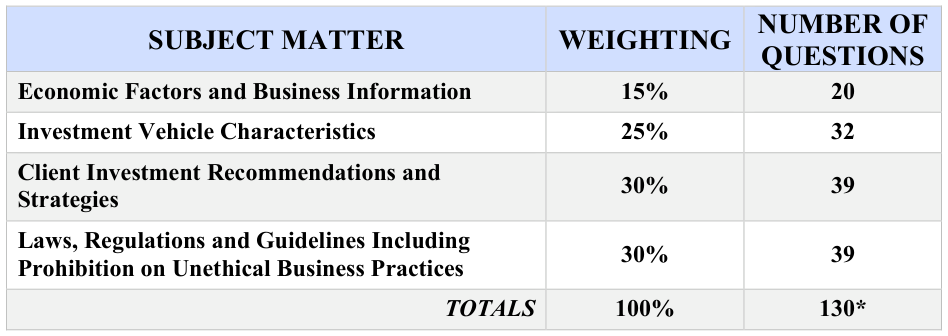
2 SERIES 6 5 TEST SPECIFICATIONS
The Series 6 5 examination tests four general subject matters related to the professional
responsibilities of investment adviser representatives. These subject matters are listed in the
following table, along with the ir respective weighting s with in the examination .
7 There is no material distinction for non -NASAA members between a NASAA model act, a NASAA model rule
and a NASAA statement of policy .
Page 7
SUBJECT MATTER WEIGHTI NG NUMBER OF
QUESTIONS
Economic Factors and Business Information 15% 20
Investment Vehicle Characteristics 25% 32
Client Investment Recommendations and
Strategies 30% 39
Laws, Regulations and Guidelines Including
Prohibition on Unethical Business Practices 30% 39
TOTALS 100% 130*
* As discussed previously, each Series 65 examination includes 140 questions of which 130 questions
Series 65 Exam Structure
- The Series 65 examination consists of 140 total questions, though only 130 are scored toward the candidate's final result.
- The exam is weighted heavily toward laws, regulations, and client strategies, which together comprise 60% of the scored content.
- Candidates are expected to understand legal principles and concepts even when a question does not explicitly name a specific rule or statute.
- The 'Economic Factors' section covers a broad range of topics including global geopolitics, financial reporting, and complex analytical methods like net present value.
- NASAA maintains a strict neutrality by not endorsing any specific third-party study materials or preparation services.
Candidates thus are expected to know the concepts and legal principles enumerated below without necessarily being prompted as to which concept or principle is being tested.
7 There is no material distinction for non -NASAA members between a NASAA model act, a NASAA model rule
and a NASAA statement of policy .
Page 7
SUBJECT MATTER WEIGHTI NG NUMBER OF
QUESTIONS
Economic Factors and Business Information 15% 20
Investment Vehicle Characteristics 25% 32
Client Investment Recommendations and
Strategies 30% 39
Laws, Regulations and Guidelines Including
Prohibition on Unethical Business Practices 30% 39
TOTALS 100% 130*
* As discussed previously, each Series 65 examination includes 140 questions of which 130 questions
are scored. The 10 unscored questions can come from any one or more of the above subject matters.
The sections below outline the purposes and scope of questions tested with in these four subject
matters . In addition, within each subject matter, a breakdown is given of the particular types of
information that will be tested as well as specific laws or rules eligible for testing (as applicable) .
Candidates are responsible for their own course of study to prepare for the examination . NASAA
is not involved with , and does not endorse, any third-party examination preparation services.
Finally, candidates should note that examination questions may or may not re ference the
specific concept or legal rule being tested. For exam ple, a question intended to test a candidate’s
knowledge of the NASAA Unethical Business Practices of Investment Advisers, Investment
Adviser Representatives, and Federal Covered Advisers Model Rule may or may not actually
name this model rule as part of the question. In addition, questions may refer generally to an area
of law. A question that begins, “Under the Uniform Securities Act . . .”, th erefore might be
testing the literal text of the Uniform Securities Act of 1956 (as amended by NASAA) or it might be testing a NASAA model rule promulgated thereunder. Similarly, a question that says
“pursuant to the Securities Exchange Act of 1934” could be testing the text of th is statute or an
SEC rule p romulgated thereunder. Candidates thus are expected to know the concepts and legal
principles enumerated below without necessarily being prompt ed as to which concept or
princip le is being tested .
2.1 Economic Factors and Business Information
Twenty questions in every Series 65 examination (15%) will test general principles of
economics, business operations and financial accounting. The se twenty questions will cover the
following four components:
(1) Basic Economic Concepts
Page 8
o Business cycles
o Monetary and fiscal policies
o Global and geopolitical factors ( e.g., currency valuation, effect s of exchange
rates on investment returns , sovereign debt)
o Inflation/deflation
o Interest rates, yield curves, credit spreads
o Economic indicators ( e.g., gross domestic product, employment indicators ,
trade deficit , balance of payments, consumer price index).
(2) Financial Reporting
o Financial reports ( e.g., income statement , balance sheet , statement of cash
flows, auditor disclosures , corporate SEC filings , annual reports)
o Accounting Fundamentals ( e.g., audited vs . unaudited financials, cash v s.
accrual accounting)
(3) Analytical Methods
o Time value of money concepts ( e.g., internal rate of return , net present value)
o Descriptive statistics ( e.g., differences between mean , median and mode ,
range s, standard deviation, Alpha, Beta, and Sharpe ratios , correlati ons)
o Financial ratios and their uses ( e.g., current ratio , quick ratio , debt-to-equity
ratio)
o Valuation ratios ( e.g., price -to-earnings ratio, price -to-book ratio)
(4) Types of Risk
o Systematic risks
o Unsystematic risks
o Opportunity cost
o Capital structure including liquidation priority
2.2 Investment Vehicle Characteristics
Thirty -two questions in every Series 65 examination (25%) will test features or
characteristics or various types of investment vehicles. These thirty -two questions will cover the
Series 65 Investment Vehicles
- The Series 65 examination dedicates 25% of its content to the specific features and characteristics of various investment vehicles.
- A wide array of securities is covered, ranging from traditional cash equivalents and fixed income to complex derivatives and alternative investments.
- The curriculum includes detailed valuation methods for equity, such as technical and fundamental analysis alongside discounted cash flow models.
- Pooled investments like mutual funds, ETFs, and REITs are analyzed based on their fee structures, share classes, and liquidity profiles.
- The text outlines the transition into client recommendations, which accounts for 30% of the exam and focuses on different business and individual entities.
Thirty-two questions in every Series 65 examination (25%) will test features or characteristics or various types of investment vehicles.
o Financial ratios and their uses ( e.g., current ratio , quick ratio , debt-to-equity
ratio)
o Valuation ratios ( e.g., price -to-earnings ratio, price -to-book ratio)
(4) Types of Risk
o Systematic risks
o Unsystematic risks
o Opportunity cost
o Capital structure including liquidation priority
2.2 Investment Vehicle Characteristics
Thirty -two questions in every Series 65 examination (25%) will test features or
characteristics or various types of investment vehicles. These thirty -two questions will cover the
following fourteen components:
(1) Types and Characteristics of Cash and Cash Equivalents
o Insured deposits ( e.g., demand deposits , certificates of deposit )
o Money market instruments (e.g., commercial paper, Treasury bills)
(2) Types of Fixed Income Securities
Page 9
o U.S. government and agency securities ( e.g., Treasury securities, mortgage -
backed securities from Fannie Mae or Freddie Mac, Treasury Inflation -
Protected Securities )
o Asset-backed securities
o Corporate bonds
o Municipal bonds ( e.g., general obligation, revenue , insured vs. uninsured)
o Foreign bonds ( e.g., government debt , corporate debt)
(3) Characteristics and Valuation Factors of Fixed Income Securities
o Characteristics ( e.g., tax implications, market liquidity, li quidation preference,
call features, coupon vs. zero coupon, duration, premium)
o Fixed income valuation factors ( e.g., maturity , yield -to-call, yield -to-maturity ,
conversion valuation, bond ratings , credit spread , discounted cash flow)
(4) Types of Equity Securities
o Common stock, domestic and foreign
o Preferred and convertible preferred stock
(5) Characteristics of Equity Securities
o Shareholder rights ( e.g., voting rights , antidilution , liquidation preferences)
o Restricted stock and re sale restrictions
o Dividends
o Employee stock options ( e.g., incentive, nonqualified)
(6) Methods Used to Determine the Value of Equity Securities
o Technical analysis
o Fundamental analysis
o Dividend discount
o Discounted cash flow
(7) Equity Public Offering
o Initial public offering (IPO
o Secondary offering
o SPAC/blind pools/blank check
(8) Types of Pooled Investments
o Mutual funds (open- end vs. closed -end)
o Private funds ( e.g., hedge funds , private equity funds, venture capital funds )
o Unit investment trusts (“UITs”)
o Exchange -traded funds (“ETFs”)
o Real estate investment trusts (“REITs) ( including exchange listed and non -
traded REITs )
Page 10
(9) Characteristics of Pooled Investments
o Share classes
o Liquidity
o Tax implications
o Fee structures and other costs ( e.g., load vs. no- load funds, contingent
deferred sales charges, Rule 12b -1 fees, breakpoints )
o Pricing (e.g., net asset value (“NAV”) , discount/premium)
o Benefits and risks
o Relative comparisons ( e.g., benchmarks, manager tenure, securities indexes)
(10) Types of Derivative Securities
o Options and warrants (definitions)
o Futures and forward contracts (definitions)
(11) Characteristics of Derivative Securities
o Costs, benefits, and risks of derivative securities
(12) Alternative Investments
o Limited partnerships
o Excha nge traded notes (“ETNs”)
o Leveraged funds
o Inverse funds
o Structured products
(13) Insurance Based Products
o Annuities ( e.g., fixed, variable, equity indexed)
o Life insurance ( e.g., whole, term, universal, variable)
(14) Other Assets
o Commodities and precious medals
o Digital Assets
2.3 Client Investment Recommendations and Strategies
Thirty -nine questions in every Series 65 examination (30%) will test principles governing
investment recommendations and investment strategies. These thirty -nine questions will cover
the following eleven components:
(1) Type of Client
o Individual, natural person, sole proprietorship
o Business entities ( e.g., general partner ship, limited partnership , limited
liability compan y, corporations (both C and S))
Page 11
Series 65 Investment Strategies
- The Series 65 examination devotes thirty percent of its content to client investment recommendations and strategies.
- Candidates must understand diverse client profiles, ranging from individual natural persons to complex business entities and charities.
- The curriculum covers advanced portfolio management techniques including sector rotation, dollar-cost averaging, and high frequency trading.
- A significant portion of the exam focuses on the legal and ethical standards governing investment advisers and their professional conduct.
- The syllabus includes detailed knowledge of tax considerations, retirement plans, and estate planning techniques like trusts and wills.
Techniques ( e.g., diversification, sector rotatio n, dollar -cost averaging, puts, calls, leveraging, volatility management , inverse strategies, high frequency trading )
o Commodities and precious medals
o Digital Assets
2.3 Client Investment Recommendations and Strategies
Thirty -nine questions in every Series 65 examination (30%) will test principles governing
investment recommendations and investment strategies. These thirty -nine questions will cover
the following eleven components:
(1) Type of Client
o Individual, natural person, sole proprietorship
o Business entities ( e.g., general partner ship, limited partnership , limited
liability compan y, corporations (both C and S))
Page 11
o Trusts and estates
o Foundations and charities
(2) Client Profile
o Financial goals and objectives
o Current and future financial situation (e.g., cash flow, balance sheet, existing
investments, tax situation, social security and pensions)
o Risk tolerance
o Nonfinancial investment considerations ( e.g., values, attitudes, experience,
demographics, life events, behavioral finance)
o Client data gatherin g (e.g., client identification, questionnaires, interviews)
o Time horizon
(3) Capital Market Theory
o Investment theories, models, and hypotheses ( e.g., capital asset pricing model,
modern portfolio theory, efficient market hypothesis)
(4) Portfolio Management Strategies, Styles and Techniques
o Strategies ( e.g., strategic asset allocation, tactical asset allocation)
o Styles ( e.g., active, passive, growth, value, income, capital appreciation)
o Techniques ( e.g., diversification, sector rotatio n, dollar -cost averaging, puts,
calls, leveraging, volatility management , inverse strategies, high frequency
trading )
(5) Tax Considerations
o Income tax fundamentals : individual ( e.g., capital gains, qualified dividends,
tax basis, marginal tax bracket, altern ative minimum tax)
o Income tax fundamentals : corporations, trusts and estates
o Wealth Transfer, e state tax and gift tax fundamentals
(6) Retirement Plans
o Individual retirement accounts (e.g., traditional, Roth)
o Solo 401(k) (e.g., traditional, Roth)
o Qualified retirement plans
o Nonqualified retirement plans
(7) Employee Retirement Income Security Act (ERISA) Issues
o Fiduciary issues ( e.g., investment choices, ERISA § 404(c))
o Investment policy statement
o Prohibited transactions
(8) Special Types of Accounts
o Educ ation -related ( e.g., 529 plans, Coverdell accounts)
Page 12
o Uniform Transfers to Minors Act (UTMA) and Uniform Gifts to Minors Act
(UGMA)
o Health savings accounts (HSA)
(9) Ownership and Estate Planning Techniques
o Types of ownership ( e.g., joint tenants with rights of survivorship , tenants in
common, tenancy by the entirety)
o Pay on death and transfer on death
o Beneficiary designation
o Trusts and wills
o Qualified domestic relations order
o Donor advised funds
(10) Trading Securities
o Terminology (e.g., bids , offers , quotes , market orders, limit or stop order s,
short sale s, cash accounts, margin accounts , principal or agency
trades,payment for order flow )
o Role s of broker -dealers, custodians, market makers, and exchanges
o Costs of trading securities ( e.g., comm ission s, markups , bid/ask spread , best
execution)
(11) Portfolio Performance Measures
o Returns ( e.g., risk -adjusted, time -weighted, dollar -weighted, annualize d, total ,
holding period, internal rate of return , expected , inflation -adjusted , after tax)
o Current yield
o Relevant benchmarks
2.4 Laws, Regulations and Guidelines Including Prohibition on Unethical Business
Practices
Thirty -nine questions in every Series 65 examination (30%) will test standards for
professional conduct by investment advisers and investment adviser representatives. These
thirty -nine questions will cover the following eight components:
(1) Regulation of Investment Advisers, Including State -Registered Advisers and Federal
Covered Advisers
o Definitions of an investment adviser (USA § 401, IAA § 202)
o Notice filing requirements
Series 65 Professional Conduct Standards
- The Series 65 examination dedicates 30% of its content to laws, regulations, and the prohibition of unethical business practices.
- Candidates must master the specific definitions and registration requirements for investment advisers, representatives, broker-dealers, and agents.
- The curriculum covers the legal framework for securities registration, including federal exemptions and state-level antifraud authority.
- A significant portion of the exam focuses on communication standards, including social media usage and unlawful representations regarding registration.
- Ethical practices and fiduciary obligations are strictly tested, specifically regarding client fund custody, compensation structures, and 'pay to play' rules.
Thirty-nine questions in every Series 65 examination (30%) will test standards for professional conduct by investment advisers and investment adviser representatives.
2.4 Laws, Regulations and Guidelines Including Prohibition on Unethical Business
Practices
Thirty -nine questions in every Series 65 examination (30%) will test standards for
professional conduct by investment advisers and investment adviser representatives. These
thirty -nine questions will cover the following eight components:
(1) Regulation of Investment Advisers, Including State -Registered Advisers and Federal
Covered Advisers
o Definitions of an investment adviser (USA § 401, IAA § 202)
o Notice filing requirements
o Registration and post -registration requirements ( e.g., required books and
records, registration maintenance requirements , Form ADV, IAA § 203, IAA
§ 203A, USA § 201, USA § 202, USA § 20 3, USA § 204, SEC Rule 203A -1,
Page 13
SEC Rule 203A-2, SEC Rule 204- 1, SEC Rule 204-3, NASAA Recordkeeping
Requirements for Investment Advisers Model Rule 203(a)-2, NASAA Brochure
Rule Requirements for Investment Advisers Model Rule 203(b) -1, NASAA
Financial Reporting Requirements for Investment Advisers Model Rule
203(c)-1 ))
o Exemptions for exempt reporting advisors and private fund advisors (IAA §
203, SEC Rule 204-4, NASAA Registration Exemption for Investment Advisers to Private Funds Model Rule )
o Investment adviser representative supervision
(2) Regulation of Investment Adviser Representatives
o Definition of an investment adviser representative (USA § 401, SEC Rule 203A-3)
o Registration and post- registration requirements (USA § 201, USA § 202, USA
§ 203, USA § 204, Form U4 , NASAA Registration Requirements for
Investment Advisers Model Rule 202(a) -1, NASAA Examination Requirements
for Investment Advis ers and Investment Adviser Representatives Model Rule
204(b)(6)-1)
(3) Regulation of Broker -Dealers
o Definition of a broker- dealer (USA § 401, IAA § 202)
o Definition of an underwriter (SA § 2)
o Definition of a market maker, associated person (SEA § 3)
o Registration and post- registration requirements ( e.g., required books and
records, registration maintenance requirements)
(4) Regulation of Broker -Dealer Agents
o Definition of a broker- dealer agent (USA § 401)
o Registration and post- registration requirements (e.g., Form U4)
(5) Regulation of Securities and Issuers
o Definition s of security and issuer (e.g., USA § 401 ,)
o The securities registration process, including federal and state registration and notice filing requirements, registration exemptions and post- registration
requirements (SA § 5, SA § 18, SEC Regulation D, USA § 301, USA § 302,
USA § 303, USA § 304, USA § 305, USA § 402)
o Definitions of investment companies (ICA § 2,)
o State antifraud authority
(6) Remedies and Administrative Provisions
o Authority of state securities administrator (USA § 204, USA § 306, USA § 406, USA § 407, USA § 412)
o Administrative actions (US A § 408)
Page 14
o Other penalties and liabilities (USA § 409, USA § 410, USA § 411)
(7) Communication with Clients and Prospects
o Disclosures
o Unlawful representations concerning registrations
o Performance guarantees
o Client contracts (USA § 102, IAA § 205, NASAA Contents of Investment
Advisory Contract Model Rule USA 2002 502(c) )
o Correspondence and advertising ( e.g., social media, email, website , USA §
403, USA § 405, SEC Rule 206(4) -1, SEC Rule 204- 2)
(8) Ethical Practices and Fiduciary Ob ligations
o Compensation ( e.g., fees, commissions, performance -based fees, “pay to
play,” soft dollars, disclosure of compensation, SEA § 28(e), SEC Rule
206(4) -5, NASAA Performance -Based Compensation Exemption for
Investment Advisers Model Rule 102(f) -3, MSRB Rule G- 37)
o Client funds and securities ( e.g., custody, trading discretion, trading
authorizations, prudent investor standards, suitability, anti -money laundering,
Uniform Prudent Investor Act, NASAA Agency Cross Transaction of
Investment Advisers Model Rule 102(f) -1)
Investment Adviser Regulatory Framework
- The text outlines rigorous compensation standards including performance-based fees, soft dollars, and 'pay to play' disclosures.
- Strict protocols govern the handling of client funds, securities custody, and the legal obligations of prudent investor standards.
- Extensive ethical guidelines address conflicts of interest, market manipulation, and the protection of vulnerable adults from financial exploitation.
- Operational resilience is mandated through cybersecurity regulations, data privacy protections, and formal business continuity plans.
- The document serves as a comprehensive syllabus for the Uniform Investment Adviser Law Examination, emphasizing the complexity of the subject matter.
This document is intended to be an overview of the Uniform Investment Adviser Law Examination, which will contain specific and challenging questions in these subjects.
o Compensation ( e.g., fees, commissions, performance -based fees, “pay to
play,” soft dollars, disclosure of compensation, SEA § 28(e), SEC Rule
206(4) -5, NASAA Performance -Based Compensation Exemption for
Investment Advisers Model Rule 102(f) -3, MSRB Rule G- 37)
o Client funds and securities ( e.g., custody, trading discretion, trading
authorizations, prudent investor standards, suitability, anti -money laundering,
Uniform Prudent Investor Act, NASAA Agency Cross Transaction of
Investment Advisers Model Rule 102(f) -1)
o Custody conditions and obligations (SEC Rule 206(4) -2, NASAA Custody
Requirements for Investment Advisers Model Rule 102(e)(1) -1, NASAA
Minimum Financial Requirements for Investment Advisers Model Rule
202(d) -1)
o Conflicts of interest, criminal activities, fiduciary and other ethical considerations ( e.g., loans to and from clients, sharing in profits and losses in
a customer account, client confidentiality, insider trading, selling away, market manipulation, personal securities transactions, outside securities accounts, initial holdings and quarterly reports, political contributions, due diligence, excessive trading , SEC Rule 204A -1, NASAA Unethical Business
Practices of Investment Advisers, Investment Adviser Representatives, and Federal Covered Advisers Model Rule , NASAA Dishonest or Unethical
Business Practices of Broker- Dealers and Agents Model Rule 102(a)(4) -1,
NASAA Statement of Policy Regarding Dishonest or Unethical Practices by Broker- Dealers and Agents in Connection with Investment Company Shares ,
NASAA Model Act to Protect Vulnerable Adults from Financial Exploitation )
o Cybersecurity, privacy, and data protection (SEC Regulation S -P)
o Business continuity plans ( e.g., disaster recovery, succession planning,
NASAA Model Rule on Business Continuity and Succession Planning, 203(a) -
1).
Page 15
Disclaimer: This document is intended to be an overview of the Uniform Investment Adviser
Law Examination , which will contain specific and challenging questions in these subjects.
Accordingly, this guide should not be considered a substitute for thorough study and
preparation.