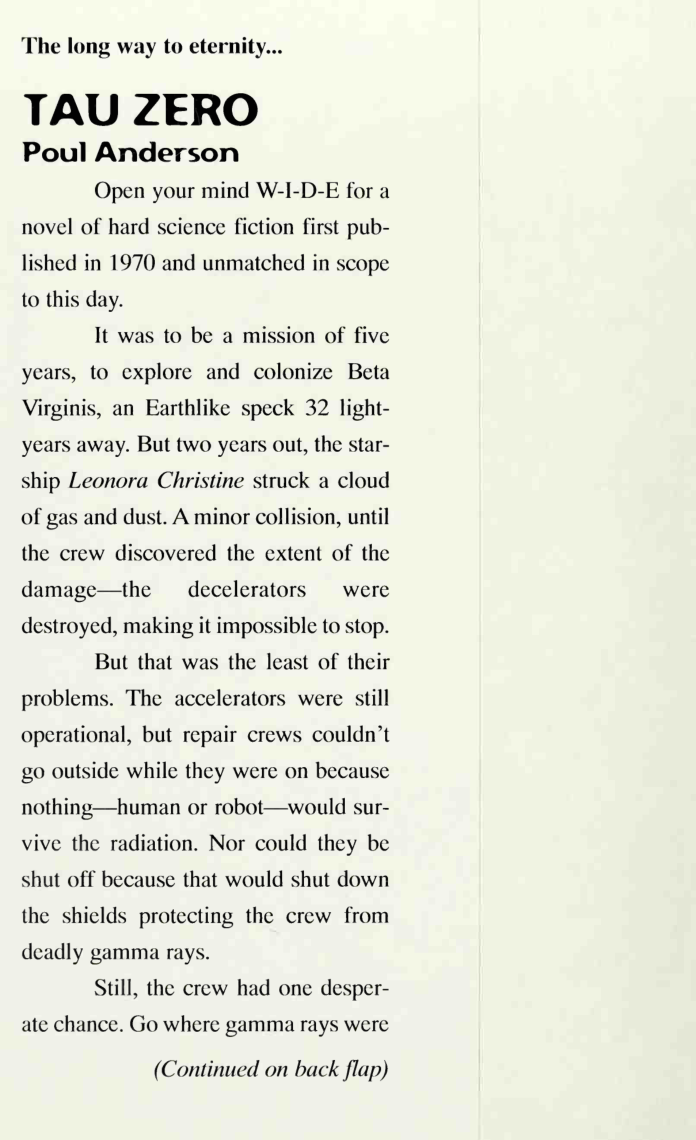
Tau zero
Overview unavailable.
The Last Earthly Dusk
- The starship Leonora Christine is preparing for a five-year mission to colonize a planet 32 light-years from Earth.
- A catastrophic collision with a gas cloud destroys the ship's decelerators, leaving the crew unable to stop their acceleration.
- The crew faces a lethal paradox where they cannot shut down the engines to make repairs without losing the radiation shields that protect them.
- First Officer Ingrid Lindgren and Charles Reymont spend their final hours on Earth at Millesgarden, reflecting on the permanence of art versus their own uncertain future.
- The public recognition of the crew members highlights the high-profile and historic nature of their doomed interstellar voyage.
Atop its pillar, the Hand of God upbearing the Genius of Man lifted in silhouette against a greenish-blue dusk.
rp
POUrANDERSON
Thelongway toeternity...
TAUZERO
PoulAnderson
Open yourmindW-I-D-E fora
novel ofhard science fiction firstpub-
lished in1970andunmatched inscope
tothisday.
Itwas tobeamission offive
years, toexplore andcolonize Beta
Virginis, anEarthlike speck 32light-
years away. Buttwoyears out,thestar-
shipLeonora Christine struck acloud
ofgasanddust.Aminor collision, until
thecrew discovered theextent ofthe
damageâthe decelerators were
destroyed, making itimpossible tostop.
But thatwas theleast oftheir
problems. The accelerators were still
operational, butrepair crews couldn't
gooutside while theywereonbecause
nothingâhuman orrobotâwould sur-
vive theradiation. Norcould theybe
shut offbecause thatwould shutdown
theshields protecting thecrew from
deadlygamma rays.
Still, thecrewhadonedesper-
atechance. Gowheregamma rayswere
(Continued onback flap)
Digitized bytheInternet Archive
in2011
http://www.archive.org/details/tauzeroOOande
TauZero
TauZero
POULANDERSON
BujuAmjiicaBOOKS
Copyright Š1970byPoulAnderson
Allrights reserved
Ashort version ofthisnovel appeared inGalaxy Science Fiction forJune
andAugust 1967under the title"ToOutlive Eternity," Š1967 byGalaxy
Publishing Corporation.
Allofthecharacters inthisbook arefictitious, andanyresemblance toactual
persons, living ordead, ispurely coincidental.
Published byarrangement with theauthor and theauthor's agent.
ISBN 1-56865-278-X
Printed intheUnited States ofAmerica.
ToFritz Leiber
TauZero
Chapter 1
"Lookâthereârising over theHand ofGod. Isit?"
"Yes, Ithink so.Our ship."
Theywere thelasttogoasMillesgarden wasclosed. Most ofthat
afternoon theyhadwandered among thesculptures, heawed andde-
lighted byhisfirstexperience ofthem, shebidding anunspoken fare-
well towhathadbeenmore apartofher lifethanshehadunderstood
untilnow.Theywere lucky intheweather, whensummer waswaning.
ThisdayonEarth hadbeen sunlight, breezes thatmade leafshadows
dance onthevilla walls, aclearsound offountains.
Butwhen thesunwentdown, thegarden seemed abruptly tocome
stillmore alive. Itwasasifthedolphins were tumbling through their
waters, Pegasus storming skyward, Folke Filbyter peering after hislost
grandson while hishorse stumbled intheford,Orpheus listening, the
young sisters embracing intheir resurrection âallunheard, because
thiswasasingle instant perceived, butthetime inwhich these figures
actually moved wasnolessrealthan thetimewhich carried men.
"As iftheywere alive,bound forthestars,andwemust staybehind
andgrow old," Ingrid Lindgren murmured.
Charles Reymont didn't hear her.Hestood ontheflagstones under
abirch tree,whose leaves rustled andhadbegun very faintly toturn
color, andlooked toward Leonora Christine. Atop itspillar, theHand
ofGodupbearing theGenius ofMan lifted insilhouette against a
greenish-blue dusk. Behind it,thetinyrapid starcrossed andsank
again.
"Are yousure thatwasn't anordinary satellite?" Lindgren asked
through quietness. "Inever expected we'd seeâ"
Reymont cocked abrow ather."You're the first officer, andyou
don'tknow where yourown vessel isorwhat she'sdoing?" HisSwed-
ishhadachoppy accent, likemost ofthelanguages hespoke, that
underlined thesardonicism.
"I'mnotthenavigation officer," shesaid, defensive. "Also, Iputthe
whole matter outofmymind asmuch asIcan.Youshould dothe
same. We'll spend plenty ofyears with it."Shehalfreached toward
him.Hertone gentled. "Please. Don't spoil thisevening."
Reymont shrugged. "Pardon me. Ididn'tmean to."
2 PoulAnderson
Anattendant neared, stopped, andsaid deferentially: "Iamsorry,
wemust shut thegates now."
"Oh!" Lindgren started, glanced atherwatch, looked over theter-
races. Theywereempty ofeverything except the lifethatCarl Milles
hadshaped intostone andmetal, three centuries ago."Why, why, it's
farpast closing time. Ihadn't realized."
The attendant bowed. "Since myladyandgentleman obviously
wished it,Iletthem alone after theother visitors left."
"Youknow us,then," Lindgren said.
"Who does not?" The attendant's gazeadmired her.
Shadows of Departure
- First Officer Lindgren and Constable Reymont enjoy a final moment of terrestrial peace in a Swedish garden before their interstellar voyage.
- The pair are recognized as celebrities by a respectful attendant, highlighting the monumental public significance of their upcoming mission.
- Reymont displays a cynical and detached temperament, comparing the current global power structure to the cold politeness of the Roman Empire.
- Lindgren reflects on the permanence of their journey, realizing that if the mission succeeds, they will never return to Earth within the lifetime of those they know.
- The technical scale of the expedition is underscored by the sight of their massive Bussard vessel testing its scoopfield webs in the evening sky.
If the voyage is really fortunate, we will never come home. If we doâShe broke off. He would be in his grave.
topped, andsaid deferentially: "Iamsorry,
wemust shut thegates now."
"Oh!" Lindgren started, glanced atherwatch, looked over theter-
races. Theywereempty ofeverything except the lifethatCarl Milles
hadshaped intostone andmetal, three centuries ago."Why, why, it's
farpast closing time. Ihadn't realized."
The attendant bowed. "Since myladyandgentleman obviously
wished it,Iletthem alone after theother visitors left."
"Youknow us,then," Lindgren said.
"Who does not?" The attendant's gazeadmired her.Shewas tall
andwellformed, regular offeatures, blue eyes setwide, blond hair
bobbed justunder theears.Her civilian garments weremore stylish
thanwascommon onaspacewoman; therich softcolors andflowing
draperies ofneomedieval suited her.
Reymont contrasted. Hewasastocky, dark, hard-countenanced
manwhohadnever bothered tohaveremoved thescar thatseamed
hisbrow. Hisplain tunicandtrews might aswellhavebeen auniform.
"Thank youfornotpestering us,"hesaid,more curtthan cordial.
"Itook forgranted youwished freedom from being acelebrity," the
attendant replied. "Nodoubtmany others recognized youtoobut felt
likewise."
"You'll findweSwedes areacourteous people." Lindgren smiled at
Reymont.
"Iwon't argue that," hercompanion said."Nobody canhelp run-
ning into it,when you're everywhere intheSolar System." Hepaused.
"But then,whoever steers theworld hadbetter bepolite. TheRomans
were intheir day. Pilate, forinstance."
Theattendant wastaken aback attheimplied rebuff. Lindgren de-
clared alittle sharply, "Isaid alskvdrdig, not artig. ""Courteous," not
"polite.") Sheoffered herhand. "Thank you, sir."
"My pleasure, Miss First Officer Lindgren," theattendant an-
swered. "May youhave afortunate voyage andcomehome safe."
"Ifthevoyage isreally fortunate," shereminded him,"we willnever
come home. Ifwedoâ"Shebroke off.Hewould beinhisgrave.
"Again Ithank you," shesaid tothe littlemiddle-aged man."Good-
by,"shesaid tothegardens.
Reymont exchanged aclasp tooandmumbled something. Heand
Lindgren went out.
High walls darkened thenearly deserted pavement beyond. Foot-
fallssounded hollow. After aminute thewoman remarked, "Ido
wonder ifthatwasourshipwesaw.We're inahigh latitude. Andnot
TauZero 3
even aBussard vessel isbigandbright enough toshine through sunset
glow."
"She iswhen thescoopfleld webs areextended," Reymont told her.
"And shewasmoved intoaskewed orbit yesterday, aspartofherfinal
tests. They'll takeherback totheecliptic plane before wedepart."
"Yes, ofcourse, I'veseen theprogram. But I'venoreason tore-
member exactly who isdoing what withheratwhich time. Especially
whenwearen't leaving foranother twomonths. Whyshould youkeep
track?"
"When I'msimply theconstable." Reymont's mouth bent intoa
grin. "Let's saythatI'mpracticing tobeaworrywart."
Sheglanced sideways athim.Thelookbecame ascrutiny. Theyhad
emerged onanesplanade bythewater. Across it,Stockholm's lights
were kindling, onebyone, asnight grewupward among houses and
trees. Butthechannel remained almost mirrorlike, andasyetthere
were fewsparks inheaven save Jupiter. Youcould stillseewithout
help.
Reymont hunkered down anddrew their hired boat in.Bond
anchors secured thelines totheconcrete. Hehadobtained aspecial
license topark practically anywhere. Aninterstellar expedition was
thatbiganevent. Lindgren andhehadspent themorning inacruise
around theArchipelago âafewhours amidst greenness, homes like
parts oftheislands whereon theygrew, sailsandgullsandsun-glitter
across waves. Little ofthatwould exist atBeta Virginis, andnone ofit
inthedistances between.
"Iambeginning tofeelwhat astranger youaretome,Carl," she
said slowly. "Toeveryone?"
"Eh?Mybiography's onrecord." Theboatbumped against the
esplanade. Reymont sprang down into itscockpit. Holding theline
tautwithonehand, heoffered hertheother. Shehadnoneed tolean
heavily onhim asshedescended, butdid.Hisarm scarcely stirred
beneath herweight.
She satdown onabench next tothewheel. Hetwisted thescrew
topoftheanchor hegrasped.
Shadows of the Leonora Christine
- Carl Reymont and Lindgren discuss their motivations and backgrounds while navigating a boat through the waters of Earth.
- Reymontâs official biography reveals a harsh upbringing in the Antarctic and a distinguished but controversial military career on Mars and the Moon.
- Lindgren admits to seeking out Reymont despite his cold exterior, sensing a profound loneliness beneath his professional record.
- The two characters contrast their reasons for joining the extrasolar mission: Reymont seeks escape from office politics, while Lindgren is driven by romanticism.
- The dialogue highlights the immense psychological weight of leaving the solar system for a thirty-two light-year journey into the unknown.
Intermolecular binding forces let go with a faint smacking noise that answered the slap-slap of water on hull.
le ofthatwould exist atBeta Virginis, andnone ofit
inthedistances between.
"Iambeginning tofeelwhat astranger youaretome,Carl," she
said slowly. "Toeveryone?"
"Eh?Mybiography's onrecord." Theboatbumped against the
esplanade. Reymont sprang down into itscockpit. Holding theline
tautwithonehand, heoffered hertheother. Shehadnoneed tolean
heavily onhim asshedescended, butdid.Hisarm scarcely stirred
beneath herweight.
She satdown onabench next tothewheel. Hetwisted thescrew
topoftheanchor hegrasped. Intermolecular binding forces letgo
with afaintsmacking noise thatanswered theslap-slap ofwater on
hull.Hismovements could notbecalled graceful, asherswere, but
theywere quick andeconomical.
"Yes, Isuppose we've allmemorized each other's official accounts."
Shenodded. "For you, theabsolute minimum youcould getbywith
telling."
(Charles JanReymont. Citizenship status, Interplanetarian. Thirty-
fiveyears old.Born intheAntarctic, butnotoneofitsbetter colonies;
4 PoulAnderson
thesublevels ofPolyugorsk offered onlypoverty andturbulence toa
boywhose father haddied early.Theyouth hebecame gottoMars by
some unspecified means andheld avariety ofjobs tillthetroubles
broke out.Then hefought with theZebras, withsuch distinction that
afterward theLunar Rescue Corps offered him aberth. There he
completed hisacademic education androse fast inrank, until ascolo-
nelhehadmuch todowithimproving thepolice branch. When he
applied forthisexpedition, theControl Authority wasglad toaccept
him.)
"Nothing whatsoever ofyourself," Lindgren observed. "Did you
even give thataway inthepsychological testing?"
Reymont hadgone forward andcast offthebow line.Hestowed
bothanchors neatly, took thewheel, andstarted themotor. Themag-
netic drivewassoundless andthepropeller made scant noise, butthe
boat slipped rapidly outward. Hekept hiseyes straight ahead. "Why
doyoucare?" heasked.
"We'll betogether foranumber ofyears. Quite possibly fortherest
ofour lives."
"Itmakesmewonder whyyouspent today withme,then."
"You invited me."
"After yougavemeacallatmyhotel.Youmust havechecked with
thecrew registry tofindwhere Iwas."
Millesgarden vanished inswift-deepening darkness aft.Lights along
thechannel, andfrom theinner citybeyond, didnotshowwhether she
flushed. Herfaceturned from him,though. "Idid," sheadmitted. "I
. . .thought youmight belonely. Youhavenoone,haveyou?"
"No relatives left.I'monlytouring thefleshpots ofEarth. Won't be
anywhere wearebound."
Hersight lifted again, toward Jupiter thistime, asteady tawny-white
lamp.More starswere treading forth. Sheshivered anddrew hercloak
tightaround her,against theautumnal air."No," shesaidmutedly.
"Everything alien.Andwhen we've hardly begun tomap, tounder-
stand, thatworld yonderâourneighbor, our sisterâtocross thirty-
twolightyearsâ"
"People arelikethat."
"Why areyougoing, Carl?"
Hisshoulders liftedanddropped. "Restless, Isuppose. And frankly,
Imade enemies intheCorps. Rubbed them thewrong way, oroutdis-
tanced them forpromotion. Iwas atthepoint where Icouldn't ad-
vance further without playing office politics. Which Idespise." His
glance met hers.Both lingered amoment. "You?"
Shesighed. "Probably sheer romanticism. Ever since Iwasachild, I
TauZero 5
thought Imustgotothestars, thewayaprince inafairy talemustgo
toElfLand. Atlast,byinsisting tomyparents, Igotthem toletme
enroll intheAcademy."
Hissmile heldmorewarmth than usual. "And youmade anout-
standing record intheinterplanetary service. They didn't hesitate to
make you first officer ofyour firstextrasolar ship."
Herhands fluttered inherlap."No. Please. I'mnotbad atmywork.
But it'seasy forawoman torise fast inspace. She's indemand. And
myjobonLeonora Christine willbeessentially executive. I'llhave
more todowith . . .well,human relations . . .than astronautics."
Hereturned hisvision forward. Theboatwasrounding theland,
headed into Saltsjon. Water traffic thickened. Hydrofoils whirred past.
Acargo submarine made herstately waytoward theBaltic.
The New Romans
- Ingrid and Carl discuss her role on the Leonora Christine, highlighting the demand for women in space and her focus on human relations.
- Carl questions why Ingrid is spending her final weeks on Earth with him rather than her distinguished family in Stockholm.
- The conversation reveals that Sweden has become the world's 'Control Authority' following a nuclear war, holding a monopoly on peacekeeping and global wealth.
- Carl argues that Sweden has become a nation of 'new Romans' whose power is maintained through logical necessity and economic dominance.
- Reymont expresses a cynical view of history, suggesting that even the most stable systems are destined to decay and die.
- The mission to plant colonies in the galaxy is framed as a desperate insurance policy against an inevitable 'Ragnarok' on Earth.
Central Stockholm was a many-colored unrestful fire and a thousand noises blent into one somehow harmonious growl.
esitate to
make you first officer ofyour firstextrasolar ship."
Herhands fluttered inherlap."No. Please. I'mnotbad atmywork.
But it'seasy forawoman torise fast inspace. She's indemand. And
myjobonLeonora Christine willbeessentially executive. I'llhave
more todowith . . .well,human relations . . .than astronautics."
Hereturned hisvision forward. Theboatwasrounding theland,
headed into Saltsjon. Water traffic thickened. Hydrofoils whirred past.
Acargo submarine made herstately waytoward theBaltic. Overhead,
airtaxis flitted like fireflies. Central Stockholm wasamany-colored
unrestful fireandathousand noises blent intoonesomehow harmoni-
ousgrowl.
"That brings meback tomyquestion." Reymont chuckled. "My
counter-question, rather, since youwere pressing inonme.Don't
think Ihaven't enjoyed yourcompany. Idid,much, and ifyou'll have
dinner withme I'llconsider thisdayamong thebetter ones ofmy life.
Butmost ofourgang scattered likedrops ofmercury theminute our
training period ended. They're deliberately avoiding their shipmates.
Better spend thetimewiththose they'll never seeagain. You,nowâ
youhave roots.Anold,distinguished, well-to-do family; anaffection-
ateone, Igather; father andmother alive, brothers, sisters, cousins,
surely anxious todoeverything theycanforyou inthefewweeks that
remain. Why didyouleavethem today?"
She satunspeaking.
"Your Swedish reserve," hesaid after awhile. "Appropriate tothe
rulers ofmankind. Iought nottohave intruded. Justgivemethesame
right ofprivacy, willyou?"
And presently: "Would you liketojoinmeatdinner? I'vefound
quite adecent little live-service restaurant."
"Yes," sheanswered. "Thank you. Iwould."
Sherose tostand beside him, laying onehandonhisarm.Thethick
muscles stirred beneath herfingers. "Don't callusrulers," shebegged.
"We aren't. That's what thewhole ideawasbehind theCovenant.
After thenuclear war . . .thatclose abrush withworld death . . .
something hadtobedone."
"Uh-huh," hegrunted. "I've readanoccasional history book myself.
General disarmament; aworld police force tomaintain it;sedquis
custodiet ipsos Custodes? Who canwetrust with amonopoly ofthe
6 PoulAnderson
planet killerweapons andunlimited powers ofinspection andarrest?
Why, acountry bigandmodern enough tomake peace-keeping a
major industry; butnotbigenough toconquer anyone elseorforce its
willonanyone without thesupport ofamajority ofnations; andrea-
sonably wellthought ofbyeveryone. Inshort, Sweden."
"You dounderstand, then," shesaid happily.
"Ido.Including theconsequences. Power feeds onitself, notby
conspiracy, butbylogical necessity. Themoney theworld pays, to
underwrite thecostoftheControl Authority, passes through here;
therefore youbecome therichest country onEarth, with allthat that
implies. And thediplomatic center, goes without saying. Andwhen
every reactor, spaceship, laboratory ispotentially dangerous andmust
beunder theAuthority, thatmeans someSwede hasavoice inevery-
thing that matters. And thisleads toyour being imitated, even by
thosewhonolonger likeyou. Ingrid, myfriend, yourpeople can't help
turning intonewRomans."
Hergladness drooped. "Don't you like us,Carl?"
"Aswell asanybody, considering. You've beenhumane masters to
date.Toohumane, I'dsay.Inmyown case, Iought tobegrateful,
sinceyouallowmetobeessentially astateless person, which Ithink I
prefer. No,you've notdone badly." Hegestured toward thetowers
down which radiance cataracted, torightand left. "Itwon't last,any-
how."
"What doyoumean?"
"Idon't know. I'monly certain thatnothing isforever. Nomatter
how carefully youdesign asystem, itwillgobadanddie."
Reymont stopped tochoose words. "Inyour case," hesaid, "Ibe-
lieve theendmaycome from thisvery stability youtakepride in.Has
anything important changed, onEarth atleast, since thelatetwentieth
century? Isthat adesirable state ofaffairs?
"Isuppose," headded, "that's onereason forplanting colonies in
thegalaxy, ifwecan.Against Ragnarok."
Her fistsclenched. Herfaceturned upward again.
Stability and Stellar Exile
- Reymont argues that even the most carefully designed systems are destined to fail, suggesting that Earth's long-term stability may lead to its eventual decay.
- The characters discuss space colonization as a necessary safeguard against 'Ragnarok' and the inevitable end of terrestrial civilization.
- Lindgren expresses a deep, melancholic connection to the history and architecture of Stockholm, fearing the isolation of being 'far from our dead.'
- The narrative contrasts the romanticized history of the Great Marketplace with its forgotten, violent past of executions and bloodshed.
- Lindgren reveals that her desire to meet Reymont was driven by a need to escape the emotional weight of leaving her family and heritage behind.
It's going to be lonely in space, Carl, so far from our dead.
"Idon't know. I'monly certain thatnothing isforever. Nomatter
how carefully youdesign asystem, itwillgobadanddie."
Reymont stopped tochoose words. "Inyour case," hesaid, "Ibe-
lieve theendmaycome from thisvery stability youtakepride in.Has
anything important changed, onEarth atleast, since thelatetwentieth
century? Isthat adesirable state ofaffairs?
"Isuppose," headded, "that's onereason forplanting colonies in
thegalaxy, ifwecan.Against Ragnarok."
Her fistsclenched. Herfaceturned upward again. The nightwas
now entire, butfewstars could beseenthrough theveiloflightover
thecity.ElsewhereâinLapland, forinstance, where herparents hada
summer cottageâtheywould shine unmercifully sharp andmany.
"I'mbeing apoor escort," Reymont apologized. "Let's getoffthese
schoolboy profundities anddiscuss more interesting subjects. Likean
apertif."
Herlaugh wasuncertain.
Hemanaged tokeep thetalkinconsequential while henosed into
Strommen, docked theboat, andledheronfootacross thebridge to
TauZero 7
OldTown. Beyond theroyal palace theyfound themselves under
softer illumination, walking down narrow streets between highgolden-
hued buildings thathadstoodmuch astheywere forseveral hundred
years. Tourist season waspast; oftheuncounted foreigners inthecity,
fewhadreason tovisit thisenclave; except foranoccasional pedes-
trian orelectrocyclist, Reymont andLindgren were nearly alone.
"Ishall miss this," shesaid.
"It's picturesque," heconceded.
"More than that, Carl. It'snotjustanoutdoor museum. Real hu-
manbeings livehere.And theoneswhowere before them, they stay
real too. In,oh,Birger Jarl's Tower, theRiddarholm Church, the
shields intheHouse ofNobles, theGolden Peace where Bellman
drank andsangâIt'sgoing tobelonely inspace, Carl, sofarfromour
dead."
"Nevertheless you're leaving."
"Yes.Not easily.Mymother whoboreme,myfatherwhotookme
bythehandandledmeouttoteachmeconstellations. Didheknow
what hewasdoing tomethatnight?" Shedrew abreath. "That's
partly why Igot intouch with you. Ihadtoescape fromwhat I'm
doing tothem. Ifonly forasingle day."
"You need adrink," hesaid,"and hereweare."
Therestaurant fronted ontheGreat Marketplace. Between thesur-
rounding steep facades youcould imagine howknights hadclattered
merrily across thepaving stones. Youdidnotremember howthegut-
tersranwithblood andheads were stacked high during acertain
winter week, forthatwaslongpastandmenseldom dwell onthehurts
that befell other men.Reymont conducted Lindgren toatable ina
candlelit room which theyhadtothemselves, andordered akvavit with
beer chasers.
Shematched himdrink fordrink, though shehad lessmassand less
practice. Themeal thatfollowed waslengthy even byScandinavian
standards, with considerable wine during itandconsiderable cognac
afterward. Heletherdomost ofthetalking.âofahouse nearDrottningholm, whose parkandgardens were
almost herown; sunlight through windows, gleaming overburnished
wood floors andonsilver thathadbeen passed down fortengenera-
tions; asloop onthelake, heeled tothewind, herfather atthe tiller
with apipe inhisteeth, herhairblowing loose; monstrous nights at
wintertime, and intheirmiddle thatwarm cavenamed Christmas; the
short light nights ofsummer, thebalefires kindled onSt.
A Pact Before the Stars
- Ingrid Lindgren recounts her idyllic life on Earth, characterized by a privileged upbringing, global travels, and a deep-seated belief in human progress through reason.
- Despite her optimism, Ingrid acknowledges the practical challenges of a decade-long space voyage confined within a metal shell with fifty crew members.
- She proposes a romantic partnership with Reymont to avoid the social complications and 'nuances' of finding a mate once the mission is underway.
- Reymont accepts her proposition with a mix of honor and caution, noting the stark differences in their temperaments.
- The conversation highlights the transition from the sensory richness of Earth to the stark, disciplined reality of life aboard a starship.
I won't have time for nuances and rituals. It could end with me in a situation I don't want. Unless I think ahead and make preparations. As I'm doing.
ring itandconsiderable cognac
afterward. Heletherdomost ofthetalking.âofahouse nearDrottningholm, whose parkandgardens were
almost herown; sunlight through windows, gleaming overburnished
wood floors andonsilver thathadbeen passed down fortengenera-
tions; asloop onthelake, heeled tothewind, herfather atthe tiller
with apipe inhisteeth, herhairblowing loose; monstrous nights at
wintertime, and intheirmiddle thatwarm cavenamed Christmas; the
short light nights ofsummer, thebalefires kindled onSt.John's Eve
thathadoncebeen littowelcome Baldrhome from theunderworld; a
walk intherainwith afirstsweetheart, theaircool, drenched with
8 PoulAnderson
water andodor oflilacs; travels around Earth, thePyramids, thePar-
thenon, Paris atsunset from thetopofMontparnasse, theTajMahal,
Angkor Wat, theKremlin, theGolden Gate Bridge, yes,and Fuji-
yama, theGrand Canyon, Victoria Falls, theGreat Barrier Reefâ
âofloveandmerriment athome butdiscipline too,order, gravity
inthepresence ofstrangers; music around, Mozart thedearest; afine
school, where teachers andclassmates brought acomplete new uni-
verse exploding intoherawareness; theAcademy, harder work than
shehadknown shecould do,andhowpleased shewastodiscover she
wasable; cruises through space, totheplanets, oh,shehadstood on
thesnows ofTitan withSaturn overhead, stunned bybeauty; always,
always herkindred toreturn toâ
âinagood world, itspeople, their doings, their pleasures allgood;
yes,there remained problems, outright cruelties, butthose could be
solved intime through reason andgood will; itwould beajoyto
believe insome kindofreligion, since thatwould perfect theworld by
giving itultimate purpose, butintheabsence ofconvincing proof she
could stilldoherbest tohelp supply thatmeaning, helpmankind
move toward something loftierâ
âbutno,shewasn't aprig, hemustn't believe that; infact, she
oftenwondered ifshewasn't toohedonistic, abitmore liberated than
wasbest; however, shedidgetfunoutoflifewithout hurting anyone
else, asfarasshecould tell;shelived with high hopes.
Reymont poured the lastcoffee forher.Thewaiter had finally
brought the bill,though heseemed innomore hurry tocollect than
most ofhiskind inStockholm. "Iexpect that inspite ofthedraw-
backs," Reymont said, "you'll manage toenjoy ourvoyage."
Hervoice hadgotten abitslurred. Her eyes, regarding him, stayed
bright and level. "Iplan to,"shedeclared. "That's themain reason I
called you.Remember, during training Iurged youtocome here for
partofyour furlough." Bynowtheywere using theintimate pronoun.
Reymont drewonhiscigar. Smoking would beprohibited inspace,
toavoid overloading the lifesupport systems, buttonight hecould still
putabluecloud infront ofhim.
Sheleaned forward, laying ahand over hisfreeoneonthetable. "I
wasthinking ahead," shetoldhim. "Twenty-five menandtwenty-five
women. Fiveyears inametal shell.Another fiveyears ifweturnback
immediately. Even with antisenescence treatments, adecade isabig
piece outofalife."
Henodded.
"And ofcourse we'll stay toexplore," shewent on."Ifthat third
planet ishabitable, we'll stay tocolonizeâforeverâand we'll start
TauZero 9
having children. Whatever wedo,there aregoing tobeliaisons. We'll
pair off."
Hesaid,low lest itseem tooblunt: "You think youand Imight
make acouple?"
"Yes." Hertone strengthened. "Itmayseem immodest ofme,
whether ornot Iamaspacewoman. But I'llbebusier than most, the
firstseveral weeks oftravel especially. Iwon't have time fornuances
and rituals. Itcould endwithmeinasituation Idon't want. Unless I
think ahead andmake preparations. AsI'mdoing."
Helifted herhand tohislips."Iamdeeply honored, Ingrid. Though
wemaybetoounlike."
"No, Isuspect that's what draws me."Herpalm curved around his
mouth and sliddown hischeek. "Iwant toknow you.Youaremore a
manthananyI'vemetbefore."
Hecounted money onto the bill. Itwasthe firsttime thatshehad
seenhimmove notentirely steadily. Heground outhiscigar, watching
itashedid."I'm staying atahotel overonT^ska Brinken," hesaid.
"Rather shabby.
The Dagger of Stars
- Ingrid Lindgren and her companion share an intimate moment of mutual fascination before she departs for her mission.
- The starship Leonora Christine is described as a complex, dagger-shaped vessel designed for interstellar travel using a Bussard drive.
- The ship represents a massive investment of human intellect and resources, built during a rare era of global peace.
- The sheer scale of the universe is contrasted against the ship's mission to reach a 'next door' star with only fifty people aboard.
- Upon boarding, Ingrid experiences the overwhelming and terrifying beauty of the star-crowded vacuum of space.
- Ingrid reports for duty to Captain Lars Telander, who displays a natural grace in the weightless environment of the bridge.
The night was wild with suns.
don't want. Unless I
think ahead andmake preparations. AsI'mdoing."
Helifted herhand tohislips."Iamdeeply honored, Ingrid. Though
wemaybetoounlike."
"No, Isuspect that's what draws me."Herpalm curved around his
mouth and sliddown hischeek. "Iwant toknow you.Youaremore a
manthananyI'vemetbefore."
Hecounted money onto the bill. Itwasthe firsttime thatshehad
seenhimmove notentirely steadily. Heground outhiscigar, watching
itashedid."I'm staying atahotel overonT^ska Brinken," hesaid.
"Rather shabby."
"Idon't mind," sheanswered. "Idoubt ifI'llnotice."
Chapter 2
Seenfromoneoftheshuttles thatbrought hercrew toher,Leonora
Christine resembled adagger pointed atthestars.
Her hullwasaconoid, tapering toward thebow. Itsburnished
smoothness seemed ornamented rather thanbroken bytheexterior
fittings. These were locks andhatches; sensors forinstruments; hous-
ings forthetwoboats thatwould make theplanetfalls forwhich she
herself wasnotdesigned; andtheweb oftheBussard drive, now
folded flat.Thebaseoftheconoid wasquite broad, since itcontained
thereaction massamong other things; butthelength wastoogreat for
thistobeparticularly noticeable.
Atthetopofthedagger blade, astructure fanned outwhich you
might have imagined tobetheguard ofabasket hilt. Itsrimsup-
ported eight skeletal cylinders pointing aft.These were thethrust
tubes, that accelerated thereaction mass backward when theship
moved atmerely interplanetary speeds. The"basket" enclosed their
controls andpower plant.
Beyond this,darker inhue,extended thehaftofthedagger, ending
finally inanintricate pommel. The latter wastheBussard engine; the
restwasshielding against itsradiation when itshould beactivated.
Thus Leonora Christine, seventh, andyoungest ofher class.Her
outward simplicity wasrequired bythenature ofhermission andwas
asdeceptive asahuman skin; inside, shewasvery nearly ascomplex
andsubtle. Thetime since thebasic ideaofherwas firstconceived, in
themiddle twentieth century, hadincluded perhaps amillion man-
years ofthought andwork directed toward achieving thereality; and
some ofthosemenhadpossessed intellects equal toanythathadever
existed. Though practical experience andessential toolshadalready
been gotten when construction wasbegun upon her,andthough tech-
nological civilization hadreached itsfantastic flowering (and finally,
forawhile, wasnotburdened bywarorthethreat ofwar)âneverthe-
less,hercostwasbynomeans negligible, hadindeed provoked wide-
spread complaint. All this, tosend fiftypeople toone practically
nextdoor star?
Right. That's thesizeoftheuniverse.
Itloomed behind her,around her,where shecircled Earth. Staring
awayfrom sunandplanet, yousawacrystal darkness huger thanyou
TauZero 11
dared comprehend. Itdidnotappear totally black; there were light
reflections within your eyeballs, ifnowhere else; but itwasthefinal
night, thatourkindly skyholds from us.The starsthronged it,unwink-
ing,their brilliance winter-cold. Those sufficiently luminous tobeseen
from theground showed their colors clear inspace: steel-blue Vega,
golden Capella, ember ofBetelgeuse. And ifyouwere nottrained, the
lessermembers ofthegalaxy thathadbecome visible were somany as
todrown thefamiliar constellations. The nightwaswildwith suns.
And theMilkyWaybelted heaven with iceand silver; andtheMag-
ellanic Clouds were notvague shimmers butroiling andglowing; and
theAndromeda galaxy gleamed sharp across more than amillion
light-years; andyou feltyour souldrowning inthose depths andhastily
pulled your vision back tothesnug cabin thatheldyou.
Ingrid Lindgren entered thebridge, caught ahandhold, andpoised in
mid-air. "Reporting forduty, Mr.Captain," sheannounced formally.
LarsTelander turned about togreet her.Infree fall, hisgaunt and
gawky figure became lovely towatch, likeafishinwater orahawkon
thewing. Otherwise hecould havebeen anygray-haired manoffifty-
odd. Neither ofthem hadbothered toputinsignia ofrankonthe
coveralls thatwere standard shipboard working attire.
"Good day," hesaid.
The Isolation of Time Dilation
- Ingrid Lindgren joins Captain Lars Telander on the bridge of the Leonora Christine as they prepare for a long-term mission.
- Telander reflects on his extreme isolation, having lived through nearly a century of Earth time while aging only a fraction of that due to relativistic space travel.
- The narrative reveals Telander's history as a pioneer of interstellar flight, having sacrificed his connection to Earth and family for the sake of exploration.
- The crew discusses the arrival of the engineering and scientific teams, highlighting the psychological pressures of being confined together in deep space.
- Telander warns that the true nature of a person's character only reveals itself once they are far beyond the familiar reaches of the Solar System.
In free fall, his gaunt and gawky figure became lovely to watch, like a fish in water or a hawk on the wing.
d your vision back tothesnug cabin thatheldyou.
Ingrid Lindgren entered thebridge, caught ahandhold, andpoised in
mid-air. "Reporting forduty, Mr.Captain," sheannounced formally.
LarsTelander turned about togreet her.Infree fall, hisgaunt and
gawky figure became lovely towatch, likeafishinwater orahawkon
thewing. Otherwise hecould havebeen anygray-haired manoffifty-
odd. Neither ofthem hadbothered toputinsignia ofrankonthe
coveralls thatwere standard shipboard working attire.
"Good day," hesaid. "Itrustyouhadapleasant leave."
"Icertainly did."Thecolormounted inhercheeks. "And you?"
"Oh... itwas allright. Mostly Iplayed tourist, fromendtoend
ofEarth. Iwassurprised athowmuch Ihadnotseen before."
Lindgren regarded himwithsome compassion. Hefloated alone by
hiscommand seat,oneofthree clustered around acontrol andcom-
munications console atthemiddle ofthecircular room. Themeters,
readout screens, indicators, andother gear thatcrowded thebulk-
heads, already blinking andquivering andtracing outscrawls, only
emphasized hisisolation. Until shecame, hehadnotbeen listening to
anything except themurmur ofventilators ortheinfrequent click ofa
relay.
"You havenobody whatsoever left?" sheasked.
"Nobody close." Telander's longfeatures crinkled inasmile. "Don't
forget, asfarastheSolar System isconcerned, Ihavealmost counted
acentury. When last Ivisited myhome village inDalarna, my
brother's grandson wastheproud father oftwoadolescents. Itwasnot
tobeexpected thattheywould consider meanear relative."
(Hewasborn three years before the firstmanned expedition de-
parted forAlpha Centauri. Heentered kindergarten twoyears before
the firstmaser messages from itreached Farside Station onLuna.
12 PoulAnderson
That setthe lifeofanintroverted, idealistic childontrajectory. Atage
twenty-five, anAcademy graduate with anotable performance inthe
interplanetary ships, hewasallowed onthe firstcrew forEpsilon Er-
idani. They returned twenty-nine years later; butbecause ofthetime
dilation, theyhadexperienced justeleven, including the sixspent at
thegoal planets. The discoveries theyhadmade covered them with
glory.TheTauCetishipwasoutfitting when theycame back. Telander
could bethe first officer ifhewaswilling toleave inlessthan ayear.
Hewas.Thirteen years ofhisownwent bybefore hereturned, com-
mander inplace ofacaptain whohaddiedonaworld ofpeculiar
savageries. OnEarth, theinterval hadbeen thirty-one years. Leonora
Christine wasbeing assembled inorbit.Who better thanhimforher
master? Hehesitated. Shewas tostart inbarely three years. Ifhe
accepted, most ofthose thousand dayswould bespent planning and
preparing. . . .Butnottoaccept wasprobably notthinkable; and
too,hewalked asastranger onanEarth grown strange tohim.)
"Let's getbusy," hesaid. "Iassume Boris Fedoroff and hisengi-
neers rodeupwithyou?"
Shenodded. "You'll hearhimontheintercom after he'sorganized,
hetoldme."
"Hm.Hemight haveobserved thecourtesy ofnotifying meofhis
arrival."
"He's inafoulmood. Sulked thewhole wayfrom ground. Idon't
know why.Does itmatter?"
"We aregoing tobetogether inthishullforquite awhile, Ingrid,"
Telander remarked. "Our behavior willindeed matter."
"Oh, Boris willgetover his fit. Isuppose hehasahangover, or
some girlsaidnotohim lastnight, orsomething. Hestruckmeduring
training asarather soft-hearted person."
"The psychoprofile indicates it.Still, there arethingsâpotentiali-
tiesâineach ofusthatnotesting shows. Youhave tobeyonderâ"
Telander gestured atthehood oftheoptical periscope, asifitwere
theremoteness that itwatchedâ"before those develop, forgood or
bad.And they do.They always do."Hecleared histhroat. "Well. The
scientific personnel areonschedule also?"
"Yes. They'll arrive intwo ferries, first at1340 hours, second at
1500." Telander noted agreement with theprogram clamped tothe
desk partoftheconsole. Lindgren added: "Idon't believe weneed
thatmuch interval between them."
"Safety margin," Telander replied absently.
Authority and Intimacy in Orbit
- Captain Telander and Ingrid Lindgren discuss the logistical challenges of boarding inexperienced scientific personnel onto the Leonora Christine.
- Lindgren successfully negotiates for Constable Reymont to stay in her cabin, despite the Captain's preference for maintaining social hierarchies and security protocols.
- The docking procedure between the ferry and the starship is completed with mechanical precision, utilizing robots and airtight seals.
- Constable Reymont immediately asserts his authority over the passengers, enforcing strict safety protocols during the transition to weightlessness.
- A confrontation between Reymont and the chemist Norbert Williams establishes the tension between the scientific staff and the ship's security enforcement.
Telander studied her fluttering lashes. 'I know he's skilled in free fall, and he'll come on the first ferry, but is he that good?'
"
Telander gestured atthehood oftheoptical periscope, asifitwere
theremoteness that itwatchedâ"before those develop, forgood or
bad.And they do.They always do."Hecleared histhroat. "Well. The
scientific personnel areonschedule also?"
"Yes. They'll arrive intwo ferries, first at1340 hours, second at
1500." Telander noted agreement with theprogram clamped tothe
desk partoftheconsole. Lindgren added: "Idon't believe weneed
thatmuch interval between them."
"Safety margin," Telander replied absently. "Besides, training orno,
we'llneed time togetthatmany groundlubbers totheir berths, when
they can't handle themselves properly inweightlessness."
TauZero 13
"Carl canhandle them," Lindgren said. "Ifneed be,hecancarry
them individually, faster thanyou'd credit tillyousawhim."
"Reymont? Ourconstable?" Telander studied herfluttering lashes.
"Iknow he's skilled infree fall,and he'llcome onthe first ferry, but is
hethatgood?"
"We visited L'Etoile dePlaisir."
"Where?"
"Aresort satellite."
"Hm, yes, that one.Andyouplayed null-gee games?" Lindgren
nodded, notlooking atthecaptain. Hesmiled again."Among other
things, nodoubt."
"He'll bestaying withme."
"Um-m-m. . .."Telander rubbed hischin. "Tobehonest, I'd
rather havehim inthecabin already agreed on,incase oftrouble
among the,um,passengers. That's what he's for,enroute."
"Icould joinhim," Lindgren offered.
Telander shook hishead. "No. Officers must liveinofficer country.
Thetheoretical reason, having them next tobridge level, isn'tthereal
one. You'll findouthowimportant symbols are,Ingrid, inthenext five
years." Heshrugged. "Well, theother cabins areonlyonedeck abaft
ours. Idaresay hecangettothem soonenough ifneed be.Assuming
yourarranged roommate doesn't mind aswap, haveyour wish, then."
"Thank you," shesaidlow.
"Ican't help being alittle surprised," Telander confessed. "He
doesn't appear tomeasthesortyou'd choose. Doyouthink the
relationship willlast?"
"Ihope itwill.Hesayshewants itto."Shebroke from herconfu-
sionwith ateasing attack: "What about you?Have youmade any
commitments yet?"
"No. Intime, doubtless, intime. I'llbetoobusy atfirst.Atmyage
these matters aren't thaturgent." Telander laughed, thengrew ear-
nest."Apropos time, we've none towaste. Please carry outyour
inspections andâ"
The ferrymade rendezvous anddocked. Bond anchors extended to
hold itsstubby hullagainst thelarger curve ofLeonora Christine. Her
robotsâsensor-computer-effector unitsâdirecting theterminal ma-
neuvers caused airlocks tojoin inanexact kiss.More than thatwould
bedemanded ofthem later. Both chambers being exhausted, their
outer valves swung back, enabling aplastic tube tomake anairtight
seal.The locks were repressurized andchecked forapossible leak.
When nonewasfound, theinner valves opened.
14 PoulAnderson
Reymont unharnessed himself. Floating freeofhisseat,heglanced
down thelength ofthepassenger section. TheAmerican chemist,
Norbert Williams, wasunbuckling too."Hold it,"Reymont com-
manded inEnglish. While everyone knew Swedish, some didnotknow
itwell.Forscientists, English andRussian remained thechief interna-
tional tongues. "Keep your places. Itoldyou attheport, I'llescort you
singly toyour cabins."
"You needn't bother withme," Williams answered. "Icanget
around weightless okay." Hewas short, round-faced, sandy-haired,
given tocolorful garments andtospeaking rather loudly.
"You allhadsome drill init,"Reymont said."But that's notthe
same thing asgetting theright reflexes built inthrough experience."
"Soweflounder abit.Sowhat?"
"Soanaccident ispossible. Notprobable, Iagree, butpossible. My
duty istohelp forestall such possibilities. Myjudgment isthat Ishould
conduct youtoyour berths, where you willremain until further no-
tice."
Williams reddened, "See here,Reymontâ"
The constable's eyes, which were gray, turned fullupon him.
"That's adirect order," Reymont said,word byword. "Ihave the
authority. Letusnotbegin thisvoyage with abreach."
Williams resecured himself.
Departure from Earth
- Constable Reymont asserts his authority over the passengers, ordering them to their berths to prevent potential accidents during the final boarding phase.
- The ship's shutters are opened one last time, offering the travelers a breathtaking and emotional final view of Earth's vibrant horizon and oceans.
- Chi-Yuen Ai-Ling, a planetologist, experiences a moment of profound connection and grief while looking at the planet, whispering a farewell to someone named Jacques.
- Reymont and Chi-Yuen demonstrate the grace of movement in zero-gravity as they navigate the starship's interior toward the living quarters.
- The starship's design is revealed to include concentric layers of storage and shielding to protect the central personnel cylinder from the hazards of space.
Light soared over Earth's immense horizon, breaking in a thousand colors from maple-leaf scarlet to peacock blue.
built inthrough experience."
"Soweflounder abit.Sowhat?"
"Soanaccident ispossible. Notprobable, Iagree, butpossible. My
duty istohelp forestall such possibilities. Myjudgment isthat Ishould
conduct youtoyour berths, where you willremain until further no-
tice."
Williams reddened, "See here,Reymontâ"
The constable's eyes, which were gray, turned fullupon him.
"That's adirect order," Reymont said,word byword. "Ihave the
authority. Letusnotbegin thisvoyage with abreach."
Williams resecured himself. Hismotions were needlessly energetic,
hislipsclamped tight together. Afewdrops ofsweat broke offhis
forehead andbobbed inthe aisles; theoverhead fluoro made them
sparkle.
Reymont spoke byintercom tothepilot. Thatmanwould notboard
theship, butwould boost offassoon ashishuman cargo was dis-
charged. "Doyoumind ifweunshutter? Giveourfriends something
tolook atwhile theywait?"
"Goahead," saidthevoice."Nohazard indicated. And . . .they
won't seeEarth again foraspell, willthey?"
Reymont announced thepermission. Hands eagerly turned cranks
onthespaceward sideoftheboat, sliding back theplates thatcovered
theglasyl viewpoints. Reymont gotbusywith hisshepherding.
Fourth inlinewasChi-Yuen Ai-Ling. Shehadtwisted about inher
safety webbing toface theport entirely. Her fingers were pressed
against itssurface. "Now you, please," Reymont said.Shedidn't re-
spond. "Miss Chi-Yuen." Hetapped hershoulder. "You're next."
"Oh!" Shemight havebeen shaken outofadream. Tears stood in
hereyes. "I, Ibegyour pardon. Iwas lostâ"
Thelinked spacecraft werecoming intoanother dawn. Light soared
over Earth's immense horizon, breaking inathousand colors from
TauZero 15
maple-leaf scarlet topeacock blue. Momentarily awing ofzodiacal
radiance could beseen, likeahaloover therising fire-disk. Beyond
were thestarsandacrescent moon. Below wastheplanet, agleam
withheroceans, herclouds where rainandthunder walked, hergreen-
brown-snowy continents andjewel-box cities.Yousaw,you felt, that
thisworld lived.
Chi-Yuen fumbled withherbuckles. Herhands looked toothinfor
them. "Ihate tostopwatching," shewhispered inFrench. "Rest well
there, Jacques."
"You'll befree toobserve ontheship screens, once we've com-
menced acceleration," Reymont toldherinthesame language.
The factthathespoke itstartled herback toordinariness. "Then
wewillbegoing away," shesaid, butwith asmile. Hermood had
evidently beenmore ecstatic than elegiac.
Shewassmall, frail-boned, herfigure seeming aboy's inthehigh-
collared tunicandwide-cut slacks ofthenewest Oriental mode.Men
tended toagree, however, thatshehadthemost enchanting face
aboard, coifed inshoulder-length blue-black hair.When shespoke
Swedish, thetrace ofChinese intonation thatshegave itsnatural lilt
made itasong.
Reymont helped herunstrap and laidanarmaround herwaist.He
didn't bother with shuffling along inbondsole shoes. Instead, he
pushed onefootagainst thechairandflewdown theaisle.Atthelock
heseized ahandhold, swung through anarc,gave himself afresh
shove, andwasinside thestarship. Ingeneral, thosewhom heescorted
relaxed; itwaseasier forhim tocarrythem passive than tocontend
with their clumsy efforts tohelp. ButChi-Yuen was different. She
knew how. Their movements turned into aswift, swooping dance.
After all,asaplanetologist shehadhadagood deal ofexperience
with free fall.
Their flightwasnotlessexhilarating forbeing explainable.
Thecompanionway from theairlock ranthrough concentric layers
ofstorage decks: extra shielding andarmor forthecylinder attheaxis
oftheshipwhich housed personnel. Elevators could beoperated
there, tocarry heavy loads forward oraftunder acceleration. But
probably thestairs which spiraled through wells parallel totheeleva-
torshafts would seemore use.Reymont andChi-Yuen tookoneof
these togetfrom thecenter-of-mass deck devoted toelectrical and
gyroscopic machinery, bow-ward totheliving quarters. Weightless,
theyhauled themselves along thestair railnever touching astep.
Departure and the Ion Drive
- Reymont and Chi-Yuen navigate the ship's interior in zero-gravity, moving from the machinery decks to the living quarters.
- The living quarters are designed for efficiency and flexibility, featuring modular cabins that can be divided or joined based on personnel needs.
- Chi-Yuen reflects on the psychological weight of the mission, describing the departure from Earth as a form of death followed by a potential resurrection.
- The Leonora Christine's ion drive activates, utilizing thermonuclear generators and magnetic fields to expel particles at near-light speeds.
- While the ship's automated systems and robots handle the complex physics of propulsion, the human crew remains on standby to maintain a sense of purpose.
- The return of weight, though only a fraction of Earth's gravity, provides the crew with a physical sense of orientation as they prepare for the official farewell ceremony.
We are leaving more than most of us have yet understood, Charles Reymont. It is a kind of deathâfollowed by resurrection, perhaps, but nonetheless a death.
decks: extra shielding andarmor forthecylinder attheaxis
oftheshipwhich housed personnel. Elevators could beoperated
there, tocarry heavy loads forward oraftunder acceleration. But
probably thestairs which spiraled through wells parallel totheeleva-
torshafts would seemore use.Reymont andChi-Yuen tookoneof
these togetfrom thecenter-of-mass deck devoted toelectrical and
gyroscopic machinery, bow-ward totheliving quarters. Weightless,
theyhauled themselves along thestair railnever touching astep.At
thespeed they acquired, centrifugal andCoriolis forces made them
16 PoulAnderson
somewhat dizzy, like amild drunkenness bringing forth laughter.
"And ay-round wegoay-gain . . .whee!"
Thecabins forthose other than officers opened ontwocorridors
which flanked arowofbathrooms. Eachcompartment wastwometers
highandfoursquare; ithadtwodoors, twoclosets, twobuilt-in dress-
erswith shelves above, andtwofolding beds.These lastcould beslid
together ontracks toform one, orbepushed apart. Inthesecond
case, itthenbecame possible tolower ascreen from theoverhead and
thus turn thedouble room intotwo singles.
"That wasatriptowrite about inmydiary, Constable." Chi-Yuen
clutched ahandhold andleaned herforehead against thecool metal.
Mirth stilltrembled onhermouth.
"Who areyousharing thiswith?" Reymont asked.
"For thepresent, Jane Sadler." Chi-Yuen opened hereyesand let
them glint athim."Unless youhave adifferent idea?"
"Hen?Uh . . .I'mwith Ingrid Lindgren."
"Already?" Themood dropped from her."Forgive me. Ishould not
pry."
"No, I'mtheonewhoowes theapology," hesaid."Making youwait
herewithnothing todo,asifyoucouldn't manage infree fall."
"You can'tmake exceptions." Chi-Yuen was altogether serious
again. Sheextended herbed, floated onto it,andstarted harnessing in.
"Iwant tolieawhile alone anyway andthink."
"About Earth?"
"About many things.Weareleaving more thanmost ofushave yet
understood, Charles Reymont. Itisakind ofdeathâfollowed byres-
urrection, perhaps, butnonetheless adeath."
Chapter 3
"âzero!"
Theiondrivecame tolife.Nomancould havegonebehind itsthick
shielding towatch itandsurvived. Norcould helisten toit,orfeelany
vibration ofitspower. Itwastooefficient forthat. Intheso-called
engine room, which wasactually anelectronic nerve center, men did
hear thefaint throb ofpumps feeding reaction massfrom thetanks.
They hardly noticed, being intent onthemeters, displays, readouts,
andcode signals which monitored thesystem. Boris Fedoroff shand
wasnever distant from theprimary cutoff switch. Between himand
Captain Telander inthecommand bridge flowed amutter ofobserva-
tions. Itwasnotnecessary toLeonora Christine. Farlesssophisticated
craftthanshecould operate themselves. Andshewas infactdoing so.
Herintermeshing built-in robots worked withmore speed andpreci-
sionâmore flexibility, even, within thelimits oftheirprogrammingâ
thanmortal flesh could hope for.Buttostand bywasanecessity for
themen themselves.
Elsewhere, thesoledirect proof ofmotion thatthose hadwho layin
their cabins wasareturn ofweight. Itwasnotmuch, under onetenth
gee,but itgavethem an"up"and"down" forwhich their bodies were
grateful. They released themselves from their beds. Reymont an-
nounced over thehallintercom: "Constable topersonnel offwatch.
Youmaymove around adlibitumâforward ofyour deck, that is."
Sarcastically: "Youmay recall thatanofficial good-by ceremony, com-
plete with benediction, willbebroadcast atGreenwich noon. We'll
screen itinthegymnasium forthosewhocare towatch."
Reaction mass entered thefirechamber. Thermonuclear generators
energized thefurious electric arcs thatstripped those atoms down to
ions; themagnetic fields thatseparated positive andnegative particles;
theforces thatfocused them intobeams; thepulses thatlashed them
toever higher velocities astheyspeddown therings ofthethrust
tubes, until theyemerged scarcely lessfastthan light itself. Their blast
was invisible. Noenergy waswasted onflames.
Departure of Leonora Christine
- The Leonora Christine utilizes advanced thermonuclear propulsion to accelerate reaction mass to near-light speeds for its interstellar journey.
- The ship is a massive vessel carrying fifty people and the necessary supplies to colonize a potentially habitable planet near Beta Virginis.
- To prevent psychological breakdown, the ship's interior is designed with sensory comforts like clover-scented air, gourmet food, and springy green flooring.
- The crew experiences a period of 'hysterical gaiety' and social activity as they adjust to the early stages of their long-term voyage.
- Artistic passengers begin personalizing the sterile bulkheads with murals and decorations to create a more human environment during the transit.
The air gusting from the ventilators was more than purified by the plants of the hydroponic section and the colloids of the Darrell balancer; it went through changes of temperature, ionization, odor.
We'll
screen itinthegymnasium forthosewhocare towatch."
Reaction mass entered thefirechamber. Thermonuclear generators
energized thefurious electric arcs thatstripped those atoms down to
ions; themagnetic fields thatseparated positive andnegative particles;
theforces thatfocused them intobeams; thepulses thatlashed them
toever higher velocities astheyspeddown therings ofthethrust
tubes, until theyemerged scarcely lessfastthan light itself. Their blast
was invisible. Noenergy waswasted onflames. Instead, everything
thatthelawsofphysics permitted wasspent ondriving Leonora Chris-
tineoutward.
Avessel hersizecould notaccelerate bythismeans likeaPatrol
cruiser. Thatwould havedemanded more fuelthan shecould hold,
18 PoulAnderson
whomust carry halfahundred people, andtheir necessities fortenor
fifteen years, andtheir tools forsatisfying scientific curiosity after they
arrived, and (ifthedatabeamed bytheinstrumented probe which had
preceded herdidactually mean thatthethird planet ofBeta Virginis
washabitable) thesupplies andmachines whereby mancould begin to
take anewworld forhimself. Shespiraled slowly outofEarth orbit.
The dwellers within herhadample chances tostand atherview-
screens andwatchhome dwindle among thestars.
There wasnospace tospare inspace. Every cubic centimeter inside
thehullmust work. Yetpersons intelligent and sensitive enough to
adventure outherewould havegone crazy ina"functional" environ-
ment. Thus farthebulkheads were bare metal and plastic. Butthe
artistically talented had plans. Reymont noticed Emma Glassgold,
molecular biologist, inacorridor, sketching outamural thatwould
show forest around asunlit lake.Andfrom thestart, theresidential
andrecreational decks werecovered with amaterial green andspringy
asgrass.The airgusting from theventilators wasmore than purified
bytheplants ofthehydroponic section andthecolloids oftheDarrell
balancer. Itwentthrough changes oftemperature, ionization, odor.At
present itsmelled likefresh cloverâwithanappetizing whiffadded if
youpassed thegalley, sincegourmet foodcompensates formany dep-
rivations.
Similarly, commons wasawarren occupying awhole deck.Thegym-
nasium, which doubled astheater andassembly room, was itslargest
unit.Buteven themesswasofasizetoletdiners stretch their legsand
relax. Nearby werehobby shops, aclubroom forsedentary games, a
swimming pool, tinygardens andbowers. Some oftheship's designers
hadargued against putting thedream boxes onthis level. Should folk
come here forfunbereminded bythedoor ofthatcabin thatthey
must have ghostly substitutes fortherealities theyhad leftbehind
them? Buttheprocess was, after all,asortofrecreation too;having it
insickbaymight beunpleasant, andthatwasthesole alternative.
There wasnoimmediate need forthatapparatus. Thejourney was
stillyoung.Aslightly hysterical gaiety filled theatmosphere. Men
roughhoused, women chattered, laughter wasinordinate atmealtimes,
andthefrequent dances were occasions ofheavy flirtation. Passing the
gym,which stood open, Reymont sawahandball match inprogress.
Atlowgee,when youcould virtually walkupawall, theaction got
spectacular.
Hecontinued tothepool. Inanalcove offtheprincipal corridor, it
could hold several without crowding; butatthishour, 2100, noone
TauZero 19
wasusing it.Jane Sadler stood attheedge, frowning thoughtfully. She
wasaCanadian, abiotechnician intheorganocycle department. Physi-
cally shewasabigbrunette, herfeatures ordinary buttherestofher
shown tohighadvantage byshorts andteeshirt.
"Troubles?" Reymont asked.
"Oh, hullo, Constable," sheresponded inEnglish. "Nothing wrong,
except Ican't figure outhowbest todecorate inhere. I'msupposed to
make recommendations tomycommittee."
"Didn't theyplanonaRoman bath effect?"
"Uh-huh. That covers alotofground, though. Nymphs and satyrs,
orpoplar groves, ortemple buildings, orwhat?" Shelaughed. "Hell
with it.I'llsuggestN&S.Ifthejobgetsbotched, itcanalways be
done over, tillwerunoutofpaint. Give ussomething further todo.
Discipline and Human Connection
- Jane Sadler and Constable Reymont discuss the psychological challenges of a long-term space mission and the necessity of hobbies to maintain sanity.
- Sadler reveals her intention to form a liaison with the brilliant but lonely Elof Nilsson, highlighting the social dynamics aboard the ship.
- Reymont expresses deep-seated anxiety about the crew's survival, arguing that strict military-style discipline may be necessary for future hazards.
- Ingrid Lindgren challenges Reymont's heavy-handedness, suggesting his rigid approach to order may be unnecessary among a crew of experts.
- The conversation reveals a fundamental tension between the need for human warmth and the cold pragmatism required for deep-space survival.
The time could come when we won't survive, unless we can act as one and jump to a command.
shorts andteeshirt.
"Troubles?" Reymont asked.
"Oh, hullo, Constable," sheresponded inEnglish. "Nothing wrong,
except Ican't figure outhowbest todecorate inhere. I'msupposed to
make recommendations tomycommittee."
"Didn't theyplanonaRoman bath effect?"
"Uh-huh. That covers alotofground, though. Nymphs and satyrs,
orpoplar groves, ortemple buildings, orwhat?" Shelaughed. "Hell
with it.I'llsuggestN&S.Ifthejobgetsbotched, itcanalways be
done over, tillwerunoutofpaint. Give ussomething further todo."
"Who cankeep going fiveyearsâand fivemore, ifwehave tore-
turnâonhobbies?" Reymont said slowly.
Sadler laughed again. "Nobody. Don't fret.Everyone aboard hasa
fullprogram ofwork lined up,whether itbetheoretical research or
writing theGreat SpaceAgeNovel orteaching Greek inexchange for
tensor calculus."
"Ofcourse. I'veseen theproposals. Aretheyadequate?"
"Constable, dorelax! Theother expeditions made it,more orless
sanely. Why notus?Take your swim." Shegrinned wider. "While
you're atit,soakyour head."
Reymont imitated asmile, removed hisclothes, andhungthemona
rack.Shewhistled. "Hey," shesaid, "Ihadn't seenyoubefore inless'n
acoverall. That's some collection ofbiceps andtriceps andthings you
pack around. Calisthenics?"
"Inmyjob, I'dbetter keep fit,"hereplied uncomfortably.
"Some offwatch when you've nothing else todo," shesuggested,
"come around tomycabin andexercise me."
"I'denjoy that," hesaid, looking herupanddown, "but atpresent
Ingrid and Iâ"
"Yeah, sure. Iwaskidding, sort of,anyway. Seems like I'llbemak-
ingasteady liaison soon myself."
"Really? Who, ifImayask?"
"Elof Nilsson." She lifted ahand. "No, don't say it.He'snotexactly
Adonis. Hismanners aren't always thesweetest. Buthe'sgotawon-
derful mind, thebest intheship, Isuspect. Youdon't getbored listen-
ingtohim."Hergaze shifted aside. "He's pretty lonely too."
Reymont stood quiet foramoment. "And you're pretty fine,Jane,"
hesaid. "Ingrid's meeting mehere.Why don'tyoujoinus?"
Shecocked herhead. "By golly,youdokeep ahuman being hidden
20 PoulAnderson
under thatpoliceman. Don't worry, Iwon't letoutyour secret. And I
won't stay, either. Privacy's hard tocome by.Youtwousethiswhile
you've got it."
Shewaved and left.Reymont peered after herandbackdown into
thewater.Hewasstanding thuswhen Lindgren arrived.
"Sorry I'mlate," shesaid."Beamcast from Luna. Another idiotic
inquiry abouthowthings aregoing forus. I'llbepositively gladwhen
wegetoutintotheBigDeep." Shekissed him.Hehardly responded.
Shestepped back, trouble clouding herface."What's thematter, dar-
ling?"
"Doyouthink I'mtoostiff?" heblurted.
Shehadnoinstant reply. The fluorolight gleamed onhertawny
hair, aventilator's breeze ruffled italittle, thenoise oftheballgame
drifted through theentrance arch. Finally: "What makes youwon-
der?"
"Aremark. Wellmeant, butaslight shock justthesame."
Lindgren frowned. "I've toldyou before, you've been heavier-
handed than Iquite liked, thefewtimes you've had tomake some-
body toethe line.Nooneaboard isafool, amalingerer, orasabo-
teur."
"Should Inothave toldNorbert Williams toshutuptheother day,
when hestarted denouncing Sweden atmess? Things likethatcan
have arather nasty end result." Reymont laidaclenched fistinthe
other palm. "Iknow," hesaid. "Military- type discipline isn'tneeded,
isn'tdesirable . . .yet.ButI'veseen somuch death, Ingrid. Thetime
couldcomewhenwewon't survive, unless wecanactasoneandjump
toacommand."
"Well, conceivably onBeta Three," Lindgren admitted. "Though
therobot didn't sendanydatasuggesting intelligent life.Atmost,we
might encounter savages armed withspearsâwhowould probably not
behostile tous."
"Iwasthinking ofhazards likestorms, landslips, diseases, God
knows whatonanentire world that isn'tEarth. Oradisaster before
wegetthere. I'mnotconvinced modern manknows everything about
theuniverse."
"We've covered thisground toooften."
"Yes. It'soldasspace flight; older. That doesn't make itlessreal."
Reymont groped forsentences. "What I'mtrying todo isâI'mnot
sure.
Authority and Intimacy
- Reymont expresses his deep-seated anxiety regarding the unknown hazards of space and the necessity of absolute authority to ensure survival.
- Ingrid Lindgren challenges Reymont's emotional detachment, suggesting he uses his rigid professional persona as a form of protective armor.
- The pair shares a moment of physical intimacy and recreation in the ship's pool, highlighting the contrast between human nature and the cold cosmos.
- Despite their physical closeness, Ingrid laments that Reymont remains emotionally inaccessible, sharing only superficial facts rather than his true self.
- Reymont dismisses the need for deeper emotional connection, defining himself through his tastes, politics, and past anecdotes rather than vulnerability.
You've never taken off your armor, Carl.
't sendanydatasuggesting intelligent life.Atmost,we
might encounter savages armed withspearsâwhowould probably not
behostile tous."
"Iwasthinking ofhazards likestorms, landslips, diseases, God
knows whatonanentire world that isn'tEarth. Oradisaster before
wegetthere. I'mnotconvinced modern manknows everything about
theuniverse."
"We've covered thisground toooften."
"Yes. It'soldasspace flight; older. That doesn't make itlessreal."
Reymont groped forsentences. "What I'mtrying todo isâI'mnot
sure. This situation isnotlikeanyother Iwasever in.I'mtrying to
. . .somehow . . .keep alivesome ideaofauthority. Beyond simple
obedience tothearticles andtheofficers. Authority which hasthe
right tocommand anything, tocommand aman todeath, ifthat's
TauZero 21
needful forsaving therestâ"Hestared intoherpuzzlement. "No,"
hesighed, "you don't understand. You can't. Your world wasalways
good."
"Maybe youcanexplain ittome, ifyousay itenough different
ways." Shespoke softly."Andmaybe Icanmake afewthings clear to
you. Itwon't beeasy. You've never taken offyour armor, Carl. But
we'll try,shallwe?" Shesmiled andslapped thehardness ofhisthigh.
"Right now, though, silly,we're supposed tobeoffduty.What about
thatswim?"
Sheslipped outofhergarments. Hewatched herapproach him.
Sheliked strenuous sports and lyingunder asunlamp afterward. It
showed infullbreasts and hips, slim waist, longsupple limbs, atan
against which herblondness stood vivid. "Bozhe moi, you're beauti-
ful!"hesaidlow inhisthroat.
Shepirouetted. "Atyour service, kind sirâifyoucancatch me!"
Shemade four low-gravity leaps totheendofthediving board and
plunged cleanly off it.Herdescent wasdreamlike slow, achance for
aerial ballet. Thesplash when shestruck made lingering lacypatterns.
Reymont entered directly from thepoolside. Swimming washardly
different under this acceleration. The thrust ofmuscles, thecool
silken flowing ofwater, would bethesame atthegalaxy's rim,and
beyond. Ingrid Lindgren had saidonce thatsuch truths made her
doubt shewould everbecome really homesick. Man's house wasthe
whole cosmos.
Tonight shefrolicked, ducking, dodging, slipping from hisgrasp
again andagain. Their laughter echoed between thewalls.When at
lasthecornered her,sheembraced hisneck inturn, laidherlipstohis
earandwhispered: "Well, youdidcatch me."
"M-m-m-hm." Reymont kissed thehollow between shoulder and
throat. Through thewetness hesmelled live girlflesh. "Grab our
clothes andwe'll go."
Hecarried hersixkilos easily ononearm.When theywere alone in
thestairwell, hecaressed herwith hisfreehand. Shekicked herheels
andgiggled. "Sensualist!"
"We'll soon bebackunder awhole gee," hereminded her,and
started bounding down toofficer level ataspeed thatwould have
broken necks onEarth.âLater sheraised herself onanelbow andmet hiseyeswith hers.
Shehad setthelights dim.Shadows moved behind her,around her,
making herdoubly gold-andamber-hued. With afinger shetraced his
profile.
22 PoulAnderson
"You're awonderful lover, Carl," shemurmured. "I've never hada
better."
"I'mfond ofyoutoo," hesaid.
Ahintofpaintouched brow andvoice. "But that's theonlytime
you really giveofyourself. Anddoyou, altogether, eventhen?"
"What isthere togive?" Histoneroughened. "I've toldyouabout
things thathappened tomeinthepast."
"Anecdotes. Episodes. Noconnection, noâThere atthepool, for
the firsttime,youoffered meaglimpse ofwhatyou are.The tiniest
possible glimpse, andyouhid itaway atonce.Why? Iwouldn't usethe
insight tohurtyou, Carl."
Hesatup,scowling. "Idon'tknow whatyoumean. People learn
about each other, living together. Youknow Iadmire classical artists
likeRembrandt and Bonestell, anddon't care forabstractions or
chromodynamics. I'mnotvery musical. Ihave abarrack-room sense
ofhumor. Mypolitics areconservative. Iprefer tournedos tofilet
mignon butwish theculture tanks could supply uswith either more
often. Iplay awicked game ofpoker, orwould iftherewereanypoint
initaboard thisship.
Intimacy and Inertial Mass
- Carl and Leonora engage in a tense emotional exchange where Leonora confesses her love despite Carl's defensive emotional distance.
- Leonora observes that Carl has brought nothing personal on the voyage, suggesting a life of hardship and a lack of trust in others.
- The Leonora Christine transitions into a free-fall state as it exits Earth's domain, requiring the crew to perform hazardous external maintenance.
- Boris Fedoroff leads a team in a grueling, claustrophobic spacewalk to detach the Bussard module under strict time constraints.
- The physical toll of working in weightlessness is described through the sensory discomfort of spacesuits and the dangers of inertial mass.
- The ship prepares for its next stage of propulsion by extending its silver scoopfield webs into the starry blackness.
Lighting was poor: unshielded glare in the sun, ink blackness in shadow except for what puddles of undiffused radiance were cast by helmet lamps.
ouldn't usethe
insight tohurtyou, Carl."
Hesatup,scowling. "Idon'tknow whatyoumean. People learn
about each other, living together. Youknow Iadmire classical artists
likeRembrandt and Bonestell, anddon't care forabstractions or
chromodynamics. I'mnotvery musical. Ihave abarrack-room sense
ofhumor. Mypolitics areconservative. Iprefer tournedos tofilet
mignon butwish theculture tanks could supply uswith either more
often. Iplay awicked game ofpoker, orwould iftherewereanypoint
initaboard thisship. Ienjoy working withmyhands andamgood at
it,so I'llbehelping build thelaboratory facilities once that project
getsorganized. I'mcurrently trying toreadWarandPeace butkeep
falling asleep." Hesmote themattress. "What more doyouneed?"
"Everything," sheanswered sadly. Shegestured around theroom.
Her closet happened tostand open, revealing theinnocent vanity of
herbestgowns. Theshelves were filled withherprivate treasures, to
thelimit ofhermass allowanceâabattered oldcopy ofBellman, a
lute, adozen pictures waiting their turn tobehung, smaller portraits
ofherkinfolk, aHopi kachina doll . . ."You brought nothing per-
sonal."
"I've traveled lightthrough life."
"Onahard road, Ithink.Maybe someday you'll dare trustme."She
drew close tohim."Never mind now, Carl. Idon'twant toharass you.
Iwantyou inmeagain. You see, thishasstopped being amatter of
friendship andconvenience. I'vefallen inlovewithyou."
When theappropriate speed wasreached, lining outofEarth's do-
main toward that signofthezodiac where theVirgin ruled, Leonora
Christine went free.Thrusters cold, shebecame another comet. Gravi-
tation alone worked upon her,bending herpath, diminishing her
haste.
Ithadbeen allowed for.Buttheeffect mustbekeptminimal. The
uncertainties ofinterstellar navigation were toolarge aswas,without
TauZero 23
adding anextra factor. Sothecrewâtheprofessional spacemen, as
distinguished from thescientific andtechnical personnelâworked un-
deratime limit.
Boris Fedoroff ledagang outside. Their jobwas tricky. Youneeded
skilltolabor inweightlessness andnotexhaust yourself trying tocon-
troltoolsandbody.Thebestofmencould still letbothbondsoles lose
their gripontheshipframe. Youwould float off,cursing, nauseated
byspin forces, untilyoubrought upattheendofyour lifeline and
hauled yourself back. Lighting waspoor: unshielded glare inthesun,
inkblackness inshadow except forwhat puddles ofundiffused radi-
ancewere castbyhelmet lamps. Hearing wasnobetter. Words had
trouble getting through thesounds ofharsh breath andthuttering
blood, when thesewere confined inaspacesuit, andthrough thecos-
micseething inradio earplugs. Forlackofairpurification comparable
totheship's, gaseous wastes were imperfectly removed. Theyaccumu-
lated overhours untilyoutoiled inahaze ofsweat smell, water vapor,
carbon dioxide, hydrogen sulfide, acetone . . .andyour undergar-
ments clung sodden toyour skin . . .andyoulooked wearily through
your faceplate atthestars, with aband ofheadache behind your eyes.
Nevertheless, theBussard module, the hiltandpommel ofthedag-
ger,wasdetached. Maneuvering itawayfrom thevessel wastough,
dangerous labor. Without friction orweight, itkept everygram ofits
considerable inertial mass. Itwasashard tostop astosetinmotion.
Finally ittrailed aftonacable. Fedoroff checked thepositioning
himself. "Done," hegrunted. "Ihope." Hismenclipped their lifelines
tothecable.Hedidlikewise, spoke toTelander inthebridge, andcast
off.Thecablewasreeled back inboard, taking theengineers along.
They hadneed forhaste. While themodule would follow thehull
onmore orlessthesame orbit, differential influences were acting.
Theywould sooncause anundesirable shift inrelative alignments. But
everyone must beinside before thenext stage oftheprocess. The
forces about tobeestablished would notbekind toliving organisms.
Leonora Christine extended herscoopfleld webs. They glistened in
thesunlight, silver across starry black.
Ignition of the Star-Drive
- The Leonora Christine deploys its massive scoopfield webs to lock the trailing Bussard unit into a precise alignment for deep-space travel.
- The ship transitions from low-thrust ion engines to a powerful star-drive, achieving a constant acceleration of one full gravity.
- The activation of the Bussard systems introduces a persistent, subtle vibration that permeates the ship's structure and the crew's consciousness.
- Crew members Emma Glassgold and Chi-Yuen Ai-Ling grapple with the psychological weight of their rapidly increasing velocity as they leave the solar system.
- The ship's garden serves as a stark contrast to the void of space, yet it cannot fully mask the reality of their isolation and the shrinking sun.
The vibration was faint, on the very edge of awareness, but it wove its way through metal, bones, and maybe dreams.
dge, andcast
off.Thecablewasreeled back inboard, taking theengineers along.
They hadneed forhaste. While themodule would follow thehull
onmore orlessthesame orbit, differential influences were acting.
Theywould sooncause anundesirable shift inrelative alignments. But
everyone must beinside before thenext stage oftheprocess. The
forces about tobeestablished would notbekind toliving organisms.
Leonora Christine extended herscoopfleld webs. They glistened in
thesunlight, silver across starry black. From afarshemight have sug-
gested aspider, oneofthose adventurous little arachnids thatwent
flying offwith kitesmade ofdewy silk.Shewasnot, after all,anything
bigorimportant intheuniverse.
Yetwhat shedidwasawesome enough onthehuman scale. Her
interior power plant sentenergy coursing intothescoopfleld genera-
tors.From their controlling webwork sprang afieldofmagnetohydro-
dynamic forcesâinvisible butreaching across thousands ofkilome-
ters; adynamic interplay, notastatic configuration, butmaintained
24 PoulAnderson
andadjusted withnighabsolute precision; enormously strong buteven
more enormously complex.
Theforces seized thetrailing Bussard unit,brought itintomicro-
metrically exact position with respect tothehull, locked itinplace.
Monitors verified that everything was inorder. Captain Telander
made afinalcheck with thePatrol onLuna, received hisgo-ahead,
andissued acommand. From then on,therobots took over.
Low acceleration onionthrust had builtupamodest outward
speed, measurable intensofkilometers persecond. Itsufficed tostart
thestar-drive engine. Thepower available increased byorders ofmag-
nitude. Atafullone gravity, Leonora Christine began tomove!
Chapter 4
Inoneofthegarden rooms stood aviewscreen tuned toOutside.
Sable anddiamonds were startlingly framed byferns, orchids, over-
arching fuchsia andbougainvillea. Afountain tinkled and glittered.
The airwaswarmer here than inmost places aboard, moist, fullof
perfumes andgreenness.
None ofitquite didaway with theunderlying pulse ofdriving ener-
gies.Bussard systems hadnotbeen developed tothesmoothness of
electric rockets. Always, now, theshipwhispered andshivered. The
vibration was faint, ontheveryedge ofawareness, but itwove itsway
through metal, bones, andmaybe dreams.
Emma Glassgold andChi-Yuen Ai-Ling satonabench among the
flowers. Theyhadbeenwalking about, feeling theirwaytoward friend-
ship. Since entering thegarden, however, theyhadfallen silent.
Abruptly Glassgold winced andpulled hervision from thescreen.
"Itwasamistake tocome here," shesaid."Let usgo."
"Why, Ifind itcharming," theplanetologist answered, surprised.
"Anescape from bare walls that we'llneed years tomake sightly."
"Noescape from that." Glassgold pointed atthescreen. Ithap-
pened atthemoment tobescanning aftandsoheldanimage ofthe
sun,shrunken tothebrightest ofthestars.
Chi-Yuen regarded hernarrowly. Themolecular biologist was like-
wise small anddark-haired, buthereyeswere round andblue, her
faceround andpink, herbody atrifleonthedumpy side.Shedressed
plainly whether working ornot;andwithout snubbing social activities,
shehadhitherto been observer rather than participant.
"Inâhow long?âacouple ofweeks," shecontinued, "wehave
reached themarches oftheSolar System. Every dayâno,every
twenty-four hours; 'day'and 'night' mean nothing anylongerâeach
twenty-four hourswegain845kilometers persecond inspeed."
"Ashrimp likeme isgrateful tohave fullEarth weight," Chi-Yuen
saidwithattempted lightness.
"Don't misunderstand me," Glassgold replied hastily. "Iwon't
scream, 'Turn back! Turn back!'"Shetried ajoke ofherown."That
would betoodisappointing tothepsychologists whochecked meout."
Thejoke dissipated. "It isonly... Ifind Irequire time... toget
used, piece bypiece, tothis."
26 PoulAnderson
Chi-Yuen nodded. She, inhernewest andmost colorful cheong-
samâamong herhobbies wasmaking overherclothesâcould almost
havebelonged toadifferent species from Glassgold.
Motives for the Stars
- Emma Glassgold and Chi-Yuen discuss the psychological weight of leaving Earth behind and the difficulty of adjusting to life on a starship.
- Glassgold reveals she joined the mission to Beta Three on impulse, fleeing a sense of emptiness in her comfortable life and an unrequited love.
- Chi-Yuen challenges Glassgold's perception of privilege, suggesting that her own difficult past in a war-torn country provided more resilience.
- The two women clash over social and sexual ethics, highlighting the tension between traditional values and the pragmatic needs of a colonizing crew.
- Chi-Yuen encourages Glassgold to integrate with the crew to avoid emotional sickness, emphasizing the importance of human connection during the long voyage.
It hurt to say good-by. But I've had experience in that. One learns how to look forward.
hi-Yuen
saidwithattempted lightness.
"Don't misunderstand me," Glassgold replied hastily. "Iwon't
scream, 'Turn back! Turn back!'"Shetried ajoke ofherown."That
would betoodisappointing tothepsychologists whochecked meout."
Thejoke dissipated. "It isonly... Ifind Irequire time... toget
used, piece bypiece, tothis."
26 PoulAnderson
Chi-Yuen nodded. She, inhernewest andmost colorful cheong-
samâamong herhobbies wasmaking overherclothesâcould almost
havebelonged toadifferent species from Glassgold. Butshepatted
theotherwoman's handand said:"You arenotunique, Emma. Itwas
expected. People begin torealize withmore than brains, intheirwhole
beings, what itmeans tobeonsuch avoyage."
"You don'tseem bothered."
"No.Notsince Earth disappeared inthesunglare.Andnotunbear-
ably before. Ithurt tosaygood-by. But I'vehadexperience inthat.
One learns how tolookforward."
"Iamashamed," Glassgold said."When Ihavehadsomuchmore
than you.Orhasthatmademesoft inthespirit?"
"Have youreally?" Chi-Yuen's question wasmuted.
"Why . . .yes.Haven't I?Ordon't you recall?Myparents were
always well-to-do. Father isanengineer inadesalinization plant,
Mother anagronomist. TheNegev isbeautiful when thecrops are
growing andcalm, friendly, nothectic likeTelAviv orHaifa. Though I
didenjoy studying attheuniversity. Ihadchances totravel, withgood
companions. Myworkwent fine. Yes, Iwaslucky."
"Then whydidyou enlist forBetaThree?"
"Scientific interest ... awhole newplanetary evolutionâ"
"No,Emma." The raven's wing tresses stirred asChi-Yuen shook
herhead. "The earlier starships brought back data tokeep research
going forahundred years, right onEarth. What areyourunning
from?"
Glassgold bither lip."Ishouldn't have pried," Chi-Yuen apolo-
gized. "Iwashoping tohelp."
"Iwill tellyou," Glassgold said. "Ihave afeeling youmight indeed
help.Youareyounger thanme,butyouhaveseenmore." Herfingers
knitted together inherlap."I'm notquite sure, though, myself. How
didthecities begin toseem vulgar andempty? Andwhen Iwenthome
tovisitmypeople, thecountryside seemed snugandempty. Ithought
Imight find... apurpose? ...outhere. Idon't know. Iapplied
fortheberth onimpulse. When Iwascalled forserious testing, my
parents made afuss till Icould notback down. And yetwewere
always aclose family. Itwassuch apain leaving them.Mybig,confi-
dent father, hewassuddenly littleandold."
"Was aman involved too?" Chi-Yuen asked. "I'll tellyou,because
it'snosecretâheand Iwere engaged, andeverything about thiscrew
thatwaseveronpublic record went intothedossiersâthere wasfor
me."
TauZero 27
"Afellow student," Glassgold saidhumbly. "Iloved him. Istilldo.
Hehardly knew Iexisted."
"Notuncommon," Chi-Yuen answered. "One getsover it,orelse
turns itintoasickness. You're healthy inthehead,Emma. What you
need istocome outofyour shell. Mixwithyour shipmates. Care
about them. Getoutofyour cabin forawhile andintoaman's."
Glassgold flushed. "Idon't holdwith those practices."
Chi-Yuen's brows lifted. "Areyouavirgin?Wecan't afford that, if
we're tostart anewraceonBetaThree. Thegenetic material isscarce
atbest."
"Iwant adecent marriage," Glassgold saidwith aflick ofanger,
"and asmany children asGod givesme.Butthey willknowwho their
father is.Itdoesn't hurt ifIdon't playanyridiculous game ofmusical
beds whilewetravel.Wehaveenough girlsaboard whodo."
"Like me."Chi-Yuen wasunruffled. "Nodoubt stable relationships
willevolve. Meanwhile, nowandthen,whynotgiveandgetafew
moments ofpleasure?"
"I'm sorry," Glassgold said. "Ishouldn't criticize private matters.
Especially when liveshavebeen asdifferent asyours andmine."
"True. Idon't agree thatminewas lessfortunate than yours.Onthe
contrary."
"What?" Glassgold's mouth fellopen. "You can'tbeserious!"
Chi-Yuen smiled. "You have onlylearned thesurface ofmypast,
Emma, ifthat. Icanguess what you're thinking. Mycountry divided,
impoverished, spastic from theaftermath ofrevolutions and civilwars.
Perspectives and Interstellar Physics
- Chi-Yuen challenges Glassgold's pity by arguing that her life of hardship and loss was actually rich and fortunate.
- The conversation shifts from personal histories to an invitation for Glassgold to embrace joy at the upcoming Covenant Day party.
- The narrative transitions to the staggering scale of interstellar travel, noting that a single light-year is an inconceivable abyss.
- The text explains the technical challenges of near-light speed, specifically the problem of mass-energy and lethal radiation.
- The Leonora Christine utilizes magnetohydrodynamic fields to harvest interstellar hydrogen as fuel while protecting the ship from erosion.
Consider: a single light-year is an inconceivable abyss. Denumerable but inconceivable.
then,whynotgiveandgetafew
moments ofpleasure?"
"I'm sorry," Glassgold said. "Ishouldn't criticize private matters.
Especially when liveshavebeen asdifferent asyours andmine."
"True. Idon't agree thatminewas lessfortunate than yours.Onthe
contrary."
"What?" Glassgold's mouth fellopen. "You can'tbeserious!"
Chi-Yuen smiled. "You have onlylearned thesurface ofmypast,
Emma, ifthat. Icanguess what you're thinking. Mycountry divided,
impoverished, spastic from theaftermath ofrevolutions and civilwars.
Myfamily cultured andtradition-minded butpoor with thedesperate
poverty thatnone except aristocrats fallen oneviltimes know. Their
sacrifices tokeepmeintheSorbonne, when thechance came. After I
gotmydegree, thehardwork and sacrifice Imade inreturn, helping
them getbackontheir feet." Sheturned herface totheebbing lightof
Solandadded most quietly: "About myman.We,too,were students
together, inParis. Later, asIsaid, Imust often beaway fromhim
because ofwork. Finally hewent tovisitmyparents inPeking. Iwasto
joinhim assoon aspossible, andwewould bemarried, inlawand
sacrament aswell asinfact.Ariothappened. Hewas killed."
"Oh,mydearâ"Glassgold began.
"That's thesurface," Chi-Yuen interrupted. "The surface. Don't
yousee, Ialsohadaloving home, perhaps more thanyoudid,because
attheendtheyunderstood mesowell thatthey didn't resistmyleav-
ingthem forever. Isawalotoftheworld, more than canbeseen
traveling carefully byfirst class. IhadmyJacques. And others, before,
28 PoulAnderson
afterward, ashewould havewanted. I'moutward bound withnore-
gretsandnopain thatwon't heal.Theluck ismine,Emma."
Glassgold didnotrespond withwords.
Chi-Yuen tookherbythehandandstood up."You mustbreak free
ofyourself," theplanetologist said. "Inthelong run,onlyyoucan
teach youhow todothat.Butmaybe Icanhelp alittle.Come down to
mycabin. We'llmake youagown thatdoesyoujustice. TheCovenant
Dayparty willbesoon, and Iintend foryoutohave fun."
Consider: asingle light-year isaninconceivable abyss. Denumerable
butinconceivable. Atanordinary speedâsay,areasonable pace fora
carinmegalopolitan traffic, twokilometers perminuteâyouwould
consume almost nine million years incrossing it.And inSol's neigh-
borhood, thestarsaveraged some nine light-years apart. Beta Virginis
wasthirty-two distant.
Nevertheless, such spaces could beconquered. Ashipaccelerating
continuously atonegravity would have traveled halfalight-year in
slightly lessthanoneyearoftime.Andshewould bemoving verynear
theultimate velocity, three hundred thousand kilometers persecond.
Practical problems arose. Where wasthemass-energy todothis
coming from? Even inaNewtonian universe, thethought ofarocket,
carrying thatmuch fuelalong from thestart,would beludicrous. Still
more sowas itinthetrue, Einsteinian cosmos, where themass ofship
andpayload increased with speed, climbing toward infinity asthat
speed approached light's.
Butfuelandreaction masswere there inspace! Itwaspervaded
withhydrogen. Granted, theconcentration wasnotgreat byterrestrial
standards: about oneatom percubic centimeter inthegalactic vicinity
ofSol.Nevertheless, thismade thirty billion atoms persecond, strik-
ingevery square centimeter oftheship's cross section, when sheap-
proximated light velocity. (The figure wascomparable atearlier stages
ofhervoyage, since theinterstellar medium wasdenser close toa
star.)Theenergies were appalling. Megaroentgens ofhard radiation
would bereleased byimpact; and lessthan athousand rwithin an
hour are fatal.Nomaterial shielding would help.Even supposing it
impossibly thick tostart with, itwould soonbeeroded away.
However, inthedaysofLeonora Christine non-material means were
available: magnetohydrodynamic fields, whose pulses reached forth
across millions ofkilometers toseizeatoms bytheir dipolesânoneed
forionizationâandcontrol their streaming. These fields didnotserve
passively, asmere armor. They deflected dust, yes,and allgases except
thedominant hydrogen.
The Physics of Tau Zero
- The Leonora Christine utilizes magnetohydrodynamic fields to manipulate interstellar hydrogen, transforming cosmic matter into a self-sustaining propulsion system.
- The ship's engine functions as a Bussard ramjet, where the primary thrust is generated by a titanic gas-laser effect and a gale of plasma rather than internal fuel.
- Navigation requires constant computer-driven adjustments to manage the unstable, metabolism-like reactions of the force fields against unpredictable space matter.
- Despite the high-stakes engineering of the voyage, the crew maintains a semblance of Earth-like social life through recycled rations and a makeshift club in the mess hall.
- The increasing velocity of the ship introduces a dangerous lag in response time as light-speed signals struggle to keep pace with the vessel's near-ultimate speed.
The process was not steady. Rather, it shared the instability of living metabolism and danced always on the same edge of disaster.
than athousand rwithin an
hour are fatal.Nomaterial shielding would help.Even supposing it
impossibly thick tostart with, itwould soonbeeroded away.
However, inthedaysofLeonora Christine non-material means were
available: magnetohydrodynamic fields, whose pulses reached forth
across millions ofkilometers toseizeatoms bytheir dipolesânoneed
forionizationâandcontrol their streaming. These fields didnotserve
passively, asmere armor. They deflected dust, yes,and allgases except
thedominant hydrogen. But thislatter wasforced aftâinlongcurves
TauZero 29
thatavoided thehullbyasafemarginâuntil itentered avortex of
compressing, kindling electromagnetism centered ontheBussard en-
gine.
Theshipwasnotsmall. Yetshewasthebarest glint ofmetal inthat
vastwebofforces which surrounded her.Sheherself nolonger gener-
atedthem. Shehadinitiated theprocess when sheattained minimum
ramjet speed; but itbecame toohuge, tooswift, until itcould onlybe
created andsustained byitself.Theprimary thermonuclear reactors (a
separate system would beused todecelerate), theventuri tubes, the
entire complex which thrust herwasnotcontained inboard. Most ofit
wasnotmaterial atall,butaresultant ofcosmic-scale vectors. The
ship's control devices, under computer direction, were notremotely
analogous toautopilots. They were like catalysts which, judiciously
used, could affect thecourse ofthose monstrous reactions, could build
them up,intime slowthemdown andsnuffthem out . . .butnot
fast.
Starlike burned thehydrogen fusion, aftoftheBussard module that
focused theelectromagnetism which contained it.Atitanic gas-laser
effect aimed photons themselves inabeamwhose reaction pushed the
shipforwardâandwhich would have vaporized any solid body it
struck. Theprocess wasnot100percent efficient. Butmost ofthe
stray energy went toionize thehydrogen which escaped nuclear com-
bustion. These protons andelectrons, together with thefusion prod-
ucts,were alsohurled backward bytheforce fields, agaleofplasma
adding itsownincrement ofmomentum.
Theprocess wasnotsteady. Rather, itshared theinstability ofliving
metabolism anddanced always onthesame edge ofdisaster. Unpre-
dictable variations occurred inthematter content ofspace. The ex-
tent, intensity, andconfiguration oftheforce fields must beadjusted
accordinglyâaproblem in?million factors which only acomputer
could solve fastenough. Incoming dataandoutgoing signals traveled
atlight speed: finite speed, requiring awhole three andathird sec-
onds tocross amillion kilometers. Response could befatally slow.
Thisdanger would increase asLeonora Christine gotsoclose toulti-
mate velocity thattime ratesbegan measurably changing.
Nonetheless, week byweek, month bymonth, shemoved onout-
ward.
Themultiple cyclings ofmatter thatturned biological wastes back
intobreathable air,potable water, edible food, usable fiber, went so
farastomaintain anequilibrium intheethyl alcohol aboard. Wine
andbeerwereproduced inmoderation, mainly forthetable.Thehard
liquor ration wasmeager. Butcertain people hadincluded bottles in
30 PoulAnderson
their personal baggage. Furthermore, theycould trade fortheshare of
abstemious friends andsave theirown issue until itsufficed fora
special occasion.
Noofficial rule, butevolving custom, saidthatdrinking outside the
cabins took place inthemess. Topromote sociability, thisroom held
several small tables rather than asingle long one.Hence, between
meals, itcould double asaclub.Some ofthemen built abaratone
endtodispense iceandmixers. Others made roll-down curtains for
thebulkheads, sothatthedecorous murals could behidden during
boozing hours behind scenes alittlemore ribald.Ataper generally
keptbackground music going, cheerful stuff, anything from sixteenth-
century galliards tothelatest asteroid ramble received from Earth.
Onaparticular date atabout 2000 hours, theclubstood empty.A
dance wasscheduled inthegym.Most off-duty personnel whowished
toattend itâthemajorityâwere getting dressed.
Astronomy and Social Friction
- The ship's crew prepares for a formal dance, using elaborate clothing and ceremony to maintain a sense of decorum during the long voyage.
- Elof Nilsson, a brilliant but socially abrasive astronomer, seeks out machinist Johann Freiwald to discuss a technical breakthrough for deep-space observation.
- Nilsson proposes a system of mirrors with sensor-controlled flexors to compensate for the distortions caused by the ship's Bussard fields.
- The technical discussion is interrupted by Williams, a chemist who has become aggressively intoxicated and confrontational.
- The passage highlights the contrast between Nilsson's intellectual brilliance in his field and his catastrophic personal life and social ineptitude.
Yet when he talked... then you forgot his arrogance and flatulence, you remembered his observations which had finally proven the oscillating universe, and you saw him crowned with stars.
baratone
endtodispense iceandmixers. Others made roll-down curtains for
thebulkheads, sothatthedecorous murals could behidden during
boozing hours behind scenes alittlemore ribald.Ataper generally
keptbackground music going, cheerful stuff, anything from sixteenth-
century galliards tothelatest asteroid ramble received from Earth.
Onaparticular date atabout 2000 hours, theclubstood empty.A
dance wasscheduled inthegym.Most off-duty personnel whowished
toattend itâthemajorityâwere getting dressed. Garments, allcere-
mony, werebecoming terribly important. Machinist Johann Freiwald
shone inagilttunic and silvercloth trews that aladyhadmade for
him.Shewasn't ready yet,norwastheorchestra, soheallowed Elof
Nilsson toleadhimtothebar.
"Canwenottalkbusiness tomorrow, though?" heasked.Hewasa
large, amiable young man, square-featured, hisscalp shining pink
through close-cropped blond hair.
"Iwant todiscuss thiswithyou atonce, while it'snew inmymind,"
saidNilsson's raspy voice. "Itcame tomeinaflash asIwaschanging
clothes." Hisappearance borehimout."Before carrying mythought
further, Iwish tocheck thepracticality."
"Jawohl, ifyou're supplying thedrink andwecankeep itshort."
Theastronomer found hispersonal bottle ontheshelf, picked upa
couple ofglasses, andstarted foratable. "Itakewaterâ"Freiwald
began. Theotherman didn't hear. "That's Nilsson foryou," Freiwald
toldtheoverhead. Hetapped apitcherful andbrought italong.
Nilsson satdown, gotoutanotepad,andstarted sketching. Hewas
short, fat,grizzled, andugly. Itwasknown thatanintellectually ambi-
tious father, intheancient university town Uppsala, hadforced himto
become aprodigy attheexpense ofeverything else. Itwassurmised
that hismarriage hadbeen theresult ofmutual desperation andhad
turned intoaprolonged catastrophe, fordespite achild itdissolved
themoment hegotachance togoonthis ship. Yetwhen hetalked,
notabout thehumanities hefailed tounderstand andhence dis-
dained, butabout hisown subject . . .thenyouforgot hisarrogance
and flatulence, youremembered hisobservations which had finally
proven theoscillating universe, andyousawhimcrowned with stars.
TauZero 31
"âunparalleled opportunity togetsome worthwhile readings. Only
think what abaseline we'll have: tenparsecs! Plus theability toex-
amine gamma-ray spectra with lessuncertainty, high precision, when
they're red-shifted down tolessenergetic photons. Andmore and
more. Still, I'mnotsatisfied.
"Idon't believe it'sreally necessary formetopeer atanelectronic
image oftheskyânarrow, blurred, anddegraded bynoise, notto
mention thedamned optical changes. Weshould mount mirrors out-
sidethehull.Theimages theycatch could beledalong lightconduc-
torstoeyepieces, photomultipliers, cameras inboard.
"No, don't say it.I'mwellaware thatprevious attempts todothis
failed. Onecould build amachine togooutthrough anairlock, shape
theplastic backing forsuchaninstrument, andaluminize it.But in-
duction effects oftheBussard fieldswould promptly make themirror
intosomething appropriate forafunhouse inGrona Lund. Yes.
"Nowmyidea istoprint sensor andfeedback circuits into the
plastic, controlling flexors that'll automatically compensate these dis-
tortions astheyoccur. Iwould likeyouropinion astothefeasibility of
designing, testing, andproducing those flexors, Mr.Freiwald. Here,
this isarough drawing ofwhat Ihave inmindâ"
Nilsson wasinterrupted. "Hey, there you are, ol'buddy!" Heand
themachinist looked up.Williams lurched toward them. Thechemist
held abottle inhisright hand, ahalf-full tumbler inthe left.Hisface
wasredder than usual andhebreathed heavily.
"Waszum Teufel?" Freiwald exclaimed.
"English, boy," Williams said. "Talk English tonight. 'Merican
style."Hereached thetable, sethisburdens down, andrested on itso
hard italmost tipped over.Apowerful whisky smellhungaround him.
"You 'specially, Nilsson." Hepointed withanoscillant finger. "You
talkAmerican tonight, youSwede. Hearme?"
"Please goelsewhere," theastronomer said.
Williams plumped himself onto achair.
A Bitter Independence Day
- Dr. Williams, an American chemist, becomes belligerently drunk while attempting to celebrate the Fourth of July alone on a starship.
- The astronomer Nilsson mocks Williams, attributing his behavior to a failure to adapt to modern global management and a romanticized view of American history.
- The conflict reveals deep-seated political tensions between the characters, specifically regarding the Control Authority and the loss of national sovereignty.
- Personal insecurities surface as Williams attacks Nilsson's physical appearance and failed marriage, while Nilsson dismisses Williams as a victim of 'romantic nationalism.'
- Jane Sadler intervenes to de-escalate the situation, choosing to leave with Nilsson while Freiwald stays behind to comfort the distraught Williams.
He's nothing butavictim oftheromantic nationalism thatourtooorderly world hasbeen consoling itself with, thispastgeneration.
d, ahalf-full tumbler inthe left.Hisface
wasredder than usual andhebreathed heavily.
"Waszum Teufel?" Freiwald exclaimed.
"English, boy," Williams said. "Talk English tonight. 'Merican
style."Hereached thetable, sethisburdens down, andrested on itso
hard italmost tipped over.Apowerful whisky smellhungaround him.
"You 'specially, Nilsson." Hepointed withanoscillant finger. "You
talkAmerican tonight, youSwede. Hearme?"
"Please goelsewhere," theastronomer said.
Williams plumped himself onto achair.Heleaned forward onboth
elbows. "You don'tknow what daythis is,"hesaid."Doyou?"
"Idoubt youdo,inyour present condition," Nilsson snapped, re-
maining withSwedish. "The date isthefourth ofJuly."
"R-r-r-right! Y'know what 'atmeans? No?" Williams turned to
Freiwald. "You know, Heinie?"
"An, uh,anniversary?" themachinist ventured.
"Right. Anniversary. How'd yuhguess?" Williams lifted hisglass.
"Drink wi'me,youtwo.Been collectin' ftoday. Drink!"
Freiwald gavehimasympathetic glance andclinked rims. "Prosit."
32 PoulAnderson
Nilsson started tosay, "Skal, "butsethisown liquor down again and
glared.
"Fourth July," Williams said. "Independence Day.Mycountry.
Wanted throw party. Nobody cared. One drink withme,twomaybe,
then gotta gotheirgoddam dance." Heregarded Nilsson forawhile.
"Swede," hedeclared slowly, "you'll drink wi'me 'rI'llbust y'rteeth
in."
Freiwald laidamuscular handonWilliams' arm.Thechemist tried
torise.Freiwald heldhimwhere hewas."Becalm, please, Dr.Wil-
liams," themachinist requested mildly. "Ifyouwant tocelebrate your
national day,why, we'llbeglad totoast it.Won't we,sir?"headded to
Nilsson.
Theastronomer clipped: "Iknow what thematter is. Iwas told
before weleft,byamanwhoknew. Frustration. Hecouldn't cope with
modern management procedures."
"Goddam welfare state bureaucracy," Williams hiccuped.
"He started dreaming ofhiscountry's sovereign, imperial era,"
Nilsson went on."Hefantasized about afreeenterprise system that I
doubt ever existed. Hedabbled inreactionary politics. When theCon-
trolAuthority hadtoarrest several highAmerican officials oncharges
ofconspiracy toviolate theCovenantâ"
"I'dhadabellyful." Williams' tone rosetoward ashout."'Nother
star.New world. Chance t'befree.Even ifIdohave totravel with a
pack o'Swedes."
"You see?" Nilsson grinned atFreiwald. "He's nothing butavictim
oftheromantic nationalism thatourtooorderly world hasbeen con-
soling itself with, thispastgeneration. Pityhecouldn't besatisfied with
historical fiction andbadepicpoetry."
"Romantic!" Williams yelled. Hestruggled fruitlessly inFreiwald's
grip."You pot-gutted spindle-shanked owl-eyed freak, wha'd'you
think itdidtoyou?How'd itfeel,being built likethat,when theother
kidswere playing Viking? Your marriage washed outworse'n mine!
And Ididcope, yousonofabitch, Iwasmeet'n' mypayroll, some-
thingyounever hadtodo,youâLemme goan'we'll seewho's aman
here!"
"Please," Freiwald said. "Bitte. Gentlemen." Hewasstanding, now,
tokeep Williams held inthechair. Hisgaze nailed Nilsson across the
table."And you, sir,"hecontinued sharply. "You hadnoright tobait
him.Youmight haveshown thecourtesy totoast hisnational day."
Nilsson seemed about topull intellectual rank.Hebroke offwhen
Jane Sadler appeared. Shehadbeen inthedoor foracouple ofmin-
utes, watching. Herexpression made herformal gown pathetic.
TauZero 33
"Johann's telling you truth, Elof," shesaid. "Better come along."
"And dance?" Nilsson gobbled. "After this?"
"Especially after this." Shetossed herhead. "I'vegrown pretty tired
ofyouonyour high horse, dear. Shallwetrytostart fresh, ordrop
everything asofnow?"
Nilsson muttered butroseandoffered herhisarm.Shewasalittle
taller than he.Williams satslumped, struggling nottoweep.
"I'll stayhere awhile, Jane, andsee ifIcan't cheer himup,"
Freiwald whispered toher.
Shegavehimatroubled smile. "You would, Johann." They had
been together afewtimes before shetookupwith Nilsson. "Thanks."
Their glances lingered, eachoneach. Nilsson shuffled hisfeetand
coughed.
Relativistic Navigation and Tension
- Interpersonal friction persists among the crew as Jane Nilsson and Johann Freiwald navigate complex social dynamics following a confrontation.
- As the Leonora Christine approaches light speed, relativistic effects like aberration and the Doppler effect drastically distort the visual appearance of the stars.
- Navigation Officer Auguste Boudreau must use complex mathematics and distant galaxies to correct for these optical distortions and maintain the ship's course.
- While the ship maintains contact with Earth via maser beams, the increasing velocity and unpredictable nature of starship travel make long-distance communication difficult.
- The crew experiences the ship's constant course adjustments as subtle shifts in gravity and a liminal throbbing throughout the vessel.
Constellations grew lopsided, grew grotesque, andmelted, as theirmembers crawled across thedark.
'vegrown pretty tired
ofyouonyour high horse, dear. Shallwetrytostart fresh, ordrop
everything asofnow?"
Nilsson muttered butroseandoffered herhisarm.Shewasalittle
taller than he.Williams satslumped, struggling nottoweep.
"I'll stayhere awhile, Jane, andsee ifIcan't cheer himup,"
Freiwald whispered toher.
Shegavehimatroubled smile. "You would, Johann." They had
been together afewtimes before shetookupwith Nilsson. "Thanks."
Their glances lingered, eachoneach. Nilsson shuffled hisfeetand
coughed. "I'llseeyou later," shesaid,and left.
Chapter 5
When Leonora Christine attained asubstantial fraction oflight speed,
itsoptical effects became clear totheunaided sight.Hervelocity and
thatoftheraysfrom astaradded vectorially; theresult wasaberra-
tion.Except forwhatever laydead aftorahead, theapparent position
changed. Constellations grew lopsided, grew grotesque, andmelted, as
theirmembers crawled across thedark.More andmore, thestars
thinned outbehind theshipandcrowded before her.
Doppler effect operated simultaneously. Because shewas fleeing
thelightwaves thatovertook herfrom astern, tohertheir length was
increased andtheirfrequency lowered. Inlikemanner, thewaves into
which herbowplunged were shortened andquickened. Thus, thesuns
aftlooked ever redder, those forward bluer.
Onthebridge stood acompensating viewscope: thesingle one
aboard, elaborate asitwas.Acomputer figured outcontinuously how
theskywould appear ifyouwere motionless atthispoint inspace, and
projected asimulacrum of it.Thedevice wasnotforamusement or
comfort; itwasavaluable navigational aid.
Clearly, though, thecomputer needed dataonwhere theship really
wasandhow fastshewastraveling with respect toobjects inheaven.
Thiswasnosimple thing tofind out.Velocityâexact speed, exact
directionâvaried with variations intheinterstellar medium andwith
thenecessarily imperfect feedback totheBussard controls, aswell as
withtimeunder acceleration. The shifts from hercalculated pathwere
comparatively petty; butoverastronomical distances, anyimprecisions
could adduptoafatal sum.They must beeliminated asthey oc-
curred.
Hence thatneat, stocky, dark-bearded man, Navigation Officer Au-
guste Boudreau, wasamong thefewwhohadafull-time jobenroute
thatwasconcerned withoperating theship. Itdidnotquite require
him torevolve inalogical circleâfindyour position andvelocity so
youcancorrect foroptical phenomena soyoucancheck your position
and velocity. Distant galaxies were hisprimary beacons; statistical
analysis ofobservations made oncloser individual starsgavehim fur-
ther data; heused themathematics ofsuccessive approximations.
Thismade himacollaborator ofCaptain Telander, whocomputed
andordered theneedful course changes, andofChief Engineer
TauZero 35
Fedoroff, whoputthem intoexecution. The taskwassmoothly han-
dled.Noonesensed theadjustments, except asanoccasional minute
temporary increase intheliminal throbbing oftheship, asimilarly
small andtransitory change intheacceleration vector, which feltasif
thedecks had tilted afewdegrees.
Inaddition, Boudreau andFedoroff tried tomaintain contact with
Earth. Leonora Christine was stilldetectable byspace-borne instru-
ments intheSolar System. Despite thedifficulties created byherdrive
fields, theLunar maser beam could stillreach herwith inquiries, en-
tertainment, news, andpersonal greetings. Shecould stillreplyonher
own transmitter. Infact, such talkbackandforthwasexpected to
become regular, once shewaswell established atBeta Virginis. Her
unmanned precursor hadhadnoproblem withsending information. It
wasdoing soatthepresent moment, although theshipcould not
receive thatandthecrewintended toread itstapeswhen they arrived.
Thepresent trouble was this:Sunsandplanets arebig,staid objects.
Theymove through space atreasonable speeds, seldom above fifty
kilometers persecond. And theydonotzigzag, however slightly. Itis
simple topredict where they willbecenturies from now,andaima
message beam accordingly. Astarship issomething else.
Silence in the Deep
- The Leonora Christine is losing its communication link with Earth as the ship's speed and distance make tracking the vessel nearly impossible.
- Communications officer Boris Fedoroff struggles with the psychological weight of entering the 'Big Deep' as signals from Sol grow increasingly faint.
- First Officer Ingrid Lindgren visits Fedoroff's quarters to check on his mental well-being after he fails to report for duty.
- Fedoroff reveals a growing sense of isolation and despair, seeking solace in alcohol and the privacy of his cabin.
- The interaction highlights the intense emotional strain on the crew as they transition from a predictable solar system to the unpredictable void of interstellar space.
Well before then, however, through one unforeseeable factor or another, when travel time between maser projector and ship stretched into months, the beam was sure to lose her.
. Her
unmanned precursor hadhadnoproblem withsending information. It
wasdoing soatthepresent moment, although theshipcould not
receive thatandthecrewintended toread itstapeswhen they arrived.
Thepresent trouble was this:Sunsandplanets arebig,staid objects.
Theymove through space atreasonable speeds, seldom above fifty
kilometers persecond. And theydonotzigzag, however slightly. Itis
simple topredict where they willbecenturies from now,andaima
message beam accordingly. Astarship issomething else.Men don't
lastlong; theymust hurry. Aberration andDoppler shift affect radio
too.Eventually thetransmissions fromLunawould enter onfrequen-
ciesthatnothing aboard thevessel could receive. Well before then,
however, through oneunforeseeable factor oranother, when travel
timebetween maser projector andship stretched intomonths, the
beam wassure tolose her.
Fedoroff, whowasalsothecommunications officer, tinkered with
detectors and amplifiers. Hestrengthened the signals which he
punched Solward, hoping theywould giveclues tohisfuture location.
Though daysmight gobywithout abreak inthesilence, heperse-
vered.Hewasrewarded with success. Butthequality ofreception was
always poorer, theinterval ofitshorter, thetime tillthenextlonger as
Leonora Christine entered theBigDeep.
Ingrid Lindgren pushed thebuzzer button. The cabins were suffi-
ciently soundproofed that aknock would never pass.There wasno
response. She tried again, drawing another blank. She hesitated,
frowning, shifting from foot tofoot.Atlength shelaidhandoncatch.
Thedoor wasn't locked. Sheopened itacrack. Notlooking through,
shecalled softly, "Boris. Areyou allright?"
Sounds reached her, acreak, arustle, slow heavy footsteps.
Fedoroff threw thedoor wide. "Oh," hesaid."Good day."
36 PoulAnderson
Sheregarded him.Hewas aburlyman ofmedium stature, face
broad andhigh inthecheekbones, brown hair salted with gray al-
though hisbiological agewasamere forty-two. Hehadn't shaved for
several watches andwore nothing except arobe, obviously thrown on
thisminute. "May Icome in?"sherequested.
"Ifyouwish."Hewaved herpasthimandclosed thedoor. Hishalf
oftheunithadbeen screened offfrom thepartcurrently occupied by
Biosystems Chief Pereira. Anunmade bed filled most of it.Avodka
bottle stood onthedresser.
"Pardon themess," hesaid indifferently. Lumbering past her:
"Would you likeadrink? Ididn't bring tumblers, butyouneedn't fear
apullonthis.Nobody hasanything contagious." Hechuckled, or
rather rattled. "Where would germs come from, here?"
Lindgren satdown ontheedge ofthebed."No, thanks," shere-
plied. "I'monduty."
"And I'msupposed tobe.Yes." Federoff loomed over her,slump-
ing."Iinformed thebridge Ifeelindisposed andhadbetter take a
rest."
"Shouldn't Dr.Latvala examine you?"
"What for?I'mphysically well." Fedoroff paused. "Youcame to
make sureofme."
"Part ofmyjob. I'llrespect your privacy. Butyouareakeyman."
Fedoroff smiled. Theexpression was asforced astheprior noise
hadbeen. "Don't worry," hesaid. "Iamnotbreaking down inthe
brain either." Hereached forthebottle, thenwithdrew hisarm. "Iam
noteven glugging myself into astupor. Itisnothing except a . . .
whatdotheAmericans call it?... aglow."
"Glows arebest incompany," Lindgren declared. After amoment:
"Ibelieve Iwillaccept thatdrink."
Fedoroff gave herthebottle andjoined heronthebedside. She
raised ittohim. "Skal. "Ascantamount wentdown herthroat. She
returned thebottle, andhegave her"Zdoroviye. "They satinsilence,
Fedoroff gazing atthebulkhead, untilhestirred and said:
"Very well. Since youmustknow. Iwouldn't tellanyone else, espe-
cially notawoman. But Ihavecome tolearn something about you,
Ingrid . . .Gunnar's daughter, isthatcorrect?"
"Yes, Boris Ilyitch."
Hegave heraglance and amore nearly genuine smile. She sat
relaxed, body curving outhercoverall, ahintofwarmth andhuman
odoraround her."Ibelieveâ"histongue fumbledâ"Ihopeyou will
understand, andnotrepeat what Itellyou."
"Ipromise thesilence. Forunderstanding, Icantry.
Echoes of a Lost World
- Boris Fedoroff reveals to Ingrid Lindgren that his emotional distress stems from hearing a final, fading transmission of a Russian cradle song from Earth.
- The transmission represents the last signal the crew will receive from their home planet before the time dilation of their journey makes Earth's messages a generation old.
- Fedoroff describes the trauma of returning from a previous interstellar mission to find Earth's culture unrecognizable and degraded compared to the disciplined era of his youth.
- Lindgren analyzes Fedoroff's inability to form deep connections with women as a symptom of his disillusionment with the shifting social mores of the modern age.
- The conversation highlights the psychological toll of relativistic travel, where explorers become ghosts of a past that no longer exists.
Meeting it was like, like seeing a woman one loved become a slut.
tthebulkhead, untilhestirred and said:
"Very well. Since youmustknow. Iwouldn't tellanyone else, espe-
cially notawoman. But Ihavecome tolearn something about you,
Ingrid . . .Gunnar's daughter, isthatcorrect?"
"Yes, Boris Ilyitch."
Hegave heraglance and amore nearly genuine smile. She sat
relaxed, body curving outhercoverall, ahintofwarmth andhuman
odoraround her."Ibelieveâ"histongue fumbledâ"Ihopeyou will
understand, andnotrepeat what Itellyou."
"Ipromise thesilence. Forunderstanding, Icantry."
TauZero 37
Heputelbows onknees, hands straining against each other. "It is
personal, yousee," hesaidslowly andnotquite evenly. "Yetnogreat
matter. Iwillbeover itsoon. Itissimple . . .that final castwe
received . . .upset me."
"The music?"
"Yes. Music. Signal-to-noise ratio toolowfortelevision. Almost too
lowforsound. The lastwewillget,Ingrid Gunnar's daughter, before
wereach goaland start receiving messages ageneration old. Iam
certain itwasthe last.Those fewminutes, wavering, fading inandout,
scarcely tohearthrough thefire-crackle ofstarsandcosmic raysâ
whenwelostthatmusic, Iknewwewould getnomore."
Fedoroff svoice trailed off.Lindgren waited.
Heshook himself. "Ithappened tobeaRussian cradle song," he
said."Mymother sangmetosleep with it."
She laidahandonhisshoulder and let itrest, feather-light.
"Donotthink Iamoffonanorgyofself-pity," headded inhaste.
"For ashort while Iremember mydead toowell. Itwillpass."
"Maybe Idounderstand," shemurmured.
Hewasonhissecond interstellar trip.Hehadgone toDelta
Pavonis. Probe data indicated anEarthlike planet, andtheexpedition
leftwith flying hopes. The reality wassonightmarish thatthesurvivors
showed rareheroism inremaining andstudying fortheminimum
planned time.Ontheir return, theyhadexperienced twelve years; but
Earth hadaged forty-three.
"Idoubt ifyoudo,really." Fedoroff turned toconfront her."We
expected people would have diedwhenwecame home.Weexpected
change. Ifanything, Iwasoverjoyed atfirst that Icould recognize
parts ofmycityâmoonlight oncanals and river,domes andtowers on
Kazan Cathedral, Alexander andBucephalus rearing over thebridge
that carries Nevsky Prospect, thetreasures intheHermitageâ"He
looked backawayandshook hishead wearily. "But the life itself. That
wastoodifferent. Meeting itwas like, likeseeing awoman oneloved
become aslut."Hefleered. "Exactly so! Iworked inspace forfive
years, asmuch asIwasable, research anddevelopment onimproving
theBussard engine, asyoumayremember. Mymain purpose wasto
earn thepost Ihave.Wecanhope forafresh beginning onBeta
Three."
Hiswords grew barely audible: "Then mymother's little song
reached me.Forthelasttime."Hetilted thebottle tohislips.
Lindgren gavehimaminute ortwoofsilence before:
"Now Icansee,Boris, inpart,why ithurtyou so.I'vestudied abit
ofsociohistory. Inyourboyhood, people were less, well, lessrelaxed.
38 PoulAnderson
They'd repaired thewardamage inmost countries andbrought popu-
lation growth and civildisorder under control. Now theywere going
ontonew things, imagination-staggering projects, onEarth aswell as
inspace. Nothing seemed impossible. Atthecore oftheir elanwasa
spirit ofhardwork, patriotism, dedication. Isuppose youhadtwogods
youserved with awhole heart, Father Technics andMother Russia."
Herhand slipped down tolieupon his."You returned," shesaid,"and
nobody cared."
Henodded. Teeth caught athislower lip.
"Isthatwhyyoudespise today's women?" sheasked.
Hestarted. "No! Never!"
"Why, then, havenone ofyour liaisons lasted beyond aweek or
twoâmostly asingle offwatch atatime?" shechallenged him."Why
areyouonly ateaseandmerry among men? Ibelieve youdon't care
toknow ourhalfofthehuman raceexcept asbodies. Youdon't think
there's anything elseworth knowing. Andwhatyousaidaminute ago,
about slutsâ"
"Icame from Delta Pavonis wishing foratruewife," heanswered
asifbeing strangled.
Lindgren sighed. "Boris, mores change. Frommyviewpoint, you
grewupinaperiod ofunreasonable puritanism.
Mores and Molecular Mysteries
- Ingrid Lindgren challenges Boris Fedoroff's inability to view women as more than bodies, attributing his discomfort to a puritanical upbringing.
- Lindgren argues that human ideals are fluid, shifting from puritanism to rationalism and now toward a new neoromanticism.
- Despite his internal struggle and social anxiety, Fedoroff expresses a desperate desire to know Lindgren as a human being.
- The narrative shifts to the scientific mission, where Emma Glassgold and Norbert Williams collaborate on analyzing alien life from Epsilon Eridani Two.
- Williams questions the ultimate value of their research, noting that Earth-based scientists will likely solve these problems long before their return.
The fact is,man has never stayed byasingle ideal.
hy, then, havenone ofyour liaisons lasted beyond aweek or
twoâmostly asingle offwatch atatime?" shechallenged him."Why
areyouonly ateaseandmerry among men? Ibelieve youdon't care
toknow ourhalfofthehuman raceexcept asbodies. Youdon't think
there's anything elseworth knowing. Andwhatyousaidaminute ago,
about slutsâ"
"Icame from Delta Pavonis wishing foratruewife," heanswered
asifbeing strangled.
Lindgren sighed. "Boris, mores change. Frommyviewpoint, you
grewupinaperiod ofunreasonable puritanism. But itwasareaction
toanearlier easiness thathadperhaps gone toofar;andearlier yetâ
Nomatter." Shechose herwords with care."The fact is,man has
never stayed byasingle ideal.Themass enthusiasm when youwere
young gaveway tocool, rationalistic classicism. Today that's being
drowned inturnbyakindofneoromanticism. Godknows where that
willlead. Iprobably won't approve. Regardless, newgenerations grow
up.We've noright tofreeze them intoourownmold.Theuniverse is
toowide."
Fedoroff wasunmoving forsolong thatshestarted toriseandgo.
Suddenly hewhirled, caught herwrist, andpulled herbackdown be-
sidehim.Hisspeech labored. "Iwould liketoknow you, Ingrid, asa
human being."
"I'm glad."
Hismouth tightened. "You hadbetter leave now, though," hegot
out."You arewithReymont. Idon'twant tocause trouble."
"Iwantyouforafriend too, Boris," she said. "I've admired you
sincewe firstmet. Courage, competence, kindlinessâwhat else is
there toadmire inaman? Iwishyoucould learn toshowthem toyour
shipmates thathappen tobefemale."
Heopened hisgrasp onher."Iwarnyoutogo."
TauZero 39
Sheconsidered him. "If Ido," sheasked, "andwegettotalking
another time, willyoubeateasewithme?"
"Idon't know," hesaid. "Ihope it,but Idon't know."
Shethought awhile further. "Let ustrytomake sure ofit,"she
suggested finally, gently. "Idon't have tobeanywhere elsefortherest
ofmywatch."
Chapter 6
Every scientist aboard hadplanned atleastoneresearch project to
help fillthehalfdecade oftravel. Glassgold's wastracing thechemical
basis ofthe lifeonEpsilon Eridani Two. After setting upherequip-
ment, shebegan putting herprotophytes and tissue cultures through
their experimental paces. Induecourse shegotreaction products and
needed toknow exactly what theywere. Norbert Williams wasper-
forming analyses forseveral different people.
Oneday late inthe first year, hebrought hisreport onhermost
recent sample toherlaboratory. Hehadtaken todoing thisinperson.
Themolecules were strange, exciting himasmuch asher,andthetwo
ofthem often discussed thefindings forhours onend. Increasingly,
theconversation would veertoward other topics.
Shegavehimcheerful greeting asheentered. Theworkbench be-
hindwhich shestood wasbarricaded with testtubes, flasks, apH
meter, astirrer, ablender, andmore. "Well," shesaid,"I'm quite agog
tolearnwhat metabolites mypetshavebeenmaking now."
"Damnedest mess Ieversaw."Hetossed down acouple ofclipped-
together pages. "Sorry, Emma, butyou're going tohave torun itover.
And overandover, I'mafraid. Ican't getbywithmicro quantities.
Thiswants every typeofchromatography I'vegot,plusX-ray diffrac-
tions, plus aseries ofenzyme tests I've listed here, before I'dventure
anyguess atthestructural formulas."
"Isee," Glassgold replied. "Iregret making morework foryou."
"Shucks, that's what I'mhere for, tillwereach Beta Three. I'dgo
nutswithout jobs todo,andyours isthemost interesting ofthe lot, I'll
tellyou." Williams ranahand through hishair; theloud shirtwrinkled
across hisshoulder. "Though tobefrank, Idon't understand what's in
itforyou, other than apastime. Imean, they're tackling thesame
problems onEarth, with bigger staffandbetter facilities. They ought
to've cracked your riddles before wecome toastop."
"Nodoubt," shesaid."But willtheybeam theresults tous?"
"Iexpect not,unless weinquire. And ifwedo,we'llbevery old,or
dead, before thereply arrives." Williams leaned toward heracross the
bench. "The thing is,whyshould wecare?
Ambitions Beyond the Stars
- Emma Glassgold and Norbert Williams discuss the scientific necessity of studying alien biology despite the vast time delays in communication with Earth.
- The expedition's ultimate goal is not just exploration, but the potential establishment of a permanent colony on the planet Beta Three.
- The crew envisions a future where humanity possesses the galaxy by leaping from one star system to the next over generations.
- The Leonora Christine approaches its ultimate velocity, where the physical laws of relativity and the tau factor begin to significantly alter the experience of time and mass.
- Personal connections and social interactions continue to persist among the crew even as they face the overwhelming scale of their interstellar mission.
There was no other way by which men might possess the galaxy.
hair; theloud shirtwrinkled
across hisshoulder. "Though tobefrank, Idon't understand what's in
itforyou, other than apastime. Imean, they're tackling thesame
problems onEarth, with bigger staffandbetter facilities. They ought
to've cracked your riddles before wecome toastop."
"Nodoubt," shesaid."But willtheybeam theresults tous?"
"Iexpect not,unless weinquire. And ifwedo,we'llbevery old,or
dead, before thereply arrives." Williams leaned toward heracross the
bench. "The thing is,whyshould wecare? Whatever typeofbiology
wefind atBetaThree, weknow itwon't resemble this.Areyoukeep-
ingyourhand in?"
TauZero 41
"Partly that," sheadmitted. "Idothink itwillbeofpractical value.
Thebroader aview Ihave oflifeintheuniverse, thebetter Ishould
beable tostudy theparticular casewhere wearegoing.And sowe
learn sooner, more certainly, whether wecanbuild ourhomes there
and callothers tofollow usfrom Earth."
Herubbed hischin. "Yeah, Iguess you're right. Hadn't thought of
thatangle."
Awe dwelt beneath theprosaic words. Fortheexpedition wasnot
merely going foralook: not atsuch cost inresources, labor, skill,
dreams, andyears.Norcould ithope foranything aseasy tosubdue as
America hadbeen.
Ataminimum, these people would spend another halfdecade in
theBeta Virginis System, exploring itsworlds intheship's auxiliary
craft, adding what little theycould tothe little thattheorbiting probe
hadgarnered. And ifthethird planet really washabitable, theywould
nevercome home, noteven theprofessional spacemen. Theywould
liveouttheir lives, andbelike their children andgrandchildren too,
exploring itsmanifold mysteries andflashing their discoveries tothe
hungry minds onEarth. Forindeed, anyplanet isaworld, infinitely
varied, infinitely secret. And thisworld appeared tobesoterrestroid
thatthestrangenesses itmust holdwould beyetthemore vividand
enlightening.
The folkofLeonora Christine were quite explicit intheir ambition
toestablish thatkindofscientific base. Their further, largest hopewas
thattheirdescendants would findnoreason ever togoback: thatBeta
Three might evolve from base tocolony toNewEarth tojumping-off
place forthenextstarward leap.There wasnootherwaybywhich
menmight possess thegalaxy.
As ifshying awayfrom vistas thatcould overwhelm her,Glassgold
said,reddening atrifle: "Besides, Icareabout Eridanian life. Itfasci-
nates me. Iwant toknow what . . .makes ittick.And asyoupoint
out, ifwedostaywearen't likely togettheanswers tolduswhilewe
arealive."
He fell silent, fiddled with atitration setup, until ship-drive and
ventilator breath, sharp chemical odors, bright colors onthereagent
anddye shelves, shoved forward into consciousness. Atlength he
cleared histhroat. "Uh,Emma."
"Yes?" Sheseemed tofeelthesame diffidence.
"How about knocking off?Come ondown totheclubwithmefora
drink before dinner. Myration."
Sheretreated behind herinstruments. "No, thank you," shesaid
confusedly. "I, Idohave agreat dealofwork."
42 PoulAnderson
"You have time for it,too," hepointed out,bolder. "Okay, ifyou
don't want acocktail, what about acupofcoffee? Maybe astroll
through thegardensâLook, Idon't aimtomake apass. I'djust like
togetbetter acquainted."
Sheswallowed before shesmiled, butthen shegavehimwarmth.
"Very well, Norbert. Iwould likethatmyself."
Ayear after shestarted, Leonora Christine wasclose toherultimate
velocity. Itwould takeherthirty-one years tocross interstellar space,
andoneyearmore todecelerate assheapproached hertarget sun.
Butthat isanincomplete statement. Ittakes noaccount ofrelativ-
ity.Precisely because there isanabsolute limiting speed (atwhich
light travels invacuo; likewise neutrinos) there isaninterdependence
ofspace, time, matter, andenergy. Thetaufactor enters theequa-
tions. Ifvisthe(uniform) velocity ofaspaceship, andcthevelocity of
light, then tauequals
/^y/1-c2
The closer that vcomes toc,thecloser taucomes tozero.
Suppose anoutside observer measures themass ofthespaceship.
The result hegets isherrestmassâi.e.
The Mechanics of Tau
- The interdependence of space, time, matter, and energy is governed by the tau factor as a spaceship approaches the speed of light.
- As velocity increases, an outside observer sees the ship's mass increase and its length shrink, while time aboard the vessel slows down proportionately.
- General relativity resolves the twin paradox because the ship's acceleration and deceleration against the cosmic background create a non-symmetrical relationship with the stars.
- A Bussard engine allows for continuous acceleration, enabling travelers to cross light-years in a single year of their own experience while the outside universe ages by decades.
- The crew of the Leonora Christine experiences a changing geometry of space where distances shrivel and the external galaxy appears to speed up its evolution.
The closer that v comes to c, the closer tau comes to zero.
isanincomplete statement. Ittakes noaccount ofrelativ-
ity.Precisely because there isanabsolute limiting speed (atwhich
light travels invacuo; likewise neutrinos) there isaninterdependence
ofspace, time, matter, andenergy. Thetaufactor enters theequa-
tions. Ifvisthe(uniform) velocity ofaspaceship, andcthevelocity of
light, then tauequals
/^y/1-c2
The closer that vcomes toc,thecloser taucomes tozero.
Suppose anoutside observer measures themass ofthespaceship.
The result hegets isherrestmassâi.e.,themass thatshehaswhen
she isnotmoving withrespect tohimâdivided bytau.Thus, thefaster
shetravels themore massive she is,asregards theuniverse atlarge.
Shegetstheextramassfrom thekinetic energy ofmotion; e=mc2
.
Furthermore, ifthe"stationary" observer could compare theship's
clocks with hisown,hewould notice adisagreement. The interlude
between twoevents (such asthebirthanddeath ofaman) measured
aboard theshipwhere theytake place, isequal totheinterlude which
theobserver measures . . .multiplied bytau.Onemight saythat
timemoves proportionately slower onastarship.
Lengths shrink; theobserver seestheshipshortened inthedirec-
tionofmotion bythefactor tau.
Nowmeasurements made onshipboard areevery bitasvalid as
thosemade elsewhere. Toacrewman, looking forth attheuniverse,
thestars arecompressed andhave gained inmass; thedistances be-
tween them have shriveled; they shine, theyevolve atastrangely re-
duced rate.
Yetthepicture ismore complicated even than this.Youmust bear
inmind thattheship has, infact,been accelerated andwillbedeceler-
ated inrelation tothetotalbackground ofthecosmos. This takes the
TauZero 43
whole problem outofspecial andintogeneral relativity. Thestar-and-
ship situation isnotreally symmetrical. Thetwinparadox does not
arise.When velocities match oncemore andreunion takes place, the
star willhavepassed through alonger timethan theship did.
Ifyourantaudown tooneone-hundredth andwent into free fall,
youwould cross alight-century inasingle year ofyourown experi-
ence. (Though, ofcourse, youcould never regain thecentury thathad
passed athome, during which your friends grew oldanddied.) This
would inevitably involve ahundredfold increase ofmass.ABussard
engine, drawing onthehydrogen ofspace, could supply that. Indeed,
itwould befoolish tostop theengine andcoastwhen youcould go
rightondecreasing your tau.
Therefore, toreach other suns inareasonable portion ofyour life
expectancy: Accelerate continuously, rightuptotheinterstellar mid-
point, atwhich point youactivate thedecelerator system intheBus-
sardmodule and start slowing down again. You arelimited bythe
speed oflight, which youcannever quite reach. Butyouarenot
limited inhowcloseyoucanapproach thatspeed.And thusyouhave
nolimitonyour inverse taufactor.
Throughout heryear atone gravity, thedifferences between Leo-
nora Christine andtheslow-moving starshadaccumulated impercepti-
bly.Now thecurve entered upon thesteep partofitsclimb. Now,
more andmore, herfolkmeasured thedistance totheir goal as
shrinking, notsimply because they traveled, butbecause, forthem, the
geometry ofspacewaschanging. More andmore, theyperceived natu-
ralprocesses intheoutside universe asspeeding up.
Itwasnotyetspectacular. Indeed, theminimum tauinher flight
plan, atmidpoint, was tobesomewhat above 0.015. Butaninstant
camewhen aminute aboard hercorresponded tosixty-one seconds in
therestofthegalaxy.Awhile later, itcorresponded tosixty-two. Then
sixty-three . . .sixty-four ... theship timebetween such counts
grew gradually but steadily less . . .sixty-five . . .sixty-six . . .
sixty-seven. . . .
The firstChristmasâChanukah, New Year's, solstice festival seasonâ
thatthecrew spent together hadcome early intheirvoyage andwasa
feverish carnival. Thesecond wasquieter. People were settling down
totheirwork and their fellows. Nevertheless, improvised ornaments
glittered onalldecks.
Holiday Traditions in Deep Space
- The crew of the starship celebrates their second holiday season together, transitioning from a feverish carnival atmosphere to a more settled, communal spirit.
- Despite the isolation of space, the crew uses resourcefulness to create decorations, gifts, and a festive environment that bridges diverse cultural backgrounds.
- A tacit agreement exists among the crew to ignore the staggering physical distance growing between them and Earth with every passing second.
- Reymont interrupts the festivities to address a logistical oversight regarding the ship's acceleration schedule and its conflict with traditional celebrations.
- The tension between the ship's rigid operational requirements and the crew's need for psychological relief through ritual becomes increasingly apparent.
By tacit agreement, no one mentioned that each second which passed laid Earth three hundred thousand kilometers farther behind.
restofthegalaxy.Awhile later, itcorresponded tosixty-two. Then
sixty-three . . .sixty-four ... theship timebetween such counts
grew gradually but steadily less . . .sixty-five . . .sixty-six . . .
sixty-seven. . . .
The firstChristmasâChanukah, New Year's, solstice festival seasonâ
thatthecrew spent together hadcome early intheirvoyage andwasa
feverish carnival. Thesecond wasquieter. People were settling down
totheirwork and their fellows. Nevertheless, improvised ornaments
glittered onalldecks. Thehobby rooms resounded, thescissors and
needles clicked, thegalley grew fragrant with spice, aseverybody tried
tomake small gifts foreverybody else.Thehydroponics division found
itcould spare enough green vines andbranches foranimitation tree
44 PoulAnderson
inthegymnasium. From theenormous microtape library came films of
snow and sleighs, recordings ofcarols. Thethespian contingent re-
hearsed apageant. Chef Carducci planned banquets. Commons and
cabins rollicked with parties. Bytacitagreement, noonementioned
thateach second which passed laidEarth three hundred thousand
kilometers farther behind.
Reymont made hiswaythrough abustling recreation level.Some
groups were stringing upthemost newlymade decorations. Nothing
could bewasted, butaluminum-foil chains, blown-glass globes,
wreaths twisted from bolts ofcloth, were reclaimable. Others played
games, chattered, offered drinks around, flirted, gotboisterous.
Through thechatter andlaughter andshuffling, humandcrackle and
rustle, music floated outofaloudspeaker:
"Adeste, fideles,
Laeti, triumphantes,
Venite, venite, inBethlehem."
Iwamoto Tetsuo, Hussein Sadek, Yeshu ben-Zvi, Mohandas
Chidambaran, Phra Takh, orKatoM'Botu seemed tobelong with itas
much asOlga Sobieski orJohann Freiwald.
The machinist bellowed atReymont: "Guten Tag,mein lieber
Schutzmann! Come sharemybottle!" Hewaved itinthe air.Hisfree
armwasaround Margarita Jimenes. Suspended above themwasaslip
ofpaper onwhich hadbeen printed MISTLETOE.
Reymont halted. Hegotalong wellwithFreiwald. "Thank you,no,"
hesaid."Have youseenBoris Fedoroff? Iexpected himtocome here
when hegotoffwork."
"N-no. Iwould expect ittoo, aslively asthings aretonight. He's
become alothappier lately forsome reason, hasn't he?What doyou
want ofhim?"
"Business matter."
"Business, forever business," Freiwald said. "Iswear your personal
amusement isfretting. Me, I'vegotabetter one."Hehugged Jimenes
tohim.Shesnuggled. "Have youcalled hiscabin?"
"Naturally. Noresponse. Still,maybeâ"Reymont turned. "I'll try
there. Later I'llcome back forthatschnapps," headded, already leav-
ing.
Hetook thestairsdown pastcrew level totheofficers' deck.The
music followed. "âIesu, tibi sitgloria. "Thepassageway wasdeserted.
Hepushed Fedoroff schime button.
Theengineer opened thedoor.Hewasclad inlounging pajamas.
TauZero 45
Behind him, abottle ofFrench wine, twoglasses, andsome Danish-
stylesandwiches waited onthedresser top.Surprise jarred him.He
took abackward step. "Chtoâyou?"
"Could Ispeak withyou?"
"Um-m-m." Fedoroff sglance flickered. "Iexpect aguest."
Reymont grinned. "That's obvious. Don't worry, Iwon't linger. But
this israther urgent."
Fedoroff bridled. "Itcannot wait until Iamonduty?"
"The thing is, ithadbetter bediscussed confidentially," Reymont
said."Captain Telander agrees." Heslipped around Fedoroff, intothe
cabin. "Anitemwasoverlooked intheplans," hewent on,speaking
fast."Our schedule hasuschanging over tohigh-acceleration mode
ontheseventh ofJanuary. Youknow better than Ihow thattakes two
orthree daysofpreliminary work byyourgangandconsiderable up-
setting ofeverybody else's routine. Well,somehow theflight planners
forgot thatthesixth isimportant inWestEuropean tradition. Twelfth
Night, theEven oftheThree Holy Kings, call itwhat you will, it
climaxes themerrymaking partoftheholidays. Lastyear celebrations
were soriotous thatnobody thought about it.
Betrayal in Deep Space
- The ship's leadership discusses postponing high-acceleration mode to allow the crew to celebrate Twelfth Night and boost morale.
- Reymont discovers Ingrid Lindgren in Fedoroff's quarters, revealing a secret romantic entanglement that shatters his trust.
- Despite Lindgren's pleas that her relationship with Fedoroff was based on friendship and need, Reymont views the secrecy as a fundamental betrayal.
- Reymont emphasizes that the confined environment of the ship makes traditional reconciliation or avoidance impossible.
- The confrontation ends with a stern warning that personal discipline is mandatory for the survival of the fifty people trapped together in the hull.
Reymont had sucked in a single breath. Every expression went out of his face. He stood moveless, except that his fists clenched till nails dug into palms and skin stretched white across knuckles.
peaking
fast."Our schedule hasuschanging over tohigh-acceleration mode
ontheseventh ofJanuary. Youknow better than Ihow thattakes two
orthree daysofpreliminary work byyourgangandconsiderable up-
setting ofeverybody else's routine. Well,somehow theflight planners
forgot thatthesixth isimportant inWestEuropean tradition. Twelfth
Night, theEven oftheThree Holy Kings, call itwhat you will, it
climaxes themerrymaking partoftheholidays. Lastyear celebrations
were soriotous thatnobody thought about it.But Ilearn that thisyear
afinal feast anddance, with theold rituals, isbeing talked of,as
something thatwould bepleasant ifonly itwere possible. Think what
such areminder ofourorigins candotohelpmorale. Theskipper and
Iwishyou'd check thefeasibility ofpostponing highacceleration afew
days."
"Yes, yes, Iwilllook into it."Fedoroff urged Reymont toward the
open door. "Tomorrow, pleaseâ"
Hewastoolate. Ingrid Lindgren came around itsedge. Shewas in
uniform, having hurried upfrom thebridge when herwatch ended.
"Gud!" broke from her.Shestopped dead.
"Why, why, Lindgren," Fedoroff said frantically, "what brings you
here?"
Reymont hadsucked inasingle breath. Every expression went out
ofhisface.Hestood moveless, except that hisfistsclenched tillnails
dugintopalms andskinstretched white across knuckles.
Anew carol began.
Lindgren looked backand forth, between themen.Herown fea-
tureswere drained ofblood. Abruptly, though, shestraightened and
said:"No, Boris. We'll not lie."
"Itwouldn't helpanymore," Reymont agreed without tone.
Fedoroff whirled onhim. "All right!" hecried. "All right!Wehave
been together afewtimes. She's notyour wife."
46 PoulAnderson
"Inever claimed shewas,"Reymont answered, hiseyesonher. "I
didintend toaskhertobe,whenwearrived."
"Carl," shewhispered. "Iloveyou."
"Nodoubt onepartner gets boring," Reymont said likewinter.
"You felttheneed ofrefreshment. Your privilege, ofcourse. Idid
think youwereabove slinking behind myback."
"Let heralone!" Fedoroff grabbed blindly forhim.
Theconstable flowed aside. Hishandchopped edge-on. The engi-
neergasped inanguish, collapsed toaseatonthebed,andcaught his
injured wrist intheother hand.
"It'snotbroken," Reymont toldhim."However, ifyoudon't stay
where youare till Ileave, I'lldisable you."Hepaused. Judiciously:
"That's notachallenge toyourmanhood. Iknow single combat the
wayyouknow nucleonics. Let's stay civilized. She's yours anyway, I
suppose."
"Carl." Lindgren took astepandanother toward him, reaching.
Tears whipped down hercheeks.
Hesketched abow. "Iwillremove mythings from your cabin as
soon asIhavefound avacant berth."
"No, Carl, Carl." Sheclutched histunic. "Inever imaginedâLis-
ten,Boris needed me.Yes, Iadmit it,Ienjoyed being withhim,but it
wasnever deeper than friendship . . .help . . .while youâ"
"Why didn't you tellmewhatyouwere doing? Wasn't Ientitled to
know?"
"You were, youwere, but Iwas afraidâafewremarks you'd let
drop)âyouarejealousâand it'ssounnecessary, because you're the
onlyonewho counts."
"I've been poormywhole life," hesaid,"and Idohave apoor
man's primitive morality, aswell assome regard forprivacy. OnEarth
there might beways tomake mattersânotright again, really, but
tolerable. Icould fightmyrival, orgoawayonalong trip,oryouand I
could bothmove elsewhere. None ofthat ispossible here."
"Can't youunderstand?" sheimplored.
"Can't you?"Hehadclosed his fistsanew. "No," hesaid,"you
honestlyâI'llassume honestlyâdon't believe youdidmeanyharm.
Theyears willbehardenough togetthrough without keeping upthat
kind ofrelationship."
Hedisengaged herfrom him."Stop blubbering!" hebarked.
Sheshuddered andgrew rigid. Fedoroff growled. Hestarted torise.
Shewaved himback.
"That's better." Reymont went tothedoor. There hestood and
TauZero 47
faced them. "We'll havenoscenes, nointrigues, nogrudges," he
stated. "When fiftypeople arelocked intoone hull,everybody con-
ducts himself right oreverybody dies.
Acceleration and Internal Discipline
- Reymont enforces strict emotional discipline among the crew, emphasizing that personal grudges threaten the survival of everyone aboard the ship.
- The Leonora Christine increases its acceleration to three gravities shortly after Epiphany to shorten the shipboard duration of the journey.
- Relativistic physics allow the ship to use force field linkage to compensate for high acceleration, maintaining a steady one-gravity environment for the crew.
- This internal weight stabilization is only possible at high velocities where atoms have gained sufficient mass relative to the outside universe.
- The ship's Bussard engine utilizes expanded scoopfields to gather hydrogen, though safety margins limit the maximum possible thrust in low-density regions.
When fifty people are locked into one hull, everybody conducts himself right or everybody dies.
assume honestlyâdon't believe youdidmeanyharm.
Theyears willbehardenough togetthrough without keeping upthat
kind ofrelationship."
Hedisengaged herfrom him."Stop blubbering!" hebarked.
Sheshuddered andgrew rigid. Fedoroff growled. Hestarted torise.
Shewaved himback.
"That's better." Reymont went tothedoor. There hestood and
TauZero 47
faced them. "We'll havenoscenes, nointrigues, nogrudges," he
stated. "When fiftypeople arelocked intoone hull,everybody con-
ducts himself right oreverybody dies.Mister Engineer Fedoroff, Cap-
tainTelander and Iwould likeyour report onthesubject Icame to
discuss assoon ascanbemanaged. Youmight gettheopinion ofMiss
First Officer Lindgren, bearing inmind thatsecrecy isdesirable till
we're ready tomake anannouncement onewayoranother." Foran
instant, thepainandfurystruck outofhim."Our duty istotheship,
helldamn you!" Control clamped down.Heclicked hisheels."My
apologies. Good evening."
He left.
Fedoroff gotupbehind Lindgren and laid hisarmsaround her."I
amvery sorry," hesaid inhisawkwardness. "If Ihadguessed this
might happen, Iwould neverâ"
"Not your fault, Boris." Shedidn't move.
"Ifyouwould share quarters withme, Iwould beglad."
"No,thank you," sheanswered dully. "I'm outofthatgame forthe
time being." Shereleased herself. "I'd better go.Good night." He
stood alone with hissandwiches andwine.
"Oholy childofBethlehem,
Descend tous,wepray."
Theproper adjustments being made, Leonora Christine raised her
acceleration afewdays after Epiphany.
Itwould make noparticular difference tothecosmic duration of
herpassage. Ineither case, sheran attheheels oflight. Butbyde-
creasing taufaster, andreaching lower values of itatmidpoint, the
higher thrust appreciably shortened theshipboard time.
Extending herscoopfields more widely, intensifying thethermonu-
clear fireball that trailed hertrailing Bussard engine, theship shifted
over tothree gravities. Thiswould haveadded almost thirty meters
persecond persecond toalowvelocity. Toherpresent speed, itadded
tinyincrements which grew constantly tinier. Thatwas inoutside mea-
surement. Inboard, shedrove ahead atthree gee;andthatmeasure-
mentwasequally real.
Herhuman payload could nothave taken itand lived long.The
stress onheart, lungs, andespecially onbody fluidbalance would have
been toogreat. Drugs might have helped. Fortunately, there was a
better way.
Theforces thatpushed hernearer andnearer toultimate cwere not
48 PoulAnderson
merely enormous. Ofnecessity, theywere precise. They were, indeed,
soprecise thattheir interaction withtheoutside universeâmatter and
itsown force fieldsâcould beheld toanearly constant resultant in
spite ofchanges inthose exterior conditions. Likewise, thedriving
energies could safely becoupled tosimilar, much weaker fieldswhen
thelatter were established within thehull.
This linkage could thenoperate ontheasymmetries ofatoms and
molecules toproduce anacceleration uniform with thatoftheinside
generator itself. Inpractice, though, theeffect was leftincomplete.
One gravity wasuncompensated.
Hence weight inboard remained atasteady Earth-surface value, no
matter howhigh therate atwhich theshipgained speed.
Such cushioning wasonlyachievable atrelativistic velocities. Atan
ordinary pace, their taularge, atoms were insufficiently massive, too
skittish togetagood grip on.Astheyapproached c,theygrew
heavierânottothemselves, buttoeverything outside their vesselâ
until theinterplay offields between cargo andcosmos could establish
astable configuration.
Three gravities wasnotthe limit. With scoopfields fully extended,
and inregions where matter occurred more densely than hereabouts,
such asanebula, shecould havegone considerably higher. Inthis
particular crossing, given thetenuousness ofthelocal hydrogen, any
possible gain intimewasnotenoughâsince theformula involves a
hyperbolic functionâtobeworth reducing hersafety margin. Other
considerations, e.g.
Dynamic Tau and Shipboard Liaisons
- The ship's acceleration is governed by the interplay between the interstellar medium and the vessel's scoopfields, balancing safety margins against time optimization.
- The relativistic factor tau is described as a dynamic force that creates a constantly evolving relationship between the crew and the universe.
- Charles Reymont and Chi-Yuen Ai-Ling agree to a lasting, non-exclusive alliance to avoid the distractions of repetitive courtship rituals.
- The crew's personal lives are shaped by the constraints of shipboard living and the need for emotional stability during the long voyage.
- As the Leonora Christine approaches its third year of shipboard time, the narrative shifts toward an impending crisis or grief.
I knew a tame hawk once. That is, it wasn't tame in dog fashion, but it hunted with its man and deigned to sit on his wrist. You come awake the same way.
elâ
until theinterplay offields between cargo andcosmos could establish
astable configuration.
Three gravities wasnotthe limit. With scoopfields fully extended,
and inregions where matter occurred more densely than hereabouts,
such asanebula, shecould havegone considerably higher. Inthis
particular crossing, given thetenuousness ofthelocal hydrogen, any
possible gain intimewasnotenoughâsince theformula involves a
hyperbolic functionâtobeworth reducing hersafety margin. Other
considerations, e.g.,theoptimization ofmass intake versus themini-
mization ofpath length, had alsoentered intocomputing her flight
pattern.
Thus, tauwasnostatic multiplying factor. Itwasdynamic. Itswork
onmass, space, andtimecould beobserved asafundamental thing,
creating aforever new relationship between menandtheuniverse
through which they fared.
Inashipboard hour thatthecalendar saidwas inApril andtheclock
saidwas inmorning, Reymont awoke. Hedidn't stir,blink, yawn, and
stretch likemostmen.Hesatup,immediately alert.
Chi-Yuen Ai-Ling hadended sleep earlier. Hissuddenness caught
herkneeling inAsian fashion atthefootofthebed, regarding him
with aseriousness altogether unlike herplayful mood ofthenight
before.
"Isanything wrong?" hedemanded.
Shehadonlyshown startlement inawidening ofeyes. After amo-
ment, hersmilecame toslow life."Iknew atamehawk once," she
TauZero 49
remarked. "That is,itwasn't tame indogfashion, but ithunted with
itsmananddeigned tositonhiswrist.Youcome awake thesame
way."
"Mph," hesaid. "Imeant thatworried look ofyours."
"Not worried, Charles. Thoughtful."
Headmired thesight ofher.Unclad, shecould never becalled
boyish. Thecurves ofbreast andflankwere subtler than ordinary, but
theywere integral with therestofherânotstuccoed on,aswithtoo
manywomenâandwhen shemoved, they flowed. Sodidthelight
along herskin,which hadthehueofthe hillsaround SanFrancisco
Bay intheirsummer, andthelight inherhair,which hadthesmell of
everysummer daythateverwasonEarth.
Theywere inhiscrew-level cabin half,screened offfrom hispartner
Foxe-Jameson. Itmade toodrab asetting forher.Herownquarters
were filled with beauty.
"What about?" heinquired.
"You. Us."
"Itwasagorgeous night." Hereached outtostroke herbeneath the
chin.Shemade purring noises. "More?"
Hergravity returned. "That's what Iwaswondering." Hecocked his
brows. "Anunderstanding between us.We've hadour flings. Atleast,
youhave had, inthepastfewmonths." Hisfacedarkened. Shewent
doggedly on:"Tomyself, itwasn't thatimportant; anoccasional thing.
Idon'twant tocontinue with it,really. Ifnothing else,those hintsand
attempts, thewhole courtship rite,overandover . . .they interfere
withmywork. I'mdeveloping some ideas about planetary cores. They
need concentration. Alasting liaison would help."
"Idon'twant tomake anycontracts," hesaidgrimly.
Shecaught hisshoulders. "Irealize that. I'mnotasking forone.
Noroffering it.Ihave simply come tolikeyoubetter each timewe
have talked, ordanced, orspent anight.Youareaquietman, mostly;
strong; courteous, tomeatany rate. Icould livehappily withyouâ
nothing exclusive oneither side, onlyanalliance, forthewhole ship to
seeâaslong aswebothwant to."
"Done!" heexclaimed, andkissed her.
"That quickly?" sheasked, astonished.
"I'dgiven itsome thought too.I'malsotired ofchasing. Youshould
beeasy tolivewith."Heranahanddown hersideandthigh. "Very
easy."
"How much ofyour heart isinthat?" Atonce shelaughed. "No, I
apologize, such questions areexcluded. . . .Shallwemove intomy
50 PoulAnderson
cabin? Iknow Maria Toomajian won't mind trading places with you.
Shekeeps herpartclosed offanyway."
"Fine," hesaid. "Sweetheart, we stillhave almost anhour before
breakfast callâ"
Leonora Christine wasnearing thethird year ofherjourney, orthe
tenth year asthestarscounted time,when griefcameupon her.
Chapter 7
Anoutside watcher, quiescent with respect tothestars, might have
seen thething before shedid;foratherspeed shemust runhalf-blind.
The Jaws of the Universe
- The Leonora Christine is nine light-years from Earth, nearing its third year of travel, when an unexpected disaster strikes.
- Captain Telander is awakened by an automatic alarm and finds the bridge crew in a state of shock and horror.
- Instruments and computer printouts confirm a catastrophic obstacle ahead that the ship's sensors failed to detect in time due to its extreme speed.
- The captain orders a general alert and summons all passengers and crew to the commons to address the impending crisis.
- Despite the looming threat of a 'smoky cloudlet' that could destroy the ship, Telander insists on maintaining strict regulations as a final form of psychological comfort.
Then the jaws of the universe snapped shut.
ions areexcluded. . . .Shallwemove intomy
50 PoulAnderson
cabin? Iknow Maria Toomajian won't mind trading places with you.
Shekeeps herpartclosed offanyway."
"Fine," hesaid. "Sweetheart, we stillhave almost anhour before
breakfast callâ"
Leonora Christine wasnearing thethird year ofherjourney, orthe
tenth year asthestarscounted time,when griefcameupon her.
Chapter 7
Anoutside watcher, quiescent with respect tothestars, might have
seen thething before shedid;foratherspeed shemust runhalf-blind.
Even without better sensors than hers, hewould haveknown ofthe
disaster afewweeks ahead. Buthewould havehadnowaytocryhis
warning.
Andtherewasnowatcher anyhow: only night, bestrewn with multi-
tudinous remote suns, thefrosty cataract oftheMilkyWayandthe
rarephantom glimmer ofanebula orasister galaxy. Nine light-years
from Sol,theshipwasinimitably alone.
Anautomatic alarm roused Captain Telander. Ashestruggled up-
ward from sleep, Lindgren's voice followed ontheintercom: "Kors i
Herrens namn!" Thehorror initjerked him fullyawake. Notstopping
toacknowledge, heranfrom hiscabin. Norwould hehavestopped to
dress, hadhebeen abed.
As ithappened, hewasclad.Lulled bythesameness oftime, hehad
been reading anovel projected from thelibrary andhaddozed offin
hischair.Then thejaws oftheuniverse snapped shut.
Hedidn't notice thegaiety thatnowcovered passageway bulkheads,
orthespringiness underfoot orthescent ofrosesandthundershowers.
Loud inhisawareness beat theengine vibrations. The stairsmade a
metal clatter beneath hishaste, which thewellflung back.
Heemerged onthenext levelupandentered thebridge. Lindgren
stood near theviewscope. Itwasnotwhat counted; atthismoment, it
wasalmost atoy.What truth theshipcould tellwas intheinstruments
which glittered across theentire forward panel. Buthereyeswould
notleave it.
Thecaptain brushed past her.Thewarning which hadcaused him
tobesummoned was stillblazoned onascreen linked totheastro-
nomical computer. Heread.Thebreath hissed between histeeth. His
gazewent across thesurrounding meters anddisplays. Aslotclicked
andextruded aprintout. Hesnatched it.The letters andfigures repre-
sented aquantification: decimal-point detail, aftermore datahad
come inandmore calculation hadbeen done.ThebasicMene, Mene
stood unchanged onthepanel.
Hestabbed thegeneral alert button. Sirens wailed; echoes went
ringing down thecorridors. Ontheintercom heordered allhands not
52 PoulAnderson
onduty toreport tocommons with thepassengers. After amoment,
harshly, headded thatchannels would beopen sothatthose people
standing watch could alsotake part inthemeeting.
"What arewegoing todo?" Lindgren cried intoasudden stillness.
"Very little, Ifear." Telander went totheviewscope. "Isanything
visible inthis?"
"Barely. Ithink. Fourth quadrant." Sheshuthereyesandturned
from him.
Hetook forgranted thatshemeant theprojection fordead ahead,
andpeered into that.Athighmagnification, space leaped athim.The
scene wassomewhat blurred anddistorted. Optical circuits were not
able tocompensate perfectly forspeeds like this.Buthesaw
starpoints, diamond, amethyst, ruby, topaz, emerald, aFafnir's hoard.
Near thecenter burned Beta Virginis. Itshould havelooked very like
thesunofhome, butsomething ofspectral shiftgotbytotinge itice
blue.And, yes,ontheedge ofperception . . .thatwisp? Thatsmoky
cloudlet, towipe outthisshipandthese fiftyhuman lives?
Noise broke inonhisconcentration, shouts, footfalls, thesounds of
fear.Hestraightened. "Ihadbetter goaft,"hesaid, flat-voiced. "I
should consult Boris Fedoroff before addressing theothers." Lindgren
moved tojoinhim."No,keep thebridge."
"Why?" Hertemper stretched thin."Regulations?"
Henodded. "Yes.Youhave notbeen relieved." Asmile ofsorts
touched hislean face. "Unless youbelieve inGod, regulations are
nowtheonlycomfort wehave."
Inthismoment, thedrapes andmurals ofthegymnasium-audito-
riumhadnomore significance than thebasketball goals orthebright
casual clothes ofthepeople. Theyhadnottaken time tounfold chairs.
Collision with the Unknown
- Captain Telander informs the crew and passengers that the ship is on an unavoidable collision course with a small, high-velocity nebula.
- The obstacle is a dense clot of gas and dust that was undetectable at a distance and could not have been predicted by previous robot probes.
- Tensions rise among the passengers as fear turns to indignation, leading to a confrontation between the chemist Norbert Williams and the authorities.
- Constable Reymont attempts to maintain order with a harsh, pragmatic attitude, highlighting the growing friction between the crew and the civilian population.
- The ship has twenty-four hours to prepare for the impact, which will test the limits of the Bussard drive's protective fields and the ship's structural integrity.
Unless you believe in God, regulations are now the only comfort we have.
t-voiced. "I
should consult Boris Fedoroff before addressing theothers." Lindgren
moved tojoinhim."No,keep thebridge."
"Why?" Hertemper stretched thin."Regulations?"
Henodded. "Yes.Youhave notbeen relieved." Asmile ofsorts
touched hislean face. "Unless youbelieve inGod, regulations are
nowtheonlycomfort wehave."
Inthismoment, thedrapes andmurals ofthegymnasium-audito-
riumhadnomore significance than thebasketball goals orthebright
casual clothes ofthepeople. Theyhadnottaken time tounfold chairs.
Everyone stood. Every gaze locked ontoTelander while hemounted
thestage.Nobody stirred save tobreathe. Sweat glistened oncounte-
nances andcould besmelled. Theshipmuttered around them.
Telander rested hisfingers onthelectern. "Ladies andgentlemen,"
hesaidinto their silence, "Ihavebadnews." Quickly: "Letmesayat
once thatourprospects ofsurvival arefarfrom hopeless, judging by
present information. Weareintrouble, though. The riskwasnotun-
foreseen, butbyitsnature isonethatcannot beprovided against, at
anyratenotinourearly stage ofBussard drive technologyâ"
"Get tothepoint,Goddamn it!"Norbert Williams shouted.
"Quiet, you," saidReymont. Unlike most ofthem,whostood with
male andfemale hands clutched together, heheld apart, near the
stage. Toadrab coverall hehadpinned hisbadge ofauthority.
TauZero 53
"You can'tâ"Someone must havenudged Williams, forhesplut-
tered into silence.
Telander's frame grew visibly tenser. "Instruments have . . .have
detected anobstacle. Asmall nebula. Extremely small, aclotofdust
andgas,nomore than afewbillion kilometers across. Itistraveling at
anabnormal velocity. Maybe it'saremnant ofalarger thing castout
byasupernova, aremnant stillheldtogether byhydromagnetic forces.
Ormaybe it'saprotostar. Idonotknow.
"The fact is,wearegoing tostrike it.Inabout twenty-four hours,
ship's time.What willhappen then, Idon'tknow either. With luck,we
canrideouttheimpact andnotsuffer serious damage. Otherwise
... ifthefieldsbecome toooverloaded toprotect us . . .well,we
knew thisjourney would have itshazards."
Heheard indrawn breaths, likehisownonthebridge, andsaweyes
grow white-rimmed, lips flutter, fingers trace signs inthe air.Heper-
sisted:"Wecannot domuch toprepare. Alittle battening down, yes;
butingeneral, theship isalready astautascanbe.When themoment
approaches, wewillbeinshock harness andspace armor. SoâThe
meeting isnowopen fordiscussion." Williams' hand rocketed pastthe
shoulder oftallM'Botu. "Yes?"
Thechemist's ruddiness showed indignation rather than fear."Mis-
terCaptain! Therobot probe observed nodangers onthisroute. At
least, itbeamed backnohintofthem. Right? Who's responsible for
ourblundering into thismuck?"
Voices lifted toward ababble. "Quiet!" Charles Reymont called.
Though hedidn't speak loud, hepushed thesound from hislungs in
such away that itstruck. Several resentful glances were cast athim,
butthetalkers came toorder.
"Ithought Ihadexplained," Telander said."The cloud isminute by
cosmic standards, nonluminous, undetectable atanylarge distance. It
hasahigh velocity, scores ofKPS. Thus, supposing theprobe had
taken ouridentical path, thenebulina would havebeen well offside at
thetimeâmore than fiftyyears ago,remember. Furthermore ...we
canbecertain theprobe didnotgoexactly aswearegoing. Besides
therelative motion ofSolandBeta Virginis, consider thedistance
between. Thirty-two light-years ismore thanourpoorminds canpic-
ture.The slightest variation inthecurves taken from star tostar
means adifference ofmany astronomical units inthemiddle."
"This thing couldn't havebeen predicted," Reymont added. "The
chances were bigagainst ourrunning into it.Still,somebody hasto
draw thelongoddsnowandthen."
Telander stiffened. "Ididnotrecognize you,Constable," hesaid.
54 PoulAnderson
Reymont flushed. "Captain, Iwas trying toexpedite matters, so
some snotbrains won't keepyouhere explaining theobvious tillwe
smash."
"No insults toshipmates, Constable. And kindly wait toberecog-
nized before youspeak.
Collision with the Unknown
- The ship is on an unavoidable collision course with a massive nebular object at near-light speeds.
- Captain Telander explains that the ship's relativistic mass is enormous, but the incoming dust and gas will hit with equal relative force.
- The crew faces a technical crisis as the force fields must process matter faster than they were designed to handle.
- Constable Reymont displays open friction with the Captain while pushing for a private, urgent discussion about the ship's survival.
- The laws of physics prevent the ship from maneuvering out of the way due to the decreasing effectiveness of acceleration at high velocities.
In a pioneering era, one learns chiefly by experience.
ference ofmany astronomical units inthemiddle."
"This thing couldn't havebeen predicted," Reymont added. "The
chances were bigagainst ourrunning into it.Still,somebody hasto
draw thelongoddsnowandthen."
Telander stiffened. "Ididnotrecognize you,Constable," hesaid.
54 PoulAnderson
Reymont flushed. "Captain, Iwas trying toexpedite matters, so
some snotbrains won't keepyouhere explaining theobvious tillwe
smash."
"No insults toshipmates, Constable. And kindly wait toberecog-
nized before youspeak."
"Ibegthecaptain's pardon." Reymont folded hisarmsandblanked
hisfeatures.
Telander saidwith care: "Please donotbeafraid toaskquestions,
however elementary theyseem.Youare alleducated inthetheory of
interstellar astronautics. But I,whose profession this is,knowhow
strange theparadoxes are,howhard tokeep straight inone's mind.
Best ifeveryone understands exactly whatwearemeeting. . . .Dr.
Glassgold?"
Themolecular biologist lowered herhandandsaid timidly: "Can't
weâImeanânebular objects likethat, theywould count ashard vac-
uums onEarth. Wouldn't they?Andwe,wearejustunder thespeed
oflight, gaining more every second. And somore mass.Our inverse
tau isabout fifteen atthemoment, Ibelieve. Thatmeans ourmass is
enormous. Sohowcanabitofdustandgasstopus?"
"Agood point," Telander replied. "Ifwearelucky, wewillpass
without toogreat hindrance. Not entirely. Remember, thatdustand
gas ismoving equally fastwith respect tous,with acorresponding
increase ofitsmass.
"The force fields have todowork init,directing thehydrogen into
theramjet system anddiverting allmatter from thehull.This action
has itsreaction onus.Moreover, itwilltakeplace extremely rapidly.
What thefields candoin,say,anhour, theymaynotbeable todoina
minute. Wemusthope thatthey can,andthatthematerial compo-
nents oftheshipcanendure theresultant stresses.
"Ihavespoken withChief Engineer Fedoroff athispost.Hethinks
probably wewillnotsuffer grave damage. Headmits hisopinion isa
mere extrapolation. Inapioneering era,onelearns chiefly byexperi-
ence. Mr.Iwamoto?"
"S-s-sst! Ipresume wehavenopossibility ofavoidance? Oneday
ship's time isabout twoweeks cosmic time,no?Wehave notachance
togoaround thisnebuânebulina?"
"No, Ifear not.Inourownframe ofreference, weareaccelerating
atapproximately three gravities. Interms oftheoutside universe,
however, that acceleration isnotconstant, butsteadily decreasing.
Therefore wecannot change course fast.Even afullvector normal to
ourvelocity would notgetusfarenough aside before theencounter.
TauZero 55
Anyhow, wehaven't thetime tomake thepreparations forsuch a
drastic alteration offlight pattern. Ah,Second Engineer M'Botu?"
"Might ithelp ifwedecelerated? Wemust keeponeoranother
mode operative atalltimes, forward orbackward thrust, tobesure.
But Ishould think thatdeceleration nowwould soften thecollision."
"The computer hasnotmade anyrecommendations about that.
Probably theinformation isinsufficient. Atbest, thepercentage differ-
ence inspeed would beslight. Ifear... Ithinkwehavenochoice
except toâahâ"
"Bull through," Reymont said inEnglish. Telander casthimalook
ofannoyance. Reymont didn't seem tomind.
Asdiscussion progressed, though, hisglance darted from speaker to
speaker andthelinesbetween mouth and nostrils deepened inhis
face.When atlastTelander pronounced, "Dismissed," theconstable
didnotreturn toChi-Yuen.Hepushed almost brutally through the
uncertain milling oftherestandplucked thecaptain's sleeve.
"Ithinkwehadbetter hold aprivate talk, sir,"hedeclared. The
choppiness hehadbeen losing wasback inhisaccent.
Telander saidwith achill,"Now ishardly thetime todenyanyone
access tofacts, Constable."
"Oh, call itpoliteness, thatwegowork byourselves instead of
bothering people," Reymont answered impatiently.
Telander sighed. "Come withmetothebridge, then. I'mtoobusy
forspecial conferences."
Acouple ofothers seemed tofeel differently, butReymont drove
them offwith aglareandabark. Telander must perforce smile abitas
hewent outthedoor.
Discipline and Disaster Control
- Captain Telander admits to Reymont that the ship's survival is uncertain as they enter an untested region of the nebula.
- Reymont argues that the crew must prepare for a scenario where they survive the passage but are severely disabled or demoralized.
- The Captain rejects Reymont's request to form a secret armed police reserve, citing the importance of mutual trust among the crew.
- Technical data reveals a slightly less dense path through the nebula, though the maneuver required to reach it carries its own risks.
- The tension between Reymont and the bridge crew intensifies as he attempts to assert control over potential social breakdown.
We'll either get by in reasonable shape or we'll die.
alk, sir,"hedeclared. The
choppiness hehadbeen losing wasback inhisaccent.
Telander saidwith achill,"Now ishardly thetime todenyanyone
access tofacts, Constable."
"Oh, call itpoliteness, thatwegowork byourselves instead of
bothering people," Reymont answered impatiently.
Telander sighed. "Come withmetothebridge, then. I'mtoobusy
forspecial conferences."
Acouple ofothers seemed tofeel differently, butReymont drove
them offwith aglareandabark. Telander must perforce smile abitas
hewent outthedoor."You dohaveyour uses," headmitted.
"Aparliamentary hatchet man?" Reymont said. "Ifear there'll be
more callonmethan that."
"Conceivably onBeta Three.Aspecialist inrescue and disaster
control might bewelcome whenwegetthere."
"You're theonewho's concealing facts, Captain. You're pretty
badly shaken bywhat we're driving into. Isuspect ourchances arenot
quite asgood asyoupretended. Right?"
Telander looked around anddidnotreply until theywere alone in
thestairwell. Helowered hisvoice. "Isimply don't know. Nordoes
Fedoroff. NoBussard shiphasbeen tested under conditions likethose
ahead ofus.Obviously! We'll either getbyinreasonable shape or
we'll die.Inthelatter case, Idon't imagine it'llbefrom radiation
sickness. Ifanyofthatmaterial penetrates thescreens and hits us, it
should wipe usout,aquick clean death. Isawnoreason tomake
56 PoulAnderson
worse what hours remain forourpeople, bydwelling onthat possibil-
ity."
Reymont scowled. "You overlook athird chance. Wemay survive,
but inbadshape."
"How thedevil could we?"
"Hard tosay.Perhaps we'll takesuch abuffeting thatpersonnel are
killed. Keypersonnel, whom wecan illafford tolose...notthat
fifty isanygreat number." Reymont brooded. Footsteps thudded in
themumble ofenergies. "They reacted well,onthewhole," hesaid.
"They were picked forcourage andcoolness, along with health and
intelligence. Inafewinstances, thepicking maynothavebeen entirely
successful. Suppose wedofind ourselves, let's say, disabled. What
next?How long willmorale last,orsanity itself? Iwant tobeready to
maintain discipline."
"Inthatconnection," Telander responded, coldoncemore, "please
remember thatyouactundermyorders andsubject tothearticles of
theexpedition."
"Damnation!" Reymont exploded. "What doyoutakemefor?A
would-be Mao? I'mrequesting your authorization todeputize certain
trustworthy menandprepare them quietly foremergencies. I'llissue
them weapons, stunner type only. Ifnothing goeswrongâorifsome-
thing does buteverybody behaves himselfâwhat havewelost?"
"Mutual trust," thecaptain said.
Theyhadcome tothebridge. Reymont entered with hiscompanion,
arguing further. Telander made ahacking gesture toshuthimupand
strode toward thecontrol console. "Anything new?" heasked.
"Yes.Theinstruments havebegun todraw adensity map," Lind-
gren answered. Shehad flinched onseeing Reymont andspoke
mechanically, notlooking athim. "It isrecommended â"Shepointed
tothescreens andthelatest printout.
Telander studied them. "Hm.Wecanpassthrough aslightly less
thick region ofthenebula, itseems, ifwegenerate alateral vector by
activating theNumber Three andFour decelerators inconjunction
with theentire accelerator system. ...Aprocedure withhazards of
itsown. This calls fordiscussion." Heflipped theintercom controls
andspoke briefly toFedoroff andBoudreau. "Intheplotting room.
Onthedouble!"
Heturned togo."Captainâ"Reymont attempted.
"Not now," Telander said.Hislegsscissored across thedeck.
"Butâ"
"The answer isno."Telander vanished outthedoor.
Reymont stoodwhere hewas,headlowered andshoulders hunched
TauZero 57
asiftocharge. Buthehadnowhere togo.Ingrid Lindgren regarded
him foratime thatshiveredâaminute ormore, ship's chronology,
which wasaquarter hour inthelivesofthestarsandplanetsâbefore
shesaid, very softly, "What didyouwant ofhim?"
"Oh." Reymont fellintoanormal posture. "His order torecruit a
police reserve. Hegavemesomething stupid aboutmynottrusting my
fellows."
Their eyes clashed.
Duty Amidst Impending Doom
- Reymont seeks authority to form a police reserve to maintain order during the ship's potential final hours, but is rebuffed by the captain.
- A tense confrontation between Reymont and Ingrid Lindgren reveals deep-seated personal grievances and conflicting philosophies on how to face death.
- Lindgren advocates for a 'civilized' and 'life-loving' end through culture and intimacy, while Reymont prioritizes survival and emotional control.
- Despite being denied official status, Reymont decides to secretly recruit a volunteer standby force to handle emergencies during the crisis.
- The crew eventually retreats to safety cocoons in their quarters, strapped in and isolated as they wait for the impact.
Ingrid Lindgren regarded him foratime thatshiveredâaminute ormore, ship's chronology, which wasaquarter hour inthelivesofthestarsandplanetsâbefore shesaid, very softly, 'What didyouwant ofhim?'
The answer isno."Telander vanished outthedoor.
Reymont stoodwhere hewas,headlowered andshoulders hunched
TauZero 57
asiftocharge. Buthehadnowhere togo.Ingrid Lindgren regarded
him foratime thatshiveredâaminute ormore, ship's chronology,
which wasaquarter hour inthelivesofthestarsandplanetsâbefore
shesaid, very softly, "What didyouwant ofhim?"
"Oh." Reymont fellintoanormal posture. "His order torecruit a
police reserve. Hegavemesomething stupid aboutmynottrusting my
fellows."
Their eyes clashed. "And notletting them alone inwhatmaybe
their finalhours," shesaid. Itwasthe firstoccasion since theirbreach
thattheyhadstopped addressing each other with entire correctness.
"Iknow." Reymont spatouthiswords. "There's little forthem to
do,they think, except wait.Sothey'll spend thetime . . .talking;
reading favorite poems; eating favorite foods, withanextra wine ra-
tion, Earthside bottles; playing music, opera and ballet andtheater
tapes, orinsome cases something livelier, maybe bawdier; making
love. Especially making love."
"Isthatbad?" sheasked. "Ifwemustgoout,shouldn't wedosoin
acivilized, decent, life-loving way?"
"Bybeing atrifle less civilized, etcetera, wemight increase our
chance ofnotgoing out."
"Areyouthat afraid todie?"
"No. Isimply liketolive."
"Iwonder," shesaid. "Isuppose youcan't helpyour crudeness. You
have thatkindofbackground. What about your unwillingness toover-
come it,though?"
"Frankly," heanswered, "having seenwhat education andculture
make people into, I'mlessand lessinterested inacquiring them."
The spirit gaveway inher.Her eyes blurred, shereached out
toward himand said,"Oh, Carl, arewegoing tofight thesame old
fight over again, now inwhat's maybe our lastdayalive?" Hestood
rigid. Shewent on, fast: "Iloved you. Iwanted you formy life's
partner, thefather ofmychildren, whether onBetaThree orEarth.
Butwe're soalone, allofus,herebetween thestars.Wehave togive
what kindness wecan,andtake it,orwe're worse thandead."
"Unless wecancontrol ouremotions."
"Doyouthink therewasanyemotion . . .anything butfriendship,
andwanting tohelphimgetover hishurt,andâandawish tomake
surehedidnot fallseriously inlovewithmeâwith Boris? And the
articles state, inasmany words, wecan't have formal marriages en
route, because we're tooconstricted anddeprived asisâ"
"Soyouand Iterminated arelationship which hadbecome unsatis-
factory."
58 PoulAnderson
"Youmade plenty ofothers!" sheflared.
"For awhile. Till Ifound Ai-Ling. Whereas you've taken tosleeping
around again."
"Ihavenormal needs. I'venotsettled down . . .committed my-
selfâshegulpedâ"like you."
"Nor I,except thatonedoes notabandon apartner when thegoing
getsbad."Reymont shrugged. "Nomatter. Asyouimplied, we're both
free individuals. Itwasn't easy, but I've finally convinced myself it's
notsensible orright tocarry agrudge because youandFedoroff exer-
cised thatfreedom. Don't letmespoil your funafteryougooff
watch."
"Nor Iyours." Shebrushed violently athereyes.
"As amatter offact, I'llbeoccupied tillnearly the lastminute.
Since Iwasn't allowed todeputize, I'mgoing toaskforvolunteers."
"You can't!"
"Iwasn't actually forbidden. I'llbrace afewmen, inprivate, who're
likely toagree. We'll constitute ourselves astand-by force, alerted to
dowhatever wecanthat's needed. Doyoumean totellthecaptain?"
Sheturned from him."No," shesaid. "Please goaway."
Hisboots clacked offdown thecorridor.
Chapter 8
Everything thatcould bedonehadbeen.Now, spacesuited, strapped
into safety cocoons thatwereanchored tothebeds, thefolkofLeo-
nora Christine waited forimpact. Some lefttheirhelmet radios onso
theycould talkwith theirroommates; others preferred solitude. With
head secured, noonecould seeanother, noranything except thebare-
nessabove hisfaceplate.
Reymont andChi-Yuen's quarters feltmore cheerless than most.
Masks Before Impact
- The crew of the Leonora Christine prepares for a high-stakes impact by securing themselves in safety cocoons and stripping their quarters of personal belongings.
- Reymont and Chi-Yuen share a moment of forced intimacy through their helmet radios, as they are unable to see or touch one another.
- Reymont reveals his harsh upbringing in the Polyugorsk low-levels, a place of resource exploitation and political corruption.
- Chi-Yuen analyzes Reymont's gruff and guarded personality, suggesting his behavior is a defensive mask shaped by his traumatic past.
- The conversation shifts to a shared sense of loss for the natural world and the animal life left behind on Earth.
Fluorolight fell bleak on unpainted surfaces.
ned from him."No," shesaid. "Please goaway."
Hisboots clacked offdown thecorridor.
Chapter 8
Everything thatcould bedonehadbeen.Now, spacesuited, strapped
into safety cocoons thatwereanchored tothebeds, thefolkofLeo-
nora Christine waited forimpact. Some lefttheirhelmet radios onso
theycould talkwith theirroommates; others preferred solitude. With
head secured, noonecould seeanother, noranything except thebare-
nessabove hisfaceplate.
Reymont andChi-Yuen's quarters feltmore cheerless than most.
Shehadstowed away thesilkdraperies thatsoftened bulkheads and
overhead, thelow-legged table shehadmade tohold aHanDynasty
bowl withwater andasingle stone, thescroll with itsserene mountain-
scape andhergrandfather's calligraphy, theclothes, thesewing kit,
thebamboo flute. Fluorolight fellbleak onunpainted surfaces.
They hadbeen silent awhile, though their setswere tuned.He lis-
tened toherbreath and theslow knocking ofhisown heart.
"Charles," shesaid finally.
"Yes?" Hespoke with thesame quietness.
"Ithasbeengood with you. Iwish Icould touch you."
"Likewise."
"There isaway.Letmetouch your self." Taken aback, hehadno
ready reply. Shecontinued: "You have always heldmost ofyouhid-
den. Idon't imagine I'mthe firstwoman totellyouso."
"You aren't." Shecould hear thedifficulty hehadsaying it.
"Areyoucertain youweren't making amistake?"
"What's toexplain? I'vescant useforthose typeswhose chief inter-
est istheirgrubby littlepersonal neuroses. Not inauniverse asrichas
this."
"You never mentioned your childhood, forinstance," shesaid. "I
shared mine withyou."
Hesnorted outakind ofmirth. "Consider yourself spared. The
Polyugorsk low-levels weren't nice."
"I've heard about conditions there. Inever quite understood how
theycame about."
"The Control Authority couldn't act.Nodanger toworld peace.
The local bosses were toouseful intoomany ways tohigher national
figures tobethrown out.Likesome ofthewarlords inyour country, I
imagine, ortheLeopards onMars before fighting gotprovoked. Alot
60 PoulAnderson
ofmoney tobehad intheAntarctic, forthosewho didn't mind gutting
thelastresources, killing thelastwildlife, raping thelastwhite wilder-
nessâ"Hestopped. Hisvoice hadbeen rising. "Well, that's allbehind
us. Iwonder ifthehuman race willdoanybetter onBeta Three. I
rather doubt it."
"How didyoulearn tocareabout such things?" sheasked mutedly.
"Ateacher, tobegin with.Myfather was killedwhen Iwasyoung,
andbythetime Iwastwelve, mymother hadnearly finished going
down thedrain.Wehad thisoneman, however, Mr.Melikot, anAbys-
sinian, Idon'tknowhowheended upinourhellhole ofaschool, but
helived forusandforwhat hetaught, wefelt itandourbrains came
awake. ...I'mnotcertain ifhedidmeafavor. Igottothinking and
reading, andthatgotmeintotalking anddoing, andthatgotmeinto
trouble till Ihadtoskip forMars, never mind how. . . .Yes, Isup-
pose itwasafavor inthelong run."
"You see," shesaid, smiling inherhelmet, "itisn'thard totake offa
mask."
"What doyoumean?" hedemanded. "I'm trying tooblige you,no
more."
"Because wemaysoonbedead. That tellsmesomething about you
also, Charles. Ibegin toseethewhyofthings, themanbehind them.
Why they sayyouwere honest buttightfisted withmoney intheSolar
System, toname atrivial detail.Why you're often gruff, andnever try
todress wellthough itwould lookgoodonyou,andhide thatposses-
siveness ofyours behind a'Goyourownway ifyoudon't want togo
mine' thatcanbereally freezing, andâ"
"Hold on!Apsychoanalysis, from afewelementary facts about
when Iwasakid?"
"Oh no,no.Thatwould beridiculous, Iagree. Butabitofunder-
standing, from thewayyoutoldthem.Awolf insearch ofaden."
"Enough!"
"Ofcourse. I'mhappy thatyouâNofurther, notever again, unless
youwant." Chi-Yuen's figure ofspeech evidently lingered inhercon-
sciousness, forshemused: "Imiss animals. More than Iexpected. We
hadcarpandsongbirds inmyparents' house. Jacques and Ihadacat
inParis. Inever realized tillwetraveled this far,howbigapartofthe
world therestoftheanimal creation is.
Collision with the Nebulina
- The spaceship Leonora Christine experiences a catastrophic collision with a dense interstellar cloud at relativistic speeds.
- The impact forces the ship's computer to shut down critical systems to prevent feedback loops, subjecting the crew to crushing physical stress.
- The ship's passage through the nebula creates a massive shock wave that destroys the potential for future star and planet formation in that region.
- The vessel sustains significant damage, including crumpled frameworks and the failure of one of its thermonuclear engines.
- Reymont regains consciousness to find the ship operational at one gravity but discovers Chi-Yuen unconscious amidst the wreckage of their cabin.
If a sun and planets had been in embryo here, they would now never form.
ut
when Iwasakid?"
"Oh no,no.Thatwould beridiculous, Iagree. Butabitofunder-
standing, from thewayyoutoldthem.Awolf insearch ofaden."
"Enough!"
"Ofcourse. I'mhappy thatyouâNofurther, notever again, unless
youwant." Chi-Yuen's figure ofspeech evidently lingered inhercon-
sciousness, forshemused: "Imiss animals. More than Iexpected. We
hadcarpandsongbirds inmyparents' house. Jacques and Ihadacat
inParis. Inever realized tillwetraveled this far,howbigapartofthe
world therestoftheanimal creation is.Crickets insummer nights, a
butterfly, ahummingbird, fishjumping inthewater, sparrows ina
street, horses with velvet noses andwarm smellâDoyouthinkwe
willfindanything likeEarth's animals onBetaThree?"
TauZero 61
Theship struck.
Itwastooswiftly changing apattern ofassault toogreat.The deli-
catedance ofenergies which balanced outacceleration pressures
could notbecontinued. Itscomputer choreographers directed acir-
cuittobreak, shutting offthatparticular system, before positive feed-
backwrecked it.
Those aboard feltweight shiftandchange.Atroll satoneach chest
andchoked each throat. Darkness went ragged before eyes. Sweat
burst forth, hearts slugged, pulses brawled. That noisewasanswered
bytheship, ametal groan, aripandacrash. Shewasnotmeant for
stresses likethese. Her safety factors were small; masswastoopre-
cious.And sherammed hydrogen atoms swollen totheheaviness of
nitrogen oroxygen, dust particles bloated intometeroids. Velocity had
flattened thecloud longitudinally, itwas thin, shetorethrough in
minutes. Butbythatsame token, thenebulina wasnolonger acloud
toher. Itwasawell-nigh solid wall.
Her outside force-screens absorbed thebattering, flung matter
aside inturbulent streams, protected thehullfrom everything except
slowdown drag. Reaction wasinevitable, onthefields themselves and
hence onthedevices which, borne outside, produced andcontrolled
them. Frameworks crumpled. Electronic components fused. Cryo-
genic liquids boiled from shattered containers.
Sooneofthethermonuclear fireswent out.
The starssawtheevent differently. Theysawatenuous murky mass
struck byanobject incredibly swiftanddense. Hydromagnetic forces
snatched atatoms, whirled them about, ionized them, castthem to-
gether. Radiation flashed. Theobject wasencompassed inameteor
blaze. During thehour ofitspassage, itbored atunnel through the
nebulina. That tunnel waswider than the drill,because ashock wave
spread outwardâandoutward andoutward, destroying what stability
there hadbeen, casting substance forth ingouts and tatters.
Ifasunandplanets hadbeen inembryo here, theywould nownever
form.
Theinvader passed. Ithadnotlostmuch speed. Accelerating once
more, itdwindled away toward remoter stars.
Chapter 9
Reymont struggled back towakefulness. Hecould nothavebeen dark-
ened long.Could he?Sound hadceased. Washedeafened? Had the
airpuffed outofsome hole intospace? Were thescreens down, had
gamma-colored death already sleeted through him?
No.When helistened, hemade outthefamiliar lowbeatofpower.
Thefluoropanel shone steadily inhisvision. Theshadow ofhiscocoon
fellonabulkhead andhadtheblurred edges which betokened ample
atmosphere. Weight hadreturned toasingle gee.Most oftheship's
automata, atleast, mustbefunctioning. "Tohellwithmelodrama," he
heard himself say.Hisvoicecame asiffrom far off,astranger's.
"We've gotwork."
Hefumbled with hisharness. Muscles throbbed andached.A
trickle ofblood ranover hismouth, tasting salty.Orwasthatsweat?
Nichevo. Hewasoperational. Hecrawled free,opened hishelmet,
sniffedâslight smell ofscorch andozone, nothing seriousâand
gusted onedeep sigh.
Thecabin wasamare's nest. Dresser drawers hadburst open and
scattered their contents. Hedidn't notice particularly. Chi-Yuen
hadn't answered hisqueries. Hewaded through strewn garments to
theslight form. Slipping offhisgauntlets, heunlatched herfaceplate.
Herbreathing sounded normal, nowheeze orgurgle tosuggest inter-
nalinjuries. When hepeeled back aneyelid, thepupil wasbroad.
Probably shehadjustfainted.
Aftermath of the Disaster
- Reymont assesses the physical and psychological state of the crew and passengers following a violent shipboard incident.
- The constable uses harsh discipline and task-oriented leadership to prevent the survivors from succumbing to shock or terror.
- Tension rises between the ship's command staff and Reymont as he demands transparency regarding the extent of the damage.
- The bridge crew reveals that while the ship is functional, the internal damage to navigation and monitoring systems is significant.
- Reymont forces his way onto the bridge to confront the captain about the lack of communication with the increasingly anxious passengers.
I have a headache like carpenters in my skull.
hishelmet,
sniffedâslight smell ofscorch andozone, nothing seriousâand
gusted onedeep sigh.
Thecabin wasamare's nest. Dresser drawers hadburst open and
scattered their contents. Hedidn't notice particularly. Chi-Yuen
hadn't answered hisqueries. Hewaded through strewn garments to
theslight form. Slipping offhisgauntlets, heunlatched herfaceplate.
Herbreathing sounded normal, nowheeze orgurgle tosuggest inter-
nalinjuries. When hepeeled back aneyelid, thepupil wasbroad.
Probably shehadjustfainted. Heshucked hisarmor, located hisstun
pistol, andstrapped iton.Others might need helpworse.Hewent out.
Boris Fedoroff clattered down the stairs."How goes it?"Reymont
hailed.
"Iamonmyway tosee," theengineer tossed back, anddisap-
peared.
Reymont grinned sourly andpushed intoJohann Freiwald's cabin
half.TheGerman hadremoved hisspacesuit tooand satslumped on
hisbed."Raus mit dir,"Reymont said.
"Ihave aheadache likecarpenters inmyskull," Freiwald protested.
"You offered tobeinoursquad. Ithought youwere aman."
Freiwald gaveReymont aresentful glance butwasstung intomo-
tion.
The constable's recruits were busy forthenext hour.Theregular
TauZero 63
spacemen were busier yet,inspecting, measuring, conferring inhushed
tones. Thatgavethem littlechance tofeelpainorletterror grow.The
scientists andtechnicians hadnosuch anodyne. From thefactthat
theywere aliveandtheshipapparently working asbefore, theymight
havedrawn happiness . . .onlywhy didn't Telander make anan-
nouncement? Reymont bullied them intocommons, started some
making coffee andothers attending tothemost heavily bruised. At
lasthefeltfree tohead forthebridge.
Hestopped tolook inonChi-Yuen, ashehaddone atintervals. She
was finally aware, hadunharnessed butcollapsed onhermattress be-
fore getting allarmor off.Atiny light kindled inherwhen shesaw
him. "Charles," shesusurrated.
"How areyou?" heasked.
"Ihurt,and Idon'tseem tohaveanystrength, butâ"
Hestripped away therestofherspacesuit. Shewinced athisrough-
ness."Without thisload,youshould beable togetuptothegym," he
said. "Dr. Latvala cancheck you.Noone elsewastoobadly ham-
mered, soit'sunlikely youwere." Hekissed her,abrief meaningless
brush oflips."Sorry tobethisunchivalrous. I'minahurry."
Hewent on.Thebridge doorwasclosed. Heknocked. Fedoroff
boomed from within, "Noadmittance. Wait forthecaptain toaddress
you."
"This istheconstable," Reymont answered.
"Well, gocarry outyour duties."
"I'veassembled thepassengers. They're getting overbeing stunned.
They're beginning torealize something isn't right.Notknowing what,
intheir present condition, willcrack them open.Maybe wewon't be
able togluethepieces back together."
"Tellthem areport willbeissued shortly," Telander called without
steadiness.
"Shouldn't you tellthem, sir?Theintercom's working, isn't it?Tell
them you're making exact assessments ofdamage inorder tolayouta
program forprompt repair. But Isuggest, Mr.Captain, you first let
meintohelpyoufindwords forexplaining thedisaster."
Thedoor flewwide. Fedoroff grabbed Reymont's armandtried to
pullhimthrough. Reymont yanked free, ajudo release. Hishand
lifted, ready tochop. "Don't everdothat," hesaid.Hestepped into
thebridge andclosed thedoor himself.
Fedoroff growled anddoubled his fists.Lindgren hurried tohim.
"No, Boris," shebegged. "Please." TheRussian subsided, stiffly. They
glared atReymont inthethrumming stillness: captain, first officer,
chief engineer, navigation officer, biosystems director. Heglanced
64 PoulAnderson
pastthem. Thepanels hadsuffered, various meter needles twisted,
screens broken, wiring torn loose.
"Isthatthetrouble?" heasked, pointing.
"No," saidBoudreau, thenavigator. "Wehave replacements."
Reymont sought theviewscope. Thecompensator circuits were
equally dead.Hemoved ontotheelectronic periscope andputhis
face inside itshood.
Ahemispheric simulacrum sprang from thedarkness athim, the
distorted scene hewould havewitnessed outside onthehull.
Acceleration Without End
- The ship's decelerator system has been destroyed by extreme stress, leaving the crew unable to slow down or stop.
- Repairs are impossible because the radiation from the active accelerator power core would kill any human or robot attempting to work outside.
- The crew cannot shut off the accelerators to perform repairs, as the ship's protective screens would fail, leading to immediate death from hydrogen bombardment.
- While the ship retains directional control to stay within the galaxy, the crew is effectively exiled to a life of perpetual flight.
- The biological systems remain intact, allowing the crew to live out their lives aboard the ship despite the loss of their planetary destination.
At our speed, hydrogen bombardment would release enough gamma rays and ions to fry everybody aboard within a minute.
er, biosystems director. Heglanced
64 PoulAnderson
pastthem. Thepanels hadsuffered, various meter needles twisted,
screens broken, wiring torn loose.
"Isthatthetrouble?" heasked, pointing.
"No," saidBoudreau, thenavigator. "Wehave replacements."
Reymont sought theviewscope. Thecompensator circuits were
equally dead.Hemoved ontotheelectronic periscope andputhis
face inside itshood.
Ahemispheric simulacrum sprang from thedarkness athim, the
distorted scene hewould havewitnessed outside onthehull.The stars
werecrowded forward, streaming thinly amidships; theyshone steel
blue, violet, X-ray. Aftthepatterns approached whathadoncebeen
familiarâbutnotvery closely, andthose sunswere reddened, like
embers, asiftimewere snuffing them out.Reymont shuddered alittle
anddrew hisheadback intothecozysmallness ofthebridge.
"Well?" hesaid.
"The decelerator systemâ"Telander braced himself. "We can't
stop."
Reymont went expressionless. "Goon."
Fedoroff spoke. Hiswords fellcontemptuous. "You will recall, I
trust,wehadactivated thedecelerator partoftheBussard module to
produce andoperate twounits. Their system isdistinct from theaccel-
erators, since toslowdownwedonotpush gasthrough aramjet but
reverse itsmomentum."
Reymont didnot stir atthe insult. Lindgren caught herbreath.
After amoment Fedoroff sagged.
"Well," hesaid tiredly, "the accelerators were also inuse, atamuch
higher level ofpower. Doubtless onthataccount, their field strength
protected them. Thedecelerators âOut.Wrecked."
"How?"
"Wecanonlydetermine thatthere hasbeen material damage to
their exterior controls andgenerators, and that thethermonuclear
reaction which energized them isextinguished. Since themeters tothe
system aren't reportingâmustbesmashedâwecan't tellexactly what
iswrong."
Fedoroff looked atthedeck. Hiswords ranon,more soliloquy than
report.Adesperate man willrehearse obvious factsoverandover. "In
thenature ofthecase, thedecelerators must havebeen subjected to
greater stress than theaccelerators. Iwould guess thatthose forces,
reacting through thehydromagnetic fields, broke thematerial assem-
blyinthatpartoftheBussard module.
"Nodoubtwecouldmake repairs ifwecould gooutside. Butwe'd
have tocome toonear thefireball oftheaccelerator power core inits
TauZero 65
ownmagnetic bottle. Theradiation would killusbefore wecould do
anyuseful work. Thesame istrue foranyremote-control robotwe
might build.Youknow what radiation atthat leveldoes totransistors,
forinstance. Not tomention inductive effects oftheforce fields.
"And, ofcourse, wecan't shut offtheaccelerators. Thatwould
mean shutting offthewhole setoffields, including thescreens, which
onlyanoutside power core canmaintain. Atourspeed, hydrogen
bombardment would release enough gamma raysandions tofryev-
erybody aboard within aminute."
He fell silent, less likeaman ending alecture than amachine
running down.
"Have wenodirectional control whatsoever?" Reymont asked, still
toneless.
"Yes, yes,wedohave that," Boudreau said."The accelerator pat-
terncanbevaried.Wecandampdown anyofthefour Venturis and
boost upanyothersâgetasidewise aswell asaforward vector. But
don'tyousee,nomatter what pathwetake,wemust continue acceler-
ating orwedie."
"Accelerating forever," Telander said.
"At least," Lindgren whispered, "wecanstay inthegalaxy. Swing
around andaround itsheart." Hergazewent totheperiscope, and
theyknew what shethought of:behind that curtain ofstrange blue
stars, blackness, intergalactic void, anultimate exile. "At least . . .
wecangrow old . . .with sunsaround us.Even ifwecan't ever
touch aplanet again."
Telander's features writhed. "How do Itellourpeople?" he
croaked.
"Wehavenohope," Reymont said. Itwashardly aquestion.
"None," Fedoroff replied.
"Oh,wecan liveoutourlivesâreach areasonable age, ifnotquite
what antisenescence would normally permit," said Pereira. "The bio-
systems andorganocycle apparatus areintact.Wecould actually in-
crease their productivity. Donotfearimmediate hunger orthirst or
suffocation.
Fifty Years in a Flying Coffin
- The crew realizes they have no hope of ever reaching a habitable planet again, though the ship's life support can sustain them for roughly fifty years.
- Pereira warns that the closed ecology is imperfect and will slowly degrade, making it unethical to have children who would suffer from chemical imbalances.
- Lindgren expresses a nihilistic desire to destroy the ship to prevent it from potentially devouring the galaxy as its mass increases through relativistic speeds.
- Telander and Boudreau discuss the physics of their situation, noting that while they are doomed, the universe is safe from their ship's impact.
- Reymont remains determined to survive despite the isolation, challenging the crew's courage to live out their lives in the void.
They would be trying to breathe things like acetone, while getting along without things like phosphorus and smothering in things like earwax and belly-button lint.
. . .
wecangrow old . . .with sunsaround us.Even ifwecan't ever
touch aplanet again."
Telander's features writhed. "How do Itellourpeople?" he
croaked.
"Wehavenohope," Reymont said. Itwashardly aquestion.
"None," Fedoroff replied.
"Oh,wecan liveoutourlivesâreach areasonable age, ifnotquite
what antisenescence would normally permit," said Pereira. "The bio-
systems andorganocycle apparatus areintact.Wecould actually in-
crease their productivity. Donotfearimmediate hunger orthirst or
suffocation. True, theclosed ecology, thereclamations, arenot100
percent efficient. They will suffer slow losses, slow degrading. A
spaceship isnotaworld.Man isnotquite theclever designer and
large-scale builder thatGod is."Hissmilewasghastly. "Idonotad-
visethatwehave children. Theywould betrying tobreathe things like
acetone, while getting along without things likephosphorus and
smothering inthings likeearwax andbelly-button lint.But Iimagine
wecanget fiftyyears outofourgadgets. Under thecircumstances,
thatseems ample tome."
66 PoulAnderson
Lindgren saidfrom nightmare, staring atabulkhead asifshecould
seethrough: "When thelastofusdiesâWemust putinanautomatic
cutoff. Theshipmust notkeeponafterourdeaths. Lettheradiation
dowhat itwill, letcosmic friction break hertobitsand letthebitsdrift
offyonder."
"Why?" asked Reymont.
"Isn't itobvious? Ifwethrow ourselves intoacircular path . . .
consuming hydrogen, always traveling faster, running taudown and
down asthethousands ofyears pass...wegetmore massive. We
could endbydevouring thegalaxy."
"No, notthat," saidTelander. Heretreated intopedantry. "Ihave
seen calculations. Somebody didworry once about aBussard craft
getting outofcontrol. ButasMr.Pereira remarked, anyhuman work
isinsignificant outhere. Tauwould have tobecome something like,
shallwesay,tentotheminus twentieth power before theship's mass
wasequal tothatofaminor star.And theodds arealways literally
astronomical against hercolliding withanything more important than
anebula. Besides, weknow theuniverse isfinite intime aswell as
space. Itwould stopexpanding andcollapse before ourtaugotthat
low.Wearegoing todie.Butthecosmos issafefrom us."
"How longcanwelive?" Lindgren wondered. ShecutPereira off.
"Idon'tmean potentially. Ifyousayhalfacentury, Ibelieve you.But
Ithink inayearortwowewillstop eating, orcutourthroats, oragree
toturn theaccelerators off."
"Not ifIcanhelp it,"Reymont snapped.
Shegavehimadreary look."Doyoumean youwould continueâ
notjustbarred fromman,from living Earth, butfrom thewhole of
creation?"
Heregarded hersteadily inreturn. Hisrighthand rested onhisgun
butt."Don't youhave thatmuch guts?" hereplied.
"Fifty years inside this flying coffin!" shealmost screamed. "How
many willthatbeoutside?"
"Easy," Fedoroff warned, andtookheraround thewaist. Sheclung
tohimandsnatched after air.
Boudreau said, ascarefully dryasTelander: "The time relationship
appears tobesomewhat academic tous,n'est-ce pas? Itdepends on
what course wetake. Ifweletourselves continue straight outwards,
naturally wewillencounter athinner medium. Therateofdecrease of
tauwillgrow proportionately smaller asweenter intergalactic space.
Contrariwise, ifwetryforacyclical path taking usthrough thedensest
hydrogen concentrations, wecould getavery large inverse tau.We
might seebillions ofyears goby.That could bequite wonderful." His
TauZero 67
smilewasforced, aflash inthespade beard."Wehaveeachother too.
Agoodly company. Iamwith Charles. There arebetter ways tolive
butalsoworse ones."
Lindgren hidagainst Fedoroff sbreast. Heheld her,patted herwith
aclumsy hand. After awhile (anhour orsointhehistory ofthestars)
sheraised herface again.
"I'm sorry," shegulped. "You're right.Wedohaveeach other." Her
glance wentamong them, ending atReymont.
"How shall Itellthem?" thecaptain beseeched.
"Isuggest youdonot,"Reymont answered. "Have the first officer
break thenews."
"What?" Lindgren said.
"You aresimpdtico, "heanswered. "Iremember.
Order Amidst Despair
- The crew and passengers of the ship face the devastating realization that they have lost Earth and their original destination forever.
- First Officer Lindgren attempts to deliver the news with empathy, but she is overcome by emotion and unable to finish her speech.
- As the crowd descends into chaos, grief, and interpersonal conflict, Constable Reymont intervenes with aggressive authority to restore discipline.
- Reymont explains the technical dilemma: they cannot repair the decelerators because the ship's speed requires constant shield protection from interstellar gas.
- Despite the grim situation, Reymont asserts that a solution exists if the survivors can maintain order and work together.
The ship jeered at him in her tone of distant lightnings.
rles. There arebetter ways tolive
butalsoworse ones."
Lindgren hidagainst Fedoroff sbreast. Heheld her,patted herwith
aclumsy hand. After awhile (anhour orsointhehistory ofthestars)
sheraised herface again.
"I'm sorry," shegulped. "You're right.Wedohaveeach other." Her
glance wentamong them, ending atReymont.
"How shall Itellthem?" thecaptain beseeched.
"Isuggest youdonot,"Reymont answered. "Have the first officer
break thenews."
"What?" Lindgren said.
"You aresimpdtico, "heanswered. "Iremember."
Shemoved fromFedoroff sloosened grasp, asteptoward Reymont.
Abruptly theconstable tautened. Hestood forasecond asifblind,
before hewhirled from herandconfronted thenavigator.
"Hoy!" heexclaimed. "I've gotten anidea.Doyouknowâ"
"Ifyouthink Ishouldâ"Lindgren hadbegun tosay.
"Notnow," Reymont toldher."Auguste, come over tothedesk.We
have abitoffiguring todo . . .fast!"
Chapter 10
The silence wentonandon.Ingrid Lindgren stared from thestage,
where shestood withLars Telander, down atherpeople. They looked
back ather.Andnotaone inthatchamber could findwords.
Hershadbeen wellchosen. The truthwas lesssavage inherthroat
than inanyman's. Butwhen shecame toherplanned midpointâ"We
have lostEarth, lostBetaThree, lostthemankind webelonged to.We
have lefttouscourage, love,andand, yes,hope"âshecould not
continue. Shestood with lipcaught between teeth, fingers twisted
together, andtheslow tears flowed from hereyes.
Telander stirred. "Ah... ifyouwill," hetried. "Kindly payatten-
tion.Ameans does exist. . .."Theshipjeered athim inhertone of
distant lightnings.
Glassgold broke. Shedidnotweep loudly, butherstruggle tostop
made thesound more dreadful. M'Botu, beside her,attempted conso-
lation. He,though, hadclamped such stoicism onhimself thathe
might aswellhavebeen arobot. Iwamoto withdrew several paces
fromthem both,fromthem all;onecould seehowhepulled hissoul
intosome nirvana with alockonitsdoor. Williams shook hisfistatthe
overhead and cursed. Another voice, female, started tokeen.A
woman considered theman withwhom shehadbeen keeping com-
pany, said,"You, formywhole life?" andstalked from him.Hetried
tofollow herandbumped intoacrewman whosnarled andoffered to
fight ifhedidn't apologize. Aseething went through theentirehuman
mass.
"Listen tome," Telander said. "Please listen."
Reymont shook loose thearmwhich Chi-Yuen Ai-Ling held,where
theystood inthe firstrow,andjumped onto thestage. "You'll never
bringthem around thatway," hedeclared sotto voce. "You're used to
disciplined professionals. Letmehandle these civilians." Heturned
onthem. "Quiet, there!" Echoes bounced around hisroar."Shut your
hatches. Act likeadults foronce.Wehaven't thepersonnel tochange
your diapers foryou."
Williams yelped with resentment. M'Botu bared teeth. Reymont
drew hisstunner. "Hold your places!" Hedropped hisvocal volume,
buteveryone heard him."The firstofyoutomove getsknocked out.
Afterward we'll court-martial him. I'mtheconstable ofthisexpedi-
TauZero 69
tion,and Iintend tomaintain order and effective cooperation." He
leered. "Ifyou feel Iexceed myauthority, you're welcome tofilea
complaint with theappropriate bureau inStockholm. Fornow, you'll
listen!"
Histongue-lashing activated their adrenals. With heightened vigor
came self-possession. They glowered butwaited alertly.
"Good." Reymont turned mildandholstered hisweapon. "We'll say
nomore about this. Irealize you've hadashock which none ofyou
were prepared psychologically tomeet. Nevertheless, we've gota
problem. And ithasasolution, ifwecanwork together. Irepeat: if."
Lindgren hadswallowed herweeping. "Ithink Iwassupposed toâ"
shesaid.Heshook hishead atherandwent on:
"We can't repair thedecelerators because wecan't turn offthe
accelerators. Thereason is,asyou've been told, athighspeeds we
must have theforce fields ofonesystem ortheother toshield usfrom
interstellar gas.So itlooks asifwe're bottled inthis hull. Well, Idon't
liketheprospect either, though Ibelieve wecould endure it.Medieval
monks accepted worse.
The Intergalactic Escape Plan
- Reymont explains that the ship's decelerators cannot be repaired while the accelerators are active due to the lethal interstellar gas shielding requirements.
- The proposed solution involves finding a region of space where gas is thin enough to safely shut down the force fields for external repairs.
- Calculations suggest that the only sufficiently empty space lies forty million light-years away in the void between galactic clusters.
- To reach this destination within the crew's lifetime, the ship must accelerate at ten gravities or more, spiraling through the dense galactic center to gain velocity.
- The plan implies that while the crew survives a few years of subjective time, hundreds of thousands of years will pass in the outside universe.
We'd be slow about any course change anyway. We can't turn on a ten-ore coin at our speed!
hasasolution, ifwecanwork together. Irepeat: if."
Lindgren hadswallowed herweeping. "Ithink Iwassupposed toâ"
shesaid.Heshook hishead atherandwent on:
"We can't repair thedecelerators because wecan't turn offthe
accelerators. Thereason is,asyou've been told, athighspeeds we
must have theforce fields ofonesystem ortheother toshield usfrom
interstellar gas.So itlooks asifwe're bottled inthis hull. Well, Idon't
liketheprospect either, though Ibelieve wecould endure it.Medieval
monks accepted worse.
"Discussing itinthebridge, however, wegotathought. Apossibility
ofescape, ifwehave thenerve anddetermination. Navigation Officer
Boudreau ranapreliminary check forme.Afterward wecalled in
Professor Nilsson foranexpert opinion."
Theastronomer harrumphed andlooked important. Jane Sadler
seemed lessimpressed than others.
"Wehave achance ofsuccess," Reymont informed them.
Asound likeawind passed through theassembly. "Don't make us
wait!" cried ayoung man's voice.
"I'm glad toseesome spirit," Reymont said. "It'llhave tobekept
onatight rein, though, orwe're finished. Tomake thisasshort asI
canâafterward Captain Telander andthespecialists willgointode-
tailâhere's theidea."
Hisdelivery might havebeen used todescribe anewmethod of
bookkeeping. "Ifwecanfindaregion where gas ispractically nonexis-
tent,wecansafely shutdown the fields, andourengineers cango
outside andrepair thedecelerator system. Astronomical data arenot
asprecise aswe'd like.However, apparently throughout thegalaxy
andeven innearby intergalactic space, themedium istoodense.
Much thinner outthere than here, ofcourse; still,sothick, interms of
atoms struck persecond, astokilluswithout ourprotection.
"Now galaxies generally occur inclusters. Our galaxy, theMagel-
lanic Clouds, M31 inAndromeda, and thirteen others, large and
small, make uponesuch group. Thevolume itoccupies isabout six
70 PoulAnderson
million light-years across. Beyond them isanenormously greater dis-
tance tothenext galactic family. Bycoincidence, it'sinVirgo too:
forty million light-years from here.
"Inthat stretch, wehope, thegas isthinenough forusnottoneed
shielding."
Babble tried tobreak outafresh. Reymont lifted both hands. He
actually laughed. "Wait, wait!" hecalled. "Don't bother. Iknow what
youwant tosay.Forty million light-years isimpossible. Wehaven't the
taufor it.Aratio offifty, orahundred, orathousand, does usno
good. Agreed. But."
The lastword stopped them.Hefilled hislungs. "Butremember,"
hesaid,"wehavenolimitonourinverse tau.Wecanaccelerate ata
lotmore than three gee, too, ifwewiden ourscoopfields andchoose a
paththrough sections ofthisgalaxy where matter isdense. Theexact
parameters we've been using were determined byourcourse toBeta
Virginis. The ship isn't restricted tothem. Navigator Boudreau and
Professor Nilsson estimate wecantravel atanaverage oftengee,
quite likely more. Engineer Fedoroff isreasonably suretheaccelera-
torsystem canstand that, after certain modifications heknows hecan
make.
"So.Thegentlemen made rough calculations. Their results indicate
wecanswing halfway around thegalaxy, spiraling inward tillwe
plunge straight through itsmiddle andoutagain onthisside.We'd be
slowabout anycourse change anyway. Wecan't turnonaten-ore coin
atourspeed! And this'll enable ustoacquire thenecessary tau.Don't
forget, that'll decrease constantly. Our transit toBetaVeewould have
been alotquicker ifwehadn't meant tostop there: if,instead of
braking atmid-passage, we'd simply keptcramming onvelocity.
"Navigator Boudreau estimatesâestimates, mind you; we'llhave to
gather data aswego;butagood, informed guessâconsidering the
speedwealready have, hethinks wecan finish with thisgalaxy and
head outbeyond itinayear ortwo."
"How longcosmic time?" sounded from thegathering.
"Who cares?" Reymont retorted. "Youknow thedimensions. The
galactic disk isabout ahundred thousand light-years across. Atpres-
entwe're thirty thousand from thecenter. Oneortwohundred millen-
niaaltogether? Who can tell?
A New Galactic Course
- Reymont proposes a radical plan to accelerate out of the current galaxy and head toward the Virgo cluster, millions of light-years away.
- The ship's increasing mass and decreasing tau will allow it to navigate denser regions of space safely, gaining even more velocity in ship's time.
- The crew must accept that the human race is likely extinct in their home region and that they must start over in a distant place and time.
- The ship's complex force fields and computers must maintain a delicate homeostasis to prevent a nova-like destruction during these maneuvers.
- Despite the hope his speech provides, Reymont remains cynical, anticipating that the real trouble will begin once the program is accepted.
Into this homeostatis, this tightrope walk across the chance of a response that was improper or merely tardyâwhich would mean distortion and collapse of the fields, nova-like destruction of the shipâentered a human command.
velocity.
"Navigator Boudreau estimatesâestimates, mind you; we'llhave to
gather data aswego;butagood, informed guessâconsidering the
speedwealready have, hethinks wecan finish with thisgalaxy and
head outbeyond itinayear ortwo."
"How longcosmic time?" sounded from thegathering.
"Who cares?" Reymont retorted. "Youknow thedimensions. The
galactic disk isabout ahundred thousand light-years across. Atpres-
entwe're thirty thousand from thecenter. Oneortwohundred millen-
niaaltogether? Who can tell? It'lldepend onwhat pathwetake,
which inturn willdepend onwhat long-range observation canshow
us."
Hestabbed afinger atthem. "Iknow. Youwonder, what ifwehita
cloud such asgotusinto thismiserable situation? Ihavetwoanswers
forthat. First,wehave totakesome risks. Butsecond, asourtaugets
TauZero 71
lessand less, we'llbeable touseregions which aredenser anddenser.
We'll have toomuch mass tobeaffected aswewere thistime.Doyou
see?Themorewehave, themorewecanget,andthefasterwecan
get itinship's time.Wemay conceivably leave thegalaxy withan
inverse tauontheorder ofahundred million. Inthat case, byour
clocks we'llbeoutside thisentire galactic family indays!"
"How dowegetback?" Glassgold saidâbutvigilant andinterested.
"We don't," Reymont admitted. "WekeepontotheVirgo cluster.
There wereverse theprocess, decelerate, enter oneofthemember
galaxies, bring ourtauuptosomething sensible, and startlooking for
aplanet where wecan live.
"Yes, yes,yes!" herapped intotherenewed surfoftheir speech.
"Millions ofyears inthefuture. Millions oflight-years hence. The
human racemost likely extinct ... inthiscorner oftheuniverse.
Well, can'twestart over, inanother place andtime?Orwould you
rather sitinametal shell feeling sorry foryourselves, tillyougrow
senile anddiechildless? Unless youcan't stand thegaffandblow out
your brains. I'mforgoing onaslong asstrength lasts. Ithinkenough
ofthisgroup tobelieve you willagree. Willanyone who feels differ-
entlybesogood astogetoutofourway?"
Hestalked from thestage."Ah . . .Navigation Officer Boudreau,
Chief Engineer Fedoroff, Professor Nilsson," Telander said. "Will you
come here? Ladies andgentlemen, themeeting isopen forgeneral
discussionsâ"
Chi-Yuen hugged Reymont. "You were marvelous," shesobbed.
Hismouth tightened. Helooked from her,from Lindgren, across
theassemblage, totheenclosing bulkheads. "Thanks," hereplied
curtly. "Wasn't much."
"Oh, but itwas.Yougave usback hope. Iamhonored tolivewith
you."
Hedidn't seem tohear."Anybody could have presented ashiny
newidea," hesaid. "They'll grasp atanything, rightnow. Ionlyexpe-
dited matters. When they accept theprogram, that'swhen thereal
trouble begins."
Chapter 11
Force fields shifted about. Theywere notstatic tubes andwalls.What
formed them wastheincessant interplay ofelectromagnetic pulses,
whose production, propagation, andheterodyning mustbeunder con-
trol atevery nanosecond, from thequantum level tothecosmic. As
exterior conditionsâmatter density, radiation, impinging field
strengths, gravitational space-curvature âchanged, instant byinstant,
their reaction ontheship's immaterial webwasregistered; datawere
fedinto thecomputers; handling athousand simultaneous Fourier
series asthesmallest oftheir tasks, these machines sentback their
answers; thegenerating andcontrolling devices, swimming aftofthe
hull inavortex oftheirown output, made their supple adjustments.
Into thishomeostatis, thistightrope walk across thechance ofare-
sponse thatwasimproper ormerely tardyâwhich would mean distor-
tionandcollapse ofthefields, novalike destruction oftheshipâen-
tered ahuman command. Itbecame partofthedata.Astarboard
intake widened, aportintake throttled back: carefully, carefully. Leo-
nora Christine swung around onto hernewcourse.
The starssawtheponderous movement ofasteadily larger and
more flattened mass, taking months andyears before thedeviation
from itsoriginal track was significant. Not thattheobject whereon
theyshone was slow.
Acceleration and Isolation
- The Leonora Christine maneuvers onto a new course, becoming a planet-sized shell of incandescence as it approaches the speed of light.
- Relativistic effects cause the universe outside to appear increasingly foreign and compressed while time inside the ship remains constant.
- To combat the psychological strain of their isolation, the crew begins organized physical activities like fencing to maintain mental health.
- Personal relationships among the crew are fraying under the pressure, with some members becoming increasingly difficult to live with as they focus solely on survival calculations.
Loneliness closed on the ship like fingers.
thatwasimproper ormerely tardyâwhich would mean distor-
tionandcollapse ofthefields, novalike destruction oftheshipâen-
tered ahuman command. Itbecame partofthedata.Astarboard
intake widened, aportintake throttled back: carefully, carefully. Leo-
nora Christine swung around onto hernewcourse.
The starssawtheponderous movement ofasteadily larger and
more flattened mass, taking months andyears before thedeviation
from itsoriginal track was significant. Not thattheobject whereon
theyshone was slow. Itwas aplanet-sized shell ofincandescence,
where atoms were seized byitsouter-most force-fringes andexcited
intothermal, fluorescent, synchrotron radiation. And itcame barely
behind thewave frontwhich announced itsmarch. Buttheship's lumi-
nosity wassoon lostacross light-years. Herpassage crawled through
abysses which seemingly hadnoend.
Inherown time, thestorywasanother. Shemoved inauniverse
increasingly foreignâmore rapidly aging, more massive, more com-
pressed. Thus therate atwhich shecould gulpdown hydrogen, burn
part of ittoenergy andhurl therestoffinamillion-kilometer jet
flame . . .thatratekeptwaxing forher.Each minute, ascounted by
herclocks, took alarger fraction offhertauthan thelastminute had
done.
Inboard, nothing changed. Airandmetal stillcarried thepulse of
acceleration, whose netinternal drag stillstood atanevenonegravity.
The interior power plant continued togive light, electricity, equable
TauZero 73
temperatures. Thebiosystems andorganocycles reclaimed oxygen and
water, processed waste, manufactured food, supported life.Entropy
increased. People grew older attheancient rateofsixtyseconds per
minute, sixtyminutes perhour.
Yetthose hours were always lessrelated tothehours andyears
which passed outside. Loneliness closed ontheship likefingers.
Jane Sadler executed abalestra. Johann Freiwald sought toparry. Her
foilrang against hisinabeat. Immediately, shethrust. "Touche!" he
acknowledged. Laughing behind hismask: "That would have
skewered myleftlung inarealduel.Youhavepassed yourexamina-
tion."
"None toosoon," shepanted. "I'd . . .have . . .been outofair
. . .'nother minute. Knees likerubber."
"Nomore thisevening," Freiwald decided.
They took offtheirhead protection. Sweat gleamed onherfaceand
plastered hair tobrow; herbreath was noisy; buthereyes sparkled.
"Some workout!" Sheflopped onto achair. Freiwald joined her.This
late intheship's evening, theyhadthegymnasium tothemselves. It
felthugeandhollow, making them sitclose together.
"You willfind iteasier with otherwomen," Freiwald told her. "I
think youhadbetter startthem soon."
"Me? Instruct afemale fencing class atmystage?"
"Iwillcontinue towork outwithyou," Freiwald said."You canstay
ahead ofyour pupils. Don't yousee, Imust begin withthemen.And if
thesport draws asmuch interest asIwould like, itwilltaketime to
make theequipment. Besides more masks and foils,weneed epees
andsabers.Wecannot delay."
Sadler's merriment faded. Shegavehim astudying look."You
didn't propose thisofyourownaccord? I'dassumed, youbeing the
onlyperson who'd fenced backonEarth, youwanted partners."
"ItwasConstable Reymont's idea,when Ihappened tomention my
wish.Hearranged thatstock beissuedmetoproduce thegear.You
see,wemust maintain physical fitnessâ"
"And distract ourselves from thebindwe're in,"shesaid harshly.
"Asound physique helps keep asound mind. Ifyougotobed tired,
youdon't lieawake brooding."
"Yes, Iknow. Elofâ"Sadler stopped.
"Professor Nilsson isperhaps tooengaged inhiswork," Freiwald
dared say.Hisgaze lefther,andheflexed theblade between his
hands.
"He'd better be!Unless hecandevelop improved astronomical in-
74 PoulAnderson
strumentation, wecan't plotanextragalactic trajectory onanything
except guesswork."
"True. True. Iwould suggest, Jane, yourmanmight benefit, even in
hisprofession, ifhewould take exercise."
Itwasforced from her:"He's getting harder tolivewithevery day."
Shetook theoffensive. "SoReymont's appointed youcoach."
"Informally," Freiwald said.
Morale and Relativistic Acceleration
- Johann Freiwald acts as an unofficial deputy for Reymont to boost crew morale through new sports and physical exercise.
- The Leonora Christine encounters a region of increased matter density, further accelerating the ship to stupefying speeds.
- Despite the isolation of deep space, the crew maintains Earth-based religious observances and social structures to preserve normalcy.
- Captain Telander and Ingrid Lindgren discuss the psychological decay of the crew and the need for creative distractions like new culinary inventions.
- The tension between scientific agnosticism and religious faith persists as the crew grapples with their loss of a predictable future.
Bythetime sheemerged, shewasgoing sofastthatthe normal oneatom percubic centimeter counted forabout asmuch as thecloud haddone.
swork," Freiwald
dared say.Hisgaze lefther,andheflexed theblade between his
hands.
"He'd better be!Unless hecandevelop improved astronomical in-
74 PoulAnderson
strumentation, wecan't plotanextragalactic trajectory onanything
except guesswork."
"True. True. Iwould suggest, Jane, yourmanmight benefit, even in
hisprofession, ifhewould take exercise."
Itwasforced from her:"He's getting harder tolivewithevery day."
Shetook theoffensive. "SoReymont's appointed youcoach."
"Informally," Freiwald said."Heurgedmetotake leadership, de-
velop new, attractive sportsâWell, Iamoneofhisunofficial depu-
ties."
"Uh-huh. Andhehimself can't. They'd seehismotives, they'd think
ofhimasadrillmaster, thefunwould begone, andthey'd stayawayby
dozens." Sadler smiled. "Okay, Johann. Countmeinonyour conspir-
acy."
Sheoffered herhand.Hetook it.The clasp continued.
"Let's getoutofthiswetpadding andintoawetswimming pool,"
sheproposed.
Hereplied scratchily: "No, thank you.Not tonight. Wewould be
alone. Idon't dare thatanylonger, Jane."
Leonora Christine encountered another region ofincreased matter
density. Itwasmore tenuous than thenebulina which hadcaused her
trouble, andsheran itwithout difficulty. But itreached formany
parsecs. Hertaushrank atapacewhich inherownchronology was
stupefying. Bythetime sheemerged, shewasgoing sofastthatthe
normal oneatom percubic centimeter counted forabout asmuch as
thecloud haddone. Notonlydidshekeep thespeed shehadgained,
shekept theacceleration.
Her folkcontinued regardless tofollow Earth's calendar, including
observances forthetinycongregations ofdifferent religions. Each sev-
enthmorning, Captain Telander ledhishandful ofProtestants indi-
vine service.
Onaparticular Sunday, hehadasked Ingrid Lindgren tomeethim
inhiscabin afterward. Shewaswaiting therewhen heentered. Her
fairness andashort redgown casthervivid against books, desk, pa-
pers.Though herated adouble section tohimself, itsausterity was
relieved bylittle except afewpictures offamily andahalf-built model
ofaclipper ship.
"Good morning," hesaidwithaccustomed solemnity. Helaiddown
hisBible andloosened thecollar ofhisdress uniform. "Won't yoube
seated?" Thebeds being up,therewasroom foracouple offolding
armchairs. "I'llsend after coffee."
TauZero 75
"How did itgo?" sheasked, sitting down opposite him, nervously
trying tomake conversation. "DidMalcolm attend?"
"Not today. Isuspect ourfriend Foxe-Jameson isnotyetsure
whether hewants toreturn tothefaith ofhisfathers orstayaloyal
agnostic." Telander smiled abit."He'll come, though, he'llcome.He
simply needs toget itthrough hishead that it'spossible tobeaChris-
tianandanastrophysicist. When arewegoing tolureyou,Ingrid?"
"Probably never. Ifthere isanydirecting intelligence behind real-
ityâandwe've noscientific evidence infavor ofthatâwhyshould it
careabout achemical accident likeman?"
"You quote Charles Reymont almost precisely, didyouknow?" Te-
lander said.Herfeatures tensed. Hehurried on:"Abeing thatcon-
cerns itself witheverything fromquanta toquasars canspare attention
forus.Rational proofâBut Idon'twant torepeat stale arguments.
We've something elseonhand." Hetuned hisintercom tothegalley:
"Apotofcoffee, cream andsugar, twocups, inthecaptain's cabin,
please."
"Cream!" Lindgren muttered.
"Idon't think ourfood technicians fake itbadly," Telander said.
"Bytheway,Carducci isquite taken withReymont's suggestion."
"What's that?"
"Working with thefoodteam toinvent new dishes. Notabeefsteak
puttogether outofalgae and tissue cultures, butstuffnever experi-
enced before. I'mglad he'sfound aninterest."
"Yes, asachef he'sbeen slipping." Lindgren's garb ofcasualness
fell off.Shestruck herchair arm."Why?" burst from her."What's
wrong? We've beenunder weigh scarcely half aslong asweplanned
on.Morale shouldn't rotthissoon."
"We've lostevery assuranceâ"
"Iknow, Iknow.Andshouldn't people bestimulated bydanger? As
forthechance wewon't everendourvoyage, well, ithitmebadly too,
Iadmit, atfirst.But Ithink I've rallied.
The Birth of the Old Man
- The crew faces a psychological crisis as they reach the hundred-year mark since their departure from Earth, severing their last emotional ties to home.
- Captain Telander acknowledges that the loss of simultaneity with Earth means everyone they once knew is likely dead, leaving the crew as 'utter aliens.'
- To maintain order and morale during the crisis, Telander decides to withdraw from shipboard society to create an aura of infallible authority.
- This transformation into a remote, ceremonial figurehead is a calculated strategy suggested by Charles Reymont to satisfy the crew's unconscious need for strong leadership.
- Ingrid Lindgren is tasked with managing the ship's human problems and mediation alone as the Captain transitions into his isolated role.
In short, your good gray friend Lars Telander is about to change into the Old Man.
nd tissue cultures, butstuffnever experi-
enced before. I'mglad he'sfound aninterest."
"Yes, asachef he'sbeen slipping." Lindgren's garb ofcasualness
fell off.Shestruck herchair arm."Why?" burst from her."What's
wrong? We've beenunder weigh scarcely half aslong asweplanned
on.Morale shouldn't rotthissoon."
"We've lostevery assuranceâ"
"Iknow, Iknow.Andshouldn't people bestimulated bydanger? As
forthechance wewon't everendourvoyage, well, ithitmebadly too,
Iadmit, atfirst.But Ithink I've rallied."
"You and Ihave anongoing purpose," Telander said."We, the
regular crew, we're responsible forlives. Ithelps.Andeven forusâ"
Hepaused. "This iswhat Iwished totalkoverwithyou, Ingrid. We're
atacritical date.Thehundred-year mark onEarth sincewede-
parted."
"Nonsensical," she said."You can't speak ofsimultaneity under
these conditions."
"It's farfrom psychologically nonsensical," heanswered. "AtBeta
Virginis wewould havehadathread ofcontact withhome.Wewould
have thought thattheyounger onesweleftbehind, given longevity
76 PoulAnderson
treatments, were still alive. Ifwemust return, surely enough con-
tinuity would have persisted thatwedidn't come back asutter aliens.
Now, thoughâthefact that insome sense, whether amathematical
oneornotâatbest, babieswhom wesaw intheir cribs arenearing the
endoflifeâitreminds ustoohard,wecannever regain anytrace of
whatweonce loved."
"M-m-m ... Isuppose. Likewatching somebody youcareabout
dieofaslow disease. You aren't surprised when theendcomes; never-
theless, itistheend." Lindgren blinked. "Damn!"
"You mustdowhat youcantohelpthem through thisperiod,"
Telander said."Youknowhow better than I."
"You could doagood deal yourself."
Thegaunt head shook. "Best not.Onthecontrary, I'mgoing to
withdraw."
"What doyoumean?" sheasked with atouch ofalarm.
"Nothing dramatic," hesaid."Mywork with theengineering and
navigation departments, inthese unpredictable circumstances, does
takemost ofmywaking hours. It'llprovide acover formygradually
ceasing tomix inshipboard society."
"Whatever for?"
"I've had several talks with Charles Reymont. Hehasmade an
excellent pointâacrucial one, Idobelieve. When uncertainty sur-
rounds us,when despair isalways waiting tobreak us . . .theaver-
ageperson aboard hastofeel his life isincompetent hands. Of
course, noone isgoing tosuppose consciously that thecaptain is
infallible. Butthere's anunconscious need forsuchanaura.And IâI
havemyshare ofweakness andstupidity. Myhuman-level judgments
can't stand uptodaily testing under high stress."
Lindgren crouched inherseat."What does theconstable want of
you?"
"That Istopoperating onaninformal, intimate basis.Theexcuse
willbethat Imustn't bedistracted byordinary business, whenmy
whole attention must gotogetting ussafely through thegalaxy's
clouds andclusters. It'sareasonable excuse, itwillbeaccepted. Inthe
end, Ishallbedining separately, inhere, except onceremonial occa-
sions. Ishall takemyexercise andrecreation here too,alone. What
personal visitors Ihave willbethehighest-ranking officers, likeyou.
Wewillsurround mewith official etiquette. Through hisown assis-
tants,Reymont willpasstheword thatpolite forms ofaddress toward
meareexpected ofeveryone.
"Inshort, yourgood gray friend LarsTelander isabout tochange
intotheOldMan."
TauZero 77
"Itsounds likeReymont's kind ofscheme," shesaid bitterly.
"He's convinced me it'sdesirable," thecaptain replied.
"With nothought forwhat itcandotoyou!"
"I'llmanage. Inever washail-fellow-well-met. Wehavemany books
along inthemicrotapes that Ialways wanted toread." Telander re-
garded herearnestly. Though theairwasnearing thewarmest partof
itscycleandwastinged with asmell likenew-mown hay,thefinehairs
were standing erectonherarms."You have arole also, Ingrid. More
than ever,you willhandle thehuman problems. Organization, media-
tion, alleviation ... itwon't beeasy."
"Ican'tdo italone." Herwords wavered.
"You can ifyoumust," hetold her."Inpractice youcandelegate or
divert much. That's aquestion ofproper planning.
Command and Isolation
- Telander and Ingrid discuss the necessity of social distance and professional boundaries in their new leadership roles.
- The captain rejects a private romantic partnership with Ingrid to maintain impartiality and avoid the appearance of hypocrisy.
- Ingrid decides to embrace a solitary lifestyle, reflecting a broader shift toward monogamy and stability within the ship's cramped community.
- The crew reflects on their isolation as they realize centuries have passed on Earth while they journey toward the galactic core.
- A scientific debate arises regarding the impossibility of faster-than-light travel and the vast time scales required for interstellar communication.
We don't have to be absolutely abbot and nun, we two.
inthemicrotapes that Ialways wanted toread." Telander re-
garded herearnestly. Though theairwasnearing thewarmest partof
itscycleandwastinged with asmell likenew-mown hay,thefinehairs
were standing erectonherarms."You have arole also, Ingrid. More
than ever,you willhandle thehuman problems. Organization, media-
tion, alleviation ... itwon't beeasy."
"Ican'tdo italone." Herwords wavered.
"You can ifyoumust," hetold her."Inpractice youcandelegate or
divert much. That's aquestion ofproper planning. We'llwork itoutas
wego."
Hehesitated. Uneasiness cameupon him; color actually entered his
cheeks. "Ah... amatter inthatconnectionâ"
"Yes?" shesaid.
Thedoorchime rescued him.Heaccepted thecoffee trayfrom the
bullcook andmade aperformance ofcarrying ittohisdeskand
pouring. Itenabled him tokeep hisback toher.
"Inyour position," hesaid."That is,yournew position. Theneces-
sityofgiving officers aspecial statusâYouneedn't hold aloof likeme,
entirelyâbutacertain limitation of,well, accessibilityâ"
Hecouldn't see ifitwas actual amusement coloring hervoice.
"Poor Lars!Youmean the first officer should notchange boyfriends
sooften, don't you?"
"Well, Idon't suggest, ah,celibacy. Imyself must, ofcourse, ah,
holdbackfrom such things hereafter. Inyour caseâwell, theexperi-
mental phase ispast formost ofus.Stable relationships areforming.
Ifyoucouldmake oneâ"
"Icandobetter," shesaid. "Icanturn solitary."
Hecould delay nofurther handing heracup."Th-that isn't re-
quired," hestammered.
"Thanks." Sheinhaled thecoffee's fragrance. Hereyes crinkled at
himover therim."We don't have tobeabsolutely abbot andnun,we
two.Thecaptain needs aprivate conference once inawhile with his
first officer."
"Erâno.Youaresweet, Ingrid, butno."Telander paced thenarrow
width ofthecabin, backandforth. "Inaslittleandcramped acommu-
nityasthis,howlongcananysecret last? Idare notriskhypocrisy.
Andwhile I... Iwould love tohaveyouforapermanent partner
... itcan't be.Youhave tobeeveryone else's liaison withme:not
78 PoulAnderson
my,mydirect collaborator. Doyoufollow me?Reymont explained it
better."
Herhumor died. "Idon't altogether liketheway he'sjockeyed
you."
"He's hadexperience incrisis situations. Hisarguments were
sound.Wecangooverthem indetail."
"We will.They might belogical atthat . . .whatever hismotives."
Lindgren took asipofcoffee, setthecupdown onherlap,andde-
clared inawhetted voice:
"Regarding myself, allright. I'mtired ofthewhole childish business
anyway. You're correct, monogamy isbecoming fashionable, anda
girl's choices arepoxy limited. I'vealready considered stopping. Olga
Sobieski feels thesame. I'lltellKato totrade cabin halves with her.
Some calm andcoolness willbewelcome, Lars, achance tothink
about several things, now thatwereally havegone bythathundred-
yearmark."
Leonora Christine wasaimed wellawayfrom theVirgin, butnotyetat
theArcher. Only after shehadswung almost halfway around thegal-
axywould themajestic spiral ofherpath strike toward itsheart. At
present theSagittarian nebulae stood offherportbow.What laybe-
yondthemwasinferred, notknown. Astronomers expected avolume
ofclear space, with scant dustorgas,housing acrowded population of
ancient stars. Butnotelescope hadseen past theclouds which sur-
rounded thatrealm, andnoonehadyetgone tolook.
"Unless anexpedition went offsinceweleft," pilotLenkei sug-
gested. "It'sbeen centuries onEarth. Iimagine they're doing marvel-
ousthings."
"Not dispatching probes tothe core, surely," cosmologist
Chidambaran objected. "Thirty millennia togetthere, andasmuch to
flash amessage back? Itdoes notmake sense. Iexpect man will
spread slowly inward, colony bycolony."
"Failing afaster-than-light drive," Lenkei said.
Chidambaran's swarthy features andsmall-boned bodycame as
near registering scorn ashadeverbeen seenonhim."That fantasy! If
youwant torewrite everything wehave learned since Einsteinâno,
since Aristotle, considering thelogical contradiction involved inasig-
nalwithout alimiting velocityâproceed."
"Notmylineofwork.
Caged Among the Stars
- Chidambaran dismisses the possibility of faster-than-light travel as a logical contradiction that would require rewriting the laws of physics.
- Lenkei expresses deep psychological distress at the idea of being 'caged' on the ship while others might theoretically travel between stars with ease.
- The crew members discuss their shifting roles, with Lenkei apprenticing as a craftsman to pass the 'bloody empty time' until they reach a planet.
- Chidambaran reveals his motivation for joining the mission was to expose himself to new experiences that might spark unique scientific insights.
- The conversation highlights the growing tension surrounding Constable Reymont, whose rigid enforcement of regulations and self-control breeds resentment.
- As the ship enters a region of empty space, the lack of intake mass causes the acceleration of the Leonora Christine to diminish.
The idea that others might be speeding from star to star like birdsâlike me from town to town when I was homeâwhile we're caged here . . . that would be too cruel.
y millennia togetthere, andasmuch to
flash amessage back? Itdoes notmake sense. Iexpect man will
spread slowly inward, colony bycolony."
"Failing afaster-than-light drive," Lenkei said.
Chidambaran's swarthy features andsmall-boned bodycame as
near registering scorn ashadeverbeen seenonhim."That fantasy! If
youwant torewrite everything wehave learned since Einsteinâno,
since Aristotle, considering thelogical contradiction involved inasig-
nalwithout alimiting velocityâproceed."
"Notmylineofwork." Lenkei's greyhound slenderness seemed
abruptly haggard. "Idon't want faster-than-light, anyhow. The idea
thatothers might bespeeding from star tostar likebirdsâlikeme
TauZero 79
fromtown totownwhen Iwashomeâwhile we're caged here . . .
thatwould betoocruel."
"Our fatewould notbechanged bytheir fortune," Chidambaran
replied. "Indeed, irony would addanother dimension to it,another
challenge ifyou will."
"I'vemore challenge than Iwant," Lenkei said.
Their footfalls resounded onthewinding stairs andupthewell.
They hadcome together from alow-level shopwhere Nilsson had
been consulting Foxe-Jameson andChidambaran about thedesign of
alarge crystal diffraction grating.
"It's easier foryou," exploded from thepilot. "You've gotareal
use.Wedepend onyour team. Ifyoucan'tproduce newinstruments
forusâMe, tillwereach aplanet where theyneed space ferries and
aircraft, whatamI?"
"You arehelping build those instruments, orwillbewhenwehave
plans drawn up,"Chidambaran said.
"Yes, Iapprenticed myself toSadek. Topass thisbloody empty
time." Lenkei collected hiswits."I'm sorry.Anattitude we've gotto
steer clear of, Iknow. Mohandas, may Iaskyousomething?"
"Certainly."
"Why didyousignon?You're important today. But ifwehadn't
hadtheaccidentâcouldn't youhavegone further toward understand-
ingtheuniverse backonEarth? You're atheoretician, I'mtold.Why
notleave thefactgathering tomen likeNilsson?"
"Iwould scarcely have lived todomuch with reports from Beta
Virginis. Itseemed ofpossible value thatascientist ofmysortexpose
himself towholly new experiences andimpressions. Imight have
gained insights thatwould nevercome otherwise. IfIdidn't, theloss
would notbelarge, and ataminimum Iwould havecontinued think-
ingapproximately aswell asathome."
Lenkei tugged hischin."Doyouknow," hesaid, "Isuspect you
don't needdream-box sessions."
"Itmay be. Iconfess Ifindtheprocess undignified."
"Then forheaven's sake,why?"
"Regulations. Wemust allreceive thetreatment. Ididrequest ex-
emption. Constable Reymont persuaded First Officer Lindgren that
special privilege, albeit justified, would setabadprecedent."
"Reymont! That bastard again!"
"Hemaybecorrect," Chidambaran said. "Itdoesmenoharm,
unless onecounts theinterruption ofatrain ofthought, and that
happens tooseldom tobeamajor handicap."
"Huh! You're more patient than I'dbe."
80 PoulAnderson
"Isuspect Reymont must force himself intothebox,"Chidambaran
remarked. "He, too,goes asinfrequently asallowed. Have youob-
served, similarly, thathewilltake adrink butwillnever gettipsy? I
believe heisunder acompulsion, arising perhaps from aburied fear,
tostay incontrol."
"He isthat.Doyouknow what hesaid tomelastweek? I'donly
borrowed some sheet copper, it'dhavegone rightbackbywayofthe
furnace andtherolling mill,soon asIwasthrough with it,soIhadn't
bothered tocheck itout.That bastard saidâ"
"Forget it,"Chidambaran advised. "Hehadapoint.Wearenoton
aplanet. Whatever welose islostforgood. Bestnottotakechances;
andsurely wehave time forbureaucratic procedures." Theentrance
tocommons appeared. "Here weare."
Theyheaded toward thehypnotherapeutic room. "Itrustyourexpe-
rience willbepleasant, Matyas," Chidambaran said.
"Me too." Lenkei winced. "I've hadafew terrible nightmares in
there." Brightening: "And awild lotoffun!"
Stars grew scattered. Leonora Christine wasnotcrossing from one
spiralarmofthegalaxy toanotherânotyet;shewasjust inalaneof
comparative emptiness. Forlackofmuch intake mass, heraccelera-
tiondiminished.
Fractured Bonds in Deep Space
- The Leonora Christine passes through a region of cosmic emptiness, causing a temporary decrease in acceleration and plunging the starboard viewscreens into darkness.
- Despite the isolation, the crew celebrates Covenant Day with a mood of defiance, though some individuals choose to remain in their cabins.
- Elof Nilsson and Jane Sadler confront the growing emotional distance in their relationship after Jane returns from the party late at night.
- Jane reveals her love for Johann Freiwald, leading to a painful and abrupt termination of her partnership with Nilsson.
- The ship eventually exits the void and re-enters a more densely populated region of space as the personal lives of the crew continue to unravel.
She fled,weeping butoneager feet.
ve time forbureaucratic procedures." Theentrance
tocommons appeared. "Here weare."
Theyheaded toward thehypnotherapeutic room. "Itrustyourexpe-
rience willbepleasant, Matyas," Chidambaran said.
"Me too." Lenkei winced. "I've hadafew terrible nightmares in
there." Brightening: "And awild lotoffun!"
Stars grew scattered. Leonora Christine wasnotcrossing from one
spiralarmofthegalaxy toanotherânotyet;shewasjust inalaneof
comparative emptiness. Forlackofmuch intake mass, heraccelera-
tiondiminished. That condition wasverytemporary, soshrunken was
hertau:afewhundred cosmic years. Butforsome time inboard, the
viewscreens tostarboard opened mainly onblack night.
Anumber ofthecrewfound itpreferable totheeldritch shapes and
colors blazing toport.
Another Covenant Day arrived. Theceremonies andthesubsequent
party were lessforlorn than might havebeen expected. Shock and
griefhadgotten eroded byordinariness. Atpresent, thedominant
mood wasofdefiance.
Noteverybody attended. Elof Nilsson, forone, stayed inthecabin
heandJane Sadler shared. Hespent alengthy while making sketches
andestimates forhisexterior telescope. When hisbrain wearied, he
dialed thelibrary index forfiction. Thenovel heselected, atrandom
outofthousands, proved absorbing. Hehadn't finished itwhen she
returned.
Heraised eyes thatwere bloodshot with fatigue. Except forthe
scanner screen, theroom wasunlighted. Shestood, big,gaudy, not
altogether steady, inshadow.
"Good Lord!" heexclaimed. "It's five inthemorning!"
"Have you finally noticed?" Shegrinned. Thewhisky hazearound
TauZero 81
herreached hisnostrils, together with amuskiness. Hetook apinch of
snuff, aluxury thatoccupied alarge partofhisbaggage allowance.
"Vmnotdue atwork inthree hours," hesaid.
"Nor I.Itoldmyboss Iwanted aweek's leave.Heagreed. He'd
better.Who elsehashegot?"
"What attitude isthat? Suppose others onwhom theshipdepends
behaved thus."
"Tetsuo Iwamoto . . .Iwamoto Tetsuo, really; Japanese put last
name first, likeChinese . . .likeHungarians, didyouknow?â'cept
when they're being polite tousignorant Westernersâ"Sadler cap-
tured herthought. "He's aniceman towork for.Hecanmanage a
spell 'thout me.Sowhynot?"
"Neverthelessâ"
She lifted afinger. "Iwillnotbescolded, Elof.Youhear? I'veborne
with thato-ver-com-pensated inferiority complex ofyours more'n I
should've. And alotelse.Thinking maybe therestofyou'd growupto
match thatIQofyours. Enough's enough. Gather yeroses while ye
may."
"You're drunk."
"Sort of."Wistfully: "You should've come along."
"What for?Why notconfess howweary Iamofthesame faces, the
same actions, thesame inane conversations? I'mfarfrom unique in
that."
Hervoice dropped. "Areyoutired ofme?"
"Whyâ"Nilsson's Kewpie-doll formclambered erect. "What's the
matter, mydear?"
"You haven't exactly bowled meover with attention, these past
months."
"No? No,perhaps not."Hedrummed adresser top. "I've been
preoccupied."
Shedrew abreath. "I'llsay itstraight. IwaswithJohann tonight."
"Freiwald? Themachinist?" Nilsson stood speechless forahum-
ming minute. Shewaited. Soberness hadcome upon her.Hesaid at
length, with difficulty, watching thetattoo ofhisfingers: "Well, you
have thelegalanddoubtless themoral right. Iamnohandsome young
animal. Iam . . .was . . .more proud andhappy than Iknewhow
toexpress when youagreed tobemypartner. Iletyouteachmea
number ofthings Ididnotunderstand before. Probably Iwasnotthe
most adept pupil anyone everhad."
"Oh, Elof!"
"You areleaving me,aren't you?"
82 PoulAnderson
"We're inlove, heand I."Her vision blurred. "Ithought it'dbe
easier than thistotellyou. Ididn't figure youcared alot."
"You wouldn't consider adiscreetâNo,discretion isn't feasible.
Besides, youcouldn't bring yourself toit.And Ihavemyown pride."
Nilsson satdown again andreached forhissnuffbox. "You hadbetter
go.Youcanremove your things later."
"That quick?"
"Get out!" heshrieked.
She fled,weeping butoneager feet.
Leonora Christine re-entered populated country.
The Erosion of Spirit
- A painful romantic separation occurs as Nilsson dismisses his partner after she confesses her love for another man.
- The Leonora Christine accelerates near a newborn sun, causing time to slow down significantly for those on board.
- The crew's morale is deteriorating, leading to social isolation and a dangerous reliance on electronic 'dream rooms' to escape reality.
- Reymont forcibly removes Emma Glassgold from a dream box to prevent the physical and mental decay caused by sensory impoverishment.
- A confrontation arises between Reymont and Williams, highlighting the growing tension between the ship's security and the crew's psychological needs.
The effects of prolonged sensory impoverishment are slower, subtler, but in many ways more destructive.
ng me,aren't you?"
82 PoulAnderson
"We're inlove, heand I."Her vision blurred. "Ithought it'dbe
easier than thistotellyou. Ididn't figure youcared alot."
"You wouldn't consider adiscreetâNo,discretion isn't feasible.
Besides, youcouldn't bring yourself toit.And Ihavemyown pride."
Nilsson satdown again andreached forhissnuffbox. "You hadbetter
go.Youcanremove your things later."
"That quick?"
"Get out!" heshrieked.
She fled,weeping butoneager feet.
Leonora Christine re-entered populated country. Passing within fifty
light-years ofagiantnew-born sun,shetransited thegasenvelope that
surrounded it.Being ionized, theatoms were seizable withmaximum
efficiency. Hertauplummeted close toasymptotic zero: andwith it,
hertime rate.
Chapter 12
Reymont paused attheentrance tocommons. Thedeck layempty and
quiet. After aninitial surge ofinterest, athletics andother hobbies had
become increasingly lesspopular. Aside from meals, thetendency was
forscientists andcrew-folk toform minute cliques orretreat alto-
gether intoreading, watching taped shows, sleeping asmuch aspossi-
ble.Hecould forcethem togetaprescribed amount ofexercise. But
hehadnotfound awaytorestore what themonths were grinding out
ofthe spirit.Hewasthemore helpless inthat respect because his
inflexible enforcement ofbasic ruleshadmade himenemies.
Apropos rulesâHestrode down thecorridor tothedream room
andopened itsdoor.Alightabove each ofthethree boxes within said
itwasoccupied. Hefished amaster keyfrom hispocket andunlocked
the lids,which passed airbutnot light, onebyone.Twoheclosed
again. Atthethird, heswore. Thestretched-out body, thefaceunder
thesomnohelmet, belonged toEmma Glassgold.
Foraspace hestood looking down atthesmallwoman. Peace dwelt
inhersmile. Doubtless she, likemost aboard, owed hercontinued
sanity tothisapparatus. Despite every effort atdecoration, atactual
interior construction ofdesired facilities, theshipwastoosterile an
environment. Total sensory deprivation quickly causes thehuman
mind tolose itsholdonreality. Deprived ofthedata-flow withwhich
itismeant todeal, thebrain spews forth hallucinations, goes irra-
tional, and finally collapses intolunacy. The effects ofprolonged sen-
soryimpoverishment areslower, subtler, butinmany waysmore de-
structive. Direct electronic stimulation oftheappropriate encephalic
centers becomes necessary. That isspeaking inneurological terms. In
terms ofimmediate emotion, theextraordinarily intense andlengthy
dreams generated bythestimulusâwhether pleasurable ornotâbe-
come asubstitute forrealexperience.
Nevertheless. . . .
Glassgold's skinwasloose andunhealthy inhue.TheEEG screen
behind thehelmet saidshewas inasoothed condition. Thatmeant
shecould beroused fastwithout danger. Reymont snapped down the
override switch onthetimer. The oscilloscopic trace oftheinductive
pulses thathadbeen going through herhead flattened anddarkened.
She stirred. "Shalom, Moshe," heheard herwhisper. There was
84 PoulAnderson
nobody along ofthatname.Heslidthehelmet off.Shesqueezed her
eyes tighter shut, knuckled them, and tried toturnaround onthe
padding.
"Wake up."Reymont gave herashake.
Sheblinked athim.Thebreath snapped into her.She satstraight.
Hecould almost seethedream fadeaway behind those eyes."Come
on,"hesaid, offering hishand toassist. "Out ofthatdamned coffin."
"Ach, no,no,"sheslurred. "IwaswithMoshe."
"I'm sorry,butâ"
Shecrumpled into sobbing. Reymont slapped thebox, acrack
across theship's murmur. "All right," hesaid. "I'llmake thatadirect
order. Out!And report toDr.Latvala."
"What thedevil's going onhere?"
Reymont turned. Norbert Williams must haveheard them, thedoor
being ajar,andcome infrom thepool, because thechemist wasnude
andwet.Hewas also furious. "You've gotten tobullying women,
huh?" hesaid."Not even bigwomen. Scram."
Reymont stood where hewas."Wehave regulations about these
boxes," hesaid. "Ifaperson hasn't theself-discipline toobeythem, I
have tocompel."
"Yah!
Discipline and Defiance
- Constable Reymont enforces strict regulations on the use of sensory boxes to prevent psychological addiction and insanity among the crew.
- Norbert Williams confronts Reymont, accusing him of being a petty dictator who uses busywork and rules to dehumanize the passengers.
- The argument highlights a fundamental conflict between the need for rigid survival protocols and the crew's desire for personal autonomy.
- A physical altercation ensues when Williams attacks Reymont, resulting in Reymont easily subduing the chemist with karate.
- The incident concludes with Reymont insisting on filing formal charges, despite the growing resentment and social isolation he faces from the crew.
I've had a bellyful of this little tin Jesus, and now's the time to do something about him.
heship's murmur. "All right," hesaid. "I'llmake thatadirect
order. Out!And report toDr.Latvala."
"What thedevil's going onhere?"
Reymont turned. Norbert Williams must haveheard them, thedoor
being ajar,andcome infrom thepool, because thechemist wasnude
andwet.Hewas also furious. "You've gotten tobullying women,
huh?" hesaid."Not even bigwomen. Scram."
Reymont stood where hewas."Wehave regulations about these
boxes," hesaid. "Ifaperson hasn't theself-discipline toobeythem, I
have tocompel."
"Yah! Snooping, peering, shoving your noseupourprivacyâby
God, I'mnotgoing tostand for itanylonger!"
"Don't," Glassgold implored. "Don't fight. I'msorry. Iwillgo."
"Like hellyou will," theAmerican answered. "Stay. Insist onyour
rights." Hisfeatures burned crimson. "I'vehadabellyful ofthis little
tinJesus, andnow's thetime todosomething about him."
Reymont said, spacing hiswords: "The regulation limiting use
wasn't written forfun,Dr.Williams. Toomuch isworse thannone. It
becomes addictive. Theend result isinsanity."
"Listen." Thechemist made anobvious effort tocurb hiswrath.
"People aren't identical. Youmay thinkwecanbestretched and
trimmed tofityour patternâyouandyourdragooning usinto calis-
thenics, your arranging work details that ababy could seearen't for
anything except tokeep usbusy afewhours aday,yoursmashing the
stillthatPedro Barrios builtâyourwhole petty dictatorship, ever since
weveered offonthisFlying Dutchman chaseâ"Helowered hisvol-
ume. "Listen," hesaid."Those regulations. Like here. They're written
tomake surenobody getsanoverdose. Ofcourse. Buthowdoyou
know thatsome ofusaregetting enough? We've allgottospend time
intheboxes. You too,Constable IronMan.You too."
"Certainlyâ"Reymont wasinterrupted:
"How canyou tellhowmuch another guymayneed? You don't
TauZero 85
have thesensitivity Godgave acockroach. Doyouknow onemucking
thing aboutEmma? Ido. Iknow she's afine,courageous woman . . .
perfectly wellable tojudge herown necessities andguide herself . . .
shedoesn't need you torunher lifeforher." Williams pointed.
"There's thedoor.Use it."
"Norbert, don't." Glassgold climbed from thecasket andtried togo
between themen.Reymont eased heraside andanswered Williams:
"Ifexceptions aretobemade, theship's physician istheperson to
determine them. Notyou.ShehastoseeDr.Latvala anyway, after
this.Shecanaskhimforamedical authorization."
"Iknowhow farshe'll getwith him.That louse won't even issue
tranquilizers."
"We've years ahead ofus.Unforeseeable troubles tooutlive. Ifwe
start getting dependent onpacifiersâ"
"Didyoueverthink without some such help, we'llgocrazyanddie?
We'll decide forourselves, thank you.Getout, Isaid!"
Glassgold sought again tointervene. Reymont hadtoseize herby
thearms tomove her.
"Take yourhands offher,youswine!" Williams charged withboth
fists flailing.
Reymont released Glassgold anddrifted back, intothehallwhere
room formaneuvering was available. Williams yelped andfollowed.
Reymont guarded himself against theinexpert blows until, after a
minute, hesprang.Akarate flurry andtwostrokes sentWilliams to
thedeck.Hehuddled, retching. Blood dripped from hisnose.
Glassgold wailed andrantohim.Sheknelt, pulled himclose, glared
upatReymont. "Aren't youbrave?" shespat.
Theconstable spread hispalms. "Was Isupposed tolethim hit
me?"
"You c-c-could have left."
"Impossible. Myduty istomaintain order onboard. Until Captain
Telander relieves me, I'llcontinue todoso."
"Very well," Glassgold saidbetween herteeth."We aregoing to
him. Iamlodging aformal complaint."
Reymont shook hishead. "Itwasexplained andagreed onwhen this
situation developed, theskipper mustn't bebothered withourbicker-
ings.Hehastothink oftheship."
Williams groaned hiswaybacktoward fullconsciousness.
"We willseeFirst Officer Lindgren," Reymont said. "Ihave tofile
charges against both ofyou."
Glassgold compressed her lips."Asyouwish."
"Not Lin'gren," Williams mouthed. "Lin'gren an'him,theywasâ"
86 PoulAnderson
"No longer," Glassgold said.
Discipline and Diplomacy
- Constable Reymont brings Dr. Glassgold and Dr. Williams before First Officer Lindgren to face charges of hygiene violations and assault.
- The tension between the crew and Reymont is palpable, as the scientists view his enforcement of ship rules as 'brass-headed interference.'
- Lindgren chooses to handle the situation informally to avoid the psychological toll a formal trial or mutiny charge would take on the crew.
- Reymont insists on maintaining his role as a rigid specialist of law and discipline, even as Lindgren attempts to humanize the conflict.
- The encounter highlights the growing friction between the necessity of strict survival protocols and the emotional limits of the passengers.
The fluoropanel spilled light onto her frost-blond hair; the voice in which she bade Reymont commence, after they were all seated, was equally cold.
aregoing to
him. Iamlodging aformal complaint."
Reymont shook hishead. "Itwasexplained andagreed onwhen this
situation developed, theskipper mustn't bebothered withourbicker-
ings.Hehastothink oftheship."
Williams groaned hiswaybacktoward fullconsciousness.
"We willseeFirst Officer Lindgren," Reymont said. "Ihave tofile
charges against both ofyou."
Glassgold compressed her lips."Asyouwish."
"Not Lin'gren," Williams mouthed. "Lin'gren an'him,theywasâ"
86 PoulAnderson
"No longer," Glassgold said."She couldn't stand anymore ofhim,
even before theaccident. Shewillbefair."With herhelp, Williams got
dressed andlimped tothecommand deck.
Several people sawthegroup passand started toaskwhat had
happened. Reymont snapped them into silence. Thelooks they re-
turned were sullen. Atthe firstintercom callbox,hedialed Lindgren
andrequested hertobeintheinterview room.
Itwasminuscule butsoundproof, aplace forconfidential hearings
andnecessary humiliations. Lindgren satbehind thedesk. Shehad
donned auniform. Thefluoropanel spilled lightonto herfrost-blond
hair; thevoice inwhich shebadeReymont commence, after theywere
allseated, wasequally cold.
Hegave aterse account oftheincident. "Icharge Dr.Glassgold
with violation ofahygienic rule," hefinished, "and Dr.Williams with
assault onapeace officer."
"Mutiny?" Lindgren inquired. Dismay sprang forthonWilliams.
"No,madame. Assault willsuffice," Reymont said.Tothechemist:
"Consider yourself lucky.Wecan't psychologically afford atrial,which
acharge ofmutiny would bring. Notunless youpersist inthiskind of
behavior."
"That willdo,Constable," Lindgren clipped. "Dr. Glassgold, will
yougivemeyour version?"
Anger stillupbore thebiologist. "Iplead guilty totheviolation as
alleged," shedeclared firmly, "but Iamasking forareview ofmy
caseâofeverybody's caseâasprovided bythe articles. Not Dr.
Latvala's solejudgment; aboard ofofficers andmycolleagues. Asfor
the fight, Norbert was intolerably provoked, andhewasmade the
victim ofsheer viciousness."
"Your statement, Dr.Williams?"
"Idon'tknowhow Istand under your foolregâ"TheAmerican
checked himself. "Pardon me,ma'm," hesaid, atrifle thickly through
hispuffed lips. "Inever didmemorize space law. Ithought common
sense andgood willwould seeusthrough. Reymont maybetechni-
cally inthe right, but I'vehadaboutmylimit ofhisbrass-headed
interference."
"Then, Dr.Glassgold, Dr.Williams, areyouwilling toabide bymy
sentence? Youareentitled toatrial ifyoudesire it."
Williams achieved alopsided smile. "Matters arebadenough al-
ready, ma'm. Isuppose thishastogointhelog,butmaybe itdoesn't
have togointhewhole crew's ears."
"Oh yes," Glassgold breathed. Shecaught Williams' hand.
Reymont opened hismouth. "You areundermyauthority, Consta-
TauZero 87
ble," Lindgren intercepted him."You may, ofcourse, appeal tothe
captain."
"No,madame," Reymont answered.
"Well, then." Lindgren leaned back.Hercountenance thawed. "I
order accusations onevery sideofthiscasedroppedâor,rather,
never befiled. This isnottobeentered onanyrecord. Letustalkthe
problem outasamong human beings who are allin,shall Isay,the
same boat."
"Him too?" Williams jerked athumb atReymont.
"Wemusthavelawanddiscipline, youknow," Lindgren saidmildly.
"Without them,wedie.Perhaps Constable Reymont getsoverzealous.
Orperhaps not. Inanyevent, he isthesingle police and military
specialist wehave. Ifyoudissent fromhim . . .that's what I'mhere
for.Dorelax. I'llsend forcoffee."
"Ifthe first officer pleases," Reymont said, "I'llexcuse myself."
"No,wehave things tosaytoyou," Glassgold snapped.
Reymont kept hiseyesonLindgren 's.Itwasasifsparks flewbe-
tween. "Asyouexplained, madame," hesaid,"myjob istopreserve
therules oftheship.Nomore, noless.This hasbecome something
else: apersonal counseling session. I'msure theladyandgentleman
willtalkeasier without me."
"Ibelieve youareright, Constable." Shenodded. "Dismissed."
Herose, saluted, and left.Onhisway upstairs heencountered
Freiwald, whogreeted him.
The Weight of Absolute Exile
- Constable Reymont dismisses himself from a tense counseling session with Lindgren and Glassgold to maintain his professional boundaries.
- Reymont confronts Chi-Yuen about her growing apathy and withdrawal from work, intimacy, and social interaction.
- Chi-Yuen explains that the crew has become absolute exiles because thousands of years have passed on Earth due to relativistic time dilation.
- The loss of their original mission to the Beta Virginis system has stripped the scientists of their sense of purpose and control over their lives.
- Reymont argues that their isolation is not fundamentally different from their original plan, yet he struggles to break the crew's psychological collapse.
Atpresent, Ibelieve itisabout annoDomini 10,000 athome. Give ortake several centuries.
s," Reymont said, "I'llexcuse myself."
"No,wehave things tosaytoyou," Glassgold snapped.
Reymont kept hiseyesonLindgren 's.Itwasasifsparks flewbe-
tween. "Asyouexplained, madame," hesaid,"myjob istopreserve
therules oftheship.Nomore, noless.This hasbecome something
else: apersonal counseling session. I'msure theladyandgentleman
willtalkeasier without me."
"Ibelieve youareright, Constable." Shenodded. "Dismissed."
Herose, saluted, and left.Onhisway upstairs heencountered
Freiwald, whogreeted him.Hehadkeptsome approximation ofcor-
diality with hishalfdozen deputies.
Heentered hiscabin. Thebedsweredown, joined intoone. Chi-
Yuen saton it.Shewore alight, frilly peignoir whichmade herresem-
blealittle girl, asadone. "Hello," shesaid tonelessly. "You have
thunder inyour face.What happened?"
Reymont settled beside herandrelated it.
"Well," sheasked, "canyoublame them verymuch?"
"No. Isuppose not.ThoughâIdon't know. Thisbandwasintended
tobethebestEarth could offer. Intelligence, education, stable per-
sonality, health, dedication. And theyknew they'd likely nevercome
home again. Ataminimum, they'd return tocountries older than the
ones they leftbythebetter partofacentury." Reymont ranfingers
through hiswire-brush hair."Sothings have changed," hesighed.
"We're offtoanunknown destiny, maybe todeath, certainly tocom-
plete isolation. But isitthatdifferent fromwhatwewere planning on
from thestart? Should itmake usgotopieces?"
"Itdoes," Chi-Yuen said.
"You too. I'vebeenmeaning totake thatupwithyou."Hegaveher
88 PoulAnderson
aferocious look."Youwerebusy atfirst,youramusements, your theo-
retical work, yourprogramming thestudies youwanted tocarry outin
theBetaVeeSystem. Andwhen thetrouble hitus,youresponded
well."
Aghostly smile crossed her.Shepatted hischeek. "You inspired
me.
"Since then, however . . .more andmore, you sitdoing nothing.
Wehadthebeginnings ofsomething real,youand I;butyoudon't
oftenmake meaningful contact withmeoflate.You're seldom inter-
ested intalkorsexoranything, including other people. Nomore
work.Nomore bigdaydreams. Noteven crying intoyour pillow after
lights out . . .ohyes, I'd lieawake andhear you.Why, Ai-Ling?
What's happening toyou?Tothem?"
"Iimagine wehave notquite yourraw willtosurvive atanycost,"
shesaid, almost inaudibly.
"I'dconsider some prices for lifetoohigh myself. Here, thoughâ
Wehavewhatweneed.Acertain amount ofcomfort toboot.An
adventure likenothing ever before. What's wrong?"
"Doyouknow what theyear isonEarth?" shecountered.
"No. IwastheonewhogotCaptain Telander toorder thatparticu-
larclock removed. Toomorbid anattitude wasdeveloping around it."
"Most ofuscanmake ourownestimates anyway." Shespoke ina
level, indifferent voice. "Atpresent, Ibelieve itisabout annoDomini
10,000 athome. Give ortake several centuries. And yes, Ilearned in
school about theconcept ofsimultaneity breaking down under relativ-
istsconditions. And Iremember thatthecentury markwasexpected
tobethegreat psychological hurdle. Inspite ofthat, these mounting
dates havemeaning. Theymake usabsolute exiles. Already. Irrevoca-
bly.Nolonger simply ourkinfolk must beextinct. Our civilization
must be.What hashappened onEarth? Throughout thegalaxy? What
havemendone? What have theybecome? Wewillnever share init.
Wecannot."
Hetried tobreak herapathy with sharpness: "What ofthat?On
BetaThree, themaser would havebrought uswords ageneration old.
Nothing else.Andourindividual deaths would have closed usofffrom
theuniverse. Thecommon fateofman.Whyshould wewhine ifours
takes anunexpected shape?"
Sheregarded himgravely before shetoldhim,"You don't really
want ananswer foryourself. Youwant topulloneoutofme."
Startled, hesaid,"Well . . .yes."
"You understand people better thanyou leton.Your business, no
doubt. You tellmewhat ourtrouble is."
TauZero 89
"Loss ofcontrol over life," hereplied atonce."The crew aren't in
suchbadcondition yet.They have their jobs.Butthescientists, like
you,hadvowed themselves toBeta Virginis.
The Psychology of Command
- Charles Reymont identifies the crew's low morale as a result of losing control over their lives and the unpredictability of their fate.
- Reymont reveals he has been intentionally manipulating the ship's social hierarchy to maintain stability during the crisis.
- The command structure uses a 'top sergeant' model where Reymont acts as a harsh villain to give the crew a target for their frustrations.
- Captain Telander is kept as a remote, godlike figure of authority while Lindgren acts as a merciful mediator to balance Reymont's brutality.
- Reymont admits to Chi-Yuen that he is not a superman and needs her emotional support to continue his demanding role.
It's healthier to be mad at me than to dwell on personal woes... as you, my love, have been doing.
hecommon fateofman.Whyshould wewhine ifours
takes anunexpected shape?"
Sheregarded himgravely before shetoldhim,"You don't really
want ananswer foryourself. Youwant topulloneoutofme."
Startled, hesaid,"Well . . .yes."
"You understand people better thanyou leton.Your business, no
doubt. You tellmewhat ourtrouble is."
TauZero 89
"Loss ofcontrol over life," hereplied atonce."The crew aren't in
suchbadcondition yet.They have their jobs.Butthescientists, like
you,hadvowed themselves toBeta Virginis. Theyhadheroic, exciting
work tolookforward to,andmeanwhile their preparations tomake.
Now they've noideawhat willhappen. Theyknow just that it'llbe
something altogether unpredictable. That itmaybedeathâbecause
wearetaking frightful risksâandtheycandonothing tohelp, only sit
passive andbecarried. Ofcourse theirmorale cracks."
"What doyouthinkweshould do,Charles?"
"Well, inyour case, forinstance, why notcontinue yourwork?
Eventually we'llbesearching foraworld tosettle on.Planetology will
bevital tous."
"You're aware what theodds areagainst that.Wearegoing tokeep
onthis devil's hunt untilwedie."
"Damnation, wecanimprove theodds!"
"How?"
"That's oneofthethings youought tobeworking on."
Shesmiled again, alittlemore alive. "Charles, youmakemewant
to.Iffornoother reason than tomake youstopflogging atme. Isthat
whyyouaresotough with theothers?"
Heconsidered her."You've borne upbetter thanmost thus far,"he
said. "Itmight helpyougetback yourpurpose ifIshare what I'm
doing with you.Canyoukeep atrade secret?"
Herglance actually danced. "You should knowmethat wellby
now."Onebare footrubbed across histhigh.
Hepatted itandchuckled. "An oldprinciple," hesaid."Works in
military andparamilitary organizations. I'vebeen applying ithere.
Thehuman animal wants afather-mother image but, atthesame
time, resents being disciplined. Youcangetstability like this:The
ultimate authority-source iskept remote, godlike, practically unap-
proachable. Your immediate superior isamean sonofabitchwho
makes youtoethemark andwhom youtherefore detest. But hisown
superior isaskindandsympathetic asrank allows. Doyoufollow
me?"
She laidafinger tohertemple. "Not really."
"Take ourpresent situation. You'd never guesshow Ijuggled, those
firstfewmonths afterwehitthenebulina. Idon't claim credit forthe
whole development. Alotof itwas natural, almost inevitable. The
logic ofourproblem brought itabout, givensome nursing byme.The
end result isthatCaptain Telander's been isolated. His infallibility
doesn't have tocope with essentially unfixable human messes likethe
onetoday."
90 PoulAnderson
"Poor man." Chi-Yuen looked closely atReymont. "Lindgren ishis
surrogate forthose?"
Henodded. "I'm thetraditional topsergeant. Hard, harsh, demand-
ing,overbearing, inconsiderate, brutal. Notsobadastostart apeti-
tion formyremoval. Butenough toirritate, tobedisliked, although
respected. That's good forthetroops. It'shealthier tobemad atme
than todwell onpersonal woes... asyou,mylove,havebeen do-
ing.
"Lindgren smooths things out.As first officer, shesustains my
power. Butsheoverrules mefrom time totime.Sheexercises herrank
tobend regulations infavor ofmercy. Therefore sheadds benignity to
theattributes ofUltimate Authority."
Reymont frowned. "The system's carried usthis far,"hefinished.
"It'sbeginning tofail.We'll have toaddanew factor."
Chi-Yuen wentongazing athim untilheshifted uncomfortably on
themattress. Atlastsheasked, "Didyouplan thiswith Ingrid?"
"Eh?Ohno.Herroledemands shenotbeaMachiavelli typewho'd
playapart deliberately."
"You understand hersowell . . .from pastacquaintance?"
"Yes." Hereddened. "What ofit?These dayswekeep itpurely
formal. Forobvious reasons."
"Ithink youfindways tocontinue rebuffing her,Charles."
"M-m-m . . .blast it,leavemealone.What I'mtrying todoishelp
yougetbacksome realwish tolive."
"Sothat I,inturn, canhelpyoukeep going?"
"Well, uh,yes.I'mnosuperman. It'sbeen toolong since anybody
lentmeashoulder tocryon.
Relativistic Shifts and Shipboard Duty
- Charles and Chi-Yuen navigate their complex emotional relationship while attempting to find a mutual reason to survive the voyage.
- As the Leonora Christine approaches the speed of light, the crew experiences extreme time dilation and optical distortions of the cosmos.
- The physical universe appears to shrink toward zero thickness, and starlight shifts into the gamma ray and radio spectrums.
- Technical crews must constantly rebuild ship instruments to maintain visibility and prevent the crew from flying sightless through the galaxy.
- Meaningful labor, such as harvesting algae or repairing viewscopes, serves as a vital psychological defense against isolation and withdrawal.
The sky was no longer black; it was a shimmering purple, which deepened and brightened as interior months went by: because the interaction of force fields and interstellar mediumâeventually, interstellar magnetismâwas releasing quanta.
grid?"
"Eh?Ohno.Herroledemands shenotbeaMachiavelli typewho'd
playapart deliberately."
"You understand hersowell . . .from pastacquaintance?"
"Yes." Hereddened. "What ofit?These dayswekeep itpurely
formal. Forobvious reasons."
"Ithink youfindways tocontinue rebuffing her,Charles."
"M-m-m . . .blast it,leavemealone.What I'mtrying todoishelp
yougetbacksome realwish tolive."
"Sothat I,inturn, canhelpyoukeep going?"
"Well, uh,yes.I'mnosuperman. It'sbeen toolong since anybody
lentmeashoulder tocryon."
"Areyousaying thatbecause youmean it,orbecause itserves your
purpose?" Chi-Yuen tossed back herlocks. "Never mind. Don't an-
swer.Wewilldowhatwecanforeach other. Afterward, ifwesur-
vive-âWewill settle thatwhenwehave survived."
Hisdark, scarred features softened. "You areforafactregaining
your balance," hesaid. "Excellent."
Shelaughed. Herarmswent about hisneck."Come here, you."
Chapter 13
Thespeed oflightcanbeapproached, butnobody possessing rest
mass canquite attain it.Smaller andsmaller grew theincrements of
velocity bywhich Leonora Christine neared thatimpossible ultimate.
Thus itmight haveseemed thattheuniverse which hercrewobserved
could notbedistorted further. Aberration could, atmost, displace a
star45°;Doppler effect might infinitely redden thephotons from
astern butonlydouble thefrequencies from ahead.
However, therewasnolimitoninverse tau,andthatwasthemea-
sureofchanges inperceived space andexperienced time. Accordingly,
therewasnolimit tooptical changes either; andthecosmos foreand
aftcould shrink toward azero thickness wherein allthegalaxies were
crowded.
Thus, asshemade hergreat swing halfaround theMilkyWayand
turned foraplunge through itsheart, theship's periscope revealed a
weird demesne. Thenearer starsstreamed pastever faster, until at
lasttheeyesawthem marching across thefield ofview: because by
thattime, yearswentbyoutside while minutes ticked away within. The
skywasnolonger black; itwasashimmering purple, which deepened
andbrightened asinterior months went by:because theinteraction of
force fields and interstellar mediumâeventually, interstellar magne-
tismâwasreleasing quanta. Thefarther starswere coalescing intotwo
globes, fieryblueahead, deepcrimson aft.Butgradually those globes
contracted toward points anddimmed: because well-nigh thewhole of
their radiation hadbeen shifted outofthevisible spectrum, toward
gamma raysandradio waves.
Theviewscope hadbeen repaired butwasincreasingly lessable to
compensate. The circuits simply could notdistinguish individual suns
anylonger atmore than afewparsecs' remove. Thetechnicians took
theinstrument apart andrebuilt itforheightened capacity, lestmen
flyaltogether sightless.
That project, andvarious other remodelings, were probably ofmore
usetothose able todothework than theywere inthemselves. Such
persons didnotwithdraw intotheirown shells asdidtoomany oftheir
shipmates.
92 PoulAnderson
Boris Fedoroff found Luis Pereira onthehydroponics deck.Analga
tankwasbeing harvested. Thebiosystems chiefworked with hismen,
stripped likethem, dripping thesame water andgreen slime, filling
thecrocks thatstood onacart."Phew!" saidtheengineer.
Teeth gleamed under Pereira's mustache. "Do notdeprecate my
crop thatloudly," hereplied. "You willbeeating itinduecourse."
"Iwondered howtheimitation Limburger cheese gotsorealistic,"
Fedoroff said."Can youcome foradiscussion withme?"
"Could itnotbelater?Wecan't stop untilwearethrough. Ifspoil-
agesetin,youwould betightening your beltforawhile."
"Idon't have time towaste either," Fedoroff said, turning astrin-
gent. "Ibelieve we'd rather behungry thanwrecked."
"Carry on,then," Pereira told hisgang.Hehopped from thetank
andwent toashower stallwhere hewashed quickly. Notbothering to
dryordress himself, onthiswarmest level intheship,heledFedoroff
toward hisoffice. "Confidentially," headmitted, "I'm delighted atan
excuse toknock offthatchore."
"You willbelessdelighted when youhear thereason. Itmeans hard
work."
"Better yet.
Reinforcement and Relational Strain
- Fedoroff orders Pereira to prepare for hull reinforcements as the ship approaches dense galactic nebulae at relativistic speeds.
- The crew's morale is fracturing, evidenced by the mental decline of Nilsson, the primary observations man, who has ceased contributing.
- The ship's interior levels are lined with lush green plants and fruit, providing a rare sense of serenity for the crew amidst the void.
- Fedoroff reveals a personal crisis involving Margarita Jimenes, who is irrationally refusing the essential antisenescence treatments.
- The passage of time is starkly contrasted, noting that centuries pass outside the hull while the men discuss business for a mere half hour.
They talked business forhalfanhour. (Centuries passed beyond the hull.)
beltforawhile."
"Idon't have time towaste either," Fedoroff said, turning astrin-
gent. "Ibelieve we'd rather behungry thanwrecked."
"Carry on,then," Pereira told hisgang.Hehopped from thetank
andwent toashower stallwhere hewashed quickly. Notbothering to
dryordress himself, onthiswarmest level intheship,heledFedoroff
toward hisoffice. "Confidentially," headmitted, "I'm delighted atan
excuse toknock offthatchore."
"You willbelessdelighted when youhear thereason. Itmeans hard
work."
"Better yet. Iwaswondering how tokeepmyteam fromcoming
apart. This isn't thesortofoccupation thatgenerates spontaneous
esprit decorps. Theboys willgrumble, butthey willbehappier with
something besides routine."
They passed through asection ofgreen plants. Leaves lined every
passageway, filling the airwith odor, rustling when brushed. Fruits
hungamong them likelanterns. Youcould understand whyadegree
ofserenity remained inthosewholabored here.
"I'vebeen alerted byFoxe-Jameson," Fedoroff explained. "We're
nearenough tothecentral galactic nebulae thathecanusethenew
instruments thathavebeen developed togetaccurate values forthe
mass densities there."
"He? Ithought Nilsson wastheobservations man."
"Hewassupposed tobe."Fedoroff smouth setinhard lines. "He's
going topot.Hasn't contributed athing lately except quibbles and
quarrels. The restofhisgroup, even acouple ofmenfrom theshop
making their stuff, likeLenkei . . .theyhave todowhat heshould,
asbesttheycan."
"That isbad," Pereira said, lighthearted nomore."Wewere relying
onNilsson todesign instruments forintergalactic navigation atultra-
lowtau,werewenot?"
Fedoroff nodded. "He'd better pulloutofhisfunk. Butthat isn't
theproblem today. We're going toencounter thethickest stretch so
TauZero 93
farwhenwehitthose clouds, because ofrelativity andbecause they
are infact thick. Ifeelreasonably confident wecanpassthrough
safely. Nevertheless, Iwant toreinforce parts ofthehull tomake
sure."Helaughed likeawolf."'Make sure'âonsuch aflight! Atany
rate, I'llhave aconstruction gang inhere. You'll have tomove installa-
tions outoftheir way. Iwant todiscuss thegeneral requirements with
youand startyou thinking, soyoucanplanhow tominimize the
disturbance toyour operations."
"Indeed. Indeed. Hereweare." Pereira waved Fedoroff intoacub-
byhole with adeskandafiling cabinet. "Iwillshowyouaschematic of
ourlayout."
They talked business forhalfanhour. (Centuries passed beyond the
hull.)Thetrace ofgeniality hehadshown atfirst,which wasonce the
usual faceheturned totheworld, hadvanished from Fedoroff. He
wasshort-spoken tothepoint ofrudeness.
When hehadstowed thedrawings andnotes, Pereira said quietly:
"You donotsleep wellthese nights, doyou?"
"Busy," theengineer grunted.
"Old friend, you thrive onwork. That isnotwhat drew those
smudges beneath your eyes. ItisMargarita, no?"
Fedoroff jerked inhischair. "What about her?"HeandJimenes
hadlived steadily together forseveral months.
"Inourvillage, noonecanhelp noticing shehasagrief."
Fedoroff stared outtheentrance, intothegreenness. "Iwish Icould
leave herwithout feeling likeadeserter," hesaid.
"M-m-m . . .you recall Iwasoften with herbefore shesettled
down. Perhaps Ihave aninsight you don't. You arenotinsensitive,
Boris, butyouseldom resonate withthefeminine mind. Iwishyoutwo
well.Can Ihelp?"
"The thing is,sherefuses totake antisenescence. Neither Urho
Latvala nor Icanbudge her.Nodoubt Itried toohardandmade her
think Iwasbrowbeating. She'll scarcely speak tome."Fedoroff stone
harshened. Hecontinued towatch theleaves outside. "Iwasnever in
love . . .with her.Norshewithme.Butwebecame fond. Iwant to
doanything Icanforher.What, though?"
"She isayoung woman," Pereira said. "Ifourcircumstances have
made her,how shall Iput it,overwrought, shemight react irrationally
toanyreminder ofageanddeath."
Fedoroff swung about. "She's notignorant! She's perfectly aware
thetreatment hastobeperiodic through awhole adulthoodâor
menopause will hither fiftyyears before itneeds to.
Despair and Discipline
- Fedoroff and Pereira discuss Margarita's refusal of life-extending treatments, which they interpret as a passive form of suicide driven by the fear of dying childless.
- The men realize that improving the ship's biosystems to allow for children could provide the hope necessary to sustain the crew's will to live.
- A violent physical altercation breaks out in the game room between Barrios and O'Donnell over accusations of cheating at cards.
- Johann Freiwald intervenes with force to stop the fight, highlighting the growing tension and the necessity of maintaining strict social order.
- Phra Takh attempts to mediate the conflict privately, suggesting that official penalties might further damage the fragile unity of the crew.
Facing that emptiness, she retreatsâunconsciously, no doubtâtoward a permissible form of suicide.
ff stone
harshened. Hecontinued towatch theleaves outside. "Iwasnever in
love . . .with her.Norshewithme.Butwebecame fond. Iwant to
doanything Icanforher.What, though?"
"She isayoung woman," Pereira said. "Ifourcircumstances have
made her,how shall Iput it,overwrought, shemight react irrationally
toanyreminder ofageanddeath."
Fedoroff swung about. "She's notignorant! She's perfectly aware
thetreatment hastobeperiodic through awhole adulthoodâor
menopause will hither fiftyyears before itneeds to.Shesays that's
what shewants!"
94 PoulAnderson
"Why?"
"She wants tobedead before thechemical andecological systems
break down. Youpredicted fivedecades forthat, didn't you?"
"Yes.Aslow, nastyway togoout. Ifwehaven't found aplanet by
thenâ"
"Sheremains Christian. Prejudices about suicide." Fedoroff winced.
"Idon't liketheprospect either.Who does? Shewon't believe itisn't
inevitable."
"Isuspect," Pereira said, "the ideaofdying childless istoherthe
true horror. Sheused tomake agame ofdeciding onnames forthe
large family shewants."
"DoyoumeanâWait. Letmethink.Damn him, Nilsson wasright
theother day,about theunlikelihood ofourever finding ahome. I
have toagree, lifeinthatcaseseems pretty futile."
"Toher especially. Facing that emptiness, she retreatsâuncon-
sciously, nodoubtâtoward apermissible form ofsuicide."
"What canwedo,Luis?" Fedoroff asked inanguish.
"Ifthecaptain waspersuaded tomake thetreatments mandatoryâ
Hecould justify that. Supposing wedoreach aplanet inspite of
everything, thecommunity willneed eachwoman's childbearing span
atamaximum."
Theengineer flared up."Another regulation? Reymont dragging
heroffthedoctor? No!"
"You should nothateReymont," Pereira reproached. "You twoare
alike. Neither isaquitter."
"Someday I'llkillhim."
"Now youdisplay yourromantic streak," Pereira said,attempting to
ease theatmosphere. "He ispragmatism personified."
"What would hedoabout Margarita, then?" Fedoroff gibed.
"Oh... Idon't know. Something unsentimental. Forinstance, he
might co-opt aresearch anddevelopment team toimprove thebiosys-
temsandorganocycles âmake theship indefinitely habitableâsoshe
could beallowed twochildren, atleastâ"
Hiswords trailed off.Themen stared gape-mouthed ateach other.
Itblazed between them:
Whynot?
Maria Toomajian ranintothegymandfound Johann Freiwald work-
ingoutonthetrapezes. "Deputy!" shecried. Dismay shivered inher.
"Atthegame room, afight!"
Hebounced tothedeckandpelted down thecorridor. Thenoise
reached him first, anexcited babble. Adozen off-duty persons
TauZero 95
crowded inacircle. Freiwald shoved through. Atthemiddle, second
pilot Pedro Barrios and bullcook Michael O'Donnell panted and
threw bare-knuckled blows. Slight harm hadbeen done, butthesight
was ugly.
"Stop that!" Freiwald bellowed.
They did, glaring. Folkhadseen erenowthetricks thatReymont
haddrilled into hisrecruits. "What isthisfarce?" Freiwald demanded.
Heturned hiscontempt onthewatchers. "Why didn't anyofyoutake
action? Areyoutoostupid tounderstand what thiskind ofbehavior
canleadto?"
"Nobody accuses meofcheating atcards," O'Donnell said.
"You did," Barrios retorted.
They lunged afresh. Freiwald's hands shot out.Hegotagriponthe
collar ofeither tunic and twisted, pressing into theAdam's apples
behind. Themen flailed and kicked. Hedelivered acouple of
fumikoml Theywheezed their painandyielded.
"You could haveused boxing gloves orkendo sticks inthering,"
Freiwald said."Now you're going before the first officer."
"Er,pardon me."Aslim,dapper newcomer eased pasttheembar-
rassed witnesses andtapped Freiwald's shoulder: cartographer Phra
Takh. "Idon't believe that's necessary."
"Mind yourownbusiness," Freiwald growled.
"It ismybusiness," Takh said."Our unity isessential toourvery
lives. Itwon't behelped byofficial penalties. Iamafriend ofboth
these men. Ibelieve Icanmediate their disagreement."
"Wemust have respect forthelaw,orwe're done," Freiwald re-
plied. "I'm taking them in."
Takh reached adecision. "May Italkprivately withyou first? Fora
minute?
The Secret Deputies
- Phra Takh intervenes in a physical altercation to prevent Freiwald from making a formal arrest that could damage ship morale.
- Takh reveals he is a secret deputy recruited by Reymont to act as a 'leaven' and mediator within the crew.
- The revelation of a hidden network of agents suggests Reymont is attempting to integrate the entire crew into his system of control.
- The Leonora Christine enters the dense nebular masses of the galactic core, experiencing turbulent 'aerodynamics' at extreme speeds.
- Reymont continues to enforce discipline despite the environmental chaos, accusing Professor Nilsson of spreading disaffection.
I haven't the faintest idea, but I suspect that he hopes eventually to include everybody.
asttheembar-
rassed witnesses andtapped Freiwald's shoulder: cartographer Phra
Takh. "Idon't believe that's necessary."
"Mind yourownbusiness," Freiwald growled.
"It ismybusiness," Takh said."Our unity isessential toourvery
lives. Itwon't behelped byofficial penalties. Iamafriend ofboth
these men. Ibelieve Icanmediate their disagreement."
"Wemust have respect forthelaw,orwe're done," Freiwald re-
plied. "I'm taking them in."
Takh reached adecision. "May Italkprivately withyou first? Fora
minute?" Histone heldurgency.
"Well ... ailright," Freiwald agreed. "You twostayhere."
Heentered thegameroom withTakhandshutthedoor. "Ican't let
them getaway with resisting me," hesaid."Ever since Captain Te-
lander gave usdeputies official status, we've acted fortheship." Being
clad inshorts, helowered asock toshow thecontusions onanankle.
"You could ignore that," Takh suggested. "Pretend youdidn't no-
tice.They aren't badfellows. They're simply driven wildbymonotony,
purposelessness, thetension ofwondering ifwewill getthrough
what's ahead ofusorcrash intoastar."
"Ifweletanybody escape theconsequences ofstarting violenceâ"
"Suppose Itookthem aside. Suppose Igotthem tocompose their
differences andapologize toyou.Wouldn't thatserve thecause better
thananarrest andasummary punishment?"
96 PoulAnderson
"Itmight," Freiwald said skeptically. "Butwhyshould Ibelieve you
candoit?"
"Iamadeputy too,"Takh toldhim.
"What?" Freiwald goggled.
"AskReymont, when youcangethimalone. Iamnotsupposed to
reveal thatherecruited me,except toaregular deputy inanemer-
gency situation. Which Ijudge this is."
"Aber . . .whyâ?"
"Hemeets agood dealofresentment, resistance, andevasion him-
self," Takh said."His overt part-time agents, likeyou,have lesstrou-
bleofthat sort.Youseldom have todoanydirtywork. Still, adegree
ofopposition toyou exists, andcertainly noone willconfide anything
ifhethinks Reymont might object. Iamnota... afink.Wefaceno
realcrime problem. Iamsupposed tobealeaven, tothebestofwhat
abilities Ihave.Asinthiscase today."
"Ithought youdidn't likeReymont," Freiwald saidweakly.
"Icannot say Ido,"Takh answered. "Even so,hetookmeasideand
convinced me Icould perform aservice fortheship. Iassume you
won't letoutthesecret."
"Oh no.Certainly not.Noteven toJane.What asurprise!"
"Will you letmehandle Pedro andMichael?"
"Yes, do."Freiwald spoke absently. "How manymore ofyourkind
arethere?"
"Ihaven't thefaintest idea," Takh said,"but Isuspect thathehopes
eventually toinclude everybody." Hewent out.
Chapter 14
Thenebular masses which walled inthegalaxy's coreloomed thunder-
head black andbetowered. Already Leonora Christine traversed their
outer edge.Nosunswere visible forward; elsewhere, each hour, they
shone fewer and fainter.
Inthisconcentration ofstar stuff, shemoved according toaneerie
sortofaerodynamics. Her inverse tauwasnow soenormous that
space density didnotmuch trouble her.Rather, sheswallowed matter
stillmore greedily thanbefore andwasnolonger confined tohydro-
genatoms. Herreadjusted selectors turned everything theymet, gas
ordustormeteoroids, into fuelandreaction mass.Herkinetic energy
andtime differential mounted atadizzying rate.Sheflewasifthrough
awind blowing between thesunclusters.
Nonetheless, Reymont haled Nilsson totheinterview room.
Ingrid Lindgren tookherplace behind itsdesk, inuniform. Shehad
lostweight, andhereyeswereshadowed. Thecabinthrummed abnor-
mally loud, andfrequent shocks went through bulkheads anddeck.
Theship feltirregularities intheclouds asgusts, currents, vortices of
anongoing creation ofworlds.
"Can thisnotwait tillwehavemade ourpassage, Constable?" she
asked, alike inanger andweariness.
"Idon't think so,madame," Reymont replied. "Should anemer-
gency arise,weneed people convinced it'sworth coping with."
"You accuse Professor Nilsson ofspreading disaffection. The arti-
clesprovide forfreespeech."
Hischair creaked beneath theastronomer's shifting weight. "Iama
scientist," hedeclared waspishly.
The Odds of Futility
- Constable Reymont confronts Professor Nilsson for spreading despair and disaffection among the crew during a vulnerable time.
- Nilsson argues that his scientific obligation to the truth outweighs the need for maintaining ship morale.
- The astronomer calculates that finding a habitable planet requires examining roughly fifty stars, a process taking at least a century.
- Because each search cycle requires years of ship-time acceleration and deceleration, Nilsson claims the mission is an exercise in futility.
- Commander Lindgren attempts to mediate the conflict while acknowledging the grim mathematical reality Nilsson presents.
Among your many loathsome characteristics, Nilsson, is your habit of droning the obvious through your nose.
hip feltirregularities intheclouds asgusts, currents, vortices of
anongoing creation ofworlds.
"Can thisnotwait tillwehavemade ourpassage, Constable?" she
asked, alike inanger andweariness.
"Idon't think so,madame," Reymont replied. "Should anemer-
gency arise,weneed people convinced it'sworth coping with."
"You accuse Professor Nilsson ofspreading disaffection. The arti-
clesprovide forfreespeech."
Hischair creaked beneath theastronomer's shifting weight. "Iama
scientist," hedeclared waspishly. "Ihave notonly theright butthe
obligation tostatewhat istrue."
Lindgren regarded himwith disfavor. Hewas letting ascraggly
beard grow onhischins, hadnotbathed oflate,andwas ingrimy
coveralls.
"You don't have theright tospread horror stories," Reymont said.
"Didn't younotice whatyouwere doing tosome ofthewomen, espe-
cially,when youtalked thewayyoudidatmess? That's what decided
metointervene; butyou'd been building upthetrouble forquite a
while before, Nilsson."
"Imerely brought outintotheopenwhat hasbeencommon knowl-
98 PoulAnderson
edgefrom thestart," thefatman retorted. "They hadn't thecourage
todiscuss itindetail. Ido."
'They hadn't themeanness. Youdo."
"No personalities," Lindgren said. "Tellmewhat happened." She
hadrecently been taking hermeals alone inhercabin, pleading busy-
ness,andwasnotseenmuch offwatch.
"You know," Nilsson said."We've raised thesubject onoccasion."
"What subject?" sheasked. "We've talked about many."
"Talked, yes, likereasonable people," Reymont snapped. "Not lec-
tured atableful ofshipmates, most ofthem feeling lowalready."
"Please, Constable. Proceed, Professor Nilsson."
Theastronomer puffed himself up."Anelementary thing. Icannot
comprehend whytherestofyouhavebeen such idiots asnottogive it
serious consideration. Youblandly assume wewillcome torest ina
Virgo galaxy andfindahabitable planet. But tellmehow.Think ofthe
requirements. Mass, temperature, irradiation, atmosphere, hydro-
sphere, biosphere ... thebestestimate isthat 1percentofthestars
mayhave planets which areanyapproximation toEarth."
"That," Lindgren said."Why, certainlyâ"
Nilsson wasnottobedeprived ofhisplatform. Perhaps hedidn't
bother tohear her.Heticked points offonhisfingers. "If 1percentof
thestars aresuitable, doyou realize howmanywewillhave toex-
amine inorder tohaveanevenchance offinding whatweseek? Fifty!
Ishould havethought anyone aboard would becapable ofthatcalcu-
lation. Itisconceivable thatwewillbelucky andcomeupon ourNova
Terra atthe first starwetry.Buttheodds against thisareninety-nine
toone.Doubtless wemust trymany.Now theexamination ofeach
involves almost ayear ofdeceleration. Todepart from it,insearch
elsewhere, requires another year ofacceleration. Those areyears of
ship's time, remember, because nearly thewhole period isspent at
velocities which aresmallcompared tolight's andthus involve atau
factor near unity: which, inaddition, prevents ourgoing above one
gravity.
"Hence wemust allow aminimum oftwoyears per star.Theeven
chance ofwhich Ispokeâandmind you, itisonlyevenâtheodds are
asgood thatwewillnotfindNova Terra inthe first fifty stars asthey
arethatwewillâthischance requires ahundred years ofsearch. Ac-
tually itrequires more, because weshall have tostopfrom time to
timeandlaboriously replenish thereaction mass fortheiondrive.
Antisenescence orno,wewillnot livethat long.
"Therefore ourwhole endeavor, theriskswetake inthisfantastic
TauZero 99
dive straight through thegalaxy andoutinto intergalactic space, itis
allanexercise infutility. Quod eratdemonstrandum."
"Among yourmany loathsome characteristics, Nilsson," Reymont
said, "isyour habit ofdroning theobvious through your nose."
"Madame!" theastronomer gasped. "Iprotest! Ishall filecharges
ofpersonal abuse!"
"Cut back," Lindgren ordered. "Both ofyou. Imust admit your
conduct offers provocation, Professor Nilsson. Ontheother hand,
Constable, may Iremind youthatProfessor Nilsson isoneofthemost
distinguished men inhisvocation thatEarth has . . .Earth had.
The Logic of Despair
- Professor Nilsson argues that the probability of finding a habitable planet is so low that the mission is an exercise in futility.
- The crew faces a genetic crisis where the time spent searching for a new home may exceed their reproductive window, leading to human extinction.
- Nilsson's nihilism has led him to abandon his duties, claiming there is no point in maintaining long-range navigation or life support systems.
- Reymont challenges Nilsson's defeatism by suggesting that his expertise in identifying planetary systems should be used to improve their odds rather than justify suicide.
- The tension between the characters highlights the psychological strain of being adrift in space, thousands of years away from a dead Earth.
We are adrift in space and time; the world we knew is a hundred thousand years in its grave; we are rushing nearly blind into the most crowded part of the galaxy.
lanexercise infutility. Quod eratdemonstrandum."
"Among yourmany loathsome characteristics, Nilsson," Reymont
said, "isyour habit ofdroning theobvious through your nose."
"Madame!" theastronomer gasped. "Iprotest! Ishall filecharges
ofpersonal abuse!"
"Cut back," Lindgren ordered. "Both ofyou. Imust admit your
conduct offers provocation, Professor Nilsson. Ontheother hand,
Constable, may Iremind youthatProfessor Nilsson isoneofthemost
distinguished men inhisvocation thatEarth has . . .Earth had.He
deserves respect."
"Not thewayhebehaves," Reymont said."Orsmells."
"Be polite, Constable, or I'llcharge youmyself." Lindgren drew
breath. "You don'tseem tomake allowance forhumanness. Weare
adrift inspace andtime; theworldweknew isahundred thousand
years initsgrave; wearerushing nearly blind intothemostcrowded
partofthegalaxy; wemay atanyminute strike something that will
destroy us;atbest,wemust lookforward toyears inacramped and
barren environment. Don't youexpect people toreact tothat?"
"Yes,madame, Ido,"Reymont said. "Idonotexpect them tobe-
have soastomake matters worse."
"There issome truth inthat," Lindgren conceded.
Nilsson squirmed andlooked sulky. "Iwas trying tospare them
disappointment attheendofthis flight," hemuttered.
"Areyouabsolutely certain youweren't indulging yourego?" Lind-
gren sighed. "Never mind. Your standpoint islegitimate."
"No, itisn't," Reymont contradicted. "He gets his 1percentby
counting every star.Butobviously wearen't going tobother withred
dwarfsâthevastmajorityâorblue giants oranything outside afairly
narrow spectral range. Which reduces thefield ofsearch byawhop-
ping factor."
"Make thefactor ten," Nilsson said. "Idon't really believe that,but
let'spostulate wehave a10percent probability offinding Nova Terra
atanyoneoftheSol-type starswetry.That nevertheless requires us
tohuntamong five togetoureven chance. Tenyears? More like
twenty, allthings considered. Theyoungest among uswillbegetting
past hisyouth. The lossofsomany reproductive opportunities means
acorresponding lossofheredity; andourgene pool isminimal tostart
with. Ifwewait several decades tobeget children, wecan't beget
enough. Few willbegrown toself-sufficiency bythetime their parents
startbecoming helpless withadvancing age.And inanycase, thehu-
100 PoulAnderson
man stock willdieoutinthree orfourgenerations. Iknow something
about genetic drift,yousee."
Hisexpression grew smug. "Ididn't wish tohurt feelings," hesaid.
"My desire wastohelp, byshowing your concept ofaboldpioneer
community, planting humankind afresh inanewgalaxy . . .showing
that fortheinfantile fantasy which itis."
"Have youanalternative?" Lindgren inquired.
Aticbegan inNilsson's face."Nothing butrealism," hesaid."Ac-
ceptance ofthefactthatwewillnever leave this ship.Adjustment of
ourbehavior tothat fact."
"Is itthereason you've been soldiering onthejob?" Reymont de-
manded.
"Idislike your term, sir,but itistruethere isnopoint inbuilding
equipment forlong-range navigation. Wearenotgoing anywhere that
makes anydifference. Icannot even getenthusiastic about Fedoroff s
andPereira's proposals concerning the lifesupport systems."
"You understand, Isuppose," Reymont said, "that formaybe half
thepeople aboard, thelogical thing todoonce they've decided you're
right, istocommit suicide."
"Possibly." Nilsson shrugged.
"Doyouhate lifesomuch yourself?" Lindgren asked.
Nilsson halfgotupand felldown again.Hegobbled. Reymont sur-
prised both hislisteners byturning soft-mannered:
"Ididn't fetchyouhere only togetyourgloom-peddling stopped.
I'drather knowwhyyouhaven't been thinking how toimprove our
chances."
"How cantheybe?"
"That's what Iwant tolearn from you.You're theobservational
expert. As Irecall, youwere incharge ofprograms backhome which
located something like fiftyplanetary systems. You actually identified
individual planets, andtyped them, across light-years. Why can'tyou
dothesame forus?"
Nilsson pounced. "Ridiculous! Iseethat Imust explain thetopic in
kindergarten terms.
Navigating the Galactic Search
- Nilsson argues that identifying Earth-like planets from a distance is scientifically uncertain and prone to gross errors without massive instruments.
- Reymont challenges Nilsson to stop his 'gloom-peddling' and use his expertise to innovate new observational methods for their current situation.
- Reymont proposes using the ship's high velocity and long baseline to gather more data on stars than was ever possible from Earth.
- The strategy involves flying close to promising suns at near light-speed to conduct rapid spectroscopic and photographic surveys of potential biospheres.
- The tension between the two men highlights the conflict between scientific skepticism and the pragmatic necessity of finding a new home.
I should think you could find ways to use relativity effects to give you information that wasn't available at home.
tchyouhere only togetyourgloom-peddling stopped.
I'drather knowwhyyouhaven't been thinking how toimprove our
chances."
"How cantheybe?"
"That's what Iwant tolearn from you.You're theobservational
expert. As Irecall, youwere incharge ofprograms backhome which
located something like fiftyplanetary systems. You actually identified
individual planets, andtyped them, across light-years. Why can'tyou
dothesame forus?"
Nilsson pounced. "Ridiculous! Iseethat Imust explain thetopic in
kindergarten terms. Willyoubear withme, First Officer? Payatten-
tion, Constable.
"Granted, anextremely large space-borne instrument canpickout
anobject thesizeofJupiter atadistance ofseveral parsecs. This is
provided theobject getsgood illumination without becoming lost in
theglare ofitssun.Granted, bymathematical analysis ofperturbation
datagathered over aperiod ofyears, some ideacanbeobtained about
companion planets which aretoosmall tophotograph. Ambiguities in
theequations can, toadegree, beresolved byclose interferometric
TauZero 101
study offlare-type phenomena onthestar; planets doexert aminor
influence upon those cycles.
"But"âhisfinger prodded Reymont's chestâ"youdonotrealize
howuncertain those results are.Journalists delighted intrumpeting
thatanother Earthlike world hadbeen discovered. The factalways
was,however, that thiswasonepossible interpretation ofourdata.
Onlyoneamong numerous possible sizeandorbit distributions. And
subject toagross probable error.And this,mind you,with thelargest,
finest instruments which could beconstructed. Instruments such aswe
donothave with ushere, norhaveroom for ifwecouldsomehow
build them.
"No,even athome, thesoleway togetdetailed information about
extrasolar planets wastosend aprobe andlater amanned expedition.
Inourcase, thesoleway istodecelerate foraclose survey. And
thereafter, Iamconvinced, togoon.Because youmustbeaware that
aplanet which otherwise seems ideal canbesterile orcanhave a
native biochemistry that isuseless oroutright deadly tous.
"Iimplore you,Constable, tolearn alittle science, alittle logic, and
abaretouch ofrealism. Eh?" Nilsson ended with acrow oftriumph.
"Professorâ"Lindgren tried.
Reymont smiled crookedly. "Don't worry, madame," hesaid."No
fight willcome ofit.Hiswords don't diminish me."
Heinspected theother man. "Believe itornot," hewent on,"I
knewwhat you've told us.Ialsoknewyouare,orwere, anable fellow.
Youmade innovations, designed gadgets, thatwere responsible fora
lotofdiscoveries. Youwere doing afinejobforustillyou quit.Why
notputyour brain toworkontheproblems wehave?"
"Will youbesogood astocondescend tosuggest aprocedure?"
Nilsson sneered.
"I'mnoscientist, normuch ofatechnician," Reymont said. "Still, a
fewthings look obvious tome.Let's suppose wehave entered our
target galaxy. We've shed theultra-low tauweneeded togetthere, but
wehaveoneyetof . . .oh,whatever isconvenient. Tentotheminus
third,maybe? Well, thatgivesyouaterrifically longbaseline andcos-
mic-time period tomake your observations. Inthecourse ofweeks or
months, ship's time,youcancollect more dataonagiven starthan
youhadonanyofSol's neighbors. Ishould thinkyoucould findways
touserelativity effects togiveyouinformation thatwasn't available at
home.And naturally, youcanobserve alargenumber ofSol-type stars
simultaneously. Soyou're bound tofindsome youcanproveâprove
with exact figures thatleave noreasonable doubtâhave planets with
masses andorbits about likeEarth's."
102 PoulAnderson
"Assuming that, thequestion ofatmosphere, biosphere, will re-
main.Weneed ashort-range look."
"Yes, yes.Mustwestop totake it,though? Suppose, instead, welay
outacourse which brings ushard bythemost promising suns, in
sequence, whilewecontinue totravel near light-speed. Incosmic
time, we'll have hours ordays tocheck whatever planet interests us.
Spectroscopic, thermoscopic, photographic, magnetic, write yourown
listofclues.Wecangetafairidea ofconditions onthesurface.
Biological conditions too.
A Plan for Survival
- Reymont proposes a high-speed survey of promising star systems using time dilation to check for habitable planets in a matter of ship-time hours.
- The plan requires the development of advanced remote-sensing instrumentation capable of detecting biological markers like chlorophyll and L-amino acids at near light-speed.
- Reymont argues that the ship's diverse scientific crew can overcome technical hurdles by collaborating across disciplines to build the necessary tools.
- While the project offers a psychological lifeline to the crew, the lead astronomer, Professor Nilsson, suffers a mental breakdown due to personal despair.
- The success of the mission hinges on the crew's ability to motivate their best experts who have lost the will to live during the long voyage.
In cosmic time, we'll have hours or days to check whatever planet interests us.
on
"Assuming that, thequestion ofatmosphere, biosphere, will re-
main.Weneed ashort-range look."
"Yes, yes.Mustwestop totake it,though? Suppose, instead, welay
outacourse which brings ushard bythemost promising suns, in
sequence, whilewecontinue totravel near light-speed. Incosmic
time, we'll have hours ordays tocheck whatever planet interests us.
Spectroscopic, thermoscopic, photographic, magnetic, write yourown
listofclues.Wecangetafairidea ofconditions onthesurface.
Biological conditions too.Wecould look foritems likethermody-
namic disequilibrium, chlorophyl-reflection spectra, polarization by
microbe populations based onL-amino acids . . .yes, Iimagine we
cangetanexcellent notion ofwhether thatplanet issuitable. Atlow
tau,wecanexamine anynumber inasmall stretch ofourown time.
We'll have touseautomation and electronics, infact;weourselves
couldn't work fastenough. Then, when we've identified theright
world, wecanreturn toit.That willtakeacouple ofyears, agreed. But
they'll beendurable years. We'll know, with high probability, thatwe
have ahome waiting forus."
Color mounted inLindgren's features. Her eyesgrew less dull.
"Good Lord," shesaid,"why didn't youspeak ofthisbefore?"
"I'dother problems onmymind," Reymont answered. "Why didn't
you,Professor Nilsson?"
"Because thewhole thing isabsurd," theastronomer snorted. "You
presuppose instrumentation wedonothave."
"Can't webuild it?Wehave tools, precision equipment, construc-
tion supplies, skilled workmen. Your team hasalready made prog-
ress."
"Youdemand speed and sensitivity increased bywhole orders of
magnitude overanything thatever existed."
"Well?" Reymont said.
Nilsson andLindgren stared athim.Theshiptrembled.
"Well, why can'twedevelop whatweneed?" Reymont asked ina
puzzled voice."Wehavesome ofthemost talented, highly trained,
imaginative people our civilization produced. They include every
branch ofscience; what they don't know, they can find inthe
microtapes; they're used tointerdisciplinary work.
"Suppose, forinstance, Emma Glassgold andNorbert Williams got
together todrawupthespecifications foradevice todetect andana-
lyze lifeatadistance. They'd consult others asneeded. Eventually
they'd employ physicists, electronicians, andtherest fortheactual
building anddebugging. Meanwhile, Professor Nilsson, youmayhave
TauZero 103
been incharge ofagroup making tools forremote planetography. In
fact,you're thelogical man toheaduptheentire program."
Hardness fellfrom him.Heexclaimed, eager asaboy:"Why, this is
precisely what we've needed! Afascinating, vital sortofjobthatde-
mands everything everybody cangive.Those whose specialities aren't
called for, they'll beinittooâassistants, draftsmen, manual workers.
... Isuppose we'll have toremodel acargo deck toaccommodate
thegear. . . .Ingrid, it'saway tosave notjustour lives butour
minds!"
Hesprang tohisfeet.Shedidtoo.Their hands clasped.
Suddenly theybecame aware ofNilsson. Hesatlessthan dwarfish,
hunched, shivering, collapsed.
Lindgren went tohim inalarm. "What's wrong?"
Hishead didnot lift."Impossible," hemumbled. "Impossible."
"Surely not," sheurged. "Imean, youwouldn't have todiscover
newlawsofnature, would you?Thebasic principles areknown."
"They must beapplied inunheard-of ways." Nilsson covered his
face."God better me, Ihaven't thebrains anylonger."
Lindgren andReymont exchanged alookabove hisbent back. She
shaped unspoken words. Once hehadtaught hertheRescue Corps
trick oflipreading when spacesuit radios were unusable. They had
practiced itassomething thatmadethemmore private andmore one.
"Canwesucceed without him?"
"Idoubt it.Heisthebestchiefforthatkindofproject. Atleast, lacking
him,ourchance ispoor."
Lindgren squatted down beside Nilsson. She laidanarmacross his
shoulders. "What's thetrouble?" sheasked most softly.
"Ihavenohope," hesnuffled. "Nothing tolivefor."
"You do!"
"You know Jane . . .deserted me . . .months ago.Noother
woman willâWhy should Icare? What's leftforme?
Isolation in the Galactic Core
- Elof Nilsson suffers a psychological breakdown, claiming his scientific mind is frozen due to extreme social isolation and perceived rejection by the crew.
- Lindgren attempts to manipulate Nilsson back into productivity by offering him the personal intimacy and social validation he desperately craves.
- The Leonora Christine traverses the galactic nucleus in a matter of hours for the crew, despite twenty thousand years passing in external time.
- The ship faces extreme physical peril from potential stellar collisions and incomprehensible relativistic effects while passing through the dense star clusters.
- Scientific frustration peaks as the crew witnesses unique cosmic phenomena at the center of the galaxy that they are unable to measure or record.
I have been left alone in the dark and the cold. Do you wonder that my mind is frozen?
en spacesuit radios were unusable. They had
practiced itassomething thatmadethemmore private andmore one.
"Canwesucceed without him?"
"Idoubt it.Heisthebestchiefforthatkindofproject. Atleast, lacking
him,ourchance ispoor."
Lindgren squatted down beside Nilsson. She laidanarmacross his
shoulders. "What's thetrouble?" sheasked most softly.
"Ihavenohope," hesnuffled. "Nothing tolivefor."
"You do!"
"You know Jane . . .deserted me . . .months ago.Noother
woman willâWhy should Icare? What's leftforme?"
Reymont's lipsformed, "Sobehind everything was self-pity. "Lind-
grenfrowned andshook herhead.
"No, you're mistaken, Elof," shemurmured. "Wedocare foryou.
Would weaskforyour help ifwedidn't honor you?"
"Mymind." Hesatstraight andglared atheroutofswimming eyes.
"You wantmyintelligence, right.Myadvice. Myknowledge and tal-
ent.Tosave yourselves. Butdoyouwantme?Doyouthink ofmeas,
asahuman being? No!Dirty oldNilsson. One isbarely polite tohim.
When hestarts totalk,onefinds theearliest possible excuse toleave.
Onedoes notinvite himtoone's cabin parties. Atmost, ifdesperate,
104 PoulAnderson
oneaskshimtobeafourth forbridge ortostartaninstrument devel-
opment effort. What doyouexpect him todo?Thank you?"
"That isn't true!"
"Oh, I'mnotaschildish assome," hesaid. "I'dhelp ifIwere able.
Butmymind isblank, Itellyou. Ihaven't hadanoriginal thought in
weeks. Call itfearofdeath paralyzing me.Call itasortofimpotence.
Idon't carewhatyou call it.Because youdon't care either. Noone
hasoffered mefriendship, company, anything. Ihavebeen leftalone
inthedarkandthecold.Doyouwonder thatmymind isfrozen?"
Lindgren looked away, hiding what expressions chased across her.
When sheconfronted Nilsson again, shehadputoncalm.
"Ican't sayhowsorry Iam,Elof," shetoldhim."You arepartly to
blame yourself. You acted so,well, self-sufficient, weassumed you
didn't want tobebothered. ThewayOlga Sobieski, forinstance,
doesn't want to.That's whyshemoved inwithme.When youjoined
Hussein Sadekâ"
"Hekeeps thepanel closed between ourhalves," Nilsson shrilled.
"Henever raises it.Butthesoundproofing isimperfect. Ihearhim
and hisgirls inthere."
"Nowweunderstand," Lindgren smiled. "Tobequite honest, Elof,
I'vegrown bored withmycurrent existence."
Nilsson made astrangled noise.
"Ibelieve wehavesome personal business todiscuss," Lindgren
said."Do...doyoumind, Constable?"
"No," saidReymont. "Ofcourse not."Heleftthecabin.
Chapter 15
Leonora Christine stormed through thegalactic nucleus intwenty
thousand years. Tothose aboard, thetimewasmeasured inhours.
They were hours ofdread, while thehullshook andgroaned from
stress, andtheoutside viewchanged from totaldarkness toafogmade
blinding andblazing bycrowded starclusters. Thechance ofstriking a
sunwasnotnegligible; hidden inadust cloud, itcould beinfront of
theship inoneperceived instant. (Nooneknew whatwould happen
tothe star. Itmight gonova. Butcertainly thevessel would bede-
stroyed, tooswiftly forhercrew toknow theywere dead.)Onthe
other hand, thiswastheregion where inverse taumounted tovalues
thatcould merely beestimated, notestablished with precision, abso-
lutely notcomprehended.
Shehadarespite while shecrossed theregion ofclear space atthe
center, likepassing through theeyeofahurricane. Foxe-Jameson
looked intotheviewscope atthronged sunsâred,white andneutron
swarfs, two-andthree-fold older than Soloritsneighbors; others,
glimpsed, unlike anyeverseen orsuspected intheouter galaxyâand
came near weeping. "Too bloody awful! Theanswers toamillion
questions, right here,andnotasingle instrument Icanuse!"
Hisshipmates grinned. "Where would youpublish?" somebody
asked. Renascent hopewasoften expressing itself inakindofgallows
humor.
Butthere wasnojoking when Boudreau called aconference with
Telander andReymont. Thatwassoon after theshiphademerged
from thenebulae onthefarsideofthenucleus andheaded back
through thespiral armwhence shecame. Thescene behind wasofa
dwindling fireball, ahead ofagathering darkness.
Beyond the Galactic Clan
- The crew celebrates their emergence from the galactic core with a drunken brawl, unaware of a looming navigational crisis.
- New astronomical calculations reveal that matter density in intergalactic space is significantly higher than previously estimated.
- Because of the high gas concentration, the ship cannot safely deactivate its force fields to perform necessary repairs even halfway to the Virgo group.
- Boudreau proposes that the ship must leave their entire 'clan' of galactic clusters to find a void empty enough for maintenance.
- The distance to the next viable region of space is estimated at roughly one hundred million light-years, far exceeding their original flight plan.
The scene behind was of a dwindling fireball, ahead of a gathering darkness.
oody awful! Theanswers toamillion
questions, right here,andnotasingle instrument Icanuse!"
Hisshipmates grinned. "Where would youpublish?" somebody
asked. Renascent hopewasoften expressing itself inakindofgallows
humor.
Butthere wasnojoking when Boudreau called aconference with
Telander andReymont. Thatwassoon after theshiphademerged
from thenebulae onthefarsideofthenucleus andheaded back
through thespiral armwhence shecame. Thescene behind wasofa
dwindling fireball, ahead ofagathering darkness. Yetthereefs had
been run, thejourney totheVirgo galaxies would take only afew
more months ofhuman life,theprogram ofresearch anddevelop-
mentonplanet-finding techniques hadbeenannounced withhighop-
timism.Adance and slightly drunken brawl washeld incommons to
celebrate. Itslaughter, stamping, liltofUrho Latvala's accordion
drifted faintly down tothebridge.
"Ishould perhaps have letyouenjoy yourselves likeeverybody
else," Boudreau said.Hisskinwasshockingly sallow against hairand
beard. "ButMohandas Chidambaran gavemetheresults ofhiscalcu-
106 PoulAnderson
lations from thelatest readings afterweemerged from thecore.He
felt Iwasbest qualified togauge thepractical consequences ... asif
anyrulebook existed forintergalactic navigation! Nowhesitsalone in
hiscabin andmeditates. Me,when Igotoverbeing stunned, Ithought
Ishould notify youimmediately."
Captain Telander's visage drew tight, readying foranew blow.
"What istheresult?" heasked.
"What isthesubject?" Reymont added.
"Matter density inspace before us,"Boudreau said."Within this
galaxy, between galaxies, between whole galactic clusters. Given our
present tau,thefrequency shift oftheneutral hydrogen radio emis-
sion, theinstruments already built bytheastronomical team obtain
unprecedented accuracy."
"What have they learned, then?"
Boudreau braced himself. "The gasconcentration drops offslower
thanwesupposed. With thetauwewillprobably havebythetimewe
leave theMilkyWaygalaxy . . .twenty million light-years out, half-
way totheVirgo group ... asnearly ascanbedetermined, wewill
stillnotdare turn offtheforce fields."
Telander closed hiseyes.
Reymont spoke jerkily: "We've discussed that possibility inthe
past." Thescarstood lividonhisbrow. "That evenbetween twoclus-
ters,wewon't beable tomake ourrepair. It'spartofthereason why
Fedoroff andPereira want toimprove the lifesupport systems. You
actasifyouhadadifferent proposal."
"The onewetalked about notlong ago,youand I,"Boudreau said
tothecaptain.
Reymont waited.
Boudreau toldhim inavoice turned dispassionate: "Astronomers
learned centuries back, acluster orfamily ofgalaxies likeourlocal
group isnotthehighest form inwhich stars areorganized. These
collections ofoneortwodozen galaxies do,inturn, tend tooccur in
larger associations. Superfamilies â"
Reymont made arusty laugh. "Callthem clans," hesuggested.
"Hein? Why... allright.Aclan iscomposed ofseveral families.
Now theaverage distance between members ofafamilyâindividual
galaxies within aclusterâis,oh,sayamillion light-years. Theaverage
distance between onefamily andthenext isgreater, asyouwould
expect: ontheorder offiftymillion light-years. Ourplanwastoleave
thisfamily andgotothenearest beyond, theVirgo group. Both be-
long tothesame clan."
TauZero 107
"Instead, ifwe're tohaveanyhope ofstopping, we'llhave toleave
theentire clan."
"Yes, Iamafraid so."
"How fartothenextone?"
"Ican't say. Ididn't takejournals along. Theywould beabitobso-
letebynow,no?"
"Be careful," Telander warned.
Boudreau gulped. "Ibegthecaptain's pardon. Thatwasarather
dangerous joke." Hewent back tolecturing tone: "Chidambaran
doesn't believe anyone wassure.Theconcentration ofgalactic clusters
drops offsharply atadistance ofabout sixty million light-years from
here.Beyond that, itisalongwaytoother richregions. Chidambaran
guessed atahundred million light-years, orsomewhat less.Else the
hierarchical structure oftheuniverse would havebeen easier foras-
tronomers toidentify than itwas.
Into the Interclan Void
- The crew realizes they must travel beyond galactic clans into interclan space, a distance of roughly one hundred million light-years, to find a vacuum perfect enough for ship repairs.
- To achieve this crossing in shipboard time, they must accelerate to a 'tau' value of one billionth or less by passing through the dense nuclei of multiple galaxies.
- Navigating interclan space presents a lethal hazard because the vacuum is so absolute that there is no matter for the ship's jets to push against and no data for steering.
- Reymont assumes de facto command of the mission, acknowledging that the psychological toll of such a vast exile is the same whether they travel millions or billions of light-years.
- The mission strategy shifts from caution to extreme risk, prioritizing maximum acceleration through the densest gas and dust to ensure they reach their destination before the crew's lifespans expire.
Not enough material will be there for the jets to work on, nor enough navigational data to guide us.
," Telander warned.
Boudreau gulped. "Ibegthecaptain's pardon. Thatwasarather
dangerous joke." Hewent back tolecturing tone: "Chidambaran
doesn't believe anyone wassure.Theconcentration ofgalactic clusters
drops offsharply atadistance ofabout sixty million light-years from
here.Beyond that, itisalongwaytoother richregions. Chidambaran
guessed atahundred million light-years, orsomewhat less.Else the
hierarchical structure oftheuniverse would havebeen easier foras-
tronomers toidentify than itwas.
"Surely, between clans, space issoclose toaperfect vacuum thatwe
won't need protection."
"Canwenavigate there?" Reymont snapped.
Sweat glistened onBoudreau's countenance. "You seethehazard,"
hesaid."We willbebound intotheunknown more deeply thanwe
dreamed. Accurate sightings andplacements willbeunobtainable. We
shallneed such atauâ"
"Aminute," Reymont said. "Letmeoutline thesituation inmy
layman's language tomake sure Iunderstand you."Hepaused, rub-
bing hischin with asandpapery sound (under thedistant music),
frowning, until histhoughts were marshalled.
"Wemust get . . .notonly into interfamily, butinterclan space,"
hesaid."Wemustdothisinamoderate shipboard time. Therefore we
must runtaudown toavalue ofabillionth orless.Canwedoit?
Evidently, oryouwouldn't talkasyou've done. Iimagine themethod
istolayacourse within thisfamily thattakes usthrough thenucleus
ofatleastoneother galaxy. Andthen likewise through thenextfam-
ilyâbe ittheVirgo cluster oradifferent onedetermined byournew
flight patternâthrough asmany individual galaxies aspossible, always
accelerating.
"Once theclan iswellbehind us,weshould beable tomake our
repair. Afterward we'llneed asimilar period ofdeceleration. And
because ourtauwillbesolow,andspace soutterly empty, we'll be
unable tosteer.Notenough material willbethere forthejetstowork
on,norenough navigational data toguide us.We'll have tohope that
wepassthrough another clan.
108 PoulAnderson
"We should dothat. Eventually. Bysheer statistics. However, we
maybeoutyonder alongwhile indeed."
"Correct," Telander said."You dounderstand."
They hadbegun tosing upstairs.
"â
Butmeandmytruelove willnever meet again
Onthebonnie, bonnie banks ofLochLomond."
"Well," Reymont said, "there doesn't appear tobeanyvirtue in
caution. Infact, forusit'sbecome avice."
"What doyoumean?" Boudreau asked.
Reymont shrugged. "Weneedmore than thetauforcrossing space
tothenext clan, ahundred million light-years orhowever faroff itis.
Weneed thetauforahuntwhich willtake uspastanynumber of
them, maybe through billions oflight-years, untilwefindonewecan
enter. Itrustyoucanplotacourse within this firstclan that willgiveus
thatkind ofspeed. Don't worry about possible collisions. Wecan't
afford worries. Send usthrough thedensest gasanddustyoucan
find."
"You ... aretaking this . . .rather coolly," Telander said.
"What am Isupposed todo?Burst intotears?"
"That iswhy Ithought youshould alsohear thenews first,"
Boudreau said."You canbreak ittotheothers."
Reymont considered bothmen foramoment that stretched. "I'm
notthecaptain, youknow," hereminded them.
Telander's smile wasaspasm. "Incertain respect, Constable, you
are."
Reymont went totheclosest instrument panel.Hestood before its
goblin eyeswithhead bentandthumbs hooked inbelt. "Well," he
mumbled. "Ifyou really wantmetotakecharge."
"Ithink youhadbetter."
"Well, inthat case. They're good people. Morale isupward bound
again,now thattheyseesome genuine accomplishment oftheirown. I
think they'll beable torealize, notjust intellectually, butemotionally,
that there's nohuman difference between amillion andabillion, or
tenbillion, light-years. The exile isthesame."
"The time involved, thoughâ"Telander said.
"Yes." Reymont looked atthem again. "Idon'tknowhowmuch
more ofour lifespanswecandevote tothisvoyage. Notverymuch.
The conditions aretoounnatural. Some ofuscanadapt, but I've
learned thatothers can't. Soweabsolutely have topush taudown as
lowasmay be,nomatter what thedangers.
Exile into the Dark
- Reymont argues that the crew must push the ship's velocity to its absolute limit to survive the psychological toll of their eternal exile.
- The Leonora Christine leaves the Milky Way galaxy, transitioning into the nearly starless void of intergalactic space.
- Crew members exhibit contrasting emotional responses to their isolation, ranging from Emma Glassgold's religious resignation to Johann Freiwald's existential dread.
- As the ship accelerates toward the next galaxy, the crew discovers rogue stars drifting in the deeps between galactic clusters.
- The physical distance of millions of light-years becomes an emotional abstraction as the reality of never returning home sets in.
I never thought that I, grown up, would again be afraid of the dark.
ink they'll beable torealize, notjust intellectually, butemotionally,
that there's nohuman difference between amillion andabillion, or
tenbillion, light-years. The exile isthesame."
"The time involved, thoughâ"Telander said.
"Yes." Reymont looked atthem again. "Idon'tknowhowmuch
more ofour lifespanswecandevote tothisvoyage. Notverymuch.
The conditions aretoounnatural. Some ofuscanadapt, but I've
learned thatothers can't. Soweabsolutely have topush taudown as
lowasmay be,nomatter what thedangers. Notsimply tomake the
TauZero 109
trip itself short enough forustoendure. Butforthepsychological
need todoourutmost."
"How isthat?"
"Don't yousee? It'sourwayoffighting back attheuniverse. Vogue
lagalere.Goforbroke. Fullsteam ahead anddamn thetorpedoes. I
think, ifIcanputthematter toourpeople inthose terms, they'll rally.
Forawhile, anyhow."
"Theweebirdies singandthewildflowers spring,
And insunshine thewaters aresleepingâ"
Chapter 16
Thecourse outoftheMilkyWaywasnotstraight; itzig-zagged alittle,
asmuch asseveral light-centuries, topassthrough thedensest accessi-
blenebulae and dust banks. Nevertheless, thetime aboard was
counted indays until shewas inthemarches ofthespiral arm, out-
wardbound intoanearly starless night.
Johann Freiwald brought Emma Glassgold apiece ofequipment he
hadmade toherorder. Ashadbeen proposed, shewasjoining forces
withNorbert Williams todevise long-range lifedetectors. Thema-
chinist found hertrotting about inherlaboratory, hands busy,hum-
ming toherself. Theapparatus andglassware were esoteric, thesmells
chemically pungent, thebackground thatendless murmur andquiver
which toldhow theshipplunged forward; andsomehow shemight
havebeen anewbride making herman abirthday cake.
"Thank you." Shebeamed assheaccepted thearticle.
"You lookhappy," Freiwald said."Why?"
"Why not?"
Hisarmswept inaviolent gesture. "Everything!"
"Well ... adisappointment about theVirgo cluster, naturally.
Still,Norbert and Iâ"Shebroke off,blushing. "Wehave afascinating
problem here, arealchallenge, andhe'salready made abrilliant sug-
gestion about it."Shecocked herhead atFreiwald. "I've never seen
you inthisblack amood. What's become ofthatcheerful Nietzsche-
anism ofyours?"
"Today weleave thegalaxy," hesaid. "Forever."
"Why, youknewâ"
"Yes. Ialsoknew,know Imust diesometime, andJane too,which is
worse. That does notmake iteasier." Thebigblondmanexclaimed
suddenly, imploringly: "Doyoubelieve wewilleverstop?"
"Ican't say," Glassgold answered. Shestood ontiptoe topathis
shoulder. "Itwasnoteasy toresign myself tothepossibility. Idid,
though, through God's mercy.Now Icanaccept whatever comes tous,
andfeelhowgoodmost ofitis.Surely youcandothesame, Johann."
"Itry,"hesaid. "It issodark outthere. Inever thought that I,
grown up,would again beafraid ofthedark."
TauZero 111
The great whirlpool ofsuns contracted andpaled astern. Another
began slowly growing forward. Intheviewscope itwasathing ofdeli-
cate, intricate beauty, jeweled gossamer. Beyond it,around it,more
appeared, tinysmudges andpoints ofradiance. Despite theEin-
steinian shrinkage ofspace atLeonora Christine's velocity, they
showed monstrously remote and isolated.
That speed continued tomount, notasfastasintheregions left
behindâhere, thegasconcentration wasperhaps ahundred thou-
sandth ofthatnear Solâbutsufficiently tobring hertothenextgalaxy
insomeweeks ofherowntime. Accurate observations were nottobe
hadwithout radical improvements inastronomical technology: atask
intowhich Nilsson andhisteam castthemselves with theeagerness of
escapers.
Testing aphotoconverter unit,hepersonally made adiscovery. A
fewstars existed outhere.Hedidn't know whether random perturba-
tionshadsentthem drifting from their parental galaxies, uncountable
billions ofyears ago,orwhether theyhadactually formed inthese
deeps, inunknown fashion.
The Wild Hunt of Space
- Nilsson discovers isolated stars and ancient, lightless planetary systems drifting in the deep voids between galaxies.
- Ingrid Lindgren experiences a profound psychological breakdown, privately mourning her lost family and the passage of millions of years.
- The crew begins to view themselves as 'death folk' or ghosts, likening their eternal voyage to the spectral Wild Hunt of legend.
- Despite the crushing weight of time and isolation, Nilsson and Lindgren attempt to maintain their partnership through mutual support and distraction.
- The immense scale of their journeyânow at the million-year markâforces the characters to prioritize the ship's survival over personal happiness.
Graves arecalling withopen mouths, And earth sucksdown ev'ry light-shy horror.
hertothenextgalaxy
insomeweeks ofherowntime. Accurate observations were nottobe
hadwithout radical improvements inastronomical technology: atask
intowhich Nilsson andhisteam castthemselves with theeagerness of
escapers.
Testing aphotoconverter unit,hepersonally made adiscovery. A
fewstars existed outhere.Hedidn't know whether random perturba-
tionshadsentthem drifting from their parental galaxies, uncountable
billions ofyears ago,orwhether theyhadactually formed inthese
deeps, inunknown fashion. Byagrotesquely improbable chance, the
shippassed nearenough toonethatheidentified itâadim, ancient
reddwarfâandcould show that itmust have planets, from the
glimpse hisapparatus gotbefore thesystem wasswallowed anew by
distance.
Itwasaneerie thought, those icyshadowy worlds, manyfold older
than Earth, perhaps oneortwowith lifeupon them, andnever astar
tolighten their nights.When hetoldLindgren about it,shesaidnotto
pass theinformation anyfurther.
Several days later, returning home from work, heopened thedoor
totheir cabin andfound herpresent. Shedidn't notice him.Shewas
seated onthebed, facing away, hereyesonapicture ofherfamily.
The lightwasturned low,dusking herbutfalling socoldly onherhair
that itlooked white. Shestrummed herluteandsang... toherself?
Itwasnotthemerriment ofherbeloved Bellman. Thelanguage, in
fact,wasDanish. After amoment, Nilsson recognized the lyrics, Ja-
cobsen's Songs ofGurre, andSchonberg's melodies forthem.
The callofKingValdemar's men, raised from their coffins tofollow
himonthespectral ridethathewascondemned tolead, snarled forth.
"Begreeted, King, herebyGurre Lake!
Across theisland ourhuntwetake,
From stringless bow letthearrowfly
Thatwehaveaimed withasightless eye.
Wechase and strike attheshadow hart,
112 PoulAnderson
Anddew likeblood from thewound will start.
Night raven swinging
And darkly winging,
And leafage foaming where hoofs areringing,
Soshallwehunt ev'ry night, they say,
Until thathuntontheJudgment Day.
Holla, horse, and holla, hound,
Stopawhile upon thisground!
Here's thecastle which erstwhile was.
Feedyour horses onthistledown;
Manmay eatofhisownrenown."
Shestarted togoonwith thenext stanza, Valdemar's crytohislost
darling; butshefaltered andwent directly tohismen's words asdawn
breaks overthem.
"Thecock liftsuphishead tocrow,
Has thedaywithin him,
Andmorning dew isrunning red
With rust,from offourswords.
Past isthemoment!
Graves arecalling withopen mouths,
And earth sucksdown ev'ry light-shy horror.
Sink ye,sinkye!
Strong and radiant, lifecomes forth
Withdeeds andhammering pulses.
Andwearedeath folk,
Sorrow anddeath folk,
Anguish anddeath folk.
Tograves! Tograves! Todream-bewildered sleepâ
Oh,could webutrestpeaceful!"
Foralittle space therewas silence. Nilsson said."That strikes too
nearhome,mydear."
Shelooked about. Weariness had laid apallor onher face. "I
wouldn't sing itinpublic," sheanswered.
Concerned, hewent toher, satdown byhersideandasked: "Do
you really think ofusasbeing ontheWildHunt ofthedamned? I
never knew."
"Itrynottoleton."Shestared straight before her.Her fingers
plucked shivering chords from thelute."Sometimes âWearenow at
about themillion-year mark, youknow."
TauZero 113
Helaidanarmaround herwaist. "What can Idotohelp, Ingrid?
Anything?"
Sheshook herhead theleast bit.
"Ioweyousomuch," hesaid."Your strength, your kindness, your-
self.Youmademeback into aman." With difficulty: "Not thebest
man alive, Iadmit. Nothandsome orcharming orwitty. Ioften forget
even totrytobeagood partner toyou.But Idowant to."
"Ofcourse, Elof."
"Ifyou, well, havegrown tired ofourarrangement ... orsimply
want more, more varietyâ"
"No.None ofthat." Sheputthelute aside."Wehave thisship to
gettoharbor, ifeverwecan.Wedare not letanything elsecount."
Hegaveherastricken glance; butbefore hecould inquire justwhat
shemeant, shesmiled, kissed him,andsaid: "Still,wecould usearest.
Aforgetting. Youcandosomething forme, Elof.Draw ourliquor
ration.
The Galactic Plunge
- Elof and Maria attempt to find a moment of levity and human connection amidst the crushing pressure of their interstellar journey.
- The Leonora Christine enters a new galaxy at extreme speeds, utilizing the dense gas and dust of the equatorial plane to maximize acceleration.
- Pilots Lenkei and Barrios must rely on instinct and prayer as the ship's instruments become unreliable under the extreme physics of their velocity.
- Captain Telander maintains a stoic, almost death-like composure while ordering the crew to take high-stakes risks for the sake of reducing tau.
- The ship successfully survives the violent passage through the galactic nucleus, emerging into intergalactic space with significantly increased mass and speed.
Occasional giant stars came sufficiently close to show in the now-modified screens, distorted with the speed effects that sent them whirling past as if they were sparks blown by the wind that shouted against the ship.
orcharming orwitty. Ioften forget
even totrytobeagood partner toyou.But Idowant to."
"Ofcourse, Elof."
"Ifyou, well, havegrown tired ofourarrangement ... orsimply
want more, more varietyâ"
"No.None ofthat." Sheputthelute aside."Wehave thisship to
gettoharbor, ifeverwecan.Wedare not letanything elsecount."
Hegaveherastricken glance; butbefore hecould inquire justwhat
shemeant, shesmiled, kissed him,andsaid: "Still,wecould usearest.
Aforgetting. Youcandosomething forme, Elof.Draw ourliquor
ration. Help yourself tomost ofit;you're sweetwhen you've dissolved
your shyness. We'll invite somebody young andungloomyâLuis, I
think, andMariaâandlaugh andplaygames andbefoolish inthis
cabin andempty apitcher ofwater overanybody who saysanything
serious. . . .Willyoudothat?"
"If Ican," hesaid.
Leonora Christine entered thenext galaxy initsequatorial plane, to
maximize thedistance shewould traverse through itswealth ofgas
and star dust. Already onthefringes, where thesunswere asyet
widely scattered, shebegan tobound athigh acceleration. Thefuryof
thatpassage vibrated evermore strongly andnoisily through her.
Captain Telander kept thebridge. Seemingly hehad little control.
Thecommitment wasmade; thespiral armcurved ahead likearoad
shining blueand silver. Occasional giant starscame sufficiently close
toshow inthenowmodified screens, distorted with thespeed effects
thatsentthem whirling past asiftheywere sparks blown bythewind
thatshouted against theship. Occasional dense nebulae enclosed her
innight orinthefluorescence ofhotnewborn stellar fires.
Lenkei andBarrios were themenwhocounted then, conning her
manually through that fantastic hundred-thousand-year plunge. The
displays before them, theintercom voices ofNavigator Boudreau ex-
plaining whatappeared tolieahead orEngineer Fedoroff warning of
undue stresses, gavethemsome guidance. Butthevessel hadgotten
tooswift, toomassive formuch veering; andunder these conditions,
once-reliable instruments were turned intoDelphic oracles. Mostly
thepilots flewonskilland instinct, perhaps onprayer.
114 PoulAnderson
Captain Telander satthroughout those shipboard hours, sounmov-
ingthatyoumight have thought himdead.Afewtimes hebestirred
himself. ("Heavy concentration ofstuff identified, sir.Could betoo
thick forus.Shallwetrytoevade?") Responses came from him.("No,
carry on,take every opportunity tobringdown tau, ifyouestimate
even fifty-fifty odds inourfavor.") Their tonewascalmandunhesi-
tant.
The clouds around thenucleus were thicker andmade heavier
weather than those inthehome galaxy. Thunders toned inthehull,
which rocked andbucked toaccelerations thatchanged faster than
could becompensated. Equipment broke from itscontainers and
smashed; lights flickered, went out,weresomehow rekindled bysweat-
ing,cursing menwith flashbeams; folk indarkened cabins awaited
their deaths. "Proceed onpresent course," Telander ordered; andhe
wasobeyed.
And theship lived. Shebroke through into starry space andstarted
outtheother sideoftheimmense Catherine wheel. Inlittlemore than
anhour, shehadre-entered intergalactic regions. Telander announced
itwithout fanfare.Afewpeople cheered.
Boudreau came before thecaptain, trembling with reaction buthis
features altogether alive."Mon Dieu, sir,wedid it!Iwasnotsure it
would bepossible. Iwould nothavehadthecourage, me,toissue the
commands youdid.Youwere right!Youwonuseverything wehoped
for!"
"Not yet," saidtheseated man. Hisinflection wasunchanged. He
looked pastBoudreau. "Have youcorrected your navigational data?
Willwebeable touseanyother galaxies inthisfamily?"
"Why . . .well, yes.Several, although some aresmall elliptical sys-
tems, andwewillprobably onlymanage tocutacorner across others.
Toohigh aspeed. Bythesame token, however, weshould have less
trouble andhazard each time, considering ourmass.Andwecancer-
tainly useatleasttwoother galactic families, maybe three, insimilar
fashion." Boudreau tugged hisbeard.
The Absolute Night
- Captain Telander and Boudreau discuss navigating through multiple galactic families to reach interclan space for critical ship repairs.
- The crew experiences profound psychological distress as they enter a void so empty that even human instruments struggle to find light.
- Fedoroff and the engineering team grapple with a sense of existential death, feeling severed from the universe of stars and sound.
- Reymont pushes the reluctant work party to repair the Bussard engines, warning that even a single atom could be fatal at their current relativistic speed.
- The physical laws of inertia and reality feel distorted to the men as they work on the hull in a state of weightless, mountain-like mass.
One had thought of space as black. But now one remembered that it had been full of stars.
inflection wasunchanged. He
looked pastBoudreau. "Have youcorrected your navigational data?
Willwebeable touseanyother galaxies inthisfamily?"
"Why . . .well, yes.Several, although some aresmall elliptical sys-
tems, andwewillprobably onlymanage tocutacorner across others.
Toohigh aspeed. Bythesame token, however, weshould have less
trouble andhazard each time, considering ourmass.Andwecancer-
tainly useatleasttwoother galactic families, maybe three, insimilar
fashion." Boudreau tugged hisbeard. "Iestimate wewillbeinto, er,
interclan spaceâwell into it,sowecanmake those repairsâinan-
other month."
"Good," Telander said.
Boudreau gavehim aclose regard andwasshocked. Beneath its
careful expressionlessness, thecaptain's countenance was thatofa
mandrained empty.
Dark.
Theabsolute night.
TauZero 115
Instruments, straining magnification andamplification, reconverting
wave lengths, identified some glimmer inthat pit.Human senses
found nothing, nothing.
"We're dead." Fedoroff swords echoed inearplugs and skulls.
"Ifeel alive," Reymont replied.
"What else isdeath butthefinal cutting off?Nosun,nostars, no
sound, noweight, noshadowâ"Fedoroff sbreath wasragged, too
clear over aradio which nolonger carried thesurfnoise ofcosmic
interference. Hisheadwasinvisible against empty space. Hissuitlamp
threw adullpuddle oflightonto thehullthatwasreflected and lostin
horrible distances.
"Let's keep moving," Reymont urged.
"Who're you togiveorders?" demanded another man."What do
youknow about Bussard engines? Why areyououtwith thiswork
partyanyhow?"
"Icanmanage myself infree fallandarmor," Reymont toldhim,
"and soprovide youanextra pairofhands. Iknow we'd better getthe
jobdone fast.Which seems tobemore thanyoubagelbrains realize."
"What's thehurry?" Fedoroff mocked. "Wehave eternity. We're
dead, remember."
"We willindeed bedead ifwe're caught, forceshields down, inany-
thing likearealconcentration ofmatter," Reymont retorted. "It'd
take lessthanoneatom percubic meter tokilluswithourpresent
tauâwhich putsthenext galactic clanonlyweeks away."
"What ofit?"
"Well, areyouabsolutely certain, Fedoroff, thatwewon't strike an
embryo galaxy, family, clan . . .someenormous hydrogen cloud, still
dark, stillfalling inonitself... atanyinstant?"
"Atanymillennium, youmean," thechief engineer said. But, evi-
dently stung outofhisdauntedness, hestarted aftfrom themain
personnel lock. Hisgang followed.
Itwas, intruth, aflitting ofghosts. Nowonder he,never acoward,
had briefly heard thewingbeats oftheFuries. Onehadthought of
space asblack. Butnowoneremembered that ithadbeen fullofstars.
Anyshape hadbeen silhouetted athwart suns, clusters, constellations,
nebulae, sister galaxies; oh,thecosmos waspervaded with light!The
inner cosmos. Herewasworse than adarkbackground. Herewasno
background. None whatsoever. The squat, unhuman forms ofspace-
suited men, thelongcurve ofthehull,were seen asgleams, discon-
nected and fugitive. With acceleration ended, weight wasended also.
Noteven theslight differential-gravity effects ofbeing inorbit existed.
Amanmoved asifinaninfinite dream ofswimming, flying, falling.
116 PoulAnderson
And yet . . .heremembered that thisweightless body ofhisbore the
mass ofamountain. Wasthere arealheaviness inhisfloating; orhad
theconstants ofinertia subtly changed, outherewhere themetric of
space-time wasflattened tonearly astraight line;orwas itanillusion,
spawned inthetomb stillness which engulfed him?What wasillusion?
What was reality? Was reality?
Roped together, clinging with frantic bondsoles totheship's metal
(curious, thehorror one feltofgetting somehow pitched looseâex-
tinction would bethesame asifthathadhappened inthelost little
spaceways oftheSolar Systemâbutthethought ofblazing across
gigayears asastellar-scale meteor waspeculiarly lonely), theengineer
detailmade theirwayalong thehull, past thespidery framework of
thehydromagnetic generators. Those ribsseemed terribly frail.
"Suppose wecan't fixthedecelerator halfofthemodule," came a
voice.
Repairs at the Universe Edge
- An engineering detail performs a dangerous spacewalk along the ship's hull to repair the deceleration module.
- Reymont and Fedoroff reconcile their personal grievances over Lindgren, choosing professional camaraderie over past resentment.
- The ship approaches a massive clan of galaxies three hundred million light-years from home, navigating through uncharted cosmic depths.
- Despite successful repairs, the ship enters a state of weightlessness as the interstellar gas becomes too thin for the Bussard engines to function.
- The crew faces psychological strain from the isolation of traveling at ultra-relativistic speeds where shipboard time and external distance diverge wildly.
He heard a few oaths and grinned like a carnivore.
her, clinging with frantic bondsoles totheship's metal
(curious, thehorror one feltofgetting somehow pitched looseâex-
tinction would bethesame asifthathadhappened inthelost little
spaceways oftheSolar Systemâbutthethought ofblazing across
gigayears asastellar-scale meteor waspeculiarly lonely), theengineer
detailmade theirwayalong thehull, past thespidery framework of
thehydromagnetic generators. Those ribsseemed terribly frail.
"Suppose wecan't fixthedecelerator halfofthemodule," came a
voice."Dowegoon?What happens tous? Imean, won't thelawsbe
different ontheedge oftheuniverse? Won't weturn intosomething
awful?"
"Space isisotropic," Reymont barked into theblackness."The
edge oftheuniverse' isgibberish. And let's startbysupposing wecan
fixthestupid machine."
Heheard afewoaths andgrinned likeacarnivore. When they
halted andbegan tosecure their lifelines individually totheiondrive
girders, Fedoroff laid hishelmet against Reymont's foraprivate talk
carried byconduction.
"Thanks, Constable," hesaid.
"What for?"
"Being such aprosaic bastard."
"Well, wehave aprosaic jobofrepair todo.Wemayhavecome a
longway,wemaybynowhave outlived therace thatproduced us,but
wehaven't changed from avariety ofproboscis monkey. Why take
ourselves somucking seriously?"
"Hm. IseewhyLindgren insisted Iletyoucome along." Fedoroff
cleared histhroat. "About her."
"Yes."
"I... Iwasangry ... atyour treatment ofher. Itwasmainly
that.Ofcourse, Iwas, uh,humiliated personally. Butamanshould be
able togetover that. Icared forher,though, verymuch."
"Forget it,"Reymont said.
"Icannot dothat.Butmaybe Icanunderstand alittle better than I
letmyself dointhepast.Youmust have hurt too.Andnow, forher
ownreasons, shehasgonefrom both ofus.Shallweshake hands and
befriends oncemore, Charles?"
TauZero 117
"Surely. I'vewanted thismyself. Goodmen arehard tocome by."
Gauntlets groped tofindeach other inthemurk and clasp.
"All right." Fedoroff switched histransmitter backonandpushed
clear oftheship. "Let's getaftandhave alook attheproblem."
Chapter 17
Light began toglimmer ahead, ascattering ofstarlike points which
waxed, innumbers andbrightness, toward glory. Their dominion wid-
ened; presently theviewscope showed them occupying nearly halfof
heaven; and stillthatareagrewandbrightened.
They were not stars forming those strange constellations. They
were, atfirst, entire families ofgalaxies making upaclan. Later, asthe
shipadvanced, theybroke into clusters andthen intoseparate mem-
bers.
Theviewscope's reconstruction ofthisstationary-observer sightwas
onlyapproximate. From thespectra received, acomputer estimated
what theDoppler shift,andthus theaberration, must be,andmade
corresponding adjustments. Butthese were nothing except estimates.
Itwasbelieved thattheclan layabout three hundred million light-
years fromhome. Butnocharts existed forthese deeps, nostandards
ofmeasurement. Theprobably error inthederived value oftauwas
huge. Factors likeabsorption simply were not inanyreference work
aboard.
Leonora Christine might have sought alessremote destination, for
which more reliable datawere tablulated. Howeverâbearing inmind
that atultra-low taushewasnotvery steerableâthatroute would
havetaken herthrough lessmatter within theMilky Way-Andromeda-
Virgo clan.Shewould havegained lessspeed; andnowshewasrun-
ning soclose tocthatevery increment made asignificant difference.
Paradoxically, shipboard time tothenearest possible target would
havebeenmore than tothisone.
And itwasnotknown, either, howlongherpeople could endure.
Thecheer brought bytherepair ofthedecelerator wasshort-lived.
Forneither halfoftheBussard module could work ininterclan space.
Here theprimordial gashad finally gotten toothin.Forweeks, there-
fore, theshipmust gopowerless onatrajectory setbytheeldritch
ballistics ofrelativity. Within herhullwasweightlessness. There was
some talkofusing lateral ionjetstoputaspinonherandthusprovide
centrifugal pseudo-gravity.
The Silence of Weightlessness
- The ship is forced into a powerless trajectory through interclan space because the primordial gas has become too thin for the Bussard module to function.
- The crew and passengers must endure weeks of weightlessness, as the ship's design and lack of training make artificial gravity via rotation impractical.
- The physical and psychological strain of zero-gravity is causing nervous collapses and severe nightmares among the non-specialist scientists.
- Constable Reymont and the medical officer are forced to ration psychodrugs as the ship's population reaches a breaking point under the stress.
- Uncertainty regarding the ship's instrumentation and future trajectory creates rising tension and anger between the leadership and the passengers.
They had been so long accustomed to the engine pulse as well as the force of acceleration that free fall still brimmed the ship with silence.
d
havebeenmore than tothisone.
And itwasnotknown, either, howlongherpeople could endure.
Thecheer brought bytherepair ofthedecelerator wasshort-lived.
Forneither halfoftheBussard module could work ininterclan space.
Here theprimordial gashad finally gotten toothin.Forweeks, there-
fore, theshipmust gopowerless onatrajectory setbytheeldritch
ballistics ofrelativity. Within herhullwasweightlessness. There was
some talkofusing lateral ionjetstoputaspinonherandthusprovide
centrifugal pseudo-gravity. Despite her size, itwould havegenerated
radial andCoriolis effects thatwere tootroublesome. Shehadnot
been designed norhadherfolkbeen trained forsuch.
TauZero 119
They must bear theweeks, while thegeological epochs passed by
outside.
Reymont opened thedoor tohiscabin. Weariness made himcareless.
Bracing himself atrifle toohard against thebulkhead, heletgothe
handhold andwaspropelled away. Foramoment hecartwheeled in
mid-air. Then hebumped into theopposite side ofthecorridor,
pushed, anddarted back across. Once within thecabin, hegrabbed
another barbefore shutting thedoorbehind him.
Atthishour, hehadexpected Chi-Yuen Ai-Ling tobeasleep. But
shefloated wakeful, afewcentimeters offtheir joined beds, asingle
lineanchoring her.Asheentered, sheswitched offthelibrary screen
with aquickness thatshowed shehadn't really been paying attention
tothebook projected on it.
"Notyoutoo?" Reymont's question seemed loud.Theyhadbeen so
longaccustomed totheengine pulse aswell astheforce ofaccelera-
tion that free fall stillbrimmed theshipwith silence.
"What?" Hersmilewastentative andtroubled. Theyhadhadscant
contact lately.Hehadtoomuchworkunder these changed conditions,
organizing, ordering, cajoling, arranging, planning. Hewould come
heremerely tosnatch what slumber hemight.
"Have youalsobecome unable torest inzerogee?" heasked.
"No.That is,Ican.Astrange, light sortofsleep, filled withdreams,
but Iseem fairly refreshed afterward."
"Good," hesighed. "Twomore cases have developed."
"Insomniac, youmean?"
"Yes. Verging onnervous collapse. Every time theydodrift off,you
know, theywake again screaming. Nightmares. I'mnotsurewhether
weightlessness alone does ittothem, orifthat's only the lastthing
needed forbreaking stress. Neither isUrho Latvala. Iwasjustconfer-
ringwith him.Hewanted myopinion onwhat todo,now that he's
running short ofpsychodrugs."
"What didyousuggest?"
Reymont grimaced. "Itoldhimwho Ithought unconditionally had
tohavethem, andwhomight survive awhile without."
"The trouble isn'tsimply thepsychological effect, yourealize," Chi-
Yuen said. "It isthefatigue. Pure physical tiredness, from trying todo
things inagravityless environment."
"Ofcourse." Reymont hooked onelegaround thebartoholdhim-
selfinplace andstarted tounfasten hiscoverall. "Quite unnecessary.
Theregular spacemen knowhow tocope, andyouand Iandafew
120 PoulAnderson
others.Wedon't getworn outtrying tocoordinate ourmuscles. It's
those groundlubber scientists whodo."
"How much longer, Charles?"
"Like this?Whoknows? They plan toreactivate theforce fields, at
minimum strength offtheinterior power plant, tomorrow. Aprecau-
tion, incasewestrike denser material sooner than expected. The last
estimate Iheard forwhen we'll reach thefringes oftheclan isa
week."
Sherelaxed inrelief."Wecanstand that.Andthen...wewillbe
making forournewhome."
"Hope so,"Reymont grunted. Hestored hisclothes, shivered a
littlethough theairwaswarm, andtook outapairofpajamas.
Chi-Yuen started. Hertether jerked hertoastop."What doyou
mean bythat? Don't youknow?"
"Look, Ai-Ling," hesaid inanexhausted tone, "you've been briefed
likeeverybody elseonourinstrumentation problems. How inhell's
flaming name canyouexpect anexact answer toanything?"
"I'msorryâ"
"Are theofficers toblame ifthepassengers don't listen totheir
reports, won't understand?" Reymont's voice lifted inanger. "Some of
youaregoing topieces again.
Exhaustion and Duty
- Reymont expresses intense frustration with the crew's psychological withdrawal into apathy, religion, and sex as a defense against the universe.
- Chi-Yuen attempts to provide Reymont with a rare moment of emotional and physical comfort to combat his extreme exhaustion.
- The couple discusses a future home on a new planet, though Reymont remains hesitant to make personal commitments amidst the ship's crisis.
- A sudden confidential summons to the bridge interrupts Reymont's rest, signaling a new and potentially dire navigation problem.
- Captain Telander and the astronomer Nilsson appear visibly shaken by new data, suggesting the ship's situation has worsened.
Another way of narrowing your attention till you exclude the big bad universe.
ered a
littlethough theairwaswarm, andtook outapairofpajamas.
Chi-Yuen started. Hertether jerked hertoastop."What doyou
mean bythat? Don't youknow?"
"Look, Ai-Ling," hesaid inanexhausted tone, "you've been briefed
likeeverybody elseonourinstrumentation problems. How inhell's
flaming name canyouexpect anexact answer toanything?"
"I'msorryâ"
"Are theofficers toblame ifthepassengers don't listen totheir
reports, won't understand?" Reymont's voice lifted inanger. "Some of
youaregoing topieces again.Some ofyouhavebarricaded yourselves
with apathy, orreligion, orsex,orwhatever, tillnothing registers on
yourmemories. Most ofyouâwell, itwashealthy toworkonthoseR
&Dprojects, butthat'sbecome adefense reaction initsown right.
Another wayofnarrowing your attention tillyouexclude thebigbad
universe. Andnow,when free fallprevents youcarrying on,you like-
wise crawl intoyour nice hidey-holes." Lashingly: "Go ahead. Do
whatyouwant.Thewhole wretched lotofyou.Only don'tcome and
peck atmeanylonger. D'you hear?"
Heyanked thepajamas on,soared tothebed,andclipped the
safety linearound hiswaist. Chi-Yuen moved toembrace him.
"Oh, love," shewhispered. "I'm sorry. You aresotired, areyou
not?"
"Been hardonusall,"hesaid.
"Most onyou." Her fingers traced thecheekbones standing out
under taut skin, thedeep lines, thesunken andbloodshot eyes."Why
don't yourest?"
"I'd liketo."
Shemaneuvered hismass intoastretched-out position anddrew
herself closer yet.Her hair floated across hisface, smelling ofsun-
shine onEarth. "Do," shesaid."You can.Foryou, isn't itgood notto
beheavy?"
TauZero 121
"M-m-m . . .yes, inaway. . . .Ai-Ling, youknow Iwasaki pretty
well.Doyouthink hecanmanage without tranquilizers? Thedoctor
and Iweren't sure."
"Hush." Herpalm covered hismouth. "None ofthat."
"Butâ"
"No, Iwillnothave it.Theship isn'tgoing tofallapart ifyouget
onedecent night's sleep."
"Well . . .well . . .maybe not."
"Close your eyes. Letmestroke your foreheadâthere. Isn't that
better already? Now think ofnice things."
"Like what?"
"Have youforgotten? Think ofhome. No.Bestnotthat, Isuppose.
Think ofthehomewearegoing tofind.Blue sky.Warm bright sun,
light falling through leaves, dappling theshade, blinking onariver;
andtheriver flows, flows, flows, singing youtosleep."
"Um-m-m."
Shekissed himvery lightly. "Ourown house.Agarden. Strange
colorful flowers. Oh,butwewillplant seeds from Earth too, roses,
honeysuckle, apple, rosemary forremembrance. Our children. . .."
Hestirred. The fretreturned tohim."Wait aminute, wecan'tmake
personal commitments. Not yet.Youmight notwant, uh,anygiven
man. I'mfond ofyou, ofcourse, butâ"
Shebrushed hislidsshutagain before hesawthepainonher."We
aredaydreaming, Charles," shelaughed low."Stop being allsolemn
and literal-minded. Just think about children, everyone's children,
playing inagarden. Think about theriver. Forests. Mountains. Bird
song. Peace."
Hetightened anarmaround herslenderness. "You're agood per-
son."
"You areyourself. Agood person whoought tobecuddled. Would
you likemetosingyoutosleep?"
"Yes." Hiswords werebecoming indistinct. "Please. IlikeChinese
music."
Shecontinued smoothing hisbrow while shedrew breath.
Theintercom circuit clicked shut. "Constable," said Telander's
voice, "areyouthere?"
Reymont snapped awake. "Don't," Chi-Yuen begged.
"Yes," Reymont said,"here Iam."
"Would youcome tothebridge? Confidential."
"Aye, aye."Reymont undid hislifeline andpulled thepajama top
over hishead.
122 PoulAnderson
"They could notgiveyou fiveminutes, could they?" Chi-Yuen said.
"Must beserious," heanswered. "Don't mention itaround until
youhearfrom me." Inafewmotions hehadresumed coverall and
shoes andwasonhisway.
Telander and, surprisingly, Nilsson awaited him.Thecaptain looked
asifhehadbeen struck inthebelly.Theastronomer wasexcited but
hadnotwholly losthisself-command ofrecent months. Heclutched a
bescribbled sheet ofpaper.
"Navigation difficulties, eh?" Reymont deduced. "Where's
Boudreau?
The Frustrating Conclusion
- Nilsson uses new equipment to calculate that the ship cannot decelerate enough within the upcoming galactic clan.
- The immense inverse tau acquired for speed now limits the ship's trajectory to a narrow cone with insufficient matter for braking.
- Even after six months of deceleration, the ship would emerge with a velocity too high to reach any other destination within a human lifetime.
- Captain Telander, emotionally broken by the news, admits he lacks the strength to lead and asks Reymont to inform the crew of their failure.
The captain looked as if he had been struck in the belly.
PoulAnderson
"They could notgiveyou fiveminutes, could they?" Chi-Yuen said.
"Must beserious," heanswered. "Don't mention itaround until
youhearfrom me." Inafewmotions hehadresumed coverall and
shoes andwasonhisway.
Telander and, surprisingly, Nilsson awaited him.Thecaptain looked
asifhehadbeen struck inthebelly.Theastronomer wasexcited but
hadnotwholly losthisself-command ofrecent months. Heclutched a
bescribbled sheet ofpaper.
"Navigation difficulties, eh?" Reymont deduced. "Where's
Boudreau?"
"This doesn't concern himimmediately," Nilsson said. "Ihavebeen
computing thesignificance ofobservations I'vemade with thenewest
instruments. Ihavereached a,ah,frustrating conclusion."
Reymont wrapped fingers around agripandhung inthestillness,
regarding them. The fluorolight cast thehollows ofhisface into
shadow. Thegray streaks which had lately appeared inhishairstood
forth sharp bycontrast. "We can'tmake thatgalactic clanahead ofus
after all,"heforetold.
"That's right." Telander drooped.
"No, notright inastrict sense," Nilsson declared fussily. "We will
passthrough. Infact,wewillpassthrough notonlythegeneral region,
butâifwechooseâthrough aquite afairnumber ofgalaxies within
certain ofthefamilies which comprise theclan."
"You candistinguish thatmuch detail already?" Reymont won-
dered. "Boudreau couldn't."
"Itoldyou Ihavenewequipment, with itsbalkiness nowtinkered
out," Nilsson said."You recollect that after Ingrid gavemesome
special lessons, Ibecame able towork infree fallwith adegree of
efficiency. Theprecision ofmydataseems evenmore thanhoped for
when, ah,weinstigated theproject. Yes, Ihave areasonably accurate
mapofthatpartoftheclanwhichwemight traverse. Onsuch basis, I
have calculated what options areopen tous."
"Get tothepoint,Goddamn you!" Reymont yelled. Atonce he
curbed himself, inhaled, and said: "Apologies. I'malittle over-
wrought. Please goon.Oncewegetinwhere thejetshave adecent
amount ofmatter towork on,why can'twebrake?"
"We can," Nilsson replied quickly. "Certainly wecan.Butour in-
verse tau isimmense. Remember, weacquired itbypassing through
thedensest attainable portions ofseveral galaxies, enroute tointer-
clan space. Itwasnecessary. Idon't dispute thewisdom ofthedeci-
sion. Nevertheless, theresult isthatwearelimited inwhat pathswe
TauZero 123
cantake thatintersect thespace occupied bythisclan.Thepaths form
arather narrow conoidal volume, asyoumight guess."
Reymont gnawed hislip."And itturns outthere doesn't happen to
beenough matter inthatcone."
"Correct." Nilsson's headbobbed. "Among other things, thediffer-
ence invelocity between usandthese galaxies, duetotheexpansion of
space, reduces theeffectiveness ofourBussard engine more than it
reduces theamount ofdeceleration required."
Hisprofessorial manner wasreturning tohim:"At best,wewill
emerge ontheother sideoftheclanâafteranestimated sixmonths of
ship's timeunder deceleration, mindyouâ with atauthatremains on
theorder oftentotheminus third orfourth power. Nofurther impor-
tantchange ofvelocity canbemade inthespace beyond, interclan
space. Hence itwould beimpossible forustoreach another clanâ
given thathigh avalue oftauâbefore wedieofoldage."
Thepompous voice cut off,thebeady eyes looked expectant.
Reymont metthem rather thanTelander's sick,gutted stare."Whyam
Ibeing told this,andnotLindgren?" heasked.
Atenderness made Nilsson, briefly, another man."Sheworks cru-
ellyhard.What canshedohere? Ithought Ihadbest lethersleep."
"Well, what can/do?"
"Giveme . . .us . . .your advice," Telander said.
"But sir,you're thecaptain!"
"Wehavebeen over thisground before, Carl. Ican, well, yes, I
suppose Icanmake thedecisions, issue thecommands, order the
routines, which willtake uscrashing onthrough space." Telander ex-
tended hishands. They trembled likeautumn leaves. "More than that
Icannolonger do,Carl. Ihave notthestrength left.Youmust tellour
shipmates."
"Tellthem we've failed?" Reymont grated.
Accelerating Into the Infinite
- Captain Telander admits he no longer has the emotional strength to lead, effectively handing the burden of command to Reymont.
- Nilsson proposes a desperate plan to rely on the laws of chance by finding a specific galactic configuration that allows for braking.
- The crew realizes they must accelerate further to lower their tau value, potentially circumnavigating the entire universe in months of ship-time.
- Reymont commits to a rigorous training program to teach the crew how to survive weightlessness and maintain hope over billions of years.
- The leadership begins assembling a 'cadre of unbreakables' to maintain order and psychological stability during the eternal voyage.
A tau so low that we can actually circumnavigate the universe ... in years or in months.
hought Ihadbest lethersleep."
"Well, what can/do?"
"Giveme . . .us . . .your advice," Telander said.
"But sir,you're thecaptain!"
"Wehavebeen over thisground before, Carl. Ican, well, yes, I
suppose Icanmake thedecisions, issue thecommands, order the
routines, which willtake uscrashing onthrough space." Telander ex-
tended hishands. They trembled likeautumn leaves. "More than that
Icannolonger do,Carl. Ihave notthestrength left.Youmust tellour
shipmates."
"Tellthem we've failed?" Reymont grated. "Tell them, inspite of
everything wedid,we'redamned toflyon tillwegocrazy anddie?
Youdon't wantmuch ofme,doyou,Captain?"
"Thenewsmaynotbethatbad," Nilsson said.
Reymont snatched athim,missed andhung with arawnoise inhis
throat. "Wehavesome hope?" hemanaged finally.
The fatmanspoke with abriskness thatturned hispedantry intoa
sortofbugle call:
"Perhaps. Ihavenoworthwhile data.Thedistances aretoovast.We
cannot choose another specific galactic clanandaimfor it.Wewould
see itwith toogreat aninaccuracy, andacross toomany millions of
years oftime.However, Idobelieve wecanbase ahopeonthelawsof
chance.
124 PoulAnderson
"Someplace, eventually, wecould meet theright configuration. Ei-
theranespecially large clanthrough whose galaxy-densest portions we
canlayacourse; orelsetwoorthree clans, rather close toeach other,
more orlessalong astraight line,sothatwecanpassthrough them in
succession; orelseonewhose velocity withrespect toushappens tobe
favorable. Doyousee? Ifwecouldcomeupon something likethat,we
would beinreasonable shape.Wewould beable tobrake inafew
years ofship's time."
"What aretheodds?" Reymont's words clanked.
Now Nilsson shook hishead. "Icannot say.Perhaps nottoobad.
This isabigandvaried cosmos. Ifwecontinue sufficiently long, I
should imagine wehave afinite probability ofencountering whatwe
need."
"How long issufficiently long?" Reymont made agesture tohalt.
"Don't bother answering. Ican tell. It'sontheorder ofbillions of
years. Tens ofbillions, maybe. Thatmeans we've gottohave alower
tauyet.Atausolowthatwecanactually circumnavigate theuniverse
... inyears orinmonths. And that, inturn,means wecan't start
slowing asweenter thisclanupahead. No.Weaccelerate again. After
we've passed throughâwell,weshould have ashorter period ofship's
time infree fallthan thecurrent onehasbeen, untilwestrike another
clan. Probably there, too, we'll find itadvisable toaccelerate, running
tau stilllower. Yes, Iknow, thatmakes itstillharder tofindaplace
where wecancome torest;butanything elsegives usnomeasurable
chance atall,right?"
"Iexpect we'll betaking every opportunity toaccelerate thatwe
come upon, tillweseeajourney's endwecanmake useof,ifweever
do.Agreed?"
Telander shuddered. "Can anyofushold toit?"hesaid.
"Wemust," Reymont stated. Oncemore hespoke crisply. "I'll fig-
ureoutatactful way toannounce your news. Itwasamong thepos-
sibilities thathavebeen discussed bynearly everyone. That helps. I'll
have thefewmen Icantrust ready ... no,notforviolence. Ready
with leadership, steadiness, encouragement. And we'llembark ona
general training program forweightlessness. Noreason why ithasto
cause trouble. We'll teach every lastoneofthose groundlubbers how
tohandle himself inzero gee.How tosleep. ByGod,how tohope!"
Hesmote hispalms together with apistol sound.
"Don't forget, wecandepend onsome ofthewomen too," Nilsson
said.
"Yes. Certainly. Like Ingrid Lindgren."
TauZero 125
"Like herindeed."
"M-hm. I'mafraid you willhave togorouse her,Elof.We've gotto
assemble ourcadreâtheunbreakables; thepeople whounderstand
peopleâassemble them andplan thisthing. Start suggesting names."
Chapter 18
Thereaches ofspace-time cannot benumbered byman's familiar
integers. They cannot even behonestly counted byorders ofmagni-
tude.Tofeel this fact, recapitulate:
Leonora Christine spent most ofayear getting within 1percentof
light velocity. Thetimeaboard wasabout thesame, because thevalue
oftauonlybegan todrop sharply when shewasquite near c.
The Relentless Acceleration
- The Leonora Christine experiences extreme time dilation as it approaches the speed of light, causing millions of years to pass in the outside universe while only weeks pass for the crew.
- The ship's velocity becomes so immense that even the mass of entire galactic clusters is insufficient to provide the gravitational braking needed to slow down.
- The crew is forced to continue accelerating through successive galactic clans, using the matter they encounter to further increase their kinetic energy rather than stopping.
- Amidst the cosmic scale of their journey, the crew members struggle with the physical realities of life in free-fall, such as the difficulty of maneuvering in zero gravity.
- The ship eventually reaches a state where it can traverse hundreds of millions of light-years in a matter of shipboard days, effectively outrunning its own galaxy.
The accessible mass of the whole galactic clan that was her goal proved inadequate to brake that velocity.
her,Elof.We've gotto
assemble ourcadreâtheunbreakables; thepeople whounderstand
peopleâassemble them andplan thisthing. Start suggesting names."
Chapter 18
Thereaches ofspace-time cannot benumbered byman's familiar
integers. They cannot even behonestly counted byorders ofmagni-
tude.Tofeel this fact, recapitulate:
Leonora Christine spent most ofayear getting within 1percentof
light velocity. Thetimeaboard wasabout thesame, because thevalue
oftauonlybegan todrop sharply when shewasquite near c.During
that initial period, shecovered half alight-year ofspace, approxi-
mately five trillion kilometers.
Thereafter thedecrease became constantly more swift.Aided bythe
higher acceleration now possible, sherequired somewhat under two
more years, inherownmeasure, togetabout tenlight-years from
Earth. Thatwaswhere shemethergrief.
Thedecision beingmade toseek theVirgo cluster ofgalaxies, she
must gainsuch atauthatshecould bridge thedistance inatolerable
shipboard time. Atmaximum acceleration âamaximum which in-
creased asshetraveledâsheswung halfaround theMilkyWayand
into itsheart inalittlemore thanoneyear.According tothecosmos,
ittook better than ahundred millennia.
IntheSagittarian clouds, shewon atauwhich brought heroutof
hernative galaxy indays.Then herpeople discovered thatthevacuum
between thefamily ofstargroups theywere inandtheVirgo assem-
blage atwhich their plans were aimed, wasnothard enough. They
mustgobeyond theentire clan.
Inintergalactic space, Leonora Christine remained able topileon
speed. Ittook herweeks tofare acouple ofmillion light-years toa
chosen neighbor galaxy. Spanning this inhours, she filled herself so
fullofkinetic energy thatshecrossed asimilar distance indays . . .
andpresently sheused aweek orsotodepart from heroriginal cluster
andreach another one . . .through which shepassed quite rap-
idly. . . .
Shecoasted across thealmost total emptiness ofinterclan space;
meanwhile herengineers fixed thedamaged unit.Although without
acceleration, sheneeded only apairofherownmonths tolaytwoor
three hundred million light-years behind her.
The accessible mass ofthewhole galactic clan thatwashergoal
proved inadequate tobrake that velocity.
TauZero 127
Therefore shedidnot try.Instead, sheusedwhat sheswallowed to
drive forward allthefaster. Shetraversed thedomain ofthissecond
clanâwithnoattempt atmanual control, simply spearing through a
number ofitsmember galaxiesâintwodays.
Onthefarside, again intohollow space, she fellfree.Thestretch to
thenext attainable clanwasontheorder ofanother hundred million
light-years. Shemade thepassage inabout aweek.
When shearrived there, ofcourse, shespent thestarstuffshefound
toforce herself stillcloser totheultimate speed.
"Noâ don'tâ look out!"
Margarita Jimenes missed thehandhold thatwould havechecked
her flight. Scrabbling for it,shestruck thebulkhead, caromed, and
floundered inair.
"Ad ichawrti!" Boris Fedoroff snorted.
Hegauged vectors andlaunched himself tointercept her. Itwasnot
aconscious calculation; thatwould havebeen impossibly cumber-
some. Like ahunter whoaimed foramoving target, heused theskills
andmultiple senses ofhisbodyâangular diameters and shifts, muscle
pressures andtensions, kinesthesia, theunseen butexactly known con-
figuration ofevery joint, theseveral time derivatives ofeach ofthese
factors andmanymoreâhisorganism, amachine created withincom-
prehensible complexity andprecision and, asitsoared, beauty.
Hehadaways tofly.TheywereonNumber Twodeck, well aftnear
theengine rooms. Itwasdevoted tostorage; butamajor partofthe
materials ithadheldwerenowfashioned into objects. Where the
cargo hadbeenwasacavernous, echoing space, coldly lit,seldom
visited. Fedoroff hadbrought hiswoman there forsome private in-
struction infree-fall techniques. Shewasdoing miserably inthe
classes thatLindgren haddecreed forgroundlubbers.
Shespun before him,head lostamong loose ringlets, armsandlegs
andbreasts flopping.
Zero Gravity Secrets
- Boris Fedoroff takes Jimenes to a secluded cargo deck for private free-fall training to help her overcome her struggles with weightlessness.
- The lesson turns disastrous when Jimenes suffers severe motion sickness, resulting in a messy and dangerous situation in zero gravity.
- During the cleanup, Fedoroff realizes Jimenes's illness is not just space sickness but is actually caused by an unplanned pregnancy.
- Jimenes reveals that she bypassed her mandatory contraceptive schedule due to the doctor's preoccupation with the ship's crisis.
- The discovery of the pregnancy introduces a significant complication for the crew's survival mission and the ship's strict social order.
Hisfreehand swatted at stinking yellow liquid andgobbets. Inhaled under these conditions, the stuffcould choke aperson.
ty.
Hehadaways tofly.TheywereonNumber Twodeck, well aftnear
theengine rooms. Itwasdevoted tostorage; butamajor partofthe
materials ithadheldwerenowfashioned into objects. Where the
cargo hadbeenwasacavernous, echoing space, coldly lit,seldom
visited. Fedoroff hadbrought hiswoman there forsome private in-
struction infree-fall techniques. Shewasdoing miserably inthe
classes thatLindgren haddecreed forgroundlubbers.
Shespun before him,head lostamong loose ringlets, armsandlegs
andbreasts flopping. Sweat oiled herbare skinandbroke offinglob-
ules that glittered around her likemidges. "Relax, Itellyou,"
Fedoroff called. "The firstdamn thingyoumust learn is,'Relax.'"
Hepassed within reach andgrabbed heratthewaist. Linked, the
twoofthem formed anewsystem thatspunonacrazy axis as it
drifted toward theopposite bulkhead. Vestibular processes registered
their outrage ingiddiness andnausea. Heknewhow tosuppress that
reaction; andhehadgiven heranantispacesickness pillbefore the
lesson started.
Nevertheless shevomited.
Hecould donothing except holdherthrough their trajectory. The
128 PoulAnderson
firstupheaval caught himbysurprise andstruck him intheface.
Thereafter heclasped herback against belly. Hisfreehand swatted at
stinking yellow liquid andgobbets. Inhaled under these conditions, the
stuffcould choke aperson.
When they hitmetal, hesnatched thenearest support, anempty
rack.Hooking anelbow joint init,hecould usebotharms tokeep her
andsoothe her.Eventually thedryphase passed too.
"Areyoubetter?" heasked.
Sheshivered andmumbled, "Iwant tobeclean."
"Yes, yes, we'll find abath. Wait here.Hang on,don't letgo. I'll
come inafewminutes." Fedoroff shoved free again.
Hemust close theventilators before thesplashed foulness got
drawn intotheship's general airsystem. Afterward hecould seeabout
catching itwith avacuum cleaner. Hewould dothat himself. Ifhe
detailed another man tothismess, thefellow might domore than
resent it.Hemight start arumor aboutâ
Fedoroff steethslammed together. Hefinished hisprecautions and
doveback toJimenes.
Though stillwhite-faced, sheappeared incommand ofhermove-
ments. "I'm dreadfully sorry, Boris." Herspeech came hoarse outofa
larynx burned bystomach acid. "Ishould never haveagreed ... to
come thisfar . . .from asuction toilet."
Hepoised infront ofherandasked grimly, "How longhaveyou
been puking?"
Sheshrank away.Hecaught herbefore shedrifted loose. Hisclasp
wassavage onherwrist."When wasyour lastperiod?" hedemanded.
"You sawâ"
"Isawwhat could easily havebeen afake. Especially considering
howbusy I'vebeen inmywork. Givemethetruth!"
Heshook her.Unanchored, herbodywastwisted attheshoulder.
Shescreamed. Heletgoasifshehadturned incandescent. "Ididn't
mean tohurtyou," hegasped. Shebobbed from him.Hegotherjust
intime, hauled herbackandheldhertightly against hisbesmeared
breast.
"Th-th-three months," shestammered through herweeping.
He lethercrywhile hestroked thematted hair.When shewas
done, hehelped hertoabathroom. They sponged each other fairly
clean. Theorganic liquid theyusedhadapungency overriding the
stench onthem, but itsvolatilization wassorapid andthorough that
Jimenes shuddered with chill. Fedoroff chucked thesponges intothe
chute ofalaundry-bound conveyor andturned onahot-air blower. He
andshebasked forminutes.
TauZero 129
"Doyouknow," hesaid aftermuch silence, "ifwehave solved the
problem ofhydroponics inzero gravity, weshould beable todesign
something that willgiveusarealbath.Oreven ashower."
She didn't smile, onlyhuddled near the grille. Her hairbillowed
backward.
Fedoroff stiffened. "All right," hesaid,"how did ithappen? Isn't
thedoctor supposed tokeep track ofevery woman's contraceptive
schedule?"
Shenodded, notlooking athim.Herreplywasscarcely tobeheard.
"Yes.Oneshotayear, though, fortwenty-five ofus .. .andhehad,
hehasmany things onhismind other than routine . .."
"You didn't both forget?"
"No. Iwent tohisoffice onmyusual date. It'sembarrassing when
hehastoremind agirl.Hewasn't in.
A Breach of Regulation
- Margarita Jimenes reveals she is pregnant after intentionally forging her contraceptive records while the ship's doctor was distracted.
- Boris Fedoroff confronts Margarita over her deception, highlighting the strain on the ship's fragile life-support systems and the doctor's exhaustion.
- Margarita defends her actions by claiming the right to have children, threatening violence against anyone who attempts to terminate the pregnancy.
- Constable Reymont is called to intervene, maintaining a cold, clinical stance that prioritizes the survival of the ship's population over individual desires.
- The conflict underscores the tension between human biological needs and the harsh mathematical realities of a ship lost in space.
If you . . . you cut my baby out of meâI'll kill you! I'll kill everyone aboard!
didn't smile, onlyhuddled near the grille. Her hairbillowed
backward.
Fedoroff stiffened. "All right," hesaid,"how did ithappen? Isn't
thedoctor supposed tokeep track ofevery woman's contraceptive
schedule?"
Shenodded, notlooking athim.Herreplywasscarcely tobeheard.
"Yes.Oneshotayear, though, fortwenty-five ofus .. .andhehad,
hehasmany things onhismind other than routine . .."
"You didn't both forget?"
"No. Iwent tohisoffice onmyusual date. It'sembarrassing when
hehastoremind agirl.Hewasn't in.Outtaking careofsomeone in
trouble, maybe. Hischart foruslayonhisdesk. Ilooked atit.Jane
hadbeen inforthesame reason, Isaw, thissame day,probably an
hour ortwoearlier. Suddenly Isnatched hispenandwrote 'OK' after
myownname, inthespace forthistime. Iscribbled itthewayhedoes.
Ithappened before Ireallyknew what Iwasdoing. Iran."
"Why didn't youconfess afterward? He'sseen battier impulses than
thatsince thisshipwent astray."
"Heshould haveremembered," Jimenes saidlouder. "Ifhedecided
thathemust have forgotten Iwas inâwhyshould Idohiswork for
him?"
Fedoroff cursed andgrabbed after her.Hestopped hishand short
ofthebruised wrist. "Inthename ofsanity!" heprotested. "Latvala's
worked todeath, trying tokeep usfunctional. Andyouaskwhyyou
should helphim?"
Herdefiance grewmore open. Shefacedhimand said:"Youprom-
isedwecould have children."
"Whyâwell, yes, true,wewant asmany aswecan,oncewehave a
planetâ"
"And ifwedonotfindaplanet? What then? Can't youimprove the
biosystems asyou've been bragging?"
"We've putthataside infavor oftheinstrumentation project. Itmay
take years."
"Afewbabies won'tmake thatmuch difference meanwhile ... to
theship, thedamned ship . . .butthedifference tousâ"
Hemoved toward her.Hereyeswidened. Shecrawled from him,
handhold tohandhold. "No!" sheyelled. "Iknow what you're after!
You'll never takemybaby! He's yours too! Ifyou . . .youcutmy
baby outofmeâI'llkillyou! I'llkilleveryone aboard!"
130 PoulAnderson
"Quiet!" hebellowed. Hebacked offalittle. Sheclung where she
was,sobbing andbaring teeth. "Iwon't doathing myself," hesaid.
"We'll seetheconstable." Hewent tothe exit."Stay here. Pullyour-
selftogether. Think howyouwant toargue. I'llfetch clothes forus."
Onhiserrand, thesolewords heuttered were through theinter-
com, requesting aprivate talkwithReymont. Nordidhespeak to
Jimenes, orshetohim,ontheirway totheir cabin.
When theywere inside, sheseized hisarms. "Boris, yourown child,
youcan'tâandEaster comingâ"
Hetethered her."Calm down," hewarned. "Here." Hegavehera
squeeze bottle withsome tequila in it."Thismay help. Don't drink
much. You'll need your witsabout you."
Thedoor chimed. Fedoroff admitted Reymont andclosed itagain.
"Would you likeadram, Charles?" theengineer asked.
Thefeatures heconfronted might havebeen avizoronawar hel-
met."We'd better discuss yourproblem first," saidtheconstable.
"Margarita ispregnant," Fedoroff toldhim.
Reymont floated quiet, lightly gripping abar."Pleaseâ"Jimenes
began.
Reymont waved hertosilence. "How didthathappen?" hein-
quired, softly astheship's breath from theventilators.
Shetried toexplain, andcouldn't. Fedoroff put itinafewwords.
"Isee."Reymont nodded. "About seven months togo,hm?Whydo
youconsult me?Youshould havegone directly tothe first officer.
She'll betheone inanyeventwho disposes ofthecase. Ihaveno
power except toarrest youforagrave breach ofregulation."
"YouâWearefriends, Ithought, Charles," Fedoroff said.
"My duty istothewhole ship," Reymont answered inthesame
monotone asbefore. "Ican'tgoalong withanyone's selfish action that
threatens thelives oftherest."
"One tinybaby?" Jimenes cried.
"Andhowmanymore desired byothers?"
"Must wewaitforever?"
"Itwould seem proper towait tillyouknowwhatourfuture islikely
tobe.Achild born herecould have ashort lifeandagrisly death."
Jimenes locked fingers overherabdomen. "You won't murder him!
Youwon't!"
"Be still," spatfromReymont. Shechoked butobeyed. Heturned
hisgazeonFedoroff. "What areyour views, Boris?
A Pledge of Confidence
- Reymont initially opposes a pregnancy on the ship, arguing that a child born in their uncertain situation faces a short and grisly life.
- Fedoroff and Jimenes defy the order for an abortion, forcing Reymont to reconsider the political and psychological implications of the birth.
- Reymont decides to authorize a limited number of births, viewing them as a way to relieve crew tensions and provide a reason for survival.
- On the bridge, Boudreau observes that the types of galaxies they are passing are changing, suggesting they are entering a vastly different cosmic era.
- The crew continues to grapple with the Doppler effect and space expansion as they navigate toward an irregular galaxy at extreme velocities.
For another instant, the vizor lifted. This time a death's head looked out. 'Too bloody clawing much!' he shouted. He flung the door wide and whipped into the corridor.
d inthesame
monotone asbefore. "Ican'tgoalong withanyone's selfish action that
threatens thelives oftherest."
"One tinybaby?" Jimenes cried.
"Andhowmanymore desired byothers?"
"Must wewaitforever?"
"Itwould seem proper towait tillyouknowwhatourfuture islikely
tobe.Achild born herecould have ashort lifeandagrisly death."
Jimenes locked fingers overherabdomen. "You won't murder him!
Youwon't!"
"Be still," spatfromReymont. Shechoked butobeyed. Heturned
hisgazeonFedoroff. "What areyour views, Boris?"
Slowly, theRussian retreated until hewasbeside hiswoman. He
drew hertohimand said:"Abortion ismurder. Thisshould nothave
TauZero 131
happened, maybe, but Icannot believe myshipmates aremurderers. I
willdiebefore Ipermit it."
"We'd beinbadshape without you."
"Exactly."
"Wellâ"Reymont averted hiseyes."You haven't yettoldmewhat
youimagine Icando,"hesaid.
"Iknow whatyoucan," Fedoroff answered. "Ingrid willwant to
save this life.Shemaynotbeablewithout your advice andbacking."
"Hm.Hm.So."Reymont drummed thebulkhead. "Itisn'ttheworst
thing forus,this," hesaid atlength, thoughtfully. "There might even
besome gains tomake. Ifwecanpass itoffasanaccident, anover-
sight, whatever, instead ofadeliberate infraction. ... Itwas, atthat,
inaway. Margarita acted insanely; still,howsane areanyofusby
now? . . .Hm.Suppose weannounce aconsequent relaxation ofthe
rules.Avery limited number ofbirths willbeauthorized. We'llcom-
putehowmany theecosystem canstand and letthewomen whowant
draw lots. Idoubt thatmany will . . .under present circumstances.
The rivalry shouldn't begreat. Having infants tocoooverandhelp
takecare of,thatmight well relieve certain tensions."
Briefly, hisvoice rose. "Also, byGod, they're apledge ofconfi-
dence. And afresh reason tosurvive. Yes!"
Jimenes tried toreach himandembrace him.Hewarded her off.
Above herweeping andlaughter, heordered theengineer: "Get her
calmed. I'lldiscuss thiswith the first officer. Induecourse, we'll all
confer together. Meanwhile, noword orsign toanybody."
"You . . .take theaffair . . .coolly," Fedoroff said.
"How else?" Reymont's answer wasedged. "Been toobloody much
emotion around." Foranother instant, thevizor lifted. This time a
death's headlooked out."Toobloody clawing much!" heshouted. He
flung thedoorwideandwhipped intothecorridor.
Boudreau peered through theviewscope. The galaxy toward which
Leonora Christine rushed showed asablue-white hazeonadarkling
visual field.When hehadfinished, ascowl bent hisbrow.Hewalked
tothemain console. Hisfootfalls thudded intherestored weight ofan
intrafamilial passage.
"It isnotright," hesaid. "Ihave seen plenty ofthem; Iknow."
"Doyoumean thecolor?" Foxe-Jameson asked. Thenavigator had
bidden theastrophysicist come tothebridge. "Frequency seem too
lowforourspeed? That's mainly duetosimple space expansion, Au-
guste. TheHubble constant. We're overhauling galactic groups whose
velocity getshigher andhigher with respect toourstarting point, the
132 PoulAnderson
farther wetravel. Good thing too.Otherwise theDoppler effect might
present uswithmoregamma radiation thanourmaterial shielding can
handle. And, tobesure, asyouverywellknow, we're counting heavily
onthesame space expansion tohelp usintoasituation where wecan
stop. Eventually thevelocity changes inthemselves ought tooverbal-
ance their reduction ofBussard efficiency."
"That part isplain." Boudreau leaned onthedesk, shoulders
hunched, brooding overthenotes hehadmade. "Itellyou,however, I
havewatched each single galaxy wepassed through, orinobservation
distance of,these months. Ihavegrown familiar with their types.And
gradually those types arechanging." Hejerked hishead attheview-
scope. "That upahead, forinstance, itisoftheirregular sort, likethe
Magellanic Clouds athomeâ"
"Idaresay, inthese parts, theMagellanic Clouds count ashome,"
Foxe-Jameson murmured.
Boudreau chose toignore theaside. "Itshould have ahighpropor-
tionofPopulation IIstars," hewent on."From hereweshould beable
toseemany individual blue giants.
The Aging Universe
- Boudreau notices that the galaxies ahead appear irregular and lack the expected blue giant stars, signaling a shift in cosmic composition.
- Foxe-Jameson explains that as stars evolve and die, they lock away matter, leading to a depletion of the interstellar medium and a decline in star formation.
- The crew realizes they have traveled so far and so fast that they are witnessing the literal aging of the universe on a billion-year scale.
- The depletion of interstellar gas poses a potential threat to the ship's ability to maintain acceleration as they move through older, thinner regions of space.
- Despite the cosmic decay, Foxe-Jameson remains optimistic that intergalactic and interclan gas will provide enough fuel for their journey.
You mean, the whole universe is growing enough older for us to notice?
assed through, orinobservation
distance of,these months. Ihavegrown familiar with their types.And
gradually those types arechanging." Hejerked hishead attheview-
scope. "That upahead, forinstance, itisoftheirregular sort, likethe
Magellanic Clouds athomeâ"
"Idaresay, inthese parts, theMagellanic Clouds count ashome,"
Foxe-Jameson murmured.
Boudreau chose toignore theaside. "Itshould have ahighpropor-
tionofPopulation IIstars," hewent on."From hereweshould beable
toseemany individual blue giants. Instead, weseenone.
"Allthespectra Itake, totheextent Icaninterpret them, they are
becoming different fromwhat isnormal forthetypes.Nokind of
galaxy looks right anymore."
Heraised hiseyes."Malcolm, what ishappening?"
Foxe-Jameson appeared surprised. "Why'd youpickmetoquery?"
hecountered.
"Ihadonlyavague impression atfirst," Boudreau said. "Iamnota
realastronomer. Besides, Icould notgetaccurate navigational sights.
Toobtain avalue oftau,forinstance, requires such acat's cradle of
assumptions thatâBien,when Ifinally feltsure thenature ofspace
was altering, Iapproached Charles Reymont. Youknowhowheputs
down panic-mongers, andheiscorrect inthat.Hetoldmetocall in
oneofyour team, quietly, andreport theanswer back tohim."
Foxe-Jameson chortled. "Why, youtwopathetic beggars! Haven't
youanything else tostewabout? Actually, Ithought it'dbecommon
knowledge. Socommon thatnone ofusproshappened tomention it,
starved though everyone isforfresh conversation. Makes achapwon-
derwhat else he'soverlooking, eh?"
"Qu'est-ce quec'est?"
"Consider," Foxe-Jameson said.Hesettled onethigh andbuttock
onthedesk. "Stars evolve. They build heavier elements thanhydrogen
inthermonuclear reactions. Ifone issobigthat itexplodes, asuper-
nova, attheendofitslife, itscatters some ofthose atoms back into
theinterstellar medium. Amore important process, though, ifless
TauZero 133
spectacular, istheshedding ofmass bysmaller stars, themajority, in
their red-giant stage ontheway toextinction. New generations of
starsandplanets condense outofthisenriched medium andaddtoit
intheir turn.Over theagesyougetarising proportion ofmetal-rich
suns. That affects theover-all spectrum. Butofcourse nostargives
backmore than apercentage ofthematerial which formed it.Most
matter stays locked indense bodies, cooling toward absolute zero.So
theinterstellar medium becomes depleted. Space within thegalaxies
grows more clear.The rateofstarformation declines."
Hegestured bow-ward. "Finally youreach apointwhere little orno
further condensation ispossible. Theenergetic, short-lived blue giants
burn themselves outandhavenosuccessors. The galaxy's luminous
members areentirely dwarfsâatlastnothing except cool, red,miserly
TypeMs.Those aregood foralmost ahundred gigayears.
"I'djudge thisgalaxy we're aimed forisn'tthat faralong yet.But it's
getting there. It'sgetting there."
Boudreau pondered. "Then wewon't gain asmuch speed pergalaxy
aswedidbefore," hesaid."Not iftheinterstellar gasanddust are
being used up."
"True," Foxe-Jameson said."Don't fret.I'msureample willremain
forourpurposes. Every bitdoesn't getcollected instars. Besides, we
have theintergalactic medium, theintercluster, theinterfamilialâ
thin, that,butusable atourpresent tauâandeventually weshould be
getting work outoftheinterclan gas itself."
Heclapped thenavigator's back infriendly wise. "We've come
about three hundred megaparsecs now,remember," hesaid."Which
means about athousand million years oftime. You've gottoexpect
some changes."
Boudreau was lessaccustomed toastronomical concepts. "You
mean," hewhispered, "thewhole universe isgrowing enough older for
ustonotice?" Itwasthe firsttime since hisearly youth thathehad
crossed himself.
Thedoor totheinterview room wasshut.Chi-Yuen hesitated before
pressing thechime button. When Lindgren lether in,shesaidtimidly,
"They toldmeyouwere here alone."
"Writing." The first officer stood somewhat slumped; nonetheless
shetopped theplanetologist byahead."Aprivate place."
"Ihate todisturb you.
Midsummer in the Deep Future
- The crew of the Leonora Christine faces the psychological weight of time dilation as the universe ages billions of years around them.
- A strategic dispute arises over whether to decelerate or maintain full thrust, with the officers choosing to continue acceleration based on statistical probability.
- First Officer Lindgren struggles to write a sermon for a Midsummer Day ceremony intended to boost morale and unify the crew after a near-mutiny.
- The Captain's health is failing under the immense responsibility of the mission, leaving Lindgren and the constable to manage the ship's social cohesion.
- The crew must reconcile their Earth-based traditions with the reality that Earth itself has likely been gone for billions of years.
For a moment the blue eyes were wild and blind.
reau was lessaccustomed toastronomical concepts. "You
mean," hewhispered, "thewhole universe isgrowing enough older for
ustonotice?" Itwasthe firsttime since hisearly youth thathehad
crossed himself.
Thedoor totheinterview room wasshut.Chi-Yuen hesitated before
pressing thechime button. When Lindgren lether in,shesaidtimidly,
"They toldmeyouwere here alone."
"Writing." The first officer stood somewhat slumped; nonetheless
shetopped theplanetologist byahead."Aprivate place."
"Ihate todisturb you."
"What I'mfor,Ai-Ling. Sitdown." Lindgren wentbackbehind her
desk, which wascovered withscrawled-on papers. Thecabinhummed
andtrembled toirregular acceleration. More than adayofweight
134 PoulAnderson
remained. Leonora Christine wasbound through aclanofunprece-
dented sizeandopulence.
Forawhile, hope had lived that thismight betheonewhere the
shipcould reach ahaltwithin somemember galaxy. Closer observa-
tionshowed otherwise. Inverse tauhadgotten tooimmense.
Afaction hadargued atgeneral assembly thatthere ought tobe
limited deceleration anyhow, inorder thatrequirements forstopping
inside thenextclanbelessrigorous. Onecould notprove theconten-
tionwrong; notthatmuch cosmography wasknown. Onecould only
usestatistics, asNilsson andChidambaran did,toprove thatthe likeli-
hood offinding aresting place seemed greater ifacceleration contin-
ued.Thetheorem wastooinvolved formost persons tofollow. The
ship's officers elected totake itonfaithandmaintain fullforward
thrust. Reymont hadhadtoquellsome individuals whose objections
approached mutiny.
Chi-Yuen perched herself ontheedge ofavisitors' chair. Shewas
small andneat inhigh-collared redtunic, broad white slacks, hair
brushed backwithunwonted severity andheldbyanivorycomb. Lind-
gren contrasted inmore than size.Her shirtwasopen attheneck,
rolled upatthesleeves, smudged hereandthere; herhairwastousled,
hereyeshaunted.
"What areyouwriting, ifImayask?" Chi-Yuen ventured.
"Asermon," Lindgren said."Not easy. I'mnowriter."
"You, asermon?"
The leftcorner ofLindgren's mouth twitched slightly upward. "Ac-
tually thecaptain's address atourMidsummer Day festivities. Hecan
stillconduct divine service, after afashion. Butforthisherequested
meto,ah,inspirit thetroops inhisname."
"He isnotawellman, ishe?"Chi-Yuen inquired low.
Thehumor flickered outinLindgren. "No. Iassume Icantrustyou
nottoblab thataround. Even ifeverybody does suspect it."Sherested
elbow ondesk, forehead onhand. "His responsibility isdestroying
him."
"How canheblame himself? What choice hasheexcept toletthe
robots move usonward?"
"He cares." Lindgren sighed. "Also, thislatest dispute. Inhiscondi-
tion, thatwasmore thanhecould take. He'snotnervously prostrated,
understand. Not quite. Buthe'snolonger able tobuck people."
"Arewewise tohold aceremony?" Chi-Yuen wondered.
"Idon't know," Lindgren said inaworn-out voice. "Isimply don't.
Nowwhenâwearen't announcing it,butwecan't prevent computa-
tionandtalkâwhen we're somewhere around thefive-orsix-billion-
TauZero 135
yearmark. . .."Herhead lifted, herhand fell."Tocelebrate some-
thing aspurely Earth asMidsummer Day,nowwhenwehave tostart
thinking ofEarth asgoneâ"
Sheseized botharms ofherchair. Foramoment theblueeyeswere
wildandblind.Then thestraining body eased, muscle bymuscle; she
leaned intotheseat until itsswivel joint tilted with acreak; shesaid
flatly: "The constable persuaded metogoahead withour rituals.
Defiance. Reunification, after thepast quarrel. Rededication, espe-
cially tothatunborn baby.New Earth: We'll snatch itfromGod's grip
yet. IfGodmeans anything, even emotionally, anymore. Maybe I
should layoffreligion altogether. Carl didn't givemeanydetails. Only
thegeneral idea. I'msupposed tobeitsbestspokesman. Me.That
tellsyouagood dealabout ourcondition, doesn't it?"
Sheblinked, returning toherself. "Apologies," shesaid. "Ioughtn't
tohavedropped myproblems onyou."
"They areeveryone's problems, First Officer," Chi-Yuen replied.
"Please. Myname isIngrid. Thanks, though.
A Gift of Strength
- Chi-Yuen approaches First Officer Ingrid Lindgren to advocate for Charles, who is suffering from extreme exhaustion and psychological isolation.
- Despite past conflicts, Lindgren acknowledges that her professional partnership with Charles has eroded their old grievances.
- Chi-Yuen orchestrates a private encounter between Lindgren and Charles, sacrificing her own position to offer him emotional restoration.
- The ship's atmosphere is depicted as increasingly grim, with crew members performing duties doggedly and ignoring traditional festivals.
- Reymont is called upon to assist another struggling crew member, highlighting the widespread mental health crisis aboard the vessel.
They stood alone amidst the ornaments and souvenirs of a country that died gigayears before, and regarded each other.
hatunborn baby.New Earth: We'll snatch itfromGod's grip
yet. IfGodmeans anything, even emotionally, anymore. Maybe I
should layoffreligion altogether. Carl didn't givemeanydetails. Only
thegeneral idea. I'msupposed tobeitsbestspokesman. Me.That
tellsyouagood dealabout ourcondition, doesn't it?"
Sheblinked, returning toherself. "Apologies," shesaid. "Ioughtn't
tohavedropped myproblems onyou."
"They areeveryone's problems, First Officer," Chi-Yuen replied.
"Please. Myname isIngrid. Thanks, though. IfIhaven't toldyou
before, letmesaynow, inyour quietwayyou're oneofthekeypeople
aboard.Agarden ofcalmâWell." Lindgren bridged her fingers.
"What can Idoforyou?"
Chi-Yuen's glance fluttered tothedesk. "It'sabout Charles."
Theends ofLindgren's nailswhitened.
"Heneeds help," Chi-Yuen said.
"Hehashisdeputies," Lindgren answered tonelessly.
"Who keeps them going except him?Who keeps usallgoing? You
too, Ingrid. Youdepend onhim."
"Certainly." Lindgren intertwined herfingers andstrained them.
"You must realizeâperhaps henever mentioned ittoyou inwords,
anymore than tomeorItohim;but it'sobviousâthere's noquarrel
leftbetween himandme.Weeroded thataway, working together. I
wishhimeverything good."
"Can yougivehimsome ofit,then?"
Lindgren's gazesharpened. "What doyoumean?"
"He istired.More tired thanyouimagine, Ingrid. Andmore
alone."
"His nature."
"Maybe. Still, thatwasnever anyoftheinhuman things he'shadto
be:afire,awhip, aweapon, anengine. I'vecome toknowhimalittle.
I'vewatched him lately, howhesleeps, what fewtimes hecan.His
defenses areused up. Ihearhimtalksometimes, inhisdreams, when
they aren't simply nightmares."
136 PoulAnderson
Lindgren closed herhands onemptiness. "What canwedofor
him?"
"Give himback apartofhisstrength. Youcan." Chi-Yuen raised
hereyes."You see,heloves you."
Lindgren gotup,paced thenarrow stretch behind herdesk, struck
fistinto palm. "I've assumed obligations," she said.Thewords
wrenched hergullet.
"Iknowâ"
"Not tosmash aman, especially oneweneed.Andnotto...be
promiscuous again. Ihave tobeanofficer, ineverything Ido.Sodoes
Carl." Raw-voiced: "He'd refuse!"
Chi-Yuen rose likewise. "Can youspare thisnight?" sheasked.
"What? What? No.Impossible, Itellyou.Oh, I'vethetime, but
impossible allthesame. You'd better go."
"Come withme." Chi-Yuen took Lindgren bythehand. "What
scandal canthere beifyou visitthetwoofusinourcabin?"
Thebigwoman stumbled after her.Theywentupthethrumming
stairs tocrew level.Chi-Yuen opened herdoor, ledLindgren through,
closed itagain. They stood alone amidst theornaments andsouvenirs
ofacountry thatdied gigayears before, andregarded each other.
Lindgren breathed indeep, quick draughts. Redpursued white across
herface,down throat andbosom.
"Heshould beback soon," Chi-Yuen said."Hedoesn't know. Itis
mygifttohim.One night, atleast: totellhimandshowhimhowyou
never stopped feeling."
Shehadseparated thebeds.Now shelowered thedividing partition.
Shedidnotquite forestall hertears.
Lindgren held herclose foramoment, kissed her,andfinished
sealing her off.Then Lindgren waited.
Chapter 19
"Please," Jane Sadler hadimplored. "Come helphim."
"You can't?" Reymont asked.
Sheshook herhead. "I've tried.And Ithink Imake matters worse.
Inhispresent condition. Ibeing awoman." Sheflushed. "You savvy?"
"Well, I'mnopsychologist," Reymont said."However, I'llseewhat
Icando."
Heleftthebower where shehadcaught him atrest.Thedwarfed
trees, tumbling vines, mossandblossoms made itaplace ofhealing
forhim.Buthenoticed thatcomparatively fewothers went intothese
rooms anylonger. Didsuch things remind himoftoomuch?
Certainly noplanswere beingmade forcelebration oftheautumnal
equinox which impended ontheship's calendarâoranyother holi-
days, forthatmatter. TheMidsummer festival hadbeen dishearten-
ingly hushed.
Inthegymnasium, azero-gee handball game bounced from corner
tocorner. They werespacemen who played, though, anddoggedly
rather than gleefully. Most ofthepassengers came here for little ex-
cept theircompulsory exercises.
The Weight of Abiding
- The ship's atmosphere has grown listless and disheartened, with passengers losing interest in meals, exercise, and traditional celebrations.
- Scientific and maintenance tasks have largely been completed, leaving the majority of the crew with nothing to do but wait in a state of deepening misery.
- The Leonora Christine continues to pass through entire galaxies at increasing frequencies, causing the ship to shudder under brief, intense gravitational forces.
- Reymont discovers that his most reliable deputy, Johann Freiwald, has succumbed to psychological exhaustion and retreated into a catatonic state.
- There is growing suspicion that the ship's astronomers may have miscalculated the possibility of finding a suitable configuration for deceleration.
A metal noise toned through the hull, like a basso profundo gong.
ly fewothers went intothese
rooms anylonger. Didsuch things remind himoftoomuch?
Certainly noplanswere beingmade forcelebration oftheautumnal
equinox which impended ontheship's calendarâoranyother holi-
days, forthatmatter. TheMidsummer festival hadbeen dishearten-
ingly hushed.
Inthegymnasium, azero-gee handball game bounced from corner
tocorner. They werespacemen who played, though, anddoggedly
rather than gleefully. Most ofthepassengers came here for little ex-
cept theircompulsory exercises. They weren't showing great interest
inmeals, either: notthatCarducci wasdoing aninspired jobnowa-
days.Oneortwopassersby gaveReymont alistless hail.
Farther down thecorridor, adoor stood openonahobby shop.A
lathehummed, acutting torch glowed blue, inthehands ofKato
M'Botu andYeshu ben-Zvi. Apparently theyweremaking something
fortherecently resumed Fedoroff-Pereira ecological project, andhad
beencrowded outoftheregular facilities onthelower decks.
Thatwasgood asfarasitwent, but itdidn't goanyrealdistance.
Youhadtobesure precisely whatyouwere doing before youover-
hauled thesystems onwhich liferested. Asyet,anddoubtless for
years tocome, matters were attheresearch stage. Theundertaking
could onlyengage the fullattention ofafew specialists, until actual
construction began.
Nilsson's instrumental improvements hadbeen anexcellent work
maker.Now thatwasdrawing toaclose, unless theastronomers could
think upnew inventions. Most ofthelabor was finished; cargo had
been shifted, Number Twodeck converted toanelectronic observa-
tory, itshaywire tangle trimmed. Theexperts might tinker and refine,
138 PoulAnderson
aswell aslosethemselves intheir prodigious studies oftheouter
universe. Forthebulk oftheteam, notaskwas left.
Nothing was leftsave toabide.
Ateach crisis, thefolkhad rallied. Yeteachupsurge ofhopepeaked
lower than the last,each withdrawal tomisery went deeper. You
would offhand haveexpected more reaction tothechanged ruling on
children, forinstance. Exactly twowomen hadapplied formother-
hood, andtheir lastshots wouldn't wear offformonths. The restwere
interested, nodoubt, inafashionâ
Theshipquivered. Weight grabbed atReymont. Hebarely avoided
falling tothedeck.Ametal noise toned through thehull, likeabasso
profundo gong. Itwassoon over. Free flight resumed. Leonora Chris-
tinehadgone through another galaxy.
Those passages werebecoming more frequent bytheday.Would
shenever meet theright configuration tostop? Ought shetostart
deceleration, ifonly tobedoing something different?
Could Nilsson, Chidambaran, andFoxe-Jameson have miscalcu-
lated? Were theybeginning torealize it?Was thatwhythey'd worked
latehours intheobservatory, these pastfewweeks, andbeen sowor-
ried-looking andtaciturn when theycame outforfood orsleep?
Well, nodoubt Lindgren would gettheinformation from Nilsson
when itwasconfirmed, whatever itwas.
Reymont floated along thestairwell tothecrew deck. After apause
athisown cabin, hefound thedoorhewanted, andchimed. Getting
noresponse, hetried it.Locked. Sadler's adjoining door wasn't. He
entered herside.The partition wasdown between herandherman.
Reymont swung itoutoftheway.
Johann Freiwald floated attheendofhisbedline. Thehusky shape
wascurled intoanimitation ofafetus. Buttheeyesheldawareness.
Reymont grasped ahandhold, encountered that stare, andsaidnon-
committally, "Iwondered whyyouhaven't been around. Then Iheard
youaren't feeling well.Anything Icandoforyou?"
Freiwald grunted.
"You candoconsiderable forme,"Reymont went on."Ineedyou
pretty badly. You've been thebestdeputyâpoliceman, counselor,
work-party boss, ideamanâI'vehadthrough thiswhole thing. You
can't bespared."
Freiwald spoke withaneffort. "Ishallhave tobespared."
"Why? What's thematter?"
"Ican'tgoonanymore. It'sthatsimple. Ican't."
"Why not?" Reymont persisted. "What jobswehave aren't hard,
physically. Anyhow, you're tough. Weightlessness never bothered you.
TauZero 139
You're amachine-era boy, apractical chap, alusty, earthy soul.
The Ghostly Survivors
- Freiwald, a previously reliable crew member, reaches a psychological breaking point and refuses to continue his duties.
- The crew grapples with the realization that due to time dilation, billions of years have passed and the Earth's sun has likely died.
- Freiwald expresses existential horror at the ship's immense energy, fearing they have become a destructive menace to the universe.
- Reymont dismisses metaphysical despair as a luxury, arguing that the raw instinct to survive is more important than philosophical significance.
- The dialogue highlights the tension between the cold logic of space travel and the emotional burden of being the last of the human race.
Everything weknew, everything thatmade us,isdead. Startingwith thehuman race.
orme,"Reymont went on."Ineedyou
pretty badly. You've been thebestdeputyâpoliceman, counselor,
work-party boss, ideamanâI'vehadthrough thiswhole thing. You
can't bespared."
Freiwald spoke withaneffort. "Ishallhave tobespared."
"Why? What's thematter?"
"Ican'tgoonanymore. It'sthatsimple. Ican't."
"Why not?" Reymont persisted. "What jobswehave aren't hard,
physically. Anyhow, you're tough. Weightlessness never bothered you.
TauZero 139
You're amachine-era boy, apractical chap, alusty, earthy soul.Not
oneofthose self-appointed delicates whohave tobecoddled every
minute because their tender spirits can't bear along voyage." He
sneered. "Orareyouone?"
Freiwald stirred. Hisunshaven cheeks darkened atrifle. "Iama
man," hesaid."Not arobot. Eventually Istart thinking."
"My friend, doyouimagine wewould have survived thisfar ifthe
officers, atanyrate, didnotspend every waking hour thinking?"
"Idon'tmean yourdamned measurements, computations, course
adjustments, equipment modifications. That's from nothing butthe
instinct tostay alive.Alobster trying toclimb outofakettle hasas
much dignity. Iaskmyself, why?What arewereally doing? What does
itmean?"
"Et tu,Brute, "Reymont muttered.
Freiwald twisted about until hisgazewas straight intotheconsta-
ble's. "Because youaresocallous. ...Doyouknow what year this
is?"
"No. Neither doyou.Thedata aretoouncertain. And ifyouwon-
derwhat theyearwould beatSol, that's meaningless."
"Be quiet! Iknow thewhole simultaneity quacking. Wehavecome
something like fifty billion light-years. Wearerounding thewhole
curve ofspace. Ifwereturned thisinstant totheSolar System, we
would notfindanything. Oursundiedlong ago. Itswelled andbright-
ened tillEarth wasdevoured; itbecame avariable, guttering likea
candle inthewind; itsankaway toawhite dwarf, anember, anash.
And theother stars followed. Nothing canbeleftinourgalaxy but
waning reddwarfs, ifthat. Otherwise clinkers. TheMilkyWay has
gone out.Everything weknew, everything thatmade us,isdead. Start-
ingwith thehuman race."
"Not necessarily."
"Then it'sbecome something wecould notcomprehend. Weare
ghosts." Freiwald's lipstrembled. "We huntonandon,monoma-
niacsâ"Again acceleration thundered through theship."There. You
heard." Hiseyeswere white-rimmed, asifwith fear."We passed
through another galaxy. Another hundred thousand years. Tous,part
ofasecond."
"Oh, notquite," Reymont said."Our taucan'tbethat fardown, can
it?Weprobably quartered aspiral arm."
"Destroying howmany worlds? Iknow thefigures. Wearenotas
massive asastar.ButourenergyâIthinkwecould pierce theheart of
asunandnotnotice."
"Perhaps."
140 PoulAnderson
"That's onesection ofour hell.Thatwe've become amenace toâ
toâ"
"Don't say it."Reymont spoke earnestly. "Don't think it.Because it
isn't true.We're interacting with dustand gas,nothing else.Wedo
transit many galaxies. They liecomparatively close together interms
oftheirown size.Within acluster, themembers areabout tendiame-
tersapart, often less.Single starswithin agalaxyâthat's another situa-
tion altogether. Their diameters aresuch amicroscopic fraction ofa
light-year. Inanuclear region, themostcrowded part . . .well, the
separation oftwostars isstill liketheseparation oftwomen,one at
either endofacontinent. Abigcontinent. Like Asia."
Friewald looked away. "There isnomore Asia," hesaid."Nomore
anything."
"There's us,"Reymont answered. "We're alive, we're real,wehave
hope.What elsedoyouwant? Some grandiose philosophical signifi-
cance? Forget it.That's aluxury. Ourdescendants willinvent it,along
with tedious epics about ourheroism. Wehave thesweat, tears,
blood"âhisgrin flashedâ"inshort, theunglamorous bodily excre-
tions.Andwhat's badabout that?Your trouble is,youthink acombi-
nation ofacrophobia, sensory deprivation, andnervous strain isa
metaphysical crisis. Myself, Idon't despise ourlobsterish instinct to
survive. I'mgladwehave one."
Freiwald floated motionless.
Reymont crossed tohimandsqueezed hisshoulder. "I'm notbelit-
tlingyour difficulties," hesaid.
The Burden of Command
- Reymont uses a combination of empathy and shared vulnerability to pull Freiwald out of a state of psychic exhaustion and despair.
- The constable maintains a facade of absolute strength for the crew, despite secretly suffering from the same emotional collapse he helps others overcome.
- Scientific observations suggest further evolutionary changes in space, necessitating a potential modification of the ship's cruising plan.
- The chapter concludes with a chilling realization on the bridge as Ingrid Lindgren reveals a dire situation that she must keep hidden from the rest of the crew.
- Reymont manipulates social dynamics and small luxuries, like genuine Scotch, to maintain morale and keep the crew functioning under extreme pressure.
Emerging, closing thedoor behind him,Reymont glanced the length ofthecorridor. Nooneelsewas insight.Hesagged, then, eyes covered, body shaking.
cendants willinvent it,along
with tedious epics about ourheroism. Wehave thesweat, tears,
blood"âhisgrin flashedâ"inshort, theunglamorous bodily excre-
tions.Andwhat's badabout that?Your trouble is,youthink acombi-
nation ofacrophobia, sensory deprivation, andnervous strain isa
metaphysical crisis. Myself, Idon't despise ourlobsterish instinct to
survive. I'mgladwehave one."
Freiwald floated motionless.
Reymont crossed tohimandsqueezed hisshoulder. "I'm notbelit-
tlingyour difficulties," hesaid. "It ishard tokeep going. Ourworst
enemy isdespair; and itwrestles every oneofustothedeck, every
nowandthen."
"Not you," Freiwald said.
"Oh yes,"Reymont toldhim."Me too. Igetmyfeetback, though.
Sowillyou. Ifyou'll onlystop feeling worthless because ofadisability
that isaperfectly normal temporary result ofpsychic exhaustionâas
Jane understands better than you,young fellowâwhy, thedisability
willsoongoaway ofitself. Afterward you'll seetherestofyourprob-
lems inperspective and startcoping oncemore."
"Wellâ"Freiwald, whohadtensed whileReymont spoke, relaxed
thebarest bit."Maybe."
"Iknow. Askthedoctor ifyoudon't believe me. Ifyouwant, I'll
havehim issueyousome psychodrugs tohasten your recovery. My
reason isthat Idoneed you,Johann."
Themuscles beneath Reymont's palm softened further. Hesmiled.
"However," hecontinued, "I've gotwithmetheonlypsychodrug I
expect iscalled for."
TauZero 141
"What?" Freiwald looked "up."
Reymont reached under histunic andextracted asqueeze bottle
with twin drinking tubes. "Here," hesaid."Rank has itsprivileges.
Scotch. Thegenuine article, notthatwitch's brew theScandinavians
think isanimitation. Iprescribe ahefty dose foryou,andformyself
too. I'denjoy aleisurely talk.Haven't hadanyforlonger than Ican
remember."
They hadbeen atitanhour, and lifewascoming back inFreiwald's
manner, when theintercom saidwith Ingrid Lindgren's voice: "Isthe
constable there?"
"Uh, yes," Freiwald replied.
"Sadler toldme," the first officer explained. "Could youcome to
thebridge, Carl?"
"Urgent?" Reymont asked.
"N-n-not really, Iguess. The latest observations seem toindicate
. . .further evolutionary changes inspace.Wemayhave tomodify
ourcruising plan. Ithought youmight liketodiscuss it."
"All right." Reymont shrugged atFreiwald. "Sorry."
"Me also." Theotherman considered the flask, shook hishead
sadly, andoffered itback.
"No,youmay aswell finish it,"Reymont said."Not alone. Bad,
drinking alone. I'lltellJane."
"Well now." Freiwald genuinely laughed. "That's kind ofyou."
Emerging, closing thedoor behind him,Reymont glanced the
length ofthecorridor. Nooneelsewas insight.Hesagged, then, eyes
covered, body shaking. After aminute hefilled hislungs andstarted
forthebridge.
Norbert Williams happened tocome theotherwayalong thestairs.
"Hi," thechemist greeted.
"You're looking cheerier thanmost," Reymont remarked.
"Yeah, Iguess Iam.Emma and I,wegottalking, andwemayhave
hitonanewgimmick tocheck atadistance whether aplanet hasour
type oflife.Aplankton-type population, you see,ought toimpart
certain thermal radiation characteristics toocean surfaces; andgiven
Doppler effect, making those frequencies something wecanproperly
analyzeâ"
"Good. Dowork on it.And ifyoushould co-opt others, I'llbe
glad."
"Sure, wethought ofthat."
"And would youpass theword thatwherever she is,Jane Sadler's
dismissed fromwork fortheday?Herboyfriend hassomething to
takeupwith her."
142 PoulAnderson
Williams' guffaw followed Reymont through thestairwell.
Butthecommand deckwasempty and still;and inthebridge, Lind-
gren stood watch alone. Herhands strained around thegrips atthe
baseoftheviewscope. When sheturned about athisentry, hesawthat
herfacewasquite without color.
Heclosed thedoor. "What's wrong?" hesaidhushedly.
"You didn't leton?"
"No, ofcourse not,when thebusiness hadtobefierce. What isit?"
Shetried tospeak andcould not.
"Aremore people due atthismeeting?" Reymont asked.
Sheshook herhead.
The Collapse of Everything
- Reymont discovers Lindgren in a state of shock on the bridge as the ship experiences increasingly violent turbulence.
- The crew's astronomers reveal that the ship has traveled over a hundred billion years into the future, far beyond their original estimates.
- The universe has stopped expanding and is now collapsing inward, leading toward a final state of total destruction and death.
- Lindgren suggests a mass suicide via morphine to avoid witnessing the end of the universe, comparing their journey to the pursuit of the White Whale.
- Reymont rejects the idea of surrender, staring out at a dying, blood-red galaxy before returning to lead the crew.
The form was chaotic. Whatever structure it had once had was disintegrated. It was a dull, vague, redness, deepening at the fringes to the hue of clotted blood.
ams' guffaw followed Reymont through thestairwell.
Butthecommand deckwasempty and still;and inthebridge, Lind-
gren stood watch alone. Herhands strained around thegrips atthe
baseoftheviewscope. When sheturned about athisentry, hesawthat
herfacewasquite without color.
Heclosed thedoor. "What's wrong?" hesaidhushedly.
"You didn't leton?"
"No, ofcourse not,when thebusiness hadtobefierce. What isit?"
Shetried tospeak andcould not.
"Aremore people due atthismeeting?" Reymont asked.
Sheshook herhead.Hewent toher,anchored himself with aleg
wrapped around arailandtheother footbraced tothedeck, and
received herinhisarms. Sheheldhim astightly asshehaddoneon
their single stolen night.
"No," she said against his breast. "Elof and . . .Auguste
Boudreau . . .they toldme.Otherwise, justMalcolm andMohandas
know. They askedmetotell... theOldMan. They don't dare.
Don't know how. Idon't either.How totellanyone." Her nails bit
through histunic. "Carl, what shallwedo?"
Heruffled herhair awhile, staring across herhead, feeling her
heartbeat quick andirregular. Again theshipboomed andleaped; and
soon again. Thenotes thatrangthrough herwere noticeably higher
pitched than before. The draftfrom aventilator blew cold.Themetal
around seemed toshrink inward.
"Goon,"hesaid atlast. "Tellme, alskling."
"The universeâthewhole universeâit'sdying."
Hemade anoise inhisthroat. Otherwise hewaited.
Atlength shewasable topull farenough backfromhimthatthey
could look intoeach other's eyes.Sherelated inaslurred, hurried
voice:
"We've come farther thanweknew. Inspace andtime.More than a
hundred billion years. Theastronomers began suspecting itwhenâI
don't know. Ionlyknow what they've toldme.Everybody's heardhow
thegalaxies weseearegetting dimmer. Oldstars fading, newones not
being born.Wedidn't think itwould affect us.Allwewere afterwas
one littlesunnottoodifferent from Sol.There ought tobemany left.
The galaxies have long lives. Butnowâ
"Themenweren't sure.Theobservations arehard tomake. But
they started towonder ... ifwemight nothaveunderestimated the
distance we've gone. They checked Doppler shifts extra carefully. Es-
pecially oflate,whenweseem topassthrough more andmore galax-
iesandthegasbetween them seems tobegrowing denser.
TauZero 143
"They found thatwhat theyobserved could notbeexplained infull
byanytauwecanpossibly have. Another factor hadtobeinvolved.
The galaxies arecrowding together. Thegas isbeing compressed.
Space isn'texpanding anylonger. It'sreached itslimitand iscollaps-
inginward again. Elof saysthecollapse willgoon.And on.Tothe
end."
"We?" heasked.
"Who can tell?Except thefigures showwecan't stop.Wecould, I
mean. Butbythetimewedid,nothing would beleft . . .except
blackness, burned-out suns, absolute zero, death, death. Nothing."
"We don't want that," hesaid stupidly.
"No.What dowewant?" Strange that shewasnot crying. "I
thinkâCarl, shouldn't wesaygood night? Allofus,toeachother?A
last festival, withwineandcandlelight. And afterward gotoourcab-
ins.Youand Itoours.And love, ifwecan,andsaygood night.We
havemorphine foreveryone. And oh,Carl, we're sotired. Itwillbeso
good tosleep."
Reymont drew herclose tohimagain.
"DidyoueverreadMoby Dick?" shewhispered. "That's us.We've
pursued theWhite Whale. Totheendoftime.Andnow . . .that
question. What isman, thatheshould outlive hisGod?"
Reymont putherfrom him, gently, andsought theviewscope. Look-
ingforth, hesaw, foramoment, agalaxy pass. Itmustbeonlysome
tenthousands ofparsecs distant, forhesaw itacross thedark very
largeandclear.Theformwaschaotic. Whatever structure ithadonce
hadwasdisintegrated. Itwasadull,vague, redness, deepening atthe
fringes tothehueofclotted blood.
Itdrifted from hissight.The shipwent through another, storm-
shaken by it,butofthatonenothing was visible.
Reymont hauled himself back tothecommand deck. Teeth gleamed
inhisvisage. "No!" hesaid.
Chapter 20
From thestage, heandshelooked upon theirassembled shipmates.
The Universe's Final Descent
- The Leonora Christine accelerates through the outermost abysses of space as the cosmos itself begins to dwindle in radius.
- Ingrid Lindgren informs the assembled crew that the ship's velocity is so extreme they cannot stop before the heat death of the universe.
- Reymont rejects the idea of passive surrender, arguing that simply surviving in a dead universe is psychologically impossible for the crew.
- The constable calls for a final stand of human will, demanding the crew maintain their sanity and duties despite the alien nature of a collapsing reality.
- The ship faces increasing physical turbulence and shrill hull noises as it passes through galaxies at relativistic speeds that defy interior compensation.
It was a dull, vague, redness, deepening at the fringes to the hue of clotted blood.
beonlysome
tenthousands ofparsecs distant, forhesaw itacross thedark very
largeandclear.Theformwaschaotic. Whatever structure ithadonce
hadwasdisintegrated. Itwasadull,vague, redness, deepening atthe
fringes tothehueofclotted blood.
Itdrifted from hissight.The shipwent through another, storm-
shaken by it,butofthatonenothing was visible.
Reymont hauled himself back tothecommand deck. Teeth gleamed
inhisvisage. "No!" hesaid.
Chapter 20
From thestage, heandshelooked upon theirassembled shipmates.
Thegathering wasseated, safety-harnessed into chairs whose legs
were secured withbond grips tothegymnasium deck. Anything else
would havebeen dangerous. Not thatweightlessness prevailed. The
pastweek hadseen conditions change sorapidly thatthosewhoknew
could nothave deferred anexplanation longer hadtheywanted to.
Between thetauwhich interstellar atoms nowhadwith respect to
Leonora Christine; andthecompression oflengths inherownmea-
surement because ofthat tau;andthedwindling radius ofthecosmos
itself:Herramjets drove heratagoodly fraction ofonegeeacross the
outermost abysses ofinterclan space.And oftener andoftener came
spurts ofhigher acceleration asshepassed through galaxies. They
were toofastfortheinterior fields tocompensate. They feltlikethe
buffeting ofwaves; andeach time, thenoise thatsang inthehullwas
more shrillandwindy.
Fourdozen bodies hurled together could havemeant broken bones
orworse. Buttwopeople, trained and alert, could keep their feetwith
theaidofahandrail. And itwasneedful thattheydoso.Inthishour,
folkmust have before their sight amanand awoman who stood
together unbowed.
Ingrid Lindgren completed heraccount."âthat iswhat ishappen-
ing.Wewillnotbeable tostopbefore thedeath oftheuniverse."
Themuteness intowhich shehadspoken seemed todeepen.Afew
women wept, afewmenshaped oaths orprayers, butnonewasabove
asough. Inthefront row,Captain Telander bent hisheadandcovered
hisface.Theshiplurched inanother squall. Sound passed by,throb-
bing, groaning, whistling.
Lindgren's fingers momentarily clasped Reymont's. "The constable
hassomething totellyou," shesaid.
Hetrodforward. Sunken andreddened, hiseyesappeared toregard
them insuch ferocity thatChi-Yuen herself dared make nogesture.
Histunicwaswolf-gray, andbesides hisbadge hewore hisautomatic
pistol, theultimate emblem. Hesaid, quietly though withnone ofthe
first officer's compassion:
"Iknow youthink this istheend.We've tried, and failed, andyou
should beleftalone tomake yourpeace withyourselves oryourGod.
TauZero 145
Well, Idon't sayyoushouldn't dothat. Ihavenofirm ideawhat is
going tobecome ofus. Idon't believe anyone canpredict anymore.
Nature isturning tooalien forthat. Inhonesty, Iagree thatour
chances look poor.
"But Idon't think they arezero, either. Andbythis Idon'tmean
thatwecansurvive inadead universe. That's theobvious thing to
attempt. Slowdown tillourtime rate isn'textremely different from
outside, while continuing tomove fastenough thatwecan collect
hydrogen forfuel.Then spend what years remain inourbodies aboard
this ship, never glancing outintothedarkaround us,never thinking
about thefateofthechild who'll soonbeborn.
"Maybe that's physically possible, ifthethermodynamics ofacol-
lapsing space doesn't play tricksonus.Idon't imagine that it'spsycho-
logically possible, however. Your expressions showyouagree withme.
Correct?
"What canwedo?
"Ithinkwehave adutyâtotherace thatbegot us,tothechildren
wemight yetbring forth ourselvesâaduty tokeep trying, right tothe
finish.
"Formost ofyou, thatwon't involve more than continuing tolive,
continuing tostaysane. I'mwellaware that thatcould beashard a
taskashuman beings everundertook. Thecrewandthescientists who
have relevant specialties will, inaddition, have tocarryonthework of
theshipandofpreparing forwhat's tocome. Itwillbedifficult.
"Somake your peace. Interior peace. That's theonlykindwhich
ever existed anyway. Theexterior fightgoes on. Ipropose wewage it
withnothought ofsurrender.
Racing the Cosmic Collapse
- Reymont proposes a radical plan to survive the end of the current universe by accelerating into the next cosmic cycle.
- The ship's crew must maintain interior peace and sanity while facing the daunting task of outliving the universe's collapse.
- Professor Chidambaran explains that as the universe shrinks, the ship's tau factor will decrease exponentially, making the collapse feel like only three months to the crew.
- While the cosmologist suggests cultivating serenity before inevitable destruction, Reymont argues that the 'monobloc' may have a survivable hydrogen envelope.
- The plan involves circling the primordial mass as a satellite and spiraling out once the next Big Bang occurs.
I propose we go on to the next cycle of the cosmos.
keep trying, right tothe
finish.
"Formost ofyou, thatwon't involve more than continuing tolive,
continuing tostaysane. I'mwellaware that thatcould beashard a
taskashuman beings everundertook. Thecrewandthescientists who
have relevant specialties will, inaddition, have tocarryonthework of
theshipandofpreparing forwhat's tocome. Itwillbedifficult.
"Somake your peace. Interior peace. That's theonlykindwhich
ever existed anyway. Theexterior fightgoes on. Ipropose wewage it
withnothought ofsurrender."
Abruptly hiswords rang loud: "Ipropose wegoontothenext cycle
ofthecosmos."
That snatched them toattention. Above acollective gaspandinar-
ticulate cries, afewstridencies could bemade out:"âNo!Lunacy!"â
"Great!"â"Impossible!" âBlasphemy!" Reymont drew hisgunand
fired.Theshotshocked them into quiet.
Hegrinned. "Blank cartridge," hesaid."Better than agavel. Natu-
rally, Idiscussed thisbeforehand with theofficers andtheastronomi-
calexperts. The officers, atleast agree thegamble isworth taking, if
onlybecause wehaven't much tolose.Butequally naturally, wewant
general accord. Let's discuss thisinregular fashion. Captain Telander,
willyoupreside?"
"No," saidthemaster faintly. "You. Please."
"Very well.Comments ... ah,probably our senior physicist
should begin."
146 PoulAnderson
Ben-Zvi declared, inanalmost indignant voice: "The universe took
between oneandtwohundred billion years tocomplete itsexpansion.
Itwon't collapse inlesstime.Doyouseriously believe wecanacquire
atauthat letsusoutlive thecycle?"
"Iseriously believe weshould try,"Reymont answered. The ship
trembled andbelled. "Wegained afewpercent right there, inthat
galactic cluster. Asmatter getsmore dense, weaccelerate faster.
Space itself isbeing pulled into atighter and tighter curve.We
couldn't circumnavigate theuniverse before, because itdidn't lastthat
long, intheformweknew it.Butweshould beable tocircle the
shrinking universe repeatedly. That's theopinion ofProfessor
Chidambaran. Would you liketoexplain, Mohandas?"
"Ifyouwish," thecosmologist said."Time aswell asspace mustbe
taken intoreckoning. The characteristics ofthewhole continuum will
change quite radically. Conservative assumptions leadmetothecon-
clusion that, ineffect, ourpresent exponential decrease ofthetau
factor with respect toship's time, should itself increase toahigher
order." Hepaused. "Atarough estimate, Iwould saythatthetimewe
experience under those circumstances, fromnow totheultimate col-
lapse, willbethree months."
Into thehush that followed another rustle ofstupefaction, he
added: "Nevertheless, asItoldtheofficers when theyaskedmeto
make thiscalculation, Idonotseehowwecansurvive. Ourpresent
observations vindicate theempirical proofs thatElof Nilsson found,
thesemany eonsago intheSolar System, thattheuniverse does in-
deed oscillate. Itwillbereborn. But first allmatter andenergy must
becollected inamonobloc ofthehighest possible density andtemper-
ature.Wemight passthrough astar atourcurrent velocity andnotbe
harmed. Wecanscarcely passthrough theprimordial nucleon. My
personal suggestion isthatwecultivate serenity." Hefolded hishands
inhislap.
"Not abadidea," Reymont said."But Idon't think that's thesole
thingweshould do.Weshould keep flying also.Letmetellyouwhat I
toldtheoriginal discussion group. Nobody disputed it.
"The fact is,nobody knows forsurewhat's going tohappen. My
guess isthateverything willnotgetsqueezed intoasingle zero-point
Something. That's thekindofoversimplification which helps ourmath
along butnever does tellawhole story. Ithink thecentral core of
mass isbound tohaveanenormous hydrogen envelope, even before
theexplosion. Theouter parts ofthatenvelope maynotbetoohotor
radiant ordense forus.Space willbesmall enough, though, thatwe
can circle around andaround themonobloc asakind ofsatellite.
TauZero 147
When itblows upandspace starts toexpand again, we'll spiral out
ourselves. Iknow this isasloppy wayofphrasing, but ithints atwhat
wecanperhaps do. . . .Norbert?
Witnessing the New Cosmos
- The crew discusses the scientific possibility of orbiting the monobloc as a satellite to survive the impending explosion and expansion of the universe.
- The characters grapple with the theological and psychological implications of witnessing the moment of creation, ranging from humility to religious acceptance.
- Reymont challenges the crew's hesitation, arguing that the birth of a new cosmos is no more mysterious or sacred than the existence of a flower.
- Despite the unanimous vote to proceed, the emotional toll on the leadership is immense as they face the fragility of the crew's collective psyche.
- Lindgren refuses to reunite with Reymont romantically, prioritizing the stability of the group and the emotional needs of their current partners over their own desires.
My Godâvery literally, my Godâwe can't go on . . . having regular bowel movements . . . while creation happens!
ch helps ourmath
along butnever does tellawhole story. Ithink thecentral core of
mass isbound tohaveanenormous hydrogen envelope, even before
theexplosion. Theouter parts ofthatenvelope maynotbetoohotor
radiant ordense forus.Space willbesmall enough, though, thatwe
can circle around andaround themonobloc asakind ofsatellite.
TauZero 147
When itblows upandspace starts toexpand again, we'll spiral out
ourselves. Iknow this isasloppy wayofphrasing, but ithints atwhat
wecanperhaps do. . . .Norbert?"
"Inever thought ofmyself asareligious man," Williams said. Itwas
oddand disturbing toseehimhumbled. "But this istoomuch.
We'reâwell, what arewe?Animals. MyGodâvery literally, my
Godâwecan't goon . . .having regular bowel movements . . .
while creation happens!"
Beside him,Emma Glassgold looked startled, thendetermined. Her
hand shot aloft.Reymont recognized her.
"Speaking asabeliever myself," sheannounced, "Imust saythat
that issheer nonsense. I'msorry, Norbert, dear, but itis.Godmade us
thewayHewanted ustobe.There's nothing shameful about anypart
ofHishandiwork. Iwould liketowatchHim fashion new stars, and
praise Him, aslong asHesees fitthat Ishould."
"Good foryou!" Ingrid Lindgren called.
"Imight add,"Reymont said, "Ibeing amanwithnopoetry inhis
soul,and Isuspect nosoul tokeep thepoetry in... Imight suggest
youpeople look intoyourselves andaskwhat psychological twists
make youunwilling tolivethrough themoment when time begins
over. Isn't there, down inside, some identification withâyour parents,
maybe? You shouldn't seeyour parents inbed, therefore you
shouldn't seeanewcosmos begotten. Now thatdoesn't make sense."
Hedrew breath. "We can'tdeny what's about tohappen isawesome.
Butsoiseverything else. Always. Inever thought starsweremore
mysterious, orhadmore magic, than flowers."
Others wanted totalk. Eventually everyone did.Their sentences
threshed wearily around andaround thepoint. Itwasnottonopur-
pose.They hadtounburden themselves. Butbythetime theycould
finally adjourn themeeting, after aunanimous vote toproceed,
Reymont andLindgren were near acollapse oftheirown.
They didseize amoment's low-speaking privacy, asthepeople
broke intogroups andtheshiproared with thehollow noise ofher
passage. Shetookboth hishands and said:"How Iwant tobeyour
woman again."
Hestammered ingladness, "Tomorrow? We,we'd have tomove
personal gear . . .andexplain toourpartners. . . .Tomorrow, my
Ingrid?"
"No," sheanswered. "You didn't letmefinish. Allofmewants to,
but Ican't."
Stricken, heasked, "Why?"
"Wemustn't risk it.Theemotional balance istoofragile. Anything
148 PoulAnderson
might lethellloose inanyoneofus.ElofandAi-Ling would take it
hard thatweleftâwhen death isthisnear."
"Sheandhecouldâ"Reymont chopped offinmid-word. "No.He
could. Shewould. Butno."
"You wouldn't betheman Ilieawake nights wishing for, ifyou
could askthatofher.Shenever letyou talkabout those hours she
gave us,didshe?"
"No.How didyouguess?"
"Ididn't guess. Iknow her.And Iwon't have herdo itagain forus,
Carl.Once was right. Itwon usbackwhat we'd built together. Of-
tener, bystealth, isnotanywaytotreat thatthing." Lindgren's speech
stiffened into practicalities. "Besides, Elof.Heneeds me.Heblames
himself, hisadvice, forletting usruntheship toolongâasifany
mortal mancould haveknown! Ifheshould learn that IâThedesper-
ation, maybe thesuicide ofasingle individual could bring thewhole
crewdown inhysteria."
Shestraightened, faced himsquarely, smiled, andsaid,hertone soft
again: "Afterward, yes.When wearesafe. I'llnever letyougothen."
"Wemaynever besafe," heprotested. "Chances arewewon't. I
wantyouback before Idie."
"And Iyou.Butwecan't.Wemustn't. Theydepend onyou.Abso-
lutely. You're theonlymanwhocanleadusthrough what liesahead.
You've givenmecourage till Icanhelpyoualittle. Nevertheless . . .
Carl, itwasnever easy tobeaking."
Shewheeled andwalked from him.
Hestood foraspace, alone. Somebody approached thestage witha
question. Hewaved thesomebody aside. "Tomorrow," hesaid.
Birth Amidst the Collapse
- Charles Reymont and Chi-Yuen find a moment of intimacy and emotional clarity as they face the potential end of the universe.
- The crew grapples with the complexity of human emotions, including the realization that it is possible to love two people simultaneously.
- A new life begins as Margarita gives birth to a daughter while the ship battles the violent forces of collapsing worlds.
- The crew holds a rowdy, defiant celebration to mark the birth and the date of Halloween, using humor to thumb their noses at their grim circumstances.
- Despite the cosmic chaos outside, the survivors find that life remains stubbornly ordinary in its basic human needs and rituals.
The baby's first cry responded to the noise of inward-falling worlds.
erward, yes.When wearesafe. I'llnever letyougothen."
"Wemaynever besafe," heprotested. "Chances arewewon't. I
wantyouback before Idie."
"And Iyou.Butwecan't.Wemustn't. Theydepend onyou.Abso-
lutely. You're theonlymanwhocanleadusthrough what liesahead.
You've givenmecourage till Icanhelpyoualittle. Nevertheless . . .
Carl, itwasnever easy tobeaking."
Shewheeled andwalked from him.
Hestood foraspace, alone. Somebody approached thestage witha
question. Hewaved thesomebody aside. "Tomorrow," hesaid.
Springing tothedeck, hemade hiswaytoChi-Yuen, whoawaited him
atthedoor.
Shetoldhim inanalmost matter-of-fact voice: "Ifwediewith the
last stars, Charles, Iwill stillhavehadmore frommy lifethan Iever
hoped, knowing you.What can Idoforyou?"
Heregarded her.The ship's wild singing closed them offfrom the
restofhumanity. "Come back toourcabin withme," hesaid.
"Nothing else?"
"No, except tobewhatyouare."Heranfingers through hisgray-
shot hair.Awkward andpuzzled, hesaid: "Ican'tmake finephrases,
Ai-Ling, andI'mnotexperienced infineemotions. Tellme, isitpossi-
bletolovetwodifferent people atonce?"
Sheembraced him."Ofcourse itis,silly."Heranswer wasmuffled
TauZero 149
byhisfleshand lesssteady than before. Butwhen shetook hisarm
andthey started fortheir quarters, shewassmiling.
"Doyouknow," sheadded atlength, "Iwonder ifthebiggest sur-
prise inthese nextmonths isn'thowstubbornly ordinary lifewillkeep
onbeing."
Chapter 21
Margarita's daughter wasborn inthenight.Nosunsremained visible.
Theship rolled through galesandthunder. While thebirth took place,
thefather wasbossing awork gang, andstraining hisownmuscles, to
further strengthen thehull.Thebaby's firstcryresponded tothenoise
ofinward-falling worlds.
Things quieted down foratime afterward. The scientists hadob-
served andcomputed until theyunderstood something about those
strange forces galloping through thelight-years. Reprogrammed, the
robots gottheship tosailing with thewinds andvortices more often
than across them.
Noteveryone was inthemood tocelebrate with aparty, butthose
werewhom Johann Freiwald andJane Sadler invited. Bydimming
lights, shereduced thecorner ofthegymwhich theyused toaroom
small andwarm. Thisbrought into vivid relief theHalloween orna-
ments shehadhung up.
"Isthatwise?" Reymont askedwhen hearrived withChi-Yuen.
"We're notfarofffrom thedatebythecalendar," Sadler replied.
"Why notcombine theoccasions? Me, Ithink thejack o'lanterns add
atouch ofcolorwesurecanuse."
"They might betooreminding. NotofEarth, maybeâIsuppose
we're getting over thatâbut of,uhâ"
"Yen, itcrossed mymind.Ashipful ofwitches, devils, vampires,
goblins, bogles, andspooks, screaming theirwaydown theskytoward
theBlack Sabbath. Well, aren't we?" Sadler grinned andsnuggled
close toFreiwald. Helaughed andhugged her. "Ifeel exactly like
doing thatkind ofnosethumbing."
The restagreed. They drank more than theywere used toandgot
rowdy. Atlasttheyenthroned Boris Fedoroff onthestage, with a
garland andaleiandtwo girls towaitonhisevery wish. Several other
folkstood inaring,arms linked, bawling outasong thathadbeen
ancient when thevessel lefthome.
"Itmakes nodifference where Iendupwhen Idie.
Itmakes nodifference where Iendupwhen Idie.
Uptoheaven ordown tohellcome,
TauZero 151
I'vegotfriends who'll makemewelcome.
Itmakes nodiffrence where Iendupwhen Idie."
Michael O'Donnell, entering late after hiswatch endedâthere
were livestand-bys atevery stress point, these daysâpushed through
thecrowd. "Hey, Boris!" hecalled. Theracket drowned him out.
"â
Oh,you've gotnouseformoney whenyou die.
For St.Peter wants noticket
When youstand atheaven 'swicket.
Oh,you've gotnouseformoney whenyou die."
Hereached thestage. "Hey, Boris! Congratulations!"
'You shallhavemyoldbicycle when Idie.
Youshallhaveâ"
"Thank you," Fedoroff boomed. "Mainly Margarita's work. She
runs quite ashipyard, no?"
"For thefinal kilometer
Goesontandem with St.Peter.â"
"What willyouname thekid?" O'Donnell asked.
"I'llshoot craps withold St.Peterwhen Idie.
The Germ of the Monobloc
- While the crew celebrates a birth with rowdy songs and drinking, Fedoroff insists his child will be an individual rather than a symbol of their journey.
- Scientists Chidambaran and Foxe-Jameson discover a tiny spark on their monitors representing the 'germ of the monobloc,' the beginning of a new universe.
- Captain Telander is profoundly moved by the discovery, regaining his command strength after witnessing the potential for a new beginning.
- The Leonora Christine plunges into the heart of creation, navigating a cosmic firestorm of hydrogen and unimaginable gravitational forces.
- The ship's crew must manually pilot through a hurricane of supernovae and force fields that transcend human understanding.
Space flamed around her, afirestorm, hydrogen aglow from that supernal sun which was forming attheheart ofexistence.
acket drowned him out.
"â
Oh,you've gotnouseformoney whenyou die.
For St.Peter wants noticket
When youstand atheaven 'swicket.
Oh,you've gotnouseformoney whenyou die."
Hereached thestage. "Hey, Boris! Congratulations!"
'You shallhavemyoldbicycle when Idie.
Youshallhaveâ"
"Thank you," Fedoroff boomed. "Mainly Margarita's work. She
runs quite ashipyard, no?"
"For thefinal kilometer
Goesontandem with St.Peter.â"
"What willyouname thekid?" O'Donnell asked.
"I'llshoot craps withold St.Peterwhen Idie.â"
"Haven't decided yet,"Fedoroff said.Hewaved abottle. "Ican tell
you,though, itwon't beEve."
"IfIshoot asI'veshothereâ"
"Embala?" Ingrid Lindgren suggested. "The firstwoman intheEd-
diestory."
"/cantakehimforabeer."
"Not that either," Fedoroff said.
"I'llshoot craps withold St.Peterwhen Idie."
152 PoulAnderson
"NorLeonora Christine," theengineer went on."She's notgoing to
beanydamned symbol. She's going tobeherself."
The singers began dancing inacircle.
"It'snotcertain we'll getliquor whenwedie.
It'snotcertain we'll getliquor whenwedie.
Letusthendrink hellforleather
Now tonight when we're together.
It'snotcertain we'll getliquor whenwedie."
Chidambaran andFoxe-Jameson seemed dwarfed bythesprawling
masses oftheobservatory apparatus, andartless amidst itsmeters and
controls and flickering indicator lights, andloudandclumsy inthe
humming stillness thatpervaded thisdeck.They rosewhen Captain
Telander appeared.
"You askedmetocome?" hesaid pointlessly. Hiswasted features
set."What news? We've hadcalm thispastmonth. . .."
"That won't last." Foxe-Jameson spoke half inexultation. "Elof s
gone inperson tofetch Ingrid.Wecouldn't dothat foryou, sir.The
image isstillvery faint, might get lost ifwedon't ride herd.You
should bethe first toknow." Hereturned tohischair before anelec-
tronic console. Ascreen above itshowed darkness.
Telander shuffled close."What haveyoufound?"
Chidambaran tookhimbytheelbow andpointed atthescreen.
"There. Doyousee?"
Ontheedge ofperception gleamed thedimmest and tiniest of
sparks.
"Agood ways off,naturally," Foxe-Jameson said intothesilence.
"We'll want tomaintain amost respectful distance."
"What isit?"Telander quavered.
"Thegerm ofthemonobloc," Dhidambaran answered. "Thenew
beginning."
Telander stood longandlong, staring, before hewent tohisknees.
The tears ranquietly down hisface. "Father, Ithank Thee," hesaid.
Rising: "And Ithank you,gentlemen. Whatever happens next . . .
wehavecome this far,wehavedone thismuch. Ithink Icancarryon
again . . .afterwhatyouhave justshown me."
When hefinally lefttoreturn tothebridge, hewalked with the
stride ofacommander.
Leonora Christine shouted, shuddered, andleaped.
Space flamed around her, afirestorm, hydrogen aglow from that
TauZero 153
supernal sunwhich wasforming attheheart ofexistence, which
burned brighter andbrighter asthegalaxies rained down into it.The
gashidthecentral travail behind sheets, banners, andspears ofradi-
ance, aurora, flame, lightning. Forces, unmeasurably vast, tore
through andthrough theatmosphere: electric, magnetic, gravitational,
nuclear fields; shock waves bursting across megaparsecs; tides and
currents andcataracts. Onthefringes ofcreation, through billion-year
cycles which passed asmoments, theshipofman flew.
Flew.
There wasnoother word.Asfarashumanity wasconcerned, orthe
most swiftly computing andreacting ofmachines, shefought ahurri-
caneâbutsuch ahurricane ashadnotbeenknown since lastthestars
were melted together andhammered afresh.
'Ya-a-ah-h-h/" screamed Lenkei, androde theshipdown thetrough
ofawavewhose crestshook loose afoam ofsupernovae. Thehaggard
menonthesteering bridge withhimstared intothescreen thathad
been built forthishour.What raged initwasnotrealityâpresent
reality transcended anypicturing orunderstanding âbutadisplay of
exterior force fields. Itburned androiled andspewed great sparks and
globes. Itbellowed inthemetal oftheship, infleshand skulls.
"Can't youstand anymore?" Reymont shouted from hisown seat.
"Barrios, relieve him.
The Rhythms of Rebirth
- Reymont takes manual control of the Leonora Christine to navigate the chaotic exterior force fields of a collapsing universe.
- The crew must balance proximity to the monobloc to maintain time dilation while avoiding lethal radiation and total structural disintegration.
- The ship survives the ultimate convulsion of space-time-matter-energy, witnessing the infinitesimal moment where all constants of nature shift.
- Following the explosion of the monobloc, the crew observes the birth of new galaxies and begins the process of deceleration into a reborn cosmos.
- Scientific leaders consult Reymont privately about the new universe's composition, acknowledging his de facto leadership over the survivors.
Those who lay harnessed alone, throughout the hull, heard invisible lightnings walk the corridors.
amed Lenkei, androde theshipdown thetrough
ofawavewhose crestshook loose afoam ofsupernovae. Thehaggard
menonthesteering bridge withhimstared intothescreen thathad
been built forthishour.What raged initwasnotrealityâpresent
reality transcended anypicturing orunderstanding âbutadisplay of
exterior force fields. Itburned androiled andspewed great sparks and
globes. Itbellowed inthemetal oftheship, infleshand skulls.
"Can't youstand anymore?" Reymont shouted from hisown seat.
"Barrios, relieve him."
Theother jetmanshook hishead.Hewastoostunned, toobeaten
from hisprevious watch.
"Okay." Reymont unharnessed himself. "I'll try.I'vehandled alot
ofdifferent types ofcraft." Nooneheard himthrough thefury
around, but allsawhim fight across thepitching, whirling deck.He
took theauxiliary control chair, ontheopposite sideofLenkei from
Barrios, and laid hismouth close tothepilot's ear."Phase mein."
Lenkei nodded. Together theirhands moved across theboard.
They must holdLeonora Christine wellaway from thegrowing
monobloc, whose radiation would otherwise surely killthem; atthe
same time, theymust staywhere thegaswassodense thattaucould
continue todecrease forthem, turning these finalphoenix gigayears
intohours; andtheymustkeep theship riding safely through achaos
that, did itever strike her fullon,would ripherintonuclear particles.
Nocomputers, noinstruments, noprecedents might guide them. It
mustbedoneoninstinct andtrained reflex.
Gradually Reymont entered thepattern, untilhecould steer alone.
Therhythms ofrebirth were wild, buttheywere there. Easeonstar-
board . . .vector atnine o'clock low . . .nowpush that thrust!
. . .brake alittlehere . . .don't letherbroach . . .swing wide of
154 PoulAnderson
thatflame cloud ifyoucan. . . .Thunder brawled. The airwassharp
withozone, andcold.
Thescreen blanked. Aninstant later, every fluoropanel intheship
turned simultaneously ultraviolet andinfrared, andblackness plunged
down. Those who layharnessed alone, throughout the hull, heard
invisible lightnings walk thecorridors. Those incommand bridge, pilot
bridge, engine room,whomanned theship, feltaheaviness greater
than planetsâtheycould notmove, norstop amovement once be-
gunâandthen feltalightness such that their bodies began toshake
asunderâand thiswasachange ininertia itself, inevery constant of
nature asspace-time-matter-energy underwent itsultimate convul-
sionâforamoment infinitesimal and infinite, men,women, child,
ship,anddeath were one.
Itpassed, soswiftly thattheycould not tell ifithadbeen. Light
came back, andoutside vision. Thestorm grew fiercer. Butnow
through it,seen distorted sothatthey flew, fountaining offintwohuge
curving sheets, nowcame thenascent galaxies.
Themonobloc hadexploded. Creation hadbegun.
Reymont went over tofulldeceleration. Leonora Christine started
slowly toslow;andsheflewoutintoareborn light.
Chapter 22
Boudreau andNilsson nodded ateach other. They grinned. "Yes,
indeed," theastronomer said.
Reymont looked restlessly around theobservatory. "Yes, what?" he
demanded. Hejerked onethumb atavisual screen. Space swarmed
with littledancing incandescences. "Icanseeformyself. The galactic
groups are stillclose together. Most ofthem are stillnothing but
hydrogen nebulae. Andhydrogen atoms are stillthickbetween them,
comparatively speaking. What ofit?"
"Computation onthebasis ofdata," Boudreau said. "Ihavebeen
consulting with theteam leaders here.Wefeltyoudeserved aswell as
needed tohear inconfidence whatwehave learned, sothatyoumight
make thedecision."
Reymont stiffened. "Lars Telander isthecaptain."
"Yes, yes.Nobody wants togobehind hisback, especially when he
isoncemore doing asuperb jobwith theship.The folkwithin the
ship, though, theyareanother matter. Berealistic, Charles. Youknow
whatyouaretothem."
Reymont folded hisarms. "Well, proceed, then."
Nilsson went intolecture gear."Never mind details," hesaid."This
resultcame outoftheproblem you setus,tofind inwhich directions
thematter washeaded, andwhich theantimatter.
Choosing a New World
- Nilsson and Boudreau present Reymont with data showing that the new, disordered cosmos contains galaxies moving at every possible velocity.
- The crew can now select a specific destination and arrive with zero relative speed at almost any point in that galaxy's evolution.
- Boudreau urges Reymont to make the final decision immediately to avoid democratic delays that would waste precious cosmic time.
- Reymont specifies that they should seek a younger galaxy with high metal content to ensure a habitable planet and industrial potential.
- The shipboard time required to reach and brake at their chosen destination is estimated to be only a matter of weeks.
Reymont paced forsome turns. Hisboots clacked onthedeck.He rubbed hisbrow, where thewrinkles laydeep.
ight
make thedecision."
Reymont stiffened. "Lars Telander isthecaptain."
"Yes, yes.Nobody wants togobehind hisback, especially when he
isoncemore doing asuperb jobwith theship.The folkwithin the
ship, though, theyareanother matter. Berealistic, Charles. Youknow
whatyouaretothem."
Reymont folded hisarms. "Well, proceed, then."
Nilsson went intolecture gear."Never mind details," hesaid."This
resultcame outoftheproblem you setus,tofind inwhich directions
thematter washeaded, andwhich theantimatter. You recall,wewere
able todothisbytracing thepaths ofplasma masses through the
magnetic fields oftheuniverse asawhole while itsradius wassmall.
Andthereby theofficers were enabled tobring thisvessel safely into
thematter halfoftheplenum.
"Now inthecourse ofmaking those studies, wecollected andpro-
cessed anastonishing amount ofdata.Andhere iswhat elsewehave
come upwith.Thecosmos isnewand insome respects disordered.
Things have notyetsorted themselves out.Within ashort range ofus,
compared todistances wehave already traversed, arematerial com-
plexesâgalaxies andprotogalaxies âwithevery possible velocity.
"Wecanusethat fact toouradvantage. That is,wecanpick the
clan, family, cluster, andindividual galaxy wewant tomake ourdesti-
nationâpickone atwhich wecanarrive with zero relative speed at
anypoint ofitsevolution thatwechoose. Within fairly wide limits,
anyhow. Wecouldn't gettoagalaxy which ismore thanabout fifteen
156 PoulAnderson
billion years oldbythetimewereach it:notunless wewanted to
approach itcircuitously. Norcanweovertake anybefore itisabout
one billion years old.Butotherwise wecanchoose whatwelike.
"And . . .whatever weelect, themaximum shipboard time re-
quired tocome there, braked, willbenolonger thanweeks!"
Reymont saidanamazed obscenity.
"You see," Nilsson explained, "wecanselect atarget whose velocity
willbealmost identical withourswhenwefetch it."
"Oh yes,"Reymont mumbled. "Icanseethat. I'mjustnotused to
having luck inourfavor."
"Not luck," Nilsson said."Given anoscillating universe, thisdevel-
opment was inevitable. Orsoweperceive byhindsight. Weneed
merely usethefact."
"Best youdecide onourgoal," Boudreau urged. "Now. Those other
idiots, theywould wrangle forhours, ifyouput ittoavote.Andevery
hourmeans untold cosmic time lost,which reduces ouroptions. Ifyou
will telluswhatyouwant, I'llplotanappropriate course andtheship
canstart offon itvery shortly. Thecaptain willtakeyourrecommen-
dation. The restofourpeople willaccept anyfaitaccompli youhand
them, andthank youfor it.Youknow that."
Reymont paced forsome turns. Hisboots clacked onthedeck.He
rubbed hisbrow, where thewrinkles laydeep. Finally heconfronted
hisinterlocutors. "Wewantmore than agalaxy," hesaid."Wewant a
planet toliveon."
"Understood," Nilsson agreed. "May Ispeak foraplanetâasys-
temâofthesame approximate ageasEarth had? Say, five billion
years? Itseems totakeabout thatlong forafairprobability ofthe
kindofbiosphere welikehaving evolved. Wecould liveinaMesozoic
typeofenvironment, Iimagine, butwewould rather not."
"Seems reasonable," Reymont nodded. "How about metals,
though?"
"Ah, yes.Wewant aplanet asrich inheavy elements asEarth was.
Nottoomuch less,oranindustrial civilization willbehard toestab-
lish.Nottoomuch more, orwecould findnumerous areaswhere the
soil ispoisonous. Since higher elements areformed intheearlier
generations ofstars,weshould look foragalaxy that willbeasold, at
rendezvous, asourswas."
"No," Reymont said."Younger."
"Hein?" Boudreau blinked.
"We canprobably find aplanet likeEarth, alsowith respect to
metals, inayoung galaxy," Reymont said."Aglobular cluster ought to
have plenty ofsupernovae initsearly stages, which ought toenrich the
TauZero 157
interstellar medium locally, giving second-generation G-type suns
about thesame composition asSol.Asweenter ourtarget galaxy, let's
scout forthatkind."
"Wemay notdetect anythatwecanreach inlessthan years,"
Nilsson warned.
"Well, thenwedon't," Reymont answered.
Elders of a New Universe
- Reymont proposes scouting for a second-generation G-type sun in a young galaxy to find an Earth-like planet rich in metals.
- He envisions the crew becoming the 'elders' of the new galaxy, serving as a foundational race for future intelligent life to learn from.
- The crew takes a strategic gamble by decelerating toward a promising star system immediately rather than performing a high-speed flyby.
- The Leonora Christine successfully finds a habitable world on its first attempt, saving years of travel time for the twenty-five fertile couples.
- The new world is distinct from Earth, featuring blue meadows, feathered trees, and a river tinted gold with alien life.
But let's make this, as nearly as possible, a human galaxy, in the widest sense of the word 'human.' Maybe even a human universe.
er."
"Hein?" Boudreau blinked.
"We canprobably find aplanet likeEarth, alsowith respect to
metals, inayoung galaxy," Reymont said."Aglobular cluster ought to
have plenty ofsupernovae initsearly stages, which ought toenrich the
TauZero 157
interstellar medium locally, giving second-generation G-type suns
about thesame composition asSol.Asweenter ourtarget galaxy, let's
scout forthatkind."
"Wemay notdetect anythatwecanreach inlessthan years,"
Nilsson warned.
"Well, thenwedon't," Reymont answered. "We can settle fora
planet lesswell-endowed with ironanduranium than Earth was.
That's not crucial. Wehave thetechnology tomake dowith light
alloys andorganics. Wehavehydrogen fusion forpower.
"The important thing isthatwebeabout the first intelligent race
alive inthose parts."
They stared athim.
Hesmiled inawaytheyhadnotseen before. "I'd likeustohave
ourpickofworlds, when ourdescendants getaround tointerstellar
colonization," hesaid."And I'dlikeustobecomeâoh,theelders.
Notimperialists; that's ridiculous; butthepeople whowere therefrom
thebeginning, andknow theirwayaround, andareworth learning
from. Never mindwhat physical shape theyounger races have.Who
cares? But let'smake this, asnearly aspossible, ahuman galaxy, inthe
widest sense oftheword 'human.' Maybe even ahuman universe.
"Ithink we've earned that right."
Leonora Christine took only three months ofherpeople's livesfrom
themoment ofcreation tothemoment when shefound herhome.
Thatwaspartly good fortune butalsoduetoforethought. Thenew-
bornatoms hadburst outward with arandom distribution ofveloci-
ties.Thus, inthecourse ofages, theyformed hydrogen clouds which
attained distinct individualities. While they drifted apart, these clouds
condensed intosub-cloudsâwhich, under theslow action ofmany
forces, differentiated themselves intoseparate families, then single
galaxies, then individual suns.
But inevitably, intheearly stages, exceptional situations occurred.
Galaxies were asyetnear toeach other. They stillcontained anoma-
lousgroups. Thus theyexchanged matter.Alarge starcluster might
form within onegalaxy, buthaving more thanescape velocity, might
cross toanother (with stars coalescing in itmeanwhile) thatcould
capture it.Inthisway,thevariety ofstellar types belonging toapartic-
ulargalaxy wasnotlimited tothose that itcould have evolved atits
own age.
Zeroing inonherdestination, Leonora Christine keptwatch fora
well-developed cluster whose speed shecould easily match. And as
sheentered itsdomain, shelooked forastaroftheright characteris-
158 PoulAnderson
tics, spectral and velocital. Tonobody's surprise, thenearest ofthat
sorthadplanets. Shedecelerated toward it.
Theprocedure differed from theoriginal scheme, which hadbeen
togobyathighspeed, making observations while shepassed through
thesystem. Reymont wasresponsible for it.This once, hesaid, leta
chance betaken. Theodds weren't toobad.Measurements made
across light-years with theinstruments andtechniques developed
aboard shipgave reason toexpect that acertain attendant ofthat
yellow sunmight offer ahaven toman.
Ifnotâayearwould havebeen lost, theyear required toreap-
proach cwith respect totheentire galaxy. But ifthere actually wasa
planet such aslived inmemory, nofurther deceleration would be
called for.Twoyearswould havebeen gained.
Thegamble seemed worthwhile. Given twenty-five fertile couples,
anextra twoyears meant anextra halfhundred ancestors forthe
future race.
Leonora Christine found herworld, thevery firsttime.
Chapter 23
Onahillthatviewed wide across abeautiful valley, amanstood with
hiswoman.
Here wasnotNew Earth. Thatwould havebeen toomuch toex-
pect.The river farbelow themwastinted goldwith tiny life,andran
through meadows whose many-fronded growth wasblue. Trees looked
asiftheywere feathered, inshades ofthesame color, andthewind set
some kinds ofblossoms inthem tochiming. Itbore scents which were
likecinnamon, andiodine, andhorses, andnothing forwhichmenhad
aname.
A New World Beginning
- The survivors of the Leonora Christine arrive on a beautiful, alien planet that, while not a second Earth, is capable of sustaining human life.
- Carl Reymont and Ingrid Lindgren discuss the necessity of abandoning old social structures, including traditional monogamy and jealousy, to ensure the survival of their small population.
- Reymont rejects the role of a permanent leader or 'king,' insisting that once a crisis is over, people must learn to manage themselves.
- The group prepares to start a fresh civilization by blending their genetic heritage and focusing on communal labor rather than individual status.
- The environment is described as vibrant and strange, featuring blue meadows, chiming blossoms, and winged creatures referred to as dragons.
Once a crisis is past, once people can manage for themselves . . . what better can a king do for them than take off his crown?
und herworld, thevery firsttime.
Chapter 23
Onahillthatviewed wide across abeautiful valley, amanstood with
hiswoman.
Here wasnotNew Earth. Thatwould havebeen toomuch toex-
pect.The river farbelow themwastinted goldwith tiny life,andran
through meadows whose many-fronded growth wasblue. Trees looked
asiftheywere feathered, inshades ofthesame color, andthewind set
some kinds ofblossoms inthem tochiming. Itbore scents which were
likecinnamon, andiodine, andhorses, andnothing forwhichmenhad
aname.Ontheopposite side lifted stark palisades, black and red,
fanged with crags, where flashed thehorns ofaglacier.
Yettheairwaswarm; andhumankind could thrive here.Enormous
above riverandridges towered clouds which shone silver inthesun.
Ingrid Lindgren said,"You mustn't leave her, Carl. Shedeserves
toowellofus."
"What areyoutalking about?" Reymont retorted. "We can't leave
each other. None ofuscan.Ai-Ling understands you're something
unique tome.Butsoisshe, inherownway.Soarewe all,everyone to
everyone else.Aren't we?After what we've been through together?"
"Yes. It'sonlyâ Inever thought tohear those words from you,
Carl, darling."
Helaughed. "What didyouexpect?"
"Oh, Idon't know. Something harsh andunyielding."
"The time forthat isover," hesaid."We've gotwhere wewere
going.Nowwehave tostart afresh."
"Also witheach other?" sheasked, alittle teasingly.
"Yes.Ofcourse. Good Lord, hasn't thisbeen discussed enough
among thebunch ofus?We'll need totakefrom thepastwhat's good
andforget whatwasbad.Like . . .well, thewhole question ofjeal-
ousysimply isn't relevant. There'll benolater immigrants. Wehave to
share ourgenes around asmuch aswecan. Fifty ofustostart awhole
intelligent species over again! Soyourworry about someone being
hurt, orleftout,oranythingâ itdoesn't arise.With alltheworkahead
ofus,personalities havenoimportance whatsoever."
Hepulled hertohimandchuckled down ather."Not thatwecan't
telltheuniverse Ingrid Lindgren istheloveliest object init,"hesaid,
160 PoulAnderson
threw himself down under atalloldtree,andtugged herhand."Come
here. Itoldyouwewere going totake aholiday."
Steely-scaled, with askirling along itswings, passed overhead oneof
those creatures called dragons.
Lindgren joined Reymont, but hesitantly. "Idon't know ifwe
should, Carl," shesaid.
"Why not?"
"Toomuch todo."
"Construction, planting, everything's coming along fine.The scien-
tistshaven't reported anymenace, actual orpotential, thatwecan't
deal with.Wecanwellafford toloafabit."
"All right, let's face thefact." Shebrought thewords unwillingly
forth. "Kings getnoholidays."
"What areyoubabbling about?" Reymont lounged back against the
rough, sweet-scented boleandrumpled her hair,which wasbright
beneath theyoung sun.After dark there would bethreemoons to
shineupon her,andmore stars intheskythanmenhadknown before.
"You," shesaid."They look toyou, themanwhosaved them, the
manwhodared survive, theylook toyouforâ"
Heinterrupted herinthemost enjoyable way.
"Carl!" sheprotested.
"Doyoumind?"
"No. Certainly not.Onthecontrary. ButâImean, yourworkâ"
"Mywork," hesaid, "ismyshare ofthecommunity's job.Nomore
andnoless.Asforanyother position: Theyhadaproverb inAmerica
which went, Tfnominated, Iwillnotrun; ifelected, Iwillnotserve.'"
Shelooked athimwith akind ofterror. "Carl! You can'tmean
that!"
"Isure ashellcan," heanswered. Foramoment heturned serious
again. "Once acrisis ispast,once people canmanage forthemselves
. . .what better canakingdoforthem than take offhiscrown?"
Then helaughed, andmade herlaugh with him,andtheywere
merely human.
(Continued from front flap)
sothintheywouldn't need shielding:
outside thegalaxy. Itwas agamble,
because toleave thegalaxy inafeasi-
bleamount ofsubjective time, they
would have toreach very nearly the
speed oflight.
Thatmeant theyhad tokeep
accelerating. Ordie.
Suddenly, fiveyears inspace
seemed likenotime atall.Forthe
Leonora Christine wasonanunstop-
pable trajectory.. .toeternity.
Jacket artbyRonWalotsky
14776
Trajectory to Eternity
- The crew of the Leonora Christine must leave the galaxy to find safety from an unspecified threat.
- Reaching their destination requires accelerating to nearly the speed of light to manage subjective time.
- The mission is described as a high-stakes gamble where the only options are constant acceleration or death.
- A journey originally planned for five years has transformed into an unstoppable trajectory toward the infinite.
Thatmeant theyhad tokeep accelerating. Ordie.
ndmade herlaugh with him,andtheywere
merely human.
(Continued from front flap)
sothintheywouldn't need shielding:
outside thegalaxy. Itwas agamble,
because toleave thegalaxy inafeasi-
bleamount ofsubjective time, they
would have toreach very nearly the
speed oflight.
Thatmeant theyhad tokeep
accelerating. Ordie.
Suddenly, fiveyears inspace
seemed likenotime atall.Forthe
Leonora Christine wasonanunstop-
pable trajectory.. .toeternity.
Jacket artbyRonWalotsky
14776