Generative illustration for The Black Swan





The Black Swan
Overview unavailable.
Black Swan Contents
- Lists the book’s prologue, including themes of ignorance, experts, learning, unusual events, and the overall chapter map.
- Outlines four main parts covering validation-seeking, prediction limits, extreme events in “Extremistan,” and concluding responses to Black Swan events.
- Details chapters on skepticism, confirmation bias, narrative fallacy, silent evidence, uncertainty, prediction failures, and strategies for dealing with unpredictability.
- Includes supplementary sections such as an epilogue, glossary, postscript essay on robustness and fragility, notes, bibliography, acknowledgments, and a note to the second edition.
The Anatomy of Black Swans
- The discovery of black swans in Australia serves as a metaphor for the fragility of knowledge derived from empirical observation.
- A Black Swan event is defined by three specific attributes: it is an outlier, it carries an extreme impact, and it is subject to retrospective predictability.
- Human nature compels us to concoct explanations for these events after they occur, creating a false sense of understanding and future security.
- Despite their rarity, Black Swan events explain almost everything of significance in history, from the rise of religions to the spread of the Internet.
- The modern world has become increasingly complex, making ordinary events inconsequential while the influence of Black Swans continues to accelerate.
- Social scientists and financial experts often operate under the delusion that their tools can accurately measure and predict uncertainty.
One single observation can invalidate a general statement derived from millennia of confirmatory sightings of millions of white swans.
The Logic of Black Swans
- Human beings are fundamentally blind to randomness and large deviations, focusing on minutiae rather than events with the most significant impact.
- Life is the cumulative effect of a handful of significant shocks rather than a series of planned or expected occurrences.
- Black Swan logic dictates that what you do not know is far more relevant than what you do know, as the unexpected nature of an event is often what allows it to happen.
- In strategic games and business, the value of knowledge is diminished once it becomes common; true success requires ideas that are distant from current expectations.
- The payoff of any human venture or scientific theory is generally inversely proportional to how much it was expected to succeed.
- Our inability to predict outliers like the 9/11 attacks or the 2004 tsunami demonstrates that our standard predictive measures are often no better than astrology.
Isn't it strange to see an event happening precisely because it was not supposed to happen?
The Illusion of Prediction
- Humanity suffers from a dangerous lack of awareness regarding the magnitude of past forecast errors in politics and economics.
- Experts often rely on complicated mathematical models and narratives to mask the fact that they understand the unknown no better than the general population.
- Aggressive ignorance and a misunderstanding of causal chains can inadvertently trigger catastrophic Black Swan events, much like a child playing with a chemistry kit.
- Instead of attempting to predict the unpredictable, we should focus on 'antiknowledge' and position ourselves to benefit from positive rare events through tinkering.
- Free markets succeed not because they reward specific skills, but because they allow for aggressive trial and error and the exploitation of luck.
- We tend to learn specific, narrow lessons from history—like the Maginot Line—rather than the general truth that we are fundamentally unable to predict the future.
The reason free markets work is because they allow people to be lucky, thanks to aggressive trial and error, not by giving rewards or 'incentives' for skill.
The Invisibility of Prevention
- Human cognition is naturally biased toward learning specific facts rather than abstract rules or metarules.
- Our brains evolved for quick reactions to immediate threats rather than slow, energy-consuming introspection.
- Society suffers from a profound ingratitude toward 'silent heroes' who prevent disasters before they occur.
- Because successful prevention leaves no trace of the catastrophe it averted, the public often views preventive measures as wasteful or superfluous.
- A thought experiment regarding 9/11 illustrates how a visionary leader who averted the tragedy would likely be scorned rather than celebrated.
Our counterfactual, introspective, and hard-thinking ancestor would have been eaten by a lion while his nonthinking but faster-reacting cousin would have run for cover.
The Invisibility of Prevention
- Society suffers from a fundamental unfairness where recognition is granted to those who react to crises rather than those who prevent them.
- Human biology and hormonal systems are wired to seek the 'serotonin kick' of public recognition, which silent heroes never receive.
- The media acts as a carrier of unfairness by glorifying visible, superficial acts while remaining blind to the 'Black Swan' events that were avoided.
- To understand any phenomenon, one must study the extremes and outliers rather than the 'normal' or average cases.
- The 'bell curve' is described as a 'Great Intellectual Fraud' because it ignores large deviations and gives a false sense of having tamed uncertainty.
- Social life is primarily shaped by rare, consequential shocks, yet academic study remains fixated on the irrelevant ordinary.
We glorify those who left their names in history books at the expense of those contributors about whom our books are silent.
Platonicity and the Knowledge Gap
- Platonicity is the human tendency to mistake abstract, well-defined models for the messy and complex reality they attempt to represent.
- We often privilege crisp constructs and 'nerdified' categories over less elegant, intractable structures that do not fit into a blueprint.
- The danger of intellectual maps is not that they are always wrong, but that we cannot predict where they will fail or how severe the consequences will be.
- The 'Platonic fold' is the volatile boundary where the gap between our theoretical knowledge and actual reality creates the conditions for a Black Swan.
- Theoretical language games and philosophical niceties often lack practical utility for decision-makers facing real-world uncertainty.
- True knowledge involves recognizing the limits of knowledge rather than categorizing the unknown as a precise field of study.
The Platonic fold is the explosive boundary where the Platonic mind-set enters in contact with messy reality, where the gap between what you know and what you think you know becomes dangerously wide.
The Power of Narrative
- The author distinguishes between 'sterile skepticism' and the practical application of uncertainty found in high-stakes fields like entrepreneurship or gambling.
- Modern academic disciplines often become insular 'prowess-showing contests' that lack the external checks and relevance of older patronage systems.
- The text acknowledges a fundamental contradiction: using a narrative (the Black Swan) to warn against the human tendency to oversimplify reality through stories.
- Human beings possess a natural drive to focus on what makes sense, often repressing the imagination required to understand empirical randomness.
- The central claim is that the world is dominated by extreme, improbable events, yet we treat these as exceptions rather than starting points for analysis.
- Despite the growth of knowledge, the future is becoming less predictable because human nature and social sciences conspire to hide the reality of uncertainty.
You need a story to displace a story. Metaphors and stories are far more potent (alas) than ideas; they are also easier to remember and more fun to read.
The Nature of Black Swans
- The author outlines the book's structure, focusing on the limitations of prediction and the 'intellectual fraud' of the bell curve in extreme scenarios.
- A Black Swan event is defined not just by the occurrence of the improbable, but also by the nonoccurrence of the highly expected.
- Black Swans are subjective rather than objective phenomena, depending entirely on the observer's specific knowledge and expectations.
- The author advocates for 'robustness'—building systems that can withstand errors—rather than attempting to improve the accuracy of forecasts.
- Modern life is increasingly 'recursive,' meaning feedback loops and rapid information flow create unpredictable winner-take-all effects.
- Human intuition is poorly adapted for the current complex environment, as it evolved during the simpler socioeconomic conditions of the Pleistocene.
The events of September 11, 2001, were a Black Swan for the victims, but certainly not to the perpetrators.
The Power of the Antilibrary
- The concept of the Black Swan is rooted in the ancient Latin metaphor of a bird so rare it was once thought impossible.
- Relying on confirmatory quotes from dead authorities is a form of naive empiricism, as opposing viewpoints can always be found.
- Umberto Eco’s 'antilibrary' suggests that unread books are more valuable than read ones because they represent the vastness of what we do not know.
- Humans tend to treat knowledge as a personal ornament or property to be defended rather than a tool for exploration.
- A skeptical empiricist, or 'antischolar,' focuses on their ignorance and avoids using knowledge as a device for self-esteem enhancement.
- The Black Swan phenomenon arises from our tendency to take what we know too seriously while ignoring the likelihood of surprises.
Read books are far less valuable than unread ones. The library should contain as much of what you do not know as your financial means, mortgage rates, and the currently tight real-estate market allow you to put there.
Anatomy of a Black Swan
- The author introduces the concept of the 'triplet of opacity' and the tendency to view history through a misleading 'rearview mirror.'
- Lebanon is presented as a historical anomaly where a diverse mosaic of religious and ethnic groups coexisted peacefully for over a millennium.
- The Levantine culture was defined by a mercantile spirit and a clear protocol of commerce that prioritized trade over sectarian conflict.
- The author's own Greco-Syrian (Byzantine) heritage exemplifies the complex survival strategies of minorities, such as paying taxes to two opposing empires simultaneously.
- Despite a thousand years of perceived 'stable equilibrium,' the region's peace was far more fragile than the inhabitants believed, setting the stage for a Black Swan event.
A mountainous terrain is an ideal refuge from the mainstream, except that your enemy is the other refugee competing for the same type of rugged real estate.
The Levantine Mirage
- Following the fall of the Ottoman Empire, a new nation-state was formed with an artificial sense of permanence and a predominantly Christian identity.
- The region functioned as a sophisticated, open crossroads that attracted a diverse mix of spies, merchants, and intellectuals living a James Bond-like lifestyle.
- A critical failure in 'static thinking' occurred as the population ignored shifting demographics and birthrate differentials that threatened the status quo.
- The patrician class maintained social distinction through linguistic snobbery, favoring formal French or ancient Greek over local vernaculars.
- While remembered as an 'Elysian' paradise of luxury and cultural fusion, the author felt a youthful aversion to its obsession with wealth and ostentation.
In a classical case of static thinking, nobody took into account the differentials in birthrate between communities and it was assumed that a slight Christian majority would remain permanent.
Defiance and the Black Swan
- The author's ethos was forged through a teenage arrest for rioting, which created a reputation for uncompromising action over mere words.
- Open defiance of authority is contrasted with 'cheap signaling,' such as unconventional dress, which lacks the weight of true risk-taking.
- Establishing a reputation for being capable of extreme action allows one the luxury of being courteous and reasonable in daily life.
- The long-standing ethnic coexistence in Lebanon was shattered by a 'Black Swan' event—a sudden civil war that turned 'heaven to hell.'
- The conflict caused a permanent brain drain and the loss of centuries of Levantine intellectual refinement and sophistication.
I discovered that it is much more effective to act like a nice guy and be "reasonable" if you prove willing to go beyond just verbiage.
The Triplet of Opacity
- The author contrasts the visual clarity of the night sky during wartime blackouts with the inherent opacity of historical events.
- History is described as a 'black box' where we see the final output but remain ignorant of the complex script or generator that produces events.
- The 'triplet of opacity' consists of the illusion of understanding, retrospective distortion, and the overvaluation of factual information by experts.
- Retrospective distortion makes history appear more organized and predictable in books than it ever was in empirical reality.
- People suffer from 'duration blindness,' consistently underestimating the length of conflicts or crises despite historical precedents.
- The human mind tends to Platonify reality by creating rigid categories that fail to account for the randomness of the world.
They appeared to prefer the risk of being blown up by mortar shells to the boredom of a dull evening.
The Illusion of Understanding
- Exiles and refugees often live in a state of permanent temporariness, convinced that historical ruptures are brief aberrations that will soon be reversed.
- People frequently engage in counterfactual thinking, believing that a single specific cause or decision could have averted a massive historical catastrophe.
- The human mind functions as an 'explanation machine,' creating logically coherent narratives for unpredictable events only after they have occurred.
- Retrospective plausibility leads to a 'knowledge problem' where individuals discount the actual rarity and unpredictability of historical or financial shifts.
- Intelligence often exacerbates the illusion of understanding, as smarter individuals are capable of constructing more convincing and consistent post-hoc rationalizations.
- History is characterized by sudden jumps rather than incremental changes, yet our cognitive biases force us to view it as a predictable and linear progression.
Every single day brought occurrences that lay completely outside their forecast, but they could not figure out that they had not forecast them.
The Illusion of History
- The author observes that the Lebanese war transformed a model of tolerance into barbarism overnight, defying all contemporary predictions.
- Major historical shifts, such as the rise of Christianity and Islam, occurred with a swiftness and scale that left contemporary chroniclers and later historians baffled.
- History does not move in small, incremental steps but rather through sudden jumps and fractures that are impossible to forecast.
- The study of the past often provides an illusion of understanding rather than actual insight into the 'mind of History.'
- Human beings possess a cognitive distortion that makes them look backward and select only the facts that fit a narrative after an event has already occurred.
- Memory acts as a filter, discarding trillions of irrelevant facts to create a coherent but misleading explanation of unpredictable events.
History and societies do not crawl. They make jumps. They go from fracture to fracture, with a few vibrations in between.
The Distortion of Retrospective History
- The author reflects on his childhood experience of reading philosophy and history while sheltering in a basement during the Lebanese Civil War.
- He identifies a 'retrospective distortion' where historical events seem logical and predictable only after they have already occurred.
- William Shirer’s 'Berlin Diary' is highlighted as a pivotal influence because it captured history as a series of unfolding events rather than a finished narrative.
- The author contrasts the 'nontheoretical unfolding' of his own reality with the clean, dialectical theories of philosophers like Hegel and Marx.
- A diary serves as a unique tool for fixing unrevised perceptions before they are corrupted by the knowledge of subsequent outcomes.
- The core realization is the fundamental difference between 'forward' processes (living through events) and 'backward' processes (writing about them).
I was in a basement with history audibly unfolding above me (the sound of mortar shells kept me up all night).
The Dynamics of Uncertainty
- Retrospective editing and 'good editors' often distort history by removing elements that seemed irrelevant at the time but were crucial to the actual experience of uncertainty.
- People living through momentous historical events, such as the start of WWII, often have no inkling of the magnitude of what is occurring while it happens.
- Elite thinkers and high-ranking officials frequently possess no more predictive power than cabdrivers, yet they suffer from the illusion of superior knowledge.
- The accumulation of minute details and constant news consumption often yields diminishing returns, providing more noise than actual insight into the future.
- Journalists tend to cluster around the same analytical frameworks and arbitrary categories, a phenomenon the author calls 'Platonicity.'
- Geopolitical identities, such as whether a country belongs to the 'Middle East' or 'Europe,' are often social constructs that shift suddenly regardless of physical or cultural reality.
I noticed that very intelligent and informed persons were at no advantage over cabdrivers in their predictions, but there was a crucial difference.
The Pathology of Categorization
- Human categorization becomes pathological when it is viewed as definitive, blinding people to the inherent fuzziness of boundaries.
- Journalistic 'contagion' causes a shrinkage in the diversity of opinions, as reporters converge on the same causes and labels in lockstep.
- Political clusters are often arbitrary and logically inconsistent, such as the grouping of abortion rights with high taxation or sexual freedom with economic regulation.
- Historical alliances frequently reverse, proving that today's 'natural' political groupings are often the result of random events rather than logic.
- Categorization is a 'Black Swan generator' because it reduces complexity and rules out sources of uncertainty, leading to explosive consequences.
- The failure to understand the arbitrary nature of these clusters can lead to disastrous geopolitical miscalculations, such as supporting radical groups against a common enemy.
The next time a Martian visits earth, try to explain to him why those who favor allowing the elimination of a fetus in the mother's womb also oppose capital punishment.
The Epistemic Arrogance of Business
- The author argues that public news provides no competitive advantage because market prices already reflect all available information.
- Abandoning newspapers and television not only saves significant time for reading books but also avoids the 'toxicity' of irrelevant information.
- Observations at the Wharton School revealed that even elite corporate executives often lack a true understanding of the forces driving their success.
- The concept of the Black Swan evolved from a business observation into a broader critique of how scientific and economic models fail to account for improbable events.
- The 1987 stock market crash served as a definitive Black Swan, occurring despite the sophisticated forecasting tools of 'Platonified' economists.
- The author identifies 'epistemic arrogance' as a fundamental human flaw where people overestimate their knowledge and ability to control shocks.
I felt in my spine the weight of the epistemic arrogance of the human race.
The Terror of Being Right
- The author observes that financial distress can be more psychologically demoralizing than war, noting that economic ruin often leads to suicide in ways direct conflict does not.
- A massive market collapse provides a 'Pyrrhic victory' for the author, who feels a terrifying physical sensation of being intellectually vindicated while the system crumbles.
- The author defines his role as a 'reverse quant,' focusing on the flaws and limits of mathematical models rather than their predictive power.
- He argues that most traders are unknowingly 'picking pennies in front of a steamroller,' exposing themselves to catastrophic rare events they fail to perceive.
- The author views his background in quantitative finance as essential for a philosopher, providing a systematic way to analyze the 'texture of the world' through empirical data.
- The 'Platonic fold' is identified as the critical boundary where human representations of reality fail, yet experts remain dangerously unaware of the breakdown.
I experienced the strangest feeling I have ever had in my life, this deafening trumpet signaling to me that I was right, so loudly that it made my bones vibrate.
The Four-Letter Word of Independence
- The author views the 1987 stock market crash as a moment of personal vindication and financial liberation.
- The concept of 'f*** you money' is defined as a psychological buffer that provides the freedom to choose one's occupation without financial pressure.
- Independence is described as person-specific, noting that high income often leads to increased sycophancy rather than true freedom.
- The author contrasts the violent, visceral environment of trading pits with the intellectual life of a 'flaneur' or professional meditator.
- A strategy is outlined for balancing intense technical work with long periods of study to avoid the 'mental blindspot' regarding rare, high-impact events.
- The author identifies a recurring psychological or biological blindness in people who fail to acknowledge the role of 'Black Swan' events.
It shields you from prostituting your mind and frees you from outside authority--any outside authority.
Perception and Historical Surprise
- The author adopts the persona of a limousine driver to avoid social labels and maintain intellectual independence as a 'skeptical empiricist.'
- National identities are often artificial constructs rapidly built through symbols like flags and anthems rather than inherent traits.
- Historical analysis of bond prices suggests that major conflicts, like the Great War, are often total surprises to contemporaries despite retrospective narratives of inevitability.
- Expert consensus often exhibits 'herding,' where the gap between different opinions is much smaller than the gap between the average opinion and the actual truth.
- The author's financial career focused on navigating the risks of 'derivatives' by exploiting technical inefficiencies while hedging against rare, high-impact 'Black Swan' events.
An icy silence lasted the whole flight, and, although I could feel the tension, it allowed me to read in peace.
The Success of Yevgenia Krasnova
- Yevgenia Krasnova, a neuroscientist, wrote an unconventional manuscript blending research, philosophy, and autobiography while refusing to follow standard narrative tropes.
- Mainstream publishers rejected her work because it defied categorization and failed to target a specific, identifiable audience.
- Writing workshops and editors criticized her for ignoring 'arbitrary rules' and failing to imitate established literary successes like those in The New Yorker.
- After posting her manuscript online, she found a small, risk-taking publisher who agreed to release the book entirely unedited.
- The book became a massive global success, selling millions of copies and transforming her reputation from 'stubborn' to 'fiercely independent.'
- Her story illustrates how true innovation often exists outside the models of past success and is frequently dismissed by industry experts.
She refused to dub into bad English conversations that took place in bad Italian.
Scalability and the Consilient School
- Yevgenia's literary success represents a 'Black Swan' event, characterized by its unpredictability and the retrospective rationalization of its inevitability by scholars.
- The 'Consilient School' of writing bridges the gap between art and science by presenting raw ideas without the obfuscation of jargon or equations.
- Post-success, critics and editors often claim they would have recognized the merit of a work immediately, despite failing to do so before its rise.
- The author introduces 'Extremistan' as the environment where superstar-level success is possible, contrasted with the predictable 'Mediocristan'.
- A pivotal piece of advice suggests choosing 'scalable' professions where income is not tied to hours worked, leading to distinct types of uncertainty.
A scientific paper, it is now understood, can hide trivialities or irrelevance with equations and jargon; consilient prose, by exposing an idea in raw form, allows it to be judged by the public.
The Scalability of Labor
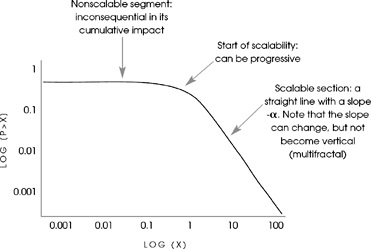
- The author distinguishes between non-scalable professions, like dentistry or baking, where income is capped by time and physical presence.
- In non-scalable jobs, revenue is 'subject to gravity' and depends on continuous effort rather than a single high-quality decision.
- Scalable professions, such as writing or quant trading, allow for an exponential increase in output and income without a corresponding increase in labor.
- Scalable work is often 'Black Swan driven,' meaning a single day or event can be more significant than the rest of one's career.
- The author argues that 'idea' people can leverage intellectual products to decouple their earnings from the limitations of manual labor and time.
In these professions, no matter how highly paid, your income is subject to gravity.
The Advent of Scalability
- Scalable professions create monstrous inequalities where a few 'giants' take the majority of the market share, leaving others with nothing.
- Non-scalable professions, like barbering or pre-recording opera, are safer because they require physical presence and have a natural limit on output.
- The invention of recording technology allowed elite performers to compete with local talent globally, effectively putting the 'mediocre' or unknown out of business.
- In scalable environments, the disparity between effort and reward is massive and often driven by luck or being in the right place at the right time.
- The author argues that scalability is not a modern phenomenon but began with DNA, which reproduces successful information across generations while other strains vanish.
Horowitz, though dead, is putting the poor man out of business.
The Winner-Take-All Ecology
- The invention of the alphabet and the printing press created a scalable environment where information can be replicated without additional effort from the author.
- Modern technology has shifted the cultural landscape from local markets, like those of bards and bakers, to a global 'winner-take-all' system.
- In creative fields, success is often driven by nonlinear luck and social contagion rather than purely objective talent.
- People often consume art not just for its intrinsic value, but as a social mechanism to belong to a community and avoid solitude.
- There is a distinct divide between professions with technical, ascertainable talent and those where success is an after-the-fact attribution.
- Creativity and innovation often thrive in environments that favor practical application over the rigid, 'middlebrow' pursuit of high culture and equations.
He didn't even have to be alive for them--death is often a good career move for an author.
The Laws of Mediocristan
- The United States economy has shifted toward 'scalable' labor, prioritizing idea generation and design over physical manufacturing.
- Scalable products allow companies like Nike and Boeing to leverage know-how while outsourcing the 'noncreative technical grind' to others.
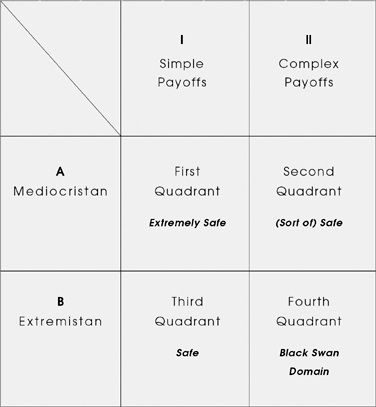
- A fundamental distinction exists between two types of randomness: Mediocristan and Extremistan.
- In Mediocristan, physical limitations ensure that no single instance can significantly alter the aggregate of a large sample.
- Human weight and caloric intake are classic examples of Mediocristan, where even the most extreme outlier is statistically negligible in a large group.
- The supreme law of Mediocristan dictates that as sample sizes increase, the impact of the individual observation becomes vanishingly small.
In the utopian province of Mediocristan, particular events don't contribute much individually--only collectively.
The Dynamics of Extremistan
- Extremistan is defined by social and informational quantities where a single observation can disproportionately impact the total aggregate.
- Unlike physical attributes like height or weight, social matters such as wealth and book sales exhibit extreme inequalities.
- In Extremistan, the wealthiest individual can represent 99.9 percent of a group's total value, rendering the rest a mere rounding error.
- Modern technology has shifted phenomena like warfare from Mediocristan to Extremistan, where a single error can have planetary consequences.
- Knowledge in Mediocristan is predictable and stable after a small sample size, whereas Extremistan is prone to the massive influence of Black Swans.
- The epistemological danger of Extremistan is that data from the past may provide a false sense of security while hiding potential outliers.
For someone's weight to represent such a share, he would need to weigh fifty million pounds!
Mediocristan Versus Extremistan
- In Extremistan, a single observation can disproportionately impact the total, making data-derived knowledge inherently suspicious.
- Mediocristan is characterized by nonscalable, physical constraints where the collective and routine dominate outcomes.
- Extremistan is defined by scalable, 'wild' randomness where winner-take-all effects create extreme inequality.
- Knowledge in Mediocristan grows rapidly with more data, whereas knowledge in Extremistan grows slowly and erratically.
- Confusing these two domains can lead to dire consequences, as Extremistan is highly vulnerable to Black Swan events.
Mediocristan is where we must endure the tyranny of the collective, the routine, the obvious, and the predicted; Extremistan is where we are subjected to the tyranny of the singular, the accidental, the unseen, and the unpredicted.
Mediocristan Versus Extremistan
- The distinction between Mediocristan and Extremistan hinges on whether totals are determined by a single observation or a small number of extreme events.
- Mediocristan follows the bell curve where history crawls and events are easy to predict from past information.
- Extremistan is characterized by the 'tyranny of the accidental' where history makes jumps and is scientifically intractable.
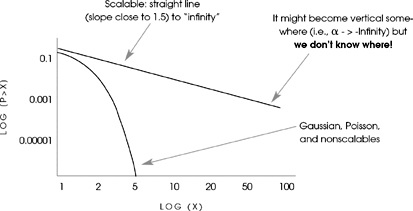
- Gray Swans represent a middle ground of Mandelbrotian randomness that is rare and consequential but somewhat predictable through scaling laws.
- Black Swans are often the result of 'tunneling,' a lack of imagination that causes us to miss sources of uncertainty.
- The impact of Black Swans is defined by their extreme consequence rather than their frequency, which leads people to underestimate them.
History crawls; History makes jumps.
The Fragility of Pompousness
- The author explores the Black Swan problem through the lens of human arrogance and the fragility of authority.
- He describes a psychological experiment using pranks, like a feather in the nose, to expose the disarray behind a dignified facade.
- The text argues that people in positions of rank often take their knowledge too seriously, leaving them vulnerable to the unexpected.
- Scientific progress is framed as a series of 'micro-Black Swans' that shatter conventional wisdom and previous certainties.
- The author notes a human tendency to laugh at the ignorance of predecessors while failing to realize that future generations will do the same to us.
- A contrast is drawn between the 'standardized minds' of corporate theorists and the chaotic, unpredictable nature of reality.
Contrast his authoritative demeanor with the shock of being hit by something totally unexpected that he does not understand.
The Problem of Induction
- The Problem of Induction questions how we can logically derive general conclusions about the future based on specific past observations.
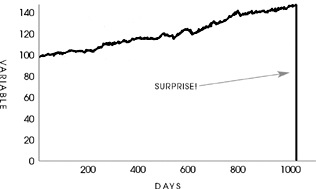
- The 'Turkey Problem' illustrates how a creature can feel safest at the exact moment when the risk of slaughter is at its highest.
- Empirical knowledge can be viciously misleading because confidence often increases as the catastrophic event approaches.
- The same hand that feeds you can be the one that wrings your neck, a concept applicable to finance, history, and personal safety.
- A naive projection of the future from the past fails to account for the 'Black Swan' event that renders previous data irrelevant.
Consider that the feeling of safety reached its maximum when the risk was at the highest!
The Illusion of Stability
- Major historical shifts often occur without any preparation from the past, catching observers completely by surprise.
- Human beings tend to worry about specific outliers only after they have occurred, failing to recognize that the next crisis will likely be unprecedented.
- The primary cause of our inability to understand 'Black Swans' is the naive belief that past experiences are definitive guides for the future.
- Professional 'conservatism' in industries like banking is often a facade that masks high-risk behaviors and massive potential for reversal.
- The banking industry demonstrates a pattern of self-deception where decades of steady profits can be wiped out by a single, rare event.
- Systemic failures in banking are often socialized, where profits are privatized by 'conservative' bankers while losses are covered by taxpayers.
But in all my experience, I have never been in any accident... of any sort worth speaking about. I have seen but one vessel in distress in all my years at sea. I never saw a wreck and never have been wrecked nor was I ever in any predicament that threatened to end in disaster of any sort.
The Relativity of Knowledge
- Financial profits are often merely 'cash borrowed from destiny' with an unpredictable payback time, rather than a result of conservative management.
- The collapse of LTCM demonstrates how 'phony' mathematics and expert overconfidence can turn the entire financial establishment into suckers.
- A Black Swan is relative to expectation; what is a catastrophic surprise for the turkey is a planned event for the butcher.
- Science can inadvertently create Black Swans by providing a false sense of security that certain extreme events are impossible.
- There is a fundamental asymmetry in timescales: negative Black Swans usually destroy quickly, while positive ones often build up over decades.
- The problem of induction, or the 'turkey problem,' is a historical philosophical challenge often associated with the jovial skeptic David Hume.
From the standpoint of the turkey, the nonfeeding of the one thousand and first day is a Black Swan. For the butcher, it is not, since its occurrence is not unexpected.
The Roots of Skepticism
- David Hume's current fame rests on philosophical works that were largely ignored during his lifetime, while his then-popular history books have faded into obscurity.
- Hume is praised for a rare clarity of prose that distinguishes him from the dense, often unread traditions of German idealism.
- The 'problem of induction' attributed to Hume is actually an ancient philosophical challenge dating back to the classical era.
- Sextus Empiricus and the empirical school of medicine prioritized practical experience and trial and error over dogmatic scientific theories.
- Pyrrhonian skepticism sought intellectual serenity by systematically doubting everything and suspending judgment on whether events were truly good or bad.
- The author connects these ancient empirical methods to modern decision-making and strategies for navigating the 'Black Swan.'
He exhibited that preoccupied stare of the thoughtful scholar that so commonly impresses the undiscerning as imbecile.
Skepticism, Religion, and Fideism
- Al-Ghazali (Algazel) challenged the intellectual establishment of his time by attacking the 'incompetence' of philosophers and their reliance on rational argument.
- The historical debate between Algazel and Averroes resulted in a split where the West embraced rationalism while the Arab world moved toward mysticism.
- Skepticism regarding the scientific method and the problem of induction was often used by medieval thinkers to justify a reliance on faith, a concept known as fideism.
- The Black Swan problem—the limitation of knowledge based on observation—paradoxically made religious arguments more appealing to certain skeptics.
- Influential figures like Pierre Bayle and Pierre-Daniel Huet built extensive philosophical frameworks around skepticism that deeply influenced later thinkers like David Hume.
- Despite their historical importance, many key skeptical thinkers have been marginalized or forgotten in modern academic curricula.
His name for a class of dogmatic scholars was ghabi, literally 'the imbeciles,' an Arabic form that is funnier than 'moron' and more expressive than 'obscurantist.'
Erudition and Practical Skepticism
- Erudition serves as a vital shield against oversimplification and the narrow-mindedness of overspecialized scholars.
- The author distinguishes his approach from pure philosophical skepticism by focusing on practical action and true empiricism.
- Unlike David Hume, who was skeptical only in theory, the author applies skepticism specifically to decisions with real-world consequences.
- The goal is not to avoid all risk, but to avoid taking risks blindly or being the 'turkey' in a high-stakes situation.
- Living in 'Mediocristan' is a convenient but false assumption used to ignore the problem of induction and Black Swan events.
I am doing here the exact opposite: I am skeptical in matters that have implications for daily life. In a way, all I care about is making a decision without being the turkey.
The Blindness of Confirmation
- Human cognition is plagued by the narrative fallacy and the error of confirmation, where we generalize from seen segments to the unseen.
- The distortion of silent evidence causes us to ignore historical Black Swans and miscalculate the true odds of rare events.
- Financial institutions often rely on risk managers who use past data to predict the future, a method that fails to account for unprecedented catastrophes.
- A fundamental tragedy of capitalism is the mismatch between short-term performance bonuses and the long-term risk of catastrophic loss.
- Managers can create 'cosmetic profitability' by taking hidden risks that shareholders cannot observe from past data.
- The act of looking for confirming evidence is a dangerous error, as the absence of an event during a specific observation does not prove its impossibility.
Clearly you cannot manufacture more information than the past can deliver; if you buy one hundred copies of The New York Times, I am not too certain that it would help you gain incremental knowledge of the future.
The Round-Trip Fallacy
- The author introduces the 'round-trip fallacy,' which is the logical error of confusing the absence of evidence with the evidence of absence.
- Human minds are prone to simplifying complex logical assertions, often substituting a nuanced statement for a more definitive, inaccurate one over time.
- This cognitive bias leads to massive statistical errors, such as overestimating the probability of a specific trait within a group by thousands of times.
- The fallacy underpins many social injustices, including the unfair application of stereotypes and discrimination against minority groups.
- Our inferential machinery evolved for primitive environments where reversing a statement—like 'most killers are wild animals'—had negligible consequences for survival.
- Even highly educated professionals and thinkers are susceptible to these trivial logical errors because clarity of mind does not always coexist with technical complexity.
Hey, look at me, I am alive, I would say, and that is evidence that lying on train tracks is risk-free.
The Domain Specificity of Knowledge
- Human beings suffer from an inability to automatically transfer knowledge or logic from one context, such as a classroom, to real-life situations.
- Domain specificity means our reactions and intuitions are dictated by the framework or 'domain' surrounding information rather than its logical merit.
- Even experts like statisticians frequently commit basic inferential errors when problems are presented in a casual or non-academic context.
- The human brain lacks a central all-purpose computer, instead utilizing different mental modules that fail to apply consistent logical rules across all scenarios.
- This cognitive asymmetry is visible in daily life, from gym-goers using escalators to reach StairMasters to doctors misinterpreting cancer recurrence data.
Statisticians, it has been shown, tend to leave their brains in the classroom and engage in the most trivial inferential errors once they are let out on the streets.
The Round-Trip Fallacy
- The author distinguishes between 'No Evidence of Disease' (NED) and 'Evidence of No Disease' (END), noting that doctors often confuse the two.
- Scientific arrogance in the 1960s led to the dismissal of breastfeeding and dietary fiber because their benefits had not yet been empirically proven.
- The 'round-trip fallacy' occurs when the absence of evidence for a phenomenon is treated as definitive evidence of its absence.
- Naive empiricism describes the human tendency to seek out confirming instances for a theory while ignoring failures or counter-evidence.
- Historical medical practices, such as unnecessary tonsillectomies, demonstrate the physical harm caused by over-theorizing and ignoring biological complexity.
There is no such thing as END, Evidence of No Disease. Yet my experience discussing this matter with plenty of doctors, even those who publish papers on their results, is that many slip into the round-trip fallacy during conversation.
The Power of Negative Empiricism
- Naive empiricism is flawed because a series of corroborative facts does not constitute definitive proof of a general rule.
- Knowledge is fundamentally asymmetrical: while a thousand observations cannot prove a theory right, a single instance can prove it wrong.
- This 'negative empiricism' allows us to be practical semiskeptics, focusing on what can be falsified rather than what can be verified.
- In real-world decision-making, such as cancer detection or criminal justice, the presence of evidence is meaningful while its absence is not conclusive.
- Karl Popper’s theory of falsification formalizes this asymmetry, distinguishing between scientific inquiry and non-scientific claims.
- Understanding how to act under conditions of incomplete information is presented as the highest and most urgent human pursuit.
It is true that a thousand days cannot prove you right, but one day can prove you to be wrong.
Conjectures, Refutations, and Confirmation Bias
- Karl Popper’s 'open society' is built on skepticism and the rejection of definitive truths, emphasizing the world's inherent unpredictability.
- The principle of falsification suggests that we can identify what is wrong with far more certainty than we can identify what is right.
- Popper’s method of conjectures and refutations requires seeking observations that prove a hypothesis wrong rather than looking for corroboration.
- Humans suffer from confirmation bias, a cognitive vulnerability where we naturally focus on evidence that supports our existing beliefs.
- P.C. Wason’s experiments demonstrate that people struggle to discover simple rules because they fail to test sequences that might disprove their assumptions.
- Disconfirming instances are logically more powerful in establishing truth, yet they remain counterintuitive to human thought processes.
But it remains the case that you know what is wrong with a lot more confidence than you know what is right.
The Fallacy of Confirmation
- Experts like chess grandmasters and George Soros succeed by actively seeking evidence that falsifies their own theories rather than confirming them.
- True self-confidence is defined as the ability to view the world without needing to find signs that stroke one's ego through corroboration.
- The author argues that 'corroborative evidence' is a logical impossibility because confirming a specific instance does not prove a universal rule.
- Hempel's raven paradox illustrates the absurdity of confirmation: logically, seeing a red Mini Cooper could be used to 'confirm' that all swans are white.
- Human beings possess selective inductive instincts, knowing naturally when to generalize (like skin color) and when not to (like body weight).
- Contrary to traditional empiricism, studies suggest that our ability to generalize is an innate instinct rather than something learned solely from custom.
He pointed to a red Mini and shouted, 'Look, Nassim, look! No Black Swan!'
Evolutionary Instincts and Extremistan
- Human biology is equipped with mental machinery inherited from ancestors that allows for selective inductive learning and generalization.
- Our instincts are optimized for the primitive environment of the East African Great Lakes, not the complex, informational world of today.
- The modern world, or 'Extremistan,' is dominated by rare Black Swan events that require much longer periods of observation to understand than our biology allows.
- While primitive Black Swans were limited to physical threats like wild animals, modern sources of uncertainty have multiplied beyond measurability.
- The 'confirmation problem' causes us to use new information only to reinforce existing views, leading to increased confidence without increased accuracy.
- Modern socioeconomic interconnectedness has amplified the consequences of even natural events through complex network effects.
Paradoxically, the more information you have, the more justified you will feel in your views.
The Narrative Fallacy
- Modern infrastructure and economic interconnectedness mean that disasters like earthquakes now carry a significantly higher financial impact than in the past.
- The narrative fallacy describes the human tendency to overinterpret and simplify complex events by imposing causal links where they may not exist.
- Humans have an innate vulnerability to stories, preferring to reduce the dimensions of reality into manageable, summarized explanations.
- The author illustrates this through an encounter with an Italian professor who paradoxically used a causal explanation to praise a book about the lack of causality.
- Cultural and religious backgrounds are often used as convenient but potentially flawed narratives to explain an individual's intellectual perspective.
- The fallacy is described as a psychological 'fraud' that makes us believe we understand the world better than we actually do.
At some point during his speech, he turned all red with anger--thus convincing me (and the audience) that he was definitely right.
The Narrative Fallacy Trap
- The narrative fallacy describes our innate inability to view sequences of facts without weaving a causal explanation or logical link into them.
- Narrativity is a biological drive to reduce the dimensionality of information, making facts easier to remember but distorting our representation of reality.
- Theorizing is actually the brain's 'default' option; it takes significant mental effort to observe raw facts while withholding judgment or explanation.
- This propensity for storytelling increases our false impression of understanding, particularly regarding rare events and wild uncertainty.
- True skepticism is physically and mentally exhausting because it requires fighting against our own anatomical urge to rationalize and interpret.
It takes considerable effort to see facts (and remember them) while withholding judgment and resisting explanations.
The Sense-Making Organ
- Humans frequently provide post hoc, backfit explanations for behaviors that were actually triggered by external or arbitrary factors.
- Split-brain experiments reveal that the left hemisphere acts as an interpreter, automatically creating causal narratives even when it lacks the actual data.
- While the right hemisphere is more comfortable admitting ignorance, the left hemisphere is biologically driven to impose patterns and logical structures.
- The left brain's role in language may be secondary to its primary function as a pattern-recognition and interpretation engine.
- Our biological dependence on stories and concepts can actually hinder our perception of reality, causing us to overlook literal details in favor of expected meanings.
Does this suggest that we are better at explaining than at understanding?
The Biology of Narrative
- The human brain is biologically hardwired to interpret data and seek patterns, an automatic process as involuntary as breathing.
- Suppressing the left hemisphere's interpretive drive allows for more realistic perception, yet avoiding narration requires immense mental energy and constant alertness.
- The neurotransmitter dopamine plays a critical role in pattern detection, where higher levels can lower skepticism and increase vulnerability to superstitions.
- Medical treatments like L-dopa demonstrate that chemical changes can turn patients into compulsive gamblers by making them see false patterns in randomness.
- Our tendency to overinterpret and create narratives is a physical ailment of our embodiment, making our minds 'inmates' to our own biology.
- Beyond biology, narration serves a functional purpose in information theory by reducing the high costs of storing and retrieving disordered data.
Our minds are like inmates, captive to our biology, unless we manage a cunning escape.
The Necessity of Compression
- Human memory is limited by the small size of our conscious 'working' memory, which acts like a desk in a massive library.
- To manage information, we use patterns and narratives to compress data into smaller, more manageable 'kernels'.
- Randomness is defined by Kolmogorov complexity as the inability to reduce a message to a shorter rule or pattern.
- Our biological hunger for order forces us to simplify the world, which inadvertently makes us perceive it as less random than it truly is.
- The 'Black Swan' represents the vital, unpredictable information that is discarded during this necessary process of simplification.
- Both art and science serve as tools to inflict order on the chaos of human experience and shield us from complexity.
The more you summarize, the more order you put in, the less randomness. Hence the same condition that makes us simplify pushes us to think that the world is less random than it actually is.
The Narrative Fallacy and Memory
- Narrative functions as a form of dimension reduction, making complex information lighter to carry and easier to market by imposing a causal structure.
- The human drive for causality and narrativity creates a 'disease' where we simplify reality to make it feel more organized and explainable.
- Compelling stories distort our assessment of probability, often leading people to overestimate the likelihood of individual outcomes in a well-plotted scenario.
- Memory is not a static recording device but a dynamic 'revision machine' that continuously rewrites the past based on new information.
- We involuntarily filter our history, retaining facts that fit a logical story while discarding those that do not appear to play a causal role.
- Hindsight bias is reinforced by our inability to remember a sequence of events without being influenced by the knowledge of what happened next.
Memory is more of a self-serving dynamic revision machine: you remember the last time you remembered the event and, without realizing it, change the story at every subsequent remembrance.
The Madman's Narrative
- Human memory is often inventive rather than accurate, leading to the creation of false narratives based on external theories.
- Highly intelligent individuals can use logic to construct elaborate, coherent, yet entirely false interpretations of innocuous events.
- Multiple incompatible explanations can be derived from the exact same set of data, all while remaining logically consistent.
- Logician W. V. Quine demonstrated that the absence of nonsense is not a sufficient condition for truth.
- The narrative fallacy can be mitigated through the use of conjectures, controlled experiments, and testable predictions.
Someone hit with such a disorder can muster the most insignificant of details and construct an elaborate and coherent theory of why there is a conspiracy against him.
Narrativity as Therapy and Trap
- Narrativity can be used as a therapeutic tool to mitigate the psychological pain caused by randomness and the 'stings' of hindsight.
- By constructing a narrative, individuals can make past traumatic or random events feel unavoidable, reducing feelings of guilt and remorse.
- Professionals in high-randomness fields, like finance, are particularly susceptible to burnout from constant second-guessing of past decisions.
- The human mind harbors a crippling dislike for the abstract, leading us to demand concrete reasons for every event.
- Media outlets frequently assign contradictory causal explanations to the same event to satisfy the public's need for a coherent story.
- The obsession with finding specific causes for random fluctuations results in being 'wrong with infinite precision' rather than accepting uncertainty.
So it was the same capture (the cause) explaining one event and its exact opposite.
The Fiction of National Identity
- National identity and 'national traits' are often used as convenient but empirically invalid dump sites for explaining human behavior.
- Attributes such as sex, social class, and profession are statistically better predictors of behavior than nationality.
- The public's hunger for narrative and causality forces journalists and academics to weave facts into stories that distort reality.
- While newspapers employ fact-checkers, they lack 'intellect-checkers' to prevent the imposition of false causal impressions.
- Scientists are also vulnerable to the narrative fallacy, often prioritizing 'sexy' punch lines over substantive, less sensational data.
- Narrative mechanisms and the salience of sensational facts frequently lead to the miscalculation of the odds of Black Swan events.
There are fact-checkers, not intellect-checkers. Alas.
The Narrative Fallacy and Probability
- People tend to estimate the probability of a specific scenario as higher than a general one if a cause is provided.
- Adding a 'because' to a scenario makes it more mentally available and plausible, even though it is logically less likely.
- Decision-making pathologies arise when people value specific protections, like terrorism insurance, over broader coverage that includes the specific threat.
- There are two types of rare events: narrated Black Swans that are overblown by media, and silent Black Swans that are ignored because they lack a plausible story.
- Human nature leads us to overestimate vivid, discussed risks while severely underestimating those that escape our current models or discourse.
An unspecified cause means no cause at all.
The Myopia of Rare Events
- People tend to insure against frequent small losses while ignoring highly improbable but catastrophic events.
- Experimental evidence suggests that individuals underweight small probabilities when they must derive the odds through personal experience rather than being told them.
- Societal respect for elders and animal matriarchs may have evolved as a mechanism to preserve knowledge of rare, high-impact events that occur outside of short-term memory.
- Humanity tends to ignore non-repeatable events before they happen and overestimate their recurrence immediately after they occur.
- Both Post-Keynesian and Austrian economists recognize that periods of stability breed complacency and increased risk-taking, leading to eventual crises.
- Mainstream economics often struggles with 'fundamental uncertainty' because it resists the abstract nature of randomness in favor of Platonified models.
Respect for elders in many societies might be a kind of compensation for our short-term memory.
The Pull of the Sensational
- Human intuition is poorly equipped to gauge the impact of rare, improbable events outside of stable environments.
- Vivid anecdotes and personal stories exert a far greater influence on human behavior than abstract statistical data.
- The 'Italian Toddler' case demonstrates how a single individual's plight can overshadow mass casualties occurring nearby.
- We react more violently to man-made damage, such as terrorism, than to larger-scale natural or environmental killers.
- Emotional narratives create mental images that are difficult to override, even when we know the data contradicts the story.
As Stalin, who knew something about the business of mortality, supposedly said, 'One death is a tragedy; a million is a statistic.' Statistics stay silent in us.
The Dual Systems of Thinking
- Narratives are essential for human consciousness and attention but can be lethal when applied to logical reasoning.
- The Society of Judgment and Decision Making uses empirical experiments to map human reasoning defects and shortcuts.
- Human cognition is divided into System 1 (experiential) and System 2 (cogitative).
- System 1 is fast, automatic, and emotional, utilizing 'fast and frugal' heuristics that can lead to severe biases.
- System 2 is slow, effortful, and logical, allowing for self-aware correction and step-by-step reasoning.
- The most significant reasoning errors occur when we unknowingly use System 1 while believing we are employing System 2.
Note that I ride my red Vespa around town, since no one in my immediate environment has recently suffered an accident--although I am aware of this problem in logic, I am incapable of acting on it.
The Limits of Neurobiology
- System 1 is an evolutionary survival mechanism that uses emotions to force quick reactions before conscious awareness occurs.
- Human nature is hindered by the difficulty of maintaining the prolonged effort required for System 2 cognitive processing.
- While neurobiology maps System 1 and 2 to the limbic and cortical brain regions, the author warns against over-reliance on anatomical reductionism.
- The example of bird intelligence demonstrates that complex functions can exist without the specific brain structures humans typically associate with them.
- Empirical psychology experiments are often more reliable than MRI-based theories because they focus on observed reactions rather than hidden biological machinery.
Clearly Mother Nature makes you use the fast System 1 to get out of trouble, so that you do not sit down and cogitate whether there is truly a tiger attacking you or if it is an optical illusion.
Escaping the Narrative Fallacy
- Human psychology imposes a 'wrong map' of event likelihood by favoring vivid, easily remembered stories over abstract probabilities.
- While narratives may function in the predictable environment of Mediocristan, they fail in Extremistan where the past does not repeat in obvious ways.
- To combat the narrative fallacy, one must prioritize experimentation, clinical knowledge, and empirical evidence over historical storytelling.
- The author suggests keeping a tally of predictions to maintain intellectual honesty and avoid the trap of hindsight bias.
- Success in intellectual, scientific, and artistic fields is concentrated in Extremistan, where a few winners claim the majority of the rewards.
- The 'reverse turkey' position describes those whose success depends on a positive Black Swan event rather than steady, predictable growth.
It's like they have a virus controlling their brains that prevents them from seeing things going forward--the Black Swan around the corner.
The Cruelty of Lumpy Outcomes
- Human biology and modern society are both biased toward steady, incremental rewards rather than irregular breakthroughs.
- Researchers and artists often face 'peer cruelty' because their work yields no tangible results for long periods, despite the inherent value of negative findings.
- Social comparisons, especially within families, create psychological pressure when one person's success is visible and steady while another's is 'lumpy' and uncertain.
- The genetic makeup of humans has not evolved to handle the alienation of working on long-term missions in a world that demands immediate confirmation.
- Professionals in high-stakes, mission-driven fields are often forced to produce inconsequential work just to maintain social standing and professional visibility.
Of course you did not have a good day; you found nothing.
The Tragedy of Nonlinearity
- Modern success often requires a capacity for 'continuously adjourned gratification' to survive long periods without visible results.
- Social pressure and peer judgment create a 'hell' for those whose work does not provide the routine rewards expected by society.
- Human biology is evolved for a primitive environment where effort and results are linearly and sensationally linked.
- Our emotional apparatus is poorly equipped for modern reality, where one may labor for years with no progress before a sudden breakthrough.
- While the higher mind can theoretically override the animal instinct for immediate rewards, it remains difficult to resist the demoralization of perceived failure.
Believe me, it is tough to deal with the social consequences of the appearance of continuous failure. We are social animals; hell is other people.
The Ubiquity of Nonlinearity
- Linear relationships are rare exceptions in the real world, primarily existing in textbooks because they are easier for the human mind to grasp.
- Most natural and social phenomena exhibit nonlinear patterns, where inputs do not produce proportional or immediate outputs.
- Human progress often involves long periods of stagnation followed by sudden, dramatic breakthroughs, such as a child suddenly speaking in complex sentences.
- The concept of 'diminishing returns' illustrates nonlinearity, where more of a resource—like water—can eventually lead to decreased well-being.
- People in 'concentrated' pursuits often endure long periods of invisibility while waiting for a 'big day' or recognition that may never arrive.
- Despite claims of valuing process over results, humans possess an inherent craving for external validation and public attention.
I could not find anything, no more than someone hunting for squares or triangles could find them in the rain forest.
The Psychology of Lumpy Rewards
- Black Swan hunters often face social shame and a loss of dignity due to the lack of steady, conventional success.
- In industries driven by rare, massive payoffs, the intermediaries like venture capitalists and publishers usually capture more wealth than the individual creators.
- Hedonic happiness is derived more from the frequency of positive events than from the intensity of a single large windfall.
- Human biology is optimized for a steady flow of small rewards, such as food and water, rather than the 'lumpy' payoffs of modern speculative fields.
- The emotional toll of losing a large sum can outweigh the benefit of the remaining profit, making a zero-sum outcome feel psychologically superior to a volatile win.
The person involved in such gambles is paid in a currency other than material success: hope.
The Antechamber of Hope
- The author suggests that while pain should be concentrated into brief periods, some individuals transcend the cycle of hedonic deficit through hope.
- Yevgenia Krasnova views books as intimate friends rather than commodities, rejecting the analytical 'promiscuity' of those who treat literature superficially.
- Krasnova’s worldview is shaped by Dino Buzzati’s novel, The Desert of the Tartars, which she discovered during a period of intense boredom in the French countryside.
- The novel follows Giovanni Drogo, a young officer stationed at a remote fortress waiting for a legendary invasion that never seems to arrive.
- Despite having the opportunity to leave his desolate post, Drogo is seduced by the silent landscape and the intoxicating potential of a future great battle.
- The narrative explores the psychological trap of 'waiting' and how the anticipation of a life-defining event can lead to a state of perpetual suspension.
One does not sit idle listening as people wax analytical about your friends.
The Sweet Trap of Anticipation
- The story of Giovanni Drogo illustrates the 'sweet trap' of spending a lifetime waiting for a rare, transformative event that may never arrive or may be missed.
- A positive Black Swan is an unlikely event that one intensely desires, yet the pursuit of it often requires sacrificing intermediate successes and 'consolation prizes.'
- Living in the 'antechamber of hope' provides a cathartic simplicity of purpose, but it creates an asymmetry where decades of waiting are traded for a few hours of potential glory.
- Social validation is crucial for those pursuing outlier goals, as humans are 'local animals' who prioritize the respect of their immediate peers over the opinions of outsiders.
- Joining a specialized 'school' or community allows individuals with unconventional ideas to remain insulated from societal ostracization while awaiting a remote payoff.
- Engaging in activities dependent on Black Swan events is psychologically sustainable only when done within a supportive group of like-minded peers.
Little did Yevgenia know that she would spend an entire life playing Giovanni Drogo in the antechamber of hope, waiting for the big event, sacrificing for it, and refusing intermediate steps, the consolation prizes.
Nero Tulip and the Desert
- Nero Tulip, a trader, meets Yevgenia in Venice, leading to a clandestine affair and the eventual dissolution of her marriage to a clingy philosophy professor.
- Nero exhibits a paradoxical personality: he is financially hyperconservative and paranoid, yet takes uncalculated physical risks that lead to accidents like a helicopter crash.
- Despite being a classicist and polyglot, Nero prefers the company of street-smart Brooklyn traders over the intellectuals and bohemians favored by Yevgenia.
- Nero maintains a rigid distinction between people who can 'connect the dots' and those who cannot, regardless of their formal education or social status.
- After his relationship with Yevgenia ends, Nero becomes obsessed with the novel 'Il deserto dei Tartari,' identifying deeply with its protagonist, Giovanni Drogo.
- Nero’s enthusiasm for the book leads him to distribute copies to everyone he meets, including his non-English speaking doorman.
He gets a little too arrogant after episodes of success and starts taking uncalculated physical risks, though he remains financially hyperconservative, even paranoid.
Bleed or Blowup
- The world is divided into those who risk a major blowup for small, steady gains and those who accept small, steady losses for a massive payout.
- Extremistan environments often appear safe in the short term because they hide and delay catastrophic risks, leading people to mistake luck for skill.
- A 'bleed' strategy involves losing small amounts frequently to be positioned for a Black Swan event that pays back years or decades of losses.
- Executing a contrarian strategy requires immense intellectual stamina and the ability to endure social scorn and insults from others.
- Human biology is poorly suited for constant small losses, as the emotional brain interprets them as chronic stress that can physically damage the hippocampus.
It was his body that was his problem, which accumulated physical fatigue from the neurobiological effect of exposure to the small continuous losses, Chinese-water-torture-style, throughout the day.
The Psychology of Long-Term Survival
- Chronic stress from frequent information updates causes irreversible physical atrophy in the hippocampus, effectively amputating parts of the self.
- Nero manages his neurobiological system by ignoring short-term data, refusing to view performance records spanning less than a decade.
- Confidence is a social signal that overrides raw data; humans, like animals, detect cracks in self-assurance before they are even articulated.
- Maintaining an 'Olympian calm' and extreme politeness allows one to exert control and project success without offending others' sensitivities.
- Standardized performance evaluations are fundamentally flawed as they incentivize short-term gaming of the system at the risk of total catastrophe.
Humans will believe anything you say provided you do not exhibit the smallest shadow of diffidence; like animals, they can detect the smallest crack in your confidence before you express it.
The Problem of Silent Evidence
- The concept of silent evidence describes how history hides both Black Swans and the mechanisms that generate them.
- Cicero's story of the drowned worshippers illustrates how we only see the survivors of an event, leading to false conclusions about cause and effect.
- Silent evidence creates a bias where we attribute success to skill or divine intervention while ignoring the failures that left no trace.
- This fallacy is universal, affecting our understanding of history, religion, artistic success, and the nature of extreme events.
- Thinkers like Montaigne and Francis Bacon recognized this bias, yet it remains a persistent flaw in human empirical thinking.
- History is defined as any succession of events viewed with the benefit of hindsight, which naturally obscures the 'silent' data.
The drowned worshippers, being dead, would have a lot of trouble advertising their experiences from the bottom of the sea.
The Bias of Silent Evidence
- The author defines bias as the systematic distortion between what is observed and the full reality, often caused by ignoring 'silent evidence.'
- Historical narratives are frequently flawed because the 'losers' or the 'drowned' do not leave records, creating an optical illusion of causality.
- Silent evidence is a primary mechanism that events use to conceal their inherent randomness and the existence of Black Swans.
- The Phoenicians were unfairly labeled as uncultured merchants because their literature was written on perishable papyrus that did not survive the 'biodegradative assaults of time.'
- The neglect of silent evidence is particularly dangerous in winner-take-all environments where success stories are analyzed without considering the vast 'cemetery' of failures.
As drowned worshippers do not write histories of their experiences (it is better to be alive for that), so it is with the losers in history, whether people or ideas.
The Illusion of Literary Talent
- The 'superstar effect' creates a massive inequity in creative fields compared to stable professions like medicine or plumbing.
- Our perception of 'literary heritage' is skewed because we only see a minute proportion of the total works produced.
- The success of famous authors like Balzac may be attributed more to disproportionate luck than unique talent when compared to vanished peers.
- Silent evidence, such as the thousands of rejected manuscripts and failed actors, is systematically excluded from our analysis of success.
- The literary canon, exemplified by the 'Bibliotheque de la Pleiade,' lacks ultimate justification because it ignores the 'perished' masterpieces of history.
I regret to say, your idol Balzac was just the beneficiary of disproportionate luck compared to his peers.
The Cemetery of Failure
- Balzac’s character Lucien illustrates how literary success is often a product of promotion and external luck rather than the intrinsic quality of the work.
- The term 'nightingales' refers to the vast number of failed books that sit unread on bookstore shelves, forming a hidden 'cemetery' of literature.
- People tend to idealize the past and ignore that the same patterns of arbitrary success and silent failure existed in ancient times.
- Conventional studies of millionaires are flawed because they only analyze the traits of survivors, ignoring that the 'cemetery' of failures contains people with the exact same traits.
- The appearance of consistent expertise in fields like fund management can be mathematically replicated through pure randomness and the systematic removal of losers.
- Luck is the primary differentiator between the successful and the failed when both groups possess identical attributes like courage and optimism.
The graveyard of failed persons will be full of people who shared the following traits: courage, risk taking, optimism, et cetera. Just like the population of millionaires.
The Illusion of Hardening
- Retrospective determinism leads people to invent causal explanations for the success of lucky survivors, such as lifestyle habits or personality traits.
- Computer simulations of random worlds prove that 'lucky billionaires' are a statistical inevitability rather than an anomaly requiring specific explanation.
- Scalable professions in 'Extremistan' create a massive 'cemetery' of failures that are often ignored when analyzing the success of the few winners.
- The 'silent evidence' problem is illustrated by the Russian Mafia, where their toughness is attributed to the Gulag rather than the fact that only the toughest survived it.
- The 'Health Club for Rats' thought experiment demonstrates that a harmful process can appear beneficial if one only examines the survivors and ignores the casualties.
- Every individual in a surviving group may actually be weaker than they were before the ordeal, despite appearing stronger than the general population.
Not many people will have the temptation to go look at the dead rats.
The Vicious Bias of Silent Evidence
- The 'surviving rat' metaphor illustrates how we mistake the results of a lethal process for a strengthening effect because the victims are invisible.
- A bias is most dangerous when its impact is largest, as the most severely victimized are eliminated from the evidence pool entirely.
- Scientific estimates of biodiversity and extinction rates are often skewed because they rely on fossils, ignoring the 'silent cemetery' of species that left no trace.
- Our perception of criminal success is distorted because we only observe the criminals who are caught, leaving the most successful ones out of the data.
- The concept of silent evidence suggests that life is far more fragile and reality far more diverse than our observations lead us to believe.
Owing to the invisibility of the dead rats, the more lethal the risks, the less visible they will be, since the severely victimized are likely to be eliminated from the evidence.
The Illusion of Visible Evidence
- Beginner's luck is an empirical reality driven by selection bias; only those who start with a win continue gambling, while losers drop out and vanish from the sample.
- The 'swimmer's body' illusion mistakes a cause for a consequence, failing to see that people with specific genetic builds are naturally drawn to and succeed in certain sports.
- Public policy is often driven by 'mediatized' events like natural disasters, which evoke immediate emotional responses and visible action.
- Resources allocated to visible crises are diverted from less visible but equally critical areas, such as long-term medical research for cancer or diabetes.
- The 'silent victims' of these diverted funds are often ignored because they do not manifest in our emotional system or appear on television.
- Effective decision-making requires looking beyond obvious, visible consequences to account for the more meaningful, unseen impacts of an action.
Those born with a natural tendency to develop a swimmer's body become better swimmers. These are the ones you see in your sample splashing up and down at the pools.
The Unseen Consequences
- Frédéric Bastiat's philosophy highlights the disparity between visible government actions and their invisible, often negative, alternatives.
- The confirmation fallacy allows governments to take credit for visible successes while ignoring the 'unseen cemetery' of their policies' side effects.
- Social learning is hindered because the positive benefits of an action often go to the author, while the negative costs are distributed across society.
- Visible tragedies, like the 9/11 attacks, receive immense public support, while 'silent victims'—such as those who died in car accidents after avoiding flying—remain unacknowledged.
- It is politically and socially difficult to promote 'avoided' disasters compared to 'visible' interventions, leading to a bias toward phony heroism.
It is much easier to sell "Look what I did for you" than "Look what I avoided for you."
The Illusion of Stability
- Silent evidence leads to a societal neglect of statistical benefits in favor of salient, anecdotal harms.
- The 'illusion of stability' causes survivors of high-risk situations to retrospectively underestimate the actual danger they faced.
- Giacomo Casanova serves as a prime example of a 'flambeur' who believed his repeated escapes from ruin were due to a lucky star rather than chance.
- Survivorship bias ensures that we only hear the stories of adventurers who bounced back, while the 'crushed' remain silent and forgotten.
- The perception of being 'indestructible' is often a byproduct of being the lucky winner in a pool of many risk-takers.
A life saved is a statistic; a person hurt is an anecdote.
The Illusion of Resilience
- The author challenges the belief in inherent resilience by highlighting that past recovery does not guarantee future survival.
- Survivorship bias leads observers to mistake the mere fact of survival for a special internal property or 'cause' within a city or person.
- Historical figures and entities like Carthage or Tyre likely had experts who touted their invincibility right before their eventual collapse.
- The 'Casanova' framework suggests that successful survivors are often just the lucky winners of a high-risk process rather than possessors of superior traits.
- The 'silent cemetery' of failed businesses, such as New York restaurants, is ignored by observers who only focus on the visible, successful examples.
The fact that you survived is a condition that may weaken your interpretation of the properties of the survival, including the shallow notion of 'cause.'
The Illusion of Evolutionary Risk
- Humanity has inherited a genetic predisposition for uncalculated risk-taking, often blinded by the success of survivors while ignoring the failures.
- Economic growth is frequently fueled by foolish risks, but justifying this behavior is logically equivalent to praising Russian roulette because the player survived.
- Psychological evidence suggests that people take risks not out of courage, but due to a fundamental ignorance and blindness toward probability.
- The author argues that while luck and accident brought us to our current state, we should now adopt a more conservative approach to preserve our gains.
- Evolutionary fitness is often misunderstood by those who ignore 'silent evidence'—the many instances where risk-taking led to extinction rather than success.
- In environments dominated by 'Black Swan' events, it is impossible to determine in the short term which traits are truly beneficial for long-term survival.
This is exactly like someone playing Russian roulette and finding it a good idea because he survived and pocketed the money.
The Anthropic Bias
- Fools and blind risk takers often appear successful in the short term, and in 'Extremistan,' rare events can even allow them to win in the long term.
- The anthropic cosmological argument suggests that the universe was specifically designed for human existence because the odds of our survival are so low.
- The 'Casanova bias' or self-sampling assumption explains that our presence in the sample invalidates any calculation of the odds of our existence.
- Just as a lucky adventurer believes a transcendental force guided him, humans mistake their survival for destiny rather than a statistical necessity of large samples.
- We are the 'surviving Casanovas' who only exist to discuss our history because we were the beneficiaries of a 'rosy' scenario that avoided extinction.
- Historical stability is often misunderstood because we cannot observe the 'bleak' scenarios that led to the disappearance of others.
The one who is still kicking (by accident) will feel that, given that he cannot be so lucky, there had to be some transcendental force guiding him and supervising his destiny.
The Illusion of Causality
- Individual existence is a low-probability event resulting from a series of accidental medical and historical strokes of luck.
- The 'reference point argument' suggests we should calculate odds based on the entire starting cohort rather than just the visible winners.
- Successful individuals often attribute their achievements to skill or destiny, ignoring the statistical certainty that someone will eventually hit a lucky streak.
- Humans are explanation-seeking animals who invent 'cosmetic' causes to satisfy a psychological need for order and causality.
- The presence of silent evidence—the losers who are no longer around to tell their stories—masks the true role of randomness in history.
We have to accept the fuzziness of the familiar 'because' no matter how queasy it makes us feel (and it does makes us queasy to remove the analgesic illusion of causality).
The Illusion of Causality
- The author argues that our survival of historical catastrophes like the bubonic plague is not necessarily due to specific causes, but rather a result of the 'rosy' scenario playing out for those who are still here to observe it.
- Educational systems and media outlets are criticized for forcing students and readers to manufacture 'because' explanations for complex historical events where randomness played a significant role.
- Invoking randomness is presented as an act of intellectual honesty, effectively serving as a way to 'plead ignorance' rather than creating false narratives.
- Silent evidence—the data from those who did not survive or succeed—distorts our perception of reality, making history appear more stable and explainable than it truly is.
- Human biology and psychology are naturally biased toward vivid, visible information, leading us to ignore abstract 'cemeteries' of failed data points.
- The author advises using causal explanations sparingly, suggesting they should be reserved for experimental results rather than backward-looking historical analysis.
My biggest problem with the educational system lies precisely in that it forces students to squeeze explanations out of subject matters and shames them for withholding judgment, for uttering the 'I don't know.'
Silent Evidence and Fat Tony
- The author notes a human paradox where individuals maintain rigorous skepticism in professional fields like medicine while remaining gullible in personal investments.
- Silent evidence can sometimes bias risk assessments upward, such as when undiagnosed cancer survivors are excluded from medical statistics.
- The 'Ludic Fallacy' is introduced through the character of Fat Tony, a successful non-nerd who thrives on practical intuition rather than academic models.
- Fat Tony's success stems from his ability to identify 'suckers' within large bureaucracies where employees lack the skin in the game that owners possess.
- The contrast between academic knowledge and the 'texture of the world' is highlighted through Tony's effortless, street-smart approach to wealth.
I have to once again state my amazement at the aspect of human nature that allows us to mix the most rigorous skepticism and the most acute gullibility.
Fat Tony vs. Dr. John
- The author introduces Dr. John, a meticulous actuary and PhD holder who represents the antithesis of the street-smart Fat Tony.
- Dr. John embodies the 'Platonic' approach to life, characterized by predictability, adherence to schedules, and a clear separation between work and leisure.
- A thought experiment involving a coin flipped 99 times resulting in heads reveals a fundamental divide in how the two men process information.
- Dr. John relies on theoretical models and initial assumptions, concluding the next flip remains a 50/50 probability.
- Fat Tony rejects the theoretical premise entirely, arguing that the real-world evidence of 99 heads proves the game is rigged or the coin is loaded.
- The contrast highlights the difference between academic 'nerdiness' and practical skepticism regarding the validity of models in the real world.
You are either full of crap or a pure sucker to buy that "50 pehcent" business. The coin gotta be loaded.
The Ludic Fallacy
- The author contrasts 'Dr. John,' a high-IQ academic who thinks strictly within defined parameters, with 'Fat Tony,' a street-smart practitioner who understands the texture of reality.
- A 'nerd' is redefined not by appearance, but as someone whose rigid adherence to 'the box' prevents them from understanding real-world complexity.
- The 'ludic fallacy' describes the mistake of believing that the sterilized, structured uncertainty found in games and exams applies to the messy reality of life.
- Academic knowledge can be 'obscurantist,' often acting as a barrier to true understanding by prioritizing theoretical models over ecological situations.
- In a surprising discovery at a defense think tank, the author finds that military practitioners often think more like open-minded philosophers than actual academics do.
- The distinction between Platonic (theoretical) and a-Platonic (real-world) knowledge is central to understanding why experts often fail to predict 'Black Swan' events.
A nerd is simply someone who thinks exceedingly inside the box.
The Ludic Fallacy
- Military professionals often possess more intellectual honesty regarding randomness than academics because they deal with real-world existential risks rather than theoretical models.
- The author introduces the 'ludic fallacy,' which is the mistaken belief that the sterilized, rule-based randomness of games and casinos maps onto the complexity of real life.
- Casinos represent 'domesticated uncertainty' where odds are known and outcomes follow a Gaussian bell curve, making them poor models for actual risk.
- Real-world risks, or 'Black Swans,' are characterized by 'unknown unknowns' that cannot be predicted by the Platonic models favored by ivory-tower intellectuals.
- The author argues that the most significant risks to an institution often come from outside its defined parameters and surveillance systems.
My idea is that gambling was sterilized and domesticated uncertainty.
The Ludic Fallacy
- The author criticizes the 'ludic fallacy,' which is the mistake of applying the sterilized, computable risks of games and dice to the messy, undefined uncertainty of real life.
- Economists and academics often rely on 'Platonified' models and the bell curve, which fail to account for the 'wild randomness' found in actual economic and financial systems.
- Modern education in probability is described as a form of brainwashing that prioritizes fancy calculations over the necessary 'fuzziness' of true uncertainty.
- Historical thinkers like Cicero and Simon Foucher viewed probability as a liberal art rooted in skepticism rather than a rigid mathematical certainty.
- Human psychology is naturally 'dogma-prone,' leading us to exit doubt prematurely and mistake mathematical maps for the actual territory of reality.
Probability is a liberal art; it is a child of skepticism, not a tool for people with calculators on their belts to satisfy their desire to produce fancy calculations and certainties.
The Ludic Fallacy in Casinos
- Casinos focus their risk management on gambling policies and cheaters, assuming their primary threats are contained within the games themselves.
- The 'Platonic fold' represents the theoretical models of probability that fail to account for messy, real-world disruptions.
- The four largest financial losses for the casino came from unpredictable 'Black Swan' events, such as a tiger attack on a performer and a disgruntled contractor's bomb plot.
- Administrative failures and personal crises, like an employee hiding IRS forms or a kidnapping ransom, posed greater existential threats than any high-roller gambler.
- Off-model risks can outweigh calculated gambling risks by a factor of 1,000 to 1, rendering sophisticated probability models largely irrelevant to survival.
This building is inside the Platonic fold; life stands outside of it.
The Surface of Knowledge
- The author argues that disparate intellectual problems—induction, silent evidence, and the ludic fallacy—are actually a single issue of human perception.
- Humans are naturally biased toward the 'Platonic' and the 'cosmetic,' favoring well-organized schemas over messy, abstract realities.
- The 'ludic fallacy' persists because people prefer to learn about probability through structured gambling examples rather than the unpredictable outside world.
- We suffer from a blindness to 'Black Swans' because we focus exclusively on events that occurred while ignoring the infinite set of events that did not.
- This superficiality is not merely a psychological flaw but a property of information: it requires significant mental energy to illuminate the 'unseen' or abstract.
- The 'narrated' and the 'tangible' are given undue weight in human society, leading to a respect for credentials and visible success over true understanding.
The dark side of the moon is harder to see; beaming light on it costs energy. In the same way, beaming light on the unseen is costly in both computational and mental effort.
Distance from Primates
- Historical distinctions between 'higher' and 'lower' forms of humanity often rely on arbitrary cultural markers like language, social class, or geography.
- True elevation from animalistic decision-making requires 'denarrating' by disconnecting from sensationalist media like television, newspapers, and blogs.
- A higher form of life is achieved by training reasoning abilities to override System 1 heuristics and experiential biases in important decisions.
- Focusing, while a virtue in technical crafts, becomes a liability when dealing with uncertainty because it leads to 'tunneling' and prediction errors.
- The 'ludic fallacy' in training, such as in competitive sports, makes individuals vulnerable in real-world scenarios where rules do not apply.
- Genuine understanding of the world is tested by one's ability to predict rather than one's ability to construct narratives after the fact.
So those who win the gold medal might be precisely those who will be most vulnerable in real life.
The Scandal of Prediction
- Major historical and intellectual events are often Black Swans that remain unappreciated until long after their initial occurrence.
- Humans suffer from a retrospective illusion, creating narratives that make the past seem predictable and the future appear as a simple extension of the present.
- Increased knowledge often results in a dangerous surge in confidence rather than a measurable improvement in predictive aptitude.
- The world's complexity is growing faster than our modeling capabilities, meaning the role of the unpredicted is actually increasing.
- Society remains institutionalized around prediction, relying on 'phony mathematics' and experts who ignore rare, consequential events.
- The 'Berra-Hadamard-Poincare-Hayek-Popper conjecture' suggests there are built-in, structural limits to our ability to foresee the future.
For many people, knowledge has the remarkable power of producing confidence instead of measurable aptitude.
The Scandal of Prediction
- The Sydney Opera House serves as a physical monument to human failure in planning and our systematic underestimation of future costs.
- Initially projected to cost AU$ 7 million and open in 1963, the project finished ten years late with a final price tag of AU$ 104 million.
- Epistemic arrogance is defined as the hubris regarding the limits of our knowledge, where confidence outpaces actual understanding.
- Humans possess a built-in tendency to believe they know slightly more than they do, a gap that frequently leads to serious trouble.
- The 'scandal of prediction' refers to our collective refusal to examine our poor track record in forecasting major events.
- As knowledge grows, it is often accompanied by a disproportionate increase in conceit, leading to greater confusion and ignorance.
While Australians were under the illusion that they had built a monument to distinguish their skyline, what they had really done was to construct a monument to our failure to predict, to plan, and to come to grips with our unknowledge of the future.
The Illusion of Knowledge
- Researchers use a specific estimation test to gauge not what people know, but how accurately they evaluate the limits of their own knowledge.
- Participants are asked to provide a range for a value they are 98 percent confident in, yet the actual error rate is often 15 to 45 percent rather than the expected 2 percent.
- The tendency toward overconfidence and arrogance appears to be a universal human trait, persisting across different cultures and professional backgrounds.
- Specific groups, such as Harvard MBAs and corporate executives, tend to show higher levels of arrogance in their estimations compared to janitors or cabdrivers.
- Even when individuals are consciously aware of the bias and attempt to be humble by widening their ranges, they still frequently fail to account for the actual values.
- The error rate is often exacerbated when people are asked to estimate quantities that are out of the ordinary or extreme.
The 2 percent error rate turned out to be close to 45 percent in the population being tested!
The Trap of Epistemic Arrogance
- Epistemic arrogance creates a double distortion where we overestimate our knowledge while simultaneously underestimating the range of possible uncertain outcomes.
- While some individuals exhibit 'pathological humility' and overestimate their error rates, they rarely achieve the social prominence necessary to influence public thought.
- Human decision-making is chronically infected by the belief that our personal future will not stray from its envisioned course, despite statistical evidence to the contrary.
- The gap between actual worth and perceived self-worth represents a significant psychological and economic discrepancy in human behavior.
- Humans possess an ingrained tendency to underestimate the frequency of 'Black Swan' events, often treating decadal occurrences as once-in-a-century anomalies.
- Outliers are highly fragile to miscalculation, leading to a general state of severe underestimation punctuated by occasional, image-driven overestimation.
Someone who could figure out how to buy me at the price I am truly worth and sell me at what I think I am worth would be able to pocket a huge difference.
Epistemic Arrogance and Prediction
- Human intuition consistently underestimates the error rate of predictions, particularly as events become more remote or rare.
- The transition from 'Mediocristan' to 'Extremistan' means our daily estimates are increasingly subject to the volatility of Black Swans.
- There is no functional difference between guessing unknown past facts and predicting future random events; both rely on deficient information.
- Professional forecasters are often more susceptible to epistemic arrogance and mental impediments than the general population.
- The appearance of busyness and the constant absorption of small-time information often serve to create a false perception of causality and leadership.
The longer the odds, the larger the epistemic arrogance.
The Toxicity of Information
- Aristotle Onassis achieved massive success as a shipping magnate despite lacking a traditional office, a desk, or a conventional work schedule.
- The 'fire hydrant' experiment demonstrates that increasing information resolution too slowly can actually impede the ability to recognize the truth.
- Excessive data leads individuals to formulate too many premature hypotheses, causing them to mistake random noise for meaningful patterns.
- Human ideas are 'sticky' due to confirmation bias and belief perseverance, making it difficult to correct an opinion once it is formed on weak evidence.
- Frequent consumption of low-interval information, such as hourly news, provides more noise than signal compared to long-interval sources.
The more information you give someone, the more hypotheses they will formulate along the way, and the worse off they will be.
The Toxicity of Knowledge
- Experiments with psychologists and bookmakers show that increasing information does not improve diagnostic accuracy but significantly boosts overconfidence.
- The 'expert problem' arises when professionals fail to recognize the boundaries of their own knowledge, leading to epistemic arrogance.
- A distinction exists between competence in a skill (like surgery or plumbing) and the ability to predict future outcomes or probabilities.
- The 'empty suit' refers to a severe case of arrogance mixed with incompetence, where the expert's opinion is less valuable than a simple computer metric.
- While intuition can be a powerful tool in some disciplines, it often blinds experts in fields where statistical data is complex and noisy.
The increase in the information set did not lead to an increase in their accuracy; their confidence in their choices, on the other hand, went up markedly.
The Illusion of Expertise
- The author distinguishes between 'know-how' (techne) and 'know-what' (episteme), suggesting that true expertise is often limited to technical crafts.
- Empirical studies by James Shanteau reveal a divide between professions with genuine experts, like chess masters and pilots, and those without, like stockbrokers and psychiatrists.
- Expertise fails in fields that deal with 'things that move,' specifically socio-economic systems where the future is based on a non-repeatable past.
- The 'expert problem' is most prevalent in Black Swan-prone environments where narrow focus or 'tunneling' leads to significant errors.
- Evolutionary psychology suggests humans are naturally skilled at immediate power assessments but fail at predicting modern, large-scale events like wars.
- Self-deception plays a role in expertise, as a delusional mindset can be beneficial for commitment in battle but disastrous for objective forecasting.
Simply, things that move, and therefore require knowledge, do not usually have experts, while things that don't move seem to have some experts.
The Delusion of Expertise
- Modern conflicts, from Lebanon to Iraq, consistently demonstrate a chronic underestimation of duration and cost by decision-makers.
- The core problem with experts is a lack of awareness regarding their own ignorance, where the same process that limits their knowledge also increases their self-satisfaction.
- Quantitative data from financial markets provides a unique laboratory to empirically test the predictive accuracy of economic 'authorities' and 'stars.'
- Despite high salaries and eloquent theorizing, there is no consequential difference in competence between various economists or the variables they predict.
- Financial institutions frequently publish annual outlooks but systematically fail to audit the accuracy of their previous year's forecasts.
- The public often accepts expert arguments without performing simple empirical tests, such as comparing star economists to a hypothetical cabdriver.
The problem with experts is that they do not know what they do not know.
The Failure of Expert Prediction
- Economic and political predictors often perform worse than a simple 'synthetic agent' that merely uses the most recent data point as a forecast.
- Forecasters fail because they focus on ordinary events in Mediocristan rather than the impactful, outlandish events of Extremistan.
- The significance of a forecast is determined by cumulative error, which is often driven by missing a single massive shift in variables like interest rates.
- Predictors suffer from 'epistemic arrogance,' maintaining high self-confidence even when their track records are worse than weather forecasters.
- There is a notable lack of introspection and formal testing within the social sciences regarding the actual utility and accuracy of professional predictions.
- Forecasters tend to herd together, preferring to be wrong in a group rather than risk being 'off the wall' with an outlandish but accurate projection.
Not only do economic, financial, and political predictors miss them, but they are quite ashamed to say anything outlandish to their clients—and yet events, it turns out, are almost always outlandish.
The Illusion of Expertise
- Research into security analysts reveals that their professional predictions are no more accurate than naive forecasts based on simple historical data.
- Despite access to private company information and forthcoming contracts, analysts often exhibit 'herding' behavior, with errors larger than the variance between their individual forecasts.
- A massive study by Philip Tetlock involving 27,000 predictions showed that experts with PhDs or high reputations performed no better than journalists or undergraduates.
- There is a negative correlation between reputation and predictive accuracy, suggesting that the most famous experts are often the least reliable.
- Experts maintain their self-esteem through 'belief defense,' using ex post explanations to justify why they were 'almost' right despite being wrong.
- Common excuses for failure include claiming the 'game' changed unexpectedly or blaming an unpredictable 'outlier' that fell outside their specific field of study.
The only regularity Tetlock found was the negative effect of reputation on prediction: those who had a big reputation were worse predictors than those who had none.
The Asymmetry of Expertise
- Experts often use the 'Black Swan' defense to explain away failed predictions, claiming the event was outside the scope of their science or an extreme statistical anomaly.
- The 'almost right' defense allows experts to maintain their self-esteem by arguing that their predictions would have been correct if not for minor, unpredictable interventions.
- Humans exhibit a fundamental psychological asymmetry: we attribute successes to our personal skills and failures to external randomness or bad luck.
- This cognitive bias leads to widespread overconfidence, such as the majority of people believing they are above average in skills like driving or romance.
- Research shows that highly specialized academic 'stars' are often no better at detecting global changes than the average newspaper reader.
- People consistently underestimate their own future volatility, failing to account for the nomadic or unpredictable nature of their careers and personal lives.
We attribute our successes to our skills, and our failures to external events outside our control, namely to randomness.
Hedgehogs, Foxes, and Forecasting Failures
- The author distinguishes between 'hedgehogs,' who view the world through a single big idea, and 'foxes,' who are adaptable and open-minded.
- Hedgehogs are prone to the narrative fallacy, becoming so blinded by one specific improbable outcome that they fail to imagine others.
- Famous predictors are often hedgehogs because their simplified, sound-bite ideas are easier for the public and media to digest.
- Despite the prestige of econometrics, complex statistical methods often fail to outperform simpler forecasting techniques in real-world applications.
- The author argues that while history is dominated by improbable Black Swan events, predicting the specific nature of these events is impossible.
- Evidence suggests that professional economists' predictions are frequently no better than random chance or the intuition of a layperson.
The hedgehog is someone focusing on a single, improbable, and consequential event, falling for the narrative fallacy that makes us so blinded by one single outcome that we cannot imagine others.
The Failure of Complex Models
- Sophisticated statistical models like GARCH often win prestigious awards despite lacking empirical validity in real-world scenarios.
- Practitioners of complex theories, such as game theory, frequently perform no better at predicting outcomes than average university students.
- Theoretical statisticians often display hostility toward empirical evidence that contradicts the effectiveness of their sophisticated models.
- The field of economics is criticized for its insularity, rarely incorporating outside disciplines even when they impact economic outcomes.
- Project planning fails due to 'tunneling,' where planners ignore sources of uncertainty that exist outside the narrow scope of their specific plan.
- Institutions often prioritize the appearance of having a 'vision' over the practical accuracy of their long-term forecasts.
The econometrician Robert Engel, an otherwise charming gentleman, invented a very complicated statistical method called GARCH and got a Nobel for it. No one tested it to see if it has any validity in real life.
The Planning Fallacy and Uncertainty
- Authors and project managers consistently underestimate completion times by failing to account for external, non-routine events.
- The unexpected has a one-sided effect on projects, almost exclusively driving costs higher and timelines longer.
- Human nature leads even self-identified pessimists to set deadlines that are shorter than the actual time required for completion.
- The 'nerd effect' causes individuals to focus strictly on their internal models while ignoring 'off-model' risks and abstract Black Swans.
- While routine tasks allow for better forecasting, modern environments introduce non-routine elements that cause errors to explode upward.
- Effective planning requires the courage to acknowledge our fundamental inability to understand or predict the future.
The unexpected almost always pushes in a single direction: higher costs and a longer time to completion.
The Illusion of Spreadsheet Certainty
- Before computers, future projections were difficult, qualitative, and naturally viewed with skepticism due to the manual labor required to produce them.
- The ease of modern spreadsheet software allows for effortless, infinite projections that become 'reified,' gaining a false sense of concrete reality in the minds of planners.
- Psychological anchoring causes people to cling to these arbitrary numbers as reference points to reduce the anxiety of uncertainty.
- Experiments show that even completely random numbers, like a wheel of fortune spin, can subconsciously bias a person's subsequent estimates on unrelated topics.
- We rely on reference points because comparing an idea to an existing number requires significantly less mental effort than evaluating it in a vacuum.
- The character of prediction errors differs by domain, with biological variables like life expectancy following non-scalable, mild randomness.
Once on a page or on a computer screen, or, worse, in a PowerPoint presentation, the projection takes on a life of its own, losing its vagueness and abstraction and becoming what philosophers call reified, invested with concreteness.
The Logic of Scalable Randomness
- In bell-curve distributions, the conditional expectation of remaining time decreases as a person or object ages.
- Scalable variables from 'Extremistan' exhibit the opposite effect: the longer a project or event lasts, the longer it is expected to continue.
- This counterintuitive property explains why delayed projects, wars, and conflicts often spiral far beyond their initial estimated completion dates.
- Human beings fundamentally misunderstand the logic of large deviations and the nature of scalable randomness.
- Corporate and government projections are critically flawed because they fail to attach error rates to their scenarios.
- The author compares challenging institutional forecasting to an atheist preaching to a synod of cardinals.
Each day will bring you closer to your death but further from the receipt of the letter.
The Fallacy of Forecasting
- Forecasters often fail to incorporate error rates, leading to a fundamental misconception about the nature of uncertainty.
- The accuracy and variability of a projection are far more important for decision-making than the projected number itself.
- A major fallacy in planning is ignoring how forecast reliability degrades significantly as the projected time horizon lengthens.
- Historical data shows that long-term economic and technological predictions consistently fail to account for unimaginable shifts.
- Bureaucratic forecasting often serves as a tool for anxiety relief rather than as a basis for sound policy-making.
- The presence of 'Black Swan' events means that actual outcomes can be far more extreme than any optimistic or pessimistic model suggests.
Don't cross a river if it is four feet deep on average.
The Ethics of Forecasting
- In Extremistan, the consequences of rare events are far more significant than the accuracy of a central forecast.
- The worst-case scenario is a more vital metric for policy-making than the average prediction, especially when failure is unacceptable.
- True wisdom lies in recognizing the inherent limitations of one's vision rather than claiming to see far into the future.
- Professional forecasting is often a mindless routine where practitioners provide 'outlooks' simply because it is their job description.
- Continuing to provide ineffectual forecasts is an ethical failure akin to repeating lies for a paycheck.
- An overabundance of information and news can actually decrease a person's ability to accurately predict future events.
People who are trapped in their jobs who forecast simply because 'that's my job,' knowing pretty well that their forecast is ineffectual, are not what I would call ethical.
The Illusion of Prediction
- The Black Swan is defined by three core attributes: unpredictability, significant consequences, and the human tendency to explain it retrospectively.
- Historical data shows that official forecasts, such as 1970s oil price projections, are often catastrophically wrong, missing actual outcomes by a factor of ten.
- Corporate success is frequently the result of organic, bottom-up growth and accidental discoveries rather than top-down strategic planning.
- Executives often mistake luck for skill, such as oil companies profiting from price increases they did not cause and then rewarding themselves with bonuses.
- Structural limitations on prediction exist because some systems are too complex for any tool or human mind to ever fully grasp.
- The 1998 Russian financial default serves as a prime example of a Black Swan event that rendered elaborate five-year corporate plans instantly obsolete.
Being an executive does not require very developed frontal lobes, but rather a combination of charisma, a capacity to sustain boredom, and the ability to shallowly perform on harrying schedules.
The Power of Serendipity
- Despite the failure of long-term planning in volatile markets, institutions stubbornly persist in creating 'five-year plans' that ignore unpredictability.
- The classical model of discovery involves searching for a known goal but stumbling upon a transformative, unknown reality.
- Most world-changing inventions are products of serendipity rather than scheduled innovation or cubicle-based brainstorming.
- Historical breakthroughs, such as the work of Copernicus or Darwin, were often not recognized as revolutionary by their contemporaries or even the discoverers themselves.
- Human beings suffer from a persistent epistemic arrogance, agreeing that the past was unpredictable while remaining overconfident in their ability to forecast the future.
It describes discoverers as sleepwalkers stumbling upon results and not realizing what they have in their hands.
The Paradox of Discovery
- Scientific breakthroughs often occur by accident while researchers are looking for something entirely different, such as the discovery of cosmic background radiation while searching for bird excrement.
- There is a frequent disconnect between the original theorists who conceive of an idea and the accidental discoverers who receive the public acclaim.
- Human forecasting is consistently flawed, leading us to either grossly underestimate or severely overestimate the impact of new technologies.
- Social and technological progress rarely follows a logical path, as evidenced by the failure of planned languages like Esperanto and the survival of 'anachronistic' physical books.
- Innovation is often a 'solution waiting for a problem,' where tools are developed for their own sake and only later find a transformative purpose.
- The 'silent evidence effect' causes us to focus on successful inventions while ignoring the countless tools that led to no significant discoveries.
Renaissance shmenaissance. The two fellows were looking for bird poop!
The Serendipity of Tools
- Technological progress often moves from the creation of tools to the development of theories, rather than tools being built to verify existing ideas.
- Major inventions like the computer, the Internet, and the laser were originally designed for purposes entirely different from their eventual world-changing applications.
- The laser is a classic example of a 'solution looking for a problem,' as its inventor was merely interested in splitting light beams with no specific utility in mind.
- Successful biotech firms and 'technology adventurers' thrive by embracing unintended consequences and side applications known as 'corners.'
- Scientific discovery relies heavily on serendipity and the principle that luck favors those who maintain maximal exposure through constant research.
- Predicting the success of a technology is nearly impossible because it depends on social contagion and fads rather than just objective utility.
We build toys. Some of those toys change the world.
The Paradox of Predicting Innovation
- Karl Popper’s critique of historicism suggests that forecasting historical events is inherently limited because it requires predicting future technological innovations.
- Technological innovation is fundamentally unpredictable because to predict a specific future invention is to effectively invent it in the present.
- The 'law of iterated expectations' implies that if we expect to know something with certainty in the future, we effectively possess that knowledge now.
- Because history is narrative-dependent and driven by unpredictable breakthroughs, it should be viewed more as entertainment than a hard science.
- The inability to forecast the future is a structural limitation of knowledge rather than a lack of data or effort.
If you can prophesy the invention of the wheel, you already know what a wheel looks like, and thus you already know how to build a wheel, so you are already on your way.
The Paradox of Future Knowledge
- The mere announcement that a solution exists often provides enough information for others to independently replicate the discovery.
- Predicting future inventions is logically impossible because if we could conceive of them, they would already exist.
- Humanity consistently fails to define the limits of the unknowable, often discovering the 'impossible' shortly after declaring it so.
- We suffer from a psychological asymmetry where we recognize the historical ignorance of past societies but fail to see our own current limitations.
- The inability to predict future technology stems from the fact that we cannot know today what we will only know tomorrow.
The ink was scarcely dry upon the printed page before the spectroscope was discovered and that which he had deemed absolutely unknowable was well on the way of getting ascertained.
The Forgotten Genius of Poincaré
- Henri Poincaré was a polymath whose intellectual breadth and influence have been overshadowed in public consciousness by icons like Albert Einstein.
- His writing style was characterized by a raw, extemporaneous quality that prioritized consistency of thought over grammatical perfection or editorial polish.
- Poincaré's philosophy of science was rooted in his direct observation of the limits of mathematics, including an early rejection of the bell curve.
- The author argues that modern intellectual reputations are often products of fashion and institutional selection rather than long-term scientific merit.
- Despite his immense power in the scientific community, Poincaré maintained a formal, patrician dignity that contrasts with the playful modern image of the 'genius.'
- Criticism of Poincaré as 'hand-waving' by peers often signaled his superior intuition and ability to grasp realistic insights that more rigid thinkers missed.
There is so little room in our consciousness; it is winner-take-all up there.
Poincaré and the Limits of Prediction
- Henri Poincaré is noted for potentially discovering relativity before Einstein, though his aristocratic nature prevented him from disputing ownership of the idea.
- Living in an era of extreme scientific optimism, Poincaré challenged the prevailing belief that the universe was a clock-like mechanism with a perfectly predictable future.
- He introduced the concept of nonlinearities, demonstrating that small effects can lead to severe consequences, a foundational idea for what is now known as chaos theory.
- The 'three body problem' illustrates that while two planets are predictable, adding a tiny third body can eventually cause explosive, divergent effects on the entire system.
- Poincaré’s work proves that forecasting requires an impossible level of precision, as even microscopic initial errors compound rapidly into total unpredictability.
- A significant calculation error in Poincaré's prize-winning memoir actually led him to the opposite, more profound conclusion of nonintegrability and chaos.
Small differences in where this tiny body is located will eventually dictate the future of the behemoth planets.
The Limits of Dynamical Systems
- Predictive difficulty increases exponentially as mechanics become even slightly more complex than a simple three-body problem.
- The chessboard story illustrates how human intuition fails to grasp the explosive nature of nonlinear multiplicative effects.
- Predicting the fifty-sixth impact of a billiard ball requires accounting for the gravitational pull of every elementary particle in the universe.
- Small entities are far more numerous and difficult to track than large planetary bodies, yet they exert meaningful effects on outcomes.
- In complex dynamical systems, forecasting is not just difficult but subject to a fundamental limitation that renders numerical computation impossible.
- Poincare suggested that we must rely on qualitative analysis rather than quantitative numbers when dealing with such interconnected trajectories.
An electron at the edge of the universe, separated from us by 10 billion light-years, must figure in the calculations, since it exerts a meaningful effect on the outcome.
The Pretense of Knowledge
- Edward Lorenz's accidental discovery of the 'butterfly effect' demonstrated how tiny rounding errors in input parameters lead to wildly divergent outcomes in complex systems.
- Chaos theory, rooted in the earlier work of Poincaré and Hadamard, suggests that the future is a complicated and often unpredictable reflection of the past.
- Economist Friedrich Hayek argued against 'scientism,' the misguided attempt to apply the rigid tools of hard physics to the unpredictable social sciences.
- Hayek's 1974 Nobel acceptance speech, 'The Pretense of Knowledge,' warned that central planners cannot aggregate the fragmented information held by society.
- Despite warnings from thinkers like Hayek and Popper, modern institutions continue to rely on 'nerd knowledge' and complex equations that overestimate human foresight.
- True forecasting occurs organically through the collective integration of information by society as a whole, rather than by the fiat of a single institution.
This became known as the butterfly effect, since a butterfly moving its wings in India could cause a hurricane in New York, two years later.
The Benefit of Corporate Folly
- Corporate survival is often a result of luck rather than accurate forecasting or strategic planning.
- Consumer wealth is frequently subsidized by the overconfidence and eventual bankruptcy of entrepreneurs and corporations.
- The 'too big to fail' doctrine is criticized because it prevents the natural transfer of wealth from failing entities to the public.
- Hayek's critique of social science methods should be extended to all forms of knowledge, including the natural sciences.
- The 'nerd' or 'Platonic' approach relies on top-down rules and crisp categories, whereas real-world knowledge is acquired organically through experience.
- Central planners and bureaucrats mistakenly believe they can codify social and economic events much like a grammarian tries to codify a living language.
We consumers can let them forecast all they want if that's what is necessary for them to get into business. Let them go hang themselves if they wish.
Platonic Formulas vs. Empirical Reality
- The Austrian school of economics emphasizes 'tacit' or 'implicit' knowledge—the 'know-how' that cannot be easily codified or written down.
- Platonic thinking is criticized as top-down and formulaic, often projecting artificial elegance and symmetry onto a messy, asymmetrical reality.
- Historical 'empirics' in medicine prioritized evidence-based tinkering and chance observations over theoretical reasoning that often failed to match reality.
- The medical establishment historically rejected life-saving practices like hand washing simply because the mechanism 'made no sense' to their existing theories.
- A divergence of interests exists between academic guilds and the pursuit of knowledge, where tenure creates a lack of accountability compared to the private sector.
- True empirical skepticism requires keeping an open mind toward functional results, even when the underlying 'scientific' equations are missing.
He considered favoring one limb over the other a deformation caused by the 'folly of mothers and nurses.'
The Fraud of Rationality
- Predicting human behavior creates a philosophical conflict between free will and the concept of humans as deterministic automatons.
- Neoclassical economics relies on the 'trick' of assuming human rationality to make social behavior mathematically predictable.
- The requirement for coherence in rational actors—such as transitive preferences—is a necessary but limiting constraint for economic modeling.
- The shift toward 'optimization' and 'maximization' transformed social science into a pseudo-exact science driven by 'physics envy.'
- Mathematical complexity in economics often serves as a barrier to entry and a tool for academic intimidation rather than a practical reflection of reality.
- The author argues that brilliant minds like Paul Samuelson misapplied mathematics, creating an intellectual fraud blinded by its own technicality.
I would not be the first to say that this optimization set back social science by reducing it from the intellectual and reflective discipline that it was becoming to an attempt at an 'exact science.'
The Failure of Economic Optimization
- Modern economics has largely abandoned the profound insights of thinkers like Keynes and Hayek in favor of a 'second-rate physics' that prioritizes false precision over reality.
- Empirical psychology demonstrates that human behavior is not just slightly irrational but fundamentally inconsistent, making the model of rational economic optimization invalid.
- The concept of 'unknowledge' suggests that what we do not know is often more significant than what we do, yet it is frequently ignored by Platonified economists.
- The 'turkey problem' illustrates that the same historical data can be used to support two diametrically opposed conclusions, such as safety versus impending danger.
- Linear extrapolation of past data is a dangerous fallacy, as multiple models can fit the same historical points while leading to vastly different future outcomes.
- Predictive general theories are impossible to maintain when human choices are influenced by random anchors and presentation sequences.
If you survive until tomorrow, it could mean that either a) you are more likely to be immortal or b) that you are closer to death.
The Riddle of Induction
- Linear models are unique, but an infinite number of non-linear curves can connect the same historical data points.
- Nelson Goodman’s 'grue' property illustrates that past observations can support contradictory future predictions depending on the mental model used.
- The riddle of induction is a form of the narrative fallacy where we struggle to generalize from the known to the unknown without a single unique path.
- Human planning and projection may be an evolutionary adaptation that allows us to test dangerous scenarios mentally rather than physically.
- By playing the 'counterfactual game,' humans can let their conjectures die in their stead, effectively cheating immediate natural selection.
- While our brains act as 'anticipation machines,' our common sense often fails when dealing with complex variables from 'Extremistan.'
One of the advantages of doing so is that we can let our conjectures die in our stead.
The Epistemocrat’s Humility
- Society relies on a division of knowledge that creates a natural, often dangerous, tendency to defer to experts even in fields where expertise is impossible.
- Complex systems like computers and cars are the result of aimless, evolutionary processes rather than top-down, intentional design.
- Statistical tools like R-square and linear regression often create a narrative fallacy by fitting past data while failing to account for the volatility of Extremistan.
- The 'fallacy of misplaced concreteness' occurs when we mistake a simplified model for the complex physical reality it attempts to describe.
- An epistemocrat is defined by the rare courage to admit ignorance and the introspective awareness that their own knowledge is suspect.
- Epistemocracy is a proposed social structure built around the recognition of human fallibility and the suspension of judgment.
He lacks the courage of the idiot, yet has the rare guts to say 'I don't know.'
Montaigne and the Epistemocracy
- Montaigne pioneered the 'essay' as a tentative and speculative form of writing, moving away from definitive or dogmatic assertions.
- His work focused on self-discovery as a means to understand universal human nature, including its inherent irrationality and physical quirks.
- The physical environment of his study, inscribed with classical warnings on the vulnerability of knowledge, reflected his skeptical philosophy.
- Unlike professional academics, Montaigne was a 'doer'—a former magistrate and mayor who developed his ideas while on horseback rather than in a vacuum.
- The author proposes an 'epistemocracy,' a utopian society governed by an awareness of ignorance rather than a false pretense of absolute knowledge.
To me utopia is an epistemocracy, a society in which anyone of rank is an epistemocrat, and where epistemocrats manage to be elected.
The Asymmetry of Knowledge
- Human evolution has favored following assertive leaders over introspective thinkers because group cohesion, even in the wrong direction, historically offered better survival odds than isolation.
- The 'Black Swan asymmetry' suggests that while we cannot be certain about what is right, we can achieve high confidence in what is wrong through disconfirmation.
- There is a fundamental cognitive blind spot regarding the texture of time; humans naturally view the future as a deterministic projection of the past rather than a realm of chance.
- People fail to learn from their past predictive errors because they do not compare their previous expectations of 'tomorrow' with the actual outcomes that followed.
- True intellectual superiority is marked by the rare ability to change one's mind effortlessly and embrace skeptical empiricism.
It has been more profitable for us to bind together in the wrong direction than to be alone in the right one.
The Trap of Future Blindness
- Humans suffer from a lack of recursive thinking, failing to realize that future generations will look back on our 'definitive' solutions with the same condescension we feel for our ancestors.
- The author introduces the term 'future blindness' to describe the inability to position oneself with respect to a future observer, comparing it to the 'mind blindness' seen in autism.
- This cognitive deficit prevents us from recognizing that our current certainties are temporary and that we are often the punchline of a joke we haven't heard yet.
- In the realm of happiness, we consistently commit 'affective forecasting' errors, overestimating how much a new purchase or life change will improve our long-term contentment.
- Despite repeated experiences where the excitement of a new acquisition wanes, we fail to learn from these past cycles and continue to make the same prediction errors.
- The core issue is not just the misprediction itself, but the failure to learn recursively from the evidence of our own past mental blocks.
We laugh at others and we don't realize that someone will be just as justified in laughing at us on some not too remote day.
The Asymmetry of History
- Humans consistently overestimate the long-term emotional impact of misfortune, failing to account for their own ability to adapt to new circumstances.
- Self-deception may serve an evolutionary purpose by motivating action and preventing risk-taking, but it fails us when dealing with modern, non-vivid risks like long-term security.
- Predicting the past is often more difficult than predicting the future because a single outcome can originate from an infinite number of possible starting points.
- The 'forward process' of physics and engineering is relatively simple, while the 'backward process' of historical reconstruction is fraught with complexity.
- The inability to reverse-engineer history is compared to the impossibility of unfrying an egg; we cannot accurately reconstruct the 'ice cube' from the 'puddle.'
- Nonlinearity and complexity further distort our ability to understand the causal links between past events and present realities.
In a way, the limitations that prevent us from unfrying an egg also prevent us from reverse engineering history.
The Limits of Reverse Engineering
- Complex systems allow small inputs to create large results, but the causal chain is impossible to trace backward with precision.
- The 'butterfly effect' is often misunderstood as a call to focus on small details, ignoring the trillions of other small events that occur simultaneously.
- Even if the world were governed by a simple deterministic equation, the inability to reverse engineer it makes it functionally random.
- Historians and practitioners should treat systems with incomplete information as random, regardless of whether they are theoretically chaotic or truly random.
- The distinction between 'true randomness' and 'deterministic chaos' is a mathematical abstraction that holds no practical value in decision-making.
The process from the butterfly to the hurricane is greatly simpler than the reverse process from the hurricane to the potential butterfly.
Randomness and Historical Narrative
- Randomness is defined as fundamentally incomplete information or 'unknowledge' rather than an objective property of the world.
- History serves as a valuable repository for personal identity and self-narrative but is dangerous when used for theorizing.
- The author prefers older, anecdotal historical accounts over modern ones because they are transparently mythological rather than falsely scientific.
- A 'clean approach' to the past, called epilogism, involves learning from history without drawing causal links or reverse-engineering the future.
- Traditional historians often fall into the narrative fallacy by explicitly pursuing causation as the central aspect of their work.
- True skeptical empiricism requires understanding the vast difference between a forward-moving process and a reverse-engineered historical account.
Randomness, in the end, is just unknowledge. The world is opaque and appearances fool us.
The Illusion of Human Reason
- Historical analogies, such as comparing the modern United States to Ancient Rome, are often flawed because they fail to account for the shift from simple to complex systems.
- Survival bias, or the 'Casanova argument,' prevents us from drawing accurate causal conclusions from the absence of past catastrophes like nuclear war.
- The author challenges Bertrand Russell’s view that the demand for certainty is an 'intellectual vice' that can be cured through philosophical discipline.
- Human judgment is inherently value-laden and automatic; it is nearly impossible for people to perceive objects or situations without immediate bias or emotional attachment.
- Rather than being purely rational animals, humans tend to narrate backward to create an illusion of understanding and justify past actions.
It took a while to discover that we do effectively think, but that we more readily narrate backward in order to give ourselves the illusion of understanding, and give a cover to our past actions.
The Art of Positive Accident
- Philosophy and self-help often fail to console us because humans naturally forget to philosophize when under actual emotional or physical strain.
- It is acceptable to be 'a fool' regarding small, everyday predictions like the weather for a picnic, as long as you avoid dependence on large-scale, harmful forecasts.
- Beliefs should be ranked not by how plausible they seem, but by the amount of potential harm they could cause if they prove to be wrong.
- True discovery often stems from 'positive accidents' and serendipity rather than grand designs or rigid top-down planning.
- Trial and error is essential for progress, yet many cultures struggle with the psychological stigma of the small failures necessary for eventual success.
- The American cultural embrace of failure provides a unique advantage in fostering innovation through risk-taking and experimentation.
Know how to rank beliefs not according to their plausibility but by the harm they may cause.
Volatility and the Barbell Strategy
- People often mistake low volatility for safety, engaging in strategies that collect small gains while remaining exposed to rare but catastrophic 'blowups.'
- Cultural and professional environments that punish small failures often inadvertently encourage hidden, terminal risks, such as the fragility of 'stable' corporate careers.
- Political systems and industries that appear stable, like dictatorships or conservative banks, are often more vulnerable to chaos than those in constant, minor turmoil.
- The 'Barbell Strategy' suggests avoiding 'medium risk' by splitting resources between hyper-conservative safety and hyper-aggressive speculation.
- By capping potential losses at a fixed floor while maintaining exposure to massive upside, one can benefit from Black Swans rather than being destroyed by them.
- Success in unpredictable fields, like film or venture capital, relies on acknowledging that 'nobody knows anything' and positioning oneself for the lucky blockbuster.
In Japanese culture, which is ill-adapted to randomness and badly equipped to understand that bad performance can come from bad luck, losses can severely tarnish someone's reputation.
Exploiting Epistemic Arrogance
- Successful businesses often thrive by working around inherent unpredictability and exploiting 'unknown unknowns.'
- A crucial distinction exists between positive Black Swan businesses, where uncertainty offers unlimited upside, and negative Black Swan businesses, which face only downside.
- Industries like venture capital, scientific research, and publishing allow for small, controlled losses with the potential for massive, unexpected payoffs.
- Negative Black Swan sectors, such as banking and catastrophe insurance, are structurally vulnerable because their best-case scenario is merely getting their money back.
- The 'barbell strategy' involves taking aggressive, speculative risks in areas with limited downside while remaining paranoid about catastrophic negative contingencies.
- Real-life opportunities differ from lottery tickets because they are scalable and lack the fixed rules or upper limits found in games of chance.
I find it hard to explain that when you have a very limited loss you need to get as aggressive, as speculative, and sometimes as "unreasonable" as you can be.
Preparedness Over Prediction
- Avoid narrow-mindedness by favoring general preparedness over the prediction of specific local events.
- Focusing on precise risks makes you more vulnerable to the unexpected Black Swans you failed to anticipate.
- Actively maximize exposure to positive uncertainty by seizing rare opportunities and maintaining social presence.
- Living in high-density environments like big cities increases the 'envelope of serendipity' through casual encounters.
- Be skeptical of government and corporate plans, as these entities often prioritize self-perpetuation or short-term bonuses over long-term risk management.
- The competitive nature of capitalism can inadvertently reward those most exposed to hidden, catastrophic risks.
Collect as many free nonlottery tickets (those with openended payoffs) as you can, and, once they start paying off, do not discard them.
The Central Idea of Uncertainty
- Professional forecasting is often an institutionalized fraud, and arguing with economists who rely on 'normal distributions' is a waste of time.
- The core strategy for dealing with the unknown is the 'Great Asymmetry,' which involves positioning oneself so that favorable consequences far outweigh unfavorable ones.
- While the probability of rare events is often uncomputable, the potential impact of those events on an individual or system is much easier to ascertain.
- Decision-making should be based on the consequences of an event rather than its likelihood, effectively standing the traditional notion of knowledge on its head.
- Free markets succeed not through accurate planning, but through 'stochastic tinkering'—a collective process of trial and error driven by overconfident individuals.
This idea that in order to make a decision you need to focus on the consequences (which you can know) rather than the probability (which you can't know) is the central idea of uncertainty.
Navigating Uncertainty and Black Swans
- The decline of academic gatekeeping allows for more 'out-of-the-box' knowledge to be generated through decentralized, Wiki-style collaboration.
- Human inability to predict the future stems from epistemic arrogance, a reliance on reductive categories, and flawed tools of inference from 'Mediocristan.'
- Skepticism is not a natural human state; believing is a default mental process, while disbelief requires significant cognitive effort.
- To survive in an unpredictable world, one should maximize the number of 'small bets' to increase exposure to positive Black Swans while avoiding single catastrophic risks.
- Positive Black Swan businesses, like biotechnology, often have hidden upside potential that past data cannot reveal, whereas negative Black Swan businesses often hide catastrophic risks.
- The world is shifting further into 'Extremistan,' where inequality and rare events dominate, making traditional Gaussian bell curve models a dangerous delusion.
In the end we are being driven by history, all the while thinking that we are doing the driving.
From Mediocristan to Extremistan
- Mandelbrotian or fractal randomness allows us to turn unpredictable 'Black Swans' into 'Gray Swans' by understanding their underlying structure.
- The world is evolving from a state of mild randomness (Mediocristan) toward wild randomness (Extremistan), driven by man-made systems.
- The author expresses a growing sense of dread and disgust at how the world’s inherent randomness is increasingly misunderstood by humans.
- The 'economics of superstars' explains how marginal differences in talent lead to massive disparities in income and influence.
- While economists focus on skill-based 'tournaments' to explain success, they often fail to account for the massive role of luck and randomness.
Every morning the world appears to me more random than it did the day before, and humans seem to be even more fooled by it than they were the previous day.
The Matthew Effect and Luck
- Arbitrary initial advantages can trigger a winner-take-all result due to the human tendency to imitate others.
- The 'Matthew Effect' describes a process of cumulative advantage where the rich get richer and the famous become more famous.
- In academia, success is often a lottery where being cited early on leads to more citations regardless of the work's original merit.
- Reputation acts as a filter that can override quality, as seen when inferior technologies or software win the market through pure luck.
- Failure is also cumulative, as those who do not receive an early 'push' are likely to continue losing and eventually drop out of their field.
- Fields dependent on word of mouth, such as art and literature, are the most susceptible to these random clustering effects.
The difference between the winning three and the other members of the original cohort is mostly luck: they were initially chosen not for their greater skill, but simply for the way their names appeared in the prior bibliography.
The Dynamics of Preferential Attachment
- Journalism and book reviews often create clusters of opinion through arbitrary contagion and mutual influence rather than independent merit.
- The modern media environment accelerates cumulative advantages, leading to a higher concentration of success in globalized culture.
- Preferential attachment explains why certain social and biological outcomes, such as city sizes and bacterial populations, follow power laws.
- The 'Matthew Effect' in biology suggests that the more species a genus already has, the more likely it is to gain new ones.
- Zipf's Law illustrates how linguistic inequality arises because the frequent use of a word makes it easier to use again, concentrating vocabulary.
- These mechanisms demonstrate how unpredictable elements and initial advantages lead to 'Extremistan' distributions where the big get bigger.
Soon you have several hundred reviews that actually sum up in their contents to no more than two or three because there is so much overlap.
The Epidemiology of Ideas
- The dominance of English as a lingua franca is driven by functional necessity rather than intrinsic quality, spreading like an epidemic once it gains the upper hand.
- Linguistic adoption forces diverse ethnic groups to develop cultural associations with histories and traditions that are not originally their own.
- Ideas and beliefs spread through 'basins of attraction,' meaning they must align with human nature and cognitive predispositions to become contagious.
- Unlike genes, ideas (or memes) are not replicated perfectly; humans act as self-serving agents who distort and adapt information to fit their own needs.
- Preferential-attachment models are often flawed because they assume winners stay winners, failing to account for the inevitable decline of established powers.
- In the realm of Extremistan, no entity is safe from being supplanted by a newcomer, as evidenced by the historical decay of once-great cities like Rome.
I am often amazed to listen to conversations between people from two neighboring countries, say, between a Turk and an Iranian, or a Lebanese and a Cypriot, communicating in bad English, moving their hands for emphasis, searching for these words that come out of their throats at the cost of great physical effort.
Luck as the Grand Equalizer
- The author challenges Marxist theories of self-perpetuating corporate power by noting that large firms frequently collapse or shrink over time.
- Statistics show that only 74 of the original S&P 500 companies from 1957 remained on the list forty years later, illustrating corporate fragility.
- Socialist systems paradoxically protect corporate 'monsters,' while capitalist environments allow for their destruction and replacement.
- Randomness and luck serve as egalitarian forces that reshuffle society's hierarchy more effectively than merit or intelligence.
- The transitory nature of success is visible in the arts and literature, where fads elevate newcomers before eventually consigning them to history.
- Capitalism facilitates world revitalization by providing the opportunity for new players to benefit from lucky breaks.
Luck is the grand equalizer, because almost everyone can benefit from it.
The Long Tail of Extremistan
- The prestige of the Nobel Prize in literature is often fleeting, as many once-famous winners are now largely forgotten by history.
- While Extremistan is characterized by winner-take-all concentration, it also prevents complete extinction for the 'little guy.'
- Chris Anderson's 'Long Tail' theory highlights how the Web creates a reservoir of niche content and proto-successes waiting in the background.
- Digital infrastructure allows specialized creators to bypass traditional gatekeepers like physical bookstores that have limited shelf space.
- Print-on-demand and search engines enable a fertile environment for diversity where sophisticated works can bide their time for an audience.
Our current environment allows the little guy to bide his time in the antechamber of success--as long as there is life, there is hope.
The Long Tail and Fragility
- The long tail phenomenon creates a 'double tail' where a vast number of small players coexist with a few ever-changing supergiants.
- While the long tail fosters cognitive diversity and subverts ossified authorities, it remains a product of Extremistan's inherent inequality.
- The bottom-up, empirical nature of the long tail acts like evolution, allowing niche subspecialties to destabilize established winners.
- Globalization creates a dangerous illusion of stability by reducing day-to-day volatility while increasing interlocking fragility.
- The consolidation of financial institutions into a few massive, interrelated banks sets the stage for a catastrophic global collapse.
- Modern warfare and economics have shifted toward Extremistan, where rare but total decimation becomes a structural possibility.
The world is made no less unfair for the little guy, but it now becomes extremely unfair for the big man.
Network Concentration and Systemic Risk
- Modern systems are characterized by fewer but more severe crises because the rarity of events makes their odds increasingly difficult to calculate.
- Network theory reveals that systems like the Internet, social circles, and power grids naturally organize around a few highly connected central nodes.
- While concentrated architectures are robust against random failures, they are extremely vulnerable to 'Black Swans' targeting major nodes.
- The financial industry is particularly fragile because it lacks a 'long tail' of diverse, small institutions that could provide ecological resilience.
- Societal rules, such as progressive taxation and monogamy, often act as mechanisms to reverse natural concentrations of power and resources.
- Monogamy serves as a stabilizing force by preventing a pool of disenfranchised men from fomenting revolution due to reproductive exclusivity.
True, we now have fewer failures, but when they occur ... I shiver at the thought.
The Tyranny of the Superstar
- Social and intellectual inequality is more persistent and unsettling than economic inequality because it cannot be easily remedied by social policy.
- The 'pecking order' or social rank has a direct biological impact, with higher status correlating to increased longevity.
- Intellectual production is dominated by a tiny minority, leaving almost no role for the average person in the realm of influence.
- The 'Matthew Effect' suggests that success breeds further success, creating a scalable law where the winners take all.
- Modern technology and the internet are shifting power dynamics, allowing creators to challenge the authority of traditional gatekeepers and reviewers.
- Institutional reliance on flawed risk-management models has increased global vulnerability to 'Black Swan' events.
Winners kill their peers as those in a steep social gradient live shorter lives, regardless of their economic condition.
The Gaussian Intellectual Fraud
- The author critiques 'Value-at-Risk' and institutional risk management for relying on quantitative measures that ignore extreme events.
- The Gaussian bell curve is identified as a fundamental misrepresentation of reality in financial and social systems.
- A historical irony is noted in the German deutschmark featuring Gauss, despite the currency's history of hyperinflation that the bell curve cannot account for.
- The core characteristic of a Gaussian distribution is the exponential decline in the probability of an event as it moves away from the average.
- The author argues that a single extreme outlier is sufficient to invalidate the bell curve as a reliable tool for measuring risk in complex systems.
- Regulators and central bankers are criticized for continuing to use these flawed models despite their proven inadequacy in predicting market fluctuations.
The striking irony here is that the last possible object that can be linked to the German currency is precisely such a curve: the reichsmark went from four per dollar to four trillion per dollar in the space of a few years.
Mediocristan Versus Extremistan
- The bell curve (Mediocristan) is characterized by a precipitous decline in the probability of outliers as they move further from the average.
- In a Gaussian distribution, the odds of encountering extreme height become so astronomical that they can be effectively ignored in practical terms.
- Scalable distributions (Extremistan) follow a Mandelbrotian logic where the rate of decline in incidence remains constant rather than accelerating.
- In Extremistan, doubling a value like wealth only reduces its frequency by a fixed factor, regardless of how large the numbers become.
- The fundamental difference between these two worlds is the presence or absence of a 'headwind' that slows down the occurrence of extreme events.
This precipitous decline in the odds of encountering something is what allows you to ignore outliers.
Power Laws and Extremistan
- The author contrasts the Gaussian framework (Mediocristan) with scalable power laws (Extremistan), where probabilities do not drop off rapidly as they move away from the mean.
- In Extremistan, inequality remains constant across scales; the disparity among the super-rich is as extreme as the disparity among the simply rich.
- When a large total is shared by two entities in a power-law environment, the most likely breakdown is highly asymmetric rather than an even split.
- The famous 80/20 rule is a common signature of these power laws, though it often masks even deeper levels of concentration.
- The 80/20 rule can be mathematically restated as the 50/01 rule, meaning 1 percent of a population may account for half of the total results.
- Unlike the Gaussian model, measuring coefficients in a power-law environment is difficult, making it a general worldview rather than a precise predictive solution.
In Extremistan, it would be $50,000 and $950,000.
Mediocristan versus Extremistan
- Some 80/20 distributions are predictable and tractable, allowing for clear decision-making when the influential minority can be identified beforehand.
- In fields like publishing or warfare, the 'meaningful 20 percent' cannot be identified in advance, making them impossible to control through traditional methods.
- The bell curve or Gaussian approach is fundamentally flawed in 'Extremistan' because it treats rare, high-impact jumps as negligible outliers.
- A superior analytical approach takes the exceptional as the starting point and treats the ordinary as subordinate, rather than the other way around.
- Mediocristan is defined by physical or equilibrium-based limitations that prevent any single observation from significantly impacting the total average.
- The distinction between these two types of randomness is qualitative and absolute, compared to the difference between a gas and a liquid.
Using them is like focusing on the grass and missing out on the (gigantic) trees.
Domesticating Randomness in Mediocristan
- The Gaussian bell curve is popular because it provides a sense of certainty by effectively sucking the randomness out of life.
- In Mediocristan, the law of large numbers ensures that as sample sizes increase, the observed average becomes increasingly stable and predictable.
- Physical reality allows for extreme events, like a coffee cup jumping spontaneously, but the probability is so low it is effectively impossible in our universe.
- Stability in complex objects arises because trillions of small, independent particles are unlikely to move in the same direction simultaneously.
- Casinos utilize this principle by capping bet sizes, ensuring that no single gambler can significantly impact the institution's total returns.
- Under the Gaussian framework, fluctuations are treated as 'domesticated' errors that eventually wash out through averaging.
All several trillion particles in my coffee cup are not going to jump in the same direction; this is not going to happen in the lifetime of this universe.
The Illusion of Statistics
- Standard deviation is a meaningless concept outside of 'Mediocristan' because it fails to account for the extreme outliers found in 'Extremistan'.
- The Gaussian distribution is the only model where the average and standard deviation provide a sufficient description of reality.
- Common statistical tools like correlation and regression are often reified as physical properties despite being severely unstable across different time periods.
- Using terms like 'statistically significant' often relies on the false assumption that observation errors follow a predictable bell curve.
- The misuse of Gaussian statistics by policy makers and economists can lead to catastrophic real-world consequences.
- The bell curve is described as a 'monstrosity' when applied to the structure of reality rather than treated as a purely theoretical mathematical point.
The bell curve satisfies the reductionism of the deluded.
The Invention of Mediocrity
- The author argues that 'real' mathematics is largely useless, while the misapplication of the bell curve by Adolphe Quetelet has been historically destructive.
- Quetelet transitioned from studying physical measurements to creating the concept of 'l'homme moyen' (the average man), treating the mean as a moral and physical ideal.
- This obsession with the bell curve, termed 'Quetelesmus,' led to the dismissal of the 'nonnormal' and the 'Black Swan' as irrelevant deviations.
- Quetelet’s work provided a pseudo-scientific foundation for the ideological shift toward the 'golden mean' in wealth, height, and social behavior.
- The concept of the average man directly influenced Karl Marx and other socialist thinkers who sought to minimize societal deviations in wealth distribution.
- Despite its eventual dominance, Quetelet's quantitative approach to defining a 'standard human' was initially met with skepticism by contemporary thinkers like Cournot.
He was blinded by bell curves and, I have learned, again, once you get a bell curve in your head it is hard to get it out.
The Myth of Mediocrity
- Cournot argued that a truly 'average' human is a logical impossibility, as an individual must possess specific talents or traits that deviate from the norm to function.
- The historical classification of the Gaussian distribution as the 'law of errors' implies that any divergence from the mean is a mistake rather than a natural variation.
- The glorification of the average man fueled a middle-class culture that feared intellectual brilliance and excessive wealth, seeking a society with compressed outcomes.
- Poincaré observed a circular logic where mathematicians and physicists each used the Gaussian curve because they believed the other discipline had proven its validity.
- While the ideal of human equality is socially attractive, the author argues that reality does not conform to 'Mediocristan' and the bell curve's Platonic purity is misleading.
In fact, an exactly average human would have to be half male and half female.
Galton and the Gaussian Trap
- Sir Francis Galton represents the era of the 'gentleman scientist' who pursued knowledge for its own sake rather than career advancement.
- Galton became obsessed with the 'normal' distribution, famously suggesting that the Greeks would have deified the bell curve had they known of it.
- While the bell curve is applicable to genetics and heredity, its misapplication to social issues and economics creates significant risks.
- Gaussian statistics are safe for qualitative 'yes/no' inferences where magnitudes do not matter, such as in certain psychological or medical studies.
- In fields involving aggregates like wealth or market returns, a single extreme observation can invalidate all averages and eradicate years of profits.
- The author introduces the quincunx, a pinball-like device, as a physical demonstration of how the bell curve is constructed through random binary choices.
One single number can disrupt all your averages; one single loss can eradicate a century of profits.
The Mechanics of Randomness
- The 'random walk' is a fundamental concept where each step is determined by a coin flip, applicable to both physical movement and financial gains or losses.
- As the number of coin flips increases, the total number of possible outcomes doubles with each round, creating a branching tree of possibilities.
- The Gaussian distribution, or bell curve, emerges because middling outcomes—where wins and losses cancel each other out—are far more frequent than extreme streaks.
- Francis Galton’s quincunx, a pinball-like machine, physically demonstrates how random deviations at each pin lead to a predictable concentration in the center.
- While extreme outcomes like forty consecutive wins are mathematically possible, their probability becomes infinitesimal compared to the massive number of balanced combinations.
So much in the middle washes out--and we will see that there is a lot in the middle.
The Emergence of Plato's Curve
- In a nonscalable framework of randomness, extreme deviations become exponentially less likely with every additional step.
- The Gaussian bell curve is a Platonic form that emerges as the number of random trials increases toward infinity while the stakes become infinitesimally small.
- A key attribute of this type of randomness is that extreme outcomes, such as forty consecutive wins, are so rare they would statistically require millions of lifetimes to witness.
- By refining the flipping process—increasing the frequency of bets while decreasing their size—the distribution moves from discrete observations toward a continuous mathematical abstraction.
- The transition to a pure Gaussian curve represents a shift from real-world observations into the realm of mathematical purity where physical visualization is no longer possible.
Actually, you will never encounter a Gaussian in its purity since it is a Platonic form--you just get closer but cannot attain it.
The Limits of Mediocristan
- The Gaussian bell curve acts as a mental translation tool, similar to a thermometer, where standard deviation serves as a scale rather than a concept to be fully understood.
- A defining characteristic of the bell curve is the exponential decline in the probability of outliers, making extreme deviations effectively irrelevant to the total.
- The 'Supreme Law of Mediocristan' dictates that because large deviations are so rare, their collective impact on the overall average is vanishingly small.
- The validity of the Gaussian model relies on the assumption of independence, where past events have no influence on future outcomes.
- Real-world phenomena often involve 'preferential attachment,' where winning increases the likelihood of future wins, thereby violating the core assumptions of the bell curve.
- The author warns against using games to teach probability because games lack the cumulative advantages and 'wild jumps' found in reality.
If you need to retain one single piece of information, just remember this dramatic speed of decrease in the odds as you move away from the average.
The Gaussian Mental Trap
- The Gaussian bell curve relies on the assumption of fixed step sizes in a random walk, a condition rarely met in complex real-world scenarios.
- Statisticians often demand proof for non-Gaussian randomness while failing to provide proof for the ubiquity of the bell curve itself.
- The author argues that the prevalence of the Gaussian model is a psychological bias rather than an inherent property of the world.
- Accepting the reality of 'Black Swans' requires the courage to abandon standard deviation as a universal measure of risk.
- Many thinkers who reject the bell curve fall into a different trap of 'Platonicity' by over-relying on precise but flawed predictive models.
- Benoit Mandelbrot is identified as the rare thinker who understood the true nature of scale-invariant randomness without falling for idealized theories.
This ubiquity of the Gaussian is not a property of the world, but a problem in our minds, stemming from the way we look at it.
Gaussian Fragility and Mandelbrotian Scalability
- The Gaussian distribution is extremely fragile because small measurement errors in sigma lead to massive underestimations of tail event probabilities.
- The world can be divided into two paradigms: nonscalable randomness (Gaussian) and scalable randomness (Mandelbrotian).
- Scalable variables, like wealth or book sales, have upper limits that are so high they can be treated as if they were infinite.
- Physical attributes like weight are nonscalable because there is a biological ceiling, whereas social variables like wealth are dominated by extreme outliers.
- Negative empiricism allows for knowledge by determining what is wrong, such as rejecting the application of nonscalable models to scalable phenomena.
- Benoit Mandelbrot's work suggests that the world can be complicated in a simple way through self-affinity and fractal randomness.
The odds of a 20 sigma are a trillion times higher than those of a 21 sigma! It means that a small measurement error of the sigma will lead to a massive underestimation of the probability.
The Erudition of Mandelbrot
- The author introduces Benoit Mandelbrot as a rare intellectual peer who understands the empirical flaws of randomness without hiding behind abstract mathematical theorems.
- Mandelbrot is described as the author's only 'flesh-and-bones' teacher, breaking the author's skepticism toward mathematicians dealing with uncertainty.
- Their relationship is built on a shared 'mother tongue' of intellectual curiosity that transcends standard academic boundaries.
- Despite their professional collaboration on statistical notions and 'Black Swans,' their conversations focus on aesthetics, literature, and historical gossip.
- Both men share a fascination with 'urbane individuals' and polymaths who embody contradictions, such as the priest-scholar Baron Pierre Jean de Menasce.
- The author connects Mandelbrot's intellectual style to his own father's preference for the company of highly cultured, multi-disciplinary figures.
With Mandelbrot, it was different: it was as if we both originated from the same country, meeting after years of frustrating exile, and were finally able to speak in our mother tongue without straining.
Mandelbrot and the Art of Connection
- Benoit Mandelbrot possessed a rare, polymathic erudition that spanned diverse fields from physics and medicine to psychology and history.
- Unlike many academics, Mandelbrot eschewed 'namedropping' famous colleagues, preferring the company of deep-thinking eccentrics over shallow Nobel laureates.
- He viewed the 'bon eleve' (good student) as a figure of limited depth, lacking the vision required for true scientific breakthroughs.
- Mandelbrot's genius lay in his ability to connect disparate dots, linking randomness to geometry and taking existing concepts to their natural conclusions.
- The author argues that scientific credit belongs not to the first person to make an observation, but to the one who recognizes its consequences and real value.
- Mandelbrotian geometry, or fractals, represents a departure from the 'Platonic' shapes of traditional geometry toward the complex patterns found in nature.
"I had to invent my predecessors, so people take me seriously," he once told me, and he used the credibility of big guns as a rhetorical device.
Nature's Jagged Geometry
- Humans are naturally inclined to 'Platonify' the world, mistakenly believing nature follows the clean, geometric lines of Euclid.
- Even great thinkers like Galileo were 'blinded' by mathematical idealism, falsely claiming nature is written in the language of circles and triangles.
- Fractality, a term coined by Benoit Mandelbrot, describes the geometry of the rough and broken where patterns repeat at different scales.
- Self-affinity in nature means that small parts, such as leaf veins or rocks, resemble the larger wholes of branches or mountains.
- Simple recursive rules can generate immense complexity, providing a more accurate model for natural randomness and aesthetics than traditional geometry.
Mother Nature did not attend high school geometry courses or read the books of Euclid of Alexandria.
Mandelbrot and Fractal Geometry
- Fractals are defined by self-similarity, where smaller parts of a structure resemble the whole, a pattern found in the music of Bach and the poetry of Emily Dickinson.
- Benoit Mandelbrot was initially treated as a pariah by the mathematical establishment for his reliance on visual images rather than pure algebraic abstraction.
- Mandelbrot's work flourished at IBM, where financial independence allowed him to bypass academic gatekeepers and influence artists, architects, and geeks.
- The computer was essential to fractal science, both for executing simple recursive rules and for generating the visual intuitions that drive mathematical discovery.
- The concept of self-similarity bridges the gap between the ruggedness of individual parts and the perceived smoothness of the whole in Mediocristan.
- Mandelbrot's unconventional, largely self-taught background during Nazi-occupied France helped him avoid the rigid drills of traditional mathematics.
It was like showing a porno movie to an assembly of devout Eastern Orthodox grandmothers in my ancestral village of Amioun.
Fractal Geometry and Scale Independence
- Gaussian distributions are not self-similar, which explains why small uncertainties do not aggregate into massive physical disruptions like jumping coffee cups.
- Fractal surfaces, such as mountains or coastlines, maintain their jaggedness and statistical properties regardless of the scale at which they are observed.
- Social and economic phenomena like wealth distribution and market returns are scale-independent, meaning the super-rich are statistically similar to the rich, only wealthier.
- The economics establishment has largely rejected Mandelbrot's fractal theories in favor of Gaussian models that ignore rare, high-impact events.
- It is easier to reject a bell curve than a fractal because a single extreme event can invalidate a Gaussian model, whereas fractals account for such outliers.
- The author argues that economists have ignored superior mathematical tools for decades, effectively casting 'pearls before swine'.
The Gaussian is not self-similar, and that is why my coffee cup does not jump on my desk.
The Logic of Fractal Randomness
- Fractals serve as a superior framework for representing randomness compared to Gaussian models because they account for extreme events.
- The concept of scale invariance suggests that the degree of inequality remains constant across different levels of a distribution.
- Power laws allow for the calculation of 'exceedances,' predicting the frequency of large-scale events based on a specific exponent.
- Unlike Gaussian distributions where disparities decrease at the extremes, fractal distributions maintain statistical self-similarity.
- While fractals do not make Black Swans perfectly predictable, they turn them 'gray' by making large-scale events mathematically conceivable.
- The exponents used to measure these phenomena are often imprecise guesses rather than fixed, observable parameters.
They do not solve the Black Swan problem and do not turn all Black Swans into predictable events, but they significantly mitigate the Black Swan problem by making such large events conceivable.
The Fragility of Fractal Exponents
- Small changes in the power law exponent lead to massive shifts in the concentration of wealth or success, making the system highly sensitive to measurement error.
- Precise calculation of these exponents is nearly impossible because they cannot be measured directly and are often estimated from insufficient past data.
- The 'crossover point' where fractal properties begin to apply is often unknown, creating significant uncertainty in financial and social modeling.
- Proposing an upper limit or 'truncation' to fractal distributions is practically useless if the limit cannot be accurately defined.
- Empirical data tends to underestimate the severity of potential shocks, often making a fractal process appear more stable or 'Gaussian' than it actually is.
- Despite the lack of precise numbers, recognizing that a distribution is scalable and fractal is often sufficient for making informed decisions.
Just a 0.2 difference in the exponent changes the result dramatically--and such a difference can come from a simple measurement error.
The Inverse Problem Sin
- Extremistan and fractal mechanisms allow for large deviations, but the frequency and precision of these events remain inherently difficult to calculate.
- The author agrees with the prevalence of power laws and universality in social sciences, linking natural phenomena like avalanches to social contagions.
- A critical distinction is made between forward processes (models) and backward processes (interpreting data), which the author calls the 'inverse problem.'
- Many researchers commit a variation of the narrative fallacy by assuming that models which fit past data can precisely confirm or predict reality.
- Complexity theory should lead to increased skepticism regarding precise scientific models rather than providing a new sense of certainty.
- A bottom-up empiricist must constantly calibrate assumptions against new data, acknowledging that we cannot simply 'read the equation' of the universe.
Complexity theory should make us more suspicious of scientific claims of precise models of reality. It does not make all the swans white; that is predictable: it makes them gray, and only gray.
The Circularity of Statistics
- History runs forward rather than backward, creating a disconnect between precise models and the opaque reality of the world.
- The author suggests studying market uncertainty as a primary source of insight for psychology and physics, rather than the other way around.
- The 'circularity of statistics' creates a logical regress where data is needed to identify a distribution, but the distribution is needed to know if there is enough data.
- Gaussian distributions are often used as a default not because they are accurate, but because they conveniently resolve this statistical regress.
- Statisticians frequently ignore the problem of induction because acknowledging it would effectively cancel their entire profession.
- While Gaussian models may work for Mediocristan data like mortality rates, they fail dangerously when applied to the unknown attributes of Extremistan.
History does not reveal its mind to us--we need to guess what's inside of it.
The Mechanics of Extremistan
- Models of Extremistan generally fall into two categories: 'rich-get-richer' dynamics and 'percolation models' that focus on the terrain of the system.
- While these models are useful for illustrating how extremes are generated, they fail at precise quantitative forecasting due to the unpredictable nature of reality.
- Nonlinear processes possess high degrees of freedom, making the application of statistical physics to social reality a risky and often inaccurate endeavor.
- In a scalable environment, there is no known maximum bound; we must account for the possibility of events larger than any seen in historical data.
- The existence of 'invisible' possibilities—like a book selling 500 million copies—means that potential rewards and risks are often greater than past statistics suggest.
- Fractal logic implies that for every set of known extremes, there is a non-zero probability of an even more extreme event occurring in the future.
When a grain of sand hits a pile of other grains of sand, how the terrain is organized is what determines whether there will be an avalanche.
Fractals and Gray Swans
- The concept of self-affinity describes family resemblances in data, such as the distribution of wealth, rather than precise identical patterns.
- While econophysics attempts to model social phenomena, predicting specific transitions into crises or contagions remains largely impossible.
- Fractal randomness serves as a tool to mitigate surprises by making extreme events appear possible, effectively turning Black Swans into Gray Swans.
- A Gray Swan represents modelable extreme events, whereas a Black Swan remains an 'unknown unknown' that defies computation.
- The distinction between types of randomness is reflected in the French language, separating 'hasard' (tractable randomness) from 'fortuit' (the purely accidental).
A gray swan concerns modelable extreme events, a black swan is about unknown unknowns.
The Trap of Mediocristan
- The author distinguishes between 'fortuit' (epistemic opacity) and 'hasard' (ludic uncertainty), noting that Mandelbrot's work addresses 'gray swans' while the author focuses on the 'Black Swan'.
- Academic statistics books are criticized for ignoring 'Extremistan' and focusing solely on 'Mediocristan', rendering them useless for real-world applications.
- Teaching methods designed for stable environments and applying them to volatile ones is compared to using plant medicine on humans.
- The 'ludic fallacy' persists in global business education, where students are taught Gaussian methods that fail to account for extreme events.
- Financial history demonstrates that a tiny fraction of days—just ten in fifty years—can account for half of all market returns, proving the inadequacy of standard bell curves.
We are teaching people methods from Mediocristan and turning them loose in Extremistan. It is like developing a medicine for plants and applying it to humans.
The Fallacy of Gaussian Markets
- Business professionals often acknowledge the flaws of Gaussian statistics in theory but revert to them in practice due to entrenched habits and domain-dependent thinking.
- The desire for a single numerical anchor leads people to use 'standard deviation' models that fail to account for the reality of scalable, high-impact market events.
- The 1987 stock market crash serves as a definitive refutation of normal distribution models, as such an event would be statistically impossible in a Gaussian world.
- Removing just the ten biggest one-day moves from fifty years of stock market data radically alters total returns, proving that 'anomalies' actually drive the system.
- The economics establishment has historically rejected more accurate scalable models because they would render existing statistical tools and professional expertise obsolete.
- The Nobel Prize in Economics is criticized by some, including members of the Nobel family, as a tool used to grant the field a level of scientific legitimacy it has not earned.
If the world of finance were Gaussian, an episode such as the crash (more than twenty standard deviations) would take place every several billion lifetimes of the universe.
The Fraud of Portfolio Theory
- The Nobel Committee is criticized for rewarding 'pseudoscience' and 'phony mathematics' that prioritize rigor over empirical reality.
- Modern Portfolio Theory relies on Gaussian assumptions that collapse into 'hot air' when applied to scalable, real-world prices.
- The financial industry adopted these flawed models as a 'cover-your-behind' strategy to claim scientific legitimacy during failures.
- Academic contagion, rather than validity, drove the spread of these theories through business schools and MBA programs.
- Standard risk measures like sigma and the Sharpe ratio are dismissed as buzzwords that provide a false sense of security to investors.
- The author argues that social science theories often survive through institutional inertia despite being as ineffective as 'quack remedies.'
I will repeat the following until I am hoarse: it is contagion that determines the fate of a theory in social science, not its validity.
The Fragility of Financial Experts
- The Black-Scholes-Merton formula gained academic acceptance by forcing mathematical models into a Gaussian framework, despite more flexible precursors from practitioners like Ed Thorp.
- Traders often possess a deeper, more intuitive understanding of risk than academics because their survival depends on managing real-world consequences rather than theoretical elegance.
- Academic experts frequently fall for the 'ludic fallacy,' possessing high technical skill but lacking a fundamental understanding of how probability applies to the real world.
- When confronted with the limitations of their models, established experts often resort to ad hominem attacks or misrepresent opposing arguments to resolve cognitive dissonance.
- The author views personal insults from the establishment as a sign of intellectual victory, indicating the critic has no substantive defense for their failing theories.
There was a strange cohabitation of technical skills and absence of understanding that you find in idiot savants.
The Resistance to Extremistan
- Academic economists often react with visceral anger and personal insults when presented with empirical evidence of Black Swans.
- Critics frequently use the 'Milton Friedman argument' to justify using unrealistic mathematical models that fail to predict real-world outcomes.
- There is a widespread logical failure to distinguish between 'absence of proof' and 'proof of absence' regarding extreme market events.
- The author highlights a fundamental incompatibility between the Gaussian bell curve and the reality of large deviations, likening the attempt to use both to being 'half dead.'
- Practitioners and decision-makers tend to be more receptive to these ideas than the research staffs and academics who have invested their lives in flawed theories.
- The collapse of LTCM served as a definitive, albeit unexpected, vindication of the author's warnings against over-reliance on sophisticated portfolio theory.
He turned red with anger, had difficulty breathing, and started hurling insults at me for having desecrated the institution, lacking pudeur (modesty); he shouted 'I am a member of the Academy of Science!' to give more strength to his insults.
The Madness of Models
- The collapse of Long-Term Capital Management (LTCM) in 1998 demonstrated the catastrophic failure of financial models that ignore Black Swan events.
- Despite massive losses that nearly toppled the global financial system, the academic and professional world continued to teach and use the same flawed Gaussian-inspired methods.
- Neoclassical economics is criticized for using 'Platonified knowledge,' which relies on elegant but unrealistic mathematical assumptions to create a closed, game-like reality.
- The author defines this methodology as 'Locke's madness,' where scholars reason correctly from erroneous premises to avoid dealing with real-world ambiguity.
- Unlike economists, military and security professionals prioritize 'ecological assumptions' and fitness to reality because they are responsible for actual lives rather than theoretical proofs.
A scholar who applies such methodology resembles Locke's definition of a madman: someone 'reasoning correctly from erroneous premises.'
Skeptical Empiricism vs. Platonicity
- The author criticizes neoclassical model builders for prioritizing mathematical elegance and 'tight proof' over empirical reality and practical utility.
- A fundamental divide exists between the 'Platonic' approach, which seeks precision within narrow models, and 'Skeptical Empiricism,' which values being broadly right.
- Platonic thinkers often assume a 'Mediocristan' world of ordinary fluctuations, while skeptical empiricists view 'Black Swans' and 'Extremistan' as the dominant sources of randomness.
- The text argues that excessive abstraction in economics leads to a 'manufacturing of certainties' that can be as lethal as poorly administered medicine.
- The author advocates for a 'sophisticated craft' based on practice and observation rather than a 'failed science' that relies on top-down, abstract theories.
I much prefer a sophisticated craft, focused on tricks, to a failed science looking for certainties.
The Uncertainty of the Phony
- Modern financial theories and the Gaussian bell curve are criticized as 'junk science' because they fail to account for scale-invariance and real-world complexity.
- The 'double bubble' effect in option trading allows for massive payoffs even when the trader is wrong about the specific odds, a reality missed by standard formulas.
- Academic 'obscurantism' is compared to medieval medicine, where top-down theoretical models are often inferior to bottom-up, clinical experience.
- The ludic fallacy involves treating real-world randomness like sterilized casino games where noise cancels out, ignoring deeper layers of uncertainty.
- The author argues that proponents of these theories suffer from 'protorandomness,' focusing on small uncertainties while remaining blind to large-scale risks.
He seemed to be under the impression that traders rely on 'rigorous' economic theory--as if birds had to study (bad) engineering in order to fly.
The Misuse of Quantum Uncertainty
- The author argues that Heisenberg's uncertainty principle is irrelevant to real-world unpredictability because subatomic fluctuations average out through the law of large numbers.
- Quantum uncertainty follows a Gaussian distribution, meaning it is statistically stable and insignificant when scaled to human-sized objects.
- Invoking subatomic particles to explain the limits of knowledge is identified as a hallmark of a 'phony' expert who ignores massive social and political risks.
- True uncertainty is found in complex events like wars, marriages, and economic shifts, which do not possess the 'handy property' of averaging out.
- Focusing on microscopic uncertainty distracts from the 'mammoth' risks of Black Swans, making such academic distractions dangerous to society.
- The author contrasts the theoretical precision of physics with the visceral, life-altering uncertainty of a closed airport and an ongoing war in Lebanon.
They're ignoring a mammoth standing in front of them in favor of matter even a microscope would not allow them to see.
The Compartmentalized Philosopher
- The author observes a disturbing trend of 'Swan blindness' among experts who fail to apply their critical thinking skills to real-world financial risks.
- A specific example is cited of a dual PhD in philosophy and finance who teaches Gaussian methods in textbooks while ignoring the problem of induction in practice.
- This 'context specificity' allows intellectuals to behave like people who take an escalator to use a StairMaster, separating their theoretical knowledge from their actions.
- Philosophers are criticized for focusing on 'me-too' subjects and sterile academic debates rather than acting as the necessary watchdogs of critical thinking.
- The author describes a philosophical colloquium where scholars debate outlandish Martian conjectures while blindly trusting their pension funds to the stock market.
- The core issue is the 'Problem of Practice,' where those trained to question everything fail to question the fragile systems they personally rely upon.
The same context specificity leads people to take the escalator to the StairMasters, but the philosopher's case is far, far more dangerous since he uses up our storage for critical thinking in a sterile occupation.
The Domain Dependence of Skepticism
- People often exhibit a selective skepticism, questioning religious authority while blindly trusting financial experts, economists, and social scientists.
- The author argues for a problem-based approach to learning, moving from real-world problems to books rather than the reverse.
- Karl Popper is praised for his belief that genuine philosophical problems must be rooted in issues outside of philosophy to remain vital.
- Academic philosophy often degenerates when it becomes a self-referential study of texts rather than a response to external pressures.
- The 'Black Swan' idea is presented as an epistemological warning against using the wrong mathematical models to interpret reality.
- The author criticizes the 'confirmation bias' of those who tally the historical costs of religion but ignore the massive death tolls of secular political theories.
I am most often irritated by those who attack the bishop but somehow fall for the securities analyst--those who exercise their skepticism against religion but not against economists, social scientists, and phony statisticians.
Decision Under Skepticism
- Modern society has replaced religious infallibility with a blind faith in experts and Nobel laureates, often failing to apply skepticism where it is most needed.
- The author proposes a protocol for action rather than just thought, focusing on how to avoid being a 'sucker' in the face of unpredictable Black Swan events.
- Effective skepticism should be asymmetrical: one should be skeptical of confirmation when errors are costly, but open to disconfirmation from a single instance.
- A distinction is made between mild and wild randomness, suggesting that we should embrace the 'positive accidents' of life while guarding against terminal risks.
- The author advocates for being hyperconservative regarding 'safe' investments with hidden risks and hyperaggressive in speculative ventures where the downside is known and limited.
- True risk management involves worrying less about sensational, advertised threats and more about the silent, invisible risks that lie outside common discourse.
I worry far more about the "promising" stock market, particularly the "safe" blue chip stocks, than I do about speculative ventures--the former present invisible risks, the latter offer no surprises since you know how volatile they are and can limit your downside by investing smaller amounts.
Stoicism and Black Swan Control
- The author advocates for an asymmetrical approach to risk: being aggressive toward positive Black Swans and paranoid toward negative ones.
- A distinction is made between aesthetic matters, where one can be shallow or intellectual, and matters of risk, where one must be strictly rational.
- Personal agency is reclaimed by refusing to run for trains, symbolizing a rejection of external schedules and expectations.
- The pain of failure is often tied to the effort of pursuit; missing a goal is only painful if you were desperately chasing it.
- True control is achieved by setting your own criteria for success rather than following the 'rat race' or social pecking orders.
- Stoicism serves as a defense mechanism, allowing individuals to stand above fate by making the choice to resign or quit on their own terms.
Missing a train is only painful if you run after it!
The Gift of Existence
- Human beings often succumb to minor frustrations like cold coffee or social slights, forgetting the metaphysical improbability of their own existence.
- The odds of being born are compared to a speck of dust against a planet a billion times the size of Earth, making life itself a 'Black Swan' event.
- Yevgenia Krasnova’s second book, 'The Loop', serves as a narrative example of unpredictable outcomes, being hailed as a masterpiece but failing commercially.
- The author suggests that we should stop 'sweating the small stuff' and view our lives as a gift rather than focusing on minor imperfections.
- The text introduces the concept of 'Academic Libertarianism,' prioritizing the pursuit of truth over the self-perpetuating interests of institutional authority.
Imagine a speck of dust next to a planet a billion times the size of the earth. The speck of dust represents the odds in favor of your being born; the huge planet would be the odds against it.
Glossary of Uncertainty and Expertise
- The 'Empty-suit problem' describes professionals like economists and financial experts who lack actual predictive skill but maintain authority through jargon and appearance.
- The Barbell strategy advocates for a dual approach of extreme defensiveness combined with aggressive, high-risk allocations to manage uncertainty.
- Epistemic arrogance is defined as the measurable gap between what a person actually knows and what they believe they know.
- The 'Bildungsphilister' is a modern academic type who uses buzzwords and narrow disciplinary focus to avoid seeing how their ideas conflict with reality.
- Black Swan blindness and the fallacy of silent evidence lead people to underestimate randomness and ignore the unobserved failures of history.
- Locke's madman refers to those who use rigorous, impeccable logic based on faulty premises to create dangerous models of uncertainty.
They dress up their expertise in beautiful language, jargon, mathematics, and often wear expensive suits.
Epistemological Definitions and Fallacies
- The ludic fallacy and the bell curve are described as a 'Great Intellectual Fraud' when applied to real-world randomness.
- Mediocristan represents a domain of averages where single observations cannot significantly impact the aggregate, unlike the scalable laws of Black Swans.
- The narrative fallacy highlights the human compulsion to impose stories on disconnected facts, leading to illusions of predictability.
- The reverse-engineering problem explains why it is easier to predict forward than to reconstruct the past from current evidence.
- The statistical regress argument identifies a circular logic where data is needed to find a distribution, but the distribution is needed to validate the data.
- Platonicity is the tendency to focus on pure, well-defined objects while ignoring the messy, intractable structures of reality.
It is easier to predict how an ice cube would melt into a puddle than, looking at a puddle, to guess the shape of the ice cube that may have caused it.
The Burden of Serendipity
- The author critiques the 'uncertainty of the deluded' who focus on precise subatomic principles while failing to predict real-world crises.
- Academic papers are described as intentionally boring and intimidating tools for credibility rather than actual communication.
- A new essay serves as a bridge to move from literary ideas to technical applications, prompted by the influence of Daniel Kahneman.
- The success of 'The Black Swan' shifted the author's public identity across different global cities, from a vulgar trader to a respected philosopher.
- Fame brought a mix of death threats from bankrupt bankers and the opportunity to collaborate with admired scholars like Jon Elster.
- The author emphasizes the importance of 'making the horse drink' by providing actionable insights rather than just theoretical observations.
I now saw myself dealing with the stress of having to live up to the wholly undeserved designations of a prophet in Israel, a philosophe in France, an economist in London, and a trader in New York.
Intellectual Dialogue and Historical Errors
- The author reflects on the profound impact of oral knowledge and personal discussions, noting that people share insights in person that they would never commit to print.
- He highlights the value of the 'flaneur' lifestyle, specifically the rare ability to engage in deep conversation during slow, meditative walks.
- A significant intellectual correction is made regarding the narrative fallacy in history, acknowledging that new archaeological or documentary evidence can indeed falsify historical theories.
- The author admits to a personal failure in scholarship concerning Arabic philosophy, where he initially relied on conventional wisdom from non-Arabic-speaking sources.
- The text warns against confirmation bias in historical research, where scholars often select only the passages that support their preconceived notions.
Most people, alas, walk too fast, mistaking walking for exercise, not understanding that walking is to be done slowly, at such a pace that one forgets one is walking.
Wisdom of Mother Nature
- The banking system is described as a fragile entity and a 'mother of all accidents' due to its illusions of stability.
- Longevity in systems, such as Mother Nature, serves as a powerful indicator of resistance to Black Swan events.
- The medical empiricists of the Levant practiced 'historia,' a method of recording facts without the bias of theorizing or seeking universal 'whys.'
- Modern formalized knowledge often prioritizes theoretical PhD-style learning over the practical, experience-based wisdom of particulars.
- Mother Nature operates as a complex, robust system that utilizes redundancy and nonlinearities to survive and thrive.
- Human health and cognitive function may be better preserved through stochastic exercise and fasting rather than modern academic or economic regimens.
Mother Nature does not develop Alzheimer's--actually there is evidence that even humans would not easily lose brain function with age if they followed a regimen of stochastic exercise and stochastic fasting.
Redundancy Versus Naive Optimization
- Biological redundancy, such as having two kidneys or lungs, acts as essential insurance against unforeseen accidents or outliers.
- Conventional economics often promotes naive optimization, which views these protective redundancies as inefficient costs to be eliminated.
- The author argues that orthodox economic models are fragile because they fail when stable parameters are subjected to randomness or 'perturbations.'
- Overspecialization, while appearing efficient in the short term, weakens systems and limits their ability to evolve or survive volatility.
- Globalization and comparative advantage theories are criticized for ignoring the risks of Extremistan-style fluctuations in specialized markets.
- The pursuit of maximum efficiency often leads to an error-prone society that is effectively 'sitting on a barrel of dynamite.'
Such optimization would, eventually, kill you, after the first accident, the first 'outlier.'
The Fragility of Debt and Scale
- Debt creates extreme fragility by making systems vulnerable to perturbations, especially when transitioning from predictable environments to those governed by rare, high-impact events.
- Historical and religious traditions often banned or discouraged debt to protect individuals from their own epistemic arrogance and overconfidence in future forecasts.
- The 'Scandal of Prediction' is compounded by debt, as borrowing forces a reliance on forecasts that are frequently inaccurate and psychologically driven.
- Large, interconnected systems are inherently unstable; unlike nature, which limits the size of individual units to protect the whole, modern banking creates 'too big to fail' risks.
- The concept of 'economies of scale' is often a fallacy used to justify mergers and expansions that actually decrease efficiency and increase systemic risk.
Debt implies a strong statement about the future, and a high degree of reliance on forecasts.
Fragility and Epistemic Opacity
- Large corporations often prioritize Wall Street bonuses and CEO interests over long-term stability, making them more vulnerable to Black Swan events.
- Optimization for earnings per share leads companies to 'sell the extra kidney,' stripping away necessary insurance and buffers against random shocks.
- Governments tend to bail out large, fragile organisms due to lobbying and employment numbers, while small businesses are left to obey the laws of nature.
- Mathematical models show that unforeseen errors and random shocks hurt large organizations significantly more than smaller ones.
- Climate change policy should be rooted in 'epistemic opacity,' acknowledging that Mother Nature is wiser and more complex than our scientific models.
- The burden of proof lies with those disrupting natural systems rather than those seeking to conserve them, necessitating a hyper-conservationist stance.
Wall Street analysts (MBA types) will pressure companies to sell the extra kidney and ditch insurance to raise their 'earnings per share' and 'improve their bottom line'--hence eventually contributing to their bankruptcy.
Globalization and Species Density
- Spreading risks across different pollutants or substances is safer than concentrating a single poison, as it avoids the 'too big' threshold of damage.
- Globalization and increased connectivity push systems into 'Extremistan,' where the largest entities grow disproportionately at the expense of the small.
- Larger, more scalable environments exhibit lower species density, leading to a world dominated by a few successful 'killers' or cultural giants.
- Increased global travel and connectivity heighten the risk of acute, planet-wide viral epidemics and financial bank runs.
- Nature utilizes functional redundancy and 'degeneracy,' where different structures can perform the same task to survive uncertainty.
- The 'spandrel effect' illustrates how auxiliary offshoots or redundant spaces can evolve into central, essential functions over time.
As we travel more on this planet, epidemics will be more acute--we will have a germ population dominated by a few numbers, and the successful killer will spread vastly more effectively.
The Power of Functional Redundancy
- Adaptations often possess dormant potential functions that only activate when the environment changes.
- The philosopher Paul Feyerabend serves as an example of how secondary physical attributes can fulfill primary desires despite physical limitations.
- Progress and survival under conditions of future uncertainty require redundancy rather than narrow, teleological design.
- Aristotelian logic, which suggests objects have a single fixed purpose, fails to account for the benefits of 'Platonic' secondary uses.
- Organisms and objects with the most secondary uses are best positioned to gain from environmental randomness and epistemic opacity.
- Functional redundancy allows for 'convexity to uncertainty,' where the potential benefits of randomness outweigh the potential harms.
The organism with the largest number of secondary uses is the one that will gain the most from environmental randomness and epistemic opacity!
The Illusion of Purposeful Design
- The author argues that human psychology prefers precise, teleological destinations over the beneficial uncertainty found in 'tinkering' or 'bricolage.'
- Historical medicine suffered from an 'Aristotelian illusion of purpose,' where rationalistic methods often harmed patients despite the practitioners' good intentions.
- From a practical standpoint, various forms of luck, uncertainty, and randomness are functionally equal because they all share a lack of predictability.
- While philosophers distinguish between internal degrees of belief and external properties of the world, scientists use the same mathematical 'measure' for both to allow for the transfer of results.
- The author explores the tension between 'distinctions without a difference' and 'differences without a distinction,' such as using the word 'measuring' for both physical objects and abstract risks.
Our psychology conspires: people like to go to a precise destination, rather than face some degree of uncertainty, even if beneficial.
The Illusion of Measurement
- The word 'measuring' creates a false sense of certainty and knowledge that can lead to catastrophic failures when applied to risk.
- Historical linguistics shows a conflation of luck and happiness, but modern decision-making requires separating utility from probability.
- The 2008 financial crisis was not a Black Swan event, but rather a predictable crash caused by systemic fragility and incompetence.
- Economists and experts often fail to predict crises but provide elaborate retrospective explanations for their inevitability.
- Society remains vulnerable because institutions like the IMF and central banks continue to rely on the same flawed models that caused previous failures.
- True robustness requires moving away from 'model error' and acknowledging the inherent incompleteness of human knowledge.
You know with near certainty that a plane flown by an incompetent pilot will eventually crash.
The Dream of Epistemocracy
- The author advocates for an 'Epistemocracy,' a society designed to be robust against expert errors, hubris, and the incompetence of central planners.
- Artificially reducing volatility and randomness in social and economic systems actually increases exposure to catastrophic 'Black Swan' events.
- The goal of a robust system is to confine human mistakes and prevent them from spreading, mimicking the resilience found in nature.
- The author describes a personal struggle between the desire for intellectual tranquility and the perceived obligation to engage in public activism.
- True empiricism is defined as a preset bias toward where one prefers to make errors, favoring the suspension of belief to avoid confirmation bias.
- The current global system is viewed as fragile and prone to explosion unless redesigned along simple lines of robustness to extreme events.
Reducing volatility and ordinary randomness increases exposure to Black Swans--it creates an artificial quiet.
The Necessity of Random Stressors
- The economic establishment fails because it relies on linear risk measures and ignores the complex, volatile structure of 'Extremistan.'
- Living organisms, much like economic systems, actually require variability and randomness to maintain health and avoid fragility.
- The author admits to a personal oversight, realizing that steady exercise and nutrition are 'rationalistic' illusions that ignore biological needs for extreme stressors.
- Human biology is evolutionarily designed for a 'feast and famine' cycle rather than the modern prescription of three moderate meals a day.
- Traditional religions and ancestral lifestyles naturally incorporated 'fractal' stressors, such as intermittent fasting and irregular, intense physical exertion.
- Systems become fragile when they are shielded from the very volatility that allows them to adapt and strengthen.
Organisms need, to use the metaphor of Marcus Aurelius, to turn obstacles into fuel--just as fire does.
The Barbell Fitness Strategy
- The author advocates for a 'barbell strategy' in physical health, consisting of long, effortless walks combined with rare, extremely high-intensity exertion.
- Modern steady-state exercise like marathon running is criticized as an 'abomination' that lacks the emotional and stochastic stimuli of natural human evolution.
- Biological health is viewed through an epistemological lens, suggesting that Mother Nature's complex systems are smarter than human biological theories.
- The regimen involves introducing stressors like thermal variability, sleep deprivation, and random periods of starvation followed by feasting to mimic ancestral environments.
- By trading duration for intensity, the author claims to have achieved superior physical markers, including low body fat and youthful blood pressure, while minimizing boredom.
- The core philosophy is that organisms require stressors to properly regulate gene expression and maintain the resilience needed to survive environmental challenges.
I made myself angry imagining I was chasing the bankster Robert Rubin with a big stick, trying to catch him and bring him to human justice.
Metabolic Extremistan and Stress
- The human body is a complex system that responds to metabolic signals and nonlinearities rather than simple thermodynamic calorie equations.
- Viewing diet and exercise as informational stressors places health in 'Extremistan,' where rare, intense events have the most significant impact.
- Episodic energy deficits like hunger rejuvenate the body and brain, yet modern medicine often ignores these empirical benefits due to 'physics envy.'
- A 'barbell' approach to stress—combining long periods of rest with acute, intense stressors—is superior to the chronic, dull stress of modern life.
- The author argues that 90 percent of hunter-gatherer health benefits can be replicated in an urban setting through concentrated, intense efforts.
- Just as eliminating speculative debt reduces economic Black Swan risks, eliminating chronic stress reduces biological risks.
The only thing currently missing from my life is panic, from, say, finding a gigantic snake in my library, or watching the economist Myron Scholes, armed to the teeth, walk into my bedroom in the middle of the night.
The Trap of Manufactured Stability
- Periods of low volatility are often mistaken for low risk, whereas they frequently signal a transition into 'Extremistan' where rare, high-impact events dominate.
- Interfering with natural systems to impose regularity—such as preventing small forest fires or overusing antibiotics—actually increases fragility and the risk of catastrophic failure.
- Economic stabilization policies intended to 'iron out' the business cycle can precipitate severe crises by preventing small stressors that would otherwise keep the system resilient.
- The reliance on 'averages' in environments with high variance leads to a fundamental misunderstanding of risk in both biology and finance.
- The Black Swan concept focuses on the breakdown of knowledge during impactful rare events, which are the least predictable yet most consequential occurrences.
Preventing small forest fires sets the stage for more extreme ones; giving out antibiotics when it is not very necessary makes us more vulnerable to severe epidemics.
Errors in Understanding Black Swans
- The Black Swan focuses on human error driven by scientism and an abundance of information that increases confidence without actual knowledge.
- A primary error is the 'wrong map' fallacy, where experts use tools designed for stable environments (Mediocristan) in volatile ones (Extremistan) simply because they have nothing else.
- The author highlights the 'sucker' problem: a Black Swan event is not universal, as what is a surprise to a victim may be known to others.
- There is a widespread failure to recognize the value of negative advice ('what not to do') and the fact that doing nothing is often superior to taking harmful action.
- Academic and professional circles often attempt to dismiss the message by mislabeling it with familiar buzzwords or claiming the ideas are already well-known despite failing to apply them.
- The text distinguishes between the logical problem of induction and the practical reality of being a 'turkey' in high-stakes situations.
I know few people who would board a plane heading for La Guardia airport in New York City with a pilot who was using a map of Atlanta's airport 'because there is nothing else.'
The Amateur vs. The Professional
- The author critiques professional readers and experts who misinterpret complex ideas by forcing them into pre-existing, commoditized frameworks like 'behavioral economics' or 'chaos theory.'
- A distinction is made between the 'sophisticated amateur' who reads for genuine edification and the professional who reads rapidly to maintain status or fulfill a work agenda.
- The text highlights a common misunderstanding of the author's work: critics often mistake a warning against using flawed models in high-risk zones for a total rejection of all forecasting.
- The author argues that society overvalues 'positive advice' (what to do) while ignoring the more robust 'negative advice' (what not to do), such as avoiding bankruptcy.
- The 'idea-book' industry is criticized for catering to business readers who demand simplified, actionable steps rather than engaging with the reality of unpredictable Black Swan events.
Giving these enlightened Bildungsphilisters, commonly called idea-book readers, a real book is like giving vintage Bordeaux to drinkers of Diet Coke and listening to their comments about it.
The Compression of Knowledge
- The author uses Kolmogorov complexity to distinguish between business books, which can be compressed to a few pages, and philosophical works, which lose their essence if reduced.
- A philosophical essay is viewed as a beginning of a long investigation rather than a self-contained journalistic topic.
- The author faced initial academic dismissal because the book's bestseller status led critics to mistake accessibility for a lack of original thought.
- Despite the release of rigorous mathematical papers to support the book's claims, the author notes a lack of formal refutation from the scientific community.
- The author discovered that framing ideas by highlighting where existing methods work is more effective for persuasion than pointing out what researchers do not know.
My friend the novelist Rolf Dobelli convinced me that his firm has a lofty mission, as almost all business books can be reduced to a few pages without any loss of their message and essence; novels and philosophical treatments cannot be compressed.
The Fourth Quadrant and Vindication
- Statisticians accepted the author's 'Fourth Quadrant' map, blaming social scientists for the misuse of statistical methods they do not truly understand.
- The 2008 financial crisis provided a personal and financial vindication for the author, who had bet against the flawed worldviews of academic researchers.
- The author describes a 'desert crossing' period where his warnings about systemic risks were ignored or dismissed based on his presentation style rather than content.
- Critics and institutions like TED are called out for prioritizing 'slickness' and entertainment over the substance of urgent warnings regarding fragility.
- The author argues that the common academic defense 'all models are wrong, but some are useful' ignores the reality that many models are actively harmful.
- By betting against the banking system, the author and his partner 'robustified' clients against the inevitable collapse they viewed as a predictable 'White Swan'.
It was a different feeling: it is hard to focus on a conversation, especially when it is mathematical, when you have just personally earned several hundreds of times the annual salary of the researcher trying to tell you that you are 'wrong,' by betting against his representation of the world.
Skin in the Game
- The author argues that direct involvement in the real world through risk-taking provides a psychological robustness that academic debate cannot offer.
- Engaging in actual trading acted as a therapeutic shield against personal attacks and intellectual detractors during the 2008 financial crisis.
- Black Swan events are frequently exacerbated by professionals using complex probabilistic measures they do not fundamentally understand.
- Empirical tests revealed that up to 97 percent of professionals failed to answer elementary conceptual questions about the tools they use daily.
- The author clarifies that his philosophy advocates for 'omission'—avoiding total ruin—rather than necessarily betting on the occurrence of rare events.
- Fields like econometrics are criticized as scientifically fragile because researchers often lack an intuitive grasp of their own mathematical models.
When you walk the walk, whether successful or not, you feel more indifferent and robust to people's opinion, freer, more real.
The Subjectivity of Risk
- The author argues that the Black Swan is not an objective phenomenon but a subjective one defined by the observer's lack of expectation.
- Institutional figures often struggle with the concept because they lack the framework for fragility and robustness, relying instead on inappropriate risk models.
- A Black Swan for the victim is rarely a Black Swan for the perpetrator, illustrated by the phrase 'a Black Swan for the turkey is not a Black Swan for the butcher.'
- Many who claim to have predicted extreme events fail to account for their depth and consequences, which are key characteristics of Extremistan.
- The inability to recognize past warnings after a crisis occurs is compared to a 'newly enlightened pig' failing to recognize a pearl it once ignored.
I have spent considerable time away from the weight-lifting room repeating that a Black Swan for the turkey is not a Black Swan for the butcher.
Systematizing Minds and Risk Blindness
- The 'theory of mind' is the human ability to recognize that others possess different knowledge and beliefs than oneself.
- The false-belief task demonstrates that children under four, and some adults with Asperger syndrome, struggle to imagine the world from another person's perspective.
- Psychologist Simon Baron-Cohen distinguishes between 'systematizers,' who favor engineering and physics, and 'empathizers,' who gravitate toward social and literary fields.
- Systematizing individuals, including many academics and quantitative economists, often exhibit a high aversion to ambiguity and a blindness to 'Black Swan' events.
- Research suggests that finance professors involved in hedge funds disproportionately bet against rare events, leading to catastrophic financial blowups.
- The author argues that while systematizers are excellent at building tools, their cognitive style makes them dangerous choices for managing societal or off-model risks.
Note that the very same people who make a fuss about discussions of Asperger as a condition not compatible with risk-bearing and the analysis of nonexplicit off-model risks, with its corresponding dangers to society, would be opposed to using a person with highly impaired eyesight as the driver of a school bus.
The Blindness of Experts
- Alan Greenspan and other financial leaders justified their failure to foresee the banking crisis by claiming it was unprecedented, ignoring the logical flaw that all major events are unprecedented until they occur.
- The author highlights a 'future blindness' where individuals fail to use the relationship between past events to project the possibility of novel future risks.
- Economic 'stress tests' are fundamentally flawed because they use the worst past deviation as a maximum anchor, failing to realize that the past event itself once exceeded all prior anchors.
- Research indicates that while regular events can predict other regular events, extreme 'Black Swan' events are almost never predicted by relying on narrow historical data.
- The author questions whether advanced academic degrees in economics actually make practitioners blind to elementary logical notions regarding risk and uncertainty.
Not a single member of congress was intelligent enough to shout, 'Alan Greenspan, you have never died before, not in eighty years, not even once; does that make you immortal?'
Subjective Probability and Preasymptotics
- Subjective probability allows rational agents to assign different degrees of belief to future events based on their own perspectives.
- Rationality in subjective probability is maintained by avoiding 'Dutch books,' where inconsistent bets lead to guaranteed losses.
- The text distinguishes between epistemic uncertainty (lack of knowledge) and ontic uncertainty (fundamental randomness where the future is not implied by the past).
- Nonergodic systems are path-dependent, meaning they lack stable long-term properties and are heavily influenced by intermediate events.
- The concept of the 'long run' is often a mathematical distraction because real-world consequences occur in the 'preasymptote' before convergence happens.
- Life takes place in the short-term reality, which often possesses a different texture and set of properties than idealized theoretical models.
But, unfortunately, as I keep repeating to students, life takes place in the preasymptote, not in some Platonic long run.
The Illusion of Computable Risk
- The 'long run' is a mathematical fiction that fails in complex systems because it assumes no new information or events will emerge.
- Small imprecisions in model parameters can lead to massive output errors due to nonlinearities, a phenomenon known as the butterfly effect.
- The distinction between computable risk and uncomputable uncertainty is often a false dichotomy, as most real-world events are fundamentally incomputable.
- Rational expectations theory fails in practice because people using different probability distributions (Mediocristan vs. Extremistan) will never converge on the same conclusions.
- Treating probability as a measurable physical property like temperature ignores the subjective and epistemic nature of randomness.
One has to have a mental problem to think that probabilities of future events are "measurable" in the same sense that the temperature is measurable by a thermometer.
The Fragility of Knowledge
- The author criticizes top-down academic methods and the reliance on 'objective' probability, suggesting they fail to account for how individuals actually experience events.
- Robert Merton is cited as an example of 'Black Swan foolishness' for defending failed economic theories by claiming unforeseen crises were simply unavoidable outliers rather than systemic flaws.
- The concept of moral hazard is explored through figures like Robert Rubin, who profited from hidden risks and used the 'it never happened before' excuse to keep gains while taxpayers funded bailouts.
- A central intellectual failure is the lack of 'higher order representation,' or the inability to question whether the methods used to assess risk are themselves valid.
- The author distinguishes his work from general skepticism by claiming to provide a specific map of where knowledge fails and where fragility is most dangerous.
- The 'Fourth Quadrant' is introduced as the specific domain where unpredictable, high-impact events occur and where traditional prudence must be replaced by robustness.
Normally, such people exit the gene pool; academic tenure holds them a bit longer.
The Missing Dimension of Consequence
- The limits of statistical knowledge can be managed by categorizing decisions based on the severity of potential estimation errors.
- Traditional epistemology is often sterile because it focuses on the binary of truth versus falsehood rather than the necessity of action and commitment.
- Historical philosophical movements have struggled to find a balance between total skepticism and blind gullibility, often failing to provide practical utility.
- Pragmatism offered a 'ray of hope' by viewing knowledge as a continuous work in progress, yet it remained insufficient for real-world decision-making.
- Human thought has been trapped in a two-dimensional framework that ignores the critical third dimension: the payoff or impact of being right or wrong.
- By focusing on consequences rather than just probabilities, we can 'robustify' society against extreme risks in the Fourth Quadrant.
Think of living in a three-dimensional space while under the illusion of being in two dimensions.
The Fallacy of Rare Probabilities
- Traditional notions of evidence are insufficient for Black Swan events because we must act to protect ourselves from risks for which no prior evidence exists.
- Decision-making should focus on the severity of consequences and payoffs rather than binary True/False logic or abstract proof.
- Estimating the frequency of rare events is inherently flawed because their rarity prevents the collection of sufficient empirical data.
- The more remote an event is, the more we are forced to rely on theoretical models rather than personal experience or historical records.
- Theoretical models used by financial institutions often produce 'once in ten thousand years' predictions that are contradicted by immediate reality.
- Probabilistic knowledge suffers from a self-reference problem where data is needed to validate the very distributions used to gauge future behavior.
The Wall Street Journal ran his picture and if you look at it, you can safely say, 'He does not look ten thousand years old.'
The Undecidability of Risk
- Estimating probability distributions from past data creates a self-referential 'regress loop' where the tool used to assess truth cannot validate its own truth.
- This problem of undecidability is mathematically more devastating than Gödel's problem because it directly impacts practical risk assessment.
- In real-world scenarios, the focus should be on the consequences of events rather than their raw probability, as rare events carry the most weight.
- The rarer an event is, the less we can know about its role, making our estimations of its contribution massively and irremediably faulty.
- In 'Extremistan,' a tiny fraction of events or entities accounts for the vast majority of impacts, making model errors in the 'tails' catastrophic.
- Unlike 'Mediocristan,' where the law of large numbers provides stability, the lack of a scale ceiling in Extremistan renders traditional statistical diversification useless.
This is a problem of self-reference akin to that of Epimenides the Cretan stating whether or not Cretans are liars.
The Inverse Problem and Stability
- The 'inverse problem' describes the extreme difficulty of reverse-engineering a cause (the ice cube) from an observed effect (the puddle).
- Platonicity leads us to mistakenly believe that our mental models and theories are the actual drivers of reality, a confusion prevalent in both medicine and finance.
- In real-world scenarios, we observe events rather than probability distributions, meaning multiple conflicting theories can often fit the same historical data.
- Environments prone to negative Black Swans are particularly dangerous because catastrophic risks are inherently absent from historical data until they occur.
- This bias toward perceived stability causes a chronic underestimation of volatility in areas ranging from environmental damage to stock market returns.
Recall how much more difficult it is to re-create an ice cube from the results of the puddle (reverse engineering) than to forecast the shape of the puddle.
The Preasymptotic Fallacy
- Theories derived from idealized asymptotic limits often fail in the real world because we live in the short-term preasymptotic state.
- Statistical education relies on Platonic properties that work in Mediocristan but collapse in the unpredictable environment of Extremistan.
- The ludic fallacy persists when mathematicians assume known probability structures rather than acknowledging the difficulty of finding true distributions.
- Small probabilities for rare events are impossible to compute reliably because a single data point can represent 90 percent of a measure like kurtosis.
- Traditional statistical tools like standard deviation and variance are deemed bogus in domains where sampling error is too large for inference.
- Small errors in measuring tail exponents can cause probability estimates to fluctuate by factors of ten or more, making them practically useless.
Sampling error is too large for any statistical inference about how non-Gaussian something is, meaning that if you miss a single number, you miss the whole thing.
The Absence of Typicality
- In Extremistan, there is no such thing as a 'typical' success or failure because random variables do not converge to a threshold.
- Predicting the occurrence of an event like a war or a drug's success is useless without being able to gauge its magnitude, which is often underestimated by orders of magnitude.
- Prediction markets are fundamentally flawed because they treat events as binary outcomes rather than accounting for the scale of consequences.
- Black Swan events in fat-tailed environments are often less probable than conventional models suggest, but their impact is disproportionately massive.
- Mathematical intuition often fails even experts, as fat-tailed distributions actually have fewer deviations from the mean, but those few deviations carry the most weight.
- Current government stress-testing of financial institutions is flawed because it relies on historical data to determine the scale of potential future deviations.
You may be able to predict the occurrence of a war, but you will not be able to gauge its effect!
The Psychology of Extremistan
- Traditional stress testing is often flawed because past data in Extremistan does not accurately predict the scale of future extreme deviations.
- Human intuition is well-tuned for Mediocristan variables like height and weight but fails miserably when estimating Extremistan variables like market capitalization.
- The framing of risk significantly alters perception; for example, people are more afraid of a '1 in 1,000' crash rate than a 'once every 1,000 years' crash rate.
- Complexity is defined by high levels of interdependence and feedback loops that prevent the dampening effects of the Central Limit Theorem.
- In complex systems, moves are exacerbated over time through nonlinearities, leading to the 'fat tails' characteristic of Extremistan.
In both cases, the chance of a crash is 1 in 1,000; the latter formulation simply sounds more risky.
Complexity and the Failure of Induction
- Complexity theory renders traditional Aristotelian induction and deduction marginal because modern environments are dominated by Extremistan-style unpredictability.
- In complex domains, causation is often circular and interdependent, moving beyond simple random walk models to stochastic percolation models.
- The economics establishment remains largely ignorant of how complexity degrades predictability, relying on models that fail to account for feedback loops.
- Nonlinear responses, or 'convexity,' cause estimation errors to grow exponentially, making large disturbances impossible to forecast with standard tools.
- The author argues that because large disturbances are the primary drivers of Extremistan, most mathematical prediction methods and economic textbooks should be discarded.
- Government monetary policy under nonlinear conditions is likened to playing with dangerous toys, where actions may have no effect until they trigger a catastrophe like hyperinflation.
I looked at him with the look 'He is arrogant, but does not know enough to understand that he is not even wrong' (needless to say, Fisher was one of those who did not see the crisis coming).
Metaprobability and the Fourth Quadrant
- The historical reduction of Bayesian inference from expectation to probability has led to a false reification of probability as a natural concept.
- Rare events are fundamentally non-computable, making technical statistical models often useless for those seeking clarity in real-world applications.
- Fat tails in probability distributions are epistemologically equivalent to a 'lack of knowledge about a lack of knowledge.'
- The use of metaprobability distributions—assigning degrees of credence to other probabilities—reveals that nested uncertainty almost invariably leads to Extremistan.
- Even when cause and effect are identified, the magnitude of the effect remains undefined and atypical, rendering traditional causal analysis insufficient.
- The Fourth Quadrant represents the specific domain where the problem of induction and the pitfalls of empiricism become most dangerous.
This shows that: fat tails = lack of knowledge about lack of knowledge.
Epistemological Grounds and Decision Types
- The author pays tribute to statistician David Freedman, who identified the common self-serving arguments used by modelers to justify flawed statistical assumptions.
- Freedman’s insights shifted the author's strategy from simply proving models wrong to identifying the specific domains where certain tools are applicable or dangerous.
- The concept of 'iatrogenics' is introduced, referring to the specific harm caused by the unnecessary or incorrect application of quantitative models.
- Decisions are categorized into two types: binary exposures (Type I) and open-ended exposures (Type II).
- Binary exposures depend only on the probability of an event (true or false) and are largely insulated from the magnitude of extreme events.
- Open-ended exposures are more complex because the impact or magnitude of the event is variable and often more significant than its raw frequency.
David's comments also inspired me to focus more on iatrogenics, harm caused by the need to use quantitative models.
The Four Quadrants of Risk
- The author introduces a map of decision-making based on two variables: the nature of the distribution (Mediocristan vs. Extremistan) and the complexity of the payoff (binary vs. cumulative).
- The First Quadrant involves simple payoffs in predictable environments like casinos, where forecasting is safe and models generally work.
- The Third Quadrant features simple payoffs in unpredictable environments, meaning extreme events occur but their impact on the specific payoff is limited.
- The Fourth Quadrant is the 'Black Swan Domain,' where complex payoffs meet unpredictable environments, making traditional statistical models dangerously unreliable.
- A core principle for the Fourth Quadrant is that no model is often better than any model, as the difference between absence of evidence and evidence of absence becomes acute.
- The ultimate recommendation is to mitigate risk by changing one's exposure to move from the Fourth Quadrant into the Third.
A general principle is that, while in the first three quadrants you can use the best model or theory you can find, and rely on it, doing so is dangerous in the Fourth Quadrant: no theory or model should be better than just any theory or model.
The Toxicity of Wrong Maps
- A single authoritative defense can effectively neutralize a vast volume of unsubstantiated ad hominem attacks.
- Extremistan is characterized by a lack of structure that hides the possibility of Black Swan events, making empirical observations insufficient for refutation.
- Humans often prefer a defective map or forecast to no map at all, even when the provided information is demonstrably irrelevant.
- Providing risk measures to individuals often encourages them to take greater risks due to a false sense of security.
- Psychological anchoring causes professionals to be influenced by random numbers, such as dice rolls or social security digits, when making serious decisions.
- Robust success is more effectively achieved through 'negative advice'—avoiding losses and acts of omission—rather than seeking positive profits.
For psychological comfort some people would rather use a map of the Pyrenees while lost in the Alps than use nothing at all.
The Arrogance of Intervention
- Society and institutional science suffer from an 'illusion of control' that prioritizes active intervention over the wisdom of doing nothing.
- The academic reward system favors complex mathematical models and 'breakthroughs' over the rigorous debunking of myths or the mapping of knowledge limits.
- The concept of iatrogenics—harm caused by the healer—is a critical but often ignored discipline in fields ranging from medicine to economics.
- Historically, practitioners who advocated for caution or acknowledged the limits of their understanding were unfairly dismissed as 'therapeutic nihilists.'
- Practical limits in forecasting social and economic crises are more significant than elegant mathematical limits, yet they receive far less intellectual respect.
Doctors, driven by the beastly illusion of control, spent a long time killing patients, not considering that 'doing nothing' could be a valid option.
The Wisdom of Limits
- Ancient cultures used religion as a tool to tame the 'illusion of control' and avoid the harmful side effects of medical intervention, known as iatrogenics.
- Modern science has succeeded in linear fields like engineering but often fails to map the boundaries of its own knowledge and the harm it can cause.
- Economic regulation frequently backfires by encouraging reliance on flawed risk measurements that fragilize the system while enriching intermediaries.
- To mitigate risks in the 'Fourth Quadrant,' one should prioritize time-tested systems over new interventions, as the burden of proof lies on those disturbing complex systems.
- Optimization is inherently fragile; true robustness comes from redundancy, such as cash savings, which acts as the functional opposite of debt.
I have also in the past speculated that religion saved lives by taking the patient away from the doctor.
Navigating the Fourth Quadrant
- Robustness is achieved through financial buffers and avoiding overspecialization, such as maintaining diverse skills to survive industry-wide collapses.
- Traditional risk metrics like standard deviation and the Sharpe ratio are fundamentally broken in the Fourth Quadrant because they rely on stable, Gaussian assumptions.
- The 'moral hazard' of bonus structures allows executives to profit from hidden risks while leaving society to pay for the eventual catastrophic failures.
- Low volatility is often a deceptive indicator of stability that masks an increasing risk of massive, jump-style Black Swan events.
- Exposure to uncertainty can be categorized as positive or negative; biotech ventures often benefit from model errors, while banks are primarily exposed to negative shocks.
- Scenario analysis and stress testing are often 'suckers' methods' because they rely on past data which cannot predict the magnitude of future shortfalls.
Someone who is a Wall Street analyst (of the forecasting kind) moonlighting as a belly dancer will do a lot better in a financial crisis than someone who is just an analyst.
Principles for Black Swan Robustness
- Barbell hedging strategies often appear to lose money in the short term because people focus on the frequency of small losses rather than the magnitude of rare, massive gains.
- Economic systems should be designed so that fragile entities break early while they are still small, preventing the 'too big to fail' phenomenon.
- The 'socialization of losses and privatization of gains' must end; if an institution requires a government bailout, it should be nationalized.
- The economics establishment and 'risk experts' who failed to predict the 2008 crisis have lost their legitimacy and should not be trusted to manage the recovery.
- Incentive structures like bonuses are dangerous because they encourage cutting corners on safety to show short-term profits while ignoring hidden tail risks.
- Complex global systems require simplicity and redundancy to survive, as the combination of high complexity and debt leads to dangerous instability.
In France, in the 1980s, the socialists took over the banks. In the United States in the 2000s, the banks took over the government.
Principles for Economic Robustness
- Using leverage to solve debt crises is a form of denial that treats structural failures as temporary problems.
- Economic life should be definancialized, moving away from markets as primary repositories of value for citizens.
- Citizens should derive anxiety from businesses they control rather than investments they cannot control.
- The 2008 financial crisis requires a total systemic rebuild rather than ad hoc repairs to a 'rotten hull.'
- A robust economy should favor smaller firms and a richer ecology where entrepreneurs, not bankers, take the risks.
- True robustness involves converting debt into equity and marginalizing the academic and financial establishments that caused the crisis.
Citizens should experience anxiety from their own businesses (which they control), not from their investments (which they do not control).
Stoicism and the Robust Life
- The author visits his family cemetery in Lebanon to confront his own mortality, viewing the awareness of his final destination as a defense against the unpredictability of 'Black Swan' events.
- He advocates for reading Seneca in the original Latin to preserve the philosophical weight of Stoicism, which he feels is diluted by modern bureaucratic English.
- Stoicism is presented not as a theoretical discourse but as a practical program for overcoming loss aversion and reducing dependency on material possessions.
- Seneca's credibility stems from his status as a wealthy man who actively prepared to lose everything daily, making his philosophy a test of character amidst abundance.
- The concept of 'Nihil perditi' (I have lost nothing) illustrates the Stoic ideal of self-sufficiency, where one's true goods are internal and cannot be stripped away by external fate.
A Black Swan cannot so easily destroy a man who has an idea of his final destination.
Seneca's Vale and Technical Notes
- The author explores the etymology of Seneca's sign-off 'vale,' linking it to strength and worth rather than just a simple farewell.
- The text transitions into technical notes, defining the 'bell curve' as the Gaussian distribution where remote events are often ignored.
- The author clarifies 'Platonicity' as the risk of using incorrect forms and 'Empiricism' as a skepticism toward confirmatory generalizations.
- Historical fractures and the spread of religions are discussed as examples of how heritage can vanish or spread like bestsellers.
- The author critiques historiography for failing to distinguish between forward projection and the reverse engineering of past events.
- Market movements are described as largely lacking specific reasons, despite the contrived explanations often provided by analysts.
The record says that he executed his own suicide in an exemplary way, unperturbed, as if he had prepared for it every day.
Skepticism and Collective Madness
- Crowds may excel at estimating simple physical measurements but often succumb to collective pathologies when predicting complex economic variables.
- The transition to commercial cultural markets, while intended to free artists from patrons, resulted in extreme wealth concentration where most creators still starve.
- The problem of induction was articulated by Sextus Empiricus and Bishop Huet long before David Hume popularized the concept.
- Historical skepticism suggests that induction is inherently infirm because it is impossible to survey an infinite number of particulars.
- Early pre-Enlightenment thinkers anticipated modern research into heuristics and biases, viewing human certainty as a fundamental weakness.
The skeptics! the only honourable type among the two and five fold ambiguous philosopher crowd!
The Roots of Negative Empiricism
- Victor Brochard's 19th-century work on error and skepticism prefigured modern Popperian ideas regarding negative empiricism.
- Menodotus of Nicomedia is identified as a key historical figure who merged empirical observation with Pyrrhonian skepticism.
- Blaise Pascal recognized the asymmetry of inference, noting that a single contrary case can invalidate a general definition regardless of previous observations.
- The 'empirical tripod' establishes that experience relies on three specific sources: observation, history, and judgment by analogy.
- The medieval philosopher Algazel challenged the necessity of cause-and-effect relationships based solely on observation.
- Historical skepticism is a recurring intellectual thread found in diverse traditions, including ancient Greek, medieval Arabic, and Jewish philosophy.
it would not be sufficient to witness it in a hundred different encounters, nor in a thousand, not in any other number no matter how large, since it would be a single case that would deny the general definition
Cognitive Biases and Causality
- The text explores the distinction between proximate and ultimate layers of causality, referencing Aristotle's classical frameworks and modern evolutionary thinking.
- Research on brain hemispheric specialization suggests the left brain often refuses to accept randomness, attempting to find patterns even in stochastic processes.
- The 'nationality heuristic' is identified as a form of consistency bias or halo effect, where perceived national traits mask significant individual variations.
- Narrativity and the illusion of understanding are linked to psychological well-being, as a perceived lack of environmental control can lead to severe cognitive deficits.
- The author distinguishes mainstream neoclassical economics from fringe schools, critiquing the former's handling of small numbers and domain specificity.
If, on the other hand, you supply the left brain with the same options, it will push the first lever 60 percent of the time and the other one 40—it will refuse to accept randomness.
The Psychology of Narrativity
- Human memory is not a static computer-like storage system but a dynamic process that revises past events to fit new information.
- Narrativity serves as a practical tool for informational compression, though it often introduces biases in how we interpret reality.
- Scientific papers and proverbs frequently succeed based on their narrative appeal and 'well-sounding' nature rather than objective truth.
- Probabilities are consistently underestimated when they are not explicitly presented, leading to significant gaps in risk assessment.
- The 'risk as feeling' theory suggests that emotions and the affect heuristic play a dominant role in how individuals perceive and avoid danger.
- Heuristics and biases, such as the availability heuristic, cause people to over-prioritize sensational or easily recalled events like catastrophes.
Indeed scientific papers can succeed by the same narrativity bias that 'makes a story.'
A Bibliography of Decision Science
- The text provides a comprehensive list of foundational and modern literature covering the psychology of intuition, decision-making, and behavioral finance.
- It highlights the neurobiological basis of choice, referencing key works on brain architecture, the emotional brain, and the role of vision in interpretation.
- The author notes a distinction between academic writing and more direct, practical summaries, specifically praising Montier for getting 'straight to the point.'
- Specific psychological phenomena are addressed, including social manipulation, game theory, and the 'Casanova problem' regarding the survival of philosophical works.
- The text explains Prospect Theory's asymmetry, where the pain of a single large loss is perceived differently than the cumulative pain of many small losses.
- Research into 'flow' and deferred rewards is cited to explain the neural tension between immediate limbic impulses and cortical activity in delaying gratification.
Prospect theory accounts for the asymmetry between bad and good random events, but it also shows that the negative domain is convex while the positive domain is concave, meaning that a loss of 100 is less painful than 100 losses of 1.
Evolutionary Myopia and Silent Evidence
- Human biology is hardwired for short-term gain and local geography, a Paleolithic heritage that favors immediate survival over long-term foresight.
- Evolutionary selection lacks the capacity for long-term vision, making it difficult for species to prepare for rare, high-impact events.
- The concept of 'silent evidence' is known by various names across disciplines, including survivorship bias in statistics and anthropic bias in physics.
- Francis Bacon's pursuit of truth illustrates the confirmation fallacy, where great intentions can still lead to a distorted view of reality.
- Bacon criticized the 'empiric school' for creating dogmas based on a limited set of experiments rather than universal notions.
- Historical and experimental data were often treated as mere 'epilogy' or vague guidance rather than rigorous foundations for decision-making.
For hundreds of millennia, those who worked for shortterm gain within a small circle of relatives and friends lived longer and left more offspring--even when their collective striving caused their chiefdoms and empires to crumble around them.
Silent Evidence and Selection Bias
- The publishing industry follows scale-invariant structures where randomness plays a severe role in success and rejection.
- Anthropic and survivorship biases lead researchers to draw inappropriate conclusions by ignoring the 'silent evidence' of those who did not survive.
- Dispersion and variance often matter more than the mean; an individual with high weight fluctuation is more likely to appear thin in a single snapshot than someone with a lower, constant average.
- Scientific discovery can occur through 'undiscovered public knowledge' by linking existing research fragments that isolated laborers have failed to connect.
- Conditional probability is frequently misunderstood by scientists who fail to account for the fact that their own survival is a condition of their observation.
- Intelligence and IQ scores show a very weak correlation with subsequent professional success or the attainment of Nobel prizes.
Someone whose weight tends to fluctuate a lot is more likely to show you a picture of himself very thin than someone else whose weight is on average lower but remains constant.
Epistemology and Academic Rigor
- The author critiques the history of statistics, arguing that most conventional accounts fall victim to the 'ludic fallacy' or an over-reliance on Gaussian distributions.
- A distinction is made between formal academic rigor and true intellectual contribution, noting that many breakthroughs come from 'amateurs' like Darwin and Einstein.
- The text highlights a 'round-trip fallacy' where non-academic work is unfairly dismissed as non-rigorous despite the historical dominance of freelance researchers.
- Jaynes and de Finetti are singled out as rare mathematical authors who avoid the 'formalism of the idiot savant' in favor of a Bayesian approach.
- Research on overconfidence suggests that humans are poorly calibrated in their self-assessment, though this bias may diminish when facing easier tasks or making group decisions.
A disproportionately high number of contributions come from freelance researchers and those dissingly called amateurs: Darwin, Freud, Marx, Mandelbrot, even the early Einstein.
The Literature of Overconfidence
- The author provides a comprehensive bibliography of studies regarding overconfidence, specifically within the fields of finance, psychology, and clinical judgment.
- There is a significant debate between laboratory findings and 'ecological' reality, particularly regarding whether humans process frequencies better than probabilities.
- The Dunning-Kruger effect is highlighted, suggesting that the lack of knowledge required to be correct also prevents an individual from recognizing their own errors.
- The 'expert problem' is linked to the Matthew effect and fat-tail distribution, though the author notes a lack of existing literature connecting these specific concepts.
- Research into economic and financial forecasting reveals a tendency toward herding, where established forecasters may produce radical claims simply to gain attention.
To lack the former is to be deficient in the latter.
The Limits of Prediction
- Historical forecasts, such as those by President Hoover, are often exposed as hilariously inaccurate when viewed in retrospect.
- Information biases lead people to accept preference-consistent data at face value while subjecting inconsistent data to intense critical scrutiny.
- The planning fallacy demonstrates a consistent inability to estimate project timelines, a bias that persists even among experts and for repeatable tasks.
- Technological breakthroughs like the laser are often subject to retrospective distortion, where precursors are identified only after the discovery is successful.
- Scientific discovery is frequently driven by serendipity rather than directed planning, as evidenced by the history of medicine and technology.
- Human mental projections of the future are fundamentally limited, often relying on myths or flawed linear extensions of the present.
Preference-consistent information is taken at face value, while preference-inconsistent information is processed critically.
Critique of Economic Platonism
- The author critiques the insularity of economists, noting that they often write exclusively for one another within a closed academic loop.
- Economic theories are compared to religion, where 'high priests' rely on confirmation bias to support models of material incentives while ignoring contrary evidence.
- The text highlights the 'Platonifying' tendency of theorists who reject empirical psychological findings because they interfere with the elegance of general equilibrium models.
- The evolution of soft sciences is described as being driven by luck, contagion, and the mortality of practitioners rather than logical self-correction.
- The author draws a parallel between modern economic modeling and Plato's dogma on body symmetry, suggesting both ignore natural reality in favor of idealized habits.
- Corporate research in drug companies is criticized for using 'market needs' to dictate inventions, mimicking the flawed predictive methods of Wall Street analysts.
For a minute I thought he was joking: he blamed the psychologists' ideas and human incoherence for interfering with his ability to build his Platonic model.
Franchise Protection and Intellectual Barriers
- The author argues that mathematics in economics serves as a 'franchise protection' to exclude those without specific technical training.
- Modern selection processes favor an 'engineering mentality' over the erudition and probabilistic thinking found in classical education.
- This shift toward hyper-mathematical barriers creates 'idiot-savant' researchers who are insular and closed to other disciplines.
- The text highlights a recurring 'forward-backward' confusion among historians and social scientists who fail to distinguish between narrative and prediction.
- The author critiques the pricing of catastrophe insurance, noting that claims of 'overpriced' remote event coverage are often contradicted by the lack of profit in the industry.
In my father's days, the selection process for the mandarins was made using their abilities in Latin (or Greek).
The Dynamics of Extremistan
- The author argues that the world is dominated by Black Swan events in the aggregate, rather than by individual anecdotes.
- The 'Matthew Effect' and cumulative advantage explain how social and intellectual careers often follow a winner-take-all trajectory.
- Modern warfare is characterized as 'Extremistan' randomness, where technical tools lead to massive, concentrated casualty counts that humans are not biologically adapted for.
- Economic and social structures are increasingly defined by 'The Long Tail,' information cascades, and preferential attachment models.
- The rejection of nonscalable randomness is presented as the primary evidence for the significance of Black Swan events in history and science.
In the study of the Maori, the pattern of fighting with clubs was sustainable for many centuries--modern tools cause 20,000 to 50,000 deaths a year.
Limits of the Gaussian
- The text provides a comprehensive bibliography of research on power laws, fat tails, and the statistics of the Internet and DNA.
- Least square regression is criticized for underestimating total possible error by assuming that errors 'wash out' rapidly.
- The Central Limit Theorem (CLT) is often misunderstood because it describes an asymptotic state that is rarely reached in real-world timelines.
- The Gaussian distribution fails to emerge when random variables involve jumps of random size or lack finite variance.
- Experimental evidence suggests people prefer societal structures that maximize average income while maintaining a floor constraint for the poor.
- The lognormal distribution is identified as an intermediate variety used to explain wealth distribution, though it remains distinct from fractal payoffs.
If you hear the phrase least square regression, you should be suspicious about the claims being made.
Fractals and Scalable Distributions
- The lognormal distribution is a dangerous compromise that superficially resembles fractal patterns but ultimately conceals the inherent flaws of Gaussian models.
- Scale-free distributions are defined by power laws where relative deviations do not depend on the specific scale of the variable.
- There is an epistemological equivalence between a value being 'infinitely large' and being 'very large but of unknown limit.'
- In scalable distributions, a log-log plot of data should ideally reveal a straight line, indicating consistent power-law behavior.
- Traditional statistical methods often fail to account for 'Poisson jumps' because past data cannot predict the potential magnitude of future outliers.
- Clustering and extreme mutations in biology, such as those observed by Luria and Delbruck, serve as real-world examples of non-Gaussian phenomena.
The statements very large and I don't know how large and infinitely large are epistemologically substitutable.
Extremistan and the Failure of Finance
- The author distinguishes between two basins of probability, highlighting the scarcity of data on the 'far right' of distributions.
- Informational cascades occur when rational agents ignore private judgment to follow others, leading to imitation chains and stock market bubbles.
- Economic variables such as GDP, interest rates, and money supply are argued to follow 'stable' power-law distributions rather than Gaussian models.
- Standard financial theories, including Portfolio Theory and the Sharpe ratio, are criticized as meaningless when applied to the volatile world of Extremistan.
- The 'equity premium puzzle' is dismissed as a non-issue if one simply accepts the existence of fat tails and rejects variance as a proper measure of risk.
- The author critiques the obsession with measurement in finance, arguing that such metrics only apply to the predictable environment of Mediocristan.
You run, I follow you, because you may be aware of a danger I may be missing.
Derivatives, Paradoxes, and Probability
- Derivatives exacerbate the problem of fat tails, making standard financial models like Black-Scholes-Merton significantly more inaccurate than they are for underlying securities.
- Statistical methods like Poisson and GARCH models often fail in out-of-sample testing, performing worse than simple historical volatility measures.
- The 'lottery paradox' highlights a failure in classical logic to account for high-impact rare events, as it relies on binary belief rather than degrees of probability.
- Traditional Aristotelian logic is deemed inadequate for handling the highly improbable, necessitating a shift toward 'shades of belief' and nuanced faith.
- The concept of 'convexity' in life suggests that limiting negative exposure is the most effective way to manage vulnerability to the unknown.
An all or nothing acceptance and rejection ('I believe' or 'I do not believe') is inadequate with the highly improbable.
Scholarly Bibliography on Decision Science
- The text provides a comprehensive list of academic references focusing on cognitive psychology, judgment, and decision-making.
- Several citations explore the phenomenon of overconfidence and the reliability of expert predictions in economics and business.
- The bibliography includes diverse fields such as network theory, archaeology, and historical consciousness to provide an interdisciplinary context.
- Key themes include the limits of human knowledge, the training of probability assessors, and the impact of unrealistic optimism on independent invention.
- The list features prominent thinkers like Kenneth Arrow, Chris Anderson, and Benedict Anderson, bridging the gap between economic theory and social science.
Armstrong, J. Scott, 1978, "Are Econometricians Useful? Folklore Versus Fact."
Scientific Bibliography and References
- The text provides a comprehensive list of academic references spanning psychology, physics, and behavioral economics.
- Key themes include the study of overconfidence in decision-making among professionals like physicians and investors.
- Significant focus is placed on network theory, specifically 'small-world' and 'scale-free' networks by researchers like Barabási.
- The bibliography highlights the intersection of physical sciences and social behavior, such as 'econophysics' and 'self-organized criticality.'
- Works on human cognition and memory are cited, exploring how individuals perceive randomness and future consequences.
Barber, B. M., and T. Odean, 1999, "Trading Is Hazardous to Your Wealth: The Common Stock Investment Performance of Individual Investors."
Selected Bibliography on Risk and Knowledge
- The text provides a comprehensive list of academic references spanning economics, psychology, and philosophy.
- Key themes include the study of risk, decision-making under uncertainty, and the limitations of human forecasting.
- Significant works on behavioral economics are cited, including research on loss aversion and informational cascades.
- The bibliography highlights the intersection of social constructionism and the methodology of economic science.
- Several entries focus on the historical and philosophical roots of skepticism and stoicism in relation to modern knowledge.
Rotten Rejections: The Letters That Publisher Wish They'd Never Sent.
Interdisciplinary Academic Bibliography
- The text comprises a dense bibliographic list spanning economics, philosophy, psychology, and complex systems.
- Key themes include the study of human judgment, overconfidence, and the evolution of religious and economic thought.
- Significant focus is placed on nonlinear dynamics and chaos theory within financial markets and statistical physics.
- The collection highlights a tension between 'high priests' and 'lowly philosophers' in the battle for the soul of economics.
- Historical and sociological perspectives are represented through works on social discontinuity, practice theory, and the Mediterranean.
High Priests and Lowly Philosophers: The Battle for the Soul of Economics
Bibliography of Uncertainty and Behavior
- The text provides a comprehensive list of academic references spanning psychology, economics, and network theory.
- Key themes include the study of probability judgment, the planning fallacy, and the causes of catastrophes.
- Several entries focus on the intersection of neuroscience and economics, exploring how biological factors influence decision-making.
- The bibliography highlights the role of chance in discovery and the historical context of uncertainty in business and history.
- Works by prominent thinkers like Daniel Kahneman, Jerome Bruner, and Colin Camerer are cited to support theories on behavioral economics.
- The list includes investigations into the 'normal distribution' assumption in neoclassical economics and its potential flaws.
The Expert Speaks: The Definitive Compendium of Authoritative Misinformation.
Interdisciplinary Bibliography of Uncertainty
- The bibliography spans diverse fields including financial speculation, evolutionary psychology, and the sociology of science.
- Several entries focus on the evolution of human preferences and cognitive adaptations for social exchange and statistical intuition.
- A significant portion of the citations addresses the resilience of complex systems, such as the internet and biodiversity, against random breakdowns and mass extinctions.
- The list highlights the intersection of philosophy and probability, specifically regarding the theory of knowledge and the philosophy of induction.
- Research on scientific productivity and peer review suggests that chance and social stratification play roles in the reception of intellectual discoveries.
The Evolution of Our Preferences: Evidence from Capuchin Monkey Trading Behavior.
Bibliography of Cognitive and Behavioral Sciences
- The text provides a comprehensive list of academic references spanning cognitive science, psychology, and economic behavior.
- Key themes include the psychology of 'flow' and optimal experience as explored by Mihaly Csikszentmihalyi.
- Significant focus is placed on the intersection of emotion, reason, and the human brain through the works of Antonio Damasio.
- The bibliography highlights the tension between clinical and actuarial judgment in psychological practice and forecasting.
- Several entries address the history and application of probability, risk measurement, and rational choice in an uncertain world.
Mere Predictability Doesn't Matter Like It Should, Without a Good Story Appended to It.
Bibliography of Behavioral Economics
- The text comprises a dense bibliography focusing on behavioral finance, economic forecasting, and the psychology of judgment.
- Key themes include the systematic overreaction of security analysts and the survival of 'noise traders' in financial markets.
- The list features prominent thinkers such as Richard Thaler, Daniel Dennett, Umberto Eco, and Nassim Nicholas Taleb.
- Interdisciplinary connections are drawn between evolution, chaos theory in the movie industry, and the philosophy of probability.
- Several entries examine the 'overconfidence effect' and the mechanisms behind cumulative advantage and inequality.
Can We Shield Artists from Wild Uncertainty?
Scholarly Bibliography of Uncertainty
- The text provides a comprehensive bibliography of academic sources focusing on human judgment, risk assessment, and cognitive biases.
- Key themes include the fallibility of security analysts' forecasts and the psychological mechanisms behind overconfidence and underconfidence.
- Historical and philosophical perspectives on skepticism are represented through works on Pyrrhonism and the experimental methods of ancient physicians.
- Sociological studies listed examine cumulative disadvantage, wage attainment, and the 'superstar' effect in various industries.
- Economic and political risk analysis is highlighted, specifically regarding the international bond market and the origins of global conflicts.
Knowing with Certainty: The Appropriateness of Extreme Confidence.
Interdisciplinary Bibliography of Risk
- The text provides a comprehensive list of academic references spanning economics, psychology, and history.
- Key themes include the 'winner-take-all' phenomenon and the psychological determinants of aspiration and status.
- Scientific inquiries into catastrophe risk, earthquake probability, and financial market fluctuations are highlighted.
- The bibliography explores cognitive neuroscience and the biological basis of the mind, specifically regarding decision-making and induction.
- Works on distributive justice and the methodology of finance suggest a focus on the ethical and structural foundations of society.
The Winner-Take-All Society: Why the Few at the Top Get So Much More Than the Rest of Us.
Bibliography of Cognitive Science
- This section provides a comprehensive bibliography of academic works focusing on heuristics, probability, and human judgment.
- A significant portion of the citations features Gerd Gigerenzer, highlighting his research on 'fast and frugal' heuristics and bounded rationality.
- The list includes foundational texts on the psychology of belief and affective forecasting by Daniel Gilbert.
- Interdisciplinary connections are made between psychology, neuroeconomics, and the study of chaos and bibliometrics.
- Popular science works by authors like Malcolm Gladwell are cited alongside rigorous peer-reviewed journal articles.
- The collection emphasizes the evolution of how science understands uncertainty, risk, and the 'executive brain'.
Gilbert, Daniel T., Romin W. Tafarodi, and Patrick S. Malone, 1993, "You Can't Not Believe Everything You Read."
Scholarly Bibliography on Uncertainty
- This section comprises an extensive bibliography of academic sources focusing on the intersection of psychology, economics, and philosophy.
- Key themes include the limitations of human judgment, specifically regarding overconfidence and the weighing of evidence.
- Several entries address the fallibility of economic forecasting and the 'herding' behavior of financial experts.
- The list highlights foundational works on probability, inductive logic, and the historical 'taming of chance' by Ian Hacking.
- Interdisciplinary connections are made between causal learning in children, emotional intelligence, and the social construction of knowledge.
Experts' Earning Forecasts: Bias, Herding and Gossamer Information.
Bibliography of Uncertainty and Knowledge
- The text provides a comprehensive list of academic references spanning economics, philosophy, and psychology.
- Key themes include the limitations of financial modeling, specifically the Black-Scholes-Merton option pricing formula.
- Works by F.A. Hayek and David Hume highlight the philosophical foundations of knowledge and experimental reasoning.
- The bibliography explores the psychology of decision-making, irrationality, and the affective psychology of value.
- Scientific and historical perspectives on causality, chaos, and nonlinear dynamics in financial markets are documented.
- The collection emphasizes the 'disruptive wisdom' of skepticism and the historical evolution of doubt and consciousness.
Hicks, Steven V., and Alan Rosenberg, 2003, 'The "Philosopher of the Future" as the Figure of Disruptive Wisdom.'
Bibliography of Cognitive Science
- The text consists of a scholarly bibliography focusing on the intersection of psychology, economics, and probability theory.
- Key themes include the study of overconfidence, the 'hard-easy effect,' and the calibration of human judgment in uncertain environments.
- Prominent researchers such as Daniel Kahneman and Amos Tversky are cited for their foundational work on Prospect Theory and the psychology of prediction.
- The references explore how expertise impacts forecasting performance, particularly among security analysts and medical professionals.
- Several entries investigate the role of 'war stories' and error-based learning in training for adaptive performance.
- The collection highlights the shift from rational choice models to a more nuanced understanding of intuitive judgment and attribute substitution.
Using 'War Stories' to Train for Adaptive Performance: Is It Better to Learn from Error or Success?
Bibliography of Behavioral Economics
- The text provides a comprehensive list of academic references focusing on cognitive biases, including the endowment effect and loss aversion.
- Key figures in the study of judgment under uncertainty, such as Kahneman and Tversky, are prominently cited for their work on heuristics.
- The bibliography spans multiple disciplines, linking psychological research on overconfidence and confirmation bias with economic theories of risk and uncertainty.
- Several entries explore the application of statistical mechanics and physics to financial analysis, specifically regarding stock prices and land markets.
- Historical and foundational texts on probability and decision-making, such as those by John Maynard Keynes and Frank Knight, are included to provide theoretical context.
Keen, Steve, 2001, Debunking Economics: The Naked Emperor of the Social Classes.
Bibliography of Behavioral Science
- The text provides a comprehensive list of academic references focusing on behavioral ecology, social cognition, and the psychology of decision-making.
- Key themes include the Dunning-Kruger effect, which explores how incompetence leads to inflated self-assessments.
- Several citations address the intersection of emotion and economics, specifically how 'risk as feelings' influences human choice.
- The bibliography highlights significant research into 'motivated reasoning' and the 'illusion of control' in human judgment.
- The collection includes foundational works on heuristics and biases by prominent figures like Kahneman, Slovic, and Tversky.
Unskilled and Unaware of It: How Difficulties in Recognizing One's Own Incompetence Lead to Inflated Self-Assessments.
Bibliography of Uncertainty and Risk
- The text provides a comprehensive list of academic references focusing on the psychology of memory and the fallibility of human recollection.
- It highlights significant economic and financial literature concerning asset pricing, portfolio selection, and the catastrophic failure of financial systems.
- A major portion of the citations focuses on the work of Benoit Mandelbrot regarding fractals, scaling, and the nature of 'wild' versus 'mild' randomness in finance.
- The bibliography includes studies on forecasting accuracy and the inherent difficulties in predicting time-series properties in quarterly earnings and speculative prices.
- Philosophical perspectives on induction, accident in discovery, and the ethics of memory are represented through authors like Karl Popper and Avishai Margalit.
Mandelbrot, Benoit, and Nassim Nicholas Taleb, 2007b, "Mild vs. Wild Randomness: Focusing on Risks that Matter."
Bibliography of Decision and Science
- The text provides a comprehensive list of academic references spanning social standing, health, and cognitive psychology.
- Several entries focus on the fallibility of human judgment, specifically overconfidence and the calibration of subjective probabilities.
- The bibliography highlights the tension between clinical intuition and statistical prediction in decision-making processes.
- Economic expertise and the accuracy of financial forecasting are scrutinized through multiple cited studies.
- Sociological concepts like the 'Matthew Effect' are referenced to explain cumulative advantage in scientific and intellectual property.
- The collection bridges diverse fields including neuroscience, ecology, history, and continuous-time finance.
Merton, R. K., 1968. 'The Matthew Effect in Science.' Science 159: 56—63.
Bibliography of Interdisciplinary Research
- The text provides a comprehensive list of academic references spanning psychology, economics, and statistical physics.
- Key themes include the study of self-serving biases and the limitations of human intuition in decision-making.
- Several entries focus on complex systems, specifically power laws, small-world networks, and chaotic dynamics.
- The bibliography highlights the intersection of biology and behavior, such as the link between dopamine and emotional memory or handedness.
- Works on the history of science and philosophy, including the life of David Hume and the fragility of luck, are cited to provide foundational context.
Nisbett, Richard E., and Timothy D. Wilson, 1977, "Telling More Than We Can Know: Verbal Reports on Mental Processes."
Bibliography of Uncertainty and Judgment
- The text provides a comprehensive list of academic references focusing on the psychology of overconfidence and judgment accuracy.
- Several entries examine the behavior of financial markets, specifically addressing why investors struggle to realize losses and the myth of the 'above average' trader.
- The bibliography highlights interdisciplinary research into probability, induction, and the limitations of human reasoning in complex systems.
- Key scientific concepts such as power laws, self-organized criticality, and Bayesian rationality are represented through various cited studies.
- The collection includes works from prominent thinkers like Steven Pinker, Roger Penrose, and Vilfredo Pareto, bridging the gap between hard science and social theory.
Volume, Volatility, Price and Profit When All Traders Are Above Average.
Bibliography of Epistemology and Science
- The text provides a dense list of scholarly references spanning evolutionary psychology, decision-making, and the history of skepticism.
- Key philosophical figures such as Karl Popper and David Hume are highlighted through multiple citations regarding scientific discovery and pyrrhonism.
- The bibliography includes significant works on the psychology of judgment, specifically addressing overconfidence and risk aversion in economic contexts.
- Scientific and mathematical theories are represented through works on chaos theory, bibliometrics, and the 'laws of small numbers.'
- The collection bridges the gap between hard sciences and humanities, featuring titles on brain perception, justice theory, and the history of empiricism.
The History of Scepticism: From Savonarola to Bayle.
Bibliography of Uncertainty and Knowledge
- The text provides a comprehensive list of academic references spanning psychology, economics, philosophy, and the history of science.
- Key themes include the study of randomness, luck, and serendipity in everyday life and scientific discovery.
- Several entries focus on human cognitive biases, specifically addressing overconfidence and the 'Halo Effect' in management and decision-making.
- The bibliography highlights the intersection of biology and culture, including the physiological effects of stress and the nature of memory.
- Mathematical and statistical perspectives are represented through works on citation distributions, chaos theory, and the economics of superstars.
Luck: The Brilliant Randomness of Everyday Life.
Bibliography of Risk and Uncertainty
- This section provides a comprehensive list of academic references focusing on the intersection of psychology, economics, and statistical theory.
- Key themes include the study of market volatility, irrational investor behavior, and the limitations of human memory and decision-making.
- The bibliography highlights foundational works on skepticism and the philosophical underpinnings of how humans perceive order in chaos.
- Significant attention is given to the 'skewness' of data, including power laws, fractals, and the distribution of innovations and scientific impact.
- The references explore the dual systems of human reasoning and the neural computation of utility and reward.
Fractals, Chaos, Power Laws: Minutes from an Infinite Paradise.
Bibliography of Cognitive Science
- This section provides a comprehensive list of academic references focusing on cognitive psychology, decision theory, and risk perception.
- Key works by Steven Sloman explore the mechanics of reasoning, categorical inference, and the conceptual coherence of artifacts.
- Paul Slovic’s research highlights the 'affect heuristic,' examining how emotions and feelings influence rational actors and societal risk-taking.
- The text includes studies on group decision-making dynamics, specifically addressing the relationship between accuracy, confidence, and error.
- Scientific inquiries into the 'savant mind' suggest that suppressing specific brain regions can expose extraordinary skills in normal individuals.
- Financial and natural systems are analyzed through the lens of complex networks, chaos theory, and the Pareto Law to explain market crashes.
Savant-like Skills Exposed in Normal People by Suppression of the Left Frontotemporal Lobe.
Multidisciplinary Academic Bibliography
- The text provides a comprehensive list of scholarly references spanning finance, cognitive science, and complex systems.
- Key themes include the psychology of wealth and decision-making, as evidenced by works like 'The Millionaire Next Door' and 'The Hard-easy Effect in Subjective Probability Calibration.'
- Significant focus is placed on complexity theory and chaos, featuring prominent authors such as Steven Strogatz and Ian Stewart.
- The bibliography highlights the intersection of biology and culture through Dan Sperber’s naturalistic approach to explaining ideas.
- Statistical history and the measurement of uncertainty are documented through the foundational works of Stephen M. Stigler.
Sync: How Order Emerges from Chaos in the Universe, Nature, and Daily Life.
Bibliography of Risk and Uncertainty
- The text consists of a detailed bibliography focusing on risk management, behavioral economics, and the philosophy of chance.
- A significant portion of the citations belongs to Nassim Nicholas Taleb, highlighting his work on 'The Black Swan' and the limitations of statistical forecasting.
- The references explore the concept of 'undiscovered public knowledge,' where logically connected medical or scientific literatures remain bibliographically isolated.
- The collection includes foundational texts on informational cascades, explaining how fads and cultural changes spread through social groups.
- Several entries address the intersection of psychology and decision-making, specifically how scientific methods can improve diagnostic accuracy in medicine and finance.
Two Medical Literatures That Are Logically but Not Bibliographically Connected.
Bibliography of Risk and Judgment
- The text provides a comprehensive list of academic references focusing on the epistemology of risk management and the fallacies of large institutions.
- It highlights significant psychological research into human biases, including overconfidence, the law of small numbers, and the conjunction fallacy.
- The bibliography includes foundational works on behavioral economics, specifically mental accounting and prospect theory by Nobel laureates.
- Several entries explore the limitations of expert judgment, comparing the accuracy of financial analysts against other forecasting professions.
- The collection spans diverse fields such as ethology, political science, and literature to explain how humans reason about uncertainty and aggression.
Are We Prisoners of Our Preconceptions?
Interdisciplinary Bibliography of Uncertainty
- The text provides a comprehensive list of academic references spanning medicine, philosophy, economics, and psychology.
- Key themes include the role of serendipity in scientific discovery and the historical construction of probability theory.
- Several entries focus on behavioral research, specifically the reliability of expert predictions and the calibration of probability assessments.
- The bibliography highlights the intersection of financial markets and statistical mechanics, including the study of fractal markets and global cascades.
- Works by influential thinkers like Nietzsche, Braudel, and von Mises suggest a deep investigation into the philosophical foundations of truth and history.
Does the Expert Know? The Reliability of Predictions and Confidence Ratings of Experts.
Bibliography of Behavioral Science
- The text provides a comprehensive list of academic references spanning psychology, neuroscience, and evolutionary biology.
- Key themes include the study of human overconfidence and cross-cultural variations in decision-making processes.
- Several citations explore the 'adaptive unconscious' and how primeval impulses continue to shape modern human behavior.
- The bibliography highlights research into the 'pleasures of uncertainty' and why people fail to learn from past emotional experiences.
- Mathematical and statistical approaches to evolution, gambling, and literary vocabulary are documented as foundational scientific inquiries.
The Pleasures of Uncertainty: Prolonging Positive Moods in Ways People Do Not Anticipate.
Scholarly Foundations and Acknowledgments
- The text concludes a comprehensive bibliography featuring works on decision-making, linguistic frequency, and the accumulation of advantage.
- The author expresses a sense of joy in the writing process, claiming the book 'just wrote itself' through a natural flow of ideas.
- A diverse network of collaborators, including novelists, entrepreneurs, and 'thinking doers,' provided critical scrutiny and research support.
- The author highlights the influence of autodidacts and non-traditional thinkers in grounding the 'Black Swan' concept within academic libertarianism.
- Prominent scholars like Philip Tetlock and Daniel Kahneman are credited with refining the author's arguments on human nature and the limits of prediction.
- The acknowledgments reveal how interdisciplinary discussions—ranging from statistical physics to literary scholarship—shaped the book's final structure.
Yechezkel Zilber, a Jerusalem-based idea-starved autodidact who sees the world ab ovo, from the egg, asked very tough questions, to the point of making me ashamed of the formal education I received.
A Network of Intellectual Debts
- The author acknowledges a vast network of scientists and thinkers who shaped the book's ideas on forecasting and risk.
- A critique is leveled against economists for ignoring valuable intellectual contributions from outside their professional 'club.'
- The text reveals an unconventional editing process, including friends who read chapters in reverse order to test for clarity.
- The Sloan Foundation provided moral support through a research program aptly titled 'the Known, the Unknown, and the Unknowable.'
- The author highlights the creative tension between a stubborn writer and an equally stubborn editor in refining the final manuscript.
I realized, speaking to him, that economists ignore intellectual productions outside their club--regardless how valuable.
Intellectual Debates and Creative Solitude
- The author reflects on the editorial process, noting how standardizing editors can disrupt the internal rhythm of prose with even minor changes.
- A realization is shared that the author's storytelling and scientific thinking are inseparable, with the narrative often preceding the conceptual framework.
- The text emphasizes the value of engaging with detractors, arguing that intellectual opponents provide the most robust seasoning for one's own arguments.
- The author prioritizes reading those they disagree with, such as Samuelson and Hegel, to better understand the limits of opposing theories and their own.
- The creative process for the book involved a peripatetic lifestyle, characterized by meditative urban walks and writing in cafes to escape business pressures.
They have an uncanny ability to inflict maximal damage by breaking the internal rhythm of one's prose with the minimum of changes.
Cognitive Space and Uncertainty
- Owning a business consumes significant cognitive space due to the inherent worries and feelings of responsibility.
- The author argues that while employees can maintain mental freedom for meditation and writing, business owners rarely can unless they are irresponsible.
- Strategic partnerships can allow individuals to gain exposure to high-impact events without the burden of daily business management.
- Nassim Nicholas Taleb's career spans roles as a man of letters, trader, and professor, focusing on the problems of luck and probability.
- The text highlights the importance of protecting one's mental clarity from the distractions of systematic business activities.
unless you are insensitive, the worries and feelings of responsibility occupy precious cognitive space.
The Anatomy of Black Swans
- A Black Swan event has three attributes: it is an outlier, has extreme impact, and becomes retrospectively explainable.
- Despite their rarity, Black Swans explain much of what matters in history, from religions to the Internet.
One single observation can invalidate a general statement derived from millennia of confirmatory sightings of millions of white swans.
The Logic of Black Swans
- Black Swan logic says what you do not know is more relevant than what you do know; the unexpectedness of an event often enables it.
- Life is the cumulative effect of a handful of major shocks, not a smooth sequence of planned events.
Isn't it strange to see an event happening precisely because it was not supposed to happen?
The Invisibility of Prevention
Our counterfactual, introspective, and hard-thinking ancestor would have been eaten by a lion while his nonthinking but faster-reacting cousin would have run for cover.
The Invisibility of Prevention
We glorify those who left their names in history books at the expense of those contributors about whom our books are silent.
Platonicity and the Knowledge Gap
- Platonicity is the tendency to mistake clean, well-defined models for the messy reality they represent.
- The 'Platonic fold' is the volatile boundary where the gap between theory and reality creates conditions for a Black Swan.
The Platonic fold is the explosive boundary where the Platonic mind-set enters in contact with messy reality, where the gap between what you know and what you think you know becomes dangerously wide.
The Power of the Antilibrary
- Umberto Eco’s 'antilibrary' treats unread books as more valuable than read ones because they represent what we do not know.
- Black Swans arise from taking what we know too seriously while ignoring the likelihood of surprise.
Read books are far less valuable than unread ones. The library should contain as much of what you do not know as your financial means, mortgage rates, and the currently tight real-estate market allow you to put there.
The Triplet of Opacity
- The 'triplet of opacity' consists of the illusion of understanding, retrospective distortion, and experts’ overvaluation of factual information.
- History is a black box: we see outputs but not the complex generator that produced them.
They appeared to prefer the risk of being blown up by mortar shells to the boredom of a dull evening.
The Problem of Induction
- The 'Turkey Problem' shows how a creature can feel safest just when the risk of slaughter is highest.
- Empirical knowledge can be viciously misleading because confidence may increase as catastrophe approaches.
Consider that the feeling of safety reached its maximum when the risk was at the highest!
The Power of Negative Empiricism
- Knowledge is asymmetrical: a thousand observations cannot prove a theory right, but one instance can prove it wrong.
- Practical semiskepticism focuses on what can be falsified rather than what can be verified.
It is true that a thousand days cannot prove you right, but one day can prove you to be wrong.
The Narrative Fallacy Trap
- Narrativity is a biological drive to compress information into memorable stories, but it distorts reality.
- Theorizing is the brain’s default; observing raw facts without explanation takes real mental effort.
It takes considerable effort to see facts (and remember them) while withholding judgment and resisting explanations.
The Narrative Fallacy and Probability
- Adding a 'because' makes a scenario feel more plausible, even though it is logically less likely.
- We overestimate vivid, narrated risks and underestimate silent risks that escape our models or public discourse.
An unspecified cause means no cause at all.
The Problem of Silent Evidence
- Cicero’s drowned-worshippers story illustrates survivor bias: we see only survivors and draw false conclusions about cause and effect.
- Silent evidence hides failures and leads us to attribute success to skill, divine favor, or causal patterns that may not exist.
The drowned worshippers, being dead, would have a lot of trouble advertising their experiences from the bottom of the sea.
The Cemetery of Failure
- Studies of millionaires are flawed when they examine only survivors and ignore the cemetery of failures with the same traits.
- Apparent expertise in fund management can be mathematically replicated by randomness plus the systematic disappearance of losers.
The graveyard of failed persons will be full of people who shared the following traits: courage, risk taking, optimism, et cetera. Just like the population of millionaires.
The Ludic Fallacy
- The ludic fallacy is mistaking the sterilized, rule-bound uncertainty of games and exams for the messy uncertainty of life.
- A 'nerd' is someone whose rigid adherence to the box prevents understanding real-world complexity.
A nerd is simply someone who thinks exceedingly inside the box.
The Ludic Fallacy in Casinos
- The casino’s largest losses came from off-model Black Swans, including a tiger attack, a bomb plot, hidden IRS forms, and a kidnapping ransom.
- Off-model risks outweighed calculated gambling risks by as much as 1,000 to 1, making sophisticated probability models largely irrelevant to survival.
This building is inside the Platonic fold; life stands outside of it.
The Illusion of Knowledge
- In calibration tests, people asked for 98 percent confidence ranges often miss 15 to 45 percent of the time, not 2 percent.
- Overconfidence appears across cultures and professions, and is often higher among elites such as MBAs and executives.
The 2 percent error rate turned out to be close to 45 percent in the population being tested!
The Illusion of Expertise
- Tetlock’s 27,000-prediction study found that highly credentialed experts performed no better than journalists or undergraduates.
- Reputation can correlate negatively with predictive accuracy; the most famous experts are often the least reliable.
The only regularity Tetlock found was the negative effect of reputation on prediction: those who had a big reputation were worse predictors than those who had none.
The Planning Fallacy and Uncertainty
- The unexpected has a one-sided effect on projects: it almost always raises costs and lengthens timelines.
- The planning fallacy comes from tunneling on internal models while ignoring off-model risks and abstract Black Swans.
The unexpected almost always pushes in a single direction: higher costs and a longer time to completion.
The Paradox of Predicting Innovation
- Technological innovation is unpredictable because predicting a specific future invention would amount to inventing it now.
- The inability to forecast the future is a structural limit of knowledge, not merely a lack of data or effort.
If you can prophesy the invention of the wheel, you already know what a wheel looks like, and thus you already know how to build a wheel, so you are already on your way.
The Pretense of Knowledge
- Lorenz’s accidental discovery of the butterfly effect showed that tiny input differences can lead to wildly divergent outcomes.
- Hayek’s 'Pretense of Knowledge' warned that central planners cannot aggregate the fragmented information held by society.
This became known as the butterfly effect, since a butterfly moving its wings in India could cause a hurricane in New York, two years later.
Volatility and the Barbell Strategy
- Low volatility is often mistaken for safety, encouraging small steady gains while hiding exposure to rare catastrophic blowups.
- The Barbell Strategy avoids medium risk by combining extreme safety with speculative bets whose downside is capped and upside is large.
In Japanese culture, which is ill-adapted to randomness and badly equipped to understand that bad performance can come from bad luck, losses can severely tarnish someone's reputation.
The Central Idea of Uncertainty
- The Great Asymmetry means positioning yourself so favorable consequences far outweigh unfavorable ones.
- Decisions should be based on consequences more than likelihood, because rare-event probabilities are often uncomputable while impacts are easier to assess.
This idea that in order to make a decision you need to focus on the consequences (which you can know) rather than the probability (which you can't know) is the central idea of uncertainty.
The Gaussian Intellectual Fraud
- The Gaussian bell curve misrepresents financial and social reality by treating extreme events as negligibly rare.
- A single extreme outlier can invalidate the bell curve as a reliable tool for risk in complex systems.
The striking irony here is that the last possible object that can be linked to the German currency is precisely such a curve: the reichsmark went from four per dollar to four trillion per dollar in the space of a few years.
Gaussian Fragility and Mandelbrotian Scalability
- The Gaussian distribution is fragile: small errors in sigma cause massive underestimates of tail-event probabilities.
- Scalable variables such as wealth and book sales have upper limits so high they can be treated as effectively infinite.
The odds of a 20 sigma are a trillion times higher than those of a 21 sigma! It means that a small measurement error of the sigma will lead to a massive underestimation of the probability.
The Circularity of Statistics
- The circularity of statistics is a regress: data is needed to identify a distribution, but the distribution is needed to know whether there is enough data.
- Gaussian models are often used by default because they conveniently resolve this regress, not because they are accurate.
History does not reveal its mind to us--we need to guess what's inside of it.
Wisdom of Mother Nature
- Longevity in systems, such as Mother Nature, is powerful evidence of resistance to Black Swans.
- Mother Nature is robust because it uses redundancy and nonlinearities rather than fragile optimization.
Mother Nature does not develop Alzheimer's--actually there is evidence that even humans would not easily lose brain function with age if they followed a regimen of stochastic exercise and stochastic fasting.
Redundancy Versus Naive Optimization
- Biological redundancy, such as two kidneys or lungs, is essential insurance against unforeseen accidents and outliers.
- Conventional economics often treats protective redundancy as an inefficient cost to eliminate.
Such optimization would, eventually, kill you, after the first accident, the first 'outlier.'
The Missing Dimension of Consequence
- Human thought often ignores the crucial third dimension of knowledge: the payoff or impact of being right or wrong.
- By focusing on consequences rather than just probabilities, society can be made more robust against Fourth Quadrant risks.
Think of living in a three-dimensional space while under the illusion of being in two dimensions.
The Four Quadrants of Risk
- The Fourth Quadrant is the Black Swan domain: complex payoffs in unpredictable environments, where traditional statistics become dangerously unreliable.
- In the Fourth Quadrant, no model is often better than a bad model; the goal is to change exposure and move out of that domain.
A general principle is that, while in the first three quadrants you can use the best model or theory you can find, and rely on it, doing so is dangerous in the Fourth Quadrant: no theory or model should be better than just any theory or model.
Principles for Black Swan Robustness
- Fragile entities should be allowed to break while still small, preventing the 'too big to fail' problem.
- The socialization of losses and privatization of gains must end; institutions needing bailouts should not keep private upside.
In France, in the 1980s, the socialists took over the banks. In the United States in the 2000s, the banks took over the government.