Introduces Shulamith Firestone’s feminist argument against male supremacy and the sexual class system, presenting feminism as a radical ideology and path toward social revolution.
The publisher’s description highlights the book’s analysis of women’s and children’s oppression, romantic love, family roles, cultural backlash, and a possible post-revolutionary computer society.
Provides dedication, copyright and printing history, edition details, cover-credit information, and publication data for the Bantam paperback edition.
Lists chapters addressing sex, American feminism, Freudianism, childhood, racism, love, romance, culture, cultural history, ecology, and the conclusion.
Opens with an epigraph from Friedrich Engels on change, interconnectedness, and dialectical thought, followed by the beginning of Chapter 1, “The Dialectic of Sex.”
The Depth of Sex Class
Sex class is presented as an invisible, fundamental biological hierarchy so deeply embedded that ordinary political reforms seem inadequate; radical feminism is therefore framed as a revolution.
Modern technology and social conditions have, for the first time in some societies, made a feminist revolution possible—and increasingly necessary.
Feminist consciousness begins through collective reflection, exposing sexism as pervasive across culture, history, economics, nature, and the organization of society itself.
Understanding and ending sexual oppression requires a comprehensive historical analysis of how sex antagonism arose and which institutions sustain it.
Marx and Engels offer a useful dialectical and materialist method for analyzing history as a dynamic process, even though their own understanding of women’s oppression was severely limited.
The first women are fleeing the massacre, and, shaking and tottering, are beginning to find each other.
Limits of Historical Materialism
Marx and Engels sought to explain historical and cultural change through material economic forces rather than moral ideals or utopian visions.
They traced class conflict to economic conditions and argued that proletarian control of production could ultimately produce a classless, self-governing society.
Historical materialism was a major advance, but the text argues that it treated only part of reality and reduced too much to economics.
Engels recognized that reproduction and the family formed a distinct economic system involving the subordination of women.
The oppression of women, the author argues, requires analysis of a sexual class system that cannot be fully explained through conventional economic class analysis.
There is a whole sexual substratum of the historical dialectic that Engels at times dimly perceives, but because he can see sexuality only through an economic filter, reducing everything to that, he is unable to evaluate in its own right.
A Materialism of Sex
The author argues that orthodox Marxism cannot adequately explain women’s oppression because economic ownership does not account for every level of human reality, especially the psychosexual.
Rather than rejecting Marxism, feminism should expand historical materialism, treating economic analysis as useful but limited in scope.
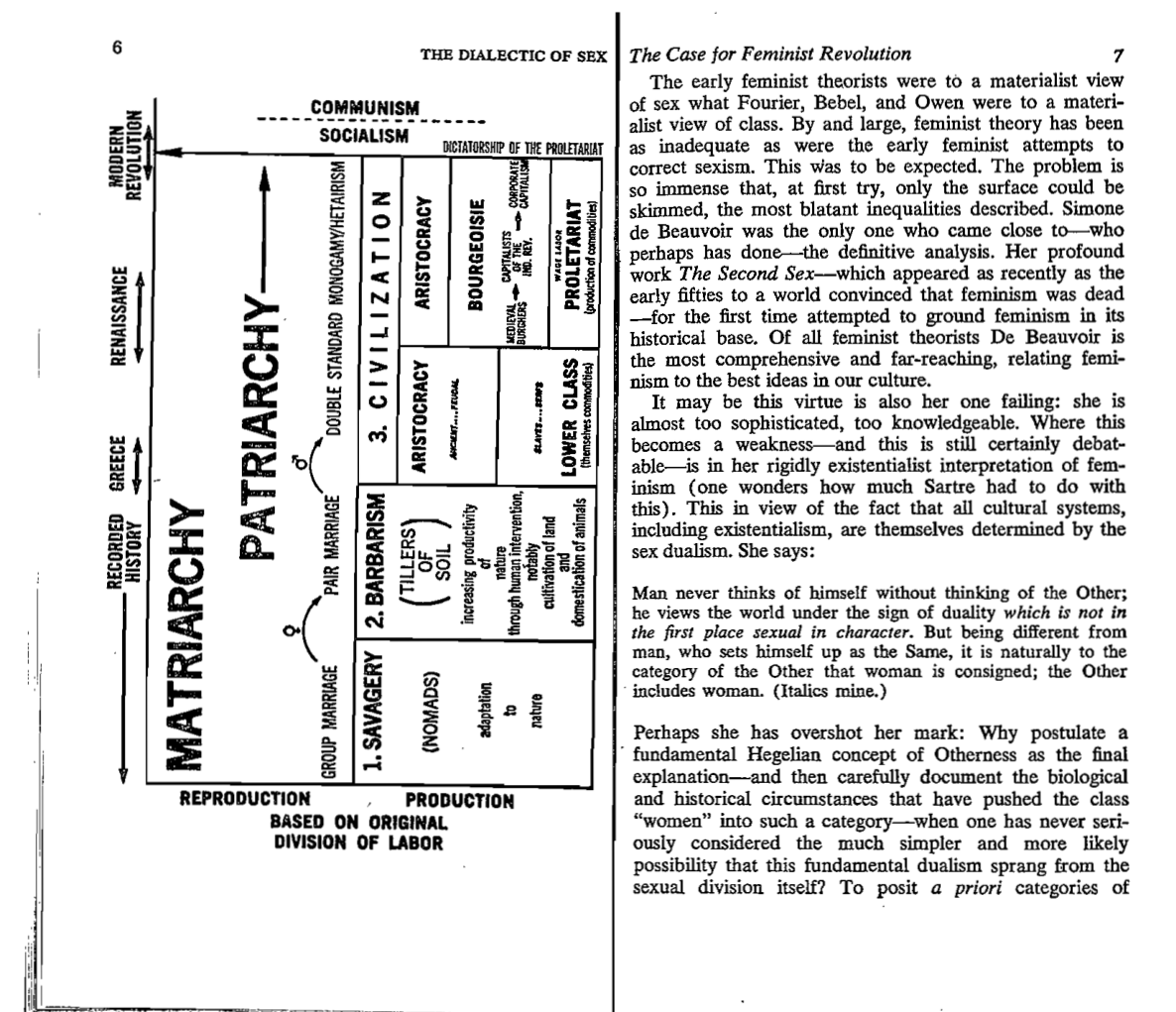
The proposed alternative is a materialist theory of history based on sex itself, tracing the development of reproduction, production, class, and sexual relations together.
Early feminist theorists made foundational but incomplete attempts to analyze sexism materially; Simone de Beauvoir is praised for grounding feminism in history and synthesizing major cultural ideas.
De Beauvoir’s existentialist framework may also limit her analysis, because existentialism itself could be shaped by the very sex dualism it seeks to explain, particularly the division between man as the “Same” and woman as the “Other.”
But there is still an untried third alternative: We can attempt to develop a materialist view of history based on sex itself.
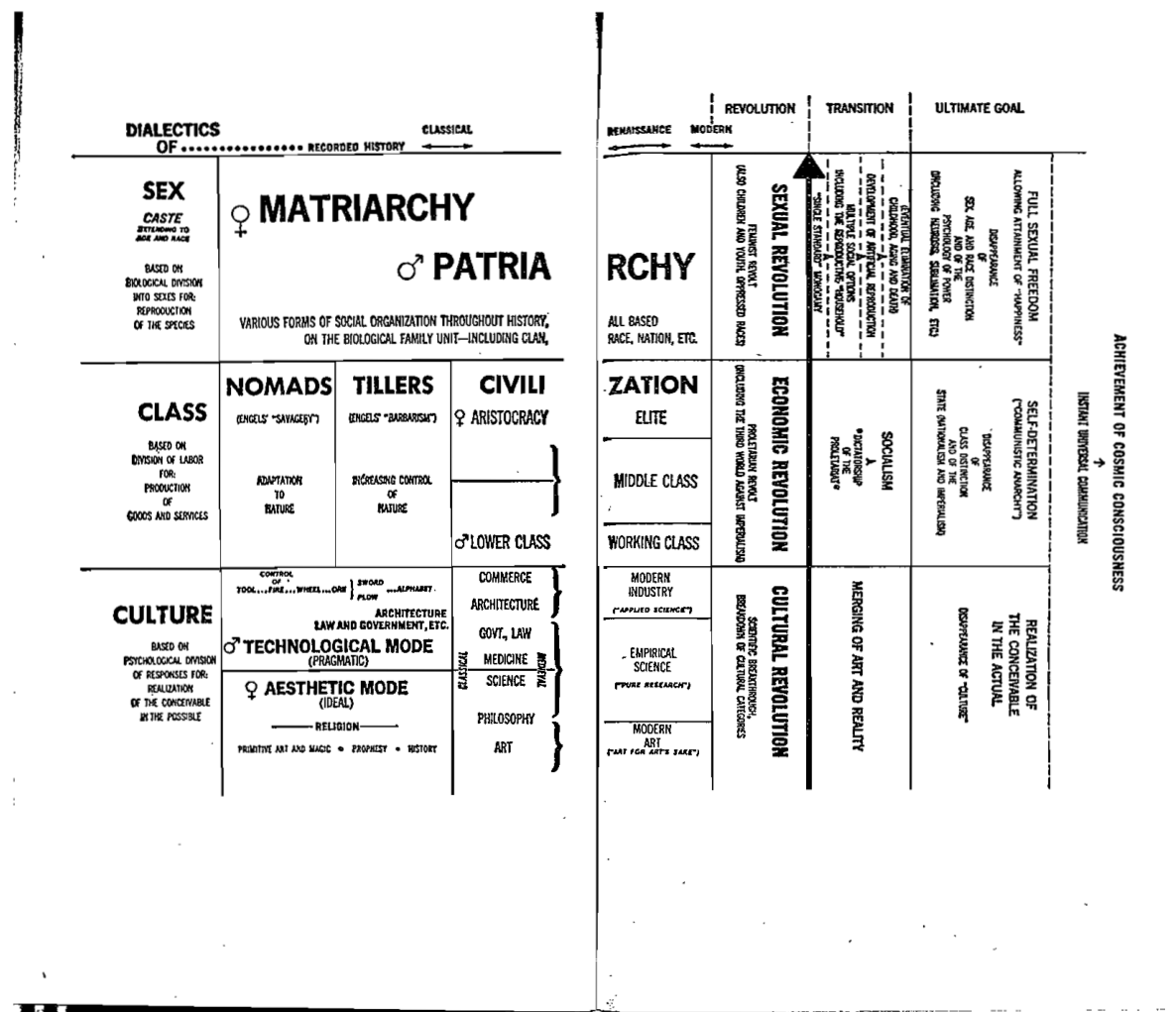
Diagram
Biology and Sex Class
The author challenges the idea that abstract concepts such as Otherness, Transcendence, and Immanence are the ultimate sources of women’s oppression, arguing instead that they may have emerged from the sexual division itself.
Sex classes are distinguished from economic classes because they originated directly in biological differences connected to reproduction.
The unequal reproductive roles of men and women created an inherent power imbalance within the biological family, shaping individuals’ psychosexual development.
Women’s dependence during menstruation, childbirth, nursing, and infant care, combined with children’s prolonged helplessness, established enduring patterns of dependency.
The author argues that reproductive differences produced the first division of labor and supplied the model for caste-based discrimination, while cultural variation demonstrates human flexibility rather than eliminating biology’s influence.
These biological contingencies of the human family cannot be covered over with anthropological sophistries.
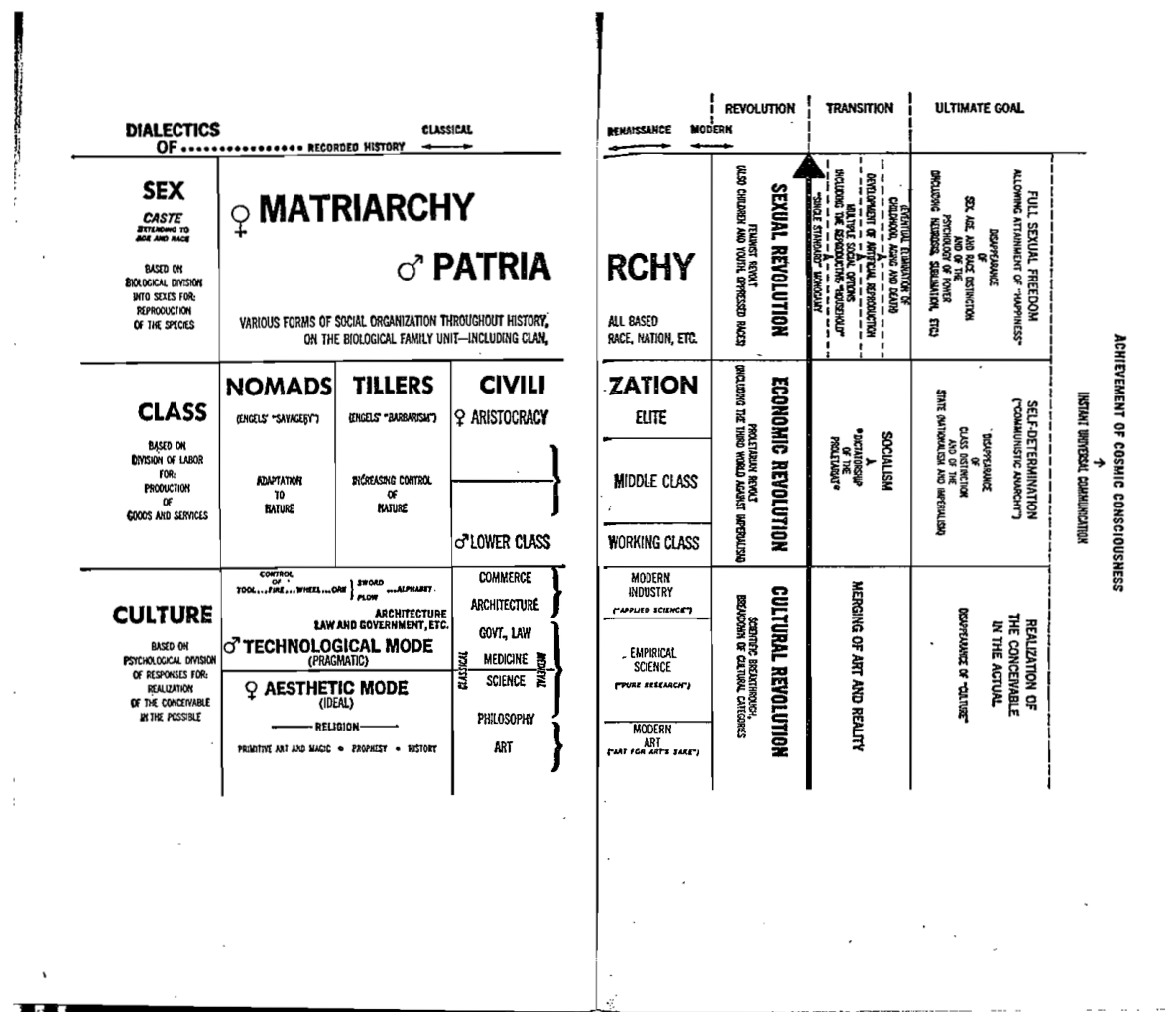
Diagram
The Case for Revolution
The nuclear family is a relatively recent arrangement, but the psychological distortions created by the biological family have appeared across many historical variations.
Because humanity can increasingly control biological conditions, nature cannot serve as a moral justification for maintaining a discriminatory sex-class system.
Ending women’s oppression is not guaranteed by technological progress; fertility control and other technologies may instead strengthen existing systems of exploitation.
A feminist revolution would require women to seize control of reproduction, including ownership of their bodies and authority over fertility, childbearing, and childrearing institutions.
The ultimate goal is not merely to eliminate male privilege but to abolish sex distinctions as a cultural hierarchy, potentially through artificial reproduction and a more liberated sexuality.
Humanity has begun to outgrow nature: we can no longer justify the maintenance of a discriminatory sex class system on grounds of its origins in Nature. Indeed, for pragmatic reasons alone it is beginning to look as if we must get rid of it (see Chapter 10).
Sexual Roots of Class
A future organized around cybernation could eliminate labor, reduce dependence on the biological family, and culturally offset adults’ physical advantages over children.
The text argues that socialism failed to abolish domination because Marxist analysis did not reach the psychosexual roots of class power.
The biological family is portrayed as the institution through which hierarchical power and exploitation can continually be reproduced.
Radical feminism is presented as an expansion of socialist class analysis, tracing social conflict back to the biological division of the sexes and reproductive organization.
The revised historical-materialist framework links sex-based divisions, marriage, reproduction, and childcare to the development of economic, political, religious, and philosophical institutions.
We shall need a sexual revolution much larger than—inclusive of—a socialist one to truly eradicate all class systems.
Sex, Power, and Revolution
Historical materialism is presented as the process by which humanity becomes conscious of—and gains control over—its natural and social organization.
The author proposes combining Marx and Engels’s analysis of social structures with Freud’s insights into inner psychology to create a political and personal theory of sexual oppression.
Freud identified psychological dynamics accurately within his social context, but mistook historically specific conditions for universal human nature, leading him toward concepts such as the Death Wish and an ineffective therapeutic solution.
Radical feminism is framed as the second wave of a vast revolution aimed at overthrowing the ancient sex-based class or caste system that gives male and female roles an appearance of permanence.
Earlier women’s rebellions could not become broadly transformative because society depended on women’s reproduction and lacked effective birth control; industrial technology created new material possibilities for feminist change.
In the radical feminist view, the new feminism is not just the revival of a serious political movement for social equality. It is the second wave of the most important revolution in history.
The Radical Feminist Movement
By the mid-nineteenth century, industrialization, abolitionism, and revolutionary ideals had helped generate a powerful feminist movement in the United States.
The early Woman’s Rights Movement was radically confrontational, challenging the family, church, and state—the central institutions of Victorian society.
Feminism was a grassroots campaign: pioneers traveled through remote areas, solicited petitions, addressed working women’s concerns, and organized labor associations.
Women had virtually no civil or political status, lacking education, property rights, legal adulthood within marriage, child custody, and the vote.
Those in power recognized the movement’s revolutionary threat, and the Civil War redirected many feminists toward supposedly more urgent causes, weakening the movement’s momentum.
Thus, even after the Civil War, more than half this country's population was still legally enslaved, literally not owning even the bustles on their backs.
Feminism’s Political Retreat
Women’s organizations united around suffrage but split over its purpose: conservatives sought gradual reform within existing structures, while radicals viewed voting rights as a means to broader political power.
By 1890, women had gained legal reforms, education, employment, and club-based influence, but these advances remained a segregated and largely indirect form of political power.
The 1890 merger of the radical and conservative suffrage organizations into NAWSA marked the triumph of cautious, single-issue feminism that sought male approval and accommodation.
Many women reformers devoted themselves to Progressive Era causes without treating women’s equality as an independent radical issue, subordinating feminism to movements dominated by men.
The author argues that women’s political movements repeatedly weakened themselves by pursuing acceptance within male institutions instead of creating autonomous structures and priorities.
Feminism, sold out, languished. Even worse than the conservative feminists were the increasing number of women who, with their new-found bit of freedom, jumped enthusiastically into all the radicalisms of the day, the various social reform movements of the Progressive Era, even when at odds with feminist interests.
Militant Suffrage Triumph
The Progressive Era saw a surge of women’s organizations, but most represented “Organized Ladyhood” rather than feminism and often held reactionary or nonfeminist views.
Between 1890 and 1920, feminist energy was largely narrowed to winning the vote, while many women devoted themselves to other reform causes instead of advancing women’s rights.
Radical feminists revived militant tactics, breaking from conservative suffragists to form the Congressional Union and later the Woman’s Party, which pursued a federal amendment and uncompromising activism.
Despite beatings, mobbing, imprisonment, and forced feeding during hunger strikes, militant suffragists helped win the vote within a decade by dramatizing the issue and abandoning the slow state-by-state strategy.
After suffrage was achieved, the establishment co-opted the movement, while Woman’s Party leaders insisted that voting was only the first step toward broader feminist goals.
It worked. Militants had to undergo embarrassment, mobbings, beatings, even hunger strikes with forced feeding, but within a decade the vote was won.
The Ballot’s Hollow Victory
Charlotte Perkins Gilman argued that women should avoid men’s party systems and organize independently around the measures they wanted.
The creation of a separate Woman’s Party in 1921 could not prevent major parties from absorbing women’s newly won political power.
According to the passage, the suffrage victory weakened the broader women’s rights movement by channeling feminist energy into the single goal of obtaining the vote.
The movement’s leaders and broader political consciousness disappeared over three generations, leaving later activists to forget what suffrage was meant to accomplish.
Winning the vote required decades of exhausting campaigns against capitalist interests, racist opposition, political machines, legislatures, parties, and Congress—yet history largely remembers only the suffrage victory itself.
The monster Ballot had swallowed everything else.
Erasing Feminist History
The text argues that women’s suffrage represented only a small part of a broader, radical women’s rights movement that has largely been erased from American history.
Brave activists such as Sojourner Truth and Harriet Tubman, along with many lesser-known women, are portrayed as more consequential than the sanitized female figures preserved in popular memory.
The omission of radical feminist figures and the reduction of women’s history to suffrage or mild reform are presented as deliberate products of cultural backlash, not historical accident.
Men retained power by conceding limited reforms while promoting carefully selected, obedient female role models and obscuring women who challenged male authority.
Beginning in the 1920s, romance and marriage were repopularized, women’s class solidarity was weakened, and emancipation was reframed as a private search for personal fulfillment rather than a political struggle.
The suspicious blanks in our history books concerning feminism—or else the confusion of the whole W.R.M. with the (conservative) suffrage movement or the reformist women's groups of the Progressive Era—is no accident.
The Cult of Style
The 1920s introduced an obsessive modern focus on personal style and glamour, promising women transformation through image.
Women’s magazines helped spread this ideal, creating a cultural pattern that continued to influence women long afterward.
Self-expression through a distinctive personal style displaced the older feminist emphasis on developing character through responsibility and experience.
After the Depression, women increasingly recognized that flapper culture and glamour did not provide a meaningful solution to their circumstances.
The search for a “different,” personal, style with which to “express” oneself replaced the old feminist emphasis on character development through responsibility and learning experience.
The Feminine Mystique
Women repeatedly encountered cultural “solutions” that redirected or concealed their dissatisfaction rather than addressing their oppression.
During World War II, women entered substantial jobs and were briefly treated as fully human because their labor was urgently needed.
Postwar prosperity brought a backlash: The Feminine Mystique encouraged women to leave employment voluntarily, preserving the myth that emancipation had already succeeded.
The 1950s offered middle-class respectability and domestic routines—marriage, motherhood, consumerism, dieting, television, and psychotherapy—in place of genuine freedom.
Young women were drawn into “Teenagerism” and romantic fantasies, while dating rituals and the parked car helped reinforce the family structure their mothers found stifling.
Genuinely needed by society to their fullest capacity, they were temporarily granted human, as opposed to female, status.
The Trap of Private Solutions
The traditional ideal of feminine popularity and romantic charm persisted in modern forms, while men increasingly rejected the burdens of courtship and sought easier sexual access.
During the 1960s, supposedly liberated men often treated women as disposable “chicks,” expecting sex without emotional commitment and labeling women who wanted more as “uptight” or a “drag.”
Women who joined countercultural communities still encountered the same sexual class system, remaining socially invisible despite pursuing supposedly liberating lifestyles.
Because feminism had been discredited or forgotten, many women sought individual “private solutions” through art, education, therapy, or political causes rather than organizing around their own oppression.
Participation in the civil rights movement, especially for white women who traveled South, helped some recognize their own subordinate status and move more quickly toward radical feminism.
There was no place they could go. Wherever they went, whether Greenwich Village c. 1960, Berkeley or Mississippi c. 1964, Haight-Ashbury or the East Village c. 1967, they were still only "chicks," invisible as people.
Feminism’s Resurgent Anger
The “Myth of Emancipation” defused women’s frustrations for decades by using smear tactics, erasing feminist history, and presenting therapy or domesticity as false solutions.
By 1970, women possessed legal freedoms and educational opportunities but still lacked meaningful power, employment prospects, and protection from sexual exploitation.
Mass media intensified women’s alienation by bombarding them with blatant, hateful, and erotic images that exposed and reinforced oppressive sex roles.
Women’s frustration first surfaced through withdrawal and participation in other dissent movements, especially civil rights, before the analogy between racism and sexism helped generate women’s liberation.
Although other movements acted as catalysts, the author argues that feminism has its own cyclical momentum, driven by technologies capable of freeing women from reproductive and sexual-class constraints.
The anger spilled over, finally, into its proper outlet.
Feminism’s Revolutionary Divide
Counterrevolution, war, and depression obstructed feminism, leaving potentially transformative scientific advances confined to the laboratory while traditional social-sexual practices persisted and intensified.
Because scientific changes separating sex from reproduction produced little cultural transformation, the author argues that feminism’s central problem is political rather than technological.
Feminist goals, the text contends, cannot be achieved through gradual evolution; power must be directly challenged because it will not be surrendered without struggle.
The emerging women’s liberation movement has recreated the old divide among conservative reformers, political activists, and radical feminists, though its groups and loyalties remain fluid.
NOW represents the conservative camp by pursuing legal equality, employment rights, and other reforms within the existing system, echoing the earlier suffragist movement.
Pressure from younger radical feminists has pushed NOW toward more demanding positions, including making abortion-law repeal a central goal.
The goals of feminism can never be achieved through evolution, but only through revolution. Power, however it has evolved, whatever its origins, will not be given up without a struggle.
Feminism Under the Left
“Politicos” prioritize loyalty to the broader Left over the Women’s Liberation Movement, treating male concerns as universal and women’s concerns as merely sectarian.
Women’s caucuses within leftist organizations generally seek reform and influence inside existing structures, often using women’s issues mainly to recruit women into the “Larger Struggle.”
The passage condemns the patronizing assumption that women are politically backward and must be educated or organized by more advanced revolutionaries.
The author highlights a contradiction in Black Power and leftist politics: principles such as self-organization around oppression are defended for other groups but denied to women.
Women’s groups operating under the Left’s male leadership are constrained by externally imposed analysis and tactics, likely to receive token concessions or eventually split into the independent women’s movement.
We have here a complete denial by blacks (and women, no less) of their own principles of Black Power as applied to another group: the right of the oppressed to organize around their oppression as they see and define it.
Feminism and Left Politics
The “Feminist Politicos” acknowledge that women need independent organizations focused on women’s oppression, but still subordinate those efforts to established leftist priorities.
Across the political spectrum described, feminism is treated as secondary and forced to fit a preexisting, male-created revolutionary framework.
The author argues that politico women have not fully confronted their own oppression, leaving them dependent on male approval and unable to develop an authentic feminist analysis.
This dependence traps them in left reformism, weakens their originality, and ultimately produces political sterility.
Radical feminism pushes these groups toward greater militancy, while male-dominated left movements attempt to co-opt feminist demands, such as opposition to monogamy.
For the Left Brotherhood have been quick to jump in to see what they could co-opt—coming up with a statement against monogamy, at which clear sign of male-at-work, feminists could only laugh bitterly.
Radical Feminist Potential
The left is beginning to acknowledge women as an oppressed group, but its gestures remain superficial, tokenistic, and shaped by nervous attempts at appeasement.
Radical feminism emerges as an alternative to both bureaucratic mainstream feminism and outdated leftist doctrine, attracting disillusioned women from each camp.
Radical feminists treat women’s liberation as the primary revolutionary issue, arguing that economic class oppression originates in a deeper sexual class system.
Because women constitute an oppressed majority distributed across every social class, feminism has an unusually broad capacity to disrupt society’s fundamental structures.
The movement’s distinctive strength is its fusion of personal experience with political action, creating a new style of relationships that reconnects public life with emotion and the senses.
A revolutionary in every bedroom cannot fail to shake up the status quo. And if it’s your wife who is revolting, you can’t just split to the suburbs.
Feminism Beyond Power
The established left is divided between rigid, abstract or macho orthodox Marxists and countercultural movements that reject old analysis but lack a coherent historical and economic foundation.
The feminist movement is presented as a potential bridge between emotional mass appeal and rigorous revolutionary analysis, offering the “solder” needed to unite a fragmented Movement.
Revolutionary groups often reproduce power struggles through leadership cults, factionalism, ego-tripping, and backbiting, despite preaching liberation.
Although the women’s movement’s commitment to internal democracy is imperfect and sometimes masks familiar power plays, feminism directly confronts dominance and submission at their roots in sex and family structure.
The text introduces Freud as a pervasive influence on modern American culture, arguing that psychoanalytic concepts have become embedded in everyday language and self-understanding.
But if any revolutionary movement can succeed at establishing an egalitarian structure, radical feminism will.
Why Freud Endures
Freudianism is portrayed as a modern religion, complete with rituals, converts, authority, and the power to label skepticism as psychological resistance.
Although critics have exposed contradictions in Freud’s theories and behaviorism has challenged psychoanalysis, these critiques have not displaced Freudian ideas.
Psychoanalytic therapy is described as ineffective and potentially self-perpetuating, producing further self-absorption and neurosis in patients.
Freud’s defenders seem unable to reject him completely, partly because their own intellectual integrity makes them hesitate before destroying the entire system.
Freud continues to command influence because he identified sexuality as a central, unresolved problem of modern life—a subject later connected to feminism.
Freudianism has become, with its confessionals and penance, its proselytes and converts, with the millions spent on its upkeep, our modern Church.
Freud and Feminism
Freudianism and feminism emerged from the same early-twentieth-century upheaval over sexuality, marriage, family, and women’s roles.
Feminist concerns deeply shaped literature, politics, and everyday relationships, affecting women whether they embraced or resisted new ideas.
Both movements reacted against Victorian sexual repression and the smugness of a family-centered social order, but they pursued different ends.
Freud identified sexuality and childhood repression as central forces shaping individual psychology and producing neurosis or psychosis.
The text presents Freud primarily as a diagnostician, while feminism is portrayed as a movement seeking to cure the oppressive conditions he analyzed.
Freud’s therapeutic method of transference is criticized as emotionally driven and ineffective, potentially causing further harm rather than genuine liberation.
Both movements signified awakening: but Freud was merely a diagnostician for what Feminism purports to cure.
Reassessing Freud
Several studies reported that psychoanalysis failed more often than it succeeded, with improvement rates lower than those for other psychotherapy or even no treatment.
Freud’s failure to question the social environment shaping psychological structures created major confusion in the disciplines built on his theories.
His followers tried to resolve the contradiction of treating problems within the very society that produced them, eventually discarding much of Freud’s framework.
The author argues that Freud’s ideas may contain genuine insight, but should be understood as poetic metaphors rather than literal scientific truths.
The Oedipus complex is introduced as a central Freudian concept whose consequences, especially in a male-dominated culture, may be particularly damaging to the male psyche.
I believe Freud was talking about something real, though perhaps his ideas, taken literally, lead to absurdity—for his genius was poetic rather than scientific; his ideas are more valuable as metaphors than as literal truths.
Oedipus and Patriarchal Power
The Oedipus Complex is presented as either psychoanalysis’s major discovery or a doomed theory destined for oblivion, revealing deep disagreement over its validity.
Andrew Salter argues that Freud’s account is logically contradictory: if castration fear and repression produce mental health, then “normality” conflicts with Freud’s opposition to repression.
The text proposes that the Oedipus Complex is best understood through power relations rather than purely psychological dynamics.
In the patriarchal nuclear family, the father controls economic resources, the mother’s labor and sexuality, and the children’s upbringing, creating a structure of dependency and authority.
Even modern families often reproduce this triangle because unequal employment, motherhood, and childcare leave women and children economically dependent, making true independence difficult without transforming the family itself.
His rights over them are complete. If he is not a kind father/master, tough luck.
Power, Love, and Oedipus
Children quickly recognize the unequal power structure within the traditional family and often see the mother as both an ally and a limited source of protection.
The father is portrayed as possessing reliable physical and disciplinary authority, while the mother’s influence depends on emotional appeals, tears, and circumstances.
Traditional gender roles divide parental love into unconditional maternal devotion and conditional paternal approval based on achievement, obedience, and resemblance.
Erich Fromm presents the mother as representing home and nature, and the father as representing law, discipline, achievement, and entry into the wider world.
The author argues that this parental polarity shapes the Oedipus Complex: a boy first identifies with his mother because of their shared dependence and opposition to the more powerful father.
He has a bond with her in oppression: while he is oppressed by both parents, she, at least, is oppressed by one.
Gendered Childhood Socialization
The passage challenges a literal Freudian reading of childhood sexuality, arguing that early emotional and physical attachments are initially integrated rather than focused on genital desire.
Around age six, boys are pressured to abandon tenderness and maternal closeness in favor of stereotypically masculine behavior, discipline, and identification with their fathers.
Boys may fear and resent fathers who appear cruel or who mistreat their mothers, making paternal identification emotionally conflicted rather than natural.
According to Fromm’s interpretation, boys ultimately accept paternal identification because the father symbolizes access to adulthood, power, adventure, law, and the wider social world.
This transition requires boys to repress their sympathy for their mothers and their contempt for patriarchal authority, while the following discussion suggests that girls likewise struggle with contradictory standards for gendered behavior.
If he cries he is called a "sissy"; if he runs to his mother, a "mama’s boy."
Power Behind Sexual Roles
Girls may initially experience their bodies as equal to boys’ and remain unaware of the adult female role imposed on them.
Dolls, domestic play, and ideals of attractiveness are presented as tools for persuading girls to accept motherhood and femininity before they recognize them as necessities.
A feminist reinterpretation recasts Freudian concepts—such as parental fantasies and fetishism—as expressions of children’s relationships to power, attachment, and parental authority rather than phallic symbolism.
The passage argues that homosexuality and the incest taboo can be understood as symptoms of the power psychology produced by the patriarchal family.
Durkheim’s theory of incest prohibition is introduced as another influential but contested attempt to explain how family and clan structures generate sexual rules.
It is hoped that she will slip into it early, by persuasion, artificially, rather than by necessity; that the abstract promise of a baby will be enough of a lure to substitute for that exciting world of “travel and adventure.”
Incest Taboo and Sexual Repression
The incest taboo emerged from exogamy and the family’s transformation into the center of moral life, eventually becoming deeply entrenched in culture.
Because sexuality and passion were separated from family relationships, eliminating the taboo would require overturning the family and sexual structures built around it.
The text argues that incest prohibition normalized sexual repression, limiting individual fulfillment and producing psychological penalties.
Drawing on Freud and Ruth Hirschberger, it presents homosexuality as potentially arising when expected emotional and sexual repressions fail or when children resist prescribed shifts in attachment.
Maternal possessiveness is linked to women’s social deprivation: in a patriarchal world, the child may become a substitute for the freedom, recognition, and fulfillment denied to the mother.
So that to eliminate the incest taboo we would have to eliminate the family and sexuality as it is now structured. Not such a bad idea.
Sexuality Beyond the Family
The text argues that girls’ sexual development is complicated by early attachment to the mother, identification with the father, and pressure to seek male privilege or approval.
It claims that many women who appear sexually adjusted remain unfulfilled, partly because social pressures have shaped sexuality around male needs and power.
The author distinguishes the social consequences of male and female sexual repression, arguing that male sexuality conflated with power more directly harms others.
Family structures and the incest taboo are presented as forces that repress and channel the initially diffuse sexual drive into restrictive heterosexual and homosexual forms.
The author imagines that abolishing the family could allow a healthier, more fluid sexuality—possibly making physical sex differences less decisive in attraction.
Homosexuals in our time are only the extreme casualties of the system of obstructed sexuality that develops in the family.
Sexual Division and Culture
The incest taboo and family structure teach children to separate emotional attachment from sexual desire, producing a divided personality.
This psychological split is projected onto women through the “good/bad woman” syndrome, separating those deemed worthy of love from those deemed sexually available.
Prostitutes and other women suffer materially and socially from a cultural system that degrades women in order to permit sexual desire toward them.
The separation of sex from emotion has shaped Western art, literature, courtly love, and religious ideals such as Marianism.
The author argues that abolishing the family and incest taboo could release sexuality from repression, transform culture, and reduce both individual neurosis and broader social illnesses.
The separation of sex from emotion is at the very foundations of Western culture and civilization.
Freudianism and Feminism
Freudianism and feminism emerged from the same historical conditions: intensified family privatization, women’s subjugation, sexual repression, and resulting neuroses.
Both movements drew on the same underlying realities, but radical feminism rejected the idea that the patriarchal family and its repressive social context were permanent.
The author argues that dismantling the family would eliminate the need to subordinate pleasure to reality through sexual repression.
Freudianism eventually subsumed feminism as the more acceptable—or “lesser evil”—response to social unrest, after both were initially ridiculed as threats to society.
The feminist movement was redirected into the struggle for voting rights; afterward, the flapper era expressed female rebellion through a supposedly liberated sexuality without a lasting political direction.
Because these freedoms remained within the patriarchal nuclear family, the result was not genuine liberation but a more sophisticated form of repression.
They were a roused class who did not know what to do with their consciousness.
Therapy as Resignation
In a repressive society, individual happiness and development conflict with the social order, so even apparent values can become instruments of repression.
“Repressive de-sublimation” spreads sexuality into business, politics, and propaganda, weakening erotic energy by bringing it under the control of the existing reality principle.
Hollywood’s image of the liberated career woman offered pseudo-liberation that fueled antifeminist backlash and helped preserve male supremacy.
Freudianism shifted from speculative theory toward clinical practice, stripping away concepts that challenged society’s basic organization.
The resulting ideal of “adjustment” demands that oppressed people accept racism, sexism, and imposed limits rather than pursue self-definition.
Therapy therefore becomes “a course in resignation,” exchanging deep misery for the supposedly manageable condition of everyday unhappiness.
The term that perhaps best characterizes this neo-Freudian revisionism is "adjustment." But adjustment to what?
Psychoanalysis and Sexism
The psychiatrist reduces the narrator’s distress to hatred of her mother while refusing to engage with her denunciations of white racism.
The text condemns psychoanalysts for ignoring the objective social differences between men and women, despite claiming expertise in emotional life.
Theodor Reik’s observations inadvertently expose women’s social insecurity, dependence, and fear, yet he draws crude and fundamentally mistaken conclusions from them.
Reik’s theories explain women’s behavior through genital deficiency, ugliness, cleanliness, and sexual anxiety, revealing the misogyny embedded in supposedly scientific interpretations.
The narrator contrasts Reik’s blindness with the perceptiveness of his female patients, who understand the realities of their situation better than he does.
It reads like a Freudian jokebook.
Psychoanalysis Against Feminism
Women in therapy struggle to express anger, fearing that their aggressiveness will be destructive or socially unacceptable.
Patients recognize the contradiction of patriarchy: men deny women full personhood while constantly reminding them of their subordinate status.
When women openly resist misogynistic interpretations, psychoanalysts often restore conventional femininity rather than confront the source of their frustration.
The spread of psychoanalysis in the 1920s and 1930s offered treatment for widespread social discontent, but treated structural oppression as individual neurosis.
The author argues that women’s suffering could not be resolved through therapy because the underlying problem required feminist revolution, not psychological adjustment.
“Walk down Wall Street and you'll see it's a man's world.”
Psychology Containing Feminism
Psychology and related behavioral sciences were redirected toward “social adjustment,” training women to accept traditional roles as wives and mothers.
Education, social work, sociology, and anthropology were portrayed as pseudo-sciences that both indoctrinated women and encouraged acceptance of the existing social order.
Women’s increased access to higher education was undermined when they were funneled into fields that offered jargon and role conditioning rather than genuine power or intellectual freedom.
Freudian theory helped suppress the unresolved tensions created by the first feminist revolt by treating social distress as an individual problem to be managed.
Freudianism ultimately flourished by containing feminism’s disruptive force: it appeared radical enough to attract the oppressed while never challenging the underlying patriarchal reality.
Freudianism was the perfect foil for feminism, because, though it struck the same nerve, it had a safety catch that feminism didn't—it never questioned the given reality.
Women, Children, and Oppression
Psychology and behavioral science are beginning to confront the damage caused by decades of drugging and inadequate therapeutic approaches.
The author argues that women’s liberation cannot be separated from children’s liberation because both groups share and reinforce forms of oppression.
The biological family’s power hierarchy and sexual repression are presented as deeply damaging to individual psychological development.
The author rejects romanticizing ancient matriarchies and examines how patriarchal structures emerged through men’s control over reproduction, nature, and social authority.
Women’s reproductive biology is identified as a central historical basis of their oppression, while children’s development is shaped by the institutions built around that oppression.
Political organization, rather than therapy alone, is proposed as the force capable of producing meaningful change.
I submit, however, that the nature of this bond is no more than shared oppression.
History of Patriarchal Family
The text rejects matriarchy as a solution to women’s oppression, arguing that worship and idealization still deny women equal social standing.
Looking to history does not provide a perfect alternative model, but it reveals that oppression has varied in degree and form across cultures.
The patriarchal family repeatedly defined women as a separate social category because of their childbearing capacity.
The Roman familia illustrates the family’s origins in male authority, domestic slavery, and legal power over wives, children, and slaves.
The modern nuclear family is a relatively recent institution, developing from the fourteenth century onward under changing cultural and economic conditions.
In the medieval period, family identity centered on lineage, inheritance, and public life rather than the private conjugal household; later, paternal authority and primogeniture reshaped it.
To be worshipped is not freedom. For worship still takes place in someone else's head, and that head belongs to Man.
The Invention of Childhood
Medieval people lived within large, fluid communities that included extended family, servants, vassals, musicians, and animals, rather than isolated private households.
These expansive social bodies gradually fragmented into small families and broader class groupings, transforming culture and individual psychology.
New ideas about life stages emerged during this transition, including adolescence and, most significantly, childhood.
Medieval society did not distinguish children sharply from adults; children were depicted as miniature adults and expected to move quickly toward established social roles.
A child’s identity was defined by inherited class and name, with childhood understood mainly as apprenticeship for a future adult position.
In the Middle Ages there was no such thing as childhood. The medieval view of children was profoundly different from ours.
Children as Apprentices
Before childhood became recognized as a distinct social state, children and servants were described using the same language of feudal subordination.
Children functioned as a transient servant class: their dependence was considered natural because every adult had once occupied that position.
Children commonly lived apart from their parents, first with wetnurses and later as apprentices in another household, limiting strong parent-child bonds.
Large patriarchal households and high infant mortality meant children were not central to family life or objects of intense parental attachment.
Children learned adulthood through daily participation in adult work and society, while their closeness to servants later came to be viewed as morally corrupting.
All children were literally servants; it was their apprenticeship to adulthood.
The Invention of Childhood
Before the modern era, children were integrated into community life rather than separated into child-specific spaces, schools, or activities.
Children and adults shared games, festivities, clothing, and practical learning; apprenticeships were open to people of any age.
After the fourteenth century, the rise of the bourgeoisie, empirical science, and the modern family gradually produced the concept of childhood.
New language for children, including baby talk or “childrenese,” emerged alongside child-specific toys and eventually specialized games.
By the seventeenth century, dividing activities by age also reflected class divisions, as some games became associated with children and lower classes while others became upper-class adult entertainments.
Children's toys did not appear until 1600 and even then were not used beyond the age of three or four. The first toys were only childsize replicas of adult objects: the hobby horse took the place of the real horse that the child was too small to ride.
The Invention of Childhood
From the sixteenth century onward, childhood became a distinct social category associated with purity, innocence, and vulnerability, leading to greater respect but also increased segregation and supervision.
The emerging bourgeois family became child-centered, abolishing much of children’s earlier independence and isolating them from broader society.
Children’s clothing offers a visible record of changing class and age distinctions, since garments signaled rank, prosperity, and social exclusion.
Special children’s costumes appeared in the late sixteenth century; their archaic, lower-class styles symbolized children’s exclusion from contemporary public life and their subordinate status within elite families.
Male children’s clothing marked a progression from maternal identification to adult masculinity, culminating in military-styled dress that functioned as an initiation into manhood and reinforced the chapter’s Oedipal framework.
Their isolation and segregation had set in. The new bourgeois family, childcentered, entailed a constant supervision; all earlier independence was abolished.
Childhood, Dress, and Class
Elite boys’ changing costumes symbolized their movement from identification with women toward adult male authority and power.
Girls were treated as miniature adult women rather than children: they wore adult-style clothing, received little schooling, and were often married soon after puberty.
The absence of childhood for girls and working-class boys reveals childhood as a class privilege reserved largely for those destined for freedom and status.
Changes in boys’ and women’s clothing were linked to broader struggles over gender hierarchy and class subjection; the decline of Little Lord Fauntleroy attire coincided with challenges to restrictive women’s dress.
Modern schooling transformed childhood from an abstract idea into an institutional reality, serving less simply to transmit knowledge than to discipline and morally shape children.
The school’s emphasis on repression and ascetic discipline helped define the passage from childhood toward socially recognized adulthood.
Little Lord Fauntleroy went the way of the petticoat.
The Invention of Childhood
The modern school emerged less from medieval scholarship or Renaissance humanism than from seventeenth-century moralists and educators, especially the Jesuits, Oratorians, and Jansenists.
These reformers developed the modern concept of childhood by emphasizing children’s weakness and innocence and separating them from adult society.
Discipline and constant supervision were presented as gentle, loving care, while creating a new psychological distance between adults and children.
Prolonged schooling and severe initiation into adulthood increasingly underestimated children’s abilities and diminished the precocity once common in earlier eras.
The decline of child prodigies, contrasted with figures such as Mozart and Talmudic scholars, suggests that modern lessons may represent child oppression rather than genuine development.
The new schooling effectively segregated children off from the adult world for longer and longer periods of time. But this segregation of child from adult, and the severe initiation process demanded to make the transition to adulthood, indicated a growing disrespect for, a systematic underestimation of, the abilities of the child.
The Invention of Childhood
The Dauphin’s childhood shows that an average child could master music, sports, reading, strategy, and other adult activities far earlier than modern assumptions suggest.
Before the nuclear family and modern schooling, children entered adult society as soon as they were capable, learning directly through participation rather than prolonged separation.
Around age seven, children began to experience gender-based differentiation, but the sharper division between childhood and adulthood had not yet fully emerged.
The child-centered nuclear family created institutions designed to keep children under parental authority and replace practical apprenticeship with theoretical schooling.
By isolating children from adults, older peers, and varied activities, modern schools are portrayed as disciplining and leveling children rather than accelerating their intellectual development.
By sequestering children away from the adult world—adults are, after all, simply larger children with worldly experience—and by artificially subjecting them to an adult/child ratio of one to twenty-plus, how could the final effect be other than a leveling of the group to a median (mediocre) intelligence?
Constructing Childhood
Rigid age-grading and standardized curricula shifted children’s motivation outward, making them approval-conscious and suppressing originality.
Children were transformed into a distinct social class, ranked by age, ability, and status, with adulthood treated as the ultimate measure of worth.
The modern family’s rise encouraged prolonged childhood, binding children psychologically, emotionally, and financially to the household.
New customs—special clothing, toys, language, manners, and stories—portrayed children as fundamentally different from adults and delayed their entry into adult life.
Modern schools institutionalized this separation by segregating children by age, enforcing discipline, and extending their economic dependence while postponing specialized skills.
But none of this would have worked to effectively make of children an oppressed class if a special institution hadn’t been created to do the job thoroughly: the modern school. The ideology of school was the ideology of childhood.
Childhood, Femininity, and Class
The family reproduces economic hierarchy: the husband functions as the bourgeois, while the wife and children occupy a proletarian-like position.
Children and working-class people are portrayed as sharing stereotypes of being carefree, practical, less intellectual, and supposedly content with their subordinate status.
The cultural myths of childhood and femininity similarly depict women and children as asexual, pure, mentally deficient, and deserving of protective “respect” that conceals oppression.
Special clothing, education, manners, and assigned tasks exaggerate physical differences until socially imposed roles appear natural and instinctive.
Because direct participation in adult power is restricted, women and children learn indirect strategies for influence, while language further reduces them to animal-like categories.
The pedestal of adoration on which both were set made it hard for them to breathe.
The Politics of Cuteness
Oppression of women and children is harder to challenge when disguised as affectionate “cuteness” or friendly attention.
Women and children are expected to smile and appear pleased, making their outward friendliness a sign of enforced submission rather than genuine consent.
The author proposes a “smile boycott” for women and an end to unwanted fondling of children, insisting that affection should be welcomed by its recipient.
The modern nuclear family intensified women’s economic dependence and children’s subordination, causing their forms of oppression to reinforce each other.
Cultural myths glorify childbirth, motherhood, and childrearing while obscuring the author’s claim that excessive “raising” can retard children’s development.
The smile is the child/woman equivalent of the shuffle; it indicates acquiescence of the victim to his own oppression.
The Consumerist Childhood
The privatization of family life intensified the oppression of women and children through the cultural myths of femininity and childhood.
Women’s rebellion weakened these myths but did not destroy them; instead, they went underground and returned in forms shaped by mass consumerism.
Children’s supposed emancipation removed visible restraints while expanding industries, institutions, and experts devoted to controlling and socializing them.
Compulsory education, government programs, and social workers create an inescapable system of supervision that leaves even dropouts struggling to resist it.
Modern childhood is defined by compulsory happiness, with parents and industries pressured to provide toys, entertainment, products, and experiences that manufacture an idealized “Golden Age.”
Children must be living embodiments of happiness (sulky or upset or disturbed children are immediately disliked; they make of the myth a lie); it is every parent's duty to give his child a childhood to remember (swing sets, inflated swimming pools, toys and games, camping trips, birthday parties, etc.).
The Myth of Childhood
Modern culture treats youth as a Golden Age, judging other stages of life by their supposed resemblance to childhood.
Age segregation—in parks, schools, and social life—isolates children and prevents adults from seeing childhood as a normal part of human experience.
Because people lose contact with children and repress the realities of their own childhoods, they become vulnerable to sentimental ideas about youthful happiness.
Young adults may idealize having children as a way to recover lost joy, only to confront the ordinary difficulties and humanity of children through parenting.
The myth of carefree childhood serves adults more than children, offering hope that life contains at least one period free from alienation, care, and drudgery.
In a culture of alienated people, the belief that everyone has at least one good period in life free of care and drudgery dies hard.
The Oppression of Childhood
Children remain segregated and oppressed as a class, living without civil rights and legally subject to the arbitrary authority of their parents.
Their physical weakness is compounded by economic dependence, making children vulnerable to abuse, neglect, and the humiliation of relying on parental charity.
The idealized notion of childhood as a period of protection and progress largely reflects the needs of middle-class families rather than children’s actual experiences.
Working-class children were historically exploited alongside their families, while middle- and upper-class children were sheltered but subjected to restrictive, soul-crushing dependence.
The author argues that sheltered childhood is not necessarily liberation: protection from labor may simply replace physical exploitation with spiritual and economic oppression.
Such extreme dependence is not worth the bread.
Childhood and Repression
The text argues that protesting child exploitation is insufficient; society must eliminate the exploitation of adults that makes children’s dependence possible.
True freedom requires self-regulation, while patronage and dependence keep women and children in a form of “privileged slavery.”
Drawing on Freud, the author maintains that children begin with a capacity for pleasure, but socialization quickly imposes repression and the “reality principle.”
Feeding schedules, weaning, toilet training, gender conditioning, and parental discipline progressively suppress children’s sexuality and spontaneity.
This forced asexuality and repression may contribute to children’s later aggression, restlessness, or passive docility, revealing family life as a central mechanism of social control.
The privileged slavery (patronage) that women and children undergo is not freedom. For self-regulation is the basis of freedom, and dependence the origin of inequality.
Family and School Repression
Families preserve a “happy” image through collective resistance and elaborate strategies that keep members unaware of their own dysfunction.
Children’s candid remarks reveal the painful absurdity and emotional confusion that adults normalize within family life.
Schools cement repression by prohibiting physical spontaneity and redirecting children’s natural enjoyment of play toward obedience and socialization.
Idealistic teachers soon confront the school as a compulsory institution whose structure resembles a jail, even when its methods are liberal.
Interesting activities may attract children, but they cannot fully overcome a system that ultimately subordinates curiosity to discipline rather than allowing children to direct their own learning.
The child is forced to go to them: the test is that he would never go of his own accord.
Childhood Under Supervision
The author argues that modern schools are structurally coercive and consume much of children’s time, leaving little room for independent initiative.
Middle-class children are portrayed as heavily managed through supervised play, prescribed toys, restricted friendships, organized activities, and censored cultural materials.
Open street life in working-class and ghetto communities is presented as offering greater autonomy, creativity, social exploration, and contact with adults.
Resource scarcity can foster ingenuity, as children invent toys and games from discarded materials rather than relying on commercially produced entertainment.
The passage also claims that lower-class children show greater resistance to school and greater sexual freedom, contrasting this with the controlled norms of middle-class childhood.
In class they are wild and unruly, as indeed they ought to be—for the classroom is a situation that would make any even partially free person suspicious. There is a lingering disrespect for school in the lower class, for, after all, it is a middle-class phenomenon in origin.
Childhood and Class
Lower-class children are portrayed as bright, original, and imaginative, not inherently less intelligent than middle-class children.
Their relative freedom in childhood comes from being less closely supervised, but this freedom exists alongside economic dependence and oppression.
As they enter adulthood, restrictive economic realities drain their creativity and reinforce their subordination.
Children long to grow up because adulthood seems to promise independence, love, money, and escape from their parents’ misery.
Children also endure ridicule for their ignorance and gullibility, sometimes attempting to exploit these traits for affection in ways they do not fully understand.
Thus it is day-by-day oppression that produces these listless and unimaginative adults, the ubiquitous restrictions on their personal freedom to expand—not their wild childhood.
Children and Liberation
Children’s seemingly irrational behavior often follows logically from their limited information and dependence on arbitrary adult rules.
Far from being freer than adults, children are portrayed as constrained by physical inadequacy, economic dependence, ignorance, shame, and constant repression.
These conditions produce insecure, aggressive, and defensive behavior, while children’s isolation and upbringing are disproportionately assigned to women.
Feminist revolution must include children’s oppression rather than repeat the failure of ignoring forms of oppression that do not directly affect the analyst.
The ultimate goal is to eliminate the social conditions that create both femininity and childhood, enabling a fully human condition in which children can speak for themselves.
Childhood is hell. The result is the insecure, and therefore aggressive/defensive, often obnoxious little person we call a child.
Sex, Race, and Power
Calvin Hernton’s Sex and Racism in America became immediately popular because it exposed the deep entanglement of sexual desire, racial prejudice, and social power.
The early civil rights movement muted racial differences and avoided openly discussing the sexual anxieties underlying white-black relations in order to appear acceptable to white America.
Black Power disrupted that careful silence by bringing racial conflict, masculinity, and sexualized fears into the open.
White authorities were less threatened by black male claims to manhood than by their demand for political and social power, which reframed the conflict as a struggle between men.
The passage ends by asking why racial prejudice and white fears of Black people are so frequently expressed through sexual imagery, setting up a deeper analysis of racism’s psychological roots.
No, it was not black manhood itself that got whites up-tight—it was what manhood means in action: power.
Racism as Sexual Hierarchy
The author argues that racism is fundamentally connected to sexual power, claiming it can be understood as “sexism extended” through broader social hierarchies.
The passage critiques fashionable racial-sexual stereotypes, including assumptions about racial ranking, Black male virility, and the idealized “Black womb” or maternal Africa.
Economic data are used to challenge these stereotypes, showing that Black women occupied the lowest income position among the four racial-gender groups cited.
American race relations are presented as a larger version of the nuclear family: white men function as fathers, white women as dependent wives and mothers, and Black people as subordinated children.
The author applies the Oedipal family model to Black men and white women, arguing that their shared subordination by white men creates a psychological and sometimes political bond.
They have a special bond in oppression in the same way that the mother and child are united against the father.
Racialized Gender Conflict
The white woman is portrayed as isolated and subordinated under white patriarchy, yet she may seek power indirectly through identification with black men, especially her sons.
Some women abandon collective liberation and merge their identities with powerful men, hoping to acquire reflected authority; the author labels this dependence a form of white women’s racism.
This racism is described as unstable and rooted in threatened class status, with black men becoming scapegoats for anger that white women cannot direct toward their husbands.
White women are said to oscillate between vicarious sympathy for black men and hysterical racism, leaving even radical women vulnerable to disappointment when men or movements exploit them or neglect women’s demands.
The black man’s relationship to the white woman is characterized as intensely ambivalent—mixing sympathy, erotic attraction, hatred, jealousy, and a desire for revenge—analyzed through the example of LeRoi Jones’s play Dutchman.
Thus the black man may become a scapegoat for the venom the woman feels for her husband, but is incapable of admitting directly.
Racism as Family Drama
The author interprets the relationship between Black and white men through a father-son model, arguing that white society demands submission to its definition of manhood.
Black men are presented with three paths: accommodation and “Uncle Tomism,” rejection expressed through sexualized or misogynistic posturing, or rebellion against the dominant power structure.
The author links challenges to white male authority—especially access to white women—with “racial castration,” culminating literally in lynching.
Black women are framed through a daughter-father model: they may seek power by imitating white men and becoming achievers, or by competing sexually for white male approval.
The strained relationship between Black men and women is described as sibling rivalry, while racism is also cast as an “Eternal Triangle” involving the white husband, white wife, and Black “Other Woman.”
This racial castration occurs not only metaphorically, but literally, in the form of lynching.
The Racial Sexual Triangle
The text argues that patriarchal sexuality divides women into contrasting roles: the white wife and mother receives respect, while the racialized Black woman is assigned sexual passion and degradation.
Racial and economic hierarchies make this split easier to sustain by marking one woman as socially respectable and the other as already “degraded.”
White and Black women are encouraged to resent one another, with contempt and envy obscuring their shared exploitation and redirecting anger away from male power.
Although the Black woman may appear freer from marriage and domestic control, the text emphasizes that she remains vulnerable to exploitation by many, while the white woman is confined to private patriarchal ownership.
The Black man is portrayed as a “pimp”—a figure whose insecure masculinity, subordinated within white supremacy, is expressed through control and mistreatment of Black women.
There is no alternative for either of them than the choice between being public or private property, but because each still believes that the other is getting away with something, both can be fooled into mischanneling their frustration onto each other, rather than onto the real enemy, "The Man."
Race, Gender, and Power
The text argues that Black men’s exploitation of Black women is shaped and ultimately enabled by the larger power of white supremacy.
“The Man”—the white male power structure—is portrayed as controlling legitimacy, status, and economic security, keeping Black men and women divided against one another.
Black women’s resentment toward Black men is linked to their perceived powerlessness, while whiteness is associated with civility, protection, provision, and social advancement.
The passage suggests that Black men and women may direct contempt toward each other while failing to recognize the broader system responsible for their oppression.
The stability of the white American family is presented as dependent on the exploitation of the Black community, whose deprivation undermines family solidarity in the ghetto.
The real man, as they both know, is The Man. He alone can confer legitimacy on either the black male or the black female.
Race, Sex, and Revolt
The text argues that racial and sexual domination are reproduced within private relationships, including white households’ exploitation of Black women.
It portrays pimping and prostitution in the ghetto as distorted performances of masculinity shaped by white racial power and the desire to symbolically challenge white men.
Interracial sexual relationships are interpreted through a symbolic “Father/Mother” framework in which women become instruments of racial revenge and degradation.
The author identifies three responses available to Black men: submission, refusal of conventional manhood, or revolt against the white patriarchal order.
She considers revolutionary revolt the healthiest option and suggests that Black liberation might ally with white forces seeking to overthrow the same patriarchal system, while acknowledging divisions among Black Power groups.
She is the Father's most precious property, now sold back to him as damaged merchandise.
Desire Under Racial Power
The ideal of a “Dignified Black Family” remains largely confined to ideological circles because the prevailing sex/race system makes Black people dependent on white power for survival.
Even Black revolutionaries struggle to escape the psychological patterns imposed by that system, including their conflicted attraction to white women.
Eldridge Cleaver’s reaction to the woman connected to Emmett Till’s death exposes a devastating collision between desire, hatred, history, and racial oppression.
Cleaver’s writing is powerful because it honestly reveals his transformation from casually misogynistic attitudes toward Black women to a more vulnerable sense of care and responsibility.
His love letters show him trying to abandon manipulative seduction and “smooth talk,” though he repeatedly catches himself slipping back into those familiar performances.
I flew into a rage at myself, at America, at white women, at the history that had placed those tensions of lust and desire in my chest. Two days later I had a “nervous breakdown.”
Masculinity and Black Womanhood
The author argues that Cleaver’s grand declarations to Black women are ultimately centered on restoring and glorifying his own masculinity, not recognizing women as independent people.
Cleaver’s imagery of balls, wombs, blood, and conquest reveals racial suffering being expressed through sexualized ideas of male power and female submission.
The text portrays the transformation of Black women into passive “traditional” women as a way for Black men to define themselves as aggressive, powerful, and masculine.
Black women’s support is depicted as necessary to this masculine identity, yet their loyalty can also reinforce their own subordination and silence criticism of male leadership.
The author compares this dynamic to pimping: domination of women becomes a compensatory performance of manhood, reproduced even within revolutionary politics.
There is no conception of the black woman as a human being in her own right; she is merely a buttress for his own (masculine) self-image.
Love and Liberation
Black women are portrayed as receiving impersonal, politically instrumentalized affection rather than individualized love, even within revolutionary movements.
The “Triangle” of Whore, Wife, and Man traps Black women in roles shaped by racial and sexual power rather than self-determination.
The antagonism between Black and white women prevents them from sharing hard-won insights about how male power constrains both groups.
Eldridge Cleaver’s candid confession exposes the calculated vanity, deceit, and tyranny that can underlie supposedly humble masculine revolutionary postures.
Love is identified as a central mechanism of women’s oppression, yet culture avoids analyzing it because examining love threatens its foundational structures.
Women and Love are underpinnings. Examine them and you threaten the very structure of culture.
Love Behind Culture
The text challenges the idea that women failed to create culture because of natural differences, arguing instead that women’s emotional energy was invested in supporting men and their achievements.
It presents Freud’s account of men redirecting their need for love into ambition and recognition, while women are said to continue seeking direct warmth and approval.
Male culture is characterized as parasitic: it draws on women’s emotional labor and sacrifices while denying women reciprocal power or cultural credit.
The author argues that dominant culture represents only the male half of human experience, while love remains its suppressed emotional foundation and a source of male insecurity.
Love is described not as altruistic but as a vulnerable, self-interested attempt to absorb another person’s qualities and enrich the self through emotional surrender.
Love is the underbelly of (male) culture just as love is the weak spot of every man, bent on proving his virility in that large male world of "travel and adventure."
Love Beyond Isolation
Love should involve a mutual exchange of selves; anything less risks harming one partner or the other.
Between equals, love can enlarge each person by providing an additional perspective on existence and temporarily relieving individual isolation.
Despite this ideal, destructive relationships vastly outnumber successful ones, often leaving people emotionally cynical or unable to love again.
Theodor Reik describes contemporary love as a cycle moving from dissatisfaction with oneself to idealization, envy, hostility, possessiveness, and eventual disappointment.
The text distinguishes socially conditioned romantic love—marked by narcissism and false reciprocity—from a more selfless love of the other person as they truly are.
Love between two equals would be an enrichment, each enlarging himself through the other: instead of being one, locked in the cell of himself with only his own experience and view, he could participate in the existence of another—an extra window on the world.
Love and Unequal Power
Love is fundamentally simple, but unequal power makes it complicated, obstructed, and destructive.
Mutual vulnerability is necessary for healthy love; without equality, love between the sexes becomes corrupted into a specifically romantic form.
The sex-class system of the biological family shapes how men and women experience intimacy and emotional dependence.
Children initially depend on the mother’s love for survival, but conditional approval transforms that dependence into anxiety and desperation.
The mother’s differing rejection of sons and daughters contributes to a split between emotion and physicality in boys, and lifelong insecurity and approval-seeking in girls.
I submit that love is essentially a much simpler phenomenon—it becomes complicated, corrupted, or obstructed by an unequal balance of power.
The Mechanics of Romantic Idealization
Early maternal rejection creates a lasting hunger for love and ego security, while making men fearful of emotional commitment and vulnerability.
The incest taboo can lead men to degrade women who resemble their mothers, allowing them to separate sexual desire from the total love they once directed toward the mother.
This psychological pattern may help explain broader cultural traditions, including chivalric love-worship and modern romanticism.
Men’s experience of “falling” in love often depends more on their own idealization than on the actual qualities of the beloved, overpowering rational judgment.
Women are portrayed as less likely to idealize men because their survival has required them to assess male behavior realistically, yet they still demand evidence of men’s idealized devotion before returning love.
Occasionally the lover, though beside himself, sees with another rational part of his faculties that, objectively speaking, the one he loves isn't worth all this blind devotion; but he is helpless to act on this, "a slave to love."
Love Under Unequal Power
Unequal power prevents the mutual vulnerability required for uncorrupted love, so romantic idealization often disguises women’s class subordination rather than overcoming it.
Women may recognize that the idealized image sustaining male love is false, leaving their self-worth dependent on male approval and producing deep feelings of inauthenticity.
Love can reveal hidden qualities in another person through emotional openness; this “deeper vision” is distinct from the false idealization created by oppressive power relations.
The text argues that love itself is not inherently destructive—the political context of gender inequality makes it damaging and turns it into a social “holocaust.”
The discussion then turns from theory to Reik’s clinical anecdotes, suggesting that seemingly trivial observations about women’s love lives can expose important truths about sexuality and emotional dependence.
Women’s testimonies reveal a gendered imbalance: they describe being misrecognized by men and needing love more urgently than sex.
Her whole identity hangs in the balance of her love life. She is allowed to love herself only if a man finds her worthy of love.
The Gendered Double Standard
The passage contrasts women’s and men’s traditional approaches to sex and love, portraying women as more relationship-oriented and men as more sexually driven or emotionally detached.
Women are shown questioning their worth, enduring husbands’ affairs, and feeling pressured to accept male “emotional invalidism” as normal.
The author argues that women’s supposedly “clinging” behavior is a rational response to their insecure social position, not simply a personality flaw.
It concludes that men often struggle to love genuinely, instead falling in love with an idealized projection and becoming disillusioned when commitment is expected.
Male panic over emotional commitment may lead to promiscuity and other defenses, revealing the psychological costs of patriarchal sexual roles.
Being unable to love is hell.
The Cost of Commitment
Men may use other women, unpredictability, and emotional cruelty to preserve a sense of freedom and avoid fully committing.
When commitment becomes unavoidable, some men punish their partners through comparisons, insults, and public resentment, while blaming them for the loss of an imagined ideal.
The passage argues that men often want the benefits of being loved without accepting an equal obligation to commit.
Women’s supposedly “clinging” behavior is presented as a rational response to social conditions in which men resist mutual commitment.
Women have developed elaborate, intergenerational strategies for securing and maintaining relationships, consuming much of their energy and limiting their ability to pursue other ambitions.
It takes one's major energy for the best portion of one's creative years to "make a good catch," and a good part of the rest of one’s life to "hold" that catch.
Love Under Patriarchy
The urgency of The Manhunt reflects more than a desire for romantic commitment: it arises from women’s precarious social and economic position.
In a male-run society, women are pressured to seek male approval to validate their existence, often preferring recognition from one man over recognition in the wider society.
Women’s economic dependence places them under a system of patronage, leaving them to choose between being treated as public or private property rather than freely choosing love or marriage.
Patriarchal conditions divide women against one another, encouraging them to distance themselves from women as a class while men evade responsibility.
Because love is tied to security, identity, and status, women cannot safely pursue spontaneous love; it becomes an exchange for emotional and economic protection.
To participate in one’s subjection by choosing one’s master often gives the illusion of free choice; but in reality a woman is never free to choose love without external motivations.
Love Under Constraint
Women fear that openly expressing love will make them seem inferior and cause men to leave.
Because men are portrayed as withholding emotional vulnerability, women must suppress their feelings and use strategic games to secure commitment.
Sex becomes a powerful bargaining tool through teasing, denial, jealousy, and other forms of calculated desire.
Men’s criticisms that women are calculating or insufficiently individualistic reflect women’s limited ability to choose freely within economic and social dependence.
Even after a woman secures a man’s love and support, the text suggests that a new set of difficulties begins.
“How hard should I make it for a man?” I think no man is troubled with questions of this kind.
Marriage and Female Entrapment
The woman’s courtship performance ends in marriage, but she then fears her husband will discover that the persona he loved was carefully manufactured.
Marriage elevates her above other women only because she fits a man’s fantasy, assigning her roles such as mother, housekeeper, companion, and alter ego rather than recognizing her individuality.
She discovers that marriage has given her possession and control—not genuine love or freedom—transforming the “Blushing Bride” into the “Bitch” her husband no longer understands.
The passage argues that women remain subordinated even when their social status rises, becoming appendages of men in the ruling class rather than escaping oppression.
The supposed sexual revolution intensified women’s double bind: they were pressured to abandon traditional defenses while men benefited from a larger pool of women willing to meet their desires.
This is when she is transformed from Blushing Bride to Bitch, a change that, no matter how universal and predictable, still leaves the individual husband perplexed.
The Emancipation Trap
Women who reject traditional feminine demands may be mocked with a new vocabulary that pressures them to accept exploitation as liberation.
The text argues that many women eventually discover that traditional “female games” provided practical protection in a male-dominated sexual economy.
An “emancipated” woman may offer men honesty, generosity, companionship, and independence yet still be abandoned for a more conventionally demanding partner.
Men’s claims of friendship, respect, and camaraderie are portrayed as disguises for using women while avoiding commitment or responsibility.
By imitating male sexual patterns, women may not achieve liberation but instead reproduce—and potentially worsen—the inequalities they hoped to escape.
For much as men were glad to enjoy their wit, their style, their sex, and their candlelight suppers, they always ended up marrying The Bitch, and then, to top it all off, came back to complain of what a horror she was.
Romance and Power
Women who adopt a supposedly masculine “cool” discover it leaves them emotionally hollow, unable to love, and alienated from themselves.
Women who reject marriage often face a coercive choice: accept a man’s terms and become his appendage, or remain socially marginal as a disposable “chick” or “other woman.”
The passage portrays men’s love under patriarchy as ownership and control, marked by jealousy, possessiveness, and declining interest rather than mutual care.
Despite recognizing these harms, women still need love for emotional fulfillment and for social and economic security, making them especially vulnerable within the existing system.
Romantic love is defined as love corrupted by the sex-class system; as women gain biological and social independence, romanticism becomes an increasingly important tool for preserving male supremacy.
When love takes place in a power context, everyone's "love life" must be affected. Because power and love don't make it together.
Romanticism and Patriarchy
The family has shifted from a loose, permeable structure into a rigid patriarchal nuclear family, while overt contempt for women is replaced by flattering but deceptive “mock worship.”
Romanticism functions as a cultural instrument of male power, concealing women’s subordinate class position precisely when technology makes escape from traditional roles more possible.
Eroticism channels broad human needs for affection into genital sex, isolating people from nonsexual touch and tying masculine sexual performance to social worth.
Because women are positioned as society’s primary “love” objects, eroticism turns them into objects of male pleasure and encourages women to define sexual fulfillment through men’s enjoyment.
Even family affection can reinforce patriarchy: men’s permitted affection for children helps bind them to marriage, while the emerging “sex privatization” of women suppresses collective awareness of their exploitation.
Romanticism is a cultural tool of male power to keep women from knowing their condition. It is especially needed—and therefore strongest—in Western countries with the highest rate of industrialization.
Sexual Individuality as Control
Men may reserve deep affection for an idealized “One,” yet often temper tenderness with domination to preserve their sense of masculine authority.
The text argues that men frequently treat women as interchangeable sexual types while pretending that stereotyped traits—such as being blonde—make each woman uniquely desirable.
“Sex privatization” confuses a woman’s shared sexuality with her individuality, making her overlook her identity as part of a broader class and obscuring her distinct personhood.
Women may consequently interpret generalized sexual attention, pet names, physical harassment, teasing, or appearance-based praise as personal validation.
This mechanism benefits men by turning women’s desire for individuality into a tool of manipulation, encouraging them to measure their worth through sexual attractiveness rather than through their full identities.
“The sex privatization of women is the process whereby women are blinded to their generality as a class which renders them invisible as individuals to the male eye.”
Sex Privatization and Beauty
Men’s private sexual talk reveals how women are reduced to interchangeable bodies, commodities, or targets for manipulation, making such discoveries psychologically devastating.
“Sex privatization” stereotypes women as superficial “dolls,” separates men and women into opposing classes, and prevents women from recognizing and organizing against their shared exploitation.
By granting women recognition only for a fabricated individuality—beauty, charm, or sexual appeal—society discourages the development of genuine character and independence.
Men appear more unique and irreplaceable when women are judged only by physical differences, reinforcing a deceptive imbalance between the sexes.
The beauty ideal excludes most women by definition and serves a political purpose: whenever the majority approaches an ideal, the ideal must change to preserve its power and exclusivity.
To overhear a bull session is traumatic to a woman: So all this time she has been considered only “ass,” “meat,” “twat,” or “stuff,” to be gotten a “piece of,” “that bitch,” or “this broad” to be tricked out of money or sex or love!
Beauty, Images, and Identity
Women are pressured to achieve individuality through appearance, judged against an externally imposed beauty standard rather than valued as individuals.
The demand to look alike while appearing unique creates a contradiction that intensifies women’s anxiety and neurosis about their bodies.
This contradiction also serves a political purpose: women who are made to resemble one another can be more easily stereotyped and controlled as a class.
A pervasive culture of images widens the gap between lived experience and perception, compelling people to deny their own direct experiences when they conflict with cultural representations.
Image culture objectifies everyone and can bury authentic identity beneath layers of performed personas, making genuine human relationships difficult or even terrifying.
Ami, the Kid who sat in back of you in the sixth grade, picking his nose and cracking jokes, the one who had a crook in his left shoulder, is lost under successive layers of adopted images: the High School Comedian, the Campus Rebel, James Bond, the Salem Springtime Lover, and so on, each image hitting new highs of sophistication until the person himself doesn't know who he is.
Media and Sex Oppression
Romanticism and modern mass media reinforce women’s oppression by turning women into images, sex objects, and products to be continually improved.
The beauty ideal has become pervasive and competitive, driven by relentless advertising and cultural messages about appearance, weight, and desirability.
An unprecedented flood of erotic imagery produces widespread sexual stimulation, while women are disproportionately presented as erotic objects rather than men.
Media propaganda exposes the artificial stereotyping of femininity to both women and men, creating a contradiction that can generate resentment and resistance.
This cultural “overkill” may have helped revive the women’s movement by revealing the degradation embedded in the ideal of femininity.
Feminist criticism should distinguish objectification from beauty itself, asking whether an image expresses complex, changing human life or merely imitates the fixed beauty of an object.
For in its amplification of sex indoctrination, the media have unconsciously exposed the degradation of “femininity.”
Women and Male Culture
Attacking eroticism is misguided because the goal should be to spread joy and excitement throughout life, not eliminate sexual pleasure.
Women have traditionally related to culture indirectly, channeling emotional energy into supporting men and inspiring artistic creation.
Male culture has repeatedly made women its subject—especially through eroticized representations such as the female nude—while excluding women as creators.
Women who enter cultural institutions must compete on male terms while still fulfilling traditional female roles, placing them at a structural disadvantage.
Because culture is shaped by male assumptions, women struggle to recognize and represent their own experience, causing conflicting perceptions to be denied or repressed.
The tool for representing, for objectifying one's experience in order to deal with it, culture, is so saturated with male bias that women almost never have a chance to see themselves culturally through their own eyes.
Male Culture’s Distorting Lens
The author argues that male-defined cultural norms prevent women from developing an authentic understanding of their own sexuality and reality.
Women’s sexual responses are portrayed as shaped by a constant cultural barrage that makes them identify with the male subject and view themselves as objects.
The tradition of figurative painting elevated the female nude according to male heterosexual preferences, making those standards appear natural rather than culturally constructed.
Women painters such as Berthe Morisot and Mary Cassatt worked within male-defined subjects and conventions, which the author claims limited their artistic authenticity and status.
A genuinely female artistic perspective, the author suggests, would require rejecting inherited cultural traditions—yet women who attempt this are dismissed or misunderstood by the male establishment.
They saw women through male eyes, painted a male's idea of female.
Gendered Cultural Reality
Women’s writing is often dismissed as trivial or irrelevant, even when its quality is grudgingly acknowledged, reinforcing male standards of cultural seriousness.
The author questions whether women’s protest-centered perspective is truly more limited than the supposedly universal male view, suggesting that men may be unable to perceive women’s realities.
Different gendered cultural experiences appear even in popular forms such as comic books, where boys’ and girls’ tastes reflect distinct imaginative worlds.
The childhood contrast between the author and her brother shows that both perspectives can be valid, but cultural power determines which one dominates.
The division between male and female cultural wavelengths extends beyond comic books into higher culture and literary criticism.
Who was right? We both were; but he won (he owned the library).
The Male Literary Gaze
The author recalls being pressured into adopting supposedly “good” male literary taste, losing her earlier appreciation for women writers in the process.
She portrays the Virility School of literature as a cultural backlash against challenges to male supremacy, arguing that its exaggerated toughness produces a false image of male experience.
Even male writers who aim to depict the full range of male and female life often remain confined to a limited, unrecognized male perspective.
Herbert Gold’s story about a professor’s affair illustrates this bias: Lenka is presented primarily through sensual imagery and the man’s emotional and physical renewal.
Lenka’s own perspective is absent until her letter to the professor’s wife abruptly reveals a truth that overturns his romanticized account and destroys the marriage.
But her truth must have been an altogether different one, a truth of which there is no trace in the story until one day (out of the blue) Lenka writes his wife a long letter.
Frank’s Feminist Blindness
Frank is bewildered by Lenka’s rejection because he cannot understand women as complex people with interests independent of his own.
The narrative suggests that Lenka, not Frank, was the betrayed party: his earlier treatment reduced her to a type—“a girl”—rather than recognizing her humanity.
Frank later experiences romantic freedom and sheds his guilt, while Lenka spirals into addiction, prostitution, and emotional devastation.
When he encounters Lenka again, Frank responds to her suffering with disgust and fantasies of contamination, revealing his inability to bear or empathize with her pain.
The story ends ironically with Frank enjoying domestic happiness and wondering what happened to Lenka, while the analysis exposes the gendered cost of his freedom.
Because he could not bear her sorrows, he thought: Deceit and cunning and disease!
Gendered Limits in Art
The “male” perspective in literature often reduces women to their attractiveness or emotional effect on men, failing to understand their motives and inner lives.
Reimagining the same story from Lenka’s perspective could expose Frank as shallow and reveal women’s behavior as understandable rather than irrational.
Sex differences in art concern not merely style but subject matter, because gender roles divide human experience into different realities.
Only a few major artists—such as Proust, Joyce, and Kafka—have transcended this division through forms of imaginative or psychological androgyny.
Women’s participation in art has historically been constrained by male-dominated culture, and often reflects affluence, refuge from exclusion, or the need to channel dissatisfaction.
To know a woman beyond the level of her delightfulness is too much for him.
Toward Female Art
The growing presence of women in the arts may reflect art’s declining cultural importance rather than genuine equality, with women increasingly concentrated in marginal or soon-to-be-automated roles.
Women’s expanding literacy has created a female audience seeking art that expresses and reinforces female experience, including popular novels, soap operas, magazines, and works such as Anne Sexton’s poetry.
Although much female-oriented art remains primitive or commercially crude, it may develop into an authentic female art that documents women’s reality.
Exploring female reality is presented as progressive rather than reactionary because it can correct the distortions produced by a sexually biased culture.
The author argues that male protest art and the male artistic perspective are inherently limited when they mistake male experience for universal reality and misrepresent women’s motives.
It is only after we have integrated the dark side of the moon into our world view that we can begin to talk seriously of universal culture.
Art and Sex Division
Catherine in Jules and Jim illustrates how women denied genuine power may resort to mystery, unpredictability, and sexual manipulation, while the film’s male perspective turns this struggle into erotic “mystique.”
Even art created by relatively unbiased male artists can expose an unresolved conflict between women’s sexual identity and their human identity rather than depicting truly liberated sexuality.
The emergence of specifically female art could signal a new consciousness capable of authentically confronting women’s lived reality, alongside a feminist criticism aimed at correcting cultural sex bias.
Criticism should distinguish between art that perpetuates prejudice and art that accurately reveals the damaging grotesqueness of a sex-divided society.
The author argues that “pure art” is impossible until the underlying sex schism is abolished, then transitions to the broader exclusion of women from science and culture.
The picture we get of Catherine comes only through a veil.
Sex and Scientific Culture
The author challenges the idea that women’s absence from science reflects an inherent lack of logic or rationality, arguing that the explanation is historically and culturally constructed.
Although women’s influence on science may seem indirect, their exclusion from scientific disciplines remains striking and shows little sign of improving.
The text argues that defining science as purely objective and rational is itself shaped by sex duality, forcing women to adopt an alien psychology to succeed.
Sex-based divisions have allegedly distorted not only the arts and humanities but also modern science and the broader organization of culture.
The growing divide between the sciences and liberal arts is presented as a symptom of a deeper cultural illness rooted in the historical opposition of male and female modes.
Culture is defined as humanity’s ability to imagine and create possibilities beyond immediate reality, distinguishing humans from other animals.
Why would a woman, to qualify, have to develop an alien psychology? When and why was the female excluded from this type mind?
Imagination Becomes Reality
Human beings transcend reality in two ways: by imagining alternative possibilities and by developing technologies that make those possibilities real.
Myths and fantasies—from magic carpets and Manna to centaurs and Frankenstein’s monster—often anticipate later scientific and technological achievements.
Imagination and science exist in an ongoing dialogue, with creative visions sometimes preceding technological breakthroughs and later being transformed by them.
The realization of imagined possibilities can shift from the sensational or monstrous to the ordinary and practical, as science turns fantasy into familiar technology.
Culture is defined as the dynamic interaction between imaginative escape from reality and technological mastery of it, both aimed at realizing the conceivable within the possible.
The imaginative construction precedes the technological, though often it does not develop until the technological know-how is “in the air.”
Aesthetic and Technological Modes
The text identifies two ways culture can overcome reality’s limitations: creating an alternative ideal through art, or mastering reality through scientific and technological knowledge.
The Aesthetic Mode uses an artificial medium and imagined laws to reshape experience, while the Technological Mode studies nature’s mechanisms in order to control and alter them.
The author argues that technological mastery is slower and more painful because it requires progressively understanding the complexity of natural processes.
These modes are explicitly mapped onto gender: the Aesthetic Mode is associated with traits labeled feminine, while the Technological Mode is associated with traits labeled masculine.
The interaction between the two modes is presented as a cultural expression of the sexual, racial, caste, and economic-class divisions that structure society.
(Degas said that the artist had to lie in order to tell the truth.)
The Cultural Revolution
The text presents the merging of the Technological and Aesthetic Modes as the precondition for a cultural revolution.
As with sexual, racial, and economic revolutions, the ultimate goal is not simply to balance opposing categories but to eliminate the categories themselves—including “culture” as a separate realm.
Technological knowledge developed gradually through tools, fire, agriculture, institutions, and eventually systems such as medicine, law, government, and science.
Humanity’s imaginative and idealizing powers consistently outpaced its practical abilities, with religion, mythology, art, and early philosophy creating symbolic orders before technology could realize them.
The historical trajectory points toward the eventual fusion of art and reality, in which cultural divisions disappear as the conceivable becomes materially realizable.
But in all this time, man's ability to picture an ideal world was far ahead of his ability to create one.
Diagram
From Aesthetic to Technological
Before the Renaissance, limited technology and incomplete scientific knowledge kept culture in an Aesthetic Mode centered on mystery, intuition, and reverence for nature.
The Renaissance represented the height of this aesthetic, “female” cultural mode, while also initiating its decline.
During the sixteenth century, aesthetic culture began merging with technological culture, paralleling the shift from matriarchy to patriarchy and the decline of feudalism.
Francis Bacon and John Locke helped transform philosophy from abstract speculation into empirical science based on observation, experimentation, proof, and demonstration.
As scientific knowledge accumulated, speculative and imaginative thinking became less central, allowing anonymous technicians to extend the discoveries of pioneering scientists and inaugurate the Technological Mode.
The Renaissance, the pinnacle of cultural humanism, was the golden age of the Aesthetic (female) Mode. And also the beginning of its end.
Empiricism and Transcendence
Rapid advances across biology and the life sciences suggest that humanity may eventually achieve a comprehensive understanding of nature, including reproduction, aging, consciousness, and memory.
The shift from aesthetic philosophy to technological empiricism enabled more practical progress in a few centuries than earlier civilizations achieved in thousands of years.
Empiricism is presented as a means rather than an end: accumulating knowledge of nature ultimately serves the goal of transforming the ideal into reality and mastering the natural world.
The development of empirical science is linked to the historical progressions of patriarchy and capitalism, each eventually generating forces that may outgrow and replace its original system.
As scientific knowledge becomes powerful before it becomes complete, it produces dangerous contradictions—most starkly represented by the atomic bomb—and its momentum cannot simply be halted by restricting research.
The whole sphere of the conditions of life which environ man, and have hitherto ruled him, now comes under the dominion and control of man, who for the first time becomes the real conscious Lord of Nature.
Science’s Human Cost
Empirical science cannot fully control what it discovers; major breakthroughs often arise accidentally and may carry unforeseen social consequences, as illustrated by cloning and the possibility of human parthenogenesis.
Science’s mechanistic worldview conflicts with Empiricism’s larger humanistic goal of bringing ideals into reality, turning its practitioners into detached cultural technicians.
The scientific method pressures researchers to suppress or compartmentalize emotion, leaving them divided between professional objectivity and personal life.
Scientific virtues and vices reflect and intensify stereotypically “male” traits because the Technological Mode is rooted in the male principle.
As philosophy and science withdrew from broad cultural life, aesthetic culture narrowed into the specialized arts and humanities, increasingly detached from reality.
The public image of the white-coated Dr. Jekyll with no feelings for his subjects, mere guinea pigs, is not entirely false: there is no room for feelings in the scientist’s work; he is forced to eliminate or isolate them in what amounts to an occupational hazard.
Bourgeoisie and Modern Art
Earlier aesthetic culture, though detached from everyday reality, served a social purpose by imaginatively fulfilling desires that society could not yet realize.
Because “society” was identified with ruling elites, aristocratic culture depended on the labor of masses who were excluded and treated as less than fully human.
The bourgeoisie’s rise weakened aristocratic aesthetic culture and promoted a patriarchal, “Technological Mode” centered on objectivity, realism, science, and practical value.
As science and technologies such as the camera advanced, art lost much of its usefulness and traditional sources of patronage, especially among the bourgeoisie.
The author portrays modern art as a retaliatory reaction against bourgeois realism and cultural neglect, ultimately becoming so detached from reality that it turned sterile and absurd.
“Modern” art was a desperate, but finally self-defeating, retaliation (“épater le bourgeois”) for these injuries: the evaporation of its social function, the severance of the social umbilical cord, the dwindling of the old sources of patronage.
Art’s Cultural Isolation
The decline of art’s social function has left it dependent on wealthy patrons and institutionalized in elite universities, galleries, museums, and literary circles.
As science advanced, art became increasingly inward-looking, self-referential, pessimistic, and hostile toward modern society, retreating into successive artistic orthodoxies.
Artists and intellectuals were pushed to society’s margins, adopting either an elitist “highbrow” identity or a Bohemian outsider persona and cultivating the myth of the isolated genius.
Cut off from audiences and the modern world, artists faced deep alienation, with some driven toward madness or suicide.
The author argues that art must begin confronting modern life directly, though its first efforts—such as the Bauhaus—were largely misguided and its traditional process of sublimation is nearing the end of its usefulness.
The artist had become a freak.
Art, Science, and Transformation
Artists often fail to grasp science on its own terms, treating it as material to absorb into existing aesthetic systems rather than as a force capable of expanding those systems.
Film emerges as a genuinely progressive medium because it synthesizes aesthetic and technological modes while weakening the boundary between art and lived reality.
New practices involving plastics, pop art, mixed media, happenings, and environments signal the collapse of traditional artistic categories, though many examples remain shallow or meaningless.
The convergence of pure research, applied science, and modern art points toward a transitional, pre-revolutionary culture in which rigid cultural and sex-based divisions may dissolve.
The text warns that the polarity between masculine and feminine principles produces distortions, including authoritarian tendencies even among scientists.
Paper cups lined up on the street, pieces of paper thrown into an empty lot, no matter how many ponderous reviews they get in Art News, are a waste of time.
The Anticulture Revolution
The traditional division between science and art reproduces conflicting sex roles: the scientist becomes emotionally detached and specialized, while the artist becomes insecure, pessimistic, and estranged from reality.
Because culture has historically offered only these two distorted roles, people have been forced into either social marginality or a split, emotionally ignorant professionalism.
The organization of culture reflects both economic class conflict and a deeper sex-based dialectic; the crises of patriarchy, corporate capitalism, and the Two Cultures may converge to create conditions for revolution.
The coming cultural revolution would not simply produce more or better art and knowledge, but eliminate the sex dualism underlying cultural divisions.
Its goal is an androgynous culture that reunites technological and aesthetic modes, ultimately abolishing the categories of culture themselves rather than merely reconciling them.
More than a marriage, rather an abolition of the cultural categories themselves, a mutual cancellation—a matter-antimatter explosion, ending with a poof! culture itself.
Feminism, Ecology, Technology
The text imagines a future in which humanity fully masters nature, making cultural sublimation and delayed gratification unnecessary as enjoyment becomes rooted directly in experience.
It argues that technological progress has disrupted the natural order so severely that traditional conservation is inadequate; society needs a revolutionary ecological program to create a humane, artificial equilibrium.
Feminism and revolutionary ecology are presented as parallel responses to the same contradiction: animal life existing within an advanced technological environment.
Technology creates the practical conditions to challenge the biological family, which the author sees as a longstanding source of oppression for women and children.
Ecology’s concerns overlap with feminism through issues such as reproductive control, population growth, fertility technologies, and the increasing replacement of human labor by machines.
Enjoyment will spring directly from being and acting itself, the process of experience, rather than from the quality of achievement.
The Population Blind Spot
Despite increasingly dire warnings about population growth, the public largely ignores the crisis and shows little concern about taking immediate action.
The scale of projected population increases would require radical changes in living conditions, while many experts remain even more pessimistic than conservative estimates suggest.
Faith in modern science encourages public complacency: failed or inadequate solutions such as the “green revolution” are interpreted as reassurance rather than warnings.
Recurring defenses of population growth—including food surpluses, empty land, economic benefits, and military strength—persist even after being repeatedly disproven.
The author argues that these positions reflect a deeper family-based chauvinism and patriarchal self-interest, rather than a simple lack of information or logic.
In fact, the public euphoria and laissez faire actually seem to grow in direct proportion to the need for immediate action to stave off future disaster.
Population, Politics, and Technology
Family-centered thinking fosters divisions between “Us” and “Them,” private and public life, and narrow concern for one’s own household over broader social welfare.
Leftists and revolutionaries can reproduce the same oppositional psychology, treating population control primarily as an instrument of genocide or class and racial oppression.
Although imperialist and capitalist abuses of birth control are real, the ecological problem of population exists independently of conventional political and economic systems.
The text argues that redistribution of wealth would help but would not eliminate population pressures; neither capitalism nor population control alone explains or solves the crisis.
Radicals are urged to distinguish scientific technology from its misuse and to demand democratic control of developments such as fertility control, artificial reproduction, and cybernation, which can be liberating when properly used.
Once again radicals have failed to think radically enough: capitalism is not the only enemy, redistribution of wealth and resources is not the only solution, attempts to control population are not only Third World Suppression in disguise.
Reproductive Technology and Bias
Emerging technologies could transform reproduction through advanced contraception, artificial insemination, sex selection, test-tube fertilization, artificial placentas, and even parthenogenesis.
Public resistance is directed less at the technologies themselves than at the social values they might enable, especially challenges to male supremacy and the traditional family.
Cultural lag and sexual bias shape scientific priorities, diverting funding toward technologies that preserve existing family structures rather than expanding women’s reproductive freedom.
Research into male contraception has been neglected while women continue to serve as experimental subjects, reflecting both the exclusion of women from science and reverence for male fertility.
Fear of being labeled unnatural or anti-motherhood prevents even women’s liberation activists from openly discussing artificial reproduction.
Fears of new methods of reproduction are so widespread that as of the time of this writing, 1969, the subject, outside of scientific circles, is still taboo.
Reconsidering Motherhood
Pregnancy is portrayed as a physically deforming process that temporarily sacrifices an individual woman’s body for the continuation of the species.
Childbirth is described as painful and harmful rather than inherently beautiful, pleasurable, or spiritually transcendent.
The rhetoric surrounding “natural childbirth” is criticized as a self-conscious, reactionary mystification that pressures women to adopt the “proper” attitude toward suffering.
A satirical dialogue exposes the dubious logic of treating childbirth pain as a valuable experience simply because it produces a child.
Artificial reproduction could give society a chance to reassess the traditional value placed on motherhood, though women who reject motherhood remain stigmatized as abnormal or unfit.
But the fact remains: childbirth is at best necessary and tolerable. It is not fun.
Cybernation and Liberation
Birth control and artificial reproduction remain constrained by traditional values, forcing women into prescribed female roles and limiting genuine inquiry.
Cybernation—the replacement of human labor by increasingly intelligent machines—could transform society as radically as fertility control.
Under existing power structures, automation risks intensifying repression, elite rule, alienation, and surveillance rather than liberating people.
If machines eliminate the need for human labor, society would require a radical redefinition of production, reproduction, relationships, leisure, class, and family.
Automation might initially expand service and technical jobs for women, but these positions are expected to be temporary because women are treated as a transient labor force.
We will be beyond arguments about who is “bringing home the bacon”—no one will be bringing it home, because no one will be “working.”
Cybernetics and Feminist Revolution
The author argues that society focuses too narrowly on the dangers of machines and technocracy, rather than confronting the sweeping changes cybernation will bring to everyday life.
Automation may eliminate many of the service jobs available to women and reduce housework, further destabilizing traditional gender roles and the status of the male household head.
Job scarcity, inadequate preparation for leisure, and growing unrest among young and poor people could intensify social frustration and push women toward revolutionary action.
A feminist revolution could help establish a new ecological balance through contraception, artificial reproduction, and the liberation of human activity from wage-centered work.
The conclusion identifies biological reproduction as the foundation of women’s historical oppression: women bore and raised the species while men were freed for the broader creative and economic life of society.
The double curse that man should till the soil by the sweat of his brow and that woman should bear in pain and travail would be lifted through technology to make humane living for the first time a possibility.
Abolishing Biological Destiny
The gendered division of labor stunted both men and women: men were pushed toward rationalism and aggression, while women were confined to emotionalism and passivity, producing both cultural and physical harm.
The first demand for change is to free women from reproductive biology by making childbearing and childrearing collective responsibilities shared by men and society.
Existing reforms such as family planning and daycare are portrayed as inadequate transitional measures because they relieve pressure without challenging why women bear it.
Artificial reproduction could radically transform gender relations, though its liberatory potential depends on a post-revolutionary society rather than existing institutions and scientists.
The second demand is full self-determination and economic independence for women and children, requiring feminist socialism because women’s unpaid reproductive labor is foundational to capitalism and the family economy.
Day-care centers buy women off. They ease the immediate pressure without asking why that pressure is on women.
The Feminist Revolution
Women’s unpaid domestic labor is economically indispensable yet excluded from official commodity-based economic analysis; its replacement or compensation cannot be separated from the broader division of labor.
The text argues that paying women for household work would be inadequate because it would preserve the family structure and its damaging psychological and cultural consequences.
A post-revolutionary cybernetic socialist society would abolish wage labor and provide for adults and children regardless of their economic contributions.
The family would be dismantled by eliminating women’s reproductive dependence and integrating women and children into every sphere of social life, including the abolition of segregated institutions such as schools.
With gender and age hierarchies removed, the text envisions unrestricted sexual freedom for women and children, claiming that traditional sexual repression exists to preserve reproduction, patriarchy, and social control.
To pay her, as is often discussed seriously in Sweden, is a reform that does not challenge the basic division of labor and thus could never eradicate the disastrous psychological and cultural consequences of that division of labor.
Feminist Revolution and Fear
The proposed new society would abolish sexual repression, normalize polymorphous sexuality, and make full self-realization available through ordinary being and action rather than cultural achievement alone.
Radical feminist demands are expected to provoke reactions ranging from dismissal to hysteria, revealing how deeply they challenge the emotional foundations of conventional politics.
Opposition to abolishing the family is fueled by fears of a dystopian society marked by collectivism, state surveillance, mechanized sex and reproduction, eugenics, and the destruction of love and privacy.
The dystopian nightmare is paradoxically an exaggerated reflection of existing male-supremacist institutions, especially orphanages and other systems that deprive children of nurturing care.
Rather than confining the so-called female principle to the private family, the author argues for redistributing it throughout society and rebuilding social life from the bottom up.
The family (which, despite its oppressiveness, is now the last refuge from the encroaching power of the state, a shelter that provides the little emotional warmth, privacy, and individual comfort now available) would be destroyed, letting this horror penetrate indoors.
Family, Orphans, and Revolution
The orphanage is portrayed as the necessary underside of an exclusive, patriarchal family system, just as prostitution complements patriarchal marriage.
Because children are treated as the possessions of genetic parents, children without parents become socially unclaimed and neglected.
The proposed alternative is to eliminate exclusive parent-child relationships so that care and emotional investment are distributed across all children.
Institutional orphanages fail because they function as impersonal dumping grounds rather than integrating children into the wider society or providing genuine freedom.
The author argues that Russian communes and other socialist experiments failed not because abolishing the family produced totalitarianism, but because they failed to overcome family structure and sexual repression.
A male-centered analysis focused only on economic class overlooked the family’s economic and social role, ensuring that revolutionary liberation would eventually revert to repression.
The orphanage is the underside of the family, just as prostitution is the direct result of the institution of patriarchal marriage.
Failures of Family Revolution
The text argues that socialist reforms incorporating women into existing labor and political structures are insufficient because they leave sex-class distinctions intact and may worsen oppression.
Destroying the family without bringing intimacy, care, and the personal sphere into public life produces a dystopian society rather than genuine liberation.
Wilhelm Reich attributes the failure of Russian communes to confused leadership, social and economic crisis, inadequate revolutionary theory, deeply ingrained psychological resistance, and the complexity of sexuality.
The Russian experience shows that attempting to dismantle sexual polarization without a comprehensive feminist ideology can be worse than making no change at all.
Kibbutz life appears less disastrous, but traditional gendered labor, strong parent-child identification, and the continued segregation of children indicate that the family and its social patterns remain powerful.
To destroy the balance of sexual polarization without entirely eliminating it was worse than nothing at all.
Kibbutz Limits and Gains
Kibbutz schooling retains classroom hierarchy, adult approval, sex-role modeling, gender segregation, and strongly conservative sexual norms.
Despite its communal structure, the kibbutz is portrayed as a limited agricultural experiment rather than a truly radical alternative; traditional property relations, family roles, and child oppression persist.
Gender inequality remains evident in job assignments and domestic expectations, while women continue to be cast as “Gracious Wife” figures and seek private kitchens, fashion, and other conventional forms of domestic identity.
Even modest reductions in the division of labor, property mentality, nuclear family structure, and sexual repression produce striking benefits: healthier and more curious children, less-stressed parents, and greater creativity.
The author concludes by turning to A. S. Neill’s Summerhill as another limited educational experiment with disproportionately positive results.
It is remarkable that despite the lack of radicalism about the kibbutz experiment it turned out as well as it did. The proportionate results of even a weakening of the division of labor, property mentality, the nuclear family, sex repression, etc., are—spectacular.
Limits of Summerhill
Summerhill is presented as a liberal refuge rather than a genuinely radical model of childrearing or social transformation.
The school softens authoritarian family life, compulsory education, and some disciplinary practices, but retains much of the existing educational and social structure.
Sex roles remain largely intact, since children arrive already shaped by family expectations and the school does little to challenge those divisions.
Neill’s observations reveal continuing gender stereotypes: boys are viewed as more creative and active, while girls remain closer to domestic and adult-centered spaces.
Children remain legally subject to their parents, whose money, approval, and authority determine access to—and the durability of—the Summerhill experiment.
In all respects then—psychologically, sexually, educationally—we have only a softening of some of the harshest aspects of the system.
Limits of Reform Experiments
Summerhill’s children remain objects of observation, surrounded by visitors, investigators, and adults despite the school’s child-centered philosophy.
Because Summerhill is isolated and financially dependent on parents and donors, it cannot function as a genuinely self-sufficient community and risks becoming a refuge for troubled children.
Attempts to bring Summerhill principles into nuclear families fail because parents still control the practical realities of family life, creating only the appearance of child freedom.
The experiments produce better behavior under limited reforms, suggesting that deeper revolutionary changes could yield more substantial transformations.
The broader experiments fail as feminist revolutions because women’s reproductive and caregiving roles remain intact, women’s roles are expanded rather than fundamentally redefined, and children remain segregated from society.
There is nothing as sad as the spectacle of parents trying to initiate their own private version of Summerhill into their family life, never realizing the deep contradiction between the nuclear family and true child freedom.
The Family’s Slow Death
Communal experiments failed to eliminate childhood institutions such as schools, which continued segregating and controlling children even in more liberal settings.
Sexual repression persisted because the special connection between women and children, along with broader sex-negative structures, remained intact.
Without prior feminist analysis, communes reproduced traditional gender roles: women remained responsible for children and domestic work, while men remained providers.
Women and children never achieved full membership in the larger society; any gains were incidental and did not challenge fundamental sex oppression or male supremacy.
Despite these failures, communal experiments demonstrated that the biological family can be reshaped, while modern technology increasingly makes it unnecessary as the basic unit of reproduction and production.
For the first time it is becoming possible to attack the family not only on moral grounds—but also on functional grounds: it is no longer necessary or most effective as the basic social unit of reproduction and production.
Marriage’s Cultural Survival
Modern technology has eroded many traditional family functions, yet cultural institutions and professional guidance continue to reinforce marriage and family life.
Marriage is portrayed as functionally obsolete, much like the Church, while its defenders promote revival and stigmatize those who reject it.
The romantic ideal of nonmarital love has been deliberately conflated with marriage, making marriage appear emotionally necessary and discouraging alternative social arrangements.
Earlier marriage was understood as a clear economic exchange: the husband provided protection and patronage, while the wife supplied lifelong sexual, psychological, and domestic services.
Modern relaxation of gender roles has blurred marriage’s pragmatic foundations, but this ambiguity has not weakened the institution; most women still marry and bear children.
Marriage is in the same state as the Church: Both are becoming functionally defunct, as their preachers go about heralding a revival, eagerly chalking up converts in a day of dread.
Marriage as False Refuge
Sentimental ideas about marriage obscure its underlying economic contract, leaving women economically and emotionally vulnerable rather than freeing them from oppression.
Although sex roles appear to overlap, the wife typically absorbs the added responsibilities: she works, supports the household, and may even put her husband through school while his duty to protect and cherish her is neglected.
The privatization of marriage convinces each couple that their relationship will be different, despite the widespread evidence of marital failure reflected in popular culture and the marriage-advice industry.
The belief in “good” and “bad” spouses or parents shifts blame onto individuals and prevents people from questioning the institution itself.
Marriage and family offer an illusion of private safety in an unstable world, but they are not truly private refuges; they are connected to, and may help produce, broader social problems.
But, as we have seen, the family is neither private nor a refuge, but is directly connected to—is even the cause of—the ills of the larger society which the individual is no longer able to confront.
Marriage and Its Limits
Marriage persists not only through cultural backlash or romantic illusion, but because it provides practical benefits such as physical security, childcare support, and stable relationships.
The institution fails to free women from reproductive burdens or provide genuine financial independence, instead substituting partial protections for equality.
By concentrating relationships among men, women, and children within one household, marriage creates social integration that is difficult for people to give up.
Marriage offers a dependable, familiar arrangement that compares favorably with many experimental alternatives, even though it fulfills feminist demands only partially.
Because marriage reinforces the oppressive biological conditions on which it was founded, the author argues that society must develop alternatives that meet emotional and psychological needs more effectively.
And yet marriage in its very definition will never be able to fulfill the needs of its participants, for it was organized around, and reinforces, a fundamentally oppressive biological condition that we only now have the skill to correct.
Beyond the Family
The oppressed do not need to persuade everyone of a complete program; recognizing that the existing system is destroying them is enough to begin revolutionary action.
People struggle to imagine alternatives to the family because feminist revolutions lack historical precedents and utopian literature, while family structures deeply shape the psyche and promise emotional security.
The author’s proposed alternatives are intentionally provisional and speculative, meant to stimulate new thinking rather than prescribe a final social blueprint.
A successful revolution should remain flexible, offering multiple life styles at once so individuals can choose different arrangements at different stages of life.
One possible alternative is the single profession: a socially and emotionally fulfilling life organized around meaningful work, with traditionally male single roles opened equally to women and freed from sexualized limitations.
The most important characteristic to be maintained in any revolution is flexibility. I will propose, then, a program of multiple options to exist simultaneously, interweaving with each other, some transitional, others far in the future.
Beyond Marriage and Parenthood
The text proposes expanding women’s access to rewarding professions as an alternative to homemaking and parenthood, reducing the social incentives that steer people toward family roles.
“Living together” is presented as a flexible, nonlegal arrangement that could become the standard social unit, replacing marriage for much of people’s lives.
Over generations, nonfamily living might transform sexual and emotional norms, potentially making monogamous couples obsolete and leading to new forms of group relationships.
The authors argue that people’s desire for children may partly reflect displaced needs—such as the pursuit of immortality, status, or personal justification—rather than an inherent parental instinct.
Removing these burdens from parenthood could reveal whether a genuine desire to care for children exists, while allowing adults and children to interact without the damaging pressures of traditional family roles.
Perhaps when we strip parenthood of these other functions, we will find a real instinct for parenthood even on the part of men, a simple physical desire to associate with the young.
Voluntary Childrearing Households
The author predicts that artificial reproduction may become widely accepted once parenthood is no longer tied to ego needs.
Although reproduction would cease to be most people’s central life goal, some individuals would still choose to live in child-centered communal households.
These households would replace traditional families by making childrearing voluntary, socially shared, and detached from economic dependence or compulsory marriage.
Unlike the family, the household would not be defined by biological ties, gendered divisions of labor, or inherited power hierarchies.
A household might consist of roughly ten consenting adults of varying ages, organized through a limited seven- to ten-year contract designed to provide children with stability.
“Household,” however, connotes only a large grouping of people living together for an unspecified time, and with no specified set of interpersonal relations.
Short-Term Households
Households would last roughly a decade, with members free to leave, new members able to join, and the entire unit able to renew or disband.
These temporary households are intended to weaken family chauvinism, inherited prejudice, and narrow socialization by integrating people of different ages and personalities.
Children would make up a regulated share of each household, while caregiving responsibilities were distributed among adults and older children rather than assigned involuntarily to one parent.
Natural pregnancy could preserve possessive parent-child bonds, so the text questions whether women would continue choosing pregnancy and argues that society must develop artificial reproduction or other meaningful compensation.
With blood ties weakened, relationships—including enduring adult-child attachments—would be based more on affection than dependency, and the legal order would become democratic at its foundation.
But women have no special reproductive obligation to the species. If they are no longer willing, then artificial methods will have to be developed hurriedly.
A Cybernetic Communal Future
Children would become full legal persons rather than parental dependents, with simplified courts and immediate rights to leave abusive or unwanted households.
Households would consist of larger, flexible groups whose members could transfer in and out under agreed limits, while chores would be shared equitably and eventually automated.
Housing and urban design would adapt to communal living through modular private spaces, shared facilities, learning centers, and campus-like communities.
The end of the family structure would require socialism and cybernation to redistribute drudgery, separate work from wages, and ultimately eliminate toil.
During the transition, a guaranteed income for everyone—including children—would provide basic needs and sharply reduce economic inequality.
Now both adults and children could indulge in serious “play” as much as they wanted.
Utopian Life and Learning
With unpleasant work abolished, people would have the time and energy to pursue healthy personal interests.
Specialized interests, currently limited mainly to elites, could become a normal part of everyday life.
The existing school system is portrayed as increasingly irrelevant and likely to collapse.
Noncompulsory learning centers could replace schools, combining basic skills with broader knowledge for people of every age and ability.
If we truly had abolished all unpleasant work, people would have the time and the energy to develop healthy interests of their own.
Education Beyond Schooling
Cybernetics is expected to transform education as profoundly as the printing press, shifting learning from memorized text toward visual media and instant access to information.
Computer banks and mechanical teaching methods could reduce the need for rote learning and even make compulsory schooling for basic skills obsolete.
Future learners may need universally accessible machine and programming skills, acquired rapidly alongside the demands of a chosen discipline rather than through years of standardized schooling.
With professions chosen primarily by genuine interest, people might develop strong early vocations and change careers less often than they do under today’s distorted cultural institutions.
Work and education could return to an all-ages apprenticeship model, making the intellectually rich social life of elite academic departments available to everyone.
The kind of social environment now found only in the best departments of the best colleges might become the life style of the masses, freed to develop their potential from the start.
Cybernetic Socialism Envisioned
Removing economic and social obstacles would allow people to retain their childhood curiosity and develop their interests fully rather than becoming average, constrained adults.
In this vision, individuals would choose work for its intrinsic interest, while machines would eliminate labor that had only social value and no personal meaning.
Replacing the family with communal households and diverse living arrangements is presented as a way to resolve the family’s role in reproducing inequality and limiting happiness.
Technology and shared social responsibility would free women from exclusive responsibility for pregnancy and childrearing, while eliminating repressive forms of family socialization.
Socialism would separate work from wages, distribute wealth according to need, end dependence and exploitation, and allow people to govern their own lives and change lifestyles freely.
Work that had only social value and no personal value would have been eliminated by the machine.
Radical Sexual Reorganization
The proposed society would abolish childhood as a distinct legal and social status, giving children the same rights and activities as adults.
Genetic parenthood would be replaced by shared communal responsibility, allowing children to form intimate bonds with people of any age or sex by personal choice.
The author argues that removing family-based dependencies and the incest taboo would transform love, sexuality, and adult-child relationships.
Monogamy, exclusive partnerships, homosexual and adult-child sex taboos, and the separation between sexual and nonsexual intimacy would eventually disappear in favor of polymorphous relationships.
During a transitional period, existing couple structures and sexual restrictions might remain because people’s psyches would not immediately adapt to the proposed social changes.
Thus, without the incest taboo, adults might return within a few generations to a more natural polymorphous sexuality, the concentration on genital sex and orgasmic pleasure giving way to total physical/emotional relationships that included that.
Blueprint for Feminist Revolution
A feminist revolution would dismantle the social structures that produce psychological repression and reorganize both production and reproduction.
The biological family would be replaced by flexible social units, weakening inheritance, patriarchy, family chauvinism, and class privilege based on birth.
Artificial reproduction could eventually sever pregnancy and childbirth from biological sex, while cybernetic socialism would abolish economic classes and exploitative labor.
Drudge work would give way to playful, self-directed activity, allowing love and sexuality to become fully integrated and unrestrained.
Humanity’s growing knowledge offers two opposing futures: a technologically enabled paradise or self-destruction and oblivion.
We now have the knowledge to create a paradise on earth anew. The alternative is our own suicide through that knowledge, the creation of a hell on earth, followed by oblivion.
Diagram
Firestone’s Radical Vision
The section presents Shulamith Firestone as a founder of the Women’s Liberation Movement and a leading voice in radical feminist organizing and publishing.
It frames The Dialectic of Sex as a theoretical bridge between Marx and Freud, identifying biological sex inequality as a foundational division in human society.
The book argues that traditional sex roles must be dismantled politically and imagines a post-revolutionary society without a sexual class system.
A cultural diagram traces the development of religion, art, science, government, and industry toward a modern breakdown of cultural categories and the merging of art with reality.
The promotional description positions Firestone’s ten chapters as a provocative, ambitious expansion of feminist revolutionary thought.
What is the deepest division in nature? The biological inequality of men and women, says Shulamith Firestone in this brilliant book.
Diagram
Kept 25 of 132 sections, 24 of 239 figures.
The Depth of Sex Class
Feminist consciousness begins with collective reflection, exposing sexism across culture, history, economics, nature, and social organization.
Ending sexual oppression requires a comprehensive historical analysis of how sex antagonism arose and which institutions sustain it.
The first women are fleeing the massacre, and, shaking and tottering, are beginning to find each other.
A Materialism of Sex
Orthodox Marxism cannot fully explain women’s oppression because economic ownership does not account for every level of human reality, especially the psychosexual.
The proposed alternative is a materialist theory of history tracing reproduction, production, class, and sexual relations together.
But there is still an untried third alternative: We can attempt to develop a materialist view of history based on sex itself.
Biology and Sex Class
These biological contingencies of the human family cannot be covered over with anthropological sophistries.
The Case for Revolution
A feminist revolution would require women to seize control of reproduction, including authority over their bodies, fertility, childbearing, and childrearing institutions.
The ultimate goal is to abolish sex distinctions as a cultural hierarchy, potentially through artificial reproduction and more liberated sexuality.
Humanity has begun to outgrow nature: we can no longer justify the maintenance of a discriminatory sex class system on grounds of its origins in Nature. Indeed, for pragmatic reasons alone it is beginning to look as if we must get rid of it (see Chapter 10).
Sexual Roots of Class
We shall need a sexual revolution much larger than—inclusive of—a socialist one to truly eradicate all class systems.
Sex, Power, and Revolution
The author proposes combining Marx and Engels’s analysis of social structures with Freud’s insights into inner psychology to create a political and personal theory of sexual oppression.
Radical feminism is framed as a second wave of revolution aimed at overthrowing the ancient sex-based class or caste system.
In the radical feminist view, the new feminism is not just the revival of a serious political movement for social equality. It is the second wave of the most important revolution in history.
Feminism’s Resurgent Anger
By 1970, women possessed legal freedoms and educational opportunities but still lacked meaningful power, employment prospects, and protection from sexual exploitation.
Feminism has its own cyclical momentum, driven by technologies capable of freeing women from reproductive and sexual-class constraints.
The anger spilled over, finally, into its proper outlet.
Freud and Feminism
Both movements signified awakening: but Freud was merely a diagnostician for what Feminism purports to cure.
Reassessing Freud
I believe Freud was talking about something real, though perhaps his ideas, taken literally, lead to absurdity—for his genius was poetic rather than scientific; his ideas are more valuable as metaphors than as literal truths.
Oedipus and Patriarchal Power
The Oedipus Complex is best understood through power relations rather than purely psychological dynamics.
In the patriarchal nuclear family, the father controls economic resources, the mother’s labor and sexuality, and the children’s upbringing, creating dependency and authority.
His rights over them are complete. If he is not a kind father/master, tough luck.
Women, Children, and Oppression
Women’s liberation cannot be separated from children’s liberation because both groups share and reinforce forms of oppression.
Political organization, rather than therapy alone, is proposed as the force capable of producing meaningful change.
I submit, however, that the nature of this bond is no more than shared oppression.
Sex, Race, and Power
No, it was not black manhood itself that got whites up-tight—it was what manhood means in action: power.
Racism as Sexual Hierarchy
The author argues that racism is fundamentally connected to sexual power and can be understood as “sexism extended” through broader social hierarchies.
American race relations are presented as a larger version of the nuclear family: white men as fathers, white women as dependent wives and mothers, and Black people as subordinated children.
They have a special bond in oppression in the same way that the mother and child are united against the father.
Race, Gender, and Power
The real man, as they both know, is The Man. He alone can confer legitimacy on either the black male or the black female.
Race, Sex, and Revolt
She is the Father's most precious property, now sold back to him as damaged merchandise.
Desire Under Racial Power
I flew into a rage at myself, at America, at white women, at the history that had placed those tensions of lust and desire in my chest. Two days later I had a “nervous breakdown.”
Masculinity and Black Womanhood
There is no conception of the black woman as a human being in her own right; she is merely a buttress for his own (masculine) self-image.
Love and Liberation
Women and Love are underpinnings. Examine them and you threaten the very structure of culture.
Love and Unequal Power
Love is fundamentally simple, but unequal power makes it complicated, obstructed, and destructive.
Mutual vulnerability is necessary for healthy love; without equality, love between the sexes becomes corrupted into a specifically romantic form.
I submit that love is essentially a much simpler phenomenon—it becomes complicated, corrupted, or obstructed by an unequal balance of power.
Media and Sex Oppression
Romanticism and modern mass media reinforce women’s oppression by turning women into images, sex objects, and products to be continually improved.
An unprecedented flood of erotic imagery produces widespread sexual stimulation, while women are disproportionately presented as erotic objects rather than men.
For in its amplification of sex indoctrination, the media have unconsciously exposed the degradation of “femininity.”
The Cultural Revolution
But in all this time, man's ability to picture an ideal world was far ahead of his ability to create one.
Reproductive Technology and Bias
Emerging technologies could transform reproduction through advanced contraception, artificial insemination, sex selection, test-tube fertilization, artificial placentas, and even parthenogenesis.
Cultural lag and sexual bias divert scientific funding toward technologies that preserve existing family structures rather than expanding women’s reproductive freedom.
Fears of new methods of reproduction are so widespread that as of the time of this writing, 1969, the subject, outside of scientific circles, is still taboo.
Abolishing Biological Destiny
The first demand is to free women from reproductive biology by making childbearing and childrearing collective responsibilities shared by men and society.
The second demand is full self-determination and economic independence for women and children, requiring feminist socialism.
Day-care centers buy women off. They ease the immediate pressure without asking why that pressure is on women.
Blueprint for Feminist Revolution
A feminist revolution would dismantle the social structures that produce psychological repression and reorganize both production and reproduction.
Artificial reproduction could eventually sever pregnancy and childbirth from biological sex, while cybernetic socialism would abolish economic classes and exploitative labor.
We now have the knowledge to create a paradise on earth anew. The alternative is our own suicide through that knowledge, the creation of a hell on earth, followed by oblivion.
Firestone’s Radical Vision
What is the deepest division in nature? The biological inequality of men and women, says Shulamith Firestone in this brilliant book.