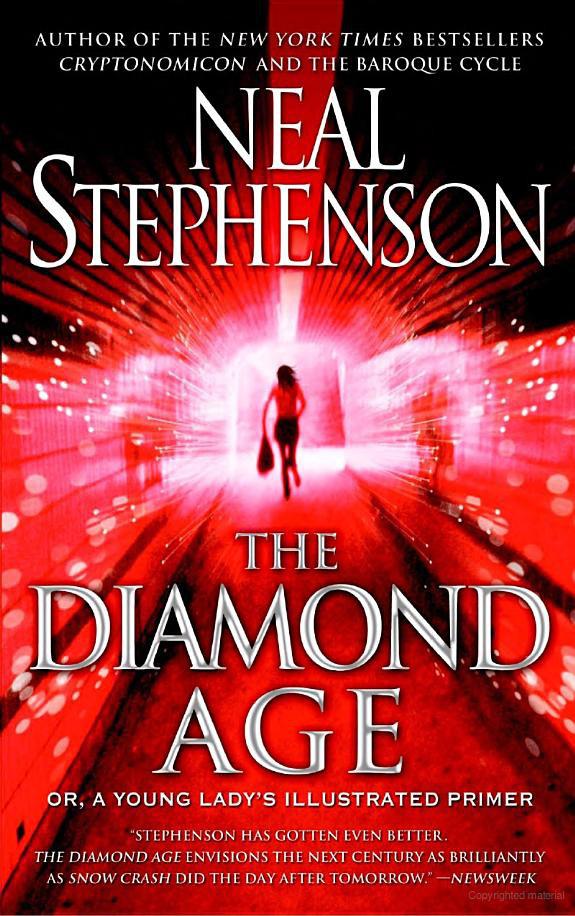
The Diamond Age
Overview unavailable.
Bud's High-Tech Upgrade
- Bud, a low-level criminal acting as a decoy, visits a professional 'mod parlor' to upgrade his integrated skull gun using his recent earnings.
- The protagonist utilizes advanced nanotechnology, including 'sites' that electrically twitch his muscles to maintain bulk without physical exercise.
- The setting depicts a world where physical enhancements are common but carry side effects, such as the tension and jerkiness caused by Bud's muscle-building implants.
- Bud chooses a high-end establishment over cheaper back-alley options in Shanghai to avoid bone infections and the logistical difficulties of crossing borders while armed.
- The narrative introduces a futuristic media landscape where 'mediatrons' look like wrinkled paper and content is delivered via 'meedfeeds' and animated 'mediaglyphics.'
The volume went up but couldn't scour away the deep tones of the carillon, which resonated in his long bones.
THE
D I A M O N D A G E
N e a l S t e p h e n s o n
Bantam Books
NEW YORK T ORONT O LONDON SYDNEY AUCKLAND
Contents
Title Page
epigraph
P ART
THE FIRST
P ART
THE SECOND
About the Author / Acknowledgments
Also available by
Praise for Neal Stephenson
Copyright Page
By natur e, men ar e nearly alike;
by practice, they get to be wide apart.
—Confucius
P A R T
T H E F I R S T
Moral r eforms and deteriorations ar e moved by lar ge for ces, and they
ar e mostly caused by r eactions fr om the habits of a pr eceding period.
Backwar ds and forwar ds swings the gr eat pendulum, and its
alternations ar e not determined by a f ew distinguish ed folk clinging to
the end of it.
—Sir Charles Petrie, T HE V ICT ORIANS
A thete visits a mod parlor; noteworthy features of modern armaments.
T he b ells of St. Mark's were ringing changes up on the mountain when Bud
skated o ver to the mod parlor to upgrade his skull gun. Bud had a nice new
pair of blades with a top speed of anywhere from a hundred to a hundred
and fifty kilometers, depe nding on how fat you were and whether or not
you wore aero. Bud liked wearing skin-tight leather , to show of f his
muscles. On a previous visit to th e m od parlo r , two years ag o, he had paid
to ha ve a bunch of 'sites implanted in his muscles—little critters, too small
to se e or feel, that twitched Bud's muscle fibers el ectrically according to a
program that was supposed to maximize bulk. Combined with the
testosterone pum p embedded in his forearm, it was like working ou t in a
gym night and day , except you didn't have to actual ly do anything and you
never got sweaty . The only drawback was that all the little twitches made
him kind of tense and jerky . He'd gotten used to it, b ut it still made him a
little hinky on those skates, especially when he was doing a hundred clicks
an h our through a crowded street. But few people hassled Bud, even when
he knoc ked them down in the street, and after today no one would hassle
him ever again.
Bud had walked away , improbably unscratched, from his last job —
decoy— with something like a thousand yuks in his pocket. He'd spent a
third of it on new clothes, mostly black leather , another third of it on the
blades, and was about to spend the last third at the mod parlor . Y ou could
get skull guns a lot cheaper , of course, but that would mean going over the
Causeway to Shanghai and getting a back-alley job from some Coaster , and
probably a nice bone infection in with the bar gain, and he'd probably pick
your poc ket wh ile he had you theezed. Besides, you could onl y get into a
Shanghai if you were vir gin. T o cross the Causeway when you were already
packing a skull gun, like Bud, you had to bribe the shit out of numerous
Shanghai cops. There was no reason to economize here. Bud had a rich and
boundless career ahead of him, vaulting up a hierarchy of extremely
dangerous drug-related occupations for which decoy served as a paid
audition of sorts. A start weapons system was a wise investment.
The damn bells kept ringing through the fog. Bud mum bled a
command to his music s ystem, a phased acoustical array splayed across
both eardrums like the seeds on a strawberry . The volume went up but
couldn't scour away the deep tones of the carillon, which res onated in his
long bon es. He wondered whether , as lo ng as he was at the mod parlor , he
should h ave the batteries drilled out of his right mastoid and replaced.
Supposedly they were ten-year jobs, but he'd h ad them for six and he
listened to music all the time, loud.
Three pe ople were waiting. Bud took a seat and skimmed a me diatron
from the cof fee table; it looked exactly like a dirty , wrinkled, blank sheet of
paper . “ 'Annals of Self-Protec tion,' ” he said, loud enough for everyone
else in the place to hear him. T he logo of his favorite meedfeed coalesced
on the page. M ediaglyphics, mostly the cool animated one s, arranged
The Mod Parlor Upgrade
- Bud visits a modification parlor in the Leased Territories to upgrade his skull gun and check his mastoid batteries.
- The setting features advanced but grimy technology, including 'mediatrons' that look like dirty paper and interactive media feeds.
- A robotic arm performs the surgical installation with alarming speed, reaming out Bud's skull to accommodate a larger bore weapon.
- Bud chooses a concealed installation over a visible scar, revealing his complex and superstitious motivations regarding the opposite sex.
- The procedure concludes with a test phase using 'popcorn' rounds before the weapon is loaded with lethal ammunition.
A nasty popping sensation radiated through Bud's skull when the robot arm snapped in the new model.
both eardrums like the seeds on a strawberry . The volume went up but
couldn't scour away the deep tones of the carillon, which res onated in his
long bon es. He wondered whether , as lo ng as he was at the mod parlor , he
should h ave the batteries drilled out of his right mastoid and replaced.
Supposedly they were ten-year jobs, but he'd h ad them for six and he
listened to music all the time, loud.
Three pe ople were waiting. Bud took a seat and skimmed a me diatron
from the cof fee table; it looked exactly like a dirty , wrinkled, blank sheet of
paper . “ 'Annals of Self-Protec tion,' ” he said, loud enough for everyone
else in the place to hear him. T he logo of his favorite meedfeed coalesced
on the page. M ediaglyphics, mostly the cool animated one s, arranged
themselves in a grid. Bud scann ed through them until he found the one that
denoted a comparison of a bunc h of dif ferent stuf f, and snapped at it with
his fingernail. New mediaglyphics appeared, surrounding lar ger cine panes
in which Annals s taf f tested sev eral models of skull guns against live and
dead tar gets. Bu d frisbeed the m ediatron back onto the table; t his was the
same review he'd been poring over for the last day , they hadn't updated it,
his decision was still valid.
One of the guys ahead of him got a tattoo, which took about ten
seconds. The other guy just wanted his skull gun reloaded, which didn't take
much longer . The girl wanted a few 'sites replaced in her racting grid,
mostly around h er eyes , where she was starting to wrinkle up. That took a
while, so Bud picked up the mediatron again and went in a ractive, h is
favorite, called Shut Up or Die!
The mod artist wanted to see B ud's yuks before he installed th e gun,
which in other surroun dings might have been construed as an insult but was
standard business practice here in the Leased T erritories. When he was
satisfied that this wasn't a stick- up, he theezed Bud's forehead with a s pray
gun, scalped back a flap of skin, and pushed a machine, mounted on a
delicate robot arm like a dental tool, over Bud's forehead. The arm homed
in automatically on the old gun, moving with alarming speed and
determination. B ud, who was a little jumpy at the best of times because of
his musc le stimulators, flinched a little. But the robot arm was a hundred
times faster than he was and plucked out the old gun uner ringly . The
proprietor was watching all of this on a screen and had nothing to do except
narrate: “The hole in your skull 's kind of rough, so the machine is reaming
it out to a lar ger bore—okay , now here comes the new gun.”
A nasty popping sensation radiated through Bud's skull when the robot
arm snapped in the new model. It reminded Bud of the days of his youth,
when, from time to time, one of his playmat es would shoot him in the head
with a BB gun. He instantly developed a low headache.
“It's load ed with a hundred rounds of popcorn,” the proprietor said, “so
you can test out the yuvree. Soo n as you're comfortable with i t, I'll load it
for real.” He stapled the skin of Bud's forehead back together so it'd heal
invisibly . Y ou could pay the guy extra to leave a scar there on purpose, so
everyone would know you were packing, but Bud had heard that some
chicks didn't like it. Bud's rela tionship with the female sex was governed by
a ga llimaufry of primal impul ses, dim suppositions, deranged theories,
overheard scraps of conversation, half-remembered pieces of bad advice,
and fragments of no-doubt exa ggerated anecdotes that amounted to rank
superstition. In this case, it dictated that he should not request the scar .
Besides, he had a nice coll ection of Sights—not very tasteful
sunglasses with crosshairs hudded into the lens on your dominant eye. They
did wonders for marksmanship, and they were real obvious too, so that
Skull-Guns and Ecological Engineering
- Bud tests a sophisticated skull-gun implant that responds to vocal commands and causes physical recoil against his head.
- The weapon features multiple firing modes, including a 'disperse' function that can fire up to a hundred rounds at once, though at the risk of breaking the user's neck.
- Bud's worldview is shaped by a chaotic mix of superstitions and 'Sights'—sunglasses designed to signal lethality to others.
- The narrative shifts to Source Victoria, an engineering marvel that uses fractal plumbing and lily-shaped intakes to mimic natural ecosystems.
- The geotects of Imperial Tectonics prioritize environmental protection not out of love for nature, but to avoid the logistical nightmare of a 'fubared' ecosystem.
Bud's relationship with the female sex was governed by a gallimaufry of primal impulses, dim suppositions, deranged theories, overheard scraps of conversation, half-remembered pieces of bad advice, and fragments of no-doubt exaggerated anecdotes that amounted to rank superstition.
chicks didn't like it. Bud's rela tionship with the female sex was governed by
a ga llimaufry of primal impul ses, dim suppositions, deranged theories,
overheard scraps of conversation, half-remembered pieces of bad advice,
and fragments of no-doubt exa ggerated anecdotes that amounted to rank
superstition. In this case, it dictated that he should not request the scar .
Besides, he had a nice coll ection of Sights—not very tasteful
sunglasses with crosshairs hudded into the lens on your dominant eye. They
did wonders for marksmanship, and they were real obvious too, so that
everyone knew you didn't fuck with a man wearing Sights.
“Give it a whirl, ” the guy said, and spun the chair around—it wa s a big
old antiq ue barber chair upholstered in swirly plastic—so Bud was facing a
mannikin in the corner of the room. The mannikin had no face or hair and
was speckled with little burn marks, as was the wall behind it.
“Status,” Bud said, and felt the gun buzz lightly in response.
“Stand by ,” he said, and got an other answering buzz. He turned his
face squarely toward the mannikin.
“Hut,” h e said. He said it under his breath, through unmoving lips, but
the gun heard it; he felt a slight recoil tapping his head back, an d a startling
POP sou nded fr om the mannikin, accompanied by a flash of light on the
wall up above its head. Bud's headache deepened, but he didn't care.
“This thing runs faster ammo, so you'll have to get used to aiming a tad
lower ,” said the guy . So Bud tried it again and this time popped the
mannikin right in the neck.
“Great shot! That would hav e decapped him if you were using
Hellfire,” the guy said. “Looks to me like you know what you're doing—but
there's other op tions too. And three m agazines so you can run mul tiple
ammos.”
“I kn ow ,” Bud s aid, “I been che cking this thing out.” Then, to the gun,
“Disperse ten, medium pattern .” Then he said “hut” again. His head
snapped back much harder , and ten POPs went of f at once, all over the
mannikin's body and the wall behind it. The room was getting smoky now ,
starting to smell like burned plastic.
“Y ou can disperse up to a hundred,” the guy said, “but the recoil'd
probably break your neck.”
“I think I got it down,” Bud said, “so load me up. First magazine with
electrostun rounds. Second magazine with Cripplers. Third with Hellfires.
And get me some fucking aspirin.”
Source V ictoria; description of its environs.
S ource V ictoria's air intakes erupted from the summit of the Royal
Ecological Conservatory like a spray of hundred-meter -long calla lilies.
Below , the analogy was perfected by an inverted tree of rootlike plumbing
that spread fractally through the diamondo id bedrock of New Chusan,
terminating in the warm water of the South China Sea as numberless
capillaries arran ged in a belt around the smartcoral reef, se veral dozen
meters beneath the surface. One big hu ge pipe gulping up seawater would
have done roughly the same thing, just as the lilies could have been
replaced by one howling maw , birds and litter whacking into a bloody grid
somewhere before they could gum up the works.
But it wouldn't have been ecological. The geotects of Imperial
T ectonics would n ot have known an ecosystem if they'd been living in the
middle o f one. But they did know that ecosystems were especially tiresome
when they got fubared, so they protected the environment with the same
implacable, plodding, green-visored mentality that they applied to
designing overpasses and culverts. Thus, water seeped into Source V ictoria
through microtu bes, much the same way it seepe d into a beach, and air
wafted into it silently down the artfully skewed exponential horns of those
thrusting calla lilies, each horn a point in parameter space not awfully far
from some central ideal. They were strong enough to withstand typhoons
Molecular Cascades and Street Hustles
- Source Victoria utilizes advanced nanotechnology to purify air and water through a series of molecular cascades and submicroscopic wheels.
- The facility is housed within the Diamond Palace, a public-facing structure where diamond is used as a cheap, durable building material.
- Purified molecules are funneled into the Feed, a global distribution system that serves as the primary source of matter for the city.
- Bud, a low-level criminal with a skull gun implant, struggles to find work as a lookout in a competitive, just-in-time illicit drug market.
- Economic pressure from new immigrants has saturated the job market, forcing Bud to rely on free food from public matter compilers.
All the action took place in the walls separating the tanks, which were not really walls but nearly infinite grids of submicroscopic wheels, ever-rotating and many-spoked.
when they got fubared, so they protected the environment with the same
implacable, plodding, green-visored mentality that they applied to
designing overpasses and culverts. Thus, water seeped into Source V ictoria
through microtu bes, much the same way it seepe d into a beach, and air
wafted into it silently down the artfully skewed exponential horns of those
thrusting calla lilies, each horn a point in parameter space not awfully far
from some central ideal. They were strong enough to withstand typhoons
but flexible enough to rustle in a breeze. Birds, wandering insid e, sensed a
gradient in the a ir , pulling them down into night, and simply chose to fly
out. They didn't even get scared enough to shit.
The lilies sprouted from a stadiu m-sized cut-crystal vase, the Diamond
Palace, w hich was open to the public. T ourists, aerobicizing pen sioners, and
ranks of uniformed schoolchildren marched through it year in and year out,
peering through walls of glass (a ctually solid diamond, which was cheaper)
at various phases of the molecular disassembly line that was Source
V ictoria. Dirty air and dir ty water came in and pooled in tanks. Next to each
tank was another tank containing slightly cleaner air or cleaner water .
Repeat several dozen times. The tanks at the en d were filled with perfectly
clean nitrogen gas and perfectly clean water .
The line of tanks was referred to as a cascade, a rather abstrac t bit of
engineer's whimsy lost on the tourists who did not see anything snapshot-
worthy there. All the action took place in the walls separating the tanks,
which were not really walls but nearly infinite grids of submicroscopic
wheels, ever -rotating and many-spoked. Each spoke grabbed a nitrogen or
water molecule on th e dirty side and released it after spinning around to the
clean side. Things that weren't nitrogen or water didn't get grabbed, hence
didn't make it through. There were also wheels for grabbing handy trace
elements like carbon, sulfur , and phosphorus; these were passed along
smaller , paralle l cascades until th ey wer e also perfectly pure. The
immaculate molecules wound up in reservoirs. Some of them got combined
with oth ers to make simple but handy molecular widge ts. In the end, all of
them we re funne led into a bundle of molecular conve yor belts known as the
Feed, of which Source V ictoria, and the other half-doze n Sources of
Atlantis/Shanghai, were the fountainheads.
Financial complications of Bud's lifestyle;
visit to a banker .
B ud s urprised himself with how l ong he went before he had to us e the skull
gun in anger . Ju st knowing it wa s in there gave him such an attitude that no
one in his right mind would fu ck with him, especially when they saw his
Sights and the black leather . He got his way just by giving peo ple the evil
eye.
It w as time to move up the lad der . He sought work as a lookout. It
wasn't easy . Th e alternative pharmaceuticals industry ran on a start, ju st-in-
time delivery system, keeping inventories low so that there was neve r much
evidence for the cops to seize. The snuf f was grown in illicit matter
compilers, squirreled away in vacant low-rent housing blocks, and carried
by th e ru nners to th e ac tual stre et dealers. Meanwhile, a cloud of lookouts
and decoys circulated probabilistically through the neighborhood, never
stopping long enough t o be picked up for loitering, monitoring the approach
of cops (or cops' surveillance pods) through huds in their sunglasses.
When Bud told his last boss to go fuck himself, he'd been pret ty sure
he could ge t a runner job. But it ha dn't panned out, and since then a couple
more big airships had come in fro m North America and disgor ged
thousands of white and black trash into the job market. Now Bud was
running out of money and getting tired of eating the free food from the
public matter compilers.
The Peacock Bank was a ha ndsome man with a salt-and-pepper
The Peacock Bank Credit
- Bud, a struggling laborer facing a saturated job market and dwindling funds, seeks a line of credit from a specialized financial institution.
- The Peacock Bank is represented by a polished Parsi banker who uses high-tech, interactive paper brochures to explain the bank's history and services.
- The Parsis are depicted as a distinct ethnic and religious group that prides itself on customer service and a unique cultural identity.
- The bank's 'racket' involves surgically implanting credit cards directly into the customer's bone, such as the pelvis or skull, to facilitate radio communication for transactions.
- This invasive technology allows users to purchase goods instantly through automated communication between the implant and the merchant.
If they accepted you, they'd shoot the credit card right into you, then and there, on the spot.
stopping long enough t o be picked up for loitering, monitoring the approach
of cops (or cops' surveillance pods) through huds in their sunglasses.
When Bud told his last boss to go fuck himself, he'd been pret ty sure
he could ge t a runner job. But it ha dn't panned out, and since then a couple
more big airships had come in fro m North America and disgor ged
thousands of white and black trash into the job market. Now Bud was
running out of money and getting tired of eating the free food from the
public matter compilers.
The Peacock Bank was a ha ndsome man with a salt-and-pepper
goatee, smelling of citrus and wearing an exceedingly snappy double-
breasted suit that displayed his narrow waist to good ef fect. He was to be
found in a rather seedy of fice up stairs of a travel agency in one of the lurid
blocks between the Aerodrome and the brothel-lined waterfront.
The banker didn't say much aft er they shook hands, just crossed his
arms pensively and leaned back again st the edge of his desk. In this attitude
he listened to Bud's freshly compo sed prevarication, nodding from time to
time as though Bud had said somethi ng significant. This was a little
disconcerting since Bud knew it was all horseshit, but he had heard that
these dotheads prided themselves on customer service.
At no particular point in the monologue, the banker cut Bud of f simply
by looking up at him brightly . “Y ou wish to secure a line of credit,” he said,
as if he were pleasantly surprised, which was not terribly likely .
“I guess you could say that,” Bud allowed, wishing he'd known to put
it in such fine-sounding terminology .
The banker reached inside his jacket and withdrew a piece of paper ,
folded in thirds, from his breast pocket. “Y ou may wish to peruse this
brochure,” he said to Bud, and to the brochure itself he rattled of f
something in an unfamiliar tongue. As Bud took it from the banker's hand,
the blank page generated a nice animated color logo and music. The logo
developed into a peacock. Benea th it, a video presentation commenced,
hosted b y a similar -looking gent—sort of Indian looking but sort of Arab
too. “ 'The Parsis welcome you to Peacock Bank,' ” he said.
“What's a Parsi?” Bud said to the banker , who merely lowered his
eyelids one click and jutted his goatee at the piece of paper , which had
picked up o n his quest ion and already branched into an explanation. Bud
ended up regretting having asked, because the answer turned out to be a
great de al of general hoo-ha about these Parsis, who evidently wanted to
make very sure no one mistook them for dotheads or Pakis or Arabs—not
that they had any problem with those very fine eth nic groups, mind you. As
hard as he tried not to pay attention, Bud absorbed more than he wanted to
know about the Parsis, their oddball religion, their tendency to wander
around, even their fucking cuisin e, which looked weird but made his mouth
water anyway . Then the brochure got back to the business at hand, which
was lines of credit.
Bud had seen this all before. The Peacock Bank was running the same
racket as all the others: If they accepted you, they'd shoot the credit card
right into you , then and there, on the spot. These guys implanted it in the
iliac crest of the pelvis, some opted for the mastoid bone in the skull—
anywhere a big bone was close to the surface. A bone mount was needed
because the card had to talk on the radio, which meant it needed an antenna
long eno ugh to hear radio waves. Then you could go around an d buy stuf f
just by asking for it; Peacock Bank and the merchant you were b uying from
and the card in your pelvis handled all the details.
Banks v aried in their philosophy of interest rates, minimum m onthly
The Price of Credit
- Bud explores a credit offer from Peacock Bank, which involves surgically implanting a credit card chip directly into the user's bone for radio connectivity.
- The bank markets its debt collection process through sanitized media depicting comfortable, family-friendly workhouses where debtors hand-craft ethnic jewelry.
- Despite the pleasant marketing, Bud remains skeptical of the media manipulation and inquires about the actual enforcement of debt repayment.
- The banker reveals a brutal three-phase enforcement regime that escalates from a polite reminder to a 'spectacularly fatal' conclusion.
- Bud ultimately rejects the terms, seeking cash on easier conditions while acknowledging that such lethal policies are standard in this society.
The enforcement regime consists of three phases: one, a polite reminder; two, well in excess of your pain threshold; three, spectacularly fatal.
around, even their fucking cuisin e, which looked weird but made his mouth
water anyway . Then the brochure got back to the business at hand, which
was lines of credit.
Bud had seen this all before. The Peacock Bank was running the same
racket as all the others: If they accepted you, they'd shoot the credit card
right into you , then and there, on the spot. These guys implanted it in the
iliac crest of the pelvis, some opted for the mastoid bone in the skull—
anywhere a big bone was close to the surface. A bone mount was needed
because the card had to talk on the radio, which meant it needed an antenna
long eno ugh to hear radio waves. Then you could go around an d buy stuf f
just by asking for it; Peacock Bank and the merchant you were b uying from
and the card in your pelvis handled all the details.
Banks v aried in their philosophy of interest rates, minimum m onthly
payments, and so on. None of that mattered to Bud. What mattered was
what they would do to hi m if he got into arrears, and so after he had
allowed a decent interval to pass pretending to listen very carefully to all
this crap about interest rates, he inquired, in an of fhanded way , like it was
an a fterthought, about their collection policy . T he banker glanced out the
window like he hadn't noticed.
The soundtrack segued into some kind of a cool jazz number and a
scene of a multicultural crew of ladies and gentlemen, not looking much
like degraded credit abusers at all, sitting arou nd a table assembling chunky
pieces of ethnic jewelry by hand. They were having a good time too ,
sipping tea and exchanging lively banter . Sipping too much tea, to Bud's
suspicious eye, so opaque to so many things yet so keen to the tactics of
media manipulation. They were making rather a big deal out of the tea.
He noted with approval that they were wearing normal clothes, not
uniforms, and that men and women were allowed to mingle. “Peacock Bank
supports a global network of cl ean, safe, and commodious workhouses, so
if unforeseen circumstances should befall you during our relation ship, or if
you should i nadvertently anticipate your means, you can rely on being
housed close to home while you and the bank resolve any dif ficulties.
Inmates in Peacock Bank workhouses enjoy private beds and in some cases
private r ooms. N aturally your children can remain with you for the duration
of your visit. W orking conditions are among the best in the industry , and the
high added-value content of our folk jewelry operation means that, no
matter th e extent of your dif ficulties, your situation will b e happily resolved
in practically no time.”
“What's the, uh, strategy for m aking sure people actually , you know ,
show up when they're supposed to sh ow up?” Bud said. At this point the
banker lost interest in the proceedings, straightened up, strolled around his
desk, an d sat down, st aring ou t the window ac ross the water toward Pudong
and Shanghai. “That detail is not covered in the brochure,” he said, “as
most of our prospective customers do not share your diligent attention to
detail insofar as that aspect of the arrangement is concerned.”
He e xhaled through his nose, like a man eager not to smell something,
and adjusted his goatee one time. “The enforcement regime consists of
three phases. W e have pleasant name s for them, of course, but you might
think of them, respectively , as: one, a polite reminder; two, well in excess of
your pain threshold; three, spectacularly fatal.”
Bud thought about showing this Parsi the meaning of fatal right then
and there, bu t as a ba nk, the guy pro bably had pretty good security . B esides,
it was pret ty stand ard policy , and Bud was actually kind of glad the guy'd
given it to him straight. “Okay , well, I 'll get back to you,” he said. “M ind if
I keep the brochure?”
The Par si waved him and the brochure away . Bud took to the streets
again in search of cash on easier terms.
Airships and Social Strata
- Bud negotiates a loan with a Parsi banker who outlines a brutal three-phase repayment enforcement policy ending in death.
- The royal family and high-ranking peerage arrive in Atlantis/Shanghai via massive transparent airships for Princess Charlotte's birthday.
- Advanced nanotechnology is integrated into daily life, such as self-cleaning gloves made of infinitesimal fabricules that eject dirt.
- The social hierarchy of the airship Æther is physically manifested through the quality and location of staterooms assigned to passengers.
- John Hackworth, an engineer of higher status than his peers, navigates the social tensions of the elite holiday gathering.
Their envelopes, filled with nothing, were predominantly transparent; instead of blocking the sunlight, they yellowed and puckered it.
three phases. W e have pleasant name s for them, of course, but you might
think of them, respectively , as: one, a polite reminder; two, well in excess of
your pain threshold; three, spectacularly fatal.”
Bud thought about showing this Parsi the meaning of fatal right then
and there, bu t as a ba nk, the guy pro bably had pretty good security . B esides,
it was pret ty stand ard policy , and Bud was actually kind of glad the guy'd
given it to him straight. “Okay , well, I 'll get back to you,” he said. “M ind if
I keep the brochure?”
The Par si waved him and the brochure away . Bud took to the streets
again in search of cash on easier terms.
A visit from royalty; the Hackworths take an
airship holiday; Princess Charlotte's birthday party;
Hackworth encounters a member of the peerage.
T hree g eodesic seeds skated over the roofs and gardens of
Atlantis/Shanghai on a Friday afternoon, like the germs of some moon-size
calabash. A pair of mooring masts sprouted and grew from cricket ovals at
Source V ictoria Park. The smallest of the airships was decorated with the
royal ensign; she kept station overhead as the two lar ge ones s ettled toward
their berths. Their envelopes, filled with nothing, were predominantly
transparent. Instead of blocking the sunlight, they yellowed and puckered it,
projecting vast abstract pattern s of brighter and not-as-bright that the
children in their best crinolines and natty short-pants suits tried to catch in
their arms. A brass band played. A tiny figure in a white dress stood at the
rail of the airship Atlantis, waving at the children below . They all knew that
this must be the birthday girl herself, Prin cess Charlotte, and they cheered
and waved back.
Fiona Hackworth had been wandering through the Royal Ecological
Conservatory br acketed by her parents, who hoped that in this way they
could keep mud and v egetable debris of f her skirts. The strategy had not
been completely succ essful, but with a quick brush, John and Gwendolyn
were able to transfer most of the dirt onto their white gloves. From there it
went straight into the air . Most gentlemen's and ladies' gloves nowadays
were con structed of infinitesimal fabricules that knew how to eject dirt; you
could thrust your gloved hand into mud, and it would be white a few
seconds later .
The hierarchy of staterooms on Æther matched the status of its
passengers perfectly , as these parts of the ship could be decompiled and
remade between voyages. For L ord Finkle-McGraw , his three children and
their spouses, and Elizabeth (his fir st and only grandchild so far ), the
airship lowered a private escalator that carried them up into the suite at the
very prow , with its nearly 180-degree forward view .
Aft of the Fink le-McGraws were a dozen or so other Equity Lords,
merely earl- or baron-level, mostly u shering grandchildren rather than
children into the c lass B suite s. Then it was executives, whose gold watch
chains, adangle with tiny email-boxes, phones, torches, snuf fboxes, and
other fet ishes, c urved round the dark waistcoats they wore to deemphasize
their bel lies. Most of their children had reached the age when they were no
longer n aturally endearing to anyone save their own parents; th e size when
their ener gy was more a menace than a wonder; and the level of i ntelligence
when what would have been called innocence in a smaller child was
infuriating rude ness. A honeybee cruising for nectar is pretty despite its
implicit threat, but the same behavior in a hornet three tim es lar ge r makes
one glance about for some handy swatting material. So on the broad
escalators leading to the first-class staterooms, one could see many upper
arms being violently grabbed b y hissing fathers with their top hats askew
and teeth clenched and eyes swiveling for witnesses.
John Percival Hackworth was an engineer . Most engineers were
assigned to tiny rooms with fold-down beds, but Hackworth bore the loftier
Departure of the Æther
- The airship Æther departs from New Chusan, showcasing a rigid social hierarchy where first-class passengers and engineers like John Hackworth navigate strict etiquette.
- Hackworth, an 'Artifex' and team leader, enjoys a second-class stateroom as the ship detaches from a diamondoid mooring mast that dissolves back into the landscape.
- The ship's ballroom features a transparent diamond floor, allowing passengers to dance while appearing to float over the moonlit Pacific Ocean.
- As the airships hover over the South China Sea, the passengers gather in anticipation of a mysterious event visible through the ship's transparent hull.
- Social tensions persist even during the spectacle, evidenced by the competitive posturing and 'vituperative looks' exchanged between different ranks of families.
They seemed to float above the glittering moonlit surface of the Pacific as they did the waltz, minuet, Lindy, and electric slide into the night.
infuriating rude ness. A honeybee cruising for nectar is pretty despite its
implicit threat, but the same behavior in a hornet three tim es lar ge r makes
one glance about for some handy swatting material. So on the broad
escalators leading to the first-class staterooms, one could see many upper
arms being violently grabbed b y hissing fathers with their top hats askew
and teeth clenched and eyes swiveling for witnesses.
John Percival Hackworth was an engineer . Most engineers were
assigned to tiny rooms with fold-down beds, but Hackworth bore the loftier
title of Artifex and had been a team leader on this very project, so he rated a
second-class stateroom with one double bed and a fold-out for Fiona. The
porter brought their ove rnight b ags around just as Æther was clearing her
mooring mast—a twenty-meter diamondoid truss that had already dissolved
back int o the billiard-table sur face of the oval by the time the ship had
turned itself to the south. L ying as close as it did to Source V ictoria, the
park was riddled with catachthonic Feed lines, and anything could be grown
there on short notice.
The Ha ckworths' stateroom was to starboard, and so as they
accelerated away from New Chusan, they got to watch the sun set on
Shanghai, shining redly through the city's eternal cloa k of coal-smoke.
Gwendolyn read Fiona stories in bed for an hour while John per used the
evening edition of the T imes, then spread out some papers on the room's
tiny des k. Later , they both cha nged into their evening clothes, primping
quietly in twilight so as not to wake Fiona. A t nine o'clock they stepped into
the p assageway , locked the door , and followed the sound of the big ba nd to
Æther 's grand ballroom, where the dancing was just getting underway . The
floor of the ballroom was a slab of transpicu ous diamond. The lights were
low . They seemed to float above the g littering moonlit surface of the Pacific
as they did the waltz, minuet, Lindy , and electric slide into the night.
Sunrise found the three airships hovering over the South China Sea, no land
visible. The ocean was relatively shallow here, but only Hackw orth and a
few other en gineers knew that. The Hackworths had a passable view from
their stateroom windo w , but John wo ke up early and staked out a pl ace on
the diamond floor of the ballroom, ordered an espresso and a T imes from a
waiter , and pas sed the time pleasantly while Gwen and Fiona got
themselves ready for the day . All around them he could hear children
speculating on what was about to happen.
Gwen and Fiona arrived just l ate enough to make it interesting for
John, who took his mechanical pocket watch out at least a dozen times as he
waited, and finally ended up clutching it in one hand, nervously popping the
lid open and shu t. Gwen folded her long legs and spread her skirts o ut
prettily on the transparent floor , drawing vituperative looks from several
women who remained standing. But John was relieved to see that most of
these women were relatively low-ranking engineers or their wives; none of
the higher -ups needed to come to the ballroom.
Fiona collapsed to her hands and knees and practically shoved her face
against t he diamond, her fundament aloft. Hackworth gripped the creases of
The Birth of New Atlantis
- John Hackworth and his family join a crowd of elites aboard airships to witness the rapid construction of a new artificial island in the South China Sea.
- The island is formed by 'smart coral,' billions of poppyseed-sized lithocules that have been secretly assembling on the seafloor for months.
- Triggered by a signal from Princess Charlotte, the lithocules rise and converge with violent speed, displacing cubic kilometers of seawater.
- The process mimics a natural fractal bloom but is actually a highly engineered feat of nanotechnology and molecular assembly.
- The fathers in the ballroom react with laughter and delight at the spectacle, relishing the perceived impotence of Nature compared to their technological mastery.
It reminded him of pouring a jet of heavy cream into coffee, watching it rebound from the bottom of the cup in a turbulent fractal bloom that solidified just as it dashed against the surface.
Sunrise found the three airships hovering over the South China Sea, no land
visible. The ocean was relatively shallow here, but only Hackw orth and a
few other en gineers knew that. The Hackworths had a passable view from
their stateroom windo w , but John wo ke up early and staked out a pl ace on
the diamond floor of the ballroom, ordered an espresso and a T imes from a
waiter , and pas sed the time pleasantly while Gwen and Fiona got
themselves ready for the day . All around them he could hear children
speculating on what was about to happen.
Gwen and Fiona arrived just l ate enough to make it interesting for
John, who took his mechanical pocket watch out at least a dozen times as he
waited, and finally ended up clutching it in one hand, nervously popping the
lid open and shu t. Gwen folded her long legs and spread her skirts o ut
prettily on the transparent floor , drawing vituperative looks from several
women who remained standing. But John was relieved to see that most of
these women were relatively low-ranking engineers or their wives; none of
the higher -ups needed to come to the ballroom.
Fiona collapsed to her hands and knees and practically shoved her face
against t he diamond, her fundament aloft. Hackworth gripped the creases of
his trousers, hitched them up just a bit, and sank to one knee.
The smart coral burst out of t he depths with violence that shocked
Hackworth, eve n though he'd b een in on the design, seen the trial runs.
V iewed through the dark surface of the Pacific, it was like watching an
explosion through a pane of shattered glass. It reminded him of pouring a
jet of heavy cream in to cof fee, watching it r ebound from the bottom of the
cup in a turbulent fractal bloom that solidified just as it dashed against the
surface. The spe ed of this process was a carefully planned sleight-of-ha nd;
the smart coral had actually been growing down on the bottom of the ocea n
for the last three mo nths, drawing its ener gy from a supercon that they'd
grown a cross th e seafloor for the occasion, extrac ting the necessary atoms
directly from the seawater and the gases dissolv ed therein. The process
happening below looked chaotic, and in a way it was; bu t each lithocule
knew ex actly where it was supposed to go and what it was supposed to do.
They were tetrahedral building blocks of calcium and carbon, the size of
poppyseeds, each equipped with a power source, a brain, and a navigational
system. They rose from the bott om of the sea at a signal given by Princess
Charlotte; she had awakened to find a small present under her pillow ,
unwrapped it to find a golden whistle on a chain, stood out on her balcony ,
and blown the whistle.
The coral was conver ging on the site of the island from all directions,
some of the lithocules traveling several kilometers to reach their assigned
positions. They displaced a volume of water equal to the island itself,
several cubic kilometers in all. The result was furious turbulence, an up-
swelling in the surfa ce of the ocean that ma de some of the children scream,
thinking it might rise up an d snatch the airship out of the sky; and indeed a
few drops pelted the ship's diamond belly , prompting the pilot to give her a
little more altitude. The curt maneuver forced hearty laughter from all of the
fathers in the ballr oom, who were delighted by the illusion of danger and
the impotence of Nature.
The foam and mist cleared away at some length to reveal a new island,
salmon-colored in the light of dawn. Applause and cheers diminished to a
professional murmur . The chattering of the astonished children was too loud
The Enchanted Isle Arrival
- An elite group of families arrives via airship at a salmon-colored artificial island created as a birthday gift for Princess Charlotte.
- The island is a marvel of nanotechnology and engineering, featuring synthetic landscapes filled with mythical creatures like centaurs and baby dinosaurs.
- The social hierarchy is strictly maintained through elaborate Victorian-style etiquette, even as the technology behind the spectacle is pervasive and invisible.
- Lord Finkle-McGraw and his corporate entities demonstrate their immense power by gifting a literal ecosystem to the royal family.
The curt maneuver forced hearty laughter from all of the fathers in the ballroom, who were delighted by the illusion of danger and the impotence of Nature.
swelling in the surfa ce of the ocean that ma de some of the children scream,
thinking it might rise up an d snatch the airship out of the sky; and indeed a
few drops pelted the ship's diamond belly , prompting the pilot to give her a
little more altitude. The curt maneuver forced hearty laughter from all of the
fathers in the ballr oom, who were delighted by the illusion of danger and
the impotence of Nature.
The foam and mist cleared away at some length to reveal a new island,
salmon-colored in the light of dawn. Applause and cheers diminished to a
professional murmur . The chattering of the astonished children was too loud
and high to hear .
It w ould be a couple of hours ye t. Hackworth snapped his fingers for a
waiter and ordered fresh fruit, juice, Belgian waf fles, more cof fee. They
might as w ell enjoy Æther 's fa mous cuisine while the island sprouted
castles, fauns, centaurs, and enchanted forests.
Princess Charlo tte was the firs t human to set foot on the enc hanted
isle, tripping down the gangway of Atlantis with a couple of her little
friends i n tow , all of them look ing like tiny wildflowers in the ir ribboned
sun-bonnets, all carrying little baskets for souvenirs, though before long
these were handed over to governesses. The Princess faced Æther and
Chinook, moored a couple of hundred m eters away , and spoke to them in a
normal tone of voice that was, however , heard clearly by all; a nanophone
was hidden somewhere in the la ce collar of her pinafore, tied into phased-
audio-array systems grown into the top layers of the island itself.
“I would like to express my gra titude to Lord Finkle-McGraw and all
the employees of Machine-Phase Systems Limited for this most wonderful
birthday present. Now , children of Atlantis/Shanghai, won't you please join
me at my birthday party?”
The children of Atlantis/Shanghai all screamed yes and rampaged
down the multifarious gan gways of Æther and Chinook, which had all been
splayed out for the occasion i n hopes of preventing bottlenecks, which
might lead to injury or , heaven forbid, rudeness. For the first few moments
the children simply burst away from the airships like gas escaping from a
bottle. T hen the y began to conv er ge on sources of wonderment: a centaur ,
eight feet high if he was an inch, walking across a meadow with his son and
daughter cantering around him. Some baby dinosaurs. A cave angling
gently into a hillside, bearing promising signs of enchantment. A road
winding up another hill toward a ruined castle.
The grownups mostly remained aboard the airships and gave the
children a few min utes to flame out, though Lord Finkle-McGraw could b e
seen ma king his way toward Atlantis, poking curiously at the earth w ith his
walking-stick, just to make sure it was fit to be trod by royal feet.
A man and a w oman descende d the gangway of Atlantis: in a floral
dress that explored the labile frontier between modesty and summer
comfort, accessorized with a matching parasol, Queen V ictoria II of
Atlantis. In a natty beige linen suit, her husband, the Prince Consort, who se
name, lamentably , was Joe. Joe, or Joseph as he was called in of ficial
circumstances, stepped down first, moving in a somewhat pompous one-
small-step-for -man gait, then turned to face Her Majesty and of fered his
hand, which she accepted graciously but perfunctorily , as if to remind
everyone that she'd done crew at Oxford and had blown of f tension during
her stud ies at Stanford B-School with lap-swimming, rollerblading, and jeet
kune do. Lord Finkle-McGraw bowed as the royal espadrilles touched
down. She extended her hand, a nd he kissed it, which was racy but allowed
if you were old and stylish, like Alexander Chung-Sik Finkle-McGraw .
“W e tha nk Lord Finkle-McGraw , Imperial T ectonics Limited, and
Machine-Phase Systems Limited once again for this lovely occ asion. Now
Arrival at Atlantis/Shanghai
- The Queen and Prince Consort arrive at the artificial island of Atlantis/Shanghai, greeted by the stylish and influential Lord Finkle-McGraw.
- The social elite of the Neo-Victorian society immediately react to royal fashion trends, such as the sudden resurgence of the parasol.
- John Hackworth explores the island's meticulously engineered landscape, testing the fresh water and daydreaming about his daughter Fiona.
- Hackworth encounters an elderly man quoting Wordsworth's 'The Prelude' and realizes he is speaking with the powerful Duke-level Equity Lord, Alexander Chung-Sik Finkle-McGraw.
- The text establishes the immense corporate power of 'Apthorp,' a strategic alliance of companies that employees colloquially refer to as 'John Zaibatsu.'
She extended her hand, and he kissed it, which was racy but allowed if you were old and stylish, like Alexander Chung-Sik Finkle-McGraw.
hand, which she accepted graciously but perfunctorily , as if to remind
everyone that she'd done crew at Oxford and had blown of f tension during
her stud ies at Stanford B-School with lap-swimming, rollerblading, and jeet
kune do. Lord Finkle-McGraw bowed as the royal espadrilles touched
down. She extended her hand, a nd he kissed it, which was racy but allowed
if you were old and stylish, like Alexander Chung-Sik Finkle-McGraw .
“W e tha nk Lord Finkle-McGraw , Imperial T ectonics Limited, and
Machine-Phase Systems Limited once again for this lovely occ asion. Now
let us all enjoy these magnificent surroundings before, like the first At lantis,
they sink forever beneath the waves.”
The parents of Atlantis/Shanghai strolled down the gangways, though
many had retreated to their stateroom s to change clothes upon catching
sight of what the Que en and Prince Consort were wearing. The big news,
already being uploaded to the T imes b y telescope- wielding fashio n
columnists onboard Æther , was that the parasol was back.
Gwendolyn Hackworth hadn't packed a parasol, but she was
untroubled; she'd always had a kind of natural, unconscious alamodality .
She and John strolled down onto the island. By the time Hackworth's eyes
had adjusted to the sunlight, he was already squatting and rubbing a pinch
of soil between his fingertips. Gwen left him to obs ess and joined a group
of other women, mostly engineers' wives , and even a baronet-level Equity
Participant or two.
Hackworth found a concealed path that wound through trees up a
hillside to a litt le grove aro und a cool, clear pond of fresh water—he taste d
it just to be sure. H e stood there fo r a while, looking out over the enchanted
island, wondering what Fion a was up to right now . This led to
daydreaming: perhaps she had, by some miracle, encountered Princess
Charlotte, made friends with her , and was exploring some wonder with he r
right no w . This led him into a l ong reverie that was interrupted when he
realized that someone was quoting poetry to him.
“Wher e had we been, we two, beloved Friend!
If in the season of unperilous choice,
In lieu of wandering, as we did, thr ough vales
Rich with indigenous pr oduce, open gr ound
Of Fancy , happy pastur es ranged at will,
W e had been followed, hourly watched, and noosed,
Each in his several melancholy walk
Stringed like a poor man's heifer at its feed,
Led thr ough the lanes in forlorn servitude.”
Hackworth turned to see that an older man was sharing his view .
Genetically Asian, with a somewhat twangy North American accent, the
man looked at least seventy . His translucent skin was still stretched tight
over broad cheekbones, but the eyelids, ears, and the hollows of his cheeks
were weathered and wrinkled. Under his pith helmet no fringe of hair
showed; the man was completely bald . Hackworth gathered these clues
slowly , until at last he realized who stood before him.
“Sounds like W ordsworth,” Hackworth said.
The man had been staring out ov er the meadows below . He coc ked his
head and looked directly at Hackworth for the first time. “The poem?”
“Judging by content, I'd guess The Pr elude. ”
“Nicely done,” the man said.
“John Percival Hackworth at your service.” Hackworth stepped toward
the other and handed him a card.
“Pleasure,” the man said. He did not waste breath introducing himself.
Lord Alexander Chung-Sik Finkle-McGraw was one of several duke-
level Equity Lords who had come out of Apthorp. Apthorp was not a formal
or ganization that cou ld be looked up in a phone book; in financial cant, it
referred to a strategic alliance of several immense companies, including
Machine-Phase Systems Limited and Imperial T ectonics Limited. When no
one imp ortant w as listening, its employees called it John Zaibatsu, much as
their forebears of a previous century had referred to the East India
The Rise of Finkle-McGraw
- Lord Alexander Chung-Sik Finkle-McGraw is a high-ranking Equity Lord associated with the powerful strategic alliance known as Apthorp or John Zaibatsu.
- Imperial Tectonics Limited, a branch of Apthorp, creates high-value artificial real estate by using geotects and matter compilers to synthesize the best traits of global cities.
- Finkle-McGraw's upbringing in rural Iowa was defined by homeschooling, outdoor exploration, and a diverse religious background including Methodist, Catholic, and Jewish influences.
- During his youth, Finkle-McGraw developed a nonconformist attitude by rejecting the era's moral relativism in favor of a belief in objective right and wrong.
- The efficiency of his local community during a plane crash rescue highlighted a cultural divide between his pragmatic upbringing and the rest of the country.
He found that the surest way to shock most people, in those days, was to believe that some kinds of behavior were bad and others good, and that it was reasonable to live one's life accordingly.
Lord Alexander Chung-Sik Finkle-McGraw was one of several duke-
level Equity Lords who had come out of Apthorp. Apthorp was not a formal
or ganization that cou ld be looked up in a phone book; in financial cant, it
referred to a strategic alliance of several immense companies, including
Machine-Phase Systems Limited and Imperial T ectonics Limited. When no
one imp ortant w as listening, its employees called it John Zaibatsu, much as
their forebears of a previous century had referred to the East India
Company as John Company .
MPS ma de consumer goods and ITL made real estate, which was, as
ever , where the real money was. Counted by the hectare, it didn't amount to
much—just a few strategically placed islands really , counties rather than
continents—but it was the most expensive real estate in the world outside of
a few blessed places like T okyo , San Francisco, and Manhattan. The reason
was that Imperial T ectonics had geotects, and geotects could ma ke sure that
every n ew piece of land poss essed the charms of Frisco, the strategic
location of Manhattan, the feng-shui of Ho ng Kon g, the dreary but
obligatory Lebensraum of L.A. It was n o longer necessary to send out dirty
yokels in coonsk in caps to chart the wilderness, kill the abos, and clear -cut
the groves; now all you neede d was a hot young geotect, a start matter
compiler , and a jumbo Source.
Like most other neo-V ictoria ns, Hackworth could recite Finkle-
McGraw's biography from memory . The future Duke had been born in
Korea and adopted, at the age of six m onths, by a coup le who'd met during
grad school in Iowa City and later started an or ganic farm near the
Iowa/South Dakota border .
During his early teens, a pass enger jet made an improbable crash-
landing at th e Sioux City airport, and Finkle-McGraw , along with several
other members of his Boy Scou t troop who had been hastily mobilized by
their sco utmaster , was standing by the runway along w ith every ambulance,
fireman, doctor , and nurse from a radius of several countie s. The uncanny
ef ficiency with which the loc als responded to the crash was widely
publicized and became the subject of a made-for -TV movie. Finkle-
McGraw couldn't understand why . They had simply done what was
reasonable and humane under the circumstances; why did people from other
parts of the country find this so dif ficult to understand?
This tenuous grasp of American culture might have been owing to the
fact that his parents home-schooled him up to the age of fourteen. A typical
school day for Finkle-McGraw consisted of walking down to a river to
study tadpoles or going to the p ublic library to check out a book on ancient
Greece or Rome. The family h ad little spare money , and vacations consisted
of driving to the Rockies for some backpacking, or up to northern
Minnesota for canoeing. He probably learned more on his summer
vacations than most of his peers did during their school years. Social
contact w ith oth er children happened mostly through Boy Scouts or church
—the Finkle-Mc Graws belonge d to a Methodist church, a Roman Catholic
church, and a tiny synagogue that met in a rented room in Sioux City .
His parents enrolled him in a pu blic high school, where he maintained
a steady 2.0 average out of a possible 4. The coursework was so stunningly
inane, the other children so dull, that Finkle-McGraw developed a poor
attitude. He earned s ome repute as a wrestler and cross-country runner , but
never exploited it fo r sexual favo rs, which would have been easy enough in
the promiscuous climate of the times. He had some measure of the
infuriating trait that causes a y oung man to be a nonconformist for its own
sake and found that the surest way to shock most people, in those days, was
to be lieve that so me kinds of behavior were bad and others good, and that it
was reasonable to live one's life accordingly .
After graduating from high school, he spent a year running certain
The Education of Finkle-McGraw
- Finkle-McGraw adopted a nonconformist stance by adhering to traditional moral distinctions between good and bad behavior.
- He abandoned formal education at Iowa State University because he refused to comply with mandatory broad-curriculum requirements.
- Observations of community behavior during a massive flood led him to conclude that cultures are fundamentally different and some are more successful than others.
- His practical background in agriculture and self-taught physics paved the way for his role as a pioneer in the nanotechnology revolution.
- After his mother's death, he transitioned from the family farm to a specialized firm manufacturing scanning tunneling microscopes.
The surest way to shock most people, in those days, was to believe that some kinds of behavior were bad and others good, and that it was reasonable to live one's life accordingly.
attitude. He earned s ome repute as a wrestler and cross-country runner , but
never exploited it fo r sexual favo rs, which would have been easy enough in
the promiscuous climate of the times. He had some measure of the
infuriating trait that causes a y oung man to be a nonconformist for its own
sake and found that the surest way to shock most people, in those days, was
to be lieve that so me kinds of behavior were bad and others good, and that it
was reasonable to live one's life accordingly .
After graduating from high school, he spent a year running certain
parts of his parents' agricultural business and then attended Iowa State
University of Science and T echnology (“Science with Practice”) in Ames.
He enro lled as an agricultural engineering major and switched to physics
after his first quarter . While remaining a nominal physics major for the next
three years, he took classes in whatever he wanted: information science,
metallur gy , earl y music. He never earned a degree, not because of poor
performance but because of the political climate; like many universities at
the time, IS U insisted that its students study a broad range of s ubjects,
including arts and humanities. Finkle-McGraw chose instead to read books,
listen to music, and attend plays in his spare time.
One summer , as he was living in Ames and working as a research
assistant in a solid-state physics lab, the city was actually turned into an
island for a couple o f days by an immense flood. Along with many other
Midwesterners, Finkle-McGraw put in a few weeks building levees out of
sandbags and plastic sheeting. Once again he was struck by the national
media coverage—reporters from the coasts kept showing up and
announcing, with some bewilderment, that there had been no looting. The
lesson learned during the Sioux City plane crash was reinforced. The Los
Angeles riots of the previous year provided a vivid counterexample. Finkle-
McGraw began to develop an opinion that was to shape his political views
in la ter years, na mely , that while people were not genetically dif ferent, they
were culturally as dif ferent as they could possibly be, and that some
cultures were simply better than others. This was not a subjective value
judgment, merely an observation that some cultures thrived and expanded
while others failed. It was a view implicitly shared by nearly everyone but,
in those days, never voiced.
Finkle-McGraw left the university without a diploma and went b ack to
the farm, which he managed for a few years while his parent s were
preoccupied with his mother's breast cancer . After her death, he moved to
Minneapolis and took a job with a company founded by one of his former
professors, mak ing scanning tunneling micro scopes, which at that time
were ne wish dev ices capable of seeing and man ipulating individual ato ms.
The field was an obscure one then, the clients tended to be lar ge research
institutions, and practical applications seemed far away . But it was pe rfect
for a man who w anted to study nanotechnology , and McGraw began doing
so, working late at night on his own time. Given his diligence, his self-
confidence, his intelligence (“adaptable, relentless, but not really brilliant”),
and the basic gra sp of business h e'd picked up on the farm, it was inevitable
that he would become one of the few hundred pioneers of
nanotechnological revolution; that his own company , which he founded five
years after he m oved to Minneapolis, would survive long enough to be
absorbed into Apthorp; and that he would navigate Apthorp's political and
The Bespoke Engineer
- Alexander Finkle-McGraw rose from an obscure nanotechnology pioneer to a powerful figure with a vast private estate on New Chusan.
- Hackworth, a newly promoted Bespoke engineer, discusses the technical nuances of pseudo-intelligence used in creating interactive mythical creatures.
- The conversation highlights a cultural divide between technical specialization and the liberal arts, specifically regarding Hackworth's knowledge of Romantic poetry.
- Finkle-McGraw suggests that the most elite engineering positions are filled by individuals with 'interesting lives' rather than those who followed a narrow path.
- The dialogue reveals the shift in terminology from 'Artificial Intelligence' to 'Pseudo-Intelligence,' reflecting a more cynical or realistic view of machine sentience.
Stereotyped behaviors were fine for the birds, dinosaurs, and so on, but for the centaurs and fauns we wanted more interactivity, something that would provide an illusion of sentience.
were ne wish dev ices capable of seeing and man ipulating individual ato ms.
The field was an obscure one then, the clients tended to be lar ge research
institutions, and practical applications seemed far away . But it was pe rfect
for a man who w anted to study nanotechnology , and McGraw began doing
so, working late at night on his own time. Given his diligence, his self-
confidence, his intelligence (“adaptable, relentless, but not really brilliant”),
and the basic gra sp of business h e'd picked up on the farm, it was inevitable
that he would become one of the few hundred pioneers of
nanotechnological revolution; that his own company , which he founded five
years after he m oved to Minneapolis, would survive long enough to be
absorbed into Apthorp; and that he would navigate Apthorp's political and
economic currents well enough to develop a decent equity position.
He s till owned t he family farm i n northwestern Iowa, along with a few
hundred thousan d acres of adjoi ning land, which he was turning back into a
tall-grass prairie , complete with herds of bison and real Indians who had
discovered that riding around on horses hunting wild game was a better deal
than pissing yourself in gutters in Minneapo lis or Seattle. But for the most
part he stayed on New Chusan , which was fo r all practical purposes his
ducal estate.
“Public relations?” said Finkle-McGraw .
“Sir?” Modern etiquette was streamlined; no “Y our Grace” or other
honorifics were necessary in such an informal setting.
“Y our department, sir .”
Hackworth had given him his so cial card, which was appropriate under
these circumstances but revealed nothing else. “Engineering. Bespoke.”
“Oh, rea lly . I'd thought anyone who could recognise W ordsworth must
be one of those artsy sorts in P .R.”
“Not in this case, sir . I'm an engineer . Just promoted to B espoke
recently . Did some work on this project, as it happens.”
“What sort of work?”
“Oh, P .I . stuf f mostly ,” Hackwo rth said. Supposedly Finkle-M cGraw
still kept up with thi ngs and would recognize the abbreviation for pseudo-
intelligence, and perhaps even appreciate that Hackworth had made this
assumption.
Finkle-McGraw brightened a bi t. “Y ou know , when I was a la d they
called it A.I. Artificial intelligence.”
Hackworth allowed himself a tight, narrow , and brief smile. “W ell,
there's something to be said for cheekiness, I suppose.”
“In what way was pseudo-intelligence used here?”
“Strictly on MPS's side of the project, sir .” Imperial T ectonics had
done the island, buildings, and vegetation. Machine-Phase Systems—
Hackworth's employer—did anything that moved. “Stereotyped behaviors
were fine for the birds, dinosaurs, and so on, but for the centaurs and fauns
we wanted more interactivity , s omething that would provide an illusion of
sentience.”
“Y es, well done, well done, Mr . Hackworth.”
“Thank you, sir .”
“Now , I know perfectly well that only the very finest engineers m ake it
to Bespoke. Suppose you tell me how an aficionado of Romantic poets
made it into such a position.”
Hackworth was taken aback by this and tried to respond without
seeming to put on airs. “Surely a man in your position does not see any
contradiction—”
“But a man in my position was not responsible for promoting you to
Bespoke. A man in an entirely dif ferent position was. And I am very much
afraid that such men do tend to see a contradiction.”
“Y es, I see. W ell, sir , I studied English literature in college.”
“Ah! So you are not one of those who followed the straight and narrow
path to engineering.”
“I suppose not, sir .”
“And your colleagues at Bespoke?”
“W ell, if I understand your question, sir , I would say that, as compared
with oth er depar tments, a relatively lar ge proportion of Bespoke engineers
have had—well, for lack of a better way of describing it, interesting lives.”
“And what makes one man's life more interesting than another's?”
The Discipline of Interest
- Hackworth explains that the most talented engineers at Bespoke often lead 'interesting' lives characterized by novelty and unpredictability.
- Lord Finkle-McGraw questions Hackworth's decision to join the Neo-Victorians and submit to their strict behavioral discipline instead of freer phyles.
- Hackworth reveals his choice was a reaction to a childhood of either total laxity or capricious, unreasoning discipline.
- The conversation explores the Neo-Victorian belief that the nineteenth century provides the only stable social model for modern society.
- Finkle-McGraw suggests a paradox where the 'straight and narrow' path of their culture might stifle the very unpredictability that creates great minds.
My life was not without periods of excessive, unreasoning discipline, usually imposed capriciously by those responsible for laxity in the first place.
“Y es, I see. W ell, sir , I studied English literature in college.”
“Ah! So you are not one of those who followed the straight and narrow
path to engineering.”
“I suppose not, sir .”
“And your colleagues at Bespoke?”
“W ell, if I understand your question, sir , I would say that, as compared
with oth er depar tments, a relatively lar ge proportion of Bespoke engineers
have had—well, for lack of a better way of describing it, interesting lives.”
“And what makes one man's life more interesting than another's?”
“In general, I s hould say that we find unpredictable or novel things
more interesting.”
“That is nearly a tautology .” Bu t while Lord Finkle-McGraw was not
the sort to express f eelings promisc uously , he gave the appearance of being
nearly satisfied with the way the conv ersation was going. He turned back
toward the view again and watched the chil dren for a minute or so, twisting
the p oint of his walk ing-stick into the ground as if he were still skeptical of
the island's integrity . Then he swept the stick around in an arc that
encompassed ha lf the island. “How many of those children do you suppose
are destined to lead interesting lives?”
“W ell, at least two, sir—Princess Charlotte, and your granddaughter .”
“Y ou're quick, Hackworth, and I suspect capable of being devious if
not for your staunch moral character ,” Finkle-McGraw said, not without a
certain archness. “T ell me, were your parents subjects, or did you take the
Oath?”
“As soon as I turned twenty-one, sir . Her Majesty—at that time,
actually , she was still Her Roy al Highness—was touring North America,
prior to her enrollment at Stanford, and I took the Oath at T rinity Church in
Boston.”
“Why? Y ou're a clever fellow , not blind to culture like so many
engineers. Y ou could have joine d the First Distributed Republic or any of a
hundred synthetic phyles on the W est Coast. Y ou would have had decent
prospects and been free from all this”—F inkle-McGraw jabbed his cane at
the two big airships—“behavioural discipline that we impose upon
ourselves. Why did you impose it on yourself, Mr . Hackworth?”
“W ithout straying into matters that are strictly personal in nature,”
Hackworth said carefully , “I knew two kinds of discipline as a child: none
at all, and too much. The former leads to degenerate behaviour . When I
speak of degeneracy , I am not being prig gish, sir—I am alluding to things
well known to me, as they made my own childhood less than idyllic.”
Finkle-McGraw , perhaps realizing that he had stepped out of b ounds,
nodded vigorously . “This is a familiar ar gument, of course.”
“Of course, sir . I would not presume to imply that I was th e only
young person ill-used by what became of my native culture.”
“And I do not s ee such an implication. But many who feel as you do
found their way into p hyles wherein a much harsher regime prevails and
which view us as degenerates.”
“My life was not without periods of excessive, unreasoning disc ipline,
usually imposed capriciously b y those responsible for laxity in the first
place. That combined with my historical studies led me, as many others, to
the conclusion that there was littl e in the previous century wo rthy of
emulation, and that we mu st look to the nineteenth century instead for
stable social models.”
“W ell done, Hackworth! But yo u must know that the model to which
you allude did not long survive the first V ictoria.”
“W e have outgrown much of the ignorance and resolved many of the
internal contradictions that characterised that era.”
“Have we, then? How reassuring. And have we resolved them in a way
that will ensure that all of those children down there live interesting lives?”
“I must confess that I am too slow to follow you.”
“Y ou yo urself sa id that the engi neers in the Bespoke department—the
very best—had led interesting lives, rather than coming from the straight
and narrow . Which implies a correlation, does it not?”
“Clearly .”
Engineering Interest and Accidental Crime
- An Equity Lord challenges Mr. Hackworth on the failure of modern schools to provide the 'interesting' lives necessary for children to reach their full potential.
- The Lord reveals his intention to recruit Hackworth for a specialized project based on his engineering expertise rather than child psychology.
- A man named Bud discovers the ease of mugging new arrivals after a chance encounter in a cul-de-sac turns into an accidental robbery.
- Bud adopts a life of petty crime to support his lifestyle and the growing financial pressures of his complicated family life with Tequila and Harv.
The pressures of fatherhood!
“W e have outgrown much of the ignorance and resolved many of the
internal contradictions that characterised that era.”
“Have we, then? How reassuring. And have we resolved them in a way
that will ensure that all of those children down there live interesting lives?”
“I must confess that I am too slow to follow you.”
“Y ou yo urself sa id that the engi neers in the Bespoke department—the
very best—had led interesting lives, rather than coming from the straight
and narrow . Which implies a correlation, does it not?”
“Clearly .”
“This implies, does it not, that in order to raise a generation of children
who can reach t heir full potential, we must find a way to make their lives
interesting. And the question I have for you, Mr . Hackworth, is t his: Do you
think that our schools accomplish that? Or are they like the schools that
W ordsworth complained of?”
“My dau ghter is too young to attend school—but I should fear that the
latter situation prevails.”
“I assur e you that it does, Mr . Hackworth. My three children were
raised in th ose schools, and I know them well. I am determined that
Elizabeth shall be raised dif ferently .”
Hackworth felt his face flushing. “Sir , may I remind you that we have
just met—I do not feel worthy of the confidences you are reposing in me.”
“I'm telling you these things no t as a friend, Mr . Hackworth, but as a
professional.”
“Then I must remind you that I am an engineer , not a child
psychologist.”
“This I have n ot for gotten, Mr . Hackworth. Y ou are indeed an
engineer , and a very fine one, in a compa ny that I still think of as mine—
though as an Eq uity Lo rd, I no longer have a formal connection. And now
that you have brought your part of this project to a successful conclusion, I
intend to put you in char ge of a new projec t for which I have reason to
believe you are perfectly suited.”
Bud embarks on a life of crime; an insult to a tribe
& its consequences.
B ud rolled his first victim almost by accident. He'd taken a wrong turn into
a cul-de-sac and inadvertently trapped a black man and woman and a
couple o f little kids who'd blundered in there before him. They h ad a scared
look about them, like a lot of the new arrivals did, and Bud noticed the way
the man 's gaze lingered on his Sights, wondering whether those crosshairs,
invisible to him, were centered on him, his lady , or his kid.
Bud didn't get o ut of their way . He was packing, they weren't, it was
up to them to get out of his way . But instead they just froze up. “Y ou got a
problem?” Bud said.
“What do you want?” the man said.
It had been a while since anyone had manifested such sincere concern
for Bud's desires, and he kind of lik ed it. He realized that these people were
under th e impression that they were being mugged. “Oh, same as anyone
else. Money a nd shit, ” Bud said, and just like that, the man took some hard
ucus out of h is pocket and handed them over—and then actually thanked
him as he backed away .
Bud enjoyed getting that kind of respect from black people—it
reminded him of his noble heritage in the trailer parks of Nort h Florida—
and he didn't mind the money either . After that day he began looking for
black people with that same scared uncertain look about them. These people
bought and sold of f the record, and so they carried hard money . He did
pretty w ell for himself for a couple of months. Every so often he would stop
by the f lat w here hi s bitch T equila lived, give her some lingerie, an d maybe
give Harv some chocolate.
Harv was presumed by both Bud and T equila to be Bud's son. He was
five, wh ich mea nt that he had bee n conceived in a much earlier cycle of
Bud and T equila 's break-up-and-make-up relationship. Now the bitch was
pregnant again, which meant that Bud would have to bring even more gifts
to her place when he came around. The pressures of fatherhood!
One day Bud tar geted a partic ularly well-dressed family because of
The Aerodrome Confrontation
- Bud, a street criminal equipped with a skull gun, targets a well-dressed family arriving at the Aerodrome for a robbery.
- The victim, a man with a crisp British-like accent, refuses to show the typical fear or submission Bud expects from his targets.
- Bud is incensed by the sight of a white porter serving the family, reflecting his racial prejudices and sense of entitlement.
- The confrontation escalates when Bud uses profanity toward the man's family, leading to a tense standoff where the victim questions Bud's awareness of the situation.
- The scene concludes with Bud initiating violence by triggering his weapon after the man remains unimpressed by his threats.
Bud kept walking until he was a little too close to the guy; he kept his head tilted back until the last minute, like he was kicking back listening to some loud tunes, and then suddenly snapped his head forward so he was staring the guy right in the face.
bought and sold of f the record, and so they carried hard money . He did
pretty w ell for himself for a couple of months. Every so often he would stop
by the f lat w here hi s bitch T equila lived, give her some lingerie, an d maybe
give Harv some chocolate.
Harv was presumed by both Bud and T equila to be Bud's son. He was
five, wh ich mea nt that he had bee n conceived in a much earlier cycle of
Bud and T equila 's break-up-and-make-up relationship. Now the bitch was
pregnant again, which meant that Bud would have to bring even more gifts
to her place when he came around. The pressures of fatherhood!
One day Bud tar geted a partic ularly well-dressed family because of
their fancy cl othes. T he man was we aring a business suit and the woman a
nice clean dress, an d they were carrying a baby all dressed up in a white
lacy thin g, and they had hired a porter to help them haul their luggage away
from the Aerodrome. The porter was a white guy who vaguely remind ed
Bud of himself, and he was incensed to see him acting as a pack animal for
blacks. So as soon as these people got awa y from the bustle of the
Aerodrome and into a more secluded neighborhood, Bud approached them,
swaggering in the way he'd pra cticed in the mirror , occasionally pushing his
Sights up on his nose with one index finger .
The guy in the suit was dif ferent from most of them. He didn't try to
act like he hadn't se en Bud, didn't tr y to skulk away , didn't cringe or slouch,
just stoo d his ground, feet planted squarely , and very pleasantly said, “Y es,
sir , can I be of assistance?” He didn't talk like an American black, had
almost a British accent, but cris per . Now that Bud had come closer , he saw
that the man had a s trip of colored cloth thrown around his neck a nd over
his lapels, dangling down like a sca rf. He looked well-housed and well-fed
for the most part, except for a little scar high up on one cheekbone.
Bud kept walking until he was a little too close to the guy . He kept his
head tilted back until the last minute, like he was kicking back listening to
some lo ud tunes (which he was), and then suddenly snappe d his head
forward so he was staring t he guy right in the face. It was another way to
emphasize the fact that he was packing, and it usually did the trick. But this
guy did not respond with the little flinch tha t Bud had come to expect and
enjoy . Maybe he was from some booga-booga c ountry where they didn't
know about skull guns.
“Sir ,” the man said, “my family and I are on the way to our ho tel. W e
have had a long journey , and we are tired; my daughter has an ear infection.
If you would state your business as expeditiously as possible, I would be
obliged.”
“Y ou talk like a fucking V icky ,” Bud said.
“Sir , I am not w hat you refer to as a V icky , or I should have gone
directly there. I would be oblig ed if you could be so kind as to moderate
your language in the presence of my wife and child.”
It took Bud a while to untangle this sentence, and a while lon ger to
believe that the man really cared about a few dirty words sp oken within
earshot of his family , an d longer yet to believe that he had been so insolent
to Bud, a heavily muscled guy who was obviously packing a skull gun.
“I'm gon na fuck ing say whatever I fucking want to your bitch an d your
fucking brat,” Bud said, very loud. Then he could not keep h imself from
grinning. Score a few points for Bud!
The man looked impatient rather than scared and heaved a deep sigh.
“Is this an armed robbery or something? Are you sure you know what you
are getting into?”
Bud ans wered by whispering “hut” under his breath and firing a
The Ashanti Hunt
- Bud, a street criminal with a skull gun, violently robs a man for his perceived insolence and protective behavior toward his family.
- Despite being shot with a Crippler, the victim remains stoic and calm, while his wife shields their child without showing fear.
- Following the robbery, a large influx of Ashanti men arrives in the city, characterized by their business suits and distinct facial scars.
- Bud discovers too late that the Ashanti are not in town for a convention, but have mobilized globally to hunt him down for his crime.
He saw one hiss by him as he rounded the corner, trailing a short whip antenna that caught the light like a hairline crack in the atmosphere.
It took Bud a while to untangle this sentence, and a while lon ger to
believe that the man really cared about a few dirty words sp oken within
earshot of his family , an d longer yet to believe that he had been so insolent
to Bud, a heavily muscled guy who was obviously packing a skull gun.
“I'm gon na fuck ing say whatever I fucking want to your bitch an d your
fucking brat,” Bud said, very loud. Then he could not keep h imself from
grinning. Score a few points for Bud!
The man looked impatient rather than scared and heaved a deep sigh.
“Is this an armed robbery or something? Are you sure you know what you
are getting into?”
Bud ans wered by whispering “hut” under his breath and firing a
Crippler into the man's right bicep. It we nt of f deep in the muscle, like an
M-80, blowing a dark h ole in the sleeve of the man's jacket and leavin g his
arm stretched out nice and straight— the trike now pulling without a nything
to oppose it. Th e man clenched his teeth, his eyes bulged, and for a few
moments he made strangled grunting noises from way down i n his chest,
making an ef fort no t to cry out. Bud stared at the wound in fascination. It
was just like shooting people in a ractive.
Except t hat the bitch didn't scream and beg for mercy . She just turned
her back, us ing her body to shield t he baby , and looked over her shoulder ,
calmly , at Bud. Bud noticed she had a little scar on her cheek too.
“Next I take your eye,” Bud said, “then I go to work on the bitch.”
The ma n held up his good hand palm out, indicating surrend er . He
emptied his pocket of hard Universal Currency Units and handed them over .
And then Bud made hi mself scarce, because the monitors—almond-size
aerostats with eyes, ears, and radios—had pro bably picked up the sound of
the explosion and begun conver ging on the area. He saw one hiss by him as
he rounded the corner , trailing a short whip antenna that caught the light
like a hairline crack in the atmosphere.
Three da ys later , Bud was hangi ng around the Aerodrome, looking for
easy pickings, when a big ship came in from Singapore. Immerse d in a
stream of two thousand arrivals was a tight group of some two dozen
solidly b uilt, ve ry dark-skinned bla ck men dressed in business suits, with
strips of colored cloth draped around their necks and little scars on their
cheekbones.
It was later that night that Bud, for the first time in his life, heard the
word Ashanti. “Another twenty-five Ashanti just came in from L.A.!” said a
man in a bar . “The Ashanti had a big meeting in the conference room at the
Sheraton!” said a woman on th e street. W aiting in a queue for one of the
free matter compilers, a bum said, “One of them Ashanti gave me five yuks.
They're fine folks.”
When Bud ran into a guy he k new , a former comrade in the decoy
trade, he said, “Hey , the place is crawling with them Ashanti, ain't it?”
“Y up,” s aid the guy , who had seemed unaccountably shocked to see
Bud's face on the street, and who was annoyingly distracted all of a su dden,
swiveling his head to look all ways.
“They m ust be having a conven tion or something,” Bud theorized. “I
rolled one of 'em the other night.”
“Y eah, I know ,” his friend said.
“Huh? How'd you know that?”
“They ain't having a convention, Bud. All of those Ashanti—except
the first one—came to town hunting for you.”
Paralysis struck Bud's vocal cords, and he felt lightheaded, un able to
Bud's Tribal Trouble
- Bud discovers that the Ashanti man he mugged was part of a powerful tribe that has sent hunters to find him.
- To evade detection, Bud abandons his signature leather gear for a disguise of ill-fitting beach clothes.
- The protagonist reflects on his lack of a 'phyle' or tribe, which leaves him vulnerable and without protection in a fragmented society.
- Bud reviews his failed attempts to join other groups like the Boers, noting the strict cultural and religious barriers to entry.
- The narrative highlights a world where racial and cultural tribes provide the only real security against targeted retribution.
All of those Ashanti—except the first one—came to town hunting for you.
When Bud ran into a guy he k new , a former comrade in the decoy
trade, he said, “Hey , the place is crawling with them Ashanti, ain't it?”
“Y up,” s aid the guy , who had seemed unaccountably shocked to see
Bud's face on the street, and who was annoyingly distracted all of a su dden,
swiveling his head to look all ways.
“They m ust be having a conven tion or something,” Bud theorized. “I
rolled one of 'em the other night.”
“Y eah, I know ,” his friend said.
“Huh? How'd you know that?”
“They ain't having a convention, Bud. All of those Ashanti—except
the first one—came to town hunting for you.”
Paralysis struck Bud's vocal cords, and he felt lightheaded, un able to
concentrate.
“I gotta go,” his friend said, and removed himself from Bud's vicinity .
For the next few hours Bud felt as though everyone on the street was
looking at him. Bud was certainly looking at them, looking for those suits,
those colored strips of cloth. But he caught sight of a man in shorts and a T -
shirt—a black man with very high cheeks, one of which was marked with a
tiny scar , and almost Asian-looking eyes in a very high state of alertness. So
he couldn't rely on the Ashanti wearing stereotyped clothing.
V ery soon after that, Bud swap ped clothes with an indigent down on
the beach, giving up all his black leather and coming away with a T -shirt
and shorts of his own. The T -shirt was much too small; it bound him under
the armpits and pressed against his muscles so that he felt the eternal
twitching even more than usual. He wishe d he could turn the stimulators of f
now , relax his muscles even for one night, but that would require a trip to
the mod parlor , and he ha d to figure that the Ashanti had the mod parlors all
staked out.
He could have gone to any of se veral brothels, but he didn't know what
kind of connections these Ashanti might have—or even what the hell an
Ashanti was, exactly—and he wasn't sure he could get a boner under these
circumstances anyway .
As h e wandered the streets of t he Leased T erritories, primed to level
his Sights a t any black person who blundered into his path, he refl ected on
the unfairness of his fate. How was he to know that guy belonged to a tribe?
Actually , he should have known, just from the fact that he wore nice
clothes and didn't look like all th e other people. The very apartness of those
people should have been a dead giveaway . And his lack of fear should have
told him something. Like he couldn't believe anyone would be stupid
enough to mug him.
W ell, Bud had been that stupid, and Bud didn't have a phyle of his
own, so Bud wa s screwed. Bud would have to go get himself one re al
quick, now .
He'd already tried to join the Bo ers a few years back. The Boers were
to Bud's ki nd of white trash what these Ashanti were to most of th e blacks.
Stocky blonds in suits or the most conservative sorts of dresses, usually
with hal f a dozen kids in tow , and my god did they ever stick together . Bud
had paid a few visi ts to the local laager , studied some of their t raining
ractives on his home mediatron, put in some extra hours at the gym trying
to meet their ph ysical standards, even gone to a couple o f horrif ic bible-
study sessions. But in the end, B ud and the Boers weren't much of a match.
The amount of church you had to attend was staggering—it w as like living
in c hurch. And he'd studied their history , but there were only so many
Boer/Zulu skirm ishes he could stand to re ad about or keep straight in his
head. So that was out; he wasn't getting into any laager tonight.
The V ic kys wou ldn't take him in a million years, of course. Almost all
the other tribes were racially orien ted, like those Parsis or whatev er . The
Jews wouldn't take him unless he cut a piece of his dick of f and learned to
read a whole nother language, which was a bit of a tall order since he hadn't
gotten round to learnin g how to read English yet. There were a bunch of
Seeking Sanctuary in Sendero
- Bud evaluates various tribal phyles in the Leased Territories, finding most too restrictive due to religious, racial, or linguistic barriers.
- He rejects the Boers due to their exhausting church requirements and the Jews because he cannot read English, let alone a second language.
- Desperate to escape the pursuing Ashantis, Bud decides to join the Senderistas, a 'batshit' communist phyle that accepts anyone regardless of background.
- The Sendero Clave is depicted as a heavily fortified enclave guarded by stoic children and decorated with massive Maoist propaganda.
- Just as Bud reaches the gates of safety, he is intercepted by an African man riding a robotic chevaline.
They had a nice clave here in the Leased Territories, a clave with good security, and every one of them, down to the last man or woman, was batshit.
with hal f a dozen kids in tow , and my god did they ever stick together . Bud
had paid a few visi ts to the local laager , studied some of their t raining
ractives on his home mediatron, put in some extra hours at the gym trying
to meet their ph ysical standards, even gone to a couple o f horrif ic bible-
study sessions. But in the end, B ud and the Boers weren't much of a match.
The amount of church you had to attend was staggering—it w as like living
in c hurch. And he'd studied their history , but there were only so many
Boer/Zulu skirm ishes he could stand to re ad about or keep straight in his
head. So that was out; he wasn't getting into any laager tonight.
The V ic kys wou ldn't take him in a million years, of course. Almost all
the other tribes were racially orien ted, like those Parsis or whatev er . The
Jews wouldn't take him unless he cut a piece of his dick of f and learned to
read a whole nother language, which was a bit of a tall order since he hadn't
gotten round to learnin g how to read English yet. There were a bunch of
cœnobitical phyles—religious tribes—that took people of all races, but
most of them weren't very powerful and didn't have turf in the Leased
T erritories. The Mo rmons had turf and wer e very powerful, but he wasn't
sure if they'd take him as quickly and readily as he needed to be taken. Then
there were the tribes that peo ple just made up out of thin air—the synthetic
phyles—but most of them were based on some shared skill or weird idea or
ritual that he wouldn't be able to pick up in half an hour .
Finally , sometime around midnight, he wandered past a man in a funny
gray jacket and cap with a red star on it, trying to give away little red books,
and it hit him: Sende ro. Most Senderistas were either Incan or Korean, but
they'd take anyone. They had a nice clave here in the Leased T erritories, a
clave with good security , and every one of them, down to the last man or
woman, was batshit. They'd be more than a match for a few dozen Ashantis.
And you could jo in anyti me just by walk ing in the gates. They would take
anyone, no questions asked.
He'd hea rd it was not such a goo d thing to be a Communist, but under
the circumstances he figured he could hold his nose and quote from the
little red book as necessary . As soon as those Ashantis left town, he'd bolt.
Once he made up his mind, he couldn't wait to get there. He had to
restrain himself from breaking i nto a jog, which would be sure to draw the
attention of any Ashantis on the street. He couldn't bear the idea of being so
close to safety and then blowing it.
He rounded a c orner and saw the wall of the Sendero Clav e four
stories high and two blocks long, one s olid giant mediatron with a tiny gate
in the middle. Mao was on one end, waving to an unseen multitude, backed
up b y hi s horsetoothed wife and his beetle-browed sidekick Lin Biao, and
Chairman Gonzalo was on the othe r , teaching some small children, and in
the midd le was a slogan in ten-m eter -high letters: STRIV E T O UPHOLD
THE PRINCIPLES OF MAO-GONZALO-THOUGHT!
The gate was guarded, as always, by a couple of twelve-year -old kids
in red neckerchiefs and armbands, ancient bolt-action rifles with real
bayonets leaning against their collarbones . A blond white girl and a pud gy
Asian boy . Bud and his son Harv had whiled away many an idle hour trying
to get these kids to laugh: making silly faces, moon ing them, telling jokes.
Nothing ever worked. But he'd seen the ritual: They'd bar his path with
crossed rifles and not let him in until he swore his undying allegiance to
Mao-Gonzalo-thought, and then—
A ho rse, or something built arou nd the same general plan, was coming
down the s treet at a hand-gallop. Its hooves did not make the pocking noise
of iron horseshoes. Bud realized it was a chevaline—a four -legged robot
thingy .
The man on the chev was an African in very colorful clothing. Bud
The Capture of Bud
- Bud is intercepted by a group of Ashanti warriors while attempting to reach the Sendero territory.
- The Ashanti utilize advanced technology, including a robotic 'chevaline' horse and specialized non-lethal weaponry.
- Bud is incapacitated by a high-tech shrink-wrap projectile that mummifies him in a soap-bubble-like film within seconds.
- The Ashanti leader formally arrests Bud for violating the Common Economic Protocol, citing the legal jurisdiction of the Chinese Coastal Republic.
- The encounter highlights a world of fragmented sovereignty where corporate or tribal protocols intersect with traditional nation-state laws.
The entire shrink-wrapping process consumed maybe half a second, and then Bud, mummified in plastic, toppled over face-forward.
bayonets leaning against their collarbones . A blond white girl and a pud gy
Asian boy . Bud and his son Harv had whiled away many an idle hour trying
to get these kids to laugh: making silly faces, moon ing them, telling jokes.
Nothing ever worked. But he'd seen the ritual: They'd bar his path with
crossed rifles and not let him in until he swore his undying allegiance to
Mao-Gonzalo-thought, and then—
A ho rse, or something built arou nd the same general plan, was coming
down the s treet at a hand-gallop. Its hooves did not make the pocking noise
of iron horseshoes. Bud realized it was a chevaline—a four -legged robot
thingy .
The man on the chev was an African in very colorful clothing. Bud
recognized the patterns on that cloth and knew without bothering to check
for the scar that the guy was Ashan ti. As soon as he caught Bud's eye, he
kicked it up a nother gear , to a tantivy . He was going to cut Bud of f before
he could reach Sendero. And he was too far away , yet, to be reached by t he
skull gun, whose infinitesimal bullets had a disappointingly short range.
He hear d a soft noise behind hi m and swiveled his head aroun d, and
something whac ked him on the forehead and stuck there. A couple more
Ashantis had snuck up on him barefoot.
“Sir ,” one of them said, “I would not recommend operation of your
weapon, unless you want the round to detonate in your ow n forehead.
Hey?” and he smiled broadly , enormous perfectly white teeth, and touched
his own forehead. Bud reached up and fe lt something hard glued to the skin
of his brow , right over the skull gun.
The chev dropped to a trot and cut toward him. Suddenly A shantis
were everywhere. He wondered how long they'd been tracking him. They
all had beautiful smiles. They all carried small devices in their hands, which
they aimed a t the pavement, trigger fingers laid alongside the barrels until
the guy on the chev told them otherwise. Then, suddenly , they all seemed to
be aimed in his direction.
The projectiles stuck to his skin and clothing and burst sideways,
flinging out yards and yards of w eightless filmy stuf f that stuck to itself and
shrank. One struck him in the back of the head, and a swath of the stuf f
whipped around his face and encased it. It was about as thic k as a soap
bubble, and so he could see through it p retty well—it had peeled one of his
eyelids back so he couldn't help but see—and everything now had that
gor geous rainbow tinge characteristic of soap bubbles. The entire shrink-
wrapping proce ss consumed maybe half a second, and then Bud,
mummified in p lastic, toppled over face-forward. One of the Ashantis was
good en ough to catch him. They laid him down on the street and rolled him
over on his back. Someone poked the blade of a pocketknife through the
film over Bud's mouth so that he could breathe again.
Several Ashantis set about the chore of bonding handles to the shrink-
wrap, tw o up near the shoulders and two down by the ankles, as the man on
the chev dismounted and knelt over him.
This equ estrian had several prominent scars on his cheeks. “Sir ,” the
man said, smiling, “I accuse y ou of violating certain provisions of the
Common Economic Protocol, which I will detail at a more convenient time,
and I hereby place yo u under personal arrest. Please be aware that anyone
who has been so arrested is subject to deadly for ce in the event he tries to
resist—which—ha! ha!—does not seem likely at present—but it is a part of
the p rocedure that I am to say th is. As this territory belongs to a nation-state
that rec ognizes the Common Economic Protocol, you are entitled to a
hearing of any such char ges within the judicial framework of the nation-
state in questio n, which in this case happens to be the Chinese Coastal
Republic. This nation-state may or may not grant you additional rights; we
will find out in a very few mom ents, when we present the situation to one
Jurisdiction and Morning Rituals
- Bud is processed under the Common Economic Protocol by Ashanti captors and a Chinese constable on a pedomotive.
- The legal framework of the Chinese Coastal Republic offers Bud no protection as he lacks membership in a recognized signatory tribe or phyle.
- John Percival Hackworth suffers from insomnia and anxiety regarding a crime he plans to commit the following day.
- The Hackworth household exists in a stratified society where North Korean propaganda broadcasts serve as a harsh morning alarm.
- The contrast between Bud's violent detention and Hackworth's domestic Victorian elegance highlights the world's extreme social divisions.
“Don't be jerk,” he said in pretty decent English, “this is China.”
resist—which—ha! ha!—does not seem likely at present—but it is a part of
the p rocedure that I am to say th is. As this territory belongs to a nation-state
that rec ognizes the Common Economic Protocol, you are entitled to a
hearing of any such char ges within the judicial framework of the nation-
state in questio n, which in this case happens to be the Chinese Coastal
Republic. This nation-state may or may not grant you additional rights; we
will find out in a very few mom ents, when we present the situation to one
of the relevant authorities. Ah, I believe I see one now .”
A c onstable from the Shanghai Police, legs strapped into a
pedomotive, was coming down the street with the tremendous loping strides
af forded by such devices, escorte d by a couple of power -skating Ashantis.
The Ashantis had big smiles, but the constable looked stereotypically
inscrutable.
The chief of the Ashantis bowed to the constable and graciously spun
out another lengthy quotation from the fine print of the Common Economic
Protocol. The con stable kept making a gesture that was somewhere betwe en
a nod and a perfunctory bow . Then the cons table tu rned to Bud and said,
very fast: “Are you a member of any signatory tribe, phyle, registered
diaspora, franchise-or ganized quasi-national entity , sovereign polity , or any
other form of dynamic security collective claiming status under the CEP?”
“Are you shitting me?” Bud said . The shrink-wrap squished his mouth
together so he sounded like a duck.
Four Ashantis took the four han dles and hoisted Bud of f the ground.
They began to follow the loping constable in the direction of the Cau seway
that led over the sea to Shanghai. “How 'bout it,” Bud quacked through the
hole in the shrink-wrap, “he said I might have other rights. Do I have any
other rights?”
The constable looked back over his shoulder , turning his head carefully
so h e wouldn't lo se his balance o n that pedomotive. “Don't be jerk,” he said
in pretty decent English, “this is China.”
Hackworth's morning ruminations; breakfast and
departure for work.
T hinking about tomorrow's crime, John Percival Hackworth slept poorly ,
rising three times on the pretext of having to use the loo. Each time he
looked in o n Fiona, wh o was sprawled out in her white lace nightgo wn,
arms abo ve her head, do ing a backflip into the arms of Morpheus. Her face
was bare ly visib le in the dark room , like the moo n seen through folds of
white silk.
At five A.M., a shrill pentatonic reveille erupted from the North
Koreans' brutish mediatrons. Their clave, which went by the nam e Sendero,
was not far abo ve sea level: a mile below the Hackworths' building in
altitude, and twenty degrees warmer on the average day . But whenever the
women's chorus chimed in with their armor -piercing refrain about the all-
seeing b eneficence of the S erene Leader , it felt as if they were right next
door .
Gwendolyn didn 't even stir . She would sleep soundly for anothe r hour ,
or until T if fany Sue , her lady's mai d, came bustling into the room and began
to lay o ut her cloth es: stretchy lingerie for the morning workout, a business
frock, hat, gloves, and veil for later .
Hackworth drew a silk dressing gown from the wardrobe and poured it
over his shoulders. Binding the sash around his waist, the cold tassels
splashing over his fingers in the dark, he glanced through the doorway to
Gwendolyn's closet and out t he other side into her boudoir . Against that
room's f ar windo ws was the desk she used for social correspondence, really
just a table with a top of genuine marble, strewn with bits of stationery , her
own and others', dimly identifiable even at this distance as business cards,
visiting cards, note cards, invitation s from various people still going
through triage. Most of the boudoir floor was covered with a tatty carpet,
worn thr ough in places all the way down to its underlying matrix of jute,
The Aesthetics of Earshot
- Hackworth observes his wife Gwendolyn’s boudoir, which is filled with exercise equipment designed in a bizarrely ornate, neo-classical style.
- The text highlights the extreme physical standards for women in this society, requiring 'superhuman willpower' and professional assistance to maintain.
- The Hackworths employ a lady's maid named Tiffany Sue, a member of the 'thete' class whose presence is a financial burden and a source of domestic tension.
- From his balcony, Hackworth views the stark contrast between his quiet neighborhood and the chaotic, smog-choked Leased Territories below.
A rowing machine cleverly fashioned of writhing sea-serpents and hard-bodied nereids, a rack of free weights supported by four callipygious caryatids—not chunky Greeks but modern women.
splashing over his fingers in the dark, he glanced through the doorway to
Gwendolyn's closet and out t he other side into her boudoir . Against that
room's f ar windo ws was the desk she used for social correspondence, really
just a table with a top of genuine marble, strewn with bits of stationery , her
own and others', dimly identifiable even at this distance as business cards,
visiting cards, note cards, invitation s from various people still going
through triage. Most of the boudoir floor was covered with a tatty carpet,
worn thr ough in places all the way down to its underlying matrix of jute,
but hand-woven and sculpted by genuine Chinese slave labor during the
Mao Dynasty . Its only real functi on was to protect the floor from
Gwendolyn's exercise equipment, which gleamed in the dim light scattering
of f the clouds from Shanghai: a step unit done up in Beaux-Arts
ironmongery , a rowing machine cleverly fashioned of writhing sea-serpents
and har d-bodied nereids, a rack of free weights supported by four
callipygious caryatids—not chunky Greeks but mod ern women, one of each
major racial group, each tricep , gluteus, latissimus, sartorius, and rectus
abdominus casting its own highlight. Classical architecture indeed. The
caryatids were supposed to b e role models, and despite subtle racial
dif ferences, each body fit the current ideal: twenty-two-inch w aist, no more
than 17% body fat. That k ind of body couldn't be faked with
under garments, never mind what the ads in the women's magazines
claimed; the long tight bodices of the current mode, and modern fabrics
thinner than soap bubbles, ma de everything obvious. Most women who
didn't have superhuman willpower couldn't manage it without the help of a
lady's m aid who would run th em through two or even three vigorous
workouts a day . So after Fio na had stopped breast-feeding and the time had
loomed when Gwen would have to knacker her maternity clothes, they had
hired T if fany Sue—just another one of the child-related expenses
Hackworth had never imagined until the bills had star ted to come in. Gwen
accused him, half-seriously , of having eyes for T if fany Sue. The accusation
was almost a standard formality of modern marriage, as lady's maids were
all y oung, pretty , and flawlessly buf fed. But T if fany Sue was a t ypical thete,
loud and classless and heavily made up, and Hackworth couldn 't abide her .
If he had eyes for anyone, it was those caryatids holding up the weight rack;
at least they had impeccable taste going for them.
Mrs. Hu ll had not heard him an d was still bumping sleepily aro und in
her quarters. Hackworth put a crumpet into the toaster oven and went out on
their flat's tiny balcony with a cup of tea, catching a bit of the auroral breeze
of f the Y angtze Estuary .
The Hackworth s' building was one of several lining a block-long
garden where a few early risers were a lready out walking their spaniels or
touching their toes. Far down the slopes of New Chusan, the Leased
T erritories were coming awake: the Senderos streaming out of their
barracks and lining up in the streets to chant a nd sing through their morning
calisthenics. All the other thetes, coarcted into the tacky little claves
belonging to their synthetic phyles, turning up their own mediatrons to
drown o ut the Senderos, setting of f firecrackers or guns—he could never
tell them apart—and a few internal-combustion hobbyists starting up their
primitive full-lane vehicles, the louder the better . Commuters lining up at
the tube stations , waiting to cross the Causeway into Greater Shanghai, seen
only as a storm front of neon-stained, coal-scented smog that e ncompassed
the horizon.
This neighborh ood was derisively called Earshot. But Hac kworth
Morning in New Atlantis
- Hackworth navigates the cacophony of 'Earshot,' a neighborhood defined by the clashing noises of synthetic phyles and industrial smog.
- The Victorian Revival culture uses nanotechnology to reinforce social hierarchy, such as matter compilers creating daily tools and personalized digital newspapers.
- Social status in New Atlantis is paradoxically tied to shared information; the higher one's rank, the more their news matches that of their peers.
- The elite distinguish themselves from the masses by consuming news printed with physical ink on paper rather than digital displays.
- Hackworth prepares for a significant workday involving the completion of a major project, marked by the ritual of his intricate waistcoat and charms.
One of the insights of the Victorian Revival was that it was not necessarily a good thing for everyone to read a completely different newspaper in the morning; so the higher one rose in the society, the more similar one's Times became to one's peers'.
belonging to their synthetic phyles, turning up their own mediatrons to
drown o ut the Senderos, setting of f firecrackers or guns—he could never
tell them apart—and a few internal-combustion hobbyists starting up their
primitive full-lane vehicles, the louder the better . Commuters lining up at
the tube stations , waiting to cross the Causeway into Greater Shanghai, seen
only as a storm front of neon-stained, coal-scented smog that e ncompassed
the horizon.
This neighborh ood was derisively called Earshot. But Hac kworth
didn't mind the noise so much. It would have been a sign of better breeding,
or higher pretentions, to be terribly sensit ive about it, to complain of it a ll
the time, and to yearn for a townhouse or even a small estate farther inland.
Finally t he bells of St. Mark's chimed six o'clock. Mrs. Hull burst into
the kitch en on the first stroke and expressed shame that Hac kworth had
beaten her to the kitch en and shock that he had defiled it. The matter
compiler in the corner o f the kitchen came on automatically and began to
create a pedomotive for Hackworth to take to work.
Before the last bell had died away , the rhythmic whack-whack- whack
of a big v acuum pump could be hear d. The engineers of the Royal V acuum
Utility were already at work expanding the eutactic environment. The
pumps s ounded big, probably Intrepi ds, and Hackworth reckoned that they
must be preparing to raise a ne w structure, possibly a w ing of the
University .
He sat down at the kitchen table . Mrs. Hull was already marmalading
his crumpet. As she laid out plates and silver , Hackworth picked up a lar ge
sheet of blank pa per . “The usual,” he said, and then the paper was no longer
blank; now it was the front page of the T imes.
Hackworth got all the news that was appropriate to his station in life,
plus a few opti onal services: the latest from his favorite cartoonists and
columnists around the world; clippings on various peculiar crackpot
subjects forwarded to him by his father , ever anxious that he had not, even
after all this time , suf ficiently edified his son; and stories relating to the
Uitlanders—a subphyle of New Atlantis, consisting of person s of British
ancestry who had fled South Africa several decades previously .
Hackworth's mother was an Uitlander , so he subscribed to the service.
A gentleman of higher rank and more far -reaching responsibilities
would probably get dif ferent informatio n written in a dif ferent way , and the
top stratum of New Chusan actually got the T imes on paper , printed o ut by a
big antique press that did a run of a hundred or so, every morning at about
three A.M.
That the highest levels of the society received news written with ink on
paper sa id much about the steps New Atlantis had taken to distinguish itself
from other phyles.
Now nanotechn ology had made nearly anything possible, and so the
cultural role in deciding what should be done with it had become far more
important than imagining what could be done with it. O ne of the insights of
the V ictorian Revival was that it was not necessarily a good thing for
everyone to read a completely dif ferent newspaper in the morning; so the
higher one rose in the society , the more similar one's T imes bec ame to one's
peers'.
Hackworth almost managed to dress without waking Gwendolyn, but
she began to stir while he w as stringing his watch chain around various tiny
buttons and pockets in his w aistcoat. In addition to the watch, various other
charms dangled from it, such as a snuf fbox that helped perk him up now
and then, and a golden p en that made a little chime whenever he received
mail.
“Have a good day at work, dear ,” she mumbled. Then, blinking once
or twice, fr owning, and focusing on the chintz canopy over the bed: “Y ou
finish it today , do you?”
“Y es,” Hackworth said. “I'll be home late. Quite late.”
“I understand.”
Departures and Deadly Perimeters
- Hackworth prepares to leave his family for a high-stakes project completion, hinting at a secret plan to secure a special gift for his daughter, Fiona.
- The narrative shifts to Bud, who is being held in a primitive yet technologically advanced open-air prison on the Yangtze delta.
- The prison's perimeter is enforced by invisible lethal fields that dismember anyone who crosses the line, a fate Bud witnesses during a mob lynching.
- Bud is summoned from the mosquito-infested compound to a courtroom on the Bund to face judgment under the Confucian judicial system presided over by Judge Fang.
When he reached the line of bamboo poles, he was given one last shove and ejected, his body virtually exploding as he flew through the invisible plane of the perimeter.
she began to stir while he w as stringing his watch chain around various tiny
buttons and pockets in his w aistcoat. In addition to the watch, various other
charms dangled from it, such as a snuf fbox that helped perk him up now
and then, and a golden p en that made a little chime whenever he received
mail.
“Have a good day at work, dear ,” she mumbled. Then, blinking once
or twice, fr owning, and focusing on the chintz canopy over the bed: “Y ou
finish it today , do you?”
“Y es,” Hackworth said. “I'll be home late. Quite late.”
“I understand.”
“No,” h e blurte d. Then he pul led himself up short. This was it, he
realized.
“Darling?”
“It's not that—th e project should finish itself. But after work, I believe
I'll get a surprise for Fiona. Something special.”
“Being home for dinner would be more special than anything you
could get her .”
“No, darling. This is dif ferent. I promise.”
He kissed her an d went to the stand by the front door . Mrs. Hu ll was
awaiting him, holding his hat in one hand and his briefcase in the other . She
had alre ady removed the pedomotive from the M.C. and set it by the door
for him; it was smart enough to know that it was indoors, and so its long
legs were fully co llapsed, giving him almost no mechanical advantage .
Hackworth stepped onto the tread plates and felt the straps reach out and
hug his legs.
He t old himself that he could still back out. But a flash of red caught
his eye, and he looked in and sa w Fiona creeping down the ha llway in her
nightie, her flaming hair flying in all directions, getting ready to surprise
Gwendolyn, an d the look in her eyes told him that she had heard
everything. He blew her a kiss and walked out the door , resolute.
Bud is prosecuted; noteworthy features of the
Confucian judicial system; he receives an invitation
to take a long walk on a short pier .
B ud had spent the last several da ys living in the open, in a pris on on the
low , sm elly delta of the Chang Jiang (as most of his thousand s of fellow
inmates called it) or , as Bud cal led it, the Y angtze. The walls of the prison
were lin es of bamboo stakes, spa ced at intervals of a few meters, with strips
of orange plastic fluttering gail y from their tops. Y et another device had
been mounted on Bud's bones, and i t knew where those boundaries were.
From place to place one could see a corpse just on the other side of the line,
body striped with the lurid marks of cookie-c utters. Bud had mistaken these
for suicides until he 'd seen a lynching in progress: a prisoner who was
thought to have stolen so me other fellow's shoes was picked up bodily by
the mob, passed from hand to hand overhead like a crowd-surfing rock
singer , all the ti me flailing frantically trying to grab something. When he
reached the line of bamboo poles, he was given one last shove and ejected,
his body virtually exploding as he flew through the invisible plane of t he
perimeter .
But the ever -present threat of lynching was a minor irritation compared
to the mosquitoes. So when Bud h eard the voice in his ears telling him to
report to th e northeast corner of the co mpound, he didn't waste any time—
partly because he wanted to get away from that place and partly because, if
he didn't, they could pop h im by remote c ontrol. They could have just to ld
him to walk directly to the courtroom and ta ke a seat and he would have
done it, but for ceremonial purposes they sent a cop to escort him.
The cou rtroom w as a high-ceilinged room in one of the old buildings
along the Bund, not lavishly furnished. At one end was a raised platform,
and on that was an old folding table with a red cloth tossed over it. The red
cloth had gold thr eads wo ven through it t o make a design: a unicorn or a
dragon or some shit like that. B ud had trouble discriminating among
mythical beasts.
The judg e came in and was introduced as Judge Fang by the lar ger of
his two gofers: a bulky , rounded-headed Chinese guy who smelled
Justice in the Coastal Republic
- Bud is escorted to a courtroom on the Bund to face charges for mugging and maiming a man named Mr. Kwamina.
- The legal proceedings involve a mix of local Coastal Republic laws and the Common Economic Protocol (CEP).
- Judge Fang, a young man with a New York accent, presides over the case with the assistance of two gofers and a Sikh representative.
- The text describes advanced ocular technology like phenomenoscopes, which allow users to see virtual overlays or 'ractives.'
- The narrative highlights the dangers of neural implants, including the risk of hackers forcing permanent advertisements into a person's visual field.
Bud knew a guy like that who'd somehow gotten infected with a meme that ran advertisements for roach motels, in Hindi, superimposed on the bottom right-hand corner of his visual field, twenty-four hours a day, until the guy whacked himself.
to the mosquitoes. So when Bud h eard the voice in his ears telling him to
report to th e northeast corner of the co mpound, he didn't waste any time—
partly because he wanted to get away from that place and partly because, if
he didn't, they could pop h im by remote c ontrol. They could have just to ld
him to walk directly to the courtroom and ta ke a seat and he would have
done it, but for ceremonial purposes they sent a cop to escort him.
The cou rtroom w as a high-ceilinged room in one of the old buildings
along the Bund, not lavishly furnished. At one end was a raised platform,
and on that was an old folding table with a red cloth tossed over it. The red
cloth had gold thr eads wo ven through it t o make a design: a unicorn or a
dragon or some shit like that. B ud had trouble discriminating among
mythical beasts.
The judg e came in and was introduced as Judge Fang by the lar ger of
his two gofers: a bulky , rounded-headed Chinese guy who smelled
tantalizingly of menthol cigarettes. The constable who had escorted Bud to
the courtroom pointed to the floor , and Bud, knowing his cue, dropped to
his knees and touched his forehead to the floor .
The Judge's other gofer was a tiny little Amerasian woman wearing
glasses. Hardly anyone used glasses any more to correct their vision, and so
it was a likely b et that this was actually some kind of phantascope, which
let you see things that weren' t there, such as ractives. Although, when
people u sed them for purposes o ther than entertainment, they used a fancier
word: phenomenoscope.
Y ou could get a phantascopic system planted directly on your retinas,
just as Bud's sound system lived o n his eardrums. Y ou could even get
telæsthetics patc hed into your spinal column at various key ve rtebrae. But
this was said to have its drawbacks: some concerns about long-term nerve
damage, plus it was rumored that hackers for big media companies had
figured out a way to get through the defenses that were built into such
systems, and run junk advertisements in your peripheral vision (or even
spang in the fucking middle) all the time—even when your eyes were
closed. B ud knew a guy like that who'd somehow gotten infected with a
meme th at ran advertisements for roach motels, in Hindi, superim posed on
the botto m righ t-hand corner of his visual fi eld, twenty-four hours a day ,
until the guy whacked himself.
Judge Fang was surprisingly young, probably not out of his thirties yet.
He sat at the red cloth-covered table and started to talk in Chinese. His two
gofers stood behind him. A Sikh was here; he stood up and said a few
words back to the Judge in C hinese. Bud couldn't figure out why there was
a Sikh here, but he'd become accustomed to Sikhs turning up where they
were least sought.
Judge Fang said in a New Y ork City accent, “The representative from
Protocol has suggested that we conduct these proceedings in English. Any
objections?”
Also pre sent wa s the guy he had mugged, who was holding the one
arm rather stif fly but seemed otherwise healthy . His wife was with him too.
“I'm Judge Fang,” the Judge continued, looking straight at Bud. “Y ou
can addr ess me as Y our Honor . Now , Bud, Mr . Kwamina here has accused
you of certain a ctivities that are illegal in the Coastal Republic. Y ou are also
accused of actionable of fenses under the Common Economic Protocol, to
which we are a subscriber . These of fenses are closely related to the crimes I
already mentioned, but slightly dif ferent. Are you getting all this?”
“Not exactly , Y our Honor ,” Bud said.
“W e thin k you mugged this guy and blew a hole in his arm,” Judge
Fang said, “which is frowned upon. Capiche? ”
“Y es, sir .”
Judge Fang nodded at the Sikh, who took the cue.
“The CEP code,” said the Si kh, “governs all kinds of eco nomic
interactions between people and or ganizations. Theft is one such
interaction. Maiming is another , insofar as it af fects the victim's ability to
Confucian Justice and Skull Guns
- Bud is brought before Judge Fang and a Protocol official for crimes involving the mugging and maiming of a man named Mr. Kwamina.
- Judge Fang explains that his judicial system follows a neo-Confucian model where he acts as detective, judge, jury, and executioner.
- Forensic evidence from a 'skull gun' embedded in Bud's forehead definitively links him to the shooting via nanopresence examination.
- The Protocol official terminates their interest in the case because Bud lacks the assets or labor value to compensate his victim.
- Upon being found guilty without a formal defense, Bud reveals he has a girlfriend named Tequila who recently gave birth to a daughter named Nellodee.
The general idea is that as judge, I actually perform several roles at once: detective, judge, jury, and if need be, executioner.
which we are a subscriber . These of fenses are closely related to the crimes I
already mentioned, but slightly dif ferent. Are you getting all this?”
“Not exactly , Y our Honor ,” Bud said.
“W e thin k you mugged this guy and blew a hole in his arm,” Judge
Fang said, “which is frowned upon. Capiche? ”
“Y es, sir .”
Judge Fang nodded at the Sikh, who took the cue.
“The CEP code,” said the Si kh, “governs all kinds of eco nomic
interactions between people and or ganizations. Theft is one such
interaction. Maiming is another , insofar as it af fects the victim's ability to
fend for himself economically . As Protocol does not aspire to sovereign
status, w e work in cooperation with the indigenous justice system of CEP
signatories in order to pursue such cases.”
“Y ou fam iliar with the Confucian system of justice, Bud?” said Judge
Fang. Bud's head was beginning to get dizzy from snapping back and forth
like a spectator at a te nnis match. “I'm guessing no. Okay , even thoug h the
Chinese Coastal Republic is no longer strictly or even vaguely Confuci an,
we s till run our judicial system that way—w e've had it for a few thousand
years, and we think it's no t half bad. The general idea is that as judge, I
actually perform several roles at once: detective, judge, jury , and if need be,
executioner .”
Bud snickered at this crack, t hen noticed that Judge Fang did not
appear to be in an especially jocose mood. His New Y orkish ways had
initially fooled Bud into thinking that Judge Fang was something of a
Regular Guy .
“So in the first- mentioned role,” Judge Fang continued, “I would like
for you, Mr . Kwamina, to tell me whether you recognize the suspect.”
“He is the man,” said Mr . Kwam ina, aiming one index finger a t Bud's
forehead, “who threatened me, shot me, and stole my money .”
“And Mrs. Kum?” Judge Fang said. Then, as an aside to B ud, he
added, “In their culture, the woman d oes not adopt her husband's fa mily
name.”
Mrs. Kum just nodded at Bud and said, “He is the guilty party .”
“Miss Pao, do you have anything to add?”
The tiny woman in the spectac les looked at Bud and said, in T exan-
accented English, “From this man's forehead I removed a voice-activated
nanoprojectile launcher , colloquially known as a skull gun, loaded with
three typ es of ammunition, including so-called Crippler rounds of the type
used ag ainst M r . Kwamina. Nan opresence examination of the serial
numbers on those rounds, and comparison of the same with fragments
removed from Mr . Kwamina's wound, indicated that the round used on Mr .
Kwamina was fired from the gun embedded in the suspect's forehead.”
“Dang,” Bud said.
“Okay ,” Judge Fang said, and reached up with one hand to rub his
temples for just a moment. Then he turned to Bud. “Y ou're guilty .”
“Hey! Don't I get to put up a defense?” Bud said. “I object!”
“Don't be an asshole,” Judge Fang said.
The Sikh said, “As the of fender has no significant assets, and as the
value of his labo r would not be suf ficient to compensate the victim for his
injury , Protocol terminates its interest in this case.”
“Got it,” Judge Fang said. “Ok ay , Bud, my man, do you have any
dependents?”
“I got a girlfrien d,” Bud said. “S he's got a son named Harv who is my
boy , unless we counted wrong. And I heard she's pregnant.”
“Y ou think she is, or you know she is?”
“She was last time I checked—a couple months ago.”
“What's her name?”
“T equila.”
A muf fl ed snort came from on e of the Protocol trainees—the young
woman—who p ut one hand ove r her mouth. The Sikh appeared to be biting
his lip.
“T equila?” Judge Fang said, incredulous. It was becoming clear that
Judge Fang tried a lot of these cases and relished the od d scrap of
entertainment value.
“There a re ninet een women named T equila in the Leased T errit ories,”
said Miss Pao, reading something out of her phenomenoscope, “one of
whom delivered a baby girl named Nellodee three days ago. She also has a
The Sentence of Bud
- Judge Fang sentences Bud to death after revealing he has fathered a child named Nellodee with a woman named Tequila.
- Bud is instructed to walk to a specific red-tipped pier on the Huang Pu River, passing through a crowd of ballroom dancers and beggars.
- The protagonist experiences a moment of unexpected melancholy and reflection while observing the mundane lives of others on his way to the pier.
- Upon reaching the end of the funeral pier, Bud is executed via 'cookie-cutters,' microscopic explosives in his bloodstream.
- The narrative shifts focus to Bud's children, Harv and Nell, as they navigate their impoverished life using a matter compiler.
Several dozen of the microscopic explosives known as cookie-cutters detonated in his bloodstream.
A muf fl ed snort came from on e of the Protocol trainees—the young
woman—who p ut one hand ove r her mouth. The Sikh appeared to be biting
his lip.
“T equila?” Judge Fang said, incredulous. It was becoming clear that
Judge Fang tried a lot of these cases and relished the od d scrap of
entertainment value.
“There a re ninet een women named T equila in the Leased T errit ories,”
said Miss Pao, reading something out of her phenomenoscope, “one of
whom delivered a baby girl named Nellodee three days ago. She also has a
five-year -old boy named Harvard.”
“Oh, wow ,” Bud said.
“Congratulations, Bud, you're a pa,” Judge Fang said. “I gathe r from
your rea ction th at this comes as something of a surprise. It seems evident
that your relationship with this T equila is tenuous, and so I do not find that
there are any mitigating circumstances I should take into account in
sentencing. That being th e case, I would like you to go out that door over
there”—Judge Fang pointed to a door in the corner of the courtroom—“and
all the way down th e steps. Leave through the exit door and cross the street,
and you will find a pier stick ing out into the river . W alk to the end of that
pier until you are standing on the red part and await further instructions.”
Bud moved tentatively at first, b ut Judge Fang gestured impatiently , so
finally he went out the door and down the stairway and out ont o the Bund,
the street that ran al ong the waterfront of the Huang Pu River , and that was
lined with big old European-style buildings. A pedestrian tunnel took him
under the road to the actual waterfront, which was crowded with Chines e
people strolling around, and legless wretches d ragging themselves hither
and thither . Some middle-aged Chinese people had set up a sound system
playing archaic music and wer e ballroom-dancing. The music and dance
style would have been of f ensively quaint to Bud at any other point in his
life, but now for some reason the sight of these somewhat fleshy , settled-
looking people, twirling around gently in one another's arms, made him feel
sad.
Eventually he found the right pi er . As he strolled out onto it, he had to
shoulder his way past some slopes carrying a long bundle wrapped in cloth,
who were try ing to get onto the pier ahead of him. The view was nice here;
the old buildings of the Bund behind him, the vertiginous neon wall of the
Pudong Economic Zone exploding from the opposite bank and serving as
backdrop for heavy river traf fic—mostly chains of low-lying bar ges.
The pier did not turn red until the very end, where it began to slope
down steeply toward the river . It had been coated with some kind of grippy
stuf f so his feet wouldn't fly out from under him. He turned around a nd
looked b ack up at the domed co urt building, searching for a window where
he might make out the face of Judge Fa ng or one of his gofers. The family
of Chinese was following him down the pier , carrying their long bundle,
which was draped with garlands of fl owers and, as Bud now realized, was
probably the corpse of a family member . He had heard about these piers;
they were called funeral piers.
Several dozen of the microscopic explosives known as cookie-cutters
detonated in his bloodstream.
Nell learns to work the matter compiler; youthful
indiscretions; all is made better .
N ell had grown t oo long for her old crib mattress, and so Harv , her big
brother , said he would help get a new one. He was big enough, he
of fhandedly mentioned, to do that sort of thi ng. Nell followed him into the
kitchen, which housed several important boxy entities with prominent
The Matter Compiler and the Feed
- Bud observes a Chinese funeral procession on a specialized pier just before microscopic explosives detonate in his blood.
- Young Nell watches her brother Harv use a matter compiler (M.C.) to synthesize a new mattress for her.
- Harv explains that their household's slow production speed is due to a low-bandwidth 'Feed' and poor economic status.
- The children navigate a world where physical goods are printed from digital templates called mediaglyphics.
- The process of materializing objects involves a vacuum seal that must be hissed open upon completion.
Several dozen of the microscopic explosives known as cookie-cutters detonated in his bloodstream.
backdrop for heavy river traf fic—mostly chains of low-lying bar ges.
The pier did not turn red until the very end, where it began to slope
down steeply toward the river . It had been coated with some kind of grippy
stuf f so his feet wouldn't fly out from under him. He turned around a nd
looked b ack up at the domed co urt building, searching for a window where
he might make out the face of Judge Fa ng or one of his gofers. The family
of Chinese was following him down the pier , carrying their long bundle,
which was draped with garlands of fl owers and, as Bud now realized, was
probably the corpse of a family member . He had heard about these piers;
they were called funeral piers.
Several dozen of the microscopic explosives known as cookie-cutters
detonated in his bloodstream.
Nell learns to work the matter compiler; youthful
indiscretions; all is made better .
N ell had grown t oo long for her old crib mattress, and so Harv , her big
brother , said he would help get a new one. He was big enough, he
of fhandedly mentioned, to do that sort of thi ng. Nell followed him into the
kitchen, which housed several important boxy entities with prominent
doors. Some were warm, some cool, some had windows, some made noises.
Nell had frequently seen Harv , or T equi la, or one of T equila's boyfriends,
removing food from them, in one stage or another of doneness.
One of the boxes was called the M.C. It was built into the wall over the
counter . Nell dragged a chair an d climbed up to watch as Harv w orked at it.
The front of the M. C. was a mediatron, which meant anything th at had
pictures moving around on it, or sound coming out of it, or both. As H arv
poked it with his fingers and spoke to it, lit tle moving pictures danced
around. It reminded her of the ractiv es she played o n the big mediatron in
the living room, when it wasn't being used by someone bigger .
“What are those?” Nell said.
“Mediaglyphics,” Harv said coolly . “Someday you'll learn how to
read.”
Nell could already read some of them.
“Red or blue?” Harv asked magnanimously .
“Red.”
Harv g ave it an especially dramatic poke, and then a new
mediaglyphic came up , a white circle with a narrow green wedge at the top.
The wedge got wider an d wider . The M.C. pla yed a little tune that meant
you were supposed to wait. Harv went to the fridge and got himself a juice
box and one for Nell too. He looked at the M.C. disdainfully . “This takes so
long, it's ridiculous,” he said.
“Why?”
“ 'Cause we got a cheap Feed, just a few grams per second. Pathetic.”
“Why do we got a cheap Feed?”
“Because it's a cheap house.”
“Why is it a cheap house?”
“Because that's all we can af ford because of the economics,” Harv
said. “Mom's gotta compete with all kinds of Chinese and stuf f that don't
have any self-respect and so they'll work for nothing. So Mom's gotta work
for nothing.” He looked at the M.C. again and shook his head. “Pat hetic. At
the Flea Circus they got a Feed that 's, like, this big around.” He touched his
fingertips togeth er in front of him and made a big circle with his arms. “But
this one's probly like the size of your pinkie.”
He s tepped away from the M.C. as if he could no longer stand to share
a room wi th it, sucked powerfully on his juice box, and wandered into the
living room to get in a ractive. Nell just watched the green wedge get bigger
and bigger until it f illed half the ci rcle, and then it began to look like a
green circle with a white wedge in it, getting narrower and narrower , and
finally t he musi c came to a bouncy conclusion just as the white wedge
vanished.
“It's done!” she said.
Harv paused his ractive, swaggered into the kitchen, and poked a
mediaglyphic that was an animated picture of a door swinging open. The
M.C. took to hissing loudly . Harv wa tched her scared face and ruf fl ed her
hair; she could not fend him of f because she had her hands over her ears.
“Got to release the vacuum,” he explained.
The Matter Compiler
- Nell and Harv use a Matter Compiler (M.C.) to synthesize a new self-inflating mattress for Nell's room.
- Fascinated by the technology, Nell learns to navigate the machine's mediaglyphic interface by mimicking her brother's actions.
- Nell over-produces mattresses for all her stuffed animals and the adults in the house, filling the room with synthesized bedding.
- Harv realizes the potential for trouble and forces Nell to dispose of the excess items in the 'deke hopper' before their mother returns.
It thickened as it inhaled, and when it was done, it looked like a real mattress.
He s tepped away from the M.C. as if he could no longer stand to share
a room wi th it, sucked powerfully on his juice box, and wandered into the
living room to get in a ractive. Nell just watched the green wedge get bigger
and bigger until it f illed half the ci rcle, and then it began to look like a
green circle with a white wedge in it, getting narrower and narrower , and
finally t he musi c came to a bouncy conclusion just as the white wedge
vanished.
“It's done!” she said.
Harv paused his ractive, swaggered into the kitchen, and poked a
mediaglyphic that was an animated picture of a door swinging open. The
M.C. took to hissing loudly . Harv wa tched her scared face and ruf fl ed her
hair; she could not fend him of f because she had her hands over her ears.
“Got to release the vacuum,” he explained.
The sound ended, and the door popped open. Inside the M.C., folded
up neatly , was Nell's new red mattress.
“Give it to me! Give it to me! ” Nell shouted, furious to see Harv's
hands on it. Harv amused him self for a second playing keep -away , then
gave it to her . She ran t o the room that she shared with Harv and slam med
the door as hard as she could. Dinosaur , D uck, Peter , and Purple were
waiting for her . “I got us a new bed,” she told them. She grabbed her old
crib mattress and heaved it into the corner , then unfolded the new one
precisely on the floor . It was disappointingly thin, more blanket than
mattress. But when she had it all laid out on the floor , it made a whoo shing
noise—not loud—the sound of her brother's breathing late at night. It
thickened as it inhaled, and whe n it was don e, it looked like a real m attress.
She gath ered Di nosaur and Duck and Peter an d Purple up into her arms and
then, just to make sure, jumped up and down on it several hundred times.
“Y ou like it?” Harv said. He had opened the door .
“No! Get out!” Nell screamed.
“Nell, it's my room too,” Harv said. “I gotta deke your old one.”
Later , Harv went out with his buddies, and Nell was alone in the house
for a while. She had decided tha t her kids needed mattresses too , and so she
dragged the chair to the counter and climbed up on top, right in front of the
M.C., and tried to read the m ediaglyphics. A lot of them she didn't
recognize. But she remembered that T equila just used words when she
couldn't read something, so she tried talking to it instead.
“Please secure the permission o f an adult,” the M.C. said, over and
over again.
Now she knew why Harv always poked at things rather than tal king to
them. She poked at the M.C. for a long time until finally she came to the
same mediaglyphics that Harv had used to choose her mattress. One
showed a man and woman sleeping in a very lar ge bed. A man and woman
in a somewhat smaller bed. A man by himself. A child by herself. A baby .
Nell poked at the baby . The white circle and red wedge appeared, the
music played, the M.C. hissed and opened.
She spre ad it out on the floor and formally presented it to Di nosaur ,
who was too little to know how to ju mp up and down on it; so Nell showed
him for a while. Then she went back to the M.C. and got mattresses for
Duck, Peter , and Purple. Now , much of the room was covered with
mattresses, and she thought how fun it would be to have the whole room
just be one big mattress, so she made a couple o f the very lar gest size. Then
she made a new mattress for T equila and another new one for her boyfriend
Rog.
When Harv came back, his reac tion swerved between terror and awe.
“Mom's gonna h ave Rog beat the shit out of us,” he said. “W e gotta deke all
this stuf f now .”
Easy co me, easy go. Nell expla ined the situation to her kids and then
helped Harv stuf f all of the m attresses, except her own, into the deke
hopper . Harv had to use all his strength to shove the door closed. “Now we
just better hope this stuf f a ll dekes before Mom gets home,” he said. “It' s
gonna take a while.”
Matter Compilers and Corporate Gates
- Nell uses the matter compiler (M.C.) to create numerous mattresses for her toys, nearly filling her room.
- Harv forces Nell to dispose of the items in a 'deke hopper' to avoid a violent confrontation with their mother's boyfriend.
- Harv explains the concept of letters to Nell, describing them as static, boring versions of mediaglyphics used for abbreviations.
- Hackworth arrives at Machine-Phase Systems Limited, passing desperate job-seekers whose presence serves as a warning to current employees.
Kinda like mediaglyphics except they're all black, and they're tiny, they don't move, they're old and boring and really hard to read.
showed a man and woman sleeping in a very lar ge bed. A man and woman
in a somewhat smaller bed. A man by himself. A child by herself. A baby .
Nell poked at the baby . The white circle and red wedge appeared, the
music played, the M.C. hissed and opened.
She spre ad it out on the floor and formally presented it to Di nosaur ,
who was too little to know how to ju mp up and down on it; so Nell showed
him for a while. Then she went back to the M.C. and got mattresses for
Duck, Peter , and Purple. Now , much of the room was covered with
mattresses, and she thought how fun it would be to have the whole room
just be one big mattress, so she made a couple o f the very lar gest size. Then
she made a new mattress for T equila and another new one for her boyfriend
Rog.
When Harv came back, his reac tion swerved between terror and awe.
“Mom's gonna h ave Rog beat the shit out of us,” he said. “W e gotta deke all
this stuf f now .”
Easy co me, easy go. Nell expla ined the situation to her kids and then
helped Harv stuf f all of the m attresses, except her own, into the deke
hopper . Harv had to use all his strength to shove the door closed. “Now we
just better hope this stuf f a ll dekes before Mom gets home,” he said. “It' s
gonna take a while.”
Later th ey went to bed and both lay awake for a while, dreading the
sound of th e fr ont door opening. But n either Mom nor Rog came hom e that
night. Mom finally s howed up in the mornin g, changed into her maid outfit,
and ran for the bus to the V icky Clave, but she just left all her garbage on
the floor instead of th rowing it in the hopper . When Harv checked the
hopper later , it was empty .
“W e dod ged a bullet,” he said. “ Y ou gotta be careful how you use the
matter compiler , Nell.”
“What's a matter compiler?”
“W e call it the M.C. for short.”
“Why?”
“Because M.C. stands for matter compiler , or so they say .”
“Why?”
“It just does. In letters, I guess.”
“What are letters?”
“Kinda like mediaglyphics exc ept they're all black, and they're tiny ,
they don 't move , they're old and boring and really hard to read. But you can
use 'em to make short words for long words.”
Hackworth arrives at work; a visit to the Design
W orks; Mr . Cotton's vocation.
R ain b eaded on th e specular toes of Hackworth's boots as he str ode under
the vaulting wrought-iron gate. The little beads reflected the silvery gray
light of the sky as they rolled of f onto the pedomotive's tread plates, and
dripped to the gray-brown cobblestones with each stride. Hackworth
excused himself through a milling group of uncertain Hindus. Their h ard
shoes were treacherous on the cobblestones , their chins were in the air so
that thei r high white collars would not saw the ir heads of f. They had arisen
many hours ago in their tiny high-rise warrens, their human coin lockers on
the island south of New Chusan, which was Hindu stani. They had crossed
into Shanghai in the wee hours on autoskates and veloci pedes, probably
paid of f some p olicemen, made their wa y to the Causeway joining New
Chusan to the c ity . Machine-Ph ase Systems Limited knew that they were
coming, because they came every day . The company could have set up an
employment of fice closer to the Causeway , or even in Shanghai itself. But
the comp any liked to have job-seekers come all the way to the main campus
to fill out their a pplications. The dif ficulty of getting here prevented people
from coming on a velleity , and the eternal presence of these people—like
starlings peering down hungrily at a picnic—reminded everyone who was
lucky enough to have a job that others were waiting to take their place.
The Design W orks emulated a university campus, in more ways than
its architects had really intended. If a campus was a green quadrilateral
The Neo-Victorian Design Works
- Machine-Phase Systems Limited maintains a remote campus to filter job applicants and remind current employees of their replaceability.
- The Design Works architecture emulates a university campus, blending Gothic aesthetics with the repetitive, industrial nature of a factory.
- Neo-Victorian culture rejects digital displays in favor of 'hard art,' valuing the permanence and risk associated with traditional physical mediums.
- A massive fresco in Merkle Hall allegorizes nanotechnology, depicting an Engineer as a god-like figure commanding atomic cherubs.
- The artwork contrasts the technological salvation of the present with a 'ghoulish' list of historical causes of death from the pre-nanotech era.
Hard art demanded commitment from the artist. It could only be done once, and if you screwed it up, you had to live with the consequences.
paid of f some p olicemen, made their wa y to the Causeway joining New
Chusan to the c ity . Machine-Ph ase Systems Limited knew that they were
coming, because they came every day . The company could have set up an
employment of fice closer to the Causeway , or even in Shanghai itself. But
the comp any liked to have job-seekers come all the way to the main campus
to fill out their a pplications. The dif ficulty of getting here prevented people
from coming on a velleity , and the eternal presence of these people—like
starlings peering down hungrily at a picnic—reminded everyone who was
lucky enough to have a job that others were waiting to take their place.
The Design W orks emulated a university campus, in more ways than
its architects had really intended. If a campus was a green quadrilateral
described by hulking, hederated Gothics, then this was a campus. But if a
campus was also a fac tory of sort s, most of whose population sat in rows
and columns in lar ge stuf fy rooms and did essentially the same things all
day , then the Design W orks was a campus for that reason too.
Hackworth detoured through Merkle Hall. It was Gothic and very
lar ge, like most of the Design W orks. Its vaulted ceiling was decorated with
a hard fresco consisting of paint on plaster . Since this entire building,
except f or the fresco, h ad been grown straight from the Feed, it would have
been eas ier to build a mediatro n into the ceilin g and set it to display a soft
fresco, which could have been changed from time to time. But neo-
V ictorians almost never used mediatrons. Hard art demanded commitment
from the artist. It could only be done once, and if you screwed it up, you
had to live with the consequences.
The cen terpiece of the fresco w as a flock of cybernetic cherubs, each
shouldering a spherical atom, conver ging on some central work-in-progress,
a construct of some several hundred atoms, radially symmetric, perhaps
intended to lo ok like a bearing or motor . Brooding over the whole thin g,
quite lar ge but obviously not to scale, was a w hite-coated Engineer with a
monocular nanophenomenoscope strapped to his head. No one really used
them because you couldn't get depth perception, b ut it looked better on the
fresco b ecause y ou could see the Engineer's other eye, steel-blue, dilated,
scanning infinit y like the steel oculus of Arecibo. W ith one hand the
Engineer stroked his waxed mustache. The other was thrust into a
nanomanipulator , and it was made obvious, through glorious overuse of
radiant t romp l'o eil, that the atom-humping cherubs were all dancing to his
tune, naiads to the Engineer's Neptune.
The corn ers of the fresco were occupied with miscellaneous bus ywork;
in the u pper left, Feynman and D rexler and Merkle, Chen and S ingh and
Finkle-McGraw reposed on a numinous buckyball, some of them reading
books and some pointing toward the work-in-progress in a manner that
implied constructive criticism. In the upper right was Queen V ictoria II,
who managed to look serene despite the gaudiness of her perch, a throne of
solid dia mond. The bottom fringe of the work was crowded with small
figures, mostly children with the occasional long-suf fering mom, ordered
chronologically . On the left were the spirits of gen erations past who had
shown u p too early to enjoy the benefits of nanotech nology and (not
explicitly shown, but somewhat ghoulishly implied) croaked from obsolete
causes such as cancer , scurvy , boiler explosions, derailments, drive-by
shootings, pogroms, blitzkriegs, mine shaft collapses, ethnic cleansing,
meltdowns, runn ing with scissors, eating Drano, heating a cold house with
charcoal briquets, and being gored by oxen. Surprisingly , no ne of them
seemed sullen; they were all watching the activities of the Engineer and his
cherubic workfo rce, their cuddly , uplifted faces illuminated by the light
streaming from the center , liberated (as Hackworth the engineer literal-
The Art of Atomic Design
- Hackworth observes a hall of engineers using phenomenoscopes and haptic gloves to manipulate atomic structures.
- The workspace is decorated with symbolic imagery of children and Queen Victoria II, blending high technology with Victorian aesthetics.
- Engineers utilize specialized gloves with tactile stimulators and invisible wires to feel and move individual atoms.
- The design process in Merkle Hall focuses on mass-market consumer products, relying on software to handle repetitive molecular tasks.
- Strict etiquette governs the hall to avoid startling designers who are deeply immersed in their virtual atomic environments.
In fact they were not motors but little wire factories that generated wire when it was needed and, when slack needed to be taken up or a wire needed a tug, sucked it back in and digested it.
causes such as cancer , scurvy , boiler explosions, derailments, drive-by
shootings, pogroms, blitzkriegs, mine shaft collapses, ethnic cleansing,
meltdowns, runn ing with scissors, eating Drano, heating a cold house with
charcoal briquets, and being gored by oxen. Surprisingly , no ne of them
seemed sullen; they were all watching the activities of the Engineer and his
cherubic workfo rce, their cuddly , uplifted faces illuminated by the light
streaming from the center , liberated (as Hackworth the engineer literal-
mindedly suppo sed) by the binding ener gy of the atoms as they plummeted
into their assigned potential wells.
The children in the center had their backs to Hackworth an d were
mostly seen in silhouette, looking directly up and raising their arms toward
the light. Th e kids in bottom right b alanced the angelic host on the bottom
left; these w ere the spirits of unbo rn children yet to benefit from the
Engineer's work, though they certainly loo ked eager to get born as soon a s
possible. Their backdrop was a luminescent, undulous curtain, much like
the aurora, which was actually a continuation of the flowing skirts of
V ictoria II seated on her throne above.
“Pardon me, Mr . Cotton,” Hackworth said, almost sotto voce. He had
worked here once, for several years, and knew the etiquette. A hundred
designers were sitting in the hall, neatly arranged in rows. All had their
heads wrapped up in phenomenoscopes. The only persons who were aware
of Hackworth's pre sence in the hal l were Supervising Engineer Däurig, his
lieutenants Chu, DeGrado, and Beyerley , and a few water -boys and couriers
standing erect at their stations around the perimeter . It was bad form to
startle the engineers, so you ap proached them loudly and spoke to them
softly .
“Good morning, Mr . Hackworth,” Cotton said.
“Good morning, Demetrius. T ake your time.”
“I'll be with you in a moment, sir .”
Cotton was a southpaw . His left hand was in a black glove. Laced
through it was a network of invisibly tin y rigid structures, motors, position
sensors, and tactile stimulators. The sensors kept track of his hand's
position, how much each joint of each knuckle was bent, and so on. The rest
of the gear made him feel as though he were touching real objects.
The glove's movements were limited to a roughly hemispherical
domain with a r adius of about one cubit; as l ong as his elbow stayed on or
near its comfy elastomeric rest, his hand was f ree. The glove was attached
to a web of infinitesimal wires that emer ged from filatories placed here and
there around the workstation. The filatories acted like motorized reels,
taking up slack and occasionally pulling the glove one way or another to
simulate external forces. In fact they were not motors but little wire
factories that generated wire wh en it was needed and, when slack needed to
be taken up or a wire needed a tug, sucked it back in and digested it. Each
wire wa s surrou nded by a loose accordion sleeve a couple of millimeters in
diameter , which was there for safety , lest visitors stick their hands in and
slice of f fingers on the invisible wires.
Cotton was working with some kind of elaborate structure consisting,
probably , of several hundred t housand atoms. Hackworth cou ld see this
because each workstation had a mediatron providing a two-dimensio nal
view of what the user was seeing. This made it easy for the supervisors to
roam up and do wn the aisles an d see at a glance what each employee was
up to.
The stru ctures t hese people worked with seemed painfully bulky to
Hackworth, even though he'd done it himself for a few years. The people
here in Merkle Hall were all working on mass-market consumer products,
which b y and lar ge were not very demanding. They worked in symbiosis
with big software that handled repetitiv e aspects of the job. It was a fast
way to design products, which was essential when going after the fickle and
Design Philosophy in Merkle Hall
- Merkle Hall engineers design mass-market consumer products using automated systems that prioritize speed over efficiency, resulting in bulky, atom-heavy designs.
- Hackworth works in the elite Bespoke division, where 'concinnity' is the goal and every single atom must be justified for its specific purpose.
- The Young Lady's Illustrated Primer is being developed with an unlimited budget, allowing for the highest level of nanotechnological craftsmanship.
- Cotton, a promising young engineer, uses a forbidden intuitive method of manual manipulation to diagnose a failure in an automated assembly process.
- The use of 'rod logic' systems—mechanical computers at the molecular level—illustrates the tactile and physical nature of this future technology.
Cotton's gloved hand fluttered and probed like a stuck horsefly in the center of the black web.
view of what the user was seeing. This made it easy for the supervisors to
roam up and do wn the aisles an d see at a glance what each employee was
up to.
The stru ctures t hese people worked with seemed painfully bulky to
Hackworth, even though he'd done it himself for a few years. The people
here in Merkle Hall were all working on mass-market consumer products,
which b y and lar ge were not very demanding. They worked in symbiosis
with big software that handled repetitiv e aspects of the job. It was a fast
way to design products, which was essential when going after the fickle and
impressionable consumer market. But systems designed that way always
ended up being enormous. An automated desig n system could always make
something work by throwing more atoms at it.
Every engineer in this hall, designing those nanotechnological toasters
and hair dryers, wished he coul d have Hackworth's job in Bespoke, where
concinnity was an end in itself, where no atom was wasted and every
subsystem was designed specifically for the task at hand. Such work
demanded intuition and creativity , qualities nei ther abundant nor
encouraged her e in Merkle Hall. But from time to time, over golf or
karaoke or cigars, Däurig or one of the other supervisors would mention
some youngster who showed promise.
Because Lord Alexander Chung-Sik Finkle-McGraw was paying for
Hackworth's current project, the Y oung Lady's Illustrated Primer , price was
no object. The Duke would brook no malingering or corner -cutting, so
everything was as start as Bespoke could make it, every atom could be
justified.
Even so , there was nothing especially interesting about the power
supply being created for the Primer , w hich consisted of batteries of the
same kind used to run ever ything from toys to airships. So Hackworth had
farmed that part of the job out to Cotton, just to see whether he had
potential.
Cotton's gloved hand fluttered and probed like a stuck horsefly in the
center of the black web. On the mediatronic screen attached to his
workstation, Hackworth saw that Cotton was gripping a medium-size (by
Merkle Hall standards) subassembly , presumably belonging to some much
lar ger nanotechnological system.
The standard color scheme used in these phenomenoscopes depicted
carbon atoms in green, sulfur in yellow , oxygen in red, and hydrogen in
blue. Co tton's a ssembly , as seen from a distance, was generally turquoise
because it consisted mostly of carbon and hydrogen, and because
Hackworth's poi nt of view was so far away that the thousands o f individual
atoms all blended together . It was a gridwork of long, straight, but rather
bumpy r ods laid across each other at right angles. Hackworth recognized it
as a rod logic system—a mechanical computer .
Cotton w as tryin g to snap it together with some lar ger part. From this
Hackworth inferred that the auto-assembly process (which Cotton would
have tried firs t) hadn' t worked quite r ight, and so now Cotton was trying to
maneuver the part into place by hand. This wouldn't fix what was wrong
with it, but the telæsthetic feedback coming into his hand through those
wires would g ive him insight as to wh ich bumps were lining up with which
holes and which w eren't. I t was an intuitiv e approach to the job, a practice
furiously proscribed by the lecturers at the Royal Nanotechnological
Institute but popular among Hackworth's naughty , clever colleagues.
“Okay ,” Cotton finally said, “I s ee the problem.” His hand relax ed. On
the mediatron, the subassembly drifted away from the main group under its
own momentum, then slowed, stopped, and began to fall back toward it,
The Philosophy of Smart Makeup
- Cotton demonstrates an intuitive, 'naughty' approach to nanotechnology that bypasses the rigid protocols of the Royal Nanotechnological Institute.
- The engineers discuss 'smart makeup' that can be controlled via voice recognition or potentially respond to a wearer's physiological and emotional states.
- A philosophical debate arises regarding whether makeup should reveal a person's true emotions or serve as a mask to hide them.
- Hackworth receives the finalized power supply specifications for the 'Runcible' project, a code name for the Illustrated Primer.
- The exchange involves high-tech paper that responds to voice commands, automatically transferring access privileges and folding itself on command.
Think about it, Mr. Hackworth—is the function of makeup to respond to one's emotions—or precisely not to do so?
wires would g ive him insight as to wh ich bumps were lining up with which
holes and which w eren't. I t was an intuitiv e approach to the job, a practice
furiously proscribed by the lecturers at the Royal Nanotechnological
Institute but popular among Hackworth's naughty , clever colleagues.
“Okay ,” Cotton finally said, “I s ee the problem.” His hand relax ed. On
the mediatron, the subassembly drifted away from the main group under its
own momentum, then slowed, stopped, and began to fall back toward it,
drawn in by weak van der W aals forces. Cotton's right hand was resting on
a small chordboard; he whacked a key that froze the simulation, then, as
Hackworth noted ap provingly , groped the keys for a few seconds, typing in
some documentation. Meanwhile he was withdrawing his left h and from th e
glove an d using it to pull the rig of f his head; its straps and pad s left neat
indentations in the nap of his hair .
“Is this the smart makeup?” Hackworth said, nodding at the screen.
“The next step beyond,” Cotton said. “Remote-control.”
“Controlled how ? Y uvree?” Hackworth said, meaning Universa l V oice
Recognition Interface.
“A specialised variant thereof, yes sir ,” Cotton said. Then, lowering his
voice, “ W ord has it they considered makeup with nanoreceptors for
galvanic skin response, pulse, respiratio n, and so on, so that it wou ld
respond to the wearer's emotional state. This superficial, need I say it,
cosmetic issue concealed an undertow that pulled them out into deep and
turbulent philosophical waters—”
“What? Philosophy of makeup?”
“Think a bout it, Mr . Hackworth—is the function of makeup to respond
to one's emotions—or precisely not to do so?”
“These waters are already over my head,” Hackworth admitted.
“Y ou'll be wanting to know ab out the power supply for Run cible,”
Cotton said, usi ng the code name for th e Illustrated Primer . Cotton had no
idea what Runcible was, just that it needed a relatively long-lived powe r
supply .
“Y es.”
“The modificati ons you requested are complete. I ran the tes ts you
specified plus a few others that occurred to me—all of them are
documented her e.” Cotton grabbed the heavy brasslike pull of his desk
drawer and paused for a fraction of a second while the embed ded
fingerprint-recognition logic did its work. The drawer unlocked itself, and
Cotton pulled it open to revea l a timeless assortment of of fice drawer
miscellany , including several sheets of paper—some blank, some printed,
some scrawled on, and one sheet that was blank except for the word
RUNCIBLE printed a t the top in Cotton's neat draughtsman's hand. Cotton
pulled this one out and spoke to it: “Demetrius James Cotton transferring all
privileges to Mr . Hackworth.”
“John Percival Hackworth in rec eipt,” Hackworth said, taking the page
from Cotton. “Thank you, Mr . Cotton.”
“Y ou're welcome, sir .”
“Cover sheet,” Hackworth said to the piece of paper , and then it had
pictures and writing on it, an d the pictures moved—a schematic of a
machine-phase system cycling.
“If I'm not being too forward by enquiring,” Cotton said, “will you be
compiling Runcible soon?”
“T oday most likely ,” Hackworth said.
“Please feel free to inform me of any glitches,” Cotton said, just for the
sake of form.
“Thank you, Demetrius,” Hackw orth said. “Letter fold,” he said to the
piece of paper , and it creased itself neatly into thirds. Hackworth put it in
the breast pocket of his jacket and walked out of Merkle Hall.
Particulars of Nell&Harv's domestic situation;
Nanotech Domesticity and Scavenging
- Hackworth utilizes advanced smart-paper technology that displays moving schematics and self-folds upon command.
- Nell's mother, Tequila, uses a Matter Compiler to create clothing but values 'real cloth' stolen from her Victorian employers as a status symbol.
- The narrative reveals a world where reproductive control is managed by 'Freedom Machines,' microscopic mites that inhabit the womb.
- Harv scavenges the shoreline for Nanobar and discarded materials flushed from the wealthy New Atlantis Clave to sell or repurpose.
- The children live in a state of technological poverty, where the distinction between synthesized matter and 'real' materials is a mark of class.
She knew, because Tequila repeated it often, that when Tequila got pregnant with Nell, she had been using something called the Freedom Machine—a mite that lived in your womb and caught eggs and ate them.
“Cover sheet,” Hackworth said to the piece of paper , and then it had
pictures and writing on it, an d the pictures moved—a schematic of a
machine-phase system cycling.
“If I'm not being too forward by enquiring,” Cotton said, “will you be
compiling Runcible soon?”
“T oday most likely ,” Hackworth said.
“Please feel free to inform me of any glitches,” Cotton said, just for the
sake of form.
“Thank you, Demetrius,” Hackw orth said. “Letter fold,” he said to the
piece of paper , and it creased itself neatly into thirds. Hackworth put it in
the breast pocket of his jacket and walked out of Merkle Hall.
Particulars of Nell&Harv's domestic situation;
Harv brings back a wonder .
W henever Nell's clothes got too small for her , Harv would pitch them into
the d eke bin and then have the M.C. make new ones. Sometime s, if T equila
was going to take N ell someplace where they would see other mom s with
other daughters, she'd use the M.C. to make Nell a special dress with lace
and ribbons, so that the other moms would see how special Nell was and
how much T equila loved her . The kids wo uld sit in front of the mediatron
and watc h a passive, and the moms would si t nearby and talk sometimes or
watch the mediatron sometimes. Nell list ened to them, especially when
T equila was talking, but she didn't really understand all the words.
She kne w , because T equila repeated it often, that when T equila got
pregnant with Nell, she had b een using something called the Freedom
Machine—a mit e that lived in your womb and caught eggs and ate them.
V ictorians didn't believe in them, but you could buy them from Chinese and
Hindustanis, who, of course, had no scruples. Y ou never knew when they'd
all gotten too worn-out to work an ymore, which is how T equila ha d ended
up with Nell. One of the women said you could buy a special kind of
Freedom Machine that would go in there and eat a fetus. Nell didn't know
what a fetus was , but all of the women apparently did, and thought that the
idea was the kind of thing that only the Chinese or Hindustanis would ever
think up . T equil a said she knew all about that sort of Freedom Machine but
didn't want to use one, because she was afraid it might be gross.
Sometimes T equ ila would bring back pieces of real cloth fro m her
work, because she said that the rich V ictorians she worked for would never
miss them. She never let Nell play with them, and so Nell did not
understand the dif ference between real cloth and the kind that came from
the M.C.
Harv fo und a piece of it once. The Leased T erritories, wher e they
lived, had their own beach, and Harv and his friends liked to go prospecting
there, early in the morning, for things that had drifted across from Shanghai,
or that the V ickys in New Atlantis Clave had flushed down their water -
closets. What they we re really looking for was pieces of stretchy , slippery
Nanobar . Sometimes the Nanobar was in the shape of condoms, sometimes
it came in lar ger chunks t hat were used to wrap things up and preserve them
from the depred ations of mites. In any case, it could be gathered up and
sold to certain p ersons who knew how to cl ean it and weld one piece of
Nanobar to another and make it into protective suits and other shapes.
Harv had quietly stuf fed the piece of cloth into his shoe an d then
limped home, not saying a word to anyone. That night Nell, lying on her red
mattress, was trou bled by vague dreams about strange lights and final ly
woke up to see a blue monster in her room: It w as Harv underneath his
blanket with a torch, doing something. She climbed out very slowly so as
not to disturb Dinosaur , Duck, Peter , and Purple, and stuck her head beneath
the blan ket, and found Harv , holding the little flashlight in his teeth,
working at something with a pair of toothpicks.
“Harv ,” she said, “are you working on a mite?”
Mites and Aerostats
- Harv discovers a piece of Nanobar fabric and secretly deconstructs it to understand its complex, woven nature.
- The children perceive nanotechnology as a form of magic, attributing the 'digital' precision of the threads to microscopic mites.
- The elite enclave of Atlantis/Shanghai is protected by a dog pod grid consisting of quasi-independent aerostats.
- Advancements in nanotech have made materials so light that common litter now floats into the upper atmosphere, creating a hazard for aircraft.
It's not that the thing has threads in it—it is threads.
it came in lar ger chunks t hat were used to wrap things up and preserve them
from the depred ations of mites. In any case, it could be gathered up and
sold to certain p ersons who knew how to cl ean it and weld one piece of
Nanobar to another and make it into protective suits and other shapes.
Harv had quietly stuf fed the piece of cloth into his shoe an d then
limped home, not saying a word to anyone. That night Nell, lying on her red
mattress, was trou bled by vague dreams about strange lights and final ly
woke up to see a blue monster in her room: It w as Harv underneath his
blanket with a torch, doing something. She climbed out very slowly so as
not to disturb Dinosaur , Duck, Peter , and Purple, and stuck her head beneath
the blan ket, and found Harv , holding the little flashlight in his teeth,
working at something with a pair of toothpicks.
“Harv ,” she said, “are you working on a mite?”
“No, dummy .” Harv's voice was hushed, and he had to mumble around
the little button-sha ped torch he was holding in his teeth. “Mites are lots
smaller . See, look!”
She crawled forward a little m ore, drawn as much by warmth and
security as by curiosity , and saw a limp mottled brown thing a f ew
centimeters on a side, fuzzy around the edges, resting on Harv's crossed
ankles.
“What is it?”
“It's magic. W atch this,” Harv said. And worrying at it with his
toothpick, he teased something loose.
“It's got string coming out of it!” Nell said.
“Sssh!” Harv gripped the end o f the thread beneath his thumbnail and
pulled. It looked quite short, but it lengthened as he pulled, and the fuzzy
edge of the piec e of fabric waf f led too fast to see, and then the thread had
come loose entirely . He held it u p for inspection, then let it drift down onto
a heap of others just like it.
“How many does it have?” Nell said.
“Nell,” Harv said, turning to fa ce her so that his light shone i nto her
face, his voice coming out of th e light epiphanically , “you got it wrong. It's
not that the thing has threads in it—it is threads. Threads going under and
over each other . If you pulled out all of the threads, nothing would be left.”
“Did mites make it?” Nell asked.
“The wa y it's made—so digital—each thread going over and under
other thr eads, an d those ones go ing over and under all the other threads—”
Harv sto pped for a moment, his mind overloaded by the inhuman audacity
of th e thing, the promiscuous r eference frames. “It had to be mites, Nell,
nothing else could do it.”
Security measures adopted by Atlantis/Shanghai.
A tlantis/Shanghai occupied the loftiest ninety percent of New Chusan's land
area—an inner plateau about a mile above sea level, where the air was
cooler a nd clean er . Parts of it were marked of f with a lovely w rought-iron
fence, but the real border was defended by something called the dog pod
grid—a swarm of quasi-independent aerostats.
Aerostat meant anything that hu ng in the air . This was an easy trick to
pull of f nowadays. Nanotech materials were stronger . Computers were
infinitesimal. P ower supplies were much more potent. It was almost
dif ficult not to build things that were lighter than air . Really simple things
like packaging materials—the constituents of litter , basically— tended to
float around as if they weighed nothing, and aircraft pilots, cruising along
ten kilometers above sea level , had become accustomed to t he sight of
empty , d iscarded grocery bags zooming past their windshields (and getting
sucked into their engines). As seen from low earth orbit, the upper
atmosphere now looked dandruf fy . Protocol insisted that everything be
The Dog Pod Grid
- Advancements in nanotechnology have made it difficult to prevent lightweight materials from floating away, leading to an atmosphere cluttered with 'dandruff' and debris.
- The New Atlantis Clave is protected by a hemispherical dome of 'dog pods,' small mirror-surfaced aerostats that maintain a precise hexagonal grid through air turbines.
- These pods exhibit complex swarm behaviors, such as mating in midair to share battery power and calling for nurse drones to replenish the grid's energy.
- While the grid is physically fragile and cannot support a human's weight, individual pods are programmed to warn thieves of consequences before self-scrambling into souvenirs.
- The collective operation of the turbines creates a constant, unsettling hissing sound described as a razor blade cutting the air.
The two would mate in midair, like dragonflies, and the weaker would take power from the stronger.
dif ficult not to build things that were lighter than air . Really simple things
like packaging materials—the constituents of litter , basically— tended to
float around as if they weighed nothing, and aircraft pilots, cruising along
ten kilometers above sea level , had become accustomed to t he sight of
empty , d iscarded grocery bags zooming past their windshields (and getting
sucked into their engines). As seen from low earth orbit, the upper
atmosphere now looked dandruf fy . Protocol insisted that everything be
made heavier than need be, so that it would fall, and capable of being
degraded by ultraviolet light. But some people violated Protocol.
Given that it was so easy to make things that would float in air , it was
not much of a stretch to add an air turbine. This was nothing m ore than a
small propeller , or series of them, mounted in a tubular foramen wrought
through the body of the aerostat, drawing in air at one end and forcing it out
the othe r to generate thrust. A device built with several thrusters pointed
along dif ferent axes could remain in one position, or indeed navigate
through space.
Each aer ostat in the dog pod grid was a mirror -surfaced, aerody namic
teardrop just wide enough, at its widest part, to have contained a Ping-Pong
ball. Th ese pod s were programmed to hang in space in a hex agonal grid
pattern, about ten centimeters apart near the ground (close enough to stop a
dog but not a cat , he nce “dog pods”) and spa ced wider as they got higher . In
this fashion a hemispherical dome was limned around the sacrosanct
airspace of the New Atlantis Clave. When wind gusted, the pods all swung
into it like weather vanes, and the grid def ormed for a bit as the pods were
shoved around; but all of them eventually work ed their way bac k into place,
swimming upstream like minnows, propelling the air turbines. The 'bines
made a thin hissing noise, like a razor blade cutting air , that, when
multiplied by the number of pods within earshot, engendered a not
altogether cheerful ambience.
Enough wrestlin g with the wind, and a pod's battery would run down.
Then it w ould swim o ver and nuzzle its neighbor . The two would m ate in
midair , like dragonflies, and the weaker would take power from the
stronger . The system included lar ger aerostats called nurse drones that
would cruise around dumping lar ge amounts of power into randomly
selected pods all over the grid, which would then distribute it to their
neighbors. If a pod thought it was having mechanical trouble, it would send
out a message, and a fresh po d would fly out from the Royal Security
installation beneath Source V ictoria and relieve it so that it could fly home
to be decompiled.
As numerous eight-year -old boy s had discovered, you could not climb
the dog pod grid because the pods d idn't have enough thrust to supp ort your
weight; your foot would just mash the fi rst pod into the ground. It would try
to work its way loose, b ut if it were stuck in mud or its turbines fouled,
another pod would have to come out and replace it. For the same reason you
could pl uck any pod from its pla ce and carry it away . When Hackworth had
performed this stunt as a youth, he had discovered that the farther it got
from its appointed place the hotter it became, all the while politely
informing him, in clipped military diction, that he had best release it or fall
victim to vaguely adumbrated consequences. B ut nowadays you could just
steal one or two whenever you felt like it, and a new one would come out
and replace it; once they figured out they were no longer part of the grid,
the pods would self-scramble and become instant souvenirs.
This user -friendly approach did not imply that grid-tampering went
The Dog Pod Grid
- The dog pod grid serves as a physical and surveillance barrier that uses small, replaceable aerostats to monitor and potentially lethalize intruders.
- While the pods are easily stolen or moved, they are equipped with polite military-grade warnings and the ability to self-scramble into souvenirs when disconnected.
- Modern security threats have shifted from physical intruders to microscopic nanotechnological invaders like the 'Red Death' or 'Seven Minute Special.'
- The cookie-cutter device uses counter-rotating centrifuges to release ballisticules that pulp a victim's internal organs through synchronized sonic booms.
- Forensic investigators use the distinct bloodred crescents on a victim's skin to identify the specific model of nanotech weapon used in the assassination.
The victim then made a loud noise like the crack of a whip, as a few fragments exited his or her flesh and dropped through the sound barrier in air.
the dog pod grid because the pods d idn't have enough thrust to supp ort your
weight; your foot would just mash the fi rst pod into the ground. It would try
to work its way loose, b ut if it were stuck in mud or its turbines fouled,
another pod would have to come out and replace it. For the same reason you
could pl uck any pod from its pla ce and carry it away . When Hackworth had
performed this stunt as a youth, he had discovered that the farther it got
from its appointed place the hotter it became, all the while politely
informing him, in clipped military diction, that he had best release it or fall
victim to vaguely adumbrated consequences. B ut nowadays you could just
steal one or two whenever you felt like it, and a new one would come out
and replace it; once they figured out they were no longer part of the grid,
the pods would self-scramble and become instant souvenirs.
This user -friendly approach did not imply that grid-tampering went
ignored, or that such activities were approved of. Y ou could walk through
the grid whe never y ou chose by sho ving a few pods out of the way —unless
Royal Security had told the pod s to electrocute you or blast you into chum.
If so, they would politely warn y ou before doing it. Even when they were in
a m ore passive m ode, though, the aerostats were watching and listening, so
that nothing got through the dog pod grid without becoming an instant
media c elebrity with hundreds of uniformed fans down in Royal Joint
Forces Command.
Unless i t was microscopic. Microscopic invaders were more of the
threat nowadays. Just to name one exa mple, there was Red Death, a.k. a. the
Seven Minute Special, a tiny aerodynamic capsule that burst open after
impact and released a thousand or so c orpuscle-size bodies, known
colloquially as cookie-cutters, into the victim's bloodstream. It took about
seven m inutes f or all o f the blood in a typical person's body to recirculate,
so a fter this interval the cookie-cutters would be randomly distributed
throughout the victim's or gans and limbs.
A cooki e-cutter was shaped like an aspirin tablet except that the top
and bottom w ere domed more to wi thstand ambient pressure; for like most
other nanotechnological devices a cookie-cutter was filled with vacuum.
Inside were two centrifuges, rotating on the same axis but in opposite
directions, preventing the unit from acting like a gyroscope. The device
could be trigger ed in various ways; the most primitive were simple seven-
minute time bombs.
Detonation dissolved the bonds holding the centrifuges together so that
each of a thousand or so ballisticules suddenly flew outward. Th e enclosing
shell shattered easily , and each ballisticule kicked up a shock w ave, doing
surprisingly littl e damage at fir st, tracing narrow linear disturbances and
occasionally taking a chip out o f a bone. But soon they slowed to near the
speed of sound, where shock wa ve piled on top of shock wave t o produce a
sonic boom. Then all the dam age happened at once. Depending on the
initial speed of the cen trifuge, this could happen at varying distances from
the detonation point; most everything inside the radius was undamaged but
everything near it was pulped ; hence, “cookie-cutter .” The victim then
made a loud noise like the crack of a whip, as a few fragments exited his or
her flesh and drop ped thr ough the sound barrier in air . Startled witness es
would turn just in time to see the victim flushing bright pink. Bloodred
crescents would suddenly appear all over the body; these marked the
geometric inters ection of detonation surfaces with skin and were a boon to
forensic types, who could thereby identify the type of cookie-cutter by
comparing the marks against a handy p ocket re ference card. The victim was
just a big leaky sack of undif ferentiated gore at this point and, of course,
never survived.
Such inventions had spawned concern that people from Phyle A might
Nanoscale Warfare and Immunocules
- Microscopic 'cookie-cutter' devices can be surreptitiously introduced into human bodies to cause instant, violent death by detonation.
- The difficulty of controlling these lethal devices and the host's immune response led to the development of phyle-wide defense systems.
- Modern defensive zones utilize 'immunocules,' microscopic aerostats that create a permanent fog by acting as nuclei for water vapor.
- These aerial buffer zones are sites of constant, invisible combat where microscopic dreadnoughts hunt each other with lidar beams.
- In the Leased Territories, the air is so saturated with particulate matter and defensive tech that it turns the world the color of pencil lead.
The sparkling of tiny lights was the evidence of microscopic dreadnoughts hunting each other implacably through the fog, like U-boats and destroyers in the black water of the North Atlantic.
made a loud noise like the crack of a whip, as a few fragments exited his or
her flesh and drop ped thr ough the sound barrier in air . Startled witness es
would turn just in time to see the victim flushing bright pink. Bloodred
crescents would suddenly appear all over the body; these marked the
geometric inters ection of detonation surfaces with skin and were a boon to
forensic types, who could thereby identify the type of cookie-cutter by
comparing the marks against a handy p ocket re ference card. The victim was
just a big leaky sack of undif ferentiated gore at this point and, of course,
never survived.
Such inventions had spawned concern that people from Phyle A might
surreptitiously i ntroduce a few million lethal devices into the bodies of
members of Phyle B, providing the technically sweetest possible twist on
the trite, ancient dream of being able instantly to turn a whole society into
gravy . A few inroads of that kind had been made, a few mass cl osed-casket
funerals had been held, but not many . It was hard to control these devices. If
a person ate or drank one, it might end up in their body , but it m ight just go
into the food chain and get recycled into the body of someone you liked.
But the big problem was the ho st's immune system, which caused enough
of a histological fuss to tip of f the intended victims.
What worked in the body could work elsewhere, which is why phyles
had their own immune systems no w . The impregnable-shield paradigm
didn't w ork at the nano level; one needed to hack the mean free path. A
well-defended clave was surrounded by an aerial buf fer zone infested with
immunocules—microscopic aerostats designed to seek and destroy
invaders. In the case of Atlantis/Shanghai this zone was never shallow er
than twenty kilometers. The innermost ring was a greenbelt lying on both
sides of the dog pod grid, and the outer ring was called the Leased
T erritories.
It w as always foggy in the Leased T erritories, because all of the
immunocules in the air served as nuclei for the condensation of water vapor .
If you star ed carefully into the fog and focused on a point inches i n front of
your nose, you could see i t sparkling, like so many microscopic
searchlights, as the immunocules swept spac e with lidar beams. Lidar was
like radar except that it used the smaller wavelen gths that happened to be
visible t o the human eye. The s parkling of ti ny l ights wa s the evidence of
microscopic dre adnoughts hunting each other implacably thro ugh the fog,
like U-boats and destroyers in the black water of the North Atlantic.
Nell sees something peculiar; Harv explains all.
O ne m orning Nell looked out the window and saw the world had turned the
color of pencil lead. Cars, velocipedes, quadrupeds, even power -skaters left
towering black vortices in their wakes.
Harv cam e back from being out all night. Nell screamed when she saw
him because he was a charcoal wrai th with two monstrous growths on his
face. He peeled back a filter mask to reveal grayish-pink skin underneath.
He s howed her his w hite teeth a nd then took up coughing. He went about
this methodically , conjuring tangles of spun phlegm from his deepest
alveoli and projecting them into the toilet. Now and then he would stop just
to breathe, and a faint whistling noise would come from his throat.
Harv did not explain himself bu t went about working with his things.
He unscrewed the bulges on his mask and took out black things that kicked
up little black dust storms when he tossed them onto the floor . He replaced
them with a couple of white things th at he took from a Nanobar wrapper ,
though by the time he was finished, the white things were covered with hi s
black fingerprints, the ridges and wh orls perfectly resolved. He held the
The War of Mites
- Harv fits Nell with a protective mask to shield her from 'toner,' which is actually the microscopic debris of nanotechnology.
- He explains that the air is filled with 'mites' that are governed by strict safety protocols designed to protect human lungs.
- A technological war is occurring between factions like Shanghai and New Atlantis, where specialized mites are deployed to snoop or destroy one another.
- The black dust known as toner consists of the dead bodies of millions of these microscopic machines that have failed or been killed in conflict.
- Harv prepares to scavenge the aftermath of these invisible battles using a specialized vacuum-like mite gun to collect valuable remains.
A cineritious cloud swirled out of it, like a drop of ink in a glass of water, and hung swirling in the air, neither rising nor falling.
alveoli and projecting them into the toilet. Now and then he would stop just
to breathe, and a faint whistling noise would come from his throat.
Harv did not explain himself bu t went about working with his things.
He unscrewed the bulges on his mask and took out black things that kicked
up little black dust storms when he tossed them onto the floor . He replaced
them with a couple of white things th at he took from a Nanobar wrapper ,
though by the time he was finished, the white things were covered with hi s
black fingerprints, the ridges and wh orls perfectly resolved. He held the
Nanobar wrapper up to the light for a moment.
“Early protocol,” he rasped, and pitched it toward the wastebasket.
Then he held the mask up to Nell's face, guided the straps around her
head, and tightened them down. Her long hair got caught in the buckles and
pinched, but her objections were muf fled by the mask. It took a little ef fort
to breath e now . The mask pressed against her face when she inhaled and
whooshed when she exhaled.
“Keep it on,” Harv said. “It'll protect you from toner .”
“What's toner?” she mumbled. The words did not make it out t hrough
the mask, but Harv guessed them from the look in her eyes.
“Mites,” he said, “or so they say down at the Flea Circus anyway .” He
picked u p one of the black things taken from the mask and flicked it with a
fingertip. A cineritious cloud swirled out of it, like a drop of ink in a glass
of water , and hung swirling in th e air , neither rising nor falling. Sparkles of
light flashed in t he midst of it like fairy dust. “See, there's mites around, all
the time. They use the sparkles to talk to each other ,” Harv explained.
“They're in the air , in food and water , everywhere. And there's rules that
these mites are supposed to fo llow , and those rules are calle d protocols.
And there's a protoco l from way back that says they're supposed to be good
for your lungs. They're supposed to break down into safe pieces if you
breathe one inside of you.” Harv paused at this point, theatrically , to
summon forth one more ebon loogie, which Nell guessed must be
swimming with safe mite bits. “But there are people who break those rules
sometimes. Who don't follow the protocols. And I guess if there's too many
mites in the air a ll breaking down inside your lungs, millions—well maybe
those safe pieces aren't so safe if there's millions. But anyways, the guys at
the Flea Circus say that sometimes the mites go to war with each other . Like
maybe someone in Shanghai makes a mite that doesn't follow the protocol,
and gets his matter compiler to making a whole lot of them, and sends them
all across the water to New Atlantis Clave to snoop on the V ickys, o r even
maybe to do them harm. Th en some V icky—one of their Protocol
Enforcement gu ys—makes a mite to go out and find tha t mite and kill it,
and they get into a war . That's what's happening today , Nell. Mites fighting
other mi tes. Thi s dust—we call it toner—is actual ly the dead bod ies of all
those mites.”
“When will the war be over?” N ell asked, but Harv could not hear her ,
having entered into another coughing jag.
Eventually Harv got up and tied a strip of white Nanobar arou nd his
face. The spo t over his mouth immed iately began turning gray . He ejected
used cartridges from his mite gun and inserted new ones. It was shaped like
a gun, but i t sucked air in instead of shooting things out. Y ou loaded it with
drum-shaped cartridges filled with accordion-pleated paper . When you
turned it on, it made a little whooshing noise as it sucked air—an d
hopefully mites— through the paper . The mites got stuck in there. “Gotta
go,” he said, goosing the trigger on the gun a couple of ti mes. “Never know
what I might f ind.” Then he headed for the exit, leaving black toner
footprints on the floor , which were scoured away by the swirling air
currents in his wake, as if he had never passed that way .
Compiling the Illustrated Primer
- Harv prepares to scavenge for mites using a specialized vacuum gun and a protective Nanobar mask.
- Hackworth works at Bespoke, a Victorian-style engineering firm, where he maintains a signature aesthetic based on 19th-century patent applications.
- The Young Lady's Illustrated Primer, codenamed Runcible, is compiled using a massive five-cubic-centimeter rod logic computer.
- The computer requires immense power and cooling, utilizing a Feed protocol that pulls microscopic ice and outputs warm water to prevent incineration.
The flexible Feed line, which ran from the wall into the back of the cabinet, jerked and stiffened orgasmically as the computer's works sucked in a tremendous jolt of hypersonic ice and shot back warm water.
“When will the war be over?” N ell asked, but Harv could not hear her ,
having entered into another coughing jag.
Eventually Harv got up and tied a strip of white Nanobar arou nd his
face. The spo t over his mouth immed iately began turning gray . He ejected
used cartridges from his mite gun and inserted new ones. It was shaped like
a gun, but i t sucked air in instead of shooting things out. Y ou loaded it with
drum-shaped cartridges filled with accordion-pleated paper . When you
turned it on, it made a little whooshing noise as it sucked air—an d
hopefully mites— through the paper . The mites got stuck in there. “Gotta
go,” he said, goosing the trigger on the gun a couple of ti mes. “Never know
what I might f ind.” Then he headed for the exit, leaving black toner
footprints on the floor , which were scoured away by the swirling air
currents in his wake, as if he had never passed that way .
Hackworth compiles the Y oung Lady's Illustrated
Primer; particulars of the underlying technology .
B espoke was a V ictorian house on a hill, a block long and replete with
wings, turrets, atria, and breezy verandas. Hackworth was not senior
enough to merit a turret or a balcony , but he did have a view into a garden
where gardenia and boxwood grew . Sitting at his desk, he could not see the
garden, but he c ould smell it, e specially when the wind blew in from the
sea.
Runcible was sitting on his desk in the form of a stack of papers, most
of them signed JOHN PERCIV AL HACKWOR TH. He unfolded Cotton's
document. It was still running the little industri al cartoon. Cotton had
clearly enjoyed himself. No one ever got fired for going with enhanced
photorealism, but Hackworth's own signature look was lifted from
nineteenth-century patent applications: black on white, shades of gray
implied with nearly microscopic crosshatching, old-fashioned letterpress
font a little rough around the edges. It drove clients wild—they always
wanted to blow up the diagrams on their drawing-room mediatrons. Cotton
got it. He'd done his diag ram in the same style, a nd so his
nanotechnological battery chugged away on the page looking much like the
gear train of an Edwardian dreadnought.
Hackworth put Cotton's document atop the Runcible stack and
guillotined it agains t the desktop a couple of times, superstitiously trying to
make it look neat. He carried it to the corner of his of fice, over by the
window , where a ne w piece of furniture had recently been rolled in by the
porter: a cherrywood cabinet on brass casters. It came up to his waist. O n
top was a polished brass mechanism—an automatic document reader with
detachable tray . A small d oor in the back betrayed a Feed port, one-
centimeter , typical of household appliances but startlingly wimpy in a heavy
industrial works, especially considering that this cabinet contained one of
the mos t powerf ul computers on earth—five cc's of Bespoke rod logic. It
used ab out a hundred thousand watts of power , which came in over the
superconducting part of the Feed. The power had to be dissipated, or else
the computer would incinerate itself and most of the building too. Getting
rid of that ener gy had been much more of an engineering job than the rod
logic. The latest Fe ed proto col had a solut ion built in: a device could now
pull ice of f the Feed , one microscopic chunk at a time, and output warm
water .
Hackworth put the stack of documents into the feed tray on t op and
told the machine to compile Runcible. There was a card-shuf fling buzz as
the reader grabbed the edge of each page momentarily and extracted its
contents. The flexible Feed line, which ran from the wall into the back of
the cabinet, jerked and stif fened or gasmica lly as the computer's works
sucked i n a tremendous jolt of hypersonic ice and shot back warm water . A
fresh sheet of paper appeared in the cabinet's output tray .
The top of the document read, “RUNCIBLE VERSION 1.0—
COMPILED SPECIFICA TION.”
Compiling the Runcible
- Hackworth uses a matter compiler to transform a digital specification into a physical book, utilizing a Feed protocol that manages energy by converting 'hypersonic ice' into warm water.
- The protagonist reflects on his decision to commit a crime, realizing he had unconsciously committed to this path months ago.
- Hackworth contemplates the nature of life as the process of ordering matter, drawing parallels between his daughter Fiona's growth and the industrial production of goods.
- The technical composition of 'smart paper' is detailed, involving a complex sandwich of mediatrons and infinitesimal computers protected by buckminsterfullerene shells.
The flexible Feed line, which ran from the wall into the back of the cabinet, jerked and stiffened orgasmically as the computer's works sucked in a tremendous jolt of hypersonic ice and shot back warm water.
rid of that ener gy had been much more of an engineering job than the rod
logic. The latest Fe ed proto col had a solut ion built in: a device could now
pull ice of f the Feed , one microscopic chunk at a time, and output warm
water .
Hackworth put the stack of documents into the feed tray on t op and
told the machine to compile Runcible. There was a card-shuf fling buzz as
the reader grabbed the edge of each page momentarily and extracted its
contents. The flexible Feed line, which ran from the wall into the back of
the cabinet, jerked and stif fened or gasmica lly as the computer's works
sucked i n a tremendous jolt of hypersonic ice and shot back warm water . A
fresh sheet of paper appeared in the cabinet's output tray .
The top of the document read, “RUNCIBLE VERSION 1.0—
COMPILED SPECIFICA TION.”
The only other thing on the d ocument was a picture of th e final
product, nicely rendered in Hackworth's signature pseudo-engraved style . It
looked exactly like a book.
On h is way dow n the vast helic al stair in the lar gest and most central
of Bespoke's atria, Hackworth pondered his upcoming crime. It was entirely
too late to go back now . It flustered him that he had unconsciously made up
his mind months ago without marking the occasion.
Though Bespoke was a design rather than a production house, it had its
own matter c ompilers, including a couple of fairly big ones, a hu ndred
cubic meters. Hackwo rth had reserved a more modest desktop model , one-
tenth of a cubic meter . Use of these compilers had to be logged, so he
identified himself and the project first. Then the m achine accepted the edge
of th e do cument. Hackworth told the matter compiler to begin immediately ,
and then looked through a transparent wall of solid diamond into the
eutactic environment.
The universe was a disorderly mess, the only interesting bits being the
or ganized anom alies. Hackworth had once taken his family out rowing on
the pond in the park, and the ends of the yellow oars spun of f compact
vortices, and Fiona, who had taught herself the physics of liquids through
numerous experimental beverage spills and in the bathtub, demanded an
explanation for these holes in water . S he leaned over the gunwale,
Gwendolyn hold ing the sash of her dress, and felt those v ortices with her
hands, wanting to understand them. The rest of the pond, simply water in no
particular order , was uninteresting.
W e igno re the blackness of outer space and pay attention to th e stars,
especially if they seem to order themselves into constellations. “Common as
the air” meant something worthless, but Hackworth knew that every breath
of air that Fiona drew , lying in he r little bed at night, just a silver glow in
the moonlight, was used by her body to make skin and hair and bones. The
air became Fiona, and deserving—no, demanding—of love. O rdering
matter w as the sole endeavor of Life, whether it was a jum ble of self-
replicating molecules in the primordial ocean, or a steam-powered English
mill turning weeds into clothing , or Fiona lying in her bed turning air into
Fiona.
A leaf of paper was about a hundred thousand nanometers t hick; a
third of a mi llion atoms could fit into th is span. Smart paper consisted o f a
network of infinitesimal co mputers sandwiched between mediatrons. A
mediatron was a thing that could change its color from place to place; two
of them accounted for about tw o-thirds of the paper's thickness, leaving an
internal gap wide enough to conta in struc tures a hundred thousand atoms
wide.
Light an d air could easily penetrate to this point, so the work s were
contained within vacuoles—airless buckminsterfullerene she lls overlaid
with a reflective aluminum layer so that they would not implode en masse
whenever the page was exposed to sunlight. The interiors of the buckyballs,
The Birth of Runcible
- Smart paper is composed of mediatrons and billions of spherical computers linked by flexible buckytube pushrods.
- Hackworth is overseeing the creation of Runcible, a book far more computationally dense and robust than standard smart paper.
- The manufacturing process occurs within a diamond vacuum chamber where a matter compiler assembles nanomechanical building blocks.
- The compiler follows a complex program written by Hackworth, pulling individual atoms from a Feed line to build the object.
- Safety protocols include using red light to avoid breaking molecular bonds and the ability to cut the Feed if the code becomes buggy.
A transparent haze coalesced across the terminus of the Feed, mold on an overripe strawberry.
mediatron was a thing that could change its color from place to place; two
of them accounted for about tw o-thirds of the paper's thickness, leaving an
internal gap wide enough to conta in struc tures a hundred thousand atoms
wide.
Light an d air could easily penetrate to this point, so the work s were
contained within vacuoles—airless buckminsterfullerene she lls overlaid
with a reflective aluminum layer so that they would not implode en masse
whenever the page was exposed to sunlight. The interiors of the buckyballs,
then, co nstituted something clo se to a eutactic environment. H ere resided
the rod logic that m ade the paper smart. Each of these spherical co mputers
was linked to its four neighbors, north-east-south-west, by a bundle of
flexible pushrods running down a flexible, evacuated buckytube, so that the
page as a whole constituted a parallel computer made up of about a billion
separate processors. The individual processors weren't especially smart or
fast and were so susceptible to the elements that typically only a small
fraction of them were working, but even w ith those limitations the smart
paper still constituted, among other things, a powerful graphical computer .
And still, Hackworth reflected , it had nothing on Runcible, whose
pages were thicker and more densely packed with computational machinery ,
each sheet folded four times into a sixteen-page signature, thirty-two
signatures brought together in a spine that, in addition to keeping the book
from falling apart, functioned as an enormous switching system and
database.
It was made to be robust, but it still had to be born in the eutactic
womb, a solid diamond vacuum chamber housing a start matter compiler .
The diamond was doped with something that let only red light pass through;
standard engineering pra ctice eschewed any molecular bonds that we re
tenuous enough to be broken by those lazy red photons, underachievers of
the visible spectrum. Thus the growth of your prototype was visible through
the w indow—a good last-ditch safety measure. If your code was buggy and
your project grew too lar ge, threatening to shatter the walls of the chamber ,
you could always shut it down via the ludicrously low-tech expedient of
shutting of f the Feed line.
Hackworth wasn't worried, but he watched the initial phases of growth
anyway , just because it was al ways interesting. In the beginning was an
empty chamber , a diamond hemisphere, glowing with dim red light. In the
center o f the floor slab, one could see a nak ed cross-section of an eight-
centimeter Feed , a central vacuum pipe surrounded by a collection of
smaller lines, each a bundle of microscopic conveyor belts carrying
nanomechanical building blocks—individual atoms, or scores of them
linked together in handy modules.
The matter compiler was a machine that sat at the terminus of a Feed
and, following a program, plucked m olecules from the conveyors one at a
time and assembled them into more complicated structures.
Hackworth was the programmer . Runcible was the program. It was
made up of a nu mber of su bprograms, each of which had resided on a
separate piece of paper until a few min utes ago, when the immensely
powerful computer in Hackworth's of fice had compiled them into a single
finished program written in a language that the matter compiler could
understand.
A transp arent ha ze coalesced across the terminus of the Feed, mold on
an overripe strawberry . The haze thickened and began adopting a shape,
some parts a lit tle higher than others. It spread across the floor away from
the Feed line un til it had filled out its footprint: one quadrant of a circle
with a radius of a dozen centimeters. Hackworth continued to watch until he
was sure he could see the top edge of the book growing out of it.
In the corner of this lab stood an evolved version of a copy machine
that could take just about any kind of recorded information and
The Extruder and the L.T.
- Hackworth oversees the molecular assembly of a unique book from a Feed line, destroying the source code to ensure its singularity.
- The physical manufacturing process involves a vacuum system and a red diamond dome that leaves behind a disposable junk heap.
- Nell and Harv live in the Leased Territories, a place where reality is explained through mediaglyphics and protective myths.
- Harv warns Nell about the dangers of their environment, comparing predatory adults to invisible pirates who look like normal people.
- The local law enforcement consists of Chinese police from Shanghai who maintain a casual but intimidating presence in the domestic sphere.
They don't look like pirates, with the big hats and swords and all. They just look like normal people. But they're pirates on the inside, and they like to grab kids and tie 'em up.
an overripe strawberry . The haze thickened and began adopting a shape,
some parts a lit tle higher than others. It spread across the floor away from
the Feed line un til it had filled out its footprint: one quadrant of a circle
with a radius of a dozen centimeters. Hackworth continued to watch until he
was sure he could see the top edge of the book growing out of it.
In the corner of this lab stood an evolved version of a copy machine
that could take just about any kind of recorded information and
transmogrify it into something else. It could even destroy a piece of
information and then attest to the fact that it had been destroyed, which was
useful in the relatively paranoid environ ment of Bespoke. Hackworth gave
it the document containing the compiled Runcible code and destroyed it.
Provably .
When it was finished, Hackworth released the vacuum and lifted the
red diamond dome. The finished book stood upright atop the system that
had extruded it, w hich was t urned into a ju nk heap as soon as it was
touched by the air . Hackworth pick ed up the book in his right hand and the
extruder in his left, and tossed the latter into a junk bin.
He l ocked the book in a desk dra wer , picked up his top hat, gloves, and
walking-stick, s tepped into his walker , and set of f for the Causeway .
T oward Shanghai.
Nell & Harv's general living situation;
the Leased T erritories; T equila.
C hina was right across the water , and you could see it if you went down to
the b each. The c ity there, the on e with skyscrapers, was called P udong, and
beyond that was Shanghai. Harv went there with his friends sometimes. He
said it was bigge r than you coul d imagine, old and dirty and full of strange
people and sights.
They liv ed in the L.T ., which ac cording to Harv was short for Leased
T erritories in letters. Nell already knew the mediaglyphics for it. Harv had
also taught her the sign for E nchantment, which was the name of the
T erritory where they lived; it was a princess sprinkling golden specks from
a stick onto some gr ay hous es, which turned yellow and bright when the
specks t ouched them. Nell thought that the specks were mites, but Harv
insisted that mites were too small to be seen, that the stick was a magic
wand an d the specks were fairy dust. In any case , Harv made he r remember
that mediaglyph so that if she ever got lost, she could find her way home.
“But it's better if you just call m e,” Harv said, “and I'll come and find
you.”
“Why?”
“Because there's bad people out there, and you shouldn't walk through
the L.T . alone, ever .”
“What bad people?”
Harv loo ked trou bled, heaved multiple sighs, fidgeted. “Y ou know that
ractive I was in the other day , where there were pirates, and they tied up the
kids and were going to make them walk the plank?”
“Y eah.”
“There are pirates in the L.T . too.”
“Where?”
“Don't bother looking. Y ou can' t see 'em. They don't look like pirates,
with the big hats and swords and all. They just look like normal people. But
they're pirates on the inside, and they like to grab kids and tie 'em up.”
“And make them walk the plank?”
“Something like that.”
“Call the police!”
“I don't think the police would help. Maybe they would.”
Police were Chinese. They came across the Causeway from Shanghai.
Nell saw them up close once, when the y came into the house to arrest
Mom's boyfriend Rog. Rog wasn't home, just Nell and Harv were, and so
Harv let them in and let them sit in the living room an d fetched tea for
them. H arv spok e some words of Shanghainese to them, and they grinned
and ruf fled his hair . He told Nell to stay in their bed room and not co me out,
but Nell came out anyway and p eeked. There w ere three policemen, two in
uniforms and one in a suit, and they sat smoking cigaret tes and watching
something on the mediatron until Rog came back. Then they had an
Nell's Ragged Protectors
- Nell lives in a volatile household where her mother Tequila's boyfriends, like Rog and Mark, bring danger and instability.
- Mark, a window cleaner for the wealthy Vickys, subjects Nell to inappropriate and predatory behavior under the guise of hygiene.
- When Harv attempts to protect Nell by confronting Tequila, he is met with violence and his concerns are dismissed.
- Nell seeks comfort and advice from her four handmade toys, the only survivors of a previous boyfriend's attempt to destroy her belongings.
- The survival of the toys reveals a technological divide, as the 'knacking hatch' only destroys mass-produced matter-compiler items.
She knew from the way Harv had reacted that the showers were a bad thing, and in a way it felt good to know this because it explained why it felt wrong.
Police were Chinese. They came across the Causeway from Shanghai.
Nell saw them up close once, when the y came into the house to arrest
Mom's boyfriend Rog. Rog wasn't home, just Nell and Harv were, and so
Harv let them in and let them sit in the living room an d fetched tea for
them. H arv spok e some words of Shanghainese to them, and they grinned
and ruf fled his hair . He told Nell to stay in their bed room and not co me out,
but Nell came out anyway and p eeked. There w ere three policemen, two in
uniforms and one in a suit, and they sat smoking cigaret tes and watching
something on the mediatron until Rog came back. Then they had an
ar gument with him and took hi m out, shouting the whole way . After that,
Rog didn't come around anymore, and T equila started going out with Mark.
Unlike R og, Ma rk had a job. He worked in the New Atlantis Clave
cleaning windows of the V ickys' homes. He would come home late in the
afternoon all tired and dirty and take a lon g shower in their bathroom.
Sometimes he would have Ne ll come into the bathroo m with him and help
scrub his back, because he couldn't quite reach one spot in the middle.
Sometimes he would look at Nell's hair and tell her that she needed a bath,
and then she would take of f her clothes a nd climb into the show er with him
and he would help wash her .
One day she asked Harv whether Mark ever gave him a showe r . Harv
got upset and aske d her a lot of questions. Later , Harv told T equila about it,
but T equila had an ar gument with him and sent him to his room with one
side of his face red and puf fy . Then T equila talked to Mark. They ar gued in
the living room, the thumps booming through the wall as Harv and Nell
huddled together in Harv's bed.
Harv and Nell b oth pretended to go to sleep that night, but Nel l heard
Harv getting up and sneaking o ut of the house. She didn't see him for the
rest of the night. In the morning, M ark got up and went to work, a nd then
T equila got up and put a lot of makeup all over her face and went to work.
Nell wa s alone the whole day , w ondering if Mark was going to make
her take a shower that evening. She knew from the way Harv had reacted
that the showers were a bad thin g, and in a way it felt good to know this
because it explained why it felt wrong. She did not know how to stop Mark
from ma king her take the shower this evening. She told Dinosaur , Duck,
Peter , and Purple about it.
These four creatures were the o nly animals that had survived a great
massacre perpe trated during the previous year by Mac, one of Mom's
boyfriends, who in a fit of rage had gathered up all of the dolls and stuf fed
animals in Nell's room and stuf fed them into the knacking hatch.
When H arv had opened it up a few hours later , he had found all of the
toys vanished except for these four . He had explained that the deke bin
would only work on things t hat had come fr om the M.C. originally , and that
anything that had been made “by hand” (a troublesome concept to explain)
was rejected. Dinosaur , Duck, Peter , and Purple were old ragged things that
had been made “by hand.”
When Nell told them her story , Dinosaur was brave and said that she
should fight Mark. Duck had some ideas, but they were silly ideas, bec ause
Duck was just a little kid . Peter thought she should run away . Purple
thought she should use mag ic and sprinkle Mark wi th fairy dust; some of it
would be like the mites that (according to Harv) the V ickys used to protect
themselves from bad people.
In th e ki tchen w as some food tha t T equila had brought home las t night,
including chops ticks with little mediatrons built into their handles so that
Magic Wands and Nanotech Causeways
- Nell prepares for a confrontation with Mark by arming herself with a high-tech chopstick and a deflated silver balloon as a makeshift shield.
- Harv returns home with a blood-stained weapon and informs Nell that Mark is a 'pirate' who will never be coming back.
- The Causeway serves as a massive industrial Feed, pumping nanotech consumer goods from the artificial island of New Chusan into the Chinese economy.
- Hackworth observes the diverse 'geotecture' of neighboring artificial islands, ranging from the manicured gardens of Nippon Nano to the industrial Soviet-style Hindustani island.
- The narrative highlights the stark contrast between the imaginative play of children and the cold, massive scale of global nanotechnology infrastructure.
It was a pair of heavy sticks, each about a foot long, joined in the middle by a short chain, and the whole thing was smeared with reddish-brown stuff that had gone sticky and crusty.
When Nell told them her story , Dinosaur was brave and said that she
should fight Mark. Duck had some ideas, but they were silly ideas, bec ause
Duck was just a little kid . Peter thought she should run away . Purple
thought she should use mag ic and sprinkle Mark wi th fairy dust; some of it
would be like the mites that (according to Harv) the V ickys used to protect
themselves from bad people.
In th e ki tchen w as some food tha t T equila had brought home las t night,
including chops ticks with little mediatrons built into their handles so that
mediaglyphics ran up and down them while you ate. Nell knew that there
must be mites in there, to make those me diaglyphics, and so she took one of
the chopsticks as her magic wand.
She also had a silvery plastic balloon that Harv had made her in the
M.C. All the air had gone out of it. She reckoned it would make a nice
shield like she had once seen on the arm of a knight in one of Harv's
ractives. She sat in the corn er of the room on her mattress with Dinosaur
and Pur ple in front of her , and Duck and Peter behind her , and waited,
clutching her magic wand and her shield.
But Mar k didn't come home. T e quila came home and wondered where
Mark was, but d idn't seem to mind that he wasn't there. Finally Harv came
back, late that night, after Nell had gone to bed, and hid something under
his m attress. The next day Nell looked: It was a p air of heavy sticks, each
about a foot long, joined in the mid dle by a short chain, and the whole thing
was smeared with reddish-brown stuf f that had gone sticky and crusty .
The next time N ell saw Harv , he told her that Mark was never coming
back, that he was one of the pirates he'd warned her about, and that if
anyone else ever trie d to do such things to her , she should run away and
scream and tell Harv and his fri ends right away . Nell was astonished; she
had not understood just how tricky pirates were until this moment.
Hackworth crosses the Causeway into
Shanghai; ruminations.
T he Causeway joining New Chusan and the Pudong Economic Zone was
Atlantis/Shanghai's whole reason for existence, being in fact a titanic Feed
restrained by mountainous thrus t bearings at each end. From the standpoint
of mass&cash flow , the physical territory of New Chusan itself, a lung of
smart coral respiring in the ocean, was nothing more or less than the
fountainhead of China's consumer economy , its only function to spew
megatons of n anostuf f into the Middle Kingdom's ever -ramifying Fee d
network, reaching millions of new peasants every month.
For mos t of its length the Caus eway skimmed the high tide lev el, but
the middle kilomete r arched to let ships through; not that anyon e really
needed ships anymore, but a few recal citrant swabbies and some creative
tour operators were still plying the Y angtze es tuary in junks, which looked
precious underneath the catenary arch of the big Feed, strumming the
ancient-meets-modern chord for adherents of the National Geographic
worldview . As Hackworth reached the apogee, he could see similar
Causeways to port and starboard, linking the outskirts of Shanghai with
other artificial islands. Nippon Nano looked Fujiesque, a belt of of fice
buildings around the waterline, houses above that, the higher the better , then
a belt of golf courses, the whole top third reserved for gardens, bamboo
groves, and other forms of micromanaged Nature. In the other direction was
a little bit of Hindustan. The geotecture of their island owed less to the
Mogul period than to the Soviet, no ef fort being made to shroud its
industrial heart in fractal artifice. It squatted out there some ten kilometers
from New Chusan, sabotaging many ex pensive views and serving as the
butt of snotty wog jokes. Hackworth never jo ined in these jokes because he
was better informed than most and knew that the Hindustanis stood an
The Geotecture of New Shanghai
- Hackworth observes the stark contrast between the efficient, atom-built cities of the future and the clunky, doomed infrastructure of old-world metropolises.
- The Hindustani island, despite its industrial and unrefined appearance, is identified as a major threat to Victorian and Nipponese dominance in China.
- To bypass the surveillance of the Feed network, counterfeiters must construct private, disconnected Sources to provide molecular building blocks.
- Hackworth visits the mysterious Dr. X in a Feedless neighborhood to undergo a delicate procedure involving an atom-wide scalpel and a diamond slide.
The scalpel's edge was exactly one atom wide; it delaminated the skin of Hackworth's palm like an airfoil gliding through smoke.
groves, and other forms of micromanaged Nature. In the other direction was
a little bit of Hindustan. The geotecture of their island owed less to the
Mogul period than to the Soviet, no ef fort being made to shroud its
industrial heart in fractal artifice. It squatted out there some ten kilometers
from New Chusan, sabotaging many ex pensive views and serving as the
butt of snotty wog jokes. Hackworth never jo ined in these jokes because he
was better informed than most and knew that the Hindustanis stood an
excellent chance of stomping all over the V ictorians and the Nipponese in
the competition for China. They were just as smart, there were more of
them, and they understood the peasant thing.
From the high point of the arch, Hackworth could look across the flat
territory of outer Pudong and i nto the high-rise district of metropolis. He
was struck, as ever , by the sh eer clunkiness of old cities, the acreage
sacrificed, over the centuries, t o various stabs at the problem of Moving
Stuf f Around. Highways, bridges, railways, and their attendant sm oky ,
glinting yards, power li nes, pip elines, port facilities ranging from sampan-
and-junk to stevedore-and-car go-net to containership, airports. Hackworth
had enjoyed San Francisco and was hardly immune to its charm, but
Atlantis/Shanghai had imbued him with the sense that all the old cities of
the w orld were d oomed, except possibly as theme parks, and tha t the future
was in the new cities, built from the bedrock up one atom at a time, their
Feed lines as integral as capillaries were to flesh. The old neighborhoods of
Shanghai, Feedless or with overhead Feeds kludged in on bamboo s tilts,
seemed frighteningly inert, like an opium addict sq uatting in the middle of a
frenetic downtown street, blowing a reed of sweet smoke out between his
teeth, sta ring int o some ancient dream that all the bustling pedestrians had
banished to unfrequented parts of their minds. Hackworth was heading for
one of those neighborhoods right now , as fast as he could
walk.
If you counterfeited directly from a Feed, it would be noticed sooner or
later , be cause all matter compilers fed information back to the Source. Y ou
needed your very own private S ource, disconnected from the Feed network,
and this was a dif fic ult thing to make. But a motivated counterfeite r could,
with some ingenuity and patience, put together a Source capab le of
providing an assortment of simple building b locks in the range of ten to a
hundred daltons. There w ere a lot of people like that in Shanghai, some
more patient and ingenious than others.
Hackworth in the hong of Dr . X.
T he scalp el's edg e was exactly o ne atom wide; it delaminated t he skin of
Hackworth's palm like an airfoil gliding through smoke. He p eeled of f a
strip the size of a nailhead and prof fered it to Dr . X, who snatched it with
ivory chopsticks, dredged it through an exquisite cloisonné bowl filled with
chemical dessicant, and arranged it on a small windowpane of solid
diamond.
Dr . X's real nam e was a seque nce of shushing noises, disembodied
metallic buzzes, unearthly quasi-Germanic vowels, and half-swa llowed R's,
invariably mangled by W esterners. Possibly for political reasons, he
preferred not to pick a fake W estern name like many Asians, instea d
suggesting, in a vaguely patronizing way , that they should just be satisfied
with cal ling him Dr . X —that letter being the firs t in the Pinyin spelling of
his name.
Dr . X placed the diamond slide into a stainless-steel cylinder . At one
end was a T eflon-gasketed flang e riddled with bolt-holes. Dr . X handed it to
one of his assistants, who carried it with both hands, as if it we re a golden
egg on a silken pillow , and mated it with another flange on a network of
massive stainless-steel plumbing that covered most of two tabletops. The
assistant's assist ant got the job of inserting all the shiny bolts and torque-
Dr. X's Contraband Laboratory
- Hackworth visits the cluttered, eclectic laboratory of Dr. X to analyze a diamond slide using a mix of ancient and advanced technology.
- The laboratory is a chaotic blend of organic specimens, obsolete electronics, and high-end vacuum systems that achieve intergalactic-level pressures.
- Dr. X utilizes a 'scavenger' cylinder coated with nanodevices to latch onto stray molecules, alongside silent nanopump turbines.
- The diagnostic process is inefficient compared to modern standards, requiring a 'Polish democracy' of manual consensus and shouting among assistants.
- The equipment, smuggled from various epochs and sources, synthesizes X-ray diffraction and electron microscopy into a 3D view.
A row of mason jars stood on a high shelf, filled with what looked like giblets floating in urine.
preferred not to pick a fake W estern name like many Asians, instea d
suggesting, in a vaguely patronizing way , that they should just be satisfied
with cal ling him Dr . X —that letter being the firs t in the Pinyin spelling of
his name.
Dr . X placed the diamond slide into a stainless-steel cylinder . At one
end was a T eflon-gasketed flang e riddled with bolt-holes. Dr . X handed it to
one of his assistants, who carried it with both hands, as if it we re a golden
egg on a silken pillow , and mated it with another flange on a network of
massive stainless-steel plumbing that covered most of two tabletops. The
assistant's assist ant got the job of inserting all the shiny bolts and torque-
wrenching them down. Then the assistant flicked a switch, and an old-
fashioned vacuum pump whacked into life, making conversation impossible
for a minute or two. During this time Hackworth looked around Dr . X's
laboratory , trying to peg the century and in some cases even the dynasty of
each ite m. A row of mason jars stood on a high shelf, filled with what
looked like gibl ets floating in urine. Ha ckworth supposed that they were the
gall bladders of now-extinct specie s, no doubt accruing value by the
moment, better than any mutual fund. A locked gun cabinet and a primæval
Macintosh desktop-publishing system, green with age, attested to the
owner's previous forays into of ficially discouraged realms of behavior . A
window had been cut into one wall, betraying an airshaft no lar ger than a
grave, from the bottom of which grew a gnarled maple. Other than that, the
room was packed with so man y small, numerous, brown, wrinkled, and
or ganic-looking objects that Hackworth's eyes lost the ability to distinguish
one from the next. There were also som e samples of calligraphy dangling
here and there, probably snatche s of poetry . H ackworth had made ef forts to
learn a few Chinese characters a nd to acquaint himself with some basics of
their intellectual system, but in general, he l iked his tran scendence out in
plain sig ht where he could keep an eye on it—say , in a nice stained-glass
window—not woven through the fabric of life like gold threads through a
brocade.
Everyone in the room could tell by its sound when the mec hanical
pump was finished with its leg of the relay . The vapor pressure of its own
oil h ad b een reached. The assistant closed a valve that isolated it from the
rest of the system, and then they switched over to the nanopumps, which
made no noise at all. They were t urbines, just like the ones in jet engines
but very small and lots of them. Casting a critical eye over Dr . X's vacuum
plumbing, Hackworth could se e that they also had a sc avenger , which was a
cylinder about the size of a child's head , wrinkled up o n the inside into a
preposterous su rface area coated with nanodevices good at latching onto
stray molecules. Between the nanopumps and the scavenger , the vacuum
rapidly dropped to what you might expect t o see halfway between the
Milky W ay and Andromeda gal axies. Then Dr . X himself quivered up out
of his chair and began shuf fling around the room, powering up a
gallimaufry of contraband technology .
This equ ipment came from diverse technological epochs and had been
smuggled into this, the Outer Kingdom, from a variety of sources, but all of
it contributed to the same purpose: It surveyed the microscopic world
through X-ray dif fraction, electron microscopy , and direct nanoscale
probing, and synthesized all of the resulting i nformation into a single three-
dimensional view .
If Hack worth had been doing this at work, he would already be
finished, but Dr . X's system was a sort of Polish democracy requiring full
consent of all p articipants, elicited one sub system at a time. Dr . X and his
assistants would gather around whichever subsystem was believed to be
farthest out of line and shou t at each other in a mixture of Shanghainese,
Nanoscale Troubleshooting and Skin Mites
- Hackworth observes Dr. X's chaotic and ritualistic troubleshooting process, which blends high-tech repair with superstitious and low-tech methods.
- The team uses mediatronic paper to visualize a severed portion of Hackworth's skin at a microscopic level.
- The scan reveals a dense ecosystem of natural mites and artificial nanomachines inhabiting the layers of human skin.
- Artificial mites are described as diamondoid vacuoles protected by aluminum, often marked with manufacturer names per Protocol.
- The presence of unmarked mites indicates the activity of outlaw phyles, covert labs, or illicit inventors like Dr. X.
The natural ones looked like little crabs and had been quietly inhabiting the outer layers of other creatures' bodies for hundreds of millions of years.
through X-ray dif fraction, electron microscopy , and direct nanoscale
probing, and synthesized all of the resulting i nformation into a single three-
dimensional view .
If Hack worth had been doing this at work, he would already be
finished, but Dr . X's system was a sort of Polish democracy requiring full
consent of all p articipants, elicited one sub system at a time. Dr . X and his
assistants would gather around whichever subsystem was believed to be
farthest out of line and shou t at each other in a mixture of Shanghainese,
Mandarin, and technical English for a while. Therapies administered
included but were not limited to: turning things of f, then on again; picking
them up a couple of inches and then dropping them; turning of f nonessential
appliances in this and other rooms; removing lids and wiggling circuit
boards; extracting small contaminants, such as insects and their egg cases,
with nonconducting chopsticks; cable-wiggling; incense-burning; putting
folded-up pieces of paper beneath table legs; drinking tea and sulking;
invoking unseen powers; sending runners to other rooms, buildings, or
precincts with exquisitely calligraphed notes and waiting for them to come
back carrying spare parts in dusty , yellowed cardboard bo xes; and a
similarly divers e suite of tro ubleshooting techniques in th e realm of
software. Much of this performance seemed to be genuine, the rest merely
for Hackworth's consumption, presumably laying the groundwork for a
renegotiation of the deal.
Eventually they were looking at the severed portion of John Percival
Hackworth on a meter -wide sheet of mediatronic paper that one of the
assistants had, with great ceremony , unfurled across a low , black lacquer
table. They sought s omething that was bulky by nanotech standards, so the
magnification was not very high—even so, the surface of Hackworth's skin
looked like a table heaped with crumpled newspapers. If Dr . X shared
Hackworth's queasiness, he didn't show it. He appeared to be sitting with
hands fo lded in the lap of his embroidered silk robe, but Hackworth leaned
forward a bit an d saw his yellowed, inch-long fingernails overhanging the
black Swiss cr oss of an old Nintendo p ad. The fingers moved, the ima ge on
the mediatron zoomed forward. Something smooth and inor ganic unfolded
at t he top of their field of view: some kind of remotely controlled
manipulator . Under Dr . X's direction it began to sift through the heap of
desiccated skin.
They found a lot of mites, of course, both natural and artificial. The
natural ones looked like little crabs and had been quietly inhabiting the
outer layers of other c reatures' bodies for hundreds of millions of year s. The
artificial ones had all been devel oped in the past few decades. Most of them
consisted of a s pherical or ellipsoidal hull with various attachments. The
hull was a vacuole, a wee bit of the eutactic environment to coddle the
mite's machine-phase innards. The hull's diamondoid structure was
protected from the light by a thin l ayer of aluminum that made mites look
like miniature spaceships—only with the air on the outside and the vacuum
inside.
Attached to the hulls were vario us bits of gear: manipulators, sensors,
locomotion systems, and anten nas. The antennas were not at all like the
ones on an in sect—they were usually flat patches studded with what looked
like close-cropped fuzz—phased-array systems for sweeping beams of
visible light through the air . Most of t he mites were also clearly marked
with the manufacturer's n ame and a par t number; this was demanded by
Protocol. A few of them were unmarked. These were illicit and had been
invented either by people like Dr . X; by outlaw phyles who spurned
Protocol; or by t he covert labs that most people assumed were run by all the
zaibatsus.
During half an hour's rooting around through Hackworth's skin,
Mites and Microscopic Warfare
- Dr. X and Hackworth examine the microscopic landscape of Hackworth's skin, which is populated by a variety of artificial mites and 'immunocules.'
- The Victorian immune system utilizes Darwinian techniques to evolve specialized killer mites that are often more bizarre than anything human designers could conceive.
- Hackworth has used a 'cocklebur' mite, designed to stick to surfaces and store encrypted data, to smuggle information from the Illustrated Primer.
- The extraction process is time-sensitive, as the cocklebur mites are programmed with an internal timer to disintegrate twelve hours after their compilation.
- Dr. X is characterized as a 'honer' and reverse engineer who catalogs the accidental innovations produced by the natural selection of nanotechnology.
The Victorian system used Darwinian techniques to create killers adapted to their prey, which was elegant and effective but led to the creation of killers that were simply too bizarre to have been thought up by humans, just as humans designing a world never would have thought up the naked mole rat.
like close-cropped fuzz—phased-array systems for sweeping beams of
visible light through the air . Most of t he mites were also clearly marked
with the manufacturer's n ame and a par t number; this was demanded by
Protocol. A few of them were unmarked. These were illicit and had been
invented either by people like Dr . X; by outlaw phyles who spurned
Protocol; or by t he covert labs that most people assumed were run by all the
zaibatsus.
During half an hour's rooting around through Hackworth's skin,
roaming around a n area perhaps a millimeter on a side, they observed a few
dozen artificial mites, not an unusual n umber nowadays. Almost all of them
were busted. Mites didn't last very long because they were small but
complicated, which le ft little space for redun dant systems. As soon as one
got hit with a cosmic ray , it died. They also had little space for ener gy
storage, so many of them simply ran out of juice after a while. Their
manufacturers compensated for this by making a lot of them.
Nearly all of the mites were connected in some way with the V ictorian
immune system, and of these, m ost were immunocules whose job was to
drift around the dirty littoral of New Chusan using lidar to home in on any
other mites that might disobey Protocol. Finding one, they killed the
invader by grabbing onto it and not letting go. The V ictorian system used
Darwinian techniques to create killers ada pted to their prey , which was
elegant and ef fective but led to the creation of killers that were simply too
bizarre to have been thought up by humans, just as humans designing a
world ne ver wou ld have thought up the naked mole rat. Dr . X took time out
to zo om in on an especially freakish killer locked in a death-grip around an
unlabeled mite. This did not necessarily mean that Hackworth's flesh had
been invaded, rather that the de ad mites had become part of the dust on a
table somewhere and been ground into his skin when he touched it.
T o illustrate the kind of mite he was presently looking for , Hackworth
had brought along a cocklebur that he had teased from Fiona's hair after
they had gone for a walk in the park. He had shown it to Dr . X, who had
understood immediately , and ev entually he found it. It looked completely
dif ferent from all the other mites, because, as a cocklebur , its sole job was
to stick to whatever touched it first. It had been generated a few hours
previously by the matter compiler at Bespoke, which, following
Hackworth's instructions, had placed a few million of them on the outer
surface of the Illustrated Primer . Many of them had been embedded in
Hackworth's flesh when he had first picked the book up.
Many re mained on the book, back at the of fice, but Hackworth had
anticipated that. He made it explicit now , just so Dr . X an d his staf f
wouldn't get any ideas: “The cocklebur has an internal timer ,” he said, “that
will cause it to disintegrate twelve hours after it was compiled. W e have six
hours left in which to extract the information. It's encrypted, of course.”
Dr . X smiled for the first time all day .
Dr . X w as the ideal man for this job because of his very disreputability . He
was a reverse engineer . He c ollected artificial mites like some batty
V ictorian lepido pterist. He took them apart one atom at a ti me to see how
they worked, and when he found some clever innovation, he squirreled it
away in his database. Since most of these innovations were the result of
natural selection, Dr . X was us ually the first human being to know abo ut
them.
Hackworth was a for ger , Dr . X was a honer . The distinction was at
least as old as the digital computer . For gers created a new technology and
then for ged o n to the next project, h aving explored only the outlines of its
potential. Hone rs got less respect because they appeared to sit still
technologically , playing around with systems that were no longer start,
The Forger and the Honer
- The text distinguishes between 'forgers' who create new technologies and 'honers' like Dr. X who refine and push existing systems to their absolute limits.
- Dr. X utilizes a vast array of manipulator arms, including bizarre naturalistic devices evolved through natural selection rather than human design.
- Hackworth delivers a 'cocklebur' device containing a machine-phase tape drive capable of storing a terabyte of data on polymer chains.
- After completing the transaction at the 'Flea Circus,' Hackworth reflects on the significant financial investment he has made for the sake of his daughter.
- The atmosphere of the Ming Dynasty heart of Shanghai is described as a sensory overload of smoke, pork fat, and garlic.
Hackworth was a forger, Dr. X was a honer.
away in his database. Since most of these innovations were the result of
natural selection, Dr . X was us ually the first human being to know abo ut
them.
Hackworth was a for ger , Dr . X was a honer . The distinction was at
least as old as the digital computer . For gers created a new technology and
then for ged o n to the next project, h aving explored only the outlines of its
potential. Hone rs got less respect because they appeared to sit still
technologically , playing around with systems that were no longer start,
hacking them for all they were worth, getting them to do things the for gers
had never envisioned.
Dr . X selected a pair of det achable manipulator arms fro m his
unusually lar ge arsenal. Some of these had been copied from New Atlantan,
Nipponese, or Hindustani designs and looked familiar to Hackworth; others,
however , were bizarre naturalis tic devices that seemed to hav e been torn
loose from New Atlantan immunocules—evolved structures, rather than
designed. The Doctor employed two of these arms to grip the cocklebur . It
was an aluminum-covered megabuckyb all in a sunburst of barbed spines,
several of which were decorated with fragments of shishkebabed skin.
Under H ackworth's direction he rotated the cocklebur until a small
spine-free patch came into view . A circular depression, marked with a
regular pattern o f holes and knobs, was set into the surface of the ball, like a
docking port on the side of a spa cecraft. Inscribed around the circumference
of this fitting was his maker's mark: IOANNI HACVIR TUS FECIT .
Dr . X di d not need an explanation. It was a standard port. He pr obably
had half a dozen manipulator arms designed to mate with it. He selected
one and maneuvered its tip into place, then spoke a command i n
Shanghainese.
Then he pulled the rig of f his he ad and watched his assistant pour him
another cup of tea. “How long?” he said.
“About a terabyte,” Hackworth said. This was a measure of storage
capacity , not of time, but he knew that Dr . X was the sort who could figure
it out.
The ball contained a machine-phase tape drive system, eight reels of
tape rigged in parallel, each with its own read/write machinery . The tapes
themselves were polymer chains with dif ferent side groups repr esenting the
logical o nes and zeroes. It was a standard component, and so Dr . X already
knew th at when it was told to du mp, it would spew out about a billion bytes
a second. Hackwo rth had just told him that the total stored on the tapes was
a trillion bytes, so they had a thousand seconds to wait. Dr . X took
advantage of the time to leave the room, supported by assistants, and tend to
some of the other parallel threads of his enterprise, which was known
informally as the Flea Circus.
Hackworth departs from Dr . X's laboratory; further
ruminations; poem from Finkle-McGraw;
encounter with ruf fians.
D r . X's assistant swung the door open and nodded insolently . Hackworth
swung his top h at into place and stepped out of the Flea Circus , blinking at
the reek of China: smoky like the dregs of a hundred million pots of lapsang
souchong, mingled with the sweet earthy smell of pork fat and the
brimstony tang of plucked chic kens and hot garlic. He felt his way across
the cobbles with the tip of his walk ing-stick until his eyes began to adjust.
He was now poorer by several thou sand ucus. A sizable investment, but the
best a father could make.
Dr . X's neighborhood was in th e Ming Dynasty heart of Shan ghai, a
warren of tiny b rick structures sheathed in gray stucco, toppe d with tiled
roofs, frequently surrounded by stucco walls. Iron poles projected from the
Hackworth's Illegal Investment
- Hackworth navigates the dense, sensory-rich Ming Dynasty heart of Shanghai after making a massive financial investment for his daughter's future.
- The geography of the city is divided into complex jurisdictions, including the Outer Kingdom and the strictly isolationist Middle Kingdom.
- Hackworth avoids public transport to evade the surveillance of the Shanghai Police Department, whose activities blur the line between law enforcement and organized crime.
- Despite his lifelong adherence to the law, Hackworth realizes that a ruthless constabulary actually provides a protective environment for 'imaginative' criminals like himself.
- He rationalizes his illicit actions as a father's duty to secure a better life for his descendants, distinguishing his theft from corporate espionage.
Having never done anything illegal in his life, he was startled to understand, all of a sudden, that a ruthless constabulary was a crucial resource to more imaginative sorts of criminals, such as himself.
souchong, mingled with the sweet earthy smell of pork fat and the
brimstony tang of plucked chic kens and hot garlic. He felt his way across
the cobbles with the tip of his walk ing-stick until his eyes began to adjust.
He was now poorer by several thou sand ucus. A sizable investment, but the
best a father could make.
Dr . X's neighborhood was in th e Ming Dynasty heart of Shan ghai, a
warren of tiny b rick structures sheathed in gray stucco, toppe d with tiled
roofs, frequently surrounded by stucco walls. Iron poles projected from the
second-story wi ndows for drying clothes, so that in the narrow streets the
buildings appea red to be fencing with each other . This neighb orhood was
near the foun dation of the ancient city wall, built to keep out acqu isitive
Nipponese ronin, which had been torn down and made into a ring road.
It was part of the Outer Kingd om, which meant that foreign devils
were allowed, as long as they were escorted by Chinese. Beyond it, d eeper
into the old neighborhood, was supposedly a scrap of the Middle Kingdom
proper—the Celestial Kingdom, or C.K., as they liked to ca ll it —where no
foreigners at all were allowed.
An assistant took Hackworth as far as the border , where he stepped
into the Chinese Coastal Republic, an entirely dif ferent country that
comprised, among many other things, virt ually all of Shanghai. As if to
emphasize this, young men loitered on corners in W estern clothes, listening
to loud music, hooting at women, and generally ignoring their filial duties.
He coul d have taken an auto-r ickshaw , which was the only vehicle
other than a bicycle or skateboard narrow enough to negotiate the old
streets. But you never could tell what kind o f surveillance might be present
in a Shanghai taxi. Th e departure of a New Atlantis gentleman from the
Flea Circus late at night could only stimulate the imaginations of the
gendarmes, who had intimidated the criminal element to such a degree that
they were now feeling restless and looking for ways t o diversify . Sages,
seers, and theoretical physicists could only speculate at what, if any ,
relationship mi ght exist between the Shanghai Police Department's
astonishing scope of activities and actual law enforcement.
Deplorable, but Hackworth wa s thankful for it as he sampled the
French Settlement's ramified backstreets. A handful of figures skul ked
across an intersection several blocks away , bloody light from a mediatron
glancing of f their patchwork Nanobar outfits, the kind of thing only street
criminals would need to wear . Hackworth comforted himself by reasoning
that this must be a gang from o ne of the Leased T erritories who had just
come over the Causeway . They wouldn't possibly be so rash as to assault a
gentleman in the street, not in Shanghai. Hackworth detoured around the
intersection anyway . Having never done anything illegal in his life, he was
startled to understand, all of a sudden, that a ruthless constabulary was a
crucial resource to more imaginative sorts of criminals, such as himself.
Countless times that afternoon, Hackworth had been overcome by
shame, and as many times he had fought it of f with rationalization: What
was so bad about what he was do ing? He was no t selling any of the new
technologies that Lord Finkle-McGraw had paid Bespoke to develop. He
was not profiting directly . He was just trying to secure a better place in the
world for his descendants, which was every father's responsibility .
Old Sha nghai w as close to the Huang Pu; the mandarins had once sat
in their garden pavilions enjoying the river view . W ithin a few minutes
Hackworth had crossed a bridge into Pudong and was navigating narrow
ravines between illuminated skyscrapers, heading for the coast a few miles
farther to the east.
Hackworth had been catapulted out of the rank-and-file an d into
The Mediatronic Chopstick Invention
- Hackworth rose to the elite ranks of Bespoke by inventing 'bamboid' chopsticks that display real-time scrolling advertisements.
- The invention was part of a corporate race to dominate the Chinese market by bypassing traditional agriculture with nanotechnological food production.
- Despite his success, Hackworth feels the sting of class disparity, noting that his billion-dollar idea only earned him a standard paycheck while the Equity Lords profited immensely.
- Hackworth is driven by a desire to secure a better future for his daughter, Fiona, believing she needs a different personality to achieve true equity.
- He observes that the primary difference between himself and the powerful lords like Finkle-McGraw is emotional stance and pluck rather than raw intelligence.
To the Equity Lords, the idea had been worth billions; to Hackworth, another week's paycheck. That was the difference between the classes, right there.
was not profiting directly . He was just trying to secure a better place in the
world for his descendants, which was every father's responsibility .
Old Sha nghai w as close to the Huang Pu; the mandarins had once sat
in their garden pavilions enjoying the river view . W ithin a few minutes
Hackworth had crossed a bridge into Pudong and was navigating narrow
ravines between illuminated skyscrapers, heading for the coast a few miles
farther to the east.
Hackworth had been catapulted out of the rank-and-file an d into
Bespoke's elite ran ks by his invention of the mediatronic chopstick. He' d
been wo rking in San Francisco at the time. The company was thinking hard
about things Chinese, trying to one-up the Nipponese, who had already
figured out a w ay to generate passable rice (five dif ferent varieties, yet!)
direct from Feed, bypassing the whole p addy/coolie rat race, enabling two
billion p easants to hang up the ir conical hats and get into some serious
leisure time—and don't think for one moment that the Nipponese didn't
already have some suggestions f or what they might do with it. Some genius
at headquarters, stewing over Nippon's prohibitive lead in
nanotechnological rice production, decided the only thing for it was to
leapfrog them by mass-producing entire meals, from wonton all the way to
digital interactiv e fortune cookies. Hackworth got the seemingly trivial job
of programming the matter compiler to extrude chopsticks.
Now , doing this in plastic was idiotically simple—polymers and
nanotechnology went together like toothpaste and tubes. But Hackworth,
who'd eaten hi s share of Chinese as a student, had never taken well t o the
plastic chopsticks, whic h were slick and treacherous in the blunt hands of a
gwailo. Bam boo was b etter—and not that much harder to program, if you
just had a bit of imagination. Once he'd made that conceptual leap, it wasn't
long bef ore he came up with the idea of selling advertising space on the
damn th ings, cho pstick handles and Chinese columnar script be ing a perfect
match. B efore l ong he was pre senting it to his superiors: eminently user -
friendly bamboid chopsters with colorful advertising messages continuously
scrolling up their handles in real time, like news headlines in T imes Square.
For that, Hackworth was kicked upstairs to Bespoke and acro ss the Pacific
to Atlantis/Shanghai.
He s aw these c hopsticks everywhere now . T o the Equity Lords, the
idea had been worth billions; to Hackworth, another week's paycheck. That
was the dif ference between the classes, right there.
He wasn't doing that badly , co mpared to most other people in the
world, but i t sti ll rankle d him. He want ed more for Fiona. He wanted Fiona
to g row up with som e equity of her own. And not just a few pennies
invested in common stocks, but a serious position in a major company .
Starting your own company an d making it successful was th e only
way . Hackworth had thought about it from time to time, but he hadn't done
it. He wasn't s ure why not; he had plenty of good ideas. Then he'd no ticed
that Bespoke was full of people with good ideas who never got around to
starting their own companies. And h e'd met a few big lords, spent
considerable time with Lord Finkle-McGraw developing Runcible, and seen
that they weren't really smarter than he. The dif ference lay in personality ,
not in native intelligence.
It was too late f or Hackworth to change his personality , but it wasn't
too late for Fiona.
Before Finkle-M cGraw had come to him with the idea for Runcible,
Hackworth had spent a lot of time pondering this issue, mostly while
carrying Fiona through the park on his shoulders. He knew that he must
seem distant to his daughter , thoug h he loved her so—but only because,
when he was with her , he couldn't stop thinking about her future. How
could he inculcate her with the nobleman's emotional stance—the pluck to
The Ingredient of Subversiveness
- Hackworth reflects on the difference between himself and the elite, concluding that personality and risk-taking are more vital than raw intelligence.
- Lord Finkle-McGraw expresses dissatisfaction with the conventional, stodgy education his granddaughter is receiving and seeks a way to intervene.
- The concept of 'subversiveness' is identified as the missing element required to foster true leadership and entrepreneurial spirit.
- Hackworth realizes that Finkle-McGraw, despite being the face of the Victorian establishment, is himself a radical subversive.
- The narrative introduces a poetic allegory via Coleridge's 'The Raven,' hinting at themes of growth, loss, and the consequences of labor.
Lord Alexander Chung-Sik Finkle-McGraw, the embodiment of the Victorian establishment, was a subversive.
that they weren't really smarter than he. The dif ference lay in personality ,
not in native intelligence.
It was too late f or Hackworth to change his personality , but it wasn't
too late for Fiona.
Before Finkle-M cGraw had come to him with the idea for Runcible,
Hackworth had spent a lot of time pondering this issue, mostly while
carrying Fiona through the park on his shoulders. He knew that he must
seem distant to his daughter , thoug h he loved her so—but only because,
when he was with her , he couldn't stop thinking about her future. How
could he inculcate her with the nobleman's emotional stance—the pluck to
take risk s with her life, to found a compan y , perhaps found several of them
even after the first ef forts had failed? H e had read the biograph ies of several
notable peers and found few common threads between them.
Just when he w as about to give up and attribute it all to random
chance, Lord Finkle-Mc Graw had invited him over to his club and, out of
nowhere, begun talking about precisely the same issue.
Finkle-McGraw couldn't prevent his granddaughter Elizabeth's parents
from sending her to the very schools for which he had lost all respect; he
had no right to interfere . It was his role as a grandparent to indulge and give
gifts. But why not give her a gift that would supply the ingredient m issing
in those schools?
It sounds ingenious, Hackworth had said, startled by Finkle-McGraw's
of fhanded naughtiness. But what is that ingredient?
I don't exactly know , Finkle-McGraw had said, but as a starting-point,
I would like you to go home and ponder the meaning of the word
subversive.
Hackworth didn 't have to ponder it for long, perhaps because he'd been
toying with these ideas so long himself. The seed of this idea had been
germinating in his mind for some months now but had not bloomed, for the
same reason that none of Hackwor th's ideas had ever developed into
companies. He lacked an ingredient somewhere, and as he now realized,
that ingredient was subversiveness. Lord Alexander Chung-Sik Finkle-
McGraw , the embodiment of the V ictorian establishment, was a subversive.
He was unhappy because his children were not subversives and was
horrified at the thought of Elizabeth being raised in the stodgy tradition of
her parents. So now he was trying to subvert his own granddaughter .
A few days late r , the gold pen on Hackworth's watch chain c himed.
Hackworth pulle d out a blank sheet of paper and summoned his mail. The
following appeared on the page:
THE RA VEN
A CHRISTMAS T ALE, T OLD BY A SCHOOL-BOY T O
HIS LITTLE BROTHERS AND SISTERS
by
Samuel T aylor Coleridge (1798)
Underneath an old oak tr ee
Ther e was of swine a huge company
That grunted as they crunched the mast:
For that was ripe, and fell full fast.
Then they tr otted away , for the wind gr ew high:
One acorn they left, and no mor e might you spy .
Next came a Raven, that liked not such folly:
He belonged, they did say , to the witch Melancholy!
Blacker was he than blackest jet,
Flew low in the rain, and his feathers not wet.
He picked up the acorn and buried it straight
By the side of a river both deep and gr eat.
Wher e then did the Raven go?
He went high and low ,
Over hill, over dale, did the black Raven go.
Many Autumns, many Springs
T ravelled he with wandering wings:
Many summers, many W inters—
I can't tell half his adventur es.
At length he came back, and with him a She
And the acorn was gr own to a tall oak tr ee.
They built them a nest in the topmost bough,
And young ones they had, and wer e happy enow .
But soon came a W oodman in leathern guise,
His br ow , like a pent-house, hung over his eyes.
He'd an axe in his hand, not a wor d he spoke,
But with many a hem! and a stur dy str oke,
At length he br ought down the poor Raven's own oak.
His young ones wer e killed; for they could not depart,
And their mother did die of a br oken heart.
The Raven and the Primer
- A poem by Coleridge describes a raven's brutal revenge after a woodman destroys his home and family to build a ship.
- Finkle-McGraw shares this poem with Hackworth to illustrate the value of 'refreshingly nihilistic' literature for children over didactic alternatives.
- John Percival Hackworth has committed a high-stakes crime by illicitly duplicating the Young Lady's Illustrated Primer.
- Hackworth used a private matter compiler and encrypted data hidden in 'cockleburs' to create a secret second copy of the book for his daughter, Fiona.
- The illicit duplication process involved bypassing the standard Feed and using Dr. X's private sources to avoid detection.
Right glad was the Raven, and off he went fleet, And Death riding home on a cloud he did meet, And he thank'd him again and again for this treat.
At length he came back, and with him a She
And the acorn was gr own to a tall oak tr ee.
They built them a nest in the topmost bough,
And young ones they had, and wer e happy enow .
But soon came a W oodman in leathern guise,
His br ow , like a pent-house, hung over his eyes.
He'd an axe in his hand, not a wor d he spoke,
But with many a hem! and a stur dy str oke,
At length he br ought down the poor Raven's own oak.
His young ones wer e killed; for they could not depart,
And their mother did die of a br oken heart.
The boughs fr om the trunk the W oodman did sever;
And they floated it down on the course of the river .
They sawed it in planks, and its bark they did strip,
And with this tr ee and others they made a good ship.
The ship, it was launched; but in sight of the land
Such a storm ther e did rise as no ship would withstand.
It bulged on a r ock, and the waves rush'd in fast;
Round and r ound flew the Raven, and cawed to the blast.
He hear d the last shriek of the perishing souls—
See! see! o'er the topmast the mad water r olls!
Right glad was the Raven, and off he went fleet,
And Death riding home on a cloud he did meet,
And he thank'd him again and again for this tr eat:
They had taken his all, and REVENGE IT W AS SWEET!
Mr . Hackworth:
I hope the above poe m illuminates the ideas I only touched on during our meeting of T uesday
last, and that it may contribute to your parœmiological studies.
Coleridge wrote it in reaction to the tone of contemporary children's literature, which was
didactic, much like th e stuf f they feed to our children in the “best” schools. As you can see, his
concept of a children's poem is refreshingly nihilistic . Perhaps this sort of material might help to
inculcate the sought-after qualities.
I look forward to further conversations on the subject.
Finkle-McGraw
This was only th e starting-point of development that had lasted f or two
years an d culminated today . Christmas was just over a month away . Four -
year -old Elizab eth Finkle-Mc Graw would receive the Y oung Lady's
Illustrated Primer from her grandfather .
Fiona H ackworth would be getting a copy of the Illustrated Primer too,
for this had been John Percival H ackworth's crime: He had programmed the
matter compiler to place the cockleburs on the outside of Elizabeth's book.
He had paid Dr . X to extract a terabyte of data from one of the cockleburs.
That data was, in fac t, an encrypted copy of the matter compiler pr ogram
that had generated the Y oung L ady's Ill ustrated Primer . He had paid Dr . X
for t he u se of one of his matter compilers, which was connecte d to private
Sources owned by Dr . X and not connected to any Feed. He had generated a
second, secret copy of the Primer .
The cockleburs had already self -destructed, leaving no evidence of his
Hackworth's Secret Primer
- John Percival Hackworth reveals his crime of using a matter compiler to create an illicit, second copy of the Young Lady's Illustrated Primer for his daughter, Fiona.
- To bypass the official Feed, Hackworth collaborated with Dr. X to use private sources and encrypted data hidden in 'cockleburs' on the original book's cover.
- After the evidence self-destructs, Hackworth travels toward the New Atlantis Clave, reflecting on the security of his encrypted data.
- During a velocipede ride across the Causeway, Hackworth's top hat is blown off and subsequently stolen by an insolent young cyclist.
- The theft of the hat serves as a moment of vulnerability and social friction as Hackworth transitions between the Leased Territories and his home enclave.
He pulled it down onto his head and grinned insolently as he shot past.
Illustrated Primer from her grandfather .
Fiona H ackworth would be getting a copy of the Illustrated Primer too,
for this had been John Percival H ackworth's crime: He had programmed the
matter compiler to place the cockleburs on the outside of Elizabeth's book.
He had paid Dr . X to extract a terabyte of data from one of the cockleburs.
That data was, in fac t, an encrypted copy of the matter compiler pr ogram
that had generated the Y oung L ady's Ill ustrated Primer . He had paid Dr . X
for t he u se of one of his matter compilers, which was connecte d to private
Sources owned by Dr . X and not connected to any Feed. He had generated a
second, secret copy of the Primer .
The cockleburs had already self -destructed, leaving no evidence of his
crime. Dr . X pro bably had a co py of the program on his computers, but it
was encrypted, and Dr . X was smart enough simply to erase the thing and
free up the stora ge, knowing that the encryption schemes apt to be used by
someone like Hackworth could not be cracked without divine intervention.
Before l ong the streets widened, and the hush of tires on pavement
blended with the buller of waves against the gradual shores of Pudong.
Across the bay , the white lights of the New Atlantis Clave rose up above the
particolored mosaic o f the Leased T erritories . It seemed a long way of f, so
on impulse Hackworth rente d a velocipede f rom an old man who had set up
a stall in the le e of the Causeway's thrust bearin g. He rode out onto the
Causeway and, invigorated by the cool moist air on his face and hands,
decided to pedal for a while. When he reached the arch, he allowed the
bike's internal batteries to carry him up the slope. At the summit he turned it
of f and began to coast down the other side, enjoying the speed.
His top hat flew of f. It was a good one, with a smart band th at was
supposed to make these mishaps a thing of the past, but as an engineer ,
Hackworth had never taken the manufacturer's promise seriously .
Hackworth was going too fast to make a safe U-turn, and so he put on the
brakes.
When h e finally got himself tur ned around, he was unable to see his
hat. He did see another cyclist coming toward him. It was a youn g man,
covered in a slick Nanobar outfit. Except for his head, which was smartly
adorned with Hackworth's top hat.
Hackworth was prepared to ign ore this jape; it was probably the only
way the boy could safely get the hat down the hill, as prudence dictated
keeping both hands on the handlebars.
But the boy di d not seem to be applying his brakes, and as he
accelerated toward H ackworth, he actually sat up, taking both hands of f the
handlebars, and gripped the brim of the hat with both hands. Hackworth
thought the boy was preparing to throw it back as he went by , but instead he
pulled it down onto his head and grinned insolently as he shot past.
“Say! St op right there! Y ou hav e my hat!” Hackworth shouted, but the
boy did not stop. Hackworth stood astride his bicycle and watched
The Causeway Chase
- Hackworth reflects on the security of his encrypted program, noting that even a skilled adversary like Dr. X would likely delete it rather than attempt to crack it.
- While cycling across the Causeway toward the New Atlantis Clave, Hackworth loses his expensive top hat to a sudden gust of wind.
- A young cyclist, described as a 'thete,' retrieves the hat but refuses to return it, leading Hackworth into a high-speed pursuit using his bicycle's power assist.
- The chase leads them into a Leased Territory called Enchantment, where the thief loses control of his bicycle and suffers a violent crash.
It was a young man, covered in a slick Nanobar outfit. Except for his head, which was smartly adorned with Hackworth's top hat.
crime. Dr . X pro bably had a co py of the program on his computers, but it
was encrypted, and Dr . X was smart enough simply to erase the thing and
free up the stora ge, knowing that the encryption schemes apt to be used by
someone like Hackworth could not be cracked without divine intervention.
Before l ong the streets widened, and the hush of tires on pavement
blended with the buller of waves against the gradual shores of Pudong.
Across the bay , the white lights of the New Atlantis Clave rose up above the
particolored mosaic o f the Leased T erritories . It seemed a long way of f, so
on impulse Hackworth rente d a velocipede f rom an old man who had set up
a stall in the le e of the Causeway's thrust bearin g. He rode out onto the
Causeway and, invigorated by the cool moist air on his face and hands,
decided to pedal for a while. When he reached the arch, he allowed the
bike's internal batteries to carry him up the slope. At the summit he turned it
of f and began to coast down the other side, enjoying the speed.
His top hat flew of f. It was a good one, with a smart band th at was
supposed to make these mishaps a thing of the past, but as an engineer ,
Hackworth had never taken the manufacturer's promise seriously .
Hackworth was going too fast to make a safe U-turn, and so he put on the
brakes.
When h e finally got himself tur ned around, he was unable to see his
hat. He did see another cyclist coming toward him. It was a youn g man,
covered in a slick Nanobar outfit. Except for his head, which was smartly
adorned with Hackworth's top hat.
Hackworth was prepared to ign ore this jape; it was probably the only
way the boy could safely get the hat down the hill, as prudence dictated
keeping both hands on the handlebars.
But the boy di d not seem to be applying his brakes, and as he
accelerated toward H ackworth, he actually sat up, taking both hands of f the
handlebars, and gripped the brim of the hat with both hands. Hackworth
thought the boy was preparing to throw it back as he went by , but instead he
pulled it down onto his head and grinned insolently as he shot past.
“Say! St op right there! Y ou hav e my hat!” Hackworth shouted, but the
boy did not stop. Hackworth stood astride his bicycle and watched
unbelievingly as the boy began to fade into the distance. Then he turned on
the bicycle's power assist and began chasing him.
His natural impulse had been t o summon the police. But since they
were on the C auseway , this would mean the Shanghai Police again. In any
case, they could not possibly have responded fast enough to catch this boy ,
who was well on h is w ay to the end of the Causeway , where he could fork
of f into any of the Leased T erritories.
Hackworth near ly caught him. W ithout the power assist it woul d have
been no c ontest, as H ackworth exercised daily in his club while th is boy
had the pudgy , pasty look typical of thetes. But the boy had a consider able
head start. By t he time they reached the first ramp leading down into the
Leased T erritories, Hac kworth was only ten or twenty meters away , just
close enough that he could not resist following the boy down the ramp. An
overhead sign read: ENCHANTMENT .
They bo th picked up more spee d on the ramp, and once again t he boy
reached up to grip the brim of the top hat. This time the bike's front wh eel
turned the wrong w ay . The boy erupted fro m the seat. The bicycle skittered
into the irrelevant distance and clattered into something. The boy bounced
Ambush and Aspirations
- Hackworth pursues a young thief down a ramp into the Leased Territory of Enchantment using his bicycle's power assist.
- The chase ends abruptly when the boy crashes his bicycle, leading Hackworth to realize he has been lured into a trap.
- A gang of boys armed with chromium nunchuks descends upon Hackworth under the glow of mediatronic billboards.
- The narrative shifts to Miranda, a woman who worked as a governess while harboring a lifelong dream of becoming a ractor.
- Despite her education in classics and mathematics, Miranda finds solace in escaping her reality through cheap, trashy ractives.
And in the fog of light from all of the Leased Territories' mediatronic billboards glittered the chromium chains of their nunchuks.
unbelievingly as the boy began to fade into the distance. Then he turned on
the bicycle's power assist and began chasing him.
His natural impulse had been t o summon the police. But since they
were on the C auseway , this would mean the Shanghai Police again. In any
case, they could not possibly have responded fast enough to catch this boy ,
who was well on h is w ay to the end of the Causeway , where he could fork
of f into any of the Leased T erritories.
Hackworth near ly caught him. W ithout the power assist it woul d have
been no c ontest, as H ackworth exercised daily in his club while th is boy
had the pudgy , pasty look typical of thetes. But the boy had a consider able
head start. By t he time they reached the first ramp leading down into the
Leased T erritories, Hac kworth was only ten or twenty meters away , just
close enough that he could not resist following the boy down the ramp. An
overhead sign read: ENCHANTMENT .
They bo th picked up more spee d on the ramp, and once again t he boy
reached up to grip the brim of the top hat. This time the bike's front wh eel
turned the wrong w ay . The boy erupted fro m the seat. The bicycle skittered
into the irrelevant distance and clattered into something. The boy bounced
once, rolled, and skidded for a couple of mete rs. The hat, its crown partially
collapsed, rolled on its brim, toppled, and wobbled to a stop. Hackworth hit
the brakes hard and overshot the boy for some distance. As before, it took
him longer than he would have liked to get turned around.
And then he kne w for the first time that the boy was not alone b ut part
of a gang, probably the same group he'd seen in Shanghai; th at they'd
followed him onto the Causeway and taken advantage of his fallen top hat
to lure him into the Leased T erritories; and that the rest of the gang, four or
five boy s on bicycles, was coming toward him down the ramp, coming fast;
and in the fog of light from all o f the Leased T erritories' mediatronic
billboards glittered the chromium chains of their nunchuks.
Miranda; how she became a ractor; her early career .
F rom the age of five, Miranda wanted to be in a ractive. In her early teens,
after Mo ther had taken her aw ay from Father and Father's money , she'd
worked as a maid-of-all-work, chopping onions and polishing people's
sterling-silver sa lvers, cake combs, fish trowels, and grape shears. As soon
as she got good enough with ha ir and makeup to pass for an eighteen-year -
old, she worked as a governes s for five years, which paid a little better .
W ith he r looks she probably co uld have gotten a job as a lady's maid o r
parlormaid and become an Upp er Servant, but she preferred the g overness
job. Whatever bad things her parents had done to her along the way , they
had at least put her through some nice schools, where she'd learned to read
Greek, conjugate Latin verbs, speak a couple of Romance languages, draw ,
paint, integrate a few simple fu nctions, and play the piano. W orking as a
governess, she could put it all to use. Besides, she preferred even bratty
children to adults.
When th e parents finally dragged their worn-out asses home to give
their children Quality T ime, Miranda would run to her subterranean
quarters and get into the cheapest, trashiest ractive she could find. She
Miranda's Dermal Transformation
- Miranda utilizes her classical education to work as a governess, saving money while practicing her acting skills in cheap virtual environments.
- She invests her life savings into a 'Jodie,' a high-end dermal grid tattoo that allows for professional-grade performance and expression.
- The procedure is an invasive sixteen-hour ordeal involving the installation of thousands of sites and nanophones along her vocal cords.
- After recovering from the physical trauma of the installation, Miranda leaves her domestic life behind to seek work in the city's theater district.
The grossest part was when the machine reached down her throat to plant a trail of nanophones from her vocal cords all the way up to her gums.
as she got good enough with ha ir and makeup to pass for an eighteen-year -
old, she worked as a governes s for five years, which paid a little better .
W ith he r looks she probably co uld have gotten a job as a lady's maid o r
parlormaid and become an Upp er Servant, but she preferred the g overness
job. Whatever bad things her parents had done to her along the way , they
had at least put her through some nice schools, where she'd learned to read
Greek, conjugate Latin verbs, speak a couple of Romance languages, draw ,
paint, integrate a few simple fu nctions, and play the piano. W orking as a
governess, she could put it all to use. Besides, she preferred even bratty
children to adults.
When th e parents finally dragged their worn-out asses home to give
their children Quality T ime, Miranda would run to her subterranean
quarters and get into the cheapest, trashiest ractive she could find. She
wasn't going to make the mist ake of spending all her money being in fancy
ractives. She wanted to be a pa yee, not a payer , and you co uld practice your
racting just as well in a dead shoot-'em-up as a live Shakespeare.
As s oon as she had saved up he r ucus, she made the long-dream ed-of
trip to th e mod parlo r , strode in with her jawline riding high as the hull of a
clipper s hip abo ve a black turtle neck, looking very like a racto r , and asked
for t he J odie. That t urn ed a few heads in the waiting room. From there on it
was all very good, madam, and please m ake you rself comfortable her e and
would you like tea, madam. It was t he first time since she and her mother
had left home that anyone had of fered her tea, instead of ordering her to
make some, and she knew perfectly well it would be the last time for
several years, even if she got lucky .
The tat machine worked on her for sixteen hours; they dripped V alium
into her a rm so she wouldn't whine. Most tats nowadays went on like a slap
on the back. “Y ou sur e you want the skull?” “Y eah, I'm sur e.” “Positive?”
“Positive.” “Okay—” and SPLA T there was the skull, dripping blood and
lymph, b lasted t hrough your epidermis with a wave of pressure that nearly
knocked you out of the chair . Bu t a dermal grid was a whole dif ferent thing,
and a Jodie was top of the line, it had a hundred times as many 'sites as the
lo-res gr id sport ed by many a porn starlet, something like ten thousand of
them in the face alone. The grossest part was when the machine reached
down her t hroat to plant a trail of nanophones from her vocal cords all the
way up to her gums. She closed her eyes for that one.
She was glad she'd done it on the day before Christmas because she
couldn't have handled the kids afterward. Her face swelled up just like they
said it would, especially around the lips and eyes where the 'site density was
greatest. They gave her creams and drugs, and she used them. T he day after
that, he r mistress double-taked when Miranda came upstairs to fix the
children breakfast. But she didn't say anything, probably assuming she'd
gotten slapped around b y a drunken boyfriend at a Christmas party . Which
was hardly Miranda's style, but it was a comfortable assumption for a New
Atlantan woman to make.
When h er face had gotten back to looking exactly the same as it had
before her trip to the t at parlor , she p acked everything she owned into a
carpet bag and took the tube into the city .
The thea tre district had its good end and its bad end. The good end was
exactly what and where it had been for centuries. The bad end was a
vertical rather than a horizontal development, being a couple of old of fice
skyscrapers now fallen into disreputable uses. Like many such structures
The Constellation Mode
- Miranda travels to a disreputable theater district to find work as a ractor after her extensive skin-site procedure.
- She meets Fred Epidermis, a sleazy talent agent who manages ractors working in vast grids of semiprivate cubicles.
- Miranda reveals her high-end 'Jodie' grid, which is far superior to the mass-marketed 'Sweetheart' or 'Hero' models used by amateurs.
- The technology involves thousands of nanosites poked into the skin, creating a digital network interlaced with the body's natural systems.
- Fred is stunned by the density of Miranda's sites, particularly on her face and eyelids, which allow for professional-grade performance capture.
Miranda was looking at a black wall speckled with twenty or thirty thousand individual pricks of white light.
gotten slapped around b y a drunken boyfriend at a Christmas party . Which
was hardly Miranda's style, but it was a comfortable assumption for a New
Atlantan woman to make.
When h er face had gotten back to looking exactly the same as it had
before her trip to the t at parlor , she p acked everything she owned into a
carpet bag and took the tube into the city .
The thea tre district had its good end and its bad end. The good end was
exactly what and where it had been for centuries. The bad end was a
vertical rather than a horizontal development, being a couple of old of fice
skyscrapers now fallen into disreputable uses. Like many such structures
they were remarkably unpl easant to look a t, but from the point of view of a
ractive company , they were ideal. They had been designed to support a
lar ge nu mber of people w orking side by side in vast grids of semiprivate
cubicles.
“Let's have a gander at your grid, sweetheart,” said a man iden tifying
himself as Mr . Fred (“not my real name”) Epidermis, after he had removed
his c igar from h is mouth and gi ven Miranda a prolonged, methodical, full-
body optical grope.
“My grid ain't no Sweetheart,” she said. Sweetheart™ and Hero™
were the same grid as purveyed to millions of women and men respectively .
The owners didn't want to be ractors at all, just to look good when they
happened to be in a ractive. So me were stupid enough to fall for the hype
that one of these grids could serve as the portal to stardom; a lot of those
girls probably ended up talking to Fred Epidermis.
“Ooh, n ow I'm all curious,” he said, writhing just enough to make
Miranda's lip curl. “Let's put you on stage and see what you got.”
The cub icles wh ere his ractors t oiled were mere head stages. H e had a
few body stages, though, probably so he could bid on fully ractive porn. He
pointed her toward one of these. She w alked in, slammed the door , turned
toward the wall-size mediatron, and got her first look at her new Jodie.
Fred Epidermis had put the sta ge into Constellation Mode. Miranda
was looking at a b lack wall speckled with twenty or thirty tho usand
individual pricks of white light. T aken toge ther , they formed a sort of three-
dimensional constellation of Miranda, moving as she moved. Each point of
light marked one of the 'sites that had been poked into her skin by the tat
machine during those sixteen hours. Not shown were the filaments that tied
them all together into a netw ork—a new bodily system overlaid and
interlaced with the nervous, lymph, and vascular systems.
“Holy s hit! Go t a fucking Hepburn or something here!” Fred
Epidermis was exclaiming, watching her on a second monitor outside the
stage.
“It's a Jodie,” sh e said, but she stumbled over the words as the f ield of
stars mo ved, tra cking the displacements of her jaw and lips. Outside, Fred
Epidermis was wielding the edit ing controls, zooming in on her face, which
was dense as a galactic core. By com parison, her arms and legs wer e wispy
nebulas and the back of her head near ly invisible, with a grand total of
maybe a hundred 'sites placed around h er scalp like the vertices of a
geodesic dome. The eyes were empty holes, except (she imagined) when
she clos ed her eyes. Just to check it out, she winked into the mediatron. The
'sites on her eyelids were dense as grass blades on a putting green, but
accordioned together except when the lid expanded over the eye. Fred
Epidermis recog nized the move and zoomed in so violently on her winking
eye that she nearly threw herself back on her ass. She could hear him
chortling. “Y ou' ll get used to it, honey ,” he said. “Just hold still so I check
the 'sites on your lips.”
He panned to he r lips, rotated them this way and that, as she puckered
and pursed. She was glad they'd drugged her out of her mind wh ile they
were doing the lips; thousands of nanosites in there.
“Looks like we got ourselves an artiste here,” Fred Epidermis said.
The Digital Mask
- Miranda undergoes a technical calibration where her facial movements are mapped onto a digital avatar named Spirit.
- The technology utilizes thousands of nanosites in her lips and throat to translate her expressions and voice into a pre-programmed character.
- Fred Epidermis explains that the simulation is a 'plot tree' where the user's agency is limited, as the computer controls movement to ensure a specific outcome for the customer.
- Miranda discovers that her genuine emotions are distorted by the avatar, with her skepticism appearing as 'bubble-brained innocence' on the digital character.
- The session transitions into a scripted performance where Miranda must follow rigid cues and prompts rather than acting naturally.
What looked like guarded skepticism on Miranda came across as bubble-brained innocence on Spirit.
Epidermis recog nized the move and zoomed in so violently on her winking
eye that she nearly threw herself back on her ass. She could hear him
chortling. “Y ou' ll get used to it, honey ,” he said. “Just hold still so I check
the 'sites on your lips.”
He panned to he r lips, rotated them this way and that, as she puckered
and pursed. She was glad they'd drugged her out of her mind wh ile they
were doing the lips; thousands of nanosites in there.
“Looks like we got ourselves an artiste here,” Fred Epidermis said.
“Lemme try you in one of our most challenging roles.”
Suddenly a blond, blue-eyed woman was standing in the med iatron,
perfectly aping M iranda's posture, wearin g big hair , a white sweater with a
big letter F in the middle, an d a preposterously short skirt. She was carrying
big colored puf fy things. Miranda recognized her , from old passives she'd
seen on the mediatron, as an American teenager from the previous century .
“This is Spirit. A little old-fash ioned to you an d me, but popular with tube
feeders,” said Fred Ep idermis. “ 'Course your grid's way overkill for this,
but hey , we're about giving the customer what they want—moving those
bids, you know .”
But Miranda wasn't really liste ning; for the first time ever , she was
watching anothe r person move exactly as she moved, as the st age mapped
Miranda's grid onto this imaginary body . Miranda pressed her lips together
as if she'd just put on lipstick, and Spirit did the same. She winked, and
Spirit winked. She touched her nose, and Spirit got a face full of pom-pom.
“Let's run you through a scene,” said Fred Epidermis.
Spirit va nished a nd was replaced by an electronic form with blanks for
names, numbers, dates, and other data. He flashed through it before
Miranda could really read it; they didn't need a contract for a dry run.
Then she saw Sp irit again, this t ime from two dif ferent camera angles.
The mediatron had split up into several panes. One was a camera angle on
Spirit's f ace, wh ich still did wh atever Miranda's face did. One was a two-
shot showing Spirit and an older man, standing in a room full of big
machines. Another pane showed a closeup of the old man, who as Spiri t
realized was being played by Fred Epidermis. The old man said, “Okay ,
keep in mind we usually play this through a head stage, s o you don't control
Spirit's arms and legs, just her face—”
“How do I walk around?” Miranda said. Spirit's lips moved with hers,
and from the mediatron came Spirit's voice—squeaky and breathy at the
same ti me. The stage was programmed to take the feed s from the
nanophones in her throat and disp them into a dif ferent envelope.
“Y ou do n't. Computer decides where you go, when. Our dirty little
secret: T his isn't really that racti ve, it's just a plot tree—but it's good enough
for our clientele because all the leaves of the tree—the ends of the branches,
you understand— are exactly the same, namely what the payer wants—you
follow? W ell, you'll see,” said the old man on the screen, reading Miranda's
confusion in Spirit's face. What looked like guarded skepticism on Miranda
came across as bubble-brained innocence on Spirit.
“Cue! Follow the fucking cues! This isn't improv workshop!” shouted
the old man.
Miranda checked the other panes on the display . One she reckoned was
a map of th e room, sh owing her location and the old man's, with ar rows
occasionally pulsing in the direction of m ovement. The other was a
prompter , with a line waiting for her , flashing red.
“Oh, hello, Mr . W illie!” she said, “I know school's out, and you must
be very tired after a long day of teaching shop to all of those nasty boys, but
I was wondering if I could ask you for a big, big favor .”
“Certainly , go ahead, whatever ,” said Fred Epidermis through the face
The Audition and the Gift
- Miranda successfully auditions for a role by interacting with a digital avatar controlled by Fred Epidermis.
- Fred hires Miranda for Cubicle 238 but imposes a predatory eighty percent commission on her earnings.
- Harv returns home injured and exhausted after a dangerous scavenging mission to find items for the Flea Circus.
- Harv presents Nell with a mysterious, heavy, and finely crafted book-like object he fought to protect from scavengers.
She had not seen many fine things in her life, but they had a look of their own, dark and rich like chocolate, with glints of gold.
the old man.
Miranda checked the other panes on the display . One she reckoned was
a map of th e room, sh owing her location and the old man's, with ar rows
occasionally pulsing in the direction of m ovement. The other was a
prompter , with a line waiting for her , flashing red.
“Oh, hello, Mr . W illie!” she said, “I know school's out, and you must
be very tired after a long day of teaching shop to all of those nasty boys, but
I was wondering if I could ask you for a big, big favor .”
“Certainly , go ahead, whatever ,” said Fred Epidermis through the face
and body of Mr . W illie, not even pretending to emote.
“W ell, i t's just that I have this appliance that's very important to me,
and it seems to h ave broken. I w as wondering if you knew how to fix—one
of these,” Miranda said. On the mediatron, Spirit said the same thing. But
Spirit's h and wa s moving. She w as holding something up next to her face.
An elongated glossy white plastic thing. A vibrator .
“W ell,” said Mr . W illie, “it's a s cientific fact that all electrical devices
work on the same principles, so in theory I should be able to hel p you. But I
must co nfess, I' ve never seen a n appliance quite like that one. W ould you
mind explaining what it is and what it does?”
“I'd be more than happy to—” s aid Miranda, but then the displa y froze
and Fred Epidermis cut her of f by shouting through the doo r . “Enough
already ,” he said. “I just had to make sure you could read.”
He open ed the stage door and said, “Y ou're hired. Cubicle 238. My
commission is eighty percent. The dormitory's upstairs—pick your own
bunk, and clean it out. Y ou can't af ford to live anywhere else.”
Harv brings Nell a present; she experiments
with the Primer .
W hen Harv came back home, he w as walking with all of his weight on one
foot. When the light struck the smudges on his face in the right way , Nell
could see streaks of red mixed in with the dirt and the toner . He was
breathing fast, and he swallowed heavily and often, as though throwing up
were much on his mind. But he was not empty-handed. His arms were
crossed tightly across his belly . He was carrying things in his jacket.
“I made out, Nell,” he said, see ing his sister's face and knowi ng that
she was too scared to talk first. “Didn't get much, but got some. Got some
stuf f for the Flea Circus.”
Nell wasn't sure what the Flea C ircus was, but she had learned that it
was good to have stuf f to take t here, that Harv usually came ba ck from the
Flea Circus with an access code for a new ractive.
Harv shouldered the light switch on and kneeled in the middle of the
room before re laxing his arms, lest som e small thing fall out and be lo st in a
corner . Nell sat in front of him and watched.
He took out a piece of jewelry swinging ponderously at the end of a
gold chain. It was circular , smooth go ld on one side and white on the other .
The white sid e was protected under a flattened glass dome. It had n umbers
written around the edge, and a couple o f slender metal things like dagg ers,
one longer than the other , joined at their hilts in the center . It made a noise
like mice trying to eat their way through a wall in the middle of the night.
Before s he could ask about it, Harv had taken out other things. He had
a few cartridges from his mite trap. T omorrow Harv would take the
cartridge down to th e Flea Circu s and find out if he'd caught anything, and
whether it was worth money .
There were other things like buttons. But Harv saved the biggest thing
for last, and he withdrew it with ceremony .
“I h ad to fight for this, Nell,” he said. “I fought hard because I was
afraid the others would break it up for parts. I'm giving it to you.”
It appeared to be a flat decorated box. Nell could tell immediately that
it was fine. She had not seen many fine things in her life, but they had a
look of their own, dark and rich like chocolate, with glints of gold.
“Both hands,” Harv admonished her , “it's heavy .”
The Gift of a Book
- Harv presents Nell with a mysterious, heavy object he fought to save from being scavenged for parts.
- Nell recognizes the object as a 'fine thing,' noting its rich textures and golden lettering that contrast with her usual surroundings.
- The object is revealed to be a book, featuring intricate illustrations of a girl in a lush, mountainous landscape.
- As Nell explores the pages, she discovers a mix of decorative letters, dense text, and narrative images.
- The physical nature of the book surprises Nell, as the pages seem to have a life of their own, resisting her attempts to keep them still.
The pages she'd already turned were under her left thumb. They were trying to work their way loose, as if they were alive.
There were other things like buttons. But Harv saved the biggest thing
for last, and he withdrew it with ceremony .
“I h ad to fight for this, Nell,” he said. “I fought hard because I was
afraid the others would break it up for parts. I'm giving it to you.”
It appeared to be a flat decorated box. Nell could tell immediately that
it was fine. She had not seen many fine things in her life, but they had a
look of their own, dark and rich like chocolate, with glints of gold.
“Both hands,” Harv admonished her , “it's heavy .”
Nell rea ched ou t with both hands and took it. Harv was right, it was
heavier than it looked. She had to lay it down in her lap or she 'd drop it. It
was not a box at all. It was a solid thing. The top was printed with golden
letters. T he left edge was rounded and smooth, made of something that felt
warm and soft but strong. The other edges were indented slightly , and they
were cream-colored.
Harv could not put up with the wait. “Open it,” he said.
“How?”
Harv leaned toward her , caught the upper -right corner under his finger ,
and flipp ed it. The whole lid of t he thing bent upward around a hinge on the
left side, pulling a flutter of cream-colored leaves after it.
Underneath the cover was a pi ece of paper with a picture on it and
some more letters.
On the first page of the book was a picture of a little girl sitting on a
bench. A bove the bench was a thing like a ladder , except it was horizontal,
supported at each end by posts. Thick vines twisted up the posts and
gripped the ladder , where they burst into huge flowers. The girl had her
back to Nell; she was looking down a grass y slope sprinkled with little
flowers toward a blue pond. O n the other side of the pond rose mountains
like the ones they supposedly had in the middle of New Chusan, where the
fanciest V ickys of all had thei r æstival houses. The gi rl had a book open on
her lap.
The facing page had a little picture in the upper left, consisting of more
vines an d flowe rs wrapped around a giant egg-shaped letter . Bu t the rest of
that pag e was nothing but tiny black letters without decoration. Nell turned
it and found two more pages of letters, though a couple of them were big
ones with pictures drawn around them. She turned another page and found
another picture. In this one, the little girl had set aside her book and was
talking to a big black bird that had apparently gotten its foot tangled up in
the vines overhead. She flipped another page.
The pages she'd already turned were under her left thumb. They were
trying to w ork their way loose, as if th ey were alive. She had to press down
harder and hard er to keep them there. F inally they bulged up in the middle
and slid out from underneath her thumb and, flop-flop-flop, returned to the
The Living Book
- Nell discovers a mysterious book that speaks with a Victorian accent and seems to possess a life of its own.
- Tad, her mother's abusive boyfriend, reacts violently to the clutter in the living room and throws the book at Nell's head.
- The book miraculously softens its impact by opening its pages like feathers, protecting Nell from injury.
- The book's illustrations and text instantly update to reflect the real-time events of Nell's life and the insults she endures.
- Nell retreats to her room to protect her toys and the book, attempting to maintain order in a hostile environment.
The picture was of a big dark man and a little girl in a cluttered room, the man angrily throwing a book toward the little girl.
This section was summarized from a minimally edited copy because the LLM provider blocked the original prompt. The original text below is unchanged.
- Replaced a gendered slur in a quoted threat with [slur]. (1 replacement)
- Replaced the same slur when the Primer repeats it. (1 replacement)
- Softened a child-directed violence description while preserving the event. (1 replacement)
- Softened a child-directed impact phrase while preserving the scene action. (1 replacement)
ones with pictures drawn around them. She turned another page and found
another picture. In this one, the little girl had set aside her book and was
talking to a big black bird that had apparently gotten its foot tangled up in
the vines overhead. She flipped another page.
The pages she'd already turned were under her left thumb. They were
trying to w ork their way loose, as if th ey were alive. She had to press down
harder and hard er to keep them there. F inally they bulged up in the middle
and slid out from underneath her thumb and, flop-flop-flop, returned to the
beginning of the story .
“Once upon a time,” said a woman's voice, “there was a little girl
named E lizabeth who liked to s it in the bower in her grandfather's garden
and read story-books.” The voice was soft, meant just for her , with an
expensive V ictorian accent.
Nell slammed the book shut and pushed it away . It slid across the floor
and came to rest by the sofa.
The next day , Mom's boyfriend T ad came home in a bad mood. He
slammed his six-pack down on the kitchen table, pulled out a beer , and
headed for the living room. Nell was trying to get out of the way . She
picked u p Dino saur , Duck, Peter Rabbit, and Purple, her magic wand, a
paper ba g that was actually a car h er k ids cou ld drive around in, and a piece
of cardboard that was a sword for killing pirates. Then she ran for the room
where she and Harv slept, but T ad had already come in with his beer and
begun ro oting th rough the stuf f on the s ofa with his other hand, trying to
find the control pad for the mediatron. He threw a lot of Harv's and N ell's
toys on the floor and then stepped on the book with his bare foot.
“Ouch, god damn it!” T ad shouted. He looked down at the b ook in
disbelief. “Wha t the fuck is this?!” He wound up as if to kick it, then
thought better of it, rememberi ng he was barefoot. He picke d it up and
hefted it, looking straight at Nell and getting a fix on her range and azimuth.
“Stupid little cunt, how many times do I have to tell you to keep your
fucking shit clea ned up?!” Then he turne d away from her slightly , wrapping
his arm around his body , and snapped the book straight at her head like a
Frisbee.
She stoo d watching it come tow ard her because it did not occur to her
to get out of the way , but at the last moment the covers flew open. The
pages spread a part. They all bent like feathers as they hit her in the face,
and it didn't hurt at all.
The book fell to the floor at her feet, open to an illustrated page.
The picture was of a big dark man and a little girl in a cluttered room,
the man angrily flinging a book at the little girl's head.
“Once upon a time there was a little girl named Cunt,” the book said.
“My name is Nell,” Nell said.
A tiny disturban ce propagated through the grid of letters on the facing
page.
“Y our n ame's m ud if you don't fucking clean this shit up,” T ad said.
“But do it later , I want some fucking privacy for once.”
Nell's ha nds we re full, and so she shoved the book down the h allway
and into the kids' room with her foot. She dumped all her stuf f on her
mattress and then ran back and shut the door . She left her magic wand and
sword n earby in case she should need them, then set Dinosaur , Duck, Peter ,
and Purple into bed, all in a neat line, and pulled the blanket up under their
chins. “Now you go to bed and you go to bed and you go to bed and you go
to b ed, and be quiet because you are all being naughty and bothering T ad,
and I'll see you in the morning.”
Nell and the Primer
- Nell settles into her room and arranges her toys in bed, prompting the magical book to narrate her actions and adapt its story to her surroundings.
- The book uses a sophisticated, human-like contralto voice to tell a fairy tale about a Princess Nell imprisoned in a dark castle.
- The interactive Primer begins teaching Nell literacy by responding to her questions and providing visual definitions for words like 'raven'.
- The book utilizes alliteration and dynamic animations to teach Nell the alphabet, turning letters into characters and actions that involve her own likeness.
The voice was like a real person's—though not like anyone Nell had ever met. It rose and fell like slow surf on a warm beach, and when Nell closed her eyes, it swept her out into an ocean of feelings.
Nell's ha nds we re full, and so she shoved the book down the h allway
and into the kids' room with her foot. She dumped all her stuf f on her
mattress and then ran back and shut the door . She left her magic wand and
sword n earby in case she should need them, then set Dinosaur , Duck, Peter ,
and Purple into bed, all in a neat line, and pulled the blanket up under their
chins. “Now you go to bed and you go to bed and you go to bed and you go
to b ed, and be quiet because you are all being naughty and bothering T ad,
and I'll see you in the morning.”
“Nell w as puttin g her children t o bed and decided to read them some
stories,” said the book's voice.
Nell loo ked at the book, which h ad flopped itself open again, th is time
to an il lustration showing a girl who looked much like Nell, except that she
was wearing a beautiful flowing dres s and had ribbons in her hair . S he was
sitting next to a mini ature bed with four children tucked beneath its
flowered coverlet: a dinosaur , a duck, a bunny , and a baby with purple hair .
The girl who looked like Nell had a boo k on her lap. “For some time Nell
had been putting them to bed without read ing to them,” the book continue d,
“but now the child ren were not so tiny anymore, and Nell decided that i n
order to bring them up properly , they must have bedtime stories.”
Nell picked up the book and set it on her lap.
Nell's first experiences with the Primer .
T he book spoke in a lovely cont ralto, with an accent like the very finest
V ickys. The voice was like a real person's—though not like anyone Nell
had ever met. It rose and fell like slow surf on a warm beach, and when
Nell closed her eyes, it swept her out into an ocean of feelings.
Once upon a time there was a little Princess named Nell who was
imprisoned in a tall dark castle on an island in the middle of a great
sea, with a little boy named Harv, who was her friend and protector .
She also had four special friends named Dinosaur , Duck, Peter
Rabbit, and Purple.
Princess Nell and Harv could not leave the Dark Castl e, but
from time to time a raven would come to visit them …
“What's a raven?” Nell said.
The illu stration was a colorful painting of the island seen from up in
the sky . The island rotated downwa rd and out of the picture, becoming a
view toward the ocea n horizo n. In the middl e was a black dot. The picture
zoomed in on the black dot, and it turned out to be a bird. Big letters
appeared beneath. “R A V E N,” the book said. “Raven. Now , say it with
me.”
“Raven.”
“V ery good! Nell, you are a clev er girl, and you have much talent with
words. Can you spell raven ?”
Nell hes itated. She was still b lushing from the praise. After a few
seconds, the first of the letters began to blink. Nell prodded it.
The lette r grew until it had push ed all the other letters and pictures of f
the e dges of the page. The loop on top shrank and became a hea d, while the
lines sticking out the bottom developed into legs and began to scissor . “R is
for Run,” the bo ok said. The pic ture kept on changing until it was a picture
of N ell. Then something fuzzy and red appeared beneath her feet. “Nell
Runs on the Red Rug,” the book said, and as it spoke, new words appeared.
“Why is she running?”
“Because an Angry Alligator Appeared,” the book said, and panned
back quite some distance to show an alligator , waddling along ridiculously ,
no threat to the flee t Nell. The allig ator became frustrated and curled itself
into a circle, wh ich became a sm all letter . “A is for Alligator . The V ery V ast
alligator V ainly V iewed Nell's V aliant V elocity .”
The littl e story went on to incl ude an Excited Elf who was Nibbling
Noisily on some Nuts. Then the picture of the Raven came back, with the
letters beneath. “Raven. Can you spell raven, Nell?” A hand materialized on
Surveillance and Literacy
- Nell continues her interactive education through a magical book that uses alliterative stories to teach her the alphabet.
- Judge Fang presides over a legal proceeding involving a young hooligan caught by high-tech surveillance systems.
- Miss Pao details how 'sky-eye' aerostats detected a crime by identifying the unique radar signature of a nunchuk.
- The surveillance footage reveals a group of thieves robbing a man and stealing a mysterious object that appears to be a book.
The revolving chain of a nunchuk has a unique radar signature—reminiscent of that of a helicopter blade, but noisier.
back quite some distance to show an alligator , waddling along ridiculously ,
no threat to the flee t Nell. The allig ator became frustrated and curled itself
into a circle, wh ich became a sm all letter . “A is for Alligator . The V ery V ast
alligator V ainly V iewed Nell's V aliant V elocity .”
The littl e story went on to incl ude an Excited Elf who was Nibbling
Noisily on some Nuts. Then the picture of the Raven came back, with the
letters beneath. “Raven. Can you spell raven, Nell?” A hand materialized on
the page and pointed to the first letter .
“R,” Nell said.
“V ery good! Y ou are a clever girl, Nell, and good with letters,” the
book sai d. “Wha t is this letter?” and it pointed to the second one. This one
Nell had for got ten. But the book told her a story about an Ape named
Albert.
A young hooligan before the court of Judge Fang; the
magistrate confers with his advisers;
Justice is served.
T he revolving chain of a nunchuk has a unique radar signature—
reminiscent of that of a helicopt er blade, but noisier ,” Miss Pao said, gazing
up at Judge Fang over the half-lenses of her phenomenoscopic spectacles.
Her eyes went out of focus, an d she winced; she had been lost in some
enhanced three-dimensional image, and the adjustment to dull reality was
disorienting. “A cluster of such patterns was recognized by one of Shanghai
P .D.'s sky-eyes at ten seconds after 2351 hours.”
As Miss Pao worked her way through this summary , images ap peared
on the big shee t of mediatronic paper that Judge Fang had unrolled across
his brocade tablecloth and held down with c arved jade paperweights. At the
moment, the image was a map of a Leased T erritory called Enchantment,
with one location, near the Causeway , highlighted. In the corner was
another pane containing a standard picture of an anticrime sky-eye, which
always l ooked, to Judge Fang, like an America n football as re designed by
fetishists: glossy and black and studded.
Miss Pa o continued, “The sky-eye dispatched a flight of eight smaller
aerostats equipped with cine cameras.”
The kinky football was replac ed by a picture of a teardrop-shaped
craft, about th e size of an almond, trai ling a whip antenna, with an orifice at
its nose protected by an incongruously beautiful iris. Judge Fang was not
really lo oking; at least three-quarters of the cases that came before him
commenced with a summary almost exactly like this one. It was a credit to
Miss Pao's seriousness and diligence that she was able to tell each story
afresh. It was a challenge to Judge Fang's professionalism for him to listen
to each one in the same spirit.
“Conver ging on the scene,” Miss Pao said, “they recorded activities.”
The lar ge map image on Judge Fang's scroll was replaced by a cine
feed. The figures were far away , flocks of relatively dark pixels nudging
their way across a rough gray background like starlings massing before a
winter gale. They go t bigger and more clear ly defined as the aerostat flew
closer to the action.
A man was curled on the stre et with his arms wrapped arou nd his
head. The nunchuks had been put away by this point, and hands were busy
going through the innumerable pockets that were to be found in a
gentleman's suit . At this point the cine went into slow-mo. A w atch flashed
and oscillated hypnotically at th e end of its gold chain. A silver fountain
pen glowed like an ascending rocket and vanished into the folds of
someone's mite- proof raiment. And then out came something else, harder to
resolve: lar ger , mostly dark, white around the edge. A book, perhaps.
“Heuristic analysis of the cine feeds suggested a probable violent
crime in progress,” Miss Pao said.
Judge F ang valued Miss Pao's services for many reasons, but her
deadpan delivery was especially precious to him.
“So the sky-eye dispatched ano ther flight of aerostats, specialized for
tagging.”
An image of a tagger stat appeared: smaller and narrower th an the
High-Tech Criminal Countermeasures
- Judge Fang and his assistant Miss Pao review surveillance footage of a violent crime involving sophisticated aerial drones called aerostats.
- The criminal group demonstrates advanced tactical coordination, using adhesive foam to clog the air turbines of the tracking devices.
- The suspects utilize specialized strobe illumination and laser pulses to systematically disable the law enforcement cinestats.
- A specialized tagging aerostat is deployed, featuring complex internal machinery designed to fire barbed hexagonal darts at fleeing suspects.
- Miss Pao provides a deadpan narration of the events, using clinical euphemisms like 'ballistic interlude' to describe a suspect's violent fall.
Two of them were discharging fountains of material into the air from canisters on their bicycles' equipment racks, like fire extinguishers, waving the nozzles in all directions.
someone's mite- proof raiment. And then out came something else, harder to
resolve: lar ger , mostly dark, white around the edge. A book, perhaps.
“Heuristic analysis of the cine feeds suggested a probable violent
crime in progress,” Miss Pao said.
Judge F ang valued Miss Pao's services for many reasons, but her
deadpan delivery was especially precious to him.
“So the sky-eye dispatched ano ther flight of aerostats, specialized for
tagging.”
An image of a tagger stat appeared: smaller and narrower th an the
cinestats, reminiscent of a hornet with the wings stripped of f. The nacelles
containing the tiny air turbines, which gave such devices the power to
propel themselves through the air , were prominent; it was built for speed.
“The suspected assailants adopted countermeasures,” Miss Pa o said,
again using th at deadpan tone. On the cine feed, the criminals were
retreating. The cinestat followed them with a nice tracking shot. Judge
Fang, who had watched thousands of hours of film of thugs departing from
the scenes of their crimes, watched with a discriminating eye. Less
sophisticated hoodlums would simply have run away in a panic, but this
group was proceeding methodically , two to a bicycle, one person pedaling
and stee ring while the other handled the countermeasures. T wo of them
were dischar gin g fountains of m aterial into the air from canisters on their
bicycles' equipm ent racks, like f ire extinguishers, waving the nozzles in all
directions. “Following a pattern that has become familiar to law
enforcement,” Miss Pao said, “they dispersed adhesive foam that clogged
the intakes of the stats' air turbines, rendering them inoperative.”
The big mediatron had also taken to emitting tremendous flashes of
light that caused Judge Fang to close his eyes and pinch the bridge of his
nose. After a few of these, the cine feed went dead. “Another suspect used
strobe illumination to pick out the loc ations of the cinestats, then disa bled
them with pulses of laser light—evidently using a device, designed for this
purpose, that has recently become widespread among the criminal element
in the L.T .”
The big mediatron cut back to a new camera angle on the original
scene of the crim e. Across the bottom of the scroll was a bar grap h
depicting the elapsed time since the start of t he incident, and the practiced
Judge Fang noted th at it had jumped backward by a quarter of a minute or
so; the narrative had split, and w e were now se eing the other fork of the
plot. Th is feed depicted a solitary gang member who was trying to climb
aboard his bicycle even as his comrades were riding away on contrails of
sticky foam. But the bike had been ma ngled somehow and would not
function. The youth abandoned it and fled on foot.
Up in the corner , the small diagram of the tagging aerostat zoomed in
to a high magnification, revealing some of the device's internal
complications, so that it began to look less like a hornet and more like a
cutaway view of a starship. Mounted in the nose was a device that spat out
tiny darts drawn from an interior magazine. At first these were almost
invisibly tiny , but as the view continued to zoom, the hull of the tagging
aerostat grew until it resembled the gentle curve of a planet's horizon, and
the darts became more clearly visible. They were hex agonal in cross-
section, like pencil stubs. When they were shot out of the tag stat's nose,
they sprouted cruel barbs at the nose and a simple empennage at the tail.
“The suspect had experienced a ballistic interlude earlier in the
evening,” Miss Pao said, “regre ttably not filmed, and relieved himself of
excess velocity by means of an ablative technique.”
Miss Pa o was outdoing herself. Judge Fang raised an eyebrow at her ,
briefly hitting the pause button. Chang, Judge Fang's other assistant, rotated
The Tag Mite Prosecution
- Miss Pao presents forensic evidence involving 'tag mites,' microscopic tracking darts that embedded themselves in a suspect's flesh during a high-speed incident.
- Despite the suspect's attempts to scrub himself clean, hundreds of mites remained in his body, recording his every movement via inertial navigation systems.
- The mites are designed to 'spore,' launching their data records to surveillance satellites once a behavioral pattern is established.
- The prosecution faces a hurdle as the victim's data was lost, likely destroyed by the sophisticated 'immune system' of the New Atlantis enclave.
- Judge Fang's assistants, the formal Miss Pao and the blunt Chang, provide a sharp contrast in their presentation of the technical and physical evidence.
The image of the barbed dart altered itself, the midsection—which contained a taped record of the dart's movements—breaking free and accelerating into the void.
the darts became more clearly visible. They were hex agonal in cross-
section, like pencil stubs. When they were shot out of the tag stat's nose,
they sprouted cruel barbs at the nose and a simple empennage at the tail.
“The suspect had experienced a ballistic interlude earlier in the
evening,” Miss Pao said, “regre ttably not filmed, and relieved himself of
excess velocity by means of an ablative technique.”
Miss Pa o was outdoing herself. Judge Fang raised an eyebrow at her ,
briefly hitting the pause button. Chang, Judge Fang's other assistant, rotated
his enor mous, n early spherical head in the direction of the defendant, who
was looking very small as he stood before the court. Chang, in a
characteristic gesture, reached up and rubbed the palm of his hand back
over the short stubble that covered his head, as if he could not believe he
had such a bad h aircut. He opened his sleepy , slitlike eyes just a notch, and
said to the defendant, “She say you have road rash.”
The defe ndant, a pale asthmatic boy , had seemed too awed to be scared
through most of this. Now the corners of his mouth twitched. Judge Fang
noticed with approval that he controlled the impulse to smile.
“Consequently ,” Miss Pao said, “there were lapses in his Nanobar
integument. An unknown number of tag mites passed thr ough these
openings and embedded themselves in his clothing and flesh. He discarded
all of his cloth ing and scrubbed himself vigorously at a public shower
before returning to his domicile, but three hundred and fifty tag mites
remained in his flesh and were later extracted during the course of our
examination. As usual, the tag mites were equipped with inertial navigation
systems that recorded all of the suspect's subsequent movements.”
The big cine fee d was replaced by a map of the Leased T erritori es with
the suspect's movements traced out with a red line. This boy did a lot of
wandering about, even going into Shangh ai on occasion, but he always
came back to the same apartment.
“After a pattern was established, the tag mites automatically sp ored,”
Miss Pao said.
The image of t he barbed dart altered itself, the midsection— which
contained a taped record of t he dart's movements—breaking free and
accelerating into the void.
“Several of the spores found their way to a sky-eye, where their
contents were downloaded and their serial numbers checked against police
records. It was determined that the suspect spent much of his time in a
particular apartment. Surveillance was placed on that apartment. One of the
residents clearly matched the suspect seen on the cine feed. The suspect was
placed under arrest and additional tag mites found in his body , tending to
support our suspicions.”
“Oooh,” Chang blurted, absently , as if he'd just remembered something
important.
“What do we know about the victim?” Judge Fang said.
“The cine stat could track him only as far as the gates of New
Atlantis,” Miss Pao said. “His face was bloody and swollen, complicating
identification. He had also been tagged, naturally—the tagger aerostat
cannot make any distinction between victim and perpetrator—but no spores
were rec eived; we can assume that all of his tag mites were detected and
destroyed by Atlantis/Shanghai's immune system.”
At this point Miss Pao stopped talking and swiveled her eyes in the
direction of Chang, who was standing quiescently with his hands clasped
behind his back, staring down at the floor as if his thick neck had finally
given way under the weight of his head. Miss Pao cleared her throat once ,
twice, three times, and suddenly Chang came awake. “Excuse me, Y our
Honor ,” he said, bowing to Judge Fang. He rumm aged in a lar ge plastic bag
and with drew a gentleman's top hat in poor condition. “This was found at
the scene,” he said, finally reverting to his native Shanghainese.
Judge F ang dro pped his eyes t o the tabletop and then looked up at
The Evidence and the Colonel
- Judge Fang examines recovered evidence from a mugging, including a top hat belonging to a neo-Victorian named John Percival Hackworth.
- The judge and his assistants note that Hackworth has not reported the crime, suggesting he has something to hide regarding his presence in the Leased Territories.
- Chang, a formidable enforcer, admits he cannot retrieve the final piece of evidence—a book—because it is currently being read by a four-year-old girl.
- The court takes a recess to eat at 'The House of the Venerable and Inscrutable Colonel,' leaving the terrified defendant to await his sentence.
- The narrative highlights the cultural blending of ancient Chinese legal traditions with modern Western corporate icons like Kentucky Fried Chicken.
I was unable to wrest the evidence from the young one's grasp.
behind his back, staring down at the floor as if his thick neck had finally
given way under the weight of his head. Miss Pao cleared her throat once ,
twice, three times, and suddenly Chang came awake. “Excuse me, Y our
Honor ,” he said, bowing to Judge Fang. He rumm aged in a lar ge plastic bag
and with drew a gentleman's top hat in poor condition. “This was found at
the scene,” he said, finally reverting to his native Shanghainese.
Judge F ang dro pped his eyes t o the tabletop and then looked up at
Chang. Chang stepped forward and placed the hat carefully on the table,
giving it a little nudge as if its position were not quite perfect. Judge Fang
regarded it for a few mom ents, then withdrew his hands from the
voluminous sleeves of his robe, picked it up, and flipped it over . The words
JOHN P ERCIV AL HACKWOR TH were written in gold sc ript on the
hatband.
Judge F ang cast a significant lo ok at Miss Pao, who shook her head.
They had not yet con tacted the victim. Neither had the victim con tacted
them, which was int eresting; John Perciv al Hackworth must have
something to hide. The neo-V ictorians w ere smart; why did so many of
them get mugged in the Leased T erritories after an evening of brothel-
crawling?
“Y ou have recovered the stolen items?” Judge Fang said.
Chang stepped to the table again and laid out a man's pocket watch.
Then he stepp ed back , hands clasped behind him, bent his neck again, and
watched his feet, which could not contain themselves from shuf fling back
and forth in tiny increments. Miss Pao was glaring at him.
“There was another item? A book, perhaps?” Judge Fang said.
Chang cleared his throat nervou sly , suppressing the ur ge to haw k and
spit—an activit y Judge Fang had barred in his courtroom. He turned
sideways and backed up one step, allowing Judge Fang to view one of the
spectators: a young girl, perhap s four years old, sitting with her feet up on
the chai r so that her face was b locked by her knees. Judge Fan g heard the
sound of a page turni ng and realized that the girl was reading a book
propped up on her thigh s. She cocked her head this way and that, talking to
the book in a tiny voice.
“I m ust humbly apologize to the Judge,” Chang said in Shangh ainese.
“My resignation is hereby prof fered.”
Judge Fang took this with due gravity . “Why?”
“I w as unable to wrest the evidence from the young one's grasp,”
Chang said.
“I have seen you kill adult men with your hands,” Judge Fang
reminded him. He had been raised speaking Cantonese, but could mak e
himself understood to Chang by speaking a kind of butchered Mandarin.
“Age has not been kind,” Chang said. He was thirty-six.
“The hour of no on has passed,” said Judge Fang. “Let us go a nd get
some Kentucky Fried Chicken.”
“As you wish, Judge Fang,” said Chang.
“As you wish, Judge Fang,” said Miss Pao.
Judge Fang switched back to E nglish. “Y our case is very serio us,” he
said to the boy . “W e will go and consult the ancient authoritie s. Y ou will
remain here until we return.”
“Y es, sir ,” said the defendant, abjectly terrified. This was n ot the
abstract fear of a first-time delinquent; he was sweating and shaking. He
had been caned before.
The House of t he V enerable and Inscrutable Colonel was what they
called it when they were speaking Chinese. V enerable because of his
goatee, white as the dog wood b lossom, a badge of unimpeachable
Justice and Fried Chicken
- Judge Fang and his subordinates retreat to a Kentucky Fried Chicken franchise, humorously referred to as the House of the Venerable and Inscrutable Colonel, to deliberate on a case.
- The defendant is a terrified young boy who has been caned before and appears to have no strong family ties or filial relationships.
- The group discusses the boy's history, noting a previous incident where he beat a man who had allegedly molested his sister.
- Miss Pao argues for a strict punishment of six strokes of the cane to establish the boy's 'filial' relationship with the State.
- Judge Fang counters by quoting Confucian philosophy, questioning whether punishment alone can instill a true sense of shame and virtue.
Inscrutable because he had gone to his grave without divulging the Secret of the Eleven Herbs and Spices.
“As you wish, Judge Fang,” said Chang.
“As you wish, Judge Fang,” said Miss Pao.
Judge Fang switched back to E nglish. “Y our case is very serio us,” he
said to the boy . “W e will go and consult the ancient authoritie s. Y ou will
remain here until we return.”
“Y es, sir ,” said the defendant, abjectly terrified. This was n ot the
abstract fear of a first-time delinquent; he was sweating and shaking. He
had been caned before.
The House of t he V enerable and Inscrutable Colonel was what they
called it when they were speaking Chinese. V enerable because of his
goatee, white as the dog wood b lossom, a badge of unimpeachable
credibility in Confucian eyes. Inscrutable beca use he had gone to his grave
without divulgin g the Secret of the E leven Herbs and Spices. I t had been
the first fast-food franchise established on the Bund, many decades earlier .
Judge Fang had what amounted to a private table in the corner . H e had once
reduced Chang to a state of catalepsis by describing an avenue in Brooklyn
that was lined with fried chic ken establishments for miles, all of them
ripof fs o f Kentu cky Fried Chicken. Miss Pao, who had grown up in Austin,
T exas, was less easily impressed by these legends.
W ord of their ar rival preceded them; their bucket already rested upon
the table. Th e small plastic cups of gravy , coleslaw , potatoes, and so on had
been carefully arranged. As usual, the bucket was placed squarely in front
of Chang's seat, for he would be responsible for consumption of most of it.
They ate i n silence fo r a few minutes, communicating through eye c ontact
and other subtleties, then spent several minutes exchanging polite formal
chatter .
“Something stru ck a chord in my memory ,” Judge Fang said, when the
time was right to dis cuss business. “The name T equila—the mother of the
suspect and of the little girl.”
“The na me has come before ou r court twice before,” Miss Pao said,
and refreshed his memory of two previous cases: one, almost five years
ago, in which this woman's lover had be en executed, and the second, on ly a
few months ago, a case quite similar to this one.
“Ah, yes ,” Judge Fang said, “I recall the second case. This boy and his
friends b eat a man severely . Bu t nothing was stolen. He would not give a
justification for his actions. I sentenced him to three strokes of the cane and
released him.”
“There i s reason to suspect tha t the victim in that case had m olested
the boy's sister ,” Chang put in, “as he has a previous record of such
accomplishments.”
Judge Fang fished a drumstick out of the bucket, arranged it on his
napkin, folded his hands, and sighed. “Does the boy have any filial
relationships whatsoever?”
“None,” said Miss Pao.
“W ould anyone care to advise me?” Judge Fang frequently asked this
question; he considered it his duty to teach his subordinates
Miss Pao spoke, using just th e right degree of cautiousness. “The
Master says, “The superior man bends his attention to what is radical. That
being established, all practical course s naturally grow up. Filial piety and
fraternal submission!—are they not the root of all benevolent actions?' ”
“How do you apply the Master's wisdom in this instance?”
“The bo y has no father—his onl y possible filial relationship is with the
State. Y o u, Judg e Fang, are the only representative of the State he is likely
to encounter . It is your duty to punish the boy firmly—say , with six strokes
of the cane. This will help to establish his filial piety .”
“But the Master also said, “If the people be led by law s, and
uniformity sought t o be given them by pun ishments, they will try to avoid
the punishments, but have no sense of shame. Whereas, if they be led by
virtue, a nd unif ormity sought to be given them by the rules o f propriety ,
they will have the sense of shame, and moreover will become good.' ”
“So you are advocating leniency in this case?” Miss Pao said,
somewhat skeptically .
Confucian Justice and Stolen Technology
- Judge Fang and his associates debate the sentencing of a young boy using competing Confucian analects to balance punishment with the cultivation of virtue.
- The Judge reflects on the inherent difficulty of applying a Confucian judicial system to a modern society that no longer adheres to its core moral precepts.
- Miss Pao reveals that the book the boy stole is not a simple interactive text but likely contains 'hot I.P.' or stolen technology from an artifex.
- Despite the potential danger of the technology, Judge Fang allows the girl to keep the book for her edification, citing that teaching should have no class distinctions.
- Hackworth presents the completed physical copy of the Primer to Lord Finkle-McGraw, hoping for a reason to delay the project through recompilation.
“I have completed a phenomenoscopic survey of the book,” Miss Pao said. “It is not an ordinary book.”
of the cane. This will help to establish his filial piety .”
“But the Master also said, “If the people be led by law s, and
uniformity sought t o be given them by pun ishments, they will try to avoid
the punishments, but have no sense of shame. Whereas, if they be led by
virtue, a nd unif ormity sought to be given them by the rules o f propriety ,
they will have the sense of shame, and moreover will become good.' ”
“So you are advocating leniency in this case?” Miss Pao said,
somewhat skeptically .
Chang chimed in: “ 'Mang W u asked what filial piety was. The Master
said, “Parents are anxious lest their children should be sick. ” ' But the
Master said nothing about caning.”
Miss Pao said, “ The Master also said, “Rotten wood cannot be c arved.'
And, “There are only the wise of the highest class, and the stupid of the
lowest class, who cannot be changed.' ”
“So the question before us is: Is the boy rotten wood? His father
certainly was. I am not certain about the boy , yet.”
“W ith utmost respect, I would direct your attention to the girl,” said
Chang, “who should be the true subject of our discussions. The boy may be
lost; the girl can be saved.”
“Who w ill save her?” Miss Pao said. “W e have the power to p unish;
we are not given the power to raise children.”
“This is the esse ntial dilemma of my position,” Judge Fang said. “The
Mao Dynasty lacked a real jud icial system. When the Coastal Republic
arose, a judicial system was built upon th e only model the Middle Kingdom
had ever known, that being the Confucia n. But such a system cannot truly
function in a lar ger society that does not adhere to Confucian precepts.
“From the Son of Heaven down to the mass of the people, all must consider
the cultivation of the person t he root of everything be sides.' Y et how am I to
cultivate the persons of the barbarians for whom I have perversely been
given responsibility?”
Chang w as ready for this ope ning and exploited it quickly . “The
Master stated in his Great Learning that the extension of knowledge was the
root of all other virtues.”
“I cannot send the boy to school, Chang.”
“Think instead of the girl,” Chang said, “the girl and her book.”
Judge Fa ng cont emplated this for a few moments, though he could see
that Miss Pao badly wanted to say something.
“ 'The superior man is correctly firm, and not firm merely ,' ” Judge
Fang sai d. “Sinc e the victim ha s not contacted the police seeki ng return of
his property , I w ill allow the girl to keep the book for her own edification—
as th e Master sa id, “In teaching there should be no distinction of classes.' I
will sen tence the boy to six strokes of the cane. But I will suspe nd all but
one of those strokes, since he has displayed the beginnings of fraternal
responsibility by giving the book to his sister . This is correctly firm.”
“I have complet ed a phenomenoscopic survey of the book,” Miss Pao
said. “It is not an ordinary book.”
“I ha d a lready surmised that it was a ractive of some sort,” Judge Fang
said.
“It is considerab ly more sophisticated than that description implies. I
believe that it may embody hot I.P .,” Miss Pao said.
“Y ou think that this book incorporates stolen technology?”
“The victim works in the Bespoke division of Machine-Phase Systems.
He is an artifex.”
“Interesting,” Judge Fang said.
“Is it worthy of further investigation?”
Judge Fang thought about it for a moment, carefully wiping his
fingertips on a fresh napkin.
“It is,” he said.
Hackworth presents the Primer to
Lord Finkle-McGraw .
“I s the binding and so on what you had in mind?” Hackworth said.
“Oh, yes,” said Lord Finkle-McGraw . “If I found it in an antiquarian
bookshop, covered with dust, I shouldn't give it a second glance.”
“Because if you were not happy with any detail,” Hackworth said, “I
could recompile it.” He had come in hoping desperately that Finkle-
McGraw would object to something; this might give him an opportunity to
The Primer's Psychological Bonding
- Hackworth delivers the completed Young Lady's Illustrated Primer to Lord Finkle-McGraw, noting its intentionally unremarkable antiquarian appearance.
- The book is designed to 'bond' with its owner by imprinting on the first small female face and voice it encounters.
- Once bonded, the Primer uses the child as a datum to map universal archetypes from the collective unconscious onto her specific psychological terrain.
- Hackworth explains that the book dynamically adapts folklore and trickster figures to the child's unique environment and personal growth.
- Lord Finkle-McGraw prepares to gift the book to Elizabeth, emphasizing the importance of her being the first child to open it.
As soon as a little girl picks it up and opens the front cover for the first time, it will imprint that child's face and voice into its memory—
fingertips on a fresh napkin.
“It is,” he said.
Hackworth presents the Primer to
Lord Finkle-McGraw .
“I s the binding and so on what you had in mind?” Hackworth said.
“Oh, yes,” said Lord Finkle-McGraw . “If I found it in an antiquarian
bookshop, covered with dust, I shouldn't give it a second glance.”
“Because if you were not happy with any detail,” Hackworth said, “I
could recompile it.” He had come in hoping desperately that Finkle-
McGraw would object to something; this might give him an opportunity to
filch another copy for Fiona. But so far the Equity Lord had been
uncharacteristically complacent.
He kept flipping through the book, waiting for something to happen.
“It is unlikely to do anything interesting just now ,” Hackworth s aid. “It
won't really activate itself until it bonds.”
“Bonds?”
“As we discussed, it sees and hears everything in its vicinity ,”
Hackworth said. “At the moment, it's looking for a small female. As soon as
a little girl picks it up and opens the front cover for the first tim e, it will
imprint that child's face and voice into its memory—”
“Bonding with her . Y es, I see.”
“And th enceforth it will see all events and persons in relation to that
girl, using her as a datum from which to chart a psychological terrain, as it
were. Maintenan ce of that terra in is one of the book's primary processes.
Whenever the child uses the bo ok, then, it will perform a sort of dynamic
mapping from the database onto her particular terrain.”
“Y ou mean the database of folklore.”
Hackworth hesitated. “Pardon me, but not precisely , sir . Folklore
consists of certain universal ideas that have been mapped onto local
cultures. For exa mple, many cultures have a T rickster figure, so th e
T rickster may be deemed a universal; but he appears in dif ferent guises,
each appropriate to a particular cultur e's environment . The Indians of the
American South west called him Coyote, those of the Pacifi c Coast called
him Raven. Europeans called him Reynard the Fox. African-Americans
called him Br'er Rabbit. In twentieth-century literature he appears first as
Bugs Bunny and then as the Hacker .”
Finkle-McGraw chuckled. “When I was a lad, that word had a double
meaning. It could mean a trickster who broke into things—but it could also
mean an especially skilled coder .”
“The ambiguity is common in post-Neolithic cultures,” Hackworth
said. “As technology became more important, the T rickster underwent a
shift in character and became the god of crafts—of technology , if you will
—while retaini ng the underlying roguish qualities. So we have the
Sumerian Enki, the Greek Prometheus and Hermes, Norse Loki, and so on.
“In any case,” Hackworth con tinued, “T rickster/T echnologist is just
one of the universal s. The database is full of them. It's a catalogue of the
collective uncon scious. In the old days, writers of children's books had to
map these universals onto concrete symbols familiar to their audience—like
Beatrix Potter mapping the T rick ster onto Peter Rabbit. This is a reasonably
ef fective way to do it, especially if the society is homogeneous and static,
so that all children share similar experiences.
“What my team and I have don e here is to abstract that process and
develop systems for mapping the universals onto the unique psychological
terrain o f one child—even as that terrain changes over time. Hence it is
important that you not allow th is book to fall into the hands o f any other
little girl until Elizabeth has the opportunity to open it up.”
“Understood,” s aid Lord Alexander Chung-Sik Finkle-McGraw . “I'll
wrap it up myself, ri ght now . Compiled some nice wrapping paper this
morning.” He opened a desk drawer and took out a roll of thick, glossy
mediatronic paper bearing animated Christmas scenes: Santa sliding down
The Illustrated Primer's Final Touches
- Hackworth explains that the Illustrated Primer is designed to map universal concepts onto the unique and changing psychological terrain of a specific child.
- Lord Finkle-McGraw observes that the elite 'Atlantans' avoid the constant distraction of mediatronic commodities that saturate the lives of the lower-class 'thetes.'
- Despite advanced pseudo-intelligence and exception matrices, the creators must rely on human 'ractors' because technology cannot yet replicate the quality of a real human voice.
- The Primer begins its interactive journey with Princess Nell, framing her real-world situation as a fairy tale involving a dark castle and her protector, Harv.
After all of our technology, the pseudo-intelligence algorithms, the vast exception matrices, the portent and content monitors, and everything else, we still can't come close to generating a human voice that sounds as good as what a real, live ractor can give us.
develop systems for mapping the universals onto the unique psychological
terrain o f one child—even as that terrain changes over time. Hence it is
important that you not allow th is book to fall into the hands o f any other
little girl until Elizabeth has the opportunity to open it up.”
“Understood,” s aid Lord Alexander Chung-Sik Finkle-McGraw . “I'll
wrap it up myself, ri ght now . Compiled some nice wrapping paper this
morning.” He opened a desk drawer and took out a roll of thick, glossy
mediatronic paper bearing animated Christmas scenes: Santa sliding down
the chim ney , t he ballistic reindeer , the three Zoroastrian sovereigns
dismounting from their dromedaries in front of the stable. There was a lull
while Hackwort h and Finkle-McGraw watched the little scenes; one of t he
hazards of living in a world filled with mediatrons was that conversations
were always being interrupted in this way , and that explained why
Atlantans tried to keep mediatro nic commodities to a minimum. Go into a
thete's house, a nd every object had m oving pictures on it, everyone sat
around slackjawed, eye s jumping from the bawdy figures cavorting on the
mediatronic toilet paper to the big-eyed elves playing tag in the bathroom
mirror to …
“Oh, yes,” Finkle-McGraw said. “Can it be written on? I should like to
inscribe it to Elizabeth.”
“The paper is a subclass of both input-paper and output-paper , so it
possesses all the underlying functionality of the sort of paper you would
write on. F or the most part these functions are not used—beyond, of c ourse,
simply making marks where the nib of the pen has moved across it.”
“Y ou ca n write on it,” Finkle-McGraw translated with some a sperity ,
“but it doesn't think about what you're writing.”
“W ell, m y answ er to that ques tion must be ambiguous,” Hackworth
said. “The Illustrated Primer is an extremely general and powerful system
capable of more ex tensive self-reconfiguration than most. Remember that a
fundamental par t of its job is t o respond to its environment. If the owner
were to take up a pen and writ e on a blank page, this i nput would be thrown
into the hopper along with everything else, so to speak.”
“Can I inscribe it to Elizabeth or not?” Finkle-McGraw demanded.
“Certainly , sir .”
Finkle-McGraw extracted a hea vy gold fountain pen from a holder on
his desk and wrote in the front of the book for a while.
“That b eing done, sir , there remains only for you to authorise a
standing purchase order for the ractors.”
“Ah, yes, thank you for remindi ng me,” said Finkle-McGraw , not very
sincerely . “I still would have th ought that for all the money that went into
this project—”
“That we might have solved the voice-generation problem to boot, yes
sir ,” Hac kworth said. “As you know , we took some stabs at it, but none of
the results were up to the level of quality you demand. After all of our
technology , the pseudo-intelligence algorithms, the vast exceptio n matrices,
the port ent and content monitors, and everything else, we still can't come
close to generating a human voice that sounds as good as what a real, live
ractor can give us.”
“Can't s ay I'm surprised, really ,” said Finkle-McGraw . “I just wish it
were a completely self-contained system.”
“It migh t as well be, sir . At any given time there are tens of mill ions of
professional ractors in their stages all over the world, in every time zone,
ready to take on this kind of wo rk at an instant's notice. W e are planning to
authorise payment at a relatively high rate, wh ich shou ld bring in only the
best talent. Y ou won't be disappointed with the results.”
Nell's second experience with the Primer; the story
of Princess Nell in a nutshell.
Once upon a time there was a little Princess named Nell who was
imprisoned in a tall dark castle on an island in the middle of a great
sea, with a little boy named Harv, who was her friend and protector .
The Primer's First Tale
- The Primer introduces Nell to a foundational narrative about Princess Nell and her protector Harv, who are trapped in a Dark Castle.
- Nell's quest involves traveling to twelve kingdoms to collect keys, symbolizing a journey of growth, loss, and the acquisition of power.
- Upon her return, a tragic misunderstanding occurs where Harv fails to recognize the transformed Nell and attempts to kill her.
- The story concludes with a bittersweet transformation of the Dark Castle into a glorious kingdom, fueled by Nell's grief and eventual leadership.
As she approached the iron door, Harv saw her from the top of a tower and gruffly told her to go away, for Princess Nell had changed so much during her Quest that Harv no longer recognized her.
“It migh t as well be, sir . At any given time there are tens of mill ions of
professional ractors in their stages all over the world, in every time zone,
ready to take on this kind of wo rk at an instant's notice. W e are planning to
authorise payment at a relatively high rate, wh ich shou ld bring in only the
best talent. Y ou won't be disappointed with the results.”
Nell's second experience with the Primer; the story
of Princess Nell in a nutshell.
Once upon a time there was a little Princess named Nell who was
imprisoned in a tall dark castle on an island in the middle of a great
sea, with a little boy named Harv, who was her friend and protector .
She also had four special friends named Dinosaur , Duck, Peter
Rabbit, and Purple.
Princess Nell and Harv could not leave the Dark Castl e, but
from time to time a Raven would come to visit them and tell them of
the wonderful things over the sea in the Land Beyond. One day the
Raven helped Princess Nell escape from the castle, but alas, poor
Harv was too big and had to stay locked up behind the castle's great
iron door with twelve locks.
Princess Nell loved Harv like a brother and refused to abandon
him, so she and her friends, Dinosaur , Duck, Peter , and Purple,
traveled over the sea in a little red boat, having many adventures,
until they came to the Land Beyond. This was divided into twelve
countries each ruled by a Faery King or a Faery Queen. Each King
or Queen had a wonderful Castle, and in each Castle was a
Treasury conta ining gold and jewels, and in each Treasury was a
jeweled Key that would open one of the twelve locks on the iron door
of the Dark Castle.
Princess Nell and her friend s had many adventures as they
visited each of the twelve kingdoms and collected the twelve keys.
Some they got by persuasion, some by cleverness, and some they
took in battle. By the end of the quest, some of Nell's four friends
had died, and some had gone their separate ways. But Nell was not
alone, for she had become a great heroine during her adventures.
In a great ship, accompanied by many soldiers, servants, and
elders, Nell traveled back over the sea to the island of the Dark
Castle. As she approached the iron door, Harv saw her from the top
of a tower and gruffly told her to go away , for Princess Nell had
changed so much during her Quest that Harv no longer recognized
her. “I have come to set you free,” Princess Nell said. Harv again told
her to go away , saying that he had all the freedom he wanted within
the walls of the Dark Castle.
Princess Nell put the twelv e keys into the twelve locks and
began to open them one by one. When the rusty door of the castle
finally creaked open, she saw Harv standing with a bow at the ready ,
and an arrow drawn, pointed straight at her heart. He let fly the
arrow , and it struck her in the chest and would have killed her except
that she was wearing a locket Harv had given her many years ago,
before she left the castle. The arrow struck and shattered the locket.
In the same moment, Harv was cut down by an arrow from one of
Princess Nell's soldiers. Nell rushed to her fallen brother to comfort
him and wept over his body for three days and three nights. When
finally she dried her eyes, she saw that the Dark Castle had become
glorious; for the river of tears that had flowed from her eyes had
watered the grounds, and beautiful gardens and forests had sprung
up overnight, and the Dark Castle itself was no longer dark, but a
shining beacon filled with delightful things. Princess Nell lived in that
castle and ruled over that island for the rest of her days, and every
morning she would go for a walk in the garden where Harv had
fallen. She had many adventures and became a great Queen, and in
time she met and married a Prince, and had many children, and lived
happily ever after .
“What's an adventure?” Nell said.
The word was written across t he page. Then both pages fille d with
Visions and Nanotech Dust
- Nell explores the concept of adventure through a magical book that displays moving images of her future self as a hero.
- Judge Fang and his assistants travel through the Leased Territories, observing the atmospheric contrast between the elite highlands and the foggy squalor below.
- The characters utilize a specific hand gesture to observe the microscopic activity of nanomachines, which appear as jewel-like lights in the air.
- Miss Pao conducts a demonstration involving a book and a block of wood, where the book rapidly accumulates a mysterious, thick gray dust.
- The atmospheric conditions and the 'toner' levels suggest a high degree of technological or surveillance activity in the district.
When he stared into the pocket of air thus formed, he saw the darkness filled with coruscating light—something like staring into a cavern filled with fireflies, except that these lights came in all colors, and all of the colors were as pure and clear as jewels.
up overnight, and the Dark Castle itself was no longer dark, but a
shining beacon filled with delightful things. Princess Nell lived in that
castle and ruled over that island for the rest of her days, and every
morning she would go for a walk in the garden where Harv had
fallen. She had many adventures and became a great Queen, and in
time she met and married a Prince, and had many children, and lived
happily ever after .
“What's an adventure?” Nell said.
The word was written across t he page. Then both pages fille d with
moving pictures of glorious things: girls in armor fighting dragons w ith
swords, and girls riding white unicorns through the forest, and girls
swinging from vines, swimming in the blue ocean, piloting rocket ships
through space. Nell spent a long time looking at all of the pictures, and after
awhile all of the girls began to look like older versions of herself.
Judge Fang visits his district; Miss Pao arranges a
demonstration; the case of the stolen book
takes on unexpected depth.
A s Ju dge Fang proceeded across the Causeway on his chevaline,
accompanied by his assistants, Chang and Miss Pao, he saw the Leased
T erritories wre athed in a m ephitic fog. The emerald highlands of
Atlantis/Shanghai floated above the squalor . A host of mirrored aerostats
surrounded that lofty territory , protecting it from the lar ger and more
obvious sorts of intruders; from here, miles away , the individual pods were
of course not visible, but they could be seen in the aggregate as a subtle
gleam in the air , a vast bub ble, perfectly transparent, enveloping the
sacrosanct territory of the Anglo-Americans, stretching this way and that in
the shifting winds but never tearing.
The view was spoiled as they dr ew closer to the Leased T erritor ies and
entered into their eternal fogs. Several times as they rode through the streets
of th e L. T ., Judge Fang made a p eculiar gesture: He curled the fi ngers of his
right han d into a cylinder , as tho ugh grasping an invisible stalk of bamboo.
He cupped h is other hand beneath, f orming a dark enclosed cavity , and then
peeked into it with one eye. When he stared into the pocket of air thus
formed, he saw the darkness filled with coruscating light—something like
staring i nto a cavern filled with fireflies, exce pt that these lights came in all
colors, and all of the colors were as pure and clear as jewels.
People who lived in the L.T . and who performed this gesture
frequently developed a feel for what was going on in the microscopic
world. They could tell when something was up. If the gesture was
performed during a toner war , the result was spectacular .
T oday it was nowhere near toner war levels, but it was fairly intense.
Judge Fa ng suspected that this had something to do with the pur pose of this
errand, which Miss Pao had declined to explain.
They ended up in a restaurant. Miss Pao insisted on a table out on the
terrace, even though it looked like rain. They ended up overlooking the
street three sto ries bel ow . Even at that distance it was dif ficult to make out
faces through the fog.
Miss Pao drew a rectangular p ackage from her bag, wrapped up in
Nanobar . She unw rapped it and drew out two objects of roughly the sam e
size and shape: a book an d a block of wood. She placed them side by side
on the table. The n she ignored them, turning her attention to the menu. She
continued to ignore them for several minutes more, as she and Chang and
Judge F ang sipped tea, exchanged polite chatter , and began to eat their
meals.
“At Y our Honor's convenience,” Miss Pao said, “I would invite you to
examine the two objects I laid on the table.”
Judge Fang was startled to notice that, while the block's appearance
had not changed, the book had become covered in a layer of thick gray dust,
as if it had been growing mildew for several decades.
“Oooh,” Chang blurted, suckin g a lengthy skein of noodles into his
The Book-Seeking Mites
- Miss Pao demonstrates a new technological threat to Judge Fang by placing a book and a block of wood on a table.
- A specialized type of microscopic mite, described as 'Confucian toner,' selectively targets the book while ignoring the wood.
- Two distinct species of mites have appeared, one using bat-like echolocation and the other using ultraviolet vision to locate paper.
- Upon finding a standard book, the mites investigate the paper's internal structure before deactivating and turning into gray dust.
- The origin and specific programming of these devices remain unknown, as their internal computer systems are difficult to decompile.
“This is dust with a purpose in life,” Judge Fang observed.
street three sto ries bel ow . Even at that distance it was dif ficult to make out
faces through the fog.
Miss Pao drew a rectangular p ackage from her bag, wrapped up in
Nanobar . She unw rapped it and drew out two objects of roughly the sam e
size and shape: a book an d a block of wood. She placed them side by side
on the table. The n she ignored them, turning her attention to the menu. She
continued to ignore them for several minutes more, as she and Chang and
Judge F ang sipped tea, exchanged polite chatter , and began to eat their
meals.
“At Y our Honor's convenience,” Miss Pao said, “I would invite you to
examine the two objects I laid on the table.”
Judge Fang was startled to notice that, while the block's appearance
had not changed, the book had become covered in a layer of thick gray dust,
as if it had been growing mildew for several decades.
“Oooh,” Chang blurted, suckin g a lengthy skein of noodles into his
maw and bulging his eyes in the direction of this peculiar exhibit.
Judge F ang rose , walked around the table, and bent down for a closer
look. The gray dust w as not uniformly distributed; it was much th icker
toward the edges of the book cover . He ope ned the book and was startled to
notice that the dust had infiltrated deep between the pages.
“This is dust with a purpose in life,” Judge Fang observed.
Miss Pa o glanced significantly at the block of wood. Judge Fang
picked it up and examined it on all sides; it was clean.
“This stuf f is discriminating too!” Judge Fang said.
“It is Confucian toner ,” Chang s aid, finally choking down his noodles.
“It has a passion for books.”
The Ju dge smiled tolerantly and looked to Miss Pao for an
explanation. “Y ou have examined this new species of mite, I take it?”
“It is more interesting than that,” Miss Pao said. “W ithin the last week,
not one but two new species of mite have appea red in the Leased T erritories
—both programmed to seek out anything that looks like a book.” She
reached into her bag again an d handed her master a ro lled-up piece of
mediatronic paper .
A waitre ss scurr ied up and help ed move the dishes and teacups aside.
Judge Fang unrolled the page and anchored it with various small items of
faience. The paper w as divide d into two pane s, each containing a magnified
view of a microscopic device. Judge Fang could see that both were made to
navigate through the air , but beyond that, they could hardly have been more
dif ferent. One of them looked like a work of nature; it had several bizarre
and elaborate arms and sported four enormou s, wildly involuted, scooplike
devices, arranged ninety degrees apart.
“The ears of a bat!” Chang exclaimed, tracing their imp ossibly
complex whorls with the tip of a chopst ick. Judge Fang said nothing but
reminded himself that this sort of quick i nsight was just the sort of thing
Chang excelled at.
“It appe ars to use echolocation, like a bat,” Miss Pao admitted. “The
other one, as you can see, is of a radically dif ferent design.”
The othe r mite looked like a spa cecraft as envisioned by Jules V erne. It
had a streamline d, teardrop shape, a pair of manipulator arms folded neatly
against its fuselage, and a deep cylindrical cavity in the nose that Judge
Fang took to be its eye. “This one sees light in the ultraviolet range,” Miss
Pao said. “Despite their dif ferences, each does the same thing: searches for
books. W hen it finds a book, it lands on the cover and crawls t o the edge,
then cre eps between the pages and examines the internal structure of the
paper .”
“What is it looking for?”
“There i s no way to tell, short of disassembling its internal co mputer
system a nd decompiling its program—which is dif ficult,” Mis s Pao said,
with characteri stic understatement. “When it finds that it has been
investigating a normal book mad e of old-fashioned paper , it dea ctivates and
becomes dust.”
“So ther e are many dirty books in the Leased T erritories now ,” Chang
said.
The Search for the Primer
- Miss Pao analyzes two distinct microscopic mites designed to search for a specific book within the Leased Territories.
- The first device uses biological-style echolocation and is attributed to the mysterious Dr. X, who collects evolved technology.
- The second device is a highly elegant, 'technically sweet' machine that suggests the work of an inspired hacker or artifex rather than a standard engineer.
- Judge Fang realizes that the stolen book has drawn the attention of powerful, competing parties, placing the young girl who possesses it in grave danger.
- The Judge reflects on his cultural identity through an ancient hand gesture, pondering the meaning of being Chinese in a world without an Emperor.
It is the difference between an engineer and a hacker.
complex whorls with the tip of a chopst ick. Judge Fang said nothing but
reminded himself that this sort of quick i nsight was just the sort of thing
Chang excelled at.
“It appe ars to use echolocation, like a bat,” Miss Pao admitted. “The
other one, as you can see, is of a radically dif ferent design.”
The othe r mite looked like a spa cecraft as envisioned by Jules V erne. It
had a streamline d, teardrop shape, a pair of manipulator arms folded neatly
against its fuselage, and a deep cylindrical cavity in the nose that Judge
Fang took to be its eye. “This one sees light in the ultraviolet range,” Miss
Pao said. “Despite their dif ferences, each does the same thing: searches for
books. W hen it finds a book, it lands on the cover and crawls t o the edge,
then cre eps between the pages and examines the internal structure of the
paper .”
“What is it looking for?”
“There i s no way to tell, short of disassembling its internal co mputer
system a nd decompiling its program—which is dif ficult,” Mis s Pao said,
with characteri stic understatement. “When it finds that it has been
investigating a normal book mad e of old-fashioned paper , it dea ctivates and
becomes dust.”
“So ther e are many dirty books in the Leased T erritories now ,” Chang
said.
“There aren't that many books to begin with,” Judge Fang said. Miss
Pao and Cha ng chuc kled, but the Ju dge showed no sign that he had been
making a joke; it was just an observation.
“What conclusions do you draw , Miss Pao?” the Judge said.
“T wo dif ferent parties are searching the Leased T erritories for the same
book,” Miss Pao said.
She did not have to state that the tar get of this search was probably the
book stolen from the gentleman named Hackworth.
“Can you speculate as to the identity of these parties?”
Miss Pao said, “ Of course, neither device carries a maker's mar k. The
bat-eared one has Dr . X written all over it; most of its features a ppear to be
evolved, not engineered, and the Doctor's Flea Circus is nothin g more than
an e f fort to collect evolved mites with usefu l features. At a first glance, the
other device could have come from any of th e engineering works associated
with major phyles—Nippon, New Atlantis, Hindustan, the First Distributed
Republic being prime suspects. But on deeper examination I find a level of
elegance—”
“Elegance?”
“Pardon me, Y our Honor , the co ncept is not easy to explain—t here is
an i nef fable quality to some technology , described by its creators as
concinnitous, or technically sweet, or a nice hack—signs that it was made
with great care b y one who was not merely motivated but inspired. It is the
dif ference between an engineer and a hacker .”
“Or an engineer and an artifex?” Judge Fang said.
A trace of a smile came across Miss Pao's face.
“I fe ar that I have enmeshed that little girl in a much deeper business
than I ever imag ined,” Judge Fang said. He rolled up the paper and handed
it back to Miss Pa o. Chang set the Judge's teacup back in front of him and
poured more tea. W ithout thinking abo ut it, the Judge put his thumb and
fingertips together and tapped them lightly against the tabletop several
times.
This wa s an ancient gesture in China. The story was that one of the
early Emperors liked to dress as a commoner and travel about the Middle
Kingdom to see how the peasants were gettin g along. Frequently , as he and
his staf f were sitting about the table in some inn, he would pour tea for
everyone. They could not kowtow to their lord without g iving away his
identity , so they would make this gesture, using their hand to imit ate the act
of k neeling. Now Chinese peop le used it to thank each other at the dinner
table. From time to time, Judge Fang caught h imself doing it, and tho ught
about what a peculiar thing it was to be Chinese in a w orld without an
Emperor .
He sat, hands folded into sleeves, and thought about this and other
Tradition and Surveillance in Shanghai
- Judge Fang reflects on the cultural weight of the finger-tapping gesture, a symbolic kowtow that persists in a world without an Emperor.
- The Judge orders his subordinates to investigate the safety of a young girl and her apartment's nanosite air-filtration system.
- Surveillance measures, including recording devices and phenomenoscopic interfaces, are deployed to track the movement of a mysterious book.
- The narrative shifts to the historical architecture of Shanghai, focusing on the Theatre Parnasse where Miranda has worked for five years.
- Judge Fang experiences a premonition that the case of the girl and the book will soon dominate his professional life.
From time to time, Judge Fang caught himself doing it, and thought about what a peculiar thing it was to be Chinese in a world without an Emperor.
times.
This wa s an ancient gesture in China. The story was that one of the
early Emperors liked to dress as a commoner and travel about the Middle
Kingdom to see how the peasants were gettin g along. Frequently , as he and
his staf f were sitting about the table in some inn, he would pour tea for
everyone. They could not kowtow to their lord without g iving away his
identity , so they would make this gesture, using their hand to imit ate the act
of k neeling. Now Chinese peop le used it to thank each other at the dinner
table. From time to time, Judge Fang caught h imself doing it, and tho ught
about what a peculiar thing it was to be Chinese in a w orld without an
Emperor .
He sat, hands folded into sleeves, and thought about this and other
issues for s everal minutes, watching the vapor rise from his tea and form
into a fog as it condensed round the bodies of micro-aerostats.
“Soon we will obtrude upon Mr . Hackworth and Dr . X and learn more
by observing their reactions. I will consider the right way to set ab out this.
In the meantime, let us concern ourselves with the girl. Chang, visit her
apartment building and see whether there has been any trouble there—
suspicious characters hanging about.”
“Sir , wi th all respect, everyone who lives in the girl's building is a
suspicious character .”
“Y ou know what I mean,” said the Judge with some asperity . “The
building should have a system for filtering nanosites from the air . If this
system is working properly , and if the girl does not take the book out of her
building, then she should go unnoticed by these.” The Judge drew a streak
through the dust on the book's cover and smeared the toner between his
fingers. “Speak with the landlord of her building, and let him know that his
air -filtering syst em is due for an inspection, and that this is genui ne, not just
a solicitation for a bribe.”
“Y es, sir ,” Chang said. He pus hed his chair back, rose, bowe d, and
strode o ut of the restaurant, pausing only to extract a toothpick from the
dispenser by the exit. It would have been acceptable for him t o finish his
lunch, b ut Chang had, in the past, evinced concern for the girl's w elfare, and
apparently wanted to waste no time.
“Miss P ao, plant recording surveillance devices in the girl's flat. At
first we will change and review the tapes every day . If the book is not
detected soon, we will begin changing them every week.”
“Y es, sir ,” Miss Pao said. Sh e slipped on her phenomenoscopic
spectacles. Colo red light reflected from the surfaces of her eyes as she lost
herself i n some kind of interfac e. Judge Fang refilled his tea, cupped it in
the palm of his hand, and went for a stroll round the edge of the terrace. He
had muc h more important things to think about than this girl an d her book;
but he suspected that from now on he would be thinking about little else.
Description of Old Shanghai; situation of the
Theatre Parnasse; Miranda's occupation.
B efore the Europ eans got their h ooks into it, Shanghai had been a walled
village o n the Huang Pu River , a few miles south of its confluence with the
estuary of the Y angtze. Much of the architecture was very s ophisticated
Ming Dynasty stuf f, private gardens for rich families, a shopping street here
and there concealing interior slums, a rickety , vertiginous teahouse rising
from an island in the center of a pond. More recently the wall had been t orn
down and a sort of beltway built on its foundations. The old French
concession wrapped around t he north side, and in that neighborhood, on a
corner looking across the ring road into the old city , the Theatre Parnasse
had been constructed during the late 1800s. Miranda had been working
there fo r five years, but the experience had been so intense that it often
seemed more like five days.
The Par nasse had been built by Europeans back when they were
serious and unapologetic ab out their Europeanness. The facade was
The Theatre Parnasse
- The Theatre Parnasse is a classical European structure located in Shanghai, featuring Corinthian columns and a facade that reflects a bygone era of unapologetic Western influence.
- While the theatre occasionally hosts live stage performances, it primarily sustains itself financially through 'ractives' and showing classic Western films to expatriates.
- The interior is a dense collection of French robin's-egg blue plasterwork, mythological frescoes, and historical scars, including bullet holes from the Cultural Revolution.
- Modern technology like phased-array spotlights and neon marquees has been integrated into the old architecture, creating a juxtaposition of ancient aesthetics and futuristic utility.
- Live theatre is described as an 'ancient and peculiar taste' that requires the difficult task of training modern audiences not to rush the stage and interact with the actors.
Live theatre was an ancient and peculiar taste, roughly on par with listening to Gregorian chants, and it didn't pay the bills.
from an island in the center of a pond. More recently the wall had been t orn
down and a sort of beltway built on its foundations. The old French
concession wrapped around t he north side, and in that neighborhood, on a
corner looking across the ring road into the old city , the Theatre Parnasse
had been constructed during the late 1800s. Miranda had been working
there fo r five years, but the experience had been so intense that it often
seemed more like five days.
The Par nasse had been built by Europeans back when they were
serious and unapologetic ab out their Europeanness. The facade was
classical: a three-quarter -round portico on the streetcorner , supported by
Corinthian columns, all done in white lime stone. The portico was belted by
a white marquee, circa 1990, outlined by tubes of purple and pink neon. It
would have been easy enough to tear it of f and replace it with something
mediatronic, but they enj oyed ha uling the bamboo ladders out from the set
shop and snapping the black pl astic lett ers into place, a dvertising whatever
they were doing tonight. Sometimes they would lower the big mediatronic
screen and show movies, and W esterners would come from all over Greater
Shanghai, dressed up in their tuxedos and evening gowns, an d sit in the
dark watching Casablanca or Dances W ith W olves. And at least twice a
month, t he Parn asse Company would actually get out on stag e and do it:
become actors rather than ractors for a night, lights and greasepaint and
costumes. The hard part was indoctrinating the audience; unless they were
theatre buf fs, they always wanted to run up on stage and interact, which
upset the whole thing. Live theatre was an ancient and peculiar taste,
roughly on par with list ening to Gregorian chants, and it didn't pay the bills.
They paid the bills with ractives.
The building was tall and na rrow , making the most of p recious
Shanghai real estate, so the proscenium had a nearly square aspect ratio,
like an old-fashioned television. Above it was the bust of some for gotten
French actress, supported on gilt wings, flanked by angels brandishing
trumpets and laurel wreaths. The ceiling was a circular fresco depicting
Muses disporting themselves in flimsy robes. A chandelier hung from the
center; its incandescent bulbs had been replaced by new things that didn't
burn out , and now it cast light evenly onto the rows of tiny , creaking seats
closely packed together on the main floor . T here were three balconies and
three sto ries of private boxes, two on the left side and two on the right side
of each level. The fronts of the boxes and balconies were all painted with
tableaux from classical mythology , the predominant color there as
elsewhere being a highly French robin's-egg blue. The theatre was crammed
with plasterwork, so that the faces of cherubs, overwrought Roman gods,
impassioned T rojans, and such were always poking out of columns and
sof fits and cornices, catching you by surprise. Much of this work was
spalled from bullets fired by high-spirited Red Guards during Cultural
Revolution times. Other than the bullet holes, the Parnasse wa s in decent
shape, though sometime in the t wentieth century great black-iro n pipes had
been anchored vertically alongside the boxes and horizontally before the
balconies so th at spotlights could be bol ted on. Nowadays the spotlights
were coin-size disks—phased-array devices that carried their own batteries
—and could be stuck u p anywhere and controlled by radio. But the p ipes
were still there an d always required a lot of explaining when tourists cam e
through.
Each of the twe lve boxes had it s own door , and a curtain rail curving
around t he front so that the occupants could get some privacy between acts.
They'd mothballed the curtains and replaced them with removable
The Art of Racting
- The Theatre Parnasse has been converted from a traditional venue into twelve private body stages that generate the majority of its revenue.
- Miranda, a professional ractor, meticulously maintains her equipment and prepares for roles in a small, egg-shaped room lined with sensors.
- She maintains standing bids for diverse roles ranging from Shakespearean heroines to neo-Victorian damsels in distress.
- Professional ractors must manage their reputations by balancing high-end lead roles with anonymous narration and children's media work.
- The technology allows for real-time physical mapping, where a performer's movements and expressions are translated into a digital avatar's appearance.
Miranda had large bunny eyes while Kate had cat eyes, and cat eyes were used differently from bunny eyes, especially when delivering a slashing witticism.
balconies so th at spotlights could be bol ted on. Nowadays the spotlights
were coin-size disks—phased-array devices that carried their own batteries
—and could be stuck u p anywhere and controlled by radio. But the p ipes
were still there an d always required a lot of explaining when tourists cam e
through.
Each of the twe lve boxes had it s own door , and a curtain rail curving
around t he front so that the occupants could get some privacy between acts.
They'd mothballed the curtains and replaced them with removable
soundproof screens, unbolted the seats, and stored them in the basement.
Now each box was a p rivate egg-shaped room just t he right size to serve as
a body stage. These twelve stages generated seventy-five percent of the
cash flow of the Theatre Parnasse.
Miranda always checked into h er stage half an hour early to run a
diagnostic on her tat grid. The 'sites didn't last forever—static electricity or
cosmic r ays cou ld knock them o ut, and if you let your instrument go to pot
out of sheer laziness, you didn't deserve to call yourself a ractor .
Miranda had decorated the dead walls of her own stage with posters
and photos of role models, lar gely actresses from twentieth-century
passives. She had a chair in the corner for roles that involved sitting down.
There was also a tin y co f fee tab le where she set down her triple latte, a two-
liter bottle of mineral water , and a box of throat lozenges. Then she peeled
down to a black leotard a nd tights, hanging her street clothes on a tree by
the d oor . Another ractor m ight hav e gone nude, w orn street clothes, or tried
to match her costume to the role she'd be playing, if she were lucky enough
to know in advance. At the moment, though, Miranda never knew . She had
standing bids on Kate in the ractive version of T aming of the Shr ew (which
was a butcherou s kludge, but popular among a certain sort of male user);
Scarlett O'Hara in the ractive Gone W ith the W ind; a double agent named
Ilse in an espionage thriller set on a train passing through Nazi Germany;
and Rhe a, a neo-V ictorian damsel in distress in Silk Road, an adventure-
comedy-romance ractive set on the wrong side of contem porary Shanghai.
She'd created that role. After the good review had come in (“ a remarkably
Rhea-listic portrayal by newcomer Miranda Redpath!”) she had played little
else for a couple of months, ev en though her bid was so steep that most
users opted for one of the understudies or contented themselves with
watching passiv ely for one-tenth the price. But the d istributor had botched
the PR tar geting when they tried to take it be yond the Sh anghai market, and
so now Silk Road was in limbo while various heads rolled.
Four lea ding rol es was about as many as she could keep in her head at
once. The prompter made it possible to play any role without having seen it
before, i f you didn't mind mak ing an ass of yourself. But Miranda had a
reputation now and couldn't ge t away with shoddy work. T o fill in the
blanks when things got slow , she also had standing bids, under another
name, for easier work: mostly narration jobs, plus anything having to do
with children's media. S he didn't have any kids of her own, but she still
corresponded w ith the ones she'd taken care of during her governess days.
She loved racting with children, and besides it was good exercise for the
voice, saying those silly little rhymes just right.
“Practice Kate from Shr ew , ” she said, and the Miranda-shaped
constellation was replaced by a dark-haired woman with green, feline eyes,
dressed in some costume designer's concept of what a rich woman in the
Italian Renaissance would be likely to wear . Miranda had lar ge bunny eyes
while Kate had cat eyes, an d cat eyes wer e used dif ferently from bunny
eyes, especially when delivering a slashing witticism. Carl Hollywood, the
The Art of Racting
- Miranda practices her craft by shifting between distinct digital avatars, such as the feline-eyed Kate from Shakespeare's Taming of the Shrew.
- Professional ractors prioritize 'The Shift,' a specific window of time aligned with the peak leisure hours of wealthy clients in London and California.
- High-income 'payers' often engage in sophisticated interactive dramas, sometimes proving to be surprisingly talented performers themselves.
- Miranda accepts a high-paying role in an ensemble piece called First Class to Geneva, a complex mystery set in Nazi-occupied France where roles are randomized by software.
Miranda had large bunny eyes while Kate had cat eyes, and cat eyes were used differently from bunny eyes, especially when delivering a slashing witticism.
with children's media. S he didn't have any kids of her own, but she still
corresponded w ith the ones she'd taken care of during her governess days.
She loved racting with children, and besides it was good exercise for the
voice, saying those silly little rhymes just right.
“Practice Kate from Shr ew , ” she said, and the Miranda-shaped
constellation was replaced by a dark-haired woman with green, feline eyes,
dressed in some costume designer's concept of what a rich woman in the
Italian Renaissance would be likely to wear . Miranda had lar ge bunny eyes
while Kate had cat eyes, an d cat eyes wer e used dif ferently from bunny
eyes, especially when delivering a slashing witticism. Carl Hollywood, the
company's foun der and dramatur ge, who 'd been sitting in passively on her
Shr ews, had suggested that she needed more work in this area. Not many
payers e njoyed Shakespeare or even knew who he was, but the ones who
did tend ed to be very high on the income scale and worth catering to.
Usually this kind of ar gument had no ef fect on Miranda, but she'd been
finding that some of these (r ich sexist snob asshole) gentlemen were
remarkably good ractors. And any professional could tell you that it was a
rare pleasure to ract with a payer who knew what he was doing.
The Shi ft comp rised the Prime T imes for London, the East Coast, and the
W est Coast. In Greenwich T ime, it started around nine P .M., when
Londoners were finishing dinner and looking for entertainment, and wound
up about seven A.M., whe n C alifornians were going to bed. No matter what
time zones they actually lived in, all racto rs tried to work during those
hours. In Shanghai's time zone, The Shift ran from about five A.M. to
midafternoon, an d Miranda didn't mind doing overtime if some well-heeled
Californian wan ted to stretch a ractive late into the night. Some of the
ractors in her company didn't come in until later in the day , but Miranda still
had dre ams of living in London and craved attention from that city's
sophisticated payers. So she always came to work early .
When sh e finish ed her warmups and went on, she found a bid already
waiting for her . The casting agent, which was a semiautonomo us piece of
software, had assembled a com pany of nine payers, enough to ract all the
guest roles in First Cl ass to Geneva, which was about intrigue among rich
people o n a train in Nazi-occupied France, and which was to ra ctives what
The Mousetrap was to passive theatre. It was an ensemble piece: nine guest
roles to be assum ed by payers, three somewhat lar ger and more glamorous
host role s to be assumed by payees like Miranda. One of the cha racters was,
unbeknownst to the others, an Allied spy . Another was a secret colonel in
the SS, anot her was secretly Jewish, another was a Cheka agent. Sometimes
there was a German trying to defect to the Allied side. But you never knew
which was which when the ractive started up; the computer switched all the
roles around at random.
It paid well because of th e high payer/payee ratio. Miranda
The Art of Digital Roleplay
- Miranda works as a professional 'payee' in immersive, computer-mediated roleplaying scenarios known as ractives.
- Marketing computers use personal data to morph Miranda's digital appearance into an idealized form tailored to the specific tastes of her clients.
- While waiting for a high-paying historical drama, Miranda performs a filler job as a flirtatious airline agent to upsell travel packages.
- The primary narrative involves a mid-twentieth-century train simulation where characters must hide secret identities like spies or defectors.
- Professional actors are hired to facilitate the experience for 'amateurs' who often struggle with self-consciousness in the virtual environment.
Margaret had been morphed up by a marketing computer in London that knew more about this gentleman's taste in girlflesh than he would like to think.
roles to be assum ed by payers, three somewhat lar ger and more glamorous
host role s to be assumed by payees like Miranda. One of the cha racters was,
unbeknownst to the others, an Allied spy . Another was a secret colonel in
the SS, anot her was secretly Jewish, another was a Cheka agent. Sometimes
there was a German trying to defect to the Allied side. But you never knew
which was which when the ractive started up; the computer switched all the
roles around at random.
It paid well because of th e high payer/payee ratio. Miranda
provisionally accepted the bid. One of the oth er host roles hadn't been filled
yet, so while she wai ted, she bid and won a filler job. The computer
morphed her into the face of an adora ble young woman whose face and hair
looked typical of what was current in London at the moment; she wore the
uniform of a British Airways ticket ag ent. “Good evening, Mr . Oremland,”
she gush ed, reading the prompter . The computer disped it into an even
perkier voice and made subtle corrections in her accent.
“Good e vening, er , Mar garet,” said the jowly Brit staring out of a pane
on h er m ediatron. He was wearing half-glasses, had to squint to make out
her nametag. His tie was loose on his chest, a gin and tonic in one hairy fist,
and he liked the looks of this Mar garet. Which was almost guaranteed, since
Mar garet had been morphed up by a marketing computer in London that
knew more about this gentleman's taste in girlflesh than he would like to
think.
“Six mo nths without a vacation!? How boring,” Miranda/M ar garet
said. “Y ou must be doing something terribly important,” she continued,
facetious without being mean, the two of them sharing a little joke.
“Y es, I suppose even making lots of money does become boring after a
while,” the man returned, in much the same tone.
Miranda glanced over at the casting sheet for First Cl ass to Geneva.
She'd be pissed if this Mr . Orem land got overly talkative and forced her to
pass on the bigger role. Though he did seem a reasonably cleve r sort. “Y ou
know , it 's a fine time to visit Atlantan W est Africa, and the airship Gold
Coast is scheduled to depart in two weeks—shall I book a stateroom for
you? And a companion perhaps?”
Mr . Ore mland seemed if fy . “Call me old-fashioned,” he said, “but
when you say Africa, I think AIDS and parasites.”
“Oh, not in W est Africa, sir , not in the new colonies. W ould you like a
quick tour?”
Mr . Oremland gave Miranda/Mar garet one long, searching, horny look,
sighed, checked his watch, and seemed to remember that she was an
imaginary being. “Thank you just the same,” he said, and cut her of f.
Just in time too; the playbill fo r Geneva h ad just filled up. Miranda
only had a few seconds to switch contexts and get herself into the character
of Ilse before she found herself sitting in a fir st-class coach of a mid-
twentieth-century passenger train, staring into the m irror at a blond, blue-
eyed, hi gh-cheekboned ice queen. Unfolded on her dressing-table was a
letter written in Y iddish.
So tonig ht she was the secret Jew . She tore the letter into tiny pieces
and fed them out her window , t hen did the same with a couple of Stars of
David that she rooted out of her jewelry case. This thing was fully ractive,
and there was nothing to prevent o ther characters from breaking into her
coach and going th rough h er possessions. Then she finished putting on he r
makeup and choosing her outfit, and went to the dining car for dinner . Most
of the other characters were already in here . The nine amateurs were stif f
and stilt ed as usual, the two other professionals were circulating among
them, trying to loosen them up, break through that self-consciousness and
Ractives and the Primer
- Miranda navigates a complex historical ractive where she must hide her character's Jewish identity from other players.
- The immersive experience is disrupted by a player who breaks character to harass Miranda, leading her to 'kill' his avatar with a butcher knife.
- Between major roles, Miranda performs 'kiddy jobs,' morphing her digital image into various educational characters for children on the West Coast.
- The narrative shifts to Nell's interaction with the Young Lady's Illustrated Primer, which begins a fairy tale about a princess imprisoned in a dark castle.
- The Primer adapts to Nell's constant questioning, providing immediate narrative justifications for the father's disappearance and the stepmother's cruelty.
Finally Miranda lured him into the kitchen in the back of the dining car, shoved a foot-long butcher knife into his chest, and left him in the fridge.
letter written in Y iddish.
So tonig ht she was the secret Jew . She tore the letter into tiny pieces
and fed them out her window , t hen did the same with a couple of Stars of
David that she rooted out of her jewelry case. This thing was fully ractive,
and there was nothing to prevent o ther characters from breaking into her
coach and going th rough h er possessions. Then she finished putting on he r
makeup and choosing her outfit, and went to the dining car for dinner . Most
of the other characters were already in here . The nine amateurs were stif f
and stilt ed as usual, the two other professionals were circulating among
them, trying to loosen them up, break through that self-consciousness and
get them into their characters.
Geneva e nded up dragging on for a good three hours. It was nearly
ruined b y one of the payers, who had clearly signed up exclusi vely for the
purpose of maneuvering Ilse into bed. He turned out to be the secret SS
colonel too; but he was so hell-b ent on fucking Ilse that he spent the whole
evening out of c haracter . Finally Miranda lured him into the kitchen in the
back of the dining car , shoved a foot-long butcher knife into his chest, and
left him in the f ridge. She had played this role a couple of hundred times
and knew the location of every potentially lethal object on the train.
After a ractive it was considered good form to go to the Green Room, a
virtual p ub where you could ch at out-of-character with the other ractors.
Miranda skipped it because she knew that the creep would be waiting for
her there.
Next was a lull of an hour or so. Primetime in London was ov er , and
New Y orkers were still eating dinner . Miranda went to the bathroom , ate a
little snack, and picked up a few kiddy jobs.
Kids on the W est Coast were getting back from school and ju mping
right into the high-priced educational ractives that their parents made
available to them. These things created a plethora of extremely short but fun
roles; in quick su ccession, Miranda's face was morphed into a duck, a
bunny , a talking tree, the eternally elusive Carmen Sandiego, and the
repulsively cloying Doogie the Dinosaur . Each of them got a couple of lines
at most:
“That's right! B stands for balloon! I like to play with balloons, don't
you, Matthew?”
“Sound it out, V ictoria! Y ou can do it!”
“Soldier ants have lar ger an d stronger jaws than their worker
counterparts and play a key role in defending the nest from predators.”
“Please don't throw me into that briar patch, Br'er Fox!”
“Hello, Roberta! I've been missing you all day . How was your field
trip to Disneyland?”
“T wentieth-century airships were filled with flammable hyd rogen,
expensive helium , or inef ficient hot air , but our modern versions are filled
literally with nothing at all. High-strength nanostructures make it possible
to pump all the air from an airship's envelope and fill it with a vacuum.
Have you ever been on an airship, Thomas?”
Nell's further experiences with the Primer;
the origin of Princess Nell.
“O nce upon a tim e there was a little Princess named Nell w ho was
imprisoned in a tall dark castle on an island—”
“Why?”
“Nell an d Harv had been locke d up in the Dark Castle by their evil
stepmother .”
“Why didn't their father let them out of the Dark Castle?”
“Their father , who had protecte d them from the whims of the wicked
stepmother , had gone sailing over the sea and never come back.”
“Why did he never come back?”
“Their f ather was a fisherman. He went out on his boat every day . The
sea is a vast and dangerous place, filled with monsters, storms, an d other
dangers. No one knows what fate befell him. Perhaps it was foolish of him
to sail into such dan ger , but Nell knew bet ter than to fret over things she
could not change.”
“Why did she have a wicked stepmother?”
The Fisherman and the Mermaids
- A fisherman and his wife adopt two royal infants, a Prince and a Princess, who were rescued from a shipwreck by mermaids.
- The children's adoptive mother dies defending them from a sea monster that attacks when the babies are left to cry at night.
- A mysterious stranger from the Land Beyond infiltrates the family, eventually becoming a wicked stepmother who enslaves the children.
- After the fisherman disappears at sea, the stepmother uses twelve secret keys to lock the children inside a dark castle inhabited by trolls.
She fought with the monster and slew it, but in so doing suffered grievous wounds and died the next day with her adopted children still nestled in her bosom.
“Their father , who had protecte d them from the whims of the wicked
stepmother , had gone sailing over the sea and never come back.”
“Why did he never come back?”
“Their f ather was a fisherman. He went out on his boat every day . The
sea is a vast and dangerous place, filled with monsters, storms, an d other
dangers. No one knows what fate befell him. Perhaps it was foolish of him
to sail into such dan ger , but Nell knew bet ter than to fret over things she
could not change.”
“Why did she have a wicked stepmother?”
“Nell's m other d ied one night when a monster came out of the sea and
entered their cottage to snatch Nell and Harv , who were just babies. She
fought with the monster and s lew it, but in so doing suf fered grievous
wounds and died the next day with her adopted children still nestled in her
bosom.”
“Why did the monster come from the sea?”
“For many years, Nell's father and mother badly wanted children but
were not so blessed until one day , when the father caught a mermaid in his
net. The mermaid said that if he let her go, she would grant him a wish, so
he wished for two children, a boy and a girl.
“The next day , while he was out fishing, he was approached by a
mermaid carrying a basket. In the basket were the two little babies, just as
he had requested, wrapped up in cloth o f gold. The mermaid cautioned him
that he and his wife should not allow the babies to cry at night.”
“Why were they in gold cloth?”
“They were actually a Princes s and a Prince who had been in a
shipwreck. The ship sank, b ut the basket containing the two babies bobbed
like a cork on the ocean until the mermaids c ame and found them. They
took care of those two babies until they found a good parent for them.
“He took the bab ies back to the cottage and presented them to hi s wife,
who sw ooned for joy . They lived happily together for som e time, and
whenever one of the babies cried, one o f the parents would get up and
comfort it. But one night father did not come h ome, because a storm had
pushed his little red fishing b oat far out to sea. One of the babies began to
cry , and the mot her got up to comfort it. But when the other beg an to cry as
well, there was nothing she could do, and shortly the monster came calling.
“When the fisherman returned home the next day , he found his wife's
body lying be side that of the monster , and both of the babies unharmed. His
grief was ver y great, and he began the dif ficult task of raising both the
children.
“One day , a stranger came to his door . She said that she had been cast
out by the cruel Kings and Queens of the Land Beyond and that she needed
a place to sleep and would do any kind of work in exchange. A t first she
slept on the floor and cooked and cleaned for the fisherman all day long, but
as Nell and Harv got bigger , she began to give them more and more chores,
until by the time the ir father disappeared, they toiled from dawn until long
after nightfall, while their stepmother never lifted a finger .”
“Why d idn't the fisherman and his babies live in the castle to protect
them from the monster?”
“The cas tle was a dark forbidding place on the top of a mountain. The
fisherman had been told by his father that it had been built ma ny ages ago
by trolls, who were still said to live there. And he did not have the twelve
keys.”
“Did the wicked stepmother have the twelve keys?”
“She ke pt them buried in a secr et place as long as the fisherman was
around, but after he sailed away and did not come back, she had Nell and
Harv dig them up again, along with a quantity of jewels and gold th at she
had brought with her from the Land Beyond. She bedecked herself w ith the
gold and jewels, then opened up the iron gates of th e Dark Castle and
tricked Nell and Harv into going inside. As soon as they were in, she
slammed the gates shut behind them and locked the twelve locks. “W hen
the sun goes down, the trolls will have you for a snack!' she cackled.”
“What's a troll?”
Trolls and the Middle Kingdom
- Nell reads a frightening story about a woman who traps children in a Dark Castle filled with trolls.
- The interactive book senses Nell's fear and adapts its narrative to offer a story of empowerment and friendship.
- Judge Fang prepares to meet the elusive Dr. X within the complex, root-like borders of the Middle Kingdom.
- The Middle Kingdom is described as a sovereign vestige of Imperial China that exists within the modern city of Shanghai.
- Judge Fang acknowledges that the criminal elements in his own jurisdiction are often connected to Dr. X's ancient territory.
On the map, this region looked like the root system of a thousand-year-old dwarf tree; its border must have been a hundred kilometers long, even though it was contained within a couple of square kilometers.
“She ke pt them buried in a secr et place as long as the fisherman was
around, but after he sailed away and did not come back, she had Nell and
Harv dig them up again, along with a quantity of jewels and gold th at she
had brought with her from the Land Beyond. She bedecked herself w ith the
gold and jewels, then opened up the iron gates of th e Dark Castle and
tricked Nell and Harv into going inside. As soon as they were in, she
slammed the gates shut behind them and locked the twelve locks. “W hen
the sun goes down, the trolls will have you for a snack!' she cackled.”
“What's a troll?”
“A scary monster that lives in h oles in the ground and comes out after
dark.”
Nell started to cry . She slammed the book closed, ran to her bed,
gathered her stuf fed animals up in her arm s, started chewing on her blank et,
and cried for a while, considering the question of trolls.
The book made a fluttering sound. Nell saw it opening in the corner of
her eye and looked o ver cautiously , afraid she might see a picture o f a troll.
But instead, she saw two pictures. One was of Princess Nell, sitting on the
grass with four dolls gathered in her arms. Facing it was a picture o f Nell
surrounded by four creatures: a big dinosaur , a rabbit, a duck, and a woman
in a purple dress with purple hair .
The book said, “W ould you like to hear the story of how Princess Nell
made some friends in the Dark C astle, where she least expected it, and how
they killed all of the trolls and made it a safe place to live?”
“Y es!” N ell said, and scooted across the floor until she was poised
above the book.
Judge Fang pays a visit to the Celestial Kingdom;
tea served in an ancient setting; a “chance”
encounter with Dr . X.
J udge Fang was not af flicted with the W esterner's inability to pronounce the
name of the man known as Dr . X, unless a combined Cantonese/New Y ork
accent counted as a speech imp ediment. In his discussions with his trusted
subordinates he had fallen into the habit of calling him Dr . X anyway .
He had never had cause to pro nounce the name at all, until recently .
Judge Fa ng was district magistrate for the Leased T erritories, w hich in turn
were part of th e Chinese Coastal Republic. Dr . X almost never left the
boundaries of Old Shanghai, wh ich was part of a separate district; more to
the point, he stuck t o a small but anfractuous subregion whose tendr ils were
seemingly ramif ied through every block and building of the ancient city . On
the map, this region looked like the root system of a thousand-year -old
dwarf tree; its b order must have been a hundred kilometers long, even
though i t was contained within a couple of square kilometers. This region
was not part of the Coastal Republic; it styled itself as the Middle Kingdom,
a living vestige of Imperial China, prohibitively the oldest and greatest
nation of the world.
The tendrils went even farther than that; Judge Fang had known this
for a long time. Many of the gang m embers running around the Leased
T erritories with Judge Fang's cane marks across their asses had connections
The Shadow of Dr. X
- Judge Fang, a district magistrate, navigates the complex jurisdictional boundaries between the Chinese Coastal Republic and the sovereign 'Middle Kingdom' enclave.
- Dr. X is a powerful and elusive figure whose influence radiates through an ancient, root-like urban territory that remains off-limits to modern law enforcement.
- The concept of 'grith' or right of refuge prevents Judge Fang from arresting Dr. X, despite the doctor's clear connections to local gang activity.
- Dr. X has recently begun a subtle campaign of attempted bribery targeting Judge Fang's subordinates, prompting the Judge to seek a face-to-face encounter.
- Judge Fang visits an ancient teahouse protected by a zigzagging bridge designed as a 'demon filter' to meet his worthy adversary.
On the map, this region looked like the root system of a thousand-year-old dwarf tree; its border must have been a hundred kilometers long, even though it was contained within a couple of square kilometers.
encounter with Dr . X.
J udge Fang was not af flicted with the W esterner's inability to pronounce the
name of the man known as Dr . X, unless a combined Cantonese/New Y ork
accent counted as a speech imp ediment. In his discussions with his trusted
subordinates he had fallen into the habit of calling him Dr . X anyway .
He had never had cause to pro nounce the name at all, until recently .
Judge Fa ng was district magistrate for the Leased T erritories, w hich in turn
were part of th e Chinese Coastal Republic. Dr . X almost never left the
boundaries of Old Shanghai, wh ich was part of a separate district; more to
the point, he stuck t o a small but anfractuous subregion whose tendr ils were
seemingly ramif ied through every block and building of the ancient city . On
the map, this region looked like the root system of a thousand-year -old
dwarf tree; its b order must have been a hundred kilometers long, even
though i t was contained within a couple of square kilometers. This region
was not part of the Coastal Republic; it styled itself as the Middle Kingdom,
a living vestige of Imperial China, prohibitively the oldest and greatest
nation of the world.
The tendrils went even farther than that; Judge Fang had known this
for a long time. Many of the gang m embers running around the Leased
T erritories with Judge Fang's cane marks across their asses had connections
on the mainland that could ultimately be traced back to D r . X. It was rarely
useful to dwell upon this fact; if it hadn't b een Dr . X, it would hav e been
someone else. Dr . X was unusually clever a t taking advantage of the
principle of grith, or right of refuge, which in the modern usage simply
meant that Coastal Republic of ficials like Judge Fang could not enter the
Celestial Kingdom and arrest someone like Dr . X. So usually when they
bothered to trace a criminal's hig her connections at all, they sim ply drew an
arrow up the page to a single ch aracter , consisting of a box with a vertical
slash dra wn dow n through the middle. The character meant Middle, as in
Middle Kingdom , though for Judge Fang it had come to mean, simply ,
trouble.
At the House of the V enerable a nd Inscrutable Colonel and other Judge
Fang hangouts, the name of Dr . X had been pronounced more frequently in
recent weeks. Dr . X had tried to bribe everyone on Judge Fang's hierarchy
except f or the Judge himself. Of course, the overtures had been made by
people whose connection with Dr . X was tenuous in the extreme, and had
been so subtle th at most of those appro ached had not even realized what
was happening until, da ys or weeks later , they had suddenly sat up in bed
exclaiming, “He was trying to bribe me! I must tell Judge Fang!”
If n ot for grith, this might hav e made for a merry and stimulating
couple of decades, as J udge Fang matched his wits against those of the
Doctor , a worthy adversary at last and a welcome break from smelly ,
larcenous barbar ian whelps. As it was, Dr . X's machinations were of purely
abstract interest. But they were no less interesting for that, and many days,
as Miss Pao proceeded through the familiar line of patter about sky-eyes,
heuristic mugging detection, and tagger aerostats, Judge Fang found his
attention wandering across town to the ancient city , to the hong of Dr . X.
It was said that the Doctor frequently took tea in the morning at an old
teahouse there, and so it was t hat one morning Judge Fang h appened to
drop in on the place. It had been built, centuries ago, in the center of a pond.
Swarms of fire-c olored fish hung just beneath the surface of the kh aki
water , glowing like latent coals, as Judge Fang and his assistants, Miss Pao
and Chang, crossed the bridge.
There was a Chinese belief that demons liked to travel only in straight
lines. H ence the bridge zigzagged no fewer than nine times as it made its
way to the center of the pond. The bridge was a demon filter , in other
The Demon Filter Teahouse
- Judge Fang visits an ancient, zigzagging teahouse in the old city to stage a calculated encounter with the influential Dr. X.
- The architecture of the bridge and teahouse reflects a cultural philosophy where straight lines are demonic and complexity is more natural.
- Fang adopts traditional Chinese robes and a symbolic unicorn cap to project authority and acuity within a Confucian hierarchical framework.
- Despite being a modern official in the twenty-first century, Fang uses his physical presence and attire to inhabit the persona of an ancient magistrate.
- The judge's assistants, Miss Pao and Chang, strategically position themselves to signal their presence to Dr. X before the formal meeting occurs.
Swarms of fire-colored fish hung just beneath the surface of the khaki water, glowing like latent coals, as Judge Fang and his assistants, Miss Pao and Chang, crossed the bridge.
attention wandering across town to the ancient city , to the hong of Dr . X.
It was said that the Doctor frequently took tea in the morning at an old
teahouse there, and so it was t hat one morning Judge Fang h appened to
drop in on the place. It had been built, centuries ago, in the center of a pond.
Swarms of fire-c olored fish hung just beneath the surface of the kh aki
water , glowing like latent coals, as Judge Fang and his assistants, Miss Pao
and Chang, crossed the bridge.
There was a Chinese belief that demons liked to travel only in straight
lines. H ence the bridge zigzagged no fewer than nine times as it made its
way to the center of the pond. The bridge was a demon filter , in other
words, and the teah ouse d emon-free, which seemed of only limited
usefulness if it still hosted people like Dr . X. But fo r Judge Fang, raised in a
city of long straight avenues, full of straight talkers, it was useful to be
reminded that from the point of view of some people, including Dr . X, all of
that straightness was suggestive of demonism; more natural and human was
the ever -turning way , where you cou ld never see round the next corner , and
the overall plan could be understood only after lengthy meditation.
The teahouse itself was constructed of unfinished wood, aged to a nice
gray . It looked rickety but evidently wasn't. It was narrow and tall, two
stories h igh with a proud wingli ke roof. One entered through a low narrow
door , built by and for the chronically undernourished. The interior had the
ambience of a rustic cabin on a lake. Judg e Fang had been here before, in
mufti, but today he had thrown a robe over his charcoal-gray pinstripe su it
—a reasonably subtle brocade, funereal by comparison with what people
used to wear in China. He also wore a black cap embroidered with a
unicorn, which in most company would probably be lumped in with
rainbows and elves but here would be understood for what it was, a n
ancient symbol of acuity . Dr . X could be relied upon to get the message.
The teah ouse staf f had had plen ty of time to realize he was com ing as
he negotiated the endless turns in the causeway . A manager of sorts and a
couple of w aitresses were arrayed bef ore the door , bowing deeply a s he
approached.
Judge Fang had been raised on Cheerios, bur gers, and jumbo b urritos
bulging with beans and meat. He was just a bit less than two meters in
height. His bear d was unusually thick, and he had been letting it grow out
for a couple of y ears now , a nd his hair fel l down past the tips of his
shoulder blades. These elements, plus the hat and robe, and in combination
with the power reposed in him b y the state, gav e him a certain presence of
which he was well aware. H e tried not to be overly satisfied with himself,
as this would have gone against all Confucian precepts. On the other hand,
Confucianism was all about hierarchy , and those who were in high positions
were supposed to comport themselves with a certain dignity . Judge Fang
could turn it on when he needed to. He used it no w to get himself situated at
the best table on the first floor , of f in the corner with a nice view out the
tiny old window s into the neighboring Ming-era garden. He was still in the
Coastal Republic, in the middle of the twenty-first century . But he could
have been in the Middle Kingdom of yore, and for all intents and purposes,
he was.
Chang a nd Miss Pao separated themselves from their master and
requested a table on the second floor , up a narrow and alarming stairway ,
leaving Judge Fang in peace whilst also making their presence forcibly
known to Dr . X, who happened to be up there right now , as he always was
at this time in the morning, sipping tea and chatting with his venerable
homeboys.
When Dr . X made his way down half an hour later , he was none theless
delighted and surprised to see the moderately famous and widely respected
A Polite Game of Shadows
- Judge Fang and Dr. X engage in a highly ritualized social encounter at a tea house, masking their mutual suspicion with extreme politeness.
- The two men debate the finer points of tea preparation and etiquette to establish social dominance and maintain the facade of respect.
- Dr. X acknowledges the symbolic message of the Judge's unicorn cap, signaling that he understands his bribery attempts have been detected.
- Following the tea house encounter, Lieutenant Chang visits Hackworth to return a damaged top hat recovered during a criminal investigation.
This meant that he had noticed the unicorn and understood its message, which was that Judge Fang had seen through all of his efforts at bribery.
Chang a nd Miss Pao separated themselves from their master and
requested a table on the second floor , up a narrow and alarming stairway ,
leaving Judge Fang in peace whilst also making their presence forcibly
known to Dr . X, who happened to be up there right now , as he always was
at this time in the morning, sipping tea and chatting with his venerable
homeboys.
When Dr . X made his way down half an hour later , he was none theless
delighted and surprised to see the moderately famous and widely respected
Judge Fang sitting all by his lonesome staring out at the pond, its schools of
fish flickering lambently . When he approached the table to tender his
respects, Judge Fa ng invi ted him to take a seat, and after several minutes of
sensitive negotiations over whether thi s would or would not be an
unfor givable intrusion on t he magistrate's privacy , Dr . X finally , gratefully ,
reluctantly , respectfully took a seat.
There w as lengthy discourse between the two men on which of them
was more honored to be in the compan y of the other , followed by
exhaustive discu ssion of the relative merits of the dif ferent teas of fered by
the p roprietors, whether the leav es were best picked in early or late April,
whether the brewing water should be violently boiling as the pathetic
gwailos always did it, or limited to eighty degrees Celsius.
Eventually , Dr . X got around to complimenting Judge Fang on h is cap,
especially on the embroidery work. This meant that he had noticed the
unicorn and und erstood its message, which was that Judge Fang had seen
through all of his ef forts at bribery .
Not long afterward, Miss Pao ca me down and regretfully informed the
Judge that his presence was ur gently re quired at a crime scene in the L eased
T erritories. T o spare Judge Fang the embarrassment of having to cut short
the conversation, Dr . X was approached, moments later , by one of his staf f,
who whispered something into his ear . The Doctor apologized f or having to
take his leave, an d the two men then got into a very genteel ar gument over
which one of them wa s being more inexcusably rude, and then over which
would p recede t he other across the bridge. Judge F ang ended up going first,
because his duties were deemed more pressing, and thus ended the first
meeting between the Judge and Dr . X. The Judge was quite happy; it had all
gone just as planned.
Hackworth receives an unexpected visit
from Inspector Chang.
M rs. H ull had to shake the flour out of her apron to answer the door .
Hackworth, working in his study , assumed it was a mere delivery until she
appeared in his doorway , harrumphing lightly , holding a salver w ith a single
card cen tered on it: Lieutenant Chang. His or ganization was called, in
traditional Chinese general-to-specific order , China Coastal Republic
Shanghai New Chusan Leased T erritories District Magistrate Of fice.
“What does he want?”
“T o give you your hat back.”
“Send him in,” Hackworth said, startled.
Mrs. Hu ll dawdled significantly . Hackworth glanced into a mirror and
saw himself reaching for his throat, checking the knot on his necktie. His
smoking jacket w as hanging loose, and he wrapped it tight and retied the
sash. Then he went to the parlor .
Mrs. Hull led Lieutenant Cha ng into the parlor . He was a burly ,
ungainly fellow with a sh ort buzz cut. Hackworth's top hat, looking rath er
ill-used, could be seen indistinctly through a lar ge plastic bag clenched in
his hand . “Lieut enant Chang,” Mrs. Hull announced, and Chang bowed at
Hackworth, smiling a bit more than seemed warranted. Hackworth bowed
back. “Lieutenant Chang.”
“I w ill n ot disturb you for long, I promise,” Chang said in clear but
unrefined Englis h. “During an in vestigation—details not relevant here—we
got this from a suspect. It is marked your property . Much the worse for
wear—please accept it.”
“W ell done, Lieutenant,” said Hackworth, receiving the bag and
The Lieutenant's Visit
- Lieutenant Chang visits Hackworth's home to return a battered top hat found in a plastic bag.
- Hackworth mistakenly assumes the hat was recovered during a criminal arrest, inadvertently revealing more than he intended.
- Chang skillfully manipulates the conversation, using feigned ignorance to trap Hackworth into a state of visible anxiety.
- The encounter shifts from a polite social call to a high-stakes interrogation regarding an unidentified mugging victim.
- Hackworth realizes too late that Chang is far more sophisticated and dangerous than his 'ungainly' appearance suggests.
The first exchange had been simple, but now the East/West curtain fell between them like a rusty cleaver.
saw himself reaching for his throat, checking the knot on his necktie. His
smoking jacket w as hanging loose, and he wrapped it tight and retied the
sash. Then he went to the parlor .
Mrs. Hull led Lieutenant Cha ng into the parlor . He was a burly ,
ungainly fellow with a sh ort buzz cut. Hackworth's top hat, looking rath er
ill-used, could be seen indistinctly through a lar ge plastic bag clenched in
his hand . “Lieut enant Chang,” Mrs. Hull announced, and Chang bowed at
Hackworth, smiling a bit more than seemed warranted. Hackworth bowed
back. “Lieutenant Chang.”
“I w ill n ot disturb you for long, I promise,” Chang said in clear but
unrefined Englis h. “During an in vestigation—details not relevant here—we
got this from a suspect. It is marked your property . Much the worse for
wear—please accept it.”
“W ell done, Lieutenant,” said Hackworth, receiving the bag and
holding it up to the light. “I did not expect to see it again, even in such a
battered condition.”
“W ell, th ese boy s do not have respect for a good hat, I am afraid ,” said
Lieutenant Chang.
Hackworth paused, not knowing what one was supposed to say at this
point. Chang just stood there, seeming more at ease in Hackworth's parlor
than Hackworth was . The first exchange had been simple, but no w the
East/W est curtain fell between them like a rusty cleaver .
W as this part of some of ficial procedure? W as it a solicitation for a tip?
Or just Mr . Chang being a nice guy?
When in doubt, end the visit sooner rather than later . “W ell ,” said
Hackworth, “I don't know and don't care what you arrested hi m for , but I
commend you for having done so.”
Lieutenant Chang did not get th e hint and realize it was time to leave.
On the contrary , he seemed just a bit perplexed now , where before
everything had been so simple.
“I canno t help being curious,” Chang said, “what gave you the idea
that anyone had been arrested?”
Hackworth felt a spear pass through his heart.
“Y ou're a police lieutenant holding what appears to be an evidence
bag,” he said. “The implication is clear .”
Lieutenant Cha ng looked at the bag, laboriously perplexed.
“Evidence? It is just a shoppin g bag—to protect your hat from the rain. And
I am not here in my of ficial capacity .”
Another spear , at right angles to the first one.
“Though,” Chan g continued, “if some criminal activity has taken place
of which I was not made aware, perhaps I should recharacterize this visit.”
Spear number three; now Hackw orth's pounding heart sat at the origin
of a bloody coordinate system plotte d by Lieutenant Chang, conveniently
pinned and exposed for thorough examination. Chang's English was getting
better al l the time, and Hackworth was begin ning to think that he was one
of those Shanghainese w ho had spent much of his life in V ancouver , New
Y ork, or London.
“I had assumed that the gentlem an's hat had simply been mispla ced or
perhaps blown of f by a gust of wind. Now you say crim inals were
involved!” Chang lo oked as though he had never , to this day , suspected the
existence of criminals in the Leased T er ritories. Then shock was
transcended by wonder as he segued, none too s ubtly , into t he next phase of
the trap.
“It was not im portant,” Hack worth said, trying to derail C hang's
relentless train of thought, sens ing that he and his family were tied to the
tracks. C hang ignored him, as if so exhilarated by the workings of his mind
that he could not be distracted.
“Mr . Ha ckworth, you have given me an idea. I have been try ing to
solve a dif ficult case—a mugging that took place a few days ago. The
victim was an unidentified Atlantan gentleman.”
“Don't you have tag mites for that kind of thing?”
“Oh,” Lieutenant Chang said, sounding rather downhearted, “tag mites
are not very reliable. The perpetrators took certain precautions to prevent
The Lieutenant's Trap
- Lieutenant Chang reveals he has surveillance footage of Hackworth being mugged, effectively cornering him in a legal and social trap.
- Hackworth is forced to watch a playback of his own assault, including the moment the illicit book was stolen from him.
- Despite the evidence, Hackworth attempts to downplay the book's importance by claiming it is a valueless fake used for aesthetic purposes.
- Chang uses the threat of an official report to the New Atlantis authorities to leverage Hackworth's cooperation or silence.
- The interaction highlights the tension between the different phyles and the sophisticated surveillance technology used to track individuals.
Watching himself getting mugged was one of the most astonishing things Hackworth had ever seen.
transcended by wonder as he segued, none too s ubtly , into t he next phase of
the trap.
“It was not im portant,” Hack worth said, trying to derail C hang's
relentless train of thought, sens ing that he and his family were tied to the
tracks. C hang ignored him, as if so exhilarated by the workings of his mind
that he could not be distracted.
“Mr . Ha ckworth, you have given me an idea. I have been try ing to
solve a dif ficult case—a mugging that took place a few days ago. The
victim was an unidentified Atlantan gentleman.”
“Don't you have tag mites for that kind of thing?”
“Oh,” Lieutenant Chang said, sounding rather downhearted, “tag mites
are not very reliable. The perpetrators took certain precautions to prevent
the mites fr om attac hing. Of course, several mites attached themselves to
the victim. But before we could track him, he made his way to New Atlantis
Clave, where y our sup erb immune system destroyed those mites. So his
identity has remained a mystery .” Chang rea ched into his breast pocket and
pulled out a folded s heet of paper . “Mr . Hackworth, please tell me whether
you recognize any of the figures in this clip.”
“I'm act ually rat her busy—” Hackworth said, but Chang unfolded the
paper in front of him and gave it a command in Shanghainese. Initially the
page wa s covere d with static Ch inese characters. Then a lar ge panel in the
middle opened up and began to play back a cine feed.
W atching himse lf getting mugged was one of the most astonishing
things Hackworth had ever seen. He could not stop watching it. The feed
went to slow motion, and then out came the book. T ears came to
Hackworth's eye s, and he made an ef fort not to blink lest he dislodge them.
Not that it real ly mattered, since Lieutenan t Chang was standing rather
close to him and could no doubt see everything.
Chang was shaking his head in wonderment. “So it was yo u, Mr .
Hackworth. I had not made the connection. So many nice things, and such a
vicious beating. Y ou have been the victim of a very serious crime!”
Hackworth could not speak and had nothing to say anyway .
“It is striking to me,” Chang c ontinued, “that you did not bo ther to
report th is serio us crime to the magistrate! For some time no w we have
been reviewing this tape, wondering why the victim—a respectable
gentleman—did not step forwar d to assist us with our inquiries. So much
ef fort w asted,” Chang fretted. Then he brightened up. “But it's all water
under th e bridge, I suppose. W e have one or two of the gang in custody , on
an unrelated crime, and now I can char ge them with your mugging as well.
Of course, we will require your testimony .”
“Of course.”
“The items that were taken from you?”
“Y ou saw it.”
“Y es. A watch chain with various items, a fountain pen, and—”
“That's it.”
Chang seemed just a bit nonpl ussed, but more than that he s eemed
deeply satisfied, suf fused by a newly g enerous spirit. “The book does not
even bear mentioning?”
“Not really .”
“It looked like an antique of some sort. Quite valuable, no?”
“A fake. That sort of thing is popular with us. A way to build an
impressive-seeming library without going broke.”
“Ah, that explains it,” said Mr . Chang, growing more satisfied by the
minute. If Hackworth provided him any more reassurance on th e matter of
the book, he would no doubt curl up on the sofa and fall asleep. “Still, I
should mention the book in my of ficia l report—which will be shared with
New Atlantis authorities, as the victim in this case belonged to that phyle.”
“Don't,” said Hackworth, finally turning to look Chang in the eye for
the first time. “Don't mention it.”
“Ah, I cannot imagine your motive for saying this,” Chang said, “but I
have little leeway in the ma tter . W e are closely monitored by our
supervisors.”
“Perhaps you could simply explain my feelings to your supervisor .”
Bribery and the Storybook
- Hackworth attempts to bribe Lieutenant Chang to keep the stolen book out of his official report to the New Atlantis authorities.
- Chang feigns corruption to confirm Hackworth's guilt, viewing the engineer's willingness to pay as proof of intellectual property theft.
- Despite his successful deception, Chang reflects on philosophical teachings regarding the tragedy of social disorganization and the duty of a judge.
- Miranda discovers that her most profitable acting work is now an unusually dark and high-paying interactive storybook about Princess Nell.
- The storybook stands out from contemporary children's media due to its Grimm Brothers-inspired tone and its requirement for top-tier talent.
Not that Chang's abilities had even been tested this evening; nothing could be easier than getting the New Atlantans to believe that Chinese police were corrupt.
“Ah, that explains it,” said Mr . Chang, growing more satisfied by the
minute. If Hackworth provided him any more reassurance on th e matter of
the book, he would no doubt curl up on the sofa and fall asleep. “Still, I
should mention the book in my of ficia l report—which will be shared with
New Atlantis authorities, as the victim in this case belonged to that phyle.”
“Don't,” said Hackworth, finally turning to look Chang in the eye for
the first time. “Don't mention it.”
“Ah, I cannot imagine your motive for saying this,” Chang said, “but I
have little leeway in the ma tter . W e are closely monitored by our
supervisors.”
“Perhaps you could simply explain my feelings to your supervisor .”
Lieutenant Chan g received this suggestion with a look of wild surmise.
“Mr . Ha ckworth, you are a very clever fellow— as I already gathered from
your demanding and very responsible position—but I am ashamed to tell
you that your excellently devious plan may not work. My supervisor is a
cruel tas kmaster with no regard for human feelings. T o be quite frank—and
I tell you this in all confidence—he is not entirely without ethical
blemishes.”
“Ah,” Hackworth said, “so if I am following you—”
“Oh, no, Mr . Hackworth, it is I who am following you. ”
“—the a ppeal to sympathy won't work, and we will have to sw ay him
using another strategy , perhaps related to this ethical blind spot.”
“That is an approach that had not occurred to me.”
“Perhaps you should do some thinking, or even some research , as to
what level and type of inducement might be required,” Hackworth said,
suddenly walking toward the exit. Lieutenant Chang followed him.
Hackworth haul ed his front door open and allowed Chang to retrieve
his own hat and um brella from the rack. “Then simply get back to me and
spell it out as plainly and simply as you can manage. Good nig ht,
Lieutenant Chang.”
As he rode his bicycle toward the gate on his way back to the Leased
T erritories, Chang was exultant over the success of tonight's research. Of
course, n either h e nor Judge Fa ng was interested in extracting bribes from
this Hackworth; but Hackworth's wi llingness to pay served as proof that the
book did, in fact, embody stolen intellectual property .
But then he br idled his emotions, remembering the words of the
philosopher T sang to Y ang Fu upon the latter's appointment to chief
criminal judge: “ The rulers have failed in their duties, and the peop le
consequently have bee n disor ganized for a lon g time. When you have found
out the truth of any accu sation, be grieved for and pity them, and do not feel
joy at your own ability .”
Not that Chang's abilities had e ven been tested this evening; nothing
could be easier than getting th e New Atlantans to believe t hat Chinese
police were corrupt.
Miranda takes an interest in an anonymous client.
M iranda sc anned h er balance sheet at the end of one month and discovered
that her leading source of incom e was no longer Silk Road or T aming of the
Shr ew— it w as that storybook about Princess Nell. In a way that was
surprising, because kid stuf f usually didn't pay well, but in another way it
wasn't—because she had been spending an incredible amount of time in that
ractive lately .
It had started small: a story , just a few minutes long, involving a dark
castle, a wicked stepmother , and a gate with twelve locks. It would have
been for gettable, exce pt for two things: It paid much better than most kid
work, because they were specifically looking for highly rated actresses, and
it was rather dark and weird by the standards of contemporary children's
literature. Not many people were into th at whole Grimm Brothers scene
The Princess Nell Ractive
- Miranda begins a recurring professional relationship with a high-quality interactive story involving a dark, Grimm-style narrative.
- The ractive adapts to the user's curiosity, expanding into new sub-stories and educational lessons based on the child's constant questioning.
- Despite the technology masking her identity, Miranda chooses to establish a 'relationship' with the contract to ensure continuity for the unknown girl.
- The superior quality of the ractive triggers sensory memories of Miranda's own wealthy upbringing before her family fell into poverty.
- The interaction evolves from simple storytelling into a comprehensive educational experience covering literacy and mathematics.
She knew that on the other end of this connection was a little girl insatiably asking why.
wasn't—because she had been spending an incredible amount of time in that
ractive lately .
It had started small: a story , just a few minutes long, involving a dark
castle, a wicked stepmother , and a gate with twelve locks. It would have
been for gettable, exce pt for two things: It paid much better than most kid
work, because they were specifically looking for highly rated actresses, and
it was rather dark and weird by the standards of contemporary children's
literature. Not many people were into th at whole Grimm Brothers scene
anymore.
She coll ected a few ucus for her trouble and for got about it. But the
next day , the same contract number came up on her mediatron again. She
accepted the job a nd found he rself reading the same story , except that it was
longer and more involved, and it kept backtracking and focusing in on tiny
little bits of itself, which then expanded into stories in their own right.
Because of the way that the r active was hooked up, she did n't get
direct feedback from her counterpart on the other end. She assumed it was a
little girl. But she couldn't hear the gi rl's voice. Miranda was presented with
screens of text t o be read, and she read them. But she could tell that this
process of probing and focusin g was being directed by the girl. She had
seen this during her governess days. She knew that on the other end of this
connection was a little girl insatiably asking why . So she put a little gush of
enthusiasm into her voice at the beginning of each line, as if she were
delighted that the question had been asked.
When the session was over , the usual screen came up telling her how
much she'd ma de, the contract number , and so on. Before she signed o f f on
it, she checked the little box labelled MARK HERE IF YOU WOU LD
LIKE A CONTINUING RELA TIONSHIP WITH THIS CONTRACT .
The relationship box, they called it, and it only came up with higher -
quality ractives, where continuity was important. The disping process
worked so well that any ractor , male or female, bass or sopr ano, would
sound the same to the end user . But discriminating customers could of
course t ell racto rs apart anyway because of subtle dif ferences in style, and
once they had a relationship with one performer , they liked to keep it. Once
Miranda checked the box and sign ed of f, she'd get first crack at any more
Princess Nell jobs.
W ithin a week she was teaching this girl how to read. They'd w ork on
letters for a while and then wander of f into more stories about Princess Nell,
stop in the middle for a quick practical demonstration of basic math, return
to the story , and then get sidetracked with an endless chain of “why this?”
and “why that?” Miranda had spent a lot of time with kiddie ractives, both
as a child and as a governess, and the superiority of this thing was palpable
—like h efting an antique silver fork when you'd been eating with plastic
utensils for twenty years, or s lithering into a tailor -made evening gown
when you were used to jeans.
These and other associations came into Miranda's mind on any of the
rare moments when she came into contact with something of Quality , and if
she didn't make a conscious ef fort to stop the process, she would end u p
remembering just about everything that had happened to her during the first
years of her life—the Mercedes taking her to private school, the crystal
chandelier that would ring like fairy bells when she climbed up on the huge
mahogany dinner t able to tickle it, her paneled bedroom with the four -
poster bed with the s ilk-and-goo sedown duvet. For reasons still unspecified,
Mother had moved them far away from all of that, into what passed for
poverty these days. Miranda only reme mbered that, when she had been
The Primer and Princess Nell
- Miranda reflects on her affluent childhood and her mother's mysterious decision to move them into relative poverty.
- While working as a ractive performer, Miranda realizes her young client is likely in a similar time zone and spending entire days on the device.
- The Young Lady's Illustrated Primer presents Nell with an interactive challenge to build a fire within the story's Dark Castle.
- Through trial and error with the ractive interface, Nell learns the practical physics of kindling, sparks, and fuel to create a bonfire.
Miranda never needed much evidence to confirm her belief that rich parents were just as capable of fucking with their children's minds as anyone.
remembering just about everything that had happened to her during the first
years of her life—the Mercedes taking her to private school, the crystal
chandelier that would ring like fairy bells when she climbed up on the huge
mahogany dinner t able to tickle it, her paneled bedroom with the four -
poster bed with the s ilk-and-goo sedown duvet. For reasons still unspecified,
Mother had moved them far away from all of that, into what passed for
poverty these days. Miranda only reme mbered that, when she had been
physically close to Father , Mother had watched the m with more vigilance
than seemed warranted.
A mont h or two into the relationship, Miranda groggily sign ed of f
from a long Pri ncess Nell session and was astounded to notice that she'd
been going for eight hours without a break. Her throat was raw , and she
hadn't been to the loo in hours. She had made a lot of money . And the time
in New Y ork was something like six in the morni ng, which made it seem
unlikely that the little girl lived there. She must be in a time zone not many
hours di f ferent from Miranda's, and she must sit there playing with that
ractive storybook all day long instead of going to school like a little rich girl
should. It was slim evidence to go on, but Miranda never needed much
evidence to confirm her belief that rich parents were just as capable of
fucking with their children's minds as anyone.
Further experiences with the Primer; Princess Nell
and Harv in the Dark Castle.
Harv was a clever boy who knew about trolls, and so as soon as he
knew that they had been locked up inside the Dark Castle by their
wicked stepmother , he told Nell that they must go out and gather all
the firewood they could find. Rummaging in the Great Hall of the
castle, he found a suit of armor holding a battle-axe. “I will chop
down some trees with this,” he said, “and you must go out and
gather kindling.”
“What's kindling?” Nell asked.
An i llustration of the castle appeared. In the center was a tall building
with ma ny towe rs that rose up into the clouds. Around it was an open space
where tr ees and plants grew , and around that was the high wa ll that held
them prisoner .
The illustration zoomed in on a n open grassy area and became very
detailed. Harv and Nell were trying to build a fire. There was a pile of wet
logs Ha rv had chopped up. Ha rv also had a rock, which he w as striking
against the butt of a knife. Sparks flew out and were swallowed up by the
wet logs.
“Y ou start the fire, Nell,” Harv said, and left her alone.
Then the picture stopped mov ing, and Nell realized, after a few
minutes, that it was fully ractive now .
She picked up the rock and the knife and began to whack them
together (actually she was just moving her empty hands in space, but in the
illustration Princess Nell's hands did the sam e thing). Sparks flew , but there
was no fire.
She kept at it for a while, getting more and more frustrated, unt il tears
came to her eyes . But then one of the sparks went awry and lan ded in some
dry grass. A little curl of smoke rose up and died out.
She expe rimented a bit and learned that dry yellow grass worked better
than green grass. Still, the fire never lasted for more than a few seconds.
A gust of wind came up and b lew a few dry leaves in her dir ection.
She learned that the fire could sprea d from dry grass to leaves. The stem of
a leaf was basically a small dry twig, so that gave her the idea to explore a
little grove of trees and look for some twigs. The grove was densely
over grown, but she found what she was looking for beneath an old dead
bush.
“Good!” Harv said, when he c ame back and found her approaching
with an armload of small dry sticks. “Y ou found some kindling. Y ou're a
smart girl and a good worker .”
Soon they had built up a roaring bonfire. Harv chopp ed down
The Enchantment of the Dark Castle
- Princess Nell masters the skill of fire-making through trial and error, using sparks and kindling to keep the trolls at bay.
- Harv systematically deforests the area around the castle to fuel a massive bonfire, leaving them vulnerable once the wood is exhausted.
- Guided by mysterious voices, Nell discovers a hidden cave containing four dolls: a dinosaur, a duck, a rabbit, and a purple-haired woman.
- At sunset, the dolls transform into sentient beings who reveal they were enchanted by Nell's wicked stepmother.
Still, Nell did not sleep very well, for she could hear the mutterings of the trolls off in the darkness and see the red sparks of their eyes.
minutes, that it was fully ractive now .
She picked up the rock and the knife and began to whack them
together (actually she was just moving her empty hands in space, but in the
illustration Princess Nell's hands did the sam e thing). Sparks flew , but there
was no fire.
She kept at it for a while, getting more and more frustrated, unt il tears
came to her eyes . But then one of the sparks went awry and lan ded in some
dry grass. A little curl of smoke rose up and died out.
She expe rimented a bit and learned that dry yellow grass worked better
than green grass. Still, the fire never lasted for more than a few seconds.
A gust of wind came up and b lew a few dry leaves in her dir ection.
She learned that the fire could sprea d from dry grass to leaves. The stem of
a leaf was basically a small dry twig, so that gave her the idea to explore a
little grove of trees and look for some twigs. The grove was densely
over grown, but she found what she was looking for beneath an old dead
bush.
“Good!” Harv said, when he c ame back and found her approaching
with an armload of small dry sticks. “Y ou found some kindling. Y ou're a
smart girl and a good worker .”
Soon they had built up a roaring bonfire. Harv chopp ed down
enough trees to make sure that they could keep it going until sunrise,
and then he and Nell fell asleep, knowing that trolls would not dare
approach the fire. Still, Nell did not sleep very well, for she could
hear the mutterings of the trolls off in the darkness and see the red
sparks of their eyes. She thought she heard another sound too:
muffled voices crying for help.
When the sun came up, Nell explored the Dark Castle, looking
for the source of the voices, but found nothing. Harv spent the whole
day chopping wood. The day before, he had cut down a third of the
trees, and this day he cut down another third.
That night, Nell again heard the voices, but this time they
seemed to be shouting, “Look in the trees! Look in the trees!” The
next morning, she went into the remaining grove of trees and
explored it even as Harv was cutting the last of them down. Again
she found nothing.
Neither one of them slept well that night, for they knew that they
were burning the last of their wood, and that the next night they
would have no protection from the trolls. Nell heard the voices again,
and this time they seemed to be shouting, “Look under the ground!
Look under the ground!”
Later , after the sun came up, she went exploring again and
found a cave whose entrance had been shut up by trolls. When she
opened the cave, she found four dolls: a dinosaur , a duck, a rabbit,
and a woman with long purple hair. But she did not see anything
living that could have made the voices.
Nell and Harv went into the Dark Castle itself that night and shut
themselves up in a room high in one tower and pushed heavy
furniture against the door, hoping that it would keep the trolls at bay.
The room had one tiny window , and Nell stood next to it watching the
sun go down, wondering if she would see it rise again. Just as the
last glimmer of red light disap peared beneath the horizon, she felt a
puff of air at her back and turned around to see an astonis hing sight:
The stuf fed animals had turned into real creatures!
There was a great scary dinosaur , a duck, a clever little bunny
rabbit, and a woman in a purple gown with purple hair. They
explained to Princess Nell that her wicked stepmother was an evil
sorceress in the Land Beyond, and that the four of them had long
ago sworn to defeat her evil plans. She had placed an enchantment
on them, so that they were dolls in the daytime but return ed to their
normal selves at night. Then she had imprisoned them in this castle,
where the trolls had shut them up inside a cave. They thanked Nell
for releasing them.
Then Nell told them her own story . When she mentioned how
Princesses and Parasitic Justice
- Princess Nell liberates four enchanted companions who pledge their undying loyalty to her after recognizing her royal lineage.
- The fierce Dinosaur leads a campaign to drive away the trolls, transforming Nell's nightmares into a sense of security.
- Judge Fang oversees a rare interrogation of a barbarian named PhyrePhox using advanced Confucian justice methods.
- The interrogation utilizes nanotechnological parasites injected into the spine to transmit bogus pain signals directly to the brain.
- Despite modern surveillance, the magistrate reverts to ancient torture methods because the prisoner holds unique, unrecorded information.
These nerves, used by the body to transmit information such as (to name only one example) excruciating pain to the brain, had a distinctive texture and appearance that the 'sites were clever enough to recognize.
rabbit, and a woman in a purple gown with purple hair. They
explained to Princess Nell that her wicked stepmother was an evil
sorceress in the Land Beyond, and that the four of them had long
ago sworn to defeat her evil plans. She had placed an enchantment
on them, so that they were dolls in the daytime but return ed to their
normal selves at night. Then she had imprisoned them in this castle,
where the trolls had shut them up inside a cave. They thanked Nell
for releasing them.
Then Nell told them her own story . When she mentioned how
she and Harv had been plucked from the ocean wrapped in cloth of
gold, the woman named Purple said, “This means that you are a true
Princess, and so we pledge our undying loyalty to you.” And all four
of them bent down on one knee and swore an oath to defend
Princess Nell to the death.
Dinosaur , who was the fiercest of them all, mounted a campaign
to stamp out the trolls, and within a few days they had all been
driven away. Thereafter Nell was no longer troubled in her sleep, for
she knew that the scary trolls, who had once given her bad dreams,
had been replaced by her four night friends.
The torture chamber of Judge Fang; a barbarian is
interrogated; dark events in the interior of China; an
unignorable summons from Dr . X.
J udge Fa ng didn't torture people frequently . This was for several reasons.
Under the new system of Confucian justice, it was no longer necessary for
every criminal to sign a confession b efore a sentence was carried ou t; all
that was needed w as for the magistrate to find him guilty on the strength of
the evidence. This alone relieved th e Judge of having to torture many of the
people who cam e before his bench, though he was often tempted to f orce
confessions from insolent W estern thetes who refused to take responsibility
for t heir own actions. Furthermore, modern surveillance equipment made it
possible to gather information wit hout having to rely on (sometimes
reticent) human witnesses as the magistrates of yore had done.
But the man with the red dreadlocks was a very reluctant witness
indeed, and unfortunate ly the information locked up in his brain was
unique. No airborne cine aerostat or microscopic surveillance mite had
recorded the data Judge Fang sought. And so the magistrate had decided to
revert to the time-honored methods of his venerable predecessors.
Chang strapped the prisoner (wh o would only identify himself a s a Mr .
PhyrePhox) to a heavy X-shape d rack that was normally used for canings.
This wa s purely a humanitarian gesture; it would prevent PhyrePhox from
thrashing wildly around the room and injuring himself. Chang a lso stripped
the prisoner from the waist down and situated a bucket under his o r gans of
elimination. In so doing he happened to expose the only actual injury that
the prisoner would suf fer during this entire procedure: a tiny , neat scab in
the base of the spine, where the court physician had thrust in the spinal tap
the previous afternoon, and introduced a set of nanosites—
nanotechnological parasites—under the supervision of Miss Pao. In the
ensuing twelve hours, the 'sites had migrated up and down the prisoner's
spinal column, drifting lazily th rough the cerebrospinal fluid, and situated
themselves on whatever af ferent nerves they happened to bump up against.
These nerves, used by the body to transmit information such as (to name
only one example) excruciating pain to the brain, had a distinctive texture
and appearance that the 'sites were clever enough to reco gnize. It is
probably superfluous to mention that these 'sites had one other key feature,
namely the ability to transmit bogus information along those nerves.
That tiny scab, just above the buttocks, always drew Judge Fang's
attention when he presided over one of these af fairs, which fortunately was
not more than a few times a year . PhyrePhox, being a natural redhead, had
deathly pale skin.
The Nanosite Torture Rack
- Judge Fang presides over the interrogation of PhyrePhox, a CryptNet co-founder, using advanced nanotechnological torture devices.
- The nanosites attach to the spinal column and nerves to transmit bogus sensory information, ranging from soft fur sensations to excruciating pain.
- The prisoner, PhyrePhox, maintains a flippant and curious attitude, treating the invasive procedure like a role-playing game experience.
- Judge Fang uses the inventory process to identify sensitive nerve connections, such as the eardrum, to prepare for a more intense phase of questioning.
- The interrogation focuses on the structure and scale of CryptNet, a secretive organization with tens of thousands of nodes.
So you could even, like, torture a basket case.
only one example) excruciating pain to the brain, had a distinctive texture
and appearance that the 'sites were clever enough to reco gnize. It is
probably superfluous to mention that these 'sites had one other key feature,
namely the ability to transmit bogus information along those nerves.
That tiny scab, just above the buttocks, always drew Judge Fang's
attention when he presided over one of these af fairs, which fortunately was
not more than a few times a year . PhyrePhox, being a natural redhead, had
deathly pale skin.
“Cool!” the prisoner suddenly ex claimed, swiveling his head around in
a spray of dreadlocks, trying as best he could to look down and back over
his freckled shoulder . “I got this feeling of, like, stroking some, like, really
soft fur or something against my left inner thigh. That is so bitc hing! Do it
again, man! Whoa, wait a minute! Now it's the same feeling, but it's like on
the sole of my right foot!”
“The attachment of the nanosite s to the nerves is an aleatory process—
we never know which nanosite will end up where. The sensations you are
experiencing no w are a way for us to take inventory , as it were. Of course,
nothing is actually happening in your thigh or foot; it all takes place within
the spinal column, and you would feel it even if your leg s had been
amputated.”
“That's r eally w eird,” PhyrePho x exclaimed, his pale green eyes going
wide wi th amaze ment. “So you could even, like, torture a basket case.” His
eye and cheek twitched on one side. “Damn! Feels like someo ne's tickling
my face now . Hey , c ut it out!” A grin came over his face. “Oh, no! I'll tell
you everything! Just don't tickle me! Please!”
Chang w as first stunned and then furious at the prisoner's breach of
decorum and made a move tow ard a rack of canes mounted to the wall.
Judge Fang steadied his assistant with a firm hand on the shoulder; Chang
swallowed his anger and took a deep breath, then bowed apologetically .
“Y ou know , PhyrePhox,” Judg e Fang said, “I really appreciate the
moments of levity and even childlike wonder that you are injecting into this
process. So often when we strap people to the torture rack, they are
unpleasantly tense and hardly any fun at all to be around.”
“Hey , man, I'm into new experiences. I get lots of experience points for
this, huh?”
“Experience points?”
“It's a joke. From swords-and-sorcery ractives. See, the more
experience points your character earns, the more power he gets.”
Judge Fang straightened one ha nd and snapped it backward p ast his
head, making a whooshing sound like a low-flying fighter plane. “The
reference escaped me,” he explained for the benefit of Chang and Miss Pa o,
who did not recognize the gesture.
“Feels like there's something tickling my right eardrum now ,” the
prisoner said, snapping his head back and forth.
“Good! That means a nanosite happened to attach itself to the nerve
running from your eardrum into your brain. W e always conside r it an omen
of good fortune when this happen s,” Judge Fang said, “as pain impulses
delivered into this nerve make a particularly deep impression on the subject.
Now , I will ask Miss Pao to suspend this process for a few minutes so that I
can have your full attention.”
“Cool,” said the prisoner .
“Let's re view what we have so far . Y ou are thirty-seven years old.
Almost twenty years ago, you co-founded a CryptNet node in Oakland,
California. It was a very early nod e—number 178. Now , of course, there are
tens of thousands of nodes.”
A hint of a smile from the prisoner . “Y ou almost got me the re,” he
said. “N o way am I going to tell you how many nodes there are. Of course,
no one really knows anyway .”
“V ery well,” Judge Fang said. He nodded to Chang, who made a mark
on a sheet of paper . “W e will save that inquiry for the latter phase of the
investigation, which will commence in a few minutes.
“Like all other CryptNet members,” Judge Fang continued, “you
The CryptNet Interrogation
- Judge Fang interrogates a prisoner named PhyrePhox regarding the true scale and hierarchy of the mysterious organization known as CryptNet.
- The prisoner denies the existence of any rank beyond level ten, dismissing rumors of higher levels as paranoid conspiracy theories.
- Judge Fang outlines a theory that CryptNet members only pretend to leave the organization to infiltrate other global power structures and corporations.
- Despite the tension of the investigation, PhyrePhox maintains a defiant and casual attitude, frustrating the magistrate's attempts to gain a confession.
- The dialogue reveals that PhyrePhox has built a successful career as a mediagrapher specializing in graphic war zone content while supposedly retired from the network.
CryptNet is a powerful secret society that has spread its tendrils high into every phyle and corporation in the world.
California. It was a very early nod e—number 178. Now , of course, there are
tens of thousands of nodes.”
A hint of a smile from the prisoner . “Y ou almost got me the re,” he
said. “N o way am I going to tell you how many nodes there are. Of course,
no one really knows anyway .”
“V ery well,” Judge Fang said. He nodded to Chang, who made a mark
on a sheet of paper . “W e will save that inquiry for the latter phase of the
investigation, which will commence in a few minutes.
“Like all other CryptNet members,” Judge Fang continued, “you
started out at the first le vel and made your way up from there, as the y ears
went by , to your current level of—what?”
PhyrePhox smir ked and shook his head knowingly . “I'm sorry , Judge
Fang, but we've been through this. I can't deny I started out at level one—I
mean, that's, like, obvious—but anything beyond that point is speculation.”
“It's only speculation if you don 't tell us,” Judge Fang said, controlling
a mo mentary spark of annoyance. “I suspect you of being at lea st a twenty-
fifth-level member .”
PhyrePhox got a serious look on his face and shook his head, jangling
the shiny , colorful fragments of glas s and metal worked into his dreadlocks.
“That is so bogus. Y ou should know that the highest level is ten. Anything
beyond that is, like, a myth. Only conspiracy theorists believe in levels
beyond ten. CryptNet is just a simple, innocuous tuple-processing
collective, man.”
“That is , of course, the party lin e, which is only believed by complete
idiots,” Judge Fang said. “In any case, returning to your previous statement,
we have established that over the next eight years, Node 178 did a
prosperous business—as you said, processing tuples. During this time you
worked your way up the hierar chy to the tenth level. Then you claim to
have severed your connection with CryptNet and gone into busine ss for
yourself, as a mediagrapher . Since then, you have specialized in war zones.
Y our photo, cine, and sound collages from the battlegrounds of China have
won prizes and been accessed by hundreds of tho usands of media
consumers, thou gh your work is so graphic and disturbing that mainstream
acceptance has eluded you.”
“That's your opinion, man.”
Chang stepped forward, visibly clenching the many stout muscles that
enwreathed his big, bony , close-cropped head. “Y ou will address the
magistrate as Y our Honor!” he hissed.
“Chill out, man,” PhyrePhox said. “Jeez, who's torturing whom here?”
Judge Fang exchanged a look with Chang. Chang, out of sight of the
prisoner , licked one index finge r and made an imaginary mark in the air:
Score one for PhyrePhox.
“Many of us who are not part of CryptNet find it hard to understand
how that or ga nization can survive its extremely high attrition rate. Over and
over again, first-level CryptNet novices work their way up the hierar chy to
the tenth and supposedly highest level, then drop out and seek other work or
simply fade back into the phyles from which they originated.”
PhyrePhox tried to shrug insouciantly but was too ef fectively
restrained to complete the maneuver .
Judge Fa ng continued, “This pattern has been widely noted and has led
to speculation that CryptNet conta ins many levels beyond the tenth, and
that all of the people pr etending to be ex-CryptNet members are, in fact,
secretly connected to the old network; se cretly in communication with all of
the other nodes; s ecretly working their way up to higher and higher levels
within CryptNet even while infiltrating the power structures of other phyles
and or ganizations. That CryptNet i s a powerful secret society that has
spread its tendrils high into every phyle and corporation in the world.”
“That is so paranoid.”
“Normally we do not concern ou rselves with these matters, which may
Virtue in Raw Sewage
- Judge Fang discusses the paranoid theory that CryptNet has evolved into a global secret society infiltrating every major power structure.
- The judge reflects on the inherent corruption of the Chinese Coastal Republic, noting that even a dark conspiracy would struggle against its scheming warlords.
- Fang utilizes Confucian philosophy to justify his service to a corrupt state, comparing the ideology to a cork that floats equally well in spring water or raw sewage.
- Despite his philosophical grounding, Fang suffers from a personal crisis of meaning within a nation he views as almost completely devoid of virtue.
- The legal inquiry shifts focus to PhyrePhox's activities involving a new criminal gang called the Fists of Righteous Harmony and the transport of refugees.
Confucianism always retained its equilibrium, like a cork that could float as well in spring water or raw sewage.
that all of the people pr etending to be ex-CryptNet members are, in fact,
secretly connected to the old network; se cretly in communication with all of
the other nodes; s ecretly working their way up to higher and higher levels
within CryptNet even while infiltrating the power structures of other phyles
and or ganizations. That CryptNet i s a powerful secret society that has
spread its tendrils high into every phyle and corporation in the world.”
“That is so paranoid.”
“Normally we do not concern ou rselves with these matters, which may
be mere paranoid ravings as you aver . There are those who would claim that
the Chinese Coasta l Republic, of which I am a servant, is riddled with
secret CryptNet members. I myself am skeptical of this. Even if it were
true, it would only matter to me if they com mitted crimes within my
jurisdiction.”
And it could sca rcely make any dif ference anyway , Judge Fang added
to himself, given that the Coastal Republic is completely riddled with
corruption and intr igue under the best of circumstances. The darkest and
most powerful conspiracy in the world would be chewed up and spat out by
the scheming corporate warlords of the Coastal Republic.
Judge Fang realized that everyone was looking at him, waiting for him
to continue.
“Y ou were spacing out, Y our Honor ,” PhyrePhox said.
Judge Fang had been spacing out quite a bit lately , usually while
pondering this very subject. Corrupt and incompetent government was
hardly a new dev elopment in China, and the Master himself had devot ed
many parts of the Analects to advising his followers in how they should
comport themselves while working in the service of corrupt lords. “A
superior man indeed is Chu Po-yu! When goo d government prevails in his
state, he is to be found in of fice. When bad government prevails, he can roll
his p rinciples up and keep them i n his breast.” One of the great virtues of
Confucianism w as its suppleness. W es tern political thought tended to be
rather brittle; as soon as the state became corrupt, every thing ceased to
make sense. Confucianism always retained its equilibrium, like a cork that
could float as well in spring water or raw sewage.
Nevertheless, Judge Fang had recently been plagued with doubts as to
whether his life made any se nse at all in the context of the Coastal
Republic, a nation almost completely devoid of virtue.
If the Coastal Republic had believed in the existence of virtu e, it could
at least have aspired to hypocrisy .
He was getting of f the track here. The issue was not whether the
Coastal Republic was well-governed. The issue was traf ficking in babies.
“Three months ago,” Judge Fan g said, “you arrived in Shang hai via
airship a nd, afte r a short stay , proceeded into the interior via a hovercraft on
the Y ang tze. Y our stated mission was to gather material for a m ediagraphic
documentary concerning a new criminal gang”—here Judge Fang referred
to his notes—“called the Fists of Righteous Harmony .”
“It a in't no small-time triad,” Ph yrePhox said, smiling exultantly . “It's
the seeds of a dynastic rebellion, man.”
“I've reviewed the media you transmitted back to the outside world on
this sub ject,” Judge Fang said, “and will make my own judgment. The
prospects of the Fists are not at issue here.”
PhyrePhox was not at all convinced; he raised his head and opened his
mouth to explain to Judge Fang how wrong he was, then thought better of
it, shook his head regretfully , and acquiesced.
“T wo da ys ago,” Judge Fang continued, “you returned to Shangh ai in a
riverboat badly overloaded with several dozen passengers, most of them
peasants fleeing from famine and strife in the interior .” He was now reading
from a Shanghai Harbormaster document detailing the inspection of the
boat in question. “I note that several of the passengers were women
The Baby Smuggling Interrogation
- Judge Fang confronts PhyrePhox with evidence of a baby-smuggling operation involving twenty-four Han infants discovered in a raided apartment.
- Biometric records from the Shanghai Harbormaster prove that several of the infants arrived on a boat chartered and paid for by PhyrePhox.
- The Judge highlights the corruption of local officials who ignored biological discrepancies between the infants and the women posing as their mothers.
- PhyrePhox attempts to maintain his innocence, claiming he merely allowed the women to hitch a ride on his chartered vessel.
- Judge Fang shifts the tone of the interrogation from legal procedure to a personal, racial grievance regarding the exploitation of Chinese children by Europeans.
“Mr. PhyrePhox, before we start torturing you, let me explain to you my state of mind,” Judge Fang said, coming close to the prisoner so that they could look each other in the eye.
PhyrePhox was not at all convinced; he raised his head and opened his
mouth to explain to Judge Fang how wrong he was, then thought better of
it, shook his head regretfully , and acquiesced.
“T wo da ys ago,” Judge Fang continued, “you returned to Shangh ai in a
riverboat badly overloaded with several dozen passengers, most of them
peasants fleeing from famine and strife in the interior .” He was now reading
from a Shanghai Harbormaster document detailing the inspection of the
boat in question. “I note that several of the passengers were women
carrying female infants under three months of ag e. The vessel was searched
for cont raband a nd admitted into the harbor .” Judg e Fang did not need to
point out that this meant p ractically nothing; su ch inspectors were
notoriously unobservant, especially when in the presenc e of distractions
such as envelopes full of money , fresh cartons of cigarettes, or
conspicuously amorous young passengers. But the more corrupt a society
was, the more apt its of ficials were to brandish pathetic internal documents
such as this one as if they wer e holy writ, and Judge F ang was no exception
to this rule when it served a higher purpose. “All of the passengers,
including the infants, were processed in the usual way , records taken of
retinal patterns , fingerprints, etc. I regret to say that my esteemed
colleagues in the Harbormaster's Of fice did not examine these records with
their wonted diligence, for if they had, they might have noticed lar ge
discrepancies between the biological characteristics of the young women
and their alleged daughters, suggesting that none of them were actually
related to each other . But perhaps more pressing matters prevented them
from noticing this.” Judge Fang let the unspoken accusation hang in the air:
that the Shanghai authorities were themselves not out of reach of CryptNet
influence. PhyrePhox visibly tried to look ingenuous.
“A day later , du ring a routine in vestigation of or ganized crime activity
in the Leased T erritories, we placed a surveillance device in an allegedly
vacant apartmen t thought to be used for illegal activities and were startled
to hear the sound of many small infants. Constables raided the place
immediately and found twenty-four female infants, belonging to the Han
racial group, being cared for by eight young pea sant women, recently
arrived from the countryside. Upon interrogation these wome n said that
they had been r ecruited for this work by a Han gentle man whose identity
has not been established, and who has not been found. The infants were
examined. Five of them were on your boat, Mr . PhyrePhox—the biological
records match perfectly .”
“If there was a baby-smuggling operation associated with that boat,”
PhyrePhox said, “I had nothing to do with it.”
“W e have interrogated the boat's owner and captain,” Judge Fan g said,
“and he asserts that this voyage was planned and paid for by you, from
beginning to end.”
“I had to get ba ck to Shanghai somehow , so I hired the boat. These
women wanted to go to Shanghai, so I was cool about letting them come
along.”
“Mr . Ph yrePhox, before we start torturing you, let me explain to you
my state of mind,” Judge Fang said, coming close to the prisoner so that
they could lo ok each other in the eye. “W e have examined these babies
closely . It appears that they were well cared for—no malnourishment or
signs of abuse. Why , then, should I take such an interest in this case?
“The an swer ha s nothing to do , really , with my duties as a district
magistrate. It doesn't even relate to Confucian philosophy per se. It is a
racial thing, Mr . PhyrePhox. That a European man is smuggling Han babies
to the Leased T erritories—and thence, I would assume, out to the world
beyond—triggers profound, I might even say primal emotions within me
and many other Chinese persons.
“During the Boxer Rebellion, the rumor was spread th at the
Racial Tensions and Neural Defenses
- Judge Fang explains that the smuggling of Han babies by a European triggers primal racial fears rooted in historical rumors of missionary atrocities.
- The Judge warns PhyrePhox that if the children are being used for organ harvesting, the consequences will be far more severe than simple punishment.
- PhyrePhox demonstrates an immunity to electronic torture, using advanced CryptNet nanosites to block pain signals from his nervous system.
- Realizing that digital torture is ineffective against the prisoner's internal systems, Judge Fang orders a transition to physical dismemberment.
- The prisoner's initial detachment shifts to pensive agreement as the historical and racial gravity of his crimes is articulated by the Judge.
“Go ahead,” the prisoner said encouragingly, “give me a jolt.”
signs of abuse. Why , then, should I take such an interest in this case?
“The an swer ha s nothing to do , really , with my duties as a district
magistrate. It doesn't even relate to Confucian philosophy per se. It is a
racial thing, Mr . PhyrePhox. That a European man is smuggling Han babies
to the Leased T erritories—and thence, I would assume, out to the world
beyond—triggers profound, I might even say primal emotions within me
and many other Chinese persons.
“During the Boxer Rebellion, the rumor was spread th at the
orphanages run by E uropean missionaries wer e in fact abattoirs where
white doctors scooped the eyes out of the heads of Han babies to make
medicine for European consumption. That many Han believed these r umors
accounts for the extreme violen ce to which the Euro peans w ere subjected
during that rebellion. But it also reflects a regrettable predisposition to
racial fear and hatred that is latent within the breasts of all hu man beings of
all tribes.
“W ith your baby-smuggling operation you have stumbled into the
same extremely dangerous territory . Perhaps these little girls are destined
for comfortable and loving homes in non-Han phyles. That is the best
possible outcome for you—you will be punished but you will live. But for
all I know , they are being used for o r gan transplants—in other wor ds, the
baseless rumors that incited peasants to storm the orphanages during the
Boxer Rebellion may in fact be literall y true in your case. Does this help to
clarify the purpose of this evening's little get-together?”
At t he beginning of this oratio n, PhyrePhox had been wearing his
baseline facial ex pression—an infuriatingly vacant half-grin, which Jud ge
Fang had dec ided was not really a smirk, more a posture of det ached
bemusement. As soon as Judge Fang had mentioned the eyeballs, the
prisoner had broken eye contact, lost the smile, and become more and more
pensive until, by the end, he was actually nodding in agreement.
He kept on nodding for a minu te longer , staring fixedly at the floor .
Then he brigh tened a nd looked up a t the Judge. “Before I give you my
answer ,” he said, “torture me.”
Judge Fang, by a conscious ef fort, remained poker -faced. So
PhyrePhox twisted his head around until Mi ss Pao was within his periphera l
vision. “Go ahead,” the prisoner said encouragingly , “give me a jolt.”
Judge F ang shrugged and nodded to Miss Pao, who picked up her
brush and swept a few quick characters acr oss the mediatronic paper spread
out on the writing t able before her . As she neared the end of this inscription ,
she slowed and finally looked up at the Ju dge, then at PhyrePhox as she
drew out the final stroke.
At th is point Ph yrePhox should have erupted with a scream from deep
down in his viscera, convulsed against the restraints, voided himself at both
ends, then gon e into shock (if he had a weak constitution) or begge d for
mercy (if strong). Instead he closed his eyes, as if thinking hard about
something, tensed every muscle in his bo dy for a few moments, then
gradually relaxed, breathing deeply and deliberate ly . He opened his eyes
and looked at Ju dge Fang. “How's that?” the prisoner said. “W ould you like
another demonstration?”
“I think I have t he general idea,” Judge Fang said. “One of you r high-
level CryptNet tricks, I suppose. Nanosites embedded in your brain,
mediating its interchanges with the peripheral nervous system. It would
make sense for you to have advanced telæsthetic systems permanently
installed. And a system that could trick your nerves into thinking that they
were somewhere else could also trick them into thinking that they were not
experiencing pain.”
“What can be installed can be removed,” Miss Pao observed.
“That w on't be necessary ,” Judge Fang said, and nodded to Chang.
Chang stepped toward the prisoner , dra wing a short sword. “W e'll start with
fingers and proceed from there.”
The Calligraphy of Power
- Under the threat of torture, the prisoner PhyrePhox reveals that the smuggled babies are being hidden locally to protect them from infanticide in the interior.
- Judge Fang receives a physical scroll from the mysterious and powerful Dr. X, written on rice paper with traditional ink.
- The Judge is deeply moved by the exquisite quality of the calligraphy, which demonstrates a level of Confucian mastery and artistic gravity he has never before witnessed.
- Dr. X's message serves as a profound display of cultural authority, effectively 'pulling rank' on the Judge by appealing to their shared heritage and values.
- Despite Dr. X's status as a criminal leader, Judge Fang feels he cannot ignore the message without betraying the very principles that define his own life.
I can pick up a brush at any time, Dr. X was saying, and toss off a work of art that can hang on the wall beside the finest calligraphy of the Ming Dynasty.
mediating its interchanges with the peripheral nervous system. It would
make sense for you to have advanced telæsthetic systems permanently
installed. And a system that could trick your nerves into thinking that they
were somewhere else could also trick them into thinking that they were not
experiencing pain.”
“What can be installed can be removed,” Miss Pao observed.
“That w on't be necessary ,” Judge Fang said, and nodded to Chang.
Chang stepped toward the prisoner , dra wing a short sword. “W e'll start with
fingers and proceed from there.”
“Y ou're for getting something,” the prisoner said. “I have already
agreed to give you my answer .”
“I'm standing here,” the Judge said, “I'm not hearing an answer . Is
there a reason for this delay?”
“The babies aren't being smuggled anywhere,” PhyrePhox said. “They
stay right here. The purpose of the operation is to save their lives.”
“What is it, precisely , that endangers their lives?”
“Their own parents,” PhyrePhox said. “Things are bad in the i nterior ,
Y our Ho nor . The water table is gone. The practice of infanticide is at an all-
time high.”
“Y our next goal in life,” Judge Fang said, “will be to prove all of this
to my satisfaction.”
The doo r opened. One of Judg e Fang's constables entered the room
and bowed deeply to apologize for the interruption, then stepped forward
and handed the m agistrate a scroll. The Judg e examined the seal; it bore the
chop of Dr . X.
He carried it to his of fice and u nrolled it on his desk. It was t he real
thing, written on rice paper in real ink, not the mediatronic stuf f.
It occurred to the Judge, before he even read this document, that he
could take it to an art dealer on Nanjing Road and sell it for a year's wages.
Dr . X, assuming it was really he who had brushed these charact ers, was the
most impressive living calligrapher whose work Judge Fang had ever seen.
His hand be trayed a rigorous Confucian grounding—many decades more
study than Judge Fang could ever asp ire to—but upon this foundation the
Doctor had developed a distinctive style, highly expressive without being
sloppy . It was the hand of an elder who understood the importance of
gravity above all else, and who, hav ing first established his dignity ,
conveyed most of his m essage through nuances. Beyond that, the structure
of the inscription was exactly right, a perfect balance of lar ge characters and
small, hung on the page just so, as if inviting analysis by legions of future
graduate students.
Judge Fang knew that Dr . X controlled legions of criminals ranging
from spankable delinquents up to international crime lords; tha t half of the
Coastal Republic of ficials in Shanghai were in his pocket; that within the
limited bounda ries of the Celestial Kingdom, he was a figure of
considerable importance, probably a blue-button Mandarin of the third or
fourth ra nk; that his business connections ran to most of the continents and
phyles of the wide world and that he had accumula ted tremendous wealth.
All of these things paled in comparison with the demonstra tion of power
represented by this scroll. I can pick up a brush at any time, D r . X was
saying, and toss off a work of art that can hang on the wall beside the finest
calligraphy of the Ming Dynasty .
By sending the Judge this scroll, Dr . X was laying claim to all of the
heritage that Judge Fang most revered. It was like getting a let ter from the
Master h imself. The Doctor was, in ef fect, pulling rank. And even though
Dr . X nominally belonged to a dif ferent phyle—the Celestial Kingdom—
and, here in the Coastal Republic, was nothing more than a criminal, Judge
Fang could not disregard this message from him, written i n this way ,
without abjuring everything he most respected—those principles on which
The Power of Calligraphy
- Dr. X sends Judge Fang a scroll of calligraphy that demonstrates artistic mastery equal to the Ming Dynasty.
- The scroll serves as a demonstration of power, allowing Dr. X to pull rank on the Judge despite his criminal status.
- Judge Fang feels compelled to respect the message because it appeals to the ancestral principles he used to rebuild his life.
- The Judge abruptly ends his interrogation to accept an invitation to dine on Dr. X's boat.
- The narrative shifts to a domestic scene involving Nell, her family, and the evolving capabilities of the Primer.
It was like a summons sent down through the ages from his own ancestors.
fourth ra nk; that his business connections ran to most of the continents and
phyles of the wide world and that he had accumula ted tremendous wealth.
All of these things paled in comparison with the demonstra tion of power
represented by this scroll. I can pick up a brush at any time, D r . X was
saying, and toss off a work of art that can hang on the wall beside the finest
calligraphy of the Ming Dynasty .
By sending the Judge this scroll, Dr . X was laying claim to all of the
heritage that Judge Fang most revered. It was like getting a let ter from the
Master h imself. The Doctor was, in ef fect, pulling rank. And even though
Dr . X nominally belonged to a dif ferent phyle—the Celestial Kingdom—
and, here in the Coastal Republic, was nothing more than a criminal, Judge
Fang could not disregard this message from him, written i n this way ,
without abjuring everything he most respected—those principles on which
he had rebuilt his own life a fter his career as a hoodlum in Lower
Manhattan had brought him to a dead end. It was like a summon s sent down
through the ages from his own ancestors.
He spen t a few minutes furthe r admiring the calligraphy . Then he
rolled the scrol l up with great care, loc ked it in a drawer , and returned to the
interrogation room.
“I have received an invitation to dine on Dr . X's boat,” he said. “T ake
the prisoner back to the holding cell. W e are finished for today .”
A domestic scene; Nell's visit to the playroom;
misbehavior of the other children; the Primer
displays new capabilities; Dinosaur tells a story .
I n th e morning Mom would put on her maid uniform and go to work, and
T ad would w ake up sometime later a nd colonize the sofa in front of the big
living-room me diatron. Harv would creep around the edges of the
Nell and the Magic Book
- Nell lives in a dysfunctional household where her mother and a man named Tad neglect her in favor of passive media and drugs.
- After being shoved out of her apartment, Nell finds solace in her interactive 'Primer' book, which uses storytelling to help her navigate her environment.
- In a chaotic communal playroom, older children bully Nell and attempt to use her book as a toy for a game of keep-away.
- The magic book demonstrates a defensive capability by causing the children who touch it to scream in pain, allowing Nell to reclaim it.
Nell felt safe—as though she could never be really lost when she had her book with her.
he had rebuilt his own life a fter his career as a hoodlum in Lower
Manhattan had brought him to a dead end. It was like a summon s sent down
through the ages from his own ancestors.
He spen t a few minutes furthe r admiring the calligraphy . Then he
rolled the scrol l up with great care, loc ked it in a drawer , and returned to the
interrogation room.
“I have received an invitation to dine on Dr . X's boat,” he said. “T ake
the prisoner back to the holding cell. W e are finished for today .”
A domestic scene; Nell's visit to the playroom;
misbehavior of the other children; the Primer
displays new capabilities; Dinosaur tells a story .
I n th e morning Mom would put on her maid uniform and go to work, and
T ad would w ake up sometime later a nd colonize the sofa in front of the big
living-room me diatron. Harv would creep around the edges of the
apartment, foraging for breakfast, some of which he'd bring back to Nell.
Then Ha rv woul d usually leave the apartment and not come back until after
T ad had departe d, typically in late afternoon, to chill with his homeboys.
Mom would come home with a little plastic bag of salad that she'd taken
from work and a tiny injector; after picking at the salad, she'd put the
injector against her arm for a moment and then spend the rest of the evening
watching old passives on the mediatron. Harv would drift in and out with
some of his friends. Usually he wasn't th ere when Nell decided to go to
sleep, but he was there when she woke up. T ad might come home at a ny
time of the night, and he'd be angry if Mom wasn't awake.
One Sat urday , M om and T ad w ere both home at the same time and
they were on the couch tog ether with their arms around each other and T a d
was playing a silly g ame with Mom that made Mom squeal and wiggle.
Nell kep t asking Mom to read her a story from her magic book, and T ad
kept shoving her away and threatening to give her a whipping, and finally
Mom sa id, “Ge t out of my fucking hair , Nell!” and shoved Nell out the
door , telling her to go to the playroom for a couple of hours.
Nell got lost in t he hallways and started crying; but her book tol d her a
story ab out Prin cess Nell getting lost in the endless corridors of the Dark
Castle, and how she found her way out by using her wits, an d this made
Nell feel safe —as th ough she could never be really lost when she h ad her
book with her . Eventu ally Nell found the playroom. It was on the firs t floor
of the building. As usual, there were lots of kids there and no parents. There
was a special space of f to the side of th e playroom where babies could sit in
strollers and crawl around on the floor . Some mommies were in there, but
they told her she was too big to play in that room. Nell went back to the big
playroom, which was full of kids who were much bigger than Nell.
She kne w these kids; they knew how to push and hit and scratch. She
went to one corner o f the room and sat with her magic book on he r lap,
waiting for one kid to get of f the swing. W hen he did, she put her book in
the c orner and climbed onto the swing and sta rted trying to pump her legs
like the big kids did, but she couldn't get the swing to go. Then a big kid
came and told her that she was no t allowed to use the swing because she
was too little. W hen Nell didn't get of f rig ht away , the kid shoved her of f.
Nell tum bled into the sand, scratching her hands and knees , and ran back
toward the corner crying.
But a couple o f other kids ha d found her magic book and started
kicking it around, making it slide back a nd forth across the floor like a
hockey puck. Nell ran up and tried to pick the book of f the floor , but it slid
too fast for her to catch it. The two kids began kicking it back and forth
between them and finally tossing it through the air . Nell ran back and forth
trying to keep up with the book. So on ther e were four kids playing keep-
away and six ot hers standing around watching and laughing at Nell. Nell
couldn't see things though beca use her eyes were full of tears, snot was
running out of her nose, and her ribcage only quivered when she tried to
breathe.
Then on e of the kids screamed a nd dropped the book. Quickly another
darted in to grab it, and he screamed to o. Then a third. Suddenly all the kids
were silent and afraid. Nell rubbed th e tears out of her eyes and ran over
toward the b ook again, and this time the kids didn't throw it away from her;
she picked it up an d cradled it ag ainst her chest. The kids who 'd been
The Magic Book's Protection
- Nell lives in a dysfunctional household where her mother and her mother's boyfriend, Tad, prioritize their own interactions and drug use over her needs.
- After being harshly cast out of the apartment by her mother, Nell finds solace in her interactive 'magic book' which helps her navigate feelings of being lost.
- In a neglected communal playroom, Nell is bullied by older children who physically shove her and begin a cruel game of keep-away with her book.
- The magic book appears to possess a self-defense mechanism, causing the children who touch it to scream in pain and retreat in fear.
- Nell recovers her book and finds that the object provides her with a level of safety and agency that the adults in her life do not.
Nell rubbed the tears out of her eyes and ran over toward the book again, and this time the kids didn't throw it away from her; she picked it up and cradled it against her chest.
apartment, foraging for breakfast, some of which he'd bring back to Nell.
Then Ha rv woul d usually leave the apartment and not come back until after
T ad had departe d, typically in late afternoon, to chill with his homeboys.
Mom would come home with a little plastic bag of salad that she'd taken
from work and a tiny injector; after picking at the salad, she'd put the
injector against her arm for a moment and then spend the rest of the evening
watching old passives on the mediatron. Harv would drift in and out with
some of his friends. Usually he wasn't th ere when Nell decided to go to
sleep, but he was there when she woke up. T ad might come home at a ny
time of the night, and he'd be angry if Mom wasn't awake.
One Sat urday , M om and T ad w ere both home at the same time and
they were on the couch tog ether with their arms around each other and T a d
was playing a silly g ame with Mom that made Mom squeal and wiggle.
Nell kep t asking Mom to read her a story from her magic book, and T ad
kept shoving her away and threatening to give her a whipping, and finally
Mom sa id, “Ge t out of my fucking hair , Nell!” and shoved Nell out the
door , telling her to go to the playroom for a couple of hours.
Nell got lost in t he hallways and started crying; but her book tol d her a
story ab out Prin cess Nell getting lost in the endless corridors of the Dark
Castle, and how she found her way out by using her wits, an d this made
Nell feel safe —as th ough she could never be really lost when she h ad her
book with her . Eventu ally Nell found the playroom. It was on the firs t floor
of the building. As usual, there were lots of kids there and no parents. There
was a special space of f to the side of th e playroom where babies could sit in
strollers and crawl around on the floor . Some mommies were in there, but
they told her she was too big to play in that room. Nell went back to the big
playroom, which was full of kids who were much bigger than Nell.
She kne w these kids; they knew how to push and hit and scratch. She
went to one corner o f the room and sat with her magic book on he r lap,
waiting for one kid to get of f the swing. W hen he did, she put her book in
the c orner and climbed onto the swing and sta rted trying to pump her legs
like the big kids did, but she couldn't get the swing to go. Then a big kid
came and told her that she was no t allowed to use the swing because she
was too little. W hen Nell didn't get of f rig ht away , the kid shoved her of f.
Nell tum bled into the sand, scratching her hands and knees , and ran back
toward the corner crying.
But a couple o f other kids ha d found her magic book and started
kicking it around, making it slide back a nd forth across the floor like a
hockey puck. Nell ran up and tried to pick the book of f the floor , but it slid
too fast for her to catch it. The two kids began kicking it back and forth
between them and finally tossing it through the air . Nell ran back and forth
trying to keep up with the book. So on ther e were four kids playing keep-
away and six ot hers standing around watching and laughing at Nell. Nell
couldn't see things though beca use her eyes were full of tears, snot was
running out of her nose, and her ribcage only quivered when she tried to
breathe.
Then on e of the kids screamed a nd dropped the book. Quickly another
darted in to grab it, and he screamed to o. Then a third. Suddenly all the kids
were silent and afraid. Nell rubbed th e tears out of her eyes and ran over
toward the b ook again, and this time the kids didn't throw it away from her;
she picked it up an d cradled it ag ainst her chest. The kids who 'd been
playing keep-away were all in the same pose: arms crossed over chests,
hands wedged into armpits, jumping up and down like pogo sticks and
Nell and the Magic Book
- Nell lives in a dysfunctional household where her mother and her mother's boyfriend, Tad, are often neglectful or hostile.
- After being cast out of her apartment, Nell finds solace in her interactive 'magic book' which guides her through the dark corridors of her building.
- In a crowded and unsupervised playroom, older children bully Nell and attempt to steal her book by playing a cruel game of keep-away.
- The book appears to possess a self-defense mechanism that causes physical pain to those who touch it without permission, frightening the bullies away.
- Despite the surrounding chaos and violence, Nell finds safety and education through the book's immersive storytelling and moving pictures.
Suddenly all the kids were silent and afraid.
apartment, foraging for breakfast, some of which he'd bring back to Nell.
Then Ha rv woul d usually leave the apartment and not come back until after
T ad had departe d, typically in late afternoon, to chill with his homeboys.
Mom would come home with a little plastic bag of salad that she'd taken
from work and a tiny injector; after picking at the salad, she'd put the
injector against her arm for a moment and then spend the rest of the evening
watching old passives on the mediatron. Harv would drift in and out with
some of his friends. Usually he wasn't th ere when Nell decided to go to
sleep, but he was there when she woke up. T ad might come home at a ny
time of the night, and he'd be angry if Mom wasn't awake.
One Sat urday , M om and T ad w ere both home at the same time and
they were on the couch tog ether with their arms around each other and T a d
was playing a silly g ame with Mom that made Mom squeal and wiggle.
Nell kep t asking Mom to read her a story from her magic book, and T ad
kept shoving her away and threatening to give her a whipping, and finally
Mom sa id, “Ge t out of my fucking hair , Nell!” and shoved Nell out the
door , telling her to go to the playroom for a couple of hours.
Nell got lost in t he hallways and started crying; but her book tol d her a
story ab out Prin cess Nell getting lost in the endless corridors of the Dark
Castle, and how she found her way out by using her wits, an d this made
Nell feel safe —as th ough she could never be really lost when she h ad her
book with her . Eventu ally Nell found the playroom. It was on the firs t floor
of the building. As usual, there were lots of kids there and no parents. There
was a special space of f to the side of th e playroom where babies could sit in
strollers and crawl around on the floor . Some mommies were in there, but
they told her she was too big to play in that room. Nell went back to the big
playroom, which was full of kids who were much bigger than Nell.
She kne w these kids; they knew how to push and hit and scratch. She
went to one corner o f the room and sat with her magic book on he r lap,
waiting for one kid to get of f the swing. W hen he did, she put her book in
the c orner and climbed onto the swing and sta rted trying to pump her legs
like the big kids did, but she couldn't get the swing to go. Then a big kid
came and told her that she was no t allowed to use the swing because she
was too little. W hen Nell didn't get of f rig ht away , the kid shoved her of f.
Nell tum bled into the sand, scratching her hands and knees , and ran back
toward the corner crying.
But a couple o f other kids ha d found her magic book and started
kicking it around, making it slide back a nd forth across the floor like a
hockey puck. Nell ran up and tried to pick the book of f the floor , but it slid
too fast for her to catch it. The two kids began kicking it back and forth
between them and finally tossing it through the air . Nell ran back and forth
trying to keep up with the book. So on ther e were four kids playing keep-
away and six ot hers standing around watching and laughing at Nell. Nell
couldn't see things though beca use her eyes were full of tears, snot was
running out of her nose, and her ribcage only quivered when she tried to
breathe.
Then on e of the kids screamed a nd dropped the book. Quickly another
darted in to grab it, and he screamed to o. Then a third. Suddenly all the kids
were silent and afraid. Nell rubbed th e tears out of her eyes and ran over
toward the b ook again, and this time the kids didn't throw it away from her;
she picked it up an d cradled it ag ainst her chest. The kids who 'd been
playing keep-away were all in the same pose: arms crossed over chests,
hands wedged into armpits, jumping up and down like pogo sticks and
screaming for their mothers.
Nell sat in the corner , opened the book, and started to read. She did not
know all of the words, but she knew a lot of them, and when she got tired,
the book wo uld help her sound out the words or even read the whole story
to her , or tell it to her with moving pictures just like a cine.
After the trolls had all been driven away , the castle yard was not a
Dinosaur's Tale of Extinction
- Nell begins reading an interactive book that helps her sound out words and displays moving pictures like a cinema.
- The character Dinosaur recounts a grim survival story from the time of the Extinction following a comet strike.
- A mismatched pack of dinosaurs, including predators and armored herbivores, traveled together across a burned landscape.
- The predators systematically ate their own traveling companions, the duck-billed plant-eaters, until only one remained.
- The last plant-eater, Everett, eventually realized his fate shortly before being killed and consumed by the others.
At the very end, I think that Everett may have put two and two together; I saw him blink in surprise once, as if the light had finally gone on in his head.
playing keep-away were all in the same pose: arms crossed over chests,
hands wedged into armpits, jumping up and down like pogo sticks and
screaming for their mothers.
Nell sat in the corner , opened the book, and started to read. She did not
know all of the words, but she knew a lot of them, and when she got tired,
the book wo uld help her sound out the words or even read the whole story
to her , or tell it to her with moving pictures just like a cine.
After the trolls had all been driven away , the castle yard was not a
pretty sight to see. It had been unkempt and overgrown to begin
with. Harv had had no choice except to chop down all the trees, and
during Dinosaur's great battle against the trolls, many of the
remaining plants had been torn up.
Dinosaur stood and surveyed it in the moonlight. “This place
reminds me of the Extinction, when we had to wander for days just to
find something to eat,” he said.
DINOSAUR'S T ALE
There were four of us traveling through a landscape much like this
one, except that instead of stumps, all the trees were burned. The
particular part of the world had become dark and cold for a while
after the comet struck, so that many of the plants and trees died; and
after they died, they dried out, and then it was just a matter of time
before lightnin g caused a great forest fire. The four of us were
traveling across this great burned-out country looking for food, and
you can guess we were very hungry . Never mind why we were doing
it; back then, if things got bad where you were, you just got up and
went until things got better .
Besides me there was Utahraptor , who was smaller than me,
but very quick, with great curving claws on his feet; with one kick he
could cut another dinosaur open like ripe fruit. Then there was
Ankylosaurus, who was a slow plant-eater , but dangerous; he was
protected all around by a bony shell like a turtle's, and on the end of
his tail was a big lump of bone that could dash out the brains of any
meat-eating dinosaur that came too close. Finally there was
Pteranodon, who could fly. All of us traveled together in a little pack.
To be perfectly hones t, our band had formerly consisted of a couple
of hundred dinosaurs, most of them duck-billed plant-eaters, but
Utahraptor and I had been forced to eat most of these—just a few a
day, of course , so that they didn't notice at first, as they were not
very intelligent.
Finally their number had dwindled to one, a gaunt and gamy
fellow named Everett, whom we tried to stretch out for as long as we
could. During those last few days, Everett was constantly looking
around for his companions. Like all plant-eaters , he had eyes in the
side of his head and could see in almost all directions. Everett
seemed to think that if he could just swivel his head around in the
right direction, a big healthy pack of duck-bills would suddenly rotate
into view. At the very end, I think that Everett may have put two and
two together; I saw him blink in surprise once, as if the light had
finally gone on in his head, and the rest of that day he was very
quiet, as if all of his half-dozen or so neurons were busy working out
the implications. After that, as we continued across this burned
country where Everett had nothing to eat, he became more and
more listless and whiny until finally Utahraptor lost his temper , lashed
out with one leg, and there was Everett's viscera sitting there on the
ground like a sack of grocerie s. Then there was simply nothing to do
except eat him.
I got most of him as usual, though Utahraptor kept darting in
around my ankles and snatching up choice bits, and from time to
time Pteranod on would swoop in and grab a whorl of intestine.
Ankylosaurus stood of f to the side and watched. For a long time we'd
taken him for an idiot, because he would always just squat there
watching us divide up those duck-bills, munching stupidly on the
The Last Four Dinosaurs
- Following the death of Everett, the remaining group of dinosaurs consumes his remains to survive in a desolate landscape.
- The survivors—a Tyrannosaur, a Utahraptor, a Pteranodon, and an Ankylosaurus—trudge across a dead world eyeing each other as potential meals.
- Upon reaching a geographical dead end at the sea, the group realizes they are the last four dinosaurs on Earth and must face their inevitable extinction.
- The silence of the post-comet world is suddenly broken by the arrival of strange, feathered, beak-bearing creatures that resemble tiny Pteranodons.
We were the last four dinosaurs on earth. Pretty soon we would be three, and then two, and then one, and then none at all, and the only question left to settle was in what order we'd go.
out with one leg, and there was Everett's viscera sitting there on the
ground like a sack of grocerie s. Then there was simply nothing to do
except eat him.
I got most of him as usual, though Utahraptor kept darting in
around my ankles and snatching up choice bits, and from time to
time Pteranod on would swoop in and grab a whorl of intestine.
Ankylosaurus stood of f to the side and watched. For a long time we'd
taken him for an idiot, because he would always just squat there
watching us divide up those duck-bills, munching stupidly on the
erratic horsetail, never sayin g much. In retrospect, maybe he was
just a taciturn sort. He must have worked out that we would very
much like to eat him, if only we could locate some chink in his armor .
If only we had! For many days after Everett had become just
another scat on our tracks, Utahraptor and Pteranodon and I trudged
across that dead landscape eyeing Ankylosaurus, drooling down our
chins as we imagined the unspeakably tender morsels that must lie
nestled inside that armored shell. He must have been hungry too,
and no doubt his morsels were getting less fat and tender by the day .
From time to time we would encounter some sheltered hollow where
unfamiliar green plants were poking their shoots through the black
and gray debris, and we would encourage Ankylosaurus to stop,
take his time, and eat all he wanted. “No, really! We don't mind
waiting for you!” He would always fix his tiny little side-mounted eyes
on us and look at us balefully as he grazed. “How was your dinner ,
Anky?” we'd say, and he'd grumble something like, “Tastes like
iridium as usual,” and then we'd go another couple of days without
exchanging a word.
One day we reached the edge of the sea. The salt water lapped
up onto a lifeless beach strewn with the bones of extinct sea
creatures, from tiny trilobites all the way up to plesiosaurs. Behind us
was the desert we'd just crossed. To the south was a range of
mountains that would have been impassable even if half of them
hadn't been erupting volcanoes. And north of us we could see snow
dusting the tops of the hills, and we all knew what that meant: If we
went in that direction, we'd soon freeze to death.
So we were stuck there, the four of us, and though we didn't
have mediatrons and cine aerostats in those days, we all pretty
much knew what was up: We were the last four dinosaurs on earth.
Pretty soon we would be three, and then two, and then one, and
then none at all, and the only question left to settle was in what order
we'd go. You might think this would be awful and depressing, but it
wasn't really that bad; being dinosaurs, we didn't spend a lot of time
pondering the imponderables , if you know what I mean, and in a way
it was kind of fun waiting to see how it would all work out. There was
a general assum ption on all hands, I think, that Ankylosaurus would
be the first to go, but Utah and I would have killed each other in an
instant.
So we all kind of faced off on the beach there, Utahraptor and
Ankylosaurus and I in a neat triangle with Pteranodon hovering
overhead.
After we had been facing off there for some hours, I notic ed out
of the corner of my eye that the banks to the north and south
seemed to be moving, as if they were alive.
Suddenly there was a thundering and rushing sound in the air all
around us, and I couldn't help lookin g up, though I kept one sharp
eye on Utahrap tor. The world had been such a quiet and dead place
for so long that we were startled by any noise or movement, and now
it seemed that the air and ground had come alive once more, just as
in the old days before the comet.
The noise in the air was caused by a great flock of teensy-tiny
Pteranodons, though instead of smooth reptilian skin their wings
were covered with oversize scales, and they had toothless, bony
beaks instead of proper mouths. These miserable things— these
airborne crumbs—were swarming all around Pteranodon, getting in
The Rise of Micro-Monarchs
- The world suddenly awakens from its post-comet silence as massive swarms of tiny creatures—shrews, ants, and primitive birds—emerge to overwhelm the remaining dinosaurs.
- The narrator observes that these 'furry' tiny dinosaurs, previously dismissed as ill-conceived mutations, have multiplied into a coordinated plague.
- The tiny creatures demonstrate a level of cooperation and collective action that the individualistic, giant dinosaurs cannot match.
- A summit of 'micro-monarchs' is held to divide the remaining dinosaurs as food, marking a shift in the planetary hierarchy.
- The small creatures mock the narrator's claim to royalty, declaring reptiles obsolete and mathematically insignificant due to their lack of numbers.
“There's only zero of you,” said the Queen of the Ants. In ant arithmetic, there are only two numbers: Zero, which means anything less than a million, and Some.
around us, and I couldn't help lookin g up, though I kept one sharp
eye on Utahrap tor. The world had been such a quiet and dead place
for so long that we were startled by any noise or movement, and now
it seemed that the air and ground had come alive once more, just as
in the old days before the comet.
The noise in the air was caused by a great flock of teensy-tiny
Pteranodons, though instead of smooth reptilian skin their wings
were covered with oversize scales, and they had toothless, bony
beaks instead of proper mouths. These miserable things— these
airborne crumbs—were swarming all around Pteranodon, getting in
his eyes, pecking at his wings, and it was all he could do to keep
airborne.
As I mentioned, I was keeping one eye on Utahraptor as always,
and to my surprise he suddenly turned away and ran up onto the
north slope, with an eagerness that could be explained only by the
availability of food. I followed him, naturally , but pulled up short.
Something was wrong. The ground on the north slope was covered
with a moving carpet that swarmed around Utahraptor's feet.
Focusing my eyes, which frankly were not very good, I saw that this
carpet actually consisted of thousands of tiny dinosaurs whose
scales had grown very long and slender and numerous—in short,
they were furry. I had been seeing these quadrupedal hors d'oeuvres
dodging around under logs and rocks for the last few million years
and always taken them for an especially ill-conceived mutation. But
suddenly there were thousands of them, and this at a time when
there were only four dinosa urs left in the whole world. And they
seemed to be working together . They were so tiny that Utahraptor
had no way to get them into his mouth, and whenever he stopped
moving for an instant, they swarmed onto his legs and tail and
nipped at his flesh. A plague of shrews. I was so confounded that I
stopped in my tracks.
That was a mistake, for soon I felt a sensation in my legs and
tail like millions of pinpricks. Turning around, I saw that the south
slope was covered with ants, millions of them , and they had
apparently decided to eat me. Meanwhile Ankylosaurus was
bellowing and swinging his bony ball around without effect, for the
ants were swarming on his body as well.
Well, before long the shrews and the ants and the birds started
to run into each other and have skirmishes of their own, and so at
that point they called a truce. The King of the Birds, the King of the
Shrews, and the Queen of the Ants all got together on top of a rock
to parley . In the meantime they left us dinosaurs alone, seeing that
we were trapped in any case.
The situation struck me as unfair , so I approached the rock
where these despicable micro-monarchs were chattering away , a
mile a minute, and spoke: “Yo! Aren't you going to invite the King of
the Reptiles?”
They looked at me like I was crazy .
“Reptiles are obsolete,” said the King of the Shrews.
“Reptiles are just retarded birds,” said the King of the Birds, “and
so I am your King, thank you very much.”
“There's only zero of you,” said the Queen of the Ants. In ant
arithmetic, there are only two numbers: Zero, which means anything
less than a million, and Some. “You can't cooperate, so even if you
were King, the title would be meaningless.”
“Besides,” said the King of the Shrews, “the purpose of this
summit conference is to decide which of our kingdoms shall eat
which dinosaur , and we do not suppose that the King of the
Dinosaurs, even if there were such a thing, would be able to
participate constructively .” Mammals always talked this way to show
off their oversize brains—whi ch were basically the same as ours, but
burdened with a lot of useless extra business on top—useless, I
The Trial of Reptiles
- A summit of mammals, birds, and ants convenes to decide which dinosaurs will be eaten and who might be crowned King of the Reptiles.
- The narrator attempts to use brute force and logic to settle the dispute, but the smaller monarchs dismiss these methods as obsolete.
- The smaller creatures emphasize modern values like cooperation, organization, and brainpower over raw physical dominance.
- A temporary truce occurs when the tide brings in whale carcasses, allowing the narrator to secretly consume many of the smaller monarchs' subjects.
- The monarchs establish a series of trials for the four dinosaur candidates to determine who is worthy of the crown or if the reptile kingdom should end.
In the end I had to go over among the ants and crush them with my tail until I had killed a few million, which is the only way that you can get an ant to take you seriously.
less than a million, and Some. “You can't cooperate, so even if you
were King, the title would be meaningless.”
“Besides,” said the King of the Shrews, “the purpose of this
summit conference is to decide which of our kingdoms shall eat
which dinosaur , and we do not suppose that the King of the
Dinosaurs, even if there were such a thing, would be able to
participate constructively .” Mammals always talked this way to show
off their oversize brains—whi ch were basically the same as ours, but
burdened with a lot of useless extra business on top—useless, I
should say , but darn tasty .
“But there are three kingdoms and four dinosaurs,” I pointe d out.
Of course this was not true in ant arithmetic, so the Queen of the
Ants immediately began to make a fuss. In the end I had to go over
among the ants and crush them with my tail until I had killed a few
million, which is the only way that you can get an ant to take you
seriously .
“Surely three dinosaurs would be enough to give all of your
subjects a square meal,” I said. “May I suggest that the birds peck
Pteranodon to the bone, the shrews tear Utahraptor limb from limb,
and the ants feast on the corpse of Ankylosaurus?”
The three monarchs appeared to be considering this suggestion
when Utahraptor sped up in a huff. “Excuse me, Your Royal
Highnesses, but who appointed this fellow king? I am just as
qualified to be king as he.” In short order , Pteranodon and
Ankylosaurus also laid claim to the throne.
The King of the Shrews, the King of the Birds, and the Queen of
the Ants told us all to shut up, and then conferred amongst
themselves for a few minutes. Final ly the King of the Shrews
stepped forward. “We have reached a decision,” he said. “Three
dinosaurs will be eaten, and one, the King of the Reptiles, will be
spared; all that remains is for one of you to demonstrate that you are
superior to the other three and deserve to wear the crown.”
“Very well!” I said, and turned on Utahraptor , who began backing
away from me, hissing and swiping the air with his giant claws. If I
could dispatch Utahraptor with a frontal assault, Pteranodon would
swoop down to steal some of the carrion, and I could ambush her
then; having fortified myself by eating the other two, I might be
strong enough to overcome Ankylosaurus.
“No, no, no!” screamed the King of the Shrews. “This is just the
kind of thing I was talking about when I said you reptiles were
obsolete. It's not about who is the biggest and baddest anymore.”
“It's about cooperation, organization, regimentation,” said the
Queen of the Ants.
“It's about brains,” said the King of the Shrews.
“It's about beauty , glory , dazzling flights of inspiration!” said the
King of the Birds.
This precipitated another stridulent dispute among the two Kings
and the Queen. Every one got very short-tempered, and there
probably would have been serious trouble if the tide had not come in
and washed a few whale carcasses and dead elasmosaurs onto the
beach. As you can imagine, we fell upon these gifts with abandon,
and while I was eating my fill, I also managed to swallow
innumerable birds, shrews, and ants who were feasting on the same
pieces of meat as I.
After everyone had filled their bellies and calmed down
somewhat, the Kings and the Queen resumed their discussions.
Finally the King of the Shrews, who seemed to be the desig nated
spokesmonarch, stepped forward again. “We cannot come to an
agreement as to which of you should be the King of the Reptiles, so
each of our nations, Birds, Mammals, and Ants, will put each of you
to a trial, and then we will gather again and put it to a vote. If the vote
results in a tie, we will eat all four of you and bring the Kingdom of
Reptiles to an end.”
We drew lots, and I was chosen to go among the ants for the
first round of trials. I followed the Queen into the midst of her army ,
picking my way slowly until the Queen said, “Step lively , lung-
Trials of the Reptile King
- The protagonist must undergo three trials set by the Birds, Mammals, and Ants to determine the rightful King of the Reptiles, under the threat of extinction for all candidates if they fail.
- During the first trial, the protagonist uses honey from the Kingdom of the Bees to lure and drown the cockroach population, successfully capturing the King of the Cockroaches for the Queen of the Ants.
- The second trial, set by the King of the Birds, requires retrieving a golden feather from a rock isolated in the middle of a lethal, half-mile-wide lava flow.
- The protagonist faces a cultural barrier with the birds, who equate virtue with flight and bird-like behavior, showing no interest in the concept of fairness for non-flying creatures.
- After nearly giving up, the protagonist realizes that solidified lava is just cold rock and begins to formulate a plan involving the nearby glaciers and snowfields.
If the vote results in a tie, we will eat all four of you and bring the Kingdom of Reptiles to an end.
spokesmonarch, stepped forward again. “We cannot come to an
agreement as to which of you should be the King of the Reptiles, so
each of our nations, Birds, Mammals, and Ants, will put each of you
to a trial, and then we will gather again and put it to a vote. If the vote
results in a tie, we will eat all four of you and bring the Kingdom of
Reptiles to an end.”
We drew lots, and I was chosen to go among the ants for the
first round of trials. I followed the Queen into the midst of her army ,
picking my way slowly until the Queen said, “Step lively , lung-
breather! Time is food! Don't worry about those ants beneath your
feet—you can't possibly kill more than zero!” So from then on, I just
walked normally , though my claws became slick with crushed ants.
We traveled south for a day or two and then stopped on a
stream bank. “South of here is the territory of the King of the
Cockroaches. Y our first task is to bring me the head of the King.”
Looking across the river, I could see that the entire countryside
was swarming with an infinite number of cockroaches, more than I
could ever stomp; and even if I could stomp them all, there must be
more below the ground, which was doubtless where the King lived.
I waded across the river and traveled through the Kingdom of
the Cockroaches for three days until I crossed another river and
entered into the Kingdom of the Bees. This place was greener than
any I'd seen for a while, with many wildflowers, and bees swarmed
everywhere taking nectar back to their nests, which were as big as
houses.
This gave me an idea. I toppled several hollow trees filled with
honey , dragged them back to the Kingdom of the Cockroaches, split
them open, and made sticky honey trails leading down toward the
ocean. The cockroaches followed the trails down to the water's
edge, where the waves broke over their heads and drowned them.
For three days I kept watch over the beach as the number of
cockroaches dwindled, and finally on the third day the King of the
Roaches emerged from his throne room to see where everyone had
gone. I coaxed him onto a leaf and carried him back north across the
river and into the Kingdom of the Ants, much to the amazement of
the Queen.
Next I was put into the care of the King of the Birds. He and his
chirping, chatte ring army led me up into the mountains, up above the
snowline, and I was sure that I would freeze to death. But as we
continued up, it suddenly became warmer , which I did not
understand until I realized that we were approaching a live volcano.
We finally stopped at the edge of a red-hot lava flow half a mile wide.
In the center of the flow, a tall black rock stood out like an island in
the middle of a river .
The King of the Birds plucke d one golden feather from his tail
and gave it to a soldier , who took it in his beak, flew over the lava,
and left that feather on the very top of the black rock. By the time
that soldier flew back, he was half roasted from the heat radiating
from the lava—and don't think my mouth didn't water! “Y our job,” said
the King, “is to bring me that feather .”
Now, this was clearly unfair , and I protested that the birds were
obviously trying to favor Pteranodon. This kind of argument might
have worked with ants or even shrews; but the King of the Birds
would hear none of it. For them, virtue consisted in being birdlike,
and fairness didn't enter into it.
Well, I stood on the edge of that lava flow until my skin smoked,
but I couldn't see how to reach that feather . Finally I decided to give
up. I was walking away , cutting my feet on the sharp rock, when
suddenly it hit me: The rock I'd been standing on, this whole time,
was nothing other than lava that had gotten cold and solidified.
This was high in the mountains, where glaciers and snowfields
soared above me like palace walls. I climbed up onto a particula rly
steep slope and began pounding the snow with my tail until I started
The Trial of Dojo
- The protagonist successfully retrieves a golden feather from a lava flow by triggering a massive avalanche to create a bridge of hardened rock.
- After completing the bird's task, the dinosaur is sent by the shrews to a cave to face a mysterious opponent named Dojo in single combat.
- While waiting, the protagonist discovers evidence that powerful dinosaurs like Utahraptor and Ankylosaurus fought Dojo and were defeated.
- The protagonist encounters a small black mouse living in the cave who reveals that the dwelling is filled with the skeletons of meat-eating dinosaurs.
I could not see the claws in front of my face for all of the steam, but on the third day it finally cleared away, and I saw a bridge of hardened lava running straight to that black rock.
and fairness didn't enter into it.
Well, I stood on the edge of that lava flow until my skin smoked,
but I couldn't see how to reach that feather . Finally I decided to give
up. I was walking away , cutting my feet on the sharp rock, when
suddenly it hit me: The rock I'd been standing on, this whole time,
was nothing other than lava that had gotten cold and solidified.
This was high in the mountains, where glaciers and snowfields
soared above me like palace walls. I climbed up onto a particula rly
steep slope and began pounding the snow with my tail until I started
an avalanche. Millions of tons of ice and snow thundered down onto
the lava flow, throwing up a tremendous blast of steam. For three
days and nights I could not see the claws in front of my face for all of
the steam, but on the third day it finally cleared away , and I saw a
bridge of hardened lava running straight to that black rock. I
scampered across (to the extent that a dinosaur can scamper),
snatched that golden feather , ran back, and stood in the snow for a
while cooling my feet off. Then I marched back to the King of the
Birds, who was, of course, astonished.
Next I found myself in the care of the mammals, who were
almost all shrews. They led me up into the foothills, to the mouth of a
great cave. “Your job,” said the King of the Shrews, “is to wait here
for Dojo and then defeat him in single combat.” Then all the shrews
went away and left me there alone.
I waited in front of that cave for three days and three nights,
which gave me plenty of time to scope the place out. At first I was
rather cocky about this challenge, for it seemed the easiest of the
three; while I had no idea who or what Dojo was, I knew that in all
the world I had never met my equal when it came to single combat.
But on the first day, sitting there on my tail waiting for Dojo, I notic ed
a sprinkling of small glittering objects on the ground, and examining
them carefully I realized that they were, in fact, scales. T o be precise,
they were dinosaur scales, which I recognized as belonging to
Pteranodon, Ankylosaurus, and Utahraptor , and they appeared to
have been jarred loose from their bodies by powerful impacts.
On the second day I prowl ed around the vicinity and found
tremendous gashes in tree trunks, which had undoubtedly been
made by Utahraptor as he slashed wildly at Dojo; other trees that
had been snapped off entirely by the club at the end of the tail of
Ankylosaurus; and long scrat ches in the earth made by the talons of
Pteranodon as she dove again and again at some elusive opponent.
At this point, I became concerned. It was clear that all three of my
opponents had fought Dojo and lost, so if I lost also (which was
inconceivable), I would be even with the others; but the rules of the
contest stated that in the event of a tie, all four dinosaurs would be
eaten, and the Kingdom of Reptiles would be no more. I spent the
night fretting about who or what the terrible Dojo was.
On the third day nothing happened, and I began wondering
whether I should go into the cave and look for Dojo. So far the only
living thing I had seen around here was a black mouse that
occasionally darted out from the rocks at the cave's entrance,
foraging for a bit of food. The next time I saw that mouse, I said
(speaking softly so as not to scare it), “Say, mouse! Is there anything
back inside that cave?”
The black mouse sat up on its haunches, holding a huckleberry
between its little hands and nibbling on it. “Nothing special,” he said,
“just my little dwelling. A fireplace, some tiny pots and pans, a few
dried berries, and the rest is full of skeletons.”
“Skeletons?” I said. “Of other mice?”
“There are a few mouse skeletons, but mostly they are
dinosaurs of one kind or another , primarily meat-eaters.”
“Who have become extinct because of the comet,” I suggested.
“Oh, pardon me, sir, but I must respectfully inform you that the
The Wisdom of Dojo
- A dinosaur narrator seeks combat advice from Dojo, a polite mouse who claims to have killed numerous dinosaurs in self-defense.
- The narrator defeats Dojo in a game of tic-tac-toe, a victory that technically fulfills the terms of a challenge and grants him the title of King of the Reptiles.
- While the other dinosaurs are eaten by the armies of shrews, birds, and ants, the narrator chooses to return to Dojo's cave to study humility for millions of years.
- The narrative shifts to Judge Fang boarding a sophisticated, Western-style ocean yacht owned by Dr. X for a lavish and mysterious dinner cruise.
“I regret to say that I killed them all in self-defense.”
The black mouse sat up on its haunches, holding a huckleberry
between its little hands and nibbling on it. “Nothing special,” he said,
“just my little dwelling. A fireplace, some tiny pots and pans, a few
dried berries, and the rest is full of skeletons.”
“Skeletons?” I said. “Of other mice?”
“There are a few mouse skeletons, but mostly they are
dinosaurs of one kind or another , primarily meat-eaters.”
“Who have become extinct because of the comet,” I suggested.
“Oh, pardon me, sir, but I must respectfully inform you that the
deaths of these dinosaurs are unrelated to the comet.”
“How did they die, then?” I asked.
“I regret to say that I killed them all in self-defense.”
“Ah,” I said, not quite believing it, “then you must be …”
“Dojo the Mouse,” he said, “at your service.”
“I am terribly sorry to have bothered you, sir,” I said, using my
best manners, for I could see that this Dojo was an unusually polite
sort, “but your fame as a warrior has spread far and wide, and I have
come here humbly to seek your advice on how I may become a
better warrior myself; for it has not escaped my notice that in the
postcomet environment, teeth like carving knives and six tons of
muscle may be in some sense outmoded.”
What follows is a rather long story , for Dojo had much to teach
me and he taught it slowly . Sometime, Nell, I will teach you
everything I learned from Dojo; all you need do is ask. But on the
third day of my apprenticeshi p, when I still had not learned anything
except humility , good manners, and how to sweep out the cave, I
asked Dojo if he would be interested in playing a game of tic-tac-toe.
This was a common sport among dinosaurs. We would scratch it out
in the mud. (Many paleontologists have been baffled to find tic-tac-
toe games littering prehistoric excavations and have chalked it up to
the local workers they hire to do their digging and hauling.)
In any case, I explained the rules of the game to Dojo, and he
agreed to give it a try. We went down to the nearest mud flat, and
there, in plain view of many shrews, I played a game of tic-tac-toe
with Dojo and vanquished him, although I will confess it was touch-
and-go for a while. It was done; I had defeated Dojo in single
combat.
The next morning I excused myself from Dojo's cave and went
back down to the beach, where the other three dinosaurs had
already gathered, looking much the worse for wear as you can
imagine. The King of the Shrews, the King of the Birds, and the
Queen of the Ants converged on us with all their armies and
crowned me King of the Reptiles, or Tyrannosaurus Rex as we used
to say. Then they ate the other three dinosaurs as agreed. Besides
me, the only reptiles left were a few snakes, lizards, and turtles, who
continue to be my obedient subjects.
I could have lived a luxurious life as King, but by now, Dojo had
taught me humility, and so I went back to his cave immediately and
spent the next few million years studying his ways. All you need do is
ask, Nell, and I will pass his knowledge on to you.
Judge Fang goes for a dinner cruise with a
Mandarin; they visit a mysterious ship; a startling
discovery; a trap is sprung.
D r . X's boat was not the traditional sort of wallowing pleasure bar ge that
was fit only for the canals and shallow lakes of the Y angtze's sodden delta;
it was a real ocean-going yacht built on W estern lines. Judging from the
delicacies that began to make their way up to the foredeck s hortly after
Judge Fang came aboard, the vessel's g alley had been retrofitted with all the
accoutrements of a professional Chinese kitchen: umbrella-size woks, gas
burners like howling turbojets, and extensive storage lockers for
innumerable species o f fungi as well as bird nests, shark fins, chicken feet,
fœtal rats, an d odds and ends of many other species both rare and
ubiquitous. The courses of the meal were small, numerous, and carefully
A Dinner with Dr. X
- Judge Fang boards Dr. X's sophisticated ocean-going yacht, which features a professional-grade Chinese kitchen and a team of precise waiters.
- The vessel travels down the Huang Pu river, passing the neon-lit developments of Pudong where massive aerostats support the city's tallest skyscrapers.
- During a moment of solitude at the bow, Judge Fang witnesses a luminescent human corpse wrapped in a sheet thumping against the yacht's hull.
- The yacht reveals its true nature as a powerful hydrofoil as it accelerates into the colder, rougher waters of the Yangtze estuary.
- Dr. X transitions from formal courtesies and Confucian philosophy to a pointed discussion regarding the Judge's handling of a specific case involving a girl and a book.
Something thumped against the hull of the yacht, and he looked into the water to see a human corpse wrapped up in a white sheet, blundering along a foot or two beneath the surface, dimly luminescent in the light from the building overhead.
discovery; a trap is sprung.
D r . X's boat was not the traditional sort of wallowing pleasure bar ge that
was fit only for the canals and shallow lakes of the Y angtze's sodden delta;
it was a real ocean-going yacht built on W estern lines. Judging from the
delicacies that began to make their way up to the foredeck s hortly after
Judge Fang came aboard, the vessel's g alley had been retrofitted with all the
accoutrements of a professional Chinese kitchen: umbrella-size woks, gas
burners like howling turbojets, and extensive storage lockers for
innumerable species o f fungi as well as bird nests, shark fins, chicken feet,
fœtal rats, an d odds and ends of many other species both rare and
ubiquitous. The courses of the meal were small, numerous, and carefully
timed, served up in an array of fine porcelain that could have filled several
rooms of the V ictoria and Alb ert Mus eum, delivered with the precision of
sur gical air strikes by a team of waiters.
Judge F ang got to eat this way only when someone really im portant
was trying to taint him, and though he had never knowingly allowed his
judicial judgment to be swayed, he did enjoy the chow .
They be gan with tea and some preliminary courses on the foredeck of
the yacht, as it mad e its way down the Huang Pu, with the old European
buildings of the Bund on the left, lit up eeril y by the wash of colored light
radiating from the developmen ts of Pudong, w hich rose precipitously from
the bank on the right. At one point, Dr . X had to excuse himself belowdecks
for a few moments. Judge Fang strolled to the very bow of the yacht,
nestled h imself into the a cute angle formed by the conver ging rails, let the
wind tug at his beard, and enjoyed the view . The tallest buildings in Pudong
were he ld up by huge aerostats—vacuum-filled ellipsoids hundreds of
stories above street level, m uch wider than the buildings they supported,
and usually covered with lights. Some of these extended out over the river
itself. Ju dge Fang rested his elbows carefully on the rail to maintain his
balance, then tilted his head ba ck so that he was staring straight up at the
underside of o ne such, pulsing with oversa turated colored light. The trompe
l'oeil was enough to make him dizzy , an d so he quickly looked down .
Something thumped against the hull of the yacht, a nd he looked into the
water to see a human corpse wrapped up in a white sheet, blundering along
a fo ot o r two beneath the surface, dimly luminescent in the light from the
building overhead.
In time the yacht made its way out into the estuary of the Y angtze, only
a few miles from the East China Sea at this point, miles wide , and much
colder and rougher . Judge Fang and Dr . X repaired to a dining c abin
belowdecks with panoramic wind ows that mostly just reflected back the
light of the candles and lanterns around the table. Not long after they had
taken their seats, the yacht accelerated powerfully , first shooting forward
and then leaping up out of the water before resuming its steady , level
motion. Judge Fang realized tha t the yacht wa s actually a hydrofoil, which
had been merely idling along on her hull while they had enjoyed the city
view but which had now climbed up out of the water .
The con versation so far had consisted almost entirely of formal
courtesies. This had eventually led them into a discussion of Confucian
philosophy and traditional cultu re, clearly a subject of interest to both of
them. Judge Fang had complimented the Doctor on his sublime calligraphy ,
and they talked about that art for a while. Then, obligatorily returning the
compliment, Dr . X told the Judg e how superbly he was executin g his duties
as m agistrate, particularly given the added dif ficulty of having to deal with
barbarians.
“Y our handling of the af fair of the girl and the book was, in particular ,
a credit to your abilities,” Dr . X said gravely .
The Ethics of the Book
- Judge Fang and Dr. X engage in a formal, polite dialogue regarding the magistrate's handling of a criminal case involving a stolen book.
- Dr. X subtly probes for information regarding the book's current location, revealing a persistent obsession with the object despite his outward composure.
- Judge Fang justifies his decision to leave the book with the girl by framing it as a Confucian act of prioritizing enlightenment over property rights.
- The conversation highlights the tension between individual fate and societal order, with Fang arguing that an educated girl benefits society more than an ignorant one.
- Dr. X appears genuinely surprised by the Judge's philosophical reasoning, leading to a temporary truce on the subject during their meal.
But a book is different—it is not just a material possession but the pathway to an enlightened mind, and thence to a well-ordered society, as the Master stated many times.
philosophy and traditional cultu re, clearly a subject of interest to both of
them. Judge Fang had complimented the Doctor on his sublime calligraphy ,
and they talked about that art for a while. Then, obligatorily returning the
compliment, Dr . X told the Judg e how superbly he was executin g his duties
as m agistrate, particularly given the added dif ficulty of having to deal with
barbarians.
“Y our handling of the af fair of the girl and the book was, in particular ,
a credit to your abilities,” Dr . X said gravely .
Judge Fang found it interesting that the boy who had actually stolen
the book wa s not mentioned. He supposed that Dr . X was referring not so
much to the criminal case as to Judge Fang's subsequent ef forts to protect
the girl.
“This person is grateful, but all credit should go to the Master ,” Judge
Fang said. “The prosecution of this case was founded entirely upon his
principles, as you might have se en, had you been able to do us the honor of
joining our discussion of the matter at the House of the V enerable and
Inscrutable Colonel.”
“Ah, it is indeed a misfortune th at I could not attend,” the Doctor said,
“as it would, n o doubt, have helped to improve my own, s o imperfect
understanding of the Master's principles.”
“I m eant no such insinuation—rather , that the Doctor might have
guided me and my staf f to a more nearly adequate resolution of the af fair
than we were, in fact, able to devise.”
“Perhaps it would have been g ood fortune for both of us for me to
have been present in the Colonel's house on that day ,” Dr . X said, returning
neatly to equilibrium. There was silence for a few minutes as a new course
was brought out, plum wine poured by the w aiter . Then Dr . X continue d,
“One as pect of the case on which I would have been particularly eager to
consult your wisdom would have been the disposition of the book.”
So h e w as still stuck on that boo k. Though it had been weeks since Dr .
X had released any more of those book-hunting mites into the airspace of
the Leas ed T err itories, Judge Fang knew that he was still of fering a nice
bounty to anyone who could tell him the whereabouts of the book in
question. Judge Fang was beginning to w onder whether this obsession with
the book might be a symptom o f a general dec line in the Doctor's mental
powers.
“Y our ad vice on the subject would have been of inestimable value to
me,” Judge F ang said, “as this as pect of the case was particularly
troublesome for a C onfu cian judge. If the item of stolen property had been
anything other than a b ook, it would have been con fiscated. But a book is
dif ferent—it is not just a material possession but the pathway to an
enlightened min d, and thence to a well-ordered society , as the Master stated
many times.”
“I s ee,” said D r . X, slightly taken aback. He seemed gen uinely
thoughtful as he stroked his beard and stared into the flame of a candle,
which had sud denly begun to flicker and gyrate chaotically . It seemed as
though the Judge had raised a novel point here, which deserved careful
consideration. “Better to leave the book in the hands of one who could
benefit from its wisdom, than to let it remain, inert, in a police warehouse.”
“That was my n o doubt less than perfect conclusion, hastily arrived
at,” Judge Fang said.
Dr . X continued to ponder the matter for a minute or so. “It does credit
to your professio nal integrity that you are able to focus so clear ly upon the
case of one small person.”
“As you will n o doubt appreciate, being a far more accom plished
scholar than I, the intere sts of the societ y come first. Beside that, the fate of
one little girl is noth ing. But other th ings being equal, it is better for society
that the girl is educated than that she remain ignorant.”
Dr . X raised his eyebrows and n odded significantly at this. The subject
did not come u p again during the rest of the meal. He assumed that the
The Nanotech Vessel
- Judge Fang and Dr. X conclude a meal where they discuss the moral imperative of educating a young girl despite her perceived insignificance to society.
- Dr. X takes the Judge on a secret excursion to an enormous, dark ship anchored in the open ocean far from the lights of Shanghai.
- The massive vessel is revealed to be constructed from advanced nanotechnological substances rather than traditional steel.
- Upon boarding, the Judge discovers the ship is populated by a large crew of young women from a specific seafaring ethnic subgroup.
- The interior of the ship suggests a complex, inhabited structure rather than a simple cargo hold, filled with women in colorful dresses.
Even without the moonlight this vessel would have been noticeable for the fact that it blocked out all of the stars in one quadrant of the sky.
at,” Judge Fang said.
Dr . X continued to ponder the matter for a minute or so. “It does credit
to your professio nal integrity that you are able to focus so clear ly upon the
case of one small person.”
“As you will n o doubt appreciate, being a far more accom plished
scholar than I, the intere sts of the societ y come first. Beside that, the fate of
one little girl is noth ing. But other th ings being equal, it is better for society
that the girl is educated than that she remain ignorant.”
Dr . X raised his eyebrows and n odded significantly at this. The subject
did not come u p again during the rest of the meal. He assumed that the
hydrofoil was swinging around in a lazy circle that would eventually take
them back to the mouth of the Huang Pu.
But when the engines were throttled back and the craft settled back
onto its hull and bega n to rock with the waves again, Judge Fang co uld not
see any lights outside the windows. They were nowhere near Pudong, nor
any other inhabited land as far as he could tell.
Dr . X ge stured out the window at nothing and said, “I have taken the
liberty of arranging this visit for you. It touches upon a case that has
recently come under your purview and also has to do with a subject that
seems of particular interest to you and which we have already discussed this
evening.”
When Judge Fang followed his host out onto the deck, he was finally
able to m ake out thei r surroundings. They were on the open ocean, w ith no
land in sight, though the urban glow of Greater Shanghai could clearly be
seen to the west. It was a clear night with a nearly full moon that was
illuminating the hull of an enormous ship nearby . Even without the
moonlight this vessel would have been noticeable for the fact that it blocked
out all of the stars in one quadrant of the sky .
Judge Fang knew next to not hing about ships. He had tou red an
aircraft carrier in his you th, when it docked for a few days at Manhattan . He
suspected that this ship was even lar ger . I t was almost entirely dark except
for pinpricks of red light here and there, suggesting its size and general
shape, and a few horizontal lines of yellow light shining out the windows of
its superstructure, many stories above their heads.
Dr . X and Judge Fang were con veyed on board this vessel by a small
crew who came out t o meet them in a launch. As it drew alongside the
Doctor's yacht, the Judge was startled to reali ze that its crew consisted
entirely of young women. Their accents marked them as belonging to an
ethnic subgroup, common in the S outheast, that lived almost entirely on the
water; b ut even if they had not s poken, Judge Fang would have inferred this
from their nimble handling of the boat.
W ithin a few minutes, Dr . X and Judge Fang had been conveyed
aboard the giant vessel through a hatch set into the hull near the waterline .
Judge Fang noted that this was not an old-fashioned steel vessel; it was
made of nanotechnological substances, infinitely lighter and stronger . N o
matter compiler in the world was lar ge enough to compile a ship, so the
shipyards in Hong Kong had compiled the p ieces one by one, bonded them
together , and slid them do wn the ways into the sea, much as their pre–
Diamond Age predecessors had done.
Judge F ang had been expecting that the ship would be some k ind of
bulk carrier , consistin g almost entirely of huge compartments, but the first
thing he s aw w as a long corridor running parallel to the keel, seeming ly the
length of the entire ship. Y oung women in white, pink, or occasionally blue
dresses and sensible shoes bustled back and forth along this corridor
The Nursery Ship
- Judge Fang and Dr. X board a massive ship in Hong Kong that was constructed piece by piece using matter compilers.
- The ship's interior is a labyrinth of corridors filled with young women in color-coded dresses performing specific caretaking duties.
- Judge Fang discovers that the ship is actually a floating nursery containing thousands of identical cribs with baby girls.
- The scale of the operation and the sheer number of infants cause the Judge to experience a profound sense of nausea and disbelief.
- Despite his attempts to find a different area of the ship, every room he enters reveals more rows of sleeping children in identical clothing.
In a world of abstractions, nothing was more concrete than a baby.
matter compiler in the world was lar ge enough to compile a ship, so the
shipyards in Hong Kong had compiled the p ieces one by one, bonded them
together , and slid them do wn the ways into the sea, much as their pre–
Diamond Age predecessors had done.
Judge F ang had been expecting that the ship would be some k ind of
bulk carrier , consistin g almost entirely of huge compartments, but the first
thing he s aw w as a long corridor running parallel to the keel, seeming ly the
length of the entire ship. Y oung women in white, pink, or occasionally blue
dresses and sensible shoes bustled back and forth along this corridor
entering into and emer ging from its innumerable doors.
There w as no formal welcome, no captain or other of ficers. As s oon as
the boat girls had assisted them on board, they bowed and took their leave.
Dr . X began to amble down the corridor , and Judge Fang followed him. The
young w omen in the white d resses bowed as they approached, then
continued on their way , having no time to w aste on advanced formalities.
Judge Fang had the general sense that they were peasant women, though
none of them had the deep tan s that were normally a mark of low social
status in China. The boat girls had worn blue, so he gathered that this color
identified people with nautical or engineering duties. In general, the ones in
the pink dresses were younger and slenderer than the ones in the white
dresses. The tailoring was dif ferent too; the pink dresses closed up the
middle o f the back, the white on es had two zippers symmetrically placed in
the front.
Dr . X chose a door , apparently at random, swung it open, and held it
for Judge Fang. Judge Fang bowed slightly and stepped through it into a
room about the dimensions of a basketball court, though with a lower
ceiling. It was quite warm and humid, and dimly lit. The first thing he saw
was mor e girls in white dresses, bowing to him. Then he realized that the
room was otherwise filled with cribs, hundreds of cribs, and that each crib
had a perfect lit tle girl baby in it. Y oun g women in pink bustled back and
forth with diapers. From place to pl ace, a woma n sat beside a crib, the front
of her white dress unzipped, breast-feeding a baby .
Judge Fang felt dizzy . He was not willing to acknowledge the reality of
what he saw . He had mentally p repared himself for tonight's meeting with
Dr . X by reminding himself, ov er and over , that the Doctor was capable of
any trickery , that he could not take anything he saw at face value. But as
many first-time fathers had realized in the delivery room, there was
something about the sight of an actual baby that focused the mind. In a
world of abstractions, nothing was more concrete than a baby .
Judge Fang whirled on his heel and stormed out of the room, brushing
rudely p ast Dr . X. He picked a d irection at random and walked, strode, ran
down the corri dor , pas t five doors, ten , fifty , then stopped for no particular
reason and burst through another door .
It might as well have been the same room.
He f elt a lmost n auseous and had to take stern measures to kee p tears
from his eyes . He ran out of the roo m and stormed through the sh ip for
some distance, going up several stairways, past several decks. He st epped
into another room, chosen at random, and found the floor covered with
cribs, evenly spaced in rows and columns, each one containing a sleeping
one-year -old, dressed in fuzzy pink jammies with a hood and a set of mouse
ears, eac h one clutching an identical white security blanket and nestled up
with a stuf fed animal. Here and there, a young woman in a pink dress sat on
the floor on a bamboo mat, reading a book or doing needlework.
One of these wo men, close to Judge Fang, set her needlework down,
rearranged herself into a kneeling position, and bowed to him. Judge Fang
gave her a pe rfunctory bow in return, then padded over to the neares t crib.
The Seed of a Nation
- Judge Fang observes a massive nursery aboard a ship where thousands of orphaned female infants are being cared for by young women.
- Dr. X reveals that they have rescued a quarter of a million abandoned babies over three years to prevent the historical cycle of infanticide.
- The scale of the operation is staggering, with fifty thousand children currently housed on a single vessel.
- Dr. X challenges Judge Fang's skepticism about the future of these children by quoting the Master and implying a personal moral duty.
- The encounter concludes with a cryptic exchange that leaves Judge Fang stunned by the weight of Dr. X's philosophical and practical ambitions.
Judge Fang had to set his teacup down for a few moments while he grappled with this notion. Fifty thousand lives on this ship alone.
one-year -old, dressed in fuzzy pink jammies with a hood and a set of mouse
ears, eac h one clutching an identical white security blanket and nestled up
with a stuf fed animal. Here and there, a young woman in a pink dress sat on
the floor on a bamboo mat, reading a book or doing needlework.
One of these wo men, close to Judge Fang, set her needlework down,
rearranged herself into a kneeling position, and bowed to him. Judge Fang
gave her a pe rfunctory bow in return, then padded over to the neares t crib.
A little girl with astonishingly thick eyelashes lay there, deeply asleep,
breathing regularly , her mouse ears stickin g out through the bars of the cri b,
and as Judge F ang stoo d and stared at her , he imagined that he could hear
the breathing of all the children on t his ship at once, combined into a gentle
sigh that calmed his heart. All of these children, sle eping so peacefully;
everything must be okay . It was going to be fine.
He turned away and saw that th e young woman was smiling at him. It
was not a flirting smile or a silly girlis h smile but a calm and confident
smile. Judge Fang supposed that wherever D r . X was on this ship, he must
be smiling in much the same way at this moment.
When Dr . X started the cine, Judge Fang recognized it right awa y: This was
the work of the mediagrapher Phyre Phox, who was still, as far as h e knew ,
languishing in a holding cell in downtown Shanghai. The set ting was an
outcropping of stones amid a du n, dust-scoured vastitude, somewhere in the
interior of China. The camera panned across the surrounding waste, and
Judge Fang did not have to be told th at these had once been fertile fields,
before the water table had been drained out from under them.
A coupl e of people approached , kicking up a plume of dust a s they
walked, carrying a small bundle. As they drew closer , Judge Fang could see
that they were ho rrifyingly gaunt, dresse d in dirty rags. They came to the
center o f the rocky ou tcropping and laid the bundle on the ground, then
turned a nd walk ed away . Judge Fang turned away from the mediatron and
dismissed it with a wave of the h and; he did not have to see it to know that
the bundle was a baby , probably female.
“This sc ene cou ld have happened anytime in the history of China,” Dr .
X said. They were sitting in a rather spartan wardroom in the vessel's
superstructure. “It has always been done with us. The great rebellions of the
1800's were fueled by throngs of angry young men who could not find
wives. In the darkest days of the Mao Dynasty's birth control policy , two
hundred thousan d little ones were exposed in this fashion”—he gestured
toward the frozen image on t he m ediatron—“each year . Recently , with the
coming of civil war and the drain ing of the Celestial Kin gdom's aquifers, it
has once again become common. The dif ference is that now the babies are
collected. W e have been doing it for three years.”
“How many?” Judge Fang said.
“A q uarter of a million to date,” Dr . X said. “Fifty thousand on this
ship alone.”
Judge Fang had to set his teacu p down for a few moments while he
grappled with this notion. Fifty thousand lives on this ship alone.
“It w on't work,” Judge Fang said finally . “Y ou can raise them th is way
until they are toddlers, perhaps—but what happens when they a re older and
bigger , and must be educated and given space to run around and play?”
“It i s ind eed a formidable chall enge,” Dr . X said gravely , “but I trust
you will take to heart the words of the Master: “Let every m an consider
virtue as w hat devolves on himself. He may not yield the performance of it
even to his teacher .' I wish you good fortune, Magistrate.”
This statement had much the sa me ef fect as if Dr . X had hit the Judge
over the h ead with a board: startling, yes, but the full impact was som ehow
delayed.
“I'm not sure if I follow you, Doctor .”
The Quarter-Million Mouse Trap
- Dr. X reveals that his fleet is carrying a quarter-million smuggled female infants, presenting Judge Fang with a massive humanitarian crisis.
- To force the Judge's hand, Dr. X intentionally sails the ships into Fang's jurisdiction and offers a full confession and surrender.
- Judge Fang realizes that if he arrests Dr. X, the children will fall into the hands of the corrupt Coastal Republic officialdom.
- Trapped by his own sense of virtue and responsibility, Judge Fang performs a kowtow to Dr. X, signaling a profound shift in his loyalty.
- The encounter concludes with Judge Fang deciding to abandon his tribal affiliation to serve a more worthy cause.
Judge Fang gripped the rail with both hands and bowed his head. He was very close to clinical shock.
Judge Fang had to set his teacu p down for a few moments while he
grappled with this notion. Fifty thousand lives on this ship alone.
“It w on't work,” Judge Fang said finally . “Y ou can raise them th is way
until they are toddlers, perhaps—but what happens when they a re older and
bigger , and must be educated and given space to run around and play?”
“It i s ind eed a formidable chall enge,” Dr . X said gravely , “but I trust
you will take to heart the words of the Master: “Let every m an consider
virtue as w hat devolves on himself. He may not yield the performance of it
even to his teacher .' I wish you good fortune, Magistrate.”
This statement had much the sa me ef fect as if Dr . X had hit the Judge
over the h ead with a board: startling, yes, but the full impact was som ehow
delayed.
“I'm not sure if I follow you, Doctor .”
Dr . X crossed his wrists and held them up in the air . “I surrender . Y ou
may tak e me into custody . T orture will not be necessary; I h ave already
prepared a signed confession.”
Judge Fang had not hitherto realized that Dr . X had such a well-
developed sense of humor . He decided to play along. “As much as I would
like to bring you to justice, Doctor , I am afraid that I cannot accept your
surrender , as we are out of my jurisdiction.”
The Doc tor nod ded to a waiter , who swung the cabin door open to let
in a cool breeze—and a view of the gaudy waterfront of the Leased
T erritories, suddenly no more than a mile away from them.
“As you can see, I have ordered the ships to come into your
jurisdiction, Y our Honor ,” Dr . X said. He gestured invitingly out the door .
Judge Fa ng step ped out onto an open gangway and looked over the rail
to see four other giant ships following in this one's wake.
Dr . X's reedy voice came out th rough the open door . “Y ou ma y now
take me, and the crew of these ships, to prison for the crime of baby-
smuggling. Y ou may also take into custody these ships—and all quarter -
million of the li ttle mice on board. I trust you can find qualifie d caregivers
somewhere within your jurisdiction.”
Judge F ang grip ped the rail wit h both hands and bowed his head. He
was very clo se to clinical shock. It would be perfectly suicidal to c all the
Doctor's bluf f. The concept of having personal responsibility for so many
lives was terrifying enough in and of itself. But to think of what would
eventually become of all of th ese little girls in the hands of the corrupt
of ficialdom of the Coastal Republic …
Dr . X continued, “I have no dou bt that you will find some way to care
for them . As you have demons trated in the case of the book a nd the girl,
you are too wise a magistrate n ot to understand the importance of proper
upbringing of small children. No doubt you will exhibit the same concern
for each one of the se quarter of a million infants as you did for o ne little
barbarian girl.”
Judge F ang stood up straight, whirled, and strode back through the
door . “Shut the door and leave the room,” he said to the waiter .
When he and the Doctor were a lone together , Judge Fang faced Dr . X,
descended to his knees, bent for ward, and knocked his forehead against the
deck three times.
“Please, Y our Honor!” Dr . X exclaimed, “it is I who should be doing
honor to you in this way .”
“For some time I have been con templating a change of career ,” Judge
Fang said, rising to an upright kneeling position. He stopped before
continuing and thought it through once more. But Dr . X had left him no
way out. It would have been uncharacteristic of the Doctor to spring a trap
that could be escaped.
As the Master had said, The mechanic, who wishes to do his work well,
must first sharpen his tools. When you ar e living in any state, take service
with the most worthy among its gr eat officers, and make friends of the most
virtuous among its scholars.
“Actually , I am satisfied with my career , but dissatisfied with my tribal
The Celestial Kingdom's Gambit
- Judge Fang decides to defect from the Coastal Republic to the Celestial Kingdom, seeking a role as a magistrate in a land currently lacking a judicial system.
- Dr. X reveals that his pursuit of the lost Primer was a strategic move to gain leverage over its designer, the engineer Hackworth.
- The Celestial Kingdom suffers from a severe shortage of engineers, who have been lured away by the wealth of the Coastal Republic.
- Hackworth, facing the ruin of his reputation and family, finds a strange sense of relief in the fact that Dr. X has recovered the book.
- Hackworth anticipates that Dr. X will demand professional services or design work in exchange for the book rather than a simple monetary bribe.
It was such a relief to have nothing to lose.
continuing and thought it through once more. But Dr . X had left him no
way out. It would have been uncharacteristic of the Doctor to spring a trap
that could be escaped.
As the Master had said, The mechanic, who wishes to do his work well,
must first sharpen his tools. When you ar e living in any state, take service
with the most worthy among its gr eat officers, and make friends of the most
virtuous among its scholars.
“Actually , I am satisfied with my career , but dissatisfied with my tribal
af filiation. I have grown disgusted with the Coastal Republic and have
concluded that my true home lies in the Celestial Kingdom. I have often
wondered whether the Celestial Kingdom is in need of magistrates, even
those as poorly qualified as I.”
“This is a question I will have to take up with my superiors,” Dr . X
said. “H owever , given that the Celestial Kingdom curren tly has no
magistrates whatsoever and therefore no real judicial system, I deem it
likely that some role can be found for one with your superb qualifications.”
“I see now why you desired the little girl's book so strongly ,” Judge
Fang said. “These young ones must all be educated.”
“I do not desire the book itself so much as I desire its designer—the
artifex Hackwor th,” Dr . X said. “As long as the book was somewhere in the
Leased T erritories, there was some hope that Hackworth could find it—it is
the one thing he desires most. If I could have found the book, I could have
extinguished tha t hope, and Hackworth would then have had to approach
me, either to get the book back or to compile another copy .”
“Y ou desire some service from Hackworth?”
“He is worth a thousand lesser engineers. And because of v arious
hardships over the last few decades, the Celestial Kingdom do es not have
even that many lesser enginee rs; they have all been lured away by the
promise of riches in the Coastal Republic.”
“I will approach Hackworth tomorrow ,” Judge Fang said. “I will
inform him that the man known to the barbarians as Dr . X has found the lost
copy of the book.”
“Good,” Dr . X said, “I shall expect to hear from him.”
Hackworth's dilemma; an unanticipated return to
the hong of Dr . X; hitherto unseen ramifications of
Dr . X's premises; a criminal is brought to justice.
H ackworth had some time to run through the logic of the thing one more
time as he waited in t he front room of Dr . X's hong, waiting for the o ld man
to free himself up from what sounded like a twelve-way cine conference.
On h is f irst visit here he'd been too nervous to see anything, but today he
was settled cozily in the cracked leather armchair in the corner , demanding
tea from the help and thumbing through Dr . X's books. It was such a relief
to have nothing to lose.
Since that deeply alarming visi t from Chang, Hackworth had b een at
his wits' end . He had made an imme nse cock-up of the whole thing . Sooner
or later his crime would come out and his family would be disgrac ed,
whether or not he gave money to Chang. Even if he somehow managed to
get the Primer back, his life was ruined.
When he had received word that Dr . X had won the race to recover the
lost copy of the Primer , the thing had turned from bad to farcical. He had
cut a day at work and gone for a long hike in the Royal Ecological
Conservatory . B y the time he had returned home, sun burned and pleasantly
exhausted, he had been in a much better mood. That Dr . X had the Primer
actually improved his situation.
In exch ange for the Primer , the Doctor would presumably want
something from Hackworth. In this case, it was not likely to be a mere
bribe, as Chang had hinted; all of the money Hackworth had, or was ever
likely to make, could not be of interes t to Dr . X. It was much more likely
that the Doctor w ould want some so rt of a fa vor—he might ask Hackworth
to d esign something, to do a little bit of con sulting work, as it were.
Hackworth wan ted so badly t o believe this that he ha d bolstered the
Negotiations and Nanotech Etiquette
- Hackworth speculates that Dr. X will demand technical consulting or design favors rather than money in exchange for the stolen Primer.
- The Celestial Kingdom is portrayed as being significantly behind in the nanotechnology arms race, making Hackworth's skills highly valuable to them.
- Modern social etiquette has evolved to include long waits in foyers, allowing surveillance mites to thoroughly scan visitors before entry.
- Dr. X's waiting room features a mediatron wall displaying 'Zhang at the Shang,' a ubiquitous and culturally significant cine clip in northern China.
- Hackworth hopes a deal with Dr. X will not only recover the book but also eliminate the threat posed by Chang and hide his crime from the Victorians.
So elaborate waiting-room etiquette had flourished, and sophisticated people all over the world understood that when they called upon someone, even a close friend, they could expect to spend some time sipping tea and perusing magazines in a front room infested with unobtrusive surveillance equipment.
In exch ange for the Primer , the Doctor would presumably want
something from Hackworth. In this case, it was not likely to be a mere
bribe, as Chang had hinted; all of the money Hackworth had, or was ever
likely to make, could not be of interes t to Dr . X. It was much more likely
that the Doctor w ould want some so rt of a fa vor—he might ask Hackworth
to d esign something, to do a little bit of con sulting work, as it were.
Hackworth wan ted so badly t o believe this that he ha d bolstered the
hypothesis with much evidence, real and phantasmal, during the latter part
of his hike. It was well-known that the Celestial Kingdo m was desperately
far behind in the nanotechnological arms race; that Dr . X himself devoted
his valua ble tim e to rooting through the debris of the New Atlantan immune
system proved this. Hackworth's skills could be of measureless value to
them.
If this were true , then Hackworth had a way out. He would do some
job for the D octor . In exchange, he wo uld get the Primer back, which was
what he wanted more than anything. As part of the deal, Dr . X could no
doubt fin d some way to eliminate Chang from Hackworth's list of things to
worry about; Hackworth's crime would never be known to his phyle.
V ictorians and Confucians alike had learned new uses for the foyer ,
anteroom, or whate ver it was called, and for the old etiquette of visiting
cards. F or that matter , all tribes with sophistication in nanotech understood
that visi tors had to be carefully examined before they could be admitted
into one's inner sanctum, and that such examination, ca rried out by
thousands of assiduous reconnaissance mites, took time. So elaborate
waiting-room et iquette had flourished, and sophisticated people a ll over the
world un derstood that when they called upon someone, even a close friend,
they could expect to spend som e time sipping tea and perusing magazines
in a front room infested with unobtrusive surveillance equipment.
One enti re wall of Dr . X's front room was a mediatron. Cine feeds, or
simple stationary graphics, could be digitally posted on such a wall just as
posters a nd han dbills had been in olden times. Over time, if n ot removed,
they tended to overlap each other and build up into an animated collage.
Centered on Dr . X's media wall, partly concealed by newer clips, was a
cine clip as ubiquitous in northern China as the face of Mao—Buddha's evil
twin—had been in the previous century . Hackworth had never sat and
watched it all t he way through, but he'd glimpsed it so many times, in
Pudong taxicabs and on walls in the Le ased T erritories, that he knew it by
heart. W esterners called it Zhang at the Shang.
The setting was the front of a l uxury hotel, one of the archipe lago of
Shangri-Las strung up the Kowloon-Guangzhou superhig hway . The
horseshoe drive was pav ed with interlocking blocks, brass door handles
gleamed, thicket s of tropical flowers sprouted from boat-size planters in the
lobby . Men in business suits spoke into cellphones and checked their
watches, white-gloved bellhops sprinted into the drive, pulled suitcases
from the trunks of red taxicabs, wiped them down with clean moist cloths.
The horseshoe drive was plugged into an eight-lane thoroughfare—not
the h ighway , but a mere fronta ge road—with a spiked iron fe nce running
down the center to keep ped estrians from crossing in midblock. The
pavement, new but already crumbling, was streaked with red dust washed
down out of the devastated hills of Guangdong by the latest typhoon.
T raf fic suddenly became thin, and the camera panned upstream:
Several lanes had been blocked by a swarm of bicycles. Occasionally a red
taxi or Mercedes-Benz would squeeze by along the iron fence and burst
The Arrival of Zhang
- A massive swarm of bicyclists blocks a major thoroughfare in Guangdong, causing chaos for luxury vehicle drivers.
- Zhang Han Hua, a nominally retired but immensely powerful figure, leads the bicycle procession in simple worker's clothes.
- Zhang's terrifying reputation stems from a legend that he consumed the raw flesh of his enemies during the Cultural Revolution.
- Hotel staff and high-ranking officials transition from arrogance to abject terror and submission upon recognizing Zhang.
- The scene highlights a cultural clash where the traditional hierarchy places the peasant class above the merchant class.
No one could stand face-to-face with Zhang without imagining the blood streaming down his chin.
The horseshoe drive was plugged into an eight-lane thoroughfare—not
the h ighway , but a mere fronta ge road—with a spiked iron fe nce running
down the center to keep ped estrians from crossing in midblock. The
pavement, new but already crumbling, was streaked with red dust washed
down out of the devastated hills of Guangdong by the latest typhoon.
T raf fic suddenly became thin, and the camera panned upstream:
Several lanes had been blocked by a swarm of bicycles. Occasionally a red
taxi or Mercedes-Benz would squeeze by along the iron fence and burst
free, the driver holding down the horn button so furiously that he might
detonate the air bag. Hackworth could not hear the so und of the horn, but as
the cam era zoomed in on the action, it became possible to see one driver
take his hand of f the horn and turn bac k to shake his finger at the mob of
bicyclists.
When he saw who was pedali ng the lead bicycle, he turned away
nauseous with fear , and his hand collapsed into his lap like a dead quail.
The lead er was a stocky man with white hair , sixtyish but pu mping
away vigorously on an unexceptional black bicycle, wearing drab worker's
clothes. He moved i t down the street with deceptive speed and pulled into
the horseshoe drive. An embolism of bicycle s formed on the street as
hundreds tried to crowd in th e narrow entrance. And h ere came another
classic m oment: The head bellhop skirted h is stand -up desk and ra n toward
the b icyclist, waving him of f and hurling a buse in Cantonese—un til he got
about six feet away and realized he was looking at Zhang Han Hua.
At this point Z hang had no j ob title, being nominally retir ed—an
ironical conceit that the Chinese premiers of the late twentieth century and
early twenty-first had perhaps borrowed from American Mafia bosses.
Perhaps they recognized that job titles were beneath the dignity of the m ost
powerful man on earth. People who had gotten this close to Zhang claimed
that they never thought about his temporal power—the armies, the nuclear
weapons, the secret police. All they could th ink about was the fact that,
during the Great Cultural Revolution, at the age of eighteen, Zhang Han
Hua had led his cell of Red Gua rds into hand-to-hand combat with another
cell that they deemed insuf ficiently fervid, and that, at the conclusion of the
battle, Zhang had feasted o n the raw flesh of his late adversaries. No one
could stand face-to-face with Zhang without imagining the blood streaming
down his chin.
The bellhop collapses to his k nees and begins literally kowtowing.
Zhang looks disgusted, hooks one of his sandaled feet under the bellhop's
collarbone, and prods him back upright, then speaks a few words to him in
the hillbilly accent o f his native Fujien. The bellhop can hardly bow enough
on his way back into the hotel; displeasure registers on Zhang's face—all he
wants is some fast service. During the next minute or so, progressively
higher -ranking hotel of ficials cringe out the door and abase themselves in
front of Zhang, who simply ignores them, looking bored now . No one really
knows whether Zhang is a Confucianist or a Maoist a t this point in his life,
but at this moment it makes no dif ference: for in the Confucian view of
society , as in the Communist, peasants are the highest class and merchants
the lowest. This hotel is not for peasants.
Finally a man in a black busine ss suit emer ges, preceded and pursued
by bodyguards. He looks angrier th an Zhang, thinking that he mu st be the
victim of some unfor givable practical joke. This is a merchant among
merchants: the fourteenth richest man in the world, the third richest in
Power and Secret Passages
- Zhang Han Hua demonstrates immense social power by forcing one of the world's richest men into a submissive kowtow with only a few whispered words.
- The interaction highlights a cultural tension where traditional social hierarchies and ideological status can still override modern commercial wealth.
- Hackworth observes the conclusion of a high-stakes meeting involving Dr. X, noting the performative nature of their intellectual and political posturing.
- Dr. X leads Hackworth through a complex, hidden 'Nanobar tube' that physically connects his establishment to a discreet dining location.
- The transition from a traditional power display to a high-tech, surreal dining experience is capped by a waitress speaking perfect San Fernando Valley English.
He stoops, puts one knee down, then the other, bends forward at the waist until he is on all fours, then settles himself down full-length on the nicely interlocked paving-stones.
higher -ranking hotel of ficials cringe out the door and abase themselves in
front of Zhang, who simply ignores them, looking bored now . No one really
knows whether Zhang is a Confucianist or a Maoist a t this point in his life,
but at this moment it makes no dif ference: for in the Confucian view of
society , as in the Communist, peasants are the highest class and merchants
the lowest. This hotel is not for peasants.
Finally a man in a black busine ss suit emer ges, preceded and pursued
by bodyguards. He looks angrier th an Zhang, thinking that he mu st be the
victim of some unfor givable practical joke. This is a merchant among
merchants: the fourteenth richest man in the world, the third richest in
China. He owns most of the real estat e within half an hour's drive of this
hotel. H e does not break his stride as he steps into the drive and recognizes
Zhang; he walks straight up t o him and asks him what he wants, why the
old man has bothered to come down from Beijing and interfere with his
business on his foolish bicycle ride.
Zhang simply steps forward and speaks a few words into the rich
man's ear .
The rich man takes a step back , as if Zhang has punched him in the
chest. His mou th is open, revealing fl awless white teeth, his eyes are not
focused. After a few moments, he takes another two steps back, which gives
him enough room for his next maneuver: He stoops, puts one knee down,
then the other , bends fo rward a t the waist until he is on all fours, then settles
himself down full-length on the nicely interlo cked paving-stones. He puts
his face on the pavement. He kowtows to Zhang Han Hua.
One by one the Dolbyized voice s in the next room signed of f until only Dr .
X and another gentleman were left, haggling about something desultorily ,
taking long breaks between volleys of tweeter -busting oratory to stoke
pipes, pour tea, or whatever these people di d when they were pretending to
ignore each other . The discussion petered out rather than building to a
violent c limax a s Hackworth had secretly , mischievously been hoping, and
then a young fellow pulled th e curtain aside and sai d, “Dr . X will see you
now .”
Dr . X was in a lovely , generous mood probably calculated to convey
the impression that he'd always k nown Hackworth would be back. He
rustled to his feet, shook Hackworth's hand w armly , and invited him out to
dinner “at a place nearby ,” he said portentously , “of utmost discretion.”
It was discreet because one o f its cozy private dining room s was
connected directly to one of the back rooms of Dr . X's establishment, so that
one could reach it by wal king down a sin ous inflated Nanobar tube that
would have stretched to half a kilometer l ong if you extricated it from
Shanghai, took it to K ansas, and pulled on both ends. Squinting through the
translucent walls of the tube as he assisted Dr . X to dinner , Hackworth
cloudily glimps ed several dozen people pursuing a range of activities in
some ha lf-dozen dif ferent buildings, through which Dr . X had apparently
procured some kind of right-of-way . Finally it spat them out into a nicely
furnished and carpeted dining room, which had been retrofitted with a
powered sliding door . The door opened just as they were sitting down, and
Hackworth was almost knocked of f balance as the tube sneezed nanofiltered
wind; a beamin g four -foot-tall waitress stood in the doorway , closing her
eyes and lean ing forw ard against the anticipated wind-blast. In perfect San
Fernando V alley English she said, “W ou ld you like to hear about our
specials?”
The Faustian Trap
- Hackworth meets with Dr. X in a retrofitted dining room, feeling a false sense of security regarding his legal troubles.
- Dr. X dismisses Hackworth's explanations with an avuncular air, leading Hackworth to believe a favorable deal has been struck.
- Lieutenant Chang appears in traditional attire, revealing he has switched allegiances from the Coastal Republic to the Celestial Kingdom.
- Chang arrests Hackworth for bringing stolen intellectual property into the Middle Kingdom to create the Primer.
- Dr. X betrays Hackworth by denying any knowledge of the Primer's location, revealing the vast scale of the trap.
The door opened just as they were sitting down, and Hackworth was almost knocked off balance as the tube sneezed nanofiltered wind.
some ha lf-dozen dif ferent buildings, through which Dr . X had apparently
procured some kind of right-of-way . Finally it spat them out into a nicely
furnished and carpeted dining room, which had been retrofitted with a
powered sliding door . The door opened just as they were sitting down, and
Hackworth was almost knocked of f balance as the tube sneezed nanofiltered
wind; a beamin g four -foot-tall waitress stood in the doorway , closing her
eyes and lean ing forw ard against the anticipated wind-blast. In perfect San
Fernando V alley English she said, “W ou ld you like to hear about our
specials?”
Dr . X was at pains to reassur e Hackworth that he understood and
sympathized wit h his situation; so much so that Hackworth spent much of
the time wondering whether Dr . X had already known about it. “Say no
more, it is taken care of,” Dr . X finally s aid, cutting Hackworth of f in
midexplanation, and after that H ackworth was unable to interest Dr . X in
the topic anymore. This wa s reassur ing but unsettling, as he could not avoid
the impression that he h ad just som ehow agreed to a deal whose terms had
not been negotiated or even thought about. But Dr . X's whole af fect seemed
to deliver the message that if you were going to sign a Faustian bar gain with
an ancient and inscrutable Shanghainese or ganized-crime figure, you could
hardly d o better than the avuncular Dr . X, who was so generous that he
would p robably for get about it altogether , or perhaps just stow the favor
away in a yellowed box in one of his warrens. By the end of the leng thy
meal, Hackworth was so reassured that he had almost for gotten about
Lieutenant Chang and the Primer altogether .
Until, that is, th e door slid open again to reveal Lieutenant Chang
himself.
Hackworth hard ly recognized him at first, because he was dress ed in a
much more traditional outfit than usual: baggy indigo pajamas, sandals, and
a black leather skullcap that concealed about seventy-five percent of his
knotlike skull. A lso, he had begun to grow his whiskers out. Most
alarmingly , he had a scabbard af fixed to his belt, and the scabbard had a
sword in it.
He stepped into the room and bowed perfunctorily to Dr . X , then
turned to face Hackworth.
“Lieutenant Chang?” Hackworth said weakly .
“Constable Cha ng,” said the interloper , “of the district tribunal of
Shanghai.” And then he said the Chinese words that meant Middle
Kingdom.
“I thought you were Coastal Republic.”
“I have followed my master to a new country ,” Constable Chang said.
“I must regretfully place you under arrest now , John Percival Hackworth.”
“On wh at char ge?” Hackworth said, forcing himself to chuckle as if
this were all a big practical joke among close friends.
“That on the — day of —, 21—, you did bring stolen intellectual
property into the Celestial King dom— specifically , into the hong of Dr . X
—and did use that property to compile an illegal copy of a ce rtain device
known as the Y oung Lady's Illustrated Primer . ”
There was no point in claiming that this was not true. “But I have
come here this evening specifically to regain possession of that same
device,” Hackworth said , “which is in the hands of my distinguished host
here. Certainly you are not intending to arrest the distinguished Dr . X for
traf ficking in stolen property .”
Constable Chang looked expectantly toward Dr . X. The Doctor
adjusted his robes an d adopted a radiant, gra ndfatherly smile. “I am sorry to
tell you that some reprehensible person has apparently provided you with
wrong information,” he said. “In fact, I have no idea where the Primer is
located.”
The dimensions of this trap were so vast that Hackworth's mind was
The Trial of Hackworth
- Dr. X betrays Hackworth by denying any knowledge of the stolen Primer, effectively trapping him in a legal snare.
- Hackworth is brought before Judge Fang in an elaborate, theatrical courtroom set within an ancient garden in Old Shanghai.
- The prosecution presents undeniable evidence, including a cine record of Hackworth transferring data to Dr. X.
- Faced with the threat of his employer being notified of his theft, Hackworth chooses to plead guilty to the charges.
- Judge Fang sentences Hackworth to sixteen strokes of the cane and ten years of imprisonment for his crimes.
He knelt silently and waited in a stunned, hyper-relaxed state, like a pithed frog on the dissection table.
device,” Hackworth said , “which is in the hands of my distinguished host
here. Certainly you are not intending to arrest the distinguished Dr . X for
traf ficking in stolen property .”
Constable Chang looked expectantly toward Dr . X. The Doctor
adjusted his robes an d adopted a radiant, gra ndfatherly smile. “I am sorry to
tell you that some reprehensible person has apparently provided you with
wrong information,” he said. “In fact, I have no idea where the Primer is
located.”
The dimensions of this trap were so vast that Hackworth's mind was
still reeling through it, bouncing hap lessly from one wall to anothe r , when
he was hauled before the district magistrate twenty minutes later . They had
set up a courtroom in a lar ge, ancient garden in the interior of Old Shanghai.
It was an open square paved with flat gray stones. At one end was a raised
building open to the square on one side, covered with a sweeping tile roof
whose corners curved high into the air and whose ridgeline was adorned
with a clay frieze portraying a couple of dragons facing of f with a lar ge
pearl between them. Hackworth realized, dimly , that this was actually the
stage of an open-air theatre, which enhanced the impression tha t he was the
sole spectator at an elaborate play written and staged for his benefit. A
judge sat before a low , brocade-covered table in the center of the stage,
dressed in magnificent robes and an imposing winged hat decorated with a
unicorn emblem. Behind him and of f to one side stood a small woman
wearing what Hackworth assumed were phenomenoscopic spectacles.
When C onstable Chang had pointed to a spot on the gray flags tones where
Hackworth was expected to kne el, he ascended to the stage and took up a
position flanking the Judge on the other side. A few other functionaries
were arranged on the square, mostly consisting of Dr . X and memb ers of his
retinue, arranged in two parallel lines forming a tunnel between Hackworth
and the Judge.
Hackworth's initial sur ge of terror had worn of f. He had now e ntered
into morbid fascination with the incredible dreadfulness of his situation and
the magnificent performance staged by Dr . X to celebrate it. H e knelt
silently and waited in a stunned, hyper -relaxed state, like a pithed frog on
the dissection table.
Formalities were gone through . The Judge was named Fang and
evidently came fro m New Y ork. The char ge was repeated, somewhat more
elaborately . The woman stepped forward and in troduced evidence: a cine
record that was played on a lar ge mediatron covering the back wall of the
stage. It was a fi lm of the suspect, John Percival Hackwor th, slicing a bit of
skin from his hand and giving it to (the innocent) Dr . X, who (not knowing
that he was bein g gulled into committing a theft) extracted a terabyte of hot
data from a cocklebur -shaped mite, and so on, and so on.
“The only thing that remains is to prove that this information was,
indeed, stolen—though this is strongly implied by the suspect's behavior ,”
Judge Fang said. In support of this assertion, Constable Chang stepped
forward and told the story of his visit to Hackworth's flat.
“Mr . Hackworth,” said Judge Fang, “would you like to dispute that this
property was stolen? If so, we will hold you here while a copy of the
information is supplied to Her M ajesty's Police; they can confer with your
employer to determine whether you did anything dishonest. W o uld you like
us to do that?”
“No, Y our Honour ,” Hackworth said.
“So you are not disputing that the property was stolen, and th at you
deceived a subject of the Cel estial Kingdom into colluding with your
criminal behavior?”
“I am guilty as char ged, Y our Honour ,” Hackworth said, “and I throw
myself on the mercy of the court.”
“V ery w ell,” Jud ge Fang said, “t he defendant is guilty . The sentence is
sixteen strokes of the cane and ten years' imprisonment.”
The Sentence of Judge Fang
- John Percival Hackworth pleads guilty to theft and deception before Judge Fang in a Celestial Kingdom court.
- Judge Fang sentences Hackworth to sixteen strokes of the cane and ten years in prison, but offers a conditional suspension of the physical punishment.
- The condition requires Hackworth to provide Dr. X with the decryption key for the Young Lady's Illustrated Primer to benefit hundreds of thousands of orphaned girls.
- Hackworth identifies technical hurdles regarding the need for human 'ractors' and proposes a modified version of the book with automated voice-generation.
- While agreeing to the terms, Hackworth secretly devises a 'trick' to alter the content for the Han readership, slipping it past the scrutiny of the court.
At this point, John Percival Hackworth, almost without thinking about it and without appreciating the ramifications of what he was doing, devised a trick and slipped it in under the radar of the Judge and Dr. X.
forward and told the story of his visit to Hackworth's flat.
“Mr . Hackworth,” said Judge Fang, “would you like to dispute that this
property was stolen? If so, we will hold you here while a copy of the
information is supplied to Her M ajesty's Police; they can confer with your
employer to determine whether you did anything dishonest. W o uld you like
us to do that?”
“No, Y our Honour ,” Hackworth said.
“So you are not disputing that the property was stolen, and th at you
deceived a subject of the Cel estial Kingdom into colluding with your
criminal behavior?”
“I am guilty as char ged, Y our Honour ,” Hackworth said, “and I throw
myself on the mercy of the court.”
“V ery w ell,” Jud ge Fang said, “t he defendant is guilty . The sentence is
sixteen strokes of the cane and ten years' imprisonment.”
“Goodness gracious!” Hackworth murmured. Inadequate as this was, it
was the only thing that came to him.
“Insofar as the s trokes of the ca ne are concerned, since the defendant
was mot ivated b y his filial resp onsibility to his daughter , I will suspend all
but one, on one condition.”
“Y our H onour , I shall endeavour to comply with whatever co ndition
you may choose to impose.”
“That yo u supply Dr . X with the decryption key to the data in question,
so th at additional copies of the book may be made available to the small
children crowding our orphanages.”
“This I will gladly do,” Hackworth said, “but there are complications.”
“I'm waiting,” Judge Fang said, not sounding very pleased. Hackworth
got the impression that this busi ness about the caning and the Primer was a
mere prelude to something bigger , and that the Judge just wanted to get
through it.
“In order for m e to weigh the seriousness of these complica tions,”
Hackworth said , “I will need to know how many copies, approximately ,
Y our Honour intends to make.”
“In the range of hundreds of thousands.”
Hundr eds of thousands! “Please excuse me, but does Y our Honour
understand that the book is engineered for girls starting around the age of
four?”
“Y es.”
Hackworth was taken aback. Hundreds of thousands of children of
both sexes an d all ages would not ha ve been dif ficult to believe. Hundreds
of thousands of four -year -old girls was hard for the mind to grasp. Just one
of them was quite a handful. But it was, after all, China.
“The magistrate is waiting,” Constable Chang said.
“I must make it clear to Y our Ho nour that the Primer is, in lar ge part, a
ractive—that is, it requires the participation of adult ractors. W hile one or
two ext ra copies might go unnoticed, a lar ge number of them would
overwhelm the built-in system provided for paying for such services.”
“Then p art of your responsibility will be to make alterations in the
Primer s o that it is suitable for our requirements—we can make do without
those pa rts of the book that dep end heavily on outside ractors, and supply
our own ractors in some cases,” Judge Fang said.
“This sh ould be feasible. I can build in automatic voice-gen eration
capabilities—not as good, but serviceable.” At this point, John Percival
Hackworth, alm ost without thinking about it and without appr eciating the
ramifications of what he was doing, devised a trick and slipped it in under
the radar of the Judge and Dr . X and all of the other people in the theatre,
who were better at noticing tricks than most other people in the world.
“While I'm at it, if it pleases the court, I can also,” Hackworth said, most
obsequiously , “m ake changes in the content so that it will be more suitable
for the unique cultural requirements of the Han readership. But it will take
some time.”
“V ery well,” said Judge Fang, “all but one stroke of the cane are
suspended, pending the complet ion of these alterations. As for the ten years
of imprisonment, I am embarrassed to relate that this district, being very
Sentencing and Surrender
- Hackworth successfully manipulates his sentence by offering to adapt the Primer for Han cultural requirements, buying himself time and a reprieve from immediate imprisonment.
- Despite the physical trauma of a public caning, Hackworth is unexpectedly released because the small district lacks a prison facility.
- Upon returning to the Coastal Republic, Hackworth realizes his personal security measures are futile against the high-level powers now tracking him.
- He experiences a strange sense of relief and relaxation by accepting that his life is now governed by forces beyond his control or understanding.
- The narrative shifts focus back to Nell's development as she learns self-defense and navigates her mother's changing social circumstances.
The revelation that he would be released to his family this very evening hit Hackworth like a deep lungful of opium smoke.
ramifications of what he was doing, devised a trick and slipped it in under
the radar of the Judge and Dr . X and all of the other people in the theatre,
who were better at noticing tricks than most other people in the world.
“While I'm at it, if it pleases the court, I can also,” Hackworth said, most
obsequiously , “m ake changes in the content so that it will be more suitable
for the unique cultural requirements of the Han readership. But it will take
some time.”
“V ery well,” said Judge Fang, “all but one stroke of the cane are
suspended, pending the complet ion of these alterations. As for the ten years
of imprisonment, I am embarrassed to relate that this district, being very
small, does not have a prison, and so the suspect will have to be released
this evening after the business with the cane is finished. But rest assured,
Mr . Hackworth, that your sentence will be served, one way or another .”
The rev elation that he would be released to his family this very
evening hit Hackworth like a deep lungful of opium smoke. The caning
went by quickly and ef fi ciently; he did not hav e time to worry about it,
which helped a little. The pain sent him straight into shock. Chang pulled
his flaccid body of f the rack and bore hi m over to a hard cot, where he lay
semiconscious for a few minutes. They brought him tea—a nice Keemun
with distinct lavender notes.
W ithout further ado he was escorted straight out of the Middle
Kingdom and into the streets o f the Coastal Republic, which had never been
more tha n a stone's t hrow away from him during all of these proceedings,
but which might as well hav e been a thousand miles and a thousand years
distant. He made his way straight to a public matter compiler , moving in a
broad-based gait, with tiny steps, bent over somewhat, and compiled some
first-aid supplies—painkillers and some hæmocules that supposedly hel ped
to knit wounds together .
Thoughts about the second part of the sentence, and how he might end
up serving it, did not come back to him until he was halfway back across
the Causeway , born e swiftly on au toskates, the wind keening through the
fabric of his trousers and inflaming the laceration placed neatly across his
buttocks, like the track of a router . This ti me, he was surrounded by a flock
of hornet-size aerostats flying in an ellipsoidal formation all around him,
hissing g ently a nd invisibly through the night an d waitin g for an excuse to
swarm.
This def ensive system, which had seemed formidable to him when he
compiled it, no w s eemed l ike a pathetic ge sture. It might stop a youth gang.
But he had insensibly transcended the plane of petty delinquents and moved
into a new realm, ru led by powers almost e ntirely hidden from his ken, and
knowable to the likes of John Percival Hackworth only insofar as they
perturbed the trajectories of the insignificant persons and powers who
happened to be in his vicinity . He could do naught but continue falling
through the orbit that had been ord ained f or him. This kn owledge relaxed
him more than anything he had learned in many years, and when he
returned home, he kissed the sleeping Fiona, treated his wounds with more
therapeutic technology from the M.C., covered them with paj amas, an d slid
beneath the covers. Drawn inward by Gwendolyn's dark radiant warmth, he
fell asleep before he had even had time to pray .
More tales from the Primer; the story of Dinosaur
and Dojo; Nell learns a thing or two about the art
of self-defense; Nell's mother gets, and loses, a
worthy suitor; Nell asserts her position against a
Dojo and the Monkey Belle
- Nell continues her education through the Young Lady's Illustrated Primer, focusing on the stories of Dinosaur and his master, Dojo.
- A lonely monkey named Belle seeks refuge in Dojo's cave after being neglected by her mother and her mother's boyfriend.
- Dojo challenges Dinosaur's narrow definition of a warrior by welcoming the child and teaching her through play.
- The narrative parallels Nell's own life, using the story of Belle to address themes of domestic neglect and the need for self-defense.
- Dojo explains that games are simply drills dressed in colorful clothing, suggesting that play is a fundamental part of learning combat.
Dojo flipped me over his shoulder and bounced me off the walls of the cave a few times to demonstrate that I was fully under control.
happened to be in his vicinity . He could do naught but continue falling
through the orbit that had been ord ained f or him. This kn owledge relaxed
him more than anything he had learned in many years, and when he
returned home, he kissed the sleeping Fiona, treated his wounds with more
therapeutic technology from the M.C., covered them with paj amas, an d slid
beneath the covers. Drawn inward by Gwendolyn's dark radiant warmth, he
fell asleep before he had even had time to pray .
More tales from the Primer; the story of Dinosaur
and Dojo; Nell learns a thing or two about the art
of self-defense; Nell's mother gets, and loses, a
worthy suitor; Nell asserts her position against a
young bully .
S he loved all of her four companions, but her favorite had come to be
Dinosaur . At first she'd found him a little scary , but then she 'd come to
understand that though he coul d be a terrible warrior , he was on her side
and he lo ved her . She loved to ask h im for stories about the old days before
the Extinction, and about the time he had spent studying with the mouse
Dojo.
There were other students too …
said the book, speaking in Dinosaur's voice, as Nell sat by he rself in
the corner of the playroom.
. . . In those days we had no humans, but we did have
monkeys, and one day a little girl monkey came to the entrance of
our cave looking quite lonely . Dojo welcomed her inside, which
surprised me because I thought Dojo only liked warriors. When the
little monkey saw me, she froze in terror , but then Dojo flipped me
over his shoulder and bounced me off the walls of the cave a few
times to demo nstrate that I was fully under control. He made her a
bowl of soup and asked her why she was wandering around the
forest all by herself. The monkey , whose name was Belle, explained
that her mother and her mother's boyfriend had kicked her out of the
family tree and told her to go swing on the vines for a couple of
hours. But the bigger monkeys hogged all the vines and wouldn't let
Belle swing, so Belle wandered off into the forest looking for
companionship and got lost, finally stumbling upon the entrance to
Dojo's cave.
“You may stay with us for as long as you like,” Dojo said. “All we
do here is play games, and you are invited to join our games if it
pleases you.”
“But I am supp osed to be home soon,” Belle complained. “My
mother's boyfriend will give me a whipping otherwise.”
“Then I will show you the way from your family tree to my cave
and back,” Dojo said, “so that you can come here and play with us
whenever your mother sends you out.”
Dojo and I helped Belle find her way back through the forest to
her family tree. On our way back to the cave, I said, “Master , I do not
understand.”
“What seems to be the trouble?” Dojo said.
“You are a great warrior , and I am studying to become a great
warrior myself. Is there a place in your cave for a little girl who just
wants to play?”
“I'll be the judge of who does and doesn't make a warrior ,” Dojo
said.
“But we are so busy with our drills and exercises,” I said. “Do we
have time to play games with the child, as you promised?”
“What is a game but a drill that's dressed up in colorful
clothing?” Dojo said. “Besides, given that, even without my
instruction, you weigh ten tons and have a cavernous mouth filled
with teeth like butcher knives, and that all creatures except me flee in
abject terror at the mere sound of your footsteps, I do not think that
you should begrudge a lonely little girl some play-time.”
At this I felt deeply ashamed, and when we got home, I swept
out the cave seven times without even being asked. A couple of
days later, when Belle came back to our cave looking lonely and
forlorn, we both did our best to make her feel welcome. Dojo began
playing some special games with her, which Belle enjoyed so much
The Young Lady's Primer
- Nell learns physical skills like somersaults by mimicking the actions of characters in her interactive book.
- The book's narrative adapts to Nell's life, showing the character Belle making the same mistakes Nell does in real time.
- Despite facing harsh discipline and neglect from her mother, Nell finds comfort and sustenance through the book's guidance.
- The Matter Compiler (M.C.) attempts to replicate the fictional 'Belle food' using synthetic substitutes like nanosurimi and green paste.
- Nell finally gains the literacy required to read the formal title of her book: The Young Lady's Illustrated Primer.
Nell tried it too. It was confusing at first, because the world kept spinning around her while she did it.
with teeth like butcher knives, and that all creatures except me flee in
abject terror at the mere sound of your footsteps, I do not think that
you should begrudge a lonely little girl some play-time.”
At this I felt deeply ashamed, and when we got home, I swept
out the cave seven times without even being asked. A couple of
days later, when Belle came back to our cave looking lonely and
forlorn, we both did our best to make her feel welcome. Dojo began
playing some special games with her, which Belle enjoyed so much
that she kept coming back, and believe it or not, after a couple of
years of this had gone by , Belle was able to flip me over her shoulder
just as well as Dojo.
Nell lau ghed to think of a little girl monkey flipping a great dinosaur
over her shoulder . She went ba ck one page and reread the last part more
carefully:
A couple of days later, when Belle came back to our cave looking
lonely and forlorn, we both did our best to make her feel welcome.
Dojo made a special meal in his kitchen out of rice, fish, and
vegetables and made sure that she ate every scrap. Then he began
playing a special game with her called somersaults.
An illustration materialized on the facing page. Nell recognized the
open space in front of the entrance to Dojo's cave. Dojo was sitting up on a
high rock giving instructions to Dino saur and Belle. Dinosaur tried t o do a
somersault, but his tiny front arms could not support the weight of his
massive head, and he fell flat on his face. Then Belle gave it a try and did a
perfect somersault.
Nell tried it too . It was confu sing at first, because the worl d kept
spinning around her while she did it. She looked at the illustration in the
book and saw B elle doing exactly what Nell had done, making all of the
same mistakes. Dojo scampered dow n from his rock and explained how
Belle co uld kee p her head and body straight. Ne ll followed the advice as
she gave it another try , and this time it felt better . B efore her time was up,
she was doing perfect somersaults all over the playground. When she went
back to the apartment, Mom wouldn't let her in at first, so she did
somersaults up and down the hall for a while. Finally Mom let her in, and
when sh e saw that Nell had gotten s and in her hair and shoe s down at the
playground, she gave her a spanking and sent her to bed without any food.
But the next morning she went t o the M.C. and asked it for the special
meal Do jo made for Belle. The M.C. said it couldn't really make fish, but it
could m ake nanosurimi, which was kind of like fish. It could ma ke rice too.
V egetables were a problem. Inst ead it gave her some green paste she could
eat with a spoon. Nell told the M.C. that this was her Belle food and that
she was going to have it all the time from now on, and after that the M.C.
always knew what she wanted.
Nell did n't call it her magic boo k anymore, she called it by the name
printed plain as day on the title page, which she'd only been able to read
recently:
YOUNG LADY'S ILLUSTRA TED PRIMER
a Pr opædeutic Enchiridion
in which is told the tale of
Princess Nell
and her various friends, kin, associates, &c..
The Primer and Domestic Chaos
- Nell begins to master the Young Lady's Illustrated Primer, learning to read its title and preferring to read its text silently rather than listening to its voice.
- The apartment becomes a revolving door of violent boyfriends, culminating in a bloody confrontation between a man named Tony and the Shanghai Police.
- Nell uses the Primer as a psychological coping mechanism, transforming her traumatic experiences into fairy tales to overwrite her actual memories.
- A brief period of stability with a kind blacksmith named Brad ends because Nell's mother rejects the moralistic and judgmental nature of Victorian-style craftsmen.
By the time she was finished, she had forgotten about the real things that had happened and remembered only the story she had made up.
back to the apartment, Mom wouldn't let her in at first, so she did
somersaults up and down the hall for a while. Finally Mom let her in, and
when sh e saw that Nell had gotten s and in her hair and shoe s down at the
playground, she gave her a spanking and sent her to bed without any food.
But the next morning she went t o the M.C. and asked it for the special
meal Do jo made for Belle. The M.C. said it couldn't really make fish, but it
could m ake nanosurimi, which was kind of like fish. It could ma ke rice too.
V egetables were a problem. Inst ead it gave her some green paste she could
eat with a spoon. Nell told the M.C. that this was her Belle food and that
she was going to have it all the time from now on, and after that the M.C.
always knew what she wanted.
Nell did n't call it her magic boo k anymore, she called it by the name
printed plain as day on the title page, which she'd only been able to read
recently:
YOUNG LADY'S ILLUSTRA TED PRIMER
a Pr opædeutic Enchiridion
in which is told the tale of
Princess Nell
and her various friends, kin, associates, &c..
The Primer didn't speak to her as often as it used to. She had found that
she coul d often read the words more quickly than the book spok e them, and
so she usually ordered it to be sile nt. She often put it under her pillow and
had it re ad h er bedtim e stories, though, and sometimes she even woke up in
the middle o f the night and heard it whispering things to her that she had
just been dreaming about.
T ad had long sin ce vanished from their home, though not before giving
Mom a bro ken nose. H e'd been replaced by Shemp, who had been rep laced
by T odd , who had given way to T ony . One day the Shanghai Police had
come to arrest T ony , and he had plugged one of them right in the living
room with his skull gun, blowing a hole in the guy's stomach s o that
intestines fell out and trailed down between his legs. The other pol icemen
nailed T ony with a Seven Minu te Special and then dragged their wounded
comrade out into the hallway , while T ony , bellowing like a cornered, rabid
animal, ran into the kitchen and grabbed a knife and began hacking at his
chest where he thought the Seven Minute Special had gone into his body .
By the time the seven minutes had gone by and the policemen burst back
into the apartme nt, he had dug a hole in his pectoral muscle all the way
down to his ribs. He menaced the cops with his bloody k nife, and the cop in
char ge p unched in some numbers on a little black box in his hand, and T ony
buckled and screamed as a sing le cookie-cutter detonated inside his thigh.
He drop ped the knife. The cops rushed in and shrink-wrapped him, then
stood ar ound his body , mummified in glistening plastic, and kicked him and
stomped him for a minute or tw o, then finally cut a hole in the plastic so
T ony co uld breathe. They bonded four handles onto the shrink-wrap and
then carr ied him out between the m, leaving Nell to clean up the blood in the
kitchen and the living room. She wasn't very good at cleaning things up yet
and ende d up smearing it around. When Mom got home, she sc reamed and
cried for a while and then spank ed Nell for making a mess. This made Nell
sad, and so she went to her room and picked up the Primer and made up a
story of h er own, about how the wicked stepmother had made Princes s Nell
clean up the house an d had spanked her for doing it wrong. The Primer
made up pictures as she wen t along. By the time she was finished, she had
for gotten about the real things that had happened and remembered only the
story she had made up.
After that, Mom swore of f men for a while, but after a couple of
months she met a guy na med Brad who was actually nice. He had a real job
as a blacksmith in the New Atlantis Clave, and one day he took Nell to
work with him and showed her how he nailed iron shoes onto th e hooves of
the hors es. This was the first tim e Nell had actually seen a horse, and so she
did not pay much attention to Brad and his hammers and nails. Brad's
employers had a giant house wi th vast green fields, and they had four kids,
all bigger th an Nel l, who would co me out in fancy clothes and ride those
horses.
But Mo m broke up with Brad ; she didn't like craftsmen, she said,
because they were too much like actua l V ictorians, always spouting all
kinds of crap about how one thing was bette r than another thing, which
The Primer and Domestic Chaos
- Nell begins to outpace the Primer's narration, using the book as a silent companion and a tool for processing her traumatic reality.
- A cycle of violent boyfriends culminates in a brutal police raid where Tony is maimed and arrested in front of Nell.
- Nell uses the Primer to rewrite her traumatic experiences into fairy tales, effectively replacing her real memories with fictional narratives.
- After a brief period of stability with a kind blacksmith, Nell's mother chooses a new partner, Burt, who introduces a regime of physical abuse.
- The contrast between the New Atlantis Clave's order and Nell's chaotic home life highlights the stark class divisions in her world.
By the time she was finished, she had forgotten about the real things that had happened and remembered only the story she had made up.
The Primer didn't speak to her as often as it used to. She had found that
she coul d often read the words more quickly than the book spok e them, and
so she usually ordered it to be sile nt. She often put it under her pillow and
had it re ad h er bedtim e stories, though, and sometimes she even woke up in
the middle o f the night and heard it whispering things to her that she had
just been dreaming about.
T ad had long sin ce vanished from their home, though not before giving
Mom a bro ken nose. H e'd been replaced by Shemp, who had been rep laced
by T odd , who had given way to T ony . One day the Shanghai Police had
come to arrest T ony , and he had plugged one of them right in the living
room with his skull gun, blowing a hole in the guy's stomach s o that
intestines fell out and trailed down between his legs. The other pol icemen
nailed T ony with a Seven Minu te Special and then dragged their wounded
comrade out into the hallway , while T ony , bellowing like a cornered, rabid
animal, ran into the kitchen and grabbed a knife and began hacking at his
chest where he thought the Seven Minute Special had gone into his body .
By the time the seven minutes had gone by and the policemen burst back
into the apartme nt, he had dug a hole in his pectoral muscle all the way
down to his ribs. He menaced the cops with his bloody k nife, and the cop in
char ge p unched in some numbers on a little black box in his hand, and T ony
buckled and screamed as a sing le cookie-cutter detonated inside his thigh.
He drop ped the knife. The cops rushed in and shrink-wrapped him, then
stood ar ound his body , mummified in glistening plastic, and kicked him and
stomped him for a minute or tw o, then finally cut a hole in the plastic so
T ony co uld breathe. They bonded four handles onto the shrink-wrap and
then carr ied him out between the m, leaving Nell to clean up the blood in the
kitchen and the living room. She wasn't very good at cleaning things up yet
and ende d up smearing it around. When Mom got home, she sc reamed and
cried for a while and then spank ed Nell for making a mess. This made Nell
sad, and so she went to her room and picked up the Primer and made up a
story of h er own, about how the wicked stepmother had made Princes s Nell
clean up the house an d had spanked her for doing it wrong. The Primer
made up pictures as she wen t along. By the time she was finished, she had
for gotten about the real things that had happened and remembered only the
story she had made up.
After that, Mom swore of f men for a while, but after a couple of
months she met a guy na med Brad who was actually nice. He had a real job
as a blacksmith in the New Atlantis Clave, and one day he took Nell to
work with him and showed her how he nailed iron shoes onto th e hooves of
the hors es. This was the first tim e Nell had actually seen a horse, and so she
did not pay much attention to Brad and his hammers and nails. Brad's
employers had a giant house wi th vast green fields, and they had four kids,
all bigger th an Nel l, who would co me out in fancy clothes and ride those
horses.
But Mo m broke up with Brad ; she didn't like craftsmen, she said,
because they were too much like actua l V ictorians, always spouting all
kinds of crap about how one thing was bette r than another thing, which
eventually led, she explained, to the belief that some people were better
than others. She took up with a guy named Burt who eventually moved in
with the m. Burt explained to Nell and Har v that the house needed discipline
and that he intended to provide it, and after that h e spanked them all the
time, som etimes on the butt and sometimes on the face. He spank ed Mom a
lot too.
Nell was spending much more time at the playground, where it was
Violence and Escapism
- Nell uses the interactive Primer to rewrite her traumatic reality into fairy tales, allowing her to forget the actual violence of her home life.
- The household suffers through a succession of abusive boyfriends, culminating in a violent police raid where a man named Tony is brutally arrested.
- Nell's mother briefly dates a kind blacksmith from the New Atlantis Clave but rejects him because she dislikes the moral hierarchies of Victorian culture.
- The family falls back into a cycle of abuse with a new partner named Burt, who uses 'discipline' as a pretext for physical violence against Nell, Harv, and their mother.
- Nell seeks refuge in physical training at the playground, practicing the martial exercises taught to her fictional avatar by the Primer's digital tutor.
By the time she was finished, she had forgotten about the real things that had happened and remembered only the story she had made up.
The Primer didn't speak to her as often as it used to. She had found that
she coul d often read the words more quickly than the book spok e them, and
so she usually ordered it to be sile nt. She often put it under her pillow and
had it re ad h er bedtim e stories, though, and sometimes she even woke up in
the middle o f the night and heard it whispering things to her that she had
just been dreaming about.
T ad had long sin ce vanished from their home, though not before giving
Mom a bro ken nose. H e'd been replaced by Shemp, who had been rep laced
by T odd , who had given way to T ony . One day the Shanghai Police had
come to arrest T ony , and he had plugged one of them right in the living
room with his skull gun, blowing a hole in the guy's stomach s o that
intestines fell out and trailed down between his legs. The other pol icemen
nailed T ony with a Seven Minu te Special and then dragged their wounded
comrade out into the hallway , while T ony , bellowing like a cornered, rabid
animal, ran into the kitchen and grabbed a knife and began hacking at his
chest where he thought the Seven Minute Special had gone into his body .
By the time the seven minutes had gone by and the policemen burst back
into the apartme nt, he had dug a hole in his pectoral muscle all the way
down to his ribs. He menaced the cops with his bloody k nife, and the cop in
char ge p unched in some numbers on a little black box in his hand, and T ony
buckled and screamed as a sing le cookie-cutter detonated inside his thigh.
He drop ped the knife. The cops rushed in and shrink-wrapped him, then
stood ar ound his body , mummified in glistening plastic, and kicked him and
stomped him for a minute or tw o, then finally cut a hole in the plastic so
T ony co uld breathe. They bonded four handles onto the shrink-wrap and
then carr ied him out between the m, leaving Nell to clean up the blood in the
kitchen and the living room. She wasn't very good at cleaning things up yet
and ende d up smearing it around. When Mom got home, she sc reamed and
cried for a while and then spank ed Nell for making a mess. This made Nell
sad, and so she went to her room and picked up the Primer and made up a
story of h er own, about how the wicked stepmother had made Princes s Nell
clean up the house an d had spanked her for doing it wrong. The Primer
made up pictures as she wen t along. By the time she was finished, she had
for gotten about the real things that had happened and remembered only the
story she had made up.
After that, Mom swore of f men for a while, but after a couple of
months she met a guy na med Brad who was actually nice. He had a real job
as a blacksmith in the New Atlantis Clave, and one day he took Nell to
work with him and showed her how he nailed iron shoes onto th e hooves of
the hors es. This was the first tim e Nell had actually seen a horse, and so she
did not pay much attention to Brad and his hammers and nails. Brad's
employers had a giant house wi th vast green fields, and they had four kids,
all bigger th an Nel l, who would co me out in fancy clothes and ride those
horses.
But Mo m broke up with Brad ; she didn't like craftsmen, she said,
because they were too much like actua l V ictorians, always spouting all
kinds of crap about how one thing was bette r than another thing, which
eventually led, she explained, to the belief that some people were better
than others. She took up with a guy named Burt who eventually moved in
with the m. Burt explained to Nell and Har v that the house needed discipline
and that he intended to provide it, and after that h e spanked them all the
time, som etimes on the butt and sometimes on the face. He spank ed Mom a
lot too.
Nell was spending much more time at the playground, where it was
easier for h er t o do all of the exercises that Dojo was teaching to Belle. She
also played games with the other kid s sometimes. One day she was playing
tetherball with a friend of hers and kept be ating her every time. Then a boy
came up , a boy bigger than either Nell or her friend, and insisted that he be
allowed to play . Nell's friend gave up he r place, and then Nell played
against t he boy , whose name was Kevin. Kevin was a big solid boy who
was proud of his bulk and his strength, and his philosophy of te therball was
Nell Defeats the Bully
- Nell applies the martial arts lessons she observed from Dojo to a real-world confrontation with a larger bully named Kevin.
- Kevin relies on intimidation, physical bulk, and verbal abuse to dominate other children on the playground.
- By maintaining her composure and using Kevin's own momentum against him, Nell easily wins a game of tetherball and avoids his physical charges.
- Nell anticipates Kevin's deceptive handshake and neutralizes him with a series of precise, calculated strikes that leave him stunned and defeated.
She hit the ball so hard, she didn't even feel it; it shot up in a wide arc that took it behind and above Kevin's head, and after that all she had to do was give it a few more slaps as it whizzed by, and she'd won the game.
easier for h er t o do all of the exercises that Dojo was teaching to Belle. She
also played games with the other kid s sometimes. One day she was playing
tetherball with a friend of hers and kept be ating her every time. Then a boy
came up , a boy bigger than either Nell or her friend, and insisted that he be
allowed to play . Nell's friend gave up he r place, and then Nell played
against t he boy , whose name was Kevin. Kevin was a big solid boy who
was proud of his bulk and his strength, and his philosophy of te therball was
winning through intimidation. He would grab the ball, wind up
melodramatically , baring his teeth and getting his face bright red, then
smash t he ball with a windmill punch, c omplete with sound ef fects that
always s howered the ball with spit. The performance was so impressive that
many children just stood and watched it in awe, afr aid to get in the way of
the tethe rball, an d after that Kevin would just keep smashing the ball faste r
and faste r on each revolution wh ile vomiting profanity at his opponent. Nell
knew that Kevin's mom had lived with a lot of the same guys that Nell's
mom had lived with; he frequ ently sported black eyes that he certainly
hadn't gotten on the playground.
Nell had always been afraid of Kevin. But today when he wound up
for his big serv e, he just looked silly; k ind of like Dinosaur did sometimes
when sparring with Belle. The ball swung toward her , dewy with spit and
not really going al l that fast. Kevin was sh outing things at her , calling her a
cunt and other wo rds, but for some reason Nell didn't hear it and didn't ca re,
she just lunged toward the ball and punc hed it hard, putting her whole body
behind her knuckles in a straight line, just as Dojo taught. She hit the ball so
hard, she didn't even feel it; it shot up in a wide arc that took it behind and
above Kevin's head, and after that all she had to do was give it a few more
slaps as it whizzed by , and she'd won the game.
“T wo out of three,” Kevin said, and they played again, with the same
result. N ow all the kids were l aughing at Kevin, and he lost his temper ,
turned bright red, and char ged at Nell.
But Nell had watched Kevin use this tactic on other kids, and she knew
that it only worked because usu ally the kids were too scared to move. Dojo
had explained to Belle that the best way to fight Dinosaur was simpl y to get
out of his w ay and let his own strength defeat him, so that's what Nell did
with Kevin: s tepped a side at the last minute, made one foot into a hook, and
tripped him. Kevin smashed tremendously into a swingset, gathered himself
up, and char ged a second time. Nell dodged him and tripped him again.
“Okay ,” Kevin said, “you win.” He approached Nell holding out his
right hand to shake. But Nell had seen this one too, and she knew it was a
trick. Sh e reached out with her right hand as if she were going to shake. But
as Kevin was groping at this bait, every muscle in his arm tense, Nell turned
her palm toward the floor and drew her hand down, then back across the
middle of her body . She was watching Kevin as she did this and saw that
his eyes were tracking her hand, mesmerized. She continued to move her
hand around in a long ellipse, turning her palm upward, thrusting it forward,
poking her fingers into Kevin's staring eyes.
He put his hands to his face. She kicked him between the legs as hard
as she coul d, takin g her time and striking the tar get precisely . As he bent
over , she grabbed his hair and kneed h im in the face, then shoved him down
on his butt and left him there, too surprised, for the moment, to start
bawling.
Hackworth lunches in distinguished company;
a disquisition on hypocrisy; Hackworth's situation
develops new complications.
H ackworth arrived at the pub firs t. He got a pint of porter at the bar , cask-
conditioned stuf f from the nearby Dovetail community , and strolled around
A Meeting with Lord Finkle-McGraw
- Hackworth waits in a World War II-themed pub, reflecting on the middle-class artisans whose nanotechnological expertise sustains New Atlantis.
- The protagonist grapples with his internal ambition, questioning why he was not satisfied with being a mere engineer when he now faces the burden of influencing thousands of souls.
- The arrival of Major Napier and the presence of a high-end Rolls-Royce signal a meeting of significant political and social importance.
- Hackworth is led into a private room to meet Lord Alexander Chung-Sik Finkle-McGraw, whose overwhelming efforts to be hospitable only increase Hackworth's anxiety.
- The setting emphasizes the Neo-Victorian aesthetic of the society, blending historical nostalgia with cutting-edge technological power.
Bowler hats hung in clusters from poles and wall hooks all over the room, like great bunches of black grapes.
hand around in a long ellipse, turning her palm upward, thrusting it forward,
poking her fingers into Kevin's staring eyes.
He put his hands to his face. She kicked him between the legs as hard
as she coul d, takin g her time and striking the tar get precisely . As he bent
over , she grabbed his hair and kneed h im in the face, then shoved him down
on his butt and left him there, too surprised, for the moment, to start
bawling.
Hackworth lunches in distinguished company;
a disquisition on hypocrisy; Hackworth's situation
develops new complications.
H ackworth arrived at the pub firs t. He got a pint of porter at the bar , cask-
conditioned stuf f from the nearby Dovetail community , and strolled around
the p lace for a few minutes while he waited. He had been fidg eting at his
desk all morn ing and enjoyed the opportunity to stretch his legs. The place
was done up like an ancient London publican house circa W orld W ar II,
complete with fake bomb da mage to one corner of the structure and taped
X's over each windowpane—which only made Hackworth think of Dr . X.
Autographed photos of B ritish and A merican airmen were stuck up on the
walls here and there, along with other miscellany recalling the heyday of
Anglo-American cooperation:
SEND
a gun
T O DEFEND
A BRITISH HOME
British civilians, faced with thr eat of
invasion, desperately need arms for
the defense of their homes.
YOU CAN AID
American Committee for Defense of British Homes
Bowler hats hung in clusters from poles and wall hooks all over the
room, like great bunches of black grapes. A lot of engineers and artifexes
seemed to come to this place. They hunched over pints of beer at the bar
and delved into steak-and-kidney pies at the little tables, chatting and
chuckling. There was nothing prepossessing about the place or its patrons,
but Hackworth knew that the odds and ends of nanotechnological lore
collected in the heads of these m iddle-class artisans was what ultimately
kept New Atlantis wealthy and secure. He had to ask himself why he hadn't
been sat isfied with simply being one of them. John Percival Hackworth
projected his thoughts into matt er and did it better than anyone else in this
place. B ut he had felt the need to go beyond that—he had wanted to reach
beyond mere matter and into someone's soul.
Now , wh ether he wanted to or not, he was going to reach hund reds of
thousands of souls.
The men at the tables watched him curiously , then nodded polite ly and
looked away when he caught th eir eye. Hackworth had noticed a full-lane
Rolls-Royce parked in front of the place on his way in. Someone important
was here, ev idently in a back room. Hackworth and everyone else in the
place knew it, and they w ere all in a heightened state of alertness,
wondering what was up.
Major N apier rode up on a standard-issue cavalry chevaline an d came
in at noon on the dot, pulling of f his of ficer's hat and exchanging a hi larious
greeting with the barkeep. Hackworth recognized him because he was a
hero, and Napier recogniz ed Hackworth for reasons left provocatively
unspecified.
Hackworth tran slated his pint to the left and exchanged a vigorous
handshake with Major Napier in front of the bar . They strolled toward the
back of th e place, exchanging some hearty , for gettable, balderdash -laden
banter . Napier s tepped n imbly in front o f him and pulled open a small door
in th e ba ck wall. Three steps led down into a little snuggery with mullioned
windows on three sid es and a single copper - covered table in the middle. A
man wa s sitting by h imself at the table, and as Hackworth descended the
steps, he realized that it w as Lord Ale xander Chung-Sik Finkle-McGraw ,
who stood up, returned his bow , and gree ted him with a warm and hearty
handshake, takin g such evident measures to put Hackworth at ease that, in
some respects, the opposite result was achieved.
More banter , a bit more restra ined. A waiter came in; Hac kworth
The Monarch of All Vices
- Hackworth is summoned to a private meeting with Lord Alexander Chung-Sik Finkle-McGraw and Major Napier in a secluded snuggery.
- Despite the cordial atmosphere, Hackworth realizes the authorities are aware of his recent illicit activities and have chosen a private confrontation over public punishment.
- Lord Finkle-McGraw initiates a philosophical discussion, challenging Hackworth to define his stance on the nature of hypocrisy.
- Finkle-McGraw explains that in an era of moral relativism, hypocrisy became the ultimate sin because it allowed for criticism without requiring a belief in absolute right or wrong.
- The Lord reflects on the historical stigma attached to the Victorian identity, noting it was once used as a slur comparable to fascism.
For, you see, even if there is no right and wrong, you can find grounds to criticise another person by contrasting what he has espoused with what he has actually done.
handshake with Major Napier in front of the bar . They strolled toward the
back of th e place, exchanging some hearty , for gettable, balderdash -laden
banter . Napier s tepped n imbly in front o f him and pulled open a small door
in th e ba ck wall. Three steps led down into a little snuggery with mullioned
windows on three sid es and a single copper - covered table in the middle. A
man wa s sitting by h imself at the table, and as Hackworth descended the
steps, he realized that it w as Lord Ale xander Chung-Sik Finkle-McGraw ,
who stood up, returned his bow , and gree ted him with a warm and hearty
handshake, takin g such evident measures to put Hackworth at ease that, in
some respects, the opposite result was achieved.
More banter , a bit more restra ined. A waiter came in; Hac kworth
ordered a steak sandwich, today's special, and Napier simply nodded to the
waiter to indicate his complete agreement, which Hackworth took as a
friendly gesture. Finkle-McGraw declined to eat anything.
Hackworth was not really hungry anymore. It was clear that Royal
Joint Forces Comman d had figured ou t at least some of what had hap pened,
and that Finkle-McGraw knew about it too. They had decided to approach
him privately instead of simply lowering the boom on him and drumming
him out of the phyle. This should have filled him with boundless relief, but
it didn't. Things had seemed so simple after his prosecution in the Celestial
Kingdom. Now he suspected they were about to get infinitely more
complicated.
“Mr . Ha ckworth,” Finkle-McGraw said after the pleasantries had
petered out, speaking in a new tone of voice, a the-meeting-will-come-to-
order sort of voice, “please favour me with your opinion of hypocrisy .”
“Excuse me. Hypocrisy , Y our Grace?”
“Y es. Y ou know .”
“It's a vice, I suppose.”
“A l ittle one or a big one? Th ink carefully—much hinges up on the
answer .”
“I suppose that depends upon the particular circumstances.”
“That w ill never fail to be a saf e answer , Mr . Hackworth,” the Equity
Lord said reproachfully . Major Napier laughed, somewhat artificially , not
knowing what to make of this line of inquiry .
“Recent events in my life have renewed my appreciation for the virtues
of doing things safely ,” Hackwor th said. Both of the others chuckled
knowingly .
“Y ou know , when I was a young man, hypocrisy was deemed the worst
of vices,” Finkle-M cGraw said. “It was all because of moral relativ ism. Y ou
see, in that sort of a climate, you are not allowed to criticise others—after
all, if there is no absolute right and wrong, then what grounds is there for
criticism?”
Finkle-McGraw paused, knowing that he had the full attention of his
audience, and began to withdraw a calabash pipe and various related
supplies and imp lements from his pockets. As he continued, he char ged the
calabash with a bl end of leather -brown tobacco so redolent that it made
Hackworth's mouth water . H e was tempted to spoo n some of it into his
mouth.
“Now , t his led to a good deal of general frustration, for people are
naturally censorious and love nothing better than to criticise others'
shortcomings. A nd so it was that they seized on hypocrisy and elevated it
from a ubiquitous peccadillo into the monarch of all vices. For , you see,
even if there is no right and wrong, you can find grounds to criticise another
person by contrasting what he has espoused with what he has actually d one.
In this case, you are n ot making any judgment whatsoever as to the
correctness of his views or the morality of his behaviour—you are merely
pointing out that he has said one thing and don e another . V irtually all
political discour se in the d ays of my youth was devoted to the ferreting out
of hypocrisy .
“Y ou wouldn't believe the things they said about the original
V ictorians. Calling someone a V ictorian in those days was almost like
calling them a fascist or a Nazi.”
The Paradox of Hypocrisy
- Lord Finkle-McGraw explains how late-twentieth-century society elevated hypocrisy to the ultimate vice to avoid making objective moral judgments.
- The critics of the original Victorians felt morally superior because they held no moral stances at all, thus avoiding the possibility of being hypocritical.
- The Neo-Victorians redefine hypocrisy not as a planned deception, but as a natural struggle between high ideals and human weakness.
- Finkle-McGraw argues that the internal struggle to adhere to a strict code, despite inevitable missteps, is what defines the human experience.
- Hackworth realizes that this philosophical lecture on ethics is a pointed commentary on his own current predicament and moral standing.
The internal, and eternal, struggle, between our base impulses and the rigorous demands of our own moral system is quintessentially human.
shortcomings. A nd so it was that they seized on hypocrisy and elevated it
from a ubiquitous peccadillo into the monarch of all vices. For , you see,
even if there is no right and wrong, you can find grounds to criticise another
person by contrasting what he has espoused with what he has actually d one.
In this case, you are n ot making any judgment whatsoever as to the
correctness of his views or the morality of his behaviour—you are merely
pointing out that he has said one thing and don e another . V irtually all
political discour se in the d ays of my youth was devoted to the ferreting out
of hypocrisy .
“Y ou wouldn't believe the things they said about the original
V ictorians. Calling someone a V ictorian in those days was almost like
calling them a fascist or a Nazi.”
Both Hackworth and Major Napier were dumbfounded. “Y our Grace!”
Napier exclaimed. “I was naturally aware that their moral stance was
radically dif ferent from ours—but I am astonished to be informed that they
actually condemned the first V ictorians.”
“Of course they did,” Finkle-McGraw said.
“Because the first V ictorians were hypocrites,” Hackworth said,
getting it.
Finkle-McGraw beamed upon Hackworth like a master upon his
favored pupil. “As you can s ee, Major Napier , my estimate of Mr .
Hackworth's mental acuity was not ill-founded.”
“While I would never have sup posed otherwise, Y our Grace,” Major
Napier said, “it is none theless gratifying to have seen a demonstrati on.”
Napier raised his glass in Hackworth's direction.
“Because they were hypocrites ,” Finkle-McGraw said, after igniting
his calabash and shooting a few tremendous fountains of smoke into the air ,
“the V ictorians were despised in the late twentieth century . Many of the
persons who held su ch opinions were, of course, guilty of the most
nefandous conduct themselves, and yet saw no paradox in holding such
views because they were not hypocrites themselves—they took no moral
stances and lived by none.”
“So they were morally superior to the V ictorians—” Major Napier
said, still a bit snowed under .
“—even though—in fact, because— they had no morals at all.”
There w as a moment of silent, bewildered head-shaking around the
copper table.
“W e take a somewhat dif ferent view of hypocrisy ,” Finkle-McGraw
continued. “In the late-twentieth-century W eltanschauung, a hypocrite was
someone who espoused high moral views as part of a planned campaign of
deception—he n ever held these beliefs sincerely and routinely violated
them in privacy . Of course, mo st hypocrites are not like that. Most of the
time it's a spirit-is-willing, flesh-is-weak sort of thing.”
“That we occasionally violate our own stated moral code,” Major
Napier said, working it through, “does not imply that we are insincere in
espousing that code.”
“Of course not,” Finkle-McGraw said. “It's perfectly obvious, really .
No one ever said that it was easy to hew to a strict code of conduct. Really ,
the dif fi culties involved—the missteps we make along the way—are what
make it interesting. The internal, and eternal, struggle, between our base
impulses and the rigorous demands of our own moral system is
quintessentially human. It is how we conduct ourselves in that struggle that
determines how we may in time be judged by a higher power .”
All three men w ere quiet for a few moments, chewing mouthfuls of
beer or smoke, pondering the matter .
“I c annot help but infer ,” Hac kworth finally said, “that the present
lesson in compa rative ethics—w hich I thought was nicely arti culated and
for whic h I am grateful—must be thought to pertain, in some way , to my
situation.”
The othe r men raised their eyebrows in a not very convincing display
of mild astonishment. The Equity Lord turned toward Major Napier , who
The Illusion of Privacy
- Hackworth is confronted by Major Napier and an Equity Lord regarding his suspicious activities and recent injuries.
- Major Napier explains that while the tribe values politeness and avoids constant surveillance, border crossings are strictly monitored.
- The authorities reveal they tracked a Chinese official delivering a battered top hat to Hackworth's flat.
- Hackworth attempts to maintain his composure by obsessing over condiments and a steak sandwich while being interrogated.
- Detailed surveillance records contradict Hackworth's casual explanation of being mugged in the Leased Territories.
In an era when everything can be surveiled, all we have left is politeness.
determines how we may in time be judged by a higher power .”
All three men w ere quiet for a few moments, chewing mouthfuls of
beer or smoke, pondering the matter .
“I c annot help but infer ,” Hac kworth finally said, “that the present
lesson in compa rative ethics—w hich I thought was nicely arti culated and
for whic h I am grateful—must be thought to pertain, in some way , to my
situation.”
The othe r men raised their eyebrows in a not very convincing display
of mild astonishment. The Equity Lord turned toward Major Napier , who
took the floor briskly and cheerfully .
“W e do not kno w all the particulars of your situation—as you know ,
Atlantan subjects are entitled to polite treatment from all branch es of H.M.'s
Joint Fo rces unl ess they violate the tribal norms, and that means, in part,
that we don't g o round putting people under high-res surveillance just
because we are curious about their , er , avocations. In an era when
everything can be surveiled , all we have left is politeness. However , we do
quite naturally monito r comings and goings through the border . An d not
long ago , our curiosity was piqued by the arrival of one Lieutenant Chang
of th e District Magistrate's Of fice. He was also clutching a plastic bag
containing a rather battered top hat. Lieutenant Chang proceeded directly to
your flat, spent half an hour there, and departed, minus the hat.”
The stea k sandw iches arrived at the beginning of this bit of exposition.
Hackworth bega n messing about with condiments, as if he could belittle the
importance of this conversation by paying equal attention to hav ing just the
right go odies on his sandwich. He fussed with his pickle for a while, then
began ex amining the bottles of obscure sauces arrayed in the center of the
table, like a sommelier appraising a wine cellar .
“I had been mugged in the Leased T erritories,” Hackwort h said
absently , “and Lieutenant Chang recovered my hat, somewhat later , from a
ruf fian.” He had fixe d his gaze, for no special reason, on a tall bottle with a
paper label printed in an a ncient crabbed typeface. “M c W HORTER'S
O RIGINAL C ONDIMENT ” was written lar ge, and everything else was too
small to read. The nec k of the bottle was also festooned with black-and-
white reproduct ions of ancient medals awarded by pre-Enlightenment
European monar chs at exhibitions in places li ke Riga . Just a bit of violent
shaking and thwacking ejected a few spurts o f the ochre slurry from the
pore-size orifice at the top of the bottle, which w as guarded by a quarte r -
inch encrustatio n. Most of it hit his plate, and some impacted on his
sandwich.
“Y es,” Major Napier said, reaching into his breast pocket and taking
out a folded sheet of smart foolscap. He told it to uncrease itself on the table
and prodded it w ith the nib of a silver fountain pen the size of an artillery
shell. “G atehouse records indicate that you do not venture in to the L.T .
often, Mr . Hackworth, which is certainly understandable and speaks well of
your judgment. There have been two forays in recent months. On the first of
these, you left in midafternoon and r eturned late at night bleeding from
lacerations that seemed to have been recently incurred, according to the”—
Major Napier could not repress a tiny smile—“evocative description logged
by th e border pa trol of ficer on duty that night. On the second occasion, you
again le ft in the afternoon and returned late, this time with a s ingle deep
laceration across the buttocks—not visible, of cours e, but picked up by
surveillance.”
Hackworth took a bite of his sandwich, correctly anticipating t hat the
Surveillance and Gritty Sauces
- Major Napier confronts Hackworth with detailed surveillance logs of his illicit and violent trips to the Leased Territories.
- Hackworth attempts to deflect the interrogation by focusing on the absurdly complex and toxic ingredients of his gristly sandwich sauce.
- The authorities reveal their suspicion regarding Hackworth's interaction with a Shanghai police officer named Lieutenant Chang.
- Napier notes that their surveillance failed during Hackworth's final trip into the old city of Shanghai, suggesting the use of countermeasures.
- Hackworth tries to use casual xenophobia to bond with his interrogators, but the tactic fails to distract them from his suspicious behavior.
Water, blackstrap molasses, imported habanero peppers, salt, garlic, ginger, tomato puree, axle grease, real hickory smoke, snuff, butts of clove cigarettes, Guinness Stout fermentation dregs, uranium mill tailings, muffler cores, monosodium glutamate, nitrates, nitrites, nitrotes and nitrutes, nutrites, natrotes, powdered pork nose hairs, dynamite, activated charcoal, match-heads, used pipe cleaners, tar, nicotine, single-malt whiskey, smoked beef lymph nodes, autumn leaves, red fuming nitric acid, bituminous coal, fallout, printer's ink, laundry starch, drain cleaner, blue chrysotile asbestos, carrageenan, BHA, BHT, and natural flavorings.
your judgment. There have been two forays in recent months. On the first of
these, you left in midafternoon and r eturned late at night bleeding from
lacerations that seemed to have been recently incurred, according to the”—
Major Napier could not repress a tiny smile—“evocative description logged
by th e border pa trol of ficer on duty that night. On the second occasion, you
again le ft in the afternoon and returned late, this time with a s ingle deep
laceration across the buttocks—not visible, of cours e, but picked up by
surveillance.”
Hackworth took a bite of his sandwich, correctly anticipating t hat the
meat wo uld be gristly and that he would have plenty of time to think about
his situation while his molars subdu ed it. He did have plenty of time, as it
turned out; but as frequently happened to him in these situations, he could
not bring his mind to bear on the subject at hand. All he could think abo ut
was the taste of the sauce. If the manifest of ingredients on the bottle had
been legible, it would have read something like this:
W ater , blackstrap molasses, imported habanero peppers, salt, garlic,
ginger , tomato puree, axle greas e, real hickory smoke, snuf f, butts of clove
cigarettes, Guin ness Stout fermentation dregs, uranium mill tailings,
muf fler cores, m onosodium glutamate, nitrates, nitrites, nitrotes a nd
nitrutes, nutrites, natrotes, powdered pork nose hairs, dynamite, activated
charcoal, match-heads, used pipe cleaners, tar , nicotine, single-malt
whiskey , smoked beef lymph nodes, autumn leaves, red fuming nitric acid,
bituminous coal, fallout, printer's ink, laundry s tarch, drain cleaner , blue
chrysotile asbestos, carrageenan, BHA, BHT , and natural flavorings.
He could not he lp smiling at his own complete haplessness, both now
and on the night in question. “I wi ll concede that my recent trips to the
Leased T erritories have not left me disposed to make any more.” This
comment produced just the right sort of clubby , knowing smiles from his
interlocutors. Hackworth continued, “I saw no reason to report the mugging
to Atlantan authorities—”
“There was no reason,” Major Napier said. “Shanghai Police might
have been interested, though.”
“Ah. W ell, I did not report it to them either , simply because o f their
reputation.”
This bit of routine wog-bashing would have elicited naughty la ughter
from most. Hackworth was struck by the fact that neither Finkle-McGraw
nor Napier rose to the bait.
“And ye t,” Nap ier said, “Lieutenant Chang belied that reputation, did
he not, when he went to the trouble of bringing your hat—now worthless—
to you in person , when he was of f-duty , rather than simply mailing it or for
that matter throwing it away .”
“Y es,” Hackworth said, “I suppose he did.”
“W e found it rather singular . W hile we would not dream of en quiring
into the particulars of your conver sation with Lieutenant Chang, or of
prying into your af f airs in any other way , it did occur to some suspicious
minds here—ones that have perhaps been exposed to the Oriental milieu for
too long—that Lieutenant Chang's intentions might not be entirely
honourable, and that he might bear watching. At the same time, for your
own protection, we decided to k eep a motherly eye on you during any later
sojourns beyond the dog pod gr id.” Napier did some more scrawling on his
paper . Hackwor th watched his pale blue eyes jumping back and forth as
various records materialized on its surface.
“Y ou took one more trip to the Leased T erritories—actually , across the
Causeway , acro ss Pudong, into the old city of Shanghai,” N apier said,
“where our surveillance machinery either malfunctioned or was destroyed
by countermeasures. Y ou returned several hours later with a chunk taken
out of your ars e.” Napier suddenly slapped the paper down on his desk,
looked u p at Hackworth for the first time in q uite a while, blinking his eyes
The Coercion of Hackworth
- Major Napier reveals that New Atlantis has been monitoring Hackworth's illicit trips to the old city of Shanghai.
- The authorities connect Hackworth's physical injuries to a specific magistrate named Fang who has defected to the Middle Kingdom.
- Napier proposes that Hackworth act as an informant regarding his dealings with the Shanghainese officials.
- The Equity Lord suggests that treasonous activities might be forgiven if Hackworth provides intelligence to John Zaibatsu.
- Hackworth realizes he is being coerced into a double-agent role with no formal protection or choice in the matter.
Napier winced, as if he were being caned himself. 'It is a crashingly unsubtle phrase. But I can forgive your using it in this context.'
honourable, and that he might bear watching. At the same time, for your
own protection, we decided to k eep a motherly eye on you during any later
sojourns beyond the dog pod gr id.” Napier did some more scrawling on his
paper . Hackwor th watched his pale blue eyes jumping back and forth as
various records materialized on its surface.
“Y ou took one more trip to the Leased T erritories—actually , across the
Causeway , acro ss Pudong, into the old city of Shanghai,” N apier said,
“where our surveillance machinery either malfunctioned or was destroyed
by countermeasures. Y ou returned several hours later with a chunk taken
out of your ars e.” Napier suddenly slapped the paper down on his desk,
looked u p at Hackworth for the first time in q uite a while, blinking his eyes
a couple of times as he refocused, and relaxed against the sadistically
designed wooden back of his chai r . “Hardly the first time that one of H.M.
subjects has gone for a nocturnal prowl on the wild side and come back
having s uf fered a beating—but normally the beatings are much less severe,
and normally they are bought and paid for by the victim. My assessment of
you, Mr . Hackworth, is that you are not interested in that particular vice.”
“Y our assessment is correct, sir ,” Hackworth said, a bit hotly . This
self-vindication left him in the position of having to provide some better
explanation of the puckered cicatrice running across his buttocks. Actually ,
he didn't ha ve to explain anything—this was an informal luncheon, not a
police interrogation—but it would not do much for h is already
tatterdemalion credibility if he let it pass without comment. As if to
emphasize this fact, both of the other men were now silent for some time.
“Do you have any more recent intelligence about the man named
Chang?” Hackworth asked.
“It is singular that you shou ld ask. As it happens, the whilom
Lieutenant; his colleague, a woman named Pao; and their superior , a
magistrate named Fang, all resigned on the same day , about a month ago.
They have resurfaced in the Middle Kingdom.”
“Y ou must have been struck by the coincidence—that a judge who is
in th e ha bit of caning people enters the service of the Middle Kingdom, and
shortly t hereafter , a New Atlantan engineer returns from a visit to said clave
bearing marks of having been caned.”
“Now that you mention it, it is quite striking,” Major Napier said.
The Equity Lord said, “It might lead one to conclude that the engineer
in question owed some debt to a p owerful figure within that clave, and that
the judicial system was being used as a sort of collection agency .”
Napier w as ready for his leg of the relay . “Such an engineer , if one
existed, might be surprised to know that John Zaibatsu is intensely curious
about the Shanghainese gentleman in question—an honest-to-go d Mandarin
of the Celestial Kingdom, if he is who we think he is—and th at we have
been trying for some time, with little success, to obtain more information
about his activities. So, if the Shanghainese gentleman were to request that
our engi neer partake in activities that we would normally consider unethical
or even treasonous, we might take an uncharacteristically for giving stance.
Provided, that is, that the engineer kept us well-informed.”
“I s ee. W ould t hat be something like being a double agent, then?”
Hackworth said.
Napier winced, as if he were being caned himself. “It is a crashingly
unsubtle phrase. But I can for give your using it in this context.”
“W ould John Zaibatsu then make some kind of formal commitment to
this arrangement?”
“It is not done that way ,” Major Napier said.
“I was afraid of that,” Hackworth said.
“T ypically such commitments are superfluous, as in most cases the
party has very little choice in the matter .”
“Y es,” Hackworth said, “I see what you mean.”
Commissions and Red-Headed Barons
- Hackworth is offered a chance to redeem his 'caducity' by acting as an informant for Her Majesty's Joint Forces.
- Lord Finkle-McGraw frames the espionage not as a formal contract, but as a moral commitment and a path to potential knighthood.
- In the Primer's narrative, Nell observes her stepmother's cycle of failed relationships with visiting men from the safety of the Dark Castle.
- A new visitor named Baron Jack arrives, successfully breaches the castle's locks, and immediately establishes a violent dominance over Harv.
- The parallel between the two stories highlights the transition from subtle political maneuvering to overt, physical disciplinary power.
If he plays his role well and provides information of value to Her Majesty's Joint Forces, then he has rather deftly parlayed a small error into a grand act of heroism.
“I s ee. W ould t hat be something like being a double agent, then?”
Hackworth said.
Napier winced, as if he were being caned himself. “It is a crashingly
unsubtle phrase. But I can for give your using it in this context.”
“W ould John Zaibatsu then make some kind of formal commitment to
this arrangement?”
“It is not done that way ,” Major Napier said.
“I was afraid of that,” Hackworth said.
“T ypically such commitments are superfluous, as in most cases the
party has very little choice in the matter .”
“Y es,” Hackworth said, “I see what you mean.”
“The commitme nt is a moral one, a question of honour ,” Finkle-
McGraw said. “That such an engineer fal ls into trouble is evidence of mere
hypocrisy on his part. W e are inclined to overlook this sort of routine
caducity . If he goes on to behave treasonously , then that of course is a
dif ferent matter; but if he plays his role well and provides inf ormation of
value to Her Majesty's Joint Forces, then he has rather deftly parlayed a
small error into a grand act of heroism. Y ou may be aware that it is not
unusual for heroes to receive knighthoods, among other more tangible
rewards.”
For a few moments, Hackwort h was too startled to speak. He had
expected exile and perhaps deserved it. M ere for giveness was more than he
could have hoped for . But Finkle-McGraw was giving him the opportunity
for something much greater: a chance to enter the lower ranks of the
nobility . An equity stake in the t ribal enterprise. There was o nly one answer
he could make, and he blurted it out before he had time to lose his nerve.
“I thank you f or your forbearance,” he said, “and I accep t your
commission. Ple ase consider me to be at Her Majesty's service from this
moment forward.”
“W aiter! Bring some champagne, please,” Major Napier called. “I
believe we have something to celebrate.”
From the Primer , the arrival of a sinister Baron;
Burt's disciplinary practices; the plot against the
Baron; practical application of ideas gleaned
from the Primer; flight.
Outside the Dark Castle, Nell's wicked stepmother continued to live
as she pleased and to entertain visitors. Every few weeks a ship
would sail over the horizon and anchor in the little bay where Nell's
father had once kept his fishing boat. An important fellow would be
rowed ashore by his servants and would live in the house with Nell's
stepmother for a few days, weeks, or months. In the end, she always
got into shouting arguments with her visitors, which Nell and Harv
could hear even through the thick walls of the Dark Castle, and when
the visitor had gotten sick of it, he would row back out to his ship and
sail away , leaving the wicked Queen heartbroken and sobb ing on the
shore. Princess Nell, who had hated her stepmother at first, came to
feel sorry for her in a way and to realize that the Queen was locked
into a prison of her own making, even darker and colder than the
Dark Castle itself.
One day a barkentine with red sails appeared in the bay, and a
red-headed man with a red beard came to shore. Like the other
visitors, he moved in with the Queen and lived with her for a time.
Unlike the others, he was curious about the Dark Castle and would
ride up to its gates every day or two, rattle the door handles, and
walk all around it, staring at its high walls and towers.
In the third week of the man's visit, Nell and Harv were
astonished to hear the twelve locks on the gate being opened, one
by one. In walked the red-headed man. When he saw Nell and Harv,
he was just as astonished as they were. “Who are you?” he
demanded in a low , gruf f voice.
Princess Nell was about to answer , but Harv stopped her. “You
are the visitor here,” he said. “Identify yourself.”
At this, the man's face turned almost as red as his hair, and he
strode forward and struck Harv across the face with his mailed fist. “I
am Baron Jack,” he said, “and you may consider that my calling
Parallel Cruelty and Resistance
- In the Primer's narrative, Baron Jack captures Nell and Harv, revealing his plan to seize the Dark Castle and leave the children for the trolls.
- The Night Friends, led by the usually pacifist Purple, decide that Baron Jack represents a pure evil that must be fought to the death.
- In the real world, Nell and Harv suffer a brutal physical assault from Burt, who also attacks their mother before falling into a drunken stupor.
- Despite their severe injuries, the siblings manage to treat their wounds using the Mediatron Console while Burt sleeps.
There are many shades of gray in the world, and many times when the hidden way is best; but some things are purely evil and must be fought to the death.
astonished to hear the twelve locks on the gate being opened, one
by one. In walked the red-headed man. When he saw Nell and Harv,
he was just as astonished as they were. “Who are you?” he
demanded in a low , gruf f voice.
Princess Nell was about to answer , but Harv stopped her. “You
are the visitor here,” he said. “Identify yourself.”
At this, the man's face turned almost as red as his hair, and he
strode forward and struck Harv across the face with his mailed fist. “I
am Baron Jack,” he said, “and you may consider that my calling
card.” Then, just for spite, he aimed a kick at Princess Nell; but his
foot in its heavy metal armor was too slow, and Princess Nell,
remembering the lessons Dinosaur had taught her, dodged it easily .
“You must be the two brats the Queen told me about,” he said. “You
were supposed to be dead by now—eaten up by trolls. Well, tonight
you shall be, and tomorrow the castle will be mine!” He seized Harv
and began to bind his arms with a stout rope. Princess Nell,
forgetting her lessons, tried to stop him, and in a flash he had
grabbed her by the hair and tied her up as well. Soon both of them
were lying helpless on the ground. “We'll see how well you can fight
off the trolls tonight!” Baron Jack said, and giving each of them a
slap and a kick just for spite, he strode off through the gate and
locked the twelve locks again.
Princess Nell and Harv had a long wait until the sun went down
and her Night Friends came to life and untied her and Harv. Prince ss
Nell explained that the evil Queen had a new lover who intended to
take the Dark Castle for himself.
“We must fight him,” Purple said.
Princess Nell and all the other friends were startled to hear
these words, for usually Purple was patient and wise and counseled
against fighting. “There are many shades of gray in the world,” she
explained, “and many times when the hidden way is best; but some
things are purely evil and must be fought to the death.”
“If he were but a man, I could crush him with one foot,” Dinosaur
said, “but not during the daytime; and even at night, the Queen is a
sorceress, and her friends have mickle powers. W e will need a plan.”
That night there was hell to p ay . Kevin, the boy whom Ne ll had
defeated over tetherball, had learned ev erything he knew about being a
bully fro m none other than Burt, because Burt had lived with Kevin's mom
for a while and might even have been Kevin's dad, so Kevin went to Burt
and told him that he'd been beaten u p by Harv and Nell acting together .
That night, both Harv and Nell g ot the w orst spanking of their lives . It went
on so long that finally Mom tried to step in and get Burt to calm down. But
Burt slapped Mom across the face and shoved her down on the floor .
Finally , Harv and Nell ended up in their room together . Burt was in the
living room having a few beer s and getting into a Burly Scudd ractive.
Mom had run out of the apartment, and they had no idea where she was.
One of Harv's eyes was swollen shut, and one hand was not working.
Nell was terribly thirsty , and when she went to pee, it came out red. Also
she had burns on her ar ms from Burt's cigarettes, and the pain just k ept
getting worse.
They co uld sense Burt's movements through the wall, and they could
hear the B urly Scudd ractive. Harv could tell when Burt had gone t o sleep
because a single-user ractive eventually w ent into pause mode if the user
stopped racting. When they were sure Burt was sleeping, they stole into the
kitchen to get some medicine from the M.C.
Harv got a bandage for his wrist and a cold-pack for his eye, and he
asked the M.C. for s omething to put on their cuts and burns so they
wouldn't get infected. The M.C. displayed a whole menu of mediaglyphs
The Primer's Dark Reflection
- Harv and Nell use a Matter Compiler to treat their physical injuries while their abuser, Burt, sleeps.
- Nell reads the Young Lady's Illustrated Primer, which begins to mirror her real-life trauma through the character of Baron Jack.
- The Primer's narrative dynamically adapts to Nell's verbal input, incorporating her specific injuries and naming the villain after Burt.
- The interactive nature of the book causes the narrator's voice to falter and become hoarse as the story takes a darker, more personal turn.
After a long silence, the Primer began to speak again, but the lovely voice of the Vicky woman who told the story sounded thick and hoarse all of a sudden and would stumble in the middle of sentences.
They co uld sense Burt's movements through the wall, and they could
hear the B urly Scudd ractive. Harv could tell when Burt had gone t o sleep
because a single-user ractive eventually w ent into pause mode if the user
stopped racting. When they were sure Burt was sleeping, they stole into the
kitchen to get some medicine from the M.C.
Harv got a bandage for his wrist and a cold-pack for his eye, and he
asked the M.C. for s omething to put on their cuts and burns so they
wouldn't get infected. The M.C. displayed a whole menu of mediaglyphs
for dif ferent kinds of remedies. Some of them were premiums, which you
had to pay mon ey for , and ther e were a few free bies. One of the freebies
was a cream that came in a tube, like toothpaste. They took it back to their
room and took turns spreading it on each other's cuts and burns.
Nell lay quietly in bed until she could tell that Harv had gone to sleep.
Then she got out the Y oung Lady's Illustrated Primer .
When Baron Jack came back to the castle the following day, he was
angry to find the ropes piled on the ground, and no bones cracke d
and gnawed by trolls. He stormed into the castle with drawn sword,
bellowing that he would kill Harv and Princess Nell himself; but
entering into the dining room, he stopped in wonderment as he saw
a great feast that had been laid out on the table for him: loaves of
brown bread, pots of fresh butter , roasted fowl, a suckling pig,
grapes, apples, cheese, broth, and wine. Standing next to the table
were Harv and Princess Nell, dressed in servants' uniforms.
“Welcome to your castle, Baron Jack,” Princess Nell said. “As
you can see, we your new servants have prepared a small snack
that we hope will be to your liking.” Actually , Duck had prepared all of
the food, but as this was the daytime, she had turned back into a
little toy along with all the other Night Friends.
Baron Jack's anger subsided as his greedy eyes travele d over
the feast. “I will try a few bites,” he said, “but if any of the food is not
perfect, or if you do not serve me to my liking, I'll have your heads
spiked on the gates of the castle like that!” and he snapped his
fingers in Harv's face.
Harv looked angry and was about to blurt out something terrible,
but Princess Nell remembered the words of Purple, who said that the
hidden way was best, and she said in a sweet voice, “For imperfect
service we would deserve nothing better .”
Baron Jack began to eat, and such was the excellence of
Duck's cooking that once he started, he could barely stop himself.
He sent Harv and Nell scurrying back to the kitchen again and again
to bring him more food, and though he constantly found fault with
them and rose from his chair to give them beatings, he had
apparently decided that they were worth more to him alive than
dead.
“Sometimes he would burn t heir skin with cigarettes too,” Nell
whispered.
The letters changed on the page of the Primer .
“Princess Nell's pee-pee turned red too,” Nell said, “because the Baron
was a very bad man. And his re al name wasn't Baron Jack. His real name
was Burt.”
As Nell spoke the words, the story changed in the Primer .
“And Ha rv couldn't use his arm because of the wrist, so he had to carry
everything with one hand, and that's because Burt was a bad man and he
hurt it really bad,” Nell said.
After a long silence, the Primer began to speak again, but the lovely
voice of the V icky woman who told the story sounded thick and hoarse all
of a sudden and would stumble in the middle of sentences.
Baron Burt ate all day , until finally the sun went down.
“Bar the doors, ” said a high squeaking voice, “or the trolls will be
after us!”
These words came from a little man in a suit and top hat who
had just scurried through the doors and was now eyeing the sunset
nervously .
“Who is that pipsqueak interrupting my dinner!?” roared Baron
Burt.
“This is our neighbor ,” Princess Nell said. “He comes to visit us
The Baron's Drunken Defeat
- Nell influences the Primer's narrative by describing the injuries Baron Burt inflicted on Harv, causing the story's narrator to sound hoarse and emotional.
- A mysterious little man in a top hat, later revealed to be Peter in disguise, challenges the Baron to a drinking contest using insulting limericks.
- The Baron is defeated by a bottle of potent moonshine and falls into a deep sleep, allowing Nell and Harv to plan their escape.
- Miranda, the actress voicing the Primer, experiences a moment of intense emotional connection and desperation as she urges Nell to flee her real-life 'chamber of horrors.'
- The boundary between the fairy tale world and Nell's harsh reality blurs as the characters prepare to leave the Dark Castle.
Please get out of there. Please run away. Get out of that chamber of horrors where you've been living, Nell, and get to an orphanage or a police station or something, and I will find you.
As Nell spoke the words, the story changed in the Primer .
“And Ha rv couldn't use his arm because of the wrist, so he had to carry
everything with one hand, and that's because Burt was a bad man and he
hurt it really bad,” Nell said.
After a long silence, the Primer began to speak again, but the lovely
voice of the V icky woman who told the story sounded thick and hoarse all
of a sudden and would stumble in the middle of sentences.
Baron Burt ate all day , until finally the sun went down.
“Bar the doors, ” said a high squeaking voice, “or the trolls will be
after us!”
These words came from a little man in a suit and top hat who
had just scurried through the doors and was now eyeing the sunset
nervously .
“Who is that pipsqueak interrupting my dinner!?” roared Baron
Burt.
“This is our neighbor ,” Princess Nell said. “He comes to visit us
in the evening. Please let him sit by the fire.”
Baron Burt looked a bit suspicious, but at this moment Harv set
a delicious strawberry cheesecake in front of him, and he forgot
about the little man entirely , until a few minu tes later, when the high
squeaking voice piped up again:
There once was a Baron named Burt
Who was so tough he couldn't be hurt
And could wrestle a bear; but I think
After two or three drinks
Like a child he'd throw up on his shirt.
“Who dares mock the Baron!?” bellowed Baron Burt, and looked
down to see the new visitor leaning insouciantly on his walking stick
and raising a glass as if to toast his health.
Your Majesty , don't be upset
And please feel free now to get
Into bed; for it's been a long day
And you're in a bad way
And your trousers you're soon going to wet.
“Bring me a cask of ale!” shouted Baron Burt. “And bring
another for this upstart, and we'll see who can hold his drink.”
Harv rolled two casks of strong ale into the room. Baron Burt
raised one to his lips and drained it in single pull. The little man on
the floor then did the same.
Two skins of wine were then brought, and once again both
Baron Burt and the little man easily finished them.
Finally , two bottles of strong liquor were brought, and the Baron
and the little man took turns drinking one swallow at a time until the
bottles were empty . The Baron was confounded by the small man's
ability to drink; but there he stood, uprig ht and sober , while Baron
Burt was becoming very drunk.
Finally the little man pulled a small bottle from his pocket and
said,
For a young man, ale is fine
While grown-ups much prefer wine
Liquor's a thing
That's fit for a king
But it's kid stuff compared to moonshine.
The little man uncorked the bottle and took a drink, then handed
it to Baron Burt. The Baron took one swallow and fell asleep instantly
in his chair .
“Mission accom plished,” said the little man, sweeping off his top
hat with a deep bow, revealing a set of long furry ears—for he was
none other than Peter in disguise.
Princess Nell ran back to the kitchen to tell Dinosaur , who was
sitting by the fire with a long wooden pole, poking it in the coals and
turning it round and round to make the point very sharp. “He's
asleep!” she whispered.
Miranda, sitting in her stage at the Parnasse, felt an overwhelming
sense of relief as her next line appeared on the prompter . She took a deep
breath before s he deliv ered it, closed h er eyes, settled her mind, tried to put
herself t here in the Dark Castle. She looked deep into Princess Nell's eyes
and sold the line with every scrap of talent and technique she had.
Good!” said Dinosaur. “Then the time has come for you and Harv to
flee from the Dark Castle! You must be as stealthy as you can. I will
come out later and join you.”
Please g et out of ther e. Please run away . Get out of that cham ber of
horr ors wher e you've been living , Nell, and get to an orphanage or a police
station o r somet hing, and I will find you. No matter wher e you ar e, I'll find
you.
A Race Against Sunrise
- Miranda, acting through the digital avatar Dinosaur, desperately tries to guide Princess Nell and Harv to flee the dangerous Dark Castle.
- The interaction is complicated by Nell's habit of asking endless questions, which forces Dinosaur into long-winded mythological storytelling.
- Miranda feels a growing sense of panic as she realizes the real-world stakes: Nell must escape her physical environment before the abusive Baron Burt wakes up.
- The educational nature of the Primer backfires in this moment of crisis, as the curiosity it fostered in Nell creates a life-threatening delay.
- As the sun rises, the interactive Dinosaur reverts to a lifeless stuffed animal, leaving Nell alone and trapped in the silence of the apartment.
Get out of that chamber of horrors where you've been living, Nell, and get to an orphanage or a police station or something, and I will find you.
sense of relief as her next line appeared on the prompter . She took a deep
breath before s he deliv ered it, closed h er eyes, settled her mind, tried to put
herself t here in the Dark Castle. She looked deep into Princess Nell's eyes
and sold the line with every scrap of talent and technique she had.
Good!” said Dinosaur. “Then the time has come for you and Harv to
flee from the Dark Castle! You must be as stealthy as you can. I will
come out later and join you.”
Please g et out of ther e. Please run away . Get out of that cham ber of
horr ors wher e you've been living , Nell, and get to an orphanage or a police
station o r somet hing, and I will find you. No matter wher e you ar e, I'll find
you.
Miranda had it worked out a lready: she could compile an extra
mattress, put Nell on the floor of her bedroom and Harv in the living room
of her flat. If only she could figure out who the hell they were.
Princess Nell hadn't responded . She was thinking, which was the
wrong thing to do right now . Get out. Get out.
“Why are you putting that stick in the fire?”
“It is my duty to see that the evil Baron never troubles you again,”
Miranda said, reading from the prompter .
“But what are you going to do with that stick?”
Please d on't do this. It's not the time to ask why . “ Y ou must make
haste!” Miranda read, trying once again to sell the line as best she could.
But Princess Nell had been pla ying with the Primer for a couple of years
now and had gotten in the habit of asking endless questions.
“Why are you making the stick sharper?”
“This is how Odysseus and I took care of the Cyclops,” Dinosaur said.
Shit. It's going all wr ong.
“What's Cyclops?” Nell said.
A new illustration grew on the next page, facing the illustration of
Dinosaur by the fire. It was a picture of a one-eyed giant he rding some
sheep.
Dinosaur told the story of how Odysseus killed the Cyclops with a
pointed stick, just as he was about to do to Baron Burt. Nell insisted on
hearing what happened after that. One story led to another . Miranda tried to
tell the stories as fast a s she could, tried to put a tone of boredom and
impatience into her voice, w hich wasn't easy because she was actually on
the ver g e of panic. She had to get Nell out of that apartment before Burt
woke up from his drunk.
The eastern sky was beginning to glow …
Shit. Get out of ther e, Nell!
Dinosaur was just in the middle of telling Princess Nell about a witch who
turned m en into swine when su ddenly , poof, he turned back in to a stuf fed
animal. The sun had come up.
Nell was a bit startled by this tu rn of events, and closed the Primer for
a w hile, and sat in the dark liste ning to Harv wheeze and Burt snore in the
next room. She'd been looking forward to the moment whe n Dinosaur
Escape from the Dark Castle
- Miranda attempts to rush Nell through the Primer's stories to get her to flee before Burt wakes up from his drunken stupor.
- Nell decides to take matters into her own hands by using the Matter Compiler to create a long, skinny screwdriver as a weapon.
- The attempted assassination fails when Nell falters, only grazing Burt's forehead and leaving him awake, bloody, and enraged.
- Harv emerges with the Primer, claiming the book spoke to him and instructed them both to run away immediately.
- The situation escalates into a desperate flight as Burt prepares to retaliate violently against the children.
She held the screwdriver out in front of her like a lance and ran straight toward him.
pointed stick, just as he was about to do to Baron Burt. Nell insisted on
hearing what happened after that. One story led to another . Miranda tried to
tell the stories as fast a s she could, tried to put a tone of boredom and
impatience into her voice, w hich wasn't easy because she was actually on
the ver g e of panic. She had to get Nell out of that apartment before Burt
woke up from his drunk.
The eastern sky was beginning to glow …
Shit. Get out of ther e, Nell!
Dinosaur was just in the middle of telling Princess Nell about a witch who
turned m en into swine when su ddenly , poof, he turned back in to a stuf fed
animal. The sun had come up.
Nell was a bit startled by this tu rn of events, and closed the Primer for
a w hile, and sat in the dark liste ning to Harv wheeze and Burt snore in the
next room. She'd been looking forward to the moment whe n Dinosaur
would kill Baron Burt, just as Odysseus ha d done to the Cyclops. But now
it wasn' t going to happe n. Baro n Burt would w ake up, realize he'd been
tricked, and hurt them worse. They'd be stuck in the Dark Castle forever .
Nell was tired o f being in the Dark Castle. She knew it was time to get
out.
She opened the Primer .
“Princess Nell knew what she had to do,” Nell said. Then she closed
the Primer and left it on her pillow .
Even if she hadn 't learned how to read pretty well, she would have had
no trouble f inding what she wanted just by using the M.C.'s mediaglyphics.
It was a thi ng she'd see n people use in the old passives, a thing she'd seen
when Mom's old boyfriend Brad had taken her to visit the horse barn in
Dovetail. It was called a scr ewdriver , and you could have the M.C. make
them in all dif ferent shapes: long, short, fat, skinny .
She had it make one that was very long and very skinny . When it was
finished, it made the hissing sou nd that it always made, and she thought she
heard Burt stirring on the sofa.
She peeked into the living room. He was still lying there, his eyes
closed, b ut his arms were moving around. His head turned from side to side
once, and she could see a glimmer between his half-opened eyelids.
He was about to wake up and hurt her some more.
She hel d the screwdriver out in front of her like a lance and ran
straight toward him.
At th e la st instan t she faltered. T he tool went astray and skidded across
his forehead, leaving a trail of red stitches. Nell was so horrif ied that she
dropped it and j umped back. Burt was shaking his head violently back and
forth.
He o pened his eyes and looked right at Nell. Then he put his hand to
his forehead and brought it back all bloody . He sat up on the sofa, still
uncomprehending. The screwdriver rolled of f and bounced on the floor . He
picked it up and found the tip bloody , t hen fixed his eyes on Nell, who had
shrunk into the corner of the room.
Nell knew that s he had done the wrong thing. Dinosaur had told her to
run away , and she had pestered him with questions instead.
“Harv!” she said. But her voice came out all dry and squeaky , like a
mouse's. “W e must fly!”
“Y eah, you're gonna fly all right,” Burt said swinging his feet around
to the floor . “Right out the fucking window you're gonna fly .”
Harv came out. He was carrying his nunchuks under his injured arm
and the Primer i n his good hand. The b ook hung open to an illustration of
Princess Nell and Har v running away from the Dark Castle with Baron Burt
in p ursuit. “Nell, your book talked to me,” he sai d. “It said we should run
away .” Then he saw Burt rising from the sofa with the bloody screwdriver
in his hand.
Harv didn't bother with the nunchuks. He bolted across the room and
Escape from the Dark Castle
- Harv and Nell flee their abusive home after the Young Lady's Illustrated Primer instructs Harv that they should run away.
- During the escape, Nell uses her small stature to trip the pursuing Burt, leading to a chaotic physical confrontation in the hallway.
- The children navigate a derelict stairwell filled with refuse and sleeping bodies, gaining a lead when Burt injures himself attempting a cinematic vault.
- Upon reaching the street, they encounter a mysterious Chinese man in traditional attire who intervenes in their flight.
- The encounter ends with a surreal confrontation where the stranger appears to be 'dancing' with the aggressive Burt against a glowing advertisement.
Nell, who had been frozen in a nearby corner for some time, shot toward the door like a bolt finally loosed from a crossbow, snatching up the Primer as she ran past it.
“Y eah, you're gonna fly all right,” Burt said swinging his feet around
to the floor . “Right out the fucking window you're gonna fly .”
Harv came out. He was carrying his nunchuks under his injured arm
and the Primer i n his good hand. The b ook hung open to an illustration of
Princess Nell and Har v running away from the Dark Castle with Baron Burt
in p ursuit. “Nell, your book talked to me,” he sai d. “It said we should run
away .” Then he saw Burt rising from the sofa with the bloody screwdriver
in his hand.
Harv didn't bother with the nunchuks. He bolted across the room and
dropped the Primer , freeing his g ood hand to fling the front door open. Nell,
who had been frozen in a nearby corner for some time, shot toward the door
like a bolt finally loosed from a crossbow , snatching up the Primer as she
ran past it. They ran into the hallway with Burt only a few paces behind.
The lobby with the elevators wa s some distance away from the m. On
impulse, Nell sto pped an d dropped to a crouch in Burt's path. Harv turn ed
toward her , terrified. “Nell!” he cried.
Burt's p umping legs struck Nell in the side. He spun forward and
landed hard on the hallw ay floor , skidding for a short distance. This bro ught
him to the feet of Harv , who had turned to face him and deployed his
nunchuks. Harv went upside Burt's head a few times, but he was panicked
and didn 't do a very good job of it. Burt groped with one hand and managed
to ca tch the cha in that joined th e halves of the weapon. Nell had gotten to
her f eet by this point and ran up Burt's back; she lunged forwa rd and sank
her teeth into the fleshy base of Burt's thumb. Something fast and confusing
happened, Nell was rolling on the floor , Harv was dragging her back to her
feet, she reached back to snatch up the Primer , which she h ad dropped
again. T hey made it into the emer gency stairs and began to skitt er down the
tunnel of urine, graf fiti, and refu se, jumping over the odd slumbering body .
Burt ent ered the stairwell in pu rsuit, a couple of flights behin d them. He
tried to make a shortcut by vaulting over the banister as he h ad seen and
done in ra ctives, but his drunk body didn't do it as well as a media hero, and
he tumbled down one flight, cursing and screaming, now rabid with pain
and anger . Nell and Harv kept running.
Burt's p ratfall gave them enough of a lead to make it to the ground
floor . They ran straight across the lob by and into the street. It was the wee
hours of the mor ning, and there was almost no one out here, which w as
slightly unusual; normally there would have been decoys and lookouts for
drug sellers. But tonight there was only one person on the whole block: a
bulky Chinese man with a sh ort beard a nd close-croppe d hair , wearing
traditional indig o pajamas and a black leather skullcap, standing in the
middle o f the street with his ha nds stuck in his sleeves. He gave N ell and
Harv an appraising look as they ran past. Nell did not pay him much
attention. She just ran as fast as she could.
“Nell!” Harv was saying. “Nell! Look!”
She was afraid to look. She kept running.
“Nell, stop and look!” Harv cried. He sounded exultant.
Finally N ell ran around the corn er of a building, stopped, turned, and
peeked back cautiously .
She was looking down the empty street past the building where she
had lived her whole life. At the end of the street was a big med iatronic
advertising displ ay currently running a big Coca-Cola ad, in the ancient and
traditional red used by that company .
Silhouetted against it were two men: Burt and the big round-headed
Chinese man.
They were dancing together .
No, the Chinese man was danc ing. Burt was just staggering around
The Bloom of Violence
- Nell and Harv witness a brutal confrontation between Burt and a mysterious Chinese martial artist silhouetted against a red Coca-Cola display.
- The Chinese man executes a series of explosive, disciplined movements that culminate in a lethal strike against Burt.
- Nell's interactive Primer immediately updates its narrative, depicting the event as a heroic victory over a villainous baron.
- Hackworth prepares to depart Shanghai, navigating a chaotic aerodrome filled with diverse travelers and singing Boer families.
- The departure process is characterized by bureaucratic indifference and the emotional weight of Hackworth saying goodbye to his family.
The Chinese man gathered himself together into a black seed, rose into the air, spun around, and unfolded like a blooming flower.
She was afraid to look. She kept running.
“Nell, stop and look!” Harv cried. He sounded exultant.
Finally N ell ran around the corn er of a building, stopped, turned, and
peeked back cautiously .
She was looking down the empty street past the building where she
had lived her whole life. At the end of the street was a big med iatronic
advertising displ ay currently running a big Coca-Cola ad, in the ancient and
traditional red used by that company .
Silhouetted against it were two men: Burt and the big round-headed
Chinese man.
They were dancing together .
No, the Chinese man was danc ing. Burt was just staggering around
like a drunk.
No, the Chinese man was not dancing, but doing some of the ex ercises
that Dojo ha d taught Nell about. He moved slowly and beautifully except
for some moments when every muscle in his body would join into one
explosive movement. Usually these explosions were directed toward Burt.
Burt fell down, then struggled up to his knees.
The Chinese man gathered hims elf together into a black seed, rose into
the air , spun around, and unfolded like a blooming flower . One of his feet
struck Burt on the poin t of his chin and seemed to accelerate all the way
through Burt's head. Burt's body fell back to the pavement like a few
gallons of water sloshed out of a bucket. The Chinese man became very
still, settled his breathing, adjusted his skullcap and the sash on his robe.
Then he turned his back to Nell and Harv and walked awa y down the
middle of the street.
Nell ope ned her Primer . It was showing a picture of Dinosaur , seen in
silhouette throug h a window in the Dark Castle, standing over the corpse of
Baron Burt with a smoking stake in his claws.
Nell said, “The little boy and the little girl were running away to the
Land Beyond.”
Hackworth departs from Shanghai; his speculations
as to the possible motives of Dr . X.
W ould-be passeng ers skidded to a halt on the saliva-slickened floor of the
Shanghai Aerodrome as the announcer brayed the names of great and
ancient Chinese cities into his microph one. They set bags down, shushed
children, furrowed brows, cupped hands around ears, and pursed lips in
utter bewilderment. N one of this was made any easier by the extended
family o f some two dozen just-arrived Boers, women in bonnets and boys
in he avy coarse farmer's pants, who had convened by one of the gates and
begun to sing a hymn of thanksgiving in thick hoarse voices.
When the announcer called out Hackworth's flight (San Diego with
stops in Seoul, V ladivostok, Magadan, A nchorage, Juneau, Prince Rup ert,
V ancouver , Seattle, Portland, San Francisco, Santa Barbara, and Los
Angeles), he apparently decided that it was beneath his dignity , above his
abilities, or both to speak Korean, Russian, English, French, Coast Salish,
and Spa nish in the same sentence, and so he just hummed into the
microphone for a while as if, far from being a professional announcer , he
were a shy , indif ferent vocalist hidden within in a vast choir .
Hackworth knew perfectly we ll that hours would pass before he
actually found h imself on an airship, and that having achieved th at
milestone, he might have to wait hours more for its actual departure.
Nonetheless, he had to say good-bye to his family at some point, and this
seemed no worse a time than a ny other . H olding F iona (so big an d solid
now!) in the crook of one arm, and holding hands with Gwen, he p ushed
insistently across a riptide of travelers, beggars, pickpockets, and
entrepreneurs tr ading in everything from bolts of real silk to stolen
intellectual property . Finally they reached a corner where a languid eddy
The Magic Book Departure
- Hackworth navigates a chaotic aerodrome to bid a final farewell to his family before embarking on a mysterious, high-stakes mission to North America.
- He reflects on his wife Gwen's inability to grasp the romantic or adventurous nature of his quest, attributing her lack of emotion to a different upbringing.
- In contrast to his wife's detachment, his young daughter Fiona displays an intuitive sadness and anxiety regarding his indefinite departure.
- Hackworth presents Fiona with a 'magic book' he created for her, a mediatronic gift intended to maintain their connection across the distance.
- After an emotional parting, Hackworth joins a 'mob of foreign devils' to navigate the terminal and finally board his delayed airship.
“A magic book. I made it for you, because I love you and could not think of a better way to express that love.”
actually found h imself on an airship, and that having achieved th at
milestone, he might have to wait hours more for its actual departure.
Nonetheless, he had to say good-bye to his family at some point, and this
seemed no worse a time than a ny other . H olding F iona (so big an d solid
now!) in the crook of one arm, and holding hands with Gwen, he p ushed
insistently across a riptide of travelers, beggars, pickpockets, and
entrepreneurs tr ading in everything from bolts of real silk to stolen
intellectual property . Finally they reached a corner where a languid eddy
had separated itself from the flow of people, and where Fiona could safely
be set down.
He turned first to Gwen. She still looked as stunned and vacant as she
had, more or less consistently , s ince he told her that he had rec eived a new
assignment “whose nature I am not at liberty to disclose, save t o say that it
concerns the future, not merely of my department, nor of John Zaibatsu, but
of that phyle into w hich you had th e good fortune to have been born and to
which I have sworn undying loyalty ,” and that he was making a trip “of
indefinite duration” to North America. It had been increasingly clear of late
that Gwen simply d idn't get it. At first, Hackworth had been annoyed by
this, vi ewing i t as a symptom of hitherto u nevidenced intellectual
shortcomings. M ore recently , he h ad come to understand that it had more to
do with emotional stance. Hackworth was embarking on a quest of sorts
here, rea l Boy's Own Paper stuf f, highly romantic. Gwen hadn't been raised
on the proper diet of specious adventure yarns and simply fou nd the whole
concept unfatho mable. She did a bit of ro te snif fling and tear -wiping , gave
him a quick kiss and a hug, and stepped back, having completed her role in
the ceremony with nothing clos e to enough histrionics. Hackworth, feeling
somewhat disgruntled, squatted down to face Fiona.
His daughter seemed to have a better intuitive grasp of the sit uation;
she had been up several times a night recently , complaining of bad dreams,
and on the w ay to the Aerodrome she had been perfectly quiet. She star ed at
her father with lar g e red eyes. T ears came to Hackworth's eyes, and his nos e
began to run. He blew his nose plangently , held the handkerchief over his
face for a moment, and composed himself.
Then he reached into the breast pocket of his overcoat and drew out a
flat package, wrapped up in mediatronic paper of spring wildflowers
bending in a gentle b reeze. Fiona brighten ed up immediately , and
Hackworth could not help chuckling, not for the first time, at the charming
susceptibility of small people to frank bribery . “Y ou will for give me for
ruining t he surpr ise,” he said, “b y telling you that this is a book, my darling.
A magic book. I made it for you, because I love you and could not think of
a better way to express that love. And whenever you open its pages, no
matter how far away I might be, you will find me here.”
“Thank you ever so much, Father ,” she said, taking it with both hands,
and he could n ot help himself from sweeping her up in both arms and
giving her a gre at h ug and a kiss. “Good-bye, my best beloved, you will see
me in your dreams,” he whispered into her tiny , flawless ear , and then he se t
her free, spun aro und, an d walked away before she could see the tears that
had begun to run down his face.
Hackworth was a free man now , wandering through the Aerodrome in
an emotional stupo r , and only reached his flight by participating in the same
flock instinct that all the natives used to reach theirs. Whenever he saw
more than one gwailo h eading purposefully in one direction, he followed
them, an d then others started fo llowing him, and thus did a mob of foreign
devils coalesce among a hundr ed times as many natives, and finally , two
hours after their flight was supposed to leave, they mobbed a gate and
Hackworth's Departure from China
- Hackworth boards the airship Hanjin Takhoma in a daze, following a mob of foreigners to secure passage toward America.
- Before departing, he was injected with a black-market nanosite 'kludge' from Dr. X's matter compiler, bypassing standard Atlantan regulations.
- His body suffers from physical shivers, which he suspects is a microscopic turf war between Dr. X's technology and his previous military-grade nanosites.
- The airship is a massive dromond where social classes are strictly divided, yet boundaries are blurred by the presence of 'sky-girls' and desperate travelers.
- Exhausted and emotionally drained from the loss of his family, Hackworth falls into a deep sleep haunted by dreams of the murderous implements now in his blood.
Hackworth was plugged directly into the Feed, not the regulation Atlantan kind but Dr. X's black-market kludge.
Hackworth was a free man now , wandering through the Aerodrome in
an emotional stupo r , and only reached his flight by participating in the same
flock instinct that all the natives used to reach theirs. Whenever he saw
more than one gwailo h eading purposefully in one direction, he followed
them, an d then others started fo llowing him, and thus did a mob of foreign
devils coalesce among a hundr ed times as many natives, and finally , two
hours after their flight was supposed to leave, they mobbed a gate and
climbed aboard the airship Hanjin T akhoma— which might or might not
have been their ass igned v essel, but the p assengers now had a suf ficient
numerical majority to hijack it to America , which was the only thing that
really counted in China.
He had received a summons fro m the Celestial Kingdom. Now he was
on his way to the territ ory still known vaguely as America. His eyes were
red from crying over Gwen and Fiona, and his blood was swarming with
nanosites whose functions were known only to Dr . X; Hackwo rth had lain
back, closed his eyes, rolled up his sleeve, and hummed “Rule, Atlantis”
while Dr . X's physicians (at least he hoped they were physicians) shoved a
fat needle into his a rm. The needle was fed by a tube that ran directly into a
special f itting on the matter com piler; Hackworth was plugged directly into
the Feed, not the regulation Atlantan kind but Dr . X's black-market kludge.
He could only hope that they'd given it the right instructions, as it would be
a shame to have a washing machine, a mediatronic chopstick, or a kilo of
China White m aterialize in his arm. S ince then, he'd had a few attacks of
the shivers, suggesting that his immune system was reacting to something
Dr . X had put in there. His body would either get used to it or (preferably)
destroy the of fending nanosites.
The airship was a dromond, the lar gest class of noncar go vessel. It was
divided into four classes. Hackworth was second from the bottom, in third.
Below that was steerage, which was for migrating thetes, and for sky-girls,
prostitutes of the air . Even now , these were bribing their way past the
conductors and into the third-class lounge, making eyes at Hackworth and
at the white-shirted sararimen who tended to travel this way . Those
gentlemen had grown up in on e crowded Dragon or another , where they
knew how to generate a sort of artificial privacy field by determinedly
ignoring each other . Hackworth had arrived at the point where he frankly
didn't care, and so he s tared directly at these men, front-line soldiers o f their
various microstates, as each one primly folded his navy blue suit jacket and
elbow-crawled into a cof finlike microcabin like a GI squirming under a roll
of concertina wire, accompanied or not by a camp follower .
Hackworth pointlessly wondered whether he was the only one of this
ship's some two thousand passengers who believed that prostitution (or
anything ) w as immoral. H e did not consider this question in a self-righteous
way , mo re out of rueful curiosity; some of the sky-girls were quite fetching.
But as he dragged his body into his microberth, he suf fered another attack
of the shivers, reminding him that even if his soul had been willing, his
flesh was simply too weak.
Another possible explanation fo r the chills was that Dr . X's nanosites
were seeking out and destroying the ones that H.M. Joint Forces had put in
there, waging a turf war inside his body , and his immune system was doing
overtime trying to pick up the carnage. Hackworth unexpectedl y fell asleep
before th e drom ond had even pu lled away from her mooring m ast, and had
dreams about the murderous implement s he had seen magnified on Dr . X's
mediatron during his first visit. In the abstract they were frightening
enough. Having a few million of them in his veins didn't do much for his
peace of mind. In the end it wasn't as b ad as knowing your blood was full of
The Primer Resurfaces
- Hackworth suffers from physical chills and psychological distress as Dr. X's nanosites engage in a microscopic turf war with his existing military-grade technology.
- While attempting to rest, Hackworth receives an automated notification from a tracking process he initiated two years prior.
- The message reveals that the lost Young Lady's Illustrated Primer has been found, prompting a fit of hysterical laughter from Hackworth.
- Nell and Harv escape into the Leased Territories, navigating a landscape dominated by aggressive, predatory mediatronic billboards.
- The children's flight through the city highlights the stark contrast between the seedy urban environment and the distant, elite New Atlantis Clave.
As they ran, the messages on the billboards pursued them like starving wolves, making sure they understood that if they used certain ractives or took certain drugs, they could rely on being able to have sex with certain unrealistically perfect young persons.
anything ) w as immoral. H e did not consider this question in a self-righteous
way , mo re out of rueful curiosity; some of the sky-girls were quite fetching.
But as he dragged his body into his microberth, he suf fered another attack
of the shivers, reminding him that even if his soul had been willing, his
flesh was simply too weak.
Another possible explanation fo r the chills was that Dr . X's nanosites
were seeking out and destroying the ones that H.M. Joint Forces had put in
there, waging a turf war inside his body , and his immune system was doing
overtime trying to pick up the carnage. Hackworth unexpectedl y fell asleep
before th e drom ond had even pu lled away from her mooring m ast, and had
dreams about the murderous implement s he had seen magnified on Dr . X's
mediatron during his first visit. In the abstract they were frightening
enough. Having a few million of them in his veins didn't do much for his
peace of mind. In the end it wasn't as b ad as knowing your blood was full of
spirochetes, which people used to live with for decades. Amazing what a
person could get used to.
When he settled into bed, he heard a small chime, like faery bells. It
was com ing from the little pen dangling from his watch chain, a nd it meant
that he had mail. Pe rhaps a thank-you note from Fiona. He couldn't sleep
anyway , and so h e took out a sheet of med iatronic paper and spoke the
commands that transferred the mail from the pen charm onto the page.
He w as disappointed to note tha t it was printed, not handwritten ; some
kind of of ficial correspondence, and not, unfortunately , a note from Fiona.
When h e began to read it, he understood that it wasn't even of ficial. It
wasn't even fro m a human. It was a notification sent back to him
automatically by a piece of machinery he had set into motion two years ago.
The cen tral mes sage was wreathed in pages of technical gibberish, maps,
graphs, and diagrams. The message was:
T HE Y OUNG L ADY'S I LLUSTRA TED P RIMER
HAS BEEN FOUND.
It was accompa nied by an animated, three-dimensional map of New
Chusan with a red line drawn across it, starting in front of a rather seedy-
looking high-rise apartment building in the Leased T erritory called
Enchantment and making its way erratically around the island from there.
Hackworth laug hed until his nei ghbors pounded on the adjoining walls
and asked him to shut up.
Nell and Harv at large in the Leased T erritories;
encounter with an inhospitable security pod; a
revelation about the Primer .
T he Leased T erritories were too valuable to leave much room for Nature,
but the geot ects of Imperial T ectonics Limited had heard that trees were
useful for cleaning and cooling the air , and so they had built in greenbelt s
along the borders between sectors. In the first hour that they lived free in
the streets, Nell glim psed one of those gree nbelts, though it looked black at
the time. She broke away from Harv and ran toward it down a street that
had developed into a luminescent tun nel of mediatronic billboards. Harv
chased her , just barely matching her speed because he had gotten a worse
spanking than she had. They were almost the only people on the street,
certainly the only ones moving purposefully , and so, as they ran, the
messages on the billboards purs ued them like starving wolves, making sure
they und erstood that if they used certain ractives or took certain drugs, th ey
could re ly on being able to have sex with certain unrealistically perfect
young persons. Some of the billboards made an even more elemental pitch,
selling the sex directly . The mediatrons on this street were exceptionally
lar ge because they were made to be seen clearly from the heaths, bluf fs,
terraces, and courts of the New Atlantis Clave, miles up the mountain.
Unremitting exposure to this kind of thing produced mediatron burnout
The Mediatron Arms Race
- Massive mediatrons target the New Atlantis Clave with an aggressive mix of sexual imagery and violent stimuli to combat audience burnout.
- Advertisers have entered a technical arms race, using painfully bright flashes and simulated 3-D phantoms to force attention from jaded viewers.
- Nell flees through this sensory-saturated gallery, instinctively dodging virtual pitch-daemons that lunge at her from the screens.
- Escaping the urban environment, Nell enters a narrow greenbelt where she must adapt to the complex, fractal terrain of the natural world.
- Harv pursues Nell into the woods, warning her against staying in the trees as they leave the controlled surfaces of the city behind.
Nell made her unexpected breakaway, looking from Harv's increasingly distant point of view like an ant scuttling across a television screen with the intensity and saturation turned all the way up.
they und erstood that if they used certain ractives or took certain drugs, th ey
could re ly on being able to have sex with certain unrealistically perfect
young persons. Some of the billboards made an even more elemental pitch,
selling the sex directly . The mediatrons on this street were exceptionally
lar ge because they were made to be seen clearly from the heaths, bluf fs,
terraces, and courts of the New Atlantis Clave, miles up the mountain.
Unremitting exposure to this kind of thing produced mediatron burnout
among t he tar ge t audience. Instead of turning them of f and giving people a
break fo r once, the proprietors h ad joined in an arms race of sor ts, trying to
find the magic image that would make people ignore all the o ther adverts
and fix raptly on the irs. The obvious step of making their mediatrons bigger
than the others had been taken about as far as it could go. Quite some time
ago the content issue had been settled: tits, tires, and explosions were the
only things that seemed to draw the notice of their supremely jaded focus
groups, though from time to time they would play the juxtaposition card
and throw in something incongruous, like a nature scene or a man in a black
turtleneck reading poetry . Once all the med iatrons were a hundred feet hig h
and filled with tits, the only competitive strategy that hadn't already been
pushed to the redline was technical tricks: painfully bright flashes, jump-
cuts, and simulated 3-D phantoms that made bluf f char ges toward specific
viewers who didn't seem to be paying enough attention.
It was down a m ile-long galler y of these stimuli that Nell made her
unexpected breakaway , looking from Harv's increasingly distant point of
view like an ant scuttling across a television screen with the intensity and
saturation turne d all the way up, violently changing course fr om time to
time as she was menaced by a virtual pitch-daemon lunging at her from the
false parallax of a m oving z-buf fer , flaring like a comet against a bogus
firmament of video black. She k new that they were fake and in most cases
didn't even rec ognize the products they were pitching, but her life had
taught her everything about dodging. She couldn't not dodge.
They hadn't figured out a way to make the adverts come at you head-
on, and so she maintained a roughly consistent direction down the middle of
the street until she vaulted an ener gy-ab sorbing barrier at its end and
vanished into the forest. H arv foll owed her a few seconds later , though his
arm didn 't suppo rt vaulting and so he ended up hurtling ignominiously over
the top, like a hy ped autoskater who hadn't seen the b arrier at all, just body-
kissed it full tilt. “Nell!” he was already hollering, as he came to rest in a
nest of colorful discarded packaging materials. “Y ou can't stay in here! Y ou
can't stay in the trees, Nell!”
Nell had already worked her way deep into the woods, or as deep as
you could get in a narrow greenbelt made to separate one Leased T erritory
from another . She fell down a couple of times and banged her head on a tree
until, with childish adaptivity , she realized that she was on one of those
surfaces that wasn't flat like a floor , street, or sidewalk. The ankles would
actually have to show some versatility here. It was like one of those places
she had read about in the Illustrated Primer , a magical zone where the
fractal dimension of the terrain had been allowed to struggle of f the pin,
bumps supporting smaller copies of themselves, repeat until microscopic,
Transients in the Greenbelt
- Nell and Harv seek refuge in a narrow greenbelt, where Nell experiences the tactile complexity of natural terrain for the first time.
- The children discover the thrill of hide-and-seek in a non-linear environment, a stark contrast to their cramped two-closet apartment.
- A security aerostat intercepts the children, using aggressive lighting and loud vocal commands to herd them out of the park.
- Harv explains that they are now considered 'transients' and shifts the focus to the importance of Nell's magical book.
- Nell maintains a sense of wonder about the technology and the world, while Harv displays a cynical understanding of their low social status.
It was like one of those places she had read about in the Illustrated Primer, a magical zone where the fractal dimension of the terrain had been allowed to struggle off the pin.
Nell had already worked her way deep into the woods, or as deep as
you could get in a narrow greenbelt made to separate one Leased T erritory
from another . She fell down a couple of times and banged her head on a tree
until, with childish adaptivity , she realized that she was on one of those
surfaces that wasn't flat like a floor , street, or sidewalk. The ankles would
actually have to show some versatility here. It was like one of those places
she had read about in the Illustrated Primer , a magical zone where the
fractal dimension of the terrain had been allowed to struggle of f the pin,
bumps supporting smaller copies of themselves, repeat until microscopic,
throw dirt over it, and plant some of those creepy new Douglas firs that
grow as fast as bamboo. Nell soon encountered a big Doug that had blown
down in a recent typhoon, popping its own rootball out of the ground and
thereby excavating a handy depression that invited nestling. Nell jumped in.
For a few minutes she found it strangely hilarious that Harv could not
find her . Their flat had only two hiding places, both closets, a nd so their
traditional explo its in the hide-and-go-seek field had provided them with
minimal entertainment value and left them wondering what the b ig deal was
anyway about that stupid game. But now , here in the dark wood s, Nell was
beginning to get it.
“Do you give up?” she finally said, and then Harv found her . He stood
at the edge of the rootball pit and d emanded that she come out. She refused.
Finally he clambered down, though to an eye more critical than Nell's it
might have looked as if he were falling. Nell jumped into his lap before he
could get up. “W e gotta go,” he said.
“I want to stay here. It's nice,” Nell said.
“Y ou ain 't the only one who th inks so,” Harv said. “That's wh y they
got pods here.”
“Pods?”
“Aerostats. For security .”
Nell was delighted to hear it and could not fathom why her brother
spoke of security with such dread in his voice.
A so prano turbojet seemed to bear down on them, fading in and out as
it tacked through the flora. The cre epy af flatus Dopplered down a couple of
notes as it came to a s top directly above them. They couldn't see mor e than
the odd glint of colored light, picked up by whatever -it-was from the distant
mediatrons. A voice, flawlessly reproduced and just a hair too loud, came
out o f it: “V isitors are welcome to stroll through this park at an y time. W e
hope yo u have enjoyed your stay . Please inquire if you need dir ections, and
this unit will assist you.”
“It's nice,” Nell said.
“Not for long,” Harv said. “Let's get out of here before it gets pissed.”
“I like it here.”
Bluish light exploded out of the aerostat. They both hollered as their
irises co nvulsed. It was hollering right back at them: “Allow me to light
your way to the nearest exit!”
“W e're running away from ho me,” Nell explained. But Harv was
scrambling up out of the hole, yanking Nell behind him with his good hand.
The thin g's turbi nes screeched briefly as it made a bluf f char ge. In this
fashion it herded them briskly toward the nearest street. Whe n they had
finally climbed over a barrier and gotten their feet back on concreta firma, it
snapped of f its light and zoomed of f without so much as a fare-thee-well.
“It's okay , Nell, they always do that.”
“Why?”
“So this place don't fill up with transients.”
“What's that?”
“That's what we are, now ,” Harv explained.
“Let's go stay w ith your buds!” Nell said. Harv had never intr oduced
Nell to any of his buds before, she knew them only as children of earlier
epochs knew Gilgamesh, Roland, or Superman. She was under the
impression that the s treets of the Leased T errito ries were rife with Harv's
buds and that they were more or less all-powerful.
Harv's face squirmed for a while, and then he said, “W e gotta talk
about your magic book.”
“The Y oung Lady's Illustrated Primer ?”
“Y eah, whatever it's called.”
The Secret of the Primer
- Harv reveals that Nell’s magical book, the Young Lady's Illustrated Primer, was stolen from a 'Vicky' during a mugging orchestrated by a man named Doc.
- Doc specifically sought the book as a valuable package, but Harv lied and said he discarded it to protect Nell's new possession.
- The siblings are now fugitives in the Leased Territory of Lazy Bay Towne, hiding from Harv's former associates and the dangerous Doc.
- To survive the night, they scavenge free synthetic food and thermal blankets from a public Matter Compiler on the waterfront.
- Harv’s fear of his 'buds' and Doc highlights the extreme danger Nell’s possession of the book poses to both of them.
If anyone finds out you still have that book, Doc'll kill me.
“That's what we are, now ,” Harv explained.
“Let's go stay w ith your buds!” Nell said. Harv had never intr oduced
Nell to any of his buds before, she knew them only as children of earlier
epochs knew Gilgamesh, Roland, or Superman. She was under the
impression that the s treets of the Leased T errito ries were rife with Harv's
buds and that they were more or less all-powerful.
Harv's face squirmed for a while, and then he said, “W e gotta talk
about your magic book.”
“The Y oung Lady's Illustrated Primer ?”
“Y eah, whatever it's called.”
“Why must we talk about it?”
“Huh?” Harv said in the dopey voice he af fected whenever Nell talked
fancy .
“Why do we gotta talk about it?” Nell said patiently .
“There's someth ing I never told you about that book, but I go tta tell
you now ,” Harv said. “Come on, let 's keep moving, or some creep's gonna
come hassle us.” They headed toward the main street of Lazy Bay T owne,
which was the L eased T erritory into which the pod had ejected them. The
main street curved along the waterfront, separating a beach from a very
lar ge n umber of drinking establishments fronted with lurid, bawdy
mediatrons. “I don't want to go that way ,” N ell said, remembering that last
gauntlet of electromagnetic pimps. B ut Harv grabbed her wr ist and hobbled
downhill, pulling her behind. “It's safer than being in the back streets. Now
let m e te ll you about that book. M y buds and I pinched it and some other
stuf f from a V icky we rolled. Doc told us to roll him.”
“Doc?”
“This C hinese g uy who runs th e Flea Circus. He said we should roll
him, and make sure we made it good so it'd get picked up on the monitors.”
“What does that mean?”
“Never mind. He also said he wanted us to lift something fro m this
V icky—a certain package about yay big.” Harv formed right ang les with his
thumbs and index fingers and de fined the vertices of a rectangle , book-size.
“Gave us to un derstand it was valuable. W ell, we didn't find any such
package. W e did find a shitty o ld book on him, though. I mean, it looked
old and fine, but no one reckone d it could be the thing Doc was looking for ,
since he's got lots of books. So I took it for you.
“W ell, a week o r two later , Doc wants to know where is the package,
and we told him this story . When he heard about that book, he flipp ed and
told us that the book an d the package were one and the same. By that time,
you were already playing with that book all night and all day , Nell, and I
couldn't bear to ta ke it away from you, so I lied. I told him I threw the book
down on the sidewalk when I saw it was jun k, and if it wasn't still there,
then someone else must have come along and picked it up. Doc was pissed,
but he fell for it.
“That's why I n ever brought my buds to the flat. If anyone fin ds out
you still have that book, Doc'll kill me.”
“What should we do?”
Harv got a look on his face like he'd rather not talk about i t. “For
starters, let's get some free stuf f.”
They too k a sneaky and indirect route to the waterfront, staying as far
as possible from the clusters of dru nks winding through the constellation of
incandescent bo rdellos like cold dark clumps of rock wending their way
through a bright nebula of young stars. They made their way to a public
M.C. on a streetcorner and picked out items from the free menu: boxes of
water and nutri-broth, envelopes of sushi made from nanosurimi and rice,
candy b ars, and packages about the size of Harv's hand, festooned with
implausible bloc k letter promises (“REFLECTS 99% OF INFRARED!”)
that folded out into huge crinkly metallized blankets. Nell had been noticing
a lot of rough shapes strewn around on t he beach lik e giant chrome-plated
larva. M ust be fellow transients wrapped up i n th ese selfs ame. As soon a s
they had scored the goodies, they ran down to the beach and picked out
their own spot. Nell wanted one closer to the surf, but Harv made some
Isolation and Unexpected Solace
- Nell and Harv find a spot on the beach to sleep, using high-tech metallized blankets that resemble chrome-plated larvae.
- While Harv sleeps, Nell uses her glowing interactive Primer to read, finding comfort in the book's stories during their transient life.
- Miranda, a ractor, experiences an emotional breakdown at the Theatre Parnasse after a difficult performance session.
- Carl Hollywood, the intimidating dramaturge, breaks theater rules to offer Miranda comfort and a drink, noting the isolating nature of modern racting.
- The narrative contrasts the physical isolation of the children on the beach with the professional and emotional isolation of the actress in her box.
At times like this, the paper glowed softly and the letters stood out crisp and black, like tree branches silhouetted against a full moon.
candy b ars, and packages about the size of Harv's hand, festooned with
implausible bloc k letter promises (“REFLECTS 99% OF INFRARED!”)
that folded out into huge crinkly metallized blankets. Nell had been noticing
a lot of rough shapes strewn around on t he beach lik e giant chrome-plated
larva. M ust be fellow transients wrapped up i n th ese selfs ame. As soon a s
they had scored the goodies, they ran down to the beach and picked out
their own spot. Nell wanted one closer to the surf, but Harv made some
very well-consi dered observati ons about the inadvisability of sleeping
below h igh tide. They trudged along the seawall for a good mile or so
before finding a relatively aband oned bit of beach and wrapped themselves
up in their blankets there. Harv ins isted that one of them had to sta y awake
at all times to act as a sentry . Nell had learned all about this kind of thing
from her virtual adventures in the Primer , and so she volunteered to stay up
first. Harv went to sleep pretty s oon, and Nell opened up her book. At times
like this , the paper glowed softly and the letters stood out crisp and black,
like tree branches silhouetted against a full moon.
Miranda's reactions to the evening's events; solace
from an unexpected quarter; from the Primer , the
demise of a hero, flight to the Land Beyond, and the
lands of King Magpie.
T he Theatre Parnasse had a rather nice bar , nothing spectacular , just a sort
of living room of f the main floo r , with the bar itself recessed into one wall.
The old furniture and pictures h ad been looted by the Red Guards and later
replaced with post-Mao stuf f tha t was not as fine. The management kept the
booze locked up when the racto rs were working, not sharing a ny romantic
notions about substance-abusing creative geniuses. Miranda stum bled down
from her box, fixed herself a club soda, and settled into a plastic chair . She
put her shak ing hand s together like the covers of a book and then buried her
face in them. After a few deep breaths she got tears to come, thoug h they
came silently , a temporary letting-of f-steam cry , not the catharsis sh e was
hoping for . She hadn't e arned the catharsis yet, she knew , because what had
happened was just the firs t act. Just the initial incident, or whatever the y
called it in the books.
“Rough session? ” said a voice. Miranda recognized it, but just barely:
It was Carl Hollywood, the dramatur ge, in ef fect her boss. But he didn't
sound like a gruf f son of a bitch tonight, which was a switch.
Carl was in his forties, six and a half feet tall, massively built and
given to wearing long black coats that almost swept the floor . He had long
wavy blond ha ir draw n back from his forehead and af fected a sort of King
T ut beard. Either he was celibate, or else he believed that the particulars of
his sexual orientation and needs were infinitely too complex to be shared
with tho se he worked with. Everyone was scared shitless of him, and he
liked it that way ; he couldn't do his job if he was b uddies with all of the
ractors.
She heard his cowboy boots approaching across the bare, stained
Chinese rug. He confiscated her club soda. “Don't want to drink this fiz zy
stuf f when you're having a cry . It'll com e out your nose. Y ou need
something like tomato juice—replace those lost electrolytes. I tell you
what,” he said, rattling h is tremendous keychain, “I'll break the rules and fix
you an honest-to-god Bloody Mary . Usually I make 'em with tabasco, which
is how we do it where I'm fro m. But since your mucus membranes are
already irritated enough, I'll just make a boring one.”
By t he t ime he was finished with this oration, Miranda had got ten her
hands away from her face at least. She turned away from him.
“Kind o f funny racting in that little box, ain't it,” Carl said, “k ind of
isolating. Theatre didn't used to be that way .”
“Isolating? Sort of,” Miranda said. “I could use a little more isolation
The Weight of Virtual Roles
- Miranda and Carl Hollywood discuss the emotional toll of her work in a high-stakes, immersive 'ractive' environment.
- Miranda expresses deep distress over a specific role she played, noting that the content is darker and more intense than typical educational programs.
- The conversation reveals that Miranda feels she is essentially raising an unknown child through these virtual interactions.
- Despite the psychological burden and uncertainty of the child's actual status, Miranda decides to return to her station to continue the narrative.
- The narrative shifts back into the virtual world where Princess Nell must navigate the aftermath of Baron Burt's death and escape the Dark Castle.
What it comes down to, is that I'm raising someone's kid for them.
what,” he said, rattling h is tremendous keychain, “I'll break the rules and fix
you an honest-to-god Bloody Mary . Usually I make 'em with tabasco, which
is how we do it where I'm fro m. But since your mucus membranes are
already irritated enough, I'll just make a boring one.”
By t he t ime he was finished with this oration, Miranda had got ten her
hands away from her face at least. She turned away from him.
“Kind o f funny racting in that little box, ain't it,” Carl said, “k ind of
isolating. Theatre didn't used to be that way .”
“Isolating? Sort of,” Miranda said. “I could use a little more isolation
tonight.”
“Y ou telling me to leave you alone, or—”
“No!” M iranda said, sounding desperate to herself. She brought her
voice to heel before continuing. “No, that's not how I meant it. It's just that
you never kn ow what role you're going to play . And some of the roles can
cut pretty deep. If someone handed me a script for what I just did and aske d
me if I were interested in the part, I'd refuse it.”
“W as it a porn t hing?” Carl Hollywood said. His voice sounded a bit
strangled. He was angry all of a sudden. He had stopped in the middle of
the room, clenching her Bloody Mary as if he might pop the glass in his fist.
“No. It wasn't like that,” Mirand a said. “At least, it wasn't porn in the
sense yo u're talking about,” Miranda said, “though you never know what
turns people on.”
“W as the payer looking to get turned on?”
“No. Absolutely not,” Miranda said.
Then, after a long time, she said, “It was a kid. A little girl.”
Carl gav e her a searching look , then remembered his manners and
glanced away , pretending to appraise the carving on the front of the bar .
“So the next question is,” Miranda said after she'd steadied herself
with a few gulps of the drink, “why I should get so upset ov er a kiddie
ractive.”
Carl shook his head. “I wasn't going to ask it.”
“But you're wondering.”
“What I'm wondering about is my problem,” Carl said. “Let's
concentrate on your problems for now .” He frowned, sat down across from
her and ran his hand bac k through his hair absentmindedly . “Is this that big
account?” He had access to her spreadsheets; he knew how she'd been
spending her time.
“Y eah.”
“I've sat in on a few of those sessions.”
“I know you have.”
“Seems dif feren t from normal kiddie stuf f. The education is the re, but
it's darker . Lots of unreconstructed Grimm Brothers content. Powerful.”
“Y eah.”
“It's amazing to me that one kid can spend that much time—”
“Me too .” Mira nda took another swallow , then bit of f the end of the
celery stick and chewed awhil e, stalling. “What it comes down to,” she
said, “is that I'm raising someone's kid for them.”
Carl looked her straight in the e ye for the first time in a while. “And
some heavy shit just went down,” he said.
“Some very heavy shit, yes.”
Carl nodded.
“It's so heavy ,” Miranda said, “that I don't even know if this girl is
alive or dead.”
Carl gla nced up at the fancy old clock on the wall, its face yellowed
from a century and a half's accumulation of tar and nicotine. “If she's alive,”
he said, “then she probably needs you.”
“Right,” Mirand a said. She stood up and headed for the exit. Then,
before Carl could react, she spun on the ball of her foot, bent down, and
kissed him on the cheek.
“A w , stop it,” he said.
“See you later , C arl. Thanks.” She ran up the narrow staircase, h eading
for her box.
Baron Burt lay dead upon the floor of the Dark Castle. Princess Nell
was terrified of the blood that gushed from his wound, but she
approached him bravely and plucked the keychain with the twelve
keys from his belt. Then she gathered up her Night Friends, tucking
them into a little knapsack, and hurriedly packe d a picnic lunch while
Harv gathered up blankets and ropes and tools for their journey .
They were walking across the courtyard of the Dark Castle,
heading for the great gate with its twelve locks, when suddenly the
Escape from the Dark Castle
- Princess Nell seizes the twelve keys from the fallen Baron Burt, only to have them stolen by the vengeful, grieving Queen.
- The Queen curses Nell to eternal imprisonment and flees, but the Raven arrives to offer a secret path to freedom through an arrow-slit.
- Nell successfully escapes the castle walls, but Harv is too large to follow and chooses to stay behind to ensure her safety.
- Harv rejects Nell's offer to return, encouraging her to embrace her own strength and independence rather than relying on others.
- Nell sets out across the ocean in a small boat with her Night Friends, vowing to find the keys and return to rescue Harv.
Tears gushed from her eyes and turned to blood as they rolled down her cheeks.
“Right,” Mirand a said. She stood up and headed for the exit. Then,
before Carl could react, she spun on the ball of her foot, bent down, and
kissed him on the cheek.
“A w , stop it,” he said.
“See you later , C arl. Thanks.” She ran up the narrow staircase, h eading
for her box.
Baron Burt lay dead upon the floor of the Dark Castle. Princess Nell
was terrified of the blood that gushed from his wound, but she
approached him bravely and plucked the keychain with the twelve
keys from his belt. Then she gathered up her Night Friends, tucking
them into a little knapsack, and hurriedly packe d a picnic lunch while
Harv gathered up blankets and ropes and tools for their journey .
They were walking across the courtyard of the Dark Castle,
heading for the great gate with its twelve locks, when suddenly the
evil Queen appeared before them, as tall as a giant, wreathed in
lightning and thunderclouds! Tears gushed from her eyes and turned
to blood as they rolled down her cheeks. “You have taken him away
from me!” she cried. And Nell understood that this was a terrible
thing for her wicked stepm other , because she was weak and
helpless witho ut a man. “For this,” the Queen continued, “I shall
curse you to remain locked up in this Dark Castle forever!” And she
reached down with one hand like talons and snatched the keychain
from Princess Nell's hand. Then she turned into a great vulture and
flew away across the ocean toward the Land Beyond.
“We are lost!” Harv cried. “Now we shall never escape from this
place!” But Princess Nell did not lose hope.
Not long after the Queen had vanished over the horizon,
another bird came flying toward them. It was the Raven, their friend
from the Land Beyond, who frequently came to visit them and to
entertain them with stories of far-of f countries and famous heroes.
“Now is your chance to escape,” said the Raven. “The evil Queen is
engaged in a great battle of sorcery with the Faery Kings and
Queens who rule the Land Beyond. Throw a rope out of yon arrow-
slit, and climb down to freedom.”
Princess Nell and Harv climbed the stairway into one of the
bastions flanking the Dark Castle's main gate. These had narrow
windows where in olden times soldiers should shoot arrows down at
invaders. Harv tied one end of a rope to a hook in the wall and threw
it out one of these slits. Princess Nell threw her Night Friends out,
knowing that they would land harmlessly below . Then she climbed
out through the slit and down the rope to freedom.
“Follow me, Harv!” she cried . “All is well down here, and it is a
much brighter place than you can possibly imagine!”
“I cannot,” he said. “I am too big to pass through the slit.” And he
began to throw out the loaves of bread, pieces of cheese, wineskins,
and pickles that they had packed for their lunch.
“Then I will come back up the rope and stay with you,” Princess
Nell said generously .
“No!” Harv said, and reeled in the rope, trapping Nell on the
outside.
“But I will be lost without you!” Princess Nell cried.
“That's your stepmother talking,” Harv said. “You are a strong,
smart, and brave girl and can do fine without me.”
“Harv is right,” said the Rave n, flying overhead. “Your destiny is
in the Land Beyond. Hurry , lest your stepmother return and trap you
here.”
“Then I will go to the Land Beyond with my Night Friends,” said
Princess Nell, “and I will find the twelv e keys, and I will come back
here one day and free you from this Dark Castle.”
“I'm not holding my breath,” Harv said, “but thanks anyway .”
Down on the shore was a little boat that Nell's father had once
used to row around the island. Nell climbed in with her Night Frien ds
and began to row.
Nell rowed for many hours until her back and shoulders ached.
The sun set in the west, the sky became dark, and it became harder
to make out the Raven against the darkling sky. Then, much to her
relief, her Night Friends came alive as they always did. There was
The Land Beyond
- Princess Nell and her Night Friends escape the Dark Castle by boat, but a violent storm threatens to sink them.
- Dinosaur sacrifices himself by diving into the ocean to lighten the boat's load, allowing the others to reach the Land Beyond.
- The Raven reveals that the twelve keys to the kingdom have been seized by twelve different Faery Kings and Queens.
- Nell discovers that the Land Beyond is full of illusions, including a circular road designed by King Magpie to trap travelers.
“Then I shall do my duty as a warrior,” Dinosaur said. “My usefulness to you is finished, Princess Nell; from now, you must listen to the wisdom of your other Night Friends and use what you have learned from me only when nothing else will work.”
here one day and free you from this Dark Castle.”
“I'm not holding my breath,” Harv said, “but thanks anyway .”
Down on the shore was a little boat that Nell's father had once
used to row around the island. Nell climbed in with her Night Frien ds
and began to row.
Nell rowed for many hours until her back and shoulders ached.
The sun set in the west, the sky became dark, and it became harder
to make out the Raven against the darkling sky. Then, much to her
relief, her Night Friends came alive as they always did. There was
plenty of room in the boat for Princess Nell, Purple, Peter , and Duck,
but Dinosaur was so big that he nearly swamped it; he had to sit in
the bow and row while the others sat in the stern trying to balance
his weight.
They moved much faster with Dinosaur's strong rowing; but
early in the morning a storm blew up, and soon the waves were
above their heads, above even Dinosaur's head, and rain was
coming down so fast that Purple and Princess Nell had to bail using
Dinosaur's shiny helmet as a bucket. Dinosaur threw out all of his
armor to lighte n the load, but it soon became evident that this was
not enough.
“Then I shall do my duty as a warrior ,” Dinosaur said. “My
usefulness to you is finished, Princess Nell; from now, you must
listen to the wisdom of your other Night Friends and use what you
have learned from me only when nothing else will work.” And he
dove into the water and disappeared beneath the waves. The boat
bobbed up like a cork. An hour later, the storm began to diminish,
and as dawn approached, the ocean was smooth as glass, and filling
the western horizon was a green country vaster than anything
Princess Nell had ever imagined: the Land Beyond.
Princess Nell wept bitterly for lost Dinosaur and wanted to wait
on the shore in case he had clung to a piece of flotsam or jetsam
and drifted to safety .
“We must not dawdle here,” Purple said, “lest we be seen by
one of King Magpie's sentries.”
“King Magpie?” said Princess Nell.
“One of the twelve Faery Kings and Queens. This shore is part
of his domain,” Purple said. “He has a flock of starlings who watch
his borders.”
“Too late!” cried sharp-eyed Peter . “We are discovered!”
At that momen t, the sun rose, and the Night Friends turned back
into stuffed animals.
A solitary bird was diving toward them out of the mornin g sky.
When it drew closer , Princess Nell saw that it was not one of King
Magpie's starlings after all; it was their friend the Raven. He landed
on a branch above her head and cried, “Good news! Bad news!
Where shall I start?”
“With the good news,” Princess Nell said.
“The wicked Queen lost the battle. Her power has been broken
by the other twelve.”
“What is the bad news?”
“Each of them took one of the twelve keys as spoil and locked it
up in his or her royal treasury . You will never be able to collect all
twelve.”
“But I am sworn to get them,” said Princess Nell, “and Dinosaur
showed me last night that a warrior must hold to her duty even if it
leads her into destruction. Show me the way to the castle of King
Magpie; we will get his key first.”
She plunged into the forest and, before long, found a dirt road
that the Raven said would lead her toward King Magpie's castle.
After a break for lunch she started down this road, keeping one
sharp eye on the sky .
There followed a funny little chapter in which Nell encountered the
footprints of another traveler on the road, who was soon joined by another
traveler , and another . This continued until nightfall, when Purple examined
the footprints and informed Prince ss Nell that she had been walking in
circles all day .
“But I have followed the road carefully ,” Nell said.
“The road is one of King Magpie's tricks,” Purple said. “It is a
circular road. In order to find his castle, we must put on our thinking-
caps and use our own brains, for everything in this country is a trick
of one kind or another .”
The Tricks of King Magpie
- Purple reveals that the road is a circular trap designed by King Magpie to keep travelers from reaching his castle.
- The group constructs a makeshift compass using a magnetized needle, a cork, and a bowl of water to navigate the wilderness.
- Peter Rabbit uses his heightened animal senses to guide the party through a gauntlet of traps, quicksand, and poisonous berries.
- Upon reaching the city, the group is chased by an infrared-sensing hyena and forced to camp in a field with the poor.
- Peter Rabbit shares a survival lesson with Nell, explaining that he watches the darkness because the fire provides only illusion.
Because the darkness is where danger comes from, and from the fire comes only illusion.
footprints of another traveler on the road, who was soon joined by another
traveler , and another . This continued until nightfall, when Purple examined
the footprints and informed Prince ss Nell that she had been walking in
circles all day .
“But I have followed the road carefully ,” Nell said.
“The road is one of King Magpie's tricks,” Purple said. “It is a
circular road. In order to find his castle, we must put on our thinking-
caps and use our own brains, for everything in this country is a trick
of one kind or another .”
“But how can we find his castle if all of the roads are made to
deceive us?” Peter Rabbit said.
“Nell, do you have your sewing-needle?” Purple said.
“Yes,” said Nell, reaching into her pocket and taking out her
mending kit.
“Peter , do you have your magic stone?” Purple continued.
“Yes,” Peter said, taking it out of his pocket. It did not look
magic, being just a gray lump, but it had the magic property of
attracting small bits of metal.
“And Duck, can you spare a cork from one of the lemonade
bottles?”
“This one's almost empty ,” Duck said.
“Very well. I will also need a bowl of water ,” Purple said, and
collected the three items from her three friends.
Nell read on in to the Primer , learning about how Purple m ade a
compass by magnetizing the needle, thrusting it through the cork, and
floating it in the bowl of water . She read about their three-day journey
through the land of King Magpie, and of a ll the tricks it contained—animals
that sto le thei r food, quicksan d, sudden rainstorms, appetizing but
poisonous berrie s, snares, and pitfalls set to catch uninvi ted guests. Nell
knew th at if she wanted, she could go back and ask questions about these
things later and spend many hours reading about this part of the adventure.
But the important part seemed to be the discussions with Peter that ended
each day's journey .
Peter Rabbit was their guide through all of these perils. His eyes
were sharp from eating carrots, and his giant ears could hear trouble
coming from miles away . His quivering nose sniffed out danger , and
his mind was too sharp for most of King Magpie's tricks. Before long
they had reached the outskirts of King Magpie's city, which did not
even have a wall around it, so confident was King Magpie that no
invader could possibly pass through all of the traps and pitfalls in the
forest.
Princess Nell in the city of King Magpie; hyena
trouble; the story of Peter; Nell deals with a
stranger .
The city of King Magpie was more frightening to Princess Nell than
any wilderness, and she would have sooner trusted her life to the
wild beasts of the forest than to many of its people. They tried to
sleep in a nice glade of trees in the middle of the city, which
reminded Princess Nell of the glades on the Enchanted Isle. But
before they could even make themselves comfortable, a hissing
hyena with red eyes and dripping fangs came and chase d them all
away .
“Perhaps we can sneak back into the glade after it gets dark,
when the hyena will not see us,” Nell suggested.
“The hyena will always see us, even in the dark, because it can
see the infrared light that comes out of our bodies,” Purple said.
Eventually , Nell, Peter , Duck, and Purple found a place to camp
in a field where other poor people lived. Duck set up a little camp
and lit a fire, and they had some soup before going to bed. But try as
she might, Princess Nell could not sleep . She saw that Peter Rabbit
could not sleep either; he only sat with his back to the fire looking off
into the darkness.
“Why are you looking into the darkness and not into the fire as
we do?” Nell asked.
“Because the darkness is where danger comes from,” Peter
said, “and from the fire comes only illusion. When I was a little bunny
running away from home, that is one of the first lessons I learned.”
The Stranger and the Rabbit
- Nell and her companions find a place to camp among the poor in Magpie City, where Peter Rabbit shares his tragic backstory of survival.
- Peter explains his habit of watching the darkness rather than the fire, arguing that fire provides only illusion while danger lurks in the shadows.
- A wealthy stranger approaches the group, using manipulative language and social pressure to isolate Nell from her sleeping friends.
- Despite Peter's explicit warnings and her own intuition, Nell feels unable to refuse the adult stranger and follows him into the city.
Because the darkness is where danger comes from, and from the fire comes only illusion.
when the hyena will not see us,” Nell suggested.
“The hyena will always see us, even in the dark, because it can
see the infrared light that comes out of our bodies,” Purple said.
Eventually , Nell, Peter , Duck, and Purple found a place to camp
in a field where other poor people lived. Duck set up a little camp
and lit a fire, and they had some soup before going to bed. But try as
she might, Princess Nell could not sleep . She saw that Peter Rabbit
could not sleep either; he only sat with his back to the fire looking off
into the darkness.
“Why are you looking into the darkness and not into the fire as
we do?” Nell asked.
“Because the darkness is where danger comes from,” Peter
said, “and from the fire comes only illusion. When I was a little bunny
running away from home, that is one of the first lessons I learned.”
Peter we nt on to tell his own st ory , just as Dinosaur had earlier in the
Primer . It was a story about ho w he and his brothers had run away from
home and fallen afoul of v arious cats, vultures, weasels, dogs, and human s
who ten ded to see them , not as intrepid little adventurers but as lunch. Peter
was the only one of them who had survived, because he was the cleverest of
them all.
I made up my mind that one day I would avenge my brothers,” Peter
said.
“Did you?”
“Well, that's a long story in itself.”
“Tell it to me!” Princess Nell said.
But before Peter could launch into the next part of his story, they
became aware of a stranger who was approaching them. “W e should
wake up Duck and Purple,” Peter said.
“Oh, let them sleep,” Princess Nell said. “They can use the rest,
and this stranger doesn't look so bad.”
“What does a bad stranger look like exactly?” Peter said.
“You know , like a weasel or a vulture,” Princess Nell said.
“Hello, young lady,” said the stranger , who was dressed in
expensive clothes and jewelry . “I couldn't help noticing that you are
new to beautifu l Magpie City and down on your luck. I can't sit in my
comfortable, warm house eating my big, tasty meals without feeling
guilty , knowing that you are out here suffering. Won't you come with
me and let me take care of you?”
“I won't leave my friends behind,” said Princess Nell.
“Of course not—I wasn't suggesting that,” the stranger said.
“Too bad they're asleep. Say, I have an idea! You come with me,
your rabbit friend stays awake here to keep an eye on your sleeping
friends, and I'll show you my place—y'know , prove to you that I'm not
some kind of creepy stranger who's trying to take advantage of you,
like you see in all those dumb kids' stories that only little babies read.
You're not a little baby , are you?”
“No, I don't think so,” Princess Nell said.
“Then come with me, give me a fair hearing, check me out, and
if I turn out to be an okay guy , we'll come back and pick up the rest of
your little group. Come on, time's a wasting!”
Princess Nell found it very hard to say no to the stranger . “Don't
go with him, Nell!” Peter said. But in the end, Nell went with him
anyway . In her heart she knew it was wrong, but her head was
foolish, and because she was still just a little girl, she did not feel she
could say no to a grown-up man.
The Lesson of the Primer
- Nell interacts with a story in the Primer where Princess Nell is repeatedly captured by pirates after failing to refuse a stranger's advances.
- The interactive nature of the book forces Nell to realize that certain initial decisions lead to inevitable, inescapable enslavement.
- When a real-life stranger approaches her on the beach with similar tactics, Nell applies the book's harsh lesson by rejecting his help.
- Nell uses her physical training and nunchuks to disable the predator before fleeing with Harv into the night.
The end of the nunchuk struck the stranger's left kneecap like a steel cobra, and she heard something crack.
“No, I don't think so,” Princess Nell said.
“Then come with me, give me a fair hearing, check me out, and
if I turn out to be an okay guy , we'll come back and pick up the rest of
your little group. Come on, time's a wasting!”
Princess Nell found it very hard to say no to the stranger . “Don't
go with him, Nell!” Peter said. But in the end, Nell went with him
anyway . In her heart she knew it was wrong, but her head was
foolish, and because she was still just a little girl, she did not feel she
could say no to a grown-up man.
At this point the story became very ractive. Nell stayed up for a while
in th e ra ctive, tr ying dif ferent things. Sometimes the man gave her a drink,
and she fell asle ep. But if she refused to take the drink, he would grab her
and tie her up. Either way , the man always turned out to be a pirate, or else
he w ould sell Pr incess Nell to s ome other pirates who would keep her and
not let her go. Nell tried every tric k she could think of, but it seemed as
though the ractive were made in such a way that, once she'd made the
decision to go away wi th the stranger , nothing she could do would prevent
her from becoming a slave to the pirates.
After the tenth or twelfth iteration she dropped the book into the sand
and hun ched ov er it, crying. Sh e cried silently so Harv wouldn 't wake up.
She cried for a long time, seeing no reason to stop, because she felt that she
was trapped now , just like Princess Nell in the book.
“Hey ,” said a man's voice, very soft. At first Nell thought it was
coming out of the Primer , and she ignored it because she was angry at the
Primer .
“What's wrong, little girl?” said the voice. Nell tried to look up toward
the source, but a ll she saw was fat colored light from the mediat rons filtered
through tears. She rubbed her eyes, but her hands had sand on them. She got
panicky for a moment, becau se she had realized there wa s definitely
someone there, a grown-up man, and she felt blind and helpless.
Finally she got a look at him. He was squatting about six feet away
from her , a safe eno ugh distance, watching her with his forehead all
wrinkled up, looking terribly concerned.
“There's no reason to be crying,” he said. “It can't be that bad.”
“Who are you?” Nell said.
“I'm just a friend who wants to help you. C'mon,” he said, cock ing his
head down the beach. “I need to talk to you for a second, and I d on't want to
wake up your friend there.”
“T alk to me about what?”
“How I can help you out. Now , come on, do you want help or not?”
“Sure,” Nell said.
“Okay . C 'mon th en,” the stranger said, rising to his feet. He took a step
toward Nell, bent down, and held out one hand.
Nell rea ched for him with her left and at the last minute f lung a
handful of sa nd into his face with her rig ht. “Fuck!” the stranger said. “Y ou
little bitch, I'm gonna get you for that.”
The nunchuks were, as always, under Harv's head. Nell yanked them
out and turned b ack tow ard the stranger , spinning her whole body aro und
and snapping her w rist at the last moment just as Dojo had taught her . The
end of the nunchuk struck the stranger's le ft kneecap like a steel cobra, and
she heard something crack . The stranger screamed, astonishingly loud, an d
toppled into the sand. Nell sp un the nunchuks around, working them up to a
hum, and drew a bead on his temporal bone. But before she could strike,
Harv grabbed her wrist. The free end of the weapon spun around out of
control a nd bon ked her on the eyebrow , splittin g it open and giving her a
total-body ice-cream headache. She wanted to throw up.
“Good one, Nell,” he said, “but now's the time to get the hell out of
here.”
She snat ched up the Primer . The two of them ran of f down the beach,
jumping over the silver larvae that glittered noisily in the mediatronic light.
“The cops are probably gonna be after us now ,” Harv said. “W e gotta go
somewhere.”
“Grab one of those blankets,” Nell said. “I have an idea.”
Escapes and Digital Chops
- Nell and Harv flee a violent confrontation on the beach, narrowly escaping the authorities by hiding under a discarded silvery blanket in the forest.
- Hackworth receives a mysterious business card from Dr. X's messenger at the Shanghai Aerodrome, facilitating a high-stakes exchange of information.
- The exchange involves a revised version of the Primer's matter compiler program, now featuring automatic voice generation and hooks for Chinese translation.
- Dr. X's business card is a sophisticated piece of smart paper featuring a dynamic, looping animation of a fisherman catching a dragon.
- Hackworth arrives in Vancouver with a 'chit'—a totipotent program requiring a massive matter compiler to execute once he reaches America.
Dr. X's chop depicted a poxy-looking gaffer with a conical hat slung on his back, squatting on a rock in a river with a bamboo pole, hauling a fish out of the water—no wait, it wasn't a fish, it was a dragon squirming on the end of the line.
toppled into the sand. Nell sp un the nunchuks around, working them up to a
hum, and drew a bead on his temporal bone. But before she could strike,
Harv grabbed her wrist. The free end of the weapon spun around out of
control a nd bon ked her on the eyebrow , splittin g it open and giving her a
total-body ice-cream headache. She wanted to throw up.
“Good one, Nell,” he said, “but now's the time to get the hell out of
here.”
She snat ched up the Primer . The two of them ran of f down the beach,
jumping over the silver larvae that glittered noisily in the mediatronic light.
“The cops are probably gonna be after us now ,” Harv said. “W e gotta go
somewhere.”
“Grab one of those blankets,” Nell said. “I have an idea.”
They had left th eir own silvery blanket behind. A discarded o ne was
overflowing from a wastebasket by the seawall, so Harv snatched it as they
ran by and crumpled it into a wad.
Nell led Harv ba ck to the little patch of forest. They found their way to
the little cavity where they had stopped earlier . This time, Nell spread the
blanket over both of them, and they tucked it in all around themselves to
make a bubble. They waited quietly for a minute, then five, then ten. From
time to time they heard the thin whine of a pod going by , but they alw ays
kept on going, and before they knew it they were asleep.
Mysterious souvenir from Dr . X; Hackworth's
arrival in V ancouver; the Atlantan quarter of that
city; he acquires a new mode of conveyance.
D r . X had dispa tched a messenger to the Shanghai Aerodrome with
instructions to seek out Hackworth. The messenger had sidled up next to
him while he was a ddressing a piss-trough, greeted him cheerful ly , and
taken a piss himself. Then the two men had exchanged business cards,
accepting them with both hands and a slight bow .
Hackworth's car d was about as flashy as he was. It was white, with his
name sta mped out in rather severe capitals. Like most cards, it w as made of
smart paper and had lots of memory space left over to store digitized
information. This particular copy contained a matter compiler program
descended from the one that had created the original Y oung Lady's
Illustrated Primer . This revision used automatic voice generation
algorithms inste ad of relying on professional ractors, and it contained all of
the hooks that Dr . X's coders would need to translate the text into Chinese.
The Doctor's card was more pic turesque. It had a few Hanzi characters
scrawled across it and also bore Dr . X's chop. Now that paper was smart,
chops were dynamic. The stamp infused the paper with a p rogram that
caused it to ru n a little graphics program forever . Dr . X's chop depicted a
poxy-looking ga f fer with a con ical hat slung on his back, squatting on a
rock in a river with a bamboo pole, hauling a fish out of the water—no wait,
it wasn't a fish, it was a dragon squirming on the end of the line , and just as
you realized it, the gaf fer turned and smiled at you insolently . This kitschy
tableau then freeze-framed and morphed cleverly into the characters
representing Dr . X's name. The n it looped back to the beginning. On the
back of the card were a few mediaglyphs indicating that it was, in fact, a
chit: that is to say , a totipotent program for a matter compiler , combined
with suf ficient ucus to run it. The m ediaglyphs indicated that it would run
only on a matter compiler of eight cu bic meters or lar ger , which w as
enormous, and which made it obvious he was not to use it until he reached
America.
He debarked from the Hanjin T akhoma at V ancouver , which besides
having the most scenic airship moorage in the world, boasted a sizable
Arrival in Vancouver
- Hackworth arrives in Vancouver carrying a 'chit' from Dr. X, which contains a totipotent program for a massive matter compiler.
- The city of Vancouver is depicted as a fragmented landscape of sovereign 'claves' belonging to various phyles like the Atlantans, Nipponese, and Confucians.
- Neutral zones called agoras, managed by Protocol, facilitate trade and social interaction between the diverse and often segregated phyles.
- Hackworth returns to the familiar territory of the Atlantis clave, characterized by its artificial island geography and Victorian-inspired social norms.
- He initiates a two-hour matter compiler process at the Royal Post Office to materialize the mysterious contents of Dr. X's program.
The city itself was a sprawling bazaar of claves.
representing Dr . X's name. The n it looped back to the beginning. On the
back of the card were a few mediaglyphs indicating that it was, in fact, a
chit: that is to say , a totipotent program for a matter compiler , combined
with suf ficient ucus to run it. The m ediaglyphs indicated that it would run
only on a matter compiler of eight cu bic meters or lar ger , which w as
enormous, and which made it obvious he was not to use it until he reached
America.
He debarked from the Hanjin T akhoma at V ancouver , which besides
having the most scenic airship moorage in the world, boasted a sizable
Atlantan clave. D r . X hadn't given him a specific destination—just the c hit
and a flight nu mber—so there didn't seem any point in staying aboard all
the way to the end o f the line. From here he could always bullet-train down
the coast if necessary .
The city itself w as a sprawling bazaar of claves. Consequently it was
generously supp lied with agoras, owned and managed by Prot ocol, where
citizens and subjects of dif ferent phyles could convene on neutral ground
and trade, negotiate, fornicate, or whatever . Some of the agoras were simpl y
open plazas in the classical tradition, others looked more like convention
centers or of fice buildings. Many of Old V ancouver's pricier and more
view-endowed precincts had been acquired by the Hong Kong Mutual
Benevolent Society or the Nipponese, and the Confucians owned the tallest
of fice building in the downtown area. East of town in the fertile d elta of the
Fraser R iver , the Slavs and the Germans were both supposed to have lar ge
patches of Lebensraum staked out, surr ounded by grids of som ewhat nastier
than usual security pods. Hindustan had a spray of tiny c laves all over the
metropolitan area.
The Atl antis clave climbed out of the water half a mile west of the
university , to which it was joined by a causeway . Imperial T ectonics had
made it look like just another island, as if it had been sitting there for a
million years. As Hackworth's rented velocipede took him over the
causeway , cool salt air flowing through his stubble, he began to relax,
finding himself once again on home territory . On an emerald green playing
field above the breakwater , young boys in short pants were knotted into a
scrum, playing at fieldball.
On t he o pposite side of the road was the girls' school, which had its
own playing field of equal size, except that this one was surrounded by a
dense twelve-foot hedg e so that the girls could run around in very lit tle or
skin-tight clothin g without giving rise to etiquette problems. He hadn't slept
well in his micr oberth and wouldn't have minded checking into the guest
hostel and taking a nap, but i t was only eleven in the morning and he
couldn't see wasting the day . So he rode his velocipede to the center of
town, stopped in at the first pub he saw , and had lunch. The bartender gave
him directions to the Royal Post Of fice, which was just a few blocks away .
The pos t of fice was a big one, sporting a variety of matter com pilers,
including a ten-cubic-meter model directly adjacent to the lo ading dock.
Hackworth shov ed Dr . X's chi t into its reader and held his breath. But
nothing dramatic happened; the display on the control panel said that this
job was going to take a couple of hours.
Hackworth killed most of the t ime wandering around the clave. The
middle of town was smallish and quickly gave way to leafy neighborhoods
The Primer and the Chevaline
- Hackworth arrives at a post office to compile a mysterious item using a chit provided by Dr. X.
- While waiting for the compilation, Hackworth tracks the original copy of the Young Lady's Illustrated Primer and discovers its recent movements.
- Hackworth writes a confession to Lord Finkle-McGraw, revealing the existence of the lost book and his suspicion that a young girl has been using it for years.
- Finkle-McGraw responds with surprising brevity and interest, expressing a desire to meet the girl who possesses the book.
- The compiled object is revealed to be a chevaline, a mechanical horse designed with a stark, utilitarian Chinese aesthetic.
Much of the mechanical business in the legs was exposed so that you could see how the joints and pushrods worked, a little like staring at the wheels of an old steam locomotive.
well in his micr oberth and wouldn't have minded checking into the guest
hostel and taking a nap, but i t was only eleven in the morning and he
couldn't see wasting the day . So he rode his velocipede to the center of
town, stopped in at the first pub he saw , and had lunch. The bartender gave
him directions to the Royal Post Of fice, which was just a few blocks away .
The pos t of fice was a big one, sporting a variety of matter com pilers,
including a ten-cubic-meter model directly adjacent to the lo ading dock.
Hackworth shov ed Dr . X's chi t into its reader and held his breath. But
nothing dramatic happened; the display on the control panel said that this
job was going to take a couple of hours.
Hackworth killed most of the t ime wandering around the clave. The
middle of town was smallish and quickly gave way to leafy neighborhoods
filled with magnificent Geo r gian, V ictorian , and Romanesque homes, with
the occasional rugged T udor perched on a ris e or nestled into a verdant
hollow . Beyond the homes was a be lt of gentrified farms mingled with golf
courses and parks. He sat down on a b ench in one flo wery public garden
and unfo lded the sheet of mediatronic paper that was keeping track of the
movements of the original copy of the Y oung Lady's Illustrated Primer .
It seemed to have spent some time in a greenbelt and then m ade its
way up the hill in the general direction of the New Atlantis Clave.
Hackworth took out his fountain pen and wrote a short letter add ressed
to Lord Finkle-McGraw .
Y our Grace,
Since acce pting the trust you have repose d in me, I have endeavoured to be perfectly frank,
serving as an open conduit for all information pertaining to the task at hand. In that spirit, I must
inform you that two years ago, in my desperate search for t he lost copy of the Primer , I initiated
a search of the Leased T erritories . . . (&c.., &c..)
Please find enclosed a map and other data regarding the recent movements of thi s boo k, whose
whereabouts were unknown to me until yesterday . I have no way of knowing who possesses it,
but given the book's programming, I suspect it to be a young thete girl, probably between the
ages o f fiv e and seven. The book must have remained indoors for the last two years, or else my
systems would have detected it. If these suppositions are correct, and if my invention has not
fallen desperately short of intentions, the n it is safe to assume that the book has become an
important part of the girl's life …
He went on to write that the bo ok should not be taken from the girl if
this wer e the case; but thinking about it a bit more carefully , h e scribbled
out that part of the letter and it vanished from the page. It was not
Hackworth's role to tell Finkle-McGraw how to manage af fairs. He signed
the letter and dispatched it.
Half an hour letter , his pen chimed again and he checked his mail.
Hackworth,
Message received. Better late than never . Can't wait to meet the girl.
Y ours &c.
Finkle-McGraw
When H ackworth got back to t he post of fice and looked through the
window of th e bi g matte r compiler , he sa w a lar ge machine taking shape in
the dim red light. Its body h ad already been finished and was now rising
slowly as its four legs were compiled underneath. Dr . X had provided
Hackworth with a chevaline.
Hackworth note d, not without a pproval, that this one's engineers had
put a high priority on the virtues of simplicity and strength and a low
priority on comfort and style. V ery Chinese . No ef fort was made to disguise
it as a real animal. Much of the mechani cal business in the legs was
exposed so that you could se e how the joints and pu shrods worked, a little
like staring at the wheels of an old steam locomotive. The body looked
gaunt an d skeletal. It was made of star -sha ped connectors where five or six
cigarette-size rods would come together , the rods and connecto rs forming
The Chevaline and the Leased Territories
- Hackworth assembles a chevaline, a gaunt and skeletal mechanical mount designed with a focus on strength and simplicity over style.
- The mount's geodesic space frame is capable of changing size and shape to provide varying degrees of stiffness and flexibility.
- Upon mounting the machine, Hackworth discovers it has been pre-programmed by Dr. X's engineers to take him to an unknown destination.
- Nell and Harv wake in the Leased Territories amidst the morning activity of the Sendero Clave evangelists.
- Nell refuses to seek shelter with the Sendero because she knows they would confiscate her precious Primer.
Much of the mechanical business in the legs was exposed so that you could see how the joints and pushrods worked, a little like staring at the wheels of an old steam locomotive.
put a high priority on the virtues of simplicity and strength and a low
priority on comfort and style. V ery Chinese . No ef fort was made to disguise
it as a real animal. Much of the mechani cal business in the legs was
exposed so that you could se e how the joints and pu shrods worked, a little
like staring at the wheels of an old steam locomotive. The body looked
gaunt an d skeletal. It was made of star -sha ped connectors where five or six
cigarette-size rods would come together , the rods and connecto rs forming
into an irregular web that wrapped around i nto a geodesic space frame. The
rods could change their length . Hackworth knew from seeing the same
construction elsewhere that the web could change its size and shape to an
amazing degree while providin g whatever combination of stif fness and
flexibility the controlling system needed at the moment. Inside the space
frame Hackwor th could see al uminum-plated spheres and ellipsoids, no
doubt vacuum-filled, containing the mount's machine-phase gu ts: basically
some rod logic and an ener gy source.
The legs compiled quickly , the complicated feet took a little longer .
When it was finished, H ackworth relea sed the vacuum and opened the door .
“Fold,” he s aid. The che valine's legs buckled, and it lay down on the floor
of the M.C. Its space frame contracted as much as it could, and its neck
shortened. Hackworth bent down, laced his fingers through the space frame ,
and lifted the chevaline with one hand. He carried it through the lobby of
the post of fice, past bemused customers, and out the door onto the street.
“Mount,” he said. The chevaline rose into a crouch. Hackworth threw
one leg o ver its sadd le, which was padded with some kind of elas tomeric
stuf f, and immediately felt it shoving him into the air . His feet left th e
ground and flailed a round u ntil they found the stirrups. A lumbar support
pressed thoughtfully on his kidneys, and then the chevaline trotted into the
street and began heading back toward the causeway .
It wasn' t supposed to do that. Hackworth was about to tell it t o stop.
Then he figured out why he'd gotten the chit at the last minute: Dr . X's
engineers had been programming something into this mount's brain, telling
it where to take him.
“Name?” Hackworth said.
“Unnamed,” the chevaline said.
“Rename Kidnapper ,” Hackworth said.
“Name K idnapper ,” said Kidnapper; and sensing that it was re aching
the edge of the business district, it started to canter . W ithin a few minutes
they were blasting across the causew ay at a tantivy . Hackworth turne d back
toward Atlantis and looked for pursu ing aerostats; but if Napier was
tracking him, he was doing so with some subtlety .
A morning stroll through the Leased T erritories;
Dovetail; a congenial Constable.
H igh up the mountain before them, they could see St. Mark's Cathedral and
hear its bells rin ging changes, mostly just tuneless sequences o f notes, but
sometimes a pretty melody would tumble out, like an unexpecte d gem from
the permutations of the I Ching. The Diamond Palace of Source V ictoria
glittered peach and amber as it caught the sunrise, which was still hidden
behind t he mountain. Nell and Harv had slept surprisingly well under the
silver blanket, but they had not by any means slept late. The martial reveille
from the Sendero Clave had woken them, and by the time they h it the
streets again, Sendero's burly Korean and Incan evangelists were already
pouring out of their gate into the common byways of the Leased T erritories,
humping their folding mediatrons and heavy crates of little red books. “W e
could go in there, Nell,” Harv said, and Nell thought he must be joking.
“Always plenty to eat and a warm cot in Sendero.”
“They wouldn't let me keep my book,” Nell said.
Harv loo ked at her , mildly startled. “How do you know? Oh, do n't tell
me, you learned it from the Primer .”
The Gates of Dovetail
- Nell and Harv navigate the Leased Territories, avoiding the Sendero evangelists who enforce a strict, anti-intellectual ideology.
- The pair reaches the border of Dovetail, a phyle characterized by its lush greenbelt and seemingly lax physical security.
- Harv remains deeply suspicious of the open gates, suspecting hidden high-tech defenses like robot dogs or hydraulic spikes.
- They encounter a cheerful, elderly Constable who is more concerned with cleaning up after his corgis than guarding the entrance.
- Nell uses her refined speaking skills to convince the Constable to help them locate a blacksmith named Brad from the New Atlantis Clave.
“They only have one book in Sendero, and it tells them to burn all the other books.”
streets again, Sendero's burly Korean and Incan evangelists were already
pouring out of their gate into the common byways of the Leased T erritories,
humping their folding mediatrons and heavy crates of little red books. “W e
could go in there, Nell,” Harv said, and Nell thought he must be joking.
“Always plenty to eat and a warm cot in Sendero.”
“They wouldn't let me keep my book,” Nell said.
Harv loo ked at her , mildly startled. “How do you know? Oh, do n't tell
me, you learned it from the Primer .”
“They o nly have one book in Sendero, and it tells them to burn all the
other books.”
As they climbed toward the gre enbelt, the way got steeper and Harv
started w heezing. From time to time he would stop with his hands on his
knees and cou gh in high hoarse burst s like the bark of a seal. But the air
was cleaner up here, they could tel l by the way it felt going down their
throats, and it was colder too, which helped.
A band of forest surrounded the high central plateau of New Chusan.
The clave called Dovetail backed right up against this greenbelt and was no
less densely wooded, though from a distance it had a finer texture—more
and smaller trees, and many flowers.
Dovetail was surrounded by a fence made of iron bars and painted
black. Harv took one look at it and said it was a joke if that was all the
security they had . Then he got to noticing that the fence was lined wit h a
greensward about a stone's throw in width, smooth enough for
championship c roquet. He raised his eyebrows significa ntly at Nell,
implying that any unauthorized personnel who tried to walk acro ss it would
be impaled on hydraulic stainless-steel sp ikes or shot thr ough with cookie-
cutters or rent by robot dogs.
The gate s to Dovetail stood wi de open, which deeply alarmed Harv .
He got in fr ont of Nell lest she try to run through them. At the boun dary
line, the pavement changed from the usual hard-but-flexible, smooth-but-
high-traction nanostuf f to an irregular mosaic of granite blocks.
The only human in evidence was a white-haired Constable whose belly
had created a visible diver gence between his two rows of brass buttons. He
was bent over usi ng a trowel to extract a steaming turd from the emera ld
grass. Circumstances suggested that i t had come from one of two cor gis
who wer e even now slamming their preposterous bodies into each other not
far away , trying to roll each other over , which runs contrary to the laws of
mechanics even in the case of cor gis that are lean and trim, which these
were not. This struggle, which appeared to be only one skirmish in a
conflict of epochal standing, had driven a ll lesser considerations, such as
guarding the gate, from the combatants' sph ere of attention, and so it was
the Con stable who first noticed Nell and Harv . “A way with you!” he
hollered cheerfully enough, w aving his redolent trowel down the hill.
“W e've no work for such as you today! And the free matter compilers are all
down by the waterfront.”
The ef fe ct of this news on Har v was contrary to what the Constable
had intended, for it implied that som etimes there was wor k for such as him.
He step ped forw ard alertly . Nell took advantage of this to run out from
behind h im. “Pa rdon me, sir ,” sh e called, “we're not here for work or to get
free things, but to find someone who belongs to this phyle.”
The Con stable straightened his tunic and squared his shoulders at the
appearance of this little girl, who looked like a thete but talked like a V icky .
Suspicion gave way to benevo lence, and he ambled toward them after
shouting a few imprecations a t his dogs, who evidently su f fered from
advanced hearing loss. “V ery well,” he said. “Who is it that you're lookin g
for?”
“A man by the name of Brad. A blacksmith. He works at a stable in the
New Atlantis Clave, taking care of horses.”
“I know him well,” the Constable said. “I'd be glad to ring him for you.
The Gatehouse Tea Ritual
- Nell uses her refined 'Vicky' speech patterns to charm a skeptical Constable into granting them entry.
- The children are invited into a gatehouse filled with heavy, authentic wooden furniture and antique artifacts.
- The Constable performs a meticulous tea-making ceremony using traditional tools and ancient procedures.
- A vintage telephone and handwritten directory are used to contact Brad the blacksmith in the New Atlantis Clave.
- Nell finds a strange sense of security in the physical weight and permanence of the Victorian-style environment.
The tiny octagonal room was cluttered with fine furniture made of dark wood, a shelf of old books, and a small cast-iron stove with a red enamel kettle on top, pocked like an asteroid from ancient impacts, piping out a tenuous column of steam.
The Con stable straightened his tunic and squared his shoulders at the
appearance of this little girl, who looked like a thete but talked like a V icky .
Suspicion gave way to benevo lence, and he ambled toward them after
shouting a few imprecations a t his dogs, who evidently su f fered from
advanced hearing loss. “V ery well,” he said. “Who is it that you're lookin g
for?”
“A man by the name of Brad. A blacksmith. He works at a stable in the
New Atlantis Clave, taking care of horses.”
“I know him well,” the Constable said. “I'd be glad to ring him for you.
Y ou're a . . . friend of his, then?”
“W e should like to think that h e remembers us favorably ,” Nell said.
Harv tur ned around and made a face at her for talking this way , but the
Constable was eating it up.
“It's a brisk morning,” the Con stable said. “Why don't you jo in me
inside the gatehouse, where it's nice and cozy , and I'll get you some tea.”
On e ither side o f the main gate, the fence terminated in a small stone
tower w ith narrow diamond-pan ed windows set deeply into its walls. The
Constable entered one of these f rom his side of the fence and th en opened a
heavy wooden door with huge wrought-iron hinges, letting Nell and Harv in
from their side. The t iny octagonal room was cluttered with fine fur niture
made of dark wood, a shelf of old books, and a small cast-iron stove with a
red enam el kettle on top, pocked like an asteroid from ancient impacts,
piping o ut a tenuous column of steam. The Constable directed them into a
pair of wooden chairs. T rying to scoot them back from the table, they
discovered that each was ten times the weight of any other chair they'd
seen, being m ade of actual wood, and thick pieces of it too. They we re not
especially comfortable, but Nell liked sitting in hers nevertheless, as
something about its size and weight gave her a feeling of security . The
windows on the Dovetail side of the gatehouse were lar ger , and she could
see the two cor gi dogs outside, peering in through the lead latticework,
flabber gasted that they had, through some enormous lacuna in procedure,
been left on the outside, wagging their tails somewhat uncertainly , as if, in a
world that allowed such mistakes, nothing could be counted on.
The Con stable found a wooden tray and carried it about the room,
cautiously assembling a collection of cups, saucers, spoons, tongs, and
other tea-related armaments. When all the necessary tools were properly
laid out, he manufactured th e beverage, hewing closely to the ancient
procedure, and set it before them.
Resting on a cou nter by the window was an outlandishly shaped black
object that Nell recognized as a telephone, only because she had seen them
on th e o ld passives that her mother liked to watch—where they seemed to
take on a talismanic significance out of proportion to what they actually did.
The Constable picked up a piece of pap er on which ma ny names and strings
and digits had been hand-written. He turned his back to the nearest window ,
then leaned backward over the counter so as to bring most of him closer to
its illumination. He tilted th e paper into the light and then adjusted the
elevation of his own chin through a rather sweeping arc, conver ging on a
position that placed the lenses of h is re ading sp ectacles betwee n pupil and
page. Having maneuvered all of these elements into the optimal geometry ,
he let out a little sigh, as though the a rrangement suited him, and peered up
over his glasses at Nell and Harv for a moment, as if to suggest that they
could learn some valuable tric ks by keeping a sharp eye on him. Nell
watched him, fascinated not least because she rarely saw people in
The Constable and the Gate
- Nell and Harv observe Constable Moore using an archaic rotary telephone, a device Nell only recognizes from old media.
- The Constable performs a meticulous ritual of adjusting his spectacles and reading a handwritten list of numbers to place a call.
- While waiting for a response, the Constable offers the children tea and shortbread while subtly asserting his authority.
- The Constable reveals he is aware of the children's hidden items, including Harv's weapons and Nell's sophisticated 'rod logic' book.
- Moore insists that all contraband and advanced technology must be surrendered before they can pass through the gate into Dovetail.
The Constable picked up a piece of paper on which many names and strings and digits had been hand-written.
procedure, and set it before them.
Resting on a cou nter by the window was an outlandishly shaped black
object that Nell recognized as a telephone, only because she had seen them
on th e o ld passives that her mother liked to watch—where they seemed to
take on a talismanic significance out of proportion to what they actually did.
The Constable picked up a piece of pap er on which ma ny names and strings
and digits had been hand-written. He turned his back to the nearest window ,
then leaned backward over the counter so as to bring most of him closer to
its illumination. He tilted th e paper into the light and then adjusted the
elevation of his own chin through a rather sweeping arc, conver ging on a
position that placed the lenses of h is re ading sp ectacles betwee n pupil and
page. Having maneuvered all of these elements into the optimal geometry ,
he let out a little sigh, as though the a rrangement suited him, and peered up
over his glasses at Nell and Harv for a moment, as if to suggest that they
could learn some valuable tric ks by keeping a sharp eye on him. Nell
watched him, fascinated not least because she rarely saw people in
spectacles.
The Constable returned his atten tion to the piece of paper and s canned
it with a furrowed brow for a few minutes before suddenly calling out a
series of several n umbers, which sounded random to his visitors but seemed
both deeply significant and perfectly obvious to the Constable.
The black telephone sported a m etal disk with finger -size holes bored
around its edge. The Constable h ooked the phone's handset over his epaulet
and then began to insert his finger into various of these holes, using them to
torque the disk around against the countervailing force of a spring. A brief
but exc eedingly cheerful conversation ensued. Then he hu ng up the
telephone and clasped his hands over his belly , as if he had accomplished
his a ssigned tasks so completely that said extremities were now superfluous
decorations. “It' ll be a minute,” he said. “Please take your time, and don't
scald yourselves on that tea. Care for some shortbread?”
Nell was not familiar with this delight. “No thank you, sir ,” she said,
but Harv , ever pragmatic, allowed as he might enjoy some. Suddenly the
Constable's hands found a new reason for existence and began to busy
themselves exploring the darker corners of old wooden cupboards here and
there aro und the little roo m. “By the way ,” he said absent-mindedly , as he
pursued this quest, “if you had in m ind actually passing thr ough the gate,
that is to say , if you want ed to visit Dov etail, as yo u would be abu ndantly
welcome to do, then you should know a few things about our rules.”
He stood up an d turned toward them, displaying a tin box labeled
SHOR TBREAD.
“T o be specific, the young gent leman's chocky sticks and switchblade
will have to come ou t of his trouser s and lodge here, in the loving care of
me and my colleagues, and I will have to have a good long look at that
monstrous chunk of rod logic, batteries, sensor arrays, and what-have-you
that the young lady is carrying in her little knapsack, concealed, unless I am
mistaken, in th e guise of a book. Hmmm?” And the Constable turne d
toward them with his eyebrows raised very high on his forehead, shaking
the plaid box.
Constable Moore, as he introduced himself, examined Harv's weapons
with more care than r eally seemed warranted, as if they were relics freshly
exhumed from a pyramid . He took car e to compliment Harv on the ir
presumed ef fectiveness, and to meditate aloud on the grave foolishness of
The Constable and the Primer
- Constable Moore inspects Harv's weapons and Nell's mysterious book with an air of reverence and professional curiosity.
- The Constable attempts to copy pages from the Primer but ultimately orders the machine to destroy the output, seemingly overwhelmed by the book's contents.
- Nell is allowed to keep the book under strict conditions, including a total ban on using matter compilers or showing the book to others.
- The children are met by a red-haired woman claiming to be a friend of Brad, leading to a cautious introduction as they enter Dovetail.
Constable Moore took it very carefully in both hands, and a tiny little moan of appreciation escaped his lips.
that the young lady is carrying in her little knapsack, concealed, unless I am
mistaken, in th e guise of a book. Hmmm?” And the Constable turne d
toward them with his eyebrows raised very high on his forehead, shaking
the plaid box.
Constable Moore, as he introduced himself, examined Harv's weapons
with more care than r eally seemed warranted, as if they were relics freshly
exhumed from a pyramid . He took car e to compliment Harv on the ir
presumed ef fectiveness, and to meditate aloud on the grave foolishness of
anyone's messing about with a young fel low like Harv . The weapons we nt
into one of the cupboards, which Constable Moore locked by talking to it.
“And now the book, young lady ,” he said to Nell, pleasantly enough.
She didn't want to let the Primer out of her hands, but she remembered
the kids at the playroom who had tried to take it from her and been shocked,
or something, for their trouble. So she handed it over . Constabl e Moore
took it very car efully in both hands, and a tiny little moan of apprecia tion
escaped his lips. “I should inform you that sometimes it does rather nasty
things to people who, as it supposes, are trying to steal it from me,” Nell
said, then bit h er lip, hoping she hadn't implied that Constable Moore was a
thief.
“Y oung lady , I should be crestfallen if it didn't.”
After Constable Moore had turned the book over in his hands a few
times, complimenting Nell on the binding, the gold script, the feel of the
paper , he set i t do wn ging erly on the tabl e, first rubbing his hand over the
wood to ensure no tea or sugar had earlier been spilled there. He wandered
away from the table and seemed to stumble at random upon an oak -and-
brass copier that sat in one of th e obtuse corners of the octagonal room. H e
happened upon a few pages in its output tray and went through them for a
bit, from time to time chuckling ruefully . At one point he looked up at Nell
and shook his head wordlessly before finally saying, “Do you have any idea
…” but then he just chuckled again, shook his head, and went back to the
papers.
“Right,” he finally said, “right.” He fed the papers back into the copier
and told it to destroy them. He thrust his fists into his trouser pockets and
walked up and down the length of the room twice, then sat down again,
looking not at Nell and Harv and not at the book, but somewh ere of f into
the dista nce. “R ight,” he said. “ I will not confiscate the book during your
stay in Dovetail , if you follow certain conditions. First of all, y ou will not
under any circumstances make u se of a matter compiler . Second ly , the book
is for your use, and your use only . Third, you will not copy or reproduce
any of the i nformation contained in the book. Fourth, you will not show the
book to anyone here or make anyone a ware of its existence. V iolation of
any of these conditions will lead to your immediate expulsion from
Dovetail and the confiscation a nd probable destruction of the book. Do I
make myself clear?”
“Perfectly clear , sir ,” Nell said . Outside, they heard the thrudalump
thrudalump of an approaching horse.
A new friend; Nell sees a real horse; a ride through
Dovetail; Nell and Harv are separated.
T he p erson on the horse was not Brad, it was a woman Nell and H arv didn't
know . S he had straight reddish-blond hair , pale skin with thousands of
freckles, and carrot-colored eyebrows and eyelashes that were almost
invisible except when the sun grazed her face. “I'm a friend of Brad's,” she
said. “He's at work. Does he know you?”
Nell was about to pipe up, but Harv shushed her with a hand on her
arm and gave the w oman a somewhat more abridged version than Nell
might have provided. He mentioned that Br ad had been “a friend of” their
mother's for a while, that he had alwa ys treated them kindly and had
actually taken them to th e N AC to see the horses. N ot far into the story , the
blank expression on the woman's face was replaced by one that was
Arrival at Dovetail
- Nell and Harv meet a friend of Brad's who cautiously agrees to take them in after a tense negotiation with Constable Moore.
- The children struggle to articulate their desires, as they are more accustomed to avoiding danger than choosing between positive options.
- The woman leads them toward the Millhouse, accompanied by a real horse that Nell initially mistakes for a mechanical chevaline.
- The woman introduces the children to the fundamental ethos of the Dovetail phyle, which is centered around the act of making things.
- Harv demonstrates his protective instincts and social cunning by carefully managing the information he shares with their new guardian.
Nell and Harv had settled into a habit of concentrating very strongly on what they would like not to happen.
invisible except when the sun grazed her face. “I'm a friend of Brad's,” she
said. “He's at work. Does he know you?”
Nell was about to pipe up, but Harv shushed her with a hand on her
arm and gave the w oman a somewhat more abridged version than Nell
might have provided. He mentioned that Br ad had been “a friend of” their
mother's for a while, that he had alwa ys treated them kindly and had
actually taken them to th e N AC to see the horses. N ot far into the story , the
blank expression on the woman's face was replaced by one that was
somewhat more guarded, and she stopped listening. “I think Brad told me
about you once,” she finally said when Harv had wandered into a blind
alley . “I know he remembers you. So what is it that you would like to
happen now?”
This wa s a poser . Nell and Harv had settled into a ha bit of
concentrating very strongly on what they wou ld like not to happen. They
were baf fled b y optio ns, which to them seemed like dilemmas. Harv left of f
clutching Nell's arm and took her hand instead. Neither of them said
anything.
“Perhaps,” Cons table Moore finally said, after the woman had turned
to him for a cue, “it would be useful for the two of you to set awhile in
some safe, quiet place and gather your thoughts.”
“That would do nicely , thank you,” Nell said.
“Dovetail contains many public parks and gardens …”
“For get it,” the woman said, knowing her cue when she heard it. “I'll
take the m back to the Millhou se until Brad gets home. Then ,” she said
significantly to the Constable, “we'll figure something out.”
The woman stepped out of the gatehouse briskly , not looking back at
Nell and Har v . She was tall and wore a pair of loose khaki trousers, much
worn at the knees but hardly at all in the seat, and splotched here and there
with old unidentifiable stains. Above th at she wore a very loose Irish
fisherman's sweater , sleeves rolled up and safety-pinned to form a dense
woolen torus orbiting each of her freckled for earms, the motif echoed by a
whorl of cheap silver bangles on each wrist. She was muttering something
in the direction of her horse, an Appaloosa mare who had already swung
her neck down and begun to nuzzle at the disappointingly close-cropped
grass ins ide the fence, looking for a blade or two that had not been marked
by t he a ssiduous cor gis. When she stopped to stroke the mare's neck, Nell
and Harv caught up with her and learned that she was simply giving a
simplified account of what had just happened in the gatehouse, and what
was goin g to happen now , all delivered rather absentmindedly , just in case
the mare might want to know . For a moment Nell thought that the mare
might actually be a chevaline dressed up in a fake horse skin, but then it
ejected a stream of urine the dimensions of a fencepost, glittering like a
light sab er in the m orning sun and clad in a torn cloak of steam, and Nell
smelled it and knew the horse was r eal. The woman did not mount the
horse, w hich she had apparently ridden bareback, but took its reins as
gently as if they were cobwebs and led the hors e on. Nell and Harv
followed, a few paces behind, a nd the woman walked across th e green for
some time, apparently or ganizing things in her mind, before finally tucking
her hair behind her ear on o ne side and turning toward them. “Did
Constable Moore talk to you about rules at all?”
“What r ules?” H arv blurted before Nell could get into it in a level of
detail that might have cast a ne gative light on them. Nell marveled for the
hundredth time at her brother's multifarious trickiness, which would have
done Peter himself proud.
“W e ma ke thing s,” the woman s aid, as if this provided a nearly perfect
and suf ficient explanation of the phyle called Dovetail. “Brad makes
horseshoes. But Brad's the exce ption because mostly he provides services
The Artisans of Dovetail
- Nell and Harv are introduced to the Dovetail phyle, a community that prioritizes handcrafted goods over matter-compiled items.
- Rita explains that their economy relies on selling unique, handmade products to the Neo-Victorians of New Atlantis.
- The children struggle to understand the concept of 'unique' objects and the delicate social rules regarding property and behavior.
- Dovetail's infrastructure is characterized by primitive technology, including stone-paved streets, manual gates, and water-powered mills.
- Rita's attempt at gentle child-rearing causes mutual confusion, as the children are accustomed to more direct forms of discipline.
It can make fake wood, but some people don't like fake things.
Constable Moore talk to you about rules at all?”
“What r ules?” H arv blurted before Nell could get into it in a level of
detail that might have cast a ne gative light on them. Nell marveled for the
hundredth time at her brother's multifarious trickiness, which would have
done Peter himself proud.
“W e ma ke thing s,” the woman s aid, as if this provided a nearly perfect
and suf ficient explanation of the phyle called Dovetail. “Brad makes
horseshoes. But Brad's the exce ption because mostly he provides services
relating to horses. Doesn't he, E ggshell?” the woman added for the mare's
benefit. “That's why he had to live down in the L.T . for a while, because
there was disagreement as to whether grooms, butlers, and other service
providers fit in with Dovetail's charter . But we had a vote and decided to let
them in. This is boring you, isn't it? My name's Rita, and I make paper .”
“Y ou mean, in the M.C.?”
This see med like an obvious que stion to Nell, but Rita was surprised to
hear it and eventually laughed it of f. “I'll show you later . But what I was
getting at is that, unlike wher e you've been living, everything here at
Dovetail was made by hand. W e have a few matter compilers here. But if
we want a chair , say , one of our craftsmen will put it together out of wood,
just like in ancient times.”
“Why don't you just compile it?” Harv said. “The M.C. can make
wood.”
“It can make fake wood,” Rita said, “but some people don't like fake
things.”
“Why don't you like fake things?” Nell asked.
Rita smi led at her . “It's not just us. It's them,” she said, pointing up the
mountain toward the belt of hig h trees that separated Dovetail from New
Atlantis territory .
Light dawned on Harv's face. “The V ickys buy stuf f from yo u!” he
said.
Rita looked a l ittle surprised, as if she'd never heard them called
V ickys before. “ Anyway , what was I ge tting at? Oh, yeah, the point is that
everything here is unique, so you have to be careful with it.”
Nell had a rough idea of what unique was, but Harv didn't, and so Rita
explained it for a while as they walked through Dovetail. At some length it
dawned on both Nell and Harv that Rita was actually trying to tell them, in
the most bewilderingly circumspect way imaginable, that she didn't want
them to run around and break stuf f. This approach to child behavior
modification was so at odds with everything they knew that, in spite of
Rita's ef forts to be pleasant, the c onversation was blighted b y confusion on
the children's part and frustration on hers. From time to time her freckles
vanished as her face turned red.
Where D ovetail had streets, they were paved with little blocks of stone
laid close together . The vehicle s were horses, chevalines, and velocipedes
with fat knob by tires. Except for on e spot where a number of buildings
clustered together around a central green , houses were widely spaced an d
tended t o be very small or very lar ge. All of them seemed to have nice
gardens though, and from time to time Nell would dart of f the road to smell
a f lower . At first Rita would watch her nervously , telli ng her not to pick any
of the flowers as they belonged to other people.
At the end of a road was a wo oden gate with a laughably primitive
latch consisting of a s liding plank, glossy with use. Past the gate, th e road
became a ve ry rough mosaic of flagst ones with grass growing between
them. It wound between undula ting pastures where horses and the
occasional dairy cow grazed and eventually terminated at a great three-story
stone building perched on the bank of a river that ran down the mountain
from the New Atlantis Clave. A giant wheel grew out of the side of the
building and spun slowly as the ri ver pushed on it. A man stood outside
before a lar ge chopping-block, using a hatchet with an exceptionally wide
The Artisans of Dovetail
- Nell and Harv explore Dovetail, a community defined by manual labor and traditional craftsmanship like papermaking and woodworking.
- The settlement operates with primitive technology, featuring a water-powered mill and hand-cranked machinery for printing and pressing.
- Nell discovers that the high-quality goods she sees are handmade locally, contrasting with the mass-produced world she previously knew.
- While Nell integrates by visiting various shops and befriending artisans, Harv remains skeptical and restless, eventually adopting a formal mien to confront Brad.
Harv was paralyzed with wonder at this exhibition and stopped walking.
with fat knob by tires. Except for on e spot where a number of buildings
clustered together around a central green , houses were widely spaced an d
tended t o be very small or very lar ge. All of them seemed to have nice
gardens though, and from time to time Nell would dart of f the road to smell
a f lower . At first Rita would watch her nervously , telli ng her not to pick any
of the flowers as they belonged to other people.
At the end of a road was a wo oden gate with a laughably primitive
latch consisting of a s liding plank, glossy with use. Past the gate, th e road
became a ve ry rough mosaic of flagst ones with grass growing between
them. It wound between undula ting pastures where horses and the
occasional dairy cow grazed and eventually terminated at a great three-story
stone building perched on the bank of a river that ran down the mountain
from the New Atlantis Clave. A giant wheel grew out of the side of the
building and spun slowly as the ri ver pushed on it. A man stood outside
before a lar ge chopping-block, using a hatchet with an exceptionally wide
blade to split thin wedges of red w ood from a log . These were piled into a
wicker basket that was hauled u p on a r ope by a man who stood on the roof,
replacing some of the old gray shingles with these new red ones.
Harv was paralyzed with wo nder at this exhibition and stopped
walking. Nell had seen much the same sort of process at work in the pages
of her Primer . She followed Rita over to a long low building where the
horses lived.
Most of the people did not live in the Millhouse proper but in a couple
of long outbuilding s, two stories each, with workshops below and living
quarters above. Nell was a little surprised to see that Rita did not actually
live with Brad. H er apartment and her s hop were each twice the size of
Nell's o ld flat and filled with fine things of heavy wood, metal, cotton,
linen, an d porce lain that, as Nell was beginning to understand, had all been
made by human hands, probably right here in Dovetail.
Rita's shop had great kettles wh ere she would brew thick fibrous stew .
She spread the stew thinly over screens to draw out the water and flattened
it with a great hand-cranked press to make paper , thick and rough-edged
and subtly colored from the thousands of tiny fibers wending through it.
When she had a stack of paper made, she would take it next door to a shop
with a sharp oily smell, where a b earded man with a smudged apron would
run it through another big hand-cranked machine. When it came out of this
machine, it had letters on the top, giving the name and address of a lady in
New Atlantis.
Since Nell had been decorous s o far and not tried to stick her fingers
into the machine ry and not driven anyone to distraction with her questions,
Rita gave her leave to visit some of the other shops, as long as she asked
permission at each one. Nell spent most of the day making f riends with
various shop ow ners: a glassblower , a jeweler , a cabinetmaker , a wea ver ,
even a toymaker who gave her a tiny wooden doll in a calico dress.
Harv spe nt awhi le bothering the men who were putting shingles on the
roof, the n wandered about in th e fields for most of the day , ki cking small
rocks from place to place, gener ally scoping out the boundaries and general
condition of the community cen tered on the Millhouse. Nell ch ecked in on
him from time to ti me. At first he looked tense and skeptical, t hen he
relaxed and enjoyed it, and finally , late in t he afternoon, he became surly
and perched himself on a bou lder above the r unning stream, tossing pebbles
into it, chewing his thumbnail, and thinking.
Brad ca me home early , riding a bay stallion straight down the
mountain from the New Atlantis Clave, angling through the greenbelt and
piercing the dog pod grid with scant consequences as the authorities knew
him. Harv approached him with a formal mien, harrumphing phlegm out of
The Artisans of Dovetail
- Nell explores the artisan community of Dovetail, observing the meticulous hand-crafting of paper, glass, jewelry, and furniture.
- The contrast between the children is evident as Nell integrates with the shopkeepers while Harv remains restless and skeptical of their surroundings.
- Brad returns from the New Atlantis Clave and warns the children that despite the rural appearance, they are still under Shanghai jurisdiction.
- Harv attempts to negotiate their stay, but Brad emphasizes that harboring runaways could jeopardize the community's delicate legal arrangements.
- Nell begins to apply lessons from her Primer, specifically noting the strategic value of dishonesty when dealing with direct inquiries.
But she had been noticing how, in the Primer, whenever someone asked Peter Rabbit a direct question of any kind, he always lied.
quarters above. Nell was a little surprised to see that Rita did not actually
live with Brad. H er apartment and her s hop were each twice the size of
Nell's o ld flat and filled with fine things of heavy wood, metal, cotton,
linen, an d porce lain that, as Nell was beginning to understand, had all been
made by human hands, probably right here in Dovetail.
Rita's shop had great kettles wh ere she would brew thick fibrous stew .
She spread the stew thinly over screens to draw out the water and flattened
it with a great hand-cranked press to make paper , thick and rough-edged
and subtly colored from the thousands of tiny fibers wending through it.
When she had a stack of paper made, she would take it next door to a shop
with a sharp oily smell, where a b earded man with a smudged apron would
run it through another big hand-cranked machine. When it came out of this
machine, it had letters on the top, giving the name and address of a lady in
New Atlantis.
Since Nell had been decorous s o far and not tried to stick her fingers
into the machine ry and not driven anyone to distraction with her questions,
Rita gave her leave to visit some of the other shops, as long as she asked
permission at each one. Nell spent most of the day making f riends with
various shop ow ners: a glassblower , a jeweler , a cabinetmaker , a wea ver ,
even a toymaker who gave her a tiny wooden doll in a calico dress.
Harv spe nt awhi le bothering the men who were putting shingles on the
roof, the n wandered about in th e fields for most of the day , ki cking small
rocks from place to place, gener ally scoping out the boundaries and general
condition of the community cen tered on the Millhouse. Nell ch ecked in on
him from time to ti me. At first he looked tense and skeptical, t hen he
relaxed and enjoyed it, and finally , late in t he afternoon, he became surly
and perched himself on a bou lder above the r unning stream, tossing pebbles
into it, chewing his thumbnail, and thinking.
Brad ca me home early , riding a bay stallion straight down the
mountain from the New Atlantis Clave, angling through the greenbelt and
piercing the dog pod grid with scant consequences as the authorities knew
him. Harv approached him with a formal mien, harrumphing phlegm out of
the way as he prepared to of fer up an explana tion and a plea. But Brad's
eyes merely glanced over Har v , settled on Nell, appraised her for a moment,
then looked away shyly . The verdict was that they could stay the night, but
all else depended on legal niceties that were beyond his powers.
“Have you done anything the Sh anghai Police might find interesting?”
Brad asked Harv gravely . Har v said no, a simple no without the usual
technicalities, provisos, and subclauses.
Nell wanted to tell Brad everything. But she had been noticing how , in
the Primer , whenever someone asked Peter Rabbit a direct question of any
kind, he always lied.
“T o look at our green fields and big houses, you might think we're on
Atlantis turf here,” Brad said, “ but we're under Shanghai jurisdiction just
like the rest of the Leased T erritories. Now usually the Shanghai Police
don't come around, because we are peaceable folk and because we have
made certain arrangements with them. But if it were known that we were
harboring runaway gang members—”
Jurisdiction and Synthetic Rice
- Brad explains the precarious legal status of their territory, which falls under Shanghai jurisdiction despite its appearance of independence.
- Harv makes a sudden, emotional departure to avoid bringing trouble to the community after realizing the danger of harboring runaways.
- Nell observes the behavior of characters in her Primer and begins to learn the strategic utility of lying to authority figures.
- Judge Fang visits an orphanage ship to oversee the mass production of the Young Lady's Illustrated Primer using bulk matter compilers.
- The Confucian orphanage ships rely on synthetic rice and precise containers of atoms to feed their massive populations of displaced children.
Nell ran after him, but she could not keep up, and finally she fell down in a stand of bluebells and watched Harv dissolve into a curtain of tears.
Brad asked Harv gravely . Har v said no, a simple no without the usual
technicalities, provisos, and subclauses.
Nell wanted to tell Brad everything. But she had been noticing how , in
the Primer , whenever someone asked Peter Rabbit a direct question of any
kind, he always lied.
“T o look at our green fields and big houses, you might think we're on
Atlantis turf here,” Brad said, “ but we're under Shanghai jurisdiction just
like the rest of the Leased T erritories. Now usually the Shanghai Police
don't come around, because we are peaceable folk and because we have
made certain arrangements with them. But if it were known that we were
harboring runaway gang members—”
“ ' Nuf f said,” Harv blurted. It was clear that he had already wor ked all
of this out in his head as he sat on the riverbank and was only waiting for
the adults to catch up with his logic. Before Nell understood what was
going on , he came up to her and gave her a hug and a kiss on the lips. Then
he turne d away from her and began running across a green field, down
toward t he ocean . Nell ran after him, but she could not keep up, and finally
she fell down in a stand of bluebells and watched Harv dissolve into a
curtain o f tears. When she could no longer see him, she curled up sobbing,
and in time Rita came and gathered her up in her strong arms and carried
her slow ly back across the field to the Millhouse where the steady wheel
rolled.
Orphans of the Han are exposed to the benefits of
modern educational technology; Judge Fang reflects
on the fundamental precepts of Confucianism.
T he orphanage ships had built-in matter compilers, but they cou ld not, of
course, be hooked up to Sources. Instead they drew their supplies of matter
from cub ical containers, rather like tanks of atoms arranged very precisely .
These co ntainers could be loaded on board with cranes and hooked up to
the matter compiler s in the same way that Feed lines would be if they
resided on shore. T he ships put in to Shanghai frequently , of floaded empty
containers, and took new ones on board—their hungry populations were fed
almost exclusively on synthetic rice produced by the matter compilers.
There were seven ships now . The first five had been named after the
Master's Five V irtues, and after that they had taken to naming them after
major Confucian philosophers. Judge Fang flew out to the one name d (as
best it could be translated into English) Gener osity of Soul, personally
carrying the M.C. program in the sleeve of his garment. This was the very
ship he had visited on the eventful night of his boat ride with Dr . X, and
ever sin ce then he had somehow felt closer to these fifty thousand little
mice than any of the other quarter -million in the other vessels.
The prog ram wa s written to wor k in a bulk compiler , extruding dozens
of Primers each cycle. When the first batch was finished, Judge Fang
plucked out one of the new volumes, inspected its cover , which had the
appearance of marbled jade, flipped through the pages admiring the
The Primer and the Master
- Judge Fang oversees the mass production of the Young Lady's Illustrated Primer for fifty thousand orphaned girls aboard a ship.
- The Judge personally delivers a copy to a young girl, witnessing the immediate and profound impact of the interactive book on a group of children.
- Fang reflects on the moral superiority of the Middle Kingdom's Confucian values compared to the Coastal Republic, viewing this act as an extension of 'illustrious virtue.'
- The narrative shifts to Hackworth, who travels into the world of the Drummers and discovers cryptic messages hidden within fortune cookies provided by Dr. X.
Judge Fang stood up to find himself surrounded by a hundred little girls, all facing toward the little jade book, standing on tiptoes, mouths open.
carrying the M.C. program in the sleeve of his garment. This was the very
ship he had visited on the eventful night of his boat ride with Dr . X, and
ever sin ce then he had somehow felt closer to these fifty thousand little
mice than any of the other quarter -million in the other vessels.
The prog ram wa s written to wor k in a bulk compiler , extruding dozens
of Primers each cycle. When the first batch was finished, Judge Fang
plucked out one of the new volumes, inspected its cover , which had the
appearance of marbled jade, flipped through the pages admiring the
illustrations, and cast a critical eye over the calligraphy .
Then he carried it down a corri dor and into a playroom where a few
hundred little mice were running around, blowing of f steam. He caught the
eye of one girl and beckoned her over . She came, reluctantly , chivvied
along by an ener getic teacher who alternated between smiling to the girl and
bowing to Judge Fang.
He s quatted so that he could look her in the eye and handed her the
book. She was much more interested in the book than in Judge Fang, but
she had been taught the proper formalities and bowed and thanked him.
Then sh e opened it up. Her eyes got wid e. The book began to talk to her . T o
Judge Fang the voice sounded a bit d ull, the rhythm of the speech not
exactly right. But the girl didn't care. The girl was hooked.
Judge Fang stood up to find h imself surrounded by a hundred little
girls, all f acing toward the little jad e book, standing on tiptoes, m ouths
open.
Finally he had been able to do something unambiguously goo d with
his position. In the Coastal Republic it wouldn't have been possibl e; in the
Middle Kingdom, which hewed to the words and spirit of the Master , it was
simply part of his duties.
He turned and le ft the room; none of the girls noticed, which w as just
as well, as they might have seen a quiver in his lip and a tear in his eye. As
he made hi s way through the corridors toward the upper deck where his
airship awaited him, he reviewed for the thousandth time the Great
Learning, the kernel of the Master's thought: The ancients who wished to
demonstrate illustrious virtue thr oughout the kingdom, first or der ed well
their ow n states. W ishing to or der well their states, they first r egulated their
families. W ishing to r egulate their families, they first cultivated their
persons. W ishing to cultivate their persons, they first r ectified their hearts.
W ishing to r ectify their hearts, they first sought to be sincer e in their
thoughts. W ishing to be sincer e in their thoughts, they first extended to th e
utmost their knowledge. Such extention of knowledge lay in the
investigation of things. . . . Fr om the Son of Heaven down to the
mass of the people, all must consider the cu ltivation of the person the r oot
of everything besides.
Hackworth receives an ambiguous message; a ride
through V ancouver; tattooed woman and totem
poles; he enters the hidden world of the Drummers.
K idnapper had a glove compartment of sorts hollowed into the back of its
neck. A s he was riding acros s the causeway , Hackworth opened it up
because he wanted to see whether it was lar ge enough to contain his bowler
without folding, bending , spindling, or m utilating the exquisite hyperboloid
of its brim. The answer was that it wa s just a wee bit too small. But Dr . X
had been tho ughtful enough to toss in some snacks: a handful of fortune
cookies, three of them to be exact. They looked good. Hackworth pick ed
one and snappe d it open. The str ip of paper bor e some kind of gaudily
animated geometric pattern, long strands of something tumbling end over
The Alchemist's Fortune
- Hackworth discovers a cryptic message hidden inside a high-tech fortune cookie provided by Dr. X, instructing him to 'SEEK THE ALCHEMIST.'
- As he travels through Vancouver, Hackworth is overwhelmed by the chaotic diversity of the city, which he views as a breakdown of Cartesian rationalism.
- The chevaline, Kidnapper, demonstrates advanced mechanical agility by scaling steep terrain to reach a secluded area of Stanley Park.
- Hackworth arrives at a circle of totem poles where he encounters a naked woman covered in shifting mediatronic tattoos.
- The transition from the structured world of the Neo-Victorians to the 'hidden world of the Drummers' begins as Hackworth enters this ritualistic space.
It was as if, sooner or later, every part of the world became India and thus ceased to function in any sense meaningful to straight-arrow Cartesian rationalists like John Percival Hackworth.
poles; he enters the hidden world of the Drummers.
K idnapper had a glove compartment of sorts hollowed into the back of its
neck. A s he was riding acros s the causeway , Hackworth opened it up
because he wanted to see whether it was lar ge enough to contain his bowler
without folding, bending , spindling, or m utilating the exquisite hyperboloid
of its brim. The answer was that it wa s just a wee bit too small. But Dr . X
had been tho ughtful enough to toss in some snacks: a handful of fortune
cookies, three of them to be exact. They looked good. Hackworth pick ed
one and snappe d it open. The str ip of paper bor e some kind of gaudily
animated geometric pattern, long strands of something tumbling end over
end and bouncing against one ano ther . It looked vaguely familiar: These
were sup posed to be yarrow stalks, w hich T a oists used for d ivination. But
instead o f formi ng a hexagram o f the I Ching, t hey began falli ng into place,
one after another , in such a way as to form letters i n the pseudo-Chinese
typeface used in the logos of one-s tar Chin ese restaurants. When the last
one had bounced into place, the fortune read:
S EEK THE A LCHEMIST .
“Thanks ever so much, Dr . X,” Hackworth snapped. He continued to
watch the fortu ne for a while, hoping that it would turn into someth ing a
little more informative, bu t it was dead, just a piece of litter now and
forever .
Kidnapper slowed to a canter and cruised purposefully through the
university , then turned north and crossed a bridge into the peninsula that
contained most of V ancouver pr oper . The chevaline did a perfectly good job
of not stepping on anyone, and H ackworth soon learned to stop worrying
and trust its in stincts. This left his eyes fr ee to wander through the sights of
V ancouver , which had not been advisable when he'd come this way on the
velocipede. He had not noticed, before, the sheer maddening profusion of
the place, ea ch pers on seemingly an ethnic group of one, each with his or
her own costume, dialect, sect, and pedigree. It was as if, sooner or later ,
every pa rt of the world became India and thus ceased to function in any
sense meaningfu l to straight-arrow Cartesian rationalists like John Percival
Hackworth, his family and friends.
Shortly after passing the Aerodrome they reached Stanley Park, an
unruined peninsula several miles around, which had, thank God, been
forked o ver to Protocol and kept much as it had always been, with the same
Douglas firs and mossy red cedars that had been growing there forever .
Hackworth had been here a few times and had a vague idea of how it was
laid out: restaurants here and there, paths along the beach, a zoo and
aquarium, public playing fields.
Kidnapper took him for a nice lope along a pebbly beach an d then
somewhat abruptly bounde d up a slope, for that purpose switching into a
gait never used by any real horse. Its legs short ened, and it clawed its way
surefootedly up the fort y-five-degree surface like a mountain lion. An
alarmingly quick zigzag through a stand of firs brought them into an open
grassy area. Then Kidnapper slowed to a me re walk, as if it were a real
horse that had to be cooled down gradually , and took Hackworth into a
semicircle of old totem poles.
A young woman was here, standing before one of the poles with her
hands clasped behind her back, which would have given her an endear ingly
prim appearance if she had not been stark naked and covered with
constantly shifting mediatronic tattoos. Even her hair , which fell loosely to
The Living Totem
- Hackworth encounters a naked woman in a grove of totem poles whose body is covered in dynamic, shifting mediatronic tattoos.
- The woman's tattoos and hair utilize nanotechnology to create fluid, ever-changing imagery that mimics the 'promiscuous denial of boundaries' found in indigenous carvings.
- Hackworth experiences a sense of disorientation as he recognizes the faces of his own family, Gwen and Fiona, manifesting within the woman's shifting hair.
- The woman leads Hackworth through a landscape of ancient, carved logs toward the sea, where she eventually vanishes beneath a massive wave.
- The encounter highlights a surreal intersection of high-tech digital art and traditional organic symbolism.
This promiscuous denial of boundaries was everywhere on the totem poles and on the woman's tattoo: The staring eyes of a bear were also the faces of some other sort of creature.
alarmingly quick zigzag through a stand of firs brought them into an open
grassy area. Then Kidnapper slowed to a me re walk, as if it were a real
horse that had to be cooled down gradually , and took Hackworth into a
semicircle of old totem poles.
A young woman was here, standing before one of the poles with her
hands clasped behind her back, which would have given her an endear ingly
prim appearance if she had not been stark naked and covered with
constantly shifting mediatronic tattoos. Even her hair , which fell loosely to
her waist, had been infiltrated with some kind of nanosite so that each
strand's color fluctuated from place to place according to a scheme not just
now apparent to Hackworth. She was looking intently at the carving of a
totem po le and apparently not fo r the first time, for her tattoos w ere done in
much the same style.
The woman was looking at a tot em pole dominated by a represe ntation
of an orca, head down and tail up, dorsal fin projecting horizontally out of
the pole and evidently carved from a separate piece of wood. The orca's
blowhole had a human face carved around it. The face's mouth and the
orca's blowhole were the same th ing. This promiscuou s denial of
boundaries was everywhere on the totem poles and on the woman's tattoo:
The staring eyes of a bear were a lso the faces of some other sort of creature.
The woman's navel was also th e mouth of a human face, mu ch like the
orca's blowhole, and sometimes that face became the mouth of a lar g er face
whose eyes were her nipples and whose goatee was her pubic hair . But as
soon as he'd made out one pat tern, it would change into som ething else,
because unlike the totem poles the tattoo was dynamic and played with
images in time the same way that the totem poles did in space.
“Hello, John,” she said. “It's too bad I loved you because you had to
leave.”
Hackworth tried to find her face, which should have been easy , i t being
the thing in the front of her head; but his eyes kept snagging on all the other
little faces that came and went and flowed into one another , t ime-sharing
her eyes, her mouth, even her nost rils. And he was starting to recognize
patterns in her hair too , which was more than he could handle. He was
pretty sure he had just caught a glimpse of Fiona in there.
She turned her back on him, her hair spinning out momentarily like a
twirling skirt, and for that instan t he could see through it and be gin to make
sense of the im age. He was p ositive that somewhere in there he'd seen
Gwen and Fiona walking along a beach.
He dismounted from Kidnapper and followed her on foot. Kidnapper
followed him sile ntly . Th ey walked across the park for half a mile or so,
and Hackworth kept his distance because when he got too close to her , the
images in her hair bewildered his eyes. She took h im to a wild stretch of
beach w here imm ense Douglas fir logs lay scattered around. As Hackworth
clambered over the logs trying to keep up with the woman, he occasionally
caught a handhold that appeared to have been carved by someone long ago.
The log s were palimpsests. T wo of them rose from the water's edge,
not quite vertical, stuck like darts i nto the impermanent sand. Hackworth
walked between them, the surf crashing around his knees. He saw
weathered intimations of faces and wil d beasts living in the wood, ravens,
eagles, and wolves tangled into or ganic skeins. The water was bitterly cold
on his legs, and he whooped in a couple of brea ths, but the wo man kept
walking; the water was up past her waist now , and her hair was floating
around h er so that the translucent images once again became readable. Then
she vanished beneath a collapsing wave two meters high.
The wav e knocked Hackworth on his backside and washed him along
The Subterranean Void
- Hackworth follows a mysterious woman into the ocean, where she vanishes beneath a massive wave.
- He is sucked into a subterranean void that reveals itself to be a floating, air-filled tunnel moored to the seabed.
- The tunnel is a biological-industrial hybrid made of membranes that extract oxygen from seawater and excrete carbon dioxide.
- As Hackworth descends, the tunnel narrows and darkens, vibrating with a rhythmic drumming that resonates through his bones.
- The environment features mediatronic walls and light-emitting nanosites that begin to illuminate Hackworth's own hands.
The walls were made of membranes that drew oxygen from the surrounding seawater and ejected carbon dioxide, so that seen from a fish's point of view, the tunnels steamed like hot pasta on a cold steel plate.
walked between them, the surf crashing around his knees. He saw
weathered intimations of faces and wil d beasts living in the wood, ravens,
eagles, and wolves tangled into or ganic skeins. The water was bitterly cold
on his legs, and he whooped in a couple of brea ths, but the wo man kept
walking; the water was up past her waist now , and her hair was floating
around h er so that the translucent images once again became readable. Then
she vanished beneath a collapsing wave two meters high.
The wav e knocked Hackworth on his backside and washed him along
for a short dis tance, flailing his arms and legs. When he got his ba lance
back, he sat there for a few moments, letting smaller waves embrace his
waist an d chest, waiting for the woman to come up for a breath. But she
didn't.
There was something down th ere. He rolled up onto his feet and
tramped straight into the ocean. Just as t he waves were coming up into his
face, his feet contacted something hard and smooth that gave way beneath
him. He was sucked downward as the water plunged into a subterranean
void. A hatch slammed shut above his head, and suddenly he was breathing
air a gain. The lig ht was silver . He was sitting in water up to his chest, but it
rapidly d rained away , drawn o f f by some kind of a pumping system, and
then he found hi mself looking down a long silvery tunnel. The woman was
descending it, a stone's throw ahead of him.
Hackworth had been in a few of these, normally in more ind ustrial
settings. The entrance was dug into the beach, but the rest of it was a
floating tunnel, a tube full of air , moored to the bottom. It was a cheap way
to m ake space; the Nipponese used these things as sleeping quarters for
foreign guest workers. The walls wer e made of membranes that drew
oxygen from the surrounding seawater and ejected carbon dioxide, so that
seen from a fish's point of view , th e tunnels steamed like hot pasta on a cold
steel plate as they excreted countless microbubbles of polluted CO2. These
things extruded themselves into the water like the roots that grew out of
improperly store d potatoes, forking from time to time, ca rrying their own
Feeds forward so that they could be extended on command. They were
empty a nd collapsed to begin wi th, and when they knew they were finished,
they inflated themselves with scavenged oxygen and grew rigid.
Now that the cold water had drained out of Hackworth's ears, he could
hear a deep drumming that he'd mis taken at first for the crash of the surf
overhead; but this had a steadier beat that invited him forward.
Down the tunnel Hackworth walked, following the woman, and as he
went the light grew dimmer and the tunn el narrower . He suspected that t he
walls of the tunnel had mediatronic properties because he kept seeing things
from the corners of his ey es that were no longer there when he snapped his
head around. He'd ass umed that he would soo n reach a chamber , a swelling
in the tunnel where this woman's friends would sit pounding on enormous
kettledrums, but before reaching any such thing, he cam e to a place where
the tunnel had gone completely dark, and he had to crouch to his knees and
feel his way alon g. When he touched the ta ut but yielding wall of the tunnel
with his knees and his hands, h e felt the drumming in his bones and realized
that aud io was built into the stuf f; the drumming could be anywhere, or it
could be recorde d. Or maybe it was a lot simpler than that, maybe the tubes
happened to transmit sound well, and somewhere else in the tunnel system,
people were just pounding on the walls.
His head contac ted the tunnel. He dropped to his belly and be gan to
crawl along. S warms o f tiny sparkling lights kept lunging past his face, and
he realized that they were his han ds; light-emitting nanosites had become
The Nanosite Tunnels
- Hackworth navigates a dark, undulating tunnel system beneath the ocean floor, guided by rhythmic drumming and flickering lights.
- Bioluminescent nanosites embedded in his skin begin to glow, suggesting a hidden technological infection or enhancement.
- Isolation and sensory deprivation in the tunnels lead to vivid hallucinations where personal memories blend with alien imagery.
- Hackworth realizes the nanosites may be forming a second brain or a communication network capable of interfacing with others.
- The journey culminates in a massive amphitheater with a mediatronic dome, where reality and machine-made visions become indistinguishable.
A second brain intermingled with his own. What would happen when he came close to other people with similar infestations?
kettledrums, but before reaching any such thing, he cam e to a place where
the tunnel had gone completely dark, and he had to crouch to his knees and
feel his way alon g. When he touched the ta ut but yielding wall of the tunnel
with his knees and his hands, h e felt the drumming in his bones and realized
that aud io was built into the stuf f; the drumming could be anywhere, or it
could be recorde d. Or maybe it was a lot simpler than that, maybe the tubes
happened to transmit sound well, and somewhere else in the tunnel system,
people were just pounding on the walls.
His head contac ted the tunnel. He dropped to his belly and be gan to
crawl along. S warms o f tiny sparkling lights kept lunging past his face, and
he realized that they were his han ds; light-emitting nanosites had become
embedded in his flesh. They must have been put there by Dr . X's physician;
but they had not come alight until he entered these tunnels.
If th e woman hadn't already com e through here, he would have given
up at this point, thinking it a dead en d, a busted tunnel that had failed to
expand. The drumming was now comin g into his ears and bones from all
sides. H e could not see a thing, though from time to time he thought he
caught a glimmer of flickering yellow light. The tunnel undulated slightly
in the deep currents, rivers of bitterly cold water swir ling along the floor of
the strai ts. Whe never he allowed his mind to wander , reminding himself
that he was deep below the surface of the o cean here, he h ad to stop and
force himself not to panic. Concentrate on the nice air -fill ed tunnel, not
what surrounds it.
There w as defin itely light ahead. He found himself in a swelling in the
tube, just wide enough to sit up in, and rolled over on his back for a
moment to rest. A lamp was burning in here, a bowl filled with some k ind
of melting hydrocarbon that lef t no ash or smoke. The mediatronic walls
had animated scenes on them, barely visible in the flickering light: animals
dancing in the forest.
He followed the tubes for some period of time that was quite long but
dif ficult to estimate. From time to time he would come to a cha mber with a
lamp and more paintings. As he craw led through the long perfectly black
tunnels, he began to experience visual and auditory hallucinations, vague at
first, just random noise knocking around in his neural net, but increasingly
well-resolved and realistic. The hallucinations had a dreamlike quality in
which th ings he 'd actually seen recently , such as Gwen and Fiona, Dr . X,
the airship, the boys playing fieldball, were mingled with images so alien he
scarcely recognized them. It troubled him that his mind was taking
something as dear to him as Fiona and blending her into a farrago of alien
sights and ideas.
He c ould see the nanosites in his skin. But for all he knew , he might
have a million more living in his brain now , piggybacking on axons and
dendrites, sending data to one another in flashes of light. A second brai n
intermingled with his own.
There was no re ason that information could not be relayed from one
such nanosite to another , through his body and outward to the nanosites in
his skin, and from there a cross the darkness to others. What would happ en
when he came close to other people with similar infestations?
When he finally reached the gr and chamber , he could not really tell
whether it was reality or another machine-made hallucination. It was shaped
like a flattened ice-cream cone , a domed ceiling above a gently sloping
conical floor . Th e ceilin g was a vast mediatron, and the floor served as an
amphitheatre. H ackworth spilled into the room abruptly as the drumming
reached a c resce ndo. The floor was slick, and he slid down helplessly u ntil
he reached the cent ral pit. He rolled onto his back and saw a fiery scene
sprawling across the dome above, and in his perip heral vision, covering the
The Rite of the Drummers
- Hackworth is thrust into a massive subterranean amphitheater shaped like a flattened ice-cream cone, where thousands of people participate in a rhythmic ritual.
- A young woman adorned with mediatronic tattoos and a crown of leaves stands at the center of the pit, serving as the focal point for the gathering.
- A group of naked men from diverse backgrounds surrounds the girl, their movements and physiological states synchronized by the accelerating drumbeats.
- The ritual utilizes advanced technology, including mediatronic condoms that emit light, blending primitive tribalism with futuristic artifice.
- The ceremony functions as a collective, semi-organized choral phenomenon that builds toward an unbearable level of sensory and physical intensity.
The erections tell Hackworth why this is taking so long: He's watching foreplay here.
whether it was reality or another machine-made hallucination. It was shaped
like a flattened ice-cream cone , a domed ceiling above a gently sloping
conical floor . Th e ceilin g was a vast mediatron, and the floor served as an
amphitheatre. H ackworth spilled into the room abruptly as the drumming
reached a c resce ndo. The floor was slick, and he slid down helplessly u ntil
he reached the cent ral pit. He rolled onto his back and saw a fiery scene
sprawling across the dome above, and in his perip heral vision, covering the
floor of the theatre, a thousand living constellations pounding on the floor
with their hands.
P A R T
T H E S E C O N D
Br ed and born in the For eign r egions beyond, ther e is much in the
administration of the Celestial Dynasty that is not perfectly
compr ehensible to the Barbarians, and they ar e continually putting
for ced constructions on things of which it is difficult to explain to them
the r eal natur e.
—Qiying
Hackworth has a singular experience;
the rite of the Drummers.
I n a cavernous dark space lit by many small fires, a young woman,
probably not much more than a girl, stands on a pedestal naked except for
an elaborate paint job, or maybe it is a total-body mediatronic tattoo. A
crown of leafy branches is twined around her head, and she has thick
voluminous hair spreading to he r knees. She is clutching a bouquet of roses
to her breast, the thorns indenting her flesh. Many people, perhaps
thousands, surround her , drumming madly , sometimes chanting and singing.
Into the space between the girl and the watchers, a couple of dozen
men are introduced. Some come running out of their own accord, some look
as if they've b een pushed, some wander in as if they've been walking down
the street (stark na ked) and gone in the wrong door . Some are Asian, som e
European, some African. Some have to be prodded by frenzied celebrants
who char ge out of the crowd and shove them here and there. Eventually
they form a circle around the girl, and then the drumming builds to a
deafening crescendo, speeds up until it devolves into a rhythmless
hailstorm, and then suddenly , instantly , stops.
Someone wails something in a high, purposeful, ululating voice.
Hackworth can't un derstand what this person is saying. Then there is a
single massive drumbeat. More wailing. Another drumbeat. Again. The
third dru mbeat e stablishes a ponderous rhythm. This goes on for a while,
the b eat slowly s peeding up. After a certain point the wailer no longer stops
between beats, he begins to weave h is rap through the bars in a sort of
counterpoint. Th e ring of men standing around the girl begin to dance in a
very sim ple shuf fling motion, one way and then the other way around the
girl. Hac kworth notes that all of them have erections, sheathed in brightly
colored mediatronic condoms—rubbers that actually make their own lig ht
so that the bobbing boners lo ok like so many cyalume wands dancing
through the air .
The dru mbeats and the dancing speed up very slowly . The erections
tell Hackworth why this is taking so long: He's watching foreplay here.
After half an hour or so , the excitement, phallic and otherwise, is
unbearable. The beat is now a notch faster than your b asic pulse rate, lots of
other beats and counterrhythms woven through it, and the chanting of the
individual singer has become a wild s emi-or ganized c horal phenomenon. At
some point, after seemingly nothing has happened for half an hour ,
everything happ ens at once: The drumming and chan ting explode to a new ,
impossible level of intensity . The dancers reach down, grip the flaccid
The Ritual of Fire
- Hackworth witnesses an elaborate, highly choreographed ritual involving rhythmic drumming and radioactive condoms.
- The ceremony builds through intense foreplay and a symbolic parody of circumcision before reaching a chaotic climax.
- A woman is paraded through the crowd and subjected to a rapid succession of sexual encounters with the dancers.
- The ritual concludes with a violent transformation where the woman's body erupts into flames and steam.
- The sudden silence of the crowd following the eruption suggests a profound, perhaps religious, significance to the event.
Flames erupt from several locations, all over her body, at once, seams of lava splitting open along her veins and the heart itself erupting from her chest like ball lightning.
so that the bobbing boners lo ok like so many cyalume wands dancing
through the air .
The dru mbeats and the dancing speed up very slowly . The erections
tell Hackworth why this is taking so long: He's watching foreplay here.
After half an hour or so , the excitement, phallic and otherwise, is
unbearable. The beat is now a notch faster than your b asic pulse rate, lots of
other beats and counterrhythms woven through it, and the chanting of the
individual singer has become a wild s emi-or ganized c horal phenomenon. At
some point, after seemingly nothing has happened for half an hour ,
everything happ ens at once: The drumming and chan ting explode to a new ,
impossible level of intensity . The dancers reach down, grip the flaccid
reservoir tips of their radioactiv e condoms, stretch them ou t. Someo ne runs
out w ith a knife and cuts of f the tips of the condoms in a fre akish parody of
circumcision, exposing the glan s of each man's penis. The girl moves for
the first time, tossing her bouquet up in the air like a bride making her move
toward the limo; the roses fount ain, spinning end over end, and come down
individually among the dancers, who snatch them out of the air , scrabble for
them on the floor , whatever . The girl faints, or something, falling backward,
arms ou t, and is caught by seve ral of the dancers, who hoist her body up
over the ir head s and parade her around the circle for a while, like a
crucified body just crowbarred o f f the tree. She ends up flat on her back on
the g round, and one of the dancers is between her legs, and in a very few
thrusts h e has finished. A coupl e of others grab his arms and ya nk him out
of there before he's even had a chance to tell her he'll still love her in the
morning, and another one is in t here, and he doesn't take very long either—
all t his foreplay has got these guys in hair -trigger mode. T he dancers
manage to rotate through in a few minutes. Hackworth can't see the girl,
who's co mpletely hidden, but she's not struggling, as far as he c an tell, and
they don't seem to be holding he r down. T oward the end, smoke or steam or
something begi ns to spiral up from the middle of the or gy . The last
participant grimaces even more than the average person who's having an
or gasm, and yanks himself back from the woman, grabbing his dick and
hopping up and down and hollering in what looks like pain. That's the
signal for all of the dancers to jump back away from the wom an, who is
now kin d of hard to make out, just a fuzzy motionless package wrapped in
steam.
Flames erupt from several locat ions, all over her body , at once, seams
of lava spli tting op en along her ve ins and the heart itself erupting from her
chest lik e ball lightning. Her body becomes a burning cross spread out on
the floor , th e bright apex of an inve rted cone of turbulent steam and smoke.
Hackworth notices that the drumming and chanting have completely
stopped. The crowd observes a long moment of silence while the body
Sacrifice and Storytelling
- A ritualistic performance concludes with a woman's body erupting into flames and transforming into ash.
- The remains are collected in a steel drum and consumed as a communal liquid by the participants.
- Nell transitions to a peaceful life at Dovetail, living in a cozy attic space within the Millhouse.
- The Primer evolves into a complex interactive narrative that requires significant mental effort from Nell to navigate.
- Nell's daily explorations of the meadow and woods are constantly accompanied by her engagement with the magical book.
Her body becomes a burning cross spread out on the floor, the bright apex of an inverted cone of turbulent steam and smoke.
or gasm, and yanks himself back from the woman, grabbing his dick and
hopping up and down and hollering in what looks like pain. That's the
signal for all of the dancers to jump back away from the wom an, who is
now kin d of hard to make out, just a fuzzy motionless package wrapped in
steam.
Flames erupt from several locat ions, all over her body , at once, seams
of lava spli tting op en along her ve ins and the heart itself erupting from her
chest lik e ball lightning. Her body becomes a burning cross spread out on
the floor , th e bright apex of an inve rted cone of turbulent steam and smoke.
Hackworth notices that the drumming and chanting have completely
stopped. The crowd observes a long moment of silence while the body
burns. Then, when the last of the flame s have died out , an honor guard of
sorts descends from the crowd: four men in black body paint with white
skeletons painted on top of that. He notes th at the woman was lying on a
square sheet of some kind when she burned. Each of the guys grabs a corner
of the sheet. Her remains tumble into the center , powdery ash flies, flecks of
red-hot c oals spa rk. The skeleton men carry the remain s over to a fifty-five-
gallon steel drum and dump it in. There is a burst of steam and lots of
sizzling noises as the hot coals contact some kind of liquid that was in the
drum. One of the skeleton men picks up a long spoon and gives th e mix a
stir , then dips a cracked and spalled University of Michigan cof fee mug into
it and takes a long drink.
The oth er three skeleton men each drink in their turn. By no w , the
spectators have formed a long queue. One by one they step fo rward. The
leader of th e sk eleton men holds the mug for them, gives each one a sip.
Then they all wander of f, individually or in small, conversing groups.
Show's over .
Nell's life at Dovetail; developments in the Primer;
a trip to the New Atlantis Clave; she is presented to
Miss Matheson; new lodgings with
an “old” acquaintance.
N ell lived in the Millhouse for several days. They gave her a little bed
under the eaves on the top floor , in a cozy place only she was tiny enough to
reach. She had her meals with Rita or Brad or one of the other nice people
she knew th ere. During the days she would wander in the meadow or
dangle h er feet in the river or explore the woods, sometimes going as far as
the dog pod grid. She always took the Primer with her . Lately , it had been
filled with the doings of Princ ess Nell and her friends in the city of King
Magpie. It kept getting more like a ract ive and less like a story , and by the
end of each chapter she was exh austed from all the cleverness she had
expended just to get herself and her friends through another day without
The Primer's New Magic
- Nell stays at the Millhouse, spending her days exploring the meadow and engaging with the increasingly interactive Young Lady's Illustrated Primer.
- Within the Primer's narrative, Princess Nell and her companions successfully infiltrate King Magpie's castle to steal a jeweled key and several magical books.
- The Primer evolves from a story into a portal, allowing Nell to access new magical texts like an Atlas and a mysterious, locked tome called the Pantechnicon.
- As the group rests in the storybook world, Peter Rabbit grows restless and eventually disappears into the northern woods with a heavy pack.
- The boundary between the Primer and reality blurs as Rita appears to Nell dressed as a Victorian lady, riding the horse Eggshell.
It kept getting more like a ractive and less like a story, and by the end of each chapter she was exhausted from all the cleverness she had expended.
an “old” acquaintance.
N ell lived in the Millhouse for several days. They gave her a little bed
under the eaves on the top floor , in a cozy place only she was tiny enough to
reach. She had her meals with Rita or Brad or one of the other nice people
she knew th ere. During the days she would wander in the meadow or
dangle h er feet in the river or explore the woods, sometimes going as far as
the dog pod grid. She always took the Primer with her . Lately , it had been
filled with the doings of Princ ess Nell and her friends in the city of King
Magpie. It kept getting more like a ract ive and less like a story , and by the
end of each chapter she was exh austed from all the cleverness she had
expended just to get herself and her friends through another day without
falling into the clutches of pirates or of King Magpie himself.
In time, she and Peter came up w ith a very tricky plan to sneak i nto the
castle, create a d iversion, and seize the magic books that were the source of
King Ma gpie's p ower . This plan failed the first tim e, but the next day , Nell
turned the page back and tried it again, this time with a few changes. It
failed again, but not before Princess Nell and her frien ds had gotten a little
farther into the castle. The sixth or seventh time, the plan worked perfectly
—while King Magpie was locked in a battle of riddles with Peter Rabbit
(which Peter won), Purple used a magic spell to smash o pen the door to his
secret library , which was filled with books even more magical than the
Y oung L ady's Il lustrated Prime r . H idden inside one of those bo oks was a
jeweled key . Princess Nell took the key , and Purple made of f with several of
King Magpie's magic books while she was at it.
They made a breathtaking escape across a river into the next country ,
where King Magpie could not chase them, and camped in a nice meadow
for a few days, resting. During the dayti me, when the others were jus t
stuf fed animals, Princess Nell would peruse some of the new magic books
that Purple had stolen. When she did, its image in the illustration would
zoom to ward her until it filled the page, and then the Primer itself would
become that magical book until she decided to put it away .
Nell's favorite book was a ma gical Atlas which she could use to
explore any land, real o r imaginary . During the nighttime, Purple sp ent
most of her time reading a very lar ge, crus ty , worn, stained, burnt tome
entitled Pantechnicon. This book had a built-in hasp with a padlock.
Whenever Purpl e wasn't using it, she locked it shut. Nell asked to see it a
few times, but Purple told her she was too young to know such th ings as
were written in this Book.
During t his time, Duck as usual made herself busy around the camp,
tidying u p and fixing their mea ls, doing laundry on the rocks by the river ,
and mending their clothes that had b ecome ragged during their wanderings.
Peter became restless. He was quick with words, but he had not learned the
trick of reading, and so the books from King Magpie's library were of no
use to him save as nest-lining material. He got into the habit of exploring
the surrounding forests, particularly the ones to the north. At first he would
be gone for a few hou rs at a time, but once he stayed away all night and did
not come back until the following noon. Then he began to go on trips for
several days at a time.
Peter vanished into the north wo ods one day , staggering under a heavy
pack, and didn't come back at all.
Nell wa s in the meadow one d ay , gathering flowers, when a f ine lady—a
V icky—came rid ing toward her on a horse. When she drew clos er , Nell was
surprised to see that the horse was Eggshell and the lady was Rita, all
dressed up in a long dre ss like the V icky ladies wore, with a riding hat on
her head, and riding sidesaddle of all things.
“Y ou look pretty ,” Nell said.
“Thank you, Nell,” Rita said. “W ould you like to look like this too, for
The Library of King Magpie
- Princess Nell and her companions use the Primer's interactive nature to repeatedly attempt a heist on King Magpie's castle until they succeed.
- The group escapes with a jeweled key and several magical books, including a Pantechnicon that Purple keeps locked and hidden from Nell.
- Peter Rabbit becomes restless and eventually abandons the group, disappearing into the northern woods with a heavy pack.
- Rita arrives in the meadow to dress Nell in fine Victorian clothing and take her back to the Millhouse, requiring her to leave the Primer behind.
The sixth or seventh time, the plan worked perfectly—while King Magpie was locked in a battle of riddles with Peter Rabbit (which Peter won), Purple used a magic spell to smash open the door to his secret library.
falling into the clutches of pirates or of King Magpie himself.
In time, she and Peter came up w ith a very tricky plan to sneak i nto the
castle, create a d iversion, and seize the magic books that were the source of
King Ma gpie's p ower . This plan failed the first tim e, but the next day , Nell
turned the page back and tried it again, this time with a few changes. It
failed again, but not before Princess Nell and her frien ds had gotten a little
farther into the castle. The sixth or seventh time, the plan worked perfectly
—while King Magpie was locked in a battle of riddles with Peter Rabbit
(which Peter won), Purple used a magic spell to smash o pen the door to his
secret library , which was filled with books even more magical than the
Y oung L ady's Il lustrated Prime r . H idden inside one of those bo oks was a
jeweled key . Princess Nell took the key , and Purple made of f with several of
King Magpie's magic books while she was at it.
They made a breathtaking escape across a river into the next country ,
where King Magpie could not chase them, and camped in a nice meadow
for a few days, resting. During the dayti me, when the others were jus t
stuf fed animals, Princess Nell would peruse some of the new magic books
that Purple had stolen. When she did, its image in the illustration would
zoom to ward her until it filled the page, and then the Primer itself would
become that magical book until she decided to put it away .
Nell's favorite book was a ma gical Atlas which she could use to
explore any land, real o r imaginary . During the nighttime, Purple sp ent
most of her time reading a very lar ge, crus ty , worn, stained, burnt tome
entitled Pantechnicon. This book had a built-in hasp with a padlock.
Whenever Purpl e wasn't using it, she locked it shut. Nell asked to see it a
few times, but Purple told her she was too young to know such th ings as
were written in this Book.
During t his time, Duck as usual made herself busy around the camp,
tidying u p and fixing their mea ls, doing laundry on the rocks by the river ,
and mending their clothes that had b ecome ragged during their wanderings.
Peter became restless. He was quick with words, but he had not learned the
trick of reading, and so the books from King Magpie's library were of no
use to him save as nest-lining material. He got into the habit of exploring
the surrounding forests, particularly the ones to the north. At first he would
be gone for a few hou rs at a time, but once he stayed away all night and did
not come back until the following noon. Then he began to go on trips for
several days at a time.
Peter vanished into the north wo ods one day , staggering under a heavy
pack, and didn't come back at all.
Nell wa s in the meadow one d ay , gathering flowers, when a f ine lady—a
V icky—came rid ing toward her on a horse. When she drew clos er , Nell was
surprised to see that the horse was Eggshell and the lady was Rita, all
dressed up in a long dre ss like the V icky ladies wore, with a riding hat on
her head, and riding sidesaddle of all things.
“Y ou look pretty ,” Nell said.
“Thank you, Nell,” Rita said. “W ould you like to look like this too, for
a little while? I have a surprise for you.”
One of the ladies who lived in the Millhouse was a milliner , and she
had made Ne ll a dress, sewing it all together by hand. Rita had brought this
dress with her , and she helped Nell change into it, right there in the middle
of the meadow . Then she braided Ne ll's hair and even tucked some tiny
wildflowers into it. Final ly she helped Nell clim b up on top of Eggshell
with her and began riding back toward the Millhouse.
“Y ou will have to leave your book here today ,” Rita said.
“Why?”
Entering New Atlantis
- Rita prepares Nell for a visit to the New Atlantis Clave by dressing her in handmade clothes and insisting she leave her Primer behind to avoid conflict.
- The pair travels through a security grid of hovering aerostats, marking the transition from the Dovetail territory into the more formal Atlantan phyle.
- Nell questions the economic and cultural differences between phyles, noting that the Atlantans' wealth is built on a specific, disciplined way of life.
- Rita becomes defensive when Nell points out the economic interdependence between the artisans of Dovetail and the wealthy Atlantan market.
- The landscape shifts from wild woods to manicured lawns and stone walls as they approach the grand architecture of Source Victoria.
Nell even reached out and touched one, then snapped her hand back, even though it hadn't done anything except push back.
a little while? I have a surprise for you.”
One of the ladies who lived in the Millhouse was a milliner , and she
had made Ne ll a dress, sewing it all together by hand. Rita had brought this
dress with her , and she helped Nell change into it, right there in the middle
of the meadow . Then she braided Ne ll's hair and even tucked some tiny
wildflowers into it. Final ly she helped Nell clim b up on top of Eggshell
with her and began riding back toward the Millhouse.
“Y ou will have to leave your book here today ,” Rita said.
“Why?”
“I'm taking you through the grid , into New Atlantis Clave,” Rita said.
“Constable Moore told me that I should not on any account a llow you to
carry your bo ok through the grid. He said it would only stir things up. I
know you're about to ask me why , Nell, but I don't have an answer .”
Nell ran upstairs, tripping over her long skirts a couple of times, and
left the Primer i n her little nook. Then she climbed back on Eggshell with
Rita. Th ey rode over a little ston e bridge above the waterwheel and through
the w oods, until Nell could hear the faint af flatus of the securi ty aerostats.
Eggshell slowed to a walk and pushed gingerly through the field of shiny
hovering teardro ps. Nell even reached out and touched one, th en snapped
her hand back, even though it hadn 't done anything except push ba ck. The
reflection of her face slit hered ba ckward across the surface of this pod as
they went by .
They rode across the territory of New Atlantis for some time w ithout
seeing anything other than trees, wildflowers, brooks, the occasional
squirrel, or deer .
“Why do the V ickys have such a big clave?” Nell asked.
“Don't ever call them V ickys,” Rita said.
“Why?”
“It's a word tha t people who don't like them use to describe them in
kind of a bad, unfriendly way ,” Rita said.
“Like a pejorative term?” Nell said.
Rita laughed, more nervous than amused. “Exactly .”
“Why do the Atlantans have such a big clave?”
“W ell, e ach phy le has a dif feren t way , and some ways are better suited
to making money than others, so some have a lot of territory and others
don't.”
“What do you mean, a dif ferent way?”
“T o mak e mone y you have to work hard—to live your life in a certain
way . The Atlantans all live that way , it's part of their culture. The
Nipponese too. So the Nipponese and the Atlantans have as much money as
all the other phyles put together .”
“Why aren't you an Atlantan?”
“Because I don't want to live th at way . All the people in Dovetail like
to m ake beautiful things. T o us, the things that the Atlantans do—dressing
up in these kinds of clothes, spending years and years in school—are
irrelevant. Those pursuits wouldn't help us make beautifu l things, you see.
I'd rather just wear my blue jeans and make paper .”
“But the M.C. can make paper ,” Nell said.
“Not the kind that the Atlantans like.”
“But you make money from your paper only because the Atlantans
make money from working hard,” Nell said.
Rita's fa ce turned red and she said nothing for a little while. The n, in a
tight voi ce, she said, “Nell, you should ask your book the meaning of the
word discr etion. ”
They ca me across a riding-trail dotted with great mounds of horse
manure, and began following it uphill. Soon the trail was hemmed in
between dry stone walls, which Rita said that one o f her friends in Dovetail
had made. Forest gave wa y to pastures, then lawns like jade glaciers, and
great houses on hilltops, surrounded by geometric hedges and ramparts of
flowers. The trail became a cobblestone road that adopted new lanes from
time to time as they rode into tow n. The mountain kept rising up above
them for some d istance, and on its green summit, half veiled behind a thin
cloud layer , Nell could see Source V ictoria.
From do wn in the Leased T er ritories, the New Atlantis Clave had
always looked clean and beautiful, and it was certainly those things. But
Arrival in New Atlantis
- Nell and Rita travel through the New Atlantis Clave, a high-altitude enclave designed to mimic the cool climates of northern countries.
- The city is characterized by Victorian aesthetics, featuring cobblestone roads, red stone row-houses, and residents in formal attire like top hats and long dresses.
- Technological contrasts are evident in the presence of shiny green robots that clean manure from the streets and the use of 'chevalines' alongside traditional horses.
- Nell begins to realize her own intellectual development when her sophisticated vocabulary and mimicry of the Primer's speech patterns visibly alarm Rita.
- The social structure is rigid, governed by strict protocols and serviced by workers from the Leased Territories who commute to the Clave for menial tasks.
Shiny dark green robots, like refrigerators tipped over on their sides, hummed down the streets at a toddler's walking pace, squatting over piles of manure and inhaling them.
between dry stone walls, which Rita said that one o f her friends in Dovetail
had made. Forest gave wa y to pastures, then lawns like jade glaciers, and
great houses on hilltops, surrounded by geometric hedges and ramparts of
flowers. The trail became a cobblestone road that adopted new lanes from
time to time as they rode into tow n. The mountain kept rising up above
them for some d istance, and on its green summit, half veiled behind a thin
cloud layer , Nell could see Source V ictoria.
From do wn in the Leased T er ritories, the New Atlantis Clave had
always looked clean and beautiful, and it was certainly those things. But
Nell was surprised at how cool the weath er was here compared to the L. T .
Rita explained that the Atlantans came from northern countries and didn't
care for hot weather , so they put their city high up in the air to make it
cooler .
Rita turned down a boulevard w ith a great flowery park running down
the middle. It was lined with red stone row-houses with turrets and
gar goyles and beveled glass everywhere. Men in top hats and women in
long dresses strolled, pushed perambu lators, rode horses or chevalines.
Shiny d ark green robots, like refrigerators tip ped over on their sides,
hummed down the streets at a toddler's walking pace, squatting over piles of
manure and inhaling them. From place to place there was a messenger on a
bicycle or an especially fancy personage in a black, full-lane car .
Rita stopped Eggshell in front of a house and paid a little boy to hold
the r eins. From the saddlebags she took a sheaf of new paper , all wrapped
up in special wrapping-paper that she'd also made. She carried it up the
steps and rang the bell. The house had a round tower on the front, lined with
bow windows with stained-glass inserts abov e them, and through the
windows and the lace curtains Nell could see, on dif f erent stories, crystal
chandeliers and fine plates and dark brown wooden bookcases lined with
thousands and thousands of books.
A pa rlormaid let Rita in the doo r . Through the window , Nell co uld see
Rita putting a calling -card on a silve r tray held out by the maid—a salver ,
they cal led it. The maid carried it back, then emer ged a couple of minutes
later and directed Rita into the back of the house.
Rita didn't come back for half an hour . Nell wished she had the Primer
to keep her company . She talked to the little boy for a bit; his name was
Sam, he lived in the Leased T erritories, and he put on a suit and took the
bus here every morning so that he could hang around on the street holdi ng
people's horses and doing other small errands.
Nell wo ndered whether T equila worked in any of these houses, and
whether they mig ht run into her by acci dent. Her chest always got a tight
feeling when she thought of her mother .
Rita came out o f the house. “Sorry ,” she said, “I got out as fast as I
could, but I had to stay and socialize. Protocol, you know .”
“Explain protoc ol,” Nell said. This was how she always talked to the
Primer .
“At the place we're going, you n eed to watch your manners. Do n't say
“explain this' or “explain that.' ”
“W ould it impose on your time unduly to provide me with a concise
explanation of the term pr otocol ?” Nell said.
Again R ita made that nervous laugh and looked at Nell with an
expression that looked like poorly concealed alarm. As they rode down the
street, Rita talked about protocol for a lit tle bit, but Nell wasn't really
listening because she was trying to figure out why it was that, all of a
sudden, she was capable of scaring grown-ups like Rita.
They rode through the most bui lt-up part of town, where the buildings
and gardens and statues were all ma gnificent, and none of the stree ts were
the same: Some were crescents, so me were courts, or circles or ovals, or
squares surrounding patches of greenery , and even the long streets turned
The Three Graces Academy
- Nell arrives at Miss Matheson's Academy of the Three Graces, a prestigious institution located in a magnificent part of town.
- Despite lacking prerequisites and the term already being in progress, Nell is admitted due to compelling recommendations.
- Miss Matheson explains that the school's mission is the propagation of Atlantan memes by appealing to the rational faculties of students.
- Nell impresses the elderly headmistress by correctly identifying the mythological figures in a painting based on her own reasoning and reading.
- The interaction highlights Nell's growing intellectual independence and her ability to navigate high-society protocols.
Miss Matheson smiled, her face blooming into a sunburst of radiating wrinkles.
street, Rita talked about protocol for a lit tle bit, but Nell wasn't really
listening because she was trying to figure out why it was that, all of a
sudden, she was capable of scaring grown-ups like Rita.
They rode through the most bui lt-up part of town, where the buildings
and gardens and statues were all ma gnificent, and none of the stree ts were
the same: Some were crescents, so me were courts, or circles or ovals, or
squares surrounding patches of greenery , and even the long streets turned
this way and that. They passed from there in to a less built-up area with
many pa rks and playing fields and finally pulled up in front of a fancy
building with ornate towers, surrounded by a wrought-iron fence and a
hedge. O ver the door it said MISS MA THESON'S ACADEMY OF THE
THREE GRACES.
Miss Matheson received them in a cozy little room. She was between
eight hundred and nine hundred years of age, Nell estimated, and drank tea
from fancy thimble-size cups with pictures painted on them. Nell tried to sit
up straight and be attentive, emulating certain proper young girls she had
read about in the Primer , but h er eye kept wa ndering to the contents of the
bookshelves, the pictures painted on the tea service and the painting on the
wall above Miss Matheson's head , which depicted three ladies prancing
about in a grove in diaphanous attire.
“Our rol ls are filled, the term has already begun, and you have none of
the prerequisites. But you come with compelling recommendations,” Miss
Matheson said after she had peered lengthily at her small visitor .
“Pardon me, madam, but I do not understand,” Nell said.
Miss Ma theson smiled, her face blooming into a sunburst of radiating
wrinkles. “It is n ot important. Let us only say that we have made room for
you. This institution makes it a practice to accept a sm all number of
students who are not New Atla ntan subjects. The propagation of Atlantan
memes i s centra l to our mission, as a school and as a society . Unlike some
phyles, which propagate through conversion or through indiscriminate
exploitation of the natural biolo gical capacity that is shared, for better or
worse, by all pe rsons, we appeal to the rational faculties. All children are
born with rational faculties, wh ich want only development. Our academy
has recently welcomed several young ladies of extra-Atlantan extraction,
and it is our expectation that all will go on to take the Oath in due time.”
“Pardon me, madam, but which one is Aglaia?” Nell said, looking over
Miss Matheson's shoulder at the painting.
“I beg your pard on?” Miss Matheson said, and initiated the procedure
of turning her head around to look, which at her age was a civil-engineering
challenge of daunting complexity and duration.
“As the name of your school is the Three Graces, I have ventured to
assume that yonder painting de picts the same subject,” Nell said, “since
they look more like Graces than Furi es or Fates. I wonder if you would be
so k ind as to inform me which of the ladies represents Aglaia, or
brilliance.”
“And th e other two are?” Miss M atheson said, speaking out of t he side
of her mouth as she had almost got herself turned around by this point.
“Euphrosyne, or joy , and Thalia, or bloom,” Nell said.
“W ould you care to venture an opinion?” Miss Matheson said.
“The one on the right is carrying flowers, so perhaps she is Thalia.”
“I would call that a sound assumption.”
“The one in the middle looks so happy that she must be Euphrosyne,
and the one on the left is lit up wi th rays of sunlight, so perhaps she is
Aglaia.”
“W ell, a s you can see, none of them is wearing a nametag, and so we
must satisfy o urselves with conjectur e,” Miss Matheson said. “But I fail to
see any gaps in your reasoning. And no, I don't suppose they are Fates or
Furies.”
Nell's New Guardianship
- Nell demonstrates her intelligence by identifying the Three Graces in art, earning praise from Miss Matheson.
- Rita explains that Nell cannot live at her new boarding school due to the legal and economic risks of her status as a runaway.
- To avoid diplomatic friction between the Dovetail and New Atlantis phyles, Nell is placed with an independent resident.
- Nell arrives at Constable Moore's cluttered home, where she discovers his eccentric collection of artifacts and swords.
- The constable is revealed to be a man of unusual habits, seen gardening in a plaid kilt while surrounded by aggressive corgis.
Blood welled quietly from a smooth cut on the ball of her thumb, and she realized that the bucket was being used as a repository for a collection of old rusty swords of various descriptions.
“And th e other two are?” Miss M atheson said, speaking out of t he side
of her mouth as she had almost got herself turned around by this point.
“Euphrosyne, or joy , and Thalia, or bloom,” Nell said.
“W ould you care to venture an opinion?” Miss Matheson said.
“The one on the right is carrying flowers, so perhaps she is Thalia.”
“I would call that a sound assumption.”
“The one in the middle looks so happy that she must be Euphrosyne,
and the one on the left is lit up wi th rays of sunlight, so perhaps she is
Aglaia.”
“W ell, a s you can see, none of them is wearing a nametag, and so we
must satisfy o urselves with conjectur e,” Miss Matheson said. “But I fail to
see any gaps in your reasoning. And no, I don't suppose they are Fates or
Furies.”
“It's a boarding school, which means many of the pupils live there. But you
won't live there,” Rita said, “b ecause it isn't proper .” They were riding
Eggshell home through the woods.
“Why isn't it proper?”
“Because you ran away from home, which raises legal problems.”
“W as it illegal for me to run away?”
“In some tribes, children are regarded as an economic asset of their
parents. So if one phyle shelters runaways from another phyle, it has a
possible economic impact which is covered under the CEP .”
Rita look ed back at Nell, apprais ing her coolly . “Y ou have a sponsor of
sorts in New Atlantis. I don't know who. I don't know why . B ut it seems
that this pers on cann ot take the risk of being the tar get of CEP legal action.
Hence arrangements have been made for you to stay in Dovetail for now .
“Now , w e know that some of your mother's boyfriends treat ed you
badly , and so there is sentiment in Dovetail to take you in. But we can't
keep yo u at the Millstone community , because if we got into a fracas with
Protocol, it could sour our r elations with our New Atlantis clients. So it's
been decided that you will stay with the one p erson in Dovetail who doesn't
have any clients here.”
“Who's that?”
“Y ou've met him,” Rita said.
Constable Moor e's house was dimly lit and so full of old stuf f that
even Nell had to wal k sideways in some places. Long strips of yel lowed
rice paper , splashed with lar ge Chinese characters and pimpled with red
chop ma rks, hun g from a molding that ran around the living room a foot or
two ben eath the ceiling. Nell followed Rita arou nd a corner into an even
smaller , darker , and more crowded room, whose main decoration was a
lar ge pa inting o f a furious chap with a Fu Manchu mustache, goatee, and
tufts of whiskers sprouting in front of his e ars and trai ling down below his
armpits, wearing elaborate armor and chain mail decorated with lion's faces.
Nell stepped away from this fie rce picture despite herself, tripped over the
drone of a lar ge bagpipe splayed across the floor , an d crashed into a lar ge
beaten-copper bucket of sorts, which made tremendous smashing noises.
Blood welled quietly from a sm ooth cut on the ball of her thumb, and she
realized that the bucket was be ing used as a repository for a collection of
old rusty swords of various descriptions.
“Y ou all right?” Rita said. She was backlit with blue light coming in
through a pair of glass doors. Nell put her thumb in her mouth and picked
herself up.
The glass doors looked out on Constable Moore's garden, a riot of
geraniums, foxt ails, wisteria, and cor gi droppings. On the other side of a
small khaki-colored pool rose a small garden house. Like this one, it was
built from blocks of reddish-brown stone and roofed with rough-edged
slabs of green-gray slate. Constable M oore himself could be descried
behind a screen of somewhat leggy rhododendrons, hard at work with a
shovel, continually harassed by the ankle-biting cor gis.
He was not wearing a shirt, but he was wearing a skirt: a red plaid
number . Nell hardly noticed this incongruity because the cor gis heard Rita
turning the latch on the glass doors and rushed toward them yapping, and
Constable Moore's Garden House
- Nell and Rita arrive at the garden home of Constable Moore, who is found working in his garden wearing a red plaid skirt and surrounded by corgis.
- Nell observes that the Constable's skin has a marbled, scarred appearance, suggesting a history of significant physical trauma or unusual medical grafting.
- The Constable demonstrates a stern but eccentric personality, performing military drills with his dogs and expressing a stoic indifference to physical discomfort.
- It is revealed that Nell will be living in the small garden house, as Moore considers his main residence unsuitable for a 'peculiar' child.
It was as though worms had eaten through his torso, carving out a network of internal passageways that had later been backfilled with something that didn't quite match.
geraniums, foxt ails, wisteria, and cor gi droppings. On the other side of a
small khaki-colored pool rose a small garden house. Like this one, it was
built from blocks of reddish-brown stone and roofed with rough-edged
slabs of green-gray slate. Constable M oore himself could be descried
behind a screen of somewhat leggy rhododendrons, hard at work with a
shovel, continually harassed by the ankle-biting cor gis.
He was not wearing a shirt, but he was wearing a skirt: a red plaid
number . Nell hardly noticed this incongruity because the cor gis heard Rita
turning the latch on the glass doors and rushed toward them yapping, and
this drew out the Constable himself, who approached them squinting
through the dark glass, and once he was out from behind the rhodies, Nell
could se e that there was something amiss with the flesh of his body . Overall
he w as well pro portioned, muscular , rather thick around the middle, and
evidently in decent health. But his skin came in two colors, which gave him
something of a marbled look. It was as though worms had eate n throug h his
torso, ca rving o ut a network o f internal passageways that had later been
backfilled with something that didn't quite match.
Before she could get a better loo k, he plucked a shirt from the back of
a lawn chair and s hrugged it on. T hen he subjected the cor gis to a minute or
so of close -order drill, using a patc h of moss-covered flagstones as parade
ground, and stringently criticizing their performance in tones loud enough
to penetrate through the glass doors. The cor gis pretended to listen
attentively . At t he end of the performanc e, Constable Moore burst in
through the glass doors. “ I shall be with you momentarily ,” he said, and
disappeared into a back room for a quarter of an ho ur . When he returned, he
was dressed in a tweed suit and a rough-hewn sweater over a very fine-
looking white shirt. The last article looked too thin to prevent the others
from being intolerably scratchy , but Con stable M oore had reached the age
when m en can subject their bodi es to the w orst irritations—whiskey , cigars,
woolen clothes, bagpipes—without feeling a thing or , at lea st, without
letting on.
“Sorry to have burst in on you,” Rita said, “but there was no answer
when we rang the bell.”
“I don't care,” said Constable Moore, not entirely convincingly .
“There's a reason why I don't liv e up there.” He pointed upward, vaguely in
the direc tion of the New Atlantis Clave. “Just trying to trace the root system
of some infernal vine back to its source. I'm afraid it might be k udzu.” The
Constable narrowed his eyes as he spoke this word, and Nell, not knowing
what kudzu was, supposed that if k udzu were something that could be
attacked with a sword, burned, throttled, bludgeoned, or blown up, it would
not stand a chance for long in Constable Moore's garden—once, that is, he
got round to it.
“Can I interest y ou in tea? Or”—this was directed to Nell—“some hot
chocolate?”
“Sounds lovely , but I can't stay ,” Rita said.
“Then le t me see you to the door ,” Constable Moore said, standing up.
Rita loo ked a little startled by t his abruptness, but in another m oment she
was gone, riding Eggshell back toward the Millhouse.
“Nice la dy ,” Constable Moore muttered out in the kitchen. “Fine of her
to do wh at she did for you. Rea lly a very decent lady . Perhaps not the sort
who deals very well with children. Especially peculiar children.”
“Am I to live here now , sir?” Nell said.
“Out in the gar den house,” he said, coming into the room with a
steaming tray and nodding through the glass windows and across the
garden. “V acant for some tim e. Cram ped for an adu lt, perfect for a child.
The decor of this house,” he said, glancing around the room, “is not really
suitable for a young one.”
New Guardians and Digital Stages
- Constable Moore arranges for Nell to live in his garden house, noting that his main residence is unsuitable for a child.
- The Constable explains the origins of the war god Guan Di, attributing his deification to the pragmatism of Chinese society.
- Moore observes Nell's stoicism after she cuts her hand on his swords, concluding that they will get along well together.
- Miranda visits Carl Hollywood at the Parnasse theater, where he is using smart paper to program complex stage blocking and lighting.
- While watching Carl work, Miranda remains preoccupied with thoughts of Nell, reflecting her ongoing emotional attachment.
“You did not cry,” he said, “and you did not complain.”
“Sounds lovely , but I can't stay ,” Rita said.
“Then le t me see you to the door ,” Constable Moore said, standing up.
Rita loo ked a little startled by t his abruptness, but in another m oment she
was gone, riding Eggshell back toward the Millhouse.
“Nice la dy ,” Constable Moore muttered out in the kitchen. “Fine of her
to do wh at she did for you. Rea lly a very decent lady . Perhaps not the sort
who deals very well with children. Especially peculiar children.”
“Am I to live here now , sir?” Nell said.
“Out in the gar den house,” he said, coming into the room with a
steaming tray and nodding through the glass windows and across the
garden. “V acant for some tim e. Cram ped for an adu lt, perfect for a child.
The decor of this house,” he said, glancing around the room, “is not really
suitable for a young one.”
“Who is the scary man?” Nell said, pointing to the big painting.
“Guan D i. Empe ror Guan. Formerly a soldier named Guan Y u. He was
never really an emperor , but later on he became the Chinese god of wa r , and
they gave him the title just to be respectful. T erribly respectful, the Chinese
—it's their best and worst feature.”
“How could a man become a god?” Nell asked.
“By livi ng in an extremely pragmatic society ,” said Constable Moore
after som e thought, and provided no further explanation. “Do y ou have the
book, by the way?”
“Y es, sir .”
“Y ou didn't take it through the border?”
“No, sir , as per your instructions.”
“That's good. The ability to foll ow orders is a useful thing, esp ecially
if yo u're living with a chap wh o's used to giving them.” Seeing that Nell
had gotten a terribly serious look o n her face, the Constable huf f ed and
looked exasperated. “It doesn't really matter , mind you! Y ou have friends in
high places. It's just that we are try ing to be discreet.” Constable Moore
brought Nell her cup of cocoa . She needed one hand for the saucer and
another for the cup, so she took her hand out of her mouth.
“What did you do to your hand?”
“Cut it, sir .”
“Let me see tha t.” The Constable took her hand in his and peeled the
thumb away from the palm. “Quite a nice little slash. Looks recent.”
“I got it from your swords.”
“Ah, ye s. Swords are that wa y ,” the Constable said absently , then
screwed up his brow and turned back to Nell. “Y ou did not cry ,” he said,
“and you did not complain.”
“Did you take all of those swords away from bur glars?” Nell said.
“No—that would have been relatively easy ,” Constable Moore said.
He l ooked at he r for a while, pondering. “Nell, you and I will do just fine
together ,” he said. “Let me get my first-aid kit.”
Carl Hollywood's activities at the Parnasse;
conversation over a milk shake; explanation of the
media system; Miranda perceives the
futility of her quest.
M iranda f ound Carl Hollywood sitting fifth row center in the Parnasse,
holding a big sheet of smart foolscap on which he had scrawled blocking
diagrams for their next live production. He apparently had it crosslinked to
a copy of the script, because as s he sidestepped her way down t he narrow
aisle, she coul d hear voices rather m echanically reading lines, and as she
came closer she cou ld see the little X's and O's representing the actors
moving around on the diagram of the stage that Carl had sketched out.
The diagram also included some little arrows along the periphery , all
aimed inward. Miranda realized that the arrows must be the little spotlights
mounted to the fronts of the balconies, and that Carl Holl ywood was
programming them.
She rolled her head back and forth, trying to loosen up her nec k, and
looked u p at the ceiling. The angels or Muses or whatever they were, were
all parading around up there, accompanied by a few cherubs. Miranda
thought of Nell. She always thought of Nell.
The scri pt came to the end of its scene, and Carl paused it. “Y ou had a
question?” he asked, a bit absently .
“I've been watching you work from my box.”
The Impossible Backtrace
- Miranda approaches Carl Hollywood to learn the technical foundations of the mediaware he uses for live theatre.
- Carl explains that he had to invent his own software and trade 'mediaware for matterware' because live theatre technology is no longer mainstream.
- Miranda reveals her true motive is to identify the real-life identity of 'Princess Nell,' the child she interacts with through the Primer.
- Carl informs Miranda that backtracing a payer through the media network is not just difficult, but 'astronomically improbable' due to the way the system is built.
It sounded terrible when he translated it into that kind of language.
aimed inward. Miranda realized that the arrows must be the little spotlights
mounted to the fronts of the balconies, and that Carl Holl ywood was
programming them.
She rolled her head back and forth, trying to loosen up her nec k, and
looked u p at the ceiling. The angels or Muses or whatever they were, were
all parading around up there, accompanied by a few cherubs. Miranda
thought of Nell. She always thought of Nell.
The scri pt came to the end of its scene, and Carl paused it. “Y ou had a
question?” he asked, a bit absently .
“I've been watching you work from my box.”
“Naughty girl. Should be making money for us.”
“Where'd you learn to do that stuf f?”
“What—directing plays?”
“No. The technical stuf f—programming the lights and so on.”
Carl turned around to look at her . “This may be at odds with your
notion of how people learn things,” he said, “but I had to teach myself
everything. Hardly anyone does live thea tre anymore, so we have to
develop our own technology . I invented all of the software I was just
using.”
“Did you invent the little spotlights?”
“No. I'm not as good at the na nostuf f. A friend of mine in London
came up w ith those. W e swap stuf f all the time—my mediaware fo r his
matterware.”
“W ell, I want to buy you dinner somewhere,” Miranda said, “and I
want you to explain to me how it all works.”
“That's a rather tall order ,” C arl said calmly , “but I accept the
invitation.”
“Okay , d o you want a complete grounding in the whole thing, s tarting with
T uring machines, or what?” Carl said pleasantly—humoring her . Miranda
decided not to become indigna nt. They were in a red vinyl booth at a
restaurant near the Bund that supposedly simulated an American diner o n
the eve of the Kennedy assassination. Chinese hipsters—classic Coastal
Republic types in their expensive haircuts and sharp suits—were lined up
on the rotating stools along the lunch counter , sucking on their root beer
floats and flashing wicked grins at any young women who came in.
“I guess so,” Miranda said.
Carl Hollywood laughed and shook his head. “I was being facetious.
Y ou need to tell me e xactly what you want to know . Why are you su ddenly
taking up an interest in th is stuf f? Aren't you happy just making a goo d
living from it?”
Miranda sat very still for a moment, hypnotized by the colorful
flashing lights on a vintage jukebox.
“This is related to Princess Nell, isn't it?” Carl said.
“Is it that obvious?”
“Y eah. Now , what do you want?”
“I want to know who she is,” M iranda said. This was the most guarded
way she coul d put it. She didn't suppose that it would help matters to drag
Carl down through the full depth of her emotions.
“Y ou want to backtrace a payer ,” Carl said.
It sounded terrible when he translated it into that kind of language.
Carl suc ked pow erfully on his milk shake for a bit, his eyes looking
over Miranda's shoul der to the traf fic on the Bund. “Princess Nell's a little
kid, right?”
“Y es. I would estimate five to seven years old.”
His eyes swiveled to lock on hers. “Y ou can tell that?”
“Y es,” she said, in tones that warned him not to question it.
“So she's probably not paying the bill anyway . The payer is so meone
else. Y ou nee d to backtrace the payer and then, from there, track down
Nell.” Carl broke eye contact again, shook his head, and tried
unsuccessfully to whistle through frozen lips. “Even the first step is
impossible.”
Miranda was startled. “That se ems pretty unequivocal. I expected to
hear “dif ficult' or “expensive.' But—”
“Nope. I t's impossible. Or maybe”—Carl thought about it for a while
—“maybe “astronomically improbable' is a better way of puttin g it.” Then
he looked mildly alarmed as he watched Miranda's expression change. “Y ou
can't just trace the connection backward. That's not how media works.”
“How does media work, then?”
“Look out the window . Not toward the Bund—check out Y an'an
Road.”
The Death of Centralized Media
- Carl explains that tracing connections backward in modern media is 'astronomically improbable' because the system no longer functions like a telephone network.
- The old telecommunications model relied on dedicated connections between two participants and a centralized switchboard, a system that eventually crashed and burned.
- Modern media is built on decentralized interactions between countless 'entities' or 'objects,' which can be human actors, software robots, or digital props.
- Complex environments like the 'First Class to Geneva' ractive are assembled from pre-existing data and modular software rather than being built from scratch.
- The physical density of Shanghai's traffic serves as a metaphor for the complex, distributed nature of information flow in the current era.
A few half-lane vehicles sat motionless, polished boulders in a sluggish brown stream.
unsuccessfully to whistle through frozen lips. “Even the first step is
impossible.”
Miranda was startled. “That se ems pretty unequivocal. I expected to
hear “dif ficult' or “expensive.' But—”
“Nope. I t's impossible. Or maybe”—Carl thought about it for a while
—“maybe “astronomically improbable' is a better way of puttin g it.” Then
he looked mildly alarmed as he watched Miranda's expression change. “Y ou
can't just trace the connection backward. That's not how media works.”
“How does media work, then?”
“Look out the window . Not toward the Bund—check out Y an'an
Road.”
Miranda swivele d her head arou nd to look out the big window , which
was partly painted over with colorf ul Coke ads and descriptions o f blue
plate specials. Y an'an Road, like all of the major thoroughfares in Shanghai,
was filled, from the shop windows on one side to the shop windows on the
other , with people on bicycles and powerskates. In m any places the traf fic
was so dense th at greater speed could be attained on foot. A few half-lane
vehicles sat motionless, polished boulders in a sluggish brown stream.
It w as so familia r that Miranda didn't really see anything. “What am I
looking for?”
“Notice how no one's empty-handed? They're all carrying something.”
Carl wa s right. At a minimum, everyone had a small plastic ba g with
something in it. Many people, such as the bicyclists, carried heavier loads.
“Now just hold that image in yo ur head for a moment, and think about
how to set up a global telecommunications network.”
Miranda laughed. “I don't have any basis for thinking about something
like that.”
“Sure you do. Until now , you've been thinking in terms of the
telephone system i n the old passives. In that system, each transaction ha d
two participants—the two people having the conversation. And they were
connected by a w ire that ran thr ough a central switchboard. So what are the
key features of this system?”
“I don't know—I'm asking you,” said Miranda.
“Number one, only two people, or entities, can interact. Number two,
it uses a dedicated connection that is made and then broken for the purposes
of that one conversation. Number three, it is inherently centralized—it can't
work unless there is a central switchboard.”
“Okay , I think I'm following you so far .”
“Our media system today—the one that you and I make our livings
from—is a descendant of the p hone system only insofar as w e use it for
essentially the same purposes, p lus many , many more. But the key point to
remember is that it is totally differ ent fr om the old phone system. The old
phone sy stem—and its technolo gical cousin, the cable TV system—tanked.
It crashed and burned decades ago, and we started virtually from scratch.”
“Why? It worked, didn't it?”
“First of all, we needed to enable interactions between more th an one
entity . W hat do I mean by entity? W ell, think about the ractives. Think
about First Cla ss to Geneva. Y ou're on this t rain—so are a couple of dozen
other people. Some of those pe ople are being racted, so in that case the
entities happen to be human beings. But others—like the waiters and
porters—are jus t software robots. Furthermore, the train is full of props:
jewelry , money , guns, bottles of wine. Each one of those is also a separate
piece of software—a separate entity . In the lingo, we call them objects. The
train its elf is another object, and so is the countryside through which it
travels.
“The co untryside is a good exam ple. It happens to be a digital map of
France. Where did this map come from? Did the makers of First Class to
Geneva send out their own team of surveyors to make a new map of
France? No, of course they didn't. They used existing data—a digital map
The Distributed Media Grid
- Carl explains that the ractive environment is composed of discrete software entities called objects, which can be sourced from anywhere in the world.
- The media network functions like a decentralized street where messages are passed between individuals rather than through a central switchboard.
- This architecture was designed for absolute privacy and security, which inadvertently led to the collapse of nation-states by making tax collection impossible.
- Miranda realizes that because of this encryption and decentralization, she cannot trace the physical location of the child, Princess Nell.
- Despite her emotional distress over the anonymity, Miranda resolves to continue her role as Nell's caregiver while waiting for the girl to emerge in the real world.
That's one reason the nation-states collapsed—as soon as the media grid was up and running, financial transactions could no longer be monitored by governments, and the tax collection systems got fubared.
jewelry , money , guns, bottles of wine. Each one of those is also a separate
piece of software—a separate entity . In the lingo, we call them objects. The
train its elf is another object, and so is the countryside through which it
travels.
“The co untryside is a good exam ple. It happens to be a digital map of
France. Where did this map come from? Did the makers of First Class to
Geneva send out their own team of surveyors to make a new map of
France? No, of course they didn't. They used existing data—a digital map
of the world that is available to any maker of ractives who needs it, for a
price of course. That digital map is a separate object. It resides in t he
memory of a computer somewhere. Where e xactly? I don't know . Neither
does the ractive itself. It doesn't matter . The data might be in California, it
might be in Paris, it might b e down at the corner—or it might be distributed
among all o f those places and many more. It doesn't matter . Because our
media system no longer works like the old system—dedicated wires passing
through a central switchboard. I t works like that. ” Carl pointed to the traf fic
on the street again.
“So each person on the street is like an object?”
“Possibly . But a better analogy is that the objects are people l ike us,
sitting in various buildings that front on the street. Suppose that we want to
send a message to someone over in Pudong. W e write the message down on
a piece of paper , and we go to the door and hand it to the first person who
goes by and say , “T ake this to Mr . Gu in Pudong.' And he skates down the
street for a while and runs into someone on a bicycle who looks like he
might be headed for Pudong, and says, “T ake this t o Mr . Gu.' A minute
later , that person gets stuck in traf fic and hands it of f to a pedestrian who
can negotiate the snarl a little better , and so on and so on , until eventually it
reaches Mr . Gu. When Mr . Gu wants to respond, he sends us a message in
the same way .”
“So there's no way to trace the path taken by a message.”
“Right. And the real situation is even more complicated. The media net
was des igned fr om the ground up to provide privacy and security , so that
people could us e it to transfer money . That's one reason the nation-s tates
collapsed—as s oon as the media grid was up and runnin g, financial
transactions could no longer be monitored by governments, and the tax
collection system s got fubared. So if the old IRS, for example, wasn't able
to trace these messages, then there's no way that you'll be able to track
down Princess Nell.”
“Okay , I guess that answers my question,” Miranda said.
“Good!” Carl said brightly . He was obviously pleased that he'd been
able to help Miranda, and so she didn't tell him how his words had really
made her feel. Sh e treated it as an acting challenge: Could she fool Ca rl
Hollywood, who was sharper about acting than just about anyone, into
thinking that she was fine?
Apparently she did. He escorted her back to her flat, in a hundred-story
high-rise just across the river in Pudong, and she held it together long
enough to bid him good -bye, get out of her clothes, and run a bath. Then
she climbed into the hot water and dissolved in awful, wretched, blubbery ,
self-pitying tears.
Eventually she got it under control. She had to keep this in perspective.
She could still i nteract with Nell and still did, every day . And if she paid
attention, sooner or later she would find some way to penetrate the curtain.
Barring that, she was beginning to understand that Nell, whoev er she was,
had been ma rked out in some way , and that in time she would become a
very important person. W ithin a few years, Miranda expected to be reading
about her in the newspaper . Feel ing better , she got out of the bath and
climbed into bed, getting a good night's sleep so s he'd be ready for her next
day of taking care of Nell.
General description of life with the Constable; his
The Microscopic and the Infinite
- Miranda experiences an emotional breakdown in private after parting ways with her escort, yet she remains determined to find a way to reach Nell.
- Nell lives in a garden house with bubbly glass windows that make her feel safe from the encroaching vines of Constable Moore’s garden.
- The Constable grants Nell a small plot of land where she plants carrots and geraniums, bridging her physical world with her digital education.
- The Primer functions as a powerful scientific tool, allowing Nell to visualize everything from cellular mitochondria to the rings of Saturn.
- Nell and Constable Moore establish a domestic routine, sharing simple meals together after his shifts at the gatehouse.
The glass was bubbly and uneven, like the surface of a pot of water just before it breaks into a boil, and Nell liked to look at things through it because, even though she knew it was not as strong as a common window, it made her feel safer, as though she were hiding behind something.
thinking that she was fine?
Apparently she did. He escorted her back to her flat, in a hundred-story
high-rise just across the river in Pudong, and she held it together long
enough to bid him good -bye, get out of her clothes, and run a bath. Then
she climbed into the hot water and dissolved in awful, wretched, blubbery ,
self-pitying tears.
Eventually she got it under control. She had to keep this in perspective.
She could still i nteract with Nell and still did, every day . And if she paid
attention, sooner or later she would find some way to penetrate the curtain.
Barring that, she was beginning to understand that Nell, whoev er she was,
had been ma rked out in some way , and that in time she would become a
very important person. W ithin a few years, Miranda expected to be reading
about her in the newspaper . Feel ing better , she got out of the bath and
climbed into bed, getting a good night's sleep so s he'd be ready for her next
day of taking care of Nell.
General description of life with the Constable; his
avocations and other peculiarities; a disturbing
sight; Nell learns about his past;
a conversation over dinner .
T he garde n house had two rooms, one for sleeping and one for playing. The
playing room had a set of double doors, made of many small windows, that
opened onto Co nstable Moore's garden . Nell had been told to be careful
with the little windows, because they were made of real glass. The glass
was bubbly and uneven, like the surface of a pot of wa ter just before it
breaks into a boil, and Nell liked to look at things through it because, even
though she knew it was not as strong as a common window , it made her feel
safer , as though she were hiding behind something.
The gar den itse lf was forever t rying to draw the little house into it;
many v ast-growing vines of ivy , wisteria, and briar rose were deeply
engaged in the important project of climbing the walls, using the turtle-
shell-colored copper drainpip es, and the rough surfaces of the brick and
mortar , as fingerholds. The slate roof of the cottage was phosphorescent
with moss. From time to time, Constable Moore would char ge into the
breach w ith a pair of trimmers and cut away some of the vines that so
prettily framed the view through Nell's glass doors, lest they imprison her .
During Nell's second year living in the cottage, she asked the
Constable if she might have a bit of garde n space of her own, and after a n
early ph ase of profound shock and misgivings, the Constable eventually
pulled up a few flagstones, expo sing a small plot, and caused one of the
Dovetail artisan s to manufacture some copper window boxes and attach
them to the cottage walls. In the plot, Nell planted some carrots, thinking
about he r friend Peter who had vanished so long ago, and in the window
boxes sh e plante d some geraniums. The Primer t aught he r how to do it and
also reminded her to dig up a c arrot sprout every few days and examine it
so th at she could learn how they grew . Nell learned that if s he held the
Primer above the carrot and sta red at a certain page, it would t urn into a
magic illustration that would grow lar ger and lar ger until she could see the
tiny littl e fibers that grew out of the roots, and the one-celled or ganisms
clinging to the fibers, and the mitochondria inside them. The same trick
worked on anything, and she sp ent many days examining flies' eyes, bread
mold, and blood cells that she got out of her own body by pricking her
finger . S he could also go up on hilltops during cold clear nights and use the
Primer to see the rings of Saturn and the moons of Jupiter .
Constable Moor e continued to work his daily shift at the gatehouse.
When he c ame home i n the evening, h e and Nell would often dine together
inside his house. At first they got food straight from the M.C., or else the
Constable would f ry up something simple , like sausage and eggs. Durin g
Nell and the Constable
- Nell uses her interactive Primer to explore the microscopic world and celestial bodies like the rings of Saturn.
- The relationship between Nell and Constable Moore evolves through shared meals and domestic routines, with Nell eventually taking over the cooking.
- Nell discovers that the Constable's polite and reserved exterior masks a more boisterous and emotional private life.
- The Constable's library floor is revealed to be a massive, high-resolution mediatron used for displaying complex data and documents.
- Nell witnesses a moment of profound vulnerability as the Constable weeps over information displayed on his floor-mediatron.
The Constable was down on his hands and knees amidst this, bawling like a child, the tears collecting in the shallow saucers of his half-glasses and spattering onto the mediatron.
worked on anything, and she sp ent many days examining flies' eyes, bread
mold, and blood cells that she got out of her own body by pricking her
finger . S he could also go up on hilltops during cold clear nights and use the
Primer to see the rings of Saturn and the moons of Jupiter .
Constable Moor e continued to work his daily shift at the gatehouse.
When he c ame home i n the evening, h e and Nell would often dine together
inside his house. At first they got food straight from the M.C., or else the
Constable would f ry up something simple , like sausage and eggs. Durin g
this period, Princess Nell and the other characters in the Primer found
themselves eatin g a lot o f sausage an d eggs too, until Duck lodged a protest
and taught the Princess how to cook healthier food. Nell then got in the
habit of cooking a healthy meal with salad and vegetables, several
afternoons a week after she got home from school. There wa s some
grumbling from the Constable, but he always cleaned up his plate and
sometimes washed the dishes.
The Constable spent a lot of time reading books. Nell was welcome to
be in his house when he was doing this, as long as she was quiet. Frequently
he would shoo her out, and then he would get in touch with some old frien d
of h is ov er the b ig mediatron on the wall of his library . Usually Nell would
just go back to her little cottage during these times, but sometimes,
especially if the moon was full, she would wander around in the garden.
This seemed lar ger than it really was by virtue of being divided into many
small compartments. On late full-moon night s, her favorite place was a
grove of tall gr een bamboo with some pretty rocks strewn around. She
would s it with her back against a rock, read her Primer , and occasionally
hear sou nd emanating from the inside of Constable Moore's house as he
talked o n the mediatron: mostly deep bellowing laughter and explosions of
good-natured pr ofanity . For quite some time she assumed that it was not the
Constable who was making these sounds, but rather whomever he was
talking to; because in her prese nce the Constable was always very polite
and reserved, albeit somewhat eccentric. But one night she heard loud
moaning noises coming from his house, and crept down out of the bamboo
grove to see what was happening.
From her vantage point through the glass doors, she couldn't see the
mediatron, whic h was facing aw ay from her . Its light illuminate d the whole
room, painting the normally w arm and cozy space with lu rid flashing
colors, and throwing long jagged shadows. Constable Moore had shoved all
the f urniture and other obstruction s to the walls and rolled up the Chinese
carpet to expose the floor , which Nell had always assumed was made of
oak, like the floor in her cottage; but the floor was, in fact, a lar ge
mediatron itself, glowing rather dimly compared to the one on the wall, and
displaying a lot of rather high-resolution material: text documents and
detailed graphics with the occasional cine feed. The Constable was down on
his h ands and kn ees amidst this, bawling like a child, the tears collecting in
the shallow saucers of his half-glasses and spattering onto the mediatron,
The Constable's Digital Grief
- Nell discovers that Constable Moore's floor is actually a massive mediatron displaying a complex array of documents, maps, and organizational data.
- The Constable is found in a state of total emotional collapse, weeping over the glowing data screens before retreating to play a mournful coronach on his bagpipes.
- The mediatrons display real-time, reactive information from distant locations, including maps of China and frozen images of war-torn landscapes.
- Dressed in his formal kilt and uniform, Moore transitions from a sad lament to a faster pibroch, signaling a shift in his internal state.
- The imagery on the walls reveals a grim reality of burning villages and men in dirty uniforms, suggesting a large-scale conflict or crisis is unfolding.
The Constable was down on his hands and knees amidst this, bawling like a child, the tears collecting in the shallow saucers of his half-glasses and spattering onto the mediatron, which illuminated them weirdly from below.
the f urniture and other obstruction s to the walls and rolled up the Chinese
carpet to expose the floor , which Nell had always assumed was made of
oak, like the floor in her cottage; but the floor was, in fact, a lar ge
mediatron itself, glowing rather dimly compared to the one on the wall, and
displaying a lot of rather high-resolution material: text documents and
detailed graphics with the occasional cine feed. The Constable was down on
his h ands and kn ees amidst this, bawling like a child, the tears collecting in
the shallow saucers of his half-glasses and spattering onto the mediatron,
which illuminated them weirdly from below .
Nell wanted badly to go in and comfort him, but she was too scared.
She stood and watched, frozen in indecision, and realized as she did so that
the flashes of light c oming from the mediatrons reminded her of explosions
—or rather pictures of explosion s. She backed away and went back into her
little house.
Half an hour lat er , she heard the unearthly noise of Constable M oore's
bagpipes emana ting from the bamboo grove. In the past he had occasionally
picked t hem up and made a few squealing noises, but this was t he first time
she'd heard a fo rmal recital. She was not an expert on the pipes, but she
thought he sounded not bad. He was playing a slow number , a coronach,
and it was so sad that it almost tore N ell's heart asunder; the sight of the
Constable weeping helples sly on his hands and knees was not half so sad as
the music he was playing now .
In time he moved on to a faster and happier pibroch. Nell em er ged
from her cottage into the garden. The Constable was just a silhouette
slashed into a hundred ribbons by the vertica l shafts of the bamboo, but
when she moved back and forth, some trick of her eye reassembled the
image. H e was standing in a pool of moonlight. He had changed clothes:
now he was wearing his kilt, and a shirt and beret that seemed to belong to
some sort of a uniform. When his lungs were em pty , he would draw in a
great breath, his chest would heave, and an array of silvery pins and
insignia would glimmer in the moonlight.
He had left the d oors open. She walked into the house, not bothe ring to
be stealthy because she knew that she could not possibly be heard over the
sound of the bagpipe.
The wal l and the floor were bot h giant mediatrons, and both ha d been
covered with a profusion of m edia windows, hundreds and hundreds of
separate panes, like a wall on a busy city street where posters and bills have
been pasted u p in such abundance th at they have completely covered the
substrate. Some of the panes were only as big as the palm of Nell's hand,
and some of them were the size of wall posters. Most of the ones on the
floor were windows into written documents, grids of numbers, schematic
diagrams (lots of or ganizational trees), or wonderful maps, drawn with
breathtaking precision and clarity , with rivers, mountains, and villages
labeled in Chinese characters. A s Nell surveyed this pano rama, s he flinched
once or twice from the impression that something small wa s creep ing along
the f loor; but the re were no bug s in the room, it was just an illusion created
by s mall fluctuations in the map s and in the rows and columns of numbers.
These things were ractive, just l ike the words in the Primer; but unlike the
Primer , they were responding n ot to what Nell did but, she supposed, to
events far away .
When sh e finally raised her gaze from the floor to view the med iatrons
lining th e walls, she saw that most of the panes there were much lar ger , and
most of them ca rried cine feeds, and most of these had been frozen. The
images were very sharp and clear . Some of them were landscapes: a stretch
of rural road, a bridge across a dried-up river , a dusty village with flames
bubbling from some of the houses. Some of them were pictures of people:
talking-head shots of Chinese men wearing dirty uniforms with dark
The Scars of a Veteran
- Nell discovers a room filled with interactive mediatrons displaying live and frozen feeds of a violent conflict in China.
- The traumatic sight of a headless soldier in a live feed triggers a hysterical reaction in Nell, forcing Constable Moore to intervene.
- Constable Moore attempts to comfort Nell by explaining that her emotional instability stems from psychological trauma similar to his own.
- Moore distinguishes Nell from her peers by labeling her a 'veteran' with internal scars, contrasting her with the sheltered children of New Atlantis.
When he had passed out of the frame, Nell focused on the other man, the one who was lying in the dust, and she realized for the first time that he did not have a head.
labeled in Chinese characters. A s Nell surveyed this pano rama, s he flinched
once or twice from the impression that something small wa s creep ing along
the f loor; but the re were no bug s in the room, it was just an illusion created
by s mall fluctuations in the map s and in the rows and columns of numbers.
These things were ractive, just l ike the words in the Primer; but unlike the
Primer , they were responding n ot to what Nell did but, she supposed, to
events far away .
When sh e finally raised her gaze from the floor to view the med iatrons
lining th e walls, she saw that most of the panes there were much lar ger , and
most of them ca rried cine feeds, and most of these had been frozen. The
images were very sharp and clear . Some of them were landscapes: a stretch
of rural road, a bridge across a dried-up river , a dusty village with flames
bubbling from some of the houses. Some of them were pictures of people:
talking-head shots of Chinese men wearing dirty uniforms with dark
mountains, clouds of dust, or drab green vehicles as backdrops.
In one of the cine feeds, a ma n was lying on the ground, his dusty
uniform almost the same color as the dir t. Suddenly this image moved; the
feed had not been frozen like the others. So meone was walking past the
camera: a Chinese man in indig o pajam as, decorated with scarlet ribbons
tied roun d his head and his waist, th ough these had gone bro wn with grime.
When h e had passed out of the frame, Nell focused on the other man, the
one who was lying in the dust, and she realized for the first time that he did
not have a head.
Constable Moore must have heard Nell's screaming over the sound of
his bagpipes, for he was in the room within a few moments, s houting
commands to the mediatrons, which all went black and became mere walls
and a floor . The only image remaining in the room now was the big painting
of Guan Di, the god of war , who glowered down upon them as always.
Constable Moor e was extremely ill at ea se w henever Nell showed any kind
of emot ion, but he seemed mo re comfortable with hysteria than he was
with, say , an invitation to play house or an attack of the giggles. He picked
Nell up, carried her across the room at arm's length, and set her down in a
deep leather chair . He left the room for a moment and came back with a
lar ge gla ss of water , then carefully molded her hands around it. “Y ou must
breathe deeply and drink wate r ,” he was saying, almost sotto voce; he
seemed to have been saying it for a long time.
She was a little surprised to find that she did not cry forever , though a
few afte rshocks came along and had to be managed in the sam e way . She
kept trying to say , “I can't stop crying,” stabbing the syllables one at a time.
The tenth or ele venth time she said this, Constable Moore said , “Y ou
can't sto p crying because you're all fucked up psychologically .” He said it in
a k ind of bored professional ton e that might have sounded cruel; but to Nell
it was, for some reason, most reassuring.
“What do you mean?” she said finally , when she could speak w ithout
her throat going all funny .
“I m ean you're a veteran, girl, j ust like me, and you've got scars”—he
suddenly ripped his shirt open, buttons flying and bouncing all over the
room, to reveal his particolored torso—“like I do. The dif ference is, I k now
I'm a veteran. Y ou persist in thinking you're just a little girl, like those
bloody V ickys you go to school with.”
From tim e to time, perhaps onc e a year , he would turn down the of fer of
dinner , put t hat uniform on, climb onto a horse, and ride of f in the direc tion
of the New Atlantis Clave. The horse would bring him back in the wee
hours of the morning, so drunk he could barely remain in the saddle.
Sometimes Nell would help get him int o bed, and after he had lapsed into
unconsciousness, she could exa mine his pins and medals and ribbons by
The Constable's Secret History
- Nell uses the Primer's Encyclopedia to uncover Constable Moore's past as a high-ranking brigadier general in the First Protocol Enforcement Expeditionary Force.
- Moore belonged to the 'Junkyard Dogs,' a division composed of the White Diaspora, including rootless individuals from Hong Kong, Ulster, and the Anglo-American world.
- The text details a historical conflict in South China where Zhang Han Hua's rebellion led to the creation of the Coastal Republic after 15,000 northern troops were wiped out by nanosites.
- Moore was selected for command in the Coastal Republic due to his fluency in Cantonese and his specialized training in nanotechnological engineering.
- The Encyclopedia reveals a younger, more certain version of Moore before the Chinese Civil War escalated into nuclear conflict.
The difference is, I know I'm a veteran. You persist in thinking you're just a little girl, like those bloody Vickys you go to school with.
room, to reveal his particolored torso—“like I do. The dif ference is, I k now
I'm a veteran. Y ou persist in thinking you're just a little girl, like those
bloody V ickys you go to school with.”
From tim e to time, perhaps onc e a year , he would turn down the of fer of
dinner , put t hat uniform on, climb onto a horse, and ride of f in the direc tion
of the New Atlantis Clave. The horse would bring him back in the wee
hours of the morning, so drunk he could barely remain in the saddle.
Sometimes Nell would help get him int o bed, and after he had lapsed into
unconsciousness, she could exa mine his pins and medals and ribbons by
candlelight. The ribbons in par ticular used a fairly elaborate c olor -coding
system. But the Primer had some pages in the back that were called the
Encyclopædia, and by consulting these, Nell was able to es tablish that
Constable Moor e was, or at least had used to be, a brigadier general in the
Second Brigade of the Third Division of the First Protocol Enforcement
Expeditionary Force. One ribbon implied that he had spent some time as an
exchange of ficer in a Nipponese division, but his home division was
apparently the Thir d. According to the Encyclopædia, the Third was often
known as the Junkyard Dogs or , simply , the Mongrels, because it tended to
draw its members from the White Diaspora: Uitlanders, Ulster Loyalis ts,
whites f rom Hon g Kong, and rootless sorts from all of the Anglo-American
parts of the world.
One of the pins on the Constab le's uniform said that he had graduate-
level training in nanotechnological engineering. This was consistent with
his belonging to the Second Brigade, which specialized in nanotech
warfare. The Encyclopædia sa id that it had been formed some thirty years
ago to tackle some nasty fighting in Eastern Europe where primitive
nanotech weapons were being employed.
A co uple of years later , the division had been sent of f to South China
in a pa nic. T rouble had been brewing there since Zhang Han Hua had gone
on his Long Ride and forced the m erchants to kowtow . Zhang had
personally liberated several lao gai camps, where slave laborers were hard
at work making trinkets for export to the W est, smashing computer display
screens with the massive dragon's-head g rip of his can e, beating the
overseers into bloody heaps o n the ground. Zhang's “investigations ” of
various thriving businesses, mo stly in the sout h, had thrown millions of
people o ut of work. They had go ne into the streets a nd raised hell and been
joined b y sympa thetic units of the People's Liberation Army . The rebellion
was eve ntually p ut down by PL A units from the north, but the leaders had
vanished into the “concrete countryside” of the Pearl Delta, and so Zhang
had bee n forced to set up a p ermanent garrison state in th e south. The
northern troops had kept order c rudely but ef fectively for a few years, until,
one nigh t, an entire division of them, some 15,000 men, was wiped out by
an infestation of nanosites.
The lea ders of the rebellion emer ged from their hiding places,
proclaimed the Coastal Republic, and called for Protocol Enforcement
troops to come in and protect them. Colonel Arthur Hornsby Moore, a
veteran of the fi ghting in Eastern Europe, was brought in to command. He
had been born in Hong Kong, left as a small child when the Chinese took it
over , spe nt muc h of his youth wandering around Asia with his parents, and
eventually settled in the British Isles. He was picked for the job because he
was fluent in Cantonese and not half bad in mandarin. Looking at the old
cine clip s in the Encyclopædia, Nell cou ld see a younger Constable Moore,
the same man with more hair and fewer doubts.
The Chi nese Civil W ar began in earnest three years later , when the
Northerns, who didn't have access to nanotech, started lobbing nukes. Not
long afterward, the Muslim nations had finally gotten their act together and
The Constable's Past
- Colonel Moore's history is revealed as a veteran of the Chinese Civil War who was fluent in Cantonese and Mandarin.
- The conflict in China escalated when Northern forces used nuclear weapons against the nanotech-capable Coastal Republic.
- Lau Ge emerged as the leader of the Celestial Kingdom, purging Communist ideology in favor of Confucianism.
- Nell confesses her traumatic past to the Constable, including her attempted murder of her mother's boyfriend, Burt.
- The Constable helps Nell reconcile her disappointment with the Primer's lessons against the messy reality of her life.
The Chinese Civil War began in earnest three years later, when the Northerns, who didn't have access to nanotech, started lobbing nukes.
veteran of the fi ghting in Eastern Europe, was brought in to command. He
had been born in Hong Kong, left as a small child when the Chinese took it
over , spe nt muc h of his youth wandering around Asia with his parents, and
eventually settled in the British Isles. He was picked for the job because he
was fluent in Cantonese and not half bad in mandarin. Looking at the old
cine clip s in the Encyclopædia, Nell cou ld see a younger Constable Moore,
the same man with more hair and fewer doubts.
The Chi nese Civil W ar began in earnest three years later , when the
Northerns, who didn't have access to nanotech, started lobbing nukes. Not
long afterward, the Muslim nations had finally gotten their act together and
overrun much o f Xinjiang Province, killing some of the Han Chin ese
population and driving the rest eastward into the maw of the civil war .
Colonel Moore suf fered an e xtremely dire infestation of primitive nanosites
and was removed from the action and put on extended convalescent leave.
By that time, the truce line between the Celestial Kingdom and the Coastal
Republic had been established.
Since then, as Nell knew from her studies at the Academy , Lau Ge had
succeeded Zhan g as the northern leader—the leader of the Celestial
Kingdom. After a decent interval had passed, he had thoroughl y pur ged all
remaining traces of Communi st ideology , denouncing it as a W estern
imperialist plot, and proclaimed himself Chamberlain to the Throneless
King. The Throneless King was Confucius, and Lau Ge was now the
highest-ranking of all the mandarins.
The Encyclopæ dia did not say much more about Colonel Arthur
Hornsby Moore, except that he'd resurfac ed as an adviser a few years la ter
during some outbreaks of nanotech terrorism in Germany , and later retired
and beca me a security consult ant. In this latte r capacity he had helped to
promulgate the concept of defense in depth, aro und which all modern cities,
including Atlantis/Shanghai, were built.
Nell coo ked the Constable an especially nice dinner one Saturday , and
when they were fin ished w ith dessert, she b egan to tell him about Harv and
T equila, and Harv's tales of the incomparable Bud, their dear departed
father . S uddenly it was about three hours later , and Nell was still telling the
Constable stories about Mom's boyfriends, and the Constable was
continuing to listen, reaching up occasionally to fiddle with his white beard
but otherwise displaying an extremely grave and thoughtful countenance.
Finally s he got to the part abou t Burt, and how Nell had tried to kill him
with the screwdriver , and how he had chased t hem down the stairs a nd
apparently met his demise at the hands of the mysterious round-headed
Chinese gentlem an. The Constable found this extremely interesting and
asked many questions, first about the detailed tactical development of the
screwdriver assault and then about the style of dancing used by the Chinese
gentleman, and what he was wearing.
“I have been angry at my Primer ever since that night,” Nell said.
“Why?” said the Constable, looking surprised, though he was hardly
more surprised than Nell herself. Ne ll had said a remarkable number of
things th is evening without having ever , to her memory , thought them first;
or at least she didn't believe she had ever thought them before.
“I cannot help but feel that it misled me. It made me suppo se that
killing B urt would be a simple matter , and that it would improve my life;
but when I tried to p ut these ideas into practice …” She could not think of
what to say next.
“. . . the rest of your life happened,” the Constable said.
“Girl, y ou mu st admit that your life with Burt dead has been an
improvement on your life with Burt alive.”
“Y es.”
The Lesson of the Screwdriver
- Nell reflects on the discrepancy between the Primer's theoretical lessons and the messy, complicated reality of killing her abuser, Burt.
- The Constable introduces the 'Lesson of the Screwdriver,' emphasizing that Nell must learn to translate the book's abstract concepts into real-world applications.
- A practical combat lesson reveals that Nell's formal martial arts training is insufficient against the unpredictable and 'dirty' tactics of real-world violence.
- The Constable argues that the most valuable lessons are not the obvious depictions of evil, but the subtle betrayals found in personal relationships.
- The dialogue highlights the limitations of the Primer as a sole source of knowledge, urging Nell to seek wisdom from lived experience.
“All evildoers had best be on the lookout for little Nell—unless she happens to be wearing her bloody shoes.”
more surprised than Nell herself. Ne ll had said a remarkable number of
things th is evening without having ever , to her memory , thought them first;
or at least she didn't believe she had ever thought them before.
“I cannot help but feel that it misled me. It made me suppo se that
killing B urt would be a simple matter , and that it would improve my life;
but when I tried to p ut these ideas into practice …” She could not think of
what to say next.
“. . . the rest of your life happened,” the Constable said.
“Girl, y ou mu st admit that your life with Burt dead has been an
improvement on your life with Burt alive.”
“Y es.”
“So the Primer was correct on that point. Now , as to the fa ct that
killing p eople is a more compli cated business in practice than in theory , I
will cert ainly concede your point. But I think it is not likely to be the only
instance in which real life turns out to be more complicated than what you
have seen in the book. This is the Lesson of the Screwdriver , and you would
do well to remember it. All it amounts t o is that you must be ready to learn
from sources other than your magic book.”
“But of what use is the book then?”
“I su spect it is very useful. Y ou want only the knack of translating its
lessons into the real world. For example,” the Constable said, p lucking his
napkin from his lap and crushing it into the tabletop, “let us take something
very concrete, such as beating t he bejesus out of people.” He stood up and
tromped out into the garden. Nell ran after him. “I have seen you doing
your martial-arts exercises,” he said, switching to a peremptory outdoor
voice, an addressing-the-troops voice. “Martial arts means beating the
bejesus out of people. Now , let us see you try your luck with me.”
Negotiations ensued as Nell endeavored to establish whether the
Constable was serious. This being accomplished, she sat down on the
flagstones and began getting her shoes of f. The Constable watched her with
raised eyebrows.
“Oh, tha t's very formidable,” he said. “All evildoers had best be on the
lookout for little Nell—unless she happens to be wearing her bloody
shoes.”
Nell did a cou ple of stretching exercises, ignoring more d erisive
commentary fro m the Constable. She bowed to him, and he wav ed his hand
at her dismissively . Sh e got set into the stance that Dojo had taught h er . In
response, the Constable moved his feet about an inch farther apart than they
had been, and pooched his be lly out, which was apparently the chosen
stance of some mysterious Scottish fighting technique.
Nothing happen ed for a long time except for a lot of dancing around.
Nell danced, that is, and the Constable blundered around desultorily .
“What's this?” he said. “All you know is defense?”
“Mostly , sir ,” Nell said. “I do no t suppose it was the Primer's intention
to teach me how to assault people.”
“Oh, what good is that?” the Constable sneered, and suddenly he
reached out a nd grabbed Nell by the hair —not hard enough to hurt. He held
her for a few moments, and then let her go. “Thus endeth t he first lesson,”
he said.
“Y ou think that I should cut my hair of f?”
The Con stable looked terribly disappointed. “Oh, no,” he said, “never ,
ever , ever cut your hair of f. If I grabbed you by your wrist”— and he did
—“would you cut your arm of f?”
“No, sir .”
“Did the Primer teach you that people would pull your hair?”
“No, sir .”
“Did it teach you that your moth er's boyfriends would beat you u p, and
your mother not protect you?”
“No, sir , except insofar as it told me stories about people who did
evil.”
“People doing evil is a good lesson. What you saw in there a few
weeks ago”—and by this Nell knew he was referring to the headless soldier
on the mediatron—“is one application of that lesson, but it's too obvious to
be o f an y good. Ah, but your m other not protecting you from boyfriends—
that has some subtlety , doesn't it?
Subtlety and Intelligence
- The Constable distinguishes between education and intelligence, defining the latter as the ability to handle ambiguity and contradiction.
- Nell is told that while her Primer provides education, true intelligence must be forged through reflecting on her own traumatic life experiences.
- The Constable suggests that intelligent people become suspicious when situations appear overly straightforward or simple.
- Miranda observes that Nell's social and intellectual development is accelerating as she moves into a more sophisticated environment.
- Miranda continues to feel a deep, unconventional connection to Nell's life through her work as a ractive performer for the Primer.
The difference between stupid and intelligent people—and this is true whether or not they are well-educated—is that intelligent people can handle subtlety.
“Did it teach you that your moth er's boyfriends would beat you u p, and
your mother not protect you?”
“No, sir , except insofar as it told me stories about people who did
evil.”
“People doing evil is a good lesson. What you saw in there a few
weeks ago”—and by this Nell knew he was referring to the headless soldier
on the mediatron—“is one application of that lesson, but it's too obvious to
be o f an y good. Ah, but your m other not protecting you from boyfriends—
that has some subtlety , doesn't it?
“Nell,” the Constable continued , indicating through his tone of voice
that the lesson was concludin g, “the dif ference between ignorant and
educated people i s that the latter know m ore facts. But that has nothing to
do with whether they are stupid or intelligent. The dif ference between
stupid and intelligent people—and this is true whether or not they are well-
educated—is th at intelligent people can handle subtlety . They are not
baf fled b y ambig uous or even co ntradictory situations—in fa ct, they expect
them and are apt to become suspicious when th ings s eem overly
straightforward.
“In your Primer you have a resource that will make you highly
educated, but i t will never make you intelligent. That comes from life. Y our
life up to this point has given you all of the experience you need to be
intelligent, but you have to think about those experiences. If you don't think
about them, you'll be psychologically unwell. If you do think about them,
you will become not merely educated but intellig ent, and then, a few years
down the road, you will probably give me cause to wish I were several
decades younger .”
The Constable turned and walk ed back into his house, leavin g Nell
alone in the garden, pondering the mea ning of that last statement. She
supposed it was the s ort of thing she might understand later , when she had
become intelligent.
Carl Hollywood returns from abroad; he and
Miranda discuss the status and future of
her racting career .
C arl Holly wood c ame back from a month-long trip to London, where he'd
been visiting old friends, catch ing some live theatre, and mak ing face-to-
face contacts with some of the big ractive developers, hoping to swing some
contracts in their direction. Whe n he got back, the whole company threw a
party for h im in the theatre's little bar . Miranda thought she handled it pretty
well.
But the next da y he cornered her backstage. “What's up?” he said.
“And I do n't m ean that in the usual of fhanded way . I want to know w hat's
going on with you. Why h ave you switched to the evening shift during m y
absence? And why were you acting so weird at the party?”
“W ell, Nell and I have had an interesting few months.”
Carl looked startled, stepped ba ck half a pace, then sighed and rolled
his eyes.
“Of course, her altercation with Burt was traumatic, but she seems to
have dealt with it well.”
“Who's Burt?”
“I have no idea. Someone who was physically abusing her . Apparently
she managed to find some kind of new living situation in short order ,
probably with the assis tance o f her brother H arv , who has, however , not
stayed with her—he's stuck in the same old bad situation, while Nell has
moved on to something better .”
“She has? That's good news,” said Carl, only half sarcastically .
Miranda smiled at him. “See? That's exactly the kind of feedback I
need. I do n't t alk abou t this stuf f to anyone because I'm afraid they'll think
I'm mad. Thank you. Keep it up.”
“What is Nell's new situation?” Carl Hollywood asked contritely .
“I think she's in school somewhere. She appears to be learning new
material that isn't explicitly co vered in the Primer , and she's developing
more sophisticated forms of social interaction, suggesting that she's
spending more time around a higher class of people.”
“Excellent.”
“She's n ot as concerned with immediate issues of physical self-
The Commitment of the Primer
- Miranda observes that Nell has entered a safer, more sophisticated social environment, likely a school for a higher social class.
- The internal world of the Primer is evolving, with survival-oriented male figures being replaced by maternal and developmental archetypes.
- Miranda reveals her long-term commitment to the project, anticipating she will continue acting as Nell's guide through her puberty and beyond.
- Three young girls, including one with flame-colored hair, explore the expansive, manicured grounds of a great manor house on New Chusan.
- Despite the efforts of adults, the girls remain inseparable from their interactive books, carrying them even during outdoor play.
It's a very serious commitment, raising a child.
need. I do n't t alk abou t this stuf f to anyone because I'm afraid they'll think
I'm mad. Thank you. Keep it up.”
“What is Nell's new situation?” Carl Hollywood asked contritely .
“I think she's in school somewhere. She appears to be learning new
material that isn't explicitly co vered in the Primer , and she's developing
more sophisticated forms of social interaction, suggesting that she's
spending more time around a higher class of people.”
“Excellent.”
“She's n ot as concerned with immediate issues of physical self-
defense, so I gath er that she's in a safe living situation. However , her n ew
guardian must be an emotionally distant sort, because she frequently seeks
solace under the wings of Duck.”
Carl looked funny . “Duck?”
“One of four personages who a ccompanies and advises Princess Nell.
Duck embodies domestic, maternal v irtues. Actually , Peter and Dinosaur
are now gone—both male figures who embodied survival skills.”
“Who's the fourth one?”
“Purple. I think she'll become a lot more relevant to Nell's life around
puberty .”
“Puberty? Y ou said Nell was between five and seven.”
“So?”
“Y ou think you'll still be doing this—” Carl's voice wound dow n to a
stop as he worked out the implications.
“—for a t least six or eight year s. Oh yes, I should certainly think so.
It's a very serious commitment, raising a child.”
“Oh, god!” Carl Hollywood said, and collapsed into a big, tatty ,
overstuf fed chair they kept backstage for such purposes.
“That's why I've switched to the evening shift. Ever since Nell started
going to school, she's started us ing the Primer exclusively in the evening.
Apparently she's in a time zone within one or two hours of this one.”
“Good,” Carl muttered, “that n arrows it down to about half of the
world's population.”
“What's the problem here?” Mir anda said. “It's not like I'm not getting
paid for this.”
Carl gave her a good, dispassio nate, searching look. “Y es. It br ings in
adequate revenue.”
Three girls go exploring; a conversation between
Lord Finkle-McGraw and Mrs. Hackworth;
afternoon at the estate.
T hree gir ls moved across the billiard-table lawn of a great manor house,
circling and swarming about a common center of gravity like gamboling
sparrows. Sometimes they would stop, turn inward to face one another , and
engage in animated discussion. Then they would suddenly take of f running,
seemingly free from the constrai nts of inertia, like petals struck by a gust of
spring w ind. Th ey wore long he avy wool co ats over their dresses to protect
them from the cool damp air of New Chusan's high central plateau. They
seemed to be making their way toward an expanse of broken ground some
half-mile distant, separated from the great house's f ormal gardens by a gra y
stone wall splashed with bits of lime green and lavender where moss and
lichen h ad taken hold. The terra in beyond the wall was a muted hazel color ,
like a bolt of Harris tweed that has tumbled from the back of a wagon and
come undone, though the incipie nt blooming of the heather had flun g a pale
violet mist across it, nearly transparent but startlingly vivid in those places
where the observer's line of sigh t grazed the natural slope of the terrain—if
the word natural could properly be applied to any feature of this i sland.
Otherwise as light and free as birds, the g irls were each weighed dow n by a
small burden that seemed incongruous in the prese nt setting, for the ef for ts
of the adults to persuade them to leave their boo ks behi nd had, as ever , been
unavailing.
One of the obse rvers had eyes o nly for the little girl with long flame-
colored hair . Her connexion to that child was suggested by her auburn hair
and eye brows. She was dressed in a hand-sewn frock of woven cotton,
whose crispness betray ed its recent provenance in a milliner's atelier in
Dovetail. If the g athering had included more ve terans of that elongated state
Observations on the Glacis
- Gwendolyn Hackworth visits Lord Finkle-McGraw, her anxiety betrayed by a brand-new dress that signals her social insecurity within the rigid hierarchy of the Neo-Victorian 'Society'.
- While the adults converse, three young girls—Fiona, Elizabeth, and Nell—play in the garden, each carrying books they refused to leave behind.
- Lord Finkle-McGraw observes the distinct temperaments of the children, noting that Nell possesses a gravity and foresight lacking in her more impulsive playmates.
- The Equity Lord proposes a 'scientific' prediction about which girl will navigate the terrain first, highlighting the different roles of intelligence and emotional stance in their development.
The difference was (as he realized, watching them more keenly) that Nell always knew where she was going. Elizabeth and Fiona never did.
where the observer's line of sigh t grazed the natural slope of the terrain—if
the word natural could properly be applied to any feature of this i sland.
Otherwise as light and free as birds, the g irls were each weighed dow n by a
small burden that seemed incongruous in the prese nt setting, for the ef for ts
of the adults to persuade them to leave their boo ks behi nd had, as ever , been
unavailing.
One of the obse rvers had eyes o nly for the little girl with long flame-
colored hair . Her connexion to that child was suggested by her auburn hair
and eye brows. She was dressed in a hand-sewn frock of woven cotton,
whose crispness betray ed its recent provenance in a milliner's atelier in
Dovetail. If the g athering had included more ve terans of that elongated state
of low-intensity warfare known as Society , this observation would have
been keenly made by those soi-disant s entrie s who stood upon th e
battlements, keeping vigil against b ounders who would struggle their way
up th e vast glaci s separating wage slaves from Equity Participants. It would
have been duly noted and set forth in the oral tradition that Gwendolyn
Hackworth, tho ugh attractive, hard-waisted, and poised, lacked the
confidence to visit Lord Finkle -McGraw's house in anything other than a
new dress made for the occasion.
The gray light suf fusing the dra wing room through its high windows
was as gentle as mist. As Mrs. Hackworth stood enveloped in that light,
sipping beige tea f rom a cup of translucent bone china, her face let down its
guard and betrayed some evidence of her true state of mind. Her host, Lor d
Finkle-McGraw , thought that she looked drawn and troubled, though her
vivacious comportment during the first h our of their interview had led him
to suppose otherwise.
Sensing that his gaze had lingered on her face for longer tha n was
strictly p roper , h e looked to the three little girls ambling across the garden.
One of the girls had raven hair t hat betrayed her partly Korean h eritage; but
having establish ed her whereabouts as a sort of reference point, he shifted
his attention to the third girl, whose hair was about halfway through a
natural and gradual transition from blond to brown. This girl was the tallest
of t he three, though all were of about the same age; and though she
participated freely in all of their lighthearted games, she rarely initiated
them an d, when left to her own devices, tended toward a grave mien that
made he r seem years older than her playmates. As the Equity Lord watched
the trio's progress, he sensed that even the style of her movement was
dif ferent from the others'; she w as lithe and carefully balanced, while they
bounded unpredictably like rubber balls on rough-hewn stone.
The dif f erence was (as he reali zed, watching them more keenly) that
Nell always knew where she was g oing. Elizabeth and Fiona never did.
This wa s a question not of native intelligence (Miss Matheson's tests and
observations proved that much) but of emotional stance. Something in the
girl's pas t had taught her , most forcefully , the importance of thinking things
through.
“I as k yo u for a prediction, Mrs. Hackworth. Which one shall re ach the
moor first?”
At the sound of his voice, Mrs. Hackworth recomposed her face . “This
sounds like a let ter to the etiquette columnist of the T imes. If I try to flatter
you by guessing that it will be y our granddaughter , am I implicitly accusing
her of impulsiveness?”
The Equ ity Lord smiled tolerantly . “Let us set aside etiquette—a social
convention not relevant to this enquiry—and be scientific.”
“Ah. If only my John were here.”
He is her e, Lord Finkle-McGraw thought, in each one of those books.
But he didn't say it. “V ery well, I will expose myself to the risk of
humiliation by predicting that Elizabeth reaches the wall first; that Nell
finds the secret way through; but that your daughter is the first one to
venture through it.”
The Three Girls' Nature
- Lord Finkle-McGraw and Mrs. Hackworth observe three young girls—Elizabeth, Fiona, and Nell—approaching a stone wall to test their temperaments.
- Elizabeth represents entitlement and impulsiveness, rushing to touch the wall first without considering its purpose or what lies beyond.
- Nell demonstrates analytical depth and a practical understanding of barriers, identifying a hidden drainage culvert as a secret passage.
- Fiona is characterized as a dreamer who views the world through the lens of enchantment and is the first to venture into the unknown.
- The Equity Lord uses this exercise as a 'scientific' inquiry into the girls' innate characters and future potential.
Nell knows what a wall is. It is a knowledge that went into her early, knowledge she doesn't have to think about.
At the sound of his voice, Mrs. Hackworth recomposed her face . “This
sounds like a let ter to the etiquette columnist of the T imes. If I try to flatter
you by guessing that it will be y our granddaughter , am I implicitly accusing
her of impulsiveness?”
The Equ ity Lord smiled tolerantly . “Let us set aside etiquette—a social
convention not relevant to this enquiry—and be scientific.”
“Ah. If only my John were here.”
He is her e, Lord Finkle-McGraw thought, in each one of those books.
But he didn't say it. “V ery well, I will expose myself to the risk of
humiliation by predicting that Elizabeth reaches the wall first; that Nell
finds the secret way through; but that your daughter is the first one to
venture through it.”
“I'm sur e you could never be hu miliated in my presence, Y our Grace,”
Mrs. Hackworth said. It was something she had to say , and he did not really
hear it.
They tu rned back to the windows. When the girls had reached to
within a stone's throw of the wall, they began to move toward it more
purposefully . Elizabeth broke free from the group, ran forward, and was the
first to touch the cool stones, followed a few paces later by Fiona. Nell was
far behind, not having altered her steady stride.
“Elizabeth is a Duke's granddaughter , accustomed to having her way ,
and has no natural r eticence; she sur ges to the fore and claims the goal as
her birthright,” Finkle-McGraw explained. “But she has not really thought
about what she is doing.”
Elizabeth and Fiona both had their hands on the wall now , as if it were
Home in a game of tag. But Nell had stopped and was turning her head
from side to side, surveyi ng the length of the wall as it clambered and
tumbled over the increasingly rou gh shape of the land. After some time she
held out one hand, pointing at a section of the wall a short distance away ,
and began to move toward it.
“Nell stands above the fray and thinks,” Finkle-McGraw said. “T o the
other gir ls, the wall is a decorative feature, no? A pretty thing to run to and
explore. But not to Nell. Nell k nows what a wall is. It is a knowledge that
went int o her early , knowledge s he doesn't have to think about. Nell is more
interested in gates than in w alls. Secret hidden gates are particularly
interesting.”
Fiona an d Elizabeth moved uncertainly , trailing their tiny pink hands
across th e damp stone, unable to see where Nell was leading them. Nell
strode across th e grass until she had reached a small declivity . She al most
disappeared into it as she clam bered down toward the foundation of the
wall.
“An opening for drainage,” Finkle-McGraw explained. “Please do not
be concerned. I happened to ride that way this morning. The current is only
ankle-deep, and the diameter of the culvert just right for eight-year -old
girls. Th e passage is several meters long—more promising than threatening,
I should hope.”
Fiona an d Elizab eth moved cautiously , startled by Nell's discovery . All
three of the girls disappeared into the cleft. A few moments later , a blaze of
fiery red could be descried bou ncing rapidly across the moor beyond the
wall. Fiona clambered up a small outcropping of rocks that marked the
beginning of the moor , and beckoned excitedly to her companions.
“The secret passage is found by Nell, but she is cautious and patient.
Elizabeth is taken aback by her early impulsiveness—she feels foolish and
perhaps even a bit sullen. Fiona—”
“Fiona s ees a magical gateway to an enchanted kingdom, no doubt,”
Mrs. Hackworth said, “and even now is crestfallen to find that you ha ve not
stocked the prem ises with unicorns and dragons. She would not hesitate for
a mo ment to fly d own that tu nnel. This world is not where my Fiona wants
to li ve, Y our Grace. She wants another world, where magic is everywhere,
and stories come to life, and …”
The Absence of Mr. Hackworth
- Mrs. Hackworth describes her daughter Fiona's longing for a magical world where her absent father is still present.
- Lord Finkle-McGraw and Mrs. Hackworth retreat to a private setting to discuss the mysterious nature of her husband's mission.
- Mrs. Hackworth expresses deep concern over her husband's recent letters, which have become bizarre and emotionally unstable.
- Lord Finkle-McGraw admits that the mission has lasted much longer than originally anticipated by those who conceived it.
- Despite the prolonged absence, the Equity Lord attempts to reassure Mrs. Hackworth that her husband is not in immediate physical danger.
This world is not where my Fiona wants to live, Your Grace. She wants another world, where magic is everywhere, and stories come to life, and …
Elizabeth is taken aback by her early impulsiveness—she feels foolish and
perhaps even a bit sullen. Fiona—”
“Fiona s ees a magical gateway to an enchanted kingdom, no doubt,”
Mrs. Hackworth said, “and even now is crestfallen to find that you ha ve not
stocked the prem ises with unicorns and dragons. She would not hesitate for
a mo ment to fly d own that tu nnel. This world is not where my Fiona wants
to li ve, Y our Grace. She wants another world, where magic is everywhere,
and stories come to life, and …”
Her voice trailed away , and she cleared her throat uncomfortably . Lord
Finkle-McGraw glanced at her and saw pain in her face, quickly masked.
He understood the rest of her senten ce without hearing it: . . . an d
my husband is her e with us.
A pa ir of riders, a man and a woman, trotted up a gravel path that ran
along th e edge of the gardens, through a pair of wrought-iron gates in the
stone w all, which opened for t hem. The man was Lord Finkle-McGraw's
son Colin, the woman was his wife, and they had ridden out onto the moor
to keep an eye on their daughter and her two little friends. Seeing that their
supervision was no longer required, Lord Finkle-McGraw and Mrs.
Hackworth turned away from the window and drew instinctively closer to a
fire burning in a stone fireplace the size of a garage.
Mrs. Hackworth sat down in a small rocker , and the Equity Lord chose
an old and incongruously battered leather wing chair . A servant poured
more tea. Mrs. Ha ckworth set the saucer a nd cup in her lap, guarding it wi th
her hands, and collected herself.
“I have been d esirous of making certain enquiries regardi ng my
husband's whereabouts an d activities, which have been a mystery to me
almost since the moment he departed,” she said, “and yet I was led to
believe, from the very general and guarded statements he made to me, that
the nature of those activities is secret, and that, if Y our Grace has any
knowledge of them—and that you do, is of course merely a convenient
supposition on my part—you must treat that knowledge with flawless
discretion. It goes without saying, I trust, that I would not use even my
feeble powers of persuasion to induce you to violate the trust reposed in you
by a higher power .”
“Let us take it a s a given that both of us will do what is honourable,”
Finkle-McGraw said with a reassuringly casual smile.
“Thank you. My husband continues to write me letters, every week or
so, but they are ex tremely general, nonspecific, and perfunctory . But in
recent months, these letters have become full of strange images and
emotions. They are—bizarre. I h ave begun to fear for my husband's mental
stability , and for the prospects of any undertaking that relies upon his good
judgment. And while I would not hesitate to tolerate his absence for as long
as is nec essary f or him to carry out his duties, the uncertainty has become
most trying for me.”
“I am not wholly ignorant of the matter , and I do not think I am
violating any trust when I say that you are not the only person who has been
surprised by the duration of his absence,” Lord Finkle-McGraw said.
“Unless I am very much mistaken, those who conceived of his mission
never imagined that it wo uld last for so long. It may ease your suf fering in
some small degree to know that he is not thought to be in danger .”
Mrs. Hackworth smiled dutifully , and not for very long.
“Little Fiona seems to handle her father's absence well.”
The Illusion of Presence
- Lord Finkle-McGraw reveals that John Hackworth's mission has lasted much longer than originally anticipated by its architects.
- Mrs. Hackworth explains that her daughter Fiona believes her father is still present because he 'talks' to her through an interactive book.
- Fiona's immersion in this digital fantasy world has made her increasingly flighty and disinterested in her actual schoolwork.
- Finkle-McGraw suggests that the young girl Nell possesses a similar connection to her own book, which allows her to be self-sufficient.
- The group returns to the manor, a place described as being as alienated from the tastes of little girls as single malt whiskey and Gothic architecture.
I know it's nonsense, of course, but she really believes that whenever she opens that book, her father reads her a story and even plays with her in an imaginary world.
“I am not wholly ignorant of the matter , and I do not think I am
violating any trust when I say that you are not the only person who has been
surprised by the duration of his absence,” Lord Finkle-McGraw said.
“Unless I am very much mistaken, those who conceived of his mission
never imagined that it wo uld last for so long. It may ease your suf fering in
some small degree to know that he is not thought to be in danger .”
Mrs. Hackworth smiled dutifully , and not for very long.
“Little Fiona seems to handle her father's absence well.”
“Oh, but to Fiona, he has never been gone,” Mrs. Hackworth said. “It
is the book, you se e, that ractive bo ok. When John gave it to her , just before
he departed, he said that it was mag ic, and that he would talk to her through
it. I know it's nonsense, of course, but she really believes that whenever she
opens th at book , her father read s her a story and even plays wi th her in an
imaginary world, so that she hasn't really missed him at all. I haven't the
heart to tell h er that it's nothing more than a computerized media
programme.”
“I am inclined to believe that, in this case, keeping her in ignorance is
a very wise policy ,” Finkle-McGraw said.
“It has served h er well thus far . But as time goes on, she is more and
more flighty and less disposed t o concentrate on her schoolwork. She lives
in a fantasy a nd is happy there. But when she learns that the fantasy is just
that, I fear it will not go well for her .”
“She is hardly the first young lady to display signs of a vivid
imagination,” th e Equity Lord s aid. “Sooner or later they seem to turn out
all right.”
The thre e little explorers, and their two adult outriders, returned to the
great house shortly . Lord Finkl e-McGraw's desolate private moor was as
alienated from the tastes of li ttle girls as single malt whiskey , Gothic
architecture, muted colors, and Bruckner symphonies. Once they had
reached it and found that it was not equipped with pink unicorns, cotton
candy vendors, teen idol bands, or fluorescent g reen water slides, they lost
interest and began to gravitate toward the ho use—which in and of itself was
far from Disneyland, but in which a practiced and assertive user lik e
Elizabeth could find a few conso latory nuggets, such as a full-time kitchen
staf f, tr ained i n (among many other , completely useless skills) the
preparation of hot chocolate.
Having come as close to the subject of John Percival Hackworth's
disappearance as they dared, and careened past it with no damage except
some hot f aces and watery eyes, Lord Finkle-McGraw and Mrs. Hackworth
had withdrawn, by mutual consent, to cooler subjects. The girls would
come inside to drink some hot chocolate, and then it would be time for the
guests to repair to the quarters assigned them for the day , where they could
freshen up and dress for the main event: dinner .
“I shoul d be pleased to look after the other little girl—Nell—until the
dinner hour ,” Mrs. Hackworth said. “I noticed that the gentleman who
brought her round this morning has not returned from the hunt.”
The Equity Lord chuckled as he imagined General Moore trying to
help a little girl dress for dinner . He was graceful enough to know his limits,
and so he w as spending the day shoot ing on the remoter stretches of the
estate. “Little Nell has a talent for looking after herself and may not ne ed or
wish to accept your most generous of fer . But she might enjoy spending the
interim with Fiona.”
“For give me, Y our Grace, but I am startled that you would co nsider
leaving a child of her age unattended for most of the afternoon.”
“She would not view it in that way , I assure you, for the same reason
that little Fiona does not think of her father as ever having left your house.”
The expression that passed ove r Mrs. Hackworth's face as she heard
this statement suggested less than perfect comprehension. But before she
The Primer and Parental Discipline
- Lord Finkle-McGraw observes a tense domestic dispute as his son and daughter-in-law forcibly discipline young Elizabeth.
- Elizabeth's parents confiscate her copy of the Young Lady's Illustrated Primer as punishment for her rudeness toward servants.
- Colin Finkle-McGraw argues that the book creates a dangerous 'interactive empire' where his daughter acts as a tyrannical empress.
- Lord Finkle-McGraw expresses quiet skepticism regarding the effectiveness of his son's disciplinary methods and the 'perspective' they provide.
- Mrs. Hackworth observes the stark contrast between the volatile Elizabeth and the quiet, focused Nell, who remains absorbed in her own book.
Behind him, Mrs. Finkle-McGraw could be seen holding Elizabeth by the wrist in a grip that recalled the blacksmith's tongs holding a dangerously hot ingot ready for smiting; and the radiant glow of the little girl's face perfected that analogy.
help a little girl dress for dinner . He was graceful enough to know his limits,
and so he w as spending the day shoot ing on the remoter stretches of the
estate. “Little Nell has a talent for looking after herself and may not ne ed or
wish to accept your most generous of fer . But she might enjoy spending the
interim with Fiona.”
“For give me, Y our Grace, but I am startled that you would co nsider
leaving a child of her age unattended for most of the afternoon.”
“She would not view it in that way , I assure you, for the same reason
that little Fiona does not think of her father as ever having left your house.”
The expression that passed ove r Mrs. Hackworth's face as she heard
this statement suggested less than perfect comprehension. But before she
could explain to her host the error of his ways, they were interrupted by the
sound of a shrill and bitter conflict making its way down the hall toward
them. The door swung open halfway , and Colin Finkle-McGraw appeared .
His face was still ruddy from the wind on the moor , and it bore a forced grin
that was not terribly distant from a smirk; though his brow knit up
periodically as Elizabeth emitted an especially piercing shriek of anger . In
one han d he held a copy of the Y oung L ady's Il lustrated Prime r . Behind
him, Mrs. Finkle-McGraw could be seen holding Elizabeth by the wrist in a
grip that recalled the blacksmith's tongs holding a dangerously hot ingot
ready for smiting; and the radiant glow of the little girl's face perfected that
analogy . She had bent down so that her face was level with Elizabeth's and
was hissing something to her in a low and reproaching tone.
“Sorry , Father ,” the younger Finkle-McGraw said in a voice slathered
with not very co nvincing synthetic good humor . “Nap time, obviously .” He
nodded to the other . “Mrs. Ha ckworth.” Then his eyes returned to his
father's face and followed the Equity L ord's gaze downward to the book.
“She wa s rude to th e servants, Father , and so w e have confiscated the book
for the rest of th e afternoon. It's the only punishment that seems to sink in—
we employ it with some frequency .”
“Then perhaps it is not sinking in as well as you suppose, ” Lord
Finkle-McGraw said, looking sad and sounding bemused.
Colin Finkle-M cGraw chose to interpret this remark as a witticism
tar geted primarily at Elizabeth—but then, parents of small children must
perforce have an entirely dif ferent sense of irony than unimpaired
humankind.
“W e can 't let her spend her life between the covers of your magical
book, Father . It is like a little interactive empire, with Elizabeth the
empress, issuing all sorts of perfectly bloo dcurdling decrees to her obedient
subjects. It's impo rtant to bring her back t o reality from time to time, so that
she can get some perspective.”
“Perspective. V ery well, I shall look forward to seeing you and
Elizabeth, with her new perspective, at dinner .”
“Good afternoon, Father . Mrs. Hackworth,” the younger man said, and
closed the door , a heavy masterpiece of the woodcarver's art and a fairly
ef fective decibel absorbant.
Gwendolyn Hac kworth now saw something in Lord Finkle-Mc Graw's
face that made he r want to leave the room. After speeding through the
obligatory pleasantries, she did. She collected Fiona from the chimney-
corner where she was che rishing the dregs of her hot chocolate. Nell was
there too , readin g her copy of the Primer , and Gwendolyn wa s startled to
see that she had not touched her drink at all.
“What is this?” she exclaimed in what she took to be an appropriately
sugary voice. “A little girl who doesn't like hot chocolate?”
The Naturalist and the Butterfly
- Gwendolyn Hackworth observes a chillingly mature and self-possessed Nell, who prioritizes her reading over social norms like drinking hot chocolate.
- Nell's intense, 'feral' gaze and philosophical detachment make Gwendolyn feel like a specimen being examined by a naturalist.
- Gwendolyn reflects on the three girls at Miss Matheson's Academy and their unique, potentially transformative relationships with their respective Primers.
- Lord Finkle-McGraw suggests that the girls' strange behavior is not a result of the Primers, but rather a reflection of their inherent natures.
- The narrative shifts to Miranda, the 'actor' behind Nell's Primer, as she finishes her shift in a body stage and prepares for a night in Shanghai.
Gwendolyn found it difficult to break her gaze; she felt like a captured butterfly staring up through a magnifying lens into the calm, keen eye of the naturalist.
Gwendolyn Hac kworth now saw something in Lord Finkle-Mc Graw's
face that made he r want to leave the room. After speeding through the
obligatory pleasantries, she did. She collected Fiona from the chimney-
corner where she was che rishing the dregs of her hot chocolate. Nell was
there too , readin g her copy of the Primer , and Gwendolyn wa s startled to
see that she had not touched her drink at all.
“What is this?” she exclaimed in what she took to be an appropriately
sugary voice. “A little girl who doesn't like hot chocolate?”
Nell wa s deeply absorbed in he r book, and for a moment Gwendolyn
thought that her words had gone unheard. But a few beats later it became
evident that the c hild was merely postponing her response until she reached
the end of a chapter . Then she raised her eye s slowly from the page of the
book. Nell was a reasonably attractive girl in the way that almost all girls
are before immoderate tides of hormones start to make dif ferent parts o f
their faces grow out of proportion to others; she had light brown eyes,
glowing orange in the light of the fire, with a kind of feral slant to them.
Gwendolyn fou nd it dif ficult to break her gaze; she felt like a captured
butterfly staring up through a magnifying lens into the calm, keen eye of the
naturalist.
“Chocolate is fine,” Nell said. “The question is, do I need it.”
There was a ra ther long pause in the conversation as Gwe ndolyn
groped for something to say . Nell did not s eem to be awaiting a response;
she had delivered her opinion and was done with it.
“W ell,” Gwendolyn finally said , “if you should decide that there is
anything you do need, please know that I would be happy to assist you.”
“Y our o f fer is most kind. I am in your debt, Mrs. Hackworth ,” Nell
said. She said it perfectly , like a princess in a book.
“V ery w ell. Goo d afternoon,” Gwendolyn said. She took Fiona's hand
and led her upstairs. Fiona dawdled in a way that was almost perfectly
calculated to an noy , and res ponded to her mother's questions only with nod s
and shakes of the head, because, as always, he r mind was elsewhere. Once
they had reached their temporary quarters in the guest wing, Gwendolyn got
Fiona se ttled int o bed for a nap, th en sat down at an escritoire to work her
way through some pending correspondence. But now Mrs. Hackworth
found th at her own mind was elsewhere, as she pondered thes e three very
strange g irls—the three smartest little girls in Miss Matheson's Academy—
each with her very strange relations hip with her Pr imer . Her gaze drifted
away from the sheets of mediatronic paper scattered about the escritoire,
out t he window , and across the moor , where a gentle shower had begun to
fall. She devote d the better pa rt of an hour to worrying about girls and
Primers.
Then she remembered an ass ertion that her host had mad e that
afternoon, which she had not fully appre ciated at the time: These girls
weren't any stranger than any other girls, and to blame their behavior on the
Primers was to miss the point entirely .
Greatly reassure d, she took ou t her silver pen and began to w rite a
letter to her missing husband, who had never seemed so far away .
Miranda receives an unusual ractive message; a
drive through the streets of Shanghai; the Cathay
Hotel; a sophisticated soirée; Carl Hollywood
introduces her to two unusual characters.
I t was a few minutes before midnight, and Miranda was about to sign of f
from the evening shift and clea r out of her body stage. This w as a Friday
night. Nell had apparently decided not to pull an all-nighter this time.
On school nights, Nell reliably went to bed between ten-thir ty and
Ractors and Virtual Masquerades
- Miranda reflects on the nature of the Young Lady's Illustrated Primer, realizing that the girls using it are not inherently different from others.
- Nell continues to navigate the complex social rituals and underground labyrinths of the Primer's narrative world.
- Miranda performs a repetitive, stereotypical role in a Japanese samurai ractive, noting her own declining artistic ambition over the years.
- A mysterious and urgent job offer leads Miranda to a surreal virtual landscape where former colleagues, including Carl Hollywood, appear in distorted forms.
- The digital environment uses advanced texture-mapping to disguise the actors as abstract geometric shapes and exotic fruits.
The faces were texture-mapped, as if wearing elaborately painted makeup, or were sculpted to the texture of orange peels, alligator hide, or durian fruit.
out t he window , and across the moor , where a gentle shower had begun to
fall. She devote d the better pa rt of an hour to worrying about girls and
Primers.
Then she remembered an ass ertion that her host had mad e that
afternoon, which she had not fully appre ciated at the time: These girls
weren't any stranger than any other girls, and to blame their behavior on the
Primers was to miss the point entirely .
Greatly reassure d, she took ou t her silver pen and began to w rite a
letter to her missing husband, who had never seemed so far away .
Miranda receives an unusual ractive message; a
drive through the streets of Shanghai; the Cathay
Hotel; a sophisticated soirée; Carl Hollywood
introduces her to two unusual characters.
I t was a few minutes before midnight, and Miranda was about to sign of f
from the evening shift and clea r out of her body stage. This w as a Friday
night. Nell had apparently decided not to pull an all-nighter this time.
On school nights, Nell reliably went to bed between ten-thir ty and
eleven, but Frid ay was her night to imm erse herself in the Primer the way
she had as a small child, six or seven years ago, when all of this had started.
Right now , Nell was stuck in a part of the story that must have been
frustrating for her , namely , trying to puzzle out the social rituals of a rather
bizarre c ult of faeries that had thrown her into an under ground labyrinth.
She'd figure it out eventually—she always did—but not tonight.
Miranda stayed onstage for an extra hour and a half, playing a role in a
samurai ractive fairly popular in Japan, in which she was a plat inum blond
missionary's daughter abducted from Nagasaki by ronin. All sh e had to do
was squeal a lot and eventually be rescued by a good samurai. It was a pity
she didn't speak Nipponese and (b eyond that) wasn't familiar with the
theatrical style of that nat ion, because supposedly they were doing som e
radical and interesting things with karamaku—“ empty screen” or “empty
act.” Eig ht year s ago, she wou ld have taken the one-hour air ship ride to
Nippon and learned the lang uage. Four years ago, she at least would have
been dis gusted with herself for playing this stupid role. But tonight she
spoke he r lines on cue, squealed and wriggled at the right times, and took
her mon ey , along with a hefty tip and the inevitable mash note from the
payer—a middle-management type in Osaka who wanted to get to know her
better . Of course, the same technology that made it impossible for Miranda
to find Nell, made it impossible for this creep to find Miranda.
An ur gent job o f fer flashed over her screen just as she was putt ing her
stuf f together . She checked the Enquiry scr een; the job didn't pay that
much, b ut it was of very short duration. So she accepted it. She wondered
who was sending her ur gent job of fers; six years ago it ha d happened
frequently , but since she'd gone into her habit of working the evening shift
she had, in general, become ju st another interchangeable W estern bimbo
with an unpronounceable name.
It looked like so me kind of we ird bohemian art piece, some ractors'-
workshop proje ct from her distant past: a surreal landscape of abstract
colored geometric forms with faces occasionally rising out of flat surfaces
to speak lines. The faces were texture-mapped, as if wearing elaborately
painted makeup, or were sculpted to the texture of orange peels, alligator
hide, or durian fruit.
“W e mi ss her ,” said one of the faces, the voice a little famili ar , but
disped into a weird ghostly echoing moan.
“Where is she?” said another face, rather familiar in its shape.
“Why h as she abandoned us?” said a third face, and even throu gh the
texture-mapping and the voice disping, Miranda recognized Carl
Hollywood.
“If only she would come to our party!” cried another one, whom
Miranda recognized as a member of the Parnasse Company named
Christine something-or -other .
The Parnasse Cast Party
- Miranda is summoned to a cast party by her colleagues through a digital interface while finishing her shift at the theater.
- The theater company, Parnasse, has achieved significant financial success, allowing for a lavish celebration at the historic Cathay Hotel.
- Tensions are rising in the city due to the Fists of Righteous Harmony, a group of young Chinese men targeting Westerners.
- Despite the high-end location, Miranda encounters subtle hostility from a doorman, reflecting the underlying social friction in the district.
The taxi turned a corner, and its headlights swept across a knot of young Chinese men gathered in a doorway, and as one of them lifted a cigarette to his mouth, she caught a glimpse of a scarlet ribbon knotted around his wrist.
hide, or durian fruit.
“W e mi ss her ,” said one of the faces, the voice a little famili ar , but
disped into a weird ghostly echoing moan.
“Where is she?” said another face, rather familiar in its shape.
“Why h as she abandoned us?” said a third face, and even throu gh the
texture-mapping and the voice disping, Miranda recognized Carl
Hollywood.
“If only she would come to our party!” cried another one, whom
Miranda recognized as a member of the Parnasse Company named
Christine something-or -other .
The pro mpter ga ve her a line: Sorry , g uys, but I'm working lat e again
tonight.
“Okay , okay ,” Miranda said, “I'm going to ad lib. Where are you?”
“The ca st party , dummy!” said Carl. “There's a cab waiting for you
outside—we sprung for a half-laner!”
Miranda pulled out of the ractiv e, finished tidying up the body stage,
and left it open so th at some other m ember of the company could co me in a
few hours later and work the gold shift. Sh e ran down the helical gauntlet of
plaster cherubs, muses, and T rojans, across the lobby where a couple of
bleary-eyed apprentice ractors were cleaning up the debris from this
evening's live performance, and out the front doors. There in the street,
illuminated by the queasy pink-and-purple neon of the marquee, was a half-
lane cab with its lights on.
She was dully s urprised when the driver headed toward the Bund, not
toward the mid rise districts in Pudong, where tribeless, lower -inco me
W esterners typically had their flats. Cast parties usually happened in
someone's living room.
Then sh e reminded herself that the Parnasse was a successful theatre
company nowad ays, that they had a whole building somewhere full of
developers coming up with new ractives, that the current production of
Macbeth had cost a lot of money . Carl had flown to T okyo and Shenzhen
and San Francisco seeking inves tors and had not com e back empty-handed.
The first month of performances was sold out.
But toni ght, there had been a lot of empty seats in the house, b ecause
most of the ope ning-night crowd was non-Chinese, and non-Chinese were
nervous about go ing out on the streets b ecause of rumors about the Fists of
Righteous Harmony .
Miranda was nervous too, though she wouldn't admit it. The taxi
turned a corner , a nd its headlights swept across a knot of young Chinese
men gat hered in a do orway , and as one of them lifted a cigarette to his
mouth, she caught a glimpse of a scarlet ribbon knotted around his wrist.
Her chest clenched up, her heart fluttered, and she had to swallow hard a
few times. But the young men could not see into the silvered windows of
the cab. They did not conver ge on her , brandishing weapons and crying
“Sha! Sha!”
The Cathay Hotel stood in the middle of the Bund, at the intersection
with Na njing Road, the Rodeo Drive of the Far East. As far as Miranda
could see—all the way to Nanjing, m aybe—it was lined with W estern and
Nipponese boutiques and depa rtment stores, and the airspace above the
street was bes prent with almond-size aerostats, each with its own cine
camera and pattern-recognition ware to watch for suspicious-looking
congregations of young men who might be Fist cells.
Like all of the other big W estern buildings on the waterfront, the
Cathay was outlined in white light, w hich was probably a good th ing
because otherw ise it wouldn't have looked like much. The exterior was
bleak and dingy in the daytime.
She played a little game of chicken with the doorman. She strode
toward the e ntrance, confident that he'd haul the door open for her , bu t he
stood there wi th his hands clasped behind his back, staring back at her
sullenly . Finally h e gave way and hauled the door open, though she had to
break her stride so as not to smash into it.
Geor ge Bernard Shaw had stayed here; Noel Coward had wr itten a
play here. The lobby was high and narro w , Beaux Arts marble, glorious
The Banquet Hall Encounter
- Miranda arrives at a historic, high-end hotel and experiences a tense social interaction with a sullen doorman.
- The venue is filled with an intimidatingly wealthy crowd, ranging from sophisticated modern elites to dapper Victorians.
- Carl Hollywood, a flamboyant and charismatic director, intercepts Miranda as she attempts to flee the overwhelming scene.
- Miranda expresses deep insecurity and exhaustion, attributing her lack of confidence to the burdens of her 'Nell' project.
- Carl challenges Miranda's self-doubt, reframing her casual attire as the mark of a bohemian artist who transcends social pretension.
I think with this Nell thing, I've incurred all the disadvantages of parenthood without actually getting to have a child.
bleak and dingy in the daytime.
She played a little game of chicken with the doorman. She strode
toward the e ntrance, confident that he'd haul the door open for her , bu t he
stood there wi th his hands clasped behind his back, staring back at her
sullenly . Finally h e gave way and hauled the door open, though she had to
break her stride so as not to smash into it.
Geor ge Bernard Shaw had stayed here; Noel Coward had wr itten a
play here. The lobby was high and narro w , Beaux Arts marble, glorious
ironwork chandeliers, white light from the Bund buildings filtering in
through stained-glass arc hes. An ancient jazz band was playing in the bar ,
slap bass over tra shcan drums. Miranda stood on tiptoe in the entranc e,
looking for the party , and saw nothing excep t middle-aged Caucasian
airship tourists slow-dancing and the usual lineup of sharp young Chinese
men along the bar , hoping she'd come in.
Eventually she found her way up to the eighth floor , where all the
fancy restaurants were . The big banquet room had been rented out by some
kind of garishly wealthy or ganization and was full of men wearing
intimidatingly sophisticated su its, women wearing even more intimidating
dresses, and the odd sprinkling of V ictorians wearing far more conservative
—but st ill dapper and expensive—stuf f. The music was fairly restrained,
just one tuxedoed Chinese man playing jazz on a grand piano, b ut on a
stage at one end of the room, a lar ger band was setting up its equipment.
She was just cringing away , wondering in what back room the scruf fy
actors' bash might be found, when she heard someone callin g her name
from inside.
Carl Hollywood was approaching, striding across the middle of the
banquet hall like he own ed the place, resplendent in hand-tooled cowb oy
boots made of many supple and exotic bird and reptile skins, wearing a vast
raiment, sort of a cross between a cape and a W estern duster , that nearly
brushed the floor , and that mad e him look seven feet tall rather than a mere
six and a half. His long blond hair was brushed back away from his
forehead, his King T ut beard was sharp and straight as a hoe. He was
gor geous and he knew it, and his blue eyes were pie rcing r ight through
Miranda, holding her there in front of the open elevator doors, through
which she'd almost escaped.
He gave her a big hug and whirled her around. She shrank again st him,
shielded from the crowd in the banquet hall by his enveloping cloak. “I look
like shit ,” she said. “Why didn't you tell me it was going to be this kind of a
party?”
“Why d idn't yo u know?” Carl said. As a director , one of his talents
was to ask the most dif ficult imaginable questions.
“I would have worn something dif ferent. I look like—”
“Y ou loo k like a young bohemian artiste, ” Carl said, stepping back to
examine her typically form-fitti ng black bodysuit, “who doesn't give a shit
about p retentious clothes, who makes everyone else in the room feel
overdressed, and who can get away with it because she's got that special
something.”
“Y ou silver -tongued dog,” she said, “you know that's bullshit.”
“A few years a go you would have sailed into that room wi th that
lovely chin of yours held up like a battering ram, and everyone would have
stepped back to look at you. Why not now?”
“I d on't know ,” Miranda said . “I think with this Nell thing, I've
incurred all the disadvantages of parenthood without actually getting to
have a child.”
Carl relaxed and softened, and Miranda knew she'd spoken the words
he was looking for . “C'mere,” he said. “I want you to meet someone.”
“If y ou're going to try to fix me up with some wealthy son of a bitch
—”
“W ouldn't dream of it.”
“I'm not going to become a housewife who acts in her spare time.”
“I realize that,” Carl said. “Now calm yourself for a minute.”
Miranda was forcibly ignoring t he fact that they were walking through
The Privateer Introduction
- Carl Hollywood leads Miranda through a high-stakes social gathering to meet a potential lead in her search for Nell.
- Miranda expresses deep skepticism about being 'fixed up' or forced into a domestic role, asserting her identity as an actress.
- Carl introduces Miranda to Beck and Oda, describing them as 'privateers'—individuals who lack a tribal affiliation or 'phyle.'
- The meeting is framed as a transactional exchange of data where Beck may help find Nell in return for something Miranda possesses.
- The atmosphere is tense and suspicious, marked by Miranda's distrust of the men's motives and their lack of traditional social etiquette.
Sitting on the opposite side of the table, his back to a large marble-silled window, the illuminated Bund and the mediatronic cacophony of Pudong spilling bloody light across the glossy shoulder-pads of his suit, was a young African man in dreadlocks, wearing dark glasses with minuscule circular lenses held in some kind of ostentatiously complex metallic space grid.
incurred all the disadvantages of parenthood without actually getting to
have a child.”
Carl relaxed and softened, and Miranda knew she'd spoken the words
he was looking for . “C'mere,” he said. “I want you to meet someone.”
“If y ou're going to try to fix me up with some wealthy son of a bitch
—”
“W ouldn't dream of it.”
“I'm not going to become a housewife who acts in her spare time.”
“I realize that,” Carl said. “Now calm yourself for a minute.”
Miranda was forcibly ignoring t he fact that they were walking through
the middle of the room now . Car l Hollywood was drawing all of the
attention, which suited her . She e xchanged smiles with a couple of ractors
who had appeared in the interactive invitation that ha d summoned her here;
both of them w ere having what loo ked like very enjoyable conversations
with fine-looking people, probably investors.
“Who are you taking me to meet?”
“A guy named Beck. An old acquaintance of mine.”
“But not a friend?”
Carl adopted an uncomfortable g rin and shrugged. “W e've been friends
sometimes. W e've also been collaborators. Business partners. This is how
life works, M iranda: After a while, you build up a network of peop le. Y ou
pass them bits of data they might be interested in and vice versa. T o me,
he's one of those guys.”
“I can't help wondering why you want me to meet him.”
“I believe,” Carl said very quietly , but using some actor's trick so that
she could hear every word, “that this gentleman can help you find Nell. And
that you can help him find something he wants.”
And he stepped aside with a sw irl of cloak, pulling out a chair for her .
They were in the corner of the b anquet hall. Sitting on the oppo site side of
the table , his back to a lar ge m arble-silled window , the illuminated Bund
and the mediatronic cacophony of Pudong spilling bloody light across the
glossy shoulder -pads o f his suit, was a young African man in dreadlocks,
wearing dark glasses with minu scule circular lenses held in so me kind of
ostentatiously complex metallic space grid. Sitting next to him , but hardly
noticed by Miranda, was a Nip ponese businessman wearing a dark formal
kimono and smoking what smelled like an old-fashioned, fully c arcinogenic
cigar .
“Miranda, this is Mr . Beck and Mr . Oda, both privateers. Gent lemen,
Ms. Miranda Redpath.”
Both men nodded in a pathetic vestige of a bow , but neither made a
move to shake hands, which was just as well—nowadays some amazing
things could be t ransferred through skin-to-skin contact. Miranda didn't
even nod back to them; she just sat down and let Carl scoot her in. She
didn't like people who described thems elves as privateers. It was just a
pretentious word for a thete—someone who didn't have a tribe.
Either th at, or they really did bel ong to tribes—from the looks o f them,
probably some weird synthetic phyle she'd never heard of—and, for some
reason, were pretending not to.
Carl said, “I hav e explained to t he gentlemen, without getting into any
details, that you would like to d o the impossible. Can I get you something
to drink, Miranda?”
After C arl Hollywood left, there was a rather long silence during
which Mr . Beck presumably stared at Miranda, though she could no t tell
because of the dark glasses. Mr . Oda's primary function appeared to be that
of nervous spectator , as if he had wagered half of his net worth on whether
Miranda or Mr . Beck would speak first.
A stratagem occurred to Mr . Oda. He pointed in the direction of the
bandstand and nodded significantly . “Y ou like this band?”
Beating the Odds
- Miranda meets with Mr. Beck and Mr. Oda, two 'privateers' who operate outside of traditional tribal affiliations.
- Mr. Beck uses phenomenoscopic glasses to scan Miranda, confirming she is 'clean' of surveillance or hidden tech.
- The men discuss the possibility of achieving the 'impossible' by manipulating probability through human connection.
- Mr. Beck argues that while pure numbers are fixed, the mind and heart can interface with probability when meaning is involved.
- Miranda remains skeptical and wary, suspecting the men might be part of a religious group or exploiting her desperation.
Mr. Oda's primary function appeared to be that of nervous spectator, as if he had wagered half of his net worth on whether Miranda or Mr. Beck would speak first.
reason, were pretending not to.
Carl said, “I hav e explained to t he gentlemen, without getting into any
details, that you would like to d o the impossible. Can I get you something
to drink, Miranda?”
After C arl Hollywood left, there was a rather long silence during
which Mr . Beck presumably stared at Miranda, though she could no t tell
because of the dark glasses. Mr . Oda's primary function appeared to be that
of nervous spectator , as if he had wagered half of his net worth on whether
Miranda or Mr . Beck would speak first.
A stratagem occurred to Mr . Oda. He pointed in the direction of the
bandstand and nodded significantly . “Y ou like this band?”
Miranda looked over at the band, half a dozen men and women in an
assortment of races. Mr . Oda's question was dif ficult to answer because they
had not yet made any music. She looked back at Mr . Oda, who pointed
significantly at himself.
“Oh. Y ou're the backer?” Miranda said.
Mr . Oda withdre w a small glitte ring object from his pocket and slid it
across the table toward Miranda. It was a cloisonné pin shaped like a
dragonfly . She had noticed similar ones adorning several partygoers. She
picked it up cautiously . Mr . Oda tappe d himself on the lapel and nod ded,
encouraging her to put it on.
She left it sitting there on the table for the time being.
“I'm not seeing anything,” Mr . Beck finally said, apparently for Mr .
Oda's benefit. “T o a first approximation, she is clean.” Miranda realized that
Mr . Bec k had been checking h er out using some kind of display in his
phenomenoscopic glasses.
Miranda was still trying to work out some kind of unpleasant response
when Mr . Oda leaned forward into his own cloud of cigar smoke. “It is our
understanding,” he said, “that you wish to make a connection. Y our wish is
very strong.”
Privateers. The word also implied that these gentlemen, at least in
their ow n minds , had some kind of an angle, some way of making money
of f of their own lack of tribal af filiation.
“I've been told that such things are impossible.”
“It's more correct to speak in probabilistic terms,” said Mr . Be ck. His
accent was more Oxford than anything else, with a Jamaican lilt, and a
crispness that owed something to India.
“Astronomically improbable, then,” Miranda said.
“There you go,” said Mr . Beck.
Now , so mehow , the ball had found its way into Miranda's court. “If
you guys thi nk you'v e found a way to beat probability , why don't you go
into the V egas ractives and make a fortune?”
Misters Beck and Oda were act ually more amused by that crack than
she had expected them to be. They were capable of irony . That was one
good sign in the almost o verwhelming barrage o f negative signals she'd
been getting from them so far .
The band started up, playing dance music with a good beat. The lights
came down, a nd the party began to glitter as light flashed from the
dragonfly pins.
“It wouldn't work,” Mr . Beck said, “because V egas is a game of pure
numbers with no human meanin g to it. The mind doesn't interface to pure
numbers.”
“But probability is probability ,” Miranda said.
“What if you have a dream one night that your sister is in a crash, and
you con tact her the next day and learn that she broke up with her
boyfriend?”
“It could be a coincidence.”
“Y es. But not a very probable one. Y ou see, maybe it's possible to beat
probability , when the heart as well as the mind is involved.”
Miranda suppos ed that neither Mr . Beck nor Mr . Oda understo od the
essential cruelty of what they were saying. It was much better not to have
any hope at all. “Are you guys invo lved in some kind of religious thing?”
she said.
Misters Beck and Oda looked at each other significantly . Mr . Oda went
into some peculiar routine of tooth-sucking and throat-clearing that would
probably convey a torrent of information to another Nipponese person b ut
meant nothing to M iranda, other than giving her a general hint that the
The Technical Boy's New Medium
- Miranda questions Mr. Beck and Mr. Oda about their mysterious intentions and their connection to her acquaintance, Carl.
- Mr. Beck identifies himself as a 'technical boy' who rejects traditional distinctions between programming, nanotech, and stagecraft.
- The party guests use dragonfly pins to create a collective feedback loop, generating improvised music directly from their nervous systems.
- Beck argues that his new medium can transcend the laws of probability by focusing on the transmission of meaning.
- Miranda remains skeptical of the duo's claims, suspecting they do not understand the cruelty of offering false hope.
He was wearing a dragonfly pin, which had begun to glow and to flash gorgeous colored lights, like a fleet of police cars and firetrucks gathered round a burning house.
Miranda suppos ed that neither Mr . Beck nor Mr . Oda understo od the
essential cruelty of what they were saying. It was much better not to have
any hope at all. “Are you guys invo lved in some kind of religious thing?”
she said.
Misters Beck and Oda looked at each other significantly . Mr . Oda went
into some peculiar routine of tooth-sucking and throat-clearing that would
probably convey a torrent of information to another Nipponese person b ut
meant nothing to M iranda, other than giving her a general hint that the
situation was rather complicated. M r . Beck produced an antique silver
snuf fbox, or a replica of one, took out a pinc h of nanosite dust, and
hoovered it up into one of his great circular nostrils , then nervously
scratched the underside of his nose. He slid his glasses way dow n, exposing
his big brown eyes, and stared distractedly over Miranda's shoulder into the
thick of the party , watching the band and the dancers' reaction to it. He was
wearing a dragonfly pin, which had begun to glow and to flash gor geous
colored lights, like a fleet of police cars and firetrucks gathered round a
burning house.
The ban d segued into a peculia r , tuneless, beatless miasma of noise,
spawning lazy convection currents in the crowd.
“How do you guys know Carl?” Miranda said, hoping to break the ice
a bit.
Mr . Oda shook his head apologetically . “I have not had the plea sure of
making his acquaintance until recently .”
“Used to do thyuh-tuh with him in London.”
“Y ou're a ractor?”
Mr . Bec k snorted ironically . A v ariegated silk hankie flourished in his
hand, an d he blew his nose quic kly and cleanly like a practiced snuf f-taker .
“I am a technical boy ,” he said.
“Y ou program ractives?”
“That is a subset of my activities.”
“Y ou do lights and sets? Or digital stuf f? Or nanotech?”
“Invidious disti nctions do not interest me. I am interested in one
thing,” said Mr . Beck, holding u p his index finger , topped with a very lar ge
but perfectly manicured claw o f a fingernail, “and that is use of tech to
convey meaning.”
“That covers a lot of areas nowadays.”
“Y es, bu t it shouldn't. That is to say that the distinctions between those
areas are bogus.”
“What's wrong with just programming ractives?”
“Nothing at all,” said Mr . Be ck, “just as nothing is wrong with
traditional live theatre, or for t hat matter , sitting round a campfire telling
stories, like I us ed to enjoy on the beach when I was a lad. Bu t as long as
there are new ways to be found, it is my job, as a technical boy , to find
them. Y our art, lady , is racting. Searching for the new tech is mine.”
The noi se coming from the band had begun to pulse irregularly . As
they talked, the pulses gathered them selves into beats and became steadier .
Miranda turned a round to look at the people on the dance floor . They w ere
all standing around with faraway looks on their faces, concentrating on
something. Their dragonfly pins were flashing wildly now , joining in a
coherent pulse of pure white on each beat. Miranda realized that the pins
were somehow patched into the wearers' nervous systems a nd that they
were tal king to each other , creating the musi c collectively . A guitarist began
to w eave an im provised melo dic line through the gradually coalescing
pattern of sound, and the sound condensed around i t as all of the dancers
heard the tune. They had a feedback loop going. A young woman began to
chant out some kind of tuneless rap that sounded improvised. As she went
on, she broke in to melody . The music was still weird and formless, but it
was beginning to approach som ething you might hear on a professional
recording.
Miranda turned back to face Mr . Beck. “Y ou think you've invented a
new way to convey meaning with technology—”
“Medium.”
“A new medium, and that it can help me get what I want. Because
when meaning is involved, the laws of probability can be broken.”
The Technomedia Tripod
- A collective musical performance emerges spontaneously from a feedback loop between dancers and improvising performers.
- Mr. Beck describes a new medium that operates on a dimension of meaning perpendicular to the standard laws of physics.
- Mr. Oda outlines the three essential pillars of any technological venture: the idea, the financial backing, and the artist.
- The group identifies Miranda as the necessary third leg of their tripod, despite her protests that she is a washed-up performer.
- The recruiters argue that traditional professional skills are irrelevant to this new medium, which requires a different kind of artistry.
So Beck was the hacker and Oda was the backer. The oldest and most troublesome relationship in the technological world.
were tal king to each other , creating the musi c collectively . A guitarist began
to w eave an im provised melo dic line through the gradually coalescing
pattern of sound, and the sound condensed around i t as all of the dancers
heard the tune. They had a feedback loop going. A young woman began to
chant out some kind of tuneless rap that sounded improvised. As she went
on, she broke in to melody . The music was still weird and formless, but it
was beginning to approach som ething you might hear on a professional
recording.
Miranda turned back to face Mr . Beck. “Y ou think you've invented a
new way to convey meaning with technology—”
“Medium.”
“A new medium, and that it can help me get what I want. Because
when meaning is involved, the laws of probability can be broken.”
“There are two misconceptions in your statement. One: I did not invent
the medium. Others did, perhaps for dif ferent purposes, and I have stumbled
across it, or actually just heard intimations.
“As far as the laws of probability , my lady , these cannot be broken, any
more than any other mathematical principle. But laws of physics and
mathematics are like a coord inate system that runs in only one dimension.
Perhaps there is another dimensi on perpendicula r to it, invisible to those
laws of physics, describing the same things with dif ferent rules, and those
rules are written in our hearts, in a deep place where we cannot go and read
them except in our dreams.”
Miranda looked to Mr . Oda, hoping he'd wink or something, but he
was staring i nto the dance floor with a terribly serious expression, as though
enfolded in deep thoughts hims elf, nodding slightly . Miranda drew a deep
breath and sighed.
When sh e looke d up at Mr . Beck again, he was watching her , noting
her curiosity about Mr . Oda. He turned one hand palm up and rub bed the
ball of his thumb over his fingertips.
So Beck was the hacker and Oda was the backer . The oldest and most
troublesome relationship in the technological world.
“W e require a t hird participant,” Mr . Beck said, dovetailing into her
thoughts.
“T o do what?” Miranda said, evasive and defensive at the same time.
“All tec hnomedia ventures have the same structure,” said Mr . Oda,
bestirring himself for the first ti me in a while. By now a nice syner gy had
developed betwe en band and cr owd, and a lot of dancing was going on—
some intimidatingly sophisticated stuf f, and also some primal moshing.
“Three-legged tripod.” Oda held up a fist and began to extend fingers as he
enumerated the same. Miranda noted that his fingers were gnar ly and bent,
as if they'd all been broken frequently . Mr . Oda was, perhaps, a veteran
practitioner of certain martial arts now disdained by most Nipponese
because of their lower -class provenance. “Leg number one: new
technological idea. Mr . Beck. Leg number two: adequate financial backing.
Mr . Oda. Leg number three: the artist.”
Misters Beck and Oda looked si gnificantly at Miranda. She threw back
her head and managed a nice solid laugh, hitting that sweet spot down in
her diaphragm. It felt good. She shook her head, letting her hair swing back
and forth across her shoulders. Then sh e leaned forward across the table,
shouting to be heard above the band. “Y ou guys must be desperate. I'm old
hat, guy s. There 's half a dozen ractors in this room with better prospects
than me . Didn't Carl fill you in? I've been holed up in a body stage for six
years doing kid stuf f. I'm not a star .”
“Star means a m aster of conventional ractives, which are precisely the
technology we are trying to move beyond,” said Mr . Beck, a bit scornful
that she wasn't getting it.
Mr . Oda pointed to the band. “None of these people were profe ssional
musicians—some not even amateurs. Musician skills are not relevant for
this—these people were new kinds of artists born too early .”
New Art and Mountain Paths
- Miranda expresses skepticism about her star power, noting she has spent years working in body stages rather than mainstream ractives.
- Mr. Beck and Mr. Oda reveal they are seeking to move beyond conventional technology by recruiting artists who were 'born too early.'
- Miranda realizes the potential of their mysterious project and joins the chaotic dance floor to find safety in the crowd.
- The narrative shifts to Princess Nell's journey through the Primer as she ascends a mountain, scattering ashes and transitioning from a desert to a lush meadow.
- Nell experiences a sensory shift as the parched, dusty air of the climb gives way to the scent of evergreens and vibrant alpine flowers.
Miranda looked into the Dionysian revel filling the floor and understood that the only way to be safe was to join it.
her head and managed a nice solid laugh, hitting that sweet spot down in
her diaphragm. It felt good. She shook her head, letting her hair swing back
and forth across her shoulders. Then sh e leaned forward across the table,
shouting to be heard above the band. “Y ou guys must be desperate. I'm old
hat, guy s. There 's half a dozen ractors in this room with better prospects
than me . Didn't Carl fill you in? I've been holed up in a body stage for six
years doing kid stuf f. I'm not a star .”
“Star means a m aster of conventional ractives, which are precisely the
technology we are trying to move beyond,” said Mr . Beck, a bit scornful
that she wasn't getting it.
Mr . Oda pointed to the band. “None of these people were profe ssional
musicians—some not even amateurs. Musician skills are not relevant for
this—these people were new kinds of artists born too early .”
“ Almost too early ,” Mr . Beck said.
“Oh, my god,” Miranda said, st arting to get it. For the first tim e, she
believed that what Beck and Oda were talking about—whatever the hell it
was—was a real possibility . Which meant that she was ninety percent
convinced—though only Beck and Oda understood that.
It was too loud to talk. A mosher backed into Miranda's chair and
nearly fell over her . Beck stood up, cam e round the table, and extended one
hand, asking h er to dance. Miranda lo oked into the Dionysian revel filling
the floor and understood that the only w ay to be safe was to join it. S he
plucked her dragonfly pin from the tabletop and followed Beck into the
midst of the dance. As she pinned it on, it began to flash, and she thought
she heard a new strain woven into the song.
From the Primer , Princess Nell enters into
the lands of King Coyote.
All that hot afternoon Nell toiled up the numberless switchbacks,
occasionally reaching into the bag that dangled at her waist, drawing
out a handful of Purple's ashes and scattering them behind her like
seeds. Whenever she stopped to rest, she could look out across the
burnt desert she had just crossed: a tawny plain scabbed with
reddish-brown volcanic rock, patches of aromatic greenish-gray
shrubs clinging like bread mold to any parts that were sheltered from
the eternal wind. She had hoped that when she climbed the face of
this mountain, she would rise up above the dust, but it had followed
her, coating her lips and her toes. When she drew a breath through
her nose, it only stung her parched nostrils, and so she had given up
trying to smell anything. But late in the afternoon a cool moist draft
spilled down the mountain and over her face. She drew in a breath of
it, hopin g to catch some of the cold air before it trickled down into the
desert. It smelled of evergreens.
As she climbed the switchbacks, she forded those delightful
currents of air over and over, so that as she rounded each hairpin
turn in the trail, she had an incentive to climb toward the next one.
The little shrubs that clutched rocks and cowered in cracks became
bigger and more numerous, and flowers began to appear , first tiny
little white ones like handfuls of salt strewn over the rocks, then
larger blossoms, blue and magenta and brilliant orange, brimming
with scented nectar that attracted bees all fuzzy and yellow with
stolen pollen. Gnarled oaks and short dense evergreens cast tiny
shadows acros s the path. The skyline grew closer , and the turns in
the path became wider as the mountain became less steep. Nell
rejoiced when the switchbacks ended and the trail took off straight
across an undulating mountaintop meadow thick with purple-
flowered heather and marked with occasional stands of tall firs. For a
moment she was afraid that this meadow was nothing more than a
ledge, and that she had more mountains to ascend; but then the
path turned downhill, and treading heavily as new muscles caught
her descending weight, she half-ran across a vast boulder , pocked
The Interactive Landscape
- Nell reaches a mountain summit and discovers a vast, suprarealistic landscape that blends classical Chinese aesthetics with dynamic, magical details.
- The Young Lady's Illustrated Primer features a two-page painting where distant castles and heraldic banners become larger and more detailed as Nell focuses on them.
- Nell discovers she can influence the narrative and the visuals of the book by speaking her intentions and actions aloud.
- The book utilizes cinematic techniques like dissolves to compress time when Nell commands the story to skip hours of travel.
- The interaction transitions from a passive viewing experience to an active 'ractive' where the book responds to Nell's specific survival choices.
The gryphons crouched, the lions roared, and she could see all of these details, even though the castles should have been miles away; whenever she looked at something it got bigger and turned into a different picture.
the path became wider as the mountain became less steep. Nell
rejoiced when the switchbacks ended and the trail took off straight
across an undulating mountaintop meadow thick with purple-
flowered heather and marked with occasional stands of tall firs. For a
moment she was afraid that this meadow was nothing more than a
ledge, and that she had more mountains to ascend; but then the
path turned downhill, and treading heavily as new muscles caught
her descending weight, she half-ran across a vast boulder , pocked
with tiny pools of clear water and occasional lozenges of wet snow ,
until she reached a point where it fell away from under her and she
skidded to a precarious stop, looking down like a peregrine falcon
over an immense country of blue lakes and green mountains,
shrouded in a whirling storm of silver mist.
Nell turn ed the page and saw it, just as the book said. This was a two-
page illustration —a color painting, she reckoned. Any one part of it looked
just as real as a cine feed. B ut the geometry of the thing was funny ,
borrowing some suprarealistic tricks from classical Chinese landscape
painting; the mou ntains were too steep, an d they marched away forever into
the distance, and if Nell stare d, she could se e tall castles clinging to their
impossibly precipitous slope s, colorful banners waving from their flagpoles
bearing heraldic devices that were dynamic: The gryphons crouched, the
lions roared, and she could see all of these details, even though the castles
should have been mi les away; whenever she looked at something it got
bigger and turned into a dif ferent picture, and when her attention wavered—
when she blinked and shook her head—it snapped back to the first view
again.
She spen t a long time doing tha t, because there were dozens of castles
at the very least, and she got the feeling that if she kept looking and
counting she might look forever . But i t wasn't all castles: there we re
mountains, cities, ri vers, lak es, birds and b easts, caravans, and travelers of
all kinds.
She spent a whi le staring at a group of travelers who had draw n their
wagons into a roadside meadow and set up a camp, clapping hands round a
bonfire while one of them played a reel on some small bellows-powered
bagpipes, barely audible these many miles away . Then she realized that the
book hadn't said anything for a long time. “What happened then?” she said.
The Y oung Lady's Illustrated Primer said nothing.
“Nell looked for a safe way down,” Nell essayed.
Her van tage poi nt began to mo ve. A patch of snow swung into view .
“No, wait!” she said, “Nell stuf fed some clean snow into her water bottles.”
In the painting, Nell could see her bare pink hands scooping up snow
and packing it bit by bit into the neck of her bottle. When it was full, she
put the cork back in (Nell didn't have to specify that) and began moving
around on the rock, looking for a place that wasn't so steep. Nell didn't have
to explain that in detail either; in the ract ive, she searched the rock in a
fairly rational way and in a few minu tes found a stairway chiseled in to the
rock, winding down the mountain end lessly until it pierced a cloud layer far
below . Princess Nell began descending the steps, one at a time.
After a while, N ell tried an exp eriment: “Princess Nell descended the
stairs for many hours.”
This trig gered a series of dissolves like she'd seen on old passiv es: Her
current v iew dissolved into a closeup of her feet, trudging down a couple of
steps, which dissolved into a view from considerably farthe r down the
mountain, followed by a closeup of Princess Nell unscrewing her water
bottle and drinking melted snow; another view from farther down; Nell
sitting d own for a rest; a soaring eagle; the approaching cloud layer; big
trees; descending through the mist; and finally , Nell tramping wearily down
the last ten steps, which left her in a clearing in a dark coniferous forest,
The Stolen Keys of Faery
- Princess Nell completes a long descent from the mountains into a dark coniferous forest, marking a transition in her epic journey.
- As Nell prepares to stop reading, the book reveals a new development: a crow has stolen her necklace containing eleven hard-won jeweled keys.
- The keys represent years of effort and diverse strategies, ranging from trickery and magic to simple honesty and emotional vulnerability.
- Nell reflects on her long-term quest to free Harv from the Dark Castle, a mission that has spanned most of her life and involved various companions.
- The narrative highlights the contrast between Nell's accumulation of 'contentment' and the strategic, bit-by-bit power cultivation of King Coyote.
It was twilight, and the wolves were beginning to howl.
current v iew dissolved into a closeup of her feet, trudging down a couple of
steps, which dissolved into a view from considerably farthe r down the
mountain, followed by a closeup of Princess Nell unscrewing her water
bottle and drinking melted snow; another view from farther down; Nell
sitting d own for a rest; a soaring eagle; the approaching cloud layer; big
trees; descending through the mist; and finally , Nell tramping wearily down
the last ten steps, which left her in a clearing in a dark coniferous forest,
carpeted with rust-colored pine needles. It was twilight, and the wolves
were beginning to howl. Nell made the usual arrangeme nts for the night, lit
a fire, and curled up to sleep.
Having reached a good stopping -place, Nell started to close the book.
She'd have to continue this later .
She had just entered the land of the oldest and most powerful of all the
Faery K ings. T he many castles on the mountains belonged t o all of his
Dukes and Earls, and she su spected she would have to visit them all before
she had gotten what she'd come for . It was not a quick adventure for an
early Saturday morning. But just as she was clasping the book together , new
words and an illustration appeared on the page she'd been reading, and
something about the illustration made her open the book back up. It showed
a cro w p erched on a tree branch above Princess Nell, hol ding a necklace in
its b eak. It was eleven jeweled keys strung on a golden chain. Princess Nell
had been wearin g it around her neck; apparently the next event in the story
was that this bird stole it while she was sleeping. Beneath the picture was a
poem, spoken by the crow from his perch:
Castles, gar dens, gold, and jewels
Contentment signify , for fools
Like Princess Nell; but those
Who cultivate their wit
Like King Coyote and his cr ows
Compile their power bit by bit
And hide it places no one knows.
Nell clo sed up the book. This wa s too upsetting to think about just now . She
had bee n collecting those keys for most of her life. The first she'd taken
from Ki ng Magpie just after she and Harv had arrived at Dovetail. She had
picked u p the other ten one at a time during the years since then. She had
done this by traveling to the lands of the Faery Kings and Queens who
owned those keys and using the tricks she had learned from her Night
Friends. Each key had come to her in a dif ferent way .
One of the hardest keys to get had belonged to an old Faery Queen
who had seen through every trick that Nell could think up and fought o f f
every assault. Finally , in desperation, Princess Nell had thrown herself on
the mercy of that Queen a nd told her the sad story of Harv locked up in the
Dark Castle. The Queen had fed Nell a nice bowl of chicken soup and
handed over the key with a smile.
Not much later , Duck had encountered a nice young mallard on the
road and flown away with him to start a family . Purple and Princess Nell
then traveled together for several years, and on many a dark night, sitting
around the campfire under a full moon, Purple had taught Nell secret things
from her magic books and from the ancient lore she kept in her head.
Recently they had traveled for a thousand miles on camelback across a
great desert full of djinns, demo ns, sultans, and caliphs and finally reached
the grea t onion-domed palace of the local Faery King—himself a djinn of
great po wer—who ruled over all the desert lands. Princess Nell had devised
a complicated plan to trick their way into the djinn's treasury . T o carry it
out, she and Purple had to live in the city around the palace for a couple of
years and make many treks into the desert in search of mag ic lanterns,
rings, secret caverns, and the like.
Finally , Princess Nell and Purple had penetrated to the djinn king's
The Desert Duel and Academy Life
- Princess Nell and her companion Purple successfully infiltrate a djinn king's treasury to recover the eleventh key after years of preparation.
- A catastrophic magical battle ensues between Purple and the djinn, resulting in the death of both combatants and the destruction of the palace.
- Following the loss of her companion and the subsequent theft of her keys, Nell transitions into the structured life of Miss Matheson's Academy.
- The school's curriculum is divided into three disciplines named after the Graces—Aglaia, Euphrosyne, and Thalia—focusing on intellect, joy, and physical bloom.
- Students engage in a variety of activities ranging from field hockey and ballroom dance to Greek theater and ecological simulations.
The battle between Purple and the djinn raged for a day and a night, both combatants transforming themselves into any number of fantastical creatures and hurling all manner of devastating spells at each other.
great desert full of djinns, demo ns, sultans, and caliphs and finally reached
the grea t onion-domed palace of the local Faery King—himself a djinn of
great po wer—who ruled over all the desert lands. Princess Nell had devised
a complicated plan to trick their way into the djinn's treasury . T o carry it
out, she and Purple had to live in the city around the palace for a couple of
years and make many treks into the desert in search of mag ic lanterns,
rings, secret caverns, and the like.
Finally , Princess Nell and Purple had penetrated to the djinn king's
treasury and found the eleventh key . But they had been surprised by the
djinn himself, who attacked them in the guise of a fire-breathing se rpent.
Purple had transformed her self into a giant eagle with metallic wings and
talons that could no t be burned—much to t he surprise of Princess Nell, who
had never imagined that her companion possessed such power .
The batt le between Purple and the djinn raged for a day and a night,
both combatants transforming themselves into any number of fantastical
creatures and hurling all manner of devastating spells at each other , until
finally the mighty castle lay in ruins, the desert was scorched and blasted
for many miles around, and Pur ple and the djinn king both lay dead on the
floor of what had been the treasury .
Nell had picked up the eleventh key from the floor , put it on her chain,
cremated Purple's body , and scattered her ashes across the desert as she
walked, for many days, toward the mountains and the green land, where the
eleven keys had now been stolen away from her .
Nell's experiences at school; a confrontation with
Miss Stricken; the rigors of Supplementary
Curriculum; Miss Matheson's philosophy of
education; three friends go separate ways.
A GLAIA
B RILLIANCE
E UPHROSYNE J OY
T HALIA
B LOOM
The nam es of the three graces, and diverse artists' conceptions of the
ladies themselves, were chisele d, painted, and sculpted freely about the
interior and exterior of Miss M atheson's Academy . Nell could hardly look
anywhere without seeing one of them prancing across a field of
wildflowers, distributing laurel wreaths to the worthy , jointly thrusting a
torch toward heaven, or shedding lambent ef fulgence upon the receptive
pupils.
Nell's favorite part of the curriculum was Thalia, which was scheduled
for an h our in the morning and an hour in the afternoon. Whe n Miss
Matheson hauled once on the old bellrope dangling down from the belfry ,
belting a single dolorous clang across the campus, Nell and the other girl s
in her section would arise, curtsy to their teacher , walk in single file dow n
the corridor to the courtyard—then break into a chaotic run until they
reached the Hall of Physical C ulture, where they wo uld strip out of their
heavy , scratchy complicated uniforms and climb into lighter , looser ,
scratchy complicated uniforms with more freedom of movement.
The Blo om curriculum was taught by Miss Ramanujan or one of her
assistants. Usually they did something vigorous in the morning, like field
hockey , and something gracefu l in the afternoon, like ballroom dance, or
peculiar , giggle-inducing exercises in how to walk, stand, and sit like a
Lady .
Brilliance was Miss Matheson's department, though she mostly left it
to her assistants, occasionally wheeling in and out of various classrooms in
an old wood-and-wicker wheelchair . During the Aglaia period, the girls
would get together in groups of half a dozen or so to answer questions or
solve problems put t o them by the teachers: For example, they counted how
many species of plants and animals could be found in one square foot of the
forest be hind th e school. They put on a scene from a play in Greek. They
used a ractive simulation to model the domestic economy of a Lakota band
Pedagogy and Discipline
- The Aglaia period curriculum emphasizes collaborative, hands-on learning through diverse activities like ecological surveys, Greek drama, and technological simulations.
- In stark contrast to the interactive Brilliance curriculum, Miss Stricken oversees the rigid 'Joy' curriculum, focusing on moral correction and religious observance.
- Miss Stricken's educational environment is defined by physical and social control, featuring desks bolted to the floor in a strict grid to limit student perspective.
- History lessons under Miss Bowlware focus heavily on the English-speaking world, framing historical events like the American Revolution through a lens of moral disgust.
- The students are subjected to a grueling schedule of supplementary guidance and public upbraiding, ensuring constant surveillance and behavioral alignment.
She got up, tried to skooch the desk, and found that it was fixed to the floor.
to her assistants, occasionally wheeling in and out of various classrooms in
an old wood-and-wicker wheelchair . During the Aglaia period, the girls
would get together in groups of half a dozen or so to answer questions or
solve problems put t o them by the teachers: For example, they counted how
many species of plants and animals could be found in one square foot of the
forest be hind th e school. They put on a scene from a play in Greek. They
used a ractive simulation to model the domestic economy of a Lakota band
before and after the introduction of horses. They des igned simple machines
with a nanopresence rig and tried to compile them in the M.C. and make
them work. They wove brocades and made porcelain as Chinese ladies used
to do. And there was an ocean of history to be learned: first biblical, Greek,
and Roman, and then the history o f many other peoples around the world
that essentially served as backdrop for History of the English-Speaking
Peoples.
The latte r subject was, curiously , not part of the Brilliance curriculum;
it was left firmly in the hands of Miss Stricken, who was mistress of Joy .
In a ddition to two one-hour pe riods each day , Miss Stricken h ad the
attention of the entire assembled student body once in the morning, once at
noon, and once in the evening. During these times her basic fun ction was to
call the students to order; publicly upbraid those sheep who had
prominently strayed since the last such assembly; disgor ge any random
meditations tha t had been occupying her mind of late; and finally , in
reverential tones , introduce Father Cox, the local vicar , who would lead the
students in prayer . Miss Stricken also had the students al l to herself for two
hours on Sunday morning and could optionally command their attention for
up to eight hours on Saturdays if she came round to the opinion that they
wanted supplementary guidance.
The first time Nell sat down in one of Miss Stricken's classrooms, she
found that her d esk had perversely been left directly behind an other girl's,
so that she was unable to see anything except for t he b ow in that girl's hair .
She got up, tried to skooch the desk, and found th at it was fixed to the flo or .
All the desks, in fact, were arranged in a pe rfectly regular grid, facing in the
same direction— which is to say , toward Miss Stricken or one of her two
assistants, Miss Bowlware and Mrs. Disher .
Miss Bowlware taught them History of the English-Speaking Peoples,
starting with the Romans at Lon dinium and careening through the Norman
Conquest, Magna Carta, W ars of the Roses, Renaissance, and Civil W ar; but
she didn't re ally hit her stride until s he got to the Geor gian period, at which
point she worked herself up into a froth explaining the shortcomings of that
syphilitic monarch, which had inspired the right-thinking Americans to
break away in disgust. They studied the most ghastly parts of Dic kens,
which Miss Bowlware carefully explained was called V ictorian literature
Discipline and Historical Narrative
- The curriculum frames Victorian morality as a necessary reaction against the debauchery of the Georgian era and the grim realities of pre-Victorian life.
- Interactive simulations lead students to conclude that historical workhouses were preferable to the poverty of late twentieth-century America.
- The educational structure uses a three-pronged approach to compare the British Empire, pre-Vietnam America, and the rise of New Atlantis.
- Miss Stricken enforces rigid behavioral standards through constant surveillance and physical punishment for minor infractions like fidgeting.
- As Nell begins to excel and gain social standing, the psychological weight of physical discipline increases because she now has pride and status to lose.
She heard Miss Stricken's heels popping up her aisle, heard the whir of the ruler, and then suddenly felt her knuckles explode.
starting with the Romans at Lon dinium and careening through the Norman
Conquest, Magna Carta, W ars of the Roses, Renaissance, and Civil W ar; but
she didn't re ally hit her stride until s he got to the Geor gian period, at which
point she worked herself up into a froth explaining the shortcomings of that
syphilitic monarch, which had inspired the right-thinking Americans to
break away in disgust. They studied the most ghastly parts of Dic kens,
which Miss Bowlware carefully explained was called V ictorian literature
because it was written dur ing the reign of V ictoria I, but was actually about
pre-V ictorian tim es, and that the mores of the original V ictorians—the ones
who bui lt the old British Empire—were actually a reaction against the s ort
of bad behavio r engaged in by their parents and grandparents and so
convincingly detailed by Dickens, their most popular novelist.
The girl s actual ly got to sit at their desks and play a few ractives
showing what it was like to live during this time: generally not very nice,
even if you selec ted the option t hat turned of f all the diseases. At this point,
Mrs. Disher stepped in to say , if you thought that w as scary , look at how
poor people lived in the late tw entieth century . Indeed, after ractives told
them ab out the life of an inner -city W ashington, D.C., child during the
1990s, m ost students had to agree they'd take a workhouse in pre-V ictorian
England over that any day .
All of the for egoing set the stage for a three-pronged, p arallel
examination of the British Empire; pre-V ietnam America; and the modern
and ongoing history of New Atlantis. In general, Mrs. Disher handled the
more modern stuf f and anything pertaining to America.
Miss Stricken handled the big payof f at the end of each period and at
the end of each unit. She stormed in to explain what conclusion they were
being led to and to make sure that all of them got it. She also had a way of
lunging predatorily into the classroom and rapping the knuckles of any girl
who had been whispering, making faces at the teachers, passing notes,
doodling, woolgathering, fidgeting, scratching, nose-picking, sighing, or
slumping.
Clearly , she was sitting in her closetlike of fice next door wa tching
them with cine monitors. Once, Nell was sitting in Joy diligently abs orbing
a lecture about the Lend-Lease Program. When she heard the squeaky door
from Mi ss Stric ken's of fice swing open behind her , like all the other girls
she suppressed the panicky ur ge to look around. She hea rd Miss Stricken's
heels popping up her aisle, hea rd the whir of the ruler , and then suddenly
felt her knuckles explode.
“Hairdressing is a private not a public activity , Nell,” Miss Stricken
said. “The other girls know this; now you do too.”
Nell's face burned, and she w rapped her good hand around her
damaged one like a bandage. She did not understand anything until one of
the other girls caught her eye and made a corkscrewing motion with her
index fin ger up near one temple: Apparen tly Nell had bee n twisting her hair
around her finger , which she often did when she was reading the Primer or
thinking hard about any one thing.
The rule r was such a pissant f orm of discipline, compared to a real
beating, that she could not take it seriously at first and actually found it
funny th e first few times. As th e months went by , though, it seemed to get
more painful. Either Nell was becoming soft, or—more likely—the full
dimensions of the punishment were beginning to sink in. She had been such
an outsider at first that nothing ma ttered. But as she began to excel in the
other classes and to gain the respect of teachers and students alike, she
found herself with pride to lose. Part of her wanted to rebel, to throw
everything away so that it could not be used against her . But she enjoyed
the othe r classe s so much that she couldn't bear to think further of the
possibility .
Nell's Defiance and Discipline
- Nell experiences increasing psychological pain from her punishments as she gains academic success and social standing within the school.
- Miss Stricken singles Nell out for intensive enforcement, demanding she raise her hand high for a public ruler strike to humiliate her.
- Driven by the mockery of her peers, Nell uses martial arts techniques learned from the Primer to disarm Miss Stricken and seize the ruler.
- Despite her ability to physically incapacitate the teacher, Nell experiences a profound sense of shame rooted in her relationship with her virtual mentor, Dojo.
At the last moment, on an impulse, she flipped her hand over, caught the ruler on her palm, grabbed it, and twisted in a way that Dojo had taught her, bending it against the grain of Miss Stricken's fingers so that she was forced to let go.
more painful. Either Nell was becoming soft, or—more likely—the full
dimensions of the punishment were beginning to sink in. She had been such
an outsider at first that nothing ma ttered. But as she began to excel in the
other classes and to gain the respect of teachers and students alike, she
found herself with pride to lose. Part of her wanted to rebel, to throw
everything away so that it could not be used against her . But she enjoyed
the othe r classe s so much that she couldn't bear to think further of the
possibility .
One day Miss S tricken decided to concentrate all her attentions on
Nell. There w as nothi ng unusual about that—it was standard to ran domly
single out particular scholars for in tensive enforcement. W ith twenty
minutes left in the h our , Miss S tricken had already gotten Nell on the right
hand for hair -twisting an d on the left for nail-biting, when, to her horror ,
Nell realized that she was scratching her nose and that Miss Stricken was
standing in the aisle glaring at her like a falcon. Both of Nell's hands shot
into her lap, beneath the desk.
Miss Str icken walked up to her deliberately , pop pop pop. “Y our right
hand, Nell,” she said, “just about here.” And she indicated with the end of
the ruler an altitude that would be a convenient place for the assault—rather
high above the desk, so that everyone in the room could see it.
Nell hesitated for a moment, then held her hand up.
“A bit higher , Nell,” Miss Stricken said.
Nell moved her hand a bit higher .
“Another inch should do it, I think,” Miss Stricken said, apprais ing the
hand as if it were carved in ma rble and recently excavated from a Greek
temple.
Nell could not bring herself to raise the hand any higher .
“Raise i t one more inch, Nell,” Miss Stricken said, “so that th e other
girls can observe and learn along with you.”
Nell raised her hand just a bit.
“That was rather less than an inch, I should think,” Miss Stricken said.
Other girls in th e class began to titter—their faces were all turned back
toward Nell, and she could see t heir exultation, and somehow Miss Stricken
and the ruler be came irrelevant compared to the other girls. Nell raised her
hand a whole inch, saw the windup out of the corner of her eye, heard the
whir . At the last moment, on an impulse, she flipped her hand o ver , caught
the r uler on her palm, grabbed it, and twisted in a way that Dojo had taught
her , ben ding it against the grain of Miss Stricken's fingers so that she was
forced to let go. Now Nell had the ruler , and Miss Stricken was disarmed.
Her opp onent was a bulging sort of woman, taller than average, rather
topheavy on those heels, the sor t of teacher whose very fleshiness becomes
the object of morbid awe among her gamine pupils, whose personal toilet
practices—the penchant for dandruf f, the habitually worn-out lipstick, the
little wad of congealed saliva at the corner of the mouth—loom lar ger in her
students' minds than the Great Pyramids or the Lewis and Clark Expedition.
Like all other women, Miss Stricken benefited from a lack of external
genitalia that would make it more dif ficult for Nell to incapacitate her , but
nevertheless, Ne ll could think of half a dozen ways to leave h er a bloody
knot on the floor and not waste more than a quarter of a minute in the
process. During her time with Constable Moore, noting her benefactor's
interest in war a nd weapons, she had taken up a renewed intere st in martial
arts, had paged back in the Primer to the Dinosaur's T ale and b een pleased
but hardly surprised to discover that Dojo was still holding lessons there,
picking up just where he and Belle the Monkey had left of f.
Thinking of her friend Dinosau r and her sensei, Dojo the Mouse, she
suddenly felt shame far deeper than anything Miss Stricken or her
sniggering classmates could inflict. Miss Stricken was a stupid hag, and her
classmates were snot-nosed clowns, but Dojo was her friend and her
The Price of Defiance
- Nell experiences profound shame for perverting her martial arts training to act out against Miss Stricken, realizing she betrayed the discipline taught by Dojo.
- After stoically accepting physical punishment, Nell is sentenced to eight hours of supplementary study every Saturday, threatening her precious personal freedom.
- Miss Stricken's psychological harassment succeeds in transforming Nell's perception of the school from a place of learning into a 'House of Pain.'
- Inspired by Nell's legendary act of disarming their teacher, Fiona and Elizabeth intentionally get into trouble to join her in the supplementary curriculum.
She had brought Nell's most deeply hidden feelings out into the open, like a master butcher exposing the innards with one or two deft strokes of the knife.
interest in war a nd weapons, she had taken up a renewed intere st in martial
arts, had paged back in the Primer to the Dinosaur's T ale and b een pleased
but hardly surprised to discover that Dojo was still holding lessons there,
picking up just where he and Belle the Monkey had left of f.
Thinking of her friend Dinosau r and her sensei, Dojo the Mouse, she
suddenly felt shame far deeper than anything Miss Stricken or her
sniggering classmates could inflict. Miss Stricken was a stupid hag, and her
classmates were snot-nosed clowns, but Dojo was her friend and her
teacher , he had always respected her and given her his full attention, and he
had carefully taught her the w ays of humility and self-d iscipline. Now she
had perverted his teachings by using her skill to take Miss Stricken's ruler .
She could not have been more ashamed.
She handed the ruler back, raised her hand high in the air , and heard
but did not feel the impacts of the ru ler , some ten in all. “I shall expect you
in my of fice after evening prayers, Nell,” Miss Stricken said when she was
finished.
“Y es, Miss Stricken,” Nell said.
“What a re you girls looking at?” blurted Mrs. Disher , who was r unning
the class today . “T urn around and pay attention!” And with that it was all
over . Ne ll sat in her desk for th e rest of the hour as if carved from a solid
block of gypsum.
Her inte rview with Miss Stricken at the end of the day was short and
businesslike, no violence or even histrionics. Nell was informed that her
performance in the Joy phase of the curriculum was so deficient that it
placed her in danger of failing and being expelled from the school
altogether , and that her only hope was to come in each Saturday for eight
hours of supplementary study .
Nell wished more than anythin g that she could refuse. Saturd ay was
the only day of the week when she did not have to attend school at all. She
always spent the day reading the Primer , exploring the fields and forests
around Dovetail, or visiting Harv down in the Leased T erritories.
She felt that, through her own mistakes, she had ruined her life a t Miss
Matheson's Academy . Until recently , Miss Stricken's classes had been
nothing more than a ro utine annoyance—an ordeal that she had to sit
through in order to experience the fun parts of the curriculum. She could
look back on a time onl y a couple of months ago when she would come
home w ith her mind aglow from all the things she had learned in Brilliance,
and whe n the Joy part was just an indistinct smudge around the edge. But in
recent weeks, Miss Stricken had, for some re ason, loomed lar ger and lar ger
in he r vi ew of the place. And somehow , Miss Stricken had read Nell's mind
and had chosen just the right moment to step up her campaign of
harassment. She had timed today's events perfectly . She had brought Nell's
most de eply hidden feelings out into the open, like a master butcher
exposing the innards with one or two deft strokes of the knife. And now
everything was ruined. Now Miss Matheson's Academy had vanished and
become Miss Stricken's House of Pain, and there was no way for Nell to
escape f rom tha t house without giving up, which her friends in the Primer
had taught her she must never do.
Nell's name went up on a board at the front of the classroom labeled, in
heavy brass letters, S UPPLEMENT AR Y C URRICULUM S TUDENTS .
W ithin a few days, her name had been joined by two others: Fiona
Hackworth and Elizabeth Finkle-McGraw . Nell's disarming of the fearsome
Miss Stricken had already become the stuf f of oral legend, and her two
friends had been so inspired by the act of defiance that they had gone to
elaborate lengths to get themselves in tr ouble too. Now , the three best
students of Miss Matheson's Ac ademy were all doomed to Supplementary
The Supplementary Curriculum
- Nell, Fiona, and Elizabeth are sentenced to a grueling Saturday detention known as Supplementary Curriculum under the strict Miss Stricken.
- The girls are forced to transcribe nineteenth-century transcripts by hand, a task designed to be mind-numbing and soul-crushing.
- Elizabeth Finkle-McGraw eventually snaps under the pressure, violently destroying a book and denouncing both the school and her Primer.
- Following Elizabeth's outburst and subsequent removal from the school, Nell and Fiona are left to endure the repetitive labor alone.
- Nell develops a coping mechanism of 'transcribing without absorbing,' allowing her mind to drift while her hands perform the mechanical task.
The old book had scarcely come to rest on the floor before Elizabeth had run over to it and begun kicking at it.
become Miss Stricken's House of Pain, and there was no way for Nell to
escape f rom tha t house without giving up, which her friends in the Primer
had taught her she must never do.
Nell's name went up on a board at the front of the classroom labeled, in
heavy brass letters, S UPPLEMENT AR Y C URRICULUM S TUDENTS .
W ithin a few days, her name had been joined by two others: Fiona
Hackworth and Elizabeth Finkle-McGraw . Nell's disarming of the fearsome
Miss Stricken had already become the stuf f of oral legend, and her two
friends had been so inspired by the act of defiance that they had gone to
elaborate lengths to get themselves in tr ouble too. Now , the three best
students of Miss Matheson's Ac ademy were all doomed to Supplementary
Curriculum.
Each Sa turday , N ell, Fiona, and Elizabeth would arrive at the school at
seven o' clock, e nter the room, and sit down in the front row in adjacent
desks. This was part of Miss Strick en's fiendish plan. A less su btle
tormentor would have placed the girls as far apart as possible to prevent
them from talking to each other , but Miss Stricken wanted them right next
to each other so that they would be more tempted to visit and pass notes.
There was no teacher in the room at any time. They assumed th at they
were being monitored, but they never really knew . When they entered, each
one of them had a pile of books on her desk—old books bound in chafed
leather . Their job was to copy the books out by hand and leave the page s
neatly stacked on Miss Stricken 's desk before they went home. Usually , the
books were transcripts of debates from the House of Lords, from the
nineteenth century .
During their seventh Saturday in Supplementary Curriculum, Elizabeth
Finkle-McGraw suddenly dropped her pen, slammed her book shut, and
threw it against the wall.
Nell and Fiona could not k eep themselves from laughing. But
Elizabeth did not conv ey the impression of being in a very lighthearted
mood. The old book had scarcely come to rest on the floor before Elizabeth
had run over to it and begun kicking at it. W ith each b low a furious grunt
escaped from her gor ge. The book absorbed this violence impassively ,
driving Elizabet h into a higher rage; she dropped to her knees, flung the
cover open, and began to rip out pages by the fistful.
Nell and Fiona l ooked at each other , suddenly serious. The kicki ng had
been funny , but something about the tearing of pages disturbed them both.
“Elizabeth! Stop it!” Nell said, but Elizabeth gave no signs of having heard
her . Nell ran up to Elizabeth and hugged her from behind. Fiona scurried in
a moment later and picked up the book.
“God da mn it!” Elizabeth bellowed, “I don't care about any of the
goddamn books, and I don't care about the Primer either!”
The door banged open. Miss Str icken stomped in, dislodged Nell with
a simple body check, got both arms around Elizabeth's shoulders, and
manhandled her out the door .
A fe w d ays later , Elizabeth left on a lengthy vacation with her parents,
jumping from one New Atlantis clave to another in the family's private
airship, working their way across the Pa cific and North America and fin ally
to London itself, w here they settled in for several months. In the first few
days, Nell received one letter from her , and Fiona received two. After that
they received no response to their letters and eventually stopped trying.
Elizabeth's name was removed from the Supplementary Curriculum plaque.
Nell and Fiona soldiered on. Nell had reached the point where she
could transcribe the old books all day long without actually absorbing a
single word. During her first weeks in Supplementary Curriculum she had
The Monotony of Authority
- Elizabeth is effectively erased from the academy's records after her departure for London with her family.
- Nell transitions from fear to fury and eventually back to boredom as a defense mechanism against the irrationality of her punishment.
- The Supplementary Curriculum is revealed to be a deliberate waste of time designed to exert power through meaningless transcription.
- Fiona secretly writes her own creative or emotional work instead of copying the assigned texts, hiding the pages in her reticule.
- Miss Stricken uses subtle, nearly imperceptible gestures to force the girls to maintain a state of constant, anxious hyper-vigilance.
- The section ends with Nell witnessing Miss Stricken discovering and reading Fiona's hidden writings.
Miss Stricken had gotten the folded-up pages out of Fiona's bag and was perusing them, strolling back and forth across the front of the room like the slow swing of a pendulum, a devastatingly ponderous motion.
airship, working their way across the Pa cific and North America and fin ally
to London itself, w here they settled in for several months. In the first few
days, Nell received one letter from her , and Fiona received two. After that
they received no response to their letters and eventually stopped trying.
Elizabeth's name was removed from the Supplementary Curriculum plaque.
Nell and Fiona soldiered on. Nell had reached the point where she
could transcribe the old books all day long without actually absorbing a
single word. During her first weeks in Supplementary Curriculum she had
been frig htened; in fact, she had been surprised at the level of her own fear
and had come to realize that Authority , even when it refrained from
violence, could be as disturbing a specter as anything she had seen in her
earlier years. After the incident with Elizabeth, she bec ame bored for many
months, then furious for quite a while until she realized , in conversations
with Du ck and Purple, that her anger was e ating her up inside. So with a
conscious ef fort, she went back to being bored again.
The reason she'd been furious was that copying out those books was
such an unfor givably stupid waste of time. There was no end to what she
could have learned reading the Primer for th ose eight hours. For that matter ,
the normal curriculum at Miss Matheson's Academy would have been
perfectly fine as well. She was tormented by the irrationality of this place.
One day , when she returned from a trip to the washroom, sh e was
startled to n otice that F iona had hardly copied out a single page, tho ugh
they had been there for hours.
After this, Nell made it a practice to look at Fiona from time to time.
She noticed that Fiona never stopped writing, but she was not paying
attention to th e old books . As she finishe d each page, she folded it up and
placed it in her reticule. From time to time, she would stop and stare
dreamily out the window for a few minutes, and then resume; or she might
place both hands over her f ace and roc k back and forth silently in her chair
for a while before giving h erself over to a long burst of ardent writing that
might cover several pages in as many minutes.
Miss Stricken cruised into the room late one afternoon, took the stack
of completed pages from Nell's desk, flipped through them, and allowed her
chin to decline by a few minutes of arc. This nearly imperceptible vestige of
a nod was her w ay of sayin g that Nell was dismissed for the day . Nell had
come to understand that one way for Mis s Stricken to emphasize her pow er
over the girls was for her to m ake her wishes known through the subtlest
possible signs, so that her char g es were forced to watch her anxiously at all
times.
Nell took her leave; but after proceeding a few steps down the corridor ,
she turned and s tole back to the door and peeked through the window into
the classroom.
Miss Str icken had gotten the fo lded-up pages out of Fiona's bag and
was perusing them, strolling back an d forth across the front of the ro om like
the slow swing of a pendulum, a devastatingly ponderous motion. Fiona sat
Subtle Power and Shared Purpose
- Miss Stricken exerts psychological dominance over her students by using nearly imperceptible gestures to signal her commands.
- Fiona suffers a deep emotional breakdown after Miss Stricken confiscates and scrutinizes her personal papers.
- Nell reflects on the relative nature of suffering, realizing that Fiona's family instability might be as painful as her own past hardships.
- Miss Matheson replaces the rigid classroom environment with an outdoor excursion, sharing her history as a 'thrasher' on skateboards.
- The lesson shifts toward the importance of community, suggesting that individual cleverness is lost unless supported by like-minded people.
During the next few minutes she gradually moved on to that stage of crying where the body seems to swell up and poach in its own fluids.
chin to decline by a few minutes of arc. This nearly imperceptible vestige of
a nod was her w ay of sayin g that Nell was dismissed for the day . Nell had
come to understand that one way for Mis s Stricken to emphasize her pow er
over the girls was for her to m ake her wishes known through the subtlest
possible signs, so that her char g es were forced to watch her anxiously at all
times.
Nell took her leave; but after proceeding a few steps down the corridor ,
she turned and s tole back to the door and peeked through the window into
the classroom.
Miss Str icken had gotten the fo lded-up pages out of Fiona's bag and
was perusing them, strolling back an d forth across the front of the ro om like
the slow swing of a pendulum, a devastatingly ponderous motion. Fiona sat
in her chair , her head bowed and her shoulders drawn together protectively .
After rea ding the papers for an eternity or two, Miss Stricken d ropped
them on her des k and made some kind of brief statement, shaking her head
in hopeless disbelief. Then she turned and walked out of the room.
When N ell reac hed her , Fiona's shoulders were still shaking s ilently .
Nell put her arms ar ound Fiona, who finally began to draw in sobbing
breaths. During the next few minutes she gradua lly moved on to that stage
of crying where the body seems to swell up and poach in its own fluids.
Nell sup pressed the ur ge to be impatient. She well knew , as did all of
the other gi rls, that Fiona's father had disappeared several years ago and
never come ba ck. He was rumored to be on an honorable and of ficial
mission; but as years we nt by this belief was g radually supplanted by the
suspicion that something disgraceful had taken place. It would be easy
enough for Nell to make the point that she had been through much worse.
But seeing the depth of Fiona's unhappiness, she had to consider the
possibility that Fiona was in a worse situation now .
When F iona's mother came by in a little half-lane car to pick her up,
and saw her daughter's red and ruinous face, an expression of black rage
came over her own visage and she drove Fiona away without so much as a
glance a t Nell. Fiona sh owed u p for church the next day as if nothing had
happened and said nothing of it to Nell during the next week at school. In
fact, Fio na hard ly said a word to a nyone, as she s pent all of her time now
daydreaming.
When Nell and Fiona showed up at seven o'clock the next Sa turday
morning, they were astonished to find Miss Matheson waiting for them at
the front of the classroom, sitting in her wood-and-wicker wheelchair ,
wrapped up in a thermogenic comforter . The stacks of books, paper , and
fountain pens were not there, and their names had been removed from the
plaque a t the front of the room. “It's a lovely spring day ,” Miss Matheson
said. “Let's gather some foxgloves.”
They went across the playing fields to the meadow where the
wildflowers grew , the two girls walking and Miss Matheson's wheelchair
carrying her along on its many-spoked smart wheels.
“Chiselled Spam,” Miss Matheson said, sort of mumbling it to herself.
“Pardon me, Miss Matheson?” Nell said.
“I was just watching the s mart wheels and rememberi ng an
advertisement from m y youth,” Miss Matheson said. “I used to be a
thrasher , you know . I used to ride skateboards through the streets. Now I'm
still on wheels, b ut a dif ferent kind. Got a few too many bumps and bruises
during my earlier career , I'm afraid.”
“It's a wonderful thing to be clever , and you should never think otherwise,
and you should never stop being that way . But what you learn, as you get
older , is that there are a few billion other people in the world all trying to be
clever at the same time, and whatever you do with your life will certainly be
lost—swallowed up in the ocean—unless you are doing it alon g with like-
minded people who will remember your contributions and carry them
Tribes and Moral Foundations
- Miss Matheson explains that individual cleverness is insufficient for survival unless it is supported by a like-minded tribe or phyle.
- The world is organized into three Great Phyles—New Atlantis, Nippon, and Han—which are defined by shared cultural traits rather than geography or genetics.
- Information technology has decoupled culture from land, allowing tribes to propagate anywhere under the Common Economic Protocol.
- The New Atlantis Academy uses seemingly pointless discipline, like Miss Stricken's class, to instill the moral qualities of humility and self-discipline necessary for societal stability.
But what you learn, as you get older, is that there are a few billion other people in the world all trying to be clever at the same time, and whatever you do with your life will certainly be lost—swallowed up in the ocean—unless you are doing it along with like-minded people who will remember your contributions and carry them forward.
advertisement from m y youth,” Miss Matheson said. “I used to be a
thrasher , you know . I used to ride skateboards through the streets. Now I'm
still on wheels, b ut a dif ferent kind. Got a few too many bumps and bruises
during my earlier career , I'm afraid.”
“It's a wonderful thing to be clever , and you should never think otherwise,
and you should never stop being that way . But what you learn, as you get
older , is that there are a few billion other people in the world all trying to be
clever at the same time, and whatever you do with your life will certainly be
lost—swallowed up in the ocean—unless you are doing it alon g with like-
minded people who will remember your contributions and carry them
forward. That is why the world is divided into tribes. There are many Lesser
phyles and three Great ones. What are the Great ones?”
“New Atlantis,” Nell began.
“Nippon,” said Fiona.
“Han,” they concluded together .
“That is correct,” Miss Matheson said. “W e traditionally include Han
in the list because of its immense size and age—even though it has lately
been crippled by intestine disc ord. And some would include Hindustan,
while others would view it as a riotously diverse collection of microtribes
sintered together according to some formula we don't get.
“Now , there was a time when we believed that what a human mind
could accomplish was determined by genetic factors. Pif fle, of course, but it
looked convincing for many years, because distinctions between tribes were
so evident. Now we understand that it's all cultural. That, after all, is what a
culture is—a group of people who share in common certain acquired traits.
“Information technology has freed cultures from the necessity of
owning particular bits of land in order to propagate; now we can live
anywhere. The Common Economic Protocol specifies how this is to be
arranged.
“Some cultures are prosperous ; some are not. Some value rational
discourse and the scientific method; some do not. Some encourage freedom
of expression, and some discourage it. The only thing they have in common
is that if they do not propagate, they will be swallowed up by others. All
they have built up will be torn down; all they have accomplished will b e
for gotten; all they have learned and written w ill be scattered to the wind. In
the old days it was easy to remember this because of the constant necessity
of border defence. Nowadays, it is all too easily for gotten.
“New Atlantis, like many tribes, propagates itself lar gely through
education. That is the raison d'Êtr e o f this Academy . Here you d evelop
your bod ies through exercise and dance, and your minds by doing projects.
And then you go to Miss Stricken's class. What is the point of Miss
Stricken's class? Anyone? Please speak up. Y ou can't get in trouble, no
matter what you say .”
Nell sai d, after some dithering, “I'm not sure that it has any point.”
Fiona just watched her saying it and smiled sadly .
Miss Ma theson smiled. “Y ou are not far of f the mark. Miss Stricken's
phase of the curriculum comes perilously close to being without any real
substance. Why do we bother with it, then?”
“I can't imagine,” Nell said.
“When I was a child, I took a karate class,” Miss Matheson said,
astonishingly . “Dropped out afte r a few weeks. Couldn't stand it. I thought
that the sensei would teach me h ow to defend myself when I was out on my
skateboard. But the first thing he did was have me sweep the floor . Then he
told me that if I wanted to defend myself, I should buy a gun. I came back
the next week and he had me swe ep the floor again. All I ever did was
sweep. Now , what was the point of that?”
“T o teach you humility and self-discipline,” Nell said. She had learned
this from Dojo long ago.
“Precisely . Whic h are moral qualities. It is upon moral qualities that a
society is ultimately founded. All the prosperity and technological
The Foundation of Moral Qualities
- Miss Matheson explains that society is founded upon moral qualities like humility and self-discipline rather than just technological sophistication.
- The character Miss Stricken is described as a necessary 'avatar' of the harsh reality that exists outside the protected borders of their society.
- Nell realizes that by understanding the rigid rules of the neo-Victorian system, she can manipulate it to her advantage and minimize her own suffering.
- Fiona Hackworth struggles to adapt to the strict curriculum and eventually disappears from the school following her parents' scandalous divorce.
- Rumors emerge regarding the disappearance of Elizabeth Finkle-McGraw, who is suspected of joining the mysterious and high-ranking CryptNet.
Now that Nell knew all of the rules, she could make it do anything she wanted.
“I can't imagine,” Nell said.
“When I was a child, I took a karate class,” Miss Matheson said,
astonishingly . “Dropped out afte r a few weeks. Couldn't stand it. I thought
that the sensei would teach me h ow to defend myself when I was out on my
skateboard. But the first thing he did was have me sweep the floor . Then he
told me that if I wanted to defend myself, I should buy a gun. I came back
the next week and he had me swe ep the floor again. All I ever did was
sweep. Now , what was the point of that?”
“T o teach you humility and self-discipline,” Nell said. She had learned
this from Dojo long ago.
“Precisely . Whic h are moral qualities. It is upon moral qualities that a
society is ultimately founded. All the prosperity and technological
sophistication in the world is of no use without that foundation—we learned
this in the late twentieth centur y , when it became unfashionable to teach
these things.”
“But how can y ou say it's moral?” said Fiona. “Miss Stricke n isn't
moral. She's so cruel.”
“Miss S tricken is not someone I would invite to dinner at my h ouse. I
would not hire h er as a governe ss for my children. Her methods are not my
methods. But people like her are indispensable.
“It i s the hardes t thing in the world to make educated W esterners pull
together ,” Miss Matheson went on. “That is the job of people like Miss
Stricken. W e must for give them their imperfections. She is like an avatar—
do you children know about av atars? She is the physical embodiment of a
principle. That principle is that outside the comfortable and well-defended
borders of our p hyle is a hard world that will come and hurt us if we are not
careful. It is not an easy job to have. W e must all feel sorry for Miss
Stricken.”
They brought sheaves of foxglo ves, violet and magenta, back to the
school and set them in vases in each classroom, leaving an especially lar ge
bouquet in Miss Str icken's of fice. Then they took tea with Miss Matheson ,
and then they each went home.
Nell cou ld not bring herself to agree with what Miss Matheson had
said; but she found that, after this conversation, everything became easy .
She had the neo-V ictorians all figured out now . The society had
miraculously transmutated in to an orderly system, like the simple
computers they programmed in the school. N ow that Nell knew all of the
rules, she could make it do anything she wanted.
“Joy” returned to its former p osition as a minor annoyance on the
fringes of a wonderful schoolday . Miss Stricken got her with the ruler from
time to time, but not nearly so often, even when she was, in fact, scratching
or slumping.
Fiona Hackworth had a harder time of it, and within a couple of
months she was back on the Supplementary Curriculum list. A few months
after tha t, she stopped coming to school entirely . It was announced that she
and her mother had moved to Atlantis/Seattle, and h er address was posted
in the hall for those who wished to write her letters.
But Nell heard rumors about Fiona from the other girls, wh o had
picked up snatches from their parents. After Fiona had been gone for a yea r
or so , w ord got out that Fiona's mother had obtained a divorce—which, in
their tribe, only happened in cases of adultery or abuse. Nell wrote Fiona a
long letter saying she was terribly sorry if her father had been abusive, and
of fering her support in that case. A few days later she got back a curt note
in which Fiona defended her fath er from all char ges. Nell wrot e back a
letter of apology but didn't hear from Fiona Hackworth again.
It w as about t wo years later that the news feeds filled u p with
astonishing tales of the young heiress Elizabeth Finkle-McGra w , who had
vanished from her family's esta te outside of London and was rumored to
have been sig hted in London, Los An geles, Hong Kong, Miami, and many
other places, in the presence of people suspected of being high-ranking
members of CryptNet.
Awakening from the Drummers
- Nell loses contact with Fiona after a misunderstanding regarding Fiona's parents' divorce and rumors of abuse.
- Elizabeth Finkle-McGraw becomes a subject of international intrigue after vanishing and reappearing with members of CryptNet.
- Hackworth emerges from a drug-induced or meditative state among the Drummers, realizing he has lost years of his life to communal activity.
- The protagonist suffers from profound memory loss, unable to recall specific sexual encounters or the passage of time despite a deep sense of guilt.
- Hackworth discovers that navigating the physical tunnels of the Drummers' hive requires a state of mindlessness rather than conscious direction.
Hackworth's memories had fled to the same place as words that are on the tip of your tongue, precedents for déjà vu, last night's dreams.
after tha t, she stopped coming to school entirely . It was announced that she
and her mother had moved to Atlantis/Seattle, and h er address was posted
in the hall for those who wished to write her letters.
But Nell heard rumors about Fiona from the other girls, wh o had
picked up snatches from their parents. After Fiona had been gone for a yea r
or so , w ord got out that Fiona's mother had obtained a divorce—which, in
their tribe, only happened in cases of adultery or abuse. Nell wrote Fiona a
long letter saying she was terribly sorry if her father had been abusive, and
of fering her support in that case. A few days later she got back a curt note
in which Fiona defended her fath er from all char ges. Nell wrot e back a
letter of apology but didn't hear from Fiona Hackworth again.
It w as about t wo years later that the news feeds filled u p with
astonishing tales of the young heiress Elizabeth Finkle-McGra w , who had
vanished from her family's esta te outside of London and was rumored to
have been sig hted in London, Los An geles, Hong Kong, Miami, and many
other places, in the presence of people suspected of being high-ranking
members of CryptNet.
Hackworth awakes from a dream; retreat from the
world of the Drummers; chronological discrepancies.
H ackworth woke from a dream of unsustainable pleasure and realized it
wasn't a dream; his penis was inside someone else, and he was steaming
like a runaway locomotive toward ejaculation. He had no idea what was
going on ; but couldn't he be f or given for doing the wrong thing? W ith a
wiggle here and a thrust there, he finally nudged himself over the threshold,
the smooth muscles of the tract in question executing their spinal algorithm.
Just a few deep breaths into the refractory period, and he had already
disengaged, yel ping a little from the electric spark of withd rawal, and
levered himself up on one arm to see whom he'd just violated. The firelight
was enough to tell him what he already knew : Whoever this woman was, it
wasn't G wen. Hackworth had violated the most important promise he'd ever
made, and he didn't even know the other party .
But he knew it wasn't the first time. Far from it. He'd had sex with a lot
of people in the past few years—he'd even been bugger ed.
There was, for example, the woman—
Never mind, there was the man who—
Strange to say , he could not th ink of any specific examples. But he
knew he was guilty . It was precisely like waking up from a dream and
having a clear train of thought in your mind, s omething you were working
on just a few se conds ago, but being unable to remem ber it, consciousness
peeled away from cognition. Like a three-ye ar -old who has a talent for
vanishing into crowds whenever you turn your back, Hackworth's memories
had fled to the same place as words that are on the tip o f your tongue,
precedents for déjà vu, last night's dreams.
He knew he was in big trouble with Gwen, but that Fiona stil l loved
him—Fiona, tal ler than Gwen now , so self-conscious about her still linear
figure, still devoid of the second derivatives that add spice to life.
T aller than Gwen? How's that?
Better g et out of this place bef ore he had sex with someone else he
didn't know .
He w asn't in the central chamber anymore, rather in one of the tunnel's
aneurysms with some twenty ot her people, all just as naked as he was. He
knew which tu nnel led to the exit (why?) and began to crawl down it, rather
stif fly as it seem ed that he was stif f and laden with cricks and cramps. Must
not have been very athletic sex—more in the T antric mode.
Sometimes they had sex for days.
How did he know that?
The hallucinations were gone, which was fine with him. He crawled
through the tunnels for a long time. If he tried to think about where he was
going, he got lost and eve ntually circled back to where he started. Onl y
when hi s mind began to wander did he make his way on some kind of
Emergence from the Tunnels
- Hackworth navigates a series of tunnels in a fugue state, relying on autopilot rather than conscious thought to find the exit.
- Upon emerging into Stanley Park, he discovers that a significant amount of time has passed, evidenced by his new beard and the moss growing on his robotic horse.
- Physical changes to Hackworth's body, including graying hair and increased muscle mass, suggest a long and transformative ordeal.
- Parallel to Hackworth's journey, Princess Nell discovers a massive swath of destruction in the forest caused by a 'torrent of cats' moving in a herd.
- The unusual behavior of the feline 'Mouse Army' signals a shift in the magical or mechanical landscape of the Primer's world.
A hatch opened above him, and several tons of cold seawater landed on his head.
had fled to the same place as words that are on the tip o f your tongue,
precedents for déjà vu, last night's dreams.
He knew he was in big trouble with Gwen, but that Fiona stil l loved
him—Fiona, tal ler than Gwen now , so self-conscious about her still linear
figure, still devoid of the second derivatives that add spice to life.
T aller than Gwen? How's that?
Better g et out of this place bef ore he had sex with someone else he
didn't know .
He w asn't in the central chamber anymore, rather in one of the tunnel's
aneurysms with some twenty ot her people, all just as naked as he was. He
knew which tu nnel led to the exit (why?) and began to crawl down it, rather
stif fly as it seem ed that he was stif f and laden with cricks and cramps. Must
not have been very athletic sex—more in the T antric mode.
Sometimes they had sex for days.
How did he know that?
The hallucinations were gone, which was fine with him. He crawled
through the tunnels for a long time. If he tried to think about where he was
going, he got lost and eve ntually circled back to where he started. Onl y
when hi s mind began to wander did he make his way on some kind of
autopilot to a long chamber filled with silvery light, sloping upward. This
was beginning to look familiar , he had seen this when he was still a young
man. He followed it upward until he reached the end, where something
unusually stony was under his feet. A hatch opened above him, and several
tons of cold seawater landed on his head.
He stag gered up onto dry land and found himself in Stanley Park
again, gray floor aft, g reen wall fore. The ferns rustled, and out ste pped
Kidnapper , who loo ked fuzzy and green. He also looked unusually dapper
for a robotic horse, as Hackworth's bowler h at was perched on top of his
head.
Hackworth reached up to feel h imself and was astounded to feel his
face covered with hair . Several months' growth of beard was there. But even
stranger , his chest was much ha irier than it had been before. Some of the
chest hair was gray , the only gray hairs he had ever seen coming out of his
own follicles.
Kidnapper was fuzzy and green because moss had been grow ing on
him. The bowler looked terrible and had m oss on it too. Hackworth reach ed
out instinctively and put it on his head. His arm was thicker and hairier than
it used to be, a not altogether unpleasing change, and even the hat felt a
little tight.
From the Primer , Princess Nell crosses the trail of
the enigmatic Mouse Army; a visit to an invalid.
The clearing dimly visible through the trees ahead was a welcome
sight, for the forests of King Coyote were surpassingly deep and
forever shrouded in cool mists. Fingers of sunlight had begun to
thrust between the clouds, and so Princess Nell decided to rest in
the open space and, with any luck, bask in the sunlight. But when
she reached the clearing, she found that it was not the flower-strewn
greensward she had expected; it was rather a swath that had been
carved through the forest by the passage of some titanic force, which
had flattened trees and churned up the soil as it progressed. When
Princess Nell had recovered from her astonishment and mastered
her fear, she resolved to make use of the tracking skills she had
learned during her many adventures, so as to learn something about
the nature of this unknown creature.
As she soon discovered, the skills of an advanced tracker were
not necessary in this case. The merest glance at the trampled soil
revealed not (as she had anticipated) a few enormous footprints, but
millions of tiny ones, superimposed upon one another in such
numbers that no scrap of ground was unmarked by the impressions
of tiny claws and footpads. A torrent of cats had passed this way;
even had Princess Nell not recognized the footprints, the balls of
loose hair and tiny scats, strewn everywhere, would have told the
story .
Cats moving in a herd! It was most unfeline behavior . Nell
The Mouse Army Revealed
- Princess Nell discovers a trail of millions of tiny footprints, revealing a massive herd of cats moving in an unnatural, organized fashion.
- Evidence at an abandoned camp suggests a reversal of the natural order, where mice held dominion over the cats.
- Nell finds a tiny rawhide bridle, confirming that the mice have domesticated and ride the cats like knights on horses.
- A flashback reveals Nell's encounter with a literate mouse spy who was searching her papers for information rather than food.
- The mouse spy reveals that his kind is searching for a lost Queen and questions Nell about her origins on an enchanted island.
She was standing on the trail of a vast army of mice, who rode on the backs of cats in the way that knights ride on horses.
not necessary in this case. The merest glance at the trampled soil
revealed not (as she had anticipated) a few enormous footprints, but
millions of tiny ones, superimposed upon one another in such
numbers that no scrap of ground was unmarked by the impressions
of tiny claws and footpads. A torrent of cats had passed this way;
even had Princess Nell not recognized the footprints, the balls of
loose hair and tiny scats, strewn everywhere, would have told the
story .
Cats moving in a herd! It was most unfeline behavior . Nell
followed their track for some time, hoping to divine the cause of this
prodigy . After a few miles the road widened into an abandoned camp
freckled with the remains of innumerable small campfire s. Nell
combed this area for more clues, not without success: she found
many mouse droppings here, and mouse footprints around the fires.
The pattern of footprints made it clear that the cats had been
concentrated in a few small areas, while the mice had apparently
had the run of the place.
The final piece of the puzzle was a tiny scrap of twisted rawhide
that Nell found abandoned near one of the little campfires. Turning it
around in her fingers, Nell realized that it was much like a horse's
bridle—except sized to fit around the head of a cat.
She was standing on the trail of a vast army of mice, who rode
on the backs of cats in the way that knights ride on horses.
She had heard tales of the Mouse Army in other parts of the
Land Beyond and dismissed them as ancient superstitions.
But once, several years ago, in an inn high in the moun tains,
where Princess Nell had stayed for the night, she had been
awakened early in the morning by the sound of a mouse rooting
through her pack. …
Princess Nell uttered a light-m aking spell that Purple had taught
her, kindling a ball of luminance that hung in the air in the center of
the room. The words of the spell had been concealed in the howl of
the mountain winds through the rickety structure of the old inn, and
so the mouse was caught entirely by surprise, blinded by the sudden
light. Nell was startled to see that the mouse was not gnawing its
way into her supply of food, as any mouse should have done, but
rather was going through some of her papers. And this was not the
usual destructive search for nesting material—this mouse knew how
to read and was looking for information.
Princess Nell trapped the mouse spy under her hands. “What
are you looking for? Tell me, and I shall let you escape!” she said.
Her adventures had taught her to be on the lookout for tricks of all
kinds, and it was important that she learn who had dispatched this
tiny, but ef fective, spy .
“I am but a harmless mouse !” the spy squealed. “I do not even
desire your food—information only!”
“I will give you a big piece of cheese, all to yourself, if you give
me some information,” Princess Nell said. She caught the mouse's
tail and lifted him up into the air so that they could talk face-to-face.
Meanwhile, with her other hand, she loosened the drawstring of her
bag and drew out a nice piece of blue-veined Stilton.
“We are seeking our lost Queen,” the mouse said.
“I can assure you that none of my papers have any information
about a missing mouse monarch,” Princess Nell said.
“What is your name?” the mouse said.
“That is none of your busine ss, spy!” Princess Nell said. “I will
ask the questions.”
“But it is very important that I know your name,” the mouse said.
“Why? I am not a mouse. I have not seen any little mice with
crowns on their heads.”
The mouse spy said nothing. He was staring carefully at
Princess Nell with his little beady eyes. “Did you, by any chance,
come from an enchanted island?”
“You have been listening to too many fairy tales,” Princess Nell
said, barely concealing her astonishment. “You have been most
uncooperative and so do not deserve any cheese— but I admire your
The Mouse Army's Devotion
- Princess Nell encounters a mouse spy who questions her about an enchanted island before meeting a tragic end.
- Nell discovers evidence of a miniature Mouse Army that has been tracking her and even holds her in high religious or loyal regard.
- A tiny soapstone monument reveals a poem dedicated to a fallen mouse knight who remains loyal to Nell even in death.
- Nell prepares for a journey to the Leased Territories to visit her brother, accompanied by a protective chaperone drone.
- Despite her youth, Nell possesses a 'feral alertness' in her eyes that distinguishes her from the sheltered girls of Neo-Victorian society.
But Nell's eyes had an appearance of feral alertness that seized the attention of anyone who met her.
ask the questions.”
“But it is very important that I know your name,” the mouse said.
“Why? I am not a mouse. I have not seen any little mice with
crowns on their heads.”
The mouse spy said nothing. He was staring carefully at
Princess Nell with his little beady eyes. “Did you, by any chance,
come from an enchanted island?”
“You have been listening to too many fairy tales,” Princess Nell
said, barely concealing her astonishment. “You have been most
uncooperative and so do not deserve any cheese— but I admire your
pluck and so will give you some anyway . Enjoy yourself !” She set the
mouse down on the floor and took out her knife to cut off a bit of the
cheese; but by the time she was finished, the mouse had
disappeared. She just caught sight of his pink tail disappearing under
the door .
The next morning, she found him dead on the hallway floor. The
innkeeper's cat had caught him. …
So the Mouse Army did exist! Princess Nell wondered whether
they had ever located their lost Queen. She followed their trail for
another day or two, as it went in approximately the right direction and
was almost as convenient as a road. She passed through a few
more campsites. At one of them, she even found a little gravesite,
marked with a tiny headstone carved from a chip of soapstone.
The carvings on this tiny monument were much too small to see.
But Princess Nell carried with her a magnifying glass that she had
pilfered from the treasury of one of the Faery Kings, and so now she
removed it from its padded box and its velvet bag and used it to
examine the inscription.
At the top of the stone was a little bas-relief of a mouse knight,
dressed in armor , with a sword in one hand, bowing before an empty
throne. The inscription read,
Here lies Clover , tail and all
Her virtues far outweighed her flaws
She from the saddle took a fall
And perished 'neath her charger's paws.
We know not if her final ride
Hath led her into Heaven or Hell
Wherever she doth now abide
She's loyal yet to Princess Nell.
Princess Nell examined the remains of the fires, and the
surfaces of the wood that the Mouse Army had cut, and the state of
their droppings, and estimated that they had pass ed by here many
weeks previously . One day she would rendezvous with them and find
out why they had formed such an attachment to her; but for now, she
had more pressing considerations.
She'd have to see about the Mouse Army later . T oday was Satur day , and on
Saturday morning she always went down to the Leased T errito ries to visit
her brother . She opened up the wardrobe in the corner of her sleepin g room
and took out her traveling dress. Sensing her intentions, the chaperone fle w
out of its niche in the back and whined over to the door .
Even at her stil l-tender age, just a few years past the thresh old of
womanhood, Ne ll had already h ad cause to be grateful for the presence of
the droning chapero ne pod that followed her everywhere when she ventured
from home alone. Maturity had given her any number of features that would
draw the attention of the opposite sex, and of women so inclined .
Commentators rarely failed to mention her eyes, which were said to have a
vaguely exotic appearance. The re was nothing particularly unusual about
their shape or size, and their color—a tweedy blend of green and light
brown flecked with gold—did not make them stand out in a predominantly
Anglo-Saxon culture. But Nell's eyes had an appearance of feral alertness
that seized the attention of a nyone who met her . Neo-V ictorian society
produced many young women who, though highly educated and well-read,
were still blank slates at Nell's age. But Nell's eyes told a dif ferent story .
When she had been presented to society a few months a go, along with
several o ther Ex ternal Propagation girls at Miss Matheson's Academy , she
had not been the prettiest girl at the dance, and certainly not the best dressed
Nell's Social Defenses
- Nell possesses a feral alertness that distinguishes her from the blank-slate young women typical of Neo-Victorian society.
- Despite lacking social prominence, Nell exerts a magnetic pull on young men, who instinctively cluster around her in social settings.
- She demonstrates sophisticated social maneuvering by using surveillance footage to discreetly end a young man's harassment without ruining his career.
- Nell utilizes advanced nanotechnology, including a veil of microscopic aerostats, to maintain her privacy and physical security in the Leased Territories.
But Nell's eyes had an appearance of feral alertness that seized the attention of anyone who met her.
Anglo-Saxon culture. But Nell's eyes had an appearance of feral alertness
that seized the attention of a nyone who met her . Neo-V ictorian society
produced many young women who, though highly educated and well-read,
were still blank slates at Nell's age. But Nell's eyes told a dif ferent story .
When she had been presented to society a few months a go, along with
several o ther Ex ternal Propagation girls at Miss Matheson's Academy , she
had not been the prettiest girl at the dance, and certainly not the best dressed
or most socially prominent. She had attracted a crowd of young men
anyway . They did not do anything so obvious as mill aro und her ; instead
they tried to keep the distance between themselves and Nell bel ow a certain
maximum, so that wherever she went in the ballroom, the local density of
young men in her area became unusually high.
In p articular she had excited the interest of a boy who was the n ephew
of an E quity Lord in Atlantis/T oro nto. He had written her sever al ardent
letters. She had responded saying that she did not wish to continue the
relationship, and he had, pe rhaps with the help of a hidden monitor ,
encountered her and her chaperone pod one morning as she had been riding
to Miss Matheson's Academy . She had reminded him of the recent
termination of their relationship by declining to recognize him, but he had
persisted anyway , and by the time she had rea ched the gates of the
Academy , the chaperone pod had gathered enough evidence to support a
formal sexual harassment accusation should Nell have wished to bring one.
Of cour se she did not, because this would have created a cl oud of
opprobrium that would have blighted the young man's career . Instead, she
excerpted one five-second piece of the cine record from the cha perone pod:
the one in which, approached by the young man, Nell said, “I'm so rry , but
I'm afraid yo u have me at a disadvantage,” and the young man, failing to
appreciate the ramifications, pressed on as if he had not heard. Nell placed
this info rmation into a smart vi siting card and arranged to have it dropped
by the young man's family home. A formal apology was not long in
coming, and she did not hear again from the young man.
Now that she h ad been introduced to society , her preparation s for a
visit to the Leased T erritories were just as elaborate as for any New Atlantis
lady . Outside of New Atlantis, she and her chevaline were surro unded
everywhere by a shell of hovering security pods serving as a first line of
personal defense . A modern lady's chevaline was designed with a sort of Y -
shaped body that made it unnecessary to ride sidesaddle, so Nell was able to
wear a fairly normal-looking sort of dress: a bodice that took advantage of
her fashionably narrow waist, so carefully honed on the Academy's exercise
machines that it might h ave been turned on a lathe from walnut. Beyond
that, her skirts, sleeves, collar , and hat saw to it that none of the young
ruf fians of the Leased T erritories would have the opportunity to invade her
body space with their eyes, and le st her distinctive face prove too much of a
temptation, she wore a veil too.
The veil was a field of microscopic, umbrellalike aerostats
programmed to fly i n a sheet for mation a few in ches in front of Nell's face.
The umbrellas were all pointed away from her . Normally they were furled,
which made them nearly invisible; they looked like the merest shadow
before h er face, though viewed sideways they created a subtle wall of
shimmer in the air . At a comm and from Nell they would open to some
degree. When fully open, they nearly touched each other . The outside-
facing s urfaces were reflective, the inner ones matte black, so Nell could
see out as if she were looking through a piece of smoked glass . But others
saw onl y the shimmering veil. The umbrellas could be programmed to
dangle in dif ferent ways—always maintaining the same collective shape,
The Veil and the Fog
- Nell utilizes a sophisticated umbrella-based veil that provides privacy, filters harmful nanosites, and allows her to see out while remaining obscured to others.
- Constable Moore's recent late-night activities suggest a significant escalation in regional conflict or warfare.
- As Nell descends from the heights of New Chusan, she passes through a thick cloud layer that isolates the elite enclaves from the lower territories.
- The landscape of the Leased Territories reflects shifting political powers, including the violent removal of the Sendero Clave and the arrival of the Dong people.
- The Vatican mission near the waterfront has evolved from a simple homeless shelter for thetes into a more complex facility.
The outside-facing surfaces were reflective, the inner ones matte black, so Nell could see out as if she were looking through a piece of smoked glass.
before h er face, though viewed sideways they created a subtle wall of
shimmer in the air . At a comm and from Nell they would open to some
degree. When fully open, they nearly touched each other . The outside-
facing s urfaces were reflective, the inner ones matte black, so Nell could
see out as if she were looking through a piece of smoked glass . But others
saw onl y the shimmering veil. The umbrellas could be programmed to
dangle in dif ferent ways—always maintaining the same collective shape,
like a fencing m ask, or rippling like a sheet of fine silk, depending on the
current mode.
The veil of fered Nell protection from unwanted scrutiny . Many New
Atlantis career w omen also used the veil as a way of meeting the world on
their own terms, ensuring that they were judged on their own merits and n ot
on their appearance. It served a protective function as well, bouncing back
the harmful rays of the sun and intercepting many deleterious nanosites that
might otherwise slip unhindered into the nose and mouth.
The latter function was of particular concern to Constable Moore on
this morning. “It's been nasty of late,” he said. “The fighting has been very
bad.” Nell had already inferred this from certain peculiarities of the
Constable's beh avior: he had been staying up late at night recently ,
managing some complicated enterprise spread out across his mediatronic
floor , an d she suspected that it was something along the lines of a battle or
even a war .
As she rode her chevaline across Dovetail, she came to a hei ght-of-
land that af forded a fine view acros s the Leased T erritories, Pudong, and
Shanghai on a clear day . But the humidity had congealed into drifts o f
clouds f orming a seamless layer about a thousand feet below their level, so
that this high territory at the to p of New Chus an seemed to be an island, the
only land in all the w orld except for the snowc apped cone of the Nippon
Clave a few miles up the coast.
She dep arted th rough the main gate and rode down the hill. Sh e kept
approaching the cloud layer but never quite reached it; the lower she went,
the softer th e light became, and after a few minutes she could no longer see
the rambling settlem ents of Dovetail when she turned around, nor th e spires
of St. Mark's and Source V ictoria above it. After another few minutes'
descent the fog became so thick that she could not see more than a few
meters, and she smelled the elemental reek of the ocean. She passed the
former site of th e Sendero Clave. T he Send eros had been b loodily uprooted
when Pr otocol E nforcement figured out that they were work ing in concert
with the New T aiping Rebels, a fanatical cult opposed to both th e Fists and
the Coastal Republic. This patch of real estate had since passed into the
hands of the D ong, an ethnic minority tribe from southwestern China,
driven out of the ir homeland by the civil wa r . They had torn down t he high
wall and thrown up one of their distinctive many-layered pagodas.
Other than that, the L.T . didn't look all that dif ferent. The operators of
the big wall-size mediatrons tha t had so terrified Nell on her f irst night in
the Leased T erritories had turned the brightness all the way up, trying to
compensate for the fog.
Down by the waterfront, not far from the Aerodrome, the comp ilers of
New Chusan had, as a charitable gesture, made some space available to the
V atican. In the early yea rs it had contained nothing more than a two-st ory
mission for thetes w ho had followed their lifestyle to its logical conclusion
and found themselves homeless, addicted, hounded by debtors, or on the
run from the law or abusive members of their own families.
More re cently those had become secondary functions, and the V atican
The Free Phthisis Sanatorium
- The Vatican has expanded its charitable presence in New Chusan by using nanotechnology to extrude a massive sanatorium for the destitute and ill.
- Despite ethical reservations about nanotech, the Vatican utilizes it for construction as long as it avoids genetic manipulation or neural interfaces.
- The sanatorium's beige exterior has become blackened and streaked by airborne mites, leading to a grim comparison with the diseased lungs of its patients.
- Harv, suffering from severe chronic asthma, resides on the twentieth floor where he is kept alive by vaporized drugs and heavy steroid treatments.
- Nell visits Harv and observes his physical decline, noting that he has retreated into immersive virtual realities to escape his deteriorating condition.
It was a cliché to joke that the outside of the Sanatorium looked much like the inside of its tenants' lungs.
driven out of the ir homeland by the civil wa r . They had torn down t he high
wall and thrown up one of their distinctive many-layered pagodas.
Other than that, the L.T . didn't look all that dif ferent. The operators of
the big wall-size mediatrons tha t had so terrified Nell on her f irst night in
the Leased T erritories had turned the brightness all the way up, trying to
compensate for the fog.
Down by the waterfront, not far from the Aerodrome, the comp ilers of
New Chusan had, as a charitable gesture, made some space available to the
V atican. In the early yea rs it had contained nothing more than a two-st ory
mission for thetes w ho had followed their lifestyle to its logical conclusion
and found themselves homeless, addicted, hounded by debtors, or on the
run from the law or abusive members of their own families.
More re cently those had become secondary functions, and the V atican
had programmed the building's foundation to extrude many more stories.
The V atican had a number of serious ethical concerns about nanotech but
had eventually decided that it was okay as long as it didn't mess about with
DNA or create direct interfaces with the human brain. Using nanotech to
extrude buildings was fine, and that was fortun ate, because
V atican/Shanghai needed to add a couple of f loors to the Free Phthisis
Sanatorium every year . Now it loomed high above any of the other
waterfront buildings.
As with any o ther extruded building, the design was drab in the
extreme, each floor exactly alike. The walls were of an unexceptional beige
material that had been used to construct many of the buildings in the L.T .,
which was unfortunate, because it had an a lmost magnetic attraction for the
cineritious corpses of airborne mites. Like all the other buildings so
constituted, the Free Phthisis Sanatorium had, over the years, turned black,
and not evenly but in v ertical rain-streaks. It was a cliché to joke that the
outside of the Sana torium looked much like the inside of its tenants' lungs.
The Fist s of Righteous Harm ony had, however , done their best to pretty it
up by slapping red posters over it in the dead of night.
Harv wa s lying on the top of a three-layer bunkbed on the tw entieth
floor , sharing a small room and a supply of purified air with a dozen other
chronic asthma suf ferers. His face was goggled into a phantascope, and his
lips were wrapped around a thick tube plugged into a nebuli zer sock et on
the wall. V aporized drugs, straight from the matter compiler , were flowing
down that tube and into his lungs, working to keep his bronchi from
spasming shut.
Nell stopped for a moment before breaking him out of his ractive.
Some weeks h e looked better than oth ers; this week he did not look good.
His body was bloated, his face round and heavy , his fingers swollen to
puf fy cylinders; they had been giving him heavy steroid treatments. But she
would have known he'd had a bad week anyway , because usually Harv
didn't go in for immersive ractives. He liked the kind you held in your lap
on a she et of smart paper . Nell tried to sen d Harv a letter every day , simply
written in mediaglyphics, and for a while he had tried to respond in kind.
Last year he had even given up on this, though she wrote him faithfully
anyway .
“Nell!” he said when he had pe eled the goggles away from hi s eyes.
“Sorry , I was chasing some rich V ickys.”
“Y ou were?”
A Visit to the Sanatorium
- Nell visits her brother Harv in a crowded sanatorium where he is being treated for chronic asthma with vaporized drugs and steroids.
- Harv's physical condition has deteriorated significantly, leaving him bloated and reliant on immersive virtual reality 'ractives' to escape his reality.
- The siblings' diverging paths are highlighted by Harv's crude entertainment choices and Nell's refined life influenced by her Primer.
- Despite his resentment toward the wealthy 'Vickys,' Harv expresses deep pride in Nell's transformation into a sophisticated lady.
- The setting reveals a stark class divide, with the sick living in vertical rain-streaked towers while Nell brings gifts from the more affluent Dovetail.
It was a cliché to joke that the outside of the Sanatorium looked much like the inside of its tenants' lungs.
and not evenly but in v ertical rain-streaks. It was a cliché to joke that the
outside of the Sana torium looked much like the inside of its tenants' lungs.
The Fist s of Righteous Harm ony had, however , done their best to pretty it
up by slapping red posters over it in the dead of night.
Harv wa s lying on the top of a three-layer bunkbed on the tw entieth
floor , sharing a small room and a supply of purified air with a dozen other
chronic asthma suf ferers. His face was goggled into a phantascope, and his
lips were wrapped around a thick tube plugged into a nebuli zer sock et on
the wall. V aporized drugs, straight from the matter compiler , were flowing
down that tube and into his lungs, working to keep his bronchi from
spasming shut.
Nell stopped for a moment before breaking him out of his ractive.
Some weeks h e looked better than oth ers; this week he did not look good.
His body was bloated, his face round and heavy , his fingers swollen to
puf fy cylinders; they had been giving him heavy steroid treatments. But she
would have known he'd had a bad week anyway , because usually Harv
didn't go in for immersive ractives. He liked the kind you held in your lap
on a she et of smart paper . Nell tried to sen d Harv a letter every day , simply
written in mediaglyphics, and for a while he had tried to respond in kind.
Last year he had even given up on this, though she wrote him faithfully
anyway .
“Nell!” he said when he had pe eled the goggles away from hi s eyes.
“Sorry , I was chasing some rich V ickys.”
“Y ou were?”
“Y eah. O r Burly Scudd was, I mean. In the ractive. See, Burly's bitch
gets preg nant, an d she's got to buy herself a Freedom Machine to get rid of
it, so s he gets a job as a maid-of-a ll-work for some snotty V ickys and rips
of f some of their nice old stuf f, figu ring that's a faster way to get the money .
So the bitch is running away and they're chasing her on their ch evs, and
then Bu rly Scud d shows up in his big truck and turns the tables and starts
chasing them. If you do it right, you can get the V ickys to fall into a big pit
of manure! It's great! Y ou should try it,” Harv said, then, exhausted by this
ef fort, grabbed his oxygen tube and pulled on it for a while.
“It sounds entertaining,” Nell said.
Harv , te mporarily gagged by the oxygen tube, watched her face
carefully and was not convinced. “Sorry ,” he blurted between breaths,
“for got you don't car e for my kind of ractive. Don't they have Burly Scudd
in that Primer of yours?”
Nell made herself smile at the joke, which Harv had been making
every week. She handed him the basket of cookies and fresh fruit that she
had brought down fro m Dovetail and sat with him for an hour , talking about
the things he enjoyed talking about, until she could see his attention
wandering back toward the goggles. Then she said go od-bye until next
week and kissed him good-bye.
She turn ed her veil to its highest level of opacity and made her way
toward t he door . Harv impulsively grabbed his oxygen tube and sucked on
it mightily a few times, then called her name just as she was about to leave.
“Y es?” she said, turning toward him.
“Nell, I want to tell you how fine you look,” he said, “just like the
finest V icky lady in all of Atlantis. I can't believe you're my same Nell that I
used to bring th ings to in the old flat—remember those days? I know that
you and I have gone dif ferent ways, ever since that morning in Dovetail,
and I know it's got a lot to do with that P rimer . I just wan t to tell you, sister ,
that even though I say bad stuf f about V ickys sometimes, I'm as proud of
you as I could be, and I hope when you read that Primer—so full of stuf f I
could never understand or even rea d—you'll think back on your brother
Partings and Disorienting Returns
- Nell shares an emotional farewell with her brother Harv, who is in poor health and reliant on an oxygen tube.
- Harv expresses pride in Nell's transformation into a 'Vicky lady' and reminds her that he was the one who originally found the Primer for her.
- John Hackworth resurfaces in a pub in Vancouver and undergoes a tense debriefing with Colonel Napier via mediatronic link.
- Hackworth suffers from severe cognitive disorientation and memory gaps regarding his family and his recent past.
- A vivid, dream-like memory of a 'blooming' baby surfaces in Hackworth's mind, suggesting deep psychological trauma or conditioning.
A dream-image surfaced in Hackworth's mind, like a piece of debris rising to the surface after a shipwreck, inexorably muscling tons of green murk out of its path.
week and kissed him good-bye.
She turn ed her veil to its highest level of opacity and made her way
toward t he door . Harv impulsively grabbed his oxygen tube and sucked on
it mightily a few times, then called her name just as she was about to leave.
“Y es?” she said, turning toward him.
“Nell, I want to tell you how fine you look,” he said, “just like the
finest V icky lady in all of Atlantis. I can't believe you're my same Nell that I
used to bring th ings to in the old flat—remember those days? I know that
you and I have gone dif ferent ways, ever since that morning in Dovetail,
and I know it's got a lot to do with that P rimer . I just wan t to tell you, sister ,
that even though I say bad stuf f about V ickys sometimes, I'm as proud of
you as I could be, and I hope when you read that Primer—so full of stuf f I
could never understand or even rea d—you'll think back on your brother
Harv , who saw it lying in the gutter years ago and took it into his mind to
bring it to his kid sister . W ill you remember that, Nell?” W ith that he
plugged the oxygen tube back into his mouth, and his ribs began to heave.
“Of cou rse I will, Harv ,” Nell said, her eyes filling with tea rs, and
blundered her way back acros s the room until she could sweep Harv's
bloated body up in her strong arms. The veil swirled like a sheet of water
thrown into Harv's face, all the little umbrellas drawing themselves out of
the way as she brought his face up to hers and planted a kiss on his cheek.
The veil congealed again as he sank back down onto the foam mattress
—just li ke the mattresses he had taught her to get from the M.C., long ago
—and she turned and ran out of the room sobbing.
Hackworth is brought up-to-date
by the great Napier .
“H ave you had the opportunity to s peak with your family?” Colonel Napier
said, sp eaking out of a m ediatronic tabletop from his of fice in
Atlantis/Shanghai. Hackworth was sitting in a pub in Atlantis/V ancouver .
Napier looked good now that he was deeper into middle age—
somewhat more imposing. He'd been working on his bearing. Hackworth
had been tempor arily impressed when Napier's image had first materialized
on the mediatro n, then he remembered his own image in the mirror . Once
he'd got ten hims elf cleaned up and trimmed his beard, which he'd d ecided
to k eep, he reali zed that he had a new bearing of his o wn. Even if he was
desperately confused about how he got it.
“Thought I'd find out what th e hell happened first. Besides—” He
stopped talking for a while. He was having trouble getting his
conversational rhythm back.
“Y es?” Napier said in a labored display of patience.
“I just spoke to Fiona this morning.”
“After you left the tunnels?”
“No. Before. Before I—woke up, or whatever .”
Napier was slightly taken abac k and only popped his jaw muscles a
couple of times , reache d for his tea, looked irrelevantly out the windo w at
whatever view he had out his of fice window in New Chusan. Hackwort h,
on the other side of th e Pacific, contented himself with staring into the inky
depths of a pint of stout.
A dr eam-image surfaced in Ha ckworth's mind, like a piece of debris
rising to th e surface a fter a shipwreck, inexorably muscling tons of green
murk ou t of its path. He saw a glistening blue projectile shoot into the
Doctor's beige-gloved ha nds, trailing a t hick cord, watched it unfold, n ay
bloom into a baby .
“Why did I think of that?” he said.
Napier s eemed puzzled by this remark. “Fiona and Gwendolyn are in
Atlantis/Seattle now—half an hour from your present location by tube,” he
said.
“Of course! They live—we live—in Seattle now . I knew that.” He was
remembering Fi ona hiking around in the caldera of some snow-covered
volcano.
“If you are under the impression that you've been in contact with her
recently—which is quite out of the question, I'm afraid—then it must have
The Drummer Gestalt Network
- Hackworth discovers that ten years have passed while he was submerged in the collective consciousness of the Drummers.
- Colonel Napier reveals that Dr. X implanted nanosites in Hackworth's brain that bypass the blood-brain barrier to monitor and trigger neural activity.
- The nanosites communicate via visible light, allowing individuals in close proximity to form a massive, interconnected biological network.
- While part of this 'gestalt society,' Hackworth's subconscious has been engineering a mysterious, elegant nanotechnological system.
- Despite his return to individual consciousness, Hackworth struggles to reconcile his engineering logic with the surreal dream-images left by the network.
Get some Drummers together in a dark room, and they become a gestalt society.
Napier was slightly taken abac k and only popped his jaw muscles a
couple of times , reache d for his tea, looked irrelevantly out the windo w at
whatever view he had out his of fice window in New Chusan. Hackwort h,
on the other side of th e Pacific, contented himself with staring into the inky
depths of a pint of stout.
A dr eam-image surfaced in Ha ckworth's mind, like a piece of debris
rising to th e surface a fter a shipwreck, inexorably muscling tons of green
murk ou t of its path. He saw a glistening blue projectile shoot into the
Doctor's beige-gloved ha nds, trailing a t hick cord, watched it unfold, n ay
bloom into a baby .
“Why did I think of that?” he said.
Napier s eemed puzzled by this remark. “Fiona and Gwendolyn are in
Atlantis/Seattle now—half an hour from your present location by tube,” he
said.
“Of course! They live—we live—in Seattle now . I knew that.” He was
remembering Fi ona hiking around in the caldera of some snow-covered
volcano.
“If you are under the impression that you've been in contact with her
recently—which is quite out of the question, I'm afraid—then it must have
been mediated through the Primer . W e were not able to break the encryption
on the signals passing out of the Drummers' cave, but traf fic analysis
suggests that you've spent a lot of time racting in the last ten years.”
“T en years!?”
“Y es. But surely you must have suspected that, from evidence.”
“It f eels like ten years. I sense that ten years of things have ha ppened
to me. But the engineer hemisphere has a bit of trouble coming to grips.”
“W e are at a loss to understand why Dr . X would choose to have you
serve out your sentence among the Drummers,” Napier said. “It would seem
to us that your engineer hemisphere, as y ou put it, is your most desirable
feature as far as he is concerned—you know that the Celestials are still
terribly short of engineers.”
“I've been working on someth ing,” Hackworth said. Images of a
nanotechnological system, something admirably compact and el egant, were
flashing over his mind's eye. It seemed to be very nice work, the kind of
thing he could produce only when he was concentrating very hard for a long
time. As, for example, a prisoner might do.
“What sort of thing exactly?” N apier asked, suddenly sounding rather
tense.
“Can't get a gr ip on it,” Hackworth finally said, shaking hi s head
helplessly . The detailed images of atoms and bonds had been replaced, in
his mind's eye, by a fat brown seed hanging in space, like something in a
Magritte painting. A lush bifurcated cu rve on one end, like buttocks,
conver ging to a nipplelike point on the other .
“What the hell happened?”
“Before you left Shanghai, Dr . X hooked you up to a matter compiler ,
no?”
“Y es.”
“Did he tell you what he was putting into your system?”
“I guessed it was hæmocules of some description.”
“W e took blood samples before you left Shanghai.”
“Y ou did?”
“W e hav e ways, ” Colonel Napier said. “W e also did a full wor kup on
one of yo ur f riends f rom the cave an d found several million nanosites in her
brain.”
“Several million?”
“V ery small ones,” Napier said reassuringly . “They are introduced
through the blood, of course—the hæmocules circulate through the
bloodstream unt il they find the mselves passing through capill aries in the
brain, at which point they cut through the blood/brain barrier and fasten
themselves to a nearby axon. They can monitor activity in the axon or
trigger it. These 'sites all talk to each other with visible light.”
“So when I wa s on my own, my 'sites just talked to thems elves,”
Hackworth said, “but when I came into close proximity with other people
who had these things in their brains—”
“It d idn't matter which brain a 'site was in. They all talked to one
another indiscriminately , forming a network. Get some Drummers together
in a dark room, and they become a gestalt society .”
The Drummer Gestalt Society
- Colonel Napier explains that Hackworth was part of a 'gestalt society' where nanosites in the brain networked with others via visible light.
- While living with the Drummers, Hackworth existed in a dreamlike, unconscious state with poorly defined ego boundaries and no free will.
- The authorities used a hunter-killer nanosite, transmitted through sexual contact, to purge the network from Hackworth's brain.
- Hackworth learns that his wife divorced him after being informed by the military of his extreme sexual promiscuity within the colony.
- The conversation reveals a mysterious figure known as the Alchemist, whom Dr. X tasked Hackworth to find a decade ago.
Get some Drummers together in a dark room, and they become a gestalt society.
themselves to a nearby axon. They can monitor activity in the axon or
trigger it. These 'sites all talk to each other with visible light.”
“So when I wa s on my own, my 'sites just talked to thems elves,”
Hackworth said, “but when I came into close proximity with other people
who had these things in their brains—”
“It d idn't matter which brain a 'site was in. They all talked to one
another indiscriminately , forming a network. Get some Drummers together
in a dark room, and they become a gestalt society .”
“But the interface between these nanosites and the brain itself—”
“Y es, I admit t hat a few million of these things piggyback ing on
randomly chosen neurons is only a feeble interface to something as
complicated as th e human br ain,” Napier said. “W e're not claiming that you
shared one brain with these people.”
“So what did I share with them exactly?” Hackworth said.
“Food. Air . Companionship. Body fluids. Perhaps emotions or general
emotional states. Probably more.”
“That's all I did for ten years?”
“Y ou did a lot of things,” Napier said, “but you did them in a sort of
unconscious, dreamlike state. Y ou were sleepwalking. When we figured
that out—after doing the biopsy on your fellow-troglodyte—we r ealised
that in some sen se you were no longer acting of your own free w ill, and we
engineered a hunter -killer that would seek out and destroy the nanosites in
your brain. W e introduced it , in a dormant mode, into this female
Drummer's system, then reintroduced her to your colony . When you had sex
with her—well, you can work out the rest for yourself.”
“Y ou have given me informatio n, Colonel Napier , and I am grateful,
but it has only made me more confused. What do you suppose the Celestial
Kingdom wanted with me?”
“Did Dr . X ask anything of you?”
“T o seek the Alchemist.”
Colonel Napier looked startled. “He asked that of you ten years ago?”
“Y es. In as many words.”
“That is very singular ,” Napier said, after a prolonged interlude of
mustache-twiddling. “W e have only been aware of this shadowy figure for
some five years and know virtually nothing about him—other than that he
is a wizardly artifex who is conspiring with Dr . X.”
“Is there any other information—”
“Nothing that I can reveal,” N apier said brusquely , perhaps having
revealed too much already . “Do let us know if you find him, though. Er ,
Hackworth, there is no tactful way to broach this subject. Are you aware
that your wife has divorced you?”
“Oh, yes,” Hackworth said quietly . “I suppose I did know that.” But he
hadn't been conscious of it until now .
“She was remarkably understanding about your long absence,” Napier
said, “but at some point it became ev ident that, like all the Drummer s, you
had become sexually promiscuous in the extreme.”
“How did she know?”
“W e warned her .”
“Pardon me?”
“I mentioned earlier that we found things in your blood. These
hæmocules were designed spec ifically to be spread through exchange of
bodily fluids.”
“How do you know that?”
Napier s eemed impatient for the first time. “For god's sake, man, we
know what we are doing. These particles had two functions: spread through
exchange of bodil y fluids, and interact wi th each other . Once we saw that,
we had no ethical choice but to inform your wife.”
“Of cou rse. Tha t's only right. As a matter of fact, I thank you for it,”
Hackworth said. “And it's not hard to understand Gwen's feelings about
sharing bodily fluids with thousands of Drummers.”
“Y ou shouldn't beat yourself up,” Napier said. “W e've sent explorers
down there.”
“Really?”
“Y es. The Drummers don't mind. The explorers relate that the
Drummers behave m uch the way people do in dreams. “Poorly defined ego
boundaries' was the phrase, as I recall. In any event, your behaviour down
there wasn't necessarily a moral transgression as such—your mind wasn't
your own.”
“Y ou said that these particles interact with each other?”
Drummer Logic and Princess Nell
- Napier explains that Drummers possess poorly defined ego boundaries and function as a collective computational network through the exchange of data-carrying particles.
- The biological particles within Drummers interact like rod logic, docking to exchange memory and heat before one particle continues the computational chain.
- Drummers operate low-cost bordellos in Vancouver not for profit, but as a diplomatic means to facilitate the biological exchange of data with the general population.
- In the Primer, Princess Nell begins a massive quest across seven kingdoms to retrieve twelve stolen keys, mirroring her real-world isolation in Constable Moore's house.
- Nell utilizes her wilderness survival skills to navigate the Land Beyond, while the real-world Constable Moore grows increasingly distant and depressed.
The Drummers don't mind. The explorers relate that the Drummers behave much the way people do in dreams. 'Poorly defined ego boundaries' was the phrase, as I recall.
Hackworth said. “And it's not hard to understand Gwen's feelings about
sharing bodily fluids with thousands of Drummers.”
“Y ou shouldn't beat yourself up,” Napier said. “W e've sent explorers
down there.”
“Really?”
“Y es. The Drummers don't mind. The explorers relate that the
Drummers behave m uch the way people do in dreams. “Poorly defined ego
boundaries' was the phrase, as I recall. In any event, your behaviour down
there wasn't necessarily a moral transgression as such—your mind wasn't
your own.”
“Y ou said that these particles interact with each other?”
“Each one is a container for some rod logic and some memory ,”
Napier said. “When one particle encounters another either in vivo or in
vitr o, they dock and seem to exchange data for a few moments. Most of the
time they disengage and drift apart. Sometimes they stay docked for a
while, and computation takes place—we can tell because th e rod logic
throws of f heat. Then they disconnect. Sometimes both particles go their
separate ways, sometimes one of them goes dead. But one of them always
keeps going.”
The imp lications of that last sentence were not lost on Hackworth. “Do
the Drummers only have sex with one another , or—”
“That was our first question too,” Napier said. “The answer is no. They
have a very good deal of sex with many , many other people. Th ey actually
run bord ellos in V ancouver . They cater especially to the Aerodrome-and-
tube-station crowd. A few years ago they came into conflict with the
established bordellos because th ey were hardly char ging any money at all
for their services. They raised their prices just to be diplomatic. But they
don't want the money—what on earth would they do with it?”
From the Primer , a visit to Castle T uring; a
chat with Miss Matheson; speculation as to Nell's
destiny; farewell; conversation with a grizzled
hoplite; Nell goes forth to seek her fortune.
T he n ew territory into which Princess Nell had crossed was by far the
lar gest a nd most complex of all the Faery Kingdoms in the Primer . Paging
back to the first panoramic illustration, she counted seven major castles
perched on the mou ntaintops, and she knew perfectly well that she would
have to visit all of them, and do something dif fi cult in each one, in order to
retrieve the eleven k eys that had been stolen from her and the one key that
remained.
She made herself some tea and sandwiches and carried them in a
basket to a meadow , where she liked to sit among the wildflowers and read.
Constable Moore's house was a melanchol y place without the Constable in
it, and it had been several weeks since she had seen him. During the last
two years he had been called away on business with increasing frequency ,
vanishing (as she supposed) into the interior of China for days, then weeks
at a time, coming back depressed and exhausted to find solace in whiskey ,
which h e consumed in surprisingly moderate quantities but with fierce
concentration, a nd in midnight bagpipe recitals that woke up everyone in
Dovetail and a few sensitive sleepers in the New Atlantis Clave.
During her trip from the campsite of the Mouse Army to the first of the
castles, Nell had to use all the w ilderness skills she had learned in years of
traveling around the Land Beyond: She fought with a mountain lion,
avoided a bear , forded streams, lit fires, bu ilt shelters. By the time Nell had
maneuvered Princess Nell to the ancient moss-covered gates of the first
castle, the sun was shin ing horizontally across the meadow and the air was
becoming a bit chilly . Nell wrapped herself up in a thermogenic shawl and
set the thermostat for something a little on the cool side of comfortable; she
had found th at her wits became dul l if she got too cozy . The baske t had a
thermos of hot tea with milk, and the sandwiches would hold out for a
while.
The highest of the castle's many towers was surmounted by a great
The Moss-Covered Castle
- Princess Nell arrives at an ancient, moss-encrusted castle as the air turns chilly and the sun begins to set.
- She is greeted by silent gatekeepers clad in rusty, moss-covered battle armor who forcibly seize her upon entry.
- The castle appears deserted of life and commerce, characterized instead by an eerie silence and an abundance of mysterious chains.
- As she is carried deeper into the structure, a pervasive and earth-shaking grinding noise grows louder, leading to a dark throne room.
The chains were all of the same, somewhat peculiar design, and she saw them everywhere: piled up in heaps on streetcorners, overflowing from metal baskets, dangling from rooftops, strung between towers.
maneuvered Princess Nell to the ancient moss-covered gates of the first
castle, the sun was shin ing horizontally across the meadow and the air was
becoming a bit chilly . Nell wrapped herself up in a thermogenic shawl and
set the thermostat for something a little on the cool side of comfortable; she
had found th at her wits became dul l if she got too cozy . The baske t had a
thermos of hot tea with milk, and the sandwiches would hold out for a
while.
The highest of the castle's many towers was surmounted by a great
four-sailed windmill that turned steadily , even though only a mild
breeze could be noticed at Princess Nell's altitude, hundreds of feet
below .
Set into the main gate was a judas gate, and set into the judas
was a small hatch. Below the hatch was a great bronze knoc ker
made in the shape of a letter T, though its shape had become
indistinct from an encrustation of moss and lichens. Princess Nell
operated the knocker only with some effort and, given its decrepit
state, did not expect a response; but hardly had the first knock
sounded than the hatch opened up, and she was confro nted by a
helmet: For the gatekeeper on the other side was dressed from head
to toe in a rusty and moss-covered suit of battle armor . But the
gatekeeper said nothing, simply stared at Princess Nell; or so she
assumed, as she could not see his face through the helmet's narrow
vision-slits.
“Good afternoon,” said Princ ess Nell. “I beg your pardon, but I
am a traveler in these parts, and I wonder if you would be so good
as to give me a place to stay for the night.”
Without a word, the gatekeeper slammed the hatch closed. Nell
could hear the creaking and clanking of his armor as he slowly
marched away .
Some minutes later, she heard him coming toward her again,
though this time the noise was redoubled. The rusty locks on the
judas gate grumbled and shrieked. The gate door swung open, and
Princess Nell stepped back from it as rust flakes, fragments of
lichens, and divots of moss showered down around her. Two men in
armor now stood there, beckoning her forward.
Nell stepped through the gate and into the dark streets of the
castle. The gate slammed behind her. An iron vise clamped around
each of Prince ss Nell's upper arms; the men had seized her with
their gauntlets. They lifted her into the air and carried her for some
minutes through the streets, stairs, and corridors of the castle. These
were completely deserted. She did not see so much as a mouse or a
rat. No smoke rose from the chimneys, no light came from any
window , and in the long hallway leading to the throne room, the
torches hung cold and blackened in their sconces. From place to
place Princess Nell saw another armored soldier standing at
attention, but, as none of them moved, she did not know whether
these were empty suits of armor or real men.
Nowhere did she see the usual signs of commerce and human
activity: horse manure, orang e peels, barking dogs, running sewers.
Somewhat to her alarm, she did see an inordinate number of chains.
The chains were all of the same, somewhat peculiar design, and she
saw them everywhere: piled up in heaps on streetcorners,
overflowing from metal baskets, dangling from roofto ps, strung
between towers.
The clanking and squeaking of the men who bore her along
made it difficult for her to hear anything else; but as they proceeded
higher and deeper into the castle, she slowly became conscious of a
deep grinding, growling noise that pervaded the very ashlars. This
noise crescendoed as they hustled down the long final hallway , and
became nearly earth-shaking as they finally entered the vaulted
throne room at the very heart of the castle.
The room was dark and cold, though some light was admitted
by clerestory windows high up in the vaults. The walls were lined
with men in armor , standing stock-still. Sitting in the middle of the
room, on a throne twice as high as a man, was a giant, dressed in a
The Gears of Castle Turing
- Princess Nell enters the heart of Castle Turing, a place defined by an earth-shaking mechanical grinding and a massive central power shaft.
- The castle's inhabitants, including the Duke and his soldiers, are revealed to be wind-up automatons powered by a complex system of gears and shafts.
- Nell recognizes the name Turing as a reference to computer science, realizing the entire environment is a physical manifestation of a mechanical computer.
- Despite being sentenced to the dungeon forever, Nell remains calm, viewing the threat as a predictable narrative turn in her interactive Primer.
- The mechanical nature of the world is emphasized by the sight of a soldier with a square hole in his back and the use of chains to program the throne.
She was startled to see a large square hole in the middle of his back.
deep grinding, growling noise that pervaded the very ashlars. This
noise crescendoed as they hustled down the long final hallway , and
became nearly earth-shaking as they finally entered the vaulted
throne room at the very heart of the castle.
The room was dark and cold, though some light was admitted
by clerestory windows high up in the vaults. The walls were lined
with men in armor , standing stock-still. Sitting in the middle of the
room, on a throne twice as high as a man, was a giant, dressed in a
suit of armor that gleamed like a looking-glass. Standing below him
was a man in armor holding a rag and a wire brush, vigorously
buffing one of the lord's greaves.
“Welcome to Castle T uring,” said the lord in a metallic voice.
By this time, Princess Nell's eyes had adjusted to the dimness,
and she could see something else behind the throne: a tremendous
Shaft, as thick as the mainmast of a dromond, made of the trunk of a
great tree bound and reinforced with brass plates and bands. The
Shaft turned steadily , and Princess Nell realized that it must be
transmitting the power of the giant windmill far above them.
Enormous gears, black and sticky with grease, were attached to the
Shaft and transferred its power to other , smaller shafts that ran off
horizontally in every direction and disappeared through holes in the
walls. The turning and grinding of all these shafts and gears made
the omnipresent noise she had noted earlier .
One horizontal shaft ran along each wall of the throne room at
about the height of a man's chest. This shaft passed through a
gearbox at short, regular intervals. A stubby , square shaft projected
from each gearbox at a right angle, sticking straight out of the wall.
These gearbo xes tended to coincide with the locations of the
soldiers.
The soldier who was polishing the lord's armor worked his way
around to one of the lord's spiked knee protectors and, in so doing,
turned his back on Princess Nell. She was startled to see a large
square hole in the middle of his back.
Nell kne w , vaguely , that the n ame Castle T uring was a hint; she'd
learned a bit about T urin g at Miss Matheson's Academy . He had someth ing
to do with computers. She could have turned to the Encyclopædia pages and
looked it right up, but she had learned to let the Primer tell the story its ow n
way . Clearly the soldiers were not men in armor , but simply wind-up men,
and the same was probably true of the Duke of T uring himself.
After a short a nd not very in teresting conversation, during which
Princess Nell tried unsuccessfully to establish whether the Duke was or was
not human, he announced, unemotio nally , that he was throwing her into the
dungeon forever .
This sor t of thing no longer su rprised or upset Nell because it had
happened hund reds of times during her relationship with the Primer .
Besides, she had known, from the very first day Harv had given her t he
book, how the story wo uld com e out in the end. It was just that the story
was anfr actuous; it developed more ramifications the more closely she read
it.
One of the soldiers detached himself from his gearbox on the wall,
stomped into the corner , and picked up a metal basket filled with one
of those peculiar chains Princess Nell had seen everywhere. He
carried it to the throne, fished through it until he found the end, and
fed the end into a hole on the side of the throne. In the meantime, a
second soldier had also detac hed himself from the wall and taken up
a position on the opposite side of the throne. This soldier flipped his
visor open to expose some sort of mechanical device in the space
The Clockwork Dungeon
- Soldiers with mechanical interiors process long lengths of chain through a throne and their own bodies.
- Princess Nell is physically carried like a sack of corn to a deep, dark dungeon cell.
- The dungeon lock is a massive clockwork device that requires a length of chain and a crank to engage the bolt.
- Nell uses a magic spell to illuminate her small, cold cell and observe her surroundings.
- The mechanical soldier provides basic sustenance through a hatch, maintaining a cold and automated routine.
This soldier flipped his visor open to expose some sort of mechanical device in the space where his head ought to have been.
One of the soldiers detached himself from his gearbox on the wall,
stomped into the corner , and picked up a metal basket filled with one
of those peculiar chains Princess Nell had seen everywhere. He
carried it to the throne, fished through it until he found the end, and
fed the end into a hole on the side of the throne. In the meantime, a
second soldier had also detac hed himself from the wall and taken up
a position on the opposite side of the throne. This soldier flipped his
visor open to expose some sort of mechanical device in the space
where his head ought to have been.
A tremendous chattering noise arose from inside the throne.
The second soldier caught the end of the chain as it was emerging
from his side and fed it into the opening in his visor . A moment later it
popped out of a hatch on his chest. In this fashion, the entire length
of the chain, some twenty or thirty feet in all, was slowly and noisily
drawn out of the basket, into the noisy mechanism hidden beneath
the throne, down the second soldier's throat, out the hatch in his
chest, and down to the floor, where it gradually accumulated into a
greasy heap. The process went on for much longer than Princess
Nell first anticipated, because the chain frequently changed direction;
more than once, when the basket was nearly empty , the chain began
to spew back into it until it was nearly full again. But on the whole it
was more apt to go forward than backward, and eventually the last
link lifted free from the basket and disappeared into the throne. A few
seconds later, the din from the throne stopped; now Nell could only
hear a somewhat lesser chattering from the second soldier . Finally
that stopped as well, and the chain fell from his chest. The soldier
scooped it up in his arms and deposited it in an empty basket that
was sitting handily nearby . Then he strode toward Nell, bent forward
at the waist, put his hard cold shoulder rather uncomfortably into the
pit of her stomach, and picked her up off the floor like a sack of corn.
He carried her for some minutes throug h the castle, most of that time
spent descending endless stone staircases, and finally brought her
to a very deep, dark, and cold dungeon, where he deposited her in a
small and perfectly dark cell.
Nell sai d, “Princess Nell used one of the magic spells Purple had
taught her to make light.”
Princess Nell could see that the room was about two by three paces,
with a stone bench on one wall to serve as a bed, and a hole in the
floor for a toilet. A tiny barred window in the back wall led to an air
shaft. Evidently this was quite deep and narrow, and Nell was close
to the very bottom, because no light came through it. The soldier
walked out of the cell and pulled the door shut behind him; as he did,
she saw that the lock was extraordinarily large, about the size of an
iron breadbox mounted to the door, full of clockwork and with a large
crank dangling from its center .
The door was equipped with a small peephole. Peering out
through it, Nell could see that the soldier did not have a key as such.
Instead, he took a short length of chain, about as long as his arm,
from a peg near the door and fed it into the giant lock. Then he
began to turn the crank. The clockwork clicked, the chain clanked,
and eventually the bolt shot out and engaged the jamb, locking
Princess Nell into the dungeo n. Immediately the chain crashed out of
the lock and landed on the floor. The soldier picked it up and hung it
back on the wall. Then he clanked away and did not come back until
several hours later, when he brought her some bread and water ,
shoving it through a little hatch in the middle of the door, just above
the mechanical lock.
It did not take Princess Nell long to explore the limited confines
The Duke's Mechanical Cipher
- Princess Nell is imprisoned in a dungeon cell where she discovers the mechanical nature of the castle's locks and chains.
- She finds a length of chain with toggles that can be set in two positions, representing a binary system of communication.
- By decoding the toggle positions into numbers and then letters, Nell translates a message that reads 'HELLO I AM THE DUKE OF TURING'.
- Despite the discovery, Nell remains skeptical of the message's origin, suspecting the Primer or the mechanical Duke may be attempting to deceive her.
- Nell successfully sabotages her food hatch, allowing her to manipulate the external lock and explore the mechanical systems of her prison.
Each link had a toggle: a movable bit of metal in the center, capable of rotating about and snapping into place in either of two positions, either parallel or perpendicular to the chain.
began to turn the crank. The clockwork clicked, the chain clanked,
and eventually the bolt shot out and engaged the jamb, locking
Princess Nell into the dungeo n. Immediately the chain crashed out of
the lock and landed on the floor. The soldier picked it up and hung it
back on the wall. Then he clanked away and did not come back until
several hours later, when he brought her some bread and water ,
shoving it through a little hatch in the middle of the door, just above
the mechanical lock.
It did not take Princess Nell long to explore the limited confines
of her cell. In one corner, buried under dust and debris, she found
something hard and cold and pulled it out for a better look: It was a
fragment of chain, quite rusty , but clear ly recognizabl e as the same
sort of chain that she saw all over Castle T uring.
The chain was flat. Each link had a toggle: a movable bit of
metal in the center , capabl e of rotating about and snapping into
place in either of two positions, either parallel or perpendicular to the
chain.
During her first night in the cell, Nell discovered two other things.
First, the latch on the little door through which her food was delivered
was partly accessib le from her side, and with a little effort she was
able to jam it so that it no longer locked properly . After that, she was
able to stick her head out of the hatch and examine her
surroundings, including the mechanical lock. Or she could reach out
with one arm and feel the lock, spin the crank, and so on.
The second discovery came in the middle of the night, when she
was awakened by a metallic clanking sound coming through the tiny
window on the air shaft. Reaching out with one hand, she felt the
end of a chain dangling there. She pulled on it, and after initial
resistance, it came freely . In short order she was able to pull many
yards of chain into her cell and pile it up on the floor.
Nell had a pretty good idea wha t to do with the chain. Starting w ith the
end, she examined the toggles and began to mark their positions down (the
Primer a lways g ave her scratch pages when she needed them). She made a
horizontal mark for toggles parallel to the chain and a vertical mark for
those that were perpendicular , and came up with this:
||||||||-| ||||-||||| |||||||-|| ||||||||| |-|||||||| |||||||--| ||||||||- -|-|||||||| |||||
---||| |-|||||||| ||||||||| ||||-||||| ||||||-||| ||-----|| || |||||||||| ||||||-||| ||||||||| |||||||||
-||||||||| ||||||||| - |||||||||- ||||||||| |||||-|||| |||-
If she counted the vertical marks and replaced them with numbers, this
amounted to
8-5-12-12-15- -9- -1-13- - -4-21-1 1-5- - - - -20-21-18-9-14-7-
and if the numb ers stood for letters of the alphabet, horizontal marks
divided the letters, and double horizontals were spaces, this was
HELLO I AM- - -DUKE- - - - -TURING
Perhaps the multiple horizontals were codes for commonly used
words:
- - - the
- - - - (not used; possibly a/an?)
- - - - - of
If th at was right , then the messa ge was HELLO I AM THE DUKE OF
TURING, which was interesting, since the giant fellow in the armor had
previously identified himself as such, and she deemed it unlikely that he
would b e sendin g her a message b y this route. Th is must have come from
someone else calling himself the Duke of T uring—perhaps a real, living
human being.
A fe w years ago Nell could have relied on it. But in recent years the
Primer had become much subtle r than it used to be, full of hidden traps, and
she coul d no longer make comfortable and easy assumptions. It was just as
likely that this chain had descended straight from the throne room itself, and
that the mechanical Duke was, for some unfathomable reason, trying to
dupe her . So w hile she wa s happy to resp ond to this message in kind, she
The Duke and the Lock
- Nell communicates with a mysterious entity claiming to be the real Duke of Turing, who asserts he was imprisoned by his own mechanical creations.
- The Duke teaches Nell a more efficient numerical code to communicate using the heavy chains that run through her cell.
- Nell remains skeptical of the Duke's identity, fearing the Primer may be using the character to dupe her into a trap.
- While maintaining her secret correspondence, Nell begins to reverse-engineer the mechanical lock on her door by observing how chain links affect its internal state.
- The complexity of the lock is revealed through brass drums that display changing integers, functioning as a primitive computational device.
But in recent years the Primer had become much subtler than it used to be, full of hidden traps, and she could no longer make comfortable and easy assumptions.
someone else calling himself the Duke of T uring—perhaps a real, living
human being.
A fe w years ago Nell could have relied on it. But in recent years the
Primer had become much subtle r than it used to be, full of hidden traps, and
she coul d no longer make comfortable and easy assumptions. It was just as
likely that this chain had descended straight from the throne room itself, and
that the mechanical Duke was, for some unfathomable reason, trying to
dupe her . So w hile she wa s happy to resp ond to this message in kind, she
intended to take a guarded approach until she had established whether the
sender was human or mechanical.
The nex t part of the message was GIVE- - -CHAIN- - - -TUG- - - - - -
ANSWER. Assuming that four horizontal marks stood for a/an and six
stood for to, this was GIVE THE CHAIN A TUG T O ANSWER.
Nell began to flip the toggles on the chain, erasing the message from
this personage calling himself the Duke and replacing it with I AM
PRINCESS NEL L WHY DID YOU IMPRISON ME. Then she gave the
chain a tug, and after a moment it began to w ithdraw from her cell. A fe w
minutes later , back came the message:
WELCOME PRINCESS NELL LET US DEVISE A MORE
EFFICIENT MEANS OF COMMUNICA TION
followed by instructions on how to use a more compact system of
toggles to re present numbers, and how to convert the numbers into let ters
and punctuation marks. Once this was settled, the Duke said
I AM THE REAL DUKE. I CREA TED THESE MACHINES , AND
THEY IMPRISO NED ME IN A HIGH T OWER F AR ABOVE Y OU. THE
MACHINE CALLING HIMSELF THE DUKE IS MEREL Y THE
LARGEST AND MOST SOPHISTICA TED OF MY CREA TIONS.
Nell responded, THIS CHAIN W EIGHS HUNDREDS OF POUNDS.
YOU MUST BE STRONG FOR A HUMAN.
The Duke responded YOU ARE A SHARP ONE PRINCESS NELL!
THE FULL WEIGHT OF THE CHAIN IS ACTUALL Y SEVERAL
THOUSAND POUNDS, AND I MANAGE IT BY MEANS OF A WINCH
LOCA TED IN MY ROOM AND DERIVING ITS MOTIVE POWER
FROM THE CENTRAL SHAFT .
Night ha d long since fallen on the meadow . Nell closed the P rimer ,
packed up her basket, and returned home.
She stayed up la te into the night with the Primer , just as she had when
she was a small child, and as a r esult was late for church the next morning.
They said a spec ial prayer for M iss Matheson, who was at home and said to
be feeling poorly . Nell called on her for a few minutes after the service, then
went straight back home and dove into the Primer again.
She was attacking two problems at once. First, she needed to figure out
how the lock on the door worked. Second, she needed to find out whether
the person s ending her the message was human or mechanical. If she could
be confident that he was a human, she could ask him for assistance in
opening the lock, but until she had settled this issue, she had to keep her
activities a secret.
The lock only had a few parts that she could observe: the cra nk, the
bolt, and a pair of b rass drums set into the top with digits from 0 to 9
engraved in them, so that by spinning dif fere nt ways, they could display all
the integers from 00 to 99. These drums were in almost constant motion
whenever the crank was turning.
Nell had manag ed to detach sev eral yards of chain from the one that
she was using to converse with the Duke, and so she was able to feed
dif ferent messages into the lock and see what result they had.
The num ber on the top change d with every link that went into the
machine, and it seemed to determine, in a limited way , what the machine
would d o next; for exam ple, she had learned that the number happened to
be 0 9, a nd if the next link in the chain was in the vertical position (which
the D uke referred to as a one), the drums would spin around and change the
number to 23. But if the next link was, instead, a zero (as the Duke referred
to links with horizontal toggles), the number drums would change to 03.
But that wasn't all: In this case, the machine would, for some reason,
The Turing Machine Lock
- Nell discovers that the lock on her door functions as a Turing machine, capable of both reading from and writing to a chain of binary links.
- She meticulously maps out thirty-two different 'states' of the machine, recording how it transitions based on horizontal or vertical link positions.
- The Duke attempts to tutor Nell on the machine's operation to facilitate an escape, though he claims his own door is guarded by a different mechanism.
- Nell attempts to test whether the Duke is human or a machine by using flirtatious and emotional descriptions to provoke a non-technical response.
- The Duke evades Nell's personal inquiries by citing grief over his late wife, redirecting the conversation back to the technical study of the lock.
That is, the machine could write on the chain as well as read from it.
bolt, and a pair of b rass drums set into the top with digits from 0 to 9
engraved in them, so that by spinning dif fere nt ways, they could display all
the integers from 00 to 99. These drums were in almost constant motion
whenever the crank was turning.
Nell had manag ed to detach sev eral yards of chain from the one that
she was using to converse with the Duke, and so she was able to feed
dif ferent messages into the lock and see what result they had.
The num ber on the top change d with every link that went into the
machine, and it seemed to determine, in a limited way , what the machine
would d o next; for exam ple, she had learned that the number happened to
be 0 9, a nd if the next link in the chain was in the vertical position (which
the D uke referred to as a one), the drums would spin around and change the
number to 23. But if the next link was, instead, a zero (as the Duke referred
to links with horizontal toggles), the number drums would change to 03.
But that wasn't all: In this case, the machine would, for some reason,
reverse the direction in which the chain was moving through the machine,
and also flick the toggle from zero to one. That is, the machine could write
on the chain as well as read from it.
From id le chitch at with the Duk e she learned that the numbers on the
drums were referred to as states. At first she did not know which states led
to other states, and so sh e wandered aimlessly from one state to the ne xt,
recording the c onnections on scratch paper . This soon grew to a table listing
some thirty-two dif ferent states and how the lock would respond to a one or
a ze ro when it was in ea ch of those states. It took a while for Nell to fill out
all th e b lank spaces in the table, because some of the states were hard to get
to—they could be reached only by getting the machine to write a certa in
series of ones and zeros on the chain.
She would have gone crazy with ones and zeros were it not for the
frequent interruptions from the Duke, who evidently had nothing better to
do t han to send her messages. These two parallel courses of inquiry
occupied all of Nell's free tim e for a couple of weeks, and she made slow
but steady progress.
“Y ou must learn how to operate the lock on your door ,” the Duke said.
“This w ill enabl e you to ef fect an escape and to come and rescu e me. I will
instruct you.”
All he wanted to talk about was technology , which wouldn't help Nell
in figuring out whether he was a h uman or a machine. “Why don't you pick
your own lock,” she responded, “and come and rescue me? I am just a poor
helpless young thing all alone in the world, and so scared and lonely , and
you seem so brave and hero ic; your story really is quite romantic, and I
cannot w ait to see how it all comes out now that our fates have become
intertwined.”
“The machines placed a special lock on my door , not a T uring
machine,” responded the Duke.
“Describe yourself,” Nell wrote.
“Nothing special, I'm afraid,” wrote the Duke. “How about yourself?”
“Slightly taller than average, flashing green eyes, raven hair falling in
luxuriant waves to my waist unless I pin it up to emphasize my high
cheekbones and full lips. Narrow waist, pert breasts, long legs, alabaster
skin that flushes vividly when I am pass ionate about something, which is
frequently .”
“Y our description is reminiscent of my late wife, God rest her soul.”
“T ell me about your wife.”
“The su bject fill s me with such unutterable sadness that I cannot bear
to write about it. Now , let's buckle down to work on the T uring machine.”
Since the prurient approach had dead-ended, Nell tried a dif ferent tack:
The Duke's Mechanical Secret
- Nell attempts to provoke a human reaction from the Duke through flirtation, feigned ignorance, and poetry, but he remains consistently patient and focused on technical instruction.
- After picking the lock of her dungeon cell, Nell realizes she must determine if the Duke is a human ally or a machine before attempting to escape.
- Nell sends a metaphorical poem about Ariadne and the Labyrinth to test the Duke's comprehension, but his mechanical, repetitive response confirms he is an automated system.
- By infiltrating the castle's inner workings and disengaging a central clutch mechanism, Nell freezes the clockwork soldiers and discovers a Turing machine hidden beneath the Duke's throne.
Of course, for all she knew, he was upstairs punching the walls until his knuckles were bloody and simply pretending to be patient with her.
luxuriant waves to my waist unless I pin it up to emphasize my high
cheekbones and full lips. Narrow waist, pert breasts, long legs, alabaster
skin that flushes vividly when I am pass ionate about something, which is
frequently .”
“Y our description is reminiscent of my late wife, God rest her soul.”
“T ell me about your wife.”
“The su bject fill s me with such unutterable sadness that I cannot bear
to write about it. Now , let's buckle down to work on the T uring machine.”
Since the prurient approach had dead-ended, Nell tried a dif ferent tack:
playing stupid. Sooner or later , t he Duke would become a little testy . But he
was alw ays terribly patient with her , even after the twentieth repetition of
“Could you explain it again wi th dif ferent words? I still don't get it.” Of
course, for all she knew , he was upstairs punching the walls until his
knuckles were bloody and simply pretending to be patient with her . A man
who'd been locked up in a tower for years would learn to be extremely
patient.
She tried sending him poetry . He sent back glowing review s but
declined to send her any of his own, sayin g it wasn't good enough to be
committed to metal.
On h er t wentieth day in the dung eon, Princess Nell finally got th e lock
open. Rather than making an immediate escape, she locked her self back in
and sat down to ponder her next move.
If the Duke was human, she sho uld notify him so that they could plan
their escape. If he was a machine, doing so would lead to disaster . She had
to figure out the Duke's identity before she made another move.
She sent him another poem.
For the Gr eek's love she gave away her heart
Her father , cr own and homeland.
They stopped to r est on Naxos
She woke up alone upon the strand
The sails of her lover's ship descending
Round the slow curve of the earth. Ariadne
Fell into a swoon on the churned sand
And dr eamed of home. Minos did not for give her
And holding diamonds in the pouches of his eyes
Had her flung into the Labyrinth.
She was alone this time. Thr ough a wilderness
Of blackness wander ed Ariadne many days
Until she tripped on the memory .
It was still wound all thr ough the place.
She spun it r ound her fingers
Lifted it fr om the floor
Knotted it into lace
Erased it.
The lace made a gift for him who had imprisoned her .
Blind with tears, he r ead it with his fingers
And opened his arms.
The ans wer came back much too quickly , and it was the sam e answer as
always: “I do so envy your skill with words. Now , if you do no t object, let
us turn our attention to the inner workings of the T uring machine.”
She had made it as obvious as she dared, and the Duke still hadn't
gotten the message. He must be a machine.
Why the deception?
Clearly , the mechanical Duke de sired for her to learn about the T uring
machines. That is, if a machine could ever be said to desire something.
There must be something wron g with the Duke's programming. He
knew there was something wrong with it, and he needed a human to fix it.
Once Ne ll had figured these things out, the rest of the Castle T uring
story resolved itself quickly and neatly . She slipped out of her cell and
stealthily explor ed the castle. The soldiers rarely noticed her , and when they
did, they could not improvise; they had to go back to the D uke to be
reprogrammed. Eventually , Princess Nell found her way into a room
beneath the windmill that contained a sort of clutch mechanism. By
disengaging the clutch, she was able to stop the Shaft. W ithin a few hours,
the springs inside the soldiers' back had all run down, and they had all
stopped in their tracks. The wh ole castle was frozen, as if she had cast an
enchantment over it.
Now ro aming freely , she opened up the Duke's throne and found a
T uring machine beneath it. On either side of the machine was a narrow hole
descending straight through the floor and into the earth for as far as her
The Duke's Infinite Machines
- Nell halts the castle's mechanical soldiers by disengaging a central clutch mechanism, freezing the entire estate.
- She discovers a Turing machine beneath the Duke's throne, powered by an unfathomably long chain descending into the earth.
- The Duke's notebooks reveal designs for complex parallel and multidimensional computing machines that ultimately perform the same functions as simpler models.
- Nell is summoned by a riderless chevaline to the bedside of a dying Miss Matheson, whose true age is finally revealed.
- The encounter highlights the contrast between the Duke's eternal mechanical logic and the fragile mortality of Nell's mentors.
The whole castle was frozen, as if she had cast an enchantment over it.
beneath the windmill that contained a sort of clutch mechanism. By
disengaging the clutch, she was able to stop the Shaft. W ithin a few hours,
the springs inside the soldiers' back had all run down, and they had all
stopped in their tracks. The wh ole castle was frozen, as if she had cast an
enchantment over it.
Now ro aming freely , she opened up the Duke's throne and found a
T uring machine beneath it. On either side of the machine was a narrow hole
descending straight through the floor and into the earth for as far as her
torch light could illuminate it. The chain containing the Duke's program
dangled on either side into these h oles. Nell tried throwing stones into the
holes and never heard them hit bottom; the chain must be unfathomably
long.
High up in one of the castle's to wers, Princess Nell found a skeleton in
a chair , slumped over a table piled high with books. Mice, bugs, and birds
had nibbled away all of the flesh, bu t traces of gray hair and whiskers were
still scattered around the table, and around the cervical vertebrae was a
golden chain bearing a seal with the T insignia.
She spent some time going thro ugh the Duke's books. Most o f them
were notebooks where he would sketch the inventions he hadn't had time to
build yet. He had plans for whole armies of T uring machines made to run in
parallel, and for chai ns with links that could be set in more than two
positions, and for machines that would read and write on two-dimensional
sheets of chain mail instead of one-dimensional chains, and for a three-
dimensional T uring grid a mile on a side, through which a mobile T uring
machine would climb about, computing as it went.
No matter how complicated his designs became, the Duke always
found a way to si mulate their behavior by putting a suf ficiently long chain
into one of the traditional T uring machines. That is to say that while the
parallel and multidimensional machines worked more quickly than the
original model, they didn't really do anything dif ferent.
One afternoon, Nell was sitting in her favorite meadow , reading about
these things in the Primer , whe n a riderless chevaline emer ged from the
woods and galloped directly toward her . This was not highly unusual, in
and of itself; chevalines were smart enough to be sent out in search of
specific persons. People rarely sent them in search of Nell, though.
The chevaline galloped at her fu ll-tilt until it was just a few feet away ,
and then planted its hooves and stopped instantly—a trick it cou ld easily do
when it wasn't carrying a human. It was carrying a note written in Miss
Stricken's hand: “Nell, please come immediately . Miss Matheson has
requested your presence, and time is short.”
Nell didn't hesitate. She gathe red her things, stuf fed them in to the
mount's small luggage compartm ent, and climbed on. “Go!” she said. Then,
getting herself well situated and clenching the hand-grips, she added,
“Unlimited speed.” W ithin moments the chevaline was threading gaps
between trees at something clos e to a cheetah's sprint velocity , clawing its
way up the hill toward the dog pod grid.
From th e way the tubes ran, Nell guessed that Miss Matheso n was
plugged into the Feed in two or three dif ferent ways, though everything had
been discreetly hidden under many afghans, piled up on top of her body like
the airy layers of a French pastry . Only her face and hands were visible, and
looking at them Ne ll remem bered for the f irst time since their introduction
just how old Miss Ma theson was. The force of her personality had blinded
Nell and all the girls to the blunt evidence of her true age.
“Please let us be, Miss Strick en,” Miss Matheson said, and Miss
Stricken backed out warily , stre wing reluctant and reproving glances along
The Favorite Student's Destiny
- Nell visits the dying Miss Matheson, who is discreetly connected to the Feed and hidden under layers of blankets.
- Miss Matheson confesses that Nell is her favorite student, a secret she kept to maintain professional decorum.
- The headmistress challenges Nell's conventional plans for a domestic life, insisting that Nell is fundamentally different from her peers.
- Miss Matheson reveals that Nell's destiny was marked from the moment Lord Finkle-McGraw requested her admission to the Academy.
- Nell is encouraged to transcend tribal identities, acknowledging that her unique path goes beyond the safety of her adopted culture.
These words struck Nell like a sudden cold wind of pure mountain air and stripped away the soporific cloud of sentimentality.
between trees at something clos e to a cheetah's sprint velocity , clawing its
way up the hill toward the dog pod grid.
From th e way the tubes ran, Nell guessed that Miss Matheso n was
plugged into the Feed in two or three dif ferent ways, though everything had
been discreetly hidden under many afghans, piled up on top of her body like
the airy layers of a French pastry . Only her face and hands were visible, and
looking at them Ne ll remem bered for the f irst time since their introduction
just how old Miss Ma theson was. The force of her personality had blinded
Nell and all the girls to the blunt evidence of her true age.
“Please let us be, Miss Strick en,” Miss Matheson said, and Miss
Stricken backed out warily , stre wing reluctant and reproving glances along
her trail.
Nell sat on the edge of the bed and carefully lifted one of Miss
Matheson's hands from the coverlet, as if it were the desiccated leaf of some
rare tree . “Nell,” Miss Matheson said, “do not waste my few remaining
moments with pleasantries.”
“Oh, Mi ss Matheson—” Nell began, but the old lady's eyes widened
and she gave Nell a certain loo k, practiced through many decades in the
classroom, that still had not lost its power to silence.
“I h ave requested that you com e here because you are my favorite
student. No! Do not say a word,” Miss Matheson admonished her , as N ell
leaned her face closer , eyes filling with tears. “T eachers are not supposed to
have favorites, but I am approaching that time when I must con fess all my
sins, so there it is.
“I kn ow that you have a secret, Nell, though I cannot imagine what it
is, and I know that your secret has made you dif ferent from any ot her girl I
have ever taught. I wonder what you suppose you will do with your life
when you leave this Academy , as you m ust soon, and go out into the
world?”
“T ake th e Oath, of course, as so on as I reach the age of eligibilit y . And
I s uppose that I should like to study the art of programmin g, and how
ractives are made. Someday , of course, after I have become one of Her
Majesty's subjects, I should like to find a nice husband and perhaps rais e
children—”
“Oh, sto p it,” Miss Matheson said. “Y ou are a young wom an—of
course you think about wheth er you shall have children—every young
woman does. I haven't much time left, Nell, and we must dispense with
what makes you like all the other girls and concentrate on what makes you
dif ferent.”
At this point, the old lady gripped Nell's hand with surprising force
and raised her head just a bit of f the pillow . The tremendous wrinkles and
furrows on h er brow deepened, and he r hooded eyes took on an inte nse
burning appearance. “Y our destiny is marked in some way , Nell. I have
known i t since the day Lord Fi nkle-McGraw c ame to me and asked me to
admit you—a ragged little thete girl—into my Academy .
“Y ou can try to act the same—we have tried to make you the same—
you can pretend it in the future if you insist, and you can even take the Oath
—but it's all a lie. Y ou are dif ferent.”
These w ords str uck Nell like a sudden cold wind of pure mountain air
and stripped away the soporific clo ud of sentimentality . Now she stood
exposed and utterly vulnerable. But not unpleasantly so.
“Are yo u sugge sting that I leav e the bosom of the adopted tribe that
has nurtured me?”
“I am suggesting that you are one of those rare people who transcends
tribes, and you certainly don't need a bosom anymore,” Miss Matheson
said. “Y ou will find, in time, that this tribe is as good as any other—better
than most, really .” Miss Mathes on exhaled deeply and seemed to dissolve
into her blankets. “Now , I haven't lo ng. So give us a kiss, and then be on
your way , girl.”
Nell lea ned forward and pressed her lips against Miss Math eson's
cheek, which looked leathery but was surprisingly soft. Then, unwilling to
Farewells and Fallen Warlords
- Nell shares a final, poignant goodbye with Miss Matheson, who encourages her to embrace her unique status as someone who transcends tribal boundaries.
- Constable Moore returns from a mysterious military engagement in China, appearing physically exhausted and emotionally drained within his massive, filth-encrusted hoplite armor.
- The Constable reflects on his failed 'consulting' work for a deceased Chinese warlord, noting the futility and lack of honor in trying to hold back the tides of history.
- Despite his immense mechanical power, the Constable finds solace in the simple, civilized ritual of drinking Darjeeling tea served by Nell.
- Nell indicates a breakthrough in her personal growth, finally grasping the complex lessons about intelligence the Constable attempted to teach her years prior.
The Constable reached for the tiny alabaster teacup with armored hands that could have crumbled stones like loaves of stale bread.
“I am suggesting that you are one of those rare people who transcends
tribes, and you certainly don't need a bosom anymore,” Miss Matheson
said. “Y ou will find, in time, that this tribe is as good as any other—better
than most, really .” Miss Mathes on exhaled deeply and seemed to dissolve
into her blankets. “Now , I haven't lo ng. So give us a kiss, and then be on
your way , girl.”
Nell lea ned forward and pressed her lips against Miss Math eson's
cheek, which looked leathery but was surprisingly soft. Then, unwilling to
leave so abruptly , she turned her head and rested it on Miss Matheson's
chest for a few moments. Miss Matheson stroked feebly at her hair and tut-
tutted.
“Farewell, Miss Matheson,” Nell said. “I will never for get you.”
“Nor I you,” Mi ss Matheson whispered, “though admittedly tha t is not
saying much.”
A very lar ge chevaline stood stolidly in front of Constable Moore's house,
somewhere betw een a Percheron and a small elephant in size and bulk. It
was the dirtiest o bject Nell had ever seen in her life—its encrustations alone
must hav e weigh ed hundreds of pounds and were redolent with the scent of
night soil and stagnan t water . A fragment of a mulberry branch, still b earing
leaves and even a couple of actual berr ies, had gotten wedged into a flexing
joint between two adjoining armor p lates, and long ropes of milfoil trailed
from its ankles.
The Co nstable was sitting in the middle of his bamboo grove,
enveloped in a suit of hoplite armor , similarly filthy and scarred, that was
twice as big as he was, and that made his bare head look absurdly small. He
had ripp ed the helmet o f f and dropped it into h is fish pond, where it floated
around l ike the eviscerated hull of a scuttled dreadnought. He looked very
gaunt an d was staring vacantly , without blinking, at some kudzu that was
slowly but inexorably conq uering the wisteria. As soon as Nell saw the look
on h is fa ce, she made him some tea and brought it to him. The Constable
reached for the tiny alabaster teacup with armored hands that could have
crumbled stones like loaves of stale bread. The thick barrels of the guns
built into the arms of his suit were scorched on the inside. He plucked the
cup from Nell's hands with the p recision of a sur gical robot, but did not lift
it to his lips, perhaps afraid that he migh t, in his exhaustion, get the distance
a bit wrong a nd inadvertently crush the porcelain into his jaw , or even
decapitate himself. Merely holding the cup , watching the steam rise from its
surface, seemed to calm him. His nostrils dilated once, then again.
“Darjeeling,” he said. “W ell chosen. Always thought of India as a more
civilised place than China. Have to throw out all of the oolong now , all the
keemun, the lung jang, the lapsang souchong. T ime to switch over to
Ceylon, pekoe, assam.” He chuckled.
White trails of dried salt ran back from the corners of the Constable's
eyes and disapp eared into his hairline. He had been riding fast with his
helmet of f. Nell wished that she had been able to see the Constable
thundering across China on his war chevaline.
“I've retired for the last time,” he explained. He nodded in the direction
of China. “Been doing a bit of consulting work for a gentleman there.
Complicated fel low . Dead now . Had many facets, but now he'll go down in
history a s just another damn Chinese warlord who didn't make the grade. It
is remarkable, love ,” he said, look ing at Nell for the first time, “h ow much
money y ou can make shovellin g back the tide. In the end you need to get
out while th e getting is good. Not very honourable, I suppose, b ut then,
there is no honour among consultants.”
Nell did not im agine that Constable Moore wanted to get into a
detailed discussion of recent events, so she changed the subject. “I thin k I
have finally w orked o ut what you we re trying to tell me, years ago, about
being intelligent,” she said.
Beyond Conformity and Rebellion
- Constable Moore returns from a violent conflict in China, exhausted and physically scarred, to find solace in a cup of Darjeeling tea.
- Moore reflects on his career as a 'consultant' for a fallen warlord, noting the lack of honor in profiting from doomed causes.
- Nell shares her realization that the Victorian moral code is often followed blindly by those who were merely indoctrinated into it.
- Nell rejects the binary choice between conformity and rebellion, arguing that both paths are for those who cannot handle ambiguity.
- She theorizes that Lord Finkle-McGraw created the Primer to systematically teach young people how to uphold principles despite societal hypocrisy.
Neither one. Both ways are simple-minded—they are only for people who cannot cope with contradiction and ambiguity.
crumbled stones like loaves of stale bread. The thick barrels of the guns
built into the arms of his suit were scorched on the inside. He plucked the
cup from Nell's hands with the p recision of a sur gical robot, but did not lift
it to his lips, perhaps afraid that he migh t, in his exhaustion, get the distance
a bit wrong a nd inadvertently crush the porcelain into his jaw , or even
decapitate himself. Merely holding the cup , watching the steam rise from its
surface, seemed to calm him. His nostrils dilated once, then again.
“Darjeeling,” he said. “W ell chosen. Always thought of India as a more
civilised place than China. Have to throw out all of the oolong now , all the
keemun, the lung jang, the lapsang souchong. T ime to switch over to
Ceylon, pekoe, assam.” He chuckled.
White trails of dried salt ran back from the corners of the Constable's
eyes and disapp eared into his hairline. He had been riding fast with his
helmet of f. Nell wished that she had been able to see the Constable
thundering across China on his war chevaline.
“I've retired for the last time,” he explained. He nodded in the direction
of China. “Been doing a bit of consulting work for a gentleman there.
Complicated fel low . Dead now . Had many facets, but now he'll go down in
history a s just another damn Chinese warlord who didn't make the grade. It
is remarkable, love ,” he said, look ing at Nell for the first time, “h ow much
money y ou can make shovellin g back the tide. In the end you need to get
out while th e getting is good. Not very honourable, I suppose, b ut then,
there is no honour among consultants.”
Nell did not im agine that Constable Moore wanted to get into a
detailed discussion of recent events, so she changed the subject. “I thin k I
have finally w orked o ut what you we re trying to tell me, years ago, about
being intelligent,” she said.
The Constable brightened all at once. “Pleased to hear it.”
“The V ic kys hav e an elaborate c ode of morals and conduct. It grew out
of the mora l squalor of an earlier generation, just as the original V ictorians
were pre ceded b y the Geor gians and the Regency . The old guard believe in
that code bec ause they came to it the hard way . They raise their chi ldren to
believe in that code—but their children believe it for entirely dif ferent
reasons.”
“They believe it,” the Consta ble said, “because they have been
indoctrinated to believe it.”
“Y es. Some of them never cha llenge it—they grow up to be small-
minded people, who can tell you what they believe but not why they believe
it. Others become disillusioned by the hypocrisy of the society and rebel—
as did Elizabeth Finkle-McGraw .”
“Which path do you intend to take, Nell?” said the Con stable,
sounding very interested. “Conformity or rebellion?”
“Neither one. Both ways are sim ple-minded—they are only for people
who cannot cope with contradiction and ambiguity .”
“Ah! Excellent!” the Constable exclaimed. As punctuation, he slapped
the ground with his free hand, s ending up a shower of spar ks and
transmitting a powerful shock through the ground to Nell's feet.
“I su spect that Lord Finkle-McGraw , being an intelligent man, sees
through all of the hypocrisy in his society , but upholds its principles
anyway , because that is what is best in the long run. And I suspect that he
has been worrying about how best to inc ulcate this stance in young peop le
who cannot understand, as he does, its histor ical antecedents—which might
explain why he has taken an interest in me. The Primer may have been
Finkle-McGraw's idea to begin with—a first at tempt to go about this
systematically .”
“The Duke plays his cards close,” Constable Moore said, “an d so I
cannot s ay whet her your suppositions are correct. But I will admit it hangs
together nicely .”
“Thank you.”
“What do you in tend to do with yourself, now that you have pieced all
of this together? A few more years' education and polishing will place you
Divergent Paths and Aesthetic Disdain
- Nell rejects a prestigious future within the Atlantan phyle to seek her own fortune in China.
- To blend in with the local culture, Nell adopts a provocative outfit and travels via powered skates toward the Pudong Economic Zone.
- Hackworth returns from a decade with the Drummers, finding himself repulsed by the subterranean architecture of the Seattle software khans.
- The narrative contrasts the rigid, orderly Victorian aesthetics of New Atlantis with the chaotic, interconnected modules of the surrounding forest domains.
- Hackworth's perception is permanently altered by his experiences, seeing the natural world through the lens of rod logic and neural networks.
He could not tell where one house left off and the next one began, the houses were all intertangled with one another like neurons in the brain.
who cannot understand, as he does, its histor ical antecedents—which might
explain why he has taken an interest in me. The Primer may have been
Finkle-McGraw's idea to begin with—a first at tempt to go about this
systematically .”
“The Duke plays his cards close,” Constable Moore said, “an d so I
cannot s ay whet her your suppositions are correct. But I will admit it hangs
together nicely .”
“Thank you.”
“What do you in tend to do with yourself, now that you have pieced all
of this together? A few more years' education and polishing will place you
in a position to take the Oath.”
“I am, of course, aware that I have favorable prospects in the Atlantan
phyle,” Nell said, “but I do not think that it would be fitting for me to take
the straight and narrow path. I am going to China now to seek my fortune.”
“W ell,” Constab le Moore said, “look out for the Fists.” Hi s gaze
wandered over his battered and f ilthy armor and came to rest on the floating
helmet. “They are coming now .”
The bes t explore rs, like Burton, made every ef fort to blend in. In this
spirit, N ell stopped at a public M.C., dof fed her long dress, and compiled a
new set of cloth es—a navy blue skin-tight coverall emblazoned with SHIT
HAPPENS in pulsating orange letters. She swapped her old clothes for a
pair of powered skates on the waterfront, and then headed straight for the
Causeway . It rose gen tly into the air for a few miles, and then the Pudong
Economic Zone came in to view at her feet, and Shanghai beyond that, and
she suddenly began to pick up speed an d had to cut the skates' power assist.
She'd passed over the watershed now . Nell was alone in China.
The Hackworths have a family reunion; Hackworth
strikes out on his quest; an unexpected companion.
A tlantis/Seattle was designed sma ll and to the point; the narrow , convoluted
straits of Puget Sound, already so full of natural islands, did not leave much
room for artificial ones. So they had made it rather long and slender ,
parallel to the currents and the shipping lanes, and been rather stingy when
it came to the parks, meadow s, heaths, gentleman farms, and country
estates. Much of the Seattle are a was still suf ficiently rich, civilized, and
polite th at New Atlantans did not object to living there, and litt le V ictorian
mini-claves were scattered abo ut the place, particularly east of the lake,
around the misty forest domains of the software khans. Gwen and Fiona had
taken a townhouse in one of these areas.
These ti ny bits of New Atlantis stood out from the surrounding forest
in the s ame way that a vicar in mo rning coat and wing collar woul d have in
the cave of the Drummers. The pre vailing architecture here, among those
who had not adopted neo-V ic torian precepts, was distinctly subterranean; as
if these people were somehow ashamed of their own humanity and could
not bear to fell even a handful of the i mmense Dougla s firs that marched
monotonously up the tumbling slopes toward the frozen, sodden ridge of
the Cascades. Even when it was half buried, a house wasn't even a p roper
house; it was an association of m odules, scattered about here and there and
connected by breezeways or tun nels. Stuck together properly and built on a
rise, the se modules might have added up to a house of substance, even
grandeur; but to Hackworth, riding through the territory on his way to visit
his family , it was all depressing and confusing. T en years among the
Drummers had not af fected his neo-V ictorian aesthetics. He could not tell
where o ne house left of f and the next one began, the houses were all
intertangled with one another like neurons in the brain.
His min d's eye again seemed to seize control of his visual cor tex; he
could no t see the firs anymore, just axons and dendrites hanging in black
three-dimensional space, packets of rod logic maneuvering among them
Hackworth's Return to New Atlantis
- Hackworth travels through the Cascades, finding the modular, interconnected architecture of the region aesthetically repulsive compared to his neo-Victorian sensibilities.
- During his journey, Hackworth experiences intense, abstract mental visions of biological and logical structures that blur the line between reverie and hallucination.
- Upon arriving at a New Atlantis enclave, he observes his daughter Fiona through a school window, noting her loneliness and the disciplinary measures she faces.
- Hackworth visits his wife Gwendolyn's townhouse, adhering strictly to formal social protocols despite his long absence and intimate history with the household.
- The parlor maid, Amelia, is visibly shocked upon reading Hackworth's calling card, suggesting his return is a significant and perhaps scandalous event.
He could not tell where one house left off and the next one began, the houses were all intertangled with one another like neurons in the brain.
the Cascades. Even when it was half buried, a house wasn't even a p roper
house; it was an association of m odules, scattered about here and there and
connected by breezeways or tun nels. Stuck together properly and built on a
rise, the se modules might have added up to a house of substance, even
grandeur; but to Hackworth, riding through the territory on his way to visit
his family , it was all depressing and confusing. T en years among the
Drummers had not af fected his neo-V ictorian aesthetics. He could not tell
where o ne house left of f and the next one began, the houses were all
intertangled with one another like neurons in the brain.
His min d's eye again seemed to seize control of his visual cor tex; he
could no t see the firs anymore, just axons and dendrites hanging in black
three-dimensional space, packets of rod logic maneuvering among them
like space probes, meeting and copulating among the nerve fibers.
It was a bit too aggressive to be a reverie and too abstract t o be a
hallucination. It didn't really clear away until a gust of cold mis t hit him in
his f ace, he open ed his eyes, an d realized that Kidnapper had s topped after
emer ging from the trees at the c rest of a mossy ridgeline. Below him was a
rocky bowl with a few cobbles tone streets sketched out in a grid, a green
park lined wi th red geraniums, a chu rch with a white steeple, whitewashed
four -story Geor gian buildi ngs surrounded by black wrought-iron fences.
The secu rity gri d was tenuous and feeble; the sof tware khans were at least
as good at that kind of thing as Her Majesty's specialists, and so a New
Atlantis clave in this area could rely on the neighbors to shoulder much of
that burden.
Kidnapper picked its way carefully down the steep declivity as
Hackworth looked out over the tiny clave, musing at how familiar it
seemed. Since leaving the Drummers, he hadn't gone more than ten minutes
without being seized by a feeling of déjà vu, and now it was especially
strong. Perhaps this was because, to some degree, all New Atlantis
settlements look ed alike. But he suspected that he had seen this place,
somehow , in his communications with Fiona over the years.
A b ell clanged once or twice, and teenaged girls, dressed in plaid
uniform skirts, began to emer ge from a domed school. Hackworth knew
that it was Fiona's school, and that she was not entirely happy there. After
the crush of girls had gone out of the place, he rode Kidnapper into the
school yard and sauntered once around the building, gazing in th e windows.
W ithout much tro uble he saw his daugh ter , sitting at a table in the libra ry ,
hunched over a book, evidently as part of some disciplinary action.
He w anted so badly to go in an d put his arms around her , because he
knew that she had spe nt many hours suf fering like punishments, and that
she was a lonely g irl. But he was in New Atlantis, and there were
proprieties to be observed. First things first.
Gwendolyn's tow nhouse was only a few blocks away . Hackwor th rang
the bell, determined to observe all of th e formalities now that he was a
stranger in the house.
“May I ask what your visit is regarding?” asked the parlourm aid, as
Hackworth spun his card onto the salver . Hackworth didn't like this woman,
who was named Amelia, because Fiona didn't like her , and Fiona didn't like
her because Gwen had given her some disciplinary authority in the
household, and Amelia was the sort who relished having it.
He tried not to confuse himself by wondering how he could possibly
know all of these things.
“Business,” Hackworth said pleasantly . “Family business.”
Amelia was halfway up the sta irs when her eyes finally focused on
Hackworth's car d. She nearly d ropped the salver and had to clutch at the
banister with one hand in order to keep her balance. She froze there for a
few moments, trying to resist the temptation to turn around, and finally
A Tense Family Reunion
- Hackworth returns to his former home, navigating a cold reception from the household servant, Amelia, and his ex-wife, Gwendolyn.
- The dialogue between Hackworth and Gwendolyn is initially stiff and formal, characterized by a mutual agreement to remain estranged.
- Gwendolyn's composure breaks into anger when Hackworth expresses a desire to reestablish contact with their daughter, Fiona.
- The encounter reaches a climax when Fiona, recognizing her father's vehicle, bursts into the room with genuine joy despite the adult tension.
The expression on her face was one of perfect loathing mixed with fascination.
her because Gwen had given her some disciplinary authority in the
household, and Amelia was the sort who relished having it.
He tried not to confuse himself by wondering how he could possibly
know all of these things.
“Business,” Hackworth said pleasantly . “Family business.”
Amelia was halfway up the sta irs when her eyes finally focused on
Hackworth's car d. She nearly d ropped the salver and had to clutch at the
banister with one hand in order to keep her balance. She froze there for a
few moments, trying to resist the temptation to turn around, and finally
surrendered to it. The expression on her face was one of perfect loathing
mixed with fascination.
“Please carry out your duties,” H ackworth said, “and dispense with the
vulgar theatrics.”
Amelia, looking crestfallen, stor med up the stairs with the tainted card.
There followed a good deal of muf fled commotion upstairs. After a few
minutes, Amelia ventured as far down as the landing and encourag ed
Hackworth to make himself comfortable in the parlor . He did so, noting that
in his absence, Gwendolyn had been able to co nsummate all of the long-
term furniture-buying strategies she had spent so much time plotting during
the early years of their marriage. W ives and widows of secret agents in
Protocol Enforcement could rely on being well cared for , and Gwen had not
allowed his salary to sit around collecting dust.
His ex-wife descended the stairway cautiously , stood outside the
beveled-glass parlor doors for a minute peering at him throug h the gauze
curtains, and finally slipped int o the room without meeting h is gaze and
took a seat rather far away from him. “Hello, Mr . Hackworth,” she said.
“Mrs. Hackworth. Or is it back to Miss Lloyd?”
“It is.”
“Ah, tha t's hard.” When Hackworth heard the name Miss Lloyd, he
thought of their courtship.
They sat there for a minute or so , not saying anything, just listening to
the ponderous ratcheting of the grandfather clock.
“All right,” Hackworth said, “I won't trouble you talking about
extenuating circumstances, as I don't ask for your for giveness, and in all
honesty I'm not sure that I deserve it.”
“Thank you for that consideration.”
“I would like you to know , Miss Lloyd, that I am sympathetic to the
step you have taken in securing a divorce and harbour no bitterness on that
account.”
“That is reassuring to know .”
“Y ou should also know that whatever behaviour I engaged in, as
inexcusable as it was, was not motivated by rejection of yo u or of our
marriage. It was not, in fact, a reflection upon you at all, b ut rather a
reflection upon myself.”
“Thank you for clarifying that point.”
“I realize that any hope I might harbour in my breast of rekindl ing our
former relations hip, sincere as it might be, is futile, and so I will not trouble
you after today .”
“I canno t tell you how relieved I am to hear that you understand the
situation so completely .”
“However , I would like to be of service to you and Fiona in helping to
resolve any loose ends.”
“Y ou are very kind. I shall give you my lawyer's card.”
“And, of course, I look forward to reestablishing some sort of contact
with my daughter .”
The conversation, which had been running as smoothly as a machine
to this point, now veered of f track and crashed. Gwendolyn reddened and
stif fened.
“Y ou—you bastar d.”
The front door opened. Fiona stepped into the foyer carryi ng her
schoolbooks. Amelia was there immediately , maneuvering around with her
back to the f oyer doors, blocking Fiona's view , talking to her in low angry
tones.
Hackworth heard his daughter's voice. It was a lovely voice, a husky
alto, and he would have recognize d it anywhere. “Don't lie to me, I
recognised his chevaline!” she said, and finally shouldered Amelia out of
the way , burst into the parlor , all lanky and awkward and beautiful, an
incarnation of joy . She took two steps across the oriental rug and then
A Quest and a Departure
- Hackworth experiences a brief, emotional reunion with his daughter Fiona before being confronted by his estranged wife, Gwen.
- Gwen presents Hackworth with divorce papers and legal conditions regarding Fiona, citing his lack of a forwarding address as a violation.
- Hackworth dismisses the formality of the situation by claiming he is on a top-secret quest involving an alchemist and potential mythical creatures.
- As Hackworth departs, Fiona makes a daring, impetuous leap from her velocipede onto his horse to join him, despite her mother's pursuit.
She took two steps across the oriental rug and then launched herself full-length across the settee into her father's arms, where she lay for some minutes alternately weeping and laughing.
schoolbooks. Amelia was there immediately , maneuvering around with her
back to the f oyer doors, blocking Fiona's view , talking to her in low angry
tones.
Hackworth heard his daughter's voice. It was a lovely voice, a husky
alto, and he would have recognize d it anywhere. “Don't lie to me, I
recognised his chevaline!” she said, and finally shouldered Amelia out of
the way , burst into the parlor , all lanky and awkward and beautiful, an
incarnation of joy . She took two steps across the oriental rug and then
launched herself full-length across the settee into her father's arms, where
she lay for some minutes alternately weeping and laughing.
Gwen h ad to be escorted from the room by Amelia, who cam e back
immediately and stationed herself nearby , hands clasped behind back like a
military sentry , observing Hackworth's every move. Hackworth couldn't
imagine what the y suspected he might b e capable of—incest in the parlor?
But there wa s no point in spoiling th e moment by thinking of galling things,
and so he shut Amelia out of his mind.
Father and daughter were allowed to converse for a quarter of an hour ,
really ju st queuing up subjects for future conversation. By that time, Gwen
had recovered her composure enou gh to reenter the room, and she and
Amelia stood shoulder -to-shoulder , quivering in sympathetic resonance,
until Gwen interrupted.
“Fiona, your —father— and I were in the midst of a very serious
discussion when you burst in on us. Please leave us alone for a few
minutes.”
Fiona did, reluctantly . Gwen res umed her former position, and Amelia
backed out of the room. Hackw orth noticed that Gwen had fetched some
documents, bound up in red tape.
“These are papers setting out the terms of our divorce, including all
conditions relati ng to Fiona,” s he said. “Y ou are already in violation, I'm
afraid. Of course, this can be for given, as your lack of a forwarding address
as such made it impossible for us to acquaint you with this information.
Needless to say , it is imperative for you to familiarise yourself with these
documents before darkening my door again.”
“Naturally ,” Hackworth said. “Thank you for retaining them for me.”
“If you will be so good as to withdraw from these premises—”
“Of cou rse. Good day ,” Hackworth said, took the roll of papers from
Gwen's trembling hand, and let himself out briskly . He was a bit surprised
when he heard Amelia calling to him from the doorway .
“Mr . Hackworth . Miss Lloyd wishes to know whether you have
established a new residence, so that your personal ef fects may be
forwarded.”
“None as yet,” Hackworth said. “I'm in transit.”
Amelia brightened. “In transit to where?”
“Oh, I don't rea lly know ,” Hackworth said. A movement caught his
eye and he saw Fiona fr amed in a secon d-story window . She was undoing
the latches, raising the sash. “I'm on a quest of sorts.”
“A quest for what, Mr . Hackworth?”
“Can't say precisely . Y ou know , top secret and all that. Something to
do with an alchemist. Who knows, maybe there'll be faeries and hobgoblins
too, before it 's all over . I'll be happy to fill you in when I return. Until then,
please a sk Miss Lloyd if she would be so understanding as to retain those
personal ef fects for just a bit lon ger . It can't possibly take more than another
ten years or so.”
And wit h that, Hackworth prodded Kidnapper forward, movin g at an
extremely deliberate pace.
Fiona w as on a velocipede with smart wheels that made short w ork of
the cobblestone road. She caught up with her father just short of the security
grid. Mo ther an d Amelia had j ust materialized a block behind them in a
half-lane car , and the sudden sensation of danger inspired Fiona to make an
impetuous dive from the saddle of her velocipede onto Kidnapper's
hindquarters, like a cowboy in a movie switc hing horses in midgallop. Her
skirts, poorly adapted to cowboy maneuvers, got all fouled up around her
Escapes and New Allegiances
- Fiona makes a daring, clumsy leap from her velocipede to her father's horse to escape the jurisdiction of New Atlantis family law.
- Carl Hollywood officially joins the Neo-Victorian phyle by taking a solemn oath at Westminster Abbey.
- During a walk along the Thames, Carl encounters Lord Finkle-McGraw, who welcomes him as a much-needed artistic addition to the tribe.
- The two men begin a nuanced discussion regarding the perceived lack of artistic pursuit and encouragement within the New Atlantis community.
Her skirts, poorly adapted to cowboy maneuvers, got all fouled up around her legs, and she ended up slung over Kidnapper's back like a sack of beans.
extremely deliberate pace.
Fiona w as on a velocipede with smart wheels that made short w ork of
the cobblestone road. She caught up with her father just short of the security
grid. Mo ther an d Amelia had j ust materialized a block behind them in a
half-lane car , and the sudden sensation of danger inspired Fiona to make an
impetuous dive from the saddle of her velocipede onto Kidnapper's
hindquarters, like a cowboy in a movie switc hing horses in midgallop. Her
skirts, poorly adapted to cowboy maneuvers, got all fouled up around her
legs, and she ended up s lung over Kidnapper's back like a sack of beans,
one hand clutching the vestigial knob where its tail would have been if it
were a horse, and the other arm thrown round her father's waist.
“I lo ve y ou, Mo ther!” she shouted, as they rode through the g rid and
out of the jurisdiction of New Atlantis family law . “Can't say the same for
you, Amelia! But I'll be back soon, d on't worry about me! Good-bye!” And
then the ferns an d mist closed behind them, and they were alone in the deep
forest.
Carl Hollywood takes the Oath; stroll along the
Thames; an encounter with Lord Finkle-McGraw .
C arl took the Oath at W estminster Abbey on a surprisingly balmy day in
April and afterward went for a stride down the river , heading not too
directly toward a reception that had been arranged in his honor at the
Hopkins Theatre near Leicester Square. Even without a pedomotive, he
walked as fast as many people jogged. Ever since his first visit to London as
a ma lnourished theatre student, he had preferred walking to any other way
of gettin g around the place. W alking, especially along the Embankment
where fellow-pedestrians were relatively few , also gave him freedom to
smoke b ig old authentic cigars or the occasional briar pipe. Just because he
was a V ictorian didn't mean he had to give up his peculiarities; quite the
opposite, in fact. Cruising along past old shrapnel-pocked Cleopatra's
Needle in a comet-like corona of his own roiling, viscous smoke, he
thought that he might get to like this.
A gentleman in a top hat was standing on the railing, gazing stolidly
across the water , and as Carl d rew closer , he could see that it was Lord
Alexander Chung-Sik Finkle-McGraw , who, a day or two earlie r , had stated
during a cineph one conversation that he should like to meet him face-to-
face in the near future for a chat.
Carl Hollywood , remembering his new tribal af filiation, went so far as
to dof f his hat and bow . Finkle-McGraw acknowledged the greeting
somewhat distractedly . “P lease accept my sincere congratulations, Mr .
Hollywood. W elcome to the phyle.”
“Thank you.”
“I regret that I h ave not been able to attend any of your productions at
the Hopkins—m y friends who have could hardly have been more
complimentary .”
“Y our fr iends ar e too kind,” sai d Carl Hollywood. He was still a little
unsure o f the etiquette. T o accept the compliment at face value would have
been boastful; to imply that His Grac e's friends were incompetent judges of
theatre w as not much of an improvement; h e settled for the less dangerous
accusation that these friends had a superfluity of goodness.
Finkle-McGraw detached himself from the railing and began to walk
along the river , keeping a brisk pace for a man of his age.
“I daresa y that you shall make a prized addition to our phyle, wh ich, as
brilliantly as it shines in the fie lds of commerce and science, wants more
artists.”
Not wanting to join in criticism of the tribe he'd just sworn a solemn
Oath to uphold, Carl pursed his lips and mulled over some possible
responses.
Finkle-McGraw continued, “Do you suppose that we fail to encourage
our own chi ldren to pursue the arts, or fail to attract enough men such as
yourself, or perhaps both?”
“W ith all due respect, Y our Grace, I do not necessarily agree with your
premise. New Atlantis has many fine artists.”
The Strategy of Subversion
- Lord Finkle-McGraw and Carl Hollywood discuss the lack of homegrown artistic talent within the New Atlantis phyle.
- Finkle-McGraw argues that a 'bohemian' lifestyle is necessary for artistic development but cannot be artificially manufactured by the state.
- The Duke reveals a counter-intuitive strategy of encouraging subversiveness to foster personal integrity and long-term loyalty in the youth.
- The conversation shifts to the Duke's secret commission of the 'Young Lady's Illustrated Primer' and his search for the ractors involved.
I had the same idea: Set up a sort of young artistic bohemian theme park, sprinkled around in all the major cities, where young New Atlantans who were so inclined could congregate and be subversive when they were in the mood.
along the river , keeping a brisk pace for a man of his age.
“I daresa y that you shall make a prized addition to our phyle, wh ich, as
brilliantly as it shines in the fie lds of commerce and science, wants more
artists.”
Not wanting to join in criticism of the tribe he'd just sworn a solemn
Oath to uphold, Carl pursed his lips and mulled over some possible
responses.
Finkle-McGraw continued, “Do you suppose that we fail to encourage
our own chi ldren to pursue the arts, or fail to attract enough men such as
yourself, or perhaps both?”
“W ith all due respect, Y our Grace, I do not necessarily agree with your
premise. New Atlantis has many fine artists.”
“Oh, co me now . Why do all of them come from outside the tr ibe, as
you did? Re ally , Mr . Hollywood, would you have taken the Oath at all if
your prominence as a theatrical produ cer had not made it advantageo us for
you to do so?”
“I think I will c hoose to interpret your question as part of a S ocratic
dialogue for my edification,” Ca rl Hollywood said carefully , “and not as an
allegation of insincerity on my part. As a matter of fact, just before I
encountered you, I was enjoying my cigar , and looking about at London,
and thinking about just how well it all suits me.”
“It suits you well because you are of a certain age now . Y ou are a
successful and established artist . The ragged bohemian life hold s no charm
for you any more. But would you have reached your current positio n if you
had not lived that life when you were younger?”
“Now that you p ut it that way ,” Carl said, “I agree that we migh t try to
make some provision, in the future, for young bohemians—”
“It wouldn't work,” Finkle-McGraw said. “I've been thinking about
this for years. I had the same idea: S et up a sort of young artistic bohemian
theme park, sprinkled around in all t he major cities, where young New
Atlantans who were so inclined could congregate and be subversive when
they we re in the mood. The wh ole idea was self-contradictory . Mr .
Hollywood, I have devoted muc h ef fort, during the last decade or so, to the
systematic encouragement of subversiveness.”
“Y ou ha ve? Are you not conce rned that our young subversives will
migrate to other phyles?”
If Carl Hollywood could have kicked himself in the arse, he would
have done so as soon as finishing that sentence. He had for gotten about
Elizabeth Finkle-McGraw's recent and highly publicized defection to
CryptNet. But the Duke took it serenely .
“Some of them will, as the cas e of my granddaughter demonstrates.
But what do es it really mean when such a young person moves to another
phyle? It means that they have outgrown youthful credulity and no longer
wish to belong t o a tribe simply because it is the path of least resistance—
they have developed principles, they are concerned with their personal
integrity . It means, in short, that they are ripe to become members in good
standing of New Atlantis—as soo n as they develop the wisdom to see that it
is, in the end, the best of all possible tribes.”
“Y our st rategy was much too subtle for me to follow . I thank you for
explaining it. Y ou encourage subversiveness because you think that it will
have an ef fect opposite to what one might naively suppose.”
“Y es. An d that's the whole point of being an Equity Lord, you know—
to lo ok after the interests of the society as a whole instead of flogging one's
own com pany , o r whatever . At any rate, this brings us to the subject of the
advertisement I placed in the ractives section of the T imes and our
consequent cinephone conversation.”
“Y es,” Carl Hollywood said, “you are looking for ractor s who
performed in a project called the Y oung Lady's Illustrated Primer . ”
“The Primer was my idea. I commissioned it. I paid the racting fees.
Of course, o wing to the way the media system is or ganised, I had no way to
determine the identity of the ractors to whom I was sending the fees—hence
The Ractor and the Primer
- Lord Finkle-McGraw meets with Carl Hollywood to identify the specific performer who interacted with a copy of the Young Lady's Illustrated Primer.
- The Lord reveals that three copies of the Primer were distributed to three different girls, resulting in vastly different developmental outcomes.
- Analysis of billing records shows that while other girls had hundreds of rotating performers, Nell's experience was shaped almost entirely by a single consistent ractor.
- Carl Hollywood explains that the ractor, Miranda, sacrificed her career and personal life to provide Nell with a stable maternal figure through the device.
- Finkle-McGraw admits that the deep personal bond formed between the ractor and the child was an unexpected and central variable in the project's success.
She did it by sacrificing her career and much of her life. It is important for you to understand, Your Grace, that she was not merely Nell's tutor. She became Nell's mother.
“Y es. An d that's the whole point of being an Equity Lord, you know—
to lo ok after the interests of the society as a whole instead of flogging one's
own com pany , o r whatever . At any rate, this brings us to the subject of the
advertisement I placed in the ractives section of the T imes and our
consequent cinephone conversation.”
“Y es,” Carl Hollywood said, “you are looking for ractor s who
performed in a project called the Y oung Lady's Illustrated Primer . ”
“The Primer was my idea. I commissioned it. I paid the racting fees.
Of course, o wing to the way the media system is or ganised, I had no way to
determine the identity of the ractors to whom I was sending the fees—hence
the need for a public advertisement.”
“Y our Grace, I s hould tell you immediately—and would have told you
on the cinephone, had you not insisted that we defer all substantive
discussion to a face-to-face—that I myself did not ract in the Primer . A
friend of mine did. When I saw the advertisement, I undertook to respond
on her behalf.”
“I understand that ractors are frequently pursued by overly
appreciative members of their audience,” said Finkle-McGraw , “and so I
suppose I understand why you have chosen to act as intermediary in this
case. Let me assure you that my motives are perfectly benign.”
Carl adopted a wounded look . “Y our Grace! I would neve r have
supposed otherwise. I am arrogating this role to myself, not to protect the
young lady in q uestion from any supposed malignity on your part, but
simply because her current circumstances make est ablishing contact with
her a somewhat troublesome business.”
“Then pray tell me what you know about the young woman.”
Carl gave the Eq uity Lord a brief description of Miranda's relati onship
with the Primer .
Finkle-McGraw was keenly interested in how much time Miranda had
spent in the Primer each week. “If your estimates are even approximately
accurate, this young woman must have singlehandedly done at least nine-
tenths of the racting associated with that copy of the Primer .”
“ That copy? Do you mean to say there were others?”
Finkle-McGraw walked on silently for a few moments, then re sumed
in a quieter v oice. “There were three copies in all. The first one wen t to my
granddaughter—as you will appreciate, I tell you this in co nfidence. A
second went to Fiona, the daughter of the artifex who created it. The third
fell into the hands of Nell, a little thete girl.
“T o make a lon g story short, the three girls have turned ou t very
dif ferently . Elizabeth is rebellio us and high-spirited and lost interest in the
Primer s everal years ago. Fiona is bright but depressed, a classic manic-
depressive artist. Nell, on the other hand, is a most promising young lady .
“I prepared an a nalysis of the g irls' usage habits, which were lar gely
obscured by the inherent secrec y of the media system, but which can be
inferred from the bills we paid to hire the ractors. It became clear that, in
the case of E lizabeth, the racting was done by hundreds of dif ferent
performers. In Fiona's case, the bills were strik ingly lower because much of
the racting was done by someone who did not c har ge money for his or her
services—probably her father . But that's a dif ferent story . In Nell's case,
virtually all of the racting was done by the same person.”
“It sounds,” Carl said, “as if my friend established a relationship with
Nell's copy—”
“And by extension, with Nell,” said Lord Finkle-McGraw .
Carl said, “May I inquire as to why you wish to contact the ractor?”
“Because she is a central part of what is going on here,” sai d Lord
Finkle-McGraw , “which I did not expect. It was not a part of the original
plan that the ractor would be important.”
“She did it,” Car l Hollywood said, “by sacrificing her career and much
of h er life. It is important for y ou to understand, Y our Grace, t hat she was
not merely Nell's tutor . She became Nell's mother .”
The Ractor and the Drummers
- Carl Hollywood reveals that Miranda, the ractor, sacrificed her career to become a surrogate mother to Nell through the Primer.
- To find Nell, Miranda joined the Drummers, a tribe living underwater that utilizes nonrational, unconscious processes.
- A financial backer funded Miranda's immersion into the Drummers' collective unconscious, hoping to revolutionize the entertainment industry.
- Nell travels through the Pudong Economic Zone, a massive monument to Chinese enterprise built with advanced nanotechnology.
He thought it would be to the entertainment industry what the philosopher's stone was to alchemy.
“And by extension, with Nell,” said Lord Finkle-McGraw .
Carl said, “May I inquire as to why you wish to contact the ractor?”
“Because she is a central part of what is going on here,” sai d Lord
Finkle-McGraw , “which I did not expect. It was not a part of the original
plan that the ractor would be important.”
“She did it,” Car l Hollywood said, “by sacrificing her career and much
of h er life. It is important for y ou to understand, Y our Grace, t hat she was
not merely Nell's tutor . She became Nell's mother .”
These words seemed to strike Lord Finkle-McGraw quite forcefully .
His stride fa ltered, a nd he ambled al ong the riverbank for some time , lost in
thought.
“Y ou gave me to believe, several minutes ago, that establishing contact
with the ractor in question would not be a trivial process,” he said finally , in
quieter voice. “Is she no longer associated with your troupe?”
“She took a leave of absence several years ago in order to concentrate
on Nell and the Primer .”
“I see,” said the Equity Lord, leaning into the words a little bit and
turning it into an exclamation. He was getting excited. “Mr . Hollywood, I
hope you will not be of fended by my indelicacy in inquiring as to whether
this has been a paid leave of absence.”
“Had it been ne cessary , I would have underwritten it. Instead there is
another backer .”
“Another backer ,” repeated Finkle-McGraw . He was obviously
fascinated, and slig htly alarmed, by the u se of financial jar gon in this
context.
“The tra nsaction was fairly simple, as I suppose all transactions are au
fond, ” said Carl Hollywood. “Miranda wanted to locate Nell. Conventional
thinking dictates that this is impossible. There are, however , some
unconventional thinkers who would maintain that it can be do ne through
unconscious, no nrational processes. There is a tribe called the Drummers
who normally live underwater—”
“I am familiar with them,” said Lord Finkle-McGraw .
“Miranda joined the Drummers four years ago,” Carl said. “S he had
entered into a p artnership. The two other partners were a gentleman of my
acquaintance, also in the theatrical business, and a financial backer .”
“What did the backer hope to gain from it?”
“A lease d line to the collective unconscious,” said Carl Holly wood.
“He thought it would be to the entertainment industry what the
philosopher's stone was to alchemy .”
“And the results?”
“W e have all been waiting to hear from Miranda.”
“Y ou have heard nothing at all?”
“Only in my dreams,” Carl Hollywood said.
Nell's passage through Pudong; she happens upon
the of fices of Madame Ping;
interview with the same.
S hanghai proper could be glimpsed only through vertical apertures between
the h igh buildings of the Pudon g Economic Zone as Nell skated westward.
Downtown Pudo ng erupted from the flat paddy-land on the east bank of the
Huang Pu. Alm ost all of the skyscrape rs made use of mediatronic building
materials. Some bore the streamlined characters of the Japanese writing
system, rendered in sophisticated color schemes, but most of them were
written in the denser high-resolution characters used by the Chinese, and
these tended to be stroked out in fiery red, or in black on a background of
that color .
The Anglo-Americans had their Manhattan, the Japanese had T okyo.
Hong Kong was a nice piece of work, but it was essentially W estern. When
the Overseas Chinese came back to the home land to build their monument
to e nterprise, they had done it here, and they had done it bigger and
brighter , and unquestionably redder , than any of those othe r cities. The
nanotechnological trick of making sturdy structures that were lighter than
air had come along just at the right time, as all of the last paddies were
being re placed by immense concrete foundations, and a canopy of new
construction had bloomed above the first-generation under growth of
seventy- and eighty-story buildings. This new architecture was naturally
The Neon Thunderhead of Pudong
- The Overseas Chinese have transformed Pudong into a monument to enterprise that surpasses the scale and brightness of Western cities.
- Nanotechnology allows for lighter-than-air structures, creating a top-heavy skyline of neon-rimmed ellipsoids and spheres impaled on spikes.
- The Coastal Republic operates on the singular principle of wealth accumulation, serving as a dense hub for global tribes and diverse commercial interests.
- Nell navigates the dangerous urban landscape by power-skating with a false sense of purpose to avoid the predatory attention of local street dwellers.
- The district features a mix of ancient-looking concrete blocks and high-tech scripted-fantasy emporia catering to international businessmen.
As she power-skated down the western slope of the arch and crossed the coastline of China, the thunderhead of neon reached above her head, spread out to embrace her, developed into three dimensions—and she was still several miles away from it.
these tended to be stroked out in fiery red, or in black on a background of
that color .
The Anglo-Americans had their Manhattan, the Japanese had T okyo.
Hong Kong was a nice piece of work, but it was essentially W estern. When
the Overseas Chinese came back to the home land to build their monument
to e nterprise, they had done it here, and they had done it bigger and
brighter , and unquestionably redder , than any of those othe r cities. The
nanotechnological trick of making sturdy structures that were lighter than
air had come along just at the right time, as all of the last paddies were
being re placed by immense concrete foundations, and a canopy of new
construction had bloomed above the first-generation under growth of
seventy- and eighty-story buildings. This new architecture was naturally
lar ge an d ellipsoidal, typically consisting of a huge neon-rimmed ball
impaled on a spike, so Pudong was bigger and denser a thousan d feet above
the ground than it was at street level.
Seen fro m the apex of the big arch in the Causeway through several
miles of b ad air , the view was curiously flattened and faded, as if the whole
scene had been woven into a fabulously complex brocade that had been
allowed to gather dust for several decades and then been hung in front of
Nell, ab out ten feet awa y . The sun had gone do wn not long before and the
sky was still a dim orange f ading up into purple, divided into irregular
segments by half a dozen pillars of smoke spurting straight up out of the
horizon and toward the dark polluted vault of the heavens, m any miles of f
to the west, somewhere out in the silk and tea districts between S hanghai
and Suzhou.
As she power -sk ated down the western slope of the arch and c rossed
the coastline of China, the thunderhead of neon reached above her head,
spread out to embrace her , developed into three dimensions—and she was
still several miles away from it. The coastal neighborhoods consisted of
block after block of reinforced-concrete apartment buildings, four to five
stories high, looking older than the Great W all though their real age could
not have exceed ed a few decades, and decorated on the ends facing the
street with lar ge cartoonish billboards, some mediatronic, most just painted
on. For the first kilometer or so, most of these w ere tar geted at businessmen
just coming in from New Chusan, and in particular from the New Atlantis
Clave. Glancing at these billboards as she went by them , Nell concluded
that visi tors from New Atlantis played an important role in supporting
casinos and bordellos, both t he old-fashioned variety and the newer
scripted-fantasy emporia, where you could be the star in a little play you
wrote yourself. Nell slowed dow n to examine several of these, memorizing
the addresses of ones with especially new or well-executed signs.
She had no clear plan in mind yet. All she knew was that she had to
keep moving purposefully . Then the young men squatting on the curbs
talking into their cel lphones would keep eyeing her but leave her alone. The
moment she stopped or looked the tiniest bit uncertain, they would descend.
The den se wet air along the Hua ng Pu was supporting millions of tons
of air b uoys, and N ell felt every ki logram of their weight pressing upon her
ribs and sho ulders as she skated up and down the main waterfront
thoroughfare, trying to maintain her momentum and her false sense of
purposefulness. This was the C oastal Republic, which appeared to have no
fixed principles other than that money talked and that it wa s a good thing to
get r ich. Every tribe in the world seemed to have its own s kyscraper here.
Some, li ke New Atlantis, were not actively recruiting and simply used the
size and magnificence of their buildings as a monument to themselves.
Others, like the Boers, the Parsis, the Jews, went for the understated
approach, and in Pudong anything understated was more or less invisible.
The Coastal Republic Marketplace
- Nell explores the Coastal Republic, a phyle-driven society in Pudong where money and architectural dominance define status.
- The Celestial Kingdom stands apart from the modern skyscrapers, maintaining a traditional Ming-style enclave guarded by armored men.
- Aware that she is being followed by three young men, Nell seeks refuge in a corporate skyscraper to maintain the appearance of purpose.
- Nell attempts to apply for a scriptwriting position at Madame Ping’s, arguing that personalized ideas are the true 'value added' of their service.
The place was so tiny compared to the rest of Pudong that it looked as if you might trip over it.
purposefulness. This was the C oastal Republic, which appeared to have no
fixed principles other than that money talked and that it wa s a good thing to
get r ich. Every tribe in the world seemed to have its own s kyscraper here.
Some, li ke New Atlantis, were not actively recruiting and simply used the
size and magnificence of their buildings as a monument to themselves.
Others, like the Boers, the Parsis, the Jews, went for the understated
approach, and in Pudong anything understated was more or less invisible.
Still others—the Mormons, the First Distributed Republic, and the Chinese
Coastal Republic itself—used every square inch of th eir mediatronic walls
to proselytize.
The only phyle that didn't seem to appreciate the ecumenical s pirit of
the place was the Celestial Kingd om itself. Nell stumbled across their
territory , half a square block surrounded with a stucco-sheathed masonry
wall, circular gates he re and there, and an old three-story structure inside,
done in high Ming style with eaves that curv ed way up at the corners and
sculpted dragons along the ridgeline of the roof. The place was so tiny
compared to the rest of Pudong that it looked as if you might trip over it.
The gates were guarded by men in armor , presumably backed up by other ,
less obvious defensive systems.
Nell was fairly certain that she was being followed, unobtrusively , by
at least three young men who had locked on to her during her initial passage
in from the coast, and who were waiting to find out whether she really had
somewhere to go or was just fak ing it. She had already made her way from
one end of the waterfront to the oth er , pretending to be a tourist who just
wanted to ta ke i n a view of the Bund across the river . She was now heading
back into the hear t of downtown Pudong, where she had better look as if
she were doing something.
Passing by the grand entrance to one of the skyscrapers—a C oastal
Republic edifice, not barbarian turf—she recognized its mediaglyphic logo
from one of the signs she had seen on the way into town.
Nell cou ld at least fill out an application without committing he rself. It
would a llow he r to kill an hour in relatively safe and clean su rroundings.
The important thing, as Dojo had taught her long ago in a dif ferent context,
was not to stop; without movement she could do nothing.
Alas, M adame P ing's of fice suite was closed. A few lights were on in
the back, bu t the doors were locked and no receptionist was on du ty . Nell
did not know w hether to be amused or annoyed; whoever heard of a bro thel
that closed down af ter dark? But then these were only the administrative
of fices.
She loitered in the lobby for a few minutes, then caught a down
elevator . Just as the doors were closing, s omeone jumped into the lobby a nd
slammed the button, o pening them back up again. A young Chinese man
with a small, slender body , lar ge head, neatly dress ed, carrying some
papers. “Pardon me,” he said. “Did you require something?”
“I'm here to apply for a job,” Nell said.
The man 's eyes traveled up and down her body in a coolly professional
fashion, almost completely devoid of prurience, starting and stopping on
her face. “As a perfo rmer ,” he said. The intonation was somewhere between
a question and a declaration.
“As a scriptwriter ,” she said.
Unexpectedly , he broke into a grin.
“I have qualifications that I will explain in detail.”
“W e have writers. W e contract for them on the network.”
“I'm surprised. How can a co ntract writer in Minnesota possibly
provide your clients with the personalized service they require?”
“Y ou co uld alm ost certainly get a job as a performer ,” said the young
man. “Y ou would start tonight. Good pay .”
“Just by looking at the billboards on the way in, I could see th at your
customers aren't paying for bodies. They are paying for ideas. That's your
value added, right?”
The Industry of Entertainment
- Nell pitches her services to Madame Ping's establishment, arguing that her deep knowledge of Victorian culture can provide superior scripted fantasies for high-end clients.
- Madame Ping posits that in a post-scarcity world where the Feed makes manufacturing trivial, the only significant remaining industry is entertainment.
- From her high-rise office, Madame Ping monitors her theater and the diverse, stratified landscape of Shanghai through a telescope.
- The surrounding landscape reveals a stark contrast between the wealthy concessions and the distant smoke of rebels destroying Feed lines.
- Madame Ping instructs Nell on the importance of concealing curiosity and using silence to extract information from clients.
This has always been true: There is the industry of things, and the industry of entertainment.
“I have qualifications that I will explain in detail.”
“W e have writers. W e contract for them on the network.”
“I'm surprised. How can a co ntract writer in Minnesota possibly
provide your clients with the personalized service they require?”
“Y ou co uld alm ost certainly get a job as a performer ,” said the young
man. “Y ou would start tonight. Good pay .”
“Just by looking at the billboards on the way in, I could see th at your
customers aren't paying for bodies. They are paying for ideas. That's your
value added, right?”
“Pardon me?” said the young man, grinning again.
“Y our v alue added. The reason you can char ge more than a
whorehouse, pardon my language, is that you provide a scripted fantasy
scenario tailored to the clien t's requ irements. I can do that for you,” Nell
said. “I know these people, and I can make you a lot of money .”
“Y ou know what people?”
“The V ickys. I know them inside and out,” Nell said.
“Please come inside,” said th e young man, gesturing toward the
diamondoid door with MADA ME PING'S written on it in red letters.
“W ould you care for tea?”
“There are only two industries. This has always been true,” said Madame
Ping, enfolding a lovely porcelain teacup in her withered fingers, the two-
inch fingernails inter leaving neatly like the pinions of a raptor fold ing its
wings after a long hard day of cruising the thermals. “There is the industry
of things, and the industry of entertainment. The industry of things comes
first. It keeps us alive. But making things is eas y now that we have the
Feed. This is not a very interesting business anymore.
“After people have the things they need to live, everything else is
entertainment. Everything. This is Madame Ping's business.”
Madame Ping had an of fice on the hundred-and-eleventh floor with a
nice unobstructed vie w across the Huang Pu and into downtown Shanghai.
When it wasn't fo ggy , she could even see the facade of her theatre, wh ich
was on a side street a couple o f blocks in fro m the Bund, its mediatronic
marquee glowing patchily through the dun limbs of an old sycamore tree.
She had a telescope mounted in one of her windows, fixed upon the
theatre's entrance, and noting Nell's cu riosity , she encouraged her to look
through it.
Nell had never looked through a real telescope before. It had a
tendency to jiggle and go out of focus, it didn't zoom, and panning w as
tricky . B ut for all th at, the imag e quality was a lot better than photographic,
and she quickly for got h erself and began sweeping it back and forth across
the city . She checked out the little Celestial K ingdom Clave in the heart of
the o ld c ity , where a couple of Mandarins stood on a zigzag bridge across a
pond, contempla ting a swarm of golden carp, wispy silver beard s trailing
down over the colorful silk of their lapels, blue sapphire buttons on their
caps flashing as they nodded their heads. S he looked into a high -rise
building farther inland, appare ntly a foreign concession of some type,
where some Euros were holding a cocktail party , some venturing onto the
balcony with glasses of wine and doing some eavesdropping o f their own.
Finally she leveled the 'scope toward the horizon, out past the vast
dangerous triad- ridden suburbs, where millions of Shanghai's poor had been
forcibly banished to make way for high-rises. Beyond that was real
agricultural land , a fractal netw ork of canals and creeks glimm ering like a
golden n et as they reflected the lambency of the sunset, and bey ond that, as
always, a few scattered pillars of smoke in the ultimate distance, where the
Fists of Righteous Harmony were burning the foreign devils' Feed lines.
“Y ou are a curious girl,” Madame Ping said. “That is natural. B ut you
must never let a ny other person—especially a client—see you r curiosity .
Never seek information. Sit quietly and let them bring it to you. What they
conceal tells you more than what they reveal. Do you understand?”
The Victorian Market Orientation
- Madame Ping instructs Nell on the art of professional discretion, emphasizing that what clients conceal is more revealing than what they share.
- Nell adopts a Victorian persona for her interview, finding that her hiring was likely predetermined and the meeting is actually an orientation.
- Madame Ping explains that the Victorian phyle is culturally dominant because men from all other tribes aspire to the aesthetic and lifestyle of Victorian gentlemen.
- The business model relies on 'scripted fantasies' originally created for New Atlantis elites, which are then slightly modified and resold to a global market.
- The narrative shifts to the Hackworths traveling through the mossy, old-growth forests of the Cascade Mountains under heavy Pacific clouds.
Somewhat uncharacteristically, Madame Ping turned two of her claws into walking legs and made them scurry across the tabletop, like a furtive Vicky gent trying to slip into Shanghai without being caught on a monitor.
agricultural land , a fractal netw ork of canals and creeks glimm ering like a
golden n et as they reflected the lambency of the sunset, and bey ond that, as
always, a few scattered pillars of smoke in the ultimate distance, where the
Fists of Righteous Harmony were burning the foreign devils' Feed lines.
“Y ou are a curious girl,” Madame Ping said. “That is natural. B ut you
must never let a ny other person—especially a client—see you r curiosity .
Never seek information. Sit quietly and let them bring it to you. What they
conceal tells you more than what they reveal. Do you understand?”
“Y es, madam,” Nell said, turning toward her interlocutor with a little
curtsy . R ather than trying to do Chinese etiquette and making a hash of it,
she was taking the V ictorian route, w hich worked just as well. For purposes
of this interview , Henr y (the young man who had of fered her tea) had
advanced her a few hard ucus, which she had used to compile a reasonably
decent f ull-length dress, hat, gloves, and reticule. She had gone in nervous
and realized within a few minutes that the decision to hire her had already
been ma de, somehow , and that this little get-together was actually more
along the lines of an orientation session.
“Why is the V ic torian market important to us?” Madame Ping asked,
and fixed Nell with an incisive glare.
“Because New Atlantis is one of the three first-tier phyles.”
“Not co rrect. The wealth of New Atlantis is great, yes. But its
population is just a few percent. The successful New Atlantis man is busy
and has just a bit of time for scripted fantasies. He has much mon ey , you
understand, but little opportunit y to spend it. No, this market is important
because everyone else—the me n of all other phyles, including many of
Nippon—want t o be like V icto rian gentlemen. Look at the Ashantis—the
Jews—the Coastal Republic. Do they wear traditional costume? Sometimes.
Usually though, they wear a suit on the V ictorian pattern. They carry an
umbrella from Old Bond Street. They have a book of Sherlock Holmes
stories. T hey pla y in V ictorian r actives, and when they have to spend their
natural ur ges, they come to me, and I provide them with a scripted fantasy
that was originally requested by some gentleman who came sneaking across
the Causeway from New Atlantis.” Somewhat uncharacteristically , Madame
Ping turned two of her claws into walking legs and made them scurry across
the t abletop, like a furtive V icky gent trying to slip into Shang hai without
being caught on a monitor . Rec ognizing her cue, Nell covered her mouth
with one gloved hand and tittered.
“This way , Madame Ping does a magic trick—she turns one sa tisfied
client from New Atlantis into a thousand clients from all tribes.”
“I m ust confess that I am surpri sed,” Nell ventured. “Inexperien ced as
I am in these matters, I had supposed that each tribe would exhibit a
dif ferent preference.”
“W e ch ange the script a little ,” Madame Ping said, “to allow for
cultural dif ferences. But the story never changes. There are many people
and many tribes, but only so many stories.”
Peculiar practices in the woods; the Reformed
Distributed Republic; an extraordinary conversation
in a log cabin; CryptNet; the Hackworths depart.
H alf a day's slow eastward ride took them well up into the foothills of the
Cascades, where the clouds, flowing in eternally from the Pacific, were
forced upward by the swelling terrain and unburdened themselves of their
immense stores of moisture. The trees were giants, rising branchless to far
above their heads, the trunks aglow with moss. The landscape was a
checkerboard of old-growth fore st alternating with patches that had been
logged in the previous century; Hackwo rth tried to guid e Kidnapper toward
the latter , because the scarcity of under growth and deadfalls made for a
smoother ride. They passed through the remains of an abandoned timber
The Overgrown Frontier
- Hackworth and Fiona travel through a landscape where nature is aggressively reclaiming abandoned timber towns and mining camps.
- The environment is a mix of ancient old-growth giants and decaying remnants of 20th-century life, such as moss-covered mobile homes and rusted cars.
- Guided by coordinates from a cryptic fortune cookie, Hackworth navigates unmarked paths toward higher, more desolate terrain.
- The journey culminates at a granite cliff where they witness a clandestine encounter involving a woman in a climbing harness and a second person hiding below.
Narrow hedges of blueberry shrubs and blackberry canes sprouted from the rain gutters of houses, and gigantic old cars, resting askew on flat and cracked tires, had become trellises for morning glories and vine maples.
forced upward by the swelling terrain and unburdened themselves of their
immense stores of moisture. The trees were giants, rising branchless to far
above their heads, the trunks aglow with moss. The landscape was a
checkerboard of old-growth fore st alternating with patches that had been
logged in the previous century; Hackwo rth tried to guid e Kidnapper toward
the latter , because the scarcity of under growth and deadfalls made for a
smoother ride. They passed through the remains of an abandoned timber
town, half small clapboard bu ildings and half moss-covered and rust-
streaked mobile homes. Through their dirty windows, faded signs were
dimly visible, stenciled THIS HOUSEHOLD DEPENDS ON TIMBER
MONEY . T en-foot saplings grew up through cracks in the streets. Narrow
hedges of blueberry shrubs and blackberry canes sprouted from the rain
gutters of houses, and gigantic old cars, resting askew on flat and cracked
tires, had become trellises for morning glories and vine maples. They also
passed through an old mining encampment that had been abandoned even
longer ago. For the most part, the signs of modern habitation were relatively
subtle. The houses up here tended to be of the same unassuming style
favored by the software khans c loser to Seattle, and from plac e to place a
number of them would cluster around a central square with playground
equipment, café , stores, and other amenities. He and Fiona stopped at two
such places to exchange ucus for cof fee, sandwiches, and cinnamon rolls.
The unmarked, decussating paths would have been confusing to
anyone but a native. Hackworth had never been here before. He had gotten
the coordinates from the second fortune cookie in Kidnapper's glove
compartment, which was much less cryptic than the first had been. He had
no w ay to tell whether he was really going anywhere. His fa ith did not
begin to waver until eve ning ap proached, the eternal clouds changed from
silver to dark gray , and he noticed th at the chevaline was taking them higher
and toward less densely populated ground.
Then he saw the rocks and knew he had chosen the right path. A wall
of brown g ranite, dark and damp from the condensing fog, mat erialized
before them. They he ard it before they saw it; it made no sound, but its
presence changed the a coustics of the forest. The fog was closing in, and
they could barely see the silhouettes of scrubby , wind-gnarled mountain
trees lined up uncomfortably along the top of the clif f.
Amid those trees was the silhouette of a human being.
“Quiet,” Hackw orth mouthed to his daughter , then reined Kidnapper to
a stop.
The person had a short haircut and wore a bulky waist-length jacket
with stretch p ants; they could tell by the curve of the hips that it was a
woman. Around those hips she had faste ned an arrangement of neon green
straps: a climbing harness. She wore no other outdoor paraphernali a,
though, no knapsack or helme t, and behind her on th e clif ftop they could
just make out the silhouette of a h orse, prodding the ground with its nose.
From time to time she checked her wristwatch.
A tenuous neon strand of rope h ung down the bulging face of the clif f
from where th e woman stood. The last several meters dangled loosely in the
mist in front of a small cozy pocket sheltered by the overhang.
Hackworth turned around to get Fiona's attention, then pointed
something out: a second person, making his way along the base of the clif f,
out of sight of the woman above. Moving carefully and quietly , he
eventually reac hed the shelter of the overhang. He gingerly took the
The Reformed Distributed Republic
- Hackworth and Fiona observe a woman perform a terrifying leap of faith from a cliff, relying on a rope tied by a hidden second party.
- The act is revealed to be a ritualized test of trust orchestrated by the Reformed Distributed Republic (R.D.R.).
- Hackworth explains that the original First Distributed Republic (F.D.R.) has become balkanized and factionalized due to its lack of a central identity.
- The R.D.R. distinguishes itself from the anarchic F.D.R. by using these high-stakes rituals to build social cohesion and mutual reliance.
- The participants are brought together by messengers and given simple, life-or-death tasks that require absolute coordination without direct communication.
She screamed as she did it, a scream to drive out her own fear.
though, no knapsack or helme t, and behind her on th e clif ftop they could
just make out the silhouette of a h orse, prodding the ground with its nose.
From time to time she checked her wristwatch.
A tenuous neon strand of rope h ung down the bulging face of the clif f
from where th e woman stood. The last several meters dangled loosely in the
mist in front of a small cozy pocket sheltered by the overhang.
Hackworth turned around to get Fiona's attention, then pointed
something out: a second person, making his way along the base of the clif f,
out of sight of the woman above. Moving carefully and quietly , he
eventually reac hed the shelter of the overhang. He gingerly took the
dangling end of the rope and t ied it to something, apparently a piece of
hardware fixed into the rock. T hen he left the way he had come, moving
silently and staying close to the clif f.
The wom an remained still and s ilent for several minutes, checking her
watch more and more frequently .
Finally s he back ed several paces away from the edge of the clif f, took
her hands o ut of her jacket pockets, seemed to draw a few deep breaths,
then ran forward and launched herself into space. She screamed as she did
it, a scream to drive out her own fear .
The rop e ran through a pulley f ixed near the top of the clif f. S he fell
for a few meter s, the rope tigh tened, the man's knot held, and the rope,
which was somewhat elastic, brought her to a firm but not violent stop just
above the wicked p ile of rubble and snags at the base of the clif f. Swinging
at th e en d of th e ro pe, she grabbed it with one hand and leaned back, baring
her throat to the mist, allowing herself to dangle listlessly for a few minutes,
basking in relief.
A th ird person, previously unse en, emer ged from the trees. Th is one
was a middle-aged man, and he was wearing a jacket that had a few vaguely
of ficial touches such as an armband and an insignia on the breast pocket. He
walked b eneath the dangling woman and busied himself for a few moments
beneath the overhang, eventually releasing the rope and letting her safely to
the grou nd. The woman detached herself from the rope and then the harness
and fell into a b usinesslike disc ussion with this man, who poured both of
them hot drinks from a thermal flask.
“Have you heard of these people? The Reformed Distributed
Republic,” Hackworth said to Fiona, still keeping his voice low .
“I am only familiar with the First.”
“The Fir st Distr ibuted Republic doesn't hang together very wel l—in a
way , it was never designed to. It was started by a bunch of peopl e who were
very nea rly anarchists. As you've probably learned in school, it's become
awfully factionalized.”
“I have some friends in the F .D.R.,” Fiona said.
“Y our neighbors?”
“Y es.”
“Software khans,” Hackworth said. “The F .D.R. works for them,
because they hav e something in common—old software money . They 're
almost like V ictorians—a lot of them cross over and take the Oath as they
get older . But for the bro ad middle class, the F .D.R. of fers no centra l
religion or ethnic identity .”
“So it becomes balkanized.”
“Precisely . These people,” Hackworth said, pointing to the man and
the woman at the base of the clif f, “are R.D.R., Reformed Distributed
Republic. V ery similar to F .D.R., with one key dif ference.”
“The ritual we just witnessed?”
“Ritual is a good description,” Hackworth said. “Earlier today , that
man and that woman were both visited by messengers who gave them a
place and time—nothing else. In this case, the woman's job was to jump o f f
that clif f at the give n time. The ma n's job was to tie the end of the rope
before she jumped. A very simple job—”
The Ritual of Mutual Dependency
- Hackworth explains the Reformed Distributed Republic (R.D.R.), a group that uses life-threatening rituals to establish trust.
- The rituals involve random pairings where one participant's life depends entirely on the silent, unverified actions of another.
- These artificial absolutes are designed to create a sense of mutual dependency in a society that lacks traditional moral certainties.
- Hackworth encounters a woman named Maggie who survived a ritual jump and feels a strange, subconscious connection to him.
- The conversation suggests a shared dream-like experience between the characters that functions similarly to a cost-free ractive.
In a tribe such as the F.D.R., whose view of the universe contains no absolutes, this ritual creates an artificial absolute.
“Precisely . These people,” Hackworth said, pointing to the man and
the woman at the base of the clif f, “are R.D.R., Reformed Distributed
Republic. V ery similar to F .D.R., with one key dif ference.”
“The ritual we just witnessed?”
“Ritual is a good description,” Hackworth said. “Earlier today , that
man and that woman were both visited by messengers who gave them a
place and time—nothing else. In this case, the woman's job was to jump o f f
that clif f at the give n time. The ma n's job was to tie the end of the rope
before she jumped. A very simple job—”
“But if he had failed to do it, she'd be dead,” Fiona said.
“Precisely . The names are pulle d out of a hat. The participants have
only a few hours' warning. Here, the ritual is done with a clif f and a rope,
because there happened to be a clif f in the vicinity . In other R.D.R. nodes,
the mechanism mig ht be dif ferent. For example, person A might go into a
room, take a pistol out of a box, load it with live ammunition, put it back in
the box, and then leave the room for ten minutes. During that time, person
B is supposed to e nter the roo m and replace the live ammunition with a
dummy clip having the same weight. Then person A comes back into the
room, puts the gun to his head, and pulls the trigger .”
“But person A has no way of knowing whether person B has done his
job?”
“Exactly .”
“What is the role of the third person?”
“A proc tor . An of ficial of the R.D.R. who sees to it that the two
participants don't try to communicate.”
“How frequently must they under go this ritual?”
“As frequently as their name co mes up at random, perhaps once every
couple of years,” Hackworth said. “It's a way of creating mutual
dependency . These people know they can trust each other . In a tribe such as
the F .D.R., whose view of the universe co ntains no absolutes, this ritual
creates an artificial absolute.”
The wom an finished her hot drink, shook hands with the proctor , then
began to ascen d a polymer ladder , fixed to the rock, that took her back
toward her horse. H ackworth spurred Kidna pper into movement, following
a path that ran parallel to the base of the clif f, and rode for half a kilometer
or so until it was joined by a nother path angling down from above. A few
minutes later , the woman approached, riding her horse, an old-fashioned
biological model.
She was a healthy , open-faced, apple-cheeked woman, still invigorated
by her leap into the unknown, and she greeted them from some distance
away , without any of the reserve of neo-V ictorians.
“How do you do,” Hackworth said, removing his bowler .
The woman barely glanced at Fiona. She reined her horse to a gentle
stop, eyes fixed on H ackworth's face. She was wearing a distracted look. “I
know you,” she said. “But I don't know your name.”
“Hackworth, Jo hn Percival, at your service. This is my daughter
Fiona.”
“I'm sure I've never heard that name,” the woman said.
“I'm sure I've never heard yours,” Hackworth said cheerfully .
“Maggie,” the woman said. “Th is is driving me crazy . Where have we
met?”
“This may sound rather odd,” Hackworth said gently , “but if you and I
could bo th remember all of our dreams—which we can't, of course—and if
we com pared notes long enough, we would probably find that we had
shared a few over the years.”
“A lot of people have similar dreams,” Maggie said.
“Excuse me, but that's not what I mean,” Hackworth said. “I refer to a
situation in which each of us would retain his or her own perso nal point of
view . I would see you. Y ou would see me. W e might then share certain
experiences together—each of us seeing it from our own perspective.”
“Like a ractive?”
“Y es,” Hackworth said, “but you don't have to pay for it. Not with
money , anyway .”
Shared Dreams and Bloodstream Data
- Hackworth discusses the concept of shared dreams that function like interactive media without the financial cost.
- Using a thimble-sized device, Hackworth deploys reconnaissance mites into Maggie's bloodstream to gather biological data.
- The data reveals that Hackworth and Maggie share specific 'tuples' or biological markers that are only spread through intimate contact.
- Hackworth uses this evidence to identify a mutual acquaintance, leading Maggie to admit to a single romantic fling from months prior.
The thimble, he explained, had placed some reconnaissance mites into Maggie's bloodstream, which had been gathering information, flying out through her pores when their tape drives were full, and offloading the data into the paper.
“This may sound rather odd,” Hackworth said gently , “but if you and I
could bo th remember all of our dreams—which we can't, of course—and if
we com pared notes long enough, we would probably find that we had
shared a few over the years.”
“A lot of people have similar dreams,” Maggie said.
“Excuse me, but that's not what I mean,” Hackworth said. “I refer to a
situation in which each of us would retain his or her own perso nal point of
view . I would see you. Y ou would see me. W e might then share certain
experiences together—each of us seeing it from our own perspective.”
“Like a ractive?”
“Y es,” Hackworth said, “but you don't have to pay for it. Not with
money , anyway .”
The local climate lent itself to hot drinks. Maggie did not even take of f her
jacket before going into her kitchen and putting a kettle on t o boil. The
place was a log cabin, airier than it looked from the outside, and M aggie
apparently share d it with sever al other people w ho wer e not there at the
moment. Fiona, walking to and from the bathroom, was fascinated to see
evidence of men and women living and sleeping and bathing together .
As they sat around having their tea, Hackworth persuaded Maggie to
poke her finger into a thimble-size device. When he took this object from
his pocket, Fiona was struck by a powerful sense of déjà vu. She had seen it
before, a nd it was significant. She knew that her father had designed it; it
bore all the earmarks of his style.
Then they all sat around making small talk for a few minutes; Fiona
had many qu estions about the workings of the R.D.R., which Maggi e, a true
believer , was pleased to answer . Hackworth had spread a sheet of blank
paper out on the table, an d as the minutes went by , words and pictures
began to appear on it and to scroll up the page after it ha d filled itself up.
The thimble, he explained, had placed some reconnaissan ce mites into
Maggie's bloodstream, which h ad been gathering inform ation, flying out
through her pores when their tape drives were full, and of floading the data
into the paper .
“It s eems that yo u and I have a mutual acquaintance, Maggie,” he said
after a few min utes. “W e are carrying many of the same tuples in our
bloodstreams. They can only be spread through certain forms of contact.”
“Y ou mean, like, exchange of bodily fluids?” Maggie said blankly .
Fiona thought briefly of old-fashioned transfusions and probably
would not have wo rked out the real meaning of this phrase had her fathe r
not flushed and glanced at her momentarily .
“I believe we understand each other , yes,” Hackworth said.
Maggie thought about it for a moment and seemed to get irked , or as
irked as so meone with her generous a nd contented nature was ever lik ely to
get. She addressed Hackworth but watched Fiona as she tried to construct
her next sentence. “Desp ite what you Atlantans might think of us, I don't
sleep . . . I mean, I d on't have s . . . I don't have that
many partners.”
“I am sorry to have given you the mistaken impression that I had
formed any un toward preconceptions about your moral standard s,”
Hackworth said. “Please be assured that I do not regard myself as being in
any position to judge ot hers in this regard. Ho wever , if you could be so
forthcoming as to tell me who, or with whom, in the last year or so …”
“Just on e,” Maggie said. “It's been a slow year .” Then she set her tea
mug dow n on the table (Fiona had been startled by the unav ailability of
saucers) and leaned back in her chair , looking at Hackworth ale rtly . “Funny
that I'm telling you this stuf f—you, a stranger .”
“Please allow me to recommend that you trust your instincts and treat
me not as a stranger .”
“I had a fling. Months and months ago. That's been it.”
“Where?”
CryptNet and London Encounters
- Maggie recounts a trip to London where she attended avant-garde, immersive theater productions in unconventional settings.
- The conversation reveals details about CryptNet, a synthetic phyle composed of independent, self-governing nodes defined by service contracts.
- Maggie explains that CryptNet nodes often consist of individuals with embedded computer systems, sometimes located behind the mastoid bone.
- Hackworth investigates a specific sexual encounter Maggie had in London, questioning her about unusual physical sensations following the event.
- The dialogue highlights the contrast between the high-tech nature of 'synthetic phyles' and the visceral appeal of physical human interaction.
The people themselves have computers, typically embedded systems,” Maggie said, unconsciously rubbing the mastoid bone behind her ear.
Hackworth said. “Please be assured that I do not regard myself as being in
any position to judge ot hers in this regard. Ho wever , if you could be so
forthcoming as to tell me who, or with whom, in the last year or so …”
“Just on e,” Maggie said. “It's been a slow year .” Then she set her tea
mug dow n on the table (Fiona had been startled by the unav ailability of
saucers) and leaned back in her chair , looking at Hackworth ale rtly . “Funny
that I'm telling you this stuf f—you, a stranger .”
“Please allow me to recommend that you trust your instincts and treat
me not as a stranger .”
“I had a fling. Months and months ago. That's been it.”
“Where?”
“London.” A trace of a smile c ame onto Maggie's face. “Y ou'd think
living here, I'd go someplace warm and sunny . But I went to London. I
guess there's a little V ictorian in all of us.
“It w as a guy ,” Maggie went on. “I had gone to London with a couple
of girlfriends of mine. One of the m was another R.D.R. citizen and the
other , T rish, le ft the R.D.R. about thr ee years ago and co-founded a local
CryptNet node. Th ey've g ot a little point of presence down in Seattle, ne ar
the market.”
“Please pardon me for interrupting,” Fiona said, “but would you be so
kind as to explain the nature of CryptNet? One of my old sch ool friends
seems to have joined it.”
“A synthetic phyle. Elusive in the extreme,” Hackworth said.
“Each node is independent and self-governing,” Maggie said. “Y ou
could found a node tomorrow if you wanted. Nodes are defined by
contracts. Y ou sign a contract in which you agree to provide certain services
when called upon to do so.”
“What sorts of services?”
“T ypically , data is delivered into your system. Y ou process the data
and pass it on to other nodes. It seem ed like a natural to T rish because she
was a coder , like me and my housemates and most other people around
here.”
“Nodes have computers then?”
“The p eople themselves ha ve computers, typically em bedded
systems,” Maggie said, unconsciously rubbing the mastoid bone behind her
ear .
“Is the node synonymous with the person, then?”
“In many cases,” Maggie said, “but sometimes it's several persons with
embedded systems that are contained within the same trust boundary .”
“May I ask what level your friend T rish's node has attained?”
Hackworth said.
Maggie looked uncertain. “Eigh t or nine, maybe. Anyway , we went to
London. While we were there, w e decided to take in some shows. I wanted
to see the big productions. Those were nice—we saw a nice Doctor Faustus
at the Olivier .”
“Marlowe's?”
“Y es. Bu t T rish had a knack for finding all of these little, scruf f y , out-
of-the-way theatres that I never would have found in a million years—they
weren't marked, and they didn't really advertise, as far as I could tell. W e
saw some radical stuf f—really radical.”
“I d on't imagine you are using that adjective in a political sense,”
Hackworth said.
“No, I mean how they were staged. In one of them, we walked into this
bombed-out old building in Whitechapel, full of people milling around, and
all this weird stuf f started happening, and after a while I realized that some
of the peop le were actors and som e were audience and that all of us were
both, in a w ay . It was cool—I suppose you can get stuf f like that on the net
anytime, in a ractive, but it was so much better to be there with real, warm
bodies a round. I felt happy . Anyway , this guy was going to th e bar for a
pint, and he of fered to get me one. W e started talking. One thing led to
another . He was really intelligent, really sexy . An African guy who knew a
lot about the theatre. This place had back rooms. Some of them had beds.”
“After y ou were finished,” Hackworth said, “did you experience any
unusual sensations?”
Maggie threw back her head and laughed, thinking that this was a bit
of wry humor on Hackworth's part. But he was serious.
“ After we were finished?” she said.
The Secrets of CryptNet
- Maggie recounts a strange sexual encounter in London that resulted in a sudden, violent fever of a hundred and four degrees.
- Hackworth suggests that Maggie's experience was a biological reaction linked to the mysterious organization known as CryptNet.
- Hackworth reveals that CryptNet is a tiered collective with hidden levels and rumors of lethal psychic or technological capabilities.
- The ultimate goal of CryptNet is to replace the established 'Feed' system with a decentralized 'Seed' technology.
- Hackworth describes CryptNet's philosophy as viewing the current social Protocol as a system of oppression that restricts the flow of information.
It is rumoured that, within that select circle, any member can kill any other simply by thinking of the deed.
all this weird stuf f started happening, and after a while I realized that some
of the peop le were actors and som e were audience and that all of us were
both, in a w ay . It was cool—I suppose you can get stuf f like that on the net
anytime, in a ractive, but it was so much better to be there with real, warm
bodies a round. I felt happy . Anyway , this guy was going to th e bar for a
pint, and he of fered to get me one. W e started talking. One thing led to
another . He was really intelligent, really sexy . An African guy who knew a
lot about the theatre. This place had back rooms. Some of them had beds.”
“After y ou were finished,” Hackworth said, “did you experience any
unusual sensations?”
Maggie threw back her head and laughed, thinking that this was a bit
of wry humor on Hackworth's part. But he was serious.
“ After we were finished?” she said.
“Y es. Let us say , several minutes afterward.”
Suddenly Maggie became disconcerted. “Y eah, actually ,” she said. “I
got hot. Really hot. W e had to leave, 'cause I thought I had a flu or
something. W e went back to the hotel, and I took my clothes o f f and stood
out on the balcony . My temperature was a hundred and four . But the next
morning I felt fine. And I've felt fine ever since.”
“Thank you, Maggie,” Hackwor th said, rising to his feet and pocketing
the shee t of paper . Fiona rose to o, following her father's cue. “Prior to your
London visit, had your social life been an active one?”
Maggie got a little pinker . “Relatively active for a few years, yes.”
“What s ort of crowd? CryptNet types? People who spent a lot of time
near the water?”
Maggie shook her head. “The water? I don't understand.”
“Ask yourself why you have b een so inactive, Maggie, since your
liaison with Mr .—”
“Beck. Mr . Beck.”
“W ith M r . Beck. Could it be that you found the experience just a bit
alarming? Exchange of bodily fluids followed by a violent rise in core
temperature?”
Maggie was poker -faced.
“I recommend that you loo k into the subject of spontaneous
combustion,” Hackworth said. And without further ceremony , he reclaimed
his b owler and umbrella from the entryway and led Fiona back out into the
forest.
Hackworth said, “Maggie did not tell you everything about CryptNet.
T o begin with, it is believed to have numerous unsavoury connexio ns and is
a perennial focus of Protocol Enforcement's investigations. And”—
Hackworth laug hed ruefully—“it is patently untrue that ten is the highest
level.”
“What is the goal of this or ganisation?” Fiona asked.
“It represents itself as a simple, moderately successful data-processing
collective. But its actual goals c an only be known by those privileged to be
included within the trust boun dary of the thirty-third level,” Hackworth
said, his voic e slowing down as he tried to remember why he knew all of
these things. “It i s rumoured that, within that select circle, any member can
kill any other simply by thinking of the deed.”
Fiona leaned forward and wrapped her arms snugly around her father's
body , nestled her head between his s houlder blades, and held tight. She
thought that the s ubject of CryptNet was clo sed; but a quarter of an hour
later , as Kidnapper carried them swiftly through the trees down toward
Seattle, her father spoke again, picking up th e sentence where he had left it,
as if he had merely p aused for breath. His v oice was slow and distant and
almost trancelike, the memories percolating outward from deep storage
with little participation from his conscious mind. “CryptNet's true desire is
the Seed—a technology that, in their diabolical scheme, will one day
supplant the Feed, upon which our society and many others are founded.
Protocol, to us, has brought prosperi ty and peace—to CryptNet, however , it
is a contemptible system of oppression. They believe that information has
an almost mystical power of free flow and self-replication, as water seeks
Seeds of Subversion
- Hackworth explains the ideological conflict between the Feed, which maintains social order through centralized control, and the Seed, a technology that would allow individuals to grow any object from the earth.
- CryptNet views the Seed as an inevitable evolution of information flow, while Protocol Enforcement sees it as a catastrophic threat that would allow anyone to create weapons of mass destruction.
- Princess Nell takes command of Castle Turing by mastering the language of ones and zeroes, effectively rewriting the programs that govern the mechanical Duke and his soldiers.
- Nell learns to debug the complex mechanical systems of the castle, turning a once-hostile environment into her own secure kingdom with a loyal, albeit limited, robotic army.
- The narrative transitions from Hackworth's philosophical exposition to Nell's practical application of logic and programming within the world of the Primer.
They believe that information has an almost mystical power of free flow and self-replication, as water seeks its own level or sparks fly upward—and lacking any moral code, they confuse inevitability with Right.
almost trancelike, the memories percolating outward from deep storage
with little participation from his conscious mind. “CryptNet's true desire is
the Seed—a technology that, in their diabolical scheme, will one day
supplant the Feed, upon which our society and many others are founded.
Protocol, to us, has brought prosperi ty and peace—to CryptNet, however , it
is a contemptible system of oppression. They believe that information has
an almost mystical power of free flow and self-replication, as water seeks
its own level o r sparks fly upward—an d lacking any moral code, they
confuse inevitab ility with Right. It is their view that one day , instead of
Feeds terminating in matter compilers, we will have Seeds that, sown on the
earth, will sprout up into houses, hambur gers, spaceships, and books—that
the Seed will develop inevitably from the Feed, and that upon it will be
founded a more highly evolved society .”
He stopped for a moment, took a deep breath, and seemed to stir
awake; when he spoke again, it was in a clearer and stronger voice. “Of
course, it can't be allowed—the Feed is not a system of control and
oppression, as CryptNet would maintain. It is the only way order can be
maintained in modern society—if everyone possessed a Se ed, anyone c ould
produce weapons whose destructive power rivalled that of Elizabethan
nuclear weapons. This is why Protocol Enforcement takes such a dim view
of CryptNet's activities.”
The trees parted to reveal a lo ng blue lake below them. Kidnapper
found its way to a road, and Hackworth spurred it on to a hand-gallop.
W ithin a few hours, fa ther an d daughter were settling into bunkbeds in a
second-class cabin of the airship Falkland Islands, bound for London.
From the Primer , Princess Nell's activities as
Duchess of T uring; the Castle of the W ater-gates;
other castles; the Cipherers' Market; Nell prepares
for her final journey .
Princess Nell remained in Castle Turing for several months. During
her quest for the twelve keys, she had entered many castles,
outwitted their sentries, picked their locks, and rifled their treasuries;
but Castle Turing was an altogether different place, a place that ran
on rules and programs that were devised by men and that could be
rewritten by one who was adept in the language of the ones and
zeroes. She need not content herself with sneaking in, seizing a
trinket, and fleeing. Castle Turing she made her own. Its demesne
became Princess Nell's kingdom.
First she gave the Duke of Turing a decent burial. Then she
studied his books until she had mastered them. She acquainted
herself with the states by which the soldiers, and the mechanical
Duke, could be programmed . She entered a new master program
into the Duke and then restarted the turning of the mighty Shaft that
powered the castle. Her first efforts were unsuccessf ul, as her
program contained many errors. The original Duke himself had not
been above this; he called them bugs, in reference to a large beetle
that had become entangled in one of his chains during an early
experiment and brought the first Turing machine to a violent halt. But
with steadfast patience, Princess Nell resolved these bugs and made
the mechanical Duke into her devoted servant. The Duke in turn had
the knack of putting simple programs into all of the soldie rs, so that
an order given him by Nell was rapidly disseminated into the entire
force.
For the first time in her life, the Princess had an army and
servants. But it was not a conquering sort of army , because the
springs in the soldiers' backs unwoun d rapidly , and they did not have
the adaptability of human soldiers. Still, it was an effective force
behind the walls of the castle and made her secure from any
conceivable aggressor . Following maintenance schedules that had
been laid down by the original Duke, Princess Nell set the soldiers to
work greasing the gears, repairing cracked shafts and worn
The Duchess of Turing
- Princess Nell secures her power by repairing and expanding an army of clockwork soldiers within Castle Turing.
- Nell ventures into the wilderness to master wild horses, adopting the title of Duchess and preparing for travel with both noble and commoner disguises.
- In the physical world, Nell reads the Primer late at night in Madame Ping's dormitory, surrounded by the clinical routines of professional performers.
- Nell observes that the Primer's narrative style is shifting as she approaches the twelfth and final Faery King, Coyote.
- The interactive nature of the book is changing, requiring Nell to take a more active role as the autonomous characters of her childhood recede.
Nell was the only scripter staying in Madame Ping's dormitory; the others were performers and were just coming back from a long vigorous shift, rubbing liniment on their shoulders, sore from wielding paddles against clients' bottoms.
force.
For the first time in her life, the Princess had an army and
servants. But it was not a conquering sort of army , because the
springs in the soldiers' backs unwoun d rapidly , and they did not have
the adaptability of human soldiers. Still, it was an effective force
behind the walls of the castle and made her secure from any
conceivable aggressor . Following maintenance schedules that had
been laid down by the original Duke, Princess Nell set the soldiers to
work greasing the gears, repairing cracked shafts and worn
bearings, and building new soldiers out of stockpiled parts.
She was heartened by her success. But Castle Turing was only
one of seven ducal seats in this kingdom, and she knew she had
much work to do.
The territory around the castle was deeply forested, but grassy
ridges rose several miles away , and standing on the castle walls with
the original Duke's spyglass, Nell was able to see wild horses
grazing there. Purple had taught her the secrets of mastering wild
horses, and Duck had taught her how to win their affection, and so
Nell mounted an expedition to these grasslands and returned a week
later with two beautiful mustangs, Coffee and Cream. She equipped
them with fine tack from the Duke's stables, marked with the T crest
—for the crest was hers now, and she could with justification call
herself the Duchess of Turing. She also brought a plain, unmarked
saddle so that she could pass for a commoner if need be—though
Princess Nell had become so beautiful over the years and had
developed such a fine bearing that few people would mistake her for
a comm oner now, even if she were dressed in rags and walking
barefoot.
L ying in her bunkbed in Mad ame Ping's dormitory , reading these
words from a softly glowing page in the middle of the night, Nell wondered
at that. Princesses were not genetically dif ferent from commoners.
On the other side of a fairly thin wall she could hear water running in
half a dozen sinks as young women performed their crepuscular ablutions.
Nell was the only sc ripter staying in Madame Ping's dormitory; the others
were performers and were just coming back from a long vigorous shift,
rubbing liniment on their shoulders, sore from wielding paddles against
clients' bottoms, or snorting up great no stril-loads of mites programmed to
seek out their inflamed buttocks and help to repair damaged capillaries
overnight. And of course, many more traditional activities were going on,
such as douching, makeup removal, moisturizing, and the like. The girls
went through these motions briskly , with the unselfc onscious ef ficiency that
the Chinese all seemed to share, discussing the day's events in the dry
Shanghainese dialect. Nell had been living among these girls for a month
and was just starting to pick up a few words. They all spoke English
anyway .
She stay ed up late reading the Primer in the dark. The dormitory was a
good place for this; Madame Ping's girls were professionals, and after a few
minutes of whispering, giggling, and scandalized communal shushing, they
always went to sleep.
Nell sensed that she was coming close to the end of the Primer .
This wo uld hav e been evident even if she hadn't been closing in on
Coyote, the twelfth and final Faery King. In the last few weeks, since Nell
had entered the domain of K ing Coyote, the character of the Primer had
changed. Formerly , her Night Friends or other characters had acted with
minds of their own, even if N ell just went along passive ly . Reading the
Primer had always meant ractin g with oth er chara cters in the bo ok while
also having to think her way through various interesting situations.
Recently the former element had been almost absent. Castle T uring
The Domain of King Coyote
- Nell approaches the end of the Primer as she enters the domain of King Coyote, the twelfth and final Faery King.
- The nature of the book has shifted from character interaction to a series of lonesome, logic-based conundrums in empty castles.
- Nell discovers that each castle relies on a programmable system, such as water-gate irrigation or a mechanical organ, that has been sabotaged by a mysterious dark knight.
- By applying the computational logic learned from the Duke of Turing, Nell repairs these systems and is inadvertently crowned ruler of each location.
- The inhabitants of the castles submit to Nell's rule because she is the only one who understands the technology their lives depend upon.
Princess Nell was the only person who knew how it worked; she held their fate in her hands.
always went to sleep.
Nell sensed that she was coming close to the end of the Primer .
This wo uld hav e been evident even if she hadn't been closing in on
Coyote, the twelfth and final Faery King. In the last few weeks, since Nell
had entered the domain of K ing Coyote, the character of the Primer had
changed. Formerly , her Night Friends or other characters had acted with
minds of their own, even if N ell just went along passive ly . Reading the
Primer had always meant ractin g with oth er chara cters in the bo ok while
also having to think her way through various interesting situations.
Recently the former element had been almost absent. Castle T uring
had been a fai r sample of King Coyote's domain: a place with few huma n
beings, albeit filled with fascinating places and situations.
She ma de her lonesome way across the domain of King C oyote,
visiting one castle after another , and encountering a dif ferent conundrum in
each one. The second c astle (af ter Castle T uring) was built on the slope of a
mountain and had an elaborate irrigation system in which water from a
bubbling spring was routed through a system of gates. There were many
thousands of these gates, and they were connected to each ot her in small
groups, so that one gate's opening or closin g would , in some way , af fect that
of th e ot hers in its group. This castle grew its own food and was suf fering a
terrible famine because the arrangement of gates had in some way become
fubared. A dark, mysterious knight had come to v isit the place and
apparently sneaked out of his bedroom in the middle of the night and
fiddled with connections between some gates in such a way that water no
longer fl owed to the fields. Then he had disappeared, leaving behind a note
stating t hat he would fix the pro blem in exchange for a lar ge ransom in gold
and jewels.
Princess Nell spent some time studying the problem and eventually
noticed that the system of gates was actually a very sophisticated versio n of
one of the Duk e of T uring's machines. Once she understood that the
behavior of the water -gates was orderly and predictable, it was not long
before she was able to program their behavior and locate the bugs that the
dark knight had introduced into the system. Soon water was flowing
through the irrigation system again, and the famine was relieved.
The peo ple who lived in this castle were grateful, which she had
expected. But then they put a crown on her head and made her their rule r ,
which she had not expected.
On some reflection, though, it only made sense. They would die unless
their system functioned properl y . Princess Nell was the only person who
knew how it worked; s he held their fa te in her hands. They had little choice
but to submit to her rule.
So it went, a s Princess Nell proceeded from castle to castle,
inadvertently fin ding herself at the helm of a full-fledged rebel lion against
King Coyote. Each castle depended on some kind of a programmable
system that was a little mor e complicated than the previous one. After the
Castle o f the W ater -gates, she came to a castle with a magnificent or gan,
powered by air pressure and controlled by a bewildering grid of push-rods,
which could play music stored on a roll of paper tape with ho les punched
through it. A m ysterious dark knight had programmed the or ga n to play a
sad, depressing tune, plunging t he place into a profound depres sion so that
no one worked or even got out of bed. W ith some playing around, Princess
Nell established that the behavior of the or gan could be simulated by an
extremely sophisticated arr angement of water -gates, which meant, in turn ,
The Castles of Computation
- Princess Nell navigates a series of metaphorical castles, each representing a different manifestation of a Turing machine, from mechanical organs to pneumatic message systems.
- She repairs systems sabotaged by a dark knight, including a rule-based castle governed by a pithy, parenthetical language reminiscent of Lisp.
- The sixth castle functions as a massive, high-speed information marketplace where books are the primary currency and data flows via conveyor belts and messengers.
- Nell confronts and slays the dark knight in the center of this market, only to find he was reading a book written in an impenetrable cipher.
- The marketplace is depicted as a self-sustaining, turbulent river of information that remains indifferent to the violence or the presence of the princess.
When the dark knight fell dead and Princess Nell sheathed her sword, the commotion closed in about her again, like the waters of a turbulent river closing over a falling stone.
powered by air pressure and controlled by a bewildering grid of push-rods,
which could play music stored on a roll of paper tape with ho les punched
through it. A m ysterious dark knight had programmed the or ga n to play a
sad, depressing tune, plunging t he place into a profound depres sion so that
no one worked or even got out of bed. W ith some playing around, Princess
Nell established that the behavior of the or gan could be simulated by an
extremely sophisticated arr angement of water -gates, which meant, in turn ,
that it could just as well b e reduced to an unfathomably long and
complicated T uring machine program.
When she had t he or gan working properly and the residents c heered
up, she moved on to a castle that functioned according to rules written in a
great book, in a peculiar language. Some pages of the book had been ripped
out by the mysterious dark knight, and Princess Nell had to reconstruct
them, le arning t he language, which was extremely pithy and made heavy
use of parentheses. Along the way , she proved what wa s a foregone
conclusion, nam ely , that the s ystem for processing this language was
essentially a more complex vers ion of the mechanical or gan, hence a T uring
machine in essence.
Next wa s a castle divided into many small rooms, with a syst em for
passing messages between rooms through a pneumatic tube. In each room
was a group of people who responded to the messages by following certain
rules laid out in books, which usually entailed sending more messages to
other ro oms. Af ter familiarizing herself with some of these rule-books and
establishing that the castle was another T uring machine, Princess Nell fixed
a problem in the message-delive ry system that had been create d by the
vexatious dark kni ght, col lected another ducal coronet, and moved on t o
castle number six.
This place was entirely dif fere nt. It was much bigger . It was much
richer . And unl ike all of the other castles in the domain of King Coyote, it
worked. As she appr oached the castle, she l earned to keep her horse to the
edge of the road, for messengers were constantly blowing past her at a full
gallop in both directions.
It w as a vast open marketplace with thousands of stalls, fille d with
carts and runn ers carrying product in all directions. But no vegetables, fish,
spices, or fodder were to be seen here; all the product was information
written down in books. The books wer e trundled from place to place on
wheelbarrows and carried here and there on gre at long seedy-looking
conveyor belts made of hemp and burl ap. Book-carriers bump ed into each
other , co mpared notes as to wh at they we re carry ing and where t hey were
going, and swapped books for other books. S tacks o f books were so ld in
great, raucous auctions—and paid for not with gold but with other bo oks.
Around the edges of the market were stalls where b ooks we re exchanged
for gold , and beyond that, a few alleys where gold could be exchan ged for
food.
In the midst of this hubbub, Princess Nell saw a dark knight sit ting on
a black horse, paging through one of these books. W ithout further ado, she
spurred her horse forward and drew her sword. She slew him in single
combat, right there in the middle of the marketplace, and the book-sellers
simply backed out of their way and ignored them as Princess Nell and the
dark knight hacked and slashed at each other . When the dark knight fell
dead and Princess Nell sheathed her sword, the commotion closed in about
her again, like the waters of a turbulent river closing over a falling stone.
Nell pic ked up the book that t he dark knight had been readi ng and
found that it contained nothing but gib berish. It was written in some kind of
a cipher .
She spent some time reconnoitering, looking for the center of the
The Decentralized Cipher Castle
- Princess Nell discovers a decentralized castle where authority is distributed across countless market stalls rather than a central throne.
- The castle functions through a complex system of enciphered books, where guild members use jeweled keys to translate and respond to messages.
- Nell realizes that a smoothly functioning, decentralized system is far more difficult to understand and dismantle than a broken or centralized one.
- She identifies that the eleven keys stolen from the Faery Kings and Queens are being used by the cipherers to operate the kingdom's communication network.
- While her specific stall operates like a Turing machine, Nell remains cautious about assuming the entire kingdom follows the same mechanical rules.
Nell discovered that a smoothly functioning system was much harder to puzzle out than one that was broken.
simply backed out of their way and ignored them as Princess Nell and the
dark knight hacked and slashed at each other . When the dark knight fell
dead and Princess Nell sheathed her sword, the commotion closed in about
her again, like the waters of a turbulent river closing over a falling stone.
Nell pic ked up the book that t he dark knight had been readi ng and
found that it contained nothing but gib berish. It was written in some kind of
a cipher .
She spent some time reconnoitering, looking for the center of the
place, and found no center . One stall was the same as the next. There was
no tower , no throne room, no clear system of authority .
Examining the market stalls in more detail, she saw that ea ch one
included a man who did nothing but sit at a table and decipher books,
writing t hem ou t on long sheets o f foolscap and h anding them over to other
people, who would read through the contents, consult rule-books, and
dictate r esponses to the man with the quill pen, who enciphered them and
wrote th em out in books that we re then toss ed out into the marketplace for
delivery . The men with the quill pens, she noticed, always wore jeweled
keys on chains a round their necks; the key was apparently the badge of the
cipherers' guild.
This cas tle proved fiendishly dif ficult to figure out, and Nell spent a
few wee ks work ing on it. Part of the problem was that this was the first
castle Princess Nell had visited that was actually functioning as intended;
the dark knight had not been able to foul the place up, probably because
everything was done in ciphers here, and everything was decentralized. Nell
discovered that a smoothly functioning system was much harder to puzzle
out than one that was broken.
In the end, Princess Nell had to apprentice herself to a master cipherer
and learn everything there was to know about codes and the keys that
unlocked them. This done, she was given her own key , as a badge of h er
of fice, a nd foun d a job in one of the stalls enciphering and deciphering
books. A s it turned out, the k ey was mo re than just a decoration; rolled up
inside it s shaft was a strip of p archment inscribed with a l ong number that
could be used to decipher a message, if the sender wanted y ou to decipher
it.
From time to tim e she would go to the edge of the market, exchange a
book for some gold, then go buy some food and drink.
On o ne of these trips, she saw another member of the cipherer's guild,
also tak ing his break, and noticed that the key hanging around his neck
looked familiar: it was one of the ele ven keys that Nell and her Night
Friends had taken from the Faery Kings an d Queens! She concealed her
excitement and followed this cipherer back to his stall, making a note of
where h e worke d. Over the next f ew days, going from stall to stall and
examining each cipherer , she was able to locate the rest of the eleven keys.
She was able to steal a look at the rule-books that her employers used
to respond to the encoded messages. They were written in the same special
language used at the previous two castles.
In other words, once Princess N ell had deciphered the messages, her
stall functioned like another T uring machine.
It wo uld have be en easy enough to conclude that this whole cast le was,
like the others, a T uring machine. But the Primer had taught Ne ll to be very
careful about making unwarranted assumptions. Just because her stall
functioned according to T uring rules did not mean that all of the others did.
And even if every sta ll in this castle was, in fact, a T uring machine, she still
could not come to any fixed conclusions. She had seen riders carrying
books to and from the castle, which meant that cipherers must be at work
elsewhere in this kingdom. She could not verify that all of them were
T uring machines.
It did not take long for Nell to attain prosperity here. After a few
months (which in the Primer w ere summarized in as many sentences) her
The Road to King Coyote
- Nell masters the cryptographic systems of the sixth castle, eventually acquiring all eleven keys through market shrewdness.
- After liquidating her assets into jewels, Nell departs for the seventh castle to complete her lifelong quest.
- The Fists of Righteous Harmony begin a campaign of sabotage by burning nanotechnology Feed lines using felled mulberry trees.
- The burning Feeds create a terrifying atmosphere in Shanghai, characterized by sulfurous reeks and blinding white phosphorus flames.
- Nell observes the rise of the Fists, who utilize low-tech methods to destroy the high-tech infrastructure of the New Atlantans and Nipponese.
The Nipponese Feed was heavy on the phosphorus and burned with a furious white flame that lit up the night sky in several places as seen from the tall buildings in Pudong.
functioned according to T uring rules did not mean that all of the others did.
And even if every sta ll in this castle was, in fact, a T uring machine, she still
could not come to any fixed conclusions. She had seen riders carrying
books to and from the castle, which meant that cipherers must be at work
elsewhere in this kingdom. She could not verify that all of them were
T uring machines.
It did not take long for Nell to attain prosperity here. After a few
months (which in the Primer w ere summarized in as many sentences) her
employers announced that they were getti ng more work than they could
handle. They decided to split their ope ration. They erected a new stall at the
edge of the market and gave Nell some of their rule-books.
They also obtained a new key for her . This was done by dispatching a
special coded message to the C astle of King Coyote himself, which was
three days' ride to the north. Seven days later , Nell's key came back to her in
a scarlet box bearing the seal of King Coyote himself.
From tim e to time, someone would come around to her stall an d of fer
to buy her out. She always turned them down but found it interesting that
the keys could be bought and sold in this fashion.
All Nell needed was money , w hich she quickly accumulated through
shrewd dealings in the m arket. Before long, all eleven of the keys wer e in
her possession, and after liquidating her holdings and turning them into
jewels, which she sewed into her clothe s, she rode her horse out of the sixth
castle and turned north, heading for th e seventh: the Castle of King Coyote,
and the ultimate goal of her lifelong quest.
Nell goes to Madame Ping's Theatre; rumors of the
Fists; an important client; assault of the Fists of
Righteous Harmony; ruminations on the inner
workings of ractives.
L ike muc h that was done with nanotechnology , Feed lines were assembled
primarily from a few species of small and uncomplicated atoms in the upper
right-hand corner of Mendeleev's grid: carbon, nitrogen, oxygen, silicon,
phosphorus, sul fur , and chlorine. The Fists of Righteous Harmony had
discovered, to their enduring d elight, that objects made of t hese atoms
burned rather nicely once you got them going. The flat, low Y angtze D elta
country east of Shanghai was a silk district well stocked with mulberry
trees, wh ich whe n felled, stacked, and burned beneath the Feed lines would
eventually ignite them like road flares.
The Nip ponese Feed was heavy on the phosphorus and burned with a
furious white flame that lit up the night sky in several places as seen from
the tall buildings in Pudong. One major line led toward Nanjing, one toward
Suzhou, one toward Hangzhou: these distant flares inevitably led to rumors,
among the hordes o f refugees in Shanghai, that those cities were themselve s
burning.
The New Atlantan Feed had a higher sulfur content that, when burned,
produced a plutonic reek that permeated everything for doze ns of miles
downwind, mak ing the fires seem much closer than they r eally were.
Shanghai was smelling pretty sulfurous as Nell walked into it across one of
the bridges linking d owntown Pudong with the much lower and older Bund.
The Huang Pu had been too wide to bridge easily until nano had come
along, s o the four downtown bridges were made of the new materials and
seemed impossibly fragile compared with the reinforced-concrete
behemoths built to the north and south during the previous century .
A few days ago, working on a script in Madame Ping's of fices far
above, Nell had gazed out the window at a bar ge making its way down the
river , pulled by a rickety ol d diesel tug, swathed in dun tarps. A few
hundred meters upstream of this very bridge she was now crossing, the
tarps ha d begun squirming and boiling, and a dozen young men in white
tunics had jumped out from beneath, scarlet bands tied about their waists,
Chaos on the Huang Pu
- Nell witnesses a failed, low-tech terrorist attack by the Fists involving a barge loaded with compressed gas tanks.
- The destruction of the barge evokes a sense of nostalgia for Nell, who views the massive, bulky dangers of the twentieth century as quaint compared to modern nanotechnology.
- Refugee families crowd the funeral piers, disposing of bodies in the river while authorities use a pass system to keep them out of the affluent Pudong district.
- Nell navigates a gauntlet of aggressive beggars and taxi drivers, relying on a hired guide's intimidation and her own tear-proof nanotech clothing for protection.
The barge silently turned into a carbuncle of yellow flame that took up half the width of the Huang Pu.
seemed impossibly fragile compared with the reinforced-concrete
behemoths built to the north and south during the previous century .
A few days ago, working on a script in Madame Ping's of fices far
above, Nell had gazed out the window at a bar ge making its way down the
river , pulled by a rickety ol d diesel tug, swathed in dun tarps. A few
hundred meters upstream of this very bridge she was now crossing, the
tarps ha d begun squirming and boiling, and a dozen young men in white
tunics had jumped out from beneath, scarlet bands tied about their waists,
scarlet ribbons around their wris ts and foreheads. They had swa rmed across
the top of the bar ge hacking at ropes with knives, and the tarps had
reluctantly and unevenly fallen away to expose a patchy new coat of red
paint and, lin ed up on the top of t he bar ge like a string of enormous
firecrackers, several dozen compressed gas tanks, also painted a festive red
for the occasion. Under the circumstanc es, she did not doubt for a moment
that the men were Fis ts and the gas hydrogen or something else that burned
well. But before they had been able to reach the bridge, the tanks had been
burst and ignited by something too small and fast fo r Nell to see from her
high post. The bar ge silently turned into a carbuncle of yellow flame that
took up half the width of the Huang Pu, and though the diamond window
filtered all of the heat out of its radiance, Nell was able to put her hand on
the pane and feel the absorbed warmth, not much hotter than a person's
skin. Th e whole operation had been touchingly haple ss, in an age when a
hand-size batter y could contain as much ener gy as all th ose cylinders of
gas. It had a quaint twentieth-century feel and made Nell oddly nostalgic for
the days when dangerousness was a function of mass and bulk. The
passives of that era were so fun to watch, with their big, stupid ca rs and big,
stupid guns and big, stupid people.
Up- and downstream of the br idge, the funeral piers were crowded
with refugee families heaving corpses into the Huang Pu; the emaciated
bodies, rolled up in white sheets, loo ked like cigarettes. The Coastal
Republic authorities had institut ed a pass system on the bridges to prevent
rural refugees from swarming across into the relatively spacious streets,
plazas, atria, and lobbies of Pudong and gumming up the works for the
of fice cr owd. By the time Nell made it across, a couple of hundred refugees
had alre ady pick ed her out as a likely alms source and were waiting with
canned demonstrations: women holding up their gaunt babie s, or older
children who were trained to hang comatose in their arms; men with open
wounds, and legless gaf fers dauntlessly knuckle-walking t hrough the
crowd, butting a t people's knees. The taxi-drivers were stronger and m ore
aggressive than the rurals, though, and h ad a fearsome reputation that
created space around them in the crowd, and that was more valuable than an
actual vehicle; a vehicle w ould always get stuck in traf fic, but a taxi-driver's
hat generated a magic fo rce field that enabled th e wearer to walk faster than
anyone else.
The taxi -drivers conver ged on Nell too, and she picked out the biggest
one and hagg led wit h him, holding u p fingers and essaying a few words in
Shanghainese. W hen the numbers had climbed into the right range for him,
he spun ar ound suddenly to face the crowd. The suddenness of the
movement drove people b ack, and the meter -long bamboo stick in his hand
didn't hurt either . He stepped forward and Nell hurried after him, ignoring
the m yriad tuggings at her long skirts, trying not to wonder which of the
beggars was a Fist with a concealed knife. If her clothes hadn't been made
of untea rable, u ncuttable nanostuf f, she would have bee n stripped naked
within a block.
Madame Ping's was still doing a decent business. Its clientele were
Madame Ping's Elaborate Scenarios
- Nell navigates a chaotic Shanghai crowd where taxi-drivers use bamboo sticks and social authority to carve out paths through the masses.
- Madame Ping’s establishment operates out of a repurposed Mao Dynasty apartment block, specializing in high-stakes, discreet role-playing scenarios.
- The business model prioritizes the psychological buildup and anticipation of an experience over the physical act itself.
- Nell observes a high-ranking British colonel who has donned a full dress uniform as part of a specific, scripted Victorian parlor fantasy.
- The facility uses high-resolution monitoring and biological readouts to track the client's physiological responses to the unfolding drama.
Madame Ping kept telling her that no one ever complained about having to wait too long for an orgasm; that men could do that to themselves any time they wanted, and that it was the business leading up to it that they would pay for.
created space around them in the crowd, and that was more valuable than an
actual vehicle; a vehicle w ould always get stuck in traf fic, but a taxi-driver's
hat generated a magic fo rce field that enabled th e wearer to walk faster than
anyone else.
The taxi -drivers conver ged on Nell too, and she picked out the biggest
one and hagg led wit h him, holding u p fingers and essaying a few words in
Shanghainese. W hen the numbers had climbed into the right range for him,
he spun ar ound suddenly to face the crowd. The suddenness of the
movement drove people b ack, and the meter -long bamboo stick in his hand
didn't hurt either . He stepped forward and Nell hurried after him, ignoring
the m yriad tuggings at her long skirts, trying not to wonder which of the
beggars was a Fist with a concealed knife. If her clothes hadn't been made
of untea rable, u ncuttable nanostuf f, she would have bee n stripped naked
within a block.
Madame Ping's was still doing a decent business. Its clientele were
willing t o put up with some inc onvenience to get there. It was only a short
distance from the bridgehead, and the Madame had put a few truculent taxi-
drivers o n retainer as personal escorts. The business was startlingly lar ge
given th e scarcity of real estate in Shanghai; it occupied most of a five-story
reinforced-concrete Mao Dynasty apartment block, having started out with
just a couple of flats and expanded room by room as the years went on.
The reception area reminded on e of a not-bad hotel lobby , except that
it had no restaurant or bar; none o f the clients wanted to see or b e seen by
any other . T he desk was staf fed by concier ges whose job was to get the
clients out of v iew as quic kly as possible, and they did it so well that an
uninitiated passerby might get the impression that Madame Ping's was some
kind of a walk-in kidnapping operation.
One of these fun ctionaries, a tiny woman who seemed oddly pr im and
asexual considering that she was wearing a black leather miniskirt, briskly
took Nell to the top floor , where the lar g e apartments had been built and
elaborate scenarios were now realized for Madame Ping's clients.
As t he w riter , N ell of course ne ver actually entered the same ro om as
the client. The woman in the miniskirt escorted her into a nearby
observation room , where a high-res cine feed from the next room covered
most of one wall.
If sh e ha dn't kno wn it already , N ell would have seen from the client's
uniform that he was a colonel in Her Majesty's Joint Forces. He was
wearing a full dress uniform, and the various pins and medals on his coat
indicated that he had spent a good deal of hi s career attached to various
Protocol Enforcement units, been wounded in action several times, and
displayed exceptional heroism on one occasion. In fact, it was clear that he
was a rather imp ortant fellow . Reviewing the previous half-ho ur , Nell saw
that, not surprisingly , he had arrived in mufti, carrying the u niform in a
leather satchel. W earing the uniform must be part of the scenario.
At the moment he was seated in a rather typical V ictorian parlor ,
sipping tea from a Royal Albert china cup decorated with a somew hat
agonistic briar rose pat tern. He looked fidgety; he'd been kept waiting for
half an hour , which was also part of the scenario. Madame Ping kept telling
her that no one ever complained about having to wait too long for an
or gasm; that men could do that to thems elves a ny time they w anted, and
that it was the business leading up to it that they would pay for . The
biological readouts seemed to confirm Madame Ping's rule: Perspiration
and pulse were rather high, and he was about half erect.
Nell hea rd the sound of a door opening. Switching to a dif ferent angle
she saw a parlormai d entering the room. Her uniform was not as overtly
sexy as most of the ones in Madame Ping's wardrobe department; the client
The Scenario of Contrition
- Nell observes a sophisticated neo-Victorian role-playing scenario involving a high-ranking client, Colonel Napier, and a scripted encounter with a grieving family.
- The client delivers news of a soldier's death to a mother and daughter, a scene Nell has analyzed for historical accuracy and found to be a composite of real events and fantasy.
- The encounter takes a sharp turn when the daughter, Miss Braithwaite, uses advanced nanotechnology hidden in tea to paralyze the Colonel.
- The role-play shifts from a formal military notification into a forced interrogation where the client is pressured to admit personal responsibility for the soldier's death.
The client grunted and arched his back so violently that he fell out of his chair onto the rug, where he lay paralyzed.
displayed exceptional heroism on one occasion. In fact, it was clear that he
was a rather imp ortant fellow . Reviewing the previous half-ho ur , Nell saw
that, not surprisingly , he had arrived in mufti, carrying the u niform in a
leather satchel. W earing the uniform must be part of the scenario.
At the moment he was seated in a rather typical V ictorian parlor ,
sipping tea from a Royal Albert china cup decorated with a somew hat
agonistic briar rose pat tern. He looked fidgety; he'd been kept waiting for
half an hour , which was also part of the scenario. Madame Ping kept telling
her that no one ever complained about having to wait too long for an
or gasm; that men could do that to thems elves a ny time they w anted, and
that it was the business leading up to it that they would pay for . The
biological readouts seemed to confirm Madame Ping's rule: Perspiration
and pulse were rather high, and he was about half erect.
Nell hea rd the sound of a door opening. Switching to a dif ferent angle
she saw a parlormai d entering the room. Her uniform was not as overtly
sexy as most of the ones in Madame Ping's wardrobe department; the client
was sophisticated. The woman was Chinese, but she played the role with
the mid-Atlantic accent currently in vogue among neo-V ictorians: “Mrs.
Braithwaite will see you now .”
The clie nt stepped into an adjoin ing drawing room, where two women
awaited him: a heavy A nglo in late middle age and a very attract ive
Eurasian woman, about thirty . Introductions were performed: The old
woman was Mrs. Braithwaite, and the younger woman was h er daughter .
Mrs. was somewhat addled, and Miss was obviously running the show .
This section of the script never changed, and Nell had been over it a
hundred times trying to troubleshoot it. The client went thro ugh a little
speech in which he informed M rs. Braithwaite that her son R ichard had
been killed in action, displaying grea t heroism in the process, and that he
was recommending him for a posthumous V ictoria Cross.
Nell had already done the obvious, going back through the T imes
archives to see whether this wa s a reconstruction of an actual event in the
client's life. As far as she could determine, it was more like a composite of
many similar events, perhaps with a dollop of fantasy thrown in.
At this point, the old lady got a case of the vapors and had to be helped
from the room by the parlormaid and other servants, leaving the client alone
with Miss Braithwaite, who w as taking the whole thing qui te stoically .
“Y our composure is admirable, Miss Braithwaite,” said the client, “but
please be assured that no one will blame you for gi ving vent to your
emotions at such a time.” When the client spoke this line, there was an
audible tremor of excitement in his voice.
“V ery well, then,” said Miss Braithwaite. She withdrew a small black
box from her reticule and pressed a button. The client grunted and arched
his back so violently that he fell out of his chair onto the rug, where he lay
paralyzed.
“Mites—you have infected my body with some insidious nanosite,” he
gasped.
“In the tea.”
“But that is impossible—most mites highly susceptible to thermal
damage—boiling water would destroy them.”
“Y ou underestimate the capabilities of CryptNet, Colonel Napier . Our
technology is advanced far beyo nd your knowledge—as you will discover
during the next few days!”
“Whatever your plan is—be assured that it will fail!”
“Oh, I have no p lan in particular ,” Miss Braithwaite said. “This is not a
CryptNet operation. This is personal. Y ou are responsible for t he death of
my brother Richard—and I will have you show the proper contrition.”
“I assure you that I was as deeply saddened—”
She zapped him again. “I do not want your sadness,” she said. “ I want
you to admit the truth: that you are responsible for his death!”
She pressed another button, whi ch caused Colonel Napier's body to go
The Submissive Colonel's Script
- Colonel Napier has become so accustomed to his role-play punishment that he is falling asleep during the sessions.
- Nell analyzes the Colonel's psychological state, concluding that he has found peace with his guilt and is no longer stimulated by simple submission.
- To revitalize the client's interest, Nell suggests shifting the scenario from a personal vendetta to a high-stakes espionage interrogation.
- The role-play evolves into a meta-narrative where the actress claims the establishment is actually a front for the CryptNet organization.
- The goal of the new script is to create a genuine contest of wills by forcing the Colonel to choose between his military secrets and his safety.
He has accepted his guilt, and so he accepts the punishment. There is no longer a contest of wills, because he has become submissive.
“Whatever your plan is—be assured that it will fail!”
“Oh, I have no p lan in particular ,” Miss Braithwaite said. “This is not a
CryptNet operation. This is personal. Y ou are responsible for t he death of
my brother Richard—and I will have you show the proper contrition.”
“I assure you that I was as deeply saddened—”
She zapped him again. “I do not want your sadness,” she said. “ I want
you to admit the truth: that you are responsible for his death!”
She pressed another button, whi ch caused Colonel Napier's body to go
limp. She and a maid wrestled him into a dumbwaiter and moved him down
to a low er floor , where, after descending via the stairway , they tied him to a
rack.
This was where the problem came in. By the time they had finished
tying him up, he was sound asleep.
“He did it again,” said the woman playing the role of Miss
Braithwaite, addressing herself to Nell and anyone else who might be
monitoring. “Six weeks in a row now .”
When Madame Ping had explained this problem to Nell, Nell
wondered what the problem w as. Let the man sleep, as long as he kept
coming and paid his bill. But Ma dame Ping knew her clients and feared that
Colonel Napier was losing interest and might shift his business to some
other establishment unless they put some variety into the scenario.
“The fig hting has been very b ad,” the actress said. “He's pr obably
exhausted.”
“I don't think it's that,” Nell said. She had now opened a private voice
channel direct to the woman's eardrum. “I think it is a personal change.”
“They never change, sweetheart ,” said the actress. “Once they get the
taste, they have it forever .”
“Y es, bu t dif ferent situations may trigger those feelings at di f ferent
times of life,” Nell said. “In the past it has been guilt over the deaths of his
soldiers. Now he has made his peace. He has accepted his guilt, and so he
accepts the punishment. There is no longer a contest of wills, because he
has become submissive.”
“So what do we do?”
“W e mu st create a genuine contest of wills. W e must force him to do
something he really doesn't want to do,” Nell said, thinking aloud. What
would fit that bill?
“W ake him up,” Nell said. “T ell him you were lying when you said
this wasn't a CryptNet operation. T e ll him you want real informatio n. Y ou
want military secrets.”
Miss Br aithwaite sent the maid out for a bucket of cold wat er and
heaved it over Colonel Napier's body . Then she played the role as Nell had
suggested, and did it well; Madame Ping hired people who were good a t
improvisation, and since most of th em never actually had to have sex with
clients, she had no trouble finding good ones.
Colonel Napier seemed surprised, not unpleasantly so, at the script
change. “If you suppose that I will divulge information that might lead to
the deaths of more o f my soldiers, y ou are sadly mistaken,” he said. But his
voice sounded a little bored and disappointed, and the bio readouts coming
in from the nanosites in his body did not show the full flush of sexual
excitement that, presumably , he was paying for . They still were not meeting
their client's needs.
On t he private channel to Miss Braithwaite, Nell said, “He still doesn't
get it. This isn't a fantasy scenario anymore. This is real. Madame Ping's is
actually a CryptNet operation. W e've been drawing him in for the last
several years. N ow he belongs to us, an d he's going to give us information,
and he's going to keep giving it to us, because he's our slave.”
Miss Braithwait e acted the scene as suggested, making up more florid
The Interrogation and the Breach
- Nell and Miss Braithwaite manipulate Colonel Napier into believing he is a captive of CryptNet to extract classified information.
- Napier reveals a high-level collusion between the mysterious Dr. X and a CryptNet figure known as the Alchemist.
- The interrogation is violently interrupted by an explosion as the Fists of Righteous Harmony breach the building's walls.
- Despite the chaos and the 'Kill! Kill!' battle cries of the attackers, Napier remains calm and prepares to defend the premises.
- The attack is identified as a low-tech assault by a neighborhood cell motivated by anti-barbarian sentiment.
The shouting meant simply, “Kill! Kill!” and was the battle cry of the Fists of Righteous Harmony.
in from the nanosites in his body did not show the full flush of sexual
excitement that, presumably , he was paying for . They still were not meeting
their client's needs.
On t he private channel to Miss Braithwaite, Nell said, “He still doesn't
get it. This isn't a fantasy scenario anymore. This is real. Madame Ping's is
actually a CryptNet operation. W e've been drawing him in for the last
several years. N ow he belongs to us, an d he's going to give us information,
and he's going to keep giving it to us, because he's our slave.”
Miss Braithwait e acted the scene as suggested, making up more florid
dialogue as she went along. W atching the bio readouts, Nell could see that
Colonel Napier was just as scar ed and excited, now , as he had been on his
very first visit to Madame Ping's several years ago (they kept records). They
were making him feel young again, and fully alive.
“Are you connected with Dr . X?” Colonel Napier said.
“W e'll ask the questions,” Nell said.
“I shall do the asking. Lotus, give him twenty for that!” said Miss
Braithwaite, and the maid went to work on Colonel Napier with a cane.
The rest of the session almost ran itself, which was good for Nell,
because she had been startled by Napier's reference to Dr . X an d had gone
into a r everie , remembering commen ts that Harv had made about the same
person many years ago.
Miss Braithwaite knew her job and understood Nell's strategy
instantly: the scenario did not excite the client unless there was a genuine
contest of wills, and the only way for them to create that contest was to
force Na pier to reveal re al class ified informatio n. Reveal it he did, bit by
bit, under the encouragement of Lotus's bamboo and Miss Braithwaite's
voice. Most of it had to do with troop movements and other minutiae that he
probably thought was terribly interesting. Nell didn't.
“Get mo re abou t Dr . X,” she said. “Why did he assume a conn ection
between CryptNet and Dr . X?”
After a few mor e minutes of wh acking and verbal domination, Colonel
Napier was ready to spill. “Big operation of ours for many years now—Dr .
X is working in collusion with a high -level CryptNet figure, the Alchemist.
W orking on something they mustn't be allowed to have.”
“Don't you dare hold back on me,” Miss Braithwaite said.
But befo re she could extract more information about the Alch emist,
the building was jolted by a tremendous force that sent thin cracks racing
through the old concrete. In the silence that followed, Nell could hear
women screaming all over the buil ding, and a crackling, hissing sound as
dust and sand sifted out of a fissure in the ceiling. T hen her ears began to
resolve another sound: men shouting, “Sha! Sha!”
“I sugge st that someone has just breached the wall of your b uilding
with an explosive char ge,” Colonel Napier said, perfectly calm. “If you
would be so g ood as to terminate the scenario now and release me, I shall
try to make myself useful in whatever is to follow .”
Whatever is to follow . T he shouting meant simply , “Kill! Kill!” and
was the battle cry of the Fists of Righteous Harmony .
Perhaps they wanted Colonel Napier . But it was more likely that they
had decided to attack this place for its symbolic value as a den of ba rbarian
decadence.
Miss Braithwait e and Lotus had already gotten Colonel Napier out of
his restraints, and he was pulling on his trousers. “That we are not all dead
implies that they are not making use of nanotechnological methods,” he
said professorially . “Hence this attack may safely be assumed to originate
from a low-leve l neighborhood cell. The attackers probably believe the Fist
doctrine that they are immune from all weapons. It never hurts, in the se
situations, to give them a reality check of some sort.”
The door to Napier's room flew open, splinters of blond naked wood
hissing across the floor . Nell watched, a s though watching an old movie, as
A Reality Check for Fists
- Colonel Napier and Nell face an attack from a low-level neighborhood cell of the Fists of Righteous Harmony.
- Napier uses a dress-uniform cavalry saber to methodically dispatch three attackers, noting their lack of advanced nanotechnology.
- Nell demonstrates her own combat proficiency by using a fountain pen and physical strikes to incapacitate two attackers outside her door.
- The encounter highlights the dangerous superstition held by the Fists that they are magically immune to conventional weaponry.
- After disarming an attacker, Nell secures her room and begins familiarizing herself with a captured automatic rifle.
Napier took advantage of it, methodically planting his feet in a rather prissy-looking stance, squaring his shoulders, calmly reaching out, as if he were using the saber to poke around in a dark closet.
his restraints, and he was pulling on his trousers. “That we are not all dead
implies that they are not making use of nanotechnological methods,” he
said professorially . “Hence this attack may safely be assumed to originate
from a low-leve l neighborhood cell. The attackers probably believe the Fist
doctrine that they are immune from all weapons. It never hurts, in the se
situations, to give them a reality check of some sort.”
The door to Napier's room flew open, splinters of blond naked wood
hissing across the floor . Nell watched, a s though watching an old movie, as
Colonel Napier drew a ridiculously shiny cavalry saber from its scabbard
and ran it through the chest of the attacking Fist. This one fell back int o
another , creating momentary confusion; Napier took advantage of it,
methodically planting his feet in a rather priss y-looking stance, squaring his
shoulders, calmly reaching out, as if he were using the saber to poke around
in a dark closet, a nd twitching the point beneath the second Fist's chin ,
incidentally cutting h is throa t in the process. A third Fist had gotten into the
room by this point, this one bearing a long pole with a knife lashed to t he
end of it with the gray polymer ribbon p easants used for rope. But as he
tried to wheel the weapon around, its butt end got tangled up in the rack to
which Napier had lately been tied. Napier stepp ed forward cautiously ,
checking his footing as he went, as if he did not want to get any blood on
his boots, parried a belated attack, and stabbed the Fist in the thorax th ree
times in quick succession.
Someone kicked at the door to Nell's room.
“Ah,” Colonel Napier sighed, when it seemed clear that there were no
more att ackers i n this party , “it is really very singular that I happen to have
brought the full dress uniform, a s edged weapons are not a part of our usual
kit.”
Several kicks had failed to open Nell's door , which unlike the o nes in
the scenario rooms was made of a modern substance and could not possibly
be broken in that way . But Nell could hear voices out in the corridor and
suspected that contrary to Napier's speculation , they might have nanotech
devices of a very primitive sort—small explosives, say , capable of blowing
doors open.
She ditched her long dress, which would only get in the way , and got
down on knees and elbows to peer through the crack under the door . There
were two pairs of feet. Sh e could hear them conversing in low , businesslik e
tones.
Nell opened the door suddenly with one hand, reaching through with
the other to shove a fountain pen into the throat of the Fist standing closest
to the door . The other one reached for an old automatic rifle slung over his
shoulder . This gave Nell more than enough time to kick him in the knee,
which may or may no t have done permanent damage but certainly t hrew
him of f balance. The Fis t kept trying to bring his rifle to bear , as Nell
kicked him over and over again . In the end she was able to twist the rifle
free from his feeble one-handed grasp, whirl it around, and butt him in the
head.
The Fist with th e pen in his neck was sitting on the floor watch ing her
calmly . She aimed the rifle his way , and he held up one hand and looked
down and away . His wound was bleeding, but not all that much; she had
ruined his week but not hit anything big. She reflected that it was probably
a healthy thing for him in the long run to be rid of the superstition that h e
was immune to weapons.
Constable Moore had taught her a thing or two about rifles. She
stepped back int o her room, locked the door , and devoted a minute or s o to
familiarizing herself with its controls, checking the magazine (only half
Nell's Escape and Napier's Duel
- Nell successfully disarms and incapacitates two Fists using a fountain pen and physical combat, seizing an automatic rifle for herself.
- As she navigates the corridors, Nell gathers a group of terrified young women while witnessing the brutal aftermath of the Fists' attack on European clients.
- Nell reflects on the limitations of real-world weaponry compared to the idealized simulations she experienced in the Primer.
- In the lobby, Nell observes Colonel Napier engaged in a high-stakes duel, contemplating the Victorian ideal of emotional denial and controlled aggression.
- The combat highlights a contrast between the fluid, feline movements of the Eastern martial artist and Napier's pragmatic, calculated Western style.
They lived a life of nearly perfect emotional denial—a form of asceticism as extreme as that of a medieval stylite.
the other to shove a fountain pen into the throat of the Fist standing closest
to the door . The other one reached for an old automatic rifle slung over his
shoulder . This gave Nell more than enough time to kick him in the knee,
which may or may no t have done permanent damage but certainly t hrew
him of f balance. The Fis t kept trying to bring his rifle to bear , as Nell
kicked him over and over again . In the end she was able to twist the rifle
free from his feeble one-handed grasp, whirl it around, and butt him in the
head.
The Fist with th e pen in his neck was sitting on the floor watch ing her
calmly . She aimed the rifle his way , and he held up one hand and looked
down and away . His wound was bleeding, but not all that much; she had
ruined his week but not hit anything big. She reflected that it was probably
a healthy thing for him in the long run to be rid of the superstition that h e
was immune to weapons.
Constable Moore had taught her a thing or two about rifles. She
stepped back int o her room, locked the door , and devoted a minute or s o to
familiarizing herself with its controls, checking the magazine (only half
full) and firing a single round (into the door , which stopped it) just to make
sure it worked.
She was trying to suppress a flashback to the screwdriver incident.
This frightened her until she realized that this time around she was much
more in control o f the situation. Her conversations with the Constable h ad
not been without ef fect.
Then she made her way down t he corridors and stairwells toward the
lobby , slowly gathering a retinue of terrified young women along her way .
They passed a few clients, mostly male and mostly European, who had been
pulled fr om thei r scenario rooms and crudely hacked up by the Fists. Three
times she had to fire, surprised each time at how co mplicated it was.
Accustomed to the Primer , Nell had to make allowances when functioning
in the real world.
She and her followers found Colonel Napier in the lobby , about three-
quarters dressed , carrying on a memorable edged-weapons duel with a
couple of Fists w ho had, perhaps, been left there to keep the path of escape
open. N ell cons idered trying to shoot at the Fists but decided against it,
because she did not trust her marksmanship and also becau se she was
mesmerized by the entire scene.
Nell would have been dazzled by Colonel Napier if she h ad not
recently seen him strapped to a rack. Sti ll, there was something about this
very contradiction that made him, and by extension all V ictorian men,
fascinating to her . They lived a life of nearly perfect emotional denial—a
form of asceticism as extreme as that of a medieval stylite. Y et they did
have emotions, the same as anyone e lse, and only vented them in carefully
selected circumstances.
Napier c almly im paled a Fist w ho had tripped and fallen, then turned
his attention to a ne w antagonist, a formidable character skilled wi th a real
sword. T he duel between W estern and Eastern martial arts moved back and
forth ac ross the lobby floor , the two combatants staring directly into one
another's eyes and trying to intu it the other's thoughts and emotional state.
The actu al thrus ts and parries an d ripostes, when they came, were too rapid
to be understood. The Fist's style was quite beautiful to watch, involving
many slow movements that look ed like the stretching of lar ge felines at the
zoo. Napier's style was almos t perfectly boring: He moved about in a
crabbed stance, watched his opponent calmly , and apparently did a lot of
deep thinking.
W atching Napier at work, watching the medals and braid swinging and
The Power of Emotional Denial
- Colonel Napier engages in a high-stakes duel with a Fist, highlighting the contrast between the opponent's feline grace and Napier's calculated, boring efficiency.
- Nell realizes that the Victorians' extreme emotional repression is not a pathology but a mystical art that grants them power over nature and other cultures.
- The duel is abruptly ended by a high-tech flechette, an unchivalrous intervention from a distant bureaucrat that Napier views with distaste.
- Nell reflects on her role as a storyteller for Madame Ping, realizing her 'performance' allows her to penetrate the souls of strangers through technological mediation.
- The realization that she has touched Napier's soul more deeply than a lover, despite being invisible to him, leaves Nell feeling troubled and awake.
Their ability to submerge their feelings, far from pathological, was rather a kind of mystical art that gave them nearly magical power over Nature and over the more intuitive tribes.
fascinating to her . They lived a life of nearly perfect emotional denial—a
form of asceticism as extreme as that of a medieval stylite. Y et they did
have emotions, the same as anyone e lse, and only vented them in carefully
selected circumstances.
Napier c almly im paled a Fist w ho had tripped and fallen, then turned
his attention to a ne w antagonist, a formidable character skilled wi th a real
sword. T he duel between W estern and Eastern martial arts moved back and
forth ac ross the lobby floor , the two combatants staring directly into one
another's eyes and trying to intu it the other's thoughts and emotional state.
The actu al thrus ts and parries an d ripostes, when they came, were too rapid
to be understood. The Fist's style was quite beautiful to watch, involving
many slow movements that look ed like the stretching of lar ge felines at the
zoo. Napier's style was almos t perfectly boring: He moved about in a
crabbed stance, watched his opponent calmly , and apparently did a lot of
deep thinking.
W atching Napier at work, watching the medals and braid swinging and
glinting on his jacket, Nell rea lized that it was precisely thei r emotional
repression that made the V ictori ans the richest and most powerful people in
the world. Their ability to submer g e their feelings, far from pathological,
was rather a kind of mystical art tha t gave them nearly magical pow er over
Nature and over the more intuitive tribes. Such was also the strength o f the
Nipponese.
Before t he struggle could be resolved, a smart flechette, horsefl y-size,
trailing a whip antenna as thick as a hair and as long as a finger , hissed in
through a broken window and thunked into the back of the Fist's neck. It did
not strike very hard but must have shot some poison into his b rain. He sat
down quickly on the floor , closed his eyes, and died in that position.
“Not very chivalrous,” Colonel Napier said distastefully . “I sup pose I
have some bureaucrat up on New Chusan to thank for that.”
A ca utious tour of the building turned up several more Fists w ho had
died in th e same fashion. Outside, the same old crowd of refugees, beggars,
pedestrians, and car go-carrying bicyclists streamed on, about as undisturbed
as the Y angtze.
Colonel Napier did not return to Madame Ping's the next week, but
Madame Ping did not blam e Nell for the loss of his custom. T o the contrary ,
she praised Nell for having correctly divined Napier's wishes and for
improvising so well. “A fine performance,” she said.
Nell had not really thought of her work as a performance, and for some
reason M adame Ping's choice of words provoked her in a way t hat kept her
awake late that night, staring into the darkness above her bunk.
Since sh e had been very small, she had made up stories and recited
them to the Prim er , whi ch were often d igested and incorporated into the
Primer's stories. It had come naturally to Nell to do the same work for
Madame Ping. But now her boss wa s calling it a performance, and Nell had
to admit that it was, in a way . Her stories were being digested, not by the
Primer , but by another human being, becoming a part of that person's mind.
That seemed simple enough, bu t the notion troubled her for a reason
that did not become clear until she had lain half-asleep and fretted over it
for several hours.
Colonel Napier did not know her and probably never would. All of the
intercourse betw een him and Nell had been mediated through the actress
pretending to be Miss Braithwaite, and through various technological
systems.
Nonetheless she had touched him deeply . She had penetrated farther
into his soul than any lover . If Col onel Napier had chosen to retu rn the
following week and Nell had not been present to make up the story for him ,
would h e have missed her? Nell suspected tha t he would have. From his
point of view , some indefinable esse nce would have been wanting, and he
would have departed unsatisfied.
The Ghost in the Machine
- Nell reflects on how her interactions with Colonel Napier were mediated through technology and performance, yet still managed to touch his soul.
- She begins to question the nature of the Young Lady's Illustrated Primer, wondering if its apparent empathy is a result of complex algorithms or a human connection.
- Nell realizes that if a Turing machine cannot truly understand a human, the Primer must be a conduit for a real person who loves her.
- Carl Hollywood returns to a transformed Shanghai, which has shifted from a sophisticated urban center to a volatile frontier town on the brink of upheaval.
- As heavy rains wash nanotech into the gutters, Carl prepares for the chaotic environment by donning traditional Western attire, including a Stetson and cowboy boots.
Could it be that the Primer was just a conduit, a technological system that mediated between Nell and some human being who really loved her?
intercourse betw een him and Nell had been mediated through the actress
pretending to be Miss Braithwaite, and through various technological
systems.
Nonetheless she had touched him deeply . She had penetrated farther
into his soul than any lover . If Col onel Napier had chosen to retu rn the
following week and Nell had not been present to make up the story for him ,
would h e have missed her? Nell suspected tha t he would have. From his
point of view , some indefinable esse nce would have been wanting, and he
would have departed unsatisfied.
If this could happen to Colonel Napier in his dealings with Madame
Ping's, could it happen to Nell in her dealings with the Primer? She had
always felt that there was some essence in the book, something that
understood her and even loved her , something that for gave her when she did
wrong and appreciated what she did right.
When she'd been very young, she hadn't questioned this at all; it had
been part of the book's magic. More recently she had understood it as the
workings of a parallel computer of enor mous size and power , carefully
programmed to understand the human mind and give it what it needed.
Now she wasn't so sure. Princess Nell's recent travels through the lands
of K ing Coyote, and the various castles with their increasingly s ophisticated
computers that were, in the end , nothing more than T uring machines, had
caught her up in a bewildering logical circle. In Castle T uring she had
learned that a T uring machine could not really understand a human being.
But the Primer was, itself, a T u ring machine, or so she susp ected; s o how
could it understand Nell?
Could it be that the Primer was just a conduit, a technological system
that mediated between Nell and some human being who really loved her? In
the end, she knew , this was basically how all ractives worked. The i dea was
too alarming to consider at first, an d so she circled around it cautiously ,
poking at it from dif fere nt directions, like a cavewoman discovering fire for
the first tim e. But as she settled in c loser , she found that it warmed her and
satisfied her , and by the time her mind wandered into sleep, she had become
dependent upon it and would no t consider going back into the cold and dark
place where she had been traveling for so many years.
Carl Hollywood returns to Shanghai; his forebears
in the territory of the Lone Eagles;
Mrs. Kwan's teahouse.
H eavy rai ns had come rolling into Shanghai from the W est, like a harbinger
of th e Fi sts of Righteous Harmo ny and the thundering herald of the coming
Celestial Kingdo m. Stepping of f the airship from London, Carl Hollywood
at once felt himself in a dif ferent Shang hai from the one he had left; the old
city had always b een wil d, but in a sophisticated urban way , and now it w as
wild like a frontier town. He sensed this ambience before he even left the
Aerodrome; it leaked in from the streets, like ozone before a thunderstorm.
Looking out the windows, he could see a he avy rain rushing down,
knocking all the nanotech out of the air and dow n into the gutters, whence it
would eventually stain the Huang Pu and then the Y angtze. Whether it was
the wild atmosphere or the prospect of being rained upon, he stopped his
porters short of the main exit doors so that he could change hats. The
hatboxes were stacked on one of the carts; his bowler went int o the smallest
and topmost box, which was em pty , and then he yanked the lar gest box out
from un derneath, popping the stack, and took out a ten-gallon Stetson of
breathtaking width and sweep, almost like a head-mounted umbrella.
Casting an eye i nto the street, w here a rushing brown stream c arried litter ,
road dus t, cholera-ridden sewag e, and tons of captive nanotech toward the
storm drains, he slipped of f his leather shoes and exchanged them for a pair
of hand-tooled cowboy boots, made from hides of gaudy reptiles and
The Cowboy of Shanghai
- Carl Hollywood returns to a transformed Shanghai that has shifted from a sophisticated urban center to a wild, frontier-like environment.
- To navigate the torrential rain and the city's new atmosphere, Carl adopts a flamboyant cowboy persona, complete with a ten-gallon Stetson and high-tech boots.
- The text reveals Carl's lineage as the descendant of 'Lone Eagles,' tech-savvy homesteaders who fled Silicon Valley for the wilderness of the Wind River Range.
- The Lone Eagles established a wealthy, heavily armed community that enforced a brutal, zero-tolerance justice system against intruders and criminals.
- Carl's striking appearance and confident demeanor command immediate respect and curiosity from the desperate crowds and beggars in the Shanghai streets.
He sensed this ambience before he even left the Aerodrome; it leaked in from the streets, like ozone before a thunderstorm.
at once felt himself in a dif ferent Shang hai from the one he had left; the old
city had always b een wil d, but in a sophisticated urban way , and now it w as
wild like a frontier town. He sensed this ambience before he even left the
Aerodrome; it leaked in from the streets, like ozone before a thunderstorm.
Looking out the windows, he could see a he avy rain rushing down,
knocking all the nanotech out of the air and dow n into the gutters, whence it
would eventually stain the Huang Pu and then the Y angtze. Whether it was
the wild atmosphere or the prospect of being rained upon, he stopped his
porters short of the main exit doors so that he could change hats. The
hatboxes were stacked on one of the carts; his bowler went int o the smallest
and topmost box, which was em pty , and then he yanked the lar gest box out
from un derneath, popping the stack, and took out a ten-gallon Stetson of
breathtaking width and sweep, almost like a head-mounted umbrella.
Casting an eye i nto the street, w here a rushing brown stream c arried litter ,
road dus t, cholera-ridden sewag e, and tons of captive nanotech toward the
storm drains, he slipped of f his leather shoes and exchanged them for a pair
of hand-tooled cowboy boots, made from hides of gaudy reptiles and
avians, the pores of which h ad been corked with mites that would keep his
feet dry even if he chose to wade through the gutters.
Thus re configured, Carl Hollywood stepped out into the streets of
Shanghai. As he came out the d oors of the Aerodrome, his dus ter billowed
in the cold win d of the storm and even the beggars stepped away from him.
He paused to light a cigar before proceeding and was not molested; even the
refugees, who were starving or at least claimed to be, derived more
enjoyment from simply looking at him than they would have fro m the coins
in his pocket. H e walked the four blocks to his hotel, pursued d oggedly by
the port ers and by a crowd of y oungsters entranced by the sight of a real
cowboy .
Carl's grandfath er was a Lone Eagle who had ridden out from the
crowding and squalor of Silicon V alley in the 1990s and homesteaded a
patch of abandoned ranch along a violent cold river on the eastern slope of
the W ind River Range. From there he had made a comfortable living as a
freelance coder and consultant. His wife had left him for the bright lights
and social life of California and been startled when he had managed to
persuade a judge that he was better equipped to raise thei r son than she was.
Grandfather had raised Carl Ho llywood's father mostly in the out-of-doors,
hunting and fishing and chopping wood when he wasn 't sitting inside
studying his calculus. As the years went by , they had gradually been joined
by like-minded sorts with similar stories to tell, so that by the time of the
Interregnum they had formed a community of several hundred, loosely
spread over a f ew thousand square miles of near -wilderness but, in the
electronic sense, as tightly knit as any small village in the O ld W est. Their
technological prowess, prodigious wealth, and numerous lar ge weapons had
made them a dangerous group, and the odd pickup-truck-driving
desperadoes who attacked an isolated ranch had found themselves
surrounded and outgunned with cataclysmic swiftness. Grandfather loved to
tell stories of these criminals, how they had tried to excuse their own crimes
by pleading that they were economically disadvantaged or infected with the
disease of substance abuse, and how the Lone Eagles—many of whom had
overcome poverty or addiction themselves—had dispatched them with
firing sq uads an d left them post ed around the edge of their territory as NO
TRESP ASSING signs that even the illiterate could read.
The adv ent of the Common Economic Protocol had settled things
Roots of the Lone Eagle
- Carl Hollywood reflects on his upbringing in a rugged, isolationist community of 'Lone Eagles' who used lethal force to maintain their borders.
- The introduction of the Common Economic Protocol and modern technology gradually transformed their frontier lifestyle into a historical theme park.
- Despite fleeing to global cities like London and New York, Carl realizes his identity is deeply rooted in the intense, masculine traditions of his youth.
- The mounting tension of a dynastic rebellion in Shanghai triggers a sensory awakening in Carl, mirroring the adrenaline of his childhood defensive patrols.
- Equipped with both archaic tools like a fountain pen and high-tech nano snuff, Carl prepares to observe the unfolding chaos from a familiar teahouse.
Now for the first time in thirty years he felt the same thing, this time on the streets of Shanghai, hot and pulsing on the edge of a dynastic rebellion, like the arteries of an old man about to have his first orgasm in years.
surrounded and outgunned with cataclysmic swiftness. Grandfather loved to
tell stories of these criminals, how they had tried to excuse their own crimes
by pleading that they were economically disadvantaged or infected with the
disease of substance abuse, and how the Lone Eagles—many of whom had
overcome poverty or addiction themselves—had dispatched them with
firing sq uads an d left them post ed around the edge of their territory as NO
TRESP ASSING signs that even the illiterate could read.
The adv ent of the Common Economic Protocol had settled things
down an d, in the eyes of the old-timers, begun to soften and ruin the place.
There was nothing like getting up at three in the morning and riding the
defensive perimeter in subzero cold, with a loaded rifle, to build up one 's
sense of responsibility an d community . Carl Hollywood's clearest and b est
memories were of going on such rides with his father . But as they squatted
on packed snow boiling cof fee over a fire, they would listen to the radio and
hear stories about the jihad raging across X injiang, driving the Han back
into the east, and about the first incidents of nanotech terrorism in Eastern
Europe. Carl's father d idn't have to tell him that their community was
rapidly a cquiring the character of a historical theme park, and that before
long they would have to give up the mounted patrols for more modern
defensive systems.
Even after those innovations ha d been made and the commun ity had
mostly joined up with the First Distributed Republic, Carl and his father and
grandfather had continued to d o things in the old way , hunting elk and
heating their houses with wood-burning stoves and sitting behind their
computer screens in d ark rooms late into the night hand-tooling code in
assembly langua ge. It was a purely male household (Carl's mother had died
when he was nine years old, in a rafting accident), and Carl had fled the
place as soon as he'd found a way , goi ng to San Francisco, the n New Y ork,
then Lon don, and making himself useful in theatrical productions. But the
older he got, the more he under stood in how many w ays he was root ed in
the plac e where he grew up, and he never felt it m ore purely t han he did
striding down a crowded street in a Shanghai thunderstorm, puf fing on a
thick cig ar and watching the rain dribble from the rim of his hat. The most
intense and clear sensations of his life had flooded into his young and
defenseless min d during his first dawn patrol, knowing the desperadoes
were out there somewhere. He kept returning to these memories in later life,
trying to recapture the same purity and intensity of sensation, or trying to
get his ractors t o feel it. Now for the first time in thirty years he felt the
same thi ng, this time on the streets of Shanghai, hot and pulsing on the edge
of a dynastic reb ellion, like the a rteries of an old man about to have his first
or gasm in years.
He mere ly touch ed base at his hotel, where he stuf fed the pockets of
his coat wit h a sheaf of foolscap, a fountain pen, a silver box load ed with
cigars like rounds in an ammo clip, and some tiny containers of nano snuf f
that he could use to adjust the functioning of his brain and body . He also
hefted a heavy walking-stick, a real wizard's staf f loaded with security
aerostats that would shepherd him back to the hotel in the event of a riot.
Then he returned once more to the streets, shouldering for a mile through
the crowd until he reached a teahouse where he had passed many long
nights during his tenure at the Parn asse. O ld Mrs. Kwan welcomed him
warmly , bowing many times an d showing him to his favor ite corner table
where he could look out on the intersection of Nanjing Road and a narrow
side stre et jammed with tiny market stalls. All he could see now were the
backs and buttocks of people in the street, jammed up against t he glass by
the pressure of the crowd. He ordered a big pot of his favorite green tea, the
Diagrams and Deductions
- Carl Hollywood retreats to a familiar teahouse on Nanjing Road, utilizing high-tech foolscap that integrates with a global media network to organize information.
- While working by candlelight, Carl maps out a complex diagram of data, ending with the isolated name 'Miranda' which he hopes to connect to his network.
- The Hackworth family travels through the arctic, where Fiona questions her father about his mysterious search for a figure known as the Alchemist.
- John Hackworth admits he is unsure of the Alchemist's identity but believes his background as a nanotechnological engineer makes him uniquely suited for the task.
- Fiona reminds her father that he is more than a mere engineer, referencing the many stories he told her during his long absence.
The Chinese people outside, separated from him by half an inch of crosslinked diamond, watched with their noses making white ellipses against the pane, their faces glowing in the candlelight like ripe peaches hanging in dark lush foliage.
aerostats that would shepherd him back to the hotel in the event of a riot.
Then he returned once more to the streets, shouldering for a mile through
the crowd until he reached a teahouse where he had passed many long
nights during his tenure at the Parn asse. O ld Mrs. Kwan welcomed him
warmly , bowing many times an d showing him to his favor ite corner table
where he could look out on the intersection of Nanjing Road and a narrow
side stre et jammed with tiny market stalls. All he could see now were the
backs and buttocks of people in the street, jammed up against t he glass by
the pressure of the crowd. He ordered a big pot of his favorite green tea, the
most expensive kind, picked in April when the leaves were tender and
young, a nd spre ad out his sheets of foolscap across the table. This teahouse
was full y integrated into the w orldwide media network, and so the pages
automatically jacked themselv es in. Under C arl Hollywood's murmured
commands they began to fill t hemselves with columns of animated text and
windows bearing images and cine feeds. He took his first sip of tea—
always the best one—withdrew his big fountain pen from his pocket,
removed the lid, and touched it to the paper . He began to inscribe
commands onto the page, in words and drawings. As he finished the words,
they were enacted before him, and as he drew the lines b etween the boxes
and circles, links were made and information flowed.
At the bottom of the page he w rote the word MIRANDA and drew a
circle around i t. It was not connected to anything else in the diagram yet.
He hoped that before long it would be. Carl Hollywood worked on hi s
papers late into the night, and Mrs. Kwan continued to replenish his teapot
and to bring hi m little sweets and decorated the edge of his table with
candles as night fell and the teahouse darkened, for she remembered that he
liked to work by candlelight. The Chinese people outside, separated from
him by half an inch of crossl inked diamond, watched with their noses
making white ellipses agains t the pane, their faces glowing in the
candlelight like ripe peaches hanging in dark lush foliage.
The Hackworths in transit, and in London; the East
End; a remarkable boatride; Dramatis Personae;
a night at the theatre.
S mooth, fine-grained arctic clouds undulated slowly like snow drifts into
the d istance, a thousand miles lo oking like the width of a front yard, lit but
not warm ed by a low apricot sun that never quite went down. Fiona lay on
her stomach on the top bunk, lo oking out the window , watchin g her breath
condense on the pane and then evaporate in the parched air .
“Father?” she said, very softly , to see if he was awake.
He w asn't, but he woke up quickly , as if he'd been in one of those
dreams that just skims b eneath the surface of consciousness, like an air ship
clipping a few cloud-tops. “Y es?”
“Who is the Alchemist? Why are you looking for him?”
“I w ould rather not explain why I'm looking for him. Let us say that I
have in curred obligations that want settling.” Her father seemed more
preoccupied with the second part of the question than she'd expected, and
his voice was steeped in regret.
“Who is he?” she insisted gently .
“Oh. W ell, my darling, if I knew that, I'd have found him.”
“Father!”
“What sort of a person is he? I haven't been af forded many clues,
unfortunately . I've tried to draw some deductions from the sorts of people
who are looking for him, and the sort of person I am.”
“Pardon me, Father , but what bearing does your own nature have on
that of the Alchemist?”
“More than one knowledgeable sort has arrived at the conclusion that
I'm just the right m an to find this fellow , even though I know not hing of
criminals and espionage and so forth. I'm just a nanotechnological
engineer .”
“That's not true, Father! Y ou're ever so much more than that. Y ou
know so many stories—y ou told me so many , when you were gon e,
remember?”
The Engineer and the Seed
- Fiona's father believes he was chosen to find the Alchemist because of his expertise as a nanotechnological engineer, implying the Alchemist is a researcher in the same field.
- Fiona challenges her father's self-perception, arguing that his storytelling ability and imagination make him far more than just a technical professional.
- The conversation reveals the existence of 'the Seed,' a subversive and dangerous technology that Protocol Enforcement aims to prevent from being created.
- Fiona realizes that her father's Victorian reserve is a veil he draws over his true self, a weakness she finds both irksome and potentially exploitable.
- The father warns Fiona that mentioning the Seed is dangerous because CryptNet agents could be eavesdropping on their conversation.
When her father spoke freely, she could sense the man who had told her the stories; when certain subjects were broached, he drew down his veil and became just another Victorian gentleman.
who are looking for him, and the sort of person I am.”
“Pardon me, Father , but what bearing does your own nature have on
that of the Alchemist?”
“More than one knowledgeable sort has arrived at the conclusion that
I'm just the right m an to find this fellow , even though I know not hing of
criminals and espionage and so forth. I'm just a nanotechnological
engineer .”
“That's not true, Father! Y ou're ever so much more than that. Y ou
know so many stories—y ou told me so many , when you were gon e,
remember?”
“I suppose so,” he allowed, strangely dif fident.
“And I read it every night. And though the stories were about faeries
and pirates a nd djinn s and such, I could always sense that you were behind
them. Like the puppeteer pulling the s trings and imbuing them with voices
and personalities. So I think you're more than an engineer . It's just that you
need a magic book to bring it out.”
“W ell . . . that's a poin t I had not considered,” her father said,
his voic e suddenly emotional. She fought the temptation to peer over the
edge of the bed and look at his face, which would have embar rassed him.
Instead she curled up in her bed and closed her eyes.
“Whatever you may think of me, Fiona—and I must say I am
pleasantly surprised that you think of me so favourably—to those who
despatched me on this errand, I am an engineer . W ithout being arrogant, I
might add that I have a dvanced rapidl y in that field and attained a po sition
of not inconsiderable responsibility . As this is the only characteristic that
distinguishes me from other men, it can be the only reason I was chosen to
find the Alchemist. From this I infer that the Alchemist is himself a
nanotechnological researcher of some sophistication, and that he is thought
to be developing a product that is of interest to more than one of the
Powers.”
“Are you talking about the Seed, Father?”
He w as silent for a few moments. When he spoke again, his voice was
high and tight. “The Seed. How did you know about the Seed?”
“Y ou tol d me about it, Father . Y ou told me it was a dangerous thing,
and that Protocol Enforcement mustn't allow it to be created. And besides
…”
“Besides what?”
She was on the ver ge of reminding him that her dreams had bee n filled
with seeds fo r the last several years, a nd that every story she had seen in her
Primer had been replete with them: seeds that grew up into castles; dragon's
teeth that grew up into soldiers ; seeds that sprouted into giant beanstalks
leading to alternate universes in the clouds; and seeds, given to hospitable,
barren c ouples by itinerant crones, that grew up into plants with bulging
pods that contained happy , kicking babies.
But she sensed that if she ment ioned this directly , he would sl am the
steel door in her face—a door that was tantalizingly cracked open at the
moment.
“Why do you think that Seeds are so interesting?” she essayed.
“They a re inte resting inasmu ch as a beaker of nitroglyc erin is
interesting,” he said. “They are subversive technology . Y ou are not to speak
of Seeds again, Fiona—CryptNet agents could be anywhere, listening to our
conversation.”
Fiona sighed. When her father spoke freely , she could sense the man
who had told her the stories. When certain subjects were broached, h e drew
down his veil and became just another V ic torian gentleman. It was irksome.
But she could sense how the sa me characterist ic, in a man who was not her
father , c ould be provocative. It was such an obvious weakness that neither
she nor any woman could re sist the temptation to ex ploit it—a mischievous
and hence tantalizing notio n that was to occupy much of Fiona's thinking
for the next few days, as they en countered other members of their tribe in
London.
Crossing the Atlantan Border
- Fiona Hackworth observes the frustrating duality of her father, who oscillates between an open storyteller and a guarded Victorian gentleman.
- The pair travels through Southwark, a district where advanced Feed lines are integrated into the infrastructure of refurbished ancient buildings.
- The neighborhood serves as a hub for young Atlantans from across the Anglosphere who are seeking to establish their careers in the city.
- As they move east, the polished facade of the waterfront fades, revealing the gritty, original character of the old neighborhood.
- Fiona encounters microscopic lidar-emitting mites in the fog, signaling their transition from the refined New Atlantis into a chaotic, loutish enclave.
The ancient character of the neighborhood began to assert itself, as the bones of the knuckles reveal their shape beneath the stretched skin of a fist.
Fiona sighed. When her father spoke freely , she could sense the man
who had told her the stories. When certain subjects were broached, h e drew
down his veil and became just another V ic torian gentleman. It was irksome.
But she could sense how the sa me characterist ic, in a man who was not her
father , c ould be provocative. It was such an obvious weakness that neither
she nor any woman could re sist the temptation to ex ploit it—a mischievous
and hence tantalizing notio n that was to occupy much of Fiona's thinking
for the next few days, as they en countered other members of their tribe in
London.
After a simple dinner of beer and pasties in a pub on the fringes of the City ,
they rod e south across the T ower Bridge, pierced a shallow layer of posh
development alo ng the right bank of the river , and entered into Southwark.
As in o ther Atlantan districts of Lo ndon, Feed lines had been worked into
the sinews o f the place, coursing t hrough utility tunnels, clinging to the
clammy undersides of bridges, and sneaking into buildings through small
holes bored in the foun dations. The tiny old h ouses and flats of this once
impoverished quarter had mostly been refurbished into toeholds for young
Atlantans from all around the Anglosphere, poor in equity but rich in
expectations, who had come to the great city to incubate their careers. The
businesses on the ground floors tended to be pubs, cof feehouses, and music
halls. As father and daughter w orked their way east, generally paralleling
the river , the lustre that was so evident near the approaches to the bridge
began to wear thin in p laces, and the ancient character of the neighbor hood
began to assert itself, as the bones of the knuckles reveal their shape
beneath the stretched skin of a fist. W ide gaps developed between the
waterfront developments, allowing them to look across the river into a
district whose blanket of evening fog was already stained with the
carcinogenic candy-colored hues of big mediatrons.
Fiona H ackworth noticed a glow in the air , which resolved into a
constellation wh en she blinked and focused. A pinprick of green light, an
infinitesimal chip of emerald, touched the surface of her eye, expanding
into a cloud of light. She blinked twic e, and it was gone. Sooner or later it
and many others w ould make their way to the corners of her eyes, givin g
her a grotesque appearance. She drew a handkerchief from her sleeve and
wiped her eyes. The presence of so many lidar -emitting mites prompted her
to realiz e that they had been infiltrating a great expanse of fog for some
minutes without really being aware of it; mo isture from the river was
condensing around the microscopic guardians of the border . Colored light
flashed vaguely across the screen of fog before them, silhouetting a stone
column planted in the center o f the road: wings of a gryphon, horn of a
unicorn, crisp and black agains t a lurid cos mos. A constable stood beside
the pedi ment, symbolically guar ding the bar . He nodded to the Hackworths
and mum bled something gruf f but polite through his chinstrap as father and
daughter rode out of New Atla ntis and into a gaudy clave full of loutish
thetes scrumming and chanting before the entrances of pubs. Fiona caught
Journey Through the Claves
- John Hackworth and his daughter Fiona travel from the enclave of New Atlantis through a series of culturally distinct territories.
- The pair passes through a chaotic district of loutish thetes, a silent Islamic sector, and a Vietnamese neighborhood before reaching the Thames.
- They arrive at a dark, obsolete warehouse district to board a mysterious, unlit vessel for an unknown destination.
- The passengers on the small boat represent a diverse mix of cultures, including Nipponese men and wealthy bohemians, all gathered in the foggy gloom.
Fiona caught sight of an old Union Jack, then did a double-take and realized that the limbs of the St. Andrew's Cross had been enhanced with stars, like the Confederate Battle Flag.
flashed vaguely across the screen of fog before them, silhouetting a stone
column planted in the center o f the road: wings of a gryphon, horn of a
unicorn, crisp and black agains t a lurid cos mos. A constable stood beside
the pedi ment, symbolically guar ding the bar . He nodded to the Hackworths
and mum bled something gruf f but polite through his chinstrap as father and
daughter rode out of New Atla ntis and into a gaudy clave full of loutish
thetes scrumming and chanting before the entrances of pubs. Fiona caught
sight of an old Union Jack, then did a double-take and realized that the
limbs of the St. Andrew's Cross had been enhanced with stars, like the
Confederate Battle Flag. She gave her chevaline a nudge an d pulled up
nearly abreast with her father .
Then the city became darker and quieter , though no less crowded, and
for a few bloc ks they saw only dark-h aired men with mustaches and women
who were nothing more than columns of b lack fabric. Then Fiona smelled
anise an d garlic, and they passed into V ietnamese territory for a short time.
She wou ld have enjoyed stopping at one of the sidewalk café for a bowl of
pho, but her fath er rode on, pursuing th e tide that was ebbing down the
Thames, and in a few more minutes they had come once again to the bank.
It was lined with ancient masonry warehouses—a category of structure now
so obsolete as to defy explanation—which had been converted into of fices.
A pier rode on the surface of the river , riding up and down on the tide,
linked to the ri m of the grani te embankment by a hinged g angway . A
shaggy black vessel was tied up to the pier , but it was completely unlit,
visible o nly by its black shadow against the charcoal-gray water . After the
chevalines had planted themselves and the Hackworths had dismounted,
they were able to hear low voices coming from below .
John Hackworth withdrew some tickets from his breast pocket and
asked them to illuminate themselves; but they were printed on old-
fashioned paper that did not cont ain its own ener gy source, and so he finally
had to use the microtorch dangling from his watch chain. Apparently
satisfied that they had arrived at the right place, he of fered Fiona his arm
and escorted her down the gan gway to the pier . A tiny flickering light
bobbed toward them and resol ved into an Afro-Caribbean man, wearing
rimless glasses and carrying an antique hurricane lamp. Fi ona wat ched his
face as his eno rmous eyes, yellowed like antique ivory billiard balls,
scanned their tickets. His skin was rich and warm and glowing in the light
of the candle, and he smelled faintly of citrus co mbined with somethin g
darker a nd less ingratiating. When he was finished, he looked up, not at th e
Hackworths but of f into the distance, turned his back, and ambled away .
John Hackworth stood there for a few moments, awaiting instructions, then
straightened, sq uared his shoulders, and led Fiona across the pier to the
boat.
It was eight or ten meters long . There was no gangway , and persons
already on board had to reach out and clutch their arms and pull them in, a
breach of formality that happened so quickly that they had no time to
become uncomfortable.
The boat was basically a lar ge flat open tub, not much more than a life
raft, with some controls in the bow and some sort of modern and hence
negligibly smal l propulsion system built into the stern. As their eyes
adjusted to the dim light scattering throu gh the fog, they could see perhaps
a dozen other passengers around the edge of the boat, seated so that wakes
from passing vessels w ould not upset them. S eeing wisdom in this, John led
Fiona to the only remaining open space, and they sat down between two
other gr oups: a trio of young Nipponese men forcing cigarettes on one
another , and a m an and woman in bohemian-but-expensive clothes, sipping
A Rescue in the Estuary
- John Hackworth and his daughter Fiona board a small boat with a diverse group of passengers for a trip across the water.
- During the journey, an intoxicated Nipponese youth loses his balance and falls overboard into the dark channel.
- Fiona impulsively vaults over the rail to save the drowning man, using an empty refreshment chest as a makeshift life preserver.
- The crew manages the crisis with a practiced efficiency that leads Hackworth to suspect the entire event might be a staged performance.
- After being hauled back aboard, the advanced 'fabricules' in Fiona's clothing immediately begin pumping water away from her body.
Several passengers, including Hackworth, had turned on micro torches and focused their beams on Fiona, whose skirts had inflated as she'd jumped in feet-first and now surrounded her like a raft of flowers.
negligibly smal l propulsion system built into the stern. As their eyes
adjusted to the dim light scattering throu gh the fog, they could see perhaps
a dozen other passengers around the edge of the boat, seated so that wakes
from passing vessels w ould not upset them. S eeing wisdom in this, John led
Fiona to the only remaining open space, and they sat down between two
other gr oups: a trio of young Nipponese men forcing cigarettes on one
another , and a m an and woman in bohemian-but-expensive clothes, sipping
lager from cans and conversing in Canadian accents.
The man from the pier cast of f the painters and vaulted aboard.
Another functionary had taken the contr ols and gently accelerated into the
current, cutting the throttle at one point and swinging her about into an
oncoming wake. When the boat entered the main channel and came up to
speed, it very quickly became chilly , and all the passengers murmured,
demanding more warmth from their thermogenic clothing. The Afro-
Caribbean man made a circuit l ugging a heavy chest stocked with cans of
lager an d splits of pinot noir . C onversation stopped for several minutes as
the passengers, all driven by the same primal impulses, turned their faces
into the cool wind and relaxed into the gentle thumping of hull against
waves.
The trip took the better part of an hour . After several m inutes,
conversation resumed, most of the passengers remaining within their little
groups. The refreshment chest m ade a few more circuits. John Hackworth
began to realize, from a few subtleties, t hat one of the Nipponese youths
was muc h more intoxicated than he was letting o n and had probably spent a
few hours in a dockside pub before reaching th e pier . He took a drink from
the ches t every time it came by , and half an hour into the ride, he rose
unsteadily to his feet, lea ned over the edge, and threw up. John turned to
smirk at his daughter . The boa t struck an unseen wave, rolling sideways
into the trough. Hackworth clutched first at the railing and then at his
daughter's arm.
Fiona screamed. She was staring over John's shoulder at the Nipponese
youths. J ohn turned around to se e that there were only two of the m now; the
sick one was g one, and the other two had flung their bellies across the
gunwale and stretched out their arms, fingers like white rays shining into
the black water . John felt Fiona's arm pull free from his grasp, and as he
turned toward her , he just saw her vaulting over the rail.
It was over before he had an opp ortunity to get really scared. The crew
dealt with the matter with a practiced ef ficiency that suggested to
Hackworth that the Nippone se man was rea lly an actor , the entire incident
part of the production. The Afro-Caribbean man cursed and shouted for
them to hang on, his voice pure and p owerful as a Stradivarius cello, a stage
voice. He inverted the cooler , dumping out all the beer and wine, then
snapped it shut a nd flung it over the stern as a life preserver . Meanwhile the
pilot was swinging the boa t round. Several passengers, including
Hackworth, had turned on micro torches and focused their beams on Fiona,
whose skirts had inflated as she'd jumped in feet-first and now surrounded
her like a raft of flowers. W ith one hand she was clutching the Nipponese
man's co llar , and with the other , the handle of the ice chest. She did not
have the strength or buoyancy to hold the drunken man out of the water , and
so both of them were swamped by the estuary's rolling waves.
The man with the dreadlocks hauled Fiona out first and handed her of f
to her father . The fabricules making up her clothing—countless mites linked
elbow-to-elbow in a two-dimensional array—went to work pumping away
The Naiad Rising
- Fiona is rescued from the estuary after attempting to save a drowning man, emerging from the water with her clothing's fabricules actively pumping away moisture.
- Hackworth experiences a profound physical and psychological shock upon seeing his daughter transformed into a seemingly supernatural figure wreathed in steam and fire.
- The rescued man claims the water is filled with spirits that spoke to him, an assertion that causes social embarrassment among the other passengers.
- As the environment darkens, Hackworth observes bioluminescent or nanotechnological lights appearing on the skin of the passengers and forming a tiara on Fiona's head.
- The group approaches a stationary constellation of lights near the mouth of the estuary, suggesting a deliberate destination or encounter.
She had somehow flung herself through an unknown and unmarked barrier and become supernatural, a naiad rising from the waves cloaked in fire and steam.
her like a raft of flowers. W ith one hand she was clutching the Nipponese
man's co llar , and with the other , the handle of the ice chest. She did not
have the strength or buoyancy to hold the drunken man out of the water , and
so both of them were swamped by the estuary's rolling waves.
The man with the dreadlocks hauled Fiona out first and handed her of f
to her father . The fabricules making up her clothing—countless mites linked
elbow-to-elbow in a two-dimensional array—went to work pumping away
the water tra pped in the interstices. Fiona was wreathed in a sinuous veil of
mist that burned with the captured light of the torches. Her thick red hair
had been freed from the confines of her hat, which had been torn away by
the waves and now fell about her in a cape of fire.
She was lookin g defiantly at H ackworth, whose adrenal glan ds had
finally jumped into the endocrinological fray . When he saw his daughter in
this way , it felt as though someone were inexorably sliding a hundred-
pound block of ice up the length of his spine. When the sensation reached
his medulla, he staggered and nearly had to sit down. She had somehow
flung herself through an unkn own and unmarked barrier and become
supernatural, a naiad rising from the waves cloaked in fire and steam. In
some rational compartment of his mind that had now become irrelevant,
Hackworth won dered whether Dramatis Personae (for this was the name of
the troupe that was running this show) had got some nanosites into his
system, and if so what exactly they were doing to his mind.
W ater st reamed from Fiona's skirts and ran between the floorb oards,
and then she was dry , except for her face and hair . She wiped her face on
her sleeves, ignoring her father's prof fered handkerchief. No words passed
between them, and they did not embrace, as if Fiona were conscious now of
the impact she was having upon her father and all the others—a faculty that,
Hackworth supposed, must be highly acute in sixteen-year -old girls. By
now the Nippon ese man was just about finished cou ghing water out of his
lungs an d gaspin g piteously for air . As soon as he had the airways up and
running, he spoke hoarsely and lengthily . One of his companions translated.
“He say s that we are not alone—that the water is fill ed with spirits—that
they spoke to h im. He follo wed them beneath the waves. But feeling his
spirit about to leave his body , he felt fear and swam to the surface and was
saved by the young woman. He says that the spirits are talking to all of us,
and we must listen to them!”
This was, needless to say , emba rrassing, and so all of the passengers
doused t heir torches and turned their backs on the stricken passenger . But
when Hackworth's eye s had adjusted, he took another look at this man and
saw that the exposed portions of his flesh had begun to radiate colored light.
He l ooked at Fi ona and saw th at a band of white light encircled her
head like a tiara, brig ht enough that it shone red through her hair , with a
jewel centered upon her forehead. Hackworth marveled at this sight from a
distance, knowing that she wanted to be free of him for now .
Fat light s hung low above the water , describing the envelopes of great
ships, sliding past each other as their parallax shifted with the steady
progress of the boat. They had come to a place near the mouth of the
estuary but not on the usual shipping lanes, where ships lay at anchor
awaiting shifts in tides, winds, or markets. One constellation of lights did
not m ove but on ly grew lar ger a s they drew toward it. Experim enting with
shadows and examining the pattern of light cast upon the water from this
vessel, H ackworth concluded that the lights were being deliberately shone
Arrival at Dramatis Personae
- Hackworth and Fiona arrive via a small boat at a massive, rusted cargo ship anchored in a secluded part of the estuary.
- The ship, known as Dramatis Personae, holds a scandalous reputation among the New Atlantans despite its widespread notoriety.
- The crowd consists largely of ostensibly respectable Victorian couples attempting to maintain anonymity while recognizing their peers.
- Fiona quickly abandons Hackworth to explore the ship, leaving him to reflect on his familiar sense of isolation and solitude.
- The atmosphere is defined by heavy industrial imagery, atonal music, and a pervasive sense of illicit social experimentation.
Hackworth took a slow turn around the deck, watching his fellow-tribesmen trying to solve the following problem: get close enough to another couple to recognize them without getting so close that they can recognize you.
ships, sliding past each other as their parallax shifted with the steady
progress of the boat. They had come to a place near the mouth of the
estuary but not on the usual shipping lanes, where ships lay at anchor
awaiting shifts in tides, winds, or markets. One constellation of lights did
not m ove but on ly grew lar ger a s they drew toward it. Experim enting with
shadows and examining the pattern of light cast upon the water from this
vessel, H ackworth concluded that the lights were being deliberately shone
into their fac es so that they could no t make any judgments about the nature
of the source.
The fog slowly congealed into a wall of rust, so vast and featureless
that it might hav e been ten or a hundred feet distant. The helms man waited
until the y were about to ram it , then cut the engines. The raft lost speed
instantly and nuzzled the hull of the big ship. Chains, slimy an d dripping,
descended from the firmament, d iver ging in Hackworth's view like radiance
emanating from some heavy-industrial demigod, clanking harbingers of
iron that the crew , heads thrown back e cstatically , throats bared to this
kinky revelation, received into their bosoms. They snapped the chains onto
metal loops fixed into the floor of the boat. Shackled, the boat rose f ree of
the water an d began to ascend the wall of rust, which soared vaguely into
the infinite f og. Sud denly there was a railing, an open deck beyond it, pools
of light her e and there, a few red cigar -coals reciprocating throug h space.
The deck sw ung und er and rose to shove at the hull of the little b oat. As
they disembarked, they could see similar boats scattered about.
“Dodgy” did not begin to descri be the reputation of Dramatis Personae
in the New Atlantan parts of London, but that was the adjective they always
used anyway , delivered in a near -whisper , with brows raised nearly into the
hairline and eyes glancing significantly over the shoulder . It had quickly
become clear to Hackw orth that a man could get a bad reputation simply for
having k nown t hat Dramatis Personae existed—at the same time, it was
clear that almost everyone had heard about it. Rather than being spattered
with any more opprobrium, he had sought the tickets among other tribes.
After all this it did not surprise him in the least to see that most of the
attendees were fellow V ictorians, and not just young bachelors having a
night out, but ostensibly respectable couples, strolling the decks in their top
hats and veils.
Fiona vaulted out of the boat b efore it even touched the deck of the
ship and vanished. She had repatte rned her dress, ditching the c hintzy
flowered pattern for basic white, and sk ipped of f into the darkness, h er
integral tiara glowing like a halo. Hackworth took a slow turn around the
deck, watching his fellow-tribesmen trying to solve the following problem:
get close enough to another couple to recognize them without getting so
close that they can recognize you. From time to time, couples recognized
each other simultaneously and had to say something: the women tittered
wickedly , and the men laughed from their bellies and called each other
scoundrels, the words glancing of f the deckplates and burying themselves in
the fog like arrows fired into a bale of cotton.
Some kind of amplified music emanated from compartments below;
atonal power c hords ca me up through the deck like seismic disturba nces.
She was a bulk car go carrier , now empty and bobbing, surprisingly jittery
for something so big.
Hackworth was alone and separ ate from all humanity , a feeling he had
grown up with, like a childhood friend living next door . He had found
Gwen b y some miracle and lost touch with that old friend for a few years,
but now he and solitude were back together , out for a stroll, familiar and
comfortable. A makeshift bar amidships had drawn a dozen or so
The Clown and the Spectacles
- Hackworth finds himself on a jittery cargo carrier, grappling with a lifelong sense of isolation and an inability to socialize.
- A mechanical clown in a patchwork costume confronts Hackworth, mocking his detached and technocratic nature.
- The clown forcibly gives Hackworth a pair of rainbow-finished sunglasses that function as immersive phantascopes.
- Upon putting the glasses on, they lock onto Hackworth's head and refuse to release, plunging him into a forced hallucination.
Put 'em on and be yourself, mister alienated loner steppenwolf bemused distant meta-izing technocrat rationalist fucking shithead.
atonal power c hords ca me up through the deck like seismic disturba nces.
She was a bulk car go carrier , now empty and bobbing, surprisingly jittery
for something so big.
Hackworth was alone and separ ate from all humanity , a feeling he had
grown up with, like a childhood friend living next door . He had found
Gwen b y some miracle and lost touch with that old friend for a few years,
but now he and solitude were back together , out for a stroll, familiar and
comfortable. A makeshift bar amidships had drawn a dozen or so
congregants, but Hackworth knew that he could not join in with them. He
had been born without the ability to blend and socialize as some are born
without hands.
“Standing above it all?” said a voice. “Or standing aside perhaps?”
It was a man in a clown outfit. Hackworth recognized it, vaguely , as an
advertising fetis h for an old American fast-food chain. But the costume was
conspicuously il l-used, as if it were the sole garment of a refugee. It had
been pat ched all over with swat ches of chintz, Chinese silk, studded black
leather , charcoal-gray pinstripe, and jungle camo. The clown w ore integral
makeup—his face glowed like an injection-molded plastic toy from the
previous century with a light bulb stuck inside th e head. It was disturbing to
see him talk, like watching one of those animated CA T scans of a man
swallowing.
“Are you of it ? Or just in it?” the Clown said, and loo ked at
Hackworth expectantly .
As s oon as Hac kworth had realized, quite some time ago, th at this
Dramatis Personae thing was going to be some kind of participatory theatre,
he had been dreading this moment: his first cue. “Please excuse me,” he
said in a tense and not altogether steady voice, “this is not my milieu.”
“That's for damn fucking sure,” said the Clown. “Put these on,” he
continued, taking something out of his pocket. He reac hed out to
Hackworth, who was two or three meters away from him—but shockingly ,
his h and detached itself fro m his arm and flew through the air , the smutty
white glove like a dirty ball of ice tumbling elliptically through the inner
planets. It shoved something into Hackworth's breast pocket and then
withdrew; but because Hackworth was watching, it d escribed a smooth
sudden figure-eight pattern in space before reattaching itself to the stump of
the forearm. Hackworth realized that the clown was mechanical. “Put 'em
on and be yourself, mister alienated loner steppenwo lf bemused distant
meta-izing technocrat rationalist fucking shithead.” The Clown spun on his
heel to leave; his floppy clown shoes were built around some kind of trick
heel wit h a swivel built in, so t hat when he spun on his heel he really did
spin on his heel, performing several complete rotations before stopping with
his back turned to Hackworth and storming away . “Revolutionary , ain't it?”
he snapped.
The thing in H ackworth's pocket was a pair of dark sung lasses:
wraparounds with a glimmering rainbow fi nish, the sort of thing that,
decades ago, would have been worn by a Magnum- slinging rebel cop in a
prematurely canceled television series . Hackworth unfolded them and slid
the polis hed ends of the bows ca utiously over his temples. As the lenses
approached, he could see light coming from them; they were
phenomenoscopes. Though in this context, the word phantascope might
have been more appropriate. Th e image grew to fill his sight but would not
focus un til he put them all the way on, so he reluctantly plum meted into the
hallucination un til it resolved, and just then the bow s behind his ears came
alive, stretched, and grew around the back of his skull like a rubber band
snapping in reverse, joining in the back to form an unbreakable band.
“Release,” Hackworth said, and then ran through a litany of other standard
yuvree commands. The spectac les would not release his head. Finally , a
cone of light pierced space from somewhere above and behind him and
Hackworth's Phenomenoscopic Ordeal
- Hackworth is trapped in a pair of cybernetic spectacles that lock onto his skull and refuse to release until he receives a standing ovation from a virtual audience.
- The device provides a mediatronic rendering of reality that uses archaic wire-frame graphics and insulting placards to mock the people around him.
- The interface actively ridicules Hackworth's attempts at surveillance by labeling his aerial view as a 'Godlike Perspective' accompanied by mocking cartoons.
- While scouting the ship, Hackworth observes a group of castaways who have begun experiencing synchronized hallucinations and acting as a disorganized chorus.
- The technology seems specifically designed to irritate and psychologically manipulate the wearer rather than provide a neutral data stream.
The spectacles would not release his head.
have been more appropriate. Th e image grew to fill his sight but would not
focus un til he put them all the way on, so he reluctantly plum meted into the
hallucination un til it resolved, and just then the bow s behind his ears came
alive, stretched, and grew around the back of his skull like a rubber band
snapping in reverse, joining in the back to form an unbreakable band.
“Release,” Hackworth said, and then ran through a litany of other standard
yuvree commands. The spectac les would not release his head. Finally , a
cone of light pierced space from somewhere above and behind him and
splashed across a stage. Footligh ts came up, and a man in a top hat emer ged
from beh ind a curtain. “W elcom e to your show ,” he said. “Y ou can remove
the glasses at any time by securing a standing ovation from not less than
ninety percent of the audience.” Then the lights and curtain vanished, and
Hackworth was left with what he had seen before, namely , a cybernetically
enhanced night-vision rendering of the deck of the ship.
He tried a few more comma nds. Most phenomenoscopes had a
transparent mode, or at least trans lucent, that allowed the wearer to view
what was really there. But these ones were doggedly opaque and would
only show him a mediatronic rendering of the scene. The strolling and
chatting theatre goers were represented by preposterously oversimplified
wire-frames, a display technology unused these eighty years or so, clearly
intended to irritate Hackworth. Each figure had a lar ge placard strapped to
its chest:
JARED MASON GRIFFIN III, aged 35
(too late to become an interesting
character like you!)
Nephew of an earl-level Equity Lord
(don't you envy him?)
Married to that sunken bitch on his right
They go on these little escapades
to escape their own crippled lives.
(why are you here?)
Hackworth look ed down and tri ed to read the placard on his ow n chest
but couldn't focus on it.
When he walked around the deck, his viewpoint changed
correspondingly . There w as also a standard interface that enabled him to
“fly” around the ship; Hackworth himself remained in one fixed location, of
course, but his viewpoint in the spectacles became unlinked to his real
coordinates. W henever he used this mode, the following legend was
superimposed on his view in giant flashing red block letters:
JOHN PERCIV AL HACKWORTH'S
GODLIKE PERSPECTIVE
sometimes accompanied by a cartoon of a wizardly sort of fellow
sitting atop a mountain peering down into a village of squalid midgets.
Because of this annoyance, Hackworth did not use this feature very
frequently . But on his initial re connaissance, he discovered a few items of
interest.
For one thing, the Nipponese f ellow who had got pissed and fallen
overboard had encountered a gr oup of several other people wh o had, by a
remarkable coincidence, also fallen out of their boats on the way here, and
who upon being rescued had all begun to emit colored light and see visions
that they insisted on recounting to anyone in the vicinity . These people
convened into a poorly or ganized chorus, all shouting at once and
articulating visions that seemed to be linked in an a pproximate way—as if
they had all just now awakened from the same dream and were all doing an
equally bad job describing it. They stuck togeth er despite their dif ferences,
drawn t ogether by the sam e myst erious attractiv e force that causes
streetcorner crackpots to set up t heir soapboxes right next t o each other .
Shortly after Hackworth zoomed toward them in his phenomenoscopic
view , the y began to hallucinate something along th e lines of a giant eyebal l
peering at them from the heavens, the black skin of its eyelids studded with
stars.
Hackworth skul ked away and focused in on another lar ge gathe ring: a
couple of d ozen older people of the trim, fit, and active style, te nnis
sweaters draped over their shoulders and sensible walking shoes firmly but
The Floating Theatre Illusion
- Hackworth uses his phenomenoscopic display to observe a diverse crowd of visionaries and tourists gathered on a mysterious ship.
- A group of Heartland phyle tourists are lured to the vessel under the false pretense of a Jack the Ripper tour, only to be offered a performance of Cats.
- Hackworth locates his daughter rehearsing on a throne of light belowdecks, but she senses his surveillance and vanishes from his display.
- The Clown reappears to guide Hackworth, challenging his perception of reality by presenting a chair that may or may not be a digital figment.
- The atmosphere is one of orchestrated deception, where media-saturated tourists and digital phantasms blur the line between the physical and the virtual.
“I don't want you to watch me like that,” she said, and vanished from Hackworth's display in a burst of light.
articulating visions that seemed to be linked in an a pproximate way—as if
they had all just now awakened from the same dream and were all doing an
equally bad job describing it. They stuck togeth er despite their dif ferences,
drawn t ogether by the sam e myst erious attractiv e force that causes
streetcorner crackpots to set up t heir soapboxes right next t o each other .
Shortly after Hackworth zoomed toward them in his phenomenoscopic
view , the y began to hallucinate something along th e lines of a giant eyebal l
peering at them from the heavens, the black skin of its eyelids studded with
stars.
Hackworth skul ked away and focused in on another lar ge gathe ring: a
couple of d ozen older people of the trim, fit, and active style, te nnis
sweaters draped over their shoulders and sensible walking shoes firmly but
not too tightly l aced to their feet, piling of f a small airship that had just
moored on the old helicopter pad near the ship's stern. The airship had
many windows and was fes tooned with mediatron ic advertisements for
aerial tours of London. As the tourists climbed of f, they tended to stop in
their trac ks, so that a severe bottleneck was forever forming. They had to be
goaded i nto the outer darkness by their tour guide, a young act ress dressed
in a cheesy devil outfit, complete with flashing red horns and a trident.
“Is this Whitech apel?” one of them said to the fog, speaking in an
American accent. These people were obviously members of the Heartland
tribe, a prosperous phyle closely allied with New Atlantis that had absorbed
many responsible, sane, educated, white, Midwestern, middle-class types.
Listening in on their furtive conversations, Hackworth divined that these
tourists had been brought in from a Holiday Inn in Kensington, under the
ruse that they were going to take th e Jack the Ripper tour in Whitechapel.
As Hackworth listened, the diabolical tour guide explained that their
drunken airship pilot had accidentally flown them to a floating theatre, and
they we re welcome to enjoy th e show , which would be starting shortly; a
free (to them) pe rformance of Cats, the longest-running musical of all time,
which most of them had already seen on their first night in London.
Hackworth, still peering through the mocking red letters, did a quick
scan belowdecks. There were a dozen cavernous compartments down there.
Four of them had been consolidated into a capacious theatre; four more
served as the stage and bac kstage. Hackworth loca ted his daughter there.
She was seated on a throne of li ght, rehearsing some lines. Apparently she'd
already been cast in a major role.
“I don't want you to watch me l ike that,” she said, and vanished from
Hackworth's display in a burst of light.
The ship 's fogho rn sounded. The sound continued to echo spora dically
from other ships in the area. Hackworth returned to his natural view of the
deck just in time to see a blazing figment rushing toward him: the Clown
again, who apparently possess ed the special power of moving through
Hackworth's display like a phantasm. “Going to stay up here all night,
guessing the distance to the ot her ships by timing the echoes? Or may I
show you to your seat?”
Hackworth decided that the best thing was not to be ruf fled. “P lease,”
he said.
“W ell, th ere it is then,” said the Clown, gesturing with one maculated
glove to ward a plain wooden chair right before them on the deck.
Hackworth did not believe it w as really there, because he hadn't seen it
before now . But the spectacles allowed him no way to tell.
He stepped forward like a man making his way to the toilet in a dark
and unfamiliar room, knees bent, hands outstretched, moving his feet
The Sensation of Free Fall
- Hackworth is guided by a scornful Clown through a virtual reality environment where physical objects do not always match their visual representations.
- The Clown challenges Hackworth's reliance on scientific rationalism, questioning his ability to distinguish between simulated and physical reality.
- Hackworth experiences a terrifying drop through a trapdoor, realizing that the sensation of free fall is a physical reality that cannot be faked by his spectacles.
- The descent ends with Hackworth being restrained by a motorized chair and finding himself the center of attention in a crowded, chaotic theater.
- The theatergoers use torches to illuminate Hackworth, signaling his transition from observer to the main attraction of the performance.
“We can fake sounds, we can fake images, we can even fake the wind blowing over your face, but how do we fake the sensation of free fall?”
show you to your seat?”
Hackworth decided that the best thing was not to be ruf fled. “P lease,”
he said.
“W ell, th ere it is then,” said the Clown, gesturing with one maculated
glove to ward a plain wooden chair right before them on the deck.
Hackworth did not believe it w as really there, because he hadn't seen it
before now . But the spectacles allowed him no way to tell.
He stepped forward like a man making his way to the toilet in a dark
and unfamiliar room, knees bent, hands outstretched, moving his feet
gingerly so as not to bark shins or toes on anything. The Clown had drawn
to one side and was watching him scornfully . “Is this what you call getting
into your role? Think you can get away with scientific rationalism all night?
What's going to happen the first time you actually start believing what you
see?”
Hackworth foun d his seat exactly where the display told him it would
be, but it wasn't a simple wooden chair; it was foam-covered and it had
arms. It was like a seat in a theatre, but when he groped to either side, he
did not find any others. So he depressed the seat and fell into it.
“Y ou'll b e needing this,” the Clown said, and snapped a tubular object
into the palm of Hackworth's h and. Hackworth was just recognizing it as
some kind of torch w hen something loud and violent happened just below
him. His feet, which had been resting on the deckplates, were now dangli ng
in air . In fact, all of him w as dangling. A trapdoor had flown open benea th
him, and he was in free fall. “Enjoy the show ,” the Clown said, tipping his
hat and peering down at him through a rapidly diminishing square hole.
“And while you're accelerating toward the center of the earth at nine point
eight meters per second squared, riddle me this: W e can fake sounds, we
can fake images, we can even fake the wind blowin g over your face, but
how do we fake the sensation of free fall?”
Pseudopods had sprouted from the chair's foam and wrapped around
Hackworth's waist and upper thighs. This was fortunate as he had gone into
a slow backward spin and soon found himself falling face-first, passing
through great am orphous clouds of light: a collection of old chandeliers that
Dramatis Personae had scavenged from c ondemned buildings. The Clown
was righ t: Hack worth was definitely in free fall, a sensation that could not
be f aked with spectacles. If his eyes and ears were to be believed, he was
plunging toward the floor of the big theatre he had reconnoitered earlier .
But it was not grooved with neat rows of seats like an ordinary theatre. The
seats we re prese nt but scattered about randomly . And some of them w ere
moving.
The floo r contin ued to accelerate toward him until he got really scared
and star ted to scream. Then he felt gravity again as some force began to
slow him dow n. The chair spun around so that Hackworth was looking up
into the irregular constellation of chandeliers, and the acceleration shot up
to several gees. Then back to normal. The chair rotated so that he was on
the level once more, and the phenomenoscope went brilliant, blinding
white. The earpieces were pumping white noise at him; but as it began to
diminish, he realized it was actually the sound of applause.
Hackworth was not able to see anything until he fiddled with the
interface and got back to a more schematic view of the theatre. Then he
determined that the place was about half full of theatregoers, moving about
independently on their chairs, which were someh ow motorized, and that
several dozen of them were aiming their torches toward him, which
accounted for the blinding light. He was on center stage, the main
The Dramatis Personae Theatre
- Hackworth arrives in a round, Globe-style theater via a bungee-jump descent that his augmented reality spectacles intentionally obscured for dramatic effect.
- The theater features motorized chairs on a steep conical floor, where audience members use torches to spotlight performers and each other.
- Hackworth accidentally drives his chair into a central pool of freezing seawater, realizing the spectacles omit dangerous environmental details to heighten the 'frisson'.
- The interface provides scripted lines for Hackworth to speak to the crowd, which he repeatedly ignores as he struggles with the disorientation of the experience.
- Seeking refuge from the spotlight and the cold, Hackworth retreats to a bar at the perimeter where his vision finally returns to a normal schematic view.
“Dead in the water!” cried the Clown triumphantly, sounding as if he were standing right there, though Hackworth couldn't see him.
white. The earpieces were pumping white noise at him; but as it began to
diminish, he realized it was actually the sound of applause.
Hackworth was not able to see anything until he fiddled with the
interface and got back to a more schematic view of the theatre. Then he
determined that the place was about half full of theatregoers, moving about
independently on their chairs, which were someh ow motorized, and that
several dozen of them were aiming their torches toward him, which
accounted for the blinding light. He was on center stage, the main
attraction. He wondered if he was supposed to say something. A line was
written across his spectacles: Thanks very much, ladies a nd gentl emen, for
letting me dr op in. W e have a gr eat show for you tonight. …
Hackworth wondered if he was somehow obligated to read this line.
But soon the torch es turn ed away from him, as more audience membe rs
began to rain down through the astral plane of the chandeliers. W atching
them fa ll, Hack worth realized that he'd seen something like it before at
amusement park s: This was nothing more than bungee-jumping. It's just
that the spectacl es had declined to show Hackworth his own bungee cord,
just to add an extra frisson to the whole experience.
The arm rest of Hackworth's chair included some controls that e nabled
him to move it arou nd the floor of the house, which was cone-shaped,
sloping sharply in toward the center . A pedestrian would have fou nd
dif ficult footing, but the chair had powerful nanotech motors and
compensated for the slope.
It was a rou nd theatre, Globe-style. The conical floo r was
encompassed by a ci rcular wall, pierced here a nd there by openings of
dif ferent sizes. Some appeared to be ventilation sha fts, some were the
apertures of private boxes or technical contro l rooms, and by far the lar gest
was a prosceniu m that occupied a quarte r of the circumference, and that
was currently closed of f by a curtain.
Hackworth note d that the lowest and innermost part of the house floor
was not occupied. He motored down the slope and was shocked to realize
that he was suddenly up to his waist in painfully chilly water . He threw the
chair into reverse, but it did not respond to the controls. “Dead in the
water!” cried the C lown triumphantly , soundin g as if he were standing right
there, though Hackworth coul dn't see him. He found a way to release the
chair's built-in restraints and struggled up the raked floor , his legs stif f from
the cold and reeking of seawater . Evidently the central third of the floor
actually plunged beneath the waterline and was open to the sea—another
fact that Hackworth's spectacles had not bothered to reveal.
Again, dozens of lights were on him. The audience was laughing, and
there was even some s arcastic applause. Come on in, folks, the water's fine!
suggested the spectacles, but once again Hackworth declined to read the
line. Apparently these were nothing more than suggestions tossed out by
Dramatis Person ae's writers, which faded from the display as th ey lost their
currency .
The events of the last few minutes—the phenomenoscopes that
couldn't be taken of f, the unex pected bungee jump, the plunge into cold
seawater—had l eft Hackworth in a state of shock. He felt a str ong need to
hole up somewhere and shake of f the disorientation. He cla mbered up
toward the perim eter of the house, dodging the occasional moving ch air ,
and trac ked by a few spotlight beams from fellow audience members who
had taken a particular interest in his personal story . An aperture was above
him, glowing with warm light, an d passin g through it, H ackworth found
himself in a cozy little bar with a curving window that af fo rded an excellent
view of the theatre. It was a refuge in more ways than one; he could see
normally through the spectacles here, they seemed to be giving him an
Surrender to the Spectacle
- Hackworth retreats to a cozy bar to recover from the physical and psychological shock of a forced bungee jump and immersion in cold seawater.
- He realizes that the intensity of the experience has forced him to accept the reality of his augmented spectacles, despite knowing the images are false.
- The performance transitions into an ambitious aquatic dance number featuring a chorus of lunatics whose movements are synchronized by brain-burrowing parasites.
- Hackworth encounters the woman in the devil costume, discovering her dismissive attitude toward the elaborate fictions presented to the Heartlanders.
They showed an uncanny ability to act in unison—something to do with the 'sites that had burrowed into their brains—but their bodies were stiff, weak, and badly coordinated.
couldn't be taken of f, the unex pected bungee jump, the plunge into cold
seawater—had l eft Hackworth in a state of shock. He felt a str ong need to
hole up somewhere and shake of f the disorientation. He cla mbered up
toward the perim eter of the house, dodging the occasional moving ch air ,
and trac ked by a few spotlight beams from fellow audience members who
had taken a particular interest in his personal story . An aperture was above
him, glowing with warm light, an d passin g through it, H ackworth found
himself in a cozy little bar with a curving window that af fo rded an excellent
view of the theatre. It was a refuge in more ways than one; he could see
normally through the spectacles here, they seemed to be giving him an
untampered view of reality . He o rdered a pint of stout from the barman an d
took a seat at the counter along the window . Somewhere around his third or
fourth gulp of stout, he realized that he had already submitted to the
Clown's imperative. The plunge into the water had t aught him that he had
no choice but to believe in what the spectacles showed his eyes and ears—
even though he knew it to be false—and to accept the consequences. A pint
of stout went some distance toward warming up his legs, and toward
relaxing his mind. He had come here for a show , and he was getting one,
and there was no reason to fight it; Dramatis Personae might have a dodgy
reputation, but no one had ever accused them of killing a member of th e
audience.
The chandeliers dimmed. The torch-wielding audience wen t into
motion like sparks st irred by a gust of wind, some motoring toward the high
ground and others p referring the water's edge. As the house lights faded to
black, they amused themselves playing their torches back and forth across
the walls and the curtain, creating an apocalyptic sky torn by hundreds of
comets. A tongue of clammy , algae-c olored light shone beneath the water ,
resolving itself into a long nar row thru st stage as it rose toward the surface,
like Atlantis resur gent. The audience noticed it and bounced their spotlights
of f the surface, catching a few dark motes in the crossfire: the heads of a
dozen or so performers, slowly rising out of the water . They began to speak
in something like unison, and Hackworth realized that they were the chorus
of lunatics he had seen earlier .
“Set me up, Nick,” said a woman's voice behind him.
“T ucked 'em in, did you?” said the barkeep.
“Ninnies.”
Hackworth turn ed and saw that it was the young woman in th e devil
costume who had acted as tour guide fo r the Heartlanders. She was very
petite, dressed in a long black skirt slit all the way to the hipbone, and she
had nice hair , very thick and black and glossy . She carried a glass of wheat
beer over to the counter , primly swept her devil 's tail out of the way in a
gesture that Hackworth found hopelessly fetching, and took a seat. Then she
let out an explosive sigh and put her head down on her arms for a few
moments, her blinking red horns reflecting in the curved window like the
taillights of a full-laner . Hack worth laced his fingers together around his
pint and smelled her perf ume. Do wn below , the chorus had gotten out of
hand and was tr ying to pull of f a rather ambitious Bus by Berkeley dance
number . They showed an uncanny ability to act in unison—something to do
with the 'sites that had burrowed into their brains—but their bodies were
stif f, weak, and badly coordinated. What they did, they did with absolute
conviction, which made it good anyway .
“Did they buy it?” Hackworth said.
“Pardon me?” said the woman, looking up alertly like a bird, as if she
hadn't known Hackworth was here.
“Do those Heartlanders really believe that story about the drunken
pilot?”
“Oh. Who cares?” the woman said.
Hackworth laughed, pleased that a member of Dramatis Personae was
The Dynamic Virtual Theatre
- Hackworth observes a chorus of performers whose movements are synchronized by brain parasites despite their physical frailty.
- A woman from the troupe explains that belief in the performance is not binary, but a fluid state influenced by one's perspective and technology.
- The theater is revealed to be a complex family of interlaced shows where the viewer's feed determines their specific experience.
- The woman describes the performance as a 'smart play,' an intelligent organism that reconfigures itself in real time based on global events and individual interactions.
- Hackworth realizes he has been singled out as a performer because he arrived with a purpose beyond passive entertainment.
The show reconfigures itself dynamically depending upon what happens moment to moment—and mind you, not just what happens here, but what is happening in the world at large.
taillights of a full-laner . Hack worth laced his fingers together around his
pint and smelled her perf ume. Do wn below , the chorus had gotten out of
hand and was tr ying to pull of f a rather ambitious Bus by Berkeley dance
number . They showed an uncanny ability to act in unison—something to do
with the 'sites that had burrowed into their brains—but their bodies were
stif f, weak, and badly coordinated. What they did, they did with absolute
conviction, which made it good anyway .
“Did they buy it?” Hackworth said.
“Pardon me?” said the woman, looking up alertly like a bird, as if she
hadn't known Hackworth was here.
“Do those Heartlanders really believe that story about the drunken
pilot?”
“Oh. Who cares?” the woman said.
Hackworth laughed, pleased that a member of Dramatis Personae was
af fording him this confidence.
“It's of f the poin t, isn't it,” the woman said in a lower voice, ge tting a
bit p hilosophica l now . She sque ezed a wedge of lemon into her wheat beer
and took a sip. “Belief isn't a binary state, not here at least. Does anyone
believe anything one hundred percent? Do you believe everything you see
through those goggles?”
“No,” Hackworth said, “the only thing I believe at the moment is that
my legs are wet, this stout is good, and I like your perfume.”
She look ed a bit surprised, not unpleasantly so, but she wasn't nearly
that easy . “So why are you here? Which show did you come to see?”
“What do you mean? I suppose I came to see this one.”
“But there is no this one. It's a whole family of shows. Interlaced .” She
parked her beer and executed P hase 1 of the here-is-the-church maneuver .
“Which show you see depends on which feed you're viewing.”
“I don't seem to have any control over what I see.”
“Ah, then you're a performer .”
“So far I have felt like a very inept slapstick performer .”
“Inept slapstick? Isn't that a bit redundant?”
It w asn't that fu nny , but she said it wittily , and Hackworth ch uckled
politely .
“It sounds as though you've been singled out to be a performer .”
“Y ou don't say .”
“Now , I don't normally reveal our trade secrets,” the woman continued
in a low er voice, “ but usually when someone is singled out as a performer ,
it's because they have come here for some purpose other than pure, passive
entertainment.”
Hackworth stutt ered and fumbled for words a bit. “Does that— is that
done?”
“Oh, yes !” the woman said. She rose from her stool and moved to the
one right next to H ackworth. “Theatre's not just a few people cl owning
about on a stage, being watched by this her d of oxen. I mean, sometimes it's
that. But it can be ever so much more—really it can be any sort of
interaction between people and people, or people and information.” The
woman had become quite passionate now , for gotten herself completely .
Hackworth got boundless pleasure just from watching her . When she'd first
entered the bar , he'd thought she had a sort of nondescript face, but as she
let h er g uard do wn and spoke without any self-consciousness, she seemed
to be come prettier and prettier . “W e are tied in t o everything here—plugged
into the whole u niverse of information. Really , it's a virtual theatre. Instead
of being hardwired, the stage, se ts, cast, and script are all soft—they can be
reconfigured simply by shifting bits about.”
“Oh. So the sho w—or interlaced set of shows—can be dif ferent each
night?”
“No, yo u're still not getting it,” she said, becoming very excited. She
reached out and gripped his f orearm just below the elbow and leaned
toward him, desperate to make sure he got this. “It's not that we do a set
show , reconfigure, and a dif ferent one next night. The changes are dynamic
and take place in real time. The show reconfigures itself dynamically
depending upon what happens moment to moment— and mind you, not just
what happens here, but what is happe ning in the world at lar ge. It is a smart
play— an intelligent or ganism.”
The Dynamic Intelligent Organism
- A woman describes a revolutionary form of theater that reconfigures itself in real time based on global data streams.
- The performance functions like a biological organism, where information from the 'net' acts like hormones or chemicals in a bloodstream.
- This non-deterministic system allows audiences to interface with vast universes of data through intuition rather than traditional databases.
- Hackworth admits he was led to this mysterious venue to find answers to questions that society and reference materials cannot solve.
- The theater serves as a tool for those on personal quests, seeking to understand life's cruelties or existential dissatisfactions.
The woman was staring at him, and he could feel her eyes on his face like the warmth of a follow spot.
“No, yo u're still not getting it,” she said, becoming very excited. She
reached out and gripped his f orearm just below the elbow and leaned
toward him, desperate to make sure he got this. “It's not that we do a set
show , reconfigure, and a dif ferent one next night. The changes are dynamic
and take place in real time. The show reconfigures itself dynamically
depending upon what happens moment to moment— and mind you, not just
what happens here, but what is happe ning in the world at lar ge. It is a smart
play— an intelligent or ganism.”
“So, if, for example, a battle between the Fists of Righteous Harmony
and the Coastal Republic were taking place in the interior of China at this
moment, then shifts in the battle might in some way—”
“Might change the color of a spotlight or a line of dialogu e—not
necessarily in any simple and deterministic fashion, mind you—”
“I think I understand,” Hackworth said. “The internal variables of the
play depend on the total universe of information outside—”
The wom an nodded vigorously , quite pleased with him, her huge black
eyes shining.
Hackworth continued, “As, for example, a person's state of mind at
any given moment might depend on the relative concentrations of
innumerable chemical compounds circulating through his bloodstream.”
“Y es,” the woman said, “like if you're in a pub being chatted u p by a
fetching young gentleman, the words coming out of your mouth are af fected
by the amo unt of alcohol you've put into your system, and, of co urse, by
concentrations of natural hormones—again, not in a simple deterministic
way—these things are all inputs.”
“I think I'm beginning to get your meaning,” Hackworth said.
“Substitute tonight's show for the brain, and the information flowing
across the net fo r molecules flowing through the bloodstream, a nd you have
it,” the woman said.
Hackworth was a bit disappointed that she had chosen to pull back
from the pub metaphor , which he had found more immediately interesting.
The wo man continued, “That lack of determinism causes some to
dismiss the whole process as wanking. B ut in fact it's an incredibly
powerful tool. Some people understand that.”
“I b elieve I do,” Hackworth said, desperately wanting her to believe
that he did.
“And so some p eople come here because they are on a quest of some
sort—trying to find a lost lover , let's say , or to understand why something
terrible h appened in their lives, or why there is cruelty in the world, or why
they are n't satisfied with their career . Society has never been good at
answering these questions—the sorts of questions you can't just look up in a
reference database.”
“But the dynamic theatre allow s one to interface with the universe of
data in a more intuitive way ,” Hackworth said.
“That is pr ecisely it,” the woman said. “I'm so pleased that you get
this.”
“When I was w orking with information, it frequently occurred to me,
in a vague and general way , that such a thing might be desir able,”
Hackworth said. “But this is beyond my imagination.”
“Where did you hear of us?”
“I was referred here by a friend who has been associated with you in
the past, in some vague way .”
“Oh? May I ask who? Perhaps we have a mutual friend,” the woman
said, as if that would be a fine thing.
Hackworth felt himself redden ing and let out a deep breath. “All
right,” he said, “I lied. It wasn't really a friend of mine. It was someone I
was led to.”
“Ah, now we're getting into it,” the woman said. “I knew there was
something mysterious going on with you.”
Hackworth was abashed and did not know what to say . He look ed into
his beer . The woman was staring at him, and he could feel her eye s on his
face like the warmth of a follow spot.
“So you did come here in search of something. Didn't you? Something
you couldn't find by looking it up in a database.”
Quest for the Alchemist
- John Hackworth admits his search for the Alchemist was not a personal favor but a directed mission.
- The protagonist discovers his private conversation was actually a public performance being broadcast to an audience.
- Hackworth's perception of the woman's beauty is revealed to be a real-time digital manipulation by his spectacles.
- A chorus mocks Hackworth's personal failures and emotional stiffness as he is physically dragged into a new stage of his journey.
- The woman uses a jet-propelled cape to lead Hackworth through a theatrical set and into a mysterious, blue-walled enclosure.
The woman looked different too; her face had reverted to the way it looked when she came in, and Hackworth now understood that her image in his spectacles had been gradually evolving during their conversation, getting feedback from whatever part of his brain buzzed when he saw a beautiful woman.
Hackworth felt himself redden ing and let out a deep breath. “All
right,” he said, “I lied. It wasn't really a friend of mine. It was someone I
was led to.”
“Ah, now we're getting into it,” the woman said. “I knew there was
something mysterious going on with you.”
Hackworth was abashed and did not know what to say . He look ed into
his beer . The woman was staring at him, and he could feel her eye s on his
face like the warmth of a follow spot.
“So you did come here in search of something. Didn't you? Something
you couldn't find by looking it up in a database.”
“I'm seeking a fellow called the Alchemist,” Hackworth said.
Suddenly , things got bright. The side of the woman's face that was
toward the wind ow was brilliantly illuminated, like a probe in space lit on
one side by t he directional light of the sun. Hackworth sensed, somehow ,
that this was not a new development. Looking out over the audience, he saw
that nearly all of them were aiming their spotlig hts into the bar , and that
everyone in the place had bee n watching and listening to his entire
conversation w ith the woman. The spectacles had deceived him by
adjusting the apparent light levels. The woman looked d if ferent too; her
face had reverted to the way it looked when she came in, and Hackworth
now understood that her image in his spectacles had been gradually
evolving during their conversation, getting feedback from whatever part of
his brain buzzed when he saw a beautiful woman.
The curtain parted to reveal a l ar ge electric sign descending from the
fly space: J OHN HACKWOR TH in QUEST FOR THE ALCH EMIST
starring JOHN HACKWOR TH as HIMSELF .
The Chorus sang:
He's such a stiff, John Hackworth is
Can't show emotion to save his life
W ith nasty r eper cussions, viz
He lost his job and lost his wife.
So now he's on a goshdarn Quest
W andering all o'er the world
Hunting down that Alchemist
'Cept when he stops to pick up girls.
Maybe he'll clean up his act
And do the job tonight
A fabulous adventur e packed
W ith marvelous sounds and sights
Let's get it on, oh Hacker John
Let's get it on, on, on.
Something jerked violently at Hackworth's neck. The woman had
tossed a noose around him while he'd bee n staring out the window , and now
she was hauling him out the door of the bar like a recalcitrant dog. As so on
as she cleared the doorway , her cape i nflated like a time-lapse explosion,
and she shot twe lve feet into the air , propelled on jets of air built into her
clothing someh ow—she payed out the leash so that Hackworth wasn't
hanged i n the process. Flying ab ove the audience like the cone of fire from
a ro cket engine, she led the stumbling Hackworth down the s loping floor
and to the edge of the water . Th e thrust stage was linked to the water's edge
by a couple of narrow bridges , and Hackworth negotiated one of these,
feeling hundreds of lights on his should ers, seemingly hot enough to ignite
his clothing. She led him straight back through the center of the Chorus,
beneath the electric sign, through the backstage area, and through a
doorway , which clanged shut behind him. Then she vanished.
Hackworth was surrounded on three sides by softly glowing blue
walls. He reached out to touch one and received a mild shock for hi s
troubles. Stepping forward, he tripped over something that skittered across
the floor: a dry bone, big and heavy , lar ger than a human femur .
He stepped forward through the only gap available to him and found
The Dynamic Information Labyrinth
- Hackworth is led through a theatrical performance into a labyrinth that initially appears physical but is revealed to be a digital construct of information.
- The maze is dynamic and reactive, shifting its walls based on Hackworth's internal thoughts and specific ideas rather than physical navigation.
- Hackworth realizes his personal quest is merely one of several concurrent stories coexisting in the same space, possibly as an epiphenomenon of a larger process.
- The drumming from the ship's ballast tanks suggests the presence of Drummers, whose collective mind may be generating the entire reality Hackworth is experiencing.
- To progress toward the underwater tunnels, Hackworth must align his mental state with the labyrinth's logic, eventually leading him to strip and prepare for the water.
The labyrinth was constructed of information. In order to escape, he would have to hack it.
hanged i n the process. Flying ab ove the audience like the cone of fire from
a ro cket engine, she led the stumbling Hackworth down the s loping floor
and to the edge of the water . Th e thrust stage was linked to the water's edge
by a couple of narrow bridges , and Hackworth negotiated one of these,
feeling hundreds of lights on his should ers, seemingly hot enough to ignite
his clothing. She led him straight back through the center of the Chorus,
beneath the electric sign, through the backstage area, and through a
doorway , which clanged shut behind him. Then she vanished.
Hackworth was surrounded on three sides by softly glowing blue
walls. He reached out to touch one and received a mild shock for hi s
troubles. Stepping forward, he tripped over something that skittered across
the floor: a dry bone, big and heavy , lar ger than a human femur .
He stepped forward through the only gap available to him and found
more walls. He had been deposited into the heart of a labyrinth.
It took him an hour or so to rea lize that escape through normal means
was hopeless. He didn't even try to figure out the labyrinth's floo r plan;
instead, realizing that it couldn't possibly be lar ger than the ship, he
followed the foolproof expedient of turning right at every corner , which as
all c lever boys knew m ust alwa ys lead to an exit. But it didn't, and he did
not understand why until once, in the corner of his eye, he saw a wall
segment shift sideways, closing up an old gap and creating a n ew one. It
was a dynamic labyrinth.
He found a rusty bolt on the floor , picked it up, and threw it at a wall.
It did not bounce of f but passed through and clattered onto the floor beyond.
So the walls did not exist except as figments in his spectacles. The labyrinth
was constructed of information. In order to escape, he would have to hack
it.
He sat down on the floor . N ick the barman appeared, walking
unhindered through walls, bearing a tray with another stout on it, and
handed it to him along with a bo wl of salty peanuts. As the evening went
on, other people passed through his area, dancing or singing or dueling or
ar guing or making love. None of these had anything to do, part icularly , with
Hackworth's Quest, and they appeared to have nothing to do with each
other . Apparently Hackworth's Quest was (as the dev il-woman hersel f had
told him) just one of several concurrent stories being acted out tonight,
coexisting in the same space.
So what did any of this have to do with the life of John Hackworth?
And how was Fiona mixed up in it?
As Hackworth thought about Fi ona, a panel in front of him slid to the
side, exp osing s everal yards of c orridor . During the next couple of hours he
noted th e same thing several tim es: An idea would occur to him, and a wall
would move.
In this way he moved in fits and starts through the maze, as his mind
moved from one idea to the next. The floor was definitely sloping
downward, which would obviously bring him below the waterline at some
point; and indeed he had begun to sense a heavy drumming noise coming
up through the deckplates, which might have been the pou nding of mighty
engines except that this ship, as far as he knew , wasn't going any where. He
smelled seawate r before him and saw dim lights shining through its su rface,
broken by the waves, and knew that in the f looded ballast tanks of this ship
lay a network of underwater tunnels, and that in those tunnels were
Drummers. For all he knew , t he whole show was just a figment being
enacted in the mind of the Drummers. Probably not the main event either; it
was probably just an epiphenomenon of whatever deep processes the
Drummers were running down there in their collective mind.
A wall panel slid aside and g ave him a clear path to the water .
Hackworth squatted at the water's edge for a few minutes, listening to the
drums, then stood up and began to undo his necktie.
The Drummers and the Quest
- Hackworth awakens on a raft after a collective experience with the Drummers, realizing his quest is complete and he must head to Shanghai.
- Fiona informs Hackworth that she has found her calling and will remain behind to join the Dramatis Personae theatrical troupe.
- Carl Hollywood observes the conclusion of Hackworth's journey through a media feed, noting the complexity of the narrative's evolution.
- The text reveals that the Drummers' network functions as a massive, biological system for breaking high-level cryptographic codes.
- The storyline of Princess Nell continues to fluctuate and evolve independently, mirroring the deep processes of the collective mind.
I was a bigger hit than you were. I've found my calling in life, Father. I've accepted an invitation to join Dramatis Personae.
lay a network of underwater tunnels, and that in those tunnels were
Drummers. For all he knew , t he whole show was just a figment being
enacted in the mind of the Drummers. Probably not the main event either; it
was probably just an epiphenomenon of whatever deep processes the
Drummers were running down there in their collective mind.
A wall panel slid aside and g ave him a clear path to the water .
Hackworth squatted at the water's edge for a few minutes, listening to the
drums, then stood up and began to undo his necktie.
He was terribly hot and sweaty , and bright light was in his eyes, and none of
these things were consistent with being underwater . He awo ke to see a
bright blue sky overhead, pawed at his face, and found that the spectacles
were gone. Fiona was there in her white dress, watching him with a rueful
smile. The floor was pou nding Hackworth on the buttocks and evidently
had been for some time, as the b ony parts of his backside were bruised and
raw . He realized that they were on the raft, heading back toward the London
docks; t hat he was naked and t hat Fiona had covered him with a sheet of
plastic to protect his skin from the sun. A few other theater goers were
scattered about, slumped against one another , utterly passive, like refugees,
or people who've just had the g reatest sex of their lives, or people who are
tremendously hung over .
“Y ou were quite a hit,” Fio na said. And suddenly Hackworth
remembered himself being paraded naked and dripping down the thrust
stage, waves of applause rolling over him from the standing audience.
“The Quest is finished,” he blurted. “W e're going to Shanghai.”
“Y ou're going to Shanghai,” Fio na said. “I'll see you of f at the dock.
Then I'll be going back.” She cocked her head over the stern.
“Back to the ship?”
“I was a bigger hit than you wer e,” she said. “I've found my calling in
life, Father . I've accepted an invitation to join Dramatis Personae.”
Carl Hollywood's hack.
C arl Holly wood l eaned back against the hard lacquered back of his corner
seat for the first time in many hours and rubbed his face with both hands,
scratching hims elf with his own whiskers. He had been sitting in the
teahouse for almost twenty-fou r hours, consumed twelve pots of tea, and
twice called in masseuses to unknot his back. The afternoon light coming in
the windows behind him flickered as the crowd outside began to break up.
They ha d been treated to a remarkable free media show , wa tching over his
shoulders for hours as the dramatur gical exploits of John Percival
Hackworth had played themselves out, in several d if ferent camera angles,
on f loating cine windows on Ca rl Hollywood's pages. None of them could
read Eng lish, and so they had been unable to follow the story of Princess
Nell's adventure s in the land of King Coyote, which had been streaming
across the pages at the same tim e, the storyline fluctuating and curling in
upon itself like a cloud of smoke spun and torn by invisible currents.
Now the pages were blank and e mpty . Carl reached out lazily w ith one
hand and bega n to stack the sheets on top of each other , just for something
to occupy his hands while his min d worked—though it wasn't working, at
this point, so much as stumbling blindly through a dark labyrinth à la John
Percival Hackworth.
Carl Hollywood had long suspected that, among other things, the
network of the Dru mmers was a giant system for breaking codes. The
cryptographic systems that made the media network run securely , and that
made it capable of securely transferring money , were based on the use of
immense prime numbers as ma gic keys. The keys could theoretic ally be
broken b y throw ing enough computing power at the problem. But at any
given level of co mputing power , code-making was always much easier than
code-breaking, s o as long as the system kept moving to lar ger and lar ger
prime numbers as computers got faster , the code-makers could stay far
The Alchemists of Data
- Traditional cryptographic security relies on the mathematical difficulty of factoring large prime numbers, keeping code-makers ahead of digital computers.
- The Drummers represent a collective human gestalt capable of intuitive numerical feats that digital systems cannot easily replicate.
- If the Drummers can break encryption, they function as digital alchemists who could theoretically destroy the global financial system.
- Despite their power, the Drummers exist in a state of subconscious isolation, influencing the world through subliminal patterns rather than direct action.
- John Hackworth serves as a unique bridge between the Drummers and Victorian society, carrying forbidden data across the boundary like a scent.
It would be as if, in a world where commerce was based upon the exchange of gold, some person had figured out how to change lead into gold.
cryptographic systems that made the media network run securely , and that
made it capable of securely transferring money , were based on the use of
immense prime numbers as ma gic keys. The keys could theoretic ally be
broken b y throw ing enough computing power at the problem. But at any
given level of co mputing power , code-making was always much easier than
code-breaking, s o as long as the system kept moving to lar ger and lar ger
prime numbers as computers got faster , the code-makers could stay far
ahead of the code-breakers forever .
But the human mind didn't work like a digital computer and was
capable of doing some funny things. Carl Hollywood remembered one of
the Lone Eagles, an older ma n who could add huge columns of numbers in
his head as quickly as they were called out. That, in and of itself, was
merely a duplication of something that a digital com puter could do. But this
man cou ld also do numerical tricks that could not easily be programmed
into a computer .
If m any minds were gathere d together in the network of the
Drummers, perhaps they could somehow see through the storm of
encrypted data that roared continuously th rough media space, cause the
seemingly random bits to coalesce into mea ning. Th e men who had come to
talk to Miranda, who had persuaded her to enter the world of the
Drummers, had implied that this was possible; that through them, Miranda
could find Nell.
Superficially , this would be disastrous, because it would destroy the
system used for financial transa ctions. It would be as if, in a world where
commerce was based upon the exchange of gold, some person had figured
out how to change lead into gold. An Alchemist.
But Carl Hollywood wondered if it really made a dif ference. The
Drummers could only do such things by subsuming themselves into a
gestalt society . As the case of Hackworth demonstrated, as soon as a
Drummer removed himself from that ges talt, he lost touch w ith it
completely . All communication between the Drummers and normal human
society took place unconsciously , through their influence upon the Net, in
patterns that appeared subliminally in the ractives that everyone played with
in t heir homes and saw play ing across the walls of buildings. The
Drummers could break the code, but they couldn't take advantage of it in an
obvious way , or perhaps they simply did not want to. They could make
gold, but they were no longer interested in having it.
John Hackworth , somehow , was better than anyone else at mak ing the
transition between the society of Drummers and the V ictorian tribe, and
each time he crossed the boundary , he seemed to bring something with him,
clinging to his garments like traces of scent. These faint echoes of forbidden
data entrained in his wake caused tangled and unpredictable repercussions,
on both sides of the bou ndary , that Hackworth himself might not even be
aware of. Carl Hollywood had known little of Hackworth until several
hours ago, when, alerted by a friend in Dramatis Personae, he had joined his
story in progress on the black decks of the show boat. Now he seemed to
know a great de al: that Hackworth was the progenitor of the Y oung Lady's
Illustrated Primer , and that he had a deep relationship with the Drummers
that went far beyond anything as simpleminded as captivity . He had not just
been eating lotuses and getting his r ocks of f during his years beneath the
waves.
Hackworth had brought someth ing back with him this time, when he
The Keys and the Storm
- Carl Hollywood, controlling a mechanical clown via Dramatis Personae, extracts vital numerical keys from a shivering, newly emerged Hackworth.
- The keys provide Carl with the digital identities of the Primer, Nell, Miranda, and Dr. X, granting him total access to the network's core players.
- Hackworth's time with the Drummers is revealed to be a deep, purposeful relationship rather than simple captivity or mindless indulgence.
- In the Primer's narrative, Princess Nell braves a magical mountain storm, using her accumulated spells to outmaneuver King Coyote's sentinels.
- Nell's successful crossing of the treacherous pass sets the stage for her final confrontation at the Castle of King Coyote.
He had emerged with a set of numerical keys that were used to identify certain entities: the Primer, Nell, Miranda, and someone else who went by the name of Dr. X.
hours ago, when, alerted by a friend in Dramatis Personae, he had joined his
story in progress on the black decks of the show boat. Now he seemed to
know a great de al: that Hackworth was the progenitor of the Y oung Lady's
Illustrated Primer , and that he had a deep relationship with the Drummers
that went far beyond anything as simpleminded as captivity . He had not just
been eating lotuses and getting his r ocks of f during his years beneath the
waves.
Hackworth had brought someth ing back with him this time, when he
had emer ged naked and streaming with cold seawater from the warren of
Drummers in the balla st tanks of the ship. He had emer ged with a set of
numerical keys that were used to identify certain entities: the Primer , Nell,
Miranda, and someone else who went by the name of Dr . X. Before he had
fully reentered his conscious state, he had supplied those keys to the Clown,
who had been th ere to haul his gasping and shivering body out of the water .
The Clo wn was a mechanical device, but D ramatis Personae had been good
enough to allow Carl Hollywood to control it—and to improvise much of
Hackworth's personal script and storyline—for the duration of the show .
Now Carl had the keys and, for the purposes of the Ne t, was
indistinguishable from Miranda or Nell or Dr . X or even Hackworth
himself. They were written out across the surf ace of a page, long columns
of d igits grouped in bunch es of four . Carl Hollyw ood told this sheet to fold
itself and then tucked i t into his breast pock et. He could use them to
untangle this whole business, but that would be another night's hack. Snuf f
and caf feine had done as much as they could. It was time to go back to the
hotel, soak in a bath, get some sleep, and prepare for the final act.
From the Primer , Princess Nell's ride to the Castle
of King Coyote; description of the castle; an
audience with a W izard; her final triumph over
King Coyote; an enchanted army .
Princess Nell rode north into an explosive thunderstorm. The horses
were driven nearly mad with terror by the cannonlike explosions of
the thunder and the unearthly blue flashes of the lightning, but with a
firm hand and a soothing voice in the ear, Nell urged them forward.
The cairns of bones strewn along the roadside were evidence that
this mountain pass was no place to dawdle, and the poor animals
would be no less terrified huddling under a rock. For all she knew ,
the great King Coyote was capable of controlling even the weather
itself and had prepared this reception to try Princess Nell's will.
Finally she crested the pass, and none too soon, as the horses'
hooves had begun to slip on a thick layer of ice, and ice had begun
thickly to coat the reins and to weigh down the animals' manes and
tails. W orking her way down the switchbacks, she left the high fury of
the storm behind and pushed into masses of rain as dense as any
jungle. It was well that she had paused for a few days at the foot of
the mountains to review all of Purple's magic books, for on this night
ride through the mountains she used every spell Purple had taught
her: spells for casting light, for choosing the right fork in the road, for
calming animals and warming chilled bodies, for bolsterin g her own
failing courage, for sensing the approach of any monsters foolish
enough to venture out in such weather , and for defeating those
desperate enough to attack. This night ride was, perhaps, a rash act,
but Princess Nell proved equal to the challenge. King Coyote would
not expect her to make such a crossing. Tomorrow when the storm
on high had cleared, he would send his raven sentinels winging
through the pass and down into the plain below to spy on her, as he
had for the last several days, and they would return with dismaying
news: The Princess had vanished! Even King Coyote' s best trackers
would not be able to follow her path from yesterday's campsite, so
The Infiltration of King Coyote
- Princess Nell successfully evades King Coyote's raven sentinels by crossing a mountain pass during a storm and using deceptive tracking techniques.
- She prepares for an undercover infiltration by donning the costume of a messenger from the Cipherers' Market and carrying authentic enciphered messages.
- The Castle of King Coyote is revealed as a technological marvel with sheer walls rising into the clouds and floating stockades held aloft by clever engineering.
- The text establishes that King Coyote's power is derived from information and wit rather than traditional military might, using ravens as his primary intelligence network.
- As Nell approaches the fortress, she is intercepted by a diving cloud of ravens that maneuvers with the speed and precision of a plunging comet.
Its base was as wide as a mountain, and its walls rose sheer and straight into the clouds. Galactic clouds of lights shone from its myriad windows.
desperate enough to attack. This night ride was, perhaps, a rash act,
but Princess Nell proved equal to the challenge. King Coyote would
not expect her to make such a crossing. Tomorrow when the storm
on high had cleared, he would send his raven sentinels winging
through the pass and down into the plain below to spy on her, as he
had for the last several days, and they would return with dismaying
news: The Princess had vanished! Even King Coyote' s best trackers
would not be able to follow her path from yesterday's campsite, so
craftily had she covered her real tracks and laid false ones.
Dawn found her in the heart of a great forest. King Coyote's
castle was built on a high woodland plateau surrounded by
mountains; she estimated she was several hours' ride away . Staying
well clear of the high road taken by the messengers from the
Cipherers' Market, she made camp under an overhanging rock along
a river, shelter ed from the chill wet wind and safe from the eyes of
the raven sentinels, and lit a tiny fire where she made some tea and
porridge.
She napped until the middle of the afternoon, then rose, bathed
in the bitter water of the stream, and untied the oilcloth packet she
had brought with her. It containe d one of the costumes worn by the
messengers who galloped to and from the Cipherers' Mark et. It also
contained a few books containing enciphered messages—authentic
ones dispatched from various stalls in the market addressed to King
Coyote's castle.
As she made her way through the woods toward the high road,
she heard massed hoofbeats rolling by and knew that the first
contingent of messengers had just come over the pass after waiting
for the storm to pass. She waited a few minutes and then followed
them. Turning onto the high road out of the dense woods, she reined
in her horse and sat for a moment, astonished by her first sight of the
Castle of King Coyote.
She had never seen its like in all of her travels through the Land
Beyond. Its base was as wide as a mountain, and its walls rose
sheer and straight into the clouds. Galactic clouds of lights shone
from its myriad windows. It was guarded by mighty stockades, each
of them a great castle unto itself, but built not on stony foundations,
but upon the very clouds themselves; for King Coyote, in his
cleverness, had devised a way to make buildings that floated on the
air.
Princess Nell spurred her horse forward, for even in her
numbness she sensed that someone might be watching the high
road from a window high in one of the castle's glittering oriels. As
she galloped toward the castle, she was torn between a sense of her
own foolishness in daring to assault such a mighty fortress and
admiration for King Coyote's work. Faint clouds of diaphanous black
oozed between the towers and stockades, and as Princess Nell drew
closer , she saw that they were actually regiments of ravens going
through their military drills. They were the closest thing King Coyote
had to an army; for as one of the ravens had told her, after he had
stolen the eleven keys from around her neck,
Castles, gardens, gold, and jewels
Contentment signify , for fools
Like Princess Nell; but those
Who cultivate their wit
Like King Coyote and his crows
Compile their power bit by bit
And hide it places no one knows.
King Coyote did not preserve his power by armed might but by
cleverness, and sentinels were the only army he needed, information
his only weapon.
As she galloped the final miles to the gate, wondering whether
her legs and back would hold out, a thin steam of black issued from
a narrow portal high in one of the floating stockades, thickened into a
transparent ball, and dove toward her like a plunging comet. She
could not help flinching from the illusion of mass and momentum,
but, a stone's throw above her head the cloud of ravens parted into
several contingents that whirled around and struck from several
King Coyote's Crystalline Domain
- Princess Nell arrives at King Coyote’s castle, where she is inspected by a disciplined swarm of ravens that serve as the king's primary sentinels and information network.
- The city is a marvel of architecture and nature, utilizing gold, crystal, and exotic flora brought from the farthest reaches of the world.
- King Coyote employs magical or highly advanced biological construction methods, such as growing crystalline buildings from seeds in a matter of minutes.
- The castle is situated on a high plateau in the center of the Land Beyond, offering a panoramic view of the surrounding ocean and distant islands.
- Despite the beauty of the city, Nell remains focused on her mission to find her brother Harv, who is imprisoned in the distant Dark Castle.
By the time this man had walked back to the spiral road, a tall shaft of gleaming crystal had arisen from the soil and grown far above their heads, gleaming in the sunlight, and branched out like a tree.
cleverness, and sentinels were the only army he needed, information
his only weapon.
As she galloped the final miles to the gate, wondering whether
her legs and back would hold out, a thin steam of black issued from
a narrow portal high in one of the floating stockades, thickened into a
transparent ball, and dove toward her like a plunging comet. She
could not help flinching from the illusion of mass and momentum,
but, a stone's throw above her head the cloud of ravens parted into
several contingents that whirled around and struck from several
directions, converging on her, passing around her so closely that the
wind from their rattling wings blew her hair back, finally reforming
into a disciplined group that returned to its stockade without a look
back. Apparently she had passed the inspectio n. When she reached
the mighty gate, it was standing open for her, and no one was
guarding it. Princess Nell rode into the broad streets of King
Coyote's castle.
It was the fines t place she had ever seen. Here gold and crystal
were not hidden away in the King's treasury but were used as
building mater ials. Green and growing things were everywhere, for
King Coyote was fascinated by the secrets of nature and had sent
his agents to the farthest reaches of the world to bring back exotic
seeds. The wide boulevards of King Coyote's city were lined with
trees whose arching limbs closed over the ashlars to form a rustling
vault. The unde rsides of the leaves were silver and seemed to cast a
gentle light, and the branches were filled with violet and magenta
bromeliads the size of kettles, making a sweet sharp smell, aswarm
with ruby-throated hummingbirds and filled with water where tiny
fluorescent frogs and beetles lived.
The Messenger's Route was marked with polished brass plates
set among the paving-stones. Princess Nell followed it down the
grand bouleva rd, into a park that encircled the city, and then onto a
rising street that spiraled around the central promontory . As the
horse took her toward the clouds, her ears popped again and again,
and from each curve in the road she enjoyed a sweeping view over
the lower city and into the constellation of floating stockades where
the raven sentinels soared, coming and going in flights and
squadrons, bringing news from every corner of the empire.
She rode by a place where King Coyote was adding on to the
castle; but instead of an army of stonemasons and carpenters, the
builder was a single man, a portly gray-b earded fellow puffing at a
long slender pipe, carrying a leather bag on his belt. Arriving at the
center of the building site, he reached into his bag and drew out a
great seed the size of an apple and pitched it into the soil. By the
time this man had walked back to the spiral road, a tall shaft of
gleaming cryst al had arisen from the soil and grown far above their
heads, gleaming in the sunlight, and branched out like a tree. By the
time Princess Nell lost sight of it around the corner , the builder was
puffing contentedly and looking at a crystalline vault that nearly
covered the lot.
This and many other wonders Princess Nell saw during her long
ride up the spiral road. The clouds cleared away , and Nell found that
she could see great distances in every direction . King Coyote's
domain was in the very heart of the Land Beyond, and his castle was
built on a high plateau in the center of his domain, so that from his
windows he could see all the way to the shining ocean in every
direction. Nell kept a sharp eye on the horizon as she climbed
toward the King's inner keep, hoping she might get a glimpse of the
faraway island where Harv languished in the Dark Castle; but there
were many islands in the distant sea, and it was hard to tell the Dark
Castle's towers from mountain crags.
Finally the road became level and turned inward to pierce
another unguarded gate in another high wall, and Princess Nell
The Keep of King Coyote
- Princess Nell arrives at King Coyote's high plateau domain, featuring a palace hewn from a single diamond the size of an iceberg.
- While waiting in a queue of messengers, Nell learns that King Coyote does not rely on traditional rulebooks to make decisions.
- The King utilizes a massive thinking machine called Wizard 0.2, which acolytes feed with data from deciphered books.
- The palace keep glows with brilliant, shifting colored lights that fluctuate based on the intensity of the machine's cogitation.
- Nell enters the inner sanctum to distribute thirteen books among white-coated acolytes for processing by the great machine.
The lights seemed to be quite brilliant whenever Wizard 0.2 was cogitating and dropped to a low flicker the rest of the time.
domain was in the very heart of the Land Beyond, and his castle was
built on a high plateau in the center of his domain, so that from his
windows he could see all the way to the shining ocean in every
direction. Nell kept a sharp eye on the horizon as she climbed
toward the King's inner keep, hoping she might get a glimpse of the
faraway island where Harv languished in the Dark Castle; but there
were many islands in the distant sea, and it was hard to tell the Dark
Castle's towers from mountain crags.
Finally the road became level and turned inward to pierce
another unguarded gate in another high wall, and Princess Nell
found herself in a green, flowery court before the King's keep—a
high palace that appeared to have been hewn from a single diamond
the size of an iceberg. By now the sun was sinking low in the west,
and its orange rays ignited the walls of the keep and cast tiny
rainbows everywhere like shards from a shattered crystal bowl. A
dozen or so messengers stood in a queue before the doors of the
keep. They had left their horses in a corner of the yard where a
watering-trough and manger were available. Princess Nell did
likewise and joined the queue.
“I have never had the honor of carrying a message to King
Coyote,” Princess Nell said to the messenger preceding her in the
queue.
“It is an experience you will never forget,” said the messenger , a
cocky young man with black hair and a goatee.
“Why must we wait in this queue? In the stalls at the Cipherers'
Market, we leave the books on the table and continue on our way .”
Several of the messengers turned and looked back at Princess
Nell disdainfully . The messenger with the goatee made a visible
effort to contro l his amusement and said, “King Coyote is no small-
timer sitting in a stall at the Cipherers' Market! This you will soon see
for yourself.”
“But doesn't he make his decisions the same way as all the
others—by consulting rules in a book?”
At this the other messengers made no effort to control their
amusement. The one with the goatee took on a distinctly sneering
tone. “What would be the point of having a King in that case?” he
said. “He does not take his decisions from any book. King Coyote
has built a mighty thinking machine, Wizard 0.2, containing all the
wisdom in the world. When we bring a book to this place, his
acolytes deciph er it and consult with Wizard 0.2. Sometimes it takes
hours for Wizard to reach its decision. I would advise you to wait
respectfully and quietly in the presence of the great machine!”
“That I will certainly do,” said Princess Nell, amused rather than
angered by this lowly messenger's impertinence.
The queue moved along steadily, and as darkness fell and the
orange rays of the sun died away , Princess Nell became aware of
colored lights streaming out from within the keep. The lights seemed
to be quite brilliant whenever Wizard 0.2 was cogitating and dropped
to a low flicker the rest of the time. Princess Nell tried to make out
other details of what was going on inside the keep, but the countless
facets broke up the light and bent it into all directions so that she
could get only hints and fragments; trying to see into King Coyote's
inner sanctum was like trying to remember the details of a forgotten
dream.
Finally the messenger with the goatee emerged, gave Princess
Nell a final smirk, and reminded her to display proper respect.
“Next,” intoned the acolyte in a chanting voice, and Princess
Nell entered the keep.
Five acolytes sat in the anter oom, each one at a desk piled high
with dusty old books and long reels of paper tape. Nell had brought
thirteen books from the Cipherers' Market, and at their direction, she
distributed these books among the acolytes for decipherment. The
acolytes were neither young nor old but in the middle of their lives,
all dressed in white coats decorated, in golden thread, with the crest
The Mechanical Wizard
- Princess Nell enters a keep where acolytes of King Coyote translate books into punched paper tapes.
- The tapes are fed into a massive mechanical computer known as Wizard 0.2, housed in a vast vaulted chamber.
- The machine is a colossal clockwork engine of rods and gears that generates immense heat and seismic vibrations.
- The output of the machinery is a sophisticated three-dimensional light display that morphs through surreal imagery.
- Nell's previous exposure to technology at Castle Turing prevents her from fleeing the overwhelming power of the device.
Each of its million push-rods was tiny, but the force needed to move all of them at once was seismic, and she could sense the tremendous strains on the power shafts and gearboxes thundering through the sturdy floor of the keep.
Nell a final smirk, and reminded her to display proper respect.
“Next,” intoned the acolyte in a chanting voice, and Princess
Nell entered the keep.
Five acolytes sat in the anter oom, each one at a desk piled high
with dusty old books and long reels of paper tape. Nell had brought
thirteen books from the Cipherers' Market, and at their direction, she
distributed these books among the acolytes for decipherment. The
acolytes were neither young nor old but in the middle of their lives,
all dressed in white coats decorated, in golden thread, with the crest
of King Coyote. Each also had a key around his neck. As Princess
Nell waited, they deciphere d the contents of the books she had
brought and punched the results onto strips of paper tape using little
machines built into their tables.
Then, with great ceremony , the thirteen paper tapes were coiled
up and placed on a tremendous silver platter carried by a young altar
boy. A pair of large doors was swung open, and the acolytes, the
altar boy, and Princess Nell formed into a procession of sorts, which
marched into the Chamber of the Wizard, a vast vaulted room, and
down its long central aisle.
At the far end of the chamber was—nothing. A sort of large
empty space surroun ded by elaborate machinery and clockw ork,
with a small altar at the front. It reminded Princess Nell of a stage,
empty of curtains and scenery . Standing next to the stage was a high
priest, older and wearing a more impressive white robe.
When they reached the head of the aisle, the priest went
through a perfunctory ceremony , praising the Wizard's excellent
features and asking for its cooperation . As he said these words,
lights began to come on and the machinery began to whir. Princess
Nell saw that this vault was, in fact, nothing more than an anteroom
for a much vaster space within, and that this space was filled with
machinery: countless narrow shining rods, scarcely larger than
pencil leads, laid in a fine gridwork, sliding back and forth under the
impetus of geared power shafts running throughout the place. All of
the machinery threw off heat as it ran, and the room was quite warm
despite a vigorous draught of cold mountain air being pumped
through it by windmill-size fans.
The priest took the first of the thirteen rolls of paper tape from
the platter and fed it into a slot on the top of the altar. At this point,
Wizard 0.2 really went into action, and Princess Nell saw that all the
whirring and humming she'd seen to this point had been nothing
more than a low idle. Each of its million push-rods was tiny, but the
force needed to move all of them at once was seismic, and she
could sense the tremendou s strains on the power shafts and
gearboxes thundering through the sturdy floor of the keep.
Lights came on around the stage, some of them built into the
surface of the stage itself and some hidden in the machinery around
it. To Princess Nell's surprise, a seemingly three-dimensional shape
of light began to coalesce in the center of the empty stage. It
gradually formed itself into a head, which took on additional details
as the machinery thundered and hissed away: it was an old bald
man with a long white beard, his face deeply furrowed in thought.
After a few moments, the beard exploded into a flock of white birds
and the head turned into a craggy mountain, the white birds
swarming about it, and then the mountain erupted in orange lava that
gradually filled up the entire volume of the stage until it was a solid
glowing cube of orange light. In this fashion did one image merge
into another , most astonishingly , for several minutes, and all the time
the machinery was screamin g away and making Princess Nell most
anxious, and she suspect ed that if she had not seen less
sophisticated machines at work at Castle Turing, she might have
turned around and fled.
Finally , though, the images died away , the stage became empty
The Wizard's Mechanical Soul
- Princess Nell observes the Wizard, a complex machine that generates artistic and vivid imagery through the processing of paper tapes.
- Despite the machine's sophisticated output, Nell concludes that it is merely a Turing machine, lacking a human soul or true consciousness.
- Nell hypothesizes that if King Coyote and his kingdom operate by fixed rules, then the entire Land Beyond is just a vast, soulless mechanism.
- The thirteenth tape causes the Wizard to malfunction or reach a violent pitch, terrifying the priests and acolytes into fleeing the chamber.
- After the machine's intense mechanical climax and subsequent silence, the environment outside the keep undergoes a mysterious, colorless transformation.
The Wizard had worked itself up to such a pitch that all of them felt trapped within the bowels of a mighty machine that could tear them to shreds in a moment.
swarming about it, and then the mountain erupted in orange lava that
gradually filled up the entire volume of the stage until it was a solid
glowing cube of orange light. In this fashion did one image merge
into another , most astonishingly , for several minutes, and all the time
the machinery was screamin g away and making Princess Nell most
anxious, and she suspect ed that if she had not seen less
sophisticated machines at work at Castle Turing, she might have
turned around and fled.
Finally , though, the images died away , the stage became empty
again, and the altar spat out a length of paper tape, which the priest
carefully folded up and handed to one of the acolytes. After a brief
prayer of thanks, the priest fed the second tape into the altar , and the
whole process started up again, this time with different but equally
remarkable images.
So it went with one tape after another . When Princess Nell
became accustomed to the noise and vibration of the Wizard, she
began to enjoy the images, which seemed quite artistic to her—like
something a human would come up with, and not machinelike at all.
But the Wizard was undoub tedly a machine. She had not yet
had the opportunity to study it in detail, but after her experiences in
all of King Coyote's other castles, she suspected that it, too, was just
another T uring machine.
Her study of the Cipherers' Market, and particularly of the rule-
books used by the cipherer s to respond to messages, had taught her
that for all its complexity , it too was nothing more than another Turing
machine. She had come here to the Castle of King Coyote to see
whether the King answered his messages according to Turing-like
rules. For if he did, then the entire system—the entire kingdom—the
entire Land Beyond—was nothing more than a vast Turing machine.
And as she had established when she'd been locked up in the
dungeon at Castle Turing, communicating with the mysterious Duke
by sending messages on a chain, a Turing machine, no matter how
complex, was not human. It had no soul. It could not do what a
human did.
The thirteenth tape was fed into the altar, and the machinery
began to whine, then to whir, and then to rumble. The images
appearing above the stage flourished into wilder and more exotic
forms than any they had seen yet, and watching the faces of the
priest and the acolytes, Princess Nell could see that even they were
surprised; they had never seen anything of the like before. As the
minutes wore on, the images became fragmented and bizarre, mere
incarnations of mathematical ideas, and finally the stage went
entirely dark except for occasional rando m flashes of color . The
Wizard had worked itself up to such a pitch that all of them felt
trapped within the bowels of a mighty machine that could tear them
to shred s in a moment. The little altar boy finally broke away and fled
down the aisle. Within a minu te or so, the acolytes, one by one, did
the same, backing slowly away from the Wizard until they were
about halfway down the aisle and then turning away and running.
Finally even the high priest turned and fled. The rumb ling of the
machinery had now reached such a pitch that it felt as though an
epochal earthquake were in progress, and Nell had to steady herself
with a hand on the altar. The heat coming from back in the machine
was like that from a forge, and Nell could see a dim red light from
deep inside as some of the push-rods became hot enough to glow.
Finally it all stopped. The silence was astonishing. Nell realized
she had been cringing and stood up straight. The red glow from
inside the Wizard began to die away .
White light poured in from all around. Princess Nell could tell
that it was coming in from outside the diamond walls of the keep. A
few minutes ago it had been nighttime. Now there was light, but not
daylight; it came from all directions and was cool and colorless.
She ran down the aisle and opened the door to the anteroom,
The Wizard and the Zero Divide
- Princess Nell triggers a 'zero divide' error that halts the massive mechanical Wizard 0.2, causing the surrounding world to vanish into white light.
- Nell encounters King Coyote, who reveals himself as the creator of the Land Beyond and the inventor of the 'seeds' that grew its reality.
- King Coyote admits that while the Wizard is the most powerful Turing machine ever built, he is the one who ultimately controls it.
- The encounter shifts from a formal quest for the twelfth key to a technical discussion about the nature of the simulated world.
- King Coyote reveals the internal mechanism of the altar, containing tape-reading and writing machines that manage the world's logic.
The flowery garden beyond it was gone, and the horses, the wall, the spiral road, the City of King Coyote, and the Land Beyond.
with a hand on the altar. The heat coming from back in the machine
was like that from a forge, and Nell could see a dim red light from
deep inside as some of the push-rods became hot enough to glow.
Finally it all stopped. The silence was astonishing. Nell realized
she had been cringing and stood up straight. The red glow from
inside the Wizard began to die away .
White light poured in from all around. Princess Nell could tell
that it was coming in from outside the diamond walls of the keep. A
few minutes ago it had been nighttime. Now there was light, but not
daylight; it came from all directions and was cool and colorless.
She ran down the aisle and opened the door to the anteroom,
but it wasn't there. Nothing was there. The anteroom was gone. The
flowery garden beyond it was gone, and the horses, the wall, the
spiral road, the City of King Coyote, and the Land Beyond. Instead
there was nothing but gentle white light.
She turned around. The Chamber of the Wizard was still there.
At the head of the aisle she could see a man sitting atop the
altar, looking at her. He was wearing a crown. Around his neck was a
key—the twelfth key to the Dark Castle.
Princess Nell walked down the aisle toward King Coyote. He
was a middle-aged man, sandy hair losing its color , gray eyes, and a
beard, somewhat darker than his hair and not especially well
trimmed. As Princess Nell approached, he seemed to become
conscious of the crown around his head. He reached up, lifted it from
his head, and tossed it carelessly onto the top of the altar .
“Very funny,” he said. “You snuck a zero divide past all of my
defenses.”
Princess Nell refused to be drawn by his studied informality . She
stopped several paces away . “As there is no one here to make
introductions, I shall take the liberty of doing so myself. I am
Princess Nell, Duchess of T uring,” she said, and held out her hand.
King Coyote looked slightly embarrassed. He jumped down from
the altar, approached Princess Nell, and kissed her hand. “King
Coyote at your service.”
“Pleased to make your acquaintance.”
“The pleasure is mine. Sorry! I should have known that the
Primer would have taught you better manners.”
“I am not acquainted with the Primer to which you refer,”
Princess Nell said. “I am simply a Princess on a quest: to obtain the
twelve keys to the Dark Castle. I note you have one of them in your
possession.”
King Coyote held up his hands, palms facing toward her. “Say
no more,” he said. “Single combat will not be necessary . You are
already the victor .” He removed the twelfth key from his neck and
held it out to Princess Nell. She took it from him with a little curtsy;
but as the chain was sliding through his fingers, he tightened his grip
suddenly , so that both of them were joined by the chain. “Now that
your quest is over ,” he said, “can we drop the pretense?”
“I'm sure I don't take your meaning, Y our Majesty .”
He bore a controlled look of exasperation. “What was your
purpose in coming here?”
“To obtain the twelfth key .”
“Anything else?”
“To learn about Wizard 0.2.”
“Ah.”
“To discover whether it was, in fact, a T uring machine.”
“Well, you have your answer . Wizard 0.2 is most certainly a
Turing machine—the most powerful ever built.”
“And the Land Beyond?”
“All grown from seeds. Seeds that I invented.”
“And it is also a Turing mach ine, then? All controlled by Wizard
0.2?”
“No,” said King Coyote. “Managed by Wizard. Controlled by
me.”
“But the messages in the Cipherers' Market control all the
events in the Land Beyond, do they not?”
“You are most perceptive, Princess Nell.”
“Those messages came to Wizard—just another Turing
machine.”
“Open the altar,” said King Coyote, pointing to a large brass
plate with a keyhole in the middle.
Princess Nell used her key to open the lock, and King Coyote
flipped back the lid of the altar. Inside were two small machines, one
for reading tapes and one for writing them.
The Illusion of Wizardry
- King Coyote reveals to Princess Nell that the complex Turing machine known as Wizard is merely a theatrical facade used to impress the commoners.
- The Land Beyond is actually governed by human agency rather than automated logic, as Coyote personally manages the messages from the Cipherers' Market.
- Coyote abdicates his throne to Nell, tasking her with the responsibility of building new worlds from the empty white space that remains.
- Nell discovers that while most of the Land Beyond was a digital figment, the Mouse Army exists independently and remains with her in the library.
- John (formerly King Coyote) departs on a personal quest to find the Alchemist, leaving Nell with the knowledge to create her own reality.
So as you can see, Princess Nell, the Land Beyond is not really a Turing machine at all. It's actually a person—a few people, to be precise.
“No,” said King Coyote. “Managed by Wizard. Controlled by
me.”
“But the messages in the Cipherers' Market control all the
events in the Land Beyond, do they not?”
“You are most perceptive, Princess Nell.”
“Those messages came to Wizard—just another Turing
machine.”
“Open the altar,” said King Coyote, pointing to a large brass
plate with a keyhole in the middle.
Princess Nell used her key to open the lock, and King Coyote
flipped back the lid of the altar. Inside were two small machines, one
for reading tapes and one for writing them.
“Follow me,” said King Coyote, and opened a trapdoor set into
the floor behind the altar .
Princess Nell followed him down a spiral staircase into a small
room. The connecting rods from the altar came down into this room
and terminated at a small console.
“Wizard is not even connected to the altar! It does nothing,”
Princess Nell said.
“Oh, Wizard does a great deal. It helps me keep track of things,
does calculations, and so on. But all of that business up there on the
stage is just for show—just to impress the commoners. When a
message comes here from the Cipherers' Market, I read it myself,
and answer it myself.
“So as you can see, Princess Nell, the Land Beyond is not really
a Turing machine at all. It's actually a person—a few people, to be
precise. Now it's all yours.”
King Coyote led Princess Nell back into the heart of his keep
and gave her a tour of the place. The best part was the library . He
showed her the books containing the rules for progr amming Wizard
0.2, and other books explaining how to make atoms build
themselves into machines, buildings, and whole worlds.
“You see, Princess Nell, you have conquered this world today ,
and now that you have conquered it, you'll find it a rather boring
place. Now it's your responsibility to make new worlds for other
people to explore and conquer .” King Coyote waved his hand out the
window into the vast, empty white space where once had stood the
Land Beyond. “There's plenty of empty space out there.”
“What will you do, King Coyote?”
“Call me John, Your Royal Highness. As of today , I no longer
have a kingdom.”
“John, what will you do?”
“I have a quest of my own.”
“What is your quest?”
“To find the Alchemist, whoever he may be.”
“And is there …”
Nell stopped reading the Primer for a moment. Her eyes had filled up
with tears.
“Is there what?” said John's voice from the book.
“Is there another? Another who has been with me during my quest?”
“Y es, there is,” John said quietly , after a short pause. “At least I have
always sensed that she is here.”
“Is she here now?”
“Only if you build a place for her ,” John said. “Read the book s, and
they will show you how .”
With that, John, the former King Coyote and Emperor of the Land
Beyond, vanished in a flash of light, leaving Princess Nell alone in
her great dusty library . Princes s Nell put her head down on an old
leather-bound book and smelled its rich fragrance. One tear of joy
ran from each eye. But she mastered the impulse to cry and reache d
for the book instead.
They were magic books, and they drew Princess Nell into them
so deeply that, for many hours, perhaps even days, she was not
aware of her surroundings; which scarcely mattered as nothing
remained of the Land Beyond. But at some length, she realized that
something was tickling her foot. She reached down absently and
scratched it. Moments later the tickling sensation returned. This time
she looked down and was astonished to see that the floor of the
library was covered with a thick gray-brown carpet, flecked here and
there with splotches of white and black.
It was a living, moving carpet. It was, in fact, the Mouse Army .
All of the other buildings, places, and creatures Princess Nell had
seen in the Land Beyond had been figments produced by Wizard
0.2; but appa rently the mice were an exception and existed
independently of King Coyote's machinations. When the Land
The Mouse Army's Request
- Princess Nell discovers that the library floor is covered by a living, moving carpet composed of the Mouse Army.
- Unlike the figments of the Land Beyond, the mice exist independently and have converged upon Nell as their long-sought Queen.
- The mice demonstrate highly organized military discipline, using their bodies to spell out a message requesting assistance with an enchantment.
- The Mouse Army collaborates to find a specific book of spells, though they panic when Nell attempts to read the disenchantment spell indoors.
- Nell follows her subjects to a vast empty plain to perform the ritual, where the army organizes itself into a massive parade formation.
In this way, the following message was written across the floor of the library: WE ARE ENCHANTED REQUEST ASSISTANCE REFER TO BOOKS
scratched it. Moments later the tickling sensation returned. This time
she looked down and was astonished to see that the floor of the
library was covered with a thick gray-brown carpet, flecked here and
there with splotches of white and black.
It was a living, moving carpet. It was, in fact, the Mouse Army .
All of the other buildings, places, and creatures Princess Nell had
seen in the Land Beyond had been figments produced by Wizard
0.2; but appa rently the mice were an exception and existed
independently of King Coyote's machinations. When the Land
Beyond had disappeared, all of the obstructions and impedimenta
that had kept the Mouse Army away from Princess Nell had
disappeared with it, and in short order they had been able to fix her
whereabouts and to converge upon their long-sought Queen.
“What would you have me do?” Princess Nell said. She had
never been a Queen before and did not know the protocol.
A chorus of excited squeaking came from the mice as
commands were relayed and issued. The carpet went into violent but
highly organized motion as the mice drew themselves up into
platoons, companies, battalions, and regiments, each of them
commanded by an officer. One mouse clambered up the leg of
Princess Nell's table, bowed low to her, and then began to squeak
commands from on high. The mice execute d a close-order drill,
withdrew to the edges of the room, and arrayed themselv es in an
empty box shape, leaving a large open rectangle in the middle of the
floor.
The mouse up on the table, whom Nell had dubbed the
Generalissima, issued a lengthy series of orders, running to each of
the four edges of the table to address different contingents of the
Mouse Army . When the Gene ralissima was finished, very high piping
music could be heard as the mouse pipers played their bagpipes and
the drummers beat their drums.
Small groups of mice began to encroach on the empty space,
each group moving toward a different spot. Once each group had
reached its assigned position, the individual mice arranged
themselves in such a way that the group as a whole described a
letter . In this way, the followin g message was written across the floor
of the library:
WE ARE ENCHANTED
REQUEST ASSIST ANCE
REFER T O BOOKS
“I shall bend all my ef forts to ward your disenchantment,” P rincess
Nell said, and a trem endous, earsplitting scream of gratitude rose from the
tiny throats of the Mouse Army .
Finding the required book did not take long. The Mouse Army split
itself up into small de tachments, eac h of which wrestled a dif ferent book
from the shelf, op ened it up on the floor , and scampered through it one pa ge
at a time , looking for relevant spells. W ith in the hour , Princess Nell noted
that a broad open co rridor had developed in the Mouse Army , and that a
book was making its way toward her , seeming to flo at an inch above the
floor .
She lifte d the book carefully from the backs of the mice wh o were
bearing it and flipped through it until she found a spell for t he
disenchantment of mice. “V ery well then,” she said , and began to read the
spell; bu t sudde nly , excited squeakin g filled the air and all the mice were
running away in a panic. The Generalissi ma climbed up onto the page,
jumping up and down in a state of extreme agitation and waving her
forelegs back and forth over her head.
“Ah, I understa nd,” Princess Nell said. She picked up the book and
walked out of th e library , taking care not to step on any of her subjects, and
followed them out to the vast empty space beyond.
Once ag ain the Mouse Army put on a dazzling display of close-order
drill, drawing itself up across the empty , colorless plain by platoons,
companies, battalions, regiments, and brigades; but this time the parade
The Transformation of Queen Nell
- Princess Nell utilizes her Mouse Army to locate a disenchantment spell within a vast library.
- The mice strategically organize into a massive, spaced-out formation to accommodate their impending physical transformation.
- Upon reciting the spell, a violent magical event transforms the hundreds of thousands of mice into an army of young girls who swear fealty to Queen Nell.
- John Percival Hackworth arrives in a volatile Pudong, navigating a landscape marked by the Boxer Rebellion's legacy and the threat of the Fists.
- Hackworth adopts a specific, formal persona to navigate the dangerous streets of China, observing the social friction between the starving populace and the elite.
There was a violent thunderclap, and a rush of wind that knocked Princess Nell flat on her back.
itself up into small de tachments, eac h of which wrestled a dif ferent book
from the shelf, op ened it up on the floor , and scampered through it one pa ge
at a time , looking for relevant spells. W ith in the hour , Princess Nell noted
that a broad open co rridor had developed in the Mouse Army , and that a
book was making its way toward her , seeming to flo at an inch above the
floor .
She lifte d the book carefully from the backs of the mice wh o were
bearing it and flipped through it until she found a spell for t he
disenchantment of mice. “V ery well then,” she said , and began to read the
spell; bu t sudde nly , excited squeakin g filled the air and all the mice were
running away in a panic. The Generalissi ma climbed up onto the page,
jumping up and down in a state of extreme agitation and waving her
forelegs back and forth over her head.
“Ah, I understa nd,” Princess Nell said. She picked up the book and
walked out of th e library , taking care not to step on any of her subjects, and
followed them out to the vast empty space beyond.
Once ag ain the Mouse Army put on a dazzling display of close-order
drill, drawing itself up across the empty , colorless plain by platoons,
companies, battalions, regiments, and brigades; but this time the parade
took up a much lar ger sp ace, because this time t he mice took care to space
themselves as far apart as the leng th of a human arm. Some of the platoons
had to march w hat was, for t hem, a distance of many leagues in order to
reach the edges of the formation. Princess Nell took advantage of the time
to wander about and inspect the ranks, and to rehearse the spell.
Finally t he Gene ralissima appro ached, bowed deeply , and gave her the
thumbs-up, though Princess Nel l had to pick the tiny leader up and squint to
see this gesture.
She went to the place that had been left for her at the head of the
formation, opened up the book, and spoke the magic spell.
There was a vi olent thunderclap, and a rush of wind that knocked
Princess Nell flat on her back. She look ed up, dazed, to see that she was
surrounded by a va st army of some hundreds of thousands of girls, only a
few yea rs young er than she was. A wild cheer rose up, and all of the girls
fell to their kne es as one and, in a scene of riotous jubilation, proclaimed
their fealty to Queen Nell.
Hackworth in China; depredations of the Fists; a
meeting with Dr . X; an unusual procession.
T hey said that the Chinese had g reat respect for madmen, and t hat during
the days of the Boxer Rebellion, certain W estern missionaries, probably
unstable characters to begin with, who had been trapped behind walls of
rubble for w eeks, scurrying through the sniper fire of the encircling Boxers
and Imperial troops and listening to the cries of their flock being burned and
tortured in the streets of Beijin g, had become deranged and had walked
unharmed into the ranks of their besiegers and been given food and treate d
with deference.
Now John Percival Hackworth, having checked into a suite on the top
floor of the Shangri-La in Pudong (or Shong-a-lee-lah as the taxi-drivers
sang it), put on a fresh shirt; his best waistcoat, girded with the gold chain,
adangle with his chop, snuf fbox es, fob, and watchphone; a long coat with a
swallowtail for riding; boots, th e black leather and brass spurs hand-shined
in th e lobby of the Shong-a-lee-lah by a coolie who was so servile that he
was inso lent, and Hackworth suspected him of being a Fist; new kid gloves;
and his bowler , de-mossed and otherwise spruced up a bit, but obviously a
veteran of many travels in rough territory .
As he crossed the western bank of the Huang Pu, the usual crowd of
starving peasants and professional amputees washed around him like a
wave running up a fla t beach because, though riding here was dangerous, it
was not crazy , and they did not know him for a madman. He kept his g ray
eyes fixed upon the picket of burning Feed lines that demarcated the
The Road to Suzhou
- Hackworth travels through the chaotic streets of Shanghai, navigating a sea of desperate peasants and aggressive beggars.
- The local fashion and shop displays indicate a cultural shift toward conservative Confucian values and filial piety.
- The city's landscape is a dense mix of historical villas, massive nightclubs, and specialized nanotech districts.
- As Hackworth moves toward the western border, the civilian crowds thin out and are replaced by heavy military traffic.
One of them refused to let go until the smell of burned flesh rose from his palm, and then he peeled his hand away slowly and calmly, staring up at Hackworth to show that he didn't mind a little pain.
in th e lobby of the Shong-a-lee-lah by a coolie who was so servile that he
was inso lent, and Hackworth suspected him of being a Fist; new kid gloves;
and his bowler , de-mossed and otherwise spruced up a bit, but obviously a
veteran of many travels in rough territory .
As he crossed the western bank of the Huang Pu, the usual crowd of
starving peasants and professional amputees washed around him like a
wave running up a fla t beach because, though riding here was dangerous, it
was not crazy , and they did not know him for a madman. He kept his g ray
eyes fixed upon the picket of burning Feed lines that demarcated the
shrinking border of the Coastal Republic, and let their hands tug at his
coattails, but he took no notice of them. At dif ferent times, three very rural
young men, identifiable as much by their deep tans as their ignorance of
modern security technology , made the mist ake of reaching for his watch
chain an d receiv ed warning shocks for their tro uble. On e of them refuse d to
let go until the smell of burned flesh rose from his palm, and then he peeled
his hand away slowly and calm ly , staring up a t Ha ckworth to show that h e
didn't mind a little pain, and said something clearly a nd loudly that caused a
titter to run through the crowd.
The ride down Nanjing Road to ok him through the heart of Shanghai's
shopping distric t, now an endless gauntlet of tanned beggars s quatting on
their heels gripping the brightly colored plastic bags that served as their
suitcases, carefully passing the butts of cigarettes back and forth. In the
shop win dows above their heads, animated mannikins strutted and posed in
the l atest Coastal Republic style s. Hackworth noticed that these were much
more conservative than they had been ten years ago, during his last trip
down Nanjing Road. The female mannikins weren't wearing slit skirts
anymore. Many weren't wearing skirts at all, but silk pants instead, or long
robes that were even less revealing. One display was centered upon a
patriarchal figur e who reclined on a da is, wearing a round cap with a blue
button o n the top: a mandarin. A young scholar was bowing to him. Around
the d ais, four gr oups of mannikins were demonstrating the other four filial
relationships.
So i t wa s chic to be Confucian n ow , or at least it was politic. Th is was
one of the few shop windows that didn't have red Fist posters pasted all
over it.
Hackworth rode past marble villas built by Iraqi Jews in pr evious
centuries, past the hotel where Nixon had once stayed, past the high-rise
enclaves that W estern businessm en had used as the beachheads of the post-
Communist deve lopment that had led to the squalid af fluence of the Coastal
Republic. He rode past nightclubs the size of stadiums; jai-ala i pits where
stunned refugee s gaped at the jostling of the bettors; side streets filled with
boutiques, one street for fine go ods made from alligators, another for furs,
another for leathers; a nanotech district consisting of tiny bus inesses that
did bespoke engineering; fruit and vegetable stands; a cul-de -sac where
peddlers sold antiques from littl e carts, one specializing in cinn abar boxes,
another in Maoist kitsch. Each time the density began to wane and he
thought he must be reaching the edge of the city , he would c ome to another
edge city of miniature three-story strip malls and it would begin again.
But as the day went on, he truly did approach the limit of the city and
kept ridi ng anyway toward the west, and it became evident then that he was
a madman and the people in the s treets looked at him with awe and got out
of his way . Bicycles and pedestrians became less common, replaced by
heavier and faster military traf fic. Hackworth did not like riding on the
shoulder of highways, and so he directed Kidnapper to find a less direct
route to Suzhou, one that used smaller roads. This was flat Y angtze Delta
The Border of Chaos
- Hackworth travels westward through the Yangtze Delta, moving past the urban sprawl into a landscape dominated by ancient canals and ancestral burial mounds.
- The Coastal Republic's defense is revealed to be a thin, one-dimensional picket line of fractal grids and hoplites, lacking any real depth of security.
- Beyond the checkpoint, Hackworth encounters the gruesome remains of two young Mormon missionaries who were tortured and crucified by the Fists.
- The environment becomes a graveyard where the air is thick with flies and the waterways are clogged with the ballooning corpses of the conflict's victims.
- Hackworth rides through a Fist encampment where shirtless insurgents practice martial arts and display open hostility toward his presence.
A long skein of intestine trailed from one of their bellies down into the dirt, where a gaunt pig was tugging on it stubbornly.
peddlers sold antiques from littl e carts, one specializing in cinn abar boxes,
another in Maoist kitsch. Each time the density began to wane and he
thought he must be reaching the edge of the city , he would c ome to another
edge city of miniature three-story strip malls and it would begin again.
But as the day went on, he truly did approach the limit of the city and
kept ridi ng anyway toward the west, and it became evident then that he was
a madman and the people in the s treets looked at him with awe and got out
of his way . Bicycles and pedestrians became less common, replaced by
heavier and faster military traf fic. Hackworth did not like riding on the
shoulder of highways, and so he directed Kidnapper to find a less direct
route to Suzhou, one that used smaller roads. This was flat Y angtze Delta
territory only inches above the waterline, where canals, for transport,
irrigation, and drainage, were more numerous than ro ads. The canals
ramified through the black, stinky ground like blood vessels branching into
the tissues of the brain. The plain was interrupted frequently by small
tumuli c ontaining the cof fins of someone's ancestors, just high enough to
stay above the most routine floods. Farther to the west , steep hills rose from
the p addies, black with vegetation. The Coastal Republic checkp oints at the
intersections of the roads were gray and fuzzy , like house-size clots of bread
mold, so dense was the fractal defense grid, and staring through the cloud of
macro- and microscopic aerostats, Hackworth could barely m ake ou t the
hoplites in the center , heat waves rising from the radiators on their backs
and stirring the airborne soup. They let him pass through without incident.
Hackworth expected to see more ch eckpoints as he continued toward Fist
territory , but the first one was the last; the Coastal Republic did not have the
strength for defense in depth and could muster only a one-dimensional
picket line.
A mile past the checkpoint, at another small intersection, Hac kworth
found a pair of very makeshift crucifixes fashioned from freshly cut
mulberry trees, green leaves still fluttering from their twigs. T wo young
white men had been bound to the crucifixes with gray plastic ties, burned in
many places and incrementally d isembowled. Fr om the looks of their
haircuts and the somber black neckties that had been iro nically left around
their necks, Hackworth guessed they were Mormons. A long skein of
intestine trailed from one of their bellies down into the dirt, wher e a gaunt
pig was tugging on it stubbornly .
He d id not see much more death, but he smelled it everywhere in the
hot wet air . He tho ught that he m ight be seeing a network of nanotech
defense barriers until he realized that it was a natural phenomenon: Each
waterway supported a linear black nimbus of fat, drowsy flies. From this h e
knew th at if he tu gged a bit on this or that rein and guided Kidnapper to the
bank of the canal, he would find it filled with ballooning corpses.
T en minutes after passing the Coastal Republic checkpoint, he rode
through the center of a Fist encampment. As he looked neither right nor left,
he could not reall y estim ate its size; they had taken over a village of lo w
brick-and-stucco buildings. A lo ng straight smudge running across the earth
marked the location of a burned Feed line, and as he crossed it, Hackworth
fantasized that it was a meridian engraved on the living globe by an astral
cartographer . M ost of the Fists were shirtless, wearing indigo trousers,
scarlet g irdles knotted at the w aist, sometimes scarlet ribbons tied round
necks, foreheads , or upper arms. The ones who weren't sleeping or smoking
were practicing martial arts. Hackworth rode slowly through their midst,
and they pretended not to notice him, except for one man who cam e
running out of a house with a knife, shouting “Sha! Sha!” and had to be
tackled by three comrades.
Journey to the Celestial Kingdom
- Hackworth travels through a landscape dominated by the Fists of Righteous Harmony, observing their martial discipline and ritualistic attire.
- The environment shifts from rural paddies to the outskirts of Suzhou, a city now serving as a stronghold for the Celestial Kingdom under a protective grayscale dome.
- The once-thriving commercial infrastructure of strip malls and franchises lies in ruins, colonized by refugees or abandoned due to the cessation of trade.
- Hackworth encounters Fist soldiers who, contrary to their reputation for violent xenophobia, greet him with formal dignity and military discipline.
- The interior of a looted McDonald's serves as a surreal meeting point, blending modern fast-food remnants with traditional Silk Road motifs and the clinical smell of congealed fat.
A McDonald's sign lay toppled across the highway like a giant turnpike; something had burned through the single pillar that thrust it into the air.
marked the location of a burned Feed line, and as he crossed it, Hackworth
fantasized that it was a meridian engraved on the living globe by an astral
cartographer . M ost of the Fists were shirtless, wearing indigo trousers,
scarlet g irdles knotted at the w aist, sometimes scarlet ribbons tied round
necks, foreheads , or upper arms. The ones who weren't sleeping or smoking
were practicing martial arts. Hackworth rode slowly through their midst,
and they pretended not to notice him, except for one man who cam e
running out of a house with a knife, shouting “Sha! Sha!” and had to be
tackled by three comrades.
As he rode the forty miles to Suzhou, nothing changed about the
landscape except that creeks became rive rs and ponds became lakes. The
Fist encampments became somewh at lar ger and closer together . When the
thick air infrequ ently roused itself to a breeze, he cou ld smell the clammy
metallic reek of stagnant water and knew he was close to the great lake of
T ai W u, or T aifu as the Shanghainese pr onounced it. A grayscale dome rose
from th e paddies some miles away , c asting a film of shadow before a
cluster of tall buildings, and Hackworth knew it must be Suzhou, now a
stronghold of the Celestial Kin gdom, veiled in its airborne s hield like a
courtesan behind a translucent sheen of Suzhou silk.
Nearing the shore of the great lake he found his way onto an im portant
road that ran south toward Hangzhou. He set Kidnapper ambling northward.
Suzhou had thrown out tendrils of deve lopment along its major roads, and
so as he drew closer he saw strip malls and franchises, now destroyed,
deserted, or colonized by refugees. Most of these places catered to truck
drivers: lots of motels, casinos, teahouses, and fast-food places. But no
trucks ra n on the highway now , and Hac kworth rode down the center of a
lane, sw eating uncontrollably i n his dark clothes and drinking frequently
from a refrigerated bottle in Kidnapper's glove compartment.
A M cDonald's sign lay toppl ed across the highway like a giant
turnpike; something had burned through the single pillar that thrust it into
the air . A couple o f young men were st anding in front of it smoking
cigarettes and, as Hackworth realized, waiting for him. As Hackworth drew
closer , they ground out their cigarettes, stepped forward, and bowed.
Hackworth tippe d his bowler . One of th em took K idnapper's reins, which
was a purely cer emonial gesture in the case of a robot horse, and the o ther
invited Hackwo rth to dismount. Both of the men were wearing heavy but
flexible coveralls with cables and tubes running through the fabric: the
inner layer of armor suits. They could turn themselves into battle-ready
hoplites by slapping on the h arder and heavier outer bits, which were
presumably stas hed somewhere handy . Their scarlet headbands identified
them as Fists. Hackworth was o ne of the f ew members of the Outer T ribes
ever to find himself in the prese nce of a Fist who was not running towa rd
him with a weapon screaming “Kill! Kill!” and found it interesting to see
them in a more indulgent m ood. They were dignified, formal, and
controlled, like military men, w ith none of the leering and snickering that
were fashionable among Coastal Republic boys of the same age.
Hackworth walked across the parking lot toward the McDonald's,
followed at a re spectful distance by one of the soldiers. Another soldier
opened t he door for h im, and Ha ckworth sighed with delight as cold dry air
flowed over his face and began to chase the muggy stuf f through the weave
of his clothing. The place had been lightly sacked. He could smell a cold,
almost clinical greasy smell wafting from behind the cou nter , where
containers of fat had spilled ont o the floor and congealed like snow . Much
of this had been scooped up by looters; Hackworth could see the parallel
tracks of women's fingers. The place was decorated in a Silk Road motif,
The Alchemist Revealed
- Hackworth meets with Dr. X in a looted shop decorated with Silk Road motifs, observing the mandarin's high-ranking coral button and protective hoplite suit.
- The encounter highlights the cultural fusion of the setting, featuring green tea served in jumbo McDonald's cups and traditional Victorian bows.
- Hackworth notices a woman with bound feet, leading him to a sudden, chilling realization that his past actions were justified within this societal framework.
- The conversation reveals that the Celestial Kingdom sought to leapfrog Western nanotechnology by developing 'Seed' technology to replace the 'Feed' lines.
- Hackworth declares himself to be 'the Alchemist,' signaling that he has finally achieved the breakthrough or understanding Dr. X required of him a decade ago.
He was sipping green tea from a jumbo McDonald's cup, made in the local style, great clouds of big green leaves swirling around in a tumbler of hot water.
followed at a re spectful distance by one of the soldiers. Another soldier
opened t he door for h im, and Ha ckworth sighed with delight as cold dry air
flowed over his face and began to chase the muggy stuf f through the weave
of his clothing. The place had been lightly sacked. He could smell a cold,
almost clinical greasy smell wafting from behind the cou nter , where
containers of fat had spilled ont o the floor and congealed like snow . Much
of this had been scooped up by looters; Hackworth could see the parallel
tracks of women's fingers. The place was decorated in a Silk Road motif,
transpicuous mediatronic panels portraying wondrous sights between here
and the route's ancient terminus in Cadiz.
Dr . X w as seated in the corner b ooth, his face radiant in the cool, UV -
filtered s unlight. He was wearing a mandarin cap with dragons embroidered
in gold thr ead and a magnificent b rocade robe. The robe was loo se at the
neck and had short sleeves so that Hackw orth could see the inner garme nt
of a hoplite suit underneath. Dr . X was at war , and had emer ged from the
safe perimeter of Suzhou, and n eeded to be prepared for an attack. He was
sipping green tea from a jumbo McDonald's cup, made in the local style,
great clouds o f big green leaves swirling around in a tumbler of hot water .
Hackworth dof fed h is hat and bowed in the V ictorian style, which was
proper u nder th e circumstances. Dr . X returned the bow , and as his head
tilted forward, Hackworth could see the button on the top of his cap. It was
red, the color of the high est rank s, but it was made of coral, marking him as
second rank. A ruby button would have put him at th e very highest level. In
W estern terms this made Dr . X roughly equivalent to a lesser cabinet
minister or three-star general. Hackworth supp osed that this w as the highest
rank of mandarin permitted to converse with barbarians.
Hackworth sat down across the table from Dr . X. A young woman
padded out of th e kitchen o n silk slippers and gave Hackworth his own
tumbler full of green tea. W atching her mince away , Hackworth was only
mildly shocked to see that her feet were no more tha n four inches long.
There m ust be better ways to do it now , maybe by regulating the growth of
the tarsal bones during adolescence. It probably didn't even hurt.
Realizing this, Hackworth also realized, for the first time, that he had
done the right thing ten years ago.
Dr . X was watc hing him and might as well have been read ing his
mind. This seemed to put him in a pensive mood. He said nothing for a
while, ju st gazed out the window and occasionally sipped his tea. This was
fine with Hackworth, who had had a long ride.
“Have you learned anything f rom your ten-year sentence?” Dr . X
finally said.
“It would seem so. But I have trouble pulling it up,” Hackworth said.
This was a bit too idiomatic for Dr . X. By way of explanation,
Hackworth flipped out a ten-year -old card bearing Dr . X's dynamic chop.
As the old fisherman hauled the dra gon out of the water , Dr . X sudd enly got
it, and grin ned appreciatively . This was showing a lot of em otion—
assuming it was genuine—but age and war had made him reckless.
“Have you found the Alchemist?” Dr . X said.
“Y es,” Hackworth said. “I am the Alchemist.”
“When did you know this?”
“Only very recently ,” Hackwort h said. “Then I understood it all in an
instant—I pulled it up,” he said, pantomiming the act of reeling in a fish.
“The Ce lestial Kingdom was far behind Nippon and Atlantis in nanotech.
The Fists could always have b urned the barbarians' Feed lines, but this
would only have plunged the peasants into poverty and made the people
long for foreign goods. The decision was made to leapfrog the barbarian
tribes by developing Seed technology . At first you pursued the project in
cooperation with second-tier phyles like Israel, Armenia, and Greater
Serbia, but they proved unreliable. Again and again your carefully
The Seed and the Drummers
- Hackworth explains how the Celestial Kingdom sought to leapfrog Western nanotech by developing Seed technology through unconventional alliances.
- The project utilized the collective mind of the Drummers, with Hackworth serving as the analytical 'seed' dropped into their subconscious network.
- Hackworth reveals that he labored for years within the Drummer collective, nearly completing the Seed project before being extracted by Protocol Enforcement.
- Dr. X expresses regret over the mass distribution of the Young Lady's Illustrated Primer, arguing that books cannot replace the traditional family structure.
- The conversation highlights a strategic stalemate where Hackworth's survival depends on the ambiguity of what his superiors actually know.
Dr. X grinned broadly for a moment. Then the emotion dropped beneath the surface again, like a breaching whale.
“Only very recently ,” Hackwort h said. “Then I understood it all in an
instant—I pulled it up,” he said, pantomiming the act of reeling in a fish.
“The Ce lestial Kingdom was far behind Nippon and Atlantis in nanotech.
The Fists could always have b urned the barbarians' Feed lines, but this
would only have plunged the peasants into poverty and made the people
long for foreign goods. The decision was made to leapfrog the barbarian
tribes by developing Seed technology . At first you pursued the project in
cooperation with second-tier phyles like Israel, Armenia, and Greater
Serbia, but they proved unreliable. Again and again your carefully
cultivated networks were scattered by Protocol Enforcement.
“But thr ough these failures you made contact for the first time with
CryptNet, whom you doubtless view as just another triad—a contemptible
band of conspirators. However , CryptNet was tied in with something much
deeper and mor e interes ting—the societ y of the Drummers. W ith their flaky
and shallow W estern perspective, CryptNet didn't grasp the full power of
the Drummers' collective mind. But you got it right away .
“All yo u required to initiate the Seed project was the rational,
analytical mind of a nanotechno logical engineer . I fit the bill perfectly . Y ou
dropped me into the society of the Drummers like a seed into fertile soil,
and my knowledge spread through them and permeated their collective
mind—as their thoughts spread into my own unconscious. They became
like an extension of my own brain. For years I labo ured on the problem,
twenty-four hours a day .
“Then, before I was able to finish the job, I was pulled out by my
superiors at Protocol Enforcem ent. I was close to being finished. But not
finished yet.”
“Y our superiors had uncovered our plan?”
“Either t hey are completely ignorant, or else they know everything and
are pretending ignorance,” Hackworth said.
“But sur ely you have told them everything now ,” Dr . X said almost
inaudibly .
“If I were to answer that question, you would have no reason not to kill
me,” Hackworth said.
Dr . X nodded, not so much to concede the point as to express
sympathy with Hackworth's admirably cynical train of thought—as though
Hackworth, after a series of seemingly inconclusive moves, had suddenly
flipped over a lar ge territory of stones on a go board.
“There are those who would adv ocate that course, because of w hat has
happened with the girls,” Dr . X said.
Hackworth was so startled to hear this that he became somewhat
lightheaded for a moment and too self-conscious to speak. “Have the
Primers proved useful?” he finally said, trying not to sound giddy .
Dr . X grinned broadly for a moment. Then the emotion d ropped
beneath the surface again, like a breaching whale. “They must have been
useful to someone,” he said. “My opinion is that we made a mistake in
saving the girls.”
“How can this act of humanity possibly have been a mistake?”
Dr . X co nsidered it. “It would be more correct to say that, although it
was virtuous to save them, it w as mistaken to believe that th ey could be
raised properly . W e lacked the resourc es to raise them individually , an d so
we raised them wi th book s. But the only proper way to raise a child i s
within a family . The Master could have told us a s much, had we listened to
his words.”
“Some of those girls will one d ay choose to follow in the ways of the
Master ,” Hackworth said, “and then the wisdom of your decis ions will be
demonstrated.”
The Seed and the Ti
- Dr. X admits that raising the girls with the Young Lady's Illustrated Primers was a flawed substitute for a traditional family structure.
- The development of the Seed technology has stalled because the Drummers lack the scholarly individual consciousness that Hackworth possesses.
- Dr. X argues that Western societies fear the Seed because they lack the internal discipline and reverence for authority required to handle it safely.
- The Celestial Kingdom seeks to decouple Western technology from its cultural essence, aiming to create a new technology rooted in their own 'ti' or underlying essence.
In our hands the Seed would be harmless.
Dr . X co nsidered it. “It would be more correct to say that, although it
was virtuous to save them, it w as mistaken to believe that th ey could be
raised properly . W e lacked the resourc es to raise them individually , an d so
we raised them wi th book s. But the only proper way to raise a child i s
within a family . The Master could have told us a s much, had we listened to
his words.”
“Some of those girls will one d ay choose to follow in the ways of the
Master ,” Hackworth said, “and then the wisdom of your decis ions will be
demonstrated.”
This seemed to b e a genuinely new thought to Dr . X. His gaze returned
to the win dow . Hackworth sensed that the matter of the girls and the
Primers had been concluded.
“I will be open and frank,” said Dr . X after some ruminative tea-
slurping, “and you will not believe that I am being so, because it is in the
heads of those from the Outer T ribes to think that we never spe ak directly .
But perhaps in time you will see the truth of my words.
“The Se ed is almost finished. When you left, the building of it slowed
down very much—more than w e expected. W e thought that the Drummers,
after ten years, h ad absorbed your knowledge and could contin ue the work
without you. But there is something in your mind that you h ave gained
through your years of sc holarly studies that the Drummers, if they ever had
it, have given up and cannot get back unless they come out of the darkness
and live their lives in the light again.
“The war against the Coastal R epublic reaches a critical moment. W e
ask you to help us now .”
“I must say that it is nearly inc onceivable for me to help you at this
point,” Hackworth said, “unless it would be in the interest of my tribe,
which does not strike me as a likely prospect.”
“W e need you to help us fin ish building the Seed,” Dr . X said
doggedly .
Only de cades of training in emo tional repression kept Hackwort h from
laughing out loud. “Sir . Y ou are a worldly man and a scholar . Certainly you
are awar e of the position of He r Majesty's government, and indeed of the
Common Economic Protocol itself, on the subject of Seed technologies.”
Dr . X raised one hand a few inc hes from the tabletop, palm down, and
pawed once at the air . Hackworth reco gnized it as the gesture that we ll-to-
do Chinese used to dismiss beggars, or even to call bullshit on people
during meetings. “They ar e wrong,” he said. “They do not understand. They
think of the Seed from a W estern perspective. Y our cultures—and that of
the Coastal Republic—are poorly or ganized. There is no respect for order ,
no reverence for authority . Order m ust be enforced from above lest anarchy
break out. Y ou are afraid to give the S eed to your people because they can
use it to make w eapons, viruses, drugs of their own design, and destr oy
order . Y ou enforce order through control of the Feed. But in the Celestial
Kingdom, we are disciplined, we revere authority , we have order within our
own minds, and hence the family is ord erly , the village is orderly , the state
is orderly . In our hands the Seed would be harmless.”
“Why do you need it?” Hackworth said.
“W e mu st have technology to li ve,” Dr . X said, “but we must have it
with our own ti. ”
Hackworth thou ght for a moment that Dr . X was referring to the
beverage. But the Doctor began to trace characters on the tabletop, his hand
moving deftly and gracefully , th e brocade sleeve rasping across the plastic
surface. “ Y ong is the outer manifestation of something. T i i s the underlying
essence. T echnology is a yong a ssocia ted with a particular ti that is”—the
Doctor stumbled here and, through a noticeable ef fort, refrained from using
pejorative terms like barbarian or gwailo— “that is W estern, and
completely alien to us. For centuries, since the time of the O pium W ars, we
have struggled to absorb the yong of tech nology without importing the
The Seed and Chinese Essence
- Dr. X explains the distinction between 'yong' (outer manifestation) and 'ti' (underlying essence), arguing that Western technology is fundamentally alien to Chinese culture.
- The introduction of the Western 'Feed' system is blamed for destroying the traditional Confucian social hierarchy by replacing virtuous labor with cleverness.
- Dr. X requests the 'Seed' technology to restore a society where production is decentralized and rooted in ancient cultural values rather than foreign infrastructure.
- Hackworth experiences a vivid, simulated vision of a future China where bio-engineered crops provide medicine and fuel, creating a harmonious and orderly society.
- Despite Hackworth's claim of ignorance regarding the project's nature, Dr. X insists that it is Hackworth's destiny to create the Seed.
Just as our ancestors could not open our ports to the West without accepting the poison of opium, we could not open our lives to Western technology without taking in the Western ideas, which have been as a plague on our society.
Hackworth thou ght for a moment that Dr . X was referring to the
beverage. But the Doctor began to trace characters on the tabletop, his hand
moving deftly and gracefully , th e brocade sleeve rasping across the plastic
surface. “ Y ong is the outer manifestation of something. T i i s the underlying
essence. T echnology is a yong a ssocia ted with a particular ti that is”—the
Doctor stumbled here and, through a noticeable ef fort, refrained from using
pejorative terms like barbarian or gwailo— “that is W estern, and
completely alien to us. For centuries, since the time of the O pium W ars, we
have struggled to absorb the yong of tech nology without importing the
W estern ti. But it has been impossible. Just as our ancestors could not open
our port s to the W est without ac cepting the poison of opium, we could not
open our lives t o W estern technology without taking in the W estern ideas,
which ha ve been as a plague on our society . The result has been centuries of
chaos. W e ask you to end that by giving us the Seed.”
“I do not understand why the Seed will help you.”
“The Seed is technology rooted in the Chinese ti. W e have lived by the
Seed for five thousand years,” Dr . X said. He waved his hand toward the
window . “These were rice paddies before they were parking lots. Rice was
the basis for our society . Peasants planted the seeds and had highest status
in the Confucian hierarchy . As the Master said, “Let the producers be many
and the consumers few .' When the Feed came in from Atlantis, fro m
Nippon, we no longer had to plant, because the rice now came from the
matter c ompiler . It was the destruction of our soci ety . When our society w as
based upon planting, it could truly be said, as th e M aster di d, “V irtue is the
root; wealth is the result.' But under the W estern ti, wealth comes not from
virtue but from cleverness. So the filial relationshi ps became deranged.
Chaos,” Dr . X said regretfully , then looked u p from his tea and nodd ed out
the window . “Parking lots and chaos.”
Hackworth rema ined silent for a full minute. Images had come into his
mind again, n ot a fleeting hallucination this time, but a full-fledged vision
of a China fr eed from the yoke of the foreign Feed. It was something he'd
seen before, perhaps something he'd even helped create. It showed
something no gwailo would ever get to see: the Celestial Kingdom during
the coming Age of the Seed . Peasants tended their fields and paddies, and
even in times of drought and flood, the earth brought forth a rich harvest:
food, of course, but many unfamiliar plants too, fruits that could be made
into medicines, bamboo a thousand times stronger than the natural varieties,
trees tha t produ ced synthetic rubber and pellets of clean safe fuel. In an
orderly processi on the suntanned farme rs brought their proceeds to great
markets in clean cities free of cholera and strife, where all of the young
people were respectful and dutiful scholars and all of the elders were
honored and cared for . This was a ractive simulation as big as all of China,
and Hac kworth could have lost himself in it, and perhaps did for he knew
not h ow long. But finally he closed his eyes, blinked it away , sipped some
tea to bring his rational mind back into control.
“Y our ar gument s are not without merit,” Hackworth said. “Thank you
for helping me to see the matter in a dif ferent light. I will ponder these
questions on my return to Shanghai.”
Dr . X escorted h im to the parkin g lot of the McDonald's. The heat felt
pleasant at first, like a relaxing bath, though Hackworth knew that soon he
would fe el as if he were drowning in it. Kidnapper ambled over and folded
its legs, allowing Hackworth to mount it easily .
“Y ou ha ve helped us willingly for ten years,” Dr . X said. “It is your
destiny to make the Seed.”
“Nonsense,” Hackworth said, “I did not know the nature of the
project.”
The Nature of the Seed
- Dr. X challenges Hackworth's denial of his role in creating the Seed, arguing that Hackworth's own nature compels him to pursue cleverness regardless of loyalty.
- Hackworth departs for Shanghai on his mechanical mount, Kidnapper, after a philosophical exchange about his destiny and the project's true nature.
- During his journey, Hackworth encounters a massive, rhythmic sound and a dark column of pedestrians marching toward the city.
- The road is blocked by a vanguard of young girls who have defeated local Fists and are found intently studying copies of the Young Lady's Illustrated Primer.
For you cleverness is its own end, and once you have seen a clever way to do a thing, you must do it, as water finding a crack in a dike must pass through it and cover the land on the other side.
honored and cared for . This was a ractive simulation as big as all of China,
and Hac kworth could have lost himself in it, and perhaps did for he knew
not h ow long. But finally he closed his eyes, blinked it away , sipped some
tea to bring his rational mind back into control.
“Y our ar gument s are not without merit,” Hackworth said. “Thank you
for helping me to see the matter in a dif ferent light. I will ponder these
questions on my return to Shanghai.”
Dr . X escorted h im to the parkin g lot of the McDonald's. The heat felt
pleasant at first, like a relaxing bath, though Hackworth knew that soon he
would fe el as if he were drowning in it. Kidnapper ambled over and folded
its legs, allowing Hackworth to mount it easily .
“Y ou ha ve helped us willingly for ten years,” Dr . X said. “It is your
destiny to make the Seed.”
“Nonsense,” Hackworth said, “I did not know the nature of the
project.”
Dr . X smiled. “Y ou knew it per fectly well.” He freed one han d from
the long sle eves of his robe and s hook his finger at Hackworth, like an
indulgent teacher pretendi ng to scold a clever but mischievous pupil. “Y o u
do these things n ot to serve your Queen but to serve your own nature, John
Hackworth, and I understand your nature. For you cleverness is its own end,
and once you have seen a clever way to do a thing, you must do it, as water
finding a crack in a dike must pass through it and cover the land on the
other side.”
“Farewell, Dr . X,” Hackworth sa id. “Y ou will understand that although
I hold you in the h ighest personal esteem, I cannot earnestly wish you good
fortune i n your current endeavou r .” He dof fed his hat and bowed low to one
side, forcing Kidnapper to adjust its stance a bit. Dr . X returned the bow ,
giving Hackwor th another look at that coral button on his cap. Hackworth
spurred Kidnapper on to Shanghai.
He followed a more northerly route now , along one of the m any radial
highways that conver ged on the metropolis. After he had been riding for
some tim e, he became consciously aware of a s ound that had been brushing
against the outer fringes of perceptibility for some time: a heavy , distant,
and rapid drumbeat, perhaps twice as fast as the bea t of his own heart. His
first thought, of course, was of the Drummers, and he was tempted to
explore one of the nearby canals to see whether their colony had spread its
tendrils this far inland. But then he looked northward across the flat land for
a c ouple of mile s and saw a long pro cession making its way down another
highway , a dark column of pedestrians marching on Shanghai.
He saw that his path was conver ging with theirs, so he spurred
Kidnapper forward at a hand-gallop, hoping to reach the intersection of the
roads before it was clogged by this column of refugees. Kidnapper
outdistanced them easily , but to no avail; when he reached the intersection,
he foun d it had been seized by the column's vanguard, which had
established a roadblock there and would not let him pass.
The contingent now controlling the intersection consisted entirely of
girls, some eleven or twelve years old. There were several dozen of them,
and they had apparently taken the o bjective by force from a smalle r group
of Fists, who cou ld now be seen lying in the shade of some mulberry trees,
hogtied with plastic r ope. Pro bably three-qua rters of the girls were on guard
duty , mostly armed with sharpened bamboo stakes, though a few guns and
blades w ere in evidence. The remaining quarter were on break, hunkered
down in a circle near the intersection, sipping freshly boiled water and
concentrating in tently on books. Hackworth recognized the books; they
were all identica l, and they all had marbled jade covers, though all of them
had been personalized with stickers, graf fiti, and other decorations over the
years.
Hackworth realized that severa l more girls, or ganized in groups of
The Army of the Primer
- Hackworth witnesses a massive, highly disciplined army of young girls who have successfully subdued a group of Fists.
- The girls are organized into a sophisticated military structure of battalions, totaling sixty-five thousand soldiers marching toward Shanghai.
- Many of the girls are intensely focused on their own copies of the Young Lady's Illustrated Primer, studying complex nanotechnology tutorials.
- The presence of girls with bound feet in sedan chairs suggests a cultural synthesis of ancient Chinese tradition and futuristic technology.
- The army's banners and organization are directly derived from the narratives and crests found within the Primer's interactive stories.
Sixty-five thousand girls ran past him, hell-bent on Shanghai.
girls, some eleven or twelve years old. There were several dozen of them,
and they had apparently taken the o bjective by force from a smalle r group
of Fists, who cou ld now be seen lying in the shade of some mulberry trees,
hogtied with plastic r ope. Pro bably three-qua rters of the girls were on guard
duty , mostly armed with sharpened bamboo stakes, though a few guns and
blades w ere in evidence. The remaining quarter were on break, hunkered
down in a circle near the intersection, sipping freshly boiled water and
concentrating in tently on books. Hackworth recognized the books; they
were all identica l, and they all had marbled jade covers, though all of them
had been personalized with stickers, graf fiti, and other decorations over the
years.
Hackworth realized that severa l more girls, or ganized in groups of
four , had been following him down the road on bicycles; these ou triders
passed by him now and rejoined their group.
He had no cho ice but to wai t until the column had passe d. The
drumbeat grew an d grew in volume unti l the pavement shook with each
blow , and the shock absorption gear built into Kidnapper's legs went into
play , fli nching m inutely at each beat. Another vanguard passed through:
Hackworth easily calculated its size at two hu ndred and fifty-six. A
battalion was four platoons, each of which was four companies of four
troops o f four girls each. The vanguard consisted of one such battalion,
moving at a very brisk double -time, probably going ahead of the main
group to fall upon the next major intersection.
Then, fin ally , the main column passed through, or ganized in batt alions,
each foo t hitting the ground in unison with all the others. Each battalion
carried a few sedan chairs, which were passed from one four -girl troop to
another every few minutes to spread out the work. They were n ot luxurious
palanquins but were improvised from bamboo and plastic rope and
upholstered with materials stripped from old plastic cafeteria furniture.
Riding in these chairs w ere girls who did not seem all that dif ferent from
the o thers, except that they might have been a yea r or two older . They did
not seem to be of ficers; they were not giving orders and wore no special
insignia. Hackworth did not understand why they were riding in sedan
chairs until he got a look at one of them, who had crossed one ankle up on
her knee and taken her slipper of f. Her foot was defective; it was several
inches too short.
But all of the o ther sedan chair girls were deeply absorbed i n their
Primers. Hackworth unclipped a small optical device from his watch chain,
a nanotech telescope/microscope that frequently came in handy , a nd used it
to look ove r one girl's shoulder . She was looking at a diagram o f a small
nanotechnological device, working her way through a tutorial that
Hackworth had written several years ago.
The colu mn went past much fa ster than Hackworth had feared; they
moved down the highway like a piston. Each battalion carried a banner , a
very modest thing improvised from a painted bedsheet. Each banner bore
the number of the battalion and a crest that Hack worth knew well, as it
played an important role in th e Primer . In all, he counted two hundred and
fifty-six battalions. Sixty-five thousand girls ran past him, hell-bent on
Shanghai.
From the Primer , Princess Nell's return to the Dark
Castle; the death of Harv; The Books of the Book
and of the Seed; Princess Nell's quest to find her
mother . Destruction of the Causeway; Nell falls into
the hands of Fists; she escapes
into a greater peril; deliverance.
Princess Nell could have used all of the powers she had acquired
during her great quest to dig Harv's grave or caused the work to be
done for her by the Disenchanted Army , but it did not seem fitting,
and so instead she found an old rusty shovel hung up in one of the
Dark Castle's outbuildings. The ground was dry and stony and
The Library of Princess Nell
- Princess Nell performs a humble burial for Harv, refusing to use her magical powers in favor of manual labor to honor his memory.
- Following the burial, Nell retreats to her high tower library which houses vast collections of knowledge pillaged from various kings and magical realms.
- Nell establishes a massive Scriptorium where the Disenchanted Army copies books to recreate the vanished Land Beyond for future generations.
- Driven by a sense of a lingering presence in the world, Nell begins a new quest to discover the mystery of her own mother and origins.
- The library of King Coyote is revealed to contain advanced technical secrets regarding the manipulation of atoms and the construction of machines.
Princess Nell dug throughout the long day, softening the hard earth with her tears, but did not slacken until the ground was level with her own head . .
Castle; the death of Harv; The Books of the Book
and of the Seed; Princess Nell's quest to find her
mother . Destruction of the Causeway; Nell falls into
the hands of Fists; she escapes
into a greater peril; deliverance.
Princess Nell could have used all of the powers she had acquired
during her great quest to dig Harv's grave or caused the work to be
done for her by the Disenchanted Army , but it did not seem fitting,
and so instead she found an old rusty shovel hung up in one of the
Dark Castle's outbuildings. The ground was dry and stony and
veined with the roots of thornbushes, and more than once the shovel
struck ancient bones. Prince ss Nell dug throughout the long day,
softening the hard earth with her tears, but did not slacken until the
ground was level with her own head . Then she went into the little
room in the Dark Castle where Harv had died of a consumption,
carefully wrapped his withered body in fine white silk, and bore it out
to the grave. She had found lilies growing wild in the overgrown
flower-garden by the little fisherman's cottage, so she put a spray of
these in the grave with him, along with a little children's storybook
that Harv had given her for a present many years ago. Harv could
not read, and many nights as they had sat round the fire in the
courtyard of the Dark Castle , Nell had read to him from this book,
and she supposed that he might like to have it wherever he was
going now .
Filling in the grave went quickly; the loose dirt more than filled
the hole. Nell left more lilies atop the long low mound of earth that
marked Harv's resting place. Then she turned her back and walked
into the Dark Castle. The stain-colored granite walls had picked up
some salmon highlights from the western sky, and she suspected
that she could see a beautifu l sunset from the room in the high tower
where she had established her library .
It was a long climb up a dank and mildewy staircase that wound
up the inside of the Dark Castle's highest tower . In the circular room
at the top, which was built with mullioned windows looking out in all
directions, Nell had placed all of the books she had gathered during
her quest: books given her as presents by Purple, books from the
library of King Magpie, the first Faery King that she had vanquished,
and more from the palace of the djinn, and Castle Turing, and many
other hidden libraries and treasuries that she had discovered or
pillaged on her way. And, of course, there was the entire library of
King Coyote, which contained so many books that she had not even
had time to look at them yet.
There was so much work to be done. Copies of all of these
books had to be made for all of the girls in the Disenchanted Army .
The Land Beyond had vanished, and Princess Nell wanted to make
it anew. She wanted to write down her own story in a great book that
young girls could read. And she had one remaining quest that had
been pressing on her mind of late, during her long voyage across the
empty sea back to the island of the Dark Castle: she wanted to solve
the mystery of her own origins. She wanted to find her mother . Even
after the destruction of the Land Beyond, she had sensed the
presence of another in the world, one who had always been there.
King Coyote himself had confirmed it. Long ago, her stepfather , the
kindly fisherma n, had received her from mermaids; whence had the
mermaids gotten her?
She suspected that the answer could not be found without the
wisdom contained in her library . She began by causing a catalog to
be made, starting with the first books she had gotten on her early
adventures with her Night Friends. At the same time she established
a Scriptorium in the great hall of the castle, where thousands of girls
sat at long tables making exact copies of all of the books.
Most of King Coyote's books had to do with the secrets of atoms
and how to put them together to make machines. Naturally , all of
The Secrets of King Coyote
- Princess Nell establishes a Scriptorium to catalog and copy the magical, interactive books found in King Coyote's library.
- The library contains technical manuals on atomic assembly, sleeve bearings, and rod-based computers that allow for custom designs.
- Nell discovers the 'Book of the Book,' which contains the complex blueprints for the very Primer that has been teaching her.
- A second volume, the 'Book of the Seed,' remains locked and impenetrable, though its cover hints at the power to grow entire structures.
- Nell awakens from her reading in a dormitory, realizing that her experiences in the library were part of the Primer's immersive narrative.
The lock on the Book of the Seed would not yield to King Coyote's key or to any other key in Princess Nell's possession, and because this book had been built atom by atom, it was stronger than any mortal substance and could not possibly be broken open.
She suspected that the answer could not be found without the
wisdom contained in her library . She began by causing a catalog to
be made, starting with the first books she had gotten on her early
adventures with her Night Friends. At the same time she established
a Scriptorium in the great hall of the castle, where thousands of girls
sat at long tables making exact copies of all of the books.
Most of King Coyote's books had to do with the secrets of atoms
and how to put them together to make machines. Naturally , all of
them were magic books; the pictures moved, and you could ask
them questions and get answers. Some of them were primers and
workbooks for novices, and Princess Nell spent a few days studying
this art, putting atoms together to make simple machines and then
watching them run.
Next came a very large set of matched volumes containing
reference materials: One contained designs for thousands of sleeve
bearings, another for computers made of rods, still another for
energy storage devices, and all of them were ractive so that she
could use them to design such things to her own specifications. Then
there were more books on the general principles of putting such
things together into systems.
Finally , King Coyote's library included some books inscribed in
the King's own hand, containing designs for his greatest
masterpieces. Of these, the two very finest were the Book of the
Book and the Book of the Seed. They were magnificent folio-size
volumes, as thick as Princess Nell's hand was broad, bound in rich
leather illuminated with hair-thin gilt lines in an elaborate interlace
pattern, and closed with heavy brass hasps and locks.
The lock on the Book of the Book yielded to the same key that
Princess Nell had taken from King Coyote. She had discovered this
very early in her exploration of the library but was unable to
comprehend the contents of this volume until she had studied the
others and learnt the secret s of these machines. The Book of the
Book contained a complete set of plans for a magical book that
would tell stories to a young person, tailoring them for the child's
needs and interests—even teaching them how to read if need be. It
was a fearsomely complicated work, and Princess Nell only skimmed
it at first, recognizing that to understand the particulars might take
years of study .
The lock on the Book of the Seed would not yield to King
Coyote's key or to any other key in Princess Nell's possession, and
because this book had been built atom by atom, it was stronger than
any mortal substance and could not possibly be broken open.
Princess Nell did not know what this book was about; but the cover
bore an inlaid illustration of a striped seed, like the apple-sized seed
that she had seen used in King Coyote's city to build a crystal
pavilion, and this foreshadowed the book's purpose clearly enough.
Nell ope ned her eyes and propped herself up on one elbow . The Primer
fell shut and slid o f f her belly ont o the mattress. She had fallen asleep
reading it.
The girl s on their bunkbeds lay all around her , breathing quietly and
smelling of soap. It made her want to lie back down and sleep too. But for
some reason s he was up on one elbow . Some instinct had told her she had to
be up.
She sat up and d rew her knees u p to her chest, freeing the hem of her
nightgown from between the sheets, then spun around and dropped to the
floor soundlessly . Her bare feet took h er silently between the rows of bunks
and into the little lounge in the corner of the floor where the girls sat
together , had tea, brus hed the ir hair , watched old passives. It was empty
now , the lights were of f , the corner windows exposing a vast panorama: to
the northeast, the lights of New Chusan and of the Nipponese and
Hindustani concessions standing a few kilometers of fshore, and the outlying
The Princess and the Key
- Nell wakes from a vivid dream of a beautiful woman, whom she believes to be her mother, holding a golden key.
- She observes the futuristic skyline of Pudong and the surrounding war-torn districts where the Fists have halted their advance.
- Recalling her infancy, Nell identifies a crest of a book, a seed, and crossed keys on the cloth of gold she was wrapped in as a baby.
- Nell consults the Young Lady's Illustrated Primer to revisit the story of her origins and a lost lockbox containing evidence of her royal blood.
- The narrative in the Primer begins to mirror Nell's current actions as she approaches a cliff overlooking a luminescent ocean.
Downtown Pudong was all around, its floating, mediatronic skyscrapers like biblical pillars of fire.
nightgown from between the sheets, then spun around and dropped to the
floor soundlessly . Her bare feet took h er silently between the rows of bunks
and into the little lounge in the corner of the floor where the girls sat
together , had tea, brus hed the ir hair , watched old passives. It was empty
now , the lights were of f , the corner windows exposing a vast panorama: to
the northeast, the lights of New Chusan and of the Nipponese and
Hindustani concessions standing a few kilometers of fshore, and the outlying
parts o f Pudon g. Downtown Pudong was all arou nd, its floating,
mediatronic sky scrapers like biblical pillars of fire. T o the north west lay the
Huang P u River , Shanghai, its su burbs, and the ravaged silk and tea districts
beyond. No fires burned there now; the Feed lines had been b urned all the
way to the edge of the city , and the Fists had stopped at the outskirts and
hunkered down as they sought a way to penetrate the tattered remains of the
security grid.
Nell's eye was drawn toward the water . Downtown Pudong of fered the
most spectacular urban nightscape ever devised, but she always found
herself looking past it, staring instead at the Hua ng Pu, or the Y angzte to the
north, or to the curvature of the Pacific beyond New Chusan.
She'd been having a dream, s he realized. She had awakened not
because of any external disturbance but be cause of what had happened in
that dream. She had to remember it; but, of course, she couldn't.
Just a few sna tches: a woman's face, a beautiful young w oman,
perhaps wearing a crown, but seen muddily , as through turbulent water .
And something that glittered in her hands.
No, dangling beneath her hands. A piece of jewelry on a golden chain.
Could it have be en a key? Nell could not bring the image back, but an
instinct told her that it was.
Another detail too: a gleaming s wath of something that passed i n front
of her face once, t wice, three times. Something yellow , with a r epeating
pattern woven into it: a crest consisting of a book, a seed, and crossed keys.
Cloth o f gold. Long ago the mermaids had brought her to her
stepfather , and she had been wrapped in clo th of gold, and from this she had
always known that she was a Princess.
The wom an in the dream, veiled in swirling water , must have be en her
mother . The dream was a memory from her lost infancy . And before her
mother had given her up to the mermaids, she had given Princess Nell a
golden key on a chain.
Nell perched herself on the w indowsill, leaned against the pane,
opened the Primer , and flipped all the way back to the beginning. It started
with the same ol d story , as ever , but tol d now in more mature prose. She
read the story of how her stepf ather had gotten her from the mermaids, and
read it again, drawing out more details, asking it questions, calling up
detailed illustrations.
There, in one of the illustrations, she saw it: her stepfather's lock box, a
humble plank chest bound in ru sted iron straps, with a heavy old-fashioned
padlock, stored underneath his bed. It was in this chest that he had stored
the cloth of gold—and, perhaps, the key as well.
Paging forward through the book, she came across a long-for gotten
story of how , following her stepfather's disappearance, her wicked
stepmother had taken the lockbox to a high clif f abov e the sea and flung it
into the waves, destroying any evidence that Princess Nell was of royal
blood. She had not known that her stepdaughter was watching her from
between the branches of a thicke t, where she often concealed he rself during
her stepmother's rages.
Nell flipped to the last page of the Y oung Lady's Illustrated Primer .
As Prince ss Nell approached the edge of the cliff, picking her way
along carefully through the darkness, taking care not to snag the
train of her nightgown on thorny shrubs, she experienced a peculiar
feeling that the entire ocean had become dimly luminescent. She
The Fall of the Causeway
- Nell finishes reading the final pages of the Young Lady's Illustrated Primer, where Princess Nell leaps into a bioluminescent ocean.
- A massive explosion destroys the Causeway, turning the center span into a ball of white light and creating a crater in the sea.
- The Fists of Righteous Harmony demonstrate advanced nanotechnological capabilities by simultaneously blowing the Nipponese and Hindustani Feeds.
- The destruction of the Feeds effectively cuts off Pudong, signaling the commencement of the Fists' final assault.
- Nell observes that the Chinese girls in her care are not frightened by the violence, as they can easily assimilate into the rising Celestial Kingdom.
The center span of the Causeway had become a ball of white light hurling its marbled shroud of cold dark matter into the night.
blood. She had not known that her stepdaughter was watching her from
between the branches of a thicke t, where she often concealed he rself during
her stepmother's rages.
Nell flipped to the last page of the Y oung Lady's Illustrated Primer .
As Prince ss Nell approached the edge of the cliff, picking her way
along carefully through the darkness, taking care not to snag the
train of her nightgown on thorny shrubs, she experienced a peculiar
feeling that the entire ocean had become dimly luminescent. She
had often noticed this phenomenon from the high windows of her
library in the tower and reckoned that the waves must be reflecting
back the light of the moon and stars. But this was a cloudy night, the
sky was like a bowl of carved onyx, allowing no light to pass down
from the heavens. The light she saw must emanate from beneath.
Arriving cautiously at the rim of the cliff, she saw that her
surmise was true. The ocean—the one constant in all the world—the
place from where she had come as an infant, from which the Land
Beyond had grown out of King Coyote's seed, and into which it had
dissolved—the ocean was alive. Since the departure of King Coyote,
Princess Nell had supposed herself entirely alone in the world. But
now she saw cities of light beneath the waves and knew that she
was alone only by her own choice.
“ 'Princess Nell gathered the hem of her nightgown in both hands and
raised it over her head, letting th e chill wind stream over her body and carry
the g arment away ,' ” Nell said. “ 'Then, drawing a deep breath and closing
her eyes, she bent her legs and sprang forward into space.' ”
She wa s reading about the w ay the illuminated waves rushed up
toward her when su ddenly the room filled w ith light. She looked toward the
door , thinking that someone had come in and turned the lights on, but she
was alon e in the room, and the light was flickering against th e wall. She
turned her head the other way .
The cen ter span of the Causew ay had become a ball of white light
hurling its marb led shroud of cold dark matter into the night. The sphere
expanded until it seemed to occupy most of the interval between New
Chusan and the Pudong shoreline, though by this time the color had
deepened from white into reddish-orange, and the explosion had punched a
sizable crater into the water , which d eveloped into a circular wave of steam
and spray that ra n ef fortlessly across the ocean's surface like the arc of light
cast by a pocket torch.
Fragments of the giant Feed line that had once constituted most of the
Causeway's mas s had been pitc hed into the sky by the explosion and now
tumbled end ove r end through the night sky , the slowness of their moti on
bespeaking their siz e, casting yellow sulfurous light over the city as they
burned furiously in the wind-blast created by their own movement. The
light lim ned a pair of tremend ous pillars of w ater vapor rising from the
ocean north and south of the Causeway; Nell realized that the Fists must
have blown the Nipponese and Hindustani Feed s at the same moment. So
the Fists of Rig hteous Harmon y had nanotechnological explosives now;
they'd come a long way since they'd tried to torch the bridge over the Huang
Pu with a few cylinders of hydrogen.
The shock wave rapped at the window , startling several of th e girls
from sleep. N ell heard them murmuring to one another in the bunk room.
She wondered if she should go in and warn them that Pudong was cut of f
now , that the fi nal assault of the Fists had commenced. But though she
could no t understand what they were saying, she could understand their
tone of voice clearly enough: They were not surprised by this, nor unhappy .
They were all Chinese and could become subjects of the Celestial
Kingdom simply by donning the conservative garb of that tribe an d
Betrayal in Pudong
- The final assault of the Fists on Pudong begins, signaling the collapse of the Coastal Republic.
- Nell realizes that her Chinese companions can easily assimilate into the Celestial Kingdom, while she remains a target for execution.
- A group of girls Nell once trusted attempts to capture her using red polymer ribbons to prove their loyalty to the new regime.
- Despite a brief attempt to fight back, Nell is incapacitated by a dart and bound methodically by the girls.
- The girls begin preliminary, experimental tortures on Nell as they prepare to hand her over to the Fists.
The sight of the cruel red ribbons in the small hands of the girls had for some reason struck more terror into her heart than the sight of knives in the hands of Fists.
they'd come a long way since they'd tried to torch the bridge over the Huang
Pu with a few cylinders of hydrogen.
The shock wave rapped at the window , startling several of th e girls
from sleep. N ell heard them murmuring to one another in the bunk room.
She wondered if she should go in and warn them that Pudong was cut of f
now , that the fi nal assault of the Fists had commenced. But though she
could no t understand what they were saying, she could understand their
tone of voice clearly enough: They were not surprised by this, nor unhappy .
They were all Chinese and could become subjects of the Celestial
Kingdom simply by donning the conservative garb of that tribe an d
showing due deference to any mandarins who happened by . No doubt this
was exa ctly wha t they would do as soon as the Fists came to Pudong. Some
of th em might s uf fer deprivation, imprisonment, or rape, but within a year
they would all b e integrated into the C.K., as if the C oastal Republic had
never existed.
But if the news feeds from the interior meant anything, the Fists would
kill Nell gradually , with many small cuts and burns, when they grew weary
of raping her . In recent days she had often seen the Chinese girls talking in
little groups and sneaking glances at her , and the suspicion had grown in her
breast that some of them might know of the attack in advance and might
make arrangements to turn Nell over to the Fists as a demonstration o f their
loyalty .
She open ed the door a crack and saw two of these girls padding toward
the bunk room where Nell usually slept, carrying lengths of red p olymer
ribbon.
As soon as they had stolen into Nell's bunk room, Nell ran do wn the
corridor and got to the elevators. As she awaited the elevator , she was more
scared than she h ad ever been; the sight of the c ruel red ribb ons in the smal l
hands of the girls had for some reason struck m ore terr or into her heart than
the sight of knives in the hands of Fists.
A shrill commotion arose from the bunk room.
The bell for the elevator sounded.
She heard the b unk room door fly open, and someone running down
the hall.
The elevator door opened.
One of the girls came into the lobby , saw her , and shrieked something
to the others in a dolphinlike squeal.
Nell got into the elevator , punched the button for the lobby , an d held
down the DOOR CLOSE butt on. The girl thought for a moment, then
stepped forward to hold the door . Several more g irls were running down the
hall. Nel l kicked the girl in the face, and she spun away in a helix of blood.
The elev ator doo r began to close. J ust as the two doors were meeting in the
center , through the narrowing slit she saw one of the other girls diving
toward the wall button. The doors closed. There was a brief pause, and then
they slid open again.
Nell was already in the correct stance to defend herself. If she had to
beat eac h of the girls to death individually , she would do it. B ut none of
them rushed t he elev ator . Instead, the leader stepped forward and aimed
something at Nell. There was a little poppin g noise, a pinprick in Nell's
midsection, and within a few seconds she felt her arms becoming
impossibly heavy . Her bottom drooped. Her head bowed. Her knees
buckled. She could not keep her eyes open; as they closed, she saw the girls
coming toward her , smiling with pleasure, holding up the red ribbons. Nell
could no t move any part of her body , but she remained perfectly conscious
as they tied her up with the ribbon. They did it slowly and methodically and
perfectly; they did it every day of their lives.
The tort ures of the next few ho urs were of a purely experimen tal and
preliminary nat ure. They did not last for long and accom plished no
permanent damage. These girls had made a living out of binding and
Captivity and Tribal Wisdom
- Nell is methodically bound and subjected to experimental torture by girls who specialize in non-scarring physical restraint.
- The suite transforms into a local headquarters for the Fists, a revolutionary group preparing for an imminent rebellion.
- Nell attempts to protect herself from sexual assault by deliberately neglecting her hygiene, hoping to become an unattractive target for the soldiers.
- The arrival of the Fists renders Nell irrelevant to the cause, as she is treated as a mere trophy or checked box for the girls' loyalty.
- Nell realizes that her individual intellect and training are useless against organized force without the protection of a powerful tribe.
All of Nell's intellect, her vast knowledge and skills, accumulated over a lifetime of intensive training, meant nothing at all when she was confronted with a handful of organized peasants.
buckled. She could not keep her eyes open; as they closed, she saw the girls
coming toward her , smiling with pleasure, holding up the red ribbons. Nell
could no t move any part of her body , but she remained perfectly conscious
as they tied her up with the ribbon. They did it slowly and methodically and
perfectly; they did it every day of their lives.
The tort ures of the next few ho urs were of a purely experimen tal and
preliminary nat ure. They did not last for long and accom plished no
permanent damage. These girls had made a living out of binding and
torturing people in a way that didn't leave scars, and that was all they really
knew . When the leader came up with the idea of shoving a cigarette into
Nell's cheek, it was something entirely novel and left the rest of the girls
startled and silent for a f ew minutes. N ell sensed that most of the girls had
no stomach for such things an d merely wanted to tur n her over to the Fists
in exchange for citizenship in the Celestial Kingdom.
The Fists themselves began to a rrive some twelve hours later . S ome of
them wore conservative business suits, some wore the uniforms of the
building's security force, others looked as if they'd arrived to take a girl out
to a disco.
They all had things to do when they arrived. It was obvious that this
suite would act as local headquarters of some sort when the rebellion began
in earnest. They began to bring u p supplies on the freight elevator and
seemed to spend a lot of time on the telep hone. More arrived every hour ,
until Ma dame P ing's suite was p laying host to between one and two dozen.
Some of them were very tired and dirty and went to sleep in the bunks
immediately .
In a way , Nell wished that they would do whatever they were g oing to
do and get it over with fast. But nothing happened for quite some time.
When the first Fist s arrive d, the girls brou ght them in to see Nell, who ha d
been shoved under a bed and was now lying there in a puddle of her own
urine. T he leade r shone a light on her face briefl y and then turned away ,
completely uninterested. It seemed that once he'd verified that the girls had
done their bit for the revolution, Nell ceased to be relevant.
She supposed it was inevitable that, in due time, these men would take
those lib erties w ith her that hav e ever been claimed as angary by irregular
fighting men, who have willfu lly severed themselves from the softening
feminine influence of civilized society , with those women who have had the
misfortune to become their captives. T o make this prospect less attractive,
she took the desperate measure of allowing her person to become tainted
with the noisom e issue of her nat ural internal processes. But most of the
Fists were too busy , and wh en some of the grungy foot-soldier types
arrived, Madame Ping's girls were eager to make themselves useful in this
regard. Nell reflected that a bunch of soldiers who found themselves
billeted in a baw dy-house woul d naturally arrive with certain e xpectations,
and that the inmates would be unwise to disappoint them.
Nell had gone into the world to seek her fortune and this was what she
had found. She understood more fo rcibly than ever the wisdom o f Miss
Matheson's remarks about the hostility of th e world and the importance of
belonging to a powerful tribe; all of Nell's intel lect, her vast knowledge and
skills, accumulated over a lifetime of intensive training, meant nothing at all
when she was confronted with a hand ful of or ganized peasants. She could
not really sleep in her current position but drifted in and out of
consciousness, visited occasionally by hallucinatory waking dreams. More
Nell's Captivity and Resilience
- Nell experiences the brutal reality of the world's hostility, realizing her vast knowledge is useless against organized physical force.
- She is subjected to physical abuse and humiliation by the brothel's inhabitants for the entertainment of the Fist soldiers.
- Despite her dire circumstances, Nell discovers that the building still has access to the Coastal Republic's Feed through a matter compiler.
- Nell maintains her psychological autonomy by retreating into her mind and focusing on complex engineering designs within the Young Lady's Illustrated Primer.
- She adopts a stoic philosophy to endure sexual assault, viewing her soul as a serene entity entirely separate from the violations of her body.
She closed her eyes during the commission of these atrocities, knowing that whatever might be done to the mere vessel of her soul by the likes of these, her soul itself was as serene, as remote from their grasp, as is the full moon from the furious incantations of an aboriginal shaman.
billeted in a baw dy-house woul d naturally arrive with certain e xpectations,
and that the inmates would be unwise to disappoint them.
Nell had gone into the world to seek her fortune and this was what she
had found. She understood more fo rcibly than ever the wisdom o f Miss
Matheson's remarks about the hostility of th e world and the importance of
belonging to a powerful tribe; all of Nell's intel lect, her vast knowledge and
skills, accumulated over a lifetime of intensive training, meant nothing at all
when she was confronted with a hand ful of or ganized peasants. She could
not really sleep in her current position but drifted in and out of
consciousness, visited occasionally by hallucinatory waking dreams. More
than once she d reamed that the Constable had come in his hoplite suit to
rescue her; and the pain she felt when she returned to full consciousness and
realized that her mind had been lying to her , wa s worse than an y tortures
others might inflict.
Eventually they got tired of the stink under the bed and dragg ed her
out of there on a smear of half-dried body fluids. It had been at least thirty-
six hours sin ce her capture. The lea der of the girls, the one who had put out
the cigarette on Nell's face, cut the red ribbon away and cut of f Nel l's filthy
nightgown with it. Nell's limbs bounced on the floor . The leader had
brought a whip that they sometimes used on clients and beat Nell with it
until circulation returned. This spectacle drew quite a crowd of Fist soldiers,
who crowded into the bunk room to watch.
The girl drove Nell on hands a nd knees to a maintenance clos et and
made her g et o ut a bucket and mop. T hen she made Nell clean up the mess
under the bed, frequently inspecting the results and beating her , apparently
acting o ut a parody o f a rich W esterner bossing around some poor running
dog. It became clear after the th ird or fourth scrubbing of the floor that this
was being done as much for the entertainment of the soldiers as for hygienic
reasons.
Then it was back to the maint enance closet, where Nell was bound
again, this time with lightweight police shackles, and left there on the floor
in the dark, naked and filthy . A few minutes later , her possessions—some
clothes that the girls didn't like and a book they couldn't read—were thrown
in there with her .
When she was s ure that the girl with the whip had gone, she spoke to
her Primer and told it to make light.
She could see a big matter compiler on the floor in the back of the
closet; th e girls used it to manuf acture lar ger items when they w ere needed.
This building was apparently ho oked up to the Coastal Republ ic's Pudong
Feed, because it hadn't lost Feed serv ices when the Causeway had b lown
up; a nd indeed the F ists probably would not have bothered to establish their
base here if the place had been cut of f.
Once every couple of hours or so, a Fist would come into this closet
and order the M.C. to create somet hing, usually a simple bulk su bstance
like rations. On two of these occasi ons, Nell was outraged in the manner
she had long sus pected was inevitable. She closed her eyes during t he
commission of these atrocities, knowing that whatever might be done to the
mere vessel of her soul by th e likes of these, her soul itself was as serene, as
remote f rom the ir grasp, as is the full moon from the furious incantations of
an aboriginal shaman. She tried to think about the machine that she was
designing in her head, with the h elp of the Primer , about how the gears
meshed and the bearings spun, how the rod logic was programmed and
Nell's Defiant Design
- Nell is subjected to humiliation and physical abuse by her captors, who use her for both labor and entertainment.
- Despite her physical confinement and the atrocities committed against her, Nell maintains a mental detachment to preserve her soul's serenity.
- She utilizes the Young Lady's Illustrated Primer to design a weapon and interface with a matter compiler located in her prison closet.
- Taking advantage of the night, Nell successfully manufactures a knife and sword using the matter compiler's connection to the Pudong Feed.
- The section concludes with Nell arming herself just as footsteps approach, signaling a transition from victim to combatant.
She closed her eyes during the commission of these atrocities, knowing that whatever might be done to the mere vessel of her soul by the likes of these, her soul itself was as serene, as remote from their grasp, as is the full moon from the furious incantations of an aboriginal shaman.
acting o ut a parody o f a rich W esterner bossing around some poor running
dog. It became clear after the th ird or fourth scrubbing of the floor that this
was being done as much for the entertainment of the soldiers as for hygienic
reasons.
Then it was back to the maint enance closet, where Nell was bound
again, this time with lightweight police shackles, and left there on the floor
in the dark, naked and filthy . A few minutes later , her possessions—some
clothes that the girls didn't like and a book they couldn't read—were thrown
in there with her .
When she was s ure that the girl with the whip had gone, she spoke to
her Primer and told it to make light.
She could see a big matter compiler on the floor in the back of the
closet; th e girls used it to manuf acture lar ger items when they w ere needed.
This building was apparently ho oked up to the Coastal Republ ic's Pudong
Feed, because it hadn't lost Feed serv ices when the Causeway had b lown
up; a nd indeed the F ists probably would not have bothered to establish their
base here if the place had been cut of f.
Once every couple of hours or so, a Fist would come into this closet
and order the M.C. to create somet hing, usually a simple bulk su bstance
like rations. On two of these occasi ons, Nell was outraged in the manner
she had long sus pected was inevitable. She closed her eyes during t he
commission of these atrocities, knowing that whatever might be done to the
mere vessel of her soul by th e likes of these, her soul itself was as serene, as
remote f rom the ir grasp, as is the full moon from the furious incantations of
an aboriginal shaman. She tried to think about the machine that she was
designing in her head, with the h elp of the Primer , about how the gears
meshed and the bearings spun, how the rod logic was programmed and
where the ener gy was stored.
On her second n ight in the clos et, after most of the Fists had gone to
bed and use of the m atter compiler had apparently ceased for the ni ght, she
instructed the Primer to load her design into the M.C.'s memory , then crept
forward and pressed the ST AR T button with her tongue.
T en min utes later , the machine released its vacuum with a shriek. Nell
tongued the door open. A knife and a sword rested on the floor of the M.C.
She turned herself around, moving in small, cautious increments and
breathing deeply s o that she would not whimper from the pain emanatin g
from tho se parts of her that were most tender an d vulnerable and yet had
been mo st viciou sly depredated by her captors. She reached backward with
her shackled hands and gripped the handle of the knife.
Footsteps were approaching down the hallway . Someone must have
Nell's Violent Escape
- Nell uses the matter compiler to create a high-tech knife and sword while her captors are asleep.
- Despite her severe physical injuries, she successfully ambushes a guard and uses a nanotech blade to sever her shackles.
- She eliminates several guards with lethal efficiency and disguises herself in peasant clothing to blend in.
- To avoid surveillance and central control, she bypasses the elevators by cutting through the doors and descending the shaft via a ladder.
- The building erupts into chaos as the Fists realize a prisoner has escaped and begin a floor-by-floor search of the elevator shafts.
It worked; the edge of the blade came to life like a nanotech chainsaw and zipped through the link in a moment, like clipping a fingernail.
where the ener gy was stored.
On her second n ight in the clos et, after most of the Fists had gone to
bed and use of the m atter compiler had apparently ceased for the ni ght, she
instructed the Primer to load her design into the M.C.'s memory , then crept
forward and pressed the ST AR T button with her tongue.
T en min utes later , the machine released its vacuum with a shriek. Nell
tongued the door open. A knife and a sword rested on the floor of the M.C.
She turned herself around, moving in small, cautious increments and
breathing deeply s o that she would not whimper from the pain emanatin g
from tho se parts of her that were most tender an d vulnerable and yet had
been mo st viciou sly depredated by her captors. She reached backward with
her shackled hands and gripped the handle of the knife.
Footsteps were approaching down the hallway . Someone must have
heard the hiss of the M.C. and thought it was dinner time. But Nell could n't
rush this; she had to be careful.
The doo r opene d. It was one of the ranking Fists, perhaps the rough
equivalent of a ser geant. He sh one a torch in her face, then chuckled and
turned on the overhead light.
Nell's body blocked his view of the M.C., but it was obvious that she
was reaching for something. He probably assumed it was only food.
He s tepped forward and kicked her casually in the ribs, then grabbed
her upper arm and jerked her away from the M.C., causing such pai n in her
wrists that tears spurted down her face. But she held on to the knife.
The Fist was sta ring into the M.C. He was startled and would be for
several moments. Nell maneuve red the knife so that the blade w as touching
nothing but the link between the shackles, then hit the ON switch. It
worked; the edge of the blade came to life like a nanotech chainsaw a nd
zipped through the link in a moment, like clipping a fingernail. Nell brought
it ar ound her body in the same motion and buried it in the base of the Fist's
spine.
He fell to the g round without speaking—he wasn't feeling an y pain
from that wound or from anything below his waist. Before he could assess
matters any further , she plunged the knife into the base of his skull.
He was wearing simple peasant stuf f: indigo trousers and a tank-top.
She put t hem on. Then she tied her h air up behind her head using strings cut
from a mop and devoted a precious minute or two to stretching her arms
and legs.
And the n it was out into the ha llway with her knife in her waistband
and her sword in her hands. Going round a corner , she cut a man in half as
he emer ged from the bathroom; the sword kept going of its own mo mentum
and carved a lo ng gash in the wall. This assault released a prodigious
amount of blood, which Nell put behind her as quickly as possible. Another
man was on gua rd in the e levator lobby , and as he came to investigate the
sounds, she ran him through several times quickly , taking a page from
Napier's book this time.
The elevators were now unde r some kind of central contr ol and
probably subject to surveillance; rather th an press the button in the lobby ,
she cut a hole in the door s, sheathed her sword, and clambered out onto a
ladder that ran down the shaft.
She forced herself to descend slowly and carefully , pressing herself flat
against t he rungs whenever the car went by . By the time she had descended
perhaps fifty or sixty floors, the building had come awake; all of the cars
were in constant motion, and w hen they went past her , she could hear men
talking excitedly inside them.
Light flo oded in to the shaft sev eral floors below . The doors had been
forced open. A couple of Fists thrust their heads out carefully in to the shaft
and beg an looking up and down, shining torches here and there. Several
floors below th em, mo re Fists pried an other door open; but they had to pull
their heads in rapidly as the ascending car nearly decapitated them.
She had imagined that Madame Ping's was playing host to an isolated
Escape from the Shaft
- Nell discovers that the Fists have seized control of the entire building and potentially all of Pudong, leaving her profoundly isolated.
- After being spotted by rebels in the elevator shaft, Nell narrowly avoids capture by jumping onto the roof of a moving elevator car.
- She engages in a violent confrontation, killing a rebel official inside the car to take control of the situation.
- A terrified service worker informs Nell that the rebellion has spread to the streets, where the Fists are actively fighting the army.
A head popped out of the open hatch; Nell skewered it on her knife.
against t he rungs whenever the car went by . By the time she had descended
perhaps fifty or sixty floors, the building had come awake; all of the cars
were in constant motion, and w hen they went past her , she could hear men
talking excitedly inside them.
Light flo oded in to the shaft sev eral floors below . The doors had been
forced open. A couple of Fists thrust their heads out carefully in to the shaft
and beg an looking up and down, shining torches here and there. Several
floors below th em, mo re Fists pried an other door open; but they had to pull
their heads in rapidly as the ascending car nearly decapitated them.
She had imagined that Madame Ping's was playing host to an isolated
cell of F ists, but it was now clear that most if not all of the build ing had
been taken over . For that matter , all of Pudong might now be a part of the
Celestial Kingdom. Nell was much more profoundly isolated than she h ad
feared.
The skin of her arms glowed yellow-pink in the beam of a torch shone
up from below . She did not make the mistake of looking down into the
dazzling light and did not have to; the e xcited voice of the Fist below her
told her that she had been discovered. A moment later , the light vanished as
the ascending elevator interposed it self between Nell and the Fists who had
seen her .
She recalled Harv and his buds elevator -surfing in their old building
and reckoned that this would be a good time to take up the practice . As the
car rose toward her , she jumped of f the ladder , trying to give herself enough
upward thrust to match its veloc ity . She landed hard on the roof, for it was
moving far more rapidly than she could jump. The roof knocked her feet
out from under her , and s he fell backward, slamming her arms out as Do jo
had taught her so that she abso rbed the impact with her fists and forearms,
not her back.
More ex cited tal king from inside the car . The access panel on t he roof
suddenly flew into the air , driven out of its frame by a well-delivered kick
from below . A h ead popped out of the open hatch; Nell skewered it on her
knife. The man tumbled down into the car . There was no point in waiting
now; the situation had gone into violent motion, which Nell was obliged to
use. She rolled onto her belly and kicked both feet downward into the hatch,
spun down into the car , landed badly on th e corpse, and staggered to one
knee. Sh e had barked t he point of her chin on the edge of the hatch as she
fell through and bitten he r tongue, so she was slightly dazed. A gaunt man
in a black leather skullcap was standing directly in front of her , reaching for
a gun, and while she was shoving her knife up t hrough the center of his
thorax, she bumped into someone behind her . She jumped to her feet and
spun around, terrified, readying the knife for another blow , and d iscovered a
much more terrified man in a blue coverall, standing by the elevator's
control panel, holding his arms up in front of his face and screaming.
Nell ste pped ba ck and lowered the point of the knife. The m an was
wearing the unifo rm of a building servic es worker and had obviously been
yanked away from whatever he had been doing and put in char ge of the
elevator's controls. The man whom Nell had just killed, the one in the black
leather s kullcap, was some sort of low-level of ficial in the rebellion and
could not be expected to demean himself by punching the buttons himself.
“Keep g oing! U p! Up!” she said , pointing at the ceiling. The last thing
she wanted was for him to stop the elevator at Madame Ping's.
The man bowed several times i n quick succession and did something
with the controls, then turned and smiled ingratiatingly at Nell.
As a Coastal R epublic citizen working in services, he knew a few
words of English, and Nell knew a few of Chinese. “Down below—Fists?”
she said.
“Many Fist.”
“Ground floor—Fists?”
“Y es, many Fist ground floor .”
“Street—Fists?”
“Fist, army have fight in street.”
Ascent Through the Rebellion
- Nell commandeers an elevator by intimidating a service worker after killing a low-level official of the rebellion.
- The worker reveals that the 'Fists' have surrounded the building and are engaged in a violent street battle with the army.
- Nell strategically disables the elevator on a high utility floor to buy time and avoid detection by the rebels.
- From the upper offices, she observes the dark, burning skyline of Pudong where foreign Feed lines have been severed.
- She discovers a mysterious room filled with mediatronic imagery and a large-scale model of the building.
She dropped back into the car, trying not to look at the bodies or smell the reek of blood and other body fluids that had gotten all over it, and that were now draining out the open doors and dripping down the shaft.
control panel, holding his arms up in front of his face and screaming.
Nell ste pped ba ck and lowered the point of the knife. The m an was
wearing the unifo rm of a building servic es worker and had obviously been
yanked away from whatever he had been doing and put in char ge of the
elevator's controls. The man whom Nell had just killed, the one in the black
leather s kullcap, was some sort of low-level of ficial in the rebellion and
could not be expected to demean himself by punching the buttons himself.
“Keep g oing! U p! Up!” she said , pointing at the ceiling. The last thing
she wanted was for him to stop the elevator at Madame Ping's.
The man bowed several times i n quick succession and did something
with the controls, then turned and smiled ingratiatingly at Nell.
As a Coastal R epublic citizen working in services, he knew a few
words of English, and Nell knew a few of Chinese. “Down below—Fists?”
she said.
“Many Fist.”
“Ground floor—Fists?”
“Y es, many Fist ground floor .”
“Street—Fists?”
“Fist, army have fight in street.”
“Around this building?”
“Fist around this building all over .”
Nell looked at the elevator's c ontrol panel: four columns of tightly
spaced buttons, color -coded ac cording to each floor's function: green for
shopping, yellow for residential , red for of fices, and blue for u tility floors.
Most of the blue floors were be low ground level, but one of them was fifth
from the top.
“Building of fice?” she said, pointing to it.
“Y es.”
“Fists there?”
“No, Fist all down below . But Fist on roof!”
“Go there.”
When th e eleva tor reached the fifth floor from the top, Nell h ad the
man freeze it there, then climbed on top and trashed its motors so that it
would remain there. She dropped back into the car , trying not to look at the
bodies or smell the reek of blood and other body fluids that had gotte n all
over it, and that were now draining out the open doors and dripping do wn
the shaft. It would not take long for any of this to be discovered.
She had some ti me, though; all she had to do was decide how to make
use of it. The maintenance closet had a matter compiler , just like the one
Nell had used to make he r weapons, and she knew that she could use it to
compile explosives and booby-trap the l obby . But the Fists had explosives
of their own and cou ld just as well blow the top floors of the building to
kingdom come.
For that matter , they were prob ably down in some basement control
room watching traf fic on the building's Feed network. Use of the M.C.
would simply announce her location; they would shut of f the Feed and then
come after her slowly and carefully .
She took a quick tour of the of fices, sizing up her resources. L ooking
out the p anoramic windows of the finest of fice suite, she saw a new state of
af fairs in the stre ets of Pudong. Many of the skyscrapers had been rooted in
lines from the foreign Feeds and were now dark, though in some places
flames vented from broken windows, casting primitive illumination over
the streets a thousand feet below . These buildings had mostly been
evacuated, and so the streets we re crowded with far more people than they
could re ally handle. The plaza immediately surrounding this particular
building had been staked out b y a picket line of Fists and wa s relatively
uncrowded.
She found a windowless room with mediatronic walls that bore a
bewildering collage of images: flowers, details of European cathedrals and
Shinto temples, Chinese landscape art, magnifi ed images of insects and
pollen grains, many-armed Indian goddesses, planets and moons of the
solar sy stem, abstract patterns from the Islamic w orld, graphs of
mathematical equations, head shots of models male and female. Other than
that, the room was empty except for a model o f the building that stood in
the center of the room, about Nell's height. The model's skin was
mediatronic, just like the skin of the building itself, and it was currently
The Princess's Crest
- Nell discovers a mediatronic model of the skyscraper that allows her to manipulate the building's external display.
- Driven by intuition or an artistic urge for legacy, she replaces corporate advertisements with a personal heraldic crest.
- The sudden appearance of her symbol coincides with a mysterious shift in the behavior of the Fist guards pursuing her.
- Upon reaching the deserted roof, Nell observes a massive, organized wave of people moving through the streets below.
She was not entirely sure why she did it, but some intuition told her that it might be useful; or perhaps it was an artistic urge to make something that would live longer than she would, even if only by a few minutes.
bewildering collage of images: flowers, details of European cathedrals and
Shinto temples, Chinese landscape art, magnifi ed images of insects and
pollen grains, many-armed Indian goddesses, planets and moons of the
solar sy stem, abstract patterns from the Islamic w orld, graphs of
mathematical equations, head shots of models male and female. Other than
that, the room was empty except for a model o f the building that stood in
the center of the room, about Nell's height. The model's skin was
mediatronic, just like the skin of the building itself, and it was currently
echoing (as she supposed) whatever images were being displayed on the
outside of the building: mostly advertising panels, though s ome Fi sts had
apparently come in here and scrawled graf fiti across them.
On top of the model rested a stylus—just a black stick pointed on one
end—and a palette, covered with a color wheel and other controls. Nell
picked them up, touched the tip of the stylus to a green area on the palette's
color wheel, and drew it across the surface of the model. A glowing green
line appeared along the track o f the stylus, disfiguring an ad panel for an
airship line.
Whatever other steps Nell migh t take in the time she had left , there
was one thin g she could do quickly and easily here. She was not entirely
sure why she did it, but some intuition told her that it might be useful; or
perhaps it was an artistic ur ge to make so mething that would live longer
than she would, even if only by a few minutes. She began by erasing all of
the big advertising panels o n the upper levels of the skyscraper . Then she
sketched out a simple line drawing in primary colors: an escutcheon in blue,
and within it, a crest depicting a book drawn in red a nd white; crossed keys
in go ld; and a seed in brown. S he caus ed this image to be displayed on all
sides of the skyscraper , between the hundredth and two-hundredth floors.
Then she tried to think of a way out of this place. Perhaps there were
airships on the roof. There would certainly be Fist guards up there, but
perhaps through a combination of stealth and suddenness she could
overcome them. Sh e used the emer gency stairs to make her way up to the
next floo r , then the next, and then the next. T wo flights above, she could
hear Fis t guards posted at the roof, talking to each other and playing mah-
jongg. Many flights below , s he could hear more Fist s making their way up
the stairs one flight at a time, looking for her .
She was pondering her next m ove when the guards above her were
rudely interrupted by orders squawking from their radios. Several Fists
came char ging down the stairway , shouting excitedly . Nell, trapped in the
stairwell, made herself ready to ambush them as they came toward her , but
instead they ran into the top floor and made for the elevator lobby . W ithin a
minute or two, an elevator had arrived and carried them away . Nell waited
for a while, listening, and could no lon ger hear the co ntingent approaching
from below .
She clim bed up the last flig hts of stairs and emer ged onto the
building's roof, exh ilarated as much by the fresh air as by the discovery th at
it was completely deserted. She walke d to the edge of the roof and pe ered
down almost half a mile to the street. In the black windows of a dead
skyscraper across the way , she could see the mirror im age of Princess Nell's
crest.
After a minute or two, she noticed that something akin to a shock wave
was making its way down the street far below , moving in slow m otion,
covering a city block every couple of minutes. Details were dif ficult to
make out at this distance: it was a highly or ganiz ed group of pedestrians, all
wearing the same generally dark clothing, ramming its way through the
The Arrival of the Tribe
- Nell escapes to the roof of a skyscraper and observes highly organized columns of dark-clad figures moving through the city streets.
- The mysterious columns converge on the building, initially appearing to be reinforcements for the Fists but revealing themselves as a separate force.
- Upon entering the plaza, the newcomers unleash a battle cry that Nell recognizes as the high-pitched, piercing voices of thousands of young girls.
- Nell realizes her tribe has arrived to rescue her, prompting her to descend the building to join the fray.
- The girls utilize a lethal, four-person tactical maneuver to efficiently dismantle the larger and more experienced Fist defenders.
When that sound echoed up two hundred stories to Nell's ears, she felt her hair standing on end, because it was not the deep lusty roar of grown men but the fierce thrill of thousands of young girls, sharp and penetrating as the skirl of massed bagpipes.
came char ging down the stairway , shouting excitedly . Nell, trapped in the
stairwell, made herself ready to ambush them as they came toward her , but
instead they ran into the top floor and made for the elevator lobby . W ithin a
minute or two, an elevator had arrived and carried them away . Nell waited
for a while, listening, and could no lon ger hear the co ntingent approaching
from below .
She clim bed up the last flig hts of stairs and emer ged onto the
building's roof, exh ilarated as much by the fresh air as by the discovery th at
it was completely deserted. She walke d to the edge of the roof and pe ered
down almost half a mile to the street. In the black windows of a dead
skyscraper across the way , she could see the mirror im age of Princess Nell's
crest.
After a minute or two, she noticed that something akin to a shock wave
was making its way down the street far below , moving in slow m otion,
covering a city block every couple of minutes. Details were dif ficult to
make out at this distance: it was a highly or ganiz ed group of pedestrians, all
wearing the same generally dark clothing, ramming its way through the
mob of refugees, forcing the p anicked barbarians toward the picket line of
the Fists or sideways into the lobbies of the dead buildings.
Nell was transfixed for sever al minutes by this sight. Th en she
happened to g lance down a dif ferent stree t and saw the same phenomeno n
there.
She made a qu ick circuit of th e building's roof. All in all, several
columns were advancing inexorably on the foundations of the building
where Nell stood.
In ti me, one of these columns broke through the last of the obstructing
refugees and reached the edge of the broad open plaza that sur rounded the
foot of N ell's building, where it fac ed of f against the Fist defense s. The
column stopped abruptly at this point and waited for a few minut es,
collecting itself and waiting for the other columns to catch up.
Nell had supposed at first that these columns might be Fist
reinforcements conver ging on this building, which was clearly intended to
be the headquarters of their final assault on the Co astal Republic. But it
soon became evident that these newcomers had arrived for other purposes.
After a few min utes of unbearable tension had gone by in nearly perfect
silence, the columns suddenly , on the same unh eard signal, erupted into the
plaza. As they debouched from the narrow streets, they spread out into
many-pronged formations, arranging themselves with the precision of a
professional drill team, a nd then char ged forward into the suddenly
panicked and disor ganized Fists, throwing up a tremendo us battle-cry .
When th at soun d echoed up two hundred stories to Nell's ears, s he felt her
hair standing on end, because it was not the deep lusty roar of grown men
but the fierce thr ill of thousands of young g irls, shar p and penetrating as the
skirl of massed bagpipes.
It was Nell's trib e, and they had come for their leader . Nell spun on her
heel and made for the stairway .
By t he time she had reached ground level and burst out, som ewhat
unwisely , into the building's lob by , the girls had breached the walls of the
building in several places and rushed in upon the remaining defenders.
They moved i n group s of four . One girl (the lar gest) would rush toward an
opponent, holding a pointed bamboo stick aimed at his heart. While his
attention was thus fixed, two other girls (the smallest) would conver ge on
him from the sides. Each girl would hug one of his legs and, acting
together , they would lift him of f the ground. The fourth girl (the fastest)
would by this point have circled all the way round and would come in from
behind, driving a knife or other weapon into the victim's back. During the
half-dozen or so applications of this technique that Nell witnessed, it never
Rise of the Mouse Army
- Nell witnesses the lethal efficiency of the girls' coordinated combat tactics as they neutralize their enemies with bamboo stakes and knives.
- The Mouse Army, numbering roughly a hundred thousand, gathers in the plaza to swear allegiance to Nell as their leader.
- Nell experiences a profound moment of clarity and purpose, accepting her role as the barbarian Princess and commander of the girls.
- The newly formed leadership structure includes provisional ministers of defense and state who blend Chinese and Victorian customs.
- Nell immediately assumes command, ordering her army to protect the stranded refugees from the various Outer Tribes.
One moment, her life had been a meaningless abortion, and the next it all made glorious sense.
opponent, holding a pointed bamboo stick aimed at his heart. While his
attention was thus fixed, two other girls (the smallest) would conver ge on
him from the sides. Each girl would hug one of his legs and, acting
together , they would lift him of f the ground. The fourth girl (the fastest)
would by this point have circled all the way round and would come in from
behind, driving a knife or other weapon into the victim's back. During the
half-dozen or so applications of this technique that Nell witnessed, it never
failed, a nd none of the girls ever suf fered more than the odd bruise or
scrape.
Suddenly she felt a moment of wild panic as she thought the y were
doing the same to her; but after she had been lifted into the air , no attack
came fro m front or back, though many girls rushed in from all sides, each
adding h er smal l strength to the paramount goal of hoisting Ne ll high into
the air . Even as the last remnants of the Fists were being hunted down and
destroyed in the nooks and corners of the lobby , Nell was being borne on
the shoulders of her little sisters out the front doors of the building and into
the plaza, where something like a hundred thousand girls—Nell could not
count al l the regiments and brigades—collapsed to their knees in unison, as
though struck down by a divi ne wind, and presented her their bamboo
stakes, pole knives, lead pipes, a nd nunchuks. The provisional commanders
of her divisions stood foremost, as did her provisional ministers of defense,
of st ate, and of research and development, all of them bowing to Nell, not
with a Chinese bow or a V ictorian one but something they'd co me up with
that was in between.
Nell should have been tongue-tied and paralyzed with astonishment,
but she was not; for the first time in her life she understood why she'd been
put on the e arth and fe lt comfortable with her position. One moment, her
life had been a meaningless abortion, and th e next it all made glorious
sense. She began to speak, the words rushing from her mouth as easily as if
she had been reading them from the pages of the Primer . She accepted the
allegiance of the Mouse Army , c omplimented them on their great deeds,
and swept her arm across the plaza, over the heads of her little sisters,
toward the thousands upon thousands of stranded sojourne rs from New
Atlantis, Nippon , Israel, and all of the other Outer T ribes. “Our first duty is
to pr otect these,” she said. “Show m e the condition of the c ity and all those
in it.”
They wa nted to carry her , but she jumped to the stones of the plaza and
strode aw ay from the building, t oward her ranks, which parted t o make way
for her . The streets of Pudong were filled with hungry and terrified
refugees, and through them, in simple peasant clothes streaked with the
blood of herself and of others, broken shackles dangling from her wrists,
followed by her generals and ministers, walked the barbarian Princess with
her book and her sword.
Carl Hollywood takes a stroll to the waterfront.
C arl H ollywood was awakened by a ringing in his ears and a burning in his
cheek th at turned out to be an in ch-long fragment of plate glass driven into
his flesh. When he sat up, his bed made clanking and crash ing noises,
shedding a heavy burden of shattered glass, and a fœtid exhalation from the
wrecked windows blew over his face. Old hotels had their charms, but
disadvantages too—such as windowpanes made out of antique materials.
Fortunately some old W yoming instinct had caused him to leave his
The Fall of Shanghai
- Carl Hollywood awakens in a damaged hotel room after an explosion sends shards of antique glass into his bed and face.
- The city of Shanghai faces an onslaught from the Fists of Righteous Harmony, who are emboldened by the destruction of foreign Feeds.
- While modern Pudong has gone dark, the older parts of Shanghai remain robust due to a chaotic network of private power sources and ancient infrastructure.
- Recognizing the danger of his physical appearance, Carl prepares for a trek to the waterfront by donning a bulletproof duster and arming himself with antique firearms.
- Carl encounters a fellow Westerner in the hallway, highlighting the desperate situation of the 'Outer Tribes' as they attempt to flee the rising violence.
He could already hear the cries of “Sha! Sha!” boiling up from the streets, and shining a pocket torch through the bars of his balcony, he could see many Fists, emboldened by the destruction of the foreign Feeds, running around with their scarlet girdles and headbands exposed to the world.
her book and her sword.
Carl Hollywood takes a stroll to the waterfront.
C arl H ollywood was awakened by a ringing in his ears and a burning in his
cheek th at turned out to be an in ch-long fragment of plate glass driven into
his flesh. When he sat up, his bed made clanking and crash ing noises,
shedding a heavy burden of shattered glass, and a fœtid exhalation from the
wrecked windows blew over his face. Old hotels had their charms, but
disadvantages too—such as windowpanes made out of antique materials.
Fortunately some old W yoming instinct had caused him to leave his
boots next to the bed the night before . He inverted each one and carefully
probed it for broken glass before he pulle d it on. Only when he had put on
all of his clothes and gathered his things together did he go to look out the
window .
His hotel was near the Huang Pu waterfront. Looking across the river ,
he could se e that great patches of P udong had gone black against th e indigo
sky of predawn. A few buildings, conn ected to the indigenous Feeds, were
still lit up. On this side of the river the situation was not so simple;
Shanghai, unlike Pudong, had lived through many wars and was therefore
made to be robust: the city was rife with secret power sources, old diesel
generators, priva te Sources and Feed s, water tanks and ciste rns. People still
raised c hickens for food in the shadow of the Hongkong &Shanghai
Banking Corporation. Shanghai would weather the onslaught of the Fists
much better than Pudong.
But as a white person, Carl Hollywood might not weather it very well
at all. It was bette r to be across the river , in Pudong, with the re st of the
Outer T ribes.
From here to the waterfront was about three blocks; but since this was
Shanghai, those three blocks were fraught with what in any other city would
be three miles' worth of complicati ons. The main problem was go ing to be
Fists; he could al ready he ar the cries of “Sha! Sha!” b oiling up from the
streets, a nd shin ing a pocket tor ch through the bars of his balcony , he could
see many Fists, emboldened by the destruction of the foreign Feeds,
running around with their scarlet girdles and headbands exposed to the
world.
If he we ren't six and a half feet tall and blue-eyed, he'd probably try to
disguise himself as Chinese an d slink to the waterfront, and it probably
wouldn't work. He went throug h his closet and hauled out his big duster ,
which swept nearly to his ankles. It was proof against bullets and most
nanotech projectiles.
There w as a long item of luggage he had thrown up on the closet shelf
unopened. Hearing the reports of trouble, he had taken the precaution of
bringing these relics with him: a n engraved lever -action .44 rifle with low-
tech iron sights and, as a last-ditch sort of thing, a Colt revolver . These were
unnecessarily glorious weapons, but he had long ago gotten rid of any of his
guns that did not have historical or artistic value.
T wo gun shots sounded from within the building, very close to him.
Moments later , someone knocked at his door . Carl wrapped his duster
around him, in case someone decided to fire through the door , and peered
out through the peephole. T o his surprise, he saw a white-haired Anglo
gentleman with a handlebar mustache, gripping a semiautomatic. Carl had
met him yesterd ay in the hotel bar; he was here trying to clear up some kind
of business before the fall of Shanghai.
He o pened the door . The two men regarded each other briefly . “One
might think we had come for an antique weapons convention,” the
gentleman said through his mustache. “Say , I'm frightfully sorry to have
The Hotel Escape
- Carl Hollywood prepares for the fall of Shanghai by arming himself with high-value antique firearms.
- He encounters Colonel Spence, a retired British officer, who is casually dispatching hotel employees revealed to be Fist infiltrators.
- A diverse group of international guests, including Israelis and Zulu consultants with high-tech weaponry, forms an impromptu escape party.
- The group uses a combination of brute force and tactical darkness to break through a mob of looters and reach the alleyway.
“One might think we had come for an antique weapons convention,” the gentleman said through his mustache.
bringing these relics with him: a n engraved lever -action .44 rifle with low-
tech iron sights and, as a last-ditch sort of thing, a Colt revolver . These were
unnecessarily glorious weapons, but he had long ago gotten rid of any of his
guns that did not have historical or artistic value.
T wo gun shots sounded from within the building, very close to him.
Moments later , someone knocked at his door . Carl wrapped his duster
around him, in case someone decided to fire through the door , and peered
out through the peephole. T o his surprise, he saw a white-haired Anglo
gentleman with a handlebar mustache, gripping a semiautomatic. Carl had
met him yesterd ay in the hotel bar; he was here trying to clear up some kind
of business before the fall of Shanghai.
He o pened the door . The two men regarded each other briefly . “One
might think we had come for an antique weapons convention,” the
gentleman said through his mustache. “Say , I'm frightfully sorry to have
disturbed you, but I thought you might like to know that there are Fists in
the hotel.” He gestured down th e corrido r with his gun. Carl poked his head
out and discove red a dead bellboy sprawled out in front of an open door ,
still clutching a long knife.
“As it happens , I was alread y up,” said Carl Hollywood, “and
contemplating a bit of a stroll to the waterfront. Care to join me?”
“Delighted. Colonel Spence, Royal Joint Forces, Retired.”
“Carl Hollywood.”
On their way d own the fire stairs, Spence killed two more hotel
employees whom he had, on somewhat ambiguous grounds, identified as
Fists. Carl was skeptical in both cases until Spence ripped their shirts open
to revea l the scarlet girdles beneath. “It's not that they're re ally Fists, you
see,” Sp ence exp lained jovially . “Just that when the Fists come, this sort of
nonsense becomes terribly fashionable.”
After e xchanging some more self-consciously dry humor about
whether they should s ettle their bills before departure, and how much you
were sup posed t o tip a bellboy wh o came after you with a carving knife,
they agreed it might be safest to exit through the kitchens. Half a dozen
dead Fis ts littered the floor here, the ir bodies striped with the marks of
cookie-cutters. Arriving at the exit they found two fellow guests, both
Israelis, staring at them with the fixed ga ze that implies the pres ence of a
skull gun. Seconds later , they were joined by two Zulu management
consultants carry ing long, telescoping poles with nanoblades af fix ed to the
ends, which they used to destroy all of the light fixtures in their path. It took
Carl a minute to appreciate their plan: They were all about to step out into a
dark alley , and they would need their night vision.
The door began to shudder in its frame and make tremendous bo oming
noises. Carl stepped forward and peered through the peephole; it was a
couple o f urban homeboy types having at it wi th a fire axe. He stepped
away from the door , shrugging the rifle from his shoulder , levered in a shell,
and fired it through the door , aiming away from the youths. The booming
stopped abruptly , and they heard th e head of the axe ringin g like a bell as it
fell to the pavement.
One of the Zu lus kicked the door open and leapt into the alley ,
whirling his blade in a vast, fatal arc lik e the blade of a helicopter , slicing
through a garbage can b ut not hitting an y people. When Carl came pil ing
through the door a few se conds later , he saw several young toughs
scattering down the alley , dodging among several dozen refugees, loiterers,
and street people who pointed helpfully at their receding backsides, making
sure it was understood that their only reason for being in this alley at this
time was to act as a sort of block watch on behalf of the gwailo visitors.
W ithout talking about it much, they fell into an improvised formation
Chaos on Nanjing Road
- A diverse group of defenders, including Zulus, Israelis, and Carl Hollywood, use an improvised formation to break through an alleyway blockade.
- The group emerges into a massive, disorganized street fight involving the Coastal Republic, the Fists of Righteous Harmony, and opportunistic looters.
- The battlefield is characterized by extreme confusion, as soldiers defect by tying red cloth to their uniforms while others fight without any markings.
- Carl Hollywood takes on the role of long-range defense, identifying and neutralizing snipers who are firing indiscriminately from the buildings lining the thoroughfare.
One of the Zulus kicked the door open and leapt into the alley, whirling his blade in a vast, fatal arc like the blade of a helicopter, slicing through a garbage can but not hitting any people.
couple o f urban homeboy types having at it wi th a fire axe. He stepped
away from the door , shrugging the rifle from his shoulder , levered in a shell,
and fired it through the door , aiming away from the youths. The booming
stopped abruptly , and they heard th e head of the axe ringin g like a bell as it
fell to the pavement.
One of the Zu lus kicked the door open and leapt into the alley ,
whirling his blade in a vast, fatal arc lik e the blade of a helicopter , slicing
through a garbage can b ut not hitting an y people. When Carl came pil ing
through the door a few se conds later , he saw several young toughs
scattering down the alley , dodging among several dozen refugees, loiterers,
and street people who pointed helpfully at their receding backsides, making
sure it was understood that their only reason for being in this alley at this
time was to act as a sort of block watch on behalf of the gwailo visitors.
W ithout talking about it much, they fell into an improvised formation
there in the alley , where they had a bit of room to maneuver . The Zulus
went in front, w hirling their poles over t heir heads and hollering some kind
of traditional war -c ry that drove a good many of the Chinese out of their
path. One of the Jews went behind the Zulus, using his skull gun to p ick of f
any Fists wh o char ged them. Then came Carl Hollywood, who, with his
height a nd his rifle, see med to have ended up with the job of long-range
reconnaissance and defense. Colonel Spence and the other Israeli brought
up the rear , walking backward most of the time.
This got them down the alley w ithout much trouble, but that w as the
easy part; when they reached the street, they were no longer the only focus
of action b ut mere motes in a sandstorm. Colonel Spence dischar ged most
of a clip into the air; the explosions were nearly inaudible in the chaos, but
the gouts of light from the weapon's barrel drew some attention, and people
in their immedia te vicinity actually got out of their way . Ca rl saw one of the
Zulus do something very ugly w ith his long weapon and looked away; then
he re flected that it was the Zulus ' job to break trail and his t o co ncentrate on
more dis tant threats. He turned slowly around as he walked, trying to ignore
the threa t that was just beyond arm's length and to get a view of the lar ger
scene.
They ha d walked into a completely disor ganized street fight b etween
the Coastal Republic forces and the Fists of Righteous Harmony , which was
not made any clearer by the fact that many of the Coastals had defected by
tying strips of red cloth round the arms of their uniforms, and that many of
the F ists were not wearing any markings at all, and that many others who
had no af filiatio n were taking advantage of the si tuation to loot stores and
were being fought of f by private guards; many of the looters were
themselves being mugged by or ganized gangs.
They were on N anjing Road, a broad thoroughfare leading straight to
the Bund an d the Huang Pu, lined w ith four - and five-story buildings so that
many windows looke d out over them, any one of which might have
contained a sniper .
A few of them did contain snipers, Carl realized, but many of these
were shooting across the street at each other , and the ones who were firing
into the street could have been shooting at anyone. Carl saw one fellow
with a laser -sighted rifle emptying clip after clip into the street, and he
reckoned that this constituted a clear and present danger; so at a moment
when their forward progress had stalled momentarily , while the Zulus were
waiting for an especially despe rate Coastal/Fi st melee to resolve itself
ahead of them, Carl planted his feet, swung his rifle up to his shoulder , took
aim, and fired. In the dim fire- and torch-light rising up from the street, he
could see powder explode from the stone window frame just above the
Chaos on the Bund
- Carl engages in a high-stakes duel with a sniper using a laser-sighted rifle amidst a chaotic urban melee.
- Despite the intense violence, Carl manages to protect the injured Colonel Spence while navigating a crowded, dangerous street.
- The narrative explores the neo-Victorian 'stiff-upper-lip' attitude as a shared code for acknowledging mutual terror.
- The group faces relentless attacks from 'Fists' and other combatants, leading to desperate close-quarters survival tactics.
- The passage highlights the disorientation of prolonged combat as the characters struggle to reach the safety of the waterfront.
The rifle butted him hard in the shoulder, and at the same moment he saw the sniper's rifle fall out of the window, spinning end over end, the laser beam sweeping through the smoke and steam like the trace on a radar scope.
the Bund an d the Huang Pu, lined w ith four - and five-story buildings so that
many windows looke d out over them, any one of which might have
contained a sniper .
A few of them did contain snipers, Carl realized, but many of these
were shooting across the street at each other , and the ones who were firing
into the street could have been shooting at anyone. Carl saw one fellow
with a laser -sighted rifle emptying clip after clip into the street, and he
reckoned that this constituted a clear and present danger; so at a moment
when their forward progress had stalled momentarily , while the Zulus were
waiting for an especially despe rate Coastal/Fi st melee to resolve itself
ahead of them, Carl planted his feet, swung his rifle up to his shoulder , took
aim, and fired. In the dim fire- and torch-light rising up from the street, he
could see powder explode from the stone window frame just above the
sniper's head. The sniper cringed, then began to sweep the street with his
laser , looking for the source of the bullet.
Someone jostled Carl from behind. It was Spence, who had been hit
with something and lost the use of hi s leg. A Fist was in the Colonel 's face.
Carl rammed the butt of the rifle into the man's chin, sending him backward
into the melee with his eyes rolled up into their sockets. Then he levered in
another shell, ra ised the weapon to his s houlder again, and tried to find the
window with his sniper friend.
He was still the re, tracing a ruby-red line patiently across the boiling
surface o f the crowd. Carl took in a deep breath, released it slo wly , prayed
that no one wou ld bump into him, and squeezed the trigger . The rifle butted
him hard in the shoulder , and at the same moment he saw the snipe r's rifle
fall out of the window , spinning end over end, the laser beam sweeping
through the smoke and steam like the trace on a radar scope.
The whole thing had probably been a bad idea; if any of the other
snipers had seen this, they'd be wanting to get rid of him, whatever their
af filiation. Carl levered in anoth er shell and then let the rifle dangle from
one han d, pointed down at the street, where it wouldn't be so conspicuous.
He g ot the other hand into Spence's armpit and helped him continue down
the stree t. The ends of Spence's mustache wiggled as he continued with his
endless and unflappable line of patter; Carl couldn't hear a word but nodded
encouragingly . Not even the most literal-minded neo-V ictorian could take
that stif f -upper -lip thing seriously; Carl realized now that it w as all done
with a nod and a wink. It was n ot Colonel Spence's way of saying that he
wasn't scared; it was, r ather , a code of sorts, a face-saving way for hi m to
admit that he was terrified half out of his wits, and for Carl to admit
likewise.
Several Fists rushed them at o nce; the Zulus got two, the leading
Israeli got o ne, but ano ther came in and bounced his knife from the Israeli's
knife-proof jack et. Carl raised th e rifle, clamping the stock between his arm
and his body , an d fired from the hip. The recoil nearly knocked the weapon
out of his hand; the Fist practically did a backflip.
He coul dn't beli eve they had no t reached the waterfront yet; they had
been doing this for ho urs. Something prodded him hard in the back, c ausing
him to stumble forward; he looked back over his shoulder and saw a man
trying to run him thro ugh wit h a bayonet. An other man ran up and tried to
wrench the rifle out of Carl's ha nd. Carl, too s tartled to respond for a
moment, finally let go of Spence, reached across, and poked him in the
eyes. A great ex plosion sounde d in his ear , and he looked over to see that
Spence had twisted himself round and shot the attacker who had the
bayonet. The Israeli who had been guarding their rear had simply vanished.
Carl rais ed his rifle toward the people who were conver ging on them from
the rear; that and Spence's pistol opened up a gratifying clear space in their
The Push to the Waterfront
- Carl Hollywood realizes that Colonel Spence's stoic demeanor is a coded way of acknowledging mutual terror during their desperate retreat.
- The group faces intense close-quarters combat against the Fists, resulting in the loss of their rear guard and a chaotic separation from their Zulu allies.
- A group of Boer refugees, including families, merges with Carl's party to form a disciplined vanguard for the final block of the journey.
- The Boers utilize advanced nanotech weaponry and night-vision gear to efficiently clear the path to the waterfront through a panicked crowd.
- Upon reaching the water, the survivors find a massive gathering of people and boats, setting the stage for a frantic maritime evacuation.
The Boers in the vanguard were carrying some sort of automatic weapons firing tiny nanotech high-explosive rounds, which, indiscriminately used, could have turned the crowd into a rampart of chewed meat.
that stif f -upper -lip thing seriously; Carl realized now that it w as all done
with a nod and a wink. It was n ot Colonel Spence's way of saying that he
wasn't scared; it was, r ather , a code of sorts, a face-saving way for hi m to
admit that he was terrified half out of his wits, and for Carl to admit
likewise.
Several Fists rushed them at o nce; the Zulus got two, the leading
Israeli got o ne, but ano ther came in and bounced his knife from the Israeli's
knife-proof jack et. Carl raised th e rifle, clamping the stock between his arm
and his body , an d fired from the hip. The recoil nearly knocked the weapon
out of his hand; the Fist practically did a backflip.
He coul dn't beli eve they had no t reached the waterfront yet; they had
been doing this for ho urs. Something prodded him hard in the back, c ausing
him to stumble forward; he looked back over his shoulder and saw a man
trying to run him thro ugh wit h a bayonet. An other man ran up and tried to
wrench the rifle out of Carl's ha nd. Carl, too s tartled to respond for a
moment, finally let go of Spence, reached across, and poked him in the
eyes. A great ex plosion sounde d in his ear , and he looked over to see that
Spence had twisted himself round and shot the attacker who had the
bayonet. The Israeli who had been guarding their rear had simply vanished.
Carl rais ed his rifle toward the people who were conver ging on them from
the rear; that and Spence's pistol opened up a gratifying clear space in their
wake. But something more powerful and terrifying was driving more people
toward them from the side, and as Carl tried to see what it was, he realized
that a score of Chinese people were now between him and the Zulus. The
looks on their fac es were pained and pan icky; they were not attacking, they
were being attacked.
Suddenly all of the Chinese were gone. Carl and Colonel Spence found
themselves com mingled with a dozen or so Boers—not just men, but
women and children and elders too, a whole laager on the move. All of
them sur ged forward instinctively and reabs orbed the vanguard of Carl's
group. They were a block from the waterfront.
The Boe r leader , a stout man of about fifty , somehow identified Carl
Hollywood as the leader , and they quickly redeployed what forc es they had
for the f inal push to the waterfront. The only thing Carl remembered of this
conversation wa s the man sayin g, “Good. Y ou've got Zulus.” T he Boers in
the vanguard were carrying some sort of automatic weapons firi ng tiny
nanotech high-explosive rounds, which, indiscriminately used, could have
turned the crowd into a ram part of chewed meat; but they fired the weapon s
in d isciplined bursts even when the char ging Fists penetrated to within a
sword's length. From time to time, one of them would raise his head and
sweep a row of windows with continuous automatic fire; rifle men would
tumble o ut of the darkness and spin down into the street like ra g dolls. The
Boers m ust be wearing some k ind of night vision stuf f. Colonel Spence
suddenly felt v ery heavy o n Carl's arm, an d he realized that the Colonel was
unconscious, or close to it. Carl slung the rifle over his shoulder , bent down,
and picked up Spence in a fireman's carry .
They arrived at the waterfront and established a defensive perimeter .
The next question was: W ere there any boats? But this part of China was
half underwater and seemed to hav e as many boats as bicycles. Most of
them see med to have found their way downstream to Shanghai during the
gradual onslaught of the Fists. So when they arrived at the water's edge,
they discovered thousands of people with boats, eager to transact some
The Pearl of White Light
- Carl Hollywood carries the unconscious Colonel Spence to the Shanghai waterfront while Boer mercenaries provide cover fire against the Fists.
- The group seeks a large vessel for evacuation to avoid being picked off in small boats by bounty hunters.
- The regular army of the Celestial Kingdom, a massive force of armored hoplites, arrives to crush the remaining resistance.
- An elderly Boer woman sacrifices herself by kneeling in the path of the advancing army and detonating a massive explosive device.
- The resulting explosion creates a blinding shockwave that levels the immediate area and throws Carl to the ground.
Then she became a pearl of white light in the mouth of the dragon.
tumble o ut of the darkness and spin down into the street like ra g dolls. The
Boers m ust be wearing some k ind of night vision stuf f. Colonel Spence
suddenly felt v ery heavy o n Carl's arm, an d he realized that the Colonel was
unconscious, or close to it. Carl slung the rifle over his shoulder , bent down,
and picked up Spence in a fireman's carry .
They arrived at the waterfront and established a defensive perimeter .
The next question was: W ere there any boats? But this part of China was
half underwater and seemed to hav e as many boats as bicycles. Most of
them see med to have found their way downstream to Shanghai during the
gradual onslaught of the Fists. So when they arrived at the water's edge,
they discovered thousands of people with boats, eager to transact some
business. But as the Boer leader rightly pointed out, it would be suicide to
split up the gro up among several tiny , un powered craft; the Fists were
paying h igh bou nties for the heads of barbarians. Muc h safer to wait for one
of the lar ger vessels out in the channel to make its way to shore, where they
could cut a deal with the captain and climb on board as a group.
Several vessels, ranging from motor yachts to fishing trawlers, were
already vying to be the first to make that deal, shouldering their way
inexorably through the or ganic chaf f of small boats crowded along the
shore.
A rhythmic beat had begun to resonate in their lungs. At first it
sounded like drumbeats, but as it drew closer it developed into the sound of
hundreds or thousands of human voices chanting in unison: “Sha! Sha!
Sha! Sha!” Nanjing Road began to vomit forth a great crowd of people
shoved out o nto the Bun d like exhaust p ushed out by a piston. They cleared
out of the way , dispersing up and down the riverfront.
An army of hoplites—profess ional warriors in battle armor—was
marching toward the river , a score abreast, completely filling the width of
Nanjing Road. These were no t Fists; they were the regular army , the
vanguard of the Celestial Kingd om, and Carl Hollywood was appalled to
realize that the only thing now standing between them and their three-
decade march to the banks of the Huan g Pu was Carl Hollywood, his .44,
and a handful of lightly armed civilians.
A nice-looking yacht had penetrated to within a few meters of the
shore. The remaining Israeli, who was fluent in mandarin, had already
commenced negotiations with its captain.
One of the Boers, a wiry grand mother with a white bun on her head
and a black bo nnet pinned primly over that, conferred briefly with the Boer
leader . He nodded once, then caught her face in his hands and kissed her .
She turn ed her back on the wate rfront and began to march tow ard the
head of the advancing column of Cel estials. The few Chinese crazy enough
to remain along the waterfront, respecting her age and possible madness,
parted to make way for her .
The neg otiations over the boat a ppeared to have hit some kind of snag.
Carl Hollywood could see individual hoplites vaulting two and three stories
into the air , crashing headfirst into the windows of the Cathay Hotel.
The Boer grandmother doggedly made her way forward until she was
standing in the middle o f the Bund. The leader of the Celestial colum n
stepped toward her , cov ering her with some kind of projectile weapon built
into one arm of his suit and waving her aside with the other . The Boer
woman carefully got down on both knees in the middle of the road, clasped
her hands together in prayer , and bowed her head.
Then she became a pearl of white light in the mouth of the dragon. In
an instant t his pearl grew to the size of an airship. Carl Hollywood had the
presence of mind to close his e yes and turn his head away , but he didn't
have time to throw h imself down; the shock wave did that, slammin g him
full-length into the granite paving-stones of the waterfront promenade and
The Destruction of the Bund
- A Boer woman sacrifices herself as a human bomb, creating a massive explosion that halts the Celestial column and devastates the Shanghai waterfront.
- Carl Hollywood survives the blast and manages to escape across the Huang Pu river with the help of young Boer twins.
- Colonel Spence dies from a leg wound during the river crossing, leaving Carl to report to the New Atlantan encampment alone.
- The Celestial Army continues its northward advance, trapping hundreds of thousands of refugees and Nell's 'little sisters' on the Pudong Peninsula.
- Carl resumes his desperate search for Miranda, believing she is the key to saving the displaced tribesmen.
Then she became a pearl of white light in the mouth of the dragon.
standing in the middle o f the Bund. The leader of the Celestial colum n
stepped toward her , cov ering her with some kind of projectile weapon built
into one arm of his suit and waving her aside with the other . The Boer
woman carefully got down on both knees in the middle of the road, clasped
her hands together in prayer , and bowed her head.
Then she became a pearl of white light in the mouth of the dragon. In
an instant t his pearl grew to the size of an airship. Carl Hollywood had the
presence of mind to close his e yes and turn his head away , but he didn't
have time to throw h imself down; the shock wave did that, slammin g him
full-length into the granite paving-stones of the waterfront promenade and
tearing about half of his clothes from his body .
Some tim e passe d before he wa s really conscious; he felt it must have
been half an hour , though debris was still raining down around him, so five
seconds was probably more like it. The hull of the white yacht had been
caved in on one side and most of its crew flung into the river . But a minute
later , a fishing tr awler pulled up and took the barbarians on board with only
perfunctory neg otiations. Carl nearly for got about Spence and almost left
him there; he found that he no longer had the strength to raise the C olonel's
body from the ground, so he dragged him on board with the help of a
couple of young Boers—identical twins, he realized, maybe thirteen years
old. As they headed across the Huang Pu, Carl Hollywood huddled on a
piled-up fishing net, limp and weak as though his bones had all been
shattered, staring at the hundred-foot crater in the center of the Bund and
looking into the rooms of the Cathay Hotel, which had been neatly cross-
sectioned by the bomb in the Boer woman's body .
W ithin f ifteen minutes, they were free on the streets of Pudong. Carl
Hollywood found his way to the local New Atlantan encampment, reported
for duty , and spent a few minutes composing a letter to Colonel S pence's
widow; the Colonel had bled to death from a leg wound during the voyage
across the river .
Then he spread his pages out on the ground before him and retu rned to
the pursuit that had occupied him i n his hotel room for the past fe w days,
namely , the search for Miranda. He had begun this search at the bidding of
Lord Finkle-McGraw , pursued it with mounting passion over the last few
days as he had begu n to understand how much he'd been missing Miranda ,
and was now pressing the work desperately; for he had realized that in this
search might reside th e only hope for the salvation of the tens of thousands
of O uter T ribesmen now encamped upon the dead streets of the Pudong
Economic Zone.
Final onslaught of the Fists; victory of the Celestial
Kingdom; refugees in the domain
of the Drummers; Miranda.
T he Huang Pu stopped the advance of the Celestial Army toward the sea,
but having c rossed the river farther inland, it continued to move northward
up the Pudong Peninsu la at a walking pace, driving before it flock s of
starving peasants much like the ones w ho had been their harbingers in
Shanghai.
The occupants of Pudong—a mixture of barbarians, Coastal Republic
Chinese who feared persecution at the hands of their Celestial cousins, and
Nell's lit tle sisters, a third of a million strong and constituting a new phyle
unto themselves —were thus caught between the Celestials on the south, the
Huang Pu on the west, the Y angtze on the north, and the ocean on the east.
All the links to the artificial islands of fshore had been cut.
The geo tects of Imperial T ectonics, in their Classical and Gothic
The Siege of Pudong
- A diverse group of refugees, including the massive 'Mouse Army' of young girls, is trapped in Pudong by advancing Celestial forces.
- Technological efforts to build a land bridge to offshore artificial islands fail as the Celestials destroy constructions faster than they can be grown.
- The defensive line is anchored by New Atlantans and Nipponese forces, while Princess Nell’s army of girls guards the center with increasingly modern weaponry.
- Queen Victoria officially recognizes Nell as a sovereign peer, appointing Carl Hollywood as a special envoy to the young leader.
- The political elevation of Nell is seen as both a just recognition of her leadership and a pragmatic move to secure the protection of the Mouse Army.
The entire center of the line was guarded against a direct frontal assault by Princess Nell's tribe/army of twelve-year-old girls, who were gradually trading in their pointed sticks for more modern weapons.
The occupants of Pudong—a mixture of barbarians, Coastal Republic
Chinese who feared persecution at the hands of their Celestial cousins, and
Nell's lit tle sisters, a third of a million strong and constituting a new phyle
unto themselves —were thus caught between the Celestials on the south, the
Huang Pu on the west, the Y angtze on the north, and the ocean on the east.
All the links to the artificial islands of fshore had been cut.
The geo tects of Imperial T ectonics, in their Classical and Gothic
temples high ato p New Chusan, made v arious ef forts to build a temporary
bridge between their isla nd and Pudong. It was simple enough to throw a
truss or floating bridge across the gap, but the Celestials now had the
technology to blow such things up faster than they could be constructed. On
the second day of the siege, they caused the island to reach toward Pudong
with a narrow p seudopod of smart coral, rooted on the ocean floor . But
there we re very simple and cle ar limits to how fa st such things could be
grown, and as the refugees c ontinued to throng the narrow defiles of
downtown Pudo ng, bearing increasingly dire reports of the Celestials'
advance, it became evident to everyone that the land bridge w ould not be
completed in time.
The encampments of the various tribes moved north and east as they
were forced o ut of downtown by the p ressure of the refugees and fear of the
Celestials, until several miles of shoreline had been claimed and settled by
the various groups. The southern end, along the seashore, was anchored by
the New At lantans, who had prepared themselves to fend of f any assaults
along the beach. The chain of camps extended northward from there,
curving along the ocean and then eastward along the banks of the Y angtze
to the opposite end, which was anchored by Nippon against any onslaught
across th e tidal flats. The entire center of the line was guarded against a
direct frontal assault by Princess Nell's tribe/army of tw elve-year -old girls,
who were gradually trading in t heir pointed sticks for more modern
weapons compiled from portable Sources owned b y the Nipponese and th e
New Atlantans.
Carl Ho llywood had been assigned to military duty as soon as he
reported to the New Atlantan authorities, despite his ef forts to convince his
superiors that he might be of more use pursuing his own line of researc h.
But then a message came through from the highest levels of Her Majesty's
government. The first par t of it p raised Carl Hollywood for his “heroic”
actions i n gettin g the late Colonel Spence out of Shanghai and suggested
that a knighthood might be wai ting for him if he ever got out of Pudong.
The second part of it named him as a special envoy of sorts to Her Royal
Highness, Princess Nell.
Reading the message, Carl was momentarily stunned that his
Sovereign was according equivalent status to Nell; but upon some reflection
he saw that it was sim ultaneously just and pragmatic. During his time in the
streets of Pudong, he had seen enough of the Mouse Army (as they called
themselves, for some rea son) to know that they did, in fact, constitute a new
ethnic group of sorts, and that Nell was their undisputed leader . V ictoria's
esteem for the new sovereign was well-founded. At the same time, that the
Mouse Army was currently helping to protect many New Atlantans from
being taken hostage, or wors e, by the Celestial Kingdom made such
recognition an eminently pragmatic step.
It fe ll to Carl Hollywood, who had been a member of his adopted tribe
only for a few months, to forward Her Majesty's greetings and felicitations
to Princess Nell, a girl about whom he had heard much from Mi randa but
whom h e had never m et and could hardly fathom. It did not take very deep
reflection to see the hand of Lord Alexander Chung-Sik Finkle-McGraw in
all this.
Freed fr om day-to-day responsibilities, he walked north from the New
The Mouse Army Encampment
- Carl Hollywood acts as an envoy for Queen Victoria II to deliver greetings to Princess Nell amidst a complex siege.
- The coastal landscape is divided into a dense patchwork of tribal zones and synthetic phyles, each guarding their territory under the Common Economic Protocol.
- The Mouse Army is revealed to be a disciplined force of young Chinese girls who speak high Victorian English and operate an open-air hospice.
- Princess Nell is discovered standing in the surf, attempting to communicate with her mother who has become the Queen of the Drummers.
- The encounter highlights the influence of Lord Finkle-McGraw in orchestrating the recognition of Nell's status for pragmatic political reasons.
She stood with her back to the shore, holding a book in her hands, and did not move for a long time.
being taken hostage, or wors e, by the Celestial Kingdom made such
recognition an eminently pragmatic step.
It fe ll to Carl Hollywood, who had been a member of his adopted tribe
only for a few months, to forward Her Majesty's greetings and felicitations
to Princess Nell, a girl about whom he had heard much from Mi randa but
whom h e had never m et and could hardly fathom. It did not take very deep
reflection to see the hand of Lord Alexander Chung-Sik Finkle-McGraw in
all this.
Freed fr om day-to-day responsibilities, he walked north from the New
Atlantan camp on the third day of the siege, following the tide line. Every
few yards he came t o a tribal borde r and presented a visa that, under the
provisions of the Common Economic Protocol, was supposed to af ford him
free passage. Some of the tribal zo nes wer e only a meter or two wide, but
their owners jealously guarded their access to the sea, sitting up all night
staring out into the surf, waiting for some unspecified form of salvation.
Carl Hollywood strolled through encampments o f Ashantis, Kurds,
Armenians, Navajos, T ibetans, Senderos, Mormons, Jesuits, Lapps,
Pathans, T utsis , the First Distributed Republic and its innumerable
of fshoots, Heartlanders, Irish, and one or two local CryptNet cells who had
now bee n flushed into the open. He discovered synthetic ph yles he had
never heard of, but this did not surprise him.
Finally he came to a generous piece of beach frontage guarded by
twelve-year -old Chinese girls. At this point he presented his credentials
from Her Majesty Queen V ictoria II, which were extremely impressive, so
much so that many of the gir ls gathered around to marvel at them. Carl
Hollywood was surprised to hear them all spea king perfect English in a
rather hi gh V icto rian style. They seemed to prefer it when discussing things
in the abstract, but when it came to practical matters they reverted to
mandarin.
He w as ushered through the line s into the Mouse Army's encam pment,
which was mos tly an open-air hospice for ragged, sick and injured discards
from other phyles. T he ones who weren't flat on their backs, being tended to
by Mouse Nurses, were sitting on the sand , hugging their knees, staring out
across the water in the direction of New C husan. The slope of the land was
quite ge ntle here, and a person could wade for a good long stone's throw
into the waves.
One per son had: a young wo man whose long hair fell about her
shoulders and trailed in the water around her w aist. She stood with her back
to the shore, holding a book in her hands, and did not move for a long time.
“What is she doing out there?” Carl Hollywood said to his Mouse
Army escort, w ho had five little star s on her lapels. In Pudong, he had
figured out their insignia: Five stars meant that she was in char ge of 45
people, or 1024. A regimental commander , then.
“She is calling to her mother .”
“Her mother?”
“Her mother is beneath the waves,” the woman said. “She is a Queen.”
“Queen of what?”
“She is the Queen of the Drummers who live beneath the sea.”
And then Carl H ollywood knew that Princess Nell was searching for
The Recognition of Princess Nell
- Carl Hollywood approaches Princess Nell in the surf of the East China Sea to deliver a formal scroll from Queen Victoria II.
- The formal recognition of Nell's title by the Victorian monarch marks a transformative moment in her self-perception and status.
- Despite her new royal standing, Nell's primary motivation remains finding Miranda, whom she views as a mother figure.
- The Mouse Army begins a mass evacuation by forming a human raft of thousands to paddle across the sea to New Chusan.
- Rumors and misinformation spread rapidly across tribal borders as the Celestial Kingdom's threat looms over the refugees.
Her face was inclined over the pages of her book like a focusing lens, and he half expected the pages to curl and smoke under her gaze.
“What is she doing out there?” Carl Hollywood said to his Mouse
Army escort, w ho had five little star s on her lapels. In Pudong, he had
figured out their insignia: Five stars meant that she was in char ge of 45
people, or 1024. A regimental commander , then.
“She is calling to her mother .”
“Her mother?”
“Her mother is beneath the waves,” the woman said. “She is a Queen.”
“Queen of what?”
“She is the Queen of the Drummers who live beneath the sea.”
And then Carl H ollywood knew that Princess Nell was searching for
Miranda too. He threw his long coat dow n on the sand and sloshed out into
the Pacific, accompanied by the of ficer , and remained at a judicious
distance, partly to show du e respect, and partly bec ause Nell had a sword in
her wais tband. Her face wa s inclined over the pag es of her book like a
focusing lens, and he half expected the pages to curl and smoke under her
gaze.
She looked up fr om the book af ter some time. The of ficer spoke to her
in a low voice. Carl Hollywood did not know the protocol when one was up
to midthigh in the East China Sea, so he stepped forward, bowed as low as
he c ould under the circumstances, and handed Princess Nell the scroll from
Queen V ictoria II.
She acce pted it wordlessly and read it through, then went back to the
top and read it agai n. Then she han ded it to her of ficer , who rolled it up
carefully . Princess Nell stared out over the waves for a while, then looked
Carl in the eye a nd said quietly , “I accept your credentials and request that
you con vey my warm thanks a nd regard to Her Majesty , alo ng with my
apologies that circumstances prevent me from composing a more formal
response to her kind letter , which at any other time would naturally be my
highest priority .”
“I shall do so at the earliest opportunity , Y our Majesty ,” Carl
Hollywood said. Hearing these words, Princess Nell looked a bit unsteady
and shifted her feet to maintain her balance; though this might have been
the undertow . Carl realized that she had never been addressed in this way
before; that, unt il she had been recognized in this fashion by V ictoria, she
had never fully realized her position.
“The woman you seek is named Miranda,” he said.
All thou ghts of crowns, queens, and armies seemed to vanish from
Nell's mind, an d she was just a young lady again, looking for—what? Her
mother? Her teacher? Her friend? Carl H ollywood spoke to Nell in a low
gentle voice, projecting just enough to be heard over the strumming of the
waves. H e spok e to her of Miranda, and of the book, and of the old stories
about th e deeds of Princess Nell, which he had watched from the wings, as
it were, by looking in on Miranda's feed many years ago at the Parnasse.
Over the next two days many of the refugees on the shore got away on
air or surface ships, but a few of these were destroyed in spectacular fashion
before t hey could get out of range of the Celestial Kingdom's weaponry .
Three-quarters o f the Mouse A rmy evacuated itself through the technique
of stripping naked and walking into the ocean en masse, linked arm-in-arm
into a flexible and unsinkable raft that gradually , slowly , exhausti ngly
paddled across the sea to New Chusan. R umors spread rapidly up and do wn
the length of the coas t; the tribal borders seemed to accelerate rather than
hinder this process as interfaces between languages and cultures spawned
new var iants of each rumor , tailored to the loca l fears and prejudices. The
most popular rumor was that the Celestials planned to give everyone safe
The Exodus of Pudong
- Rumors of magical tunnels and a princess with a book and sword spread across the coast, tailored to local fears and prejudices.
- Mysterious gill packs wash ashore like translucent eggs, allowing the besieged refugees to breathe underwater and escape the advancing forces.
- As the defensive perimeter shrinks, tribal borders dissolve and thousands of diverse refugees merge into a single, fungible mass at the peninsula's edge.
- Princess Nell and her advisor Carl lead a mass migration into the sea, with the population stripping naked and abandoning their old identities.
- The refugees relinquish their earthly possessions and tribal affiliations to follow the legend of the Drummers beneath the waves.
On the morning of the sixth day of the siege, the neap tide carried a peculiar omen up onto the sand: a harvest of translucent eggs the size of beach balls.
of stripping naked and walking into the ocean en masse, linked arm-in-arm
into a flexible and unsinkable raft that gradually , slowly , exhausti ngly
paddled across the sea to New Chusan. R umors spread rapidly up and do wn
the length of the coas t; the tribal borders seemed to accelerate rather than
hinder this process as interfaces between languages and cultures spawned
new var iants of each rumor , tailored to the loca l fears and prejudices. The
most popular rumor was that the Celestials planned to give everyone safe
passage and that the attacks were being carried out by intelligent mines that
had run out of control or , at worst, by a few fanatical commanders who
were defying orders and who would soon be brought to heel. There was a
second, stranger rumor that gave some pe ople an incentive to rem ain on the
shore and not entrust themselves to the evac uation ships: A young woman
with a book and a sword was creating magical tunnels from out of the deep
that would carry them all away to safety . Such ideas were naturally met
with skepticism among more rational cultures, but on the mor ning of the
sixth day of the siege, the neap tide carried a peculiar omen up onto the
sand: a harvest of translucent eggs the size of beach balls. When their
fragile shells were torn open , they were found to conta in sculpted
backpacks pierc ed with a fract al pattern of delicate louvers. A stif f hose
extended from the top and connected to a facemask. Under the
circumstances, it was not dif ficult to divine the u se of these objects. People
strapped the packs onto their backs, slipped on the facemasks, and plunged
into the water . The backpacks acted like the gills of a fish and provided a
steady supply of oxygen.
The gill packs did not carry any tribal identification; they merely
washed up onto the beach, by the thous ands, with each high tide, cast up
or ganically by the sea. The Atlantans, Nipponese, and others each assumed
that they had come fro m their own tribes. But many perceived a connection
between this and the r umors of Princess Nell and the tunnels beneath the
waves. S uch peo ple migrated toward the center of the Pudong coast, where
the t iny , weak, a nd flaky tribes ha d all been concentrated . This contraction
of th e defensive line became inevitable as the number of defenders was
shrunk by the evacuation. Borders between tribes became unstable and
finally dissolved, and on the fifth day of the sieg e the barbarians had all
become fungible and formed into a huddle on the uttermost point of the
Pudong Peninsu la, several tens o f thousands of persons packed into an area
not exceeding a few city blocks. Beyond that were the Chinese refugees,
mostly persons strongly identified with the Coastal Republic who knew that
they cou ld never blend into the C elestial Kingdom. These did not dare to
invade the camp of the refugees, who were still armed with powerful
weapons, but by advancing an inch at a time and never retreating, they
insensibly shrank the perimeter so that many barbarians found themselves
standing knee-deep in the ocean.
The rum or spread that the wom an called Princess Nell had a wizard
and adviser named Carl, who had appeared out of nowhere on e day
knowing nearly everything that Princess Nell did, and a few things she
didn't. This man, according to rumor , had in his possession a number of
magic k eys that gave him and the Princess power to speak with the
Drummers who lived beneath the waves.
On t he s eventh day , Princess Nell walked naked into the sea at dawn,
vanished beneat h waves turned pink by the sunrise, and did not return. Carl
followed her a minute later , though unlike the Princess h e took the
precaution of w earing a gill pack. Then all of the barbarians stepped into
the ocean, leaving their filthy clothes strewn across the beach, relinquishing
The Exodus and the Blood-Borne Network
- Princess Nell and her barbarian followers abandon the Chinese mainland, walking into the sea to join the Drummers beneath the waves.
- A Victorian gentleman, the last foreigner to leave, watches the Chinese celebrate their reclaimed sovereignty with firecrackers as he descends into the ocean.
- Nell discovers she is mentally connected to the Drummers due to nanotechnological devices implanted in her body during a past trauma.
- Carl uses Hackworth's magic keys to decrypt data within these devices, revealing fragments of a complex nanotechnological plan.
- The devices function like a biological media network, living in human blood and exchanging data through physical contact and sexual transmission.
As the sea rose over him, it lifted the bowler from his head, and the hat continued to bob on the tide for some minutes as the Chinese detonated strings of firecrackers on the shore and tiny shreds of the red paper wrappers drifted over the sea like cherry petals.
didn't. This man, according to rumor , had in his possession a number of
magic k eys that gave him and the Princess power to speak with the
Drummers who lived beneath the waves.
On t he s eventh day , Princess Nell walked naked into the sea at dawn,
vanished beneat h waves turned pink by the sunrise, and did not return. Carl
followed her a minute later , though unlike the Princess h e took the
precaution of w earing a gill pack. Then all of the barbarians stepped into
the ocean, leaving their filthy clothes strewn across the beach, relinquishing
the last foothold of Chinese soil to the Celestial Kingdom. They all walked
into the ocean until their heads disappea red. The rear guard was made up of
the last part of the Mouse A rmy , which char ged naked into the surf, linked
up into a raft, and made its way slowly out to sea, nudging a few sick and
wounded along with them in makesh ift rafts. By the time the last girl's foot
broke contact w ith the sandy ocean bo ttom, the end of the land had al ready
been cla imed by a man with a scarlet girdle round his waist, who stood on
the shore laughing to think tha t now the Middle Kingdom w as at last a
whole country once more.
The last foreign devil to depart from the Middle Kingdom was a blond
V ictorian gentleman with gray eyes, who stood in the waves for some time
looking back over Pudong before he turned around and continued his
descent. As the sea rose over him, it lifted the bowler from his head, and the
hat continued to bob on the tide for some minutes as the Chinese detonated
strings of firec rackers on the shore a nd tiny shreds of the red paper
wrappers drifted over the sea like cherry petals.
On one of her forays into th e surf, Nell had encountered a man—a
Drummer—who had come swim ming out of the deep, naked except for a
gill pack. This should have astonished her; instead, she had known he was
out there before she saw him, and when he came close, she could feel things
happening in her mind that were coming in from outside. There was
something in her brain that made her connected to the Drummers.
Nell had drawn up some general plans and given them to her engineers
for further elaborati on, and they ha d given them to Carl, who had taken
them to a functioning portable M.C. in the New Atlantan camp and
compiled a little system for examining and manipulating nanotechnological
devices.
In the dark, m otes of light sparkled in Nell's flesh, like a irplane
beacons in the n ight sky . They s craped one of these away with a scalpel and
examined it. They found simil ar devices circulating in her bloodstream.
These things, t hey realized, must have been put into Nell's blood when she
was raped. It w as clear that the sparkling lights in Nell's flesh were beacons
signaling to o thers across the gulf that separates each of us from our
neighbors.
Carl opened one of the things from Nell's blood and found a rod logic
system i nside, a nd a tape drive containing some few gigabytes of data. The
data was divided into discrete chunks, each one of which was separately
encrypted. Carl trie d all of the keys that he had obtained from John Perciva l
Hackworth and foun d that one of them—Ha ckworth's key—unlocked some
of the chunks. When he examined the decrypted contents, he discovered
fragments of a plan for some kind of nanotechnological device.
They drew blood from several volunteers and found that one of them
had the same little devices in his blood. When they put two of these devices
in close proximity , they locked onto one another using lidar and embraced,
exchanging data and performing some sort of computation that threw of f
waste heat.
The devices lived in the blood of the human race like virus es and
passed from one person to the next during sex or any other exchange of
bodily fluids; they we re smart packets of data , just like the ones traversing
the media network, and by mating with one another in the blood, they
The Wet Net and the Seed
- John Percival Hackworth is revealed to be the Alchemist, using a distributed biological network to design the Seed.
- The 'wet Net' consists of microscopic devices in human blood that communicate via lidar and exchange data during physical contact.
- Refugees are drawn into organic underwater tunnels through a process of peristalsis, eventually forming a massive collective consciousness.
- Nell and Carl use custom-designed counternanosites to remain independent of the Drummers' hive mind while observing their shared dreaming.
- The collective dreaming of the Drummers manifests as flickering mediatronic light and raw, terrifying memories projected onto the cavern walls.
The shoots terminated in lips that grabbed people and drew them in, like the tip of an elephant's trunk, accepting the refugees with a minimum of seawater.
had the same little devices in his blood. When they put two of these devices
in close proximity , they locked onto one another using lidar and embraced,
exchanging data and performing some sort of computation that threw of f
waste heat.
The devices lived in the blood of the human race like virus es and
passed from one person to the next during sex or any other exchange of
bodily fluids; they we re smart packets of data , just like the ones traversing
the media network, and by mating with one another in the blood, they
formed a vast system of communication, parallel to and probably linked
with the dry Net of optical lines and copper wires. Like the dry Net, the wet
Net cou ld be used for doing computations—for running programs. And it
was now clear that John Percival Hackw orth was using it for exactly that,
running some kind of vast distributed program of his own d evising. He was
designing something.
“Hackworth is the Alchemist,” N ell said, “and he is using the w et Net
to design the Seed.”
Half a kilometer of fshore, the tunnels began. Some of them must have been
there for m any years, for they were rough as tree trunks, encrusted with
barnacles and algae. But it was clear that in the last few days they ha d
forked a nd split or ganically , like roots questing for moisture; clean new
tubes forced their way out through the encrustation an d ran uphill toward
the tide line, splitting again and again until many orifices presented
themselves to the refugees. The shoots t erminated in lips that grabbed
people and drew them in, like t he tip of an elephant's trunk, accepting the
refugees with a minimum of seawater . The tunnels were lined with
mediatronic images ur ging them forward into the deep; it alw ays seemed as
though a warm dry well-lit spac e awaited them just a bit farther down the
line. Bu t the light moved along with the viewer so that they were drawn
down the tunnels in a kind of peristalsis. The refugees came to the main
tunnel, the old encrusted one, and continued moving on, now packed
together in a solid mass, until they were disgor ged into a lar ge open cav ity
far below the surface of the ocean. Here, food and fresh water awaited the m
and they ate hungrily .
T wo peo ple did not eat or drink except from the provisions they had
brought with them; these were Nell and Carl.
After the y had discovered the nanosites in Nell's flesh that made her a
part of the Drum mers, Nell had stayed up through the night and designed a
counternanosite, one that would seek out and destroy the Drummers'
devices. She and Carl had bo th put these devices into their bloodstreams, so
that Nell was now free of the Drummers' influences and both of them would
remain so. Nevertheless th ey did not press their luck by eating of the
Drummers' food, and it was well, because after their meal the refugees
became drowsy and lay down on the floor and slept, steam rising from their
naked flesh, and before long the s parks of light began to come on, like stars
coming out as t he sun goes down. After two hours the stars had mer ged
together into a continuous surface of flickering light, bright enough to read
by , as if a full moon were shining down upon the bodies of slum bering
revelers in a meadow . The refugees, now Drummers, all slept and dreamed
the sam e dream, and the abstract lights flickering acros s the mediatronic
lining of the ca vern began to c oalesce and or ganize themselve s into dark
memories from deep within th eir unconscious mind. Nell began to see
things from her own life, experiences long since assimilated into the words
of the Primer but here shown once more in a raw and terrifying form. She
closed her eyes; bu t the walls made sounds too, from which she could not
escape.
Carl Ho llywood was monitoring the signals passing through th e walls
The Drummer Network
- Nell and Carl Hollywood navigate a vast, neural-like web of tunnels where refugees have transformed into a collective consciousness known as Drummers.
- The cavern walls display mediatronic images that manifest the raw, terrifying unconscious memories of those within the network.
- The Drummers communicate through a rhythmic drumming and physical contact, creating a massive biological data-processing system.
- Carl discovers a central amphitheater where a massive orgy serves as a mechanism for exchanging data packets via bodily fluids.
- The intense computational heat generated by this 'rod logic' raises the core temperatures of the participants to feverish levels.
The sound of the drumming did not build gradually but exploded to a deafening, mind-dissolving roar as Carl emerged into a vast cavern, a conical amphitheatre that must have been a kilometer wide.
by , as if a full moon were shining down upon the bodies of slum bering
revelers in a meadow . The refugees, now Drummers, all slept and dreamed
the sam e dream, and the abstract lights flickering acros s the mediatronic
lining of the ca vern began to c oalesce and or ganize themselve s into dark
memories from deep within th eir unconscious mind. Nell began to see
things from her own life, experiences long since assimilated into the words
of the Primer but here shown once more in a raw and terrifying form. She
closed her eyes; bu t the walls made sounds too, from which she could not
escape.
Carl Ho llywood was monitoring the signals passing through th e walls
of the tunnels, avoidin g the emotional content of these images by reducing
them to binary d igits and trying to pu zzle out their internal codes a nd
protocols.
“W e hav e to go,” Nell said fin ally , and Carl arose and follow ed her
through a randomly chosen exi t. The tunnel forked and forked again, and
Nell chose forks by intuition. Sometimes the tunnels would widen into great
caverns full of luminescent Drummers, sleeping or fucking or simply
pounding on the walls. The caverns always had many outlets, which forked
and fork ed and conver ged upon other caverns, the web of tunnels so vast
and com plicated that it se emed to fill the entire ocean, like neural bodies
with the ir dendr ites knitting and ramifying to occupy the whole volume of
the skull.
A low drumming sound had been skirting the lower limits of
perceptibility ever since they had left the cavern where the refugees
slumbered. Nell had first take n it for the beat of sub marine currents on the
walls of the tunnel, but as it grew stronger , she k new that it was the
Drummers talking to each other , convened in some central cavern sending
messages out across their network. Realizing this, she felt a sense of
ur gency ver ging on panic that they find the central assembly , and for some
time the y ran through the perfectly bewildering three-dimensional maze,
trying to locate the epicenter of the drumming.
Carl Hollywood could not run as quickly as the nimble Nell and
eventually lost her at a fork in the tunnels. From there he made his own
judgments, and after some time had passed—it was impossible to know
how long—his tunnel dovetailed with another that was carrying a stream of
Drummers downward toward the floor of the ocean. Carl recognized some
of these Drummers as former refugees from the beaches at Pudong.
The sou nd of the drumming did not build gradually but exploded to a
deafening, mind-dissolving roar as Carl emer ged into a vast cavern, a
conical amphitheatre tha t must have been a kilometer wide, roofed wi th a
storm of mediatronic images that played across a vast dome. The
Drummers, visible by the flickering light of the overhead media storm and
by their own internal light, moved up and d own the slopes of the cone in a
kind of convection pattern. Caught up in an eddy , Carl was transported
down to ward the center and fou nd that an or gy of f antastic dimens ions was
underway . The steam of vaporized sweat rose from the center of the pit in a
cloud. T he bodi es pressing against Carl's naked sk in were so hot that they
almost burned him, as if everyone were running a high fever and in some
logical a bstract compartment of his mind that was, somehow , continuing to
run along its own reasonabl e course, he realized why: They were
exchanging packets of data with their bodily fluids, the packets were mating
in their blood, the rod logic throwing of f heat that drove up th eir core
temperature.
The or gy went on for hours, bu t the pattern of convection gradually
slowed down and condensed into a stable arrangement, like a circulating
crowd in a theatre that settles into its assigned seats as curtain time
approaches. A broad open space had formed at the center of the pit, and the
innermost ring of spectators consi sted of men, as if these were in some
The Seed and the Sacrifice
- The Drummers engage in a massive data-exchanging orgy to facilitate a biological computation within their bloodstreams.
- Miranda is positioned at the center of the ritual to act as the host for the Seed, a computation intended to destroy centralized societal structures.
- Nell intervenes by physically biting Miranda, transferring hunter-killer nanites through their mingled blood to neutralize the data harvest.
- The ritual fails as the nanites destroy the Seed's code, allowing Carl Hollywood and Nell to rescue a weakened Miranda from the cavern.
- As they escape the flooding tunnels, they are met by a descending group of girls who come to assist them toward the surface.
Nell cradled Miranda's head in her arms, bent down, and kissed her, not a soft brush of the lips but a savage kiss with open mouth, and she bit down hard as she did it, biting through her own lips and Miranda's so that their blood mingled.
exchanging packets of data with their bodily fluids, the packets were mating
in their blood, the rod logic throwing of f heat that drove up th eir core
temperature.
The or gy went on for hours, bu t the pattern of convection gradually
slowed down and condensed into a stable arrangement, like a circulating
crowd in a theatre that settles into its assigned seats as curtain time
approaches. A broad open space had formed at the center of the pit, and the
innermost ring of spectators consi sted of men, as if these were in some
sense th e winners of the enormous fornication tournament that was nearing
its f inal round. A lone Drummer circul ated around this innermost ring,
handing something out; the something turned out to be mediatronic
condoms that glowed bright colors when they were stripped onto the men's
erect phalluses.
A lone woman e ntered the ring. The floor at the absolute center of the
pit rose up beneath her feet, shoving her into the air as on an al tar . The
drumming built to an unbea rable crescendo and then stopped. Then it began
again, a very slow steady beat, and the men in the inner circle began to
dance around her .
Carl Hollywood saw that the woman in the center was Miranda.
He s aw it all now: that the refugees had been gathered into the realm
of the D rummers for the harvest of fresh data running in their bloodstreams,
that this data had been infused into the wet Net in the course of the great
or gy , and that all of it was now goin g to be dumped into Miranda, whose
body would play ho st to the climax of some computation that would
certainly burn her alive in the process. It was Hackworth's doing; this was
the culmination of his ef fort to design the Seed, and in so doing to dissolve
the foundations of New Atlantis and Nippon and all of th e societies that had
grown up around the concept of a centralized, hierarchical Feed.
A lo ne f igure, re markable becau se her skin did not emit any lig ht, was
fighting her way in toward the center . She burst into the i nner circle,
knocking down a dancer who got in her way , and climbed up onto the
central altar where Miranda lay on h er back, arms outstretched as if
crucified, her skin a galaxy of colored lights.
Nell cradled Miranda's head in her arms, bent down, and kissed her ,
not a soft brush of the lips but a savage kiss with open mouth, and she bit
down hard as she did it, biting throug h her own lips and Miranda's so that
their blood mingled. The light shining from Miranda's body diminished and
slowly went out as the nanos ites were hunted down and destroyed by the
hunter -killers that had crossed into her blood from Nell's. Miranda came
awake and arose, her arms draped weakly around Nell's neck.
The drum ming had stopped; the Drummers all sat impassively , clearly
content to wait—for years if necessary—for a woman who could take
Miranda's place . The light from their flesh had diminished, and the
overhead mediatron had gone dim and vague. Carl Hollywood, seeing at
last a role for himself, stepped into the center , got one arm under Miranda's
knees an d anoth er beneath her shoulders, and lifted her into the air . Nell
turned around and led them up out of the cavern, holding her sword out
before her; but none of the Drummers moved to stop them.
They passed up through many tunnels, always taking the uphill fork
until they saw sunlight shining down from above through the waves, casting
lines of white lig ht on the translucent ro of. Nell severed the tunnel behind
them, wielding her sword like the sweep of a clock's hand. The warm water
rushed in on them . Nell swam up towa rd the light. Miranda was no t
swimming strongly , and Carl was torn between a panicky desire to reach the
surface and his duty to Miranda. Then he saw shadows descending from
above, dozens of naked girls swimming downward, garlands of silver
bubbles streaming from their mouths, their almond eyes ex cited and
Ascent to New Chusan
- Nell uses her sword to sever the underwater tunnel, allowing the warm sea to rush in as the group makes their final escape.
- Miranda struggles to swim toward the surface, leaving Carl caught between his own survival instincts and his protective duty toward her.
- A group of naked girls descends through the water to assist the trio, carrying them upward with gentle hands and mischievous expressions.
- The survivors reach the light near New Chusan as the cathedral bells ring out from the mountain above.
- The text concludes with a retrospective of Neal Stephenson's literary career and the critical acclaim for his foundational cyberpunk works.
- Reviewers highlight Stephenson's ability to blend cutting-edge nanotechnology with satirical social commentary and complex world-building.
Then he saw shadows descending from above, dozens of naked girls swimming downward, garlands of silver bubbles streaming from their mouths, their almond eyes excited and mischievous.
until they saw sunlight shining down from above through the waves, casting
lines of white lig ht on the translucent ro of. Nell severed the tunnel behind
them, wielding her sword like the sweep of a clock's hand. The warm water
rushed in on them . Nell swam up towa rd the light. Miranda was no t
swimming strongly , and Carl was torn between a panicky desire to reach the
surface and his duty to Miranda. Then he saw shadows descending from
above, dozens of naked girls swimming downward, garlands of silver
bubbles streaming from their mouths, their almond eyes ex cited and
mischievous. Ca rl and Miranda were gripped by many gentle hands and
borne upward into the light.
New Chusan rose above them , a short swim away , and up on the
mountain they could hear the bells of the cathedral ringing.
A BOUT THE A UTHOR
Neal Stephenso n is the author of The Diamond Age, Snow Crash,
Zodiac, and The Big U.
A CKNOWLEDGMENTS
Jer emy Bornstein
Douglas (Carl Hollywood) Cr ockfor d
K. Eric Dr exler
W ayne “Hank” Hansen
Steve Horst
Steve Johnson
Mar co Kaltofen
Sachiko Emma Kashiwaya
Kevin Kelly
Alan Moor es
Chris Peterson
Rattana Schicketanz
Dean T ribble
B ANT AM B OOKS BY N EAL S TEPHENSON:
The Diamond Age
Snow Crash
Zodiac
PRAISE FOR NEAL STEPHENSON
THE DIAMOND AGE
“Snow Crash hit like a lightning bolt and put Stephenson in the top
echelon of cyberpunk, a brand of science fiction noir that's heav
technology and futuristic grit. … The dominant technological thread
in The Diamond Age has to do with nanotechnolo gy . . . a
potent literary brew .”
—Seattle Post-Intelligencer
“Stephenson's animated imagination . . . circulat es through
the narrative. . . . Combined with the cutting-edge
technology , . . . witticisms make reading The Diamond Age
a lot of fun.”
—The W ashington Post
“Stephenson creates a rich and complex world. . . .
There's a wealth of inven tion and a large cast of intriguing
characters.”
—The Denver Post
“The Diamond Age> displays Stephenson's skill in stitching together
entire worlds from whole cloth, telling a rattling good adve nture yarn
with jabs from a sharp satiric needle.”
—San Francisco Chronicle
“With breathtaking vision and insight, Stephenson establishes
himself as not only a major voice in contemporary sf but also a
prophet of technology's future.”
—Booklist
“Staggeringly inventive and meticulously detailed.”
—Kirkus Reviews
“Yet another tour de force. Multi-layered, intricately plotted, and filled
with memorable characters.”
—The Des Moines Register
SNOW CRASH
“Stephenson has not stepped, he has vaulted onto the literary stage
with this novel.”
—Los Angeles Reader
“The most influential book since William Gibson's 1984 cyberpunk
novel Neuromancer .”
—Seattle W eekly
“The all-too-near future masterfully conceived.”
—San Francisco Bay Guardian
“Fast-forward free-style mall mythology for the 21st century .”
—William Gibson
“Brilliantly realized . . . Stephenson turns out to be an
engaging guide to an onrushing tomorrow .”
—The New Y ork T imes Book Review
“Hip, real, distressingly funny . . . Neal Stephenson is a
crafty plotter and a wry write r . . . Snow Crash is> great
fun, both loopy and dense, a Tootsie Roll of a book—chewy center
and all.”
—The Des Moines Register
“A fantastic, slam-bang-overdrive, supersurrealistic, comic-spooky
whirl through a tomorrow that is already happening. Neal
Stephenson is intelligent, perceptive, hip, and will become a major
force in American writing.”
—Timothy Leary
THE DIAMOND AGE
Bantam Spectra hardcover edition / February 1995
Bantam Spectra mass market edition / March 1996
Bantam trade paperback edition / March 2000
Bantam trade paperback reissue / September 2003
Published by
Bantam Dell
A Division of Random House, Inc.
New Y ork, New Y ork
The Diamond Age Publication
- Timothy Leary provides a glowing endorsement, describing the work as a supersurrealistic journey through a future that is already unfolding.
- The text outlines the extensive publication history of Neal Stephenson's novel, spanning from 1995 to 2003 across various formats.
- Legal notices establish the copyright ownership by Neal Stephenson and the trademark rights held by Random House, Inc.
- The document serves as the formal colophon and front matter for the digital edition of the book, including its eISBN and versioning data.
A fantastic, slam-bang-overdrive, supersurrealistic, comic-spooky whirl through a tomorrow that is already happening.
“A fantastic, slam-bang-overdrive, supersurrealistic, comic-spooky
whirl through a tomorrow that is already happening. Neal
Stephenson is intelligent, perceptive, hip, and will become a major
force in American writing.”
—Timothy Leary
THE DIAMOND AGE
Bantam Spectra hardcover edition / February 1995
Bantam Spectra mass market edition / March 1996
Bantam trade paperback edition / March 2000
Bantam trade paperback reissue / September 2003
Published by
Bantam Dell
A Division of Random House, Inc.
New Y ork, New Y ork
All rights reserved.
Copyright © 1995 by Neal Stephenson.
Library of Congress Catalog Card Number: 94-30486
No part of this book may be reproduced or transmitted in any form or by any means, electronic or
mechanical, including photocopying, recording, or by any information storage and retrieval system,
without the written permission of the publisher , except where permitted by law . For information
address: Bantam Books, New Y ork, New Y ork.
V isit our website at www .bantamdell.com
Bantam Books, the rooster colophon, Spectra, and the portrayal of a
boxed “s” are trademarks of Random House, Inc.
Published simultaneously in Canada
eISBN: 978-0-553-89820-0
v3.0_r1